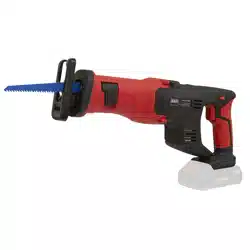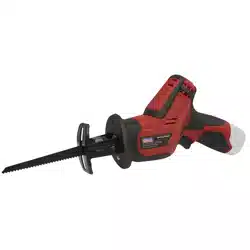
12V SV12 SERIES CORDLESS RECIPROCATING
SAW - BODY ONLY
MODEL NO: CP1208
Thank you for purchasing a Sealey product. Manufactured to a high standard, this product will, if used according to these instructions,
and properly maintained, give you years of trouble free performance.
IMPORTANT: PLEASE READ THESE INSTRUCTIONS CAREFULLY. NOTE THE SAFE OPERATIONAL REQUIREMENTS, WARNINGS & CAUTIONS. USE
THE PRODUCT CORRECTLY AND WITH CARE FOR THE PURPOSE FOR WHICH IT IS INTENDED. FAILURE TO DO SO MAY CAUSE DAMAGE AND/OR
PERSONAL INJURY AND WILL INVALIDATE THE WARRANTY. KEEP THESE INSTRUCTIONS SAFE FOR FUTURE USE.
1. SAFETY
1.1. GENERAL SAFETY
9 Stay alert, watch what you are doing and use common sense when operating a power tool.
8 DO NOT use a power tool while you are tired or under the inuence of drugs, alcohol or medication.
9 Use personal protective equipment. Always wear eye protection. Protective equipment such as dust mask, non-skid safety shoes, hard
hat, or hearing protection used for appropriate conditions will reduce personal injuries.
8 DO NOT overreach. Keep proper footing and balance at all times.
8 DO NOT wear loose clothing or jewellery. Keep your hair and clothing away from moving parts. Loose clothes, jewellery or long hair
can be caught in moving parts.
8 The use of a dust extraction system may reduce dust-related hazards.
8 DO NOT let familiarity gained from frequent use of tools allow you to become complacent and ignore tool safety principles.
8 DO NOT force the power tool. Use the correct power tool for your application. The correct power tool will do the job better and safer at
the rate for which it was designed.
8 DO NOT use the power tool if the switch does not turn it on and o. Any power tool that cannot be controlled with the switch is
dangerous and must be repaired.
9 Disconnect the battery pack, from the power tool before making any adjustments, changing accessories, or storing power tools. Such
preventive safety measures reduce the risk of starting the power tool accidentally.
9 Store idle power tools out of the reach of children and DO NOT allow persons unfamiliar with the power tool or these instructions to
operate the power tool. Power tools are dangerous in the hands of untrained users.
9 Maintain power tools and accessories carefully. Check for misalignment or binding of moving parts, breakage of parts and any other
condition that may aect the power tool’s operation. If damaged, have the power tool repaired before use.
9 Keep cutting tools sharp and clean. Properly maintained cutting tools with sharp cutting edges are less likely to bind and are easier to
control.
9 Use the power tool, accessories and tool bits etc. in accordance with these instructions, taking into account the working conditions and
the work to be performed. Use of the power tool for operations dierent from those intended could result in a hazardous situation.
9 Keep handles and gripping surfaces dry, clean and free from oil and grease. Slippery handles and gripping surfaces DO NOT allow for
safe handling and control of the tool in unexpected situations.
9 Have your power tool serviced by a qualied repair person using only identical replacement parts. This will ensure that the safety of the
power tool is maintained.
9 Use appropriate detection equipment to track down concealed supply lines or consult the local utility companies. Contact with electrical
lines may result in re and electric shock. Damaging a gas line may lead to an explosion. Penetrating a water line causes property
damage and may cause an electric shock.
9 Hold the power tool by its insulated gripping surfaces when performing an operation where the cutting accessory may contact hidden
wiring or its own cord. Cutting a “live” wire may make exposed metal parts of the power tool “live” and could give the operator an
electric shock.
9 Use clamps or another practical way to secure and support the workpiece to a stable platform.
9 Vibrations can be harmful to the human hand-arm system. Keep the vibration exposure time to a minimum.
9 Clean the shank of the saw blade before inserting it. A dirty shank cannot be fastened securely.
9 Check the saw blade for tight t. A loose saw blade could fall out and injure you.
8 DO NOT work on moistened material or moist surfaces.
9 Only hold the power tool against the workpiece when the tool is switched on and running. Otherwise there is a risk of kickbacks.
9 Make sure that the guide shoe is positioned securely on the contact face during sawing. A jammed saw blade could break or cause a
kickback.
9 Keep your hands out of the sawing area. DO NOT reach underneath the workpiece.
9 Keep your hands away from guide shoe and quick-release chuck. Crushing hazard upon contact with these components.
9 Ensure sucient ventilation.
9 Regularly check the quick-release chuck for wear or damage.
9 Only use intact, awless saw blades. Bent and blunt saw blades could break or cause a kickback.
8 DO NOT attempt to slow down the saw blade movement by pressing against the blade from the side once the device is switched o.
The saw blade could be damaged, break or cause a kickback.
9 Switch o the power tool when your operation is completed, but DO NOT remove the saw blade from the kerf (cut) until it has come to
a standstill. This serves to avoid a kickback, then you can put the power tool down safely.
Refer to
instruction
manual
Wear eye
protection
Wear protective
gloves
Wear ear
protection
Wear a mask Wear safety
footwear
Hot surfaces Wear
protective
clothing
CP1208 Issue 2 (ALL) 13/06/23
Original Language Version
© Jack Sealey Limited

CP1208 Issue 2 (ALL) 13/06/23
Original Language Version
© Jack Sealey Limited
9 Immediately switch o the power tool if the insertion tool gets jammed. The power tool can lash out to the side.
9 Wait until the power tool has come to a standstill, before putting it down.
9 Only use the device for sawing plastic, wood, metal and building materials using the suitable saw blade. The device may be used for:
• Sawing work,
• Straight and curved cuts,
• Flush cutting of protruding workpieces
9 Whilst adhering to the technical data. We recommend using the power tool with original Sealey accessories.
9 The device is not intended for processing glass or stone.
9 Check the device for damages and proper functioning before each use. If you notice damages, no longer use the device.
8 DO NOT use the device when the device or your hands are damp or wet!
9 Work on the electrical components must only be carried out by an authorised specialist company!
9 There is a risk of a short-circuit due to liquids penetrating the housing!
8 DO NOT immerse the device and the accessories in water. Make sure that no water or other liquids can enter the housing.
9 The insertion tool might still be hot after the application. Burn hazard when touching the insertion tool.
8 DO NOT touch the insertion tool bare-handed! Wear protective gloves!
WARNING! Hand injuries Crushing hazard near saw blade and guide shoe if handled without due care. Wear protective gloves!
WARNING! Sharp object Parts of the saw blade are sharp. Risk of injuries if handled without due care. Wear protective gloves!
WARNING! Toxic dusts! The harmful/ toxic dusts produced during operation pose of risk to the health of the operator and persons in the
vicinity.
8 DO NOT process materials containing asbestos. Asbestos is considered carcinogenic.
WARNING! Make sure not to hit power, gas or water lines when working with a power tool. If necessary, use a pipe detector to check
the wall you want to drill in or slit open.
WARNING! Risk of injuries caused by ying parts or bursting tool heads.
WARNING! Dangers can occur at the device when it is used by untrained people in an unprofessional or improper way!
WARNING! The device is not a toy and does not belong in the hands of children.
WARNING! Risk of suocation! DO NOT leave the packaging lying around. Children may use it as a dangerous toy.
9 Vibration emissions can cause a health hazard if the device is used for an extended period of time or if it is not properly handled and
maintained.
9 Keep a sucient distance from heat sources.
NOTE: If you store or transport the device improperly, the device may be damaged.
NOTE: For transporting the device, use the transport case included in the scope of delivery in order to protect the device from external
inuences. Before transporting the device, observe the following:
9 Switch o the device.
9 Allow the device to cool down.
9 Remove the tool from the tool holder.
1.2. HAND ARM VIBRATION
WARNING! – Risk of Hand Arm Vibration Injury.
This tool may cause Hand Arm Vibration Syndrome if its use is not managed adequately.
This tool is subject to the vibration testing section of the Machinery Directive 2006/42/EC.
This tool is to be operated in accordance with these instructions.
Measured vibration emission value (a): 13.78
m/s²
Uncertainty value (k):
1.5 m/s²
Please note that the application of the tool to a sole specialist task may produce a different average vibration emission. We recommend that
a specific evaluation of the vibration emission is conducted prior to commencing with a specialist task.
A health and safety assessment by the user or employer will need to be carried out to determine the suitable duration of use for each tool.
NB: Stated Vibration Emission values are type-test values and are intended to be typical.
Whilst in use, the actual value will vary considerably from and depend on many factors, such as the operator, the task and the inserted
tool or consumable.
NB: ensure that the length of leader hoses is sufficient to allow unrestricted use, as this also helps to reduce vibration.
The state of maintenance of the tool itself is also an important factor, a poorly maintained tool will also increase the risk of Hand Arm
Vibration Syndrome.
1.3. HEALTH SURVEILLANCE
We recommend a programme of health surveillance to detect early symptoms of vibration injury so that management procedures can be
modified accordingly.
1.4. PERSONAL PROTECTIVE EQUIPMENT
We are not aware of any personal protective equipment (PPE) that provides protection against vibration injury that may result from the
uncontrolled use of this tool. We recommend a sufficient supply of clothing (including gloves) to enable the operator to remain warm and
dry and maintain good blood circulation in fingers etc. Please note that the most effective protection is prevention, please refer to the
Correct Use and Maintenance section in these instructions. Guidance relating to the management of hand arm vibration can be found on
the HSC website www.hse.gov.uk - Hand-Arm Vibration at Work.
2. INTRODUCTION
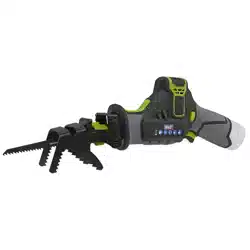
Compact, lightweight cordless reciprocating saw. Comfortable composite housing with soft grip to reduce vibration. Quick blade change
system. Variable speed trigger for greater control. Integral LED battery level indicator and LED work light. Supplied with a metal cutting
blade and a wood cutting blade. Trigger-lock for added safety. Requires Model No. CP1200BP 12V 1.5Ah Lithium-ion Battery and
Model No. CP1200MC Battery Charger.
3. SPECIFICATION
Model No: .......................................................... CP1208
Battery Options (not included): .....12V 1.5Ah Lithium-ion
Cutting Capacities: ........................................ Metal:8mm
...................................................................Wood: 65mm
..................................................................Plastic: 50mm
Noise Power/Pressure: .................................95/84dB(A)
No-Load Speed: ............................................ 0-3000spm
Replacement Parts:............ CP1200MC - Mains Charger
..............................SBS3150 - Reciprocating Saw Blade
Stroke Length: ....................................................14.5mm
Vibration/Uncertainty: ................................13.78/1.5m/s²
4. OPERATION
4.1. GENERAL INFORMATION
4.1.1. Keep the venting slots clear to prevent the motor from overheating.
4.1.2. Before every application, make sure that you have selected the correct tool for the intended use.
4.2. CHANGING THE SAW BLADE
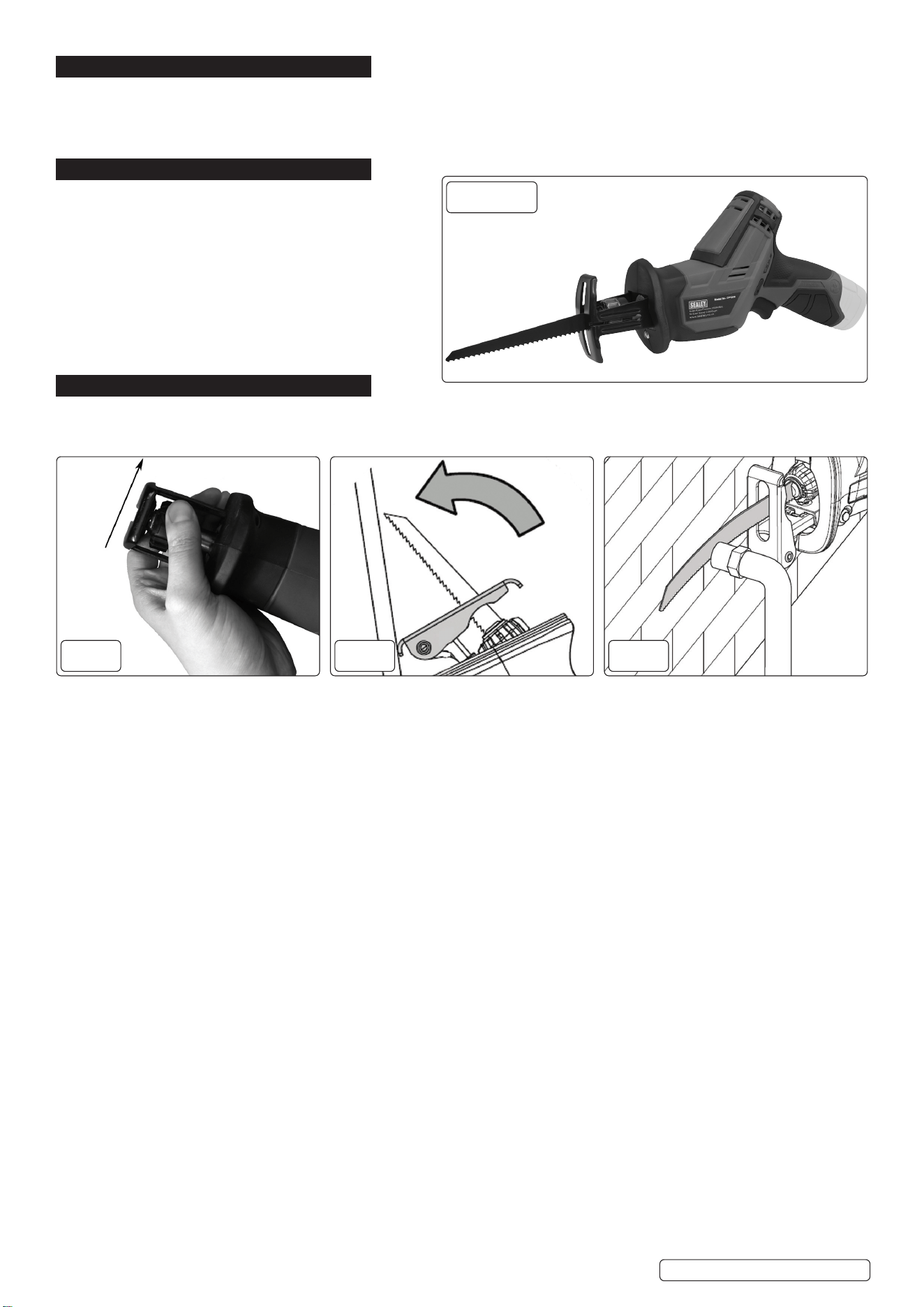
4.2.1. Turn the quick-release chuck to the side and hold it in this position (g.1).
4.2.2. If a saw blade is inserted, remove the saw blade from the quick-release chuck.
4.2.3. Insert the saw blade into the quick-release chuck. Make sure that the teeth of the saw blade point downwards.
4.2.4. Push the saw blade into the quick-release chuck up to the stop.
4.2.5. Let go of the quick-release chuck. The quick-release chuck must return to its initial position.
4.2.6. Check whether the saw blade is properly locked in place.
4.3. SWITCHING THE DEVICE ON AND OFF
4.3.1. Once the battery is installed pull the trigger to operate.
4.3.2. Lock the trigger in the OFF position using the sliding switch above the trigger.
4.4. SELECTING THE STROKE RATE
4.4.1. The required stroke rate depends on various factors. For example, the workpiece as well as the activity and the working conditions
have an impact on the required stroke rate. Working with plastic or aluminium, for instance, requires a low stroke rate. Entering the
material during plunge-cutting, for instance, requires a high stroke rate.
4.5. DURING NORMAL OPERATION
4.5.1. During normal operation the stroke rate is controlled by pressing the on/o switch:
• Light pressure = low stroke rate
• Firm pressure = high stroke rate
• Press in completely = maximum stroke rate
4.6. SAWING
4.6.1. Before sawing wood, chipboards, building materials etc., check the above for foreign objects, e.g. nails, screws or similar. If required,
remove the foreign objects or use a suitable saw blade.
4.6.2. Only use intact, awless saw blades. Bent, blunt or otherwise damaged saw blades could break.
4.6.3. When sawing lightweight construction materials, make sure to observe the legal regulations and recommendations of the material
manufacturers.
4.6.4. Use a narrow saw blade when sawing tight curves.
4.6.5. If the saw blade gets jammed in the workpiece, switch o the power tool immediately. The sawing gap should be slightly widened with a
suitable tool so that you can pull out the power tool.
4.6.6. Switch on the power tool and guide it towards the workpiece to be processed. Place the guide shoe on the surface of the workpiece.
Process the workpiece with an even forward motion and contact pressure. After completing the sawing operation, switch o the power
tool.
4.6.7. The saw blade should not be longer than required for the intended cut.
4.7. PLUNGE-CUTTING
4.7.1. Only soft materials such as plasterboard or the like may be processed using the plunge-cutting method.
8 DO NOT process any metals using the plunge-cutting method.
CP1208 Issue 2 (ALL) 13/06/23
Original Language Version
© Jack Sealey Limited
g.3g.2g.1
CP1208
Sealey Group, Kempson Way, Suffolk Business Park, Bury St Edmunds, Suffolk. IP32 7AR
01284 757500 sales@sealey.co.uk www.sealey.co.uk
ENVIRONMENT PROTECTION
Recycle unwanted materials instead of disposing of them as waste. All tools, accessories and packaging should be
sorted, taken to a recycling centre and disposed of in a manner which is compatible with the environment. When
the product becomes completely unserviceable and requires disposal, drain any uids (if applicable) into approved
containers and dispose of the product and uids according to local regulations.
Note: It is our policy to continually improve products and as such we reserve the right to alter data, specifications and component parts without prior
notice.
Important: No Liability is accepted for incorrect use of this product.
Warranty: Guarantee is 12 months from purchase date, proof of which is required for any claim.
REGISTER YOUR
PURCHASE HERE
WEEE REGULATIONS
Dispose of this product at the end of its working life in compliance with the EU Directive on Waste Electrical and Electronic
Equipment (WEEE). When the product is no longer required, it must be disposed of in an environmentally protective way. Contact
your local solid waste authority for recycling information.
4.7.2. Use short saw blades for plunge-cutting.
4.7.3. First place the edge of the guide shoe on the workpiece before switching the power tool on, see Schematic representation plunge-
cutting (g.2).
Note: The saw blade must not be in contact with the workpiece.
4.7.4. Select the maximum stroke rate and allow the saw blade to slowly plunge into the workpiece. To do so, bring the saw blade closer to
the workpiece while maintaining contact between the edge of the guide shoe and the workpiece.
4.7.5. As soon as the guide shoe rests on the workpiece, you can continue working along the cutting line.
4.8. FLUSH CUTTING(FIG.3)
4.8.1. Using elastic bi-metal saw blades you can saw o protruding objects such as water pipes or the like directly at the wall.
4.8.2. Make sure that the saw blade extends beyond the diameter or thickness of the object, otherwise there is a risk of kickbacks.
4.8.3. Apply lateral pressure on the power tool until the bi-metal saw blade and the side of the guide shoe are positioned against the wall.
4.8.4. Saw through the object applying constant lateral pressure.
5. MAINTENANCE
5.1. ACTIVITIES REQUIRED BEFORE STARTING MAINTENANCE
WARNING! Remove battery and allow to cool before carrying out any maintenance.
5.1.1. Switch o the device.
5.1.2. Allow the device to cool down completely.
NOTE: Inside the device, there are no parts that need to be maintained or lubricated by the user.
5.2. CLEANING
NOTE: The device should be cleaned before and after each use.
NOTE: The device does not have to be lubricated after cleaning.
WARNING! Electrical voltage There is a risk of a short-circuit due to liquids penetrating the housing!
8 DO NOT immerse the device and the accessories in water. Make sure that no water or other liquids can enter the housing.
5.2.1. Clean the device with a soft, damp and lint-free cloth. Ensure that no moisture enters the housing. Protect electrical components from
moisture.
8 DO NOT use any aggressive cleaning agents such as cleaning sprays, solvents, alcohol-based or abrasive cleaners to dampen the
cloth.
5.2.2. Dry the device with a soft, lint-free cloth.
5.2.3. Dry the saw blades with a soft, lint-free cloth.
5.2.4. Remove any dust deposits and, if applicable, wood chips or material residues from the quick-release chuck.
5.2.5. Keep the ventilation openings free from dust deposits to prevent overheating of the motor.
6. TROUBLESHOOTING
WARNING! Remove battery before carrying out any maintenance.
PROBLEMS POSSIBLE CAUSE SOLUTION
Saw does not work Flat battery Charge Battery
Saw does not grip Check blade clamp
Swarf in chuck
Remove blade, fully open clamp and re-insert blade.
Clean inside clamp with cleaning uid.
CP1208 Issue 2 (ALL) 13/06/23
Original Language Version
© Jack Sealey Limited