Read this User's Guide before you start using your P-touch
labeling system. Keep this User’ s Guide in a handy place
for future reference.
Please visit us at http://solutions.brother.com/ where you
can get product support and answers to frequently asked
questions (FAQs).
ELECTRONIC LABELING SYSTEMELEC TR ON IC L AB EL IN G SY ST EMELECTRONIC LABELING SYSTEM
INTRODUCTION
GETTING STARTED
EDITING A LABEL
LABEL PRINTING
USING THE FILE MEMORY
TROUBLESHOOTING
APPENDIX
INDEX
RESETTING & MAINTAINING YOUR
P-TOUCH LABELING SYSTEM
USER’S GUIDE P-touch E300
INTRODUCTION
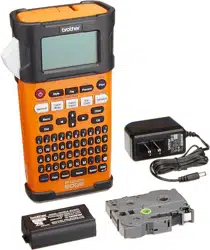
Thank you for purchasing the P-touch labeling system model PT-E300.
Your new PT-E300 is an intuitive, easy to operate and feature rich P-touch labeling system
that produces professional looking and high quality labels.
This manual contains various precautions and basic procedures for using this labeling
system. Read this manual carefully before using and keep in a handy place for future
reference.
Compilation and Publication Notice
Under the supervision of Brother Industries, Ltd., this manual has been compiled and
published, covering the latest product’s descriptions and specifications.
The contents of this manual and the specifications of this product are subject to change
without notice.
If new versions of the PT-E300 operating system becomes available, this manual may not
reflect the updated features. Therefore, you may find that new operating system and the
contents in this manual may be different.
Any trade names and product names of companies appearing on Brother products, related
documents and any other materials are all trademarks or registered trademarks of those
respective companies.
Federal Communications Commission (FCC) Compliance Notice (For USA Only)
This equipment has been tested and found to comply with the limits for a Class B digital
device, pursuant to Part 15 of the FCC Rules. These limits are designed to provide
reasonable protection against harmful interference in a residential installation. This
equipment generates, uses, and can radiate radio frequency energy and, if not installed
and used in accordance with the instructions, may cause harmful interference to radio
communications. However, there is no guarantee that interference will not occur in a
particular installation. If this equipment does cause harmful interference to radio or
television reception, which can be determined by turning the equipment off and on, the
user is encouraged to try to correct the interference by one or more of the following
measures:
• Reorient or relocate the receiving antenna
• Increase the separation between the equipment and receiver.
• Connect the equipment into an outlet on a circuit different from that to which the receiver
is connected.
• Consult the dealer or an experienced radio/TV technician for help.
Important
Changes or modifications not expressly approved by Brother Industries, Ltd. could void
the user's authority to operate the equipment.
ATTENTION: (For USA and Canada)
The Lithium Ion battery you have purchased is recyclable. At the end of its
useful life, under various state and local laws, it is illegal to dispose of this
battery into your municipal waste stream. Please call 1-800-8-BATTERY

Important Information
Should you have questions, or need information about your Brother Product, we have a
variety of support options for you to choose from:
Customer Service
1-800-255-0415
Customer Service
1-303-460-1628 (fax)
World Wide Web
For purchasing accessories and certain Brother products:
http://www.brothermobilesolutions.com
For product information
http://solutions.brother.com/
Supplies / Accessories
1-800-543-6144
Brother Mobile Solutions, Inc., 100 Technology Drive, #250A, Broomfield, CO 80021

INTRODUCTION
1
Safety Precautions................................................................................................................ 3
General Precautions ........................................................................................................... 11
Symbols Used in this Guide................................................................................................ 12
How to use the P-touch labeling system............................................................................. 13
GETTING STARTED ..................................................................................... 14
Unpacking Your P-touch Labeling System ......................................................................... 14
General Description ............................................................................................................ 15
LCD Display & Keyboard .................................................................................................... 16
LCD Display .................................................................................................................. 16
Key Names and Functions ............................................................................................ 17
Power Supply...................................................................................................................... 19
AC Adapter.................................................................................................................... 19
Using the Rechargeable Li-ion Battery ......................................................................... 19
Battery .......................................................................................................................... 22
Inserting a Tape Cassette................................................................................................... 23
Turning Power On/Off......................................................................................................... 24
Feeding Tape...................................................................................................................... 24
Feed function ............................................................................................................... 24
LCD Display........................................................................................................................ 25
LCD Contrast ............................................................................................................... 25
Backlight........................................................................................................................ 25
Setting Language and Unit ................................................................................................. 26
Language ..................................................................................................................... 26
Unit ............................................................................................................................... 26
EDITING A LABEL......................................................................................... 27
Selecting a Labeling Application Type................................................................................ 27
GENERAL ..................................................................................................................... 27
FACEPLATE ................................................................................................................. 27
CABLE WRAP............................................................................................................... 28
CABLE FLAG ................................................................................................................ 28
PATCH PANEL ............................................................................................................ 29
PUNCH-DOWN BLOCK ............................................................................................... 29
Creating a Bar Code Label ................................................................................................. 29
Setting Bar Code Parameters and Entering Bar Code Data ........................................ 30
Editing and Deleting a Bar Code................................................................................... 30
Entering a Serialize Label................................................................................................... 31
Serialize ........................................................................................................................ 31
advanced serialize ....................................................................................................... 32
Entering and Editing Text ................................................................................................... 34
Entering Text from the Keyboard .................................................................................. 34
Adding a New Line ....................................................................................................... 34
Adding a New Block ...................................................................................................... 34
Moving the Cursor......................................................................................................... 34
Inserting Text ............................................................................................................... 34
Deleting Text ................................................................................................................. 35
Contents
1
2
3
4
5
6
7
8
9
2
INTRODUCTION
Entering Symbols ................................................................................................................35
Entering Symbols Using the Symbol Function...............................................................35
Using Symbol History ....................................................................................................36
Entering Accented Characters ............................................................................................37
Setting Character Attributes ................................................................................................37
Setting Character Attributes by Label ............................................................................37
Setting Auto Fit Style ....................................................................................................38
Setting Frames ....................................................................................................................38
Setting Cut Options .............................................................................................................39
Selecting how tape is fed and cut..................................................................................40
LABEL PRINTING ..........................................................................................41
Label Preview......................................................................................................................41
Printing a Label ...................................................................................................................41
Printing a single page ....................................................................................................41
Printing a range of pages...............................................................................................41
Printing Multiple Copies ................................................................................................42
Attaching Labels..................................................................................................................42
USING THE FILE MEMORY ..........................................................................43
Storing a Label into Memory ...............................................................................................43
Opening a Stored Label File................................................................................................43
Printing a Stored Label File .................................................................................................44
Deleting a Stored Label File ................................................................................................44
RESETTING & MAINTAINING YOUR P-TOUCH LABELING SYSTEM ........45
Resetting the P-touch Labeling System ..............................................................................45
Resetting the data to factory settings ............................................................................45
Maintenance........................................................................................................................46
Cleaning the Unit ...........................................................................................................46
Cleaning the Print Head.................................................................................................46
Cleaning the Tape Cutter...............................................................................................46
TROUBLESHOOTING....................................................................................47
What to do when... ..............................................................................................................47
Error Messages ...................................................................................................................48
APPENDIX......................................................................................................50
Specifications ......................................................................................................................50
Symbols...............................................................................................................................51
Accented Characters...........................................................................................................52
Character Attribute ..............................................................................................................52
Frames ................................................................................................................................54
Bar Codes ...........................................................................................................................54
Bar Code Settings Table................................................................................................54
Special Character List ...................................................................................................55
INDEX.............................................................................................................56
INTRODUCTION
3
Safety Precautions
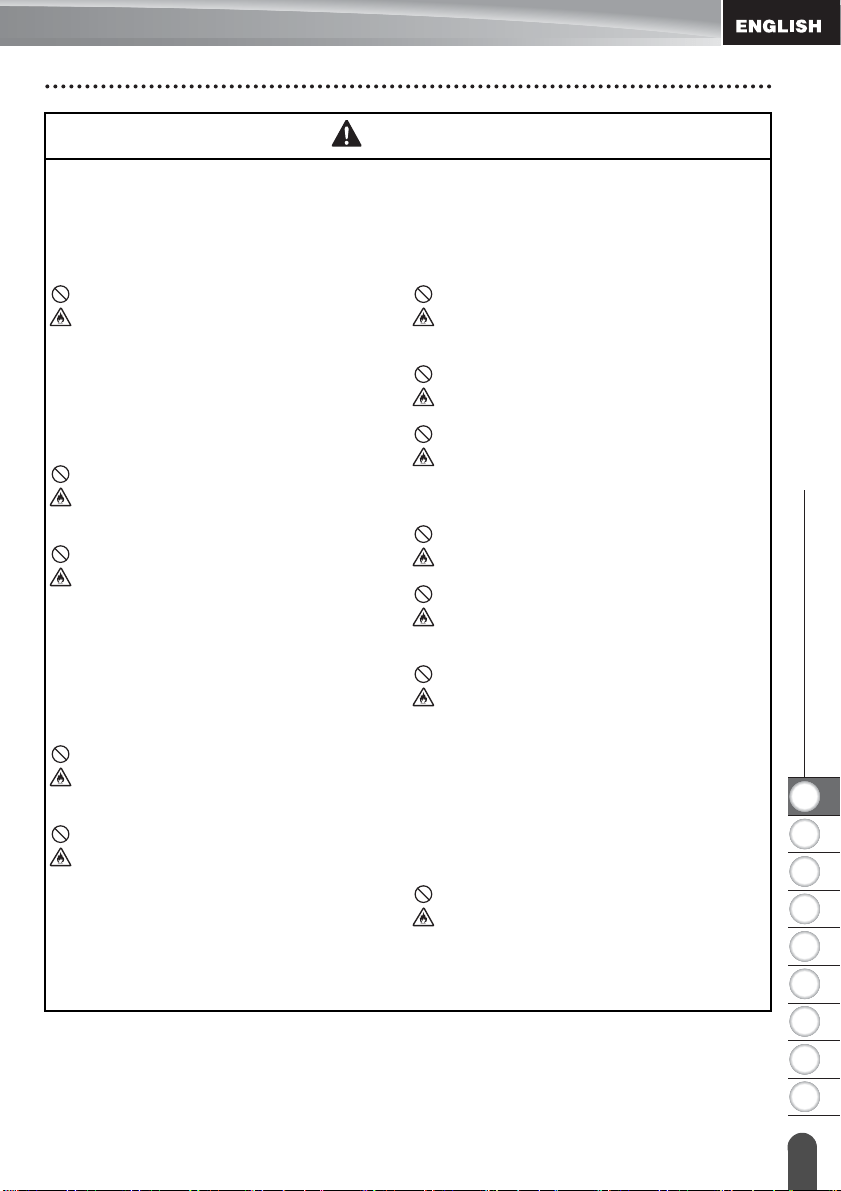
To prevent injury and damage, important notes are explained using various symbols.
The symbols and their meanings are as follows:
The symbols used in this manual are as follows:
Safety Precautions
DANGER
Indicates an imminently hazardous situation which, if the product is
handled without following the warnings and instructions, will result
in death or serious injuries.
WARNING
Indicates a potentially hazardous situation which, if not avoided,
could result in death or serious injuries.
CAUTION
Indicates a potentially hazardous situation which, if not avoided,
may result in minor or moderate injuries.
Action NOT allowed DO NOT disassemble the product.
DO NOT splash the product with or
immerse the product in water.
DO NOT touch a given portion of the
product.
Mandatory action Unplugging is required
Indicates risk of fire under certain
circumstances.
Alerts to the possibility of electrical
shock
1
2
3
4
5
6
7
8
9
4
INTRODUCTION
Safety Precautions
DANGER
Rechargeable Li-ion Battery
Carefully observe the following precautions for the rechargeable Li-ion battery (hereafter
referred to as "rechargeable battery"), If these precautions are not followed, overheating,
leaking, or cracks in the battery may result in an electrical short, explosion, smoke, fire,
electric shock, injury to yourself or others, or damage to the product or other property.
Use the rechargeable battery only for its
intended purpose. The labeling system
and rechargeable battery are designed
to function exclusively with each other.
DO NOT insert the rechargeable battery
into a different labeling system, or a
different rechargeable battery into your
labeling system, otherwise fire or
damage may result.
To charge the rechargeable battery,
insert it into the labeling system, and
then use the AC adapter designed
specifically for this labeling system.
DO NOT charge the rechargeable
battery near a fire or in direct sunlight.
This could activate the protection
circuitry, which is designed to prevent
danger from high heat. Activation of the
protection circuitry could cause
charging to stop, charging to occur with
excessive current/voltage if the
protection circuitry fails, or an abnormal
chemical reaction within the battery.
When charging the rechargeable
battery, use only a battery charger
designed specifically for the
rechargeable battery.
DO NOT allow wires or other metal
objects to come into contact with the
terminals of the rechargeable battery.
DO NOT carry or store the rechargeable
battery with metal objects such as
necklaces or hairpins. This could cause
an electrical short, and lead metal
objects such as wires, necklaces, or
hairpins to overheat.
DO NOT use or leave the rechargeable
battery near fire, heaters, or other high
temperature (above 176
°F/80°C)
locations.
DO NOT allow the rechargeable battery
to come into contact with or to be
immersed in water.
DO NOT use in corrosive environments,
such as areas where salty air, salt
water, acids, alkalis, corrosive gases,
chemicals, or any corrosive liquid are
present.
DO NOT use the rechargeable battery if
it is damaged or leaking.
DO NOT directly solder any connections
to the rechargeable battery. This could
cause internal insulation to melt, gas to
be emitted, or safety mechanisms to fail.
DO NOT use the rechargeable battery
with the polarity (+) (-) reversed. Check
the orientation of the rechargeable
battery before inserting it, and do not try
to force the rechargeable battery into
the labeling system. Charging the
rechargeable battery with the polarity
reversed could cause an abnormal
chemical reaction within the
rechargeable battery or abnormal
current flow during discharge.
DO NOT directly connect the
rechargeable battery to a household
electrical supply.
INTRODUCTION
5
Safety Precautions
Rechargeable Li-ion Battery
Liquid (electrolyte) leaking from the
labeling system or rechargeable battery
may indicate that the rechargeable
battery is damaged. If the rechargeable
battery leaks, immediately discontinue
use of the labeling system, unplug the
AC adapter, and isolate the labeling
system by placing it in a bag.
Do not touch the electrolyte. If
electrolyte gets in the eyes, do not rub
them. Immediately rinse liberally with
tap water or other clean water and seek
the advice of a medical professional. If
left alone, the electrolyte could cause
eye damage. If electrolyte contacts your
skin or clothing, immediately rinse them
with water.
DO NOT put the rechargeable battery,
or a labeling system with the
rechargeable battery installed, into a
microwave oven or a high pressure
container.
DO NOT leave a drained rechargeable
battery in the labeling system for a long
period of time. This could shorten the life
of the rechargeable battery or lead to an
electrical short.
If the labeling system can only be used
for a short period of time, even though
the rechargeable battery is fully
charged, the rechargeable battery may
have reached the end of its service life.
Replace the rechargeable battery with a
new one. When removing and replacing
the rechargeable battery, cover the
terminals of the old rechargeable
battery with tape to avoid creating a
short in the battery.
DO NOT disassemble, modify, or
attempt to repair the rechargeable
battery.
DO NOT dispose of the rechargeable
battery in fire or intentionally overheat.
This could cause the internal insulation
to melt, gas to be emitted, or safety
mechanisms to fail. Additionally, the
electrolyte solution could catch fire.
DO NOT puncture the rechargeable
battery with any objects, subject it to
severe shocks or throw it. Damage to
the rechargeable battery's protection
circuit could cause the rechargeable
battery to be recharged at an abnormal
current/voltage or cause an abnormal
chemical reaction within the
rechargeable battery.
DO NOT incinerate the rechargeable
battery or dispose of it with household
waste.
DANGER
1
2
3
4
5
6
7
8
9
6
INTRODUCTION
Safety Precautions
WARNING
P-touch Labeling System
Follow these guidelines to avoid fire, electric shock, the risk of injury to yourself or others,
and/or damage to the labeling system or other property.
DO NOT allow the labeling system to
get wet or use the labeling system in
areas that may become wet, such as
bathrooms or near sinks.
DO NOT touch any metal parts near the
print head. The print head becomes
very hot during use and remains very
hot immediately after use. Do not touch
it directly with your hands.
DO NOT disassemble the P-touch
labeling system.
For inspection, adjustment, and repair
of the labeling system, contact Brother
customer service.
Plastic bags are used in the packaging
of your labeling system. To avoid
danger of suffocation, keep these bags
away from babies and children.
If you notice heat, an abnormal odor,
discoloration of the labeling system,
deformation, or anything else unusual
while using or storing the labeling
system, immediately discontinue use of
the labeling system, disconnect the AC
adapter, and remove the batteries.
To prevent damage, do not drop or hit
the P-touch labeling system.
DO NOT use the P-touch labeling system with a foreign object in it. If water, a metallic
substance, or any other foreign object enters the P-touch labeling system, disconnect
the AC adapter and remove the batteries, and contact Brother customer service.
INTRODUCTION
7
Safety Precautions
Alkaline batteries/Ni-MH rechargeable batteries
Follow these guidelines to avoid liquid leakage, heat, rupture of the battery and cause
personal injury.
DO NOT
throw into fire, heat up, short-
circuit, recharge, or disassemble the
battery.
DO NOT
allow batteries to get wet, for
example, by handling them with wet
hands or spilling beverages onto them.
If fluid leaked from the batteries gets into
your eyes, immediately rinse your eyes
with a large amount of clean water, and
then seek medical attention. If leaked
fluid enters your eyes, loss of eyesight
or other damage to the eyes may result.
DO NOT
allow a metal object to contact
both the plus and minus ends of a
battery.
DO NOT use sharp objects, such as
tweezers or a metallic pen, to remove or
replace the batteries.
DO NOT use a damaged, deformed, or
leaking battery, or a battery whose label
is damaged. Doing so may result in
generating excessive heat. Use of a
damaged or leaking battery may also
lead to battery fluid getting on your
hands. If leaked fluid gets onto your
hands and you rub your eyes, loss of
eyesight or other damage to the eyes
may result. Immediately rinse your
hands with a large amount of clean
water, and then seek medical attention.
WARNING
1
2
3
4
5
6
7
8
9
8
INTRODUCTION
Safety Precautions
AC Adapter
Follow these guidelines to avoid fire, damage, electric shock, failure or the risk of injury.
Make sure that the plug is fully inserted
into the power outlet. Do not use an
outlet that is loose.
Always use the specified AC adapter,
and always plug the AC adapter into an
electrical outlet with the specified
voltage (120V). Failure to do so may
result in injury to yourself or others, or
damage to the labeling system or other
property. Brother does not assume, any
responsibility for any accident or
damage resulting from not using the
specified AC adapter and adapter cord.
DO NOT connect the AC adapter or
adapter cord to other products.
DO NOT touch the AC adapter and the
P-touch labeling system during a
thunderstorm. There may be a remote
risk of electric shock from lightning
when the labeling system is used during
a thunderstorm.
DO NOT touch the AC adapter or power
plug with wet hands.
DO NOT use the AC adapter in places
with high humidity or moisture, such as
bathrooms.
DO NOT use a damaged adapter cord
or power plug.
DO NOT place heavy objects on,
damage, or modify the adapter cord or
plug. Do not forcibly bend or pull the
adapter cord.
DO NOT drop, hit, or otherwise damage
the AC adapter.
Tape Cutter
DO NOT touch the blade of the cutter
unit.
WARNING
INTRODUCTION
9
Safety Precautions
CAUTION
Alkaline batteries/Ni-MH rechargeable batteries
Follow these guidelines to avoid liquid leakage, overheating or rupture of the battery.
DO NOT use a battery other than the
one specified for use with your labeling
system. Do not use combinations of old
and new batteries or combinations of
different types, different charging levels,
different manufacturers or different
models. Do not insert a battery with the
polarity (+ and -) reversed.
If fluid leaked from the battery gets on
your skin or clothes, immediately rinse
them with clean water.
Remove the batteries if you do not
intend to use the P-touch labeling
system for an extended period of time.
Before using Ni-MH rechargeable
batteries, carefully read the instructions
for the batteries and battery charger,
and be sure to use them correctly.
When using Ni-MH rechargeable
batteries, charge the batteries before
using them with the appropriate,
specialised battery charger.
DO NOT disassemble or modify the
batteries.
DO NOT expose the batteries to heat or
dispose of the batteries in a fire.
AC Adapter
If you do not intend on using the P-touch
labeling system for an extended period
of time, disconnect the AC adapter from
the power outlet.
When disconnecting the AC adapter
from the power outlet, always hold the
AC adapter.
DO NOT use the AC adapter in places
of high humidity such as bathrooms.
DO NOT overload an electrical circuit
with the AC adapter.
DO NOT disassemble or modify the AC
adapter.
DO NOT allow the AC adapter/power
plug to get wet, for example, by handling
them with wet hands or spilling
beverages on to them.
Tape Cutter
Follow these guidelines to avoid minor personal injury and damage to the labeling system.
DO NOT open the tape compartment
cover when operating the cutter unit.
DO NOT apply excessive pressure to
the cutter unit.

1
2
3
4
5
6
7
8
9
10
INTRODUCTION
Safety Precautions
P-touch Labeling System
Follow these guidelines to avoid minor personal injury and damage to the P-touch labeling
system.
Store the P-touch labeling system on a
flat, stable surface such as a desk or in
a drawer.
DO NOT leave the P-touch labeling
system or any tape within the reach of
young children.
DO NOT place any heavy objects on top
of the P-touch labeling system.
Always use the suggested AC adapter
(AD-E001) for the P-touch labeling
system and plug it into an outlet with the
specified voltage. Failure to do so could
result in damage or failure of the
P-touch labeling system.
DO NOT use the P-touch labeling
system in places with moisture or high
humidity, such as bathrooms.
DO NOT allow the P-touch labeling
system to get wet, for example, by
handling it with wet hands or spilling
beverages onto them.
DO NOT disassemble or modify the
P-touch labeling system.
If you notice heat, an abnormal odor,
discoloration of the P-touch labeling
system, deformation, or anything else
unusual while using or storing the
P-touch labeling system, immediately
discontinue the use of the P-touch
labeling system, disconnect the AC
adapter, and remove the batteries.
CAUTION

INTRODUCTION
11
General Precautions
Rechargeable Li-ion battery
• At the time of purchase, the rechargeable Li-ion battery is slightly charged so that the
operation of the labeling system can be verified; however, the rechargeable Li-ion battery
should be fully charged with the AC adapter before the labeling system is used.
• If the labeling system will not be used for a long period of time, remove the rechargeable
Li-ion battery from the labeling system, and then store it in a location where it is not
exposed to static electricity, high humidity, or high temperatures (temperatures between
59°F/15°C and 77°F/25°C and 40% to 60% humidity are recommended). In order to
maintain the efficiency and life of the Li-ion rechargeable battery, charge it at least every
six months.
• If you notice anything unusual about the rechargeable Li-ion battery the first time it is used,
for example overheating or rust, DO NOT continue to use the battery. Contact Brother
customer service.
Labeling System
• DO NOT install the P-touch labeling system near any device that will cause
electromagnetic interference. The P-touch labeling system may malfunction if left near a
television or radio etc.
• DO NOT use the P-touch labeling system in any way or for any purpose not described in
this guide. Doing so may result in injury or damage to the labeling system.
• DO NOT put any foreign objects into the tape exit slot, AC adapter connector, or any other
part of the labeling system.
• DO NOT touch the print head (see page 6) with your fingers. Use the optional print head
cleaning cassette (TZe-CL4), the self-cleaning function of the labeling system, or a soft
wipe (e.g.a cotton swab) when cleaning the print head (see “Cleaning the Unit” on
page 46).
• DO NOT clean any part of the labeling system with alcohol or other organic solvents. Only
use a soft, dry cloth.
• DO NOT place the P-touch labeling system in direct sunlight, near heaters or other hot
appliances, or in any location exposed to extremely high or low temperatures, high
humidity, or dust. The standard operating temperature range of the P-touch labeling
system is 50
°F to 95°F.
• DO NOT leave any rubber or vinyl, or products made of rubber or vinyl, on the labeling
system for an extended period of time, otherwise the labeling system may become stained.
• Depending on the environmental conditions and the applied settings, some characters or
symbols may be difficult to read.
• Use only Brother TZe tapes with the P-touch labeling system. Do not use tapes that do not
have the mark.
• DO NOT pull or apply pressure to the tape in the cassette to avoid damaging the P-touch
labeling system.
• DO NOT try to print labels using an empty tape cassette or without a tape cassette in the
P-touch labeling system. Doing so will damage the print head.
• DO NOT attempt to cut the tape while printing or feeding since this will damage the tape.
• Depending on the location, material, and environmental conditions, the label may unpeel
or become irremovable, and the color of the label may change or be transferred to other
objects.
General Precautions
1
2
3
4
5
6
7
8
9
12
INTRODUCTION
Symbols Used in this Guide
• DO NOT expose the tape cassettes to direct sunlight, high temperatures, high humidity, or
dust. Store tape cassettes in a cool, dark place. Use the tape cassettes soon after opening
the tape cassette package.
• Markings made with oil-based or water-based ink may be visible through a label affixed
over them. To hide the markings, use two labels layered on top of each other or use a dark-
colored label.
• Any data stored in memory will be lost due to failure or repair of the P-touch labeling
system, or if the battery expires.
• When power is disconnected for more than two minutes, all text and format settings will be
cleared. Any text files stored in the memory will also be cleared.
• The length of the printed label may differ from the displayed label length.
• A protective clear plastic sticker is placed over the display during manufacturing and
shipping. This sticker should be removed prior to use.
• You can also use Heat Shrink Tube in this model. Check the Brother website (http://
www.brother.com/) for further information. You may not be able to use some print frame,
or font settings when using Heat Shrink Tube.
• The P-touch labeling system is not equipped with a charging feature for Ni-MH
rechargeable batteries.
• The printed label may differ from the image that appears on the LCD.
• Note that Brother Industries, Ltd. does not assume responsibility for any damage or injury
arising from the failure to follow the precautions listed in this manual.
• We strongly recommend that you read this User's Guide carefully before using your
P-touch labeling system, and then keep it nearby for future reference.
The following symbols are used throughout this guide to indicate additional information.
Symbols Used in this Guide
:
This symbol indicates information or directions that may result in damage or injury if
ignored, or operations that will result in errors.
:
This symbol indicates information or directions that may help you understand and use
the P-touch labeling system more efficiently.
INTRODUCTION
13
How to use the P-touch labeling system
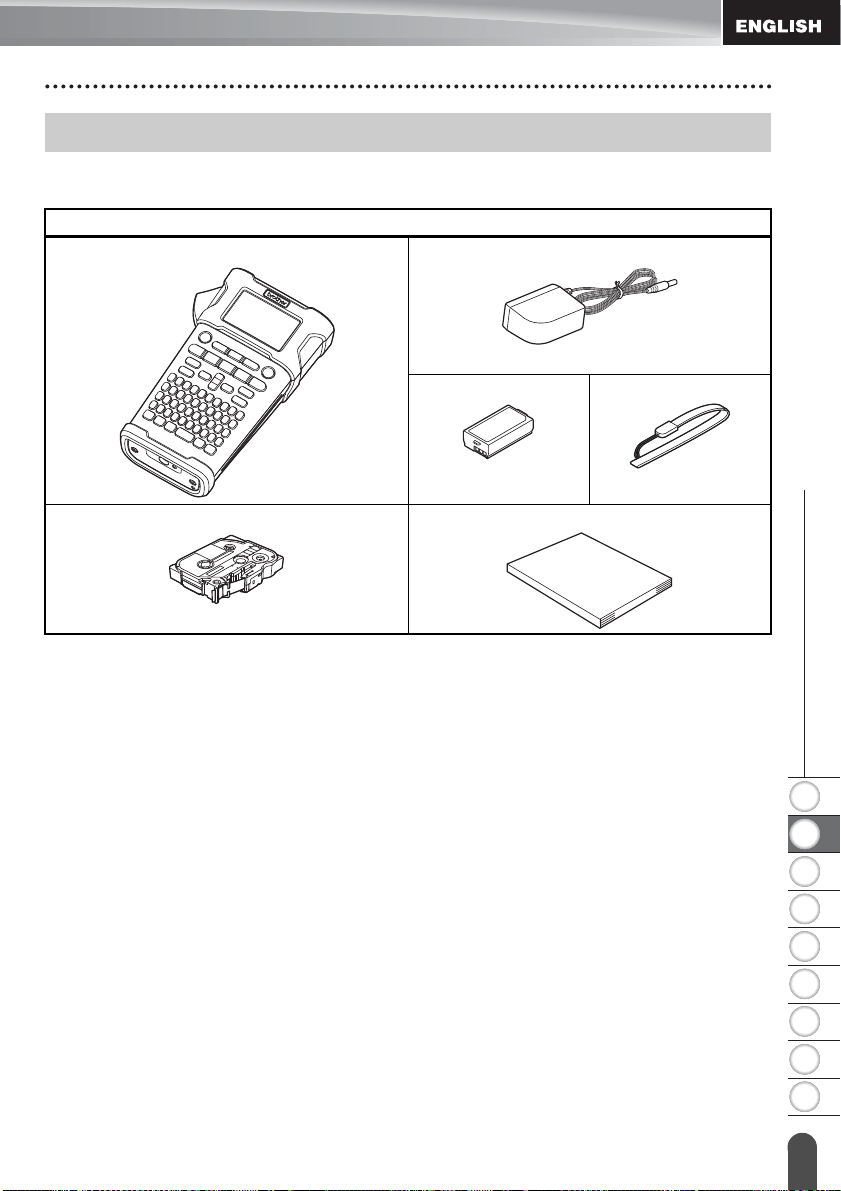
Create a label with the P-touch labeling system
GETTING STARTED
EDITING A LABEL
LABEL PRINTING
How to use the P-touch labeling system
1
• Unpacking Your P-touch.
P. 14
2
In addition to entering text, the P-touch
labeling system has a large range of
formatting options.
Create labels like these:
• Entering and Editing text.
• Entering Symbols.
• Entering Accented Characters.
• Selecting a Labeling Application Type.
• Setting Cut Options.
P. 34
P. 35
P. 37
P. 27
P. 39
3
Before printing, you can check the
layout of your label using the preview
function.
Create labels like these:
• Printing a label.
P. 41
14
Unpacking Your P-touch Labeling System
1
2
3
4
5
6
7
8
9
GETTING STARTED
GETTING STARTED
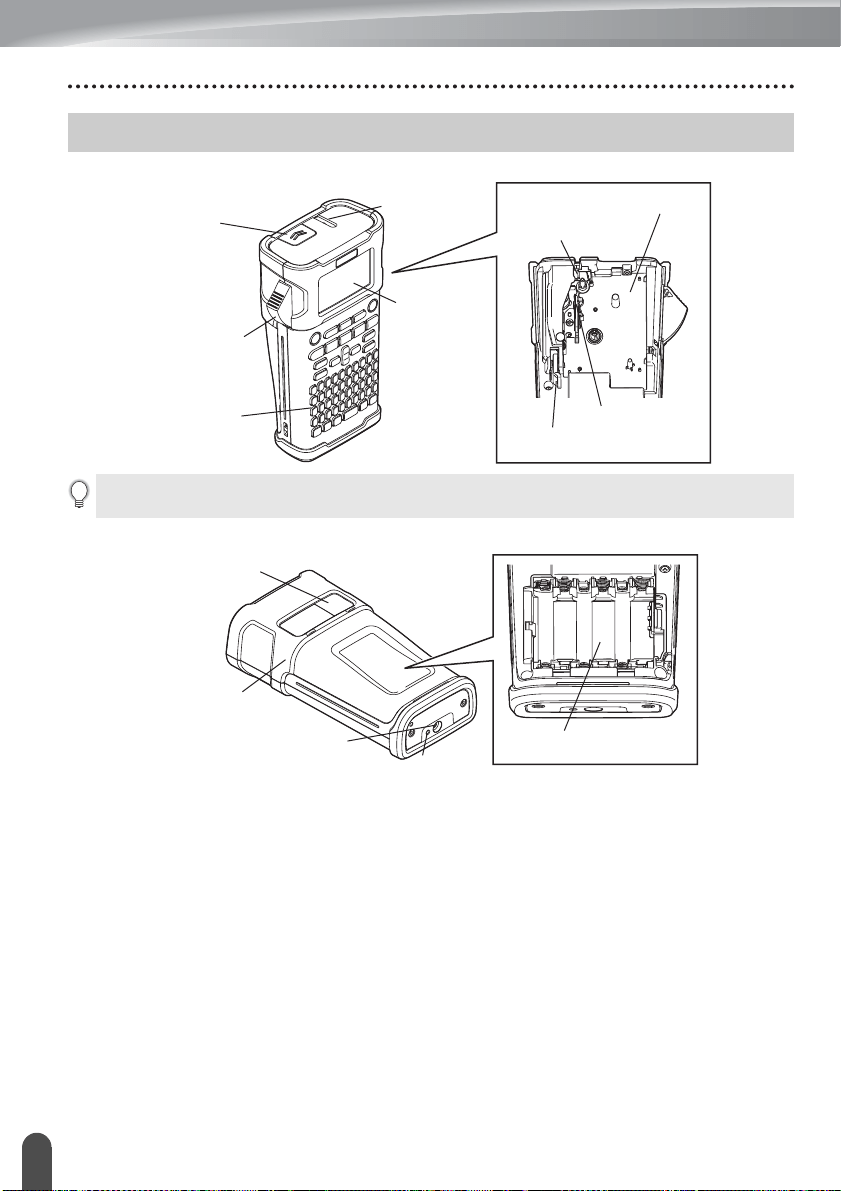
Check that the package contains the following before using your P-touch labeling system.
Unpacking Your P-touch Labeling System
PT-E300
P-touch labeling system AC adapter
The plug may differ by countries.
Li-ion Battery Strap
Tape Cassette
User’s Guide
15
General Description
GETTING STARTED
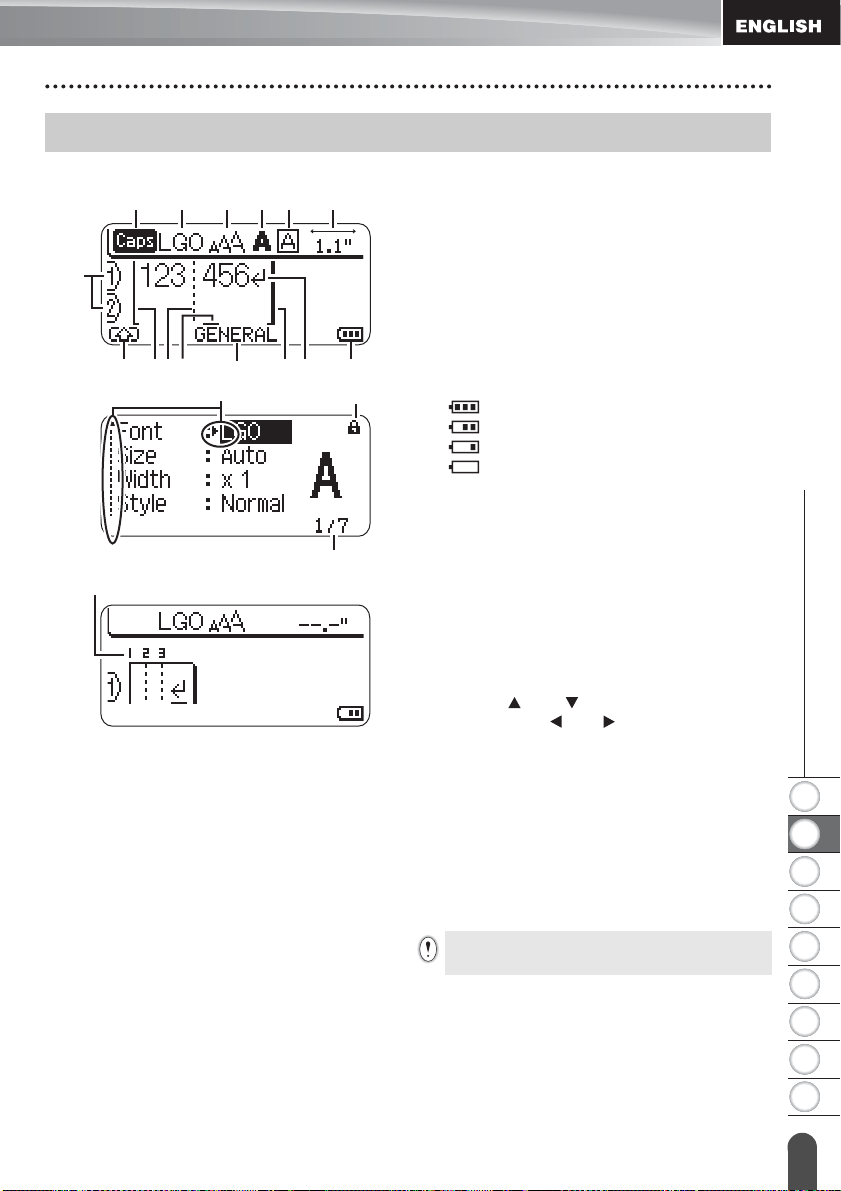
General Description
When shipped from the factory, the LCD display is covered with a protective sheet to prevent
damage. Remove this sheet before using the P-touch.
Keyboard
Tape cutter lever
LCD display
Tape cassette compartment
Tape cutter
Print head
Tape exit slot
Release lever
Cover latch
AC adapter connector
Rear cover
Battery compartment
Tape viewer
LED lamp
1
2
3
4
5
6
7
8
9
16
GETTING STARTED
LCD Display & Keyboard
LCD Display
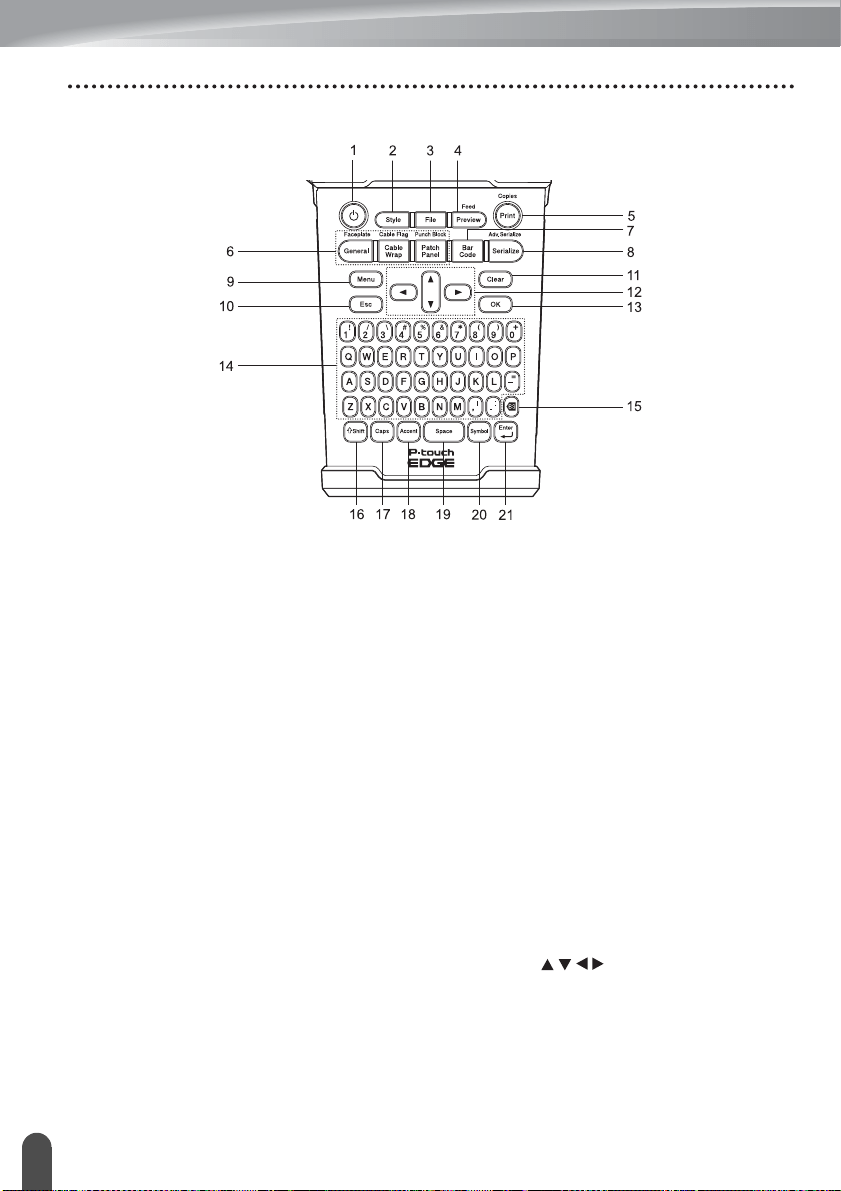
1. Line number
Indicates line number within the label
layout.
2. Shift Mode
Indicates shift mode is on.
3. Start Line / 4. End Line
The area between the start and end line
will be printed.
The short lines extending from the start/
end lines show the end of the label layout.
5. Block Separator Line
Indicates the end of a block.
6. Cursor
Characters are entered to the left of the
cursor. Indicates the current data input
position.
7. Labeling Application Type
Indicates current labeling application type.
8. Return mark
Indicates the end of a line of text.
9. Battery Level
Indicates remaining battery level. It
displays only when using Li-ion battery.
10.Caps mode
Indicates that the Caps mode is on.
11.-14. Style guidance
Indicates the current font (11), character
size (12), character style (13) and frame
(14) settings.
15.Tape length
Indicates the tape length for the text
entered.
16.Cursor selection
Use the and keys to select menu
items and the and keys to change the
settings.
17.Lock mark
Indicates that some items cannot be
changed.
18.Counter
Indicates currently selected number/
selectable number.
19.Block Number
Indicates the block number.
LCD Display & Keyboard
6
10 11 12 13 14 15
523 4 98
1
7
16 17
18
19
Refer to “LCD Display” on page 25 for
changing.
-Full
-Half
-Low
-Empty
17
LCD Display & Keyboard
GETTING STARTED
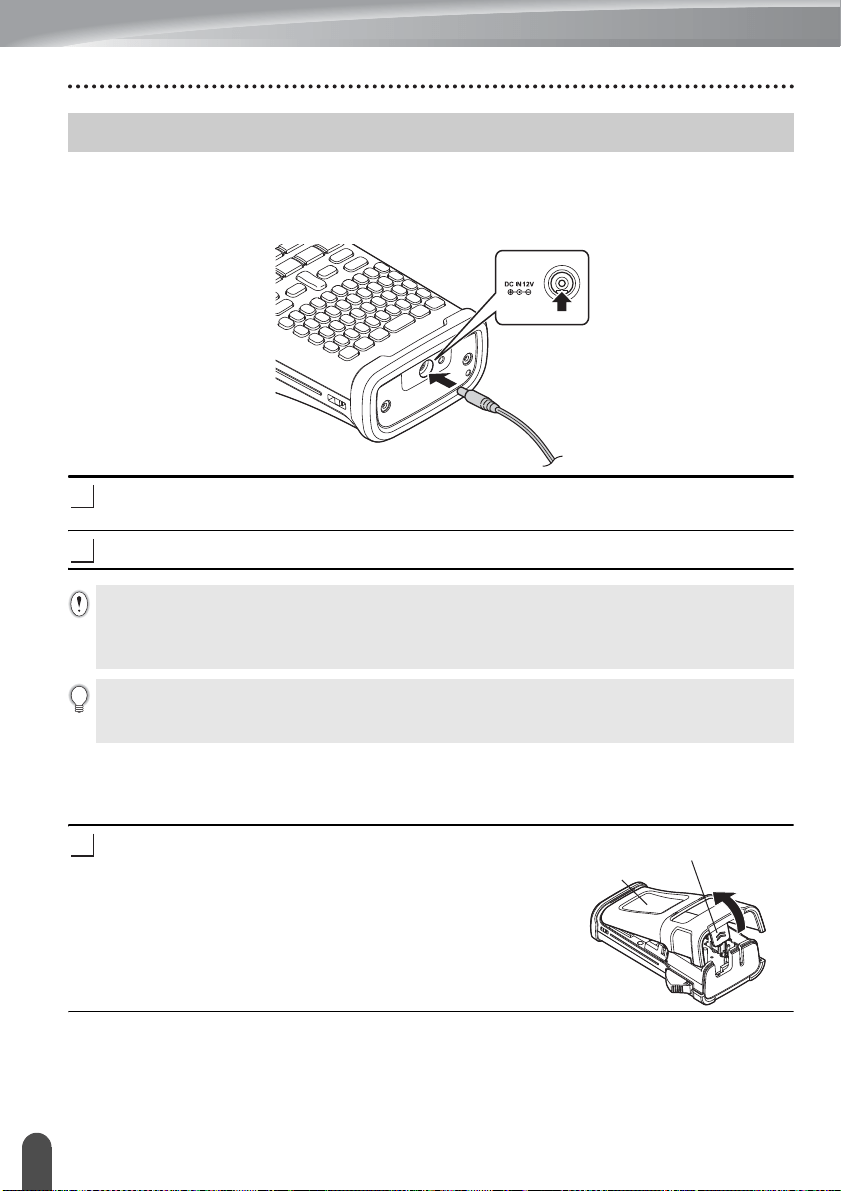
Key Names and Functions
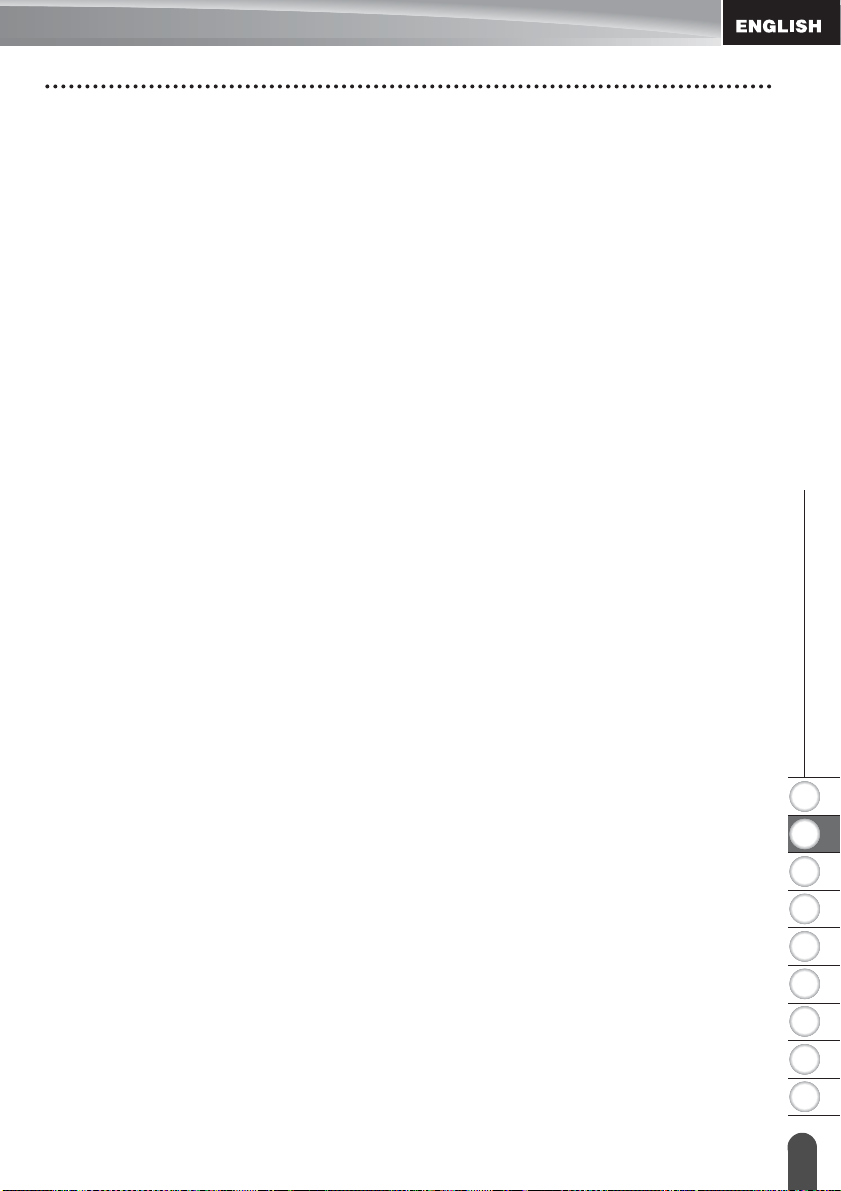
1. Power
Turns the P-touch labeling system on and
off.
2. Style
Enables character and label attributes for
the label to be set.
3. File
Enables frequently used labels in the file
memory to be printed, opened, saved, or
deleted.
4. Preview
• Displays a preview of the label.
• The label is fed when used in
combination with the Shift key.
5. Print
• Prints the current label design onto the
tape.
• The label can be copied when used in
combination with the Shift key.
6. Labeling Application Type
• Selects the labeling application type.
• The feature that is displayed above the
button is enabled when used in
combination with the Shift key.
7. Bar Code
Opens Bar Code Setup screen.
8. Serialize
• You can print serialized numbers on the
labels.
• You can serialize any 2 numbers when
used in combination with the Shift key.
9. Menu
Enables operating preferences
(Language, Adjustment, etc.) for the
P-touch labeling system to be set.
10. Escape
Cancels the current command and returns
the display to the data entry screen or the
previous step.
11. Clear
Clears all text entered, or all text and
current label settings.
12. Cursor ( )
Moves the cursor in the direction of the
arrow.
13. OK
Selects the displayed option.
The default language is "English".
1
2
3
4
5
6
7
8
9
18
GETTING STARTED
LCD Display & Keyboard
14. Letter
• Use these keys to type letters or
numbers.
• Uppercase letters and symbols can be
entered using these keys in combination
with the Caps or Shift key.
15. Backspace
Deletes the character to the left of the
cursor.
16. Shift
Use this key in combination with the letter
and number keys to type uppercase
letters or the symbols indicated on the
number keys.
17. Caps
Turns Caps mode on and off.
18. Accent
Use this to select and enter an accented
character.
19. Space
• Enters a blank space.
• Returns a setting to the default value.
20. Symbol
Use this to select and enter a symbol from
a list of available symbols.
21. Enter
• Enters a new line when entering text.
• Enters a new block when used in
combination with the Shift key.
19
Power Supply
GETTING STARTED
AC Adapter
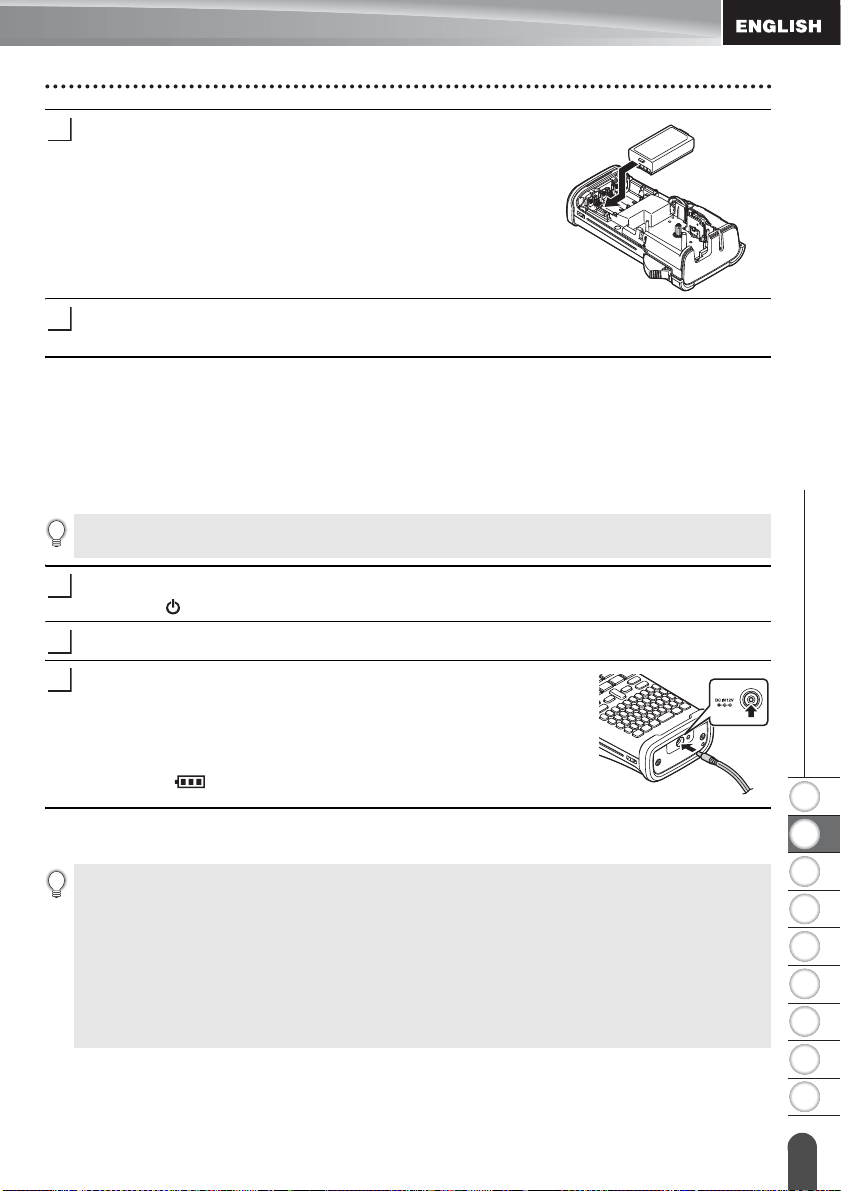
Use the AD-E001 (AC adapter) for this labeling system. The AD-18 or AD-24ES cannot be
used. Connect the AC adapter directly to the P-touch labeling system.
Insert the plug on the AC adapter cord into the connector marked DC IN 12V on the
P-touch labeling system.
Insert the AC adapter plug into a standard electrical outlet.
Using the Rechargeable Li-ion Battery
Installing the Rechargeable Li-ion Battery
Open the rear cover by pressing the cover latch.
Power Supply
1
2
• Turn the P-touch labeling system off before disconnecting the AC adapter.
• Do not pull or bend the AC adapter cord.
• When power is disconnected for more than two minutes, all text and format settings will be
cleared. Any text files stored in the memory will also be cleared.
To safeguard and backup the labeling system's memory, when the AC adapter is unplugged it is
recommended to have AA-size alkaline batteries (LR6) or Ni-MH rechargeable batteries (HR6)
installed in the labeling system.
Cover latch
Rear cover
1
1
2
3
4
5
6
7
8
9
20
GETTING STARTED
Power Supply
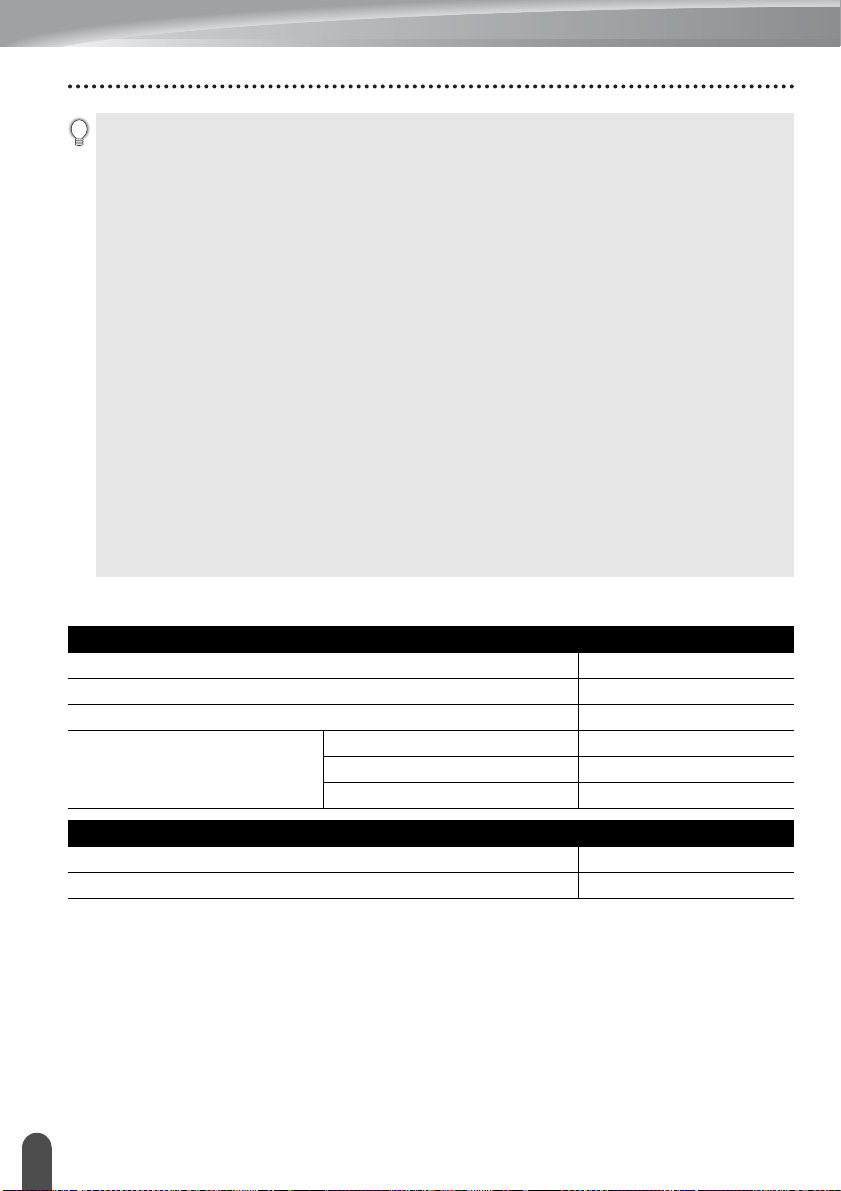
Insert the rechargeable Li-ion battery into the battery
compartment.
Confirm that the hooks on the edge of the rear cover are inserted correctly, and then
reattach the cover.
Removing the Rechargeable Li-ion Battery
Remove the battery cover and the rechargeable Li-ion battery, and then reattach the battery
cover.
Charging the Rechargeable Li-ion Battery
The rechargeable Li-ion battery can be charged while it is inserted in the labeling system.
Perform the following procedure to charge the rechargeable Li-ion battery.
Make sure that the labeling system is turned off. If the labeling system is turned on,
press the (Power) button to turn it off.
Make sure that the rechargeable Li-ion battery is installed in the labeling system.
Use the AC adapter and AC power cord to connect the labeling
system to an AC power outlet.
The LED next to the adapter connector turns on during
charging, it goes off when the rechargeable Li-ion battery is
fully charged. The battery level indicator on the display will fill
three bars .
Stopping Rechargeable Li-ion Battery Charging
To stop the rechargeable Li-ion battery from charging, disconnect the AC adapter cord.
2
3
• Before using the rechargeable Li-ion battery, use the following procedure to charge it.
• Up to 360 minutes is needed to fully charge a rechargeable Li-ion battery.
1
2
3
Tips on Using the Rechargeable Li-ion Battery
• Charge the rechargeable Li-ion battery before use. Do not use it before it is charged.
• The rechargeable Li-ion battery charging can take place in 41
°F-95°F (5°C-35°C)
environments. Charge the rechargeable Li-ion battery in an environment in this temperature
range. If the surrounding temperature is out of this range, the rechargeable Li-ion battery will
not be charged, and the battery indicator will remain lit.
• If the labeling system is used when both the rechargeable Li-ion battery is installed and the AC
adapter is connected, the battery indicator may turn off and charging may stop even if the
rechargeable Li-ion battery has not been fully charged.
21
Power Supply
GETTING STARTED
Rechargeable Li-ion Battery
Labeling System
• Charging current: 500 mA
• Charging voltage: up to 8.2 V (Maximum)
Rechargeable Li-ion Battery Characteristics
Understanding the properties of the rechargeable Li-ion battery will allow you to optimize its
usage.
• Using or storing the rechargeable Li-ion battery in a location exposed to high or low
temperatures may accelerate its deterioration. In particular, using a rechargeable Li-ion battery
with a high charge (90% or more) in a location exposed to high temperatures will considerably
accelerate battery deterioration.
• Using the labeling system while the rechargeable Li-ion battery is installed and charging may
accelerate the battery's deterioration. If using the labeling system when the rechargeable Li-ion
battery is installed, disconnect the AC adapter.
• If the labeling system will not be used for longer than one month, remove the rechargeable Li-
ion battery from the labeling system when its charge is 50% or less, and then store the battery
in a cool place away from direct sunlight.
• If the rechargeable Li-ion battery will not be used for a long period of time, we recommend
charging it every 6 months.
• If you touch a part of the labeling system while the Li-ion battery is charging, that part of the
labeling system may feel warm. This is normal, and the labeling system may be used safely. If
the labeling system becomes extremely hot, discontinue use.
Specifications
• Charging time: Approximately 6 hours when charged by a AC adapter (AD-E001).
• Nominal Voltage: DC 7.2 V
• Nominal Capacity: 1850 mAh
Surroundings temperature range
Charge 104
°F
Standard discharge current 1.9 A 140°F
Maximum discharge current 2.5 A 140
°F
Shipped battery
Less than 1 month -4
°F - 122°F
Less than 3 month -4°F - 104°F
Less than 1 year -4
°F - 68°F
Charging Parameters
Maximum charging voltage 8.2 Vdc
Maximum charging current 1330 mA
1
2
3
4
5
6
7
8
9
22
GETTING STARTED
Power Supply
Battery
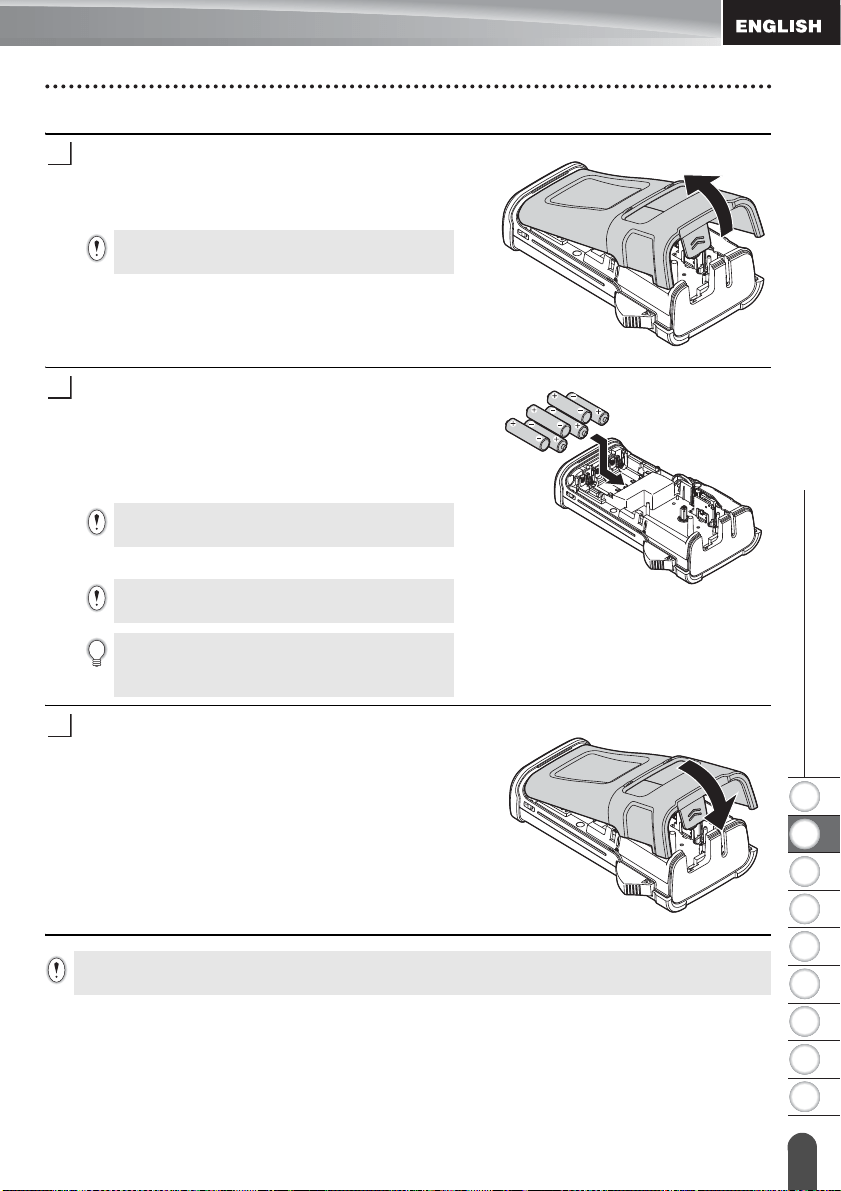
After making sure that the power is off, remove the
rear cover on the back of the labeling system. If the
batteries are already in the labeling system,
remove them.
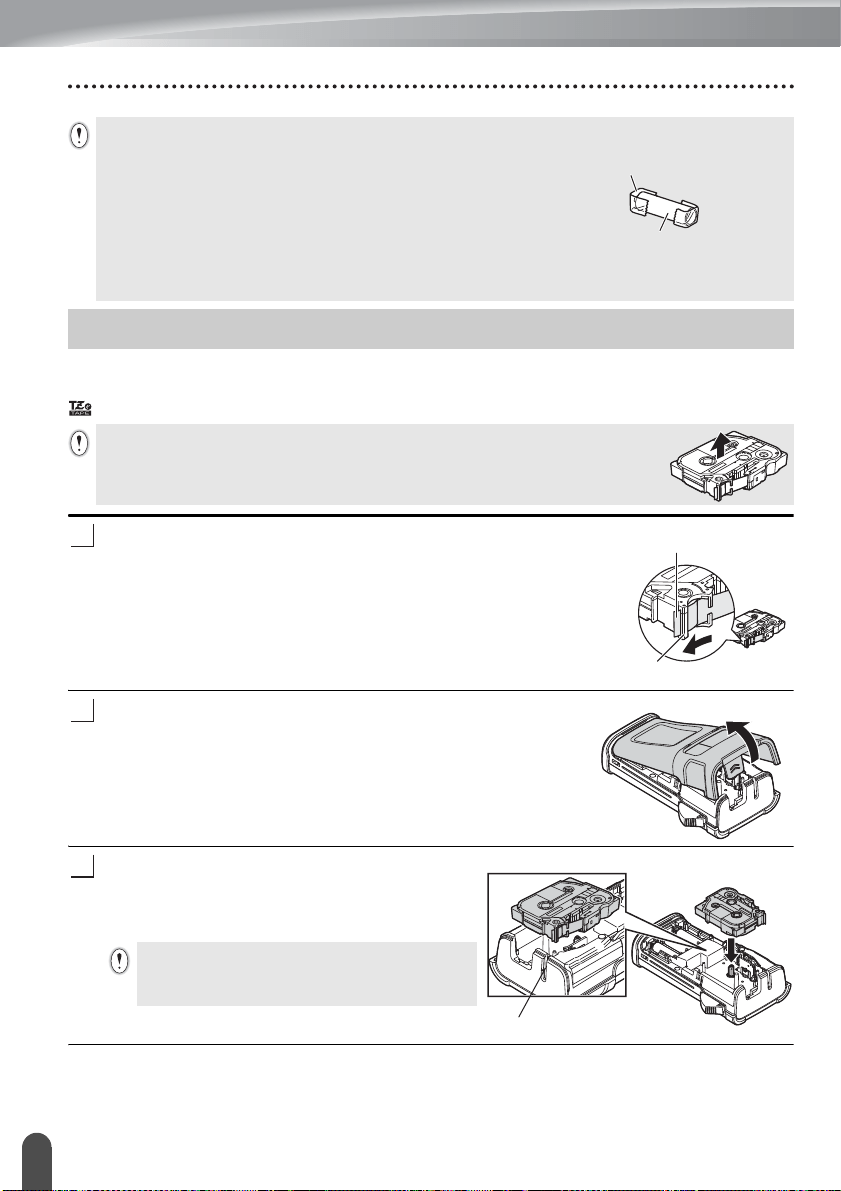
Insert six new AA-size alkaline batteries (LR6), or
fully charged Ni-MH rechargeable batteries (HR6),
making sure that the positive (+) and negative (-)
ends of the batteries match the positive (+) and
negative (-) marks inside the battery compartment.
Users of alkaline batteries
23
Users of Ni-MH rechargeable batteries
Attach the rear cover by inserting the three hooks
at the bottom into the slots on the labeling system,
then pushing down firmly until it snaps into place.
Make sure that the power is turned off when
replacing batteries.
1
Always replace all six batteries at the same
time using brand new ones.
Always replace all six batteries at the same
time with fully charged ones.
Visit us at http://solutions.brother.com/ for the
latest information about recommended
batteries.
2
3
Remove the batteries if you do not intend to use the P-touch labeling system for an extended
period of time.
23
Inserting a Tape Cassette
GETTING STARTED
Tape cassettes of 0.13", 0.23", 0.35", 0.47" or 0.70" (3.5 mm, 6 mm, 9 mm, 12 mm or 18 mm)
width can be used in your P-touch labeling system. Use only Brother tape cassettes with the
mark.
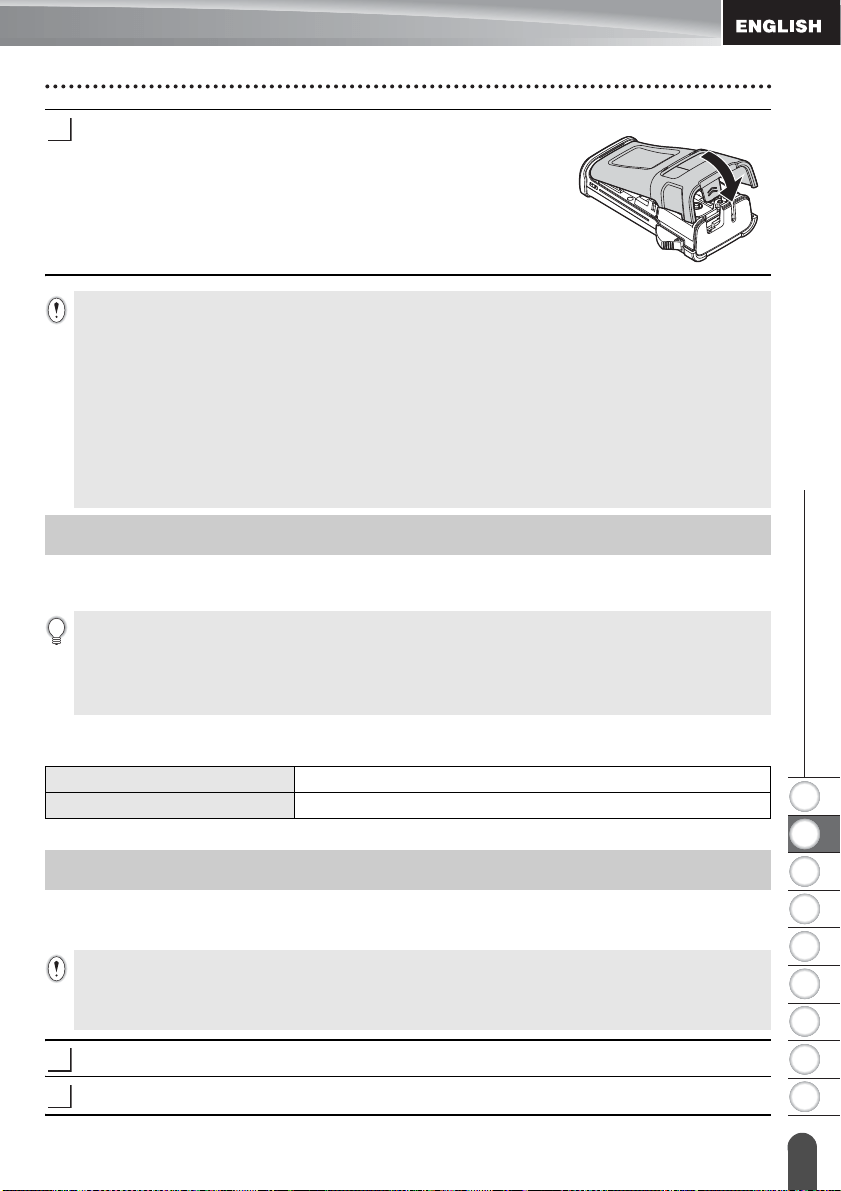
Check that the end of the tape is not bent and that it passes
through the tape guide. If the tape is not passed through, pass it
through the tape guide as shown in the illustration.
After making sure that the power is off, open the rear cover.
If there is already a tape cassette in the labeling system,
remove it by pulling it straight up.
Insert the tape cassette into the tape
compartment, with the end of the tape facing
the labeling system's tape exit slot, and press
firmly until you hear a click.
• Remove the batteries if you do not intend to use the
P-touch labeling system for an extended period of time.
• Dispose of the battery at an appropriate collection point,
not in the general waste stream. In addition, be sure to
observe all applicable federal, state, and local
regulations.
• When string or discarding the battery, wrap it
(for example with cellophane tape), to prevent it from
short-circuiting.
(Battery insulation example)
Cellophane tape
Alkaline or Ni-MH battery
Inserting a Tape Cassette
If the new tape cassette has a cardboard stopper, be sure to remove the stopper
before inserting the cassette.
End of tape
Tape guide
1
2
When inserting the tape cassette, make sure
that the tape and ink ribbon do not catch on the
print head.
Tape exit slot
3
1
2
3
4
5
6
7
8
9
24
GETTING STARTED
Turning Power On/Off
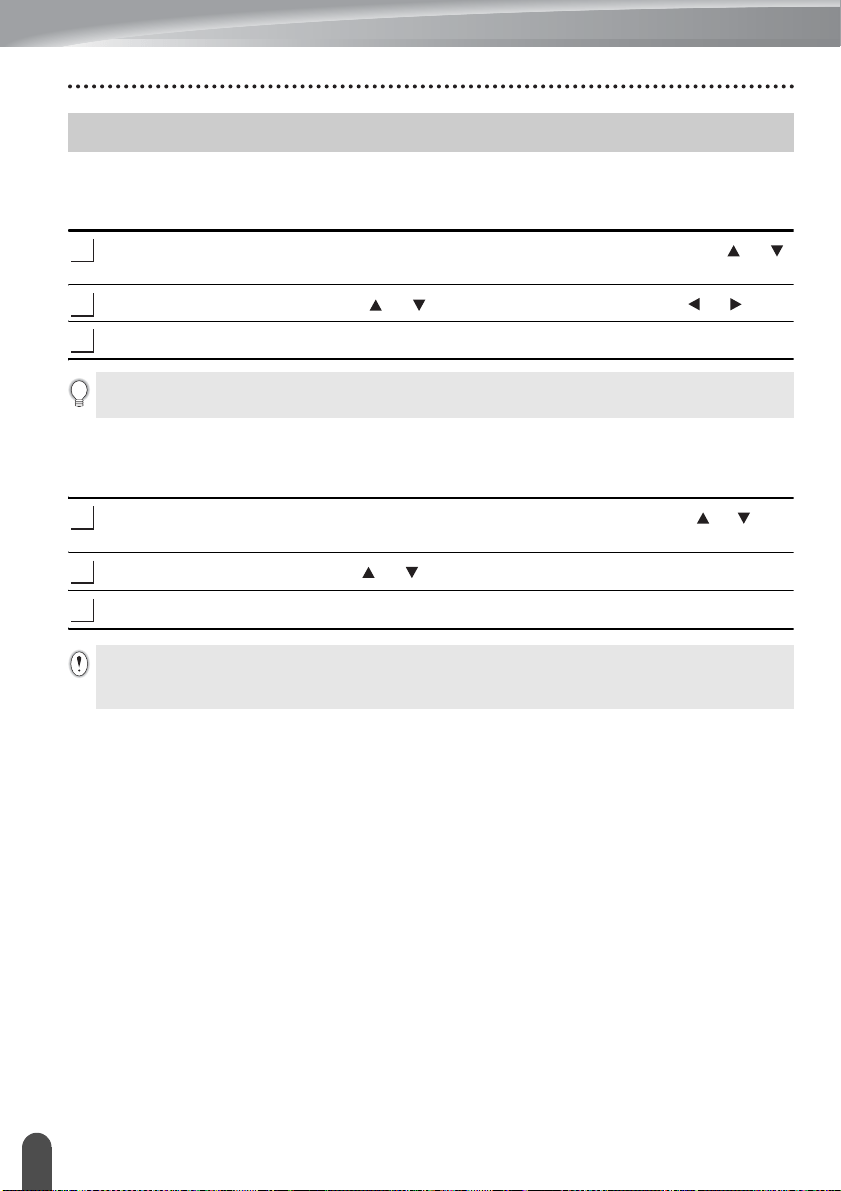
Close the rear cover.
Press the Power key to turn the P-touch labeling system on.
Press the Power key again to turn the P-touch labeling system off.
Auto Power-Off Time
Feed function
The Feed function feeds 0.91" (23 mm) of blank tape.
Press the Shift key and then press the Preview key.
The message "Feeding Tape... Please Wait" appears while the tape is fed.
4
• Do not pull the label coming out of the tape exit slot. Doing so will cause the ink ribbon to
be discharged with the tape.
• Store tape cassettes in a cool dark location, away from direct sunlight and high temperature, high
humidity, or dusty locations. Use the tape cassette as quickly as possible after opening the sealed
package.
Extra Strength Adhesive Tape:
• For textured, rough, or slipping surface, we recommend using Extra Strength Adhesive Tape.
• Although the instruction sheet included with the Extra Strength Adhesive Tape cassette
recommends cutting the tape with scissors, the tape cutter that this P-touch labeling
system is equipped with is able to cut Extra Strength Adhesive Tape.
Turning Power On/Off
• Your P-touch labeling system has a power saving function that automatically turns itself off if
no key is pressed within a certain time and operating conditions. Refer to the Auto Power-Off
Time table below for details.
• If the batteries are installed or the P-touch labeling system is connected to an electrical outlet by
the AC adapter, the previous session's information is displayed when the power is turned on.
With AC adapter 5 minutes
With battery 5 minutes
Feeding Tape
• Do not pull the label coming out of the tape exit slot. Doing so will cause the ink ribbon to
be discharged with the tape.
• Do not block the tape exit slot during printing or when feeding tape. Doing so will cause the tape
to jam.
1
2
25
LCD Display
GETTING STARTED
LCD Contrast
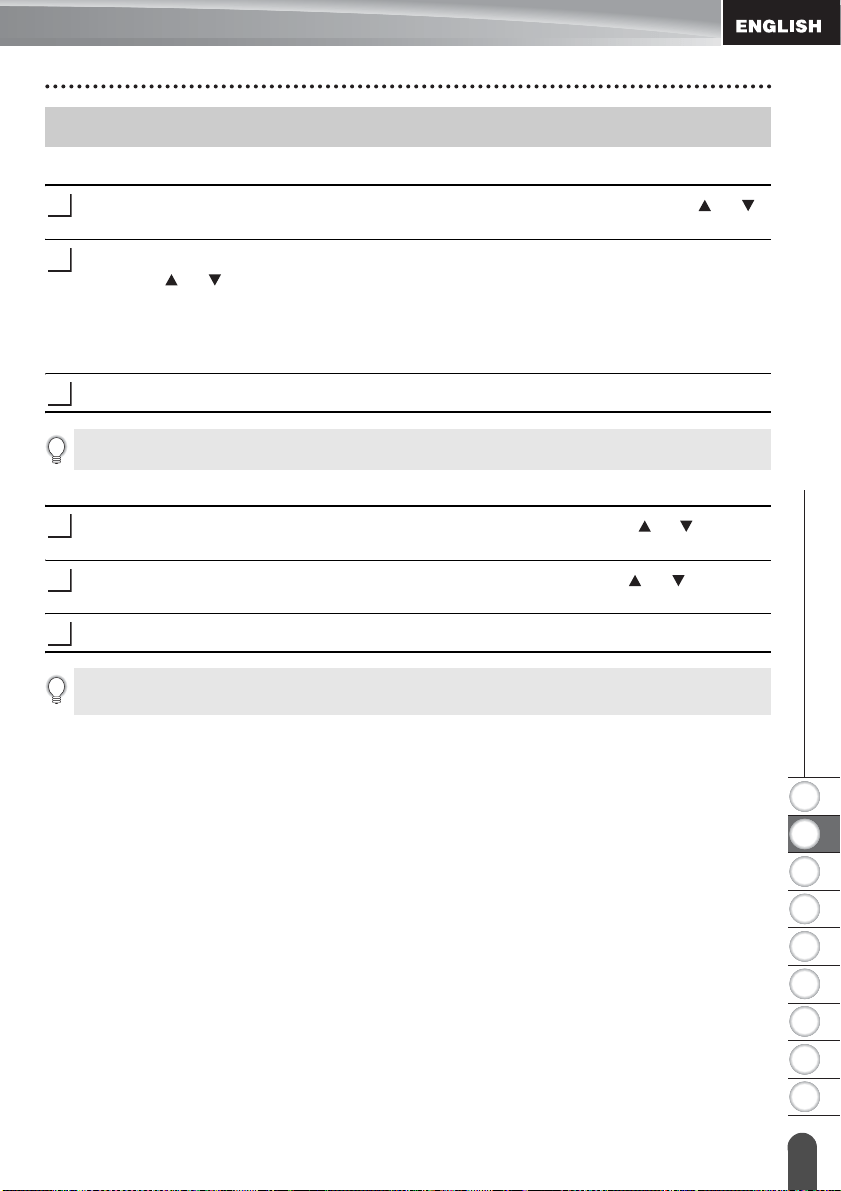
You can change the contrast setting of the LCD display to one of five levels (+2, +1, 0, -1,
-2) to make the screen easier to read. The default setting is “0”.
Press the Menu key to display the setup menu, select “Adjustment” using the or
key, and then press the OK or Enter key.
Select "LCD Contrast" using the or key and set the value using the or key.
Press the OK or Enter key.
Backlight
You can change the backlight setting either to ON or OFF.
The display is easier to see with the backlight ON. The default setting is "ON".
Press the Menu key to display the Setup menu, select "Backlight" using the or key,
and then press the OK or Enter key.
Select "ON" or "OFF" using the or key.
Press the OK or Enter key.
LCD Display
1
2
3
•Press the Escape key to return to the previous step.
• Pressing the Space key on the contrast setting screen sets the contrast to the default value “0”.
1
2
3
• Power can be saved when the backlight is turned off.
• The backlight will automatically turn off after 10 seconds of inactivity, press any key to re-
enable it. During printing, the backlight is disabled.
1
2
3
4
5
6
7
8
9
26
GETTING STARTED
Setting Language and Unit
Language
Press the Menu key to display the Setup menu, select "Language" using the or
key, and then press the OK or Enter key.
Select a language for menu commands and messages shown on the LCD display by
using the or key.
The language can be selected from "Čeština", "Dansk", "Deutsch", "English", "Español",
"Français", "Hrvatski", "Italiano", "Magyar", "Nederlands", "Norsk", "Polski",
"Português", "Português(Brasil)", "Română", "Slovenski", "Slovenský", "Suomi",
"Svenska" or "Türkçe".
Press the OK or Enter key.
Unit
Press the Menu key to display the Setup menu, select "Unit" using the or key, and
then press the OK or Enter key.
Select a unit for dimensions shown on the LCD display by using the or key.
Either "inch" or "mm" can be selected.
Press the OK or Enter key.
Setting Language and Unit
1
2
3
Press the Escape key to return to the previous step.
1
2
3
The default setting is "inch".
Press the Escape key to return to the previous step.
27
Selecting a Labeling Application Type
EDITING A LABEL
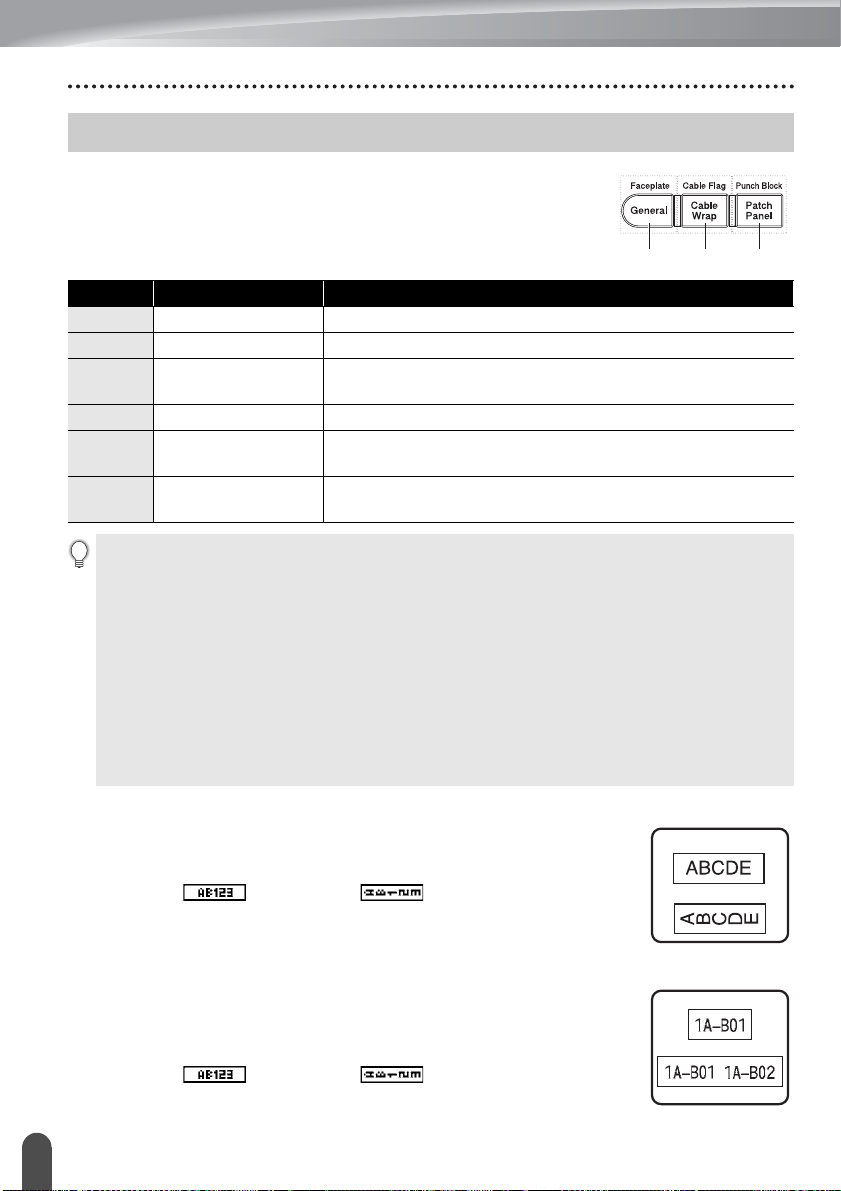
You can select six different types of labeling applications by pressing
a label application key. The label application type you selected is
shown in the LCD display.
GENERAL
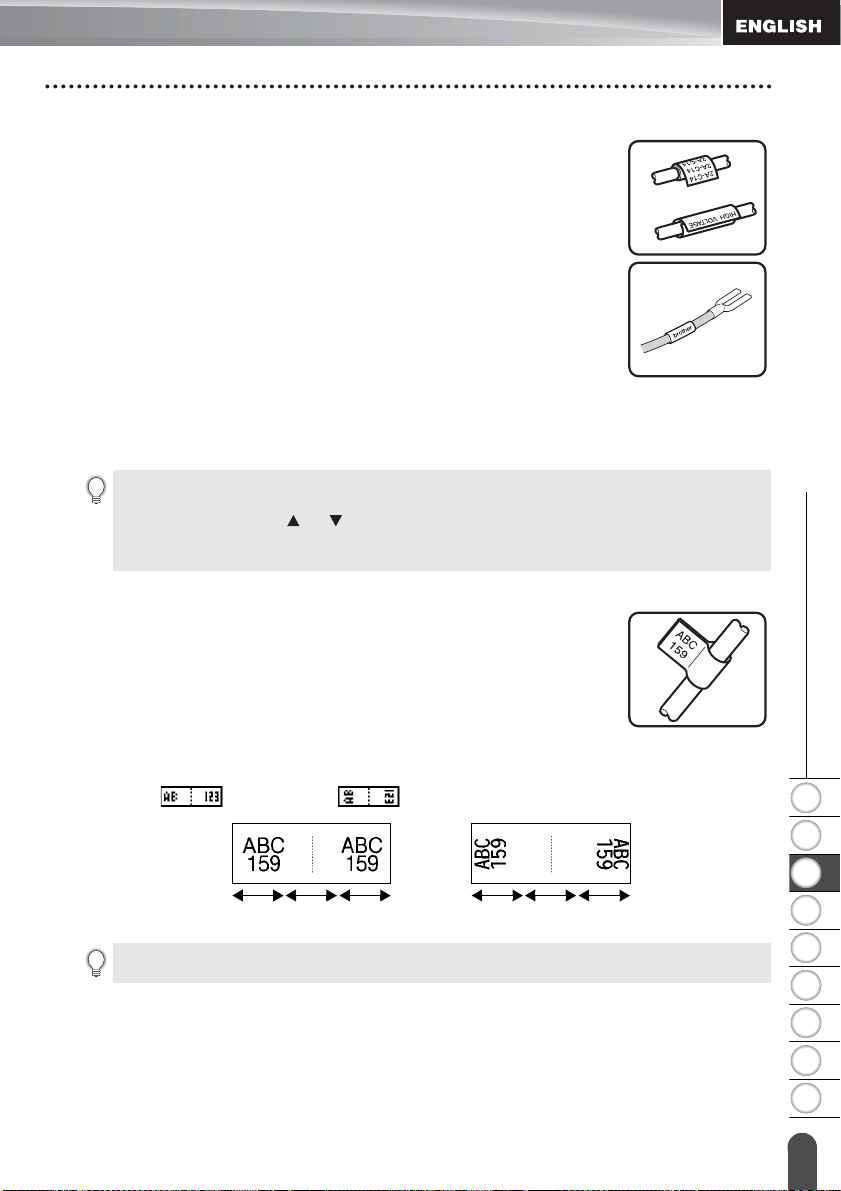
Labels printed with this mode can be used for general purposes. In this
mode you can specify Label Length and Orientation.
• Label Length: Auto, 1.0" (25 mm) - 12.0" (300 mm)
• Orientation: (Horizontal), (Vertical)
FACEPLATE
Labels printed with this mode can be used to identify various faceplates.
Block of text is evenly spaced on a single label. In this mode, you can
specify Label Length, Orientation and # of Blocks.
• Label Length: 2.0" (50 mm), 1.0" (25 mm) - 12.0" (300 mm)
• Orientation: (Horizontal), (Vertical)
• # of Blocks: 1, 1 - 5
Selecting a Labeling Application Type
123
Keys Type Usage
1 GENERAL Prints general purpose labels. (See page 27)
Shift+1 FACEPLATE Prints faceplate labels. (See page 27)
2 CABLE WRAP
Prints labels that wrap around a cable and Heat Shrink
Tube. (See page 28)
Shift+2 CABLE FLAG Prints cable flag labels. (See page 28)
3 PATCH PANEL
Prints labels for a row of ports on a patch panel.
(See page 29)
Shift+3
PUNCH-DOWN
BLOCK
Prints punch-down block 2-line labels.
(See page 29)
• When you change or reset a labeling application type, the text typed in is automatically used in
the new labeling application type except in the following cases:
- Changing from PUNCH-DOWN BLOCK is set to Horizontal or Backbone with sequenced
text
- Changing to PUNCH-DOWN BLOCK with sequenced text set to Horizontal or Backbone
• When a labeling application type is changed, the text typed in is automatically moved to the new
labeling application type by block units. Blank pages will be deleted but not the blocks.
• The new labeling application type is created for the text typed into to fit into each block.
• When the total number of blocks from the previous labeling application type cannot be divided
into the total number of blocks in the new labeling application type, the difference is filled with
empty blocks.
• When the total number of blocks from the previous labeling application type exceeds the total
number of blocks in the new labeling application type, the excess blocks are deleted.
Horizontal
Vertical
1
2
3
4
5
6
7
8
9
28
EDITING A LABEL
Selecting a Labeling Application Type
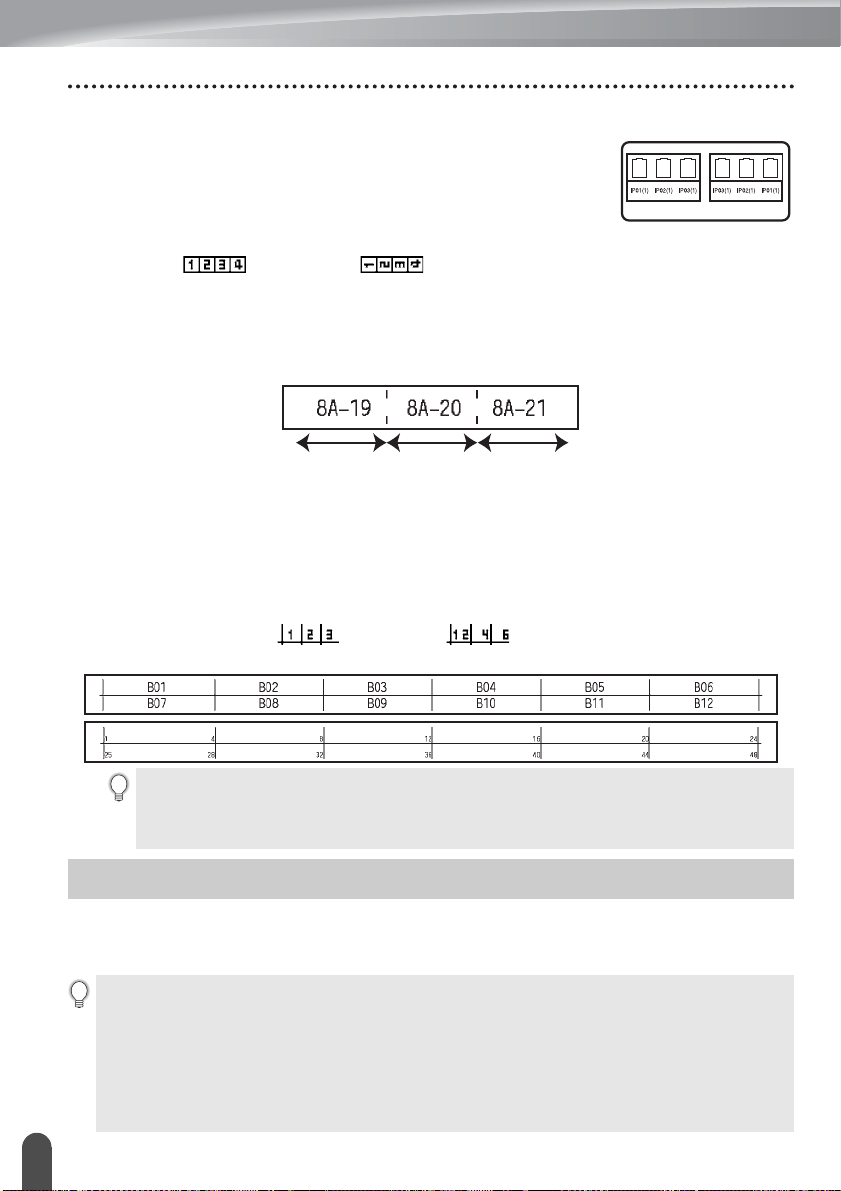
CABLE WRAP
Labels printed with this mode can be wrapped around a cable or wire.
This mode is also used to print on Heat Shrink Tube.
In Flexible ID, the text is rotated 90° counterclockwise and printed, you
can also specify the Size, Text and Repeat (ON/OFF).
Flexible ID
•UOM: Cust Dia (Custom Diameter), CAT5/6, CAT6A, COAX, AWG,
Cust Len (Custom Length)
• Value: Depending on UOM
• Repeat: On, Off
Text: Type in single or multiple lines of data
Heat Shrink Tube
• Label length: Auto, 1.0" (25 mm) - 12.0" (300 mm)
Text: Type in single or multiple lines of data
CABLE FLAG
Labels printed with this mode can be wrapped around a cable or wire,
and both ends of the label stick together to form a flag. The text on flag
labels is printed on both ends of the label, leaving a blank space in the
middle that wraps around the cable. In this mode, you can specify
Layout, Flag Length, Cable Diameter and Orientation.
• Layout: AA|AA (The same text is printed on each block.),
AA|BB (Two different texts are printed on each block.)
• Flag Length: 1.2" (30 mm), 0.6" (15 mm) - 8.0" (200 mm)
• Cable Diameter: 0.25" (6 mm), 0.12" (3 mm) - 3.50" (90 mm)
• Orientation: (Horizontal), (Vertical)
When using Heat Shrink Tube:
•Press Cable Wrap key. The screen to select the type of tape is displayed. Select Heat-
shrink Tube by using or key and then input text.
• Only the length of tape can be set when Heat Shrink Tube is selected. Margin setting is
fixed to No Cut.
Horizontal Vertical
Flag
length
Cable
diameter
Flag
length
Flag
length
Cable
diameter
Flag
length
You can enter up to two bar codes when (AA|AA) is selected in flag layout.
EDITING A LABEL
29
Creating a Bar Code Label
PATCH PANEL
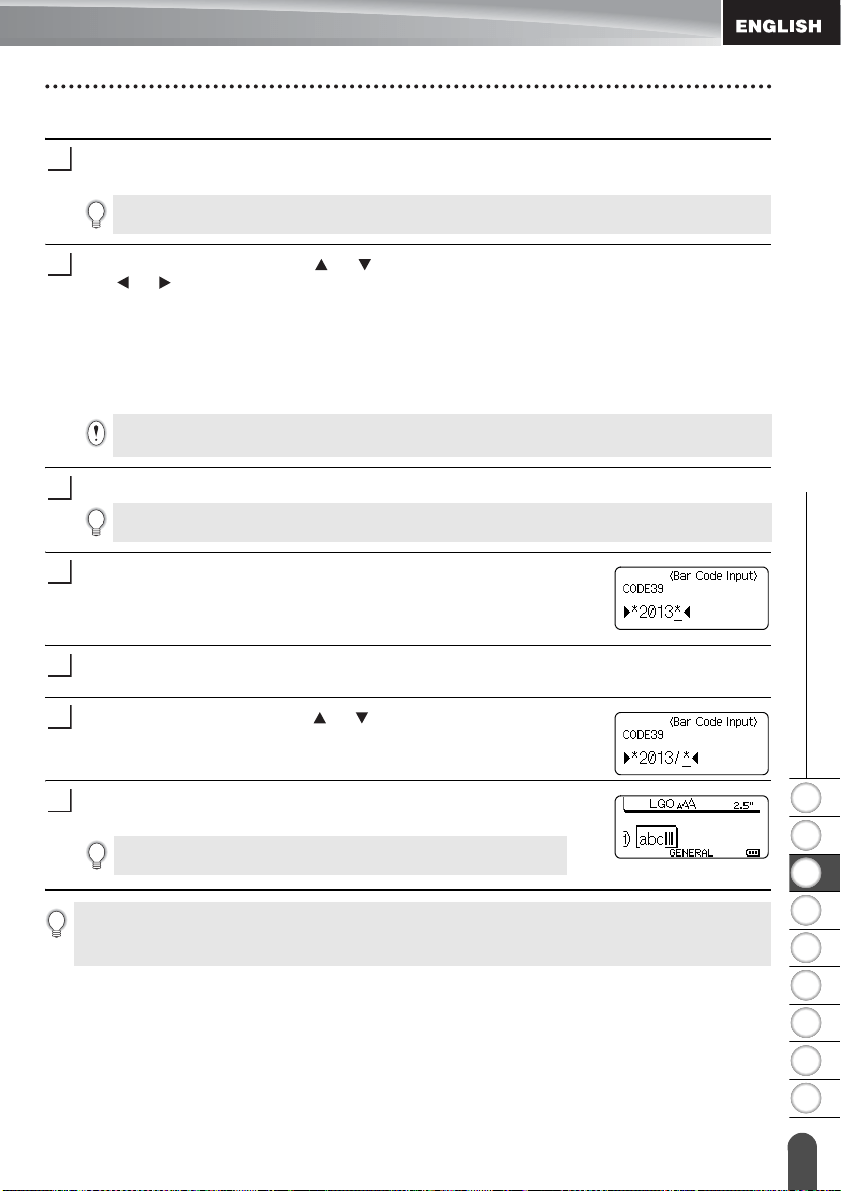
Labels printed with this mode can be used to identify various types of
panels. In this mode, you can specify Block Length, # of Blocks,
Separator, Orientation, Reverse (ON/OFF) and Multipliers (ON/OFF).
• Block Length: 0.60" (15 mm), 0.20" (5 mm) - 12.00" (300 mm)
• # of Blocks: 4, 1 - 50
• Separator: Tic, Dash, Line, Bold, Frame, None
• Orientation: (Horizontal), (Vertical)
•Reverse: Off, On
• Multipliers: Off, On
Adjust block spacing independently when "Multipliers" is set to "On".
- Block #: 1, 1 - 50
- Multiplier: 1.0, 1.0 - 9.5 (increment by 0.1)
PUNCH-DOWN BLOCK
Labels printed with this mode can be used to identify a type of electrical connection often used in
telephony. There are up to two lines for each block on a single label and you can enter two lines
for each block. In this mode, you can specify Module Width, Block Type, Sequence Type and Start
Value.
• Module Width: 8.0" (200 mm), 2.0" (50 mm) - 12.0" (300 mm)
• Block Type: 4 Pair, 2 Pair, 3 Pair, 5 Pair, Blank
• Sequence Type: None, (Horizontal), (Backbone)
• Start Value: ---, 1 - 99999
Using the Bar Code function you can create labels with one dimensional bar codes for use
with asset control tags, serial number labels, and even POS and stock control systems.
Selectable “Bar Codes” are listed in the Appendix. (See page 54)
Block lengthBlock length
Block length
• When Blank is selected in Block Type, Sequence Type is set to None.
• When None is selected in Sequence Type, Start Value shows "---" and you cannot set a
value.
• Horizontal or Backbone, however, allows you to set Start value from 1 to 99999.
Creating a Bar Code Label
• The P-touch labeling system is not designed exclusively for creating bar code labels. Always
check that bar code labels can be read by the bar code reader.
• For best results, print bar code labels in black ink on white tape. Some bar code readers may not
be able to read bar code labels created using colored tape or ink.
• Use the “Large” setting for “Width” whenever possible. Some bar code readers may not be able
to read bar code labels created using the “Small” setting.
• Continuously printing a large number of labels with bar codes can overheat the print head, which
may affect printing quality.
1
2
3
4
5
6
7
8
9
30
EDITING A LABEL
Creating a Bar Code Label
Setting Bar Code Parameters and Entering Bar Code Data
Press the Bar Code key.
The Bar Code Setup screen is displayed.
Select an attribute using the or key, and then set a value for that attribute using
the or key.
- Protocol: CODE39, CODE128, EAN-8, EAN-13, GS1-128 (UCC/EAN-128), UPC-A,
UPC-E, I-2/5 (ITF), CODABAR
- Width: Small, Large
- Under #: On, Off
- Check Digit: Off, On
Check digit only available for Code39, I-2/5 and Codabar protocols.
Press the OK or Enter key to apply the settings.
Type in the bar code data.
Special characters can be entered in the bar code when using
the CODE39, CODE128, CODABAR or GS1-128 protocols.
When not using special characters, go to step 7.
Press the Symbol key.
A list of characters available for the current protocol is displayed.
Select a character using
the or
key, then press
the
OK
or
Enter
key to insert the character in the bar code data.
Press the OK or Enter
key
to insert the bar code in the label.
The bar code is displayed on the text entry screen.
Editing and Deleting a Bar Code
• To edit bar code parameters and bar code data, position the cursor beneath the bar code
mark on the data entry screen and then open the Bar Code Setup screen. Refer to “Setting
Bar Code Parameters and Entering Bar Code Data” on page 30.
• To delete a bar code from a label, position the cursor to the right of the bar code mark on
the data entry screen and press the Backspace key.
1
Up to five bar codes can be entered on a label.
2
Characters may not appear below the bar code even when "On" is selected for "Under #", depending
on the tape width being used, the number of lines entered, or the current character style settings.
3
New settings are NOT applied if you do not press the OK or Enter key.
4
5
6
To print labels refer to “LABEL PRINTING” on page 41.
7
•Press the Escape key to return to the previous step.
•Press the Space key to set the selected attribute to the default value.
• Refer to the Bar Code Settings table for a list of all available settings.
EDITING A LABEL
31
Entering a Serialize Label
Numerically serialized labels can be printed. You can set the increment and count for the
series. In serialize mode, you can create a series of labels by incrementing one numeric
character in the pattern. In advanced serialize mode, you can choose simultaneous or
advanced. Simultaneous mode creates a series of labels by incrementing two different
numbers at the same time. Advanced mode creates a series of labels by allowing you to
select two sequences in the pattern and increment them consecutively.
Serialize
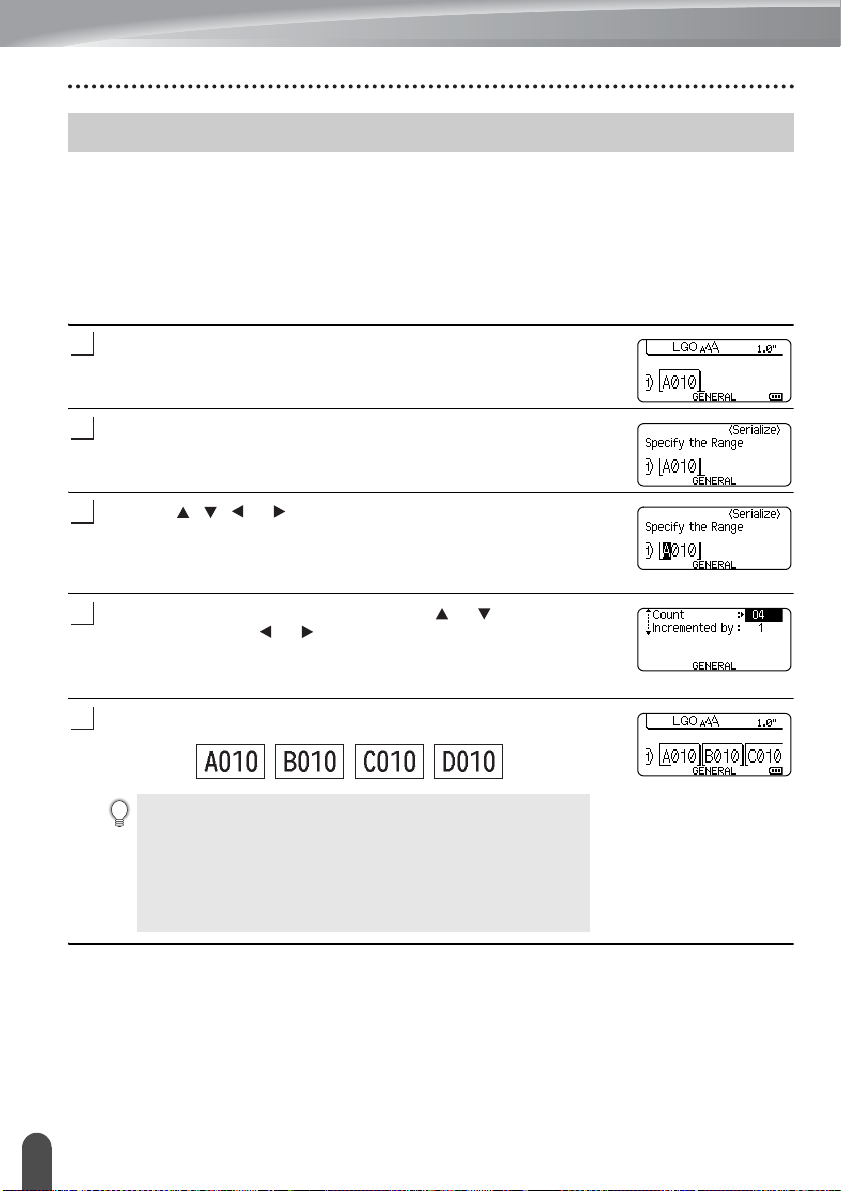
Enter text.
Example: Create a label "B010", "C010", "D010" from "A010"
by using this function.
Press the Serialize key and the screen to specify the range is
displayed.
Use the , , or keys to position the cursor under the first
character. Then position the cursor under the last character to be
incremented. Press OK or Enter key.
Example: Select A and press OK.
Select Increment and Count by using the or key and set the
value by using the or key.
Example: When you want to increase the number by one four
times, set Increment: 1, Count: 4.
Press the OK or Enter key to display the screen that you set.
Example:
Entering a Serialize Label
1
3
2
3
4
• When you press the Serialize key, you can do the setting
again. After redo the setting, the message "OK to overwrite
the Data after This Position?" is shown. If it's ok to overwrite,
press OK key.
• You can select All/Current/Range when printing as there are
multiple pages of labels.
• To print labels refer to “LABEL PRINTING” on page 41.
5
1
2
3
4
5
6
7
8
9
32
EDITING A LABEL
Entering a Serialize Label
advanced serialize
Simultaneous
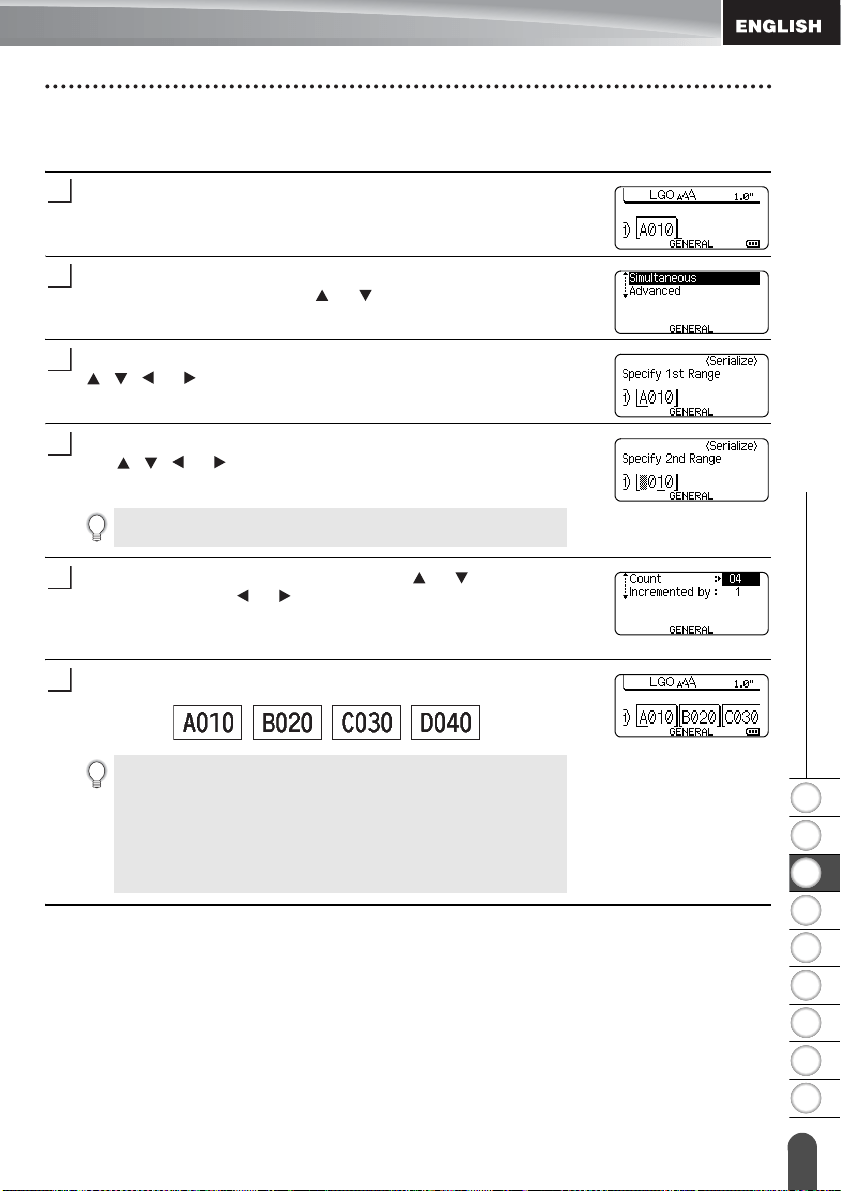
Enter text.
Example: Create a label "B020", "C030", "D040" from"A010" by
using this function.
Press the Shift key and then press the Serialize key. Select
"Simultaneous" by using the or key and press the OK key.
Select the first character(s) that you want to increase by using the
, , or key and press the OK or Enter key twice.
Example: Select A.
Select the second character(s) that you want to increase by using
the , , or key and press the OK or Enter key twice.
Example: Select 1.
Select Increment and Count by using the or key and set the
value by using the or key.
Example: When you want to increase the number by one four
times, set Increment: 1, Count: 4.
Press the OK or Enter key to display the screen that you set.
Example:
1
2
3
You cannot select the first character(s) as it is greyed out.
4
• When you press the Shift key and then press the Serialize
key, you can do the setting again. After redo the setting, the
message "OK to overwrite the Data after This Position?" is
shown. If it's ok to overwrite, press OK key.
• You can select All/Current/Range when printing as there are
multiple pages of labels.
• To print labels refer to “LABEL PRINTING” on page 41.
5
6
EDITING A LABEL
33
Entering a Serialize Label
Advanced
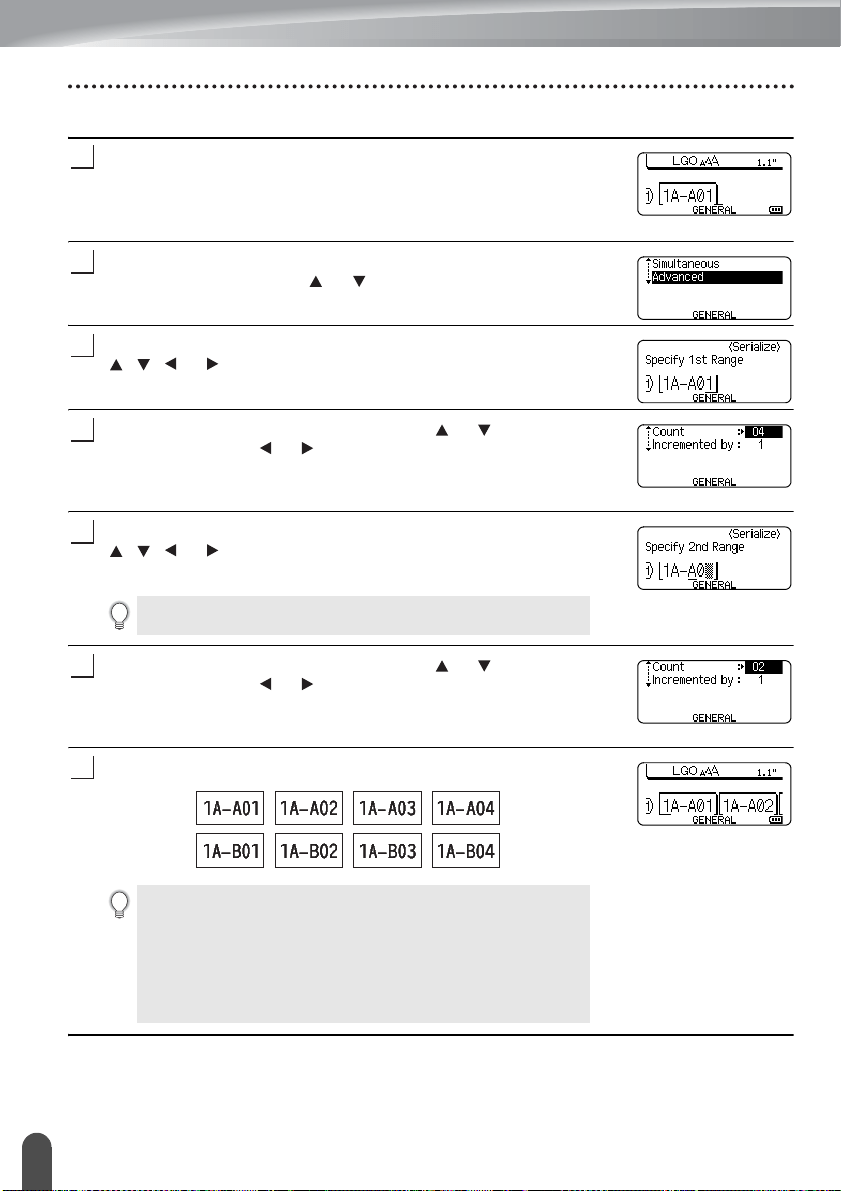
Enter text.
Example: Create a label "1A-A02", "1A-A03", "1A-A04", "1A-
B01", "1A-B02", "1A-B03", "1A-B04" from "1A-A01" by using
this function.
Press the Shift key and then press the Serialize key. Select
"Advanced" by using the or key and press the OK key.
Select the first character(s) that you want to increase by using the
, , or key and press the OK or Enter key twice.
Example: Select 1 of A01.
Select Increment and Count by using the or key and set the
value by using the or key. Press OK or Enter key.
Example: When you want to increase the number by one four
times, set Increment: 1, Count: 4.
Select the second number that you want to increase by using the
, , or key and press the OK or Enter key twice.
Example: Select A of A01.
Select Increment and Count by using the or key and set the
value by using the or key.
Example: When you want to increase the number by one twice,
set Increment: 1, Count: 2.
Press the OK or Enter key to display the screen that you set.
Example:
1
2
3
You cannot select the first character(s) as it is greyed out.
4
5
• When you press the Shift key and then press the Serialize
key, you can do the setting again. After redo the setting, the
message "OK to overwrite the Data after This Position?" is
shown. If it's ok to overwrite, press OK key.
• You can select All/Current/Range when printing as there are
multiple pages of labels.
• To print labels refer to “LABEL PRINTING” on page 41.
6
6
7
1
2
3
4
5
6
7
8
9
34
EDITING A LABEL
Entering and Editing Text
Entering Text from the Keyboard
• The keyboard of your P-touch labeling system can be used in the same way as a standard
computer keyboard.
Adding a New Line
• To end the current line of text and start a new line, press the Enter key. A return mark
appears at the end of the line and the cursor moves to the start of the new line.
Adding a New Block
• When GENERAL is selected, you can create a new block up to 5. To create a new block
of text/lines to the right of your current text, press the Shift key and then press the Enter
key. The cursor moves to the start of the new block. In other labeling application types, you
can set the number of blocks when pressing a label application key. Some labeling
application types are not required.
Moving the Cursor
• Press the , , or key to move the cursor one space or line.
• To move the cursor to the beginning or end of the current line, press the Shift key and then
press the or key.
• To move the cursor to the beginning of previous or next block, press the Shift key and then
press the or key.
Inserting Text
• To insert additional text into an existing line of text, move the cursor to the character to the
right of the position where you want to start inserting text and then enter the additional text.
The new text is inserted to the left of the cursor.
•Press the Escape key to return to the previous step.
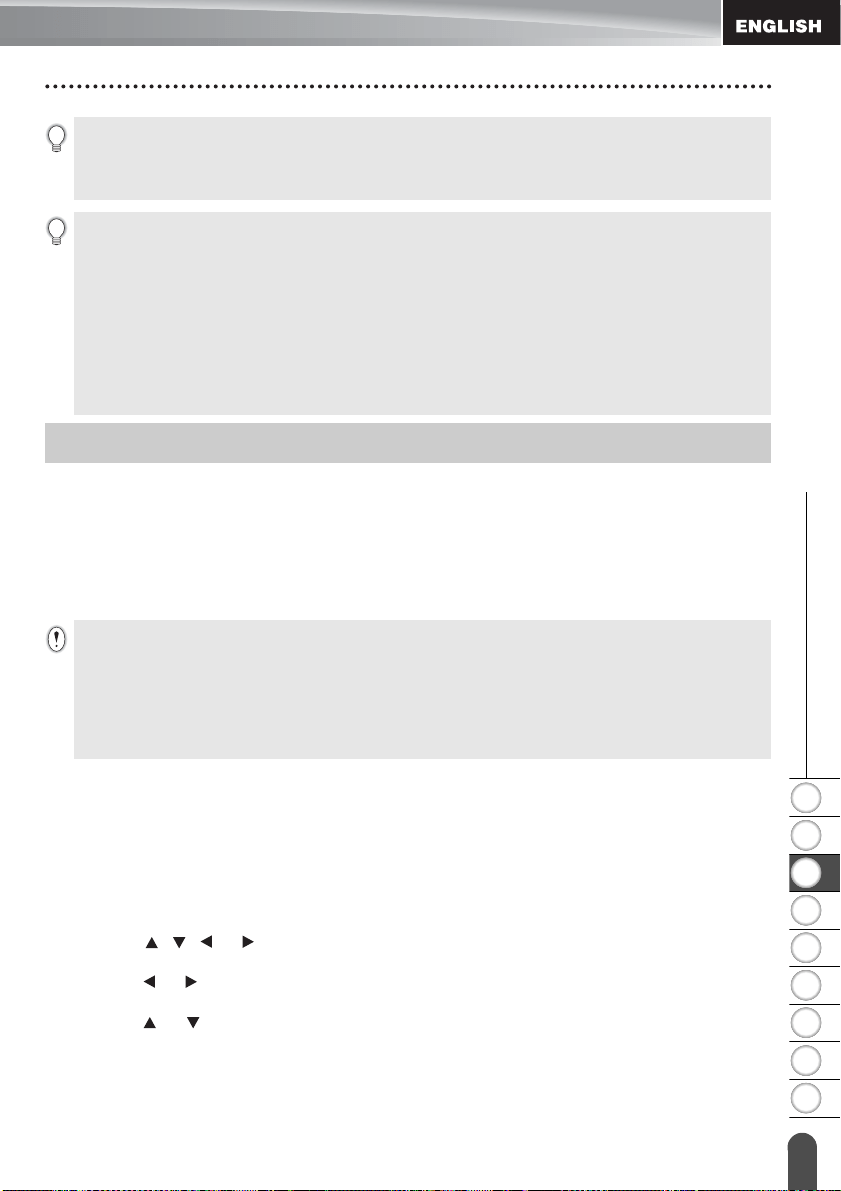
• Serialize mode can be also applied to bar codes. A bar code is counted as a character.
• Any symbols or other non-alphanumeric characters in the auto-numbering sequence are ignored.
• Serialize mode sequence can only contain a maximum of five characters.
• Letters and numbers increase as shown below:
0
1 ...9
0
...
A
B ...Z
A
...
a
b ...z
a
...
A0
A1 ...A9
B0
...
Spaces (shown as underscores “_” in the example below) can be used to adjust the spacing
between characters or to control the number of digits that are printed.
_9
10 ...99
00
...
_Z
AA ...ZZ
AA
...
1_9
2_0 ...9_9
0_0
...
Entering and Editing Text
• Maximum number of lines
- 0.70" (18 mm) tape: 5 lines
- 0.47" (12 mm) tape: 3 lines
- 0.35" (9 mm) and 0.23" (6 mm) tape: 2 lines
- 0.13" (3.5 mm) tape: 1 line
• If you press the Enter key when five lines already exist, an error message is displayed.
• When PUNCH-DOWN BLOCK is selected, you can enter up to 2 lines.
EDITING A LABEL
35
Entering Symbols
Deleting Text
Deleting one character at a time
• To delete a character from an existing line of text, move the cursor to the character to the
right of the position you want to start deleting text and then press the Backspace key. The
character to the left of the cursor is deleted each time the Backspace key is pressed.
Deleting all text at once
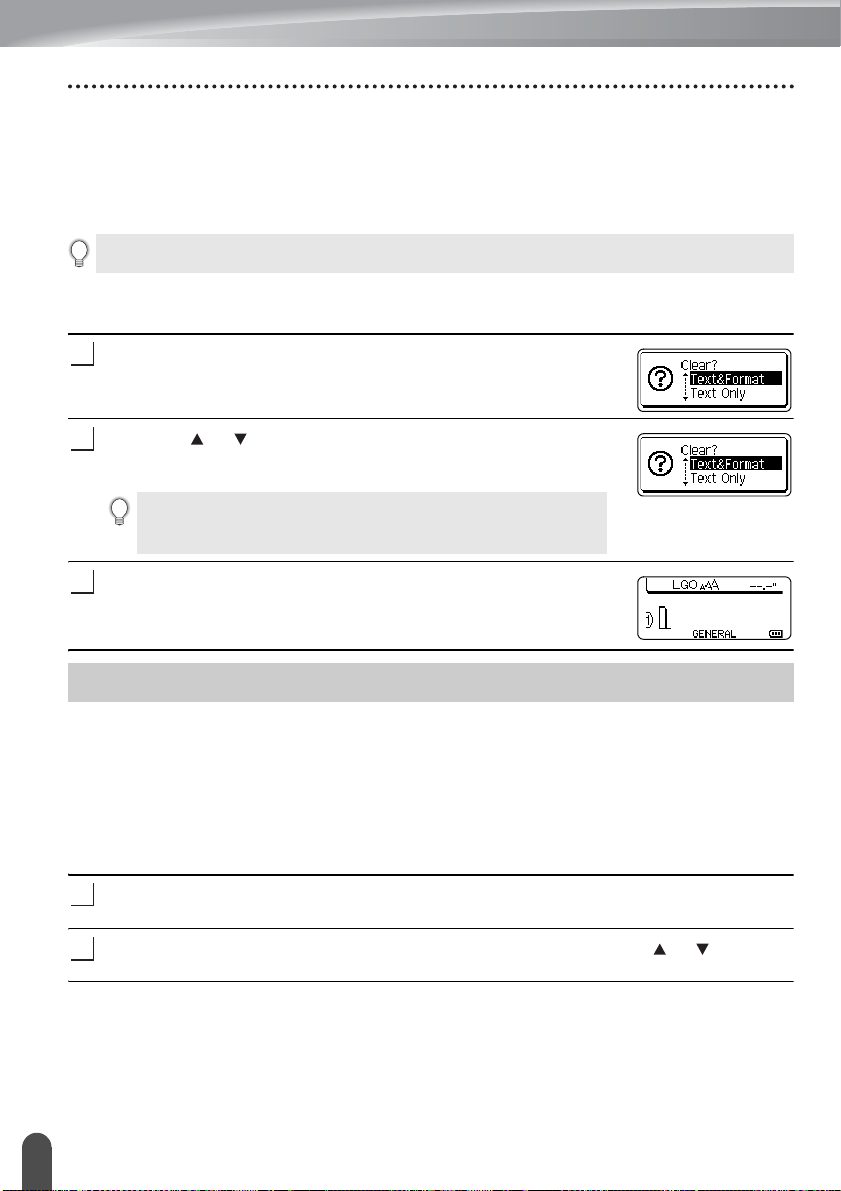
Use the Clear key to delete all text at once.
Press the Clear key.
The Clear options are displayed.
Using the or key, select “Text Only” to delete all text while
retaining the current format settings, or select "Text&Format" to
delete all text and format settings.
Press the OK or Enter key.
All text is deleted. All format settings are also deleted if
"Text&Format" was selected.
In addition to the symbols available on the keyboard, there are various symbols (including
international and extended ASCII characters) available with the symbol function.
To enter a symbol, use the Symbol function (see below).
Alternatively, press the Shift key and then press a key on the keyboard to enter the symbol
printed on the selected key's upper-right corner.
Selectable “Symbols” are listed in the Appendix. (See page 51)
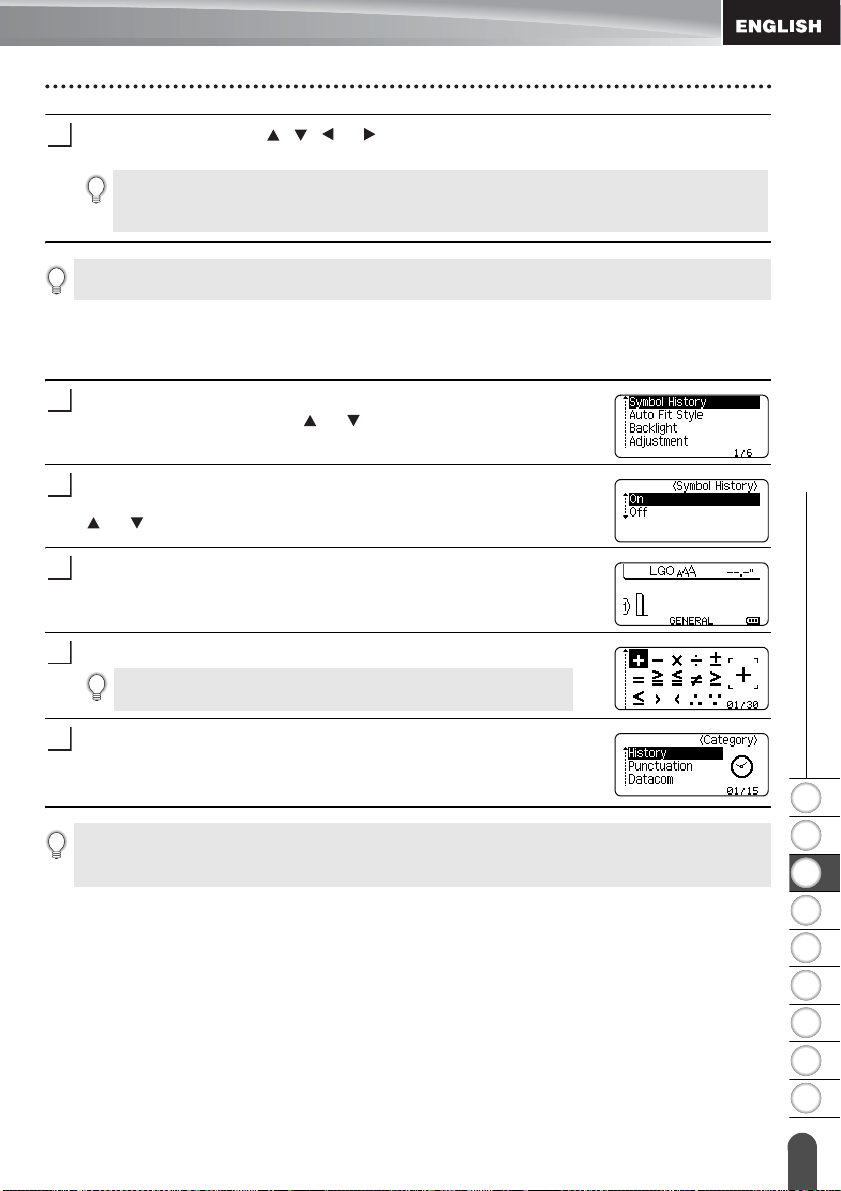
Entering Symbols Using the Symbol Function
Press the Symbol key.
A list of symbol categories and symbols in that category is displayed.
Select a symbol category (Punctuation, Mathematics, etc.) using the or key or by
pressing the Symbol key repeatedly, and then press the OK or Enter key.
If you hold down the Backspace key, the characters left of the cursor are deleted continuously.
1
• Press the Escape key to return to the text entry screen, without
erasing (or clearing) text or format.
• When "Text&Format" is selected, all the texts and fonts are cleared.
2
3
Entering Symbols
1
2
1
2
3
4
5
6
7
8
9
36
EDITING A LABEL
Entering Symbols
Select a symbol using , , or key and then press the OK or Enter key.
The selected symbol is inserted into the line of text.
Using Symbol History
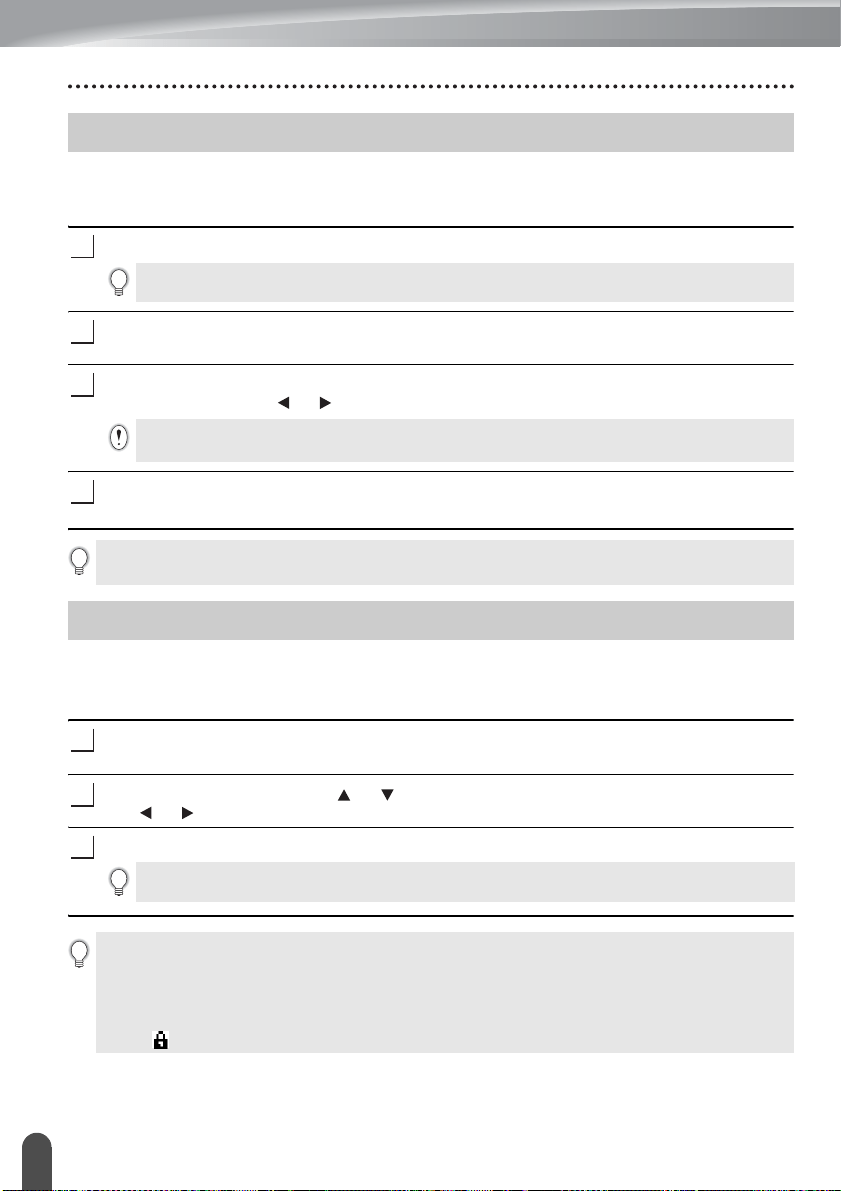
You can create your personal category of symbols by using the Symbol History. The "History"
will appear first when selecting the symbols to help you locate the desired symbols quickly.
Press the Menu key to display the Setup menu, and then select
"Symbol History" using the or key.
Press the OK or Enter key to display the Symbol History screen,
and then select "On" to create your personal category by using the
or key.
Press the OK or Enter key to apply the setting.
The screen returns to the text entry screen.
Enter the symbol you wish to add to your History.
Press the Symbol key.
The "History" appears, including the symbol entered in step 4.
3
When selecting symbols:
•Press the Shift key and Symbol key to return to the previous page.
•Press the Symbol key to go to the next page.
Press the Escape key to return to the previous step.
1
2
3
Refer to “Entering Symbols Using the Symbol Function” on
page 35 for detail.
4
5
• Up to 15 symbols can be added to the "History". The oldest symbol will be deleted from the
category when the symbols added to the "History" exceed 15 symbols.
• To stop using the Symbol History, select "Off" in the Symbol History screen.
EDITING A LABEL
37
Entering Accented Characters
The P-touch labeling system can display and print a set of accented characters such as other
language specific characters. Selectable “Accented Characters” are listed in the Appendix.
(See page 52)
Enter the character you wish to change to an accented character.
Press the Accent key.
The character you entered will change to an accented character.
Press the Accent key repeatedly until the desired accented character is selected, or
select it by using the or key.
Press the OK or Enter key.
The selected accented character is inserted into the line of text.
Setting Character Attributes by Label
Using the Style key, you can select a font and apply size, width, style, line, and alignment
attributes. Selectable “Character Attribute” options are listed in the Appendix. (See page 52)
Press the Style key.
The current settings are displayed.
Select an attribute using the or key, and then set a value for that attribute using
the or key.
Press the OK or Enter key to apply the settings.
Entering Accented Characters
1
Caps mode can be used with the Accent function.
2
3
The order of accented characters displayed will differ depending on the selected LCD
language.
4
•Press the Escape key to return to the previous step.
• Refer to the Accented Character List table for a complete list of all accented characters available.
Setting Character Attributes
1
2
3
New settings are NOT applied if you do not press the OK
or Enter key.
•Press the Escape key to return to the previous step.
•Press the Space key to set the selected attribute to the default value.
• Refer to the Setting Options table for a list of all available settings.
• Small characters may be difficult to read when certain styles are applied (e.g. Shadow + Italic).
• Depends on the labeling application type, you cannot change the value in Style setting. In that
case, is displayed on the preview in the right side of the screen.
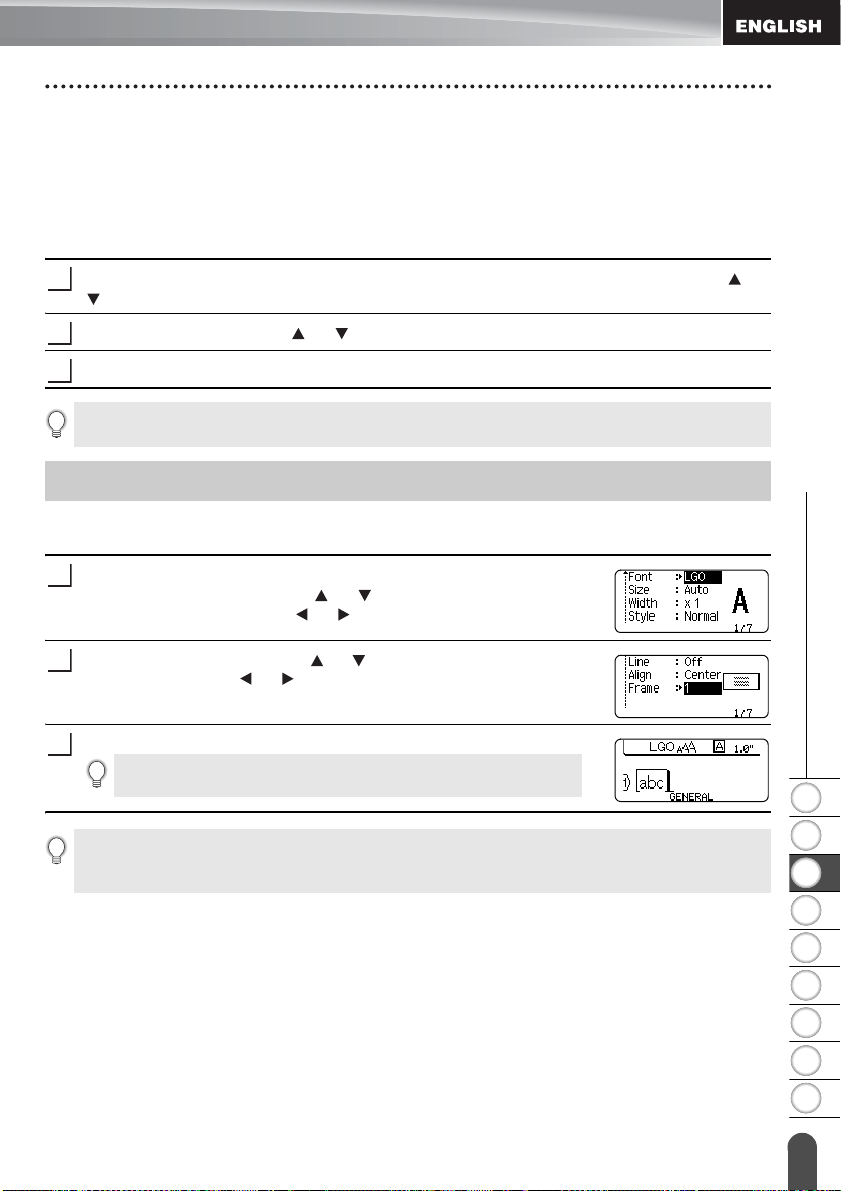
1
2
3
4
5
6
7
8
9
38
EDITING A LABEL
Setting Frames
Setting Auto Fit Style
When "Size" is set to "Auto" and "Length" is set to a specific length, you can select the way
of reducing the text size to fit within the label length.
When "Text Size" is selected, the total text size is modified to fit within the label.
When "Text Width" is selected, the text width will be reduced to the size of x1/2 setting. (If
further size reduction is required to fit the text into the selected label length, the total text
size will be modified after reducing the text width to x1/2 setting.)
Press the Menu key to display the Setup menu, Select "Auto Fit Style" using the or
key, and then press the OK or Enter key. The Auto Fit Style screen is displayed.
Select the style using the or key.
Press the OK or Enter key to apply the setting.
You can select the frame of the label by using the Style key. Selectable “Frames” are listed
in the Appendix. (See page 54)
Press the Style key. The current settings are displayed.
Select an attribute using the or key, and then set a value
for that attribute using the or key.
Select an attribute using the or key, and then you can select
frame by using the or key.
Press the OK or Enter key to apply the settings.
1
2
3
•Press the Escape key to return to the previous step.
•Press the Space key to set the style to the default setting ("Text Size").
Setting Frames
1
2
New settings are NOT applied if you do not press the OK or
Enter key.
3
•Press the Escape key to return to the previous step.
•Press the Space key to set the selected attribute to the default value.
• Refer to the Setting Options table for a list of all available settings.

EDITING A LABEL
39
Setting Cut Options
The tape cutting options allow you to specify how the tape is fed and cut when printing labels.
In particular, the “Chain” option greatly reduce the amount of wasted tape by using smaller
margins and eliminating blank sections cut between labels. Depends on labeling application
type, the setting value is fixed or limited.
Press the Style key. The current settings are displayed.
Select "Cut Option" using the or key, and then set the value
by using the or key.
Press the OK or Enter key to apply the settings.
Tape Cutting Options
Setting Cut Options
1
2
3
New settings are NOT applied if you do not press the OK or Enter key.
•Press the Escape key to return to the previous step.
• Refer to the Tape Cutting table for a list of all available settings.
Setting Description Example
Large
Margin
• Each label is printed, leaving a margin of 0.94"
(24 mm) on each end.
Small
Margin
• A margin of 0.91" (23 mm) is fed before printing
each label. The printed label has a margin of 0.16"
(4 mm) before and after the text.
Chain
• Use this setting when printing several labels with
minimum margins.
• A margin of 0.91" (23 mm) is printed first, and
then each label is printed, leaving a margin of
0.16" (4 mm) before and after the text.
No Cut
• Use this setting when printing Heat Shrink Tube.
• Pressing the Shift key and then the Preview key
feeds the last printed label and cut it.
ABC
0.94" (24 mm)
0.94" (24 mm)
ABC
0.16"
(4 mm)
0.16"
(4 mm)
0.91" (23 mm)
ABC
ABC
0.16"
(4 mm)
ABC
0.16"
(4 mm)
0.94" (24 mm)
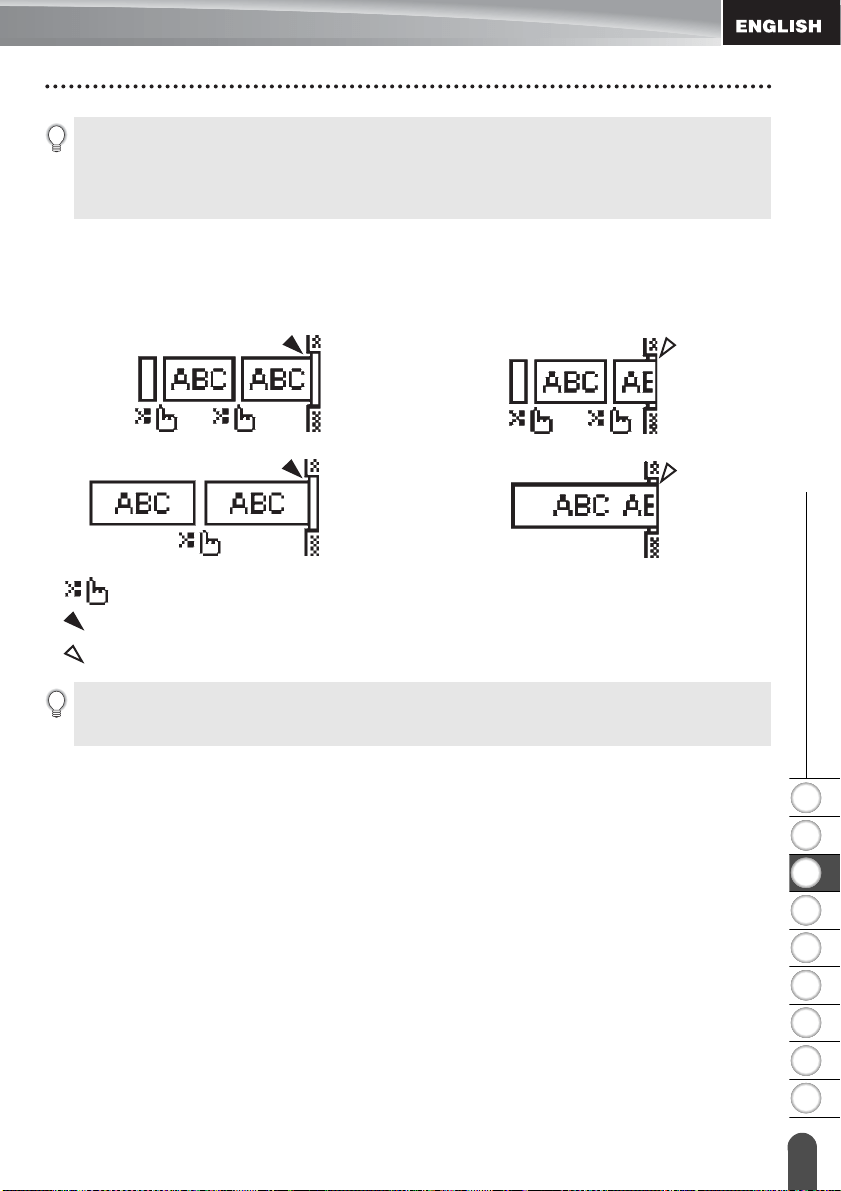
1
2
3
4
5
6
7
8
9
40
EDITING A LABEL
Setting Cut Options
Selecting how tape is fed and cut
When printing, the message "Cut Tape or Press Enter to Continue" is displayed and goes
into [cut pause mode]. Pressing the Tape cutter lever, you can cut the tape at the position
you set in "Cut Option". The details are as follows.
• :Stop here and goes into [cut pause mode].
• :Stop here and finish printing.
• :Stop here and goes into [tape feed mode].
• When using Heat Shrink Tube, set labeling application type to "Cable Wrap" and select "Heat-
shrink Tube". In this case, cut option if fixed to "No Cut". After printing, remove the Heat Shrink
Tube cassette from the labeling system and use scissors to cut the tape.
• After printing, remove the Fabric Iron On tape cassette from the labeling system and use scissors
to cut the tape.
Small Margin Chain
Large Margin No Cut
When the cut option is set to No Cut or Chain, it stops in the middle of printing area after the last
label is printed. After "OK to Feed?" is displayed, press OK key to feed tape. Press Escape key
to return to the entering text mode.
41
Label Preview
LABEL PRINTING
You can preview the current page and check the layout before printing.
Press the Preview key.
An image of the label is displayed on the screen.
The length of the label is shown in the lower-right corner of the screen.
Press the or key to scroll the preview to the left or right.
Press the or key to change the magnification of the preview.
Labels can be printed once text entry and formatting is complete.
Printing a single page
Press Print key to start printing.
Printing a range of pages
When there are multiple pages, you can specify the range of pages to print.
Press the Print key. The screen you can specify the range is displayed.
Select "All", "Current" or "Range" by using or key. If you select "All" or "Current",
go to step 4. If you select "Range", press the OK or Enter key.
Specify the first page and the last page.
Press the OK or Enter key to print.
Label Preview
1
•Press the Escape, OK or Enter key to return to the text entry screen.
• To scroll the preview to the left or right end, press the Shift key and then press the or key.
• To print the label directly from the preview screen, press the Print key or open the print options
screen and select a print option. Refer to "Printing a Label" below for details.
• The print preview is a generated image of the label, and may differ from the actual label when printed.
Printing a Label
• Do not pull the label coming out of the tape exit slot. Doing so will cause the ink ribbon to
be discharged with the tape, making the tape no longer usable.
• Do not block the tape exit slot during printing or when feeding tape. Doing so will cause the tape to jam.
• Be sure to check that there is enough tape remaining when printing several labels
continuously. If tape is running low, set fewer copies, print labels one at a time,
or replace the tape cassette.
• Striped tape indicates the end of the tape cassette. If this appears during printing,
press the Power key to turn the P-touch labeling system off. Attempting to print
with an empty tape cassette may damage the labeling system.
1
2
3
Blank pages are not printed.
4
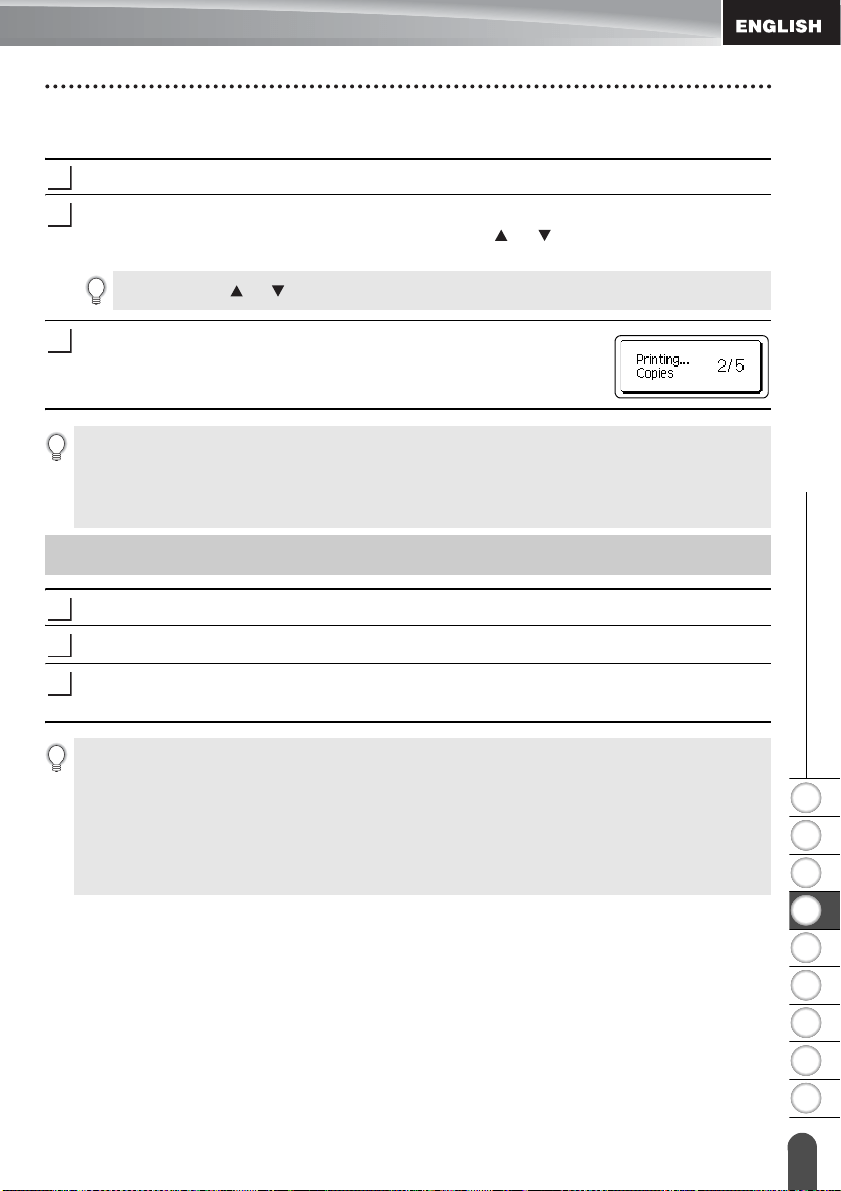
1
2
3
4
5
6
7
8
9
42
LABEL PRINTING
Attaching Labels
Printing Multiple Copies
Using this function you can print up to 50 copies of the same label.
Make sure that the appropriate tape cassette is inserted and ready for printing.
Press the Shift key and then press the Print key to display the Copies screen, and then
select the number of copies to be printed using the or key, or type the number
using the number keys.
Press the OK or Enter key. "Printing...Copies" is displayed while
the labels are being printed.
If necessary, trim the printed label to the desired shape and length using scissors, etc.
Peel the backing from the label.
Position the label and then press firmly from top to bottom with your finger to attach the
label.
1
2
Hold down the or key to change the number of copies faster.
3
•Press the Escape key to return to the previous step.
• The figures shown on the screen during printing indicate the “count / number of copies set”.
• Pressing the Space key when setting the number of copies resets the value to 1, the default.
• When the message "Cut Tape or Press Enter to Continue" is displayed, select one. For details,
see “Selecting how tape is fed and cut” on page 40.
Attaching Labels
1
2
3
• The backing of some types of tapes may be pre-cut to make it easier to peel the backing. To
remove the backing, simply fold the label lengthwise with the text facing inward, to expose the
inside edges of the backing. Next, peel off the backing one piece at a time.
• Labels may be difficult to attach to surfaces that are wet, dirty, or uneven. The labels may peel
off easily from these surfaces.
• Be sure to read the instructions provided with Fabric Iron-On Tapes, Extra Strength Adhesive
Tapes or other special tapes and observe all precautions noted in the instructions.
• Please use scissors to cut Heat Shrink Tube.
43
Storing a Label into Memory
USING THE FILE MEMORY
You can store up to 50 of your most frequently used labels in the file memory. Each label is
stored as a file, allowing you to quickly and easily recall your label when needed again.
After entering the text and formatting the label, press the File key to display the File
screen.
Select "Save" using the or key.
Press the OK or Enter key. A file number is displayed.
A label text is also displayed if a label is already stored in that file number.
Select a file number using the or key, and then press the OK or Enter key to save
the label under the selected file number.
The file is saved and the screen returns to the text entry screen.
Press the File key to display the File screen.
Select "Open" using the or key.
Press the OK or Enter key. The file number of a stored label is displayed.
The label text is also displayed to identify the label.
Select a file number using the or key, and then press the OK or Enter key to open
the selected file. The file is opened and displayed on the text entry screen.
When the file memory is full, each time you save a file you will need to overwrite one of your
stored files.
Storing a Label into Memory
1
2
3
4
If you try to store a label when there is already a label stored to that number, a message
"Overwrite?" will appear. Press the OK key to save your new label. Press the Escape key
to cancel.
•Press the Escape key to return to the previous step.
• Up to 200 characters can be saved in one file. However, the number of characters can be less
depending upon the design such as using bar codes.
Opening a Stored Label File
1
2
3
4
Press the Escape key to return to the previous step.
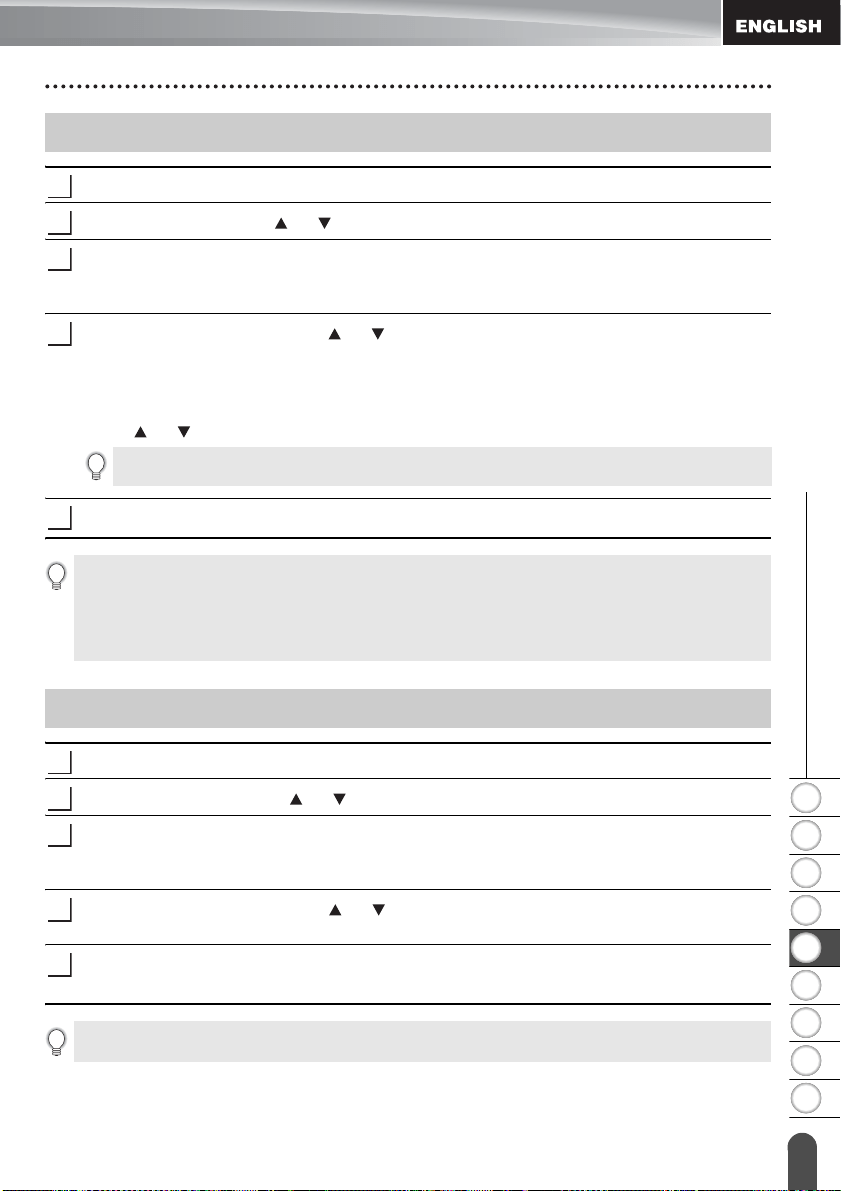
1
2
3
4
5
6
7
8
9
44
USING THE FILE MEMORY
Printing a Stored Label File
Press the File key to display the File screen.
Select "Print" using the or key.
Press the OK or Enter key.
The file number of a stored label is displayed.
The label text is also displayed to identify the label.
Select a file number using the or key, and then press the Print, OK or Enter key.
• Printing a single page:
A single page is printed immediately.
• Printing a range of pages:
The screen you can specify the range is displayed. Select "All" or "Range" by using
the or key.
Press OK or Enter key to print.
Press the File key to display the File screen.
Select "Delete" using the or key.
Press the OK or Enter key.
The file number of a stored label is displayed.
The label text is also displayed to identify the label.
Select a file number using the or key, and then press the OK or Enter key.
The message “Delete?” is displayed.
Press the OK or Enter key to delete the file.
The file is deleted and the screen returns to the text entry screen.
Printing a Stored Label File
1
2
3
4
If you select "Range", specify the first page and the last page.
5
• Step 5 is not needed when printing a single page.
•Press the Escape key to return to the previous step.
• The message "No Text!" is displayed when you try to print a file with no text.
• When the message "Cut Tape or Press Enter to Continue" is displayed, select one. For details,
see “Selecting how tape is fed and cut” on page 40.
Deleting a Stored Label File
1
2
3
4
5
Press the Escape key to cancel deleting the file and return to the previous screen.

45
Resetting the P-touch Labeling System
RESETTING & MAINTAINING YOUR P-TOUCH LABELING SYSTEM
You can reset the internal memory of your P-touch labeling system when you want to clear
all saved label files, or in the event the P-touch labeling system is not operating correctly.
Resetting the data to factory settings
Turn off the labeling system. Press and hold down the Shift and R keys. While holding down
the Shift and R keys, press the Power key once and then release the Shift and R keys.
Resetting the P-touch Labeling System
• Release the Power key before releasing the other key.
• All text, format settings, option settings and stored label files are cleared when you reset the
P-touch labeling system. Language and unit settings will also be cleared.
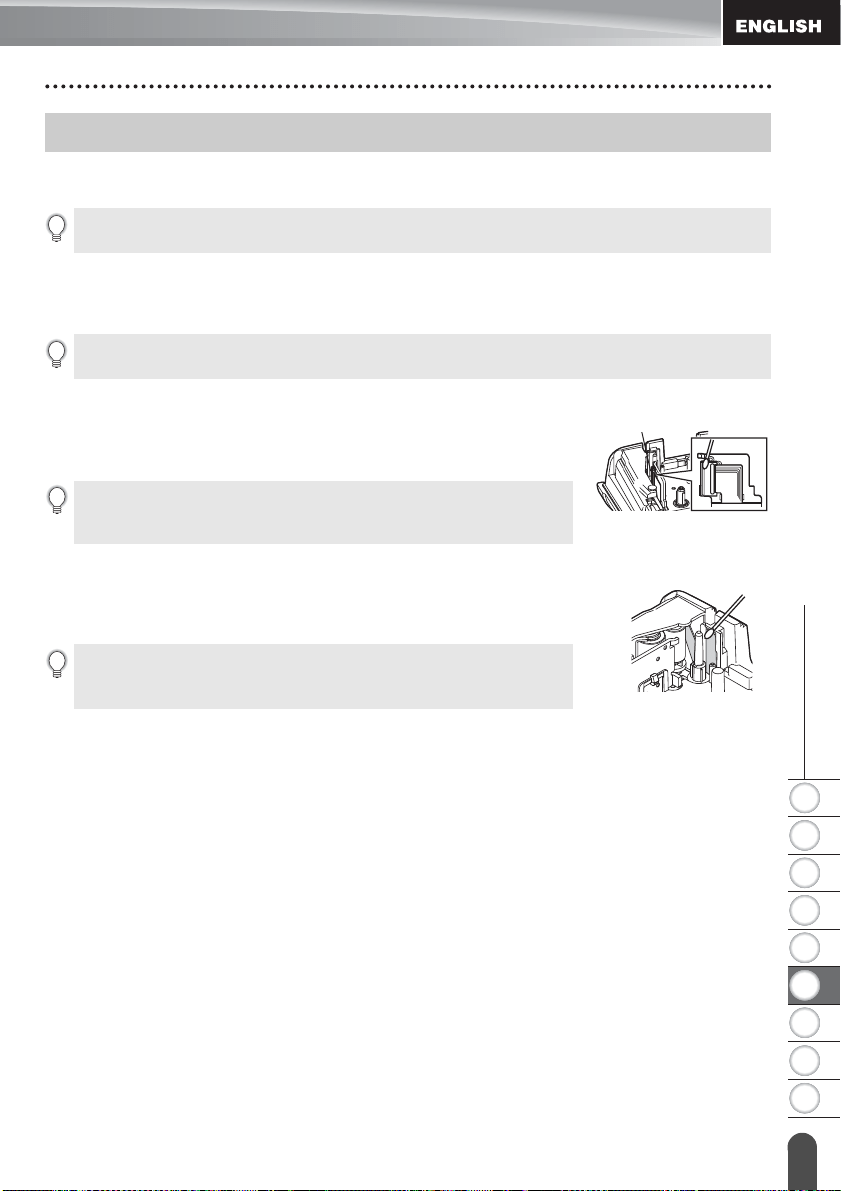
1
2
3
4
5
6
7
8
9
46
RESETTING & MAINTAINING YOUR P-TOUCH LABELING SYSTEM
Maintenance
Your P-touch labeling system should be cleaned on a regular basis to maintain its
performance and life span.
Cleaning the Unit
Wipe any dust and marks from the main unit using a soft, dry cloth.
Use a slightly dampened cloth on difficult to remove marks.
Cleaning the Print Head
Streaks or poor quality characters on printed labels generally
indicates that the print head is dirty. Clean the print head using a
cotton swab or the optional print head cleaning cassette (TZe-CL4).
Cleaning the Tape Cutter
Tape adhesive can build up on the cutter blade after repeated use,
damaging the blade which may result in the tape jamming in the
cutter.
Maintenance
Always remove the batteries and disconnect the AC adapter before cleaning the P-touch labeling
system.
Do not use paint thinner, benzene, alcohol or any other organic solvent. These may deform the
case or damage the appearance of your P-touch labeling system.
• Do not touch the print head directly with your bare hands.
• Refer to the instructions provided with the print head cleaning
cassette for directions on how to use it.
• About once every year, wipe the cutter blade using a cotton swab
moistened with isopropyl alcohol (rubbing alcohol).
• Do not touch the cutter blade directly with your bare hands.
Print head
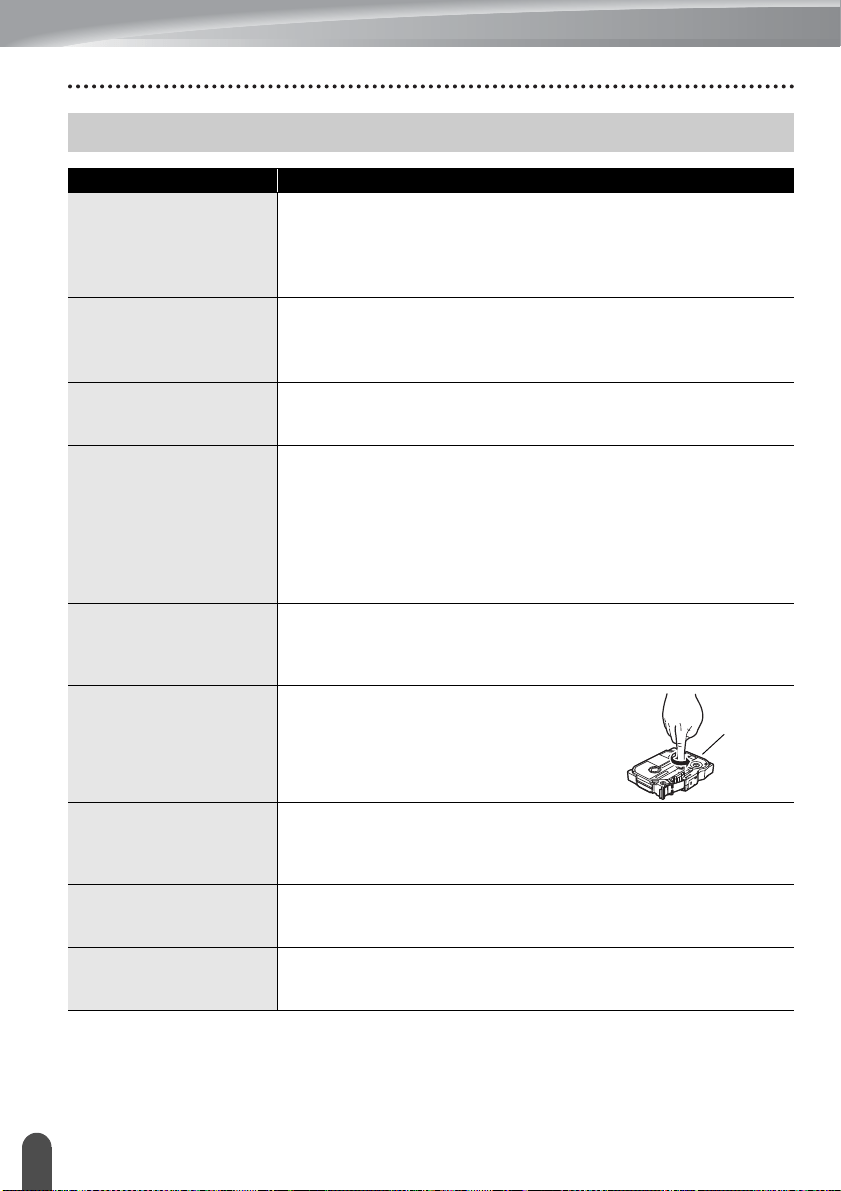
47
What to do when...
TROUBLESHOOTING
What to do when...
Problem Solution
The screen ‘locks’, or
the P-touch labeling
system does not
respond normally.
Refer to “Resetting the P-touch Labeling System” on page 45
and reset the internal memory to the initial settings. If resetting
the P-touch labeling system does not solve the problem,
disconnect the AC adapter and remove the batteries for more
than 10 minutes.
The display remains
blank after turning on
the power.
Check that the batteries are correctly installed and that the AC
adapter designed exclusively for your P-touch labeling system
(provided) is correctly connected. Check that the rechargeable
Li-ion battery is fully charged.
The LCD messages are
displayed in a foreign
language.
Refer to “Setting Language and Unit” on page 26 to select your
desired language.
The label is not printed
after pressing the Print
key.
• Check that text has been entered and that the tape cassette is
installed correctly with sufficient tape remaining.
• If the tape is bent, cut off the bent section and thread the tape
through the tape exit slot.
• If the tape is jammed, remove the tape cassette and then pull
out the jammed tape and cut it. Check that the end of the tape
passes through the tape guide before reinstalling the tape
cassette.
The label is not printed
correctly.
• Remove the tape cassette and reinstall it, pressing it firmly until
it clicks into place.
• If the print head is dirty, clean it with a cotton swab or optional
print head cleaning cassette (TZe-CL4).
The ink ribbon is
separated from the ink
roller.
If the ink ribbon is broken, replace the
tape cassette. If not, leave the tape
uncut and remove the tape cassette,
then wind the loose ink ribbon onto the
spool as shown in the figure.
The P-touch labeling
system stops while
printing a label.
• Replace the tape cassette if striped tape is visible, as this
indicates that you have reached the end of the tape.
• Replace all batteries or connect the AC adapter directly to the
P-touch labeling system.
Label files saved
previously are now
empty.
All files stored in the internal memory are deleted if the batteries
are weak or the AC adapter was disconnected.
A tape jam which
cannot be cleared
keeps occuring.
Please contact Brother customer service.
Spool
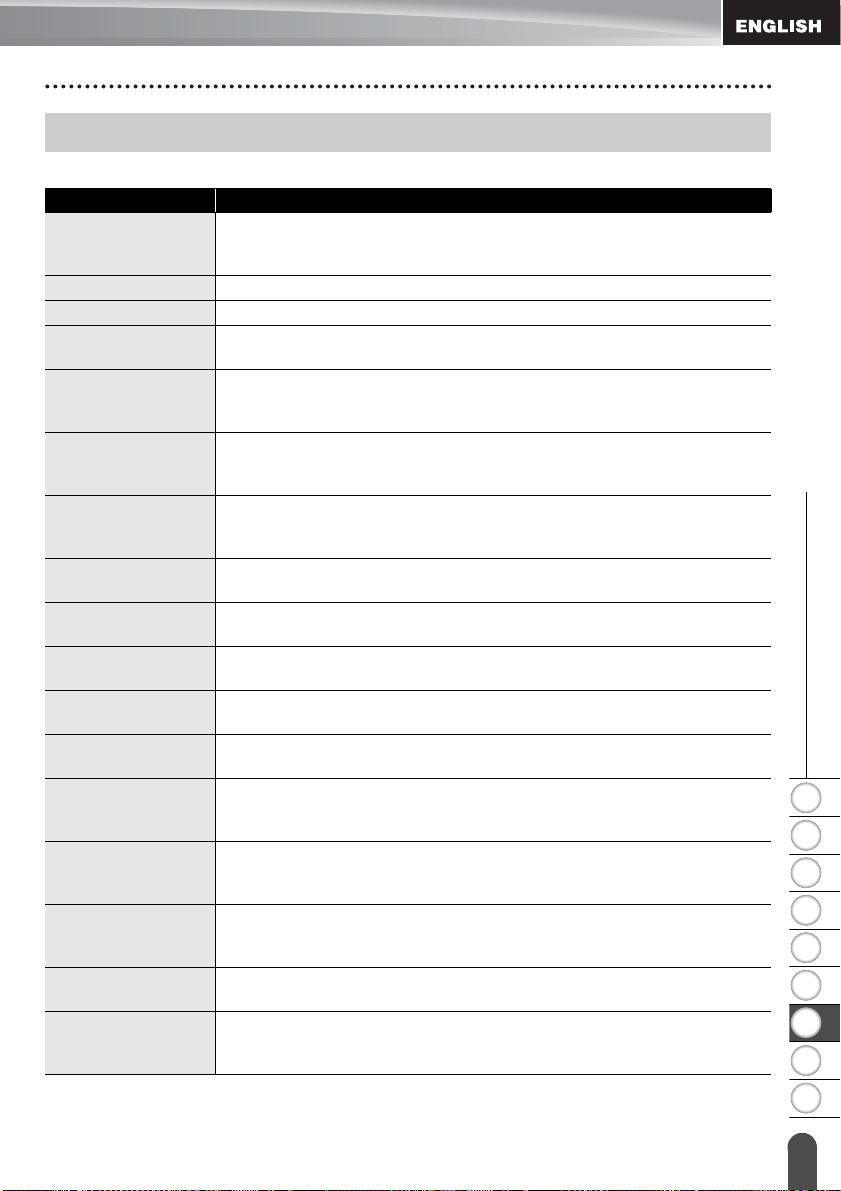
1
2
3
4
5
6
7
8
9
48
TROUBLESHOOTING
Error Messages
When an error message appears on the display, follow the directions provided below.
Error Messages
Message Cause/Remedy
Wrong Type
Of Adapter
Connected!
An incompatible AC adapter is connected.
Use an appropriate AC adapter.
Low Battery!
The installed batteries are getting weak.
Replace Battery!
The installed batteries are about to run out.
Recharge
Li-ion Battery!
The battery is low. Please charge the lithium-ion battery.
Li-ion is damaged
Use other
power source!
The Li-ion is damaged. Please use an AC adapter or an other battery.
Unit Cooling
Wait XX min.
before restart!
High temperature error.
Cutter Error!
The tape cutter has been closed when you tried to print or feed tape. Turn
the P-touch labeling system off and then on again before continuing. When
tape is tangled in the cutter, remove the tape.
Insert Tape
Cassette!
There is no tape cassette installed when you try to print or preview a label,
or feed tape. Install a tape cassette before continuing.
Text Full!
The maximum number of characters have already been entered. Edit the
text and use fewer characters.
No Text!
There is no text, symbols or bar code data entered when you try to print or
preview a label. Enter data before continuing.
Incorrect
Value!
The value entered for setting the tape length. Enter a valid value for the
setting.
Line Limit!
Max 5 Lines
There are already five lines of text when you press the Enter key. Limit the
number of lines to five.
Tape Width
Limit!
Max 3 Lines
There are more than three lines of text when you press the Print or Preview
key while using 0.47" (12mm) tape. Limit the number of lines to three, or
replace with a larger width tape cassette.
Tape Width
Limit!
Max 2 Lines
There are more than two lines of text when you press the Print or Preview
key while using 0.35" or 0.23" (9 mm or 6 mm) tape. Limit the number of
lines to two, or replace with a larger width tape cassette.
Tape Width
Limit!
Max 1 Line
There is more than one line of text when you press the Print or Preview key
while using 0.13" (3.5 mm) tape. Limit the number of lines to one, or
replace with a larger width tape cassette.
Block Limit!
Max 5 Blocks
There are already five blocks of text. Limit the number of blocks to five.
Length Limit!
The length of the label to be printed using the text entered is longer than
39.37" (1 m). Edit the text so that the length of the label is less than 39.37"
(1 m).
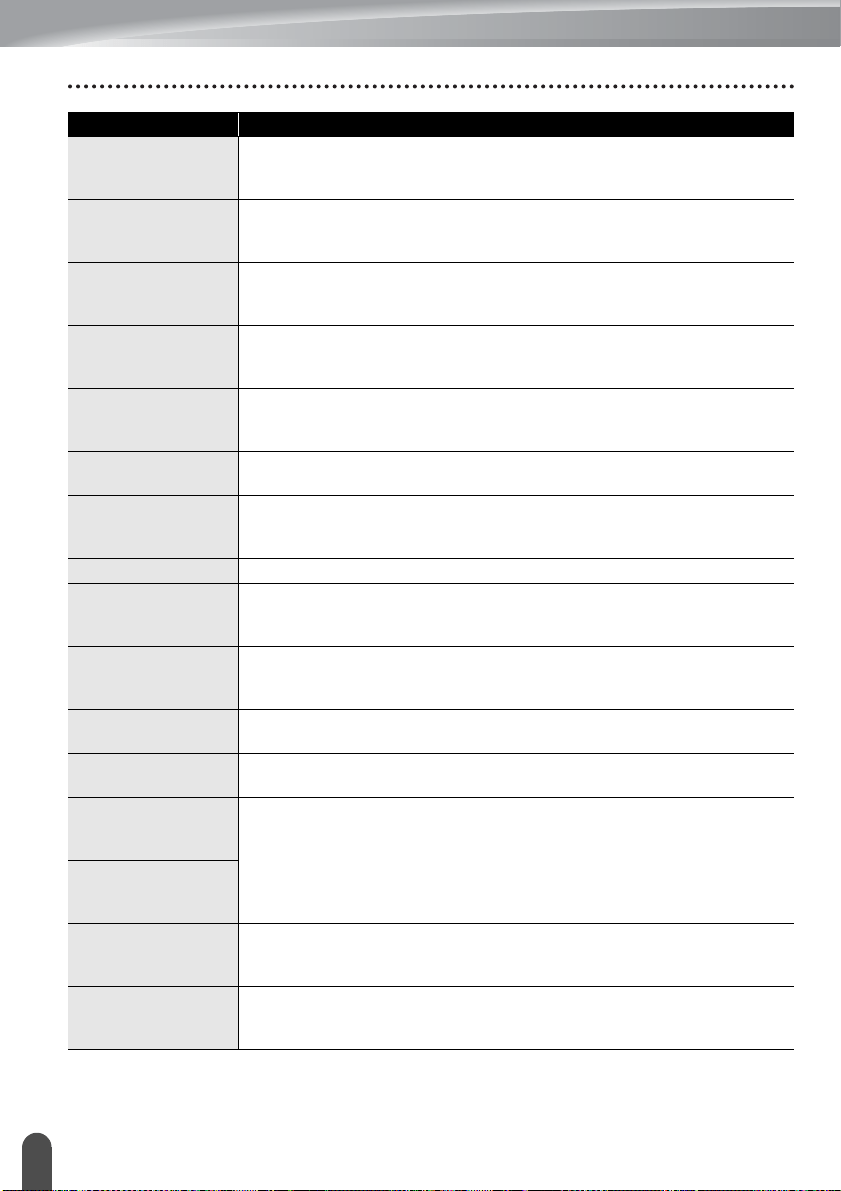
TROUBLESHOOTING
49
Error Messages
Text
Too Long!
The length of the label to be printed using the text entered is longer than
the length setting. Edit the text to fit within the set length or change the
length setting.
Memory Full!
There is not enough internal memory available when you try to save a label
file. Delete any unnecessary files to make more memory available for the
new label file.
Check # of
Digits
Entered!
The number of digits entered in the bar code data does not match the
number of digits set in the bar code parameters. Enter the correct number
of digits.
Input A,B,C or D
At Start&End!
The bar code data entered does not have the required start/stop code (A,
B, C, or D required at the beginning and end of the bar code data for the
CODABAR protocol). Enter the bar code data correctly.
Maximum Of
5 Bar Codes
Per Label!
There are already five bar codes entered in the text data when you try to
enter a new bar code. You can only use up to five bar codes in each label.
You can enter up to two bar codes when (AA|AA) is selected in flag layout.
Text
Too High!
The text size is too large. Select a different size option.
Installed tape
is not compatible
with this machine!
Installed tape is incompatible with this labeling system. Use compatible
tape.
System Error XX
Please contact Brother customer service.
Select Other
Cut Option!
The tape length set using the tape length setting is shorter than the total
length of the left and right margins applied for the "Large Margin" cutting
option. You have to select a different cutting option.
Line Limit!
Max 100 Lines
per Label
Exceeds max. You can enter up to 100 lines in the whole page and blocks.
Block Function
is Not Allowed!
In this setting, you cannot add or delete blocks.
Line Limit!
Max 2 Lines
PUNCH-DOWN BLOCK layout allows to print up to 2 lines / block.
This Function
Requires 0.35"
or Wider Tape!
PUNCH-DOWN BLOCK layout must use 0.35" (9 mm) or wider tape
cassettes.
This Function
Requires 9mm
or Wider Tape!
Sequence Type
Must be None
When Editing!
Texts cannot be edited when you set Sequence Type in PUNCH-DOWN
BLOCK to Horizontal or Backbone.
Cassette Type
Does Not Match.
Continue?
For example, Heat Shrink Tube cartridge is detected but Heat Shrink Tube
mode is not selected, or Heat Shrink Tube mode is selected but the Heat
Shrink Tube cartridge is not inserted into the P-touch labeling system.
Message Cause/Remedy
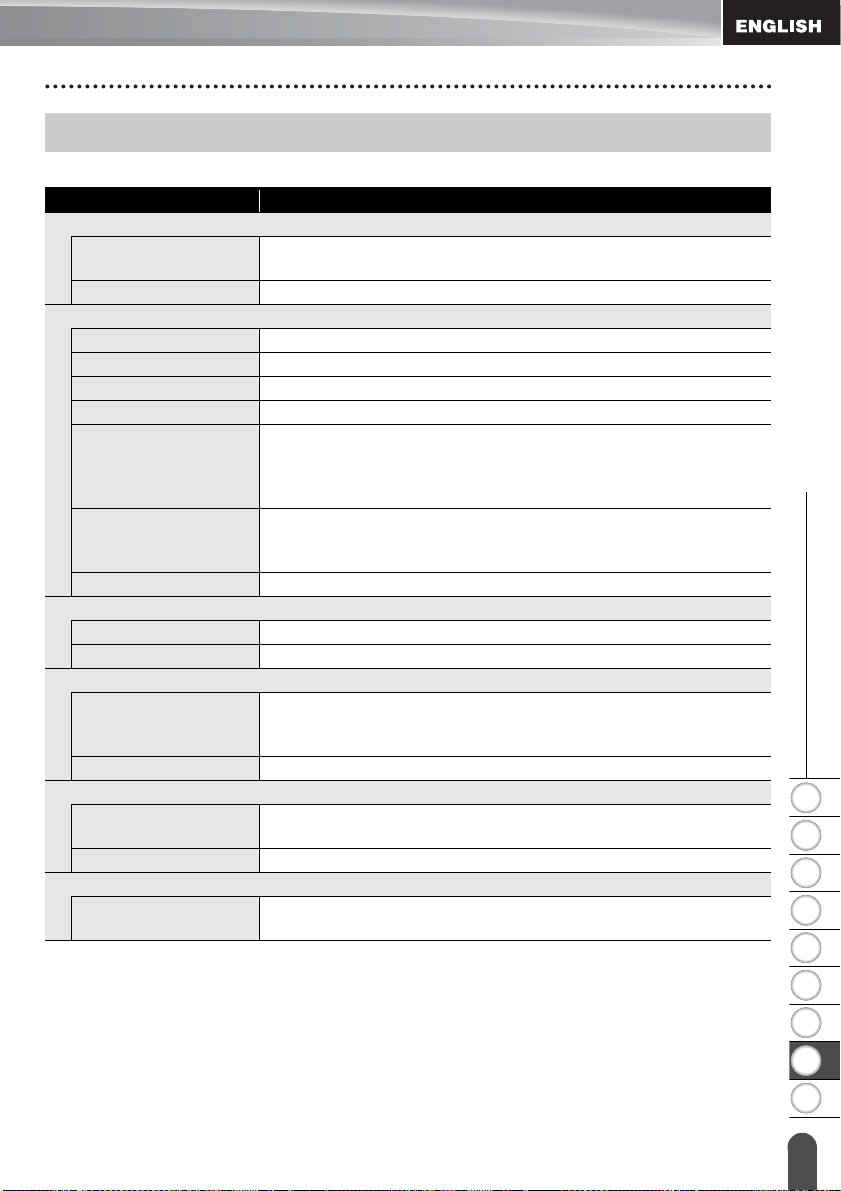
1
2
3
4
5
6
7
8
9
50
Specifications
APPENDIX
APPENDIX
Main Unit
Specifications
Item Specification
Display
Character display 16 characters x 2 guidance and 2 lines text
(128 dot x 56 dot)
Screen contrast 5 levels (+2, +1, 0, -1, -2)
Printing
Print method Thermal Transfer
Print head 112 dot / 180 dpi
Print height 0.62" (15.8 mm) max. (when using 0.70"/18 mm tape)
*
1
Print speed Approx. 0.78" (20 mm)/ sec.
Tape/Tube cassette Standard TZe tape cassette (0.13", 0.23", 0.35", 0.47", 0.70"
[3.5 mm, 6 mm, 9 mm, 12 mm, 18 mm] widths)
Brother HSe tube cassette (0.23", 0.35", 0.47", 0.70" [5.8 mm,
8.8 mm, 11.7 mm, 17.7 mm] widths)
No. of lines 0.70" (18 mm) tape : 1 - 5 lines;
0.47" (12 mm) tape : 1 - 3 lines; 0.35" (9 mm) tape : 1 - 2 lines;
0.23" (6 mm) tape : 1 - 2 lines; 0.13" (3.5 mm) tape : 1 line
Cut option Large Margin, Small Margin, Chain, No cut
Memory
Memory buffer size Maximum 2400 characters
File storage Maximum 50 files
Power Supply
Power supply Six
"
AA
"
alkaline batteries (LR6)*
2
, Six
"
AA
"
Ni-MH rechargeable
batteries (HR6)*
2,
*
3
, Li-ion Battery (BA-E001),
AC adapter (AD-E001).
Auto Power-off Battery: 5 min. AC adapter: 5 min.
Size
Dimensions Approx.5.3"(W) x 8.7"(D) 2.7"(H)
[134 mm(W) x 221 mm(D) x 69 mm(H)]
Weight Approx.1.7lb (750g) (without tape cassette and batteries)
Other
Operating
temperature / humidity
50°F - 95°F / 20% - 80% humidity (without condensation)
Maximum wet bulb temperature: 80.6
°F
*1 Actual character size may be smaller than maximum print height.
*2 Not included.
*3 Visit us at http://solutions.brother.com/ for the latest information about the recommended batteries.
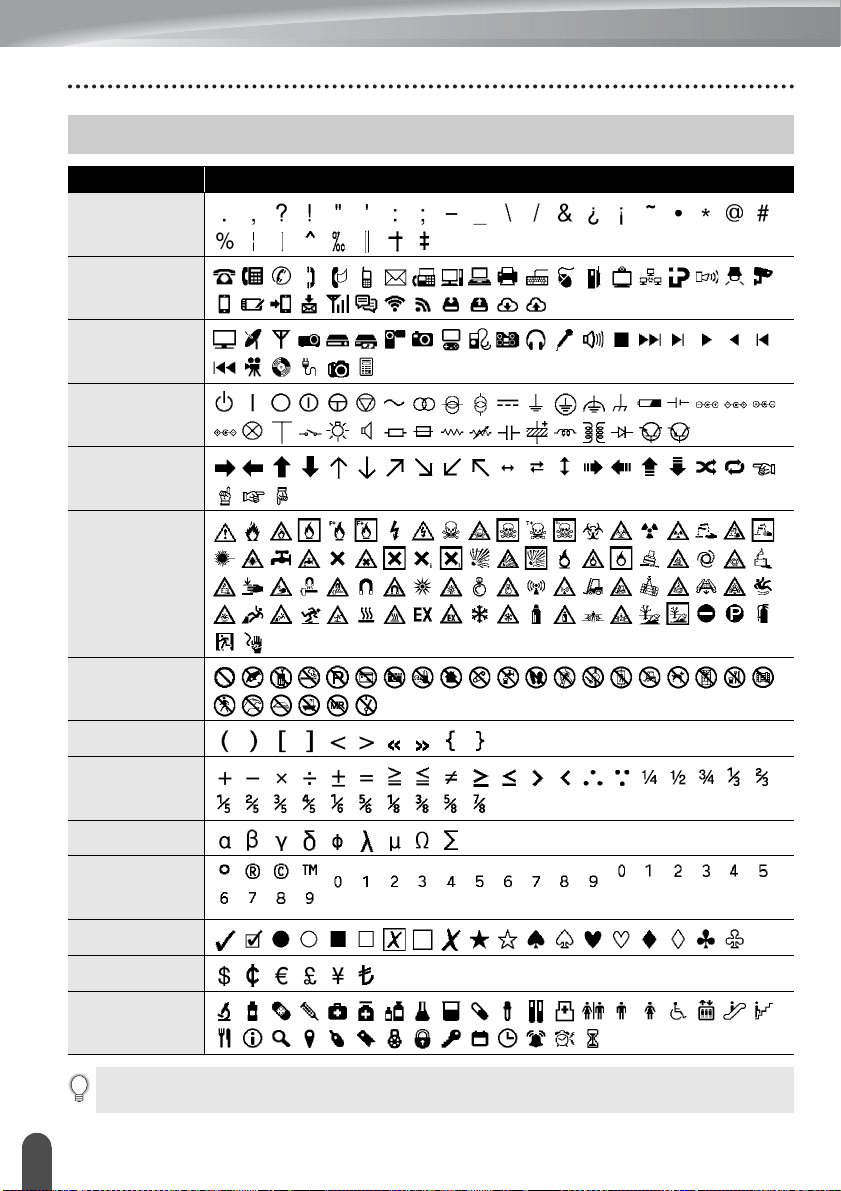
APPENDIX
51
Symbols
Symbols
Category Symbols
Punctuation
Datacom
Audio/Visual
Electrical
Arrows
Safety
Prohibited
Brackets
Mathematics
Greek
Super/
subscript
Bullets
Currency
Misc.
The symbols shown in the table may look slightly different on the labeling system LCD and when
printed.
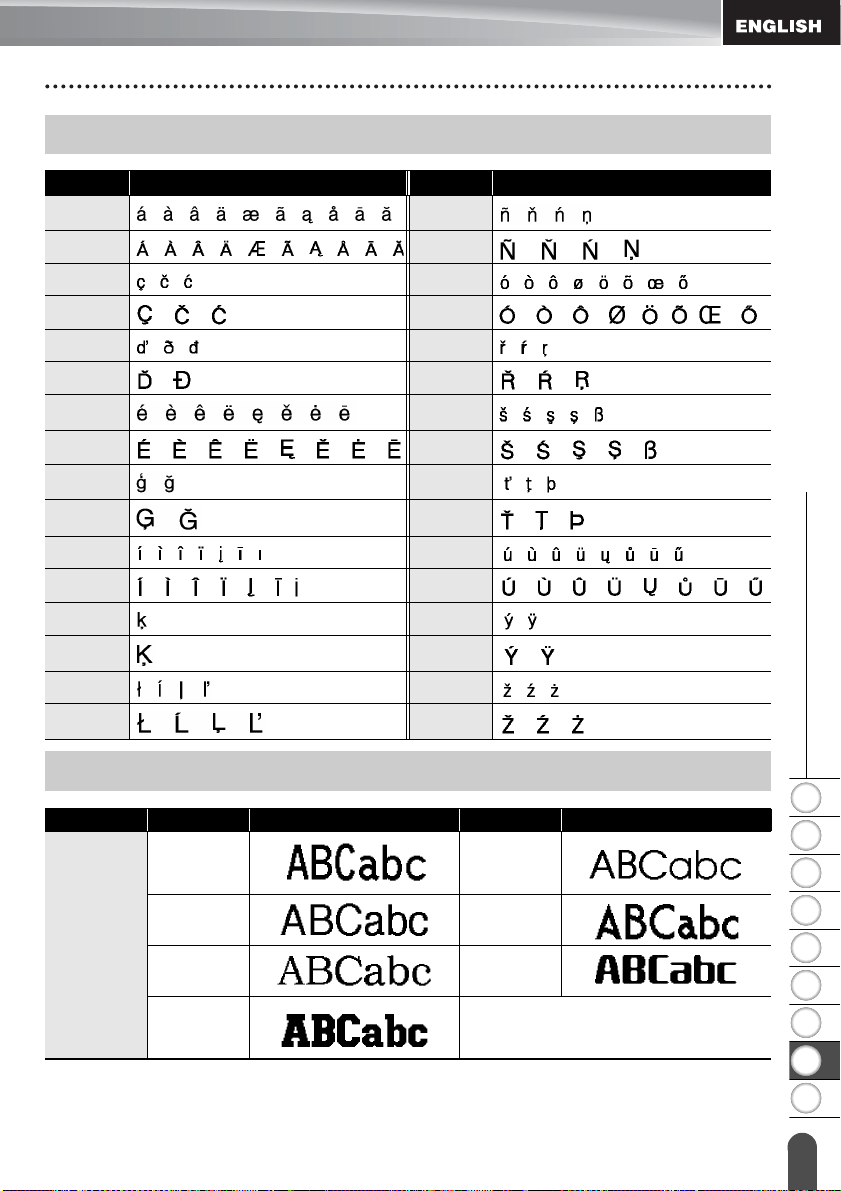
1
2
3
4
5
6
7
8
9
52
APPENDIX
Accented Characters
Accented Characters
Character
Accented Characters
Character
Accented Characters
a n
A N
c o
C O
d r
D R
e s
E S
g t
G T
i u
I U
k y
K Y
l z
L Z
Character Attribute
Attribute Value Result Value Result
Font
LGO
(Letter
Gothic)
ATL
(Atlanta)
HEL
(Helsinki)
ADM
(Adams)
BRU
(Brussels)
SOF
(Sofia)
LA
(Los
Angeles)
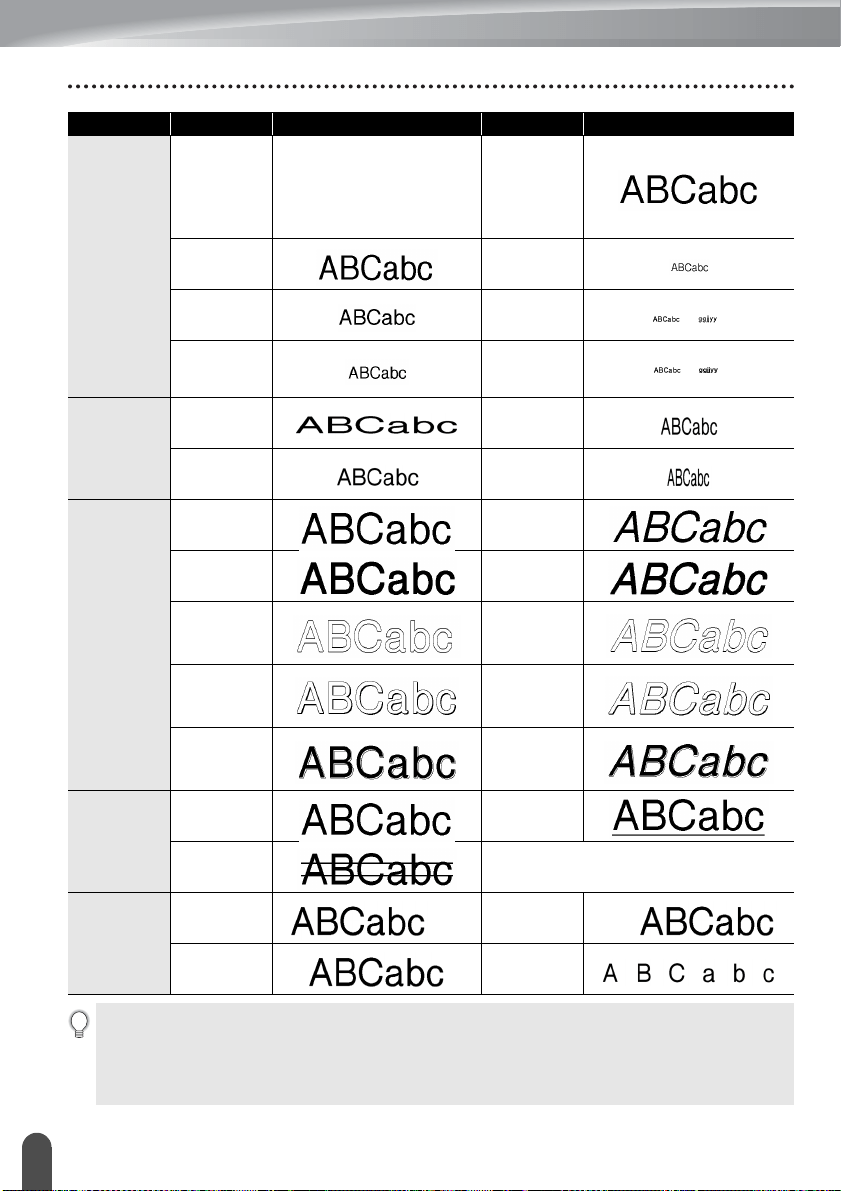
APPENDIX
53
Character Attribute
Size
Auto
When Auto is selected,
the text is automatically
adjusted to print in the
largest size available for
each tape width.
42pt
36pt 12pt
24pt 9pt
18pt 6pt
Width
x2 x2/3
x1 x1/2
Style
Normal
ITL
(Italic)
BLD
(Bold)
I+BLD
(Italic Bold)
OUT
(Outline)
I+OUT
(Italic
Outline)
SHD
(Shadow)
I+SHD
(Italic
Shadow)
SLD
(Solid)
I+SLD
(Italic
Solid)
Line
Off
UND
(Underline)
STR
(Strikeout)
Align
(Alignment)
Left Right
Center
Just
(Justify)
• The actual printed font size depends on the tape width, number of characters and number of
input lines. Once characters reach a minimum size, the selected font will default to a custom font
which is based on the Helsinki style. This allows labels to print using the smallest text possible
on narrow or multi-line labels.
• All 6 point text is printed in Helsinki except in default setting.
Attribute Value Result Value Result
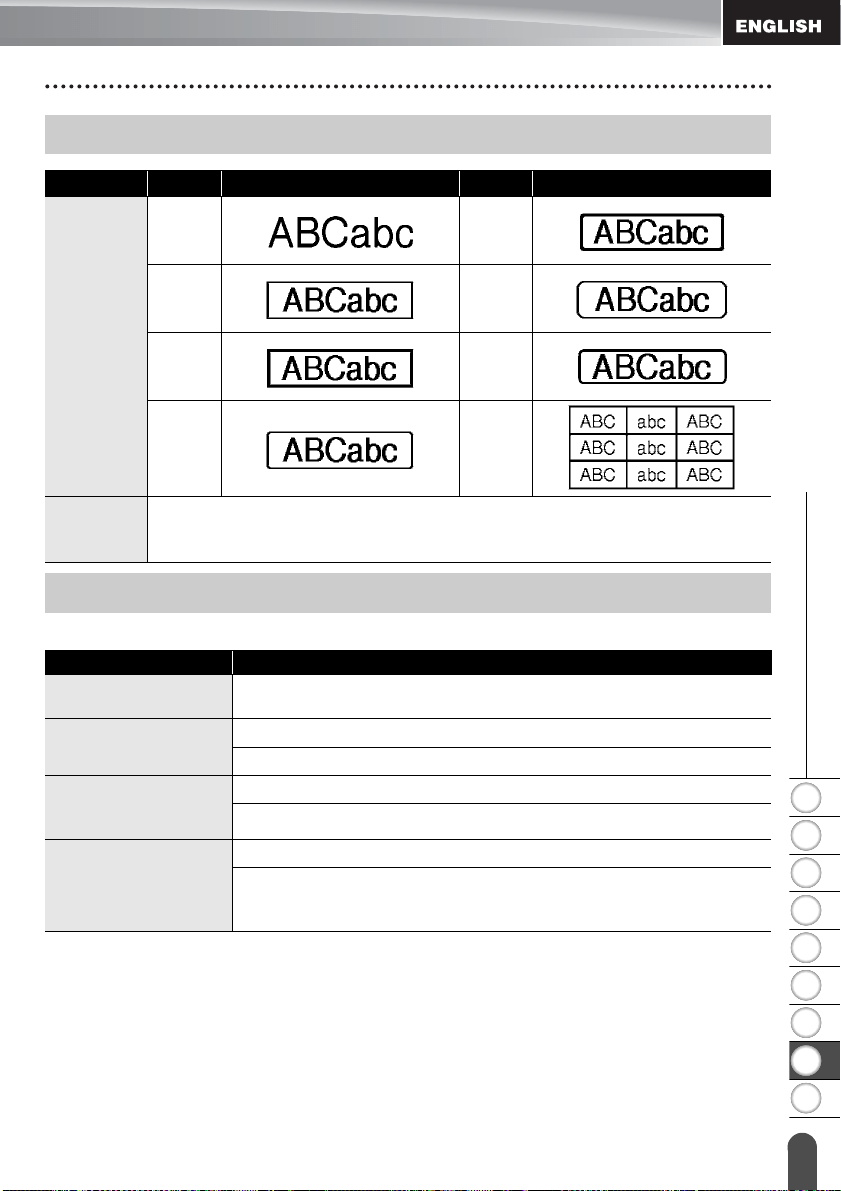
1
2
3
4
5
6
7
8
9
54
APPENDIX
Frames
Bar Code Settings Table
Frames
Attribute Value Result Value Result
Frame
Off 4
15
26
37
Length
The length of the label can be set within the range 1.0" (25 mm) - 12.0"
(300 mm). When Auto is selected, the length of the label is automatically
adjusted based on the amount of text entered.
Bar Codes
Attribute Value
Protocol
CODE39, CODE128, EAN-8, EAN-13,
GS1-128 (UCC/EAN-128), UPC-A, UPC-E, I-2/5 (ITF), CODABAR
Width
Small
Large
Under#
(characters printed
below bar code)
On
Off
C.Digit
(check digit)
Off
On
(only available for the CODE39, I-2/5
and CODABAR protocols)
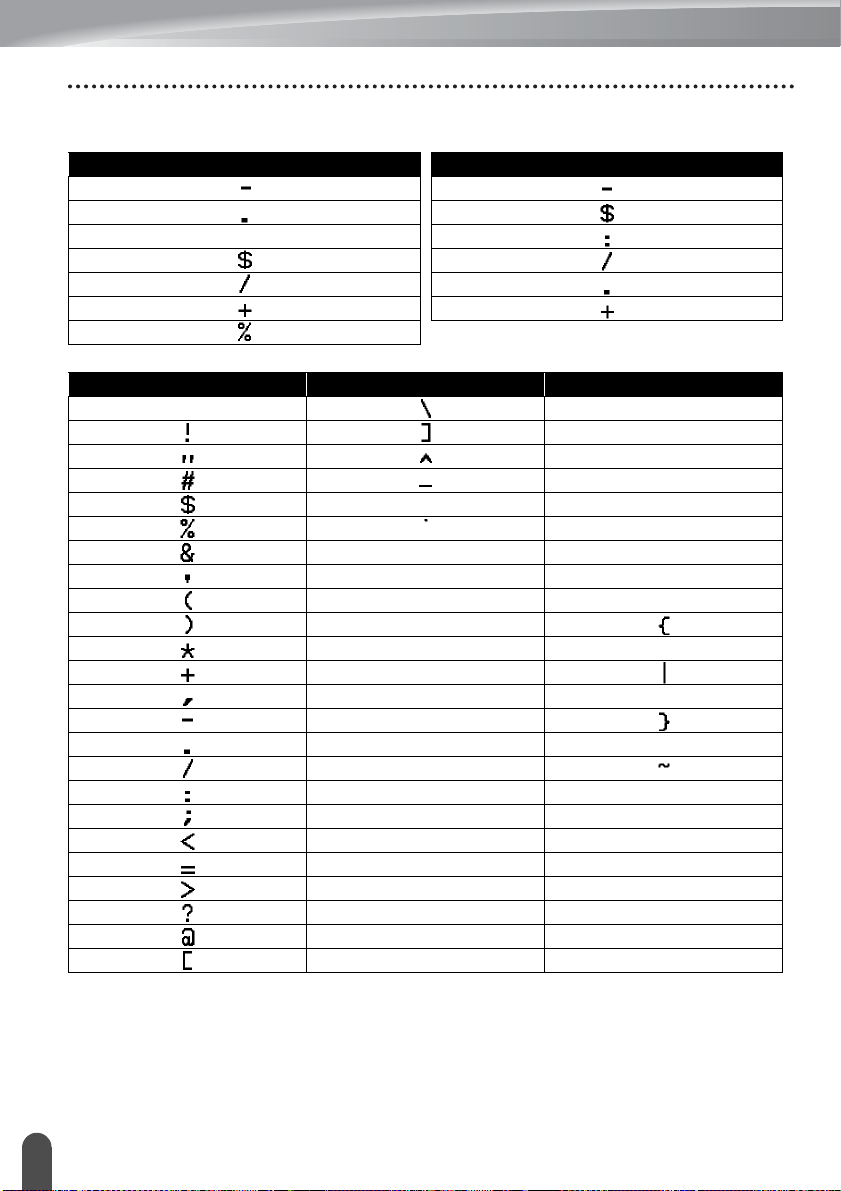
APPENDIX
55
Bar Codes
Special Character List
CODE39 CODABAR
CODE128, GS1-128 (UCC / EAN-128)
Special Character Special Character
(SPACE)
Special Character Special Character Special Character
(SPACE) DC3
DC4
NAK
SYN
NUL ETB
CAN
SOH EM
STX SUB
ETX ESC
EOT
ENQ FS
ACK
BEL GS
BS
HT RS
LF
VT US
FF DEL
CR FNC3
SO FNC2
SI FNC4
DLE FNC1
DC1
DC2
1
2
3
4
5
6
7
8
9
56
INDEX
INDEX
A
AC adapter .................................................... 19
Accented Characters ................................... 52
Auto power-off time ..................................... 24
B
Battery ........................................................... 22
C
Caps mode .................................................... 16
contrast .......................................................... 25
cursor keys .................................................... 34
D
deleting
text and formatting ............................... 35
text only ................................................. 35
E
entering
text
.......................................................... 34
F
formatting
character attributes .............................. 37
frames .................................................... 38
K
Keyboard ....................................................... 17
L
line .................................................................. 37
Line number .................................................. 16
N
new line ......................................................... 34
P
Power Supply ............................................... 19
R
Return mark .................................................. 16
S
size ................................................................. 37
Specifications ............................................... 50
style ................................................................ 37
symbols ......................................................... 35
T
tape cassettes .............................................. 23
tape length .................................................... 16
text
entering and editing ............................. 34
lines ........................................................34
W
width ............................................................... 37

Printed in China
LAD566001B