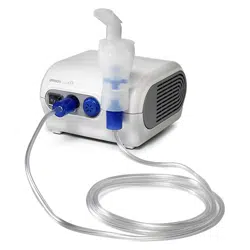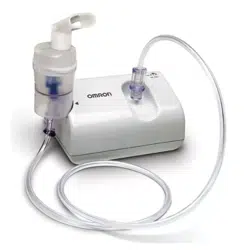
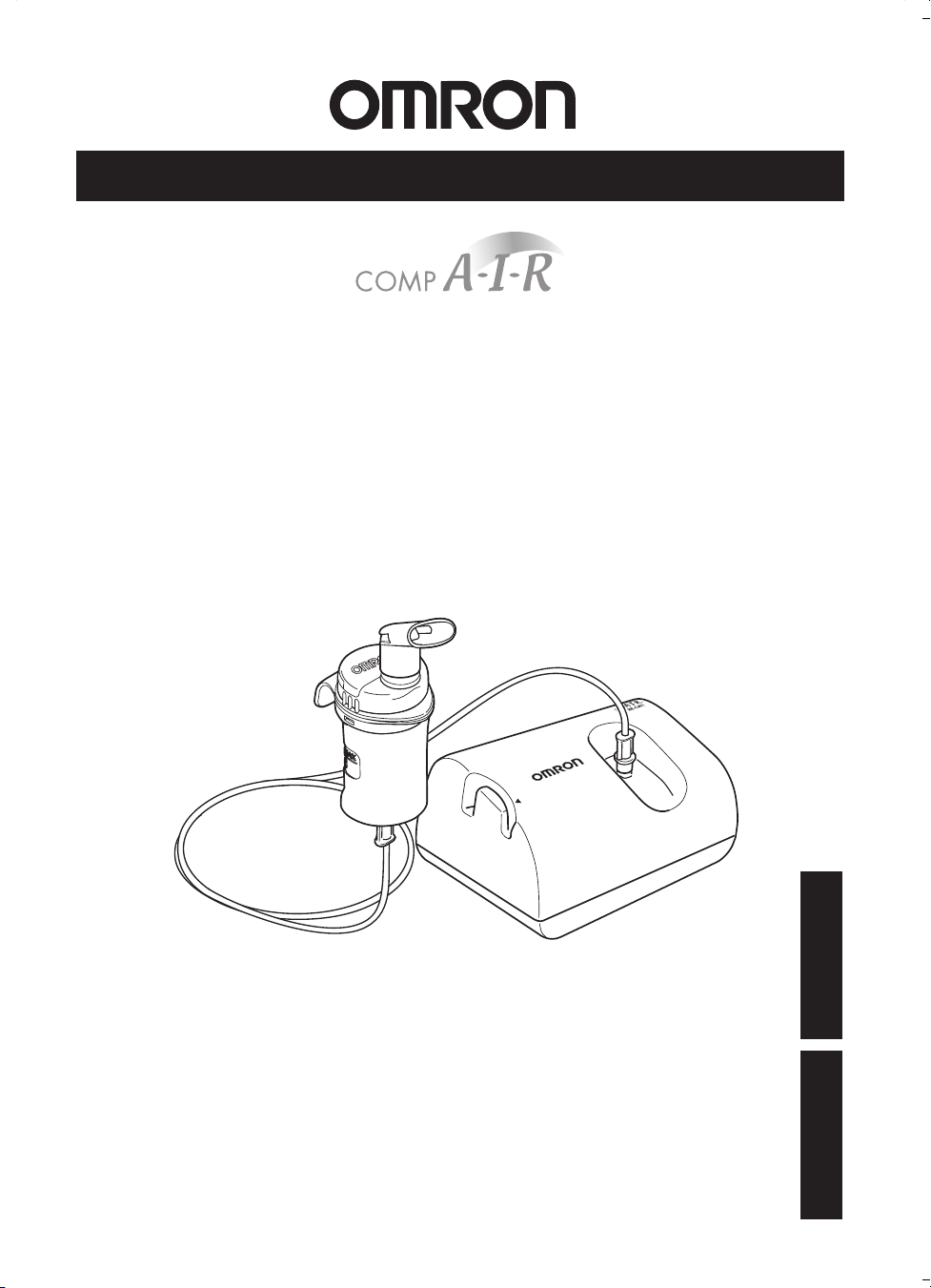
Compressor Nebulizer
NE-C801
For single patient use only
INSTRUCTION MANUAL
TM
5332875-4D_NE-C810S-Z_EN_IM_M01_211028.pdf
ENGLISH
ESPAÑOL
Rx ONLY

2
CONTENTS
The illustrations shown in this instruction manual are image drawings and may
differ slightly from the appearance of the actual product.
Before Using the Device
Introduction .........................................................3
Intended Use ........................................................4
Safety Information ....................................................5
Know Your Unit ......................................................9
Operating Instructions
Preparing the Nebulizer for Use ........................................11
Attaching the Air Tube ...............................................14
Using the Device ....................................................15
Care and Maintenance
Cleaning after Each Use ..............................................18
Daily Disinfecting ...................................................19
Changing the Air Filter ...............................................20
Caring for the Device ................................................21
Troubleshooting
Troubleshooting Guide ...............................................22
Limited Warranty ....................................................23
FCC Statement ......................................................24
Specifications .......................................................25
Technical Data ......................................................26
Guidance and Manufacturer's Declaration ................................27
3
Thank you for purchasing the OMRON NE-C801 Compressor Nebulizer.
Fill in for future reference.
DATE PURCHASED: __________________
SERIAL NUMBER:____________________
• Staple your purchase receipt here
• Register your product on-line at
www.register-omron.com
The compressor forces air to the nebulizer. When the air enters the nebulizer, it converts
the prescribed medication into an aerosol of microscopic droplets that can easily be
inhaled.
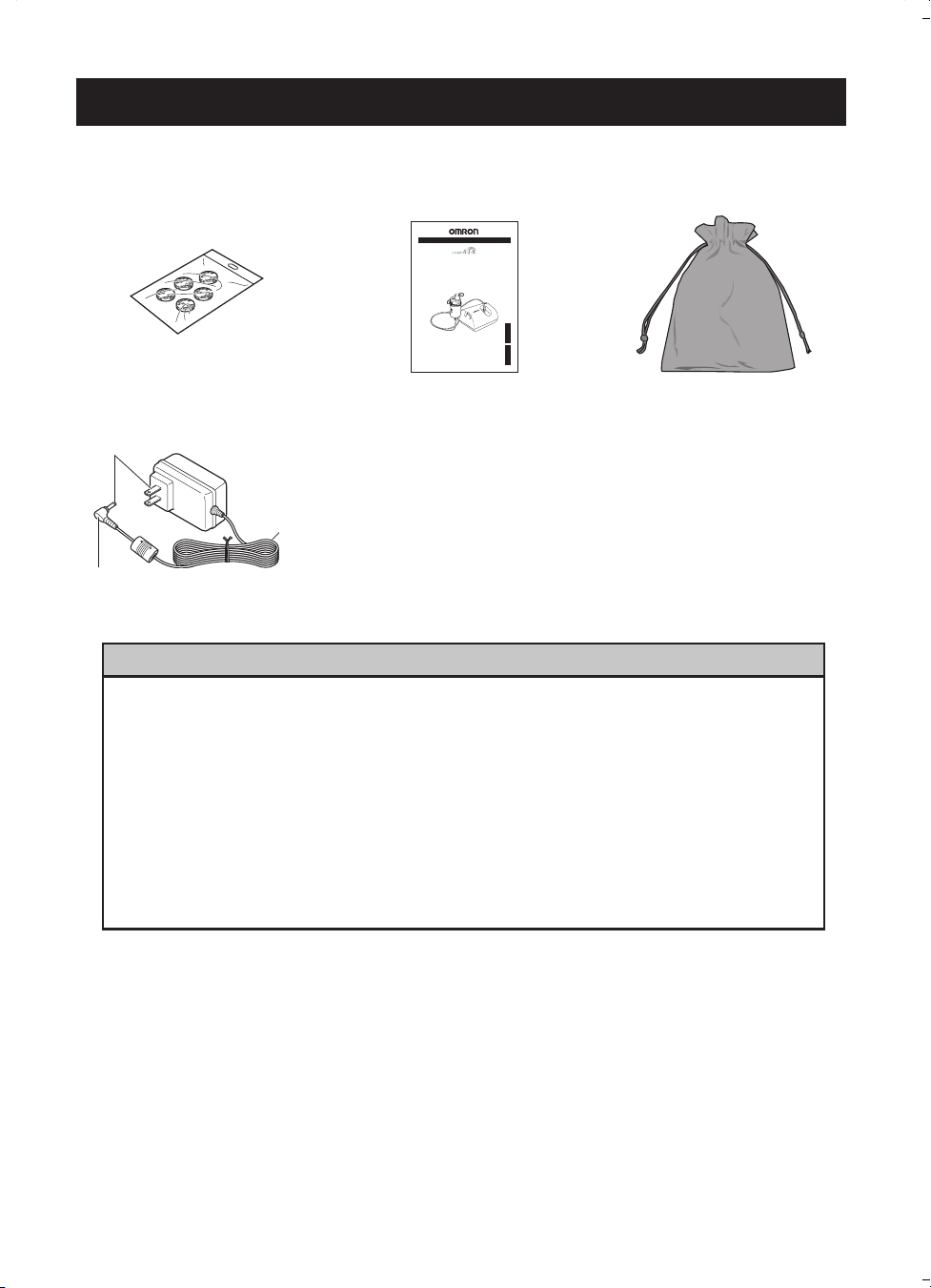
Your NE-C801 Compressor Nebulizer comes with the following components:
• Compressor (Main Unit)
• Nebulizer Kit
• Mouthpiece
• Air Tube (PVC, 100 cm)
• AC Adapter
• Air Filters (Package of 5)
• Storage Bag
• Instruction Manual
The following are optional accessories sold separately:
• Nosepiece
• Adult Mask (PVC)
• Child Mask (PVC)
Before Using the Device
INTRODUCTION
Please read this instruction manual thoroughly before using the unit.
Please keep for future reference.
For specific information about your own nebulizer,
CONSULT YOUR DOCTOR.
SAVE THESE INSTRUCTIONS

4
The NE-C801 Nebulizer Compressor System is intended to provide air to the pneumatic
nebulizer in order to aerosolize medications for inhalation by the patient for respiratory
disorders. The system is designed for use with pediatric (defined by the prescribed
medication) and adult patients in the home, hospital, and sub-acute settings.
All warnings and cautions described in this manual should be observed.
INTENDED USE
5
To ensure the correct use of the product, basic safety measures should always be followed
including the warnings and cautions listed in this instruction manual.
OPERATING THE DEVICE
For type, dose, and regime of medication follow the instructions of your physician
or licensed healthcare practitioner.
If you feel anything unusual during use, stop using the device immediately and
consult your physician.
Do not cover the compressor with a blanket, towel, or any other type of cover
during use. This could result in the compressor overheating or malfunctioning.
Do not use the device where the device may be exposed to flammable gas or vapors.
Do not use tap or mineral water in the nebulizer for inhaling purposes.
Clean and disinfect the nebulizer kit, mouthpiece, and optional nosepiece or optional
masks before using them for the first time after purchase.
If the device has not been used for a long period of time, clean and disinfect the
nebulizer kit, mouthpiece, and optional nosepiece or optional masks before using
them.
Pentamidine is not an approved medication for use with this device.
Always dispose of any remaining medication in the medication cup after each use.
Use fresh medication each time you use the device.
Do not leave the device or its parts where it will be exposed to extreme temperatures
or changes in humidity, such as leaving the device in a vehicle during warm or hot
months, or where it will be exposed to direct sunlight.
Do not use or store the device where it may be exposed to noxious fumes or volatile
substances.
Make sure that the nebulizer kit is clean before use.
Do not use in anaesthetic or ventilator breathing circuits.
Not suitable for use in the presence of flammable anesthetic mixture with air or
oxygen or nitrous oxide.
WARNING
Indicates a potentially hazardous situation which, if not
avoided, could result in death or serious injury.
CAUTION
Indicates a potentially hazardous situation which, if not
avoided, may result in minor or moderate injury to the user or
patient or damage to the equipment or other property.
SAFETY SYMBOLS USED IN THIS INSTRUCTION MANUAL
SAFETY INFORMATION
6
OPERATING THE DEVICE (continued)
Do not operate where oxygen is being administered in a closed environment (such
as an oxygen tent).
Provide close supervision when this device is used by, on, or near infants, children
or compromised individuals.
If the device is used continuously, the service life of the device may be shortened.
Limit use to 20 minutes at a time, and allow a 40 minutes interval before using the
device again.
When using the device, the main unit may become hot.
Do not touch the main unit for other than necessary operation such as turning off the
power while nebulizing.
Do not insert any object into the compressor.
Make sure the air filter is clean. If the air filter has changed color or has been used
on average for more than 60 days, replace it with a new one.
Make sure the nebulizer kit is correctly assembled, the air filter is properly installed,
and the air tube is correctly connected to the compressor and the nebulizer kit. Air
may leak from the air tube during use if not securely connected.
Inspect the compressor (main unit) and the nebulizer parts each time before using
nebulizer kit. Make sure no parts are damaged, the nozzle and air tube are not
blocked and the compressor operates normally.
Do not use the device if the air tube is bent.
Do not block the air filter cover.
Do not alter the baffle, the nozzle in the medication cup or any part of the nebulizer kit.
Do not add more than 7mL of medication to the medication cup.
Do not operate the device at temperatures greater than +40˚C (+104˚F).
Do not tilt the nebulizer kit so the angle of the kit is greater than 45˚. Medication
may flow into the mouth.
Do not shake the nebulizer kit while using the device.
Do not subject the compressor or any of the components to strong shocks, such as
dropping on the floor.
This device is approved for human use only.
Do not disassemble or attempt to repair the device or components.
Operate the device only as intended. Do not use the device for any other purpose.
SAFETY INFORMATION
7
OPERATING THE DEVICE (continued)
Dispose of the device, components and optional accessories according to applicable
local regulations. Unlawful disposal may cause environmental pollution.
Use only Omron authorized parts and accessories. Parts and accessories not
approved for use with the device do not perform the expected specification or it may
damage the unit.
Changes or modification not approved by Omron Healthcare will void the user
warranty.
To avoid injury to the nose mucosa, do not squeeze the optional nosepiece into the
back of the nose.
To avoid the medication residue on the face. After nebulization, be sure to wipe the
face after removing the optional masks.
When using this device, there will be some noise and vibration caused by the
pump in the compressor. There will also be some noise caused by the emission
of compressed air from the nebulizer kit. This is normal and does not indicate a
malfunction.
When sterilizing parts by boiling, make sure that the container does not boil dry.
Do not use the device while sleeping or if drowsy.
Do not block the slit between the cap and the inhalation air inlet.
RISK OF ELECTRICAL SHOCK
Do not connect the AC adapter terminal using wire or other metallic conductors.
Do not use the compressor (main unit) or AC adapter while they are wet.
Do not plug or unplug the AC adapter into the electrical outlet with wet hands.
Do not immerse the compressor (main unit) in water or other liquid.
Do not spill water or other liquids on the compressor and AC adapter. These parts
are not waterproof. If liquid spills on these parts, immediately unplug the AC
adapter and wipe off the liquid with gauze or other soft absorbent material.
Do not use or store the device in humid locations, such as a bathroom. Use the
device within the operating temperature and humidity.
Use only the AC adapter designed by Omron for this device. Use of any other AC
adapter may damage the device.
Do not operate the device with a damaged power cord or plug.
Do not use a cellular phone near the device. It may result in an operational failure.
SAFETY INFORMATION
8
SAFETY INFORMATION
RISK OF ELECTRICAL SHOCK (continued)
Do not overload power outlets. Plug the AC adapter into the appropriate voltage
outlet.
Do not use extension cords. Plug the AC adapter directly into the electrical outlet.
Unplug the AC adapter from the electrical outlet after using the device.
Remove the AC adapter from the device after use.
Unplug the AC adapter from the electrical outlet before cleaning the device.
Do not pull the power cord of AC adapter strongly.
MAINTENANCE AND STORAGE
Keep the device out of the reach of unsupervised infants and children. The device
may contain small parts that can be swallowed.
Do not leave the cleaning solution in the nebulizer parts. Rinse the nebulizer parts
with clean hot tap water after disinfecting.
Wash the nebulizer parts after each use. Dry the parts immediately after washing.
Do not store the air tube with moisture or medication remaining in the air tube.
This could result in infection as a result of bacteria.
Store the device and the components in a clean, safe location.
Do not carry or leave the nebulizer kit with medication in the medication cup.
Do not place or attempt to dry the device, components or any of the nebulizer parts
in a microwave oven.
Do not wrap the power cord around the compressor (main unit) and AC adapter.
9
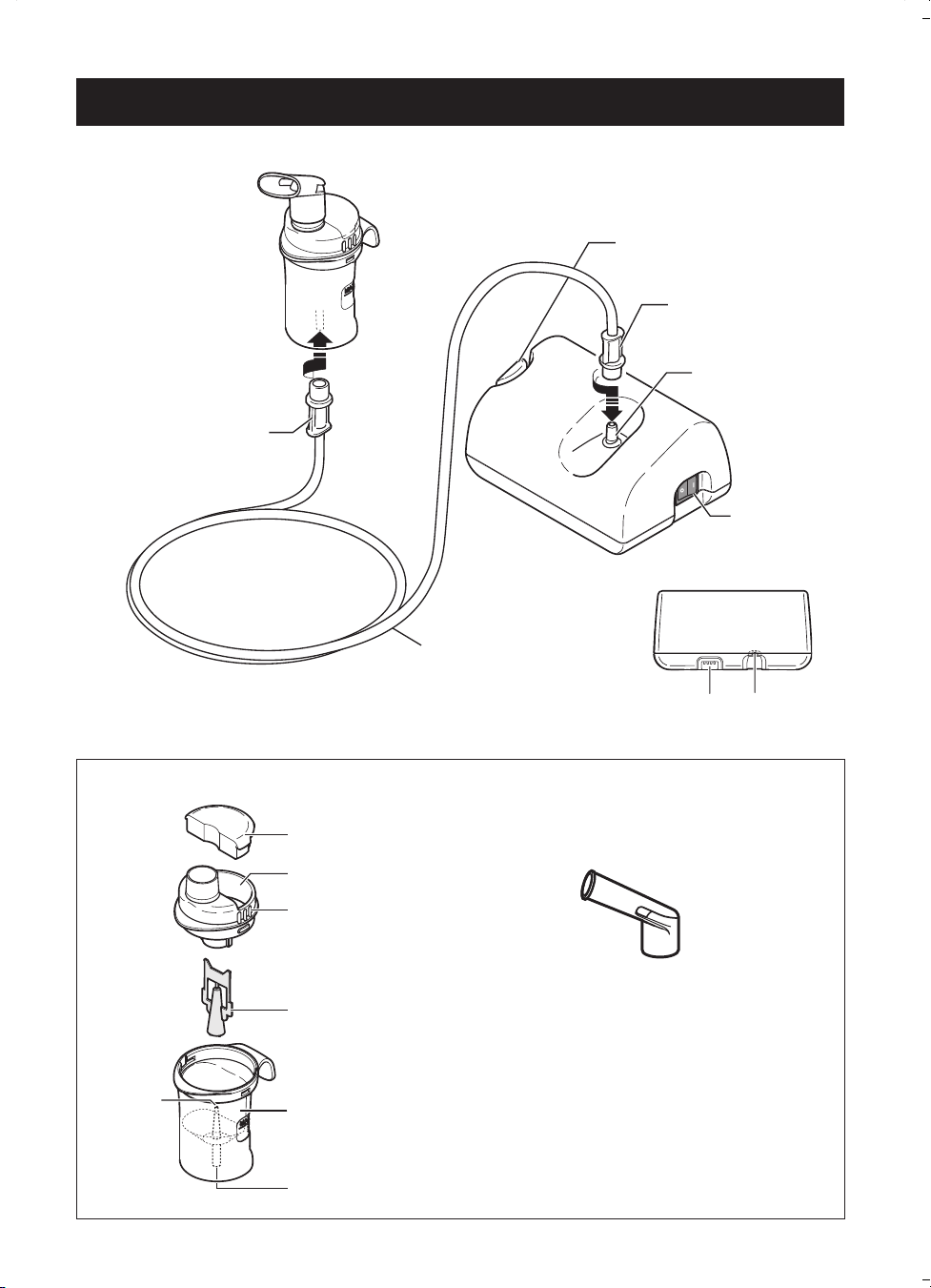
Air Tube
(PVC, 100 cm)
Nebulizer Kit Holder
Power Switch
Cap
Inhalation Air Inlet
Inhalation Top
Baffle
Medication Cup
Nozzle
Air Tube Connector
Mouthpiece
KNOW YOUR UNIT
Components and Replacement Parts
Air Tube
Connector
Back View
Nebulizer Kit
Power
Connector
Air Filter Cover
*Air filter inside
Air Tube Plug
Air Tube Plug
Compressor (Main Unit)
Nebulizer Kit
NOTE: Only use the NE-C801 Nebulizer Kit with this
Nebulizer.
10
KNOW YOUR UNIT
Components:
Instruction Manual Storage BagAir Filters
Package of 5
Compressor Nebulizer
NE-C801
For single patient use only
INSTRUCTION MANUAL
TM
ENGLISH
ESPAÑOL
Rx ONLY
AC Adapter
Power Plug
Power Cord
Terminal
Accessories and Replacement Parts
Model No.
........................................AC Adapter C30AC
Adult Mask (PVC) ................................... 9920
Child Mask (PVC) ................................... 9921
.............................Air Filters (Package of 5) C30FL
.....................................Air Filter Cover C801FC
..............................Air Tube (PVC, 100 cm) C801AT
Nebulizer Kit Set ................................... C801NEB
Includes Nebulizer Kit, Mouthpiece and Air Tube
Nosepiece .......................................... C911
. Mouthpiece . . . . . . . . . . . . . . . . . . . . . . . . . . . . . . . . . . . . . . . . C910
11
WARNING
• Clean and disinfect the nebulizer kit, mouthpiece, and optional nosepiece or
optional masks before using them for the first time after purchase.
• If the device has not been used for a long period of time, or if more than one
person uses the same device, clean and disinfect the nebulizer kit, mouthpiece,
and optional nosepiece or optional masks before using them.
CAUTION
Make sure the air filter is clean. If the air filter has changed color or has been
used on average for more than 60 days, replace it with a new one.
For directions on cleaning and disinfecting refer to page 18 - 19.
For directions on changing the air filter refer to page 20.
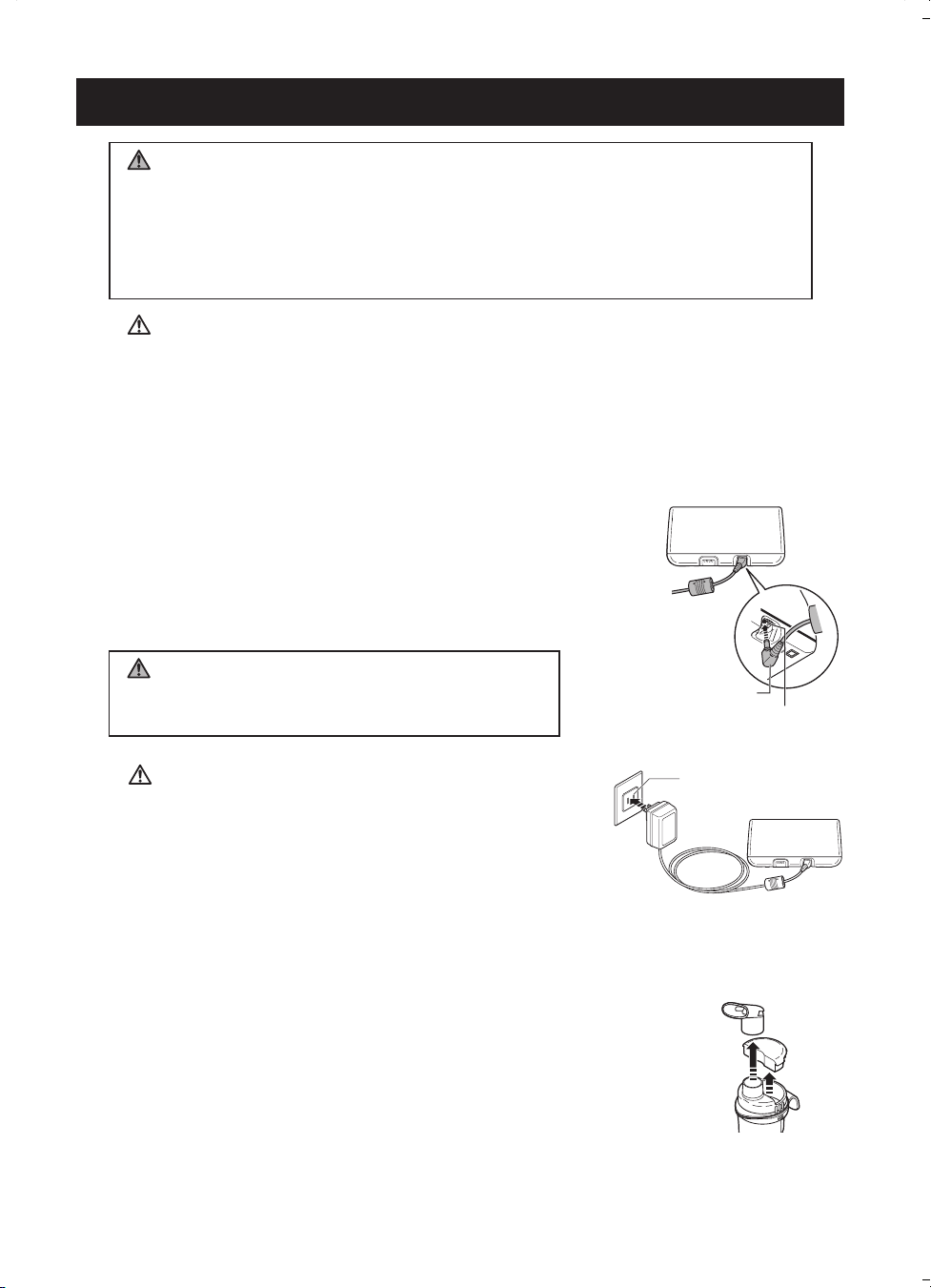
1 Insert the power plug on the AC adapter into
the power connector on the back side of the
compressor. Plug the AC adapter into the electrical
outlet.
WARNING
Do not plug or unplug the AC adapter into the
electrical outlet with wet hands.
CAUTION
• Do not overload power outlets. Plug the AC adapter
into the appropriate voltage outlet.
• Do not use extension cords. Plug the AC adapter
directly into the electrical outlet.
NOTE: AC adapter can be worked at 100 - 240V ~ 350mA, 50/60 Hz.
2 Lift up the mouthpiece and the cap to remove them
from the nebulizer kit.
Electrical Outlet
Power Connector
Power Plug
PREPARING THE NEBULIZER FOR USE
Operating Instructions
12
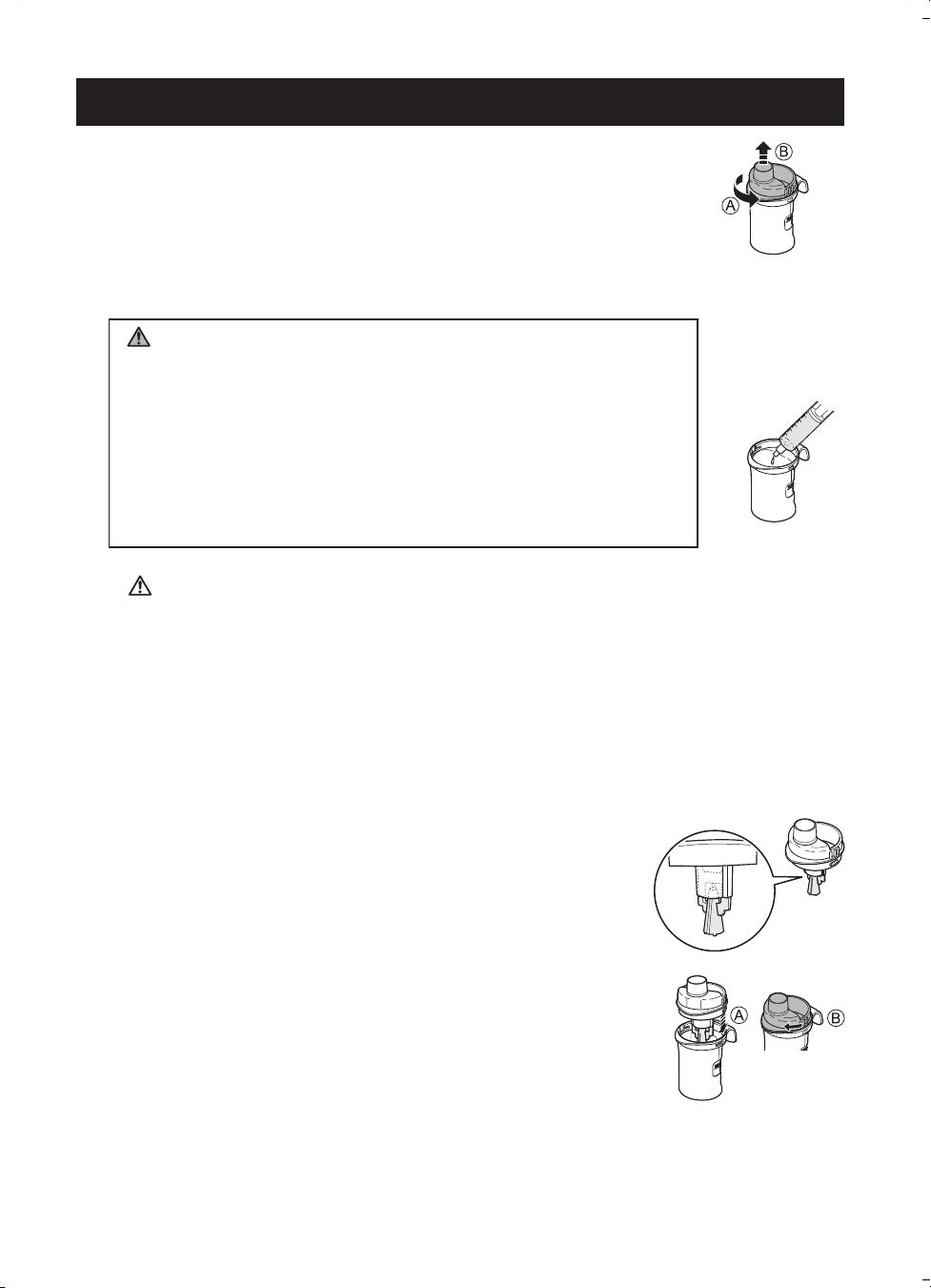
3 Rotate the inhalation top counterclockwise (A) and lift (B)
to remove the inhalation top from the medication cup.
4 Add the correct amount of prescribed medication to the medication cup.
WARNING
• For type, dose, and regime of medication follow the instructions
of your physician or licensed healthcare practitioner.
• Do not spill water or other liquids on the compressor and AC
adapter. These parts are not waterproof. If liquid spills on these
parts, immediately unplug the AC adapter and wipe off the liquid
with gauze or other soft absorbent material.
• Do not use tap or mineral water in the nebulizer for inhaling
purposes.
CAUTION
Do not add more than 7mL of medication to the medication cup.
NOTE: Scales on the nebulizer kit are for reference only. The scale on the outside
of the medication cup is with no baffle in place. Please use the scale on your
syringe or vial for accurate measurement of medication.
5 Make sure that the baffle is securely attached to the
inhalation top.
6 Place the inhalation top on the medication cup.
Align the protrusion on the inhalation top with the
indentation on the medication cup as illustrated (A).
Turn the inhalation top clockwise until securely closed (B).
PREPARING THE NEBULIZER FOR USE
13
PREPARING THE NEBULIZER FOR USE
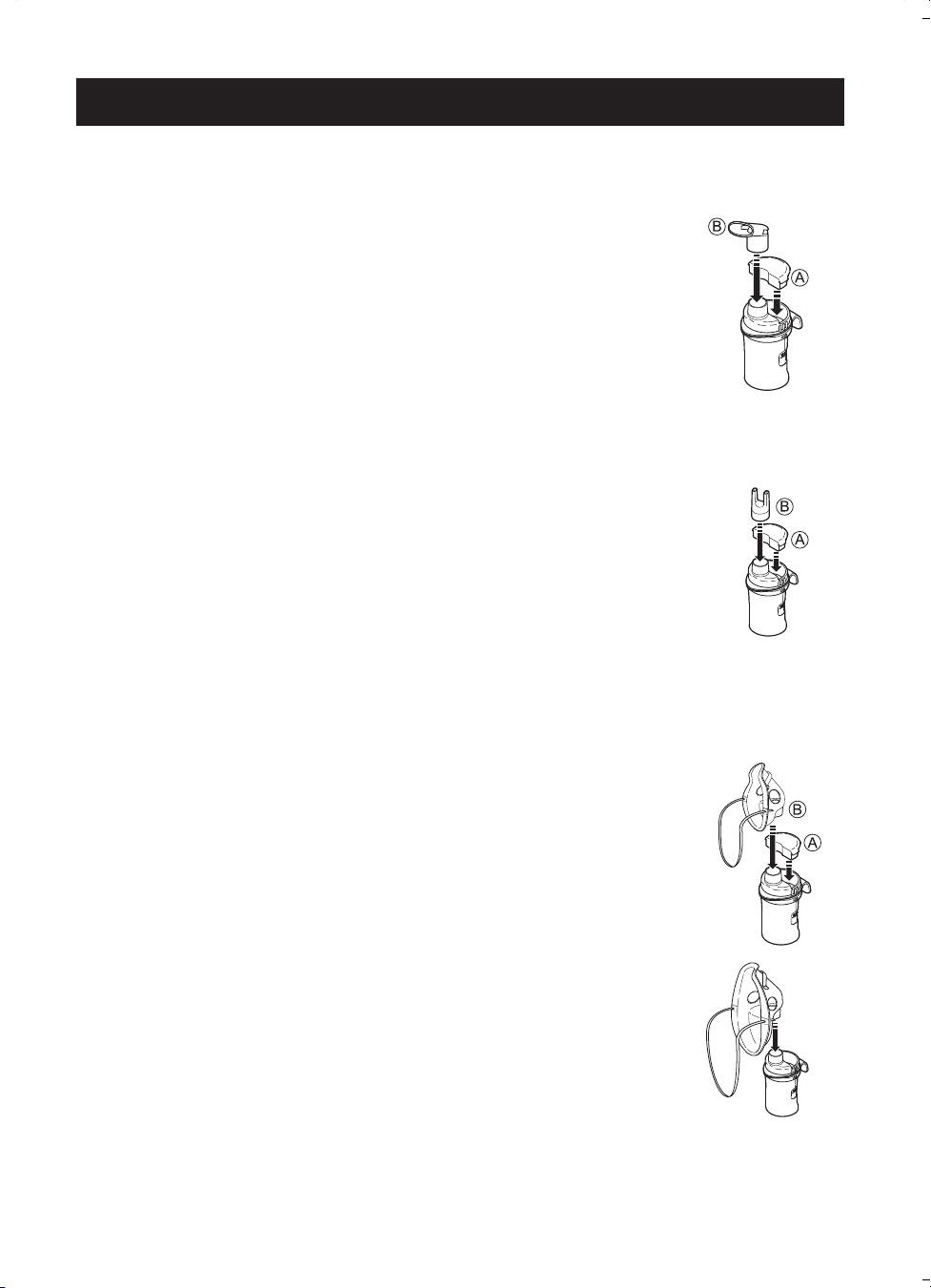
7 Attach the desired inhalation accessory.
USING THE MOUTHPIECE
Place the cap on the medication cup over the inhalation
air inlet (A).
Attach the mouthpiece (B).
NOTE: Place the cap on the medication cup when using the
mouthpiece. Using the cap with the mouthpiece will
reduce the amount of medication that is discharged
into the air.
USING THE NOSEPIECE (Optional)
Place the cap on the medication cup over the inhalation
air inlet (A).
Attach the nosepiece (B).
NOTE: Place the cap on the medication cup when using the
nosepiece. Using the cap with the nosepiece will
reduce the amount of medication that is discharged
into the air.
USING THE CHILD MASK (Optional)
Place the cap on the medication cup over the inhalation
air inlet (A).
Attach the child mask (B).
NOTE: If the amount of aerosol is too small, it is not necessary
to place the cap.
USING THE ADULT MASK (Optional)
Attach the adult mask to the inhalation top.
NOTE: If the amount of aerosol is too much, place the cap
on the medication cup over the inhalation air inlet.
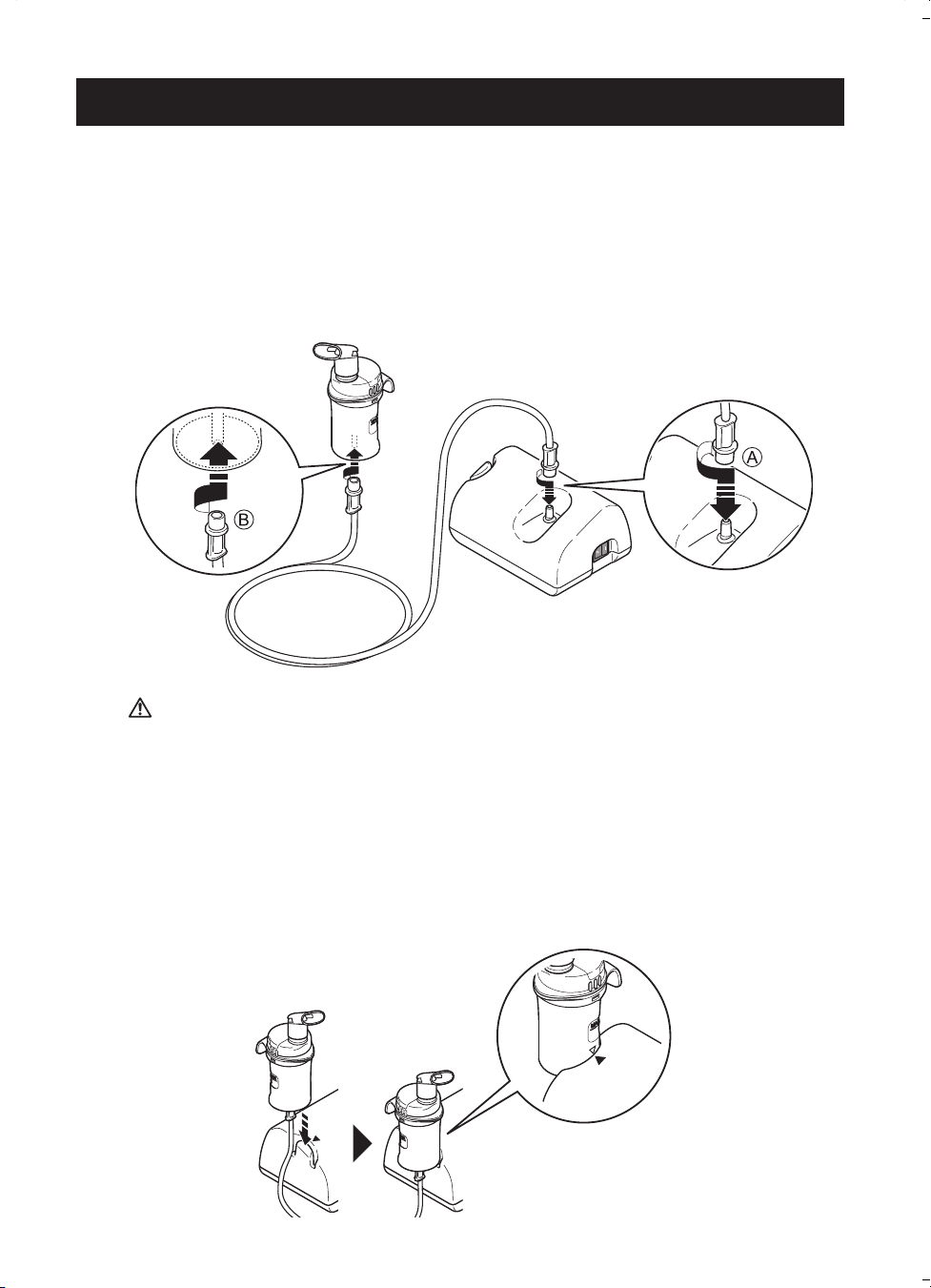
14
1 Twist the air tube plug slightly and push it firmly into the air tube connector
on the upper side of the compressor (A).
2 Twist the air tube plug slightly and push it firmly into the air tube connector
on the bottom of the nebulizer kit (B).
NOTE: Keep the nebulizer kit upright when attaching the air tube. Medication
may spill out of the medication cup.
CAUTION
• Make sure the nebulizer kit is correctly assembled, the air filter is properly
installed, and the air tube is correctly connected to the compressor and
the nebulizer kit. Air may leak from the air tube during use if not securely
connected.
• Do not use the device if the air tube is bent.
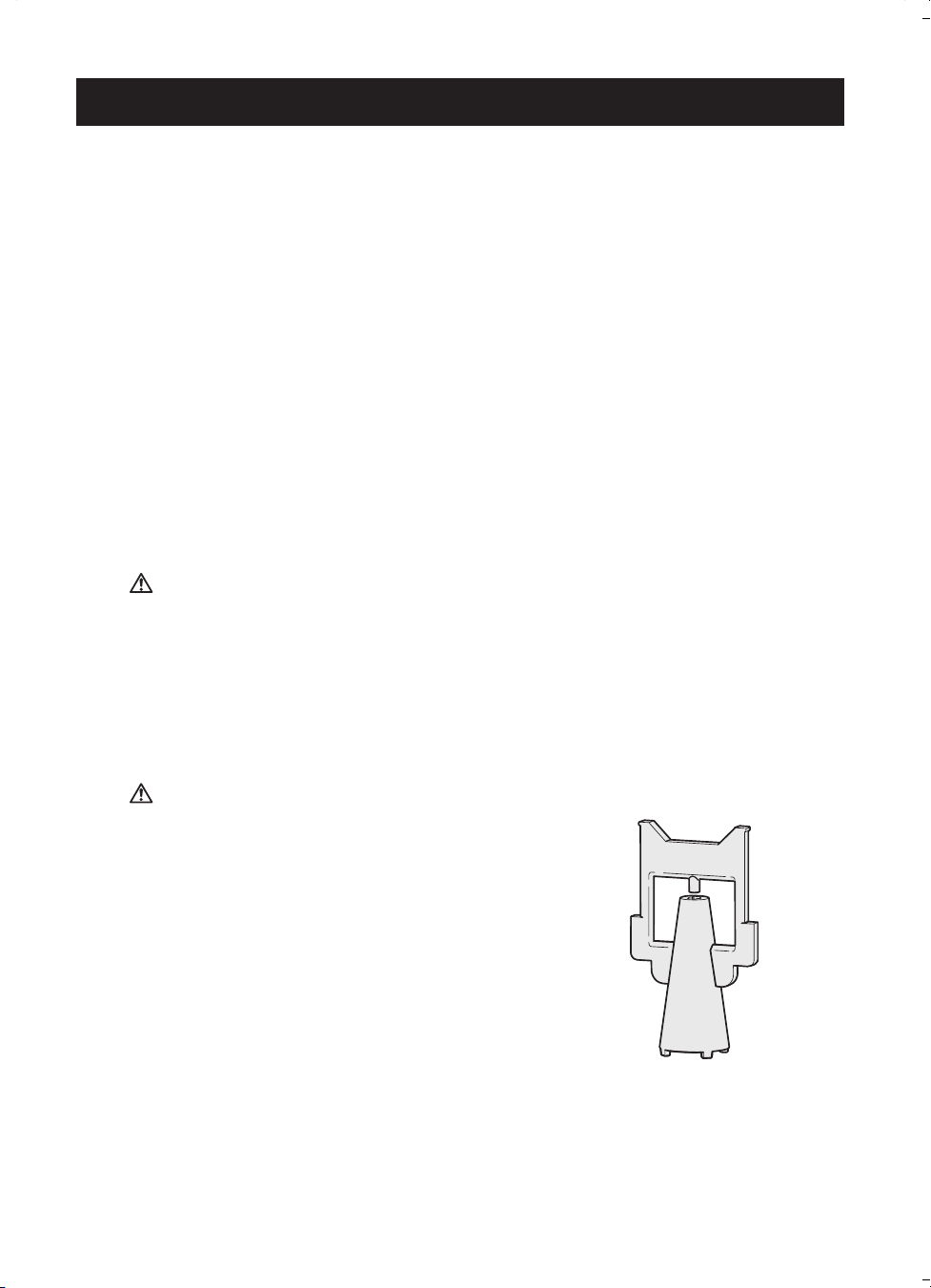
3 Use the nebulizer kit holder as a temporary holder for the nebulizer kit.
NOTE: Align the mark on the unit with the mark on the nebulizer kit as shown.
ATTACHING THE AIR TUBE
15
WARNING
• Do not use the device where the device may be exposed to flammable gas or
vapors.
• Do not use or store the device in humid locations, such as a bathroom.
Use the device within the operating temperature and humidity.
CAUTION
• Provide close supervision when this device is used by, on, or near infants, children
or compromised individuals.
•
Do not use a cellular phone near the device. It may result in an operational failure.
• Inspect the compressor (main unit) and the nebulizer parts each time before
using the device. Make sure no parts are damaged, the nozzle and air tube are
not blocked and the compressor operates normally.
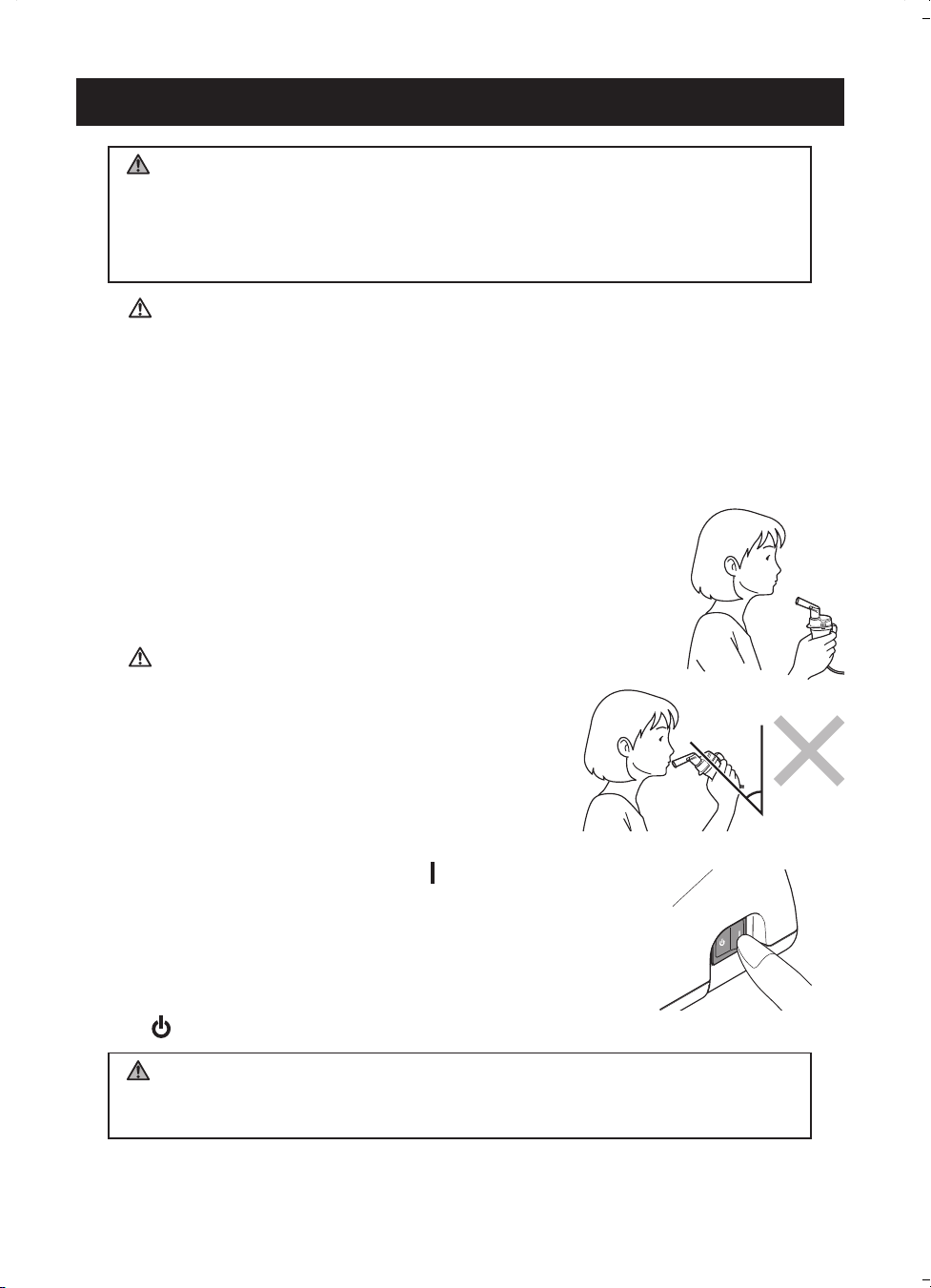
1 Hold the nebulizer kit as illustrated on the right.
CAUTION
• Do not tilt the nebulizer kit so the angle of the kit
is greater than 45˚. Medication may flow into the
mouth.
• Do not shake the nebulizer kit while using the
device.
2 Turn the power switch to the on ( ) position.
As the compressor starts, nebulization begins and
aerosol is generated.
To stop nebulization, turn the power switch to the
off (
) position.
WARNING
Do not cover the compressor with a blanket, towel, or any other type of cover
during use. This could result in the compressor overheating or malfunctioning.
45°
USING THE DEVICE
16
CAUTION
• Do not block the air filter cover.
• Limit use to 20 minutes at a time, and allow a 40 minutes interval before using the
device again.
• When using the device, the main unit may become hot.
• Do not touch the main unit for other than necessary operation such as turning off
the power while nebulizing.
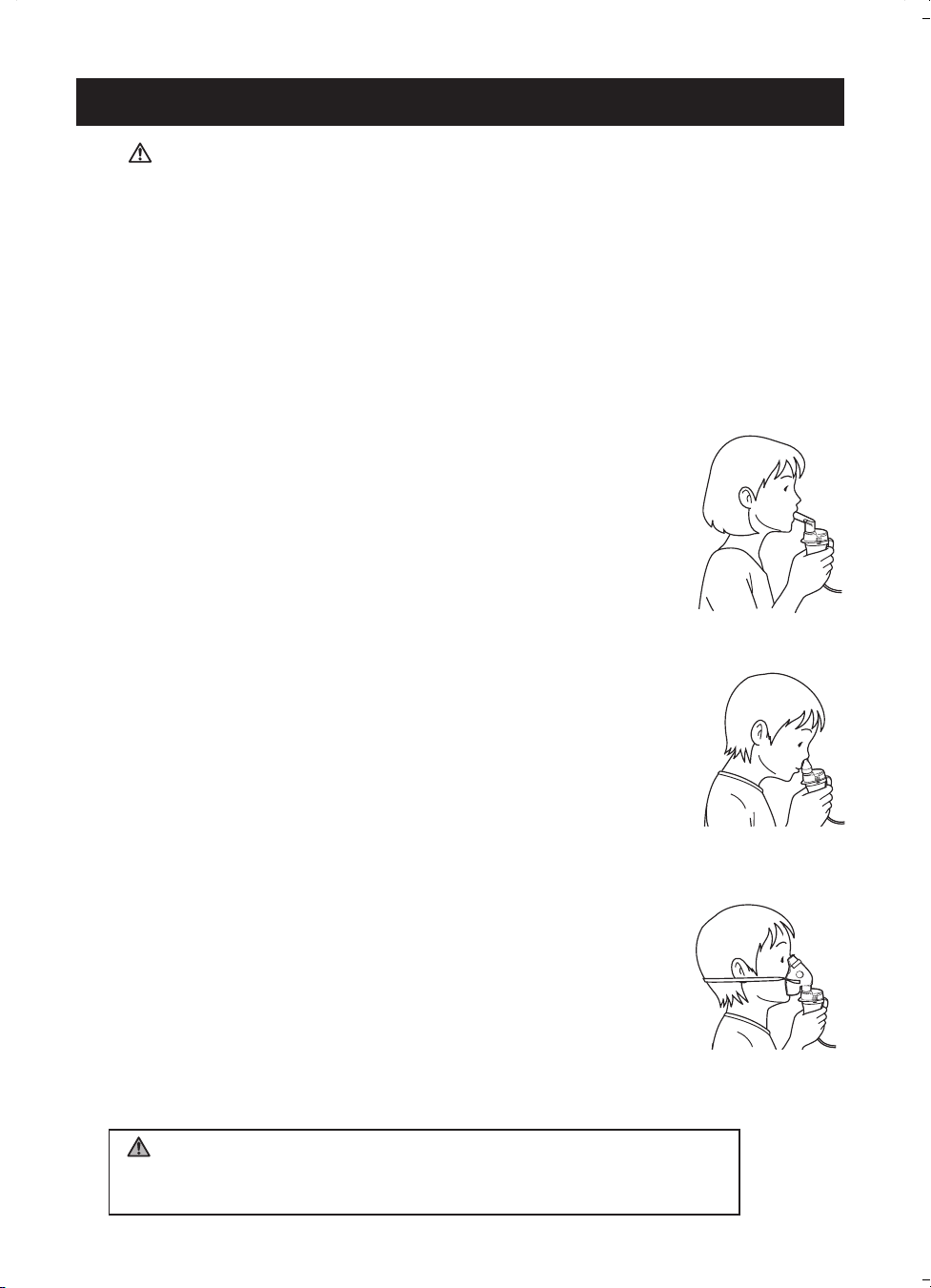
3 Inhale medication as instructed by your physician or licensed healthcare
practitioner.
USING THE MOUTHPIECE
Insert the mouthpiece into your mouth. Inhale medication
breathing normally. Exhale normally through the
mouthpiece.
USING THE NOSEPIECE (Optional)
Inhale the medication through the nosepiece as illustrated.
Exhale through the mouth.
USING THE CHILD MASK or THE ADULT MASK (Optional)
Place the mask over the nose and mouth. Pull the elastic
strap over the head. Gently pull on the strap to secure the
mask over the nose and mouth. Inhale the medication.
Exhale normally through the mask.
4 Complete the treatment.
WARNING
For type, dose, and regime of medication, follow the instructions of your
physician or licensed healthcare practitioner.
USING THE DEVICE
max
5
3
17
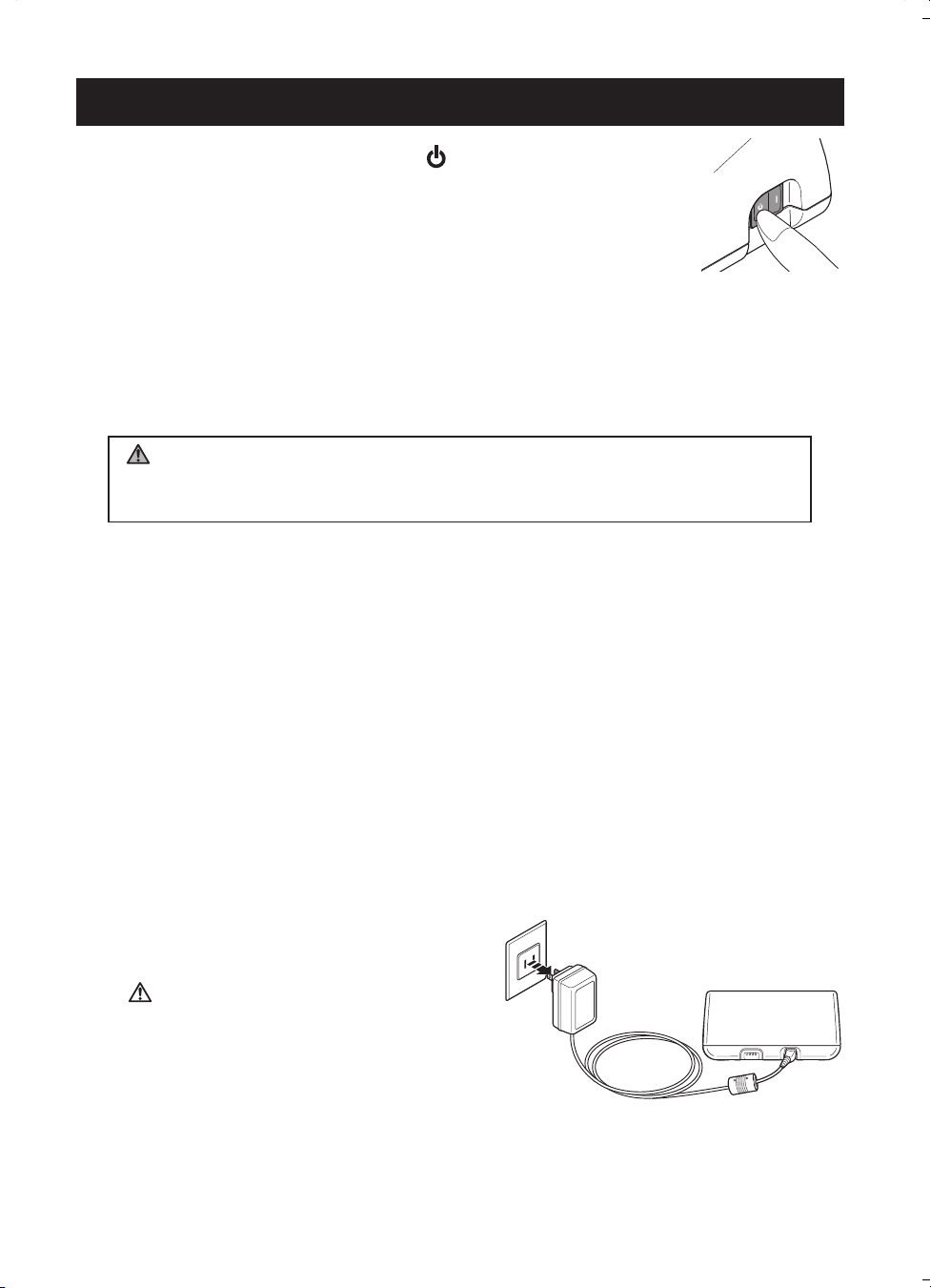
5 Turn the power switch to the off ( ) position.
The compressor turns off and nebulization stops.
6 Disconnect the air tube from the nebulizer kit.
Hold the air tube plug and gently pull down to disconnect the air tube plug
from the air tube connector on the bottom of the nebulizer kit.
7 Check the air tube. No condensation or moisture should remain in the air tube.
WARNING
Do not store the air tube with moisture or medication remaining in the air tube.
This could result in infection as a result of bacteria.
If any condensation or moisture remains in the air tube, remove the moisture
from the air tube. Follow the directions below:
1. Make sure the air tube is still connected to the air tube connector
on the upper side of the compressor.
2. Press the power switch on. The compressor will start and pump
air through the air tube to expel the moisture.
3. Press the power switch again to turn the compressor off.
8 Disconnect the air tube from the compressor. Hold the air tube plug and
gently pull the air tube plug off the air tube connector on the upper side of the
compressor.
9 Unplug the AC adapter from the
electrical outlet.
CAUTION
• Unplug the AC adapter from the electrical
outlet after using the device.
• Remove the AC adapter from the device
after use.
• Do not pull the power cord of AC adapter
strongly.
USING THE DEVICE
18
Following cleaning instructions after each use will prevent any remaining
medication in the bottle from drying resulting in the device not nebulizing
effectively and will help prevent infections.
WARNING
Wash the nebulizer parts after each use. Dry the parts immediately after washing.
1 Remove the inhalation accessory (mouthpiece, optional masks, or optional
nosepiece) from the nebulizer kit.
2 Disconnect the air tube from the nebulizer kit.
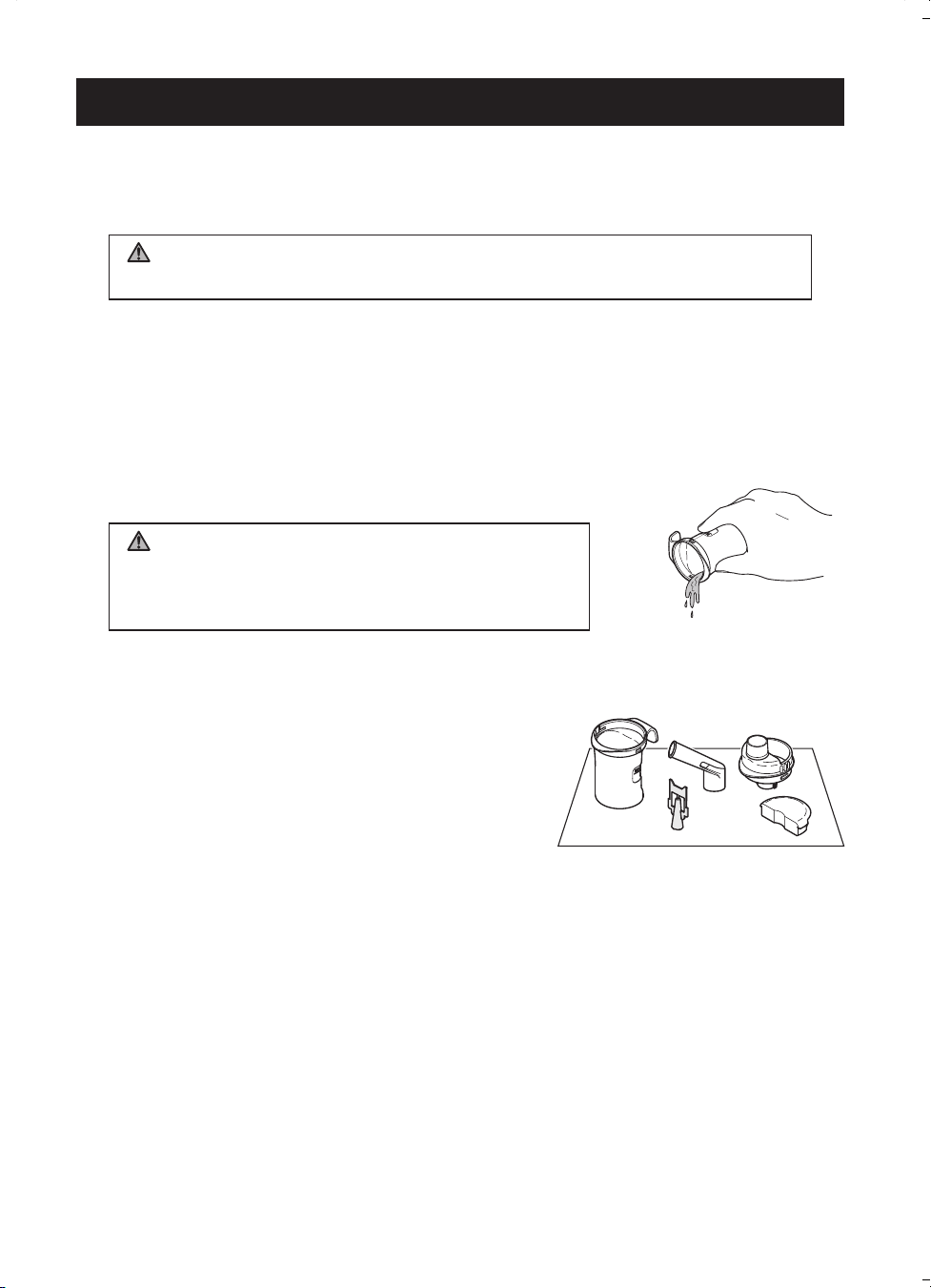
3 Gently twist the inhalation top counterclockwise and lift to separate the
nebulizer into two sections.
4 Discard remaining medication in the medication cup.
WARNING
Always dispose of any remaining medication in the
medication cup after each use. Use fresh medication
each time you use the device.
5 Rinse all the parts with hot tap water.
6 Hand dry or air dry in a clean environment
using a soft, clean, lint-free cloth.
7 Assemble the nebulizer kit and store it in a dry
bag.
Care and Maintenance
CLEANING AFTER EACH USE
19
DAILY DISINFECTING
Disinfect the nebulizer kit and mouthpiece, or optional masks or optional
nosepiece after the last treatment of the day.
To disinfect the parts, use one of the methods described below:
A. Use a commercially available disinfectant. Follow the instructions provided
by the disinfectant manufacturer.
1 Submerge the parts in the cleansing solution for the specified period.
2 Remove the parts and discard the solution.
3 Rinse the parts with clean hot tap water, shake off excess water and allow
to air dry in a clean environment.
B. Parts may be boiled between 15 to 20 minutes.
After boiling, carefully remove the parts, shake off excess water and allow to
air dry in a clean environment.
NOTE: Do not boil air tube, air filter, air filter cover and optional masks.
CAUTION
Do not use an autoclave, EOG gas disinfection or low temperature plasma sterilizer to
disinfect the device.
Handling the Baffle
The baffle is an important part that is used to nebulize medication.
Be sure to observe the following precautions when handling it.
CAUTION
• Always wash the baffle after each use.
• Do not use a brush or pin etc., to clean the parts.
• When disinfecting the parts by boiling, be sure to
boil them in plenty of water.
• Do not boil the baffle together with other objects,
other than applicable nebulizer accessories.
• Do not use a microwave oven, dish dryer or hair
dryer to dry parts.
20
If the air filter has changed color or has been used on average for more than 60
days, replace it with a new one. If water or medication has spilled on the air
filter, replace with a new air filter immediately.
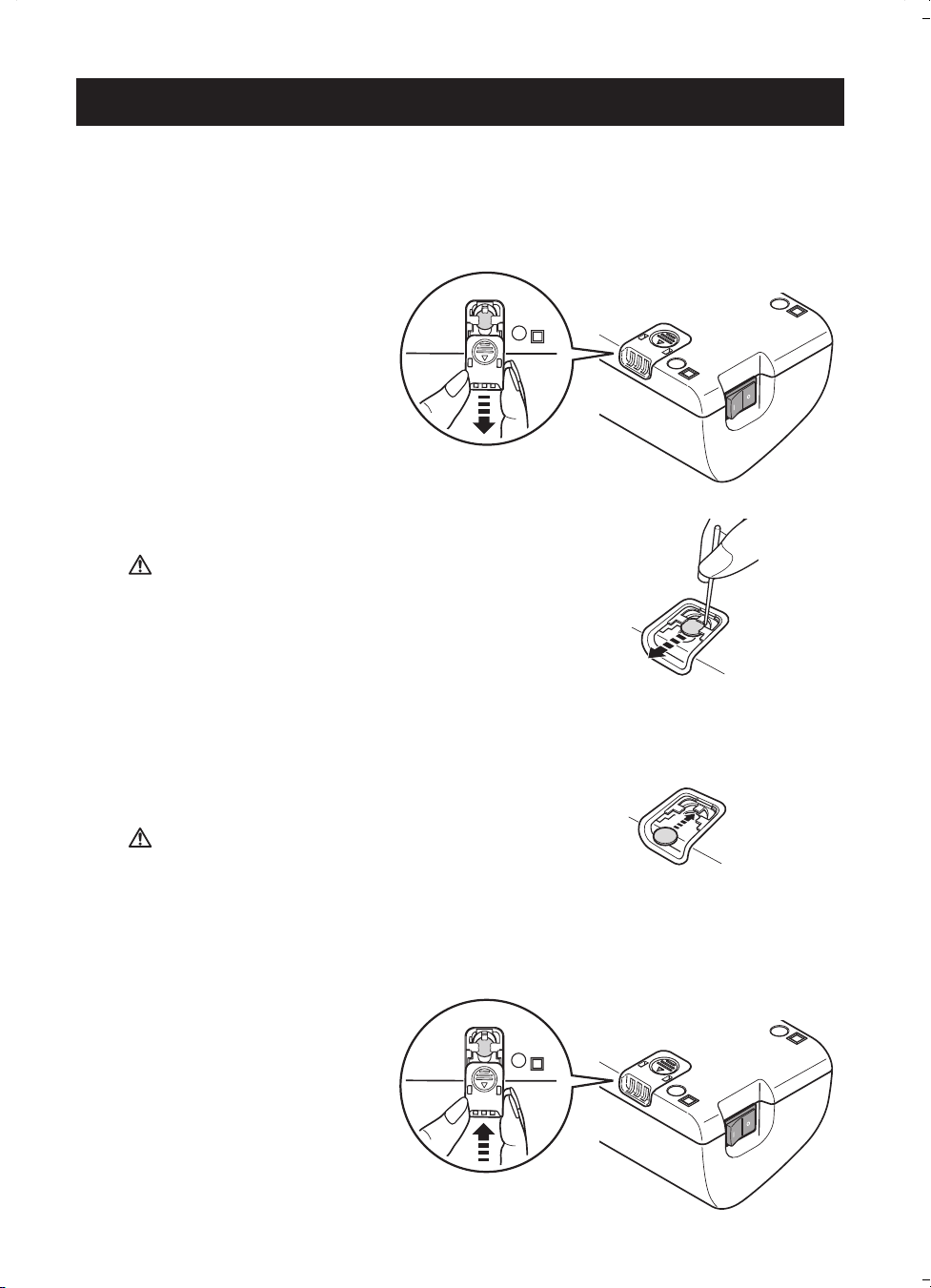
1 Pull the air filter cover to
remove from the back side
of the compressor.
2 Remove the dirty air filter.
CAUTION
• Do not attempt to wash or clean the air filter.
Damp air filters can cause blockages. Do not
substitute cotton or any other material for the air
filter.
• Wash the air filter cover regularly to prevent any
blockage in the cover. Do not boil. Make sure the
cover is dry before inserting the new air filter.
3 Insert a new air filter.
CAUTION
Before inserting the new air filter make sure the air
filter is clean and free of dust. Do not operate the
device without the air filter. Use only the Omron air
filter designed for this device.
4 Put the air filter cover back
on the compressor.
CHANGING THE AIR FILTER
21
To keep your device in the best condition and protect the unit from damage,
follow these directions:
CAUTION
• Do not subject the compressor or any of the components to strong shocks, such
as dropping on the floor.
• Use only Omron authorized parts and accessories. Parts and accessories not
approved for use with the device do not perform the expected specification or it
may damage the unit.
CLEANING THE COMPRESSOR
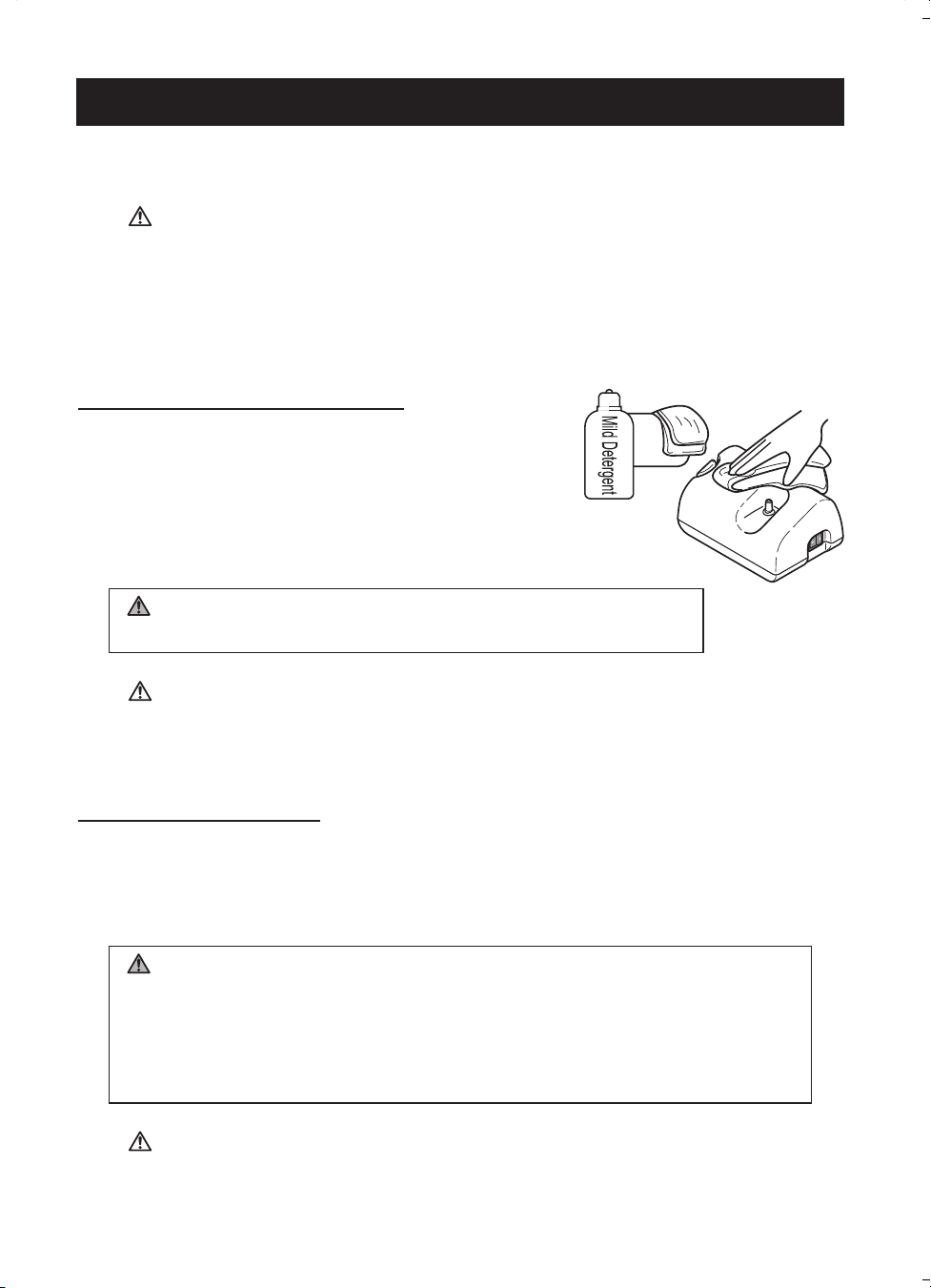
Clean the casing of the main unit by using
a soft cloth moistened with water or a mild
detergent. Do not use abrasive cleaners.
Dry the casing immediately using a soft
clean cloth.
WARNING
Do not immerse the compressor (main unit) in water or other liquid.
CAUTION
• Unplug the AC adapter from the electrical outlet before cleaning the device.
• Do not insert any object into the compressor.
STORING THE DEVICE
Place the compressor, the nebulizer kit and the inhalation accessory (air tube,
mouthpiece, optional masks and optional nosepiece) in the storage bag. Store
it in a safe, clean location.
WARNING
• Do not leave the device or its parts where it will be exposed to extreme
temperatures or changes in humidity, such as leaving the device in a vehicle
during warm or hot months, or where it will be exposed to direct sunlight.
• Keep the device out of the reach of unsupervised infants and children. The
device may contain small parts that can be swallowed.
CAUTION
• Do not carry or leave the nebulizer kit with medication in the medication cup.
• Do not wrap the power cord around the compressor (main unit).
CARING FOR THE DEVICE
22
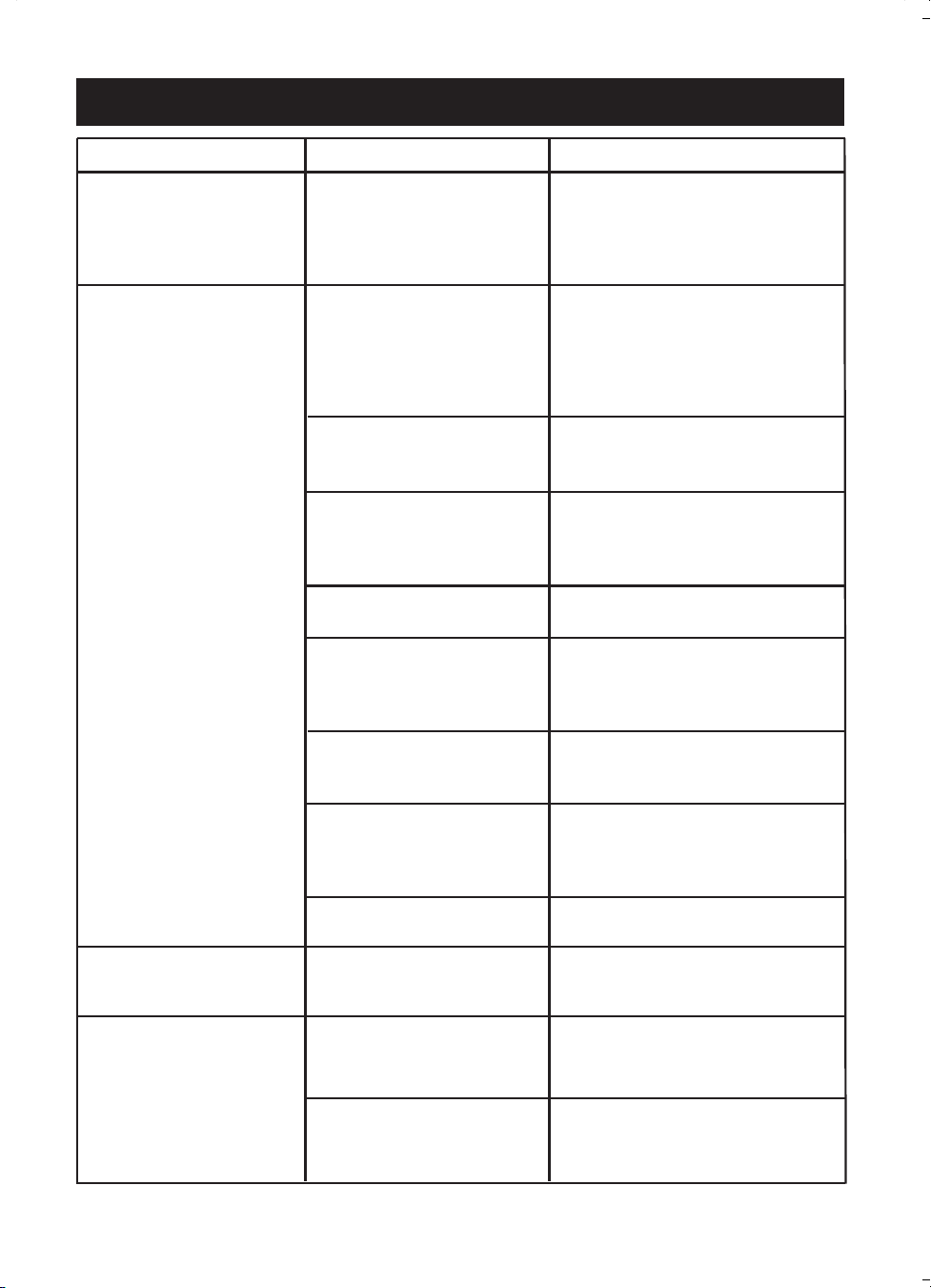
SOLUTION
CAUSE
PROBLEM
No power to unit when
the power switch is on.
Turn the power switch off.
Plug the AC adapter into an
electrical outlet. Turn the device
on.
No nebulization or low
nebulization rate when
the power is on.
The AC adapter is not
plugged into an electrical
outlet.
No medication in the
medication cup.
Too much or too little
medication in the
medication cup.
The baffle is not attached
to the inhalation top or
incorrectly positioned.
The nebulizer kit is not
correctly assembled.
The nozzle is blocked.
The nebulizer kit is tilted at
an incorrect angle.
The device is abnormally
loud.
The air tube is incorrectly
attached.
The air tube is folded
or damaged.
The air tube is blocked.
The air filter is dirty.
The air filter cover is
incorrectly attached.
The compressor
is covered.
Do not cover the compressor with
any type of cover during use.
Attach the air filter cover correctly.
Make sure the air filter cover is
not blocked.
Replace the air filter with a new
clean air filter.
Make sure the air tube is not
folded, kinked or bent. Inspect the
air tube for any damage. Replace
the air tube if damaged.
Make sure the air tube is correctly
attached to the compressor and the
nebulizer kit.
Hold the nebulizer kit correctly.
Do not tilt the nebulizer kit so the
angle of the kit is greater than 45
degrees.
Clean and disinfect the nebulizer kit
to remove the blockage.
Make sure the nebulizer kit is
correctly assembled and the
inhalation accessory is correctly
attached.
Make sure the baffle is correctly
attached to the inhalation top.
Add the correct amount of
prescribed medication to the
medication cup.
Troubleshooting
TROUBLESHOOTING GUIDE
The device is very hot.
Operating continuously over
20 minutes.
Limit use to 20 minutes at a time
and allow a 40 minutes interval
before using the device again.

23
Your OMRON NE-C801 Compressor Nebulizer, excluding the nebulizer kit, inhalation accessories, air
tube and air filters, is warranted to be free from defects in materials and workmanship appearing within
3 years from the date of purchase, when used in accordance with the instructions provided with the
compressor nebulizer. The above warranties extend only to the original retail purchaser.
We will, at our option, repair or replace without charge any compressor nebulizer covered by the above
warranties. Repair or replacement is our only responsibility and your only remedy under the above
warranties.
To obtain warranty service contact Customer Service by calling 1-800-634-4350 for the address of the
repair location and the return shipping and handling fee.
Enclose the Proof of Purchase. Include a letter, with your name, address, phone number, and description
of the specific problem. Pack the product carefully to prevent damage in transit. Because of possible loss
in transit, we recommend insuring the product with return receipt requested.
THE FOREGOING IS THE SOLE WARRANTY PROVIDED BY OMRON IN CONNECTION
WITH THIS PRODUCT, AND OMRON HEREBY DISCLAIMS ANY OTHER WARRANTIES,
EXPRESS OR IMPLIED, INCLUDING IMPLIED WARRANTIES OF MERCHANTABILITY
AND FITNESS FOR A PARTICULAR PURPOSE. IMPLIED WARRANTIES AND OTHER
TERMS THAT MAY BE IMPOSED BY LAW, IF ANY, ARE LIMITED IN DURATION TO
THE PERIOD OF THE ABOVE EXPRESS WARRANTY.
OMRON SHALL NOT BE LIABLE FOR LOSS OF USE OR ANY OTHER SPECIAL,
INCIDENTAL, CONSEQUENTIAL OR INDIRECT COSTS, EXPENSES OR DAMAGES.
This warranty provides you with specific legal rights, and you may have other rights that vary by
jurisdiction. Because of special local requirements, some of the above limitations and exclusions may not
apply to you.
LIMITED WARRANTY

24
NOTE: POTENTIAL FOR RADIO/TELEVISION INTERFERENCE (for U.S.A. only)
This product has been tested and found to comply with the limits for a Class B digital device,
pursuant to part 15 of the FCC rules.
These limits are designed to provide reasonable protection against harmful interference in a
residential installation. The product generates, uses, and can radiate radio frequency energy and, if
not installed and used in accordance with the instructions, may cause harmful interference to radio
communications.
However, there is no guarantee that interference will not occur in a particular installation. If the
product does cause harmful interference to radio or television reception, which can be determined
by turning the product on and off, the user is encouraged to try to correct the interference by one or
more of the following measures:
• Reorient or relocate the receiving antenna.
• Increase the separation between the product and the receiver.
• Connect the product into an outlet on a circuit different from that to which the receiver is
connected.
• Consult the dealer or an experienced radio/TV technician for help.
POTENTIAL FOR RADIO/TELEVISION INTERFERENCE (for Canada only)
This digital apparatus does not exceed the Class B limits for radio noise emissions from digital
apparatus as set out in the interference-causing equipment standard entitled “Digital Apparatus”,
ICES-003 of the Canadian Department of Communications.
Cet appareil numérique respecte les limites de bruits radioeléctriques applicables aux appareils
numériques de Clase B prescrites dans la norme sur le materiel brouilleur: “Appareils
Numériques”, ICES-003 édictée par le minister des communications.
Changes or modifications not expressly approved by the party responsible for compliance could
void the user’s authority to operate the equipment.
FCC STATEMENT
25
Model: NE-C801 (NE-C801S-Z)
Type: Compressor nebulizer
Rating (AC adapter): 100 - 240V ~ 350mA, 50/60 Hz
Rating (Compressor Nebulizer): 12V
0.8A
Nebulization Rate: Approx. 0.3 mL/min (without cap)
Particle Size: *MMAD approx. 3 μm (based on EN13544-1:2007)
Medication Cup Capacity: 7 mL (cc) max.
Appropriate Medication 2 mL - 7 mL (cc)
Quantities:
Operating Condition: Intermittent operation 20 min. ON/40 min. OFF
Operating Temperature/ +10°C to +40°C (+50°F to +104°F), 30% to 85% RH
Humidity:
Storage Temperature/ –20°C to +60°C (–4°F to +140°F), 10% to 95% RH
Humidity/Air Pressure: 700 hPa to 1060 hPa
Weight: Approx. 9.5 oz. (270 g) (compressor only)
Dimensions: Approx. 5 5/8" (w) × 2 7/8" (h) × 3 7/8" (d)
(142 mm × 72 mm × 98 mm)
Contents: Compressor, Nebulizer Kit, Air Tube (PVC, 100 cm),
Mouthpiece, Air Filters (Package of 5), AC Adapter, Storage
Bag and Instruction Manual.
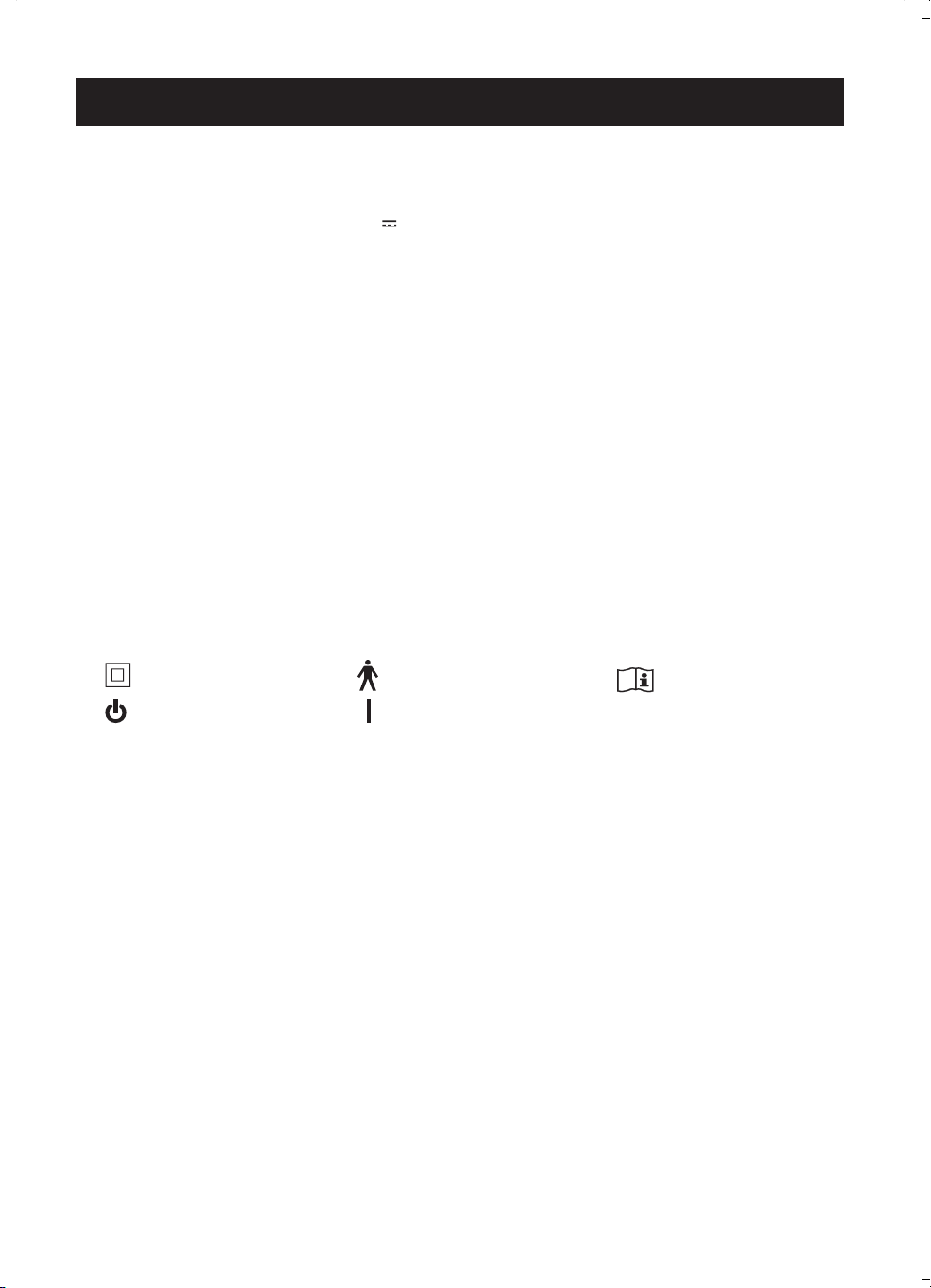
Classification: Class II equipment, Type B applied part
*MMAD = Mass Median Aerodynamic Diameter
= Class II equipment
= Type B applied part
SPECIFICATIONS
= No operation = Power on
Read the instruction
manual carefully
NOTES:
• Subject to technical modification without prior notice.
• Please note that nebulization rate and particle size may vary with medication type used.
• Parts and accessories not approved for use do not meet these specifications.
• Do not use the device where it may be exposed to flammable gas.
• This unit conforms to EMC Standard IEC60601-1-2. However, if it is used together with other
medical devices or electrical equipment, they may influence the operations of one of devices.
Please follow any instructions in the manuals and use all devices correctly.
• With respect to electric shock and mechanical hazards only in accordance with IEC60601-1.
26
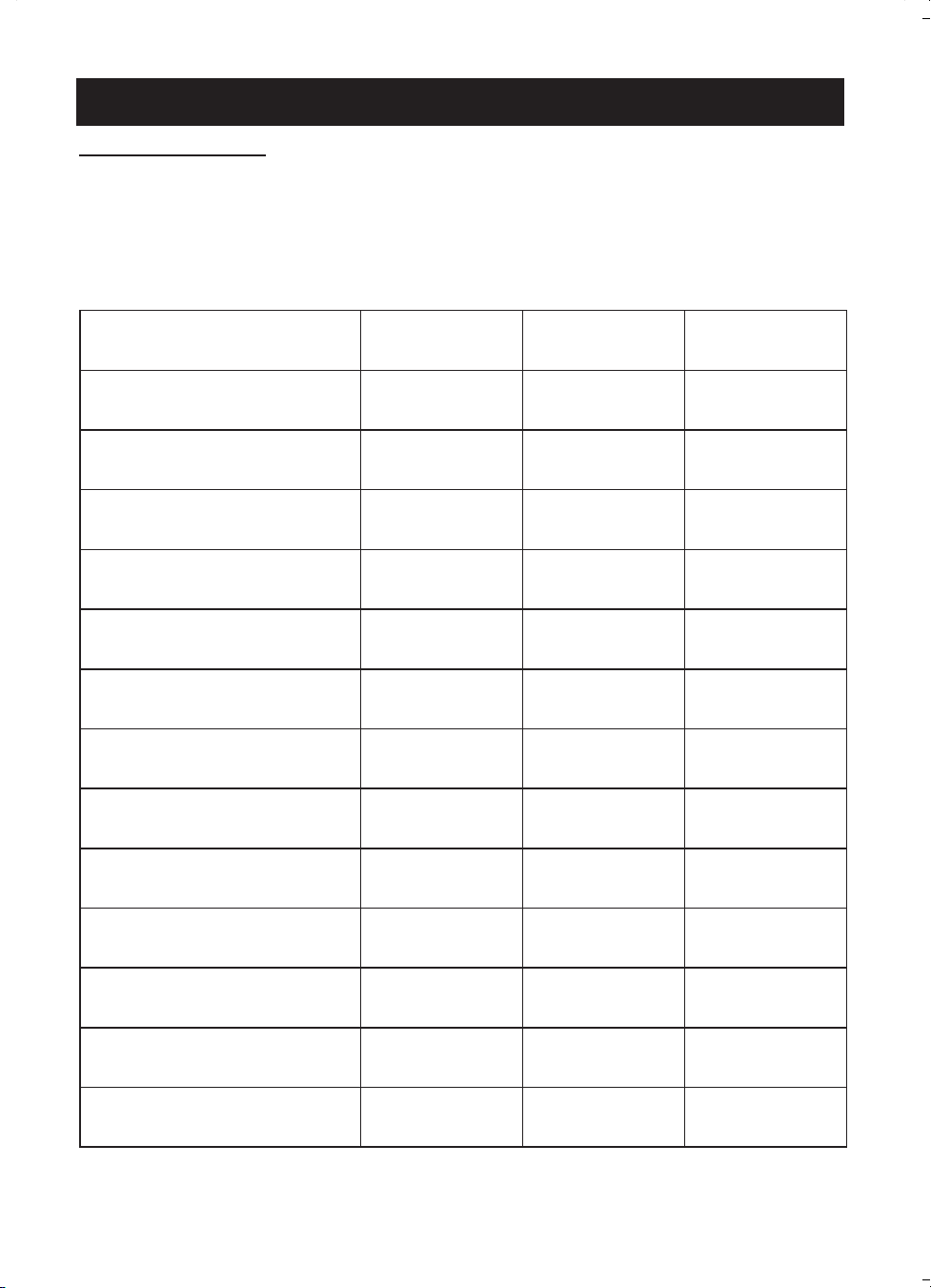
Particle Specifications
A series of aerosol performance tests were performed using an 8 stage cascade impactor at a
sampling flow rate of 15 l/min equipped with a USP <601> induction port throat. Aerosol was
sampled directly from the outlet. Three (3) device samples were tested with 3 runs each, for a total
of 9 sample points per each drug.
The specifications are listed below with intervals given for a 95% confidence level.
Mean / Std. Dev
Pulmicort
®
(250μg/mL)
Intal
®
(10mg/mL)
Salbutamol
®
(5mg/mL)
Total Delivered Dose (μg) 391.11 ± 16.51 12368.89 ± 269.61 7883.33 ± 116.96
Total Delivered Dose Fraction (%)
78.2% ± 3.3% 61.8% ± 3.1% 77.0% ± 2.5%
Particle size (MMAD) μm
3.88 ± 0.28 2.91 ± 0.14 2.54 ± 0.28
Geometric Standard Deviation
1.93 ± 0.20 2.27 ± 0.02 2.62 ± 0.03
Respirable Fraction (0.5-5μm) 61.9% ± 4.0% 70.5% ± 1.3% 66.4% ± 1.6%
Total Respirable Dose
(μg between 0.5-5μm)
242.17 ± 18.90 8729.49 ± 497.57 5235.02 ± 233.61
Medication Captured on USP Throat
13.34 ± 3.40 253.66 ± 27.42 144.94 ± 16.32
Medication Captured on USP
Throat Fraction (%)
3.4% ± 0.4% 2.0% ± 0.1% 1.8% ± 0.1%
Medication Retained in Device 96.11
±
9.61 8000.00
±
438.21 2072.22
±
257.90
Medication Retained in Device
Fraction (%)
19.2% ± 1.9% 40% ± 2.2% 41.4% ± 5.2%
Coarse Particle Fraction (%) (>4.7μm) 37.1% ± 2.9% 27.7% ± 1.5% 26.6% ± 2.3%
Fine Particle Fraction (%) (<4.7μm) 59.6% ± 3.5% 70.2% ± 1.5%
71.6% ± 2.3%
Ultra-Fine Particle Fraction (%)
(<1.0μm)
3.5% ± 1.7% 8.9% ± 2.1%
16.9% ± 5.3%
NOTE: Course particles (oro-pharyngeal deposition) and ultra-fine particles (exhaled) are not likely
to deposit in the patient’s airway and thus provide limited clinical benefit.
TECHNICAL DATA
27
Important information regarding Electro Magnetic Compatibility (EMC)
With the increased number of electronic devices such as PC’s and mobile (cellular) telephones,
medical devices in use may be susceptible to electromagnetic interference from other devices.
Electromagnetic interference may result in incorrect operation of the medical device and create a
potentially unsafe situation.
Medical devices should also not interfere with other devices.
In order to regulate the requirements for EMC (Electro Magnetic Compatibility) with the aim
to prevent unsafe product situations, the IEC60601-1-2 standard has been implemented. This
standard defines the levels of immunity to electromagnetic interferences as well as maximum
levels of electromagnetic emissions for medical devices.
Medical devices manufactured by OMRON HEALTHCARE conform to this
IEC60601-1-2 standard for both immunity and emissions.
Nevertheless, special precautions need to be observed:
• The use of accessories and cables other than those specied by OMRON, with the exception of
cables sold by OMRON as replacement parts for internal components, may result in increased
emission or decreased immunity of the device.
• The medical devices should not be used adjacent to or stacked with other equipment.
In case adjacent or stacked use is necessary, the medical device should be observed to verify
normal operation in the conguration in which it will be used.
• Do not use mobile (cellular) telephones and other devices, which generate strong electrical or
electromagnetic elds, near the medical device. This may result in incorrect operation of the
unit and create a potentially unsafe situation. Recommendation is to keep a minimum distance
of 7 m. Verify correct operation of the device in case the distance is shorter.
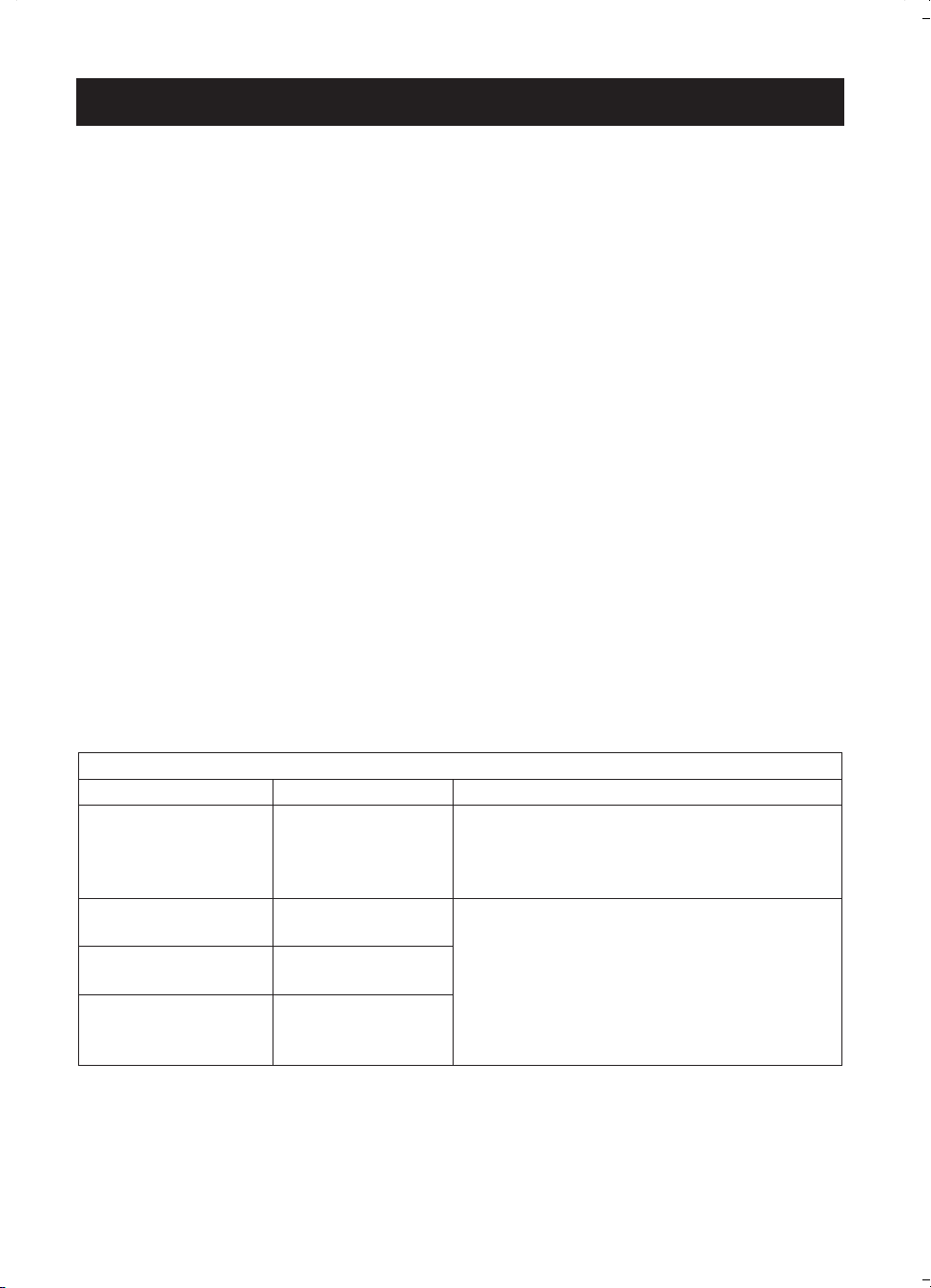
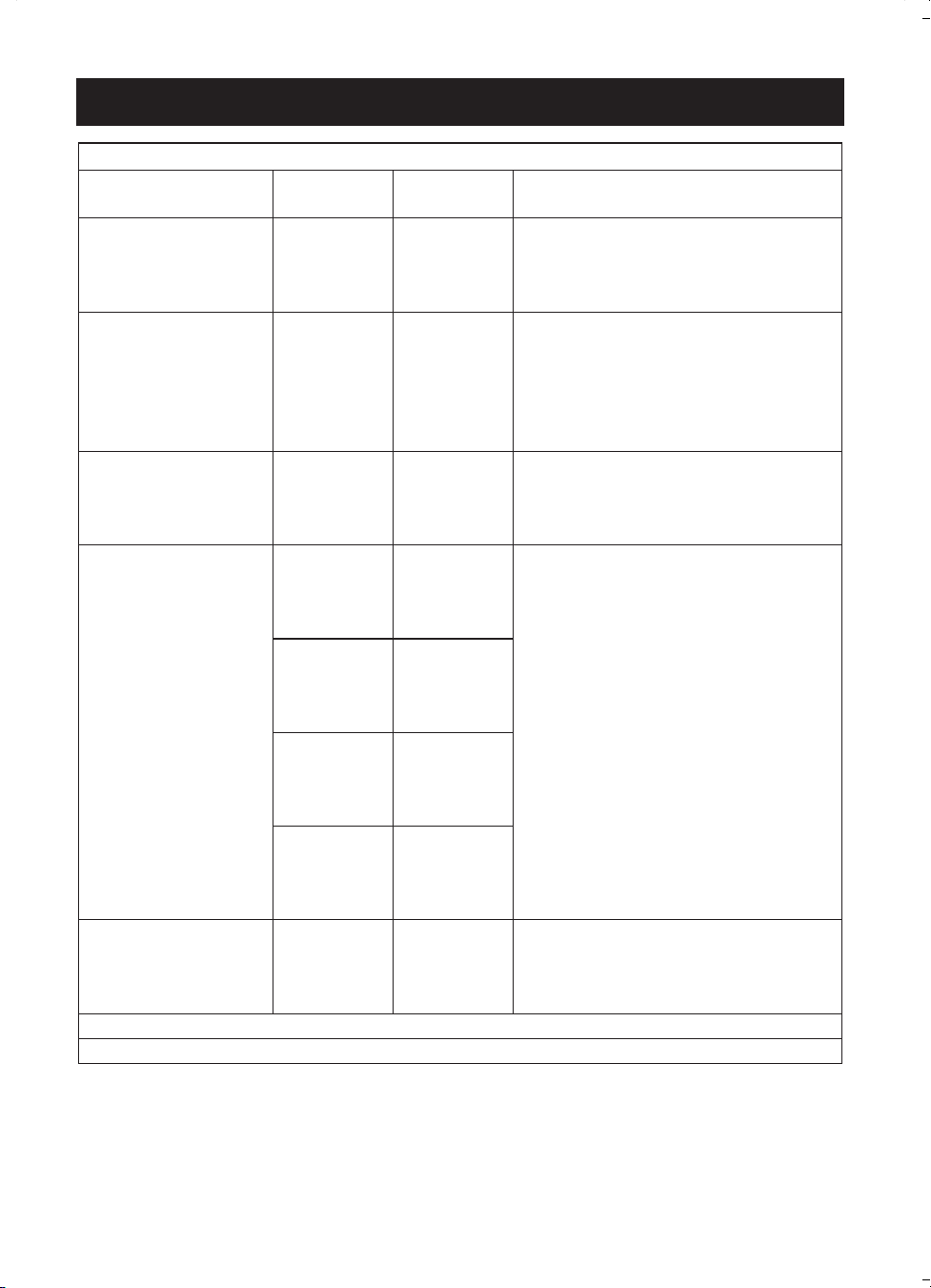
The NE-C801 is intended for use in the electromagnetic environment specified below. The
customer or the user of the NE-C801 should assure that it is used in such environment.
Electromagnetic emissions IEC60601-1-2
Emissions test Compliance Electromagnetic environment - guidance
RF emissions
CISPR 11
Group 1
The NE-C801 uses RF energy only for its
internal function. Therefore, its RF emissions
are very low and are not likely to cause any
interference in nearby electronic equipment.
RF emissions
CISPR 11
Class B
The NE-C801 is suitable for use in all
establishments, including domestic
establishments and those directly connected to
the public low-voltage power supply network
that supplies buildings used for domestic
purposes.
Harmonic emissions
IEC 61000-3-2
Class A
Voltage fluctuations/
flicker emissions
IEC 61000-3-3
Complies
GUIDANCE AND MANUFACTURER'S DECLARATION
28
Electromagnetic immunity IEC60601-1-2
Immunity test
IEC 60601
Test level
Compliance
level
Electromagnetic environment –
guidance
Electrostatic
discharge (ESD)
IEC 61000-4-2
±6 kV
contact
±8 kV air
±6 kV
contact
±8 kV air
Floor should be wood, concrete, or
ceramic tile. If floors are covered
with synthetic material, the relative
humidity should be at least 30 %.
Electrical fast
transient/burst
IEC 61000-4-4
±2 kV
for power
supply lines
±1 kV for
input/output
lines
±2 kV
for power
supply lines
*
1)
Mains power quality should be that of
a typical commercial and/or hospital
environment.
Surge
IEC 61000-4-5
±1 kV line
to line
±2 kV line
to earth
±1 kV line
to line
±2 kV line
to earth
Mains power quality should be that of
a typical commercial and/or hospital
environment.
Voltage dips, short
interruptions and
voltage variations on
power supply
IEC 61000-4-11
<5 % U
T
(>95 % dip
in U
T
) for
0.5 cycle
<5 % U
T
(>95 % dip
in U
T
) for
0.5 cycle
Mains power quality should be that of
a typical commercial and/or hospital
environment.
If the user of the NE-C801 requires
continued operation during power
mains interruption, it is recommended
that the NE-C801 be powered from
an uninterruptible power supply or
battery.
40 % U
T
(60 % dip
in U
T
) for 5
cycles
40 % U
T
(60 % dip
in U
T
) for 5
cycles
70 % U
T
(30 % dip in
U
T
) for 25
cycles
70 % U
T
(30 % dip in
U
T
) for 25
cycles
<5 % U
T
(95 % dip
in U
T
) for 5
sec.
<5 % U
T
(95 % dip
in U
T
) for 5
sec.
Power frequency
(50/ 60 Hz) magnetic
field
IEC 61000-4-8
3 A/m 3 A/m
Power frequency magnetic fields
should be at levels characteristic
of a typical location in a typical
commercial or hospital environment.
Note: U
T
is the A.C. mains voltage prior to application of the test level.
*
1)
The test of input/output lines is not applicable since they are shorter than 3.0m.
GUIDANCE AND MANUFACTURER'S DECLARATION
29
Electromagnetic immunity IEC60601-1-2
Immunity test
IEC 60601
Test level
Compliance
level
Electromagnetic environment –
guidance
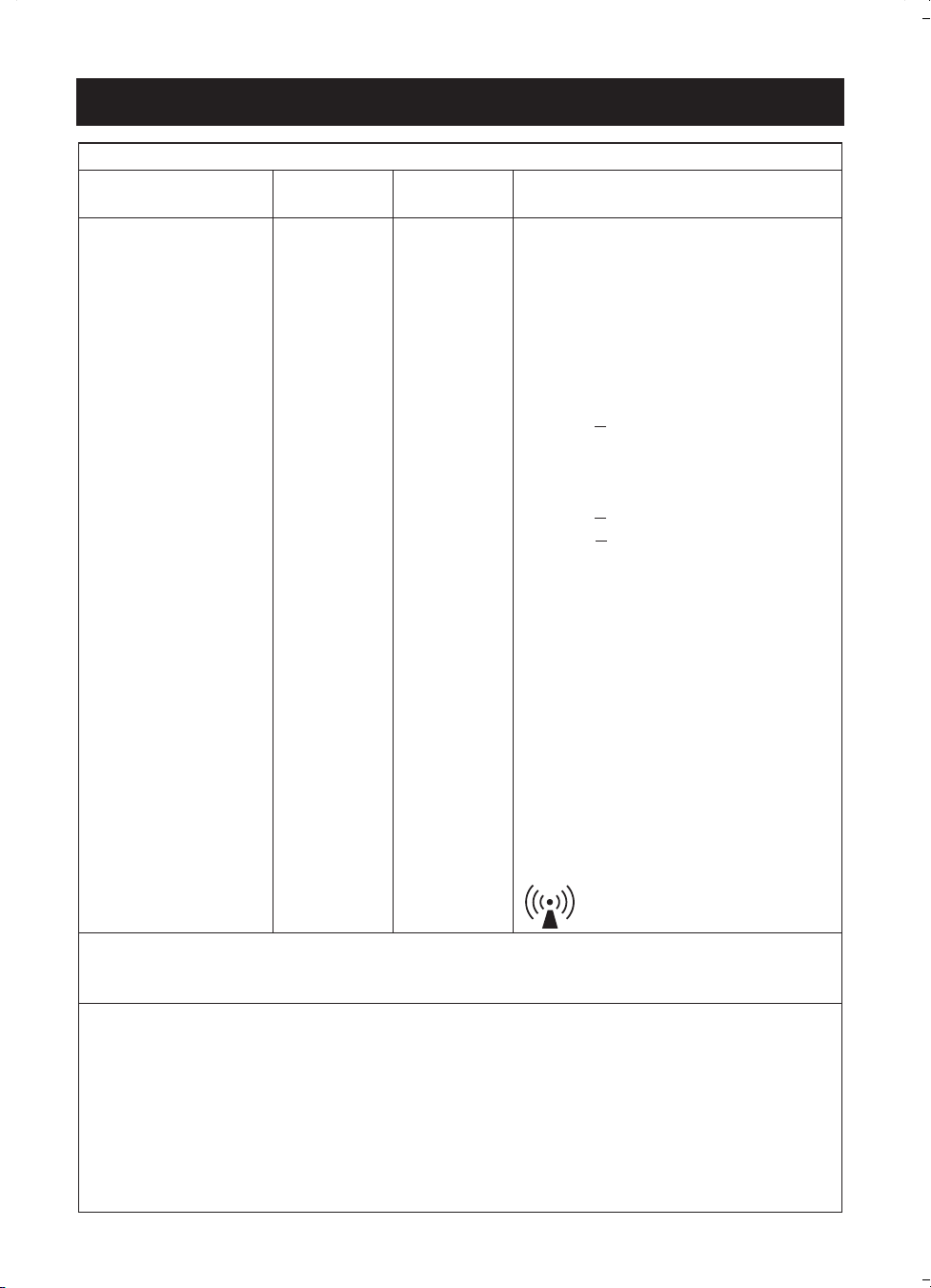
Conducted RF
IEC 61000-4-6
Radiated RF
IEC 61000-4-3
3 V rms
150 kHz ~
80 MHz
3 V/m
80 MHz to
2.5 GHz
3 V rms
3 V/m
Portable and mobile RF
communications equipment should
be used no closer to any part of
the NE-C801 including cables,
than the recommended separation
distance calculated from the equation
appropriate to the frequency of the
transmitter.
Recommend separation distance
d = 1.2 √P
d = 1.2 √P 80 MHz to 800 MHz
d = 2.3 √P 800 MHz to 2.5 GHz
where P is the maximum output
power rating of the transmitter
in watts (W) according to the
transmitter manufacturer and d is the
recommended separation distance in
meters (m).
Field strengths from fixed RF
transmitters as determined by an
electromagnetic site survey,*
2)
should
be less than the compliance level in
each frequency range.*
3)
Interference may occur in the
vicinity of equipment marked with he
following symbol:
Note1: At 80 MHz and 800 MHz, the higher frequency range applies.
Note2: These guidelines may not apply in all situations. Electromagnetic propagation is affected
by absorption and reflection from structures, objects, and people.
*
2)
Field strengths from fixed transmitters, such as base stations for radio (cellular/ cordless)
telephones and land mobile radio, AM and FM radio broadcast, and TV broadcast cannot be
predicted theoretically with accuracy. To assess the electromagnetic environment due to fixed
RF transmitters, an electromagnetic site survey should be considered. If the measured field
strength in the location in which the NE-C801 is used exceeds the applicable RF compliance
level above, the NE-C801 should be observed to verify normal operation. If abnormal
performance is observed, additional measures may be necessary, such as reorienting or
relocating the NE-C801.
*
3)
Over the frequency range 150 kHz to 80 MHz, field strengths should be less than 3 V/m.
GUIDANCE AND MANUFACTURER'S DECLARATION
30
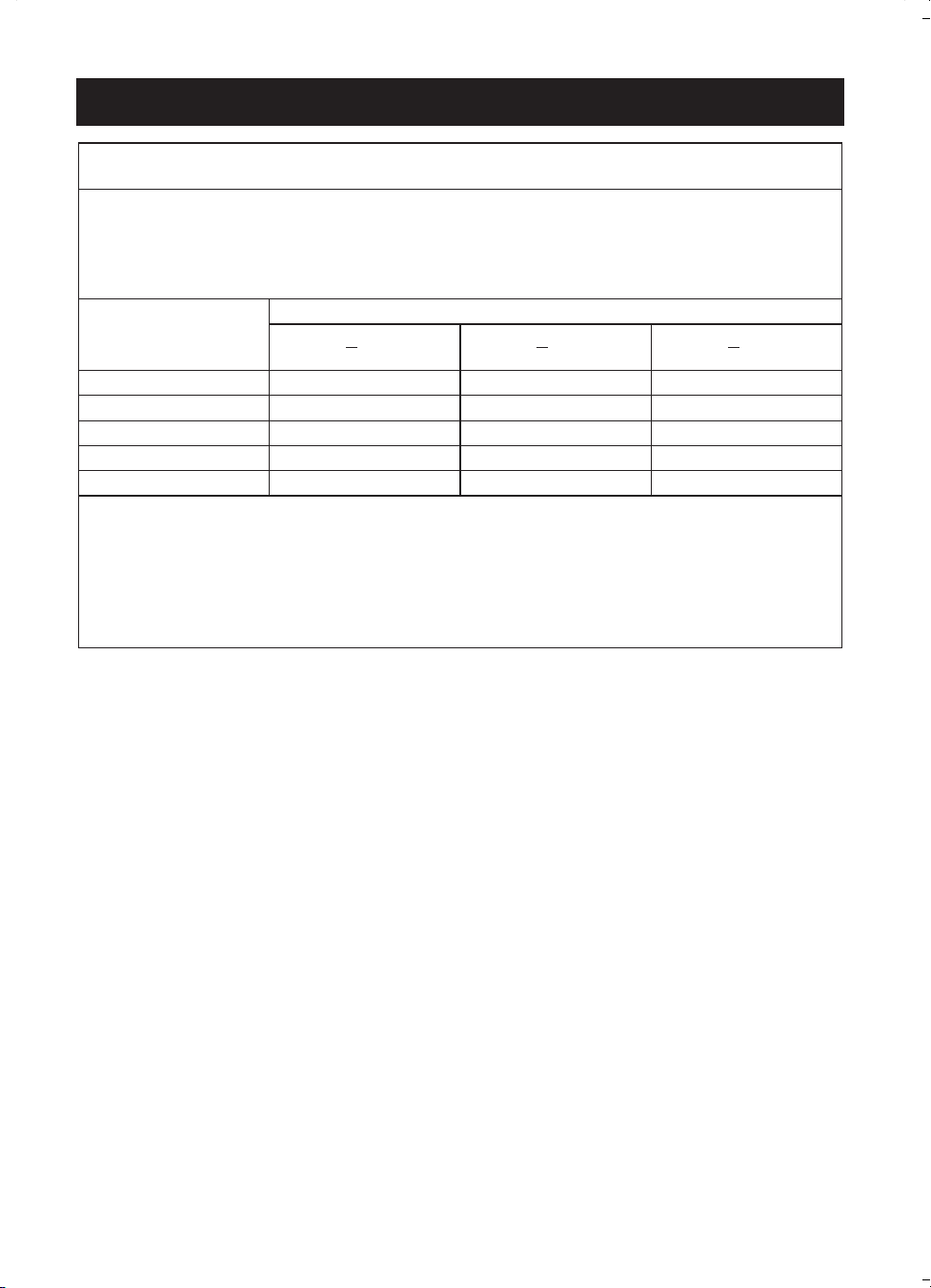
Recommended separation distance between portable and mobile RF communications
equipment and the NE-C801
The NE-C801 is intended for use in an electromagnetic environment in which radiated RF
disturbances are controlled. The customers or the users of the NE-C801 can help prevent
electromagnetic interference by maintaining a minimum distance between portable and mobile
RF communications equipment (transmitters) and the NE-C801 as recommended below,
according to the maximum output power of the communications equipment.
Output Power of
Transmitter in Watt
Separation distance according to frequency of transmitter in meter
150 kHz to 80 MHz
d = 1.2 √P
80 kHz to 800 MHz
d = 1.2 √P
800 MHz to 2.5GHz
d = 2.3 √P
0.01 0.12 0.12 0.23
0.1 0.38 0.38 0.73
1 1.2 1.2 2.3
10 3.8 3.8 7.3
100 12 12 23
For transmitters rated at a maximum output power not listed above, the recommended
separation distance d in meters (m) can be estimated using the equation applicable to the
frequency of the transmitter, where P is the maximum output power rating of the transmitter
in watts (W) according to the transmitter manufacturer.
Note: At 80MHz and 800MHz, the separation distance for the higher frequency range applies
Note: These guidelines may not apply in all situations. Electromagnetic propagation is
affected by absorption and reflection from structures, objects, and people.
EMC tests have included the AC adapter as included with the product.
GUIDANCE AND MANUFACTURER'S DECLARATION