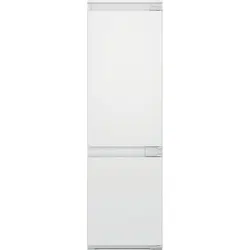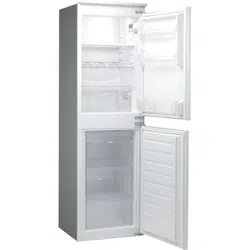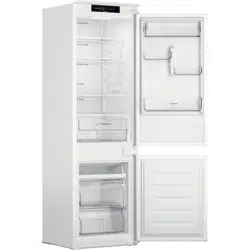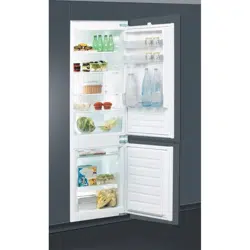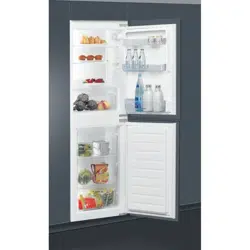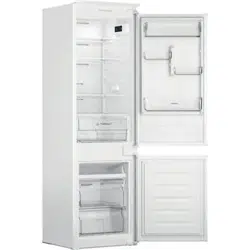
Built-in Fridge - Freezer / User ManualEN
EN - 2
Thank you for choosing this product.
This user manual contains important information on safety and instructions intended to
assist you in the operation and maintenance of your appliance.
Please take the time to read this user manual before using your appliance and keep this
book for future reference.
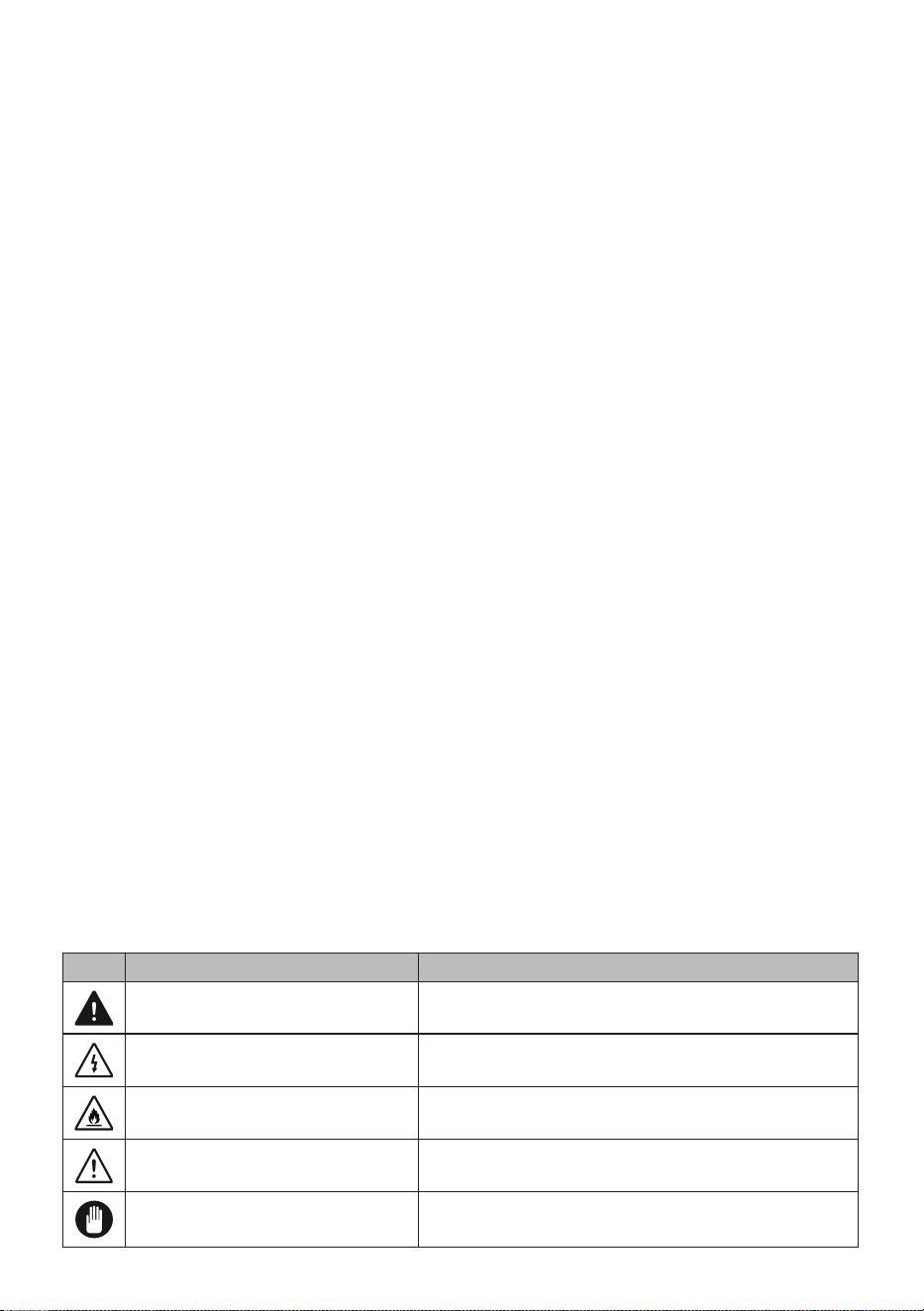
Icon Type Meaning
WARNING Serious injury or death risk
RISK OF ELECTRIC SHOCK Dangerous voltage risk
FIRE Warning; Risk of fire / flammable materials
CAUTION Injury or property damage risk
IMPORTANT Operating the system correctly

EN - 3
CONTENTS
1 SAFETY INSTRUCTIONS ............................................................................... 4
1.1 IMPORTANT TO BE READ AND OBSERVED. ..............................................................4
2 DESCRIPTION OF THE APPLIANCE .......................................................... 15
2.1 Dimensions ...................................................................................................................16
3 USING THE APPLIANCE .............................................................................. 17
3.1 Information on Less Frost Technology ..........................................................................17
3.2 Thermostat Setting .......................................................................................................17
3.3 Temperature Settings Warnings ...................................................................................17
3.4 Accessories ..................................................................................................................18
3.4.1 Ice Tray (In some models) .......................................................................................18
3.4.2 The Bottle Holder (In some models) ........................................................................18
3.4.3 The Freezer Box ........................................................................................................18
3.4.4 The Fresh Dial (In some models) ............................................................................19
4 FOOD STORAGE ........................................................................................... 19
4.1 Refrigerator Compartment ............................................................................................19
4.2 Freezer Compartment ..................................................................................................20
5 CLEANING AND MAINTENANCE ................................................................ 23
5.1 Defrosting .....................................................................................................................23
6 SHIPMENT AND REPOSITIONING .............................................................. 24
6.1 Transportation and Changing Positioning ....................................................................24
7 BEFORE CALLING AFTER-SALES SERVICE ........................................... 24
8 TIPS FOR SAVING ENERGY ........................................................................ 26
9 TECHNICAL DATA ......................................................................................... 26
10 INFORMATION FOR TEST INSTITUTES .................................................. 27
11 CUSTOMER CARE AND SERVICE ............................................................ 27
EN - 4
1 SAFETY INSTRUCTIONS
1.1 IMPORTANT TO BE READ AND OBSERVED.
Before using the appliance, read these safety
instructions. Keep them nearby for future reference.
These instructions and the appliance itself provide
important safety warnings, to be observed at all times.
The manufacturer declines any liability for failure to
observe these safety instructions, for inappropriate
use of the appliance or incorrect setting of controls.
Very young children (0-3 years) should be kept
away from the appliance. Young children (3-8 years)
should be kept away from the appliance unless
continuously supervised. Children from 8 years old
and above and persons with reduced physical,
sensory or mental capabilities or lack of experience
and knowledge can use this appliance only if they are
supervised or have been given instructions on safe
use and understand the hazards involved. Children
must not play with the appliance. Cleaning and user
maintenance must not be carried out by children
without supervision.
Children aged from 3 to 8 years are allowed to load
and unload refrigerating appliances.
PERMITTED USE
CAUTION: The appliance is not intended to be
operated by means of an external switching device,
such as a timer, or separate remote controlled system.
This appliance is intended to be used in household
and similar applications such as: sta kitchen areas in
EN - 5
shops, oces and other working environments; farm
houses; by clients in hotels, motels, bed & breakfast
and other residential environments.
This appliance is not for professional use. Do not
use the appliance outdoors.
The bulb used inside the appliance is specically
designed for domestic appliances and is not suitable
for general room lighting within the home (EC
Regulation 244/2009).
The appliance is designed for operation in places
where the ambient temperature comes within the
following ranges, according to the climatic class given
on the rating plate. The appliance may not work
properly if it is left for a long time at a temperature
outside the specied range.
Climatic class ambient temperatures:
SN: From 10°C to 32°C ;
N: From 16°C to 32°C;
ST: From 16°C to 38°C ;
T: From 16°C to 43°C;
This appliance does not contain CFCs. The
refrigerant circuit contains R600a (HC).
Appliances with Isobutane (R600a):
isobutane is a natural gas without environmental
impact, but is ammable.
Therefore, make sure the refrigerant circuit pipes
are not damaged, especially when emptying the
refrigerant circuit.
EN - 6
WARNING: Do not damage the appliance
refrigerant circuit pipes.
WARNING: Keep ventilation openings, in the
appliance enclosure or in the built-in structure, clear of
obstruction.
WARNING: Do not use mechanical, electric or
chemical means other than those recommended by
the Manufacturer to speed up the defrost process.
WARNING: Do not use or place electrical devices
inside the appliance compartments if they are not of
the type expressly authorised by the Manufacturer.
WARNING: Ice makers and/or water dispensers not
directly connected to the water supply must be lled
with potable water only.
WARNING: Automatic ice-makers and/or water
dispensers must be connected to a water supply that
delivers potable water only, with mains water pressure
between 0.17 and 0.81 MPa (1.7 and 8.1 bar).
Do not store explosive substances such as aerosol
cans and do not place or use gasoline or other
ammable materials in or near the appliance.
Do not swallow the contents (non-toxic) of the ice
packs (provided with some models). Do not eat ice
cubes or ice lollies immediately after taking them out
of the freezer since they may cause cold burns.
For products designed to use an air lter inside an
accessible fan cover, the lter must always be in
position when the refrigerator is in function.
EN - 7
Do not store glass containers with liquids in the
freezer compartment since they may break.
Do not obstruct the fan (if included) with food items.
After placing the food check that the door of
compartments closes properly, especially the freezer
door.
Damaged gaskets must be replaced as soon as
possible.
Use the refrigerator compartment only for storing
fresh food and the freezer compartment only for
storing frozen food, freezing fresh food and making ice
cubes.
Do not store unwrapped food in the refrigerator or
freezer compartments to avoid direct contact with
internal surfaces.
Appliances could have special compartments (Fresh
Food Compartment, Zero Degree Box,...).
Unless dierently specied in the specic booklet of
product, they can be removed, maintaining equivalent
performances.
C-Pentane is used as blowing agent in the
insulation foam and it is a ammable gas.
The most appropriate compartments of the appliance
where specic types of food are to be stored, taking
into account dierent temperature distribution in
dierent compartments in the appliance, are as
follows:
- Refrigerator compartment:

EN - 8
1) Upper area of the refrigerator compartment & door
- temperature zone: Store tropical fruit, cans, drinks,
eggs, sauces, pickles, butter, jam
2) Middle area of the refrigerator compartment - cool
zone: Store cheese, milk, dairy food, deli food, yoghurt
3) Lower area of the refrigerator compartment -
coldest zone: Store cold cuts, desserts, meat and sh,
cheesecake, fresh pasta, sour cream, pesto/salsa,
home-cooked food, pastry cream, pudding and cream
cheese
4) Fruit & vegetable drawer at the bottom of the
refrigerator compartment: Store vegetables and fruits
(excluding tropical fruits)
5) Chiller compartment: Only store meat and sh in
the coldest drawer
- Freezer compartment:
4 star zone (****) compartment is suitable for freezing
foodstus from ambient temperature and for storing
frozen food as the temperature is evenly distributed
throughout the entire compartment.
Purchased frozen food has the storage expiration
date stated on the packaging. This date takes into
account the type of food being stored and therefore
this date should be respected. Fresh food should be
stored for the following time periods: 1-3 months for
cheese, shellsh, ice cream, ham/sausage, milk, fresh
liquids; 4 months for steak or chops (beef, lamb, pork);
6 months for butter or margarine, poultry (chicken,
turkey);

EN - 9
8-12 months for fruits (except citrus), roast meat
(beef, pork, lamb), vegetables. Expiration dates on
the packaging of foods in the 2-star zone must be
respected.
To avoid food contamination, please observe the
following:
– Opening the door for long periods can cause
a signicant increase of the temperature in the
compartments of the appliance.
– Regularly clean surfaces that may come into contact
with food and accessible drainage systems.
– Clean water tanks if they have not been used for 48
h; ush the water system connected to a water supply
if water has not been drawn for 5 days.
– Store raw meat and sh in suitable containers in the
refrigerator, so that it does not come into contact with
or drip onto other food.
– Two-star frozen food compartments are suitable for
storing pre-frozen food, storing or making ice cream
and ice cubes.
– Do not freeze fresh food in one, two or three-star
compartments.
– If the refrigerating appliance is left empty for long
periods, switch o, defrost, clean, dry, and leave the
door open to prevent mould developing inside the
appliance.
EN - 10
INSTALLATION
The appliance must be handled and installed by
two or more persons - risk of injury. Use protective
gloves to unpack and install - risk of cuts.
Installation, including water supply (if any), electrical
connections and repairs must be carried out by a
qualied technician. Do not repair or replace any part of
the appliance unless specically stated in the user
manual. Keep children away from the installation site.
After unpacking the appliance, make sure that it has
not been damaged during transport. In the event of
problems, contact the dealer or your nearest After-
sales Service. Once installed, packaging waste
(plastic, styrofoam parts etc.) must be stored out of
reach of children - risk of suocation. The appliance
must be disconnected from the power supply before
any installation operation - risk of electrical shock.
During installation, make sure the appliance does
not damage the power cable - risk of re or electrical
shock. Only activate the appliance when the
installation has been completed.
Be careful not to damage the oors (e.g. parquet)
when moving the appliance. Install the appliance on a
oor or support strong enough to take its weight and in
a place suitable for its size and use. Make sure the
appliance is not near a heat source and that the four
feet are stable and resting on the oor, adjusting them
as required, and check that the appliance is perfectly
level using a spirit level. Wait at least two hours before
EN - 11
switching the appliance on, to ensure that the
refrigerant circuit is fully ecient.
WARNING: When positioning the appliance, ensure
the supply cord is not trapped or damaged.
WARNING: To avoid a hazard due to instability,
positioning or xing of the appliance must be done in
accordance with the manufacturer instructions.
It's forbidden to place the refrigerator in such way that
the metal hose of gas stove, metal gas or water pipes,
or electrical wires are in contact with the refrigerator
back wall (condenser coil). All dimensions and spacing
needed for installation of the appliance are in the
Installation Instruction booklet.
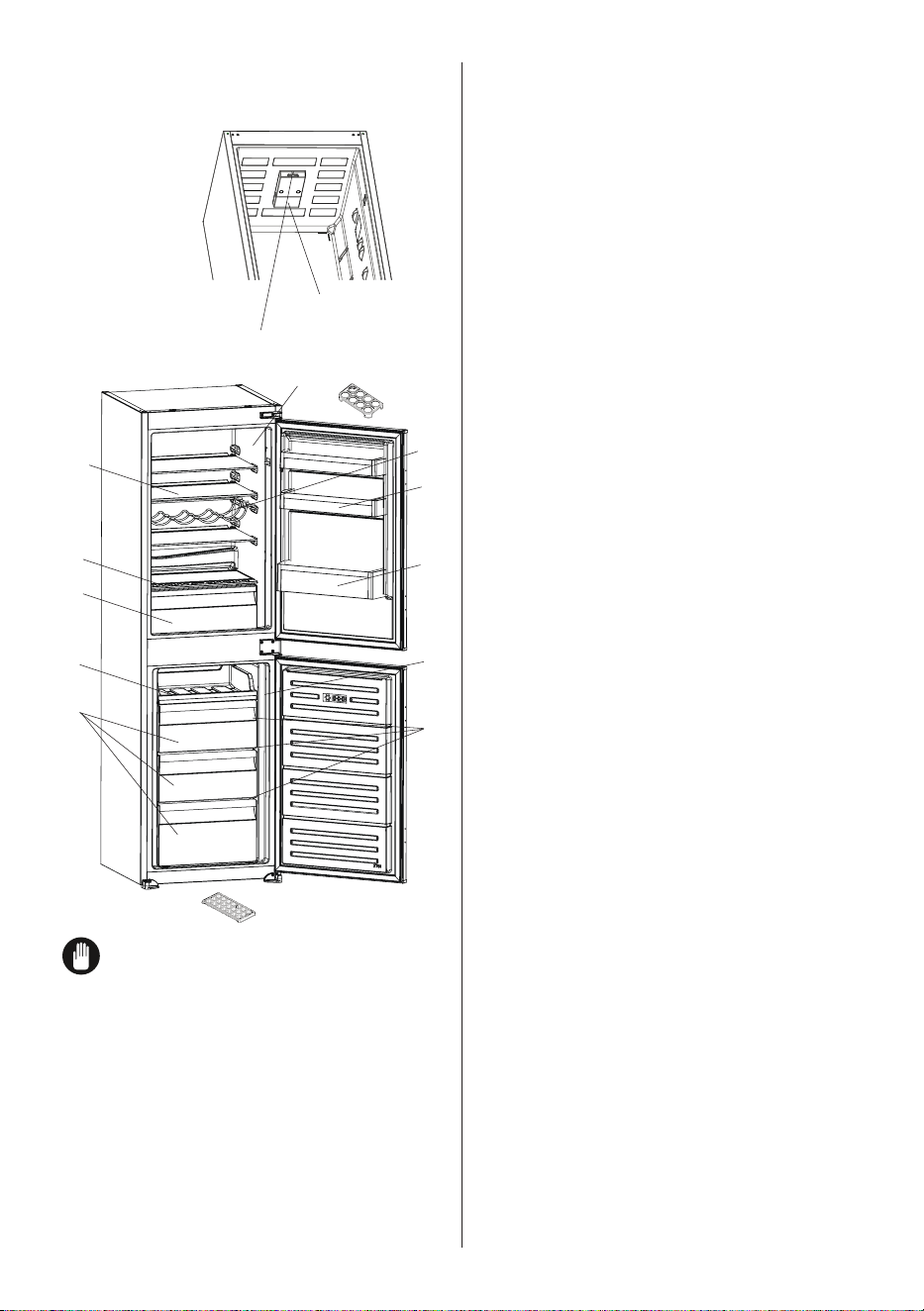
Please remove the power cord from condenser hook
during installation before connecting product to power
supply.
ELECTRICAL WARNINGS
It must be possible to disconnect the appliance
from the power supply by unplugging it if plug is
accessible, or by a multi-pole switch installed
upstream of the socket in accordance with the wiring
rules and the appliance must be earthed in conformity
with national electrical safety standards.
Do not use extension leads, multiple sockets or
adapters. The electrical components must not be
accessible to the user after installation. Do not use the
appliance when you are wet or barefoot.
Do not operate this appliance if it has a damaged
power cable or plug, if it is not working properly, or if it
has been damaged or dropped.
EN - 12
If the supply cord is damaged, it must be replaced
with an identical one by the manufacturer, its service
agent or similarly qualied persons in order to avoid a
hazard - risk of electrical shock.
WARNING: Do not locate multiple portable socket-
outlets or portable power supplies at the rear of the
appliance.
CLEANING AND MAINTENANCE
WARNING: Ensure that the appliance is switched
o and disconnected from the power supply before
performing any maintenance operation. To avoid risk
of personal injury use protective gloves (risk of
laceration) and safety shoes (risk of contusion); be
sure to handle by two persons (reduce load); never
use steam cleaning equipment (risk of electric shock).
Non-professional repairs not authorised by the
manufacturer could result in a risk to health and safety,
for which the manufacturer cannot be held liable.
Any defect or damage caused from non-professional
repairs or maintenance will not be covered by the
guarantee, the terms of which are outlined in the
document delivered with the unit.
Do not use abrasive or harsh cleaners such as
window sprays, scouring cleansers, ammable uids,
cleaning waxes, concentrated detergents, bleaches or
cleansers containing petroleum products on plastic
parts, interior and door liners or gaskets. Do not use
paper towels, scouring pads, or other harsh cleaning
tools.
EN - 13
DISPOSAL OF PACKAGING MATERIALS
The packaging material is 100% recyclable
and is marked with the recycle symbol
. The various parts of the packaging
must therefore be disposed of responsibly
and in full compliance with local authority
regulations governing waste disposal.
DISPOSAL OF HOUSEHOLD
APPLIANCES
This appliance is manufactured with
recyclable or reusable materials.
Dispose of it in accordance with local waste
disposal regulations.
For further information on the treatment,
recovery and recycling of household
electrical appliances, contact your local
authority, the collection service for
household waste or the store where you
purchased the appliance. This appliance
is marked in compliance with European
Directive 2012/19/EU, Waste Electrical
and Electronic Equipment (WEEE) and
with the Waste Electrical and Electronic
Equipment regulations 2013 (as amended).
By ensuring this product is disposed of
correctly, you will help prevent negative
consequences for the environment and
human health.
The
symbol on the product or on the
accompanying documentation indicates
that it should not be treated as domestic
waste but must be taken to an appropriate
collection center for the recycling of
electrical and electronic equipment.
ENERGY SAVING TIPS
To guarantee adequate ventilation follow
installation instructions.
Insufficient ventilation at the back of the
product increases energy consumption and
decreases cooling efficiency.
Frequent door opening might cause an
increase in Energy Consumption.
The internal temperature of the appliance
and the Energy Consumption may be
affected also by the ambient temperature,
as well as location of the appliance.
Temperature setting should take into
consideration these factors. Reduce door
opening to minimum.
When thawing frozen food, place it in
the refrigerator. The low temperature of
the frozen products cools the food in the
refrigerator.
Allow warm food and drinks to cool down
before placing in the appliance.
Positioning of the shelves in the refrigerator
has no impact on the efficient usage of
energy. Food should be placed on the
shelves in such way to ensure proper air
circulation (food should not touch each
other and distance between food and rear
wall should be kept).
You can increase storage capacity of frozen
food by removing baskets and, if present,
Stop Frost shelf.
Do not worry about noises coming from the
compressor which are normal operation
noises.
®

EN - 14
ECODESIGN LEAFLET - 2020
The intent of this document is to provide a list of suggestions that can help to optimize the
energy performance and usage of the appliance.
The drawers, baskets and shelves should be kept in their current position unless otherwise
specified in this quick guide. The light system inside the refrigerator compartment uses
LED lights, allowing for better lighting than with traditional light bulbs, as well as for very
low energy consumption.
Doors and lids of the refrigeration appliance should be removed before disposal in the
landfill, to avoid children or animals getting trapped inside.
Recommended setting:
• Refrigerator compartment: +4°C or MED
• Freezer compartment: -18°C (if available)
*To optimise freezing speed and get more storage space, the freezer compartment can be
used without the freezer drawers and the food can be placed directly on the bottom of the
compartment.
The quantity of fresh food that can be frozen in a specific time period is indicated on the
rating plate.
Load limits are determined by baskets, flaps, drawers, shelves etc. Make sure that these
components can still close easily after loading.
To avoid food waste, please refer to the recommended setting and storage times found in
the online user manual.
ICE CUBES
Fill 2/3 of the ice tray with water and put it back in the freezer compartment. Do not, under
any circumstances, use sharp or pointed objects to remove the ice (if available).
FREEZING FRESH FOOD
1. It is advisable to set the temperature colder or turn on the Fast Freeze/Fast Cool* at
least four hours before removing the food from the freezer compartment, to prolong the
preservation of the food during the defrosting phase.
2. To defrost, unplug the appliance and remove the drawers. Leave the door open to allow
the frost to melt. To prevent the water from escaping during the defrost, it is advised that
you place an absorbent cloth on the bottom of the freezer compartment and wring it out
regularly.
3. Clean the inside of the freezer compartment and dry it carefully.
4. Turn the appliance back on and put the food back inside.
The model information can be retrieved using the QR-Code indicated on the energy label.
The label also includes the model identifier that can be used to consult the https://eprel.
ec.europa.eu database portal. Policies, standard documentation, ordering of spare parts
and additional product information can be found by visiting our website docs.whirlpool.eu
and parts-selfservice.whirlpool.com
EN - 15
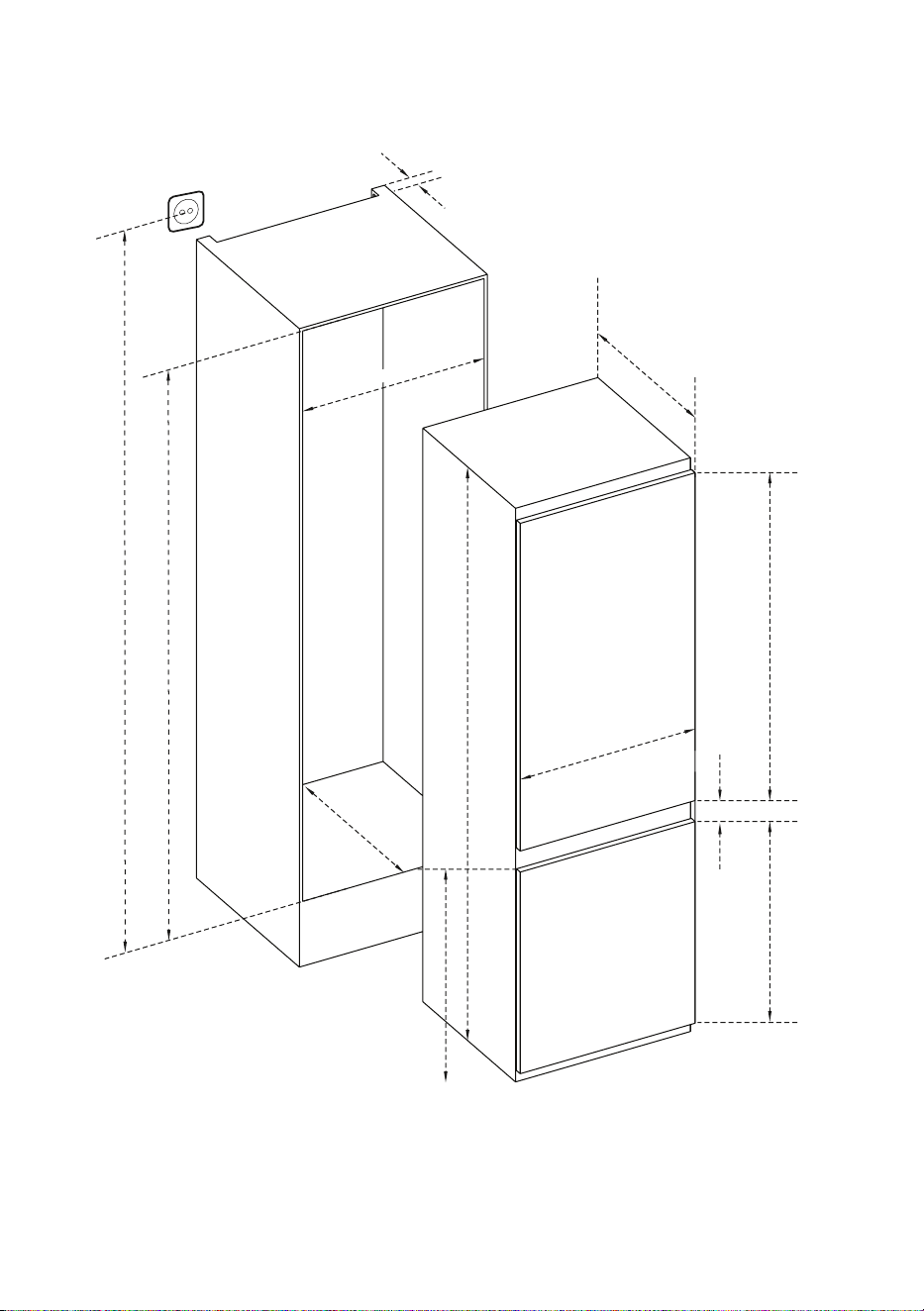
2 DESCRIPTION OF THE
APPLIANCE
Thermostat knob
Lamp cover
A
2
3
4
5
1
6
7
8
9
10
11
B
This presentation is only for
information about the parts of the
appliance. Parts may vary according to the
appliance model.
A) Refrigerator compartment
B) Freezer compartment
1) Refrigerator shelves
2) Crisper cover
3) Crisper
4) Freezer Sliding Tray
5) Freezer drawers
6) Ice box tray
7) Freezer glass shelves
8) Bottle shelf
9) Door shelf
10) Wine Rack*
11) Egg holder
* In some models
General notes:
Fresh Food Compartment (Fridge): Most
efficient use of energy is ensured in the
configuration with the drawers in the bottom
part of the appliance, and shelves evenly
distributed, position of door bins does not
affect energy consumption.
Freezer Compartment (Freezer): Most
Efficient use of energy is ensured in the
configuration with the drawers and bins are
on stock position.
EN - 16
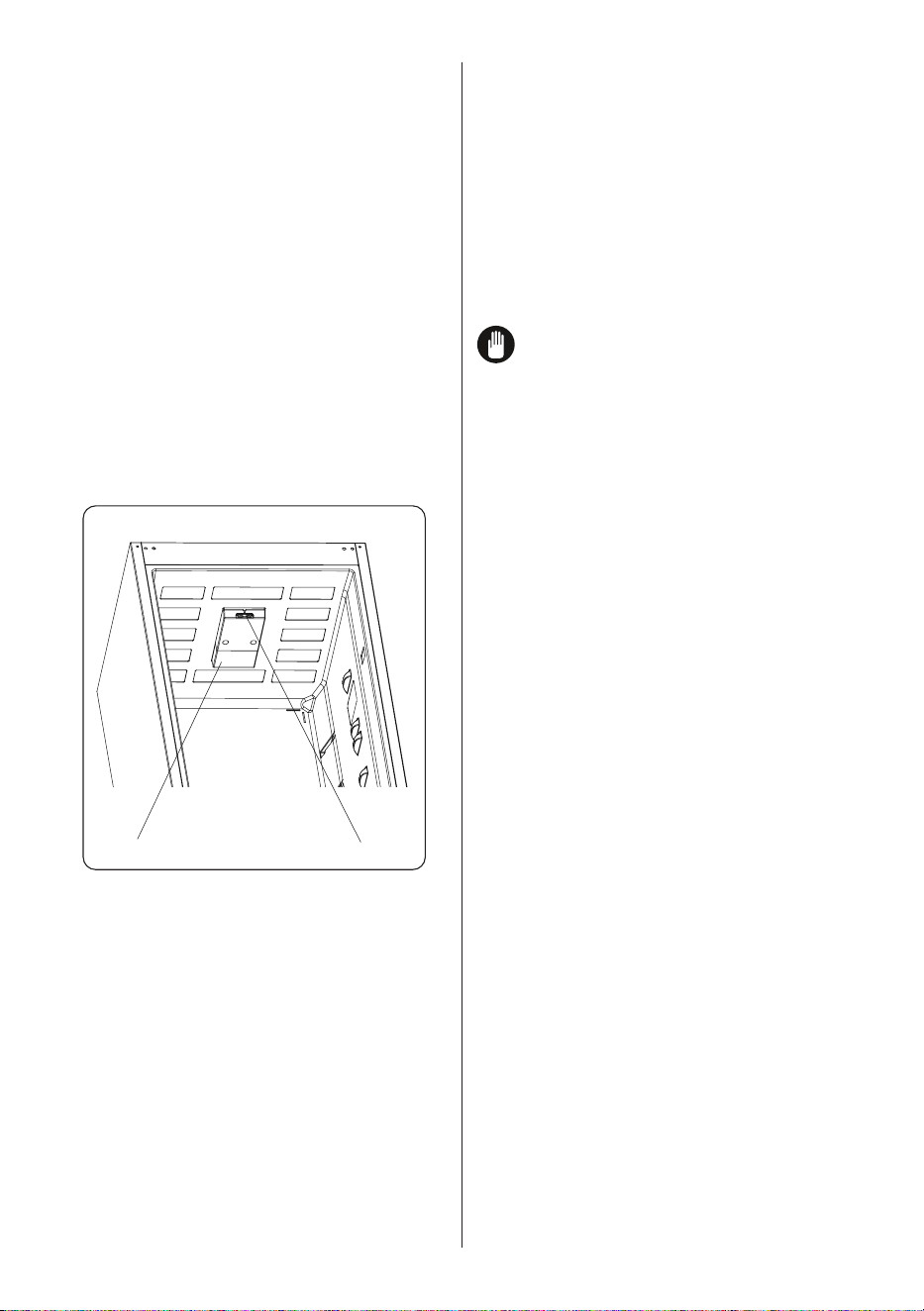
2.1 Dimensions
* 1770 - 1778 for metal top cover
min 200 cm
2
min 40 mm
560 - 570 mm
max 2100 mm
1770 - 1790 mm
560 mm
(recommended)
min. 550 mm
545 mm
540 mm
62 mm
817 mm802 mm
840,5 mm
1770 mm
EN - 17
3 USING THE APPLIANCE
3.1 Information on Less Frost
Technology
Thanks to the wrap around evaporator,
Less Frost technology offers more efficient
cooling, less manual defrost requirement,
and more flexible storage room.
3.2 Thermostat Setting
The thermostat automatically regulates the
temperature inside the cooler and freezer
compartments. Refrigerator temperatures
can be obtained by rotating the knob
to higher numbers; 1 to 3, 1 to 5 or SF
(Maximum numbers on the thermostat
depends on your product.)
Lamp cover
Thermostat knob
(The images are representative)
Thermostat settings:
1 – 2 : For short-term storage of food
3 – 4 : For long-term storage of food
5 : Maximum cooling position. The
appliance will work longer.If required,
change the temperature setting.
If device has SF position:
• Turn the knob to SF to freeze fresh
food quickly. In this position, the freezer
compartment will operate at lower
temperatures. After your food freezes,
turn the thermostat knob to its normal
use position. If you do not change the
SF position, your appliance work will
automatically return to its last used
thermostat position according to the
time indicated in the note. Return the
thermostat switch to the SF position
and return it to normal use according
to the time indicated in the note.If the
thermostat switch is in the SF position
when your appliance is first started, your
appliance work will automatically return
to the operation in the thermostat-3
position according to the time indicated in
the note.
The super mode will be cancel
automatically after max 48 hours.
3.3 Temperature Settings Warnings
• Your appliance is designed to operate in
the ambient temperature ranges stated
in the standards, according to the climate
class stated in the information label. It
is not recommended that your fridge is
operated in the environments which are
outside of the stated temperature ranges.
This will reduce the cooling efficiency of
the appliance.
• Temperature adjustments should be
made according to the frequency of
door openings, the quantity of food kept
inside the appliance and the ambient
temperature in the location of your
appliance.
• When the appliance is first switched on,
allow it to run for 24 hours in order to
reach operating temperature. During this
time, do not open the door and do not
keep a large quantity of food inside.
• A 5 minute delay function is applied
to prevent damage to the compressor
of your appliance when connecting
or disconnecting to mains, or when
an energy breakdown occurs. Your
appliance will begin to operate normally
after 5 minutes.
EN - 18
Climate class and meaning:
T (tropical): This refrigerating appliance
is intended to be used at ambient
temperatures ranging from 16 °C to 43 °C.
ST (subtropical): This refrigerating
appliance is intended to be used at ambient
temperatures ranging from 16 °C to 38 °C.
N (temperate): This refrigerating appliance
is intended to be used at ambient
temperatures ranging from 16 °C to 32 °C.
SN (extended temperate): This
refrigerating appliance is intended to be
used at ambient temperatures ranging from
10 °C to 32 °C.
3.4 Accessories
Visual and text descriptions in the
accessories section may vary according
to the model of your appliance.
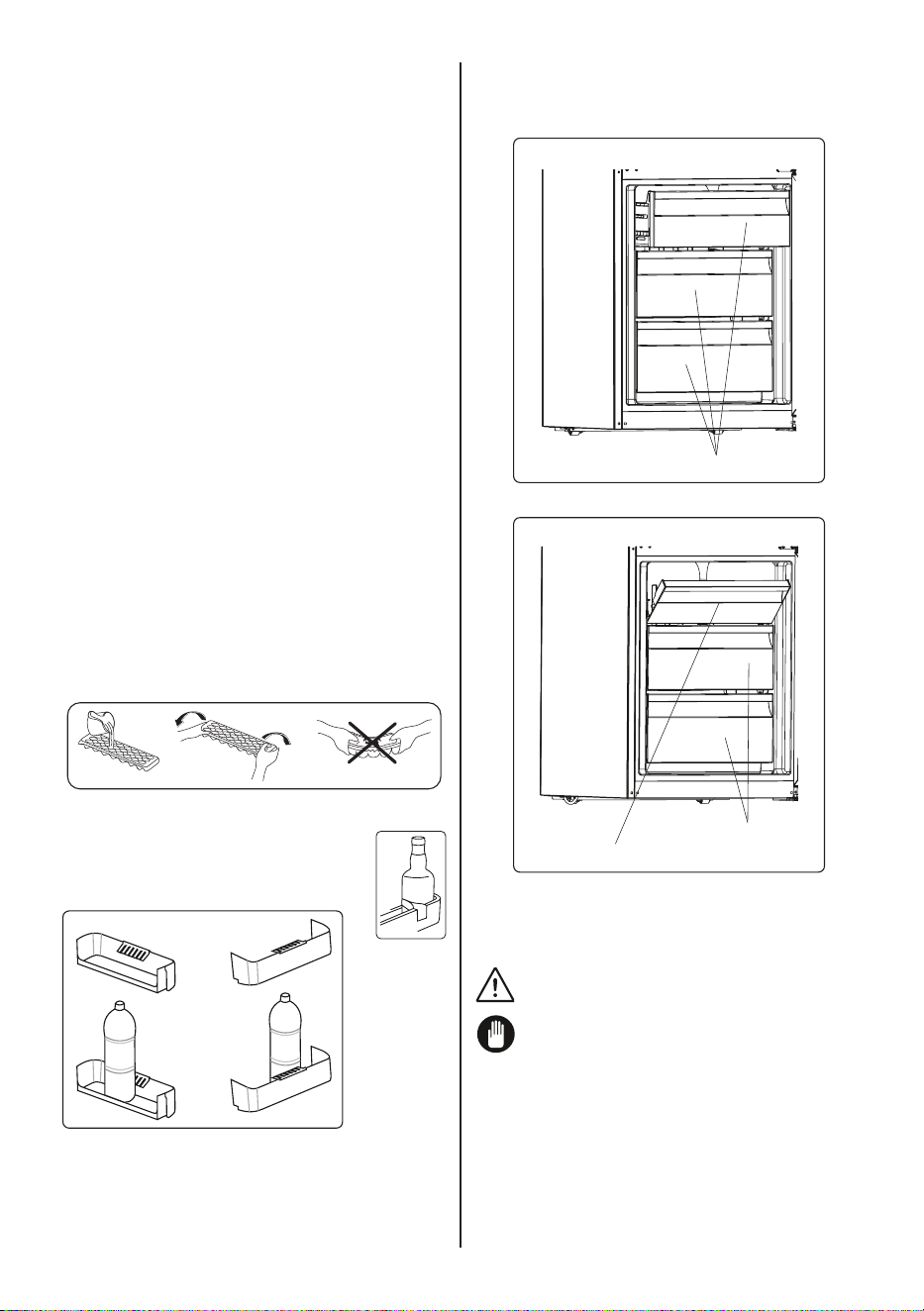
3.4.1 Ice Tray (In some models)
• Fill the ice tray with water and place in
the freezer compartment.
• After the water has completely frozen,
you can twist the tray as shown below to
remove the ice cubes.
3.4.2 The Bottle Holder (In some models)
Use the bottle holder to prevent
bottles from slipping or falling over.
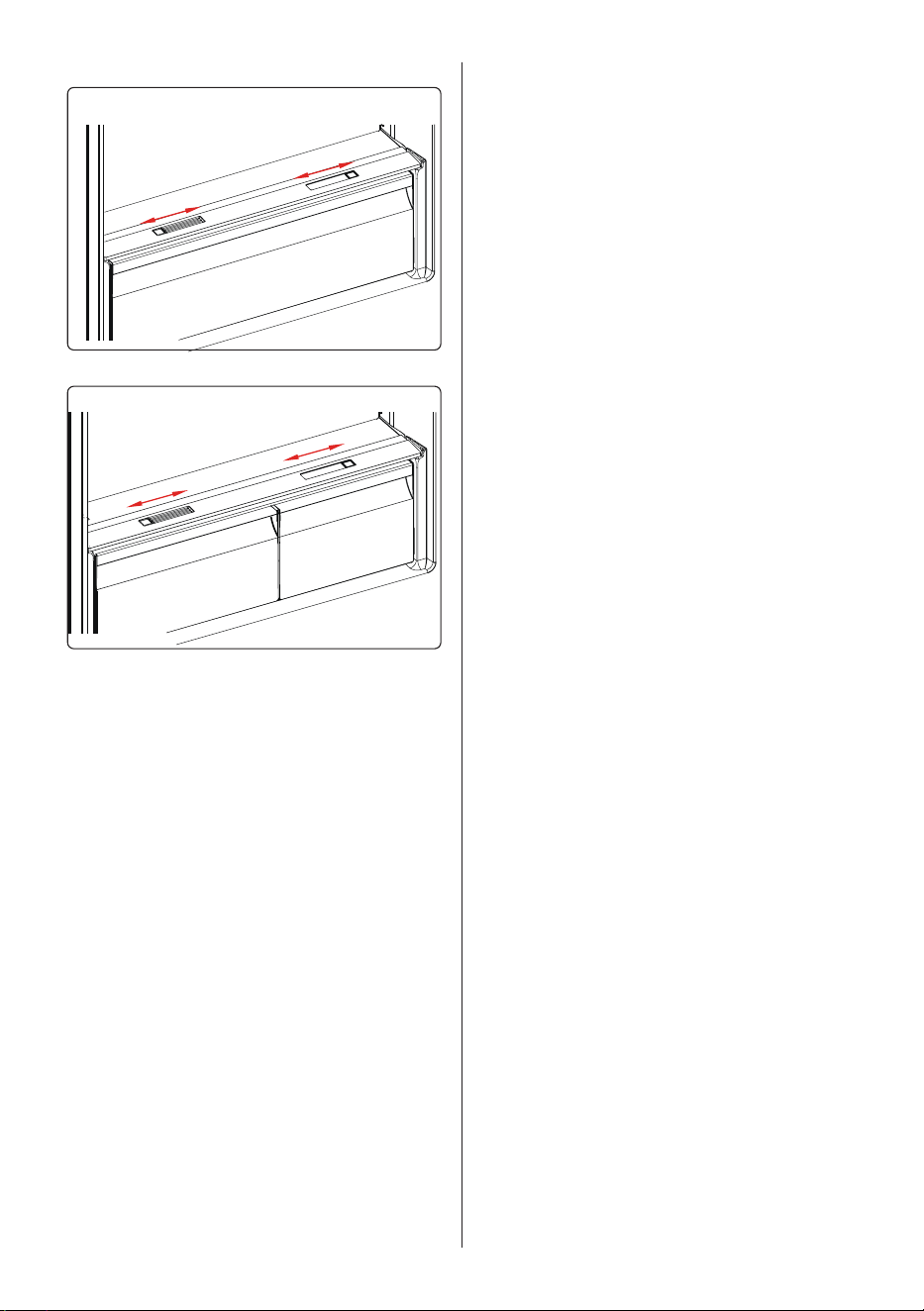
3.4.3 The Freezer Box
The freezer box allows food to be accessed
more easily.
(The images are representative)
Freezer boxes
or
Freezer boxes
Freezer upper cover
(The images are representative)
Removing the freezer box:
• Pull the box out as far as possible
• Pull the front of the box up and out
Carry out the opposite of this operation
when refitting the sliding compartment.
Always keep hold of the handle of the
box while removing it.
EN - 19
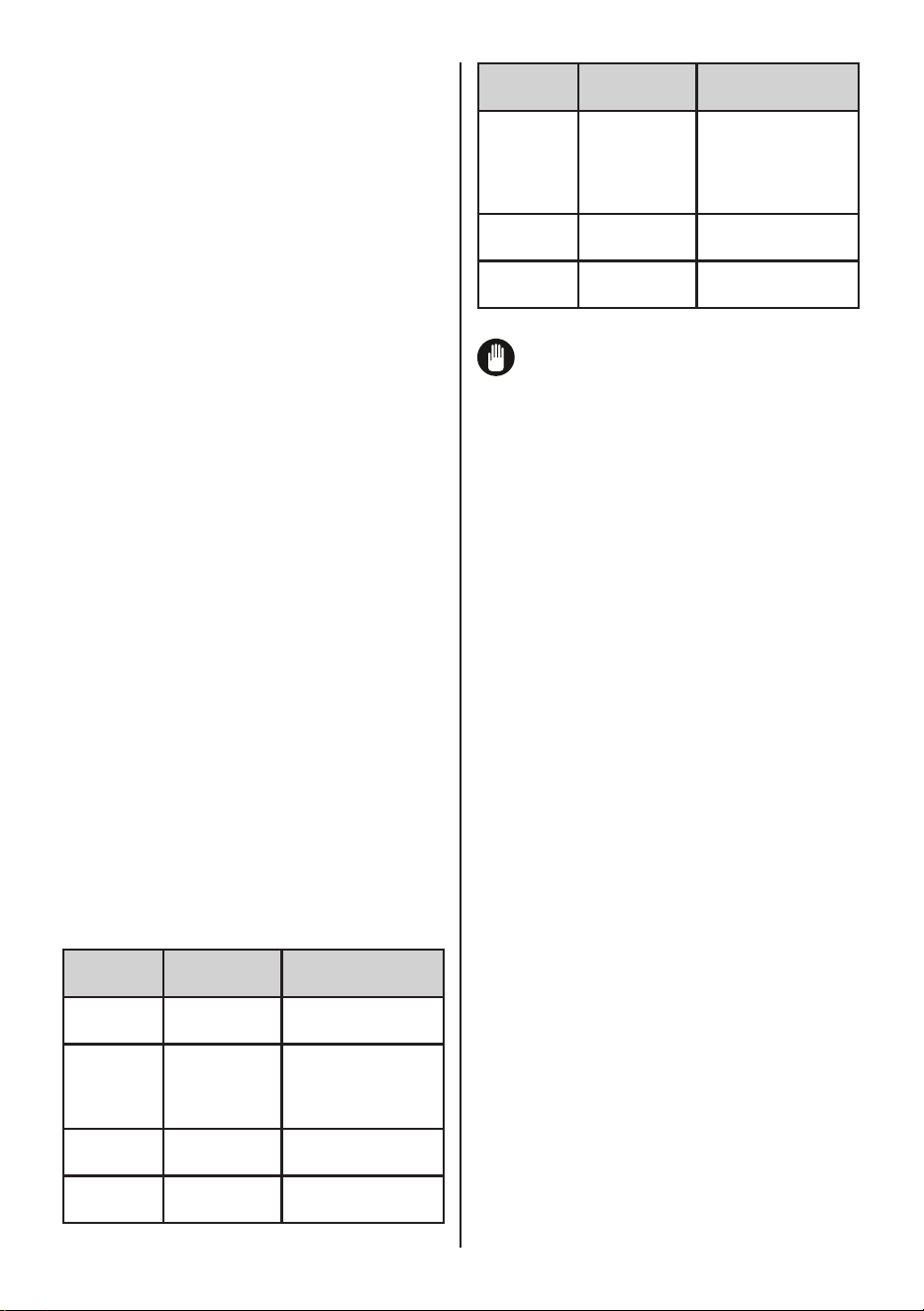
3.4.4 The Fresh Dial (In some models)
(The images are representative)
or
(The images are representative)
If the crisper is full, the fresh dial located
in front of the crisper should be opened.
This allows the air in the crisper and the
humidity rate to be controlled, to increase
the life of food within.
The dial, located behind the shelf, must be
opened if any condensation is seen on the
glass shelf.
4 FOOD STORAGE
4.1 Refrigerator Compartment
• To reduce humidity and avoid the
consequent formation of frost, always
store liquids in sealed containers in the
refrigerator. Frost tends to concentrate in
the coldest parts of the evaporating liquid
and, in time, your appliance will require
more frequent defrosting.
• Cooked dishes must remain covered
when they are kept in the fridge.Do
not place warm foods in fridge.Place
them when they are cool, otherwise the
temperature/humidity inside the fridge will
increases, reducing the fridge’s efficiency.
• Make sure no items are in direct contact
with the rear wall of the appliance as
frost will develop and packaging will stick
to it. Do not open the refrigerator door
frequently.
• We recommend that meat and clean fish
are loosely wrapped and stored on the
glass shelf just above the vegetable bin
where the air is cooler, as this provides
the best storage conditions.
• Store loose fruit and vegetable items in
the crisper containers.
• Storing fruit and vegetables separately
helps prevent ethylene-sensitive
vegetables (green leaves, broccoli,
carrot, etc.) being affected by ethylene-
releaser fruits (banana, peach, apricot,
fig etc.).
• Do not put wet vegetables into the
refrigerator.
• Storage time for all food products
depends on the initial quality of the food
and an uninterrupted refrigeration cycle
before refrigerator storage.
• Water leaking from meat may
contaminate other products in the
refrigerator. You should package meat
products and clean any leakages on the
shelves.
• Do not put food in front of the air flow
passage.
EN - 20
• Consume packaged foods before the
recommended expiry date.
Do not allow food to come into contact with
the temperature sensor, which is located
in the refrigerator compartment, in order
to keep the refrigerator compartment at
optimum temperature.
• For normal working conditions, it will
be sufficient to adjust the temperature
setting of your refrigerator to +4 °C.
• The temperature of the fridge
compartment should be in the range
of 0-8 °C, fresh foods below 0 °C are
iced and rotted, bacterial load increases
above 8 °C, and spoils.
• Do not put hot food in the refrigerator
immediately, wait for the temperature
to pass outside. Hot foods increase the
degree of your refrigerator and cause
food poisoning and unnecessary spoiling
of the food.
• Meat, fish, etc. should be store in the
chiller compartment of the food, and the
vegetable compartment is preferred for
vegetables. (if available)
• To prevent cross contamination, meat
products and fruit vegetables are not
stored together.
• Foods should be placed in the refrigerator
in closed containers or covered to
prevent moisture and odors.
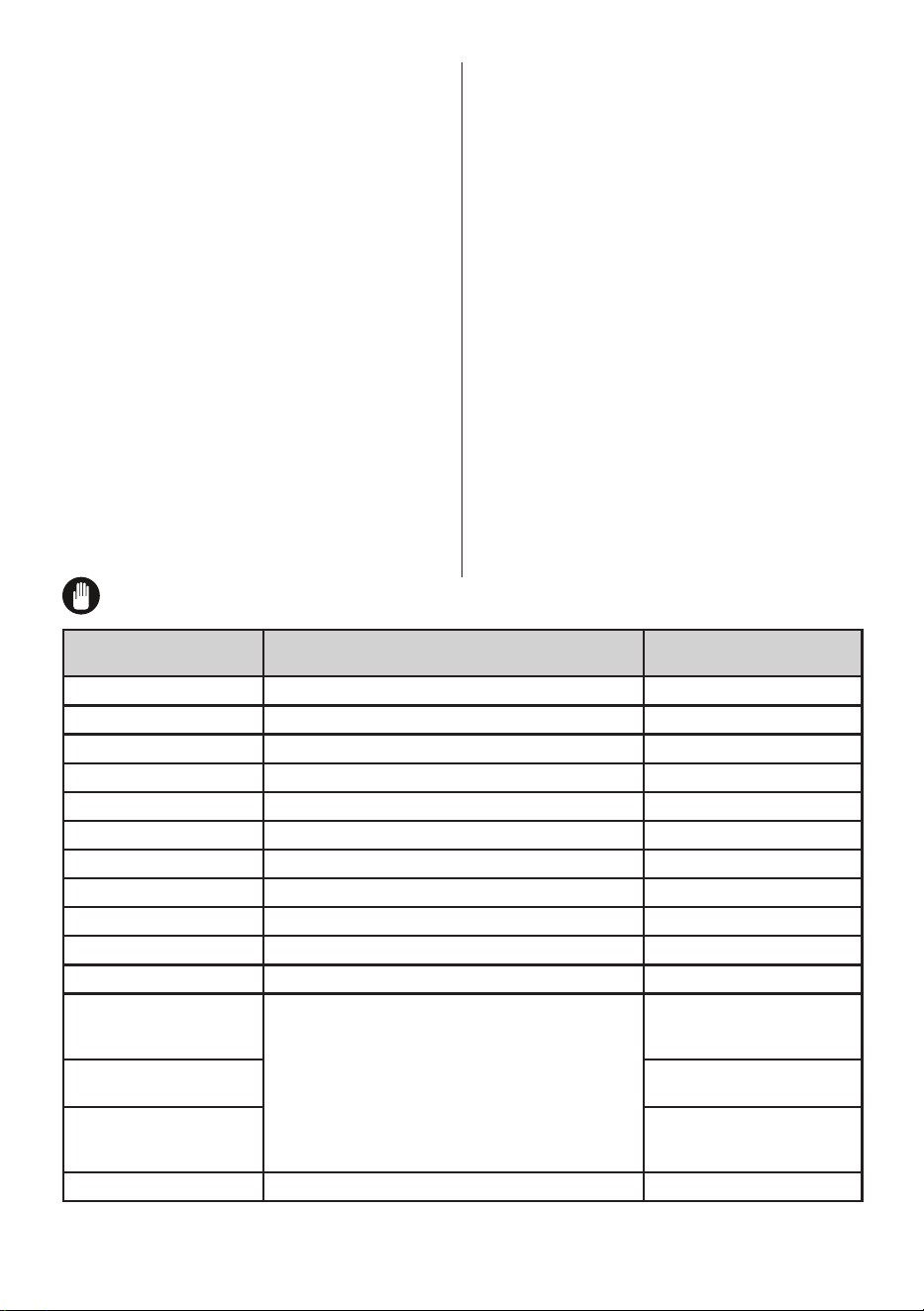
The table below is a quick guide to show
you the most efficient way to store the
major food groups in your refrigerator
compartment.
Food
Maximum
storage time
How and where to
store
Vegetables
and fruits
1 week Vegetable bin
Meat and
fish
2 - 3 days
Wrap in plastic foil,
bags, or in a meat
container and store
on the glass shelf
Fresh
cheese
3 - 4 days
On the designated
door shelf
Butter and
margarine
1 week
On the designated
door shelf
Food
Maximum
storage time
How and where to
store
Bottled
products
e.g. milk
and
yoghurt
Until the
expiry date
recommended
by the
producer
On the designated
door shelf
Eggs 1 month
On the designated
egg shelf
Cooked
food
2 days All shelves
NOTE:
Potatoes, onions and garlic should not
be stored in the refrigerator.
4.2 Freezer Compartment
• The freezer is used for storing frozen
food, freezing fresh food, and making ice
cubes.
• Food in liquid form should be frozen
in plastic cups and other food should
be frozen in plastic folios or bags.For
freezing fresh food; wrap and seal fresh
food properly, that is the packaging
should be air tight and shouldn’t leak.
Special freezer bags, aluminum foil
polythene bags and plastic containers
are ideal.
• Do not store fresh food next to frozen
food as it can thaw the frozen food.
• Before freezing fresh food, divide it into
portions that can be consumed in one
sitting.
• Consume thawed frozen food within a
short period of time after defrosting
• Always follow the manufacturer's
instructions on food packaging when
storing frozen food. If no information is
provided food, should not be stored for
more than 3 months from the date of
purchase.
• When purchasing frozen food, make sure
that it has been stored under appropriate
conditions and that the packaging is not
damaged.
• Frozen food should be transported in
appropriate containers and placed in the
freezer as soon as possible.
EN - 21
• Do not purchase frozen food if the
packaging shows signs of humidity
and abnormal swelling. It is probable
that it has been stored at an unsuitable
temperature and that the contents have
deteriorated.
• The storage life of frozen food depends
on the room temperature, the thermostat
setting, how often the door is opened,
the type of food, and the length of time
required to transport the product from
the shop to your home. Always follow the
instructions printed on the packaging and
never exceed the maximum storage life
indicated.
• If the freezer door has been left open for
a long time or not closed properly, frost
will form and can prevent efficient air
circulation. To resolve this, unplug the
freezer and wait for it to defrost. Clean
the freezer once it has fully defrosted.
• The freezer volume stated on the label is
the volume without baskets, covers, and
so on.
• Do not refreeze thawed food. It may
pose a danger to your health and cause
problems such as food poisoning.
NOTE: If you attempt to open the freezer
door immediately after closing it, you
will find that it will not open easily. This
is normal. Once equilibrium has been
reached, the door will open easily.
• Use the fast freezing shelf to freeze
home cooking (and any other food
which needs to be frozen quickly) more
quickly because of the freezing shelf’s
greater freezing power. Fast freezing
shelf is the bottom drawer of the freezer
compartment.
The table below is a quick guide to show you the most efficient way to store the major
food groups in your freezer compartment.
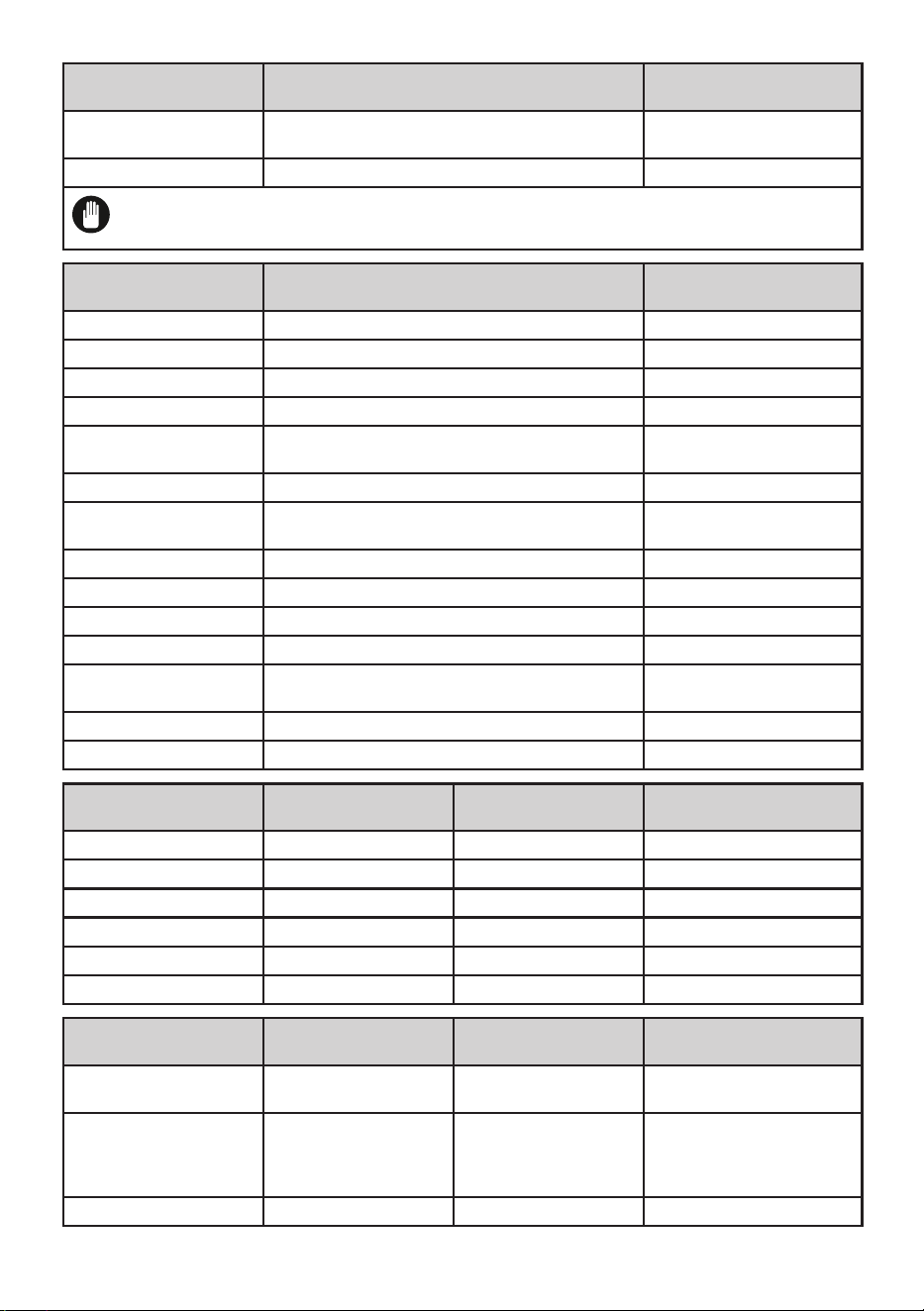
Meat and fish Preparation
Maximum storage time
(months)
Steak Wrap in foil 6 - 8
Lamb meat Wrap in foil 6 - 8
Veal roast Wrap in foil 6 - 8
Veal cubes In small pieces 6 - 8
Lamb cubes In pieces 4 - 8
Minced meat In packaging without using spices 1 - 3
Giblets (pieces) In pieces 1 - 3
Bologna sausage/salami Should be kept packaged even if it has a membrane 1 - 3
Chicken and turkey Wrap in foil 4 - 6
Goose and duck Wrap in foil 4 - 6
Deer, rabbit, wild boar In 2.5 kg portions or as fillets 6 - 8
Freshwater fish
(Salmon, Carp, Crane,
Catfish)
After cleaning the bowels and scales of the fish,
wash and dry it. If necessary, remove the tail and
head.
2
Lean fish (Bass, Turbot,
Flounder)
4
Fatty fishes (Tuna,
Mackerel, Bluefish,
Anchovy)
2 - 4
Shellfish Clean and in a bag 4 - 6
EN - 22
Meat and fish Preparation
Maximum storage time
(months)
Caviar
In its packaging, or in an aluminium or plastic
container
2 - 3
Snails In salty water, or in an aluminium or plastic container 3
NOTE: Thawed frozen meat should be cooked as fresh meat. If the meat is not cooked after defrosting, it
must not be re-frozen.
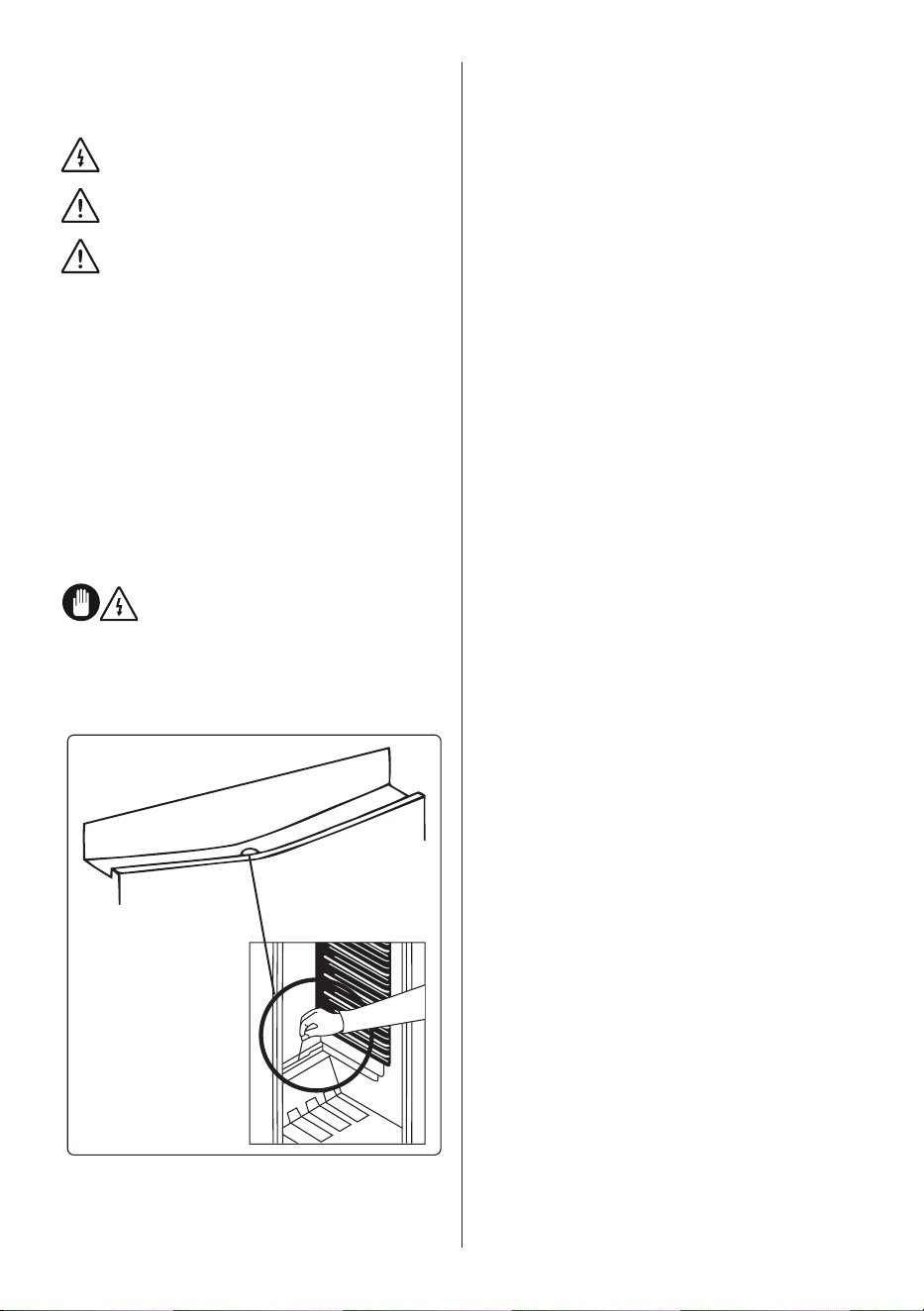
Vegetables and Fruits Preparation
Maximum storage time
(months)
String beans and beans Wash, cut into small pieces and boil in water 10 - 13
Beans Hull, wash and boil in water 12
Cabbage Clean and boil in water 6 - 8
Carrot Clean, cut into slices and boil in water 12
Pepper
Cut the stem, cut into two pieces, remove the core
and boil in water
8 - 10
Spinach Wash and boil in water 6 - 9
Cauliflower
Remove the leaves, cut the heart into pieces and
leave it in water with a little lemon juice for a while
10 - 12
Eggplant Cut into pieces of 2cm after washing 10 - 12
Corn Clean and pack with its stem or as sweet corn 12
Apple and pear Peel and slice 8 - 10
Apricot and Peach Cut into two pieces and remove the stone 4 - 6
Strawberry and
Blackberry
Wash and hull 8 - 12
Cooked fruits Add 10 % of sugar to the container 12
Plum, cherry, sourberry Wash and hull the stems 8 - 12
Maximum storage time
(months)
Thawing time at room
temperature (hours)
Thawing time in oven
(minutes)
Bread 4 - 6 2 - 3 4-5 (220-225 °C)
Biscuits 3 - 6 1 - 1,5 5-8 (190-200 °C)
Pastry 1 - 3 2 - 3 5-10 (200-225 °C)
Pie 1 - 1,5 3 - 4 5-8 (190-200 °C)
Phyllo dough 2 - 3 1 - 1,5 5-8 (190-200 °C)
Pizza 2 - 3 2 - 4 15-20 (200 °C)
Dairy products Preparation
Maximum storage time
(months)
Storage conditions
Packet (Homogenized)
Milk
In its own packet 2 - 3 Pure Milk – in its own packet
Cheese - excluding
white cheese
In slices 6 - 8
Original packaging may be
used for short-term storage.
Keep wrapped in foil for
longer periods.
Butter, margarine In its packaging 6
EN - 23
5 CLEANING AND
MAINTENANCE
Disconnect the unit from the power
supply before cleaning.
Do not wash your appliance by
pouring water on it.
Do not use abrasive products,
detergents or soaps for cleaning the
appliance. After washing, rinse with clean
water and dry carefully. When you have
finished cleaning, reconnect the plug to the
mains supply with dry hands.
• Make sure that no water enters the lamp
housing and other electrical components.
• The appliance should be cleaned
regularly using a solution of bicarbonate
of soda and lukewarm water.
• Clean the accessories separately by
hand with soap and water. Do not wash
accessories in a dish washer.
The power supply must be
disconnected during cleaning.
5.1 Defrosting
Defrosting the Refrigerator
Compartment
• Defrosting occurs automatically in
the refrigerator compartment during
operation. The water is collected by
the evaporation tray and evaporates
automatically.
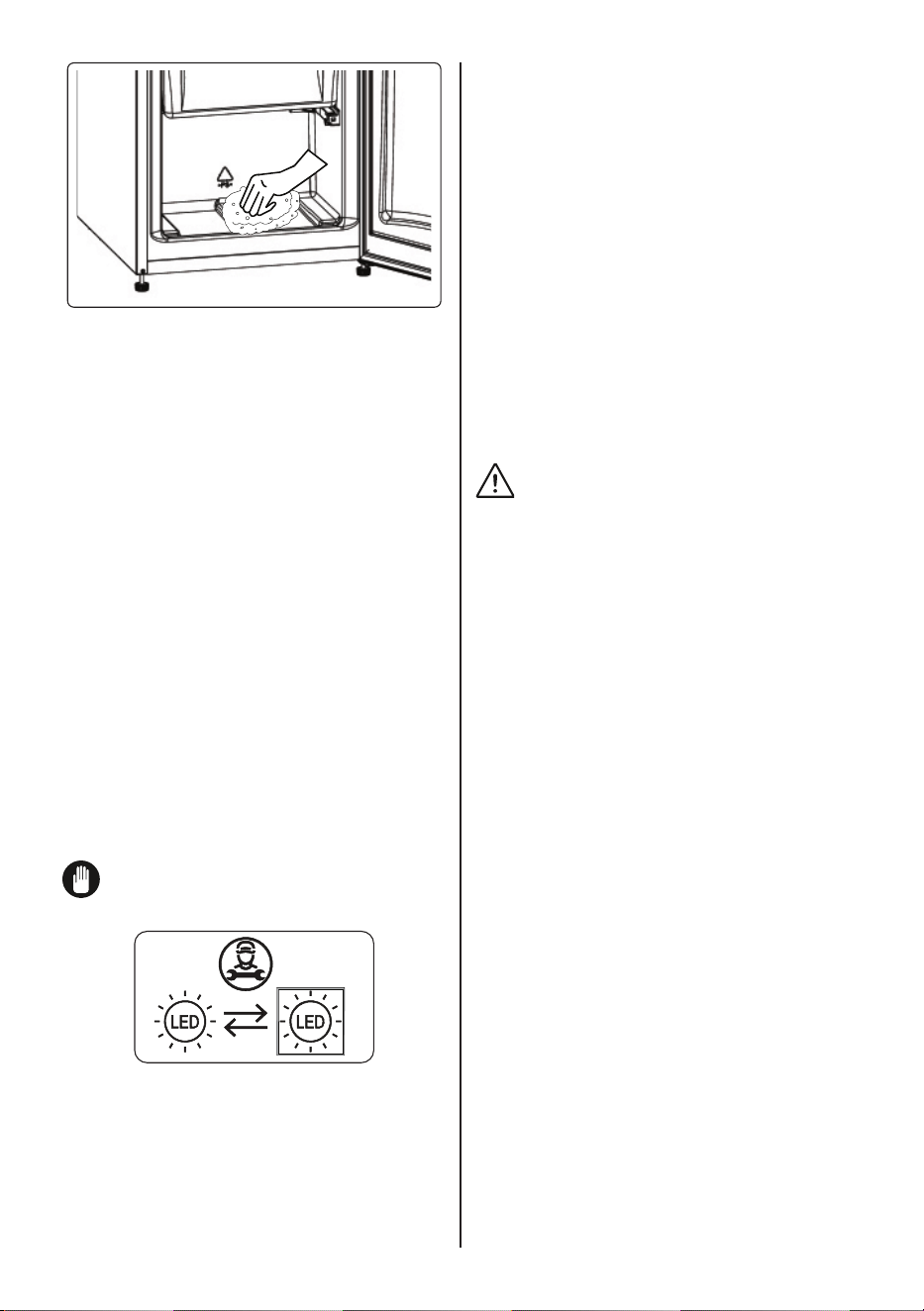
• The evaporation tray and the water drain
hole should be cleaned periodically with
the defrost drain plug to prevent the
water from collecting at the bottom of the
refrigerator instead of flowing out.
• You can also clean the drain hole by
pouring half a glass of water down it.
Freezer defrosting process
• Small amounts of frost will accumulate
inside the freezer, depending on the
length of time the door may be left open
or the amount of moisture introduced.
It is essential to ensure that no frost or
ice is allowed to form in places where
it will affect the close fitting of the door
seal. This might allow air to penetrate the
cabinet, encouraging continuous running
of the compressor. Thin frost formation
is quite soft and can be removed with a
brush or plastic scraper. Do not use metal
or sharp scrapers, mechanical devices or
other means to accelerate the defrosting
process. Remove all dislodged frost from
the cabinet floor. It is not necessary to
switch off the appliance for the removal
of thin frost.
• For the removal of heavy ice deposits,
disconnect the appliance from the
mains supply, empty the contents into
cardboard boxes and wrap in thick
blankets or layers of paper to keep cool.
Defrosting will be most effective if carried
out when the freezer is nearly empty
and should be carried out as quickly
as possible to prevent an unnecessary
increase in the temperature of the
contents.
• Do not use metal or sharp scrapers,
mechanical devices or other means to
accelerate the defrosting process. An
increase in temperature of frozen food
during defrosting will shorten the storage
life. Keep contents well wrapped and cool
while defrosting is taking place.
EN - 24
• Dry the inside of the compartment with a
sponge or a clean cloth.
• To accelerate the defrosting process,
place one or more bowls of warm water
in the freezer compartment.
• Examine the contents when replacing
them in the freezer and if some of the
packages have thawed out, they should
be eaten within 24hours, or be cooked
and re-frozen.
• After defrosting is complete, clean the
inside of the appliance with a solution
of warm water and a little bicarbonate
of soda, then dry thoroughly. Wash all
removable parts in the same way and
reassemble. Reconnect the appliance
to the mains supply and leave for 2 to
3 hours on setting number MAX before
introducing the food back into the freezer.
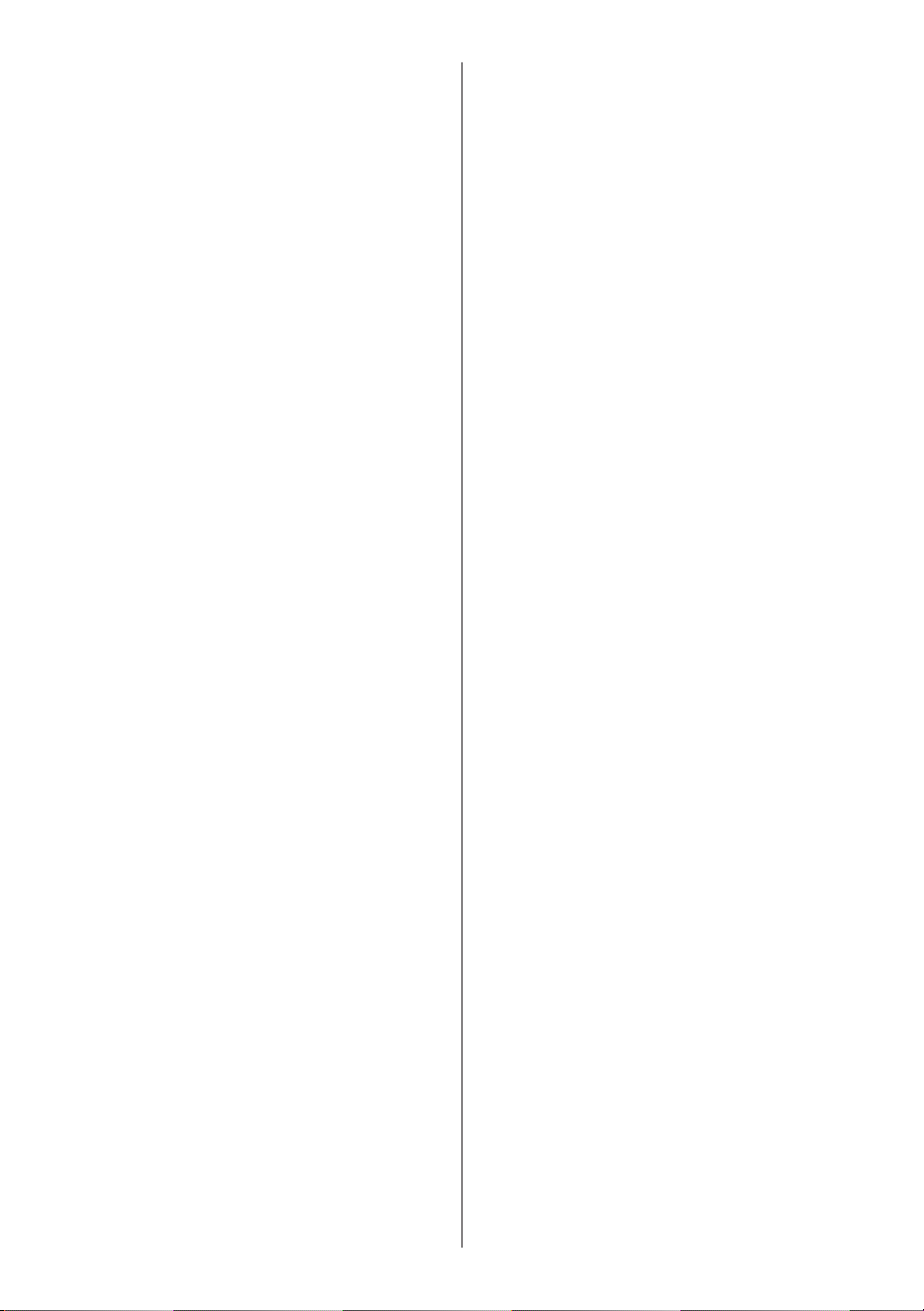
Replacing LED Lighting
To replace any of the LEDs, please contact
the nearest Authorised Service Centre.
Note: The numbers and location of the
LED strips may change according to
the model.
If product equipped with LED lamp
This product contains a light source of
energy efficiency class <E>.
If product equipped with LED Strip(s) or
LED card(s)
This product contains a light source of
energy efficiency class <F>.
6 SHIPMENT AND
REPOSITIONING
6.1 Transportation and Changing
Positioning
• The original packaging and foam may be
kept for re-transportation (optional).
• Fasten your appliance with thick
packaging, bands or strong cords and
follow the instructions for transportation
on the packaging.
• Remove all movable parts or fix them
into the appliance against shocks
using bands when re-positioning or
transporting.
Always carry your appliance in the
upright position.
7 BEFORE CALLING AFTER-
SALES SERVICE
If you are experiencing a problem with
your appliance, please check the following
before contacting the after-sales service.
Your appliance is not operating
Check if:
• There is power
• The plug is correctly placed in the socket
• The plug fuse or the mains fuse has
blown
• The socket is defective. To check this,
plug another working appliance into the
same socket.
The appliance performs poorly
Check if:
• The appliance is overloaded
• The appliance door is closed properly
• There is any dust on the condenser
• There is enough space near the rear and
side walls.
Your appliance is operating noisily
Normal noises
Cracking noise occurs:
• During automatic defrosting
EN - 25
• When the appliance is cooled
or warmed (due to expansion of
appliance material).
Short cracking noise occurs: When
the thermostat switches the compressor
on/off.
Motor noise: Indicates the compressor
is operating normally. The compressor
may cause more noise for a short time
when it is first activated.
Bubbling noise and splash occurs:
Due to the flow of the refrigerant in the
tubes of the system.
Water flowing noise occurs: Due
to water flowing to the evaporation
container. This noise is normal during
defrosting.
Air blowing noise occurs: In some
models during normal operation of the
system due to the circulation of air.
The edges of the appliance in contact
with the door joint are warm
Especially during summer (warm seasons),
the surfaces in contact with the door joint
may become warmer during the operation
of the compressor, this is normal.
There is a build-up of humidity inside
the appliance
Check if:
• All food is packed properly. Containers
must be dry before being placed in the
appliance.
• The appliance door is opened frequently.
Humidity of the room enters the
appliance when the doors are opened.
Humidity increases faster when the doors
are opened more frequently, especially if
the humidity of the room is high.
The door does not open or close
properly
Check if:
• There is food or packaging preventing the
door from closing
• The door joints are broken or torn
• Your appliance is on a level surface.
The compressor can run loudly or the noise
of the compressor/refrigerator may increase
in some models during operating in some
conditions such that the product is plugged
in for the first time, depending on change
in the ambient temperature or change of
usage. That is normal; when the refrigerator
reaches the required temperature, the
noise decreases automatically.
Recommendations
• If the appliance is switched off or
unplugged, wait at least 5 minutes before
plugging the appliance in or restarting
it in order to prevent damage to the
compressor.
• If you will not use your appliance for
a long time (e.g. in summer holidays)
unplug it. Clean your appliance according
to chapter cleaning and leave the door
open to prevent humidity and smell.
• If a problem persists after you have
followed all the above instructions,
please consult the nearest authorised
service centre.
• The appliance you have purchased is
designed for domestic use only. It is not
suitable for commercial or common use.
If the consumer uses the appliance in a
way that does not comply with this, we
emphasise that the manufacturer and
the dealer will not be responsible for any
repair and failure within the guarantee
period.
EN - 26
8 TIPS FOR SAVING ENERGY
1. Install the appliance in a cool, well-
ventilated room, but not in direct sunlight
and not near a heat source (such as a
radiator or oven) otherwise an insulating
plate should be used.
2. Allow warm food and drinks to cool
before placing them inside the appliance.
3. Place thawing food in the refrigerator
compartment if available. The low
temperature of the frozen food will
help cool the refrigerator compartment
while the food is thawing. This will save
energy. Frozen food left to thaw outside
of the appliance will result in a waste of
energy.
4. Drinks or other liquids should be
covered when inside the appliance. If
left uncovered, the humidity inside the
appliance will increase, therefore the
appliance uses more energy. Keeping
drinks and other liquids covered helps
preserve their smell and taste.
5. Avoid keeping the doors open for long
periods and opening the doors too
frequently as warm air will enter the
appliance and cause the compressor to
switch on unnecessarily often.
6. Keep the covers of the different
temperature compartments (such as the
crisper and chiller if available) closed.
7. The door gasket must be clean and
pliable. In case of wear, replace the
gasket.
9 TECHNICAL DATA
The technical information is situated in
the rating plate on the internal side of the
appliance and on the energy label.
The QR code on the energy label supplied
with the appliance provides a web link to
the information related to the performance
of the appliance in the EU EPREL
database.
Keep the energy label for reference
together with the user manual and all other
documents provided with this appliance.
It is also possible to find the same
information in EPREL using the link https://
eprel.ec.europa.eu and the model name
and product number that you find on the
rating plate , the appliance.
See the link www.theenergylabel.eu for
detailed information about the energy label.
EN - 27
10 INFORMATION FOR TEST
INSTITUTES
Appliance for any EcoDesign verification
shall be compliant with EN 62552.
Ventilation requirements, recess
dimensions and minimum rear clearances
shall be as stated in this User Manual at
Chapter 2. Please contact the manufacturer
for any other further information, including
loading plans.
11 CUSTOMER CARE AND
SERVICE
Always use original spare parts.
When contacting our Authorised Service
Centre, ensure that you have the following
data available: Model, Serial Number and
Service Index.
The information can be found on the rating
plate. You can find the rating label inside
the fridge zone on the left lower side.
The original spare parts for some specific
components are available for a minimum
of 7 or 10 years, based on the type of
component, from the placing on the market
of the last unit of the model.

EN - 28

EN - 29
400011708678