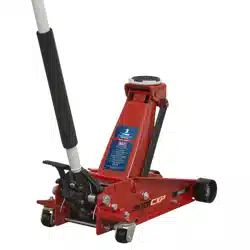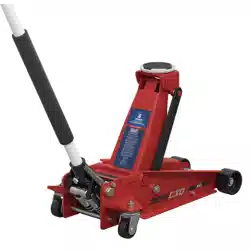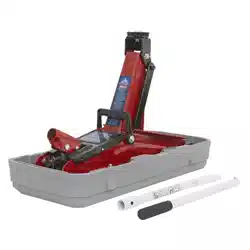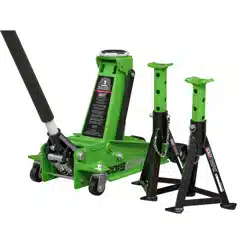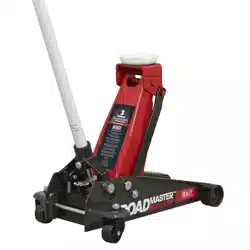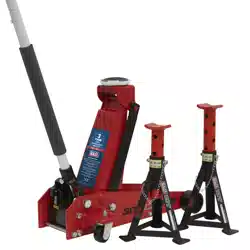
3 TONNE STANDARD CHASSIS TROLLEY JACK
WITH AXLE STANDS (PAIR)
MODEL NO: 3010CX.V3
Fit pin through both the
stand collar and the
centre tube
1. JACK SAFETY
WARNING! Please note that the handle socket of this jack is retained under tension and must be released
before use. Caution should be taken when releasing, as the handle socket will suddenly raise to its upright
position if not controlled.
9 The user shall work only in accordance with this instruction manual.
9 The operator shall be provided with all necessary information about training and about pumping and
translating forces.
9 Ensure the jack is in sound condition and good working order. Take action for immediate repair or replacement
of damaged parts. Use genuine parts only. DO NOT modify the jack. The use of non-genuine parts may be
dangerous and will invalidate the warranty.
9 Locate the jack in a suitable, well lit working area.
9 Keep working area clean and tidy and free from unrelated materials. Use jack on level and solid ground,
preferably concrete. Avoid tarmacadam as jack may sink in.
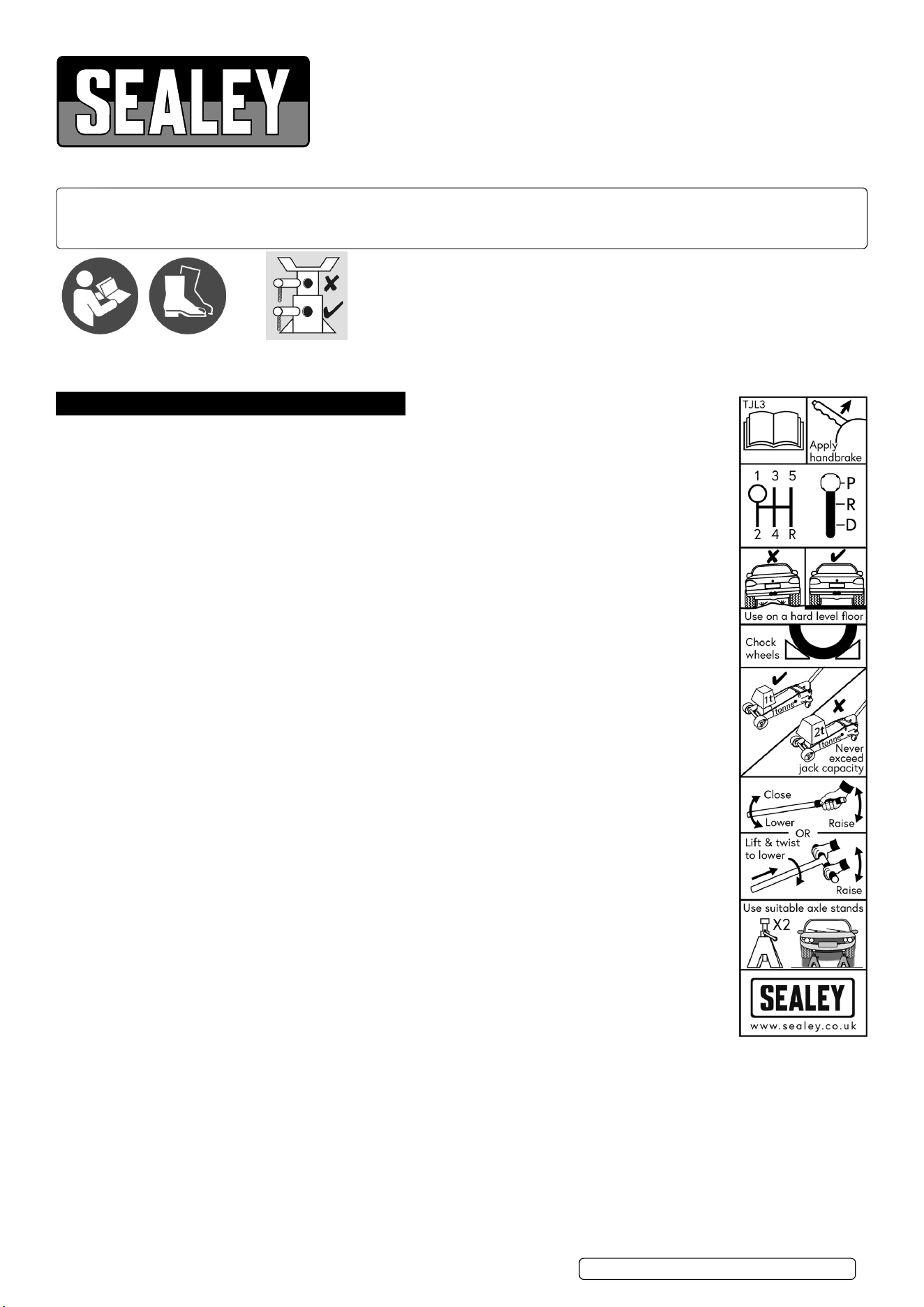
9 Chock wheels of vehicle.
9 Ensure the vehicle handbrake is engaged, engine is switched o and transmission is in gear (or “PARK” if
automatic).
9 Ensure minimum distance of 0.5m between vehicle and static objects such as doors, walls, etc. to allow for
vehicle tilting.
9 Ensure all non-essential persons keep a safe distance whilst the jack is in use.
9 Ensure there are no passengers in the vehicle.
9 It is necessary that the operator can watch the lifting device and the load during all movements.
9 Place jack under only those lifting points recommended by vehicle manufacturer (see vehicle handbook).
9 Check that the lifting point is stable and centred on the jack saddle.
9 Ensure the jack wheels are free to move and that there are no obstructions.
▲ DANGER: Use the jack for lifting only, NOT for supporting the lifted load.
9 Ensure there are no persons or obstructions beneath the vehicle before lowering.
9 It is not allowed to work under the raised load until it is secured by suitable means. Use suitable axle stands
under the vehicle before proceeding with any task.
9 Use a qualied person to lubricate and maintain the jack.
9 Ensure that only hydraulic jack oil is used in the jack.
8 DO NOT operate the jack if damaged.
8 DO NOT allow untrained persons to operate the jack.
8 DO NOT operate the jack when tired or under the inuence of drugs, alcohol or intoxicating medication.
8 DO NOT exceed the rated capacity of the jack.
8 DO NOT allow the vehicle to move during lifting or lowering, or use the jack to move the vehicle.
8 DO NOT jack vehicle if there is a risk of spillage of fuel, battery acid, or other dangerous substances.
8 DO NOT work under the vehicle until appropriately rated axle stands have been correctly positioned.
8 DO NOT use the jack for purposes other than that for which it is intended.
8 DO NOT top up hydraulic system with brake uid. Use hydraulic jack oil only. (Sealey Part No: HJO500MLS
or HJO5LS)
8 DO NOT adjust the safety overload valve.
9 When not in use store jack, fully lowered, in a safe, dry, childproof area.
9 If more than 400N of eort is generated in lifting, the eorts shall be lowered by an additional person.
9 Jacks shall be maintained and repaired in accordance with the manufacturer’s instructions. Such maintenance and repair shall be
carried out by qualied persons.
9 No modications shall be carried out which adversely aect the compliance of the jack with the standard.
9 Check the state of the markings and that the markings remain as the initial one.
Thank you for purchasing a Sealey product. Manufactured to a high standard, this product will, if used according to these instructions,
and properly maintained, give you years of trouble free performance.
IMPORTANT: PLEASE READ THESE INSTRUCTIONS CAREFULLY. NOTE THE SAFE OPERATIONAL REQUIREMENTS, WARNINGS & CAUTIONS. USE
THE PRODUCT CORRECTLY AND WITH CARE FOR THE PURPOSE FOR WHICH IT IS INTENDED. FAILURE TO DO SO MAY CAUSE DAMAGE AND/OR
PERSONAL INJURY AND WILL INVALIDATE THE WARRANTY. KEEP THESE INSTRUCTIONS SAFE FOR FUTURE USE.
Refer to
instruction
Manual
Wear safety
Footwear
Original Language Version
© Jack Sealey Limited
3010CX.V3 Issue 3 (H,1,2,4,5,F) 07/09/23
2. AXLE STAND SAFETY
WARNING! DO NOT overload axle stands beyond rated capacity. Overloading can cause damage to, or failure of, the axle stands.
Position load on centre of crutch/saddle only. Always use stands in pairs on hard level surface capable of sustaining the load. Use of
stands on other than hard level surfaces can result in load instability and possible loss of load. DO NOT use on tarmacadam. Failure
to follow these instructions may result in damage to axle stands, loss of load resulting in property damage, serious personal injury or
loss of life.
▲ DANGER! Great care must be taken to ensure you lower the vehicle (or other load) slowly and carefully onto the centres of the crutch/
saddle of the axle stands.
9 Fit pin through both the stand collar and the centre tube.
9 Use only as specied by the manufacturer.
9 Ensure the load does not exceed the maximum capacity as marked on the axle stand, per pair.
9 Use no more than a single pair of stands either on the front, rear or one side of the vehicle. Use in pairs.
9 No alterations or modications shall be made to this product.
9 Use on a hard, level surface, e.g. concrete. Do not use on uneven ground or tarmacadam.
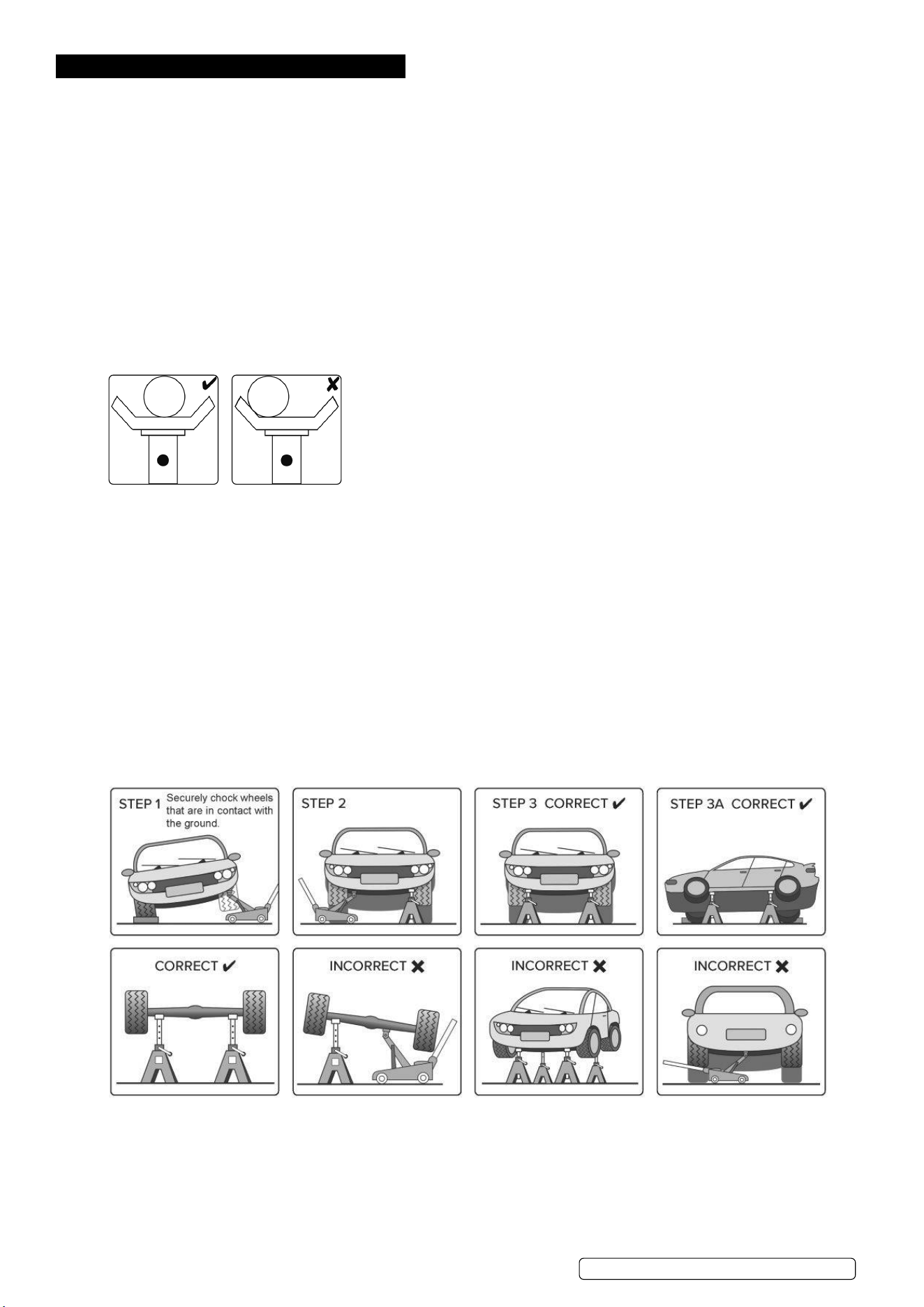
9 Securely chock wheels in contact with the ground. Before jacking and placing the stands, apply vehicle handbrake, and place in gear.
For automatics select the ‘Park’ mode.
9 Make sure that each stand is securely located under a strong point on the vehicle; consult the vehicle manufacturer’s handbook for
guidance. Ensure that height adjust locking mechanism is fully located before applying any load to the axle stand.
9 Ensure that the load is located centrally on the saddle, and that the weight is directed through the vertical axis of the stand.
9 Exercise extra care when using with a three wheeled vehicle or a trailer. Refer to vehicle manufacturer’s instructions.
9 Once vehicle is supported, ensure that the vehicle and stands are stable before starting work. Ensure that it is not possible for the
vehicle to move before commencing any work.
9 Inspect stands before each use.
8 DO NOT use if they show signs of damage.
8 DO NOT use if it is suspected that they have been overloaded.
9 Before commencing any work or going beneath the vehicle, undertake a risk assessment. Ensure that a responsible person is aware of
the work about to be undertaken.
9 Replace any labels on the axle stand should they become unreadable. This applies in particular to any warning or operation instruction
labels. If replacement labels are required, contact your Sealey stockist.
8 DO NOT use axle stands on the highway, or anywhere else if it is deemed to be unsafe.
8 DO NOT push or twist the vehicle/load whilst it is supported on stands.
8 DO NOT mix components between stands. Use only as supplied.
8 DO NOT allow children or animals in the vicinity of a vehicle supported on axle stands.
8 DO NOT leave a vehicle on axle stands in an area that could be considered a hazard to others or property.
9 Follow steps 1, 2 and 3 to correctly place vehicle/load onto axle stands.
Original Language Version
© Jack Sealey Limited
3010CX.V3 Issue 3 (H,1,2,4,5,F) 07/09/23
3. INTRODUCTION
Single-piece hydraulic unit with heavy chassis design. Integral American cog-type release mechanism and long 2-piece handle. Heavy-
duty castors and large saddle design ease positioning under vehicle. Fitted with safety overload valve and pump-through valve to
prevent handle locking at maximum ram extension. Supplied with a pair of pin type axle stands, 3 Tonne (3000kg) capacity per stand, 6
Tonne (6000kg) per pair. Ideal for loaded vans up to 3.5 Tonne GVW.
4. SPECIFICATION
Model No: .....................................................3010CX.V3
JACK SPECIFICATION AXLE STAND SPECIFICATION
Capacity: 3 Tonne Capacity Each 3 Tonne
Minimum Saddle Height 130mm Capacity Pair 6 Tonne
Maximum Saddle Height 520mm Minimum Working Height 290mm
Maximum Chassis Height 172mm Maximum Working Height 435mm
Length 659mm
Consumable Parts JP19 - Rubber Jack Pad
5. JACK OPERATION
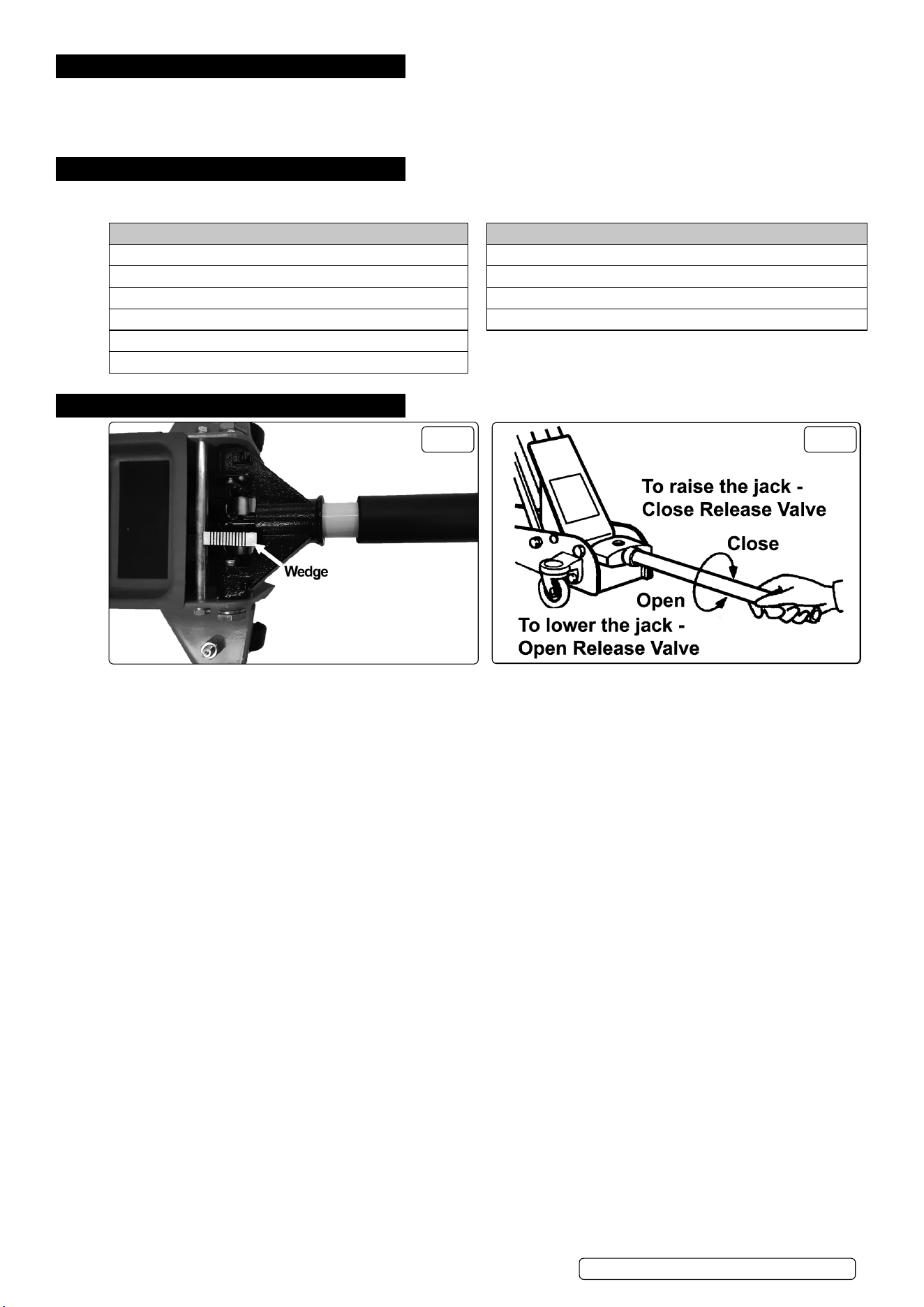
FIG.1 FIG.2
WARNING! Before use ensure you have read, understood and applied Section 1 safety precautions.
IMPORTANT: Before use, the operator is to visually inspect the jack for cracked welds, damaged or missing parts or hydraulic leaks.
5.1. RELEASING THE RETAINING WEDGE (FIG.1)
5.1.1. Seek assistance from a second person if required.
5.1.2. Insert the lower handle section into the handle socket and secure with the retaining bolt to aid in releasing pressure in the handle
socket.
5.1.3. Push down on the handle and hold down while removing the retaining wedge that is securing the handle socket in the down position.
5.1.4. Remove the wedge.
5.1.5. Gently and in a controlled manner slowly allow the lower handle section and handle socket to raise to their upright position.
5.2. BEFORE USE
5.2.1. Insert the upper handle into the lower handle.
5.2.2. Tighten the handle retaining bolt.
5.2.3. Ensure the handle is secure and fully engaged with the release valve.
5.3. HYDRAULIC SYSTEM PURGING
5.3.1. Open the release valve by turning it one full turn counter-clockwise.
5.3.2. Pump the handle 20 times.
5.3.3. Close the release valve by turning it clockwise.
5.4. RAISING A VEHICLE
5.4.1. Ensure that the jack and the vehicle are on a hard, level surface.
5.4.2. Ensure the vehicle handbrake is engaged, engine is switched o and transmission is in gear (or “PARK” if automatic).
5.4.3. Consult the vehicle manual to determine the location of jacking points.
5.4.4. Position the jack under a suitable lifting point.
5.4.5. Turn the handle clockwise, to the closed position. DO NOT over-tighten.
5.4.6. Raise the vehicle to the desired height.
5.4.7. Place axle stands beneath the locations recommended by the vehicle manufacturer.
5.4.8. Turn the release valve anticlockwise slowly to lower the vehicle on to the axle stands.
5.5. LOWERING A VEHICLE
WARNING! Ensure that the area below the vehicle is clear before lowering.
5.5.1. Turn the release valve clockwise to the closed position.
5.5.2. Pump the handle to raise the vehicle o the axle stands.
5.5.3. Remove the axle stands from beneath the vehicle.
5.5.4. Turn the release valve slowly anticlockwise to lower the vehicle to the ground in a controlled manner.
NOTE: When not in use, always leave the saddle and ram fully retracted.
Original Language Version
© Jack Sealey Limited
3010CX.V3 Issue 3 (H,1,2,4,5,F) 07/09/23
6. AXLE STAND OPERATION
WARNING! Ensure you follow all instructions carefully. Failure to note
these warnings may cause damage, serious injury or loss of life.
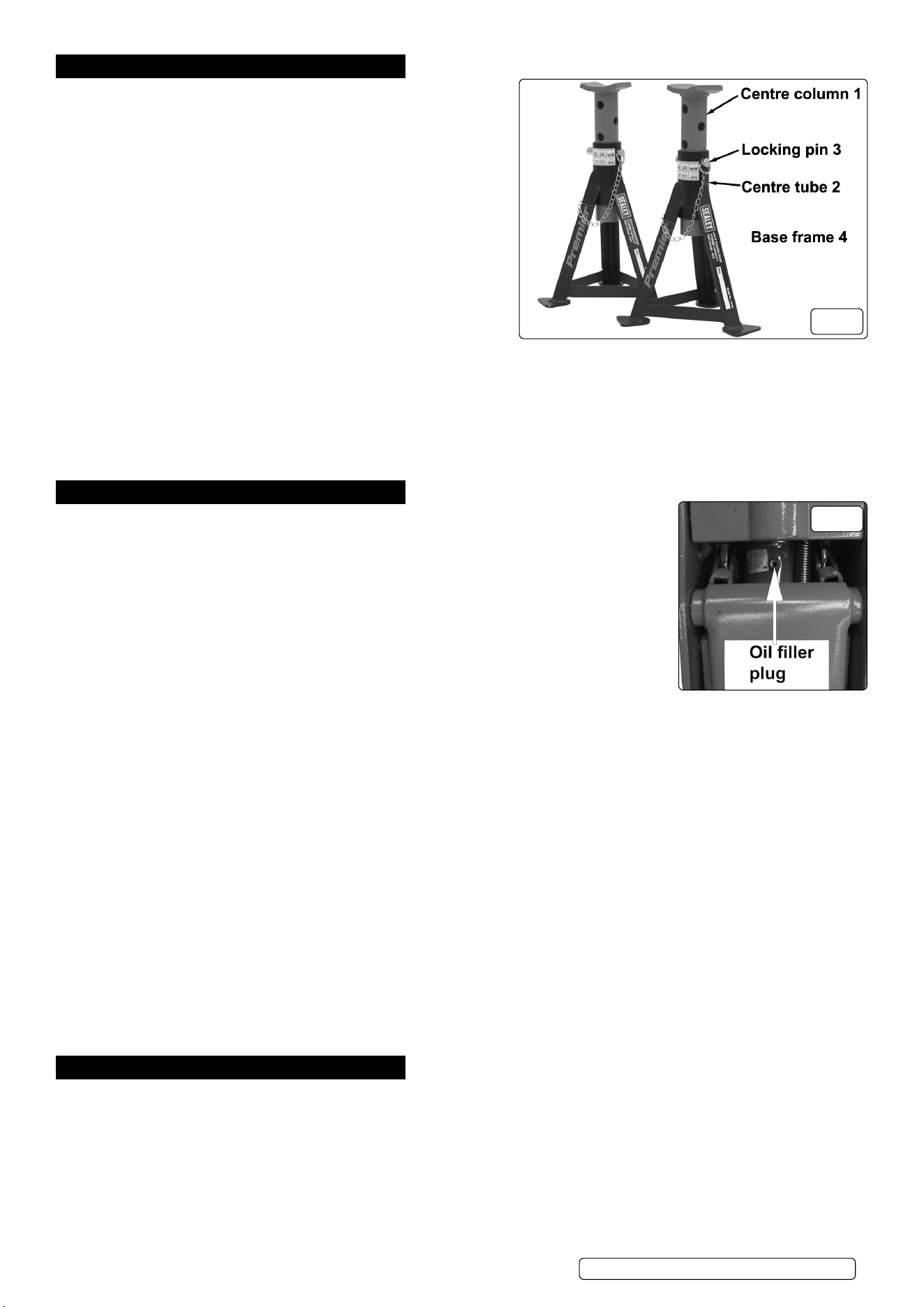
6.1. Insert the centre column (g 3 - 1) into the centre tube (g 3 - 2) of
base frame (g 3 - 4).
6.2. Adjust to the required height and insert the locking pin, through the
stand collar, centre tube and out of the other side (g 3 - 4).
6.3. Familiarise yourself with the product. Check that the stands are in
good condition and that no damage has been sustained during transit.
6.4. Ensure the maximum load does not exceed 6 tonnes per pair of axle
stands, (3 tonnes for each stand).
6.5. Refer to vehicle manufacturer’s instructions for recommended support
points.
6.6. Check that the points are in good condition.
6.7. Ensure the vehicle has been placed in gear and that the handbrake
has been applied. (For automatics select the ‘Park’ mode).
6.8. Adjust height of stand to correspond with the raised vehicle.
6.9. Check that the locking pin is correctly pushed all the way through the centre tube, centre column and out of the other side, then position
stands under vehicle at points recommended by vehicle manufacturer.
6.10. Carefully and slowly lower the load onto stands. Ensure the load bearing points sit in the center of the stand saddle and check that the
stands are stable and not leaning. Also ensure that there are no objects or persons that could impede the safe lowering of the vehicle onto
the stands.
6.11. To remove stands jack vehicle slightly so that stand can be removed.
6.12. After use, hold the centre column (3 - 1) rmly when removing the locking pin (g 3 - 3). Failure to do so will allow the center column to
fall freely through the main center tube with the risk of personal injury.
7. JACK MAINTENANCE
IMPORTANT: Only fully qualied personnel should attempt maintenance or repair. Jacks shall be
maintained and repaired in accordance with the manufacturer’s instructions. Such maintenance
and repair shall be carried out by qualied persons. No modications shall be carried out which
adversely aect the compliance of the jack with the standard. Check the state of the markings and
that the markings remain as the initial one.
7.1. When the jack is not in use, the ram and the handle socket should be in their lowest positions to
minimise corrosion.
7.2. When the jack is not in use, the ram should be in its lowest position to minimise corrosion. Remove
the handle to inactivate jack.
7.3. Keep the jack clean and lubricate all moving parts with oil on a regular basis.
7.4. Before each use check for broken, cracked, bent, or loose parts, or any visible damage to ram,
pump, saddle, lifting arm, frame and all parts including nuts, bolts, pins and other fasteners. If any
suspect item is found remove jack from service and take necessary action to remedy the problem.
8 DO NOT use the jack if believed to have been subjected to abnormal load or shock load.
7.5. Periodically check the pump piston and the ram for signs of corrosion. Clean exposed areas with a clean oiled cloth.
7.6. After one year the oil should be replaced in order to extend the life of the jack. Use hydraulic jack oil only.
WARNING! Maintenance and repair must only be carried out by a qualified person. Contact your Sealey stockist for details.
7.7. TO CHECK THE OIL LEVEL
7.7.1. Fully lower the jack and remove ller plug (g 4) The correct level is the bottom of the screw hole. If oil level is low, ll as required.
Pump jack 5 or 6 times to expel air. Pump jack up to full height and pour o excess oil before retting plug.
8 DO NOT touch the safety overload valve.
NOTE: Use a good quality jack oil, such as SEALEY HYDRAULIC JACK OIL.
WARNING: DO NOT use brake uid, or any uid other than hydraulic jack oil as this may cause serious damage to the jack and will
invalidate the warranty.
7.8. To drain the oil, remove the ller plug and raise front of jack. Make sure that no dirt is allowed to enter the hydraulic system.
IMPORTANT: NO RESPONSIBILITY IS ACCEPTED FOR INCORRECT USE OF THIS product.
Hydraulic products are only repaired by local service agents. We have service/repair agents in all parts of the UK.
DO NOT RETURN PRODUCT TO US. Please telephone us on 01284 757500 to obtain the address and phone number of your local
agent.
If the jack is under guarantee please contact your stockist.
DE-COMMISSIONING PRODUCT
Should the jack become completely unserviceable and require disposal, draw o the oil into an approved container and dispose of the
jack and the oil according to local regulations.
8. AXLE STAND MAINTENANCE
8.1. Before each use check to ensure stands and stand welds are not cracked, and that there are no missing and/or damaged parts.
WARNING! Any stand that appears to be damaged in any way must be removed from service immediately.
8.2. Ensure the locking pins are in good order and condition.
8.3. Due to the potential hazards associated with these stands, do not misuse, or make any modication to the stands or components.
8.4. It is the responsibility of the stands owner to ensure the operator has read these instructions, and that the operator is familiar with the
stands use and limitations.
FIG.3
FIG.4
Original Language Version
© Jack Sealey Limited
3010CX.V3 Issue 3 (H,1,2,4,5,F) 07/09/23
9. TROUBLESHOOTING - JACK
PROBLEM POSSIBLE CAUSE REMEDY
Jack will not lift
the load
1) Overloaded
2) Oil level low
3) Release valve not correctly
closed
4) Air in system
5) Piston rod not functioning
6) Packing worn or defective
1) Be sure to use jack with adequate capacity
2) Top up oil level
3) Check and close release valve
4) Open release valve and pump the handle a few times.
Close valve and re-try
5) Clean and replace oil
6) Replace packing
Jack does not lift
high enough
Or feels “spongy”
1) Oil level too high or too low
2) Worn seals
3) Air in system
4) Release valve not closed
1) Fill or remove excess oil
2) Return jack to local service agent
3) Open release valve and pump the handle a few times. Close valve and re-try
4) Check and close release valve
Jack lifts poorly 1) Pump packing or valves
malfunctioning
2) Oil is dirty
3) Air in the system
1) Replace packing and/or clean valves
2) Replace oil
3) Open release valve and pump the handle a few times.
Close valve and re-try
Jack lifts but will
not hold load
1) Release valve partially
open
2) Dirt on valve seats
3) Air in system
4) Faulty seals
5) Packing worn or defective
1) Check and close release valve
2) Lower jack, close release valve. Place foot on front wheel and pull up lifting
arm to it’s full height by hand.
Open the release valve to lower arm
3) Open release valve and pump the handle a few times. Close valve and re-try
4) Replace packing or contact local service agent
5) Replace packing
Jack will not
lower completely
1) Unit requires lubrication
2) Piston rod bent or
damaged
3) Jack frame/link system
distorted due to overloading/
poor positioning
4) Air in system
5) Release valve partially
closed
6) Jack spring damaged or
unhooked.
1) Oil all external moving parts
2) Replace rod or contact local service agent
3) Replace damaged parts or contact local service agent
4) Open release valve and pump the handle a few times.
Close valve and re-try
5) Check and fully open release valve
6) Replace spring or contact local service agent
Jack does not
lower at all
1) Release valve closed 1) Check and fully open release valve
Sealey Group, Kempson Way, Suffolk Business Park, Bury St Edmunds, Suffolk. IP32 7AR
01284 757500 sales@sealey.co.uk www.sealey.co.uk
ENVIRONMENT PROTECTION
Recycle unwanted materials instead of disposing of them as waste. All tools, accessories and packaging should be sorted,
taken to a recycling centre and disposed of in a manner which is compatible with the environment. When the product
becomes completely unserviceable and requires disposal, drain any fluids (if applicable) into approved containers and
dispose of the product and fluids according to local regulations.
Note: It is our policy to continually improve products and as such we reserve the right to alter data, specifications and component parts without prior
notice. Please note that other versions of this product are available. If you require documentation for alternative versions, please email or call
our technical team on technical@sealey.co.uk or 01284 757505.
Important: No Liability is accepted for incorrect use of this product.
Warranty: Guarantee is 12 months from purchase date, proof of which is required for any claim.
Original Language Version
© Jack Sealey Limited
3010CX.V3 Issue 3 (H,1,2,4,5,F) 07/09/23