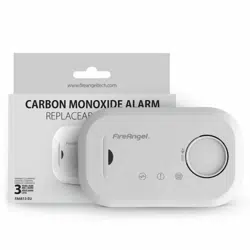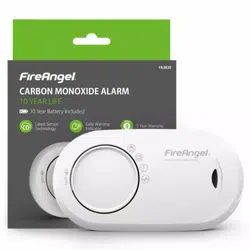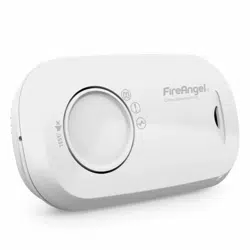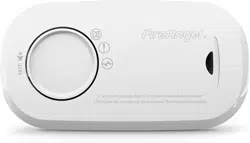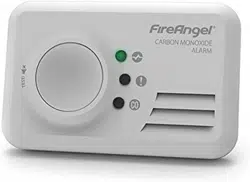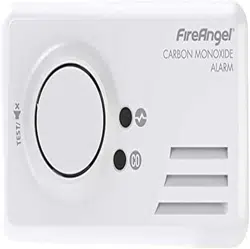

CARBON MONOXIDE
POISONOUS GAS ALARM
CO-9B User Manual

INTRODUCTION
FEATURES
CARBON MONOXIDE AND
HOW IT CAN AFFECT YOU
AND YOUR FAMILY
WHERE TO INSTALL YOUR
DETECTOR
HOW TO INSTALL YOUR
DETECTOR
BATTERY INSTALLATION/
REPLACEMENT
OPERATING FEATURES
UNDERSTANDING THE
PRODUCT’S INDICATORS
MAINTAINING / TESTING
YOUR DETECTOR
WHAT TO DO IN THE EVENT
OF AN ALARM
USEFUL NUMBERS
TECHNICAL INFORMATION
DISPOSAL
7 YEAR WARRANTY
RETURNS
PRODUCT RANGE
NOTES
2
2
3
5
7
8
9
12
13
14
15
16
17
18
19
19
20
CONTENTS
NOTE: This User Manual is also available in large
text and other formats. Please call 0800 141 2561
for further information

2
INTRODUCTION
Congratulations! You’ve made a wise
investment in an innovative product and
your personal safety. The CO-9B Carbon
Monoxide Poisonous Gas Alarm is one of a
new generation of domestic life safety products
from FireAngel Limited, which combines the
latest technology and innovative design to
provide an aesthetically pleasing and effective
contribution to your home safety.
The FireAngel range of products is constantly
being improved and expanded. Please visit
www.fireangel.co.uk to find out about the
latest additions to our product range.
FireAngel manufactures some of the most
technologically advanced carbon monoxide
detectors in the world.
FEATURES
• Anadvancedelectrochemicalsensor
designed to accurately measure low levels
of carbon monoxide (CO) providing an
early warning of toxic CO levels in your
home
• Detectscarbonmonoxidecontinuously
• Resistanttofalsealarmscausedbynormal
household contaminants
• Soundsaloud85dBalarm(at1m/3feet)
to alert you in case of an emergency
• Test/resetbutton
• Regularself-checktoensuredetectoris
operating correctly
• Simpletomount,portable,idealfor
travelling
• CertiedtotheEuropeanStandardfor
Carbon Monoxide Alarms
BSEN50291:2001
• 7yearwarranty

3
CARBON MONOXIDE
AND HOW IT CAN
AFFECT YOU AND
YOUR FAMILY
Carbon monoxide is a poisonous gas that
kills hundreds of people each year and injures
many more. It is often referred to as the silent
killer, it has no odour or taste and cannot
be seen. Like oxygen, CO enters the body
through the lungs during the normal breathing
process. It competes with oxygen by replacing
it in the red blood cells, thereby reducing the
flow of oxygen to the heart, brain and other
vital organs. In high concentrations, CO can
kill in minutes.
Many cases of reported carbon monoxide
poisoning indicate that while victims are
aware they are not feeling well, they
become disorientated and unable to save
themselves by either exiting the building or
calling for assistance. Exposure during sleep
is particularly dangerous because the victim
usually does not wake up.
Symptoms of CO poisoning
The following symptoms may be related to
CO poisoning which all household members
shouldbemadeawareof:
• Mild Exposure: Slight headache, nausea,
vomiting, fatigue (often described as ‘flu-
like’ symptoms)
• Medium Exposure: Severe throbbing
headache, drowsiness, confusion, fast
heart rate
• Extreme Exposure: Unconsciousness,
convulsions, cardiorespiratory failure,
death
Your FireAngel CO detector monitors the
level of CO as parts per million (ppm) in the
atmosphere surrounding the detector.
35ppm The maximum allowable
concentration for continuous
exposure for healthy adults in any
8hourperiod,asrecommended
by the Occupational Safety and
Health Administration (OSHA).
200ppm Slight headache, fatigue,
dizziness,nauseaafter2-3
hours.
400ppm Frontalheadacheswithin1-2
hours,lifethreateningafter3
hours.
800ppm Dizziness, nausea and
convulsionswithin45minutes.
Unconsciousness within 2 hours.
Deathwithin2-3hours.
Should you suspect CO may be affecting you
or your family, open the doors and windows
of your property to ventilate, turn off your
appliances and evacuate the premises. At
this time the authorities should be contacted

4
to locate the source of the carbon monoxide
before re-entering the building. Medical
attention should be sought for anyone suffering
the effects of CO poisoning (headache,
nausea,seepage3).
Common sources of CO
• Oilandgasboilers
• Portablegenerators
• Oilorsolidfuelcookers
• Gasorparafnheaters
• Barbecues
• Cloggedchimneys
• Gas,wood,coalorcokereplaces
• Cigarettesmoke
• Gasappliances
• Anyfossilfuelburningappliance
WARNING: This FireAngel carbon
monoxide detector is not a combustible
gas detector, nor a smoke detector. Please
install the proper detectors to detect
combustible gases, or smoke.
This CO detector should not be seen as a
substitute for the proper installation, use,
and maintenance of fuel-burning appliances
(including appropriate ventilation and exhaust
systems), nor the sweeping of chimneys.
WARNING: Do not use this carbon
monoxide detector on an intermittent
basis, or as a portable detector for trying to
trace one source of the spillage of combustion
products from fuel-burning appliances or
from chimneys.
Do not:
•IGNOREANYWARNINGFROMYOUR
CO DETECTOR!
•Burncharcoalinsideyourhome,caravan,
tent or cabin
•Install,convertorservicefuel-burning
appliances without proper knowledge, skill
and expertise
•Useagascookerforheatingaroom
•Operateunventedgasburningappliances
using paraffin or natural gas in closed
rooms
•Operatepetrol-poweredenginesindoors
or in confined areas
•Ignoreasafetydevicewhenitshutsan
appliance off
Always:
•Buyappliancesacceptedbyarecognised
testing laboratory
•Installappliancesaccordingtothe
manufacturer’s instructions
•Haveapplianceinstallationscarriedoutby
professionals (for gas appliances engineers
should be registered)
•Haveyourappliancescheckedregularly
by a qualified service engineer
•Haveyourchimneysanduescleaned

5
professionally every year
•Makeregularvisualinspectionsofallfuel-
burning appliances
•Donotbarbecueindoors,orinan
attached garage
•Openwindowswhenareplaceoroil/
solid fuel cooker is in use
•OnlyinstallCOdetectorsthatmeetthe
requirementsofBSEN50291:2001in
your home
•BeawareofCOpoisoningsymptoms(see
page3)
EDUCATE YOURSELF AND YOUR FAMILY
ON THE SOURCES AND SYMPTOMS OF
CO POISONING AND HOW TO USE
YOUR CARBON MONOXIDE DETECTOR
WHERE TO INSTALL
YOUR DETECTOR
WARNING: This detector will only
indicate the presence of carbon monoxide
gas at the sensor. Carbon monoxide gas may
be present in other areas.
In which room should the detector be
installed?
Ideally, an apparatus should be installed
in every room containing a fuel burning
appliance. Additional apparatus may be
installed to ensure that adequate warning
is given for occupants in other rooms, by
locatingapparatusin:
•Remoteroomsinwhichtheoccupant(s)
spend considerable time whilst awake and
from which they may not be able hear an
alarm from apparatus in another part of the
premises, and
•Everysleepingroom
However, if there is a fuel burning appliance
in more than one room and the number of
apparatus is limited, the following points
should be considered when deciding where
besttoputtheapparatus:
•Locatetheapparatusinaroomcontaining
a flueless or open-flued appliance, and
•Locateapparatusinaroomwherethe
occupant(s) spend most time
•Ifthedomesticpremisesisabedsit(a

6
single room serving as both sitting and
bedroom) then the apparatus should be
put as far from the cooking appliances
as possible but near to where the person
sleeps
•Iftheapplianceisinaroomnotnormally
used (for example a boiler room), the
apparatus should be put just outside the
room so that the alarm may be heard more
easily.
Where in the room should I place the
detector?
Apparatus located in the same room as a
fuel-burning appliance:
a For both wall and ceiling mounted
apparatusthefollowingapplies:
•Theapparatusshouldbeatahorizontal
distanceofbetween1mand3mfrom
the potential source
•Ifthereisapartitioninaroom,the
apparatus should be located on the
same side of the partition as the potential
source
•CarbonMonoxidedetectorsinrooms
with sloped ceilings should be located at
the high side of the room
b In addition to the previous points the
followingmustbeobserved:
Iftheapparatusislocatedonawall:
•itshouldbelocatedclosetotheceiling;
•itshouldbelocatedataheightgreater
thantheheightofanydoororwindow;
•itshouldbeatleast150mmfromthe
ceiling.
Iftheapparatusislocatedontheceiling:
•itshouldbeatleast300mmfromany
wall and any ceiling obstruction e.g.
light fittings.
Apparatus located in sleeping rooms
and in rooms remote from a fuel burning
appliance:
•Apparatuslocatedinsleepingrooms
or located in rooms remote from the
fuel-burning appliance should be located
relatively close to the breathing zone of
the occupants
Where not to put the detector
Theapparatusshouldnotbeinstalled:
•Inanenclosedspace(forexampleina
cupboard or behind a curtain)
•Whereitcanbeobstructed(forexample
by furniture)
•Directlyaboveasink
•Nexttoadoororwindow
•Nexttoanextractorfan
•Nexttoanairventorothersimilar
ventilation openings
•Inanareawherethetemperaturemay
dropbelow-10°Corexceed40°C
•Wheredirtanddustmayblockthesensor
•Inadamporhumidlocation(forexample
in a bathroom)
7
•Lessthan1m/3feetfromanyappliance
HOW TO INSTALL
YOUR DETECTOR
NOTE: This apparatus should be
installed by a competent person who
feels able to install it according to the
instructions.
Firstly write the installation date on your
detector in the area provided. We recommend
that your detector is installed on the wall.
To mount on a wall or ceiling:
Please ensure that you use the screws provided,
as they were chosen specifically for use with
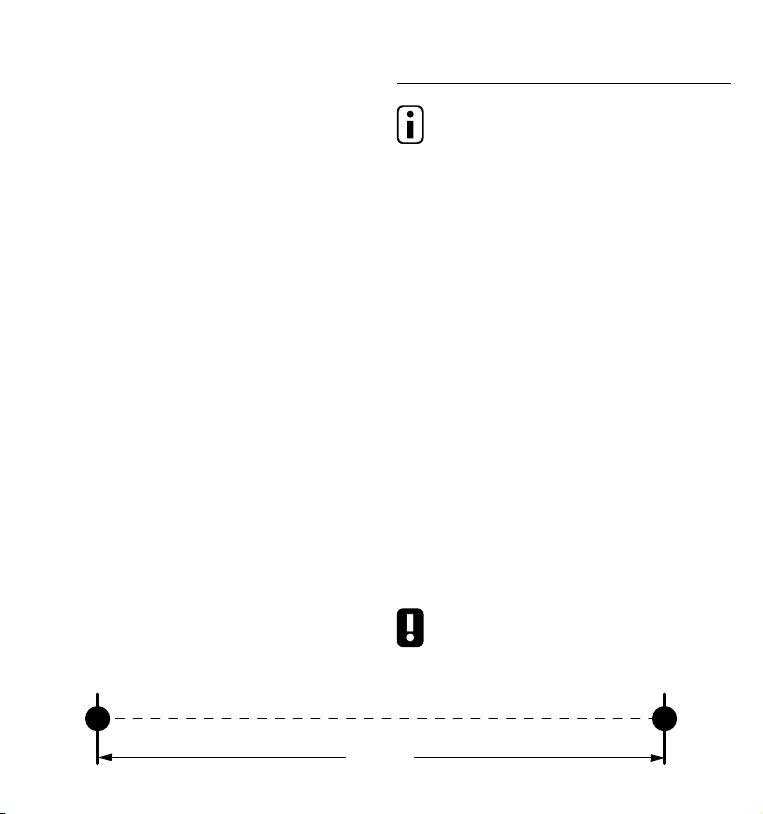
this product. Use template below for guidance
on marking hole positions. Drill holes into the
wall. Insert the plastic wall plugs. Screw in
the screws. Ensure screws are protruding from
thewallby3mmtoallowdetectortoslotonto
screws.
To place on a shelf:
The base of the detector has been designed
to allow it to stand freely on a shelf.
WARNING: When placing on a shelf,
please follow to the recommendations for
positioning as described on pages 5 to 7.
90mm
Drill hole spacing
8
e Test the sounder, batteries and circuitry by
pressing and holding the Test/Reset button
for1second.Thesoundershouldsound
as soon as the button is pressed, and the
Alarm LED will illuminate red for a short
time indicating that the sounder is working
and the batteries are providing power to
the unit. This test for the sounder, batteries
and circuitry should be performed weekly.
BATTERY
INSTALLATION /
REPLACEMENT
a If the detector is already wall or ceiling
mounted then unhook it from the mounting
screws.
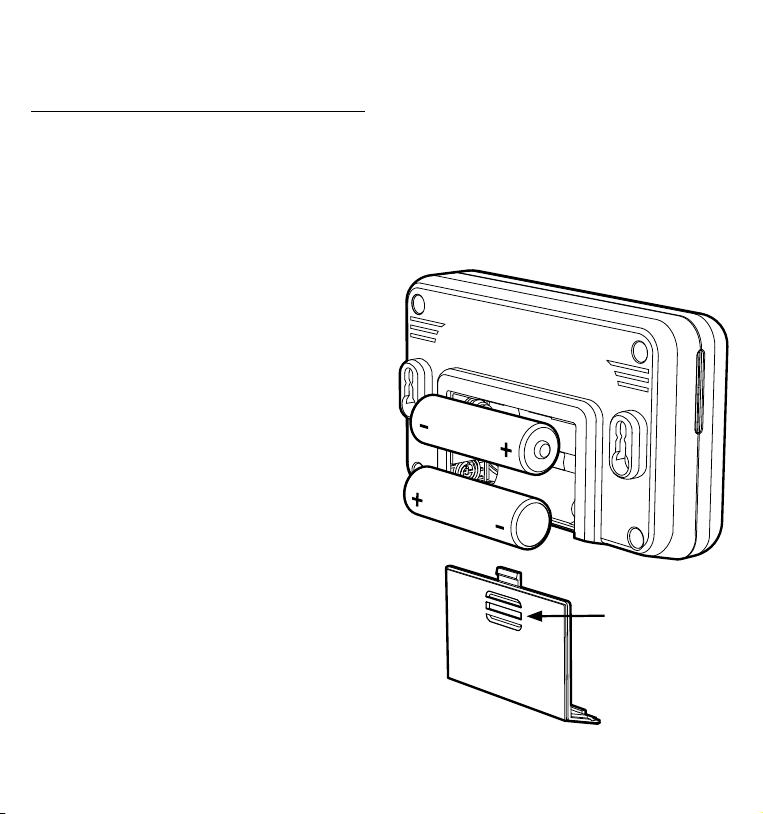
b Remove the battery cover located on the
back of the detector.
c Replace the batteries with 2 x approved
1.5voltAAsizealkalinebatteries(see
page16forrecommendedbatteries),
making sure the batteries are the correct
way round. Use of batteries other than
those recommended by FireAngel Ltd may
have a detrimental effect on the detector’s
operation. Replace the battery cover and
return the detector to its original position.
d Your advanced FireAngel detector requires
a short ‘warm-up’ period before it is fully
operational.
If you have followed all of the above steps
correctly, your unit will begin monitoring
forCOinaround3minutes.Whenthe
3minutewarm-upperiodiscomplete,
the Power LED will flash green once
per minute to indicate that the alarm is
receiving power from the batteries and is
fully operational (if your detector chirps or
entersalarmfollowingthe3minute
warm-up period then please refer to page
12).
Press ridged
area in and
slide door out
to reveal battery
compartment

9
WARNING: Prolonged exposure to the
sounder in close proximity to your ears
may damage your hearing.
Under normal operating conditions, the
batteriesshouldlastforatleast12months.
The detector will not protect against the risk
of carbon monoxide poisoning when the
batteries have drained.
WARNING: Constant exposure to
extreme high or low temperatures may
reduce the life of the batteries.
OPERATING FEATURES
Your FireAngel detector offers many features
which set it apart from other CO detectors on
the market today.
Test/Reset button feature
Thisbuttonwill:
•Testthesounder,batteriesandcircuitry
•Allowyoutotestthesensorbyintroducing
a source of CO into the detector (see
‘Testing The Sensor’ below)
•Silencetheloud85dBsounderduringan
alarm (only possible when current CO level
islessthan50ppm)
Testing the sounder, batteries and
circuitry
Test the sounder, batteries and circuitry by
pressing and holding the Test/Reset button
for 1 second to conrm that the detector is
operating properly. The sounder should sound
as soon as the button is pressed, and the
Alarm LED will illuminate red, indicating that
the sounder is working and the batteries are
providing power to the unit. This test for the
sounder, batteries and circuitry should be
performed weekly.
Testing the sensor
NOTE: We suggest the use of an
incense stick or cigarette as the inefficient
10
way in which these products burn means
the smoke given off contains a detectable
localised amount of carbon monoxide.
Alternative sources of smoke, for example
an extinguished candle or match, will not
contain sufficient levels of carbon monoxide
to obtain a response from the detector during
this test. Please note your CO detector will not
detect smoke.
If testing the sensor for the first time after
installation, or replacing the batteries, make
sure that the alarm has completed the initial
3 minute warm up period and the power LED
is flashing green once every minute.
CAUTION: Sensor testing should only
be performed by a responsible adult.
This test should only be performed once a
month. Excessive testing will cause the life
of the batteries to be shortened.
NOTE: CO test kits may be used in
order to avoid having to burn incense
sticks or cigarettes. However we recommend
that incense sticks are used as they are cheap
and readily available.
•Readallstepsthoroughlybeforeattempting
to test your the sensor
Step 1 If the detector is wall or ceiling
mounted unhook the detector from
the screws.
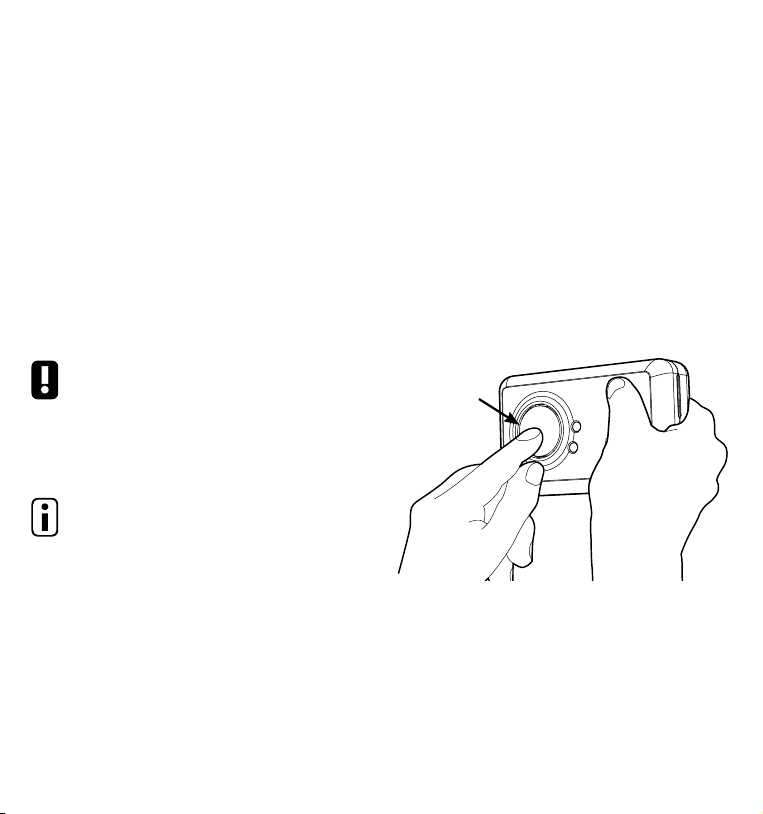
Step 2 Cover the sounder vents with one
hand. Press and hold the Test/
Reset button down with your
thumb/finger until the Power LED
illuminates green and the sounder
sounds for a second time (this
shouldhappenafteraround5
seconds). Release the Test/Reset
button. Upon releasing the Test/
Reset button the Power LED will
flash green once every second.
This indicates that the sampling
rate of the detector has increased
and can be tested using a known
source of CO.
Step 3 Light an incense stick or cigarette
using a match or lighter. If using
an incense stick be sure to blow
out the flame so that the incense
stick is smouldering. Extinguish
the lighter, or put out the match
and place it into a dish of water.
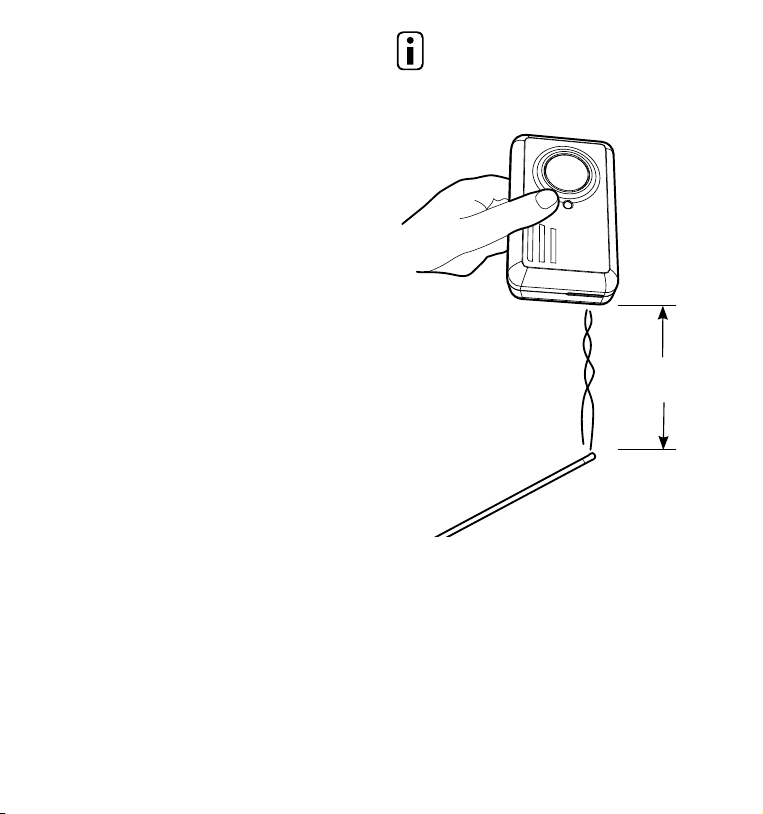
Step 4 Turn the detector on its side
Test/Reset
Button
11
so that the vents on the right
hand side of the detector are
pointing downwards (see
diagram opposite). Hold the
burning incense stick or cigarette
around15cm(6inches)below
the detector, so that the smoke
enters the vents on the side of
the detector. An increase in the
localised carbon monoxide level
within the sensor to more than
50ppmwillcausethesounder
to sound for one cycle of four
loud beeps and the Power LED
to illuminate green for a short
time. This is the end of the test.
The Power LED will no longer
flash green every second but
will revert to flashing once every
minute as the detector will go
back to normal operating mode
(It may take up to two minutes
of exposure to the smoke for
the localised level of carbon
monoxide within the sensor to
reachover50ppm).Nowmove
the source of CO away from the
detector as the test is finished.
Step 5 After step 4, put out the incense
stick or cigarette by placing it into
a dish of water. Ensure that all
flames have been extinguished.
NOTE: If the localised carbon monoxide
level within the sensor does not reach
50ppm during the test, the sensor test will
stop automatically after 3 minutes.
15cm
(6”)

12
contact technical support for advice. If the
product is no longer in warranty replace it
immediately!
FireAngel Technical Support Line
9.00am–5.00pm,Monday–Friday.
Telephone: 0800 141 2561
UKTextphoneUsersTelephone:180010800
14142561
EIREdial:1-800523171
e-mail:technicalsupport@reangel.co.uk
UNDERSTANDING
THE PRODUCT’S
INDICATORS
The higher the concentration of carbon
monoxide detected by the detector, the
quicker it will respond. When sufficient
carbon monoxide is detected a loud audible
signal(85dBat1m/3feet)willbeemitted
and the Alarm LED will flash red once every
second.
The Alarm will sound:
•Between60and90minuteswhen
exposedto50ppmofCO
•Between10and40minuteswhen
exposedto100ppmofCO
•Within3minuteswhenexposedto
300ppmormore
Fault / low battery signal:
The unit continuously checks the settings of its
sensor and circuitry. If any of these settings
are found to be incorrect or if the batteries
become low then the detector will emit a
single audible chirp once per minute for up
to30days.IMPORTANT: This does NOT
mean that the detector has detected carbon
monoxide.
Replace batteries immediately. If the product
continues to chirp despite having new batteries
and the product is still within warranty then

13
MAINTAINING /
TESTING YOUR
DETECTOR
Maintenance
Your detector will alert you to potentially
hazardous CO concentrations in your home
when maintained properly. To maintain your
FireAngel detector in proper working order,
and to ensure that the sensor will last for the
lifetime of the product, it is recommended that
you:
•Testthesounder,batteriesandcircuitryof
your detector once per week by pressing
andholdingtheTest/Resetbuttonfor1
second (see page 9)
•PerformtheSensorTestonceeverymonth
(see page 9)
•Keepthedetectorfreeofdustbygently
vacuuming the case with a soft brush
attachment once per month
To prevent the possibility of contaminating the
sensor in your detector and thus affecting its
reliability:
•Neverusecleaningsolutionsonyour
detector. Simply wipe with a slightly damp
cloth
•Donotpaintthedetector
•Donotsprayaerosolsonornearthe
detector
•Donotuseanysolventbasedproducts
near the detector
•Movethedetectortoasafelocationand
store in a plastic bag before painting, wall
papering, or performing any other activities
using substances that emit strong fumes.
Remember to remove it from the bag and
return the detector to its original location
when these activities are finished
Failure of any test should be reported to
the technical support line (see page 19 for
contact details).
Do not attempt to repair your CO detector.
Do not remove any screws or open the main
casing of your detector. Any attempt to do so
may cause malfunction and will invalidate the
warranty.

14
WHAT TO DO IN THE
EVENT OF AN ALARM
WARNING: A loud alarm is a warning
that unusually high and potentially lethal
levels of carbon monoxide are present.
Never ignore this alarm, further exposure
can be fatal. Immediately check residents for
symptoms of carbon monoxide poisoning,
and contact the proper authorities to resolve
all CO problems. NEVER IGNORE ANY
ALARM.
Please carefully review this owner’s manual to
ensure that you know what actions to take in
the event of an alarm.
What to do during an alarm
•Keepcalmandopenthedoorsand
windows to ventilate the property
•Stopusingallfuelburningappliancesand
ensure, if possible, that they are turned off
•Evacuatethepropertyleavingthedoors
and windows open
•Ringyourgasorotherfuelsupplierontheir
emergencynumber;keepthenumberina
prominent place
Write your fuel supplier’s emergency number
here(seeoppositeformoreusefulnumbers):
____________________________________
•Donotre-enterthepropertyuntilthealarm
has stopped. When exposed to fresh air it
cantakeupto10minutesforthesensorto
clear and the alarm to stop depending on
the level of carbon monoxide detected
•Getmedicalhelpimmediatelyforanyone
suffering the effects of carbon monoxide
poisoning (headache, nausea), and
advise that carbon monoxide poisoning is
suspected
•Donotusetheappliancesagainuntilthey
have been checked by an expert. In the
case of gas appliances the engineer must
be registered

15
USEFUL NUMBERS
National Gas Emergency Service
Gas Safe register
Solid Fuel Association
Advisory service for domestic and solid fuel
appliances
HETAS
Trade association for solid fuel engineers
OFTEC
Trade association for Oil Fired Appliance
engineers
NACS
National Association of Chimney Sweeps
IPHE
Institute of Plumbing and Heating Engineers
0800 111 999 (24 Hours)
0800 408 5500
0845 601 4406
0845 223 3033
0845 658 5080
0800 833 464
0870 414 5533

16
TECHNICAL INFORMATION
DetectorSpecications: ModelCO-9B
SensorType: Electrochemical
SensorLife: 7Years
AlarmSoundLevel: 85dBat1m/3feet
RecommendedBatteries: SizeAAAlkaline-DuracellLR6,EnergizerLR6,GoldPeak15A
BatteryLife: Exceeds1yearundernormaloperatingconditions,replaceable
TemperatureRange: -10ºC(14ºF)to40ºC(104ºF)
OperatingHumidityRange: 30-90%RH
Weight(inc.batteries): 125grams(4.4oz)
Certiedto: BSEN50291:2001
This FireAngel carbon monoxide detector is designed to continuously monitor for CO. Its response
timesmeettherequirementsoftheEuropeanstandardBSEN50291:2001.
Thealarmwillsound:
•Between60and90minuteswhenexposedto50ppmofCO
•Between10and40minuteswhenexposedto100ppmofCO
•Within3minuteswhenexposedtoCOlevelsof300ppmormore
17
DISPOSAL
Waste electrical products should not be
disposed of with regular household waste.
Please recycle where facilities exist. Check
with your local authority, retailer or the
FireAngel Technical Support Line (see page
19forcontactdetails)forrecycling/disposal
advice as regional variations apply.
The batteries should be removed before
disposal of the detector. Both the batteries and
the detector should be disposed of in line with
current regulations.
You can also return your carbon monoxide
detector to us for disposal. For return address
see the section on Returns. Please include a
note confirming the product is being returned
for disposal.
WARNING: DO NOT ATTEMPT TO
OPEN - DO NOT BURN
WARNING: APPARATUS
CONFORMING TO THIS STANDARD
MAY NOT PROTECT PEOPLE WHO ARE AT
SPECIAL RISK FROM CARBON MONOXIDE
EXPOSURE BY REASON OF AGE,
PREGNANCY OR MEDICAL CONDITION. IF
IN DOUBT, CONSULT YOUR DOCTOR.
A CARBON MONOXIDE DETECTOR IS NOT
A SUBSTITUTE FOR A SMOKE ALARM OR A
COMBUSTIBLE GAS DETECTOR.
THE CO-9B HAS AN OPERATIONAL
LIFETIME OF 7 YEARS FROM THE DATE IT IS
INSTALLED AND ACTIVATED. RECORD THE
DATE OF INSTALLATION ON THE STICKER
PROVIDED AND REPLACE UNIT AFTER 7
YEARS OF OPERATION.

18
7 YEAR WARRANTY
Warranty coverage
FireAngel Ltd warrants to the original purchaser
that its enclosed sealed carbon monoxide
detector be free from defects in materials and
workmanship under normal residential use
and service for a period of 7 (seven) years
from the date of purchase.
Provided it is returned with postage prepaid
and proof of purchase, FireAngel Ltd hereby
warrants that during the 7 (seven) year period
commencing from the date of purchase
FireAngel Ltd, at its discretion, agrees to
replace the unit free of charge. The warranty
on any replacement FireAngel CO-9B Carbon
Monoxide Poisonous Gas Alarm will last for
the remainder of the period of the original
warranty in respect of the detector originally
purchased–thatisfromthedateoforiginal
purchase and not from the date of receipt of
the replacement product. FireAngel Ltd reserves
the right to offer an alternative product similar
to that being replaced if the original model is
no longer available or in stock. This warranty
applies to the original retail purchaser from
the date of original retail purchase and is not
transferable. Proof of purchase is required.
Warranty disclaimers
This warranty does not cover damage
resulting from accident, misuse, disassembly,
abuse or lack of reasonable care of the
product, or applications not in accordance
with the user manual. It does not cover events
and conditions outside of FireAngel Ltd’s
control, such as Acts of God (fire, severe
weather etc). It does not apply to retail stores,
service centres or any distributors or agents.
FireAngel Ltd will not recognise any changes
to this warranty by third parties. FireAngel
Ltd shall not be liable for any incidental or
consequential damages caused by the
breach of any expressed or implied warranty.
Except to the extent prohibited by applicable
law, any implied warranty of merchantability
or fitness for a particular purpose is limited in
duration to 7 years.
This warranty does not affect your statutory
rights. Except for death or personal injury,
FireAngel Ltd shall not be liable for any loss of
use, damage, cost or expense relating to this
product or for any indirect, or consequential
loss, damages or costs incurred by you or any
other user of this product.
The warranty does not cover the batteries
which are considered user-replaceable parts.

19
PRODUCT RANGE
FireAngel Ltd manufactures an extensive range
of home safety products including smoke
alarms, carbon monoxide detectors, fire
extinguishers and remote sounding devices.
For more details visit www.fireangel.co.uk.
RETURNS
Should you encounter a problem with your
alarm, we recommend that you contact the
FireAngel Technical Support Line in the first
instance for advice on 0800 141 2561
(9.00am–5.00pm,Monday–Friday),UKText
phoneusersdial1800108001412561or
callersfromEIREdial1-800523171aswe
may be able to remedy the problem quickly
over the phone (this is to prevent unnecessary
returns that take a longer time to process).
Alternativelye-mail:
technicalsupport@fireangel.co.uk.
If there is a fault that we are unable to resolve
then our technical support team member will
issue you with a returns authority number so
that your product can be returned for testing.
To return your FireAngel CO-9B under
warranty, send it suitably packed and with the
battery disconnected with postage prepaid;
a note indicating the returns authority number
and describing the reason for return, with
proofofpurchaseto:
FireAngel Limited
The TechnoCentre
Puma Way
Coventry, CV1 2TT
UK

20
Ref:GN0324/R2
NOTES

FireAngel Ltd.
The Technocentre, Puma Way
Coventry CV1 2TT UK
A division of
CO-9B
GN0324/R2
Technical Support Line
0800 141 2561
UK Textphone users dial 18001 0800 141 2561
EIRE dial 1-800 523171
Email
technicalsupport@fireangel.co.uk
Web
www.fireangel.co.uk
BS EN 50291:2001
KM 551504