
0
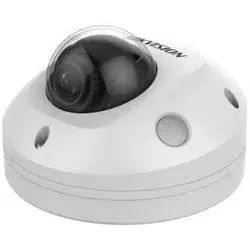
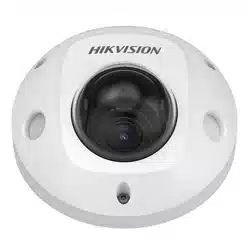
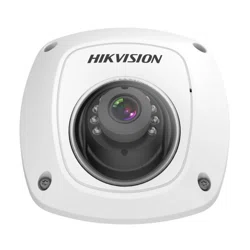
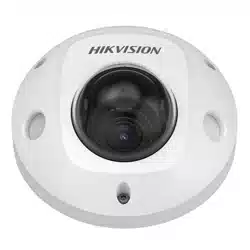
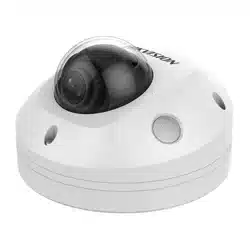
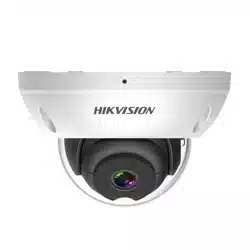
Mobile Network Camera
User Manual

Mobile Network Camera • User Manual
I
Legal Information
© 2022 Hangzhou Hikvision Digital Technology Co., Ltd. All rights reserved.
About this Manual
The Manual includes instructions for using and managing the Product. Pictures, charts, images and all other information
hereinafter are for description and explanation only. The information contained in the Manual is subject to change,
without notice, due to firmware updates or other reasons. Please find the latest version of this Manual at the Hikvision
website (https://www.hikvision.com/).
Please use this Manual with the guidance and assistance of professionals trained in supporting the Product.
Trademarks
and other Hikvision’s trademarks and logos are the properties of Hikvision in various jurisdictions.
Other trademarks and logos mentioned are the properties of their respective owners.
Disclaimer
TO THE MAXIMUM EXTENT PERMITTED BY APPLICABLE LAW, THIS MANUAL AND THE PRODUCT DESCRIBED, WITH ITS
HARDWARE, SOFTWARE AND FIRMWARE, ARE PROVIDED “AS IS” AND “WITH ALL FAULTS AND ERRORS”. HIKVISION
MAKES NO WARRANTIES, EXPRESS OR IMPLIED, INCLUDING WITHOUT LIMITATION, MERCHANTABILITY, SATISFACTORY
QUALITY, OR FITNESS FOR A PARTICULAR PURPOSE. THE USE OF THE PRODUCT BY YOU IS AT YOUR OWN RISK. IN NO
EVENT WILL HIKVISION BE LIABLE TO YOU FOR ANY SPECIAL, CONSEQUENTIAL, INCIDENTAL, OR INDIRECT DAMAGES,
INCLUDING, AMONG OTHERS, DAMAGES FOR LOSS OF BUSINESS PROFITS, BUSINESS INTERRUPTION, OR LOSS OF DATA,
CORRUPTION OF SYSTEMS, OR LOSS OF DOCUMENTATION, WHETHER BASED ON BREACH OF CONTRACT, TORT
(INCLUDING NEGLIGENCE), PRODUCT LIABILITY, OR OTHERWISE, IN CONNECTION WITH THE USE OF THE PRODUCT,
EVEN IF HIKVISION HAS BEEN ADVISED OF THE POSSIBILITY OF SUCH DAMAGES OR LOSS.
YOU ACKNOWLEDGE THAT THE NATURE OF THE INTERNET PROVIDES FOR INHERENT SECURITY RISKS, AND HIKVISION
SHALL NOT TAKE ANY RESPONSIBILITIES FOR ABNORMAL OPERATION, PRIVACY LEAKAGE OR OTHER DAMAGES
RESULTING FROM CYBER-ATTACK, HACKER ATTACK, VIRUS INFECTION, OR OTHER INTERNET SECURITY RISKS; HOWEVER,
HIKVISION WILL PROVIDE TIMELY TECHNICAL SUPPORT IF REQUIRED.
YOU AGREE TO USE THIS PRODUCT IN COMPLIANCE WITH ALL APPLICABLE LAWS, AND YOU ARE SOLELY RESPONSIBLE
FOR ENSURING THAT YOUR USE CONFORMS TO THE APPLICABLE LAW. ESPECIALLY, YOU ARE RESPONSIBLE, FOR USING
THIS PRODUCT IN A MANNER THAT DOES NOT INFRINGE ON THE RIGHTS OF THIRD PARTIES, INCLUDING WITHOUT
LIMITATION, RIGHTS OF PUBLICITY, INTELLECTUAL PROPERTY RIGHTS, OR DATA PROTECTION AND OTHER PRIVACY
RIGHTS. YOU SHALL NOT USE THIS PRODUCT FOR ANY PROHIBITED END-USES, INCLUDING THE DEVELOPMENT OR
PRODUCTION OF WEAPONS OF MASS DESTRUCTION, THE DEVELOPMENT OR PRODUCTION OF CHEMICAL OR
BIOLOGICAL WEAPONS, ANY ACTIVITIES IN THE CONTEXT RELATED TO ANY NUCLEAR EXPLOSIVE OR UNSAFE NUCLEAR
FUEL-CYCLE, OR IN SUPPORT OF HUMAN RIGHTS ABUSES.
IN THE EVENT OF ANY CONFLICTS BETWEEN THIS MANUAL AND THE APPLICABLE LAW, THE LATTER PREVAILS.

Mobile Network Camera • User Manual
II
Regulatory Information
FCC Information
Please take attention that changes or modification not expressly approved by the party responsible
for compliance could void the user’s authority to operate the equipment.
FCC Compliance
This equipment has been tested and found to comply with the limits for a Class A digital device,
pursuant to part 15 of the FCC Rules. These limits are designed to provide reasonable protection
against harmful interference when the equipment is operated in a commercial environment. This
equipment generates, uses, and can radiate radio frequency energy and, if not installed and used in
accordance with the instruction manual, may cause harmful interference to radio communications.
Operation of this equipment in a residential area is likely to cause harmful interference in which
case the user will be required to correct the interference at his own expense.
FCC Conditions
This device complies with part 15 of the FCC Rules. Operation is subject to the following two
conditions:
1. This device may not cause harmful interference.
2. This device must accept any interference received, including interference that may cause
undesired operation.
EU Conformity Statement
This product and - if applicable - the supplied accessories too are marked with "CE" and
comply therefore with the applicable harmonized European standards listed under the RE
Directive 2014/53/EU, EMC Directive 2014/30/EU, the LVD Directive 2014/35/EU, the RoHS
Directive 2011/65/EU.
2012/19/EU (WEEE directive): Products marked with this symbol cannot be disposed of as
unsorted municipal waste in the European Union. For proper recycling, return this product
to your local supplier upon the purchase of equivalent new equipment, or dispose of it at
designated collection points. For more information see: www.recyclethis.info
2006/66/EC (battery directive): This product contains a battery that cannot be disposed
of as unsorted municipal waste in the European Union. See the product documentation
for specific battery information. The battery is marked with this symbol, which may include
lettering to indicate cadmium (Cd), lead (Pb), or mercury (Hg). For proper recycling, return the
battery to your supplier or to a designated collection point. For more information see:
www.recyclethis.info
Industry Canada ICES-003 Compliance
This device meets the CAN ICES-3 (A)/NMB-3(A) standards requirements.
Mobile Network Camera • User Manual
III
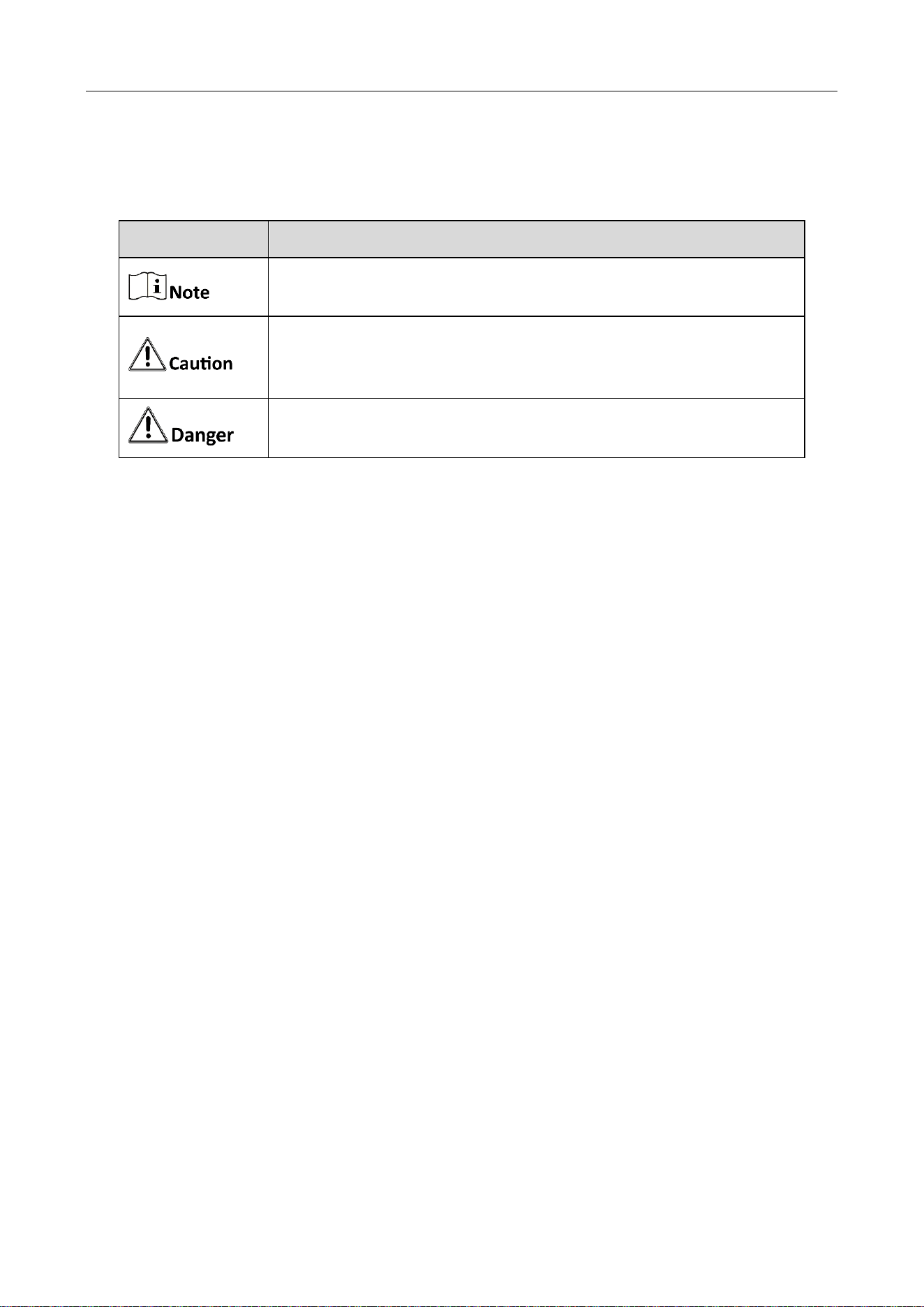
Symbol Conventions
The symbols that may be found in this document are defined as follows.
Safety Instructions
Proper configuration of all passwords and other security settings is the responsibility of the
installer and/or end-user.
In the use of the product, you must be in strict compliance with the electrical safety
regulations of the nation and region. Please refer to technical specifications for detailed
information.
Input voltage should meet limited power source or PS2 requirements according to the
IEC60950-1 or IEC 62368-1 standard. Please refer to technical specifications for detailed
information.
Do not connect several devices to one power adapter as adapter overload may cause over-
heating or a fire hazard.
Please make sure that the plug is firmly connected to the power socket.
If smoke, odor or noise rise from the device, turn off the power at once and unplug the power
cable, and then please contact the service center.
Symbol
Description
Provides additional information to emphasize or supplement
important points of the main text.
Indicates a potentially hazardous situation, which if not avoided,
could result in equipment damage, data loss, performance
degradation, or unexpected results.
Indicates a hazard with a high level of risk, which if not avoided, will
result in death or serious injury.

Mobile Network Camera • User Manual
IV
TABLE OF CONTENTS
Chapter 1 Introduction ................................................................................................................... 1
Product Features............................................................................................................................................ 1
Product Function ........................................................................................................................................... 1
Chapter 2 Operation Instructions ................................................................................................... 2
Setting the Network Camera over the LAN ..................................................................................................... 2
2.1.1 Wiring over the LAN ............................................................................................................................ 2
Activating the Camera .................................................................................................................................... 3
2.2.1 Activation via SADP Software ............................................................................................................... 3
2.2.2 Activation via Web Browser ................................................................................................................. 5
2.2.3 (Optional) Setting Security Question .................................................................................................... 6
Login and Logout............................................................................................................................................ 6
2.3.1 Login ................................................................................................................................................... 6
2.3.2 Logout ................................................................................................................................................. 7
Main Interface ............................................................................................................................................... 7
Chapter 3 Basic Functions............................................................................................................... 9
Local Parameters ........................................................................................................................................... 9
3.1.1 Live View Parameters .........................................................................................................................10
3.1.2 Record File Setting ..............................................................................................................................10
3.1.3 Picture and Clip Setting.......................................................................................................................10
Live View ......................................................................................................................................................10
3.2.1 Live View Page....................................................................................................................................10
3.2.2 Starting Live View ...............................................................................................................................12
3.2.3 Record and Capture Pictures Manually ...............................................................................................12
Chapter 4 System Configuration ................................................................................................... 13
Configure System Settings .............................................................................................................................13
4.1.1 Check Device Information ...................................................................................................................13
4.1.2 Time Settings ......................................................................................................................................13
4.1.3 DST ....................................................................................................................................................15
Maintenance.................................................................................................................................................16
4.2.1 Upgrade & Maintenance.....................................................................................................................16
4.2.2 Log .....................................................................................................................................................17
Security.........................................................................................................................................................19
4.3.1 Authentication ...................................................................................................................................19
4.3.2 Security Service ..................................................................................................................................20
User Management ........................................................................................................................................21
4.4.1 User Management ..............................................................................................................................21
4.4.2 Security Question ...............................................................................................................................23
4.4.3 Online Users .......................................................................................................................................24
Chapter 5 Network Settings ......................................................................................................... 25
Basic Settings ................................................................................................................................................25
5.1.1 TCP/IP ................................................................................................................................................25
5.1.2 Port ....................................................................................................................................................26
5.1.3 Multicast ............................................................................................................................................27
Advanced Settings.........................................................................................................................................28
5.2.1 HTTPS .................................................................................................................................................28

Mobile Network Camera • User Manual
V
5.2.2 QoS ....................................................................................................................................................29
5.2.3 Integration Protocol ...........................................................................................................................30
5.2.4 Network Service .................................................................................................................................31
Chapter 6 Video/Audio Settings ................................................................................................... 32
Video ............................................................................................................................................................32
Audio ............................................................................................................................................................34
ROI Encoding ................................................................................................................................................35
Chapter 7 Image Settings.............................................................................................................. 38
Settings Parameters ......................................................................................................................................38
Day/Night Switch ..........................................................................................................................................41
7.2.1 Day/Night Auto-Switch .......................................................................................................................41
7.2.2 Day/Night Scheduled-Switch...............................................................................................................42
OSD Settings .................................................................................................................................................42
Chapter 8 Storage Settings ........................................................................................................... 45
Record Schedule ...........................................................................................................................................45
Storage Management....................................................................................................................................45
Chapter 9 Access to the Network Camera .................................................................................... 47
9.1.1 Via Static IP Connection ......................................................................................................................47
9.1.2 Via Dynamic IP Connection .................................................................................................................48
Chapter 10 Appendix .................................................................................................................... 49
Appendix 1 SADP Software Introduction ......................................................................................................49
Appendix 2 Device APP................................................................................................................................51
Device Communication Matrix ............................................................................................................................51
Device Command................................................................................................................................................51

Mobile Network Camera • User Manual
1
Chapter 1 Introduction
Product Features
This Network camera is a digital monitoring product that integrates video and audio
acquisition, intelligent coding and compression, network transmission and other
functions. With embedded operating system and high-performance hardware
processing platform, it has high stability and reliability, and can meet the needs of
various industries.
Based on Ethernet control, the network camera can realize image compression and
transmit it to different users through the network. Centralized storage based on NAS
can greatly facilitate the storage and call of data.
You can control the webcam through the browser, and set the webcam parameters,
intelligent functions, audio and video parameters, image parameters, etc. through
the browser. Please refer to the actual equipment for specific function parameters.
Product Function
This chapter explains the camera from the product function, so that you can get to
know and get familiar with the camera more quickly.
System function
Video recording and capturing pictures
The camera supports instant capture and video recording during preview, and can
also configure video recording plan after installing memory card, so as to realize
planned video recording.
User Management
You can manage many different users through the administrator "admin" user, and
configure different permissions for each user.
Network function
The camera supports TCP/IP, UDP and other network communication protocols;
Support open interconnection protocols such as ONVIF.
The function of the product depends on the model, please refer to the technical
parameters of the actual product.
Mobile Network Camera • User Manual
2
Chapter 2 Operation Instructions
You shall acknowledge that the use of the product with Internet access might be
under network security risks. For avoidance of any network attacks and
information leakage, please strengthen your own protection. If the product does
not work properly, please contact with your dealer or the nearest service center.
To ensure the network security of the network camera, we recommend you to
have the network camera assessed and maintained termly. You can contact us if
you need such service.
Setting the Network Camera over the LAN
Purpose:
To view and configure the camera via a LAN, you need to connect the network
camera in the same subnet with your computer, and install the SADP software to
search and change the IP of the network camera.
For the detailed introduction of SADP, please refer to Appendix 1.
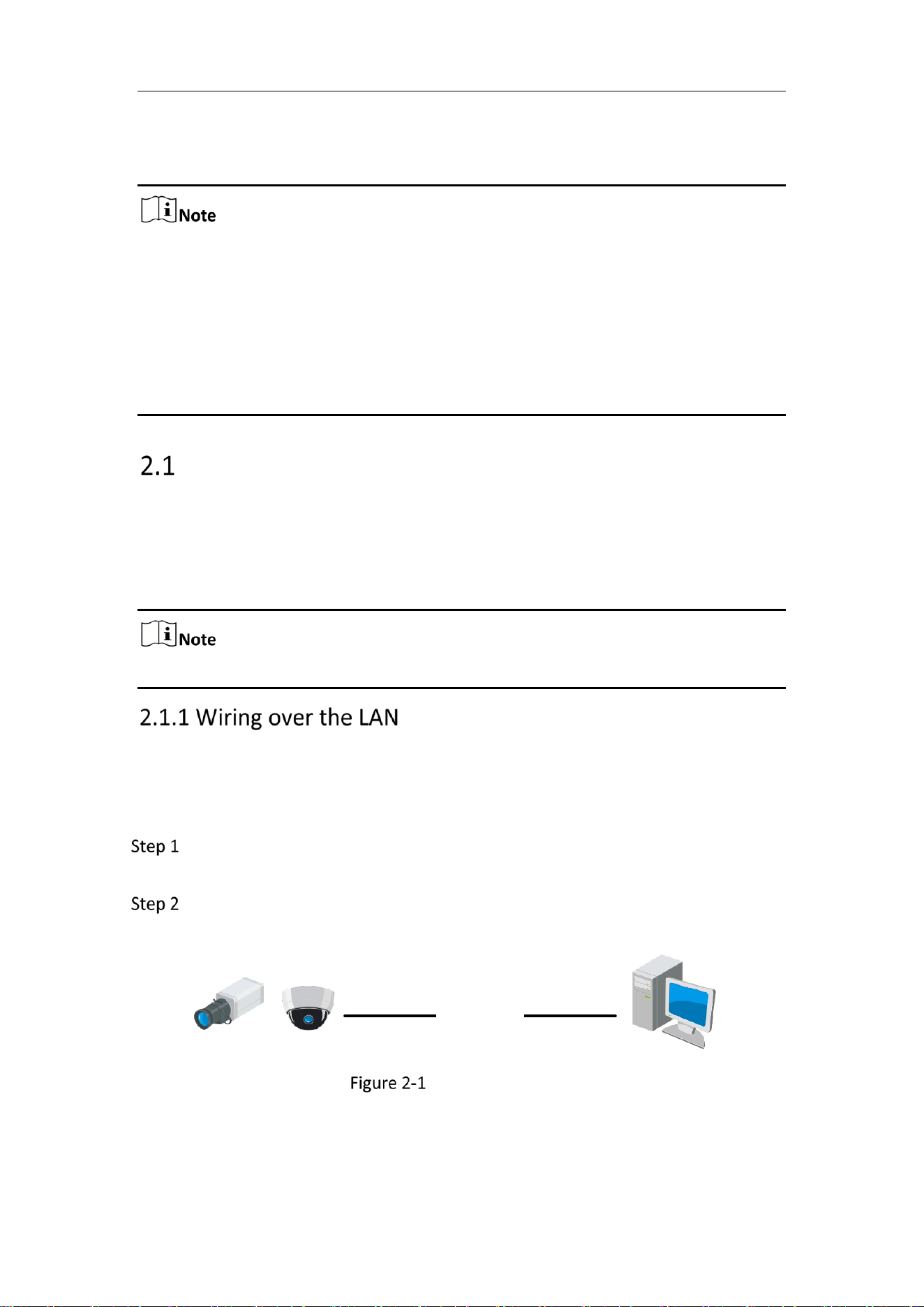
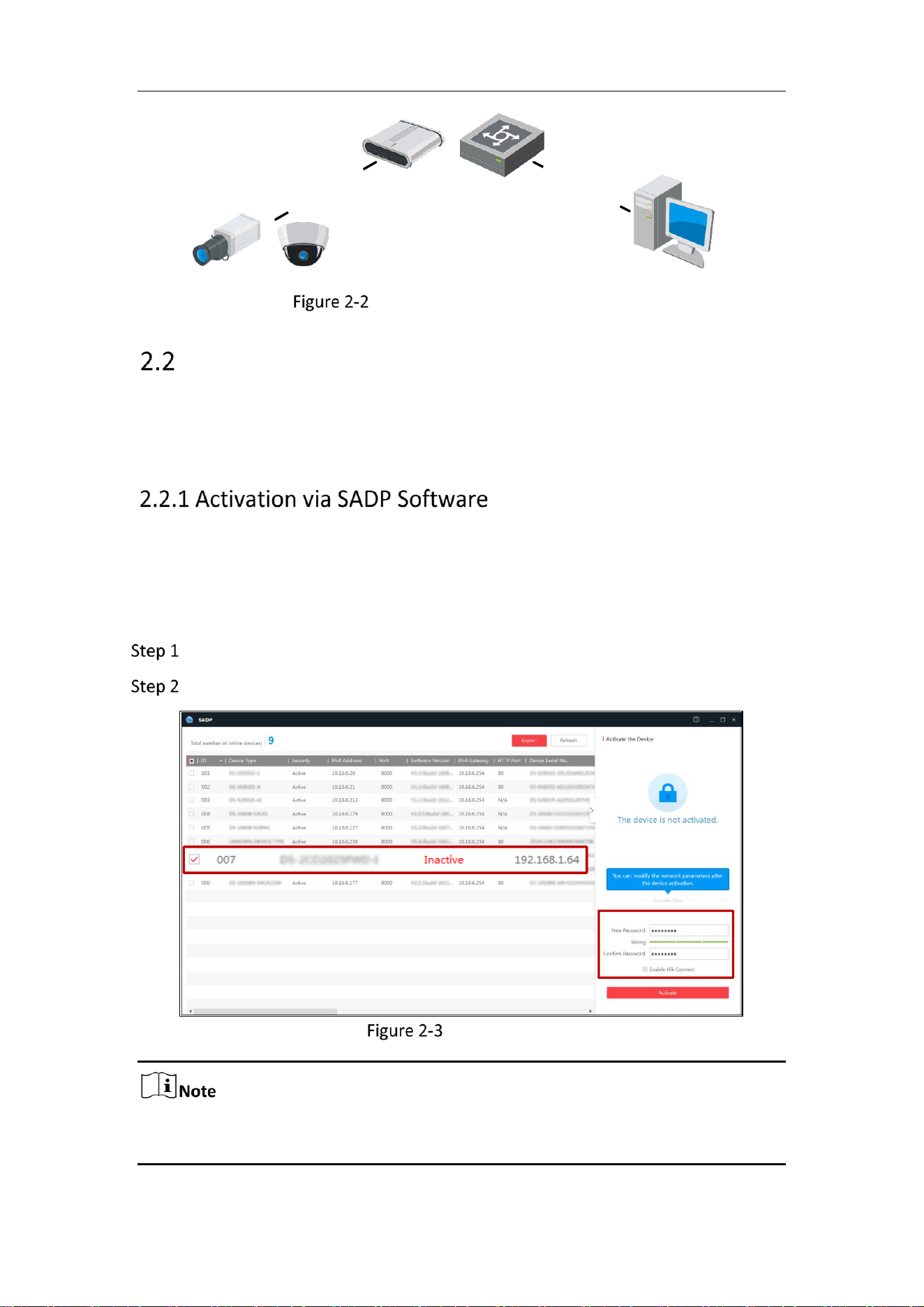
The following figures show the two ways of cable connection of a network camera
and a computer:
Purpose:
To test the network camera, you can directly connect the network camera to
the computer with a network cable as shown in Figure 2-1.
Refer to the Figure 2-2 to set network camera over the LAN via a switch or a
router.
半球
Network Cable
or
Network Camera
Computer
Connecting Directly
Mobile Network Camera • User Manual
3
网络交换机
半球
Network Cable
Network Cable
or
or
Network Camera Computer
Connecting via a Switch or a Router
Activating the Camera
You are required to activate the camera first by setting a strong password for it
before you can use the camera.
Activation via Web Browser, Activation via SADP is supported.
SADP software is used for detecting the online device, activating the camera, and
resetting the password.
Get the SADP software from the official website, and install the SADP according to
the prompts. Follow the steps to activate the camera.
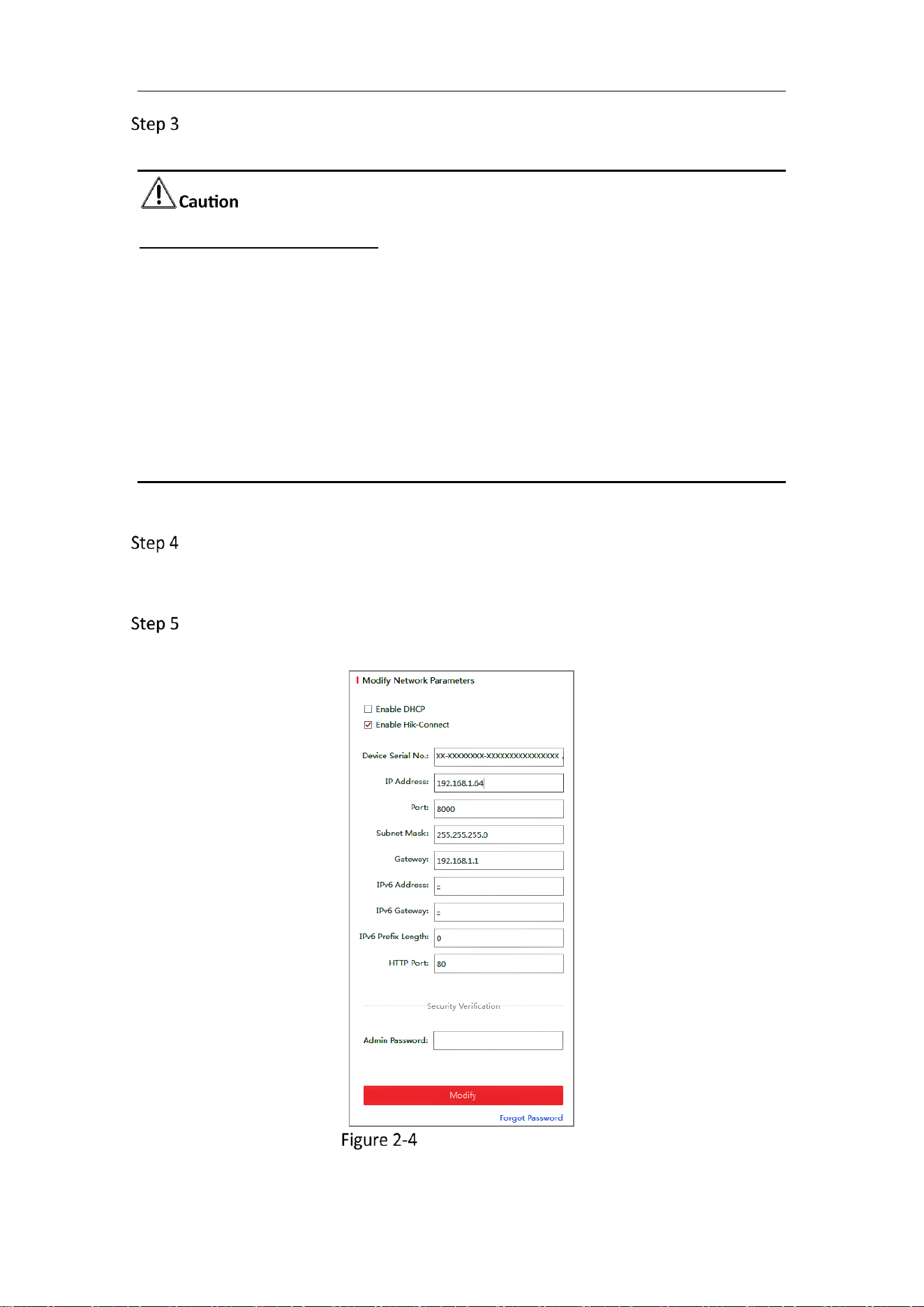
Run the SADP software to search the online devices.
Check the device status from the device list, and select the inactive device.
SADP Interface
The SADP software supports activating the camera in batch. Refer to the user manual
of SADP software for details.
Select inactive device.
Input and confirm
password.
Mobile Network Camera • User Manual
4
Create and input the password in the password field, and confirm the
password. A password with user name in it is not allowed.
STRONG PASSWORD RECOMMENDED
We highly recommend you create a strong password of your own choosing
(using a minimum of 8 characters, including at least three of the following
categories: upper case letters, lower case letters, numbers, and special
characters) in order to increase the security of your product. And we
recommend you reset your password regularly, especially in the high security
system, resetting the password monthly or weekly can better protect your
product.
Proper configuration of all passwords and other security settings is the
responsibility of the installer and/or end-user.
You can enable the Hik-Connect service for the device during activation.
Click Activate to start activation. You can check whether the activation is
completed on the popup window. If activation failed, please make sure that
the password meets the requirement and try again.
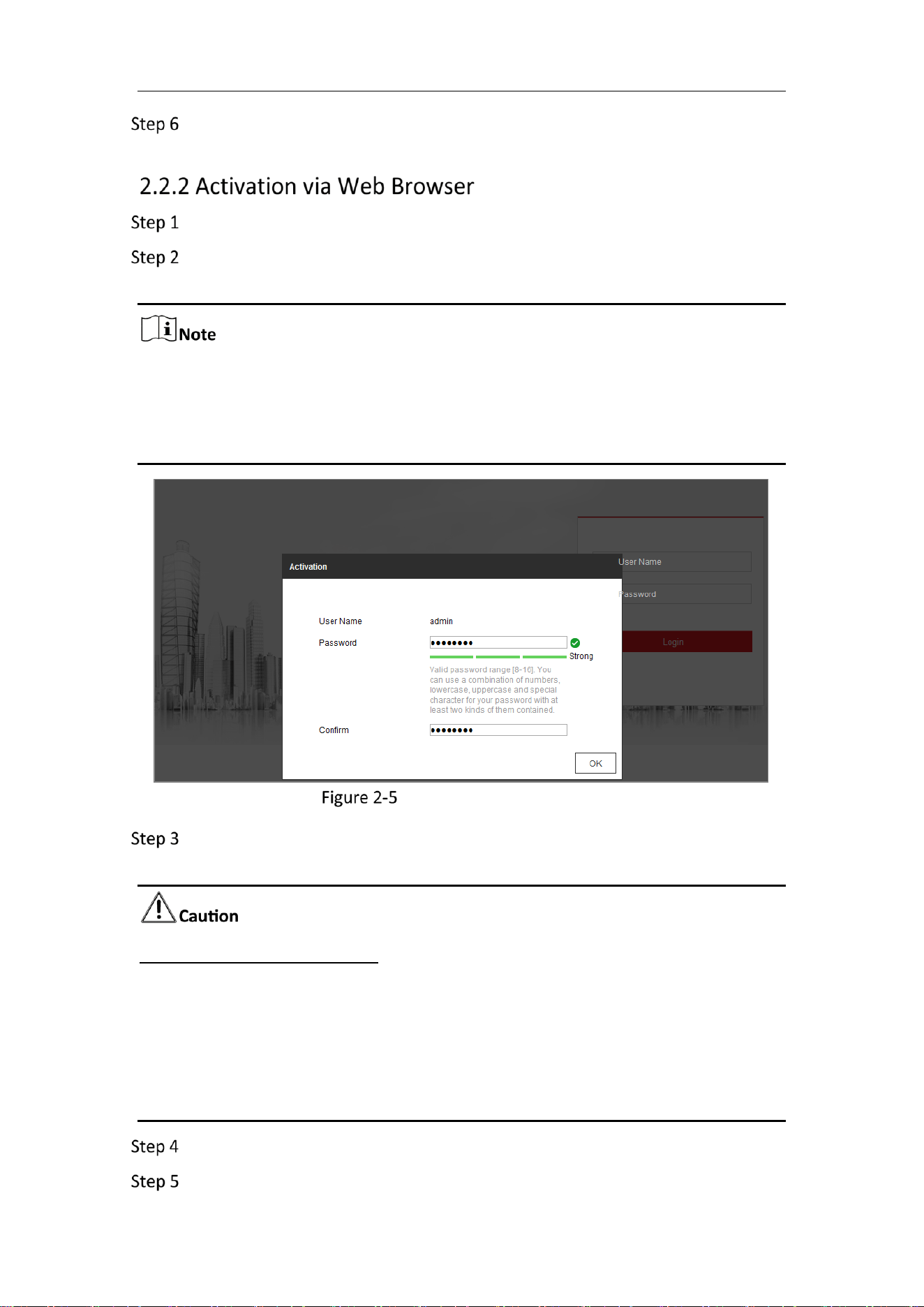
Change the device IP address to the same subnet with your computer by either
modifying the IP address manually or checking the checkbox of Enable DHCP.
Modify the IP Address
Mobile Network Camera • User Manual
5
Input the admin password and click Modify to activate your IP address
modification.
Power on the camera, and connect the camera to the network.
Input the IP address into the address bar of the web browser, and click Enter to
enter the activation interface.
The default IP address of the camera is 192.168.1.64.
The computer and the camera should belong to the same subnet.
For the camera enables the DHCP by default, you need to use the SADP software
to search the IP address.
Activation via Web Browser
Create and input a password into the password field. A password with user
name in it is not allowed.
STRONG PASSWORD RECOMMENDED
We highly recommend you create a strong password of your own choosing (using a
minimum of 8 characters, including at least three of the following categories: upper
case letters, lower case letters, numbers, and special characters) in order to increase
the security of your product. And we recommend you reset your password regularly,
especially in the high security system, resetting the password monthly or weekly can
better protect your product.
Confirm the password.
Click OK to save the password and enter the live view interface.
Mobile Network Camera • User Manual
6
Security question is used to reset the admin password when admin user forgets the
password.
Admin user can follow the pop-up window to complete security question settings
during camera activation. Or, admin user can go to User Management interface to set
up the function.
Login and Logout
For certain camera models, HTTPS is enabled by default and the camera creates an
unsigned certificate automatically. When you access to the camera the first time, the
web browser prompts a notification about the certificate issue.
To cancel the notification, install a signed-certificate to the camera.
Open the web browser.
In the browser address bar, input the IP address of the network camera, and
press the Enter key to enter the login interface.
The default IP address is 192.168.1.64. You are recommended to change the IP
address to the same subnet with your computer.
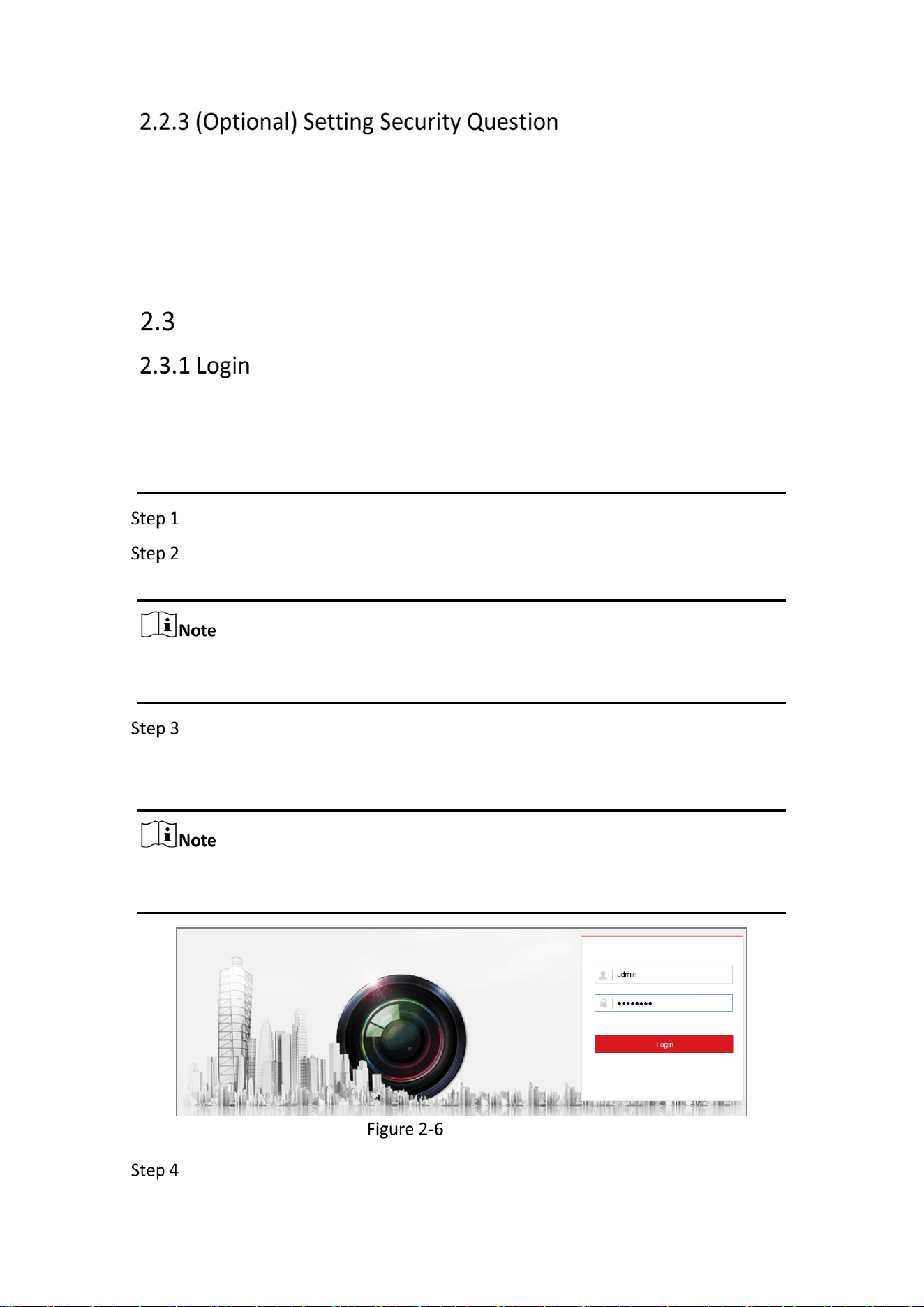
Input the user name and password.
The admin user should configure the device accounts and user/operator permissions
properly. Delete the unnecessary accounts and user/operator permissions.
The IP address gets locked if the admin user performs 7 failed password attempts (5
attempts for the user/operator).
Login Interface
Click Login.
Mobile Network Camera • User Manual
7
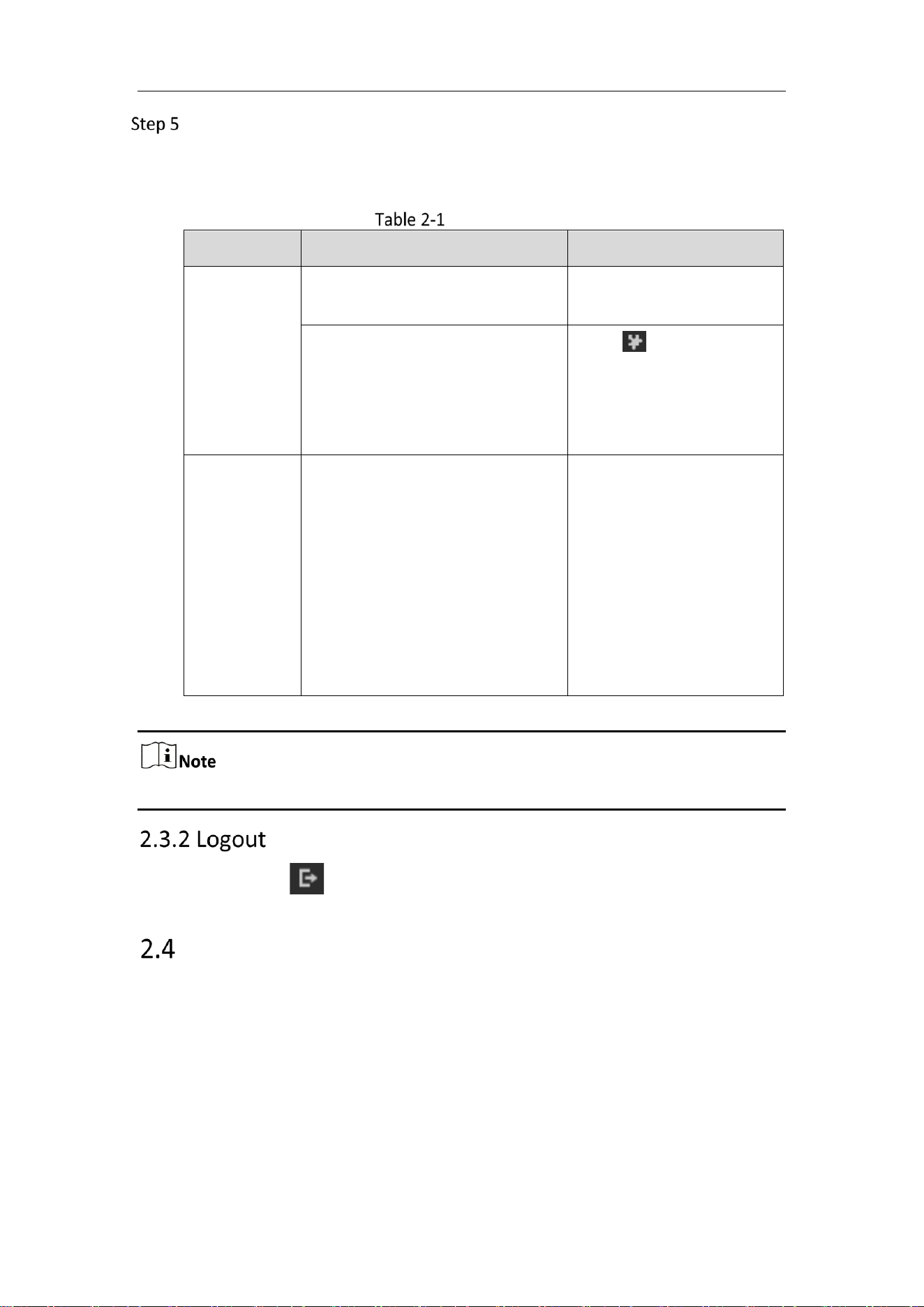
(Optional) Install the plug-in before viewing the live video and operating the
camera. Follow the installation prompts to install the plug-in.
Install Plugins
OS
Browser Version
Plugin
Windows
IE 8 and upper
Install the plugin
according to instructions.
Google Chrome 57 and upper
Mozilla Firefox 52 and upper
Edge and upper
Click in the preview
page to download and
install the plugin for high
quality view and device
functions.
Mac OS
Google Chrome 57 and upper
Mozilla Firefox 52 and upper
Mac Safari 16 and upper
Edge and upper
To preview, enter
Configuration > Network >
Advanced Setting >
Network Service, and
enbale WebSocket. Some
functions will be limited
after enbling this function,
such as video play. The
actual equipment shall
prevail.
The camera supports only Windows and Mac OS, not Linux.
To logout, click the icon.
Main Interface
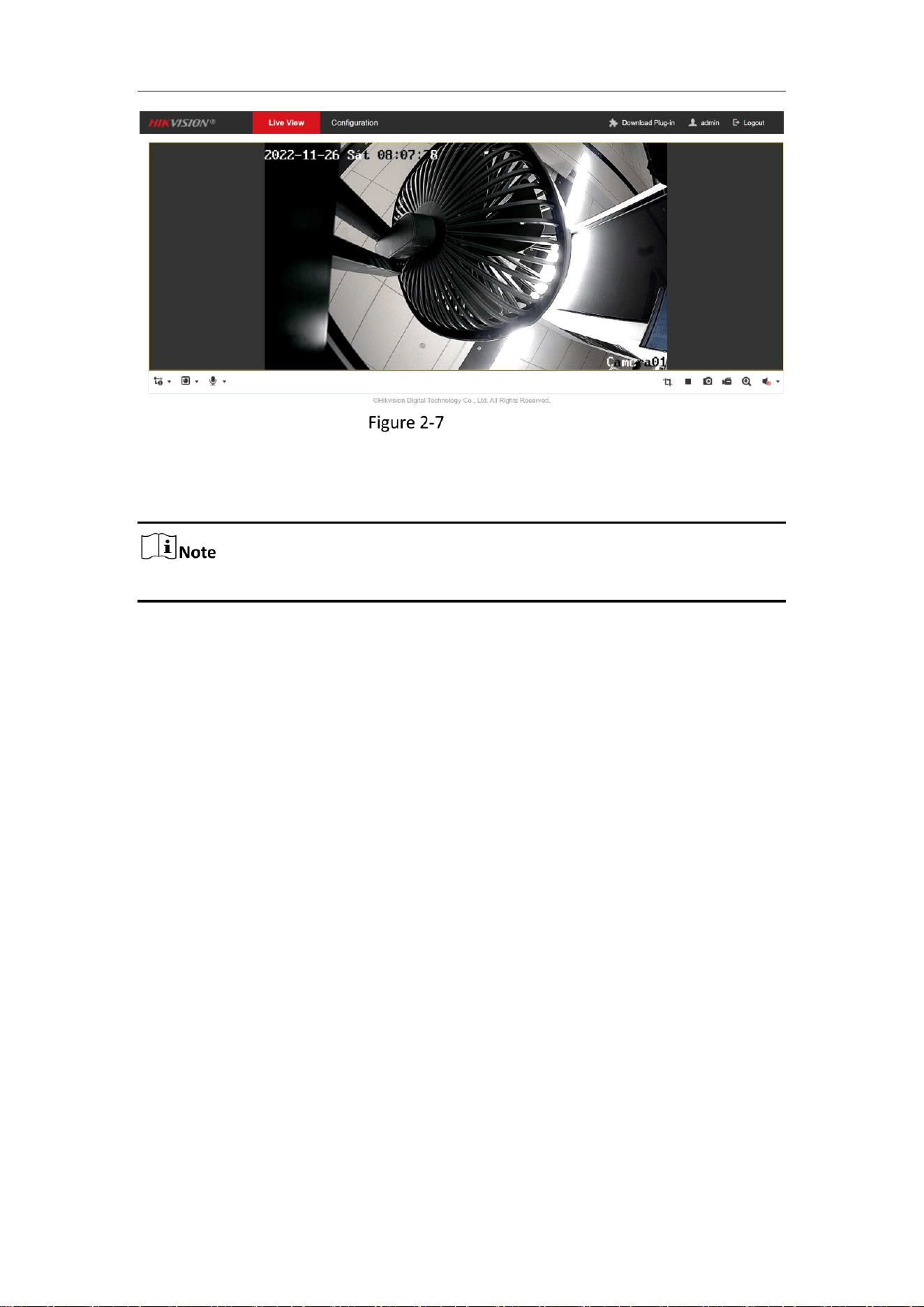
The main interface is shown as follows.
Mobile Network Camera • User Manual
8
Main Interface
Live View: to view the camera and set parameters.
Configuration: to set the system and function parameters.
The interface may vary according to the model of the camera.
Mobile Network Camera • User Manual
9
Chapter 3 Basic Functions
Local Parameters
Click Configuration on the main interface to enter the configuration page, where the
user can set up system, network, video/audio, image and storage parameters.
Configuration Page Overview
Go to Configuration > Local to configure local configurations. Live View Parameters,
Record File Settings, Picture and Clip Settings can be configured.
Local Parameters
Mobile Network Camera • User Manual
10
The playback function of this camera may vary according to different types. Please
refer to the actual product.
Protocols
The default protocol is UDP, which is suitable for the situation that the requirement
of video fluency is not high and the network environment is unstable.
Play Performance:
You can choose the shortest delay, Balanced, Fluent and Custom, and the default is
Custom.
Shortest delay: Real-time is good, but it may affect the fluency of video.
Balanced: Give consideration to the real-time and fluency of video playback.
Good fluency: In the same network situation, it takes up less network resources,
and the video is smoother than other modes.
Custom: the frame rate can be set according to the network conditions.
Display POS Information: You can choose to enable or disable it. When enabled,
information boxes will appear on the live screen, including the dynamic analysis
box of motion detection and the face target box.
Picture and Clip Settings: set the format of captured pictures, with optional JPEG
and BMP.
Record File Size: it can be set to 256 M, 512 M and 1 G, indicating the size of a
single video file stored locally.
Save record files to: the path where video files are stored locally. You can choose
Browse to change the path, and click Open Folder to open the folder under the
archive path.
Save snapshots in live view to: the path where the captured pictures are stored
locally during preview. You can choose Browse to change the path, and click Open
Folder to open the folder under the archive path.
Live View
Mobile Network Camera • User Manual
11
Purpose:
The live view page allows you to view the real-time video, capture images, realize PTZ
control, set/call presets and configure video parameters.
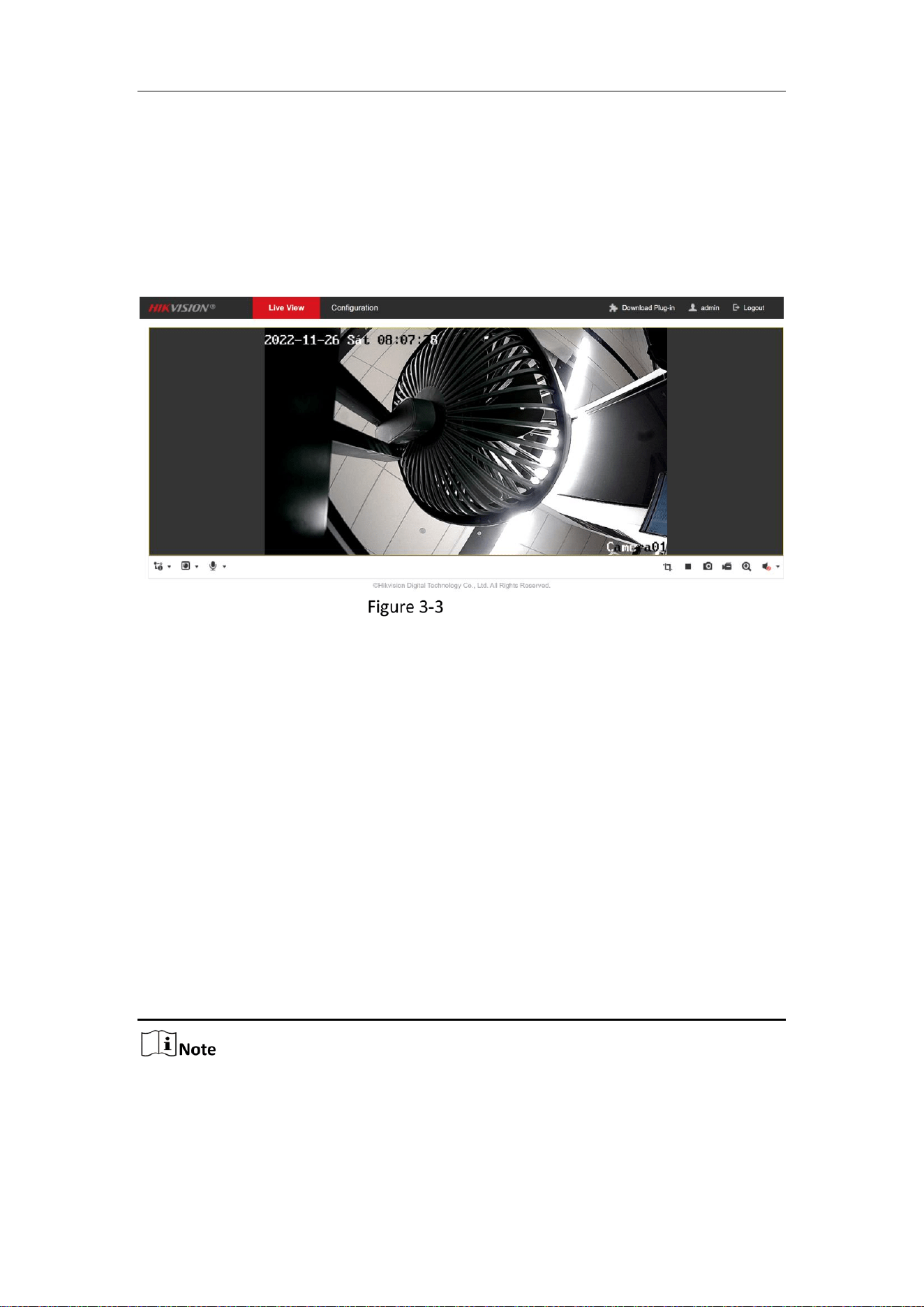
Log in the network camera to enter the live view page, or you can click Live View on
the menu bar of the main page to enter the live view page.
Descriptions of the live view page:
Live View Page
Menu Bar
Click each tab to enter Live View, Playback, Picture, Application, and Configuration
page respectively.
Live View Window
Display the live video.
Toolbar
Toolbar allows you to adjust the live view window size, the stream type, and the
plug-ins. It also allows you to process the operations on the live view page, e.g.,
start/stop live view, capture, record, audio on/off, two-way audio, start/stop digital
zoom, etc.
For IE (Internet Explorer) users, plug-ins as webcomponents and quick time are
selectable. And for Non-IE users, webcomponents, quick time, VLC or MJPEG are
selectable if they are supported by the web browser.
For camera that supports plug-in free live view, when Google Chrome 45 and its
above version or Mozilla Firefox 52 and its above version are used, plug-in installation
is not required. But Picture and Playback functions are hidden. To use mentioned
Mobile Network Camera • User Manual
12
function via web browser, change to their lower versions, or change to Internet
Explorer 8.0 and its above version.
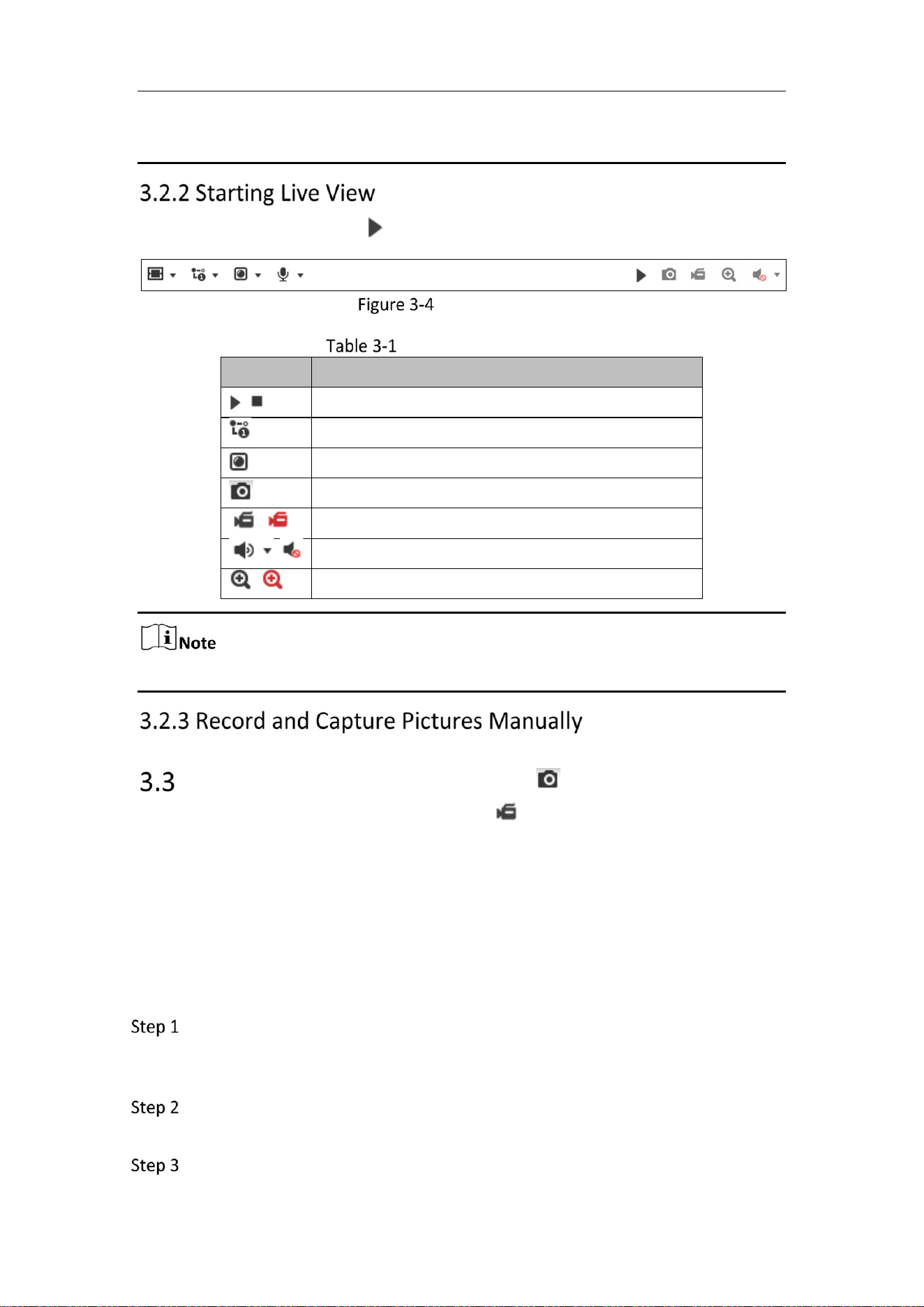
In the live view window, click on the toolbar to start the live view of the camera.
Live View Toolbar
Descriptions of the Toolbar
Icon
Description
/
Start/Stop live view.
Supported video streams vary according to camera models.
Click to select the third-party plug-in.
Manually capture the picture.
/
Manually start/stop recording.
/
Audio on and adjust volume /Mute.
/
Start/stop digital zoom function.
The icons vary according to the different camera models.
In the live view interface, click on the toolbar to
capture the live pictures; click to record the live
view. The saving paths of the captured pictures and clips
can be set on the Configuration > Local page. To
configure remote scheduled recording, please refer to
8.1 Storage Management
Steps:
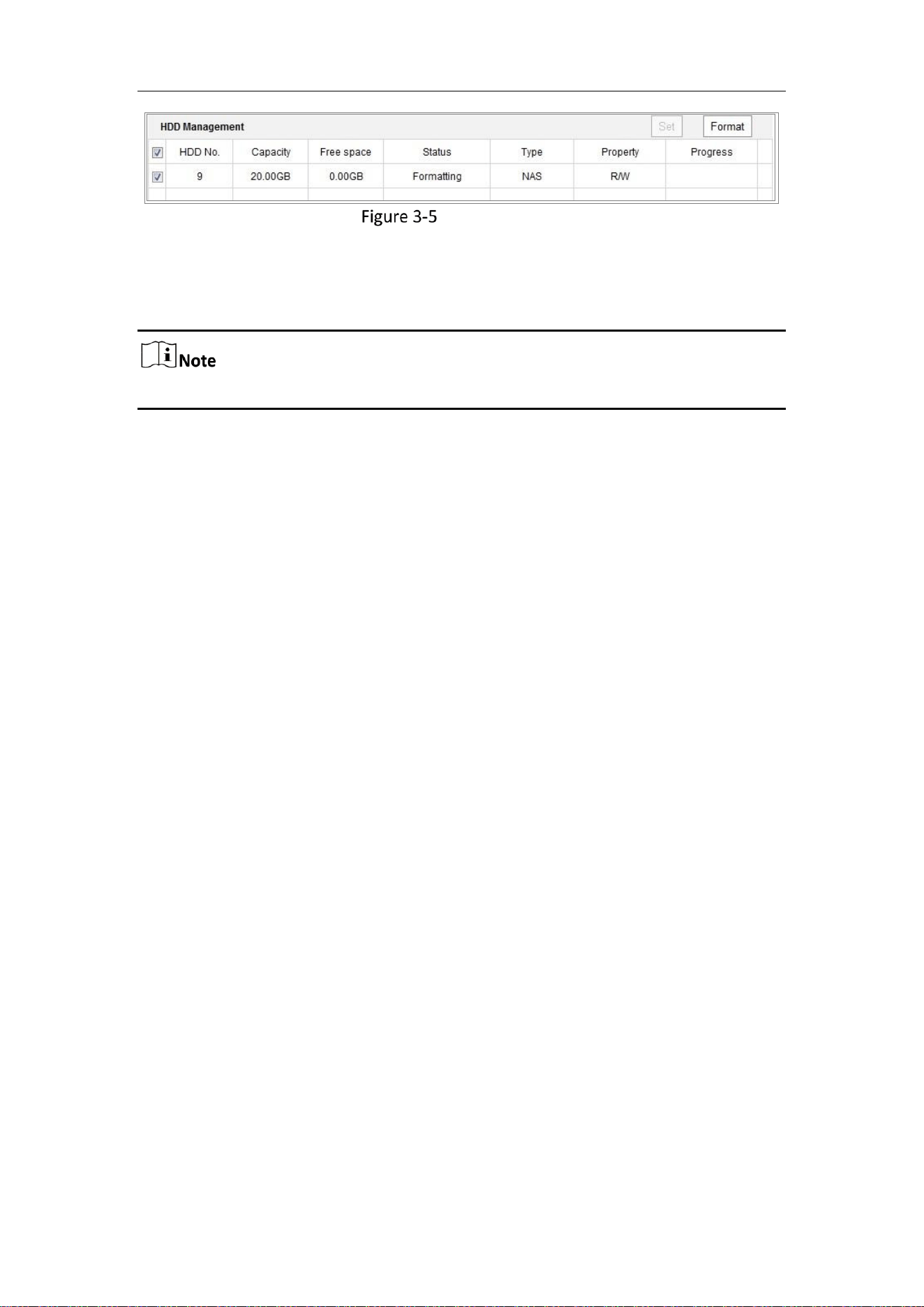
Go to Configuration > Storage > Storage Management > HDD Management, in
which you can view the capacity, free space, status, type and property of the
storage media.
If the status of the disk is Uninitialized, check the corresponding checkbox to
select the disk and click Format to start initializing the disk.
When the initialization completed, the status of disk will become Normal.
Mobile Network Camera • User Manual
14
Chapter 4 System Configuration
Configure System Settings
Purpose:
Follow the instructions below to configure the system settings, include System
Settings, Maintenance, Security, and User Management, etc.
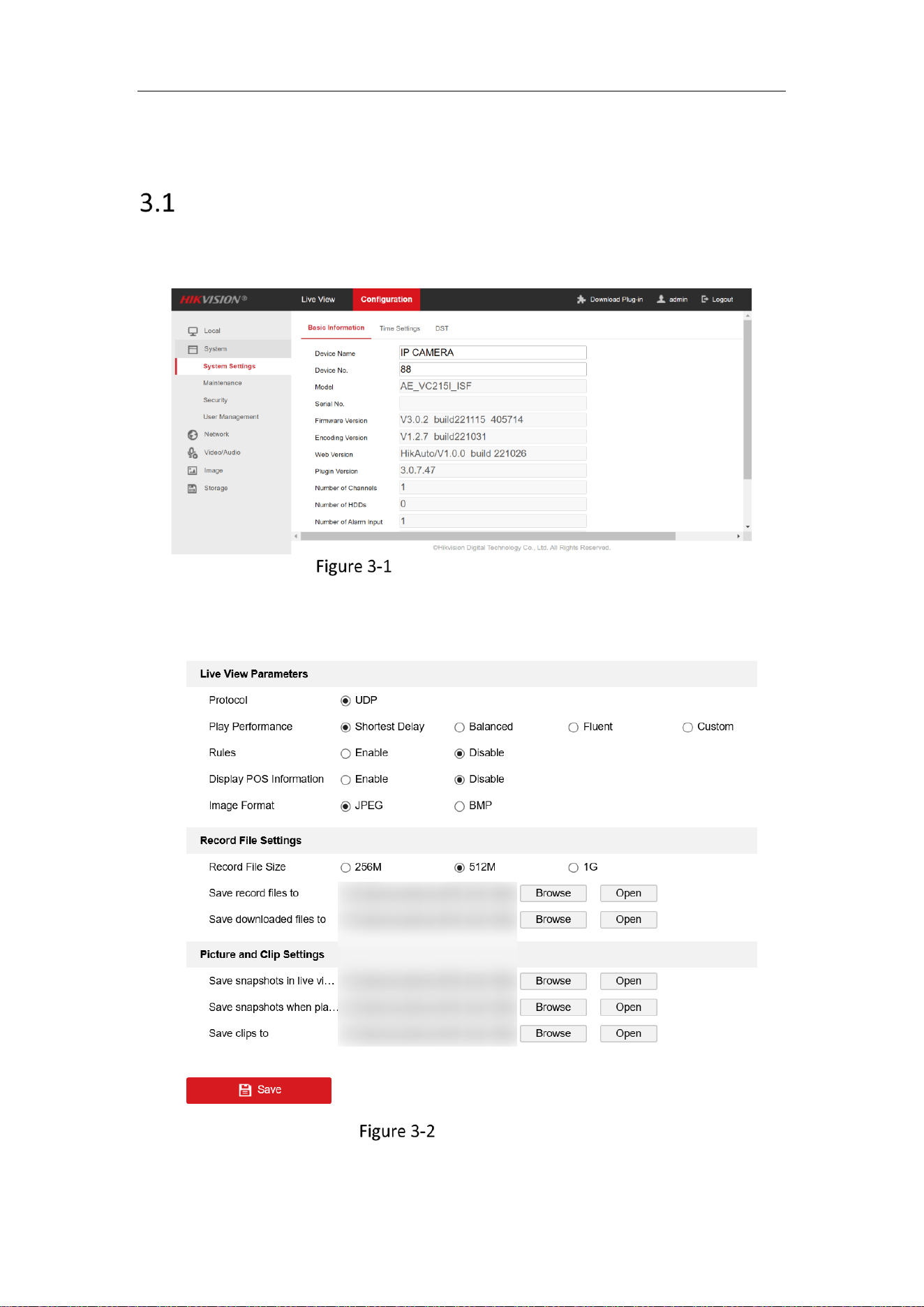
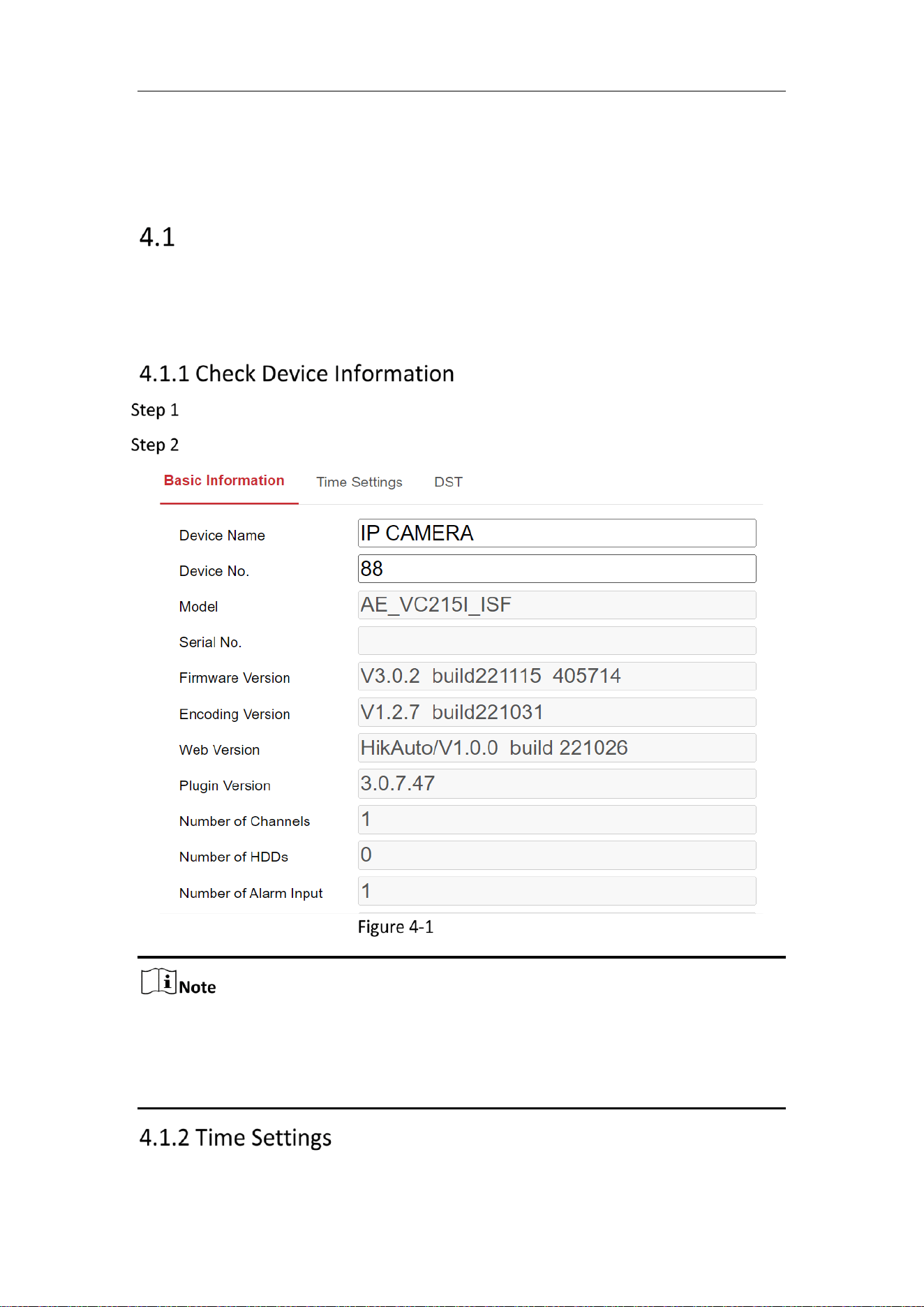
Go to Configuration > System > System Settings > Basic Information.
Edit the Device Name and Device No.
Basic Information
Other information of the network camera, such as Model, Serial No., Firmware
Version, Encoding Version, Number of Channels, Number of Alarm Input and Number
of Alarm Output are displayed. The information cannot be changed in this menu.
These options are the reference for maintenance or modification in future.
Mobile Network Camera • User Manual
15
Purpose:
You can follow the instructions in this section to configure the time synchronization
and DST settings.
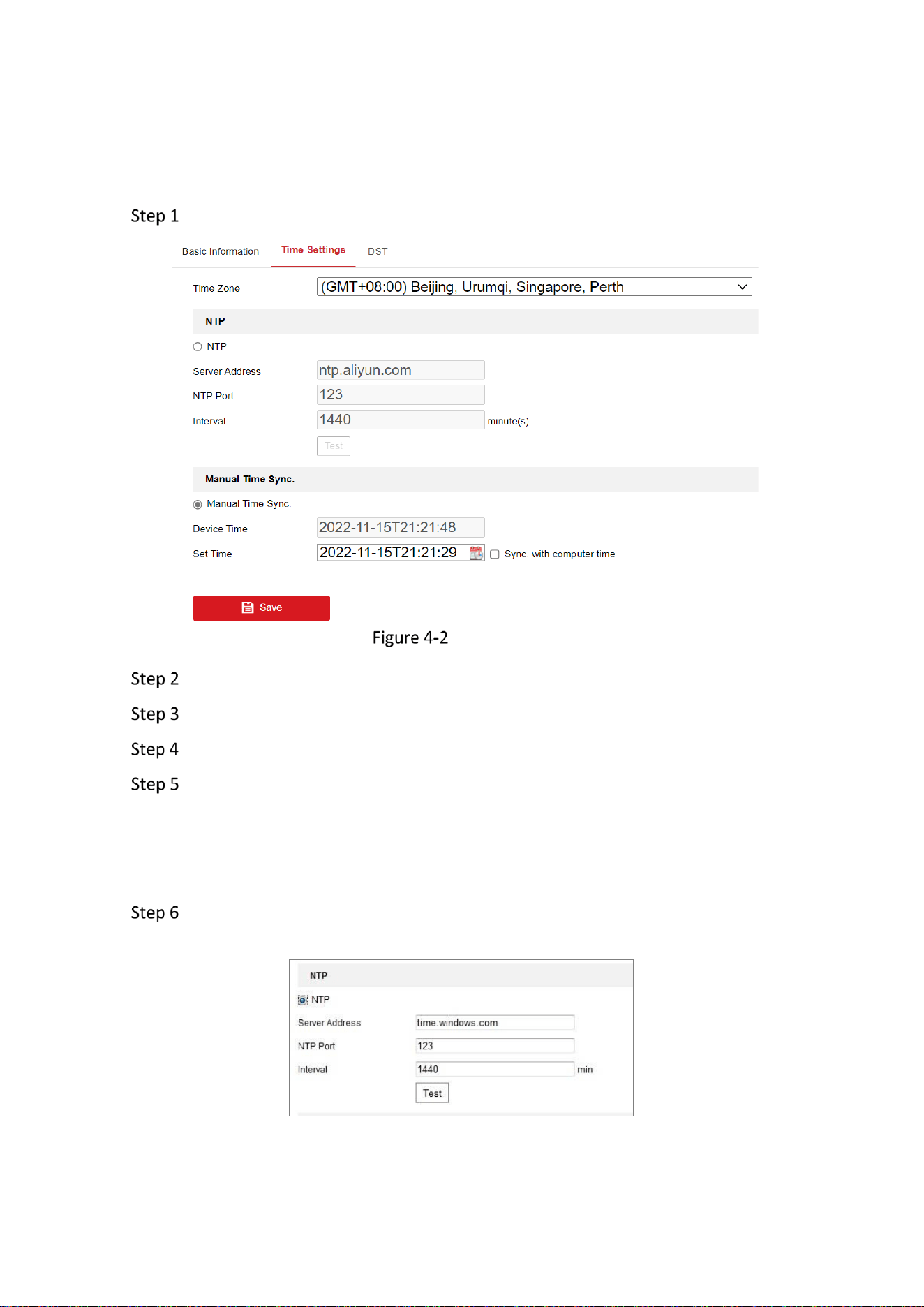
Go to Configuration > System> System Settings > Time Settings.
Time Settings
Select the Time Zone of your location from the drop-down menu.
Configure the NTP settings.
Click to enable the NTP function.
Configure the following settings:
Server Address: IP address of NTP server.
NTP Port: Port of NTP server.
Interval: The time interval between the two synchronizing actions with NTP server.
(Optional) You can click the Test button to test the time synchronization
function via NTP server.
Time Sync by NTP Server
Mobile Network Camera • User Manual
16
If the camera is connected to a public network, you should use a NTP server that has
a time synchronization function, such as the server at the National Time Center (IP
Address: 210.72.145.44). If the camera is set in a customized network, NTP software
can be used to establish a NTP server for time synchronization.
Configure the manual time synchronization.
1) Check the Manual Time Sync. item to enable the manual time
synchronization function.
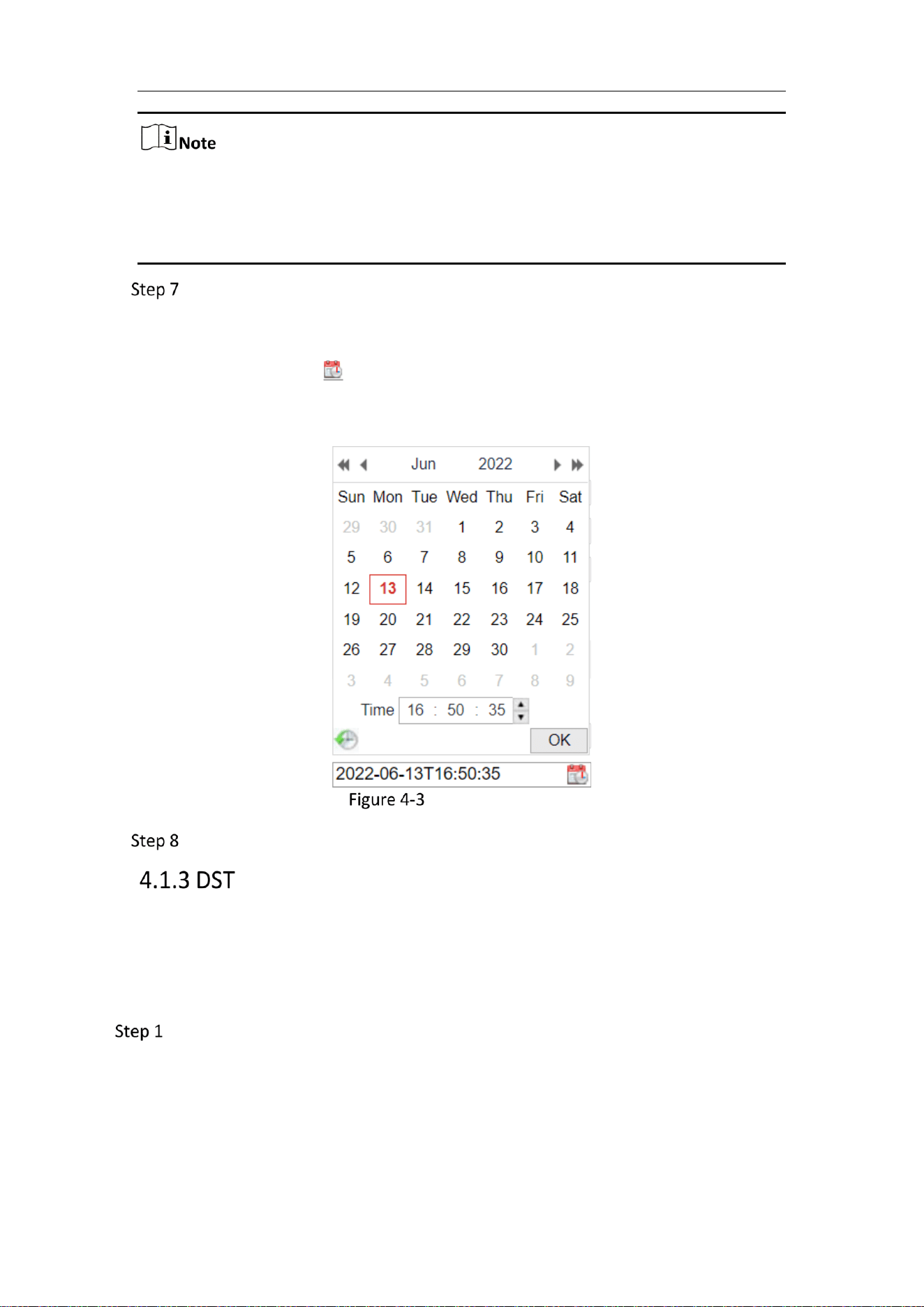
2) Click the icon to select the date, time from the pop-up calendar.
3) (Optional) You can check Sync. with computer time item to synchronize the
time of the device with that of the local PC.
Time Sync Manually
Click Save to save the settings.
Purpose:
Daylight Saving Time (DST) is a way of making better use of the natural daylight by
setting your clock forward one hour during the summer months, and back again in
the fall.
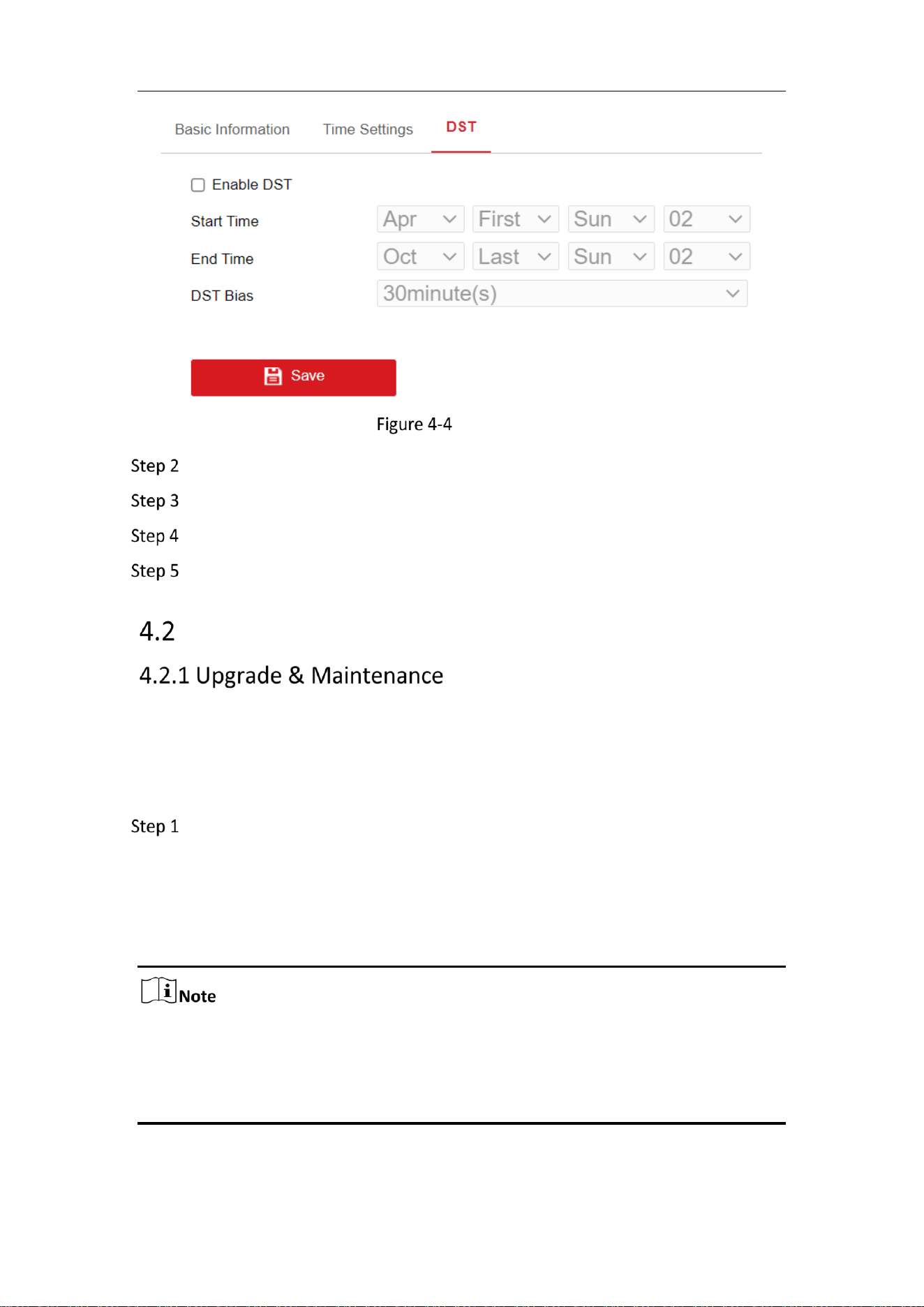
Go to Configuration > System > System Settings > DST
Mobile Network Camera • User Manual
17
DST Settings
Check Enable DST.
Select the start time and the end time.
Select the DST Bias.
Click Save to activate the settings.
Maintenance
Purpose:
The upgrade & maintenance interface allows you to process the operations, including
reboot, partly restore, restore to default, export/import the configuration files, and
upgrade the device.
Go to Configuration > System > Maintenance > Upgrade & Maintenance.
Reboot: Restart the device.
Restore: Reset all the parameters, except the IP parameters and user information,
to the default settings.
Default: Restore all the parameters to the factory default.
After restoring the default settings, the IP address is also restored to the default
IP address, please be careful for this action.
For camera that supports Wi-Fi, wireless dial, or wlan function, Restore action
does not restore the related settings of mentioned functions to default.
Information Export
Device Parameters: click to export the current configuration file of the camera.
Mobile Network Camera • User Manual
18
This operation requires admin password to proceed.
For the exported file, you also have to create an encryption password. The
encryption password is required when you import the file to other cameras.
Diagnose Information: click to download log and system information.
Import Config. File
Configuration file is used for the batch configuration of the cameras.
Click Browse to select the saved configuration file.
Click Import and input the encryption password that you set during exporting.
The camera needs rebooting after importing configuration file.
Upgrade: Upgrade the device to a certain version.
Select firmware or firmware directory to locate the upgrade file.
Firmware: Locate the exact path of the upgrade file.
Firmware Directory: Only the directory the upgrade file belongs to is required.
Click Browse to select the local upgrade file and then click Upgrade to start
remote upgrade.
The upgrading process will take 1 to 10 minutes. Please don't disconnect power of
the camera during the process, and the camera reboots automatically after upgrade.
Purpose:
The operation, alarm, exception and information of the camera can be stored in log
files. You can also export the log files on your demand.
Before you start:
Please configure network storage for the camera or insert a SD card in the camera.
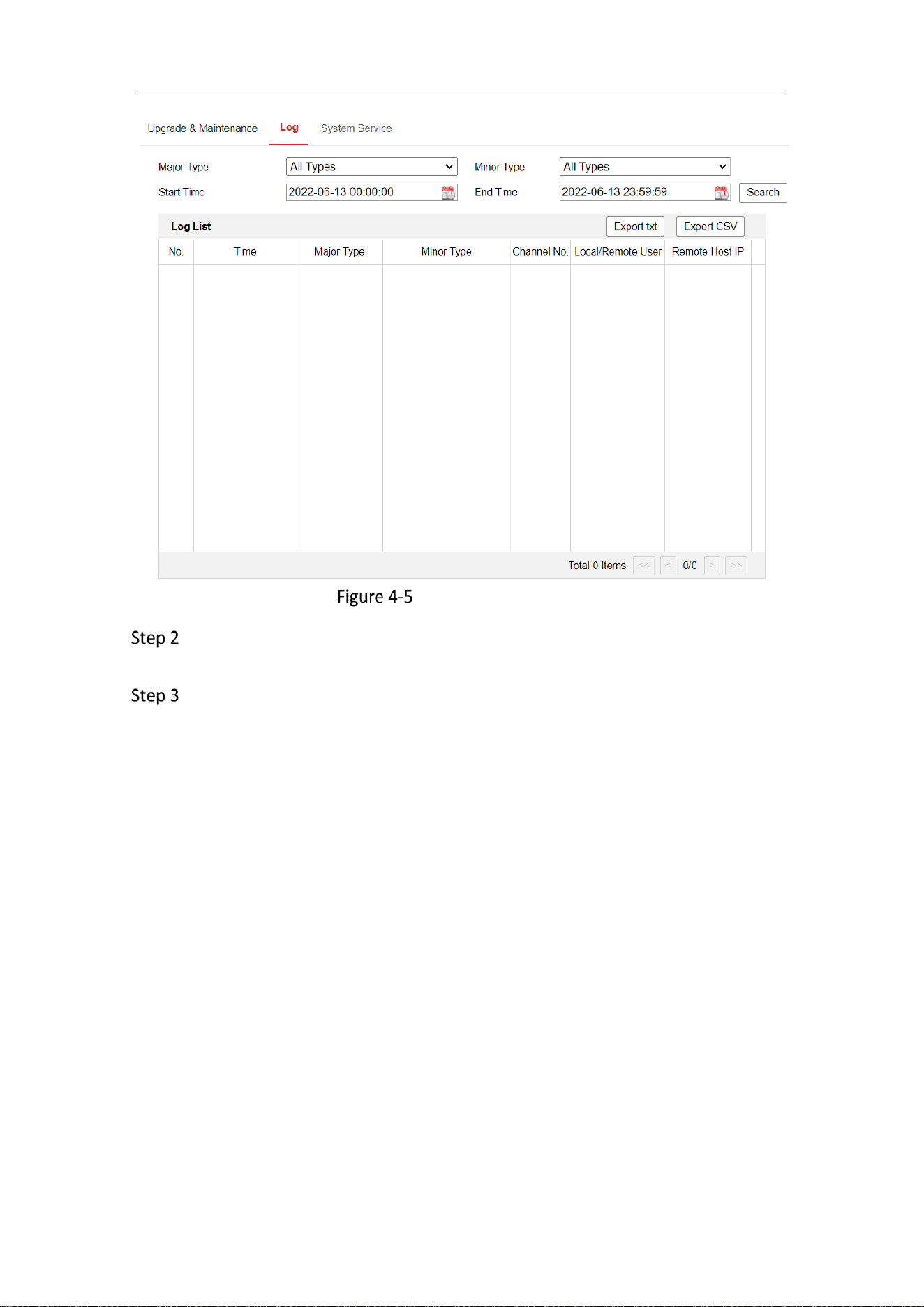
Go to Configuration > System > Maintenance > Log.
Mobile Network Camera • User Manual
19
Log Searching Interface
Set the log search conditions to specify the search, including the Major Type,
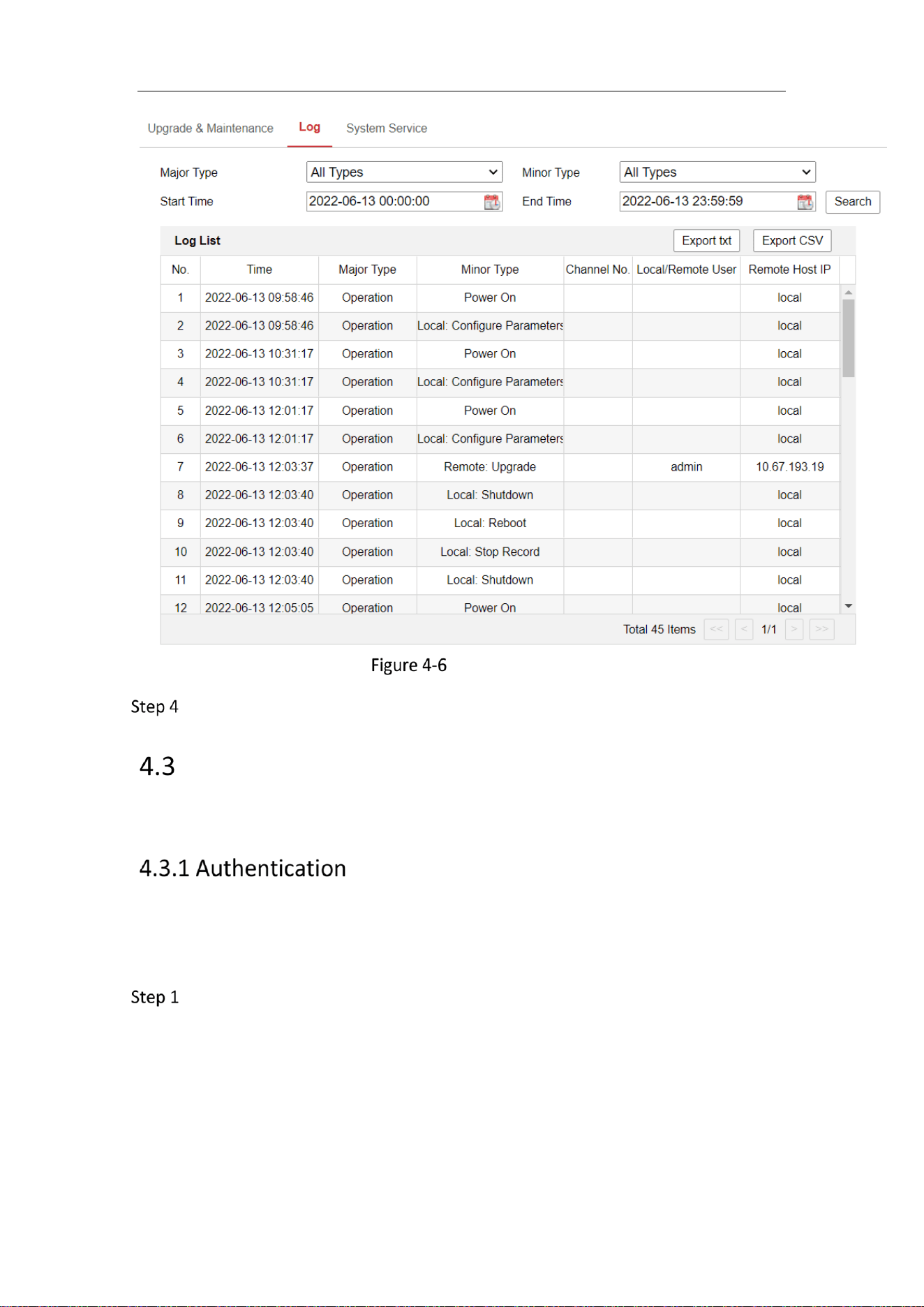
Minor Type, Start Time and End Time.
Click Search to search log files. The matched log files will be displayed on the
log list interface.
Mobile Network Camera • User Manual
20
Log Searching
To export the log files, click Export to save the log files.
Security
Configure the parameters, including Authentication, IP Address Filter, and Security
Service from security interface.
Purpose:
You can specifically secure the stream data of live view. Digest and digest/basic are
selection.
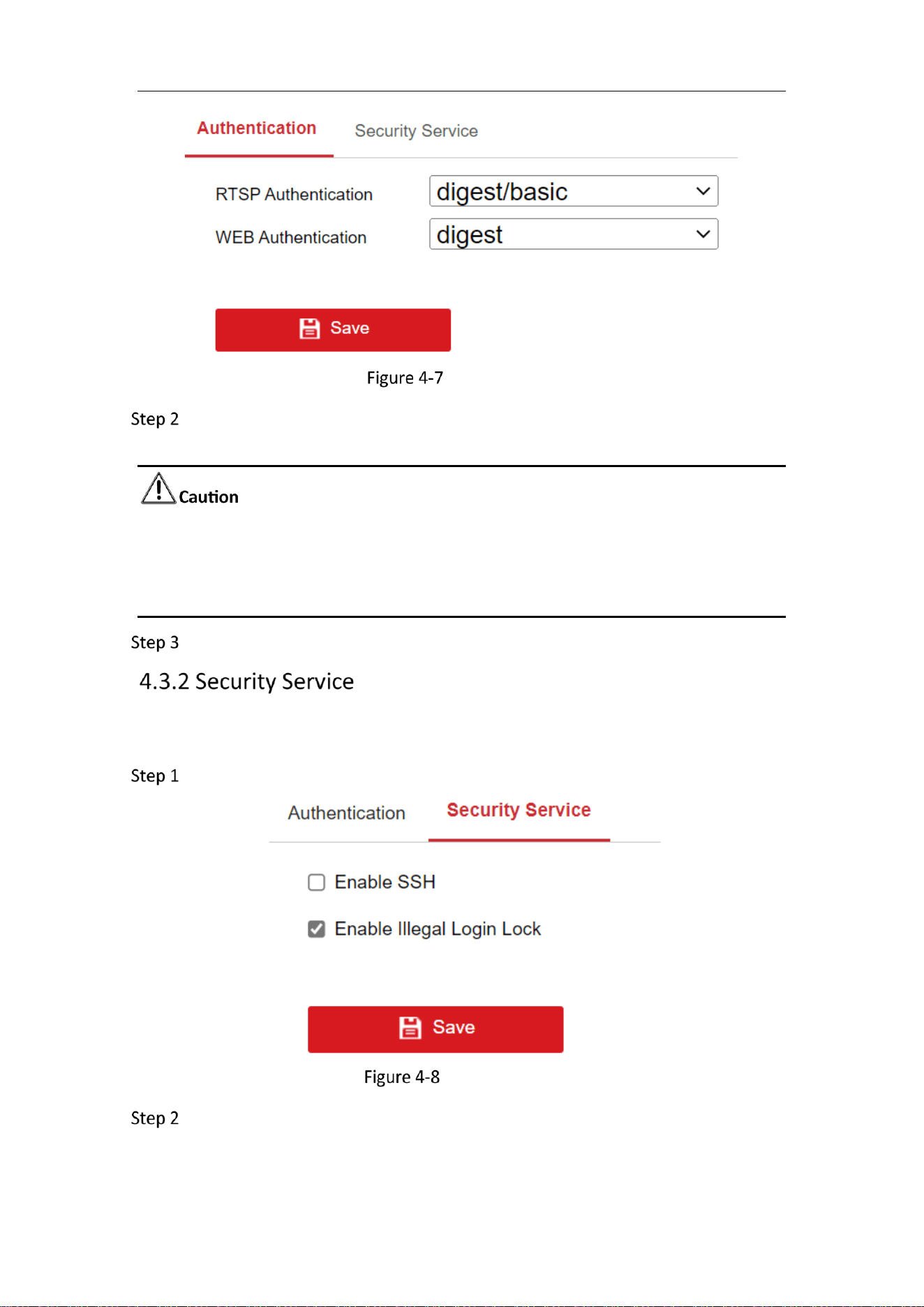
Go to Configuration > System > Security > Authentication.
Mobile Network Camera • User Manual
21
Authentication
Set up authentication method for RTSP authentication and WEB
authentication.
Digest is the recommended authentication method for better data security. You must
be aware of the risk if you adopt basic as the authentication method. If you are
uncertain what to choose, choose “digest/basic” to auto-adapt to your security
condition.
Click Save.
To enable the remote login, and improve the data communication security, the
camera provides the security service for better user experience.
Go to Configuration > System > Security > Security Service.
Security Service
Check the checkbox of Enable Illegal Login Lock.
Mobile Network Camera • User Manual
22
Illegal Login Lock: it is used to limit the user login attempts. Login attempt from
the IP address is rejected if admin user performs 7 failed user name/password
attempts (5 times for the operator/user).
If the IP address is rejected, you can try to login the device after 30 minutes.
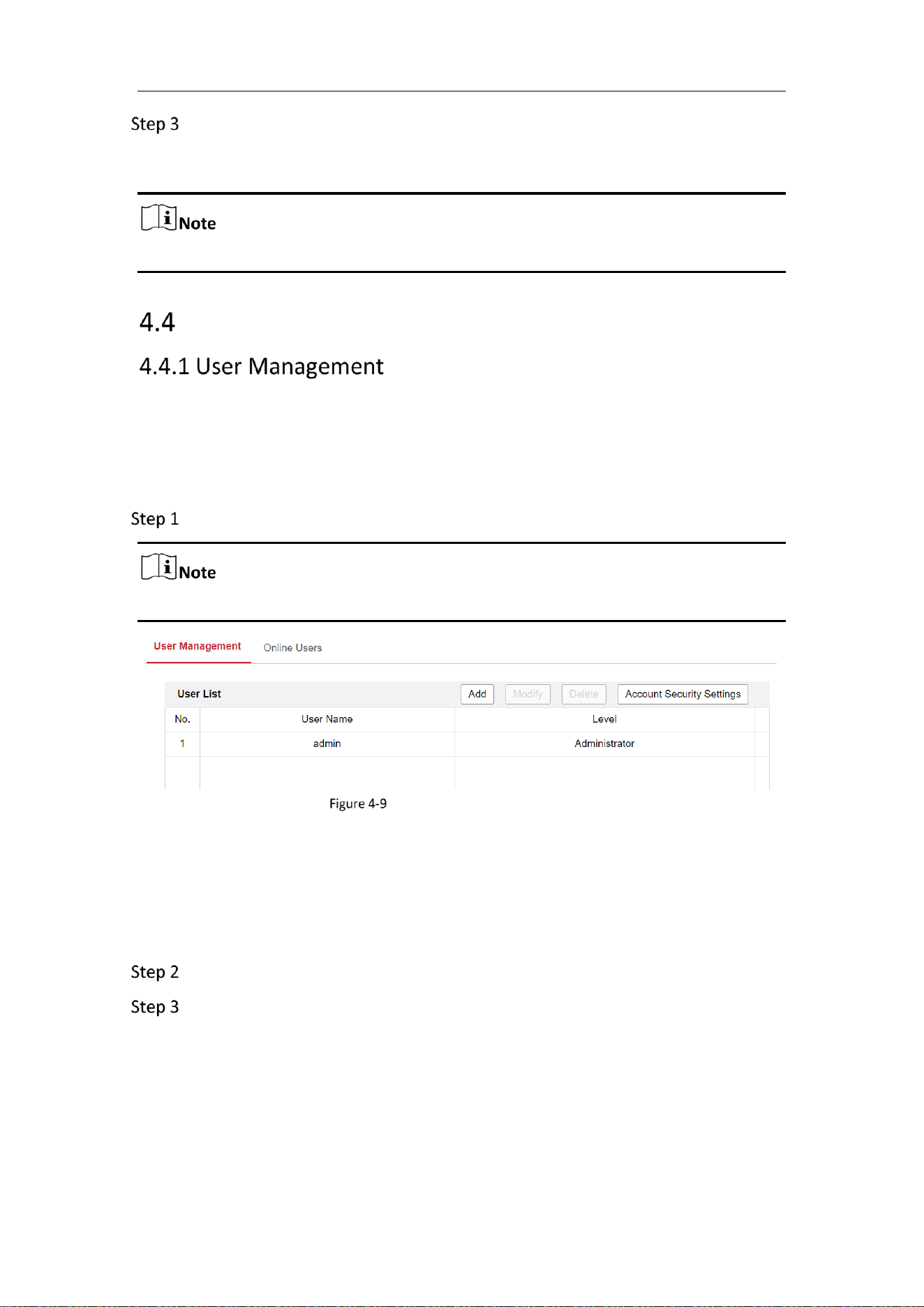
User Management
Administrator
The admin user can add, delete or modify user accounts, and grant them different
permissions. We highly recommend you manage the user accounts and permissions
properly.
Go to Configuration > System > User Management.
Admin password if required for adding and modifying a user account.
User Management Interface
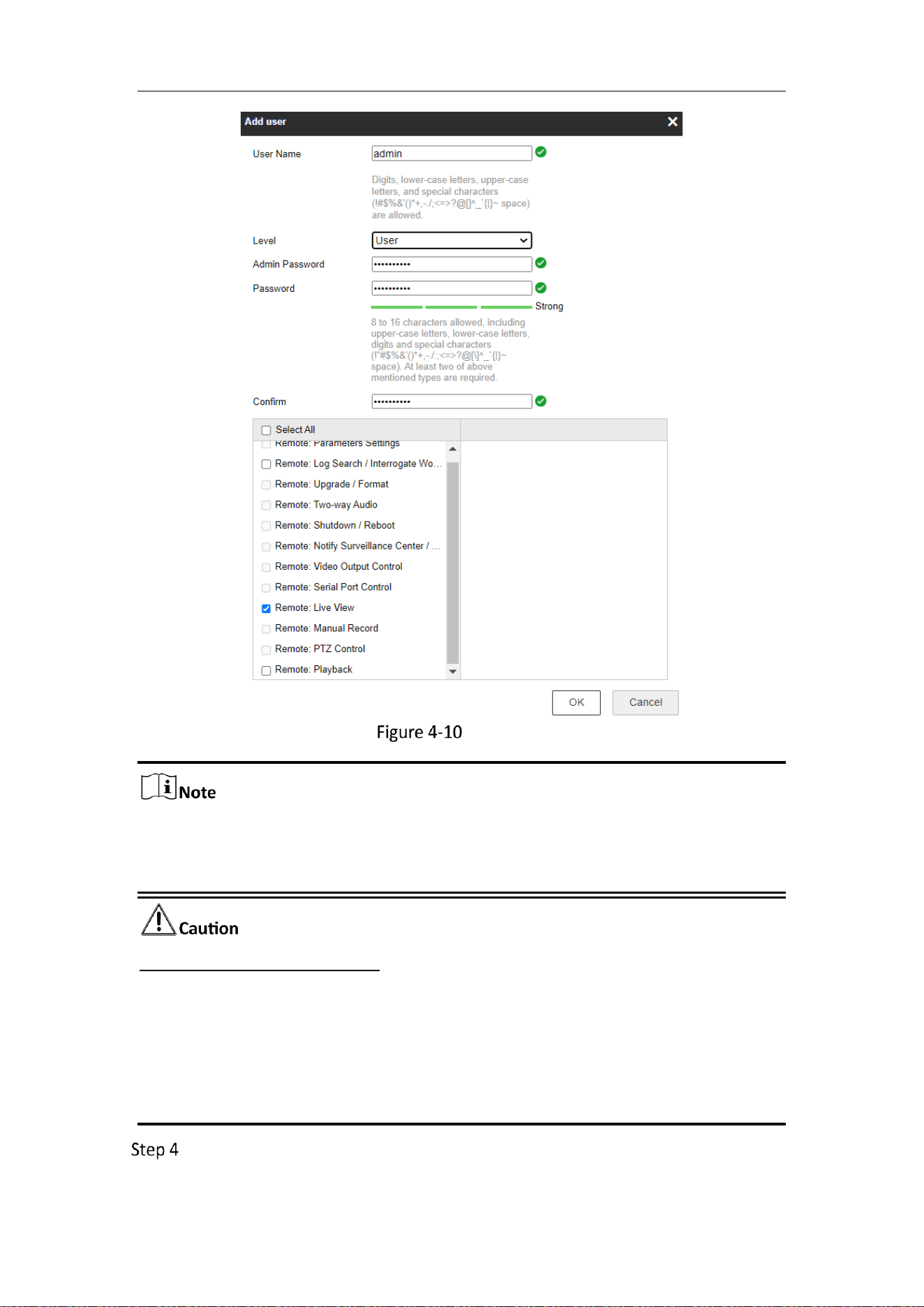
Adding a User
The admin user has all permissions by default and can create/modify/delete other
accounts.
The admin user cannot be deleted and you can only change the admin password.
Click Add to add a user.
Input the Admin Password, User Name, select Level and input Password.
Mobile Network Camera • User Manual
23
Add a User
Up to 16 user accounts can be created.
Users of different levels own different default permissions. Operator and user are
selectable.
Strong Password recommended
We highly recommend you create a strong password of your own choosing (using a
minimum of 8 characters, including at least three of the following categories: upper
case letters, lower case letters, numbers, and special characters) in order to increase
the security of your product. And we recommend you reset your password regularly,
especially in the high security system, resetting the password monthly or weekly can
better protect your product.
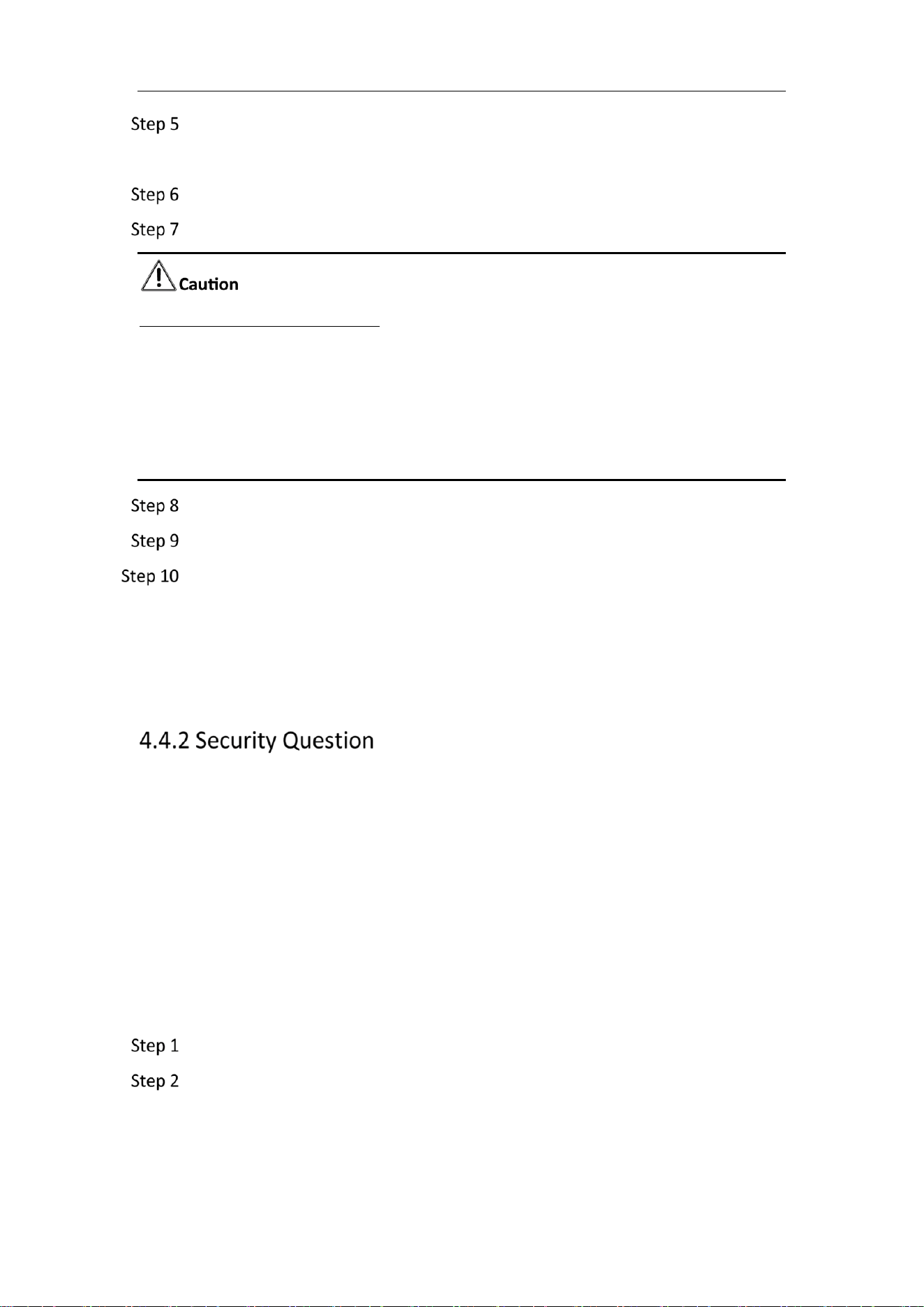
You can check or uncheck the permissions for the new user.
Mobile Network Camera • User Manual
24
Click OK to finish the user addition.
Modify a User
Left-click to select the user from the list and click Modify.
Modify the User Name, Level and Password.
Strong Password recommended
We highly recommend you create a strong password of your own choosing (using a
minimum of 8 characters, including at least three of the following categories: upper
case letters, lower case letters, numbers, and special characters) in order to increase
the security of your product. And we recommend you reset your password regularly,
especially in the high security system, resetting the password monthly or weekly can
better protect your product.
You can check or uncheck the permissions.
Click OK to finish the user modification.
Deleting a User
1) Click to select the user you want to delete and click Delete.
2) Click OK on the pop-up dialogue box to confirm the deletion.
Operator/User
Operator or user can modify password. Old password is required for this action.
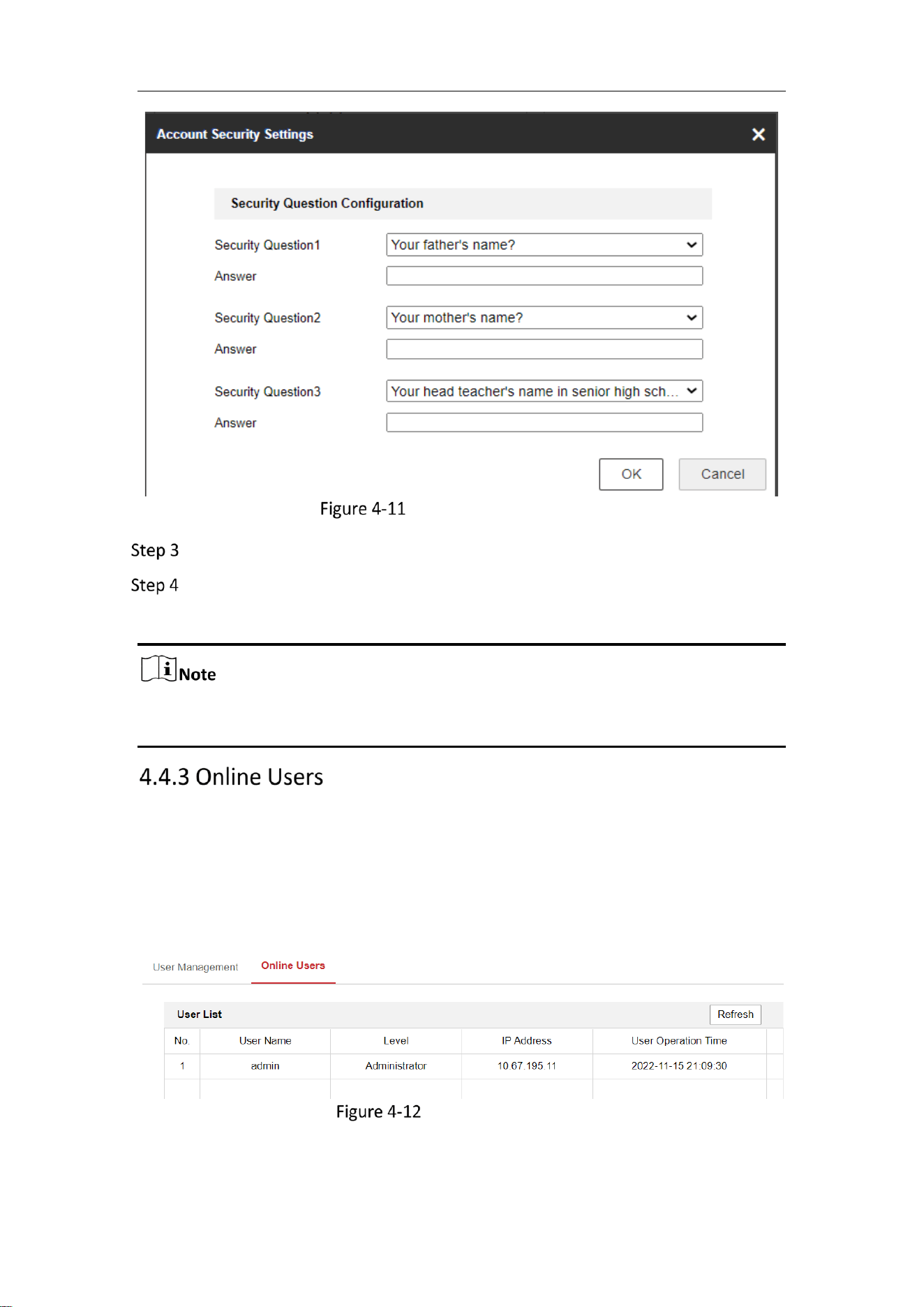
Purpose:
Security question is used to reset the admin password when admin user forgets the
password.
Set Security Questions
You can set the security questions during camera activation. Or you can set the
function at user management interface.
Security question setting is not cleared when you restore the camera (not to default).
Steps:
Go to Configuration > System > User Management.
Click Account Security Question.
Mobile Network Camera • User Manual
25
Account Security Question
Select questions and input answers.
Click OK to save the settings.
Reset Admin Password:
The PC used to reset password and the camera should belong to the same IP address
segment of the same LAN.
Purpose:
You can see the current users who are visiting the device through this interface. User
information, such as user name, level, IP address, and operation time, is displayed in
the User List.
Click Refresh to refresh the list.
View the Online Users
Mobile Network Camera • User Manual
26
Chapter 5 Network Settings
Purpose:
Follow the instructions in this chapter to configure the basic settings and advanced
settings.
Basic Settings
Purpose:
You can configure the parameters, including TCP/IP, DDNS, Port, and , etc., by
following the instructions in this section.
Purpose:
TCP/IP settings must be properly configured before you operate the camera over
network.
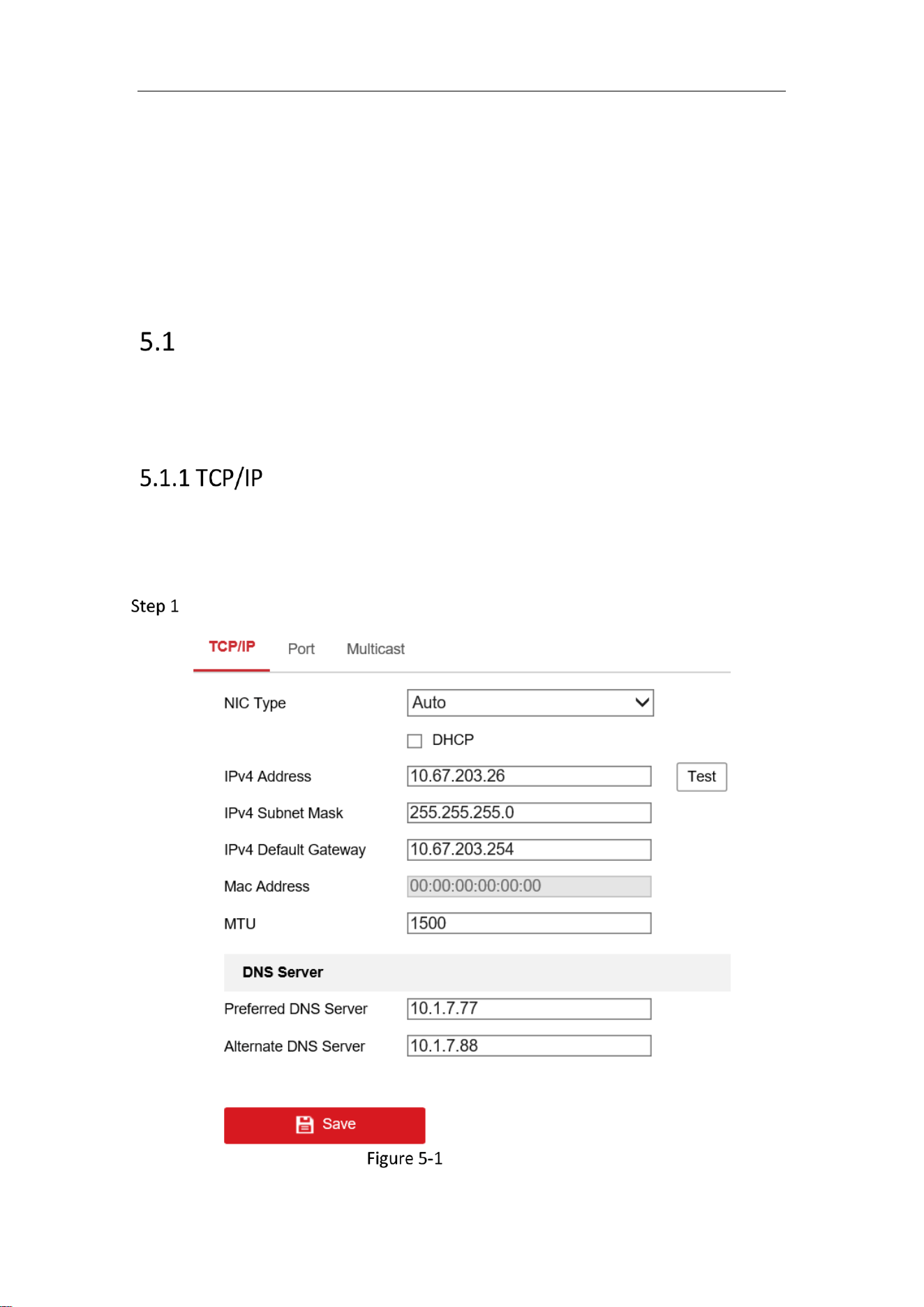
Go to Configuration > Network > Basic Settings > TCP/IP.
TCP/IP Settings
Mobile Network Camera • User Manual
27
Configure the basic network settings, including the NIC Type, IPv4 or IPv6
Address, IPv4 or IPv6 Subnet Mask, IPv4 or IPv6 Default Gateway, and MTU
settings.
Configure the DNS server. Input the preferred DNS server, and alternate DNS
server.
Click Save to save the above settings.
The valid value range of MTU is 1280 to 1500.
A reboot is required for the settings to take effect.
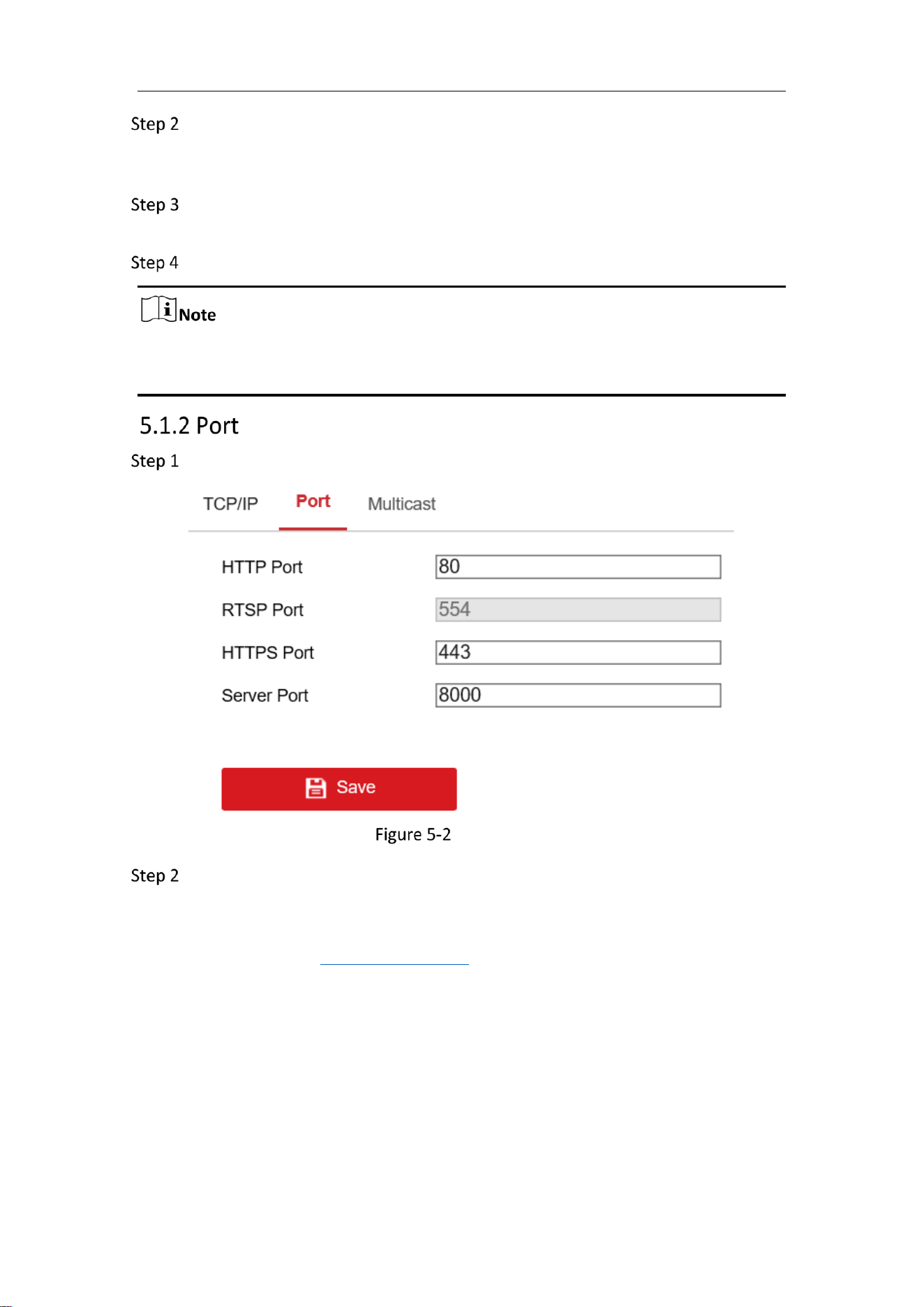
Go to Configuration > Network > Basic Settings > Port.
Port Settings
Set the ports of the camera.
HTTP Port: The default port number is 80, and it can be changed to any port No.
which is not occupied. For instance, if you changed the port number to 81, you need
to login in with the URL http://192.168.1.64:81.
RTSP Port: The default port number is 554 and it can be changed to any port No.
ranges from 1 to 65535.
HTTPS Port: The default port number is 443, and it can be changed to any port No.
which is not occupied.
Server Port: The default server port number is 8000, and it can be changed to any
port No. ranges from 2000 to 65535. If you changed the Server Port, you need to add
its value to the login page.
Mobile Network Camera • User Manual
28
The WebSocket protocol is used for plug-in free live view. For detailed information,
see 5.2.4 .
Click Save to save the settings.
A reboot is required for the settings to take effect.
The Multicast sends a stream to the multicast group address and allows multiple
clients to acquire the stream at the same time by requesting a copy from the
multicast group address.
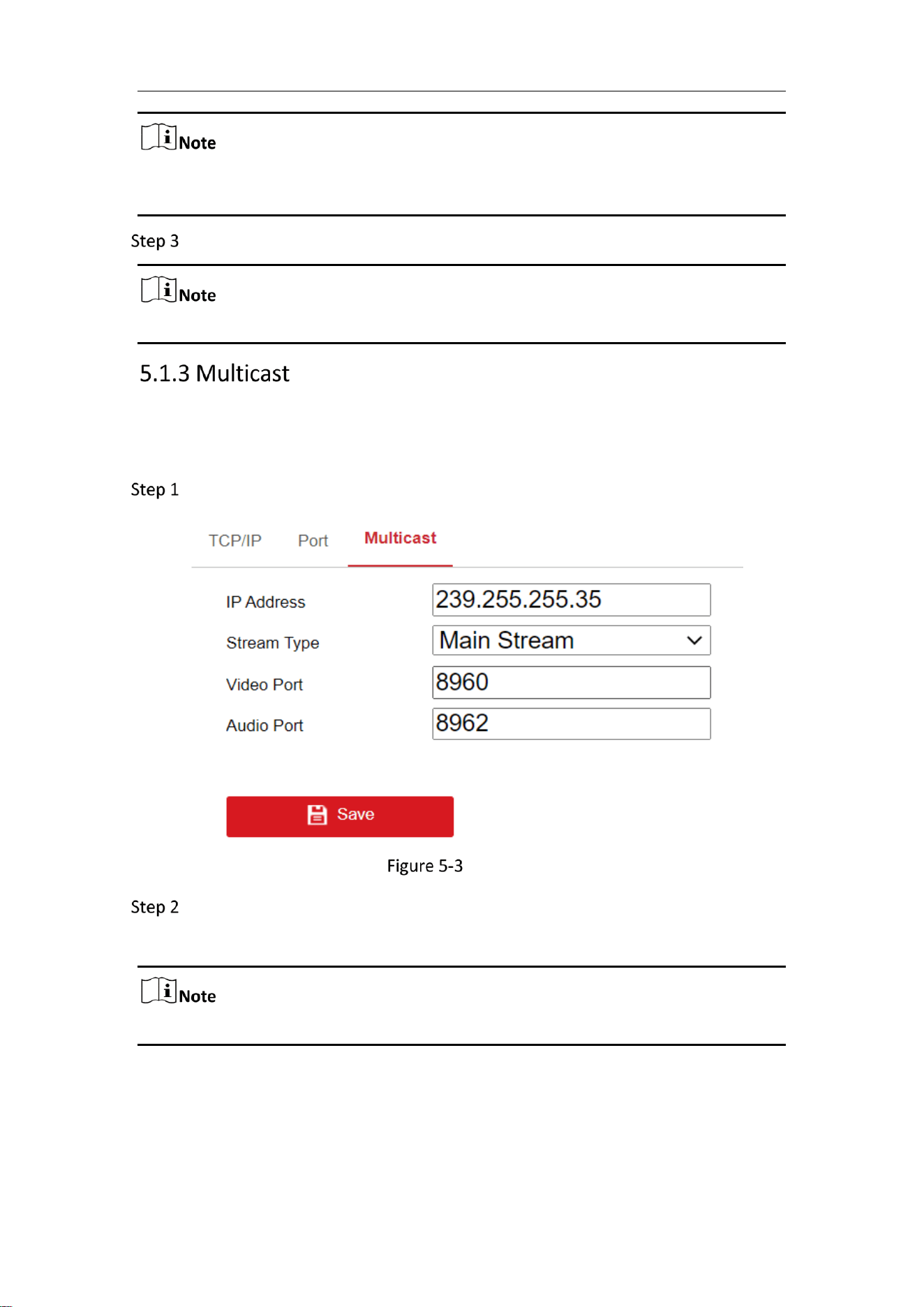
Go to Configuration > Network > Basic Settings > Multicast.
Multicast
Configure the parameters for Multicast.
IP Address: The IP address of the multicast host.
The range for multicast IP address is 224.0.0.19~239.255.255.255
Stream Type
Choose the type of stream according to your needs.
Mobile Network Camera • User Manual
29
For some models, the Third Stream is not enabled by default. Go to System >
Maintenance > System Service> Software to enable the function is required.
The main stream is usually for recording and live view with good bandwidth, and
the sub-stream can be used for live view when the bandwidth is limited.
You can customize the following parameters for the selected stream type.
Video Port and Audio Port: Port for Video and Audio.
Click Save.
Advanced Settings
Purpose:
You can configure the parameters, including SNMP, FTP, Email, HTTPS, QoS, 802.1x,
etc., by following the instructions in this section.
Purpose:
HTTPS provides authentication of the web site and its associated web server, which
protects against Man-in-the-middle attacks.
If HTTPS is enabled by default, the camera creates an unsigned certificate
automatically. When you visit the camera via HTTPS, the web browser will send a
notification about the certificate issue. Install a signed-certificate to the camera
to cancel the notification.
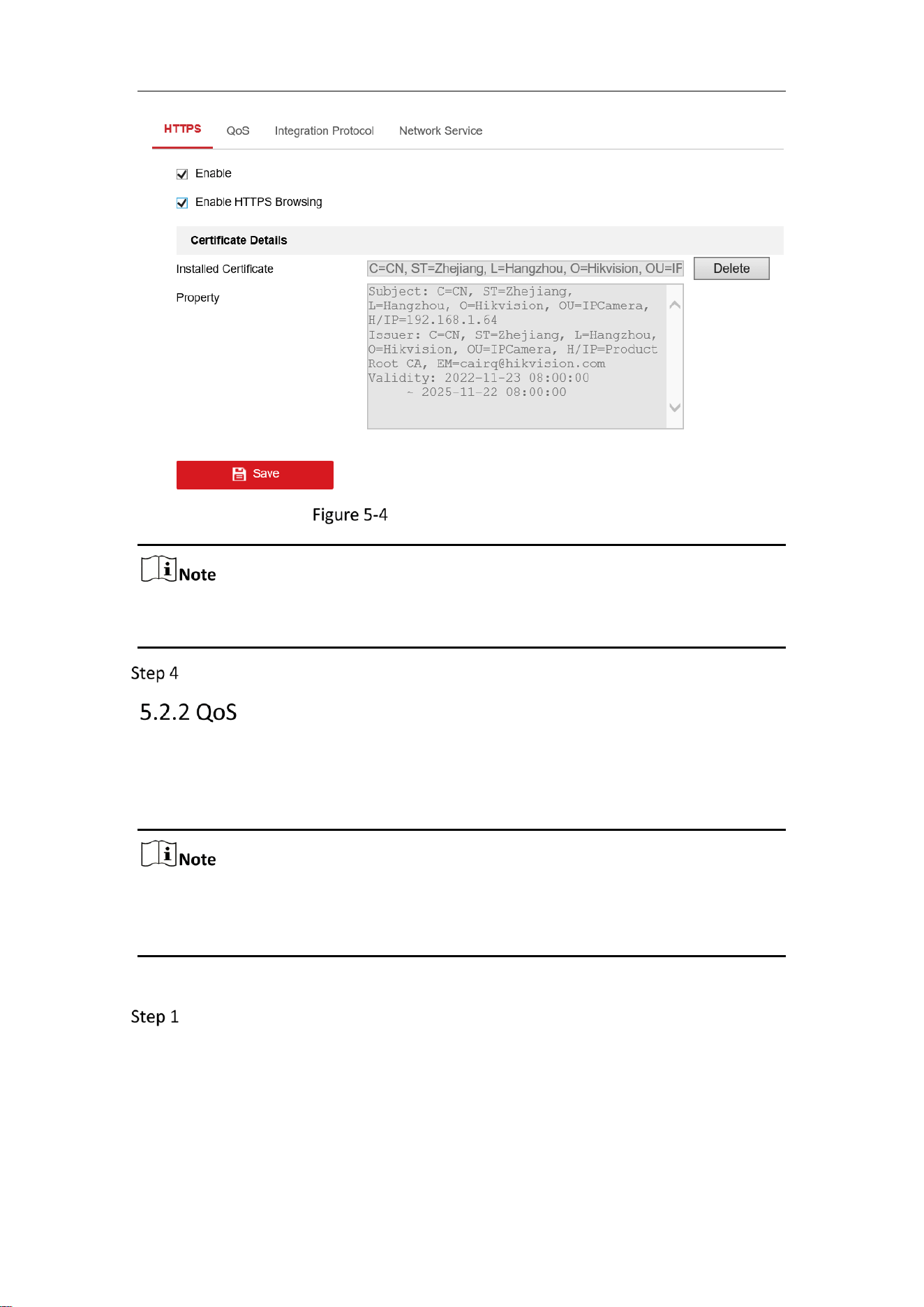
G to Configuration > Network > Advanced Settings > HTTPS.
Check Enable to access the camera via HTTP or HTTPS protocol.
Check Enable HTTPS Browsing to access the camera only via HTTPS protocol.
Mobile Network Camera • User Manual
30
HTTPS Configuration Interface
If you already had a certificate installed, the Create Self-signed Certificate is grayed
out. (Optional) Click Delete to delete the certificate.
Click the Save button to save the settings.
Purpose:
QoS (Quality of Service) can help solve the network delay and network congestion by
configuring the priority of data transmission.
DSCP refers to the Differentiated Service Code Point; and the DSCP value is used in
the IP header to indicate the priority of the data. The higher the DSCP value, the
higher the priority of transmission.
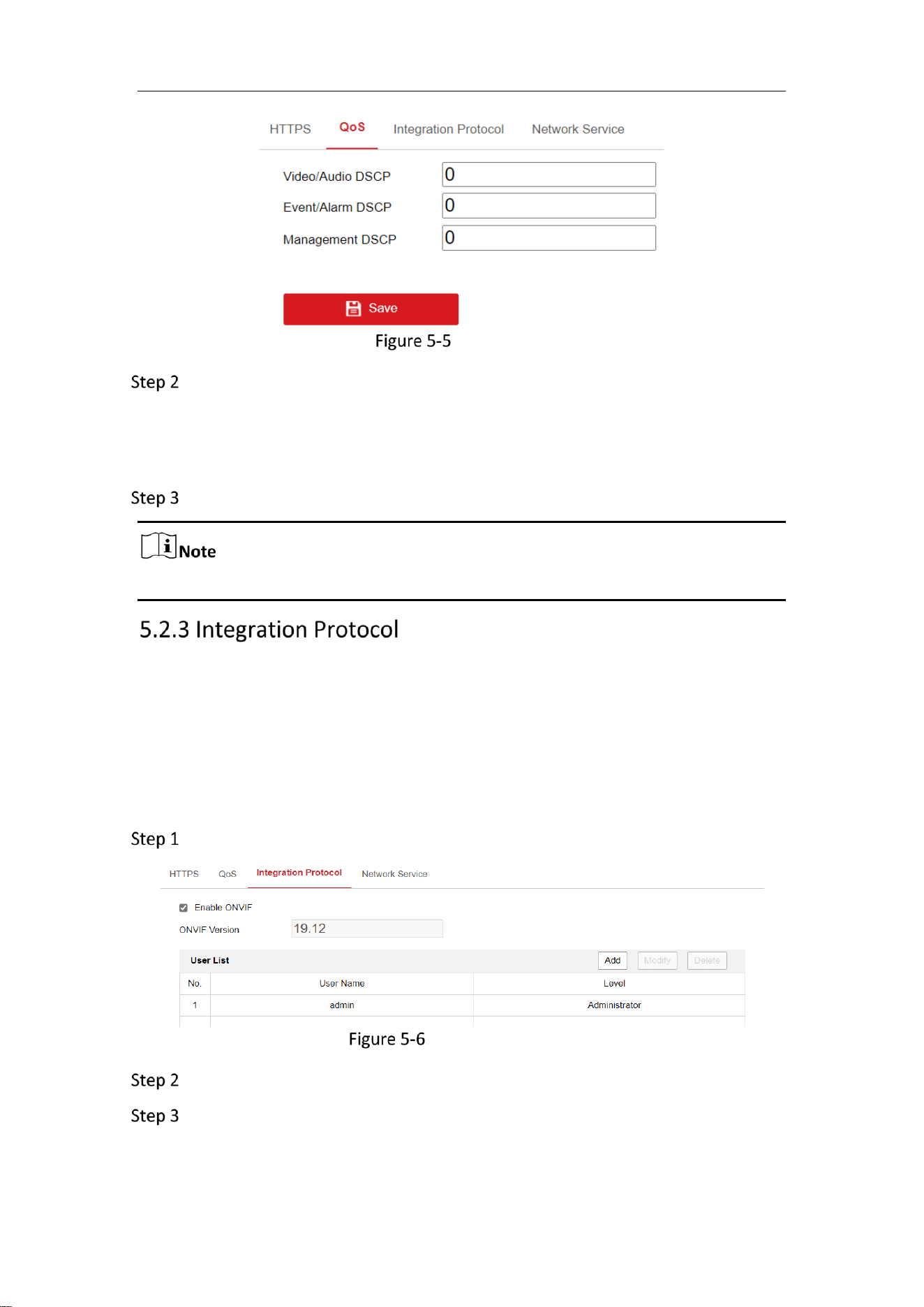
Enter the QoS Settings interface: Configuration > Network > Advanced
Settings > QoS.
Mobile Network Camera • User Manual
31
QoS Settings
Configure the QoS settings, including Video/Audio DSCP, Event/Alarm DSCP
and Management DSCP.
The valid value range of the DSCP is 0 to 63. The bigger the DSCP value is, the higher
the priority is.
Click Save to save the settings.
A reboot is required for the settings to take effect.
Purpose:
If you need to access to the camera through the third party platform, you can enable
CGI function. And if you need to access to the device through ONVIF protocol, you
can configure ONVIF user in this interface. Refer to ONVIF standard for detailed
configuration rules.
ONVIF
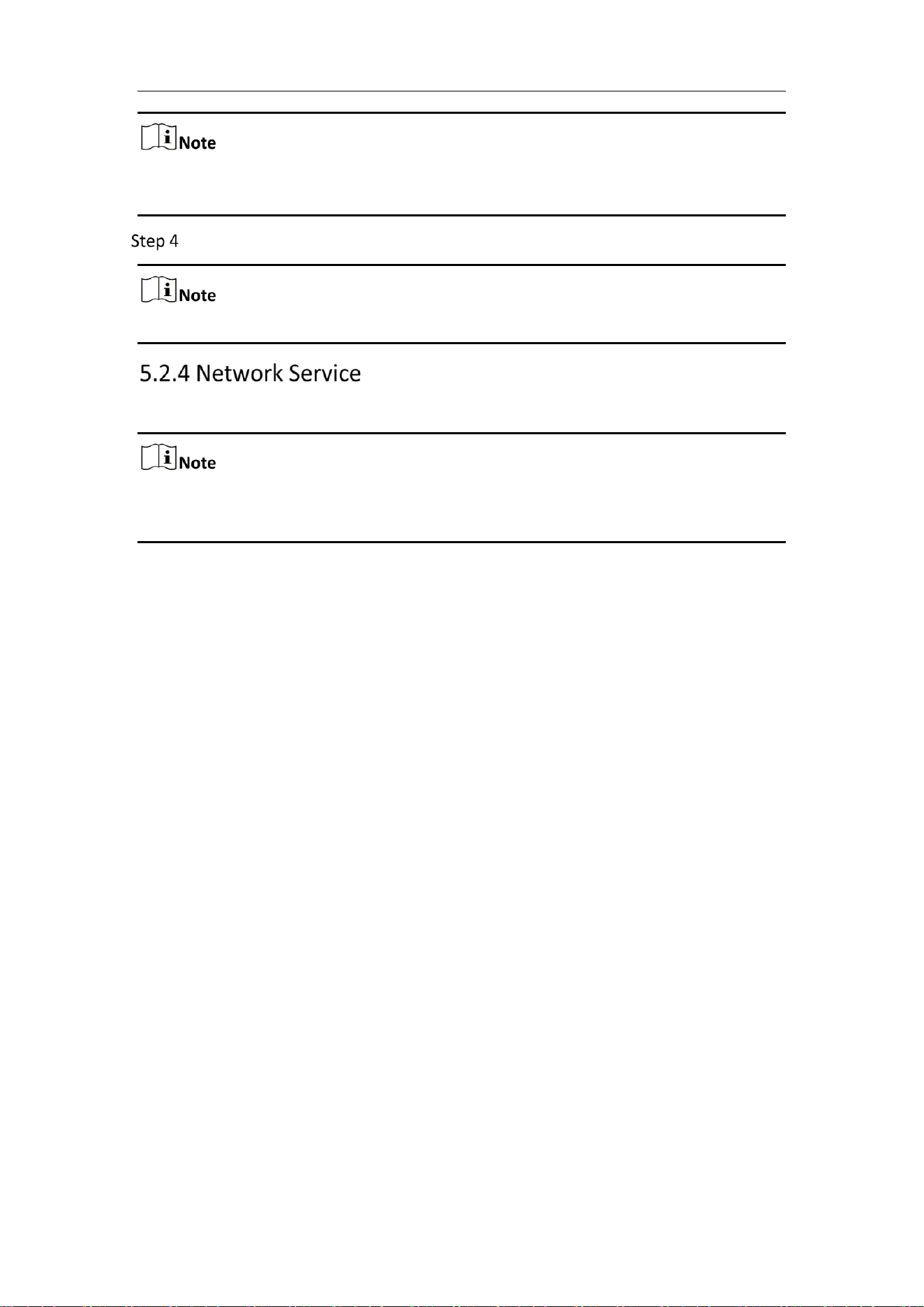
Check the Enable ONVIF checkbox to enable the function.
Integration Protocol
Add ONVIF users. Up to 32 users are allowed.
Set the user name and password, and confirm the password. You can set the
user as media user, operator, and administrator.
Mobile Network Camera • User Manual
32
ONVIF user account is different from the camera user account. You have set ONVIF
user account independently.
Save the settings.
User settings of ONVIF are cleared when you restore the camera.
You can control the ON/OFF status of certain protocol that the camera supports.
Keep unused function OFF for security concern.
Supported functions vary according to camera models.
SDK Service and Enhanced SDK Service
If you want to add the device to the client software, you should enable SDK Service
or Enhanced SDK Service.
− SDK Service: SDK protocol is used.
− Enhanced SDK Service: SDK over TLS protocol is used. Communication
between the device and the client software is secured by using TLS
(Transport Layer Security) protocol.
TLS (Transport Layer Security)
The device offers TLS 1.1 and TLS 1.2. Enable one or more protocol versions
according to your need.
Mobile Network Camera • User Manual
33
Chapter 6 Video/Audio Settings
Purpose:
Follow the instructions below to configure the video setting, audio settings, ROI,
Display info. on Stream, etc.
Video
For certain camera models, you can configure parameters for available video
streams, for example, the main stream, the sub-stream, etc. And you can also
customize additional video streams for further needs.
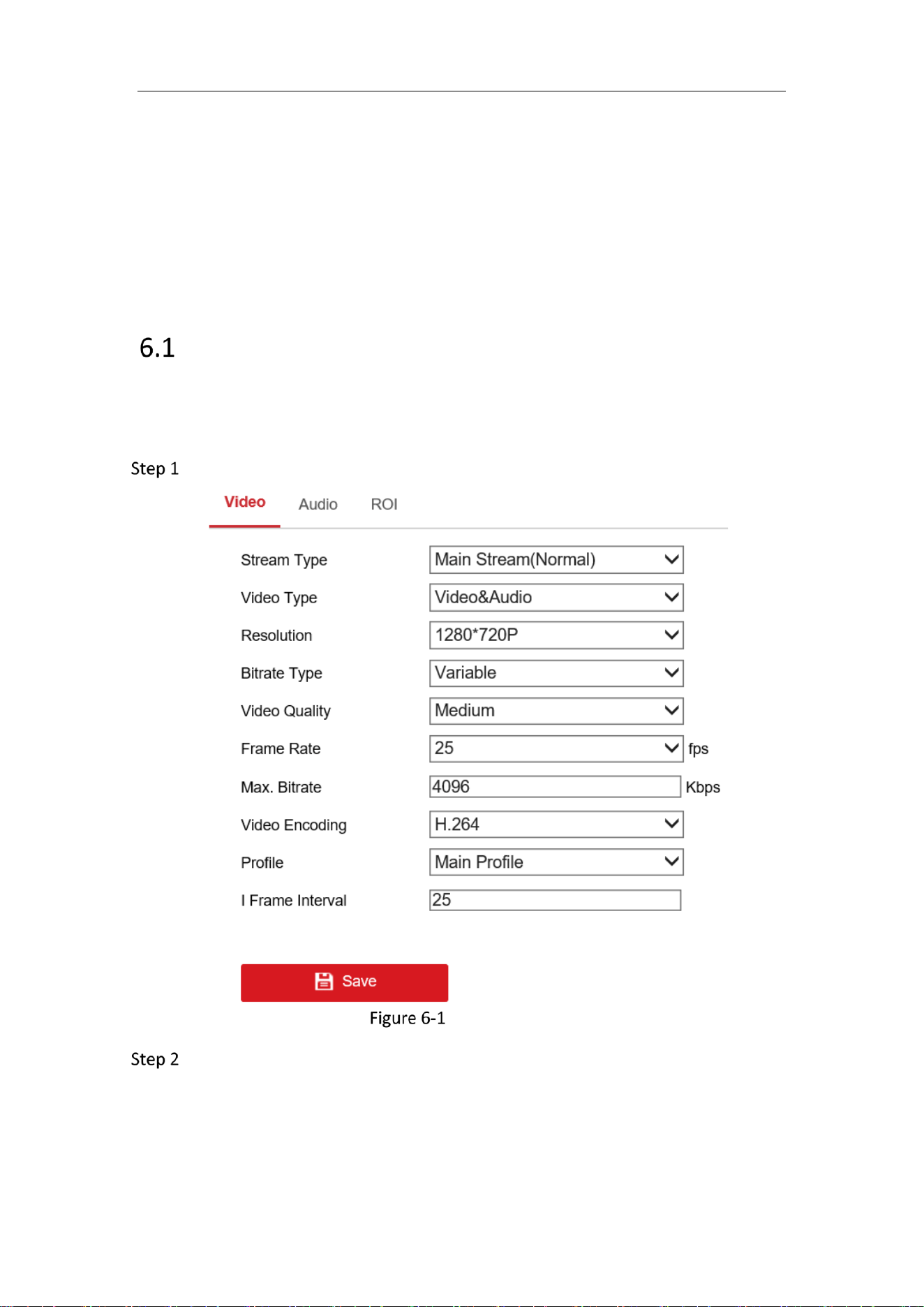
Go to Configuration > Video/Audio > Video
Video Settings
Select the Stream Type.
Supported stream types are listed in the drop-down list.
Mobile Network Camera • User Manual
34
The main stream is usually for recording and live view with good bandwidth, and
the sub-stream can be used for live view when the bandwidth is limited.
You can customize the following parameters for the selected stream type.
Video Type:
Select the stream type to video stream, or video & audio composite stream. The
audio signal will be recorded only when the Video Type is Video & Audio.
Resolution:
Select the resolution of the video output.
Bitrate Type:
Select the bitrate type to constant or variable.
Video Quality:
When bitrate type is selected as Variable, 6 levels of video quality are selectable.
When bitrate type is selected as constant, the video quality is default to Medium.
Frame Rate:
Set the frame rate. The frame rate is to describe the frequency at which the video
stream is updated and it is measured by frames per second (fps). A higher frame rate
is advantageous when there is movement in the video stream, as it maintains image
quality throughout.
Max. Bitrate:
Set the max. bitrate from 32 to 16384 Kbps. The higher value corresponds to the
higher video quality, but the better bandwidth is required.
The maximum limit of the max. bitrate value varies according to different camera
platforms. For certain cameras, the maximum limit is 8192 Kbps or 12288 Kbps.
Video Encoding:
The camera supports multiple video encodings types, such as H.264, H.265, and
MJPEG. Supported encoding type for different stream types may differ. H.265 is a
new encoding technology. Compared with H.264, it reduces the transmission bitrate
under the same resolution, frame rate and image quality.
Selectable video encoding types may vary according to different camera modes.
Max. Average Bitrate:
Mobile Network Camera • User Manual
35
When you set a maximum bitrate, its corresponding recommended maximum
average bitrate will be shown in the Max. Average Bitrate box. You can also set the
maximum average bitrate manually from 32 Kbps to the value of the set maximum
bitrate.
Profile:
When you select H.264 or H.265 as video encoding, you can set the profile.
Selectable profiles vary according to camera models.
I Frame Interval:
Set I Frame Interval from 1 to 400.
Click Save to save settings.
The video parameters vary according to different camera models. Refer to the actual
display page for camera functions.
Audio
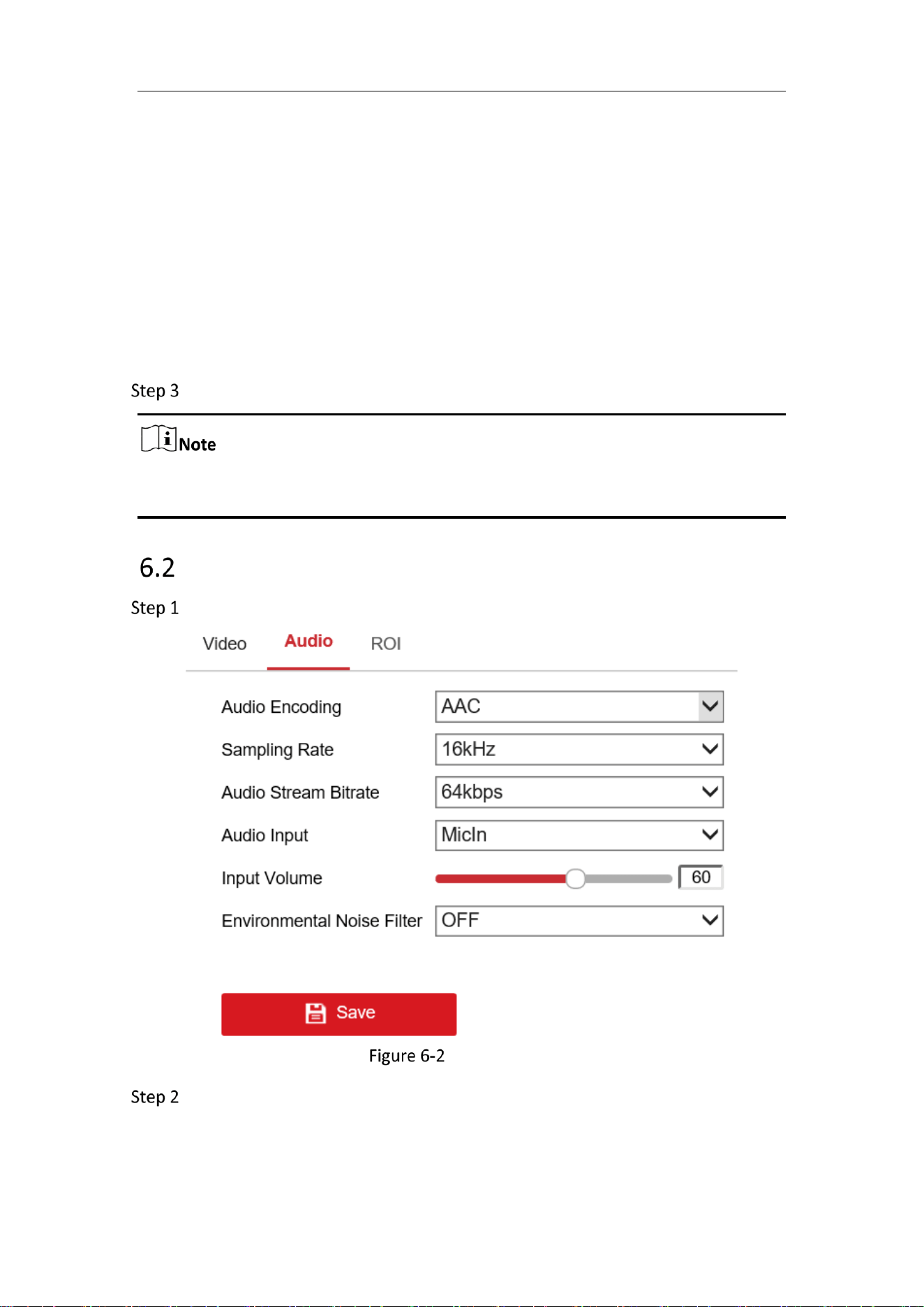
Go to Configuration > Video/Audio > Audio.
Audio Settings
Configure the following settings.
Mobile Network Camera • User Manual
36
Audio settings vary according to different camera models.
Audio Encoding: G.722.1, G.711 ulaw, G.711alaw, G.726 and PCM are selectable. For
PCM, the Sampling Rate can be set.
Audio Input: MicIn are selectable for the connected microphone.
Input Volume: 0-100 adjustable.
Environmental Noise Filter: Set it as OFF or ON. When the function is enabled, the
noise in the environment can be filtered to some extent.
Click Save to save the settings.
ROI Encoding
Purpose:
ROI (Region of Interest) encoding helps to discriminate the ROI and background
information in video compression, which means, the technology assigns more
encoding resource to the region of interest, thus to increase the quality of the ROI
whereas the background information is less focused.
ROI function varies according to different camera models.
Mobile Network Camera • User Manual
37
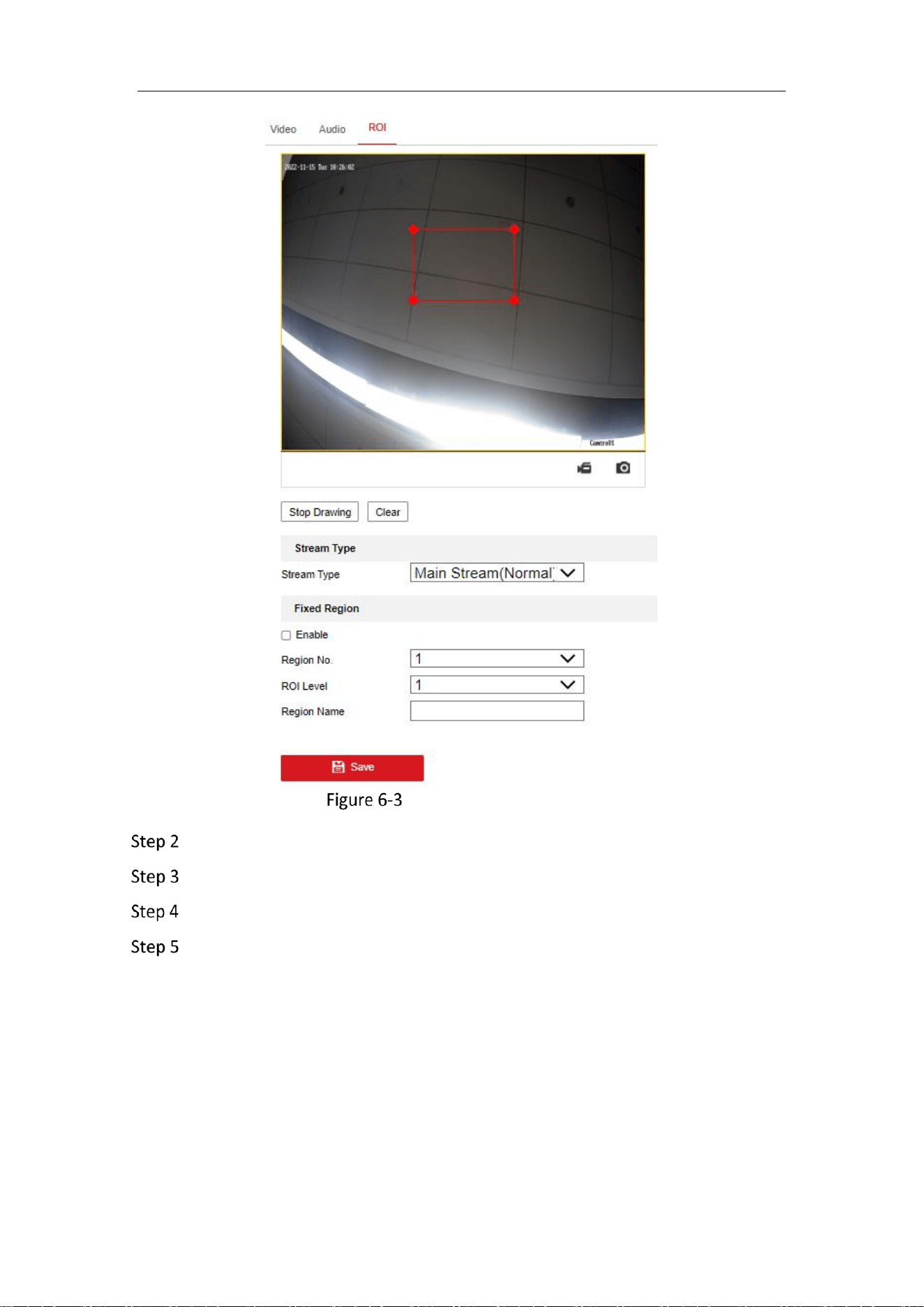
Region of Interest Settings
Go to Configuration > Video/Audio > ROI.
Select the Stream Type for ROI encoding.
Check the checkbox of Enable under Fixed Region item.
Set Fixed Region for ROI.
1) Select the Region No. from the drop-down list.
2) Check the Enable checkbox to enable ROI function for the chosen region.
3) Click Drawing. Click and drag the mouse on the view screen to draw a red
rectangle as the ROI region. You can click Clear to cancel former drawing.
Click Stop Drawing when you finish.
4) Select the ROI level from 1 to 6.
5) Enter a region name for the chosen region.
6) Click Save the save the settings of ROI settings for chosen fixed region.
7) Repeat steps (1) to (6) to setup other fixed regions if available.

Mobile Network Camera • User Manual
38
Click Save to save the settings.
ROI level means the image quality enhancing level. The larger the value is, the better
the image quality would be.
Mobile Network Camera • User Manual
39
Chapter 7 Image Settings
Purpose:
Follow the instructions in this chapter to configure the image parameters, including
display settings, OSD settings, privacy mask, and picture overlay.
Settings Parameters
Purpose:
Configure the image adjustment, exposure settings, day/night switch, backlight
settings, white balance, image enhancement, video adjustment, and other
parameters in display settings.
The display parameters vary according to the different camera models. Please refer
to the actual interface for details.
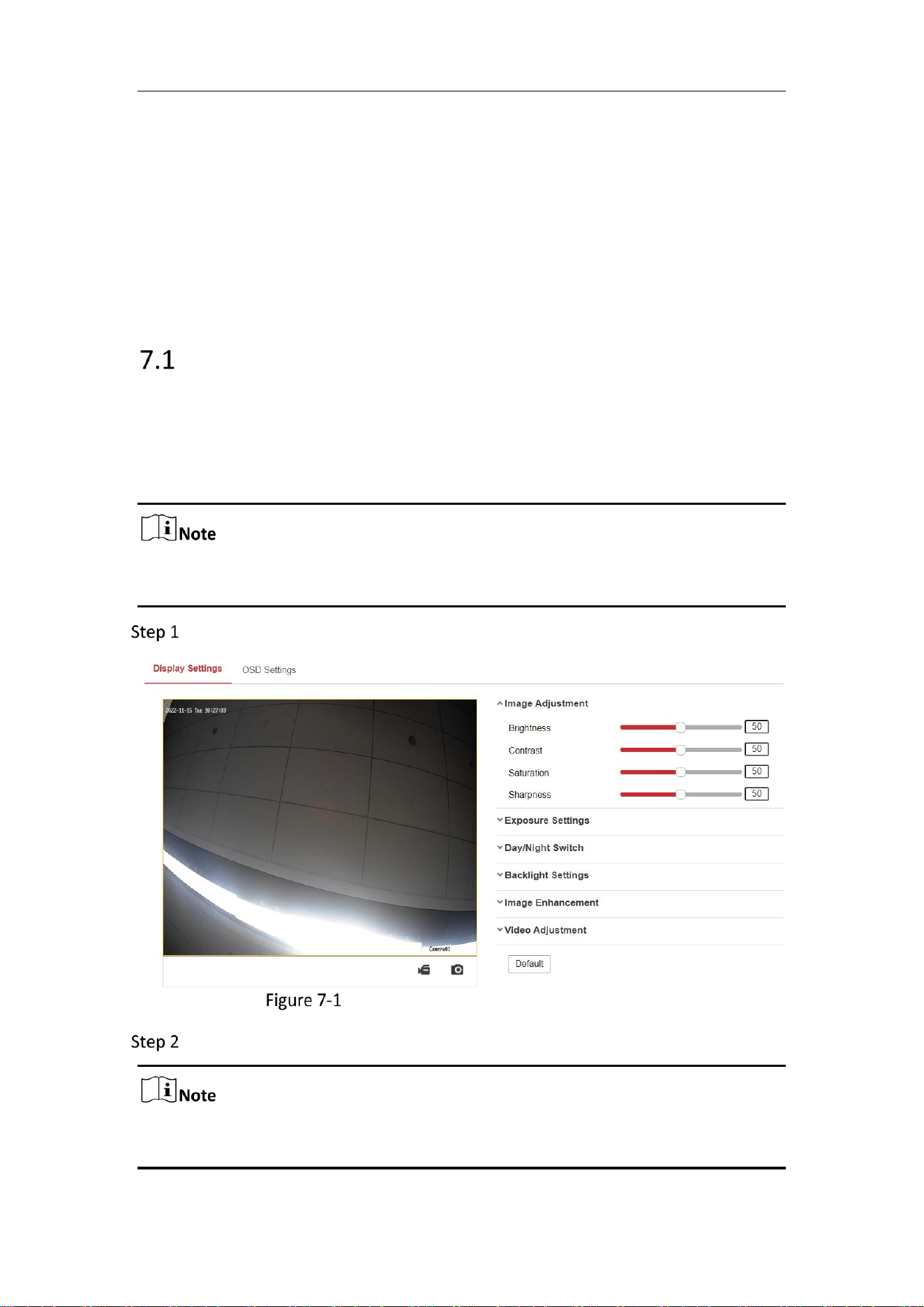
Go to Configuration > Image > Display Settings.
Display Settings of Day/Night Auto-Switch
Set the image parameters of the camera.
In order to guarantee the image quality in different illumination, it provides two sets
of parameters for users to configure.
Mobile Network Camera • User Manual
40
Image Adjustment
− Brightness describes how bright the image is, which ranges from 1 to 100.
− Contrast describes the contrast of the image, which ranges from 1 to 100.
− Saturation describes how colorful of the image is, which ranges from 1 to
100.
− Sharpness describes the edge contrast of the image, which ranges from 1 to
100.
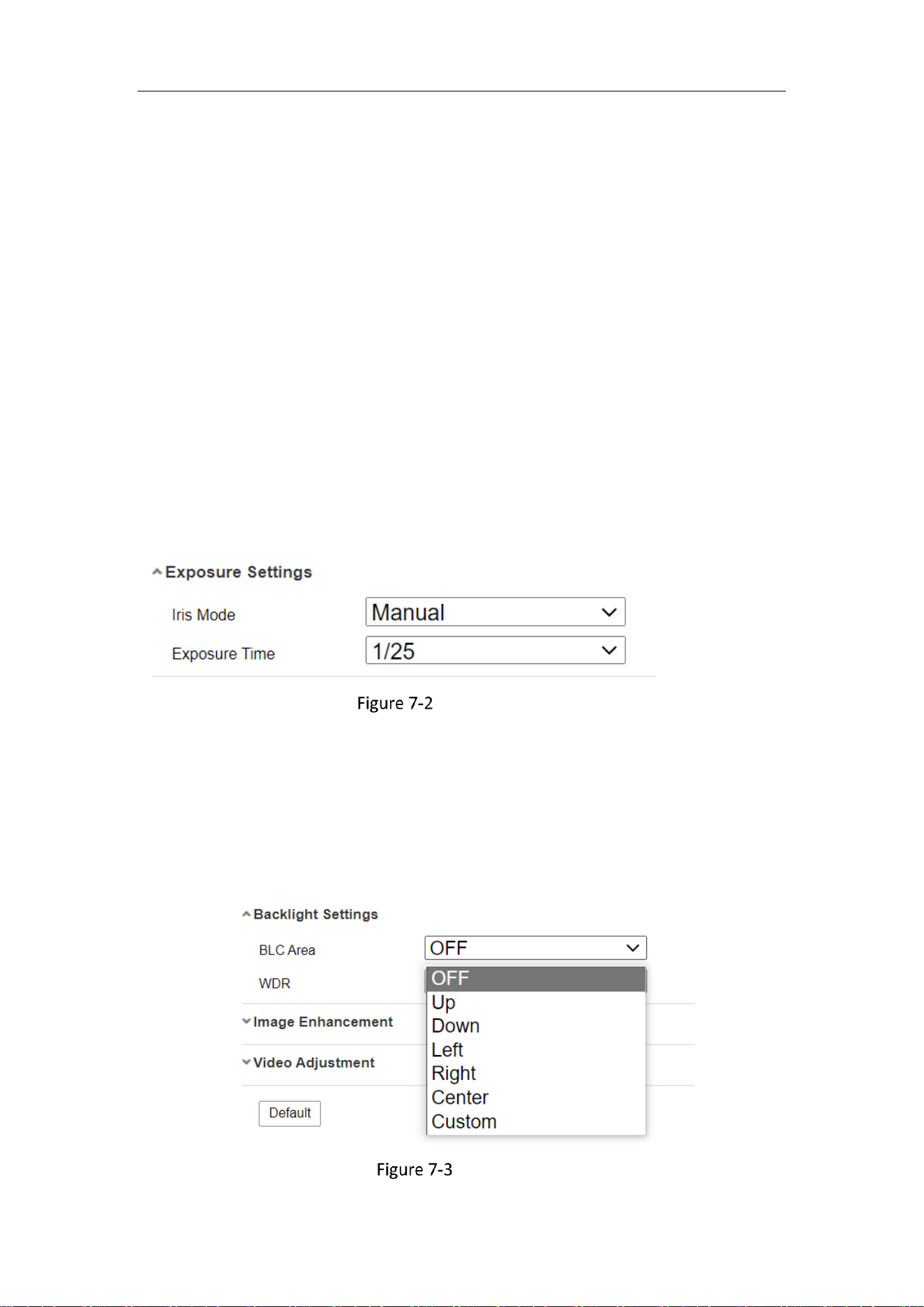
Exposure Settings
− If the camera is equipped with the fixed lens, only Manual is selectable, and
the iris mode is not configurable.
− If Auto is selected, you can set the auto iris level from 0 to 100.
− The Exposure Time refers to the electronic shutter time, which ranges from 1
to 1/100, 000 s. Adjust it according to the actual luminance condition.
− Gain of image can also be manually configured from 0 to 100. The bigger the
value is, the brighter would the image be, and the noise would also be
amplified to a larger extent.
Exposure Settings
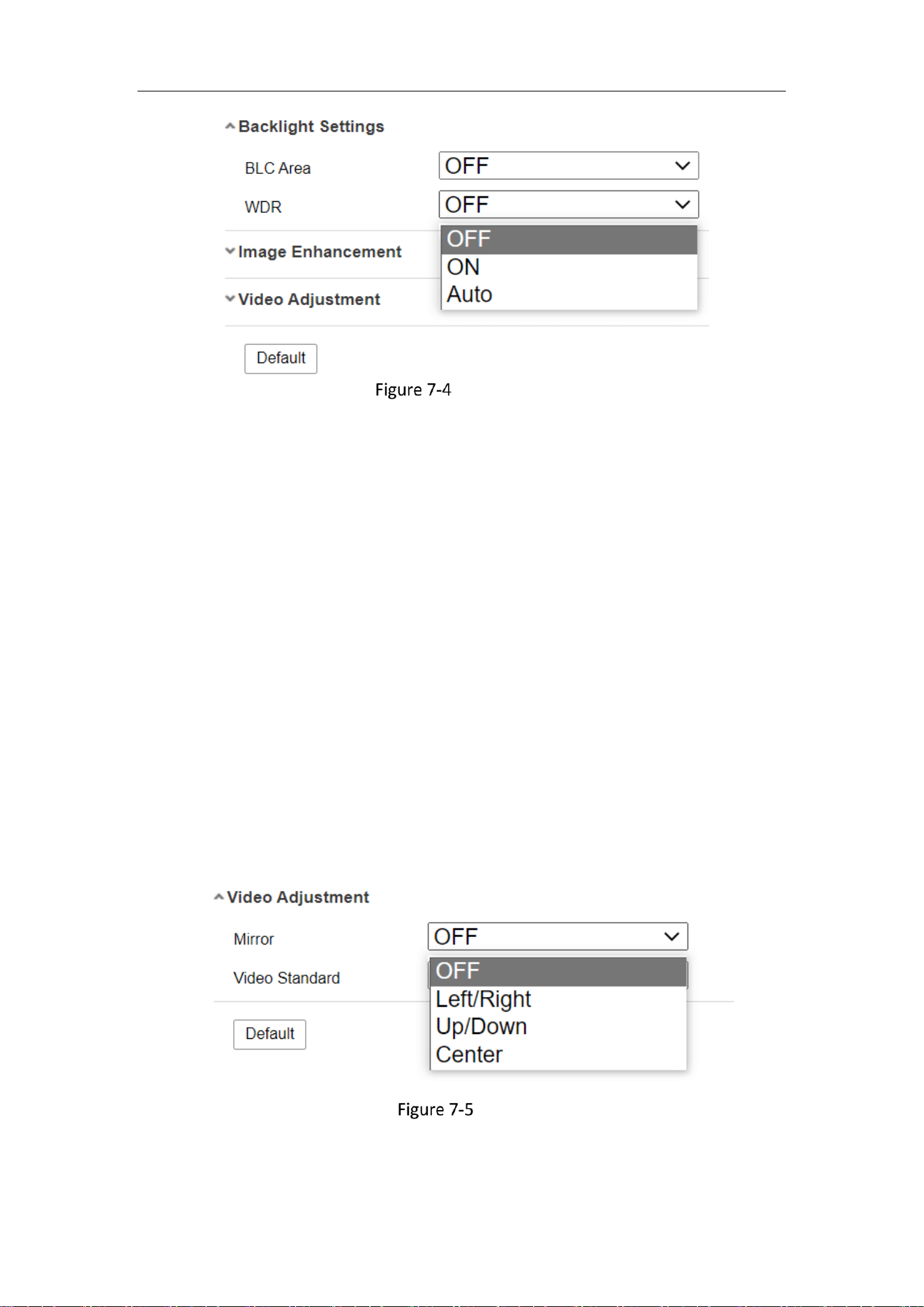
Backlight Settings
− BLC Area: Choose an area from up, down, left, right and center to avoid the
overly bright or dark. Choose Custom to draw an area. Turn off BLC to
configure WDR.
− WDR: Wide Dynamic Range can be used when there is a high contrast of the
bright area and the dark area of the scene. Turn off WDR to configure BLC.
BLC Settings
Mobile Network Camera • User Manual
41
WDR Setting
Image Enhancement
− Digital Noise Reduction: DNR reduces the noise in the video stream. OFF,
Normal and Expert are selectable. Set the DNR level from 0 to 100 in
Normal Mode. Set the DNR level from both space DNR level [0-100] and
time DNR level [0-100] in Expert Mode.
− Defog Mode: You can enable the defog function when the environment is
foggy and the image is misty. It enhances the subtle details so that the
image appears clearer.
− EIS (Electrical Image Stabilizer): EIS reduces the effects of vibration in a
video.
− Grey Scale: You can choose the range of the grey scale as [0-255] or [16-235].
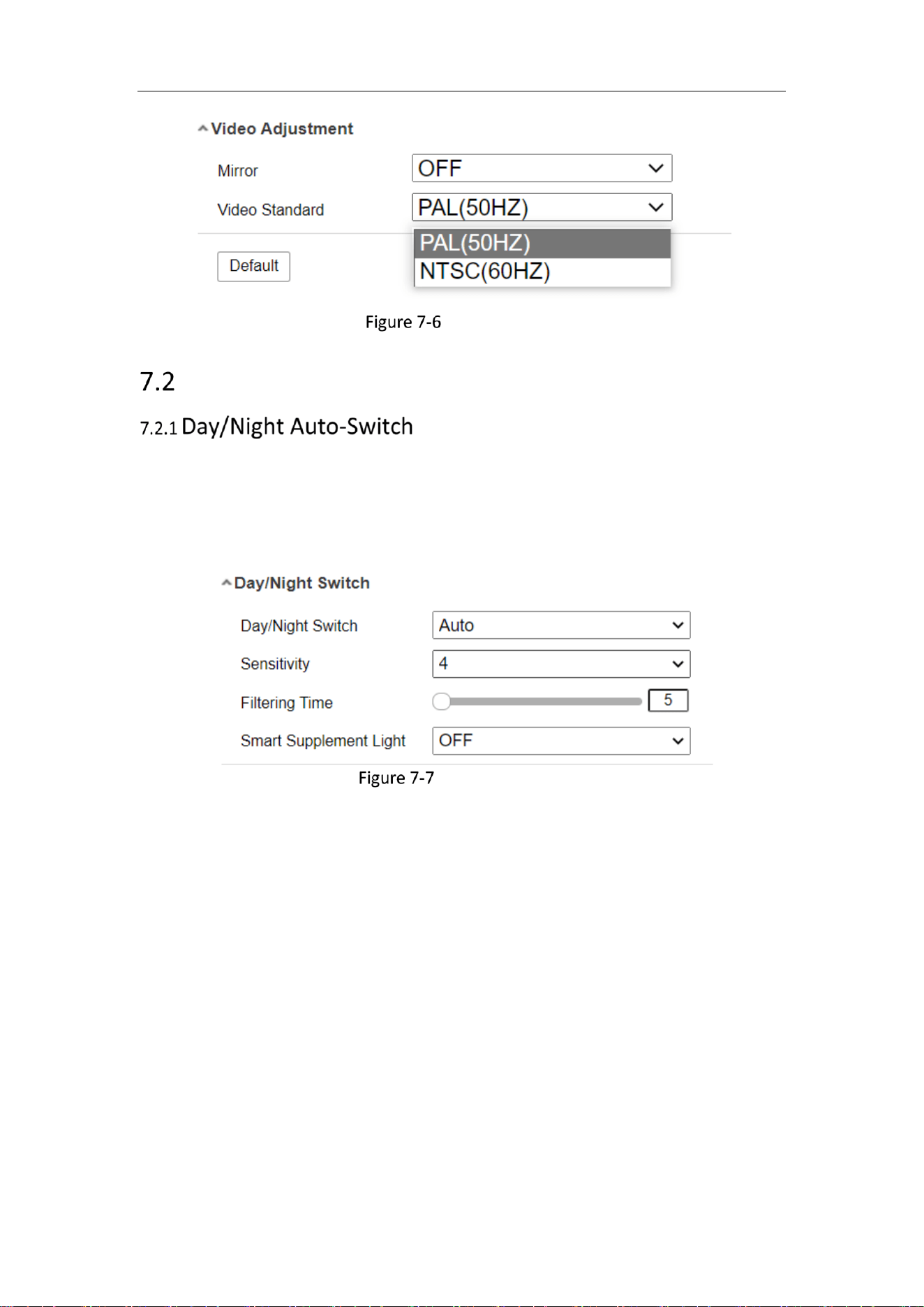
Video Adjustment
− Mirror: It mirrors the image so you can see it inversed. Left/Right, Up/Down,
Center, and OFF are selectable.
− Video Standard: 50 Hz and 60 Hz are selectable. Choose according to the
different video standards; normally 50 Hz for PAL standard and 60 Hz for
NTSC standard.
Mirror
Mobile Network Camera • User Manual
42
Video Standard
Day/Night Switch
Select the Day/Night Switch mode according to different monitoring demand.
Day, Night, Auto, Scheduled-Switch, and Triggered by alarm input are selectable
for day/night switch.
Day/Night Switch
− Day: the camera stays at day mode where the image is in color.
− Night: the camera stays at night mode where the image is black and white.
− Auto: the camera switches between the day mode and the night mode
according to the illumination automatically. The sensitivity ranges from 0
to 7, the higher the value is, the easier the mode switches. The Filtering
Time refers to the interval time between the day/night switch. You can set
it from 5 s to 120 s.
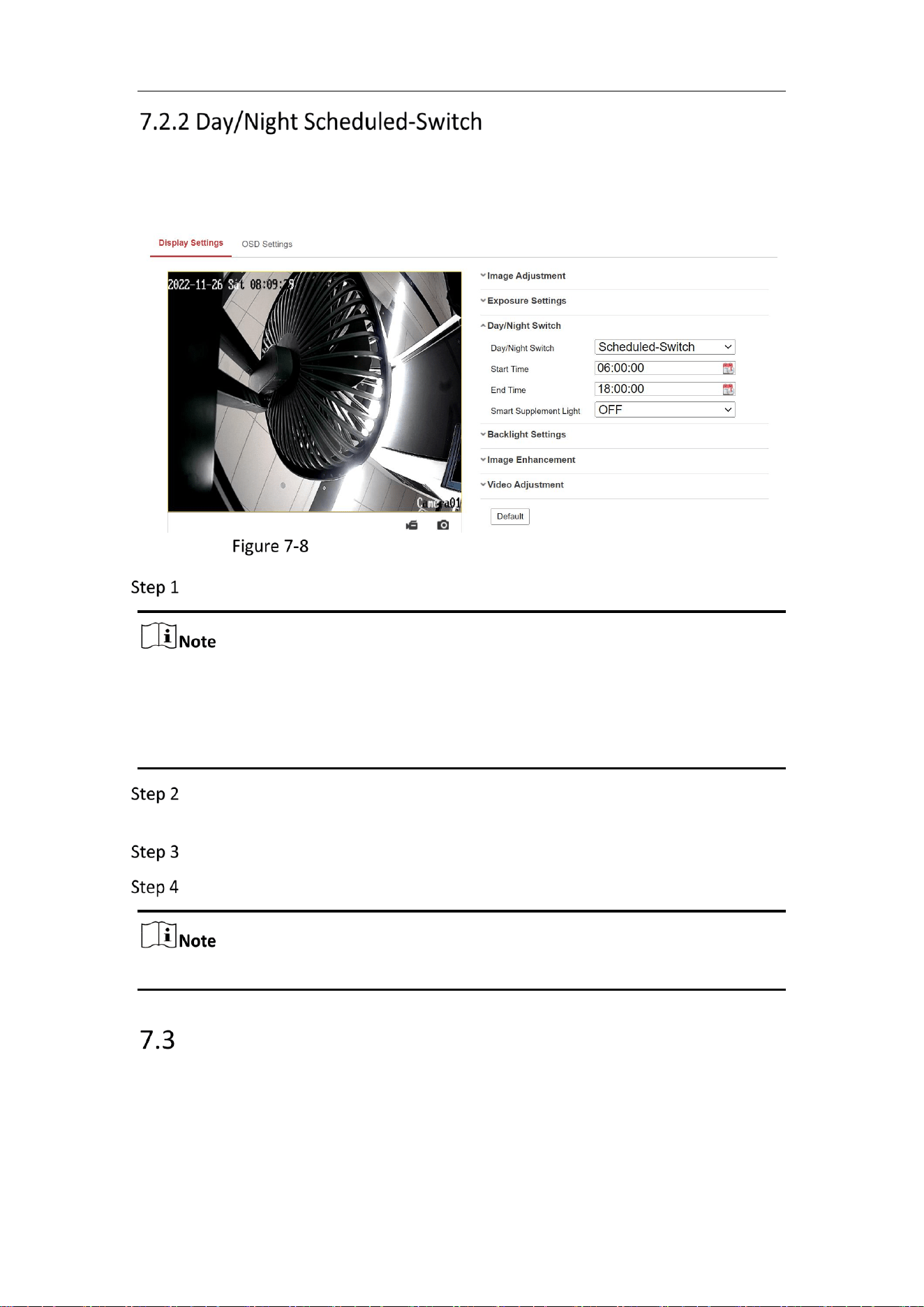
− Scheduled-Switch: Set the start time and the end time to define the duration
for day/night mode.
− Triggered by alarm input: The switch is triggered by alarm input. You can set
the triggered mode to day or night.
− Smart Supplement Light: ON and OFF are selectable for light mode.
Mobile Network Camera • User Manual
43
Day/Night scheduled-switch configuration interface enables you to set the camera
parameters for day and night separately, guaranteeing the image quality in different
illumination.
Day/Night Scheduled-Switch Configuration Interface
Click the calendar icon to select the start time and the end time of the switch.
The start time and end time refer to the valid time for day mode.
The time period can start and end on two days in a row. For example, if you set
start time as 10:00 and end time as 1:00, the day mode will be activated at 10
o'clock in the morning and stopped at 1 o'clock early in the next morning.
Click Common tab to configure the common parameters applicable to the day
mode and night mode.
Click Day tab to configure the parameters applicable for day mode.
Click Night tab to configure the parameters applicable for night mode.
The settings saved automatically if any parameter is changed.
OSD Settings
Purpose:
You can customize the camera name, time/date format, display mode, and OSD size
displayed on the live view.
Mobile Network Camera • User Manual
44
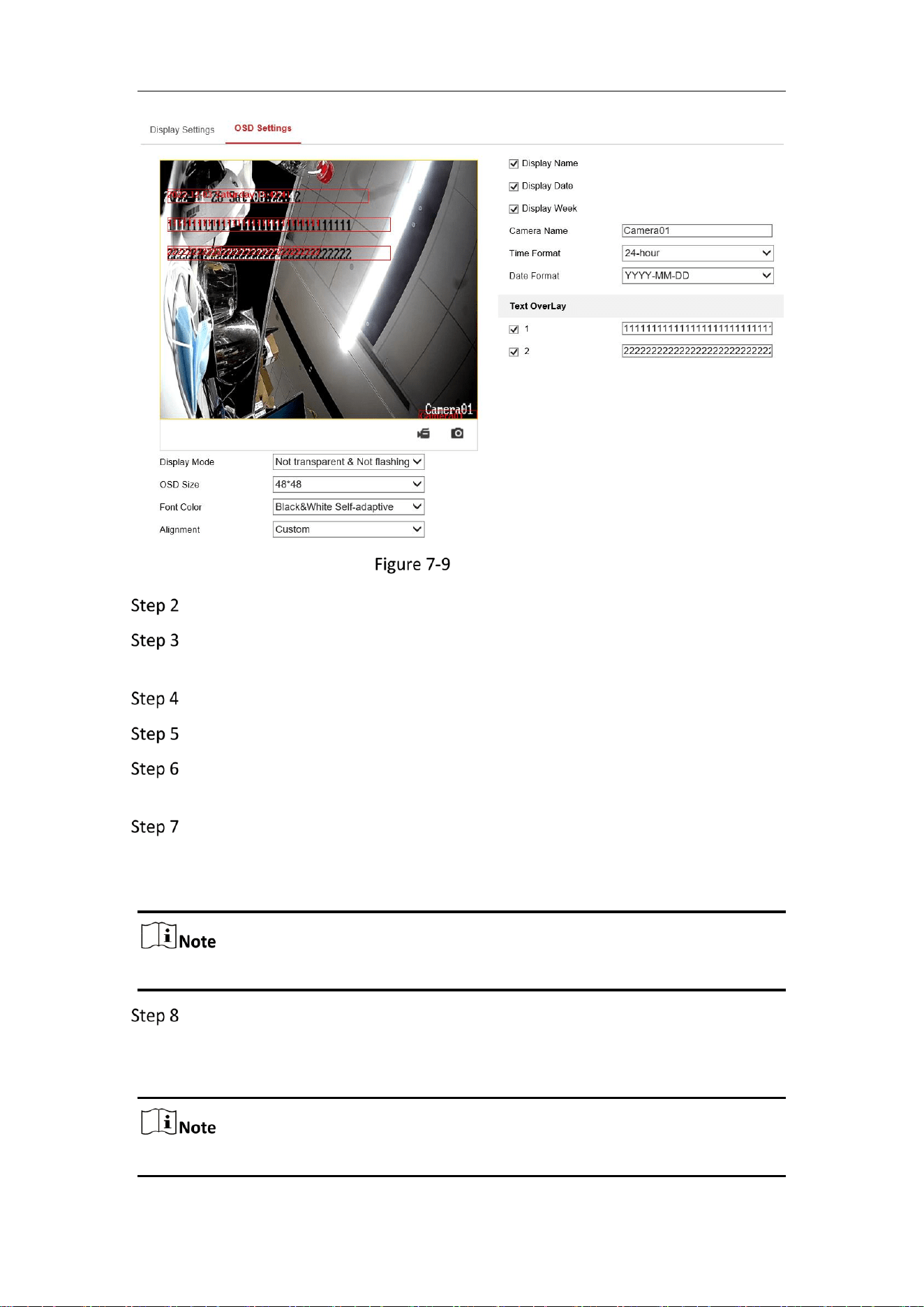
OSD Settings
Go to Configuration > Image > OSD Settings.
Check the corresponding checkbox to select the display of camera name, date
or week if required.
Edit the camera name in the text field of Camera Name.
Select from the drop-down list to set the time format and date format.
Select from the drop-down list to set the time format, date format, display
mode, OSD size and OSD color.
Configure the text overlay settings.
1) Check the checkbox in front of the textbox to enable the on-screen display.
2) Input the characters in the textbox.
Up to 2 text overlays (up to 31 digits) are configurable.
Adjust the position and alignment of text frames.
Left align, right align and custom are selectable. If you select custom, you can use the
mouse to click and drag text frames in the live view window to adjust their positions.
The alignment adjustment is only applicable to Text Overlay items.

Mobile Network Camera • User Manual
45
Click Save to save the settings.
Mobile Network Camera • User Manual
46
Chapter 8 Storage Settings
Before you start:
To configure record settings, make sure that you have the local storage media installed, without
which the recording will not be possible
Storage Management
Steps:
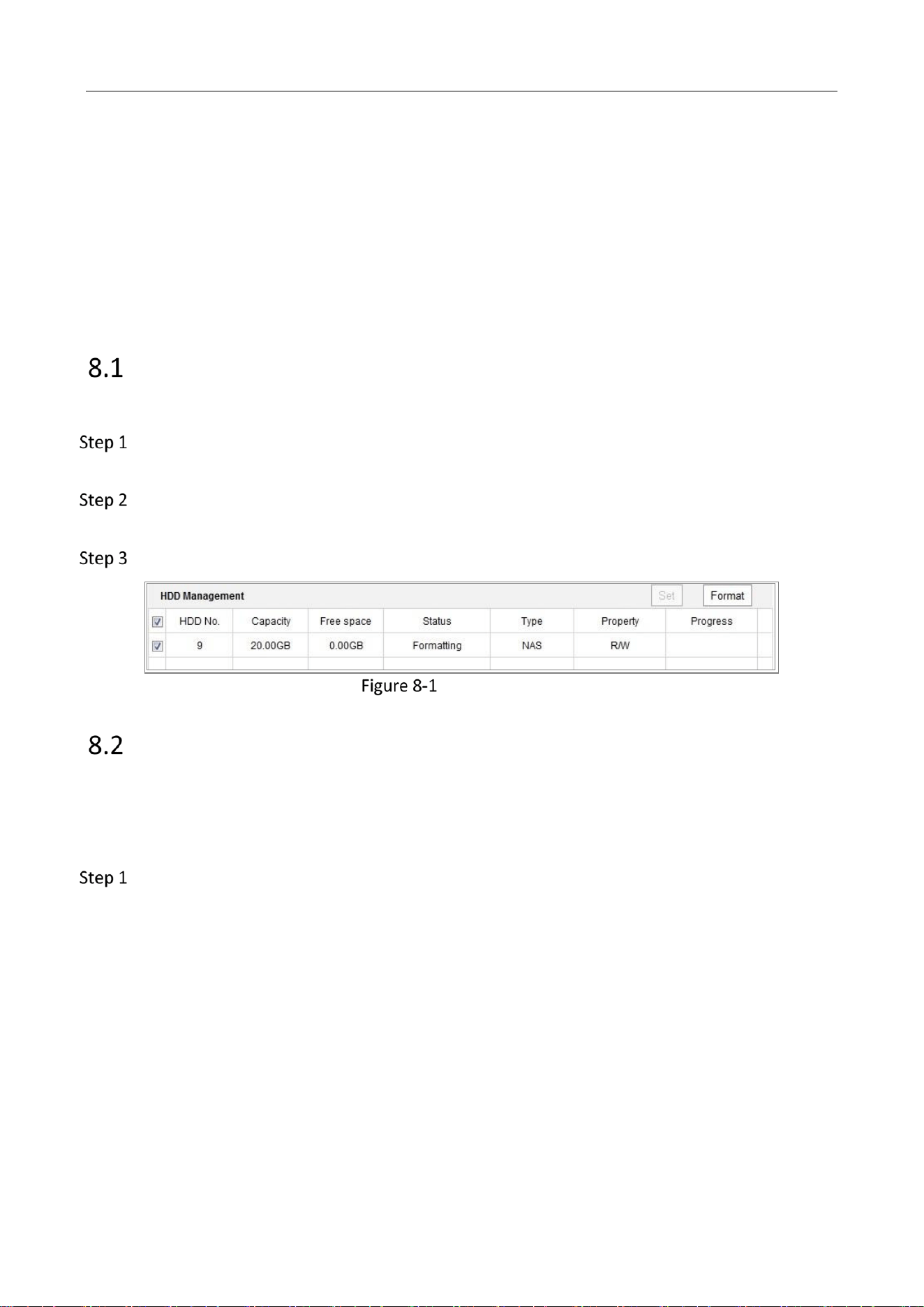
Go to Configuration > Storage > Storage Management > HDD Management, in which you
can view the capacity, free space, status, type and property of the storage media.
If the status of the disk is Uninitialized, check the corresponding checkbox to select the disk
and click Format to start initializing the disk.
When the initialization completed, the status of disk will become Normal.
View Disk Status
Record Schedule
Purpose:
In this section, you can follow the instructions to configure the scheduled recording. By default, the
record files of scheduled recording are stored in the local storage media (for instance, a SD card).
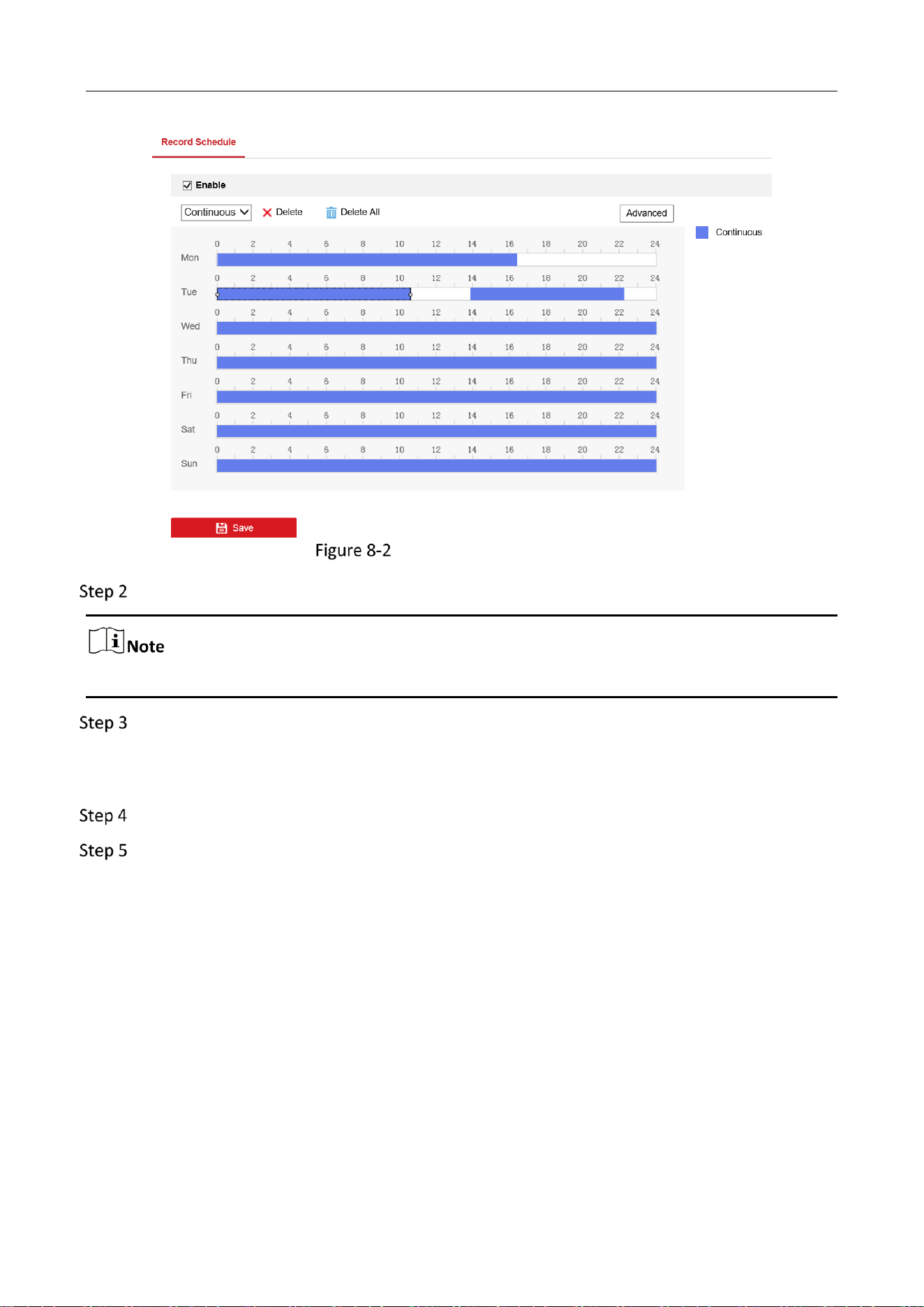
Go to Configuration > Storage > Schedule Settings > Record Schedule.
Mobile Network Camera • User Manual
47
Recording Schedule Interface
Check the checkbox of Enable to enable scheduled recording.
The record parameter configurations vary depending on the camera model.
Select a Record Type. The record type is default to Continuous.
If you select Continuous, the video will be recorded automatically according to the time of the
schedule.
Click-and-drag the mouse on the time bar to set the record schedule.
Click Save to save the settings.
Mobile Network Camera • User Manual
48
Chapter 9 Access to the Network Camera
Purpose:
This section explains how to connect the network camera to the WAN with a static IP or a dynamic
IP.
Before you start:
Please apply a static IP from an ISP (Internet Service Provider). With the static IP address, you can
connect the network camera via a router or connect it to the WAN directly.
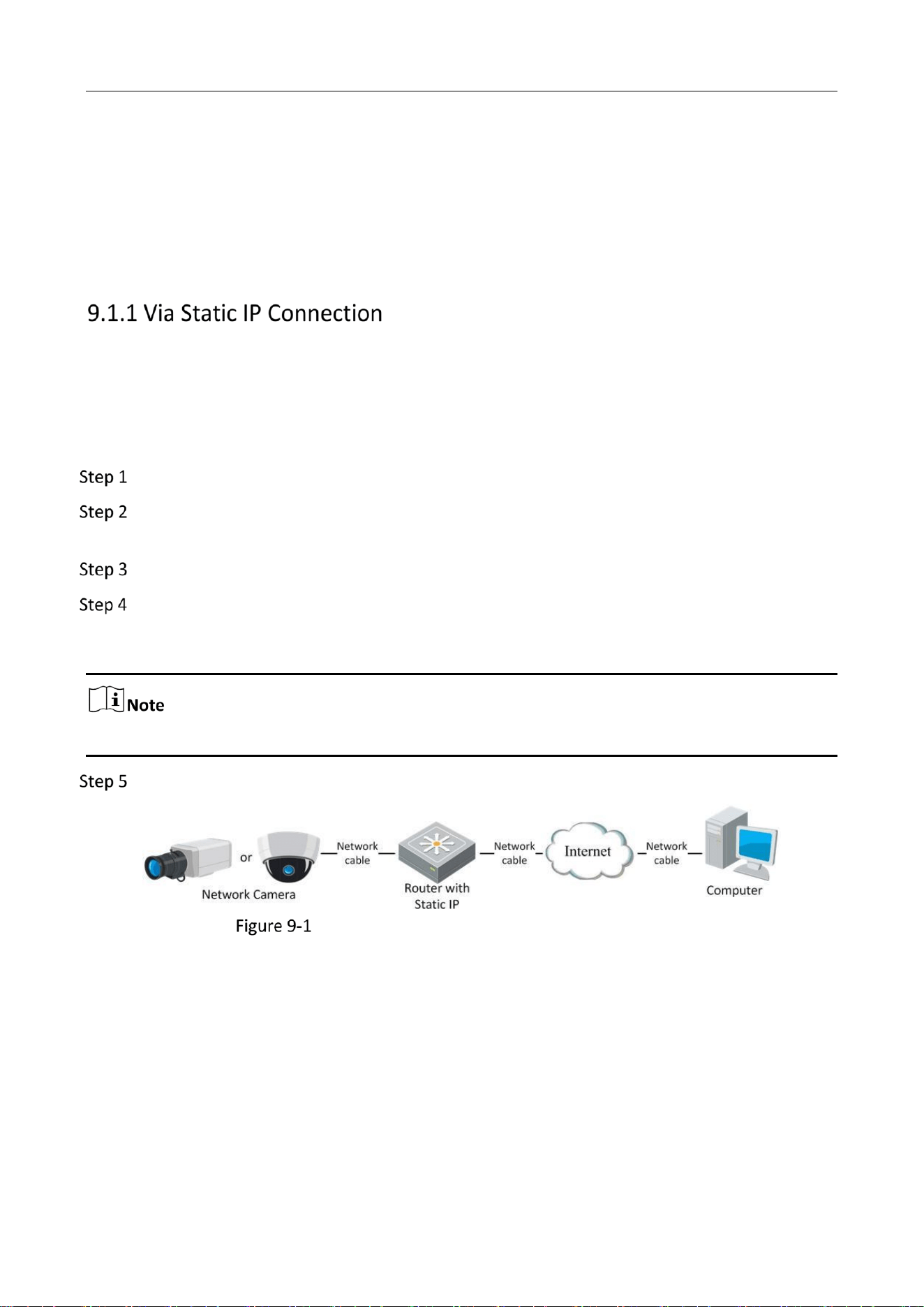
Connecting the network camera via a router
Connect the network camera to the router.
Assign a LAN IP address, the subnet mask and the gateway. Refer to Section 5.1.1 TCP/IP for
detailed IP address configuration of the network camera.
Save the static IP in the router.
Set port mapping, e.g., 80, 8000, and 554 ports. The steps for port mapping vary according
to the different routers. Please call the router manufacturer for assistance with port
mapping.
Refer to Appendix 2 for detailed information about port mapping.
Visit the network camera through a web browser or the client software over the internet.
Accessing the Camera through Router with Static IP
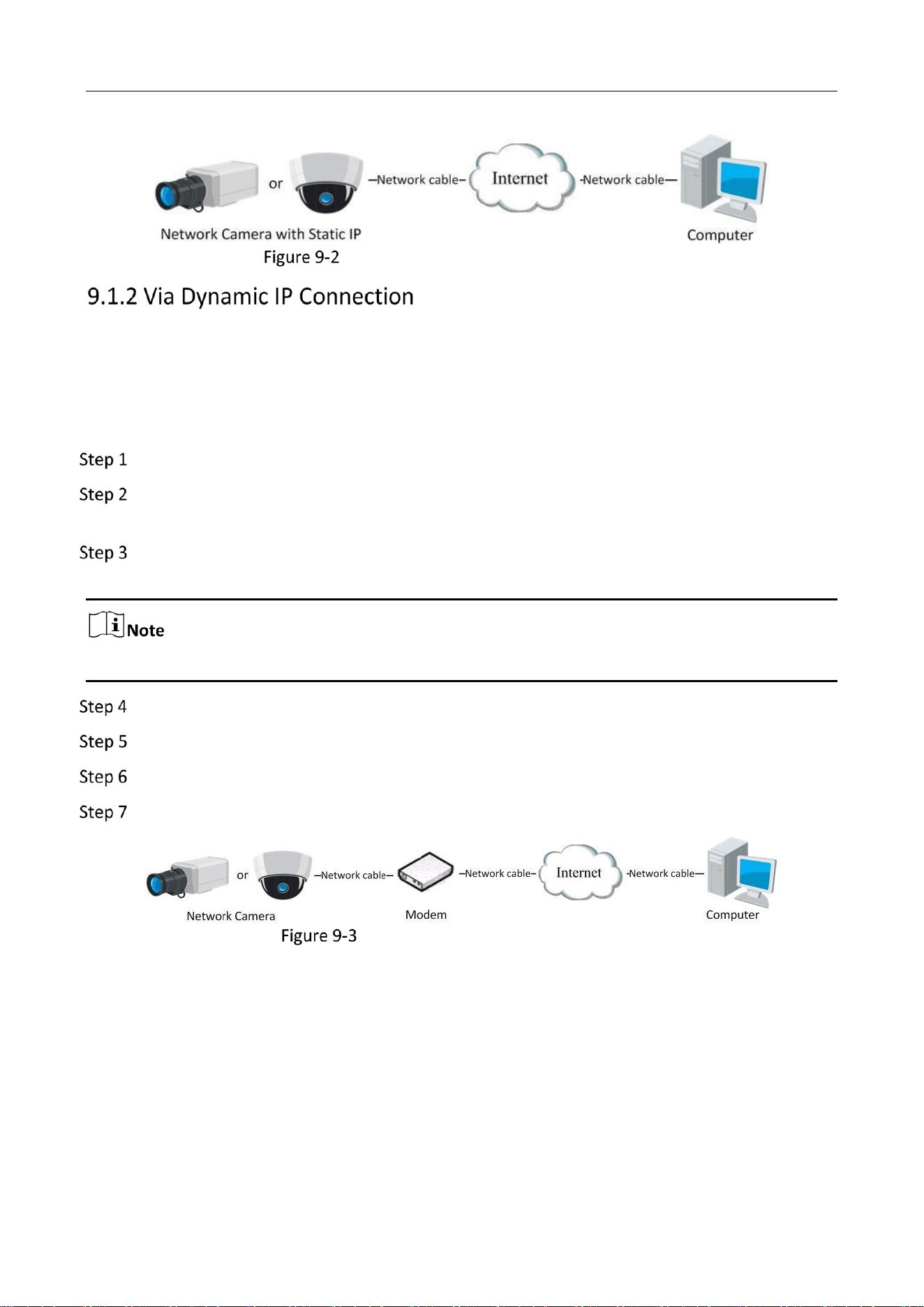
Connecting the network camera with static IP directly
You can also save the static IP in the camera and directly connect it to the internet without using a
router. Refer to Section 5.1.1 TCP/IP for detailed IP address configuration of the network camera.
Mobile Network Camera • User Manual
49
Accessing the Camera with Static IP Directly
Before you start:
Please apply a dynamic IP from an ISP. With the dynamic IP address, you can connect the network
camera to a modem or a router.
Connecting the network camera via a router
Connect the network camera to the router.
In the camera, assign a LAN IP address, the subnet mask and the gateway. Refer to Section
2.1.2 for detailed IP address configuration of the network camera.
Set port mapping. E.g. 80, 8000, and 554 ports. The steps for port mapping vary depending
on different routers. Please call the router manufacturer for assistance with port mapping.
Refer to Appendix 2 for detailed information about port mapping.
Apply a domain name from a domain name provider.
Configure the DDNS settings in the setting interface of the router.
Visit the camera via the applied domain name.
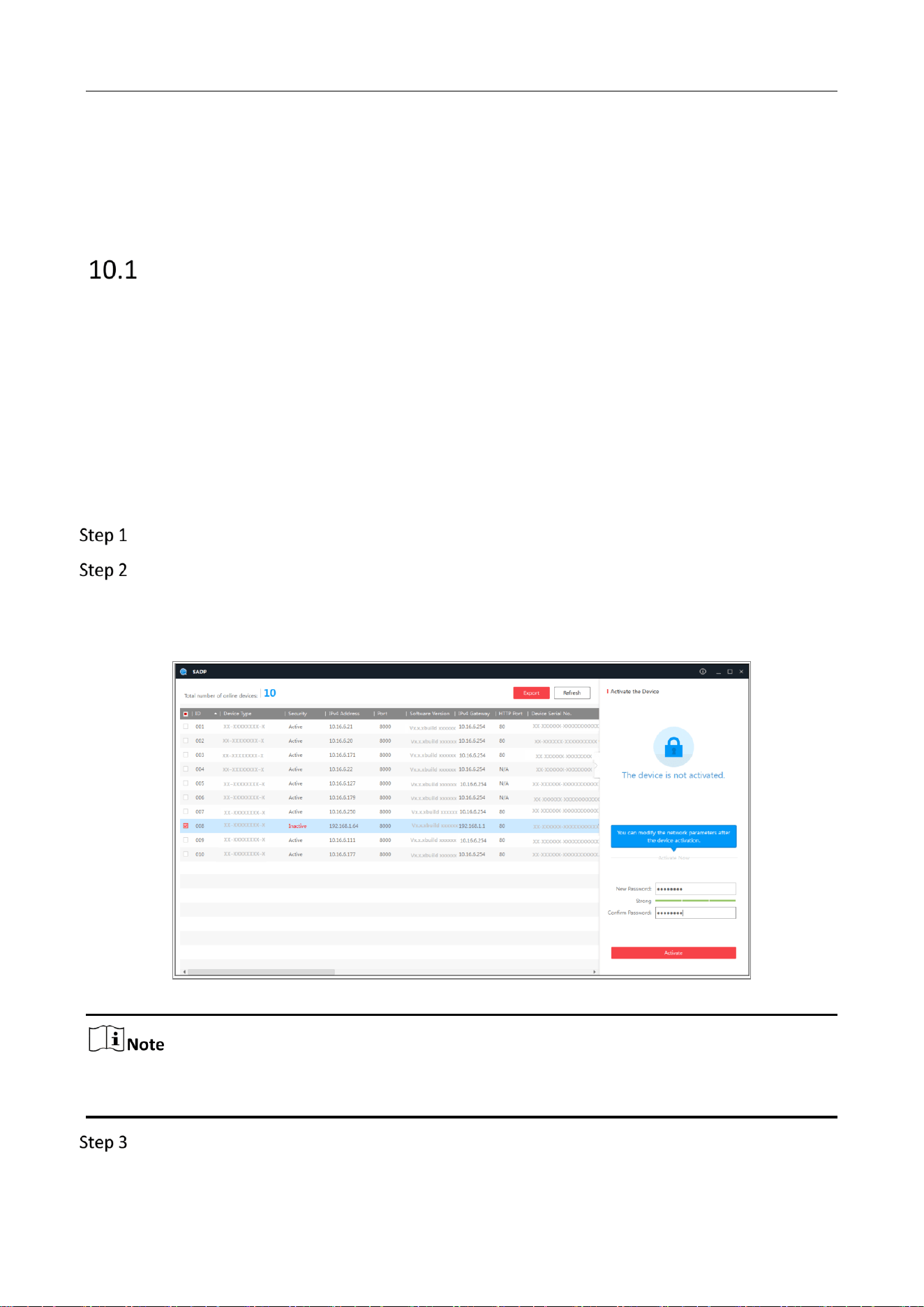
Connecting the network camera via a modem
Accessing the Camera with Dynamic IP
Mobile Network Camera • User Manual
50
Chapter 10 Appendix
Appendix 1 SADP Software Introduction
Description of SADP
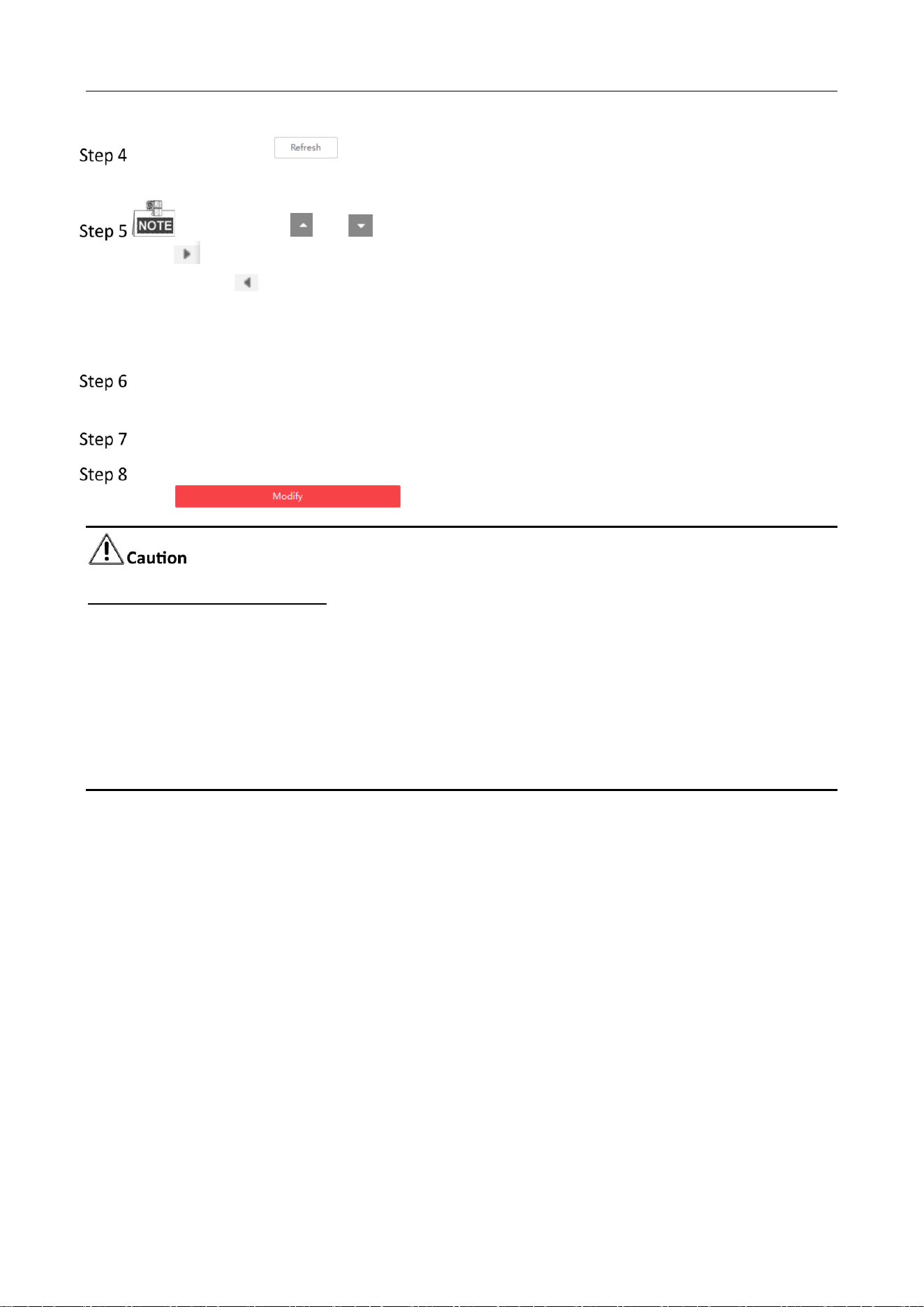
SADP (Search Active Devices Protocol) is a kind of user-friendly and installation-free online device
search tool. It searches the active online devices within your subnet and displays the information
of the devices. You can also modify the basic network information of the devices using this
software.
Search active devices online
Search online devices automatically
After launch the SADP software, it automatically searches the online devices every 15
seconds from the subnet where your computer locates. It displays the total number and
information of the searched devices in the Online Devices interface. Device information
including the device type, IP address and port number, etc. will be displayed.
Figure A.1.1 Searching Online Devices
Device can be searched and displayed in the list in 15 seconds after it went online; it will be
removed from the list in 45 seconds after it went offline.
Search online devices manually
Mobile Network Camera • User Manual
51
You can also click to refresh the online device list manually. The newly searched
devices will be added to the list.
You can click or on each column heading to order the information; you can
click to expand the device table and hide the network parameter panel on the right
side, or click to show the network parameter panel.
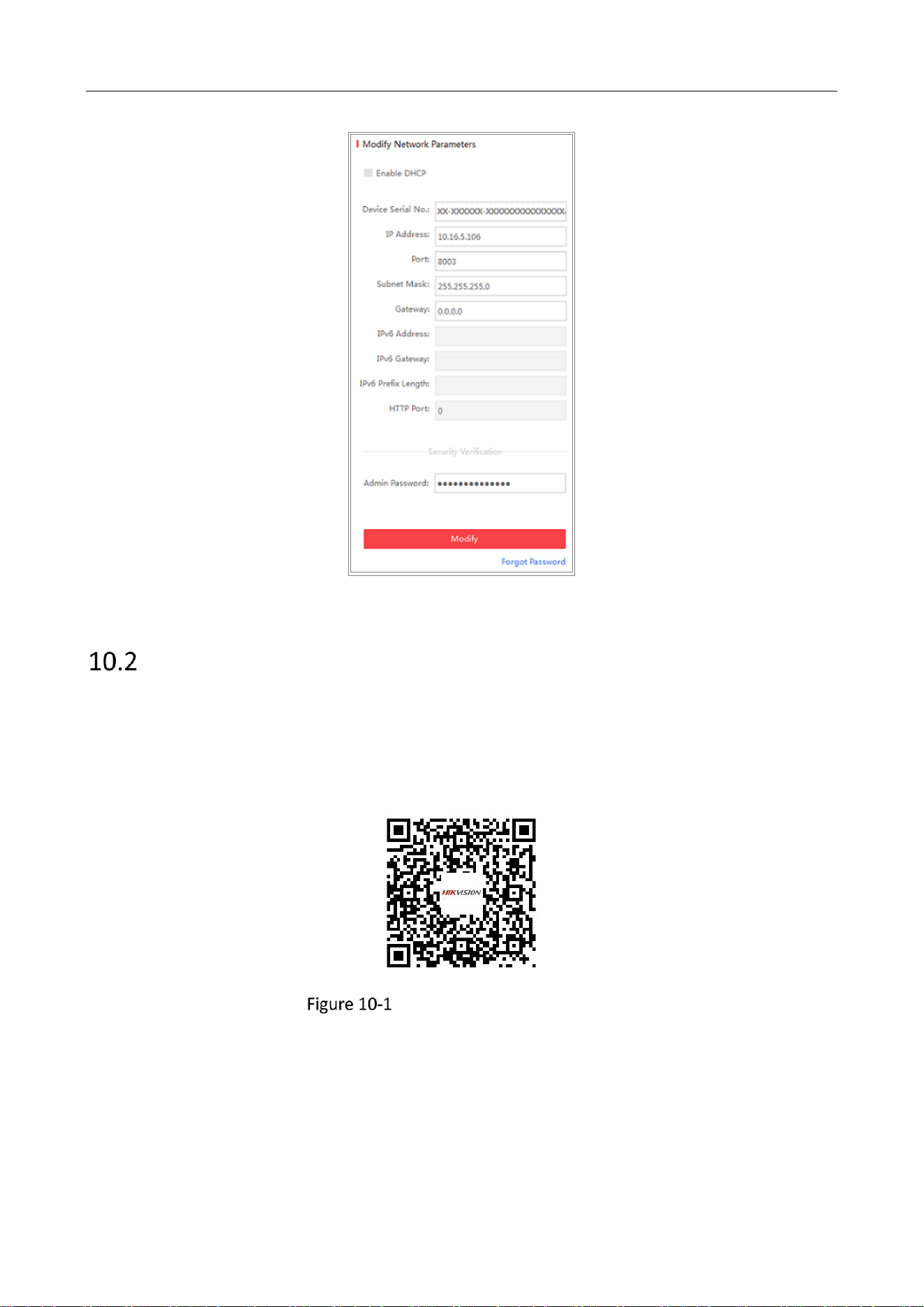
Modify network parameters
Select the device to be modified in the device list and the network parameters of the device
will be displayed in the Modify Network Parameters panel on the right side.
Edit the modifiable network parameters, e.g. IP address and port number.
Enter the password of the admin account of the device in the Admin Password field and
click to save the changes.
STRONG PASSWORD RECOMMENDED
We highly recommend you create a strong password of your own choosing (using a minimum
of 8 characters, including at least three of the following categories: upper case letters, lower
case letters, numbers, and special characters) in order to increase the security of your product.
And we recommend you reset your password regularly, especially in the high security system,
resetting the password monthly or weekly can better protect your product.
Proper configuration of all passwords and other security settings is the responsibility of the
installer and/or end-user.
Mobile Network Camera • User Manual
52
Figure A.1.2 Modify Network Parameters
Appendix 2 Device APP
Device Communication Matrix
Scan the following QR code to get device communication matrix.
Note that the matrix contains all communication ports of Hikvision network cameras.
Device Communication Matrix
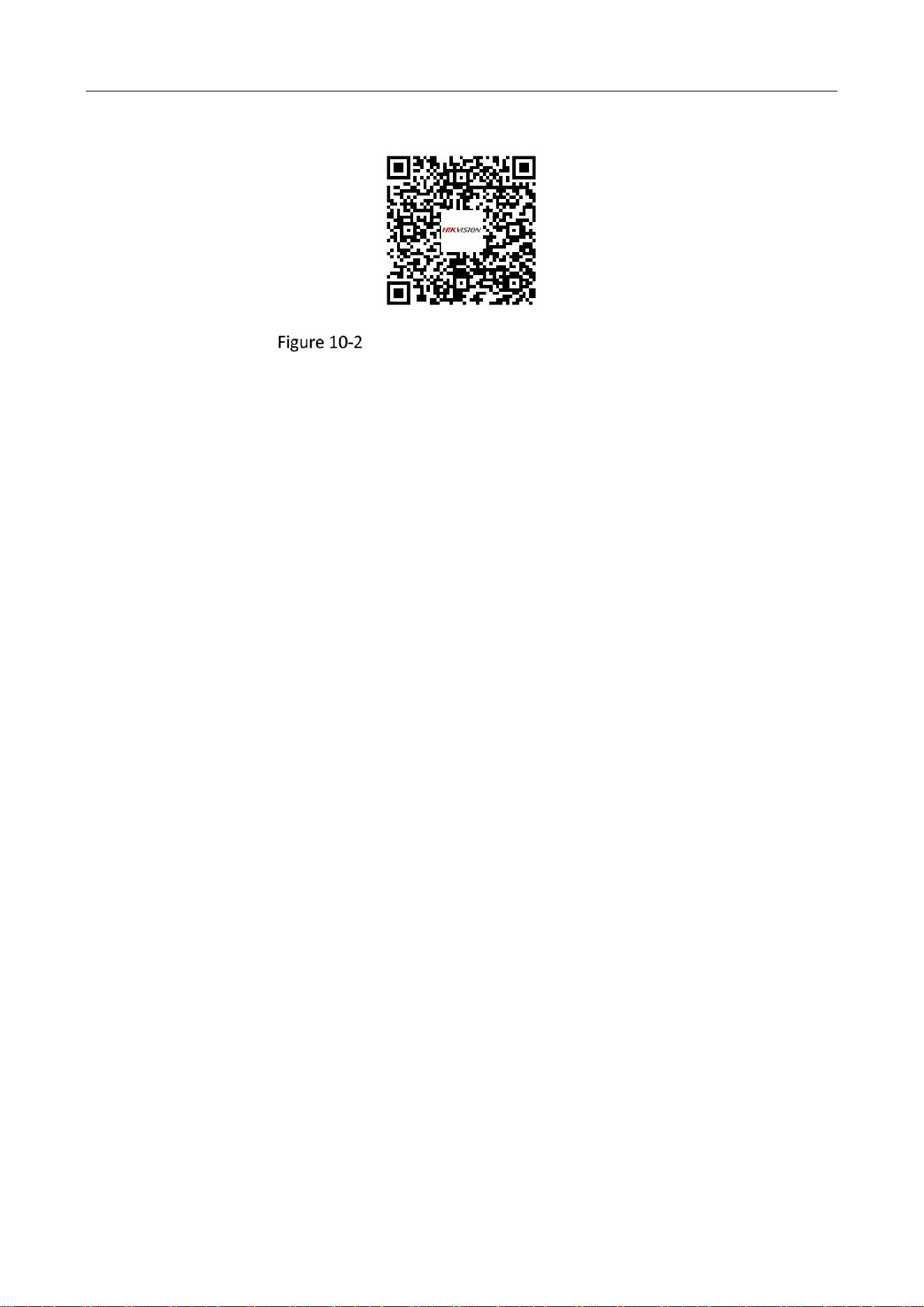
Device Command
Scan the following QR code to get device common serial port commands.
Note that the command list contains the commonly used serial port commands for all Hikvision
network cameras.
Mobile Network Camera • User Manual
53
device common serial port commands

0
UD31398B