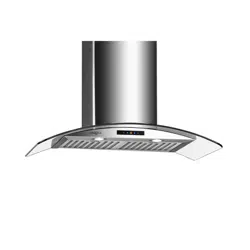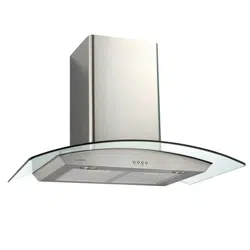

IMPORTANT SAFETY INSTRUCTIONS
Carefully read the following important information regarding
installation safety and maintenance.
Keep these instructions for future reference.
MODEL
GC430 30"
MAAN
IMPORTANT SAFETY NOTICE
READ ALL INSTRUCTIONS BEFORE INSTALLING AND OPERATING THIS APPLIANCE
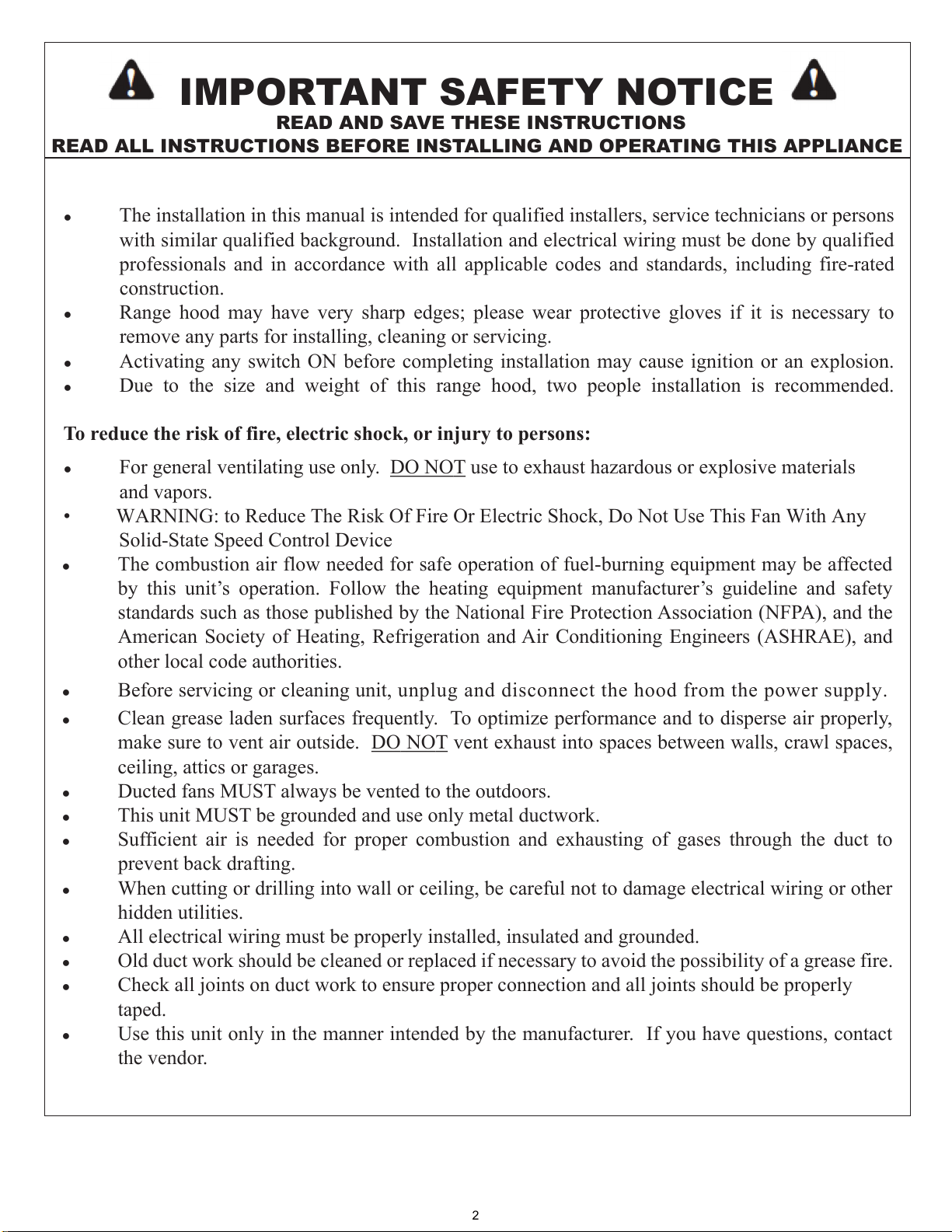
● The installation in this manual is intended for qualified installers, service technicians or persons
with similar qualified background. Installation and electrical wiring must be done by qualified
professionals and in accordance with all applicable codes and standards, including fire-rated
construction.
● Range hood may have very sharp edges; please wear protective gloves if it is necessary to
remove any parts for installing, cleaning or servicing.
● Activating any switch ON before completing installation may cause ignition or an explosion.
● Due to the size and weight of this range hood, two people installation is recommended.
To reduce the risk of fire, electric shock, or injury to persons:
● For general ventilating use only. DO NOT use to exhaust hazardous or explosive materials
and vapors.
• WARNING: to Reduce The Risk Of Fire Or Electric Shock, Do Not Use This Fan With Any
Solid-State Speed Control Device
● The combustion air flow needed for safe operation of fuel-burning equipment may be affected
by this unit’s operation. Follow the heating equipment manufacturer’s guideline and safety
standards such as those published by the National Fire Protection Association (NFPA), and the
American Society of Heating, Refrigeration and Air Conditioning Engineers (ASHRAE), and
other local code authorities.
● Before servicing or cleaning unit, unplug and disconnect the hood from the power supply.
● Clean grease laden surfaces frequently. To optimize performance and to disperse air properly,
make sure to vent air outside. DO NOT vent exhaust into spaces between walls, crawl spaces,
ceiling, attics or garages.
● Ducted fans MUST always be vented to the outdoors.
● This unit MUST be grounded and use only metal ductwork.
● Sufficient air is needed for proper combustion and exhausting of gases through the duct to
prevent back drafting.
● When cutting or drilling into wall or ceiling, be careful not to damage electrical wiring or other
hidden utilities.
● All electrical wiring must be properly installed, insulated and grounded.
● Old duct work should be cleaned or replaced if necessary to avoid the possibility of a grease fire.
● Check all joints on duct work to ensure proper connection and all joints should be properly
taped.
● Use this unit only in the manner intended by the manufacturer. If you have questions, contact
the vendor.
READ AND SAVE THESE INSTRUCTIONS
2
IMPORTANT SAFETY NOTICE
READ ALL INSTRUCTIONS BEFORE INSTALLING AND OPERATING THIS APPLIANCE
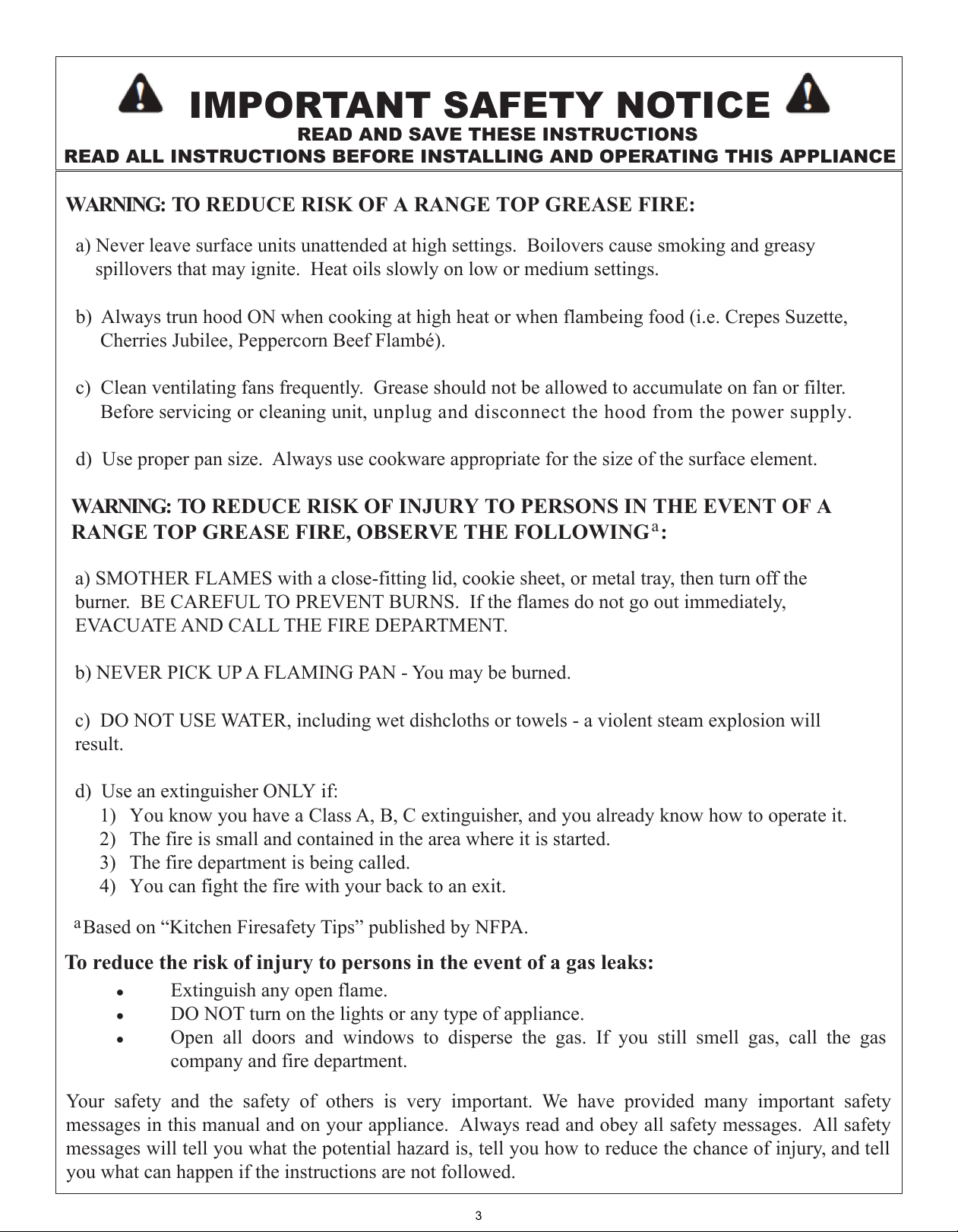
WARNING: TO REDUCE RISK OF A RANGE TOP GREASE FIRE:
WARNING: TO REDUCE RISK OF INJURY TO PERSONS IN THE EVENT OF A
RANGE TOP GREASE FIRE, OBSERVE THE FOLLOWING :
To reduce the risk of injury to persons in the event of a gas leaks:
● Extinguish any open flame.
● DO NOT turn on the lights or any type of appliance.
● Open all doors and windows to disperse the gas. If you still smell gas, call the gas
company and fire department.
Your safety and the safety of others is very important. We have provided many important safety
messages in this manual and on your appliance. Always read and obey all safety messages. All safety
messages will tell you what the potential hazard is, tell you how to reduce the chance of injury, and tell
you what can happen if the instructions are not followed.
READ AND SAVE THESE INSTRUCTIONS
a) Never leave surface units unattended at high settings. Boilovers cause smoking and greasy
spillovers that may ignite. Heat oils slowly on low or medium settings.
b) Always trun hood ON when cooking at high heat or when flambeing food (i.e. Crepes Suzette,
Cherries Jubilee, Peppercorn Beef Flambé).
c) Clean ventilating fans frequently. Grease should not be allowed to accumulate on fan or filter.
Before servicing or cleaning unit, unplug and disconnect the hood from the power supply.
d) Use proper pan size. Always use cookware appropriate for the size of the surface element.
a) SMOTHER FLAMES with a close-fitting lid, cookie sheet, or metal tray, then turn off the
burner. BE CAREFUL TO PREVENT BURNS. If the flames do not go out immediately,
EVACUATE AND CALL THE FIRE DEPARTMENT.
b) NEVER PICK UP A FLAMING PAN - You may be burned.
c) DO NOT USE WATER, including wet dishcloths or towels - a violent steam explosion will
result.
d) Use an extinguisher ONLY if:
1) You know you have a Class A, B, C extinguisher, and you already know how to operate it.
2) The fire is small and contained in the area where it is started.
3) The fire department is being called.
4) You can fight the fire with your back to an exit.
a
Based on “Kitchen Firesafety Tips” published by NFPA.
a
3
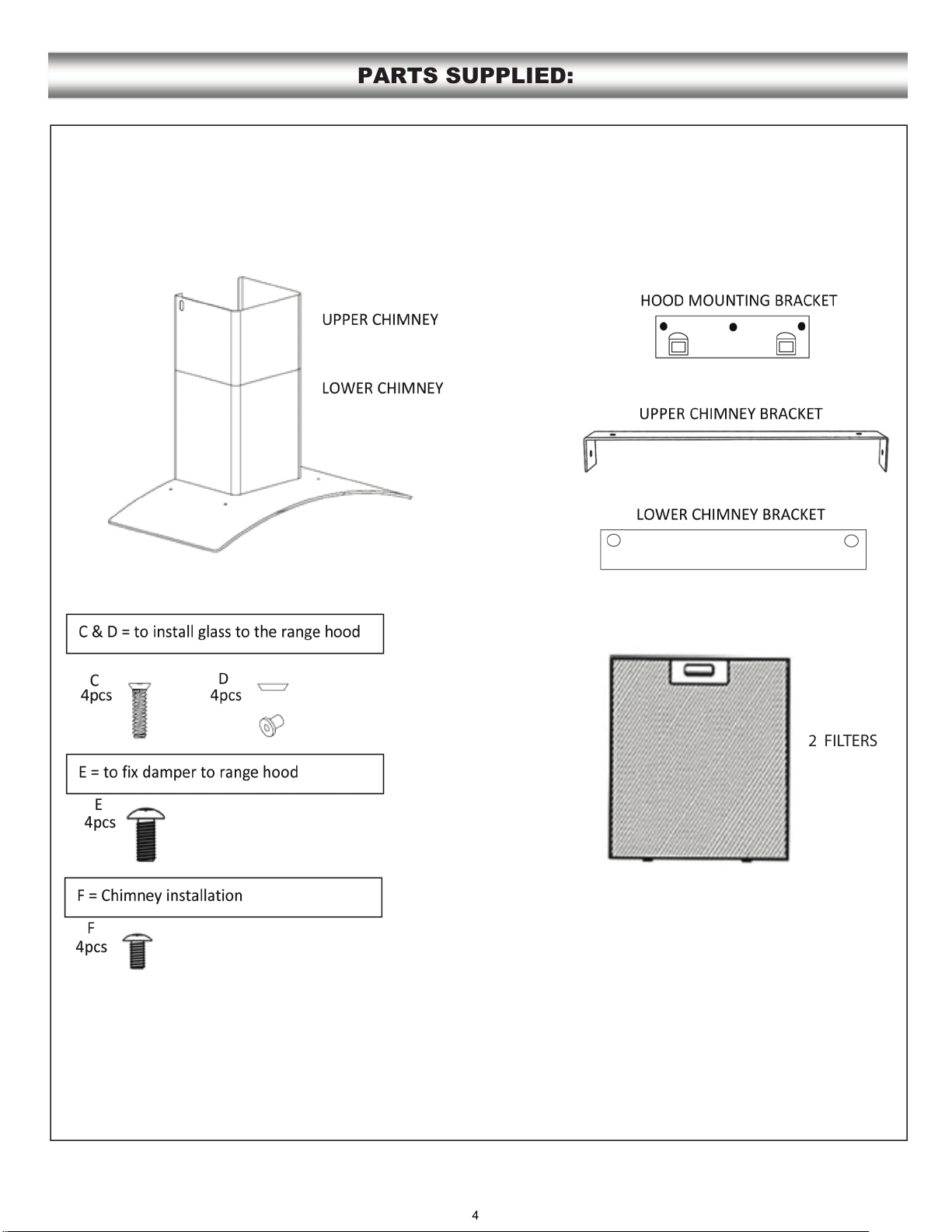
PARTS SUPPLIED:
2 FILTERS
4
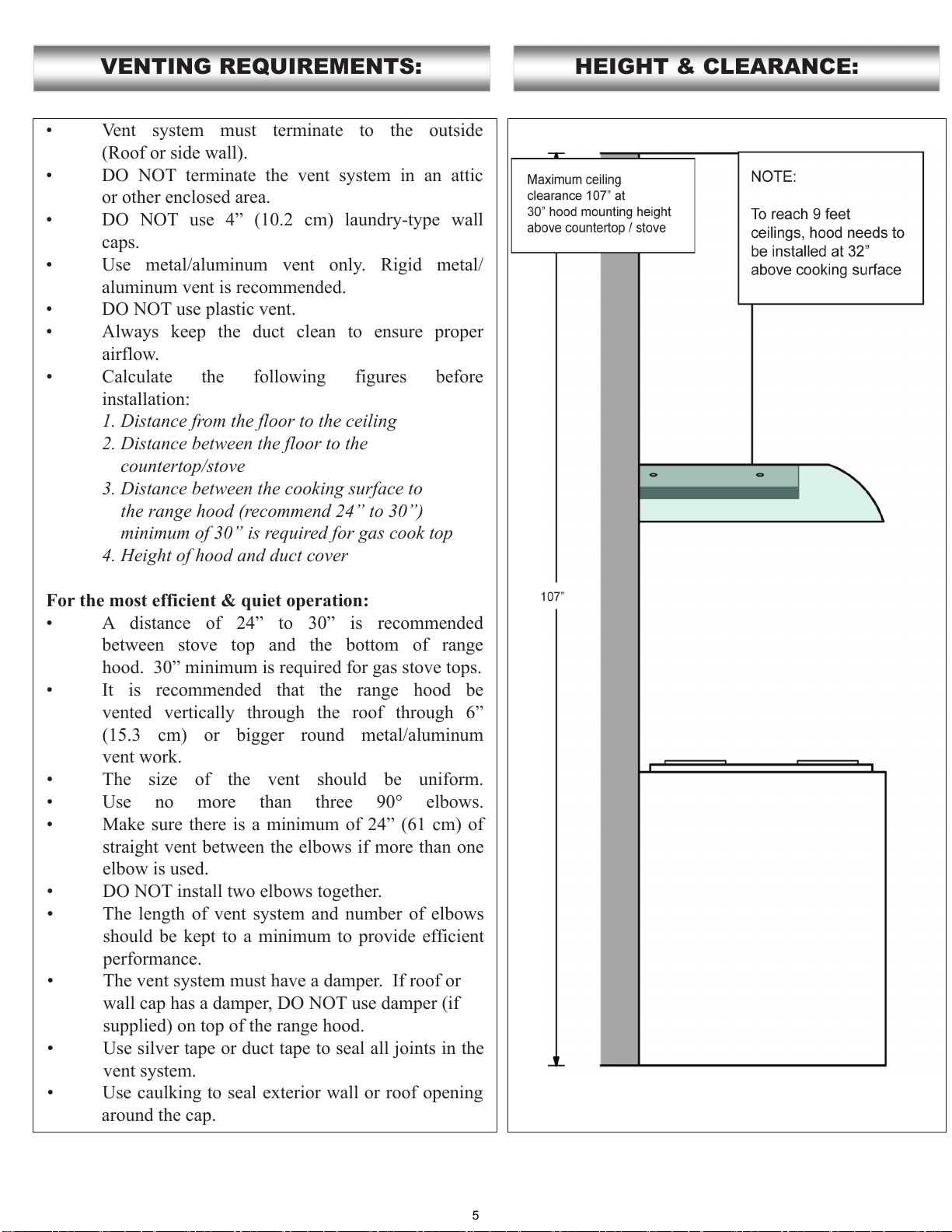
• Vent system must terminate to the outside
(Roof or side wall).
• DO NOT terminate the vent system in an attic
or other enclosed area.
• DO NOT use 4” (10.2 cm) laundry-type wall
caps.
• Use metal/aluminum vent only. Rigid metal/
aluminum vent is recommended.
• DO NOT use plastic vent.
• Always keep the duct clean to ensure proper
airflow.
• Calculate the following figures before
installation:
1. Distance from the floor to the ceiling
2. Distance between the floor to the
countertop/stove
3. Distance between the cooking surface to
the range hood (recommend 24” to 30”)
minimum of 30” is required for gas cook top
4. Height of hood and duct cover
For the most efficient & quiet operation:
• A distance of 24” to 30” is recommended
between stove top and the bottom of range
hood. 30” minimum is required for gas stove tops.
• It is recommended that the range hood be
vented vertically through the roof through 6”
(15.3 cm) or bigger round metal/aluminum
vent work.
• The size of the vent should be uniform.
• Use no more than three 90° elbows.
• Make sure there is a minimum of 24” (61 cm) of
straight vent between the elbows if more than one
elbow is used.
• DO NOT install two elbows together.
• The length of vent system and number of elbows
should be kept to a minimum to provide efficient
performance.
• The vent system must have a damper. If roof or
wall cap has a damper, DO NOT use damper (if
supplied) on top of the range hood.
• Use silver tape or duct tape to seal all joints in the
vent system.
• Use caulking to seal exterior wall or roof opening
around the cap.
VENTING REQUIREMENTS: HEIGHT & CLEARANCE:
5
IMPORTANT:
• A iniu of round or - rectangular duct (purchased separately) ust be used to
aintain aiu airflow efficiency
• Always use rigid type etalaluinu ducts if available to aiie airflow when connecting to
provided duct
• lease use Duct Run Calculation below to copute total available duct run when using elbows,
transitions and caps
• AWAS, when possible, reduce the nuber or transitions and turns If long duct run is reuired,
increase duct sie fro to or If a reducer is used, install a long reducer instead of a pancake
reducer Reducing duct sie will restrict airflow and decrease airflow, thus reduce duct sie as far
away fro opening as possible
• If turns or transitions are reuired, install as far away fro opening and as far apart, between two
(), as possible
• Miniu ount height between stove top to hood botto should be no less than -inch for
electric cook tops and iniu of -inch for gas stove tops and no higher than -inch for electric
cook tops
• It is iportant to install the hood at the proper ounting height Hoods ounted too low could result
in heat daage and fire haard while hoods ounted too high ay be hard to reach and will lose its
perforance and efficiency
• If available, also refer to stove top anufacturers height clearance reuireents and recoended
hood ounting height above range
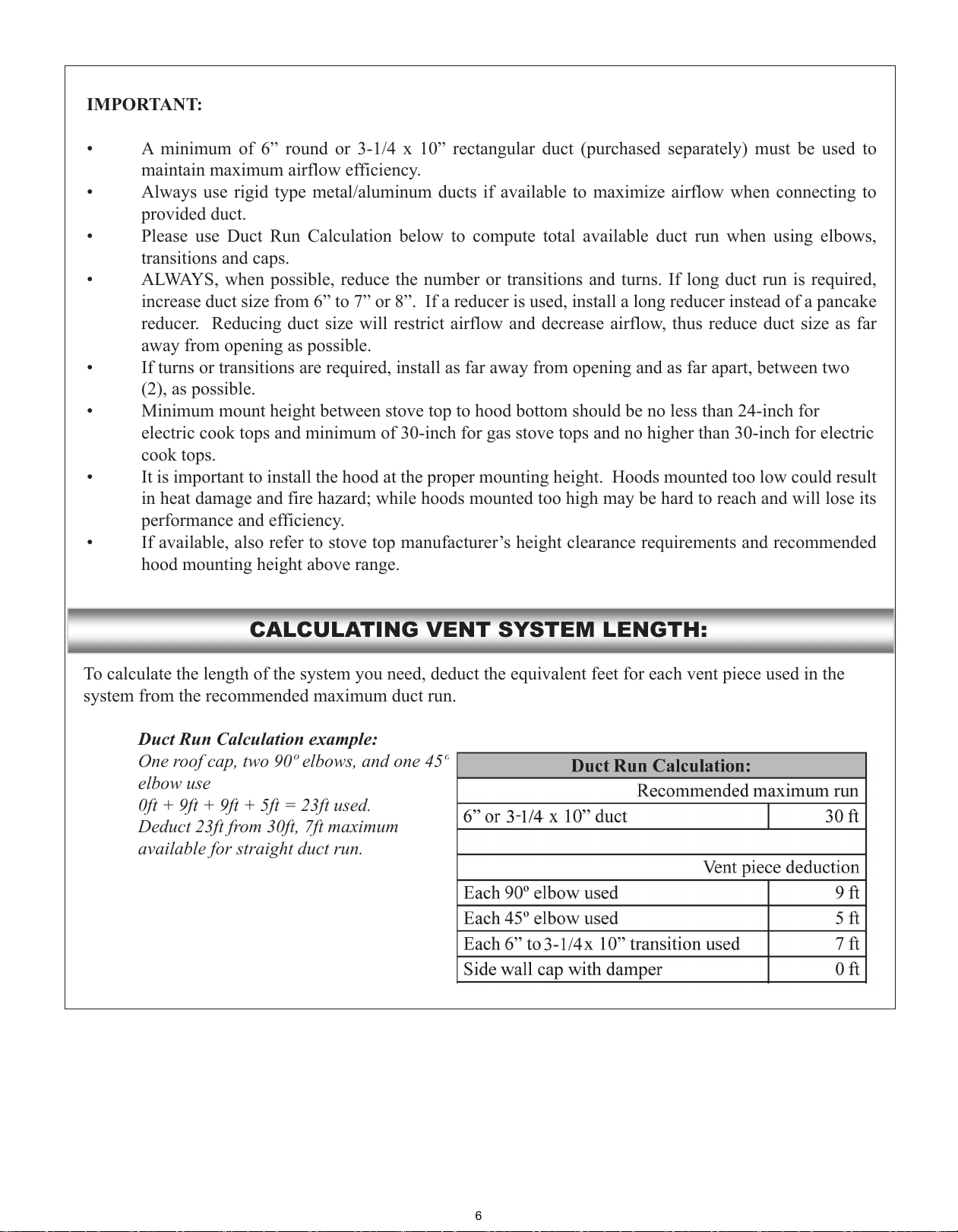
CALCULATING VENT SYSTEM LENGTH:
To calculate the length of the syste you need, deduct the euivalent feet for each vent piece used in the
syste fro the recoended aiu duct run
Duct Run Calculation example:
One roof cap, two 90º elbows, and one 45º
elbow use
0ft + 9ft + 9ft + 5ft = 23ft used.
Deduct 23ft from 30ft, 7ft maximum
available for straight duct run.
-
6
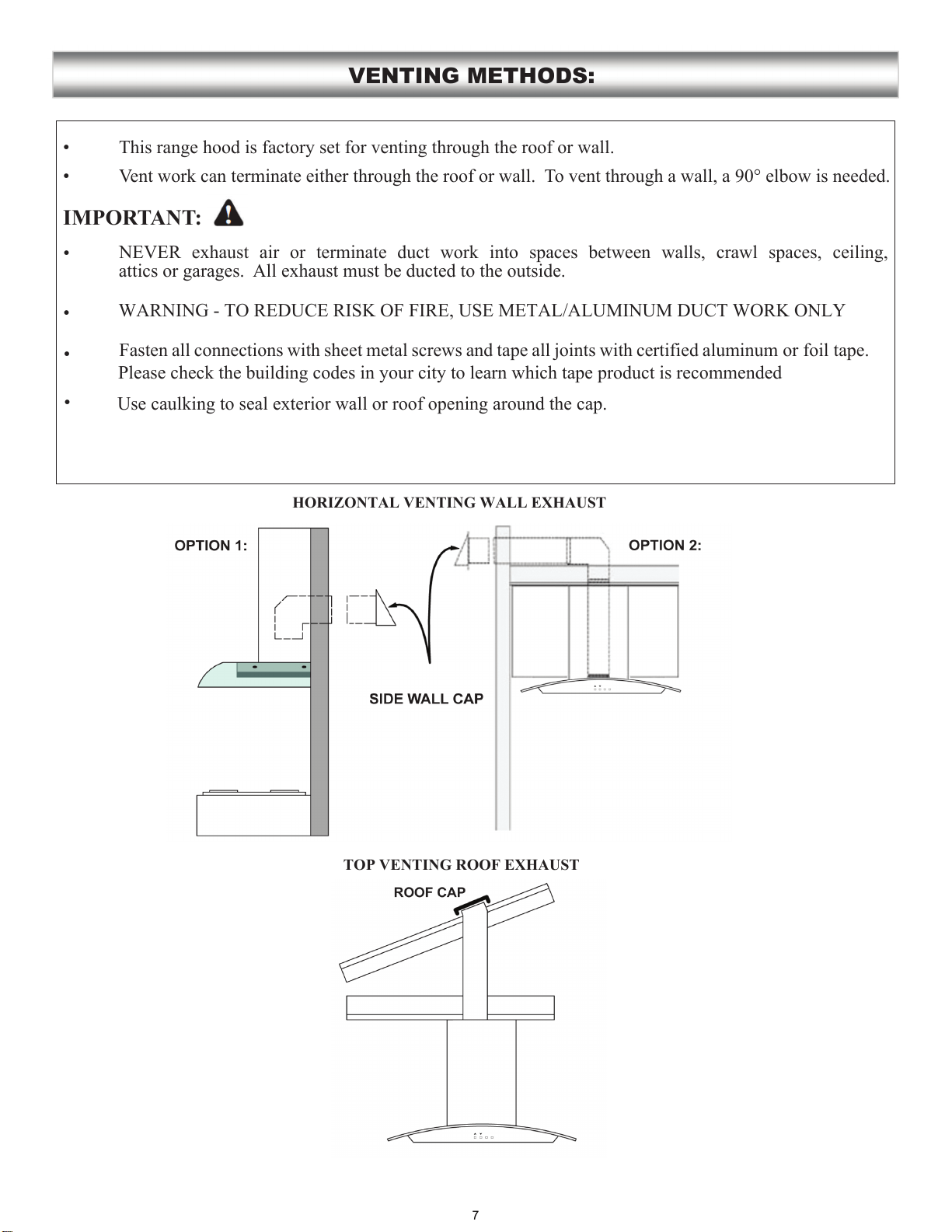
• This range hood is factory set for venting through the roof or wall.
• Vent work can terminate either through the roof or wall. To vent through a wall, a 90° elbow is needed.
IMPORTANT:
NEVER exhaust air or terminate duct work into spaces between walls, crawl spaces, ceiling,
attics or garages. All exhaust must be ducted to the outside.
•
WARNING - TO REDUCE RISK OF FIRE, USE METAL/ALUMINUM DUCT WORK ONLY
•
Fasten all connections with sheet metal screws and tape all joints with certified aluminum or foil tape.
Please check the building codes in your city to learn which tape product is recommended
•
Use caulking to seal exterior wall or roof opening around the cap.
VENTING METHODS:
•
HORIZONTAL VENTING WALL EXHAUST
TOP VENTING ROOF EXHAUST
7
IMPORTANT:
Observe all governing codes and ordinances.
It is the customer’s responsibility to contact a qualified electrical installer.
If codes permit and a separate ground wire is used, it is recommended that a qualified electrician determine
that the ground path is adequate.
A 120-Volt, 60 Hz, AC-only, fused electrical supply is required on a separate 15-amp circuit, fused on both
sides of the line.
DO NOT ground to a gas pipe.
Check with a qualified electrician if you are not sure that the range hood is properly grounded.
DO NOT have a fuse in the neutral or ground circuit.
IMPORTANT: Save this Installation Guide for electrical inspector’s use.
The range hood must be connected with copper wire/plug only.
The range hood should be connected directly to the fused disconnect (or circuit breaker) box through
flexible armored or non-metallic sheathed copper cable. UL/CSA listed strain relief must be provided at
each end of the power supply cable.
Use only with range hood cord-connection kits that have been investigated and found acceptable for use
with this model.
ELECTRICAL REQUIREMENTS:
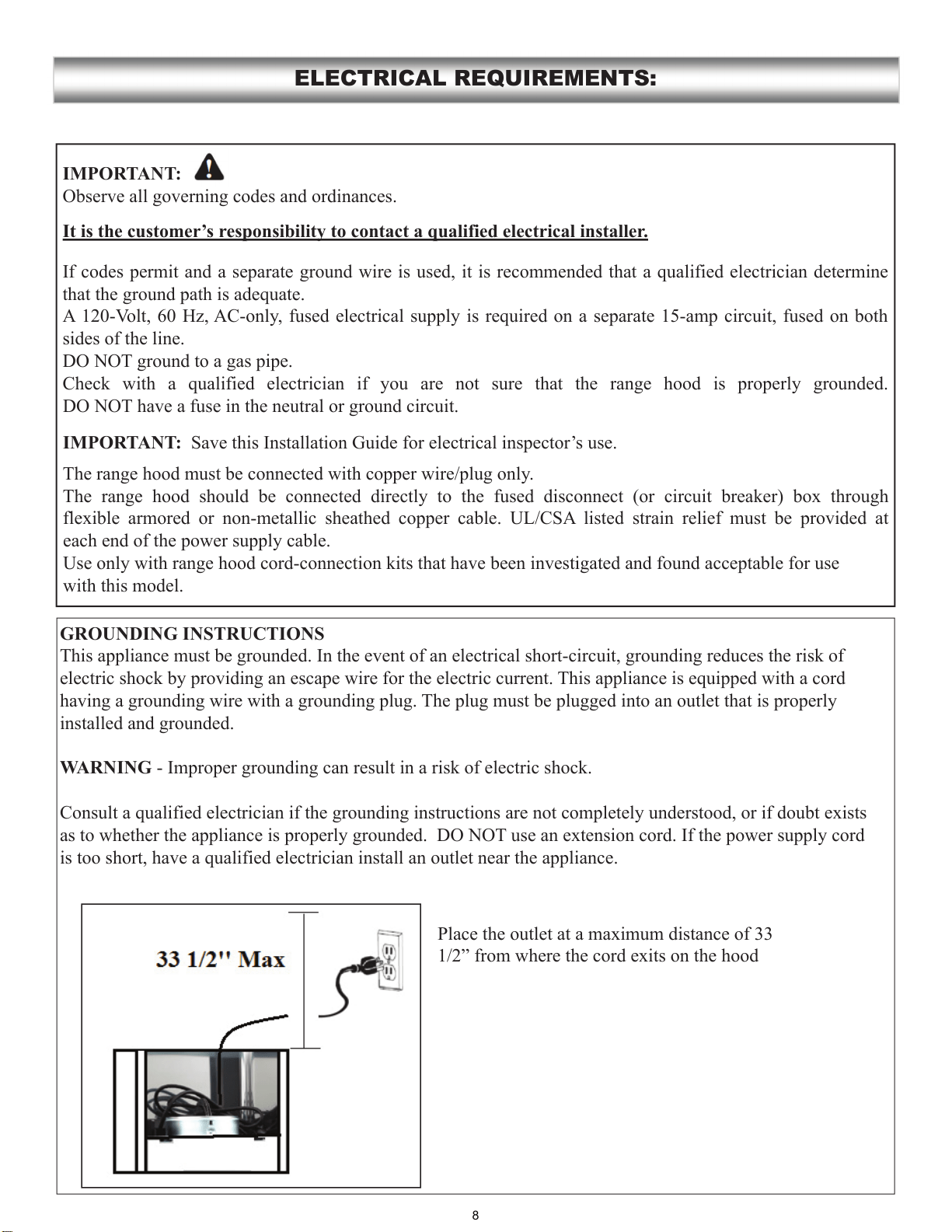
Place the outlet at a maximum distance of 33
1/2” from where the cord exits on the hood
GROUNDING INSTRUCTIONS
This appliance must be grounded. In the event of an electrical short-circuit, grounding reduces the risk of
electric shock by providing an escape wire for the electric current. This appliance is equipped with a cord
having a grounding wire with a grounding plug. The plug must be plugged into an outlet that is properly
installed and grounded.
WARNING - Improper grounding can result in a risk of electric shock.
Consult a qualified electrician if the grounding instructions are not completely understood, or if doubt exists
as to whether the appliance is properly grounded. DO NOT use an extension cord. If the power supply cord
is too short, have a qualified electrician install an outlet near the appliance.
8
Advanced Preparations:
• Be familiar with the controls of the range hood by reading through Range Hood Operations, Page 13.
• Place the range hood on a flat, stable surface. Connect the range hood to a designated standard outlet
(120-Volt, 60Hz, AC only) and turn on the range hood. Verify all operations of the range hood by
referring to Range Hood Operations.
• Place all supplied parts and required hardware on a flat, stable surface and verify the existence of all
supplied parts listed on Page 4.
Preparations:
NOTE: To avoid damage to your hood, prevent debris from entering the vent opening.
• Determine and mark the center line on the ceiling or wall where the range hood will be installed.
Make sure there is proper clearance within the ceiling or wall for exhaust vent.
• Due to the weight and size of this unit, please make sure that the support system or framework being
used is stable and secure in the ceiling or wall.
• Put a thick, protective covering over counter top, cook top or range to protect from damage or dirt.
Remove any hazardous objects around the area when installing.
CAUTION
If moving the cooking range is necessary to install the hood, turn OFF the power on an electric range at
the main electrical box. SHUT OFF THE GAS BEFORE MOVING A GAS RANGE
PREPARATIONS:
9
Installations (refer to Page 4 for parts):
NOTE: Use threaded drywall anchors only when
mounting the hood on sheet rock. Mounting
the hood on wall studs or lumbars is highly
recommended.
•
Step 1:
re the distance between stove top and the bottoMeasu m of range hood.
A
distance of 24” to 30” is
recommended with a minimum of 30” for gas stove tops.
• To reach 9ft ceiling make sure hood is installed at 32” from cooking surface
• If you require longer chimney flue to reach your ceiling please contact vendor.
Step 2: Installing the hood mounting bracket
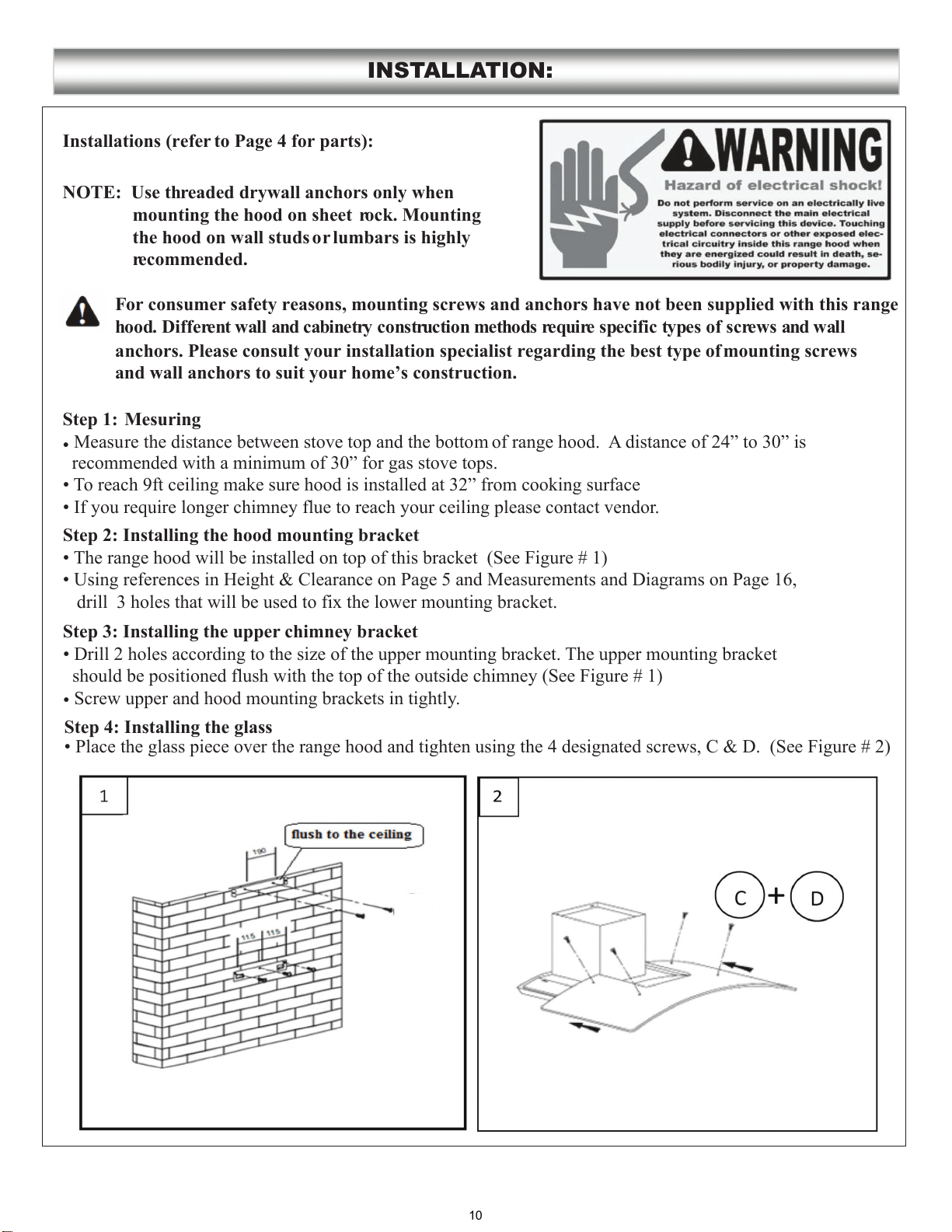
• The range hood will be installed on top of this bracket (See Figure # 1)
• Using references in Height & Clearance on Page 5 and Measurements and Diagrams on Page 16,
3 holes that will be used to fix the lower mounting bradrill cket.
Step 3: Installing the upper chimney bracket
• Drill 2 holes according to the size of the upper mounting bracket. The upper mounting bracket
should be positioned flush with the top of the outside chimney (See Figure # 1)
•
Screw upper and hood mounting brackets in tightly.
INSTALLATION:
Step 4: Installing the glass
• Place the glass piece over the range hood and tighten using the 4 designated screws, C & D. (See Figure # 2)
For consumer safety reasons, mounting screws and anchors have not been supplied with this range
llaw dna swercs fo sepyt cificeps eriuqer sdohtem noitcurtsnoc yrtenibac dna llaw tnereffiD .dooh
anchors. Please consult your installation specialist regarding the best type of mounting screws
and wall anchors to suit your home’s construction.
Mesuring
10
Step 5: Installing the damper
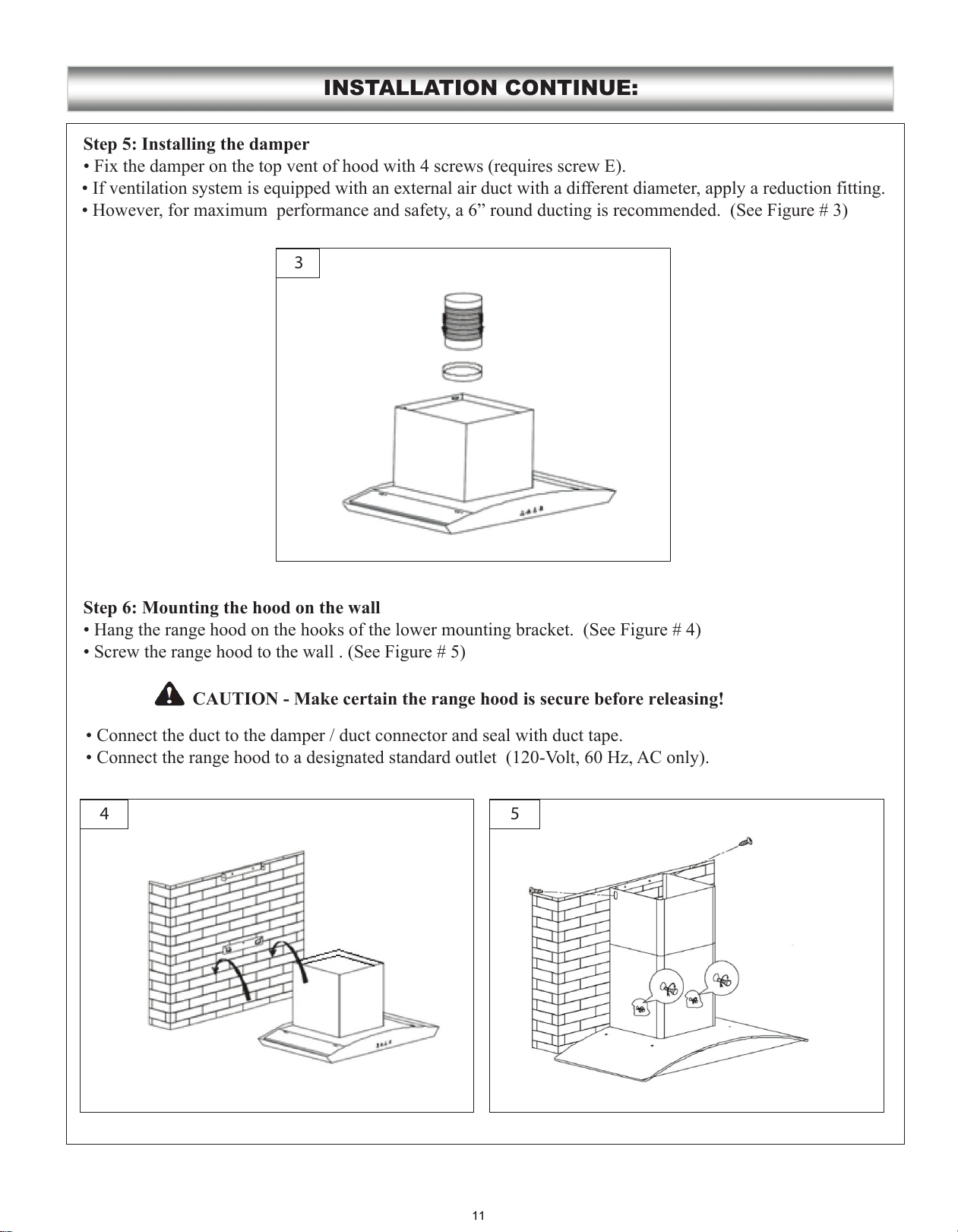
• Fix the damper on the top vent of hood with 4 screws (requires screw E).
• If ventilation system is equipped with an external air duct with a different diameter, apply a reduction fitting.
• However, for maximum performance and safety, a 6” round ducting is recommended. (See Figure # 3)
Step 6: Mounting the hood on the wall
• Hang the range hood on the hooks of the lower mounting bracket. (See Figure # 4)
• Screw the range hood to the wall . (See Figure # 5)
CAUTION - Make certain the range hood is secure before releasing!
INSTALLATION CONTINUE:
3
5
4
• Connect the duct to the damper / duct connector and seal with duct tape.
• Connect the range hood to a designated standard outlet (120-Volt, 60 Hz, AC only).
11
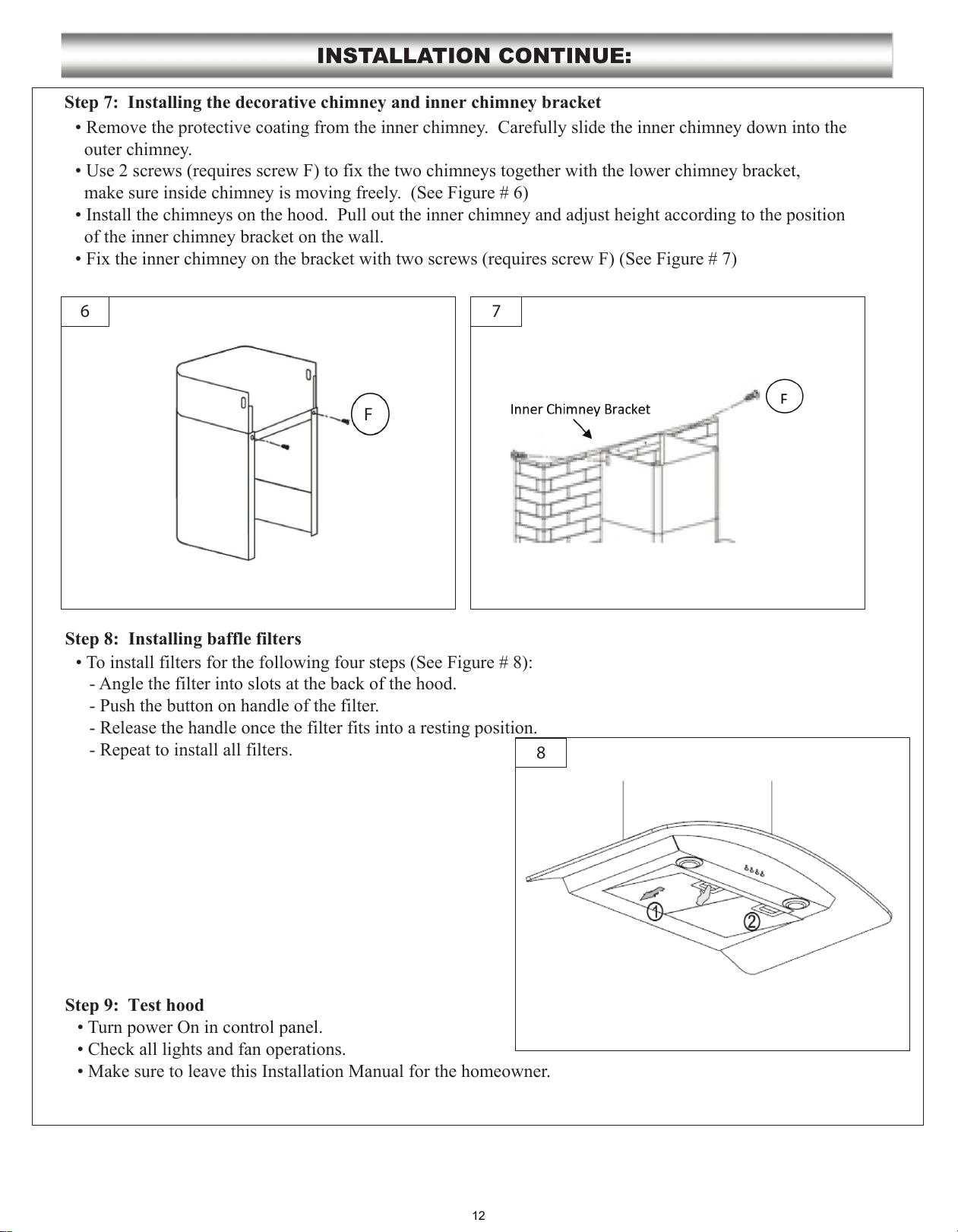
Step 8: Installing baffle filters
• To install filters for the following four steps (See Figure # 8):
- Angle the filter into slots at the back of the hood.
- Push the button on handle of the filter.
- Release the handle once the filter fits into a resting position.
- Repeat to install all filters.
Step 9
: Test hood
• Turn power On in control panel.
•
• omeowner.
INSTALLATION CONTINUE:
Step 7: Installing the decorative chimney and inner chimney bracket
• ney
outer chimney.
• neys together with the lower chimney bracket,
ely. (See Figure # 6)
•
of the inner chimney bracket on the wall.
•
7
F
6
8
12
CONTROL PANEL OPERATION:
13
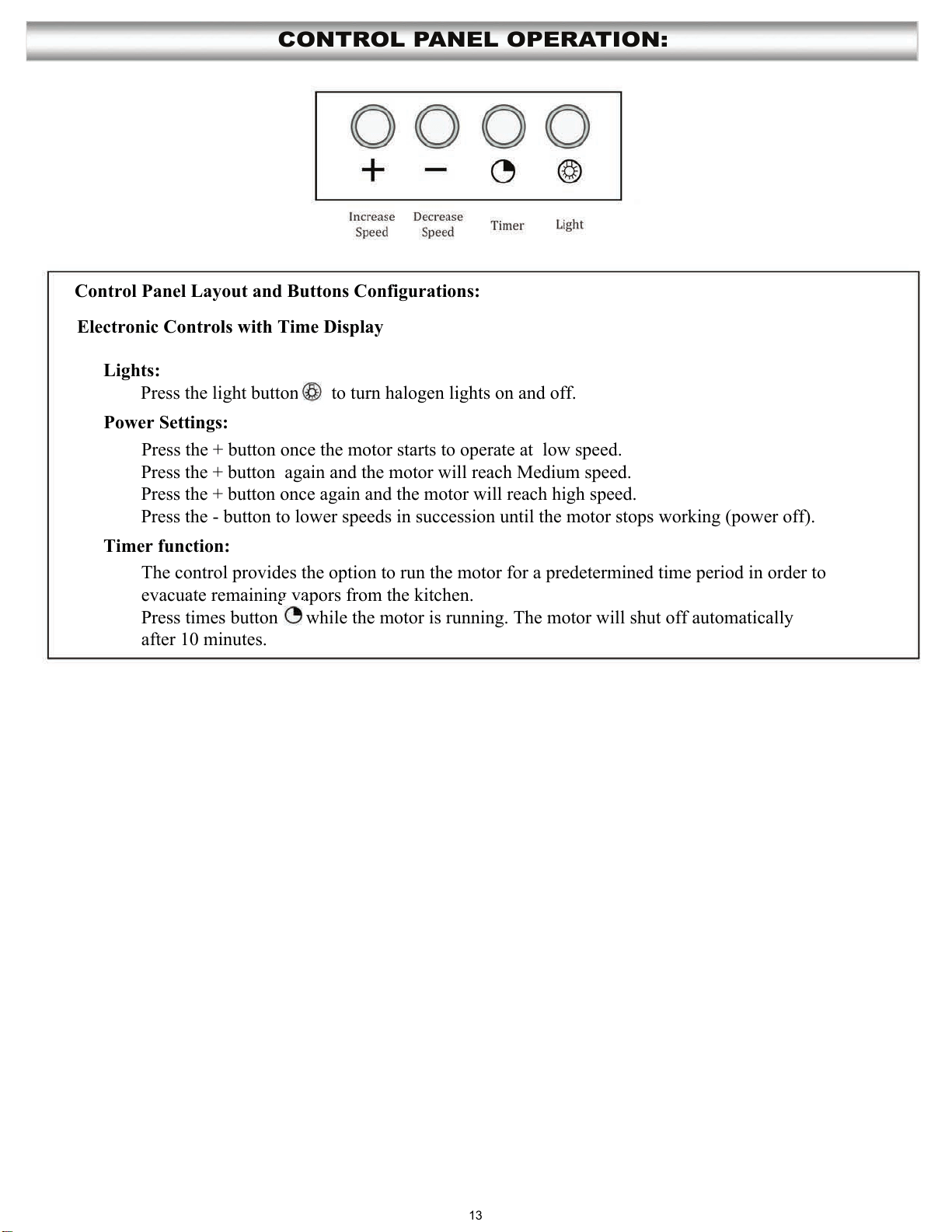
Control anel aout
and uttons Configurations:
Electronic Controls with Time ispla
ights:
ower Settings:
Timer function:
REPLACING THE BULBS:
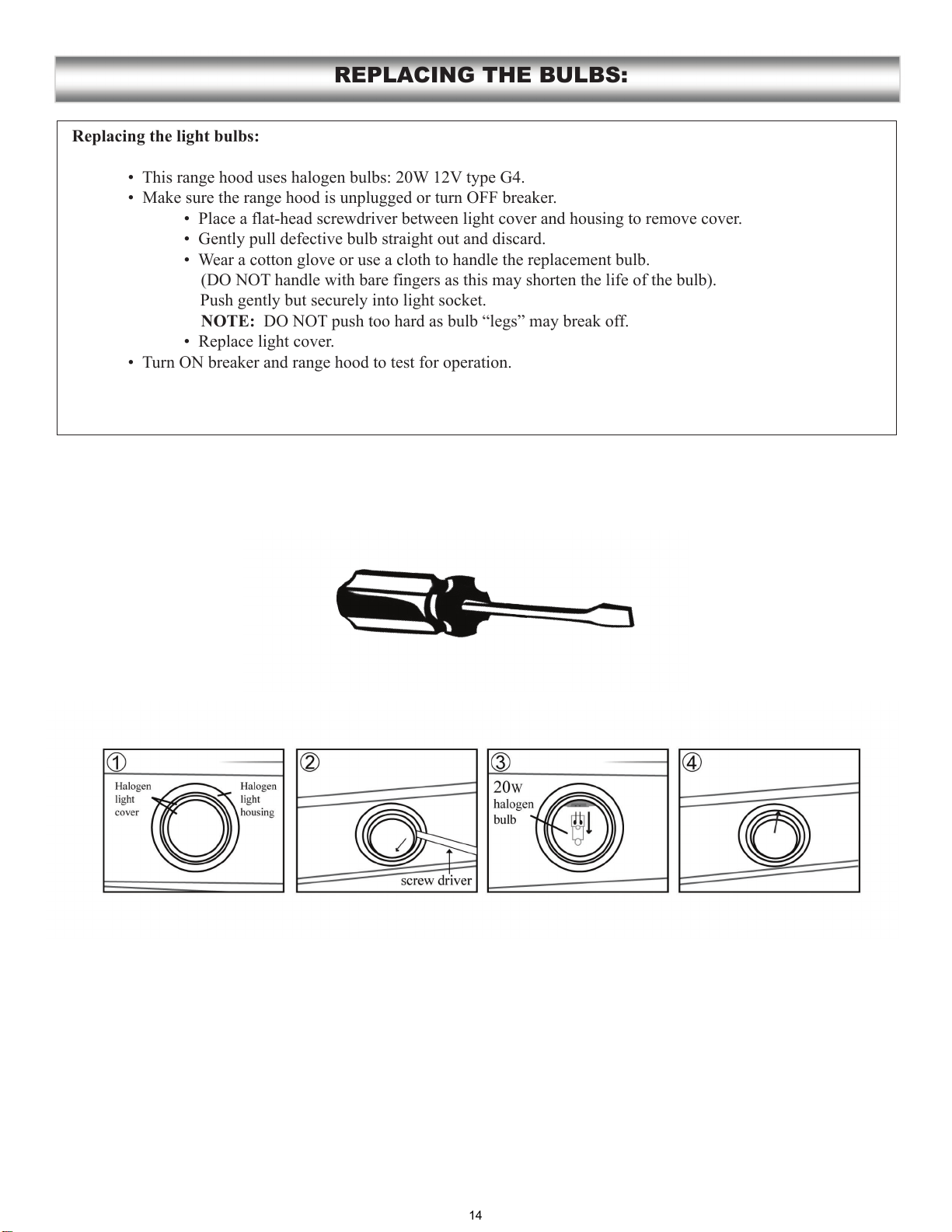
Replacing the light bulbs:
• This range hood uses halogen bulbs: W type G
• Make sure the range hood is unplugged or turn OFF breaker
• lace a flat-head screwdriver between light cover and housing to reove cover
• Gently pull defective bulb straight out and discard
• Wear a cotton glove or use a cloth to handle the replaceent bulb
(DO NOT handle with bare fingers as this ay shorten the life of the bulb)
ush gently but securely into light socket
NOTE: DO NOT push too hard as bulb legs ay break off
• Replace light cover
• Turn ON breaker and range hood to test for operation
14
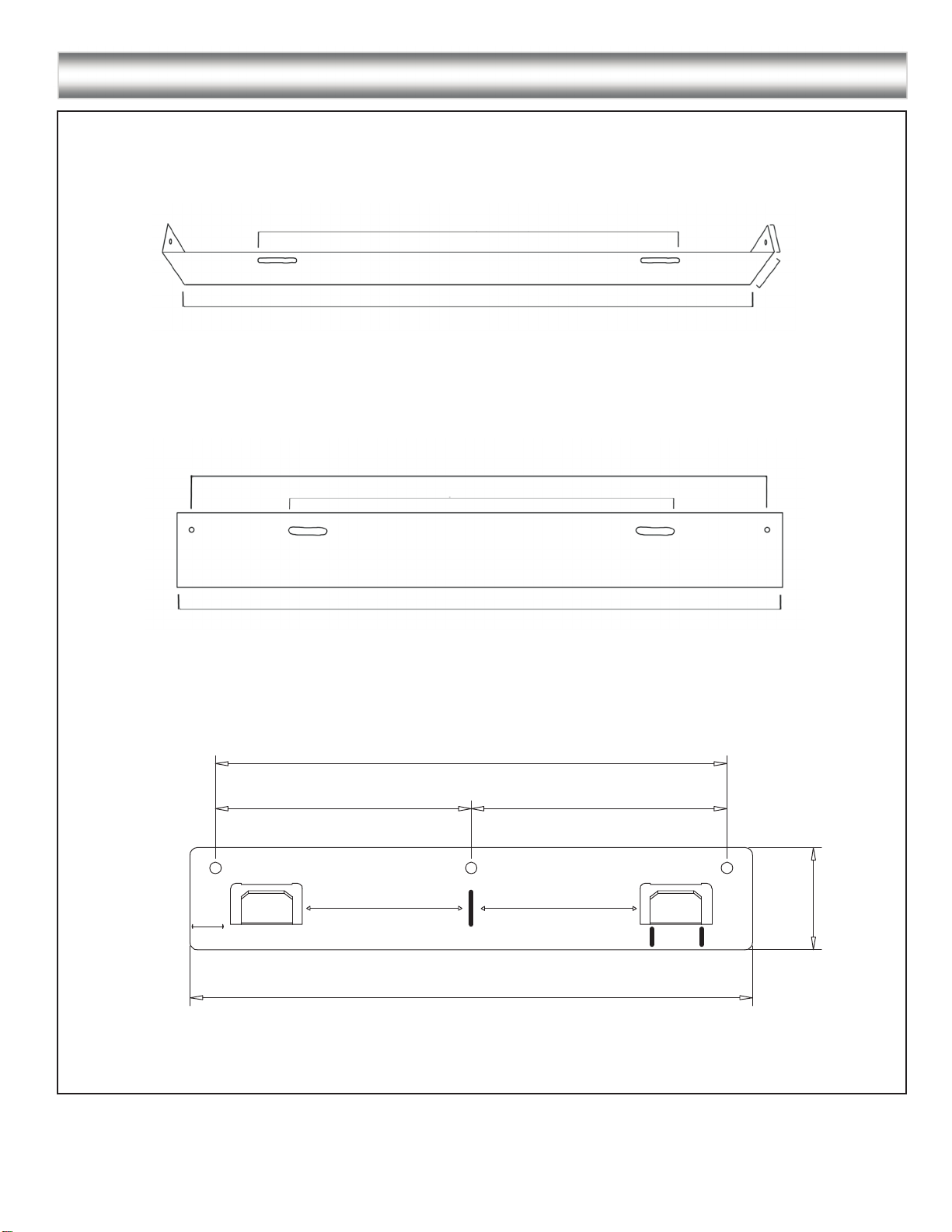
MOUNTING BRACKETS:
Upper/Inner Chimney Bracket
Lower/Outer Chimney Bracket
Hood Mounting Bracket Hook
9 1/16” (231 mm)
4 1/2” (115 mm)
4 1/2” (115 mm)
9 15/16” (253 mm)
1 5/8”
(40 mm)
3 1/8” (82 mm)
3 1/8” (82 mm)
5/8” (16 mm)
1 1/8”
(28 mm)
11 1/4” (286 mm)
11 7/8” (302 mm)
11 7/8” (302 mm)
8 1/4” (211 mm)
15
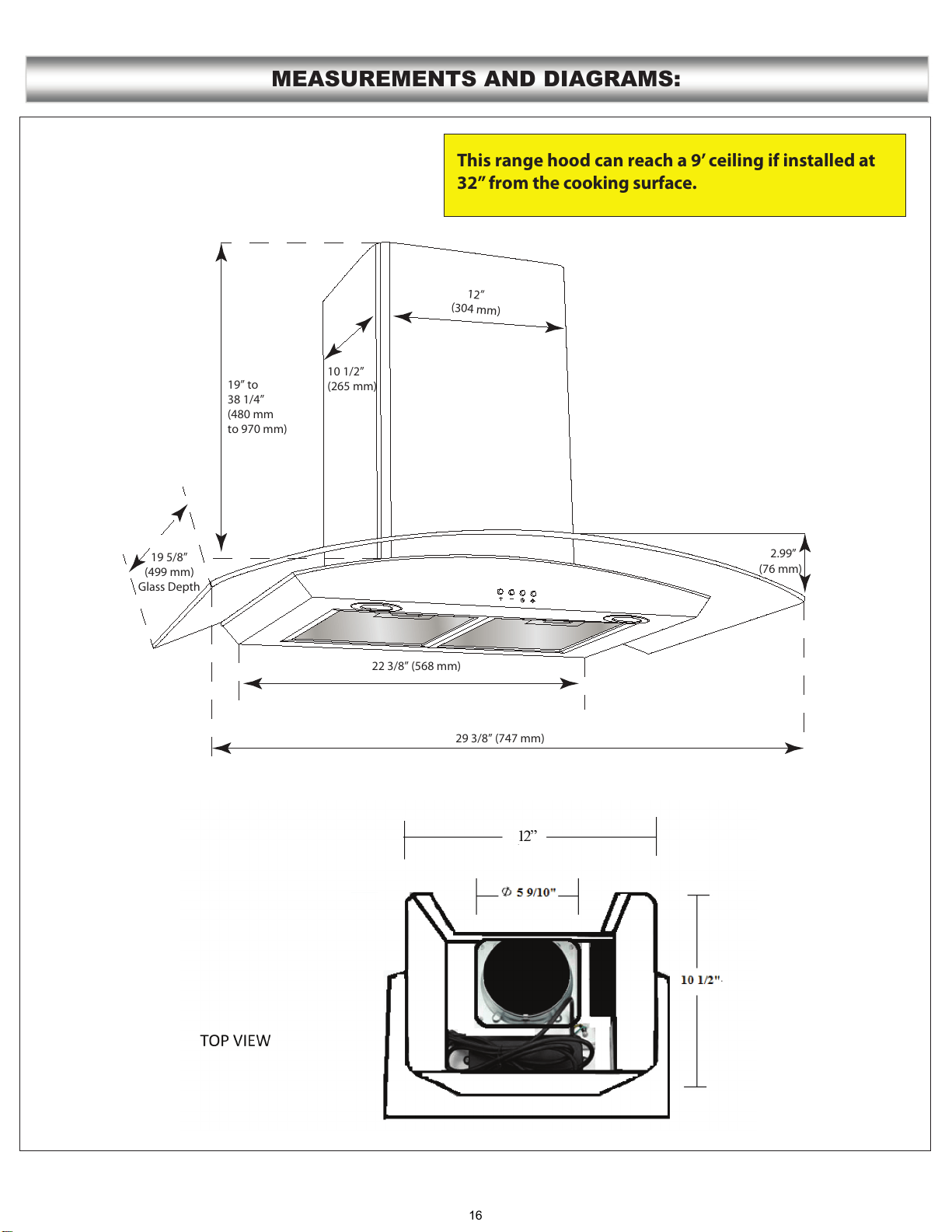
MEASUREMENTS AND DIAGRAMS:
This range hood can reach a 9’ ceiling if installed at
32” from the cooking surface.
22 ” (5 mm)
29 /8” (7mm)
19” to
38 1/4”
(480mm
to 970mm)
12”
(304
mm)
”
7mm
10 1/2”
(265 mm)
19”
( mm)
Glass Depth
16
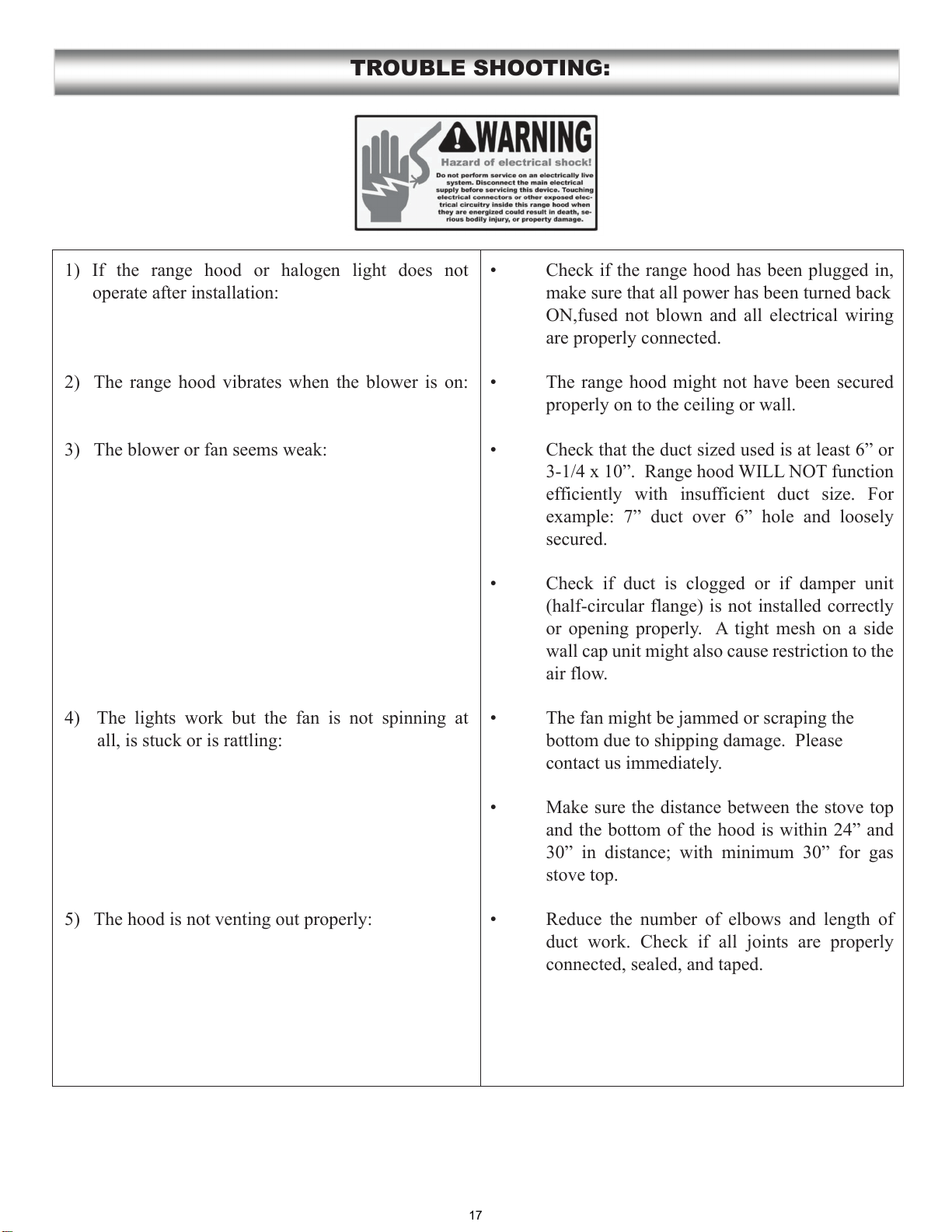
1) If the range hood or halogen light does not
operate after installation:
2) The range hood vibrates when the blower is on:
3) The blower or fan seems weak:
4) The lights work but the fan is not spinning at
all, is stuck or is rattling:
5) The hood is not venting out properly:
TROUBLE SHOOTING:
• Check if the range hood has been plugged in,
make sure that all power has been turned back
ON,fused not blown and all electrical wiring
are properly connected.
• The range hood ight not have been secured
properly on to the ceiling or wall.
• Check that the duct sied used is at least or
- Range hood WI NOT function
efficiently with insufficient duct sie For
eaple: duct over hole and loosely
secured.
• Check if duct is clogged or if daper unit
(half-circular flange) is not installed correctly
or opening properly. A tight mesh on a side
wall cap unit might also cause restriction to the
air flow.
• The fan ight be jaed or scraping the
bottom due to shipping damage. Please
contact us immediately.
• Make sure the distance between the stove top
and the botto of the hood is within and
in distance with iniu for gas
stove top.
• Reduce the nuber of elbows and length of
duct work Check if all joints are properly
connected, sealed, and taped.
17
RANGE HOOD ASSEMBLY:
18
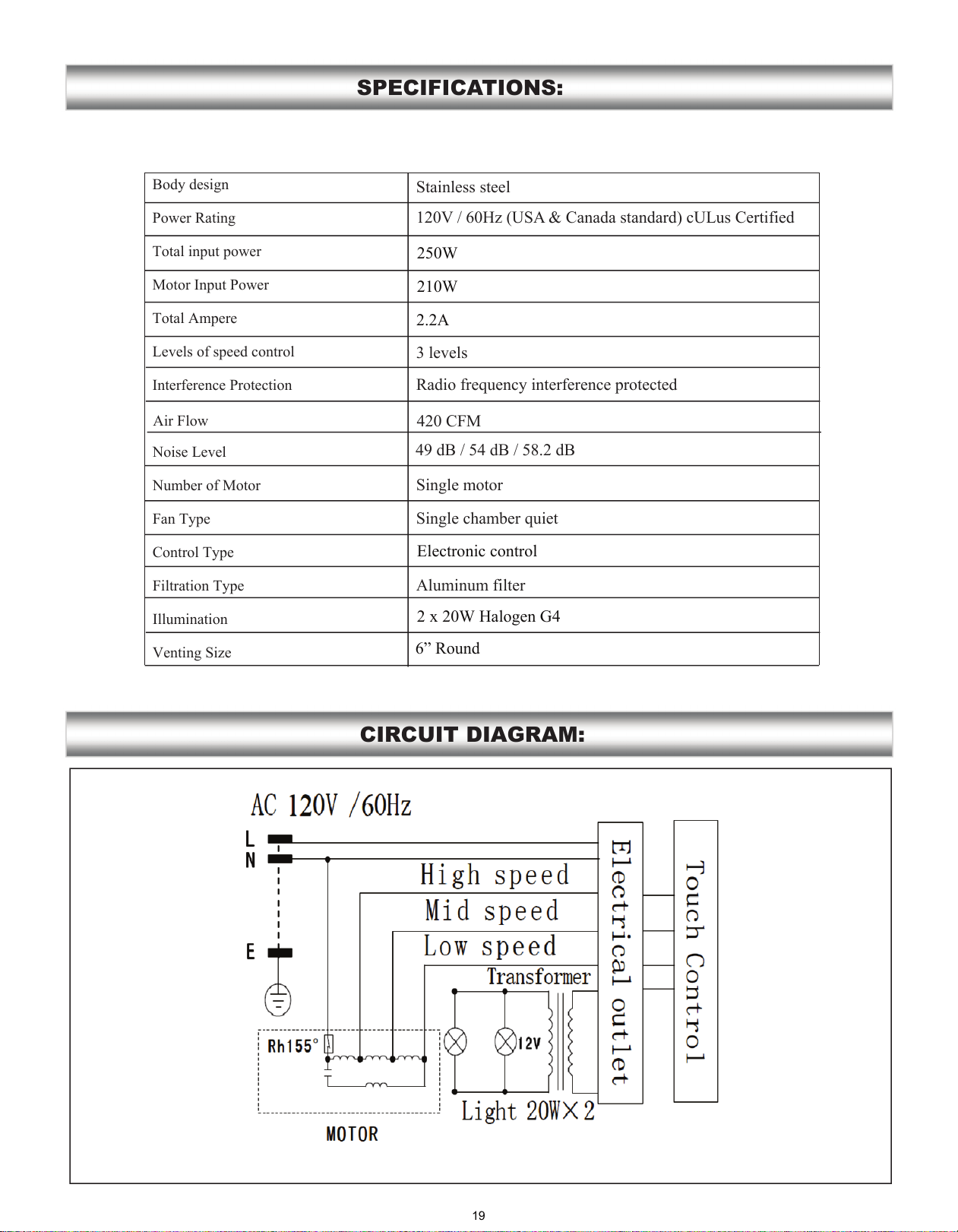
SPECIFICATIONS:
CIRCUIT DIAGRAM:
Body design
Power Rating
Total input power
Motor Input Power
Total Ampere
Levels of speed control
Interference Protection
Noise Level
Number of Motor
Fan Type
Control Type
Filtration Type
Illumination
Venting Size
Stainless steel
120V / 60Hz (USA & Canada standard) cULus Certified
3 levels
Radio frequency interference protected
Single motor
Single chamber quiet
Aluminum filter
250W
210W
2.2A
Electronic control
2 x 20W Halogen
6” Round
BdBdB
19
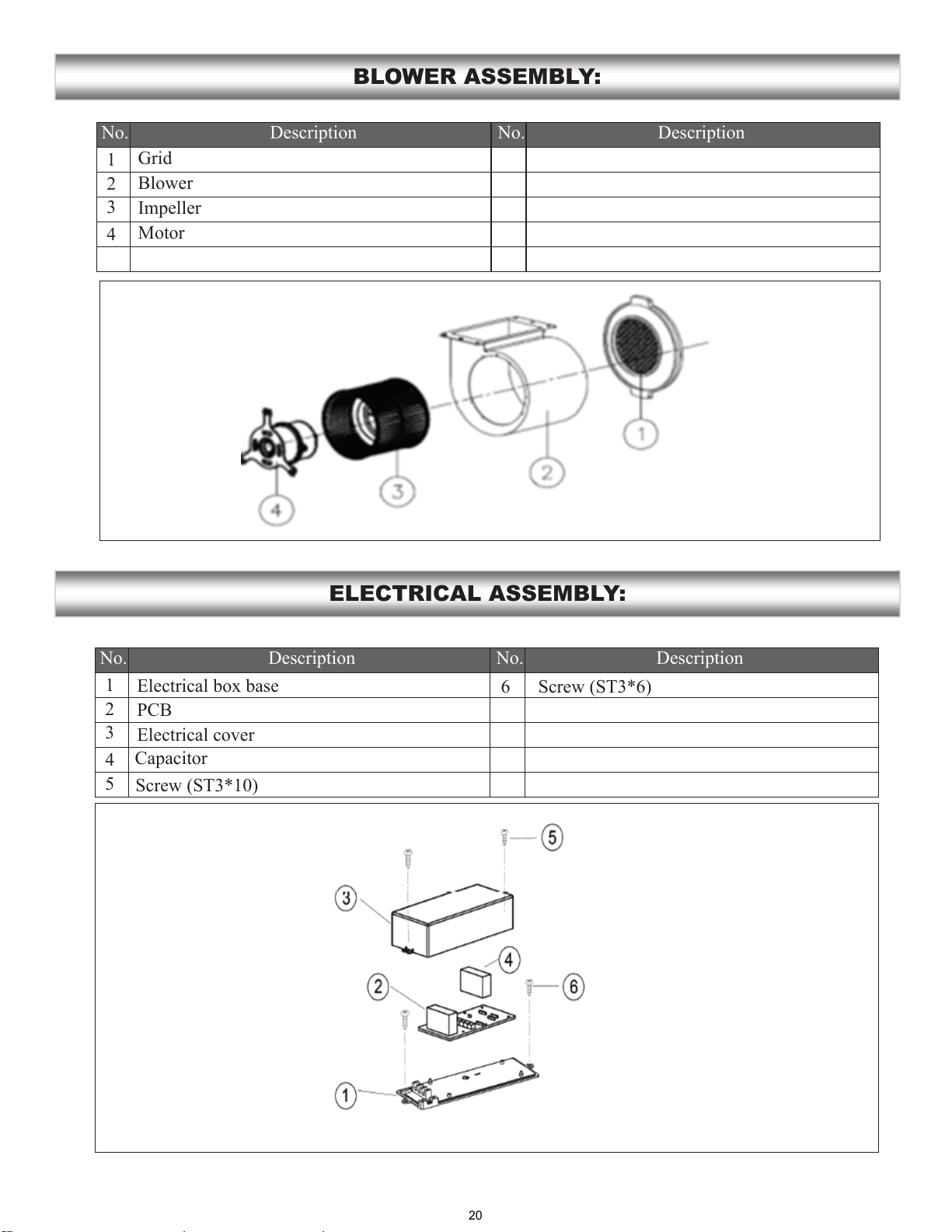
BLOWER ASSEMBLY:
ELECTRICAL ASSEMBLY:
No. No.Description Description
1
2
3
4
5
Screw (ST3*10)
Electrical cover
Capacitor
PCB
Electrical box base
No. No.Description Description
1
2
3
4
Grid
Blower
Impeller
Motor
6 Screw (ST3*6)
20
USE AND CARE INFORMATION:
Operations:
• Read and understand all instructions and warnings in this anual before operating the appliance Save these
instructions for future reference
• Always leave safety grills and filters in place Without these coponents, operating fans could catch on to
hair, fingers and loose clothing
• NEER dispose cigarette ashes, ignitable substances, or any foreign objects into fans
• NEER leave cooking unattended When frying, oil in the pan can easily overheat and catch fire The risk of
self cobustion is higher when the oil has been used several ties
• NEER cook on open flaes under the range hood Check deep-fryers during use superheated oil ay be
flaable
Cleaning:
• The saturation of greasy residue in the fan and filters ay cause increased inflaability eep unit clean
and free of grease and residue build-up at all ties to prevent possible fires
• Filters ust be cleaned periodically and free fro accuulation of cooking residue (see Cleaning
Instructions below) Old and worn filters ust be replaced iediately
• DO NOT operate fans when filters are reoved Never disasseble parts to clean without proper
instructions Disassebly is recoended to be perfored by ualified personnel only Read and
understand all instructions and warnings in this anual before proceeding
SAFETY WARNING: Never put your hand into area housing the fan while the fan is operating!
For optial operation, clean range hood and all bafflespacerfiltergrease trayoil container regularly Regular care
will help preserve the appearance of the range hood
Cleaning Exterior Surfaces:
• Clean periodically with hot soapy water and clean cotton cloth DO NOT use corrosive or abrasive detergent
(eg Coet ower Scrub, E-Off oven cleaner), or steel woolscoring pads, which will scratch and daage
the stainless steel surface For heavier soil use liuid degrease such as Forula or Fantastic brand
cleaner
• If hood looks splotchy (stainless steel hood), use a stainless steel cleaner to clean the surface of the hood Avoid
getting cleaning solution onto or into the control panel Follow directions of the stainless steel cleaner
CAUTION: DO NOT leave on too long as this may cause damage to hood finish. Use soft towel to wipe
off the cleaning solution, gently rub off any stubborn spots Use dry soft towel to dry the hood
• After cleaning, you ay use non abrasive stainless steel polish such as M or E, to polish and buff out
the stainless luster and grain Always scrub lightly, with clean cotton cloth, and with the grain
• DO NOT allow deposits to accuulate or reain on the hood
• DO NOT use ordinary steel wool or steel brushes Sall bits of steel ay adhere to the surface and cause
rusting
• DO NOT allow salt solutions, disinfectants, bleaches, or cleaning copounds to reain in contact with
stainless steel for etended periods Many of these copounds contain cheicals, which ay be harful
Rinse with water after eposure to these copounds and wipe dry with a clean cloth
Cleaning Filters:
IMPORTANT: Drain oil fro baffles, spacers, filters, oil tunnels, oil containers before oil and residue overflow
• Reove all baffles, spacers, filters, grease tray, and oil containers and discard oil and residue
• Wash with war soapy water NOTE: Stainless steel baffles, spacers and oil tunnel are top rack dishwasher
safe
• Dry thoroughly before replacing and follow directions for installation in reverse
• Filters should be cleaned after every hours of use
• Should filters wear out due to age and prolonged use, replace with a new filter
21