®
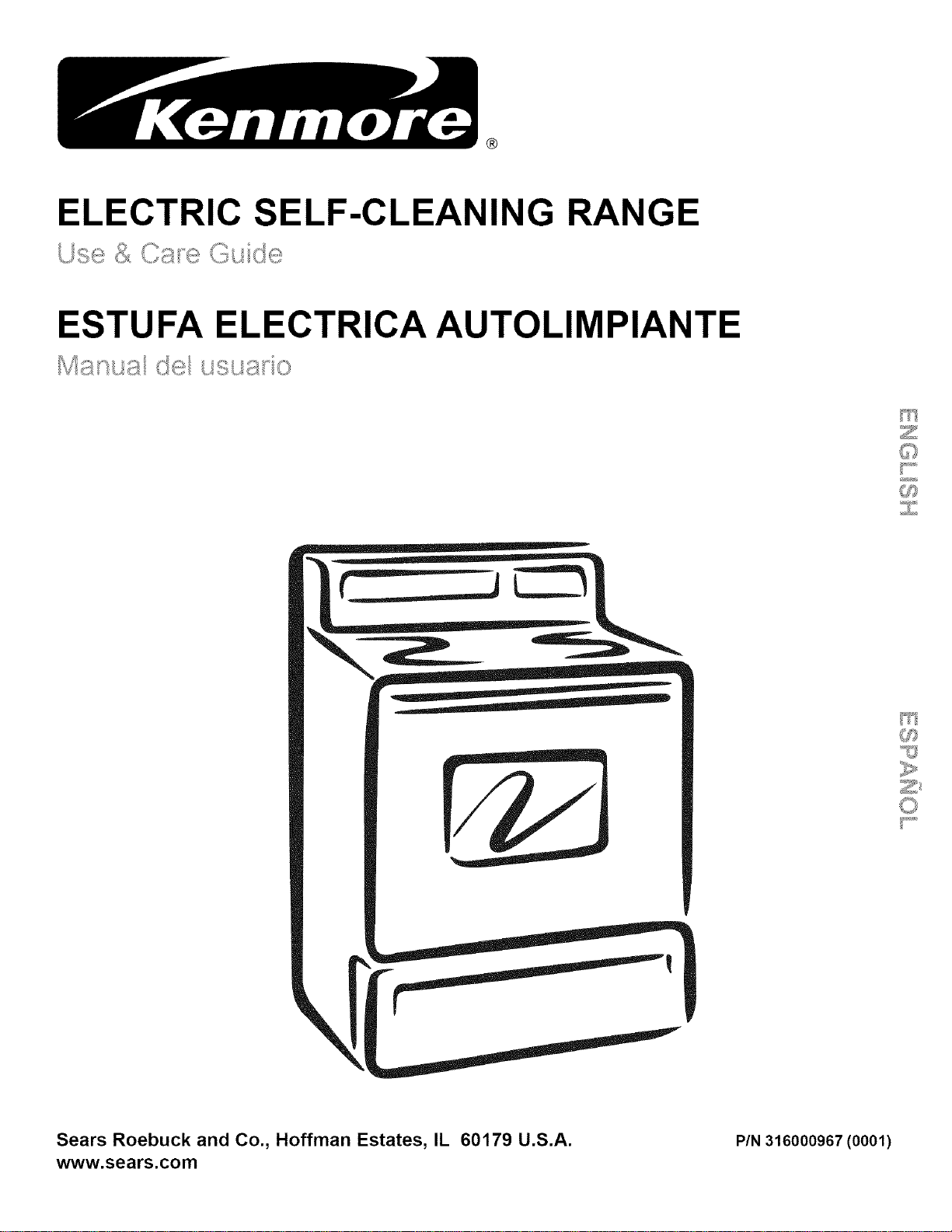
ELECTRIC SELF-CLEANING RANGE
ESTUFA ELECTRICA AUTOLIMPIANTE
r
u_
r
Sears Roebuck and Co., Hoffman Estates, IL 60179 U.S.A.
www.sears.com
P/N 316000967 (0001)
Table of Contents Product Record
Free-Standing Range Warranty ........................................ 2
Product Record ................................................................ 2
IMPORTANT SAFETY INSTRUCTIONS ....................... 3-4
Control Pad Functions ...................................................... 5
Setting the Clock and Minute Timer .................................. 6
Setting Surface Controls ................................................... 7
Setting Warmer Drawer Controls (if equipped) ................. 8
Before Setting Oven Controls ........................................... 9
Setting Oven Controls .................................................. 9-11
Oven Cleaning ........................................................... 12-13
General Cleaning ....................................................... 14-16
Changing Cooktop and/or Oven Lights ........................... 17
Adjusting Oven Temperature .......................................... 17
Avoid Service Checklist ............................................. 18-19
In this space below, record the date of purchase, model
and serial number of your product. You will find the model
and serial number printed on an identification plate. The
identification plate is located under the lift-up cooktop.
Model No. 790.
Serial No.
Date of Purchase
Save these instructions and your sales receipt for future
reference.
Sears Service ................................................................. 20
Free-Standing Range Warranty
FULL ONE YEAR WARRANTY ON ALL PARTS
If, within one year from the date of installation, any part fails to function properly due to a defect in material or
workmanship, Sears will repair or replace it, at our option, free of charge.
tf the product is subjected to other than private family use, the above warranty is effective for only 90 days.
WARRANTY SERVICE IS AVAILABLE BY CONTACTING THE NEAREST SEARS SERVICE CENTER IN THE
UNITED STATES.
This warranty gives you specific legal rights, and you may also have other rights which vary from state to state.
Sears Roebuck and Co. Dept. 617 WA Hoffman Estates, IL 60179
,.,_ IIII 01;"'<'J+_"_=_'I,,+,<III{_iI@I_I_!i 8 ;1>"_=,'_;: l_!@ilItl>fllIllO@ SI,_"IF;_:,'IYIII}I
• , I I, I_SI =_+_>I =J '];]I + +_ ++" +
Years of Ownership Coverage 1st Year 2nd Year 3rd Year
1. Replacement of Defective Parts W MA MA
2. Annual Preventive Maintenance MA MA MA
Check at Your Request
W=Warranty MA=Maintenance Agreement
Kenmore Ranges are designed, manufactured, and tested for years of dependable operation. Yet, any major home
appliance may require service from time to time. The Sears Warranty plus the Sears Maintenance Agreement helps
provide protection from unexpected repair bills.
The chart above compares the warranty and Maintenance Agreement and shows you the benefits of a Sears Range
Maintenance Agreement.
Contact your Sears Sales Associate or Local Sears Service Center today and purchase a Sears Maintenance
Agreement.
IMPORTANT SAFETY INSTRUCTIONS
Read all instructions before using this appliance.
Save these instructions for future reference.
This manual contains many important safety messages. Always read and obey all safety messages.
This is the safety alert symbol. It alerts you to safety messages that inform you of hazards that can kill or hurt you or others, or
cause damage to the product.
Indicates an imminently hazardous situation which, if not avoided may result in death or serious injury.
Indicates an imminently hazardous situation which, if not avoided may result in minor or moderate injury, or product-
damage-only.
All safety messages will identify the hazard, tell you how to reduce the chance of injury, and tell you what can happen if the
instructions are not followed.
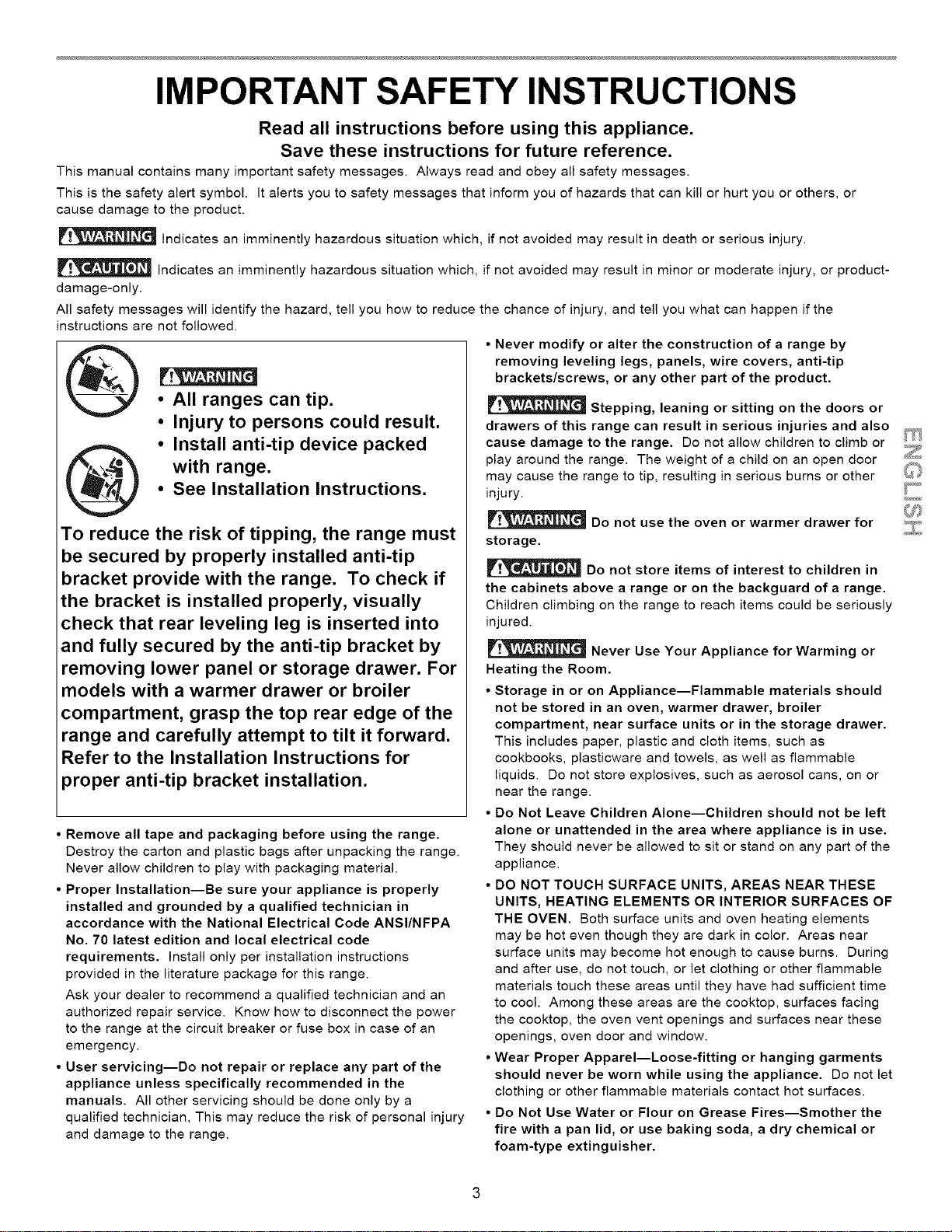
• All ranges can tip.
• Injury to persons could result.
• Install anti-tip device packed
with range.
• See Installation Instructions.
@
To reduce the risk of tipping, the range must
be secured by properly installed anti-tip
bracket provide with the range. To check if
the bracket is installed properly, visually
check that rear leveling leg is inserted into
and fully secured by the anti-tip bracket by
removing lower panel or storage drawer. For
models with a warmer drawer or broiler
compartment, grasp the top rear edge of the
range and carefully attempt to tilt it forward.
Refer to the Installation Instructions for
proper anti-tip bracket installation.
• Remove all tape and packaging before using the range.
Destroy the carton and plastic bags after unpacking the range.
Never allow children to play with packaging material.
• Proper Installation--Be sure your appliance is properly
installed and grounded by a qualified technician in
accordance with the National Electrical Code ANSI/NFPA
No. 70 latest edition and local electrical code
requirements. Install only per installation instructions
provided in the literature package for this range.
Ask your dealer to recommend a qualified technician and an
authorized repair service. Know how to disconnect the power
to the range at the circuit breaker or fuse box in case of an
emergency.
• User servicing--Do not repair or replace any part of the
appliance unless specifically recommended in the
manuals. All other servicing should be done only by a
qualified technician, This may reduce the risk of personal injury
and damage to the range.
• Never modify or alter the construction of a range by
removing leveling legs, panels, wire covers, anti-tip
brackets/screws, or any other part of the product.
Stepping, leaning or sitting on the doors or
drawers of this range can result in serious injuries and also
cause damage to the range. Do not allow children to climb or
play around the range. The weight of a child on an open door
may cause the range to tip, resulting in serious burns or other
injury.
Do not use the oven or warmer drawer for
storage.
Do not store items of interest to children in
the cabinets above a range or on the backguard of a range.
Children climbing on the range to reach items could be seriously
injured.
Never Use Your Appliance for Warming or
Heating the Room.
• Storage in or on Appliance--Flammable materials should
not be stored in an oven, warmer drawer, broiler
compartment, near surface units or in the storage drawer.
This includes paper, plastic and cloth items, such as
cookbooks, plasticware and towels, as well as flammable
liquids. Do not store explosives, such as aerosol cans, on or
near the range.
• Do Not Leave Children Alone--Children should not be left
alone or unattended in the area where appliance is in use.
They should never be allowed to sit or stand on any part of the
appliance.
• DO NOT TOUCH SURFACE UNITS, AREAS NEAR THESE
UNITS, HEATING ELEMENTS OR INTERIOR SURFACES OF
THE OVEN. Both surface units and oven heating elements
may be hot even though they are dark in color. Areas near
surface units may become hot enough to cause burns. During
and after use, do not touch, or let clothing or other flammable
materials touch these areas until they have had sufficient time
to cool. Among these areas are the cooktop, surfaces facing
the cooktop, the oven vent openings and surfaces near these
openings, oven door and window.
• Wear Proper Apparel--Loose-fitting or hanging garments
should never be worn while using the appliance. Do not let
clothing or other flammable materials contact hot surfaces.
• Do Not Use Water or Flour on Grease Fires--Smother the
fire with a pan lid, or use baking soda, a dry chemical or
foam-type extinguisher.
IMPORTANT SAFETY INSTRUCTIONS
• When heating fat or grease, watch it closely. Fat or grease
may catch fire if allowed to become too hot.
• Use Only Dry Potholders--Moist or damp potholders on
hot surfaces may result in burns from steam. Do not let
potholders touch hot heating elements. Do not use a towel or
other bulky cloth instead of a potholder.
• Do Not Heat Unopened Food Containers--Buildup of
pressure may cause container to burst and result in injury.
• Remove the oven door from any unused range if it is to be
stored or discarded.
IMPORTANT--Do not attempt to operate the range during a
power failure, if the power fails, always turn off the range, if
the range is not turned off and the power resumes, the range will
begin to operate again. Once the power resumes, reset the
clock and oven function.
tY_RO/;<TAH]_ NS"rRUC]' ON8 FO_S_USNG
YOUR COO/4'TOP
• Know which knob controls each surface heating unit.
Place a pan of food on the unit before turning it on, and turn
the unit off before removing the pan.
• Use Proper Pan Size--This appliance is equipped with one or
more surface units of different sizes. Select utensils having flat
bottoms large enough to cover the surface unit heating
element. The use of undersized utensils will expose a portion
of the heating element to direct contact and may result in
ignition of clothing. Proper relationship of utensil to element
will also improve efficiency.
• Utensil Handles Should Be Turned Inward and Not Extend
Over Adjacent Surface Units--To reduce the risk of bums,
ignition of flammable materials, and spillage due to
unintentional contact with the utensil, the handle of the utensil
should be positioned so that it is turned inward, and does not
extend over adjacent surface units.
• Never Leave Surface Units Unattended at High Heat
Settings--Boilovers cause smoking and greasy spillovers that
may ignite, or a pan that has boiled dry may melt.
• Do Not Immerse or Soak Removable Heating Elements--
Heating elements should never be immersed in water. Heating
elements clean themselves during normal operation.
• Make Sure Reflector Pans or Drip Bowls Are in Place--
Absence of these pans or bowls during cooking may subject
wiring or components underneath to damage.
• Protective Liners--Do not use aluminum foil to line surface
unit drip bowls, reflector pans, or oven bottom, or any other
part of the range. Only use aluminum foil as recommended in
this manual, improper installation of these liners may result in
risk of electric shock, or fire.
• Glazed Cooking Utensils--Only certain types of glass, glass/
ceramic, ceramic, earthenware, or other glazed utensils are
suitable for cooktop service without breaking due to the sudden
change in temperature. Check the manufacturer's
recommendations for cooktop use.
• When flaming foods under a ventilating hood, turn the fan
OR.
S//F'O£'_@N ' NSTFs{/.JC_i'ON8 FOR ,,/SIGN®
YOUR OVEN
• Use Care When Opening Oven Door or Warmer Drawer--
Stand to the side of the range when opening the door of a hot
oven. Let hot air or steam escape before you remove or
replace food in the oven.
• Keep Oven Vent Ducts Unobstructed. The oven vent is
located under the left rear surface element. Touching the
surfaces in this area when the oven is operating may cause
severe burns. Also, do not place plastic or heat-sensitive items
on or near the oven vent. These items could melt or ignite.
• Placement of Oven Racks. Always place oven racks in
desired location while oven is cool. If rack must be moved
while oven is hot use extreme caution. Use potholders and
grasp the rack with both hands to reposition. Do not let
potholders contact the hot heating elements in the oven.
Remove all utensils from the rack before moving.
• Do not use the broiler pan without its insert. The broiler
pan and its insert allow dripping fat to drain and be kept away
from the high heat of the broiler.
• Do not cover the broiler insert with aluminum foil.
Exposed fat and grease could ignite.
• Cold temperatures can damage the electronic control. When
using the appliance for the first time, or when the appliance
has not been used for an extended period of time, be certain
the unit has been in temperatures above 32°F (0°C) for at least
3 hours before turning on the power to the appliance
b'tROR_S_'4Hr HS'TRUC'I' OH8 FOR CLEAH HG
YOUR RAHGE
• Clean the range regularly to keep all parts free of grease
that could catch fire. Pay particular attention to the area
underneath each surface element. Do not allow grease to
accumulate.
• Kitchen cleaners and aerosols--Always follow the
manufacturer's recommended directions for use. Be aware
that excess residue from cleaners and aerosols may ignite
causing damage and injury.
• Clean Ventilating Hoods Frequently--Grease should not be
allowed to accumulate on the hood or filter. Follow
manufacturer's instructions for cleaning.
SELF CLEAH HG OVEHS
• Clean in the self-cleaning cycle only the parts listed in this
Owner's Guide. Before self cleaning the oven, remove the
broiler pan and any utensils or foods from the oven.
• Do Not Use Oven Cleaners--No commercial oven cleaner or
oven liner protective coating of any kind should be used in or
around any part of the oven.
• Do Not Clean Door Gasket--The door gasket is essential for
a good seal. Care should be taken not to rub, damage or
move the gasket.
SAV_%!ITHES_!i!£ HST°RL}C'T' OHS
Control Pad Functions
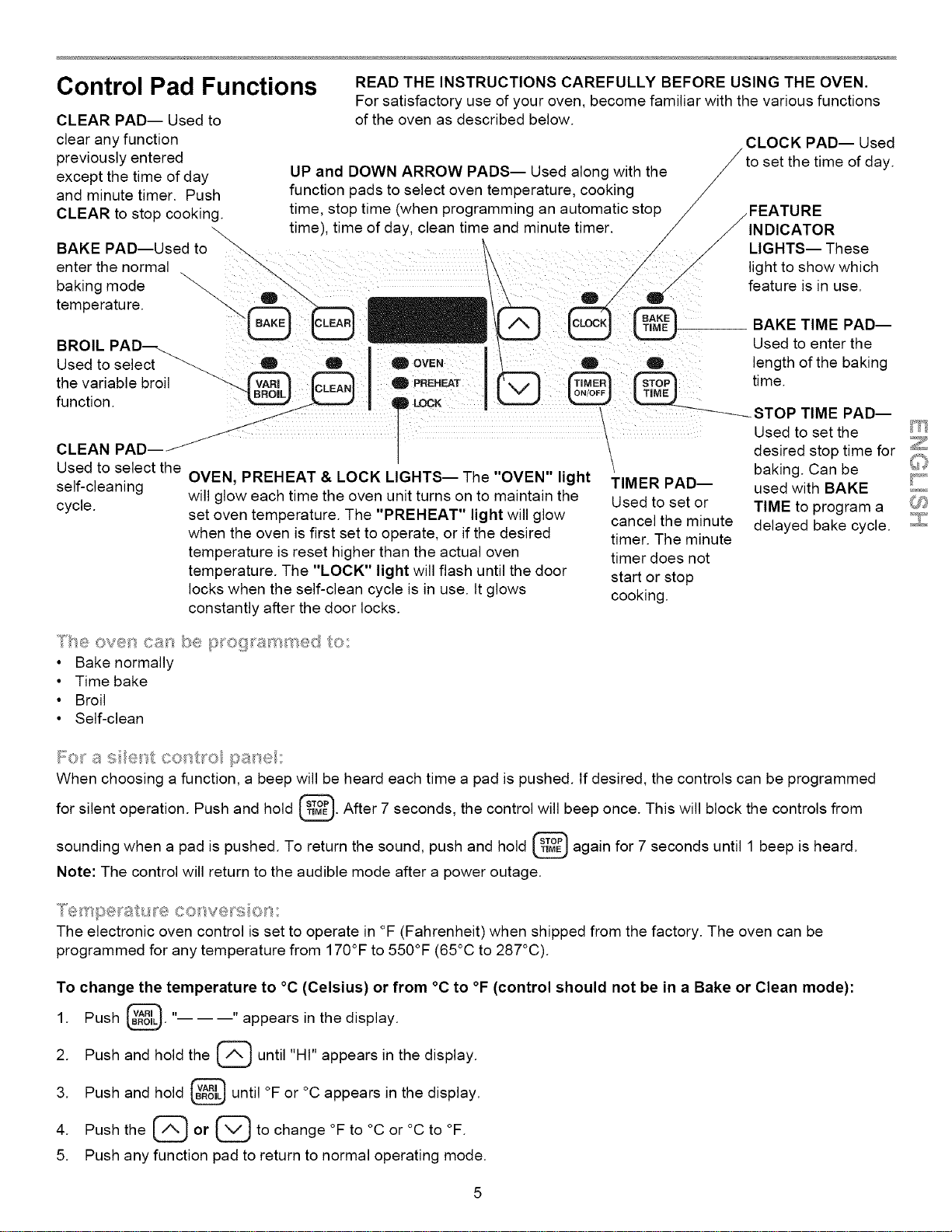
CLEAR PAD Used to
clear any function
previously entered
except the time of day
and minute timer. Push
CLEAR to stop cooking.
\
BAKE PAD Used to _\
enter the normal "\
baking mode "-
temperature.
BROIL PA D_........
Used to select _ O Q Q OVEN
the variable broil _-__
function.
j_
CLEAN PAD
Used to select the
self-cleaning
cycle.
READ THE INSTRUCTIONS CAREFULLY BEFORE USING THE OVEN.
For satisfactory use of your oven, become familiar with the various functions
of the oven as described below.
UP and DOWN ARROW PADS-- Used along with the
function pads to select oven temperature, cooking
time, stop time (when programming an automatic stop
time), time of day, clean time and minute timer.
PREHEAT
e LOCK
OVEN, PREHEAT & LOCK LIGHTS-- The "OVEN" light
will glow each time the oven unit turns on to maintain the
set oven temperature. The "PREHEAT" light will glow
when the oven is first set to operate, or if the desired
temperature is reset higher than the actual oven
temperature. The "LOCK" light will flash until the door
locks when the self-clean cycle is in use. It glows
constantly after the door locks.
CLOCK PAD Used
to set the time of day.
.FEATURE
/ /_ INDICATOR
/LIGHTS These
/
// light to show which
/ feature is in use.
BAKE TIME PAD
Used to enter the
O O length of the baking
_ _ time.
T,....o
TIMER PAD--
Used to set or
cancel the minute
timer. The minute
timer does not
start or stop
cooking.
Used to set the
desired stop time for
baking. Can be
used with BAKE
TIME to program a
delayed bake cycle.
T#s_eov®_ ca_ be p_o!:_Jam/_ed to:
• Bake normally
• Time bake
• Broil
• Self-clean
When choosing a function, a beep will be heard each time a pad is pushed, tf desired, the controls can be programmed
for silent operation. Push and hold @. After 7 seconds, the control will beep once. This will block the controls from
sounding when a pad is pushed. To return the sound, push and hold @ again for 7 seconds until 1 beep is heard.
Note: The control will return to the audible mode after a power outage.
The electronic oven control is set to operate in °F (Fahrenheit) when shipped from the factory. The oven can be
programmed for any temperature from 170°F to 550°F (65°C to 287°C).
To change the temperature to °C (Celsius) or from °C to °F (control should not be in a Bake or Clean mode):
1. Push _. " "appears in the display.
2. Push and hold the @ until "HI" appears in the display.
3. Push and hold _ until °F or °C appears in the display.
4. Push the (_ or (_ to change °F to °C or °C to °F.
5. Push any function pad to return to normal operating mode.
Setting the Clock and
Minute Timer
D D I
O OVEN
PREHEAT
S LOCK
D O
@@@
Note: The oven function will not work
if the time of day clock is not set.
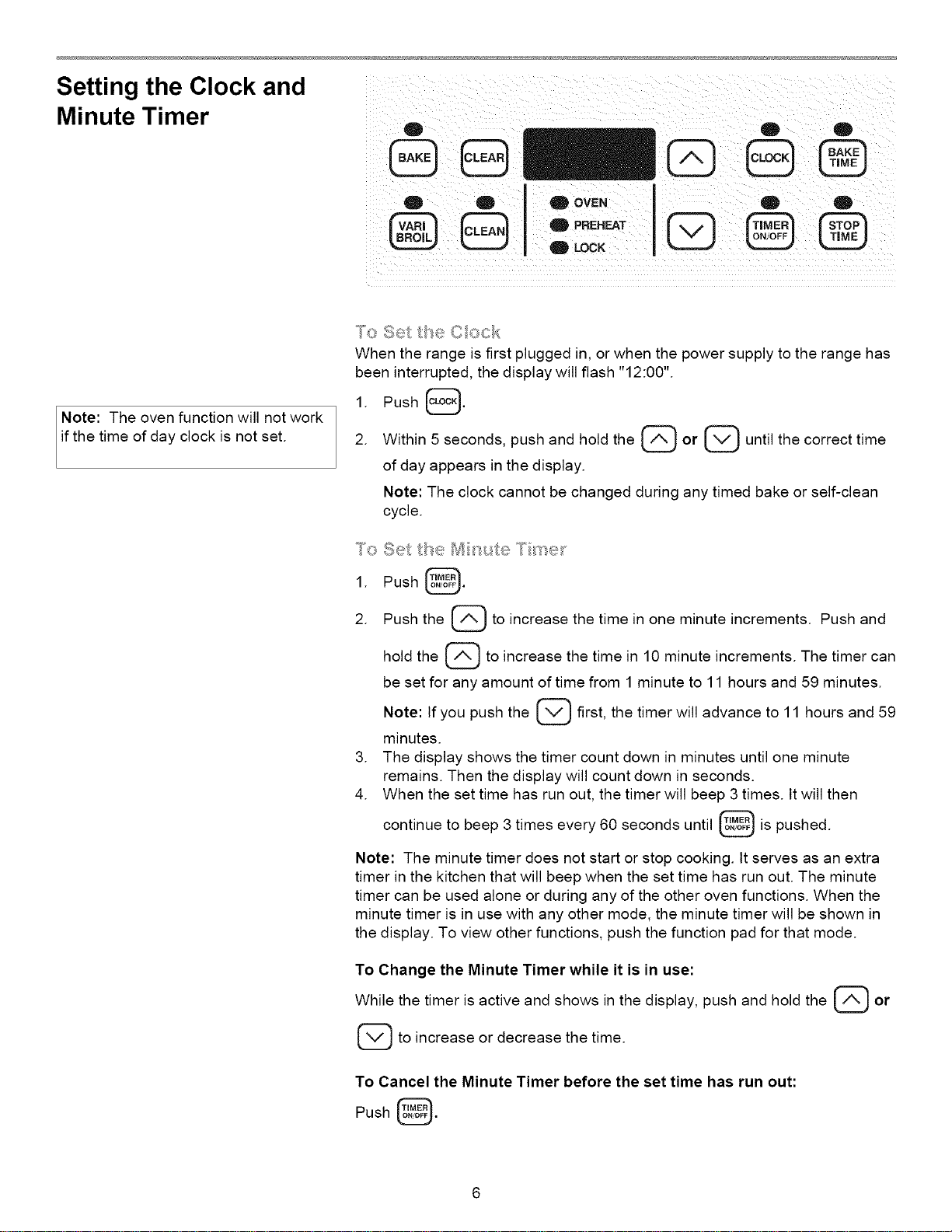
ToSe t_eCock
When the range is first plugged in, or when the power supply to the range has
been interrupted, the display will flash "12:00".
1. Push _.
2. Within 5 seconds, push and hold the @ or @ until the correct time
of day appears in the display.
Note: The clock cannot be changed during any timed bake or self-clean
cycle.
To Set t_e _l nute '? me_"
1. Push @.
2. Push the @ to increase the time in one minute increments. Push and
hold the _ to increase the time in 10 minute increments. The timer can
be set for any amount of time from 1 minute to 11 hours and 59 minutes.
Note: If you push the _ first, the timer will advance to 11 hours and 59
minutes.
3. The display shows the timer count down in minutes until one minute
remains. Then the display will count down in seconds.
4. When the set time has run out, the timer will beep 3 times. It will then
continue to beep 3 times every 60 seconds until @ is pushed.
Note: The minute timer does not start or stop cooking. It serves as an extra
timer in the kitchen that will beep when the set time has run out. The minute
timer can be used alone or during any of the other oven functions. When the
minute timer is in use with any other mode, the minute timer will be shown in
the display. To view other functions, push the function pad for that mode.
To Change the Minute Timer while it is in use:
While the timer is active and shows in the display, push and hold the _ or
_to increase or decrease the time.
To Cancel the Minute Timer before the set time has run out:
Push @.
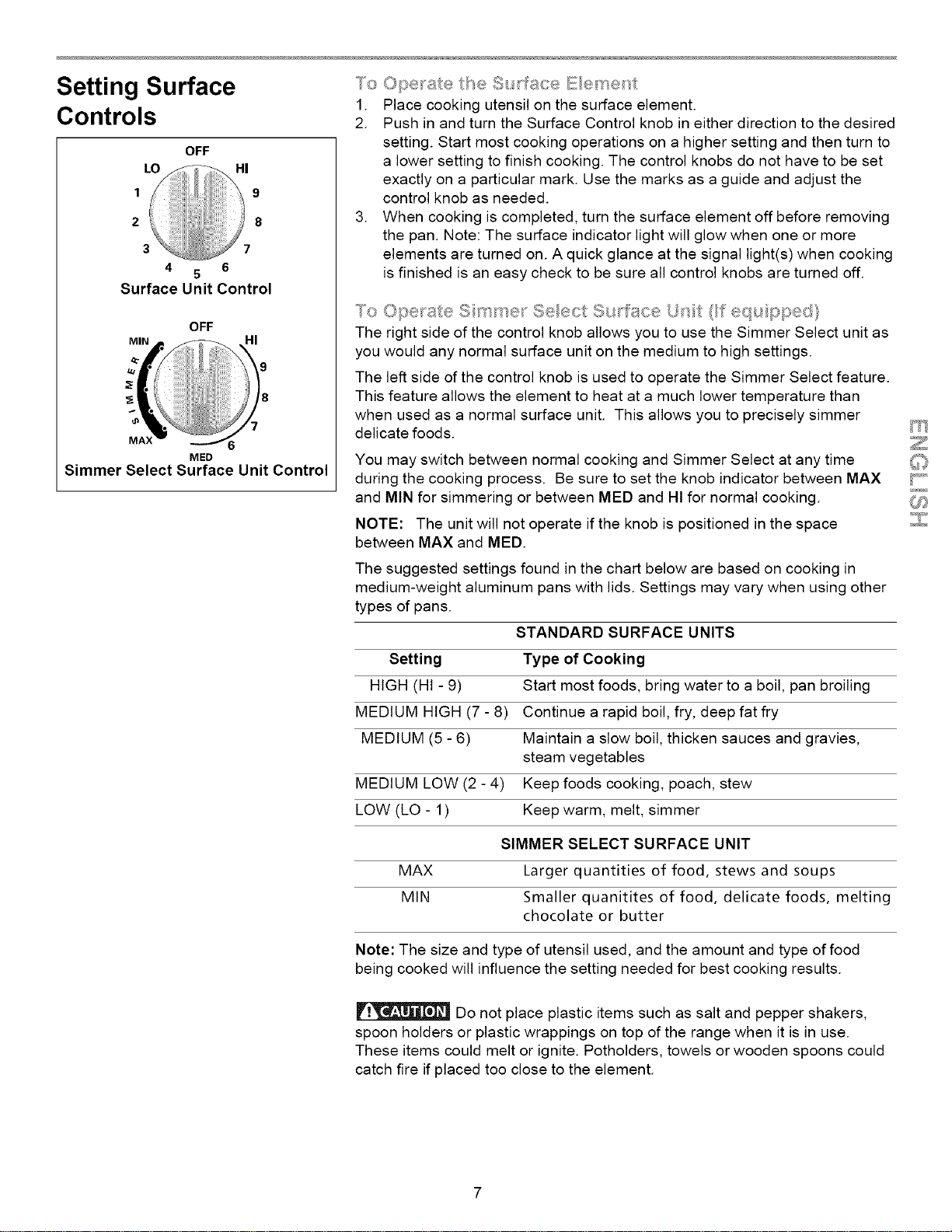
Setting Surface
Controls
OFF
1 9
2 8
4 6
5
Surface Unit Control
OFF
MED
Simmer Select Surface Unit Control
1. Place cooking utensil on the surface element.
2. Push in and turn the Surface Control knob in either direction to the desired
setting. Start most cooking operations on a higher setting and then turn to
a lower setting to finish cooking. The control knobs do not have to be set
exactly on a particular mark. Use the marks as a guide and adjust the
control knob as needed.
3. When cooking is completed, turn the surface element off before removing
the pan. Note: The surface indicator light will glow when one or more
elements are turned on. A quick glance at the signal light(s) when cooking
is finished is an easy check to be sure all control knobs are turned off.
To Operate Statue/_ Seect Surface Ul_t (f eq_4 pped}
The right side of the control knob allows you to use the Simmer Select unit as
you would any normal surface unit on the medium to high settings.
The left side of the control knob is used to operate the Simmer Select feature.
This feature allows the element to heat at a much lower temperature than
when used as a normal surface unit. This allows you to precisely simmer
delicate foods.
You may switch between normal cooking and Simmer Select at any time
during the cooking process. Be sure to set the knob indicator between MAX
and MIN for simmering or between MED and HI for normal cooking.
NOTE: The unit will not operate if the knob is positioned in the space
between MAX and MED.
The suggested settings found in the chart below are based on cooking in
medium-weight aluminum pans with lids. Settings may vary when using other
types of pans.
STANDARD SURFACE UNITS
Setting Type of Cooking
HIGH (HI - 9) Start most foods, bring water to a boil, pan broiling
MEDIUM HIGH (7 - 8) Continue a rapid boil, fry, deep fat fry
MEDIUM (5 - 6) Maintain a slow boil, thicken sauces and gravies,
steam vegetables
MEDIUM LOW (2 - 4) Keep foods cooking, poach, stew
LOW (LO - 1 Keep warm, melt, simmer
SIMMER SELECT SURFACE UNIT
MAX Larger quantities of food, stews and soups
MIN Smaller quanitites of food, delicate foods, melting
chocolate or butter
Note: The size and type of utensil used, and the amount and type of food
being cooked will influence the setting needed for best cooking results.
Do not place plastic items such as salt and pepper shakers,
spoon holders or plastic wrappings on top of the range when it is in use.
These items could melt or ignite. Potholders, towels or wooden spoons could
catch fire if placed too close to the element.
Setting Warmer Drawer
Controls (if equipped)
Use the warmer drawer to keep hot
foods hot such as: vegetables, gravies,
meats, casseroles, biscuits and rolls,
pastries and heated dinner plates.
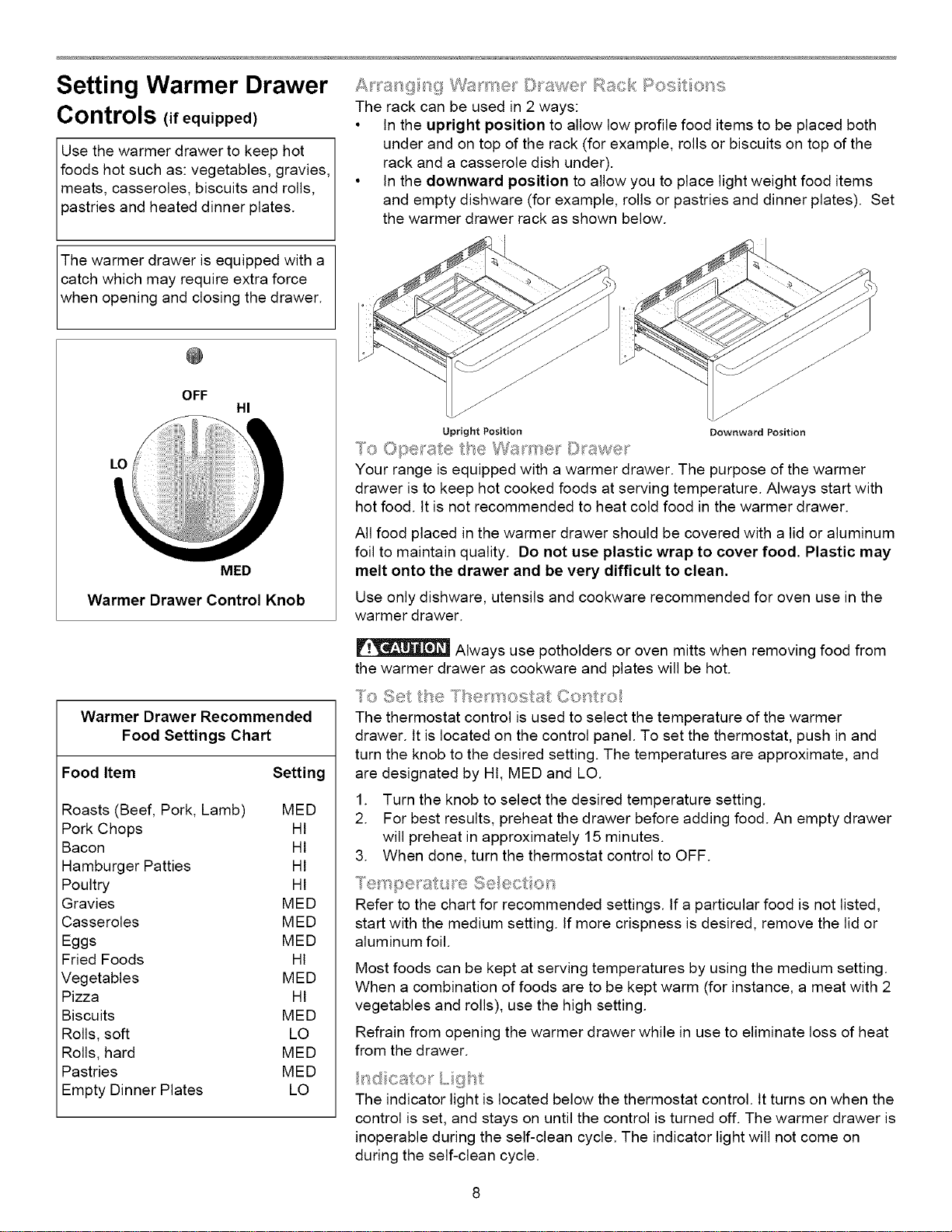
The rack can be used in 2 ways:
• In the upright position to allow low profile food items to be placed both
under and on top of the rack (for example, rolls or biscuits on top of the
rack and a casserole dish under).
• In the downward position to allow you to place light weight food items
and empty dishware (for example, rolls or pastries and dinner plates). Set
the warmer drawer rack as shown below.
The warmer drawer is equipped with a
catch which may require extra force
when open ng and cos ng the drawer.
OFF
HI
LO
MED
Warmer Drawer Control Knob
j
Upright Position Downward Position
Your range is equipped with a warmer drawer. The purpose of the warmer
drawer is to keep hot cooked foods at serving temperature. Always start with
hot food. tt is not recommended to heat cold foocl in the warmer drawer.
All food placed in the warmer drawer should be covered with a lid or aluminum
foil to maintain quality. Do not use plastic wrap to cover food. Plastic may
melt onto the drawer and be very difficult to clean.
Use only dishware, utensils and cookware recommended for oven use in the
warmer drawer.
Warmer Drawer Recommended
Food Settings Chart
Food Item Setting
Roasts (Beef, Pork, Lamb) MED
Pork Chops HI
Bacon HI
Hamburger Patties HI
Poultry HI
Gravies MED
Casseroles MED
Eggs MED
Fried Foods HI
Vegetables MED
Pizza HI
Biscuits MED
Rolls, soft LO
Rolls, hard MED
Pastries MED
Empty Dinner Plates LO
Always use potholders or oven mitts when removing food from
the warmer drawer as cookware and plates will be hot.
TO Set t_e ?he/"_'_ ost_i!£ Co_st_'o
The thermostat control is used to select the temperature of the warmer
drawer. It is located on the control panel. To set the thermostat, push in and
turn the knob to the desired setting. The temperatures are approximate, and
are designated by HI, MED and LO.
1. Turn the knob to select the desired temperature setting.
2. For best results, preheat the drawer before adding food. An empty drawer
will preheat in approximately 15 minutes.
3. When done, turn the thermostat control to OFF.
]'eS' >_/:;q'Stl '0 <" _
Refer to the chart for recommended settings. If a particular food is not listed,
start with the medium setting. If more crispness is desired, remove the lid or
aluminum foil.
Most foods can be kept at serving temperatures by using the medium setting.
When a combination of foods are to be kept warm (for instance, a meat with 2
vegetables and rolls), use the high setting.
Refrain from opening the warmer drawer while in use to eliminate loss of heat
from the drawer.
The indicator light is located below the thermostat control. It turns on when the
control is set, and stays on until the control is turned off. The warmer drawer is
inoperable during the self-clean cycle. The indicator light will not come on
during the self-clean cycle.
Before Setting Oven
Controls
A a_'g; g(,}ve_s_ Racks
AL WAYS ARRANGE OVEN RACKS WHEN THE OVEN IS COOL (PRIOR
TO OPERATING THE OVEN). Always use oven mitts when using the oven.
Oven Vent Location
The oven vent is located under the left rear surface element. When the
oven is on, warm air is released through the vent. This venting is necessary
for proper air circulation in the oven and good baking results.
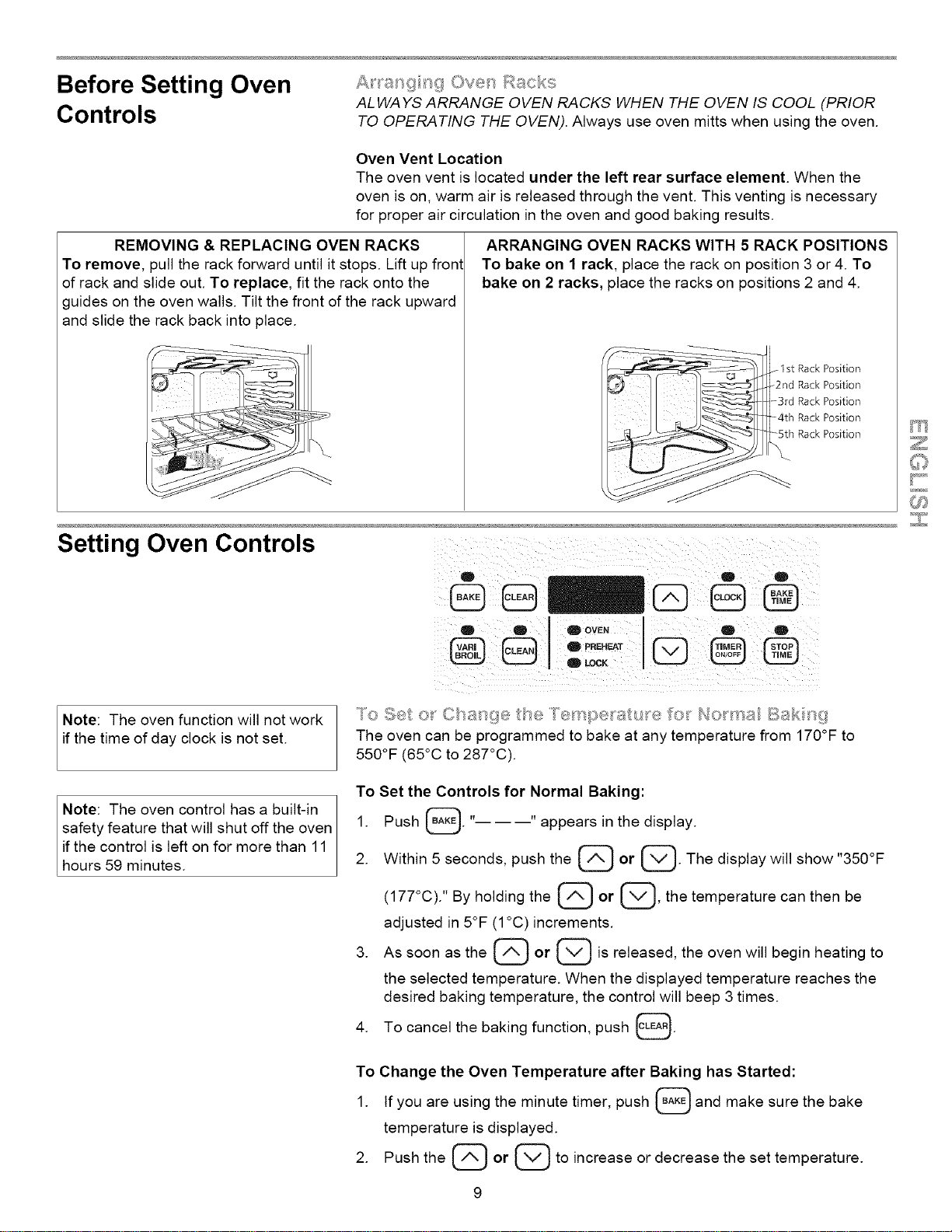
REMOVING & REPLACING OVEN RACKS ARRANGING OVEN RACKS WITH 5 RACK POSITIONS
To remove, pull the rack forward until it stops. Lift up front To bake on 1 rack, place the rack on position 3 or 4. To
of rack and slide out. To replace, fit the rack onto the bake on 2 racks, place the racks on positions 2 and 4.
guides on the oven walls. Tilt the front of the rack upward
and slide the rack back into place.
\
-2nd Rack Position
-3@ Rack Position
- 4th Rack Position
Setting Oven Controls
®me @
OVEN
PREHEAT
I LOCK
@
D D
G@@
Note: The oven function will not work
if the time of day clock is not set.
Note: The oven control has a built-in I
safety feature that will shut off the oven
I
if the control is left on for more than 11
hours 59 minutes.
The oven can be programmed to bake at any temperature from 170°F to
550°F (65°C to 287°C).
To Set the Controls for Normal Baking:
1. Push _. " "appears in the display.
2. Within 5 seconds, push the (_ or (_. The display will show "350°F
(177°C)." By holding the [_ or (_}, the temperature can then be
adjusted in 5°F (1°C) increments.
3. As soon as the (_ or @ is released, the oven will begin heating to
the selected temperature. When the displayed temperature reaches the
desired baking temperature, the control will beep 3 times.
4. To cancel the baking function, push _.
To Change the Oven Temperature after Baking has Started:
1. If you are using the minute timer, push (_ and make sure the bake
temperature is displayed.
2. Push the (_ or (_ to increase or decrease the set temperature.
Setting Oven Controls
(continued)
.
Use caution when using
the automatic timer. Use the automatic
timer when cooking cured or frozen
meats and most fruits and vegetables.
Foods that can easily spoil such as
milk, eggs, fish, meat or poultry,
should be chilled in the refrigerator
first. Even when chilled, they should
not stand in the oven for more than 1
hour before cooking begins, and
should be removed promptly when
cooking is completed.
Tb Set the A_stomat c l'_me/_ ("[ reed Bake _,:eatu_'e}
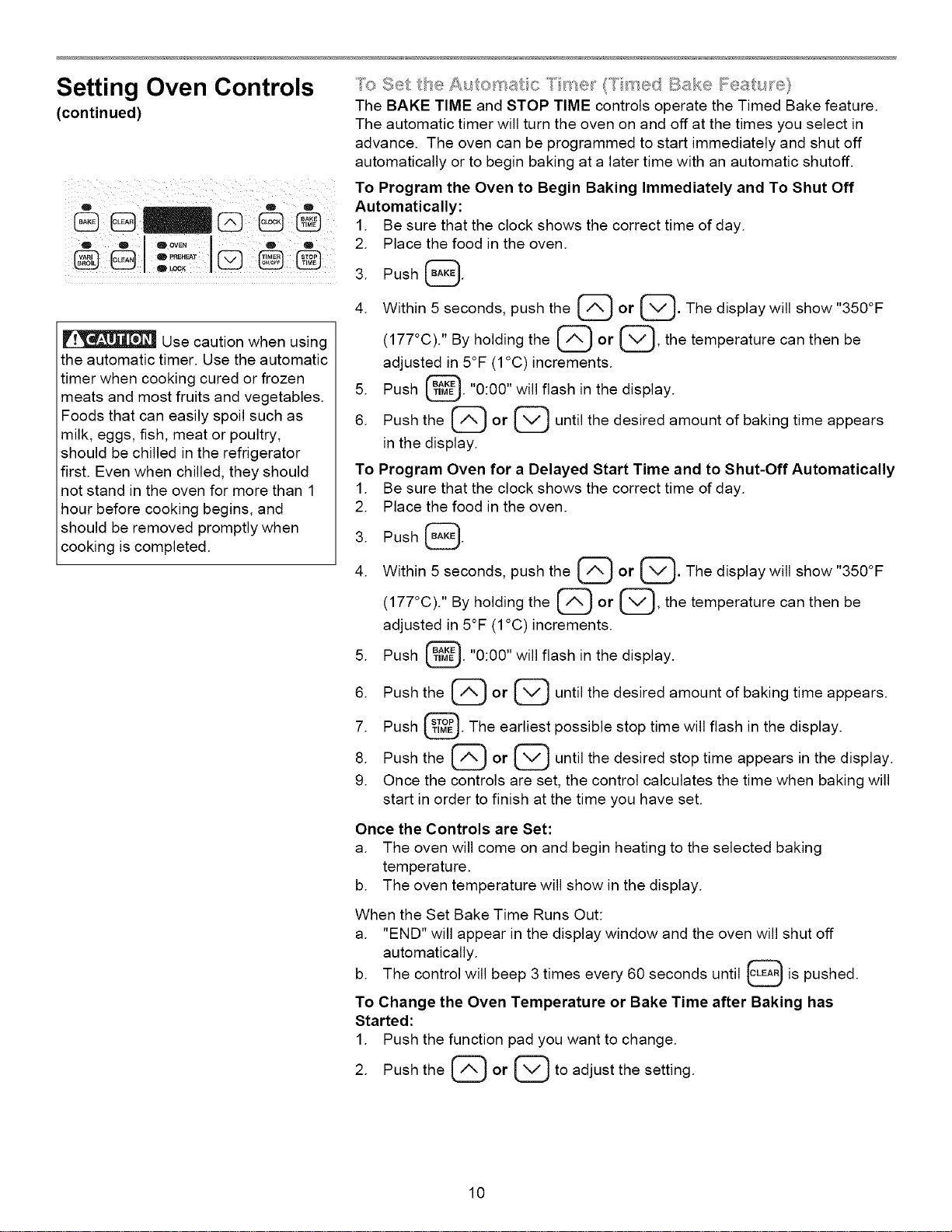
The BAKE TIME and STOP TIME controls operate the Timed Bake feature.
The automatic timer will turn the oven on and off at the times you select in
advance. The oven can be programmed to start immediately and shut off
automatically or to begin baking at a later time with an automatic shutoff.
To Program the Oven to Begin Baking Immediately and To Shut Off
Automatically:
1. Be sure that the clock shows the correct time of day.
2. Place the food in the oven.
3. Push @.
4. Within 5 seconds, push the (_ or (_. The display will show "350°F
(177°O)." By holding the U or L_' the temperature can then be
adjusted in 5°F (1°C)increments.
5. Push _. "0:00" will flash in the display.
6. Push the L_ or L_ until the desired amount of baking time appears
in the display.
To Program Oven for a Delayed Start Time and to Shut-Off Automatically
1. Be sure that the clock shows the correct time of day.
2. Place the food in the oven.
3. Push @.
4. Within 5 seconds, push the (_ or (_. The display will show "350°F
(177°O)." By holding the U or [,_.V____,the temperature can then be
adjusted in 5°F (1°C)increments.
5. Push @. "0:00" will flash in the display.
6. Push the (_ or (_ until the desired amount of baking time appears.
7. Push _. The earliest possible stop time will flash in the display.
8. Push the L_ or L_ until the desired stop time appears in the display.
9. Once the controls are set, the control calculates the time when baking will
start in order to finish at the time you have set.
Once the Controls are Set:
a. The oven will come on and begin heating to the selected baking
temperature.
b. The oven temperature will show in the display.
When the Set Bake Time Runs Out:
a. "END" will appear in the display window and the oven will shut off
automatically.
b. The control will beep 3 times every 60 seconds until _ is pushed.
To Change the Oven Temperature or Bake Time after Baking has
Started:
1. Push the function pad you want to change.
2. Push the (_ or G to adjust the setting.
10
Setting Oven Controls
(continued)
a o i
O OVEN
PREHEAT
S LOCK
D O
@@@
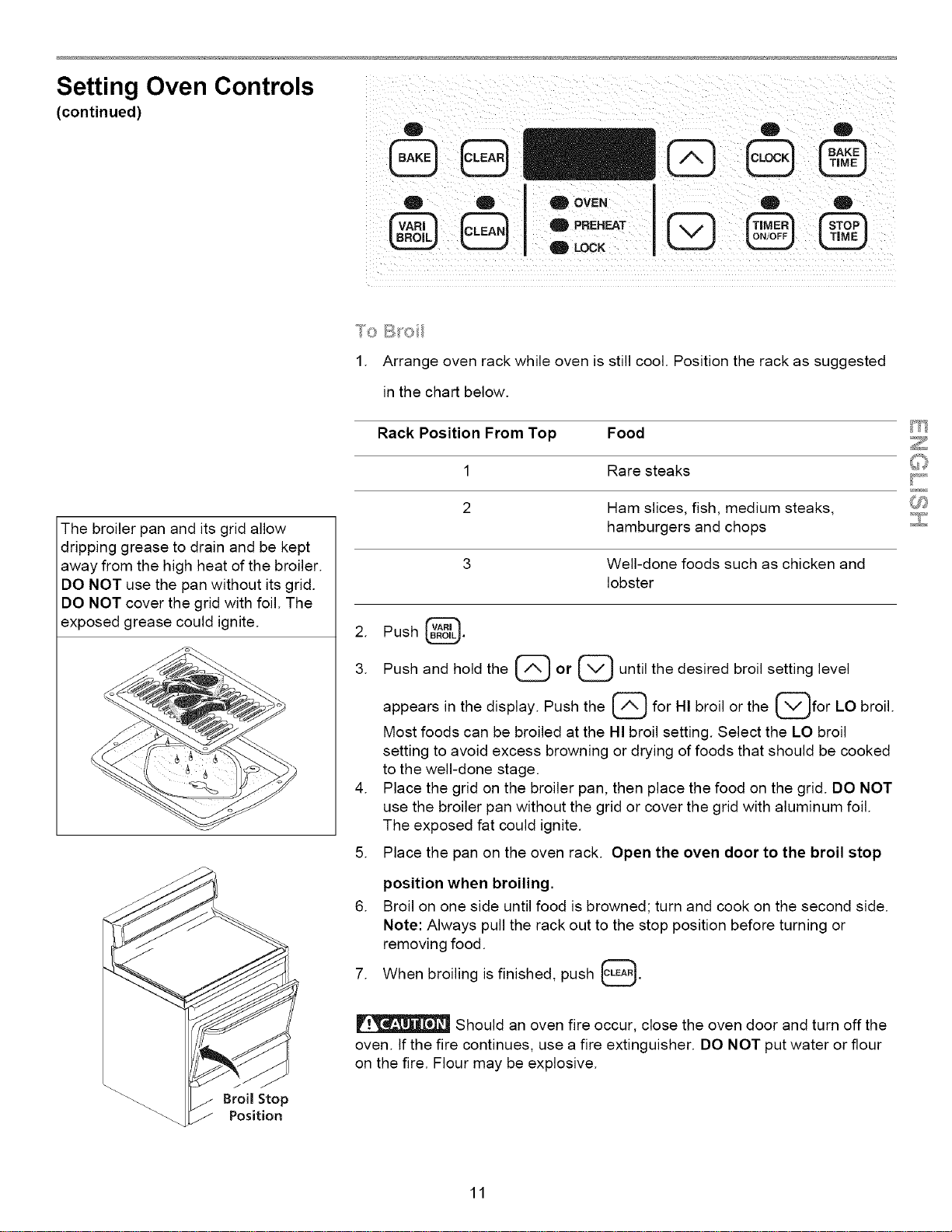
The broiler pan and its grid allow
dripping grease to drain and be kept
away from the high heat of the broiler.
DO NOT use the pan without its grid.
DO NOT cover the grid with foil. The
exposed grease could ignite.
J
_-. Broil Stop
Position
} VSY©
1. Arrange oven rack while oven is still cool. Position the rack as suggested
in the chart below.
Rack Position From Top Food
1 Rare steaks
2 Ham slices, fish, medium steaks,
hamburgers and chops
3 Well-done foods such as chicken and
lobster
2. Push @.
3. Push and hold the (_ or @ until the desired broil setting level
appears in the display. Push the (_ for HI broil or the (_for LO broil.
Most foods can be broiled at the HI broil setting. Select the LO broil
setting to avoid excess browning or drying of foods that should be cooked
to the well-done stage.
4. Place the grid on the broiler pan, then place the food on the grid. DO NOT
use the broiler pan without the grid or cover the grid with aluminum foil.
The exposed fat could ignite.
5. Place the pan on the oven rack. Open the oven door to the broil stop
position when broiling.
6. Broil on one side until food is browned; turn and cook on the second side.
Note: Always pull the rack out to the stop position before turning or
removing food.
7. When broiling is finished, push @.
Should an oven fire occur, close the oven door and turn off the
oven. If the fire continues, use a fire extinguisher. DO NOT put water or flour
on the fire. Flour may be explosive.
11
Oven Cleaning
D D I
O OVEN
PREHEAT
S LOCK
D O
@@@
During the self-cleaning
cycle, the outside of the range can
become very hot to the touch. DO
NOT leave small children unattended
near the appliance.
The health of some
birds is extremely sensitive to the
fumes given off during the self-
cleaning cycle of any range. Move
birds to another well-ventilated room.
DO NOT line the oven
walls, racks, bottom or any other part
of the range with aluminum foil. Doing
so will destroy heat distribution,
produce poor baking results and cause
)ermanent damage to the oven interior
(aluminum foil will melt to the interior
surface of the oven).
DO NOT force the oven
door open. This can damage the
automatic door locking system. Use
caution when opening the door after
the self-cleaning cycle is completed.
The oven may still be VERY HOT.
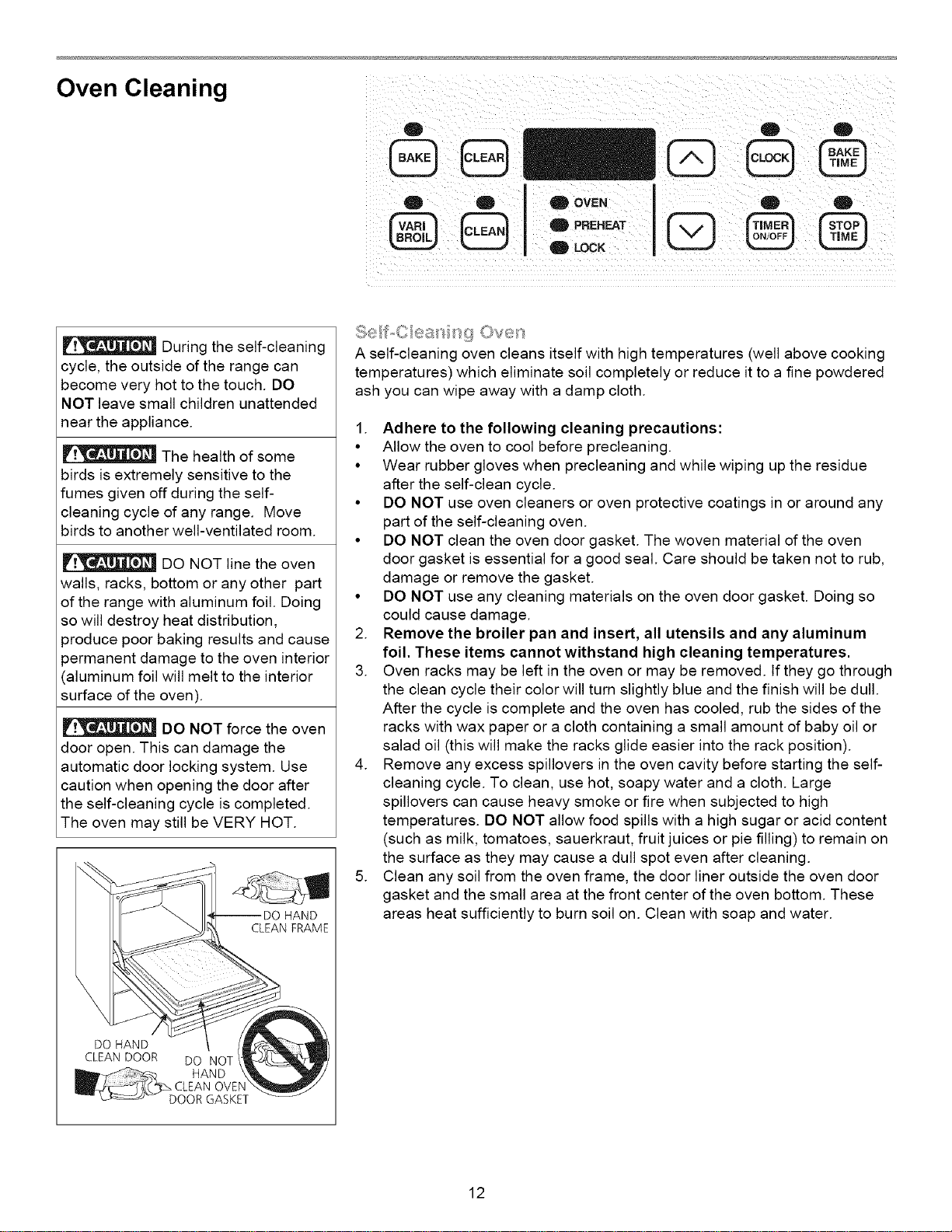
HAND
CLEAN FRAME
DO HAND
CLEAN DOOR DO NOT
HAND
CLEAN OVEN
OOR GASKET
Se f,,,C ea s sg Ove_,_,
A self-cleaning oven cleans itself with high temperatures (well above cooking
temperatures) which eliminate soil completely or reduce it to a fine powdered
ash you can wipe away with a damp cloth.
1. Adhere to the following cleaning precautions:
• Allow the oven to cool before precleaning.
• Wear rubber gloves when precleaning and while wiping up the residue
after the self-clean cycle.
• DO NOT use oven cleaners or oven protective coatings in or around any
part of the self-cleaning oven.
• DO NOT clean the oven door gasket. The woven material of the oven
door gasket is essential for a good seal. Care should be taken not to rub,
damage or remove the gasket.
• DO NOT use any cleaning materials on the oven door gasket. Doing so
could cause damage.
2. Remove the broiler pan and insert, all utensils and any aluminum
foil. These items cannot withstand high cleaning temperatures.
3. Oven racks may be left in the oven or may be removed. If they go through
the clean cycle their color will turn slightly blue and the finish will be dull.
After the cycle is complete and the oven has cooled, rub the sides of the
racks with wax paper or a cloth containing a small amount of baby oil or
salad oil (this will make the racks glide easier into the rack position).
4. Remove any excess spillovers in the oven cavity before starting the self-
cleaning cycle. To clean, use hot, soapy water and a cloth. Large
spillovers can cause heavy smoke or fire when subjected to high
temperatures. DO NOT allow food spills with a high sugar or acid content
(such as milk, tomatoes, sauerkraut, fruit juices or pie filling) to remain on
the surface as they may cause a dull spot even after cleaning.
5. Clean any soil from the oven frame, the door liner outside the oven door
gasket and the small area at the front center of the oven bottom. These
areas heat sufficiently to burn soil on. Clean with soap and water.
12
Oven Cleaning
(continued)
D D t
OVEN
PREHEAT
0 _cK
0 O
Use care when opening
the oven door after the self-cleaning
cycle. Stand to the side of the oven
when opening the door to allow hot air
or steam to escape.
DO NOT force the oven
door open. This can damage the
automatic door locking system. Use
caution when opening the door after
the self-cleaning cycle is completed.
The oven may still be VERY HOT.
oe 1,,{ ears ,.,y .......
*We recommend a 2 hour self-clean cycle for light soils and a 3 hour cycle
for average to heavy soils (to assure satisfactory results).
To Set the Controls for a Self-Clean Cycle:
1. Be sure the clock shows the correct time of day.
2. Push Q. " "appears in the display.
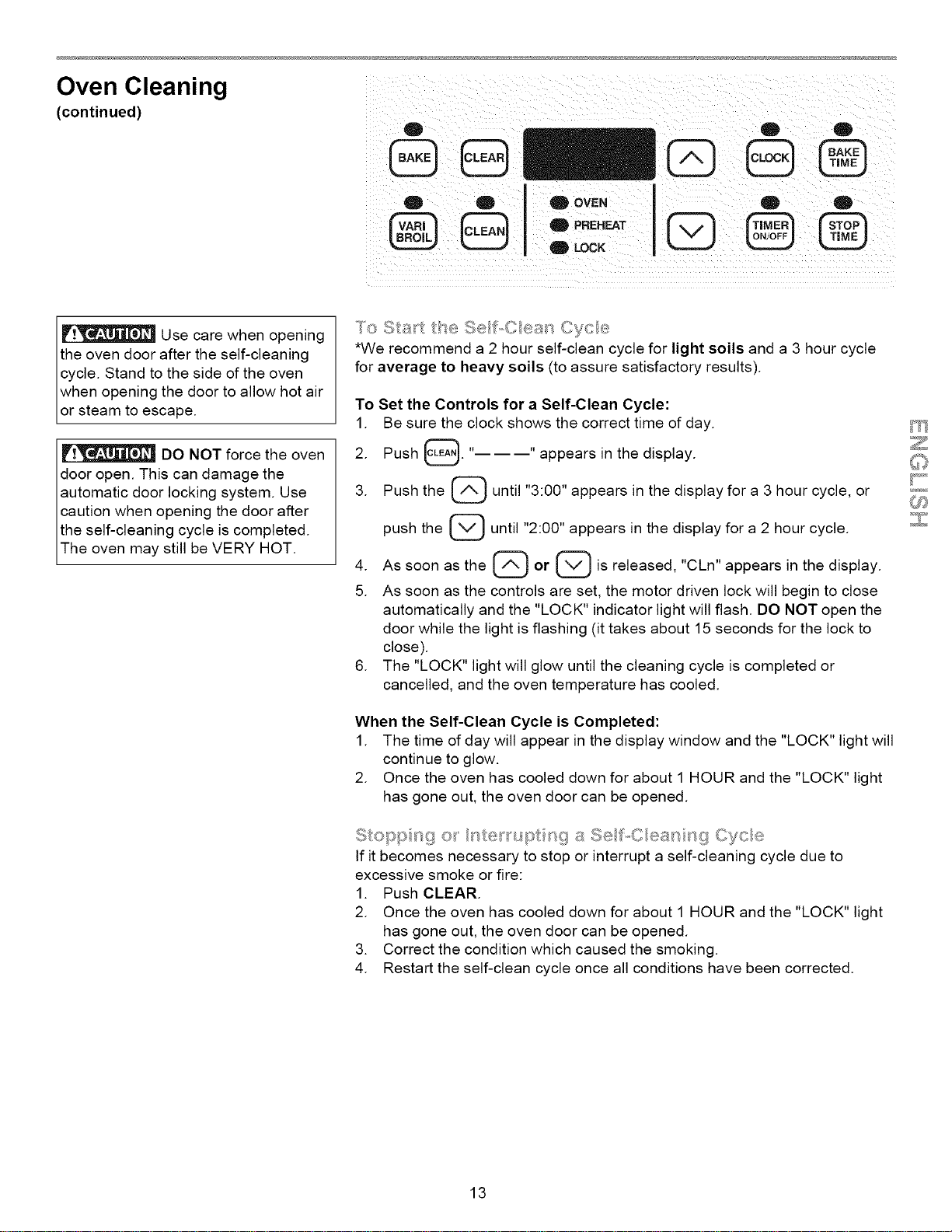
3. Push the @ until "3:00" appears in the display for a 3 hour cycle, or
push the (_ until "2:00" appears in the display for a 2 hour cycle.
4. As soon as the (_) or @ is released, "CLn" appears in the display.
5. As soon as the controls are set, the motor driven lock will begin to close
automatically and the "LOCK" indicator light will flash. DO NOT open the
door while the light is flashing (it takes about 15 seconds for the lock to
close).
6. The "LOCK" light will glow until the cleaning cycle is completed or
cancelled, and the oven temperature has cooled.
When the Self-Clean Cycle is Completed:
1. The time of day will appear in the display window and the "LOCK" light will
continue to glow.
2. Once the oven has cooled down for about 1 HOUR and the "LOCK" light
has gone out, the oven door can be opened.
Stopp _go _ tte_,spt gsSef,,,Ceas_@Cyce
If it becomes necessary to stop or interrupt a self-cleaning cycle due to
excessive smoke or fire:
1. Push CLEAR.
2. Once the oven has cooled down for about 1 HOUR and the "LOCK" light
has gone out, the oven door can be opened.
3. Correct the condition which caused the smoking.
4. Restart the self-clean cycle once all conditions have been corrected.
13
General Cleaning
Before cleaning any part of the range, be sure all controls are turned OFF and
the range is COOL. REMOVE SPILLOVERS AND HEAVY SOILING AS
SOON AS POSSIBLE. REGULAR CLEANINGS WILL REDUCE THE
FREQUENCY OF MAJOR CLEANINGS.
How to Cear}
Aluminum (Trim Pieces) & Vinyl Use hot, soapy water and a cloth. Dry with a clean cloth.
Glass, Painted and Plastic Control
Knobs, Body Parts, and Decorative
Trim
Stainless Steel, Chrome Control
Panel, Decorative Trim
Porcelain Enamel Broiler Pan and
Insert, Door Liner, Body Parts,
Warmer Drawer (if equipped)
Oven Racks
Oven Door
i _EA_ RAME
For general cleaning, use hot, soapy water and a cloth. For more difficult soils
and built-up grease, apply a liquid detergent directly onto the soil. Leave on
soil for 30 to 60 minutes. Rinse with a damp cloth and dry. DO NOT use
abrasive cleaners on any of these materials; they can scratch. To remove
control knobs, turn to the OFF position; grasp firmly and pull straight off the
shaft. To replace knobs after cleaning, line up the flat sides of both the knob
and the shaft; then push the knob into place.
Before cleaning the controlpanel, turn all controls to OFF and remove the
control knobs. To remove, pull each knob straight off the shaft. Clean using
hot, soapy water and a dishcloth. Rinse with a clean water and a dishcloth.
Cover stubborn spots with an ammonia-soaked paper towel for 30 to 40
minutes. Rinse. Be sure to squeeze excess water from the cloth before
wiping the panel; especially when wiping around the controls. Excess water in
or around the controls may cause damage to the appliance. Cleaners made
especially for stainless steel such as Stainless Steel Magic, trademark of
Magic American Corp., or similar products are recommended. Always follow
the manufacturer's instructions. Be sure to rinse the cleaners as bluish stains
may occur during heating and cannot be removed. To replace knobs after
cleaning, line up the flat sides of both the knob and the shaft; then push the
knob into place.
Gentle scouring with a soapy scouring pad will remove most spots. Rinse
with a 1:1 solution of clear water and ammonia. If necessary, cover difficult
spots with an ammonia-soaked paper towel for 30 to 40 minutes. Rinse with
clean water and a damp cloth, and then scrub with a soap-filled scouring pad.
Rinse and wipe dry with a clean cloth. Remove all cleaners or the porcelain
may become damaged during future heating. DO NOT use spray oven
cleaners on the cooktop.
Oven racks may be removed or left in the oven during the self-clean cycle for
cleaning. If removed, clean by using a mild, abrasive cleaner following
manufacturer's instructions. Rinse with clean water and dry.
If the racks are cleaned in the self-clean cycle, their color will turn slightly blue
and the finish will be dull. After the self-clean cycle is complete, and the oven
has cooled, rub the sides of the racks with wax paper or a cloth containing a
small amount of baby oil or salad oil (this will make the racks glide easier into
the rack positions).
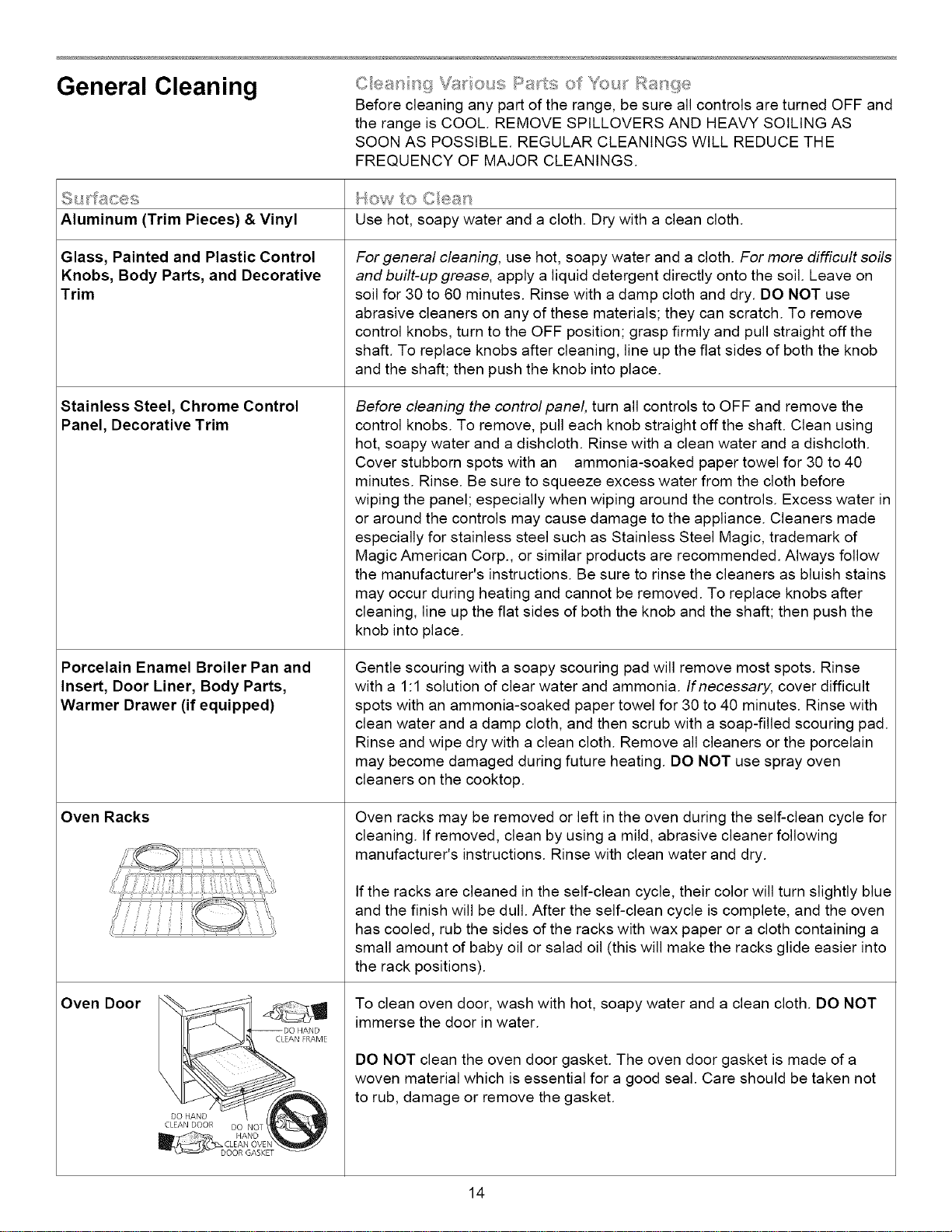
To clean oven door, wash with hot, soapy water and a clean cloth. DO NOT
immerse the door in water.
DO NOT clean the oven door gasket. The oven door gasket is made of a
woven material which is essential for a good seal. Care should be taken not
to rub, damage or remove the gasket.
14
General Cleaning
(continued)
Be sure the range is
cool before removing elements or drip
bowls. Be careful not to bend terminal
ends when replacing elements after
cleaning.
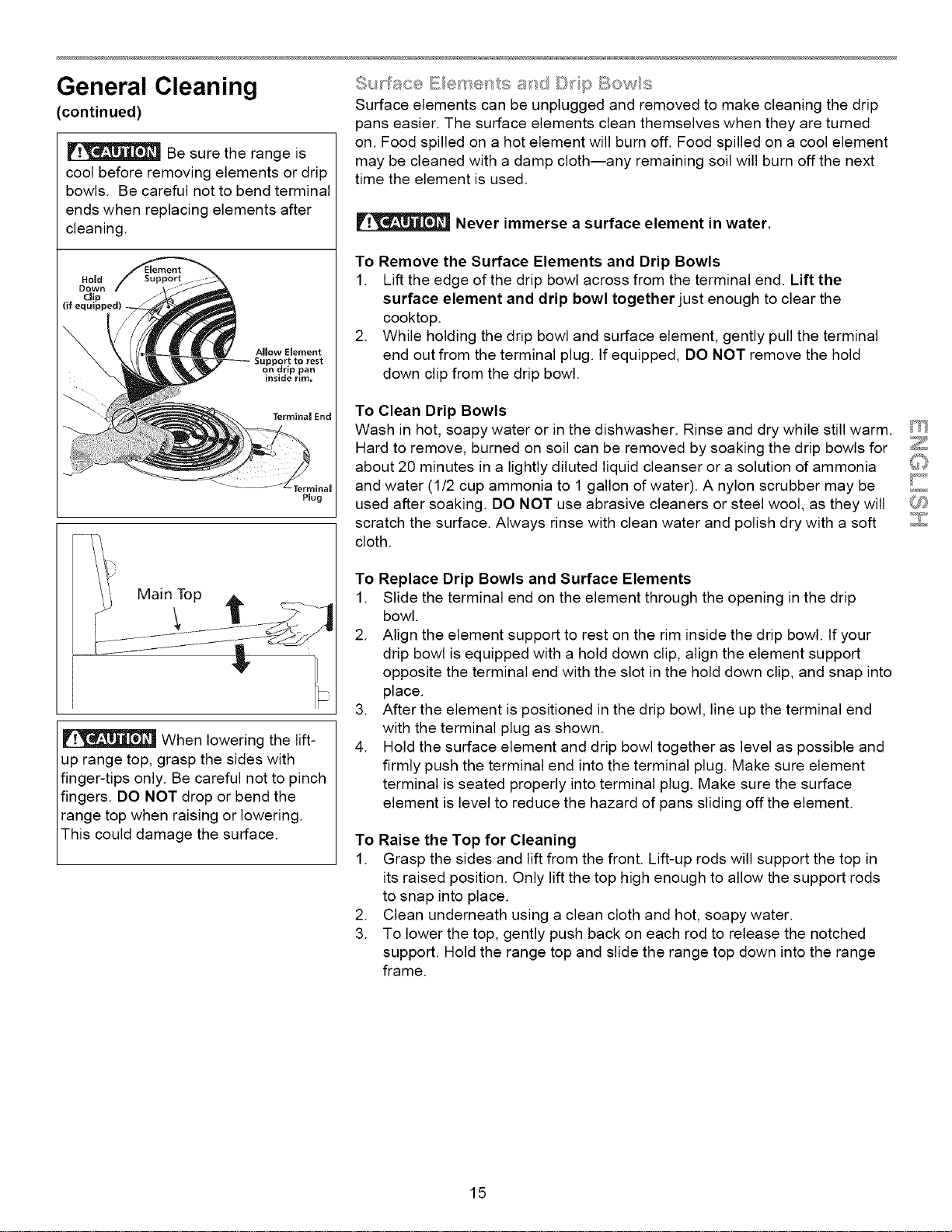
Hold
DOW_
Clip
(if equipped)
Allow Element
Support to rest
on drip pan
inside rim.
Terminal End
Main Top
When lowering the lift-
up range top, grasp the sides with
finger-tips only. Be careful not to pinch
fingers. DO NOT drop or bend the
range top when raising or lowering.
This could damage the surface.
S_ d_ace E e_s,e sts a__d D_Jp Bows
Surface elements can be unplugged and removed to make cleaning the drip
pans easier. The surface elements clean themselves when they are turned
on. Food spilled on a hot element will burn off. Food spilled on a cool element
may be cleaned with a damp cloth--any remaining soil will burn off the next
time the element is used.
Never immerse a surface element in water.
To Remove the Surface Elements and Drip Bowls
1. Lift the edge of the drip bowl across from the terminal end. Lift the
surface element and drip bowl together just enough to clear the
cooktop.
2. While holding the drip bowl and surface element, gently pull the terminal
end out from the terminal plug. If equipped, DO NOT remove the hold
down clip from the drip bowl.
To Clean Drip Bowls
Wash in hot, soapy water or in the dishwasher. Rinse and dry while still warm.
Hard to remove, burned on soil can be removed by soaking the drip bowls for
about 20 minutes in a lightly diluted liquid cleanser or a solution of ammonia
and water (1/2 cup ammonia to 1 gallon of water). A nylon scrubber may be
used after soaking. DO NOT use abrasive cleaners or steel wool, as they will
scratch the surface. Always rinse with clean water and polish dry with a soft
cloth.
To Replace Drip Bowls and Surface Elements
1. Slide the terminal end on the element through the opening in the drip
bowl.
2. Align the element support to rest on the rim inside the drip bowl. If your
drip bowl is equipped with a hold down clip, align the element support
opposite the terminal end with the slot in the hold down clip, and snap into
place.
3. After the element is positioned in the drip bowl, line up the terminal end
with the terminal plug as shown.
4. Hold the surface element and drip bowl together as level as possible and
firmly push the terminal end into the terminal plug. Make sure element
terminal is seated properly into terminal plug. Make sure the surface
element is level to reduce the hazard of pans sliding offthe element.
To Raise the Top for Cleaning
1. Grasp the sides and lift from the front. Lift-up rods will support the top in
its raised position. Only lift the top high enough to allow the support rods
to snap into place.
2. Clean underneath using a clean cloth and hot, soapy water.
3. To lower the top, gently push back on each rod to release the notched
support. Hold the range top and slide the range top down into the range
frame.
15
General Cleaning
(continued)
The door is heavy. For
safe, temporary storage, lay the door
flat with the inside of the door facing
down.
To Remove Oven Door:
1. Open the door.
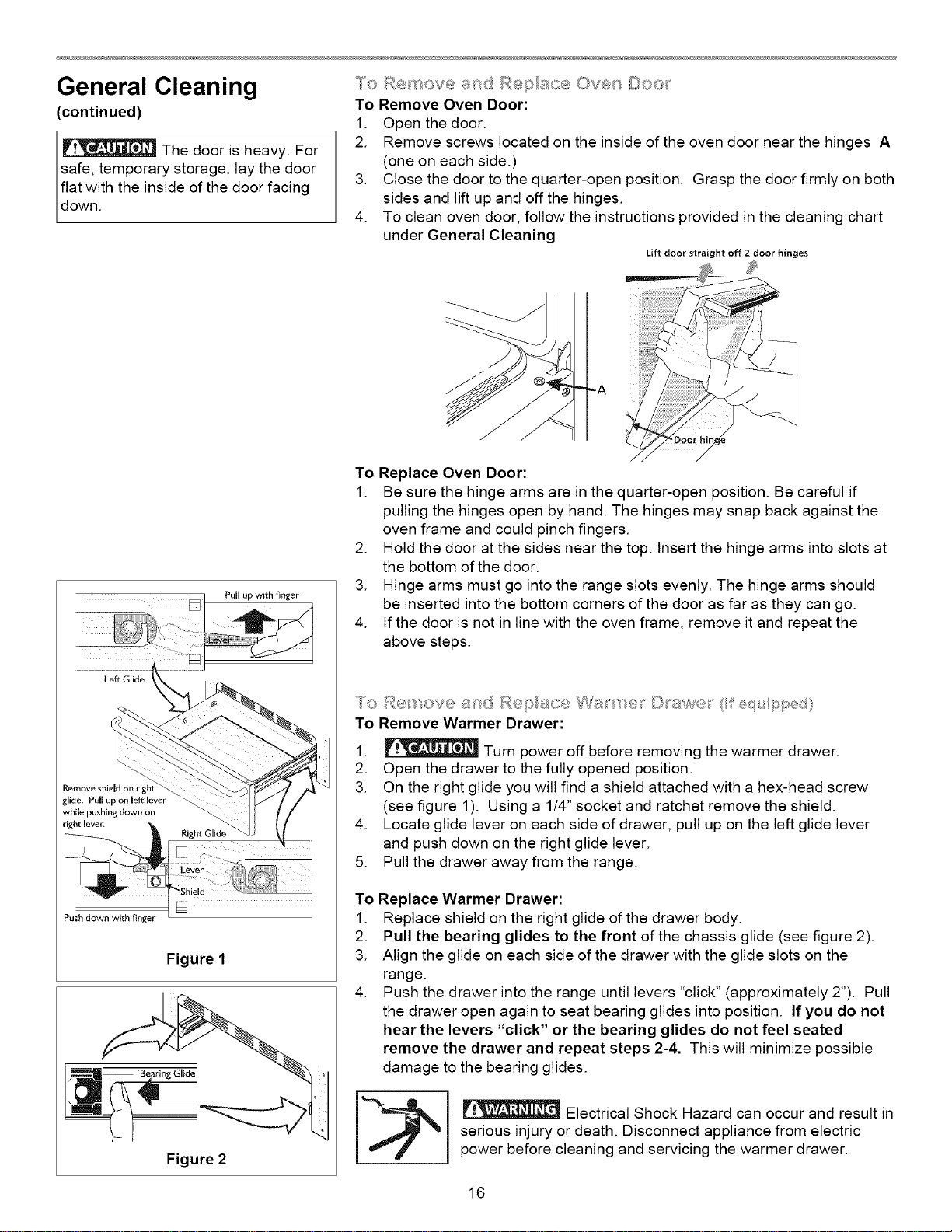
2. Remove screws located on the inside of the oven door near the hinges A
(one on each side.)
3. Close the door to the quarter-open position. Grasp the door firmly on both
sides and lift up and off the hinges.
4. To clean oven door, follow the instructions provided in the cleaning chart
under General Cleaning
Lift door straight off 2 door hinges
Pull up with finger
Left Glide
Remove shield on right
glide. Pull up on left lever
while pushing down on
Figure 1
Figure 2
To Replace Oven Door:
1. Be sure the hinge arms are m the quarter-open position. Be careful if
pulling the hinges open by hand. The hinges may snap back against the
oven frame and could pinch fingers.
2. Hold the door at the sides near the top. Insert the hinge arms into slots at
the bottom of the door.
3. Hinge arms must go into the range slots evenly. The hinge arms should
be inserted into the bottom corners of the door as far as they can go.
4. If the door is not in line with the oven frame, remove it and repeat the
above steps.
To Re _sove a_q<i£Rep ace Wa_ _e__ D_awe_ (f_equ/:>/c/>ed)
To Remove Warmer Drawer:
1. _ Turn power off before removing the warmer drawer.
2. Open the drawer to the fully opened position.
3. On the right glide you will find a shield attached with a hex-head screw
(see figure 1). Using a 1/4" socket and ratchet remove the shield.
4. Locate glide lever on each side of drawer, pull up on the left glide lever
and push down on the right glide lever.
5. Pull the drawer away from the range.
To Replace Warmer Drawer:
1. Replace shield on the right glide of the drawer body.
2. Pull the bearing glides to the front of the chassis glide (see figure 2).
3. Align the glide on each side of the drawer with the glide slots on the
range.
4. Push the drawer into the range until levers "click" (approximately 2"). Pull
the drawer open again to seat bearing glides into position. If you do not
hear the levers "click" or the bearing glides do not feel seated
remove the drawer and repeat steps 2-4. This will minimize possible
damage to the bearing glides.
Electrical Shock Hazard can occur and result in
serious injury or death. Disconnect appliance from electric
power before cleaning and servicing the warmer drawer.
16
Changing Cooktop and/
or Oven Lights
(some models)
Be sure the range is unplugged and all parts are COOL before
replacing the oven light. Wear a leather-faced glove for protection against
possible broken glass.
To C_"ts _ge the Ove/} Lght (so _te mode;s}
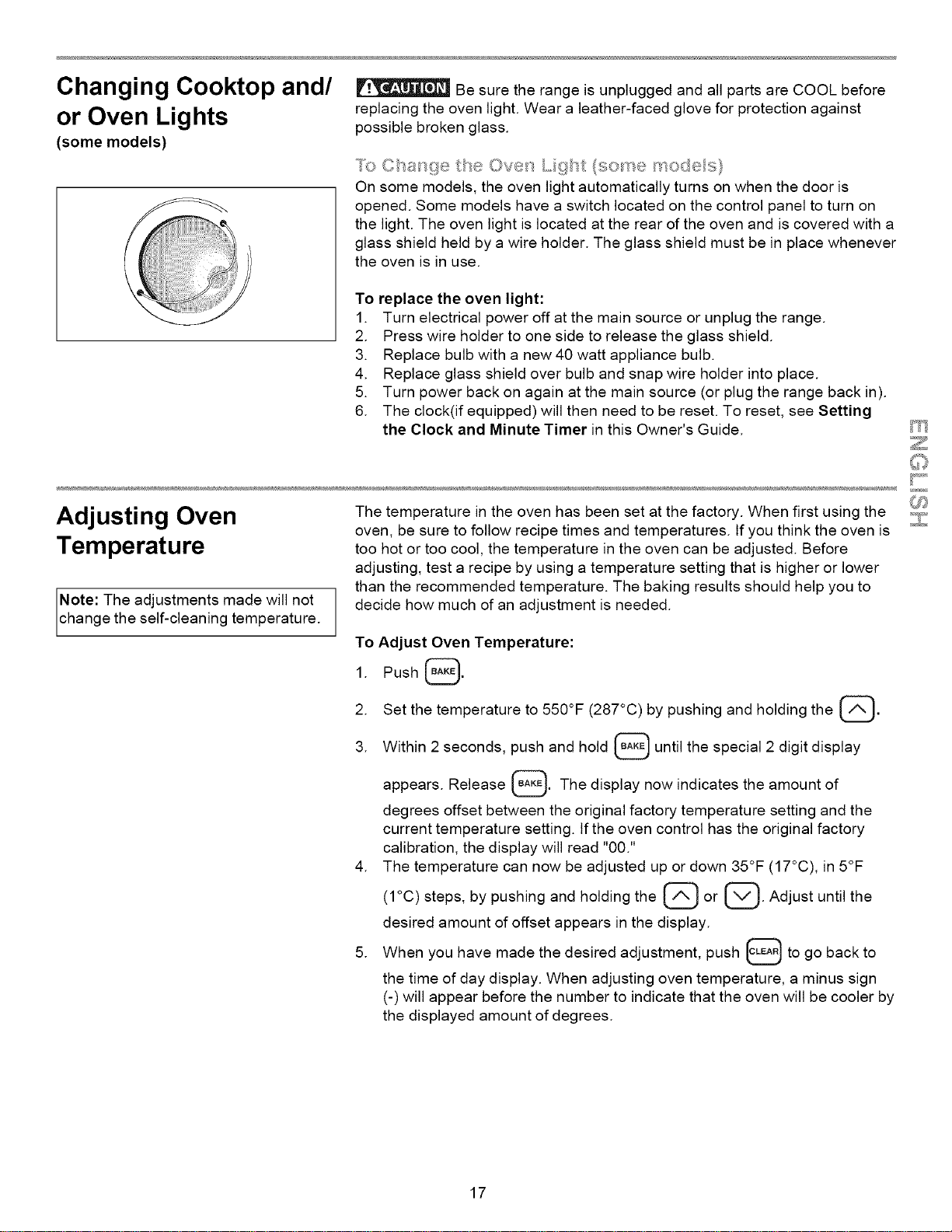
On some models, the oven light automatically turns on when the door is
opened. Some models have a switch located on the control panel to turn on
the light. The oven light is located at the rear of the oven and is covered with a
glass shield held by a wire holder. The glass shield must be in place whenever
the oven is in use.
To replace the oven light:
1. Turn electrical power off at the main source or unplug the range.
2. Press wire holder to one side to release the glass shield.
3. Replace bulb with a new 40 watt appliance bulb.
4. Replace glass shield over bulb and snap wire holder into place.
5. Turn power back on again at the main source (or plug the range back in).
6. The clock(if equipped) will then need to be reset. To reset, see Setting
the Clock and Minute Timer in this Owner's Guide.
Adjusting Oven The temperature in the oven has been set at the factory. When first using the
oven, be sure to follow recipe times and temperatures. If you think the oven is
/emperature too hot or too cool, the temperature in the oven can be adjusted. Before
adjusting, test a recipe by using a temperature setting that is higher or lower
than the recommended temperature. The baking results should help you to
decide how much of an adjustment is needed.
Note: The adjustments made will not
change the se f-c ean ng temperature.
To Adjust Oven Temperature:
1. Push _.
2. Set the temperature to 550°F (287°C) by pushing and holding the (_.
3. Within 2 seconds, push and hold _ until the special 2 digit display
appears. Release _. The display now indicates the amount of
degrees offset between the original factory temperature setting and the
current temperature setting. If the oven control has the original factory
calibration, the display will read "00."
4. The temperature can now be adjusted up or down 35°F (17°C), in 5°F
(1°C) steps, by pushing and holding the (_ or (_. Adjust until the
desired amount of offset appears in the display.
5. When you have made the desired adjustment, push _ to go back to
the time of day display. When adjusting oven temperature, a minus sign
(-) will appear before the number to indicate that the oven will be cooler by
the displayed amount of degrees.
17
Avoid Service Checklist Before you call for service, review this list. It may save you time and expense.
The list includes common occurrences that are not the result of defective
workmanship or materials in this appliance.
This oven is equipped with a state of the art electronic oven controller. Among
its many features is a full time oven circuit diagnostics system. The controller
constantly monitors its internal circuitry as well as several crucial oven circuits
to insure they are all operating correctly. If at any time one of these systems
fails, the controller will immediately stop operation and begin beeping and
flashing an error code of F1 or F3* in the display window.
Range is not level.
_>OSS BL_- CA/JSt;_JSOLU'T ON
Poor installation. Place oven rack in center of oven. Place a level on the oven rack.
Adjust leveling legs at base of range until the oven rack is level.
Be sure floor is level and is strong and stable enough to adequately support range.
If floor is sagging or sloping, contact a carpenter to correct the situation.
Kitchen cabinet alignment may make range appear unlevel. Be sure cabinets are
square and have sufficient room for range clearance.
Cannot move appliance easily. Appliance
must be accessible for service.
Cabinets not square or are built in too tightly. Contact builder or installer to make
appliance accessible.
Carpet interferes with range. Provide sufficient space so range can be lifted over
carpet.
*Oven control beeps and displays FI or Electronic control has detected a fault condition. Push CANCEL to clear the display
F3. and stop the beeping. Reprogram oven. If fault recurs, record fault number, push
CANCEL and contact an authorized Sears servicer.
Surface element too hot or not hot incorrect control setting. Make sure the correct control is on for the surface element
enough, to be used.
Lightweight or warped pans used. Use only flat, evenly balanced, medium or
heavyweight cookware. Flat pans heat better than warped pans. Cookware materials
and weight of the material affect heating. Heavy- and medium-weight pans heat
evenly. Because lightweight pans heat unevenly, foods may burn easily.
Surface element does not heat.
No power to the appliance. Check steps under "Entire Appliance Does Not Operate"
in this Avoid Service Checklist.
incorrect control setting. Make sure the correct control is on for the surface element
to be used.
Element not making contact in block. Follow instructions under "Surface Elements
and Drip Bowls" in the General Cleaning section.
Entire appliance does not operate. Make sure cord/plug is plugged tightly into outlet.
Service wiring is not complete. Contact your authorized Sears servicer
Power outage. Check house lights to be sure. Call your local electric company for
service.
18
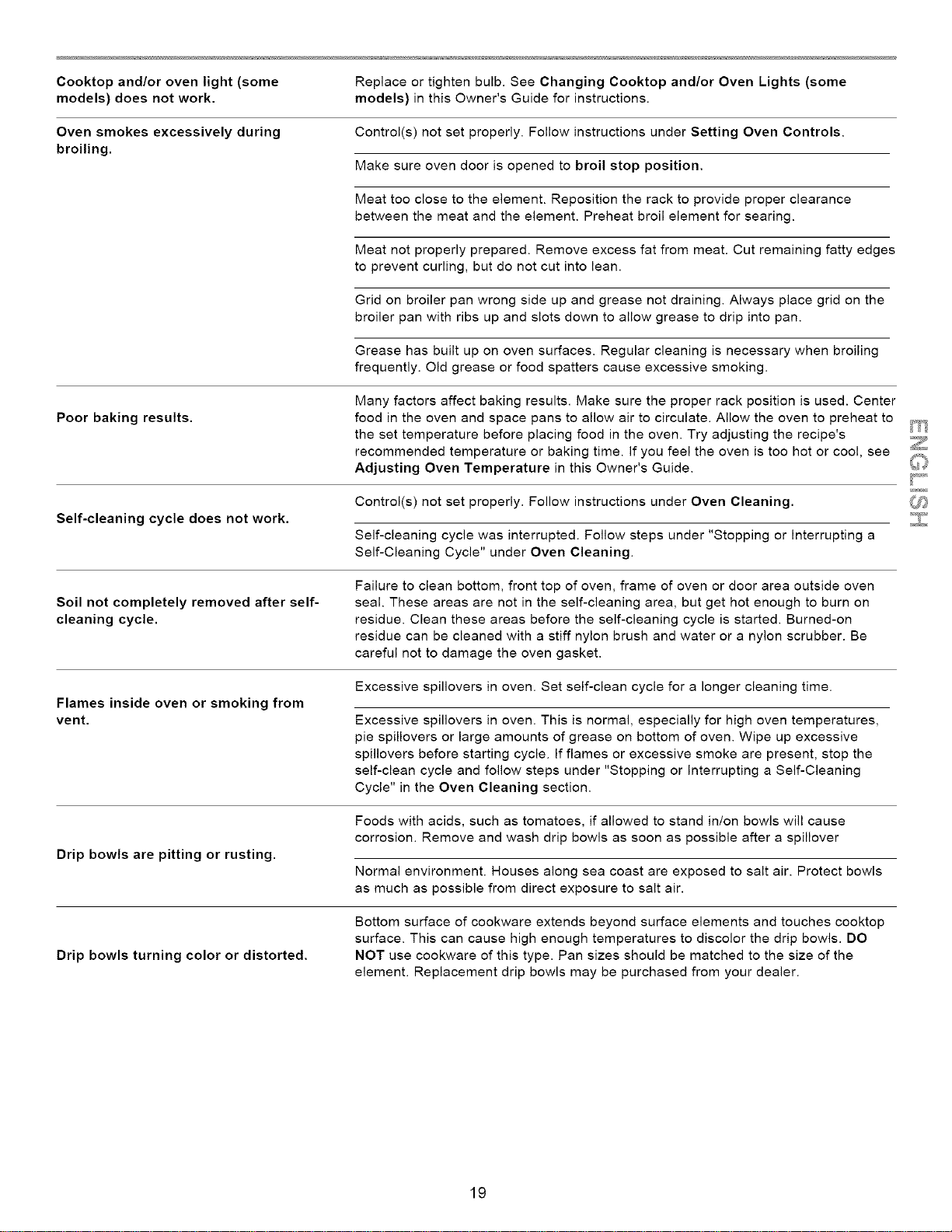
Cooktop and/or oven light (some Replace or tighten bulb. See Changing Cooktop and/or Oven Lights (some
models) does not work. models) in this Owner's Guide for instructions.
Oven smokes excessively during
broiling.
Control(s) not set properly. Follow instructions under Setting Oven Controls.
Make sure oven door is opened to broil stop position.
Meat too close to the element. Reposition the rack to provide proper clearance
between the meat and the element. Preheat broil element for searing.
Meat not properly prepared. Remove excess fat from meat. Cut remaining fatty edges
to prevent curling, but do not cut into lean.
Grid on broiler pan wrong side up and grease not draining. Always place grid on the
broiler pan with ribs up and slots down to allow grease to drip into pan.
Grease has built up on oven surfaces. Regular cleaning is necessary when broiling
frequently. Old grease or food spatters cause excessive smoking.
Poor baking results.
Many factors affect baking results. Make sure the proper rack position is used. Center
food in the oven and space pans to allow air to circulate. Allow the oven to preheat to
the set temperature before placing food in the oven. Try adjusting the recipe's
recommended temperature or baking time. If you feel the oven is too hot or cool, see
Adjusting Oven Temperature in this Owner's Guide.
Self-cleaning cycle does not work.
Control(s) not set properly. Follow instructions under Oven Cleaning.
Self-cleaning cycle was interrupted. Follow steps under "Stopping or Interrupting a
Self-Cleaning Cycle" under Oven Cleaning.
Soil not completely removed after self-
cleaning cycle.
Failure to clean bottom, front top of oven, frame of oven or door area outside oven
seal. These areas are not in the self-cleaning area, but get hot enough to burn on
residue. Clean these areas before the self-cleaning cycle is started. Burned-on
residue can be cleaned with a stiff nylon brush and water or a nylon scrubber. Be
careful not to damage the oven gasket.
Flames inside oven or smoking from
vent.
Excessive spillovers in oven. Set self-clean cycle for a longer cleaning time.
Excessive spillovers in oven. This is normal, especially for high oven temperatures,
pie spillovers or large amounts of grease on bottom of oven. Wipe up excessive
spillovers before starting cycle. If flames or excessive smoke are present, stop the
self-clean cycle and follow steps under "Stopping or Interrupting a Self-Cleaning
Cycle" in the Oven Cleaning section.
Drip bowls are pitting or rusting.
Foods with acids, such as tomatoes, if allowed to stand in/on bowls will cause
corrosion. Remove and wash drip bowls as soon as possible after a spillover
Normal environment. Houses along sea coast are exposed to salt air. Protect bowls
as much as possible from direct exposure to salt air.
Drip bowls turning color or distorted.
Bottom surface of cookware extends beyond surface elements and touches cooktop
surface. This can cause high enough temperatures to discolor the drip bowls. DO
NOT use cookware of this type. Pan sizes should be matched to the size of the
element. Replacement drip bowls may be purchased from your dealer.
19
Home(:entral'°
® Registered Trademark / T,, Trademark of Sears, Roebuck and Co.
® Sears, Roebuck and Co. ® Marca Registrada / T_ Marca de F&brica de Sears, Roebuck and Co.

®
ELECTRIC SELF-CLEANING RANGE
ESTUFA ELECTRICA AUTOLIMPIANTE
r
Sears Roebuck and Co., Hoffman Estates, IL 60179 U.S.A.
www.sears.com
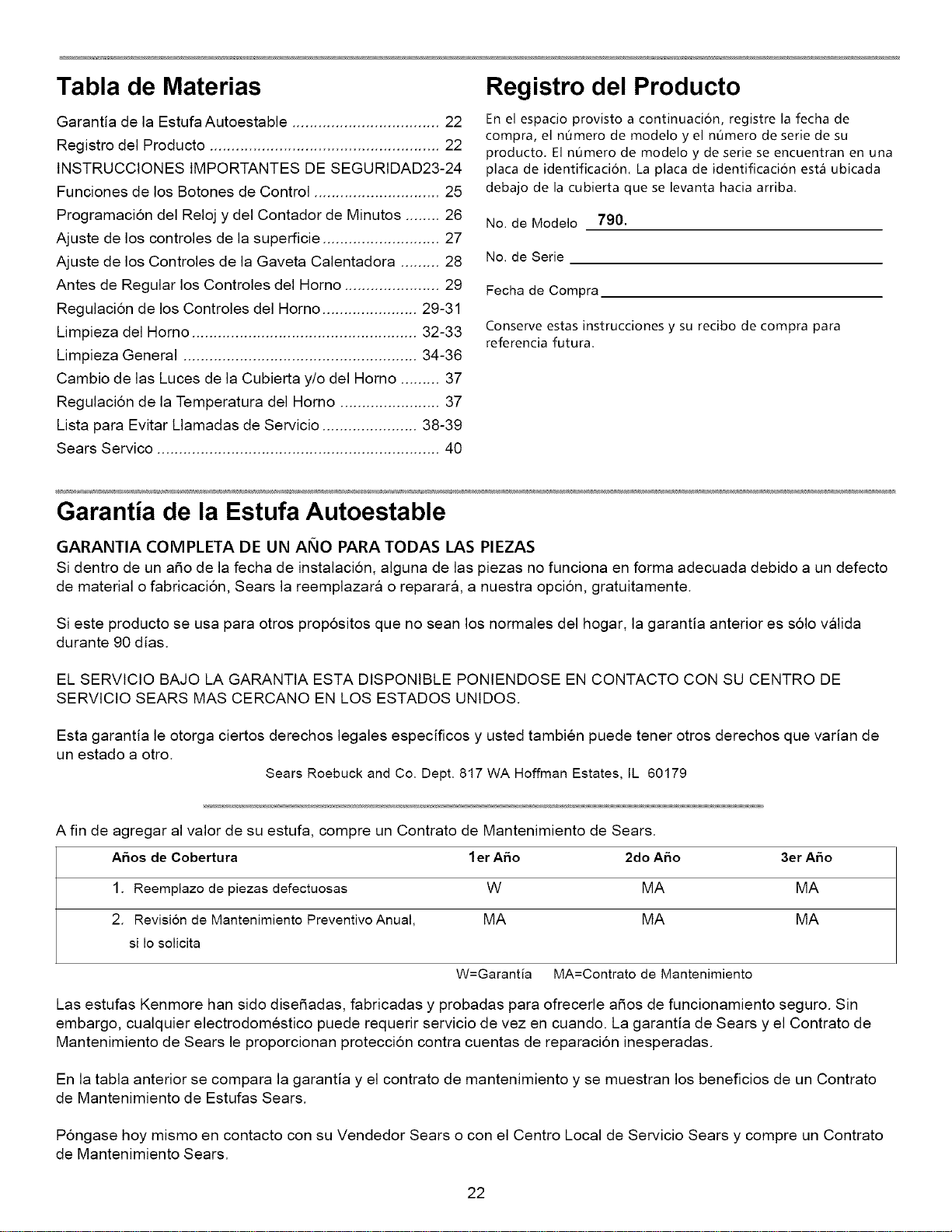
Tabla de Materias
Garantia de la Estufa Autoestable .................................. 22
Registro del Producto ..................................................... 22
INSTRUCCIONES IMPORTANTES DE SEGURtDAD23-24
Funciones de los Botones de Control ............................. 25
Programaci6n del Reloj y del Contador de Minutos ........ 26
Ajuste de los controles de la supefficie ........................... 27
Ajuste de los Controles de la Gaveta Calentadora ......... 28
Antes de Regular los Controles del Homo ...................... 29
Regulaci6n de los Controles del Homo ...................... 29-31
Limpieza del Homo .................................................... 32-33
Limpieza General ...................................................... 34-36
Cambio de las Luces de la Cubierta y/o del Homo ......... 37
Regulacion de la Temperatura del Homo ....................... 37
Lista para Evitar Llamadas de Servicio ...................... 38-39
Sears Servico ................................................................. 40
Registro del Producto
En el espacio provisto a continuacion, registre la fecha de
compra, el numero de modelo y el numero de serie de su
producto. El n[_mero de modelo y de serie se encuentran en una
placa de identificacion. La placa de identificacion esta ubicada
debajo de la cubierta que se levanta hacia arriba.
No. de Modelo 790.
No. de Serie
Fecha de Compra
Conserve estas instrucciones y su recibo de compra para
referencia futura.
Garantia de la Estufa Autoestable
GARANTIA COMPLETA DE UN AI_IO PARA TODA$ LAS PIEZA$
Si dentro de un afio de la fecha de instalacion, alguna de las piezas no funciona en forma adecuada debido a un defecto
de material o fabricacion, Sears la reemplazara o reparara, a nuestra opcion, gratuitamente.
Si este producto se usa para otros prop6sitos que no sean los normales del hogar, la garantia anterior es s61ovalida
durante 90 dias.
EL SERVICIO BAJO LA GARANTIA ESTA DISPONIBLE PONIENDOSE EN CONTACTO CON SU CENTRO DE
SERVICIO SEARS MAS CERCANO EN LOS ESTADOS UNIDOS.
Esta garantia le otorga ciertos derechos legales especificos y usted tambien puede tener otros derechos que varian de
un estado a otro.
Sears Roebuck and Co. Dept. 817 WA Hoffman Estates, IL 60179
A fin de agregar al valor de su estufa, compre un Contrato de Mantenimiento de Sears.
ASos de Cobertura ler ASo 2do A_o 3er A£1o
1. Reemplazo de piezas defectuosas W MA MA
2. Revision de Mantenimiento Preventivo Anual, MA MA MA
si Io solicita
W=Garantia MA=Contrato de Mantenimiento
Las estufas Kenmore han sido disefiadas, fabricadas y probadas para ofrecerle afios de funcionamiento seguro. Sin
embargo, cualquier electrodomestico puede requerir servicio de vez en cuando. La garantia de Sears y el Contrato de
Mantenimiento de Sears le proporcionan proteccion contra cuentas de reparacion inesperadas.
En la tabla anterior se compara la garantia y el contrato de mantenimiento y se muestran los beneficios de un Contrato
de Mantenimiento de Estufas Sears.
P6ngase hoy mismo en contacto con su Vendedor Sears o con el Centro Local de Servicio Sears y compre un Contrato
de Mantenimiento Sears.
22
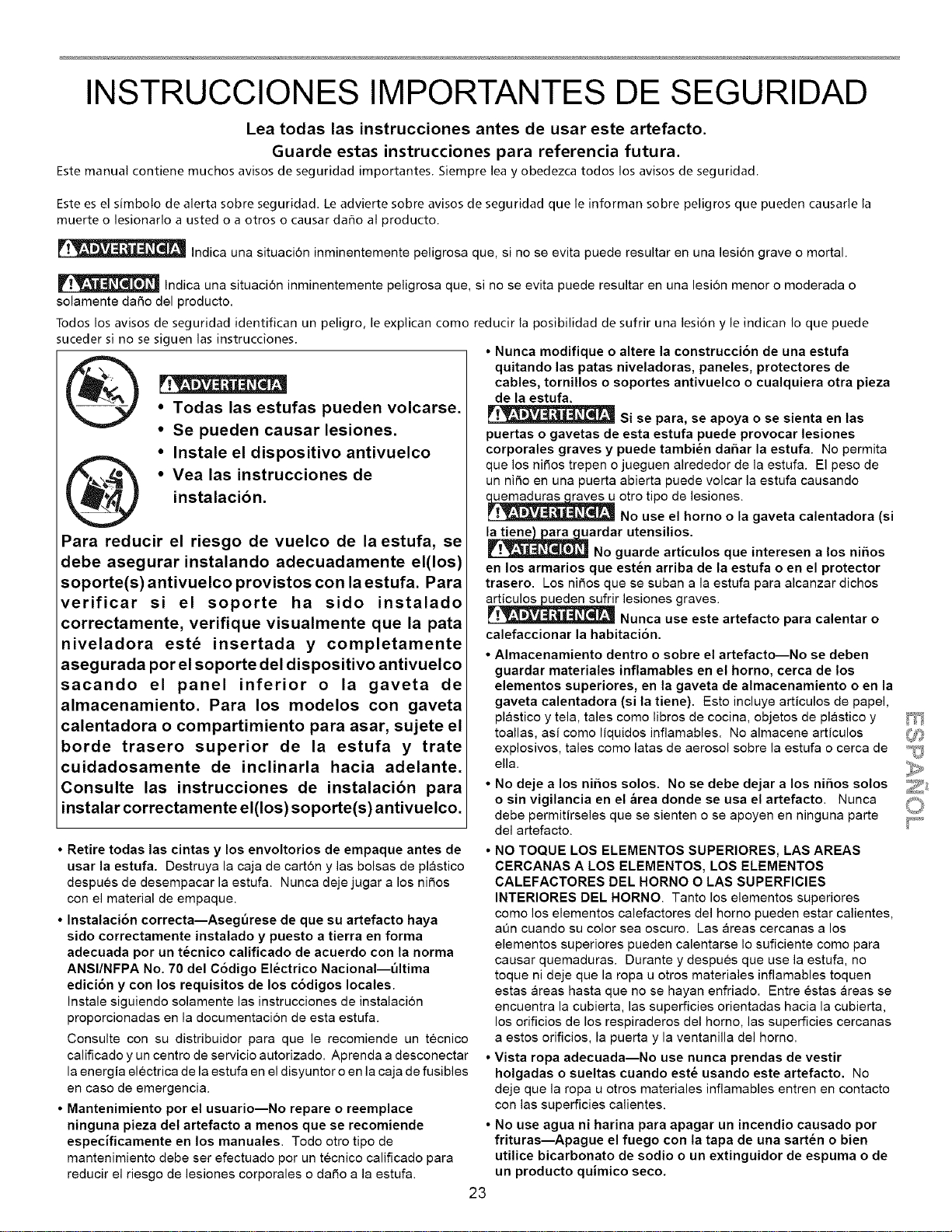
INSTRUCCIONES IMPORTANTES DE SEGURIDAD
Lea todas las instrucciones antes de usar este artefacto.
Guarde estas instrucciones para referenda futura.
Este manual contiene muchos avisos de seguridad importantes. Siempre lea y obedezca todos los avisos de seguridad.
Este es el simbolo de alerta sobre seguridad. Le advierte sobre avisos de seguridad que le informan sobre peligros que pueden causarle la
muerte o lesionarlo a usted o a otros o causar daflo at producto.
Indica una situaci6n inminentemente peligrosa que, si no se evita puede resultar en una lesi6n grave o mortal.
Indica una situaci6n inminentemente peligrosa que, si no se evita puede resultar en una lesi6n menor o moderada o
solamente da_o del producto.
Todos los avisos de seguridad identifican un peligro, le explican como reducir la posibilidad de sufrir una tesi6n y le indican Io que puede
suceder si no se siguen las instrucciones.
• Todas las estufas pueden volcarse.
• Se pueden causar lesiones.
• Instale el dispositivo antivuelco
• Vea las instrucciones de
instalacibn.
Para reducir el riesgo de vuelco de la estufa, se
debe asegurar instalando adecuadamente el(los)
soporte(s) antivuelco provistos con la estufa. Para
verificar si el soporte ha sido instalado
correctamente, verifique visualmente que la pata
niveladora est_ insertada y completamente
asegurada por el soporte del dispositivo antivuelco
sacando el panel inferior o la gaveta de
almacenamiento. Para los modelos con gaveta
calentadora o compartimiento para asar, sujete el
borde trasero superior de la estufa y trate
cuidadosamente de inclinarla hacia adelante.
Consulte las instrucciones de instalacibn para
instalar correctamente el(los) soporte(s) antivuelco.
• Retire todas las cintas y los envoltorios de empaque antes de
usar la estufa. Destruya la caja de cart6n y las bolsas de plastico
despues de desempacar la estufa. Nunca deje jugar a los niSos
con el material de empaque.
• Instalaci6n correcta--Aseg_rese de que su artefacto haya
sido correctamente instalado y puesto a tierra en forma
adecuada por un t6cnico calificado de acuerdo con la norma
ANSI/NFPA No. 70 del C6digo El_ctrico Nacional--_ltima
edici6n y con los requisitos de los c6digos locales.
Instale siguiendo solamente las instrucciones de instalaci6n
proporcionadas en la documentaci6n de esta estufa.
Consulte con su distribuidor para que le recomiende un tecnico
calificado y un centro de servicio autorizado. Aprenda a desconectar
la energia electrica de la estufa en el disyuntor o en la caja de fusibles
en caso de emergencia.
• Mantenimiento por el usuario--No repare o reemplace
ninguna pieza del artefacto a menos que se recomiende
especificamente en los manuales. Todo otto tipo de
mantenimiento debe ser efectuado por un tecnico calificado para
reducir el riesgo de lesiones corporales o dado a la estufa.
• Nunca modifique o altere la construcci6n de una estufa
quitando las patas niveladoras, paneles, protectores de
cables, tornillos o soportes antivuelco o cualquiera otra pieza
de la estufa.
Si se para, se apoya o se sienta en las
puertas o gavetas de esta estufa puede provocar lesiones
corporales graves y puede tambi_n dahar la estufa. No permita
que los nidos trepen o jueguen alrededor de la estufa. El peso de
un niSo en una puerta abierta puede volcar la estufa causando
_emaduras €"aves u otro tipo de lesiones.
No use el horno o la gaveta calentadora (si
ardar utensilios.
No guarde articulos que interesen a los nihos
en los armarios que est_n arriba de la estufa o en el protector
trasero. Los ni_os que se suban a la estufa para alcanzar dichos
articulos _ueden sufrir lesiones graves.
Nunca use este artefacto para calentar o
calefaccionar la habitaci6n.
• Almacenamiento dentro o sobre el artefacto--No se deben
guardar materiales inflamables en el homo, cerca de los
elementos superiores, en la gaveta de almacenamiento o en la
gaveta calentadora (si la tiene). Esto incluye articulos de papel,
plastico y tela, tales como libros de cocina, objetos de plastico y
toallas, asi como liquidos inflamables. No almacene articulos
explosivos, tales como latas de aerosol sobre la estufa o cerca de
ella.
• No deje a los nihos solos. No se debe dejar a los nihos solos
o sin vigilancia en el _rea donde se usa el artefacto. Nunca
debe permitirseles que se sienten o se apoyen en ninguna parte
del artefacto.
• NO TOQUE LOS ELEMENTOS SUPERIORES, LAS AREAS
CERCANAS A LOS ELEMENTOS, LOS ELEMENTOS
CALEFACTORES DEL HORNO O LAS SUPERFICIES
INTERIORES DEL HORNO. Tanto los elementos superiores
como los elementos calefactores del homo pueden estar calientes,
ann cuando su color sea oscuro. Cas areas cercanas a los
elementos superiores pueden calentarse Io suficiente como para
causar quemaduras. Durante y despues que use la estufa, no
toque ni deje que la ropa u otros materiales inflamables toquen
estas areas hasta que no se hayan enfriado. Entre estas areas se
encuentra la cubierta, las superficies orientadas hacia la cubierta,
los orificios de los respiraderos del homo, las superficies cercanas
a estos orificios, la puerta y la ventanilla del homo.
• Vista ropa adecuada--No use nunca prendas de vestir
holgadas o sueltas cuando est_ usando este artefacto. No
deje que la ropa u otros materiales inflamables entren en contacto
con las superficies calientes.
• No use agua ni harina para apagar un incendio causado por
frituras--Apague el fuego con la tapa de una sart_n o bien
utilice bicarbonato de sodio o un extinguidor de espuma o de
un producto quimico seco.
23
V
INSTRUCCIONES IMPORTANTES DE SEGURIDAD
oCuando caliente grasa o aceite, debe vigilar atentamente la
estufa. La grasa o el aceite se pueden inflamar si se calientan
demasiado.
•Use s61o tomaollas secos--Los tomaollas mojados o h_medos
en superficies calientes pueden causar quemaduras ocasionadas
por el vapor. No deje que los tomaollas toquen las llamas o los
elementos. No use toallas u otros materiales gruesos en vez de
tomaollas.
•No caliente envases de alimentos cerrados--La acumulaci6n de
presi6n puede reventar el envase y ocasionar lesiones.
• Saque la puerta del horno de toda estufa que ya no se utilice
cuando la guarde o la descarte,
IMPORTANTE--No trate de usar la estufa durante una interrupci6n del
suministro electrico. Si se interrumpe la energia el_ctrica, apague
siempre la estufa. Si la estufa no se apaga y se restablece el
suministro electrico, la estufa puede comenzar a funcionar nuevamente.
Una vez que se restablezca el suministro, vuelva a programar el reloj
y las funciones del homo.
INSTRUCCIONES IMPORTANTES PARA USAR LA
CUBIERTA
• Familiaricese con cada uno de los botones que controlan los
elementos superiores, Coloque un utensilio con alimento en el
elemento antes de encenderlo y apague el elemento antes de retirar
el utensilio.
• Use utensilios de tamaho adecuado--Este artefacto esta equipado
con uno o mas elementos superiores de diferentes tamafios. Seleccione
utensilios que tenga el fondo piano y suficientemente grande para
cubrir la superficie del elemento. El uso de utensilios demasiado
pequer_os dejara expuesta a contacto directo parte del elemento
calefactor y se puede quemar la ropa. Debe existir una relaci6n
adecuada entre el tamafio del utensilio y el tamafio de la superficie del
elemento y de tal modo tambien se mejorara la eficiencia.
• Los mangos de los utensilios deben colocarse hacia adentro y
no dejarlos sobre los elementos contiguos-- Para reducir el
riesgo de quemaduras, incendio de materiales inflamables y derrames
debido a contacto accidental con el utensilio, el mango debe colocarse
hacia adentro y no sobre los elementos superiores contiguos.
• Nunca deje sin vigilancia los elementos superiores encendidos
en los ajustes altos--AI hervir se derrama el contenido produciendo
derrames de grasa que se pueden incendiar o bien se puede fundir
una sarten cuyo contenido se haya consumido.
• No sumerja o deje remojando los elementos calefactores
removibles--Los elementos calefactores no se deben nunca
sumergir en agua. Los elementos calefactores se limpian por si
mismos durante la operaci6n normal.
• Aseg_rese de que los platillos reflectores o las cubetas de
escurrir est_n en su lugar--La ausencia de estos platillos o
cubetas cuando este cocinando puede dafiar el cableado o los
componentes que estan debajo.
• Revestimientos protectores--No use papel de aluminio para
revestir la superficie de las cubetas de escurrir, de los platillos
reflectores o de la parte inferior del horno. Use papel de aluminio
solamente como se recomienda para hornear si se usa para cubrir
los alimentos. Cualquier otro uso de revestimientos protectores o
del papel de aluminio puede resultar en un riesgo de choque
electrico o incendio.
• Utensilios de cocina de cer&mica--S61o ciertos tipos de vidrio,
vidrio/ceramica, ceramica, arcilla u otros utensilios de vidrio resultan
adecuados para usar en la cubierta de la estufa sin que se quiebren
con el cambio repentino de temperatura. Consulte las
recomendaciones del fabricante para uso en la cubierta de la estufa.
INSTRUCCIONES IMPORTANTES PARA EL USO
DEL HORNO
• Abra con cuidado la puerta del horno o la gaveta calentadora--
Mantengase al costado de la estufa cuando abra la puerta del horno
caliente. Deje salir el aire caliente o el vapor antes de retirar o volver
a colocar los alimentos en el horno.
• Evite la obstrucci6n de los conductos de ventilaci6n del horno.
Los conductos de ventilaci6n del homo se encuentran debajo del
protector trasero. No toque las superficies en esta area cuando el
homo este funcionando, se pueden ocasionar quemaduras graves.
Ademas no coloque objetos de plastico o termosensibles sobre los
orificios de ventilaci6n del horno o cerca de ellos. Estos objetos
pueden derretirse o incendiarse.
• Colocaci6n de las rejillas del horno. Coloque las rejillas del horno
en la posici6n deseada solamente cuando el horno este frio. Si la
rejilla se debe cambiar cuando el homo esta caliente, hagalo con
sumo cuidado. Use tomaollas y sujete la rejilla con ambas manos
para volver a colocarla. No deje que los tomaollas toquen la llama del
elemento o el interior del homo. Quite todos los utensilios de la rejilla
antes de retirada.
•No use la asadera sin el inserto. La asadera y el inserto permiten
drenar la grasa y protegerla contra el calor del asador.
• No cubra el inserto de la asadera con papel de aluminio. La grasa
y el aceite asi expuestos pueden inflamarse.
• Las temperaturas bajas pueden dahar el control electr6nico.
Cuando use la estufa por primera vez o cuando no la use por un
periodo prolongado, asegurese de que la estufa se haya mantenido
a temperaturas superiores a 32°F (0°C) por Io menos durante las
Qltimas tres horas antes de conectar la energia electrica al artefacto.
INSTRUCCIONES IMPORTANTES PARA LA LIMPIEZA
DE SU ESTUFA
• Limpie regularmente la estufa para mantener sin grasa
todas las piezas que puedan prenderse fuego. Preste
atencion especial al &rea situada debajo de cada elemento
superior. No deje que se acumule grasa. Consulte las
instrucciones para la limpieza proporcionadas por el fabricante
de las campanas.
• Aerosoles y agentes de limpieza para estufas--Siga siempre las
instrucciones de uso recomendadas por el fabricante. Tenga
presente que los residuos de los agentes de limpieza y aerosoles
pueden inflamarse causando dafio y lesiones.
HORNOS AUTOLIMPIANTES
• Lirnpie en el ciclo de autolimpieza s61o las piezas del horno
indicadas en este manual del usuario. Antes de la autolimpieza del
homo, retire la asadera y todo utensilio o alimentos que esten
guardados en el horno.
• No use agentes de limpieza para horno. No se debe usar agentes
de Iimpieza para homo o revestimiento de protecci6n de ningL_n tipo
en ninguna pieza de1 homo o en su vecindad.
• No limpie la junta de la puerta del horno. Lajunta de la puerta es
esencial para que quede sellada en forma correcta. Tenga cuidado
de no frotar, dafiar o mover la junta.
CONSERVE ESTAS INSTRUCClONES
24
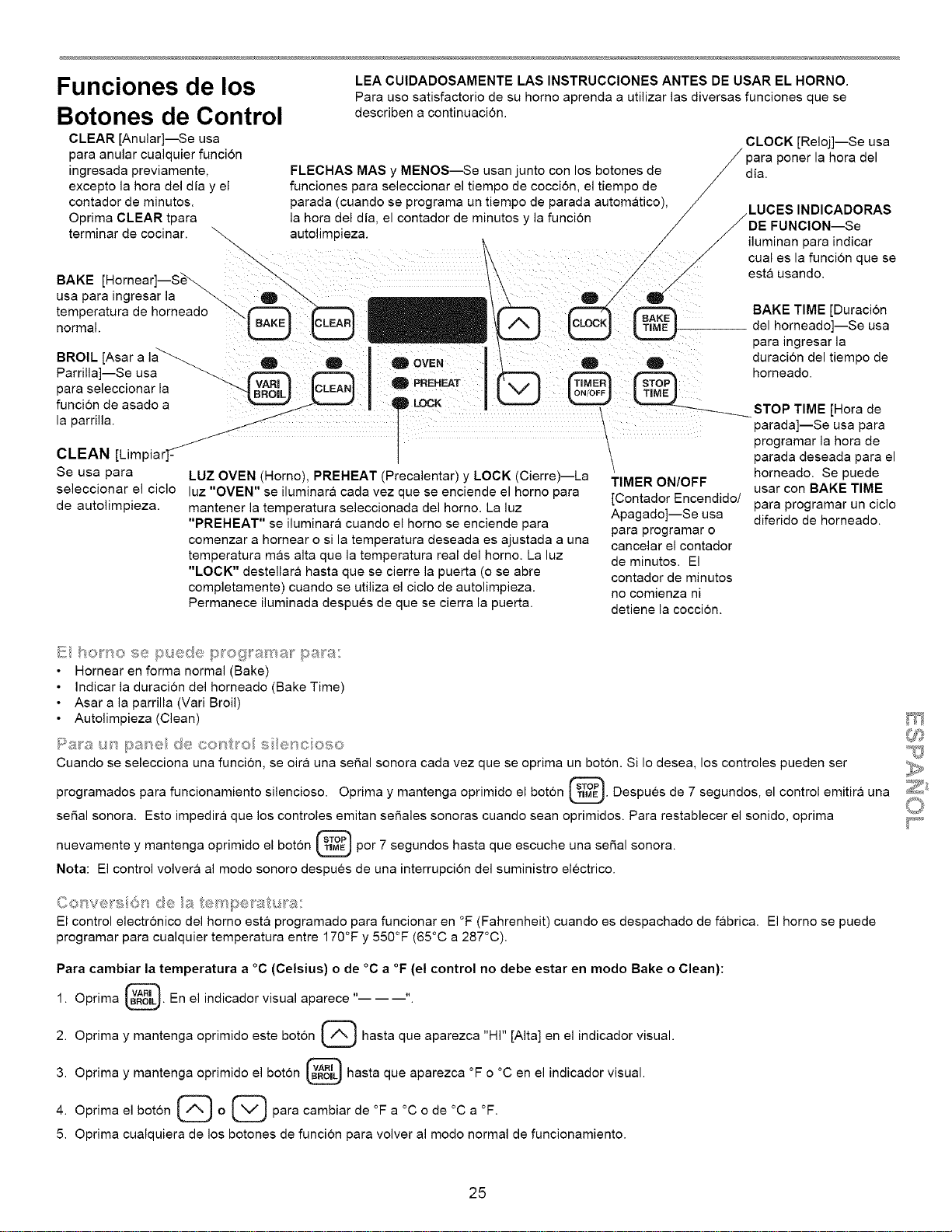
Funciones de los
Botones de Control
CLEAR [Anular]--Se usa
para anular cualquier funci6n
ingresada previamente,
excepto la hora del dta y el
contador de minutos.
Oprima CLEAR tpara
terminar de cocinar.
\
BAKE [Hornear]--Se_. _
usa para ingresar la _ "_S
de horneado _"\(-="-'_ _==_
temperatura
normal.
BROIL [Asar a la_.
I O
Parrifla]--Se usa
para seleccionar la _
funci6n de asado a
/
la parrilla. /J ---j/"
CLEAN [Limpiar-_ _
Se usa para
seleccionar el ciclo
de autolimpieza.
LEA CUIDADOSAMENTE LAS INSTRUCCIONES ANTES DE USAR EL HORNO.
Para uso satisfactorio de su homo aprenda a utilizar las diversas funciones que se
describen a continuaci6n.
FLECHAS MAS y MENOS--Se usan junto con los botones de
funciones para seleccionar el tiempo de cocci6n, el tiempo de
parada (cuando se programa un tiempo de parada automatico),
la hora del dia, el contador de minutos y la funci6n
autolimpieza.
g
O OVEN
CLOCK [Reloj]--Se usa
hora del
dia.
LUCES INDICADORAS
FUNCION--Se
iluminan para indicar
cual es la funci6n que se
esta usando.
BAKE TIME [Duraci6n
del horneado]--Se usa
para ingresar la
duraci6n del tiempo de
_ horneado.PREHEAT
O LOCK \ _ [
STOP TIME Hora de
\ parada]--Se usa para
\ programar la hora de
parada deseada para el
horneado. Se puede
LUZ OVEN (Homo), PREHEAT (Precalentar) y LOCK (Cierre)--La TIMER ON/OFF usar con BAKE TIME
luz "OVEN" se iluminara cada vez que se enciende el homo para
mantener la temperatura seleccionada del homo. La luz
"PREHEAT" se iluminara cuando el homo se enciende para
comenzar a hornear o si la temperatura deseada es ajustada a una
temperatura mas alta que la temperatura real del homo. La luz
"LOCK" destellara hasta que se cierre la puerta (o se abre
completamente) cuando se utiliza el ciclo de autolimpieza.
Permanece iluminada despues de que se cierra la puerta.
[Contador Encendido/
Apagado]--Se usa
para programar o
cancelar el contador
de minutos. El
contador de minutos
no comienza ni
detiene la cocci6n.
para programar un ciclo
diferido de horneado.
E _on'so se puede p_og_a_s'a_ pa_a:
Hornear en forma normal (Bake)
Indicar la duracion del horneado (Bake Time)
• Asar a la parrilla (Vari Broil)
• Autolimpieza (Clean)
Pa_auspase decos_'o s encoso
Cuando se selecciona una funci6n, se oira una sei_al sonora cada vez que se oprima un bot6n. Si Io desea, los controles pueden ser
programados para funcionamiento silencioso. Oprima y mantenga oprimido el bot6n . Despues de 7 segundos, el control emitira una _
serial sonora. Esto impedira que los controles emitan sefiales sonoras cuando sean oprimidos. Para restablecer el sonido, oprima [_,,_
nuevamente y mantenga oprimido el bot6n _ por 7 segundos hasta que escuche una sei_al sonora.
Nota: El control volvera al modo sonoro despues de una interrupcidn del suministro electrico.
El control electr6nico del homo esta programado para funcionar en °F (Fahrenheit) cuando es despachado de fabrica. El homo se puede
programar para cualquier temperatura entre 170°F y 550°F (65°C a 287°C).
Para cambiar la temperatura a °C (Celsius) o de °C a °F (el control no debe estar en modo Bake o Clean):
1. Oprima _. En el indicador visual aparece .... .
2. Oprima y mantenga oprimido este bot6n (_ hasta que aparezca "HI" [AIta] en el indicador visual.
3. Oprima y mantenga oprimido el botdn _ hasta que aparezca °F o °C en el indicador visual.
4. Oprima el botdn @ o (_ para cambiar de °F a °C o de °C a °F.
5. Oprima cualquiera de los botones de funci6n para volver al modo normal de funcionamiento.
25
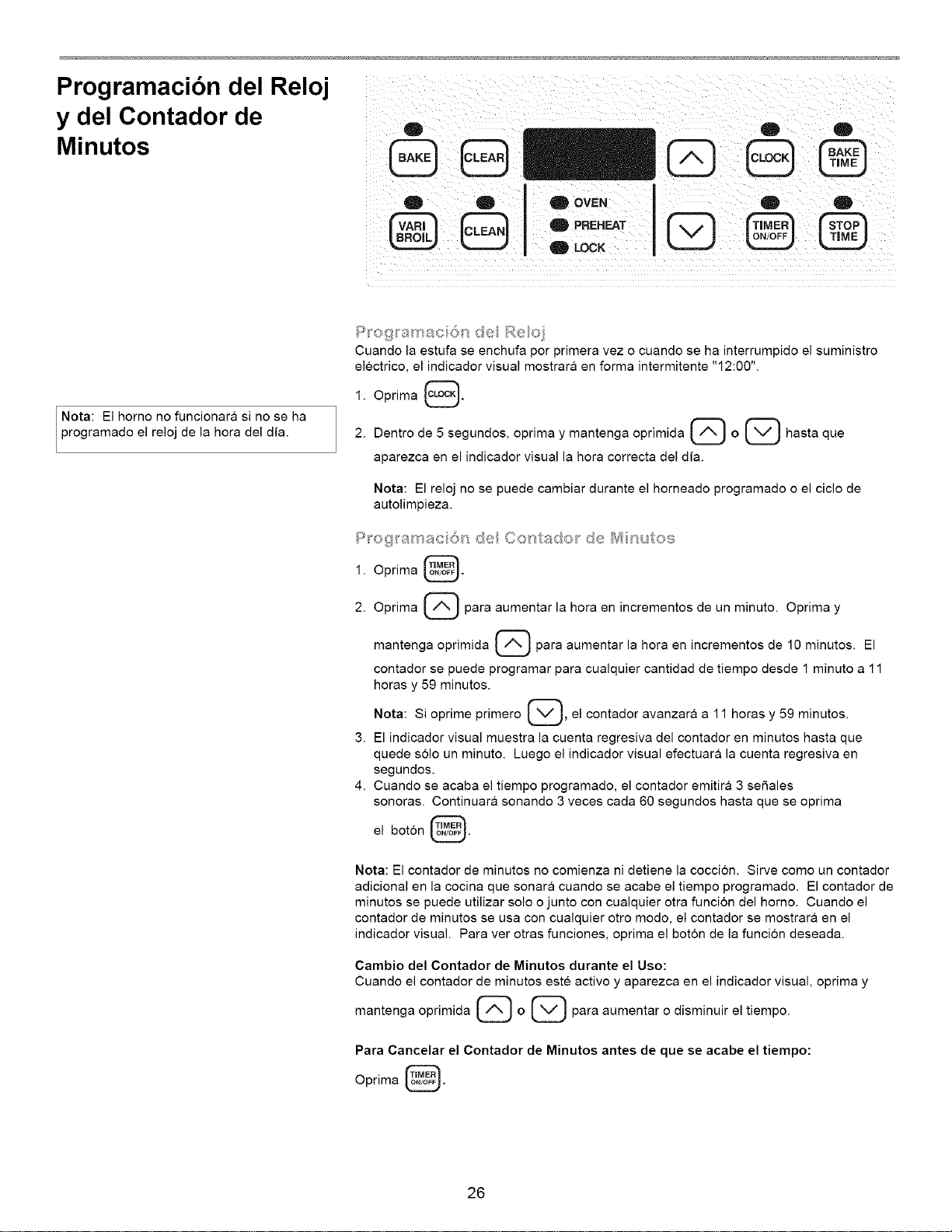
Programacibn del Reloj
y del Contador de
a o i
Minutos @ @
O OVEN
PREHEAT
S LOCK
D O
@@@
Nota: El horno no funcionara si no se ha
programado el reloj de la hora del dia.
<#e
Cuando la estufa se enchufa por primera vez o cuando se ha interrumpido el suministro
electrico, el indicador visual mostrara en forma intermitente "12:00".
1. Oprima @.
2. Dentro de 5 segundos, oprima y mantenga oprimida _ o _ hasta que
aparezca en el indicador visual la hora correcta del dia.
Nota: El reloj no se puede cambiar durante el horneado programado o el ciclo de
autolimpieza.
P_'og_-a_'ssc @-sde Co_d:adot de !'_Vlmr_;os
1. Oprima @.
2. Oprima _ para aumentar la hora en incrementas de un minuto. Oprima y
mantenga oprimida _ para aumentar la hora en incrementos de 10 minutos. El
contador se puede programar para cualquier cantidad de tiempo desde 1 minuto a 11
horas y 59 minutos.
Nota: Si oprime primero @, el contador avanzara a 11 horas y 59 minutos.
3. El indicador visual muestra la cuenta regresiva del contador en minutos hasta que
quede solo un minuto. Luego el indicador visual efectuara la cuenta regresiva en
segundos.
4. Cuando se acaba el tiempo programado, el contador emitir& 3 set, ales
sonoras. Continuara sonando 3 veces cada 60 segundos hasta que se oprima
el boton @.
Nota: El contador de minutos no comienza ni detiene la coccion. Sirve como un contador
adicional en la cocina que sonara cuando se acabe el tiempo programado. El contador de
minutos se puede utilizar solo o junto con cualquier otra funcion del horno. Cuando el
contador de minutos se usa con cualquier otro modo, el contador se mostrara en el
indicador visual. Para ver otras funciones, oprima el bot6n de la funcion deseada.
Cambio del Contador de Minutos durante el Uso:
Cuando el contador de minutos este activo y aparezca en el indicador visual, oprima y
mantenga oprimida r_ o r_ para aumentar o disminuir el tiempo.
i i
Para Cancelar el Contador de Minutos antes de que se acabe el tiempo:
Oprima @.
26
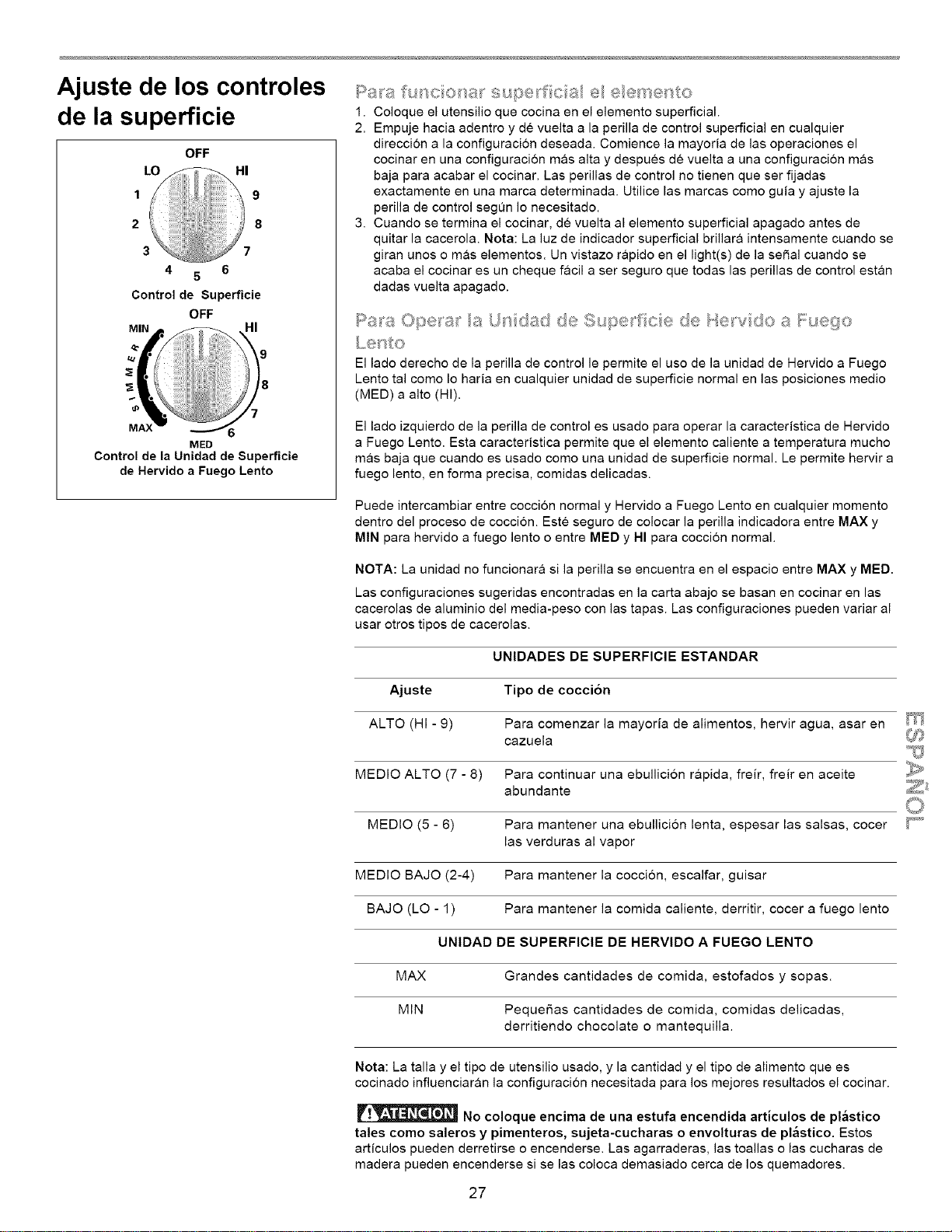
Ajuste de los controles
de la superficie
OFF
1 9
2 8
4 6
5
Control de Superficie
OFF
MED
Control de la Unidad de Superficie
de Hervido a Fuego Lento
1. Coloque el utensilio que cocina en el elemento superficial.
2. Empuje hacia adentro y de vuelta a la perilla de control superficial en cualquier
direcci6n a la configuraci6n deseada. Comience la mayoda de las operaciones el
cocinar en una configuraci6n mas alta y despues de vuelta a una configuraci6n mas
baja para acabar el cocinar. Las perillas de control no tienen que ser fijadas
exactamente en una marca determinada. Utilice las marcas come guia y ajuste la
perilla de control segSn Io necesitado.
8. Cuando se termina el cocinar, de vuelta al elemento superficial apagado antes de
quitar la cacerola. Nota: La luz de indicador superficial brillara intensamente cuando se
giran unos o mas elementos. Un vistazo rapido en el light(s) de la sepal cuando se
acaba el cocinar es un cheque facil a ser seguro que todas las perillas de control estan
dadas vuelta apagado.
El lade derecho de la perilla de control le permite el use de la unidad de Hervido a Fuego
Lento tal como Io haria en cualquier unidad de superficie normal en las posiciones medio
(MED) a alto (HI).
El lade izquierdo de la perilla de control es usado para operar la caracteristica de Hervido
a Fuego Lento. Esta caracteristica permite que el elemento caliente a temperatura mucho
mas baja que cuando es usado como una unidad de superficie normal. Le permite hervir a
fuego lento, en forma precisa, comidas delicadas.
Puede intercambiar entre cocci6n normal y Hervido a Fuego Lento en cualquier memento
dentro del proceso de cocci6n. Este seguro de colocar la perilla indicadora entre MAX y
MIN para hervido a fuego lento o entre MED y HI para cocci6n normal.
NOTA: La unidad no funcionara si la perilla se encuentra en el espacio entre MAX y MED.
Las configuraciones sugeridas encontradas en la carta abajo se basan en cocinar en las
cacerolas de aluminio del media-peso con las tapas. Las configuraciones pueden variar al
usar otros tipos de cacerolas.
UNIDADES DE SUPERFICIE ESTANDAR
Ajuste Tipo de cocci6n
ALTO (HI - 9) Para comenzar la mayoria de alimentos, hervir agua, asar en
cazuela
MEDIO ALTO (7 - 8) Para continuar una ebullici6n rapida, freir, freir en aceite
abundante
MEDIO (5 - 6) Para mantener una ebullici6n lenta, espesar las salsas, cocer
las verduras al vapor
MEDIO BAJO (2-4) Para mantener la coccion, escalfar, guisar
BAJO (LO - 1) Para mantener la comida caliente, derritir, cocer a fuego lento
UNIDAD DE SUPERFICIE DE HERVIDO A FUEGO LENTO
MAX Grandes cantidades de comida, estofados y sopas.
MIN Pequet_as cantidades de comida, comidas delicadas,
derritiendo chocolate o mantequilla.
V
Nota: La talla y el tipo de utensilio usado, y la cantidad y el tipo de alimento que es
cocinado influenciaran la configuraci6n necesitada para los mejores resultados el cocinar.
No coloque encima de una estufa encendida articulos de pl_stico
tales como saleros y pimenteros, sujeta-cucharas o envolturas de pl_stico. Estos
articulos pueden derretirse o encenderse. Las agarraderas, las toallas o las cucharas de
madera pueden encenderse si se las coloca demasiado cerca de los quemadores.
27
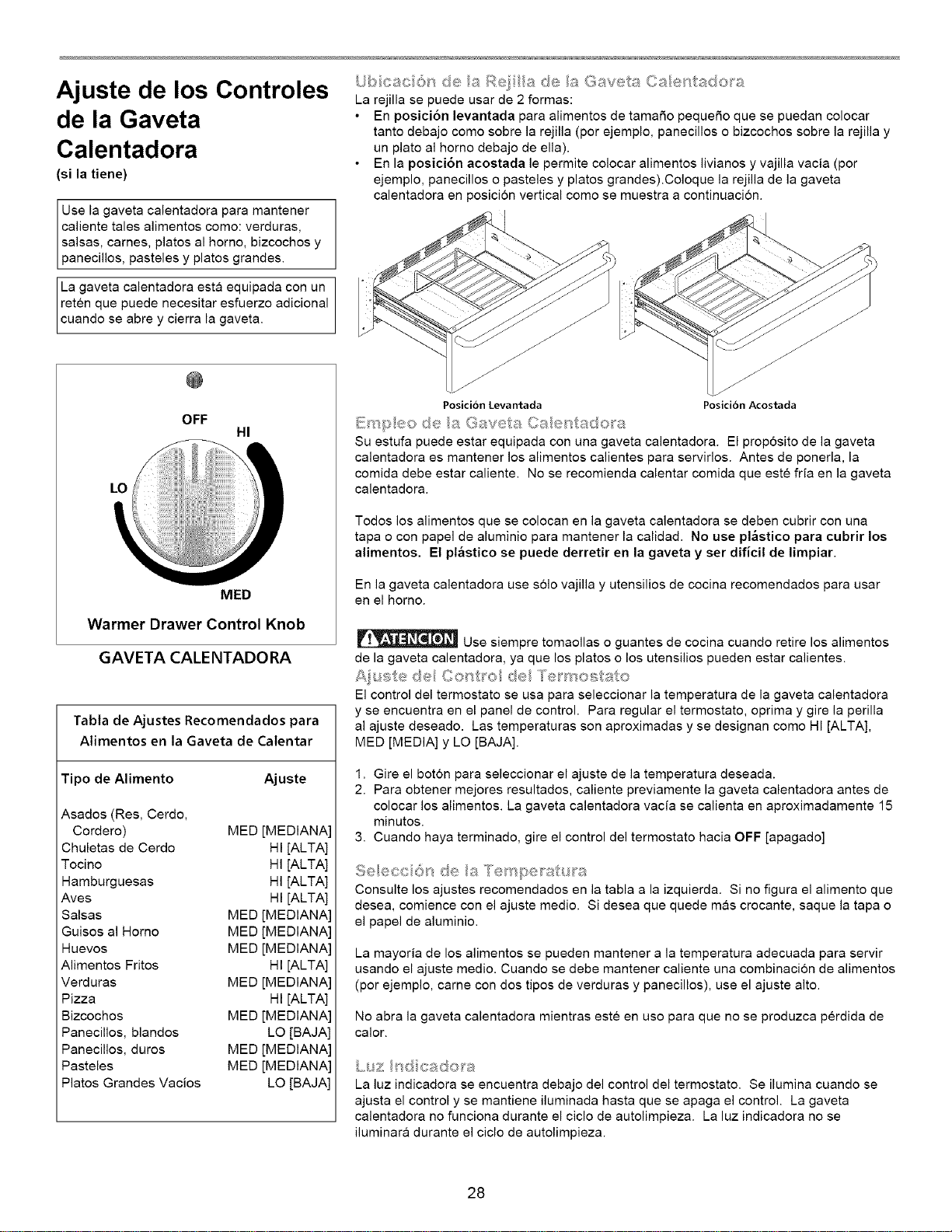
Ajuste de los Controles
de la Gaveta
Calentadora
(si la tiene)
Use la gaveta calentadora para mantener
caliente tales alimentos como: verduras,
salsas, carnes, platos al homo, bizcochos y
)anecillos, pasteles y platos grandes.
La gaveta calentadora esta equipada con un
reten que puede necesitar esfuerzo adicional
cuando se abre y cierra la gaveta.
OFF
HI
LO
MED
Warmer Drawer Control Knob
GAVETA CALE NTADO RA
Tabla de Ajustes Recomendados para
Alimentos en la Gaveta de Calentar
Tipo de Alimento Ajuste
Asados (Res, Cerdo,
Cordero) MED [MEDIANA]
Chuletas de Cerdo HI [ALTA]
Tocino HI [ALTA]
Hamburguesas HI [ALTA]
Aves HI [ALTA]
Salsas MED [MEDIANA]
Guisos al Homo MED [MEDIANA]
Huevos MED [MEDIANAi
Alimentos Fritos HI [ALTA]'
Verduras MED [MEDIANA]
Pizza HI [ALTA]
Bizcochos MED [MEDIANA]
Panecillos, blandos LO [BAJA]
Panecillos, duros MED [MEDIANA]
Pasteles MED [MEDIANAi
Platos Grandes Vacios LO [BAJA]
Ub cac 6_s de a R{,,"i a de a Gaveta C_:_®ntado_a
La rejilla se puede usar de 2 formas:
En posici6n levantada para alJmentos de tamafio pequet_o que se puedan colocar
tanto debajo como sobre la rejilla (por ejemplo, panecillos o bJzcochos sobre la rejilla y
un plato al homo debajo de ella).
En la posici6n acoatada le permite colocar alimentos IJvianos y vajJlla vacia (por
ejemplo, panecillos o pasteles y platos grandes).Ooloque la rejilla de la gaveta
calentadara en posicJ6n vertical como se muestra a contJnuacJ6n.
/ //
/ /
/
Posicion Levantada Posicion Acostada
Su estufa puede estar equipada con una gaveta calentadora. El prop0sito de la gaveta
calentadora es mantener los alimentos calientes para servidos. Antes de ponerla, la
comida debe estar caliente. No se recomienda calentar comida que est¢ fria en la gaveta
calentadora.
Todos los alimentos que se colocan en la gaveta calentadora se deben cubrir con una
tapa o con papel de aluminio para mantener la calidad. No use pl&stico para cubrir los
alimentos, El pl_stico se puede derretir en la gaveta y ser dificil de limpiar.
En la gaveta calentadora use s61o vajilla y utensilios de cocina recomendados para usar
en el homo.
Use siempre tomaollas o guantes de cocina cuando retire los alimentos
de la gaveta calentadora, ya que los platos o los utensilios pueden estar calientes.
Ai_4ste de Co_sbo d_s _'e_'mostato
El control del termostato se usa para seleccionar la temperatura de la gaveta calentadora
y se encuentra en el panel de control. Para regular el termostato, oprima y gire la perilla
al ajuste deseado. Las temperaturas son aproximadas y se designan como HI [ALTA],
MED [MEDIA] y LO [BAJA].
1. Gire el boton para seleccionar el ajuste de la temperatura deseada.
2. Para obtener mejores resultados, caliente previamente la gaveta calentadora antes de
colocar los alimentos. La gaveta calentadora vacia se calienta en aproximadamente 15
minutos.
3. Cuando haya terminado, gire el control del termostato hacia OFF [apagado]
Se ®cc S_"sde a Temf:,®_at_s_a
Consulte los ajustes recomendados en la tabla a la izquierda. Si no figura el alimento que
desea, comience con el ajuste medio. Si desea que quede mas crocante, saque la tapa o
el papel de aluminio.
La mayoria de los alimentos se pueden mantener a la temperatura adecuada para servir
usando el ajuste medio. Cuando se debe mantener caliente una combinaci6n de alimentos
(por ejemplo, came con dos tipos de verduras y panecillos), use el ajuste alto.
No abra la gaveta calentadora mientras este en uso para que no se produzca perdida de
calor.
La luz indicadora se encuentra debajo del control del termostato. Se ilumina cuando se
ajusta el control y se mantiene iluminada hasta que se apaga el control. La gaveta
calentadora no funciona durante el ciclo de autolimpieza. La luz indicadora no se
iluminara durante el ciclo de autolimpieza.
28
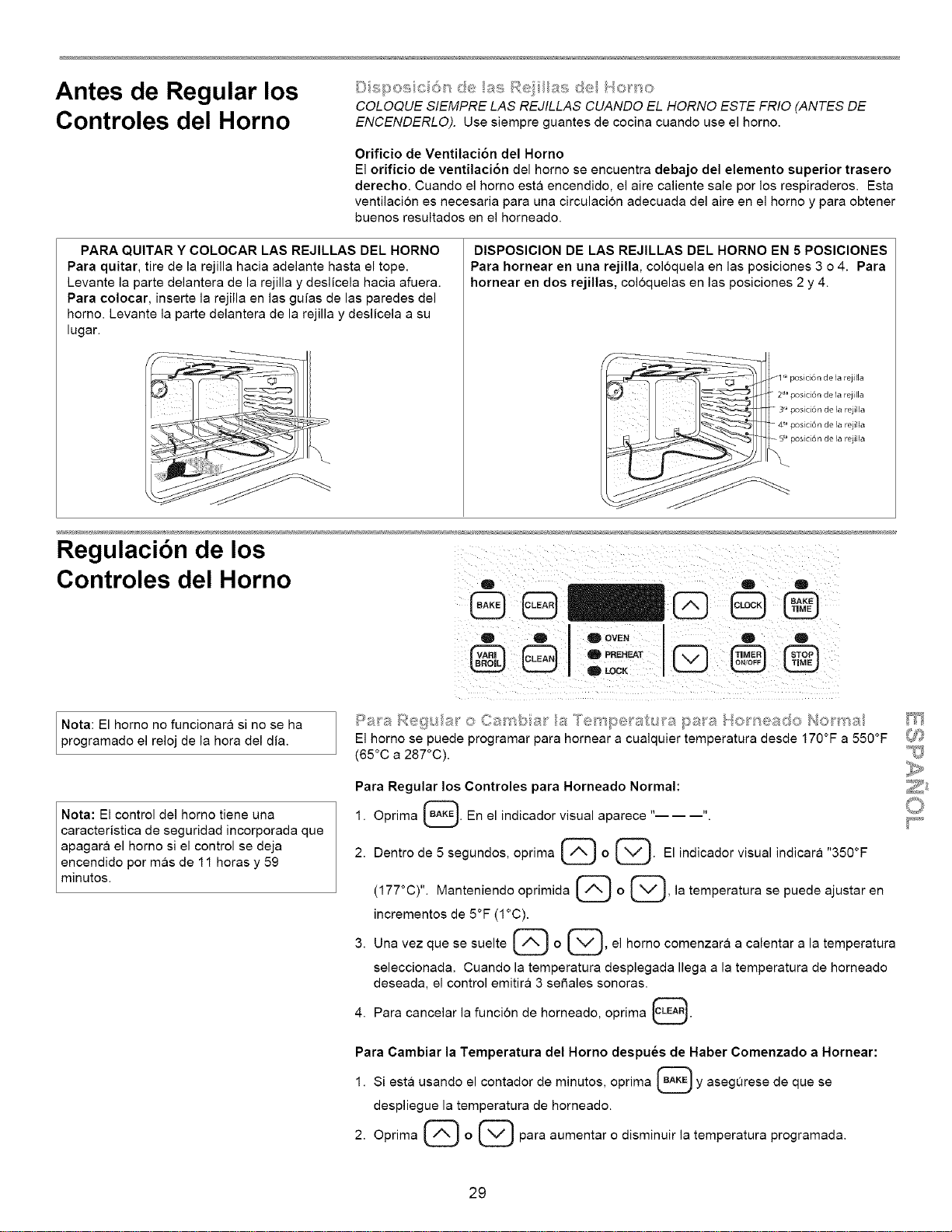
Antes de Regular los
Controles del Horno
COLOQUE SIEMPRE LAS REJILLAS CUANDO EL HORNO ESTE FRIO (ANTES DE
ENCENDERLO). Use siempre guantes de cocina cuando use el horno.
Orificio de Ventilaci6n del Horno
El orificio de ventilaci6n del homo se encuentra debajo del elemento superior trasero
derecho. Cuando el homo esta encendido, el aire caliente sale por los respiraderos. Esta
ventilaci6n es necesaria para una circulaci6n adecuada del aire en el homo y para obtener
buenos resultados en el horneado.
PARA QUITAR Y COLOCAR LAS REJILLAS DEL HORNO
Para quitar, tire de la rejilla hacia adelante hasta el tope.
Levante la parte delantera de la rejilla y deslicela hacia afuera.
Para colocar, inserte la rejilla en las guias de las paredes del
horno. Levante la parte delantera de la rejilla y deslicela a su
lugar.
\
DISPOSICION DE LAS REJILLAS DEL HORNO EN 5 POSICIONES
Para hornear en una rejilla, col6quela en las posiciones 3 o 4. Para
hornear en dos rejillas, col6quelas en las posiciones 2 y 4.
2d_ posid6n de la rejflla
3*° posid6n de la rejilla
- 4 _ posid6n de la rejilla
5_ posid6n de la rejilla
\
Regulacibn de los
Controles del Horno @ @ @
I I
. . .OVEN @ @
I LOCK
Nota: El homo no funcionara si no se ha
programado el reloj de la hora del dia.
Nota: El control del homo tiene una
caracteristica de seguridad incorporada que
apagara el homo si el control se deja
encendido por mas de 11 horas y 59
minutos.
,,/'_,,_......._ Reg_ a_ o Ca_-sb ar a pa_a ,_ _:nes :_obows
El homo se puede programar para hornear a cualquier temperatura desde 170°F a 550°F
(65°C a 287°C).
Para Regular los Controles para Horneado Normal:
1. Oprima _. En el indicador visual aparece
i
II
2. Dentro de 5 segundos, oprima @ o @. El indicador visual indicara "350°F
(177°O) ". Manteniendo oprimida @ o @, la temperatura se puede ajustar en
incrementos de 5°F (1°C).
3. Una vez que se suelte @ o @, el homo comenzara a calentar a la temperatura
seleccionada. Cuando la temperatura desplegada Ilega a la temperatura de horneado
deseada, el control emitira 3 seSales sonoras.
4. Para cancelar la funcion de horneado, oprima _.
Para Cambiar la Temperatura del Horno despu_s de Haber Comenzado a Hornear:
1. Siesta usando el contador de minutos, oprima 8A_ y asegerese de que se
despliegue la temperatura de horneado.
2. Optima _ o _ para aumentar o disminuir la temperatura programada.
i
29
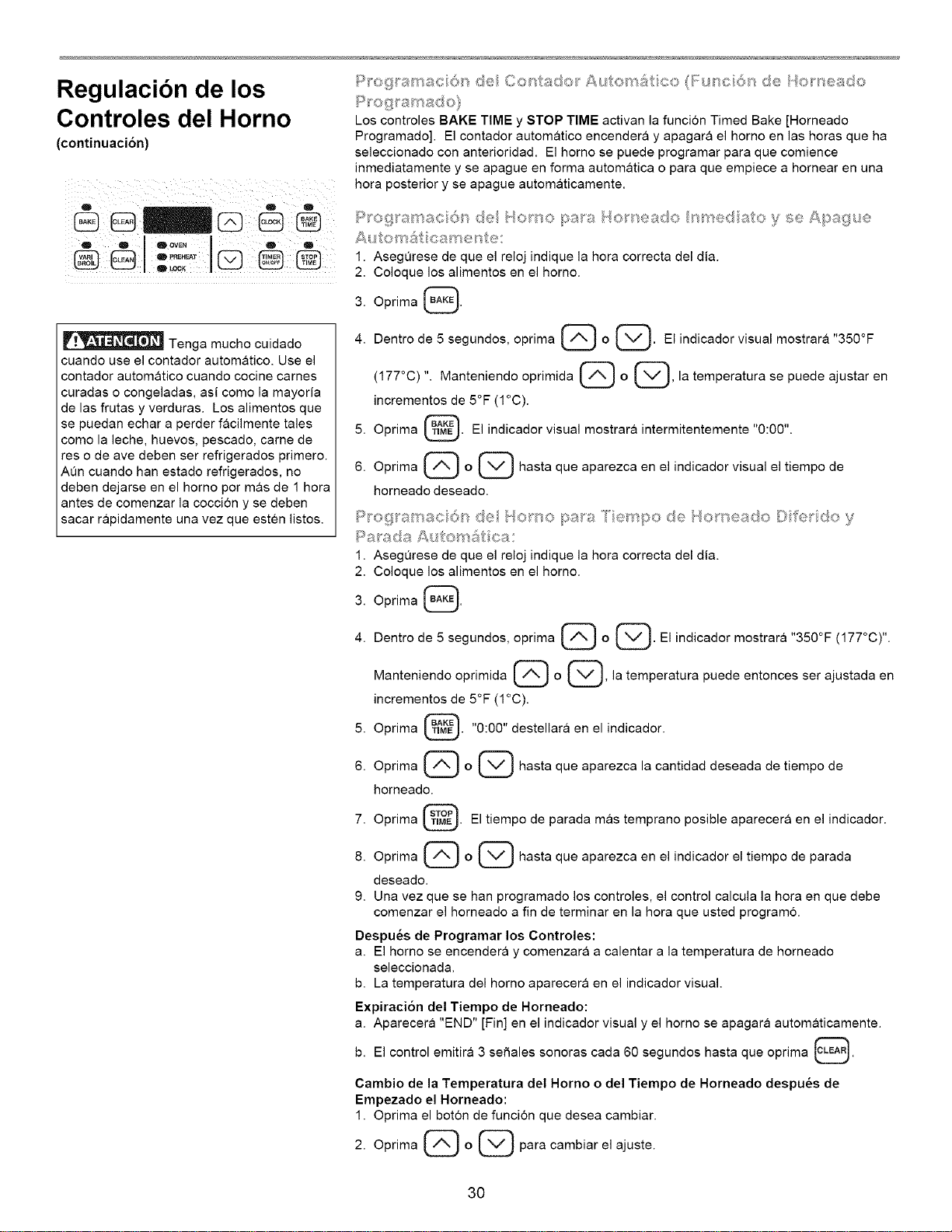
Regulacibn de los
Controles del Horno
(continuaci6n)
.
Tenga mucho cuidado
cuando use el contador automatico. Use el
contador automatico cuando cocine carnes
curadas o congeladas, asi como la mayoria
de las frutas y verduras. Los alimentos que
se puedan echar a perder facilmente tales
como la leche, huevos, pescado, came de
res o de ave deben ser refrigerados primero.
Aun cuando han estado refrigerados, no
deben dejarse en el homo por mas de 1 hora
antes de comenzar la cocci6n y se deben
sacar rapidamente una vez que esten listos.
Los controles BAKE TIME y STOP TIME activan la funci6n Timed Bake [Horneado
Programado]. El contador automatico encendera y apagara el homo en las horas que ha
seleccionado con anterioridad. El homo se puede programar para que comience
inmediatamente y se apague en forma automatica o para que empiece a hornear en una
hora posterior y se apague automaticamente.
1. Aseg0rese de que el reloj indique la hora correcta del dia.
2. Coloque los alimentos en el horno.
3. Optima @.
4. Dentro de 5 segundos, oprima (_ o (_). El indicador visual mostrara "350°F
(177°C) ". Manteniendo oprimida @ o (_, la temperatura se puede ajustar en
incrementos de 5°F (1°C).
5. Optima @. El indicador visual mostrara intermitentemente "0:00".
i
6. Optima @ o @ hasta que aparezca en el indicador visual el tiempo de
horneado deseado.
P_og_smac 6_,sde 4o:no pa_a T ®':_po de -o_'n®sdo O fe/_ do y
Pa_'ada Aul'o/c;s_t ca:
1. AsegQrese de que el reloj indique la hora correcta del dia.
2. Coloque los alimentos en el homo.
3. Optima _.
4. Dentro de 5 segundos, oprima @ o @. El indicador mostrara "350°F (177°C) ''.
Manteniendo oprimida @ o @, la temperatura puede entonces ser ajustada en
incrementos de 5°F (1°C).
5. Optima _. "0:00" destellara en el indicador.
6. Optima @ o @ hasta que aparezca la cantidad deseada de tiempo de
horneado.
7. Optima @. El tiempo de parada mas temprano posible aparecera en el indicador.
8. Optima G o @ hasta que aparezca en el indicador el tiempo de parada
deseado.
9. Una vez que se han programado los controles, el control calcula la hora en que debe
comenzar el horneado a fin de terminar en la hora que usted program6.
Despu_s de Programar los Controles:
a. El homo se encendera y comenzara a calentar a la temperatura de horneado
seleccionada.
b. La temperatura del homo aparecera en el indicador visual.
Expiracibn del Tiempo de Horneado:
a. Aparecera "END" [Fin] en el indicador visual y el homo se apagara automaticamente.
b. El control emitira 3 sefiales sonoras cada 60 segundos hasta que optima _.
Cambio de la Temperatura del Horno o del Tiempo de Horneado despu_s de
Empezado el Horneado:
1. Optima el bot6n de funcion que desea cambiar.
2. Optima @ o @ para cambiar el ajuste.
i
30
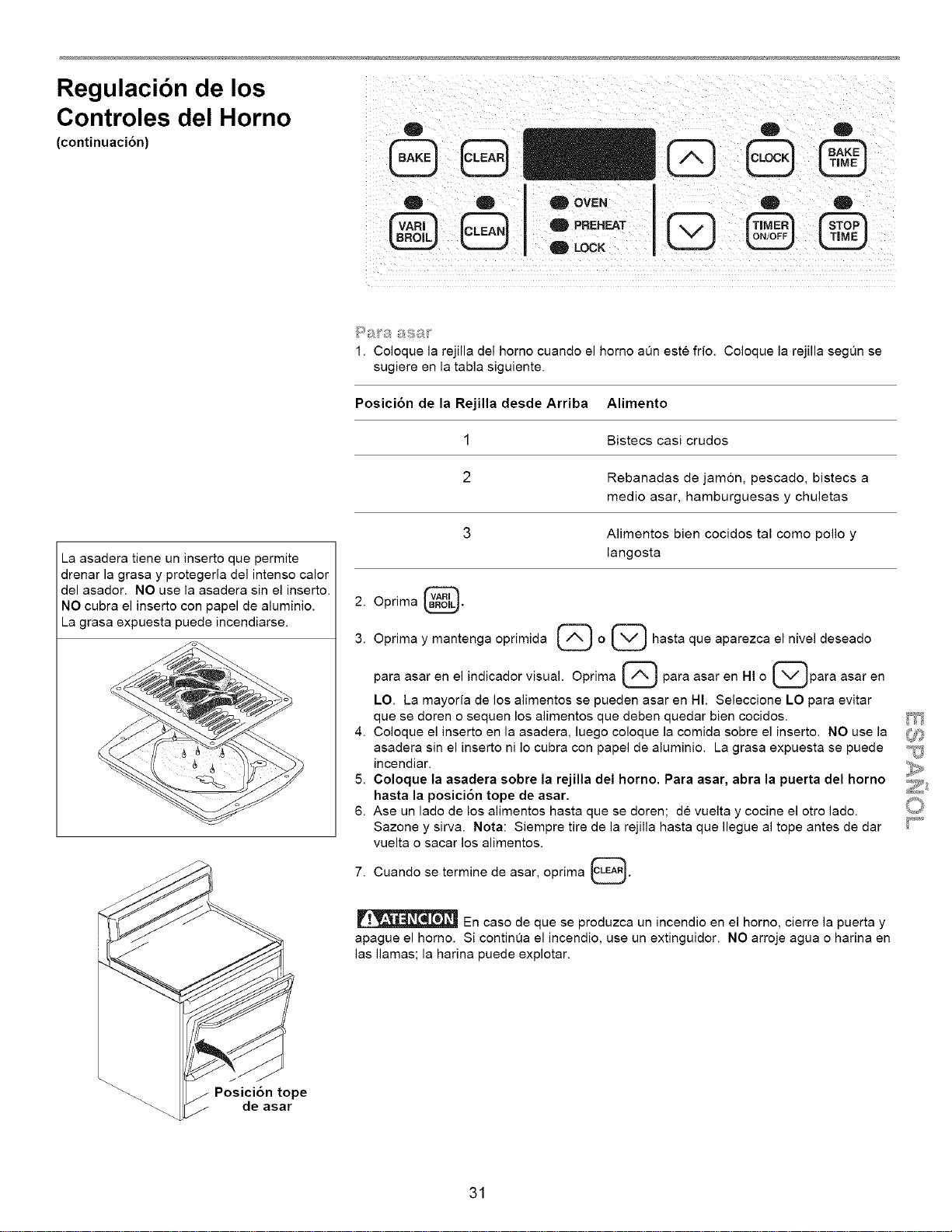
Regulacibn de los
Controles del Horno
(continuaci6n)
D D I
O OVEN
PREHEAT
S LOCK
D O
@@@
La asadera tiene un inserto que permite
drenar la grasa y protegeria del intenso calor
del asador. NO use la asadera sin el inserto.
NO cubra el inserto con papel de aluminio.
La grasa expuesta puede incendiarse.
1. Coloque ia rejilla del horno cuando el horno aun este frio. Coloque la rejilla segun se
sugiere en la tabla siguiente.
Posicibn de la Rejilla desde Arriba Alimento
1 Bistecs casi crudos
2 Rebanadas de jamon, pescado, bistecs a
medio asar, hamburguesas y chuletas
3 Alimentos bien cocidos tal como polio y
langosta
2. Oprima @.
3. Oprima y mantenga oprimida _} o _ hasta que aparezca el nivel deseado
para asar en el indicador visual. Oprima G para asar en HI o _para asar en
LO. La mayoria de los alimentos se pueden asar en HI. Seleccione LO para evitar
que se doren o sequen los alimentos que deben quedar bien cocidos.
4. Coloque el inserto en la asadera, luego coloque la comida sobre el inserto. NO use la
asadera sin el inserto ni Io cubra con papel de aluminio. La grasa expuesta se puede
incendiar.
5. Coloque la asadera sobre la rejilla del horno. Para asar, abra la puerta del horno
hasta la posici6n tope de asar.
6. Ase un lado de los alimentos hasta que se doren; de vuelta y cocine el otro lado.
Sazone y sirva. Nota: Siempre tire de la rejilla hasta que Ilegue al tope antes de dar
vuelta o sacar los alimentos.
7. Cuando se termine de asar, oprima _.
En caso de que se produzca un incendio en el homo, cierre la puerta y
apague el homo. Si continQa el incendio, use un extinguidor. NO arroje agua o harina en
las llamas; la harina puede explotar.
31
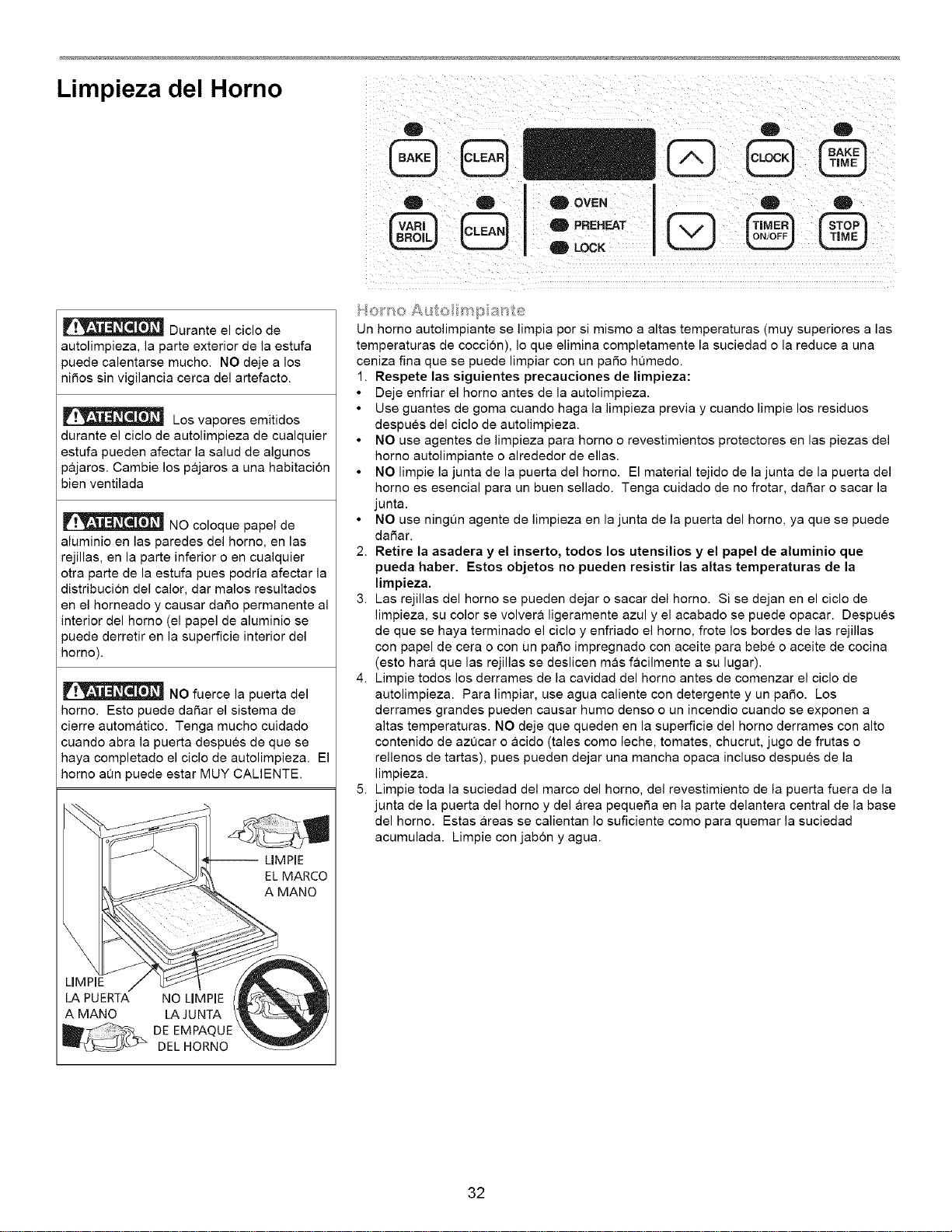
Limpieza del Horno
D I
Q OVEN
PREHEAT
LOCK
D I
Durante el ciclo de
autolimpieza, la parte exterior de la estufa
)uede calentarse mucho. NO deje a los
niSos sin vigilancia cerca del artefacto.
Los vapores emitidos
durante el ciclo de autolimpieza de cualquier
estufa pueden afectar la salud de algunos
pajaros. Cambie los pajaros a una habitaci6n
bien ventilada
NO coloque papel de
aluminio en las paredes del homo, en las
rejillas, en la parte inferior o en cualquier
otra parte de la estufa pues podria afectar la
distribuci6n del calor, dar malos resultados
en el horneado y causar dai_o permanente al
interior del homo (el papel de aluminio se
)uede derretir en la superficie interior del
homo).
NO fuerce la puerta del
horno. Esto puede daSar el sistema de
cierre automatico. Tenga mucho cuidado
cuando abra la puerta despues de que se
haya completado el ciclo de autolimpieza. El
homo a0n puede estar MUY CALIENTE.
-- LIMPIE
EL MARCO
A MANO
LIMPIE
LA PUERTA NO LIMPIE
A MANO LA JUNTA
DE EMPAQUE
DEL HORNO
Un horno autolimpiante se limpia per si mismo a altas temperaturas (muy superiores alas
temperaturas de cocci6n), Io que elimina completamente la suciedad o la reduce a una
ceniza fina que se puede limpiar con un pado h0medo.
1. Respete las siguientes precauciones de limpieza:
• Deje enfriar el homo antes de la autolimpieza.
• Use guantes de goma cuando haga la limpieza previa y cuando limpie los residuos
despues del ciclo de autolimpieza.
• NO use agentes de limpieza para horno o revestimientos protectores en las piezas del
homo autolimpiante o alrededor de elias.
• NO limpie la junta de la puerta del horno. El material tejido de la junta de la puerta del
homo es esencial para un buen sellado. Tenga cuidado de no frotar, daSar o sacar la
junta.
• NO use ningun agente de limpieza en la junta de la puerta del homo, ya que se puede
daSar.
2. Retire la asadera y el inserto, todos los utensilios y el papel de aluminio que
pueda haber. Estos objetos no pueden resistir las altas temperaturas de la
limpieza.
3. Las rejillas del homo se pueden dejar o sacar del horno. Si se dejan en el ciclo de
limpieza, su color se volvera ligeramente azul y el acabado se puede opacar. Despues
de que se haya terminado el ciclo y enfriado el homo, frote los bordes de las rejillas
con papel de cera o con un paso impregnado con aceite para bebe o aceite de cocina
(esto hara que las rejillas se deslicen mas facilmente a su lugar).
4. Limpie todos los derrames de la cavidad del homo antes de comenzar el ciclo de
autolimpieza. Para limpiar, use agua caliente con detergente y un paso. Los
derrames grandes pueden causar humo denso o un incendio cuando se exponen a
altas temperaturas. NO deje que queden en la superficie del homo derrames con alto
contenido de azucar o acido (tales como leche, tomates, chucrut, jugo de frutas o
rellenos de tartas), pues pueden dejar una mancha opaca incluso despues de la
limpieza.
5. Limpie toda la suciedad del marco del homo, del revestimiento de la puerta fuera de la
junta de la puerta del homo y del area pequer_a en la parte delantera central de la base
del horno. Estas areas se calientan Io suficiente como para quemar la suciedad
acumulada. Limpie con jab6n y agua.
32
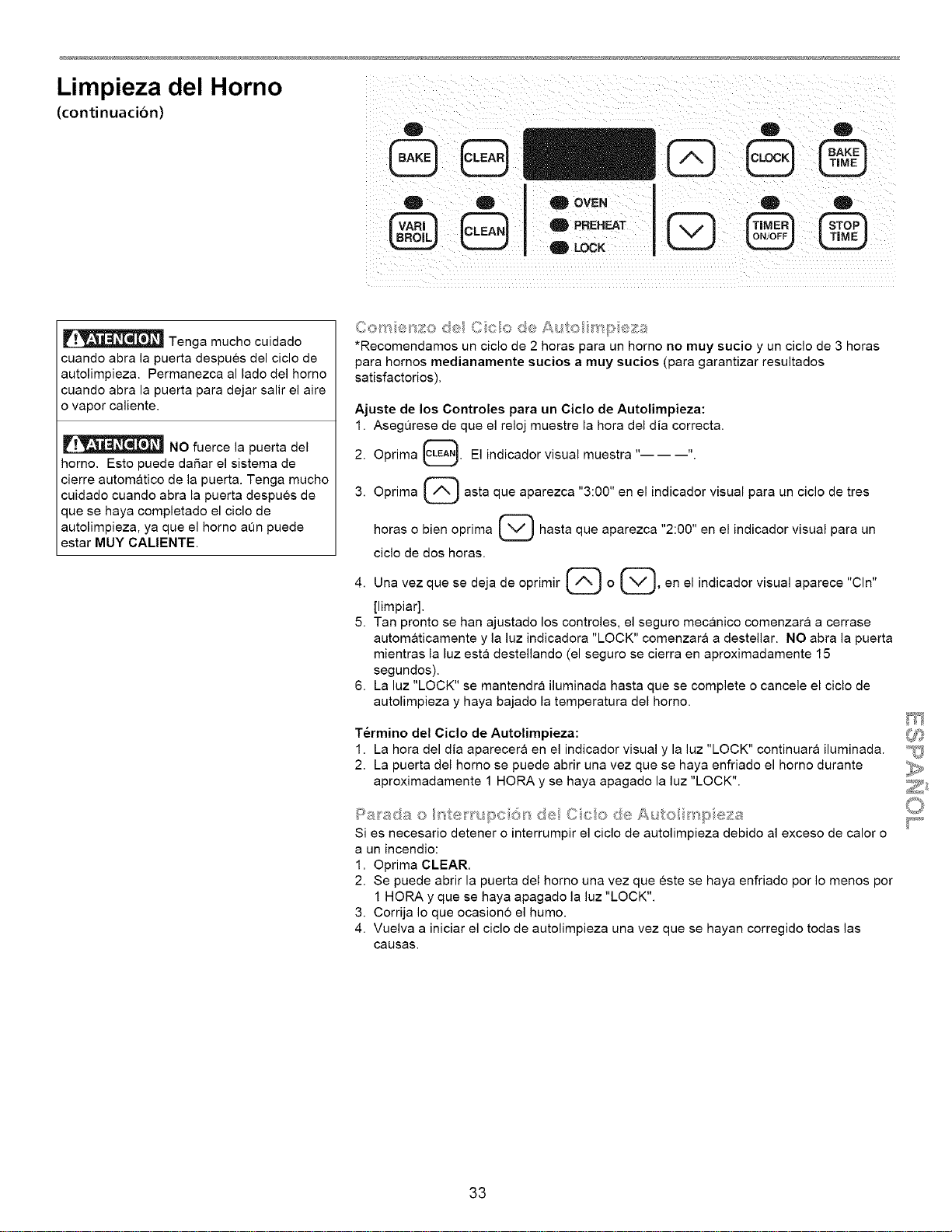
Limpieza del Horno
(continuacion)
i = o
Q@@
OVEN
PREHEAT
g LOCK
D I
@@@
Tenga mucho cuidado
cuando abra la puerta despues del ciclo de
autolimpieza. Permanezca al lado del homo
cuando abra la puerta para dejar salir el aire
o vapor caliente.
NO fuerce la puerta del
horno. Esto puede daBar el sistema de
cierre automatico de la puerta. Tenga mucho
cuidado cuando abra la puerta despues de
que se haya completado el ciclo de
autolimpieza, ya que el horno aQn puede
estar MUY CALIENTE.
Comic °_zo del Cic/o de £_ to/impieza
*Recomendamos un ciclo de 2 horas para un homo no muy sucio y un ciclo de 3 horas
para hornos medianamente sucios a muy sucios (para garantizar resultados
satisfactorios).
Ajuste de los Controles para un Ciclo de Autolimpieza:
1. Asegt_rese de que el reloj muestre la hora del dia correcta.
2. Oprima _. El indicador visual muestra
II
3. Oprima (_ asta que aparezca "3:00" en el indicador visual para un ciclo de tres
horas o bien oprima @ hasta que aparezca "2:00" en el indicador visual para un
ciclo de dos horas.
4. Una vez que se deja de oprimir (_ o (_, en el indicador visual aparece "CIn"
[limpiar].
5. Tan pronto se han ajustado los controles, el seguro mecanico comenzara a cerrase
automaticamente y la luz indicadora "LOCK" comenzara a destellar. NO abra la puerta
mientras la luz esta destellando (el seguro se cierra en aproximadamente 15
segundos).
6. La luz "LOCK" se mantendra iluminada hasta que se complete o cancele el ciclo de
autolimpieza y haya bajado la temperatura del homo.
T_rmino del Ciclo de Autolimpieza:
1. La hora del dia aparecera en el indicador visual y la luz "LOCK" continuara iluminada.
2. La puerta del homo se puede abrir una vez que se haya enfriado el homo durante
aproximadamente 1 HORA y se haya apagado la luz "LOCK".
Pa_adao nte_'_4pc6/sde CcodeA{,_to _,tp®za
Si es necesario detener o interrumpir el ciclo de autolimpieza debido al exceso de calor o
a un incendio:
1. Oprima CLEAR.
2. Se puede abrir la puerta del homo una vez que este se haya enfriado por Io menos por
1 HORA y que se haya apagado la luz "LOCK".
3. Corrija Io que ocasion6 el humo.
4. Vuelva a iniciar el ciclo de autolimpieza una vez que se hayan corregido todas las
causas.
33
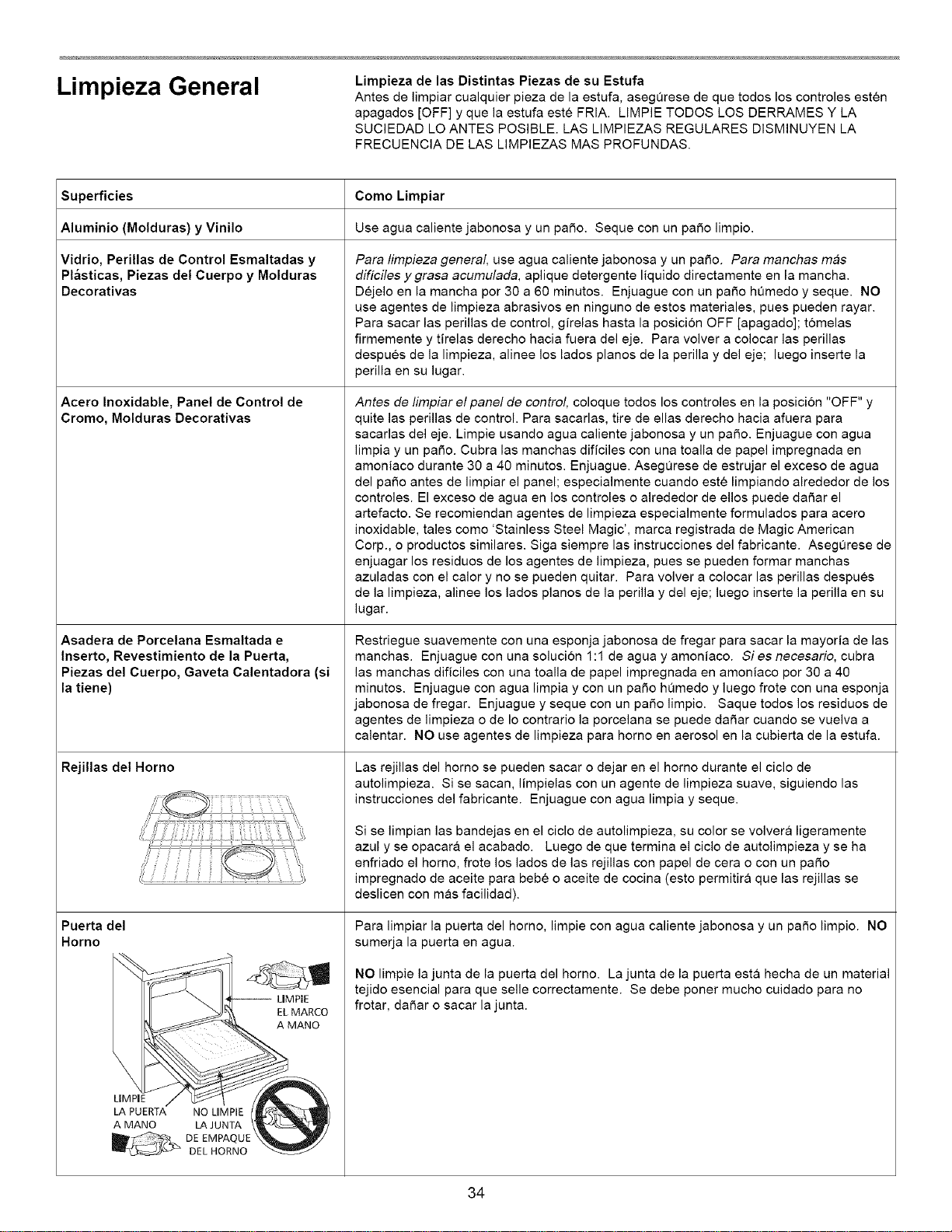
Limpieza General
Limpieza de las Distintas Piezas de su Estufa
Antes de limpiar cualquier pieza de la estufa, aseg0rese de que todos los controles esten
apagados [OFF] y que la estufa este FRIA. LIMPIE TODOS LOS DERRAMES Y LA
SUCIEDAD LO ANTES POSIBLE. LAS LIMPIEZAS REGULARES DISMINUYEN LA
FRECUENCIA DE LAS LIMPIEZAS MAS PROFUNDAS.
Superficies
Aluminio (Molduras) y Vinilo
Vidrio, Perillas de Control Esmaltadas y
Pl_sticas, Piezas del Cuerpo y Molduras
Decorativas
Acero Inoxidable, Panel de Control de
Cromo, Molduras Decorativas
Asadera de Porcelana Esmaltada e
Inserto, Revestimiento de la Puerta,
Piezas del Cuerpo, Gaveta Calentadora (si
la tiene)
Rejillas del Horno
Puerta del
Horno
-- LIMPIE
EL MARCO
___ AMANO
LAPUERTA NO LIMPIE /M_1 _)
AMANO LAJUNTA \_ -_k_:_:_:_:_:_:_:__ _/
Como Limpiar
Use agua caliente jabonosa y un patio. Seque con un patio limpio.
Para limpieza general, use agua caliente jabonosa y un patio. Para manchas mas
diflciles ygrasa acumulada, aplique detergente liquido directamente en la mancha.
Dejelo en la mancha por 30 a 60 minutos. Enjuague con un patio h0medo y seque. NO
use agentes de limpieza abrasivos en ninguno de estos materiales, pues pueden rayar.
Para sacar las perillas de control, girelas hasta la posici6n OFF [apagado]; t6melas
firmemente y tirelas derecho hacia fuera del eje. Para volver a colocar las perillas
despues de la limpieza, alinee los lados pianos de la perilla y del eje; luego inserte la
perilla en su lugar.
Antes de limpiar elpanel de control, coloque todos los controles en la posici6n "OFF" y
quite las perillas de control. Para sacarlas, tire de elias derecho hacia afuera para
sacarlas del eje. Limpie usando agua caliente jabonosa y un patio. Enjuague con agua
limpia y un patio. Cubra las manchas dificiles con una toalla de papel impregnada en
amoniaco durante 30 a 40 minutos. Enjuague. Aseg0rese de estrujar el exceso de agua
del patio antes de limpiar el panel; especialmente cuando este limpiando alrededor de los
controles. El exceso de agua en los controles o alrededor de ellos puede datiar el
artefacto. Se recomiendan agentes de limpieza especialmente formulados para acero
inoxidable, tales como 'Stainless Steel Magic', marca registrada de Magic American
Corp., o productos similares. Siga siempre las instrucciones del fabricante. Aseg0rese de
enjuagar los residuos de los agentes de limpieza, pues se pueden formar manchas
azuladas con el calory no se pueden quitar. Para volver a colocar las perillas despues
de la limpieza, alinee los lados pianos de la perilla y del eje; luego inserte la perilla en su
lugar.
Restriegue suavemente con una esponja jabonosa de fregar para sacar la mayoria de las
manchas. Enjuague con una soluci6n 1:1 de agua y amoniaco. Si es necesario, cubra
las manchas dificiles con una toalla de papel impregnada en amoniaco por 30 a 40
minutos. Enjuague con agua limpia y con un patio humedo y luego frote con una esponja
jabonosa de fregar. Enjuague y seque con un patio limpio. Saque todos los residuos de
agentes de limpieza o de Io contrario la porcelana se puede datiar cuando se vuelva a
calentar. NO use agentes de limpieza para homo en aerosol en la cubierta de la estufa.
Las rejillas del horno se pueden sacar o dejar en el homo durante el ciclo de
autolimpieza. Si se sacan, limpielas con un agente de limpieza suave, siguiendo las
instrucciones del fabricante. Enjuague con agua limpia y seque.
Si se limpian las bandejas en el ciclo de autolimpieza, su color se volvera ligeramente
azul y se opacara el acabado. Luego de que termina el ciclo de autolimpieza y se ha
enfriado el homo, frote los lados de las rejillas con papel de cera o con un patio
impregnado de aceite para bebe o aceite de cocina (esto permitira que las rejillas se
deslicen con mas facilidad).
Para limpiar la puerta del homo, limpie con agua caliente jabonosa y un patio limpio. NO
sumerja la puerta en agua.
NO limpie la junta de la puerta del horno. La junta de la puerta esta hecha de un material
tejido esencial para que selle correctamente. Se debe poner mucho cuidado para no
frotar, datiar o sacar la junta.
34
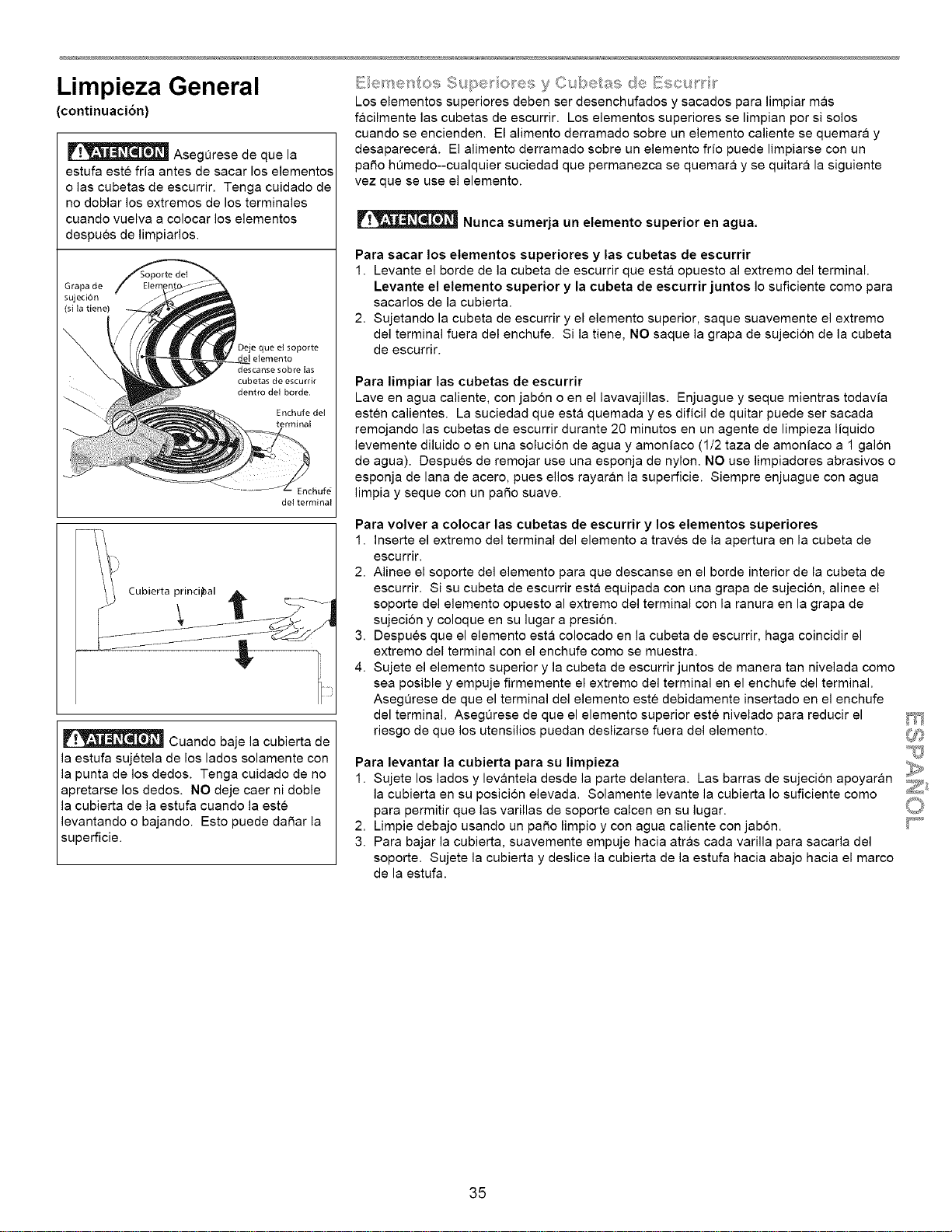
Limpieza General
(continuaci6n)
!':_ Aseg0rese de que la
estufa este fria antes de sacar los elementos
o las cubetas de escurrir. Tenga cuidado de
no doblar los extremos de los terminales
cuando vuelva a colocar los elementos
despues de limpiarlos.
Grapa de
sujeclon
(silatiene)
Deje que et soporte
Enchufe det
terminal
delterminal
Cubierta princil_al
Cuando baje la cubierta de
la estufa sujetela de los lados solamente con
la punta de los dedos. Tenga cuidado de no
apretarse los dedos. NO deje caer ni doble
la cubierta de la estufa cuando la este
levantando o bajando. Esto puede dai_ar la
superficie.
It® _e stos S_spe_'io_'es y C ,_be/ias de Escur_'i{
Los elementos superiores deben ser desenchufados y sacados para limpiar mas
facilmente las cubetas de escurrir. Los elementos superiores se limpian por si solos
cuando se encienden. El alimento derramado sobre un elemento caliente se quemara y
desaparecer& El alimento derramado sobre un elemento frio puede limpiarse con un
paso humedo--cualquier suciedad que permanezca se quemara y se quitara la siguiente
vez que se use el elemento.
Nunca sumerja un elemento superior en agua.
Para sacar los elementos superiores y las cubetas de escurrir
1. Levante el borde de la cubeta de escurrir que esta opuesto al extremo del terminal.
Levante el elemento superior y la cubeta de escurrir juntos Io suficiente como para
sacarlos de la cubierta.
2. Sujetando la cubeta de escurrir y el elemento superior, saque suavemente el extremo
del terminal fuera del enchufe. Si la tiene, NO saque la grapa de sujeci6n de la cubeta
de escurrir.
Para limpiar las cubetas de escurrir
Lave en agua caliente, con jab6n o en el lavavajillas. Enjuague y seque mientras todavia
esten calientes. La suciedad que esta quemada yes dificil de quitar puede ser sacada
remojando las cubetas de escurrir durante 20 minutos en un agente de limpieza liquido
levemente diluido o en una soluci6n de agua y amoniaco (1/2 taza de amoniaco a 1 gal6n
de agua). Despues de remojar use una esponja de nylon. NO use limpiadores abrasivos o
esponja de lana de acero, pues ellos rayaran la superficie. Siempre enjuague con agua
limpia y seque con un pai_o suave.
Para volver a colocar las cubetas de escurrir y los elementos superiores
1. Inserte el extremo del terminal del elemento a traves de la apertura en la cubeta de
escurrir.
2. Alinee el soporte del elemento para que descanse en el borde interior de la cubeta de
escurrir. Si su cubeta de escurrir esta equipada con una grapa de sujeci6n, alinee el
soporte del elemento opuesto al extremo del terminal con la ranura en la grapa de
sujeci6n y coloque en su lugar a presi6n.
3. Despues que el elemento esta colocado en la cubeta de escurrir, haga coincidir el
extremo del terminal con el enchufe como se muestra.
4. Sujete el elemento superior y la cubeta de escurrir juntos de manera tan nivelada como
sea posible y empuje firmemente el extremo del terminal en el enchufe del terminal.
AsegOrese de que el terminal del elemento este debidamente insertado en el enchufe
del terminal. Asegurese de que el elemento superior este nivelado para reducir el
riesgo de que los utensilios puedan deslizarse fuera del elemento.
Para levantar la cubierta para su limpieza _,
1. Sujete los lados y levantela desde la parte delantera. Las barras de sujeci6n apoyaran _
la cubierta en su posici6n elevada. Solamente levante la cubierta Io suficiente como _
para permitir que las varillas de soporte calcen en su lugar.
2. Limpie debajo usando un pai_o limpio y con agua caliente con jab6n. _
3. Para bajar la cubierta, suavemente empuje hacia atras cada varilla para sacarla del
soporte. Sujete la cubierta y deslice la cubierta de la estufa hacia abajo hacia el marco
de la estufa.
35
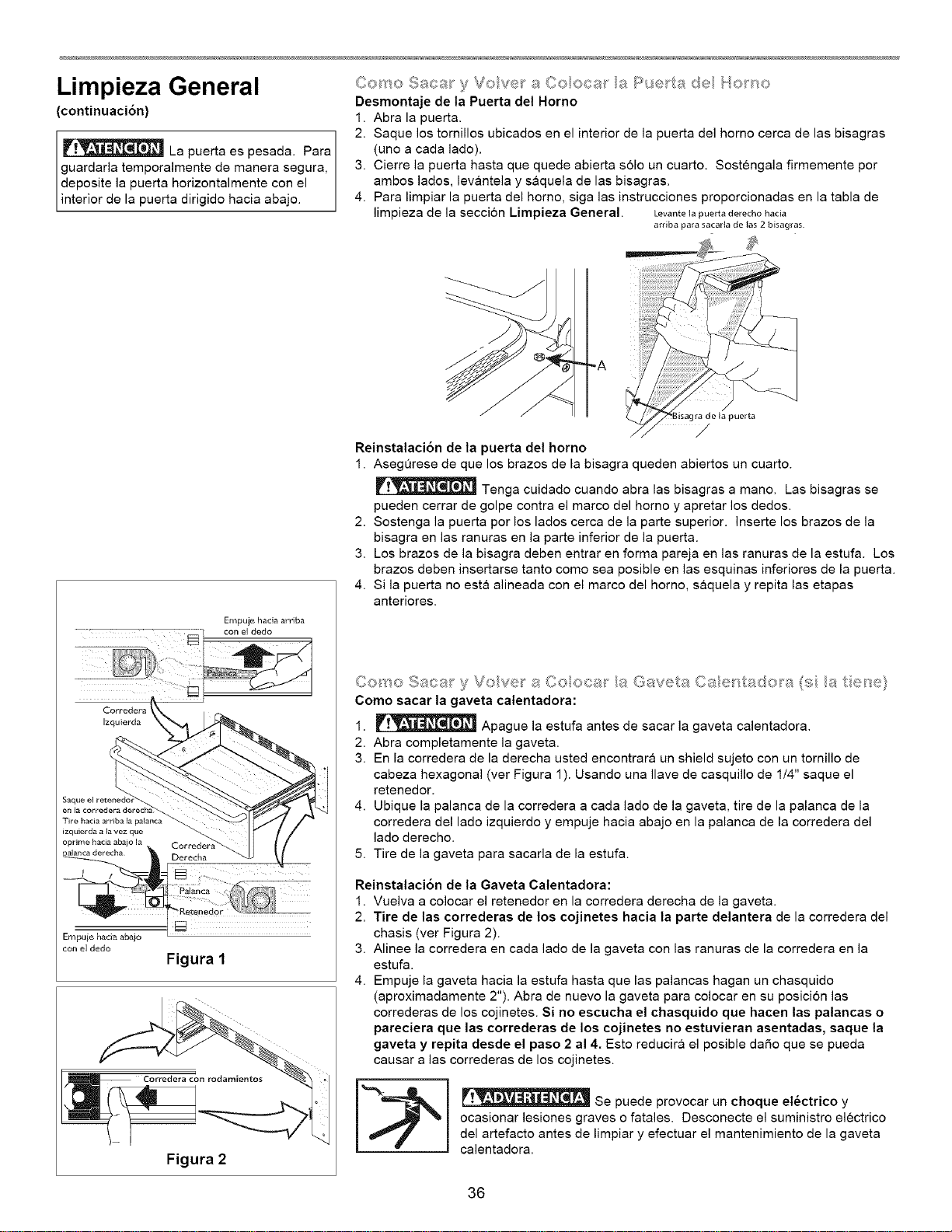
Limpieza General
(continuaci6n)
La puerta es pesada. Para]
guardarla temporalmente de manera segura, /
deposite la puerta horizontalmente con el /
interior de la puerta dirigido hacia abajo. J
Co_: o Sacas _y Vover a Co oca__ a P'ues4a de ,_o_'_o
Desmontaje de la Puerta del Horno
1. Abra la puerta.
2. Saque los tornillos ubicados en el interior de la puerta del homo cerca de las bisagras
(uno a cada lado).
3. Cierre la puerta hasta que quede abierta s61o un cuarto. Sostengala firmemente por
ambos lados, levantela y saquela de las bisagras.
4. Para limpiar la puerta del homo, siga las instrucciones proporcionadas en la tabla de
limpieza de la seccion Limpieza General. Levantetapuertaderechohada
arriba para sacarta de _as2 bisagras.
Empuje hacia arriba
con eJ dedo
Corredera
Izquierda
Saque elretenedc
Tire hacia arriba la palanca
izquierda a la vez que
oprime hacia abajo la
Empo ohoc,ao o
con el dedo
Figura 1
Figura 2
Reinstalaci6n de la puerta del horno
1. AsegOrese de que los brazos de la bisagra queden abiertos un cuarto.
Tenga cuidado cuando abra las bisagras a mano. Las bisagras se
pueden cerrar de golpe contra el marco del homo y apretar los dedos.
2. Sostenga la puerta por los lados cerca de la parte superior. Inserte los brazos de la
bisagra en las ranuras en la parte inferior de la puerta.
3. Los brazos de la bisagra deben entrar en forma pareja en las ranuras de la estufa. Los
brazos deben insertarse tanto como sea posible en las esquinas inferiores de la puerta.
4. Si la puerta no esta alineada con el marco del homo, saquela y repita las etapas
anteriores.
Como sacar la gaveta calentadora:
1. _ Apague la estufa antes de sacar la gaveta calentadora.
2. Abra completamente la gaveta.
3. En la corredera de la derecha usted encontrara un shield sujeto con un tornillo de
cabeza hexagonal (ver Figura 1). Usando una Ilave de casquillo de 1/4" saque el
retenedor.
4. Ubique la palanca de la corredera a cada lado de la gaveta, tire de la palanca de la
corredera del lado izquierdo y empuje hacia abajo en la palanca de la corredera del
lado derecho.
5. Tire de la gaveta para sacarla de la estufa.
Reinstalaci6n de la Gaveta Calentadora:
1. Vuelva a colocar el retenedor en la corredera derecha de la gaveta.
2. Tire de las correderas de los cojinetes hacia la parte delantera de la corredera del
chasis (ver Figura 2).
3. Aline° la corredera en cada lado de la gaveta con las ranuras de la corredera en la
estufa.
4. Empuje la gaveta hacia la estufa hasta que las palancas hagan un chasquido
(aproximadamente 2"). Abra de nuevo la gaveta para colocar en su posici6n las
correderas de los cojinetes. Si no escucha el chasquido que hacen las palancas o
pareciera que las correderas de los cojinetes no estuvieran asentadas, saque la
gaveta y repita desde el paso 2 al 4. Esto reducira el posible da_o que se pueda
causar alas correderas de los cojinetes.
Se puede provocar un choque el_ctrico y
ocasionar lesiones graves o fatales. Desconecte el suministro el6ctrico
del artefacto antes de limpiar y efectuar el mantenimiento de la gaveta
calentadora.
36
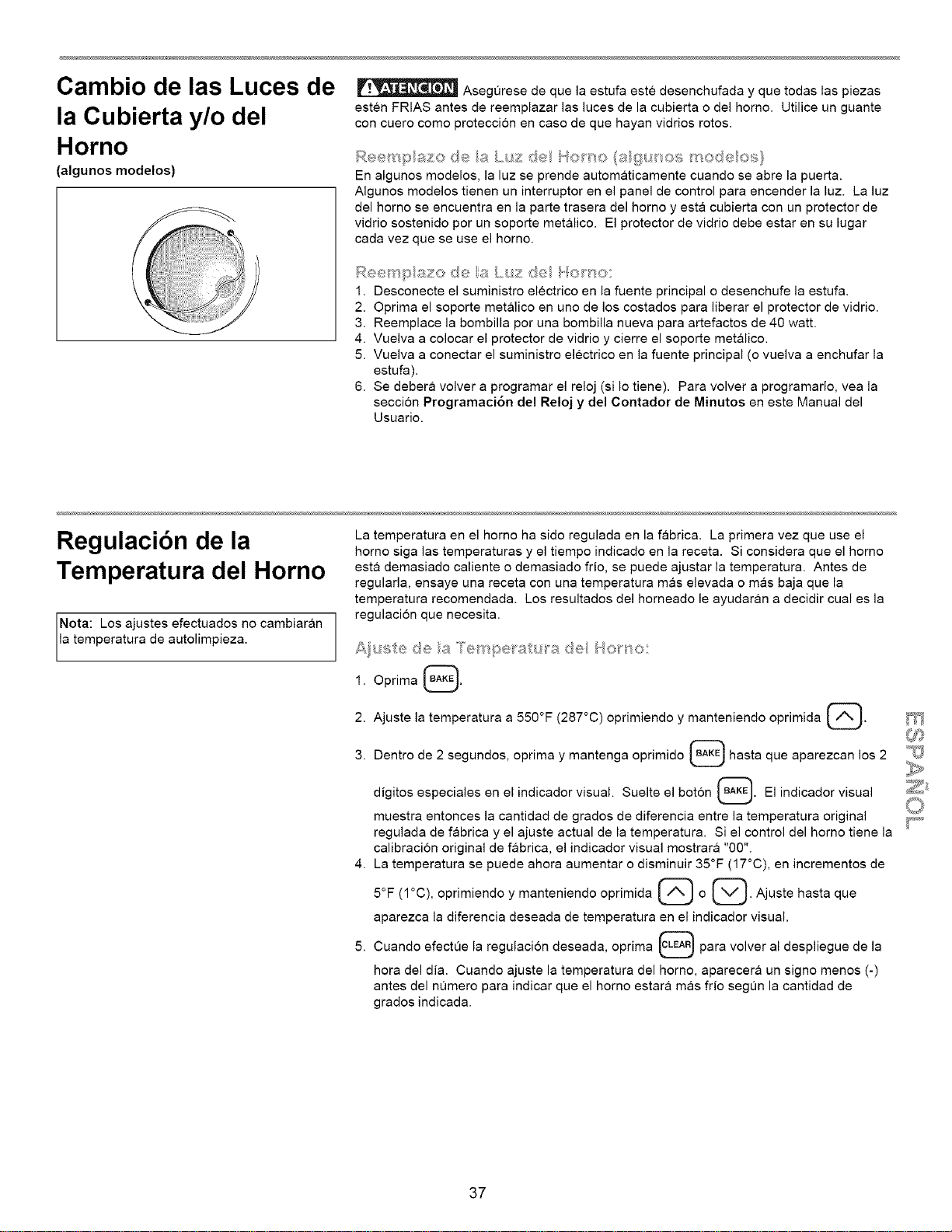
Cambio de las Luces de
la Cubierta y/o del
Horno
(algunos modelos)
Asegurese de que la estufa este desenchufada y que todas las piezas
esten FRIAS antes de reemplazar las luces de la cubierta o del horno. Utilice un guante
con cuero como protecci6n en caso de que hayan vidrios rotos.
En algunos modelos, la luz se prende automaticamente cuando se abre la puerta.
AIgunos modelos tienen un interruptor en el panel de control para encender la luz. La luz
del homo se encuentra en la parte trasera del homo y esta cubierta con un protector de
vidrio sostenido por un soporte metalico. El protector de vidrio debe estar en su lugar
cada vez que se use el homo.
_CReess'@lazode Is Luz de/_o o_' _o;
1. Desconecte el suministro electrico en la fuente principal o desenchufe la estufa.
2. Oprima el soporte metalJco en uno de los costados para IJberar el protector de vidrio.
3. Reemplace la bombJlla por una bombilla nueva para artefactos de 40 watt.
4. Vuelva a colocar el protector de vidrio y cierre el soporte metalico.
5. Vuelva a conectar el suministro electrico en la fuente principal (o vuelva a enchufar la
estufa).
6. Se debera volver a programar el reloj (si Io tiene). Para volver a programarlo, vea la
secci6n Programaci6n del Reloj y del Contador de Minutos en este Manual del
Usuario.
Regulacibn de la
Temperatura del Horno
Nota: Los ajustes efectuados no cambiaran
a temperatura de auto mp eza.
La temperatura en el homo ha sido regulada en la fabrica. La primera vez que use el
homo siga las temperaturas y el tiempo indicado en la receta. Si considera que el homo
esta demasiado caliente o demasiado frio, se puede ajustar la temperatura. Antes de
regularla, ensaye una receta con una temperatura mas elevada o mas baja que la
temperatura recomendada. Los resultados del horneado le ayudaran a decidir cual es la
regulaci6n que necesita.
Aj_sste de a Te_-_pes°at(_ a de 4o_',_o:
1. Oprima _.
2. Ajuste la temperatura a 550°F (287°C) oprimiendo y manteniendo oprimida _.
3. Dentro de 2 segundos, oprima y mantenga oprimido _ hasta que aparezcan los 2
digitos especiales en el indicador visual. Suelte el bot6n (_. El indicador visual
muestra entonces la cantidad de grados de diferencia entre la temperatura original
regulada de fabrica y el ajuste actual de la temperatura. Si el control del homo tiene la
calibraci6n original de fabrica, el indicador visual mostrara "00".
4. La temperatura se puede ahora aumentar o disminuir 35°F (17°C), en incrementos de
5°F (1°C), oprimiendo y manteniendo oprimida (_ o (_. Ajuste hasta que
aparezca la diferencia deseada de temperatura en el indicador visual.
5. Cuando efectue la regulaci6n deseada, oprima _ para volver al despliegue de la
i
hora del dia. Cuando ajuste la temperatura del homo, aparecera un signo menos (-)
antes del numero para indicar que el homo estara mas frio segen la cantidad de
grados indicada.
37
Lista para Evitar
Llamadas de Servicio
Consulte la lista siguiente antes de solicitar servicio. Puede ahorrarle tiempo y dinero.
La lista incluye los incidentes mas comunes que no son originados por la fabricacion o
materiales defectuosos en este artefacto.
Este horno esta equipado con un moderno controlador electronico. Entre sus diversas
caracteristicas, incluye un sistema de diagnostico constante de los circuitos del horno.
Elcontrolador supervisa constantemente el circuitaje interno, asi como tambien diversos
circuitos indispensables del homo para garantizar que todos funcionen correctamente.
Si en algun momento uno de estos sistemas falla, el controlador detendra inmediata-
mente el funcionamiento, emitiendo una serial sonora y desplegando el codigo de error
FI o F3* en el indicador visual, si Io tiene.
PROBLEMA
Estufa desnivelada.
Es dificil mover la estufa. La estufa debe
estar accesible en caso de reparacion.
*El control del homo emite una se_al
sonora y despliega F1 o F3.
El elemento superior esta demasiado ca-
liente o no Io suficientemente caliente.
Elemento superior no calienta.
La estufa no funciona por completo.
POSIBLE CAUSA/SOLUClON
Instalacion deficiente. Coloque la rejilla de1 horno en el centro. Coloque un nivel en la
rejilla del horno. Ajuste las patas niveladoras en la base de la estufa hasta que la rejitta
quede nivelada.
Asegurese de que el piso este nivelado y pueda sostener la estufa en forma adecuada.
Llame a un carpintero para corregir et hundimiento o desnivel de1 piso.
Armarios de la cocina mal alineados que pueden dar la impresi6n de que la estufa esta
desnivelada. Asegurese de que los armarios esten derechos y que haya suficiente espacio
libre entre la base de los armarios y la estufa.
Armarios que no estan derechos o quedaron muy apretados. Llame a un constructor o
instalador para hacer accesible el artefacto.
La alfombra interfiere con el fu nciona miento de la estufa. Proporcione espacio suficiente
para que la estufa pueda ser levantada sobre la alfombra.
El control electr6nico ha detectado una falla. Optima CANCEL para despejar el indicador
visual y cancelar la seral sonora. Vuelva a programar el horno. Si la falla persiste,
anote su numero. Oprima CANCEL y p6ngase en contacto con un tecnico autorizado.
Ajuste de control incorrecto. Asegurese de que el control correcto este en el elemento
superior que va a ser usado.
Se emptean utensilios demasiado livianos o deformados. Use solamente utensilios de
cocina que sean de fondo piano, uniformemente equilibrados de peso mediano o
pesados. Los utensilios pianos secatientan mejor que los deformados. El material de los
utensilios y et peso del material afectan el calentamiento. Los utensitios pesados y de
peso mediano se calientan uniformente. Debido a que los utensilios son livianos, los
alimentos pueden quemarse facilmente.
No llega electricidad a la estufa. Verifique los pasos bajo "La estufa no funciona por
completo" en esta Lista para Evitar Llamadas de Servicio.
Ajuste de control incorrecto. Asegurese de que el control correcto este en el elemento
superior que va a ser usado.
El etemento no hace contacto en et bloque. Siga las instrucciones bajo "Elementos
Supefiores y Cubetas de Escurrir" en la seccion Limpieza General.
Asegurese de que et cordon electrico o el enchufe esten conectados.
El cableado de servicio no esta completo. Pongase en contacto con su distribuidor,
agente instalador o el tecnico de servicio autorizado.
Interrupcion de la energia electrica. Para estar seguro, revise las luces del hogar. Llame
al servicio tecnico de su comparia de electricidad local.
38
La luz de la cubierta y/o del horno (algunos Reemplace o apriete la bombilta. Ver la secci6n Cambio de las Lutes de la Cubierta
modelos) no funciona y/o del Homo (algunos modelos) en este Manual del Usuario para obtener las instrucciones.
El horno desprende mucho humo cuando se asa.
El (los) control(es) no est,(n) ajustado(s) en forma correcta. Siga las instrucciones bajo
Regulacion de los Controles del Horno.
Asegurese de que la puerta est_ abierta en la posicion tope de asar.
La carne est_ muy cerca del elemento del asador. Vuelva a acomodar ta rejilla de modo que
quede un espacio m_s grande entre la carney el elemento. Caliente con anticipaci6n el
elemento de asar para tostar.
La came no queda bien preparada. Saque el exceso de grasa de la carne. Haga un corte en
_ngulo recto en los bordes con grasa para evitar el pandeamiento de la carne, pero no corte
hasta ta parte magra.
La parrilla de la asadera est_ colocada al rev_s y la grasa no est_ goteando. Siempre coloque
la parrilla de la asadera con las nervaduras dirigidas hacia arriba y las ranu ras hacia abajo para
permitir que la grasa gotee hacia la asadera.
Seha acumulado grasa en las superficies del horno. Es necesario efectuar una timpieza regular
cuando ase en forma frecuente. La grasa acumulada o las salpicadu ras de alimentos pueden
causar mucho humo.
Horneado deficiente.
Muchos factores pueden afectar los resultados al hornear. Asegurese de que est_ usando la
rejilla en la posici6n correcta. Coloque el alimento en el centro del homo y separe las asaderas
para permitir que circule el aire. Dejeque el hornosecalientea la temperatu ra preseleccionada
antes de colocar los alimentos en el horno. Trate de ajustar la temperatura o el tiempo de
horneado recomendados en la receta. Si siente que el homo est_ demasiado caliente o
demasiado frio, vea la seccion Regulation de la Temperatura del Horno en este Manual del
Usuario.
No funciona el ciclo de autolimpieza.
El (los) control(es) no est,(n) ajustado(s) en forma correcta. Siga las instrucciones bajo
Regulation de los Controles del Horno.
Seinterrumpi6 el ciclo de autolimpieza. Siga los pasos de la secci6n "Parada o InterrupciOn del
Ciclo de Autolimpieza" en Limpieza del Horno.
No sale toda la suciedad del horno despu_s
del ciclo de limpieza.
Llamas dentro del horno o humo desde el
orificio de ventilacion.
No se limpi6 la parte inferior delantera, marco del horno, la parte supenor del horno o las areas _
de la puerta fuera de la junta del horno. Estas _reas no entra nen el ciclo de autolim pieza, pero _j',_
se calientan Io suficiente como para que se quemen los residuos. Limpie estas ,_reas antes de _%_
comenzar el cicto de autolimpieza. El residuo quemado se puede limpiar con un cepillo de _
nylon duro y agua o con un restregador de nylon. Trate de no da_ar la junta del horno.
Muchos derrames en et horno. Programe el ciclo de autolimpieza para un periodo de limpieza
m_s largo.
Muchos derrames en el homo. Esto es normal, especialmente los derrames de tartas o grandes
cantidades de grasa en la parte inferior del horno. Limpie los derrames antes de comenzar el
ciclo de autolimpieza. Si hay llamas o un exceso de humo, detenga el ciclo de autolimpieza
y sigas las etapas de la secci6n "Parada o Interrupcion del Ciclo de Autolimpieza" en la secciOn
Limpieza de Homo.
Las cubetas de escurrir estan picadas u
oxidadas.
Los alimentos con acidos tales como tomates, si se dejan en las cubetas o sobre las
cubetas pueden causar corrosion. Saque y lave las cubetas de escurrir tan pronto
como sea posible y despues de que haya habido un derrame.
Ambiente normal. Las casas a lo largo de la costa del mar estan expuestas a aire
salino. Proteja las cubetas tanto como sea posible de quedar expuesta en forma
directa al aire salino.
Cubetas de escurrir cambian de color o
se deforman.
La superficie inferior de los utensitios de cocina se extienden mas alta de los
elementos superiores y toca la superficie de ta cubierta. Esto puede causar
temperatura suficientemente alta como para descolorar la cubetas de escurrir. NO
use utensilios de cocina de este tipo. Los tama_os de utensilios deben coincidir con
el tamaffo del elemento. Puede adquirir cubetas de escurrir nuevas de su
distribuidor.
39
Home(:entral'°
® Registered Trademark / T,, Trademark of Sears, Roebuck and Co.
® Sears, Roebuck and Co. ® Marca Registrada / T_ Marca de F&brica de Sears, Roebuck and Co.