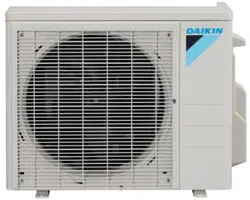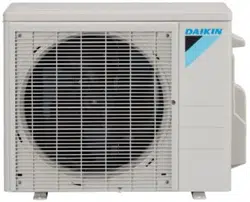
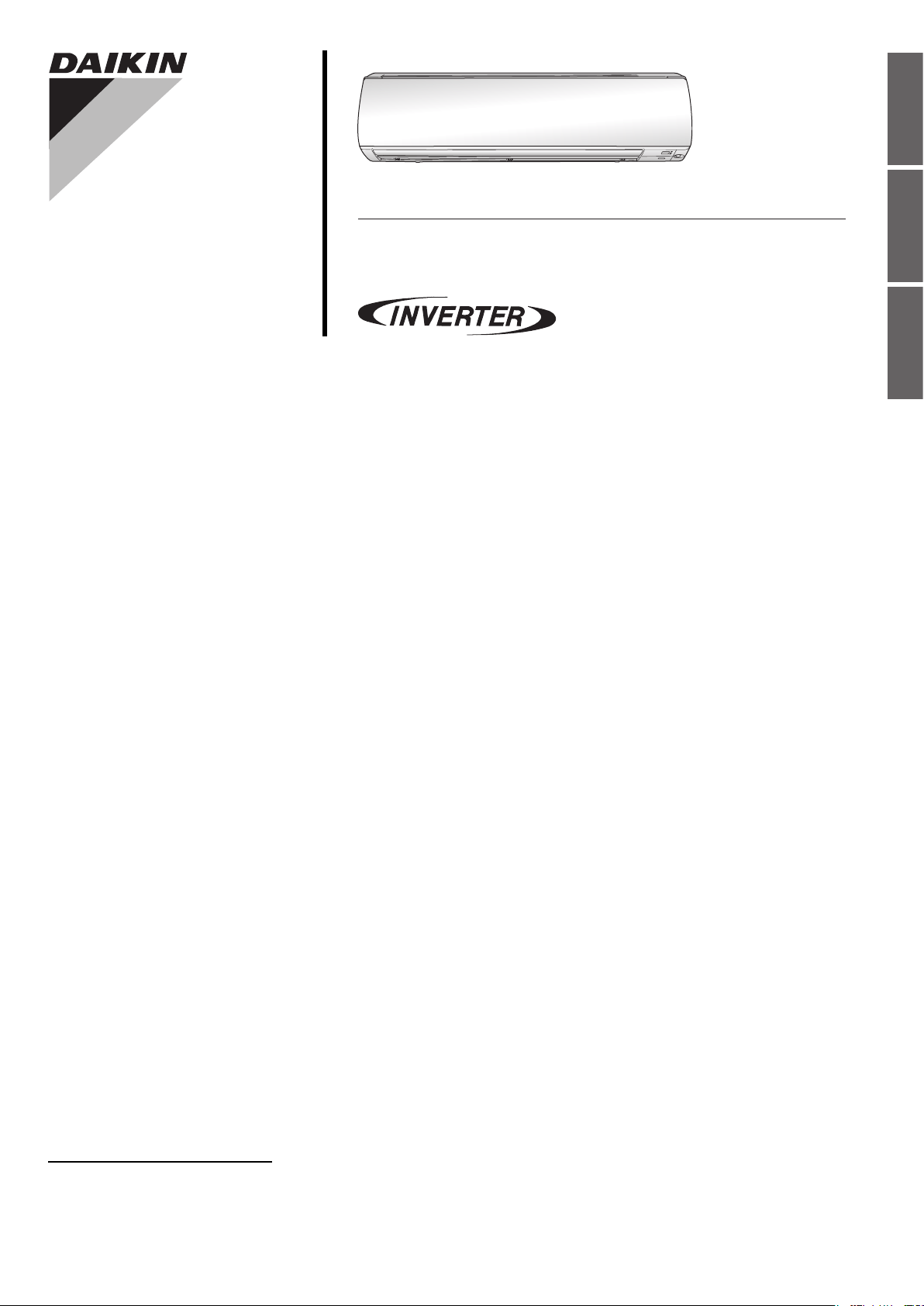
INSTALLATION MANUAL
DAIKIN ROOM AIR CONDITIONER
R410A Split Series
English
FrançaisEspañol
MODELS
FTX30NVJU
FTX36NVJU
Installation manual
Manuel d’installation
Manual de instalación
English■
1
Safety Considerations
Read these Safety Considerations for Installation carefully
before installing an air conditioner or heat pump. After
completing the installation, make sure that the unit operates
properly during the startup operation.
Instruct the user on how to operate and maintain the unit.
Inform users that they should store this installation manual
with the operation manual for future reference.
Always use a licensed installer or contractor to install this product.
Improper installation can result in water or refrigerant leakage,
electric shock, fire, or explosion.
Meanings of DANGER, WARNING, CAUTION, and NOTE
Symbols:
DANGER ···············Indicates an imminently hazardous
situation which, if not avoided, will
result in death or serious injury.
WARNING ·············Indicates a potentially hazardous
situation which, if not avoided, could
result in death or serious injury.
CAUTION ··············Indicates a potentially hazardous
situation which, if not avoided, may
result in minor or moderate injury.
It may also be used to alert against
unsafe practices.
NOTE ·····················Indicates situations that may result in
equipment or property-damage acci-
dents only.
DANGER
• Refrigerant gas is heavier than air and replaces oxygen.
A massive leak can lead to oxygen depletion, especially in
basements, and an asphyxiation hazard could occur leading
to serious injury or death.
• Do not ground units to water pipes, gas pipes, telephone
wires, or lightning rods as incomplete grounding can cause
a severe shock hazard resulting in severe injury or death.
Additionally, grounding to gas pipes could cause a gas leak
and potential explosion causing severe injury or death.
• If refrigerant gas leaks during installation, ventilate the area
immediately. Refrigerant gas may produce toxic gas if it
comes into contact with fire. Exposure to this gas could
cause severe injury or death.
• After completing the installation work, check that the
refrigerant gas does not leak throughout the system.
• Do not install unit in an area where flammable materials are
present due to risk of explosions that can cause serious
injury or death.
• Safely dispose all packing and transportation materials in
accordance with federal/state/local laws or ordinances.
Packing materials such as nails and other metal or wood
parts, including plastic packing materials used for
transportation may cause injuries or death by suffocation.
WARNING
• Only qualified personnel must carry out the installation work.
Installation must be done in accordance with this installation
manual. Improper installation may result in water leakage,
electric shock, or fire.
• When installing the unit in a small room, take measures to
keep the refrigerant concentration from exceeding allowable
safety limits. Excessive refrigerant leaks, in the event of an
accident in a closed ambient space, can lead to oxygen
deficiency.
• Use only specified accessories and parts for installation
work. Failure to use specified parts may result in water
leakage, electric shock, fire, or the unit falling.
• Install the air conditioner or heat pump on a foundation
strong enough that it can withstand the weight of the unit.
A foundation of insufficient strength may result in the unit
falling and causing injuries.
• Take into account strong winds, typhoons, or earthquakes
when installing. Improper installation may result in the unit
falling and causing accidents.
Contents
Safety Considerations ..................................... 1
Accessories ...................................................... 3
Choosing an Installation Site .......................... 3
1. Indoor unit.................................................................... 3
2. Wireless remote controller ........................................... 3
Indoor Unit Installation Diagram ..................... 4
Indoor Unit Installation .................................... 5
1. Installing the mounting plate ........................................ 5
2. Drilling a wall hole and installing wall embedded pipe ... 5
3. Installing the indoor unit ............................................... 5
4. Wiring........................................................................... 6
5. Drain piping.................................................................. 7
Refrigerant Piping Work .................................. 8
1. Flaring the pipe end ..................................................... 8
2. Refrigerant piping......................................................... 8
Installation Tips ................................................ 9
1. Removing and installing the front panel....................... 9
2. Removing and installing the front grille........................ 9
3. How to set the different addresses .............................. 9
4. When connecting to an HA system.............................. 9
Trial Operation and Testing .......................... 10
1. Trial operation and testing ......................................... 10
2. Test items .................................................................. 10
English■
2
• Make sure that a separate power supply circuit is provided
for this unit and that all electrical work is carried out by
qualified personnel according to local, state, and national
regulations. An insufficient power supply capacity or
improper electrical construction may lead to electric shock
or fire.
• Make sure that all wiring is secured, that specified wires are
used, and that no external forces act on the terminal
connections or wires. Improper connections or installation
may result in fire.
• When wiring, position the wires so that the electrical wiring
box cover can be securely fastened. Improper positioning of
the electrical wiring box cover may result in electric shock,
fire, or the terminals overheating.
• Before touching electrical parts, turn off the unit.
• The circuit must be protected with safety devices in
accordance with local and national codes, i.e. a fuse, a
circuit breaker, a disconnect or a GFCI.
•
Securely fasten the outdoor unit terminal cover (panel). If the
terminal cover/panel is not installed properly, dust or water
may enter the outdoor unit causing fire or electric shock.
• When installing or relocating the system, keep the
refrigerant circuit free from substances other than the
specified refrigerant (R410A) such as air. Any presence of
air or other foreign substance in the refrigerant circuit can
cause an abnormal pressure rise or rupture, resulting in
injury.
• Do not change the setting of the protection devices. If the
pressure switch, thermal switch, or other protection device is
shorted and operated forcibly, or parts other than those
specified by Daikin are used, fire or explosion may occur.
CAUTION
• Do not touch the switch with wet fingers. Touching a switch
with wet fingers can cause electric shock.
• Do not allow children to play on or around the unit to prevent
injury.
• The heat exchanger fins are sharp enough to cut. To avoid
injury wear gloves or cover the fins while working around
them.
• Do not touch the refrigerant pipes during and immediately
after operation as the refrigerant pipes may be hot or cold,
depending on the condition of the refrigerant flowing through
the refrigerant piping, compressor, and other refrigerant
cycle parts. Your hands may suffer burns or frostbite if you
touch the refrigerant pipes. To avoid injury, give the pipes
time to return to normal temperature or, if you must touch
them, be sure to wear proper gloves.
• Install drain piping to proper drainage. Improper drain piping
may result in water leakage and property damage.
• Insulate piping to prevent condensation.
• Be careful when transporting the product.
• Do not turn off the power immediately after stopping
operation. Always wait for at least 5 minutes before turning
off the power. Otherwise, water leakage may occur.
• Do not use a charging cylinder. Using a charging cylinder
may cause the refrigerant to deteriorate.
• Refrigerant R410A in the system must be kept clean, dry,
and tight.
(a) Clean and Dry -- Foreign materials (including mineral oils
such as SUNISO oil or moisture) should be prevented
from getting into the system.
(b)
Tight -- R410A does not contain any chlorine, does not
destroy the ozone layer, and does not reduce the earth’s
protection again harmful ultraviolet radiation. R410A can
contribute to the greenhouse effect if it is released.
Therefore take proper measures to check for the tightness
of the refrigerant piping installation. Read the chapter
Refrigerant Piping Work and follow the procedures.
• Since R410A is a blend, the required additional refrigerant
must be charged in its liquid state. If the refrigerant is
charged in a state of gas, its composition can change and
the system will not work properly.
• The indoor unit is for R410A. See the catalog for indoor
models that can be connected. Normal operation is not
possible when connected to other units.
• Remote controller (wireless kit) transmitting distance can be
shorter than expected in rooms with electronic fluorescent
lamps (inverter or rapid start types). Install the indoor unit far
away from fluorescent lamps as much as possible.
• Indoor units are for indoor installation only. Outdoor units
can be installed either outdoors or indoors. This unit is for
indoor use.
• Do not install the air conditioner or heat pump in the
following locations:
(a) Where a mineral oil mist or oil spray or vapor is produced,
for example, in a kitchen.
Plastic parts may deteriorate and fall off or result in water
leakage.
(b) Where corrosive gas, such as sulfurous acid gas, is
produced.
Corroding copper pipes or soldered parts may result in
refrigerant leakage.
(c) Near machinery emitting electromagnetic waves.
Electromagnetic waves may disturb the operation of the
control system and cause the unit to malfunction.
(d) Where flammable gas may leak, where there is carbon
fiber, or ignitable dust suspension in the air, or where
volatile flammables such as thinner or gasoline are
handled. Operating the unit in such conditions can cause
a fire.
• Take adequate measures to prevent the outdoor unit from
being used as a shelter by small animals. Small animals
making contact with electrical parts can cause malfunctions,
smoke, or fire. Instruct the user to keep the area around the
unit clean.
NOTE
•
The indoor unit should be positioned where the unit and inter-
unit wires (outdoor to indoor) are at least 3.3ft (1m) away from
any televisions or radios. (The unit may cause interference with
the picture or sound.) Depending on the radio waves, a distance
of 3.3ft (1m) may not be sufficient to eliminate the noise.
• Dismantling the unit, treatment of the refrigerant, oil and
additional parts must be done in accordance with the
relevant local, state, and national regulations.
• Do not use the following tools that are used with
conventional refrigerants: gauge manifold, charge hose, gas
leak detector, reverse flow check valve, refrigerant charge
base, vacuum gauge, or refrigerant recovery equipment.
• If the conventional refrigerant and refrigerator oil are mixed
in R410A, the refrigerant may deteriorate.
• This air conditioner or heat pump is an appliance that should
not be accessible to the general public.
• As design pressure is 604 psi, the wall thickness of field-
installed pipes should be selected in accordance with the
relevant local, state, and national regulations.
FTN001-U
English■
3
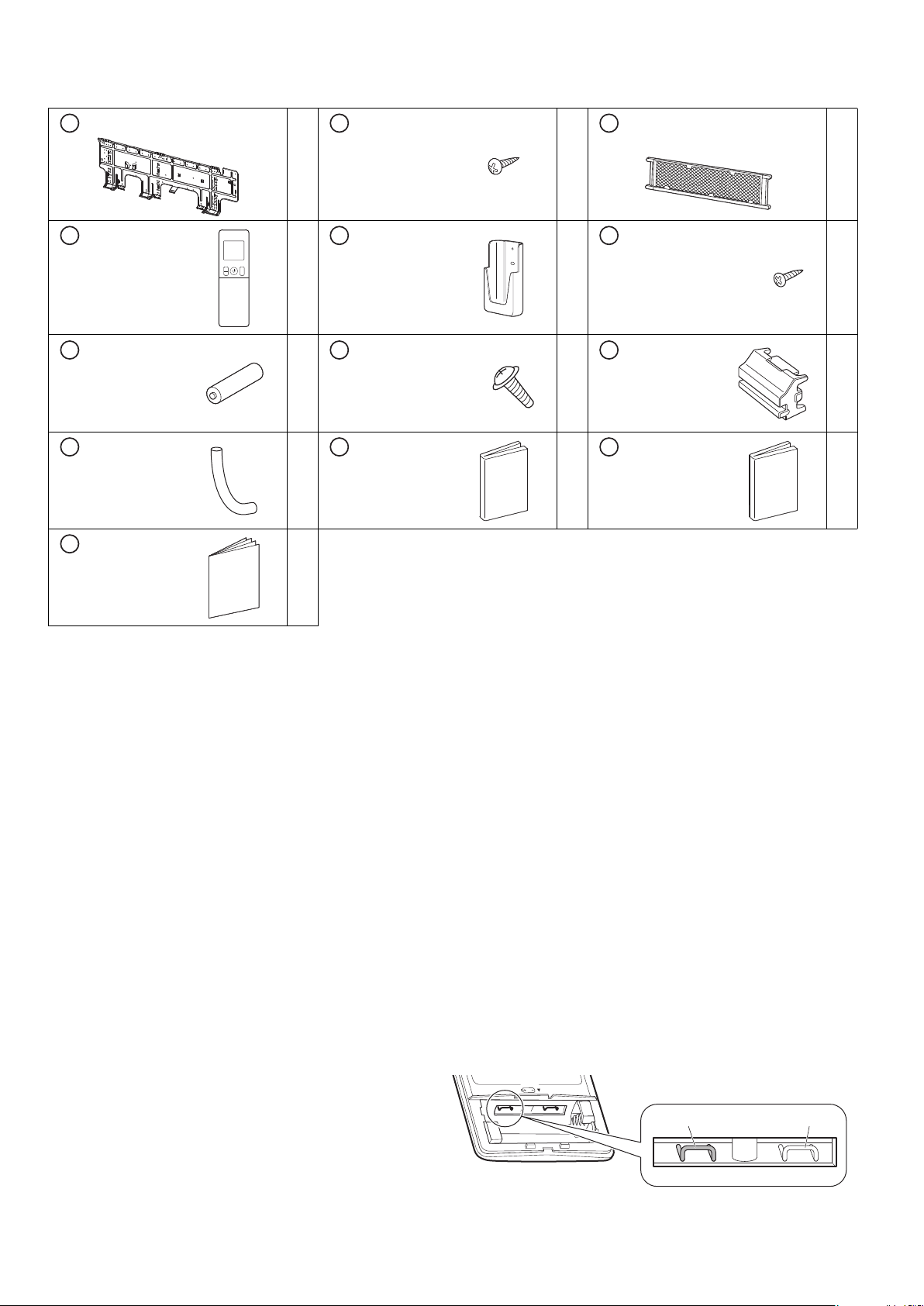
Accessories
Choosing an Installation Site
Before choosing the installation site, obtain user approval.
1. Indoor unit
The indoor unit should be positioned in a place where:
1) the restrictions on the installation requirements specified in “Indoor Unit Installation Diagram” on page 4 are met,
2) both the air inlet and air outlet are unobstructed,
3) the unit is not exposed to direct sunlight,
4) the unit is away from sources of heat or steam,
5) there is no source of machine oil vapor (this may shorten the indoor unit service life),
6) cool/warm air is circulated throughout the room,
7) the unit is away from electronic ignition type fluorescent lamps (inverter or rapid start type) as they may affect the remote
controller range,
8) no laundry equipment is nearby.
2. Wireless remote controller
1) Turn on all the fluorescent lamps in the room, if any, and find a location where the remote controller signals are properly
received by the indoor unit (within 23ft (7m)).
2) Configure the jumper. Configure according to the
type of unit (heat pump or cooling only) the user
purchased. The default setting is heat pump.
• For heat pump (outdoor unit model: RX)
No change to jumper setting is required.
• For cooling only (outdoor unit model: RK)
Cut the address jumper (J8) inside the remote
controller.
Mounting plate
1
Mounting plate
fixing screw
M4 × 1”
(M4 × 25mm)
9
Titanium apatite photocatalytic
air-purifying filter
3
Wireless remote
controller
1
Remote
controller holder
1
Remote
controller holder
fixing screw
M3 × 13/16”
(M3 × 20mm)
2
Dry battery
AAA. LR03
(alkaline)
2
Indoor unit
fixing screw
M4 × 1/2”
(M4 × 12mm)
3
Screw cover
3
Tube
1
Operation
manual
1
Installation
manual
1
Warranty
1
A
B
C
D
E
F
G
H
J
K
L
M
N
Jumper (J8) (J4)
English■
4
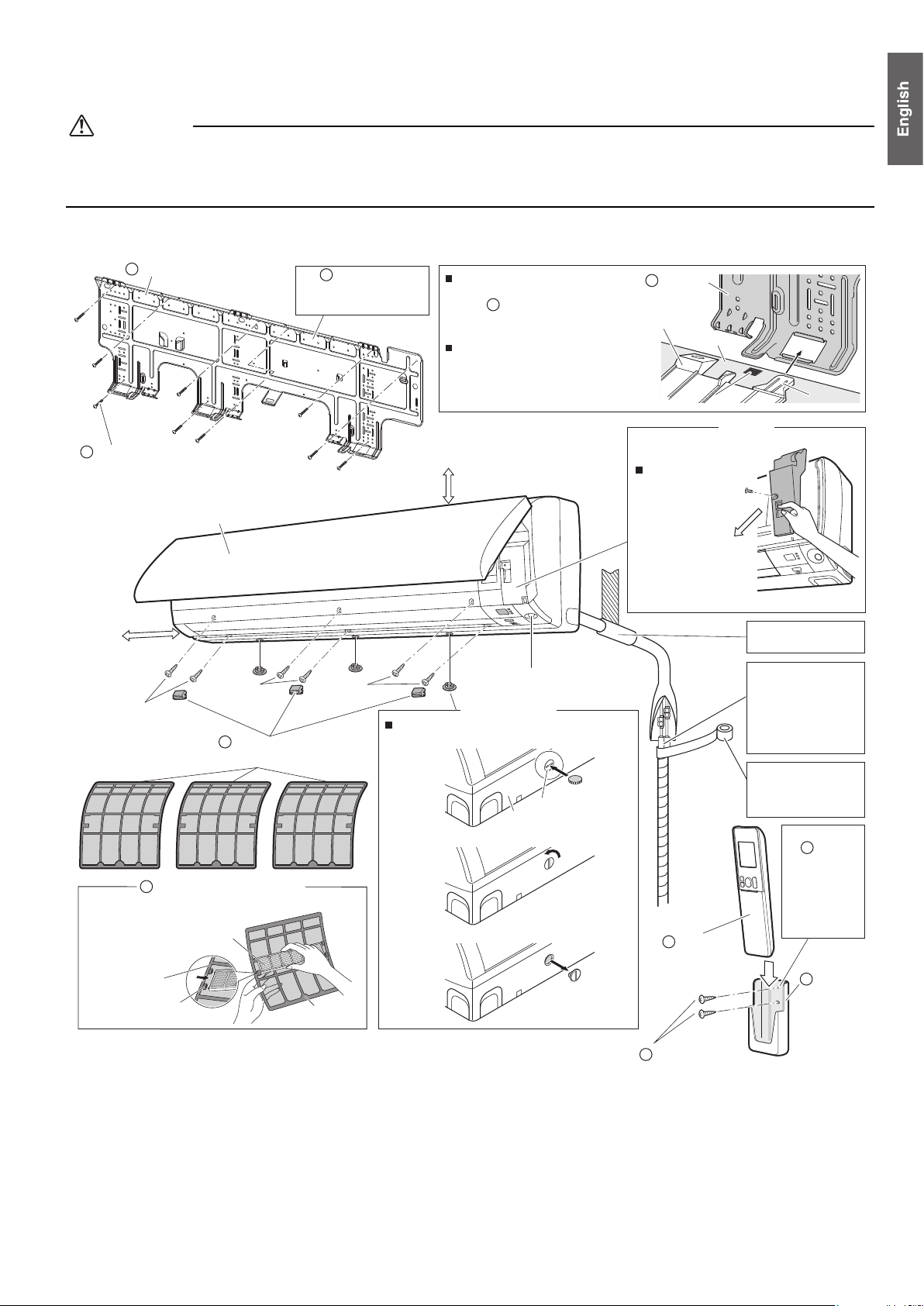
Indoor Unit Installation Diagram
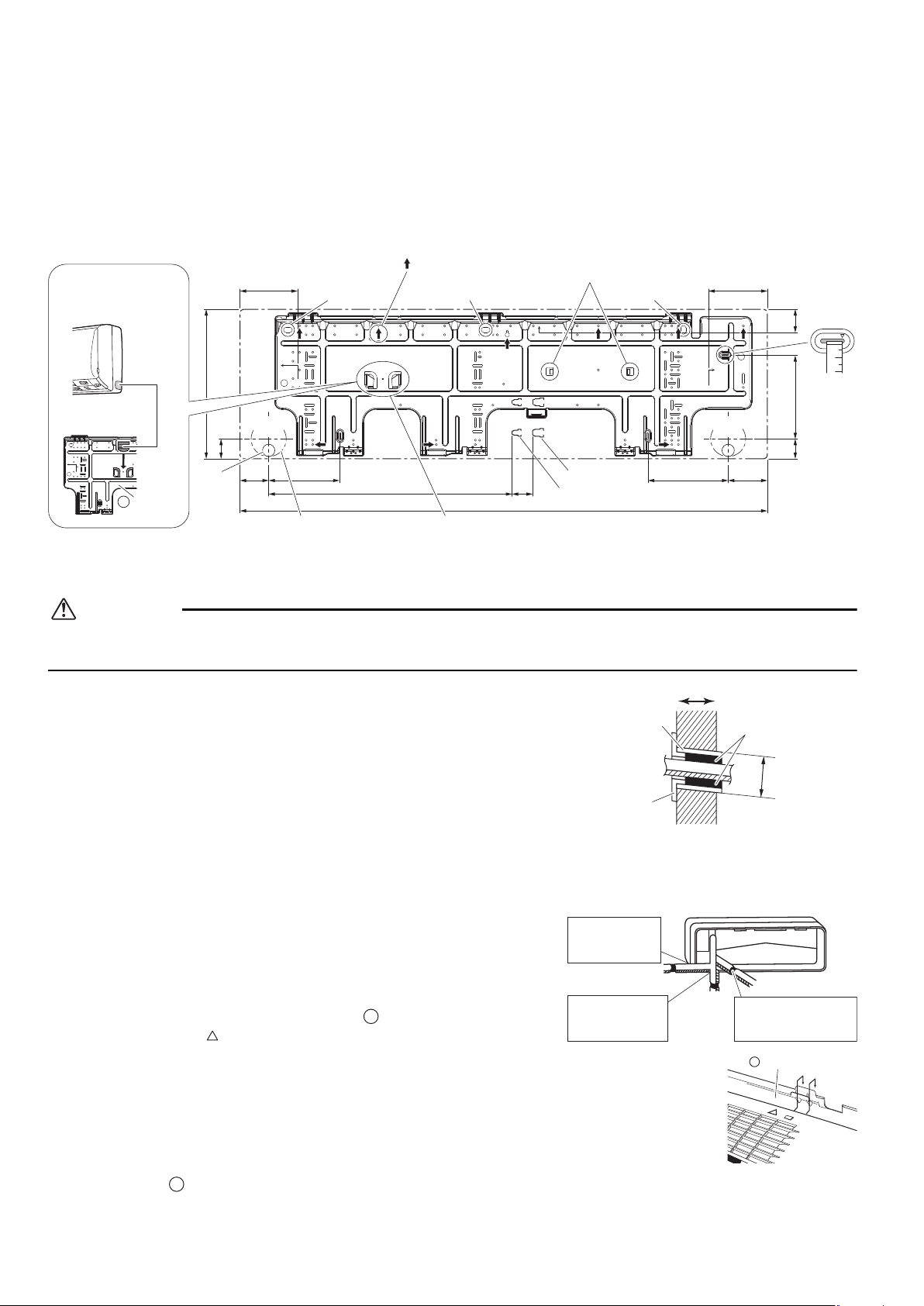
CAUTION
• Do not hit or violently push the INTELLIGENT EYE sensor. This can lead to damage and malfunction.
• Do not place large objects near the INTELLIGENT EYE sensor. Also keep heating units or humidifiers outside the sensor’s
detection area.
1)
Insert the tool into the groove of the front grille fixture.
How to remove front grille fixture
2) Turn the tool 90° in the direction of the arrow.
3) Take out the front grille fixture.
1-3/16” (30mm) or more
from ceiling
Wrap the insulation
pipe with the finishing
tape from bottom to
top.
Cut thermal insulation
pipe to an appropriate
length and wrap it with
tape, making sure that
no gap is left in the
insulation pipe’s cut
line.
Caulk pipe hole gap
with putty.
Mounting plate
A
Mounting plate fixing
screws M4 × 1” (M4 × 25mm)
B
INTELLIGENT EYE
sensor
1-15/16” (50mm)
or more from walls
(on both sides)
Front panel
M4 × 5/8”
(M4 × 16mm)
M4 × 5/8”
(M4 × 16mm)
M4 × 5/8”
(M4 × 16mm)
Air filters
The service lid is
removable.
Opening method
1)
Remove the
service lid
screws.
2)
Pull out the
service lid
diagonally
down in the
direction of the
arrow.
3)
Pull down.
Service lid
Bottom of indoor unit
Front grille fixture
Screw covers (3)
J
Remote controller
holder fixing screws
M3 × 13/16”
(M3 × 20mm) (2)
F
C
Titanium apatite photocatalytic
air-purifying filter (3)
Titanium apatite photocatalytic
air-purifying filter
Filter frame
Air filter
Ta b
Front grille fixture
The mounting plate
should be installed on a
wall which can support the
weight of the indoor unit.
A
D
Wireless
remote
controller
E
Remote
controller
holder
Before screwing
the remote
controller holder
to the wall, make
sure that control
signals are
properly received
by indoor unit.
E
How to attach the indoor unit
Hook the hooks of the bottom frame
to the mounting plate.
If the hooks are difficult to hook,
remove the front grille.
How to remove the indoor unit
Push up the marked area (at the
lower part of the front grille) to
release the hooks. If it is difficult
to release, remove the front grille.
A
A
Mounting
plate
Hook
Mark
(rear side)
Mark
(rear side)
Front grille
Bottom
frame
English■
5
Indoor Unit Installation
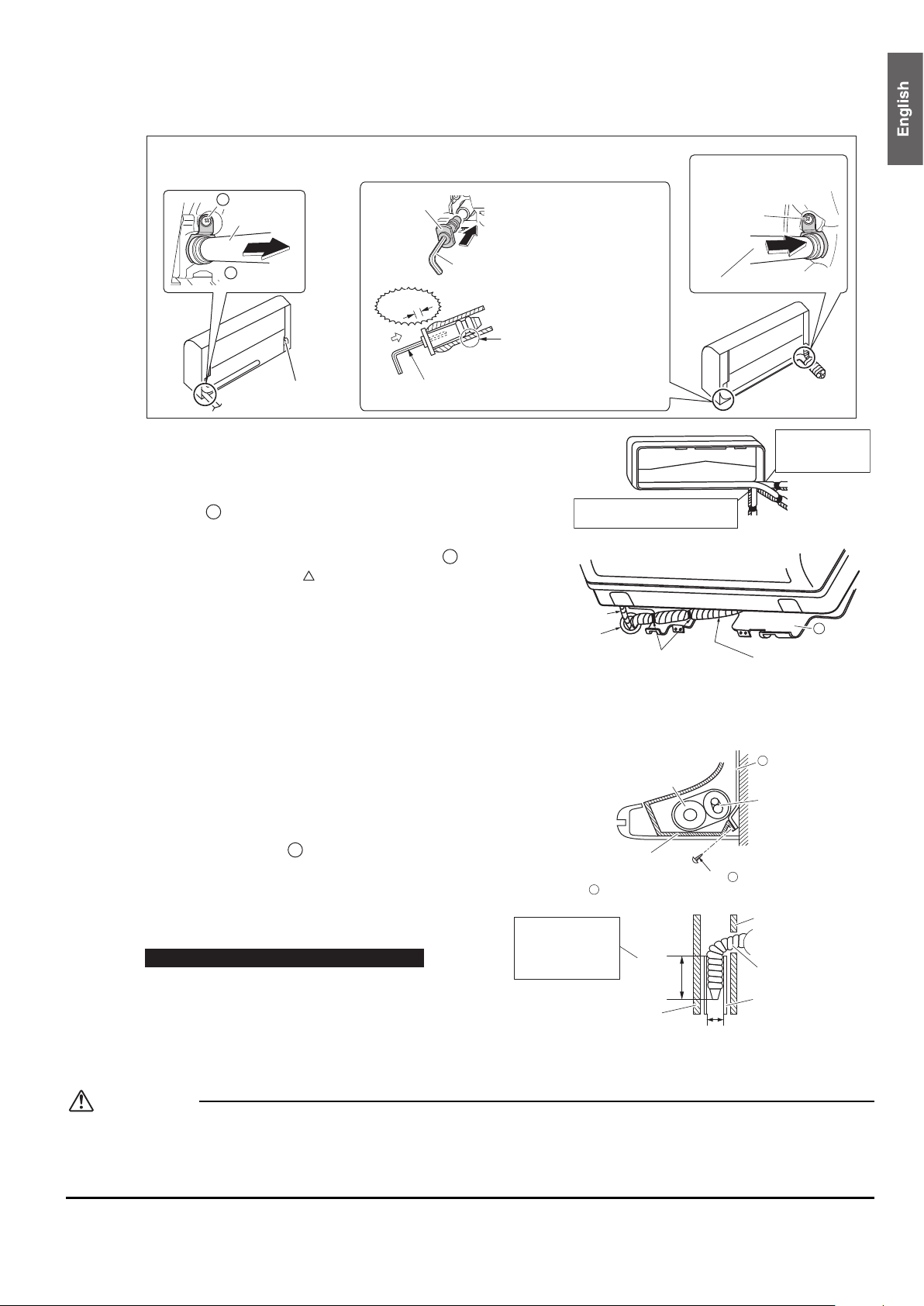
1. Installing the mounting plate
The mounting plate should be installed on a wall which can support the weight of the indoor unit.
1)Temporarily secure the mounting plate to the wall, make sure that the plate is completely level, and mark the drilling points
on the wall.
2)Secure the mounting plate to the wall with screws.
Recommended mounting plate retention spots and dimensions
2. Drilling a wall hole and installing wall embedded pipe
WARNING
For metal frame or metal board walls, be sure to use a wall embedded pipe and wall hole cover in the feed-through hole to
prevent possible heat, electric shock, or fire.
• Be sure to caulk the gaps around the pipes with caulking material to
prevent condensation.
1) Drill a feed-through hole with a 3-1/8 inch (80mm) diameter
through the wall at a downward angle toward the outside.
2) Insert a wall embedded pipe into the hole.
3) Insert a wall hole cover into wall pipe.
4) After completing refrigerant piping, wiring, and drain piping, caulk
the pipe hole gap with putty.
3. Installing the indoor unit
3-1. Right-side, right-back, or right-bottom piping
1) Attach the drain hose to the underside of the refrigerant
pipes with adhesive vinyl tape.
2) Wrap the refrigerant pipes and drain hose together with
an insulation tape.
3) Pass the drain hose and refrigerant pipes through the wall hole,
then position the indoor unit on the mounting plate hooks,
using the markings at the top of the indoor unit as a guide.
4) Open the front panel, then open the service lid.
(Refer to “Service lid” on page 4.)
5) Pass the inter-unit wire from the outdoor unit through the feed-through wall hole and
then through the back of the indoor unit. Pull them through the front side. Bend the
ends of tie wires upward for easier work in advance. (If the inter-unit wire ends are to
be stripped first, bundle wire ends with adhesive tape.)
6) Press the bottom frame of the indoor unit with both hands until it is firmly caught by
the mounting plate hooks. Make sure that the wires do not catch on the edge of the indoor unit.
unit: inch (mm)
φ3-1/8
(φ80)
7-1/2
(190)
2-1/16
(53)
5-1/4
(134)
5-3/16
(131)
1-3/4 (45)
1-3/4
(45)
13-3/8
(340)
2-9/16
(65)
φ3-1/8
(φ80)
6-5/16
(161)
7-3/16
(183)
3-1/2
(89)
47-1/4 (1200)
1-7/8
(47)
21-13/16 (554)
Use a tape
measure
as shown.
Position
the end of
a tape
measure
at ∇.
Gas pipe end
Liquid pipe end
Place the pipe port cover in this pocket.Through-the-wall hole φ3-1/8 inch (φ80mm)
Drain
hose
position
Removed pipe
port cover
A
Mounting
plate
The removed pipe port
cover can be kept in the
mounting plate pocket.
Recommended mounting plate
retention spots (9 spots in all)
(Bolt size: 3/8” (M10))
(Bolt size: 3/8” (M10))
(Bolt size: 3/8” (M10))
Place a leveler on raised tab.
Inside Outside
Caulking
(field supply)
Wall embedded pipe
(field supply)
Wall hole cover
(field supply)
φ3-1/8”
(80mm)
Right-
bottom
piping
Right-back piping
Bind refrigerant pipe
and drain hose together
with adhesive vinyl tape.
Remove pipe port
cover here for
right-side piping.
Remove pipe port
cover here for
right-bottom piping.
A
Mounting plate
A
A
English■
6
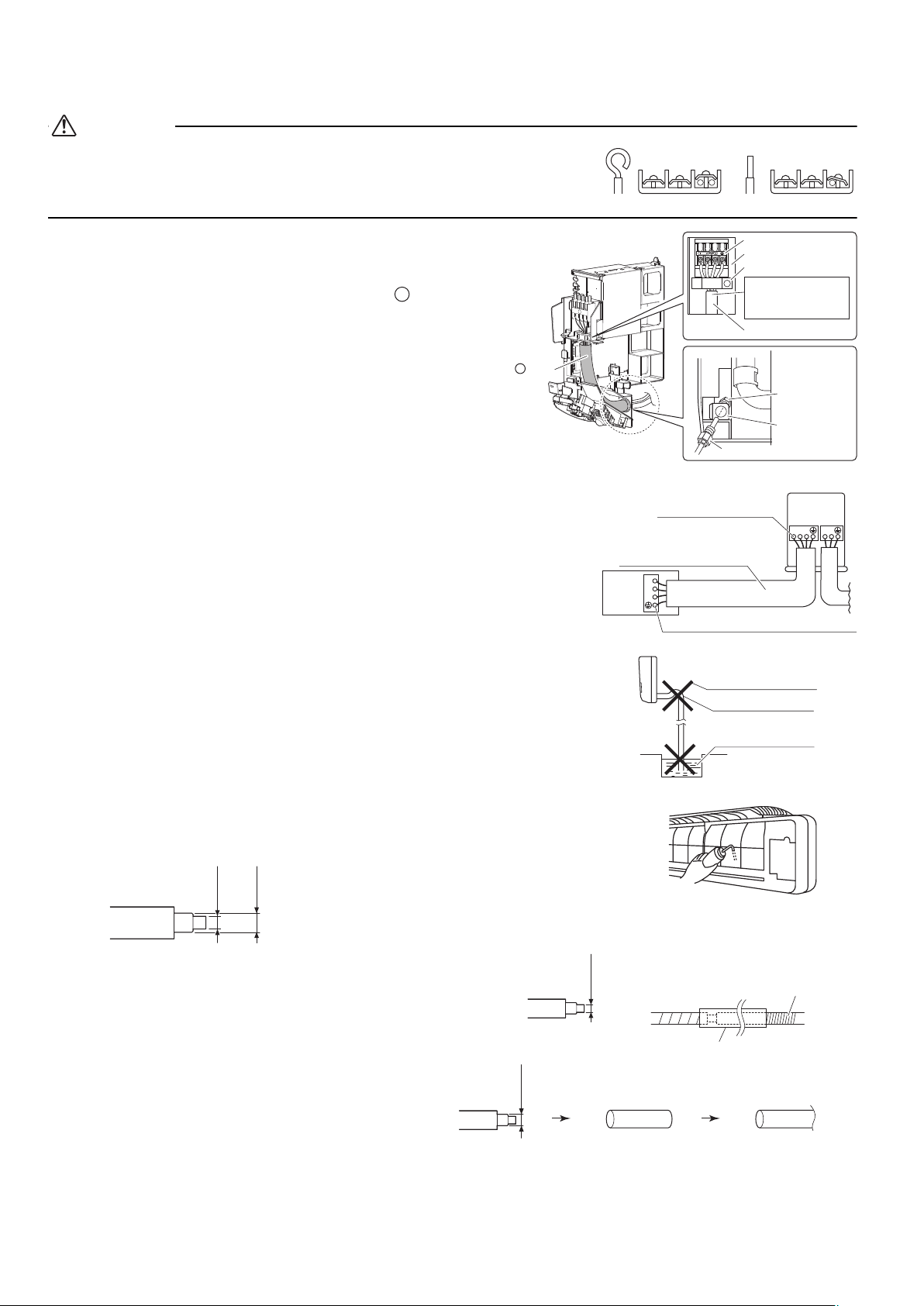
3-2. Left-side, left-back, or left-bottom piping
1) Switch around the drain plug and drain hose.
2) Attach the drain hose to the underside of the refrigerant
pipes with adhesive vinyl tape.
3) Shape the refrigerant pipes along the pipe path marking
on the mounting plate.
4) Pass the drain hose and refrigerant pipes through the
wall hole, then position the indoor unit on the mounting
plate hooks, using the markings at the top of the indoor
unit as a guide.
5) Open the front panel, then open the service lid. (Refer to
“Service lid” on page 4.)
6) Pass the inter-unit wire from the outdoor unit through the
feed-through wall hole and then through the back of the
indoor unit. Pull them through the front side. Bend the ends
of tie wires upward for easier work in advance.
(If the inter-unit wire ends are to be stripped first, bundle
wire ends with adhesive tape.)
7) Connect the refrigerant pipes.
8) In case of pulling the drain hose through the back of the indoor
unit, wrap the refrigerant pipes and drain hose together with
insulation tape as shown in the figure.
9) Press the bottom frame of the indoor unit with both hands until it is
firmly caught by the mounting plate hooks. Make sure that the
wires do not catch on the edge of the indoor unit.
3-3. Wall embedded piping
Follow the instructions given under
1) Insert the drain hose to this depth so it won’t be pulled
out of the drain pipe.
4. Wiring
Refer to the installation manual for the outdoor unit also.
WARNING
• Do not use tapped wires, extension cords, or starburst connections, as they may cause overheating, electric shock, or fire.
• Do not use locally purchased electrical parts inside the product. (Do not branch the power for the drain pump, etc., from the
terminal block.) Doing so may cause electric shock or fire.
• Do not connect the power wire to the indoor unit. Doing so may cause electric shock or fire.
3) Switch around the drain hose and drain plug.1) Remove the fixing screw and
pull out the drain hose.
How to switch around the drain plug and drain hose
Push the drain plug all the
way in using a hexagonal
wrench (3/16 inch (4mm)).
Hexagonal wrench
(3/16 inch (4mm))
Drain plug
No gap
Do not apply lubricating oil
(refrigerant oil) to the drain
plug when inserting it.
The application of lubrication
oil to the drain plug will
deteriorate the plug to cause
drain leakage from the plug.
Drain hose
Remove fixing
screw.
1
Pull out
drain hose.
2
Insert drain hose securely
and fix in place with fixing
screw.
Drain hose
Fixing screw
Insert a hexagonal
wrench (3/16 inch (4mm)).
2) Pull out
drain plug.
Remove pipe port cover here for
left-bottom piping.
Remove pipe port
cover here for
left-side piping.
Left-bottom piping
Left-side piping
Left-back piping
A
Wrap insulation tape
around the bent portion
of refrigerant pipe.
Overlap at least half the
width of the insulation
tape with each turn.
A Mounting
plate
Bind with
adhesive
vinyl tape.
Caulk this hole
with putty or
caulking material.
Drain
hose
A
Refrigerant
pipes
Drain hose
Bottom frame
Mounting
plate
A
Secure the indoor unit to the mounting plate with the
indoor unit fixing screws M4 × 1/2” (M4 × 12mm)(3 point).
A
H
A
Inner wall
Vinyl chloride
drain pipe (VP-30)
Drain hose
φ1-3/16” (30mm) or more
1-15/16”
(50mm)
or more
Insert the drain
hose to this depth
so it won’t be pulled
out of the drain pipe.
Outer wall
Left-side, left-back, or left-bottom piping .
English■
7
Indoor Unit Installation
CAUTION
When connecting the connection wire to the terminal block using a single core wire,
be sure to perform curling.
Problems with the installation may cause heat and fires.
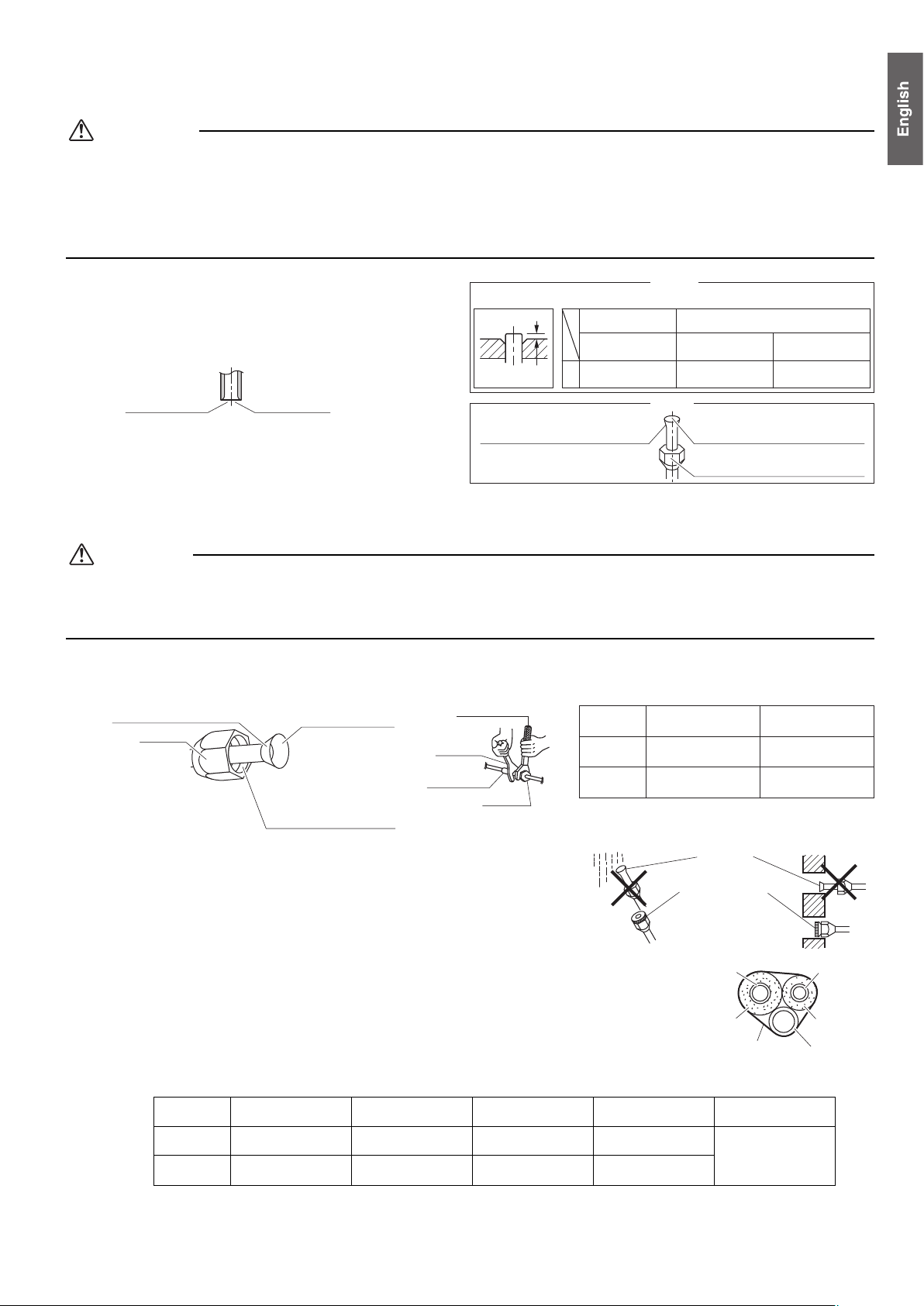
1) As shown in the illustration on the right-hand side, insert the
wires including the ground wire into the conduit and secure
them with lock nut onto the conduit mounting plate.
2) Insert the wires including the ground wire into tube.
3) Strip wire ends (9/16 inch (15mm)).
4) Match wire colors with terminal numbers on indoor and outdoor
unit’s terminal blocks and firmly screw wires to the
corresponding terminals.
5) Connect the ground wires to the corresponding terminals.
6) Pull the wires and check that the wires are securely fixed to the
terminal block.
7) In case of connecting to an adapter system, run the remote
controller cable and attach the S21.
(Refer to “4. When connecting to an HA system” on page 9.)
8) Shape the wires so that the service lid fits securely, then close service lid.
5. Drain piping
1) Connect the drain hose, as described on the right.
2) Remove the air filters and pour some water into the drain pan to check the water
flows smoothly.
3) If drain hose extension or embedded drain piping is required, use appropriate parts
that match the hose front end.
Figure of hose front end
• When drain hose requires extension, obtain an extension
hose with an inner diameter of 5/8 inch (16mm).
Be sure to thermally insulate the indoor section of the
extension hose.
• When connecting a rigid polyvinyl chloride pipe
(nominal diameter 1/2 inch (13mm)) directly to
the drain hose attached to the indoor unit as with
embedded piping work, use any commercially
available drain socket (nominal diameter 1/2 inch
(13mm)) as a joint.
Good Wrong
Conduit
mounting plate
Lock nut
Back
Conduit
Terminal block
Electrical wiring box
Use the specified wire type.
Wire retainer
Shape wires so that
the service lid will fit
securely.
Tube
K
K
1
2
3
123
L
1
L
2
Wire size and length must
comply with local codes.
Firmly fix the wires with
the terminal screws.
Outdoor
unit
Indoor
unit
Firmly fix the wires with the terminal screws.
The drain hose should
be inclined downward.
No trap is permitted.
Do not put the end
of the hose in water.
ϕ11/16”
(ϕ18mm)
ϕ5/8”
(ϕ16mm)
Indoor unit
drain hose
Extension drain hose
Heat insulation tube (field supply)
ϕ5/8”
(ϕ16mm)
Drain hose supplied
with the indoor unit
Commercially available
drain socket
(nominal diameter 1/2 inch
(13mm))
Commercially available
rigid polyvinyl chloride pipe
(nominal diameter 1/2 inch
(13mm))
Drain hose supplied with
the indoor unit
ϕ11/16”
(ϕ18mm)
English■
8
Refrigerant Piping Work
WARNING
• Do not apply mineral oil on flared part.
• Prevent mineral oil from getting into the system as this would reduce the service life of the units.
• Never use piping which has been used for previous installations. Only use parts which are delivered with the unit.
• Never install a dryer to this R410A unit in order to guarantee its service life.
• The drying material may dissolve and damage the system.
• Incomplete flaring may result in refrigerant gas leakage.
1. Flaring the pipe end
1) Cut the pipe end with a pipe cutter.
2) Remove burrs with the cut surface facing downward
so that the filings do not enter the pipe.
3) Put the flare nut on the pipe.
4) Flare the pipe.
5) Check that the flaring has been done correctly.
2. Refrigerant piping
CAUTION
• Use the flare nut fixed to the main unit. (This is to prevent the flare nut from cracking as a result of deterioration over time.)
• To prevent gas leakage, apply refrigeration oil only to the inner surface of the flare. (Use refrigeration oil for R410A.)
• Use a torque wrench when tightening the flare nuts to prevent damage to the flare nuts and gas leakage.
•
Align the centers of both flares and tighten the flare nuts 3 or 4 turns by hand, then tighten them fully with a spanner and a torque wrench.
2-1. Caution on piping handling
• Protect the open end of the pipe against dust and moisture.
• All pipe bends should be as gentle as possible. Use a pipe bender for
bending.
2-2. Selection of copper and heat insulation materials
When using commercial copper pipes and fittings, observe the following:
• Insulation material: Polyethylene foam
Heat transfer rate: 0.041 to 0.052W/mK (0.024 to 0.030Btu/fth°F (0.035 to
0.045kcal/mh°C))
Be sure to use insulation that is designed for use with HVAC Systems.
• ACR Copper only.
• Be sure to insulate both the gas and liquid piping and observe the insulation dimensions as below.
• Use separate thermal insulation pipes for gas and liquid refrigerant pipes.
Piping size Minimum bend radius Piping thickness Thermal insulation size
Thermal insulation
thickness
Gas side
O.D. 5/8 inch
(15.9mm)
1-15/16 inch (50mm)
or more
0.039 inch (1.0mm)
(C1220T-O)
I.D. 5/8-13/16 inch
(16-20mm)
13/32 inch
(10mm) Min.
Liquid side
O.D. 1/4 inch
(6.4mm)
1-3/16 inch (30mm)
or more
0.031 inch (0.8mm)
(C1220T-O)
I.D. 5/16-13/32 inch
(8-10mm)
A
A
Flaring
Set exactly at the position shown below.
Die
0-0.020 inch
(0-0.5mm)
Clutch-type
Flare tool for
R410A
0.039-0.059 inch
(1.0-1.5mm)
Clutch-type
(Rigid-type)
0.059-0.079 inch
(1.5-2.0mm)
Wing-nut type
(Imperial-type)
Conventional flare tool
The flare’s inner surface must be
flaw-free.
The pipe end must be evenly flared
in a perfect circle.
Make sure that the flare nut is fitted.
Check
Cut exactly at
right angles.
Remove burrs.
Do not apply refrigeration
oil to the outer surface.
Flare nut
Apply refrigeration
oil only to the inner
surface of the flare.
Do not apply refrigeration
oil to the flare nut to avoid
tightening with excessive
torque.
Apply oil
Torque wrench
Piping union
Flare nut
Spanner
Tighten
Piping size
O.D. 5/8 inch
(15.9mm)
Gas side
Liquid side
O.D. 1/4 inch
(6.4mm)
Flare nut tightening
torque
45-5/8–55-5/8ft • lbf
(61.8-75.4N • m)
10-1/2–12-3/4ft • lbf
(14.2-17.2N • m)
Wall
If no flare cap is
available, cover the
flare mouth with
tape to keep dirt
and water out.
Rain
Be sure to
place a cap.
Gas pipe Liquid pipe
Gas pipe
insulation
Liquid pipe
insulation
Finishing tape Drain hose
English■
9
Installation Tips
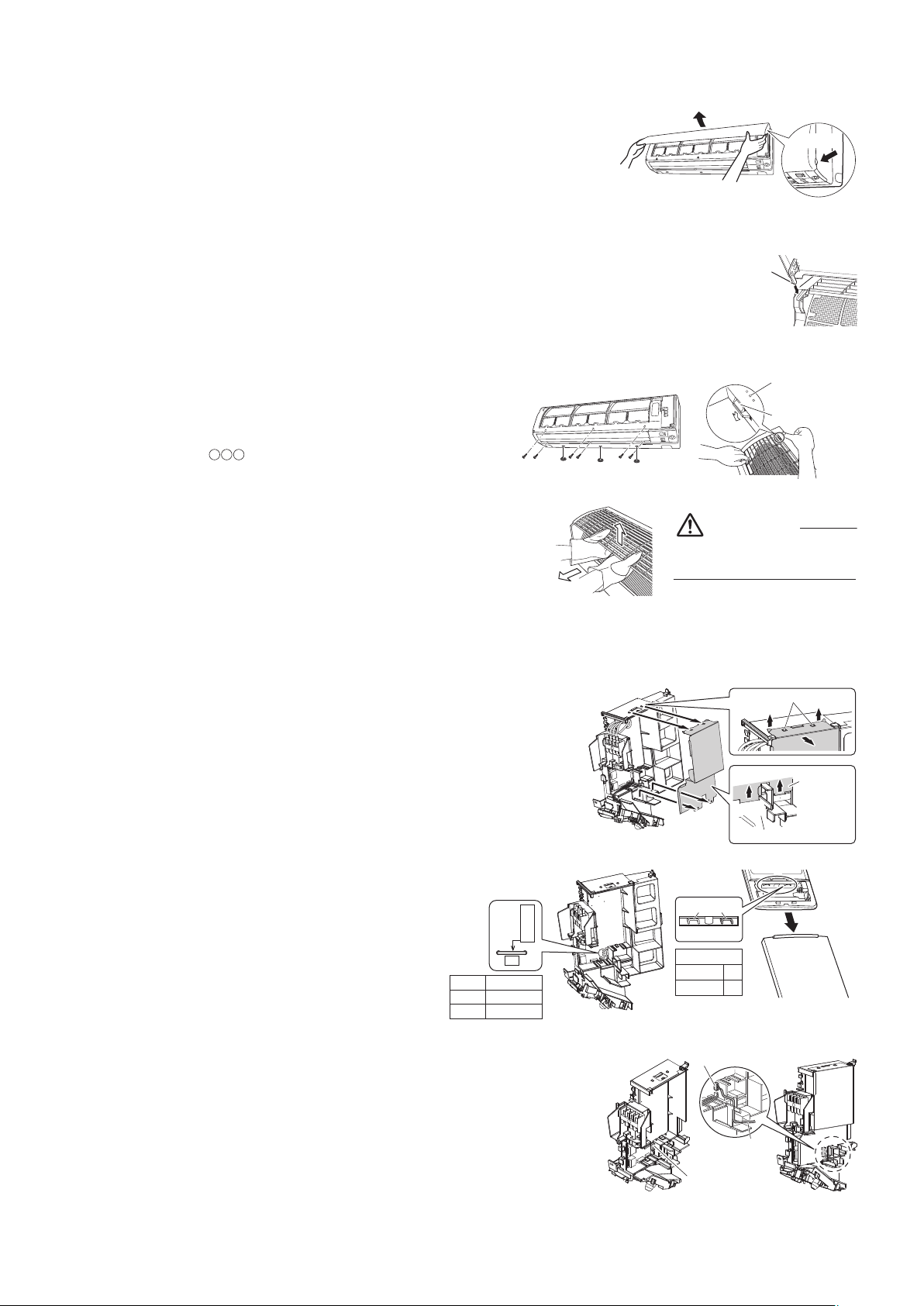
1. Removing and installing the front panel
• Removal method
1) Grip the panel tabs on each side of the front panel and open.
2) Slide the front panel to either the left or right and pull it toward you to
disengage one of the front panel shafts.
3) Disengage the front panel shaft on the other side in the same manner.
4) After disengaging both front panel shafts, pull the front panel toward yourself and remove it.
• Installation method
Align the front panel shaft of the front panel with the grooves of grille, and push
all the way in, then close slowly.
Push the center of the lower panel surface firmly to engage the tabs.
2. Removing and installing the front grille
• Removal method
1) Remove the front panel and air filters.
2) Remove 6 screws from the front grille.
3) Remove 3 front grille fixtures from the front grille.
4)
In front of the mark on the front grille, there are 4 upper
hooks. Lightly pull the front grille toward you with one hand, and
push down on the hooks with the fingers of your other hand.
When there is insufficient work space because the unit
is close to ceiling
Place both hands under the center of the front grille,
and while pushing up, pull it toward you.
• Installation method
1) Install the front grille and firmly engage the upper hooks
(4 locations).
2) Install 6 screws of the front grille.
3) Install 3 front grille fixtures of the front grille.
4) Install the air filters and then mount the front panel.
3. How to set the different addresses
When 2 indoor units are installed in one room, the 2 wireless remote controllers can
be set for different addresses. Change the address setting of one of the 2 units.
When cutting the jumper, be careful not to damage any of the surrounding parts.
1) Remove the front grille. (6 screws, 3 front grille fixtures)
2) Remove the metal plate electrical wiring box cover. (4 tabs)
(See Fig.1)
3) Cut the address jumper (JA) on the printed circuit board.
(See Fig.2)
4)
Cut the address jumper (J4) in the remote controller.
(See
Fig.3
)
• Do not cut jumper (J8). (Jumper (J8) is cut to switch
over the system to cooling only.)
5) Replace the metal electrical wiring box cover.
6) Replace the front grille.
4. When connecting to an HA system
1) Remove the front grille. (6 screws, 3 front grille fixtures)
2) Remove the metal plate electrical wiring box cover. (4 tabs) (See Fig.1)
3) Attach the connection cord to the S21 connector and pull the harness
out through the notched part in the figure. (See Fig.4)
4) Replace the electrical wiring box cover as it was, and pull the harness
around, as shown in the figure. (See Fig.5)
5) Replace the front grille.
Panel tab
Push the front panel
shaft of the front panel
into the groove.
Front panel shaft
Push
down.
Upper hook
mark area
(4 locations)
Be sure to wear protection
gloves.
CAUTION
1) Push up.
2) Pull toward
you.
Slide
Metal plate
electrical
wiring box
cover
Main body
Pull
Pull
SlideSlide
Ta b
Fig.1
1
2
Jumper
(J8) (J4)
ADDRESS
EXIST
CUT
Fig.2 Fig.3
ADDRESS
JA
ADDRESS
JA
EXIST
CUT 2
1
Fig.4 Fig.5
HA connector
(S21)
HA connector
(S21)
Lay the HA cord as
shown in the figure.
English■
10
Trial Operation and Testing
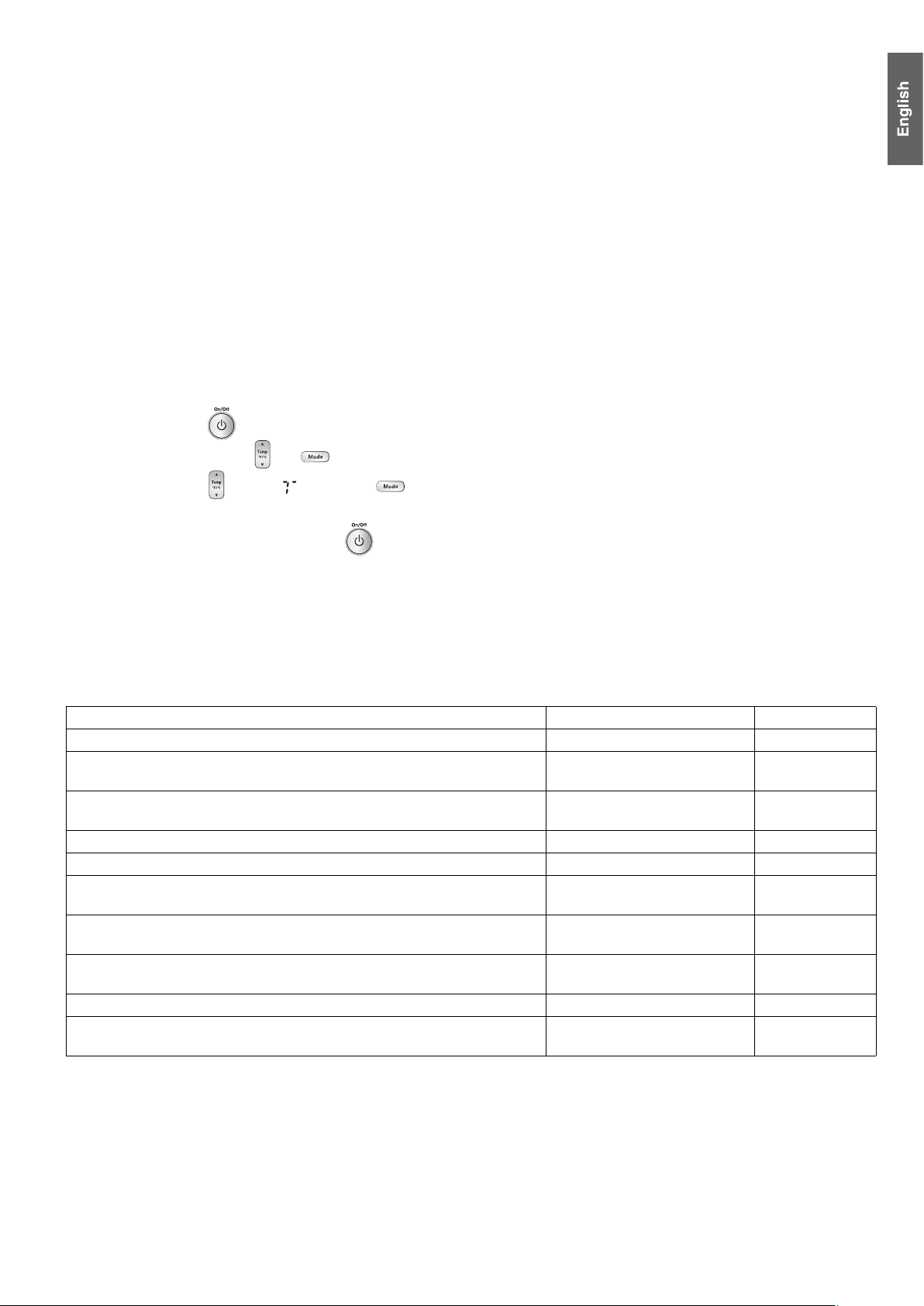
1. Trial operation and testing
• Trial operation should be carried out in either COOL or HEAT operation.
1-1. Measure the supply voltage and make sure that it is within the specified range.
1-2. In COOL operation, select the lowest programmable temperature;
in HEAT operation, select the highest programmable temperature.
1-3. Carry out the trial operation following the instructions in the operation manual to
ensure that all functions and parts, such as the movement of the louvers, are
working properly.
• To protect the air conditioner, restart operation is disabled for 3 minutes after the system has been turned off.
1-4. After trial operation is complete, set the temperature to a normal level (78°F to 82°F
(26°C to 28°C) in COOL operation, 68°F to 75°F (20°C to 24°C) in HEAT operation).
• When operating the air conditioner in COOL operation in winter, or HEAT operation in summer, set it to the trial operation
mode using the following method.
• The air conditioner draws a small amount of power in its standby mode. If the system is not to be used for some time after
installation, shut off the circuit breaker to eliminate unnecessary power consumption.
• If the circuit breaker trips to shut off the power to the air conditioner, the system will restore the original operation mode
when the circuit breaker is opened again.
2. Test items
Test items Symptom Check
Indoor and outdoor units are installed securely. Fall, vibration, noise
No refrigerant gas leaks.
Incomplete cooling/heating
function
Refrigerant gas and liquid pipes and indoor drain hose extension are
thermally insulated.
Water leakage
Draining line is properly installed. Water leakage
System is properly grounded. Electrical leakage
Only specified wires are used for all wiring, and all wires are connected
correctly.
No operation or burn damage
Indoor or outdoor unit’s air inlet or air outlet are unobstructed.
Incomplete cooling/heating
function
Stop valves are opened.
Incomplete cooling/heating
function
Indoor unit properly receives remote controller commands. No operation
Remote controller jumper setting is correct for the type of unit (heat pump
or cooling only).
Remote controller malfunctioning
1) Press to turn on the system.
2) Press both of and at the same time.
3) Press , select “ ”, and press for confirmation.
• Trial operation will stop automatically after about 30 minutes.
To stop the operation, press .
• Some of the functions cannot be used in the trial operation mode.
(1611) HT
M16B117
The two-dimensional bar code
is a manufacturing code.
3P457790-1