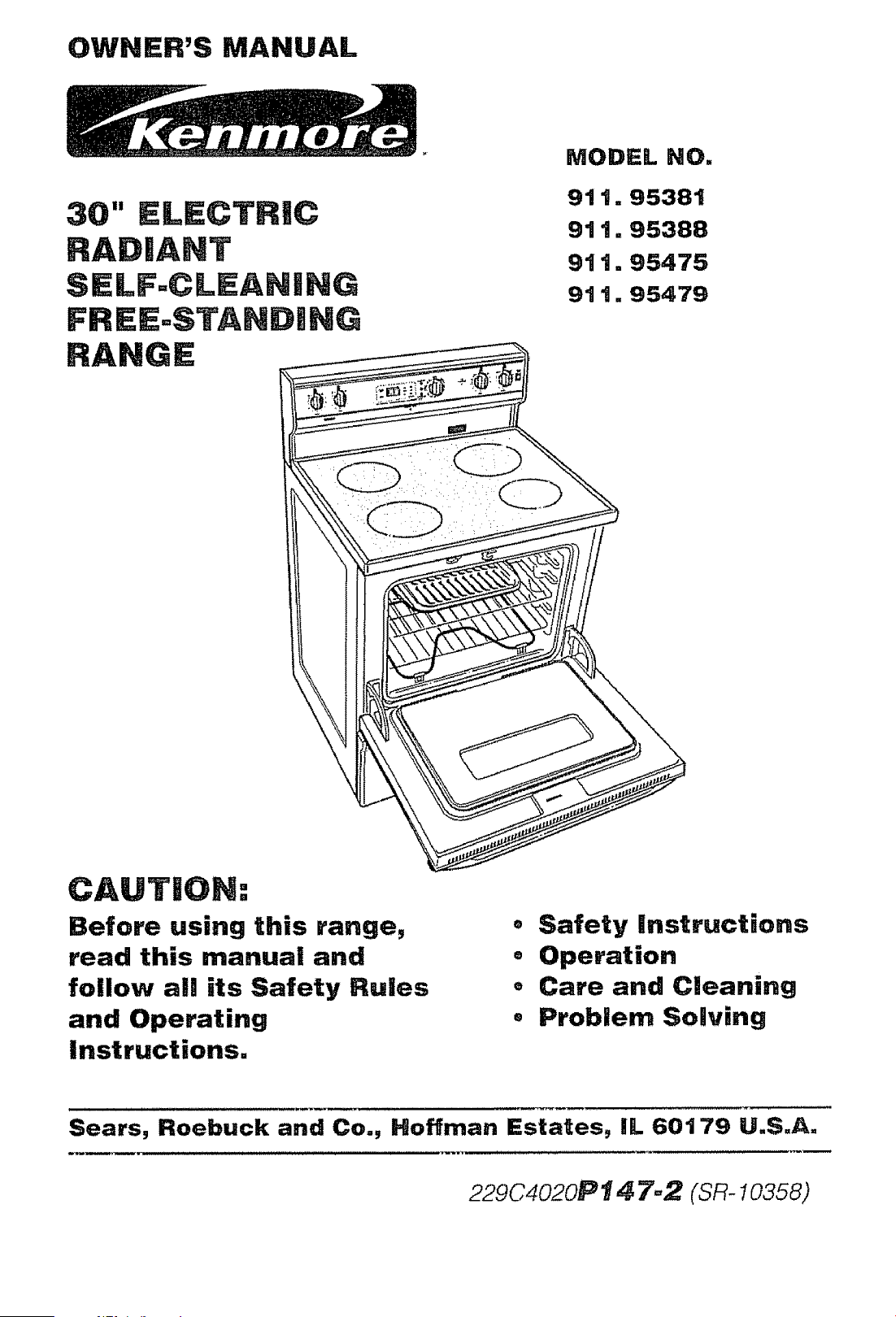
OWNER'S MANUAL
CAUTtON:
Before using this range,
read this manual and
follow all its Safety Rules
and Operating
Instructions.
• Safety instructBons
• Operation
° Care and Cleaning
o Problem Solving
Sears, Roebuck and Co., Hoffman Estates, IL 60t 79 U.S_A.
229C4020Pt 47,,_ (SR- 10358)
Table of Contents
SELF-CLEANING
RADIANTFREESTANDINGRANGE
Range Safety ............. 3-6
Stability Device ............ 3
Protecting the Cooktop ........... 7
Removal of Packaging Tape .... 7
Features of Your Range ...... 8
Cooking Zones ...... 9
Cooking Utensils ........... 9
Checking Your Cookware ...... 9
Cookware Performance ..... 9
Radiant Coils .............. 10
Radiant Unit Cycle .... 10
Control Settings ......... 10
Home Canning Tips ...... t0
Oven Control, Clock
& Timer .................... 11
Hour!Minute Arrow Pad 11
Display ........... 11
Indicator Lights t t
To Black Out the Display 11
F Codes ........ 11
Power On ............ 1t
Automatic Oven Shut-Off ,.. 11
To Set The Clock t2
To Set The Timer ................ 12
To Reset The Timer ........... t2
To Cancel The Timer ......... 12
Oven Cooking Tips ........... 13-15
Baking With Margarine ...... 14
Oven Control ........... 15
Baking ........................... 16
Broiling ......................... ! 7
Self-Cleaning Cycle ........ t8-19
Glass Cooktop Cleaning, 20-21
Control Panel ......................... 21
Broiler Pan and Grid ..... 21
Control Knobs ....... 22
Oven Light Bulb ............... 22
Oven Racks .............. 23
Oven Door ............... 23
Storage Drawer ................... 24
Before Calling for
Service ................. 25-27
Temperature Adjustment 28
Warranty ............ 29
Consumer Service Numbers 30
For your convenience and future reference, please write down
your model and serial numbers in the space provided. They are
located on the front frame behind the storage drawer.
MODEL HUMBER:
S_ROAL NUMBER:
2
IMPORTANTSAFETY
iNSTRUCTiONS
SAVE THESE |NSTRUCTRONS
Read air instructions before using this appliance. When using
gas or electrical appniances, basic safety precautions should
be followed, including the foi|owing:
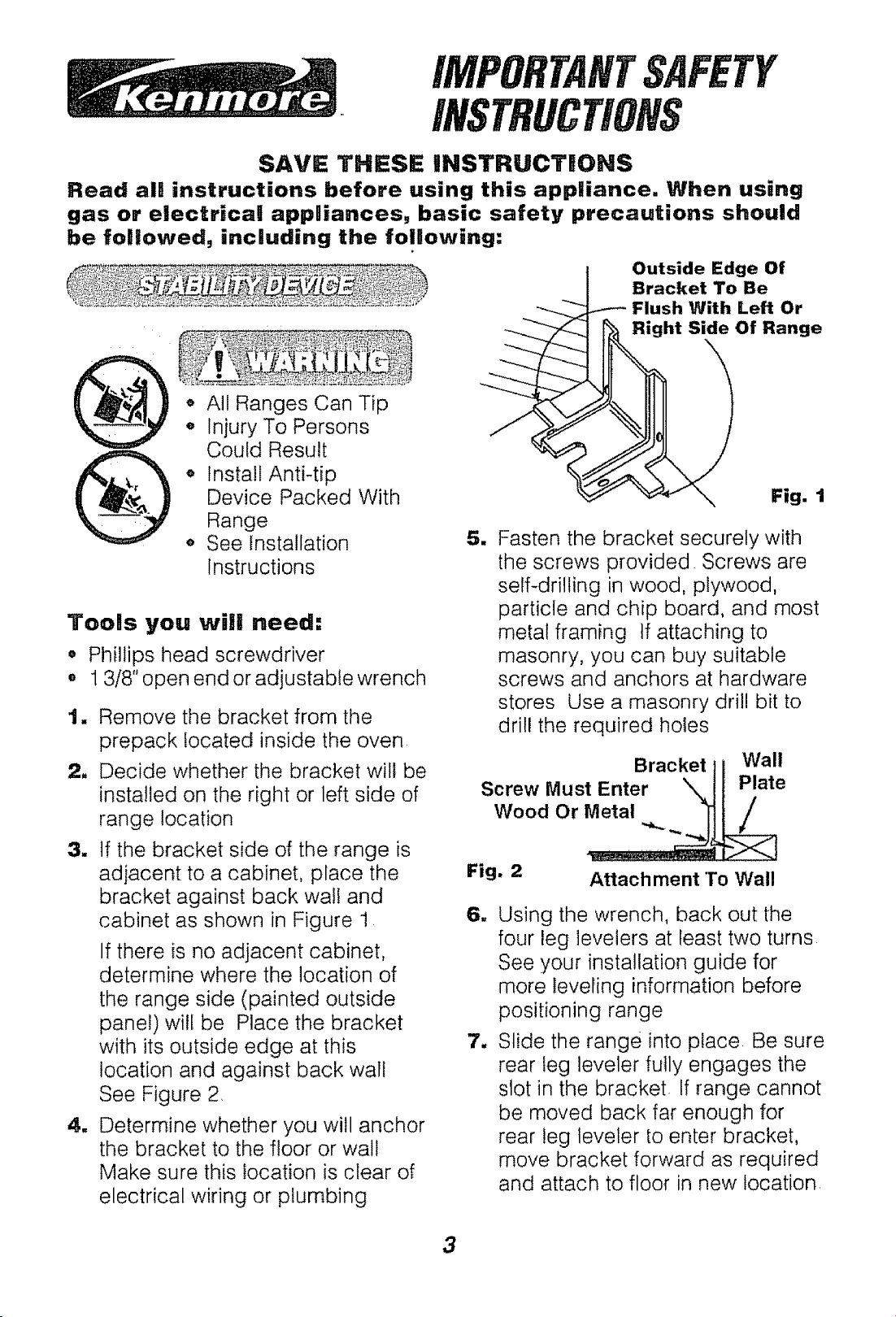
Outside Edge Of
Bracket To Be
Flush With Left Or
Right Side Of Range
o All Ranges Can Tip
o Injury To Persons
Could Result
o Install Anti-tip
Device Packed With
Range
° See Installation
Instructions
Tools you will need:
° Phillips head screwdriver
o 1 3/8" open end or adjustable wrench
t. Remove the bracket from the
prepack located inside the oven
2. Decide whether the bracket will be
installed on the right or left side of
range location
3. tf the bracket side of the range is
adjacent to a cabinet, place the
bracket against back wal! and
cabinet as shown in Figure 1
If there is no adjacent cabinet,
determine where the location of
the range side (painted outside
panel) will be Place the bracket
with its outside edge at this
location and against back wall
See Figure 2,
4. Determine whether you will anchor
the bracket to the floor or wall
Make sure this location is clear of
electrical wiring or plumbing
Fig. 1
w
Fasten the bracket securely with
the screws provided Screws are
self-drilling in wood, plywood,
particle and chip board, and most
metal framing If attaching to
masonry, you can buy suitable
screws and anchors at hardware
stores Use a masonry drill bit to
drill the required holes
Bracket ] Wall
Screw Must Enter X_l Plate
Wood Or Metal ]] /
Fig. 2 Attachment To Wall
w
7_
Using the wrench, back out the
four leg levelers at least two turns
See your installation guide for
more leveling information before
positioning range
Slide the range into place. Be sure
rear leg leveler fully engages the
slot in the bracket. If range cannot
be moved back far enough for
rear leg leveler to enter bracket,
move bracket forward as required
and attach to floor in new location
3
iMPORTANT
iNSTRUCTiONS
SAFETY
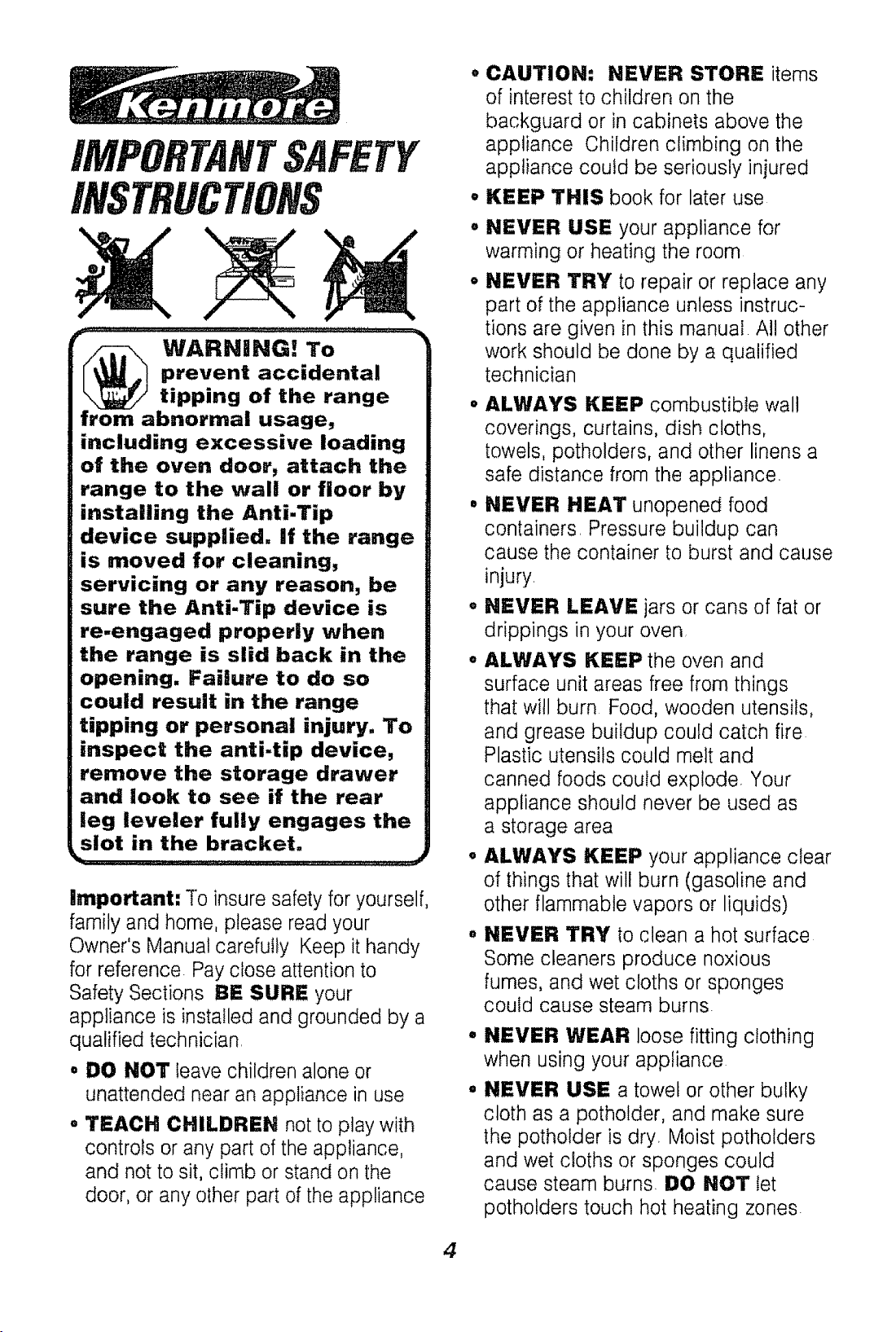
_ WARN|NG! To
prevent accidental
tipping of the range
from abnormal usage,
including excessive loading
of the oven door, attach the
range to the wall or floor by
installing the Anti-Tip
device supplied. If the range
is moved for cleaning,
servicing or any reason, be
sure the Anti-Tip device is
re.engaged properly when
the range is slid back in the
opening. Failure to do so
could result in the range
tipping or personal injury. To
inspect the anti-tip device,
remove the storage drawer
and look to see if the rear
leg leveler fully engages the
slot in the bracket.
important: To insure safety for yourself,
family and home, please read your
Owner's Manual carefully Keep it handy
for reference Pay close attention to
Safety Sections BE SURE your
appliance is installed and grounded by a
qualified technician,
o DO NOT leave children alone or
unattended near an appliance in use
• TEACH CHILDREN not to ptay with
controls or any part of the appliance,
and not to sit, climb or stand on the
door, or any other part of the appliance
o
o
CAUTION: NEVER STORE items
of interest to children on the
backguard or in cabinets above the
appliance Children climbing on the
appliance could be seriously injured
KEEP THIS book for later use
NEVER USE your appliance for
warming or heating the room
NEVER TRY to repair or replace any
part of the appliance unless instruc-
tions are given in this manual All other
work should be done by a qualified
technician
• ALWAYS KEEP combustible walt
coverings, curtains, dish cloths,
towels, potholders, and other linens a
safe distance from the appliance.
• NEVER HEAT unopened food
containers, Pressure buildup can
cause the container to burst and cause
injury,
• NEVER LEAVE jars or cans of fat or
drippings in your oven
o ALWAYS KEEP the oven and
surface unit areas free from things
that will burn Food, wooden utensils,
and grease buildup could catch fire
Plastic utensils could melt and
canned foods could explode Your
appliance should never be used as
a storage area
• ALWAYS KEEP your appliance clear
of things that will burn (gasoline and
other flammable vapors or liquids)
. NEVER TRY to clean a hot surface
Some cleaners produce noxious
fumes, and wet cloths or sponges
could cause steam burns.
NEVER WEAR loose fitting clothing
when using your appliance
NEVER USE a towel or other bulky
cloth as a potholder, and make sure
the pothoider is dry. Moist potholders
and wet cloths or sponges could
cause steam burns. DO NOT let
pothofders touch hot heating zones.
4
IMPORTANTSAFETY
INSTRUCTIONS
o DO NOT touch heating zones,
surfaces near them, or interior oven
surfaces These may be hot enough to
cause burns even though they are
dark in color During and after use, do
not touch or let clothing or flammable
material contact the zones or hot
surfaces until they have had time to
cool Other surfaces near the oven
vent openings, oven door and
window, and cooktop surfaces may
also be hot enough to cause burns
° ONLY SOME kinds of glass or
ceramic cookware can be used for
cooktop cooking Make sure the
cookware you choose to use is
designed for cooktop cooking without
breaking due to the sudden tempera-
ture change
o ALWAYS USE care when touching
cooktop elements They will retain
heat after the range has been
turned off
o NEVER BLOCK the oven air vent on
the backguard of the range
• COOKWARE USED for cooktop
cooking should be flat on the bottom
and large enough to cover the heating
area being used Undersized utensils
expose the heating element and may
result in direct contact or ignition of
clothing
o NEVER LEAVE surface units
unattended at high settings Boi!overs
result in smoking or greasy spills
which could catch fire
NEVER cook on a broken cooktop;
cleaning solutions and spillage could
penetrate it and create the risk of
electrical shock or fire
o ALWAYS TURN utensil handles
inward and away from other surface
units to reduce the risk of burns,
ignition, unintended contact, and
spillage.
° WHEN PREPARING flaming foods
under the vent hood, turn the fan on.
PLACE OVEN RACKS in the
desired position while the oven is
cool If racks must be moved while
oven is hot, do not let potholder
contact the hot oven element,
• AFTER BROIL|NG, always take
the broiler pan and grid out of the
oven and clean them Leftover
grease in the broiler pan could catch
fire the next time you use your oven
o ALWAYS USE care when opening
the oven door Let hot air and steam
escape before moving foods
° NEVER USE aluminum foil to line the
oven bottom Improper use of foil could
start a fire, or electrical shock could
result
IMPORTANTSAFETY
INSTRUCTIONS
• CLEAN ONLY the parts listed in this
manual Follow all cleaning instructions
Be sure to remove broiler pan and grid
before the self-clean cycle
• NEVER RUB, move or damage the
door gasket on self-cleaning ranges
• NEVER TRY to clean utensils,
cookware, removable parts, or broiler
pan and grid in the self-clean cycle
° DO NOT USE oven cleaners - No
commercial oven cleaner, or protective
coating of any kind, should be used in
or around any part of the oven.
o NEVER force the door handle open
while the oven is hot
iMPORTANT SAFETY
HOTICE!
The California Safe Drinking
Water and Toxic Enforcement
Act requires the governor of
California to publish a list of
substances known to the state
to cause birth defects or other
reproductive harm and requires
businesses to warn their cus-
tomers of potential exposure to
such substances. The fiberglass
insulation in a self.cleaning oven
will give off a very small amount
of carbon monoxide during the
cleaning cycle. Exposure can be
minimized by venting with an
open door or window or using a
ventilation fan or hood.
IMPORTANT: 1'he health of some
birds is extremely sensitive to
the fumes given off during the
self-cleaning cycle of any range.
Move birds to another well,
ventilated room.
READ AND UNDERSTAND
THIS INFORMATION NOW!
Be sure everyone in your home
knows what to do in case of fire.
Never use water on a grease
fire; it will only spread the
flames,
COOKTOP GREASE FIRE:
Never pick up a flaming pan...
1. Turn off the surface elements
2. Smother the flame with a tightly
fitting lid Use baking soda or a dry
chemical, foam, or halon type
extinguisher
OVEN FIRE:
Do not try to move the pan!
1. Close the oven door and turn
controls off
.
If fire continues, carefully open the
door, throw baking soda on the fire,
or use a dry chemical, foam, or
halon type extinguisher
6
Protecting the Cooktop
o Do not slide cookware across your
cooktop
, Do not use a dish towel or sponge
to clean or wipe your cooktop
• Do not use scouring powders or
plastic, nylon or metal cleaning
pads on your cooktop
• Do not apply your cooktop cleaning
creme to the cooktop surface if the
surface is hot
o Read the instruction label on the
cooktop cleaning creme bottle
before attempting to clean the
surface of your cooktop.
o After cleaning the cooktop surface,
be sure to wipe off any residue with
a dry paper towel that may be left
from the cleaning creme
o For major spills, turn the surface
control knob to OFF Use a dry
paper towel to wipe up spill, then
use a razor scraper (held with a
potholder) at a 300 angle against
the surface of the cooktop to
scrape remaining spill from the hot
cooking zone
OPERATION
r
CAUTUON: When the
surface controls are
turned off, the Hot
Surface mndicator
light will remain lit until the
cooktop surface has cooled
to approximately 150°F, The
glass ceramic surface will
retain heat after the
indicator light goes out. Use
caution until the cooktop
surface has had time to cool.
.w,...J
To remove the adhesive left from
packaging tape, use household
dishwashing liquid, mineral oil or
cooking oil With a soft cloth rub into
the area and allow to soak Rinse and
dry welt Repeat procedure using an
appliance polish to insure no damage
is done This should be done
before the range is turned on
for the first time, The tape
cannot be removed once the
range has heated, Packaging
tape may be found in the following
areas. Cooktop surface, Door Handle,
Control Panel area, Door Trim and
Oven area
° Do not cook directly on the surface
of the glass
, Do not use the cooktop as a cutting
board
7
OPERATION
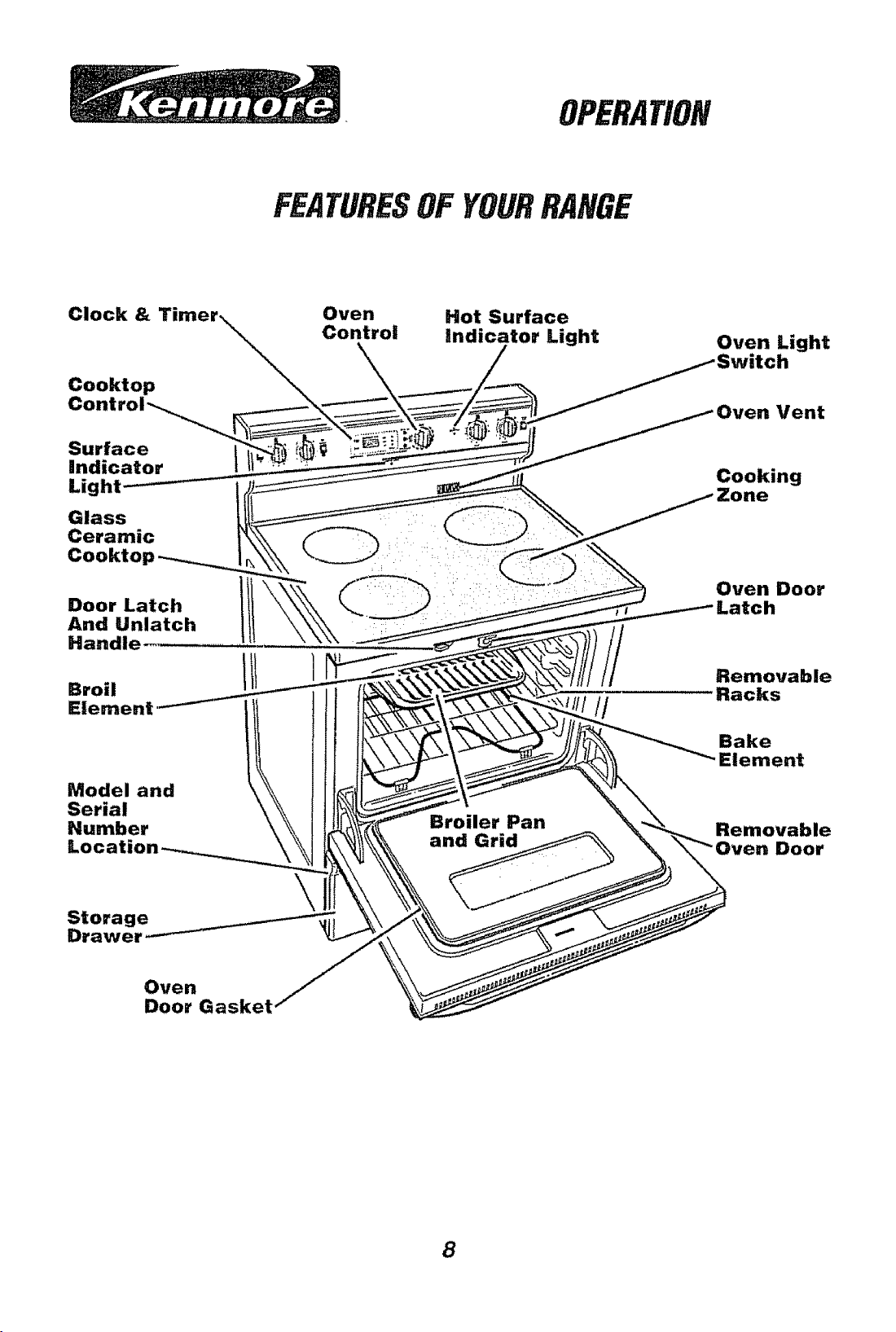
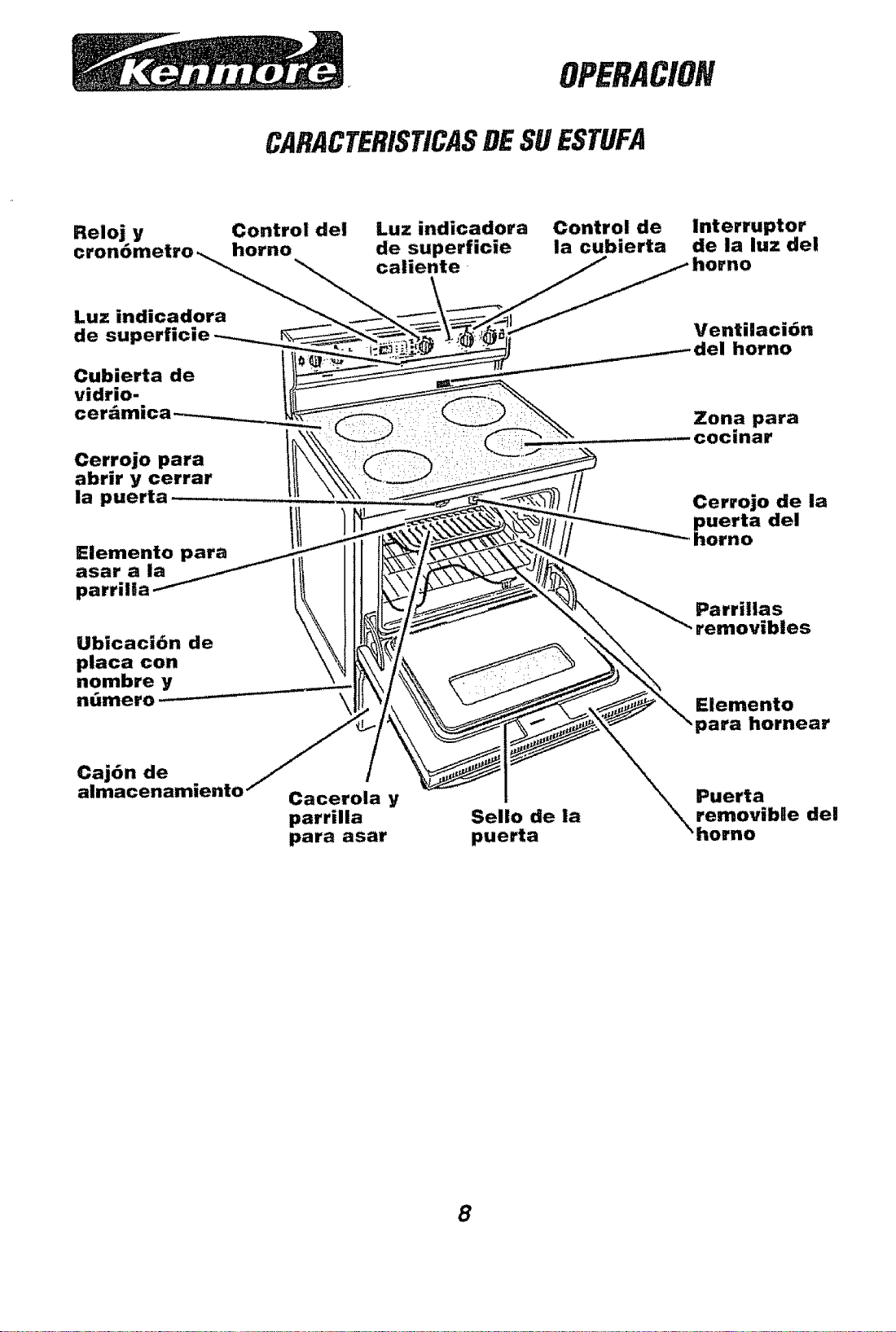
FEATURESOF YOURRANGE
Clock &
Cooktop
C,
Surface
indicator
Light
Glass
Ceramic
Cookto
Door Latch
And Unlatch
Handle
Oven Hot Surface
Control indicator Light
Broil
Element
Model and
Serial
Number
Lo(
Storage
Drawer
\
Broiler Pan
and Grid
Oven Light
Vent
Cooking
Oven Door
Removable
Racks
Bake
Element
Removable
Door
Oven
Door Gasket
8
OPERATION
Radiant CooktopCooking
Before using your new radiant
cooktop, clean it with the Cooktop
Cleaning Creme®. This wil! leave a
protective coating
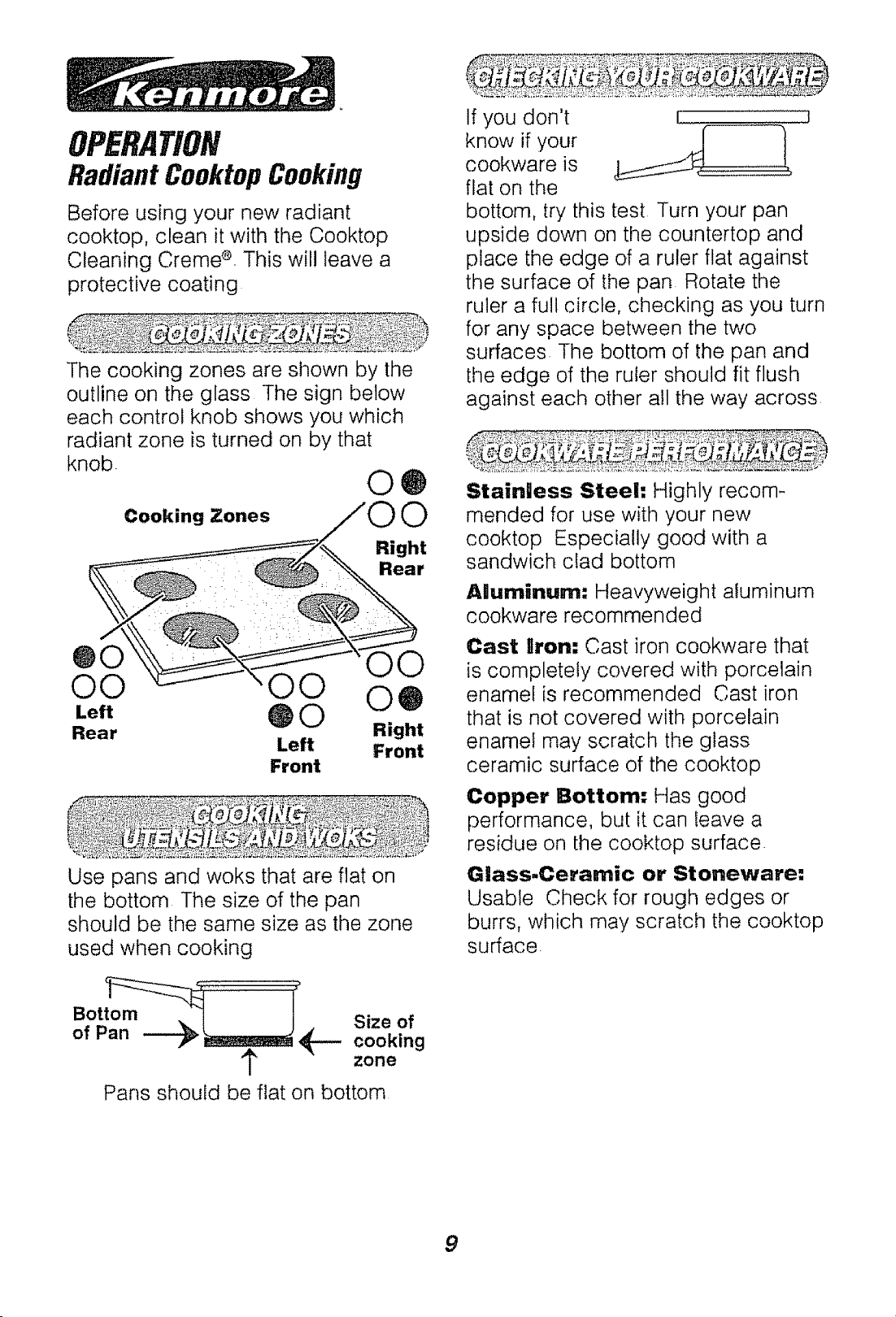
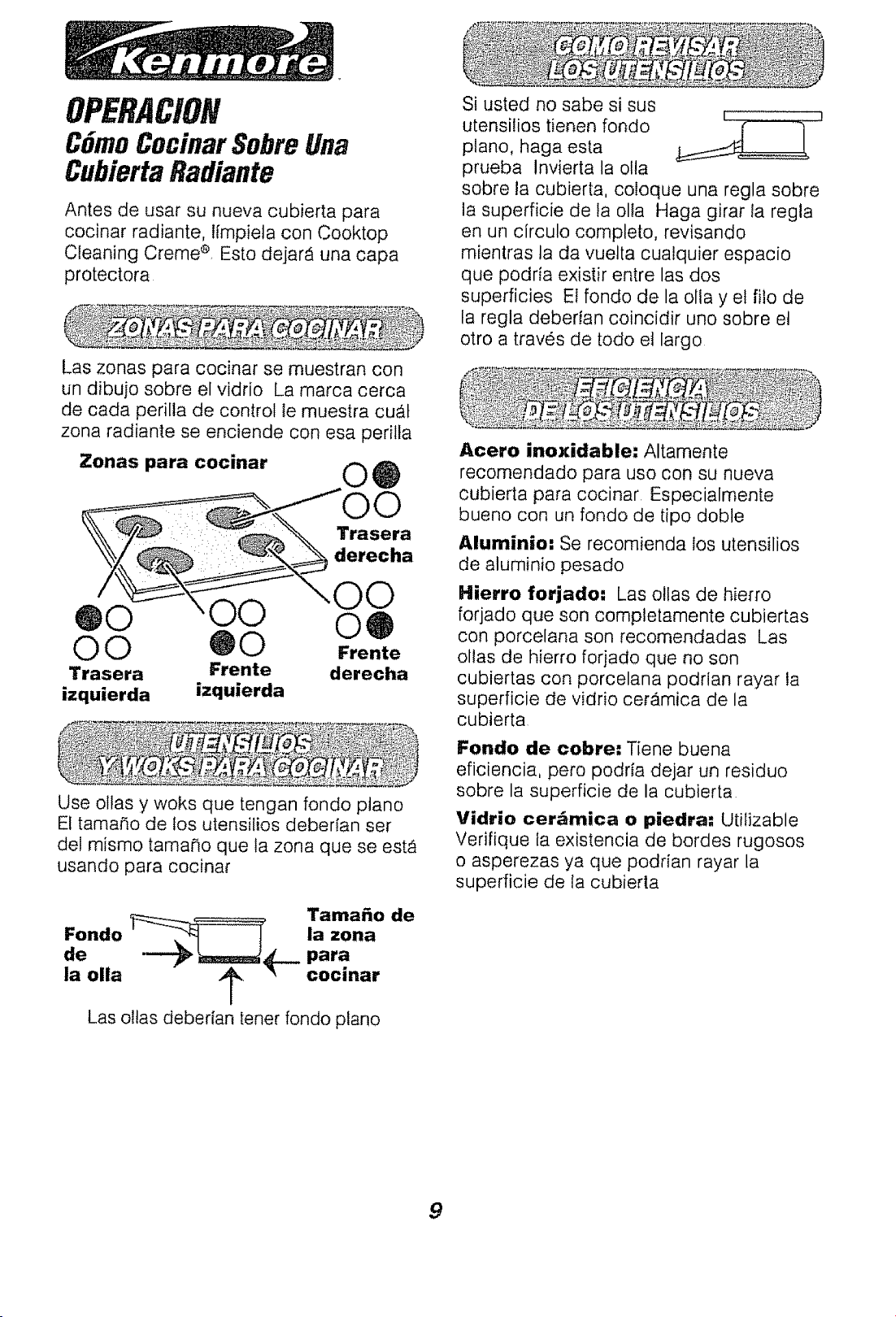
The cooking zones are shown by the
outline on the glass The sign below
each control knob shows you which
radiant zone is turned on by that
knob. 0 @
Cooking Zones
Right
Rear
@O
O0 O00e
Left @ 0
Rear Right
Left Front
Front
Use pans and woks that are flat on
the bottom The size of the pan
should be the same size as the zone
used when cooking
If you don't [ J
know if your ]
cookware is j_?_ ).
flat on the
bottom, try this test Turn your pan
upside down on the countertop and
place the edge of a ruler flat against
the surface of the pan Rotate the
ruler a full circle, checking as you turn
for any space between the two
surfaces. The bottom of the pan and
the edge of the ruler should fit flush
against each other all the way across
Stainless Steel: Highly recom-
mended for use with your new
cooktop Especially good with a
sandwich clad bottom
Aguminum: Heavyweight aluminum
cookware recommended
Cast Iron: Cast iron cookware that
is completely covered with porcelain
enamel is recommended Cast iron
that is not covered with porcelain
enamel may scratch the glass
ceramic surface of the cooktop
Copper Bottom: Has good
performance, but it can leave a
residue on the cooktop surface.
Glass.Ceramic or Stoneware:
Usable Check for rough edges or
burrs, which may scratch the cooktop
surface
Size of
cooking
zone
Pans should be flat on bottom
9
OPERATION
Radiant CooktopCooking
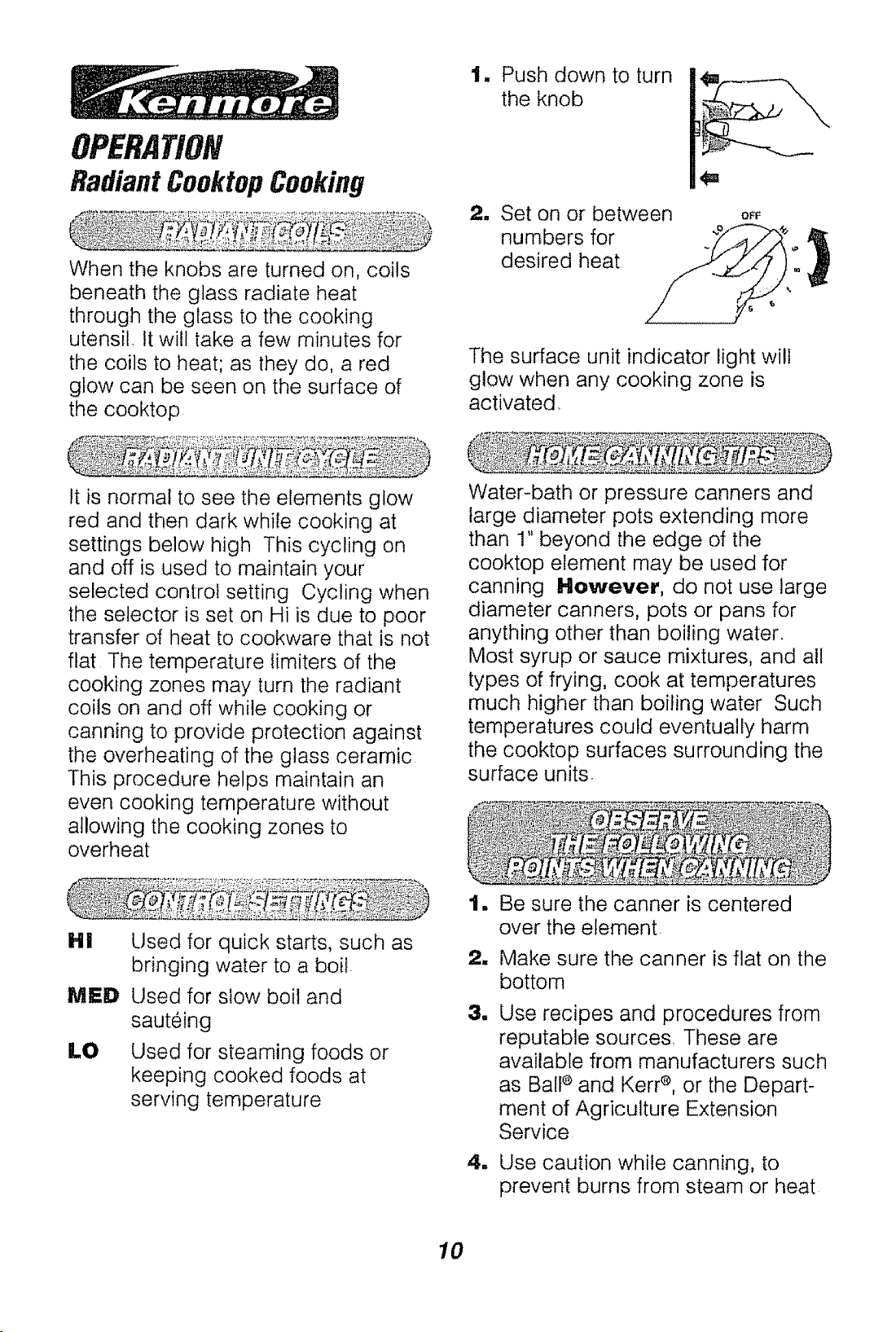
When the knobs are turned on, coils
beneath the glass radiate heat
through the glass to the cooking
utensil, tt will take a few minutes for
the coils to heat; as they do, a red
glow can be seen on the surface of
the cooktop
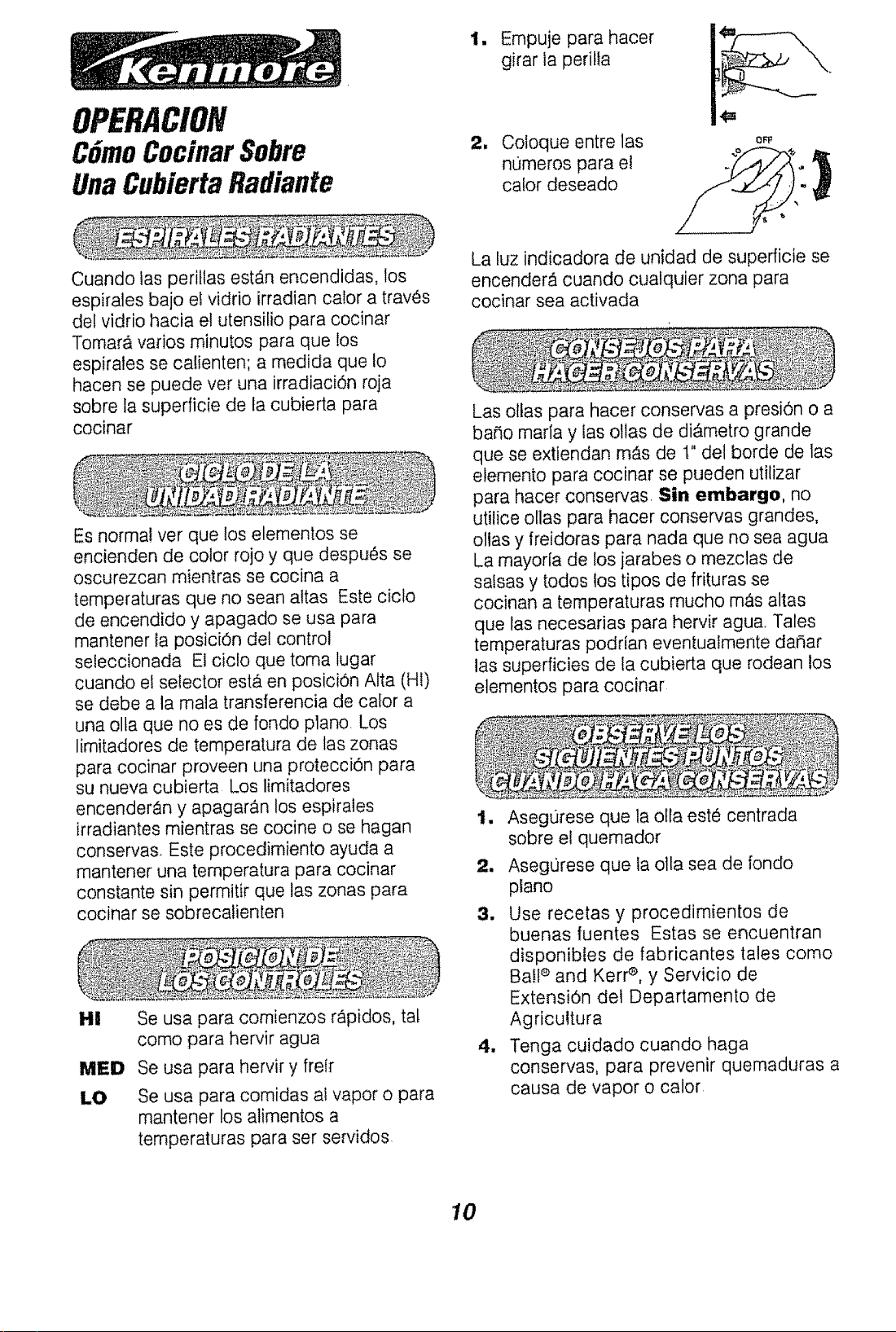
1. Push down to turn
the knob
2. Set on or between o_F
numbers for ._'_i o
desired heat .
The surface unit indicator light will
glow when any cooking zone is
activated
It is normal to see the elements glow
red and then dark while cooking at
settings below high This cycling on
and off is used to maintain your
selected control setting Cycling when
the selector is set on Hi is due to poor
transfer of heat to cookware that is not
flat The temperature limiters of the
cooking zones may turn the radiant
coils on and off while cooking or
canning to provide protection against
the overheating of the glass ceramic
This procedure helps maintain an
even cooking temperature without
allowing the cooking zones to
overheat
Water-bath or pressure canners and
large diameter pots extending more
than 1" beyond the edge of the
cooktop element may be used for
canning However, do not use large
diameter canners, pots or pans for
anything other than boiling water,
Most syrup or sauce mixtures, and all
types of frying, cook at temperatures
much higher than boiling water Such
temperatures could eventually harm
the cooktop surfaces surrounding the
surface units.
Hi Used for quick starts, such as
bringing water to a boil.
IVIED Used for slow boil and
saut6ing
LO Used for steaming foods or
keeping cooked foods at
serving temperature
11
ti
11
11
Be sure the canner is centered
over the element.
Make sure the canner is flat on the
bottom
Use recipes and procedures from
reputable sources, These are
available from manufacturers such
as Ball ® and Kerr ®, or the Depart-
ment of Agriculture Extension
Service
Use caution while canning, to
prevent burns from steam or heat
10
OPERATION
OvenControl,Clock, & Timer
OFF
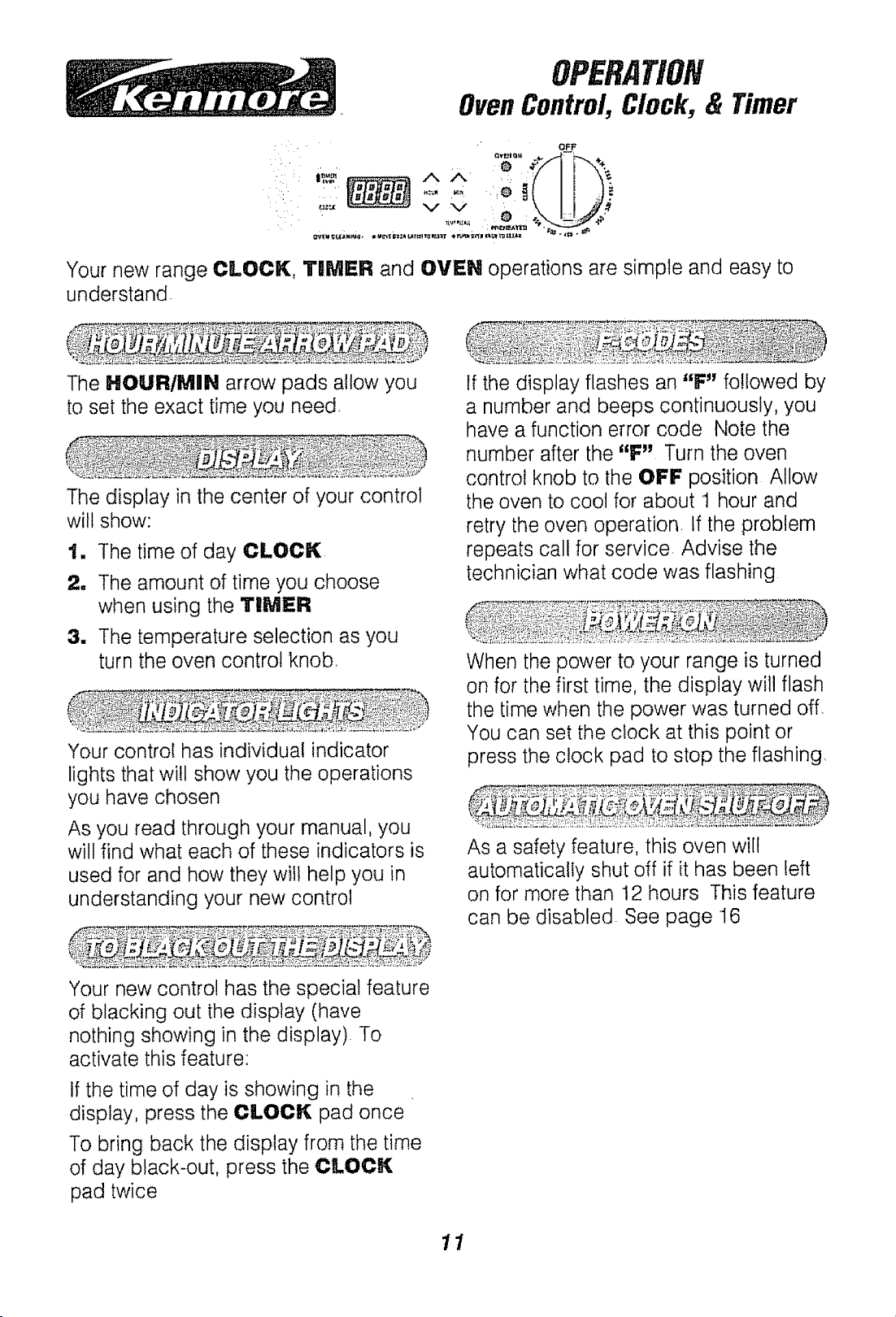
Your new range CLOCK, TIMER and OVEN operations are simple and easy to
understand.
The HOUR/MIN arrow pads allow you
to set the exact time you need
The display in the center of your control
will show:
ti. The time of day CLOCK
2. The amount of time you choose
when using the TIMER
3. The temperature selection as you
turn the oven control knob,
Your control has individual indicator
lights that will show you the operations
you have chosen
As you read through your manual, you
will find what each of these indicators is
used for and how they witf help you in
understanding your new control
If the display flashes an "F" followed by
a number and beeps continuously, you
have a function error code Note the
number after the "F" Turn the oven
control knob to the OFF position Allow
the oven to cool for about t hour and
retry the oven operation, If the problem
repeats call for service, Advise the
technician what code was flashing
When the power to your range is turned
on for the first time, the display will flash
the time when the power was turned off.
You can set the clock at this point or
press the clock pad to stop the flashing.
As a safety feature, this oven will
automatically shut off if it has been left
on for more than 12 hours This feature
can be disabled. See page I6
Your new control has the special feature
of blacking out the display (have
nothing showing in the display) To
activate this feature:
If the time of day is showing in the
display, press the CLOCK pad once
To bring back the display from the time
of day black-out, press the CLOCK
pad twice
11
OPERATION
Clock and Timer
AA}V "V"
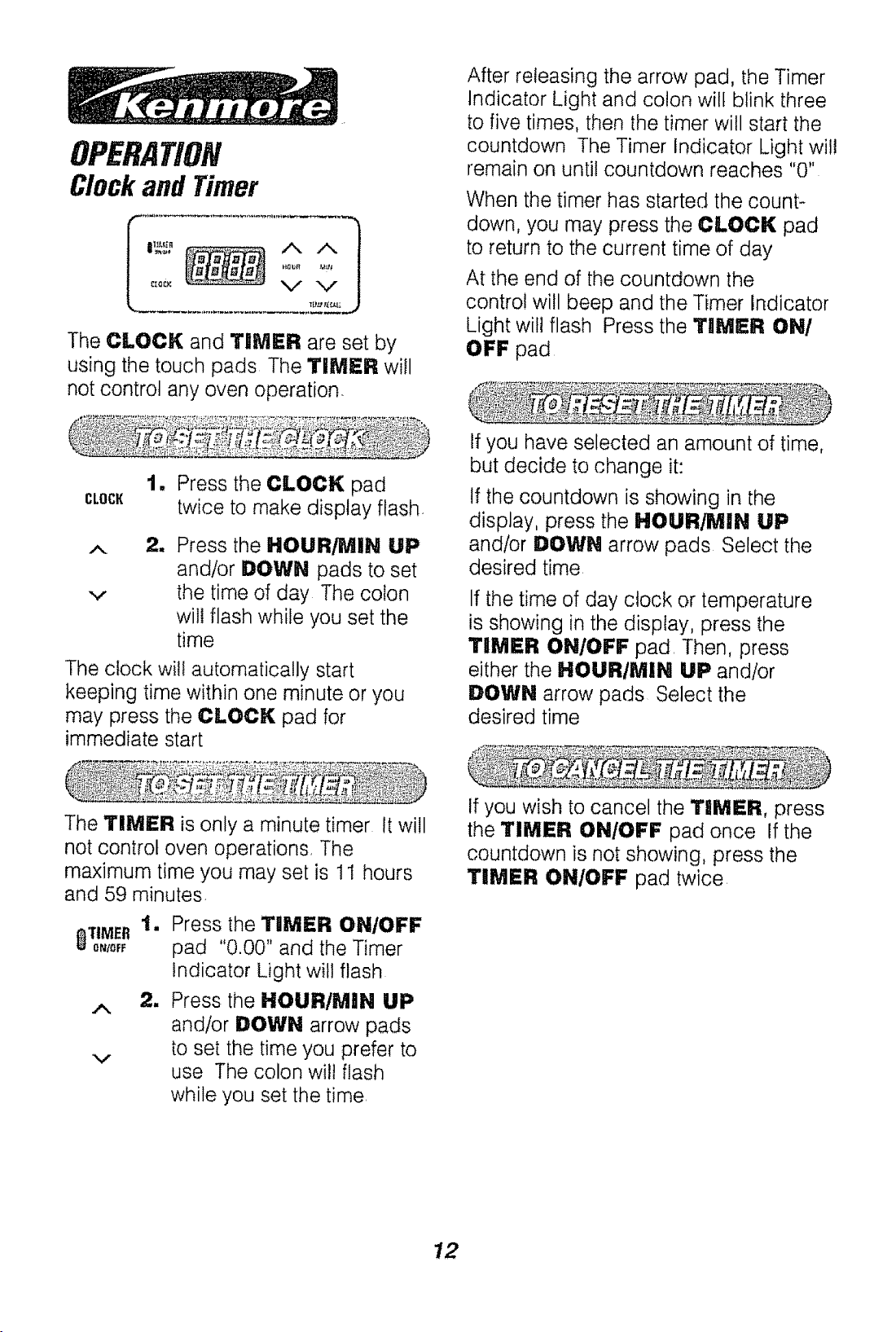
The CLOCK and TIMER are set by
using the touch pads The TIMER will
not control any oven operation.
After releasing the arrow pad, the Timer
Indicator Light and colon wilt blink three
to five times, then the timer will start the
countdown The Timer Indicator Light wil!
remain on until countdown reaches "0"
When the timer has started the count-
down, you may press the CLOCK pad
to return to the current time of day
At the end of the countdown the
control will beep and the Timer Indicator
Light will flash Press the TIMER ON/
OFF pad
1, Press the CLOCK pad
CLOCI( twice to make display flash.
A
1
Press the HOUR/MI]t'_ UP
and/or DOWN pads to set
the time of day The colon
wilt flash while you set the
time
The clock wilt automatically start
keeping time within one minute or you
may press the CLOCK pad for
immediate start
If you have selected an amount of time,
but decide to change it:
tf the countdown is showing in the
display, press the HOUR/MIN UP
and/or DOWN arrow pads Select the
desired time
If the time of day clock or temperature
is showing in the display, press the
TIMER ONIOFF pad, Then, press
either the HOUR/MIN UP andlor
DOWN arrow pads Select the
desired time
The TIMER is only a minute timer It will
not control oven operations. The
maximum time you may set is 11 hours
and 59 minutes.
_TIMER
ON/OFF
,,%
v
1
,=
Press the TIMER ON/OFF
pad "0.00" and the Timer
indicator Light will flash
Press the HOUR/MIN UP
and/or DOWN arrow pads
to set the time you prefer to
use The colon wilt flash
while you set the time.
If you wish to cancel the T|MER, press
the TIMER ON/OFF pad once If the
countdown is not showing, press the
TIMER ON/OFF pad twice
12
OPERATION
OvenCookingTips
It is normal to have some odor when
using your oven for the first time. To
help eliminate this odor, ventilate
the room by opening a window
or using a vent hood.
iMPORTANT: Never cover the oven
bottom or oven rack with aluminum
foil Improper use can cause poor
heat flow, poor baking results, and
may damage the oven finish To
prevent staining from spillovers, you
may place a piece of aluminum foil or
cookie sheet below the food which
may spill over
The oven vent is located under the
right rear element This area could
become very hot during oven use
Never block this vent.
In the back of the oven you will notice
a small tube This is a heat sensor
that maintains the temperature of the
oven Never move or bend this tube,
Oven ------___
Temperature Sensor
Opening the door often to check
foods will cause heat loss and poor
baking results
The low temperature zone of your
oven (between 170 ° and 200 ° F)is
available to keep hot cooked foods
warm. However, foods kept at these
temperatures longer than 2 hours
may spoil
To prolong the life of your oven light
bulb, follow these helpful tips: Always
turn the light off when the oven is not
in use or after a clean cycle If your
appliance does not have a window in
the door, you will need to open the
door to make sure the oven light is off
If your oven light is left on for an
extended period of time, the oven will
be warm when the door is opened
due to the heat generated from the
oven light bulb
Preheating is bringing the oven
temperature up to the temperature
you will be using during baking
13
OPERATION
OvenCookingTips
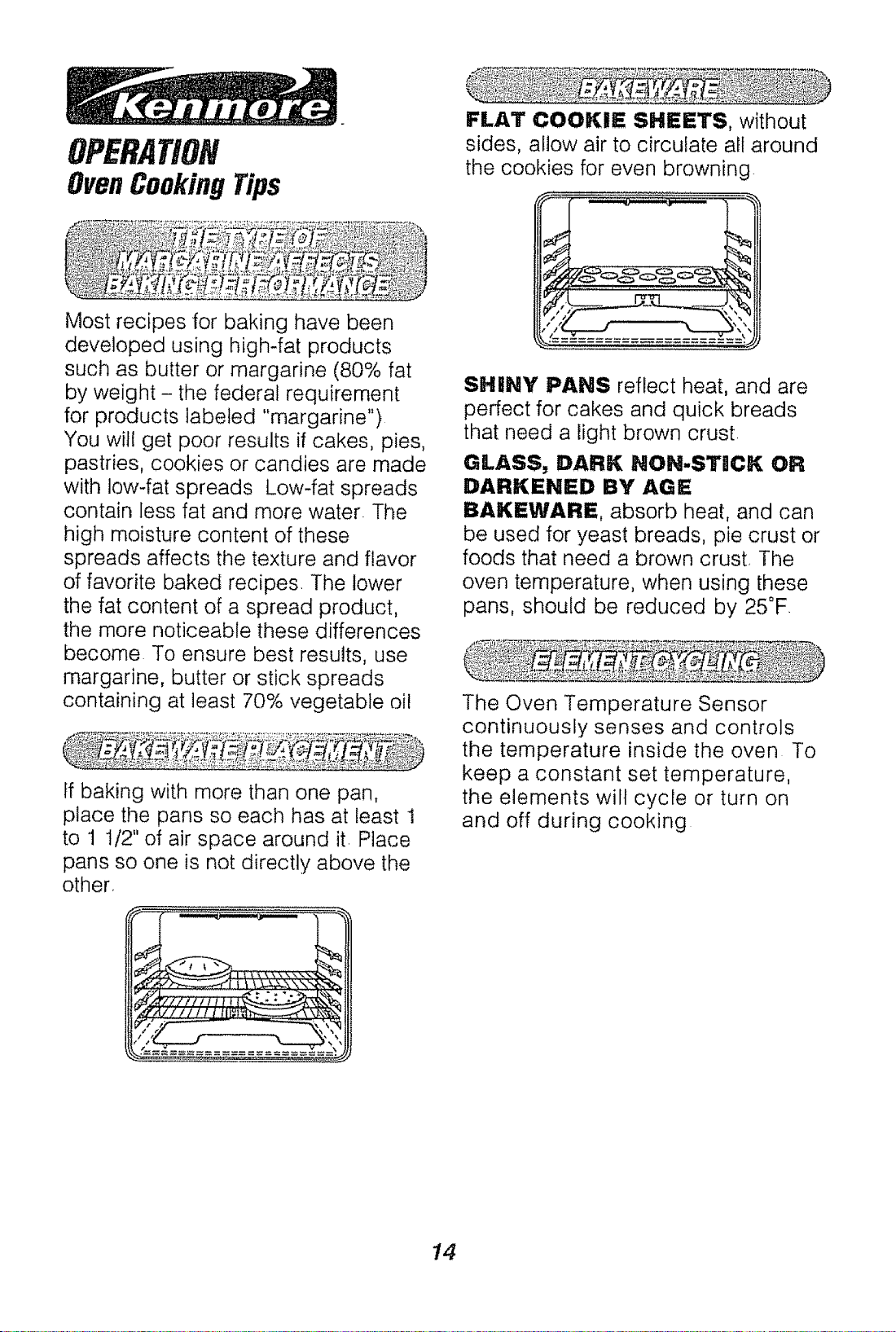
FLAT COOKIE SHEETS, without
sides, allow air to circulate all around
the cookies for even browning.
Most recipes for baking have been
developed using high-fat products
such as butter or margarine (80% fat
by weight - the federal requirement
for products labeled "margarine")
You will get poor results if cakes, pies,
pastries, cookies or candies are made
with low-fat spreads Low-fat spreads
contain less fat and more water. The
high moisture content of these
spreads affects the texture and flavor
of favorite baked recipes. The lower
the fat content of a spread product,
the more noticeable these differences
become To ensure best results, use
margarine, butter or stick spreads
containing at least 70% vegetable oil
If baking with more than one pan,
place the pans so each has at least 1
to 1 t/2" of air space around it. Place
pans so one is not directly above the
other.
SHINY PANS reflect heat, and are
perfect for cakes and quick breads
that need a light brown crust
GLASS, DARK NON-STICK OR
DARKENED BY AGE
BAKEWARE, absorb heat, and can
be used for yeast breads, pie crust or
foods that need a brown crust, The
oven temperature, when using these
pans, should be reduced by 25°F.
The Oven Temperature Sensor
continuously senses and controls
the temperature inside the oven To
keep a constant set temperature,
the elements wilt cycle or turn on
and off during cooking
1#
OPERATION
OvenCookingTips
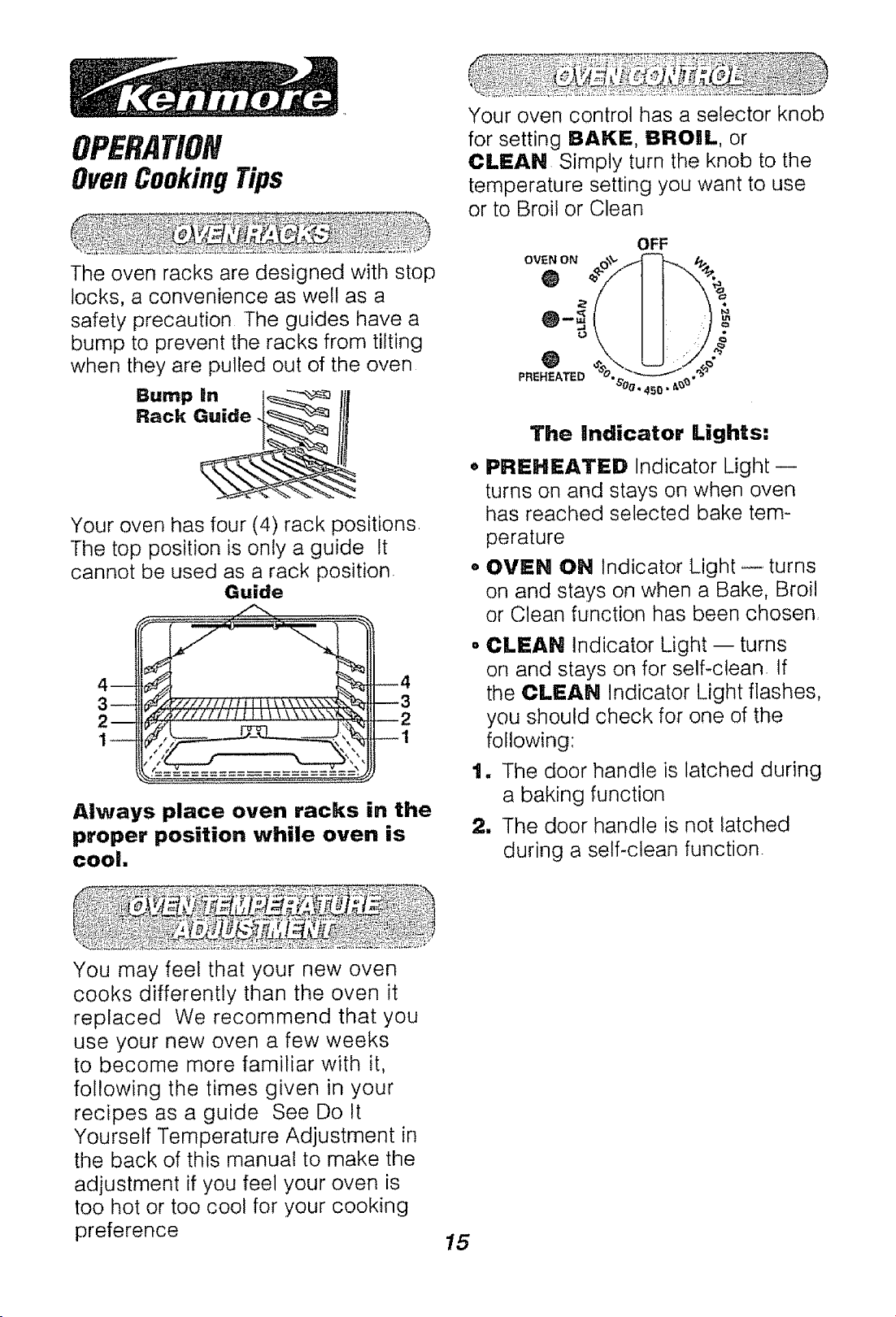
The oven racks are designed with stop
locks, a convenience as well as a
safety precaution The guides have a
bump to prevent the racks from tilting
when they are pulled out of the oven
Your oven has four (4) rack positions
The top position is only a guide It
cannot be used as a rack position.
Guide
__P._,(/!4t!!/
4
3--
2-- _I/I!/iI!ttlI_\\X'_X+k"_ --2
Always place oven racks in the
proper position while oven is
cool.
Your oven control has a selector knob
for setting BAKE, BROIL, or
CLEAN Simply turn the knob to the
temperature setting you want to use
or to Broil or Clean
OFF
OV_NON o\__--_
e- m( I I
The Indicator Lights:
. PREHEATED Indicator Light-
turns on and stays on when oven
has reached selected bake tem-
perature
o OVEN OH Indicator Light -- turns
on and stays on when a Bake, Broil
or Clean function has been chosen,
o CLEAN indicator Light -- turns
on and stays on for self-clean. If
the CLEAH Indicator Light flashes,
you should check for one of the
following:
1. The door handle is latched during
a baking function
2. The door handle is not latched
during a self-clean function.
You may feel that your new oven
cooks differently than the oven it
replaced We recommend that you
use your new oven a few weeks
to become more familiar with it,
following the times given in your
recipes as a guide See Do ft
Yourself Temperature Adjustment in
the back of this manual to make the
adjustment if you feel your oven is
too hot or too cool for your cooking
preference
15
OPERATION
Baking
1. Turn the OVEN CONTROL
KNOB to selected temperature
from WM to 550°F As the knob
turns the control display will show
the changing temperatures When
the display shows your selected
temperature release the control
knob. The temperature will remain
in the display for 5 seconds then
return to the time of day_ To recall
the temperature display press the
minute down arrow pad
2. The "OVEN ON" indicator light
will glow,
3. When the oven has reached the
selected temperature, a series of
short tones will sound, and the
"PREHEATED" and "OVEH
ON" indicator lights 'will glow
4. The "PREHEATED" and
"OVEN ON" indicator lights will
remain on until baking is complete
and the control knob is turned to
the OFF position
1. With the control knob in the off
position, press and hold the
i_inN UP and DOWN arrow
pads, at the same time, until
"ON" or "OFF" shows in the
display.
2. Holding the MIlN UP or DOWN
arrow pad again, at the same
time, will alternate between 12
hour shut-off on or off,
16
OPERATION
Broiling
Broiling is cooking by direct heat
from the upper element The oven
door should remain open to the broil
stop position during broiling
it is not necessary to preheat the
oven when broiling Use the broiler
pan and grid that came with your
range Both are designed for proper
drainage of fat and liquids
_ f foil is used it must
be molded tightly to
the grid and slits cut
into the foil to match
those of the grid. This
allows fats and liquids to
drain into the broiler pan,
preventing fire and
excessive smoke.
Always remove the pan and
grid from the oven. (_
Storing or forgetting
a soiled broiler pan
in the oven is a potential
smoke or fire hazard.
The U S Department of Agriculture
recommends to cook meat and
poultry thoroughly--meat to at least
an INTERNAL temperature of 160°F
and poultry to at least an INTERNAL
temperature of I80°F Cooking to
these temperatures usually protects
against food-borne illness
The closer you place foods to the
broil element, the faster foods brown
on the outside yet remain red to pink
in the center
Moving meats away from the element
will allow the meat to cook to the
center while browning on the outside.
Cook side 1 at least 2 minutes longer
than side 2 If your oven is connected
to 208 volts, you may want to use a
higher rack position andfor broil
foods longer
The size, weight, thickness, starting
temperature and your preference of
the doneness of the meat will affect
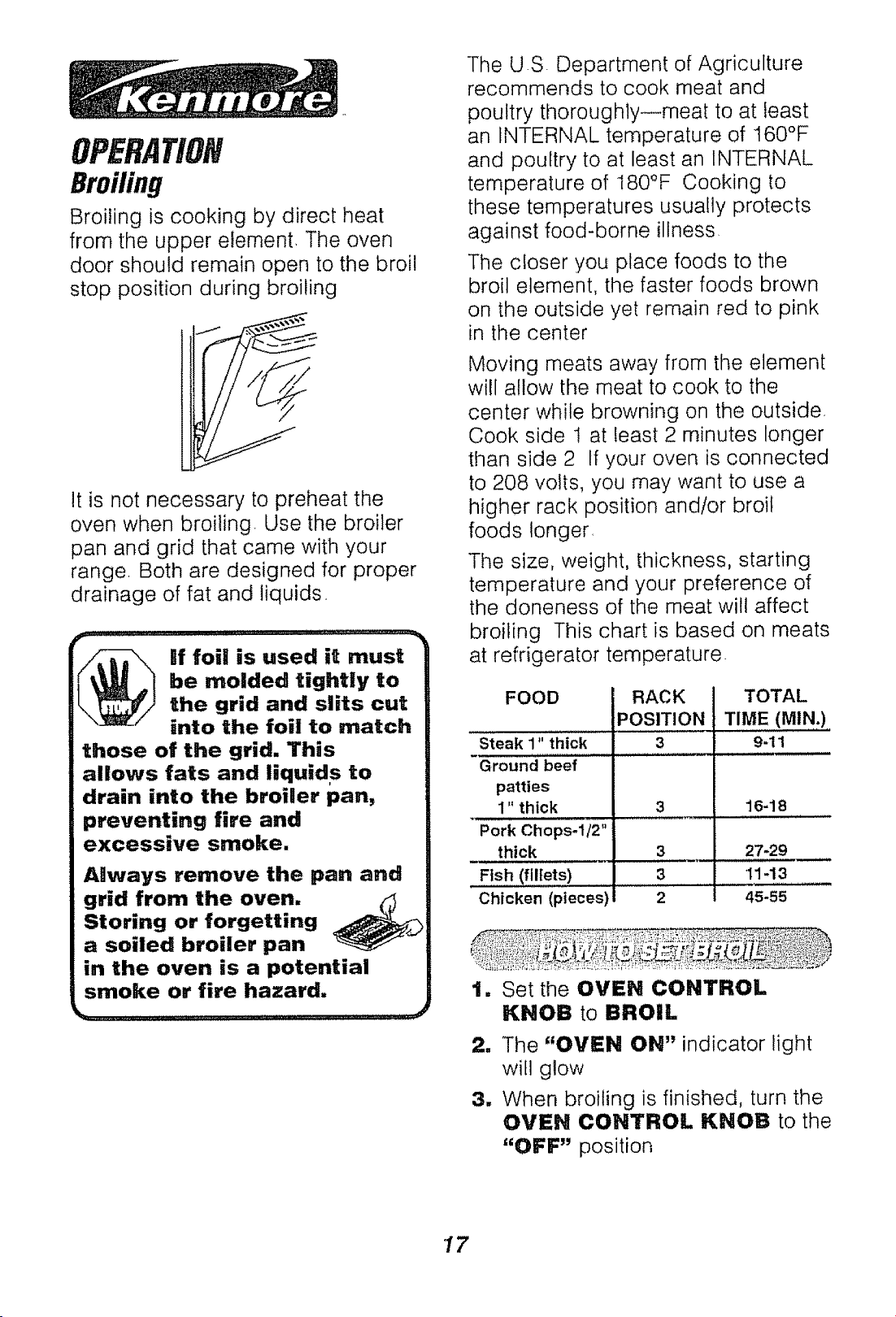
broiling This chart is based on meats
at refrigerator temperature
FOOD
RACK
POSITION
3
Steak 1" thick
Ground beef
patties
1" thick 3 16-18
Pork Chops-t/2"
thick 3 27-29
Fish (fillets) 3 'I1-13
Chicken (pieces', 2 45-55
TOTAL
TIME (MIN.)
9-11
== Set the OVEN CONTROL
KNOB to BROIL
2= The "OVEN ON" indicator light
will glow
3. When broiling is finished, turn the
OVEN CONTROL KNOB to the
"OFF" position
17
Self-Cleaning Cycle
CAREANDCLEANING
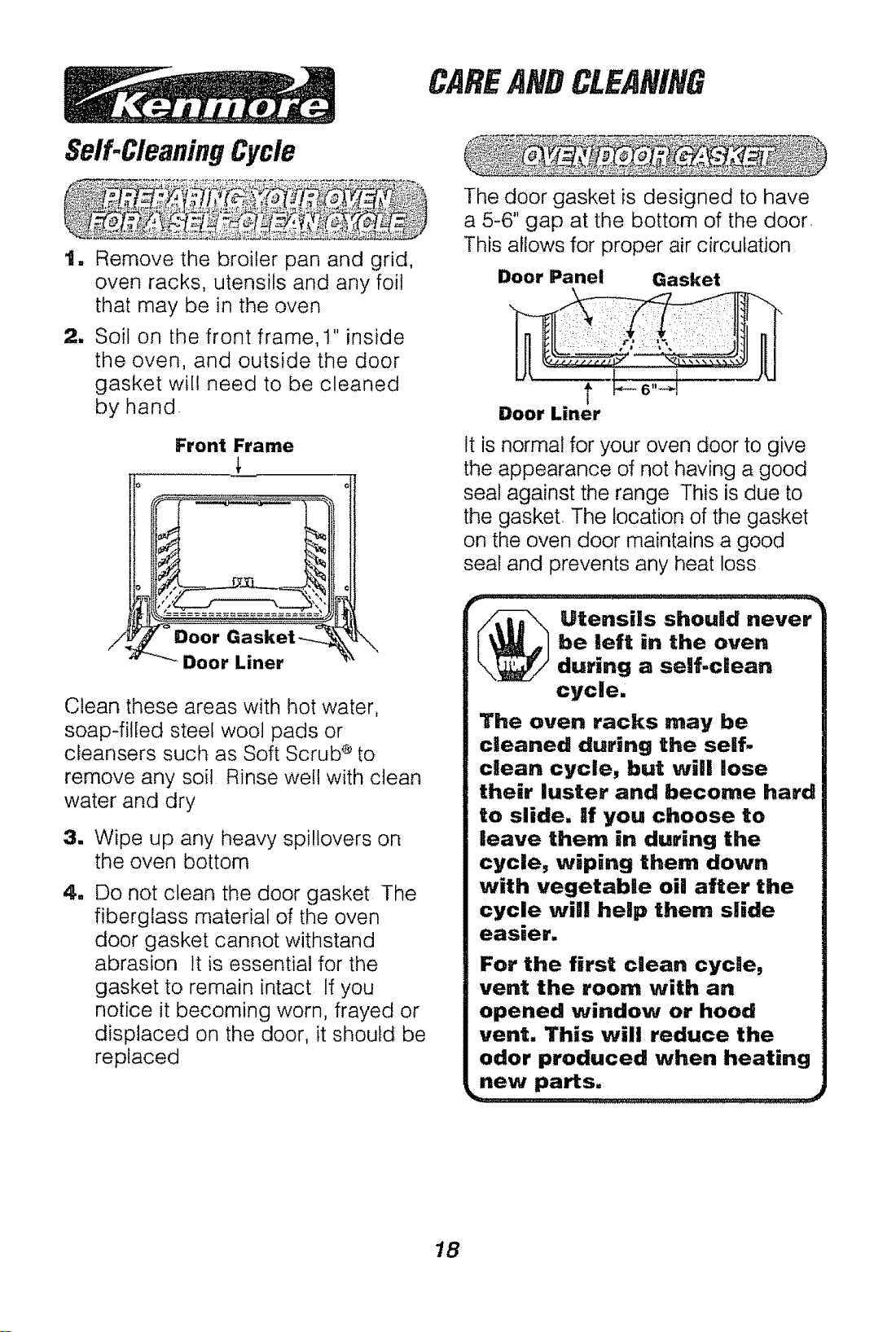
1. Remove the broiler pan and grid,
oven racks, utensils and any foil
that may be in the oven
2. Soil on the front frame, 1" inside
the oven, and outside the door
gasket will need to be cleaned
by hand
Front Frame
Ooor Gask;t
--_'_ Door Liner
Clean these areas with hot water,
soap-filled steel wool pads or
cleansers such as Soft Scrub ® to
remove any soil Rinse well with clean
water and dry
8. Wipe up any heavy spillovers on
the oven bottom
4. Do not clean the door gasket The
fiberglass material of the oven
door gasket cannot withstand
abrasion It is essential for the
gasket to remain intact If you
notice it becoming worn, frayed or
displaced on the door, it should be
replaced
The door gasket is designed to have
a 5-6" gap at the bottom of the door.
This allows for proper air circulation
Door Panel Gasket
Door Liner
tt is normal for your oven door to give
the appearance of not having a good
seal against the range This is due to
the gasket. The location of the gasket
on the oven door maintains a good
seal and prevents any heat loss
_ tensils should never
be left in the oven
during a self-clean
cycle,
The oven racks may be
cleaned during the self.
clean cycle, but will lose
their luster and become hard
to slide, if you choose to
leave them in during the
cycle, wiping them down
with vegetable oil after the
cycle wil! help them slide
easier.
For the first clean cycle,
vent the room with an
opened window or hood
vent. This will reduce the
odor produced when heating
new parts,
18
CAREANDCLEANING
Self-CleaningCycle
lu
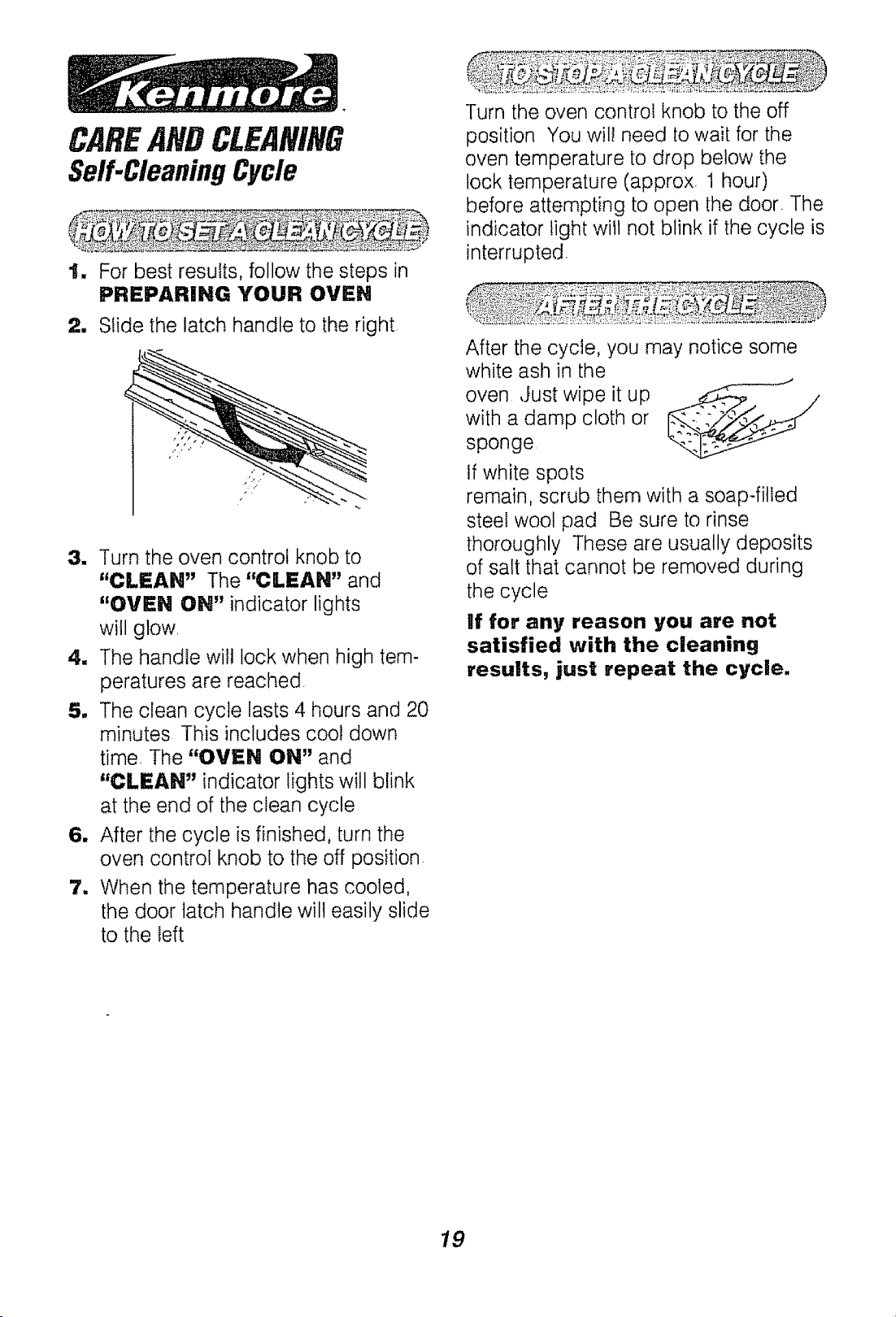
For best results, follow the steps in
PREPARING YOUR OVEN
2. Slide the latch handle to the right
3. Turn the oven control knob to
"CLEAN" The "CLEAN" and
"OVEN OH" indicator lights
will glow,
4. The handle wilt lock when high tem-
peratures are reached
5. The clean cycle lasts 4 hours and 20
minutes This includes cool down
time. The "OVEN ON" and
"CLEAH" indicator lights will blink
at the end of the clean cycle
6. After the cycle is finished, turn the
oven control knob to the off position.
7. When the temperature has cooled,
the door latch handle will easily slide
to the left
Turn the oven control knob to the off
position You will need to wait for the
oven temperature to drop below the
lock temperature (approx 1 hour)
before attempting to open the door. The
indicator light will not blink if the cycle is
interrupted.
After the cycle, you may notice some
white ash in the
oven ,Just wipe it up
with a damp cloth or
sponge
If white spots
remain, scrub them with a soap-filled
steel wool pad Be sure to rinse
thoroughly These are usually deposits
of salt that cannot be removed during
the cycle
If for any reason you are not
satisfied with the cleaning
results, just repeat the cycle.
19
CAREANDCLEANING
Glass-CeramicCooktop
Cleaning
Cleaning a glass-ceramic cooktop is
different from cleaning a standard
porcelain cooktop To maintain and
protect your glass-ceramic cooktop
follow these basic steps.
Use only Cooktop Cleaning Creme ® on
glass-ceramic,
For normal, light soil
tm
Using a damp paper towel, rub a
few drops of creme onto soiled area
Wipe until all soil and creme are
removed
11
Clean surface with creme after each
cooktop use Frequent cleaning is
essential in preventing scratches
and abrasions
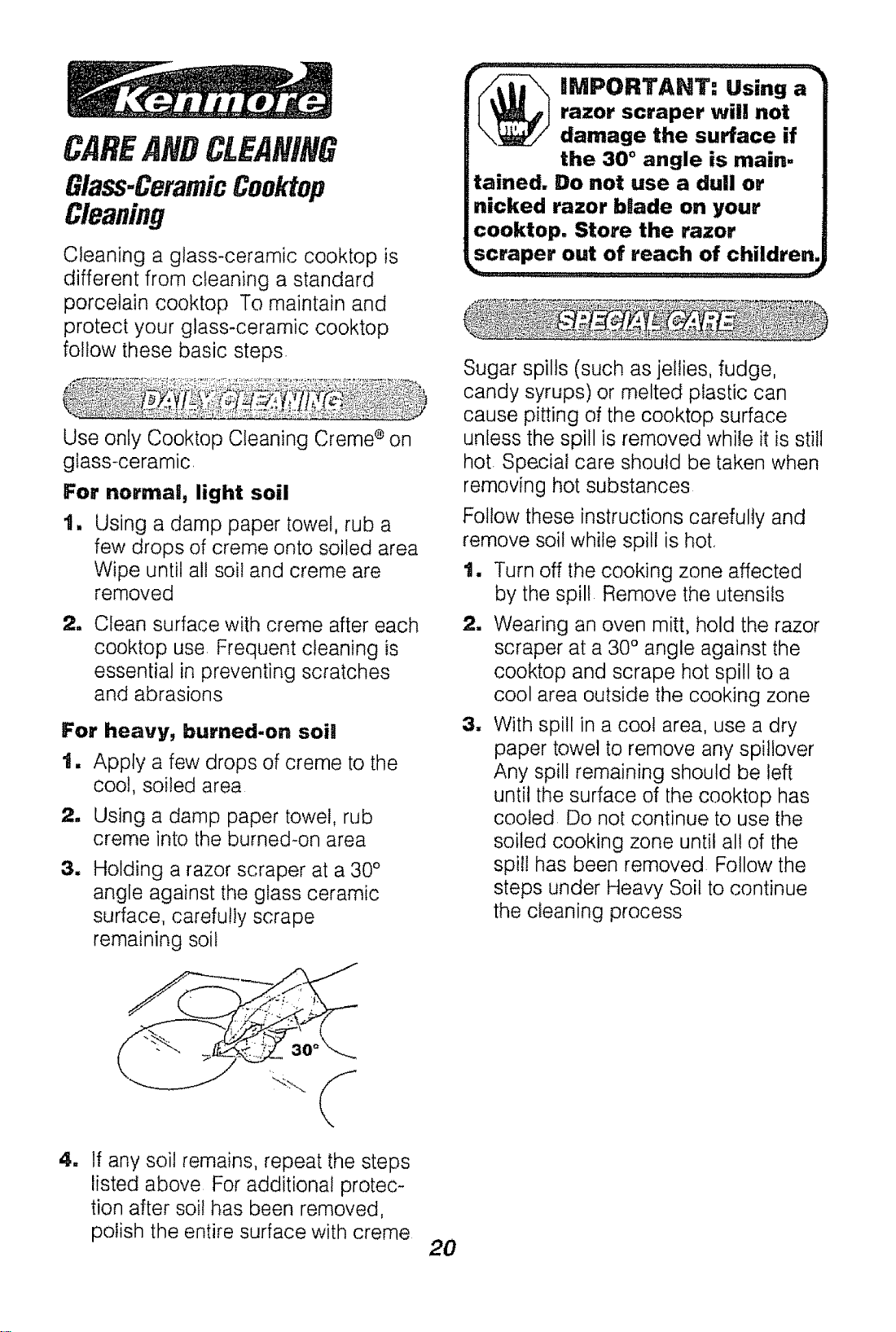
For heavy, burned-on soil
t. Apply a few drops of creme to the
cool, soiled area
11
11
Using a damp paper towel, rub
creme into the burned-on area
Holding a razor scraper at a 30 °
angle against the glass ceramic
surface, carefully scrape
remaining soi!
_ MPORTANT: Using a
razor scraper will not
damage the surface if
the 30 ° angle is main.
tained. Do not use a dull or
nicked razor b_ade on your
cooktop. Store the razor
scraper out of reach of children.
Sugar spills (such as jellies, fudge,
candy syrups) or melted plastic can
cause pitting of the cooktop surface
unless the spill is removed while it is still
hot. Special care should be taken when
removing hot substances
Follow these instructions carefully and
remove soil while spill is hot,
11. Turn off the cooking zone affected
by the spill Remove the utensils
2. Wearing an oven mitt, hold the razor
scraper at a 30° angle against the
cooktop and scrape hot spill to a
cool area outside the cooking zone
3. With spill in a coot area, use a dry
paper towel to remove any spitiover
Any spill remaining should be left
until the surface of the cooktop has
cooled Do not continue to use the
soiled cooking zone until all of the
spill has been removed Follow the
steps under Heavy Soil to continue
the cleaning process
1t
If any soil remains, repeat the steps
listed above For additional protec-
tion after soil has been removed,
polish the entire surface with creme
20
CAREANDCLEAffiNG
Glass-CeramicCooktop
Cleaning
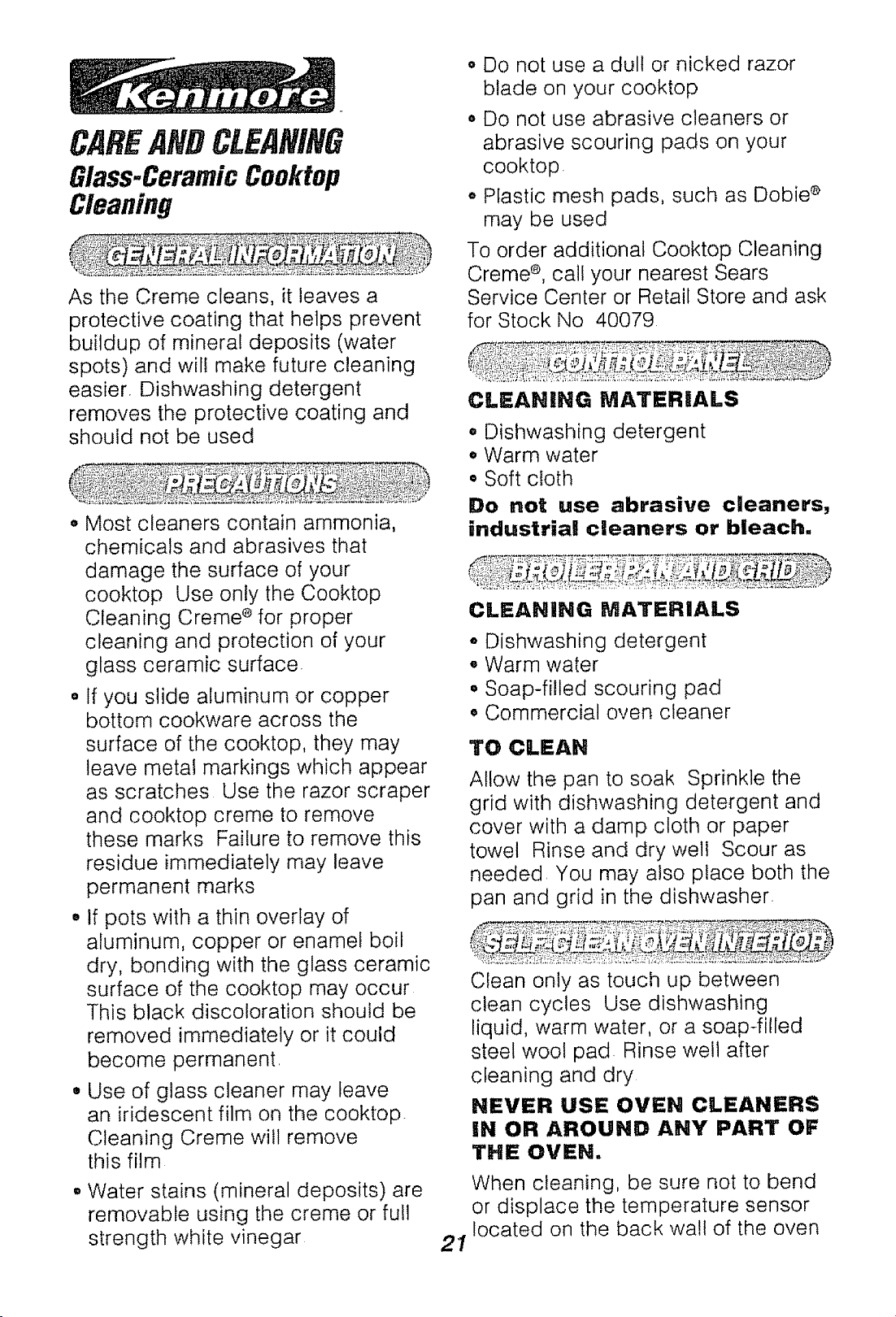
As the Creme cleans, it leaves a
protective coating that helps prevent
buildup of mineral deposits (water
spots) and wil! make future cleaning
easier Dishwashing detergent
removes the protective coating and
should not be used
o Most cleaners contain ammonia,
chemicals and abrasives that
damage the surface of your
cooktop Use only the Cooktop
Cleaning Creme e for proper
cleaning and protection of your
glass ceramic surface
o If you slide aluminum or copper
bottom cookware across the
surface of the cooktop, they may
leave metal markings which appear
as scratches Use the razor scraper
and cooktop creme to remove
these marks Failure to remove this
residue immediately may leave
permanent marks
• If pots with a thin overlay of
aluminum, copper or enamel boil
dry, bonding with the glass ceramic
surface of the cooktop may occur
This black discoloration should be
removed immediately or it could
become permanent
° Use of glass cleaner may leave
an iridescent film on the cooktop
Cleaning Creme will remove
this film
• Water stains (mineral deposits) are
removable using the creme or full
strength white vinegar
• Do not use a dull or nicked razor
blade on your cooktop
. Do not use abrasive cleaners or
abrasive scouring pads on your
cooktop
o Plastic mesh pads, such as Dobie ®
may be used
To order additional Cooktop Cleaning
Creme ®, call your nearest Sears
Service Center or Retail Store and ask
for Stock No 40079
CLEAHIHG MATERIALS
o Dishwashing detergent
. Warm water
• Soft cloth
Do not use abrasive cleaners,
industrial cleaners or bleach.
CLEANING MATERIALS
o Dishwashing detergent
° Warm water
• Soap-filled scouring pad
° Commercial oven cleaner
TO CLEAH
Allow the pan to soak Sprinkle the
grid with dishwashing detergent and
cover with a damp cloth or paper
towel Rinse and dry well Scour as
needed You may also place both the
pan and grid in the dishwasher
21
Clean only as touch up between
clean cycles Use dishwashing
liquid, warm water, or a soap-filled
steel wool pad Rinse welt after
cleaning and dry
NEVER USE OVEN CLEANERS
IN OR AROUND ANY PART OF
THE OVEN.
When cleaning, be sure not to bend
or displace the temperature sensor
located on the back walt of the oven
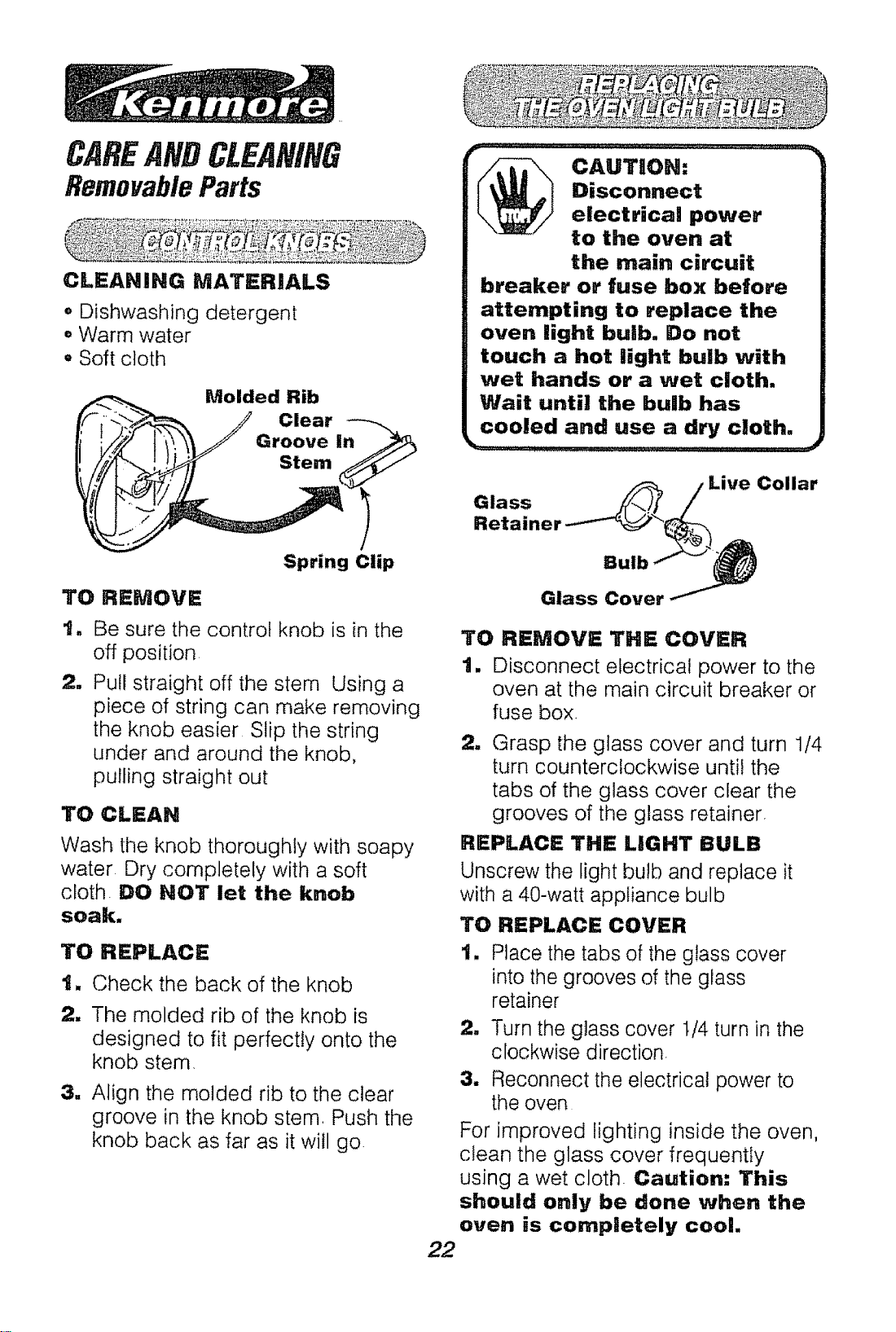
CAREANBCLEAffiNG
RemovableParts
CLEANING MATERIALS
o Dishwashing detergent
,, Warm water
• Soft cloth
Molded Rib
Clear --_-_,
Groove In
Stem _
Spring Clip
TO REMOVE
1. Be sure the control knob is in the
off position
2. Pull straight off the stem Using a
piece of string can make removing
the knob easier Slip the string
under and around the knob,
pulling straight out
TO CLEAN
Wash the knob thoroughly with soapy
water Dry completely with a soft
cloth DO NOT let the knob
soak.
TO REPLACE
t. Check the back of the knob
2. The molded rib of the knob is
designed to fit perfectly onto the
knob stem.
8. Align the molded rib to the clear
groove in the knob stem Push the
knob back as far as it will go
/_ CAUTION:
Disconnect
electrical power
to the oven at
the main circuit
breaker or fuse box before
attempting to replace the
oven light bulb, Do not
touch a hot light bulb with
wet hands or a wet cloth,
Wait until the bulb has
cooled and use a dry cloth.
Glass
Live Collar
Bulb
Glass Cover
TO REMOVE THE COVER
1. Disconnect electrical power to the
oven at the main circuit breaker or
fuse box.
2. Grasp the glass cover and turn 1/4
turn counterclockwise until the
tabs of the glass cover clear the
grooves of the glass retainer
REPLACE THE LIGHT BULB
Unscrew the light bulb and replace it
with a 40-watt appliance bulb
TO REPLACE COVER
1. Place the tabs of the glass cover
into the grooves of the glass
retainer
11
3.
Turn the glass cover t/4 turn in the
clockwise direction
Reconnect the electrical power to
the oven
For improved lighting inside the oven,
clean the glass cover frequently
using a wet cloth Caution: This
should only be done when the
oven is completely cool.
22
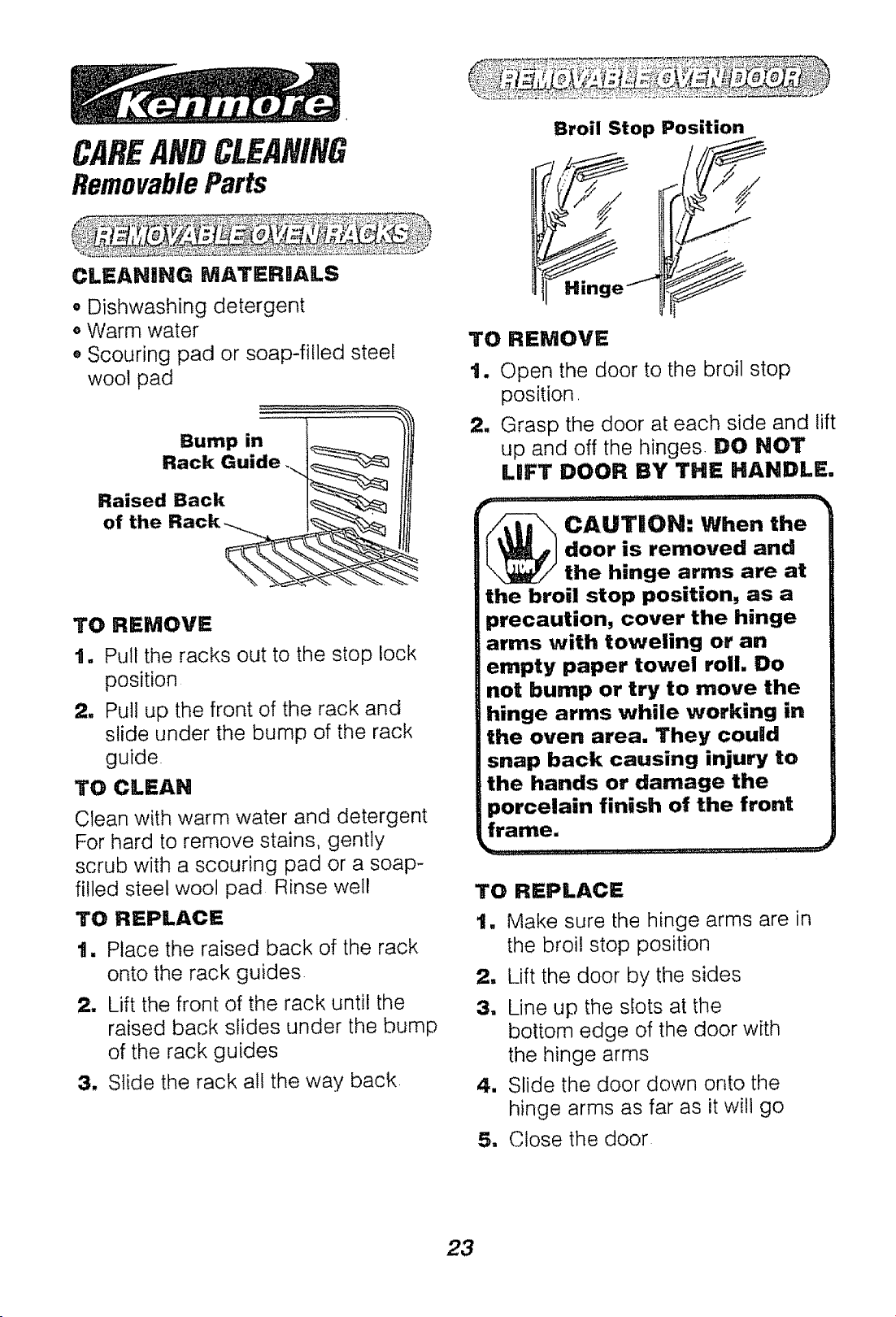
CAREANDCLEANING
RemovableParts
CLEANIHG MATERIALS
° Dishwashing detergent
o Warm water
o Scouring pad or soap-filled steel
wool pad
TO REMOVE
1. Pull the racks out to the stop lock
position
2. Pull up the front of the rack and
slide under the bump of the rack
guide
TO CLEAN
Clean with warm water and detergent
For hard to remove stains, gently
scrub with a scouring pad or a soap-
filled steel wool pad Rinse well
TO REPLACE
1. Place the raised back of the rack
onto the rack guides
2. Lift the front of the rack until the
raised back slides under the bump
of the rack guides
3. Slide the rack all the way back
Broil Stop Position
TO REMOVE
1. Open the door to the broil stop
position
2. Grasp the door at each side and lift
up and off the hinges DO NOT
LiFT DOOR BY THE HANDLE.
_z_r;;,;,_[;J[;..... )'"' " !fll))r I,,,,,_,,4'1 ' I'll
__ AUTION: When the
door is removed and
the hinge arms are at
the broil stop position, as a
precaution, cover the hinge
arms with toweling or an
empty paper towel roll. Do
not bump or try to move the
hinge arms while working in
the oven area. They could
snap back causing injury to
the hands or damage the
porcelain finish of the front
frame.
TO REPLACE
1. Make sure the hinge arms are in
the broil stop position
2, Lift the door by the sides
3. Line up the slots at the
bottom edge of the door with
the hinge arms
4. Slide the door down onto the
hinge arms as far as it will go
5. Close the door
23
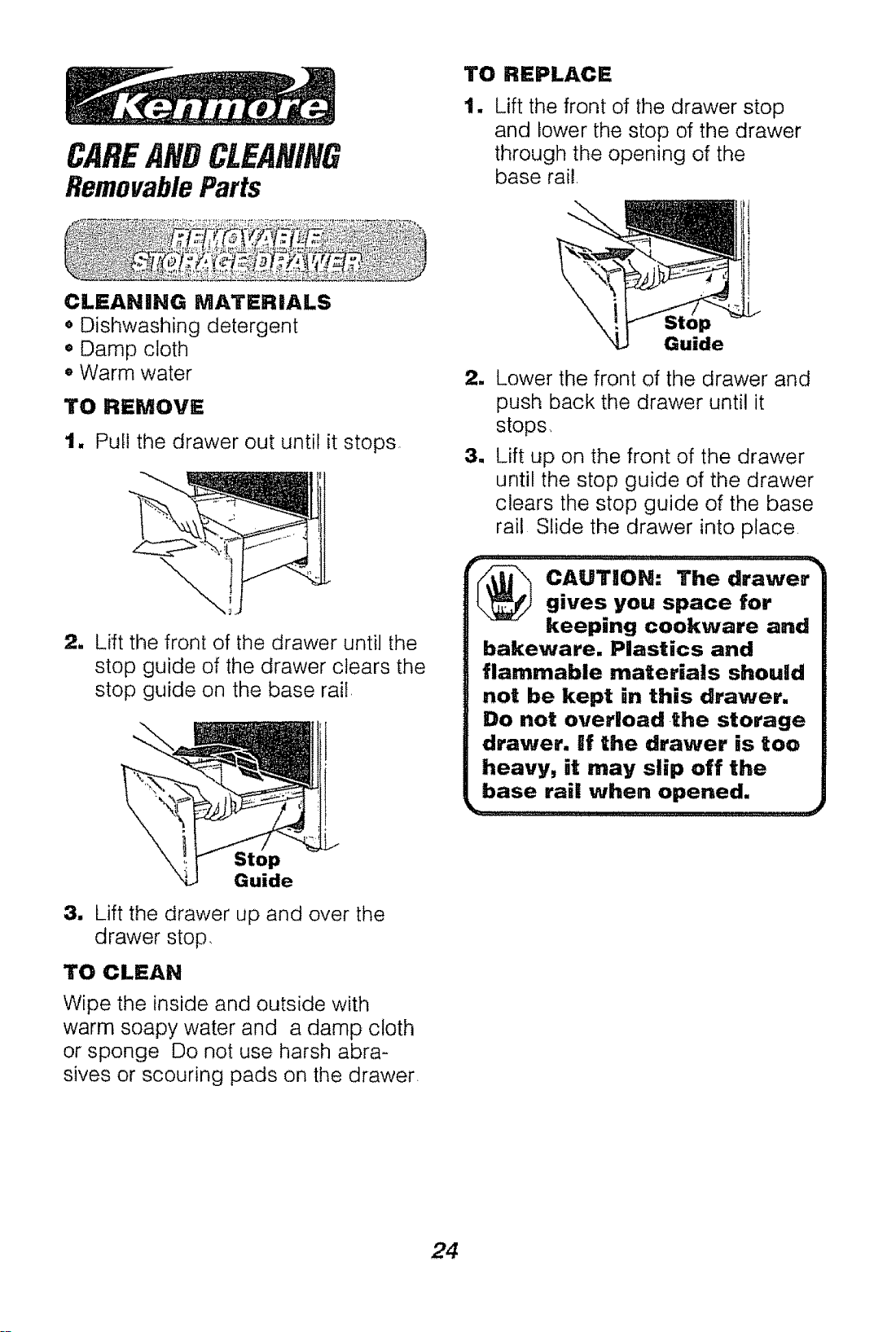
CAREANDCLEANING
Removable Parts
TO REPLACE
1. Lift the front of the drawer stop
and lower the stop of the drawer
through the opening of the
base rail,
CLEANING MATERIALS
o Dishwashing detergent
. Damp cloth
o Warm water
TO REMOVE
1, Pull the drawer out until it stops
u
Lift the front of the drawer until the
stop guide of the drawer clears the
stop guide on the base rail,
Stop
Guide
3, Lift the drawer up and over the
drawer stop,
TO CLEAN
Wipe the inside and outside with
warm soapy water and a damp cloth
or sponge Do not use harsh abra-
sives or scouring pads on the drawer.
Guide
2. Lower the front of the drawer and
push back the drawer until it
stops,
8. Lift up on the front of the drawer
until the stop guide of the drawer
clears the stop guide of the base
rail Slide the drawer into place
CAUTION: The drawer
gives you space for
keeping cookware and
bakeware. Plastics and
flammable materials should
not be kept in this drawer.
Do not overload the storage
drawer. Rf the drawer is too
heavy, it may slip off the
base rail when opened.
24
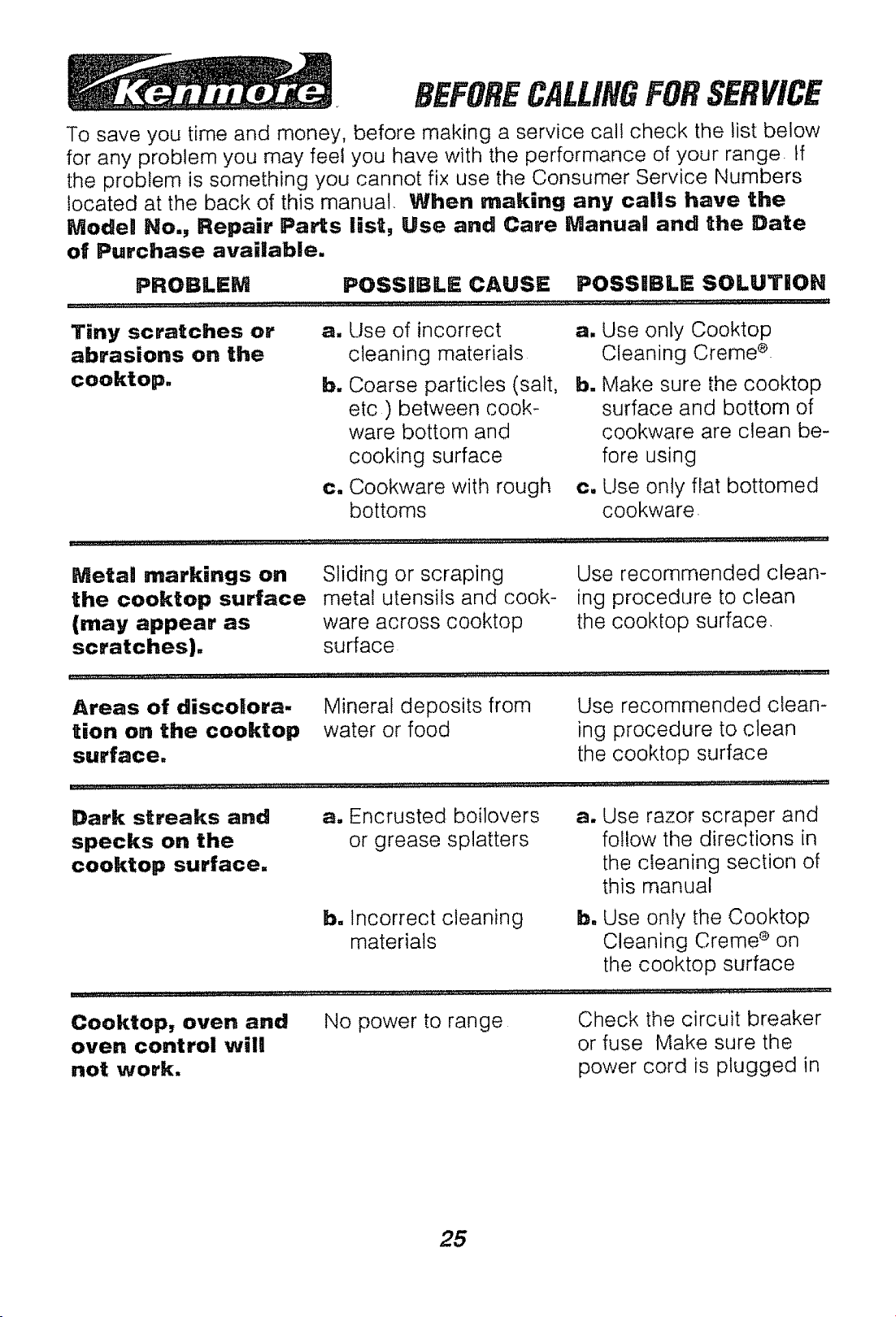
BEFORECALLINGFORSERVICE
To save you time and money, before making a service call check the list below
for any problem you may feel you have with the performance of your range tf
the problem is something you cannot fix use the Consumer Service Numbers
located at the back of this manual. When making any calls have the
Model No., Repair Parts list, Use and Care Manual and the Date
of Purchase available.
PROBLEM POSSUBLE CAUSE POSSIIBLE SOLUTIOH
Tiny scratches or a. Use of incorrect a. Use only Cooktop
abrasions on the cleaning materials Cleaning Creme ®
ceoktop, b. Coarse particles (salt, b. Make sure the cooktop
etc) between cook-
ware bottom and
cooking surface
c. Cookware with rough c.
bottoms
surface and bottom of
cookware are clean be-
fore using
Use only flat bottomed
cookware
Metal markings on
the cooktop surface
(may appear as
scratches),
Sliding or scraping
metal utensils and cook-
ware across cooktop
surface
Areas of discolora- Mineral deposits from
tion on the cooktop water or food
surface.
Use recommended clean-
ing procedure to clean
the cooktop surface,
Use recommended clean-
ing procedure to clean
the cooktop surface
Dark streaks and
specks on the
cooktop surface,
a. Encrusted boilovers
or grease splatters
Cooktop, oven and
oven control will
not work,
bo Incorrect cleaning
materials
a, Use razor scraper and
follow the directions in
the cleaning section of
this manual
No power to range
b,
Use only the Cooktop
Cleaning Creme ® on
the cooktop surface
Check the circuit breaker
or fuse Make sure the
power cord is plugged in
25
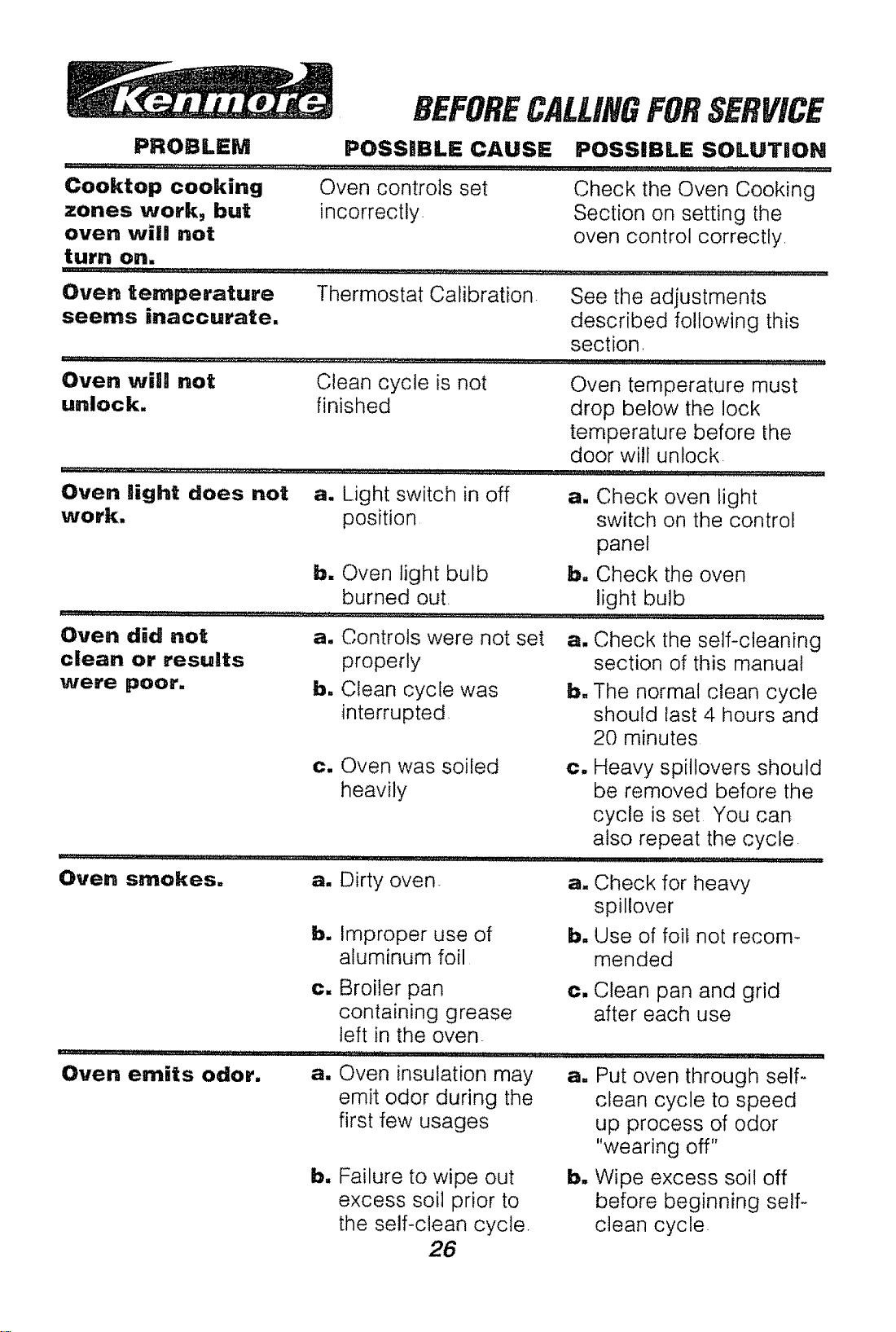
BEFORECAU/NGFORSEflVICE
PROBLEM POSSIBLE CAUSE
........... •........... ........................... '........ . .,r, ..........
Cooktop cooking Oven controls set
zones work, but incorrectly
oven will not
turn on.
Oven temperature
seems inaccurate.
Oven wiU not
unlock.
POSSIBLE SOLUTION
Check the Oven Cooking
Section on setting the
oven control correctly
Thermostat Calibration See the adjustments
described following this
section
....,,,,.,,,,,,,,,.,,,
Clean cycle is not
finished
Oven temperature must
drop below the lock
temperature before the
door will unlock
Oven light does not a. Light switch in off a. Check oven light
work, position switch on the control
panel
b. Oven light bulb b, Check the oven
burned out light bulb
Oven did not a,
clean or results
were poor. b.
Oven smokes.
Controls were not set a.
properly
Clean cycle was b.
interrupted
Check the self-cleaning
section of this manual
The normal clean cycle
should last 4 hours and
20 minutes
c. Oven was soiled
heavily
ell
............ ,;;,,;:,,;,,,........
a. Dirty oven a.
b. Improper use of b,
aluminum foil
Heavy spillovers should
be removed before the
cycle is set You can
also repeat the cycle
Check for heavy
spillover
Use of foil not recom-
mended
; ,,,,,,,,,,,,,,,,,,,,,, ......... L_,.E, ' ,,,
Oven emits odor.
c. Broiler pan c.
containing grease
left in the oven
a, Oven insulation may a.
emit odor during the
first few usages
Clean pan and grid
after each use
Put oven through self-
clean cycle to speed
up process of odor
b. Failure to wipe out b.
excess soil prior to
the self-clean cycle
26
"wearing off"
Wipe excess soil off
before beginning self-
clean cycle
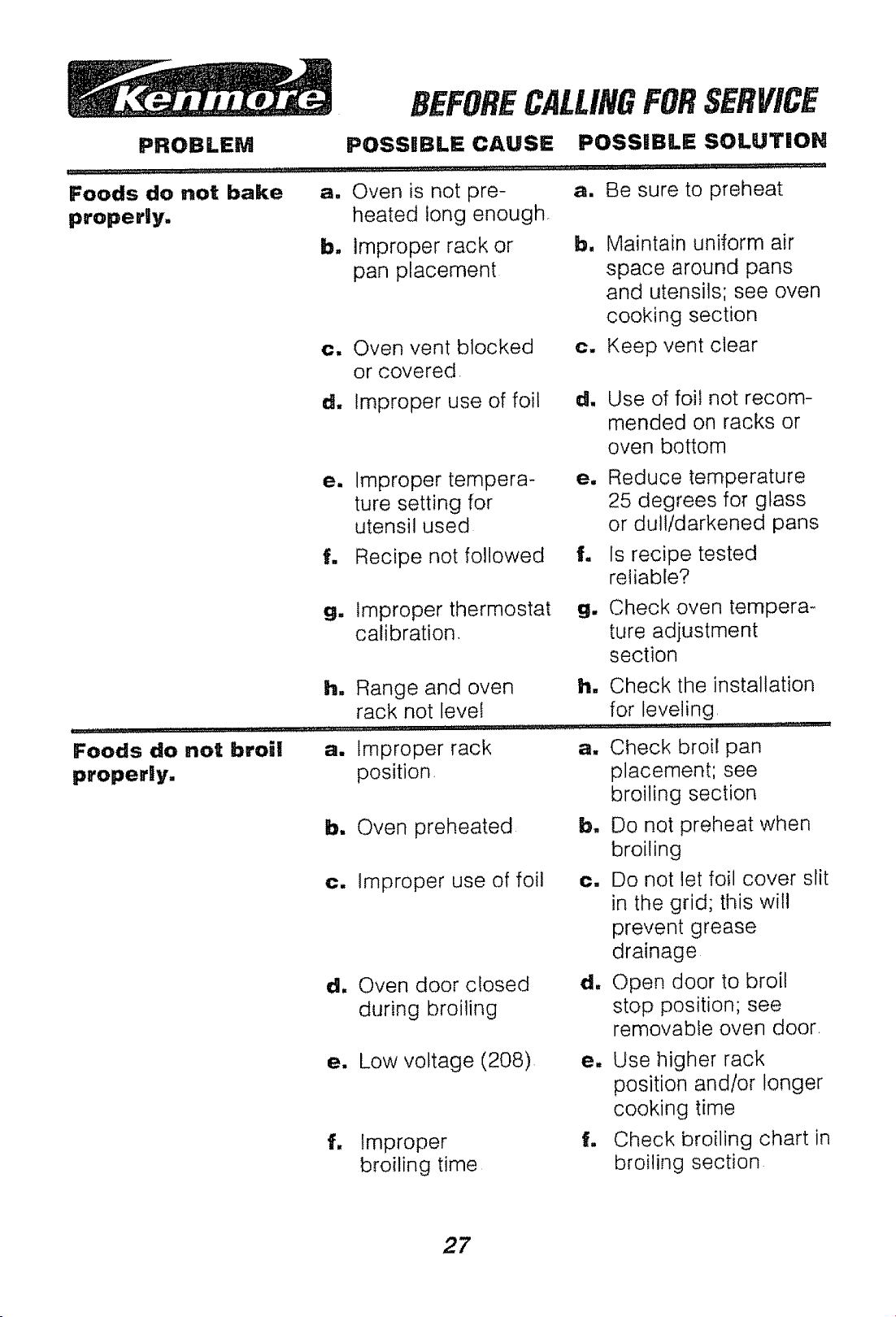
BEFORECALLINGFORSERVICE
PROBLEM POSSIIBLE CAUSE POSSIBLE SOLUT|OH
Foods do not bake a, Oven is not pre- a. Be sure to preheat
properly,
ii , i,,i,, i ,, Jl ul
Foods do not broil
properlly,
heated long enough,
b, improper rack or
pan placement
c. Oven vent blocked
or covered.
d, Improper use of foil
b, Maintain uniform air
space around pans
and utensils; see oven
cooking section
c, Keep vent clear
d. Use of foil not recom-
mended on racks or
oven bottom
e, Improper tempera- e,
ture setting for
utensil used
Reduce temperature
25 degrees for glass
or dultldarkened pans
f. Recipe not followed f, Is recipe tested
reliable?
g, improper thermostat g. Check oven tempera-
calibration, ture adjustment
section
h, Range and oven h, Check the installation
rack not level for leveling,
a, improper rack a, Check broi! pan
position, placement; see
broiling section
b. Oven preheated b,
c. improper use of foil c.
Do not preheat when
broiling
Do not let foil cover slit
in the grid; this will
prevent grease
drainage
d, Oven door closed
during broiling
d, Open door to broil
stop position; see
removable oven door.
e, Low voltage (208)
f, improper
broiling time
e, Use higher rack
position and/or longer
cooking time
f, Check broiling chart in
broiling section
27
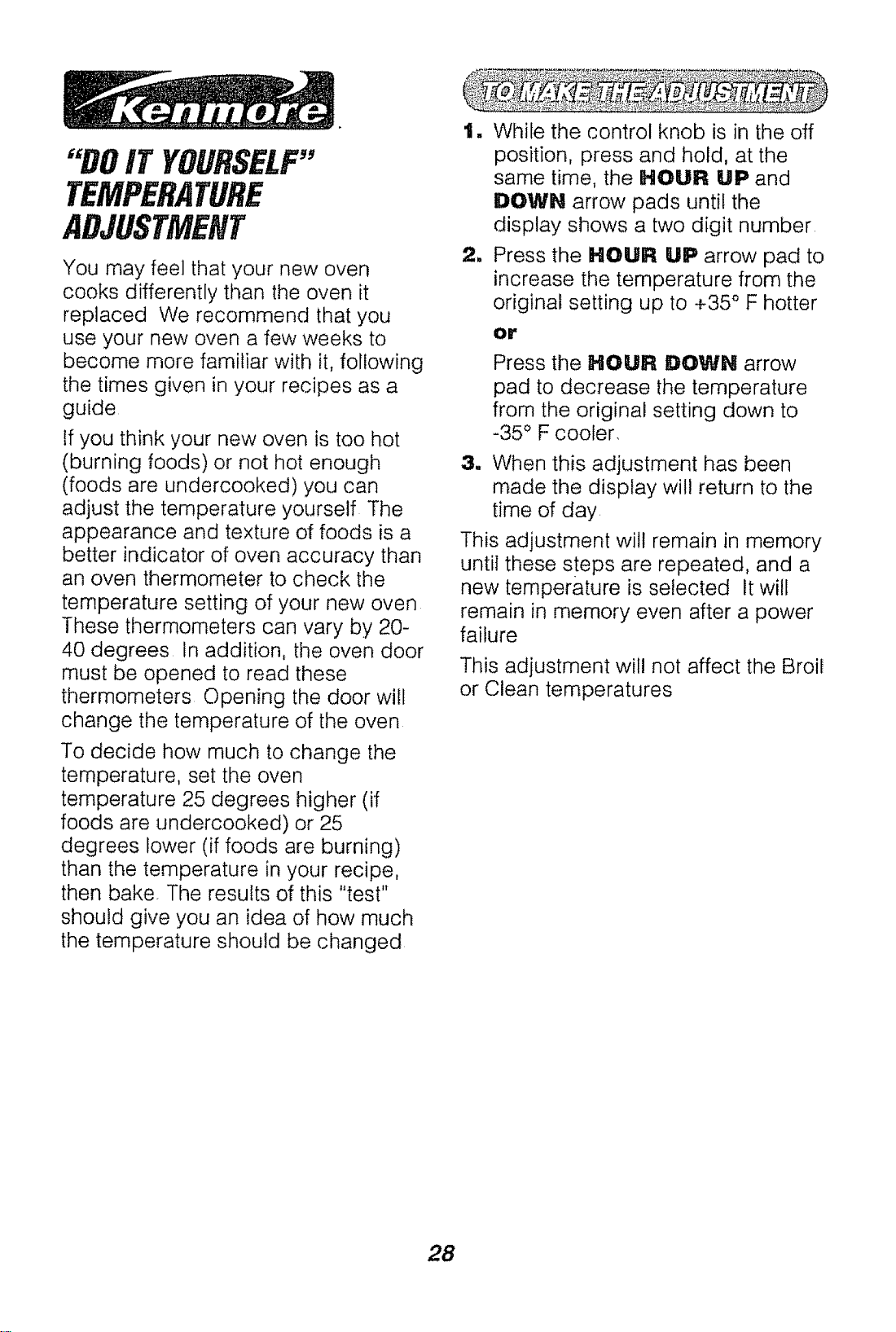
"DO IT YOURSELF"
TEMPERATURE
ADJUSTMENT
You may feel that your new oven
cooks differently than the oven it
replaced We recommend that you
use your new oven a few weeks to
become more familiar with it, following
the times given in your recipes as a
guide
If you think your new oven is too hot
(burning foods) or not hot enough
(foods are undercooked) you can
adjust the temperature yourself The
appearance and texture of foods is a
better indicator of oven accuracy than
an oven thermometer to check the
temperature setting of your new oven
These thermometers can vary by 20-
40 degrees tn addition, the oven door
must be opened to read these
thermometers Opening the door will
change the temperature of the oven
To decide how much to change the
temperature, set the oven
temperature 25 degrees higher (if
foods are undercooked) or 25
degrees lower (if foods are burning)
than the temperature in your recipe,
then bake. The results of this "test"
should give you an idea of how much
the temperature should be changed
1. While the control knob is in the off
position, press and hoed, at the
same time, the HOUR UP and
DOWN arrow pads until the
display shows a two digit number
2. Press the HOUR UP arrow pad to
increase the temperature from the
original setting up to +35 ° F hotter
Or
Press the HOUR DOWN arrow
pad to decrease the temperature
from the original setting down to
-35 ° F cooler,
3. When this adjustment has been
made the display will return to the
time of day
This adjustment will remain in memory
until these s!eps are repeated, and a
new temperature is selected It will
remain in memory even after a power
failure
This adiustment will not affect the Broil
or Clean temperatures
28
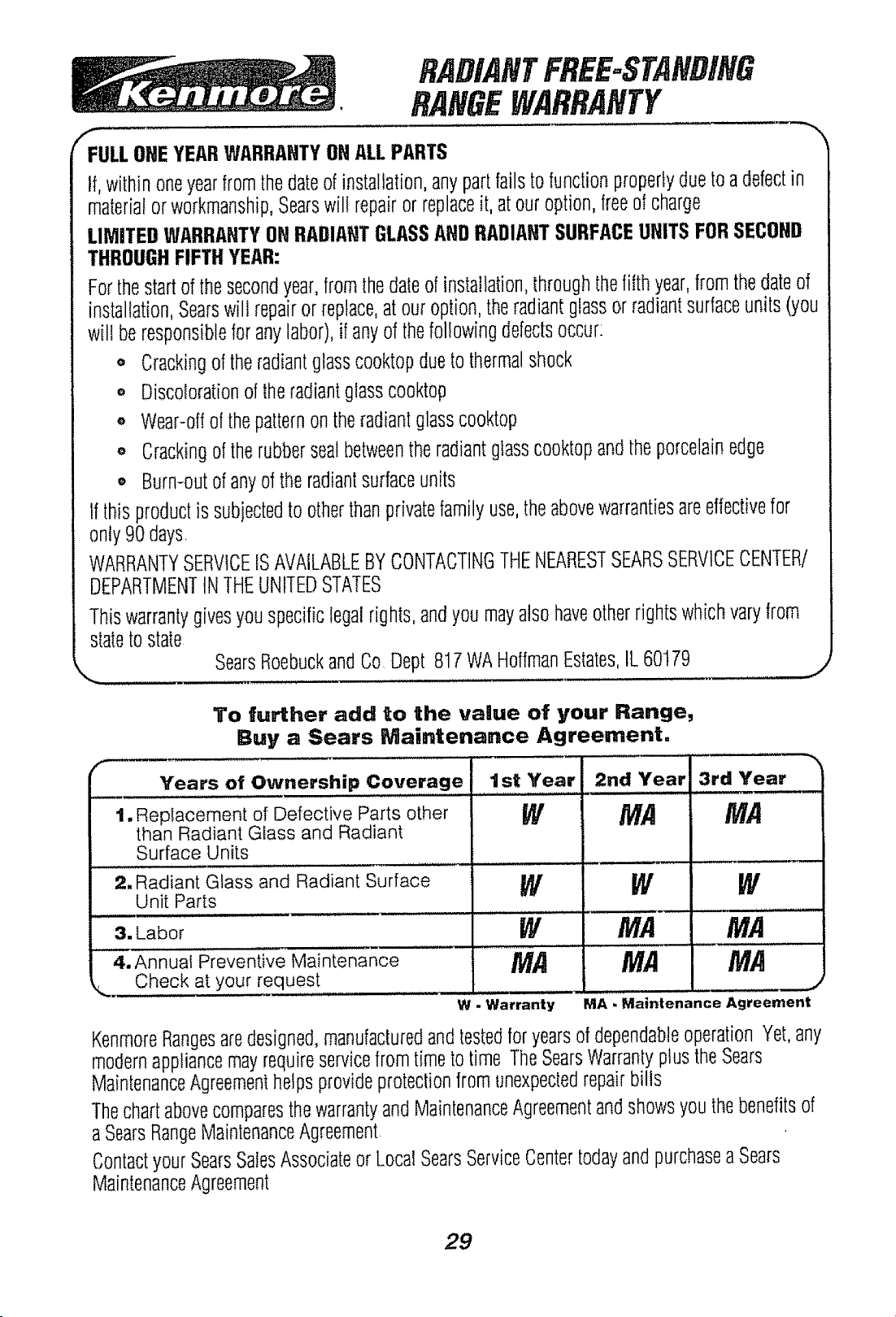
RADIANTFREE°STANDING
RANGEWARRANTY
FFULL ONEYEARWARRANTYONALL PARTS
If, within oneyearfrom thedateof installation,anypartfails to functionproperlydue to a defectin
materialor workmanship,Searswili repairor replaceit, atour option,freeof charge
LIMITED WARRANTYONRADIANTGLASSAHD RADIANTSURFACEUNITSFORSECOND
THROUGHFIFTH YEAR:
Forthestartof thesecondyear,from thedateof installation,throughthefifth year,fromthe dateof
instaliation,Searswili repairor replace,at our option,theradiantglassor radiantsurfaceunits (you
will be responsiblefor anylabor),if anyof thefollowingdefectsoccur:
o Crackingof the radiantglasscooktopdue to thermalshock
• Discolorationof the radiantglasscooktop
o Wear-offof thepatternonthe radiantglasscooktop
o Crackingof therubbersealbetweenthe radiantgiasscooktopandthe porcelainedge
• Burn-outof anyof the radiantsurfaceunits
If this productis subjectedto otherthan privatefamily use,theabovewarrantiesareeffectivefor
only 90 days
WARRANTYSERVICEISAVAILABLEBY CONTACTINGTHENEARESTSEARSSERVICECENTER/
DEPARTMENTtN THEUNITEDSTATES
This warrantygivesyouspecific legalrights,andyou mayalso haveother rightswhich vary from
stateto state
SearsRoebuckand Co Dept 817 WAHeffmanEstates,IL 60179
To further add to the value of your Range,
Buy a Sears Maintenance Agreement,
_.. "%
1st Year 2nd Year 3rd Year
Years of Ownership Coverage
1. Replacement of Defective Parts other
than Radiant Glass and Radiant
Surface Units
2, Radiant Glass and Radiant Surface
Unit Parts
3. Labor
4. Annual Preventive Maintenance
Check at your request
W MA /VIA
W W
MA MA
MA MA
W
W
MA
W _'"Warranty
,,J
MA. Maintenance Agreement
KenmoreRangesaredesigned,manufacturedandtestedfor yearsof dependableoperation Yet,any
modernappliancemayrequireservicefrom time to time TheSearsWarrantyplus the Sears
MaintenanceAgreementhelps provideprotectionfrom unexpectedrepairbills
Thechartabovecomparesthe warrantyand MaintenanceAgreementand showsyou the benefitsof
a SearsRangeMaintenanceAgreement,
Contactyour SearsSalesAssociateor Local SearsServiceCentertodayand purchasea Sears
MaintenanceAgreement
29
For in-homemajor brand repair service:
Oall24 hours a day, 7 daysa week
1-80O-4-MY-HOME °°
(1-800-469-4663)
Parapedir serviciode reparaci#na domicilio-
1-800-676,.5811
In Canada for all .your service and parts needs call -
Au Canada pour tout le service ou les pi#ces -
1-800,,665-4455
For the repair or replacementparts you need:
Call 7 am-7 pm, 7 days a week
1-800-366-PART
(1-800-366-7278)
Para ordenarpiezascon entregaa domicilio-
1-800-659-7084
For the location of a
SearsParts and Repair Center
in yourarea:
Call24 hours a day, I days a week
t -800-488=t 222
For informationonpurchasinga Sears
MaintenanceAgreement or to inquire
aboutan existingAgreement:
Call9 arn-5 prn, Monday-Saturday
1-800-827-6655
r _
, ,,,,, ,,, ,,, ,,.................
HomeCentral! s.
The Service Side of Sears s"
30
MANUAL DE" CONSUM|DOR
ESTUFA RADIAHTE
ELECTRmCA DE 30" TIPO
"INDEPENDIEHTE"
CON AUTOLIMPI_ZA
MODIELO NO,
9_t. ss381_qi
911. 953880_ql
el 1. ss4_s_ i
sl I. 9s47. _° J
PRSCAUCION."
Lea y siga todas las
reglas y las
instrucciones para el
funcionamiento antes de
usar este producto pot
primera vez.
o |nstrucciones de
Seguridad
o FuncionamJento
o Cuidado y Limpieza
• C6mo Reso|ver
Probiemas
Sears, Roebuck and Co., Hoffman Estates, iL 60179 U.S.A.
229C4020Pt 47.2 (SR- 10358)
Indice
Seguridad en el uso de
ESTUFARADIANTE
ELECTRICATIPO"iNDEPENDIENTE"
la estufa ................. 3-6
Dispositivo de estabilidad ., 3
C6mo proteger Hacubierta
para cocinar ........ 7
C0mo sacar la cinta de
empaque ......... 7
Caracteristicas de la estufa 8
Zonas para cocinar .... 9
Utensilios para cocinar ......... 9
COmo revisar los utensilios 9
Eficiencia de los utensilios ...... 9
Espirales radiantes ........ t 0
Ciclo de ta unidad radiante. I0
C6mo programar los
controtes ............... 10
COmo hacer conservas en
casa ............. 10
Control del homo, reloj,
y cronOmetro ......... 1t
Botones con flechas
Horas/Minutos .......... t 1
Dial 11
Luces*incticadoras ........ I1
COmo poner el dial en blanco , 11
C0digo F ............... t 1
Encendido ........... 1 I
Apagado autom_tico
del homo ............ 11
Cemo poner el reloj ........ 12
C0mo programar el
cron6metro ................... 12
C6mo reprogramar el
cron6metro ...................... 12
Para cancefar el cronOmetro .... 12
Cosejos para cocinar en el
homo .................. 13-15
Horneado con margarina ...... 14
Control del homo .................. 15
COmo hornear ................. 16
C6mo asar a la parrilla .......... 17
Ciclo de Autolimpieza .......... I8-I9
Limpieza de la superficie
de vidrio .................. 20-21
Panel de control ................ 2t
Cacerola y parrilla para asar 2t
Perilfas de control ............. 22
Foco de la tuz del homo ..... 22
Parril]as de homo ................ 23
Puerta del homo ............. 23
Caj6n de almacenamiento ........ 24
Antes de llamar para un
servicio ................. 25-27
Ajustes de temperatura ..... 28
Garantla ................... 39
NQmeros para servicios det
consumidor ............. 30
Para su conveniencia y referencia futura, por favor escriba el n_mero de
modelo y de serie en el espacio que se le provee, Estdn ubicados detr_s
del caj6n de almacenamiento.
NUMERO DE MODELO:
NUMERO DE SERilE:
2
INSTflUCCIONE$
DE SEGURIDADIMPORTANTE$
GUARDE ESTAS INSTRUCCmONES
Lea todas las instrucciones antes de usar este aparato. Cuando use
aparatos a gas o el_ctricos, se deber_an seguir precauciones de
seguridad, incluyendo Io siguiente:
= Todas las estufas se
pueden volcar
• Personas podrfan resuttar
heridas
• instale el dispositivo
contra volcaduras
empacado con la estufa
• Vea tas instrucciones de
instalaciOn
Herramientas que necesitar_:
,' Destornillador de cabeza Phillips
o Llave ajustable o abierta de I 318"
=
u
Saque la abrazadera del
preempacado ubicado dentro det
horno
Decida si la abrazadera sera. instalada
en et lado derecho o izquierdo de la
ubicaci6n de la estufa
3. Si el tado de la abrazadera de la estufa
es adyacente at gabinete, coloque ta
abrazadera contra ta pared de atrb.s y
el gabinete como se muestra en ta
Fig t
Si no hay un gabinete adyacente,
determine cuff ser_ la ubicaciOn del
panel de la estufa pintado Coloque la
abrazadera con su orilla exterior en
este tugar y contra ta pared de atr_s
Vea ta Fig 2
4, Determine si va a ancfar la abrazadera
al piso o a la pared Asegurese que
esta ubicaci6n este libre de alambres
etectricos o plomeria
m
u
w
Oritla exterior de
la abrazadera debe
estar en llnea con
el lado ]zquferdo o
estufa
Fig. I
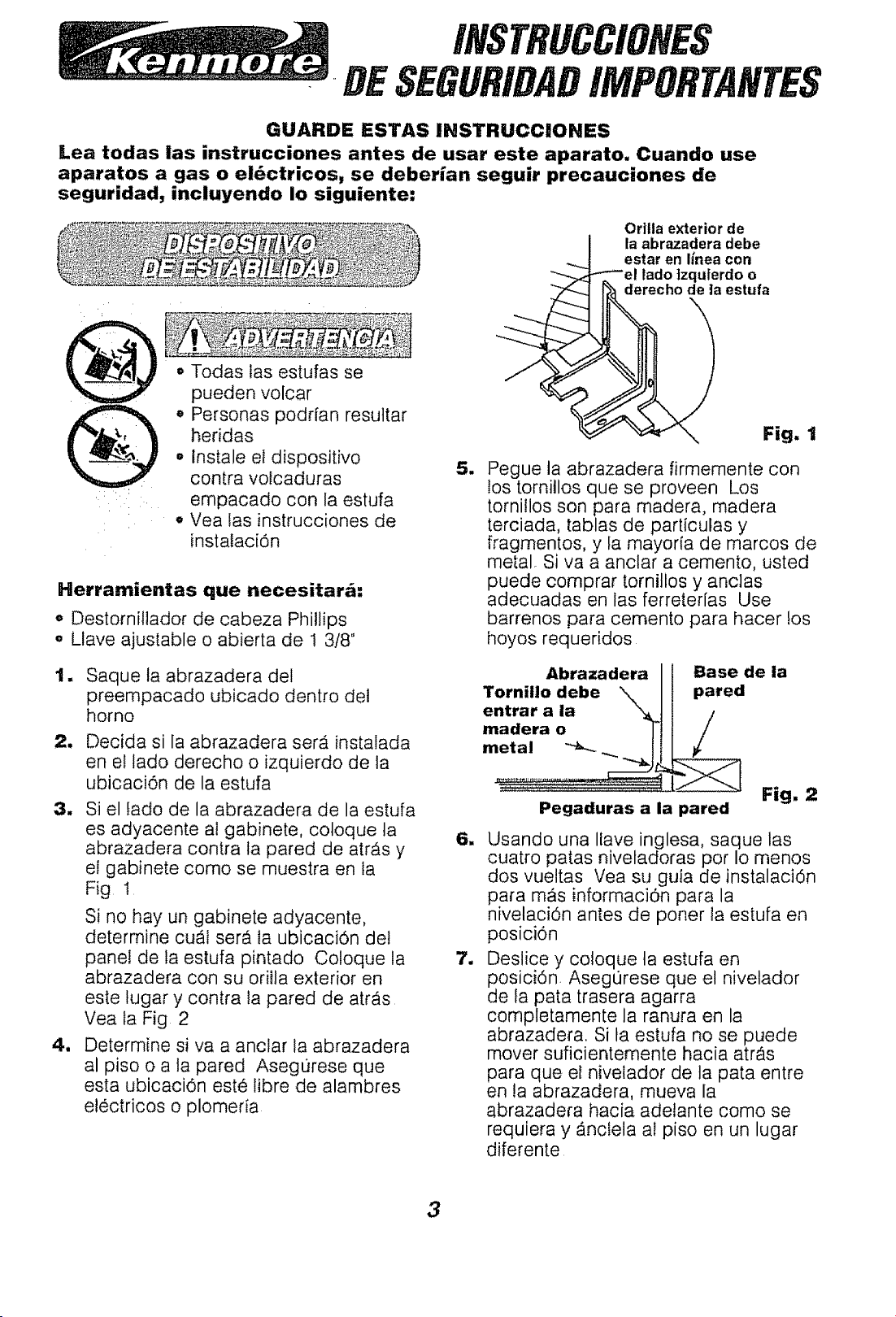
Pegue la abrazadera firmemente con
los tornitlos que se proveen Los
torniilos son para madera, madera
terciada, tablas de part[culas y
fragmentos, y fa mayor[a de marcos de
metal. Si va a anclar a cemento, usted
puede comprar tornillos y ancias
adecuadas en las ferreterlas Use
barrenos para cemento para hacer los
hoyos requeridos
Pegaduras a la
Base de la
pared
/
Fig, 2
)ared
Usando una Ifave inglesa, saque las
cuatro patas nivetadoras por Io menos
dos vueltas Vea su guia de instalaciOn
para mas informaciOn para la
nivelaciOn antes de poner la estufa en
posiciOn
Deslice y cotoque ta estufa en
posici6n. Asegurese que el nivelador
de la pata trasera agarra
completamente la ranura en la
abrazadera. Si la estufa no se puede
mover suficientemente hacia atr_s
para que et nivelador de la pata entre
en la abrazadera, mueva la
abrazadera hacia adetante como se
requiera y #tnclela al piso en un lugar
diferente
3
ItVSTRUCCIONES
IMPORTANTES
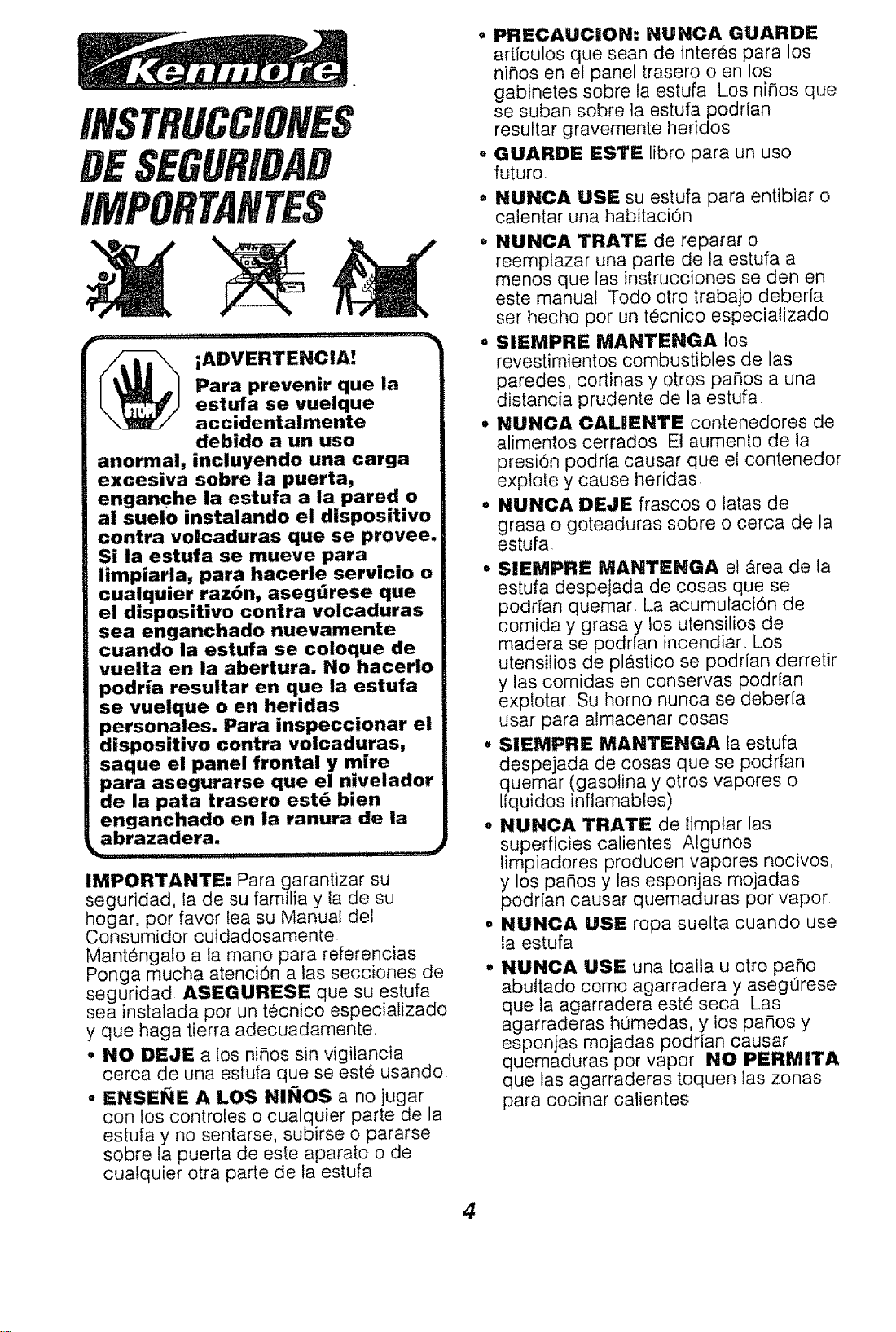
;ADVERTENCIA!
Para prevenir que la
estufa se vuelque
accidentalmente
debido a un use
anormai, incluyendo una carga
excesiva sobre la puerta,
enganche la estufa a la pared o
al suelo instalando el dispositivo
contra volcaduras que se provee.
Si la estufa se mueve para
limpiarla, para hacerle servicio o
cualquier raz6n, asegt_rese que
el dispositivo contra volcaduras
sea enganchado nuevamente
cuando la estufa se coloque de
vuelta en la abertura. No hacerlo
podria resultar en que la estufa
se vuelque o en heridas
personales. Para inspeccionar el
dispositivo contra volcaduras,
saque el panel frontal y mire
para asegurarse que el nivelador
de la pata trasero est_ bien
enganchado en la ranura de la
abrazadera.
........................ • ..; I J ,11,,
IMPORTANTE: Para garantizar su
seguridad, la de su familia y ta de su
hogar, por favor lea su Manual del
Consumidor cuidadosamente
Mantengalo a ta mano para referencias
Ponga mucha atenciOn alas secciones de
seguridad ASEGURESE que su estufa
sea instalada pot un tecnico especializado
y que haga tierra adecuadamente
- NO DEJE a los niSos sin vigilancia
cerca de una estufa que se est6 usando
• ENSEI_IE A LOS NII_OS a no jugar
con los controles o cualquier parte de la
estufa y no sentarse, subirse o pararse
sobre la puerta de este aparato o de
cuafquier otra parte de Ia estufa
e
e
o
PRECAUCION: NUHCA GUARDE
artfculos que sean de interes para los
niflos en el panel trasero o en los
gabinetes sobre la estufa Los ni_os que
se suban sobre la estufa podrfan
resuftar gravemente heridos
GUARDE ESTE libro para un uso
futuro.
NUNCA USE su estufa para entibiar o
calentar una habitaci6n
NUNCA TRATE de reparar o
reemplazar una parte de la estufa a
menos que las instrucciones se den en
este manual Todo otro trabajo deber[a
ser hecho por un tecnico especializado
SIEMPRE MANTENGA los
revestimientos combustibles de las
paredes, cortinas y otros pa_os a una
distancia prudente de la estufa
NUNCA CALOENTE contenedores de
alimentos cerrados El aumento de la
presiOn podrfa causar que el contenedor
explo[e y cause heridas
NUNCA DEJE fiascos o tatas de
grasa o goteaduras sobre o cerca de la
estufa.
° SIEMPRE MANTENGA et Area de la
estufa despejada de cosas que se
podrl'an quemar. La acumulaci6n de
comida y grasa y los utensilios de
madera se podrian incendiar. Los
utensilios de pl_stico se podrian derretir
y tas comidas en conservas podrian
expfotar. Su homo nunca se deberfa
usar para almacenar cosas
° SiEMPRE MANTENGA Ia estufa
despejada de cosas que se podrlan
quemar (gasotina y otros vapores o
liquidos inflamables)
o NUNCA TRATE de/impiar las
superficies calientes Algunos
limpiadores producen vapores nocivos,
y los panos y las esponjas mojadas
poddan causar quemaduras por vapor
• NUNCA USE ropa suelta cuando use
la estufa
° NUNCA USE una toatla u otto paRo
abuttado como agarradera y asegQrese
que la agarradera este seca Las
agarraderas humedas, y los paros y
esponjas mojadas podri_an causar
quemaduras por vapor NO PERMITA
que las agarraderas toquen }as zonas
para cocinar calientes
4
o NO TOQUE las zonas para calentar, las
superficies cerca de elias o las superficies
interiores del horno. Estas podrian estar
suficientemente calientes para quemar
aunque se vean de color oscuro. Durante y
despues del uso, no toque o permita que la
ropa o materiales inflamables hagan
contacto con tas zonas o superficies
caIientes hasta que hayan tenido tiempo de
enfriarse Las otras superficies cerca de tas
ventanillas de ventilaci6n del homo,
puertas, ventanas y las superficies para
cocinar tambien podrlan estar
suficientemente catientes para causar
quemaduras
o SOLO CIERTAS clases de utensitios de
vidrio o cer_mica se pueden usar para
cocinar en la cubierta Asegurese que los
utensilios que seleccione estan dise_ados
para cocinar sobre ta cubierta sin
quebrarse debido a los subitos cambios
de temperatura
o SIEMPRE TEHGA cuidado cuando
toque los etementos de la cubierta
Retendr_n calor despues de que la estufa
se haya apagado.
• NUNCA OBSTRUYA la ventilaciOn del
homo bajo et efemento derecho de atr_s
• LOS UTENSILIOS QUE SE USEN
para cocinar sobre ta cubierta deberfan
ser de fondo ptano y to suficientemente
grandes para cubrir el Area de calor que
se esta utilizando Los utensilios
demasiado pequeC_osexponen el
etemento catentador y podria resultar
en un contacto directo o el incendio
de ta ropa
NUNCA deje las unidades de superficie
sin vigitancia a temperaturas altas Los
derrames podrian resuttar en humo o en
derrames de grasa que se podrian
incendiar.
NUNCA COCIIHE sobre una cubierta
quebrada Las soluciones para fa limpieza
y los derrames podrian penetrarla y crear
el riesgo de un gotpe de corriente o un
incendio
SIEMPRE COLOQUE las agarraderas
(manilfas) de las ollas hacia adentro y lejos
de las otras unidades de la superficie para
reducir et riesgo de quemaduras,
encendido, un contacto y derrame
accidental
CUANDO PREPARE comidas a la llama
debajo de ta campana de ventitaciOn,
encienda el ventilador
COLOQUE LAS PARRILLAS DEL
HORNO en la posici6n deseada
mientras el homo este frio Si las parrillas
se deben mover mientras el homo est_
caliente, no permita que ta agarradera
haga contacto con el quemador caiiente
del homo.
o DESPUES DE ASAR A LA
PARRILLA, siempre saque ta cacerofa y
la parriila para asardel homo y timpielas
Los sobrados de grasa en la cacerola
para asar podrian incendiarse la prOxima
vez que usted use el homo,
,, SIEMPRE TENGA cuidado cuando
abra la puerta del homo, Deje que el aire
caliente y el vapor escapen antes de
mover los alimentos
NUNCA USE papel de aluminio para
cubrir el rondo del homo El uso
incorrecto det paper de aluminio podria
empezar un incendio, o podrta resultar en
un golpe de corriente
5
INSTRUCCIONES
DESEGURIDAD
IMPORTANTE$
, LIMPIE SOLAMENTE las partes que se
listan en este manual. Siga todas ]as
instrucciones para la limpieza. Asegurese
de sacar la cacerola y ia parrilla para asar
antes det ciclo de autofimpieza
,, NUNCA FRIEGUE, mueva, o daSe el
sello de la puerta en ]as estufas con
autolirnpieza
,_ NUNCA TRATE de limp!at los utensilios,
ollas, partes removibles o la cacerola y la
parrilla para asar en el ciclo de
autolimpieza
• NO USE limpiadores para homos _No se
deberia usar ninguna clase de limpiador
para hornos o cremas protectoras dentro o
alrededor de cualquier parte del homo
• NUNCA FUERCE la manilla del cerroio a
la posiciOn de abierto mientras el homo
est_ caliente
;ADVERTENCIA DE
SEGUR|DAD IMPORTANTE!
California Safe Drinking Water and
Toxic Enforcement Act requiere que
el gobernador de California publique
una lista de substancias que el
estado sepa que producen defectos
de nacimiento u otros da_os
reproductivos y requiere que los
hombres de negocios adviertan a
sus clientes de! contacto potencial
a tales substancias. E! aislante de
fibra de vidrio en el homo con
autolimpieza emitir_ una muy
peque_a cantidad de mon6xido de
carbono durante el ciclo de
autolimpieza. El contacto se puede
minimizar ventilando con una puerta
o ventana abierta o usando un
ventilador o una campana de
ventilaci6n,
IMPORTANTE: La salud de algunos
p_jaros es extremadamente
sensitiva a los vapores producidos
por el ciclo de autolimpieza de
cualquier horno. Ponga los p;_jaros
en otra habitaci6n que est_ bien
ventilada.
;LEA Y COMPRENDA
ESTA INFORMACION AHORA!
Aseg_rese que todos en su hogar
sepan qu_ hacer en caso de
incendio. Nunca use agua sobre un
incendio de grasa; esto solamente
extender_ las llamas,
INCENDIO DE GRASA EN LA
CUBIERTA:
Nunca levante una olla en llamas...
1. Apague los elementos de la superficie,
2. Sofoque la llama con una tapa
apretada, soda para cocinar o con un
extintor qufmico, a espuma o "haton"
FUEGO EN EL HORNO:
;No irate de mover |a cacerola!
1. Cierre la puerta del homo y apague
los controles
s
Si el incendio contintJa,
cuidadosamente abra la puerta, arroje
soda para cocinar sobre el fuego, o
use un extintor de qufmico seco,
espuma o "halon"
6
CGmoProteger La Cubierta
Para Cocinar
o No arrastre los utensitios sobre ta
cubierta
o No use una toalla o esponja para platos
para timpiar la cubierta
• No use potvos para fregar, o lanillas de
pt_stico o de metal sobre la cubierta
o No aplique crema para limpiar sobre la
cubierta si la superficie est_ caliente
• Lea las instrucciones en ta etiqueta de ta
botelta de crema para limpiar la cubierta
antes de tratar de limpiar la superficie
de la cubierta
o Despues de limpiar la superficie de la
cubierta, asegL)rese de sacar todo el
residuo de la crema que podria quedar
con una toalta de papel seca
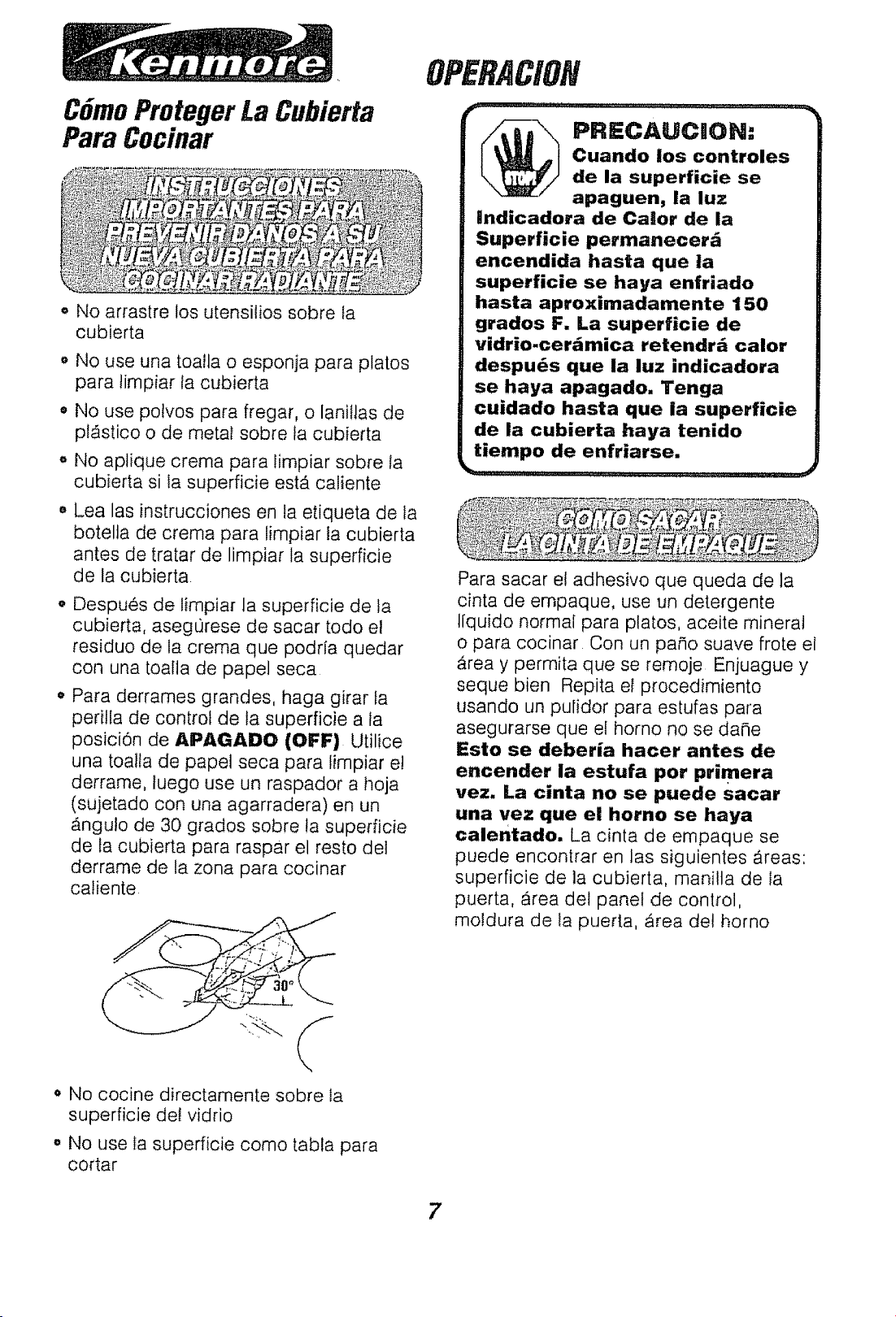
o Para derrames grandes, haga girar ta
perilla de control de ta superficie a fa
posicion de APAGADO (OFF) Utilice
una toatla de papel seca para fimpiar e!
derrame, luego use un raspador a hoja
(sujetado con una agarradera) en un
_,nguto de 30 grados sobre ta superficie
de la cubierta para raspar el resto del
derrame de la zona para cocinar
caIiente
OPERAC/ON
PRECAUCJON:
Cuando los controles
de la superficie se
apaguen, la luz
indicadora de Caior de la
Superficie permanecerd
encendida basra que ta
superficie se haya enfriado
hasta aproximadarnente 150
grados F. La superficie de
vidrio.cerdmica retendr_ calor
despu6s que la luz indicadora
se haya apagado. Tenga
cuidado hasta que la superficie
de la cubierta haya tenido
tiempo de enfriarse.
Para sacar et adhesivo que queda de la
cinta de empaque, use un detergente
I[quido normal para platos, aceite mineral
o para cocinar Con un paso suave frote el
area y permita que se remoje Enjuague y
seque bien Repita el procedimiento
usando un pulidor para estufas para
asegurarse que el homo no se dane
Esto se deberia hacer antes de
encender la estufa pot primera
vez. La cinta no se puede sacar
una vez que el homo se haya
calentado. La cinta de empaque se
puede encontrar en las siguientes _reas:
superficie de la cubierta, manilla de la
puerta, area del panel de control,
moldura de la puerta, _rea det homo
• No cocine directamente sobre Ia
superficie de! vidrio
e No use la superficie como tabIa para
cortar
7
OPERACION
CARACTERISTICASDESUESTUFA
Reloj y
Control del Luz indicadora Control de Interruptor
horno de superficie la cubierta de la luz del
caliente
Luz indicadora
de supe
Cubierta de
vidrio-
cer_mi
Cerrojo para
abrir y cerrar
la puerta
Elemento para
asar a la
Ve.tilaci6n
homo
Zona para
,, -.......cocinar
Cerrojo de ia
puerta del
homo
Ubicaci6n de
placa con
hombre y
nQmero
Parrillas
- removibles
Elemento
)ara hornear
Caj6n de
Cacerola y
parrilla
para asar
Selio de la
puerta
Puerta
removibBe del
homo
8
OPERACION
C6moCocinarSobreUna
CubiertaRadiante
Antes de usar su nueva cubierta para
cocinar radiante, timpieta con Cooktop
Cleaning Creme®_ Esto dejar_ una capa
protectora
Las zonas para cocinar se muestran con
un dibujo sobre el vidrio La marca cerca
de cada perilla de control Ie muestra cuAt
zona radiante se enciende con esa perilla
Zonas para cocinar
OO ®0 F,e.te
Trasera Frente derecha
izquierda izquierda
Use ollas y woks que tengan fondo ptano
El tama¢_o de ios utensilios deberian ser
del mismo tama_o que la zona que se est,i
usando para cocinar
Tama_o de
Fendo "___ __ la zona
de para
la olla cocinar
Las o!tas deber{an tenet fondo piano
Si usted no sabe si sus
utensilios tienen fondo J
piano, haga esta
prueba Invierta la olla
sobre la cubierta, coloque una regla sobre
la superficie de la olta Haga girar la regla
en un circulo complete, revisando
mientras ta da vuelta cualquier espacio
que podria existir entre las dos
superficies El fondo de la olla y et filo de
la regla debertan coincidir uno sobre et
otro a traves de todo et largo
Acero inoxidable: Altamente
recomendado para uso con su nueva
cubierta para cocinar Especialmente
bueno con un fondo de tipo doble
Aluminio: Se recomienda los utensilios
de aluminio pesado
Hierro forjado: Las o!las de hierro
forjado que son completamente cubiertas
con porcelana son recomendadas Las
ollas de hierro forjado que no son
cubiertas con porcelana podrian rayar la
superficie de vidrio cer_mica de la
cubierta
Fondo de cobre: Tiene buena
eficiencia, pero podria dejar un residuo
sobre la superficie de la cubierta
Vidrio cer_mica o piedra: Utilizable
Verifique fa existencia de bordes rugosos
o asperezas ya que podrian rayar la
superficie de la cubierta
9
OPERACION
CGmoCocinarSobre
UnaCubiertaRadiante
t. Empuje para hacer _f----"-'N
girar ia perilta t_" _
2, Coloque entre las on
ntJmeros para el
ca!or deseado
!
Cuando tas periltas est_n encendidas, los
espirales bajo e! vidrie irradian calor a traves
de! vidrio hacia el utensifio para cocinar
Tomar_ varies minutes para que !os
espirales se calienten; a medida que 1o
hacen se puede vet una irradiaci_n roja
sobre ia superficie de la cubierta para
cocinar
Es normal ver que los elementos se
encienden de color rojo y que despu6s se
oscurezcan mientras se cocina a
temperaturas que no sean altas Este ciclo
de encendido y apagado se usa para
mantener la posiciOn del control
seleccionada El ciclo que toma lugar
cuando el selector est_ en posiciOn Alta (HI)
se debe a la mala transferencia de calor a
una olta que no es de rondo plane. Los
limitadores de temperatura de las zonas
para cocinar proveen una protecciOn para
su nueva cubierta Los limitadores
encender,_n y apagar_n los espiraies
irradiantes mientras se cocine o se hagan
conservas_ Este procedimiento ayuda a
mantener una temperatura para cocinar
constante sin permitir que las zonas para
cocinar se sobrecalienlen
HI
MED
LO
Se usa para comienzos rapidos, tal
come para hervir agua
Se usa para hervir y freir
Se usa para comidas al vapor o para
mantener los alimentos a
temperaturas para ser servidos
La luz indicadora de unidad de superficie se
encenderA cuando cuaiquier zona para
cocinar sea activada
Las olfas para hacer conservas a presiOn o a
bathe maria y las ollas de di_metro grande
que se extiendan m_,s de 1" del borde de 1as
elemento para cocinar se pueden utilizar
para hacer conservas Sin embargo, no
utilice oflas para hacer conservas grandes,
oltas y freidoras para nada que no sea agua
La mayoria de los jarabes o rnezclas de
satsas y redes los tipos de frituras se
cocinan a temperaturas touche m_s altas
que Ias necesarias para hervir agua, Tales
temperaturas podrian eventualmente dar_ar
las superficies de ta cubierta que rodean los
etementos para cocinar
1, Asegurese que la ella este centrada
sobre el quemador
2. Asegorese que la e!la sea de rondo
plane
3. Use recetas y procedimientos de
buenas fuentes Estas se encuentran
disponibles de fabricantes tales come
Bal! e and Kerr ®, y Servicio de
ExtensiOn det Departamento de
Agricultura
4, Tenga cuidado cuando haga
conservas, para prevenir quemaduras a
causa de vapor o calor
10


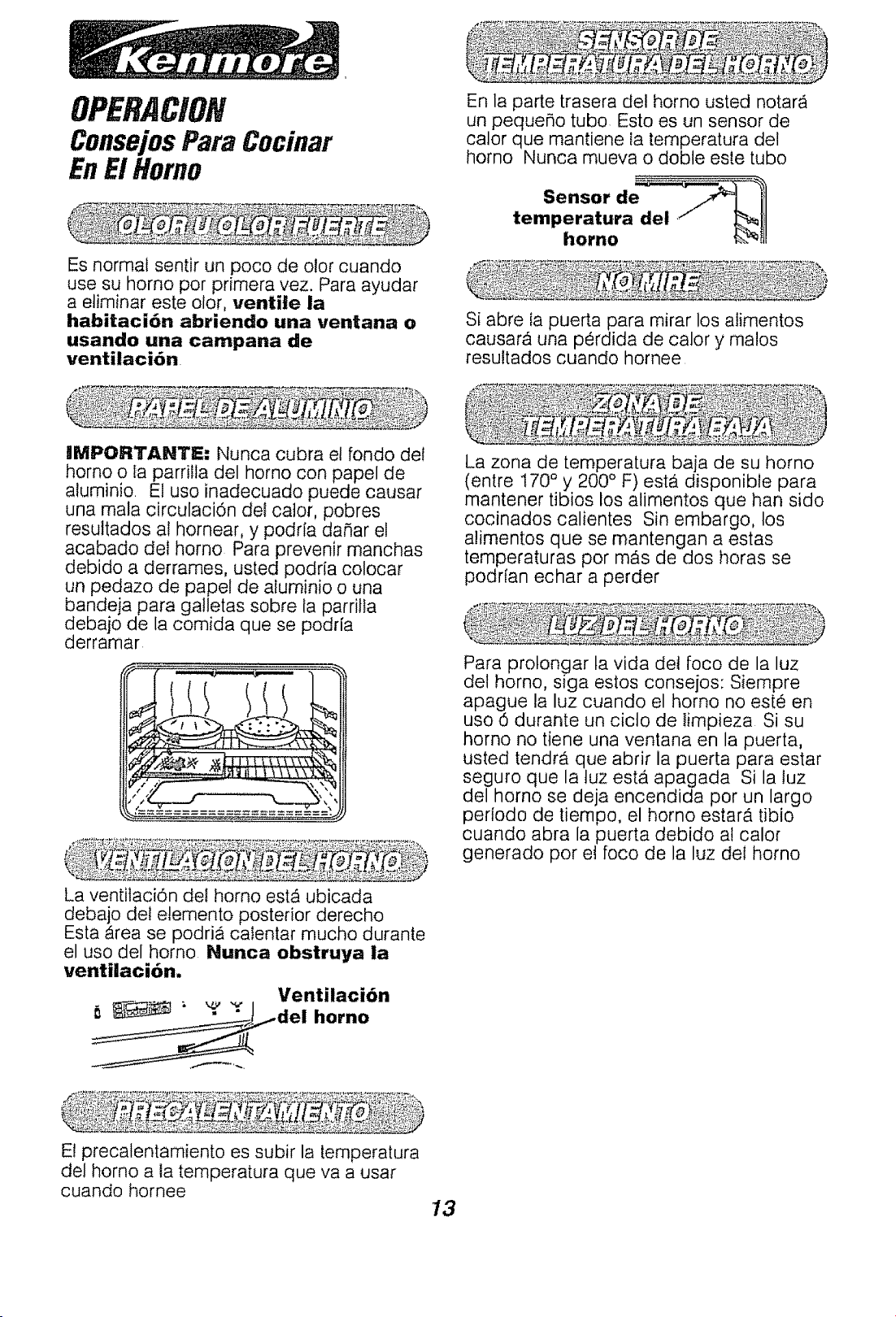
OPERAC/ON
ConsejosPara Cocinar
En E!Homo
Es normal sentir un poco de olor cuando
use su homo por primera vez. Para ayudar
a etiminar este olor, ventile la
habitaci6n abriendo una ventana o
usando una campana de
ventilaci6n
En la parte trasera del homo usted notara
un pequeSo tubo Esto es un sensor de
calor que mantiene la temperatura del
homo Nunca mueva o doble este tubo
Sensor de_/_;_--_
temperatura del / _!11
homo _'_lll
Si abre la puerta para mirar los alimentos
causar_ una perdida de calory malos
resultados cuando hornee
IIMPORTANTE: Nunca cubra et rondo del
homo o ta parrilta del homo con papel de
aluminio El uso inadecuado puede causar
una mala circulaci6n del calor, pobres
resultados a! hornear, y podria daSar el
acabado del homo Para prevenir manchas
debido a derrames, usted podria colocar
un pedazo de papel de aluminio o una
bandeja para galletas sobre la parrilfa
debajo de la comida que se podria
derramar
La ventilaci6n del homo est_ ubicada
debajo del etemento posterior derecho
Esta area se podria caientar mucho durante
el uso del homo Nunca obstruya la
ventilaci6n.
Ventilaci6n
_ ; _" _'_ delhorno
La zona de temperatura baja de su homo
(entre 170 ° y 200 ° F) est_ disponible para
mantener tibios los alimentos que hart sido
cocinados calientes Sin embargo, los
alimentos que se mantengan a estas
temperaturas por m_s de dos horas se
podrian echar a perder
Para protongar ta vida det foco de la luz
del homo, siga estos consejos: Siempre
apague la luz cuando el homo no este en
uso 6 durante un ciclo de limpieza Si su
homo no tiene una ventana en la puerta,
usted tendr_ que abrir la puerta para estar
seguro que la tuz esta apagada Si la luz
del homo se deja encendida por un largo
periodo de tiempo, el homo estara tibio
cuando abra la puerta debido al calor
generado por et foco de la luz del homo
E1precalentamiento es subir la temperatura
del homo a ta temperatura que va a usar
cuando hornee
13
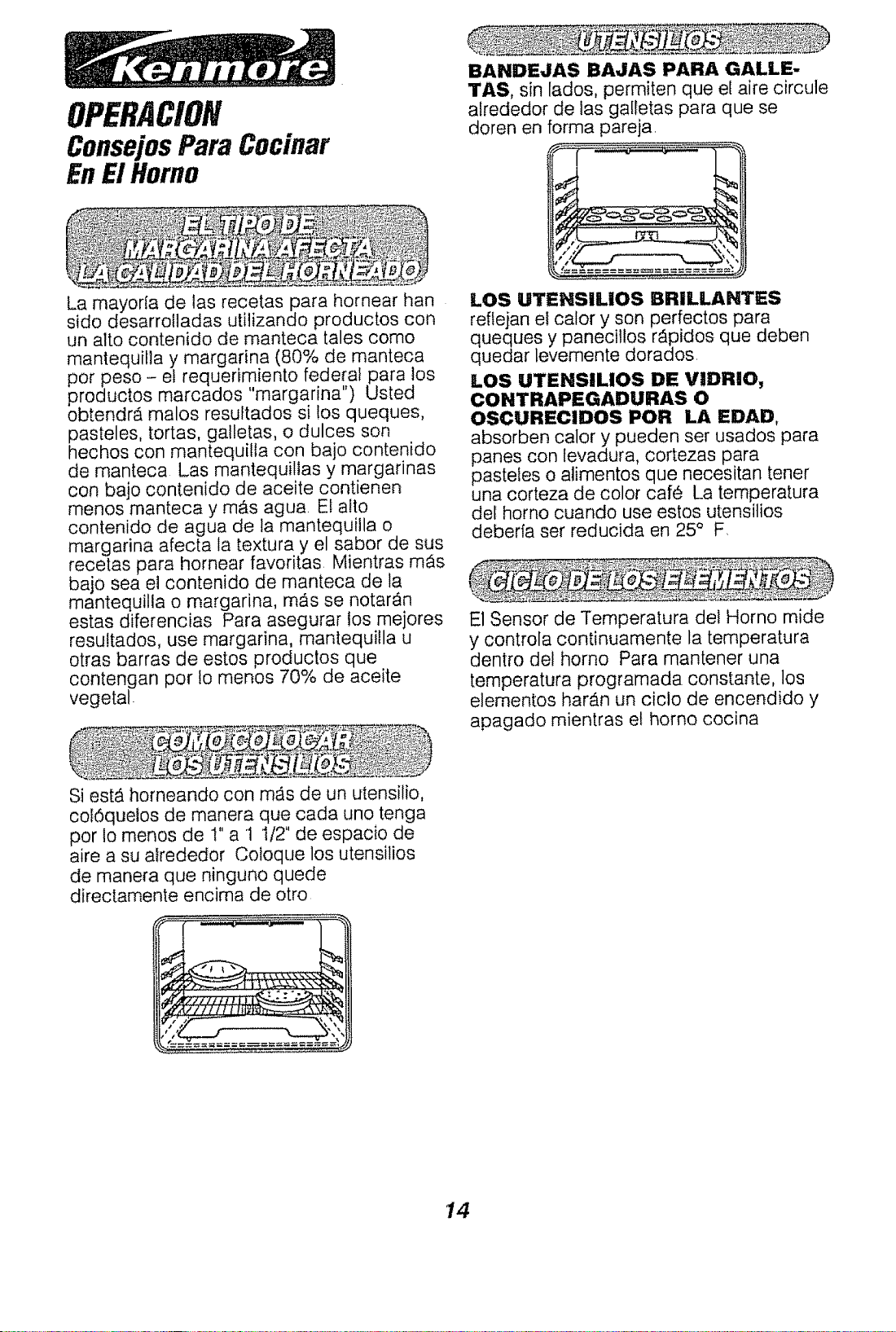
OPERACION
ConsejosPara Cocinar
En E1Homo
BANDEJAS BAJAS PARA GALLE-
TAS, sin lados, permiten que el aire circule
alrededor de las ga!letas para que se
doren en forma pareja
La mayoria de las recetas para hornear han
side desarrolladas utilizando productos con
un alto contenido de rnanteca tales como
mantequitla y margarina (80% de manteca
pot peso - et requerimiento federal para los
productos marcados "margarina") Usted
obtendr#, malos resultados si los queques,
pasteles, tortas, galletas, o dulces son
hechos con mantequitla con bajo contenido
de manteca Las mantequillas y margarinas
con bajo contenido de aceite contienen
menos manteca y m_s agua. Et alto
contenido de agua de ta mantequilla o
margarina afecta la textura y el sabor de sus
recetas para hornear favoritas Mientras m_s
bajo sea el contenido de manteca de la
mantequilla o margarina, m_s se notar_n
estas diferencias Para asegurar los mejores
resuttados, use margarina, mantequilla u
otras barras de estos productos que
contengan por fo menos 70% de aceite
vegetal.
LOS UTEHSILiOS BRILLAHTES
refiejan el calor y son perfectos para
queques y panecillos r_,pidos que deben
quedar levemente dorados,
LOS UTENSILIOS DE VIDRIO,
CONTRAPEGADURAS O
OSCURECIDOS POR LA EDAD,
absorben calory pueden ser usados para
panes con levadura, cortezas para
pastetes o atimentos que necesitan tener
una corteza de color cafe La temperatura
del homo cuando use estos utensilios
deberia ser reducida en 25° F,
El Sensor de Temperatura del Homo mide
y controla continuamente la temperatura
dentro del homo Para mantener una
temperatura programada constante, los
elementos har_n un ciclo de encendido y
apagado mientras el homo cocina
Si est_ homeando con m;Js de un utensilio,
col6quetos de manera que cada uno tenga
por lo menos de 1" a I I/2" de espacio de
aire a su alrededor CoIoque los utensilios
de manera que ninguno quede
directamente encima de otro
14
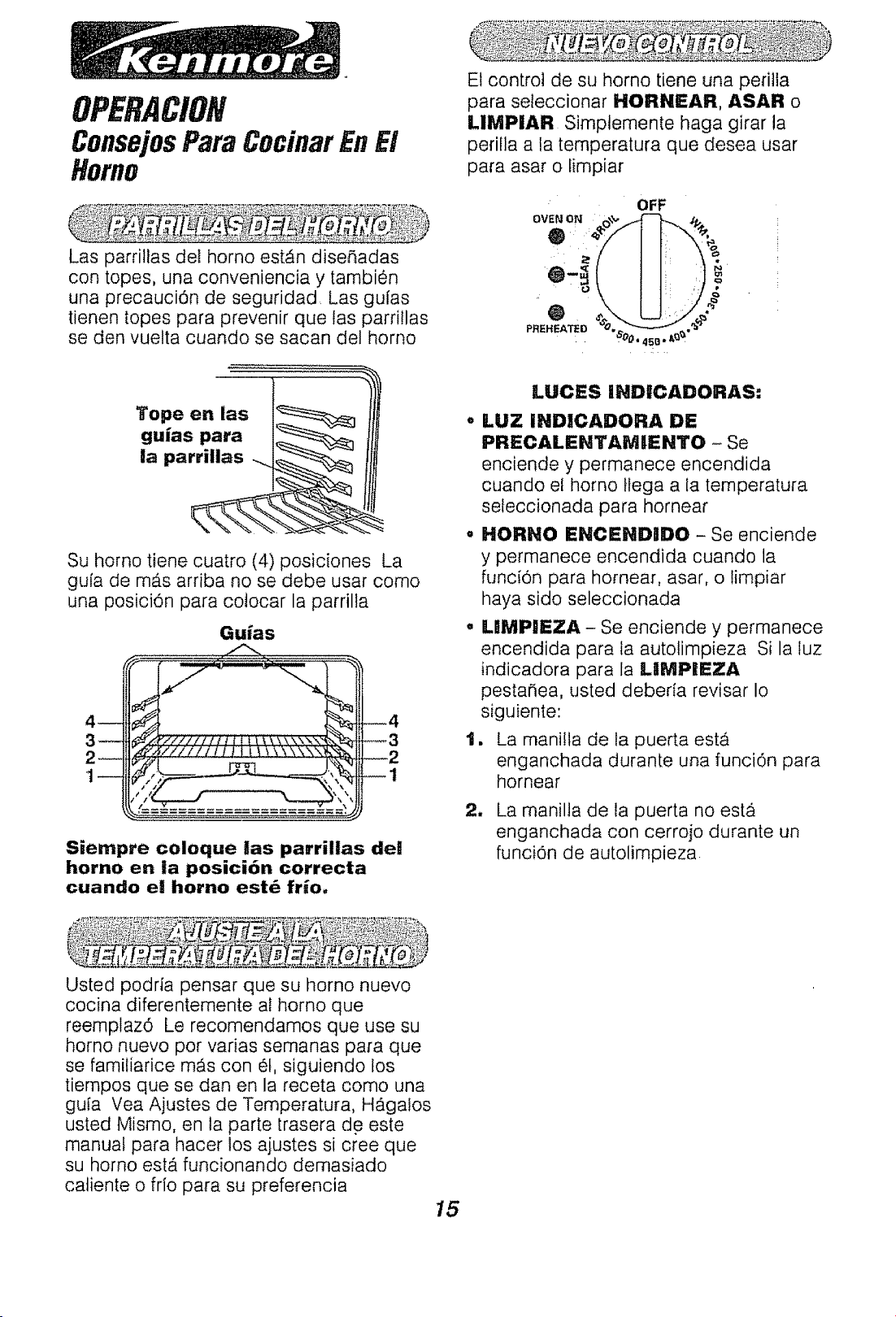
OPERACION
ConsejosParaCocinarEnEl
Homo
Las parriltas det homo est_n diseSadas
con topes, una conveniencia y tambien
una precauci6n de seguridad, Las guias
tienen topes para prevenir que las parrillas
se den vuelta cuando se sacan del homo
Su homo tiene cuatro (4) posiciones La
gufa de ma.s arriba no se debe usar como
una posici6n para colocar la parrilla
Gu_s
Siempre coloque las parrillas del
homo en ia posicidn correcta
cuando el horno est_ fr_o.
El control de su homo tiene una peritla
para seleccionar HORNEAR, ASAR o
LIMPIAR Simptemente haga girar la
perilla a la temperatura que desea usar
para asar o limpiar
OFF
OVEN ON ,,,,',,_,_r'-"z_ .r,,.
® _,_R,vfl I "K_.
/ I I_ \'Z
;1!
i/
® - Ai
PREHEATED _o,_ ''---'-''_ .,"-'1"
':'.00,450. _r__
LUCES INDtCADORAS:
. LUZ INDICADORA DE
PRECALENTAMIIENTO - Se
enciende y permanece encendida
cuando et homo Ilega a la temperatura
seleccionada para hornear
, HORNO ENCENDIDO - Se enciende
y permanece encendida cuando la
funci6n para hornear, asar, o limpiar
haya sido seleccionada
,, LIIMPIIEZA - Se enciende y permanece
encendida para ia autolimpieza Si la luz
indicadora para la LIMPIEZA
pestahea, usted debeda revisar Io
siguiente:
t. La manifla de la puerta est,_
enganchada durante una funci6n para
hornear
tr
La manilla de la puerta no esta
enganchada con cerrojo durante un
funciOn de autolimpieza
Usted podria pensar que su homo nuevo
cocina diferentemente at homo que
reemplaz6 Le recomendamos que use su
homo nuevo pot varias semanas para que
se familiarice m_s con el, siguiendo los
tiempos que se dan en la receta como una
guia Vea Ajustes de Temperatura, HAgafos
usted Mismo, en la parte trasera de este
manual para hacer los ajustes si cree que
su homo esta funcionando demasiado
catiente o fr[o para su preferencia
15
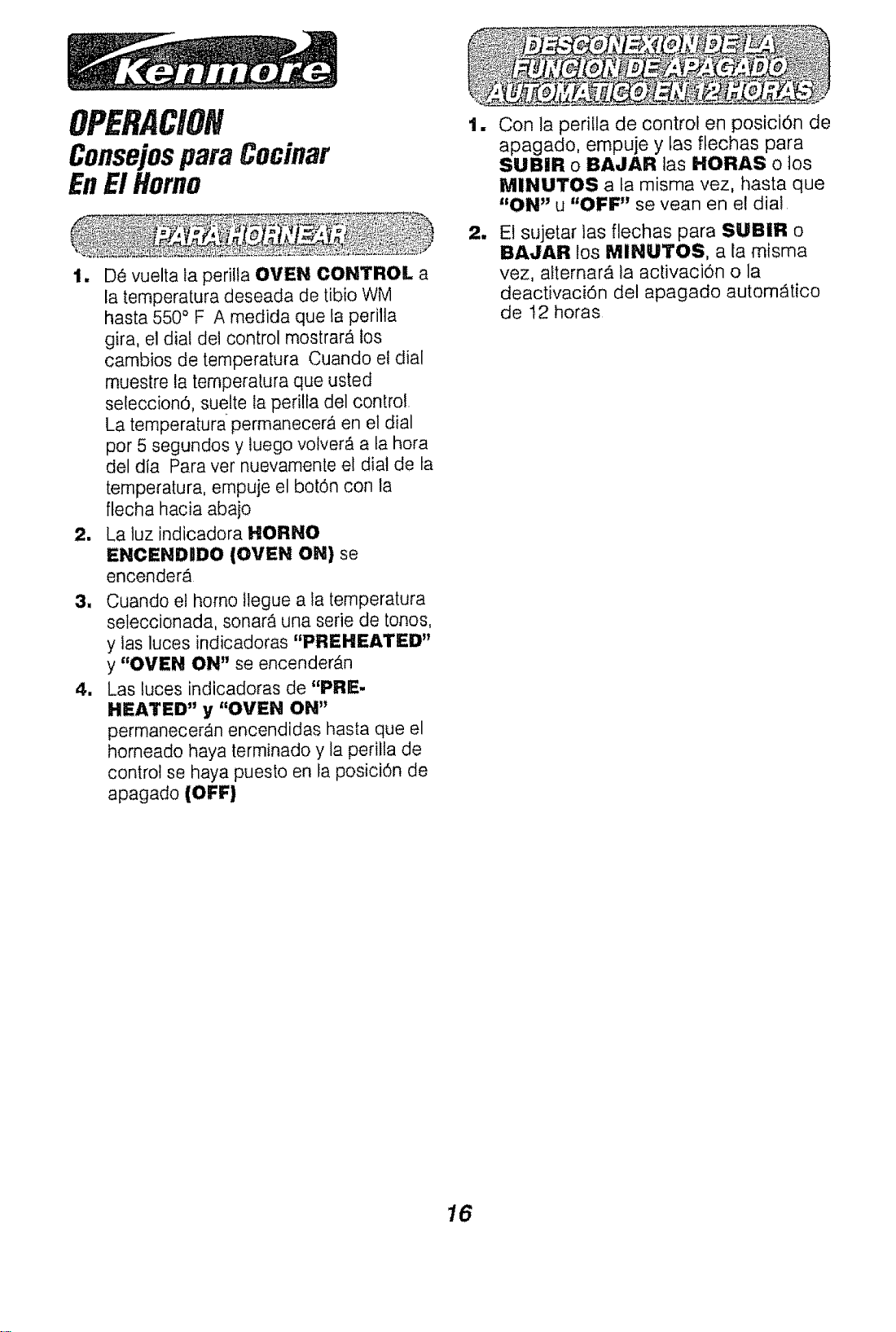
OPERACION
ConsejosparaCocinar
EnE1Homo
1. De vuelta la peri!ta OVEN CONTROL a
la temperatura deseada de tibio WM
hasta 550° F A medida que ta perilla
gira, el dial del control mostrar_ los
cambios de temperatura Cuando el dial
muestre la temperatura que usted
seleccionO, suelte la perilfa del con[rol.
La temperatura permanecer_ en el dial
por 5 segundos y tuego votverb, a la hora
del dta Para ver nuevamente e! dial de ta
temperatura, empuje el boron con la
fiecha hacia abajo
2, La luz indicadora HORHO
ENCENDUDO (OVEN ON) se
encender_
3, Cuando et homo ttegue a fa temperatura
seleccionada, sonar_ una serie de tonos,
y las luces indicadoras "PREHEATED"
y "OVEN ON" se encender_n
4, Las luces indicadoras de "PRE-
HEATED" y "OVEH ON"
permanecer_n encendidas hasta que el
horneado haya terminado y la perilla de
control se haya puesto en la posici6n de
apagado (OFF)
tB
2_
Con la perilla de control en posici6n de
apagado, empuje y tas flechas para
SUBIR o BAJAR las HORAS o los
MINUTOS a ta misma vez, hasta que
"ON" u "OFF" se vean en et dial
El sujetar las flechas para SUBIR o
BAJAR los MINUTOS, a la misma
vez, afternar_ la activaci6n o la
deactivaciOn del apagado autom_tico
de t2 horas
16
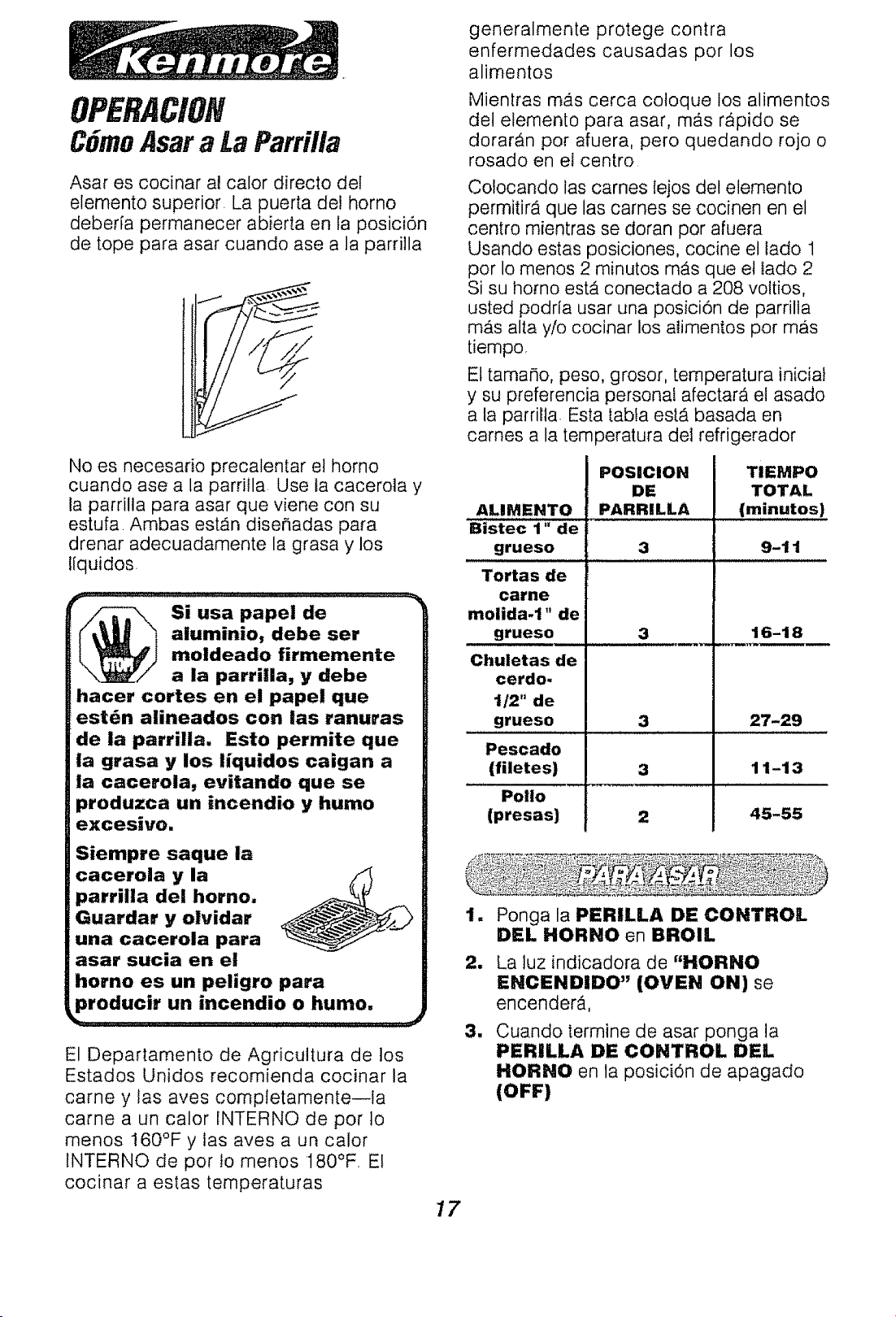
OPERACION
CSmoAsar a La Parrilla
Asar es cocinar al calor directo del
elemento superior, La puerta de! horno
deberia permanecer abierta en la posici6n
de tope para asar cuando ase a la parrilla
No es necesario precalentar el homo
cuando ase a la parrilla Use ta cacerola y
la parrilla para asar que viene con su
estufa. Ambas est_n dise_adas para
drenar adecuadamente la grasa y los
I[quidos
__ Si usa papel de
aluminio, debe ser
moldeado firmemente
a la parrilla, y debe
hacer cortes en el papel que
est_n alineados con las ranuras
de la parrilla. Esto permite que
la grasa y los liquidos caigan a
la cacerola, evitando que se
produzca un incendio y humo
excesJvo.
Siempre saque la
cacerola y la
parrilla del homo.
Guardar y olvidar
una cacerola para
asar sucia en el
homo es un peligro para
producir un incendio o humo.
El Departamento de Agricultura de los
Estados Unidos recomienda cocinar la
came y tas aves completamente--la
came a un calor INTERNO de pot to
menos 160°F y las aves a un calor
INTERNO de pot lo menos 180°F, El
cocinar a estas temperaturas
17
generalmente protege contra
enfermedades causadas por los
alimentos
Mientras mas cerca cotoque los alimentos
del etemento para asar, m_s r_pido se
dorar_n per afuera, pero quedando rojo o
rosado en el centro
Colocando ias carnes lejos det elemento
permitira que las carnes se cocinen en el
centro mientras se doran por afuera
Usando estas posiciones, cocine el lado 1
por Io menos 2 minutos mAs que et Iado 2
Si su homo esta conectado a 208 vottios,
usted podria usar una posici6n de parrilla
mas alta y/o cocinar los atimentos pot m,_s
tiempo,
El tamaSo, peso, grosor, temperatura inicial
y su preferencia personal afectar_ et asado
a la parrilla Esta tabfa esta basada en
carnes a la tem )eratura del refrigerador
AUMENTO
Bistec 1" de
grueso
Tortas de
came
molida-1" de
grueso
Chuletas de
cerdo.
1/2" de
grueso
Pescado
(filetes)
Polio
(presas)
POSICION
DE
PARRiLILA
3
3
TIEMPO
TOTAL
(minutos)
9-11
16-18
3 27-29
3 11-13
2 45-55
=
2.
w
Ponga la PERIILLA DE CONTROL
DEL HORNO en BROIL
La luz indicadora de "HORNO
ENCENDIDO" (OVEN ON) se
encender_,
Cuando termine de asar ponga la
PERIILLA DE CONTROL DEL
HORNO en la posici6n de apagado
(OFF)
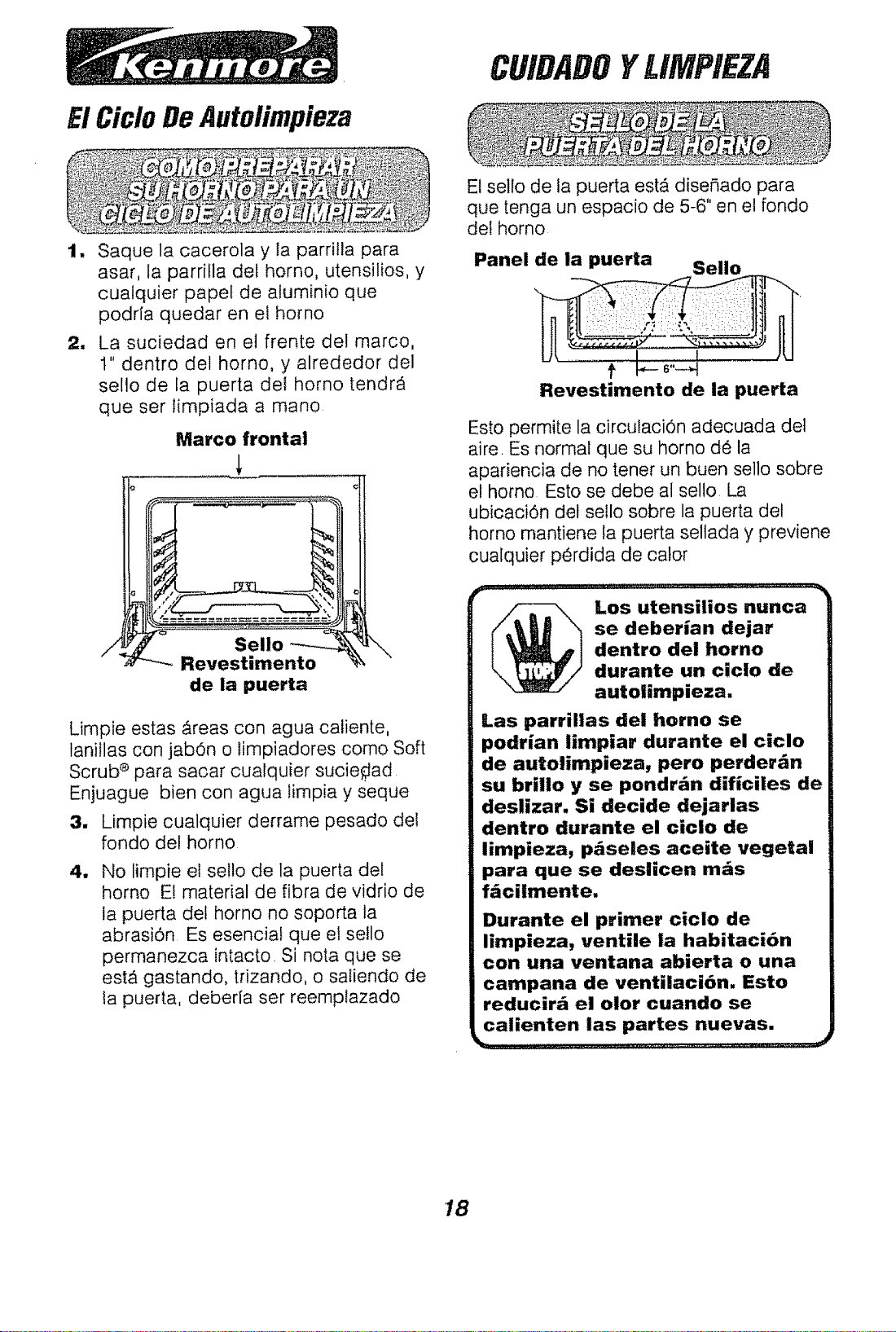
CUIDADOYUMPIEZA
El CicloDe Autolimpieza
1. Saque la cacerola y la parrilta para
asar, ta parrilla del homo, utensilios, y
cualquier papef de aluminio que
podrfa quedar en el horno
2. La suciedad en el frente del marco,
1" dentro del homo, y alrededor del
sello de la puerta del homo tendr_
que ser limpiada a mano
Marco frontal
3
,,4.
Sello _---
Revestimento
de la puerta
Limpie estas areas con agua catiente,
lanillas con jabOn o limpiadores como Soft
Scrub ® para sacar cualquier sucie_ad
Enjuague bien con agua limpia y seque
a. Limpie cualquier derrame pesado del
rondo del homo
m
No limpie el sello de la puerta del
homo E! material de libra de vidrio de
la puerta de! homo no soporta ta
abrasi6n Es esenciaf que el sello
permanezca intacto Si nota que se
est_ gastando, trizando, o satiendo de
la puerta, debeda ser reemptazado
El selto de la puerta estA diseNado para
que tenga un espacio de 5-6" en el rondo
del homo
Panel de la puerta Sello
f _ 6"_4
Revestimento de la puerta
Esto permite la circufaciOn adecuada del
aire Es normal que su homo de la
apariencia de no tenet un buen sello sobre
el homo Esto se debe al sello La
ubicaciOn del sello sobre la puerta det
horno mantiene ta puerta sellada y previene
cualquier perdida de calor
p_.
Los utensilios nunca
se deberian dejar
dentro del horno
durante un cicto de
autolimpieza.
Las parrillas del homo se
podrian limpiar durante el ciclo
de autolimpieza, pero perderdn
su brillo y se pondrdn dificiles de
deslizar. Si decide dejarlas
dentro durante el ciclo de
limpieza, p_seles aceite vegetal
para que se deslicen m:_s
f:_cilmente,
Durante el primer ciclo de
limpieza, ventile la habitaci6n
con una ventana abierta o una
campana de ventilaci6n, Esto
reducir_ el olor cuando se
calienten las partes nuevas.
18
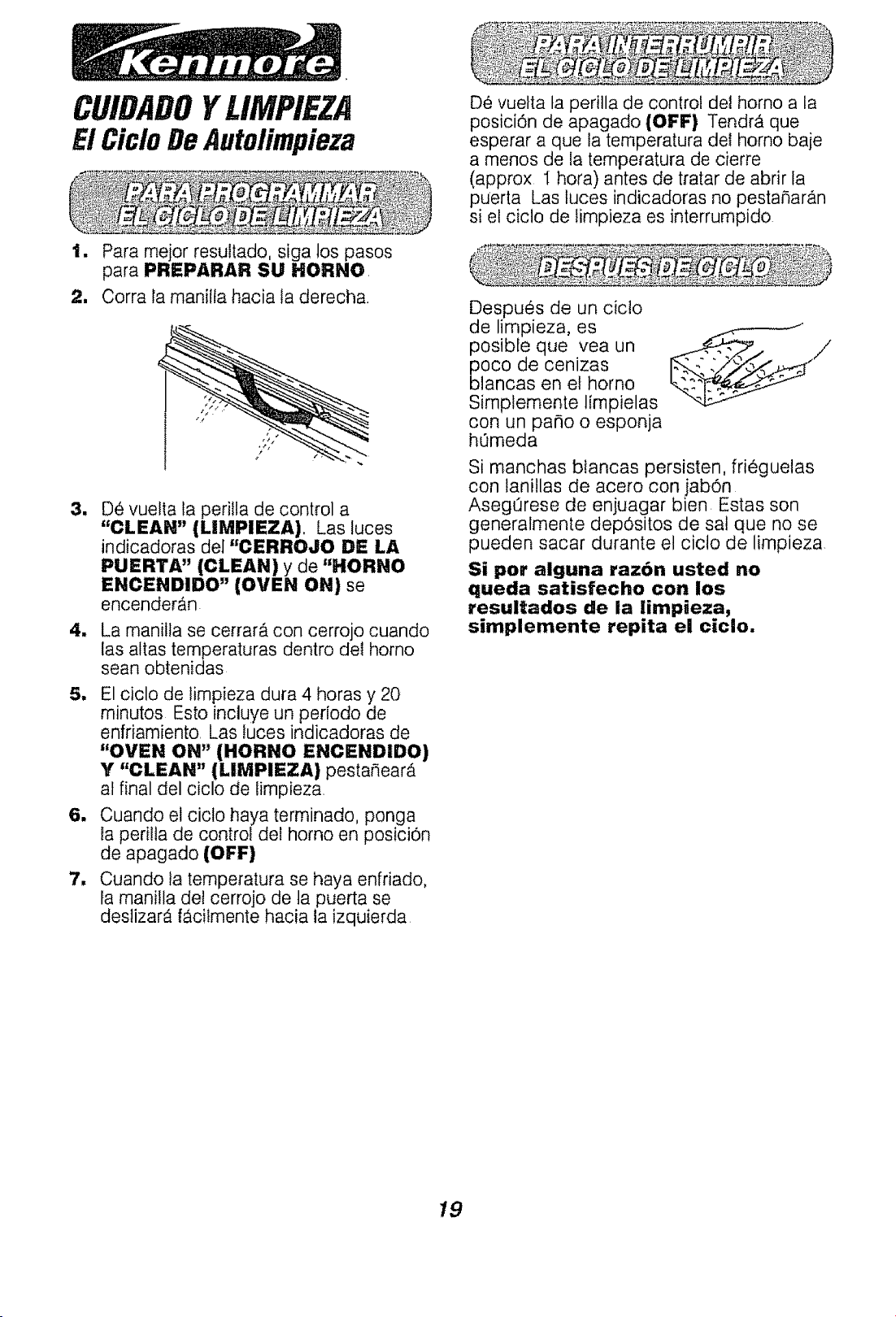
CUIDADOY LIMPIEZA
E1CicloDeAutolimpieza
t. Para mejor resultado, siga los pasos
para PREPARAR SU HORNO,
2. Corra la manilla hacia fa derecha
t
1.
De vuelta la peritla de control a
"CLEAN" (LIMPIEZA). Las luces
indicadoras del "CERROJO DE LA
PUERTA" (CLEAN) y de "HORNO
ENCENDIDO" (OVEN ON) se
encender_n
La manilla se cerrar_ con cerrojo cuando
las altas ternperaturas dentro de! horno
sean obtenidas
5. El ciclo de timpieza dura 4 horas y 20
minutos Esto incluye un periodo de
enfriamiento, Las fuces indicadoras de
"OVEN ON" (HORNO ENCENDIDO)
Y "CLEAN" (L|MPIEZA) pestaNear_
at final del ciclo de limpieza,
6. Cuando el ciclo haya terrninado, ponga
ta perilta de control def homo en posici6n
de apagado (OFF}
7. Cuando ta temperatura se haya enfriado,
ta manitla del cerrojo de ta puerta se
deslizar_ f&cilmente hacia la izquierda
D6 vuelta la perilla de control del homo a la
posiciOn de apagado (OFF) Tendr_ que
esperar a que ia temperatura del homo baie
a menos de la temperatura de cierre
(approx I hora) antes de tratar de abrir la
puerta Las luces indicadoras no pestaC_aran
si el ciclo de timpieza es interrumpido
Despues de un ciclo
de limpieza, es
posible que vea un
poco de cenizas
blancas en et homo
Simplemente limpielas
con un paso o esponja
hOmeda
Si manchas blancas persisten, frieguelas
con lanillas de acero con jabOn
Asegt3rese de enjuagar bien Estas son
generalmente depOsitos de sat que no se
pueden sacar durante el cicto de limpieza
Si pot aiguna raz6n usted no
queda satisfecho con los
resultados de la limpieza,
simplemente repita el ciclo.
19
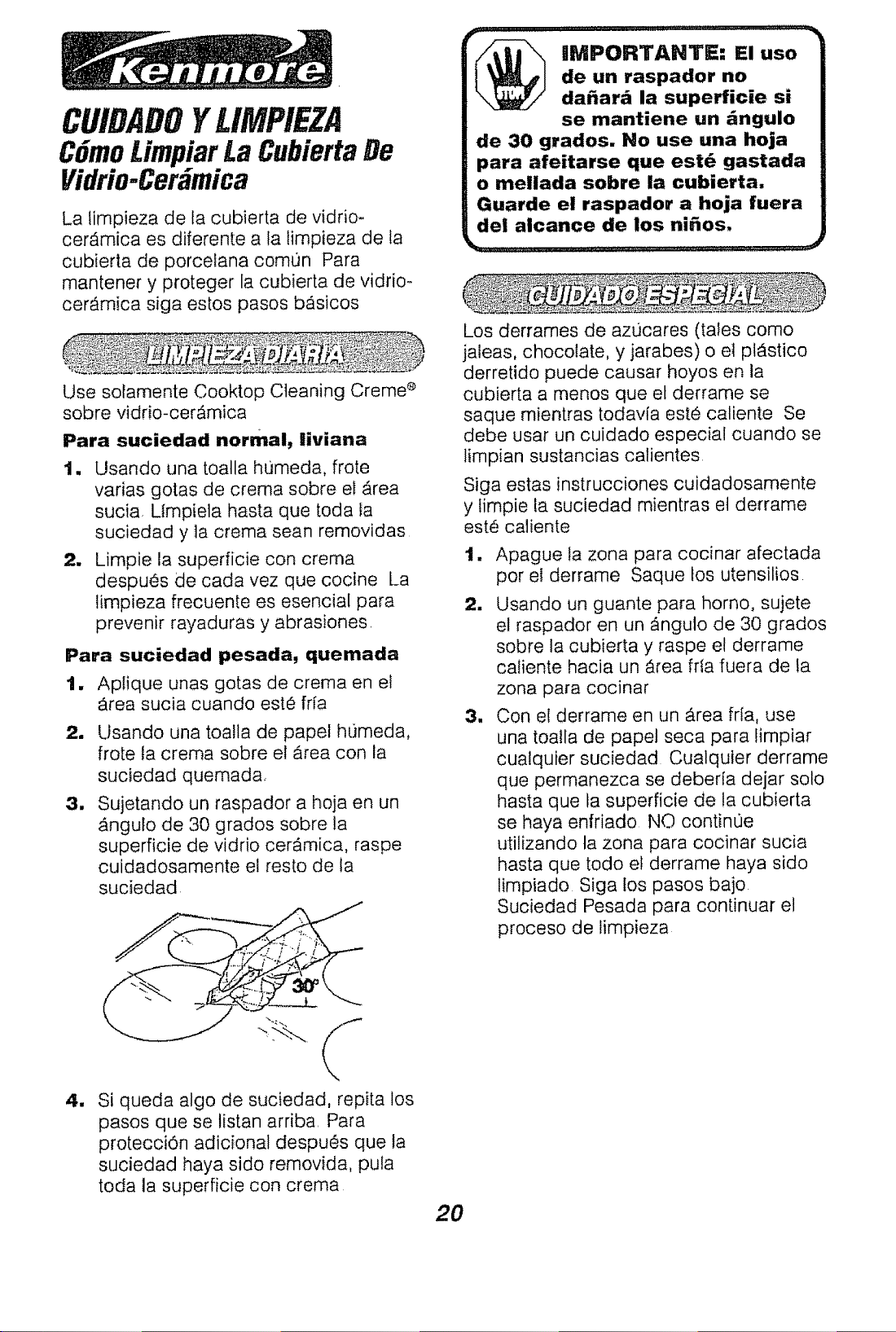
CUIDADOYLIMPIEZA
C6moLimpiarLa CubiertaDe
Vidrio-Cer mica
La timpieza de la cubierta de vidrio-
cerAmica es diferente a fa timpieza de la
cubierta de porcefana comon Para
mantener y proteger la cubierta de vidrio-
cerAmica siga estos pasos bAsicos
Use solamente Cooktop Cleaning Creme ®
sobre vidrio-cer,_mica
Para suciedad normal, liviana
il. Usando una toatla humeda, frote
varias gotas de crema sobre el Area
sucia Llmpiela hasta que toda la
suciedad y ]a crema sean removidas
2. Limpie la superficie con crema
despues de cada vez que cocine La
limpieza frecuente es esencial para
prevenir rayaduras y abrasiones,
Para suciedad pesada, quemada
1. Aplique unas gotas de crema en el
Area sucia cuando este frta
2. Usando una toatla de papel h(}meda,
frote la crema sobre el Area con la
suciedad quemada
3. Sujetando un raspador a hoja en un
Angulo de 30 grados sobre la
superficie de vidrio ceramica, raspe
cuidadosamente el resto de la
suciedad
IMPORTAHTE: El uso
de un raspador no
da_ar_ la superficie si
se mantiene un ;ingulo
de 30 grados. No use una hoja
para afeitarse que estA gastada
o mellada sobre la cubierta.
Guarde el raspador a hoja fuera
de| alcance de los ni_os,
Los derrames de aztJcares (tales como
jateas, chocolate, y jarabes) o el plAstico
derretido puede causar hoyos en la
cubierta a menos que et derrame se
saque mientras todavia este caliente Se
debe usar un cuidado especial cuando se
limpian sustancias calientes
Siga estas instrucciones cuidadosamente
y limpie la suciedad mientras et derrame
este caliente
lm
2.
m
Apague ta zona para cocinar afectada
por el derrame Saque los utensilios
Usando un guante para homo, sujete
el raspador en un _ngulo de 30 grados
sobre la cubierta y raspe el derrame
caiiente hacia un _rea frfa fuera de la
zona para cocinar
Con el derrame en un Area fria, use
una toalla de papel seca para limpiar
cualquier suciedad Cualquier derrame
que permanezca se deber[a dejar solo
hasta que ta superficie de la cubierta
se haya enfriado NO continoe
utilizando ta zona para cocinar sucia
hasta que todo el derrame haya sido
limpiado Siga los pasos bajo
Suciedad Pesada para continuar el
proceso de fimpieza
4,
Si queda algo de suciedad, repita los
pasos que se listan arriba, Para
protecciOn adicional despu_s que ta
suciedad haya sido removida, pula
toda la superficie con crema
20
CUIDADOYUMPIEZA
C6moLimpiarLa CubiertaDe
Vidrio-Ceramica
o No use limpiadores abrasivos o lanillas
abrasivas sobre la cubierta
• Se puede usar lanillas de plastico tat
como Dobie e
Para ordenar Cooktop Cleaning Creme e
adicional, Ilame a su Centro de Servicio o
tienda Sears mas cercana, pida el (Stock
No. 40079)
A medida que ta crema limpia, deja una
capa protectora que ayuda a prevenir la
acumulacion de dep6sitos minerales
(manchas de agua) y facilita la limpieza
futura El detergente para favar platos
elimina ta capa protectora y no se deberia
utilizar
MATERIALES DE LIMPIEZA
o Detergente liquido para platos
o Agua tibia
• Patio suave
No use limpadores abrasivos,
limpiadores industriales, o
blanquedores (cloro).
• La mayoria de los limpiadores contienen
amonia, quimicos y abrasivos que da_an
fa superficie de su cubierta Use
solamente Cooktop Cleaning Creme e
para una limpieza adecuada y para la
protecci6n de ta superficie de vidrio
cer_.mica
• Si usted arrastra el rondo de las olfas de
aluminio o cobre sobre la superficie de
ta cubierta, podria dejar marcas de
metal en forma de rayaduras Use et
raspador y la crema para la superficie
para sacar estas marcas Si no saca
este residuo inmediatamente, podria
producir marcas permanentes
o Si las ollas con un enchapado de
aluminio delgado, de cobre o de esmalte
hierven cuando estan secas, se podrian
fundir con ia superficie de la cubierta
Esta descoloraciOn negra deberia ser
sacada inmediatamente o podda ser
permanente
o El uso de limpiadores de vidrio podrian
dejar una capa irridescente sobre la
cubierta. La crema para timpiar sacara
esta capa
• Las manchas de agua (dep6sitos
minerales) son removibtes usando
crema y vinagre blanco a toda fuerza
• No use un raspador con una hoja
gastada o mellada sobre ta cubierta
MATERIALES DE LIMPIEZA
• Detergente liquido para platos
• Agua tibia
,_ Lanillas de acero con jab6n
• Limpiador comercial para hornos
COMO LIMPIAR
Permita que la cacerola se remoje Ponga
deLergente para platos sobre la parrilla y
cubra con un pai_o o una toalla hQmeda
por un rato. Friegue a medida que sea
necesario Lave, enjuague, y seque bien
Usted tambien podria poner la cacerola y
la parrilla en la lavadora de platos
Limpie solamente como un toque entre
cic!os de limpieza Use detergente liquido,
agua tibia, o lanilla de acero con jab0n
Enjuague bien despues de limpiar y
seque
NUNCA USE LIMPIADORES DE
HORNOS DENTRO O ALREDEDOR
DE CUALQUIER PARTE DEL
HORNO.
Cuando limpie, asegL_rese de no dobIar o
desplazar e! sensor de temperatura
ubicado en la pared trasera del homo
,21
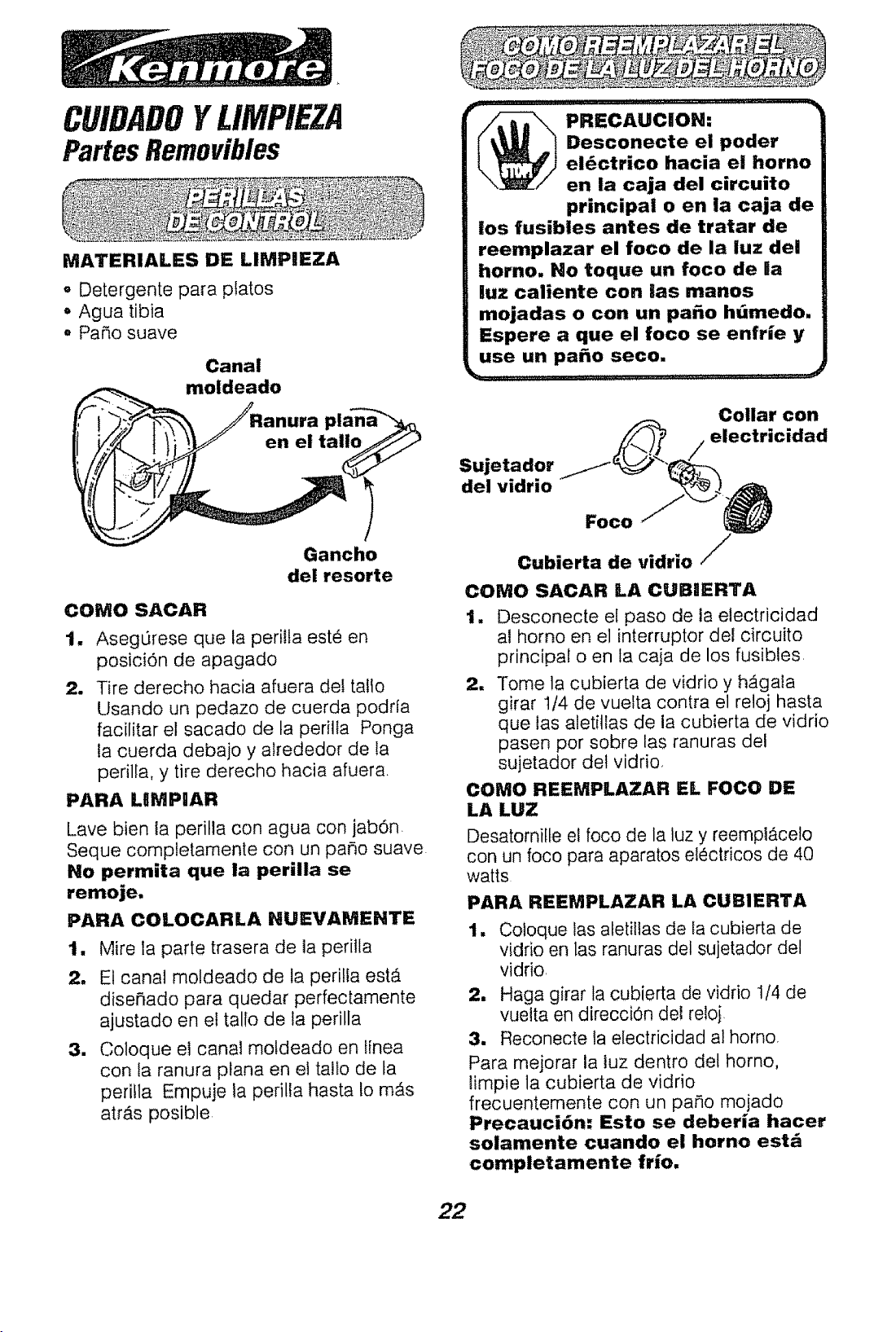
CUIDADOYLIMPIEZA
Partes Removibles
MATERIALES DE LIMPIEZA
- Detergente para platos
o Agua tibia
o Pai5o suave
Canal
moldeado
Gancho
del resorte
COMO SACAR
2.
AsegL_rese que la perilta este en
posici6n de apagado
Tire derecho hacia afuera def tallo
Usando un pedazo de cuerda podda
facilitar el sacado de la perilta Ponga
la cuerda debajo y alrededor de la
perilla, y tire derecho hacia afuera
PARA LSMPOAR
Lave bien ta perilla con agua con jab6n
Seque compfetamente con un paso suave
No permita que la perilla se
remoje.
PARA COLOCARLA NUEVAMENTE
t. Mire la parle trasera de la perilla
u
1
El canal moldeado de la peritla est_
diseriado para quedar perfectamente
ajustado en el talfo de fa perilla
Coloque el canal moldeado en tinea
con la ranura plana en el ta!lo de ta
perifla Empuje la perilla hasta Io m_s
atrb,s posible
PRECAUCIION:
Desconecte el poder
el_ctrico hacia el homo
en la caja del circuito
principal o en la caja de
los fusibles antes de tratar de
reemplazar el foco de la luz del
homo. No toque un foco de la
luz caliente con ias manos
mojadas o con un paso htimedo.
Espere a que el foco se enfrie y
use un paso seco.
Sujetador
del vidrio
Collar con
electricidad
Foco
/
Cubierta de vidrio//
COMO SACAR LA CUBUERTA
1, Desconecte el paso de ta electricidad
al homo en el interruptor del circuito
principal o en la caia de los fusibles
2, Tome la cubierta de vidrio y h,_gala
girar I/4 de vuelta contra el reloj hasta
que ias aletitlas de ia cubierta de vidrio
pasen por sobre las ranuras del
sujetador de! vidrio,
COMO REEMPLAZAR EL FOCO DE
LA LUZ
Desatornilte el foco de la luz y reempi&celo
con un foco para aparatos electricos de 40
watts
PARA REEMPLAZAR LA CUBIERTA
1. Cotoque las aletitlas de la cubierta de
vidrio en las ranuras del sujetador del
vidrio
2. Haga girar la cubierta de vidrio 114de
vuelta en direcciOn del reioj
3. Reconecte la electricidad al horno
Para mejorar la luz dentro del homo,
limpie la cubierta de vidrio
frecuentemente con un patio mojado
Precauci6n: Esto se deberia hacer
solamente cuando el horno estd
completamente frio.
22
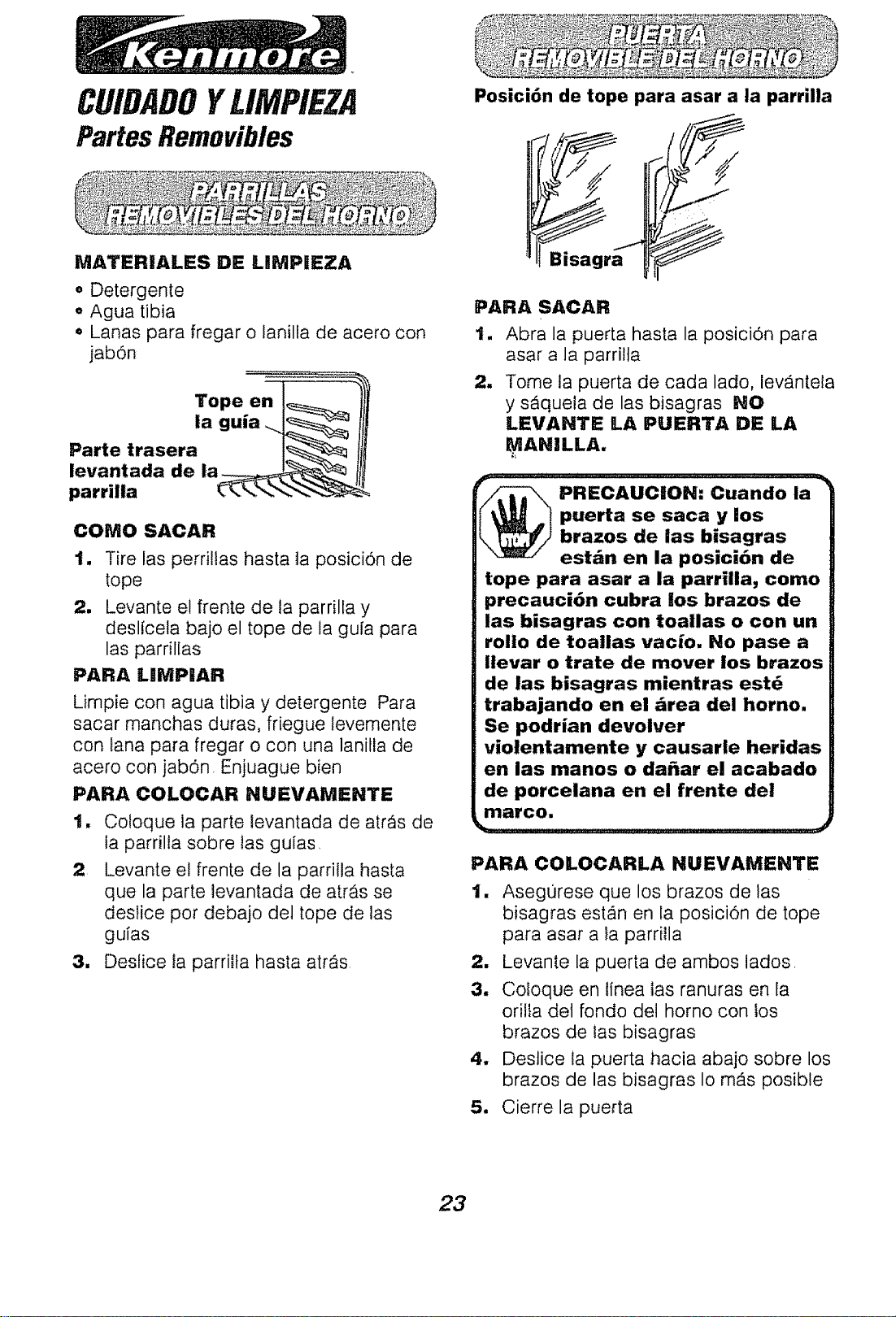
CUIDADOYLIMPIEZA
Partes Removibles
MATERIALES DE LIMPREZA
• Detergente
e Agua tibia
• Lanas para fregar o lanilfa de acero con
jab6n
Tope en
la
Parte trasera
levantada de
parrilla
COMO SACAR
1. Tire las perriltas hasta la posicion de
tope
2. Levante el frente de la parrilla y
deslicela bajo el tope de la gufa para
las parrillas
PARA LJlVIPRAR
Limpie con agua tibia y detergente Para
sacar manchas duras, friegue levemente
con fana para fregar o con una laniffa de
acero con jab6n. Enjuague bien
PARA COLOCAR HUEVAMENTE
1. Co!oque la parte levantada de atr_s de
ta parrilla sobre tas guias,
2 Levante e! frente de la parritla hasta
que la parte levantada de arras se
deslice por debajo del tope de las
guias
3, Desfice la parrilla hasta atras
Posici6n de tope para asar a la parrilla
PARA SACAR
1. Abra la puerta hasta la posici6n para
asar a la parrilla
2, Tome la puerta de cada lado, ievantela
y sAquela de las bisagras NO
LEVANTE LA PUERTA DE LA
MAHILLA.
puerta se saca y los
brazos de las bisagras
est_n en la posici6n de
tope para asar a la parriUa, como
precauci6n cubra los brazos de
las bisagras con toailas o con un
rol]o de toallas vacio. No pase a
Ilevar o trate de mover los brazos
de las bisagras mientras est_
trabajando en el :_rea del homo.
Se podrian devolver
violentamente y causarle heridas
en las manos o da_ar el acabado
de porcelana en el frente de!
marco.
PARA COLOCARLA NUEVAMEHTE
1. Asegurese que 10s brazos de ias
bisagras est_n en la posici6n de tope
para asar a la parrilla
_-, Levante la puerta de ambos lados
3, Coloque en iinea las ranuras en la
orilta det rondo del homo con ios
brazos de ias bisagras
4. Deslice Ia puerta hacia abajo sobre los
brazos de las bisagras Io mAs posible
5. Cierre la puerta
23
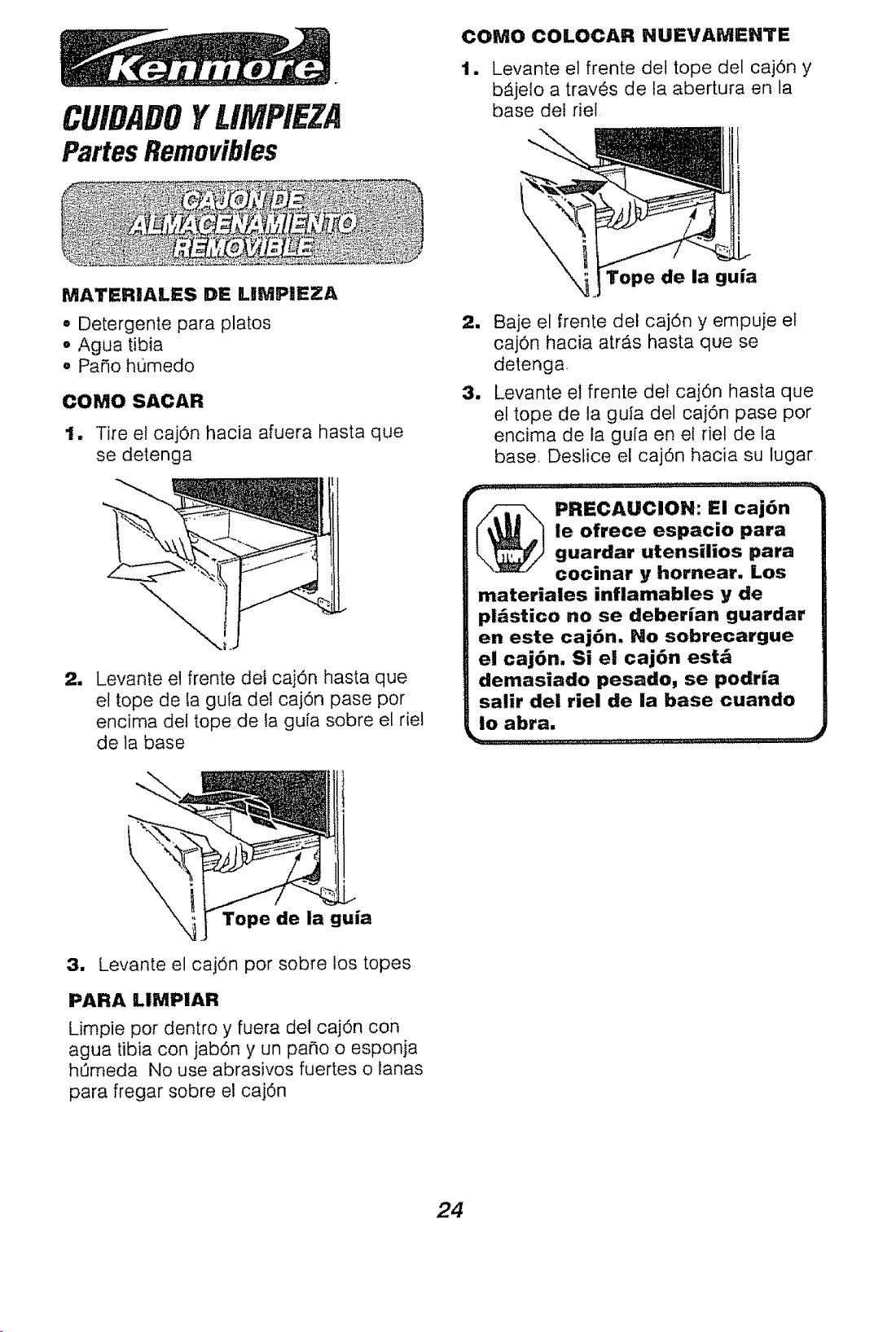
CUIDADOYLIMPIEZA
Partes Removibles
CONtO COLOCAR NUEVAMEHTE
1. Levante el frente del tope del caj6n y
b_.jeio a traves de la abertura en la
base del riel
MATERIALES DE LIMPIEZA
• Detergente para platos
° Agua tibia
• Par3o humedo
COMO SACAR
1, Tire el cajOn hacia afuera hasta que
se detenga
m
Levante el frente del cajOn hasta que
el tope de Ia guia dei caj6n pase por
encima det tope de ta guia sobre el riel
de la base
de la guia
2, Baje el frente del caj6n y empuje el
caj6n hacia atrAs hasta que se
detenga
3. Levante el frente del caj6n hasta que
el tope de la gufa del caj6n pase por
encima de la guia en e! riel de la
base, Destice el caj6n hacia su lugar
_ RECAUCION: El caj6n
le ofrece espacio para
guardar utensUios para
cocinar y hornear. Los
materiales inflamables y de
pl_stico no se deberian guardar
en este caj6n. No sobrecargue
el caj6n. Si el caj6n est_
demasiado pesado, se podria
salir del riel de la base cuando
Io abra.
Tope de la guia
3. Levante el caj6n por sobre los topes
PARA LIMPIAR
Limpie por dentro y fuera del caj6n con
agua tibia con jab6n y un paso o esponja
hQmeda No use abrasivos fuertes o fanas
para ffegar sobre el caj6n
24
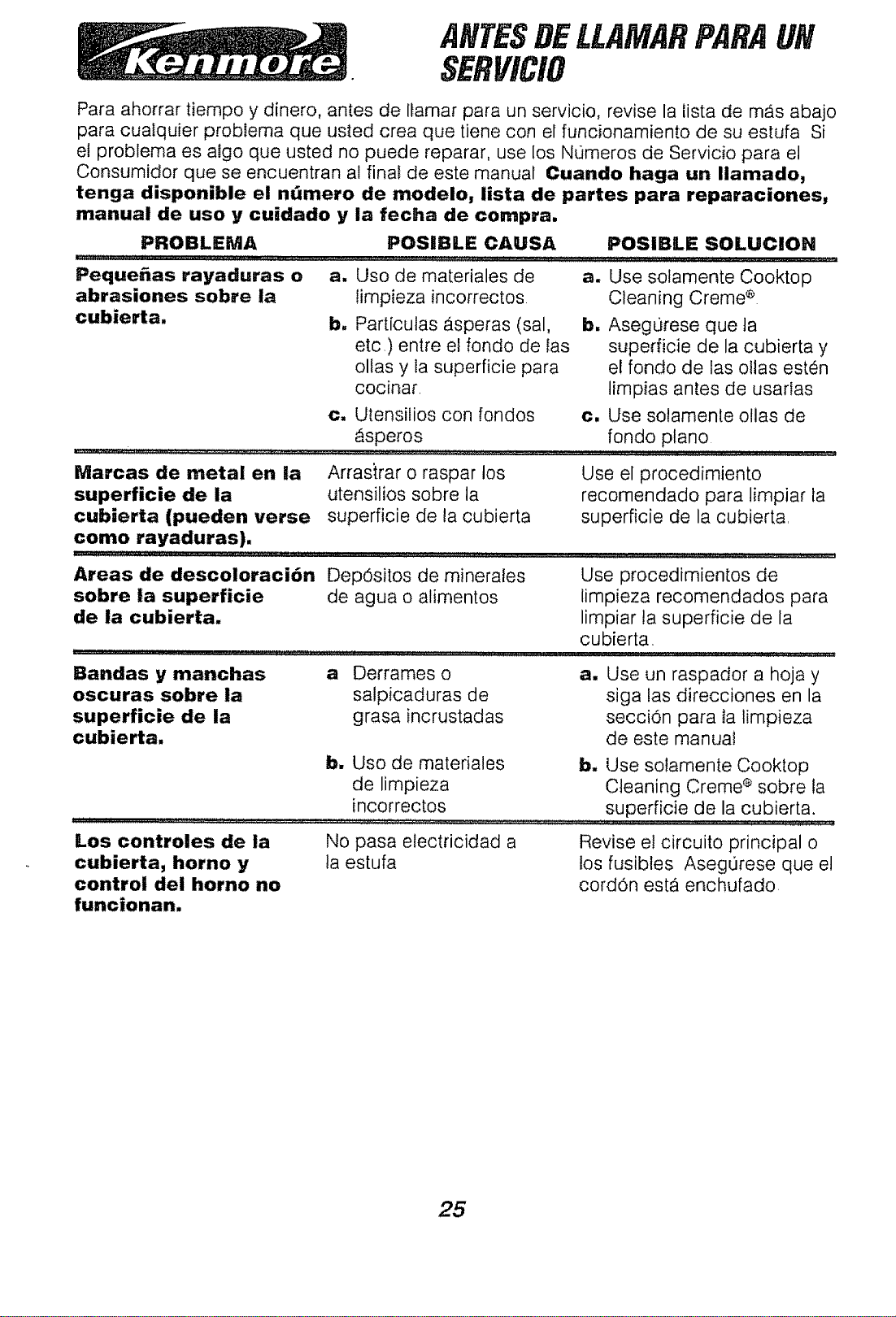
ANTESDELLAMARPARAUN
SERVICIO
Para ahorrar tiempo y dinero, antes de llamar para un servicio, revise la lista de ma,s abajo
para cualquier problema que usted crea que tiene con el funcionamiento de su estufa Si
e! problema es algo que usted no puede reparar, use los Numeros de Servicio para el
Consumidor que se encuentran al final de este manual Cuando haga un Ilamado,
tenga disponible el ntimero de modeio, lista de partes para reparaciones,
manual de uso y cuidado y ia fecha de compra.
PROBLEIVIA POSiBLE CAUSA POSlBLE SOLUCIOH
Peque_as rayaduras o a. Uso de materiales de a. Use solamente Cooktop
abrasiones sobre la
cubierta.
b_
Iimpieza incorrectos
Particulas asperas (sal,
etc,) entre et rondo de las
ollas y la superficie para
cocinar
c. Utensilios con rondos
_speros
Cleaning Creme ®
b, AsegL_rese que ta
superficie de la cubierta y
el fondo de las ollas esten
limpias antes de usarIas
c. Use solamente ollas de
fondo piano
Marcas de metal en Ita Arrastrar o raspar los
superficie de la utensilios sobre la
cubierta (pueden verse superficie de la cubierta
como rayaduras).
Areas de descoloraciOn Dep0sitos de minerafes
sobre la superficie de agua o alimentos
de la cubierta.
Bandas y manchas
oscuras sobre la
superficie de la
cubierta.
a Derrames o
salpicaduras de
grasa incrustadas
b. Uso de materiales
de limpieza
Use el procedimiento
recomendado para limpiar la
superficie de la cubierta
Use procedimientos de
limpieza recomendados para
limpiar la superficie de la
cubierta
....... ..............................::.:.............
a. Use un raspador a hoja y
siga las direcciones en la
secciOn para la limpieza
de este manual
b, Use solamente Cooktop
Cleaning Creme ® sobre Ia
..................................... inc0[rectos ..........................superficie de la cu,bier!a: ......
Los controles de ta No pasa electricidad a Revise el circuito principal o
cubierta, horno y la estufa los fusibles Asegurese que el
control del homo no cordon esta enchufado
funcionan.
25
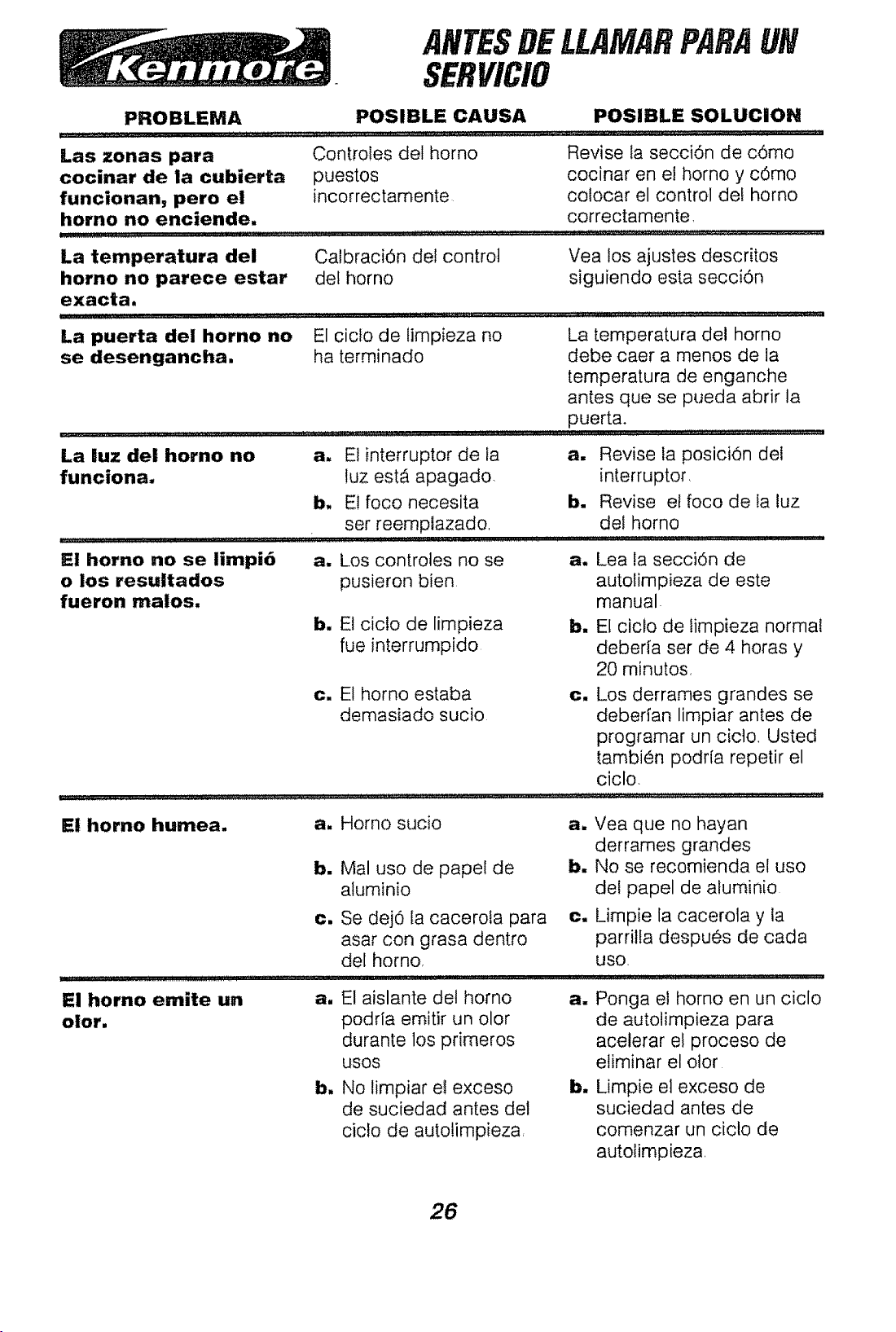
ANTESDELLAMARPABAU#
SERVICIO
PROBLEMA POSIBLE CAUSA
Las zonas para Controies del homo
cocinar de la cubierta puestos
funcionan, pero el incorrectamente
homo no enciende.
POSlBLE SOLUCION
Revise la secci6n de c6mo
cocinar en e! homo y cOmo
cotocar el control de! homo
correctamente,
............... =-..o_:..:....... i
La temperatura del Calbraci0n de! control
homo no parece estar def horno
exacta,
La puerta del horno no El ciclo de limpieza no
se desengancha, ha terminado
Yea los ajustes descritos
siguiendo esta secci6n
La temperatura del homo
debe caer a menos de ia
temperatura de enganche
antes que se pueda abrir la
puerta.
La luz del homo no
funciona,
a, El interruptor de la
luz est_ apagado.
b, Et foco necesita
ser reemplazado.
_1 homo no se limpi6
o los resultados
fueron malos.
al Los controtes no se
pusieron bien
b, E1ciclo de limpieza
rue interrumpido
a. Revise ia posiciOn del
interruptor,
b. Revise el foco de ta luz
del homo
a, Lea la secciOn de
autofimpieza de este
manual
b, El ciclo de limpieza normal
deberia ser de 4 horas y
20 minutos,
c, Los derrames grandes se
deberian limpiar antes de
programar un ciclo. Usted
tambien podria repetir el
ciclo.
c, El homo estaba
demasiado sucio
El horno humea.
El homo emite un
olor.
a. Horno sucio a. Vea que no hayan
derrames grandes
b. Mal uso de pape! de b. No se recomienda el uso
atuminio def papel de aluminio
c. c, Limpie la cacerota y la
parritfa despu6s de cada
USO,
, / )!!! LL !! ................. iii1,,, P
a, El aislante del homo a. Ponga el homo en un ciclo
Se dej0 la cacerofa para
asar con grasa dentro
del homo,
bll
podria emitir un olor
durante los primeros
USOS
No timpiar e! exceso
de suciedad antes del
cic!o de autolimpieza.
bl
de autolimpieza para
acelerar el proceso de
eliminar el olor
Limpie et exceso de
suciedad antes de
comenzar un ciclo de
autolimpieza
26
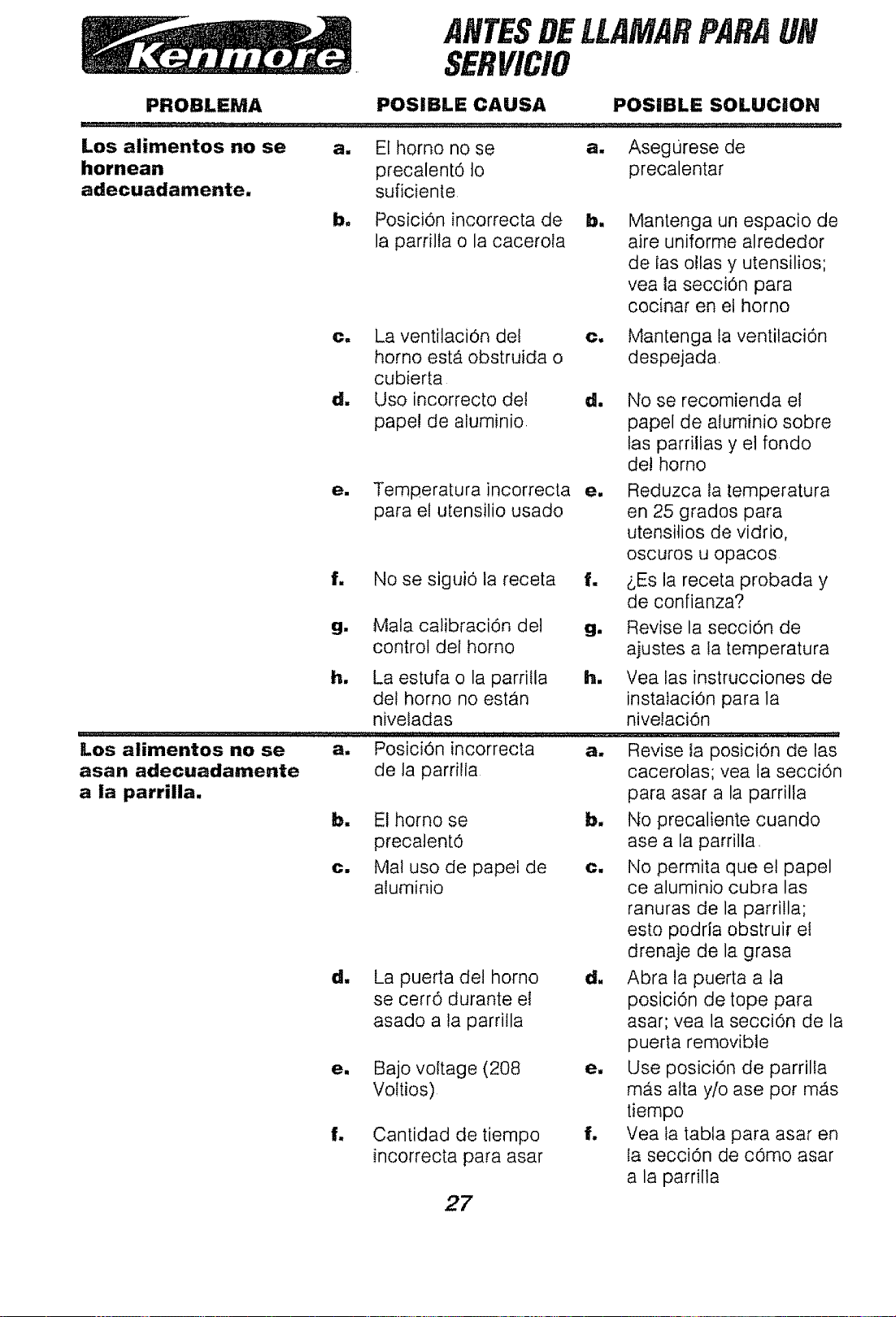
ANTESDELLAMARPARAUN
SERVICIO
Los alimentos no se
hornean
adecuadamente,
PROBLEMA POSIBLE CAUSA POSiBLE SOLUCION
a. El homo no se a, AsegL)rese de
precalent6 Io precalentar
suficiente
b. Posici6n incorrecta de b.
la parrilla o la cacerola
Mantenga un espacio de
aire uniforme alrededor
de las ollas y utensilios;
vea la secciOn para
cocinar en e! homo
c. La ventilaciOn del c.
homo estA obstruida o
cubierta
d. Uso incorrecto del d.
pape! de aluminio
ea
fm
g,
h,
Mantenga la ventilaci6n
despejada
No se recomienda el
papel de aluminio sobre
las parrillas y et fondo
de! homo
Temperatura incorrecta
para el utensilio usado
No se siguio la receta
Mala calibraciOn del
control del homo
e. Reduzca la temperatura
en 25 grados para
utensitios de vidrio,
oscuros u opacos
f. &Es la receta probada y
de confianza?
go Revise la seccidn de
ajustes a la temperatura
La estufa o la parrilla h. Vea ias instrucciones de
del homo no estan instaIaci0n para la
niveladas nivelaciOn
Los alimentos no se a. PosiciOn incorrecta a. Revise fa posicidn de las
asan adecuadamente
a la parrilla.
de la parrilla
b. El homose
precatent0
c. Mal usode papel de
aluminio
d_
em
f_
La puerta del homo
se cerrO durante el
asado a la parrilla
Bajo voltage (208
Voltios)
Cantidad de tiempo
incorrecta para asar
cacerotas; vea la secci6n
para asar a la parrilfa
b. No precaliente cuando
ase a la parrilla,
e. No permita que el papel
ce aluminio cubra las
ranuras de la parri!la;
esto podria obstruir el
drenaje de la grasa
d, Abrala puerta a ta
posiciOn de tope para
asar; vea la seccidn de la
puerta removible
e, Use posici6n de parrilla
mas alia y/o ase por mas
tiempo
f, Vea ta tabla para asar en
la secci6n de c6mo asar
a la parrilla
27
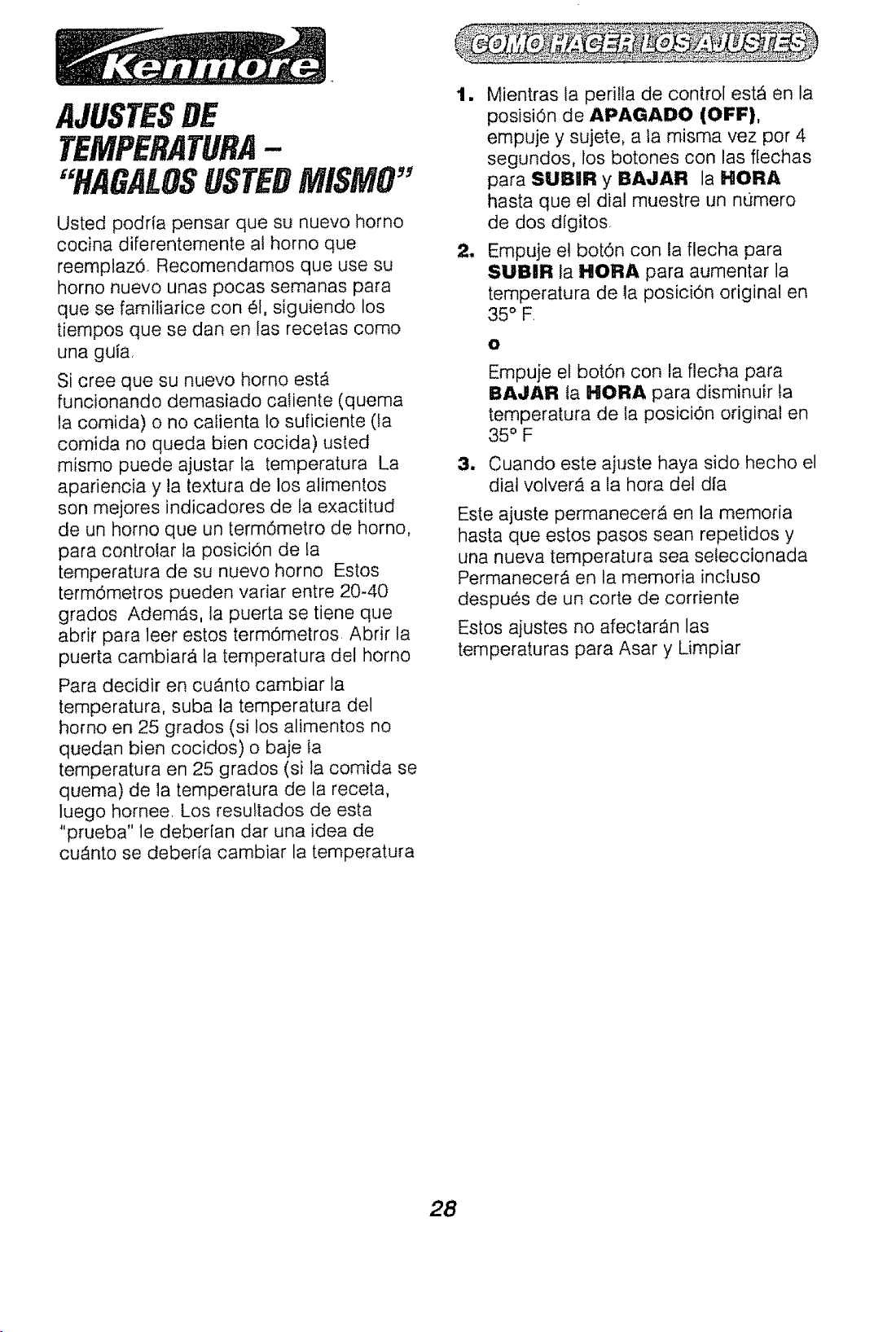
AJUSTESDE
TEMPERATURA-
"HAGALOSUSTEDMISMO"
Usted podrfa pensar que su nuevo homo
cocina diferentemente at homo que
reemplaz6_ Recomendamos que use su
homo nuevo unas pocas semanas para
que se familiarice con et, siguiendo los
tiempos que se dan en las recetas como
una gufa,
Si cree que su nuevo homo est_
funcionando demasiado caIiente (quema
la comida) o no calienta to suficien[e (fa
comida no queda bien cocida) usted
mismo puede ajustar la [emperatura La
apariencia y ]a textura de los alimentos
son mejores indicadores de la exactitud
de un horno que un term6metro de homo,
para con[rolar ta posiciOn de la
temperatura de su nuevo horno Estos
term6metros pueden variar entre 20-40
grados Adem_s, la puerta se tiene que
abrir para leer estos termdmetros Abrir la
puerta cambiarA la temperatura del homo
Para decidir en cu_nto cambiar la
temperatura, suba ta temperatura del
homo en 25 grados (si los alimentos no
quedan bien cocidos) o baje ta
temperatura en 25 grados (si la comida se
quema) de la temperatura de la receta,
luego hornee, Los resultados de esta
"prueba" le deberlan dar una idea de
cu_nto se deberfa cambiar la temperatura
1. Mientras la peritla de control est_ en la
posisiOn de APAGADO (OFF),
empuje y sujete, a la misma vez por 4
segundos, los botones con las fiechas
para SUBIIR y BAJAR la HORA
hasta que el dial muestre un numero
de dos dfgitos,
2, Empuje el bot6n con la flecha para
SUBIlR ta HORA para aumentar la
temperatura de la posici6n original en
35 ° F,
O
Empuje el botOn con la flecha para
BAJAR la HORA para disminuir la
temperatura de la posiciOn original en
35 ° F
3. Cuando este ajuste haya sido hecho el
dial votverA a la hora det dla
Este ajuste permanecer_ en la memoria
hasta que estos pasos sean repetidos y
una nueva temperatura sea seleccionada
Permanecer_ en la memoria incluso
despues de un corte de corriente
Estos ajustes no afectar_n las
temperaturas para Asar y Limpiar
28
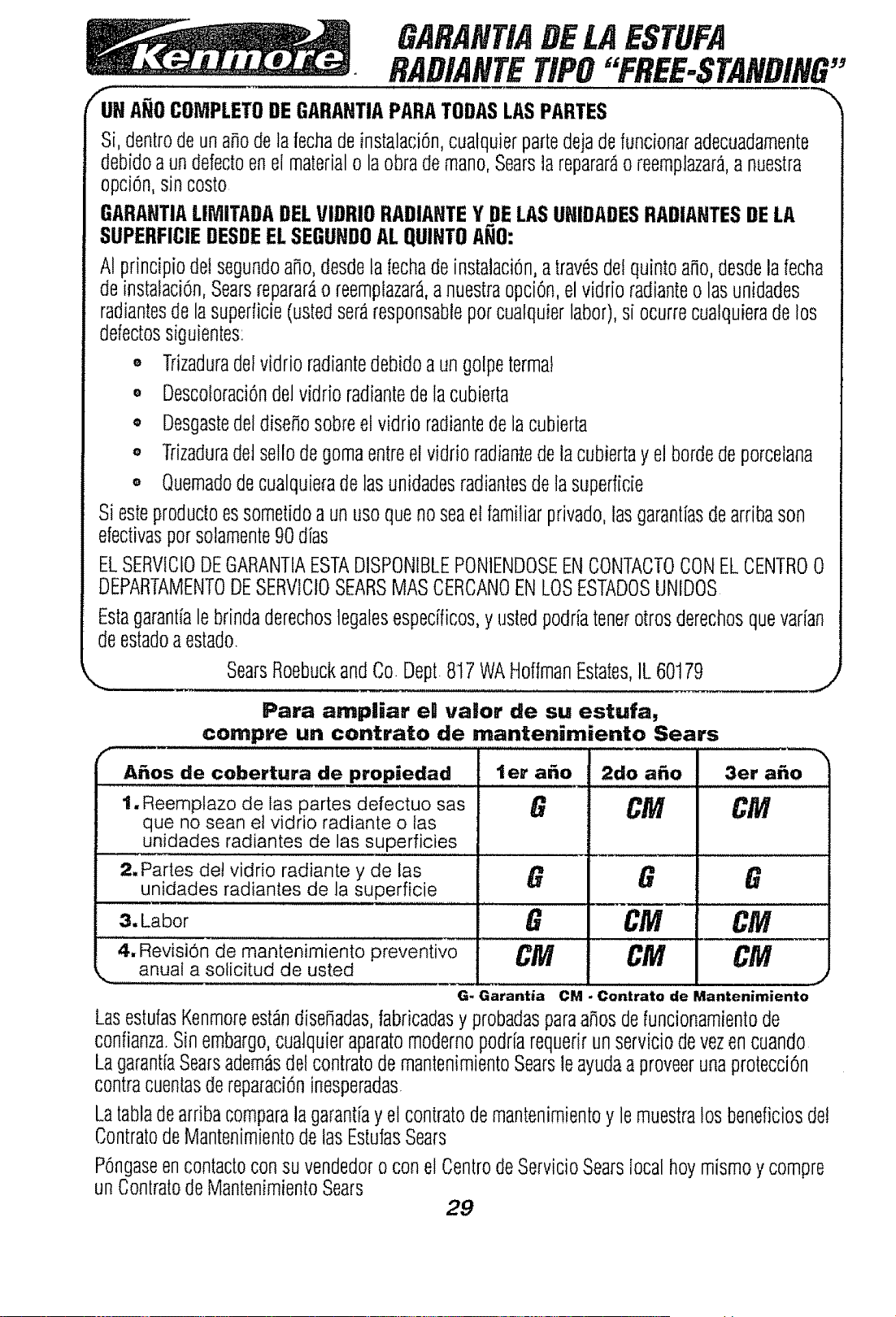
E
GARANTIADELAESTUFA
RADIANTET/PO" o
FREESTANDING"
UN AHOCOMPLETODEGARAHTIAPARATODASLASPARTES
St, dentrode unanode la fechadeinstalaciOn,cuatquierpartedejadefuncionaradecuadamente
debidoa undefectoenel materialo laobrademano,Searsla reparar_o reemplazar_,a nuestra
opcitin, sin costo
GARAHTIALIMITADADELVIDRIO RADIANTEY DE LASUNIDADESRADIAHTESDE LA
SUPERFICIEDESDEEL SEGUNDOAL QUINTOANO:
AI principiodel segundoano, desdetafechade instalaciOn,a trav_sdetquintoano,desdela fecha
de instataciOn,Searsreparar_o reemplazard,a nuestraopciOn,el vidrio radianteo las unidades
radiantesde la superficie(ustedser_responsablepot cualquierlabor),si ocurrecuatquierade los
defectossiguientes:
Trizaduradel vidrio radiantedebidoa un golpe termat
DescotoraciOndel vidrio radiantede la cubie[ta
9
0
0
0
O
Desgastedel dise_osobreel vidrio radiantedela cubierta
Trizaduradetsello de gomaentreelvidrio radian.:_ede la cubiertay el bordede porcelana
Quemadodecualquierade las unidadesradiantesde la superficie
Si esteproductoes sometidoa un usoque noseael familiarprivado,ias garantiasdearriba son
efectivaspor solamente90 dias
ELSERVICIODEGARANTIAESTADISPONIBLEPON1ENDOSEENCONTACTOCONEL CENTRO0
DEPARTAMENTODESERVfCIOSEARSMAS CERCANOENLOSESTADOSUNIDOS
Estagarantiale brindaderechoslegalesespecificos,y tJstedpodriatenetotrosderechosquevarian
deestadoa estado.
SearsRoebuckand Co. Dept.8t7 WAHoffmanEstates,IL 60179
Para ampiiar eg valor die su estufa,
compre un contrato de mantenimiento Sears
A_os die cobertura de propiedad let a_o 2do a_o 3er a_o
1. Reemplazo de las partes defectuo sas G CM C_/_
que no sean e! vidrio radiante o ias
unidades radiantes de las superficies
2, Partes de! vidrio radiante y de las G _ G
unidades radiantes de la superficie
3.Labor G CM CM
4. RevisiOnde mantenimiento preventivo CJ_l_ CM CM
,,..................anual a solicitud de usted
G. Garantia CM - Contrato de Mantenimiento '_
LasestufasKenmoreest_ndise_adas,fabricadasy probadasparaamosdefuncionamientode
confianza.Sin embargo,cualquieraparatomodernopodriarequerirun serviciodevezencuando
LagarantfaSearsadem_sdef contratode mantenimientoSearsle ayudaa proveeruna protecciOn
contracuentasde reparaciOninesperadas
Latabladearribacomparalagarantiay el contratode mantenimientoy le muestralos beneficiosde!
ContratodeMantenimientodelas EstufasSears
J
POngaseencontactoconsu vendedoro con el Centrode ServicioSearslocal hoymismoy compre
un ContratodeMantenimientoSears
29
For in-homemajor brandrepair service:
Call24 hours a day, 7 days a week
t .800.4.MY-HOM r: "
(1-800-469-4663)
Parapedir servicio de reparaciSna domicilio-
1-800-676-5811
In Canada for all your service and parts needs call -
Au Canada pour tout le service ou les pi_ces -
1-800-665-4455
For the repair or replacementparts you need:
Call7 am-7 pm, 7 days a week
t -800-366-PART
(1-800-366-7278)
Paraordenarpiezas conentregaa domicilio-
1-800-659-7084
For the location of a
SearsParts and Repair Center
in yourarea:
Call 24 hours a day, 7 days a week
t -800=488= t 222
Forinformation onpurchasinga Sears
Maintenance Agreementor to inquire
about an existingAgreement:
Ca!l9 am-5 pm,Monday-Saturday
1-800-827-6655
HomeCentral _"
The Service Side of Sears s"
30