INSTRUCTION MANUAL
MANUAL DE INSTRUCCIONES
Cordless Grass Shear /
Cordless Hedge Trimmer
Tijeras Inalámbricas para Hierba /
Cortasetos Inalámbrico
MU04 / HU06
Read before use.
Lea antes de usar.
2 ENGLISH
ENGLISH (Original instructions)
SPECIFICATIONS
MU04 with shear blade for grass shear installed
Model: MU04
Cutting width 160 mm (6-5/16")
Strokes per minute 2,500/min
Dimensions
(L x W x H)
347 mm x 177 mm x 131 mm (13-5/8" x 7" x 5-1/8")
Rated voltage D.C. 10.8 V - 12 V max
Standard battery cartridge BL1016 / BL1021B / BL1041B
Net weight 1.3 - 1.4 kg (2.8 - 3.2 lbs)
HU06 with shear blade for hedge trimmer installed
Model: HU06
Blade length 200 mm (7-7/8")
Strokes per minute 2,500/min
Dimensions
(L x W x H)
504 mm x 120 mm x 131 mm (19-7/8" x 4-3/4" x 5-1/8")
Rated voltage D.C. 10.8 V - 12 V max
Standard battery cartridge BL1016 / BL1021B / BL1041B
Net weight 1.3 - 1.5 kg (2.9 - 3.3 lbs)
•
Duetoourcontinuingprogramofresearchanddevelopment,thespecicationshereinaresubjecttochangewithoutnotice.
• Specicationsandbatterycartridgemaydifferfromcountrytocountry.
• Weight,withbatterycartridge,accordingtoEPTA-Procedure01/2003
SAFETY WARNINGS
General power tool safety warnings
WARNING:
Read all safety warnings and all
instructions. Failure to follow the warnings and instruc-
tionsmayresultinelectricshock,reand/orseriousinjury.
Save all warnings and instruc-
tions for future reference.
Theterm"powertool"inthewarningsreferstoyourmains-oper-
ated (corded) power tool or battery-operated (cordless) power tool.
Work area safety
1. Keep work area clean and well lit. Cluttered or
dark areas invite accidents.
2. Do not operate power tools in explosive atmo-
spheres, such as in the presence of ammable
liquids, gases or dust.Powertoolscreatesparks
which may ignite the dust or fumes.
3.
Keep children and bystanders away while operating a
power tool. Distractions can cause you to lose control.
Electrical Safety
1.
Power tool plugs must match the outlet. Never modify
the plug in any way. Do not use any adapter plugs with
earthed (grounded) power tools. Unmodiedplugsand
matching outlets will reduce risk of electric shock.
2. Avoid body contact with earthed or grounded
surfaces, such as pipes, radiators, ranges and
refrigerators.Thereisanincreasedriskofelec-
tric shock if your body is earthed or grounded.
3. Do not expose power tools to rain or wet con-
ditions. Water entering a power tool will increase
the risk of electric shock.
4.
Do not abuse the cord. Never use the cord for carrying,
pulling or unplugging the power tool. Keep cord away
from heat, oil, sharp edges or moving parts. Damaged
or entangled cords increase the risk of electric shock.
5.
When operating a power tool outdoors, use an
extension cord suitable for outdoor use. Use of a cord
suitable for outdoor use reduces the risk of electric shock.
6. If operating a power tool in a damp location is
unavoidable, use a ground fault circuit inter-
rupter (GFCI) protected supply. Use of a GFCI
reduces the risk of electric shock.
Personal Safety
1. Stay alert, watch what you are doing and use
common sense when operating a power tool.
Do not use a power tool while you are tired or
under the inuence of drugs, alcohol or med-
ication.Amomentofinattentionwhileoperating
powertoolsmayresultinseriouspersonalinjury.
2.
Use personal protective equipment. Always wear eye
protection.Protectiveequipmentsuchasadustmask,
non-skid safety shoes, hard hat or hearing protection used
forappropriateconditionswillreducepersonalinjuries.

3 ENGLISH
3.
Prevent unintentional starting. Ensure the switch is in
the off-position before connecting to power source and/
or battery pack, picking up or carrying the tool. Carrying
powertoolswithyourngerontheswitchorenergising
power tools that have the switch on invites accidents.
4.
Remove any adjusting key or wrench before turning
the power tool on.Awrenchorakeyleftattachedtoa
rotatingpartofthepowertoolmayresultinpersonalinjury.
5. Do not overreach. Keep proper footing and
balance at all times.Thisenablesbettercontrol
of the power tool in unexpected situations.
6. Dress properly. Do not wear loose clothing or
jewellery. Keep your hair, clothing, and gloves
away from moving parts.Looseclothes,jewel-
lery or long hair can be caught in moving parts.
7. If devices are provided for the connection of
dust extraction and collection facilities, ensure
these are connected and properly used. Use of
dust collection can reduce dust-related hazards.
Power tool use and care
1. Do not force the power tool. Use the correct
power tool for your application.Thecorrect
powertoolwilldothejobbetterandsaferatthe
rate for which it was designed.
2.
Do not use the power tool if the switch does not turn
it on and off.Anypowertoolthatcannotbecontrolled
with the switch is dangerous and must be repaired.
3.
Disconnect the plug from the power source and/or
the battery pack from the power tool before making
any adjustments, changing accessories, or storing
power tools. Such preventive safety measures reduce
the risk of starting the power tool accidentally.
4.
Store idle power tools out of the reach of children and
do not allow persons unfamiliar with the power tool
or these instructions to operate the power tool.Power
tools are dangerous in the hands of untrained users.
5. Maintain power tools. Check for misalignment
or binding of moving parts, breakage of parts
and any other condition that may affect the
power tool’s operation. If damaged, have the
power tool repaired before use. Many accidents
are caused by poorly maintained power tools.
6. Keep cutting tools sharp and clean.Properly
maintained cutting tools with sharp cutting edges
are less likely to bind and are easier to control.
7.
Use the power tool, accessories and tool bits etc.
in accordance with these instructions, taking into
account the working conditions and the work to be
performed. Use of the power tool for operations different
from those intended could result in a hazardous situation.
Battery tool use and care
1. Recharge only with the charger specied by
the manufacturer.Achargerthatissuitablefor
onetypeofbatterypackmaycreateariskofre
when used with another battery pack.
2. Use power tools only with specically desig-
nated battery packs. Use of any other battery
packsmaycreateariskofinjuryandre.
3. When battery pack is not in use, keep it away
from other metal objects, like paper clips,
coins, keys, nails, screws or other small metal
objects, that can make a connection from one
terminal to another. Shorting the battery termi-
nalstogethermaycauseburnsorare.
4.
Under abusive conditions, liquid may be ejected
from the battery; avoid contact. If contact acci-
dentally occurs, ush with water. If liquid con-
tacts eyes, additionally seek medical help.Liquid
ejectedfromthebatterymaycauseirritationorburns.
5. Do not use a battery pack or tool that is dam-
aged or modied.Damagedormodiedbatteries
may exhibit unpredictable behaviour resulting in
re,explosionorriskofinjury.
6. Do not expose a battery pack or tool to re or
excessive temperature.Exposuretoreortem-
perature above 130 °C may cause explosion.
7. Follow all charging instructions and do not
charge the battery pack or tool outside the
temperature range specied in the instruc-
tions. Charging improperly or at temperatures
outsidethespeciedrangemaydamagethe
batteryandincreasetheriskofre.
Service
1. Have your power tool serviced by a qualied
repair person using only identical replacement
parts.Thiswillensurethatthesafetyofthepower
tool is maintained.
2. Follow instruction for lubricating and chang-
ing accessories.
3.
Keep handles dry, clean and free from oil and grease.
Cordless Grass Shear Safety Warnings
WARNING: When using electric gardening appli-
ances, basic safety precautions should always be
followedtoreducetheriskofre,electricshock,and
personalinjury,includingthefollowing:
READ ALL INSTRUCTIONS.
1. Be aware that this appliance is always in an
operating condition, because it does not have
to be plugged into an electrical outlet.
2. Do not operate appliances in explosive atmo-
spheres, such as in the presence of ammable
liquids, gases, or dust.Appliancescreatesparks
which may ignite the dust or fumes.
3. Avoid dangerous environment - Do not use
appliances in damp or wet locations.
4. Do not use or charge appliance in rain, or in
wet locations.
5. Keep children away-Allvisitorsshouldbekept
at a distance from work area.
6. Dress properly - Do not wear loose clothing or
jewelry.Theycanbecaughtinmovingparts.Use
of rubber gloves and substantial footwear is rec-
ommended when working outdoors. Wear protec-
tive hair covering to contain long hair.
7.
Use safety equipment. Always wear eye protection.
Dust mask, non-skid safety shoes, hard hat, or hearing
protection must be used for appropriate conditions.
8. Use right appliance - Do not use appliance for
anyjobexceptthatforwhichitisintended.
9. Avoid unintentional starting - Do not carry
appliancewithngeronswitch.Besureswitchis
off before inserting battery pack.
10.
Do not grasp the exposed cutting blades or cutting
edges when picking up or holding the appliance.

4 ENGLISH
11. Do not force appliance-Itwilldothejobbetter
andwithlesslikelihoodofariskofinjuryatthe
rate for which it was designed.
12. Do not overreach - Keep proper footing and
balance at all times.
13.
Stay alert - Watch what you are doing. Use common
sense. Do not operate appliance when you are tired.
14. Store idle appliances indoors - When not in use,
appliances should be stored indoors in dry, and
high or locked-up place out of reach of children.
15.
Maintain appliance with care - Keep cutting edge
sharp and clean for best performance and to reduce
theriskofinjury.Followinstructionsforlubricating
and changing accessories. Inspect appliance cord
periodically, and if damaged, have it repaired by an
authorized service facility. Inspect extension cords
periodically and replace if damaged. Keep handles
dry, clean, and free from oil and grease.
16.
Check damaged parts - Before further use of the
appliance, a guard or other part that is damaged
should be carefully checked to determine that it will
operate properly and perform its intended function.
Check for alignment of moving parts, binding of
moving parts, breakage of parts, mounting, and any
otherconditionthatmayaffectitsoperation.Aguard
or other part that is damaged should be properly
repaired or replaced by an authorized service center
unless indicated elsewhere in this manual.
17. A battery operated appliance with integral
batteries or a separate battery pack must be
recharged only with the specied charger for
the battery.Achargerthatmaybesuitableforone
typeofbatterymaycreateariskofrewhenused
with another battery.
18. Use battery operated appliance only with spe-
cically designated battery pack. Use of any
otherbatteriesmaycreateariskofre.
19. Remove adjusting keys or wrenches before
turning the appliance on.Awrenchorakeythat
is left attached to a rotating part of the appliance
mayresultinpersonalinjury.
20.
Do not use appliance if switch does not turn it
on or off.Anappliancethatcannotbecontrolled
with the switch is dangerous and must be repaired.
21. Disconnect battery pack from appliance or
place the switch in the locked or off position
before making any adjustments, changing
accessories, cleaning, removing material from
the appliance or storing the appliance. Such
preventive safety measures reduce the risk of
starting the appliance accidentally.
22. When battery pack is not in use, keep it away
from other metal objects like: paper clips,
coins, keys, nails, screws, or other small metal
objects that can make a connection from one
terminal to another. Shorting the battery termi-
nalstogethermaycausesparks,burns,orare.
23.
Use only accessories that are recommended by
the manufacturer for your model.Accessories
that may be suitable for one appliance may create a
riskofinjurywhenusedonanotherappliance.
24. Appliance service must be performed only by
qualied repair personnel. Service or mainte-
nanceperformedbyunqualiedpersonnelmay
resultinariskofinjury.
25. When servicing an appliance, use only identi-
cal replacement parts. Follow instructions in
the Maintenance section of this manual. Use of
unauthorized parts or failure to follow Maintenance
instructionsmaycreateariskofshockorinjury.
26. Keep hands away from blades.
27. Before cutting grass, remove foreign matter
such as rocks and large sticks from the work
area. Be careful not to catch foreign matter
between blades, otherwise blades may be
jammed. If this happens, switch the appliance off.
Thenremovetheobstructionfromtheblades.
28. When not in use, be sure to cover the blades
with blade cover.
WARNING: DO NOT let comfort or familiarity
with product (gained from repeated use) replace
strict adherence to safety rules for the subject
product. MISUSE or failure to follow the safety
rules stated in this instruction manual may cause
serious personal injury.
Cordless Hedge Trimmer Safety
Warnings
1. Keep all parts of the body away from the cut-
ter blade. Do not remove cut material or hold
material to be cut when blades are moving.
Make sure the switch is off when clearing
jammed material. Blades coast after turn off. A
moment of inattention while operating the hedge
trimmermayresultinseriouspersonalinjury.
2. Carry the hedge trimmer by the handle with
the cutter blade stopped. Properhandlingofthe
hedgetrimmerwillreducepossiblepersonalinjury
from the cutter blades.
3.
Hold the power tool by insulated gripping sur-
faces only, because the cutter blade may contact
hidden wiring. Cutter blades contacting a "live" wire
may make exposed metal parts of the power tool
"live" and could give the operator an electric shock.
4.
DANGER - Keep hands away from blade. Contact
withbladewillresultinseriouspersonalinjury.
5. Do not use the hedge trimmer in the rain or in
wet or very damp conditions.Theelectricmotor
is not waterproof.
6.
First-time users should have an experienced hedge
trimmer user show them how to use the trimmer.
7. The hedge trimmer must not be used by
children or young persons under 18 years of
age. Young persons over 16 years of age may be
exempted from this restriction if they are undergo-
ing training under the supervision of an expert.
8. Use the hedge trimmer only if you are in good
physical condition. If you are tired, your attention
will be reduced. Be especially careful at the end of
aworkingday.Performallworkcalmlyandcare-
fully.Theuserisresponsibleforalldamagesto
third parties.
9. Never use the trimmer when under the inu-
ence of alcohol, drugs or medication.
10. Work gloves of stout leather are part of the
basic equipment of the hedge trimmer and
must always be worn when working with it.
Also wear sturdy shoes with anti-skid soles.
5 ENGLISH
11. Before starting work check to make sure
that the trimmer is in good and safe working
order. Ensure guards are tted properly. The
hedge trimmer must not be used unless fully
assembled.
12. Make sure you have a secure footing before
starting operation.
13. Hold the tool rmly when using the tool.
14. Do not operate the tool at no-load
unnecessarily.
15. Immediately switch off the motor and remove
the battery cartridge if the cutter should come
into contact with a fence or other hard object.
Check the cutter for damage, and if damaged
repair immediately.
16. Before checking the cutter, taking care of
faults, or removing material caught in the cut-
ter, always switch off the trimmer and remove
the battery cartridge.
17. Switch off the trimmer and remove the battery
cartridge before doing any maintenance work.
18. When moving the hedge trimmer to another
location, including during work, always
remove the battery cartridge and put the blade
cover on the cutter blades. Never carry or
transport the trimmer with the cutter running.
Never grasp the cutter with your hands.
19. Clean the hedge trimmer and especially the
cutter after use, and before putting the trimmer
into storage for extended periods. Lightly oil
the cutter and put on the cover.Thecoversup-
plied with the unit can be hung on the wall, pro-
viding a safe and practical way to store the hedge
trimmer.
20. Store the hedge trimmer with the cover on, in
a dry room. Keep it out of reach of children.
Never store the trimmer outdoors.
SAVE THESE INSTRUCTIONS.
WARNING: DO NOT let comfort or familiarity
with product (gained from repeated use) replace
strict adherence to safety rules for the subject
product. MISUSE or failure to follow the safety
rules stated in this instruction manual may cause
serious personal injury.
Symbols
Thefollowingsshowthesymbolsusedfortool.
volts
direct current
rated speed
no load speed
revolutions or reciprocation per minute
Important safety instructions for
battery cartridge
1.
Before using battery cartridge, read all instruc-
tions and cautionary markings on (1) battery
charger, (2) battery, and (3) product using battery.
2. Do not disassemble battery cartridge.
3.
If operating time has become excessively shorter,
stop operating immediately. It may result in a risk of
overheating, possible burns and even an explosion.
4.
If electrolyte gets into your eyes, rinse them out
with clear water and seek medical attention right
away. It may result in loss of your eyesight.
5. Do not short the battery cartridge:
(1) Do not touch the terminals with any con-
ductive material.
(2) Avoid storing battery cartridge in a con-
tainer with other metal objects such as
nails, coins, etc.
(3) Do not expose battery cartridge to water
or rain.
A battery short can cause a large current ow,
overheating, possible burns and even a breakdown.
6. Do not store the tool and battery cartridge in
locations where the temperature may reach or
exceed 50 °C (122 °F).
7. Do not incinerate the battery cartridge even if
it is severely damaged or is completely worn
out. The battery cartridge can explode in a re.
8. Be careful not to drop or strike battery.
9. Do not use a damaged battery.
10.
The contained lithium-ion batteries are subject to
the Dangerous Goods Legislation requirements.
For commercial transports e.g. by third parties,
forwardingagents,specialrequirementonpack-
aging and labeling must be observed.
For preparation of the item being shipped, consulting an
expertforhazardousmaterialisrequired.Pleasealso
observe possibly more detailed national regulations.
Tapeormaskoffopencontactsandpackupthe
battery in such a manner that it cannot move
around in the packaging.
11. Follow your local regulations relating to dis-
posal of battery.
SAVE THESE INSTRUCTIONS.
CAUTION:
Only use genuine Makita batteries.
Use of non-genuine Makita batteries, or batteries that
have been altered, may result in the battery bursting
causingres,personalinjuryanddamage.Itwillalso
void the Makita warranty for the Makita tool and charger.
Tips for maintaining maximum
battery life
1.
Charge the battery cartridge before completely dis-
charged. Always stop tool operation and charge the
battery cartridge when you notice less tool power.
2.
Never recharge a fully charged battery cartridge.
Overcharging shortens the battery service life.
3.
Charge the battery cartridge with room tempera-
ture at 10 °C - 40 °C (50 °F - 104 °F). Let a hot
battery cartridge cool down before charging it.

6 ENGLISH
FUNCTIONAL
DESCRIPTION
CAUTION: Always be sure that the tool is
switched off and the battery cartridge is removed
before adjusting or checking function on the tool.
Using the tool as cordless hedge
trimmer/grass shear
For MU04
Thistoolcanbeusedascordlesshedgetrimmerbyinstall-
ing the shear blades for hedge trimmer (optional accessory).
For HU06
Thistoolcanbeusedascordlessgrassshearby
installing the shear blades for grass shear (optional
accessory).
Installing or removing battery
cartridge
CAUTION: Always switch off the tool before
installing or removing of the battery cartridge.
CAUTION: Hold the tool and the battery car-
tridge rmly when installing or removing battery
cartridge. Failure to hold the tool and the battery
cartridgermlymaycausethemtoslipoffyourhands
and result in damage to the tool and battery cartridge
andapersonalinjury.
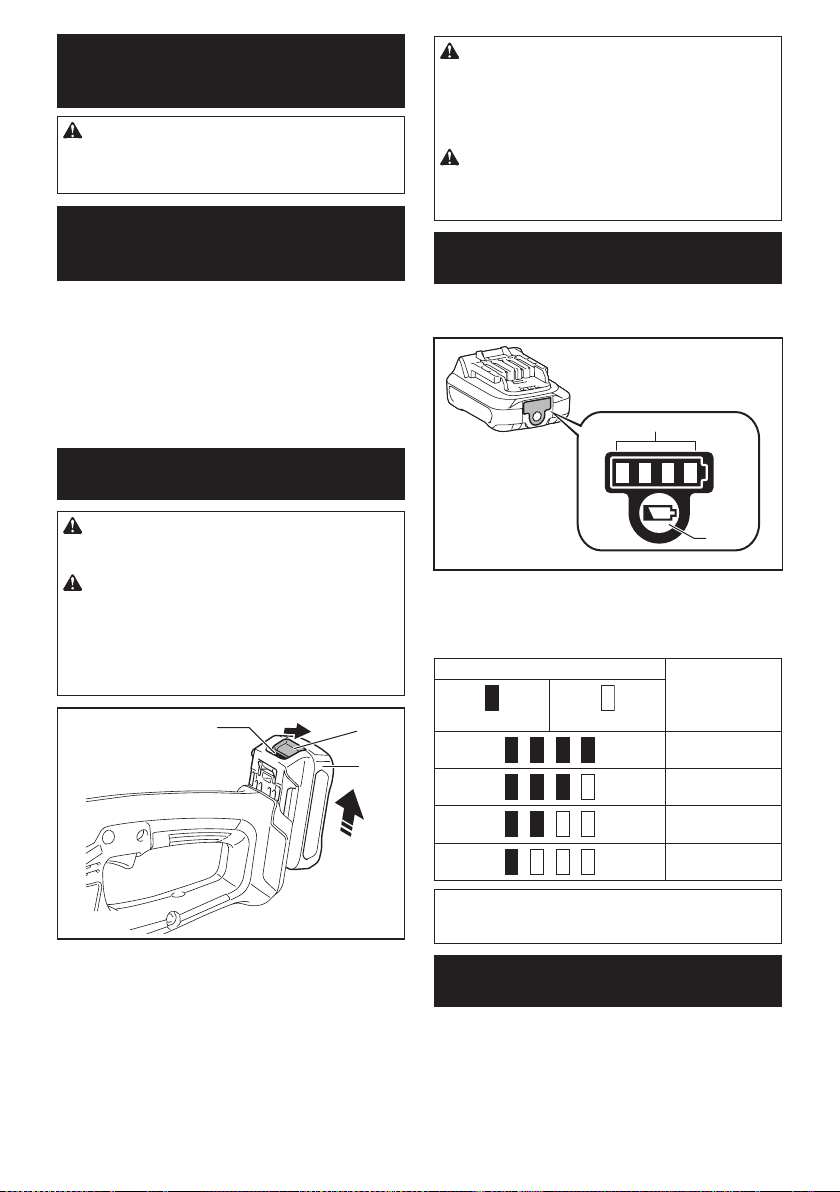
1
2
3
►1. Red indicator 2. Button 3. Battery cartridge
Toremovethebatterycartridge,slideitfromthetool
while sliding the button on the front of the cartridge.
Toinstallthebatterycartridge,alignthetongueonthe
battery cartridge with the groove in the housing and slip
it into place. Insert it all the way until it locks in place
with a little click. If you can see the red indicator on the
upper side of the button, it is not locked completely.
CAUTION: Always install the battery cartridge
fully until the red indicator cannot be seen. If not,
itmayaccidentallyfalloutofthetool,causinginjuryto
you or someone around you.
CAUTION: Do not install the battery cartridge
forcibly. If the cartridge does not slide in easily, it is
not being inserted correctly.
Indicating the remaining battery
capacity
Only for battery cartridges with the indicator
1
2
►1. Indicator lamps 2. Check button
Pressthecheckbuttononthebatterycartridgetoindi-
catetheremainingbatterycapacity.Theindicatorlamps
light up for few seconds.
Indicator lamps Remaining
capacity
Lighted Off
75% to 100%
50% to 75%
25% to 50%
0% to 25%
NOTE: Depending on the conditions of use and the
ambient temperature, the indication may differ slightly
from the actual capacity.
Tool / battery protection system
Thetoolisequippedwithatool/batteryprotectionsys-
tem.Thissystemautomaticallycutsoffpowertothe
motortoextendtoolandbatterylife.Thetoolwillauto-
matically stop during operation if the tool or battery is
placedunderoneofthefollowingconditions:
Overload protection
When the battery is operated in a manner that causes
it to draw an abnormally high current, the tool automati-
cally stops. In this situation, turn the tool off and stop the
application that caused the tool to become overloaded.
Thenturnthetoolontorestart.
Overheat protection
When the tool or battery is overheated, the tool stops
automatically and the lamp blinks. In this case, let the
tool and battery cool before turning the tool on again.

7 ENGLISH
Overdischarge protection
When the battery capacity is not enough, the tool stops automati-
cally. If you turn the tool on, the motor runs again but stops soon. In
this case, remove the battery from the tool and charge the battery.
Switch action
WARNING: Before installing the battery car-
tridge into the tool, always check to see that the
switch trigger actuates properly and returns to
the "OFF" position when released.
WARNING:
For your safety, this tool is equipped
with the lock-off button which prevents the tool from
unintended starting. Never use the tool if it starts when
you pull the switch trigger without pressing the lock-off
button.AskyourlocalMakitaServiceCenterforrepairs.
WARNING: Never disable the lock function or
tape down the lock-off button.
NOTICE:
Do not pull the switch trigger forcibly with-
out pressing the lock-off button.Theswitchmaybreak.
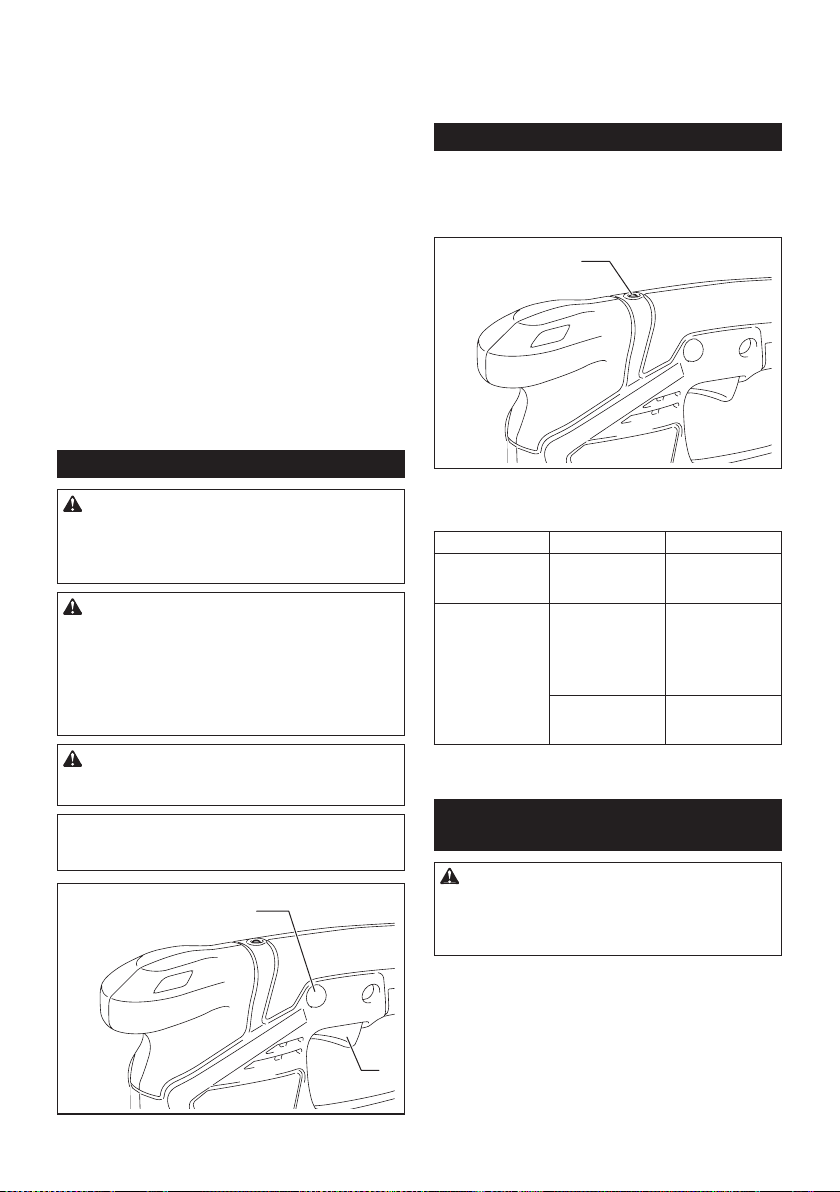
1
2
►1. Switch trigger 2. Lock-off button
Tostartthetool,pressthelock-offbuttonandpullthe
switchtrigger.Releasetheswitchtriggertostop.Thelock-
off button can be pressed from either the right or left side.
Indicator lamp
Theindicatorlampblinksorlightsupwhentheremain-
ingbatterycapacityisloworempty.Theindicatorlamp
also lights up when the tool becomes overloaded.
1
►1. Indicator lamp
Lamp status and action to be taken
Indicator lamp Status Actiontobetaken
Thelampblinks
red.
Theremaining
battery capacity
is low.
Charge the battery.
Thelamplightsup
red. *
Thetoolhas
stopped because
the remaining
battery capacity is
empty.
Charge the battery.
Thetoolhas
stopped due to
overload.
Turnoffthetool.
*Thetimeatwhichtheindicatorlamplightsupvariesdepending
on the temperature around the work area and the battery car-
tridge conditions.
Adjusting the shearing height (for
grass shear)
CAUTION: When changing the shearing
height, be sure to attach the blade cover and be
careful not to trap ngers between the tool and
grass receiver.
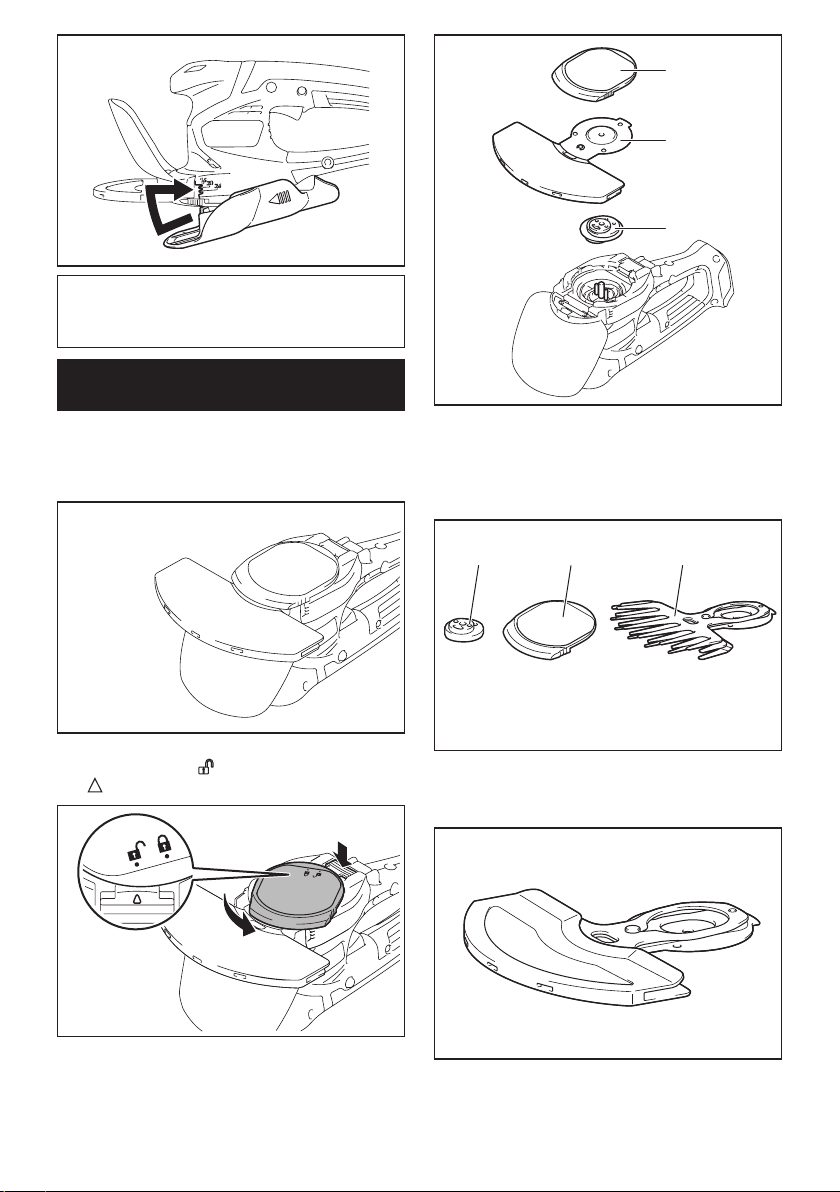
Theshearingheightcanbesettothreelevels(15mm
(9/16"), 20 mm (13/16"), and 25 mm (1")) by changing
thexedpositionofthegrassreceiver.Theshearing
height without the grass receiver is about 10 mm (3/8").
1.
Slide the grass receiver toward the front of the tool.
1
►1. Grass receiver
2. Changethexedpositionofthegrassreceiverby
moving it in the direction of the arrow.

8 ENGLISH
NOTE:Theshearingheightvalueisaguideline.The
actual shearing height may vary depending on the
condition of the lawn or the ground.
NOTE:Tryatestshearinginalessconspicuous
place to get your desired height.
ASSEMBLY
CAUTION: Always be sure that the tool is
switched off and the battery cartridge is removed
before carrying out any work on the tool.
CAUTION: When replacing the shear blades,
always wear gloves and attach the blade cover so
that your hands and face do not directly contact
the blades.
NOTICE: When replacing the shear blades, do
not wipe off grease from the gear and crank.
Installing or removing the blade
cover
CAUTION: Be careful not to touch the blades
when installing or removing the blade cover.
Toremovethebladecover,pullitslightly,andthenslide
itsideways.Toinstallthebladecover,performthesteps
in reverse.
Installing or removing the grass
receiver
CAUTION: When installing or removing the
grass receiver, be sure to attach the blade cover
and be careful not to trap your ngers between
the tool and grass receiver.
Removing the grass receiver
1. Release the protrusions on the grass receiver
from the grooves on the tool while sliding the grass
receiver toward the front of the tool.
1
►1. Grass receiver
2. Release the hinge of the grass receiver from the
tool.
Installing the grass receiver
1. Hook the hinge of the grass receiver on the groove
of the tool.
2
1
►1. Hinge 2. Grass receiver
2. Aligntheprotrusionsonthegrassreceiverwith
the grooves on the tool by sliding the grass receiver
toward the front of the tool and moving it in the direction
of the arrow.
9 ENGLISH
NOTICE: Do not attach the hinge of the grass
receiver to the tool forcibly after aligning the pro-
trusions on the grass receiver with the grooves
on the tool.
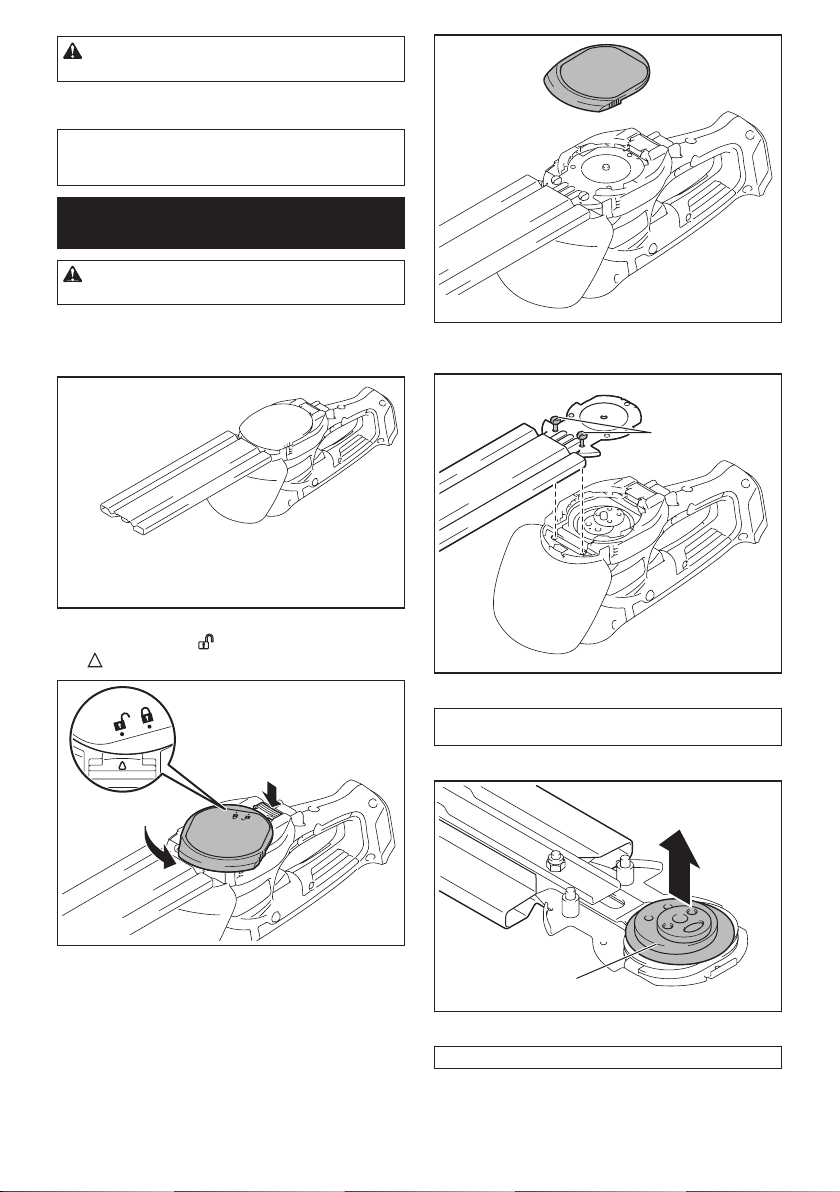
Installing or removing the shear
blades for grass shear
Removing the shear blades
1. Remove the grass receiver and place the tool
upside down.
2. While pressing the lock lever, turn the undercover
counterclockwise until
on the undercover is aligned
with
on the lock lever.
3. Remove the undercover, shear blades, and crank.
3
2
1
►1. Undercover 2. Shear blades 3. Crank
Installing the shear blades
1. Preparethecrank,undercover,andnewshear
blades.
1 2 3
►1. Crank 2. Undercover 3. Shear blades
2. Remove the blade cover from the old shear
blades, and then attach it to the new ones.
3. Adjustthethreepinssothattheyarelinedupon
the alignment line.
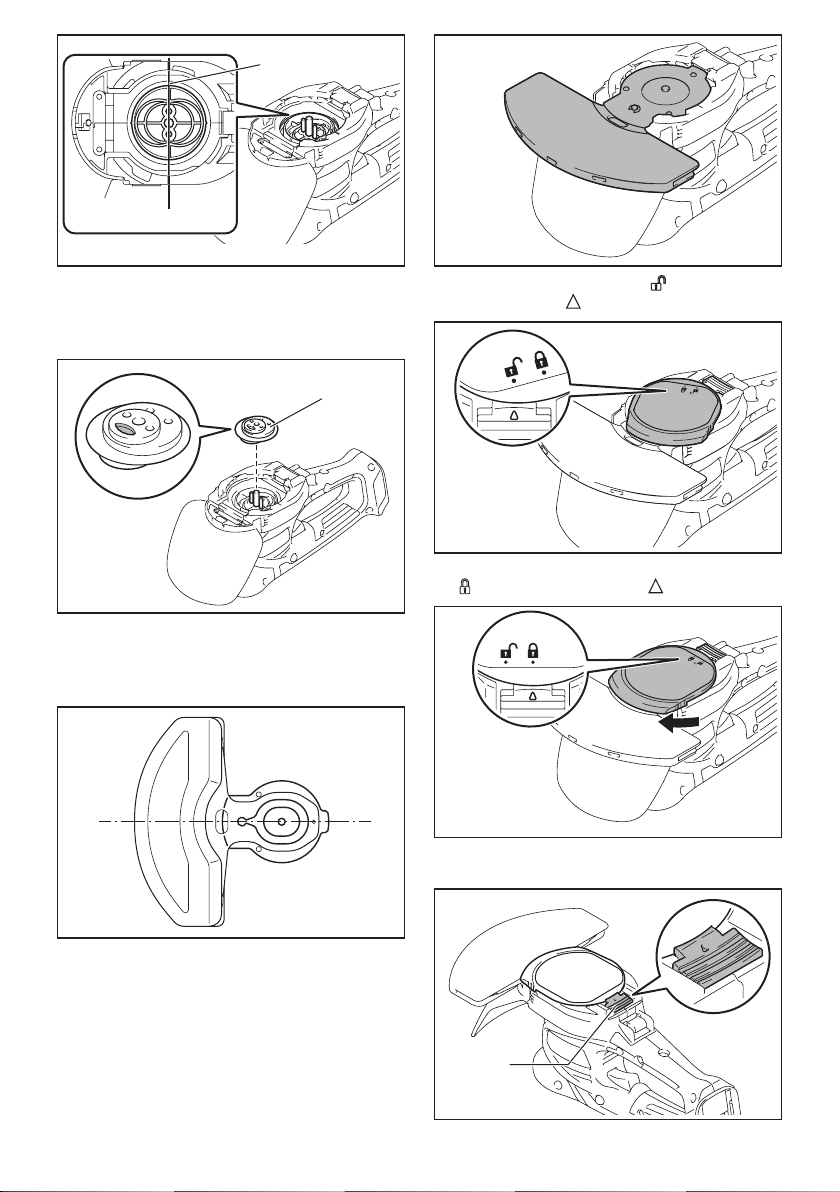
10 ENGLISH
1
►1.Alignmentline
4. Applyasmallamountofgreasetotheperiphery
ofthecrank.Attachthecranktothepinswiththesmall
and large rounds facing up.
1
►1. Crank
5. Adjustthebladesandbaseplatesothatthehole
in the base plate and the two protrusions on the blades
are lined up.
6. Turntheshearbladesupsidedownandinstall
themsothatthepinsonthetooltintheholeonthe
baseplate.Makesurethattheshearbladesarexed
securely in place.
7. Placetheundercoversothat on the under-
cover is aligned with
on the lock lever.
8.
While pressing the undercover, turn the undercover clockwise
until
on the undercover is aligned with on the lock lever.
9. Makesurethatthelocklevertsinthegrooveon
the undercover.
1
►1. Lock lever
11 ENGLISH
CAUTION: Never use the tool without install-
ing the undercover.
10. Remove the blade cover, and then turn on the tool
to check that it works properly.
NOTICE: If the shear blades do not operate prop-
erly, the blades are not engaging the crank prop-
erly. Remove the blades and install them again.
Installing or removing the shear
blades for hedge trimmer
CAUTION: Attach the blade cover before
removing or installing the shear blades.
Removing the shear blades
1. Placethetoolupsidedown.
2. While pressing the lock lever, turn the undercover
counterclockwise until
on the undercover is aligned
with
on the lock lever.
3. Remove the undercover.
4. Loosen the two screws with a screwdriver and
remove the shear blades.
1
►1. Screws
NOTE:Theshearbladescanberemovedwithout
removing the screws.
5. Remove the crank from the shear blades.
1
►1. Crank
NOTE:Thecrankmayremaininthetool.
Attachthebladecoverandthestoragecasetothe
removed shear blades, and then store the blades.

12 ENGLISH
Installing the shear blades
1. Preparethecrank,undercover,andnewshear
blades.
1 2
3
►1. Crank 2. Undercover 3. Shear blades
2. Attachthebladecovertotheshearblades.
3. Adjustthethreepinssothattheyarelinedupon
the alignment line.
1
►1.Alignmentline
4. Applyasmallamountofgreasetotheperiphery
ofthecrank.Attachthecranktothepinswiththesmall
and large rounds facing down.
1
►1. Crank
5. Slide the shear blades so that the hole on the
base plate is positioned at the center of the rings of the
blades.
6. Turntheshearbladesupsidedownandinstall
themsothatthepinonthetooltsintheholeonthe
shear blades. Insert the claw of the base plate into the
groove on the tool. Make sure that the shear blades are
xedsecurelyinplace.
1
►1. Claw
7. Tightenthetwoscrewsrmlywithascrewdriver.
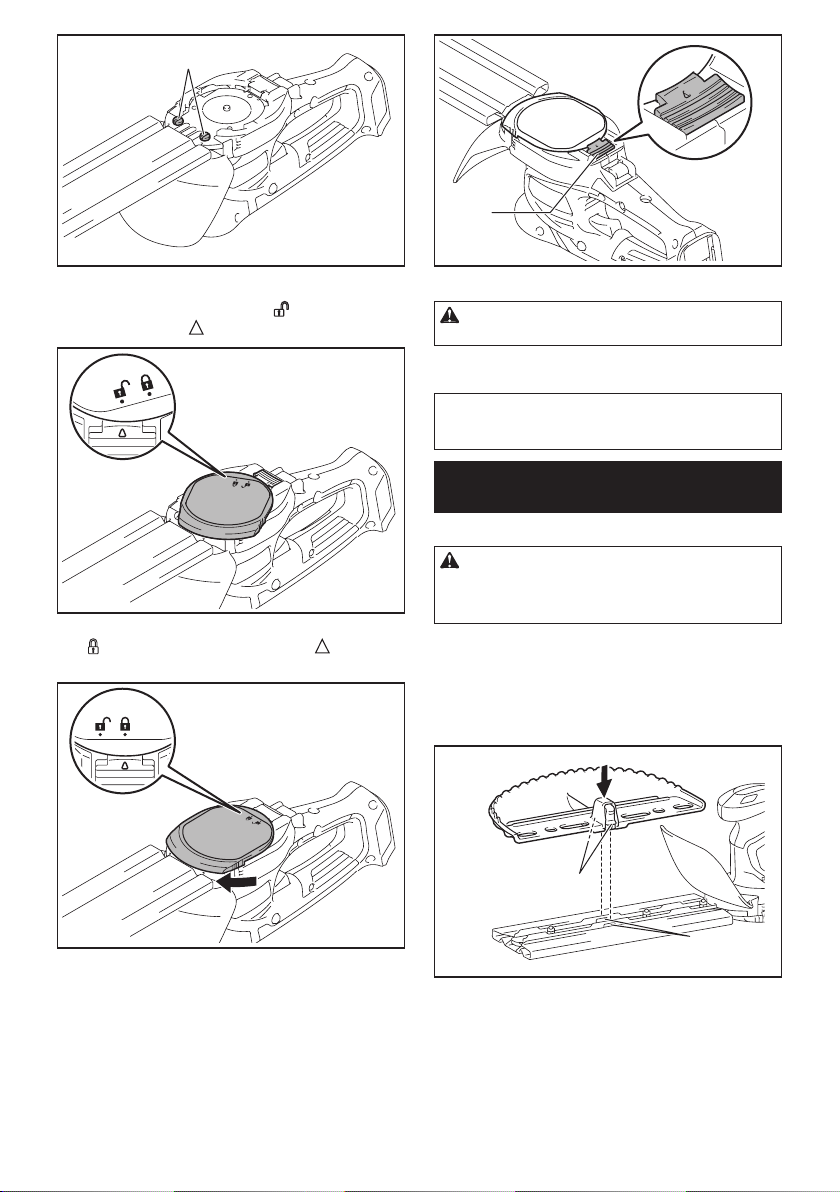
13 ENGLISH
1
►1. Screws
8. Placetheundercoversothat
on the under-
cover is aligned with
on the lock lever.
9. While pressing the undercover, turn it clockwise
until
on the undercover is aligned with on the lock
lever.
10. Makesurethatthelocklevertsinthegrooveon
the undercover.
1
►1. Lock lever
CAUTION: Never use the tool without install-
ing the undercover.
11. Remove the blade cover, and then turn on the tool
to check that it works properly.
NOTICE: If the shear blades do not operate prop-
erly, the blades are not engaging the crank prop-
erly. Remove the blades and install them again.
Installing or removing the chip
receiver
Optional accessory
CAUTION: When installing or removing the
chip receiver, always wear gloves and attach the
blade cover so that your hands and face do not
directly contact the blade.
Thechipreceivergathersdiscardedleavesandmakes
clean-up afterward much easier. It can be installed on
either side of the tool.
Toinstallthechipreceiver,pressitagainsttheshear
bladessothatthehookstintotheholesoftheshear
blades.
1
2
►1. Hooks 2. Holes
Toremovethechipreceiver,presstheleversonboth
sides to release the hooks.
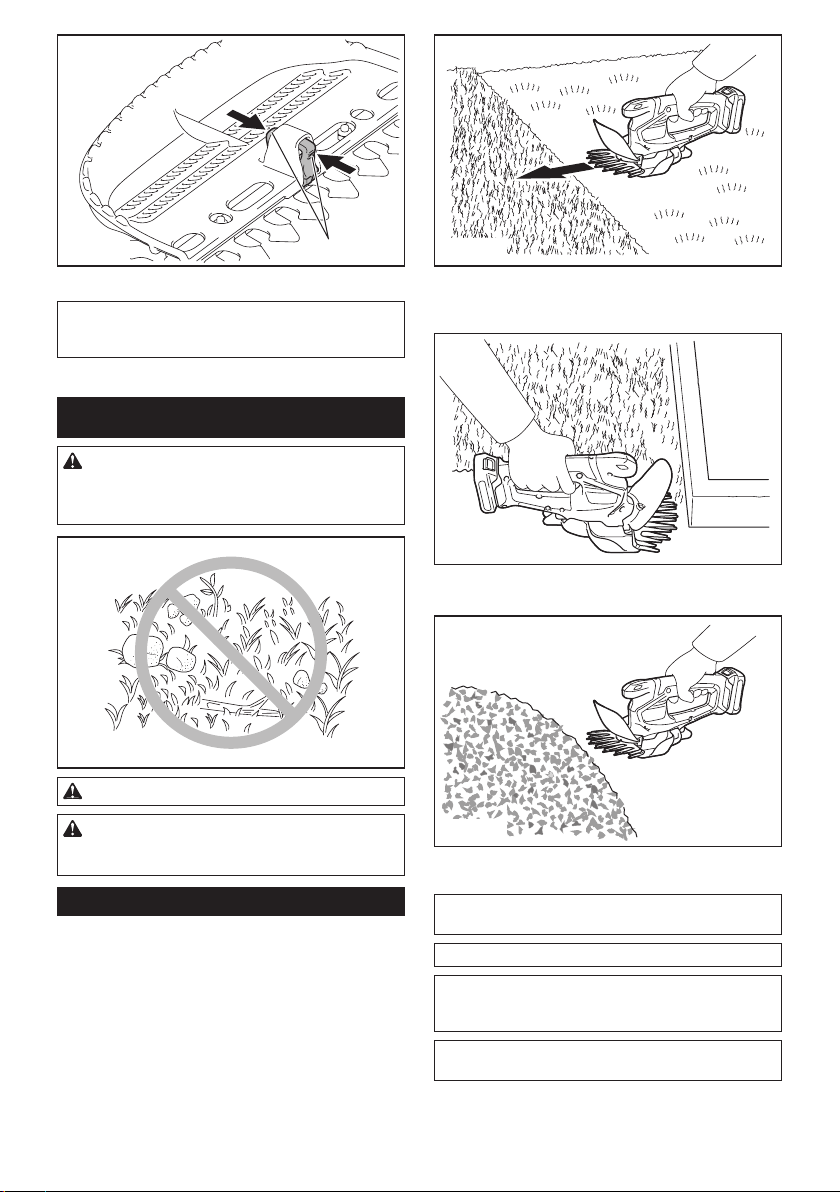
14 ENGLISH
1
►1. Levers
NOTICE: Never try to remove the chip receiver
by an excessive force with its hooks locked in the
holes of the blades.
OPERATION
WARNING: Before shearing, clear away sticks
and stones from the shearing area. Furthermore,
clear away any weeds from the shearing area in
advance.
WARNING: Keep hands away from blades.
CAUTION: Avoid operating the tool in very
hot weather as much as practicable. When operat-
ing the tool, be careful of your physical condition.
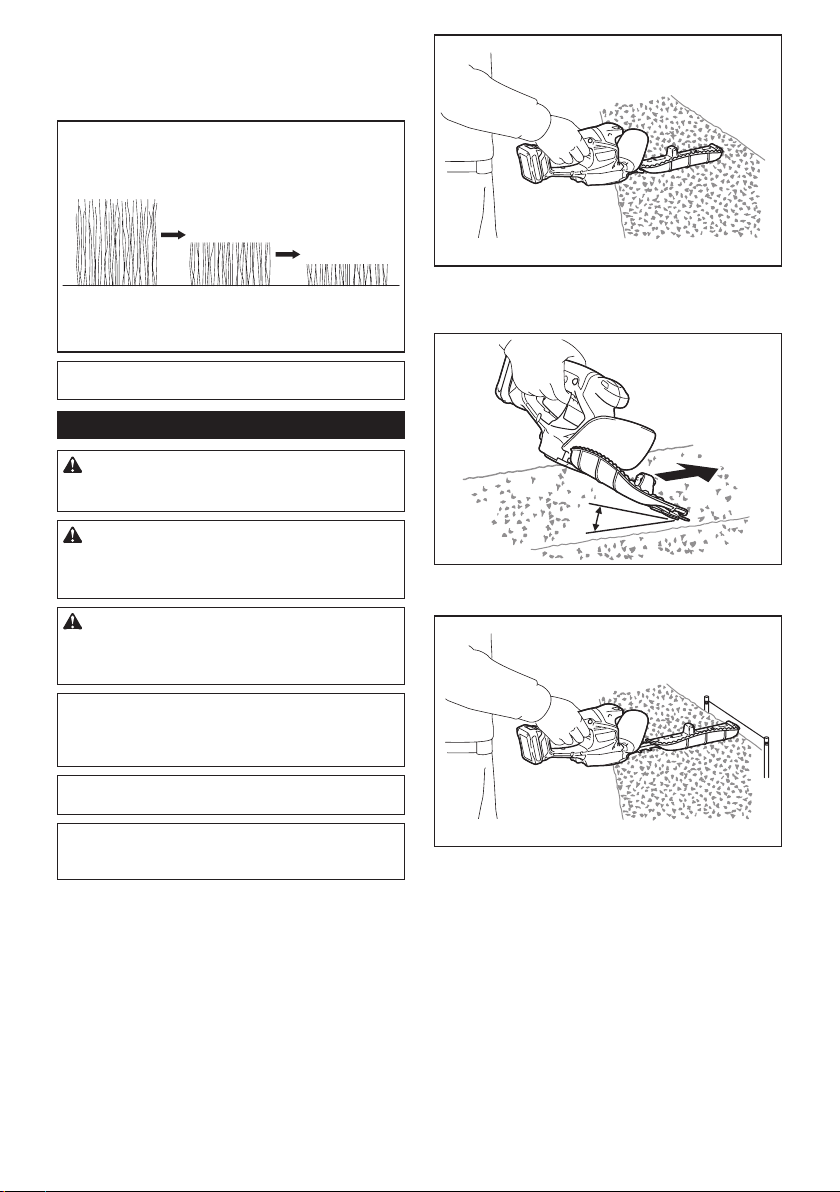
Shearing (for grass shear)
Turnthetoolonafteradjustingtheshearingheightand
hold it so that the bottom of the tool rests on the ground.
Gently move the tool forward.
When trimming around curbs, fences or trees, move the
tool along them. Be careful that the blades do not come
into contact with them.
When trimming sprouts or foliage of a small tree, trim
little by little.
Trimlargebranchestothedesiredheightusingbranch
cutters before using this tool.
NOTICE: Do not use the tool in a way that causes
the motor to stop or to rotate extremely slowly.
NOTICE: Do not attempt to cut thick branches.
NOTICE: Do not allow the shear blades to con-
tact the ground during operation. The blades will
be dulled, causing poor performance.
NOTICE: Do not trim the wet grass or foliage of
small trees.
15 ENGLISH
Cutting long lawn
Do not try to cut long grass all at once. Instead, cut the
lawn in steps. Leave a day or two between cuts until the
lawn becomes evenly short.
NOTE: Cutting long grass to a short length all at once
may cause the grass to die.
Trimming (for hedge trimmer)
CAUTION: Be careful not to accidentally
contact a metal fence or other hard objects while
trimming.Thebladesmaybreakandcauseaninjury.
CAUTION: Be careful not to allow the shear
blades to contact the ground.Thetoolmayrecoil
andcauseaninjury.
CAUTION: Overreaching with a hedge trim-
mer, particularly from a ladder, is extremely
dangerous. Do not work while standing on anything
wobblyorinrm.
NOTICE: Do not attempt to cut branches thicker
than 10 mm in diameter with the tool. Cut branches
to the desired height using branch cutters before
using the tool.
NOTICE: Do not cut down dead trees or similar
hard objects. Doing so may damage the tool.
NOTICE: Do not trim the grass or weeds while
using the shear blades.Thebladesmaybecome
tangled in the grass or weeds.
Hold the tool with one hand, pull the switch trigger while
pressing the lock-off button, and then move it forward.
For basic operation, tilt the blades toward the trimming
direction and move it calmly and slowly at the speed
rate of 3 to 4 seconds per meter.
Totieastringatthedesiredheightandtotrimalongit
help you to cut a hedge top evenly.
If the chip receiver is attached to the blades, it gathers
discarded leaves and makes clean-up afterward much
easier.
Tocutahedgesideevenly,cutfromthebottomtotop.
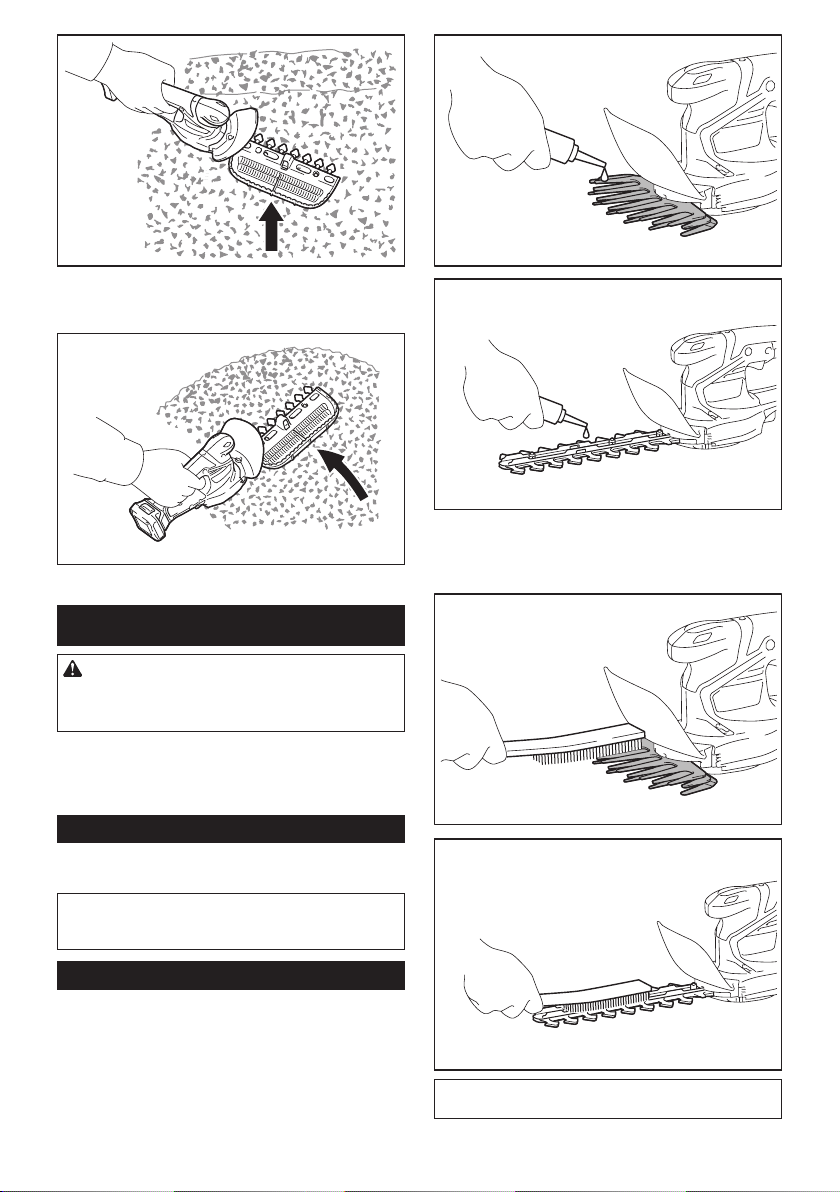
16 ENGLISH
When trimming to make a round shape (trimming box-
wood or rhododendron, etc.), trim from the root to the
topforabeautifulnish.
MAINTENANCE
CAUTION: Always be sure that the tool is
switched off and the battery cartridge is removed
before attempting to perform inspection or
maintenance.
TomaintainproductSAFETYandRELIABILITY,
repairs,anyothermaintenanceoradjustmentshould
beperformedbyMakitaAuthorizedorFactoryService
Centers, always using Makita replacement parts.
Cleaning the tool
Clean the tool by wiping off dust with a dry cloth or one
dipped in soapy water and wrung out.
NOTICE: Never use gasoline, benzine, thinner,
alcohol or the like. Discoloration, deformation or
cracks may result.
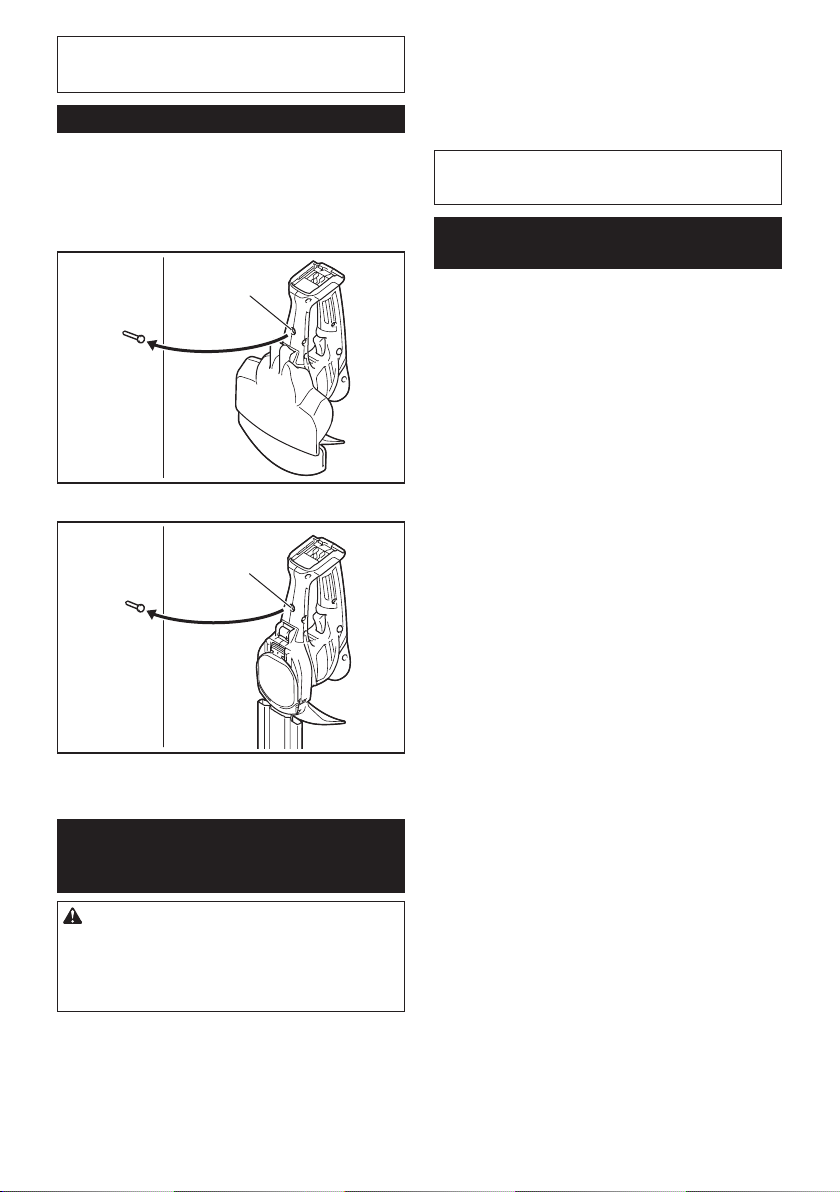
Blade maintenance
Before the operation or once per hour during operation,
apply low-viscosity oil (machine oil, or spray-type lubri-
cating oil) to the blades.
Afteroperation,removedustfrombothsidesofthe
blades with a wired brush, wipe it off with a cloth and
then apply low-viscosity oil (machine oil, or spray-type
lubricating oil) to the blades.
NOTICE: Do not wash the blades in water. Doing
so may cause rust or damage to the tool.
17 ENGLISH
NOTICE: Dirt and corrosion cause excessive
blade friction and shorten the operating time per
battery charge.
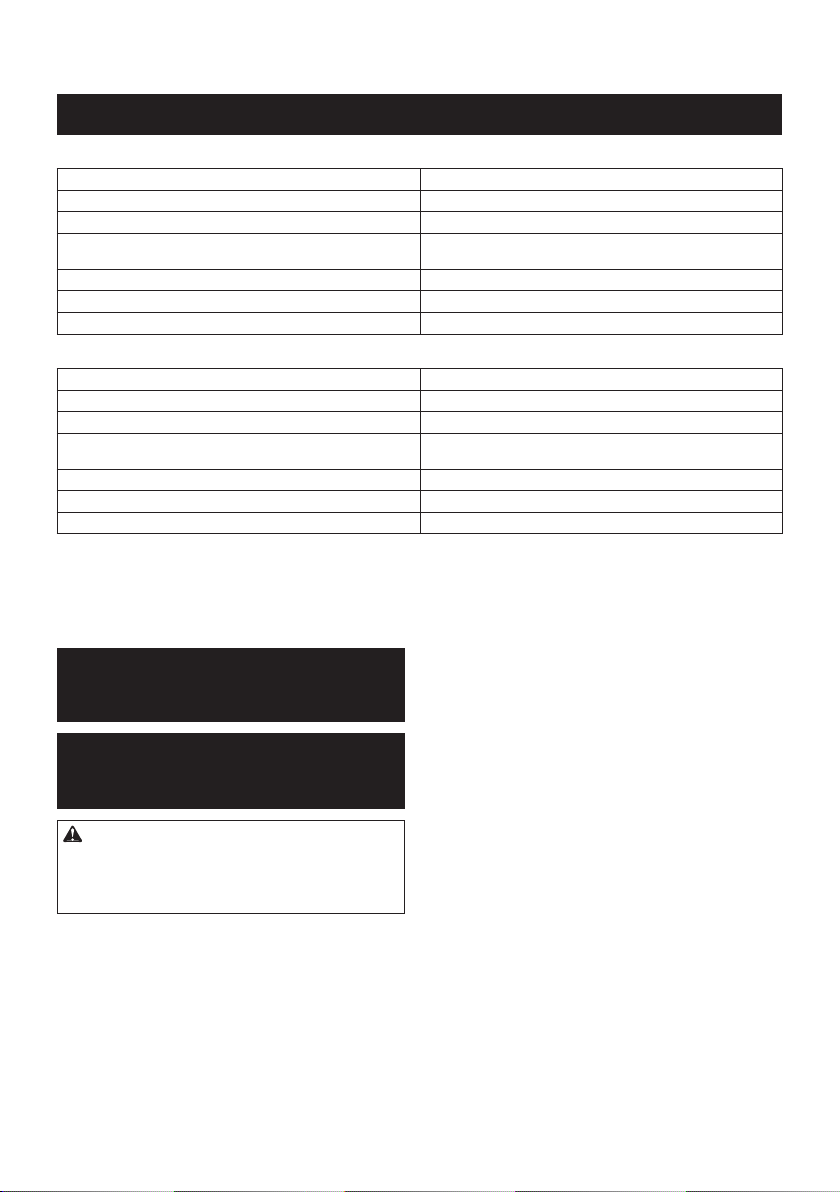
Storage
Thehookholeinthetoolbottomisconvenientforhang-
ing the tool from a nail or screw on the wall.
Attachthebladecovertotheshearbladessothatthe
blades are not exposed. Store the tool out of the reach
of children. Store the tool in a place not exposed to
moisture or rain.
1
►1. Hole
1
►1. Hole
OPTIONAL
ACCESSORIES
CAUTION: These accessories or attachments
are recommended for use with your Makita tool
specied in this manual.Theuseofanyother
accessories or attachments might present a risk of
injurytopersons.Onlyuseaccessoryorattachment
for its stated purpose.
If you need any assistance for more details regard-
ing these accessories, ask your local Makita Service
Center.
• Shearbladeassembly(forgrassshearuse)
• Shearbladecover(forgrassshearuse)
• Grassreceiver(forgrassshearuse)
• Longhandleattachment(forgrassshearuse)
• Shearbladeassembly(forhedgetrimmeruse)
• Shearbladecover(forhedgetrimmeruse)
• Chipreceiver(forhedgetrimmeruse)
• Storagecase
• Makitagenuinebatteryandcharger
NOTE: Some items in the list may be included in the
toolpackageasstandardaccessories.Theymay
differ from country to country.
MAKITA LIMITED ONE YEAR
WARRANTY
Warranty Policy
EveryMakitatoolisthoroughlyinspectedandtested
before leaving the factory. It is warranted to be free of
defects from workmanship and materials for the period
ofONEYEARfromthedateoforiginalpurchase.
Should any trouble develop during this one year period,
returntheCOMPLETEtool,freightprepaid,toone
ofMakita’sFactoryorAuthorizedServiceCenters.If
inspection shows the trouble is caused by defective
workmanship or material, Makita will repair (or at our
option, replace) without charge.
ThisWarrantydoesnotapplywhere:
• repairshavebeenmadeorattemptedbyothers:
• repairsarerequiredbecauseofnormalwearand
tear:
• thetoolhasbeenabused,misusedorimproperly
maintained:
• alterationshavebeenmadetothetool.
INNOEVENTSHALLMAKITABELIABLEFORANY
INDIRECT,INCIDENTALORCONSEQUENTIAL
DAMAGESFROMTHESALEORUSEOFTHE
PRODUCT.THISDISCLAIMERAPPLIESBOTH
DURINGANDAFTERTHETERMOFTHIS
WARRANTY.
MAKITADISCLAIMSLIABILITYFORANYIMPLIED
WARRANTIES,INCLUDINGIMPLIEDWARRANTIES
OF"MERCHANTABILITY"AND"FITNESSFORA
SPECIFICPURPOSE,"AFTERTHEONEYEARTERM
OFTHISWARRANTY.
ThisWarrantygivesyouspeciclegalrights,andyou
may also have other rights which vary from state to
state. Some states do not allow the exclusion or lim-
itationofincidentalorconsequentialdamages,sothe
above limitation or exclusion may not apply to you.
Some states do not allow limitation on how long an
implied warranty lasts, so the above limitation may not
apply to you.
18 ESPAÑOL
ESPAÑOL (Instrucciones originales)
ESPECIFICACIONES
Modelo MU04 con cuchilla de cizalla instalada para tijeras para hierba
Modelo: MU04
Anchodecorte 160mm(6-5/16″)
Carreras por minuto 2 500 cpm
Dimensiones
(LaxAnxAl)
347mmx177mmx131mm(13-5/8″x7″x5-1/8″)
Tensiónnominal 10,8 V c.c. - 12 V c.c. máx.
Cartucho de batería estándar BL1016 / BL1021B / BL1041B
Pesoneto 1,3 kg - 1,4 kg (2,8 lbs - 3,2 lbs)
Modelo HU06 con cuchilla de cizalla instalada para cortasetos
Modelo: HU06
Longitud de la cuchilla 200mm(7-7/8″)
Carreras por minuto 2 500 cpm
Dimensiones
(LaxAnxAl)
504mmx120mmx131mm(19-7/8″x4-3/4″x5-1/8″)
Tensiónnominal 10,8 V c.c. - 12 V c.c. máx.
Cartucho de batería estándar BL1016 / BL1021B / BL1041B
Pesoneto 1,3 kg - 1,5 kg (2,9 lbs - 3,3 lbs)
• Debidoanuestrocontinuoprogramadeinvestigaciónydesarrollo,lasespecicacionesaquíincluidasestán
sujetasacambiosinprevioaviso.
• Lasespecicacionesyelcartuchodebateríapuedenvariardepaísapaís.
• PesodeacuerdoalprocedimientodeEPTA-01/2003incluyendoelcartuchodebatería
ADVERTENCIAS DE
SEGURIDAD
Advertencias generales de
seguridad para herramientas
eléctricas
ADVERTENCIA: Lea todas las advertencias
de seguridad e instrucciones. Elnoseguirlas
advertencias e instrucciones indicadas puede ocasio-
nar una descarga eléctrica, un incendio y/o lesiones
graves.
Conserve todas las advertencias
e instrucciones como referencia
en el futuro.
Enlasadvertencias,eltérmino“herramientaeléctrica”se
reereasuherramientaeléctricadefuncionamientocon
conexiónalaredeléctrica(concableadoeléctrico)oherra-
mienta eléctrica de funcionamiento a batería (inalámbrica).
Seguridad en el área de trabajo
1. Mantenga el área de trabajo limpia y bien ilu-
minada. Las áreas oscuras o desordenadas son
propensas a accidentes.
2. No utilice las herramientas eléctricas en
atmósferas explosivas, tal como en la presen-
cia de líquidos, gases o polvo inamables. Las
herramientaseléctricascreanchispasquepueden
prender fuego al polvo o los humos.
3. Mantenga a los niños y curiosos alejados
mientras utiliza una herramienta eléctrica. Las
distracciones le pueden hacer perder el control.
Seguridad eléctrica
1. Las clavijas de conexión de las herramientas
eléctricas deberán encajar perfectamente en la
toma de corriente. No modique nunca la cla-
vija de conexión de ninguna forma. No utilice
ninguna clavija adaptadora con herramientas
eléctricas que tengan conexión a tierra (puesta
a tierra). Lautilizacióndeclavijasnomodica-
dasyqueencajenperfectamenteenlatomade
corrientereduciráelriesgodequeseproduzca
una descarga eléctrica.
2. Evite tocar con el cuerpo supercies conec-
tadas a tierra o puestas a tierra tales como
tubos, radiadores, cocinas y refrigeradores. Si
su cuerpo es puesto a tierra o conectado a tierra
existiráunmayorriesgodequesufraunades-
carga eléctrica.
3. No exponga las herramientas eléctricas a la
lluvia ni a condiciones húmedas. La entrada de
agua en una herramienta eléctrica aumentará el
riesgodequeseproduzcaunadescargaeléctrica.

19 ESPAÑOL
4.
No maltrate el cable. Nunca utilice el cable para trans-
portar, jalar o desconectar la herramienta eléctrica.
Mantenga el cable alejado del calor, aceite, objetos
cortantes o piezas móviles. Los cables dañados o enre-
dados aumentan el riesgo de sufrir una descarga eléctrica.
5.
Cuando utilice una herramienta eléctrica en
exteriores, utilice un cable de extensión apro-
piado para uso en exteriores.Lautilizacióndeun
cable apropiado para uso en exteriores reducirá el
riesgodequeseproduzcaunadescargaeléctrica.
6. Si no es posible evitar usar una herramienta
eléctrica en condiciones húmedas, utilice un
alimentador protegido con interruptor de cir-
cuito de falla a tierra (ICFT).ElusodeunICFT
reduce el riesgo de descarga eléctrica.
Seguridad personal
1.
Manténgase alerta, preste atención a lo que está
haciendo y utilice su sentido común cuando opere
una herramienta eléctrica. No utilice una herra-
mienta eléctrica cuando esté cansado o bajo la
inuencia de drogas, alcohol o medicamentos. Un
momentodedistracciónmientrasoperalasherramien-
taseléctricaspuedeterminarenunalesióngrave.
2. Use equipo de protección personal. Póngase
siempre protección para los ojos.Elequipo
protector tal como máscara contra el polvo, zapa-
tos de seguridad antiderrapantes, casco rígido y
protecciónparaoídosutilizadoenlascondiciones
apropiadas reducirá el riesgo de lesiones.
3.
Impida el encendido accidental. Asegúrese de que el
interruptor esté en la posición de apagado antes de
conectar a la alimentación eléctrica y/o de colocar
el cartucho de batería, así como al levantar o cargar
la herramienta. Cargar las herramientas eléctricas con
su dedo en el interruptor o enchufarlas con el interruptor
encendidohacequelosaccidentesseancomunes.
4. Retire cualquier llave de ajuste o llave de
apriete antes de encender la herramienta. Una
llavedeajusteollavedeaprietequehayasido
dejadapuestaenunapartegiratoriadelaherra-
mientaeléctricapuedeocasionaralgunalesión.
5.
No utilice la herramienta donde no alcance.
Mantenga los pies sobre suelo rme y el equilibrio
en todo momento.Estopermiteunmejorcontrolde
la herramienta eléctrica en situaciones inesperadas.
6.
Use vestimenta apropiada. No use ropas sueltas
ni joyas. Mantenga el cabello, la ropa y los guan-
tes alejados de las piezas móviles. Las prendas
devestirholgadas,lasjoyasyelcabellosuelto
podríanengancharseenlaspiezasmóviles.
7.
Si dispone de dispositivos para la conexión de
equipos de extracción y recolección de polvo,
asegúrese de conectarlos y utilizarlos debida-
mente.Hacerusodelarecoleccióndepolvopuede
reducir los riesgos relacionados con el polvo.
Mantenimiento y uso de la herramienta eléctrica
1. No fuerce la herramienta eléctrica. Utilice la
herramienta eléctrica correcta para su aplica-
ción. La herramienta eléctrica adecuada hará un
mejortrabajoydeformamásseguraalaveloci-
dadparalaquehasidofabricada.
2.
No utilice la herramienta eléctrica si el inte-
rruptor no la enciende y apaga.Cualquierherra-
mientaeléctricaquenopuedasercontroladacon
el interruptor es peligrosa y debe ser reemplazada.
3. Desconecte la clavija de la fuente de energía
y/o la batería de la herramienta eléctrica antes
de realizar ajustes, cambiar accesorios o guar-
dar las herramientas eléctricas. Dichas medidas
de seguridad preventivas reducen el riesgo de
quelaherramientaseinicieaccidentalmente.
4. Guarde la herramienta eléctrica que no use
fuera del alcance de los niños y no permita
que las personas que no están familiarizadas
con ella o con las instrucciones la operen. Las
herramientas eléctricas son peligrosas en manos
depersonasquenosabenoperarlas.
5.
Realice el mantenimiento a las herramientas
eléctricas. Compruebe que no haya partes móvi-
les desalineadas o estancadas, piezas rotas y
cualquier otra condición que pueda afectar al
funcionamiento de la herramienta eléctrica. Si la
herramienta eléctrica está dañada, haga que se
la reparen antes de utilizarla. Muchos accidentes
son ocasionados por herramientas eléctricas con
mantenimiento inadecuado.
6. Mantenga las herramientas de corte limpias
y losas. Si recibe un mantenimiento adecuado
ytienelosbordesalados,esprobablequela
herramientaseatasquemenosyseamásfácil
controlarla.
7. Utilice la herramienta eléctrica, los accesorios
y las brocas de acuerdo con estas instruccio-
nes, considerando las condiciones laborales
y el trabajo a realizar. Si utiliza la herramienta
eléctrica para realizar operaciones distintas de
lasindicadas,podrápresentarseunasituación
peligrosa.
Uso y cuidado de la herramienta a batería
1. Recargue sólo con el cargador especicado
por el fabricante.Uncargadorqueesadecuado
para un solo tipo de batería puede generar riesgo
de incendio al ser utilizado con otra batería.
2. Utilice las herramientas eléctricas solamente
con las baterías designadas especícamente
para ellas.Lautilizacióndecualquierotrabatería
puede crear un riesgo de lesiones o incendio.
3. Cuando no se esté usando la batería, mantén-
gala alejada de otros objetos metálicos, como
sujetapapeles (clips), monedas, llaves, clavos,
tornillos u otros objetos pequeños de metal
los cuales pueden actuar creando una cone-
xión entre las terminales de la batería.Originar
un cortocircuito en las terminales puede causar
quemadurasoincendios.
4. En condiciones abusivas, podrá escapar
líquido de la batería; evite tocarlo. Si lo toca
accidentalmente, enjuague con agua. Si hay
contacto del líquido con los ojos, busque asis-
tencia médica.Puedequeellíquidoexpulsado
delabateríacauseirritaciónoquemaduras.
5. No utilice una herramienta ni una batería que
estén dañadas o hayan sido modicadas. Las
bateríasdañadasomodicadaspodríanoca-
sionarunasituacióninesperadaprovocandoun
incendio,explosiónoriesgodelesiones.
6. No exponga la herramienta ni la batería al
fuego ni a una temperatura excesiva. La expo-
siciónalfuegooaunatemperaturasuperioralos
130°Cpodríacausarunaexplosión.

20 ESPAÑOL
7.
Siga todas las instrucciones para la carga y evite
cargar la herramienta o la batería fuera del rango
de temperatura especicado en las instruccio-
nes. Una carga inadecuada o a una temperatura
fueradelrangoespecicadopodríadañarlabatería
e incrementar el riesgo de incendio.
Servicio
1. Haga que una persona calicada repare la
herramienta eléctrica utilizando sólo piezas de
repuesto idénticas.Estoaseguraqueseman-
tenga la seguridad de la herramienta eléctrica.
2. Siga las instrucciones para la lubricación y
cambio de accesorios.
3. Mantenga las agarraderas secas, limpias y sin
aceite o grasa.
Advertencias de seguridad para las
tijeras inalámbricas para hierba
ADVERTENCIA:Alutilizaraparatoseléctricos
dejardinería,siempredebentomarseencuentalas
precaucionesbásicasdeseguridadandereducir
el riesgo de incendio, descarga eléctrica y lesiones
personales,incluidolosiguiente:
LEA TODAS LAS INSTRUCCIONES.
1. Tenga presente que este aparato se encuentra
siempre en condiciones de funcionamiento, ya
que no es necesario conectarlo a una toma de
corriente eléctrica.
2.
No utilice los aparatos en atmósferas explosi-
vas, tal como en la presencia de líquidos, gases
o polvo inamables. Los aparatos crean chispas
quepuedenprenderfuegoalpolvooloshumos.
3. Evite los entornos peligrosos - No utilice los
aparatosenlugareshúmedosomojados.
4. No utilice ni cargue el aparato bajo la lluvia o
en lugares mojados.
5. Mantenga alejados a los niños-Todoslos
espectadores deberán permanecer a cierta dis-
tanciadeláreadetrabajo.
6.
Use una vestimenta adecuada-Evitellevar
puestaropaholgadaoalhajas.Éstaspodrían
engancharseenlaspiezasmóviles.Cuandosetra-
bajeenexterioresesrecomendableusarguantes
dehuleyuncalzadoresistente.Lleveprotecciónen
el cabello para cubrirlo en caso de tenerlo largo.
7. Utilice un equipo de seguridad. Use siempre
protección para los ojos. La máscara contra
polvo, los zapatos de seguridad antiderrapan-
tes,elcascorígidoolaprotecciónparalos
oídosdeberánutilizarsebajolascondiciones
apropiadas.
8. Utilice el aparato correctamente-Eviteusarel
aparatoparaotrostrabajosquenoseanparael
cual está diseñado.
9. Evite la puesta en marcha accidental - No car-
gue el aparato con el dedo puesto en el interrup-
tor.Asegúresedequeelinterruptorseencuentre
apagadoantesdeinstalarelpaquetedebatería.
10. Evite tocar las cuchillas o bordes de corte
expuestos cuando levante o sostenga el
aparato.
11. No fuerce el aparato-Ésteharámejoreltrabajo
y el riesgo de lesiones será menos probable si se
usa a la velocidad para la cual fue diseñado.
12. Evite usar el aparato donde no alcance-Pise
sobresuelormeymantengaelequilibrioentodo
momento.
13. Manténgase alerta-Presteatenciónaloque
está haciendo. Utilice el sentido común. No utilice
el aparato cuando esté cansado.
14. Almacene los aparatos que no utilice en inte-
riores - Cuando no se vayan a usar, los aparatos
deberán ser almacenados en interiores en un
lugar seco y elevado o cerrado con llave fuera del
alcance de los niños.
15.
Dé un mantenimiento cuidadoso al aparato -
Mantengaelbordedecortealadoylimpiopara
lograrundesempeñoóptimoyreducirasíelriesgo
de lesiones. Siga las instrucciones para la lubri-
caciónyelcambiodelosaccesorios.Inspeccione
elcabledelaparatoperiódicamenteyencasode
presentardaños,lléveloarepararaunainstalación
de servicio autorizada. Inspeccione los cables de
extensiónregularmenteyreemplácelosencaso
de estar dañados. Mantenga los mangos secos,
limpios, y libres de aceite y grasa.
16. Revise las piezas dañadas-Antesdecontinuar
usandoelaparato,cualquierprotectoropieza
dañada deberán revisarse cuidadosamente para
conrmarquepuedanfuncionardebidamentey
realizarlafunciónparalaquefuerondiseñados.
Veriquelaalineacióndelaspiezasmóviles,la
unióndelasmismas,roturasdelaspiezas,la
instalaciónycualquierotracondiciónquepueda
afectarsufuncionamiento.Cualquierprotector
o pieza dañada deberán ser debidamente repa-
rados o reemplazados por un centro de servicio
autorizadosalvoqueseespeciquelocontrario
en otra parte de este manual.
17.
Un aparato que funcione con baterías integradas
o con un paquete de batería por separado deberá
ser recargado solamente con el cargador espe-
cicado para dichas baterías.Uncargadorque
seaadecuadoparauntipoespecícodepaquete
de batería puede generar un riesgo de incendio al
usarseconunpaquetedebateríadistinto.
18. Utilice un aparato a batería solamente con el
paquete de batería designado especícamente
para ello.Elusodecualquierotrotipodebaterías
podría generar riesgo de incendio.
19. Retire cualquier llave de ajuste o llave de
apriete antes de encender el aparato.Cualquier
llavedeaprieteodeajustequesedejepuestaen
una pieza giratoria del aparato podría provocar
lesiones personales.
20. No utilice la herramienta eléctrica si el inte-
rruptor no la enciende ni la apaga.Cualquier
aparatoquenopuedasercontroladoconelinte-
rruptor es peligroso y deberá ser reparado.
21. Desconecte el paquete de batería del aparato
o coloque el interruptor en la posición blo-
queada o apagada antes de realizar cualquier
ajuste, cambio de accesorios, limpieza, extrac-
ción de material del aparato o el almacena-
miento del mismo.Talesmedidasdeseguridad
preventivasreduciránelriesgodequeelaparato
sea puesto en marcha accidentalmente.

21 ESPAÑOL
22. Cuando no se esté usando el paquete de
batería, manténgalo alejado de otros objetos
metálicos, como sujetapapeles (clips), mone-
das, llaves, clavos, tornillos u otros objetos
pequeños de metal que puedan crear una
conexión entre una terminal y otra. Causar un
cortocircuito en las terminales de la batería podría
causarchispas,quemadurasounincendio.
23.
Utilice únicamente los accesorios recomendados por
el fabricante de su modelo.Losaccesoriosquepuedan
ser adecuados para cierto aparato podrían crear un
riesgo de lesiones al ser utilizados en otro aparato.
24.
El servicio del aparato solamente deberá ser
realizado por personal de reparaciones calicado.
Elservicioomantenimientorealizadosporpersonal
nocalicadopodríaocasionarunriesgodelesiones.
25.
Cuando se dé servicio al aparato, utilice única-
mente piezas de repuesto idénticas. Siga las ins-
trucciones contenidas en la sección Mantenimiento
de este manual.Elusodepiezasnoautorizadasoel
no seguir las instrucciones de mantenimiento podría
crear riesgo de descarga eléctrica o lesiones.
26. Mantenga las manos alejadas de las cuchillas.
27.
Antes de cortar hierba, retire cualquier material
extraño tales como rocas o varas largas del área
de trabajo. Tenga cuidado de que ningún material
extraño se quede atorado entre las cuchillas, de
lo contrario las cuchillas podrían atascarse. Si
esto llegara a suceder, apague el aparato. Luego
eliminelaobstruccióndelascuchillas.
28. Asegúrese de colocar la cubierta de las cuchi-
llas cuando no las vaya a utilizar.
ADVERTENCIA: NO DEJE que la comodidad
o familiaridad con el producto (a base de utilizarlo
repetidamente) evite que siga estrictamente las
normas de seguridad para dicho producto. El
USO INCORRECTO o el no seguir las normas de
seguridad indicadas en este manual de instruc-
ciones puede ocasionar lesiones graves.
Advertencias de seguridad para el
cortasetos inalámbrico
1.
Mantenga todas las partes del cuerpo alejadas
de la cuchilla de corte. No retire ni sostenga el
material que va a cortar cuando las cuchillas
estén en movimiento. Las cuchillas siguen
girando por inercia aún después de apagadas.
Asegúrese de que el interruptor se encuentre
apagado antes de despejar el material atascado.
Unmomentodedistracciónmientrasoperaelcorta-
setos podría ocasionar lesiones personales graves.
2.
Sostenga el cortasetos por el mango cuando la cuchi-
lla de corte se encuentre detenida. Lamanipulación
adecuada del cortasetos reducirá la posibilidad de lesio-
nes personales ocasionadas por las cuchillas de corte.
3.
Sujete la herramienta solamente por las super-
cies de asimiento aisladas, ya que la cuchilla
de corte podría entrar en contacto con cableado
oculto.Lascuchillasdecortequeentrenencon-
tactoconuncableconcorrientepodránhacerquela
corriente circule por las piezas metálicas expuestas
de la herramienta eléctrica pudiendo ocasionar una
descarga eléctrica al operador.
4. PELIGRO - Mantenga las manos alejadas de la
cuchilla.Elcontactoconlacuchillapodríaoca-
sionar lesiones personales graves.
5. No utilice el cortasetos bajo la lluvia o en
lugares mojados ni en condiciones de mucha
humedad.Elmotoreléctriconoesapruebade
agua.
6. Un usuario con experiencia deberá enseñar
a los usuarios primerizos cómo manejar el
cortasetos.
7. El cortasetos no deberá ser utilizado por niños
ni por personas menores de 18 años.Esta
restricciónpodrápasarseporaltoparapersonas
mayoresde16añossiemprequerecibanlacapa-
citacióncorrespondientebajolasupervisióndeun
experto.
8. Utilice el cortasetos sólo si se encuentra en
buena condición física. Si está cansado, su
atenciónseverádisminuida.Seaespecialmente
cuidadosoaltérminodeunajornadalaboral.
Realicetodoeltrabajotranquilaycuidadosa-
mente.Elusuarioseráresponsabledetodoslos
daños a terceras personas.
9. Nunca utilice el cortasetos si está bajo
la inuencia de alcohol, drogas o algún
medicamento.
10. Los guantes de trabajo hechos de piel gruesa
forman parte del equipo básico del cortasetos
y deberán usarse siempre que se trabaje con
éste. Utilice también zapatos resistentes con
suelas antiderrapantes.
11. Antes de comenzar el trabajo, revise el cor-
tasetos para asegurarse de que esté en buen
estado y en condiciones seguras de funcio-
namiento. Asegúrese de que los protectores
estén colocados correctamente. El cortasetos
no deberá ser utilizado hasta que se encuentre
totalmente ensamblado.
12. Asegúrese de pisar rmemente antes de
comenzar la operación.
13. Siempre que utilice la herramienta sosténgala
rmemente.
14. No opere la herramienta sin carga
innecesariamente.
15. Si la pieza de corte entra en contacto con
alguna cerca u otro objeto duro, apague
inmediatamente el motor y retire el cartucho
de batería. Verique si la cortadora presenta
algún daño, de ser así deberá ser reparada de
inmediato.
16. Siempre apague el cortasetos y retire el car-
tucho de batería antes de revisar la cortadora,
enmendar fallas o retirar algún material ato-
rado en la cortadora.
17. Apague el cortasetos y retire el cartucho de
batería antes de realizar cualquier trabajo de
mantenimiento.
18. Siempre que traslade el cortasetos a otro
lugar, aun durante el trabajo, retire el cartu-
cho de batería y coloque la cubierta de las
cuchillas para cubrir las cuchillas de corte.
Nunca cargue ni transporte el cortasetos con
la cortadora funcionando. Nunca sostenga la
cortadora con sus manos.
22 ESPAÑOL
19. Limpie el cortasetos y en especial la cortadora
después de usarlos y antes de almacenar el
cortasetos por períodos prolongados. Aplique
una capa ligera de aceite a la cortadora y colo-
que la cubierta. La cubierta suministrada con la
unidad puede colgarse en la pared, proporcio-
nando una manera práctica y segura para almace-
nar el cortasetos.
20. Almacene el cortasetos con la cubierta
puesta en una habitación libre de humedad.
Manténgalo fuera del alcance de los niños.
Nunca almacene el cortasetos en exteriores.
GUARDE ESTAS
INSTRUCCIONES.
ADVERTENCIA: NO DEJE que la comodidad
o familiaridad con el producto (a base de utilizarlo
repetidamente) evite que siga estrictamente las
normas de seguridad para dicho producto. El
USO INCORRECTO o el no seguir las normas de
seguridad indicadas en este manual de instruc-
ciones puede ocasionar lesiones graves.
Símbolos
Acontinuaciónsemuestranlossímbolosutilizados
para la herramienta.
volts o voltios
corriente directa o continua
velocidadespecicada
velocidad sin carga
revoluciones o alternaciones por minuto,
frecuenciaderotación
Instrucciones importantes de
seguridad para el cartucho de
batería
1. Antes de utilizar el cartucho de batería, lea
todas las instrucciones e indicaciones de
precaución en el (1) el cargador de batería, (2)
la batería, y (3) el producto con el que se utiliza
la batería.
2. No desarme el cartucho de batería.
3. Si el tiempo de operación se ha acortado en
exceso, deje de operar de inmediato. Podría
correrse el riesgo de sobrecalentamiento,
posibles quemaduras e incluso explosión.
4. En caso de que ingresen electrolitos en sus
ojos, enjuáguelos bien con agua limpia y con-
sulte de inmediato a un médico. Esto podría
ocasionar pérdida de visión.
5. Evite cortocircuitar el cartucho de batería:
(1) No toque las terminales con ningún mate-
rial conductor.
(2) Evite guardar el cartucho de batería en un
cajón junto con otros objetos metálicos,
tales como clavos, monedas, etc.
(3) No exponga el cartucho de batería al
agua o la lluvia.
Un cortocircuito en la batería puede causar
un ujo grande de corriente, sobrecalenta-
miento, posibles quemaduras e incluso una
descompostura.
6. No guarde la herramienta ni el cartucho de
batería en lugares donde la temperatura pueda
alcanzar o exceder los 50°C (122°F).
7. Nunca incinere el cartucho de batería incluso
en el caso de que esté dañado seriamente o
ya no sirva en absoluto. El cartucho de batería
puede explotar si se tira al fuego.
8. Tenga cuidado de no dejar caer ni golpear la
batería.
9. No use una batería dañada.
10. Las baterías de ión de litio están sujetas a los
requisitos reglamentarios en materia de bie-
nes peligrosos.
Paraeltrasportecomercial,porej.,mediante
terceros o agentes de transporte, se deben tomar
encuentalosrequisitosespecialesrelativosal
empaqueyeletiquetado.
Paraefectuarlospreparativosdelartículoquese
vaaenviar,serequiereconsultaraunexperto
en materiales peligrosos. Si es posible, consulte
además otras regulaciones nacionales más deta-
lladas.
Pegueocubraconcintaadhesivaloscontactos
abiertosyempaquelabateríademaneraqueésta
nopuedamoversedentrodelpaquete.
11. Siga las regulaciones locales relacionadas al
desecho de las baterías.
GUARDE ESTAS
INSTRUCCIONES.
PRECAUCIÓN: Utilice únicamente baterías
originales de Makita.Elusodebateríasnoorigina-
les de Makita, o de baterías alteradas, puede ocasio-
narquelasbateríasexplotencausandounincendio,
lesionespersonalesydaños.Asimismo,estoinva-
lidará la garantía de Makita para la herramienta y el
cargador Makita.
Consejos para alargar al máximo
la vida útil de la batería
1. Cargue el cartucho de batería antes de que
se descargue completamente. Pare siem-
pre la operación y cargue el cartucho de
batería cuando note menos potencia en la
herramienta.
2. No cargue nunca un cartucho de batería que
esté completamente cargado. La sobrecarga
acortará la vida de servicio de la batería.
3. Cargue el cartucho de batería a una tempera-
tura ambiente de 10 °C - 40 °C (50 °F - 104 °F).
Si un cartucho de batería está caliente, déjelo
enfriar antes de cargarlo.
23 ESPAÑOL
DESCRIPCIÓN DEL
FUNCIONAMIENTO
PRECAUCIÓN: Asegúrese siempre de que la
herramienta esté apagada y el cartucho de batería
haya sido extraído antes de realizar cualquier
ajuste o comprobación en la herramienta.
Uso de la herramienta como
cortasetos inalámbrico/tijeras
inalámbricas para hierba
Para el modelo MU04
Estaherramientapuedeserutilizadacomocortasetos
inalámbricomediantelainstalacióndecuchillasde
cizalla para cortasetos (accesorio opcional).
Para el modelo HU06
Estaherramientapuedeserutilizadacomotijeras
inalámbricasparahierbamediantelainstalaciónde
cuchillasdecizallaparatijerasparahierba(accesorio
opcional).
Instalación o extracción del
cartucho de batería
PRECAUCIÓN: Apague siempre la herra-
mienta antes de colocar o quitar el cartucho de
batería.
PRECAUCIÓN: Sujete la herramienta y el car-
tucho de la batería con rmeza al colocar o quitar
el cartucho de batería.Sinosesujetaconrmezala
herramienta y el cartucho de batería, puede ocasio-
narqueseresbalendesusmanoscausandodaños
a la herramienta y al cartucho de batería, así como
lesiones a la persona.
1
2
3
►1.Indicadorrojo2.Botón3. Cartucho de batería
Paraquitarelcartuchodebatería,deslícelodelaherra-
mientamientrasdeslizaelbotónsobrelapartedelan-
tera del cartucho.
Paracolocarelcartuchodebatería,alineelalengüeta
sobre el cartucho de batería con la ranura en la carcasa
ydesliceensulugar.Inserteporcompletohastaque
sejeensulugarconunpequeñoclic.Sipuedeverel
indicadorrojodelladosuperiordelbotón,estoindica
quenohaquedadojoporcompleto.
PRECAUCIÓN: Introduzca siempre com-
pletamente el cartucho de batería hasta que
el indicador rojo no pueda verse. Si no, podría
accidentalmente salirse de la herramienta y caer al
suelocausandounalesiónaustedoalguienasu
alrededor.
PRECAUCIÓN: No instale el cartucho de
batería a la fuerza. Si el cartucho no se desliza al
interiorfácilmente,sedebeaquenoestásiendo
insertado correctamente.
Indicación de la capacidad restante
de la batería
Únicamente para cartuchos de batería con el
indicador
1
2
►1. Luces indicadoras 2.Botóndevericación
Oprimaelbotóndevericaciónenelcartuchodelabatería
paraqueindiquelacapacidadrestantedelabatería.Las
luces indicadoras se iluminarán por algunos segundos.
Luces indicadoras Capacidad
restante
Iluminadas Apagado
75% a 100%
50% a 75%
25% a 50%
0% a 25%
NOTA: Dependiendo de las condiciones de uso y
latemperaturaambiente,laindicaciónpodrádiferir
ligeramente de la capacidad real.
Sistema de protección para la
herramienta/batería
Laherramientaestáequipadaconunsistemadepro-
teccióndelaherramienta/batería.Estesistemacorta
en forma automática el suministro de energía al motor
para prolongar la vida útil de la herramienta y la batería.
La herramienta se detendrá automáticamente durante
laoperaciónsilaherramientaolabateríasesometena
unadelassiguientescondiciones:
24 ESPAÑOL
Protección contra sobrecarga
Cuandolabateríaseestéusandodeunamaneraque
causequeconsumaunacantidaddecorrienteinusual-
mente alta, la herramienta se detendrá automáticamente.
Enestecaso,apaguelaherramientaydetengalaaplica-
ciónquecausóquelaherramientasesobrecargara.Luego
encienda la herramienta para volver a ponerla en marcha.
Protección contra
sobrecalentamiento
Cuando la herramienta o la batería se sobrecalienten, la
herramienta se detendrá automáticamente y la lámpara
parpadeará.Enestecaso,permitaquelaherramientayla
batería se enfríen antes de volver a encender la herramienta.
Protección en caso de
sobredescarga
Cuandolacapacidaddelabateríanoseasuciente,la
herramienta se detendrá automáticamente. Si enciende
la herramienta, el motor volverá a funcionar pero se
detendráalpocotiempo.Enestecaso,extraigala
batería de la herramienta y cárguela.
Accionamiento del interruptor
ADVERTENCIA: Antes de insertar el car-
tucho de batería en la herramienta, compruebe
siempre y cerciórese de que el gatillo interruptor
se acciona debidamente y que vuelve a la posi-
ción “OFF” (apagado) cuando lo suelta.
ADVERTENCIA: Por su seguridad, esta
herramienta está equipada con un botón de
desbloqueo para prevenir que la herramienta se
active accidentalmente. Nunca use la herramienta
si se pone en marcha al jalar el gatillo interrup-
tor sin haber oprimido el botón de desbloqueo.
SolicitelareparaciónenelcentrodeservicioMakita
de su localidad.
ADVERTENCIA: Nunca deshabilite la fun-
ción de bloqueo ni cubra con cinta el botón de
desbloqueo.
AVISO: No jale con fuerza el gatillo interruptor
sin oprimir el botón de desbloqueo.Elinterruptor
podría averiarse.
1
2
►1. Gatillo interruptor 2.Botóndedesbloqueo
Paraarrancarlaherramienta,oprimaelbotónde
desbloqueoyjaleelgatillointerruptor.Suelteelgatillo
interruptorparapararlaherramienta.Elbotóndedes-
bloqueopuedeoprimirseyaseadelladoderechoo
izquierdo.
Luz indicadora
La luz indicadora parpadeará o se encenderá cuando
lacapacidadrestantedelabateríaseabajaosehaya
agotado. La luz indicadora también se encenderá
cuando la herramienta se haya sobrecargado.
1
►1. Luz indicadora
Estado de la luz indicadora y medida a tomar
Luz indicadora Estado Medida a tomar
Laluzroja
parpadea.
La capacidad res-
tante de la batería
esbaja.
Cargue la batería.
Laluzrojase
enciende. *
La herramienta
se ha detenido
debidoaquela
capacidad restante
de la batería se ha
agotado.
Cargue la batería.
La herramienta se
ha detenido debido
a una sobrecarga.
Apaguela
herramienta.
*Elmomentoenelquelaluzindicadoraseenciendepuede
variardependiendodelatemperaturaeneláreadetrabajoylas
condiciones del cartucho de batería.
Ajuste de la altura del cizallado
(para tijeras para hierba)
PRECAUCIÓN: Cuando cambie la altura del
cizallado, asegúrese de colocar la cubierta de las
cuchillas y tenga cuidado de que sus dedos no
queden atrapados entre la herramienta y el colec-
tor de hierba.
Laalturadelcizalladosepuedeajustarentresniveles
(15mm(9/16″),20mm(13/16″)y25mm(1″))cam-
biandolaposiciónjadelcolectordehierba.Laaltura
del cizallado sin el colector de hierba es de aproxima-
damente10mm(3/8″).
1. Deslice el colector de hierba hacia la parte delan-
tera de la herramienta.

25 ESPAÑOL
1
►1. Colector de hierba
2. Cambielaposiciónjadelcolectordehierba
moviéndoloenladireccióndelaecha.
NOTA:Elvalordelaalturadelcizalladoesuna
referencia. La altura real del cizallado puede variar
dependiendodelacondicióndelcéspedodelsuelo.
NOTA: Haga un cizallado de prueba en un lugar
menos prominente para obtener la altura deseada.
MONTAJE
PRECAUCIÓN: Asegúrese siempre de que la
herramienta esté apagada y el cartucho de batería
haya sido extraído antes de realizar cualquier
trabajo en la misma.
PRECAUCIÓN: Siempre utilice guantes al
reemplazar las cuchillas de cizalla y coloque
la cubierta de las cuchillas de manera que sus
manos y cara no hagan contacto directo con las
cuchillas.
AVISO: Cuando reemplace las cuchillas de
cizalla no elimine la grasa del engranaje y de la
manivela.
Instalación o extracción de la
cubierta de las cuchillas
PRECAUCIÓN: Tenga cuidado de no tocar
las cuchillas al instalar o extraer la cubierta de las
cuchillas.
Paraextraerlacubiertadelascuchillas,jálelaligera-
menteyluegodeslícelahacialoslados.Parainstalar
la cubierta de las cuchillas, siga los pasos en orden
inverso.
Instalación o extracción del colector
de hierba
PRECAUCIÓN: Al instalar o extraer el colec-
tor de hierba, asegúrese de colocar la cubierta de
las cuchillas y tenga cuidado de que sus dedos
no queden atrapados entre la herramienta y el
colector de hierba.
Extracción del colector de hierba
1. Libere las protuberancias en el colector de hierba
de las ranuras en la herramienta deslizando el colector
de hierba hacia la parte delantera de la herramienta.

26 ESPAÑOL
1
►1. Colector de hierba
2. Libere la bisagra del colector de hierba de la
herramienta.
Instalación del colector de hierba
1. Embonelabisagradelcolectordehierbaenla
ranura de la herramienta.
2
1
►1. Bisagra 2. Colector de hierba
2. Alineelasprotuberanciasenelcolectordehierba
con las ranuras en la herramienta deslizando el colector
de hierba hacia la parte delantera de la herramienta y
desplazándoloenladireccióndelaecha.
AVISO: No coloque a la fuerza la bisagra del
colector de hierba en la herramienta después de
alinear las protuberancias en el colector de hierba
con las ranuras en la herramienta.
Instalación o extracción de las
cuchillas de cizalla para las tijeras
para hierba
Extracción de las cuchillas de cizalla
1. Retireelcolectordehierbaycoloquelaherra-
mienta de cabeza.
2. Mientrasoprimelapalancadebloqueo,girela
subcubierta en sentido inverso al de las manecillas del
relojhastaqueelsímbolo
enlasubcubiertaquede
alineado con el símbolo
enlapalancadebloqueo.
3. Extraigalasubcubierta,lascuchillasdecizallayla
manivela.
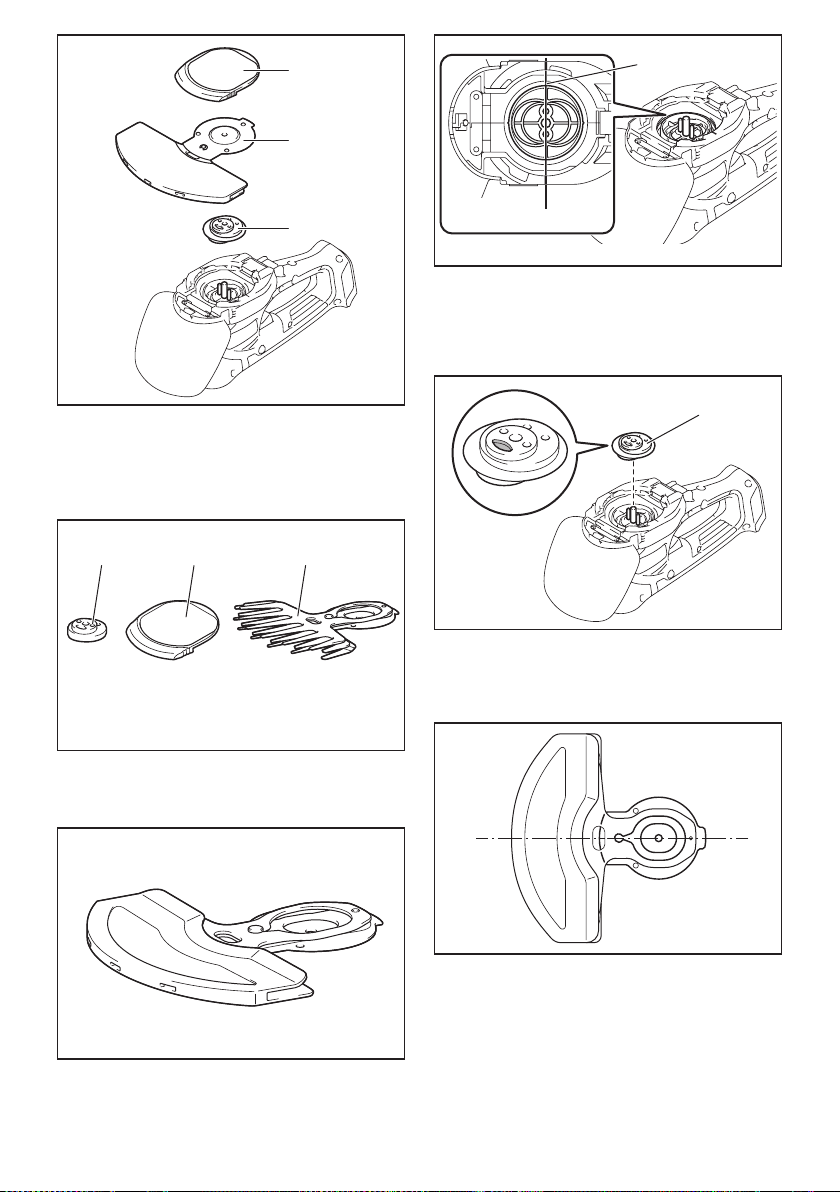
27 ESPAÑOL
3
2
1
►1. Subcubierta 2. Cuchillas de cizalla 3. Manivela
Instalación de las cuchillas de cizalla
1. Tengalistaslamanivela,lasubcubiertaylas
cuchillas de cizalla nuevas.
1 2 3
►1. Manivela 2. Subcubierta 3. Cuchillas de cizalla
2. Retirelacubiertadelascuchillasdecizallaviejas
yluegocolóquelaenlasnuevas.
3. Ajustelastresclavijasdemaneraquequeden
alineadasenlalíneadealineación.
1
►1.Líneadealineación
4. Apliqueunapequeñacantidaddegrasaalaperi-
feriadelamanivela.Instalelamanivelaenlasclavijas
conlaspartesredondaspequeñasygrandesorienta-
das hacia arriba.
1
►1. Manivela
5. Ajustelascuchillasylaplacadelabasede
maneraqueeloricioenlaplacadelabaseylasdos
protuberanciasenlascuchillasquedenalineados.
6. Coloquedecabezalascuchillasdecizallaeins-
tálelasdemaneraquelasclavijasenlaherramienta
encajeneneloricioenlaplacadelabase.Asegúrese
dequelascuchillasdecizallaquedenjadasrme-
mente en su lugar.

28 ESPAÑOL
7. Coloquelasubcubiertademaneraqueelsím-
bolo
enlasubcubiertaquedealineadoconelsím-
bolo
enlapalancadebloqueo.
8. Mientras presiona la subcubierta, gírela en el
sentidodelasmanecillasdelrelojhastaqueelsím-
bolo
enlasubcubiertaquedealineadoconelsím-
bolo
enlapalancadebloqueo.
9. Asegúresedequelapalancadebloqueoencaje
en la ranura en la subcubierta.
1
►1.Palancadebloqueo
PRECAUCIÓN: Nunca utilice la herramienta
sin haber instalado la subcubierta.
10. Retire la cubierta de las cuchillas y luego
enciendalaherramientaparavericarquefuncione
correctamente.
AVISO: Si las cuchillas de cizalla no funcionan
correctamente es porque las cuchillas no están
bien embonadas en la manivela. Extraiga las
cuchillas y vuelva a instalarlas.
Instalación o extracción de
las cuchillas de cizalla para el
cortasetos
PRECAUCIÓN: Coloque la cubierta de las
cuchillas antes de extraer o instalar las cuchillas
de cizalla.
Extracción de las cuchillas de cizalla
1. Coloquelaherramientadecabeza.
2. Mientrasoprimelapalancadebloqueo,girela
subcubierta en sentido inverso al de las manecillas del
relojhastaqueelsímbolo
enlasubcubiertaquede
alineado con el símbolo
enlapalancadebloqueo.
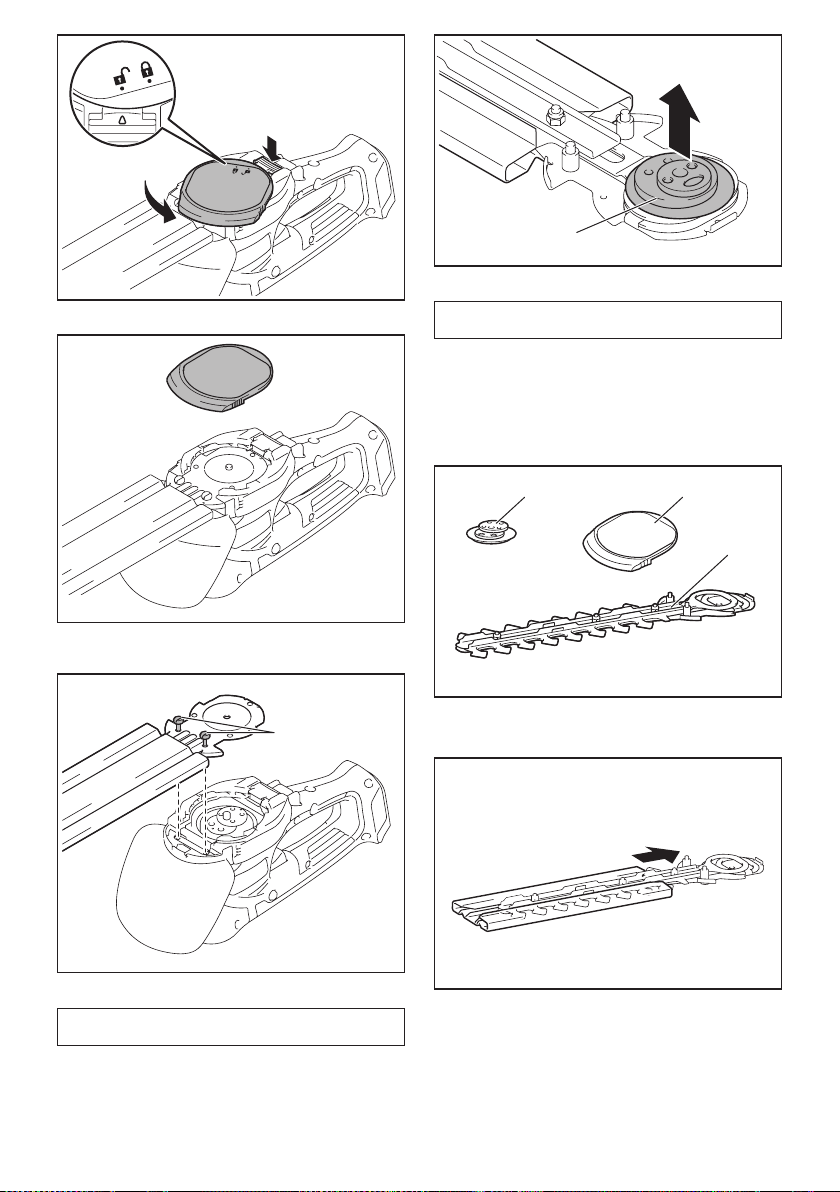
29 ESPAÑOL
3. Retire la subcubierta.
4. Aojelosdostornillosconundestornilladory
extraiga las cuchillas de cizalla.
1
►1.Tornillos
NOTA: Las cuchillas de cizalla pueden ser extraídas
sin retirar los tornillos.
5. Retire la manivela de las cuchillas de cizalla.
1
►1. Manivela
NOTA: La manivela puede permanecer en la
herramienta.
Coloquelacubiertadelascuchillasdecizallaextraídas,
póngalasenelestucheyluegoguárdelas.
Instalación de las cuchillas de cizalla
1. Tengalistaslamanivela,lasubcubiertaylas
cuchillas de cizalla nuevas.
1 2
3
►1. Manivela 2. Subcubierta 3. Cuchillas de cizalla
2. Coloquelacubiertadelascuchillasdecizalla.
3. Ajustelastresclavijasdemaneraquequeden
alineadasenlalíneadealineación.
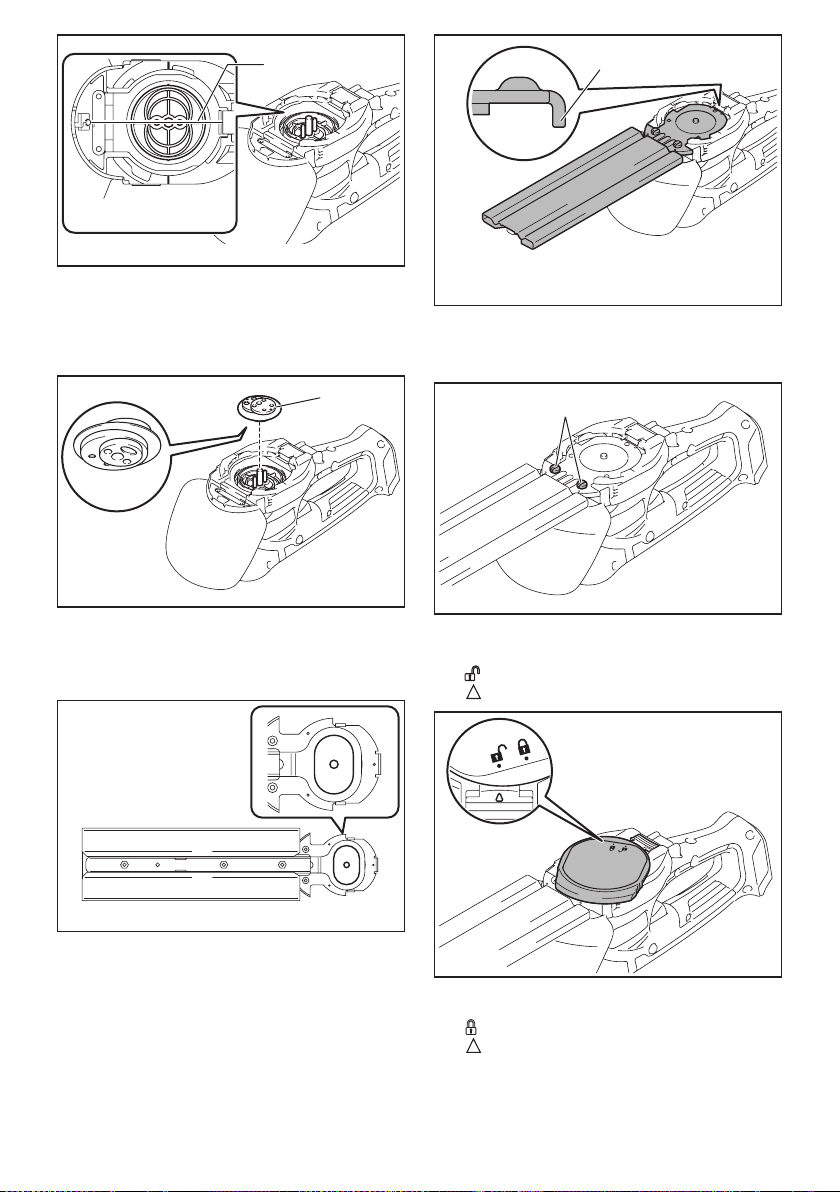
30 ESPAÑOL
1
►1.Líneadealineación
4. Apliqueunapequeñacantidaddegrasaalaperi-
feriadelamanivela.Instalelamanivelaenlasclavijas
conlaspartesredondaspequeñasygrandesorienta-
dashaciaabajo.
1
►1. Manivela
5. Deslicelascuchillasdecizallademaneraqueel
oricioenlaplacadelabasequedecolocadoenelcen-
tro de los anillos de las cuchillas.
6. Coloquebocaabajodecabezalascuchillasde
cizallaeinstálelasdemaneraquelaclavijaenlaherra-
mientaencajeeneloricioenlascuchillasdecizalla.
Inserte la barreta de la placa de la base en la ranura
enlaherramienta.Asegúresedequelascuchillasde
cizallaquedenjadasrmementeensulugar.
1
►1. Barreta
7. Aprietelosdostornillosrmementeconun
atornillador.
1
►1.Tornillos
8. Coloquelasubcubiertademaneraqueelsím-
bolo
enlasubcubiertaquedealineadoconelsím-
bolo
enlapalancadebloqueo.
9. Mientras presiona la subcubierta, gírela en el
sentidodelasmanecillasdelrelojhastaqueelsím-
bolo
enlasubcubiertaquedealineadoconelsím-
bolo
enlapalancadebloqueo.
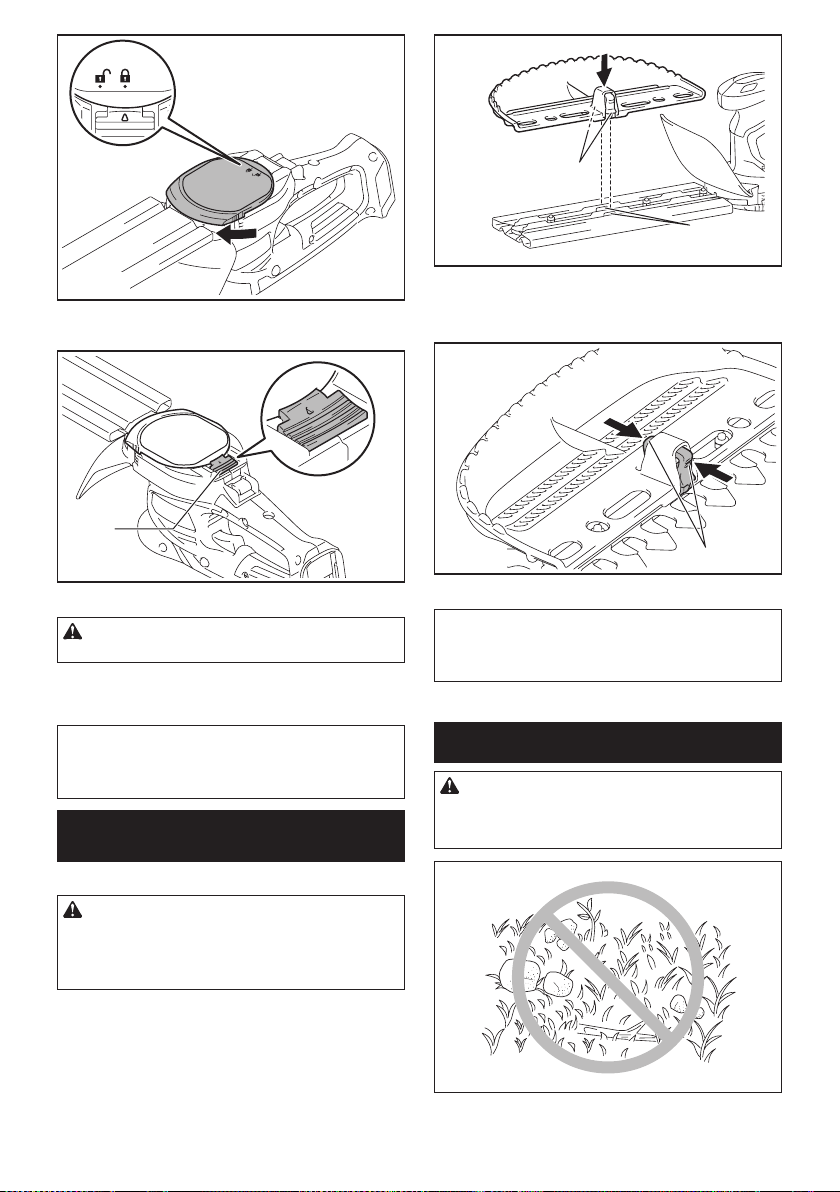
31 ESPAÑOL
10. Asegúresedequelapalancadebloqueoencaje
en la ranura en la subcubierta.
1
►1.Palancadebloqueo
PRECAUCIÓN: Nunca utilice la herramienta
sin haber instalado la subcubierta.
11. Retire la cubierta de las cuchillas y luego
enciendalaherramientaparavericarquefuncione
correctamente.
AVISO: Si las cuchillas de cizalla no funcionan
correctamente es porque las cuchillas no están
bien embonadas en la manivela. Extraiga las
cuchillas y vuelva a instalarlas.
Instalación o extracción del colector
de residuos
Accesorio opcional
PRECAUCIÓN: Siempre utilice guantes al
instalar o extraer el colector de residuos y colo-
que la cubierta de las cuchillas de manera que
sus manos y cara no hagan contacto directo con
las cuchillas.
Elcolectorderesiduosrecolectalosrestosdehojasy
facilitalalimpiezamásadelante.Éstepuedeinstalarse
en ambos lados de la herramienta.
Parainstalarelcolectorderesiduos,presiónelocontra
lascuchillasdecizallademaneraquelosganchos
encajenenlosoriciosdelascuchillasdecizalla.
1
2
►1. Ganchos 2.Oricios
Paraextraerelcolectorderesiduos,presionelaspalan-
cas en ambos lados para liberar los ganchos.
1
►1.Palancas
AVISO: Nunca intente extraer el colector de
residuos aplicando una fuerza excesiva con
sus ganchos asegurados en los oricios de las
cuchillas.
OPERACIÓN
ADVERTENCIA: Antes del cizallado,
retire las varas y piedras del área de cizallado.
Adicionalmente, retire previamente toda la maleza
del área de cizallado.
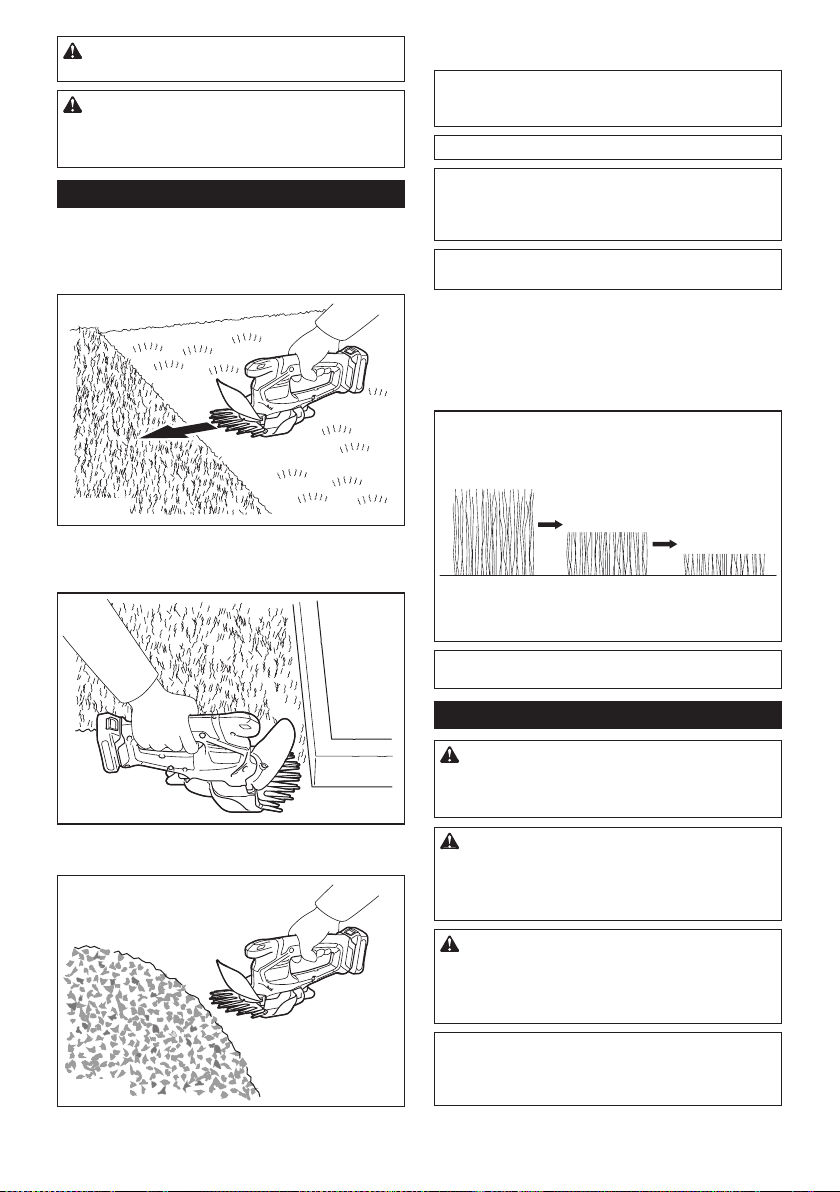
32 ESPAÑOL
ADVERTENCIA: Mantenga las manos aleja-
das de las cuchillas.
PRECAUCIÓN: Si es posible, evite utilizar
la herramienta cuando haga demasiado calor.
Durante la operación de la herramienta, vigile su
condición física.
Cizallado (para tijeras para hierba)
Enciendalaherramientadespuésdeajustarlaaltura
delcizalladoysosténgalademaneraquesuparteinfe-
rior descanse sobre el suelo. Desplace la herramienta
hacia adelante suavemente.
Cuando pode alrededor de cunetas, cercas o árboles,
desplacelaherramientaalolargodeéstos.Tenga
cuidadodequelascuchillasnolostoquen.
Cuandopodelosbrotesoelfollajedeunárbol
pequeño,hágalopocoapoco.
Podelasramaslargasalaalturadeseadaconalgún
cortador de ramas antes de usar esta herramienta.
AVISO: No utilice la herramienta en ninguna
forma que ocasione que el motor se detenga o
rote extremadamente lento.
AVISO: No intente cortar ramas gruesas.
AVISO: No permita que las cuchillas de cizalla
hagan contacto con el suelo durante la operación.
Las cuchillas se desalarán ocasionando un
desempeño deciente.
AVISO: No pode hierba ni follaje de árboles
pequeños en caso de estar mojados.
Podado de césped largo
Nointentecortarpastolargodegolpe.Procurehacerlo
endiferentespasos.Dejepasarunoodosdíasentre
cadacortehastalograrqueelcéspedquederecortado
de manera uniforme.
NOTA:Elintentarrecortarpastolargoenunasola
pasadapodríahacerqueéstemuriera.
Podado (para cortasetos)
PRECAUCIÓN: Tenga cuidado de no tocar
accidentalmente una cerca de metal u otros obje-
tos duros durante el podado. Las cuchillas podrían
romperseyocasionarunalesión.
PRECAUCIÓN: Tenga cuidado de no permitir
que las cuchillas de cizalla hagan contacto con el
suelo. La herramienta podría retroceder y ocasionar
unalesión.
PRECAUCIÓN: Trabajar con el cortasetos
en un lugar donde no alcance, particularmente
desde una escalera, es extremadamente peli-
groso.Notrabajemientrasestéparadosobreuna
supercietambaleanteopocorme.
AVISO: No intente usar la herramienta para cor-
tar ramas con un diámetro mayor a 10 mm. Corte
las ramas a la altura deseada con algún cortador de
ramas antes de usar la herramienta.

33 ESPAÑOL
AVISO:
No corte árboles muertos ni otros objetos
duros similares.Elhacerlopodríadañarlaherramienta.
AVISO: No pode hierba ni maleza mientras esté
usando las cuchillas de cizalla. Las cuchillas
podríanquedaratrapadasenlahierbaomaleza.
Sostengalaherramientaconunamano,jaleelgatillo
interruptormientrasoprimeelbotóndedesbloqueo,y
luego desplácela hacia adelante.
Paralaoperaciónbásica,inclinelascuchillashacialadirec-
cióndelpodadoydesplácelaslentamenteyconcalmaaun
ritmo de velocidad de 3 a 4 segundos por metro.
Elataruncordónalaalturadeseadaypodaralolargo
de éste puede ayudarlo a cortar la parte superior de un
seto de manera uniforme.
Tenercolocadoelcolectorderesiduosenlascuchillas
permitequeésterecolectelosrestosdehojasyfacilita
la limpieza más adelante.
Paracortarlapartelateraldeunsetodemanerauni-
forme,cortedeabajohaciaarriba.
Cuando desee hacer formas redondas al podar (podar
setosdebojorododendro,etc.),cortedelaraízala
parte superior para lograr un resultado excelente.
MANTENIMIENTO
PRECAUCIÓN: Asegúrese siempre de que la
herramienta esté apagada y el cartucho de batería
extraído antes de intentar realizar una inspección
o mantenimiento.
ParamantenerlaSEGURIDADyFIABILIDADdelpro-
ducto,lasreparaciones,ycualquierotratareademan-
tenimientooajustedeberánserrealizadasencentros
de servicio autorizados o de fábrica Makita, empleando
siempre repuestos Makita.
Limpieza de la herramienta
Quiteelpolvodelaherramientaconunpañosecoo
humedezcaunpañoenaguayjabónyexprímalopara
limpiarla.
AVISO: Nunca use gasolina, bencina, diluyente
(tíner), alcohol o sustancias similares. Puede que
esto ocasione grietas o descoloramiento.
Mantenimiento de las cuchillas
Antesdelaoperaciónounavezporhoradurantela
operación,apliqueaceitedebajaviscosidad(aceite
paramáquinasoaceitelubricanteenaerosol)alas
cuchillas.
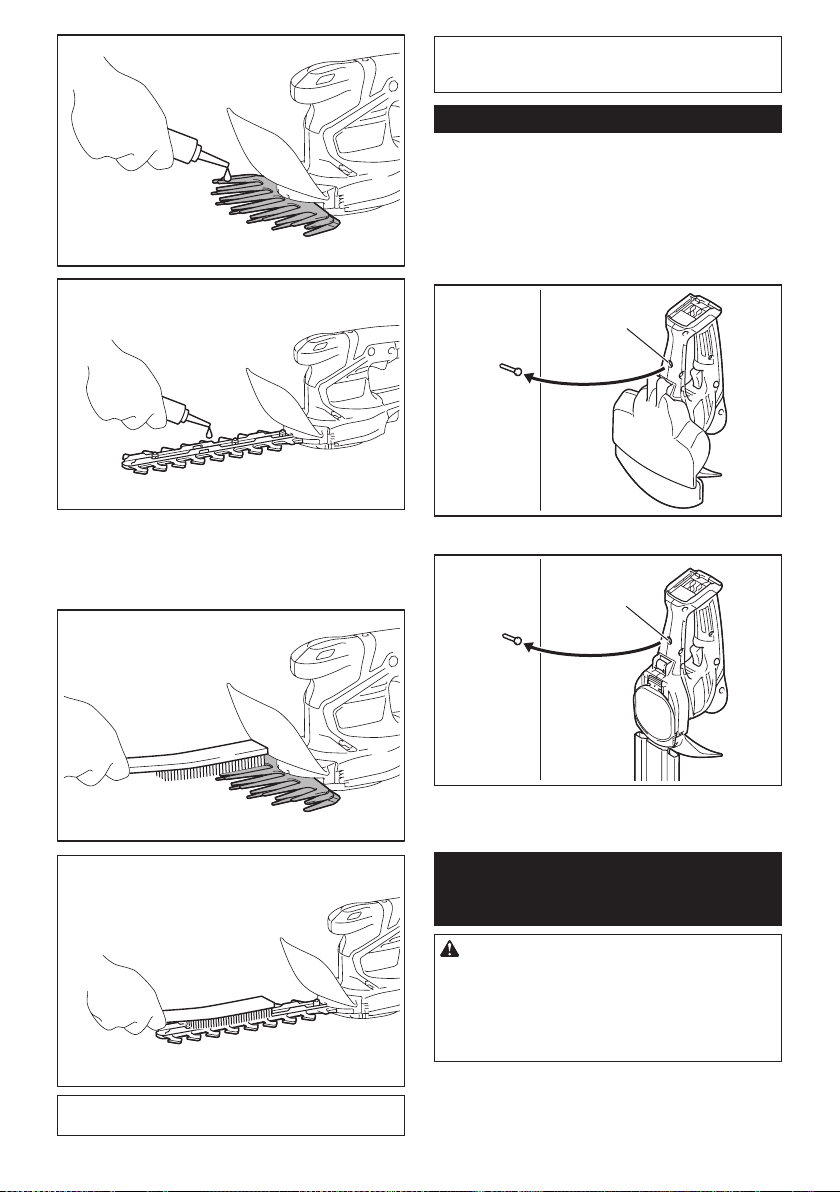
34 ESPAÑOL
Despuésdelaoperación,elimineelpolvoenambos
lados de las cuchillas con un cepillo de alambre, limpie
conunpañoyluegoapliqueaceitedebajaviscosidad
(aceiteparamáquinasoaceitelubricanteenaerosol)a
las cuchillas.
AVISO: No lave las cuchillas con agua.Esto
podríaocasionaroxidaciónodañosalaherramienta.
AVISO: La suciedad y la corrosión causan una
fricción excesiva de las cuchillas y acorta el
tiempo de operación en cada carga de batería.
Almacenamiento
Eloricioparaelganchoenlaparteinferiordela
herramienta resulta útil para colgar la herramienta en la
pared usando un clavo o tornillo.
Coloquelacubiertadelascuchillasdecizallade
maneraquelascuchillasnoquedenexpuestas.
Almacenelaherramientafueradelalcancedelos
niños.Almacenelaherramientaenunlugarquenoesté
expuesto a la humedad o la lluvia.
1
►1.Oricio
1
►1.Oricio
ACCESORIOS
OPCIONALES
PRECAUCIÓN: Estos accesorios o aditamen-
tos están recomendados para utilizarse con su
herramienta Makita especicada en este manual.
Elempleodecualquierotroaccesoriooaditamento
puede conllevar el riesgo de lesiones personales.
Utilice los accesorios o aditamentos solamente para
sunestablecido.
Sinecesitacualquierayudaparamásdetallesen
relaciónconestosaccesorios,pregunteasucentrode
servicio local Makita.

35 ESPAÑOL
• Conjuntodecuchillasdecizalla(parausoconlas
tijerasparahierba)
• Cubiertadelascuchillasdecizalla(parausocon
lastijerasparahierba)
• Colectordehierba(parausoconlastijeraspara
hierba)
• Accesoriodemangolargo(parausoconlastije-
ras para hierba)
• Conjuntodecuchillasdecizalla(parausoconel
cortasetos)
• Cubiertadelascuchillasdecizalla(parausocon
el cortasetos)
• Colectorderesiduos(parausoconelcortasetos)
• Estuche
• BateríaycargadororiginalesdeMakita
NOTA:Algunosdelosartículosenlalistapueden
incluirseenelpaquetedelaherramientacomoacce-
soriosestándar.Éstospuedenvariardepaísapaís.
GARANTÍA LIMITADA DE UN AÑO
DE MAKITA
Ésta Garantía no aplica para México
Política de garantía
Cada herramienta Makita es inspeccionada y probada
exhaustivamente antes de salir de la fábrica. Se garan-
tizaqueestálibrededefectosdemanodeobraymate-
rialesporelperíododeUNAÑOapartirdelafechaori-
ginal de compra. Si durante este período de un año se
desarrollara algún problema, devuelva la herramienta
COMPLETA,conelenvíoprepagado,auncentrode
servicioautorizadoodefábricaMakita.Silainspección
muestraqueelproblemahasidoacausadeundefecto
demanodeobraomaterial,Makitaharálareparación
(oasudiscreción,elreemplazo)sinningúncargo.
Estagarantíanoaplicacuando:
• lasreparacionessehayanhechoointentado
hacer por otros;
• serequieranreparacionesdebidoaldesgaste
normal;
• laherramientahayasidomaltratada,recibido
un mal uso o haya recibido un mantenimiento
inapropiado;
• sehayanhechomodicacionesalaherramienta.
ENNINGÚNCASOMAKITASEHARÁ
RESPONSABLEDENINGÚNDAÑOINDIRECTO,
INCIDENTAL,ODERIVADODELAVENTAO
USODELPRODUCTO.ESTEDESCARGODE
RESPONSABILIDADAPLICADURANTEYDESPUÉS
DELPLAZODEESTAGARANTÍA.
MAKITARENUNCIAALARESPONSABILIDADPOR
CUALQUIERGARANTÍAIMPLÍCITA,INCLUYENDO
GARANTÍASDE“COMERCIABILIDAD”Y“ADECUACIÓN
PARAUNPROPÓSITOESPECÍFICO”,DESPUÉSDEL
PLAZODEUNAÑODEESTAGARANTÍA.
Estagarantíaleconcedederechoslegalesespecícosy
ustedpodrátenertambiénotrosderechosquevaríandeun
estadoaotro.Algunosestadosnopermitenlaexclusióno
limitacióndedañosincidentalesoconsecuentes,porloque
lalimitaciónoexclusiónarribamencionadapodríanoapli-
carparausted.Algunosestadosnopermitenlalimitación
sobreladuracióndeunagarantíaimplícita,porloquela
limitaciónarribamencionadapodríanoaplicarparausted.

Some dust created by power sanding, sawing, grinding, drilling, and other
construction activities contains chemicals known to the State of California
to cause cancer, birth defects or other reproductive harm. Some examples
of these chemicals are:
• lead from lead-based paints,
• crystalline silica from bricks and cement and other masonry products, and
• arsenic and chromium from chemically-treated lumber.
Your risk from these exposures varies, depending on how often you do this
type of work. To reduce your exposure to these chemicals: work in a well
ventilated area, and work with approved safety equipment, such as those
dust masks that are specially designed to filter out microscopic particles.
WARNING
< USA only >
ADVERTENCIA
Algunos polvos creados por el lijado, aserrado, esmerilado, taladrado y
otras actividades de la construcción contienen sustancias químicas
reconocidas por el Estado de California como causantes de cáncer, defectos
de nacimiento y otros peligros de reproducción. Algunos ejemplos de estos
productos químicos son:
• plomo de pinturas a base de plomo,
• sílice cristalino de ladrillos y cemento y otros productos de albañilería, y
• arsénico y cromo de maderas tratadas químicamente.
El riesgo al que se expone varía, dependiendo de la frecuencia con la que
realice este tipo de trabajo. Para reducir la exposición a estos productos
químicos: trabaje en un área bien ventilada y póngase el equipo de seguridad
indicado, tal como las máscaras contra polvo que están especialmente
diseñadas para filtrar partículas microscópicas.
< Sólo en los Estados Unidos >
Makita Corporation
3-11-8, Sumiyoshi-cho,
Anjo, Aichi 446-8502 Japan
www.makita.com
885549A946
MU04-1
EN,ESMX
20170204

