EN FR DE SV NO NL ES IT
OPTIMUS
|
COOKING SINCE 1899
NOVA
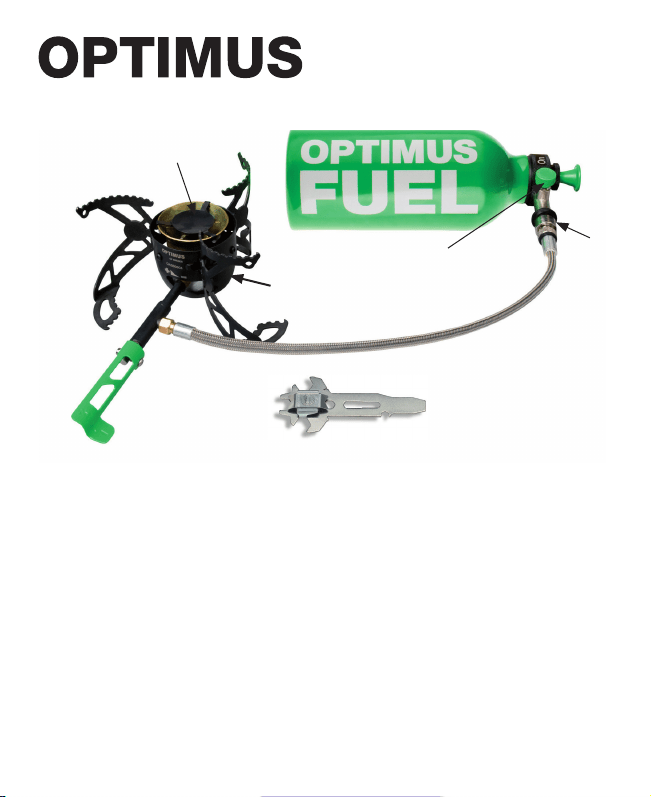
A Fuel bottle/ Bouteille de fuel/ Brennstoffflasche/ Bränsleflaska/ Brenselflaske/ Brandstoffles/
bombona de combustible/ bombola del combustible
B Pump/ Pompe/ Pumpe/ Pump/ Pumpe/ Pomp/ Bomba/ Pompa
C Burner/ Brûleur/ Brenner/ Brännare/ Brenner/ Brander/ Quemador/ Bruciatore
D Pot support/ Pieds/ Stützbeine/ Ben/ Ben/ Poten/ Soportes/ Piedini di supporto
E Control valve/ Robinet de réglage d’alimentation/ Brennstoffregler/ Bränslereglage/
Brenselregulator/ Ventiel/ Válvula de control/ Valvola di controllo
F Multitool/ Outil multi-usages/ Multiwerkzeug/ Multiverktyg/ Multiverktøy/ Multi-sleutel/
Multiherramienta/ Attrezzo multifunzione
G Quick connect/ Raccord rapide/ Schnellanschluss/ Snabbkoppling/ Hurtigkopling/ Snelkoppeling/
Conector rápido/ Allacciamento rapido
H Fuel feed valve/ Soupape d’alimentation de combustible/ Ventil für die Brennstoffzufuhr/
Bränsleventil/ Brenselsventil/ Ventiel van de brandstoftoevoer/ Válvula de alimentación de
combustible/ Valvola di alimentazione combustibile
I Fuel hose/ Tuyau à combustible/ Brennstoffschlauch/ Bränsleslang/ Brenselslange/
Brandstofslang/ Manguera del combustible/ Manichetta del combustibile
J Cup/ Coupelle/ Behälter/ Kopp/ Kopp/ Behuizing/ Taza/ Tazza
A
B
C
D
E
G
H
I
J
NOVA
F

TECHNICAL SPECIFICATION/ FICHE TECHNIQUE /TECHNISCHE DATEN/ TEKNISK
SPECIFIKATION/TEKNISKE SPESIFIKASJONER/ TECHNISCHE GEGEVENS/ DATOS
TECNICOS/ DATI TECNICI
Fuel/Combustible/Brennstoff/
Bränsle/Brensel/Brandstof/Combus-
tible/Combustibile:
Optimus Arctic Fuel, White Gas,
Gasoline/petrol, Kerosene, Diesel,
Jet Fuel, and others/ Combustible
Optimus Arctic, essence purifiée.
Essence automobile, pétrole lampant,
gazole, kérosène, etc./
Optimus
Arctic Fuel, weißes Gas, Autobenzin,
Kerosin, Diesel, Turbinentreibstoff
und andere/
Optimus Arctic Fuel, ren
bensin, bilbensin, fotogen, diesel
mm.
/
Optimus Arctic Fuel, kjemisk
ren bensin, bilbensin, parafin, diesel,
jetdrivstoff med mer/Optimus Arctic
Fuel, witte benzine, benzine, kerosine,
diesel/Optimus Arctic Fuel, gasolina,
queroseno, gasóleo, gasolina blanca/
Optimus Arctic Fuel, benzina bianca,
benzina, kerosene, gasolio
Weight (without pump)/Poids pompe
non comprisee/Gewicht (ohne
pumpe)/Vikt (utan pump)/Vekt (uten
pumpe)/Gewicht (zonder pomp)/
Peso (sin bomba)/Peso (senza
pompa):
330 grams (11.5 oz)
Weight (with pump)/ Poids pompe
comprisee/ Gewicht (mit pumpe)/
Vikt (med pump) /Vekt (med pumpe)/
Gewicht (met pomp)/Peso (con
bomba)/Peso (con pompa):
460 grams (16 oz)
Measurements folded/Dimensions
replié/Abmessungen zusammenge-
klappt /Mått, ihopfälld/Mål slått sam-
men/Maten gevouwen/Dimensión
plegado/Dimensione piegato:
90x 65 x 140 mm (3.5 x 2.5 x 5,5 inches)
Rating/Puissance nominale/
Leistung/Effekt /Effekt/Watt/Efecto/
Watt:
2850 W
Burn time/Durée de combustion/
Brenndauer/Brinntid/Brennetid/
Verbrandingsduur/Duración de com-
bustión/Tempo di bruciatura:
Up to 2 hours at maximum output
(using 450 ml fuel)/
jusqu’à 2 heures au
maximum de puissance (avec 450 ml de
combustible)
/
Bis zu zwei Stunden bei
voller Leistung
(mit 450 ml Brennstoff)/
Upp till två timmar vid full effekt (med
450 ml bränsle)
/
Inntil 2 timer med
maks. effekt (med 450 ml brensel)/Tot
2 h met maximaal vermogen (met 40
ml grandstof)/a 2 horas a rendimento
máximo (con 450 ml combustible)/
Fino a 2 ore a rendimento massimo
(con 450 ml combustibile)
Boil time (1 L of water)/
Durée néces-
saire à l’ébullition/
Kochzeit/Koktid/
Koketid/Koktijd/Tiempo de cocción/
Tempo di cottura:
As little as 3.5 minutes depending
on climate, altitude etc./à partir de
3,5 minutes selon le climat, l’altitude
etc. (1 l d’eau)./Bis zu 3,5 Minuten,
abhängig von Klima, Höhe etc./Ned
till 3,5 minut beroende på klimat, höjd
etc./Ned til 3,5 minutter, avhengig av
klima, høyde over havet osv./slechts
3.5 min, al naar klimaat, hoogte enz./
Solo 3.5 min según el clima, la altitud
etc./Appena 3.5 min a seconda di
clima, altitudine etc.
Preheating/Préchauffage/Vorwär-
men/Förvärmning/Forvarming/
Voorverwarming/Precalentar/Pre-
riscaldar:
30-90 s depending on fuel type/
de 30 à 90 secondes selon le
combustible./30–90 Sekunden je
nach Brennstofftyp/ 30-90 s beroende
på bränsletyp/30-90 s, avhengig av
brenseltype/30-90 s, al naar type
het brandstof/30-90 s según tipo del
combustible/30-90 s a seconda del
tipo di combustibile
www.optimusstoves.com
PEACE AND QUIET
Congratulations, you’re the proud new owner of one of our most advanced stoves. That must mean
you’re on your way to exciting, demanding adventures. We know that you’ve made a smart choice
with this stove and when you use it, you’ll know too. Get ready for great outdoor cooking, thanks to
over a century of success at Optimus.
Being the outdoor enthusiasts we are, we understand that you’re probably curious about your new
stove and anxious to try it out as soon as possible. But even if you have plenty of experience with
similar products, please read the manual so you become familiar with the specifics relating to this
stove.
All of us at Optimus hope that you will take the time to sit down and enjoy the peace and quiet unique
to food preparation in the Great Outdoors.
Good luck, and bon appétit!
SAFETY FIRST!
When you use your Optimus Nova, you’ll be handling highly flammable fuels. If used incorrectly,
you will be putting yourself and everything around you in danger. Make sure that you’ve understood
everything in this manual before using the stove. Try it out and get to know it properly before you
head out for adventure.
Check that no fuel is leaking before you light the stove. If you have spilled any fuel, the safest thing is
to move the stove. If you discover fuel leaking from any part of the stove, the leak must be taken care
of before the stove is used. Never use a stove that is leaking fuel.
The Optimus Nova is designed for outdoor use only. A lit stove consumes oxygen and gives off
carbon monoxide. If you use the stove indoors in an unventilated area or in a tent, you run the risk of
falling victim to carbon monoxide poisoning.
Make sure that you never hold your face or any other part of your body over the stove. Also make
sure you keep your clothes away from the stove. Many materials used for outdoor clothing, sleeping
bags, etc. are highly flammable.
Be very careful when lighting a stove that has just been used. A hot burner can vaporize the fuel. The
fuel may ignite explosively. Allow the stove to cool properly before lighting it again.
Never leave the stove without supervision. Never leave children unattended near the stove.
Use Optimus Nova only for cooking food and boiling water.
ENGLISH
The Optimus Nova is a multifuel stove. This means that you can use a number of different liquid fuels,
such as gasoline, diesel and kerosene. Unlike propane gas, these are often easy to get hold of even
in the most remote corners of the globe. They also make your stove considerably more powerful
when used during winter trips.
Preparing food on a multifuel stove using liquid fuel is slightly more complicated than using a gas
stove. First off, the fuel has to be pressurized in order to make the stove as hot as possible. The gas
in a gas bottle is already pressurized when you buy it from the shop, but the liquid fuel you put in
your fuel bottle is not. Therefore, you have to pump up the pressure in the bottle yourself.
You also need to preheat the stove for a short time using a squirt of fuel. Preheating involves heating
up the burner to such an extent that the fuel is vaporized when it passes through the burner’s nozzle.
Vaporized fuel burns efficiently with a blue flame and a hissing sound.
When your food is cooked and you want to shut off the stove, you turn the entire fuel bottle to OFF
position. This places the pump in a position whereby air comes out of the bottle instead of fuel. When
the fuel remaining in the hose has burned, the flame goes out on its own and the pressure remaining
in the bottle seeps out.
If you turn off the stove using the control valve only, fuel will remain in the hose and the bottle will
stay pressurized. This will cause a fuel spill when you dismantle the stove or transport it in your pack.
The following pages show you how to use the stove, step-by-step.
EN - HOW YOUR STOVE WORKS
1
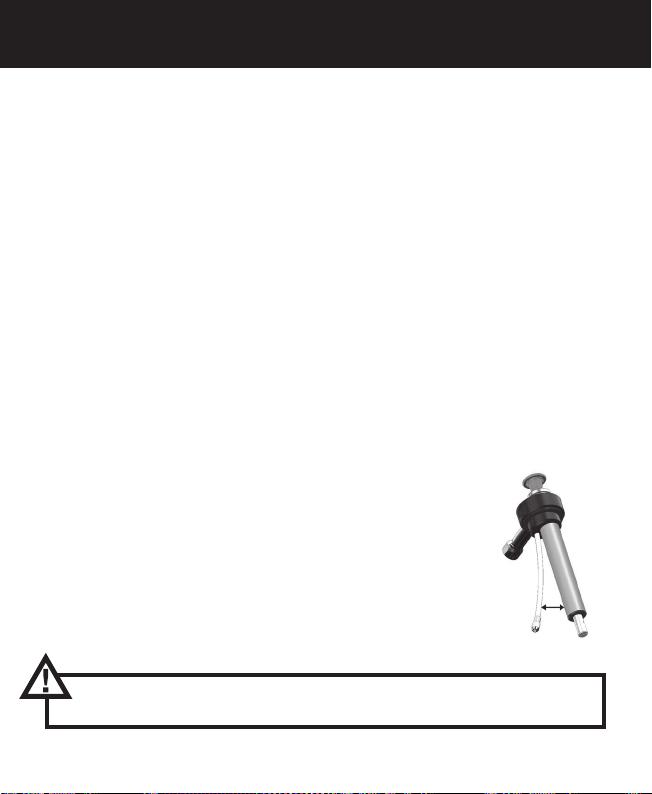
Do not fill the fuel bottle to the brim. It should only be filled about ¾ full. You have
to leave some space for the pump and the air that will be compressed when you
pump up the pressure. To ensure proper usage of the “On / Off “ function by tur-
ning the bottle, check the fuel intake hose is bent away from the pump cylinder.
The brass fuel filter holder should touch the interior wall of the fuel bottle. Check
that the seal is positioned correctly in its groove before you turn the pump into
position. The seal must be flat and even all round. Screw on the pump properly
and wipe off any spilled fuel.
Read more about various fuels in the chapter on fuels.
Fill the bottle with fuel and
screw on the pump.
WARNING! Make sure that you stay well away from a lit stove or naked flame
when you are filling the bottle with fuel. Use only Optimus fuel bottles.
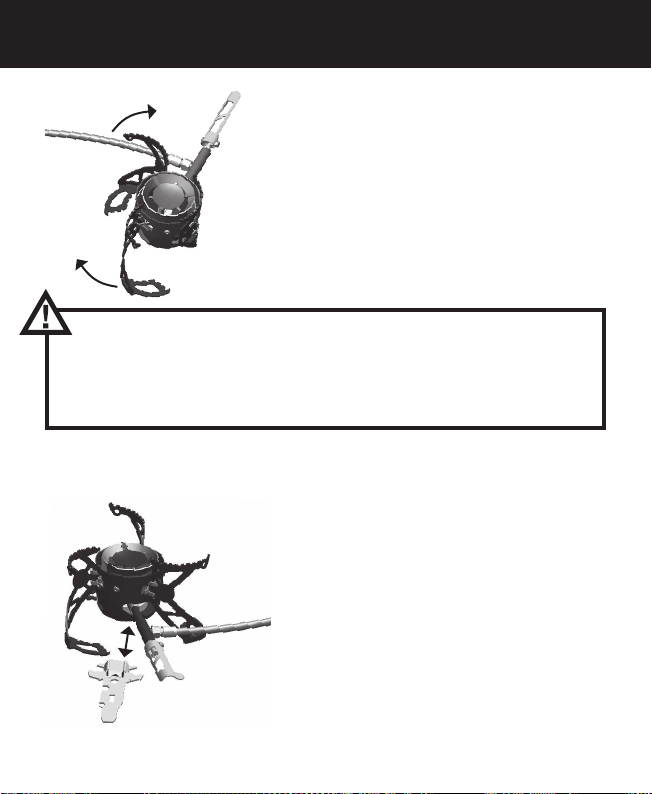
All fuels contain contaminants that can block the
nozzle in the burner. The Optimus Nova has a built-in
cleaning needle that is used to clear the nozzle with
ease. Move the multitool a few times directly beneath
the burner’s base nut. The magnets on this tool force the
needle to move, thereby cleaning the nozzle.
Get into the habit of cleaning the stove before you start
preparing food. This will reduce the risk of the nozzle in the
burner getting blocked. See the section entitled “Cleaning
and maintenance” if the stove functions poorly even though
it has been cleared using the multitool.
It gets very hot under the stove, so remember to place
the stove on a firm base which cannot catch fire.
Make sure that the control valve is closed before pumping
pressure into the bottle.
Do not use pans with a diameter that exceeds 280 mm
(11 inches). The weight of the pan plus food should not exceed
4 kg (8.8 lbs.).
2
Fold out the pot supports on the burner.
Fold out the fuel control valve and make
sure that it’s in the off position.
HOW YOUR STOVE WORKS - EN
3
Clear the nozzle in
the burner.
WARNING! Do not place the stove on or near flammable materials. Avoid
exposing the fuel bottle to heat. The bottle may explode if it is exposed to
heat. Only use wind screens approved by Optimus for use together with the
Optimus Nova. Never cover the fuel bottle with the wind screen. There must
always be a clearance of at least 15 cm (6 inches) between the fuel bottle
and a pot or pan on the stove to prevent overheating of the fuel bottle.
4
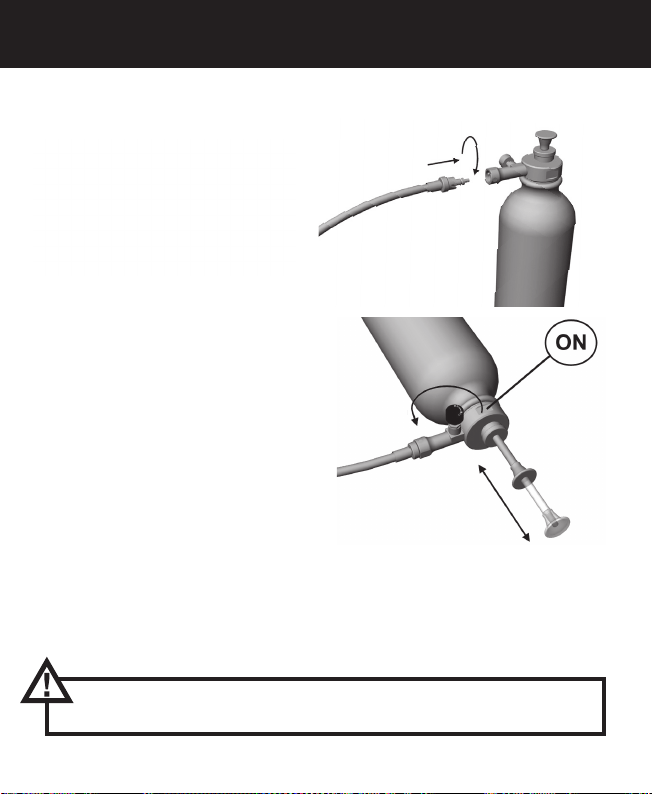
Connect the fuel hose to the
pump’s quick connect.
Make sure that the fuel feed valve is closed
(turned fully clockwise).
Check the o-ring on the tip of the fuel hose.
Replace the o-ring if it is damaged, missing
or worn.
Fit the fuel hose into the quick connect and
make sure the bayonet joint locks.
5
Pump up pressure in
the fuel bottle.
The fuel in the bottle is not pressurized, so you have
to pump up pressure before the stove can be lit and
used.
The fuel bottle can be placed in two different
positions, with the word ON or OFF on the top of the
pump. Place the bottle in the ON position when you
want to use the stove.
If the fuel bottle is full (3/4 is full), you will need to
pump around 25 times. Pump about 40 times if
the bottle is half full or less. There must be fi rm
resistance in the pump when you reach the stove’s
working pressure. Open the fuel feed valve fully.
The air pressure in the fuel bottle is crucial to the heat of the stove. When preparing food, you may
have to do some more pumping in order to maintain maximum heat. However, if you pump up too
high a pressure the fuel fl ow will be too great resulting in a yellow fl ame.
WARNING! Make sure that no fuel is leaking out before you light the stove.
Never light a stove that is leaking fuel.
EN - HOW YOUR STOVE WORKS
25 - 40 times
open
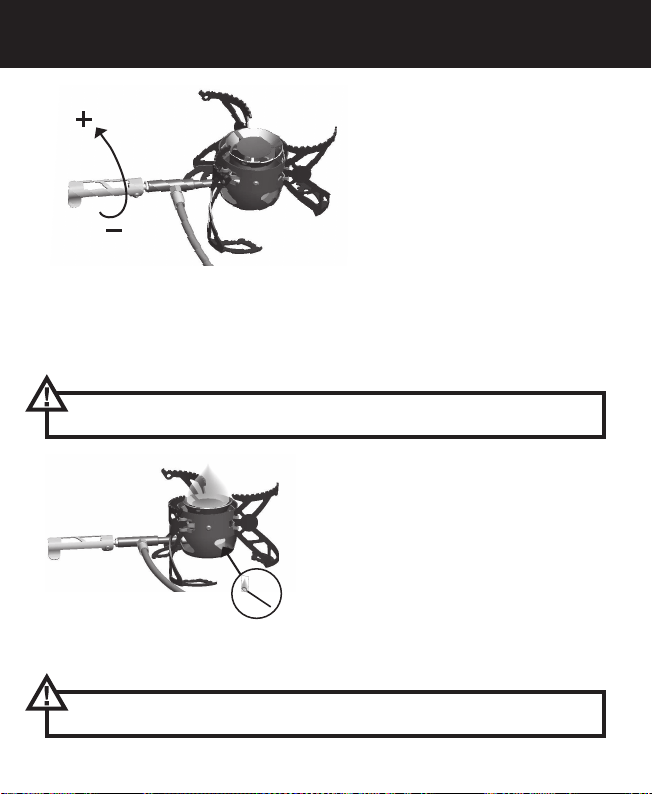
Light the fuel at the wick using a match or lighter. The
wick is the white pad in the center of the burner, in the
bottom of the cup. This is accessed via one of the holes
in the cup. Of course, it is important to make sure that
you never hold your face or any other part of your body
directly over the stove when you light it. The fuel may ignite explosively. If the stove
cannot be lit, you might not have released enough fuel. If this is the case, repeat step
6.The fuel will burn with a yellow, fl aring fl ame and heat the burner. Wait a short time until the fuel has
almost burned out and the fl ame has become small.
6
Release a small
amount of fuel for
preheating.
The stove’s burner has to be hot to allow the
liquid fuel to vaporize at the nozzle and burn
effi ciently. Therefore, you have to preheat the
burner before you can start preparing food.
This is done by fi rst releasing a squirt of fuel
and allowing it to burn for a short time, heating
up the nozzle in the burner.
The preheating time varies depending on
what type of fuel you are using. For example, gasoline is vaporized more readily than kerosene and
requires less preheating. Preheating takes longer when it is cold and if the stove is not protected
from the wind.
Start by opening the control valve for two seconds. It is diffi cult to see how much fuel has run out
onto the wick, but as time goes by you will get a feel for this. Proceed with caution as you familiarize
yourself with your stove.
WARNING! Check for fuel leaks at the bottle, pump, hose and burner before
lighting the stove.
7
Light the fuel and wait until the
fl ame has almost burned out.
WARNING! Keep children away from the stove and never leave it without
supervision.
HOW YOUR STOVE WORKS -EN
8
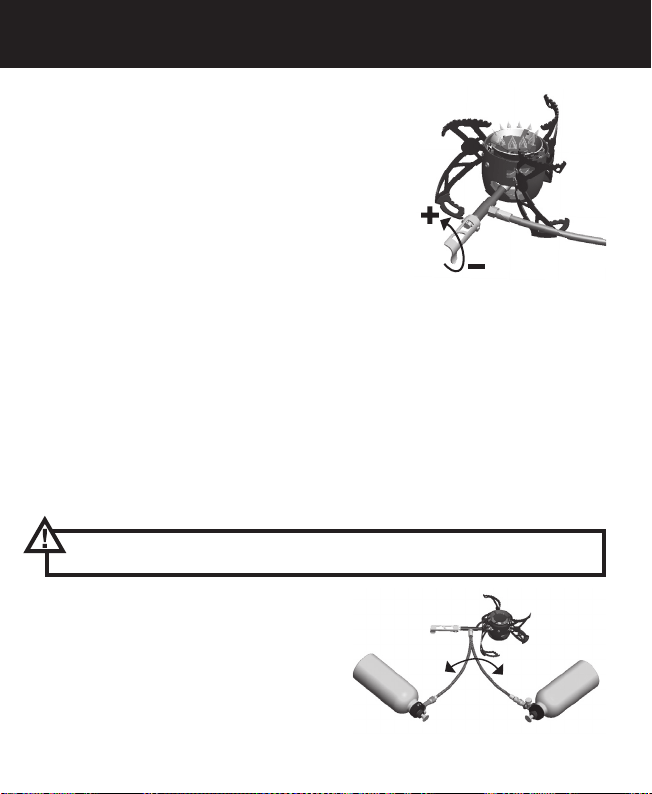
Open the control valve again and
adjust the fl ame until it turns blue
and there is a hissing sound.
Once the preheating fl ames are almost out, open the control
valve again by about a quarter turn. If the burner is hot enough,
the fuel will vaporize and be ignited by the preheating fl ame. The
fl ame should then turn bluish and hiss gently after a short time. If
the vaporized fuel does not ignite, light it carefully with a match.
A yellow, fl aring fl ame means that the burner is not hot enough
or that you have opened the control valve too far. Start off by
closing the control a little. If the fl ame does not turn blue after
10-15 seconds, the burner is not hot enough and you have to preheat the stove for a little longer. In
this case, close the control valve one more time, wait until the fl ames are almost out and then open
the control valve again.
When the stove is burning as it should, you can gradually open the control valve and make it hotter.
Maximum heat is attained when the control valve has been opened by about two turns. If you open
it by more than two turns, you will use up more fuel without making the stove any hotter. If the fl ame
fl ares up and turns yellow, turn down the control slightly and wait until the fl ame has turned blue
again.
The burner is designed to burn best and give maximum heat with a pan in place.
Once the stove has been burning for a while, it may be a good idea to pump a couple of times in
order to maintain pressure in the bottle. Too little pressure in the bottle will result in poor perfor-
mance. Too much pressure will also lead to poor performance and a yellow, fl aring fl ame. With a little
practice, you will learn how often and how much to pump in order to maintain an effective fl ame.
WARNING! Never move a hot stove or a stove that is in use.
9
Shut off the stove by turning
the bottle to OFF position.
If you want to avoid annoying fuel spills when you
dismantle and transport the stove, shut it off by tur-
ning the fuel bottle to OFF position. OFF will then be
visible from above on the pump. The fuel in the hose
will now burn up and the remaining pressure in the
EN - HOW YOUR STOVE WORKS
OFF
ON
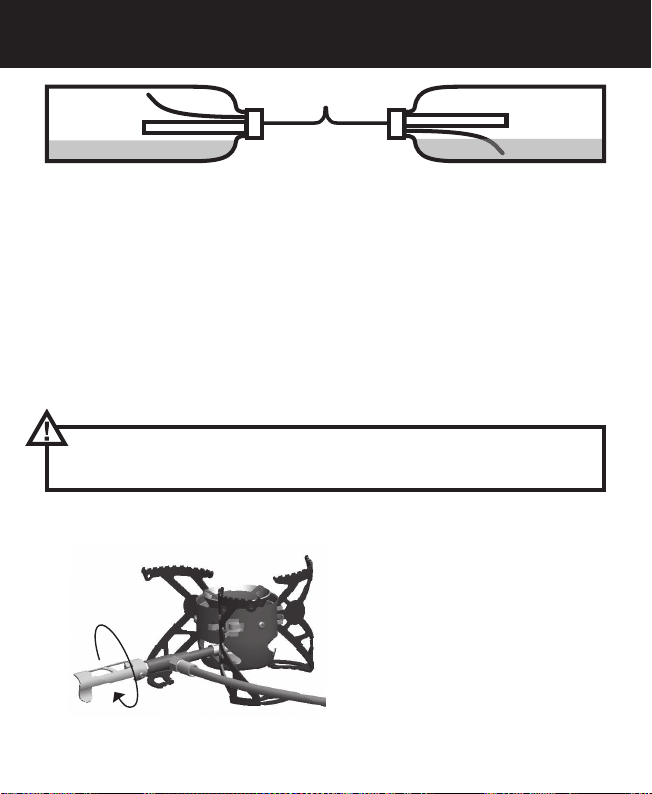
bottle will seep out. The fl ame will not go out immediately, but will burn for a few minutes depending
on which fuel you are using and how open the control valve is.
To release the pressure in the fuel bottle faster, you can let the stove burn at full throttle. It will take
about 30-40 seconds for the fl ame to extinguish, and another 30 seconds for the remaining air to
seep out.
If you have shut down the stove by closing the control valve only, you will have to release the pres-
sure in the bottle by way of the pump. This entails a great risk that fuel will spill on you and your
equipment.
If the stove is to be used again without being moved, you can switch off the stove using the control
valve. Allow the stove to cool properly before lighting it again.
IMPORTANT: To prevent fuel leakage, always turn off the fuel valve (by turning it clockwise) when the
stove is not in use.
OFF ON
WARNING! Be very careful when lighting a stove that has just been used. A
hot burner can vaporize the fuel. Vaporized fuel is very diffi cult to see. There
is a risk that the fuel will ignite explosively and you get burned.
10
Let the stove
cool down.
Allow the stove to cool properly before packing
it.
We recommend that you leave the control valve
open when you have shut off the stove by turning
the bottle to the OFF position. If you close the
valve too tight when the stove is hot, it may be
hard to open the next time you use the stove.
HOW YOUR STOVE WORKS - EN
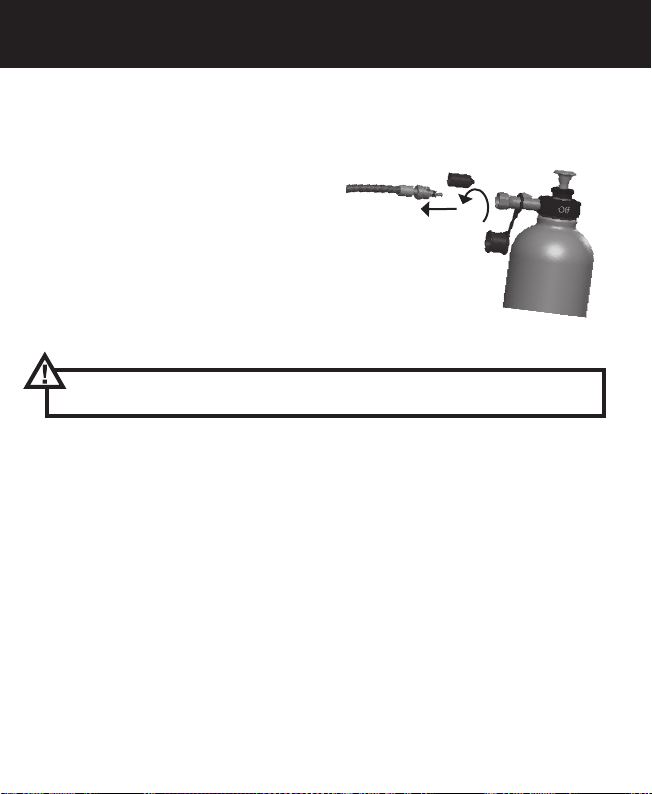
Close the fuel feed valve fully. Remove the fuel hose
by releasing the bayonet joint and then pull the hose
out of the quick connect. Sometimes there may be a
little pressure remaining in the bottle which seeps out
when you disconnect the quick connect. The same is
true when you unscrew the pump from the bottle. Turn
your face away from the stove to protect your eyes
when separating the quick connect.
Be sure to apply the covers on the tip of the fuel hose
and the quick coupling so dirt will not enter.
11
Remove the
fuel hose.
WARNING! Never disconnect the hose immediately after switching off the
stove. Fuel may splash on the hot burner and ignite.
EN - HOW YOUR STOVE WORKS / FUELS
The Optimus Nova has a burner designed to use petroleum-based fuels. Therefore, you cannot use
alcohol-based fuel. We recommend that you use chemically pure gasoline (not automotive gasoline)
or high-quality kerosene. Under no circumstances should you handle fuel near a lit stove or in your
tent.
Use a funnel with a filter when filling the bottle so as to avoid dirt and foreign bodies getting into the
fuel. Never mix different kinds of fuel. Empty the bottle entirely before putting in a different fuel.
GASOLINE
It is often very easy to get hold of gasoline, even though the quality is variable. Chemically pure
gasoline is preferable. Ordinary automotive gasoline contains additives which will contaminate
your stove and are hazardous for your health. If you have to use automotive gasoline, use unleaded
gasoline wherever possible. Gasoline is highly flammable and preheating occurs quickly. However,
gasoline is also very volatile and burns explosively.
KEROSENE
Kerosene has more or less the same energy value as gasoline but is considerably less of a hazard
in terms of fire. It is used all over the world and is easy to get hold of. You can often find kerosene in
FUELS

FUELS - EN
places where you would not find other fuels, such as in food stores. Preheating takes slightly longer
with kerosene than with gasoline and is slightly sooty, but there is not much of a risk of explosion.
Kerosene also requires you to clean the burner more often.
We recommend the use of kerosene, as it is primarily designed for use in stoves and heaters. We do
NOT advise the use of lamp oil or fire lighting fluid (charcoal lighter).
NOTE: In harsh cold, there is a risk of kerosene solidifying, which makes the stove unusable.
DIESEL
Diesel is somewhat similar to kerosene, but preheating takes slightly longer and it produces even
more soot. We recommend that you only use diesel as last option. If you do so, use diesel for cars.
Avoid marine diesel entirely. One positive aspect of diesel is that it can be found all over the world.
FUEL CONSUMPTION
Expect to use 0.10-0.15 liters (3.3 – 5 fl. oz.) of fuel per person per day. In the winter, you will use
more fuel for melting snow, preheating for longer, etc. In this instance, expect to use twice as much
fuel. To keep your fuel consumption down, it is important to adjust the flame so that the stove burns
as efficiently as possible. This does not mean opening the control valve as much as possible; quite
the opposite, in fact. If you do that, you will use up more fuel but your food will not cook any faster.
To heat your food as quickly as possible, it is also a good idea to always use a lid on your pan and
make sure that the pan is protected from the wind. Use the wind screen that comes with your stove.
This will also reflect heat back at your pan.
Visit www.optimusstoves.com for more information about fuels.

CHOOSING A FUEL
Liquid fuels work considerably more effectively than gas in cold conditions. The pressure in gas
tubes is impaired at just a few degrees below freezing. Keep in mind that some poor qualities of
kerosene and diesel will solidify in the cold. If you are not sure what will happen, you can place a
bottle with the fuel in your freezer and see what happens.
PARTS SUSCEPTIBLE TO COLD
The quick connect and O-rings are the stove parts most susceptible to cold. The O-rings may stiffen
and crack when the temperature falls below -20 °C (-4 °F). Check them before leaving on your trip,
and replace them if they look worn.
EFFICIENT FOOD PREPARATION
When the weather is cold, it is of course even more important to use a wind screen and a lid on your
pan when cooking: this considerably reduces the amount of time/fuel needed to heat your food. With
our Optimus Terra set of cooking pans, you can also keep your food hot once it has been taken off
the stove.
OPTIMUS NOVA ON SNOW
When you use your Optimus Nova on snow, it is important that you place a non-flammable base
beneath the stove so that it will not sink into the snow while you cook. Set up a surface on which you
can place the stove, bottle and pans, and pack the snow down hard so as to form a firm base.
MELTING SNOW
You can melt snow more quickly if you start with a little water in the bottom of the pan. It takes longer
to melt ice than it does to melt snow.
WASHING DISHES IN WINTER
Washing up pans is always a little more complicated in winter. Use Teflon coated pans and leave the
leftover food to freeze before scraping it out with snow. You can also dissolve grease in the pans
using cooking oil and then wiping it out. It is a good idea to boil water for dishwashing right after
cooking in order to save fuel.
OPTIMUS NOVA AT ALTITUDE (MORE THAN 4,000 METERS)
The Optimus Nova is one of the best stoves on the market for use in extreme situations. Among other
things, this stove has been used successfully in the Himalayas at altitudes of 7,400 meters. However,
using multifuel stoves with liquid fuels at altitudes in excess of 4,000 meters can cause problems.
Burning may be uneven due to the fact that there is less oxygen in the atmosphere. Choose your fuel
carefully and make sure that there is free access to air around the stove. Gasoline and white gasoline
is sometimes difficult to use at high altitude since it evaporates easily already in its liquid form.
Normally good quality kerosene performs well at high altitude.
Visit www.optimusstoves.com for more useful tips.
EN - TIP!

FUEL IS LEAKING OUT
•Betweenthebottleandthepump
Check that the pump is screwed on securely.
Check the rubber gasket, and replace it if it is damaged.
•Atthequickconnect
Check the O-ring on the tip of the fuel hose and replace it if it is damaged, worn or missing.
•Atthecontrolvalve
Unscrew the control and check the O-rings. Replace these if they are damaged.
•Betweenthefuelhoseandthecontrolvalve
Dismantle, clean and reassemble.
•Fromtheholewherethepumprodentersthepump
The pump’s drain valve is leaking and has to be replaced. This is also evident by the pump rod
slowly coming out of the pump pipe.
THE FLAME IS YELLOW AND FLARING
•Insufcientpreheating
Repeat the entire preheating process, or close the control and wait a while before switching it
back on.
•Youhaveturnedthecontrolvalvetoofar
Turn the control valve back.
•Impurefuel
Use only petroleum based fuels such as gasoline, kerosene and diesel. Do not mix different
types of fuel.
•Pooroxygensupply
Make sure that your stove has free access to air.
•Thenozzleisloose
Leave the stove to cool, then screw the nozzle into position.
THE STOVE IS NOT VERY HOT
•Bottlepressuretoolow
Pump a few times in order to increase the pressure in the bottle. If this does not help, check
whether the pump leather is dry or damaged. Soften it with your fingers, and lubricate it with oil
or replace it if so required. Check also that the pump is screwed together properly.
•Nozzleblocked
Clear the nozzle by moving the multitool magnets beneath the burner. If this does not help, you
will have to remove the nozzle and push the cleaning needle through the nozzle hole from the
inside.
•Fuellterclogged
If output increases when the fuel bottle is turned to the off position, then the fuel filter is clogged.
Replace the fuel filter. See Advanced maintenance for details.
•Fuelgroovesonthespindleblocked
Unscrew the spindle and clean the grooves.
TROUBLESHOOTING - EN

CLEARING THE NOZZLE
You should clear the nozzle in the burner every time you use the stove. This is done by moving the
multitool magnets back and forth a few times beneath the burner’s base nut. The patented Optimus
cleaning needle will then be activated. If you operate the cleaning needle while the stove is burning,
the flame may go out. Keep a match or lighter at hand when operating the cleaning needle and relight
the stove if necessary.
CHECKING THE O-RINGS
It is important to ensure that the spindle’s O-rings are complete and undamaged in order to avoid
fuel leakage. Get into the habit of occasionally checking the two O-rings by unscrewing the control
valve and spindle. Replace the O-rings if you suspect that they are cracked or otherwise damaged.
The tip of the fuel hose has an o-ring which may benefit from lubrication so they function
satisfactorily in cold climates. Use Optimus lubricant or another oil which can withstand harsh cold.
If you are out in winter, you must pay particular attention to all rubber O-rings and seals. These
may become hard and brittle in severe cold, and possibly crack. To be on the safe side, replace the
old ones and take a few spares with you if you are going to be out for a long time, a long way from
civilization.
LUBRICATING THE PUMP LEATHER
You should lubricate the pump leather using Optimus lubricant so the pump will function perfectly.
It is particularly important to check this if the stove has not been used for a long time. The pump
leather is located at the far end of the pump rod. This is accessed by unscrewing the pump rod and
pulling out the pump rod entirely from the pipe. Lubricate the leather using a small amount of lubri-
cant (butter can be used in an emergency). Be careful when replacing the pump rod.
EN - MAINTENANCE – ROUTINE MEASURES
MORE ADVANCED MAINTENANCE AND SERVICE - EN
CLEANING THE NOZZLE AND CLEANING NEEDLE
If the stove is not functioning satisfactorily and the routine measures above do not help, the nozzle
and cleaning needle may need to be cleaned. Remove the burner plate, use the tip of the multitool
as a screwdriver and unscrew the nozzle. Remove the cleaning needle from the burner. Wipe clean
the cleaning needle body and the inside of the nozzle. Clean the nozzle hole by carefully pushing the
cleaning needle through the nozzle.
CLEANING THE SPINDLE’S FUEL GROOVES
If the stove is still not getting very hot even though you have cleaned the nozzle and cleaning needle,
the spindle’s fuel grooves may need to be cleaned. Unscrew the control valve (+) as far as it will go.
Use the multitool to unscrew the spindle nut. Unscrew the control valve fully and then pull it out
together with the spindle. Clean carefully the two grooves running longitudinally, with the spindle on
the tip, using a fingernail, for example. Take care not to damage the spindle threads.
REPLACING THE FUEL FILTER
If you are still having problems with the stove, the fuel filter may need to be replaced. The fuel filter
is located at the end of the plastic tube on the fuel pump. Unscrew the patterned part of the filter
holder and push the filter out using a pointed object. Make sure the filter holder is clean before
inserting the new filter. If you have problems with the fuel filter, you can use the stove without one for
a brief period. It will be more sooty than usual. Some fuels also tend to flare more if no filter is fitted.
Replace the filter when you get home.
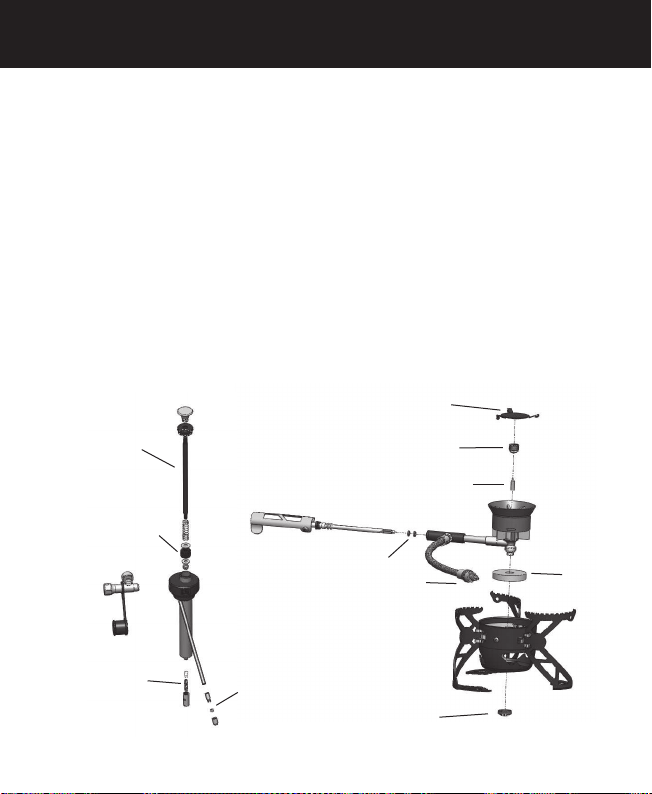
Pump rod
Pump leather
Quick
coupling
Pump valve
Fuel filter
Burner plate
Nozzle
Cleaning needle
O-rings
Wick
O-ring
Bottom nut
For simple maintenance of your Optimus Nova stove, the following spare parts are included with the
purchase:
1 ea Optimus lubricant ITEM NO. 8018276
1 ea Fuel filter ITEM NO. 8017456
2 ea O-rings ITEM NO. 8017877, 8017455 (2x)
We recommend that you perform regular maintenance in order to enhance the life and reliability of
the stove. For this purpose, Optimus provides a Regular Maintenance Kit ITEM NO. 8016305.
If you are going off on longer trips, we recommend that you take along Extensive Repair Kit ITEM
NO. 8017632 for your Optimus Nova stove. This will allow you to perform advanced maintenance
measures in the field.
WARRANTY
Optimus provides a 2-year warranty against manufacturing defects. Proof of purchase showing the
date the product was purchased and where is required for this warranty to be valid. The warranty is
valid for the original purchaser only. This warranty does not cover damage due to accident, improper
use or modifications carried out by the user. This warranty gives you specific legal rights and you
may have other legal rights which vary from state to state.
If you have any problems with your Optimus Nova, return it to your dealer or contact Optimus. Clear
food and dirt from the stove before handing it over.
For more information, contact your dealer or Optimus by e-mail: outdoor@optimus.se.
EN - SPARE PARTS
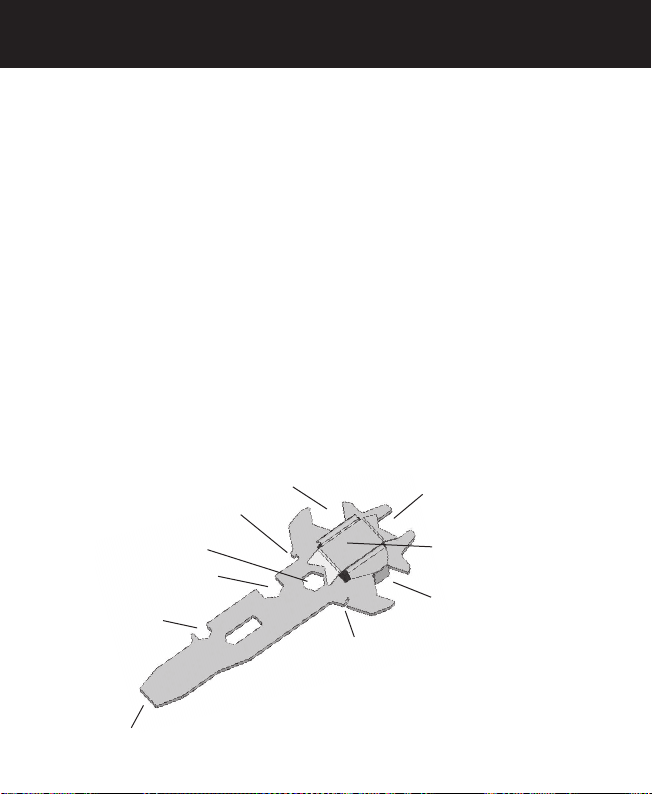
SERVICE FUNCTIONS OF THE MAGIC
TM
MULTITOOL
10 mm key for fuel
hose change
Cleaning magnets
12 mm key
Slot for adjusting
burner plate legs
7 mm key for pump
leather cup
8 mm slot for spindle nut
Screwdriver for jet adjustments
6 mm key
Hook for pump valve
11 mm key for
burner bottom nut
www.optimusstoves.com
M82-04
Print No. 8018185/1