
ENGLISH | 1
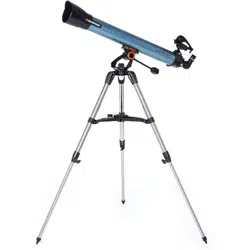
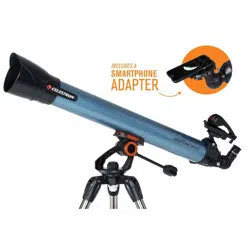
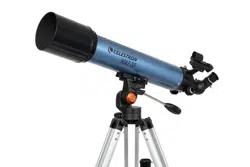
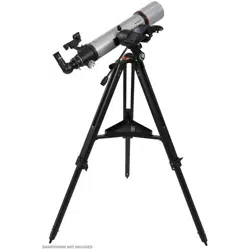
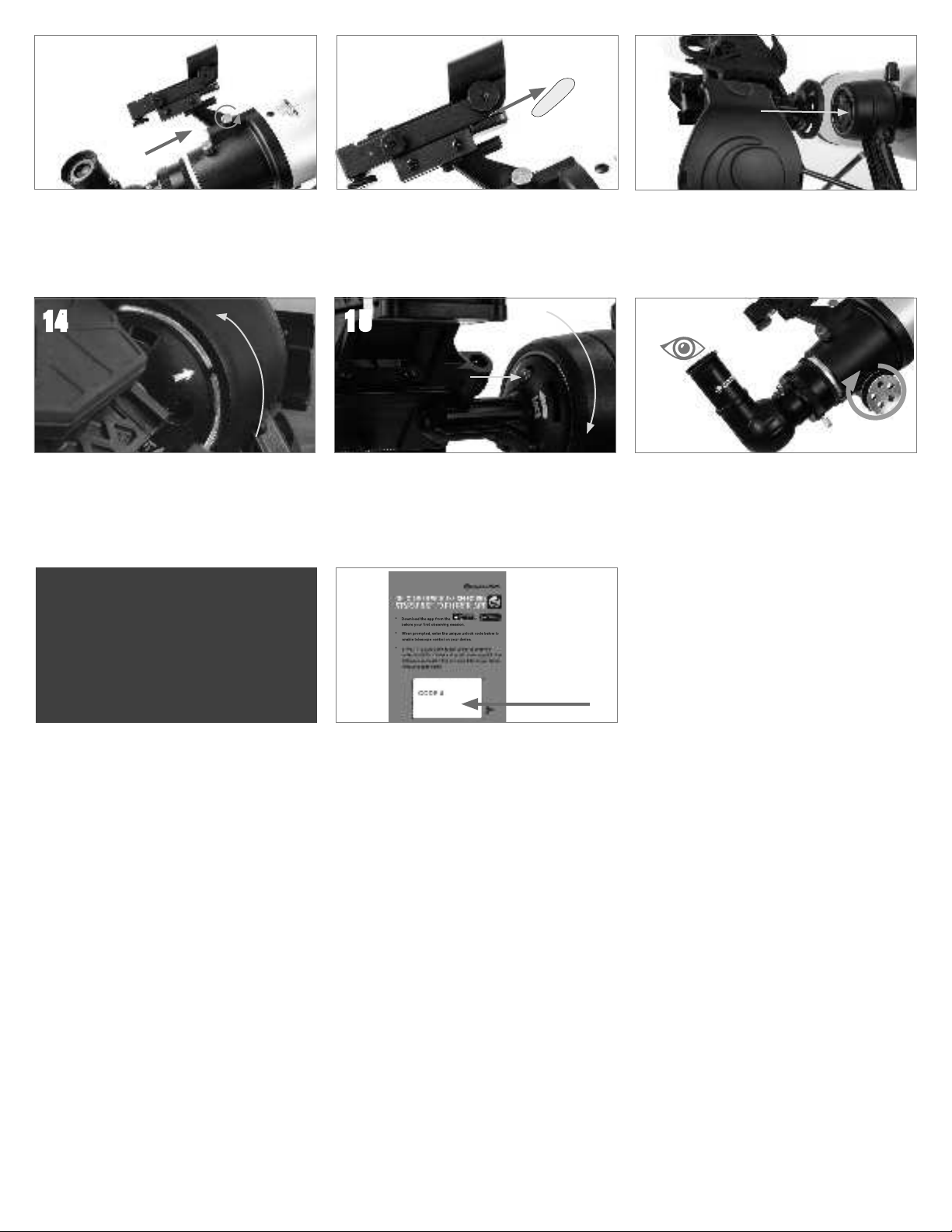
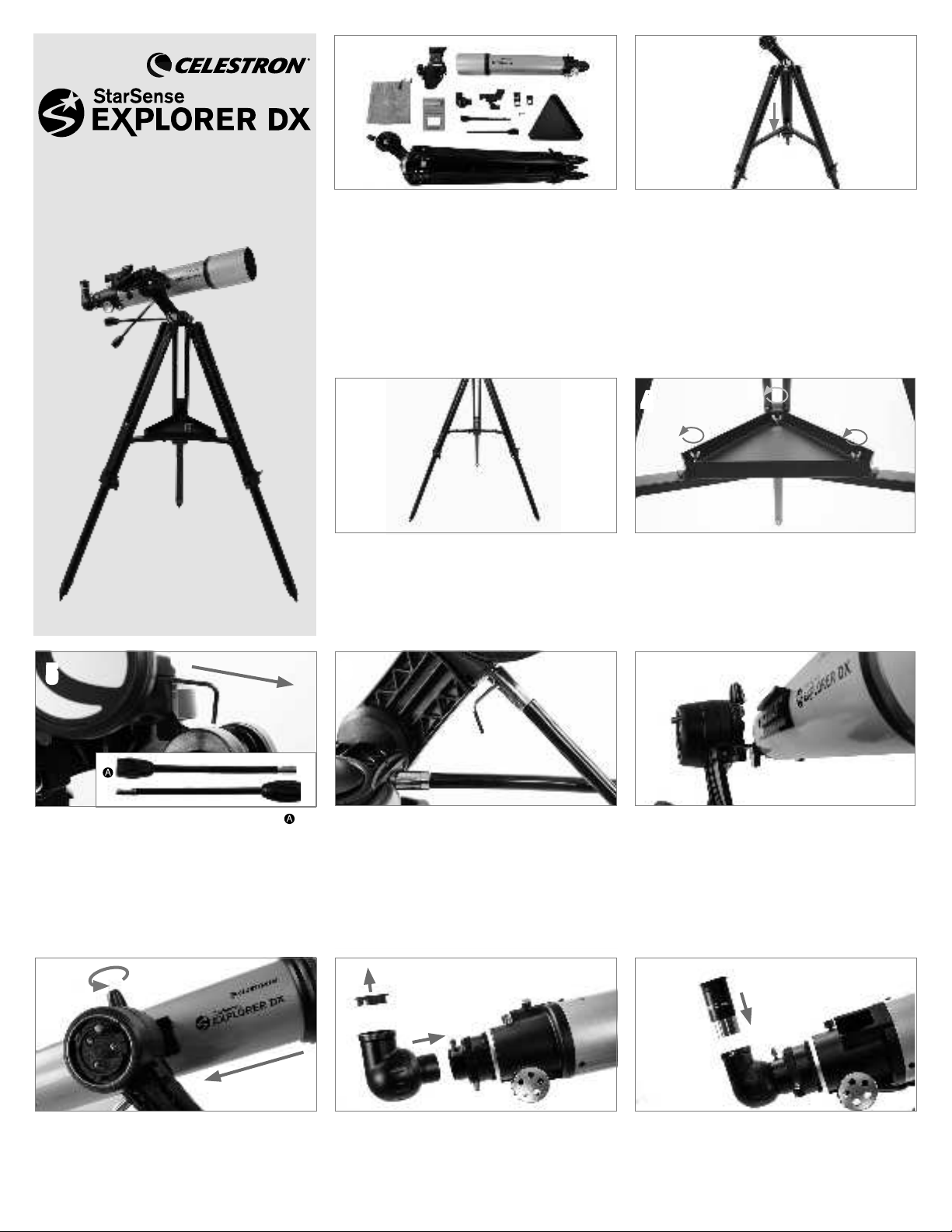
Unpack your telescope and verify that all parts are
present. Your StarSense Explorer DX includes:
a telescope tube, a tripod and mount head, an
accessory bag, slow motion controls, an accessory
tray, two eyepieces, an erect image diagonal, a
finderscope, a StarSense phone dock, StarSense
Explorer app code card, and a hex key (hidden inside
the slot in the front of the mount head).
To set up the tripod, spread the legs outward until
they are fully extended and push down the center leg
brace.
ITEM #22460
Extend the legs of the tripod by loosening the three
hand knobs on each leg. Pull each leg section all
the way out and tighten the hand knobs to secure
them in place.
ENGLISH
102AZ
Quick Setup Guide
Place the accessory tray on top of the center brace
and line up the three holes. Insert the three thumb
screws through the bottom of the leg brace and
thread them into the tray.
To attach the slow-motion knobs
to your mount,
first locate the supplied hex key hidden inside the
slot in the front of your mount.
Place the slow-motion control knob over the
D-shaped gear shaft and push inward to make sure
it is fully seated. Use the hex key to tighten the
setscrews onto the gear shaft. Return the hex key to
its storage position in the front of the mount.
Hold the telescope tube next to the mount with the
dovetail bar on the tube facing the clamp on the top
of the mount arm.
Slide the dovetail bar into the clamp at the top of
the mount and tighten the hand knob on the bottom
of the clamp to secure the telescope in place.
Locate the erect image diagonal and remove the
plastic covers. Insert the barrel of the diagonal into
the focuser and secure in place by tightening the set
screws.
Insert the barrel of the 25 mm eyepiece into the
diagonal and tighten the set screw.
2
4
5
6
7
8
9
10
1
3
2 | ENGLISH
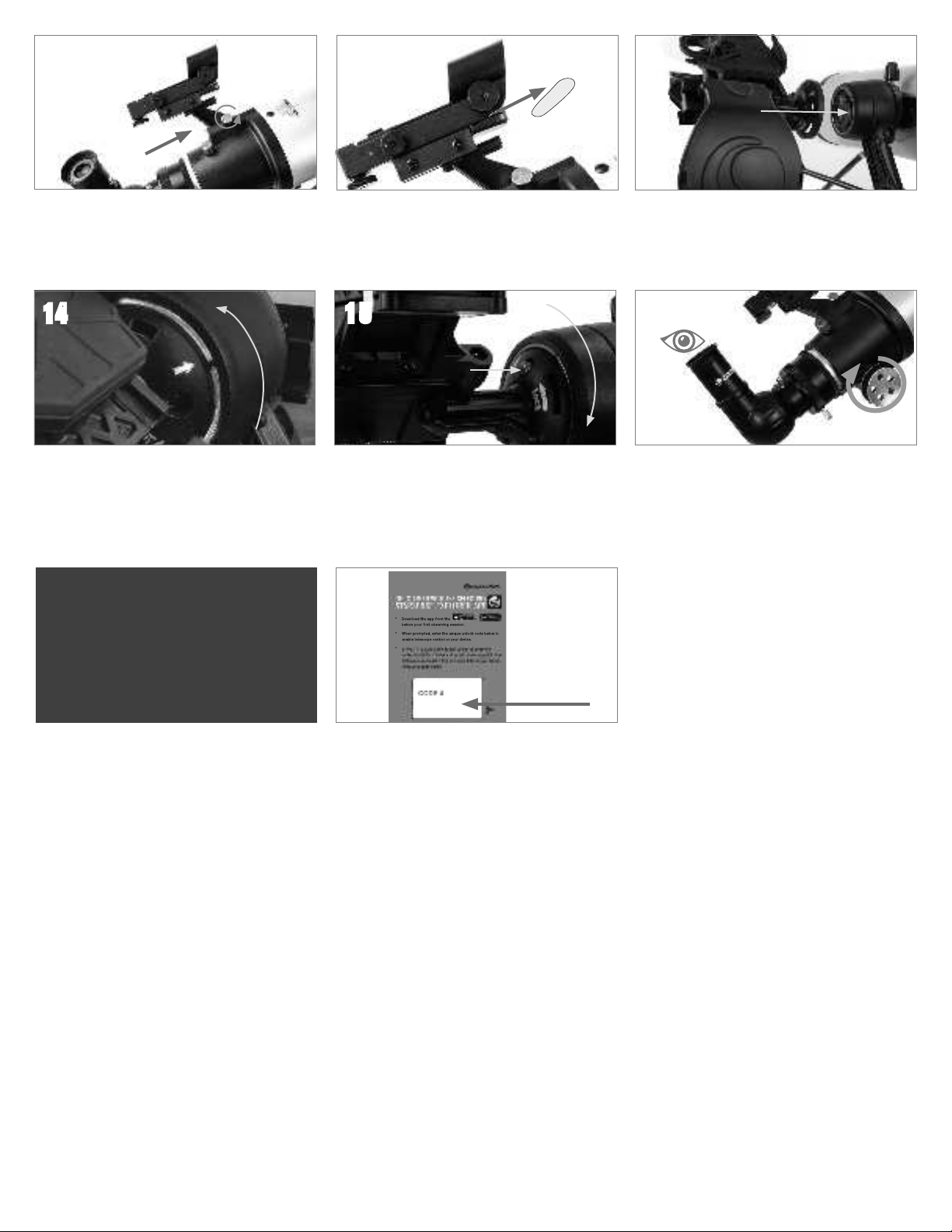
To install the StarSense phone dock, insert the
bayonet mount on the side of the dock into the
port on the side of the mount opposite the dovetail
clamp.
Slide the finderscope bracket into the dovetail slot
on the telescope tube near the focuser. The large
window on the finder should be facing the front
of the telescope. Secure the bracket by tightening
the setscrew on the dovetail slot.
Line up the arrow on the dock with the alignment
mark on the mount and press inward while turning
the dock counterclockwise until the orange release
button snaps into place in the hole on the dock.
To remove the dock, press the orange release button
and turn the dock clockwise until the bayonet mount
releases.
Remove the lens cap from the front of the
telescope. To observe, look through the eyepiece
as shown above. Focus the image by turning the
knobs below the focuser.
There is a small clear plastic tab inserted between the
battery and the contact. This was included to prevent
the battery from discharging during shipment. Pull
this out to allow your battery to work.
Downloading and
Activating the App
Before you take your telescope outside, download
the StarSense Explorer app to your mobile device.
Search for “Celestron StarSense Explorer” in the
Apple App Store or Google Play. The app is large,
so we recommend downloading it while connected
to Wi-Fi.
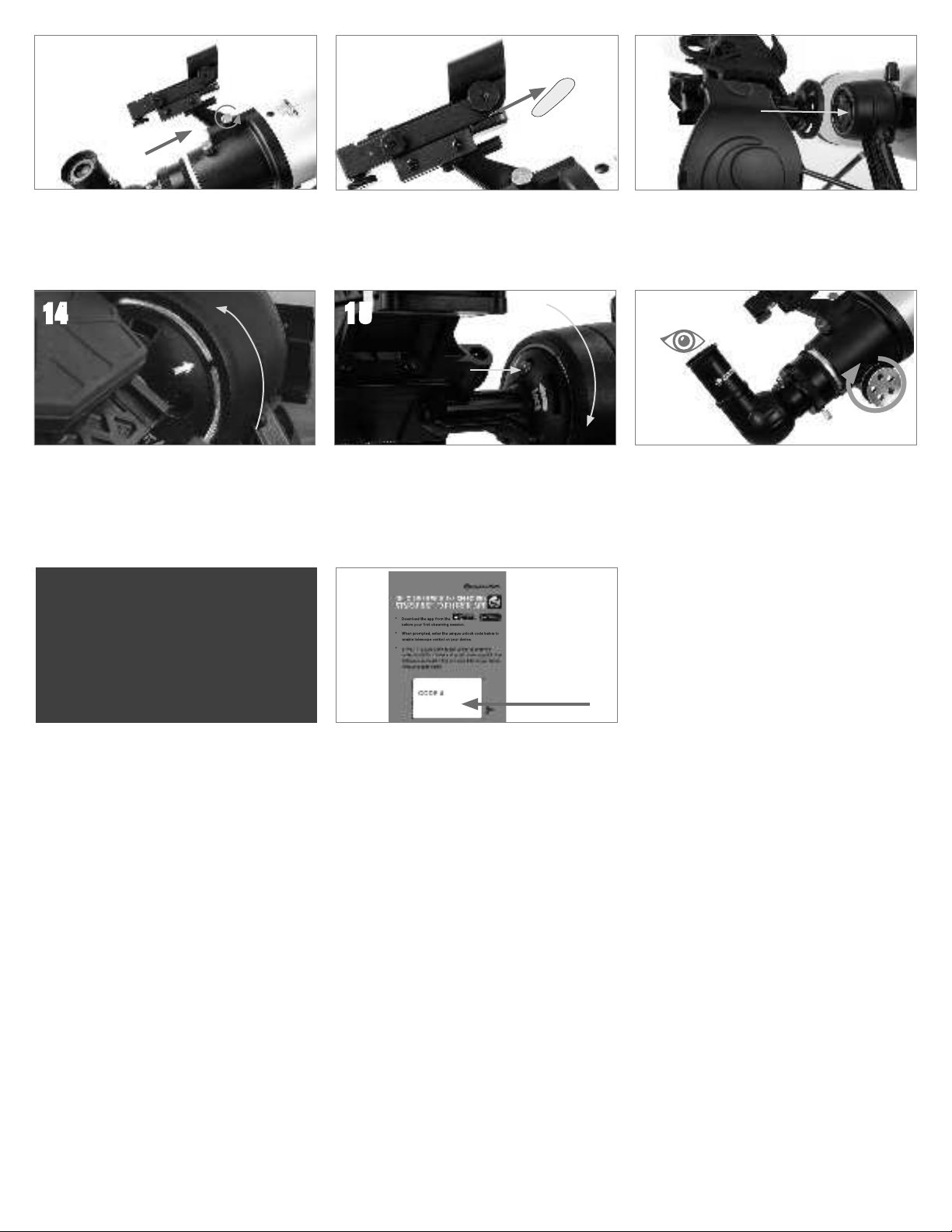
Once you have downloaded the app, locate the
orange postcard in your telescope box. Launch the
app. When prompted, enter the activation code on
the postcard to activate the app. Your code will
unlock up to 5 devices.
14
16
131211
15
1
ENGLISH | 3
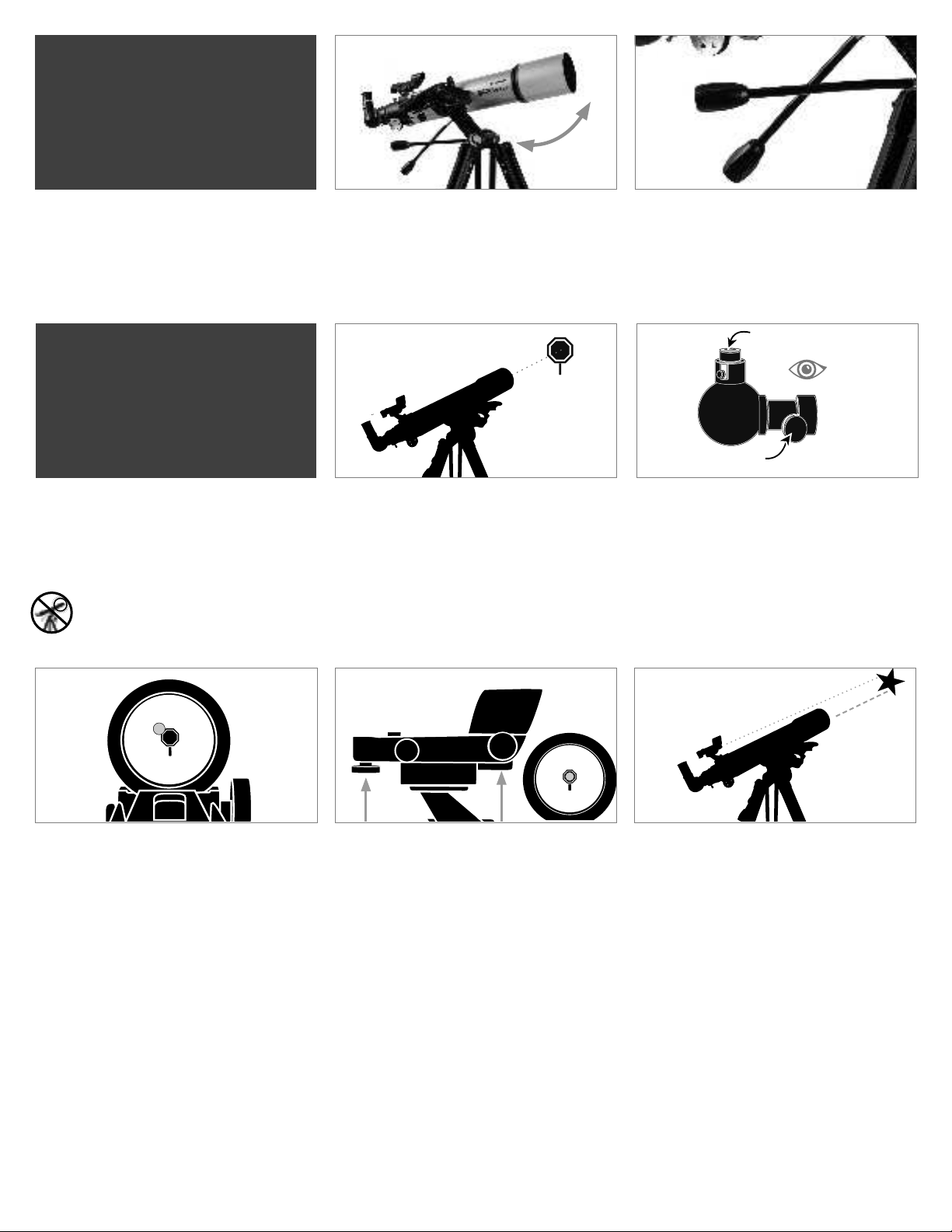
The StarSense Explorer DX mount has slip clutches
in both axes. To make large movements with the
telescope, simply hold a tripod leg with one hand
and use the other hand on the telescope tube to
push the telescope in the desired direction.
To make fine adjustments or to track celestial
objects, turn both slow motion knobs as required.
Moving the
Telescope
CENTER THE TARGET IN THE EYEPIECE
Look through the telescope using your lower
powered eyepiece. Move the telescope until the
object you chose lies in the center of the view. If the
image is blurry, gently turn the focus knobs on either
side of the telescope until it comes into sharp focus.
NOTE: The image in your telescope may appear
inverted. This is perfectly normal in an
astronomical telescope.
Aligning the
Finderscope
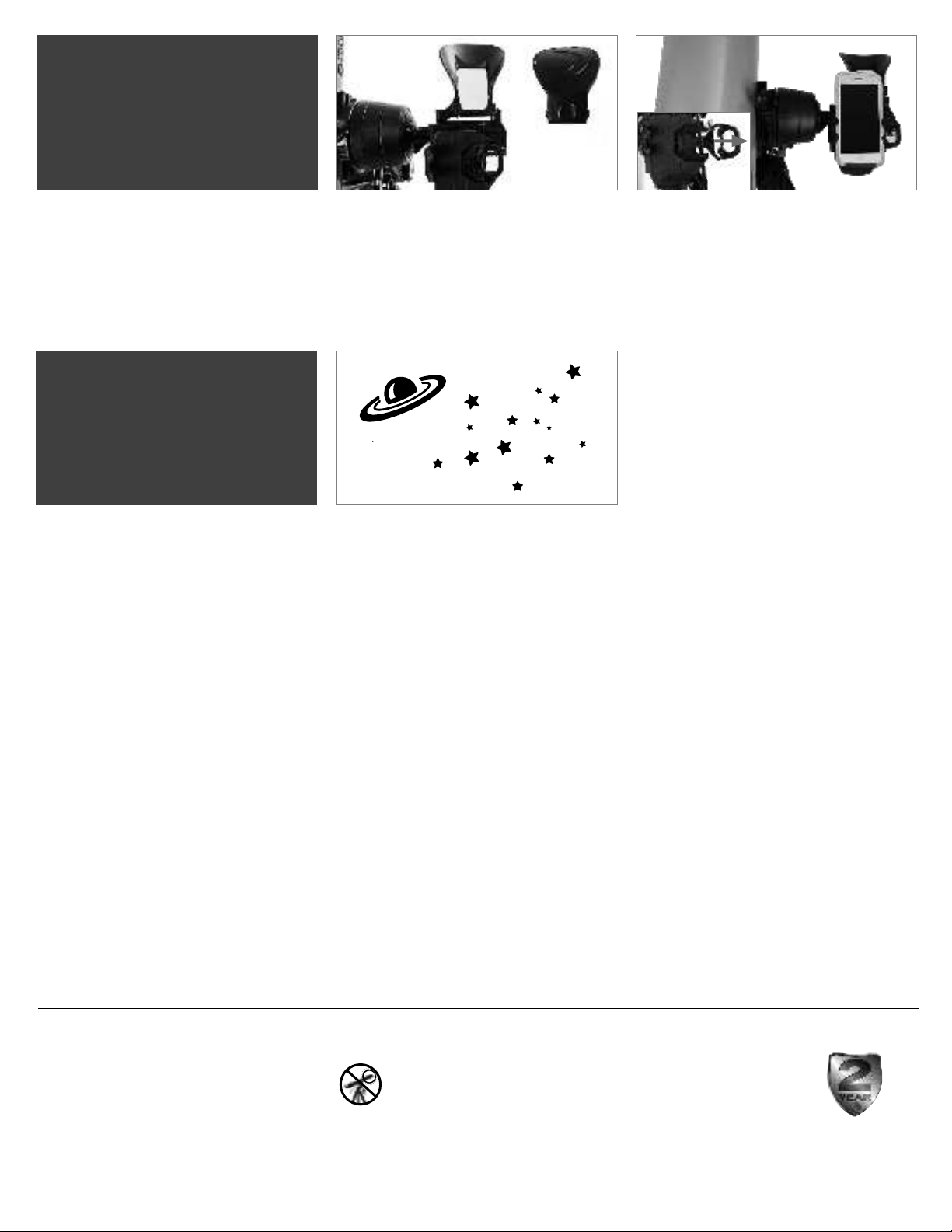
The finder is one of the most important parts of your
telescope. It helps you locate objects and center
them in the eyepiece. The first time you assemble
your telescope, you need to align the finder to the
telescope’s main optics. It’s best to do this during
the day*.
*SOLAR WARNING! Never attempt to
view the Sun through any telescope without
a proper solar filter!
CHOOSE A TARGET
Take the telescope outside during the day and find
an easily recognizable object, such as a streetlight,
car license plate or sign. The object should be as far
away as possible, but at least a quarter mile away.
ADJUST THE FINDERSCOPE
Without moving the telescope, use the two
adjustment knobs to move the finder around until
the red dot appears over the same object you are
observing in the telescope’s 25 mm eyepiece.
YOUR FINDERSCOPE IS NOW ALIGNED!
It should not require realignment unless it is bumped
or dropped.
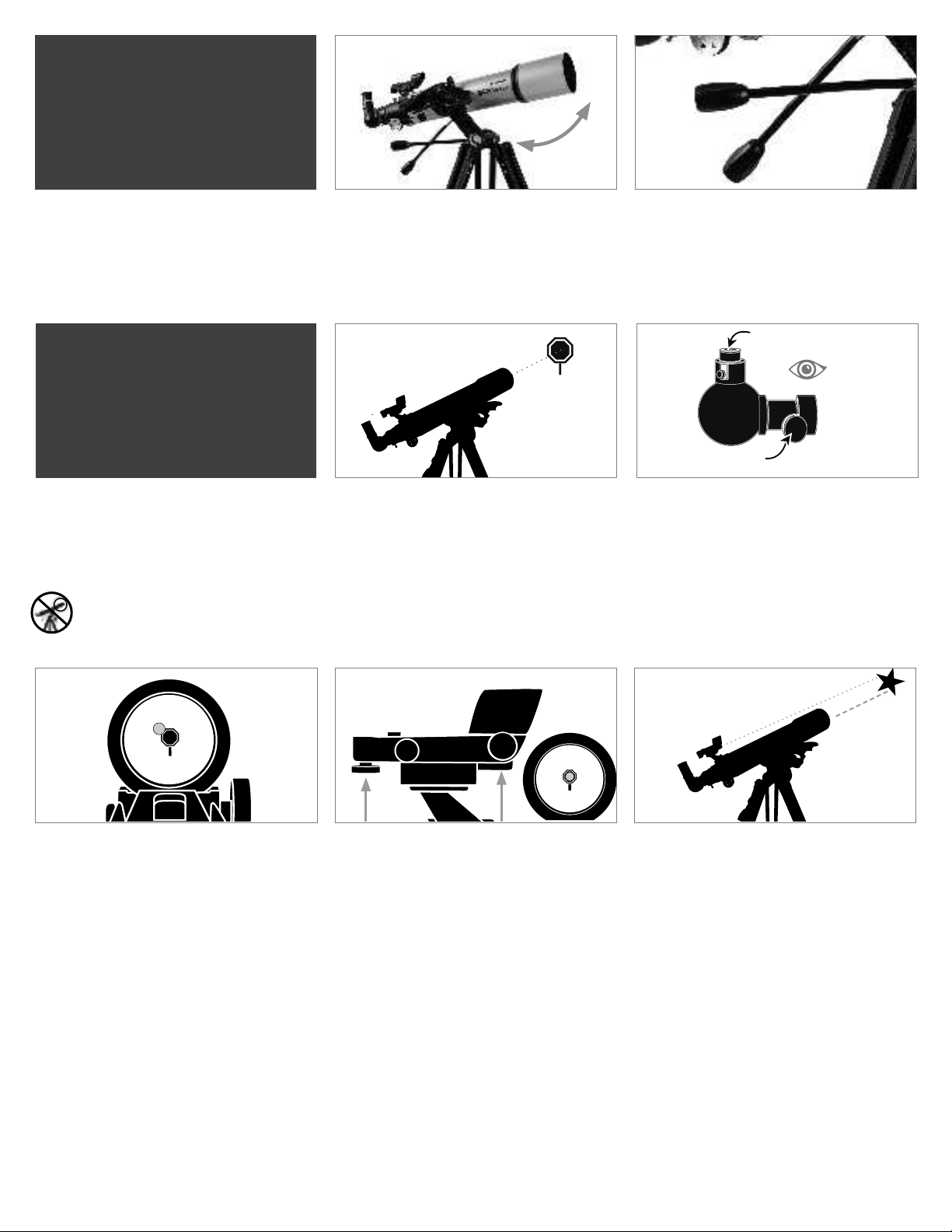
LOOK THROUGH FINDERSCOPE
Once the object is centered in your 25 mm eyepiece,
look through the finderscope and locate the red dot.
25 mm Eyepiece
Focus Knobs
1 2
3 4 5
1 2
4 | ENGLISH
Your First
Night Out
Congratulations! Your telescope is now set up
and you are ready to explore the cosmos. Take the
telescope outside, insert your 25 mm eyepiece,
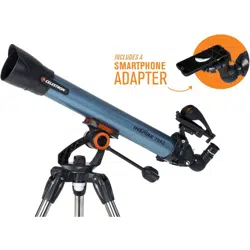
remove the lens cap, insert your smartphone into the
holder, and launch the StarSense Explorer app. The
tutorial in the app will walk you through the steps on
finding your first astronomical target.
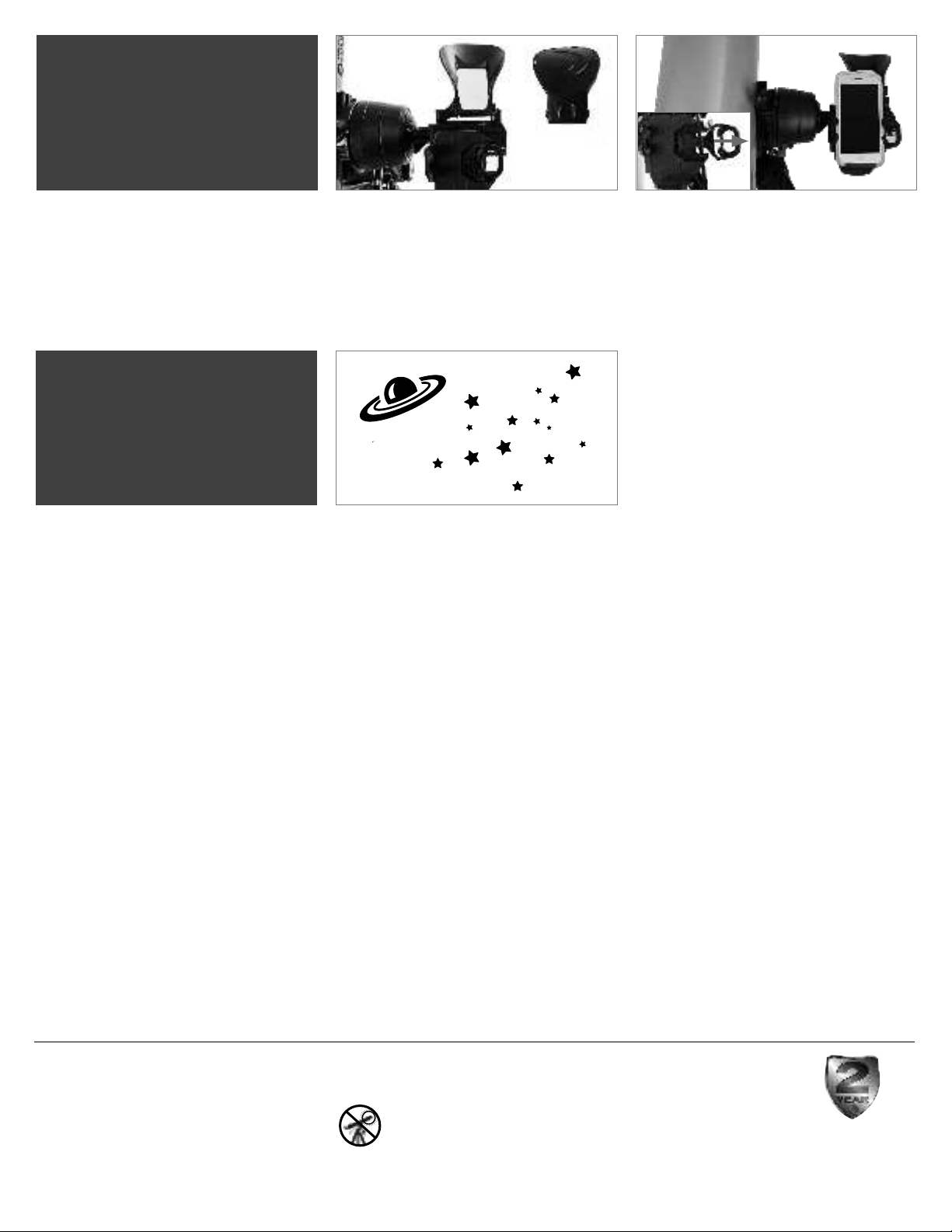
Attaching the
Smartphone
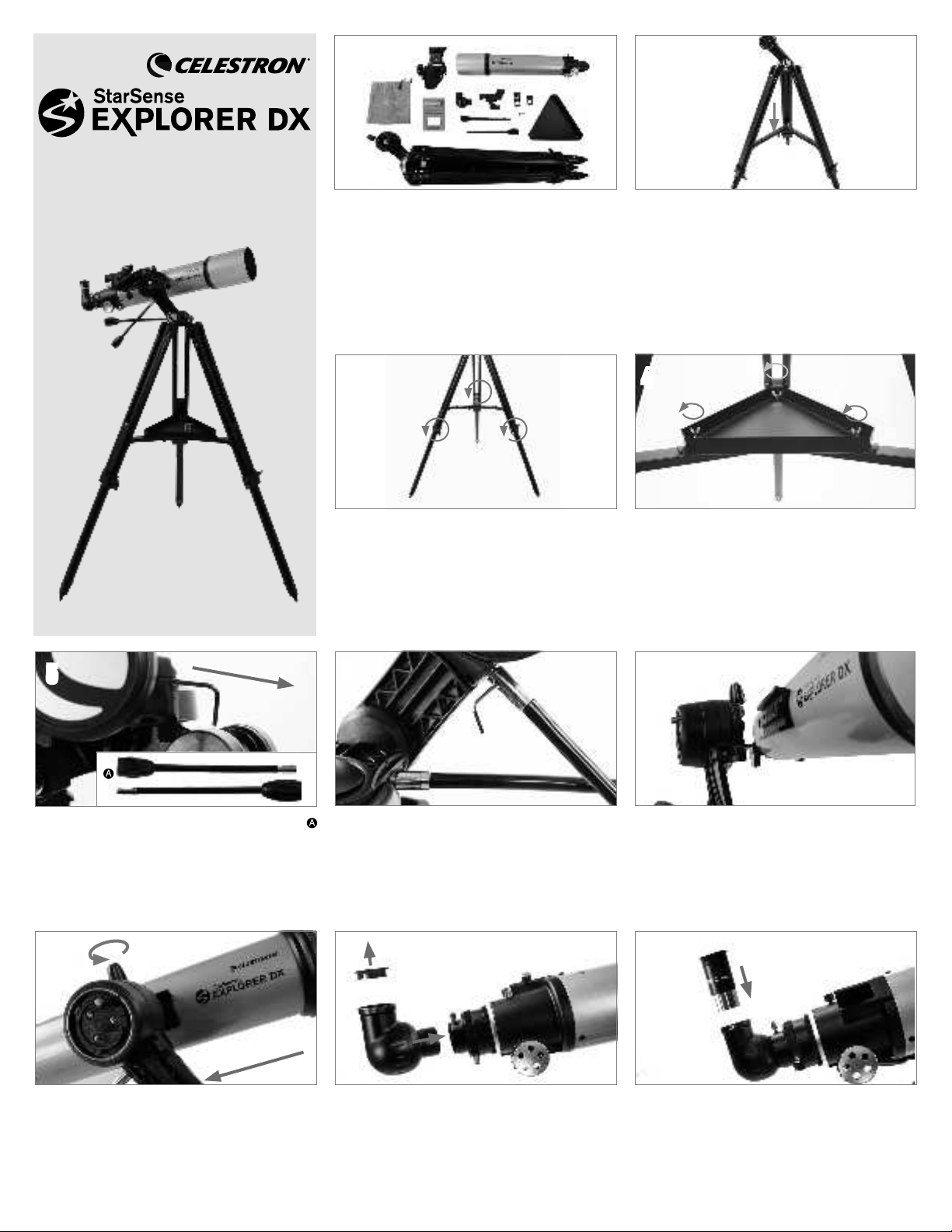
Remove the large cap covering the mirror on the front
of the StarSense dock.
Pull open the spring loaded slider on the top of the
phone dock and set the phone into the holder so
it is flush with the bottom lip of the phone holder.
Slowly release the slider to secure the phone in
place. Most phones fit into the dock with the case
on. However, you may need to remove your phone
case if it is especially bulky or unable to fit into the
clamp (i.e. folio style cases).
For more information on this product, please visit the respective product page
on celestron.com
SOLAR WARNING:
Never attempt to view the sun through any telescope without a proper solar filter.
Need assistance?
Contact Celestron Technical Support celestron.com/pages/technical-support
08-19
www.celestron.com/pages/warranty
1 2
FRANÇAIS | 5
Déballez votre télescope, et vérifiez que toutes les
pièces sont présentes. Votre StarSense Explorer DX
comprend: un tube de télescope, un trépied avec
une tête de monture, deux molette de contrôle de
mouvement ralenti, une sacoche à accessoires, un
plateau à accessoires, deux oculaires, un chercheur,
un renvoi coudé, un support pour téléphone
StarSense et une clef hexagonale (cachée dans le
logement situé sur l’avant de la monture).
Pour installer le trépied, écartez les pieds vers
l’extérieur jusqu’à ce qu’ils soient complètement
étendus et appuyez sur l’entretoise centrale.
ARTICLE #22460
Étendez les pieds du trépied en desserrant les trois
molettes situées sur chaque pied. Tirez chaque
section des pieds au maximum et serrez les molettes
pour les fixer en place.
FRANÇAIS
102AZ
Guide d’installation rapide
Placez le plateau à accessoires sur le dessus de
l’entretoise centrale et alignez les trois trous. Insérez
les trois vis à main dans le dessous de l’entretoise et
vissez-les dans le plateau.
Pour attacher les molettes de mouvement ralenti
à la monture, repérez d’abord la clef hexagonale qui
se trouve dans le logement situé sur l’avant de la
monture.
Installez la molette de contrôle de mouvement
ralenti sur le moyeu d’engrenage en D et appuyez
dessus pour vous assurer qu’elle est complètement
enfoncée. Utilisez la clef hexagonale pour serrer les
vis de fixation sur la tige de l’engrenage. Remettez
la clef hexagonale dans son logement sur l’avant de
la monture.
Tenez le tube du télescope à côté de la monture, la
barre à queue d'aronde sur le tube orientée vers le rail
situé sur le dessus du bras de monture.
Faites glisser la barre à queue d’aronde dans le rail
situé sur le dessus de la monture et serrez la molette
à main située sur le dessous du rail pour fixer le
télescope en place.
Trouvez le renvoi coudé dans la boîte et retirez les
capuchons de plastique. Insérez le barillet du renvoi
coudé dans le système de mise au point et fixez-le en
serrant les vis à main.
Insérez le barillet de l'oculaire de 25 mm dans le
renvoi coudé et serrez les vis.
2
4
5
6
7
8
9
10
1
3
6 | FRANÇAIS
Faites glisser le support du chercheur dans le rail de
queue d'aronde sur le tube du télescope, à proximité
du système de mise au point. La plus grande fenêtre
du chercheur doit être orientée vers l’avant du
télescope. Fixez le support en serrant la vis de fixation
sur le rail de queue d'aronde.
Pour installer le support de téléphone StarSense,
insérez la monture à baïonnette située sur le côté du
support dans le port situé sur le côté opposé au rail
de queue d'aronde.
14
16
131211
15
1
Alignez la flèche sur le support avec la marque
d’alignement sur la monture et appuyez dessus tout
en faisant tourner le support dans le sens inverse des
aiguilles d'une montre jusqu’à ce que le bouton de
libération s’enclenche dans le trou du support.
Alignez la flèche sur le support avec la marque
d’alignement sur la monture et appuyez dessus tout
en faisant tourner le support dans le sens inverse
des aiguilles d'une montre jusqu’à ce que le bouton
de libération s’enclenche dans le trou du support.
Pour retirer le support, appuyez sur le bouton de
libération orange et faites tourner le support dans
le sens des aiguilles d'une montre jusqu’à ce que la
monture à baïonnette se libère.
Télécharger et
activer l’application
Avant de sortir votre télescope de chez vous,
téléchargez l’application StarSense Explorer sur votre
appareil mobile. Recherchez « Celestron StarSense
Explorer » dans l’Apple App Store ou Google Play.
L’application est de grande taille, alors nous vous
recommandons de la télécharger via une connexion
Wi-Fi.
Une fois que vous avez téléchargé l’application,
munissez-vous de la carte orange présente dans
la boîte de votre télescope. Lancez l’application.
Lorsqu’il vous est demandé de le faire, saisissez le
code indiqué sur la carte pour activer l’application.
Votre code est valable pour activer 5 appareils au
maximum.
Une petite languette de plastique est insérée entre la
pile et son contact. Cette languette est présente pour
éviter que la pile ne se décharge pendant le transport.
Retirez-la pour activer la pile.
FRANÇAIS | 7
Oculaire de 25 mm
Molettes de mise au point
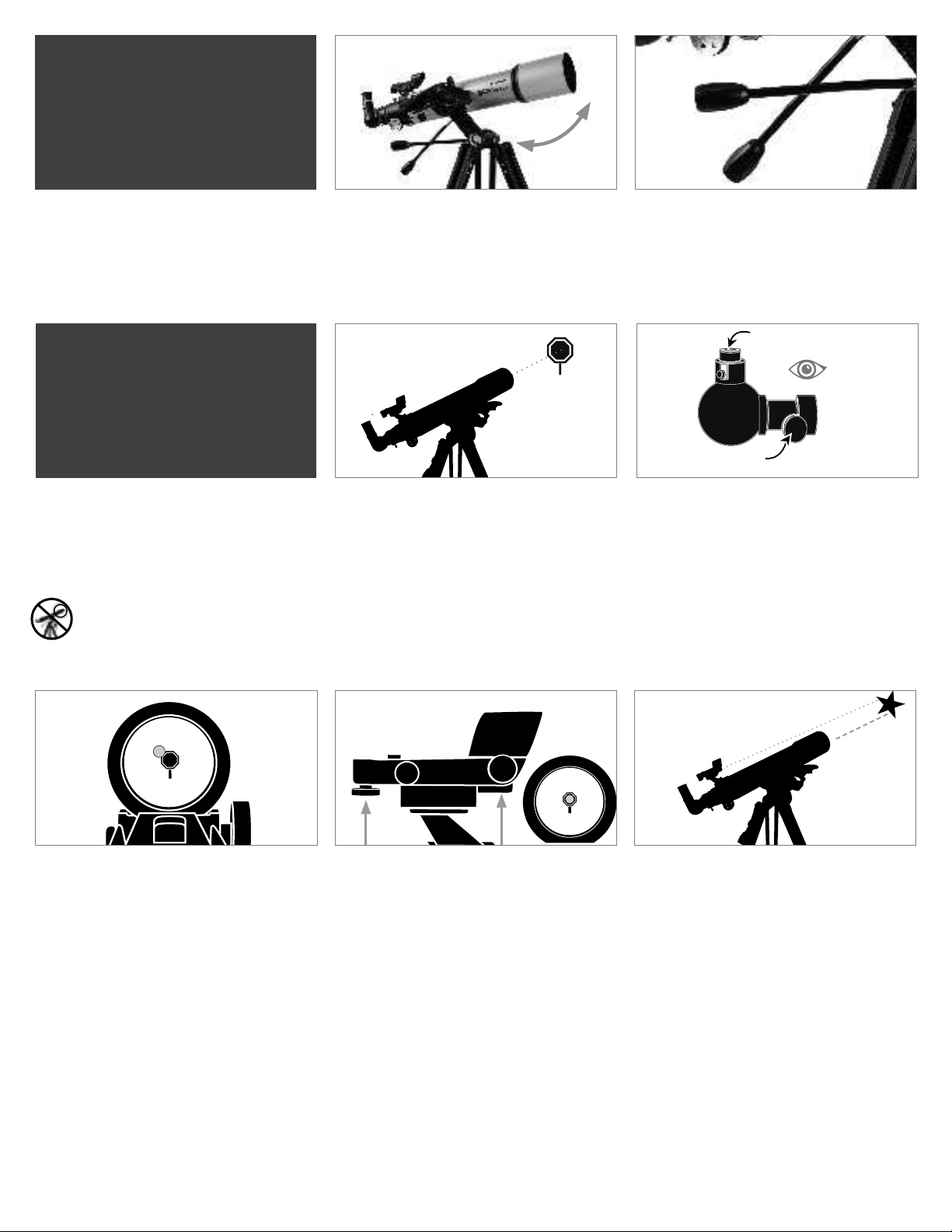
La monture StarSense Explorer DX dispose de
freins de mouvement sur chaque axe. Pour effectuer
de larges mouvements avec le télescope, tenez
simplement un pied du trépied d’une main, et de
l’autre, poussez le tube du télescope dans la direction
opposée.
Pour affiner l’orientation, ou suivre des objets célestes,
faites tourner chacune des molettes de mouvement
ralenti comme désiré.
CENTRER LA CIBLE DANS L'OCULAIRE
Regardez dans le télescope en utilisant votre oculaire
basse puissance. Déplacez le télescope jusqu’à que
l’objet choisi se trouve au centre du champ de vision.
Si l’image est floue, faites doucement tourner l’une
ou l’autre molette de mise au point jusqu’à ce que
l’image soit nette.
NOTE:
L’image observée dans votre télescope peut
apparaître inversée. Cela est parfaitement
normal pour un télescope astronomique.
Le chercheur est l'un des composants les importants
de votre télescope. Il vous aide à localiser des objets
et à les centrer dans votre oculaire. La première fois
que vous assemblez votre télescope, vous devez
aligner le chercheur avec le système optique principal
du télescope. Il est plus facile d'effectuer cette
opération pendant la journée*.
* AVERTISSEMENT SUR LE SOLEIL!
N’essayez jamais d’observer le soleil à l’aide
d’un télescope sans utiliser un filtre solaire
adéquat.
CHOISIR UNE CIBLE
Installez le télescope à l’extérieur en journée, et
repérez un objet aisément reconnaissable, comme
un feu de signalisation, une plaque d’immatriculation
ou un panneau. L’objet doit se situer aussi loin que
possible, mais à au moins un quart de mile de vous.
AJUSTER LE CHERCHEUR
Sans déplacer le télescope, utilisez les deux molettes
de réglage pour orienter le chercheur, jusqu’à ce que
point rouge apparaisse en superposition avec l’objet
observé dans l’oculaire de 25 mm.
VOTRE CHERCHEUR EST MAINTENANT
ALIGNÉ !
Il n’aura pas besoin d’être aligné de nouveau tant qu’il
n’aura pas subi un choc ou qu’il sera tombé.
REGARDER DANS LE CHERCHEUR
Une fois l’objet centré dans votre oculaire de 25 mm,
regardez dans le chercheur et localisez point rouge.
Orienter le télescope
Aligner le chercheur
1 2
3 4 5
1 2
8 | FRANÇAIS
Attacher le
téléphone
intelligent
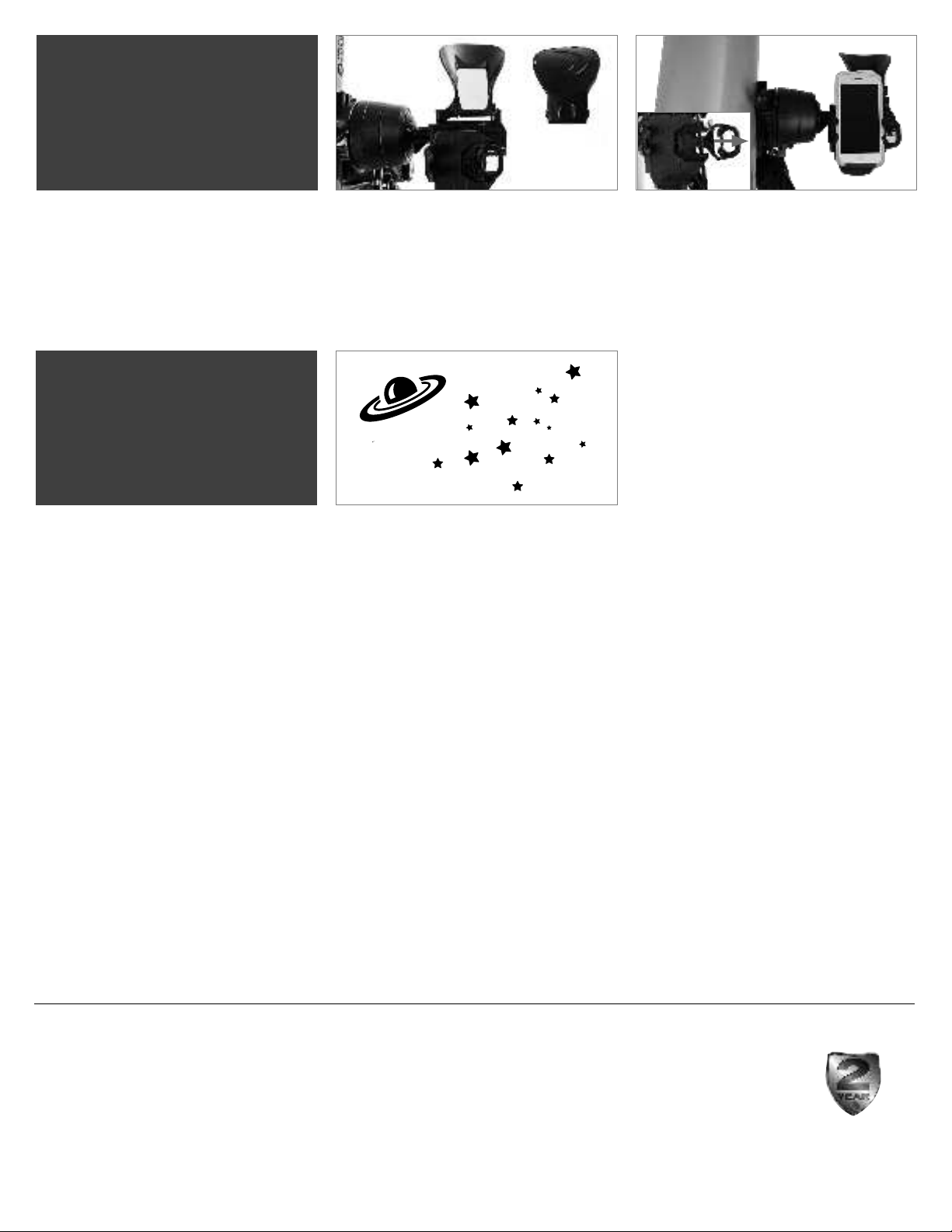
Retirez le grand cache couvrant le miroir sur le devant
du support StarSense.
Ouvrez la glissière à ressort située sur le dessus du
support de téléphone et installez le téléphone pour
qu’il soit à niveau sur le rebord du bas du support
de téléphone. Relâchez la glissière en douceur pour
maintenir le téléphone en place. La plupart des
téléphones pourront être placés dans le support
avec leur étui. Il peut cependant être nécessaire de
retirer l’étui de votre téléphone, s’il est spécialement
épais ou qu’il n’est pas compatible avec la pince (par
ex. les étuis de type folio).
Félicitations! Votre télescope est maintenant configuré
et vous êtes prêt à explorer le cosmos. Sortez avec
votre télescope, insérez votre oculaire de 25 mm,
retirez le cache de lentille, insérez votre téléphone
intelligent dans le support et lancez l’application
StarSense Explorer. Le tutoriel de l’application vous
expliquera les étapes nécessaires pour trouver votre
première cible astronomique.
Votre première nuit
d’observation
Pour en savoir plus sur ce produit, visitez la page correspondante du produit sur
celestron.com.
AVERTISSEMENT SUR LE SOLEIL:
N’essayez jamais d’observer le soleil à l’aide d’un télescope sans utiliser un filtre solaire adéquat.
Besoin d'assistance?
Prenez contact avec l’assistance technique de Celestron à l’adresse celestron.com/pages/technical-support
08-19
www.celestron.com/pages/warranty
1 2
DEUTSCH | 9
ARTIKELNR. 22460
DEUTSCH
102AZ
Kurzanleitung zur Einrichtung
Packen Sie Ihr Teleskop aus und überprüfen sie die
Vollständigkeit aller Teile. Ihr StarSense Explorer
DX enthält: einen Teleskoptubus, ein Stativ und
einen Montierungskopf, eine Zubehörablage, zwei
Feineinstellungsregler, eine Zubehörtasche, zwei
Okulare, ein Sucherfernrohr, einen Zenitspiegel für
aufrechtes Bild, ein StarSense-Telefondock, eine
StarSense Explorer App-Codekarte und einen
Inbusschlüssel (im Schlitz auf der Vorderseite des
Montierungskopfs versteckt).
Zum Aufbau des Stativs die Beine nach außen ziehen,
bis sie vollständig ausgezogen sind. Drücken Sie die
mittlere Beinstrebe nach unten.
Ziehen Sie die Beine des Stativs heraus, indem Sie
die drei Knöpfe an jedem Bein lösen. Ziehen Sie
jeden unteren Beinabschnitt ganz heraus und ziehen
Sie die Knöpfe fest, um die Beine zu sichern.
Platzieren Sie die Zubehörablage oben auf der
mittleren Stützstrebe und richten Sie sie mit den drei
Löchern aus. Führen Sie die drei Rändelschrauben
durch die Unterseite der Beinstrebe und schrauben
Sie sie in die Ablage.
Um die Feineinstellungsregler
an Ihrer Montierung
zu befestigen, suchen Sie zuerst den mitgelieferten
Inbusschlüssel, der im Schlitz auf der Vorderseite Ihrer
Montierung versteckt ist.
Setzen Sie den Feineinstellungsregler auf die
D-förmige Getriebewelle und drücken Sie ihn nach
innen, um sicherzustellen, dass er fest sitzt. Ziehen
Sie die Stellschrauben mit dem Inbusschlüssel auf der
Getriebewelle fest. Stecken Sie den Inbusschlüssel
wieder in seinen Aufbewahrungsort auf der Vorderseite
der Montierung.
Halten Sie den Teleskoptubus neben die Montierung,
wobei die Schwalbenschwanzstange am Tubus zur
Klemme oben am Montierungsarm zeigt.
Schieben Sie die Schwalbenschwanzstange in die
Klemme oben an der Montierung und ziehen Sie den
Knopf unten an der Klemme fest, um das Teleskop zu
sichern.
Nehmen Sie den Zenitspiegel für aufrechtes Bild
und entfernen Sie die Kunststoffabdeckungen.
Setzen Sie die Steckhülse des Zenitspiegels in den
Fokussierer ein und sichern sie ihn durch Anziehen
der Stellschrauben.
Setzen Sie die Steckhülse des 25-mm-Okulars in den
Zenitspiegel ein und ziehen Sie die Stellschrauben
fest.
2
4
5
6
7
8
9
10
1
3
10 | DEUTSCH
Schieben Sie die Sucherfernrohrhalterung in den
Schwalbenschwanzschlitz am Teleskoptubus in
der Nähe des Fokussierers. Das große Fenster am
Sucherfernrohr muss zur Vorderseite des Teleskops
zeigen. Befestigen Sie die Halterung, indem Sie
die Stellschraube am Schwalbenschwanzschlitz
festziehen.
Nehmen Sie den Objektivdeckel vorne am Teleskop
ab. Schauen Sie zum Beobachten durch das Okular,
wie oben dargestellt. Stellen Sie das Bild scharf,
indem Sie die Knöpfe unterhalb des Fokussierers
drehen.
Richten Sie den Pfeil auf dem Dock mit der
Ausrichtungsmarkierung auf der Montierung aus
und drücken Sie das Dock nach innen, während
Sie es gegen den Uhrzeigersinn drehen, bis der
orangefarbene Entriegelungsknopf in der Öffnung am
Dock einrastet.
Drücken Sie zum Entfernen des Docks den
orangefarbenen Entriegelungsknopf und drehen
Sie das Dock im Uhrzeigersinn, bis sich der
Bajonettverschluss löst.
Um das StarSense-Telefondock zu installieren,
stecken Sie den Bajonettverschluss an der Seite des
Docks in den Anschluss auf der Seite der Montierung
gegenüber der Schwalbenschwanzklemme ein.
App herunterladen
und aktivieren
Laden Sie die StarSense Explorer-App auf Ihr
Mobilgerät herunter, bevor Sie Ihr Teleskop mit nach
draußen nehmen. Suchen Sie im Apple App Store
oder bei Google Play nach „Celestron StarSense
Explorer“. Die App ist groß. Daher empfehlen
wir, sie über eine bestehende WLAN-Verbindung
herunterzuladen.
Nehmen Sie nach dem Herunterladen der
App die orangefarbene Postkarte aus Ihrer
Teleskopverpackung. Starten Sie die App. Wenn
Sie dazu aufgefordert werden, geben Sie den
Aktivierungscode auf der Postkarte ein, um die App zu
aktivieren. Ihr Code kann bis zu 5 Geräte entsperren.
Zwischen Batterie und Kontakt befindet sich ein
kleiner durchsichtiger Kunststoff-Abstandshalter.
Dieser wurde eingesetzt, um während des Versands
ein Entladen der Batterie zu verhindern. Ziehen
Sie diesen Abstandshalter zur Inbetriebnahme der
Batterie heraus.
14
16
131211
15
1
DEUTSCH | 11
25-mm Okular
Fokussierknöpfe
Die StarSense Explorer DX-Montierung hat
Rutschkupplungen an beiden Achsen. Um mit dem
Teleskop große Bewegungen auszuführen, halten Sie
einfach ein Stativbein mit einer Hand und drücken Sie
mit der anderen Hand auf den Teleskoptubus, um das
Teleskop in die gewünschte Richtung zu bewegen.
Drehen Sie beide Feineinstellungsregler nach
Bedarf, um Feineinstellungen vorzunehmen oder
Himmelsobjekte zu verfolgen.
Bewegen des
Teleskops
ZENTRIEREN SIE DAS ZIEL IM OKULAR
Schauen Sie mit Ihrem Okular bei niedrigerer
Vergrößerungsleistung durch das Teleskop.
Schwenken Sie das Teleskop, bis das ausgewählte
Objekt im Zentrum des Sichtfelds liegt. Ist
das Bild unscharf, drehen Sie langsam an den
Fokussierknöpfen, bis das Bild scharf wird.
HINWEIS: Das Bild in Ihrem Teleskop erscheint
möglicherweise invertiert. Das ist für ein Astronomie-
Teleskop völlig normal.
Ausrichten des
Sucherfernrohrs
Das Sucherfernrohr ist eines der wichtigsten Teile
Ihres Teleskops. Es hilft Ihnen, Objekte zu suchen
und im Okular zu zentrieren. Wenn Sie Ihr Teleskop
zum ersten Mal zusammenbauen, müssen Sie das
Sucherfernrohr auf die Hauptoptik des Teleskops
ausrichten. Dies tun Sie am besten tagsüber*.
*SONNENSTRAHLEN-WARNHINWEIS!
Niemals ohne einen vorschriftsmäßigen
Sonnenfilter durch ein Teleskop in die Sonne
schauen!
WÄHLEN SIE EIN ZIEL
Nehmen Sie das Teleskop tagsüber mit nach draußen
und suchen Sie ein leicht erkennbares Objekt wie
z.B. eine Straßenlaterne, ein Kfz-Kennzeichen oder
ein Schild. Das Objekt sollte so weit wie möglich,
aber mindestens 400 Meter entfernt sein.
STELLEN SIE DAS SUCHERFERNROHR EIN
Ohne das Teleskop zu bewegen, drehen Sie nun an
den zwei Einstellknöpfen um den Sucher zu bewegen
bis der rote Punkt über dem gleichen Objekt erscheint,
das Sie im 25-mm-Okular des Teleskops beobachten.
IHR SUCHERFERNROHR IST JETZT
AUSGERICHTET!
Es ist keine Neuausrichtung erforderlich, es sei denn,
es wurde einem Stoß ausgesetzt oder fiel um.
SCHAUEN SIE DURCH DAS
SUCHERFERNROHR
Sobald das Objekt im 25-mm-Okular zentriert ist,
schauen Sie durch das Sucherfernrohr und suchen
das den roten Punkt.
1 2
3 4 5
1 2
12 | DEUTSCH
Anbringen des
Smartphones
Entfernen Sie die große Kappe, die den Spiegel auf
der Vorderseite des StarSense-Docks abdeckt.
Öffnen Sie den federgespannten Schieber oben am
Telefondock durch Ziehen und setzen Sie das Telefon
so in die Halterung ein, dass es bündig mit der unteren
Lippe der Telefonhalterung abschließt. Lassen Sie
den Schieber langsam los, um das Telefon zu sichern.
Die meisten Telefone passen mit angebrachter Hülle
in das Dock. Möglicherweise müssen Sie jedoch Ihre
Telefonhülle entfernen, wenn sie besonders sperrig
ist oder nicht in die Klemme passt (z. B. Schutzhüllen
im Folio-Stil).
Herzlichen Glückwunsch! Nun ist Ihr Teleskop
vollständig zusammengebaut und Sie sind bereit, den
Kosmos zu erforschen. Nehmen Sie das Teleskop nach
draußen, setzen Sie Ihr 25-mm-Okular ein, entfernen
Sie den Objektivdeckel, setzen Sie Ihr Smartphone
in die Halterung ein und starten Sie die StarSense
Explorer-App. Das Tutorial der App führt Sie durch die
Schritte zum Auffinden Ihres ersten astronomischen
Ziels.
Ihre erste
Nacht im Freien
Für weitere Informationen zu diesem Produkt, besuchen Sie die entsprechende
Produktseite auf celestron.com
SONNENSTRAHLEN-WARNHINWEIS:
Niemals ohne einen vorschriftsmäßigen Sonnenfilter durch ein Teleskop in die Sonne schauen.
Brauchen Sie Unterstützung?
Wenden Sie sich an die technische Unterstützung von Celestron unter celestron.com/pages/technical-support
08-19
www.celestron.com/pages/warranty
1 2
ITALIANO | 13
ARTICOLO N. 22460
102AZ
Guida rapida
ITALIANO
Disimballare il telescopio e verificare che siano
presenti tutti i componenti. Il StarSense Explorer DX
comprende: un tubo del telescopio, un treppiede
e una testa per montatura, due di controllo del
movimento lento aste, una borsa degli accessori, un
vassoio porta accessori, due oculari, un diagonale
raddrizzatore d’immagine, un cercatore, un aggancio
per telefono StarSense, scheda con codice per l’app
StarSense Explorer, e una chiave a brugola (nascosta
all’interno della fessura nella parte anteriore della
testa della montatura).
Per configurare il treppiede, allargare le gambe verso
l’esterno fino a quando non saranno completamente
estese e spingere verso il basso il supporto centrale
delle gambe.
Posizionare il vassoio porta accessori sopra il
supporto centrale e allineare i tre fori. Inserire le tre viti
ad alette attraverso la base del supporto delle gambe
e avvitarle nel vassoio.
Per fissare le manopole del movimento lento
alla
montatura, innanzitutto localizzare la chiave a brugola
fornita in dotazione che è nascosta all'interno della
fessura nella parte anteriore della montatura.
Sistemare la manopola di controllo del movimento
lento sull'asta a forma di D e spingere verso l'interno
per garantire che sia posizionata correttamente.
Utilizzare la chiave a brugola per serrare le viti sull'asta.
Riporre la chiave a brugola nel relativo vano nella parte
anteriore della montatura.
Tenere il tubo del telescopio a fianco alla montatura
con la barra a coda di rondine sul tubo rivolta verso
il fermo sulla sommità del braccio della montatura.
Fare scorrere la barra a coda di rondine nel fermo
sulla sommità della montatura e serrare la manopola
manuale sulla parte inferiore del fermo per fissare il
telescopio in posizione.
Individuare il diagonale raddrizzatore di immagini e
rimuovere i coperchi in plastica. Inserire il barilotto
del diagonale nel focheggiatore e fissare in posizione
serrando le viti.
Inserire il barilotto dell’oculare da 25 mm nel diagonale
e serrare la vite.
Estendere le gambe del treppiede allentando le
tre manopole manuali su ciascuna gamba. Estrarre
completamente ciascuna sezione della gamba e
serrare le manopole manuali per fissare in posizione.
2
4
5
6
7
8
9
10
1
3
14 | ITALIANO
Far scorrere la staffa del cercatore nella scanalatura
a coda di rondine sul tubo del telescopio vicino al
focheggiatore. L'ampia finestrella del cercatore
dovrebbe essere rivolta verso la parte anteriore del
telescopio. Fissare la staffa serrando la vite sulla
scanalatura a coda di rondine.
Per installare l'aggancio per telefono StarSense,
inserire la montatura a baionetta a lato dell'aggancio
nella porta a lato della montatura sul lato opposto al
fermo a coda di rondine.
Allineare la freccia sull'aggancio con il segno presente
sulla montatura e premere verso l'interno ruotando
contemporaneamente in senso antiorario l'aggancio
fino a quando il pulsante di rilascio arancione scatta
in posizione sul foro dell'aggancio.
Per rimuovere l'aggancio, premere il pulsante di
rilascio arancione e ruotare l'aggancio in senso orario
fino al rilascio della montatura a baionetta.
Rimuovere il tappo della lente dalla parte anteriore
del telescopio. Per osservare, guardare attraverso
l'oculare come mostrato sopra. Mettere a fuoco
l'immagine ruotando le manopole al di sotto del
focheggiatore.
Come scaricare e
attivare l’app
Prima di portare fuori il telescopio, scaricare l’app
StarSense Explorer sul proprio dispositivo mobile.
Cercare “Celestron StarSense Explorer” nell’App
Store Apple o su Google Play. L’app è di grandi
dimensioni, pertanto si consiglia di scaricarla mentre
si è connessi al Wi-Fi.
Una volta scaricata l’app, individuare la cartolina
arancione all’interno della scatola del telescopio.
Avviare l’app. Quando richiesto, inserire il codice di
attivazione presente sulla cartolina per attivare l’app. Il
codice consente di sbloccare fino a 5 dispositivi alla
volta.
È presente una piccola linguetta in plastica trasparente
tra la batteria e il contatto. Ciò è presente per impedire
che la batteria si scarichi durante il trasporto. Estrarla
per consentire il funzionamento della batteria.
14
16
131211
15
1
ITALIANO | 15
Moving the
Telescope
Aligning the
Finderscope
Oculare da 25 mm
Manopole della messa a fuoco
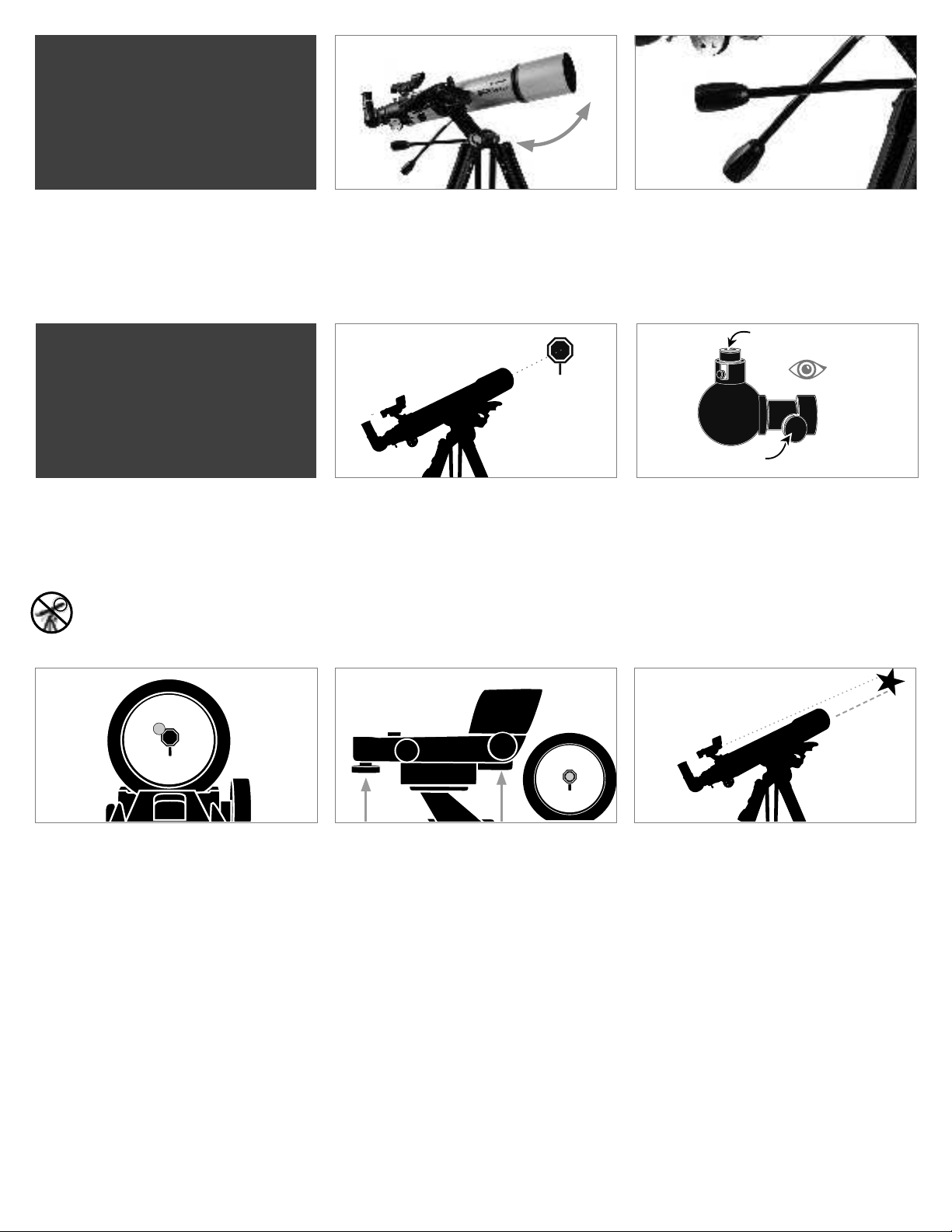
La montatura StarSense Explorer DX è dotata di frizioni
antisaltellamento su entrambi gli assi. Per fare ampi
movimenti con il telescopio, tenere semplicemente
una gamba del treppiede con una mano e utilizzare
l'altra mano sul telescopio per spostare il telescopio
nella direzione desiderata.
Per effettuare regolazioni di precisione o per tracciare
corpi celesti, ruotare entrambe le manopole del
movimento lento come desiderato.
Il cercatore è uno dei componenti più importanti del
telescopio. Aiuta a localizzare gli oggetti e a centrarli
nell'oculare. Al primo assemblaggio del telescopio
è necessario allineare il cercatore con le ottiche
principali del telescopio. È preferibile eseguire questa
operazione durante il giorno*.
* AVVERTENZA SOLARE! Non tentare
mai di osservare il Sole attraverso un
telescopio senza un filtro solare adeguato.
CENTRARE L'OGGETTO NELL'OCULARE
Guardare attraverso il telescopio utilizzando l’oculare
con minore ingrandimento. Muovere il telescopio fino
a quando l’oggetto prescelto si trova al centro del
campo visivo. Se l’immagine è sfocata, ruotare con
delicatezza le manopole di messa a fuoco a lato del
telescopio fino a quando l’immagine non è nitida.
N OTA:
L’immagine del telescopio potrebbe apparire
capovolta. Ciò è perfettamente normale per
un telescopio astronomico.
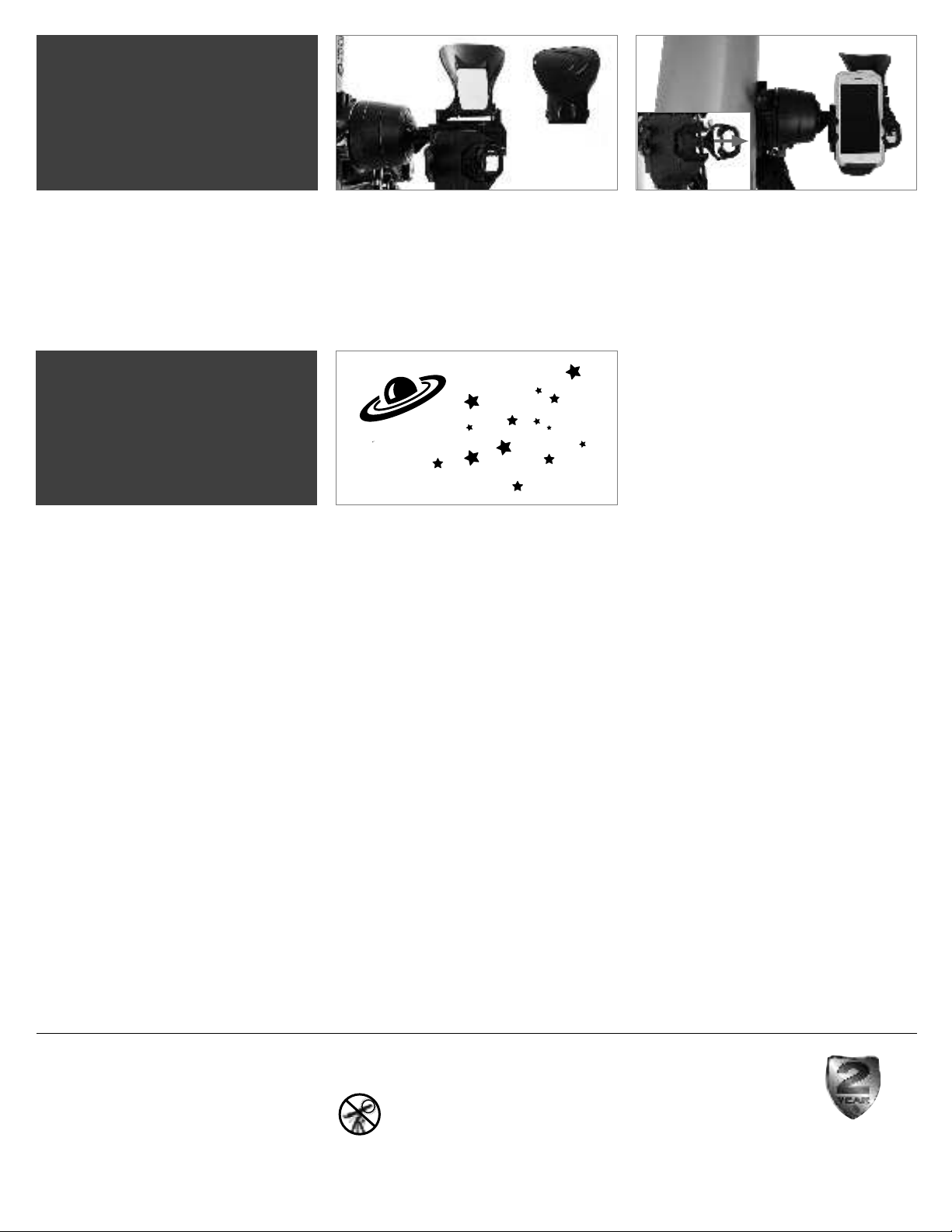
SCEGLIERE UN OGGETTO DA OSSERVARE
Portare il telescopio all’esterno durante il giorno
e individuare un oggetto facilmente riconoscibile,
come ad esempio un semaforo, la targa di un’auto o
un cartello. L’oggetto dovrebbe trovarsi il più lontano
possibile, minimo a 400 metri.
REGOLARE IL CERCATORE
Senza spostare il telescopio, utilizzare due manopole
di regolazione per spostare il cercatore fino a quando
puntino rosso appare sullo stesso oggetto che si sta
osservando nell’oculare da 25 mm.
IL CERCATORE È ORA ALLINEATO!
Non occorre effettuare un nuovo allineamento salvo
colpi o cadute.
OSSERVARE ATTRAVERSO IL CERCATORE
Una volta che l’oggetto è centrato nell’oculare da
25 mm, guardare attraverso il cercatore e localizzare
puntino rosso.
1 2
3 4 5
1 2
16 | ITALIANO
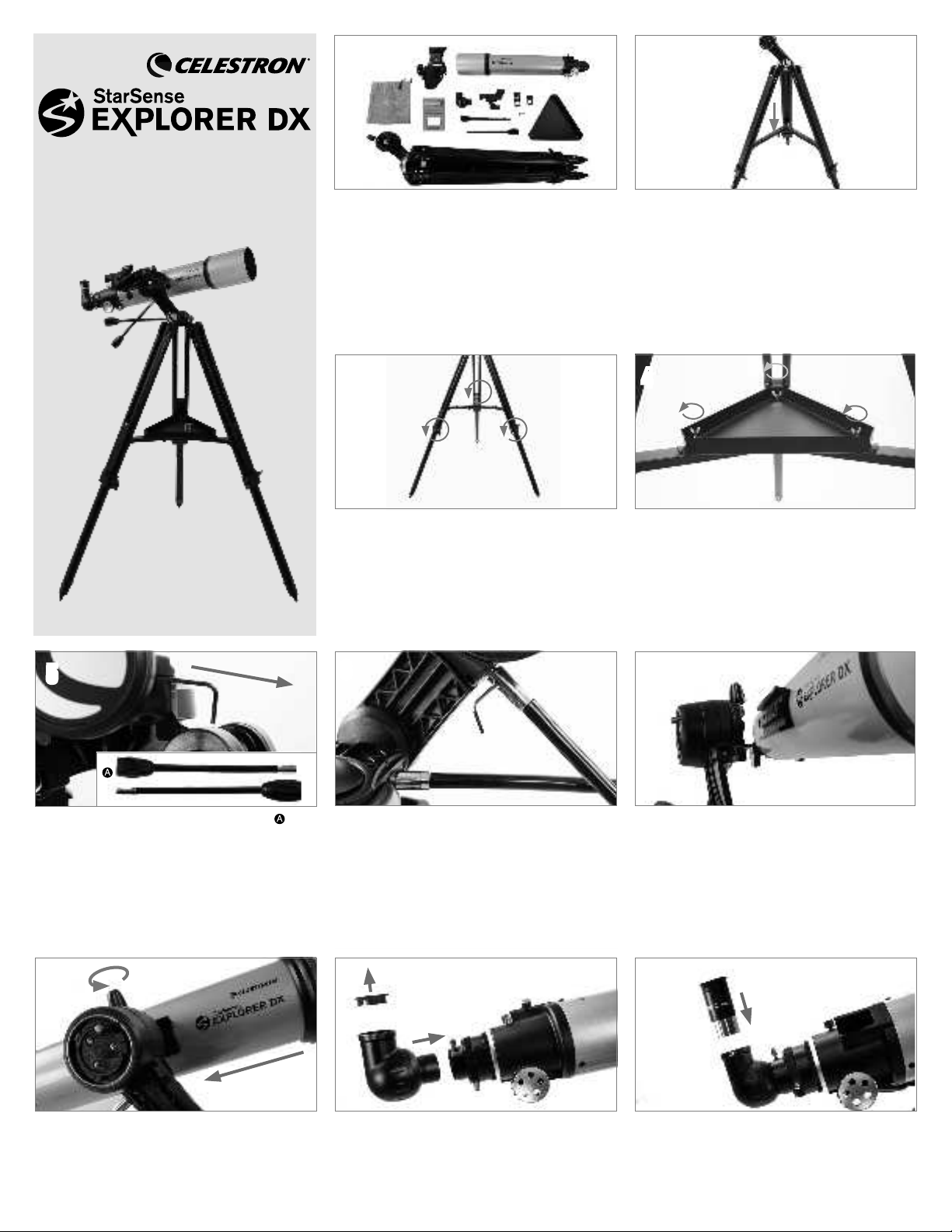
Rimuovere il coperchio grande che copre lo specchio
nella parte anteriore dell'aggancio StarSense.
Tirare per aprire il binario caricato a molla in cima
all'aggancio per telefono e sistemare il telefono
nel supporto in modo che sia a contatto con il
lembo inferiore del supporto del telefono. Rilasciare
lentamente il binario per fissare il telefono in
posizione. Gran parte dei telefoni può essere inserita
con la custodia. Tuttavia, potrebbe essere necessario
rimuovere la custodia del telefono se particolarmente
ingombrante o se non è possibile inserirla nel fermo
(ad es. custodie a portafoglio).
Collegamento dello
smartphone
La prima
osservazione
notturna
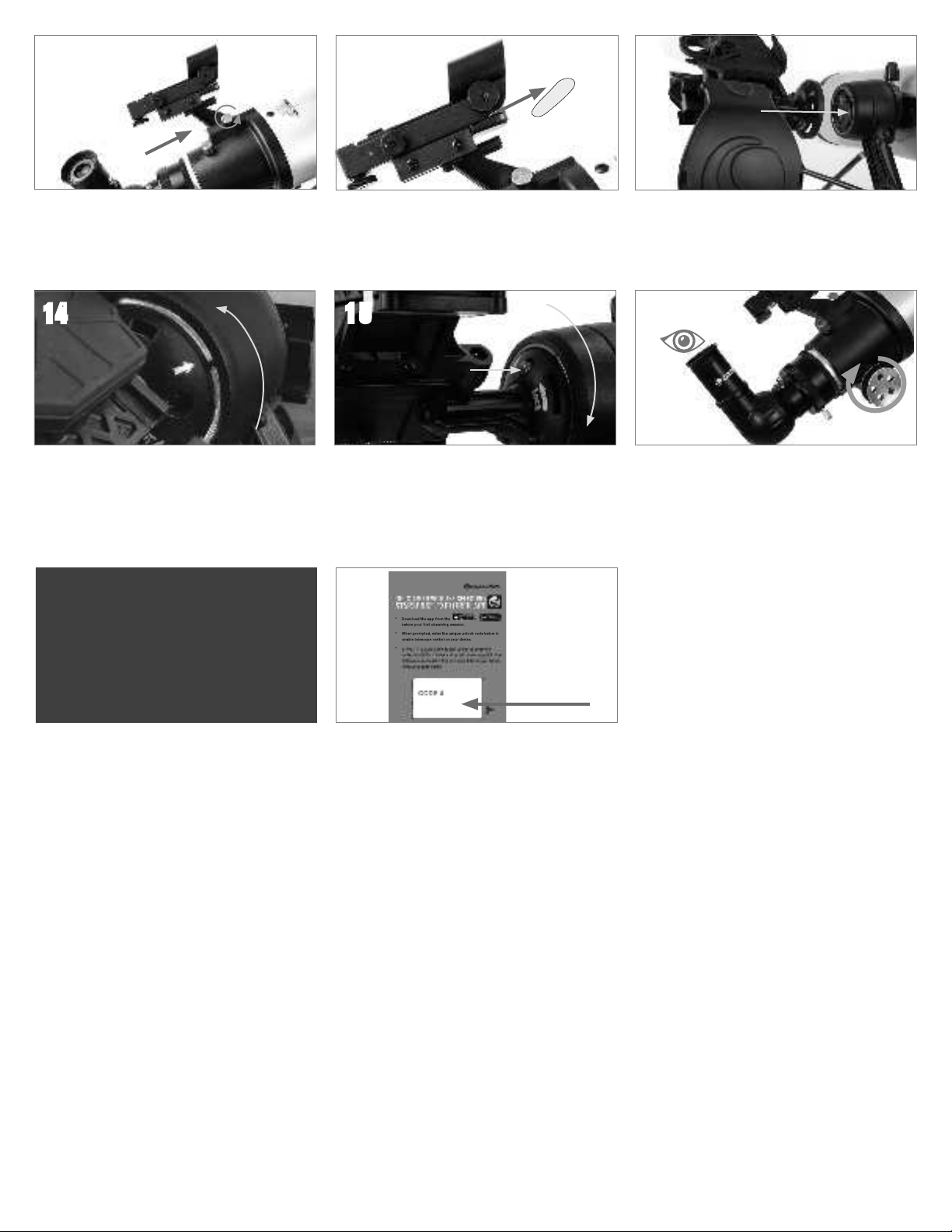
Congratulazioni! Il telescopio è ora configurato e tutto
è pronto per esplorare il cosmo. Portare all'esterno il
telescopio, inserire l'oculare da 25 mm, rimuovere il
tappo dalla lente, inserire lo smartphone nel supporto
e avviare l'app StarSense Explorer. Il tutorial dell'app
guida l'utente attraverso i vari passaggi necessari per
localizzare il primo oggetto astronomico.
Per maggiori informazioni sul prodotto, visitare la pagina relativa al prodotto su
celestron.com
AVVERTENZA SOLARE:
Non tentare mai di osservare il sole attraverso un telescopio senza un filtro solare adeguato.
Bisogno di aiuto?
Contattare l'assistenza tecnica Celestron su celestron.com/pages/technical-support
08-19
www.celestron.com/pages/warranty
1 2
ESPAÑOL | 17
102AZ
PRODUCTO # 22460
ESPAÑOL
Guía de instalación rápida
Desembale el telescopio y compruebe que estén
presentes todas las piezas. Su StarSense Explorer DX
incluye: un tubo de telescopio, un trípode y cabezal
de soporte, una bolsa de accesorios,, dos mandos
de control de movimiento, una bandeja de accesorios,
dos oculares, un localizador, una diagonal de imagen
recta, un conector de teléfono StarSense, una tarjeta
de código para la app StarSense Explorer, y una llave
hexagonal (oculta en la ranura de la parte anterior del
cabezal del soporte).
Para instalar el trípode, separe las patas hacia fuera
hasta que estén totalmente extendidas y empuje el
soporte de las patas central.
Extienda las patas del trípode desbloqueando los tres
mandos de cada pata. Tire de cada sección de pata
por completo y apriete los mandos para asegurarlas
en posición.
Coloque la bandeja de accesorios sobre el soporte
central y alinee los tres agujeros. Introduzca los tres
tornillos por la parte inferior del soporte de la pata y
enrósquelos en la bandeja.
Para instalar los mandos de movimiento lento
en el
soporte, localice primero la llave hexagonal incluida,
oculta en la ranura de la parte anterior del soporte.
Coloque el mando de control de movimiento lento
sobre el eje del engranaje en forma de D y presiónelo
hacia dentro para asegurarse de que esté totalmente
introducido. Use la llave hexagonal para apretar los
tornillos en el eje del engranaje. Vuelva a colocar
la llave hexagonal en su posición de guardado en la
parte anterior del soporte.
Aguantando del tubo del telescopio al lado del
soporte, ponga la barra machihembrada sobre el
tubo, orientada a la fijación de la parte superior del
brazo del soporte.
Deslice la barra machihembrada en la fijación de la
parte superior del soporte y apriete el mando manual
de la parte inferior de la fijación para asegurar el
telescopìo en posición.
Localice la diagonal de imagen recta y saque las
tapas de plástico. Introduzca el cañón de la diagonal
en el enfoque y asegúrelo en posición apretando los
tornillos.
Introduzca el cañón del ocular de 25 mm en la
diagonal y apriete el tornillo.
2
4
5
6
7
8
9
10
1
3
18 | ESPAÑOL
Deslice el soporte del localizador en la ranura del
tubo del telescopio, cerca del enfoque. La apertura
grande del localizador debe estar orientada a la parte
anterior del telescopio. Asegure el soporte apretando
el tornillo de la ranura.
Para instalar el conector de teléfono StarSense,
introduzca el soporte de bayoneta en el lateral del
conector, en el puerto del lateral del soporte al otro
lado de la fijación machihembrada.
Alinee la flecha del conector con la marca de
alineación del soporte y presione hacia dentro girando
el conector en sentido contrario a las agujas del reloj
hasta que el botón de liberación naranja encaje en
posición en el agujero del conector.
Para sacar el conector pulse el botón de liberación
naranja y gire el conector en el sentido de las agujas
del reloj hasta que el soporte de bayoneta se suelte.
Saque la tapa de la lente de la parte anterior del
telescopio. Para observar, mire por el ocular como se
indica anteriormente. Enfoque la imagen girando los
mandos bajo el enfoque.
Descarga y
activación de la app
Antes de sacar el telescopio al exterior, descargue
la app StarSense Explorer en su dispositivo móvil.
Busque «Celestron StarSense Explorer» en Apple
App Store o Google Play. La app tiene un gran
tamaño, recomendamos que la descargue cuando
esté conectado a WiFi.
Cuando haya descargado la app, localice la tarjeta
naranja en la caja de su telescopio. Ejecute la
app. Cuando se solicite, introduzca el código de
activación de la tarjeta para activar la app. Su código
desbloqueará hasta 5 dispositivos.
14
16
131211
15
1
Entre la batería y el contacto hay una pequeña pestaña
de plástico transparente. Se ha incluido para evitar
que la batería se descargue durante el transporte.
Sáquela para que funcione la batería.
ESPAÑOL | 19
Ocular de 25 mm
Mandos de enfoque
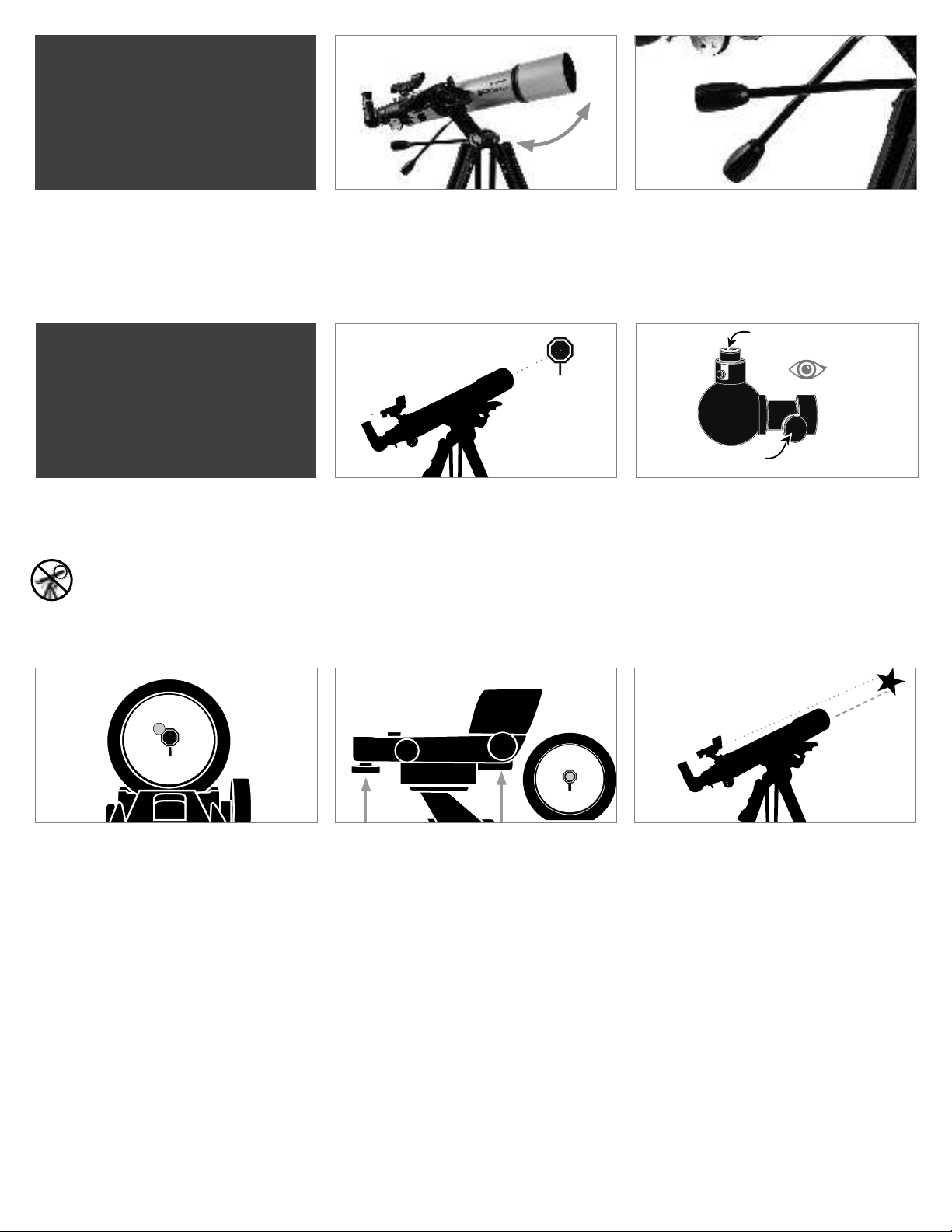
Para realizar ajustes precisos o seguir objetos
celestes, gire ambos mandos de movimiento lento
según sea necesario.
Movimiento del
telescopio
CENTRAR EL OBJETO EN EL OCULAR
Mire por el telescopio usando el ocular con menor
potencia. Mueva el telescopio hasta que el objeto
elegido quede en el centro del campo de visión. Si la
imagen se ve borrosa, gire suavemente los mandos
de enfoque a cada lado del telescopio hasta que
quede definida.
N OTA: La imagen del telescopio puede aparecer
invertida. Es normal en un telescopio astronómico.
Alinear el
localizador
El localizador es una de las piezas más importantes
de su telescopio. Le ayuda a localizar objetos y
centrarlos en el ocular. La primera vez que monte el
telescopio, deberá alinear el localizador con la óptica
principal del telescopio. Es preferible hacerlo de día.
* ¡AVISO SOLAR! No intente nunca
observar el sol por un telescopio sin un
filtro solar adecuado.
ELEGIR UN OBJETO
Saque el telescopio de día y localice un objeto
fácilmente reconocible, como una farola, una matrícula
de coche, o una señal. El objeto debe estar lo más
lejos posible, al menos a 400 m.
AJUSTAR EL LOCALIZADOR
Sin mover el telescopio, use los dos mandos de
ajuste para moverlo hasta que el punto de mira/punto
rojo aparezca sobre el objeto que está observando en
el ocular de 25 mm del telescopio.
SU LOCALIZADOR ESTÁ ALINEADO.
No debería realinarse a menos que reciba golpes o
caiga.
MIRAR POR EL LOCALIZADOR
Cuando el objeto esté centrado en el ocular de
25 mm, mire por el localizador y localice punto rojo.
El soporte StarSense Explorer DX tiene fijaciones
deslizantes en ambos ejes. Para realizar movimientos
de gran tamaño con el telescopio, aguante una pata
del trípode con una mano y use la otra mano en el
tubo del telescopio para empujar el telescopio en la
dirección deseada.
1 2
3 4 5
1 2
20 | ESPAÑOL
Instalación del
teléfono
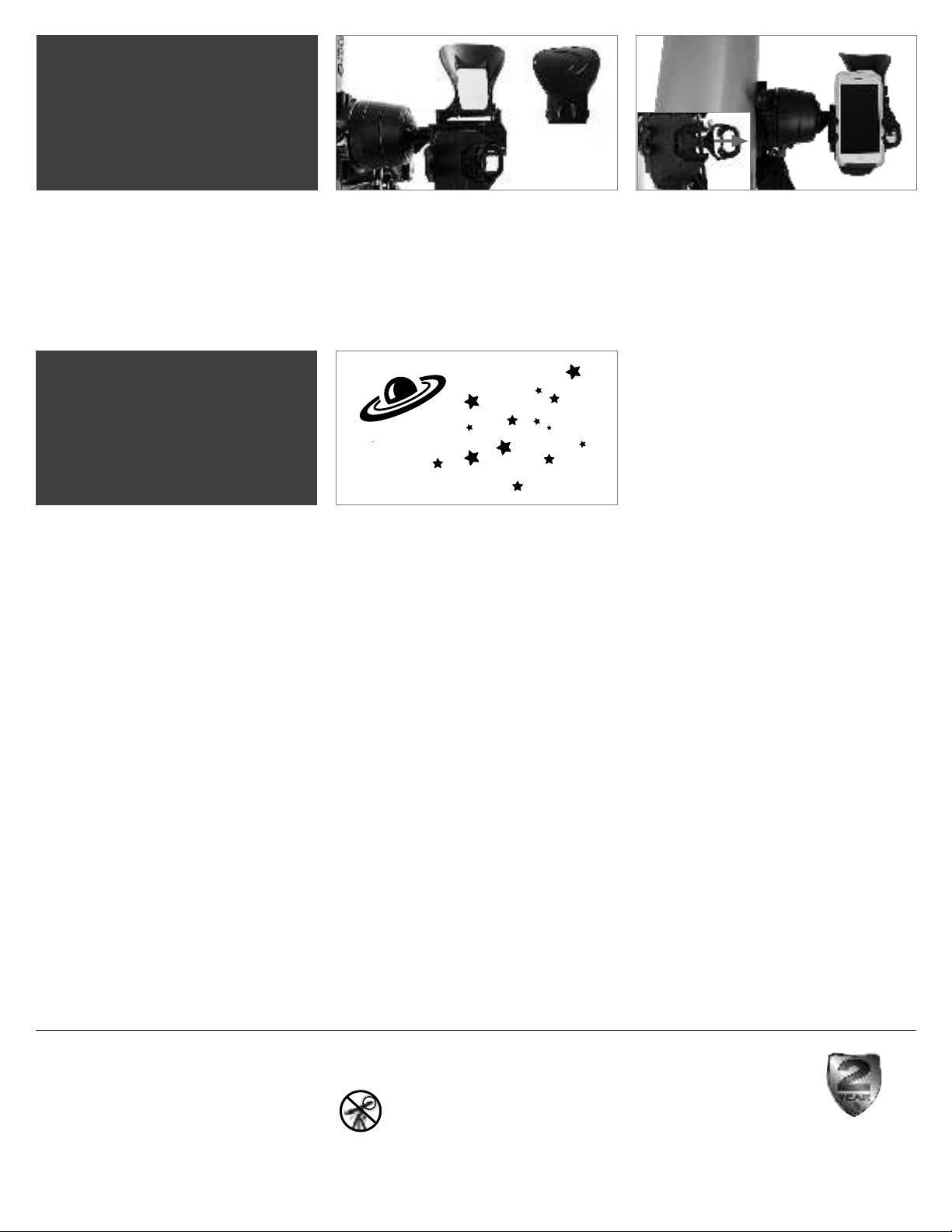
Saque la tapa grande que cubre el espejo de la parte
anterior del conector StarSense.
Abra el deslizador de muelle de la parte superior
del conector del teléfono y coloque el teléfono en
el soporte de forma que quede llano con el borde
inferior del soporte del teléfono. Suelte lentamente
el deslizador para asegurar el teléfono en posición.
La mayoría de teléfonos caben en el conector con
la funda puesta. Sin embargo, puede que tenga
que sacar la funda del teléfono si es especialmente
voluminosa o no encaja en la fijación (por ejemplo,
fundas con tapa).
Su primera
noche fuera
Felicidades. El telescopio está totalmente montado
y listo para explorar el cosmos. Saque el telescopio
al exterior, introduzca el ocular de 25 mm, saque la
tapa de la lente, introduzca el teléfono en su soporte
y ejecute la app StarSense Explorer. El tutorial de la
app le guiará por los pasos para localizar su primer
objetivo astronómico.
Para obtener más información de este producto, visite la página de producto
correspondiente en celestron.com
AVISO SOLAR:
No intente nunca observar el sol por un telescopio sin un filtro solar adecuado.
¿Necesita ayuda?
Contacte con el soporte técnico de Celestron celestron.com/pages/technical-support
08-19
www.celestron.com/pages/warranty
1 2