
Table of ContentsSetting UpWi-Fi StreamingUsing KEF Connect AppFAQ and Troubleshooting
User Manual
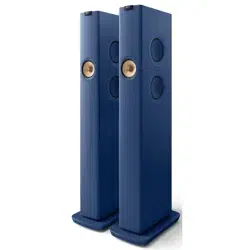
LS60 Wireless

2
Table of Contents
1. Introduction ...............................................................................................................................5
2. General Information .................................................................................................................6
2.1 Reading and Storing the User Manual .............................................................................................................6
2.2 SignalSymbol/WordDe�nitions ........................................................................................................................6
3. Unpacking ...................................................................................................................................7
4. In the Box....................................................................................................................................8
5. Floor spikes (optional) .............................................................................................................9
6. Setting Up LS60 Wireless .....................................................................................................10
6.1 Selecting an Appropriate Router ....................................................................................................................10
6.2 Connecting to Power .............................................................................................................................................. 11
6.3 Onboarding ...................................................................................................................................................................12
6.3.1 Installing the KEF Connect App ............................................................................................................... 12
6.3.2 Using iOS Devices ............................................................................................................................................13
6.3.3 Using Android Devices with Google Play Service .......................................................................14
6.3.4 Using Android Devices without Google Play Service ...............................................................16
6.4 Speaker Placement and Connection .............................................................................................................18
6.5 Ventilation ......................................................................................................................................................................19
7. Connection and Control Interface .................................................................................... 20
7.1 Front Panel .....................................................................................................................................................................20
7.2 Back Panel ......................................................................................................................................................................21
7.3 LED Indications ...........................................................................................................................................................23
7.4 Remote Control .........................................................................................................................................................24
7.5 KEF Connect App .....................................................................................................................................................25
8. Wi-Fi Streaming ..................................................................................................................... 26
8.1 Wireless Streaming Protocols ...........................................................................................................................26
8.1.1 AirPlay 2 ..................................................................................................................................................................26
8.1.2 Chromecast ..........................................................................................................................................................27
8.1.3 ROON Ready......................................................................................................................................................28
8.1.4 Music Streaming Apps Native Protocols ...........................................................................................29
8.1.4.1 Spotify Connect......................................................................................................................................29
8.1.4.2 QPlay .............................................................................................................................................................30
8.1.4.3 TIDAL Connect ....................................................................................................................................31
8.1.5 KEF Connect App Streaming ....................................................................................................................32
8.1.5.1 Amazon Music .........................................................................................................................................32
8.1.5.2 Deezer ..........................................................................................................................................................32
8.1.5.3 Qobuz ...........................................................................................................................................................32
8.1.5.4 Spotify ...........................................................................................................................................................32
8.1.5.5 TIDAL............................................................................................................................................................33
8.1.5.6 Internet Radio ..........................................................................................................................................33
8.1.5.7 Podcasts .......................................................................................................................................................33
8.1.6 UPnP Playback ....................................................................................................................................................33
8.2 Tips on Choosing Streaming Protocols .......................................................................................................34
9. Multi-Room Streaming.......................................................................................................... 35
9.1 AirPlay 2 ..........................................................................................................................................................................35
9.2 Chromecast ..................................................................................................................................................................35
9.3 ROON..............................................................................................................................................................................37

3
10. Voice Control Over Mobile Device .................................................................................. 38
10.1 Siri ........................................................................................................................................................................................38
10.2 Google Assistant ........................................................................................................................................................38
11. Playback with Bluetooth .......................................................................................................39
11.1 Selecting Bluetooth Mode ...................................................................................................................................39
11.2 Bluetooth Pairing .......................................................................................................................................................39
11.3 Playback Controls ......................................................................................................................................................40
12. Playback with HDMI eARC input .......................................................................................41
12.1 HDMI Cable Connection .....................................................................................................................................41
12.2 Selecting TV Mode ...................................................................................................................................................42
12.3 Playback Controls ......................................................................................................................................................42
13. Playback with Optical Input .................................................................................................43
13.1 Optical Cable Connection ..................................................................................................................................43
13.2 Selecting Optical Mode .........................................................................................................................................44
13.3 Playback Controls ......................................................................................................................................................44
14. Playback with Coaxial Input ................................................................................................ 45
14.1 Coaxial Cable Connection ..................................................................................................................................45
14.2 Selecting Coaxial Mode .........................................................................................................................................46
14.3 Playback Controls ......................................................................................................................................................46
15. Playback with Auxiliary Input ..............................................................................................47
15.1 Auxiliary Cable Connection ...............................................................................................................................47
15.2 Selecting Auxiliary Mode ......................................................................................................................................48
15.3 Playback Controls ......................................................................................................................................................48
16. Using KEF Connect App ...................................................................................................... 49
16.1 Home ................................................................................................................................................................................49
16.1.1 Overview ...............................................................................................................................................................49
16.1.2 Editing the Home Screen .............................................................................................................................50
16.2 Remote Control .........................................................................................................................................................50
16.3 Music Content .............................................................................................................................................................51
16.3.1 Playing Music from Music Streaming Services ................................................................................52
16.3.1.1 Amazon Music .........................................................................................................................................52
16.3.1.2 Deezer ..........................................................................................................................................................53
16.3.1.3 Qobuz ...........................................................................................................................................................54
16.3.1.4 Spotify ...........................................................................................................................................................55
16.3.1.5 Tidal ................................................................................................................................................................55
16.3.1.6 Internet Radio ..........................................................................................................................................56
16.3.1.7 Podcast .........................................................................................................................................................56
16.3.2 Playback Controls .............................................................................................................................................57
16.3.2.1 Playback Screen ......................................................................................................................................57
16.3.2.2 Search ............................................................................................................................................................57
16.3.2.3 Favourites ....................................................................................................................................................58
16.3.2.4 Playing Queue ..........................................................................................................................................59
16.3.2.5 Playlists..........................................................................................................................................................61
16.4 Equalisations ..................................................................................................................................................................63
16.4.1 Normal Mode .....................................................................................................................................................63
16.4.2 Expert Mode........................................................................................................................................................65
16.4.3 SelectingaSoundPro�le .............................................................................................................................68

4
16.4.4 RenamingaSoundPro�le ...........................................................................................................................68
16.4.5 DeletingaSoundPro�le ..............................................................................................................................69
16.5 Pro�le ................................................................................................................................................................................70
16.6 Choosing Your Speaker .........................................................................................................................................71
16.6.1 My Speaker and Speakers Nearby .........................................................................................................71
16.6.2 Speaker Info ........................................................................................................................................................72
16.7 Speaker Preferences ................................................................................................................................................73
16.7.1 Power Saver – Standby Mode ..................................................................................................................73
16.7.2 Power Saver – Second Wake-Up Source .........................................................................................73
16.7.3 Do Not Disturb – Standby LED .............................................................................................................73
16.7.4 Do Not Disturb – Start Up tone ...........................................................................................................74
16.7.5 Speaker System Options – Cable Mode ...........................................................................................74
16.7.6 Speaker System Options – Inverse L/R Speakers ........................................................................74
16.7.7 KW-1 Power Mode .........................................................................................................................................74
16.8 Volume .............................................................................................................................................................................75
16.8.1 Volume Display Setting .................................................................................................................................75
16.8.2 Hardware Volume ............................................................................................................................................76
16.8.3 Speaker Volume Sensitivity ........................................................................................................................76
16.8.4 Maximum Volume ............................................................................................................................................76
16.9 Performance .................................................................................................................................................................77
16.9.1 Streaming Settings – Audio Quality ......................................................................................................77
16.9.2 Network quality .................................................................................................................................................77
16.10 Firmware Upgrade ....................................................................................................................................................79
16.10.1 Automatic Firmware Update after Onboarding ...........................................................................79
16.10.2 Automatic Firmware Check .......................................................................................................................79
16.10.3 Manual Firmware Update ............................................................................................................................80
16.11 Application .....................................................................................................................................................................81
16.11.1 Theme Settings – Theme ............................................................................................................................81
16.11.2 Theme Settings – Reset Home Screen .............................................................................................. 81
16.11.3 Analytics – Improve App/Speaker .........................................................................................................81
16.12 Support ............................................................................................................................................................................82
17. Cleaning and Maintenance ................................................................................................... 83
18. Disposal .................................................................................................................................... 84
18.1 Disposing of the Packaging ..................................................................................................................................84
18.2 Disposing of the Speakers....................................................................................................................................84
18.3 Disposing of the Battery .......................................................................................................................................84
19. FAQ and Troubleshooting ................................................................................................... 85
19.1 Set-up ..............................................................................................................................................................................85
19.2 Playback and Streaming .........................................................................................................................................87
19.3 Troubleshooting .........................................................................................................................................................89
19.4 LED Indicators .............................................................................................................................................................92
20. Appendix .................................................................................................................................. 96
20.1 Speci�cations ................................................................................................................................................................96
20.2 Speaker Connection Test .....................................................................................................................................98
20.3 Explanation of symbols .......................................................................................................................................104
20.3.1 Warning Symbols ...........................................................................................................................................104
20.3.2 Regional Symbols ...........................................................................................................................................104
20.4 IR Command Codes .............................................................................................................................................106

5
Table of ContentsSetting UpWi-Fi StreamingUsing KEF Connect AppFAQ and Troubleshooting
1. Introduction
Thank you for choosing KEF wireless speaker system – LS60 Wireless.
Innovation is what sets KEF apart from its competitors. For the last 60 years, KEF has
been at the forefront of loudspeaker research and development, designing class-leading
speakers that have dealt with the challenges of reproducing the latest musical formats,
and reproducing them to the highest possible quality. This legacy continues today with
the LS60 Wireless, our powerful wireless HiFi speaker system for the digital music era.
Celebrating our 60th anniversary, we combined the technologies of some of our
greatest and most advanced products and packaged them all as our first 3-way
floor standing active wireless speaker with unparalleled performance, intuitive user
experience, expansive connectivity and exceptional design.
Please read and follow this user manual carefully before using the speaker system.
6
Table of ContentsSetting UpWi-Fi StreamingUsing KEF Connect AppFAQ and Troubleshooting
2. General Information
2.1 Reading and Storing the User Manual
This user manual accompanies the LS60 Wireless speaker system
(hereafter referred to as the “speakers”), and contains important
information on setup and handling.
Before using your speakers, read this user manual and the safety information (as a
separate booklet) carefully. This particularly applies to the safety information. Failure to
do so may result in personal injury or damage to the speakers.
Retain the user manual and safety information for further use. Make sure to include the
user manual and safety information when passing the speakers on to third parties.
2.2 Signal Symbol/Word Definitions
The following symbols and signal words are used in this user manual.
WARNING!
This signal symbol/word designates a hazard with moderate
risk, which may result in death or severe injury if not avoided.
NOTICE!
This signal word warns of possible damage to property.
This symbol provides you with useful additional information
on handling and use.
7
Table of ContentsSetting UpWi-Fi StreamingUsing KEF Connect AppFAQ and Troubleshooting
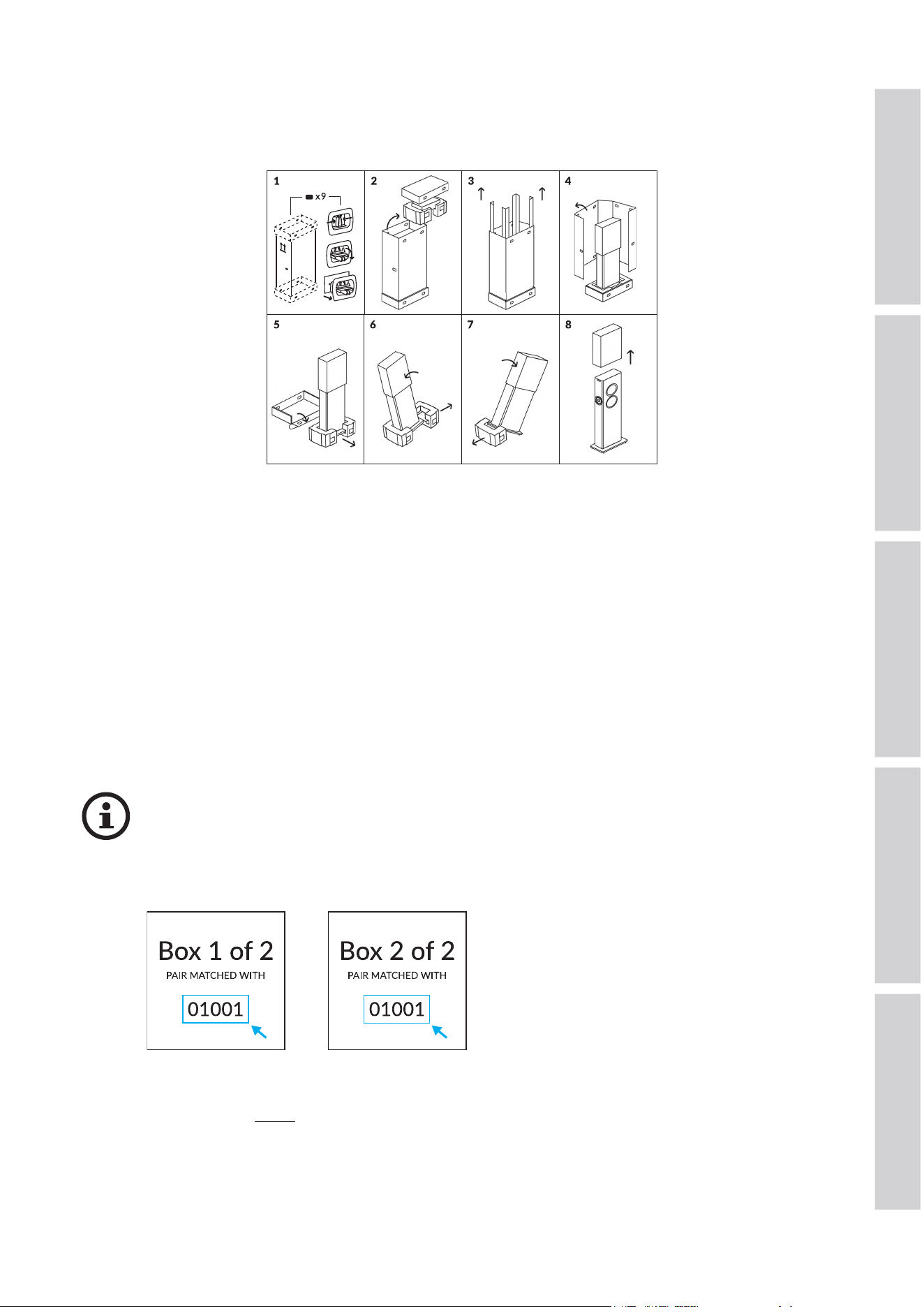
3. Unpacking
Follow the instructions below to unpack the speakers.
1. Detach all locking devices from the box.
2. Remove the top box cover and protective inlay.
3. Remove the corner reinforcers.
4. Open the outer box and remove it.
5. Open the bottom box cover and slide out the speaker with the protective inlays.
6. Slightly tilt the speaker to the left and remove the right protective inlay.
7. Slightly tilt the speaker to the right and remove the left protective inlay.
8. Remove the protective cover from the speaker.
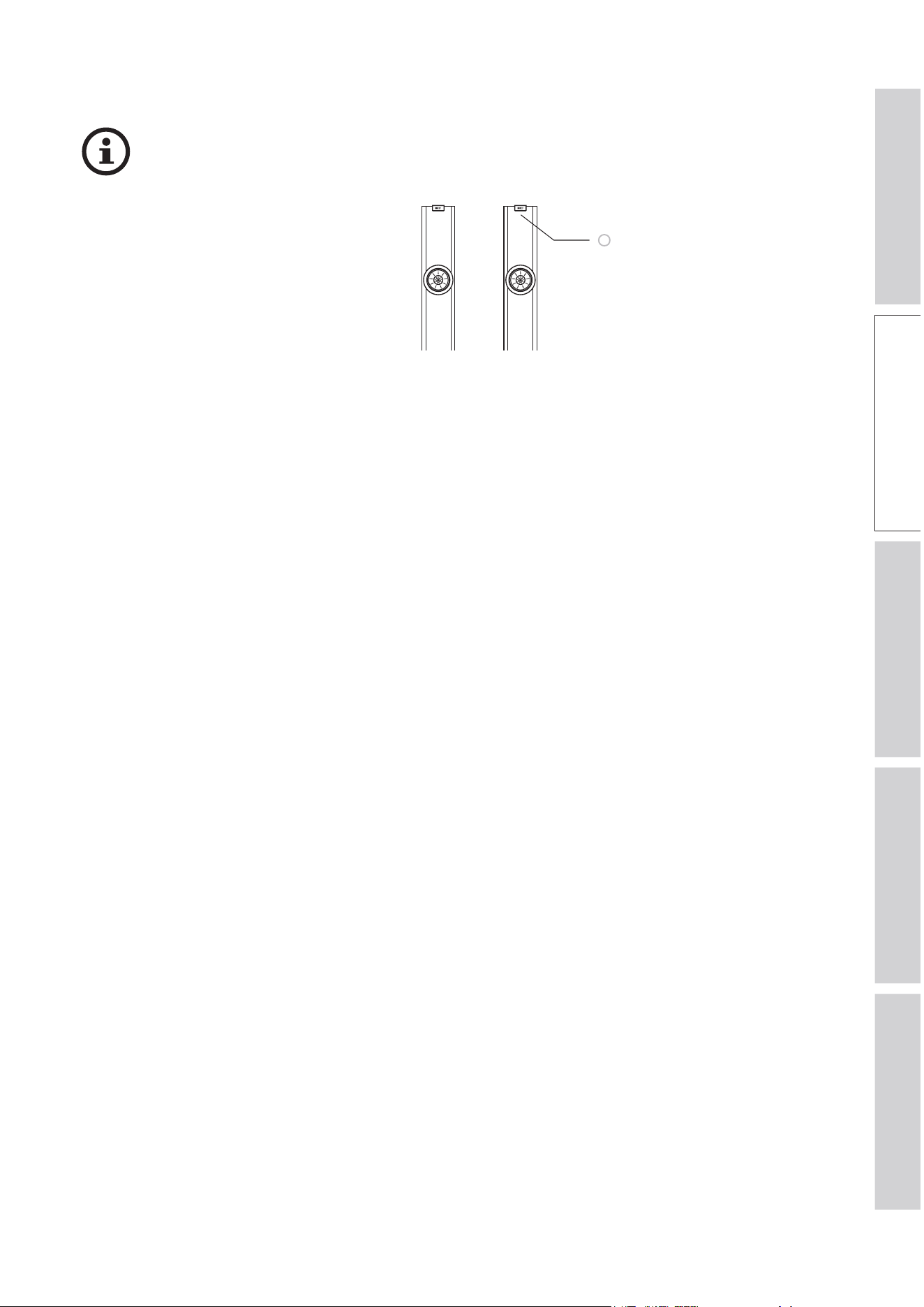
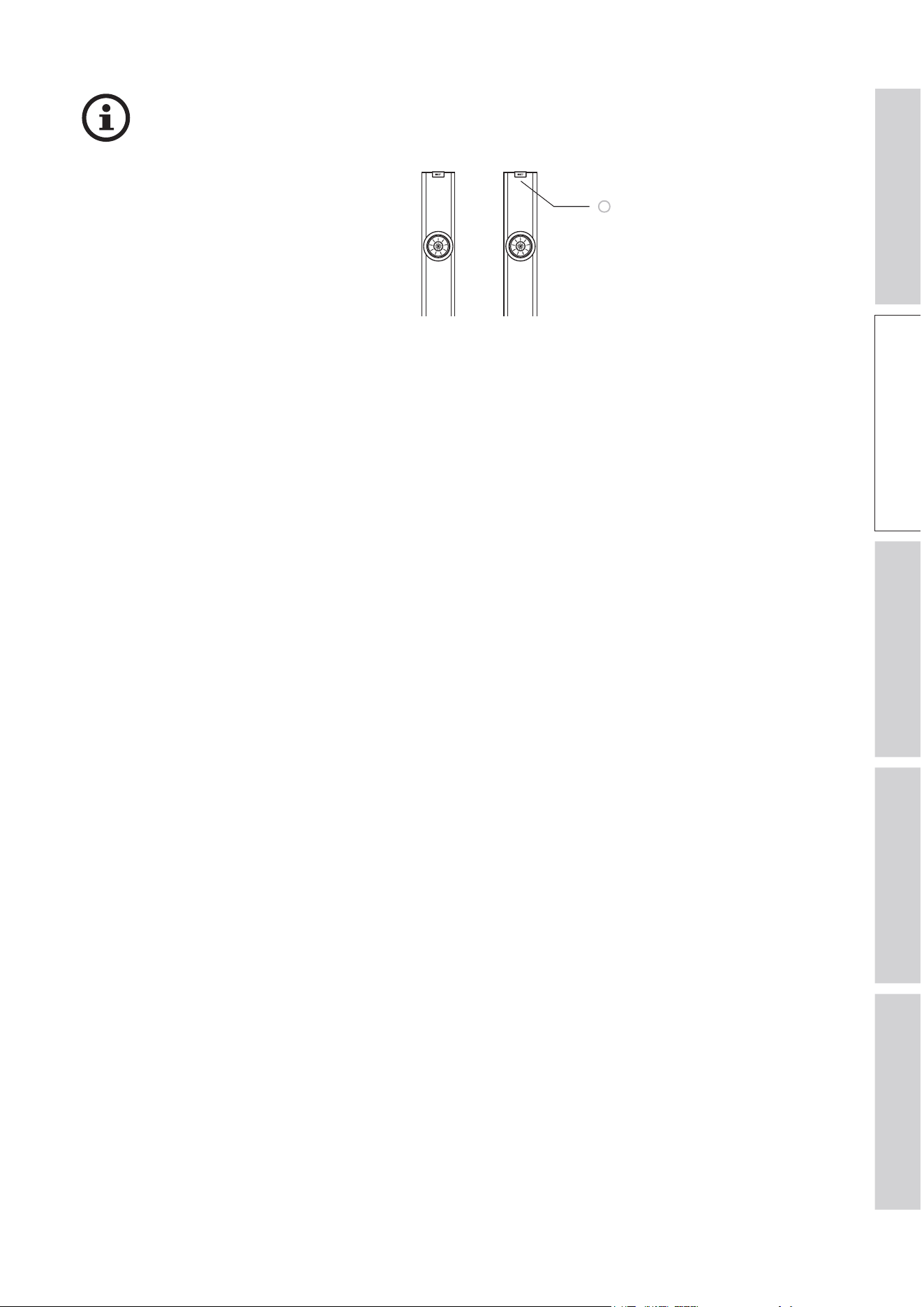
Your pair of speakers are packed seaparately in two boxes with the same serial
number (see the examples below which are labels found on the packaging
boxes). The two speakers with the same serial number will be paired
automatically.
In case the serial numbers on the boxes are not the same, follow the
instructions here to pair them.
8
Table of ContentsSetting UpWi-Fi StreamingUsing KEF Connect AppFAQ and Troubleshooting
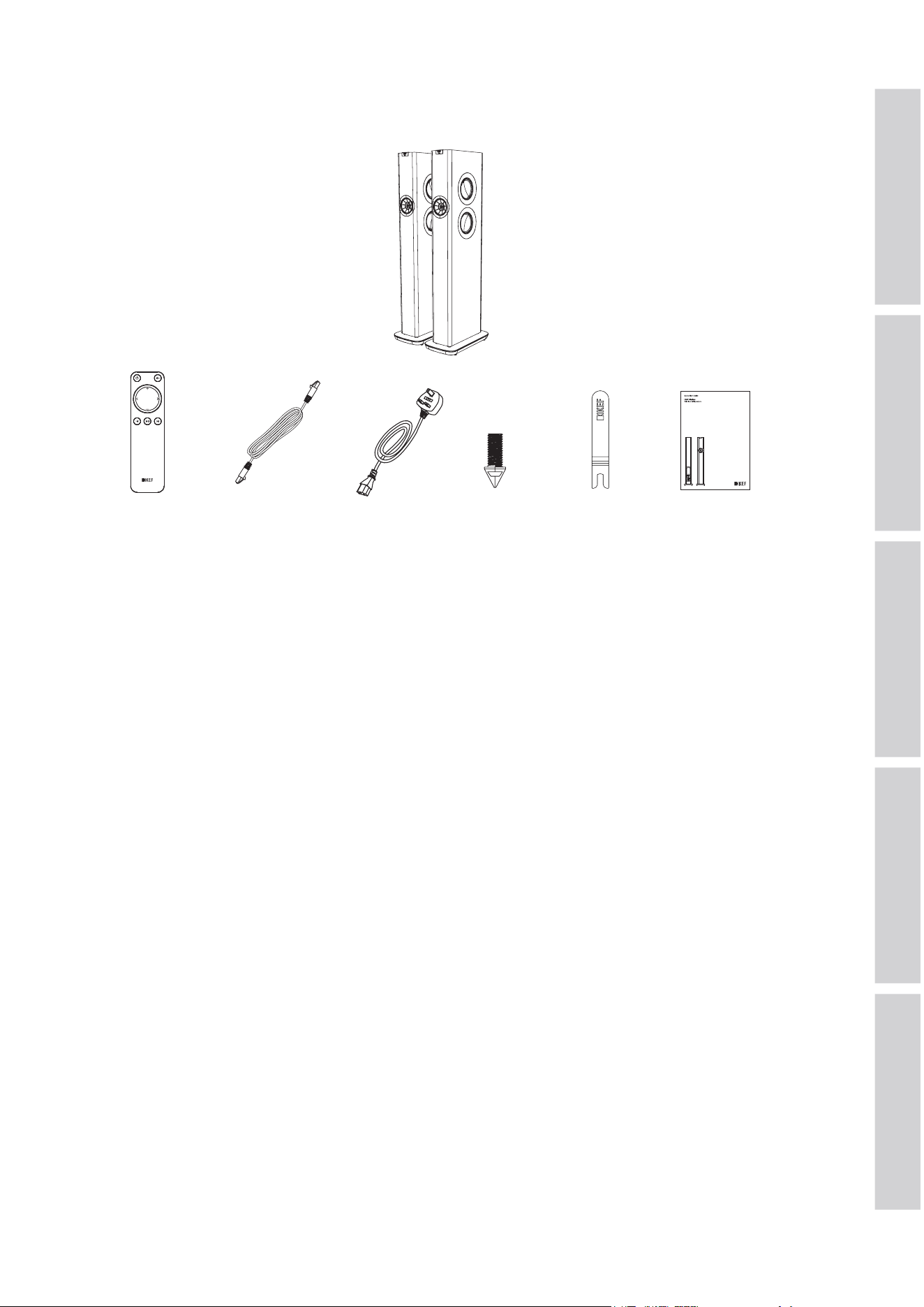
4. In the Box
×1 set
×1 ×1 ×2 ×3
×8
×1
1. Take the speakers and accessories out of the packaging.
2. Check to make sure that all parts are included, namely:
• Speaker ×2 (Primary Speaker ×1, Secondary Speaker ×1)
• Remote control ×1 (with 2 AAA batteries)
• Inter-speaker cable ×1 (length: 8 m)
• Power cable ×2 (length: 2 m, with country-specific power plugs)
• Spikes ×8
• Spanner ×1
• Printed materials: Quick Start Guide, Safety Information and Warranty Information
3. Check whether the speakers or individual parts are damaged. If this is the case, do
not use the speakers and contact your retailer.
9
Table of ContentsSetting UpWi-Fi StreamingUsing KEF Connect AppFAQ and Troubleshooting
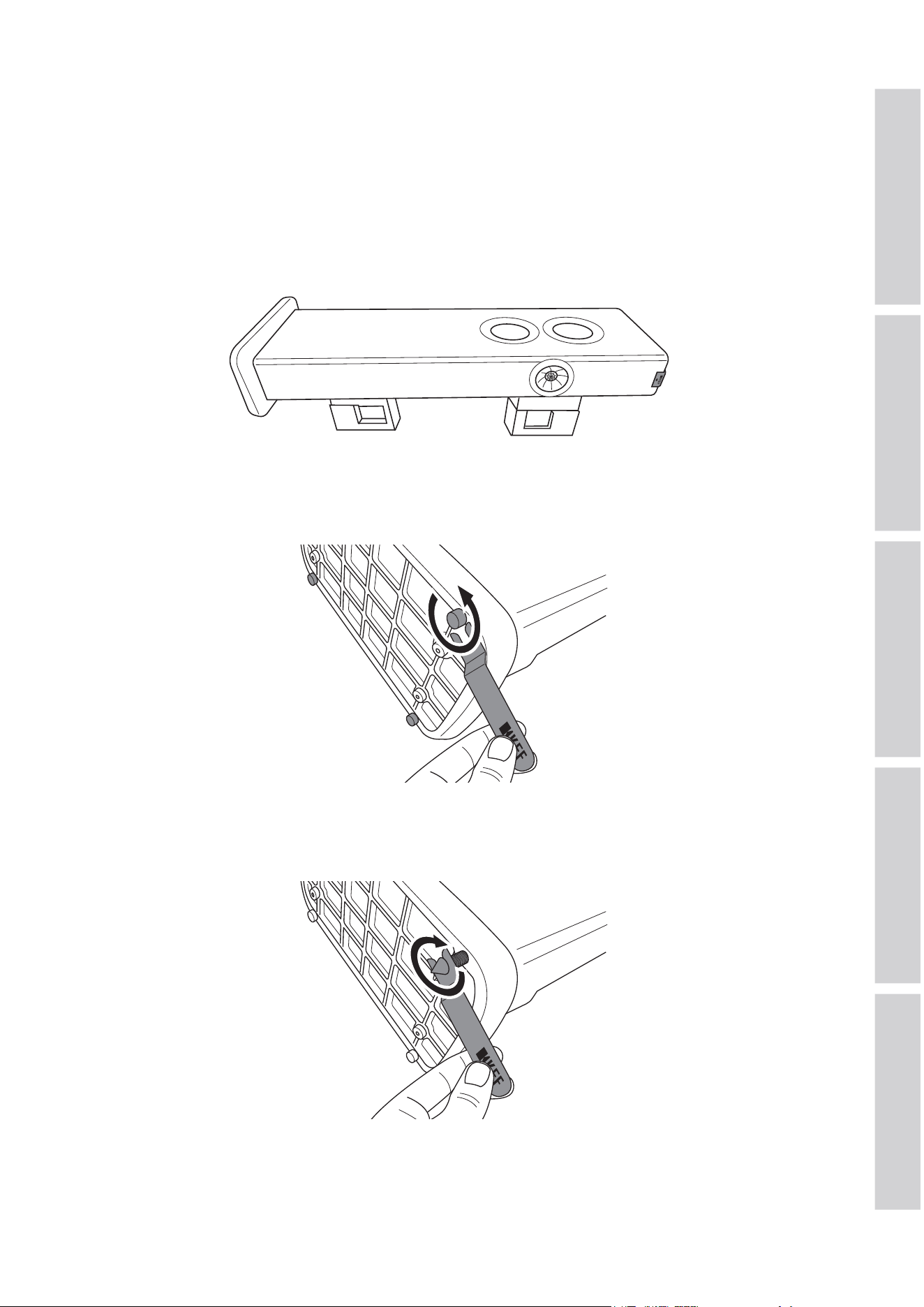
5. Floor spikes (optional)
The speakers are pre-installed with flat feet. For critical listeners, the flat feet can be
replaced with the provided sharp spikes to isolate vibrations.
To replace the floor spikes:
1. Place the speakers horizontally with the help of the packaging materials.
2. Usingtheprovidedspanner,rotatetheatfeetanticlockwisetodetachthemfrom
the bottom of the speakers.
3. Attach the spikes to the bottom of the speakers. Rotate the spikes clockwise with
the spanner until they are secure.
10
Table of ContentsSetting UpWi-Fi StreamingUsing KEF Connect AppFAQ and Troubleshooting
6. Setting Up LS60 Wireless
6.1 Selecting an Appropriate Router
The speakers must be “onboarded” to your Wi-Fi network (see chapter
“Onboarding”) for the best sound quality, wireless streaming and comprehensive
control.
Technical Requirements of your Router
• Network standard: IEEE 802.11a/b/g/n/ac, IPv4, IPv6,
• Frequency band: Dual-band 2.4 GHz / 5 GHz
• A 5 GHz Wi-Fi network is recommended for stable streaming, especially for
hi-resolution music.
•
Connecting to a guest, office or public network:
Office, hotel, guest and
public networks often feature additional security or authentication methods
which may prevent the speakers from connecting. You may need the help of
the network administrator to configure the network to allow full functionality
if using these kinds of networks.
11
Table of ContentsSetting UpWi-Fi StreamingUsing KEF Connect AppFAQ and Troubleshooting
6.2 Connecting to Power
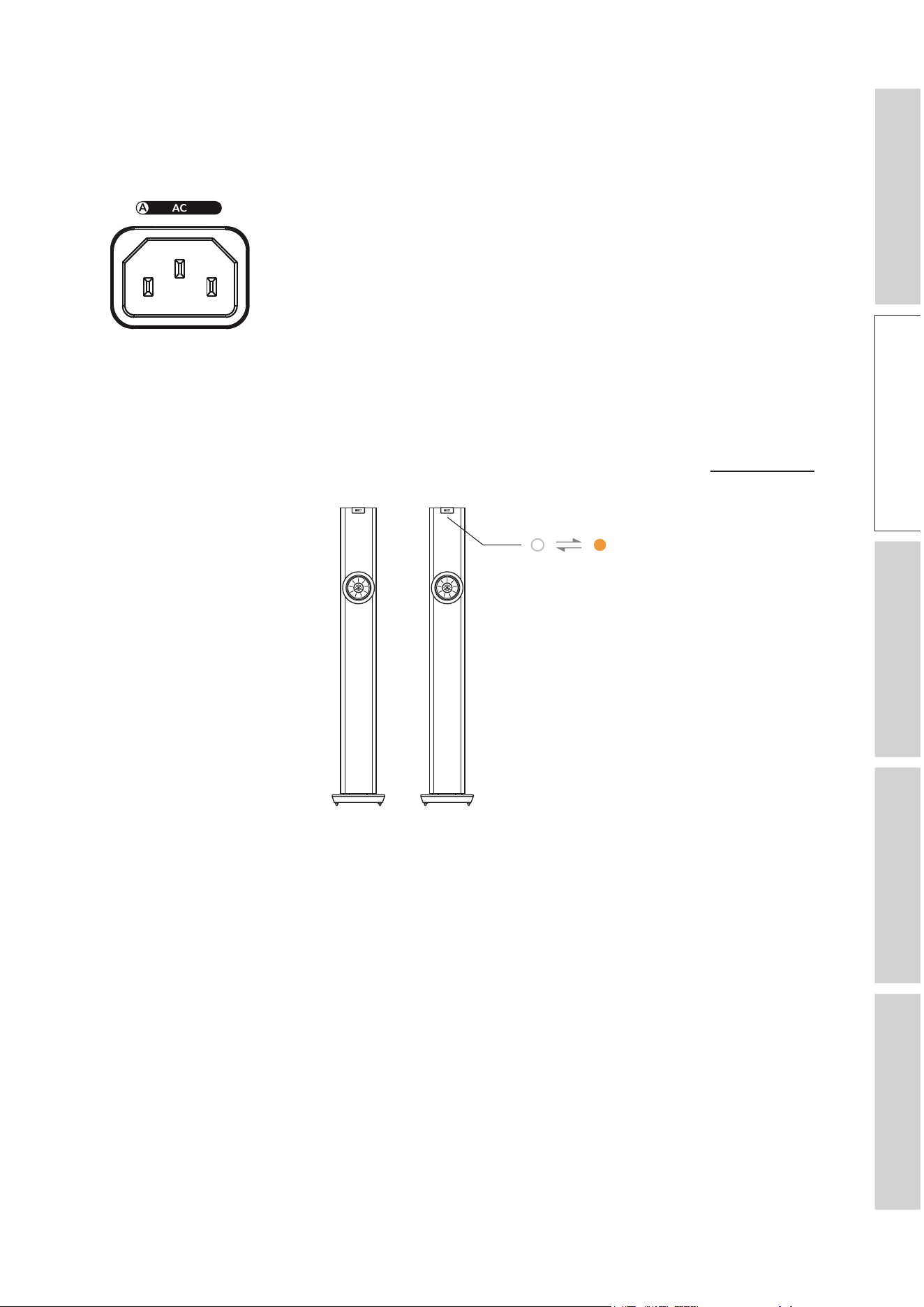
1. Connect the power cables into the AC input connectors (A) on the back panels of
the Primary and Secondary Speakers.
2. Connect the power plugs into the power sockets/outlets.
After successful power connections, the LED indicator light of the Primary Speaker
will blink white and amber. The speakers are now ready to be “onboarded” to your
personal Wi-Fi network through the KEF Connect App (see chapter “Onboarding”).
12
Table of ContentsSetting UpWi-Fi StreamingUsing KEF Connect AppFAQ and Troubleshooting
6.3 Onboarding
6.3.1 Installing the KEF Connect App
Install the KEF Connect App on your mobile device to get the speakers “onboarded”
to your Wi-Fi network.
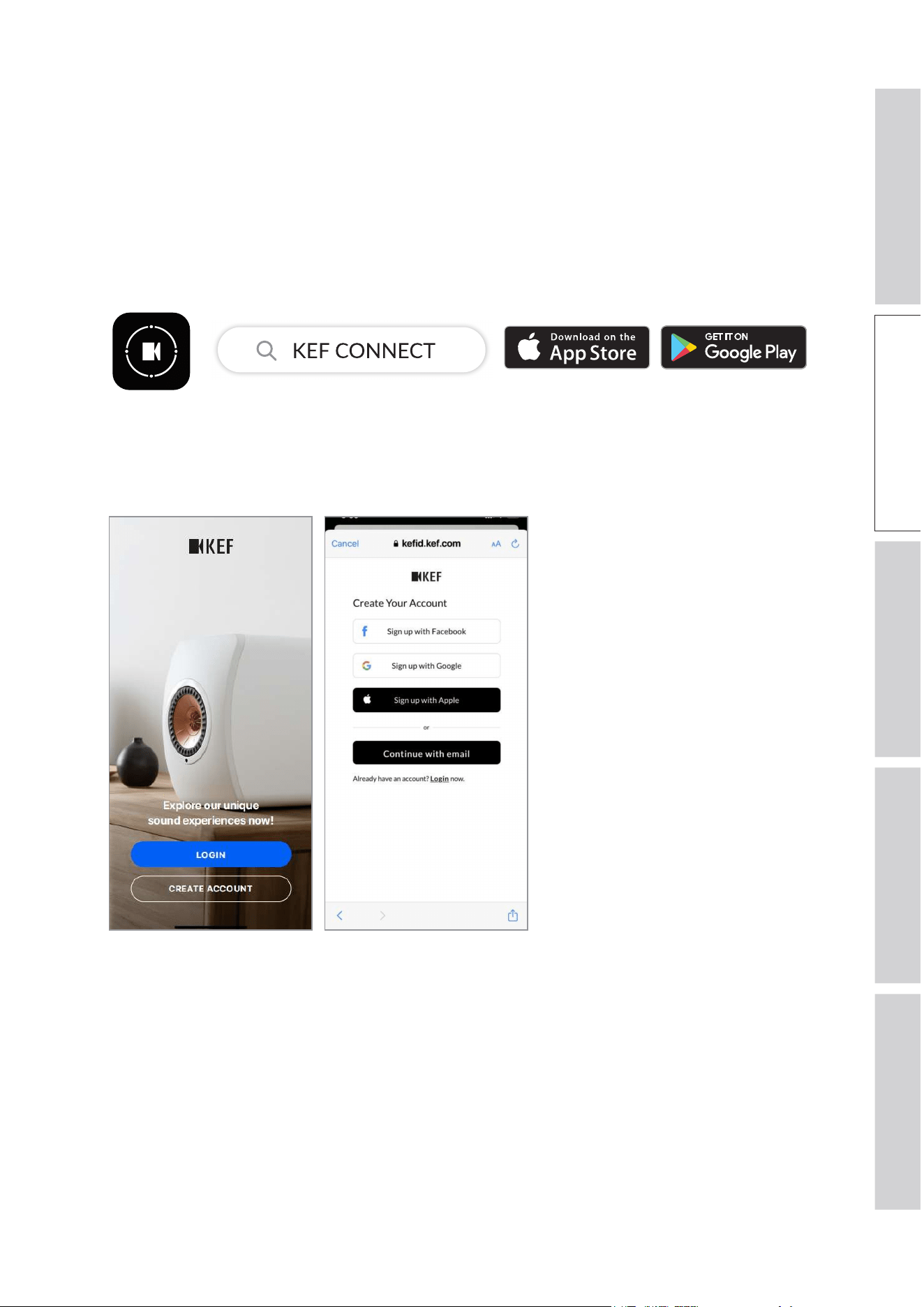
1. Search “KEF Connect” in the App Store or Google Play Store to download and install
the KEF Connect App on your iOS* or Android** device.
2. Launch the KEF Connect App on your device and create a user account. You may
log in with your existing Facebook, Google or Apple account, or create a new KEF
account with your email address.
*Requires iOS 14 or above. Refer to App Store for the latest requirements.
**Requires Android 8 or above. Refer to Google Play for the latest requirements.
13
Table of ContentsSetting UpWi-Fi StreamingUsing KEF Connect AppFAQ and Troubleshooting
6.3.2 Using iOS Devices
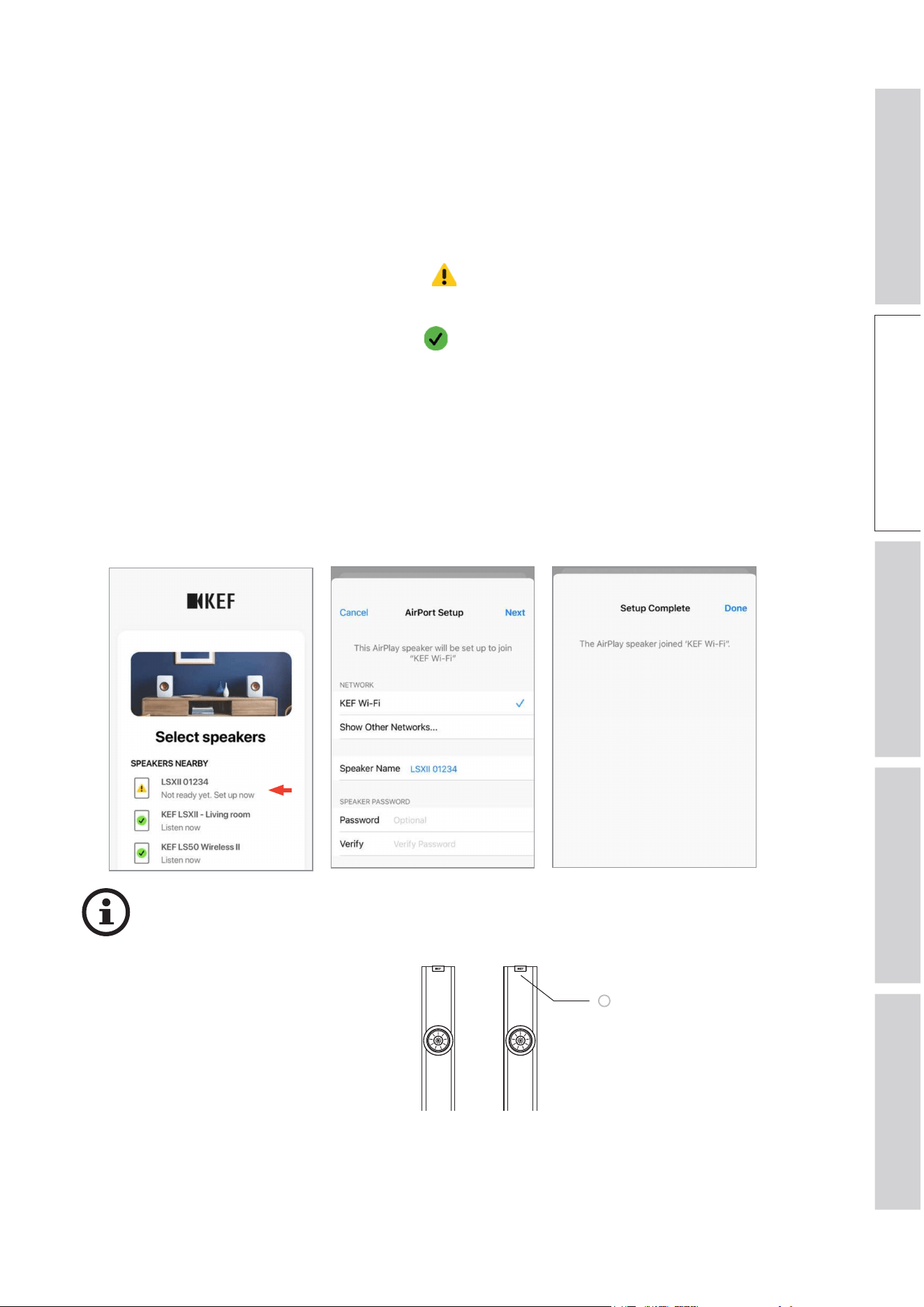
1. Make sure your mobile device is connected to the network you want to onboard
your speaker to.
2. Launch and login to the KEF Connect App on your mobile device.
3. Select “LS60 Wireless” under “Speakers nearby”.
The speakers with the warning sign ( ) are not set up yet. Select the speakers
with this warning mark to get them “onboarded”.
The speakers with the check mark ( ) are ready for use. This icon will show for
speakers already onboarded or directly connected to the network via a cable.
4. Select your local Wi-Fi network. Press “Next” to begin the onboarding process.
You may rename the speakers by tapping “Speaker name”.
5. The onboarding process will be done automatically. Tap “Done” when the process is
completed.
[Step 3–5]
• The LED indicator light of the Primary Speaker illuminates white briefly and
then fades out when the speakers are successfully connected.
• After successful connection, you may be prompted if there is a new firmware
update available. Follow the instructions in the KEF Connect App to
complete the update process.
14
Table of ContentsSetting UpWi-Fi StreamingUsing KEF Connect AppFAQ and Troubleshooting
6.3.3 Using Android Devices with Google Play Service
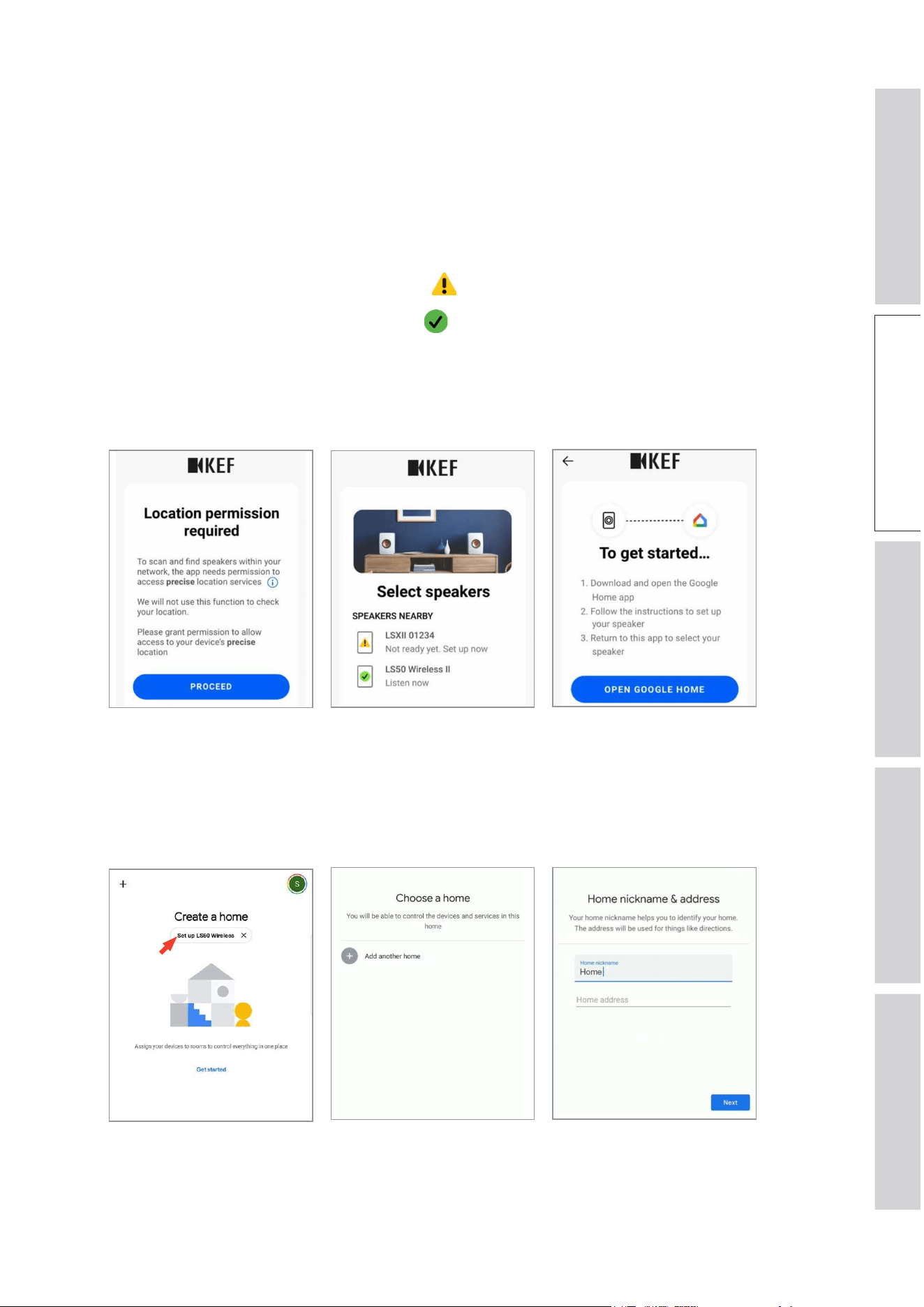
1. Make sure your mobile device is connected to your local Wi-Fi network.
2. Launch and login to the KEF Connect App on your mobile device.
3. Allow the app to access your device’s location when requested.
4. Select “LS60 Wireless” under “Speakers nearby”.
The speakers with the warning sign ( ) are not set up yet.
The speakers with the check mark ( ) are ready for use.
5. Tap “Open Google Home” to proceed. If your mobile device does not have Google
Home, you will be prompted to download and install the app on your device.
[Step 3–5]
6. Tap “Set up LS60 Wireless” at the top of the screen.
7. Tap “Add another home”.
8. Create a nickname for the home and then tap “Next”.
[Step 6–8]
Google Home will start to look for and connect to the speakers. Follow the
instructions on the screen to assign a use location (e.g home) and connect the
speakers to your local Wi-Fi network.
15
Table of ContentsSetting UpWi-Fi StreamingUsing KEF Connect AppFAQ and Troubleshooting
9. When the process is completed, tap “Continue” to start using the KEF Connect App.
• The LED indicator light of the Primary Speaker illuminates white briefly and
then fades out when the speakers are successfully connected.
• After successful connection, you may be prompted if there is a new firmware
update available. Follow the instructions in the KEF Connect App to
complete the update process.
• The latest operations of the Google Home App may differ from the above.
16
Table of ContentsSetting UpWi-Fi StreamingUsing KEF Connect AppFAQ and Troubleshooting
6.3.4 Using Android Devices without Google Play Service
1. Make sure your mobile device is connected to your local Wi-Fi network.
2. Launch and login to the KEF Connect App on your mobile device.
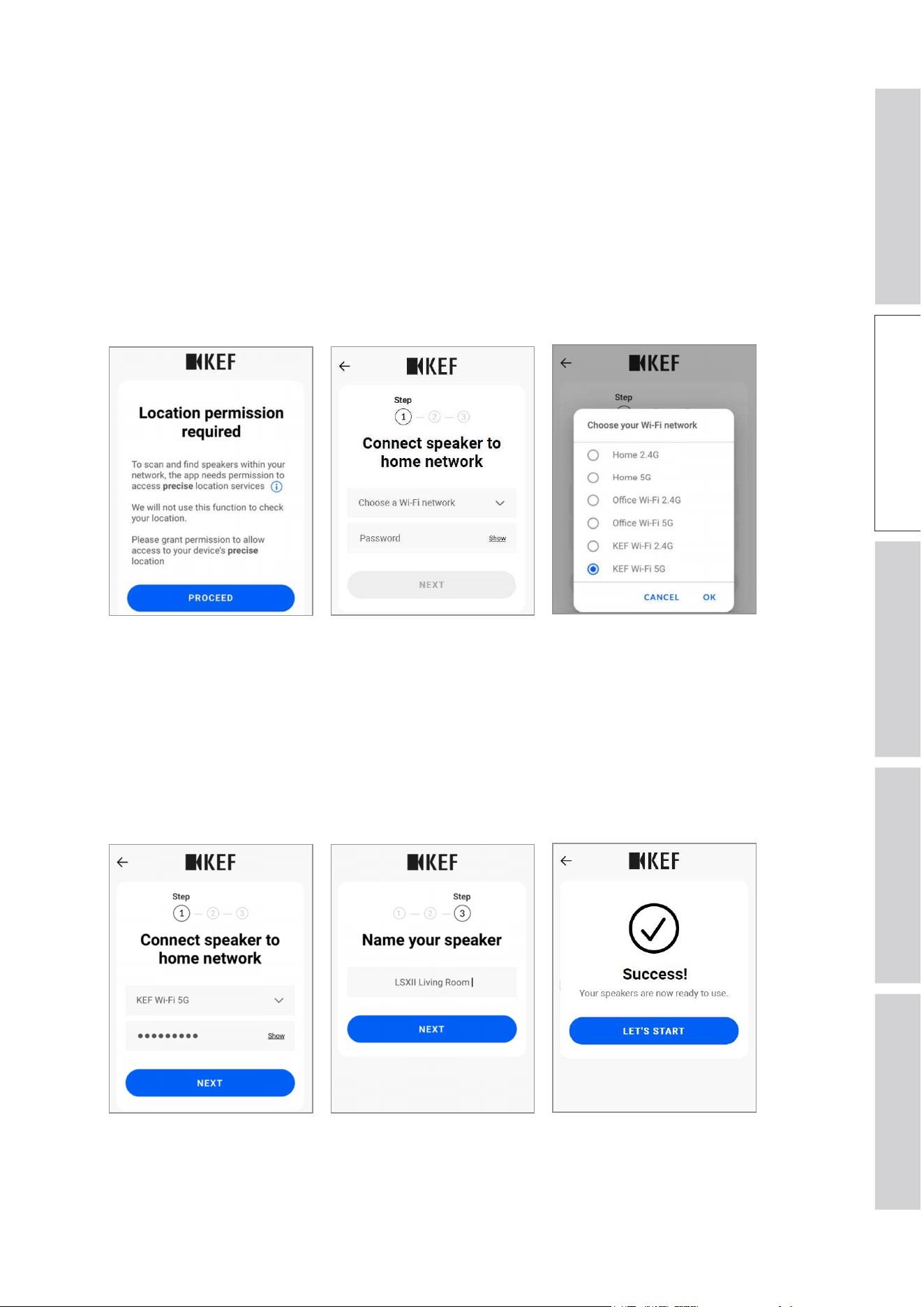
3. Allow the app to access your device’s location when requested.
4. Tap “Choose a Wi-Fi network”.
5. Select your local Wi-Fi network and then tap “OK”.
[Step 3–5]
6. Input the password of your local Wi-Fi network and then tap “Next”. The
connection process will be done automatically.
7. If preferred, create a new name for the speakers and then tap “Next”. This name
will be used for Wi-Fi and Bluetooth connections.
8. Tap “Let’s start” to enjoy your speakers.
[Step 6–8]
17
Table of ContentsSetting UpWi-Fi StreamingUsing KEF Connect AppFAQ and Troubleshooting
• The LED indicator light of the Primary Speaker illuminates white briefly and
then fades out when the speakers are successfully connected.
• After successful connection, you may be prompted if there is a new firmware
update available. Follow the instructions in the KEF Connect App to
complete the update process.
18
Table of ContentsSetting UpWi-Fi StreamingUsing KEF Connect AppFAQ and Troubleshooting
6.4 Speaker Placement and Connection
• The speakers should be placed on a flat and level surface that is free from vibration.
• The side and back panels of the speakers should have at least 7.5 cm clearance from
other objects.
• The two speakers are distinguished between the Primary Speaker and the Secondary
Speaker. By default, the Primary Speaker is the right channel* and should be placed
on your right hand side as you face the speakers. For the best stereo experience,
soundstage and stable connection, place the speakers at least 1 meter apart.
*The left and right channels can be swapped through the KEF Connect App.
See chapter “Speaker System Options – Inverse L/R Speaker”.
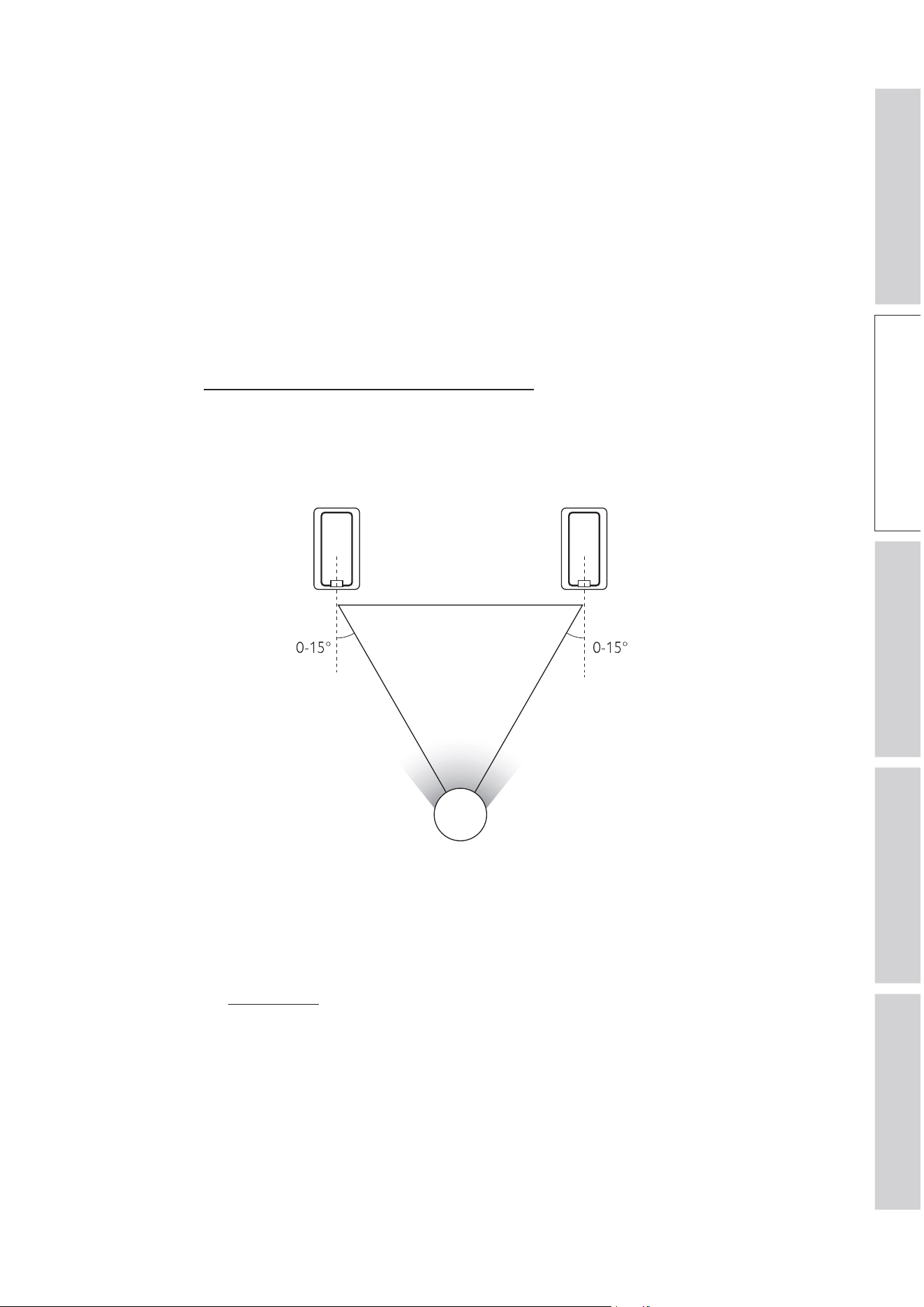
• The optimum distance between the speakers and the listener will depend on how far
the Primary Speaker and the Secondary Speaker are separated, or vice versa. Try to
keep the same distance to the listener to form an equilateral triangle.
A
B C
A = B = C
• The two speakers are already paired and will be automatically connected with each
other wirelessly (resolution: 96 kHz/24 bit). If you prefer a higher resolution
(192 kHz / 24 bit) or are experiencing frequent audio dropouts due to interference,
use the provided inter-speaker cable (length: 8 m) to link the two speakers
(see chapter “Back Panel”).
19
Table of ContentsSetting UpWi-Fi StreamingUsing KEF Connect AppFAQ and Troubleshooting
• If a longer inter-speaker cable is required, the K-Stream cable is recommended.
Maximum Distance between the Two Speakers
Wireless Mode Up to 8 meters. Note that RF interference, including Wi-Fi,
Bluetooth, microwaves and IoT devices, may reduce this
distance.
Wired Mode Use the provided inter-speaker cable or connect with a
shielded Cat-6 Ethernet cable. The cable length should be
within 10 meters.
• You can also modify the settings in the KEF Connect App to best fit your listening
environment.
6.5 Ventilation
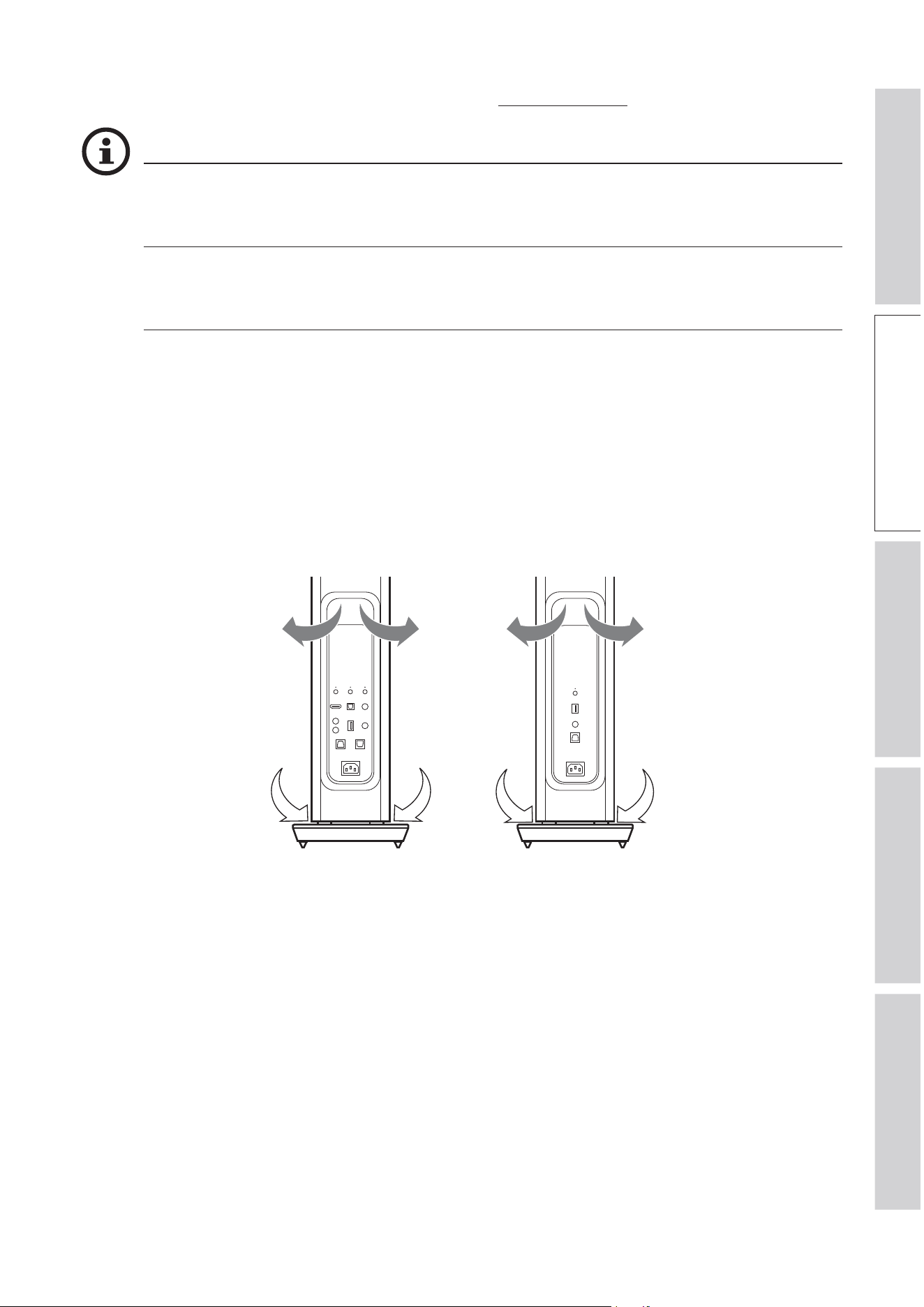
For cooling of the internal parts, air is drawn into the speakers from the bottom
and expelled through the openings above the rear connections. Do not block these
openings for the best cooling effects.
20
Table of ContentsSetting UpWi-Fi StreamingUsing KEF Connect AppFAQ and Troubleshooting
7. Connection and Control Interface
7.1 Front Panel
Primary SpeakerSecondary Speaker
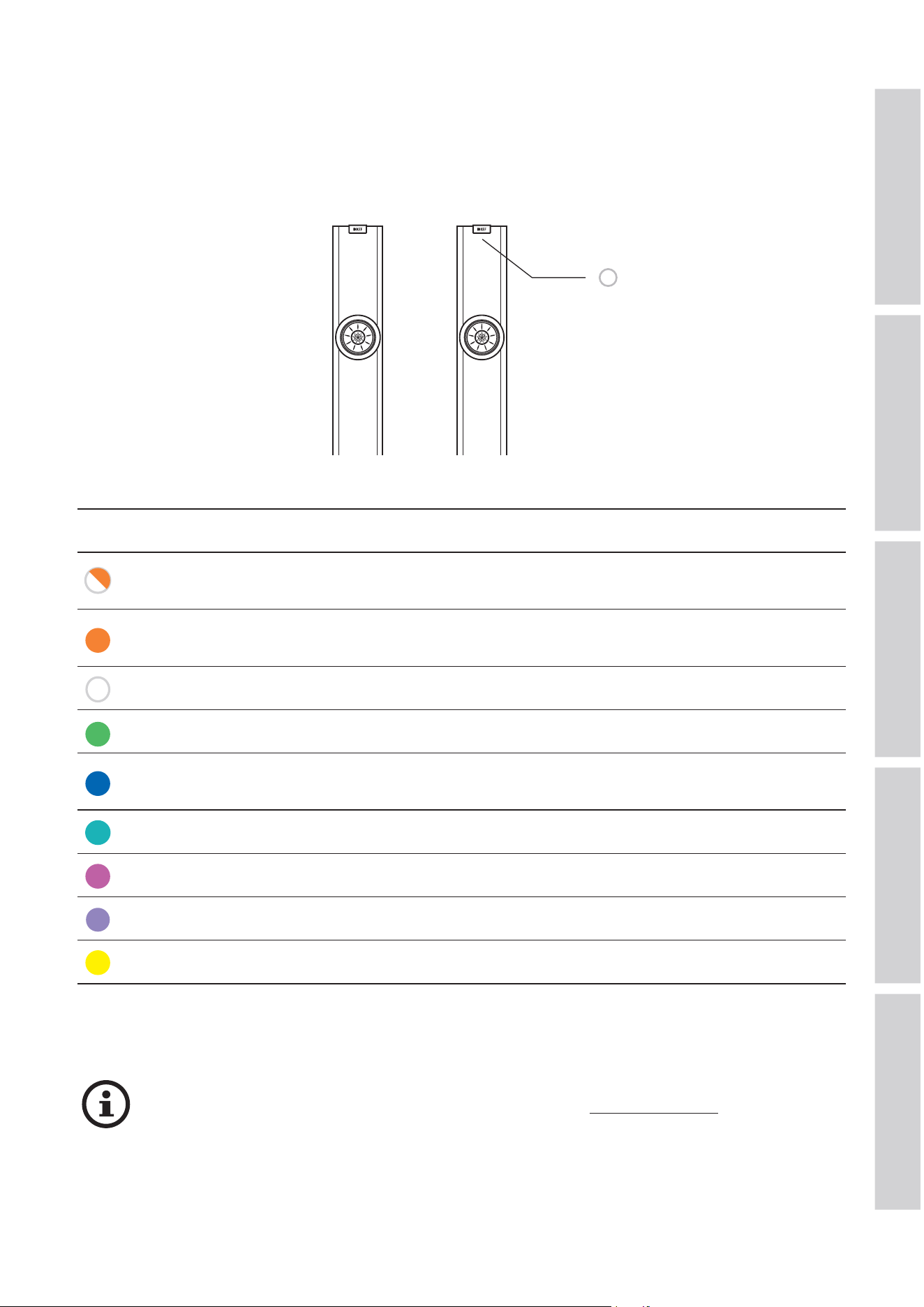
• An LED indicator light can be found below the KEF logo of each speaker.
• The IR (infrared) receiver for the remote control can be found on the Primary
Speaker where the KEF logo is located.
The LED indicator light of the Secondary Speaker only comes on when:
• The Secondary Speaker is initially connected to power and is working
properly. The LED indicator light will briefly come on orange and then go out.
• An error occurs.
• During normal operation the LED indicator light on the Secondary Speaker
will not illuminate.
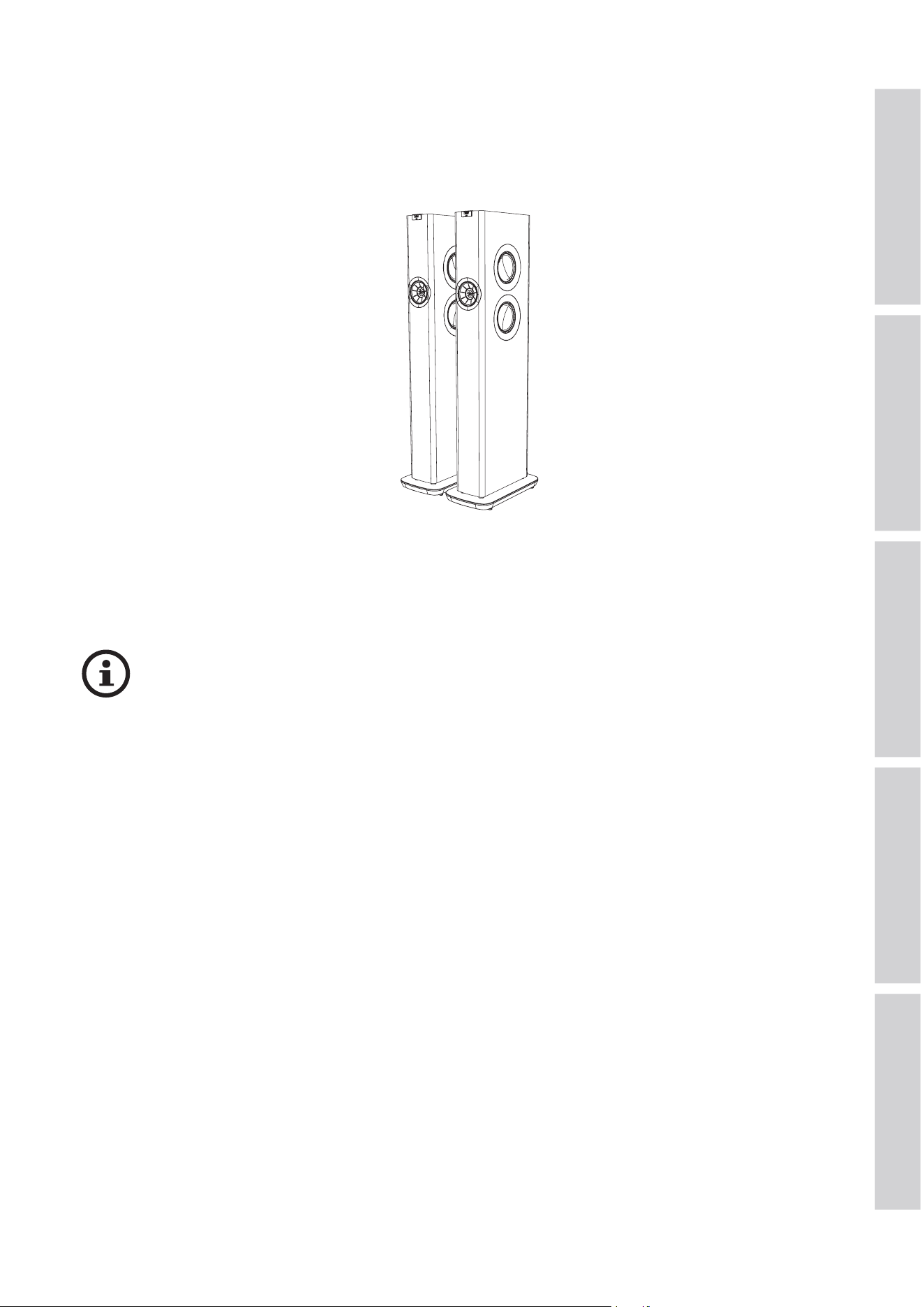
21
Table of ContentsSetting UpWi-Fi StreamingUsing KEF Connect AppFAQ and Troubleshooting
7.2 Back Panel
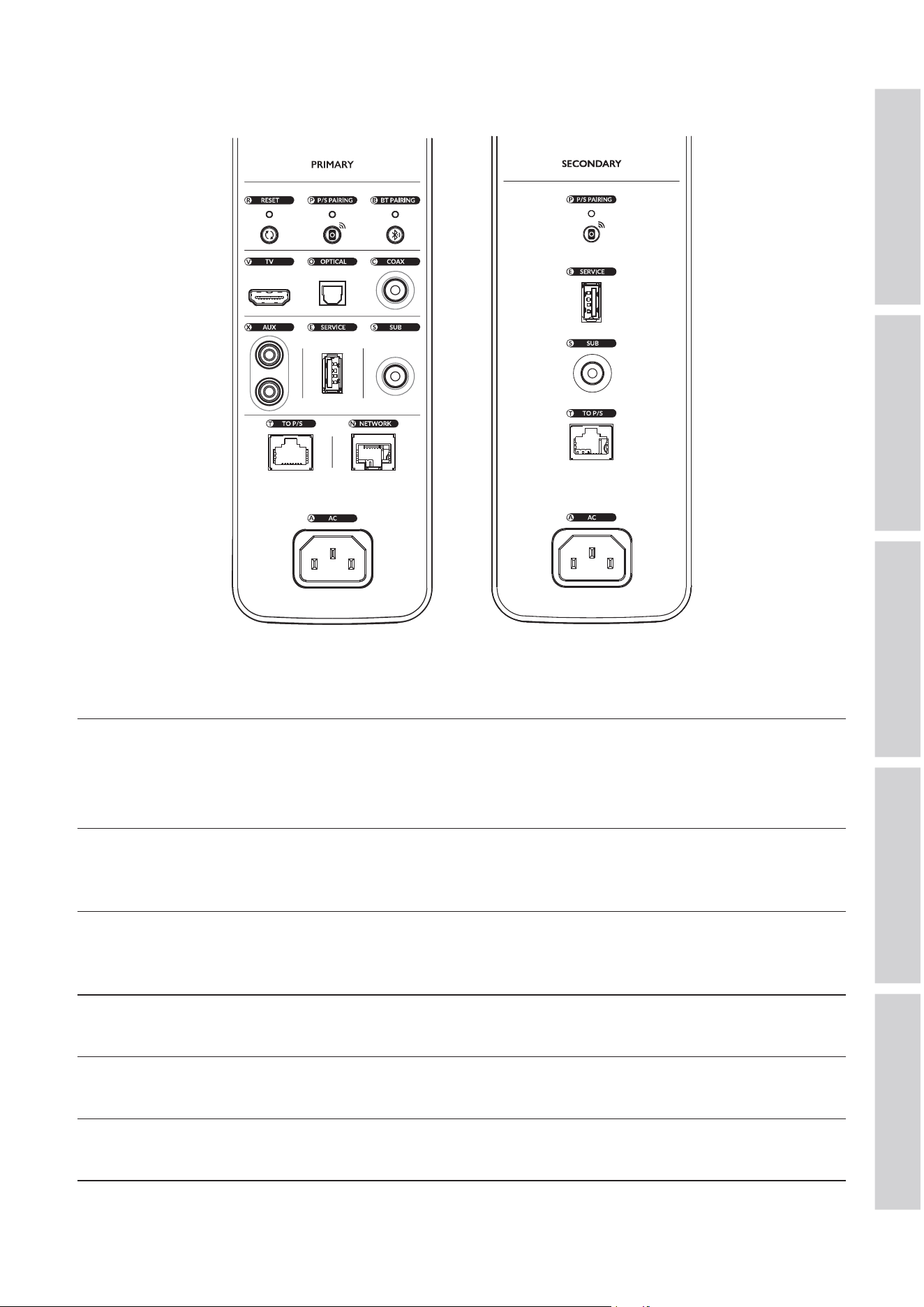
Controls and connections are found on the back panel of each speaker, marked as shown.
R
Factory reset button Resets the speakers to the factory defaults (including
network settings and all EQ and system preferences).
Press and hold the button until the indicator light
above the button blinks.
P
P/S pairing button Re-establishes the connection between the Primary
Speaker and the Secondary Speaker if the connection
is lost.
B
Bluetooth pairing button Enables Bluetooth pairing. The speakers will be ready
to pair with a new device. Any Bluetooth connected
device will be disconnected.
V
TV port Plays audio input from a source (e.g. eARC port of
television) through an HDMI cable.
O
Optical input jack Plays audio input from a source (e.g. Blu-ray player,
cable box) through an optical cable.
C
Coaxial input jack Plays audio input from a source (e.g. audio player)
through a coaxial cable.

22
Table of ContentsSetting UpWi-Fi StreamingUsing KEF Connect AppFAQ and Troubleshooting
X
Auxiliary input jack Plays audio input from a source (e.g. turntable with
phono stage) through an RCA cable.
E
Service port Connection port for service.
S
Subwoofer output jack Connects a subwoofer to the speakers through an
RCA cable.
T
Primary/Secondary
connection port
Connects the Primary Speaker and Secondary
Speaker with the inter-speaker cable.
N
Network port Connects the speakers to a router with a LAN cable.
This port is colour-coded yellow.
A
AC input connector Connects the speakers to the power source with the
power cables.
23
Table of ContentsSetting UpWi-Fi StreamingUsing KEF Connect AppFAQ and Troubleshooting
7.3 LED Indications
The connection and operation status can be easily checked through the colours and
patterns of the LED indicator on the Primary Speaker.
Pattern Status
Blinking white and
amber
The speakers are ready to connect to a Wi-Fi network.
Launch the KEF Connect app to set up the speakers.
Solid amber*
The speakers are in Standby Mode and connected to a
Wi-Fi network.
Solid white* The speakers are operating in Wi-Fi Mode.
Solid green* The speakers are operating in Spotify Connect Mode.
Solid blue*
The speakers are operating in Bluetooth Mode and a
device is already paired with the speakers.
Solid light blue* The speakers are operating in TV Mode.
Solid magenta* The speakers are operating in Optical Mode.
Solid lavender* The speakers are operating in Coaxial Mode.
Solid yellow* The speakers are operating in AUX Mode.
*The LED indicator light illuminates briefly and fades out when there are no active
interactions with the speakers (e.g. controlling playback or volume).
For a full list of colours and patterns, see chapter “LED Indicators”.
24
Table of ContentsSetting UpWi-Fi StreamingUsing KEF Connect AppFAQ and Troubleshooting
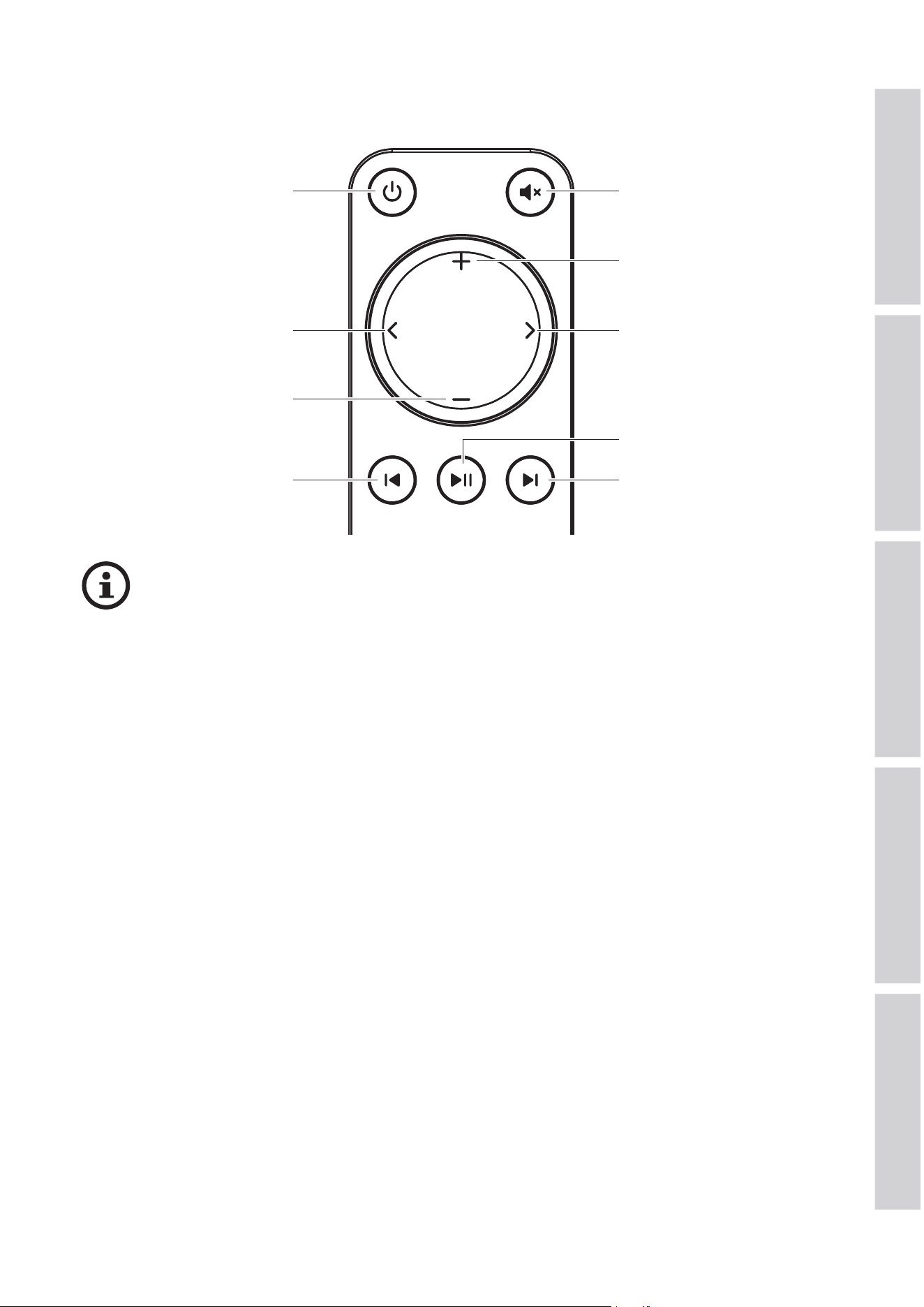
7.4 Remote Control
Mute button
Volume up button
Play/pause button
Next source button
On/off button
Volume down button
Previous button
Previous source button
Next button
• Insert two AAA batteries into the battery compartment before use. To do
so, slide open the battery compartment cover on the back and insert the
batteries into the compartment according to the polarity (+/–). Close the
battery compartment cover when done.
• Point the remote control to the IR receiver located on the front panel of
the Primary Speaker. Make sure there are no obstacles between the remote
control and the Primary Speaker during use.
• If the remote control is less responsive or not working, the battery power
may be low. Replace the batteries to see if this is the case.
25
Table of ContentsSetting UpWi-Fi StreamingUsing KEF Connect AppFAQ and Troubleshooting
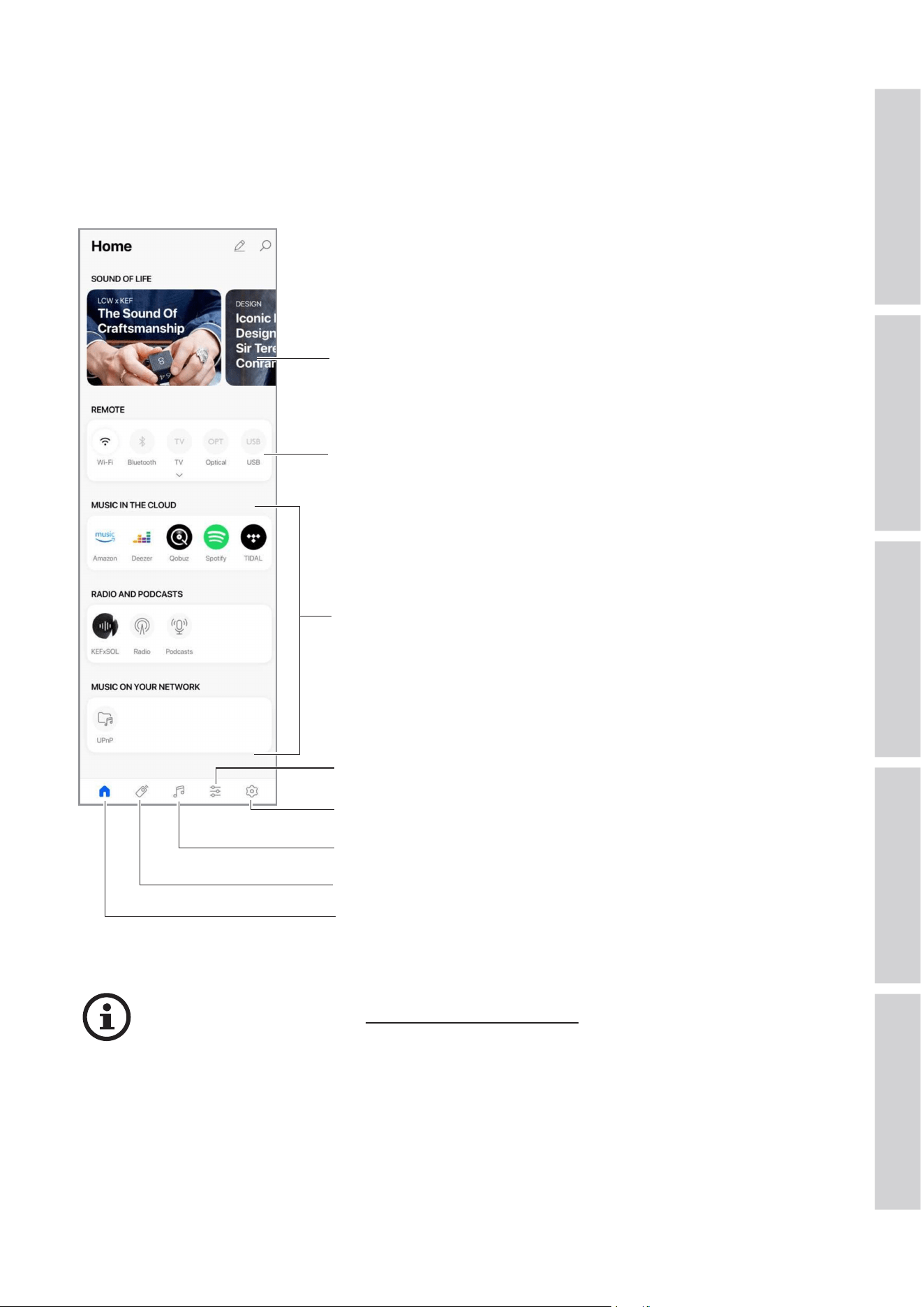
7.5 KEF Connect App
The KEF Connect App allows you to set up the speakers, apply sound settings, turn on/
off the speakers, switch sound sources, and access and play back your streaming music
and music stored in media server.
Turn on/off the speakers and switch sources
Shortcuts to music content (music streaming
services, Internet radio stations, podcasts and
media server*)
EQ settings
Speaker settings
Latest news and stories from KEF
Music content
Remote control
Home
*Coming soon
For details, see chapter “Using KEF Connect App”.
26
Table of ContentsSetting UpWi-Fi StreamingUsing KEF Connect AppFAQ and Troubleshooting
8. Wi-Fi Streaming
8.1 Wireless Streaming Protocols
To stream audio to the speakers, your mobile device must be connected to
the same Wi-Fi network as the speakers. The speakers can be turned on from
standby mode through all wireless streaming protocols.
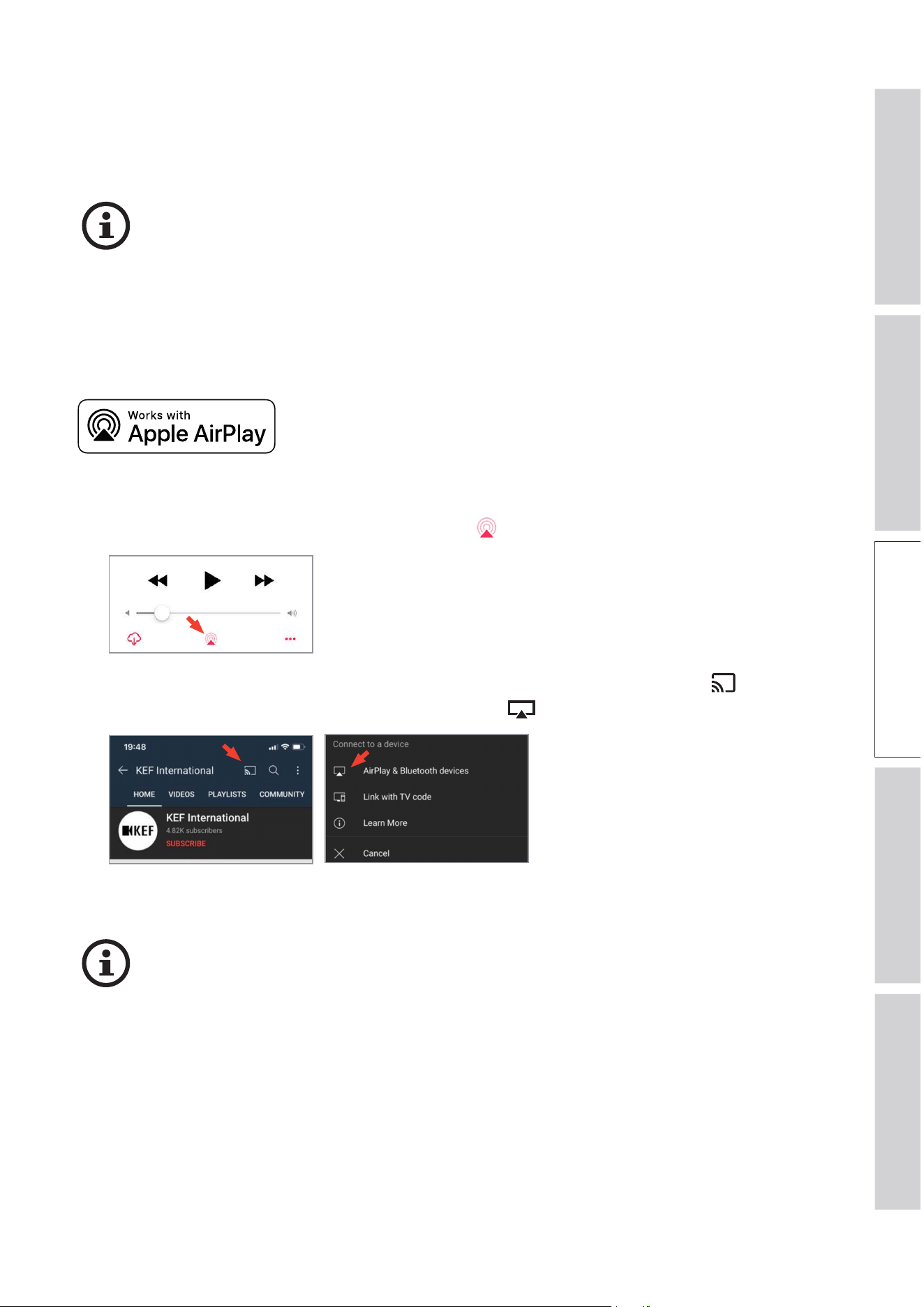
8.1.1 AirPlay 2
AirPlay 2 lets you share audio output from Apple devices to the speakers.
1. Start music or video playback on your iOS device.
2. For music streaming, tap the AirPlay icon ( ) in the playback screen.
For audio streaming from the YouTube app, tap the connection icon ( ) in the
playback screen and then tap the AirPlay icon ( ).
3. Select “LS60 Wireless” (or the name you have created for the speakers) from the
selection menu to start streaming.
The availability for streaming depends on the app compatibility.
27
Table of ContentsSetting UpWi-Fi StreamingUsing KEF Connect AppFAQ and Troubleshooting
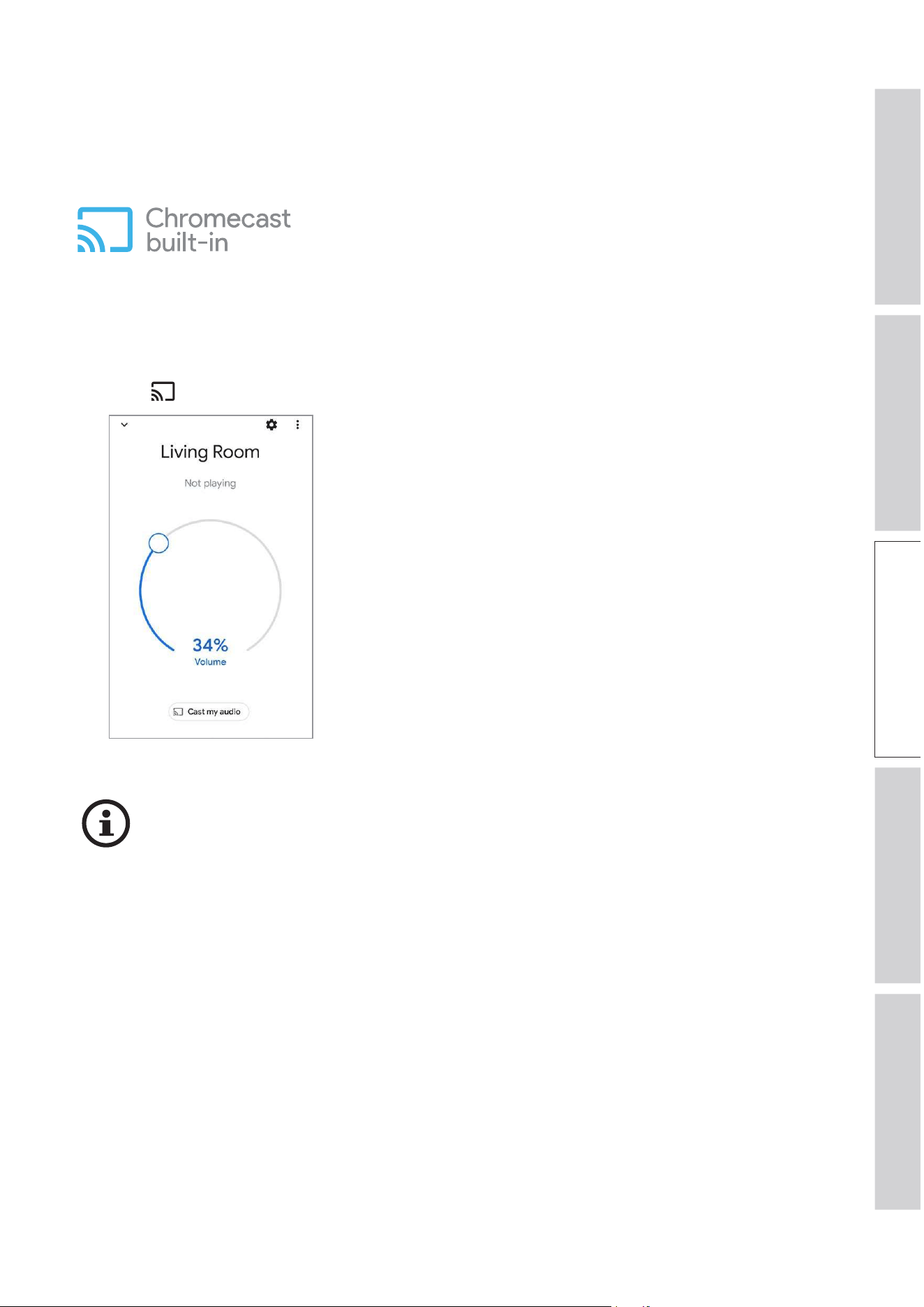
8.1.2 Chromecast
If your device is Chromecast-enabled, you can stream audio output from the device to
the speakers.
1. Start music or video playback on your Chromecast-enabled device.
2. In the Google Home App, tap “LS60 Wireless” (or the name you have created for the
speakers).
3. Tap “ Cast my audio”.
• The availability for streaming depends on the app compatibility.
• The latest operations of the Google Home App may differ from the above.
28
Table of ContentsSetting UpWi-Fi StreamingUsing KEF Connect AppFAQ and Troubleshooting
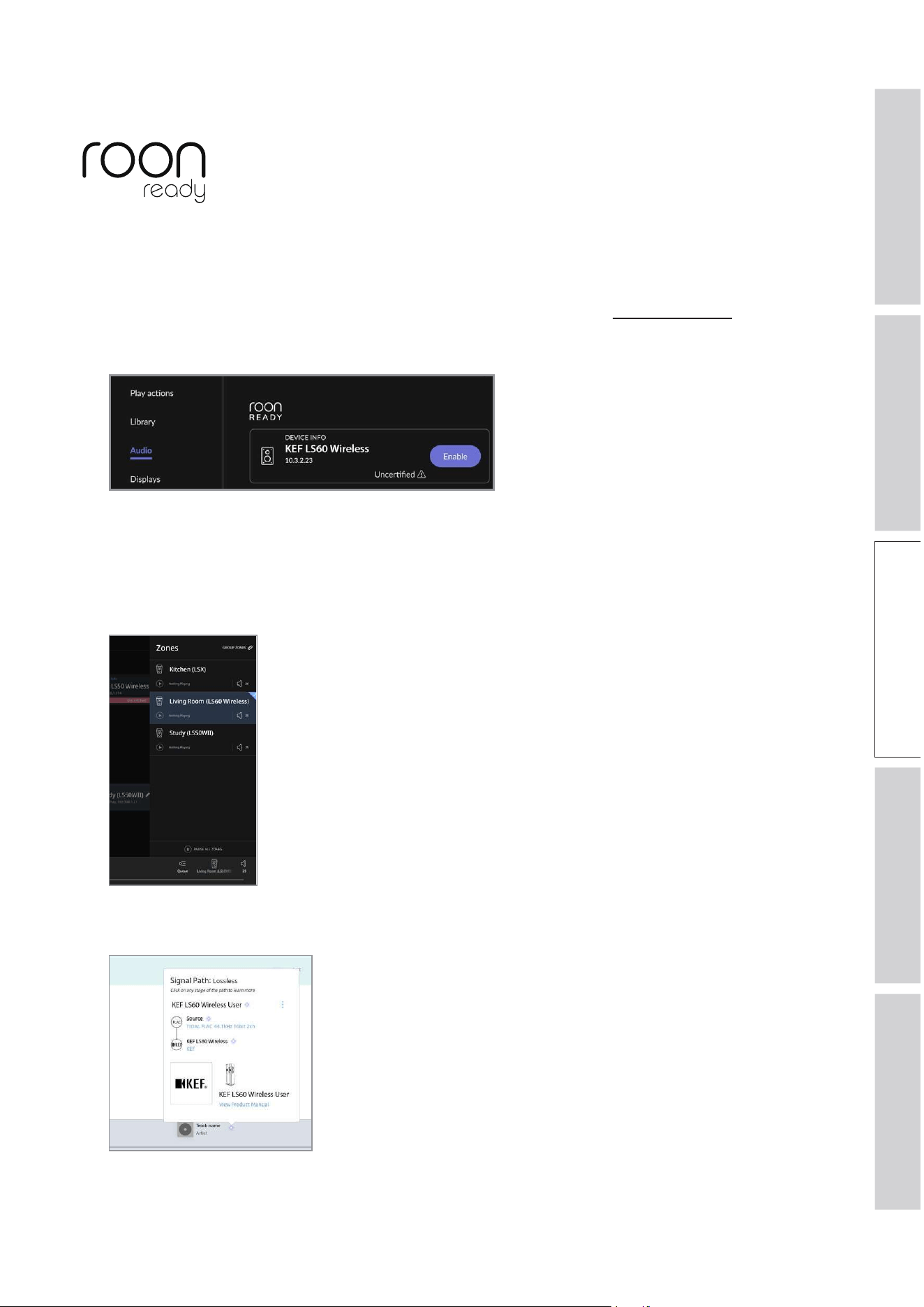
8.1.3 ROON Ready
Roon is a high quality music management system that pulls together music from a NAS
drive, locally stored music (i.e. on your computer), compatible streaming services and
Dropbox to create a searchable, surfable magazine about your music. The speakers are
certified “Roon Ready”. For more information on Roon, visit roonlabs.com.
1. Enable the speakers in the Audio menu.
Note: KEF LS60 Wireless will be Roon Ready soon.
2. To stream music, click the “Zone Picker” next to volume at the footer of Roon and
then select “KEF LS60 Wireless” (or the name you have created for the speakers)
from the device list.
3. The signal path can be found by clicking the little coloured light in the footer.
29
Table of ContentsSetting UpWi-Fi StreamingUsing KEF Connect AppFAQ and Troubleshooting
8.1.4 Music Streaming Apps Native Protocols
8.1.4.1 Spotify Connect
Spotify is a digital music and podcast streaming service that gives you access to millions
of songs and other content from artists all over the world. The speakers are ready for
Spotify Connect.
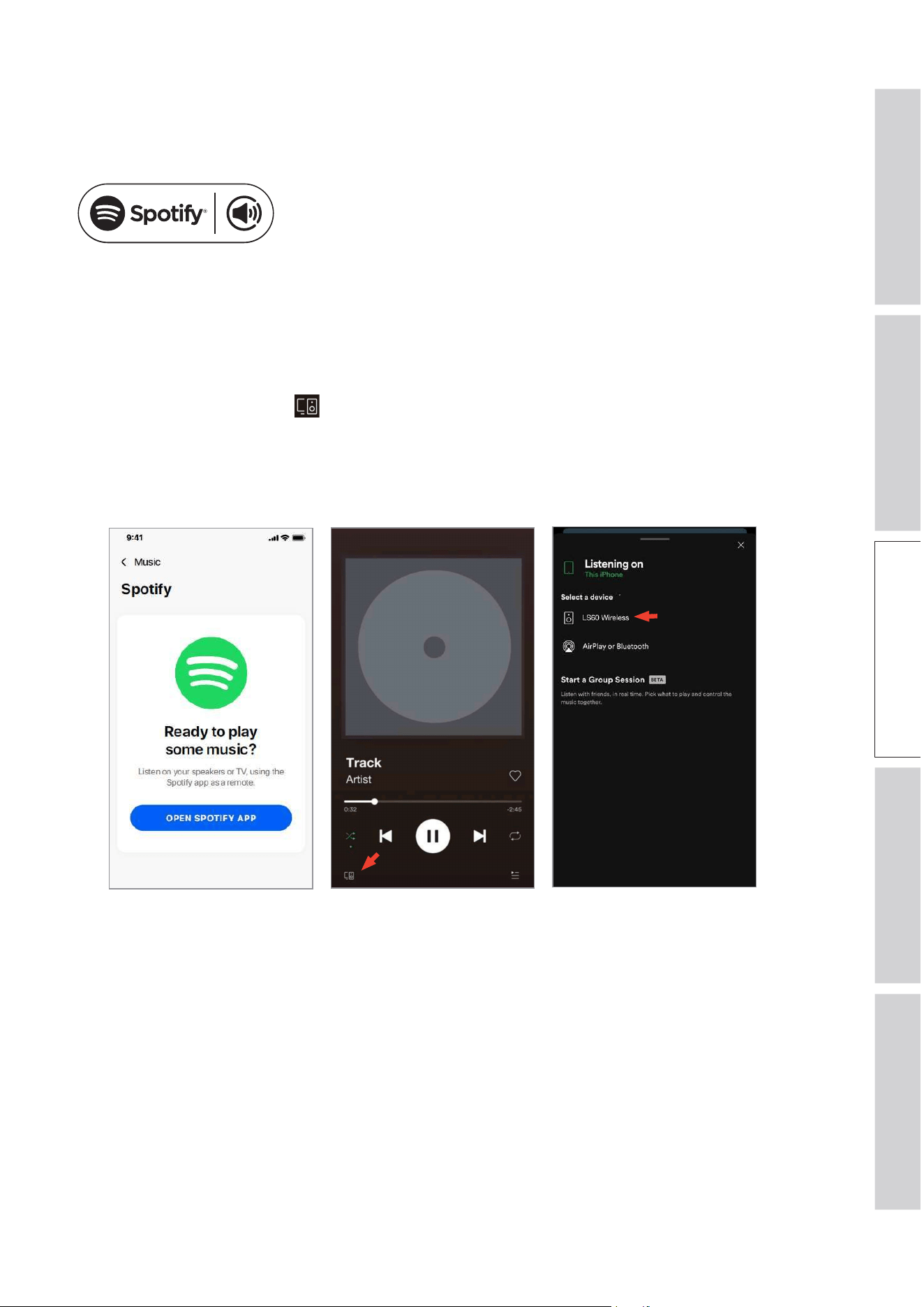
1. Browse and select music to play in the Spotify App.
2. Tap the device icon ( ) at the bottom of the playback screen.
3. Select “LS60 Wireless” (or the name you have created for the speakers) from the
selection menu to start streaming.
[Step 1–3]
30
Table of ContentsSetting UpWi-Fi StreamingUsing KEF Connect AppFAQ and Troubleshooting
8.1.4.2 QPlay
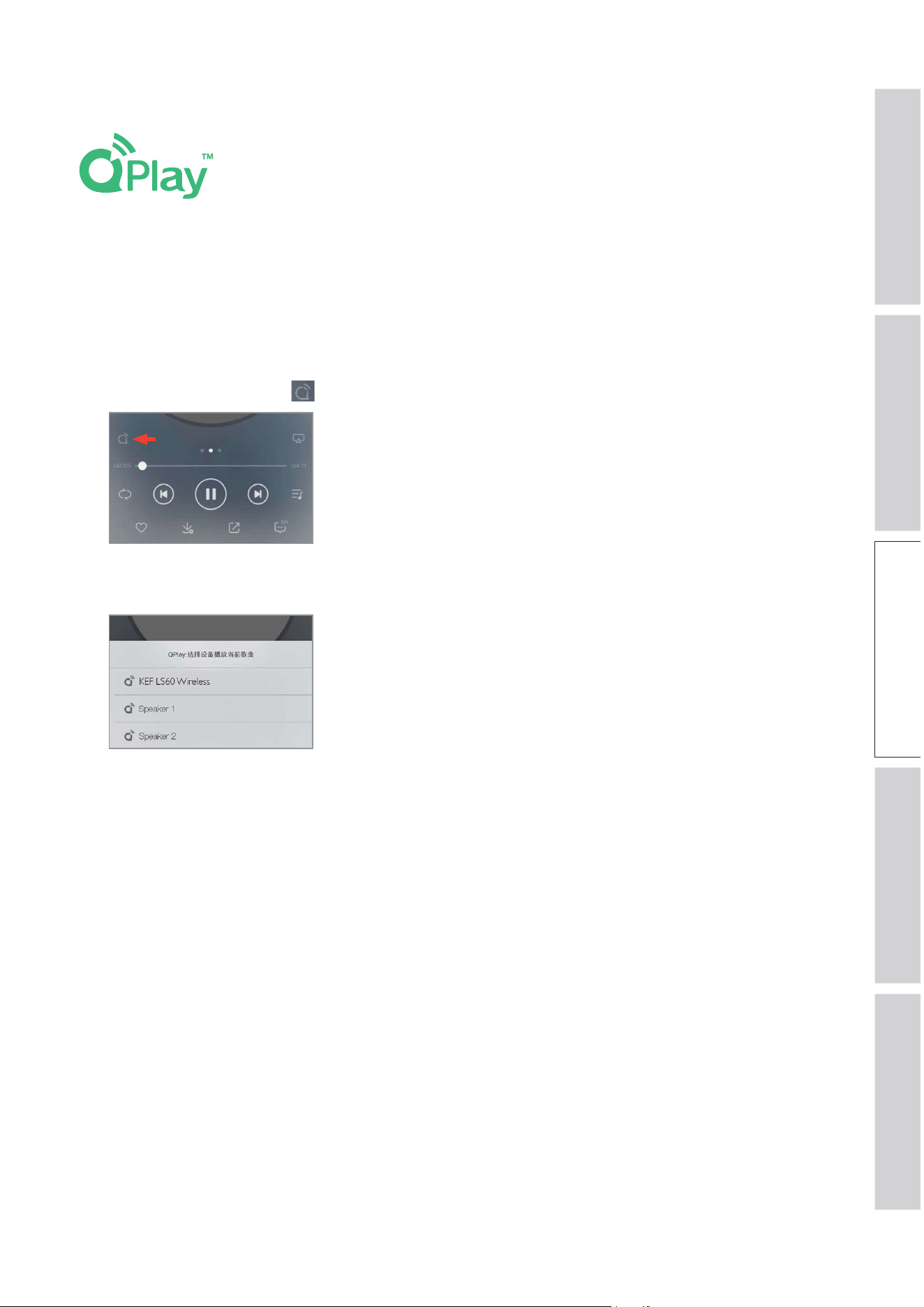
QQ Music is one of China’s most popular online music streaming services. QPlay lets
you stream music directly from the QQ Music App. The speakers are ready for the
QPlay feature.
1. To stream music, launch the QQ Music App and enable QPlay in the settings.
2. Browse and play music.
3. Tap the QPlay icon ( ) on the playback screen.
4. Select “KEF LS60 Wireless” (or the name you have created for the speakers) from the
device list to start streaming.

31
Table of ContentsSetting UpWi-Fi StreamingUsing KEF Connect AppFAQ and Troubleshooting
8.1.4.3 TIDAL Connect
TIDAL is a subscription-based music, podcast and video streaming service that
combines lossless audio and high-definition music videos with exclusive content and
special features on music. The speakers are ready for the TIDAL Connect feature for
music streaming.
1. To stream music, select the content you want to play in the TIDAL Connect App and
then select the connect icon ( ) in the “Now Playing” screen.
2. Select “LS60 WireIess” (or the name you have created for the speakers) from the list
of nearby devices to pair with the Tidal Connect App to start streaming.
[Step 1–2]
32
Table of ContentsSetting UpWi-Fi StreamingUsing KEF Connect AppFAQ and Troubleshooting
8.1.5 KEF Connect App Streaming
The KEF Connect App offers direct access to various music streaming services
for playback through the speakers. For details, see chapter
“Playing Music from Music Streaming Services”
8.1.5.1 Amazon Music
Amazon Music is a music streaming platform and online music store operated by
Amazon. You can access your Amazon Music account through the KEF Connect App
to stream music to the speakers. High-res audio is supported with Amazon Music
Unlimited subscription.
8.1.5.2 Deezer
Deezer is an online music streaming service. It allows users to listen to music content
from a wide range of record labels on various devices online or offline. You can access
your Deezer account through the KEF Connect App to stream music to the speakers.
8.1.5.3 Qobuz
Qobuz is a music streaming and downloading service offering hi-resolution streaming
to its subscribers. You can access your Qobuz account through the KEF Connect App
to stream music to the speakers.
8.1.5.4 Spotify
Through the KEF Connect App, you will be prompted to open the Spotify app on your
device in order to stream music to the speakers. See chapter “Spotify Connect”.

33
Table of ContentsSetting UpWi-Fi StreamingUsing KEF Connect AppFAQ and Troubleshooting
8.1.5.5 TIDAL
TIDAL is a subscription-based music, podcast and video streaming service that
combines lossless audio and high-definition music videos with exclusive content
and special features on music. You can access your TIDAL account through the KEF
Connect App to play hi-resolution audio. A valid Hi-Fi tier subscription is required.
8.1.5.6 Internet Radio
The KEF Connect App offers access to thousands of Internet radio stations from all
over the world, offering music, news and discussion.
8.1.5.7 Podcasts
The KEF Connect App provides access to a wide range of podcasts covering a huge
number of genres and topics.
8.1.6 UPnP Playback
You can play compatible music files stored in the music library of a connected media
server (e.g. NAS drive via uPnP). The media server must be on the same network as
the speakers.
34
Table of ContentsSetting UpWi-Fi StreamingUsing KEF Connect AppFAQ and Troubleshooting
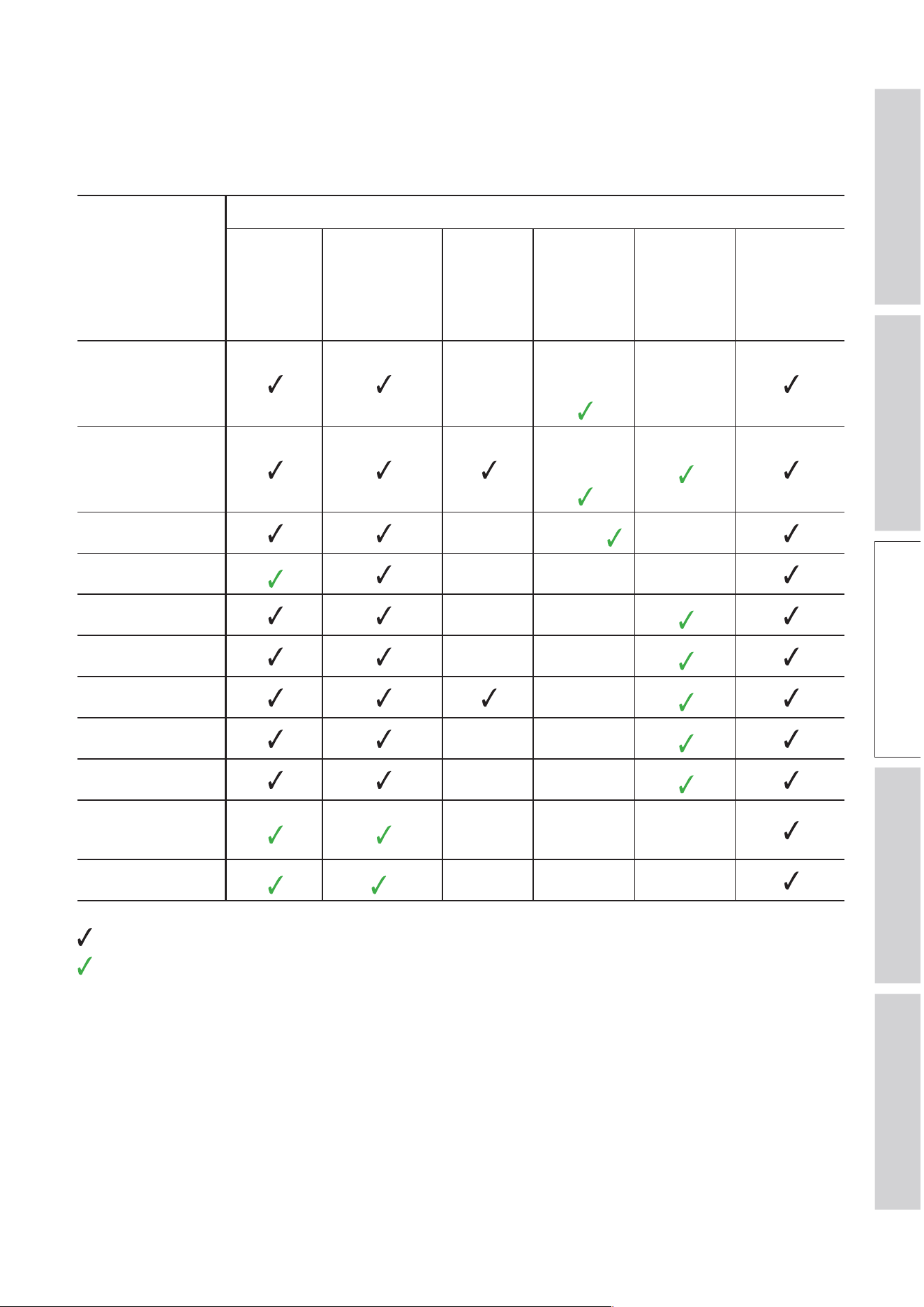
8.2 Tips on Choosing Streaming Protocols
Recommendations for the best wireless streaming options with regard to music/media
apps on your mobile devices.
App
Wireless streaming protocol
AirPlay 2 Chromecast ROON
Ready
Music
streaming
app native
protocol
KEF
Connect
App
Bluetooth
Spotify –
Spotify
Connect
–
TIDAL
TIDAL
Connect
QQ Music –
QPlay
–
Apple Music – – –
Amazon Music – –
Deezer – –
Qobuz –
Internet radio – –
Audio podcast – –
Youtube
(audio)
– – –
Youtube Music
*
– – –
= Supported
= Supported and recommended for the best audio quality and streaming stability.
*Only available with a Youtube Music Premium account.
35
Table of ContentsSetting UpWi-Fi StreamingUsing KEF Connect AppFAQ and Troubleshooting
9. Multi-Room Streaming
9.1 AirPlay 2
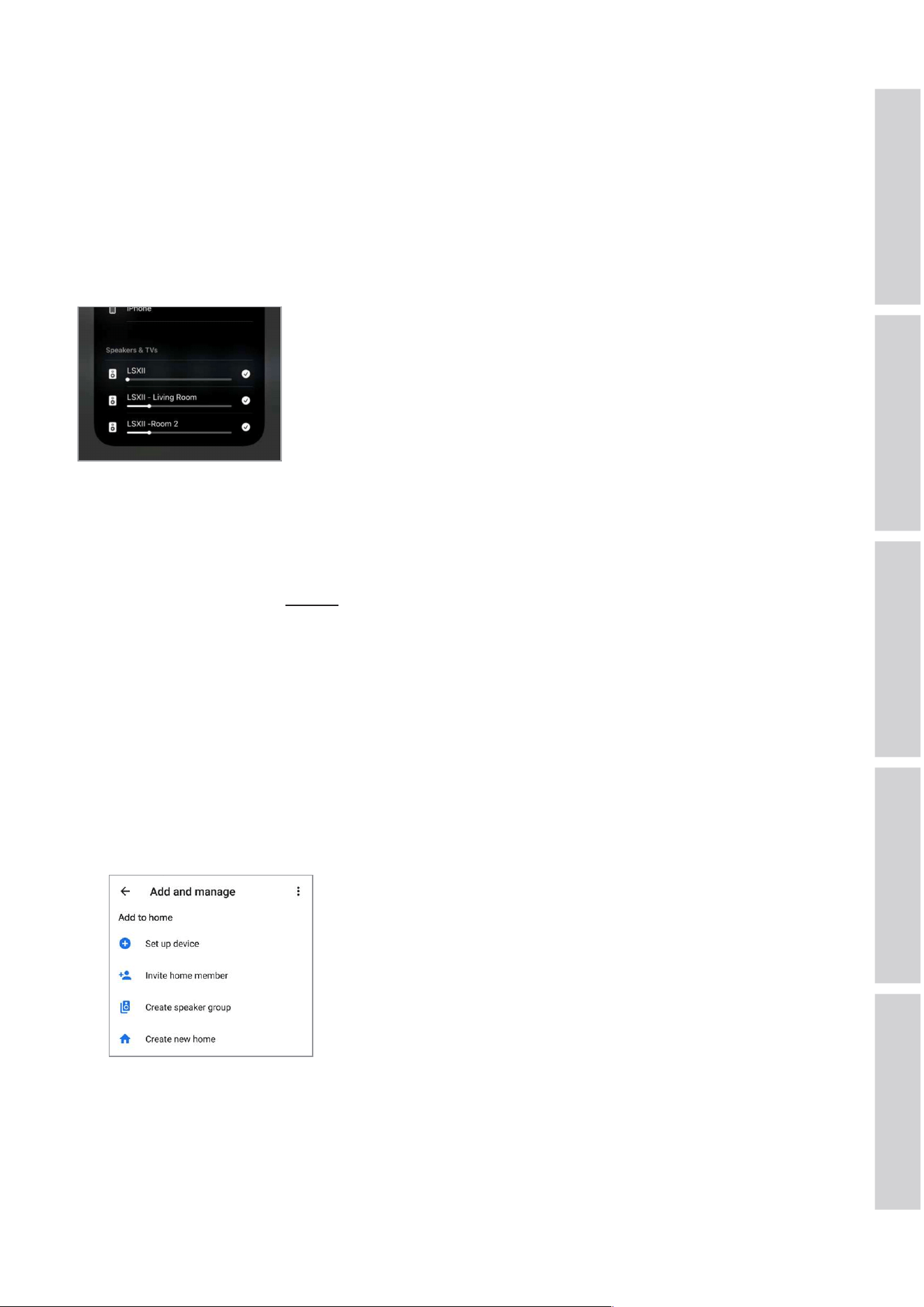
Apple Airplay 2 can extend the speakers to become part of a multi-room wireless
music system which can be controlled with iOS devices. If you have more than one pair
of AirPlay 2 speakers connected to the same network, select the pairs for playback of
the same audio output at the same time.
You can control the volume of the speakers individually or together as a group.
Note: Legacy AirPlay (AirPlay 1) speakers are not compatible with multi-room
streaming.
For more support, visit Apple.
9.2 Chromecast
You can group the speakers and Chromecast devices together for synchronous music
throughout the home.
1. Make sure your mobile device is connected to the same Wi-Fi network or linked to
the same account as your speakers.
2. Open the Google Home App.
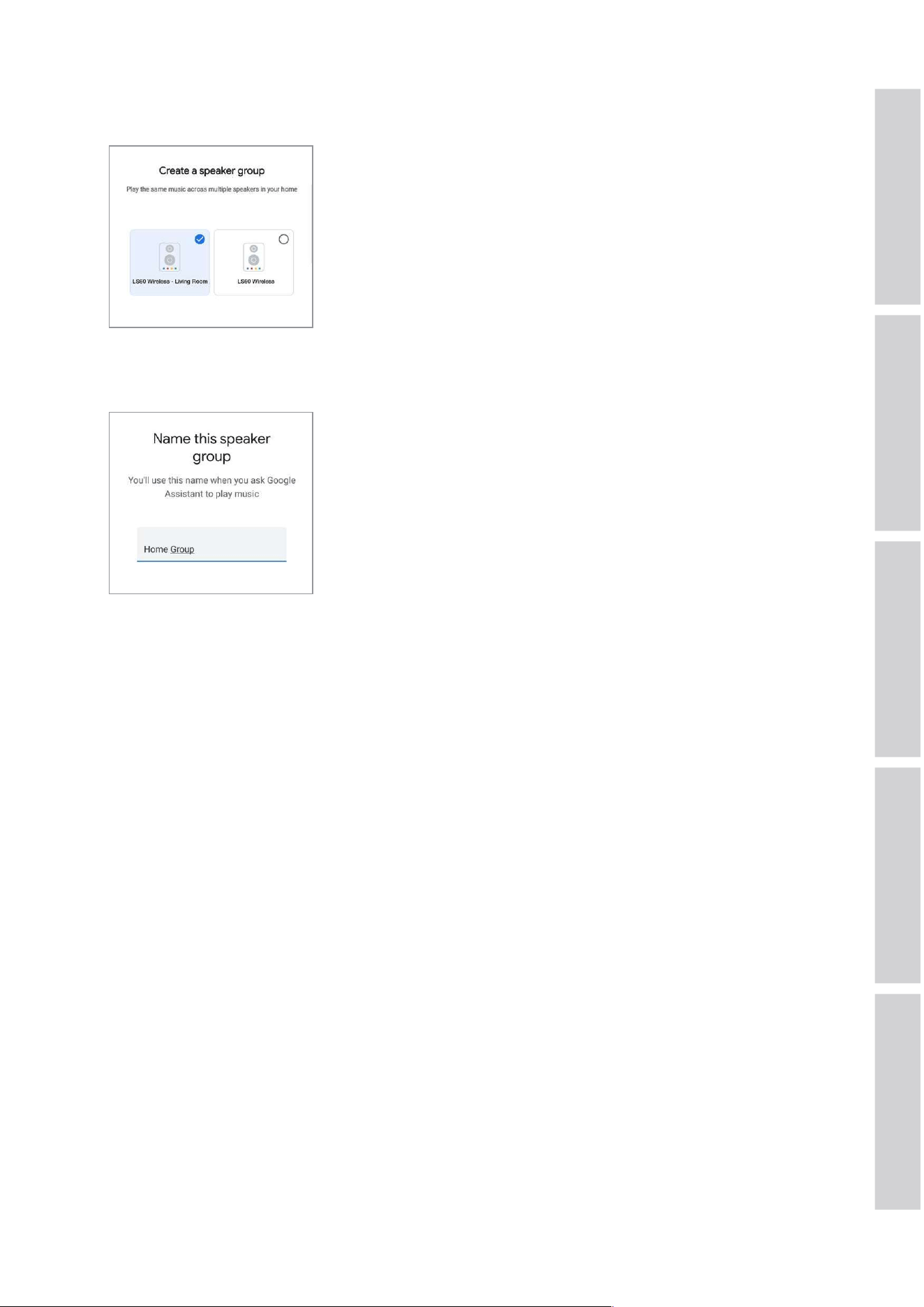
3. At the top left, tap “+” and then “Create a speaker group”.
36
Table of ContentsSetting UpWi-Fi StreamingUsing KEF Connect AppFAQ and Troubleshooting
4. Tap each device (including the sets of speakers) you want to add to the group. A
check mark will appear next to each device you have selected.
5. Tap “Next”
6. Enter a name for your group.
7. Tap “Save”.
37
Table of ContentsSetting UpWi-Fi StreamingUsing KEF Connect AppFAQ and Troubleshooting
9.3 ROON
With Roon Ready certification, the speakers are compatible with Roon’s multi-room
streaming functionality.
Roon supports “Zone Grouping”, or synchronizing audio playback in several zones
within your house. Note that “Zones” can only be grouped with other zones of the
same type (e.g. RAAT, AirPlay etc.).
1. To group zones, select the zone you are controlling in desktop and tablet interface, by
clicking the “Zone Picker” in the footer, next to volume.
On a phone, select by clicking “Switch Zone” below the volume pop-up.
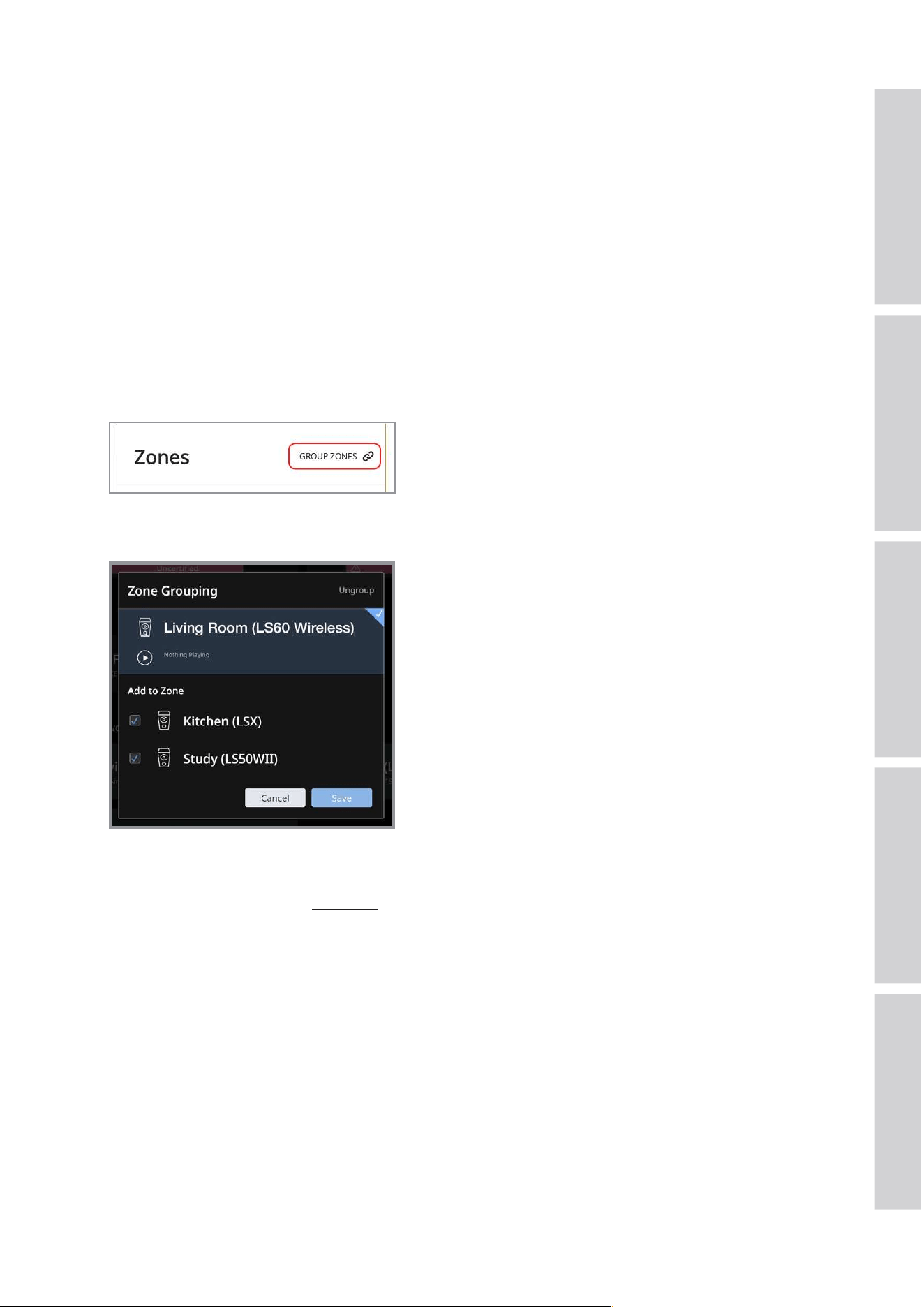
2. Tap “Group Zones”. This brings up the available zones for grouping.
3. Select the desired zone(s) to be added and then tap “Save”.
The speakers in the grouped zones will stream the same audio output.
For more support, visit ROON.
38
Table of ContentsSetting UpWi-Fi StreamingUsing KEF Connect AppFAQ and Troubleshooting
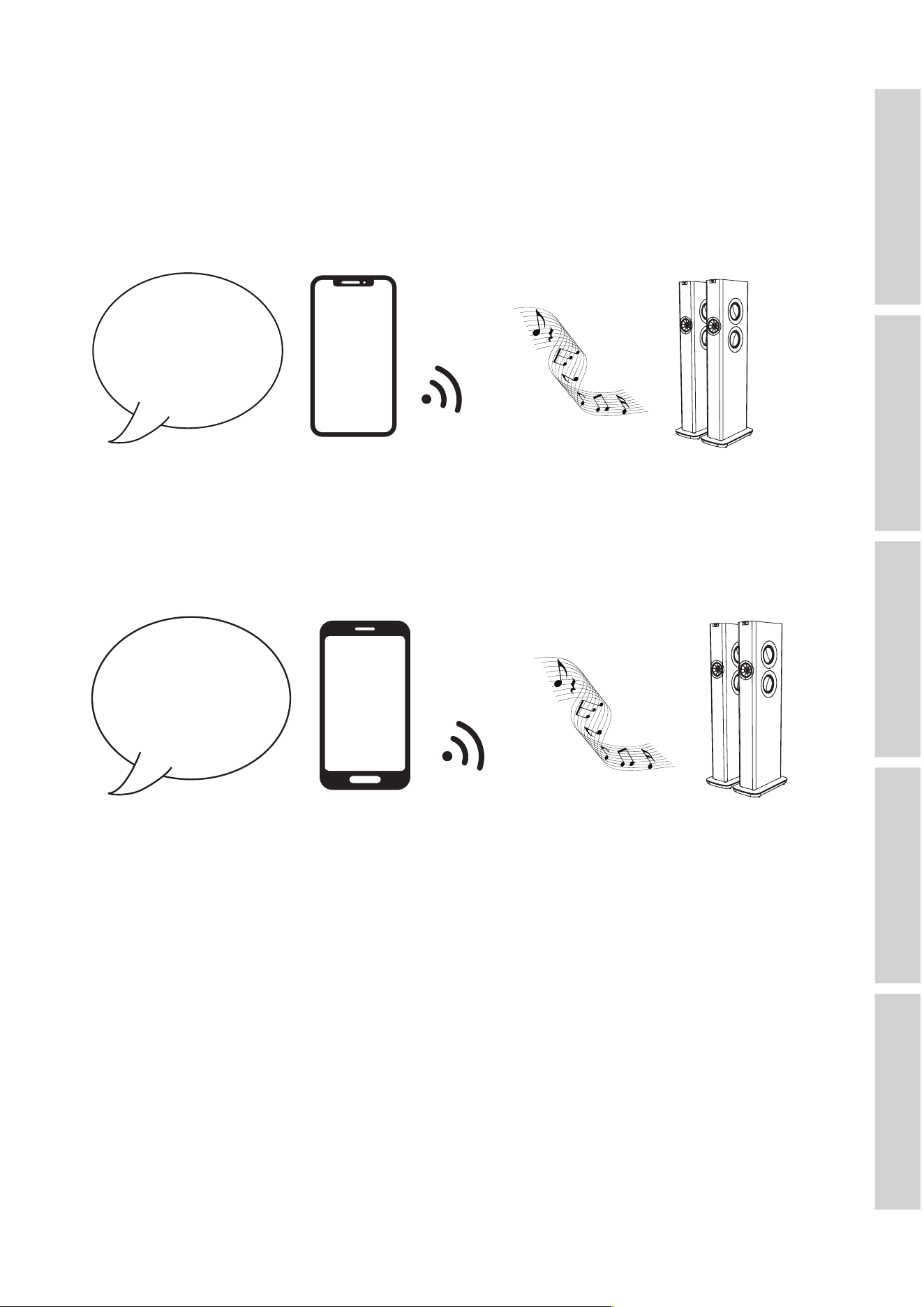
10. Voice Control Over Mobile Device
10.1 Siri
You can use Siri to control playback (e.g. skipping tracks, controlling the volume level)
while your iOS mobile device is streaming music to the speakers.
Hey Siri. Play some
music on the LS60
Wirelss.
10.2 Google Assistant
You can use Google Assistant to control playback (e.g. skipping tracks, controlling the
volume level) while your Android mobile device is streaming music to the speakers.
Hey Google. Play
some music on the
LS60 Wireless.
39
Table of ContentsSetting UpWi-Fi StreamingUsing KEF Connect AppFAQ and Troubleshooting
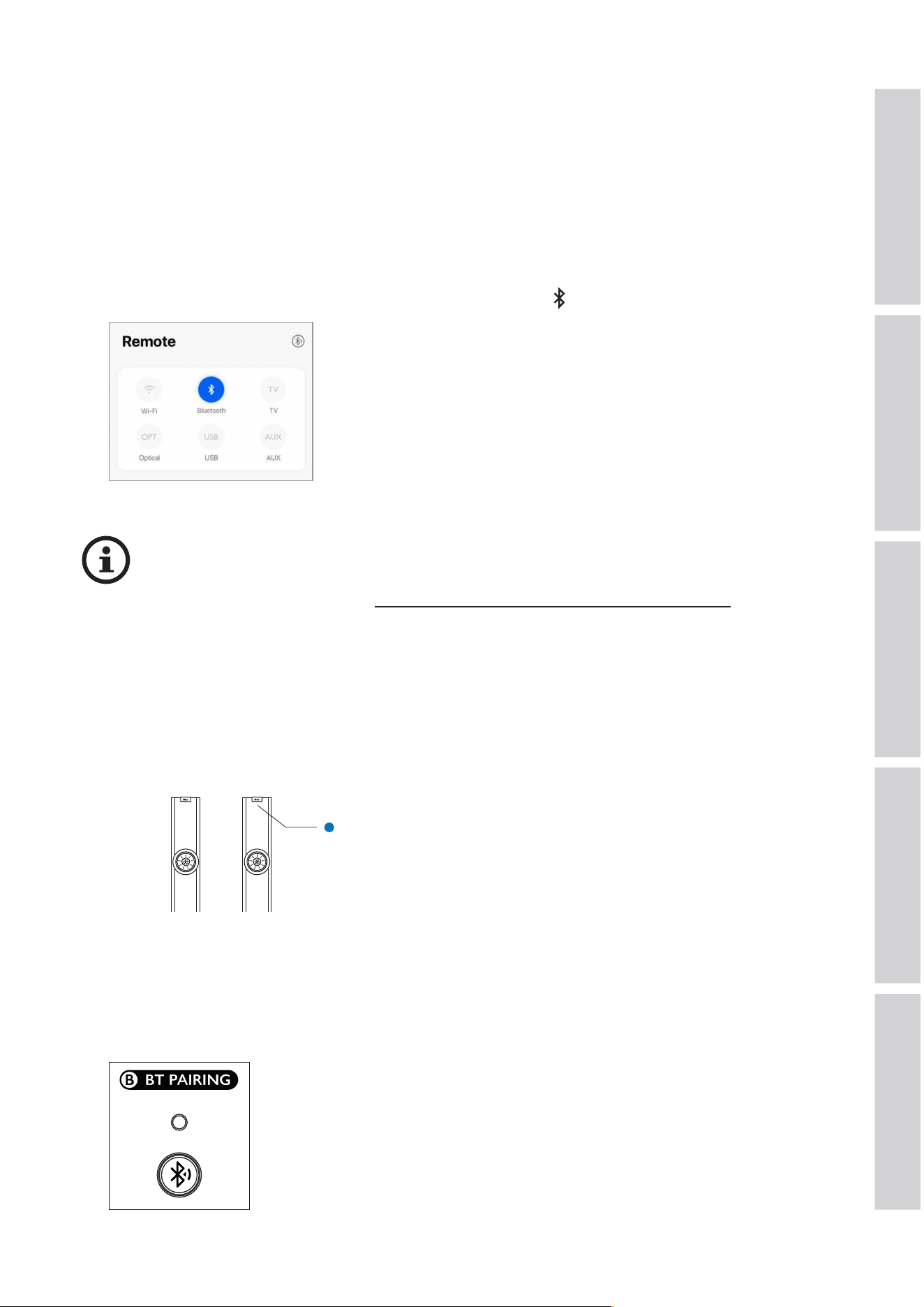
11. Playback with Bluetooth
You can pair your Bluetooth devices (e.g. computers) with the speakers through
Bluetooth connection. The speakers must always be first connected to your local
network before Bluetooth connection.
11.1 Selecting Bluetooth Mode
• In the KEF Connect App, tap the Bluetooth button ( ) to switch to Bluetooth mode.
• Alternatively, press the source button on the remote control.
You can assign the Bluetooth mode as a second wake-up source to turn
on the speakers automatically when there is audio input through Bluetooth
connection. See chapter “Power Saver – Second Wake-Up Source”.
11.2 Bluetooth Pairing
1. In Bluetooth mode, check the LED indicator light of the Primary Speaker. When the
LED indicator light pulses blue, the speakers are in the discovery mode and ready to
pair with a Bluetooth device.
If the LED indicator light illumiates blue briefly and then fades out, the speakers are
already paired with a Bluetooth device. To disconnect the connected Bluetooth
device, short press the Bluetooth pairing button (B) on the back panel of the Primary
Speaker. The Bluetooth icon blinks slowly when it is ready to pair with a new
Bluetooth device.
40
Table of ContentsSetting UpWi-Fi StreamingUsing KEF Connect AppFAQ and Troubleshooting
Alternatively, press the Bluetooth pairing icon located at the upper right corner of the
remote control in the KEF Connect App to disconnect the paired device.
2. Turn on the Bluetooth feature of your device and select “KEF LS60 Wireless” (or the
name you have created for the speakers) from the list of available devices to pair.
When Bluetooth pairing is done, the Bluetooth icon will stay lit.
The speakers remember your last paired Bluetooth device. Once Bluetooth
mode is selected, the speakers will automatically connect with your last paired
device if it is around.
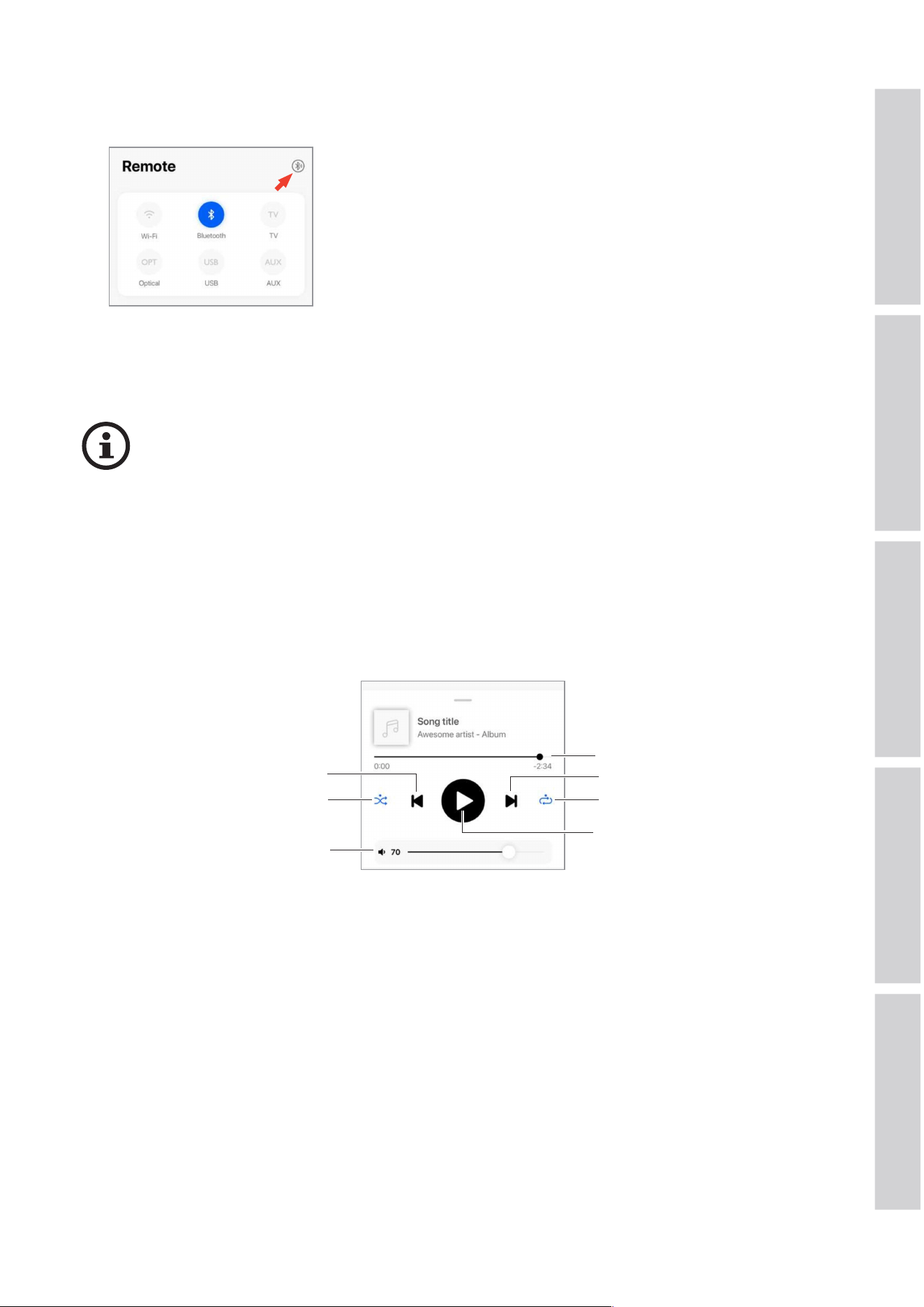
11.3 Playback Controls
In the KEF Connect App, use the control elements below for playback controls. The
volume control, previous and next functions can also be operated on the remote
control.
Play/pause
Next
Volume control
Previous
Track scroll
Repeat
Shuffle
41
Table of ContentsSetting UpWi-Fi StreamingUsing KEF Connect AppFAQ and Troubleshooting
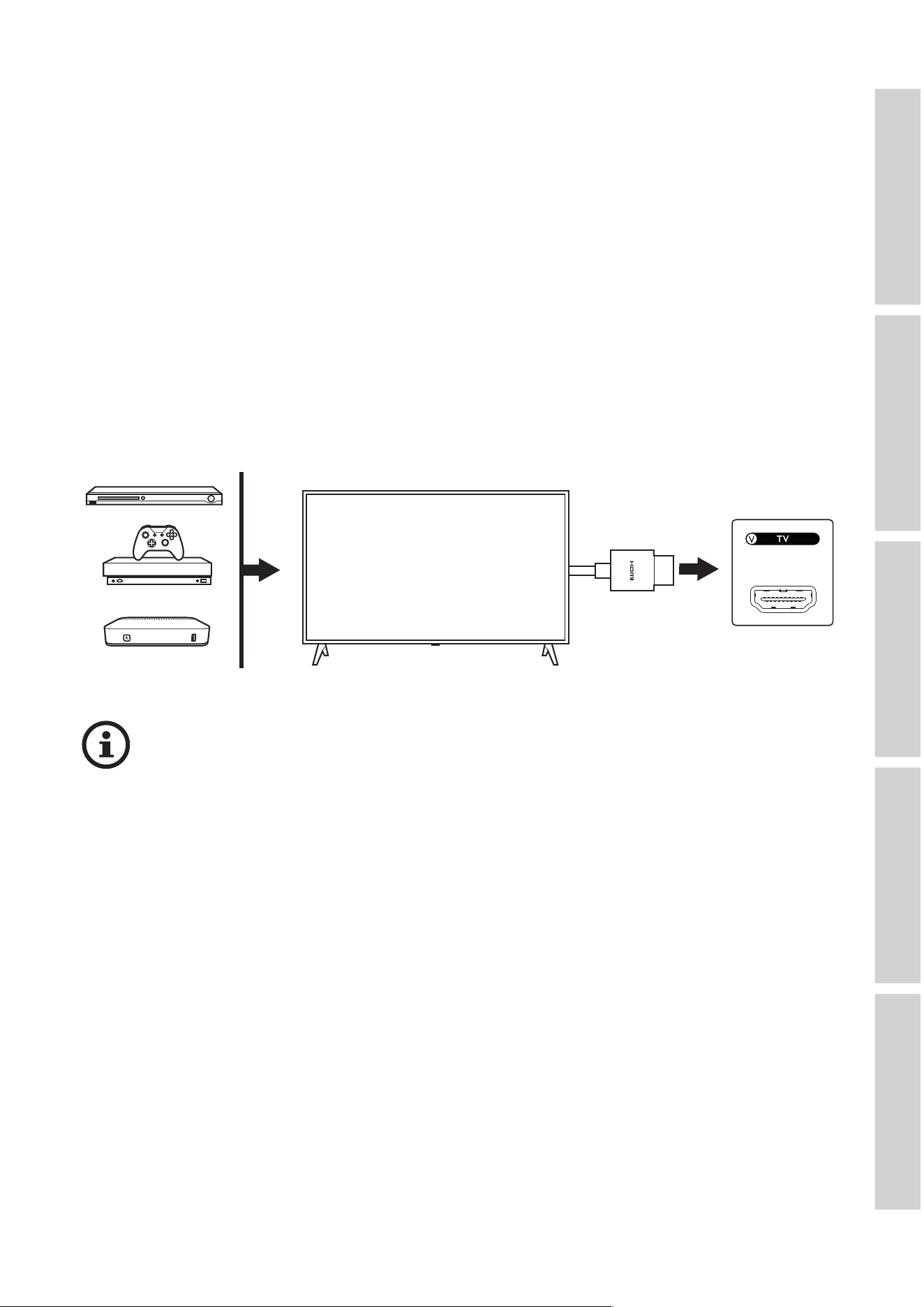
12. Playback with HDMI eARC input
The speakers are compatible with HDMI eARC (enhanced Audio Return Channel)
output from your TV for integrated control through a single HDMI cable. The speakers
must always be first connected to your local network before HDMI connection.
The speakers are also backward compatible with ARC and HDMI CEC. HDMI CEC
allows the use of the television remote control to adjust the volume of the speakers.
12.1 HDMI Cable Connection
Connect the HDMI output port of your TV and the TV port (V) on the back panel of
the Primary Speaker via an HDMI cable.
• Connect the HDMI cable to the eARC or ARC port of your TV.
• In your TV setting, turn on eARC, ARC or CEC in the HDMI settings.
• Refer to the user manual of your TV for details as manufacturers may name
the HDMI connections differently (e.g. Anynet+ for Samsung, Simplink for
LG).
• Make sure the digital audio output setting for the television is set to PCM
(not Dolby, Bitstream, Auto or similar).
42
Table of ContentsSetting UpWi-Fi StreamingUsing KEF Connect AppFAQ and Troubleshooting
12.2 Selecting TV Mode
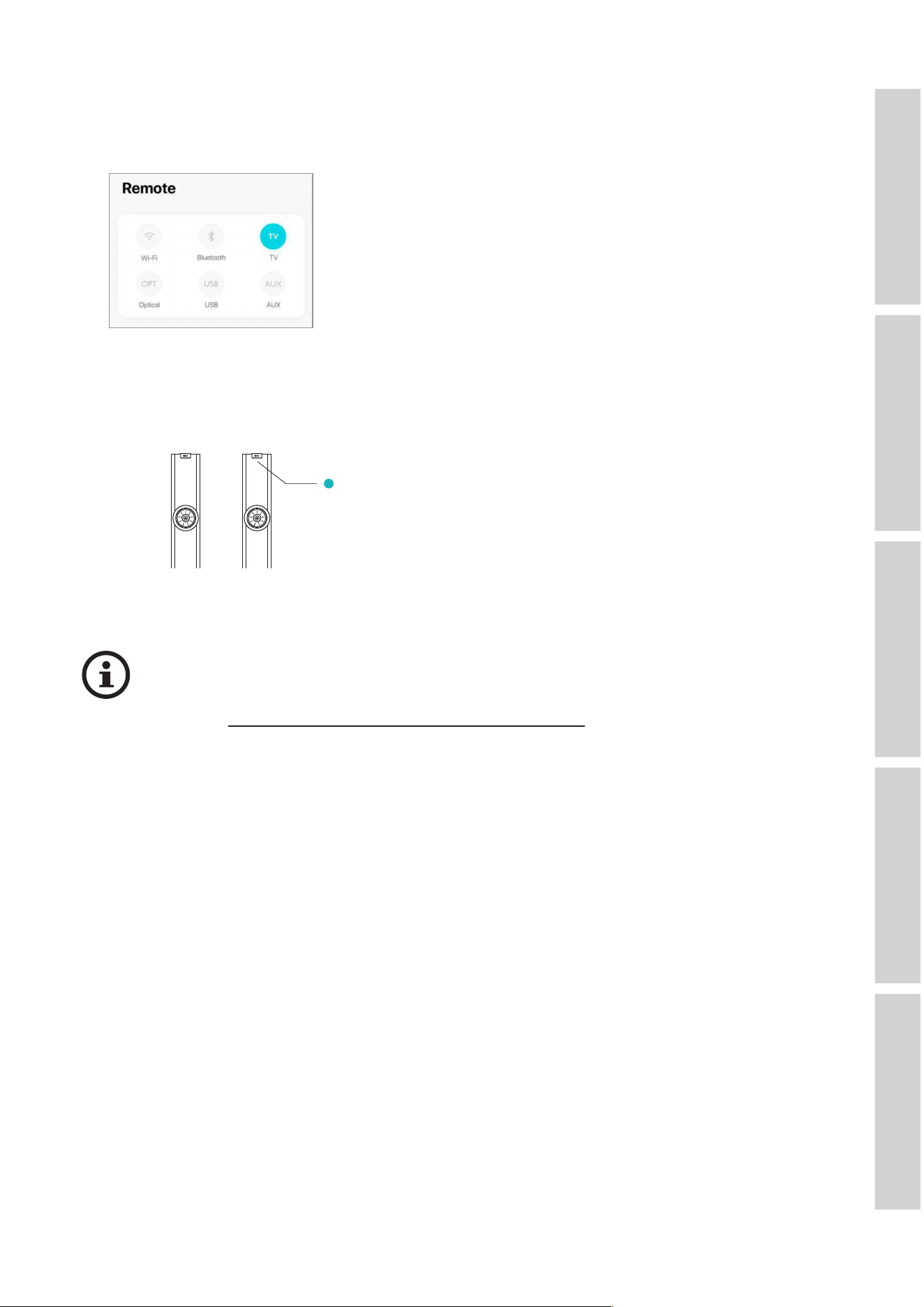
• In the KEF Connect App, tap the TV Mode button (TV) to switch to TV Mode.
• Alternatively, press the source button on the remote control.
• If no HDMI cable is conected to the speakers and TV mode is selected, the LED
indicator light of the Primary Speaker pulses light blue.
• The LEDindicatorlightofthePrimarySpeakerilluminateslightbluebrieyandthen
fades out when HDMI connection is established.
You can assign TV mode as a second wake-up source to turn on the speakers
automatically when there is audio input through the HDMI connection. See
chapter “Power Saver – Second Wake-Up Source”.
12.3 Playback Controls
All playback controls (except adjusting volume) must be done on the connected device.
The volume can also be adjusted on the remote control.
43
Table of ContentsSetting UpWi-Fi StreamingUsing KEF Connect AppFAQ and Troubleshooting
13. Playback with Optical Input
You can connect your devices with optical output (e.g. TV and game consoles) to the
speakers through an optical cable. The speakers must always be first connected to your
local network before optical connection.
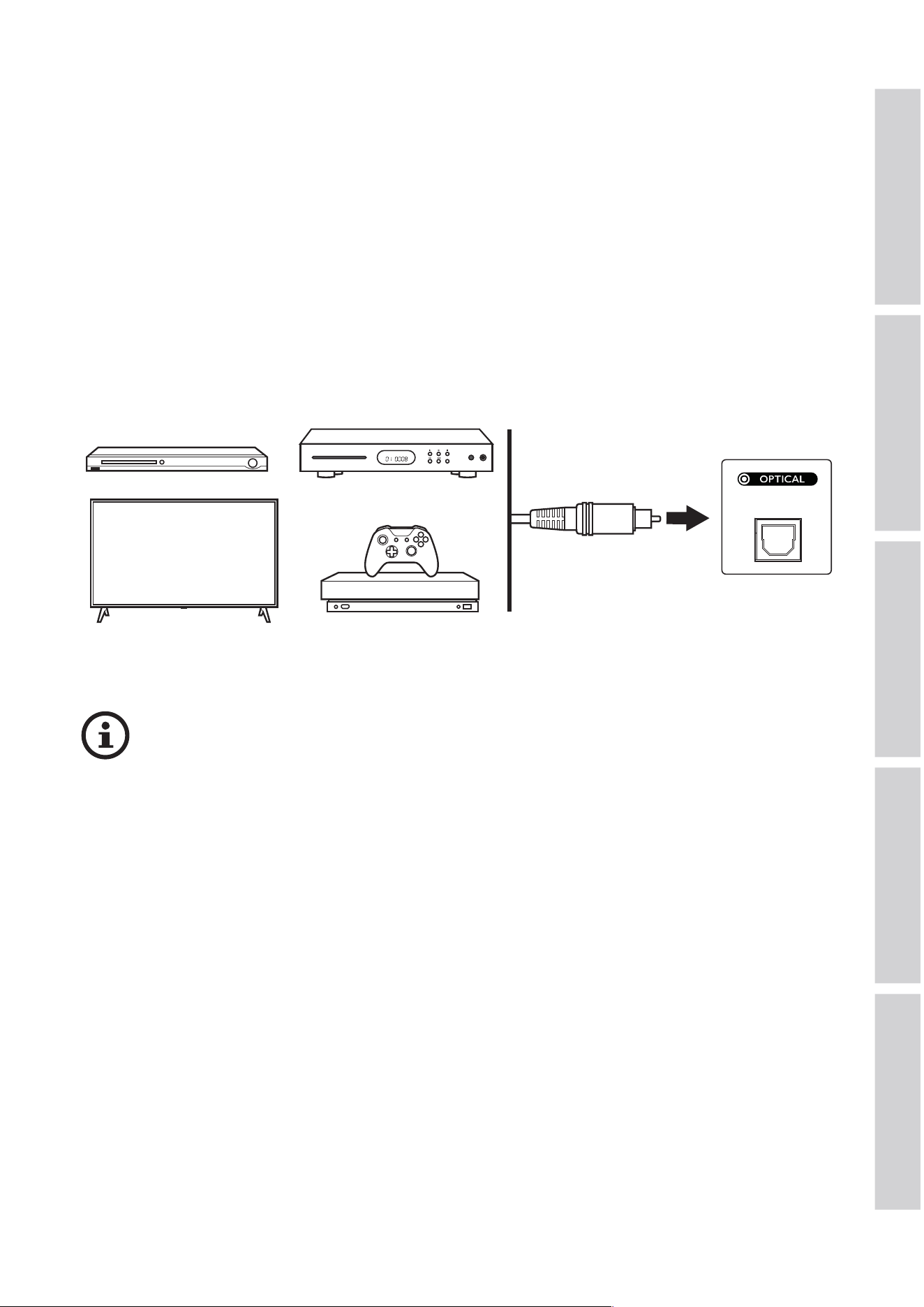
13.1 Optical Cable Connection
Connect the optical output jack of your device and the optical input jack (O) on the
back panel of the Primary Speaker via an optical cable.
Make sure your TV is set to output digital audio in PCM format. Refer to the
user manual of your TV for details.
44
Table of ContentsSetting UpWi-Fi StreamingUsing KEF Connect AppFAQ and Troubleshooting
13.2 Selecting Optical Mode
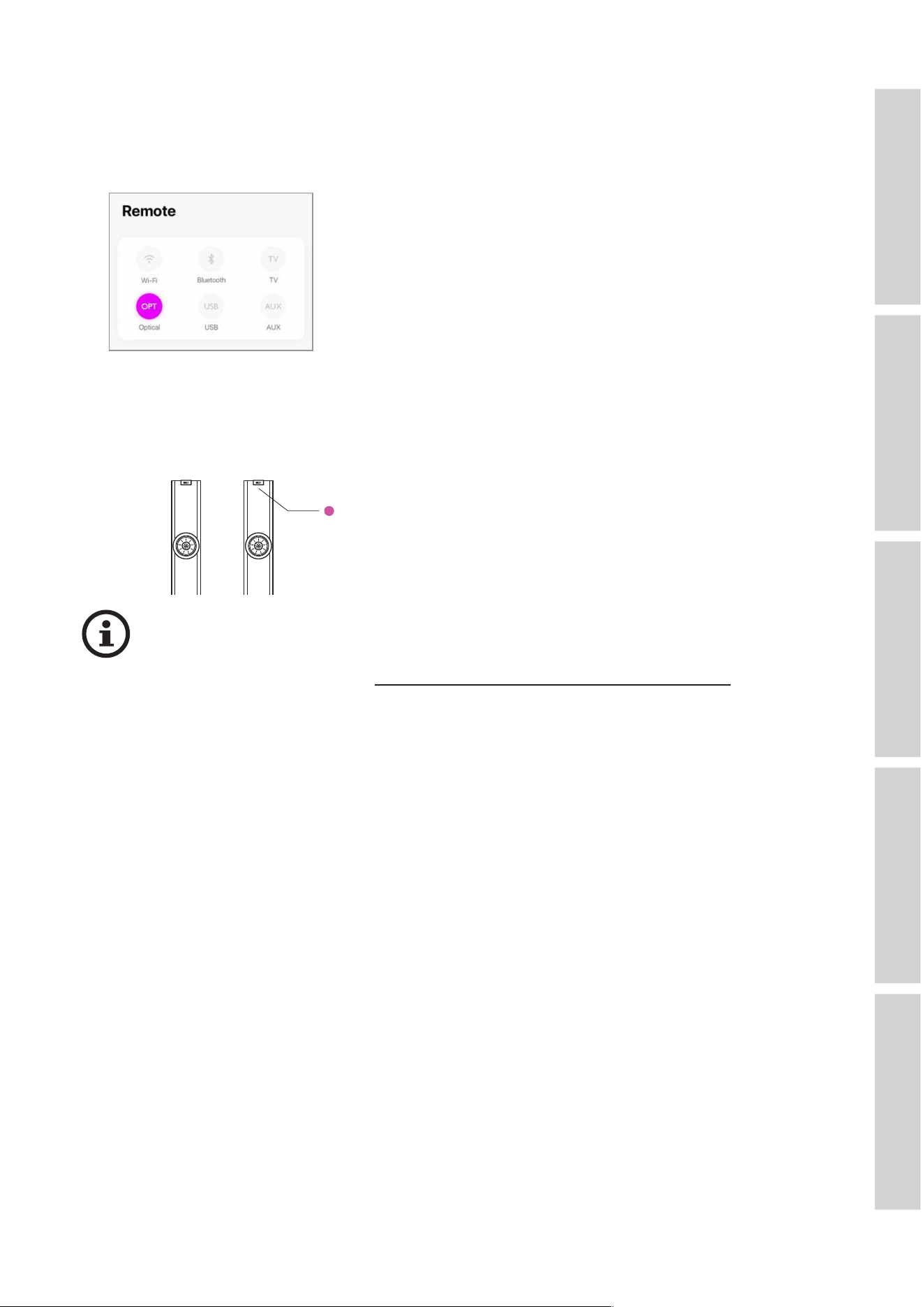
• In the KEF Connect App, tap the Optical Mode button (OPT) to switch to Optical
Mode.
• Alternatively, press the source button on the remote control.
• The LEDindicatorlightofthePrimarySpeakerilluminatesmagentabrieyandthen
fades out when Optical mode is selected.
You can assign Optical mode as a second wake-up source to turn on
the speakers automatically when there is audio input through the optical
connection. See chapter “Power Saver – Second Wake-Up Source”.
13.3 Playback Controls
All playback controls (except adjusting volume) must be done on the connected device.
The volume can also be adjusted on the remote control.
45
Table of ContentsSetting UpWi-Fi StreamingUsing KEF Connect AppFAQ and Troubleshooting
14. Playback with Coaxial Input
You can connect your devices with coaxial output (e.g. DVD/CD player) to the
speakers through a coaxial cable. The speakers must always be first connected to your
local network before coaxial connection.
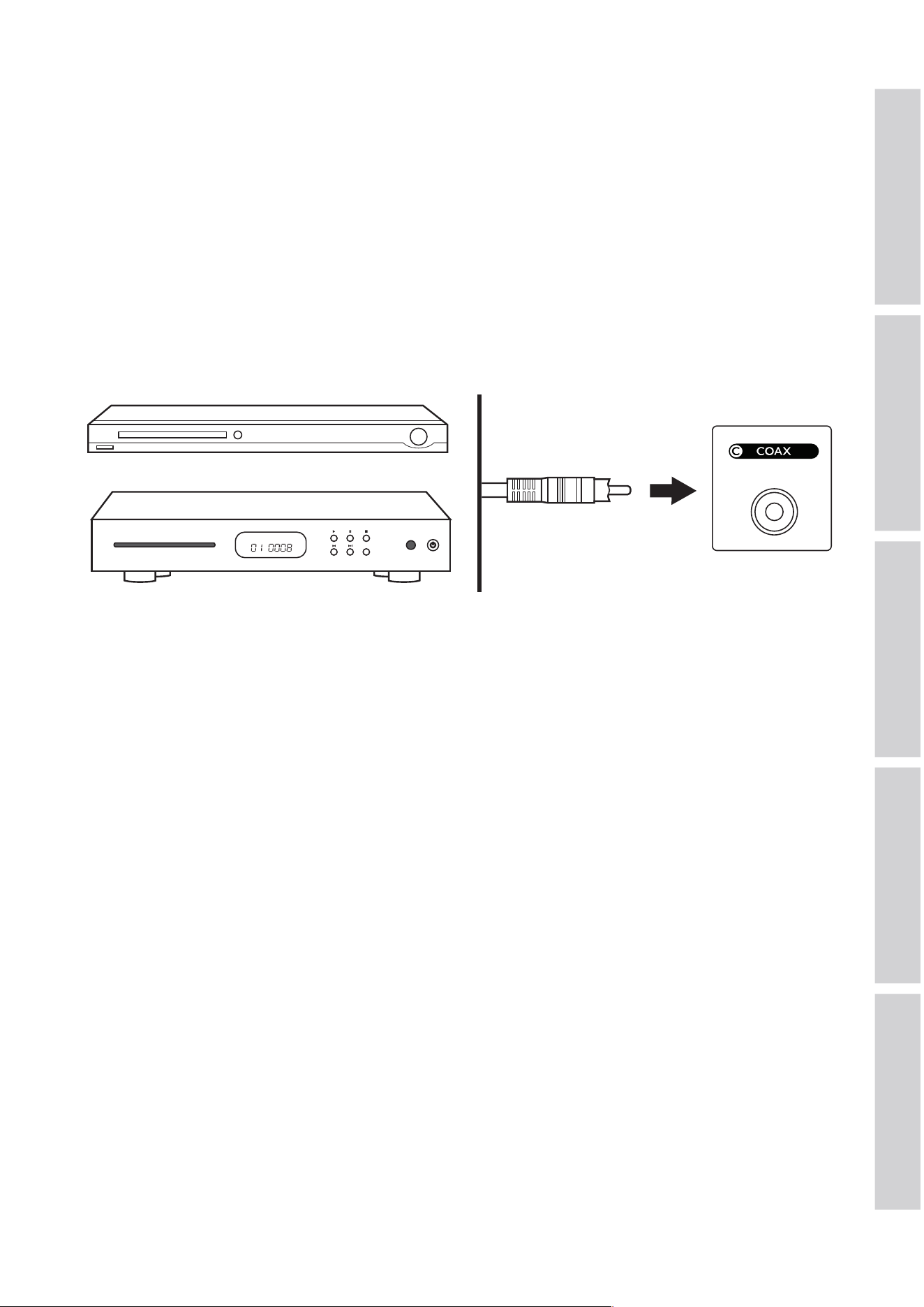
14.1 Coaxial Cable Connection
Connect the coaxial output jack of your device and the coaxial input jack (C) on the
back panel of the Primary Speaker via a coaxial cable.
46
Table of ContentsSetting UpWi-Fi StreamingUsing KEF Connect AppFAQ and Troubleshooting
14.2 Selecting Coaxial Mode
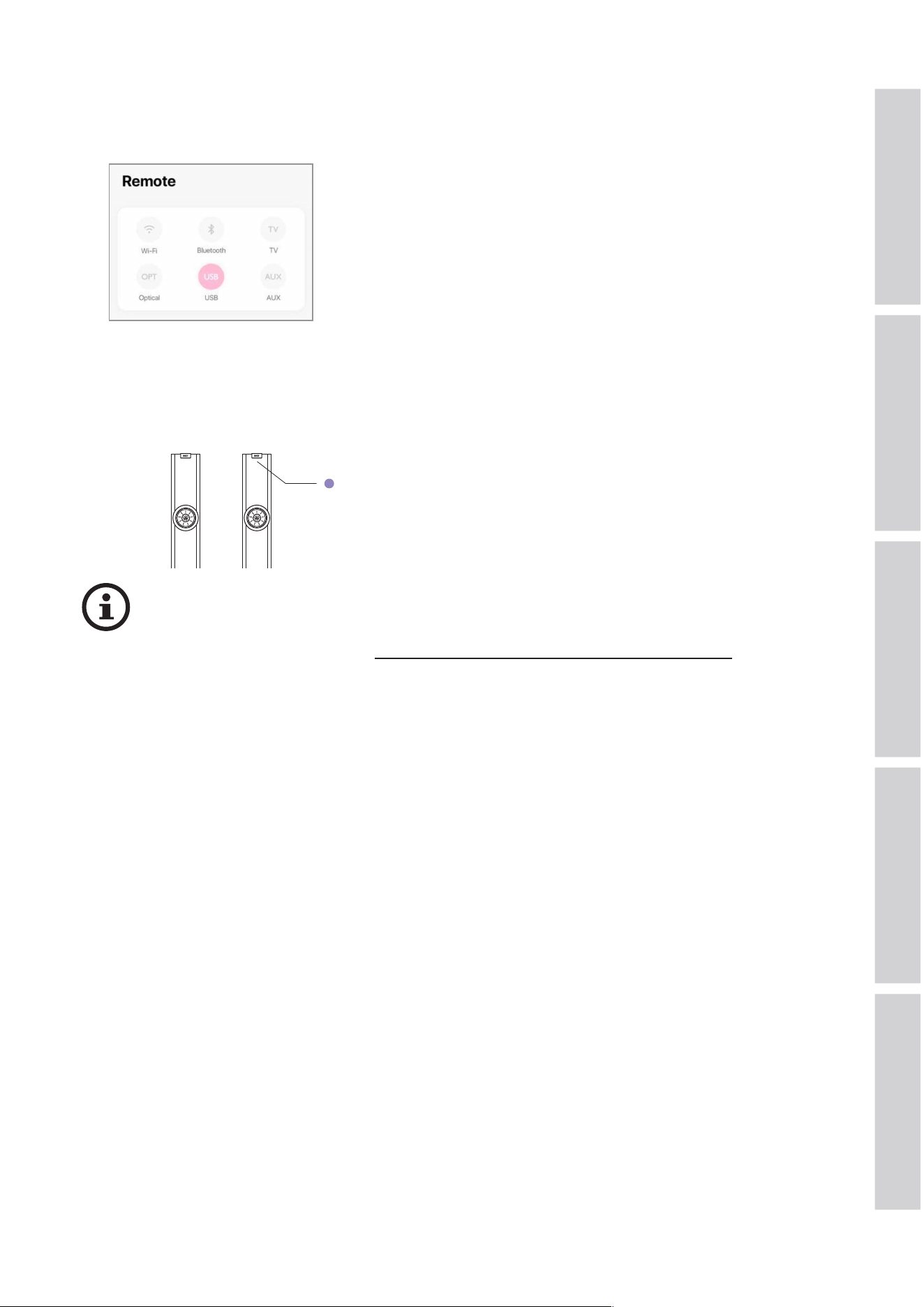
• In the KEF Connect App, tap the CX button (COAX) to switch to Coaxial mode.
• Alternatively, press the source button on the remote control.
• The LED indicator light of the Primary Speaker illuminates lavender brieyandthen
fades out when Coaxial mode is selected.
You can assign Coaxial mode as a second wake-up source to turn on the
speakers automatically when there is audio input through the Coaxial
connection. See chapter “Power Saver – Second Wake-Up Source.
14.3 Playback Controls
All playback controls (except adjusting volume) must be done on the connected device.
The volume can also be adjusted on the remote control.
47
Table of ContentsSetting UpWi-Fi StreamingUsing KEF Connect AppFAQ and Troubleshooting
15. Playback with Auxiliary Input
You can connect your devices with an RCA output (e.g. turntables, computers, TV) to
the speakers through an RCA cable. The speakers must always be first connected to
your local network before auxiliary connection.
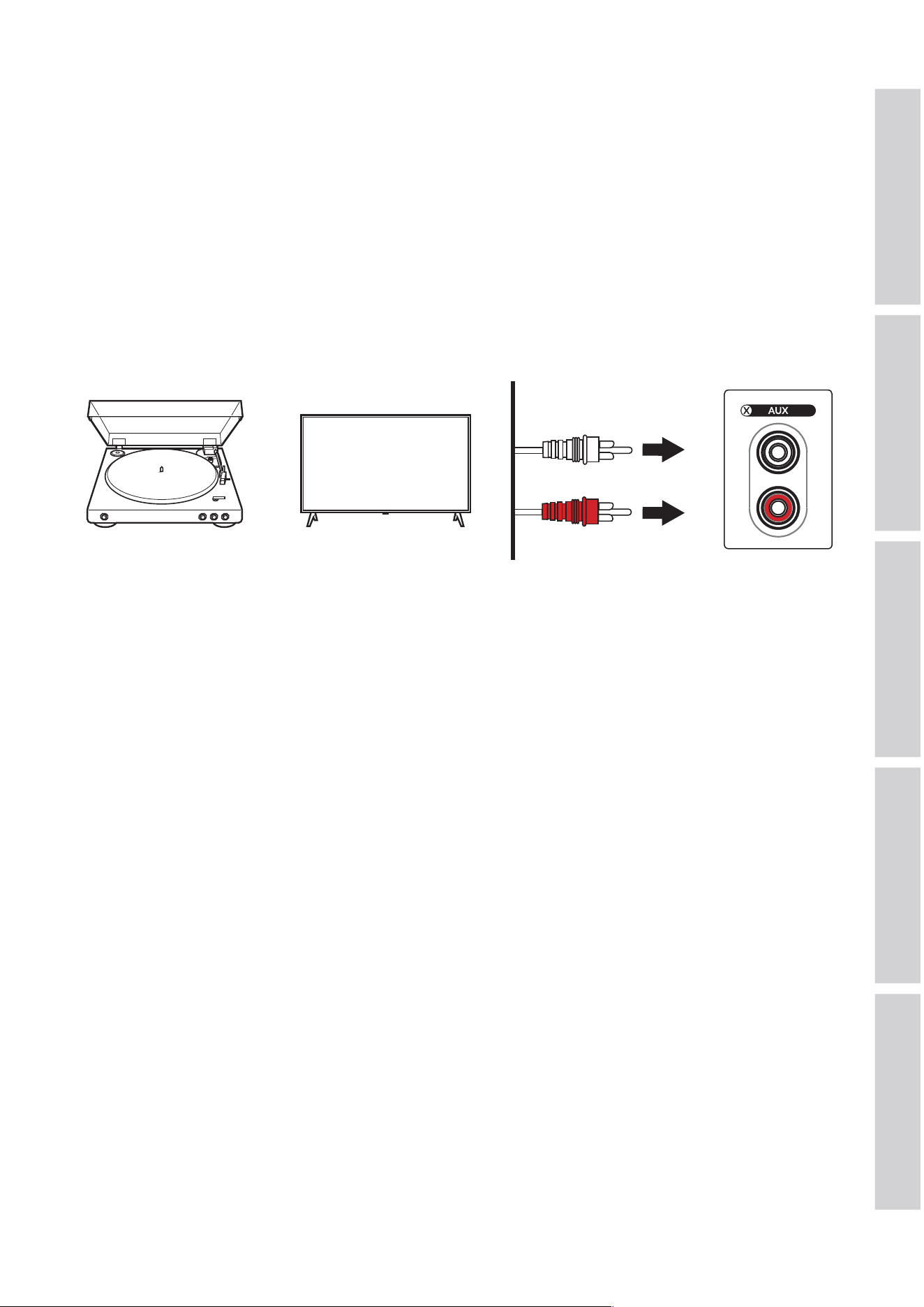
15.1 Auxiliary Cable Connection
Connect the audio output jacks of your device and the auxiliary input jacks (X) on the
back of the Primary Speaker via an RCA cable.
48
Table of ContentsSetting UpWi-Fi StreamingUsing KEF Connect AppFAQ and Troubleshooting
15.2 Selecting Auxiliary Mode
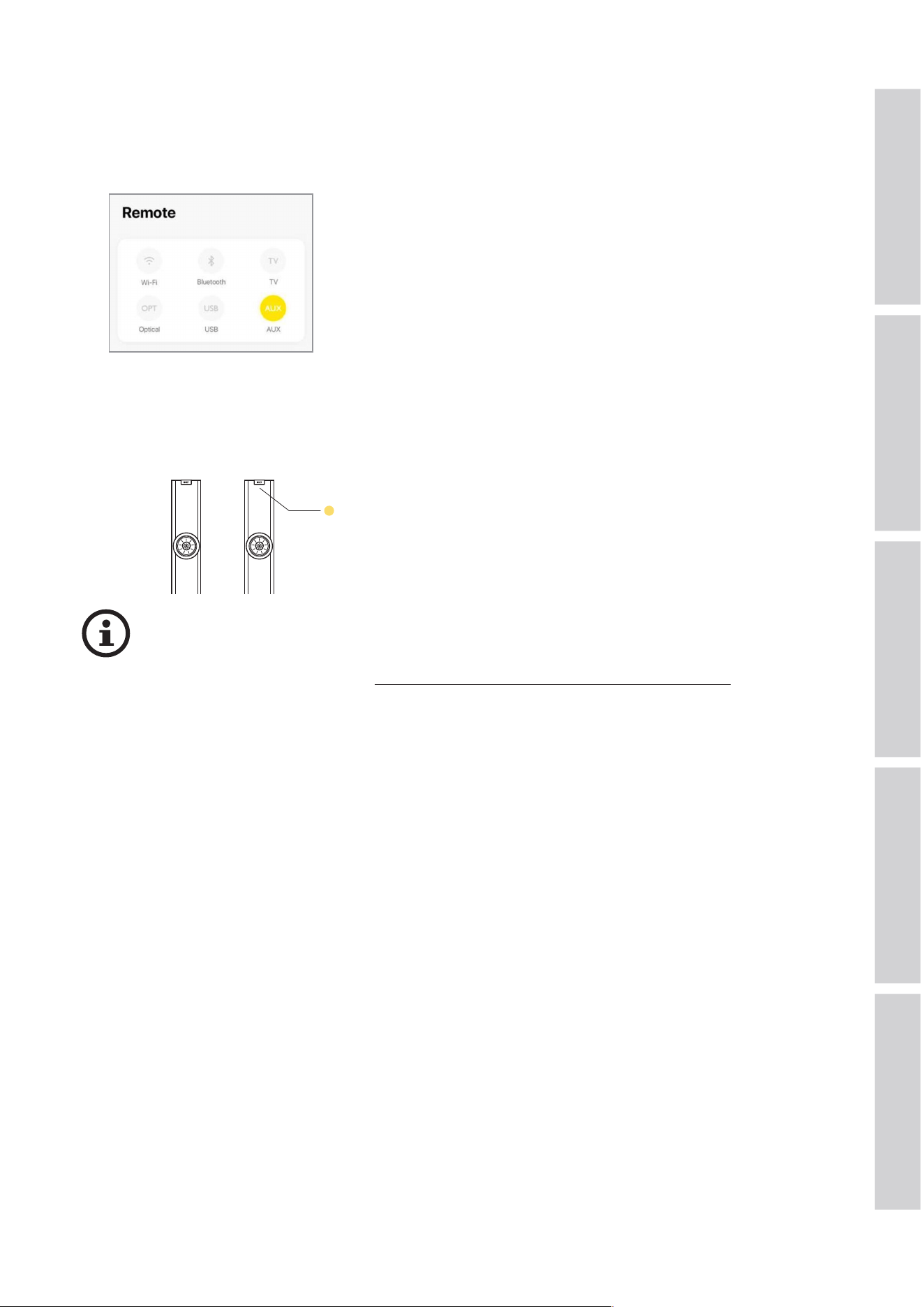
• In the KEF Connect App, tap the Auxiliary Mode button (AUX) to switch to Auxiliary
mode.
• Alternatively, press the source button on the remote control.
• The LEDindicatorlightofthePrimarySpeakerilluminatesyellowbrieyandthen
fades out when AUX mode is selected.
You can assign Auxiliary mode as a second wake-up source to turn on
the speakers automatically when there is audio input through the auxiliary
connection. See chapter “Power Saver – Second Wake-Up Source”.
15.3 Playback Controls
All playback controls (except adjusting volume) must be done on the connected device.
The volume can also be adjusted on the remote control.
49
Table of ContentsSetting UpWi-Fi StreamingUsing KEF Connect AppFAQ and Troubleshooting
16. Using KEF Connect App
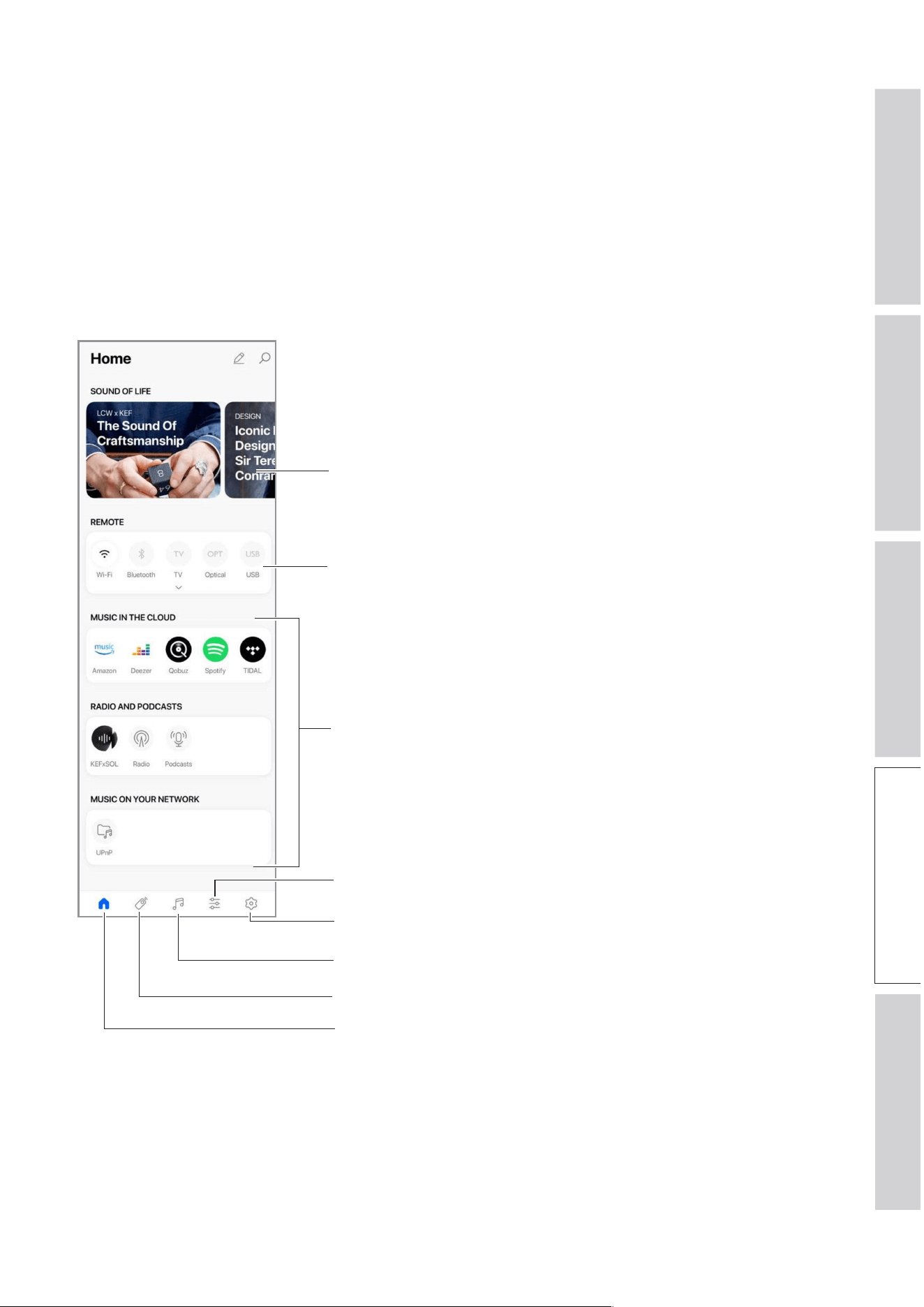
The KEF Connect App allows you to set up the speakers, apply EQ settings, turn on/
off the speakers, switch sound sources and access and play back your music streaming
services.
16.1 Home
16.1.1 Overview
Turn on/off the speakers and switch sources
Shortcuts to music content (music streaming
services, Internet radio stations, podcasts and
media server*)
EQ settings
Speaker settings
Latest news and stories from KEF
Music content
Remote control
Home
*Coming soon
50
Table of ContentsSetting UpWi-Fi StreamingUsing KEF Connect AppFAQ and Troubleshooting
16.1.2 Editing the Home Screen
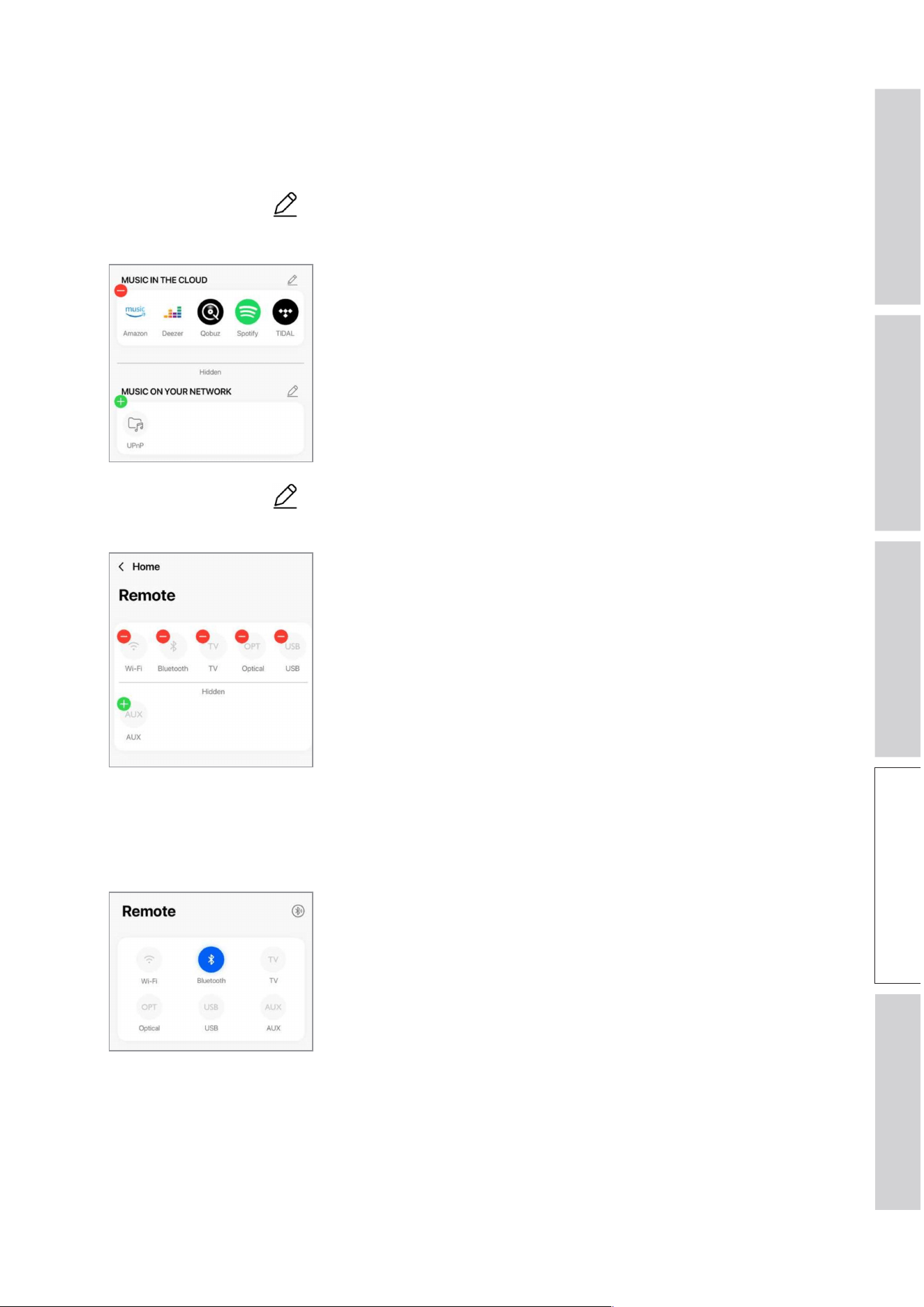
You may edit the Home screen to show or hide tiles (e.g. Music in the Cloud) or
buttons that are of frequent or less frequent use.
1. Tap the edit icon ( ) at the top right of the app.
2. Tap the “+” or “–” symbols or drag and drop to show or hide a tile.
3. Tap the edit icon ( ) at the top right of a tile.
4. Tap the “+” or “–” symbols or drag and drop to show or hide a button in the tile.
16.2 Remote Control
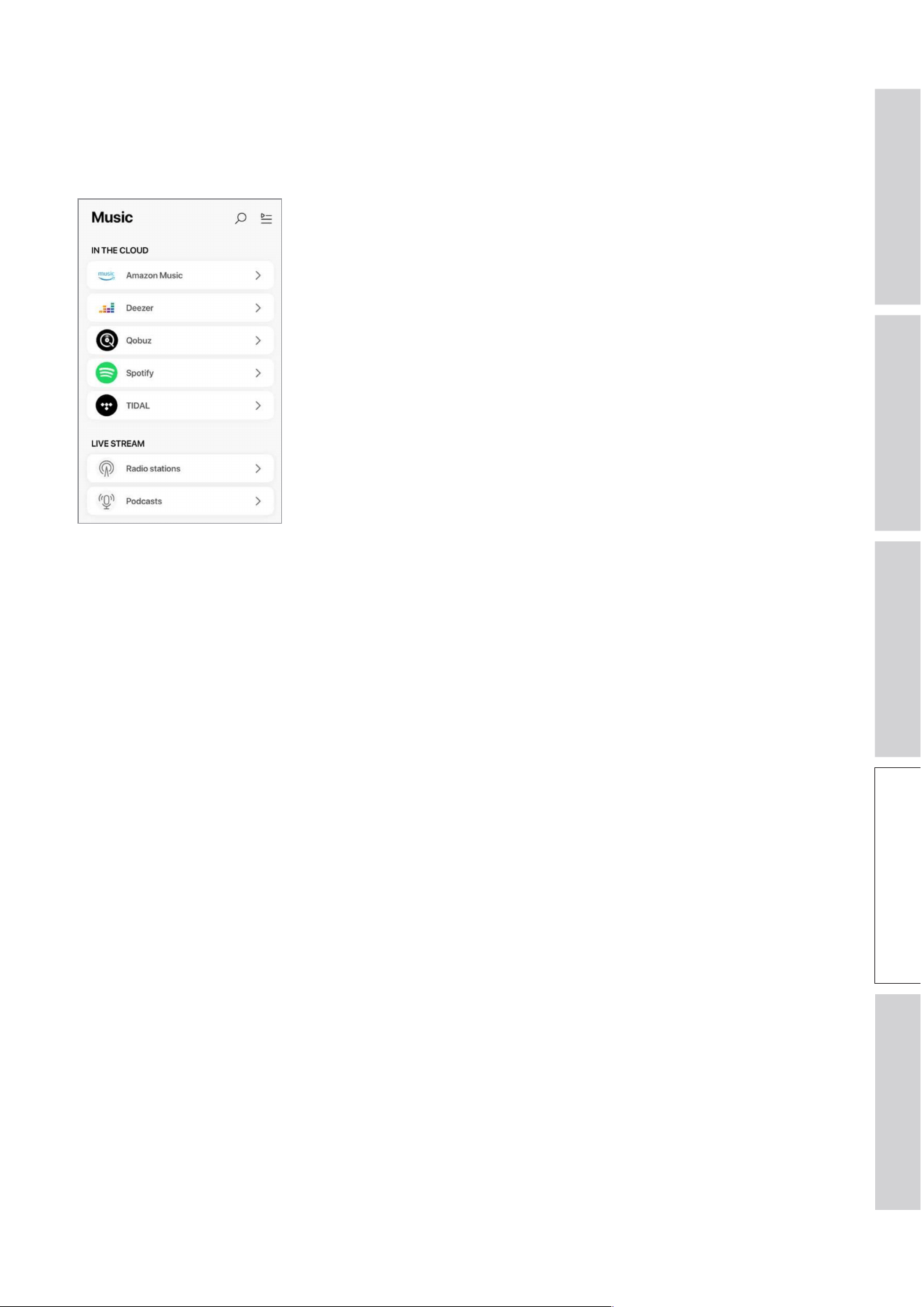
• Use the buttons under “Remote Control” to directly turn on the speakers from that
particular source, or change the sound source.
• To turn off the speakers, tap the active source button.
51
Table of ContentsSetting UpWi-Fi StreamingUsing KEF Connect AppFAQ and Troubleshooting
16.3 Music Content
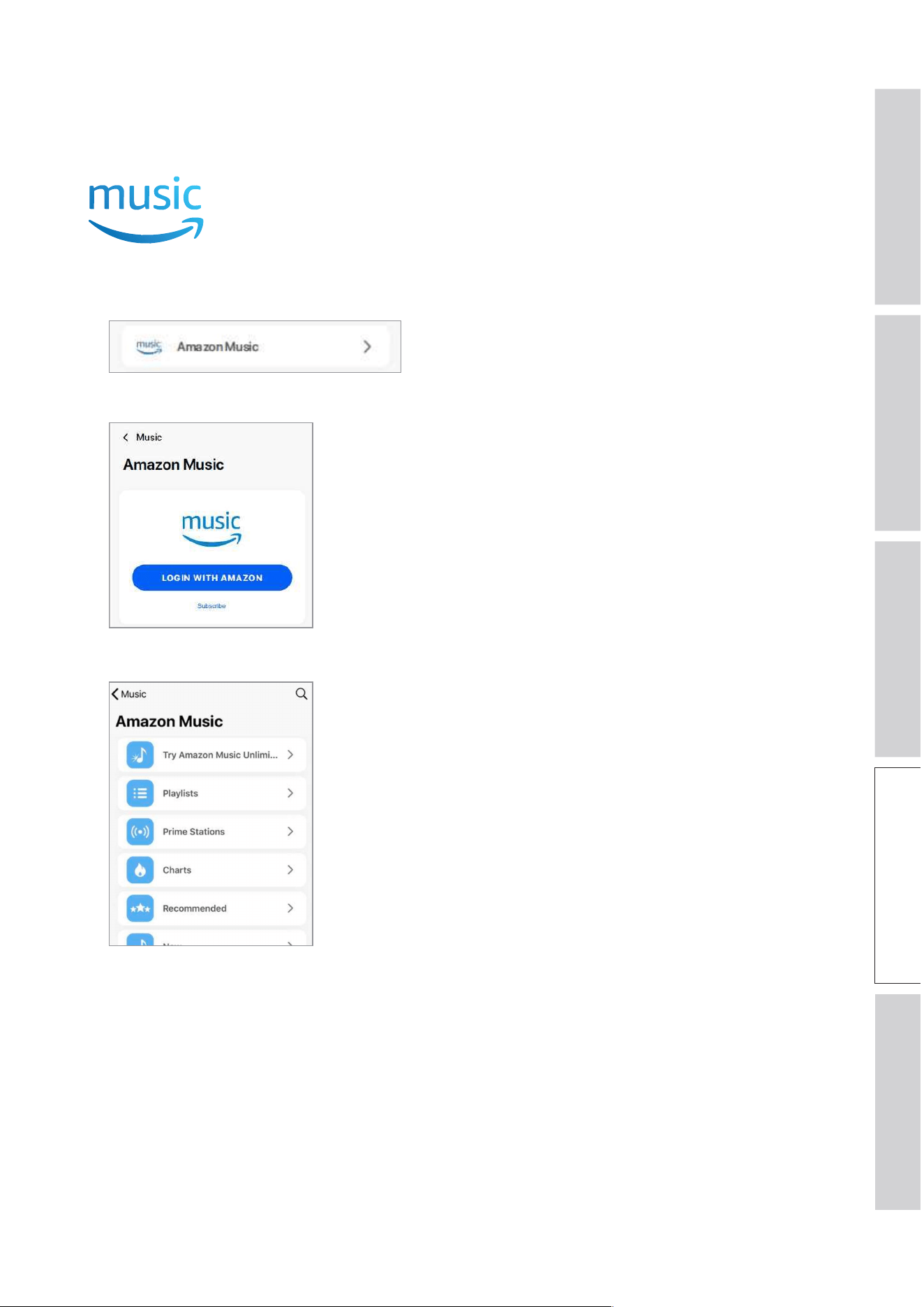
The KEF Connect App allows you to access and play back music from your music
streaming services as well as Internet radio stations and podcasts.
52
Table of ContentsSetting UpWi-Fi StreamingUsing KEF Connect AppFAQ and Troubleshooting
16.3.1 Playing Music from Music Streaming Services
16.3.1.1 Amazon Music
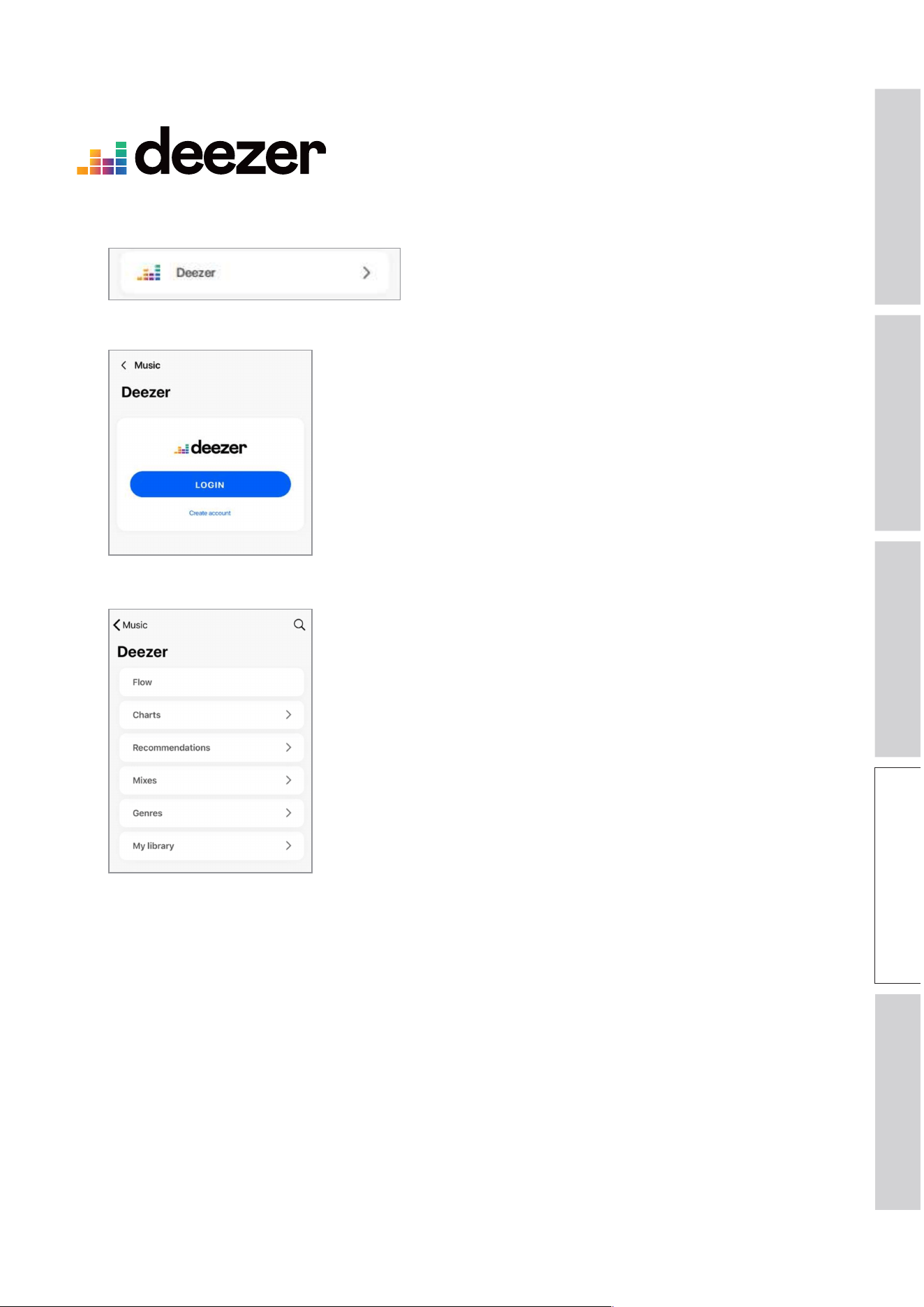
1. To stream music, tap “Amazon Music” under “Music in the Cloud” in the KEF
Connect App.
2. Login to your Amazon Music account.
3. Browse and play music to start streaming.
53
Table of ContentsSetting UpWi-Fi StreamingUsing KEF Connect AppFAQ and Troubleshooting
16.3.1.2 Deezer
1. To stream music, tap “Deezer” under “Music in the Cloud” in the KEF Connect App.
2. Login to your Deezer account.
3. Browse and play music to start streaming.

54
Table of ContentsSetting UpWi-Fi StreamingUsing KEF Connect AppFAQ and Troubleshooting
16.3.1.3 Qobuz
1. To stream music, tap “Qobuz” under “Music in the Cloud” in the KEF Connect App.
2. Login to your Qobuz account.
3. Browse and play music to start streaming.
55
Table of ContentsSetting UpWi-Fi StreamingUsing KEF Connect AppFAQ and Troubleshooting
16.3.1.4 Spotify
Through the KEF Connect App, you can be prompted to the Spotify App on your
device to stream music to the speakers. See chapter “Spotify Connect”.
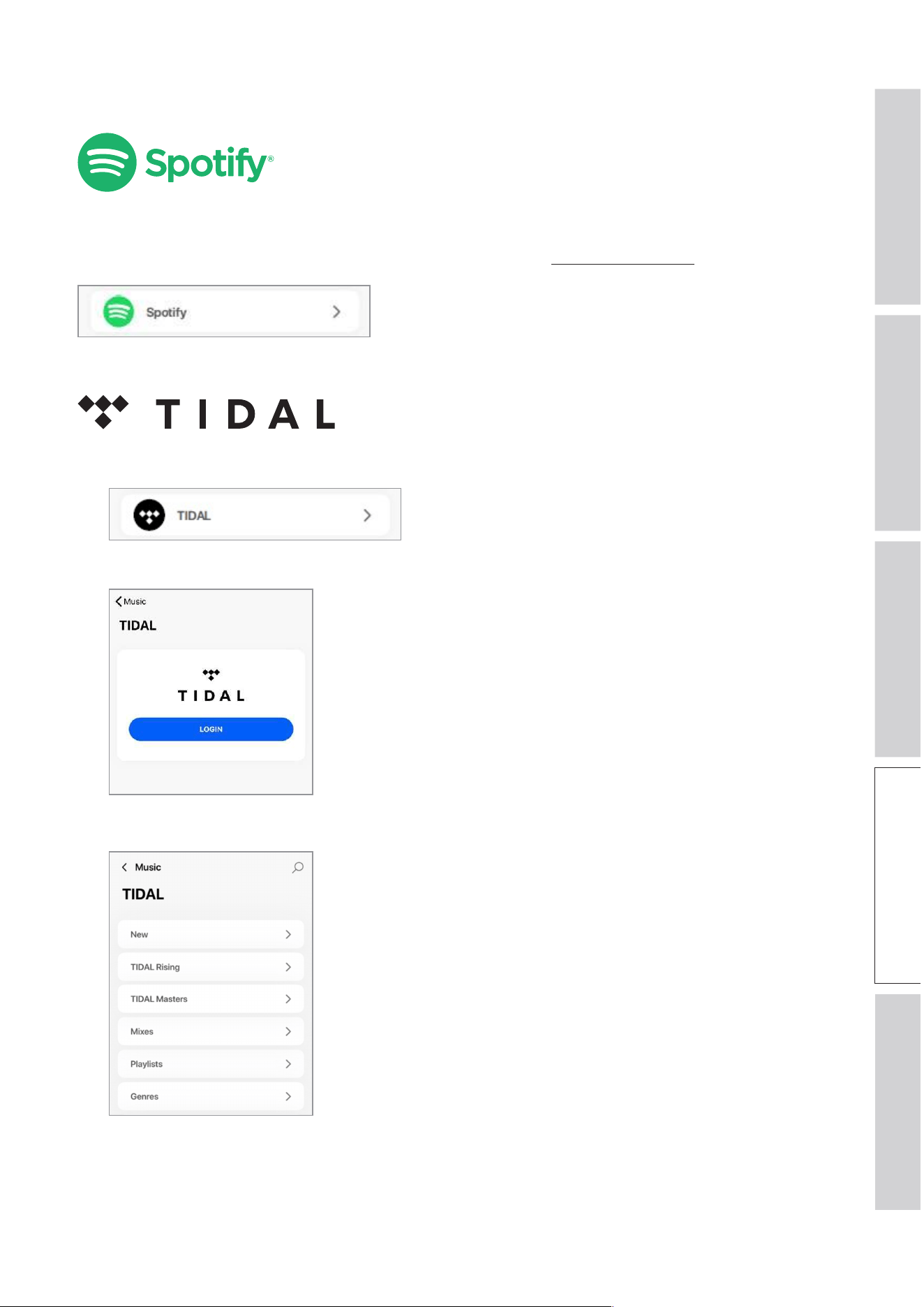
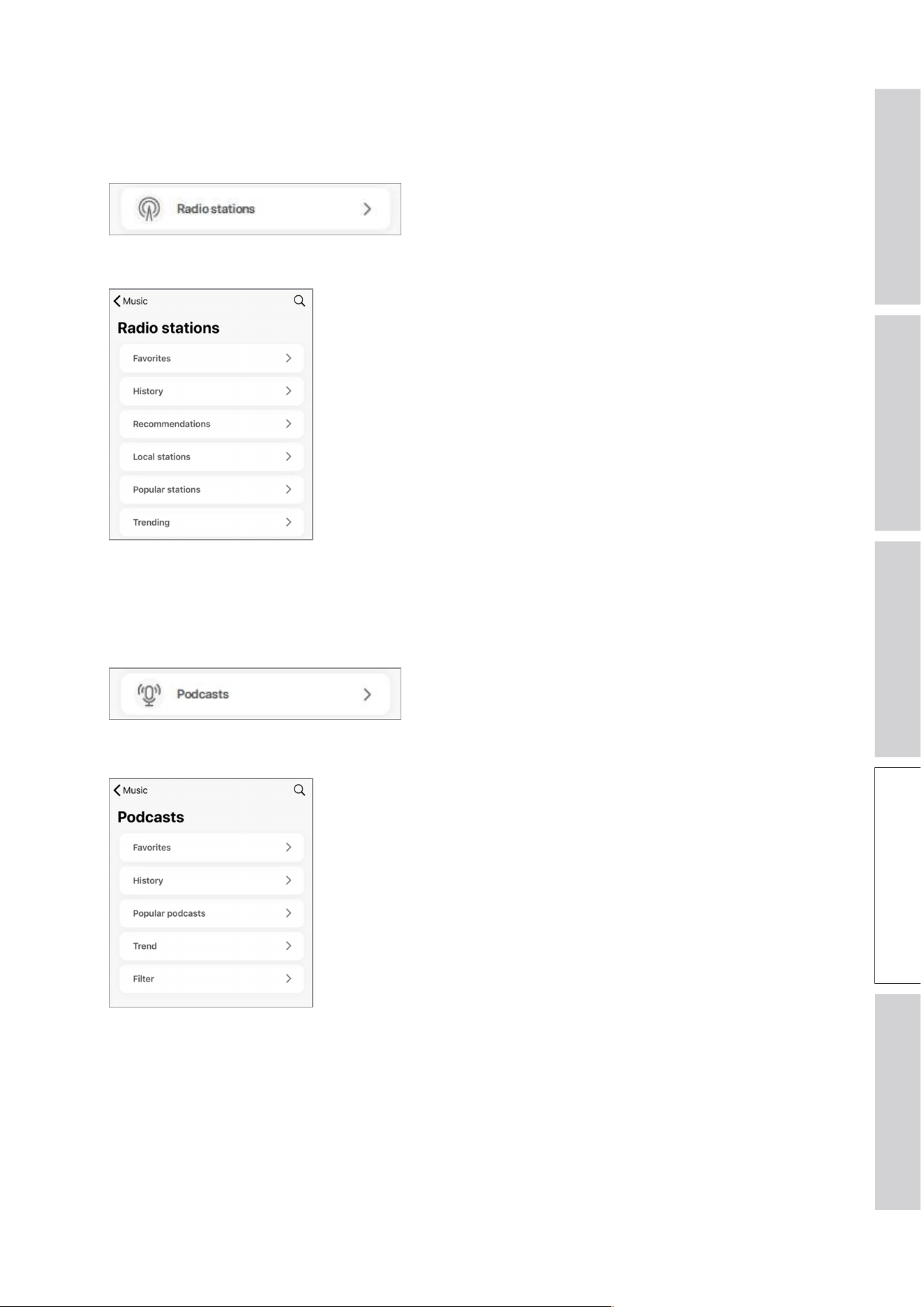
16.3.1.5 TIDAL
1. To stream music, tap “TIDAL” under “Music in the Cloud” in the KEF Connect App.
2. Login to your TIDAL account.
3. Browse and play music to start streaming.
56
Table of ContentsSetting UpWi-Fi StreamingUsing KEF Connect AppFAQ and Troubleshooting
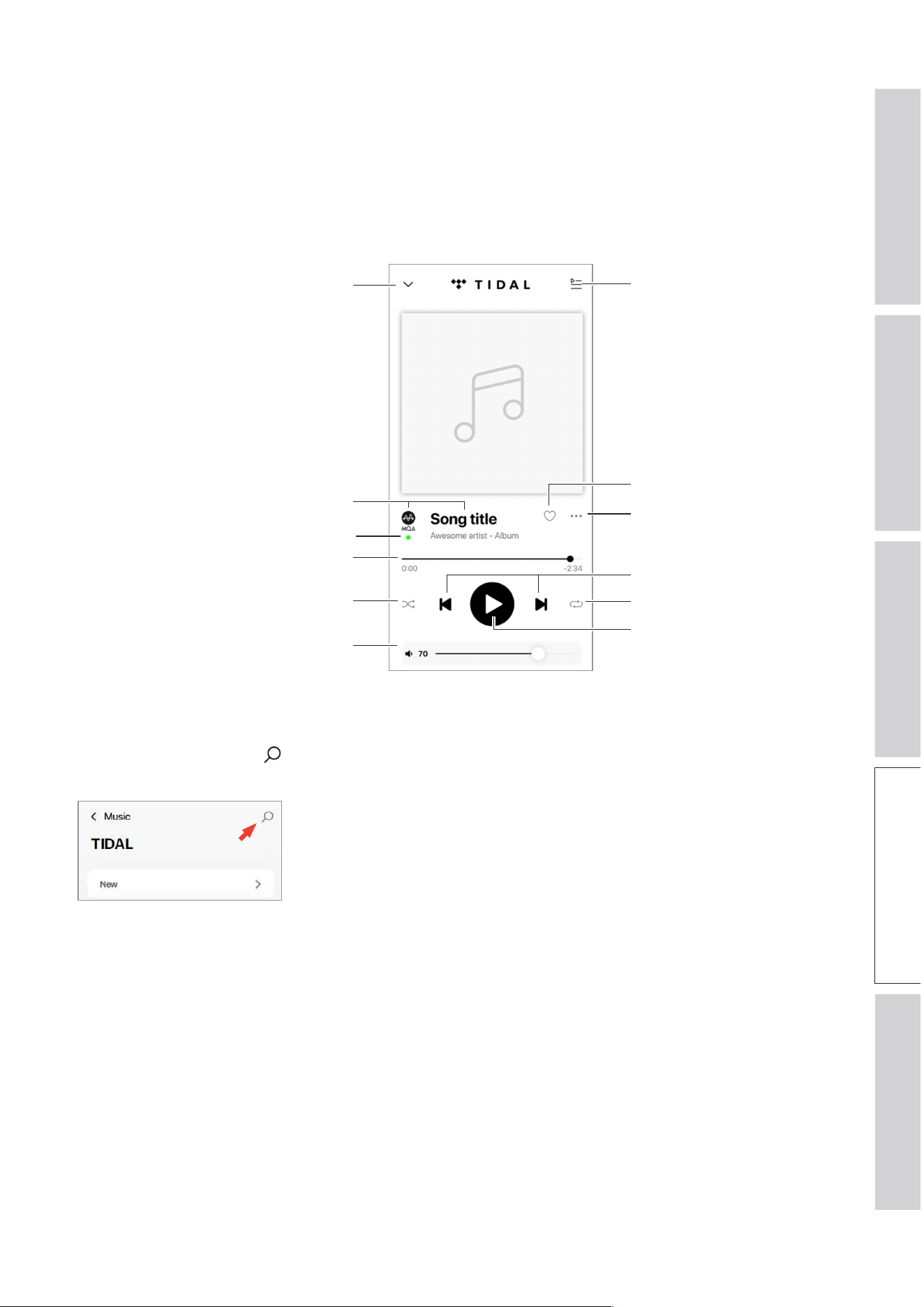
16.3.1.6 Internet Radio
1. To access Internet radio, tap “Radio stations” under “Live Stream” in the KEF Connect
App.
2. Browse and play a radio station to start streaming.
16.3.1.7 Podcast
1. To access podcast contents, tap “Podcasts” under “Live Stream” in the KEF Connect
App.
2. Browse and play a podcast to start streaming.
57
Table of ContentsSetting UpWi-Fi StreamingUsing KEF Connect AppFAQ and Troubleshooting
16.3.2 Playback Controls
The below features are available to control playback or behaviour. Please note that
these features may not be available to all music sources and there may be slight
differences in the control interface.
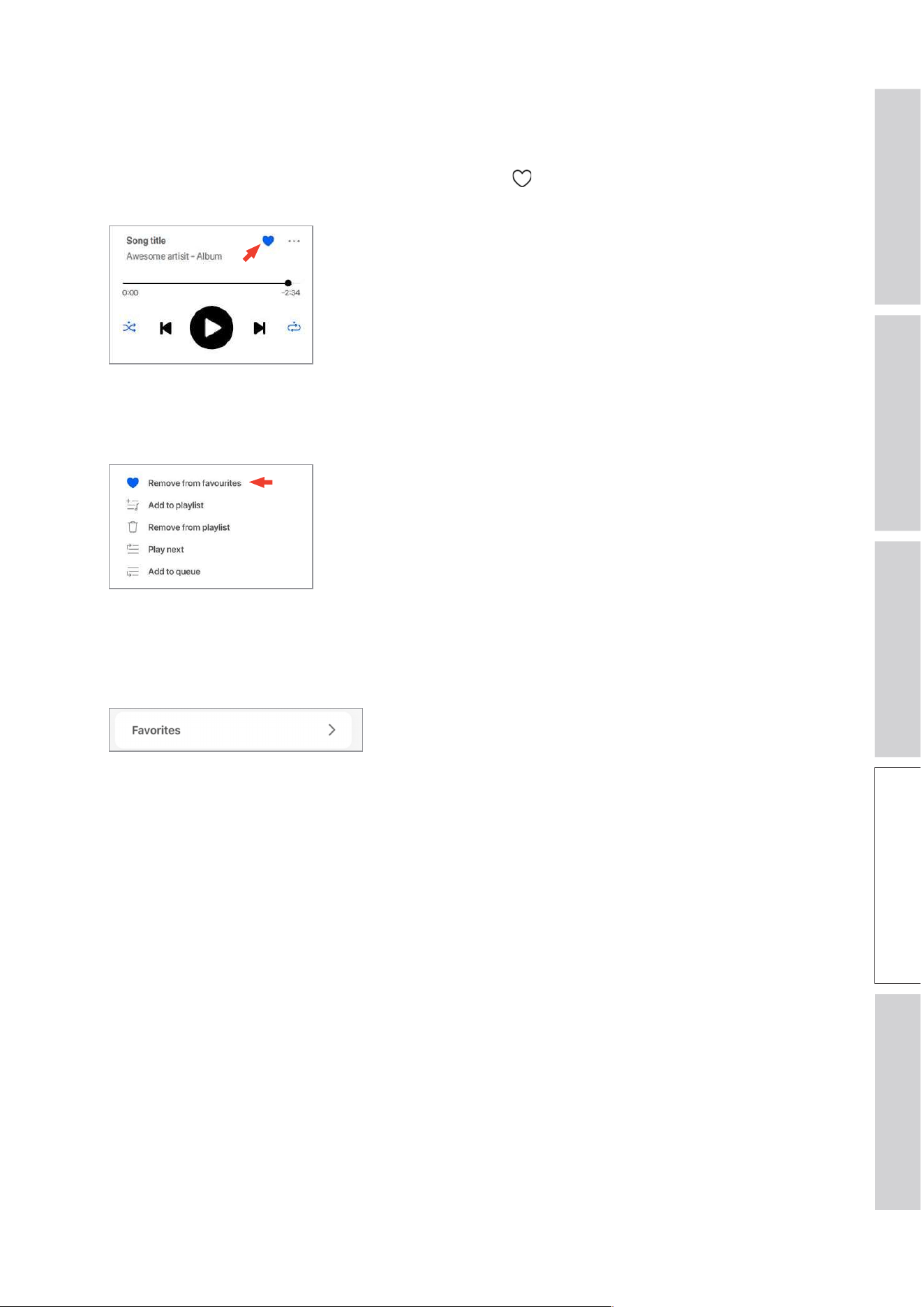
16.3.2.1 Playback Screen
Previous/next
Play/pause
Track scroll
Options
Repeat
Hide playback screen
Shuffle
Volume control
Favourites
Track metadata
Queue
MQA authentication type
16.3.2.2 Search
Tap the search icon ( ) to look for artists, albums or songs in the current music
source.
58
Table of ContentsSetting UpWi-Fi StreamingUsing KEF Connect AppFAQ and Troubleshooting
16.3.2.3 Favourites
• Selecting or Deselecting Favourites
In the playback screen, tap the favourite icon ( ) to select or deselect an item
(music, podcast, radio station) as favourites.
Alternatively, tap the option icon (
…
) next to an item (e.g. track, album, playlist), or
press and hold on an item and then select “Add to Favourites” or “Remove from
Favourites”.
• Accessing your favourites
To show the favourites in your current music source, tap “Favourites” in the main
menu.
59
Table of ContentsSetting UpWi-Fi StreamingUsing KEF Connect AppFAQ and Troubleshooting
16.3.2.4 Playing Queue
Adding a track to the queue means the track will be played after the current playing
track. The queue is not permanent and cannot be saved.
• Adding a Track to the Queue
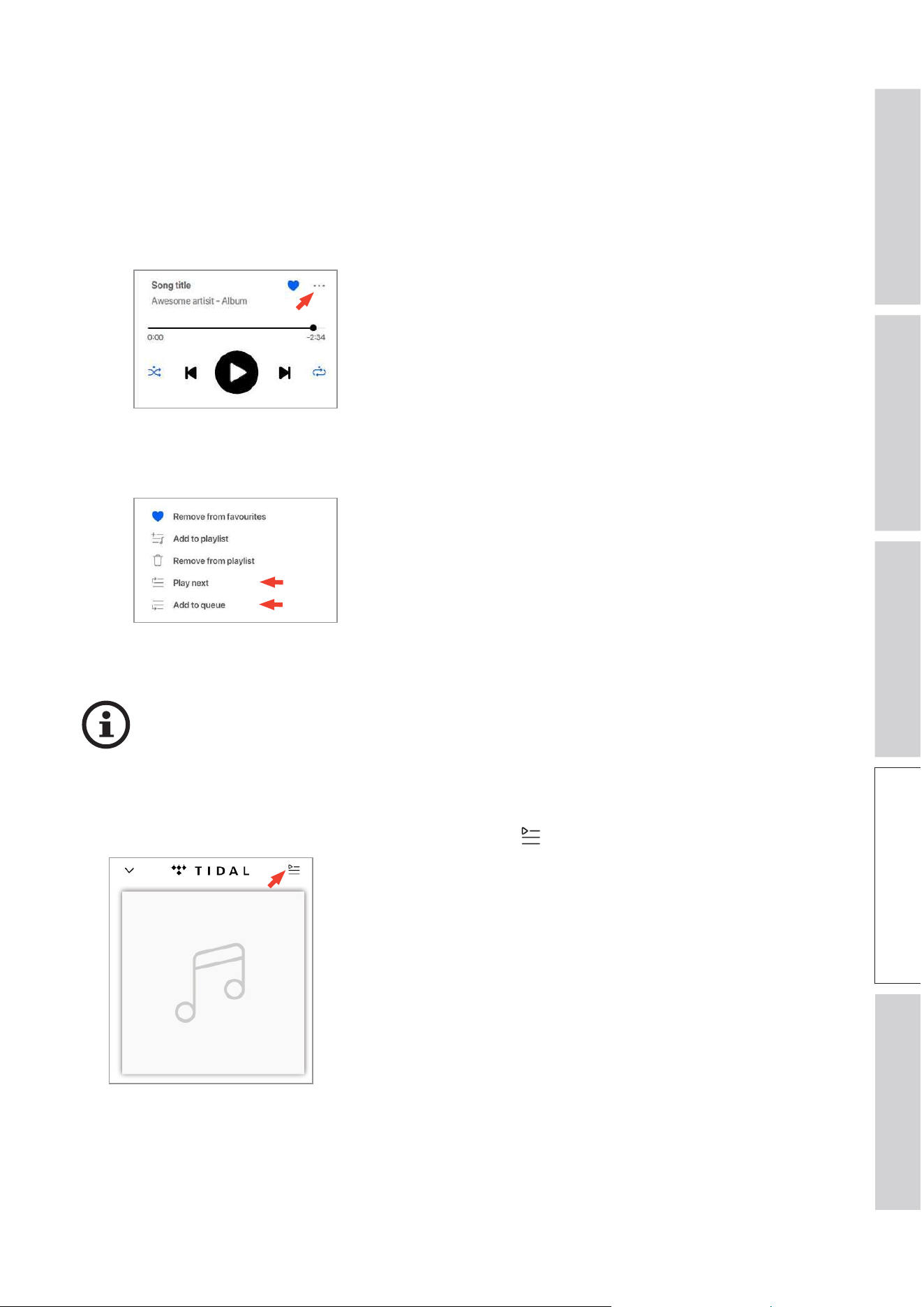
1. From the playback screen, tap the option icon (
…
).
2. Select “Add to Queue” to add the track to the end of the Queue. Or select “Play
next” to add the track as the next song.
Depending on your selections, you can also add all tracks from an artist, all
tracks from an album, or all tracks from a playlist to the queue.
• Showing the Current Queue
From the playback screen, tap the queue icon ( ) at the top right.
60
Table of ContentsSetting UpWi-Fi StreamingUsing KEF Connect AppFAQ and Troubleshooting
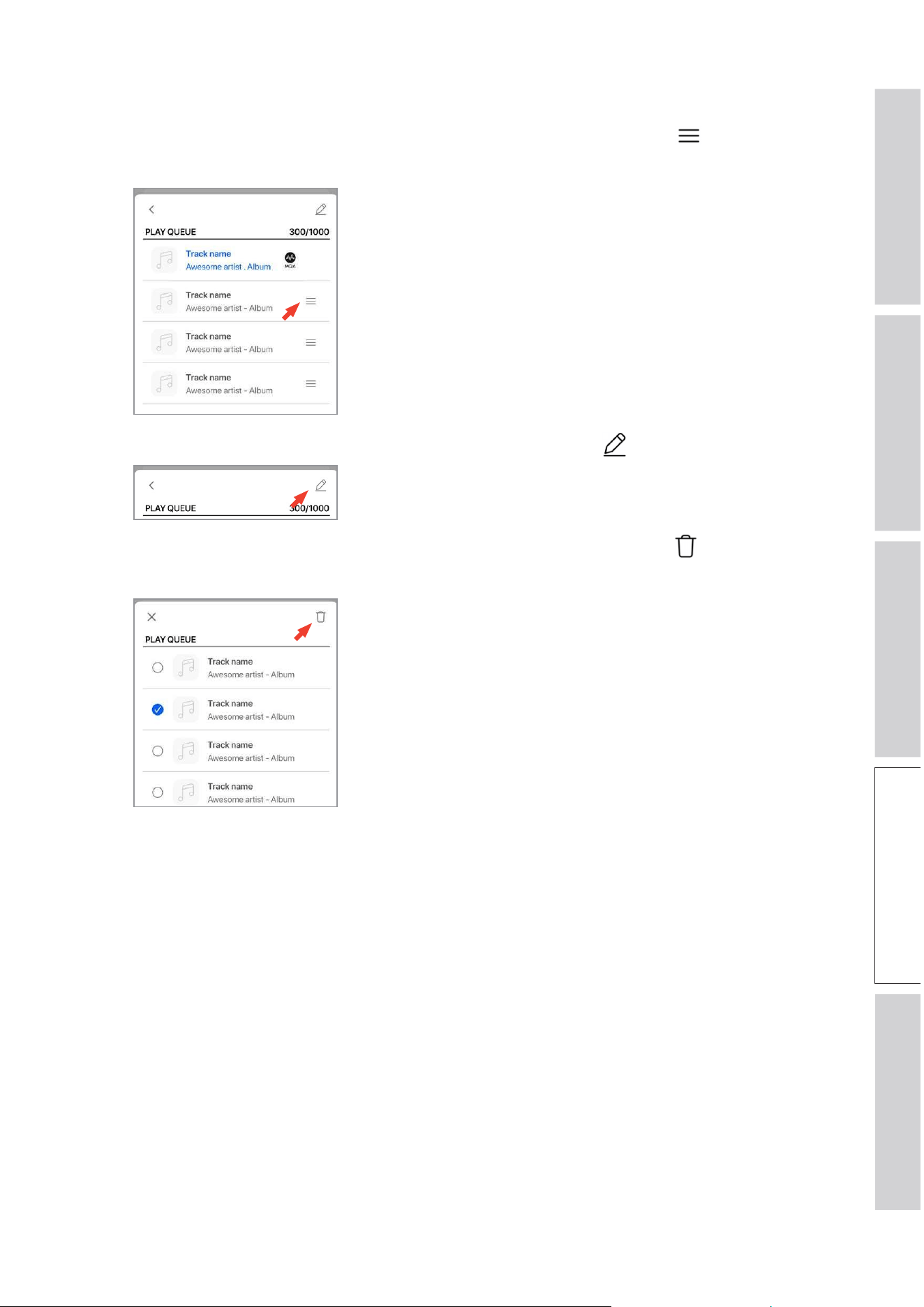
• Editing the Queue
1. To edit the playback sequence, press and hold the three bars ( ) on the right
hand side of a track and then drag the track up or down the queue.
2. To remove a track from the queue, tap the edit icon ( ) at the top right.
3. Select the track in the queue and then tap the trash bin icon ( ) to remove it
from the queue. You may also select multiple tracks for removal.
61
Table of ContentsSetting UpWi-Fi StreamingUsing KEF Connect AppFAQ and Troubleshooting
16.3.2.5 Playlists
A playlist is a list of tracks that can be played back in the preferred sequential order.
Playlists can be saved for future listening.
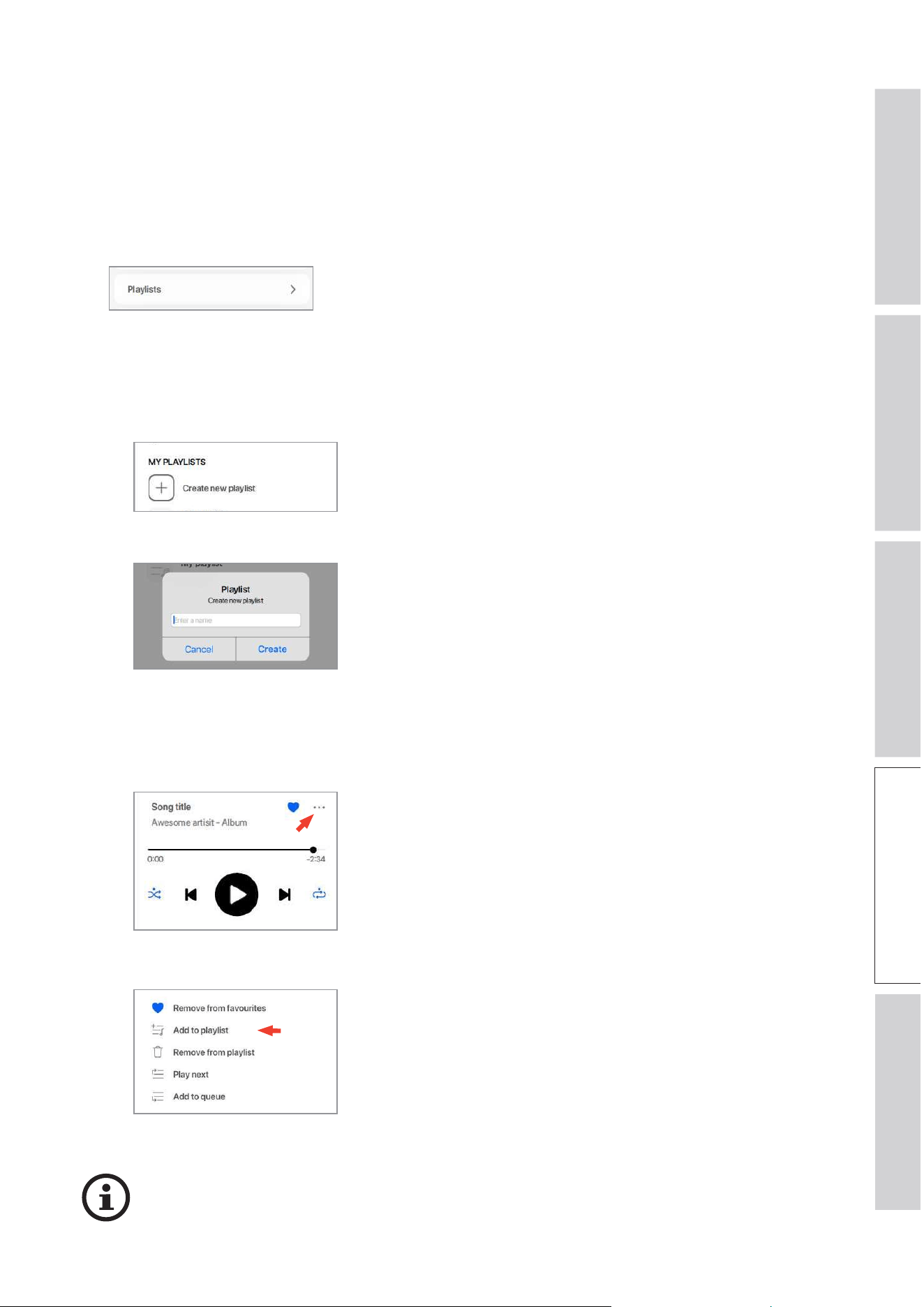
• Accessing the Playlists
In the current music source, tap “Playlists” in the main menu.
• Creating a Playlist
1. In the current music source, tap “Playlists” in the main menu.
2. Tap “Create new playlist”.
3. Create a name for the playlist and then tap “Create”.
• Adding Tracks to a Playlist
1. From a list of tracks or from the playback screen, tap the option icon (
…
) on the
right
2. Tap “Add to playlist”.
3. Select the playlist you want to add the track to.
Depending on your selections, you can also add all tracks from an artist or all
tracks from an album to the playlist.
62
Table of ContentsSetting UpWi-Fi StreamingUsing KEF Connect AppFAQ and Troubleshooting
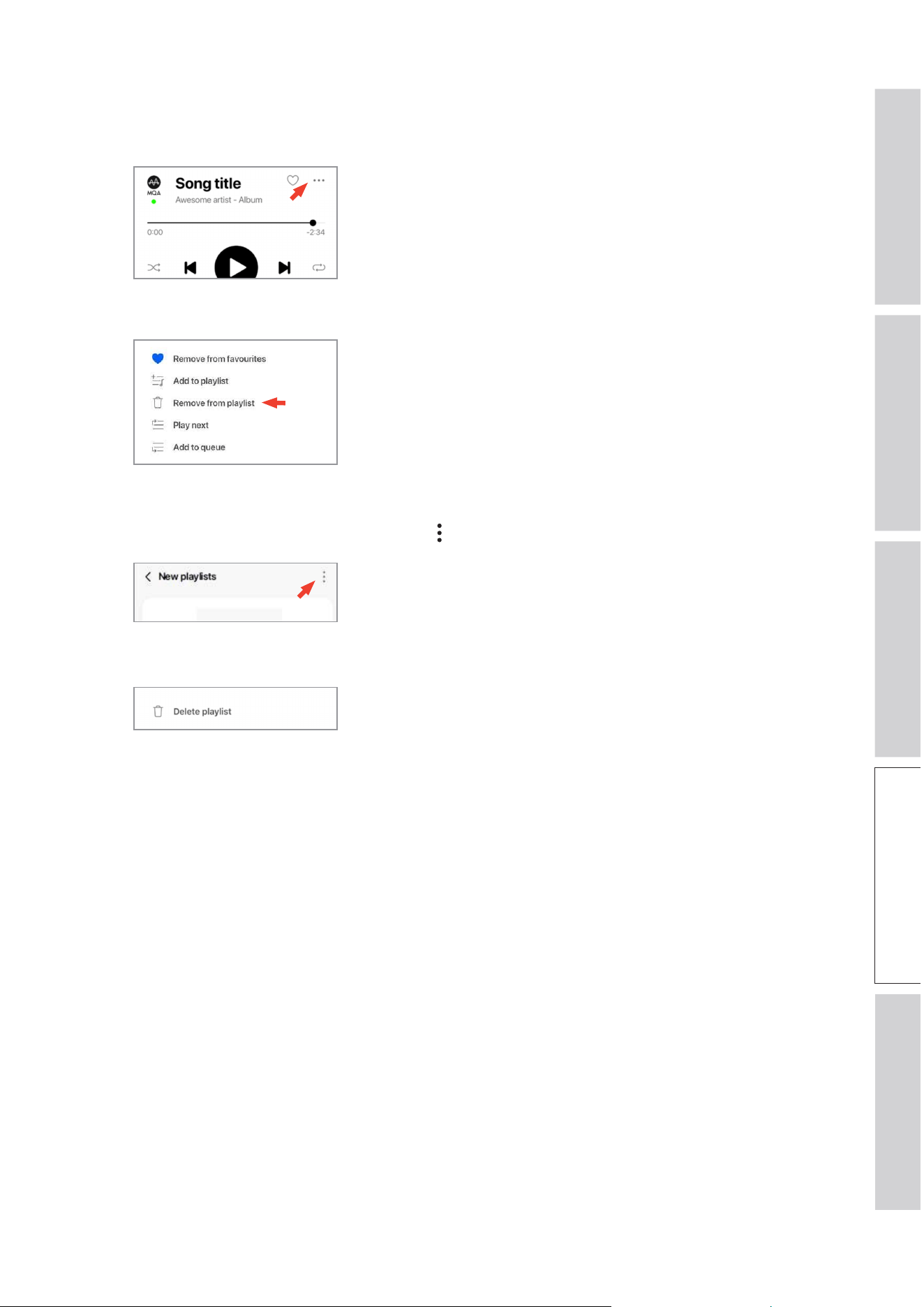
• Editing a Playlist
1. In the playback screen of the track to be removed, tap the option icon (
…
).
2. Tap “Remove from playlist”.
• Deleting a Playlist
1. In the playlist, tap the option icon ( ) at the top right corner.
2. Tap “Delete playlist”.
63
Table of ContentsSetting UpWi-Fi StreamingUsing KEF Connect AppFAQ and Troubleshooting
16.4 Equalisations
For the best audio performance, apply sound settings according to your listening area.
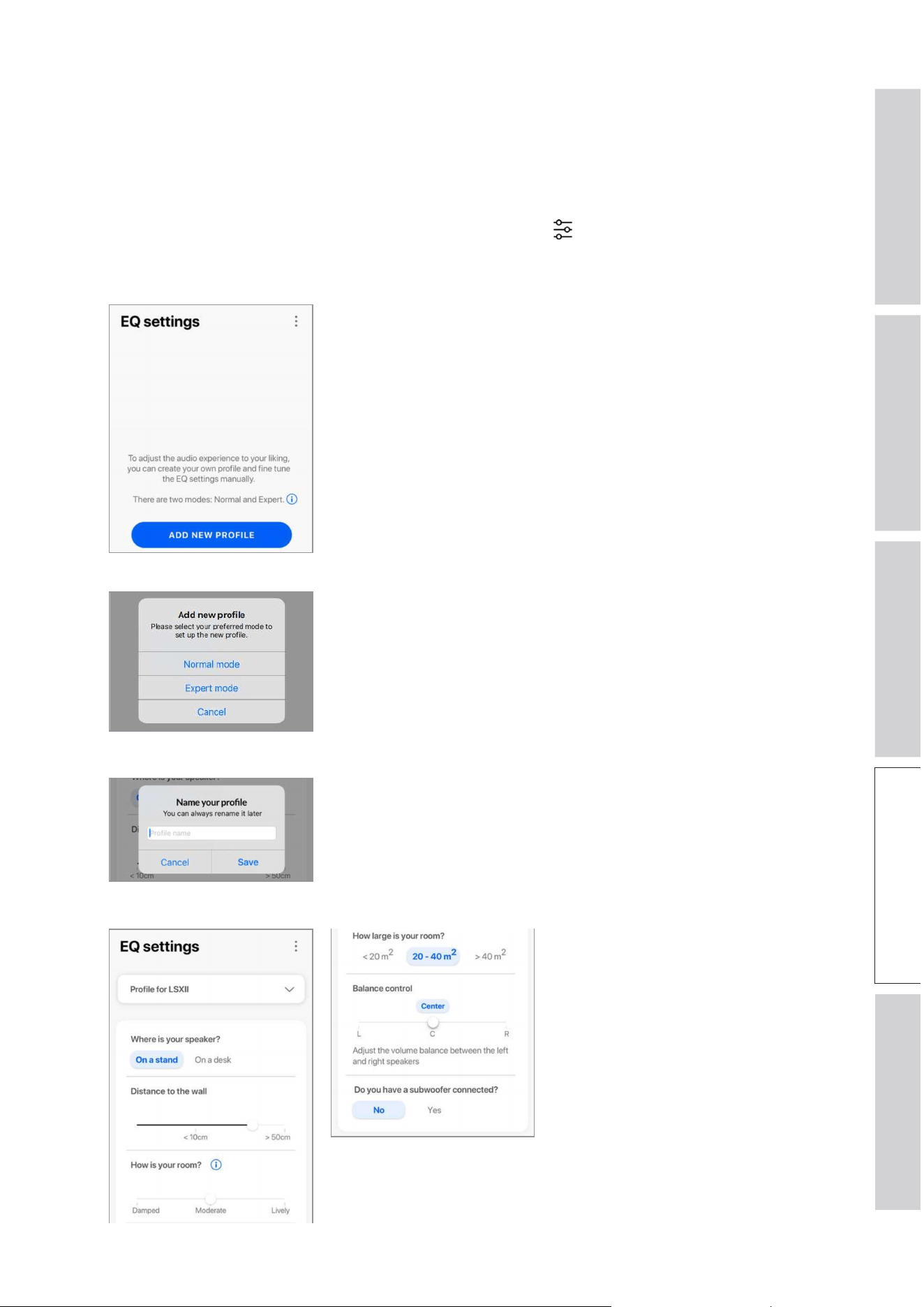
16.4.1 Normal Mode
1. In the KEF Connect App, tap the EQ settings icon ( ) at the bottom of the Home
screen.
2. Tap“Addnewpro�le”
3. Select “Normal mode”.
4. Createanameforyournewpro�leandthentap“Save”.
5. Con�gurethesettingsaccordingtoyourlisteningarea.
64
Table of ContentsSetting UpWi-Fi StreamingUsing KEF Connect AppFAQ and Troubleshooting
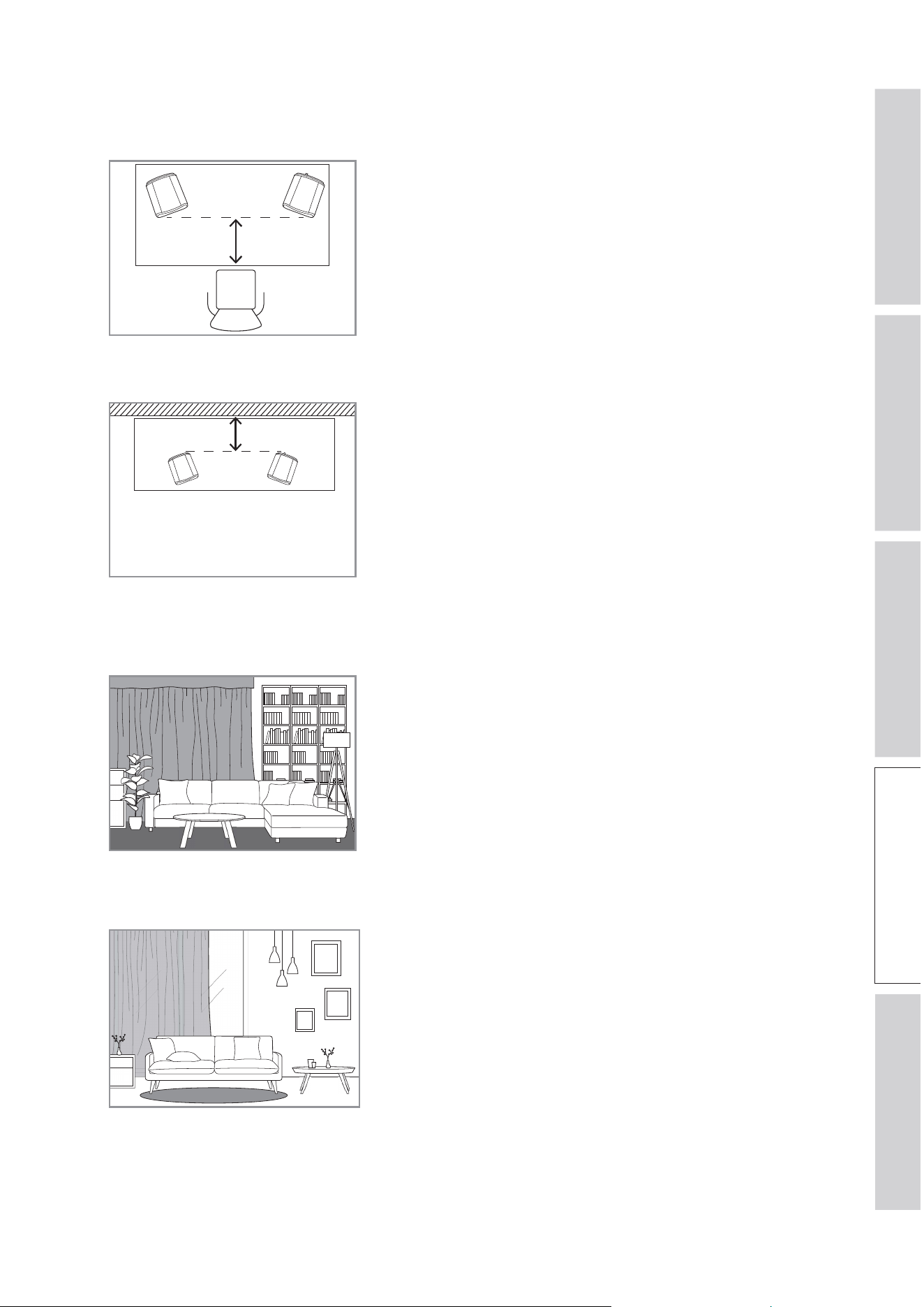
• Installation location: On a stand or on a desk
• Distance from the front edge of the table (on a desk only) (> 50 cm to 0 cm)
• Distance to the wall (< 10 cm to > 50 cm)
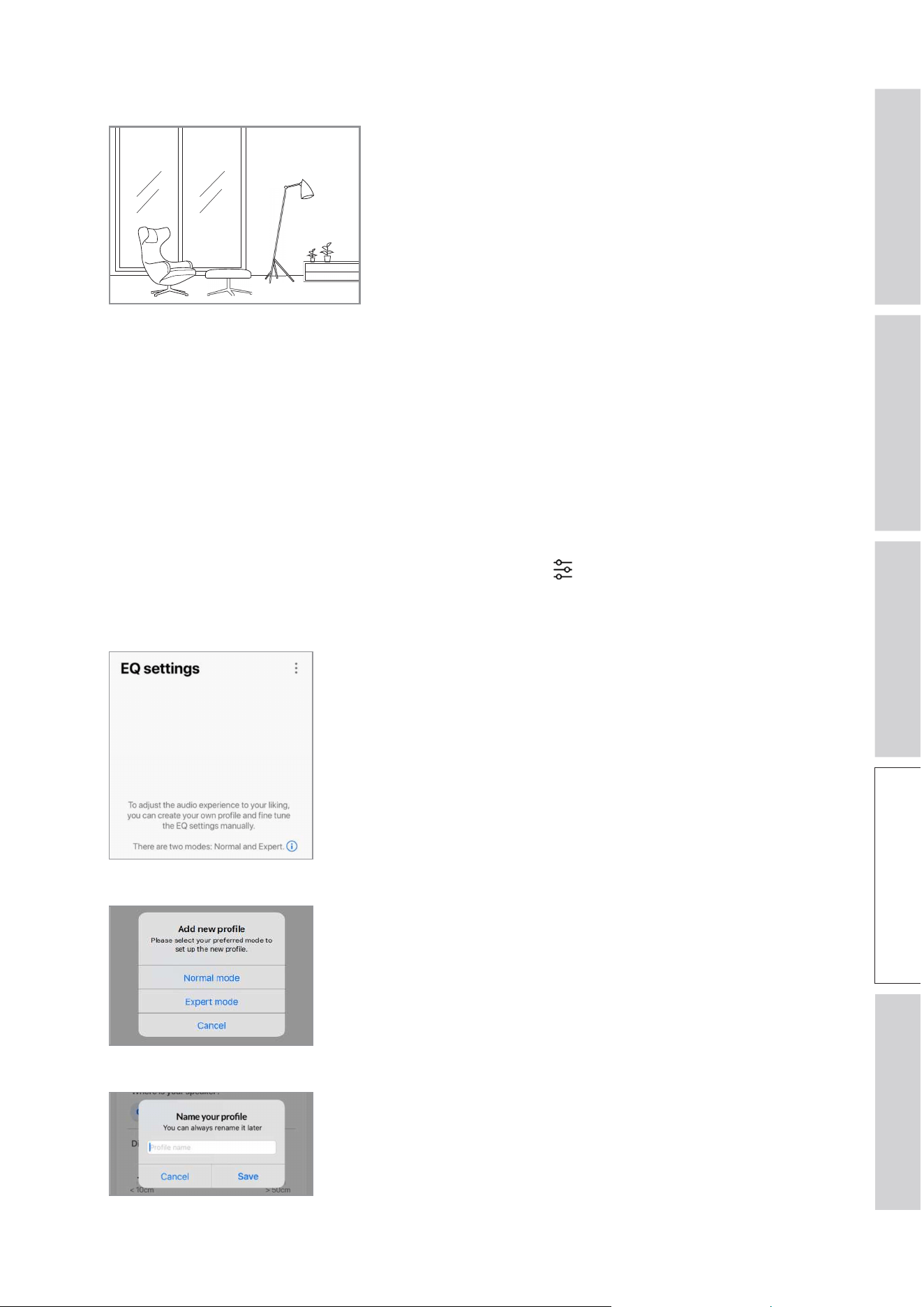
• How is your room? (Damped / Moderate / Lively)
Damped: Large furniture, thick carpet and heavy curtains
Moderate: Medium furniture, thinner carpet or rug, some curtains and features on
walls
65
Table of ContentsSetting UpWi-Fi StreamingUsing KEF Connect AppFAQ and Troubleshooting
Lively: Hard floor, less furniture, large windows and no curtains
• How large is the room? (< 20 m
2
/ 20–40 m2 / > 40 m
2
)
• Balance Control (L–C–R)
• Subwoofer is plugged in (No / Yes).
If a subwoofer is plugged in, set up the model, balance and volume of the subwoofer.
6. Tap “Save” when the settings are done.
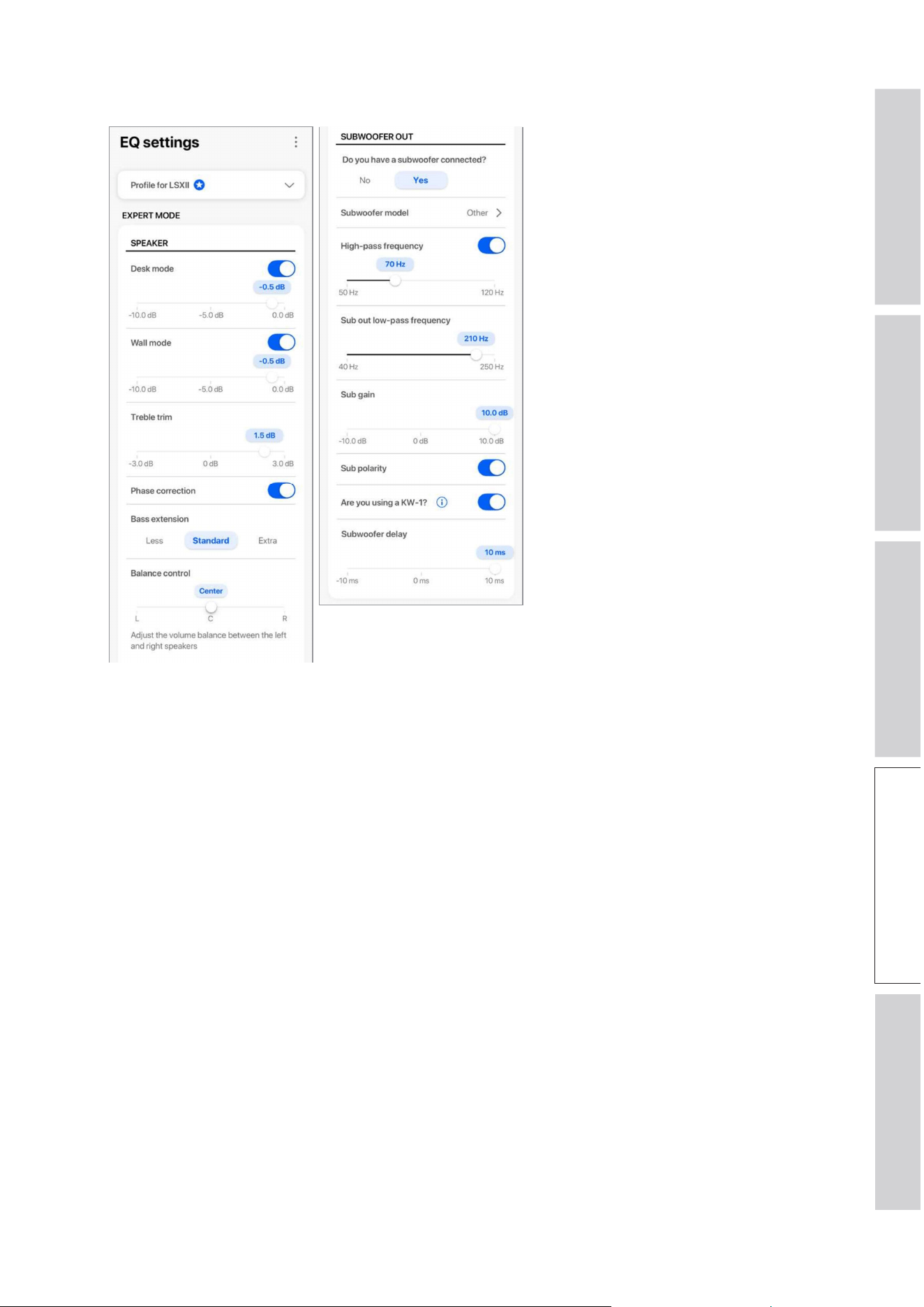
16.4.2 Expert Mode
1. In the KEF Connect App, tap the EQ settings icon ( ) at the bottom of the Home
screen.
2. Tap“Addnewpro�le”.
3. Select “Expert mode”.
4. Createanameforyournewpro�leandthentap“Save”.
66
Table of ContentsSetting UpWi-Fi StreamingUsing KEF Connect AppFAQ and Troubleshooting
5. The Expert Mode lets you configure the EQ preferences in greater precision.
The settings include:
• Desk Mode (On/Off, -10.0 dB to 0.0 dB)
• Wall Mode (On/Off, -10.0 dB to 0.0 dB)
• Treble Trim (-4.0 dB to 4.0 dB)
• Phase Correction (On/Off)
• Bass Extension (Less / Standard / Extra)
• Balance Control (L–C–R)
• Subwoofer model
• High-Pass Frequency (On/Off, 50 Hz to 120 Hz)
• Sub Out Low-Pass Frequency (40 Hz to 250 Hz)
• Sub Gain (-10 dB to 10 dB)
• Sub Polarity (On/Off)
• Are you using a KW-1?
• Subwoofer delay (-10 ms to 10 ms)
67
Table of ContentsSetting UpWi-Fi StreamingUsing KEF Connect AppFAQ and Troubleshooting
Understanding the EQ Settings
On a desk/distance from the front edge of the table (Expert Mode: Desk Mode):
This
setting adjusts the “presence” region (170 Hz +/- 1 octave). Too much causes a muddy
sound, while a lack of presence makes the sound distant and empty.
Distance to the wall (Expert Mode: Wall Mode):
This setting adjusts all frequencies
from around 500 Hz downwards, causing broader changes than Desk Mode. A dip
in these frequencies causes a tinny sound, while too much of these frequencies can
overwhelm the overall presentation with lower frequencies.
How is your room? (Expert Mode: Treble Trim):
This adjusts the frequencies above
500 Hz. A damped room (lots of curtains, soft furnishings) can make sound seem
muted, while a lively room (high ceiling, flat surfaces, glass) can make it sound harsh.
Move towards damped to reduce the muting effect, or move towards lively to tame
harshness.
How large is your room (Expert Mode: Bass Extension):
This setting adjusts the bass
extension of the speakers. The larger the room selected, the lower the roll-off point.
Balance Control:
This setting allows you to adjust the volume balance between the left
and right channels.
Understanding the Subwoofer Settings
Subwoofer/Speaker Balance (Basic Mode):
This controls the bass output between the
subwoofer and the speakers. If the slider is moved more to “Subwoofer”, most of the
bass output will be handled by the subwoofer.
High-Pass Frequency:
Frequencies above the set point will be played by the speakers.
Sub Out Low-Pass Frequency:
Frequencies below the set point will be handled by the
subwoofer. This can overlap with the high-pass frequency to help integrate the speaker/
subwoofer more effectively with no dip or peak in overall response.
Sub Gain:
This changes the signal level output to the subwoofer.
Sub Polarity:
Ideally, the speakers and subwoofer should be moving in the same
direction at the same time, otherwise frequencies can be cancelled out. Switching the
polarity of the subwoofer can resolve a perceived lack of bass response.
Are you using a KW-1?
: KW-1 is a subwoofer adapter kit which transmits signals
wirelessly, enabling your subwoofer to be optimally placed. Enable this option if you are
using KW-1.
68
Table of ContentsSetting UpWi-Fi StreamingUsing KEF Connect AppFAQ and Troubleshooting
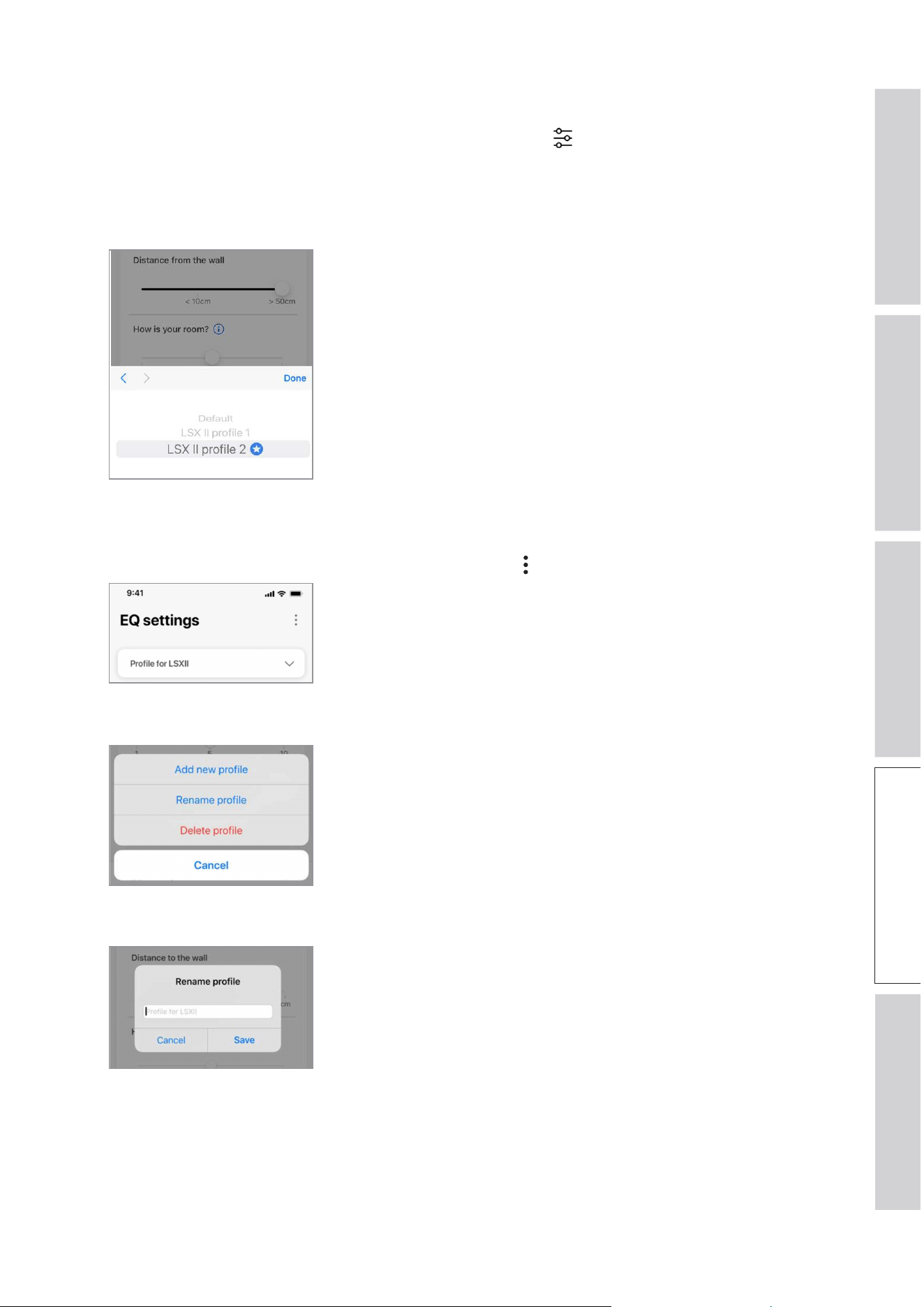
16.4.3 Selecting a Sound Profile
1. In the KEF Connect App, tap the EQ settings icon ( ) at the bottom of the Home
screen.
2. Tap “Default” and then select a sound profile to apply to the speakers. The profiles
with a star icon are created in Expert mode.
16.4.4 Renaming a Sound Profile
1. IntheselectedEQpro�le,taptheoptionicon( ) at the top right.
2. Tap“Renamepro�le”.
3. Createanewnameforyourpro�leandthentap“Save”.
69
Table of ContentsSetting UpWi-Fi StreamingUsing KEF Connect AppFAQ and Troubleshooting
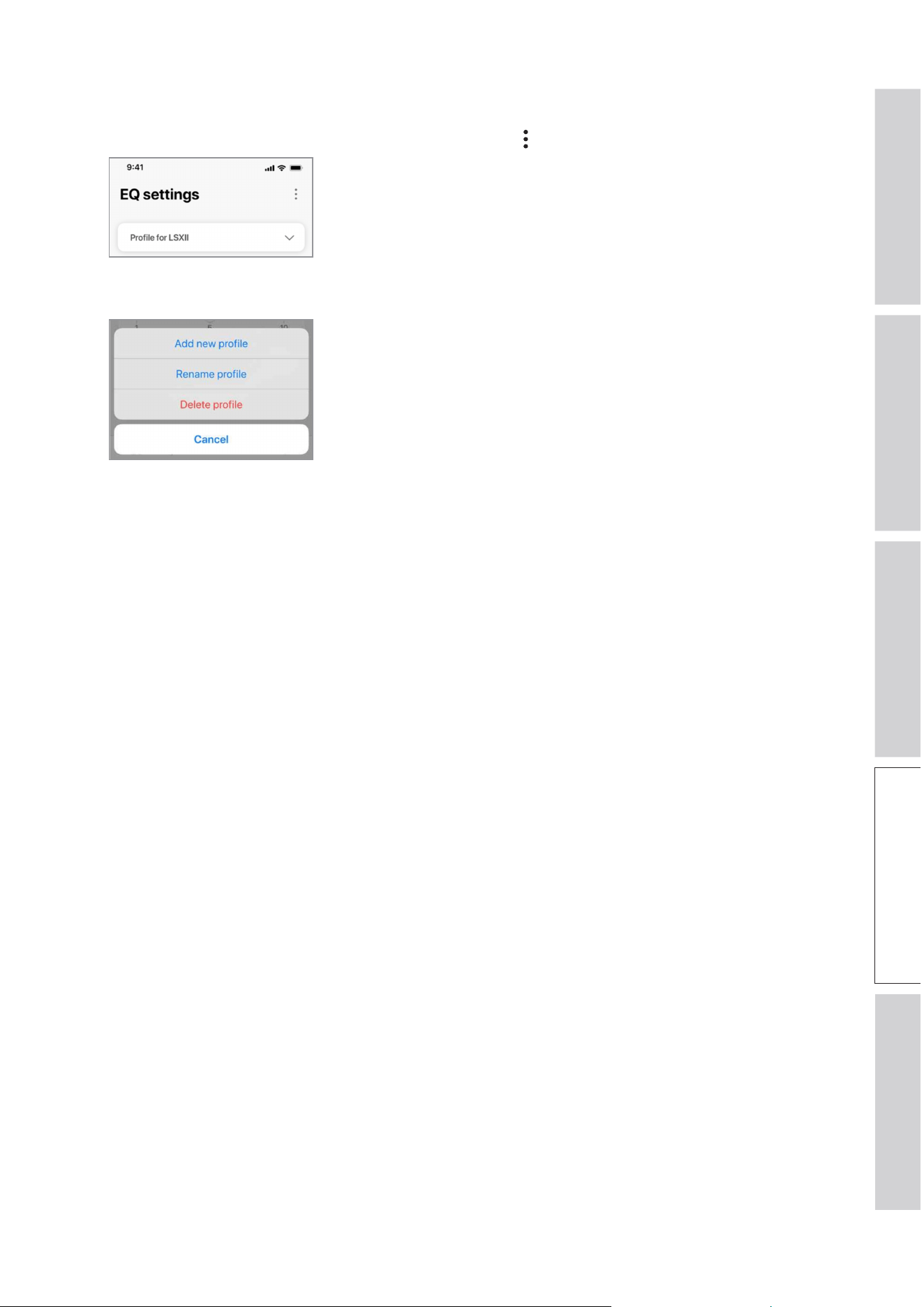
16.4.5 Deleting a Sound Profile
1. IntheselectedEQpro�le,taptheoptionicon( ) at the top right.
2. Tap“Deletepro�le”.
70
Table of ContentsSetting UpWi-Fi StreamingUsing KEF Connect AppFAQ and Troubleshooting
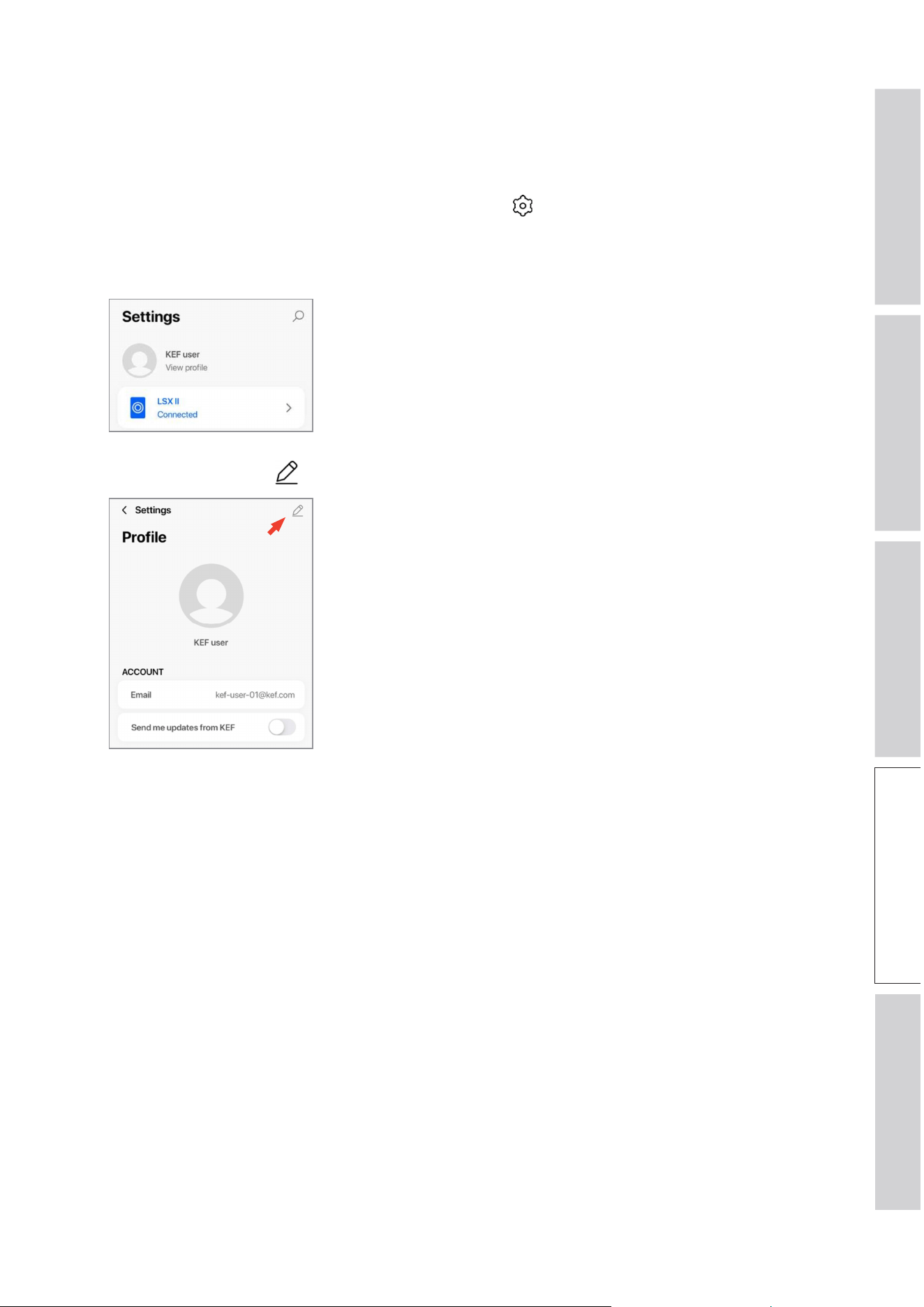
16.5 Profile
This menu allows you to edit your personal details (account name and profile picture)
of your registered user account.
1. In the KEF Connect App, tap the Setting icon ( ) at the bottom of the Home
screen.
2. Tap“Viewpro�le”.
3. Tap the edit icon ( ) at the top right and start editing.
71
Table of ContentsSetting UpWi-Fi StreamingUsing KEF Connect AppFAQ and Troubleshooting
16.6 Choosing Your Speaker
16.6.1 My Speaker and Speakers Nearby
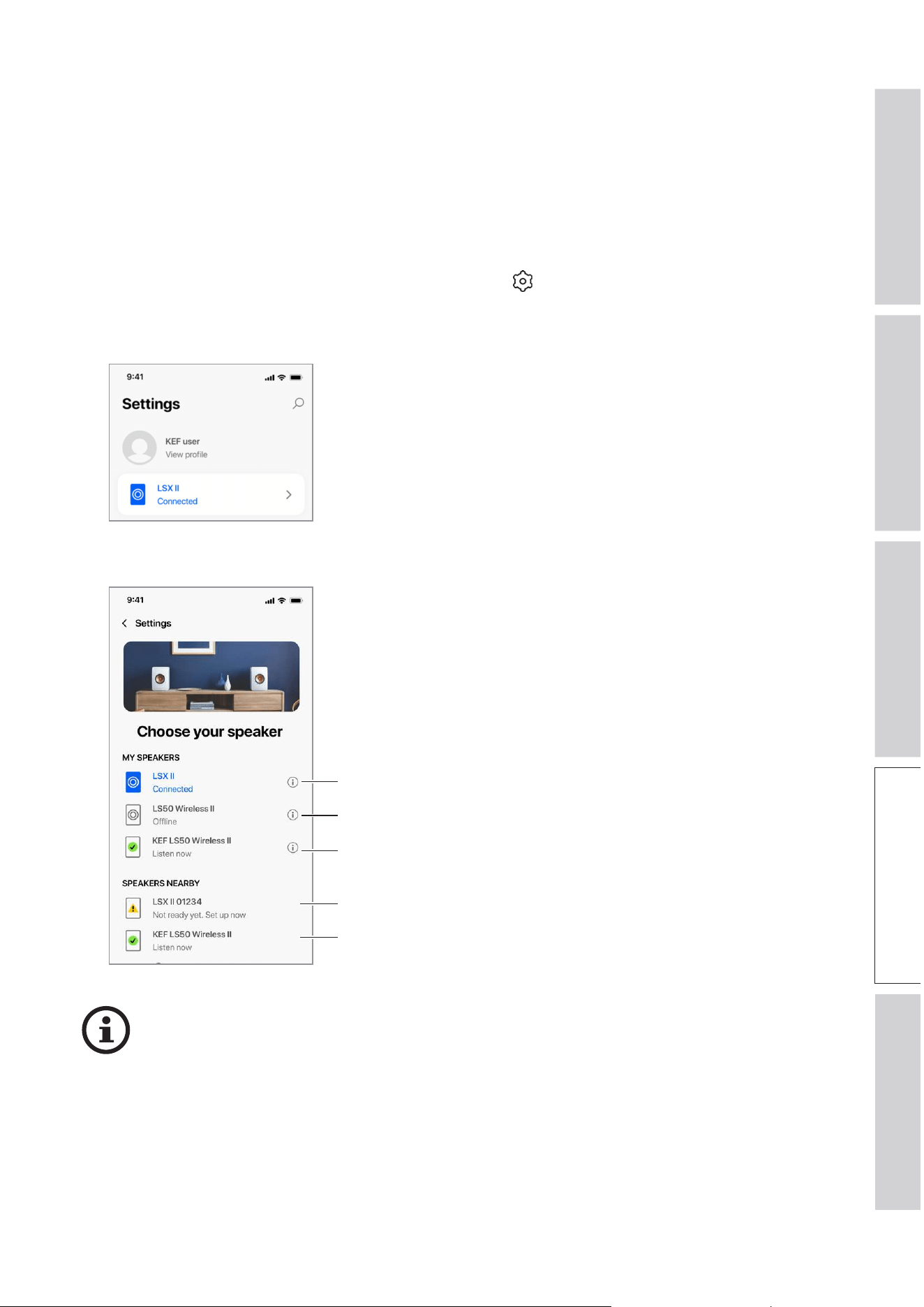
This menu allows the KEF Connect App to switch to another pair of speakers for
control and streaming. All speakers must first be set up through the same KEF Connect
App before they are available for selection.
1. In the KEF Connect App, tap the Setting icon ( ) at the bottom of the Home
screen.
2. Tap the name of the connected speakers.
3. Select another pair of speakers for control and streaming.
Not set up yet with KEF Connect App
Already set up with KEF Connect
App on another mobile device
Current speakers
Speakers on the same network but turned off
Speakers on the same network and ready for switching
The speakers under “Speakers Nearby” are on the same network but not
ready yet to be controlled through the KEF Connect App on your mobile
device.
72
Table of ContentsSetting UpWi-Fi StreamingUsing KEF Connect AppFAQ and Troubleshooting
16.6.2 Speaker Info
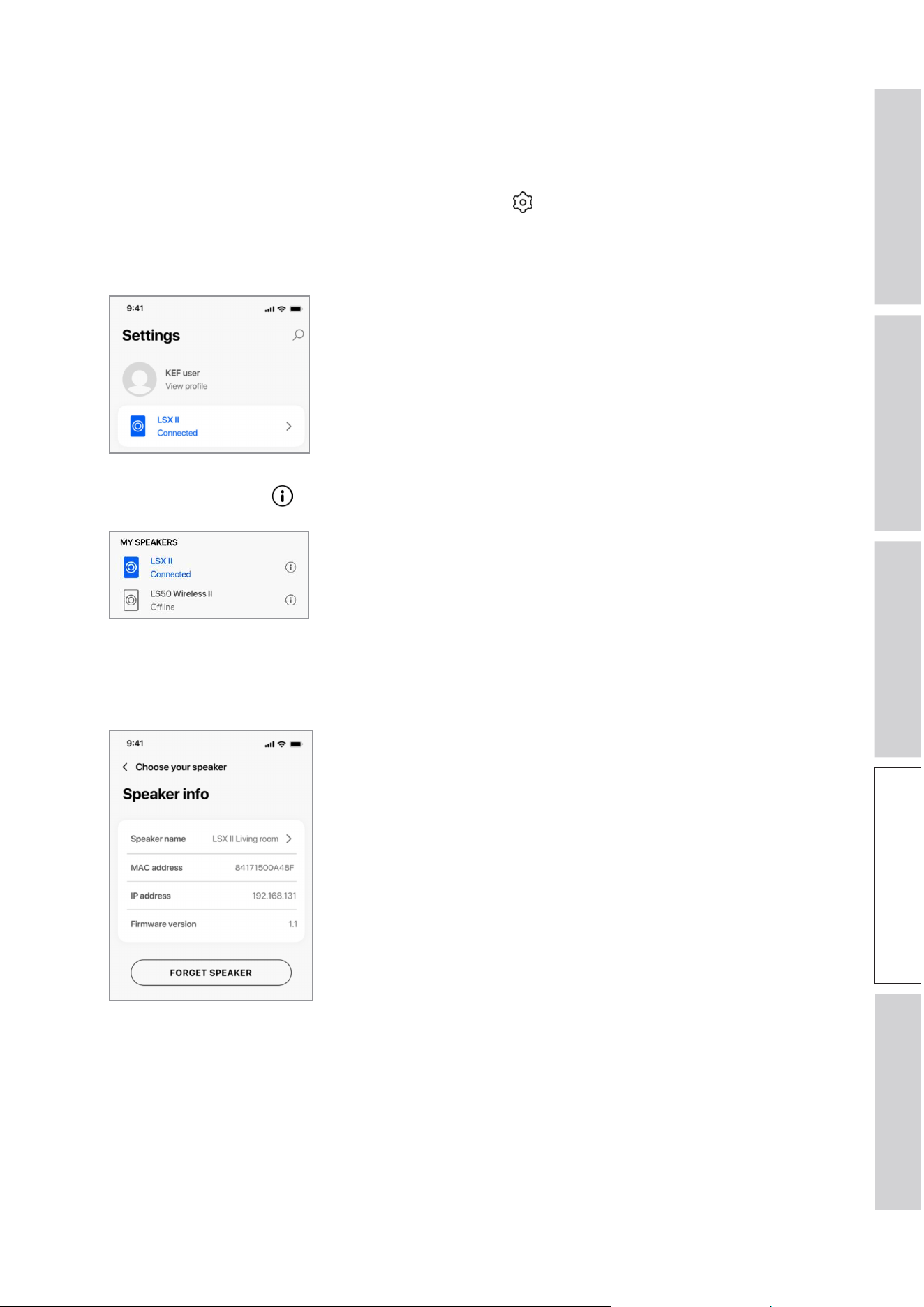
This menu allows you to find out more information about the connected speakers,
rename the speakers and disconnect the speakers from the KEF Connect App.
1. In the KEF Connect App, tap the Setting icon ( ) at the bottom of the Home
screen.
2. Tap the name of the connected speakers.
3. Tap the info icon ( ) next to the name of the speakers.
4. ChecktheMACaddress,IPaddressand�rmwareversionofthespeakers.Youcan
also rename the speakers or forget the speakers (disconnect them from the KEF
Connect App).
73
Table of ContentsSetting UpWi-Fi StreamingUsing KEF Connect AppFAQ and Troubleshooting
16.7 Speaker Preferences
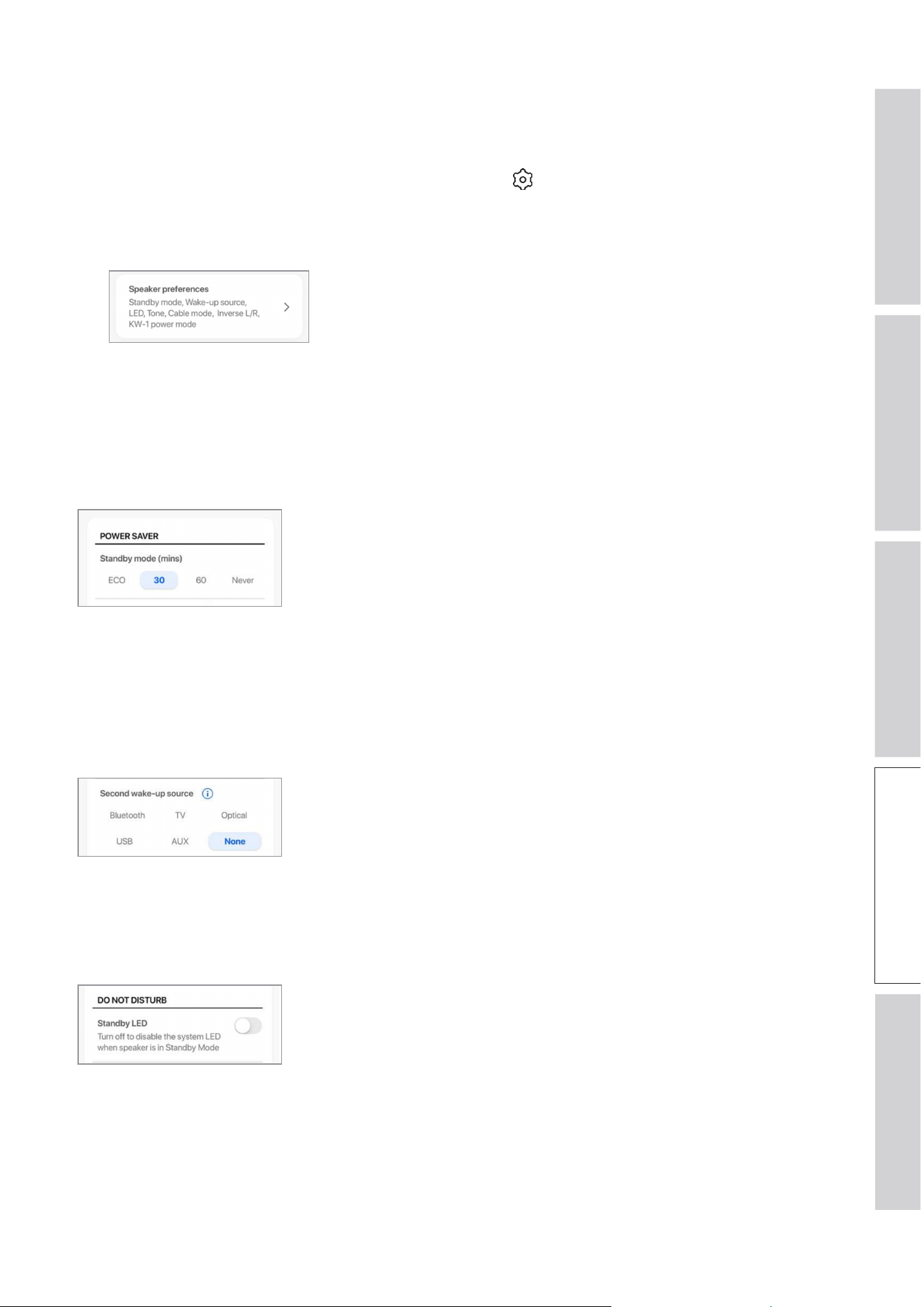
This menu allows you to configure various speaker preferences. To access this menu:
1. In the KEF Connect App, tap the Setting icon ( ) at the bottom of the Home
screen.
2. Tap “Speaker preferences”.
16.7.1 Power Saver – Standby Mode
This setting determines how long (ECO (20), 30 or 60 mins) the speakers will remain
idle before automatically entering Standby Mode. If “never” is selected, the speakers
must be manually turned off.
16.7.2 Power Saver – Second Wake-Up Source
This setting enables a second source to automatically turn on the speakers when there
is audio input from the selected source. This option is not available when Standby
Mode is set to ECO.
16.7.3 Do Not Disturb – Standby LED
This setting enables the LED indicator light to turn off when the speakers are in
Standby mode.
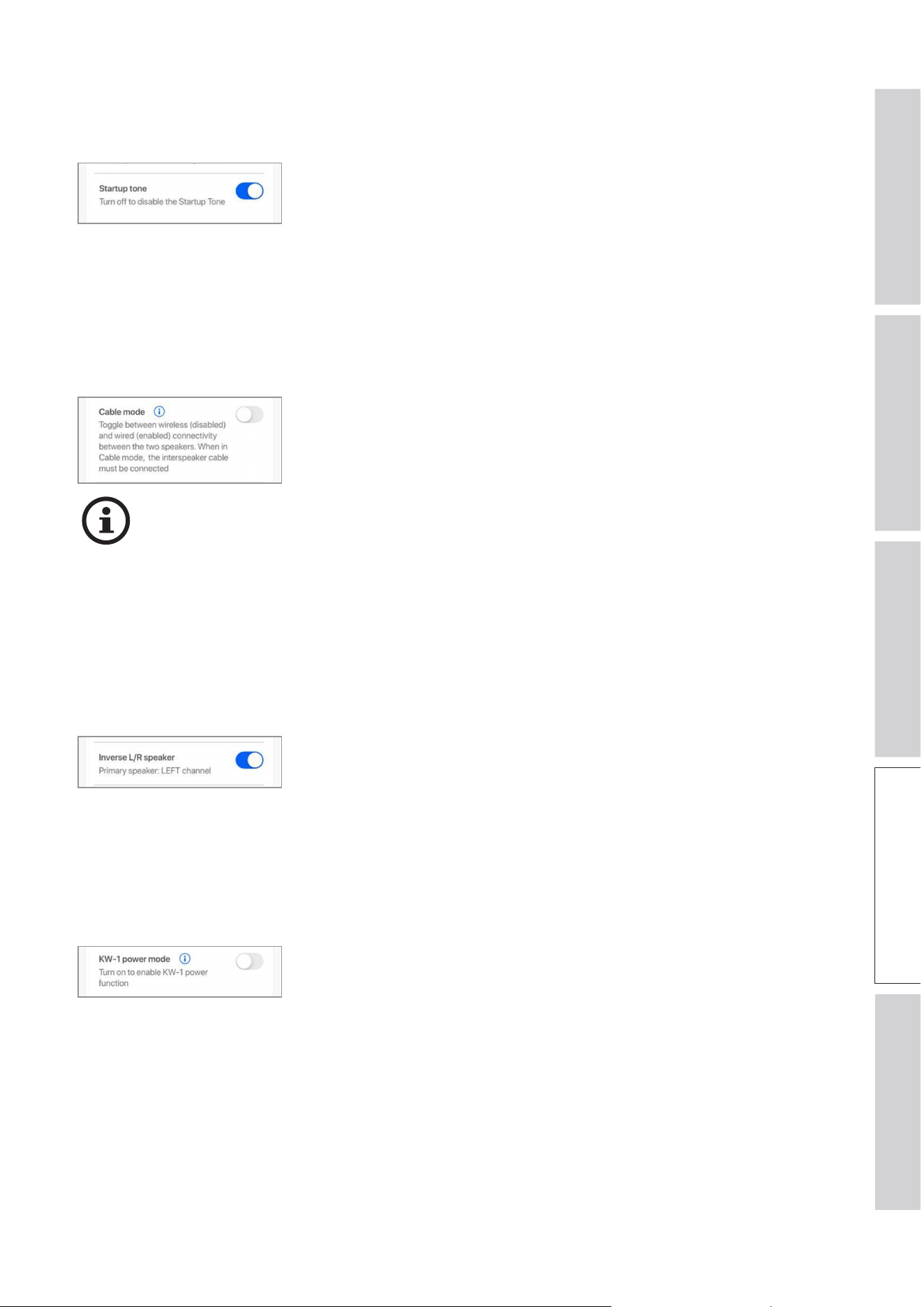
74
Table of ContentsSetting UpWi-Fi StreamingUsing KEF Connect AppFAQ and Troubleshooting
16.7.4 Do Not Disturb – Start Up tone
This setting enables the start up tone to be muted when the speakers are turned on.
16.7.5 Speaker System Options – Cable Mode
You can connect the Primary Speaker and Secondary Speaker with the provided inter-
speaker cable through the “T” connection ports on the back panels of the speakers.
Once the cable is connected, enable this setting to enable Cable mode and disable the
wireless connection.
Cable Mode is required/recommended when:
• You prefer a higher resolution at 192 kHz/24 bit (wireless: 96 kHz/24 bit).
• You are experiencing audio dropouts due to interference.
16.7.6 Speaker System Options – Inverse L/R Speakers
This setting changes which speaker plays left and right. By default, the Primary Speaker
plays the right channel.
16.7.7 KW-1 Power Mode
This setting switches the USB port of the Primary Speaker from audio input to power
output. Turn on this setting to enable the KW-1 transmitter to be power by the
speakers. Note that USB audio input will be disabled when this setting is turned on.
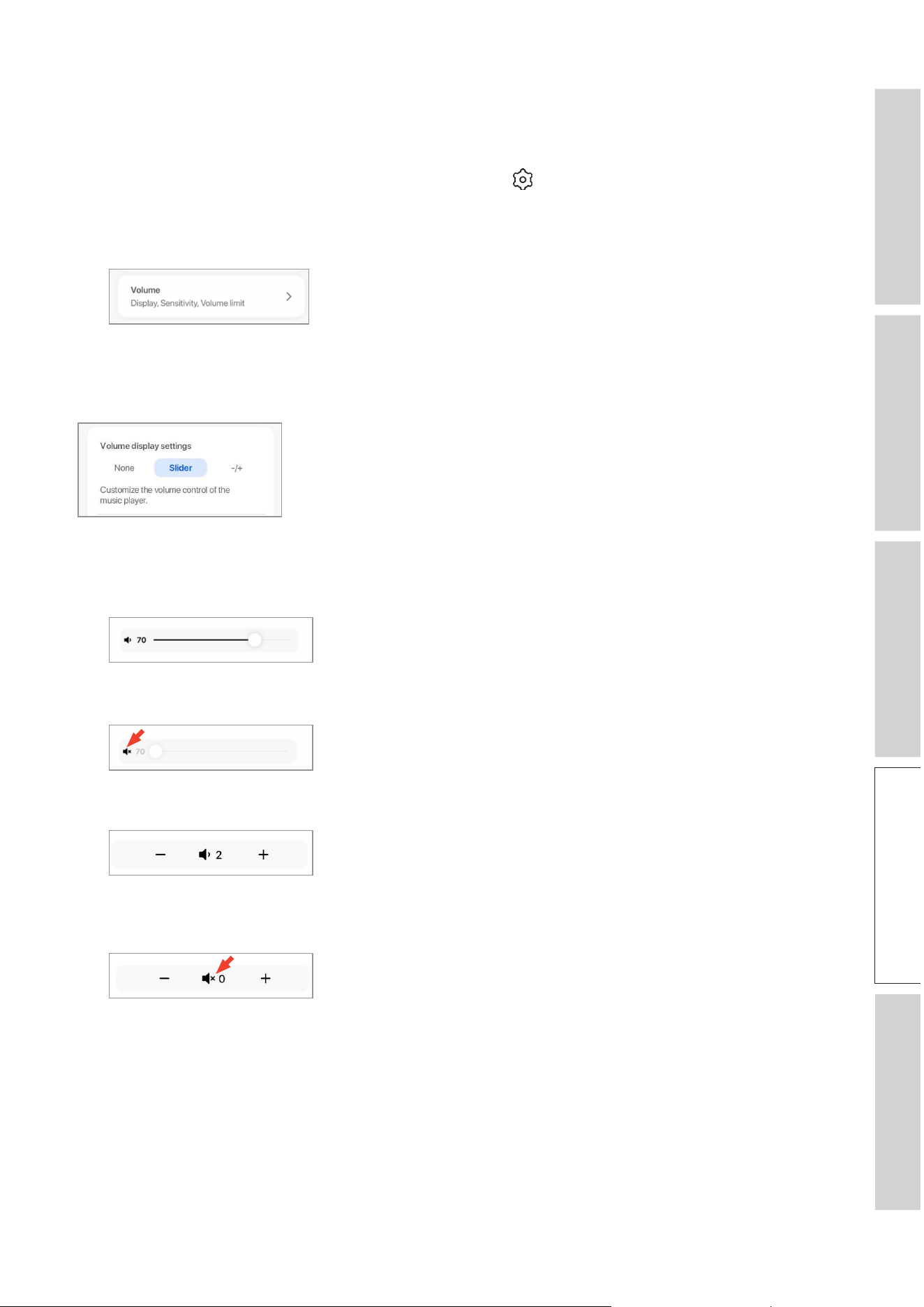
75
Table of ContentsSetting UpWi-Fi StreamingUsing KEF Connect AppFAQ and Troubleshooting
16.8 Volume
This menu allows you to configure volume settings. To access this menu:
1. In the KEF Connect App, tap the Setting icon ( ) at the bottom of the Home
screen.
2. Tap “Volume”.
16.8.1 Volume Display Setting
This setting allows you to configure how the volume control should be displayed.
• None: No volume control will be displayed during playback.
• Slider: The volume control will be displayed as a slider for adjustment.
Tap the speaker icon on the left to mute or restore audio output from the speakers.
• –
/+: The volume control will be displayed as “–” and “+” buttons for adjustment.
Tap the speaker icon in the middle to mute or restore audio output from the
speakers.
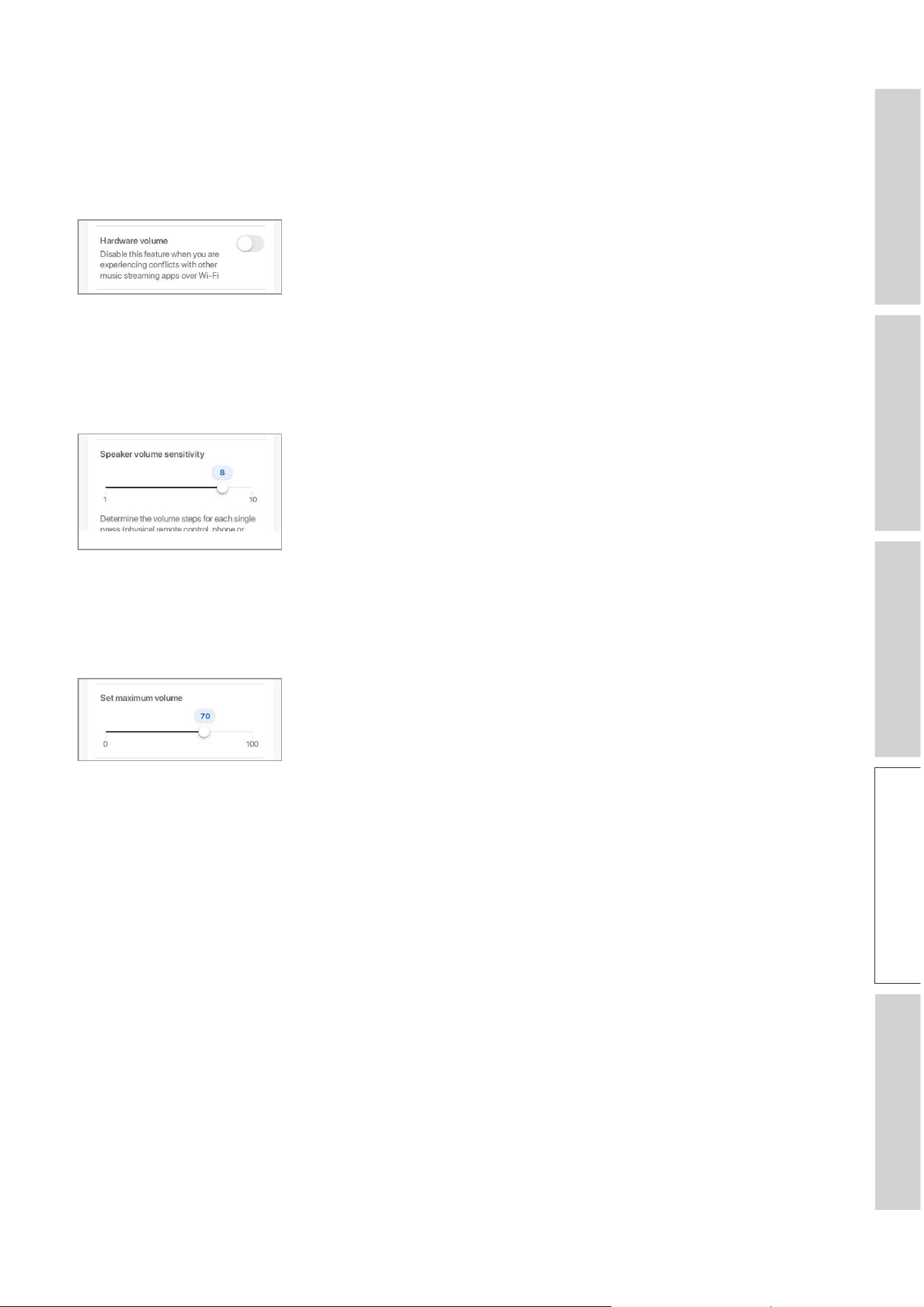
76
Table of ContentsSetting UpWi-Fi StreamingUsing KEF Connect AppFAQ and Troubleshooting
16.8.2 Hardware Volume
This setting is only available on iOS devices. The hardware volume buttons refer to the
physical volume buttons on your device. Disable this setting when you are experiencing
conflicts with other music streaming apps over Wi-Fi connection.
16.8.3 Speaker Volume Sensitivity
This setting allows you to configure the number of volume steps for each single press of
the physical volume buttons of your device.
16.8.4 Maximum Volume
This setting allows you to configure the maximum level when adjusting the volume. The
setting applies to all sources.
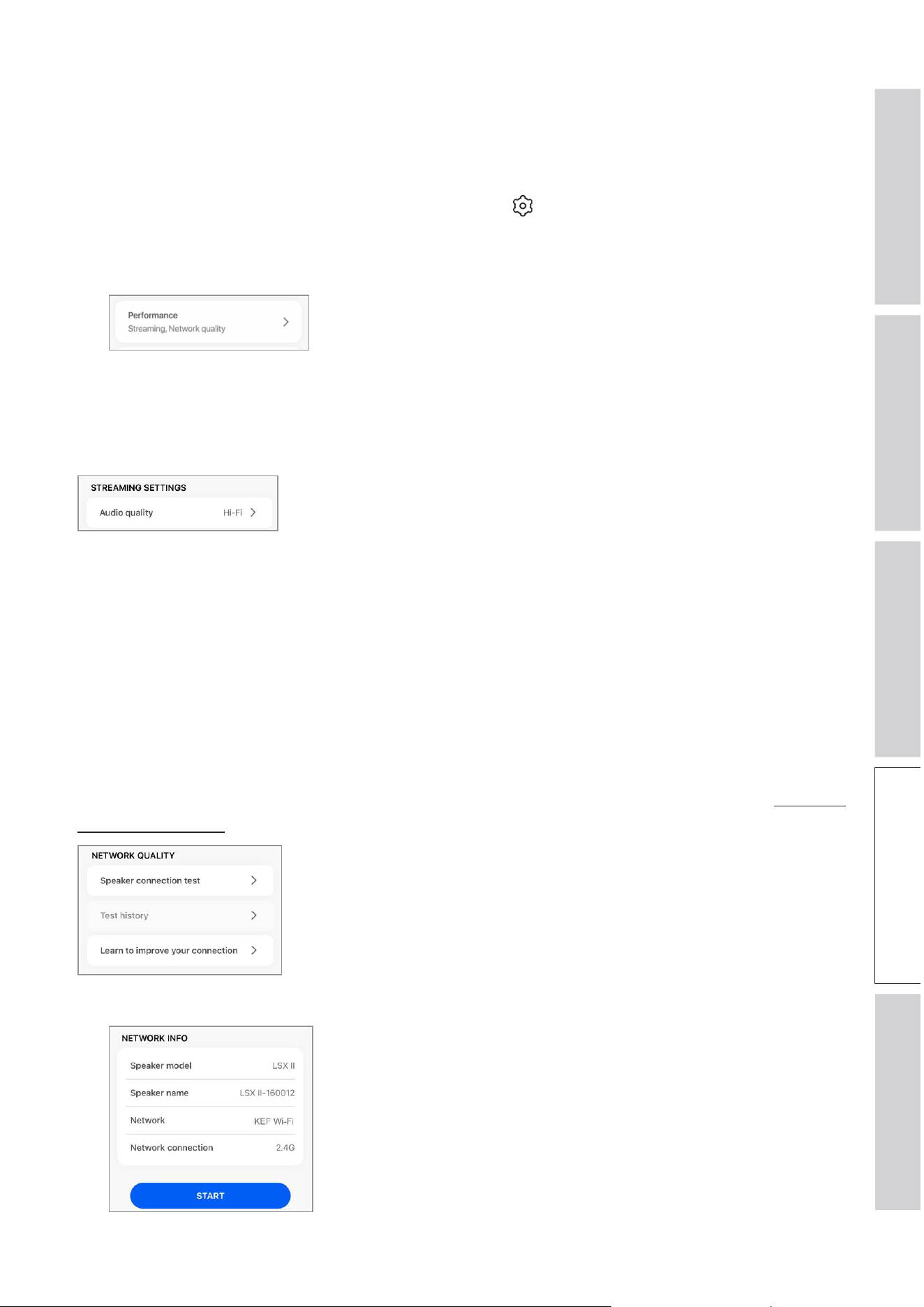
77
Table of ContentsSetting UpWi-Fi StreamingUsing KEF Connect AppFAQ and Troubleshooting
16.9 Performance
This menu allows you to configure the streaming settings and assess your network
quality. To access this menu:
1. In the KEF Connect App, tap the Setting icon ( ) at the bottom of the Home
screen.
2. Tap “Performance”.
16.9.1 Streaming Settings – Audio Quality
This setting allows you to select the audio quality for music streaming services inside
the KEF Connect app.
• Hi-Fi (Hi-Fi quality): Always select this setting for the best audio quality. The highest
quality depends on the music streaming service and your subscription.
• High (CD quality): Select this setting when the speakers are in a crowded network
and experiencing quality drop-outs.
• Normal (MP3 quality): Select this setting when the speakers are in a crowded
network and experiencing audio drop-outs.
16.9.2 Network quality
This setting allows you to assess your network quality. For details, see chapter “Speaker
Connection Test”.
• Speaker connection test: Select this option to perform a network quality check.
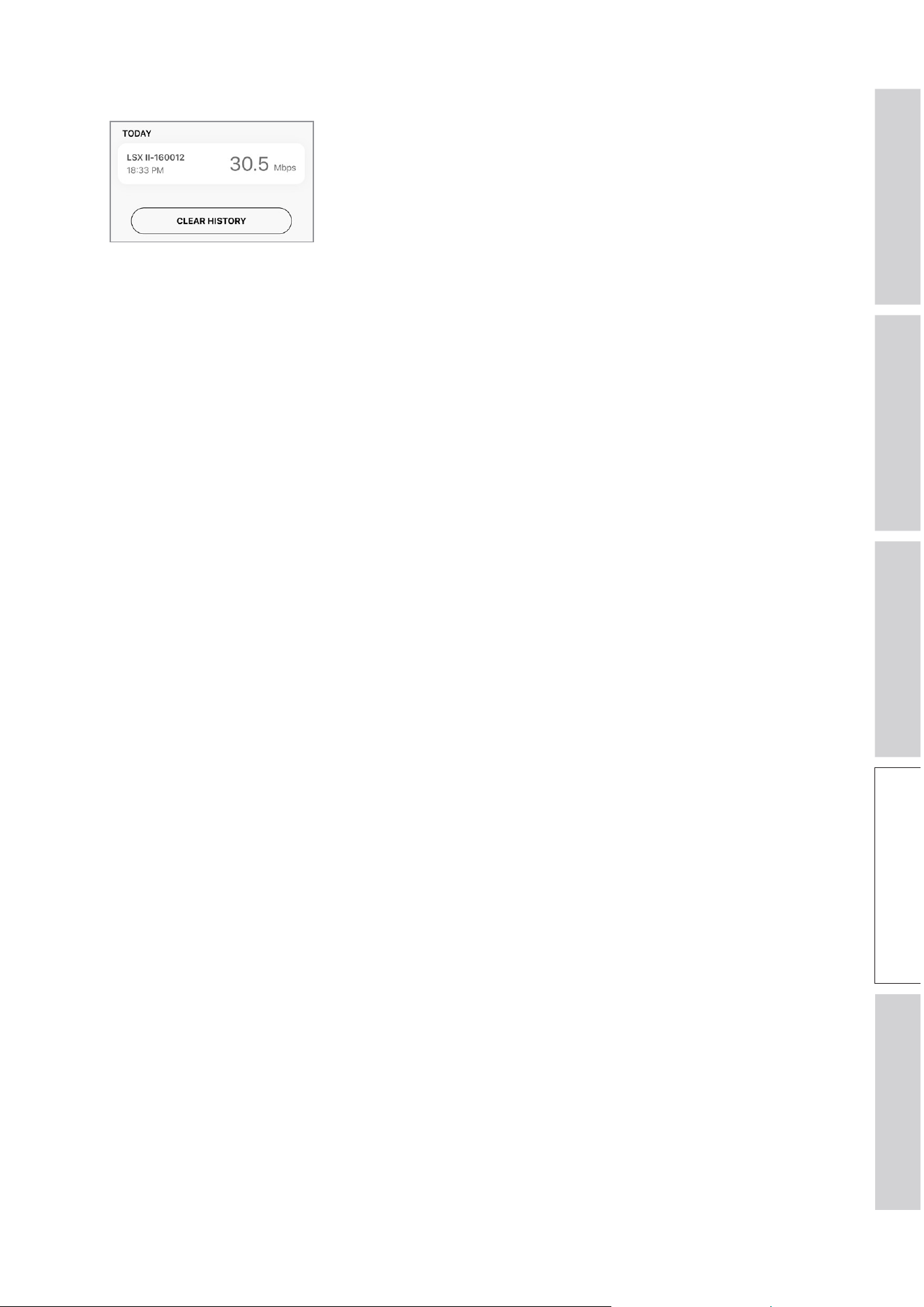
78
Table of ContentsSetting UpWi-Fi StreamingUsing KEF Connect AppFAQ and Troubleshooting
• Test history: Select this option to review the test history.
• Learn to improve your connection: Select this option to access the KEF website for
tips on assessing and improving your network quality.
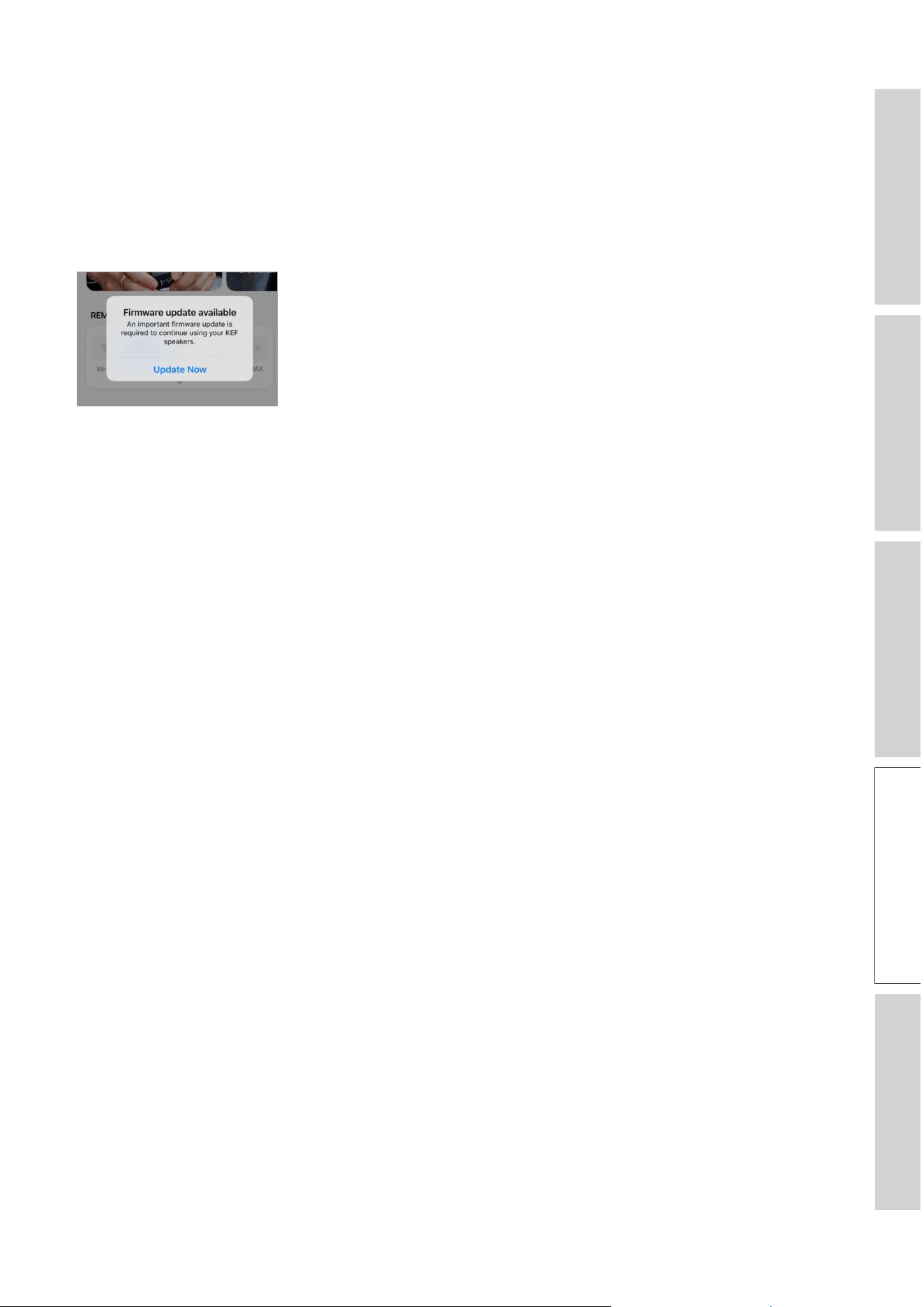
79
Table of ContentsSetting UpWi-Fi StreamingUsing KEF Connect AppFAQ and Troubleshooting
16.10 Firmware Upgrade
16.10.1 Automatic Firmware Update after Onboarding
After you have successfully set up the speakers with the KEF Connect App, you may be
required to update the firmware if a new version is available. Follow the instructions in
the KEF Connect App to complete the update process.
16.10.2 Automatic Firmware Check
The speakers check the server every 4 hours if a new firmware update is available. If a
firmware is available, it will check if the firmware update is compulsory or not.
If a firmware update is compulsory, it will start the update when:
• The speakers are in standby mode, or
• The Wi-Fi source or Bluetooth source has been idle for 60 minutes.
If a firmware update is not compulsory, it will be carried out when:
• The speakers are in standby mode between 2–3 am, or
• The Wi-Fi source or Bluetooth source has been idle for 60 minutes.
A firmware update will not occur when the speakers are in use.
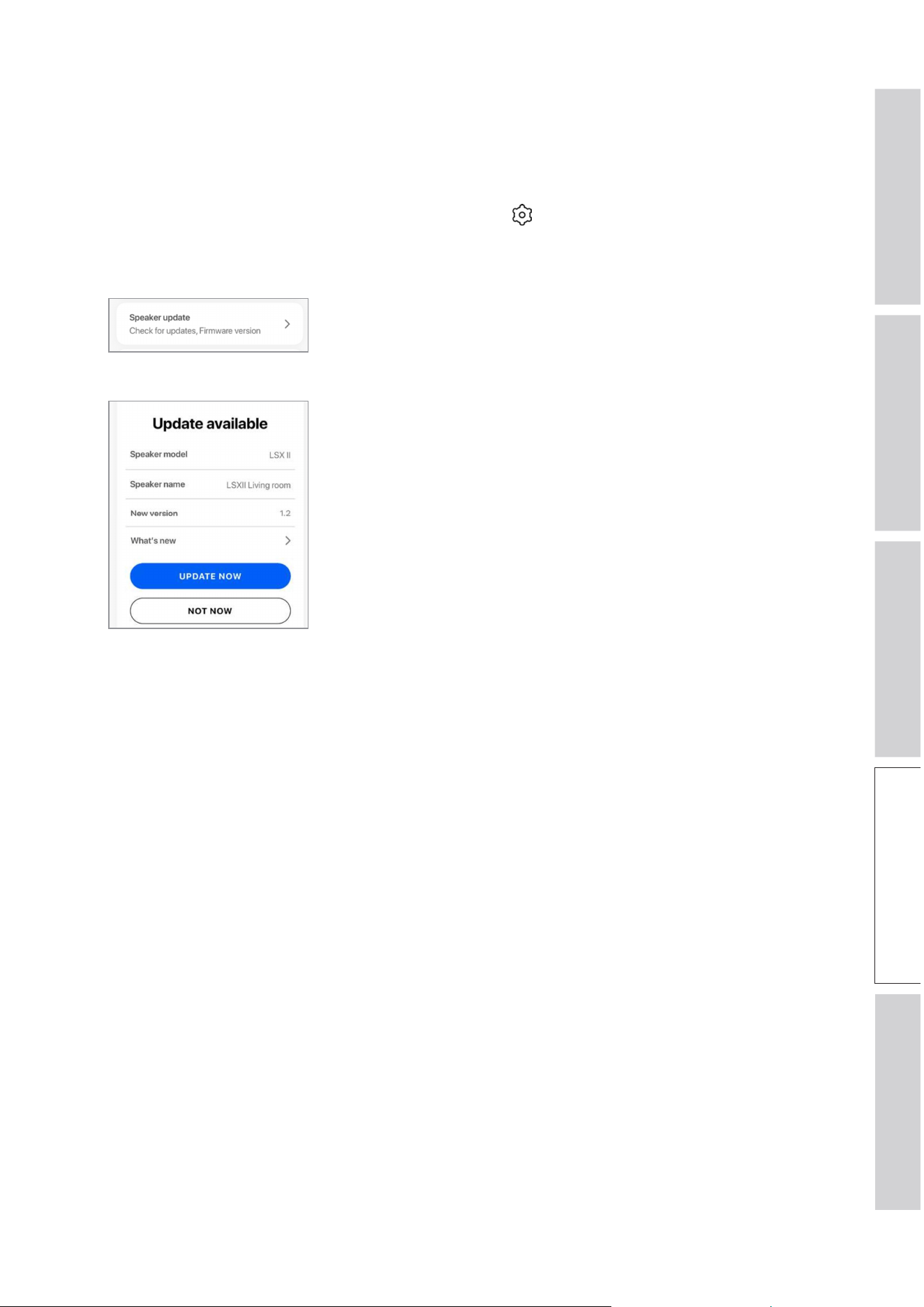
80
Table of ContentsSetting UpWi-Fi StreamingUsing KEF Connect AppFAQ and Troubleshooting
16.10.3 Manual Firmware Update
This menu allows you to manually check for firmware updates.
To access this menu:
1. In the KEF Connect App, tap the Setting icon ( ) at the bottom of the Home
screen.
2. Tap “Speaker update”.
3. Ifanupdateisavailable,tap“Updatenow”toproceedwiththe�rmwareupdate.
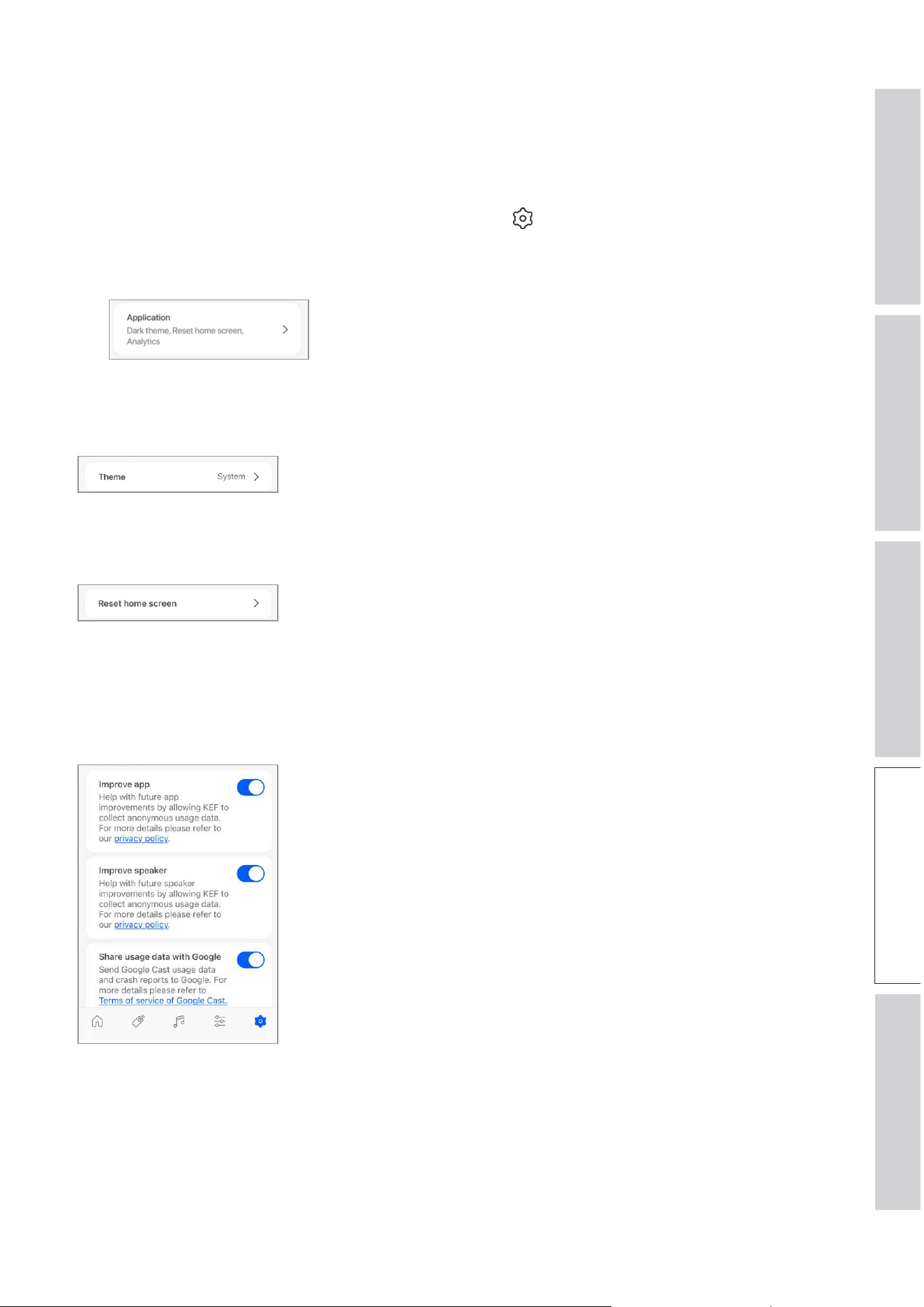
81
Table of ContentsSetting UpWi-Fi StreamingUsing KEF Connect AppFAQ and Troubleshooting
16.11 Application
This menu allows you to reset the home screen and send analytics.
To access this menu:
1. In the KEF Connect App, tap the Setting icon ( ) at the bottom of the Home
screen.
2. Tap “Application”.
16.11.1 Theme Settings – Theme
This setting allows you to set a theme mode (System, Light or Dark).
16.11.2 Theme Settings – Reset Home Screen
This setting allows you to reset the Home screen of the app to default settings.
16.11.3 Analytics – Improve App/Speaker
This setting allows the KEF Connect app to anonymously send improvement analytics
to KEF. We recommend this setting is enabled to help KEF to improve product
performance
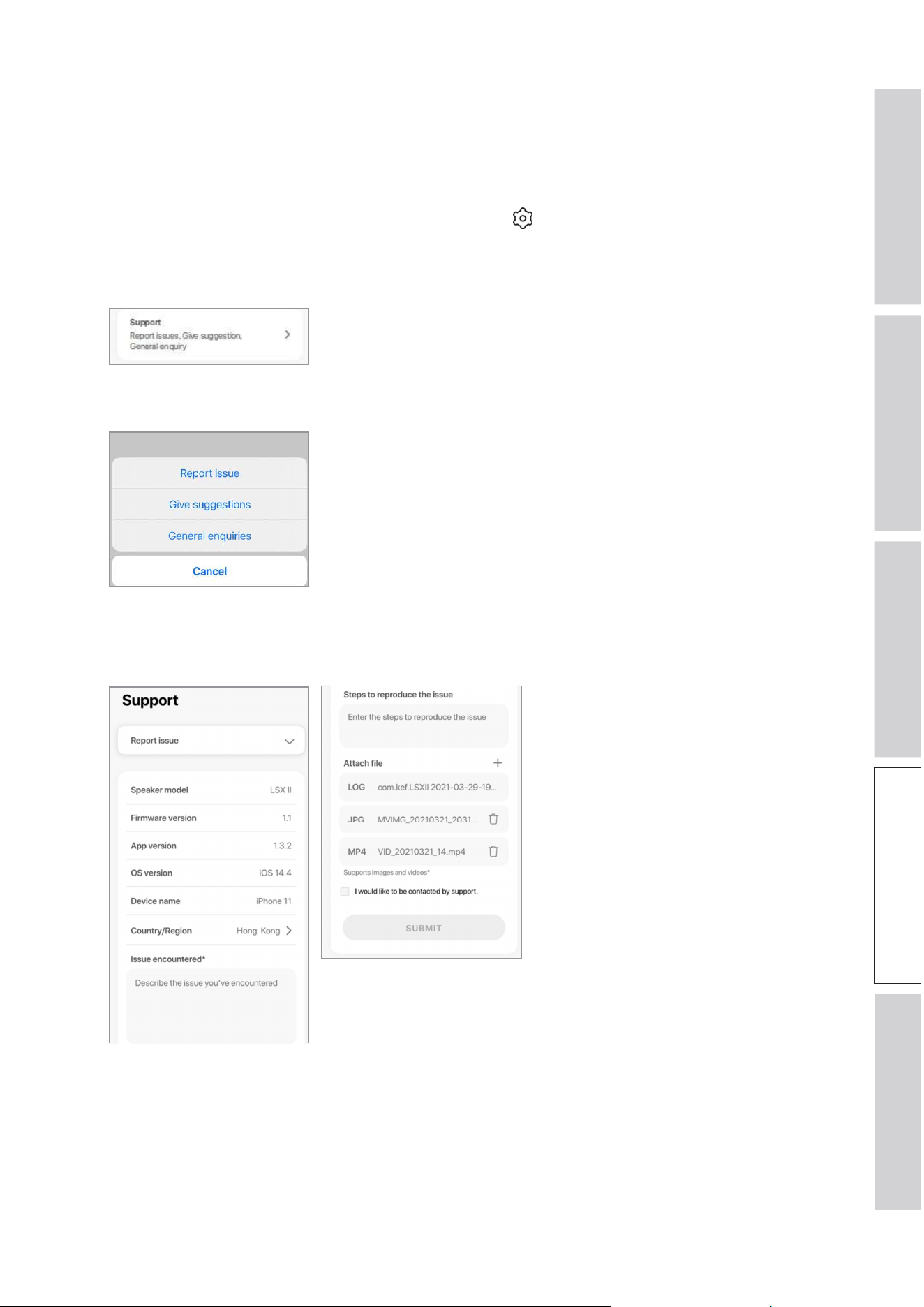
82
Table of ContentsSetting UpWi-Fi StreamingUsing KEF Connect AppFAQ and Troubleshooting
16.12 Support
This menu allows you to report issues, give suggestions and make general enquiries.
To access this menu:
1. In the KEF Connect App, tap the Setting icon ( ) at the bottom of the Home
screen.
2. Tap “Support”.
3. Select the type of support you need and proceed as instructed on the screen.
4. When reporting an issue, your email program will automatically attach the speaker
logs that helps KEF investigate the issue. Please add a description of the problem in
the email message as well.

83
Table of ContentsSetting UpWi-Fi StreamingUsing KEF Connect AppFAQ and Troubleshooting
17. Cleaning and Maintenance
WARNING!
Risk of electric shock!
Improper cleaning of the speakers may result in injury.
• Always unplug the power cables from the power sockets/outlets before cleaning the
speakers.
NOTICE!
Risk of short circuit!
Water and other liquids that have penetrated the housing may cause a short circuit.
• Make sure that no water or other liquids penetrate the housing of the speakers.
• Never immerse the speakers in water or other liquids.
NOTICE!
Risk of damage!
Improper handling of the speakers may result in damage.
• Do not use any aggressive cleaners, brushes with metal or nylon bristles, or sharp
or metallic utensils such as knives, hard scrapers and the like. They could damage
the surface.
1. Disconnect the power cables of the speakers from the power sockets/outlets before
cleaning.
2. Clean the surfaces of the speakers with a clean lint-free cloth. If necessary, use an
alcohol-free cleaner (e.g. screen cleaner, eyeglass lens cleaner) to remove stubborn
stains.
3. To clean the Uni-Q drivers (speaker cones), use an anti-static cleaner and a soft
sponge. Be careful as the driver may be damaged if too much force is used.

84
Table of ContentsSetting UpWi-Fi StreamingUsing KEF Connect AppFAQ and Troubleshooting
18. Disposal
18.1 Disposing of the Packaging
Sort the packaging before you dispose of it. Dispose of paperboard, cardboard and
wrappings in accordance with your local guidelines.
18.2 Disposing of the Speakers
Old appliances may not be disposed of in the household waste!
LS60 Wireless is an electronic product and may not be able to be disposed of as
household waste. Please dispose of your speaker in accordance with the regulations
in force in your city or county. This ensures that old appliances are recycled in a
professional manner and reduces negative consequences.
18.3 Disposing of the Battery
Batteries may not be disposed of with household waste!
As the end user you are required by law to bring all batteries, regardless whether
they contain harmful substances* or not, to a collection point run by the communal
authority or to a retailer, so that they can be disposed of in an environmentally friendly
manner.
* labeled with: Cd = cadmium, Hg = mercury, Pb = lead

85
Table of ContentsSetting UpWi-Fi StreamingUsing KEF Connect AppFAQ and Troubleshooting
19. FAQ and Troubleshooting
19.1 Set-up
1. How do I set up the speakers?
• First of all, a home Wi-Fi network is required. This is to ensure you can enjoy the full
range of features and keep the system up to date.
• Then, download the KEF Connect App from the App Store or Google Play Store and
install it on your mobile device. Follow the instructions in the KEF Connect App to get
the speakers connected (onboarded) to your home Wi-Fi network.
2. What router specications do the speakers support?
• IEEE 802.11a/b/g/n/ac, IPv4, IPv6, Dual-band 2.4 GHz / 5 GHz
• For better streaming stability, especially on hi-resolution music files, a 5 GHz Wi-Fi
network with a router transmission speed of at least 1300 Mbps is recommended.
• Office, hotel, guest and public networks often feature additional security or
authentication methods which may prevent the speakers from connecting. You may
need the help of the network administrator to configure the network to allow full
functionality if using these kinds of networks.
• LTE routers/mobile hotspots will work, but may also consume a significant amount of
battery power and mobile data.
3. Can I use a mesh router?
• Yes, we have tested the most popular mesh routers and they are working well with
the speakers. However, as there is not yet an industrial standard for mesh routers,
each manufacturer may have their own meshing technology. If your mesh router does
not work with the speakers, make sure you have updated your router to the latest
firmware or contact the manufacturer for solutions.
4. How far apart can I place the two speakers?
• Wireless: up to 8 meters apart depending on your network condition. A congested
network environment will have more interferences and may reduce this distance.
• Wired: Cable length up to 10 meters.
• Optimal listening distance between the speakers and the listener will depend on
how far the Primary Speaker and Secondary Speaker are separated from each other.
Try to aim for approximately the same distance between the Primary Speaker and
Secondary Speaker and between the speakers and the listener.
5. How large a room can the speakers cover?
• 10–200 m
2

86
Table of ContentsSetting UpWi-Fi StreamingUsing KEF Connect AppFAQ and Troubleshooting
6. Can I change the Primary Speaker as the left channel?
• By default, the Primary Speaker is the right channel and the Secondary speaker is
the left channel. After connecting the speakers to your home Wi-Fi network, you can
inverse the L/R channels in the KEF Connect App.
7. Do I need to pair the two speakers?
• No, the two speakers are already paired at the factory. If you do not hear any sound
from the Secondary Speaker, see chapter “Troubleshooting”.
8. What is the purpose of the ethernet cable in the packaging box?
• Use this inter-speaker cable to connect the Primary Speaker and Secondary Speaker
if you prefer a higher sound reolution (192 kHz/24 bit), or if the wireless connection
between the speakers is not stable. After connecting the inter-speaker cable, you must
also enable Cable Mode in the KEF Connect App.
9. Can I rename the speaker?
• Yes, renaming can be done in the KEF Connect App. This will change the name for
both Wi-Fi and Bluetooth connections.
10. I have got a pair of speakers with dierent serial numbers. How can I pair them?
• If applicable, unplug all KEF LS50 Wireless II and LS60 Wireless speakers nearby to
prevent incorrect pairing.
• Plug in the LS60 Wireless Primary and Secondary Speakers.
The front LED light of the Primary Speaker should flash blue/white, indicating that the
Secondary Speaker is missing.
• Press and hold the P/S pairing button on the Primary Speaker for at least 5 seconds
until the LED light of the P/S pairing button starts blinking quickly.
• Press and hold the P/S pairing button on the Secondary Speaker for at least
5 seconds until the LED light of the P/S pairing button starts blinking quickly.
Within a few seconds, the LED lights of both P/S pairing buttons on the two speakers
should stay lit, and the front LED lights of both speakers should stay lit briefly and
then fade out.
• Play some music through the speakers to ensure they are working properly.
• Contact KEF customer service to ensure your warranty is not affected.
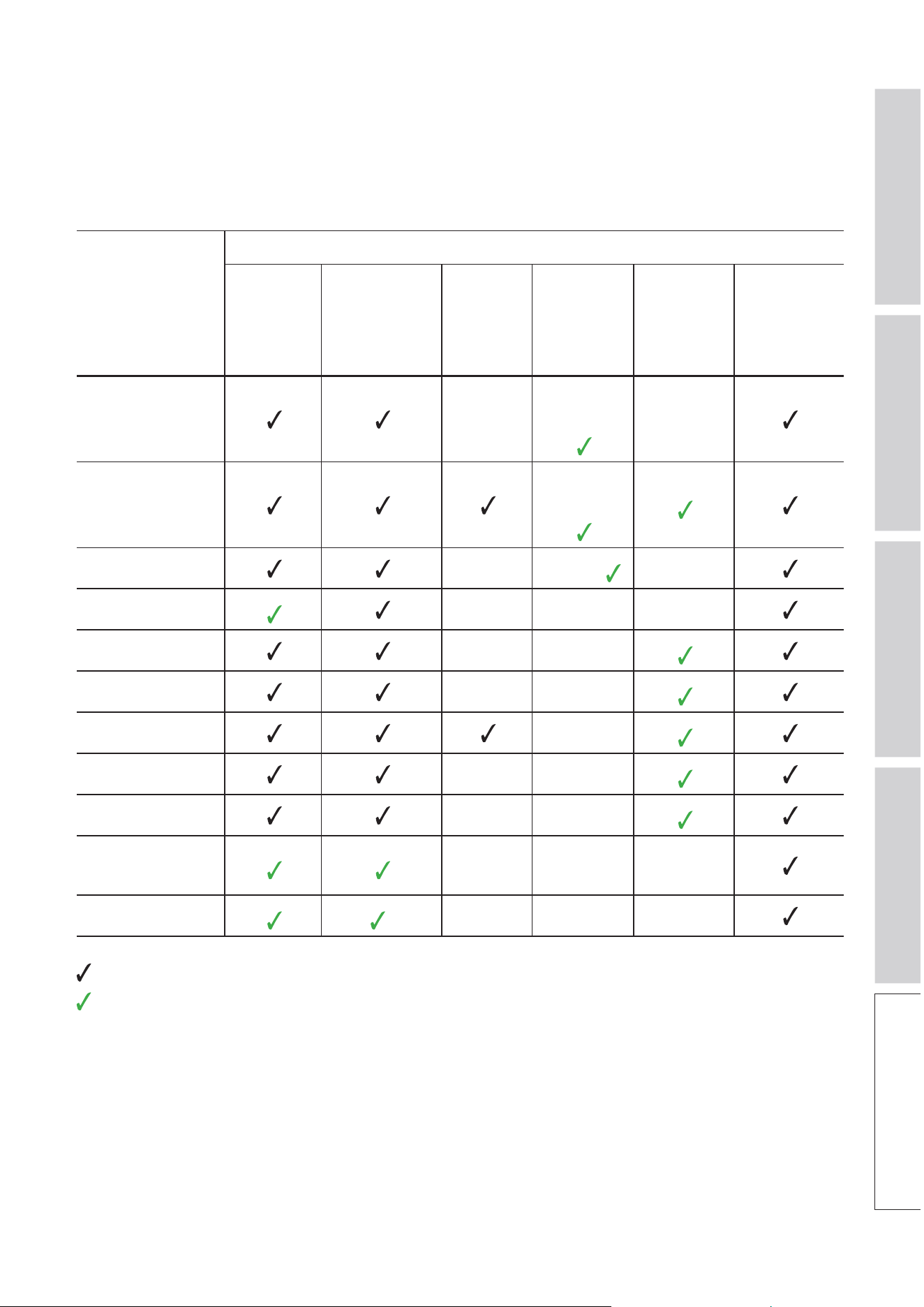
87
Table of ContentsSetting UpWi-Fi StreamingUsing KEF Connect AppFAQ and Troubleshooting
19.2 Playback and Streaming
1. Which is the best wireless streaming option for dierent apps?
• Recommendations for the best wireless streaming options with regard to music/
media apps on your mobile devices.
App
Wireless streaming protocol
AirPlay 2 Chromecast ROON
Ready
Music
streaming
app native
protocol
KEF
Connect
App
Bluetooth
Spotify –
Spotify
Connect
–
TIDAL
TIDAL
Connect
QQ Music –
QPlay
–
Apple Music – – –
Amazon Music – –
Deezer – –
Qobuz –
Internet radio – –
Audio podcast – –
Youtube
(audio)
– – –
Youtube Music
*
– – –
= Supported
= Supported and recommended for the best audio quality and streaming stability.
*Only available with a Youtube Music Premium account.

88
Table of ContentsSetting UpWi-Fi StreamingUsing KEF Connect AppFAQ and Troubleshooting
2. Can I stream audio output from Youtube, Netix and other media contents to the
speakers?
• You can stream through AirPlay, Chromecast or Bluetooth. Subject to changes
according to the platforms.
3. Is the subwoofer output mono or stereo?
• The output is mono.
4. How should I set the speakers if I prefer to adjust the volume on an external
equipment (preamplier, streamers/multi-room systems) rather than through the
KEF Connect App?
• In the KEF Connect App:
1) In Settings, go to “Volume”, change “Volume Display” to “-/+”
2) Select the relevant source input.
3) Change the volume to 71. The source selection is now set to “Unity gain”.

89
Table of ContentsSetting UpWi-Fi StreamingUsing KEF Connect AppFAQ and Troubleshooting
19.3 Troubleshooting
1. What should I do to set up the speakers to another network?
• A factory reset is necessary. This will clear the previous network settings and all EQ
and system preferences. For this purpose, press and hold the Reset button (R) on the
back panel until the LED light above the button blinks.
2. What should I do if I cannot nd my speakers in the network during set-up?
• Make sure the LED light of the Primary Speaker is blinking white and amber. The
speakers are ready to connect to a Wi-Fi network.
• Wait for about 30–40 seconds for the speakers to be visible on the speaker list.
• If you still cannot see the speakers, make sure your mobile device, the speakers and
the router are within line of sight (the closer the better).
• The speakers broadcast on Channel 2 (2.4 GHz band). If your router overlaps this
channel, it may cause issues with discoverability and connection. Go to your router
settings and configure the 2.4 GHz channel to avoid overlapping with Channel 2.
3. How do I report a bug or an issue?
• In the KEF Connect App, go to “Settings” > “Support”. To let us better understand the
bug or issue, please provide a descriptive report.
4. There is no sound from both speakers.
• Check if the speakers are already turned on and not muted.
• Make sure you are playing the correct set of speakers and have selected the correct
sound source.
• Check the volume level, you may need to turn up the volume.
5. There is dropout from both speakers.
• A congested network environment reduces bandwidth for music streaming, you need
to set up the speakers to a less crowded router channel.
• Check if there is a network problem. Perform the speaker connection test in the KEF
Connect App.
• Change the audio streaming quality in the KEF Connect App to a lower resolution.
• A congested network or multiple wireless devices lead to high interference. Try to
minimize the interference around the speakers. If the problem persists, connect the
internet port of the speakers to the router.

90
Table of ContentsSetting UpWi-Fi StreamingUsing KEF Connect AppFAQ and Troubleshooting
6. There is no sound from the Secondary Speaker.
• Make sure the Secondary Speaker is connected to power.
• Check if the connection between the two speakers is lost (the LED indicator light of
the Primary Speaker is blinking white and blue).
If the connection is lost, short press the P/S pairing button (P) on the back panel of
the Primary Speaker to re-establish the connection. Wait a while until the connection
is established.
Note:
Do not press the button for more than 1 second.
• If the problem persists, connect the speakers with the inter-speaker cable and turn on
Cable Mode in the KEF Connect App.
7. There is dropout from the Secondary Speaker.
• If the speakers are connected wirelessly, try to move them closer to each other.
• If the problem persists, connect the speakers with the inter-speaker cable and turn on
Cable Mode in the KEF Connect App.
• A congested network or multiple wireless devices lead to high interference. Try to
minimize the interference around the speakers.
8. The audio is out of sync with the picture when using the speakers with a TV.
• If available, try the video delay/lip sync function of your TV.
• Use HDMI/optical input, and try to avoid Bluetooth connection. There is an inherent
delay in the Bluetooth codec.
9. I have connected the speakers to the TV with an HDMI cable, why is there no
sound?
• Make sure the source is switched to TV for the speakers.
• Check the TV icon on the top panel of the Primary Speaker.
If the LED indicator light of the Primary Speaker is blinking light blue, the HDMI
connection is not found. In this case, make sure that the HDMI cable is connected to
the ARC port of the TV.
If the LED indicator light of the Primary Speaker is pulsing light blue, only CEC (not
ARC) connection is established (TV may respond without sound). In this case, do the
following:
• The HDMI CEC connection needs to be enabled on the TV. As manufacturers
may name this connection differently (e.g. Anynet+ for Samsung, Simplink for LG),
please check the user manual of your TV on how to turn on HDMI connection for
your TV. Once the HDMI CEC connection is enabled, the LED indicator light of the
Primary Speaker illuminates light blue briefly and then fades out (both CEC and
ARC connections are now established).

91
Table of ContentsSetting UpWi-Fi StreamingUsing KEF Connect AppFAQ and Troubleshooting
• If there is only no sound but everything else is working, please make sure that the
audio output of HDMI is set to PCM (this is often set to Dolby Digital by default).
As the settings menu of each TV manufacturer is different, please refer to the user
manual of your TV. Also check the settings within the application in use (e.g. Netflix
and Disney+) and make sure PCM is selected.
• Change the HDMI cable (our internal tests found that HDMI cables of lower quality
may not be able to establish the connection) and make sure the HDMI cable is
properly connected.
• As a last resort, power cycle the TV (unplug the power cable from the TV and wait
about 10-15 seconds before plugging it back in) and try again. Smart TVs are like
phones and sometimes require a reboot.
• If the problem persists, please report the issue in the Support section of the KEF
Connect App for investigation. In the meantime, use the Optical connection as a
fall-back solution.
10. I have connected the speakers to the TV with an optical cable, why is there no
sound?
• Make sure your TV is set to output digital audio in PCM format.
• If the problem persists, try a different optical cable or connection option (e.g. HDMI).
11. I cannot nd a radio station or podcast in the KEF Connect App.
• We are constantly updating and expanding our database for radio stations and
podcasts. Please use the Support function in the KEF Connect App and send us the
RSS link of the website. After verification, we will add it to our database.
12. I cannot adjust the speaker volume.
• Check if you have set a maximum level for volume adjustment.
• Check if you are connecting and controlling the correct set of speakers in the
network.
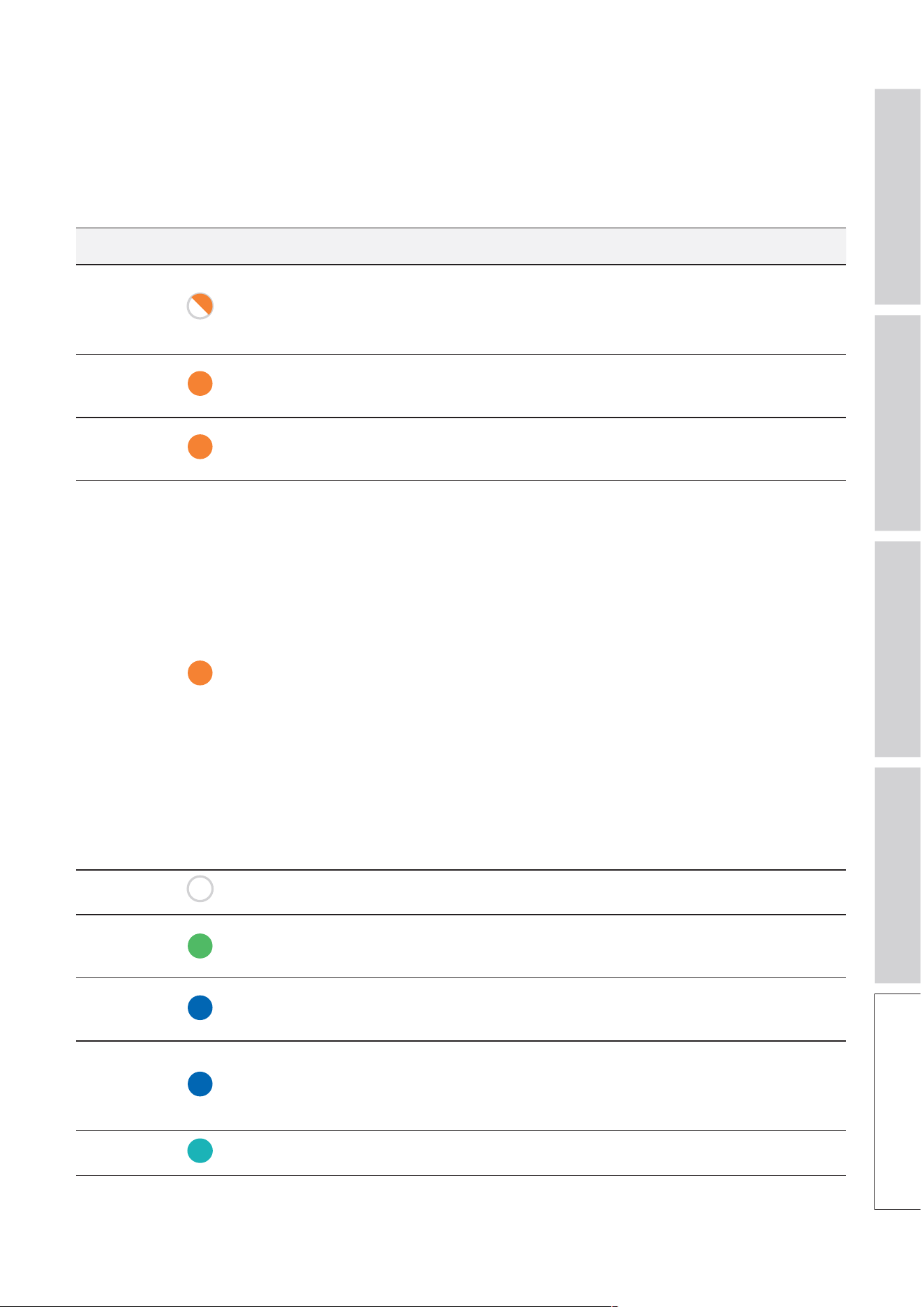
92
Table of ContentsSetting UpWi-Fi StreamingUsing KEF Connect AppFAQ and Troubleshooting
19.4 LED Indicators
The connection and operation status can be easily checked through the colours and
patterns of the LED indicator lights on the Primary and Secondary Speakers. Refer to
the table below.
Speaker Pattern Status
Primary
Blinking white and
amber
The speakers are ready to connect to a Wi-Fi
network. Launch the KEF Connect app to set up
the speakers.
Primary
Pulsing amber
The speakers are in Standby Mode and trying to
connect to a Wi-Fi network.
Primary
Solid amber*
The speakers are in Standby Mode and
connected to the Wi-Fi network.
Primary
Blinking amber
The speakers are unable to connect to a Wi-Fi
network.
• Make sure your router is turned on.
• Move the Primary Speaker closer to the
router. If the problem persists, connect the
Primary Speaker to your router by a LAN
cable.
• If this happens right after the network
connection, it is likely that the Wi-Fi password
is incorrect. Perform factory reset (Press and
hold the Reset button (R) on the Primary
Speaker until the LED light above the button
blinks) and try the connection process again.
Primary
Solid white* The speakers are operating in Wi-Fi mode.
Primary
Solid green*
The speakers are operating in Spotify Connect
Mode.
Primary
Solid blue*
The speakers are operating in Bluetooth Mode
and a device is already paired with the speakers.
Primary
Pulsing blue
The speakers are in the Bluetooth discovery
mode and are ready to pair with a Bluetooth
device.
Primary
Solid light blue* The speakers are operating in TV Mode.
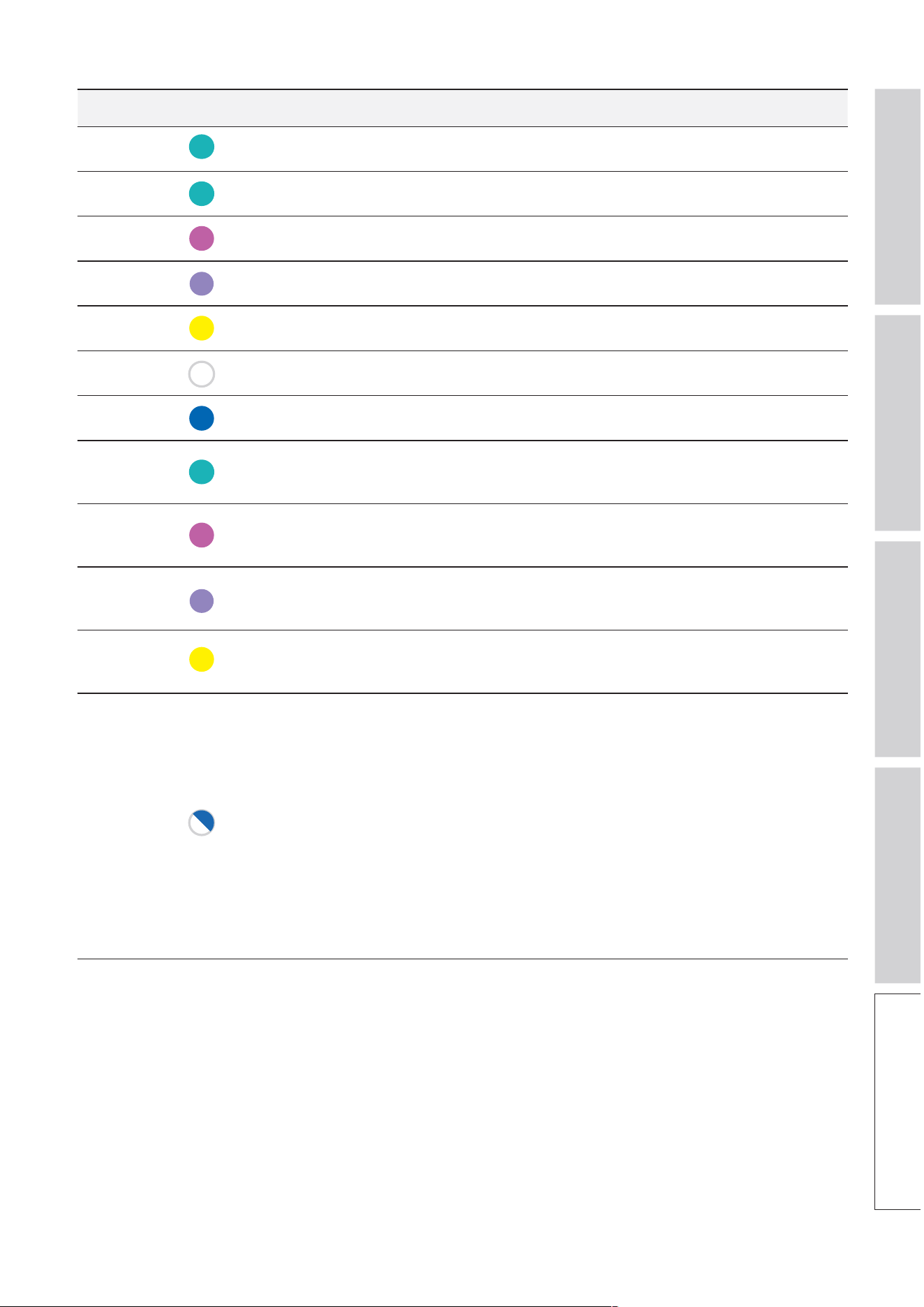
93
Table of ContentsSetting UpWi-Fi StreamingUsing KEF Connect AppFAQ and Troubleshooting
Speaker Pattern Status
Primary
Pulsing light blue The speakers are connecting to a TV.
Primary
Blinking light blue The speakers are not connected to a TV.
Primary
Solid magenta* The speakers are operating in Optical Mode.
Primary
Solid lavender* The speakers are operating in Coaxial Mode.
Primary
Solid yellow* The speakers are operating in AUX Mode.
Primary
Blinking white slowly The speakers are muted in Wi-Fi Mode.
Primary
Blinking blue slowly The speakers are muted in Bluetooth mode.
Primary
Blinking light blue
slowly
The speakers are muted in TV Mode.
Primary
Blinking magenta
slowly
The speakers are muted in Optical Mode.
Primary
Blinking lavender
slowly
The speakers are muted in Coaxial Mode.
Primary
Blinking yellow
slowly
The speakers are muted in AUX Mode.
Primary
Blinking white and
blue
The Primary Speaker is in wireless pairing mode
searching for the Secondary Speaker.
1. Make sure Cable Mode is disabled on the KEF
Connect app (Settings > Speaker preferences
> Cable mode).
2. On the Secondary Speaker, press the (P) P/S
Pairing button once. The Secondary Speaker
will search for the Primary Speaker for
reconnection.
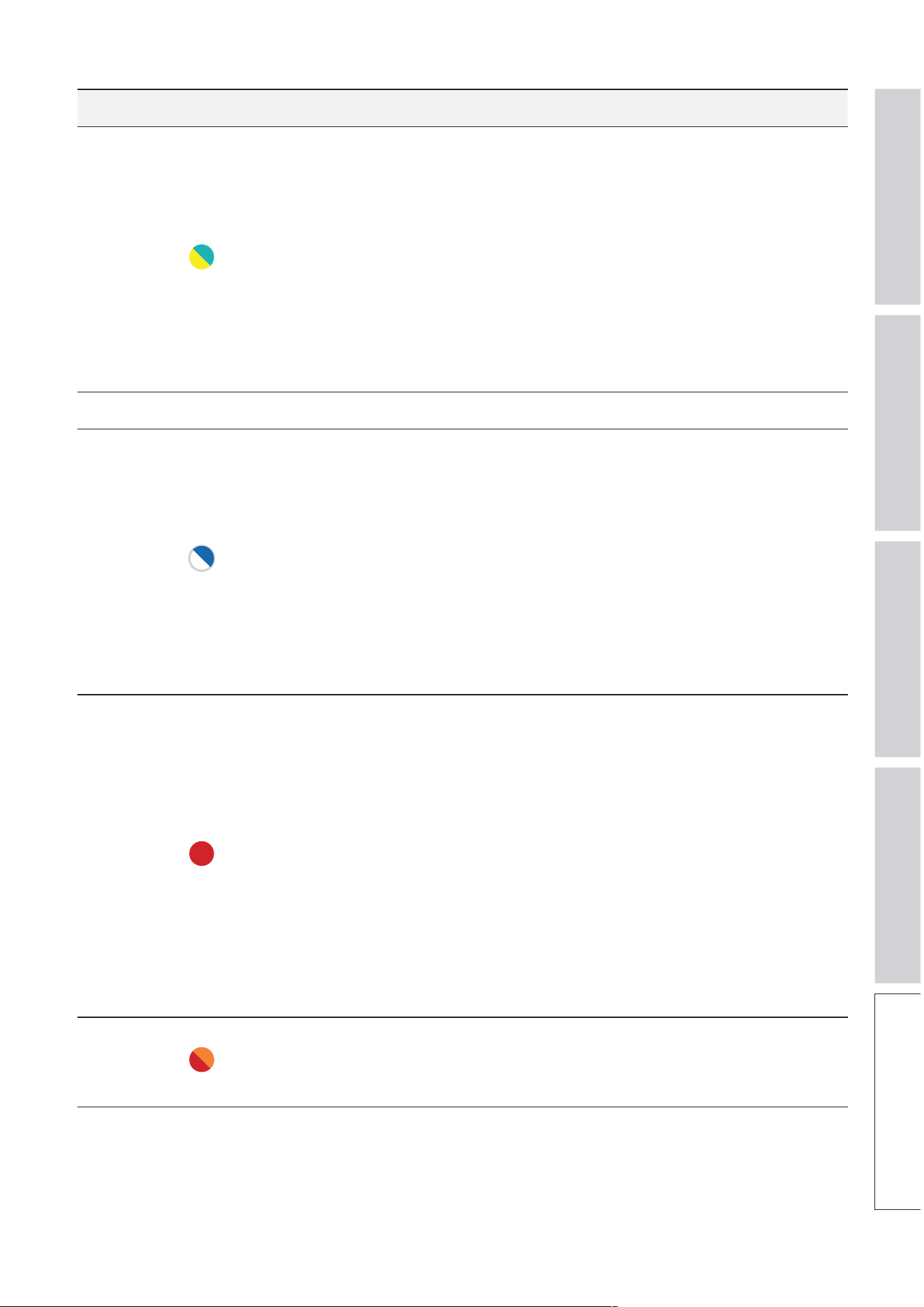
94
Table of ContentsSetting UpWi-Fi StreamingUsing KEF Connect AppFAQ and Troubleshooting
Speaker Pattern Status
Primary
and
Secondary
Blinking light blue
and yellow
Cable Mode is enabled and the connection
between the speakers is interrupted.
1. Make sure the inter-speaker cable is connected
between the Primary Speaker and Secondary
Speaker.
2. Make sure the inter-speaker cable is inserted
in the correct connection ports:
“(T) To P/S” on the Primary Speaker and
Secondary Speaker.
Secondary
No LED light The Secondary Speaker is operating normally.
Secondary
Blinking white and
blue
The Secondary Speaker is in the wireless pairing
mode searching for the Primary Speaker.
1. Make sure Cable Mode is disabled on the KEF
Connect app (Settings > Speaker preferences
> Cable mode)
2. On the Primary Speaker, press the (P) P/S
Pairing button once. The Primary Speaker
will search for the Secondary Speaker for
reconnection.
Primary
and
Secondary
Blinking red quickly
System error.
1. Pull the power cables from both speakers.
2. Wait approximately 60 seconds.
3. Plug the power cables back to both speakers.
4. The LED indicator of the Primary Speaker
should be pulsing amber, indicating that the
speakers are attempting to connect to the
network.
If the problem persists, please contact your KEF
dealer.
Primary
and
Secondary
Blinking red and
amber slowly
Overheat protection is activated.
95
Table of ContentsSetting UpWi-Fi StreamingUsing KEF Connect AppFAQ and Troubleshooting
Speaker Pattern Status
Primary
and
Secondary
Blinking white, blue,
light blue, magenta,
lavender and yellow
alternately
The firmware is being updated. Do not unplug
the power cables until the firmware update is
completed. If you encounter any issues during
the firmware update, do not interrupt the
process and contact your local representative or
contact your local KEF dealer.
Primary
and
Secondary
Blinking red slowly
The firmware update process failed.
1. Unplug the power cables from both speakers.
2. Wait approximately 60 seconds.
3. Plug the power cables back to both speakers.
4. Performthe�rmwareupdateagainonthe
KEF Connect App.
If the problem persists, please send a log from
the KEF Connect App (Settings > Support >
Report issue).
Primary
Blinking red and light
blue slowly
The Secondary Speaker is missing during
firmware update.
*The LED indicator light illuminates briefly and fades out when there are no active
interactions with the speakers (e.g. controlling playback or volume).

96
Table of ContentsSetting UpWi-Fi StreamingUsing KEF Connect AppFAQ and Troubleshooting
20. Appendix
20.1 Specifications
Model LS60 Wireless
Drive units Uni-Q Driver Array:
HF: 19 mm (0.75 in.) vented aluminium dome with
Metamaterial Absorption Technology
#
MF: 100 mm (4in.) aluminium cone
Uni-Core Force Cancelling Driver:
LF: 4 x 135 mm (5.25 in.)
Frequency range (-6 dB)
measured at 85 dB/1 m
26 Hz – 36 kHz
*Depends on EQ settings
Frequency response (±3 dB)
measured at 85 dB/1 m
31 Hz – 24 kHz
*Depends on EQ settings
Amplifier output power
(per speaker)
LF: 500 W MF: 100 W HF: 100 W
Amplifier class (per speaker) LF: Class D MF: Class D HF: Class AB
Max SPL measured at 1m 111 dB
Wireless streaming features AirPlay 2
Google Chromecast
ROON Ready
UPnP Compatible
Bluetooth 4.2
Streaming services Spotify via Spotify Connect
Tidal via Tidal Connect
Amazon Music
Qobuz
Deezer
QQ Music via QPlay
Internet Radio
Podcast
*Depends on services availability in different countries
Input resolution Network up to 384 kHz / 24 bit
Optical up to 96 kHz / 24 bit
Coaxial up to 192 kHz/24 bit
HDMI up to 192 kHz / 24 bit
*Depends on source resolution
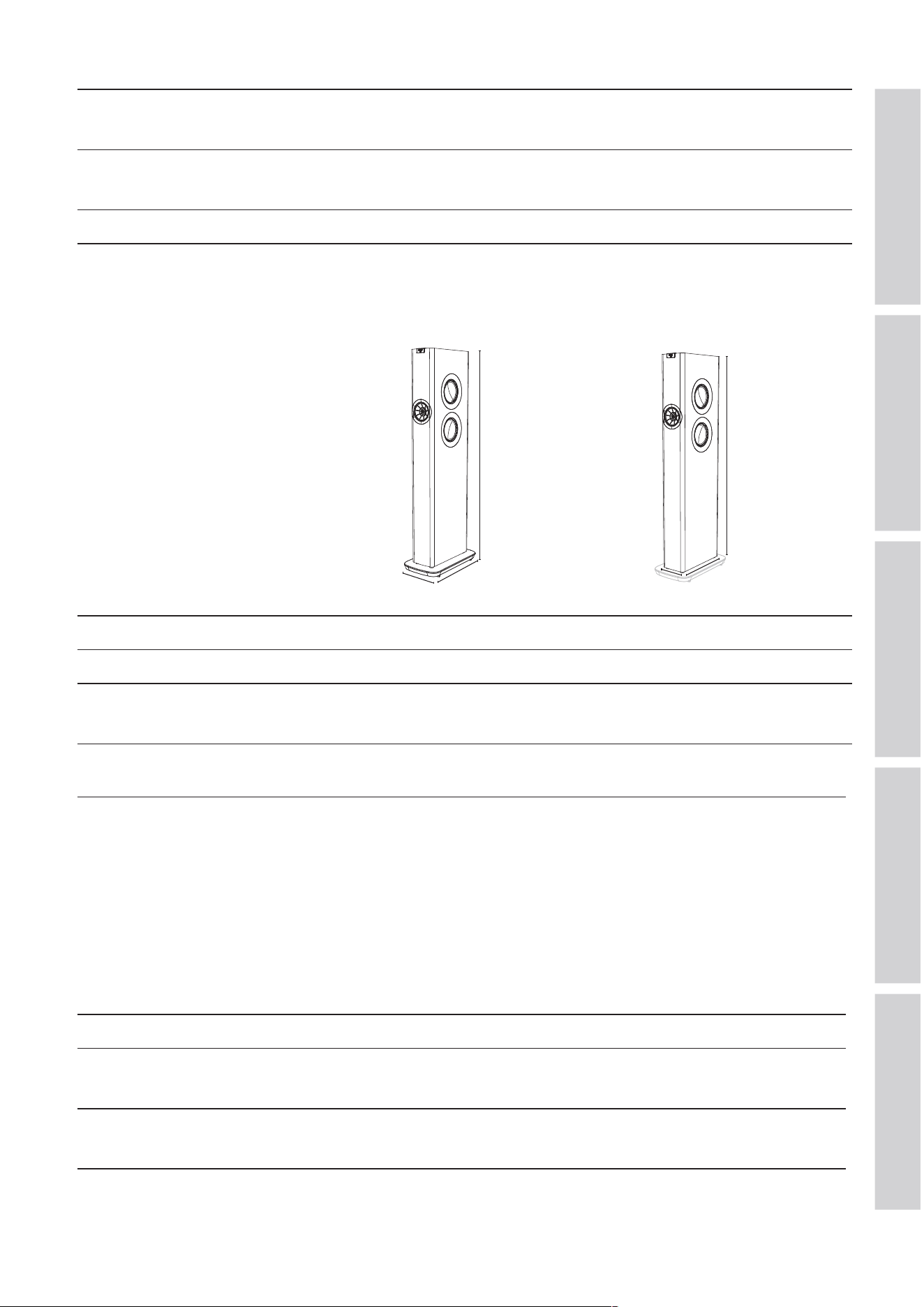
97
Table of ContentsSetting UpWi-Fi StreamingUsing KEF Connect AppFAQ and Troubleshooting
Interspeaker connection Wireless: all sources resampled to 96 kHz / 24 bit PCM
Wired: all sources resampled to 192 kHz / 24 bit PCM
Supported format (all inputs) FLAC, WAV, AIFF, ALAC, AAC, WMA, MP3, M4A,
LPCM and Ogg Vorbis
Supported format (network) MAQ, DSD
Dimensions
(H x W x D per speaker)
1,090 x 212 x 394 mm
(42.9 x 8.3 x 15.5 in.) with
plinth
1,042 x 130 x 321 mm
(41.0 x 5.1 x 12.6 in.)
without plinth
1,090 mm
394 mm
212 mm
1,042 mm
321 mm
130 mm
Weight (per set) 62.4 kg (138 lbs)
Power input 100–240 VAC 50/60 Hz
Power consumption 450 W (operating power)
< 2.0 W (standby power)
Primary Speaker Secondary Speaker
Inputs HDMI eARC
TOSLINK Optical
Digital Coaxial
Analog RCA
USB Type A (service)
RJ45 Ethernet (network)
RJ45 Ethernet
(interspeaker)
USB Type A (service)
RJ45 Ethernet
(interspeaker)
Output RCA Subwoofer output RCA Subwoofer output
Wi-Fi network standard IEEE 802.11a/b/g/n/ac
IPv4, IPv6
–
Wi-Fi network frequency
band
Dual-band 2.4 GHz /
5 GHz
–
98
Table of ContentsSetting UpWi-Fi StreamingUsing KEF Connect AppFAQ and Troubleshooting
#
Metamaterial Absorption Technology is a joint development with Acoustic Metamaterials Group
Wireless performance depends on many factors, including network traffic, distance from access point,
room materials and construction, interference and other adverse conditions.
For further information and troubleshooting, please visit the KEF website: KEF.COM
KEF reserves the right, in line with continuous research and development, to amend or change
specifications without prior notice. E. & O.E
The Bluetooth word mark and logos are registered trademarks owned by Bluetooth
SIG, Inc.
Amazon Music is a registered trademark of Amazon.com Inc.
Apple and AirPlay are registered trademarks of Apple Inc., registered in the U.S. and
other countries.
Deezer is a registered trademark of Access Industries.
Google Play store and Chromecast are registered trademarks of Google LLC.
Qobuz is a registered trademark of Xandrie SA.
QQ Music is a registered trademark of Tencent Music Entertainment Group (TME).
ROON is a registered trademark of Roon Labs LLC or Roon Labs’s licensors.
Spotify is a registered trademark of Spotify AB.
TIDAL is a registered trademark of Aspiro AB.
20.2 Speaker Connection Test
The speaker connection test in KEF Connect shows you how much network bandwidth
is available to your KEF wireless speaker system. It considers every stage of your
network by downloading a file from a random server to the speakers – from the
bandwidth provided by your internet service provider (ISP) and server traffic, all the
way to the speed of the connection between your router and speakers. The other
value shown is the ‘ping.’ This is a signal we use to check if the server is reachable and
tells us how long it takes.

99
Table of ContentsSetting UpWi-Fi StreamingUsing KEF Connect AppFAQ and Troubleshooting
What speeds are needed for different services?
Different music streaming services have different recommendations depending on the
audio file sizes involved:
Service Minimum Recommended Bandwidth
Tidal (Master tier) 2 Mbps
Amazon Music (Ultra HD) 5-10 Mbps
Amazon Music (HD) 1.5 – 2 Mbps
Deezer 5 Mbps
Qobuz 10 Mbps
Note that these are minimum dedicated speeds recommended by the services
themselves.
What this means is that your total network bandwidth must exceed the total
bandwidth requirements of all devices on the network. If your active network devices
need more bandwidth than what is available, then you may experience slower speeds,
reduced performance and dropouts. This is not as much of a problem for web
browsing or file downloads (except for being slower) but is especially problematic for
music streaming.
My test score is a lot lower than what I pay my ISP for. Why?
The bandwidth provided by your ISP (Internet Service Provider) is advertised as ‘up
to’ as this is the maximum bandwidth you can expect coming into your network. This
can be affected by many things such as the quality of the provider’s cabling, ‘Fair Use’
clauses in the agreement and the amount of people accessing the same server.
But even if you get the maximum advertised bandwidth from your ISP, the home
network may be creating a bottleneck. Major factors include interference, obstructions
and distance between the router and device. Even time of day can have an effect – if
more people are using the internet in your area, that can reduce bandwidth. However,
there are some simple things to try that can really help improve your test score.
Why is the score lower than other tests?
Internet connectivity tests are often optimised to give you a theoretical ‘best scenario’
speed and can be a good indicator for what your ISP is providing but will not tell you
specifically what bandwidth your KEF speaker system will be able to take advantage
of. The KEF Connect speaker connection test more closely represents what happens
when using the speaker system normally:

100
Table of ContentsSetting UpWi-Fi StreamingUsing KEF Connect AppFAQ and Troubleshooting
KEF Connect Other
Server used for
test
Random (Real world situation) Nearest possible (Optimised,
unrealistic)
Number of
Connections
opened
One (Works as your KEF
speaker system would)
As many as possible (Artificially
maximises your network
throughput)
File(s)
downloaded to…
KEF speaker system (Factors
in the quality of the system’s
connection to the network)
Phone/Computer (May be in a
higher/lower quality network
area)
Improving your network experience
There are a few ways in which bandwidth may be improved. Some are very simple
and require no knowledge of computers and routers, whilst others are slightly more
advanced, involving changing router settings. Always refer to the router manual, and if
in doubt, do consult a professional.
First, it is important to determine how your speaker system is connected to your
router – wired by Ethernet cable or connected wirelessly.
If connected by Ethernet cable:
1. Ensuretherouter�rmwareisupdated.
This is a basic step for any electronic device, as updated firmware may address
known bugs.
2. Reboot the router.
Routers are basically computers and are affected by the same problems. Bugs and
temporary errors can cause too much memory being used, or the router can be
overheating (one reason to not place it in an enclosed space!). In addition, there may
be IP address conflicts. Rebooting the router will often help with these issues. In
fact, rebooting the router should be done on a regular basis, or whenever network
performance is slower. Some routers even have the option to schedule reboots, so
you can ‘set and forget.’
3. Check the cable for damage/excessive kinks.
Cable length for home networks is rarely an issue (Cat 6 Ethernet can carry 10 Gbps
over 37 m/121 ft for example), but if they are bent too far or damaged, performance
can be compromised.
4. Reconsider using ‘network homeplugs’ if you are doing so.
These devices use your mains wiring as an extension of an Ethernet cable. Whilst
a convenient solution, they don’t always work as expected, as they are highly
dependent on the quality and topology of your mains wiring.

101
Table of ContentsSetting UpWi-Fi StreamingUsing KEF Connect AppFAQ and Troubleshooting
If connected wirelessly:
Basic
Steps to take if using a wireless connection. These steps do not involve changing the
settings of your router:
1. Ensuretherouter�rmwareisupdated.
This is a basic step for any electronic device, as updated firmware may address
known bugs.
2. Reboot the router.
Routers are basically computers and are affected by the same problems. Bugs and
temporary errors can cause too much memory being used, or the router can be
overheating (one reason to not place it in an enclosed space!). In addition, there
may be IP address conflicts. Rebooting the router will help with all these issues and
should be performed periodically (every 2 months or whenever the network seems
considerably slower than normal).
3. Try connecting with an Ethernet cable to your router.
This may not always be possible, but if it is, going cabled will eliminate the issues
described below.
4. Reduce distance between the router and device.
Wi-Fi signal is like sound – the further you move away from it, the ‘quieter’ it is – the
less bandwidth is available.
5. Move transmitting devices away from the speakers.
Transmitting devices such as cordless phones, Bluetooth devices, baby monitors and
even routers can cause interference if too close. You can troubleshoot by turning off
nearby transmitters and seeing if this improves the network performance of the KEF
speaker system. If it does, try increasing the distance between the devices.
6. Reduce obstructions between the router and device.
And just like with distance, obstructions can block signal, reducing bandwidth.
Metal is the worst offender (reinforced concrete, back of mirrors), followed by
concrete, plaster and brick. This is one of the big reasons to get the router out of the
basement, or the cupboard under the stairs.
7. If your router is in a different room, try switching to the 2.4 GHz band.
Most modern routers are dual band. This means they transmit on both the 2.4 GHz
band and the 5 GHz bands. The 5 GHz band has higher potential bandwidth, but far
shorter range and is highly affected by obstructions. It may be possible that, whilst the
2.4 GHz band has a lower total bandwidth, in practice it is a better choice when the
router and speakers are not in the same room.

102
Table of ContentsSetting UpWi-Fi StreamingUsing KEF Connect AppFAQ and Troubleshooting
8. If you have a lot of neighbours, or a lot of network devices, try the 5 GHz band.
If you have a lot of devices on the 2.4 GHz band, then there may be little available
bandwidth left. If your KEF speaker system is close to the router and has little to
no obstructions, try connecting it to the 5 GHz band for more bandwidth. If there
are obstructions, try migrating network devices that are closer to the router to the
5 GHz band instead, freeing up bandwidth on the 2.4 GHz band. This is also useful
if you have a lot of neighbours close by, as their networks may be interfering with
yours.
Advanced
These steps are a little bit more advanced and may involve changing router settings.
Always follow your router manual, or consult a professional:
1. Change your band channels.
Both 2.4 GHz and 5 GHz bands are comprised of multiple channels. Other nearby
networks on the same channels will compete for bandwidth, so use a ‘network
analyser’ app to determine which channels are less congested and adjust in your
router settings. This issue is more common with 2.4 GHz due to the longer range
and lower bandwidth, increasing the chance and severity of interference. 2.4 GHz
channels also overlap – good options are generally 1, 6 and 11. Channel selection is
often set to ‘auto,’ but some routers are better at swapping channels than others, so
it can be useful to set the channel manually.
A note on 5 GHz channels – not all channels are open for public use in various
countries. Check with your local authority as to which channels are unrestricted
(most routers will automatically turn these off if the router is correctly configured for
the country).
2. Disable band steering.
Some routers offer a feature called ‘band steering.’ The idea is that the router will
automatically place a device onto the 5 GHz or 2.4 GHz depending on which is best
for that device at the time. Again, some routers are better at this than others, with
some preferring to stick with a weaker 5 GHz network rather than switching to a
stringer 2.4 GHz network.
3. Disable combined SSID and operate separate 2.4 GHz and 5GHz channels.
Some devices allow you to set the same name/password for both 2.4 GHz and
5 GHz channels of your router. This can be very useful, but some devices do seem
to want to default connecting to 2.4 GHz when 5 GHz would be better, and vice
versa. Maintaining separate 2.4 GHz and 5GHz networks will help with optimising
bandwidth by allowing you to manage what devices are placed on which network.

103
Table of ContentsSetting UpWi-Fi StreamingUsing KEF Connect AppFAQ and Troubleshooting
Mesh networks and Wi-Fi extenders
Mesh networks and Wi-Fi extenders can be very useful tools to improve network
coverage in the home. However, they must be planned and installed correctly
for the best performance. The information below is a summary of mesh network
considerations - for more technical details or assistance in setting up a mesh network,
please refer to the manufacturer or an expert network device retailer.
The most important thing to remember is that they are effectively repeaters – they
receive data from the router, and then pass it on to the next node or device. This
adds latency (delay), but they are also limited by available bandwidth – the connection
between a router and a node is subject to the same issues outlined earlier – distance,
obstructions and interference.
So, when designing a mesh network or planning where to place Wi-Fi extenders,
budget for more nodes than you think you need, and place them closer together. This
will help maximise the potential bandwidth.
It is also worth noting that different router manufacturers handle mesh technology
differently, and there may be compatibility issues with networked devices. If this is
the case when using a KEF wireless speaker system, please send a support request,
including the speaker logs, through the KEF Connect app.
104
Table of ContentsSetting UpWi-Fi StreamingUsing KEF Connect AppFAQ and Troubleshooting
20.3 Explanation of symbols
20.3.1 Warning Symbols
The lightning flash with arrowhead symbol, within an equilateral triangle,
is intended to alert the user to the presence of uninsulated “dangerous
voltage” within the products enclosure that may be of a sufficient
magnitude to constitute a risk of electrical shock to persons.
The exclamation mark within an equilateral triangle is intended to alert
the user to the presence of important operating and maintenance
(servicing) instructions in the literature accompanying the appliance.
20.3.2 Regional Symbols
Europe and North America
This marking indicates that this product should not be disposed
with other household wastes throughout the EU. To prevent
possible harm to the environment or human health from
uncontrolled waste disposal, recycle it responsibly to promote the
sustainable reuse of material resources.
To dispose of your used device, please use the proper collection
system or contact the retailer where the product was purchased,
they may be able to take the product for environmentally safe
recycling.
Products marked with this symbol meet all applicable Community
regulations for the European Economic Area.
Products bearing the cTUVus Certification Mark reflect
suppliercommitment and confidence and have been independently
confirmed to meet the minimum requirements of US and
Canadian electrical safety standards.
Products marked with this symbol meet all applicable Community
regulations for the United Kingdom.
This FCC mark certifies that the electromagnetic interference
from the device is under the limits approved by the Federal
Communications Commission in the US.
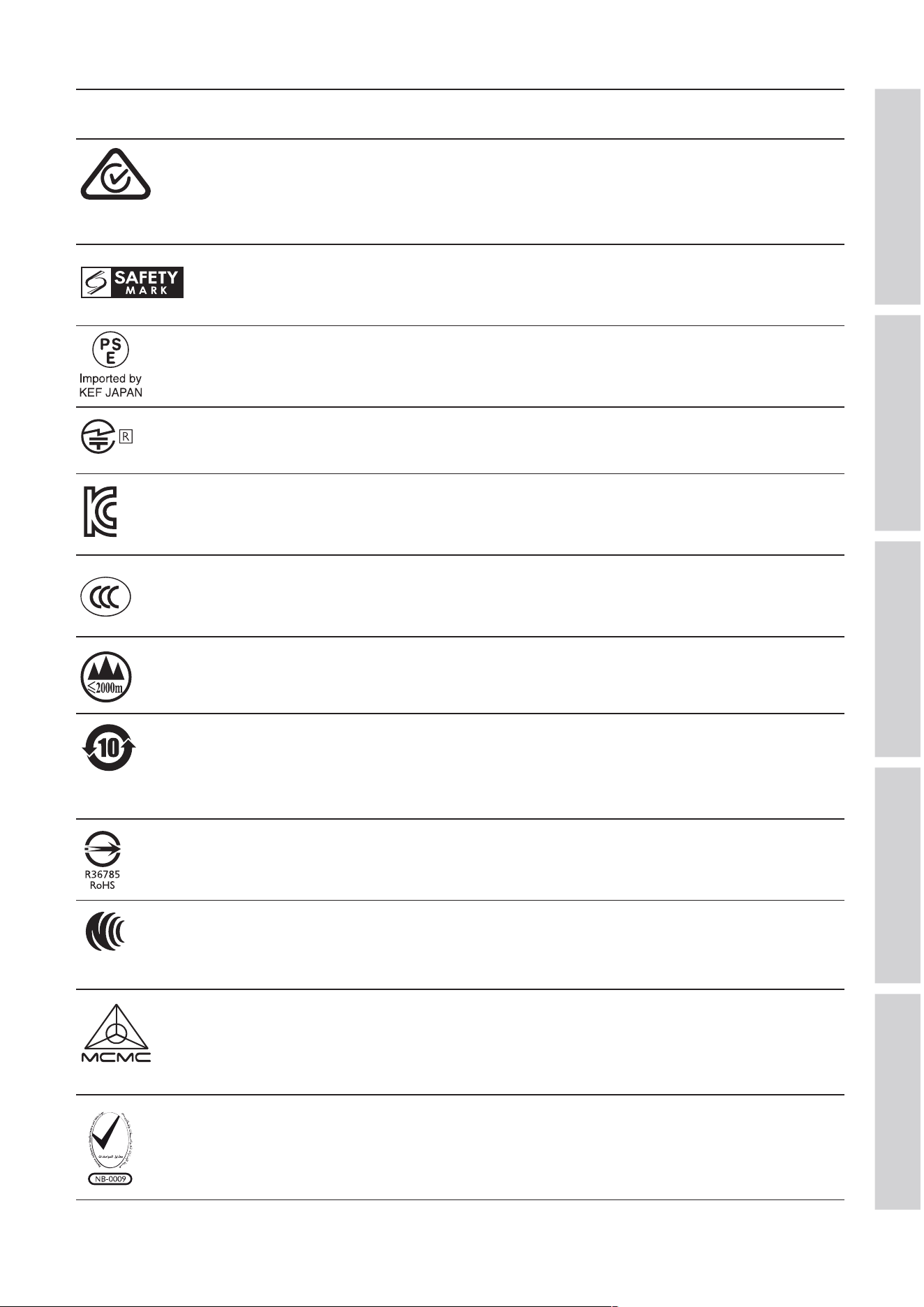
105
Table of ContentsSetting UpWi-Fi StreamingUsing KEF Connect AppFAQ and Troubleshooting
Asia-Pacific
The Regulatory Compliance Mark (Australia, New Zealand)
indicates that the product complies with the relevant guidelines of
the ACMA as well as corresponding government requirements for
the safety of electrical devices.
The symbol indicates that the product meets the specified safety
requirements of Singapore Consumer Protection Registration
Scheme.
The Japan PSE Mark Certification indicates that the product meets
the technical requirements of the Electrical Appliance and Material
Safety Law (DENAN).
These marks indicate compliance with technical and design
requirements for telecommunication terminal equipment in Japan.
The Korean Certification mark indicates that the product complies
with Korea’s product safety requirements for electrical and
electronic equipment.
The China Compulsory Certificate mark indicates that the
product meets the safety requirements of the Chinese national
standards (Guobiao).
The product is only suitable for use in areas under 2,000 m above
sea level (China).
RoHS (China): This product contains certain hazardous substances
and can be used safely during its environmental friendly use period
(10 years). The product should enter into the recycling system
after its environmental friendly use period.
RoHS (Taiwan): This symbol means that the product does not
exceed the specified concentration limits for specific hazardous
substances.
The product obtained the certification from the Taiwan National
Communications Commission (NCC) for low-power radio
frequency appliances.
This MCMC certification mark indicates that a communications
device is certified for compliance to standards according to
the Communications and Multimedia (Technical Standards)
Regulations 2000 in Malaysia.
Products bearing this mark is a proof that the product has
been approved by the United Arab Emirates (UAE) Federal
Government through Emirates Authority for Standardization and
Metrology (ESMA).
106
Table of ContentsSetting UpWi-Fi StreamingUsing KEF Connect AppFAQ and Troubleshooting
20.4 IR Command Codes
LS60 Wireless works with universal programmable remote control provided that the
remote control manufacturers have implemented KEF IR command codes in their
remote controls.
The following table lists the command codes required.
Code Format:
NEC
Factory Code:
0x01
Functions Function codes
1 Power on/off toggle 0x40
2 Mute/un-mute toggle 0x20
3 Play/Pause 0x18
4 Forward 0x52
5 Next source 0x58
6 Volume up 0x60
7 Volume down 0xA0
8 Backward 0xD2
9 Power ON 0x38
10 Power OFF 0x3A
11 Mute 0x48
12 Un-mute 0x4A
13 Source: Wi-Fi 0x30
14 Source: Bluetooth 0x2A
15 Bluetooth pairing 0x98
16 Source: AUX 0x02
17 Source: Optical 0x0A
18 Preset volume (30 %) 0x78
19 Source: HDMI 0x88 / 0x8A
20 Source: Coaxial 0xE0
21 Previous source 0xD0

107
For more support, please visit kef.com