USER MANUAL
WVEP6918DD
ELECTRIC BUILT-IN OVENS
Enjoy peace of mind.
Register your appliance today.
Stay updated on better living services, safety notices and
shop for accessories.
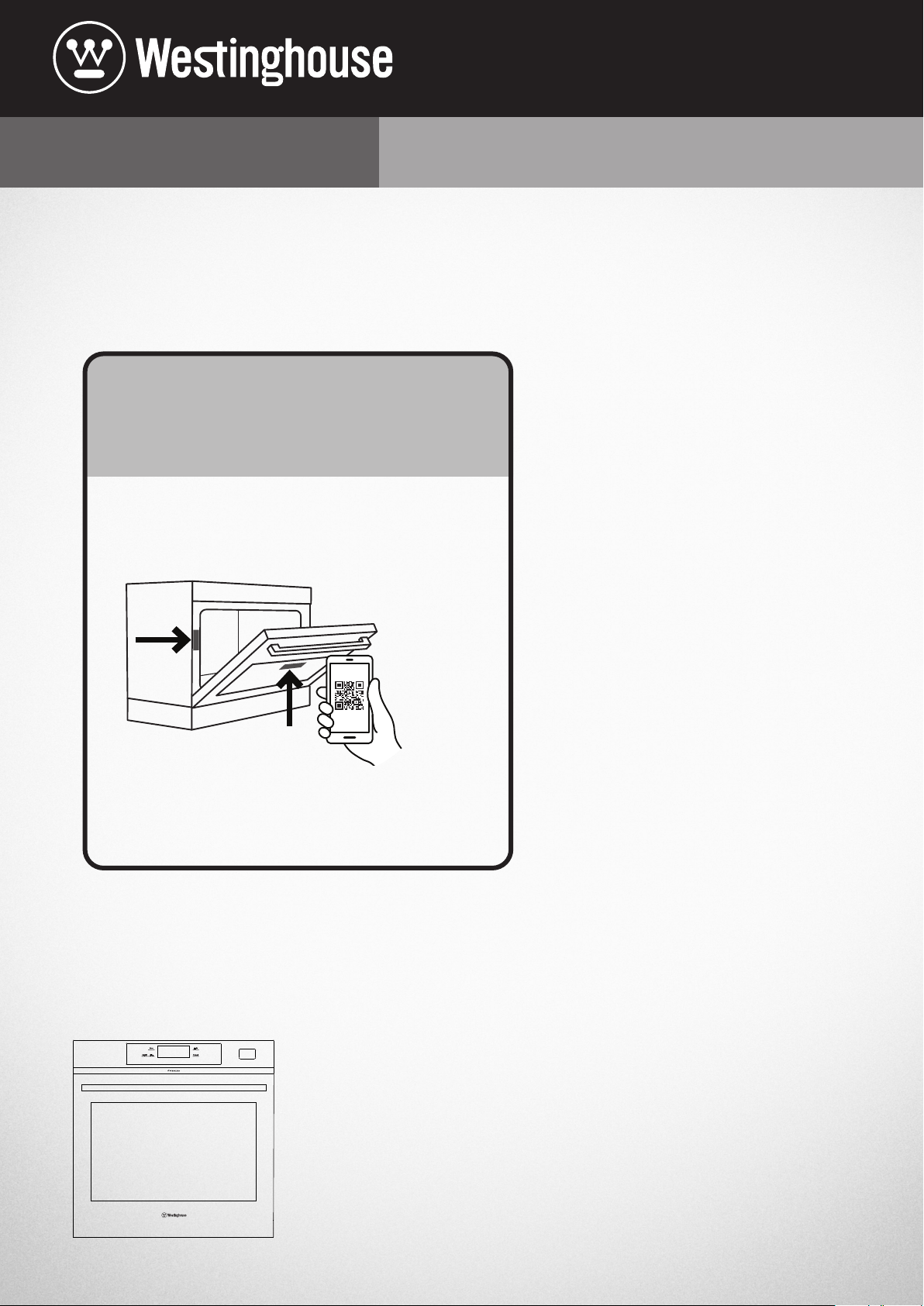
1. Open the camera app on your smartphone and
point at the QR code to scan
Product Registration QR code is located on the
front of your appliance or inside the door rim*.
2. Tap the notification or link to open the registration form
3. Complete your details and enjoy peace of mind
*Exact location of QR code may vary depending on oven model
2 CONTENTS
Important safety instructions .........................................................3
Installing your appliances
................................................................5
Product description
...........................................................................7
Before first use
.................................................................................... 8
Installing your oven accessories ..................................................9
Using your oven
.................................................................................. 11
Pyrolytic cleaning.............................................................................22
Steam assisted cooking
................................................................23
Cooking guide
................................................................................... 27
Dealing with cooking problems
................................................28
Getting to know the oven
............................................................29
Care and cleaning
........................................................................... 30
Tips and troubleshooting
.............................................................38
Shortcuts
............................................................................................. 40
Troubleshooting
................................................................................. 41
Warranty
...............................................................................................43
Please read the user manual carefully and store in a handy
place for later reference.
The symbols you will see in this booklet have
these meanings:
WARNING
This symbol indicates information concerning your
personal safety.
CAUTION
This symbol indicates information on how to avoid
damaging the appliance.
IMPORTANT
This symbol indicates tips and information about use
of the appliance.
ENVIRONMENT
This symbol indicates tips and information about
economical and ecological use of the appliance.
Dear customer,
Congratulations and thank you for choosing our oven.
We are sure you will find it a pleasure to use. Before you
use the oven, we recommend that you read through
the relevant sections of this manual, which provides a
description of your appliance and its functions.
To avoid the risks that are always present when you use
an appliance, it is important that the appliance is installed
correctly and that you read the safety instructions
carefully to avoid misuse and hazards.
We recommend that you keep this instruction booklet for
future reference and pass it on to any future owners.
After unpacking the appliance, please check it is not
damaged. If in doubt, do not use the appliance but
contact your local customer care centre.
This appliance complies with requirements of Australian
Standard AS/NZS 60335.2.6.
Conditions of use
This appliance is intended to be used in household
and similar applications such as:
• Staff kitchen areas in shops, offices and other
working environments
• Farm houses
• By clients in hotels, motels and other residential
type environments
• Bed and breakfast type environments
Please ensure you read the instruction manual fully
before you call for service, or a full service fee could
be applicable.
Record model and serial number here:
Model number:........................................................................................
Serial number:
.........................................................................................
PNC: .............................................................................................................
CONTENTSCONGRATULATIONS
IMPORTANT INFORMATION THAT MAY
IMPACT YOUR MANUFACTURER’S WARRANTY
Adherence to the directions for use in this manual
is extremely important for health and safety.
Failure to strictly adhere to the requirements in
this manual may result in personal injury, property
damage and affect your ability to make a claim
under the Westinghouse manufacturer’s warranty
provided with your product. Products must be
used, installed and operated in accordance with
this manual. You may not be able to claim on the
Westinghouse manufacturer’s warranty in the
event that your product fault is due to failure to
adhere to this manual.

3IMPORTANT SAFETY INSTRUCTIONS
Please read the user manual carefully and store in a handy
place for later reference.
IMPORTANT
Important – check for any damages or marks.
• If you find the oven is damaged or marked, you
must report it within 7 days if you wish to claim for
damage/marks under the manufacturer’s warranty.
This does not affect your statutory rights.
• Discolouration of the enamel has no effect on the
performance of the appliance.
ENVIRONMENT
Information on disposal for users
• Most of the packing materials are recyclable. Please
dispose of those materials through your local
recycling depot or by placing them in appropriate
collection containers.
• If you wish to discard this product, please contact
your local authorities and ask for the correct method
of disposal.
WARNING
These warnings have been provided in the interest of
safety. You MUST read them carefully before installing or
using the appliance.
• An authorised person must install this appliance and
carry out servicing. (Certificate of Compliance to
be retained)
• Before using the appliance, ensure that all packing
materials are removed from the appliance.
• Always be careful when you move the appliance
because it is heavy. Always wear safety gloves.
• Do not pull the appliance by the door handle.
• This appliance must be earthed.
• In order to avoid any potential hazard, the enclosed
installation instructions must be followed.
• Ensure that all specified vents, openings and air
spaces are not blocked.
• Do not modify this appliance.
• This appliance must not be used as a space heater.
• Where the appliance is built into a cabinet, the
cabinet material must be capable of withstanding
70°C. If adjacent to vinyl wrapped surfaces, use
installation kit from vinyl wrap supplier.
• Ensure the appliance is switched off before cleaning
or replacing parts. This can be done by switching off
the appliance via the powerpoint or isolating switch
(if available), or the switchboard.
• Do not use steam cleaners, as this may cause
moisture build up.
• Switch the appliance off before removing the oven
light glass for globe replacement.
• Do not open the oven door during steam cooking.
Steam can be released. There is a risk of skin burns.
There is a risk that steam causes moisture damage to
cabinets.
• Allow the oven to cool down for 30 minutes before you
drain the water tank in a steam oven. Scalding water
may be released.
• Always keep the appliance clean. Ensure fats and oils do
not accumulate around elements, burners or fans.
• Care must be taken when wiping exposed stainless
steel edges.…they can be sharp!
• Do not spray flammable materials in or under the
appliance, e.g. aerosols.
• Do not leave the grill on unattended.
• Always turn the grill off immediately after use as fat left
behind may catch fire.
• Do not cover the grill insert with foil, as fat left there
may catch fire.
• Always keep the oven dish, grill dish and bake trays
clean as any fat residue may catch fire.
• To avoid an accident, ensure that the oven shelves
and fittings are always inserted into the appliance in
accordance with the instructions.
• The door glass on this appliance is made from a tough,
durable material that withstands heating and cooling
without breaking. As a precaution however, do not put
cold water on hot glass.
• Door glass that is damaged should be
immediately replaced.
• This appliance is not intended for use by persons
(including children) with reduced physical, sensory
or mental capabilities, or lack of experience and
knowledge, unless they have been given supervision or
instruction concerning use of the appliance by a person
responsible for their safety.
• Children should be supervised to ensure that they do
not play with the appliance.
• Accessible parts will become hot when in use. To avoid
burns and scalds, children should be kept away.
• During use, this appliance becomes hot. Care should
be taken to avoid touching hot surfaces, e.g. oven door,
heating elements or internal surfaces of
the oven.
• Always use gloves when handling hot items inside
the oven.
• To maintain safe operation, it is recommended that the
product be inspected every 5 years by an authorised
service person.
• New appliances can have an odour during the first
operation. It is recommended to ‘run in’ the oven before
you cook. Run the oven(s) at 180°C for 30 minutes and
ensure the room is well ventilated.
• This appliance must not be installed behind a decorative
door.
• The cooking process has to be supervised. A short term
cooking process has to be supervised continuously.
IMPORTANT SAFETY INSTRUCTIONS

4 IMPORTANT SAFETY INSTRUCTIONS
IMPORTANT SAFETY INSTRUCTIONS
Cooktop only
• If the ceramic glass on cooktop is accidently cracked,
switch off the appliance to avoid the possibility of
electric shock.
• Unattended cooking on a hob with fat or oil can be
dangerous and may result in a fire.
CAUTION
Read the following carefully to avoid damage to
the appliance.
• The grill door must be left fully open whilst grilling in
a separate grill wall oven and a separate grill
underbench oven.
• The grill tray must be fully inserted whilst grilling.
• Do not place thick portions of food under the grill.
Foods may curl, catch and ignite.
• Do not use the door as a shelf.
• Do not push down on the open oven door.
• Do not use harsh abrasive cleaners or metal scrapers
to clean the oven door glass since they can scratch
the surface which may result in shattering of the
glass.
• Do not use harsh abrasive cleaners, powder cleaners,
steel wool or wax polishes on enamel.
• Do not use sharp metal implements or utensils on any
surface, as these may leave permanent scratches or
marks.
• Do not use stainless steel cleaners, abrasive cleaners
or harsh solvents to clean your stainless steel
appliance.
• Do not line the bottom of the oven or grill with foil or
cookware, it will damage the enamel.
• Do not use the base of the oven for cooking – it will
damage the enamel.
• Do not put water directly into the hot appliance.
• Always clean the appliance immediately after any
food spills.
Cooktop only
• Do not allow pots to boil dry as damage to both pan
and cooktop may result.
• Do not operate the cooktop for an extended period
of time without a utensil on the hot plate.
• Do not allow large cookware to overhand onto the
adjacent benchtop. This will cause scorching to the
benchtop surface.
• Do not place heat resistant mats, wire mats or
aluminium foil under pots or pans.
• Do not cook food directly on the ceramic glass
surface.
• Do not use round bottom woks, wok stands or similar
utensils that could lead to overheating of hotplates
and possible damage to the cooking surface.
• Do not operate this appliance by means of an
external timer or separate remote control system.
• Danger of fire: Do not store items on cooking
surfaces.
NOTE: You must read these warnings carefully before
installing or using the appliance. If you need assistance,
contact your Customer Care Centre. The manufacturer will
not accept liability, should these instructions or any other
safety instructions incorporated in this book be ignored.

5INSTALLING YOUR APPLIANCE
WARNING
To avoid any potential hazard, you must follow our
instructions when you install your appliance. Failure
to install the appliance correctly could invalidate any
warranty or liability claims and lead to prosecution.
• This appliance must be installed by an authorised
person according to all codes and regulations as
stated in the local municipal building code and other
relevant statutory regulations.
• Wiring connections must be in accordance with AS/
NZS 3000 Wiring Rules and any particular conditions
of the local authority.
• Refer to data plate for rating information. The data
plate is positioned behind the bottom of the oven
door.
• Disconnection in the fixed wiring must occur in
accordance with the AS/NZS3000 wiring rules.
• Wiring should be protected against mechanical
failure. Refer to AS/NZS3000 clauses 3.3.2.6, 3.9, 3.10
• A means of disconnection with a contact separation
of at least 3mm must be supplied in the fixed wiring.
• This range must be connected with cable of 75°C
rating minimum.
• This product has passed the insulation resistance test
after manufacture. If the resistance reading is low at
installation, it is probably caused by moisture from
the atmosphere being absorbed by the elements
after the range has been produced. (Pass at 0.01MΩ
AS/NZS 3000 Wiring Rules Clause 8.3.6.2).
For New Zealand Only
The cooking range must be connected to the supply by a
supply cord fitted with the appropriately rated plug that
is compatible with the socket-outlet fitted to the final
sub-circuit in the fixed wiring that is intended to supply
this cooking range.
Supply cord size required:
WVEP6918DD-2.5mm
Note: Electrical connection is 230-240 volts AC 50Hz.
Wiring minimum temperature rating 75°C.
WARNING
This appliance must be properly earthed.
• Do not lift the appliance by the door handles.
• Prepare the cupboard opening to match your
appliance measurements. (See diagrams)
• Slide appliance into the cupboard, ensuring that the
supply cable (where fitted) does not kink.
• To prevent tipping, use the screws supplied to secure
your oven into the cupboard. Use just 2 screws for
underbench and separate grill underbench ovens, and
4 screws for separate grill wall ovens. Remove the
bottom door in separate grill wall ovens to provide
access to the bottom 2 screwing points.
• For appliances fitted with a flexible supply cord, if
the cord is damaged, it must be replaced by the
manufacturer or its service agent or similarly qualified
person in order to avoid a hazard. The plug must be
accessible after installation.
• Where the appliance is built into a cabinet, the
cabinet material must be capable of withstanding
70°C. Installation into low temperature tolerant
cabinetry (e.g. vinyl coated) may result in
deterioration of the low temperature coating by
discolouring or bubbling.
• If the appliance is installed adjacent to vinyl-wrapped
surfaces, use an installation kit available from the
vinyl-wrap supplier.
• Electrolux Home Products cannot accept
responsibility for damage caused by installation into
low temperature tolerant cabinets.
• After installation, test and ensure that the appliance
operates correctly before handing it over to the
customer. It is recommended that this product is not
installed in an unvented living space, particularly if
that space incorporates sleeping quarters.
• If a powerpoint is fitted it must be accessible with the
appliance installed, as the plug must be accessible
after installation.
• This appliance must be mounted on a flat surface for
the full width and depth of the product.
• To avoid overheating, the appliance must not
be installed in a recess or cupboard behind a
decorative door.
INSTALLING YOUR APPLIANCE
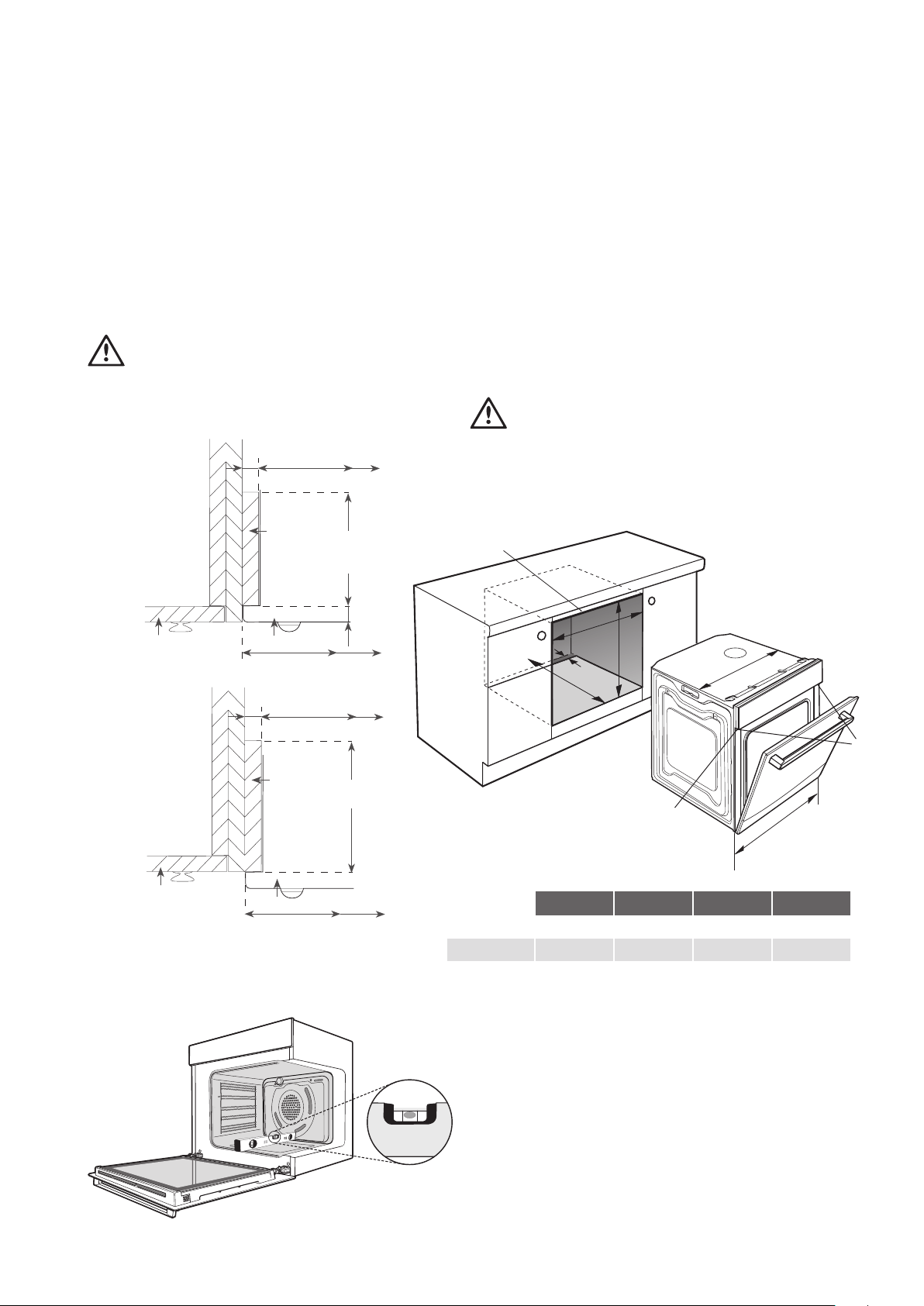
6 INSTALLING YOUR APPLIANCE
Pyrolytic underbench oven
Your underbench oven looks best when the control panel
is directly under the benchtop. An upper infill panel may
have to be added if the cooktop placed over the oven is
too deep. Refer to cooktop installation instructions for
required clearance between cooktop and oven.
Power point connection for the WVEP6918 must be
accessible with the appliance fully installed. If the supply
cord is damaged it must be replaced by the manufacturer,
its service agent or similarly qualified persons in order to
avoid
a hazard.
CAUTION
NOTE: Dimension “D”.
A requirement for all pyrolytic clean ovens – for proper
ventilation there must be a gap at the bottom rear of the
cabinet. This can be a full width opening 20mm deep.
Cabinet construction for your appliance
For the best integration within a kitchen, install the
appliance in a standard 600mm wide cupboard that gives
a flush fit with the surrounding cupboard fronts as shown
in Fig. A. A recess of 20 mm is ideal.
With the exception of pyrolytic ovens, the appliance can
also be installed using a proud fit to the surrounding
cupboard as shown in Fig. B.
CAUTION
The “Infill panel” MUST not exceed 100mm in length. This
ensures a 16mm gap is maintained between the cabinet
and oven side to prevent the cupboard overheating.
Fig. A
Flush Fit
16mm
568mm
600mm
20mm
Infill
panel
Cupboard
door
Oven
100mm max
for Pyro
oven
Fig. B
Proud Fit
16mm
568mm
600mm
Infill
panel
Cupboard
door
Oven
100mm max
for Pyro
oven
Levelling oven
Place a level in the oven as below, making sure the level
sits on the front and rear forms.
✓
INSTALLING YOUR APPLIANCE (CONTINUED)
C
B
A
558
mounting
holes
596
upper infill
(if required)
use black
installation
screws supplied
D
GAS TYPE
A B C D
Flush fit 600 600 581min 20
Proud fit 565 590 560min 20
7
CARE AND CLEANING
PRODUCT DESCRIPTION
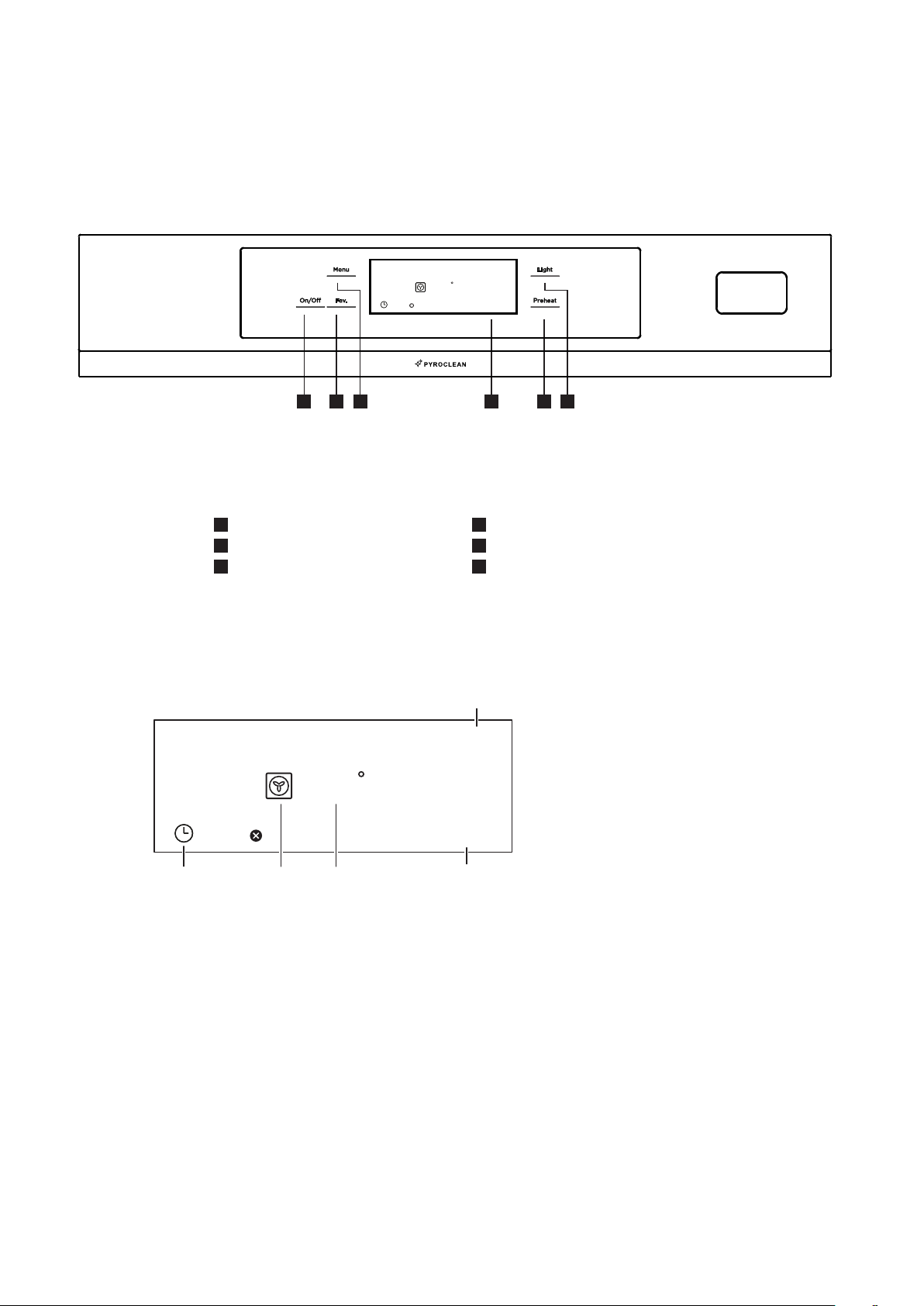
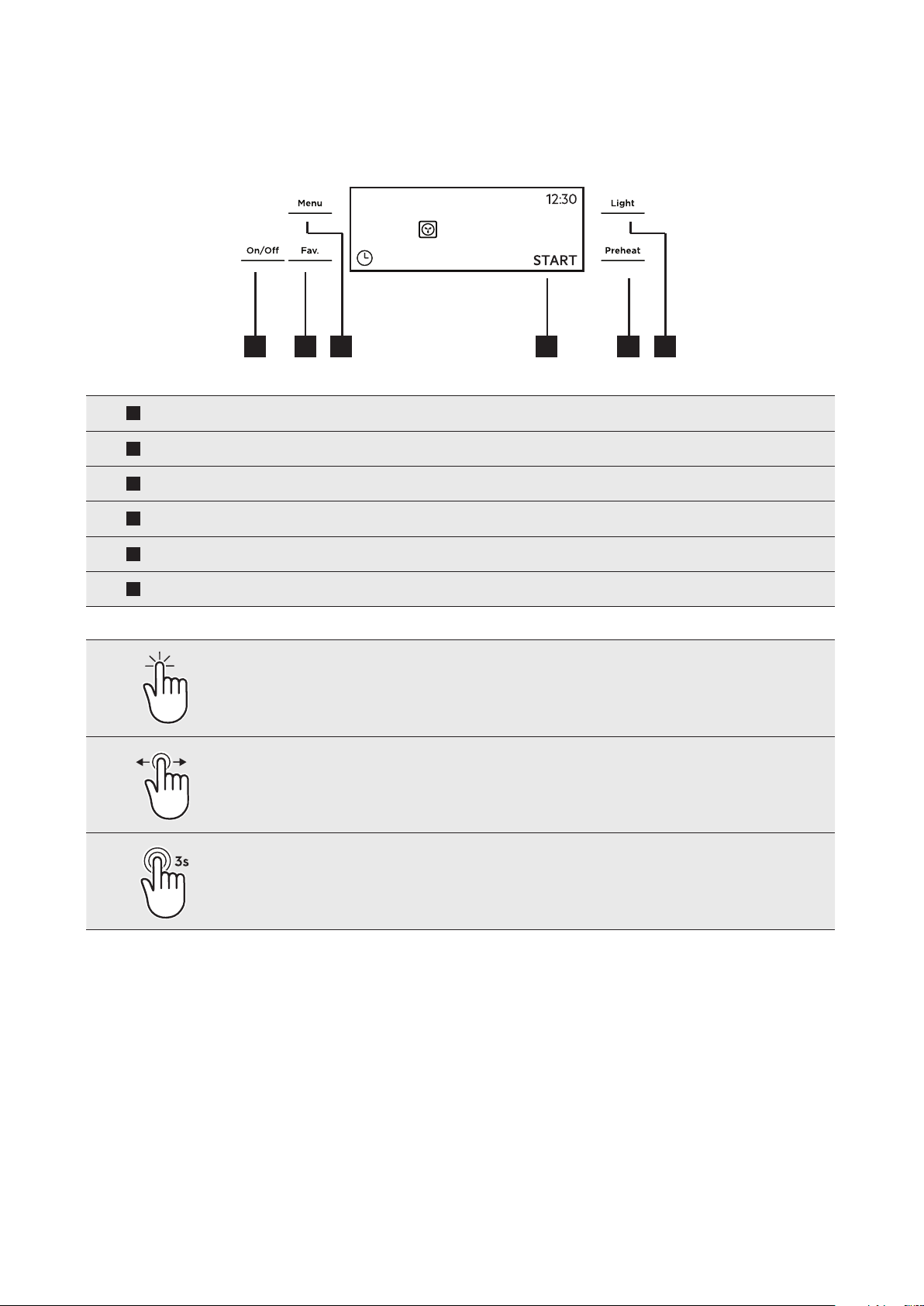
1
On/off button (Press and hold)
2
Favourite button
3
Menu button
4
‘Touch screen display
5
Preheat button
6
Light button
WVEP6918DD
12:30
15min
START
85˚C
170C
4
12:30
15min
START
D
BC
A
170C
The display with the maximum number of functions set.
A. Time of day
B. Start / stop
C. Oven temperature
D. Heating functions
E. Timer
E
1 2 3 4 5 6
8 BEFORE FIRST USE
Preparing your appliance for the first time
• Please remove all internal boxes and bags from the
oven before operation.
• Please wipe out the oven interior prior to operation
with warm soapy water and polish dry with a soft
clean cloth. Do not close the oven door until the oven
is completely dry.
CAUTION
• Do not line the oven with foil as it will damage the
enamel.
• New appliances can have an odour during first use. It
is recommended to ‘run in’ the oven before cooking
for the first time. Operate the oven(s), empty, at a
temperature of 180°C for approximately 30 minutes.
For appliances with a separate grill, run the grill on
maximum for 15 minutes WITH GRILL DOOR OPEN.
Please ensure that the room is well ventilated during
this process.
Setting the time of day
If you have purchased a model fitted with an electronic
clock or programmable controller, you must set the time
of day before you can operate your appliance.
WVEP6918 programmable controller
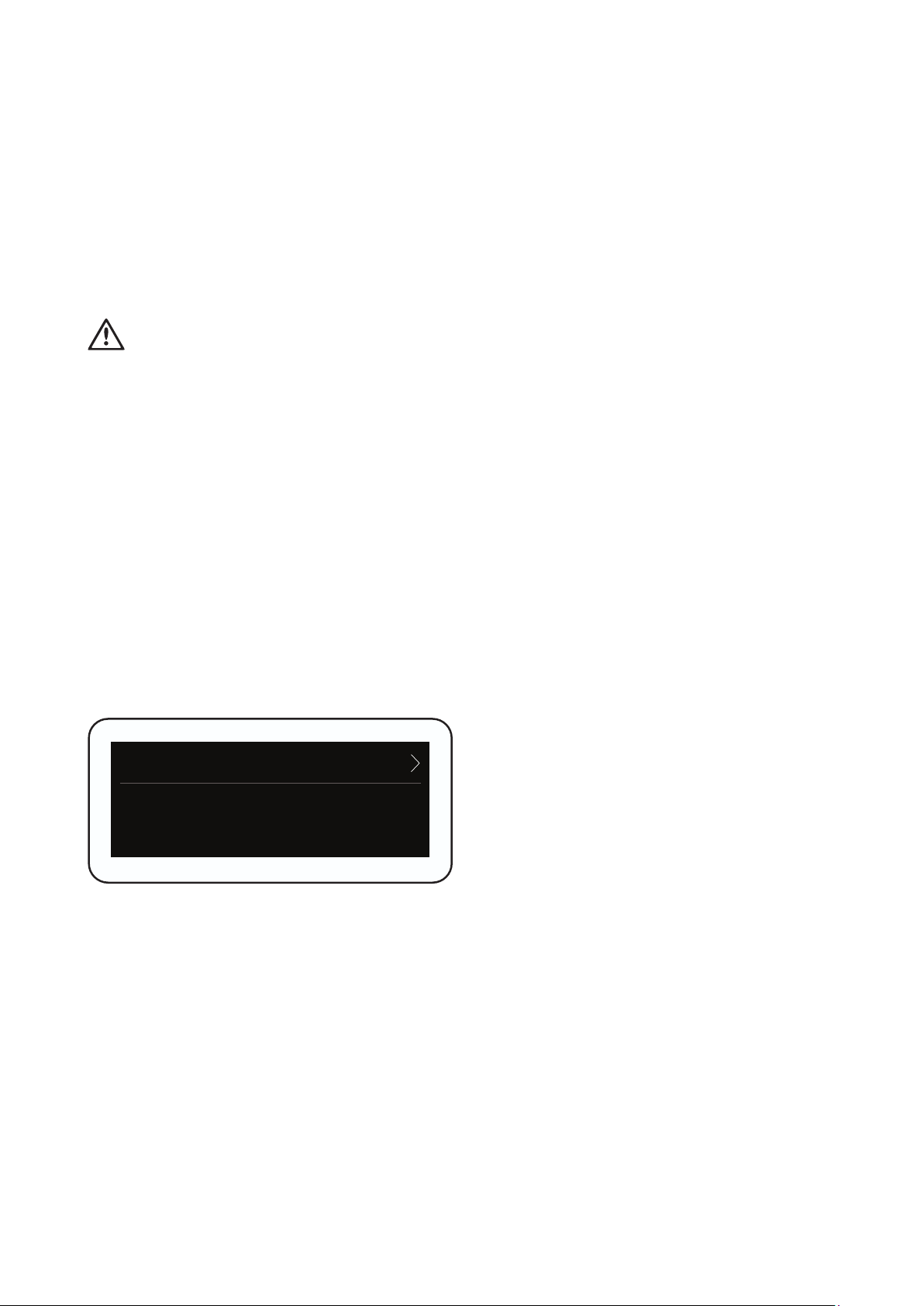
The first time you use your oven, there will be an initial set
up required. Follow the steps as prompted in the display
to select your preferred options.
Welcome!
This is the initial setup for optimal
performance of your new oven
BEFORE FIRST USE
9INSTALLING YOUR OVEN ACCESSORIES
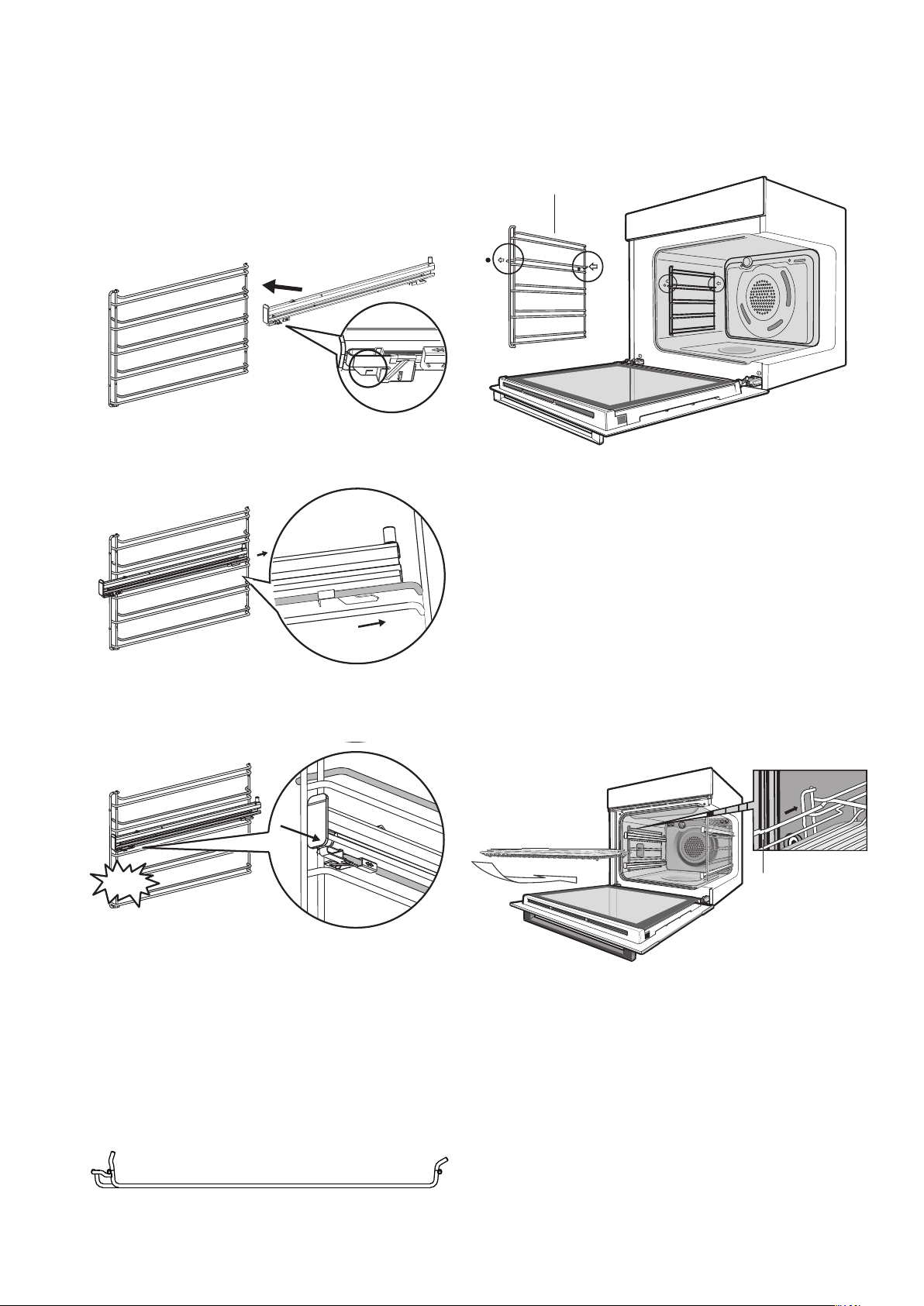
1. Obtain left hand side rack and left hand slide – see
image to identify.
2. The shaded wires indicate the wire the slide can be
mounted on. Fit slide rear clips to the rear of wire at
an angle as shown below.
1
2
3. Push slide front clip over wire until secured
CLICK !
3
Side racks
• The side racks attach to each side of your oven. There
is a left hand and right hand version (see image below
for details).
• Insert the rear peg into the rear access hole provided,
ensuring that the peg is fully inserted.
• Then locate the front peg into the front access hole
and push in firmly.
Front Peg Rear Peg
INSTALLING YOUR OVEN ACCESSORIES
Slides (Telescopic runners)
Left hand side rack
Shelves and trays
The shelves are designed so that they have maximum
extension but cannot be accidentally pulled right out.
To fit a shelf to side racks:
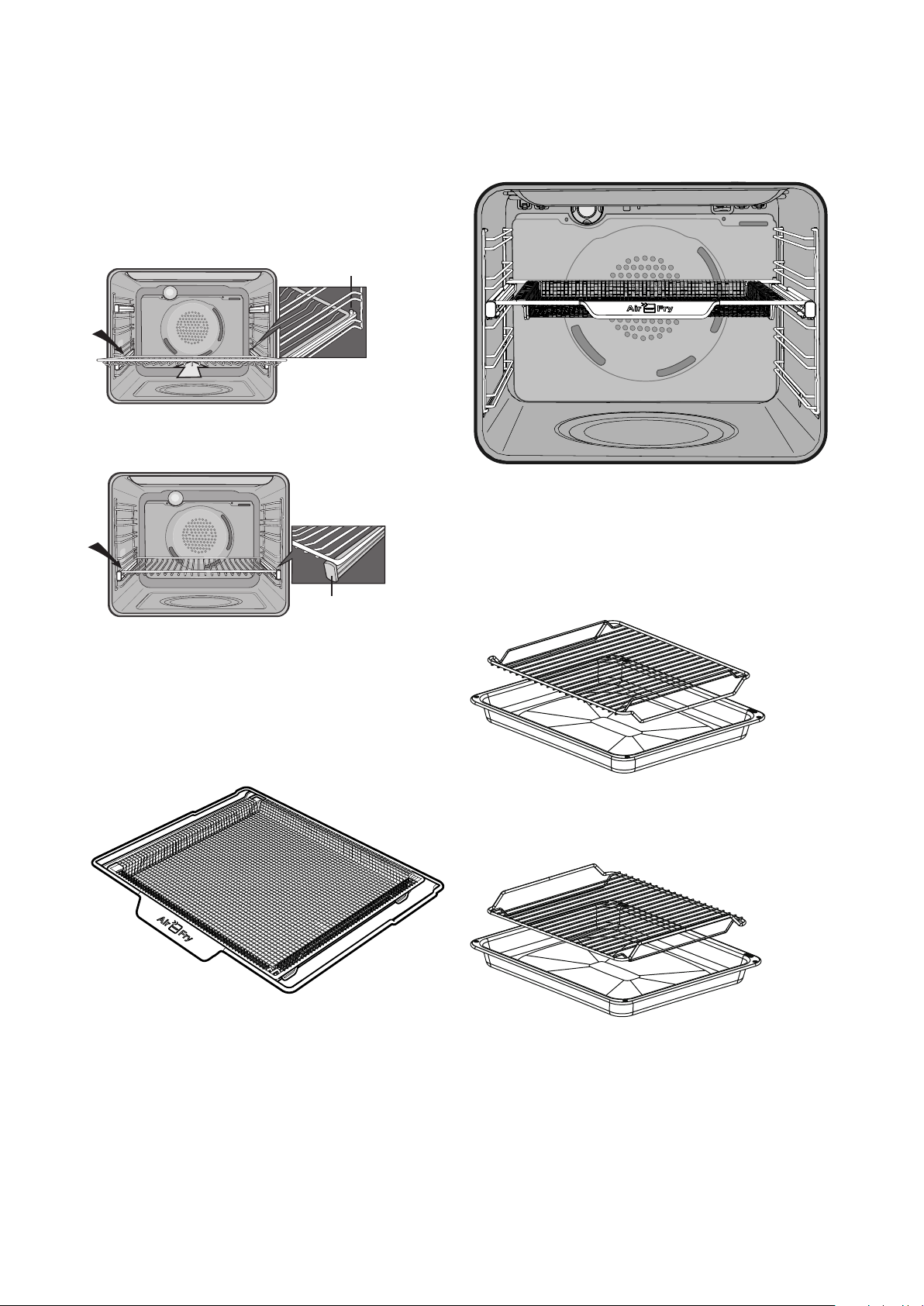
NOTE: To Locate the rear edge of the shelves, the detents
on the side wires should be towards the oven back wall.
See image.
1. Rest the rear edge of the shelf on the lower guide rail
of the side rack - see diagram. Ensure the same rail
positions on both sides of the oven are being engaged.
2. With the front edge raised, begin to slide the shelf in
between the guide rails of the side rack.
3. Once the detents have passed the front edge of the
side rack, the shelf can be pushed fully in.
Detent
4. When fully inserted the shelf should not interfere with
the closed oven door.
10 INSTALLING YOUR OVEN ACCESSORIES
INSTALLING YOUR OVEN ACCESSORIES
To fit a shelf or tray to telescopic slides:
1. Push the shelf or tray along the top of the slide until it
hits the back post.
Back post
2. Drop the front of the shelf or tray onto the slide
ensuring it sits behind the front post of the slide.
Front post
3. When fully inserted the shelf/tray should not interfere
with the closed oven door.
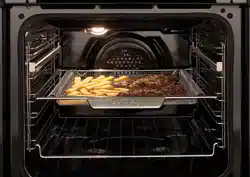
Air Fry
The Air Fryer can be placed onto slides or into side racks
in the same manner as an oven shelf.
Fitting grill dish and insert
Your oven comes with a full width grill dish and a grill
insert. The grill dish insert is designed with flexibility to
adjust distance between the food and the grill element.
Maximum grill power
Grill dish insert brings the food closer to the grill element.
Suitable when maximum grill power is needed.
Moderate grill power
Food sits further away from the grill element. Suitable
when moderate grill power is needed.

11
U
SING YOUR OVEN
NOTE: For multifunction ovens the desired cooking
function must be selected before the oven will operate.
Once the desired function has been selected, use the
temperature selector to set the required temperature.
Pre-heating your appliance
For best results when baking you must pre-heat the
oven for 30 minutes. Pre-heat the grill for 3 minutes to
obtain best results. Pre-heating your appliance allows it
to reach the required temperature quickly and efficiently.
When baking bread or cakes, load the oven as quickly as
possible after pre-heating and leave the oven door open
for the shortest time. This will minimise loss of heat from
the oven and ensure the best results.
IMPORTANT
Cooling/Venting fan
This appliance is fitted with a cooling fan. This prevents
your kitchen cabinet from overheating and reduces the
condensation inside the oven. It will operate whenever
you are using the oven and blow warm air across the top
of the oven door.
NOTE: For selected models only. When setting delayed
start, the cooling fan will operate as soon as the function
is selected. This will minimise condensation build up in
the appliance..
Condensation and steam
This appliance is supplied with an exclusive system which
produces a natural circulation of air and the constant
recycling of steam. This steam makes it possible to
cook in a steamy environment ensuring that dishes are
soft inside and crusty on the outside. This process also
reduces cooking time and energy consumption. During
cooking, steam may be produced and released when the
door is opened. This is absolutely normal. When food is
heated, it produces steam in the same way a boiling kettle
does. When steam comes into contact with the oven door
glass, it will condense and produce water droplets. To
reduce condensation, ensure that the oven is pre-heated
before placing food in the oven cavity. It is recommended
that condensation is wiped away after each use of
the oven.
The effects of dishes on cooking results
Dishes and tins vary in their thickness, conductivity, colour
etc. which affects the way they transfer heat to the food.
• Aluminium, earthenware, oven glassware and bright
shiny utensils reduce cooking and base browning.
• Enamelled cast iron, anodized aluminium, aluminium
with non-stick interior and coloured exterior and dark,
heavy utensils increase cooking and base browning.
• To increase base browning simply lower the shelf
position. To increase top browning, raise the
shelf position.
• Always place dishes centrally on the shelf to ensure
even browning.
• Single level cooking gives best results in conventional
modes. If cooking on more than one level use a fan
forced function.
oven temperature falls below the set temperature, the
element switches on and the oven indicator light comes
on again.
CAUTION
Once the food is cooked, turn the temperature selector
back in an anti-clockwise direction. Do not force it right
round in a clockwise direction as this will result in damage
to the thermostat.
USING YOUR OVEN
12
USING YOUR OVEN
4
1
On / O
Press and hold to turn the oven on and o
2
3
Favourites
Lists the favourite settings
4
Touch display Shows the current settings of the oven
5
PreheatTo deactivate the Preheat function
6
Light
To turn the lamp on and off
1 2 3 4 5 6
Press
Touch the surface with your fingertip
Left/Right
swipe
Slide fingertip over the surface
Press and
hold
Touch the surface for 3 seconds
USING YOUR OVEN (CONTINUED)
170°C
Menu
Lists the oven functions
13
U
SING YOUR OVEN
How to turn the oven on and off
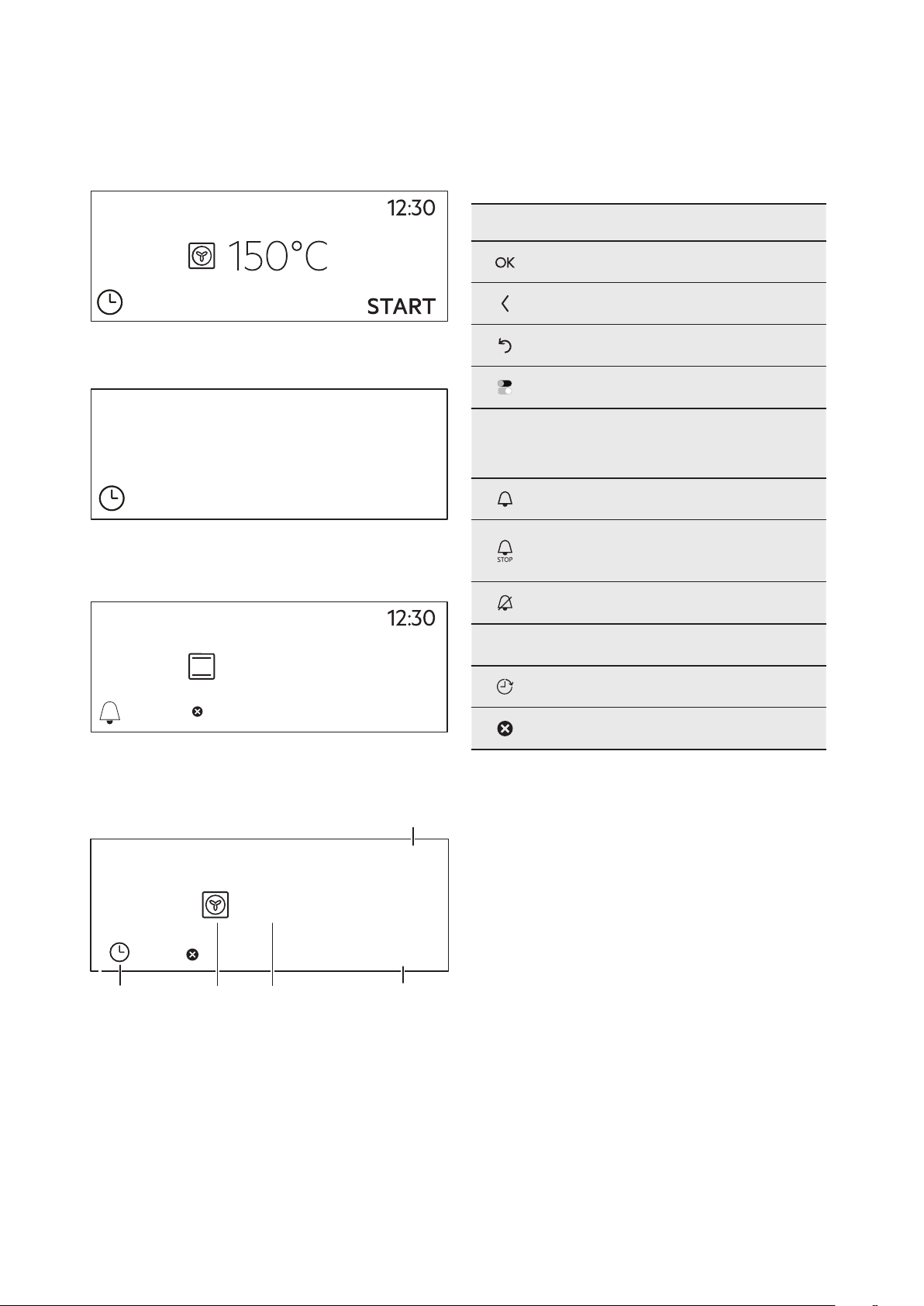
12:34
If you do not use the oven for 2 minutes, the
display goes to standby.
11min
150°C
STOP
When you cook, the display shows the set
functions and other available options.
12:30
15min
START
DE
BC
A
170°C
The display with the maximum number of
functions set.
A. Time of day
B. Start / stop
C. Oven temperature
D. Heating functions
E. Timer
Display indicators
Basic indicators – to navigate on the display
To confirm the selection / setting
To go one level back in the menu
To undo the last action
To turn the options on and o
Sound alarm function indicators – when the
set time of cooking ends, the signal sounds
The function is on
The function is on.
Cooking stops automatically
Sound alarm is o
Timer indicators
To set the function: delayed start
To cancel the setting
14
USING YOUR OVEN
Run in the empty oven before the first use.
1.Remove all accessories and removable shelf supports
from the oven.
2.Set the temperature to 180°C for the function: Fan
forced . Let the oven operate for 30 minutes.
The oven can emit an odour and smoke during burn o.
Make sure that the room is ventilated.
WARNING
Refer to safety chapters
The touch screen display will display prompts or
messages. It may be necessary to touch the 'X'
Message
or the middle of the message to respond.
Message
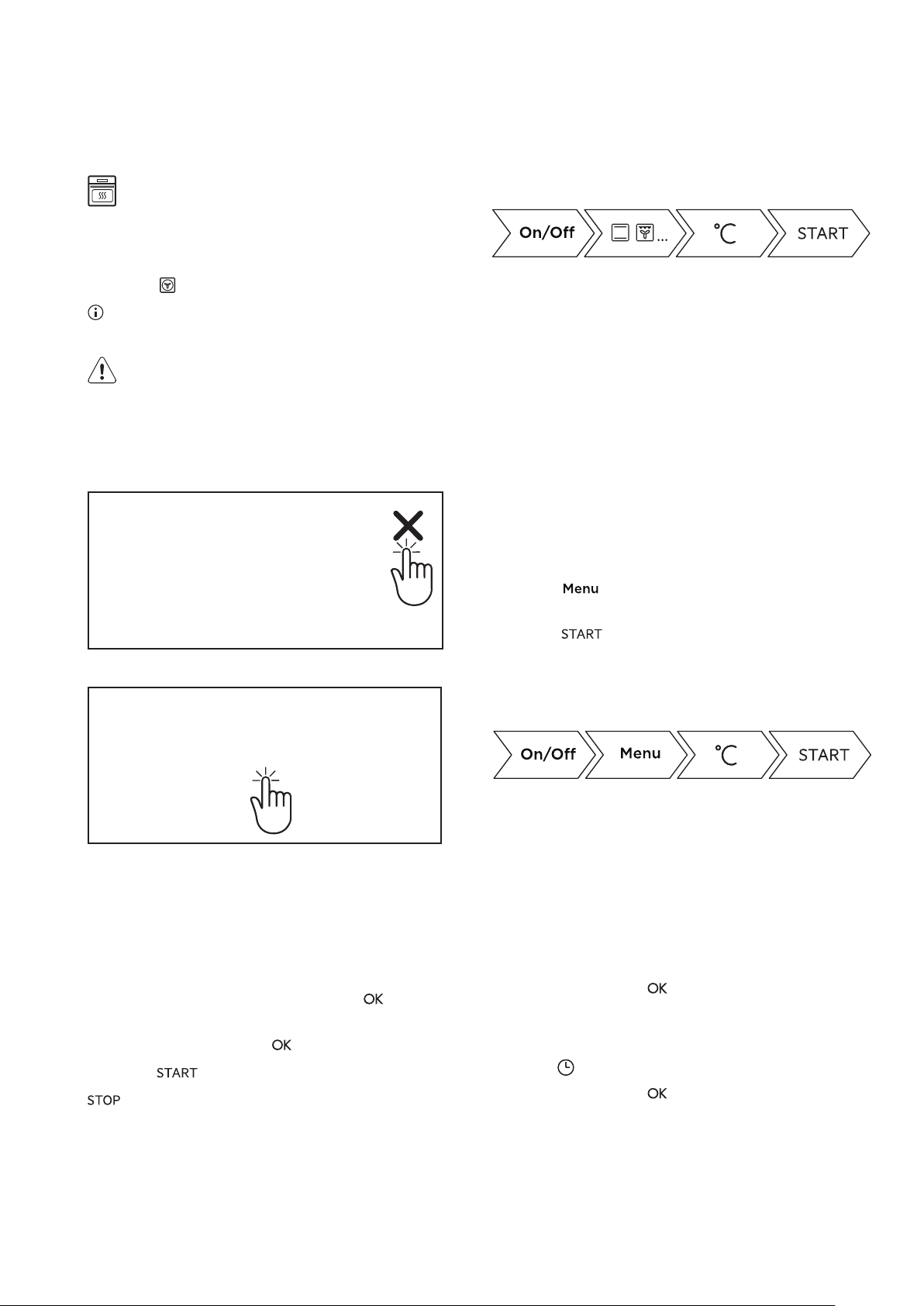
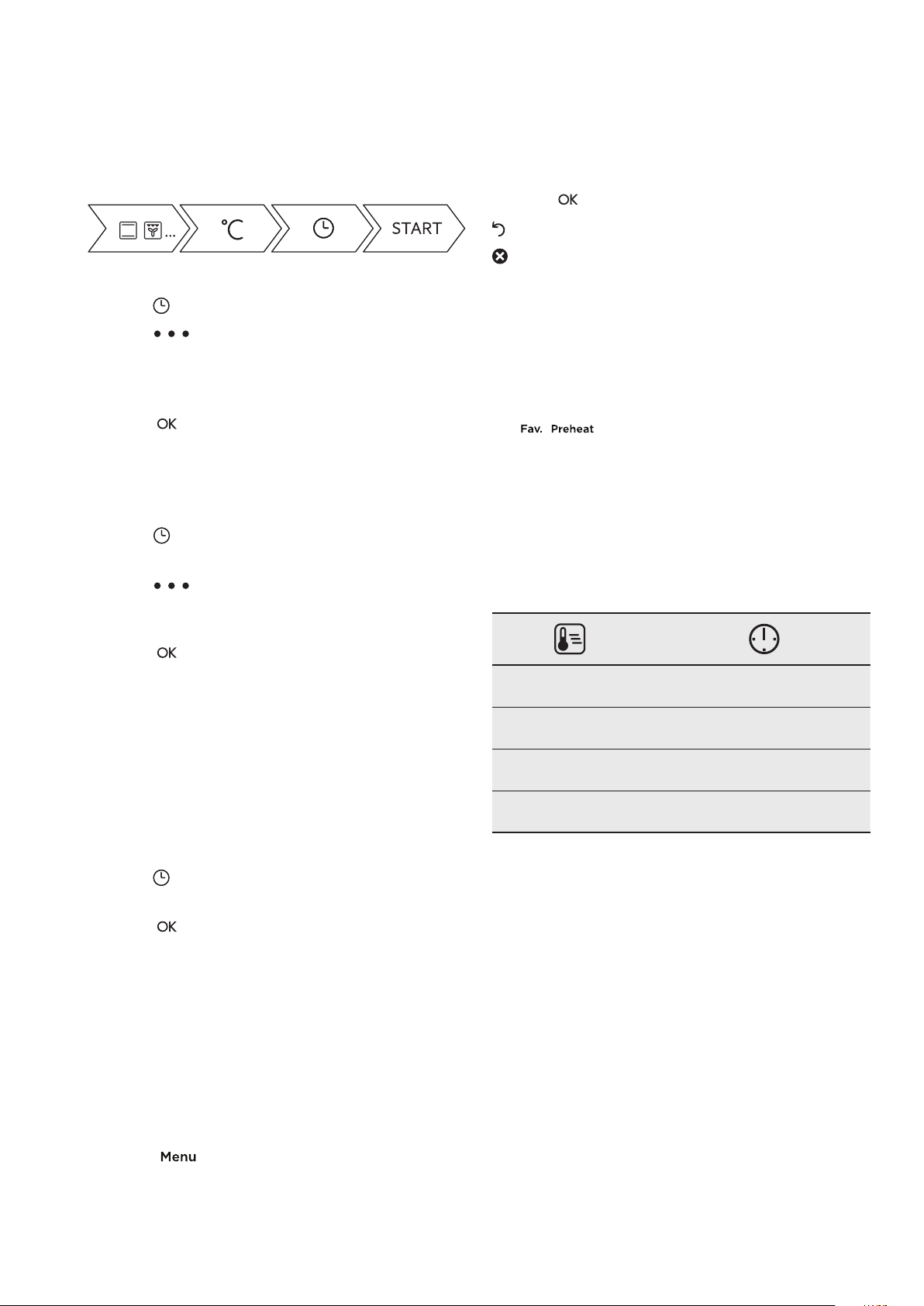
How to set Heating Functions
1. Turn ON the oven. The display shows the default
heating function.
2. Press the symbol of the heating function to enter the
submenu.
3. Select the heating function and press:
The display shows: temperature.
4. Set: temperature. Press:
5. Press: .
– press to turn off the heating function.
6. Turn OFF the oven.
Take a shortcut!
How to set Assisted Cooking
Every dish in this submenu has a recommended function
and temperature. You can adjust the time and the
temperature.
For some of the dishes you can also cook with:
• Weight Automatic
The degree to which a dish is cooked:
• Rare or Less
• Medium
• Well done or More
1.Turn on the oven
2.
Press: Select:
Assisted cooking.
3.Choose a dish or a food type.
4.Press:
Take a shortcut!
How to set Clock functions
How to set the clock
1. Turn ON
2. Press Menu
3. Go to Settings
4. Press Setup
5. Select: Time of day
6. Set the time. Press:
How to set cooking time
1. Choose a heating function and set the temperature.
2. Press
3. Set the time. Press:
USING YOUR OVEN (CONTINUED)
15
U
SING YOUR OVEN
Take a shortcut!
How to choose end option
1. Press
2. Press
3. Select End action from timer
4. Press End action
5. Select preferred option
6. Press: . Repeat the action until the display shows
the main screen.
How to delay start of cooking
1. Set the heating function and the temperature.
2. Press
3. Set the cooking time.
4. Press
5. Press: Delayed start.
6. Choose the value.
7. Press:
. Repeat the action until the display shows
the main screen.
How to extend cooking time
When 10% of cooking time is left and the food seems not
to be ready, you can extend cooking time. You can also
change the heating function.
Press +1min to extend the cooking time.
How to change timer settings
1. Press
2. Press the timer value.
3. Press:
You can change the set time during cooking at any time.
How to save Favourites
You can save your favourite settings, such as the heating
function, the cooking time, the temperature or the cleaning
function. You can save 3 favourite settings.
1.Turn on the oven.
2.Select the preferred setting.
3.Press: Select: Favourites.
4.Select: Save current settings.
5. Press + to add the setting to the list of: Favourites.
Press
– press to reset the setting.
– press to cancel the setting.
Function lock
This function prevents an accidental change of the heating
function.
1. Turn on the oven.
2. Select a heating function.
3. , –
press and hold at the same time to
turn on the function lock.
To turn off the function lock repeat step 3.
Automatic switch off
For safety reasons the oven turns o after some time,
if a heating function works and you do not change any
settings.
(°c)
(h)
30 - 115 12.5
120 - 195 8.5
200 - 245 5.5
250 - maximum 3
The Automatic switch-o does not work with the
functions: Light, End time, Slow Cooking.
Cooling fan
When the oven operates, the cooling fan turns on
automatically to keep the surfaces of the oven cool.
If you turn o the oven, the cooling fan can continue
to operate until the oven cools down.
16
USING YOUR OVEN
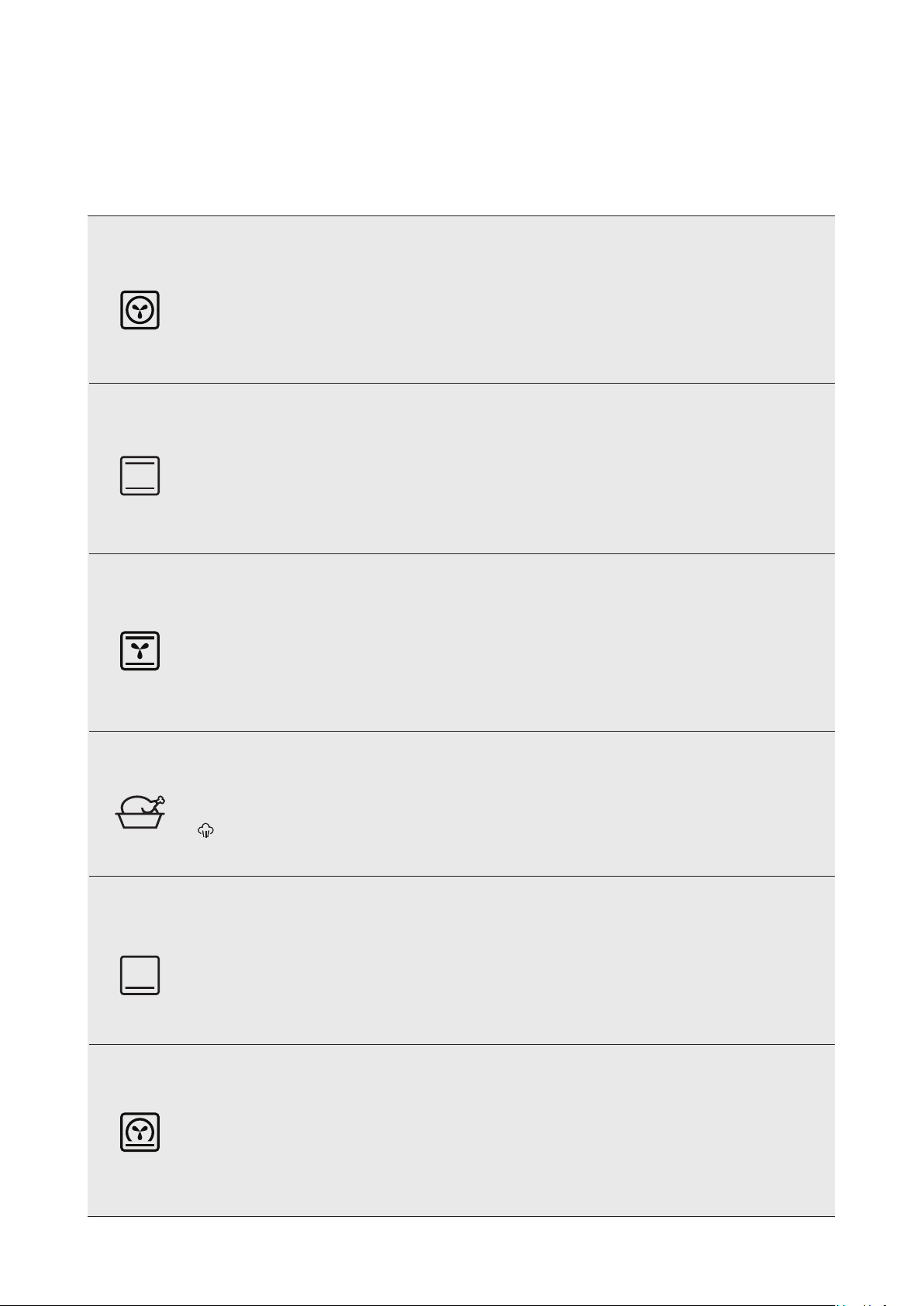
Symbol Function description
Fan Forced
Heat comes from the element surrounding the fan. This fan circulates the hot air around the oven
cavity so that you can put your food in different places in the oven and still cook them at the same
time. You can use the ‘Fan Forced’ function for multi-shelf cooking, reheating cooked foods,
pastries and complete oven meals. It will cook at a lower temperature and be faster than baking.
Please note that some variation in browning is normal.
Bake
Heat comes from two elements, one above and one below the food. The bottom element is
a clean heat element and is below the floor of the oven. Both elements are controlled by the
thermostat and will turn on and off to maintain set temperature. You can use the ‘Bake’ function for
single shelf cooking, single trays of biscuits, scones, muffins, cakes, slices, casseroles, baked
puddings, roasts and delicate egg dishes. This is a general function that can be used for most
cooking.
Fan assist
Heat comes from two elements, one above and one below the food. The fan circulates the hot air
around the oven cavity so that you can put the food in dierent places in the oven and still cook
them at the same time. You should only use a maximum of two shelves with ‘Fan Assist Bake’.
Do not use the bottom shelf. If the two shelves are used, food on the shelf in the higher position
will cook first and should then be removed to allow the food on the lower shelf to finish cooking.
Roast
The Roast function is designed for roasting meats, poultry and fish by utilising heat from all
elements in combination with the fan to surround the food. This provides even cooking throughout
and enhanced browning.
NOTE: Your oven gives you the option to introduce steam into this cooking cycle.
Base Heat
The ‘Base Heat’ function is specially designed for food that require extra browning such as the
bases of pastries and pies. Heat comes from the element below the food. If you choose the
default setting, the oven will heat up to 230°C in order to brown the food.
You should then lower the temperature as required. Cook in the lower half of the oven when you
are using only one shelf.
Pizza
‘Pizza’ is a combination of ‘Base Heat’ and ‘Fan Assist’ and offers you the combined benefits
of both functions. Heat switches between the element surrounding the fan and the clean heat
element below the oven floor. The ‘Pizza’ function is ideal for foods that require cooking and
browning on the base. It is for foods such as pizzas, quiches, meat pies and fruit pies. Simply place
the food in the middle of the oven and set the desired temperature.
USING YOUR OVEN (CONTINUED)
17
U
SING YOUR OVEN
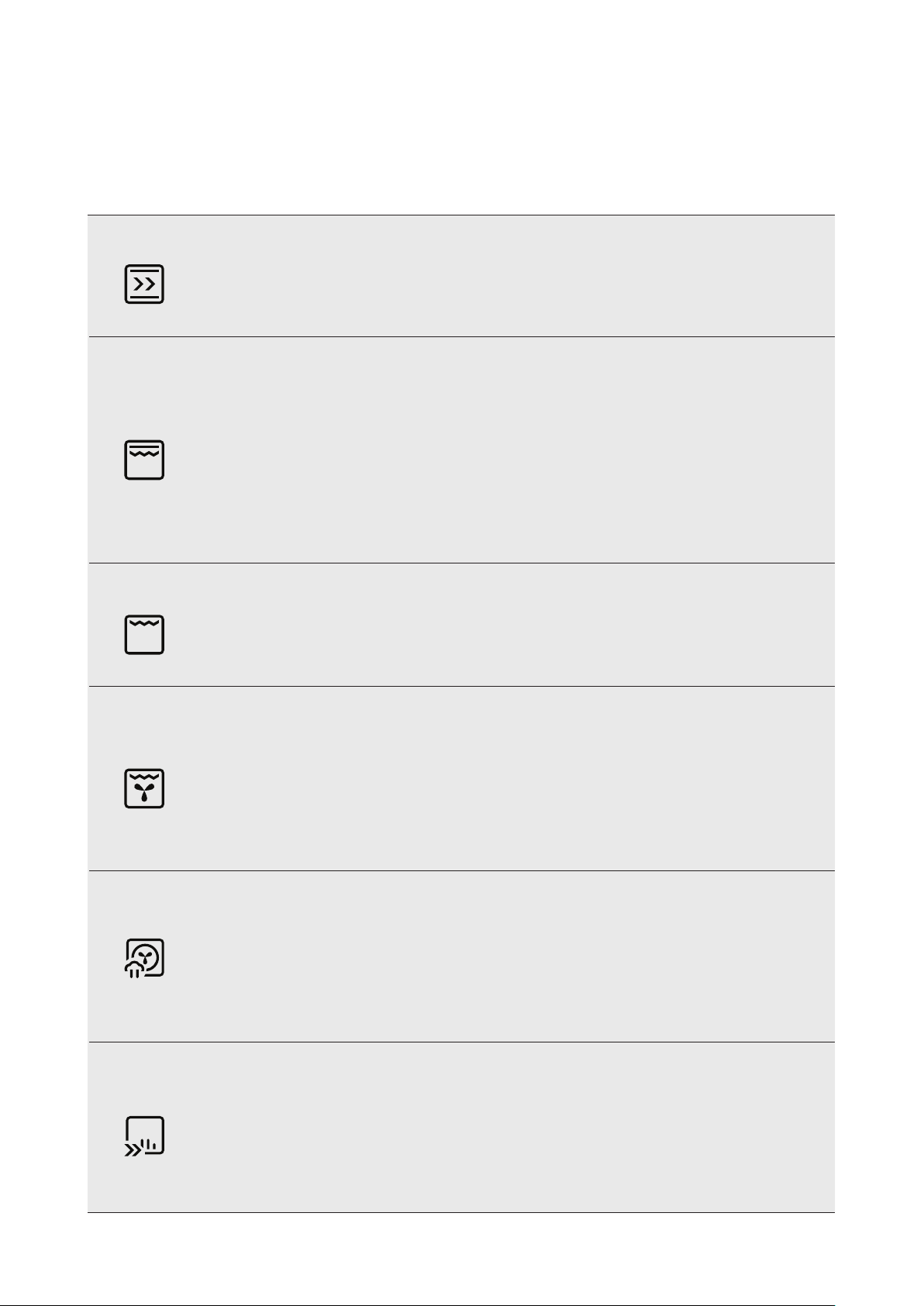
Symbol Function description
Rapid Heat
The ‘Rapid Heat’ function is ideal for cooking frozen precooked foods such as savoury pastries,
pizzas, mini meals (TV dinners), meat pies and fruit pies. Heat comes from the element
surrounding the fan as well as a smaller element above the food. Simply place the food in the
oven straight from the freezer and heat. Cook in the upper half of the oven for best results.
Maxi Grill
‘Maxi Grill’ direct radiant heat from two powerful upper elements onto the food. You can use
‘Maxi Grill’ function for tender cuts of meat, steak, chops, sausages, fish, cheese toasties and other
quick cooking foods.
Grill with the oven door closed.
‘Maxi Grill’ allows you to take full advantage of the large grill dish area and will cook faster than the
‘Grill’ function. For best results it is recommended to preheat your grill for three minutes. This will
help seal in the natural juices of steak, chops etc for a better flavour.
Place the grill shelf in position 4 with the grill dish below to catch any spills. ‘Maxi Grill’ has 2
temperature settings, ‘LO’ and ‘HI’.
Grill
The ‘Grill’ directs radiant heat from only one of the powerful upper elements onto the food. The
‘Grill’ function is used instead of ‘Maxi Grill’ when only half the amount of heat is needed. ‘Grill’
has 2 temperature settings, ‘LO’ and ‘HI’.
Grill with the oven door closed.
Fan & Grill
‘Fan & Grill’ offers you the benefits of both traditional bake and traditional grill functions. The grill
element turns on and o to maintain set temperature while the fan circulates the heated oven air.
Grill with the oven door closed.
You can use ‘Fan & Grill’ for large cuts of meat, which gives you a result similar to ‘rotisserie’
cooked meat. Place your food on the grill shelf in position 2 with the grill dish below to catch any
spills. When using ‘Fan &Grill’ it is not necessary to turn the food over during the cooking cycle.
Set temperature to 180°C.
Easy Bake+Steam
Adding steam to your baking program can lift your baking skills to a whole new level.
Shelf guide: position 3.
AirFry
Using the dedicated tray with this function delivers great tasting foods that are crisper with juicy
centres. Shelf guide: AirFry Tray position 3 and catch tray position 1.
18
USING YOUR OVEN
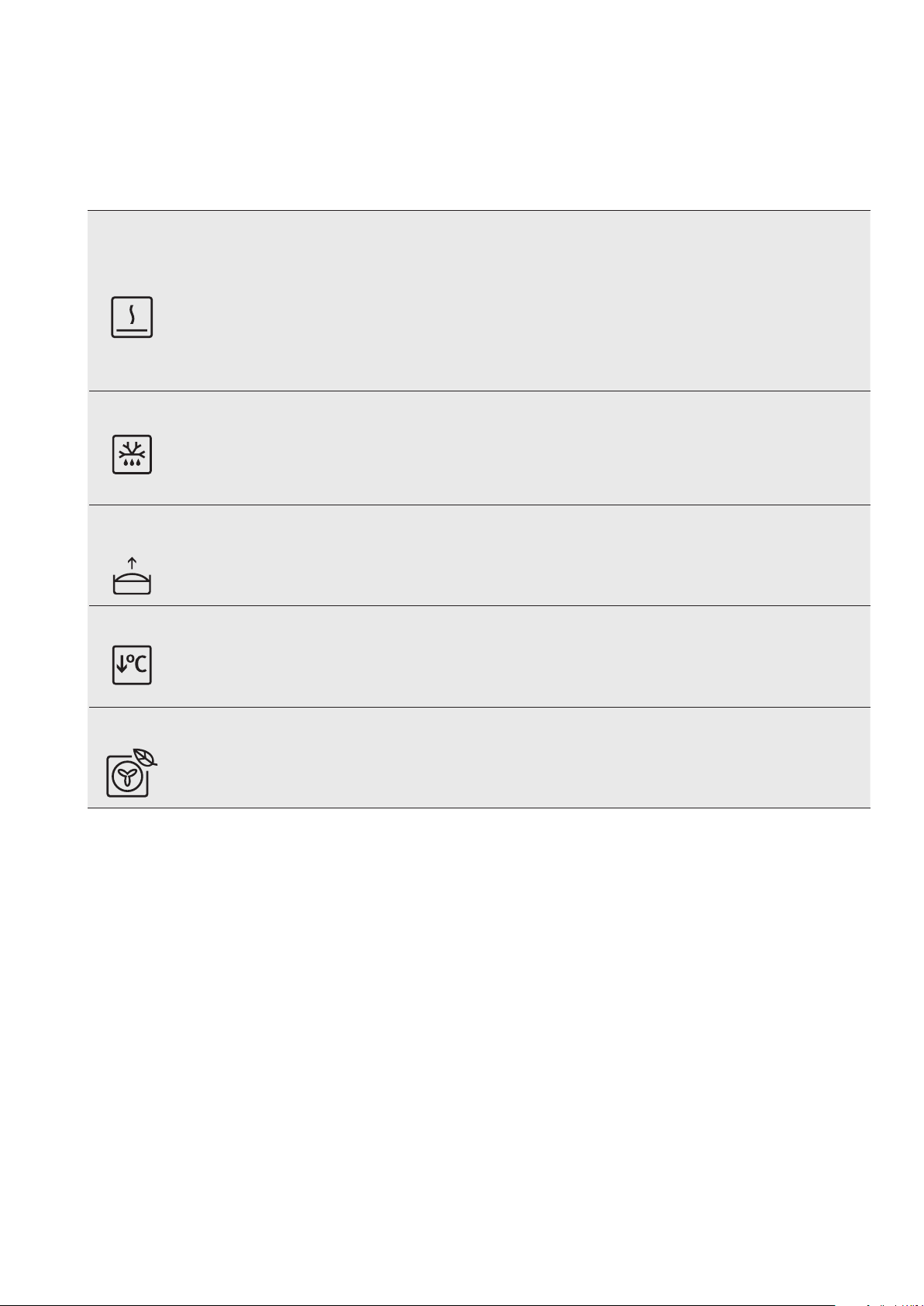
Symbol Function description
Keep warm
The ‘Keep Warm’ function is a low temperature oven function designed to keep your food at a perfect
eating temperature without cooking it further. Heat comes from the smaller elements above the food and
is circulated by the fan. Use ‘Keep Warm’ to keep your food warm while you prepare the rest of the meal or
afterwards while you wait for the late arrival.
NOTE: After cooking, the oven retains enough heat to continue to cook food even if the elements are turned
o. The ‘Keep warm’ function recognises this by giving you a warning message. If this happens the function
will
not start.
Defrost
The ‘Defrost’ function uses low temperature air that is circulated by the fan. You can defrost (thaw) your
food before you cook it. You can also use ‘defrost’ to raise your yeast dough and to dry fruit, vegetables and
herbs. The ‘Defrost’ function does not have a suggested temperature but uses the ambient heat in the oven
cavity.
Dough
proving
The Dough Proving function oers ideal humidity and heat which speeds up and improves the dough
proving, prevents surface drying and keeps the dough elastic.
Slow
cooking
The Slow Cooking function is great for gentle and slow cooking of lean and tender pieces of meat and fish.
Eco mode
Eco mode function is designed to save energy during cooking. The oven retains moisture in the cavity and
runs in energy-saving mode
USING YOUR OVEN (CONTINUED)

19
U
SING YOUR OVEN
Main menu
Press Menu
Menu item
Application
Assisted cooking
Lists automatic programmes.
Cleaning
Lists cleaning programmes.
Favourites Lists the favourite settings.
Options To set the oven configuration.
Settings Setup To set the oven configuration
Service Shows the software version and configuration
Submenu for Pyrolytic Cleaning – Applicable to Pyrolytic models only
Submenu
Application
Quick
Duration: 1 hour 30 minutes
Normal
Duration: 2 hours
Intense Duration: 2 hours 30 minutes
Submenu for Options
Submenu
Application
Light
Turns the light on and o.
Child lock
Prevents accidental activation of the oven. When the option is on, the text "Child
Lock" appears on the display when you turn on the oven. To enable the oven use,
choose the code letters in the alphabetical order. When the Child Lock is on and the
oven is turned o the oven door are locked.
Fast heat up Shortens heat up time. It is available only for some of the oven functions.
Cleaning Reminder Turns the reminder on and o.
Time indication Turns the clock on and o.
Digital clock style Changes the format of the displayed time indication.

20
USING YOUR OVEN
Submenu for Setup
Submenu
Application
Language
Sets the oven language.
Display brightness
Sets the display brightness.
Key tones
Turns the tone of the touch fields on and o. It is not possible to mute the tone for
.
Buzzer volume Sets the volume of key tones and signals.
Time of day Sets the current time and date.
Submenu for Service
Submenu
Application
Demo mode
Activation / deactivation code: 2468
Software version
Information about software version.
Reset all settings Restores factory settings.
USING YOUR OVEN (CONTINUED)
21
U
SING YOUR OVEN
Oven shelves
IMPORTANT
• Select the correct shelf location for food being
cooked.
• Make sure dishes will fit into the oven before you
switch it on.
• Keep edges of baking dishes at least 40mm from the
side of the oven. This allows free circulation of heat
and ensures even cooking.
• Do not open the oven door more than necessary.
• Do not place foods with a lot of liquid into the oven
with other foods. This will cause food to steam and
not brown.
•
After the oven is turned off it retains the heat for some
time. Use this heat to finish custards or to dry bread.
• Do not use a lot of cooking oil when roasting. This will
prevent the splattering of oil on the sides of the oven
and the oven door. Polyunsaturated fats can leave
residue which is very difficult to remove.
• When cooking things which require a high heat from
below (e.g. tarts), place the cooking dish on a scone
tray in the desired shelf position.
• For sponges and cakes use aluminium, bright finished
or non-stick utensils.
• Always remove unnecessary trays or dishes when
roasting or baking.
Use the oven efficiently, by cooking many trays of food at
the same time. For example:
• Cook 2 trays of scones, small cakes or sausage rolls.
• Cook a roast dinner at the same time as you cook
chips or vegetables.
It is not recommended to use more than 2 shelves at a time.
When cooking with 2 shelves use an oven fan function.
Roasting meat
•
Place the meat in the oven and set the temperature
between 180°C and 200°C. (It is recommended to wrap
your meats in an oven roasting bag or foil to prevent
fats and oils from splattering, making it easier to clean
your oven.)
• Use the grill/oven dish and grill insert. Place the meat
on the insert.
•
Do not pierce the meat, as this will allow juices to escape.
•
When the meat is cooked, take the roast out of the oven,
wrap in aluminium foil and leave to stand for about 10
minutes.
This will help retain the juices when the meat
is carved.
The table shows temperatures and cooking times for
different kinds of meat. These may vary depending on the
thickness or bone content of the meat.
MEAT
RECOMMENDED
TEMPERATURE
0
C
RESULT
MINUTES
PER KG
Beef 200
Rare 35 - 40
Medium 45 - 50
Well done 55 - 60
Lamb 200
Medium 40
Well done 60
Veal 180 Well done 60
Pork 200 Well done 60
Roasting poultry and fish
• Place the poultry or fish in an oven set at a moderate
temperature of 180°C.
• Place a layer of foil over the fish for about three
quarters of the cooking time.
The table shows temperatures and cooking times for
different kinds of fish and poultry. These may vary
depending on the thickness or bone content of the meat.
MEAT
RECOMMENDED
TEMPERATURE
0
C
MINUTES PER KG
Chicken 180 45 - 50
Duck 180 - 200 60 - 70
Turkey 180
40 - 45 (<10kg)
35 - 40 (>10kg)
Fish 180 20
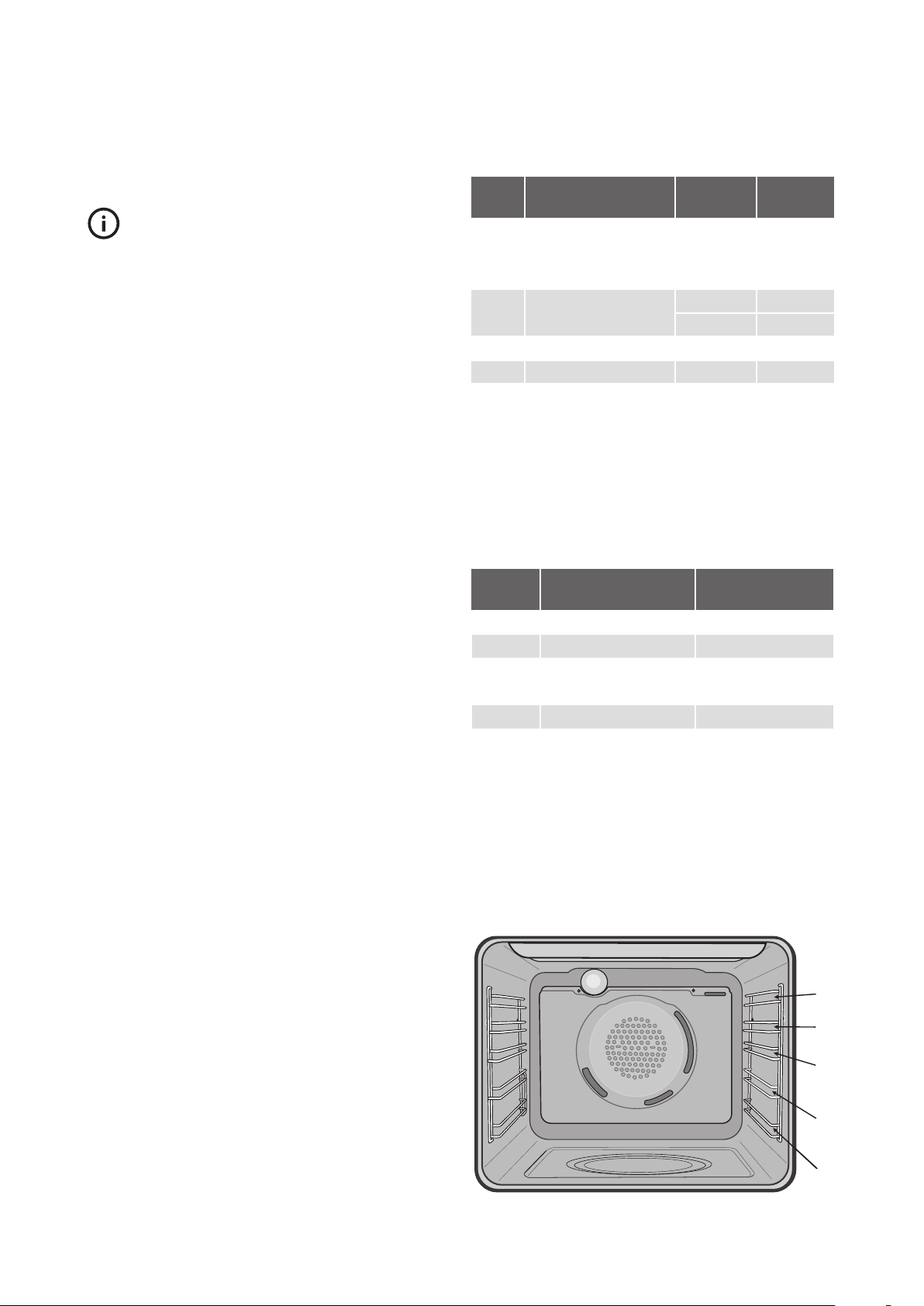
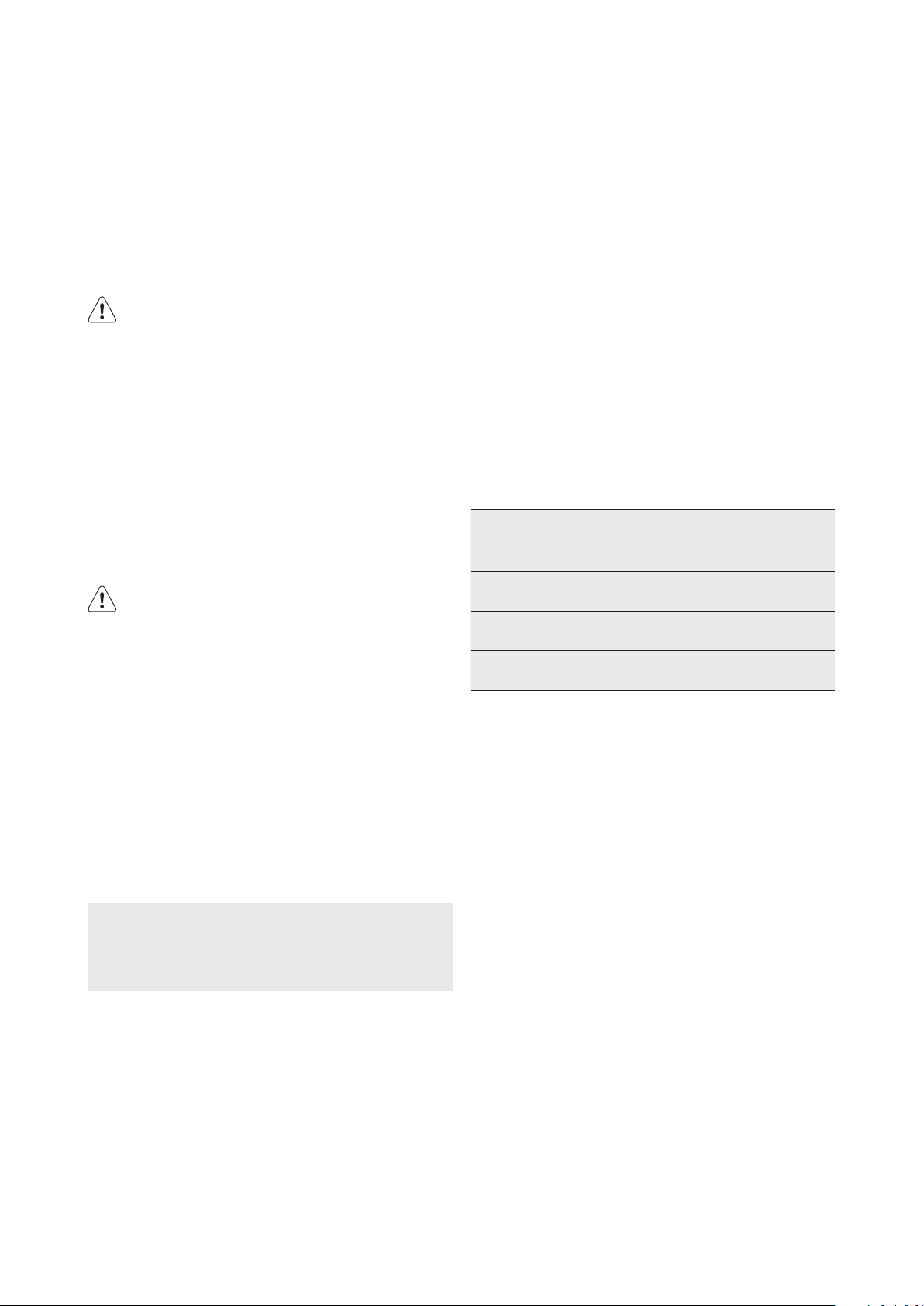
Oven shelf location
The oven has 5 positions for shelves (as shown in the
diagram below). To give maximum space above and
below the shelves, load them in this way:
When cooking with 1 shelf, position at 1 or 2.
When cooking with 2 shelves, position them at 2 and 4.
For more detailed shelf locations. Refer to cooking tables
for individual cooking functions.
1
2
3
5
4
22
PYROLYTIC CLEANING
Pyrolytic cleaning of the oven cavity
The oven has the Pyrolytic self-cleaning function, it
cleans by burning o the spatters and accumulated dirt
and grease from the oven liner, at high temperature. This
process produces ash which can then be wiped out of
the oven cavity.
WARNING
During the Pyrolytic cleaning process the
oven becomes extremely hot
• Please keep small children at a safe distance.
• Never clean non-stick baking trays and tins in the
oven during the pyrolytic cycle. High temperatures
damage the non-stick coating and poisonous gas is
released.
• Do not put water into the water tank during the
cleaning procedure.
• To prevent damage, do not use acids, sprays or
similar cleaning agents.
CAUTION
During pyrolytic cleaning the air outlet
exhaust above the door must be kept clear of
any obstruction (eg. bulky tea towels).
Do not use your oven to clean miscellaneous
items (eg. cookware).
If you have a steam oven, do not cause the
water tank to overflow during the cleaning
cycle. This could damage the enamel.
Before carrying out the Pyrolytic function
• All accessories must be removed from the oven,
including shelves, trays and side racks.
Pyro proof models are designed for side
racks and slides to remain during pyrolytic
cycle but shelves and dishes must be
removed.
• Clean large deposits, spills or grease from the oven
cavity.
• If you have a steam oven ensure the water tank is
empty.
• Pyrolytic cleaning can release fumes that are not
harmful to humans, including infants or persons
with medical conditions, however you are strongly
advised to provide good ventilation during and after
each pyrolytic cleaning process.
• Unlike humans, some birds and reptiles can be
extremely sensitive to the potential fumes emitted
during the pyrolytic cleaning process. It is strongly
advised to remove any pets (especially birds) from
the vicinity of the appliance during and after each
pyrolytic cleaning process.
• Small pets can also be highly sensitive to the
localized temperature changes in the vicinity of all
pyrolytic ovens when the pyrolytic self cleaning
program is in operation.
• Pyrolytic cleaning will not remove salt and
mineral residue left in the cavity well when water
evaporates. It is recommended that the residue
is cleaned prior to conducting pyrolytic cleaning
cycles. See section ‘Cleaning the cavity well’.
Choose your Pyrolytic cleaning cycle from the
following:
Submenu Application
Quick Duration: 1 hour 30 minutes
Normal Duration: 2 hours
Intense Duration: 2 hours 30 minutes
NOTE: Duration includes heat-up time, excludes
cool-down time.
Light clean
This is an energy saving cycle that can be used on a
regular basis if the oven is lightly soiled. Possibly after
every 2nd or 3rd roast.
Medium clean
Use this as the regular cycle about once every 2-3
months.
Heavy clean
When the oven is very dirty it may need a longer cycle to
clean it thoroughly. This cycle will clean the dirtiest of ovens.
Menu > Cleaning > Pyrolytic cleaning > Select cycle from
sub menu.
PYROLYTIC CLEANING
23
S
TEAM ASSISTED COOKING
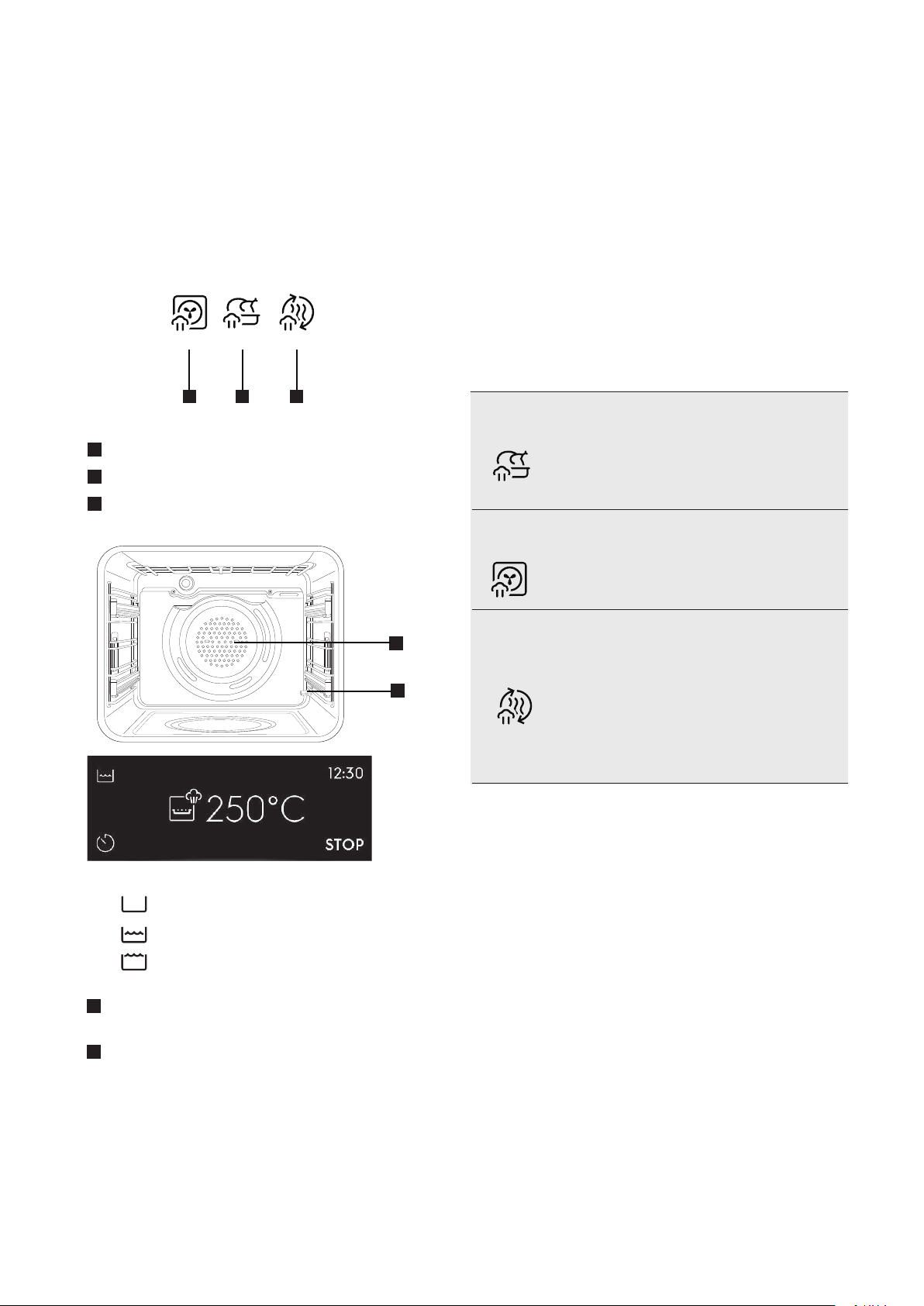
Steam product description
STEAM ASSIST
1 2 3
1
2
3
1
2
Water tank Level Indicator
– Tank empty.
– Water present.
– Tank full. Overfill alarm will sound.
Press ‘OK’ to continue.
1
Steam outlet. This is where steam is injected into
the oven, which is behind the fan cover.
2
Water overflow pipe / drain pipe. If the water tank
is over filled, water will be dispensed into the oven
from here. This is not a fault with the appliance.
It prevents water spilling out of the water drawer
which could create a hazard. If this occurs mop up
the overflow with a clean cloth and continue
with the cooking function.
STEAM ASSISTED COOKING
Cooking function steam assist
Steam comes from the outlet pipe and heat comes from
the element surrounding the fan. This fan circulates the
hot air and steam around the oven cavity so that you
can put your food in dierent places in the oven. This
combination of steam and hot air together cooks food
with a tender interior and crisp exterior. Browning of
meat or fish will be perfect with the best cooking result
at the core. The shape will be always be preserved and
evenly firm. Vegetables will benefit with a high retention
of nutrients.
Roast + Steam
The function is suitable for meat, poultry,
oven dishes and casseroles. Thanks to the
combination of steam and heat, meat gets a
tender and juicy texture along with a crusty
surface.
Use this function to prepare bread and
bread rolls with a very good professional-
like result in terms of crispiness, colour and
crust gloss.
Steam Reheat
Food reheating with steam prevents surface
drying.
Heat is distributed in a gentle and even way,
which allows to recover taste and aroma of
food as just prepared. This function can be
used to reheat food directly on a plate. You
can regenerate more than one plate at the
same time, using dierent shelf positions.
Easy Bake
+ Steam
Easy Bake + Steam
Roast + Steam
Steam Reheat
24 STEAM ASSISTED COOKING
Steam COOKING operation
The water drawer cover is in the control panel.
WARNING
Use only cold tap water. Do not use filtered (de-
mineralised) or distilled water. Do not use other liquids.
Do not put flammable or alcoholic liquids into the water
drawer.
WARNING
The steam is not visible inside the oven but it is there.
Opening the oven door to place, remove or inspect food
will release it. Stand back when opening the door to
avoid the risk of burns.
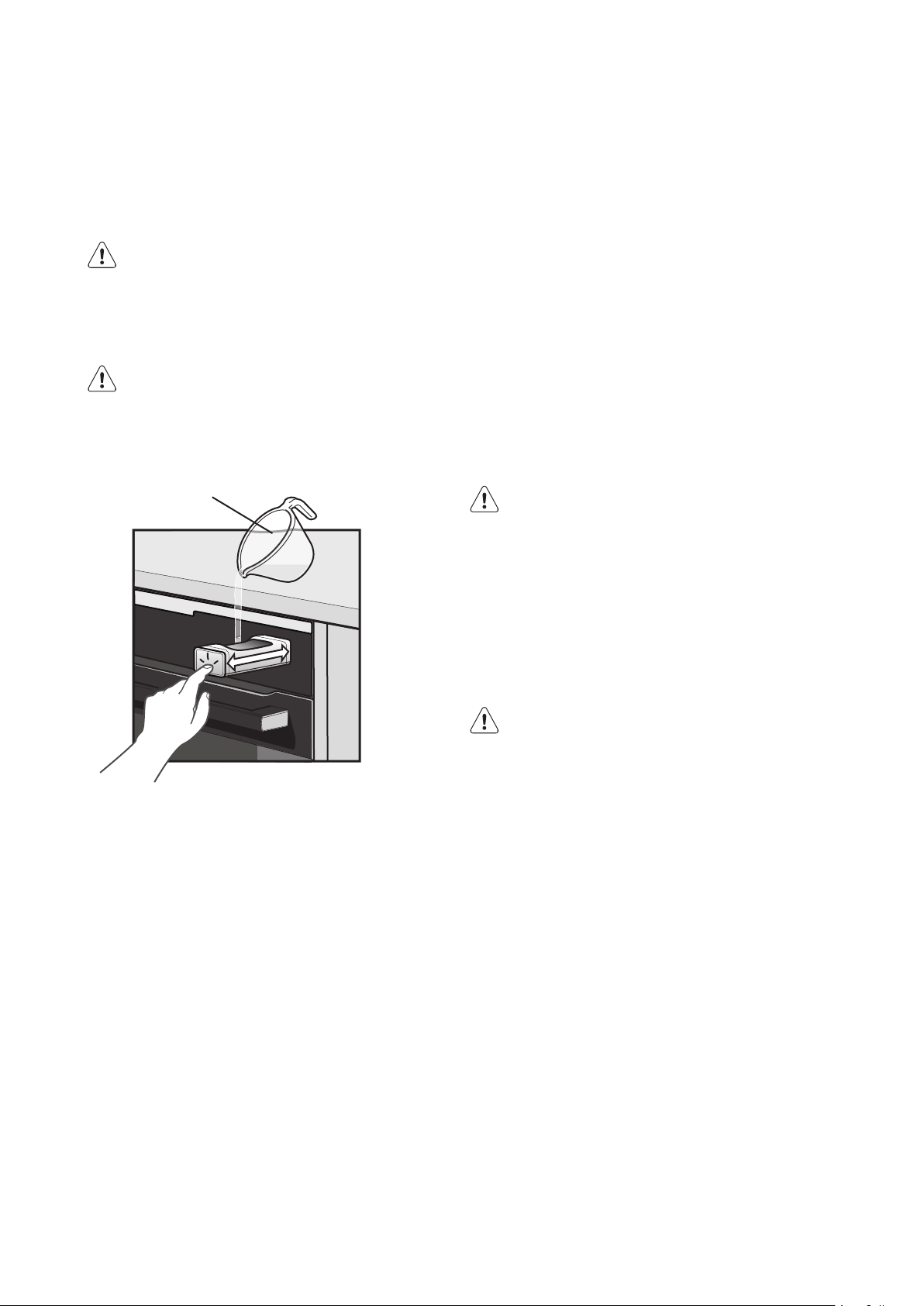
Use measuring
jug
1. Press the cover of the water drawer to open it.
2. Fill the water drawer with cold water to the maximum
level (around 950ml) until the signal sounds or the
display shows the message. Do not fill the water
drawer over its maximum capacity. If the tank is
overfilled, the excess will flow in to the oven. This
prevents leakage onto cabinets and is not a fault.
Sponge up overflows if they occur.
3. Push the water drawer to its initial position.
4. Turn on the appliance.
5. Select steam heating function from STEAM ASSIST
sub menu and set the temperature.
6. If necessary, set the function: Duration or: End Time
The steam appears after approximately 2 minutes.
When the appliance reaches the set temperature, the
signal sounds. When the water drawer is running out of
water, the signal sounds and the water drawer needs to
be refilled to continue the steam cooking as described
above.
The signal sounds at the end of the cooking time.
7
. Turn o the appliance.
8. Empty the water tank after the steam cooking is
c
omple
ted.
steam maintenance
Go to Menu / Steam Maintenance / Tank emptying.
CAUTION
The appliance is hot. There is a risk of burns.
9. After Steam Cooking steam can condensate on the
bottom of the cavity. Always dry the bottom of the
cavity when the appliance is cool.
Let the appliance dry fully with the door open. To
speed up the drying you can close the door and heat
up the appliance with function: Fan Forced at
temperature 150° C for approximately 15 minutes.
WARNING
Water in the tank can still be hot. Wait until
the appliance is cool before the water tank is
drained.
Do not use the drained water to fill the water
tank again.
Every dish in this submenu has a proposed function and
temperature.
Those parameters can be adjusted manually according to
the user’s preference.
For some of the dishes You can also choose way of
cooking:
• Manual
The level to which a dish is cooked:
• Rare
• Medium
• Well Done
Note: to obtain a perfect result when you cook
something from frozen with your AirFry tray, insert a
timer after the oven reached temperature and the tray
is inserted. To verify which timer setting is optimal
STEAM ASSISTED COOKING (CONTINUED)

25
ST
E
AM ASSISTED COOKING
for the recipe, consult the dedicated table in the
paragraphs below.steam service functions
Menu > Cleaning > Steam maintenance
Submenu
Application
Descaling
Procedure for cleaning the
steam generation circuit from
residual limestone.
Rinsing
Procedure for rinsing and
cleaning the steam generation
circuit after frequent use of
the steam functions.
Tank emptying
Procedure for removing the
residual water from the water
drawer after use of the steam
functions.
Descaling Function
Before you start:
• Turn o the oven and wait until it is cold
• Empty the water drawer (use tank empty function)
Duration of the first part: around 100 minutes
1. Select Menu/Cleaning/Descaling
2. Place the deep pan on the oven base
3. Fill the drawer with 250ml of descaling agent
4. Fill the remaining part with 700 ml of water, until
signal sound or display shows the message
5. Launch the function
6. After the first part is over, empty the deep pan and
put it back on the oven base
Duration of the second part: approx 35min
7. Fill the remaining part of the water drawer with water
to the maximum level until the signal sounds or the
display shows a message.
8. When the function ends, remove the deep pan.
When this function works, the light is o.
When descaling ends:
• Turn o the oven.
• When the oven is cold, dry the cavity with a soft
cloth.
• Leave the oven door open and wait until the cavity
is dry.
if the procedure is not completed correctly, the display
prompts to repeat the procedure.
Descaling reminder
There are two reminders which prompt you to descale the
oven. You cannot disable the descaling reminder.
Type
Description
Soft reminder
Recommends you descale the
oven
Hard reminder
Obligates you to descale the oven.
If you do not descale the oven
when the hard reminder is on, the
steam functions are disabled.
Rinsing
Before you start:
• Turn o the oven and wait until it is cold
1. Place the deep pan on the base of the oven.
2. Fill the water drawer with water to the maximum
level until the signal sounds or the display shows a
message.
3. Select: Menu / Cleaning / Rinsing.
Duration: approx 30 min
4. Turn on the function and follow the instruction on the
display.
5. When the function ends, remove the deep pan.
When this function works, the lamp is o.
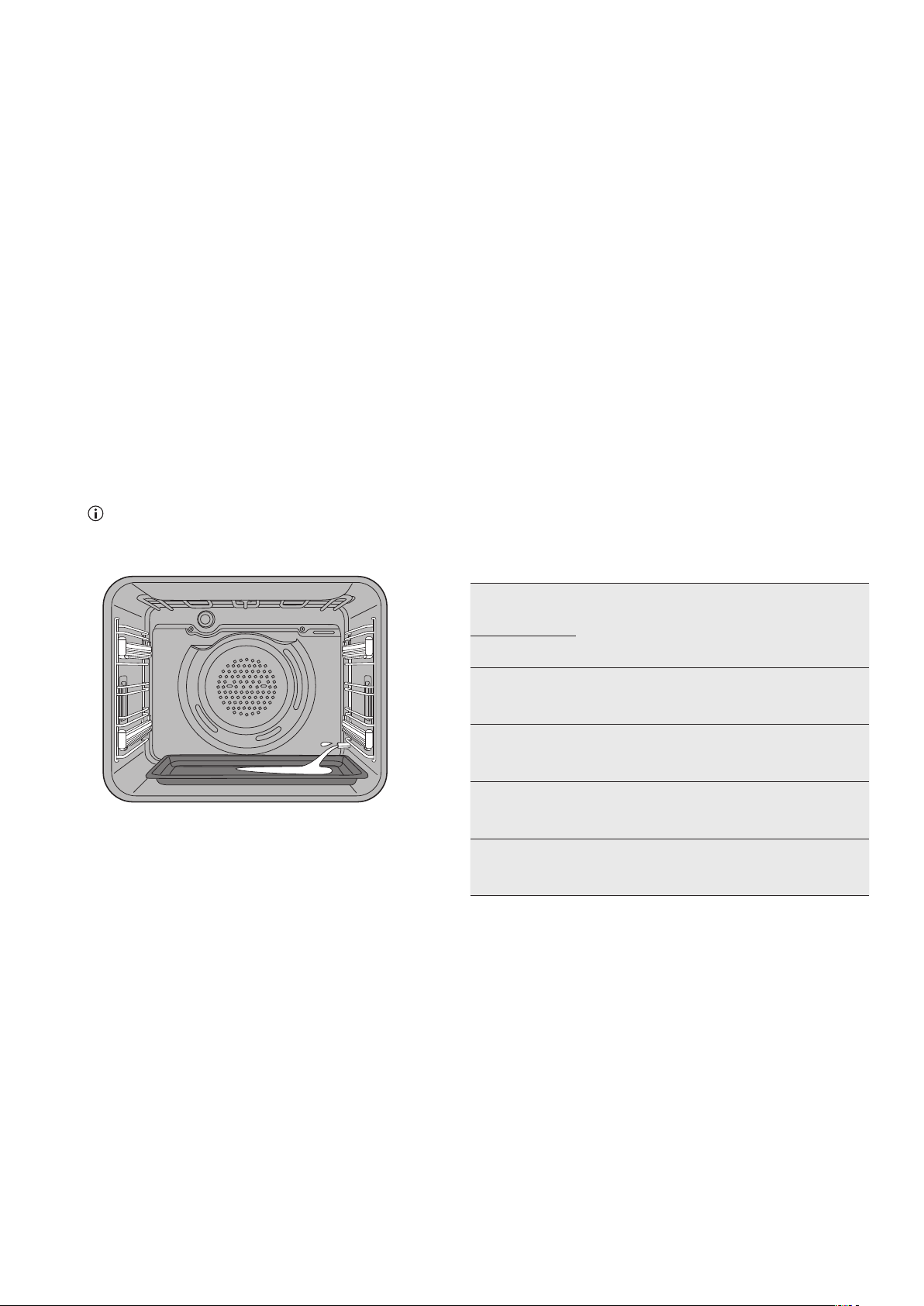
26
STEAM ASSISTED COOKING
Tank Emptying
Use this function after cooking with a steam heating
function to remove the residual water from the water
drawer.
Before you start:
• Turn o the oven and wait until it is cold
1.Place the deep pan on the base of the oven.
2.Select: Menu / Steam maintenance / Tank emptying.
Duration: 6 minutes
3.Turn on the function and follow the instruction on the
display.
4.When the function ends, remove the deep pan.
When this function works, the lamp is o.
Always remove tray for normal cooking or enamel
damage may occur.
Any residual water on the cavity should be cleaned o
with a dry cloth to avoid staining of the enamel. If there is
a stain on the cavity, it can be removed by placing paper
towel soaked in vinegar solution on the stain. (Equal parts
of water/white vinegar solution).
Water hardness
How to set water hardness:
When the oven is first turned ON, the water hardness
level needs to be set. The default value in your
controller is 4. To lower or increase your water
hardness value, follow below procedure.
1. Go to menu.
2. Press: Settings
3. Press: Set up
4. Select water hardness value using the table below
as a guide.
Contact your water supplier to check the water
hardness level in your area if you are unsure.
The table below shows water hardness range (dH)
with the corresponding level of calcium deposit and
the water classification. Adjust the water hardness
level according to the table.
Water
hardness
Calcium
deposit
(mmol/l)
Calcium
deposit
(mg/l)
Water
classification
Level
dH
1
0-7 0-1.3 0-50 soft
2
8-14 1.4-2.5 51-100
moderately
hard
3 15-21 2.6-3.8 101-150 hard
4 ≥22 ≥3.9 ≥151 very hard
When the tap water hardness level is 4, fill the water
drawer with still bottled water.
STEAM ASSISTED COOKING (CONTINUED)

27
COOKING GUIDE
COOKING GUIDE
Recipe
Function
Shelf
position
Temp
(C)
Preheat
Cooking
time (min
excluding
preheat)
Size/
portion
Accessory
Chicken
nuggets
AirFry
3 220 Y 15-25 600g
AirFry
Tray
Croquettes
AirFry
3 220 Y 15-25 450g
AirFry
Tray
Crumbed fish
AirFry
3 220 Y 15-25 6pcs
AirFry
Tray
Chicken
schnitzel
AirFry
3 230 Y 15-20 6pcs
AirFry
Tray
French fries
AirFry
3 220 Y 25-30 1kg
AirFry
Tray
Frozen
croissant
AirFry
2 170 Y 30-40 6
Grid and
baking paper
Bread
Reheating 2 130 N 20-25 700g
AirFry
Tray
Focaccia
Reheating 2 130 N 20-25 3-4 portions Tray
Casserole Reheating 2 130 N 20-30 2-3 portions
Round glass
pyrex
Side dishes Reheating 2 130 N 15-20 2-3 portions Plate
Fish Reheating 2 130 N 15-25
Fillet or
whole
Round glass
pyrex
Meat Reheating 2 140 Y 20-25
Chicken,
pork, beef
Round glass
pyrex
Whole
Chicken
Roast
+Steam
2 230 N 55-65 1.2 kg Grid/tray
Spare ribs
Roast
+ Steam
2 130 N
10 mins grill
at 230°C
2 racks Grid/tray
Whole fish
Roast
+ Steam
2 180-190 N 25-30
2 fish, 700g
each
Tray
Potato gratin
Roast
+ Steam
2 160 N 60-80 1
Pyrex glass
round 21cm
Lasagna
Roast
+ Steam
2 180 N 45-60 1
Pyrex squared
35 x 24 x 6cm
White bread
Easy Bake
+ Steam
2 180 N 50-65 750g Tray
Bread rolls
2 200 N 30-40 9 Tray
Gluten free
bread
2 200 N 50-65 1 Tin cake mould
Apple pie
2 160 N 90-110 1 Round tin 21cm
Focaccia
2 200-210 N 25-35 1 Tray
Biscuits
2 160-170 N 20-40 20 Tray
*count shelf from the bottom up
Easy Bake
+ Steam
Easy Bake
+ Steam
Easy Bake
+ Steam
Easy Bake
+ Steam
Easy Bake
+ Steam

28
DEALING WITH COOKING PROBLEMS
DEALING WITH COOKING PROBLEMS
PROBLEM CAUSES REMEDY
Uneven cooking • Incorrect shelf position • Select shelf suitable for cooking function. See
cooking function tables in cooking guide
• Oven tray too large • Experiment with other trays or dishes
• Trays not centralised • Centre trays
• Air flow in oven uneven • Rotate food during cooking
• Grill dish affecting thermostat • Remove grill dish from oven on bake modes
Baked products too
brown on top
• Oven not preheated • Preheat oven
• Baking tins too large for the recipe • Use correct size tins
• Baking tins not evenly spaced • Stagger baking tins at least 3cm between tins and
oven walls
• Products not evenly sized or
spaced on trays
• Make into same size and shape, and spread evenly
over trays
• Baking temperature too high • Lower the temperature
Baked products too
brown on bottom
• Baking tins too large for the recipe • Use correct size tins
• Baking tins are a dark metal or glass • Change to shiny, light tins or lower the temp
by 10°C
• Food too low in the oven • Cook one shelf higher
• Oven door opened too frequently
during baking
• Don’t open the door until at least half the cooking
time has passed
• Baking temperature too high • Lower the temperature
• Grill dish affecting thermostat • Remove grill dish from oven on bake modes
Cakes have a
cracked thin crust
• Baking temperature too high • Lower the temperature
• Food too high in oven • Cook one shelf lower
• Cake batter over mixed • Mix just long enough to combine ingredients
• Pan too deep • Check size of pan
• Baking pans dark • Change to shiny pans
Baked products are
pale, flat and
undercooked
• Baking temperature too low • Raise the temperature
• Food too low in oven • Cook one shelf higher
• Baking time too short • Increase the cooking time
• Incorrect size tin • Use the correct size tin
Cakes fallen in the
centre
• Baking temperature too low • Raise the temperature
• Baking time too short • Increase the cooking time
• Proportions of ingredients incorrect • Check recipe
• Door opened too early in baking • Do not open door until the last quarter of
cooking time
Roast meat,
potatoes not
browning in fan oven
• Poor air circulation • Elevate food onto a rack to allow air circulation
• Grill dish affecting thermostat • Remove grill dish from oven on bake modes
• Juices running out of meat • Do not pierce meat with a fork
Grilled meats
outside is
overcooked and
centre is raw
• Grill at lower insert position
Grilled chops and
st
eaks curling
• Cut into fat every 2cm
The st
eam cooking
does not operate
• There is no water in the tank • Fill the water tank
• Limescale is obstructing the hole • Check the steam outlet opening and remove
the lime
It takes more than
three minutes to
empty the water
tank or the water
tank leaks from the
steam outlet
• There are lime deposits in the
appliance
• Check the water tank and refer to the chapter on
Cleaning the water tank
Steam and
condensation settle
on the food and in
the appliance
• The dish has been left in the oven
for too long
• Do not keep the dishes in the appliance for longer
than 15-20 minutes after the cooking ends

29
GETTING TO KNOW THE OVEN
GETTING TO KNOW THE OVEN
Get to know the oven with this ‘Simple Test Cake’
Although we strive for a perfect performing oven, it’s
possible that there will be some variation in colour
when baking. Therefore, we suggest this simple, easy
and delicious to make Simple Test Cake, it can help you
understand your new oven. All ovens do sometimes have
hot or cold spots, therefore it is important to judge with
your eye as you may require to rotate during baking.
‘Simple Test Cake’
125g butter, softened to room temperature
1 cup caster sugar
1 teaspoon pure vanilla essence
4 large eggs
2 cups self-raising flour
pinch of salt
4 tablespoons (80mL) full-cream milk
Method:
Butter base and sides of 2, 20cm straight-sided round or
square cake pans. Then line the base with grease proof or
baking paper.
Preheat oven to moderate ‘180
o
C’ (170
o
C fan forced) and
ensure oven shelf is in the centre position of oven.
Cream softened butter and sugar until light in colour.
Add vanilla essence.
Then add eggs one at a time, beating well after
each addition.
Sift flour and salt into the mixture and beat until well
combined.
Add milk and beat or stir to combine.
Spoon mixture equally between prepared cake pans.
Bake in preheated oven, middle shelf for about 25 to 35
minutes or until when tested with a fine cake skewer it
comes out clean or the edges of the cakes have come
away slightly from the sides of the cake pans.
Remove from oven to wire cake rack and rest for 5
minutes before removing from cake pans.
Cool completely.
To Serve: sandwich together with your favourite jam or
conserve, and dust top with pure icing sugar.
NOTE: If desired substitute butter for either margarine or
olive oil spread. Recipe is based on the Australian
standard metric 250mL cup and 20mL tablespoon sets.
30
WARNING
Ensure the oven is electrically isolated before cleaning.
This can be done by switching off the appliance via
the powerpoint or isolating switch (if available), or the
switchboard.
Do not use steam cleaners, as this may cause moisture
build up.
CAUTION
Do not use sharp metal implements or utensils on any
surface, as these may leave permanent scratches or
marks.
Enamel
Rub persistent stains vigorously with a nylon scourer or
creamed powder cleansers.
NOTE: You can also use household oven enamel cleaners -
follow the manufacturer’s instructions carefully.
CAUTION
Do not use harsh abrasive cleaners, powder cleaners,
steel wool or wax polishes on enamel.
Do not line the bottom of the oven or grill with foil
or cookware.
Stainless steel
All grades of stainless steel can stain, discolour or become
greasy. You must clean these areas regularly by following
the procedures below, if you want your appliance to look
its best, perform well and have a long life.
WARNING
Care must be taken when wiping exposed stainless steel
edges.…they can be sharp!
CAUTION
The oven door and control panel are decorated with a
special stainless steel that resists finger marks and should
only be cleaned with warm water and a mild detergent.
DO NOT use stainless steel cleaners, abrasive cleaners or
harsh solvents.
NOTE: Make sure you follow the polish or brushing lines in
the steel.
Glass
Glass surfaces on doors and control panels are best
cleaned immediately after soiling. A damp cloth may help
remove baked on food deposits. Oven cleaners can be
used to remove stubborn marks and stains.
CARE AND CLEANING
CARE AND CLEANING
WARNING
The door glass on this appliance is made from a tough,
durable material that withstands heating and cooling
without breaking. As a precaution however, do not put
cold water on hot glass. Should you have any questions
about the glass in your new appliance, please contact the
customer care centre by dialling 1300 363 640.
Door glass that is damaged should be immediately
replaced.
CAUTION
Do not use harsh abrasive cleaners or sharp metal
scrapers to clean the oven door glass since they can
scratch the surface, which may result in shattering of
the glass.
Oven
WARNING
Always keep your appliance clean. Ensure that fats and
oils do not accumulate around elements, burners or fans.
Keep the oven dish, baking trays, grill dish and grill dish
insert clean, as any fat deposits may catch fire. Wrap
your meats in foil or an oven roasting bag to minimise
cleaning. Any polyunsaturated fats can leave a varnish-
like residue which is very difficult to remove. The upper
element can be released to assist in cleaning.
Cleaning your oven accessories
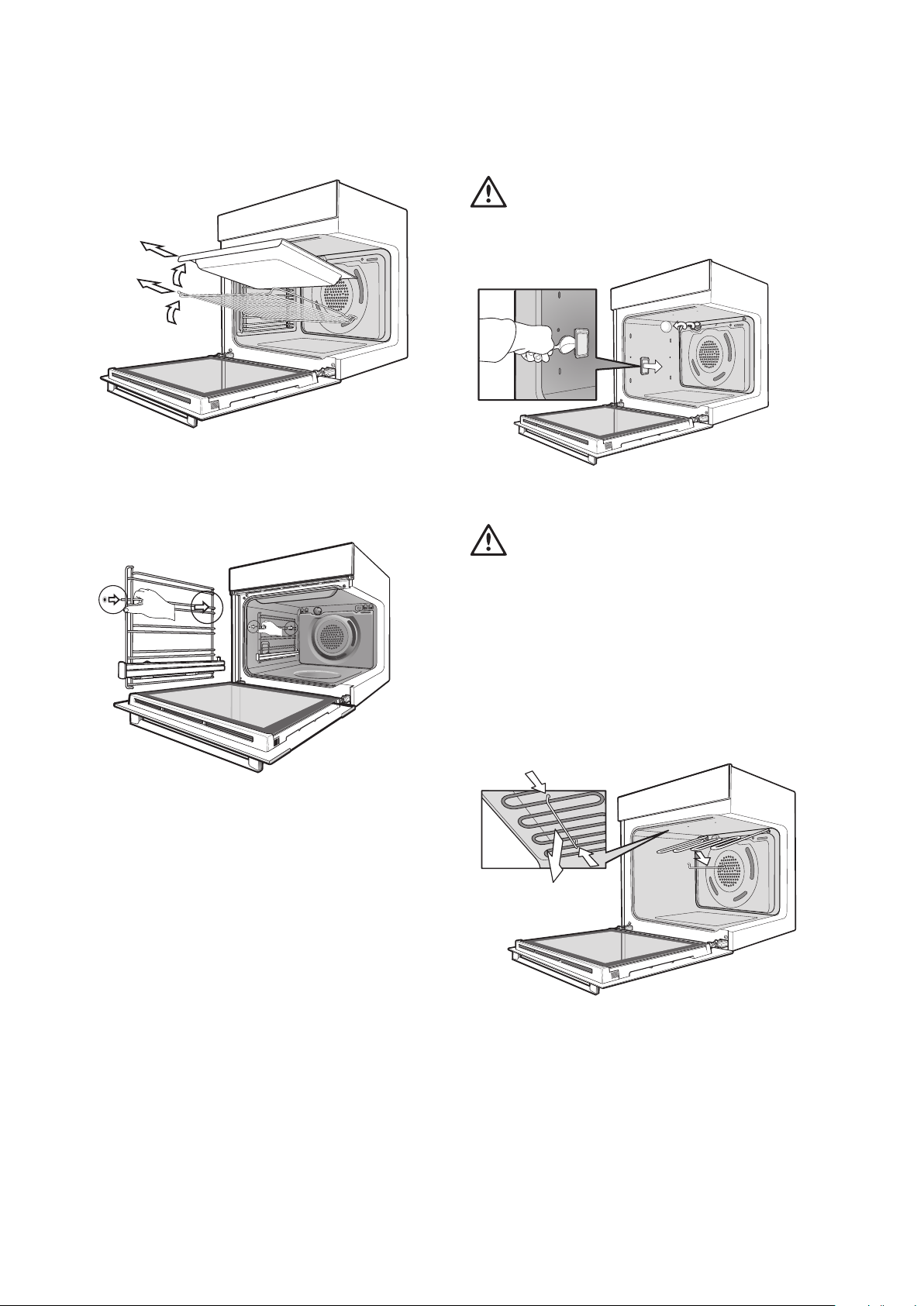
Removing the trays and shelves from your appliance
• Slide the dish and shelves towards you until they
reach the front stop.
• Tilt them up at the front to clear the side supports,
taking care not to spill the contents.
• Lift the dish and shelves clear.
• Wash the dish, insert and shelves in hot soapy water.
• Reverse the above steps to put the grill tray and
shelves back again.
• Ensure that they are placed between the 2 support
wires.
31
CARE AND CLEANING
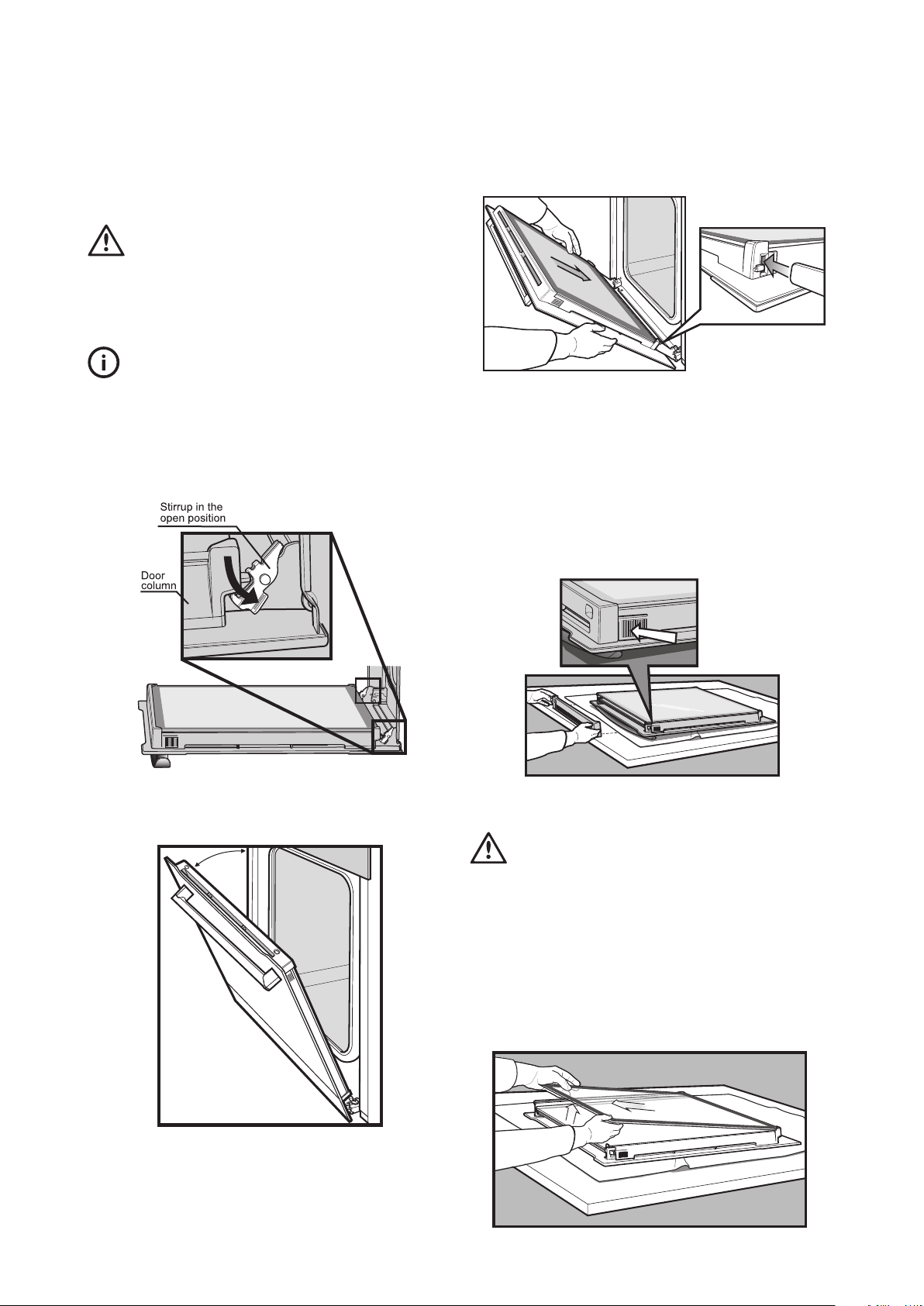
Removing the side racks
1. Grasp the middle wire at the front.
2. Pull firmly inwards while pushing back.
Slides (Telescopic runners)
(For applicable models only)
• Do not subject slides to temperatures greater
than 300°C.
• Do not place slides in a dishwasher
• Do not use a knife or sharp object to clean slides.
• Do not add oil or any other lubricant to slides.
Removing and replacing the oven back light and
side light (where fitted)
• Turn oven light glass anticlockwise to remove it for
globe replacement.
• To remove side light, place a spoon under the light
glass and lever off. Replace globe and snap glass
cover back into position.
• A special high temperature resistant globe should
be used. This can be purchased from Electrolux
Customer Care Centre.
NOTE: :Light globes are not covered by warranty
WARNING
Make sure the appliance is turned off before you remove
or replace parts, to avoid the possibility of electric shock.
Releasing the grill element
WARNING
Make sure the appliance is turned off before you remove
or replace parts, to avoid the possibility of electric shock.
Retaining wire models - The upper grill element is secured
with a hanger clip which can be removed to help clean
the oven cavity ceiling. To remove the hanging clip push
the sides of the clip in the direction of the arrows. After
cleaning, raise the grill element and secure clip back
into position.
NOTE: Diagram shows a grill in oven model. The
procedure is the same for separate grill models which use
the same hanger clip in the grill compartment.
Rotating latch models - rotate latch 180
degrees and the
grill element will drop down freely. After cleaning, raise
the grill element and secure by rotating the latch back 180
degrees.
32
CARE AND CLEANING
Cleaning the quad glazed oven door
(on selected models)
CAUTION
Do not lift the door by the handle. Rough handling will
cause glass to break.
Removing the oven door
IMPORTANT
Your oven is equipped with a door that can be
disassembled in order to clean all the panes of glass.
Remove the door before cleaning.
• Open the door fully to access the hinges then rotate
the ‘stirrups’ (highlighted in the image) on both
hinges fully to open position.
• Slowly close the oven door until it is stops against the
‘stirrups’ (about 30°).
• Hold the oven door with a hand each side and
remove it from the oven by pulling it towards you.
• Lay the oven door with the outer side facing
downwards on something soft and flat (for example a
blanket on a kitchen table) to prevent scratches.
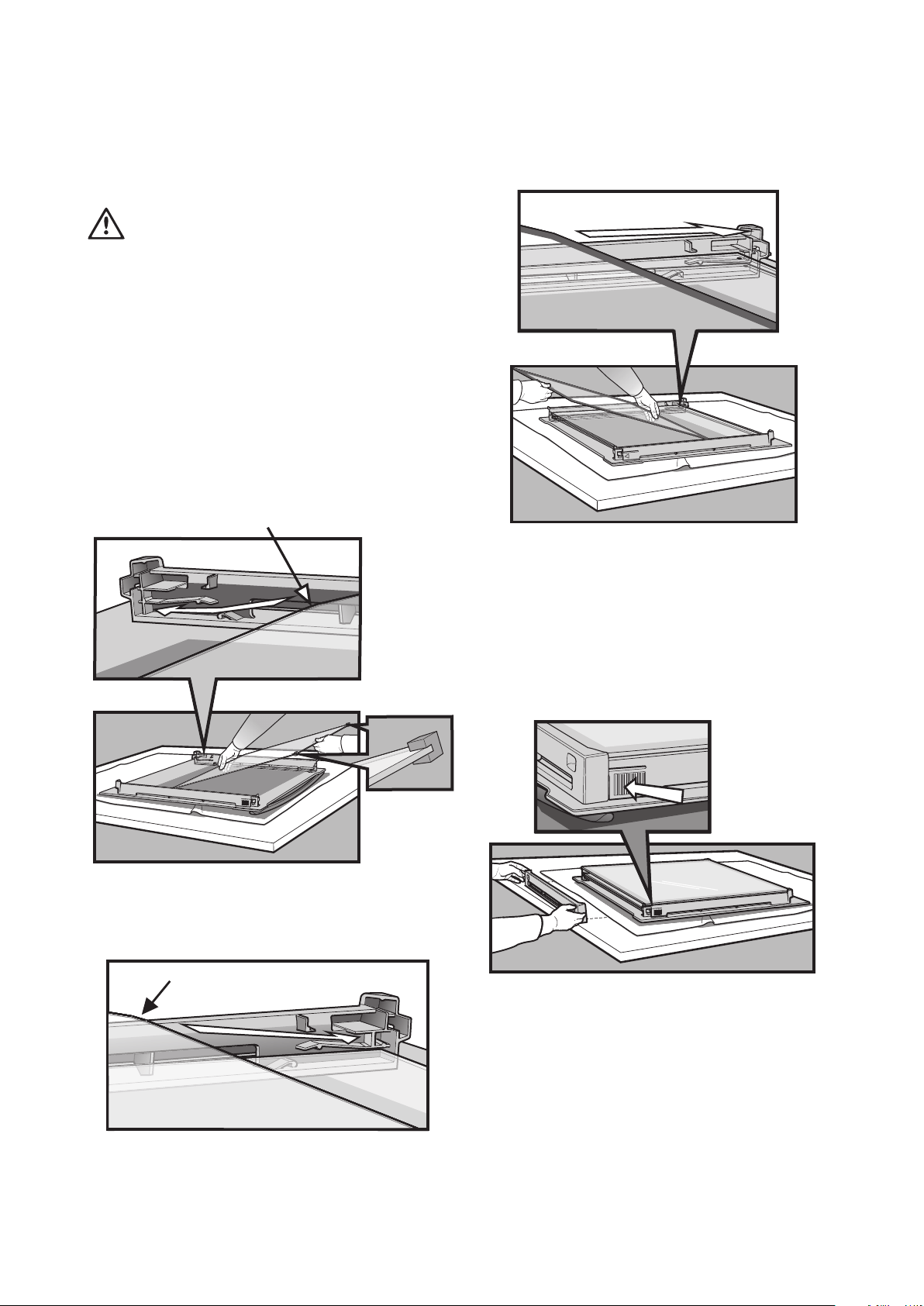
Removing oven door top trim
• Hold the embossed sections of the door columns
at each end and press inwards to release the clips.
Remove the upper door trim by pulling it
towards you.
Removing the door glass panels
CAUTION
Rough handling, especially around the edges can cause
the glass to break.
• Lift the black bordered glass panel out of the
guide and place on something soft and flat to
prevent scratches.
• Repeat this for the smaller clear glass panels.
• When removing panel 3, ensure that the two rubber
spacers are removed before cleaning.
Do not misplace them!
CARE AND CLEANING (CONTINUED)
33
CARE AND CLEANING
Cleaning the door glass panels
CAUTION
Do not use harsh abrasives on the glass panes as the
reflective surface plays a role in the function of the oven.
Do not place glass in dishwasher. Hand wash only with a
soft cloth and warm soapy water. When dry polish with a
soft cloth and ensure the glass is dry before reassembly.
Re-assembling the quad glazed oven door
(on selected models)
Re-assembling the door glass panels
• Assemble the silicone spacers to the upper corners
of one of the clear glass panels. Position the panel
into the lower position of the door, ensuring the
chamfered corner of the panel is placed in the correct
location as shown in the image below.
Chamfer to be located in this corner
Silicone spacers
• Insert the remaining smaller clear glass panel into the
middle position, ensuring the chamfered corner of the
panel is placed in the correct location as shown in the
image below.
Chamfer to be located in this corner
• Insert the black bordered glass panel into the upper
position, ensuring the painted surface is facing the
downside as per the image below.
Replacing the top door trim
• Hold the top door trim at each side and position it to
the inside edge of the glass.
• Push the trim down with its top edge over the glass
panel until the clip snap in on each side of the trim.
• Push the middle of the trim down to ensure it is
straight and firm against the glass panel.
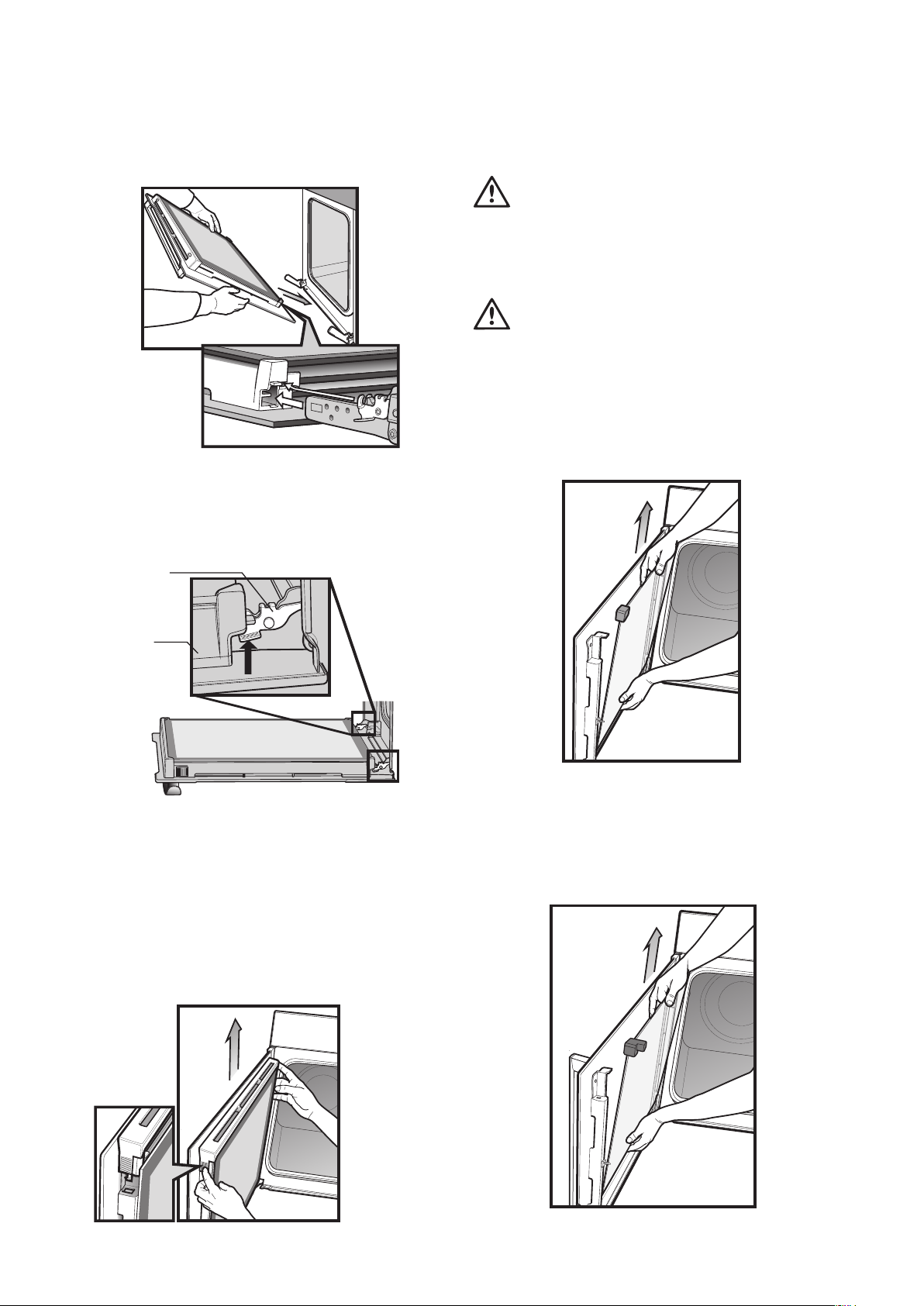
Fitting the oven door
• Take hold of the oven door with a hand on each side
and with the door at an angle of 30˚, position the
recesses at the bottom of the door onto the hinge
arms of the oven. Let the door slide down the hinge
arms as far as it will go.
34
CARE AND CLEANING
• Open the door fully to access the hinges.
• Rotate the ‘stirrups’ (see the image below) until they
lock into the hook. The oven door may now be closed.
stirrup in locked
position
door
column
Cleaning the side open door (on selected models)
Side open door models have been designed to allow for
the inner glass panels to be removed for cleaning.
Removing side open door top trim
Take hold of the grid embossed sections of the door trim
at each end and press inwards to release the clips. Then
remove the door trim by lifting it upwards.
CAUTION
Do not lift the door by the handle. Rough handling will
cause glass to break.
Removing the door glass panels
CAUTION
Rough handling, especially around the edges can cause
the glass to break.
• Take hold of the black bordered glass panel with a
hand on its upper and lower edge. Lift and rotate the
glass around the retainer to remove it from the guide.
• Repeat this for the smaller clear glass panel
(when fitted).
• Take hold of the smaller clear glass panel (when
fitted) with a hand on its upper and lower edge. Lift
the glass to remove it from the retainer.
• The rubber moulding on the upper corner of the
small clear glass panel may be removed. Please take
care that it is not misplaced.
CARE AND CLEANING (CONTINUED)
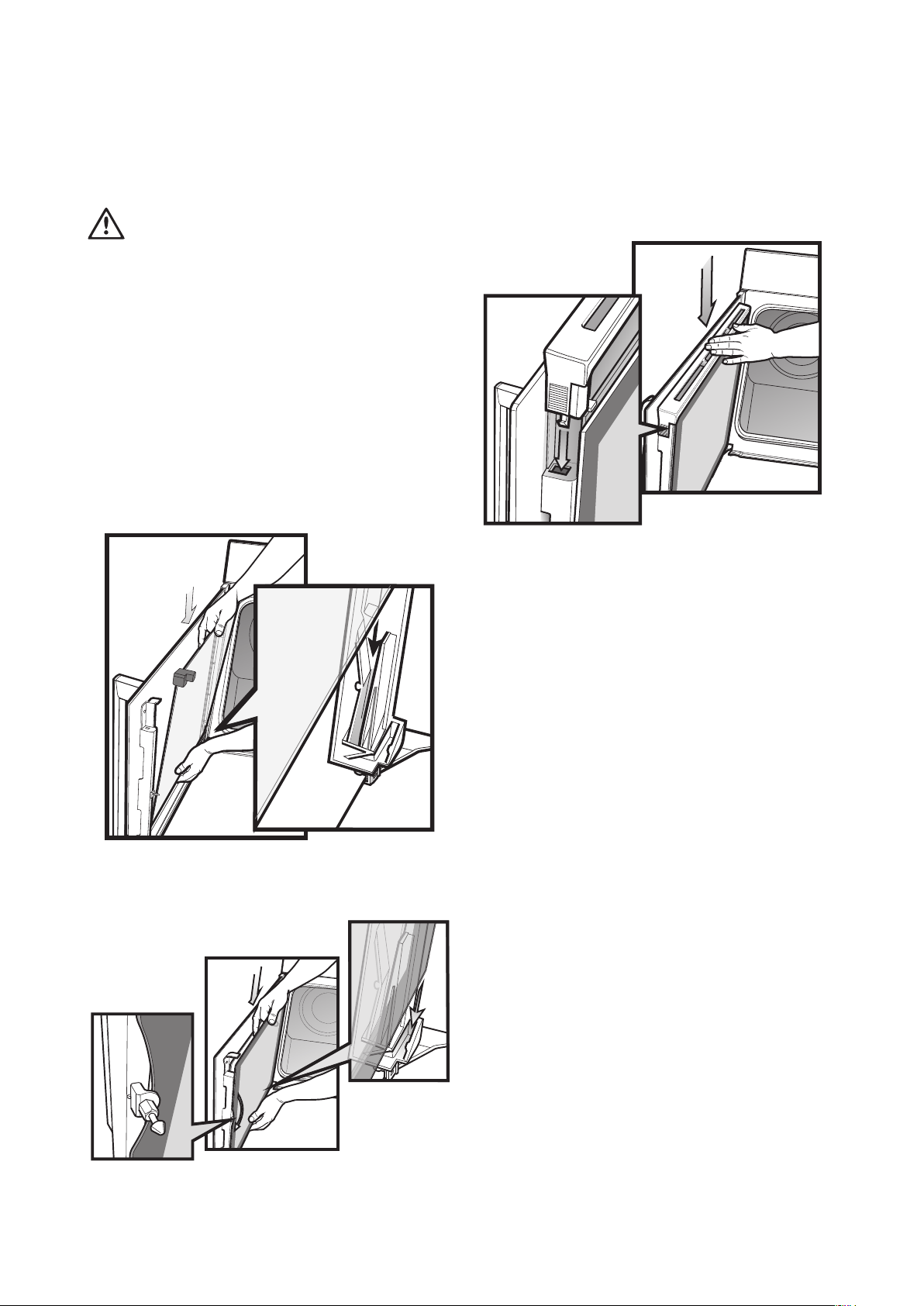
35
CARE AND CLEANING
Cleaning the door glass panels
CAUTION
Do not to use harsh abrasives on the glass panes as the
reflective surface plays a role in the function of the oven.
Do not place glass in dishwasher. Hand wash only with a
soft cloth and warm soapy water. When dry polish with a
soft cloth and ensure the glass is dry before reassembly.
Re-assembling the side open oven door
(on selected models)
Re-assembling the door glass panels
• Ensure the rubber moulding is placed in the correct
orientation on one of the upper corner of the smaller
clear glass panel.
• Insert the smaller glass panel (when fitted) first from
above and at an angle to the profile of the door.
• Repeat for the black bordered glass panel ensuring
the painted surface is facing towards the outside of
the door.
Replacing top door trim
• Take hold of the top door trim at each side and
position it to the inside edge of the glass.
• Push the trim down with its top edge over glass panel
until the clip snaps in on each side of the trim.
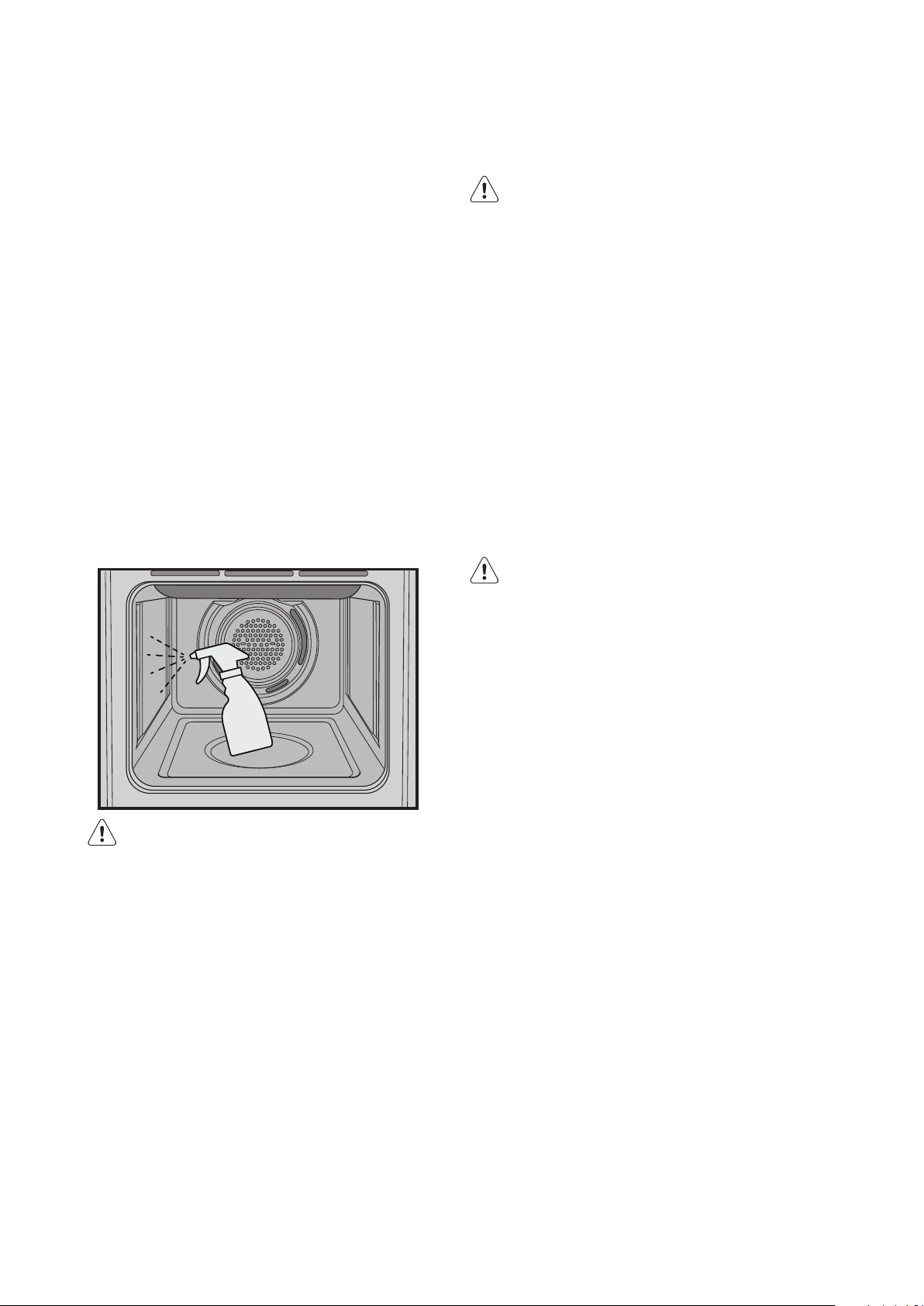
36
This function assists in the removal of food residue
from inside the oven. This method is eective in
removing light soiling only. It is not eective in
removing stubborn baked-on stains. This function
can only be used when the oven is cold.
Procedure for cleaning:
1. Remove all shelves, dishes and side racks.
2. Make a solution of water (85%), white vinegar
(10%), and dishwashing detergent (5%) and
spray liberally on to the door, side walls and
back wall of the oven cavity.
3. Pour 40ml of water into the cavity base well.
4. Select Steam Assist from the Cleaning
submenu
5. Wait until the cleaning procedure is finished.
6. Allow to cool to a safe level before wiping the
surface with a wet cloth.
WARNING
• Do not use steam cleaners.
• Do not line the bottom of the oven with
foil
or cookware.
Stainless steel
All grades of stainless steel can stain, discolour
or become greasy. You must clean these areas
regularly by following the procedures below, if
you want your appliance to look its best, perform
well and have a long life.
Care must be taken when wiping exposed
stainless steel edges, they can be sharp!
A suitable cleaner can be purchased from
Electrolux Customer Care Centres.
CARE AND CLEANING
CAUTION
The oven door and control panel are decorated
with a special stainless steel that resists finger
marks and should only be cleaned with warm
water and a mild detergent.
DO NOT use stainless steel cleaners, abrasive
cleaners or harsh solvents.
NOTE: Make sure you follow the polish or
brushing lines in the steel.
Glass
• Glass surfaces on doors and control panels
are best cleaned immediately after soiling.
• A damp cloth may help remove baked on
food deposits.
• Oven cleaners can be used to remove
stubborn marks and stains.
WARNING
The door glass on this appliance is made from
a tough, durable material that withstands
heating and cooling without breaking.
However, it must be remembered that it is
GLASS, it may break. Treat it accordingly!
Should you have any questions about the
glass in your new appliance, please contact
the customer care centre by dialling 1300 363
640.
Do not use harsh abrasive cleaners or sharp
metal scrapers to clean the oven door since
they can scratch the surface, which may result
in shattering of the glass.
Oven
• Always keep the appliance clean. Ensure fats
and oils do not accumulate around elements,
burners or fans.
• Always keep oven dish, bake trays and grill
dish inserts clean, as any fat deposits may
catch fire.
• It is recommended to wrap meats in foil or an
oven roasting bag to minimise cleaning.
• Any polyunsaturated fats can leave a varnish-
like residue which is very dicult to remove.
Grill
• Always keep grill dish clean, as any fat
deposits may catch fire..
CARE AND CLEANING (CONTINUED)

37
CARE AND CLEANING
Cleaning the cavity well
The cleaning procedure removes limestone
residue from the cavity well after cooking with
steam.
WARNING
Perform the cleaning procedure after every
Steam cooking cycle.
1. Mix 150ml of tap water with 100ml of white
vinegar and put the mix in the cavity well.
2. Let the water+vinegar-mix dissolve
the limestone residue at the ambient
temperature for 45 minutes.
3. Remove the water+vinegar-mix with a soft
cloth and clean the cavity with warm water
and a soft cloth.
38
TIPS AND TROUBLESHOOTING
Before the first use, have you to set:
• Language
• Display brightness
• Key tones
• Buzzer volume
• Water hardness
• Time of day
Start using the oven
Quickstart
Turn on the oven and start cooking with the default
temperature and time of the function.
• Press and hold:
•
– select the preferred function.
• Press
Quick OFF
Turn off the oven, any screen or message at any time.
• Press and hold: until the oven turns off.
Start cooking
1. -press to turn on the oven
2.
– select the heating function
3.
– set the temperature.
4.
– Press to confirm.
5.
– Press to start cooking.
Get to know how to cook quickly
Use the automatic programmes to prepare a dish
quickly with the default settings:
Assisted cooking
1.Press
2.Press
3.Select Assisted Cooking
4. Choose the dish.
IMPORTANT
Cooling/ventilation fan
This appliance is fitted with a cooling fan.
This prevents your kitchen cabinet from
overheating and reduces the condensation
inside the oven. It will operate whenever you
are using the oven and blow warm air across
the top of the oven door.
NOTE: If the oven is still hot from cooking, the
cooling fan will keep running to cool the oven
down and will switch o by itself once cool.
CAUTION
Using the oven
• Always cook with the oven door closed.
• Stand clear when opening the drop down oven door.
Do not allow it to fall open. Always support the door
using the door handle until it is fully open.
• Do not lean on an open oven door, or place heavy
items on it. This could damage the appliance. Take
care in the region of the hinges.
IMPORTANT
Condensation and steam
This appliance is supplied with an exclusive system which
produces a natural circulation of air and the constant
recycling of steam.
This steam makes it possible to cook in a steamy
environment ensuring that dishes are soft inside and
crusty on the outside. This process also reduces cooking
time and energy consumption. During cooking steam may
be produced and released when the door is opened. This
is absolutely normal.
When food is heated it produces steam in the same way a
boiling kettle does. When steam comes into contact with
the oven door glass it will condense and produce water
droplets. To reduce condensation, ensure that the oven is
well heated before placing food in the oven cavity.
Oven pre-heating is necessary before any cooking.
It is recommended that condensation is wiped away after
each use of the oven.
TIPS AND TROUBLESHOOTING

39
TIPS AND TROUBLESHOOTING
The effects of dishes on cooking results
Dishes and tins vary in their thickness, heat conductivity,
colour etc. which aects the way they transfer heat to the
food inside them.
• A
luminium, earthenware, oven glassware and bright
shiny utensils reduce cooking and base browning.
•
Enamelled
c
ast
i
ron, anodized aluminium, aluminium
with non-stick interior and coloured exterior and
dark, heavy utensils increase cooking and base
browning.
• To increase base browning simply lower the shelf
position. To increase top browning, raise the shelf
position.
• Always place dishes centrally on the shelf to ensure
even browning.
• Single level cooking gives best results in conventional
modes that do not use the oven fan. If cooking on
more than one level, use the fan forced function.
• Do not place trays on the base of the oven. This may
damage the enamel.
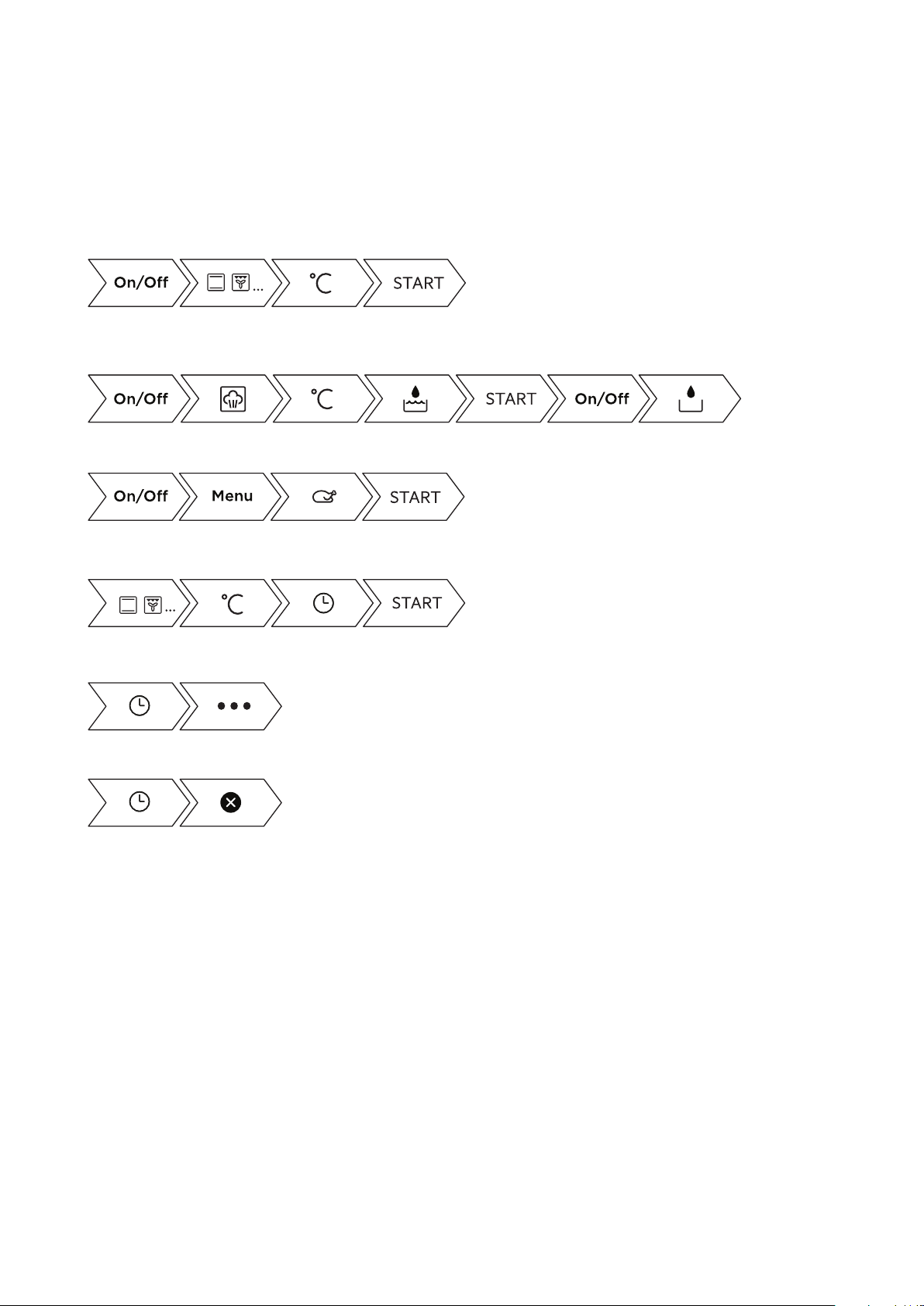
40
SHORTCUTS
Here you can see all the useful shortcuts. You can also
find them in the dedicated chapters in the user manual.
How to set: heating functions
How to set: cooking with a steam heating
function
How to set: assisted cooking
How to set: cooking time
How to delay: start and end of cooking
How to cancel: set timer
SHORTCUTS

41
TOUBLESHOOTING
TROUBLESHOOTING
NOTE: We may charge for service even in the warranty period if your problem is due to the causes listed below.
problem possible cause
Oven or grill not working • Time of day is not set.
• Power is not turned on.
• Controls are incorrectly set .
• Oven is in ‘Demo’ mode, refer to Additional Functionality.
• Household fuse has blown or power supply is o. (If the household fuse
continues to blow, call the Service Centre).
• Child-proof oven lock is activated. ‘LOCKED’ is displayed when control is
touched. (Refer to operating instructions).
Oven light not working • Light may be turned o at control panel.
• Lamp blown or loose socket.
• Household fuse has blown. (If the household fuse continues to blow, call
the
Service Centre).
Oven not heating enough • Foil trays on bottom of oven.
• Timer is in ‘AUTO’ mode. (Refer to operating instructions).
• Household fuse has blown or power supply is o. (If the household fuse
continues to blow, call the Service Centre).
• Oven not pre-heated - pre-heat oven for 30 minutes.
There is warm air coming from the top
of the oven door
• The oven is located under the control panel. When the oven is on, the
air passes through this vent. This venting is necessary for proper air
circulation in the oven and good baking results. Do not block oven vent.
Clock flashing on display • Reset time of day and any cooking functions you were using.
Unit smoking when first used • Protective oils being removed.
Co
ndensation build up
• Reduce the amount of water used in cooking. (Sometimes condensation
is normal).
Door cannot be replaced after removal • Stirrup not engaged properly.
Functions and temperature appear on
display but oven does not work
• Oven is in ‘Demo’ mode, refer to Additional Functionality.
Wh
en the door is open the fan stops
(underbench only)
• This is a function of the power board to help reduce the blast of air when
opening the door.
When a non fan mode is selected the
fan starts
• Most oven modes have a fast heat up function that uses the fan, fan
element and top (boost) elements. Auto fast heat up can be overridden
by selecting a temperature of 120°C or less, allowing the function to start,
then increasing the temperature to the desired level.
The light stays on when the door is
closed
• An oven function has been selected.
• The light has been turned on at the control panel.
T
h
e light does not turn *ON* when the
door is opened
• Oven light may need replacing.

42
TROUBLESHOOTING
Shelf or telescopic runner slides out when door is
opened
• Oven cavity is not level, you can perform a check using a
level to verify this (refer to installation section). If not level
refer to installer.
Door locked (switching o Pyro function quickly) • Go back into Pyro mode and switch o Pyro function
after few seconds for the lock to open completely.
Lime scale residue on base of oven
• Follow the procedure for cleaning the cavity well. There
may be some minor residual marks after cleaning.
Oven seal loose
• The oven seal of non pyrolytic models is only attached
at each corner. It may seem like a loose fit, but when the
oven is closed it will function correctly.
Steam functions
Steam and condensation settle on the food
and in the cavity of the oven
You left the dish in the oven for too long. Do not leave
dishes in the oven for longer than 15-20 minutes after the
cooking process ends.
The descaling procedure is interrupted before
it finishes.
This could have been caused by a power outage. Repeat the
procedure.
The descaling procedure is interrupted before
it finishes.
If the function was stopped by the user, repeat the
procedure.
There is no water inside the grill / roasting pan
after the descaling procedure.
This could be caused by the water drawer not being filled to
the maximum level. Check if the descaling agent / water is
present in the water drawer body. Repeat the procedure.
There is dirty water on the bottom of the cavity after
the descaling cycle.
The grill/roasting pan could have been in the wrong
position. Remove the residual water and the descaling agent
from the bottom of the oven.
Put the grill / roasting pan on the first shelf position.

43WARRANTY
This document sets out the terms and conditions of the product
warranties for Westinghouse Appliances. It is an important
document. Please keep it with your proof of purchase documents
in a safe place for future reference should there be a manufacturing
defect in your Appliance. This warranty is in addition to other rights
you may have under the Australian Consumer Law.
1. In this warranty:
(a) ‘ACL’ or ‘Australian Consumer Law’ means Schedule 2 to the
Competition and Consumer Act 2010;
(b) ‘Appliance’ means any Electrolux product purchased by you and
accompanied by this document;
(c) ‘ASC’ means Electrolux’s authorised serviced centres;
(d) ‘Westinghouse’ is the brand controlled by Electrolux Home Products
Pty Ltd of 163 O’Riordan Street, Mascot NSW 2020, ABN 51 004
762 341 in respect of Appliances purchased in Australia and Electrolux
(NZ) Limited (collectively “Electrolux”) of 3-5 Niall Burgess Road, Mount
Wellington, in respect of Appliances purchased in New Zealand;
(e) ‘WarrantyPeriod’meanstheperiodspeciedinclause3ofthis
warranty;
(f) ‘you’ means the purchaser of the Appliance not having purchased
the Appliance for re-sale, and ‘your’ has a corresponding meaning.
2. Application: This warranty only applies to new Appliances, purchased
and used in Australia or New Zealand and is in addition to (and does not
exclude, restrict, or modify in any way) other rights and remedies under
a law to which the Appliances or services relate, including any non-
excludable statutory guarantees in Australia and New Zealand.
3. Warranty Period: Subject to these terms and conditions, this warranty
continues in Australia for a period of 24 months and in New Zealand
for a period of 24 months, following the date of original purchase of the
Appliance.
4. Repair or replace warranty: During the Warranty Period, Electrolux
or its ASC will, at no extra charge if your Appliance is readily accessible
for service, without special equipment and subject to these terms and
conditions, repair or replace any parts which it considers to be defective.
Electrolux may, in its absolute discretion, choose whether the remedy
oeredforavalidwarrantyclaimisrepairorreplacement.Electroluxorits
ASC may use refurbished parts to repair your Appliance. You agree that
any replaced Appliances or parts become the property of Electrolux.
5. Travel and transportation costs: Subject to clause 7, Electrolux will
bear the reasonable cost of transportation, travel and delivery of the
Appliance to and from Electrolux or its ASC. Travel and transportation will
be arranged by Electrolux as part of any valid warranty claim.
6. Proof of purchase is required before you can make a claim under this
warranty.
7. Exclusions: You may not make a claim under this warranty unless the
defect claimed is due to faulty or defective parts or workmanship. This
warranty does not cover:
(a) lightglobes,batteries,ltersorsimilarperishableparts;
(b) parts and Appliances not supplied by Electrolux;
(c) cosmeticdamagewhichdoesnotaecttheoperationofthe
Appliance;
(d) damage to the Appliance caused by:
(i) negligence or accident;
(ii) misuse or abuse, including failure to properly maintain or service;
(iii) improper, negligent or faulty servicing or repair works done by
anyone other than an Electrolux authorised repairer or ASC;
(iv) normal wear and tear;
(v) power surges, electrical storm damage or incorrect power supply;
(vi) incomplete or improper installation;
(vii) incorrect, improper or inappropriate operation;
(viii) insect or vermin infestation;
(ix) failure to comply with any additional instructions supplied with
the Appliance;
In addition, Electrolux is not liable under this warranty if:
(a) the Appliance has been, or Electrolux reasonably believes that the
Appliance has been, used for purposes other than those for which
the Appliance was intended, including where the Appliance has
been used for any non-domestic purpose;
(b) theApplianceismodiedwithoutauthorityfromElectroluxinwriting;
(c) the Appliance’s serial number or warranty seal has been removed
or defaced
8. How to claim under this warranty: To enquire about claiming under
this warranty, please follow these steps:
(a) carefully check the operating instructions, user manual and the terms
of this warranty;
(b) have the model and serial number of the Appliance available;
(c) have the proof of purchase (e.g. an invoice) available;
(d) telephone the numbers shown below.
9. Australia: For Appliances and services provided by Electrolux in
Australia: Electrolux goods come with guarantees that cannot be
excluded under the Australian Consumer Law. You are entitled to a
replacement or refund for a major failure and for compensation for any
other reasonably foreseeable loss or damage. You are also entitled to
have the Appliance repaired or replaced if the Appliance fails to be of
acceptable quality and the failure does not amount to a major failure.
‘Acceptable quality’ and ‘major failure’ have the same meaning as
referred to in the ACL.
10. New Zealand: For Appliances and services provided by Electrolux
in New Zealand, the Appliances come with a guarantee by Electrolux
pursuant to the provisions of the Consumer Guarantees Act, the Sale
of Goods Act and the Fair Trading Act. Where the Appliance was
purchased in New Zealand for commercial purposes the Consumer
Guarantee Act does not apply.
11.Condentiality: You accept that if you make a warranty claim, Electrolux
and its agents including ASC may exchange information in relation to you
to enable Electrolux to meet its obligations under this warranty.
Warranty
FOR SALES IN AUSTRALIA AND NEW ZEALAND
APPLIANCE: WESTINGHOUSE BUILT-IN OVENS, COOKTOPS AND
FREESTANDING COOKER
WCook_Warr_Jul19
Important Notice
Before calling for service, please ensure that the steps listed in clause 8 above have been followed.
AUSTRALIA
FOR SERVICE
ortondtheaddressofyournearest
authorised service centre in Australia
PLEASE CALL 13 13 49
For the cost of a local call
FOR SPARE PARTS
ortondtheaddressofyournearest
spare parts centre in Australia
PLEASE CALL 13 13 50
For the cost of a local call
NEW ZEALAND
FOR SERVICE
ortondtheaddressofyournearest
authorised service centre in New Zealand
PLEASE CALL 0800 10 66 10
FOR SPARE PARTS
ortondtheaddressofyournearest
spare parts centre in New Zealand
PLEASE CALL 0800 10 66 20

AUSTRALIA
phone: 1300 363 640
fax: 1800 350 067
email: customercare@electrolux.com.au
web: westinghouse.com.au
NEW ZEALAND
phone: 0800 436 245
fax: 0800 225 088
email: customercare@electrolux.co.nz
web: westinghouse.co.nz
For more information on all Westinghouse
appliances, or for dimension and installation
information, call into your retailer, phone or email
our customer care team or visit our website:
and WESTINGHOUSE are trademarks of Westinghouse Electric Corporation. Used under license by Electrolux
Home Products Pty Ltd. All Rights Reserved.
© 2023 Electrolux Home Products Pty Ltd.
ABN 51 004 762 341
WMAN_WVEP6918DD_A26336701_A_Mar2023
AUSTRALIA
phone: 13 13 49
email: customercare@electrolux.com.au
web: westinghouse.com.au
NEW ZEALAND
phone: 0800 10 66 10
email: customercare@electrolux.co.nz
web: westinghouse.co.nz
For more information on all Westinghouse
appliances, or for dimension and installation
information, call into your retailer, phone or email
our customer care team or visit our website: