
CONTENTS
Before You Begin 4
Mandatory Online Activation 5
Setting Up 6
Configuring For Windows 10 8
Configuring For MacOS (10.14 Or Later) 10
Antelope Launcher 12
‘Devices’ Tab 12
'Plug-Ins’ Tab 15
'System’ Tab 16
Front Panel Explained 19
System Menu 21
Control Menu 23
Rear Panel Explained 26
Control Panel 31
Quick Start 32
Mouse & Keyboard Shortcuts 34
Main View 35
Function Strip 1 35
Function Strip 2 36
Settings Button 37
Preamps Strip 39
Input Selectors 40
AFX Strip 41
Output Tabs 42
AuraVerb
43
Discrete 8 Pro Synergy Core User Manual
Page 2

Guitar Amps & Cabs
51
Software Re-Amping
53
Edge & Verge Mic Emulations
54
Getting Started 54
Gain Calibration
55
Edge Solo
56
Edge Duo
58
Edge Quadro 61
Verge 64
afx2daw 66
Advanced User Tips 68
Customer Support Information 69
My Antelope Audio Product Isn't Working 70
Limited Warranty Policy 72
Safety Notes 79
Technical Specifications 80
Discrete 8 Pro Synergy Core User Manual
Page 5
BEFORE
YOU
BEGIN
Congratulations on your purchase! We’d like to draw your attention to the following:
As with all Antelope Audio interfaces, the software Control Panel is the “mediator”
between the Discrete 4 Pro Synergy Core and your preferred DAW. To take complete
advantage of the unit’s capabilities, you are meant to handle tasks like gain adjustments,
signal routing, effects processing, 'rough' mixing and metering from the Control Panel.
The resulting audio is routed into your DAW for recording in formats of your choice, such
as multi-track, stem, and two-channel stereo.
Depending on your experience, you might find this approach different from what you are
used to. Perhaps the most familiar workflow for the modern recordist involves treating
the audio interface like a box which brings audio in and out of your computer, with the
rest of the session taking place in your DAW. To an extent, it is possible to use the
Discrete 4 Pro Synergy Core in this manner by relying on the front panel display and
controls for monitoring, gain control and setup. The DAW is used for recording, mixing
and mastering.
After the initial setup, it is also possible to use Discrete 8 Pro Synergy Core without a
computer connection. In this case, the unit functions as a digital mixer operated from
the front panel controls. The last known signal routing configuration from the software
Control Panel is applied.

Discrete 4 Pro Synergy Core User Manual
Page 6
Regardless of your preference, we encourage you to familiarize yourself with the Control
Panel application. This way, you can overcome potential stumbling blocks for users new
to Antelope Audio products. For example, almost any issue concerning recording and
playing back audio (on the interface’s side) can be resolved with the correct signal
routing.
Should you ever find yourself struggling, do not hesitate to contact our
Customer
Support
team over phone, live chat and our ticket system. You can also visit Antelope
Audio on YouTube
and explore our video tutorials or join the Antelope Audio
Users Facebook group and ask for advice. The Knowledge Base is also a good source of
information.
Best wishes,
Team Antelope
MANDATORY ONLINE ACTIVATION
Please note that the mandatory device activation procedure requires an active Internet
connection on your computer and must be completed on the first run of the interface.
Completion of the process is needed to validate your product warranty and gain access
to special software packages and exclusive product offers.
INSIDE THE BOX
- Discrete 4 Pro Synergy Core
- USB type B to A cable
- Power supply adapter
- Getting Started leaflet

Discrete 4 Pro Synergy Core User Manual
Page 7
SETTING
UP
Once the unit is connected to an AC power source and your computer is switched on:
1. Connect a USB 2.0 Type-B (included) or Thunderbolt™ 3 cable (not included) to the
corresponding ports on the Discrete 4 Pro Synergy Core and your computer.
2. Visit
www.antelopeaudio.com and log-in or create a customer account (if you don’t
have one).
3. Download and install the latest Antelope Audio Launcher and Driver for your operating
system (Windows 10 / macOS 10.14 or later) from the
‘Downloads’ section of t
he
support website.
If you are on a macOS Catalina or higher, you might need to allow the Unified Driver to
b
e installed from the Security and Privacy settings – you can read how to do this in the
following article.
If you have a M1 Mac – please go through this article.
Note: For Thunderbolt™ connection on Windows, download and install the
latest
Antelope Audio Windows Thunderbolt™ driver or in
stall it from the Antelope
Launcher/System section
4. In the DEVICES section in the Antelope Launcher you should see your Discrete 8 Pro
Synergy Core - click on the ACTIVATE button and follow the steps to complete the
procedure. If the Discrete is not seen in the DEVICES section – make sure you have
installed the driver from the SYSTEM section first.
5. After the activation is completed, the device will restart. Then, update the Discrete 8
Pro Synergy Core to the latest Bundle version available in the DEVICES section. If you
are not sure how to do this, please read the 'Antelope Launcher' chapter.
For more in-depth instructions, please visit the
Getting Started page.
Note: Accept any security prompts from your operating system, e.g. Windows Defender
Firewall and macOS alerts.
6. Connect your analog and digital equipment of choice to the Discrete 8 Pro Synergy
Core.

Discrete 4 Pro Synergy Core User Manual
Page 8
7. Launch your preferred DAW and:
●
Choose the Discrete 4 Pro Synergy Core as your main input and output device.
●
Make sure your DAW and operating system sample rates match the device
sample rate.
Need any help?
Visit the
Antelope Audio Customer Support page, choose your device and go from
there.
Discrete 4 Pro Synergy Core User Manual
Page 9
Configuring
Windows
10
Windows 10 needs a few tweaks to get everything up and running.
1. Enter the ‘Sounds’ options window from the Control Panel or right-click the speaker
icon in the system tray and choose ‘Open Sound settings’.
2. Make sure the Discrete 8 Pro Synergy Core is chosen under 'Output' and 'Input'.
Next, click 'Device Properties' under 'Output'. Then, click 'Additional Device Properties'.
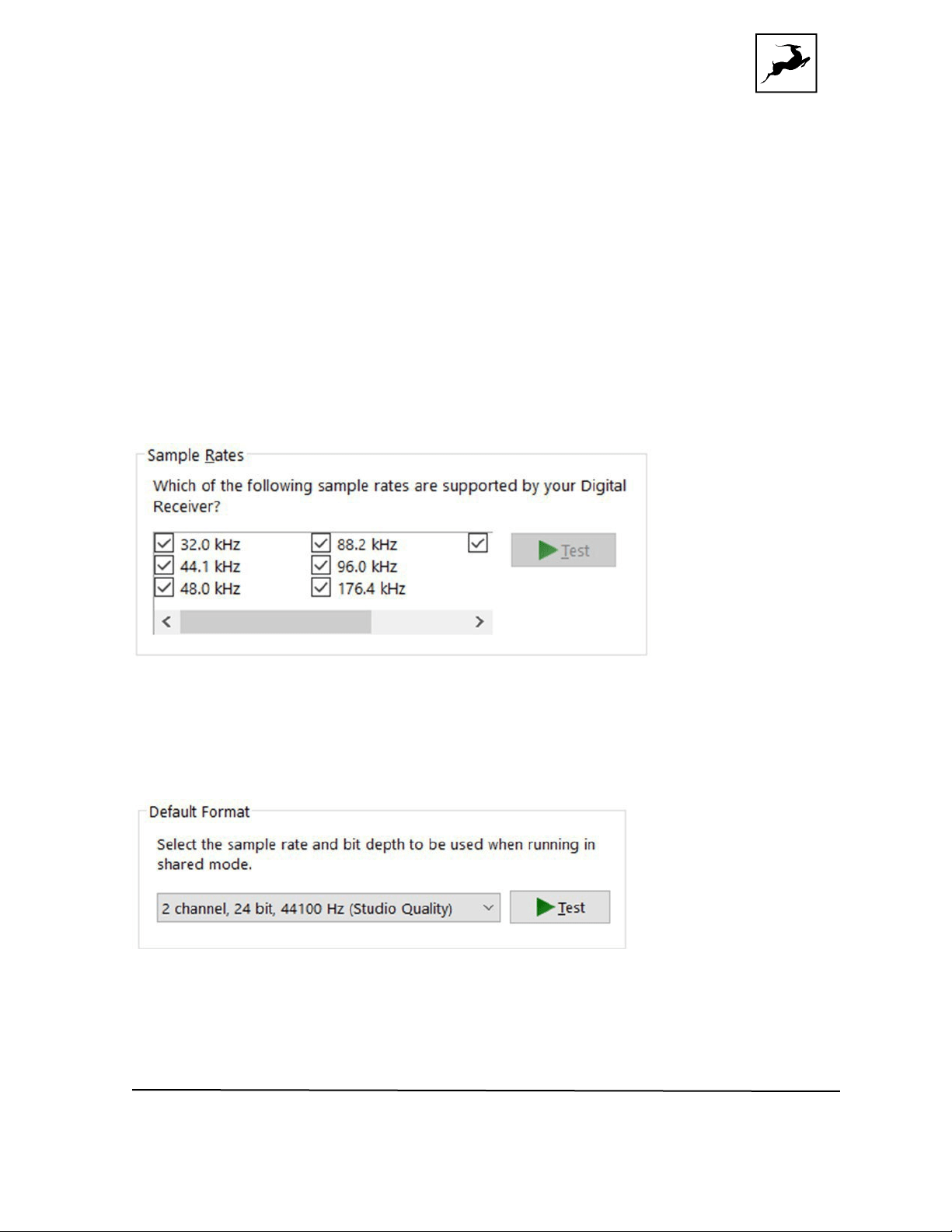
3. Enter the ‘Supported Formats’ tab and place checkmarks next to all the available
sample rates.
4. Enter the ‘Enhancements’ tab and make sure all enhancements are disabled.
5. Enter the ‘Advanced’ tab and choose any of the available “2 channel, 24-bit” modes.
Click ‘OK’ to close the window.
6. Back in Sound settings, click 'Device Properties' under 'Input'. Then, click 'Additional
Device Properties'. Enter the 'Enhancements' tab and disable all enhancements. Click
'OK' to close the window.

Discrete 4 Pro Synergy Core User Manual
Page 10
Tips
● If you are experiencing interruptions or failure when using your DAW and trying to
playback audio from your OS at the same time, make sure that the device sample
rate matches the one of your DAW session.
● You can disable the device and enable it again from the ‘Playback’ tab to refresh
the driver. This will be similar to disconnecting and re-connecting your device,
which makes Windows reset the playback configuration of the applications you
are using.
● In some cases, disabling the ‘Exclusive mode’ functionality from the ‘Advanced’
tab in ‘Playback’ Properties might help when running multiple playback
applications at the same time.
● Disabling the 32kHz sample rate isn’t mandatory, but it might help in general.
Further Reading
Antelope Audio Knowledge Base -
Windows 10 Optimization
Discrete 4 Pro Synergy Core User Manual
Page 11
Configuring for macOS (10.14 or later)
The new security settings introduced in macOS Mojave 10.14 (and later releases) may
result in no input signal reaching your DAW, despite having everything set up correctly.
These steps apply when you are using the Discrete 4 Synergy Core in a DAW for the first
time:
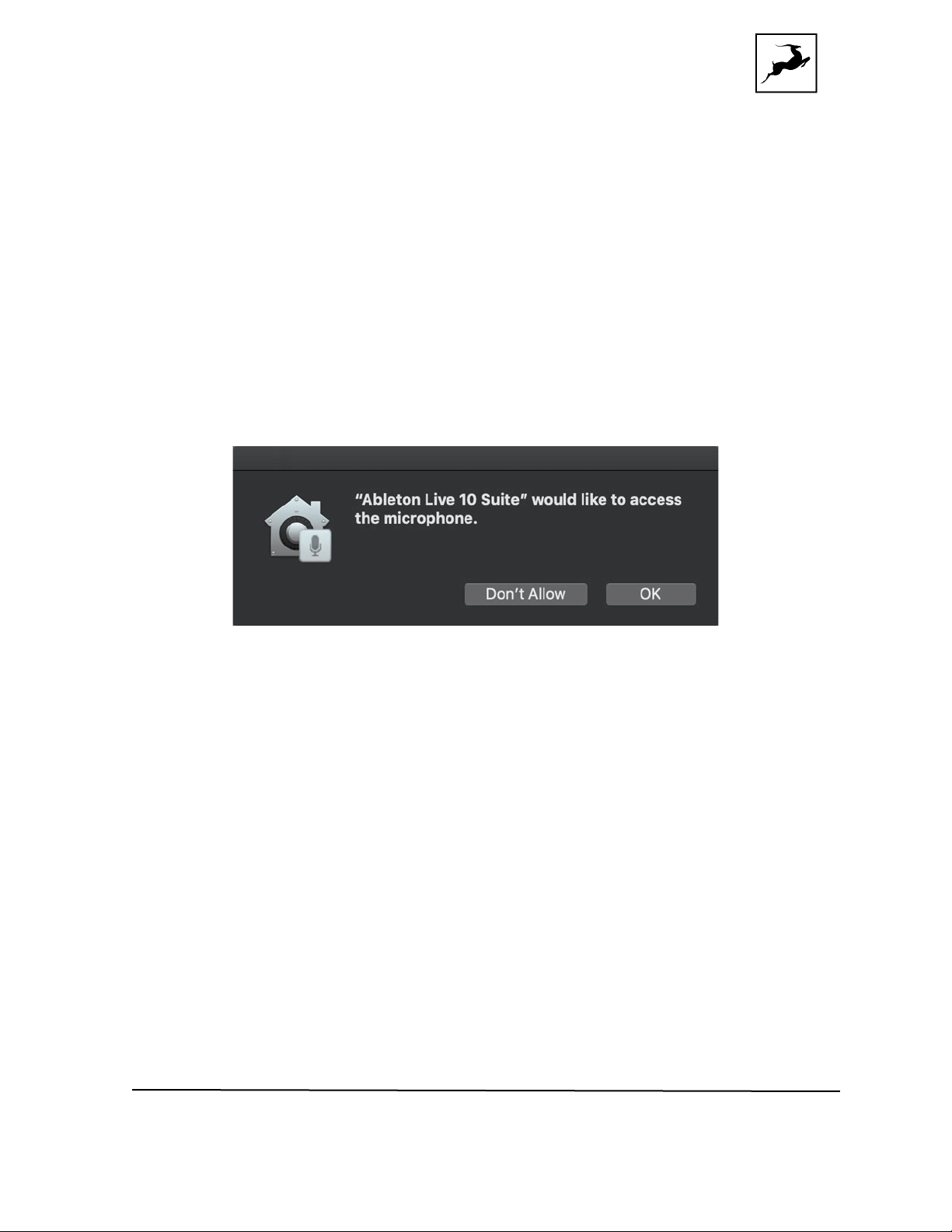
1. Launch your DAW and choose Discrete 4 Pro Synergy Core as the input device. The
following dialog box will appear (if using Ableton Live 10 Suite, for example):
3. Click 'OK' and your DAW should function normally.
However, if the events above did not occur for some reason, or you are using multiple
DAWs, you must do a manual tweak for each in 'Security & Privacy' settings:
1. Open the 'Apple' menu from the top-left of the menu bar and choose 'System
Preferences'. Head to the 'Security & Privacy' settings menu.
2. Click the 'Privacy' tab. In the column on the left, choose ‘Microphone’. Make sure
there's a checkmark next to any DAW you want to use:

Discrete 4 Pro Synergy Core User Manual
Page 12
Discrete 4 Pro Synergy Core User Manual
Page 13
ANTELOPE
LAUNCHER
The Antelope Launcher is a streamlined hub for managing and troubleshooting your
Antelope Audio products. The application is organized into the following tabs:
‘Devices’ tab
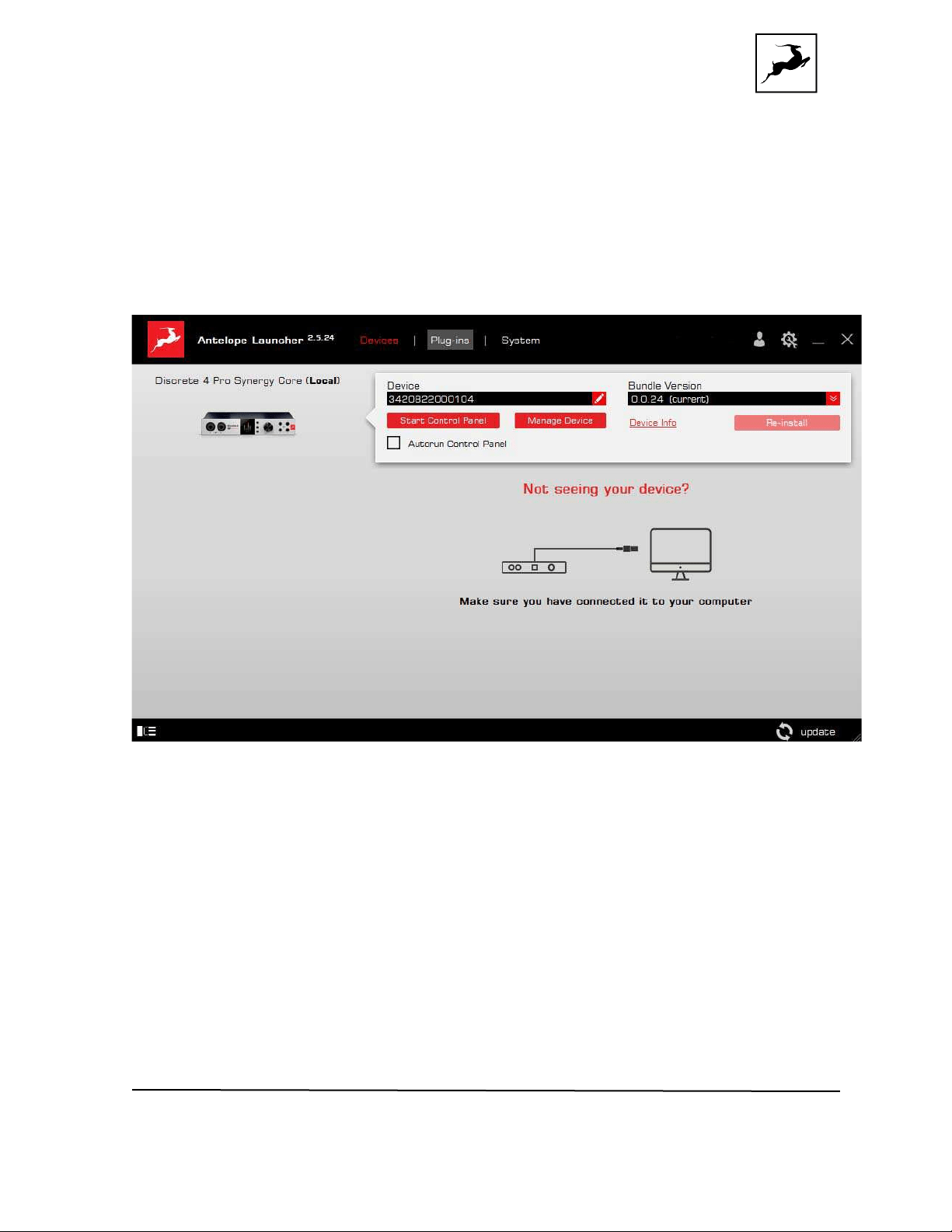
All Antelope Audio devices currently connected to your computer are listed in this
section. In this example, we have connected the Discrete 4 Pro Synergy Core. However,
the application functionality is identical for each Antelope device.
The following functionality is available in the 'Devices' tab:
Device Name
Click the black box to enter a name for your device. The device serial number is used by
default. Erasing the name and clicking outside the box reverts to the serial number.

Discrete 4 Pro Synergy Core User Manual
Page 14
Bundle Version
By default, this drop-down menu shows the most recent software bundle available for
your device. Clicking it shows the currently installed software bundle version and lets you
roll-back to an older build.
To update or change the installed software version, choose your desired Bundle Version,
click the check mark next to the drop-down menu, and click the ‘Update’ button.
Manage Device
Click to launch the Antelope Registration Wizard. Use it to register or de-register
devices and features (such as afx2daw, Synergy Core FX, HDX Activation and so on).
Device Info
Click to display the following information (useful for troubleshooting):
•
Serial number
•
Hardware version
•
Firmware version
•
Control Panel version
•
USB/Thunderbolt™ driver version
•
Software Bundle version
Click the information window to close it.
Start Control Panel
Click to start the device’s Control Panel application. You can also click the image of the
device. Place a check mark next to ‘Autorun’ to have the Control Panel for a specific
device launch automatically when you start Antelope Launcher.
Discrete 4 Pro Synergy Core User Manual
Page 15
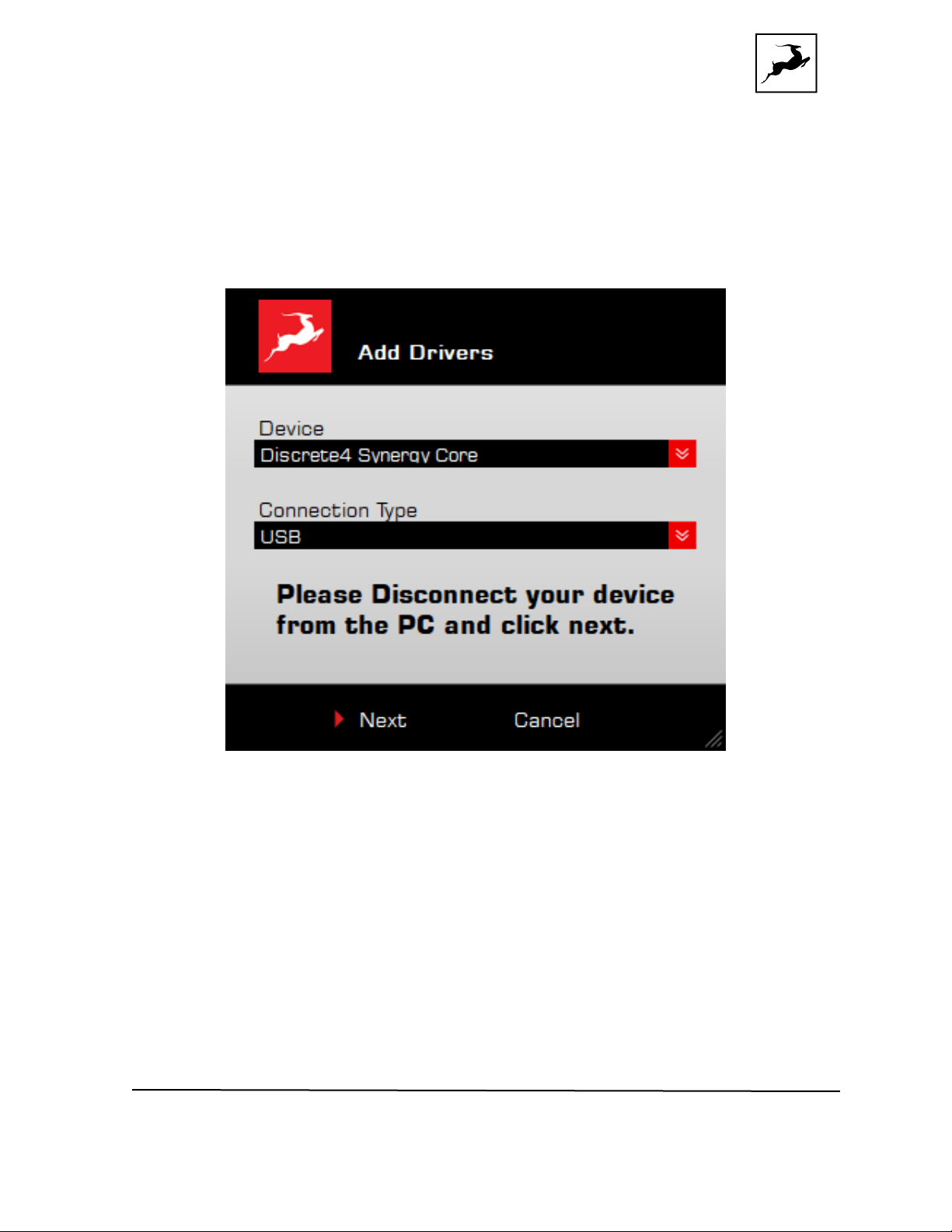
Can't see your device?
If a device is missing from the list, the most common reason is driver conflict. The
Antelope Launcher makes it easy to re-install drivers and troubleshoot. Click "Can't see
your device?" to launch the 'Add Drivers' wizard.
Choose your device and connection type from the drop-down menus, disconnect the
device from your computer, and click ‘Next’ to perform a driver re-install.
Note: If the issue persists, please contact
Antelope Audio Customer Support.
Discrete 4 Pro Synergy Core User Manual
Page 16
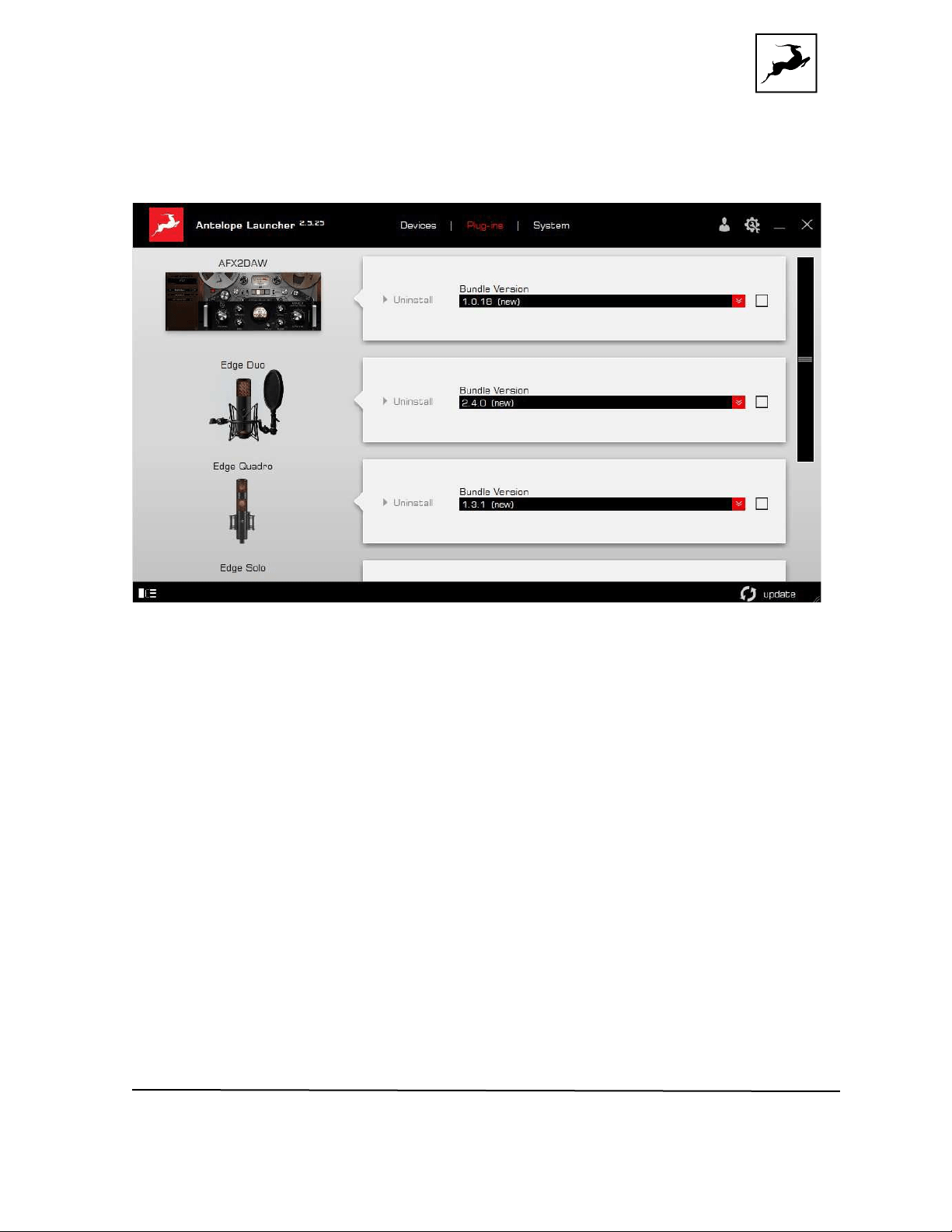
'Plug-ins’ tab
This section lets you install, update, and uninstall Antelope Audio software such as
native mic emulations and afx2daw.
By default, the Bundle Version drop-down menus show the most recent software bundle
available for each product. Clicking the menu shows the currently installed software
bundle version and lets you roll-back to an older build.
To update or change the installed software version, choose your desired Bundle Version,
click the check mark next to the drop-down menu, then click the ‘Update’ button.
Discrete 4 Pro Synergy Core User Manual
Page 17
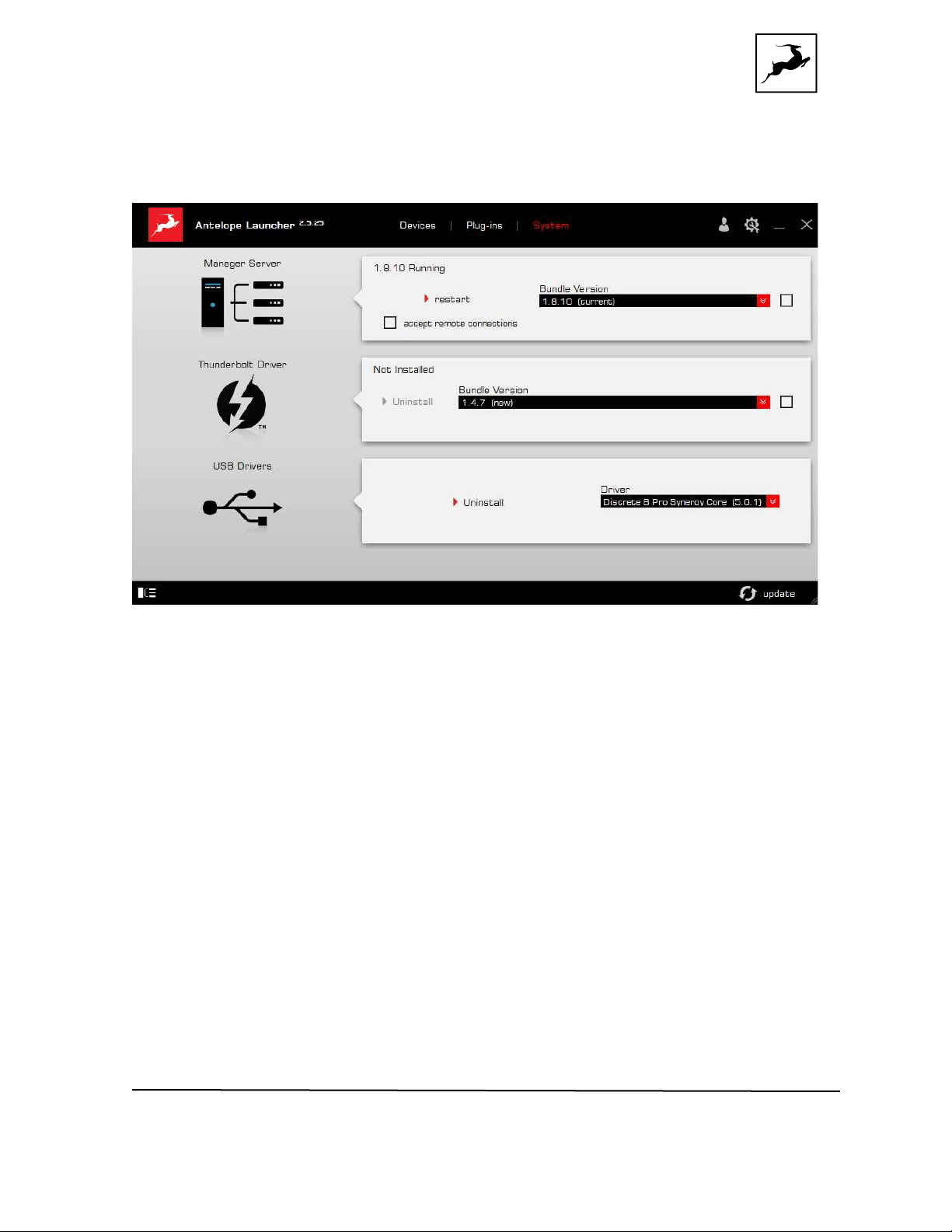
'System’ tab
Here, you can do the following:
•
Update or roll-back the Manager Server, USB and Thunderbolt™ Driver versions.
Choose your desired Bundle Version from the drop-down menu, click the check
mark, then click the ‘Update’ button.
NOTE: It is highly recommended to install the latest available Manager server
version to ensure normal behavior.
•
Restart the Manager Server and enable/disable remote connections from other
computers on your network.
•
Install the Antelope Audio Thunderbolt™ driver. Choose a Bundle Version from
the drop-down menu, click the check mark, then click the ‘Update’ button.
Discrete 4 Pro Synergy Core User Manual
Page 18
•
Uninstall the Antelope Audio Thunderbolt™ and/or USB driver(s) present on your
system.
Login button
Click and enter your Antelope Audio username and password, then click ‘Login’. If you
don't have an Antelope Audio account, click ‘Register’ and follow the on-screen
instructions.
Settings button
Click to open the Settings window.
Discrete 4 Pro Synergy Core User Manual
Page 19
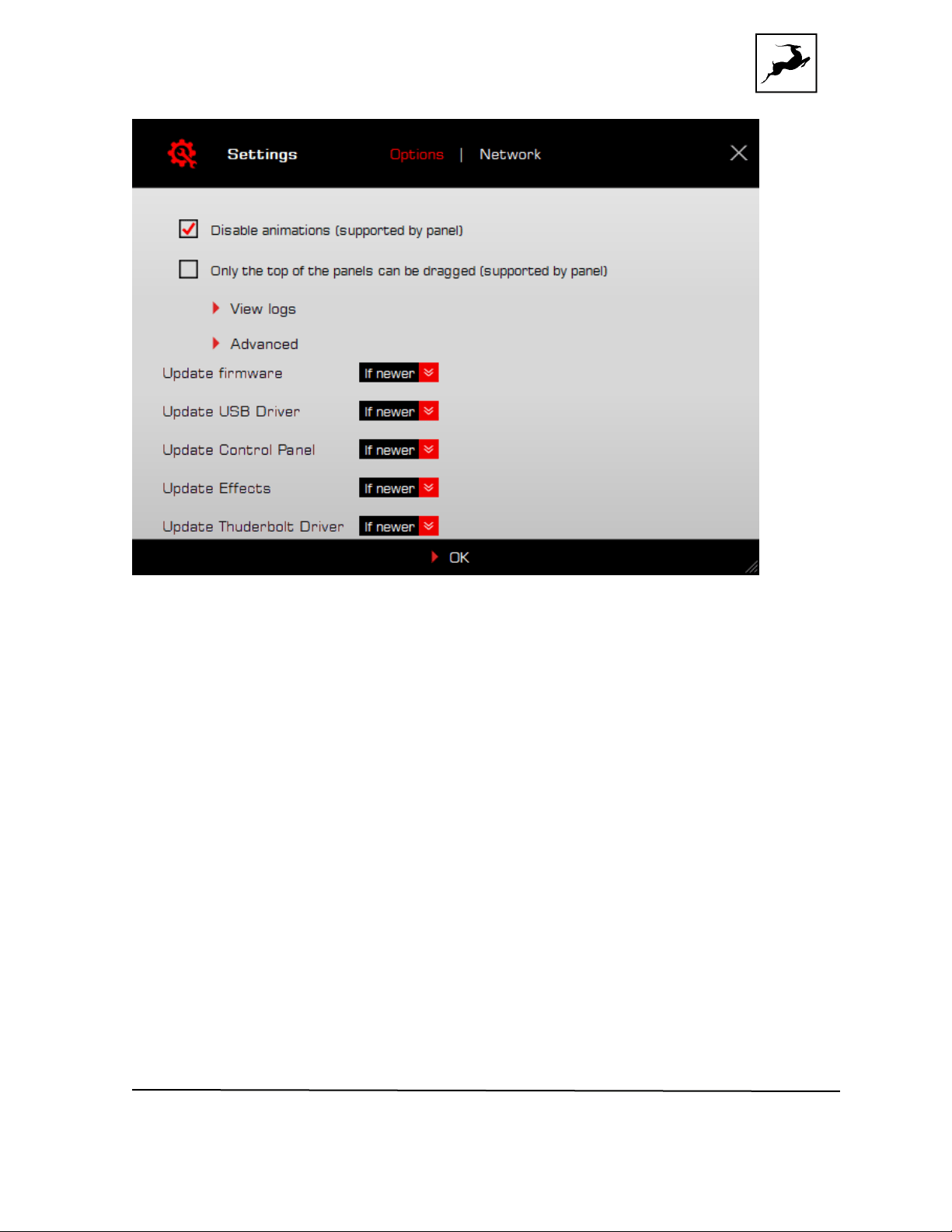
Here, you can do the following:
•
Click ‘View Logs’ to view, save, and send activity logs to Antelope Audio
Customer Support.
•
Click 'Advanced' to enable or disable updating for each of the following:
• Device firmware
• USB Driver
• Control Panel
• Effects
"
If newer" will allow you to update the component if there is a newer available version than your currently
installed one. It is recommended to keep this option as default.
"
Never" will prevent you from updating or reinstalling the component
"
Always" allows you to re-install, update or downgrade the component with older, current or newer
versions
Make your selection(s) in the drop-down menu(s) and click 'OK'.
Discrete 4 Pro Synergy Core User Manual
Page 20
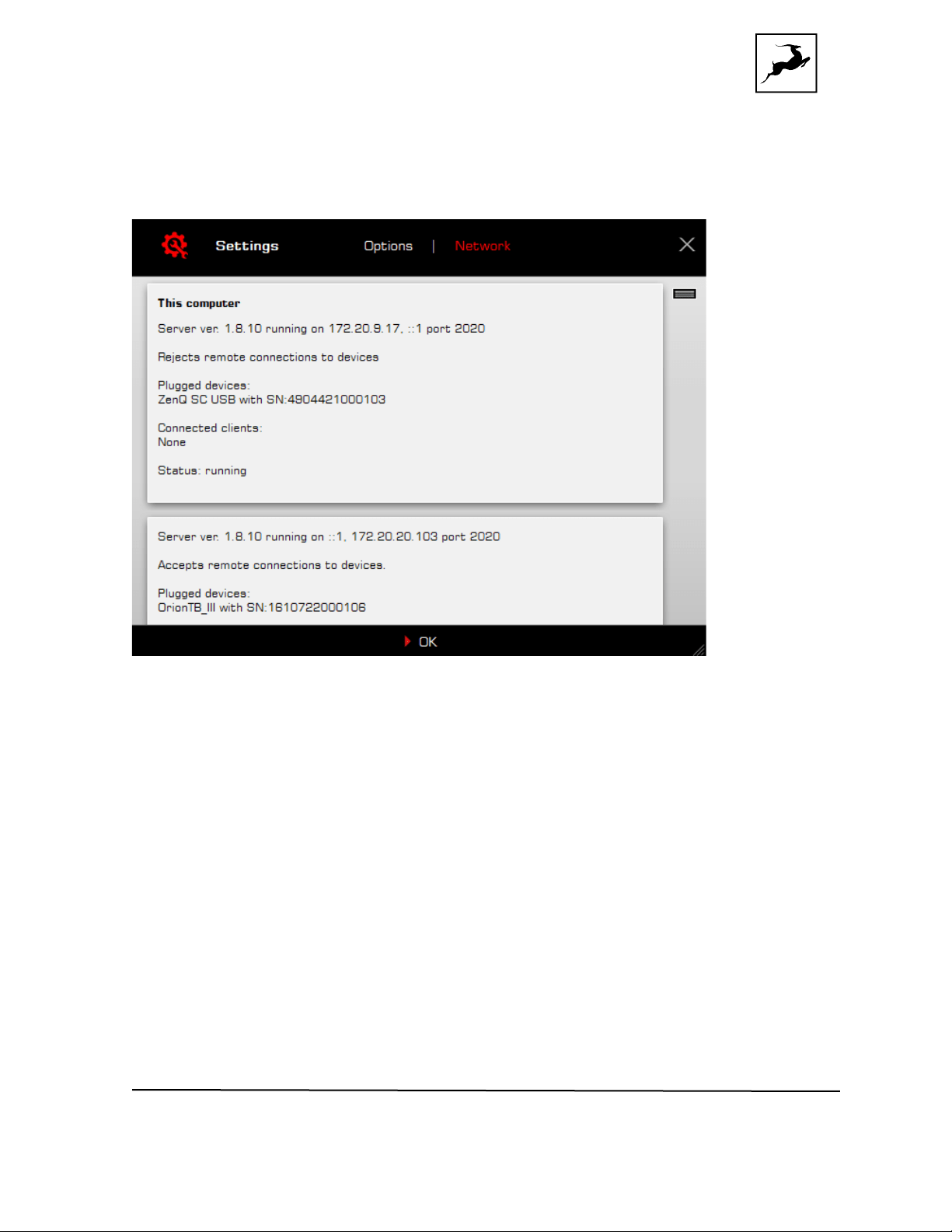
Click ‘Network’ to view network status and logs.
You can find information about currently connected devices on your local computer or detected
devices on other computers in the same network
Discrete 4 Pro Synergy Core User Manual
Page 21
FRONT
PANEL
EXPLAINED
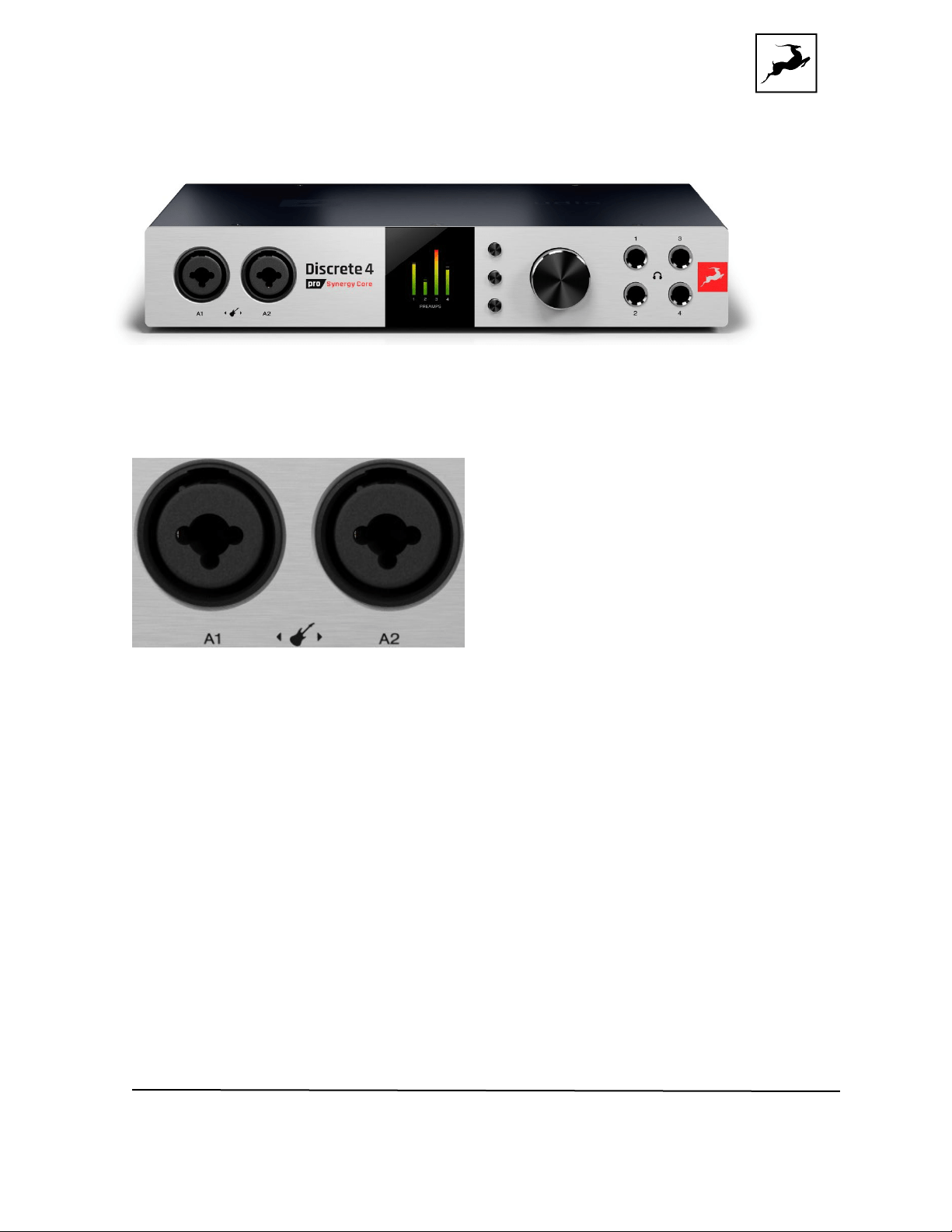
Left to right, top to bottom:
Mic/combo Inputs A1 - A2
2 mic preamp/line/Hi-Z inputs on combo XLR connectors. Labeled A1 and A2.
Note: Record line-level sources using TS/TRS cables, period.
Discrete 4 Pro Synergy Core User Manual
Page 22
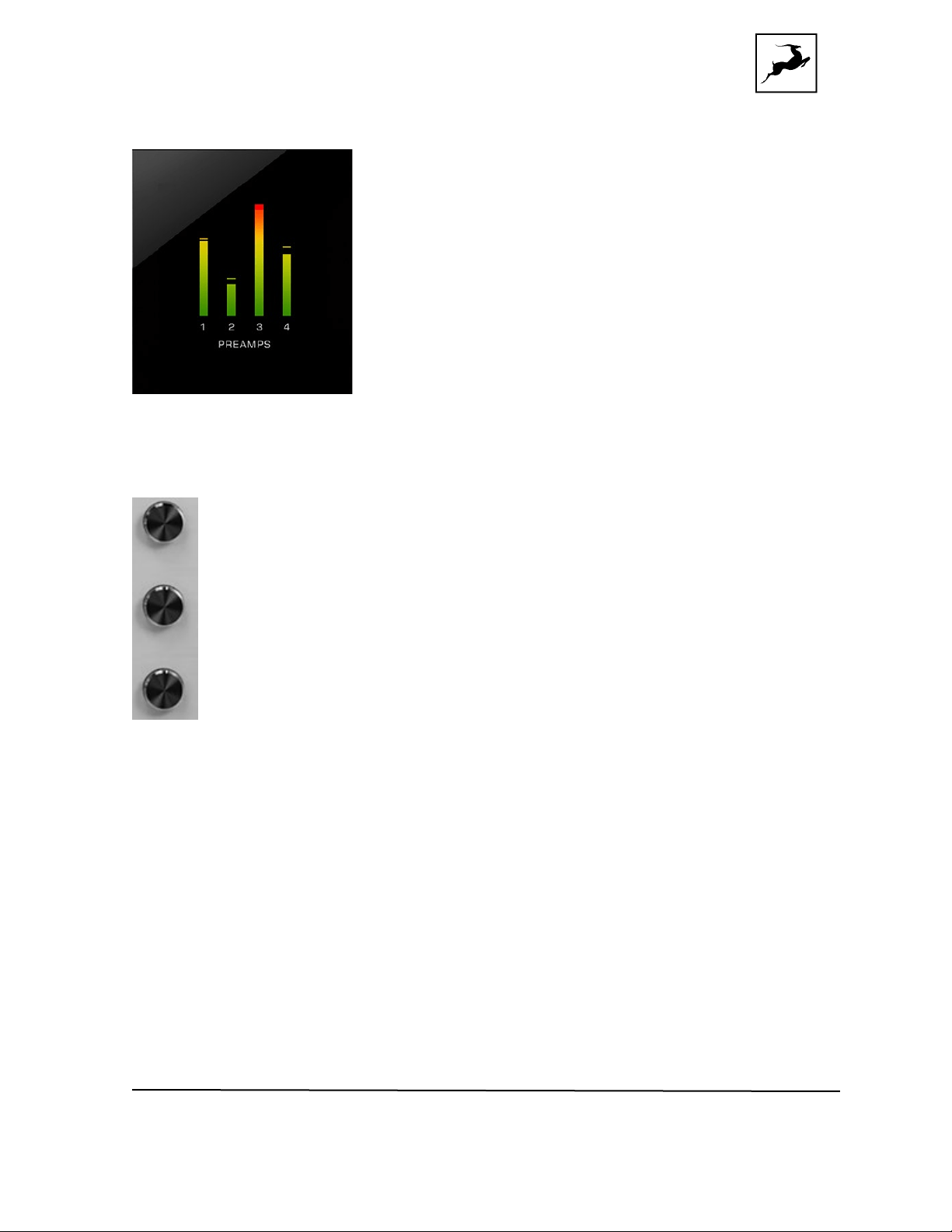
Display
Shows peak metering, menu content, firmware update progress and other information.
Function Buttons
The three function buttons have the following functionality:
Top Button
● Toggle between Inputs 1-4 gain control
● Press-and-hold to enter the Control Menu:

Discrete 4 Pro Synergy Core User Manual
Page 23
Control
Menu
The control menu contains the following sub-menus. Turn the main rotary control to
select entries and adjust values. Press the main rotary control to enter and/or confirm.
Press any button to exit.
Power OFF
Press the main rotary control to power off the unit.
Clock Source
Choose a clock source from the following options:
● Internal (when the device is connected via Thunderbolt – clock source should be
Internal)
● ADAT (2x, 4x)
● S/PDIF
● USB. In USB mode, the Discrete 4 Pro Synergy Core still uses its internal clock.
Sample Rate
Choose the device sample rate. Please make sure your choice matches the operating
system and DAW sample rates.

Discrete 4 Pro Synergy Core User Manual
Page 24
Peak Meter
Choose the audio source for the peak meters on the display. Up to 32 audio channels are
shown.
Brightness
Dim or illuminate the display.
Monitor Trim
Adjust monitor output signal trim (in dBu).
Line Out Trim
Adjust line output signal trim (in dBu).
Back to the function buttons…
Middle Button
● Press once to view information such as sync source and device sample rate.
● Press once while in any menu to exit.
● Hold down to enter Standby mode. Press any function button to exit Standby.
Bottom Button
● Press to toggle between HP1, HP2, HP3, HP4, Line out and Monitor out to adjust their volume.
● Press-and-hold to enter the System Menu.

Discrete 4 Pro Synergy Core User Manual
Page 25
System
Menu
The System menu contains the following sub-menus. Turn the main rotary control to
scroll and select entries. Press the main rotary control to enter and/or confirm. Press
any function button to exit.
Device Info
Shows the device serial number, hardware and firmware revisions. Useful for
troubleshooting with customer support.
Comm Interface
Chose the communication interface of the device between USB and Thunderbolt which is connected to
the computer. There are 4 different options:
•
Fixed USB – the device is using only the USB port.
•
Fixed TB – the device is using only the Thunderbolt 3 port.
•
Preferred USB – the device will detect the type of connection you are using automatically. If you
have both USB and TB ports connected – it will prefer and use the USB port.
•
Preferred TB – the device will detect the type of connection you are using automatically. If you
have both USB and TB ports connected – it will prefer and use the Thunderbolt port.
Scr Save Time
Choose how long it takes for the screensaver to appear. We recommend the shortest
setting you are comfortable with.
Scr Save Style
Choose the type of screensaver. We recommend 'Black' if the interface is operating for
longer durations regularly. This helps prevent burn-in.

Discrete 4 Pro Synergy Core User Manual
Page 26
Factory Reset
Performs a factory reset. Note that all presets and settings will be lost.
Back to the front panel…
Discrete 4 Pro Synergy Core User Manual
Page 27
Main Rotary Control
Large, stepped attenuator for precise gain and value adjustments, also used for menu
navigation. Pressing down confirms selections.
● Turn to adjust volume for the currently selected output. While the volume
adjustment menu is active, pressing down the top function button switches
between ‘MONITOR 1’ and ‘MONITOR 2’ and pressing down the bottom function
button switches between the selected monitor output and ‘LINE OUT’.
● Press to mute or un-mute the selected output.
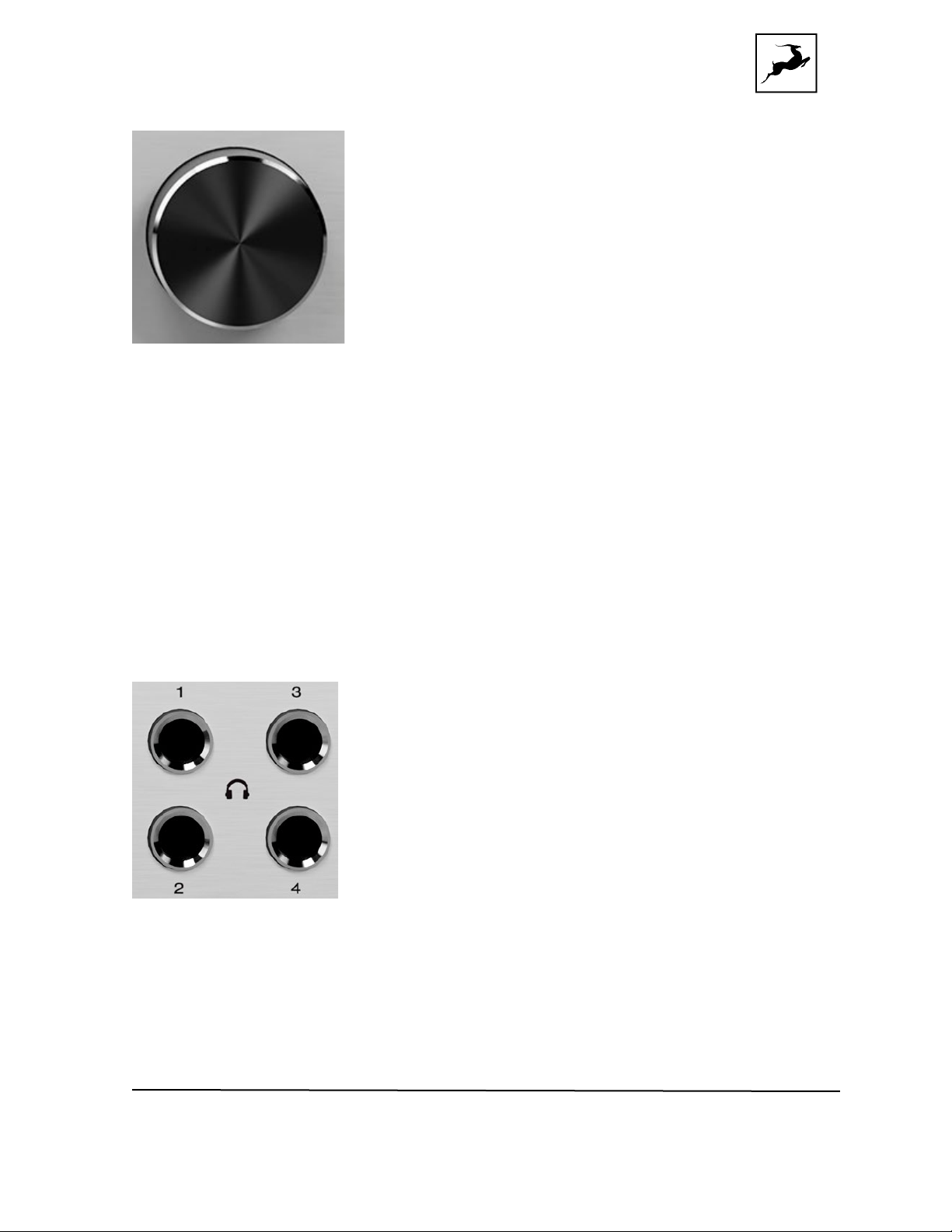
Headphone outputs H1 – H4
Four stereo headphone outputs on 1/4-inch TRS jacks.
Discrete 4 Pro Synergy Core User Manual
Page 28
REAR
PANEL
EXPLAINED
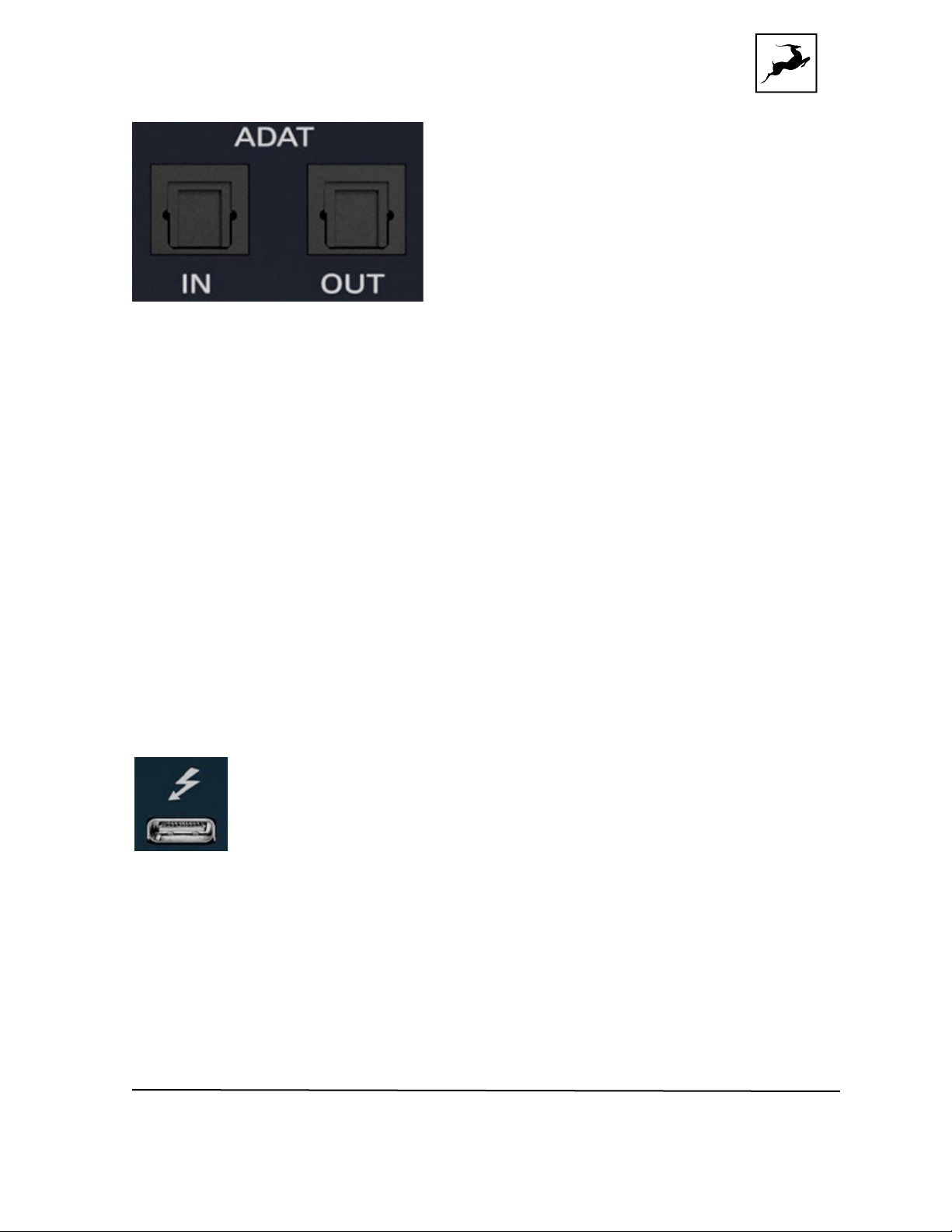
From left to right, top to bottom:
18V/20W Power Input
For use with the provided Antelope Audio power supply only!
S/PDIF I/O
Carries incoming and outgoing 2-channel S/PDIF digital audio over coaxial RCA cables.
Discrete 4 Pro Synergy Core User Manual
Page 29
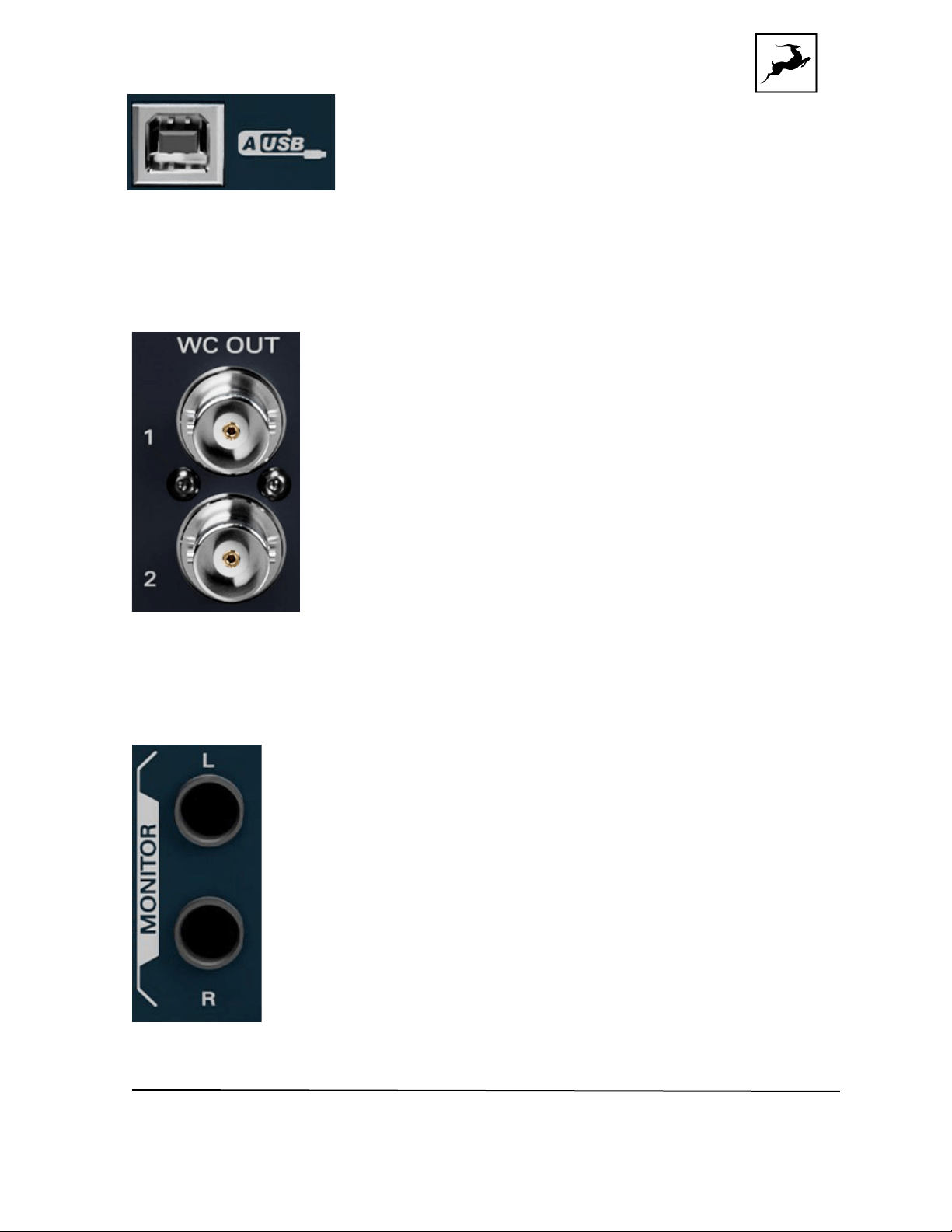
ADAT I/O
1 input and 1 output each carrying up to 8 I/O audio channels over Toslink fiber
optic cables. Note that ADAT runs on S/MUX. Standard ADAT audio limits apply:
● Up to 8 I/O channels of 24-bit, 44.1kHz or 48kHz audio.
● Up to 4 I/O channels of 24-bit, 96kHz audio (over S/MUX).
● Up to 2 I/O channels of 24-bit, 192kHz audio (over S/MUX).
● All ADAT audio is transmitted in 24-bit resolution.
Note: Devices do not need to be powered off for connecting or disconnecting ADAT.
However, you should mute the receiving equipment because a large signal spike will
occur upon connecting.
Thunderbolt™ 3 port
Thunderbolt™ 3 port for computer connection. Note that Thunderbolt™ 2 connections
require a third-party TB3 to TB2 adapter and corresponding cables. It is recommended
to use Apple certified cables and adapters.
Discrete 4 Pro Synergy Core User Manual
Page 30
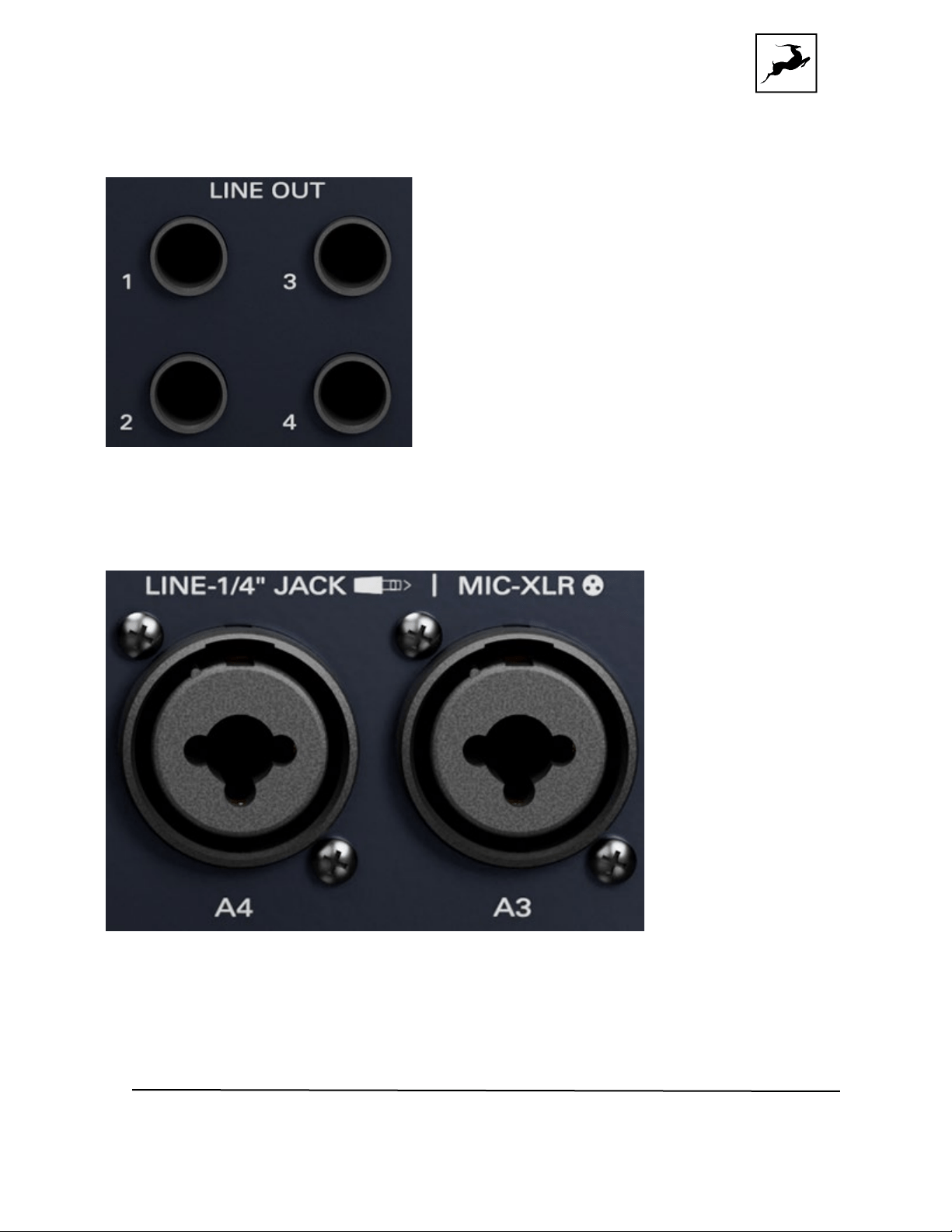
USB Port
USB 2.0 Type-B port for computer connection.
Word Clock I/O
Two Word Clock outputs on BNC connectors, 75 Ohm
Monitor Outputs L/R
Left and Right monitor speaker outputs on signal-balanced 1/4-inch jacks.
Discrete 4 Pro Synergy Core User Manual
Page 31
Line Outputs
Four analog Line outputs on signal-balanced 1/4-inch jacks.
Mic/Line Inputs
Two mic/line inputs on combo XLR connectors. Labeled A3 and A4. Hi-Z is not available on
these inputs.
Important! Record line-level sources using TS/TRS connectors. Record mic-level
sources using XLR connectors.
Discrete 4 Pro Synergy Core User Manual
Page 32
CONTROL PANEL
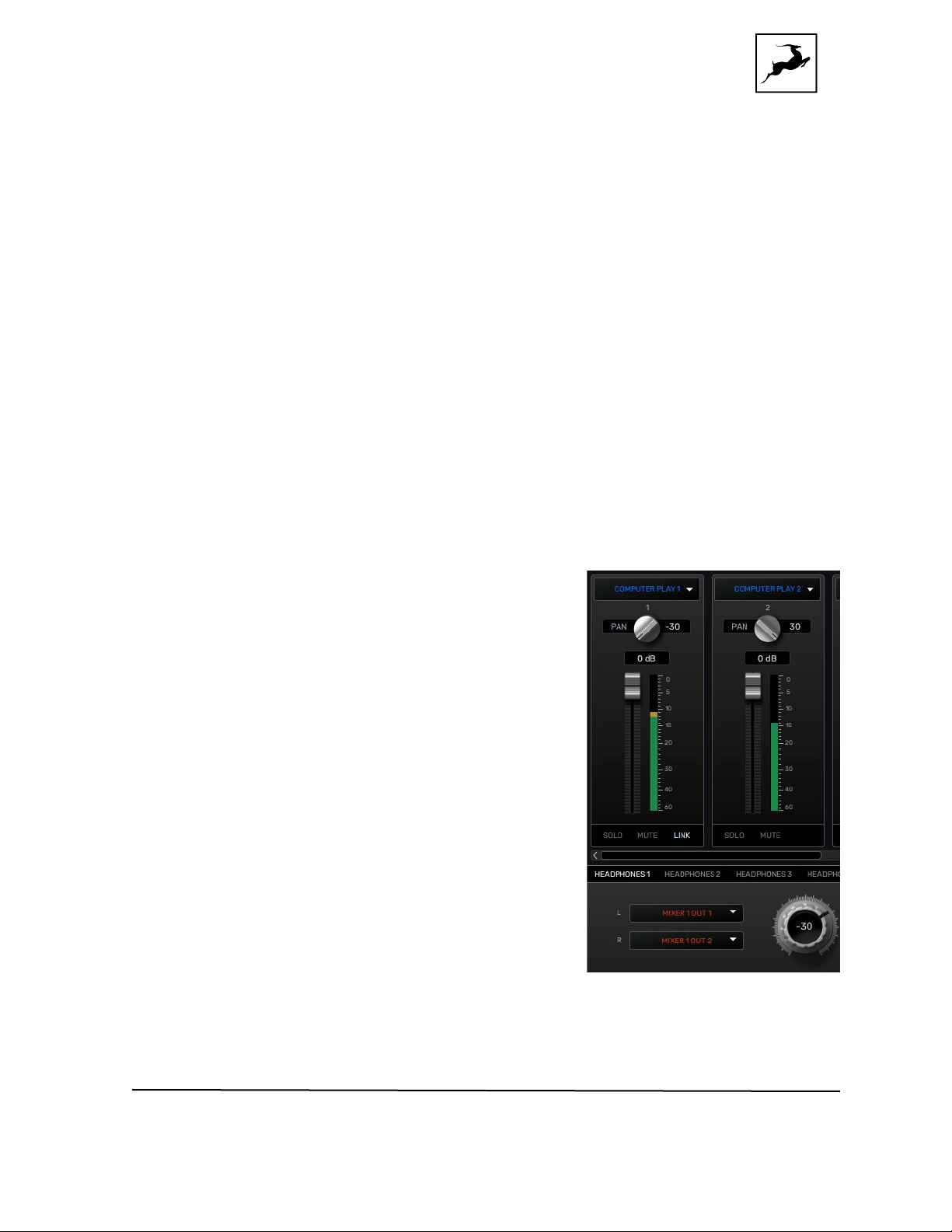
Welcome to the software Control Panel!
More than just an alternative to the front panel controls, the Control Panel provides
straightforward and comprehensive access to each aspect of the interface's
functionality. This includes settings, inputs, signal routing, audio mixing, effects
stacking, monitoring, metering, and presets.
The Discrete 4 Pro allows connection
between any signal source and any destination for turning any session scenario
into reality. All this flexibility is accessible via the full virtual patch-bay or the
simplified routing view of the original Discrete interfaces – the choice is yours.
Feel free to get going immediately with the ‘Quick Start’ section as your guide or skip it
for now and read the entire chapter before you touch any virtual knobs and faders.
Discrete 4 Pro Synergy Core User Manual
Page 33
Quick
Start
Let’s begin with some quick examples of essential tasks being accomplished in the
Control Panel.
Note: These examples do not convey the "correct" or "only" way of accomplishing the
following tasks. They merely illustrate some fundamental logic and offer solutions to
the initial stumbling blocks most often encountered by novice users.
Playback audio from the computer
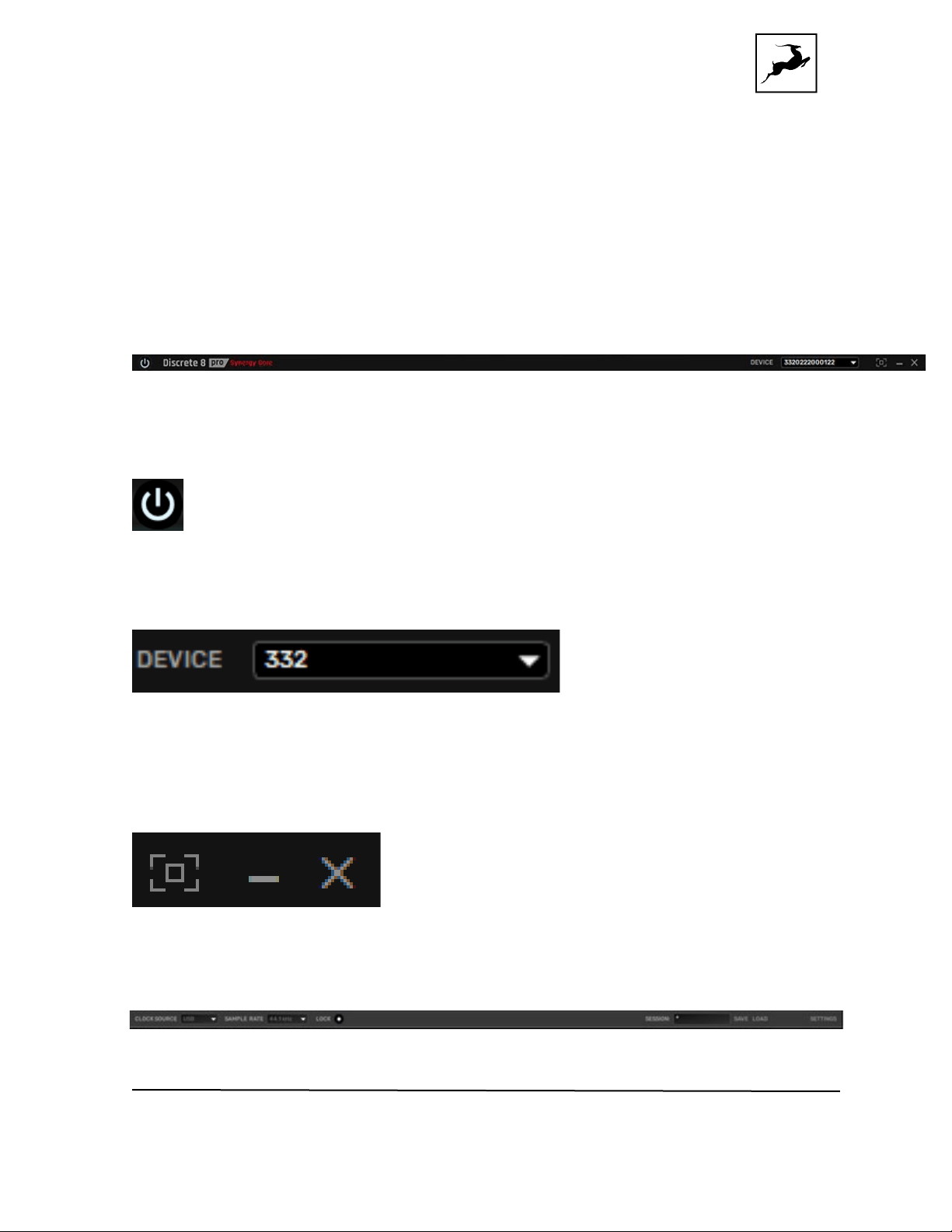
The audio signal coming from your computer when
using the Discrete 8 Pro Synergy Core as a playback
device is represented by the COMPUTER PLAY
channels. In most cases in your DAW or your computer
sounds will play on Outputs 1-2 which corresponds to
COMPUTER PLAY 1 and COMPUTER PLAY 2. You can
route COMPUTER PLAY 1 and 2 in any of the MIXERS
(1-4) and make sure the panning is set to hard left and
hard right to have a proper stereo image. Then just
route the MIXER OUT channels to your
Headphones/Monitor outs. Another option would be to
directly route COMPUTER PLAY 1 and 2 into the
Headphone/Monitor Left and Right

Discrete 4 Pro Synergy Core User Manual
Page 34
Monitor incoming audio via headphones
Say you want to monitor incoming audio from mic/combo input A1 via Headphone
output 1 (HP1), both on the front panel. Connect your equipment and open the
Control Panel. Do the following:
1. In the 'PREAMPS' section, head to the leftmost preamp and click the middle symbol to
the right of the volume indicator until you get:
● A microphone symbol if you plugged in a mic. If it's a condenser, activate 48V
phantom power from the button below the gain knob.
● A guitar symbol if you plugged in a guitar or bass.
● A jack symbol if you have plugged in a line level source (synths, samplers, players
and so on).
2. Go to the ‘MIXER’ tab and make sure that ‘PREAMP 1’ is selected as a channel source
on any of the four available mixers. For this example, we’ll use ‘MIXER 1’ and select the
source on the first mixer channel.
To hear the input on one of the headphone outputs, open either the ‘HEADPHONE 1’ or
‘HEADPHONE 2’ tab on the bottom of the software panel and choose the two ‘MIXER 1’
channels as sources for your headphone outputs.
The source selection is located on the left side of large volume rotary knob, and it’s
marked with ‘L’ – ‘R’ corresponding to the left and right mono outputs.
Click on ‘L’ and select ‘MIXER 1 OUT - 1’ for the left channel. Click on the ‘R’ select
‘MIXER 1 OUT - 2’ for the right channel. This will feed your headphones with the stereo
output of the first mixer.
You should be hearing audio from the input in your headphones. Adjust input gain from
the gain knob in the 'PREAMPS' section and output volume from the mixer channel fader
or the 'HEADPHONE 1' knob.
You can also use the front panel controls.
Apply Synergy Core FX to incoming audio
Go to the ‘AFX’ tab to access the Synergy Core processing functionality. Choose your
audio input(s) from the input selectors for the available 16 channels. Click the area below
the input selector to open the corresponding Synergy Core FX rack window. Click the
'ADD NEW EFFECT' button to start building your effects chain and adjusting effects
settings. Close the window when you are done. An in-depth overview of the FX Rack can
be found later in the manual.

Discrete 4 Pro Synergy Core User Manual
Page 35
Play guitar through the virtual amps and cabinets, listening from
studio monitors
1. Connect your guitar to A1 and your studio monitors to the Monitor L/R outputs of the
Discrete 8 Pro Synergy Core.
2. Open the Control Panel and head to the leftmost area in the 'PREAMPS' row. Click the
middle symbol to the right of the volume indicator until you get an electric guitar
symbol.
3. Go to the ‘AFX’ tab and select ‘PREAMP 1’ on any available channel, we’ll use the first
effects rack for this example.
4. Click the area below the input selector to launch the Synergy Core FX Rack. Click
'ADD NEW EFFECT' and make your guitar amp and cabinet choices from the menu. If
you don't know where to start, the 'Modern (US)' amp and 'Modern 4 x 12' cabinet
combination make for a great modern rock/metal rig.
An in-depth overview of the cabinet simulator is available later in the manual. You can
learn more about the individual amp models
here and about the cabinets here.
5. Select ‘AFX OUT 1’ as a source on an available mixer channel. We’ll use the first
channel of ‘MIXER 1’ for this example. Afterwards open the ‘MONITOR 1’ tab on the
bottom of the control panel and select the two outputs of ‘MIXER 1’ for the left and right
speakers. Adjust panning and volume to taste from the mixer settings and the monitor
output volume from the volume knob in the ‘MONITOR 1’ tab.
Sing with microphone emulations and monitor live with
headphones
Connect your headphones to HP1 on the front panel. Connect your Antelope Audio Edge
or Verge modeling microphone to the preamp/combo inputs. In our example, we are
using the Edge Duo, which is connected to inputs A1 and A2.
1. Open the Control Panel and head to the leftmost preamp from the PREAMPS row.
Click the middle symbol to the right of the volume indicator until you reach the 'mic'
symbol. Then, click the 'cog wheel' symbol. This will launch the mic emulations window.
Choose Edge Duo with the dial.
2. Adjust microphone gain with the gain knobs. Note that preamps A1 and A2 are now
linked and have identical settings between them.
3. Go to any available mixer, ‘MIXER 1’ in this example, and select ‘EMU MIC 1’ and ‘EMU
MIC 2’ as sources for the first two, or any other mixer channels.
4. Open the ‘HEADPHONES 1’ tab on the bottom of the control panel and make sure the
outputs of the first mixer are selected from the left and right channel dropdown menus,
‘MIXER 1 OUT 1’ and ‘MIXER 1 OUT 2’ respectively.

Discrete 4 Pro Synergy Core User Manual
Page 36
You should be hearing mic audio in your headphones at this point. Use the
‘HEADPHONES 1’ volume knob or the mix faders for Channels 1 and 2 to adjust output
volume.
Record in your DAW
Recording with the Discrete 8 Pro Synergy Core is very simple. First, make sure the
interface is chosen as your main input and output device in your DAW. Next, open the
Control Panel and click 'DAW'. Note the following:
Inputs 1 - 32 in your DAW correspond to the 32 channels labeled 'Record 1 - 32 in the
'TO DAW' row. Use the input selectors to choose your audio sources. Then create new
tracks in your DAW and assign the inputs with the matching numbers to them, e.g.
'Record 1' = 'Input 1'.
Likewise, Outputs 1 - 32 in your DAW correspond to the channels labeled 'PLAY 1 - 32' in
the 'FROM DAW' row. These channels can be chosen as audio sources from the input
selectors in any of the following tabs - ‘MIXERS’, ‘DIGITAL OUTS’, ‘LINE OUTS’, ‘AFX’.
This can also be done from the “virtual patch bay” routing matrix view, available from the
‘ROUTING’ tab. The possibilities are extensive.
NOTE: The Discrete 8 Pro Synergy Core provides 32 Play and Record channels over
Thunderbolt and 24 Play and Record channels over USB.
Mouse
&
Keyboard
Shortcuts
The following features are accessible via mouse & keyboard shortcuts in the Control
Panel:
●
Return to default value (all knobs and faders) -double-click the knob
or fader.
●
Change text labels and manually enter gain values -double-click the
text label / gain value and press Enter to confirm (Text label renaming is only
p
ossible through the routing tab).
Discrete 4 Pro Synergy Core User Manual
Page 37
●
Adjust parameter values in smaller increments (all knobs and faders)
- ho
ld Ctrl (Windows) / Command (macOS) and drag.
●
Click any peak meter to clear it.
Main View
From left to right, the Control Panel is organized as follows:
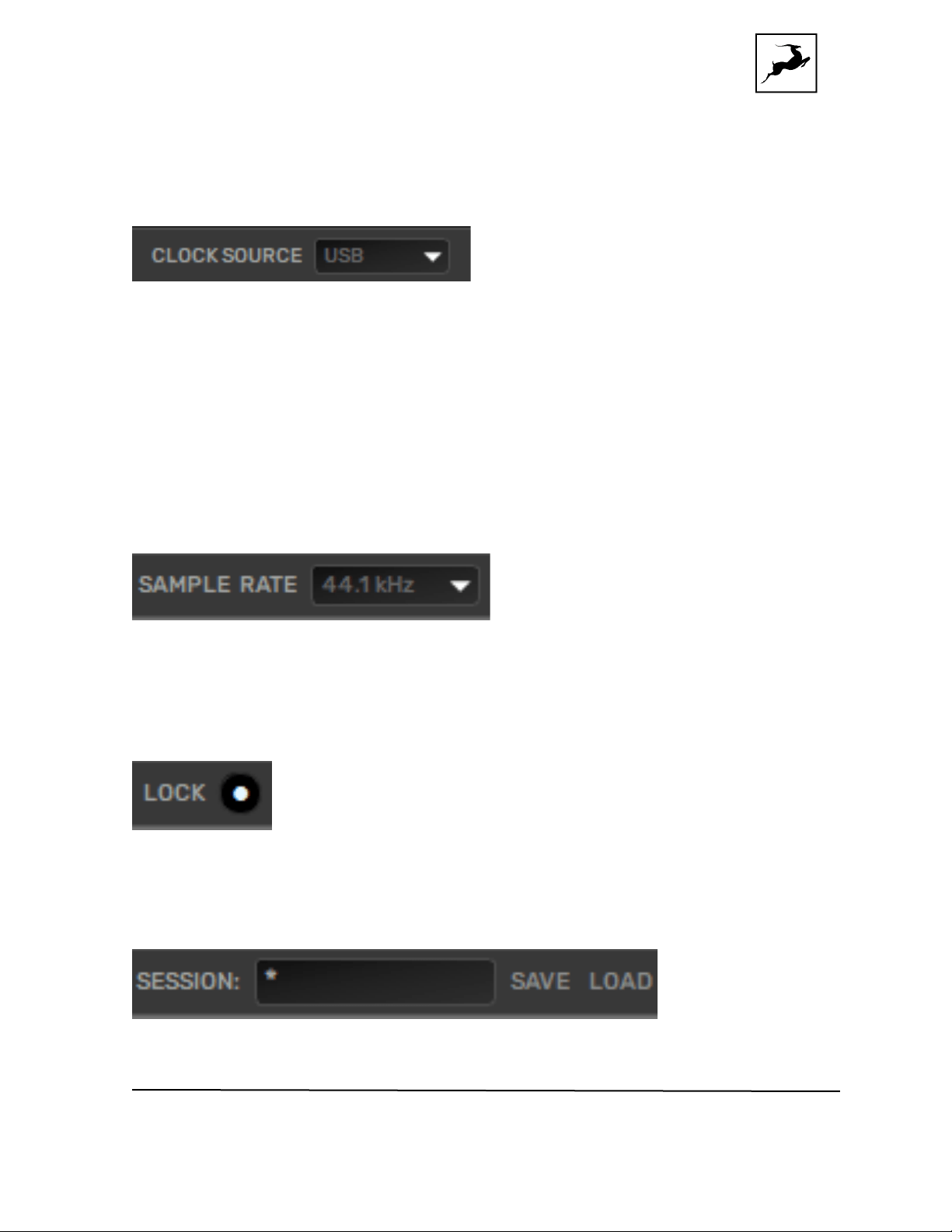
Function Strip 1
On/Off Button
Click to power on/off the hardware unit.
Device Menu
Click the drop-down menu to switch between multiple connected Discrete 8 Pro
Synergy Core devices. You can do that or launch a separate Control Panel instance for
each device from the Antelope Launcher.
Default panel size, Minimize & Close Buttons
Click to revert the control panel size back to default, minimize or close the Control Panel
application.
Discrete 4 Pro Synergy Core User Manual
Page 38
Function Strip 2
Clock Source Menu
Click the drop-down menu to choose a clock source. The following options are available:
●
Internal
●
W.C.
●
ADAT (2x, 4x)
●
S/PDIF
●
USB. In USB mode, the Discrete 8 Pro Synergy Core still uses its internal clock,
but locks to the sample rate set for the computer audio.
Sample Rate Menu
Click the drop-down menu to choose the device sample rate. Please make sure your
choice matches the operating system and DAW sample rates. When locked to a rate
from an external source, this selection is not available.
Lock Indicator
Lights up when the Discrete 8 Pro Synergy Core is locked to an external device (e.g.
ADAT).
Session Menu
Discrete 4 Pro Synergy Core User Manual
Page 39
Click the drop-down menu to load a Session. Use the adjacent Save and Load buttons
to store and load Session files (*.as).
'Sessions' are complete "snapshots" of entire Control Panel configurations. When Saving
a Session, you can choose the exact components you want stored and export Session
files for storage and sharing from the ‘Save As’ button. When loading a Session, you can
browse your computer for session files (*.as) and choose which components to load.
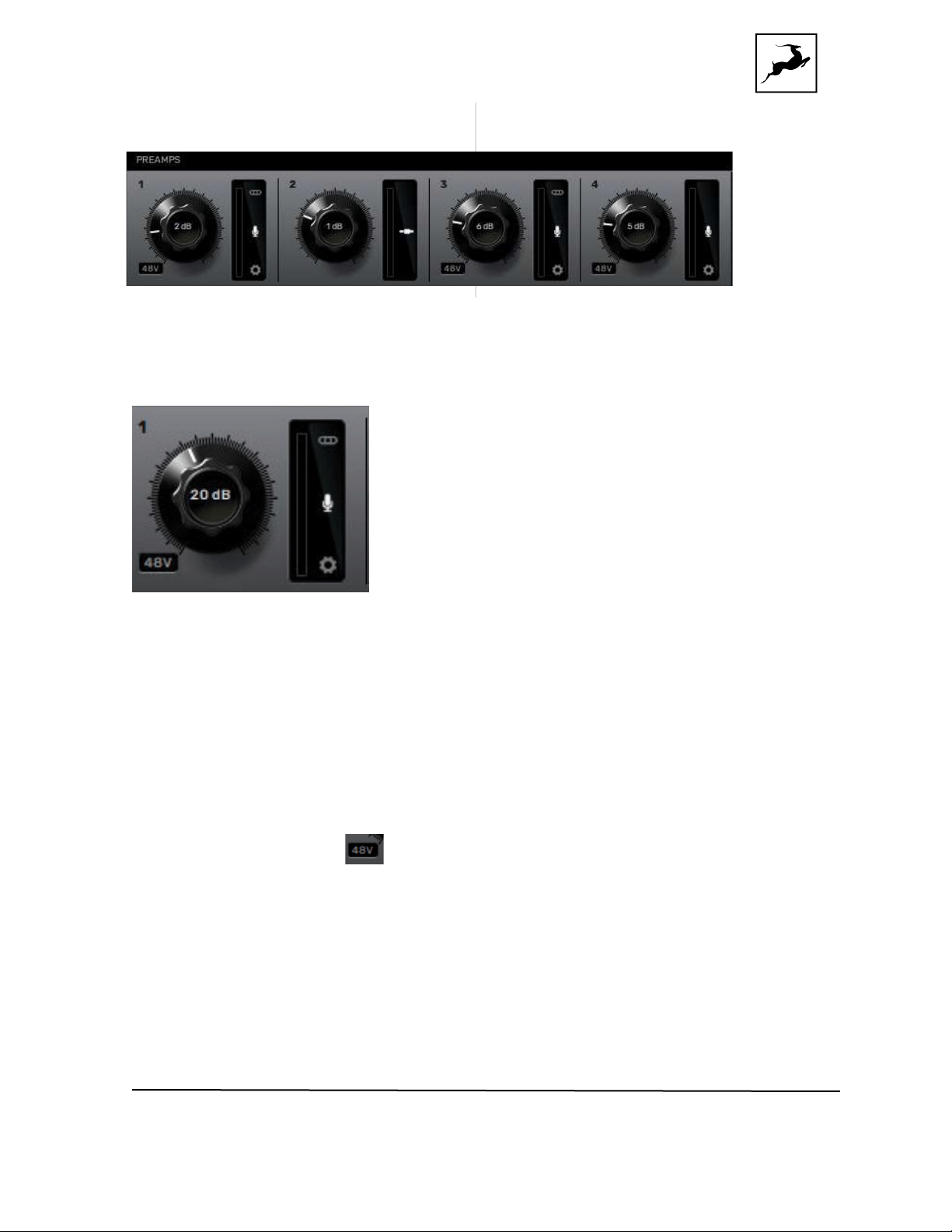
Settings Button
Click to enter the Settings Window with the following options (left to right, top to
bottom):
Note: ASIO Settings button is available only on Windows.

Discrete 4 Pro Synergy Core User Manual
Page 40
Monitor
Out Trim
Click to choose the signal trim amount (in
dBu) for the Monitor Outputs from the
drop-down menu.
Panning
Law
Click to specify Panning Law
compensation between 0dB (none) to -
4.5dB from the drop-down menu.
Mute
Mutes Oscillator 1 output.
Oscillator
1
Choose a frequency for the
Oscillator 1 test signal from the
drop-down menu.
Level
Choose the output level (in
dBFS) for the oscillator 1 & 2
test signals.
Oscillator
2
Choose a frequency for the
Oscillator 2 test signal from the
drop-down menu.
Mute
Mute Oscillator 2 output.
Line
Out Volume
Use the fader to adjust line outputs
volume (in dB). Click the adjacent
'Mute' button to mute and unmute the
line outputs.
Brightness
Use the fader to adjust the hardware
unit's display brightness.
TB
Latency Mode
Choose the Thunderbolt Latency mode
from the drop-down menu. Experiment
with the different modes if you
experience audio glitches, CPU
overload, etc.
ASIO Settings
For Windows users - click to launch the
Discrete 4
Pro Synergy Core USB ASIO
Control Panel. The 'Buffer Settings' tab
lets
you choose your preferred ASIO Buffer
Size for an optimal balance between
latency and performance.
Discrete 4 Pro Synergy Core User Manual
Page 41
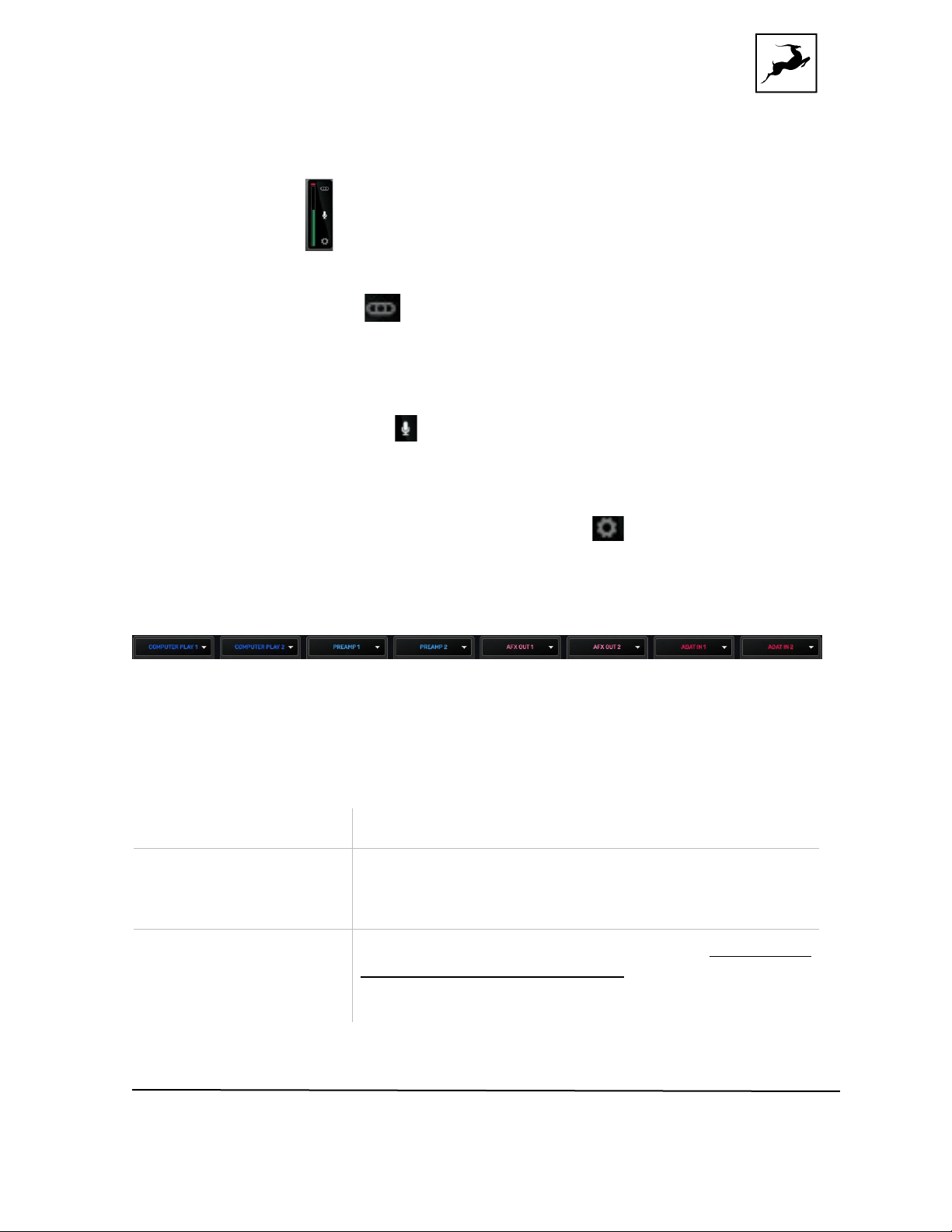
PREAMPS Strip
Labeled 'PREAMPS' on the far left. Contains controls for the eight mic/combo inputs
labeled A1 – A4 on the Discrete 4 Pro Synergy Core. There are the following controls for
each input:
Gain Knob
Click and drag the knob or double-click the text label in the center and use your
keyboard to adjust input gain. The gain ranges are as follows:
●
Mic: -12dB - 65dB
●
Line: -6dB - 20dB
●
Hi-Z (inputs A1 and A2): 0dB - 40dB
48V Button (in mic mode)
Click to activate or deactivate 48V phantom power for condenser microphones.
Discrete 4 Pro Synergy Core User Manual
Page 42
Peak Meter
Visualizes input gain.
Link Button ('stereo' symbol)
Click to link adjacent inputs in pairs of two. Any change made to one channel applies the
same exact change to its neighboring channel.
Input Type Button ('mic' symbol)
Click to switch inputs between mic, line, or Hi-Z (inputs A1 - A2).
Mic Emulations Button ('cog' symbol, when in mic mode)
Click to open the 'Mic Emulations' window. More information is available in the Edge &
Verge Mic Emulations chapter.
Input Selectors
Input Selectors are found above each analog and digital output channel. Click an input
selector to choose the audio input assigned to its related output channel. The following
choices are available:
PREAMP 1 - 4 These are the four mic/combo inputs.
EMU MIC 1 - 4
These are the four mic/combo inputs with Edge & Verge
Mic Emulations applied. This way, you can record 'dry' and
'mic emulation' audio on different channels.
COMPUTER PLAY 1 - 32
These inputs represent DAW Outputs 1 - 32
. This is where
you receive audio from your DAW. Assign an audio track
to Output 1 – 32 in your DAW and choose the COMPUTER
PLAY input with the same number. This way, you can
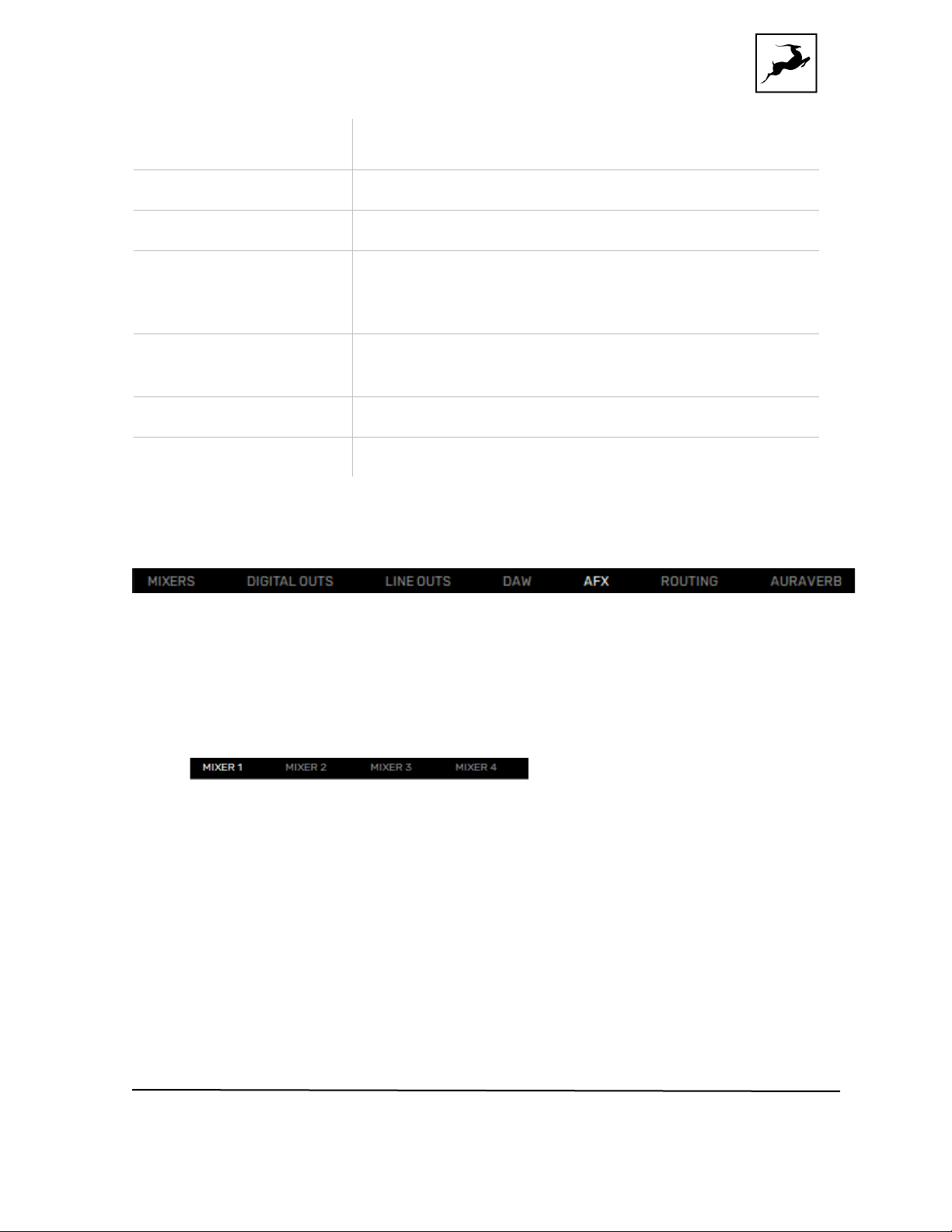
Discrete 4 Pro Synergy Core User Manual
Page 43
route DAW audio to the internal mixers, analog and digital
outputs and apply Synergy Core FX to it.
ADAT IN 1 - 8 ADAT audio inputs 1 - 8.
S/PDIF IN 1 - 2 Two channels of incoming S/PDIF stereo digital audio.
AFX OUT 1 – 16
The processed output signal from the AFX channels.
Whichever source you put in the AFX channels, you
receive a processed signal with added effects.
MIXER 1 - 4 OUT
The summed output signal from each 32-channel mixer.
Each output is stereo left and right (for example MIXER 1
OUT 1 and MIXER 1 OUT 2)
MUTE M Choose to mute this channel
OSCILLATOR 1 - 2 Test signal from oscillator 1 or 2.
Main tabs
The main tabs in the Control panel give you access to the essentials:
• Mixers – gives you access to navigate between the 4 individual MIXERS
which will show up on the right side of the same row
• Digital outs – allows you to route signals to the ADAT and S/PDIF outputs.
• Line outs – allows you to route signals to the 4 line outputs and adjust their
volume.
• DAW – allows you to route signals for recording into your DAW.
• AFX – add effects for each channel strip and select the source you want to
process.
• Routing – gives you access to the routing matrix.
• Auraverb – gives you access to the settings of the Auraverb reverb effect.
• Monitoring control – gives you access to routing and adjusting volume on the
Monitor and Headphone outputs.
For an in-depth explanation on each tab, please continue reading.
Discrete 4 Pro Synergy Core User Manual
Page 44
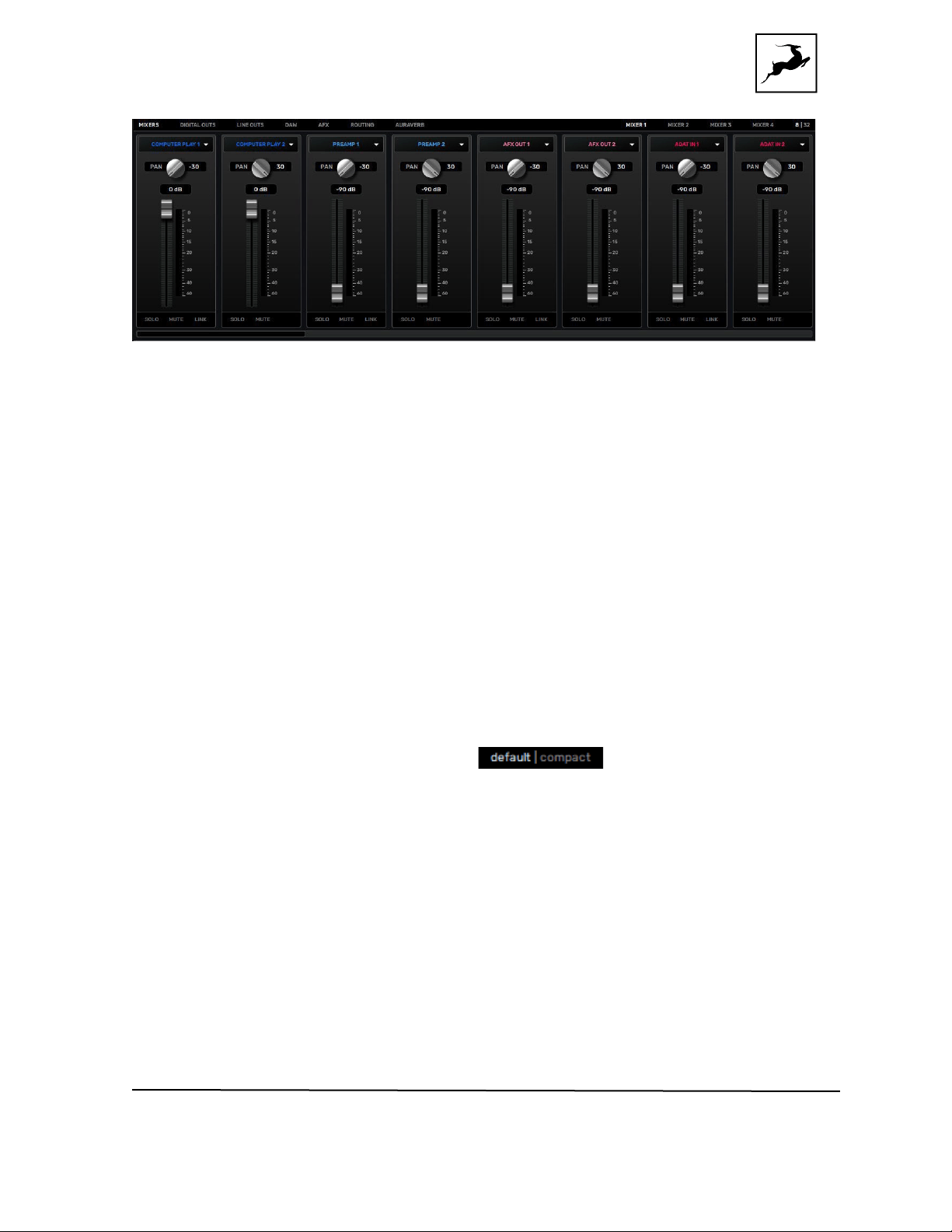
MIXERS
This tab allows you to access the four 32-channel virtual mixers.
Use the Input Selectors to assign an audio input to each channel.
Each mixer is completely independent. You can have different inputs for each mixer.
Each channel strip has the following components:
• Panning knob with values between –30 (hard left) and 30 (hard right),
• Volume fader which allows you to adjust the volume of the signal
• Peak meter which shows you the real time signal in dB in a range from –60 to
0dB.
• Solo button which allows you to mute the rest of the channels in the mixer and
listen to only the Soloed one.
• Mute button which allows you to Mute the selected channel.
• Link button (1 available per pair) allows you to link all the controls with the
neighbor channel strip and adjust the settings on both channels together. This is
mostly used when you have a stereo signal using two channels for left and right.
Default and Compact view – 8/32 channels
On the top right side of the mixer, you can find a switch between 8 and 32 channels
which changes the view of the mixer. In the 8-channel mode, the mixer fits 8 enlarged
channel strips. In the 32-channel mode all 32 channels are visible simultaneously.
Scroll bar
Just below the channel strips you can find a scroll bar which allows you to scroll between
all 32 available channels in the mixer without using the extended view. This scroll is
available in the 8-channel mode view only.
Discrete 4 Pro Synergy Core User Manual
Page 45
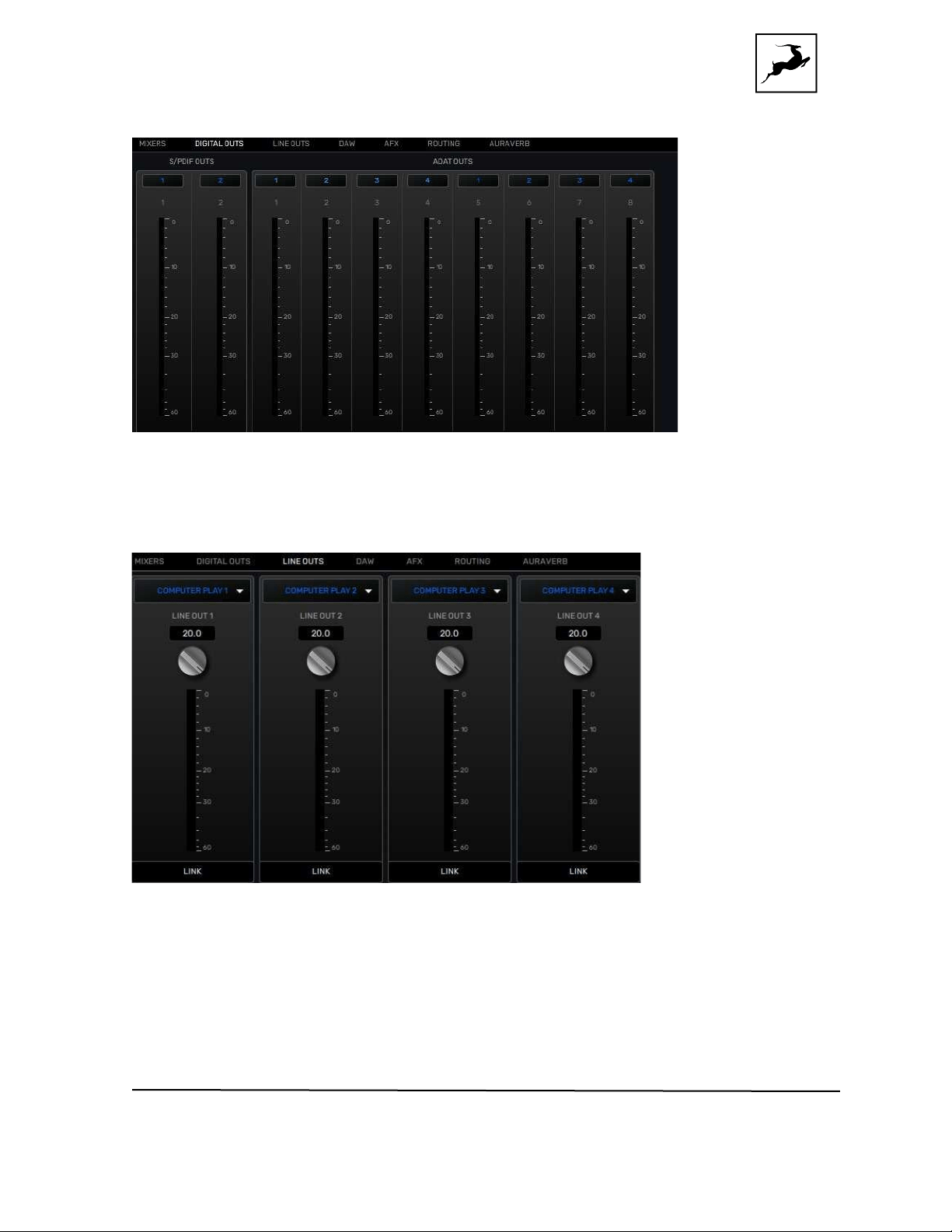
DIGITAL OUTS
This tab lets you route all available audio sources to the ADAT and S/PDIF digital
outputs. Each ADAT and S/PDIF output channel has a dedicated Input Selector and
Peak Meter.
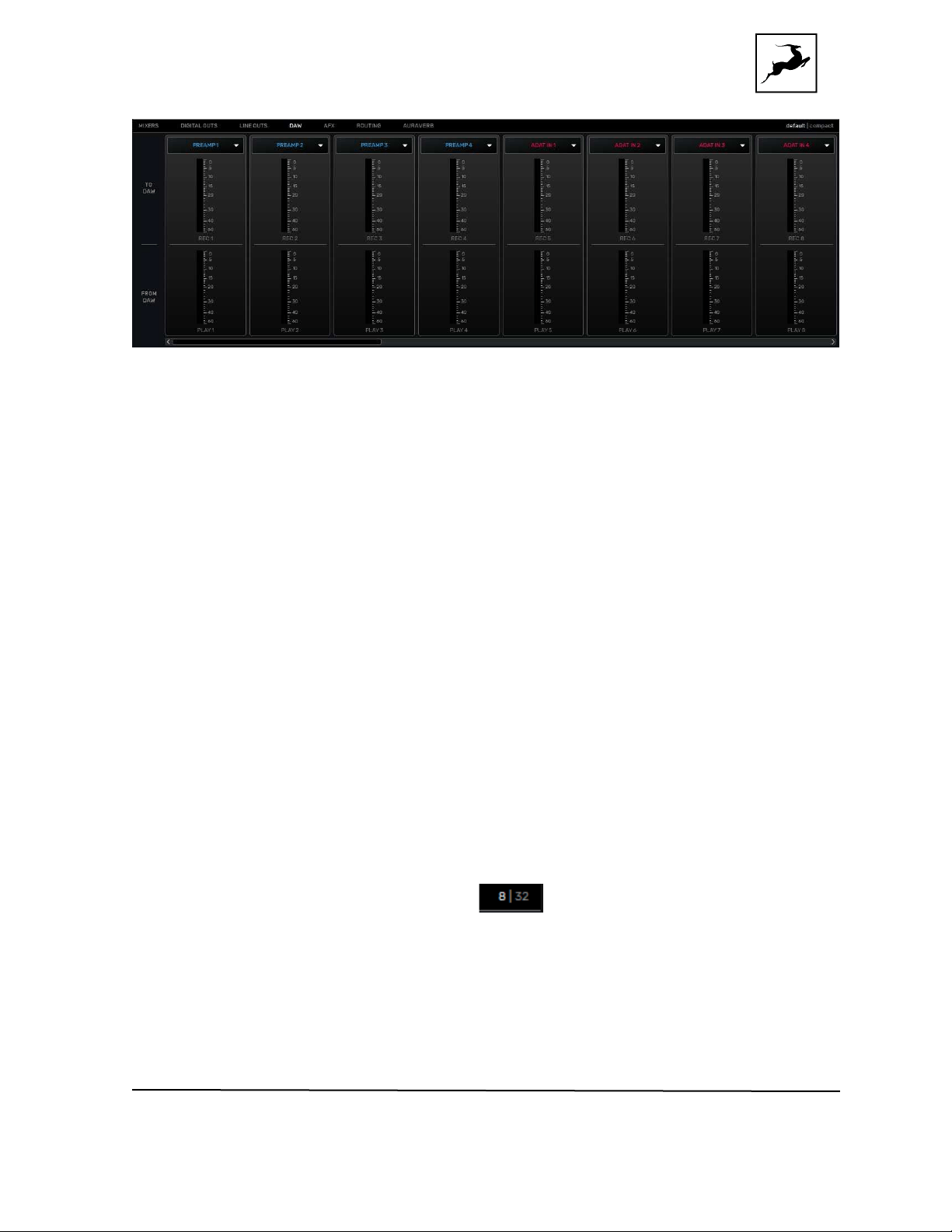
LINE OUTS
This tab allows you to route all available audio sources and send them out of the four
line outputs.
Each channel strip contains the following:
• Input selector which allows you to choose the audio source you want to send.
• Trim knob with adjustment between 14 and 20dBu.
• Peak meter showing the source signal level in real time.
• Link button which allows you to link all outputs and adjust their trim together.
Discrete 4 Pro Synergy Core User Manual
Page 46
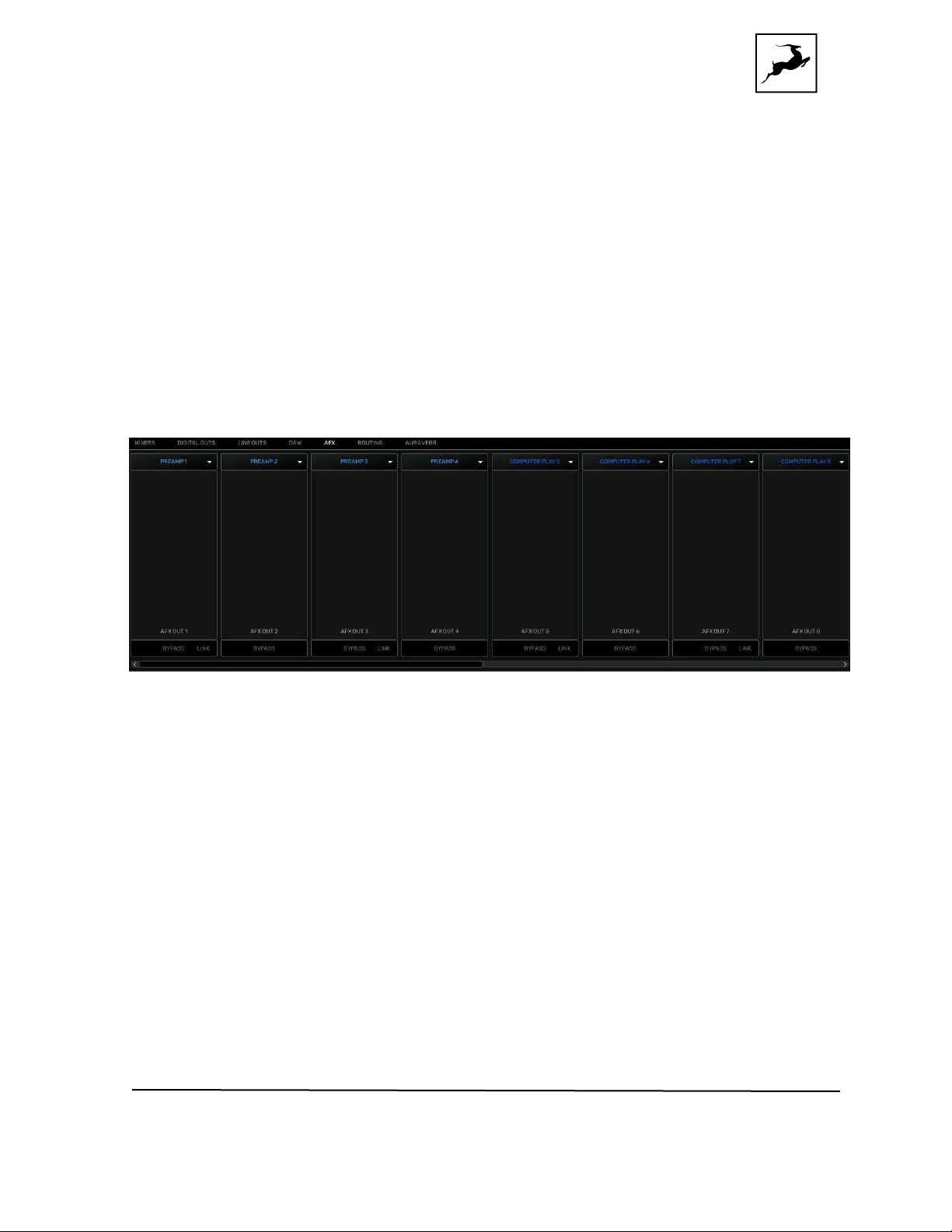
DAW
This tab provides an overview of audio going in and out of your DAW. The most
important aspect of this section is selecting which Signal source to send for recording
inside your DAW. TO DAW section manages this feature.
TO DAW
This section contains a total of 32 channel strips which represent the INPUT channels
inside your DAW. Above each channel strip there is an Input selector which allows you to
choose the signal source you want to send for recording inside your DAW. For example,
if you want to record the signal coming into Preamp 1 of the Discrete, on INPUT 1 inside
your DAW, all you need to do is select PREAMP 1 from the Input selector on the first
channel strip (Record 1). Record 1 = Input 1 inside your DAW.
The Peak Meters on each Record channel are showing in real-time the signal going into
your DAW for recording.
FROM DAW
This section has a total of 32 PLAY channels which represent the Output channels inside
your DAW. The peak meters will visualize the signal going OUT of your DAW.
Those peak meters also represent the signal from COMPUTER PLAY 1-32, as
COMPUTER PLAY 1-32 corresponds to the audio from Outputs 1-32 inside your DAW.
So, if you want to send an audio track from your DAW to the analog and digital outputs,
or into the Synergy Core FX (AFX tab) - assign this track to Output 1 - 32, go back to
the Discrete Control Panel and assign the 'COMPUTER PLAY' source with the same
number anywhere you want. Play 1 = Output 1 inside your DAW.
Default and Compact view – 8/32 channels
On the top right side of the DAW section, you can find a switch between 8 and 32
channels which changes the view mode. In the 8-channel mode, the DAW section fits 8
enlarged channel strips.
In the 32-channel mode all 32 channels are visible in the DAW section.
Scroll bar
Just below the channel strips you can find a scroll bar which allows you to scroll between
Discrete 4 Pro Synergy Core User Manual
Page 47
all 32 available channels in the DAW section without using the extended view. This scroll
is available in the 8-channel mode view only.
NOTE: 32 channels are available via Thunderbolt only. If you are using USB – there are
24 inputs and outputs available.
AFX
On top of each channel strip, you have the option to select the signal source which you
want to add effects to. By clicking on the source, you open a dropdown menu where you
can select which signal you want to process (for example PREAMP 1).
There is a scroll bar bellow allowing you to scroll between all 16 AFX channel strips easily.
Click inside the AFX area below each source to open the FX Rack and apply Synergy
Core FX. Click the 'BP' button to bypass all FX applied to the channel. Click the 'Link’
button to link adjacent channels, duplicating any effects and creating a stereo effects
rack.
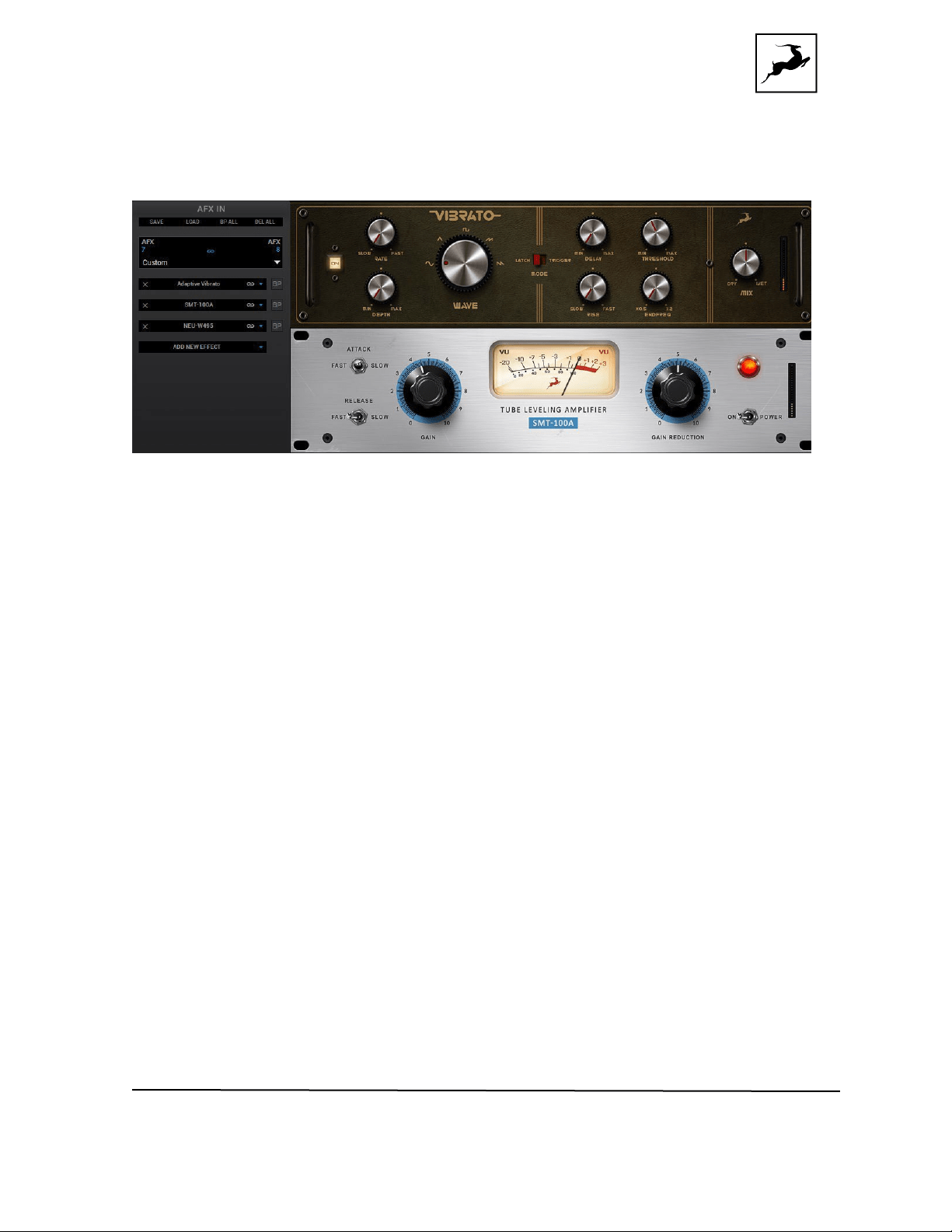
The FX Rack looks like this:
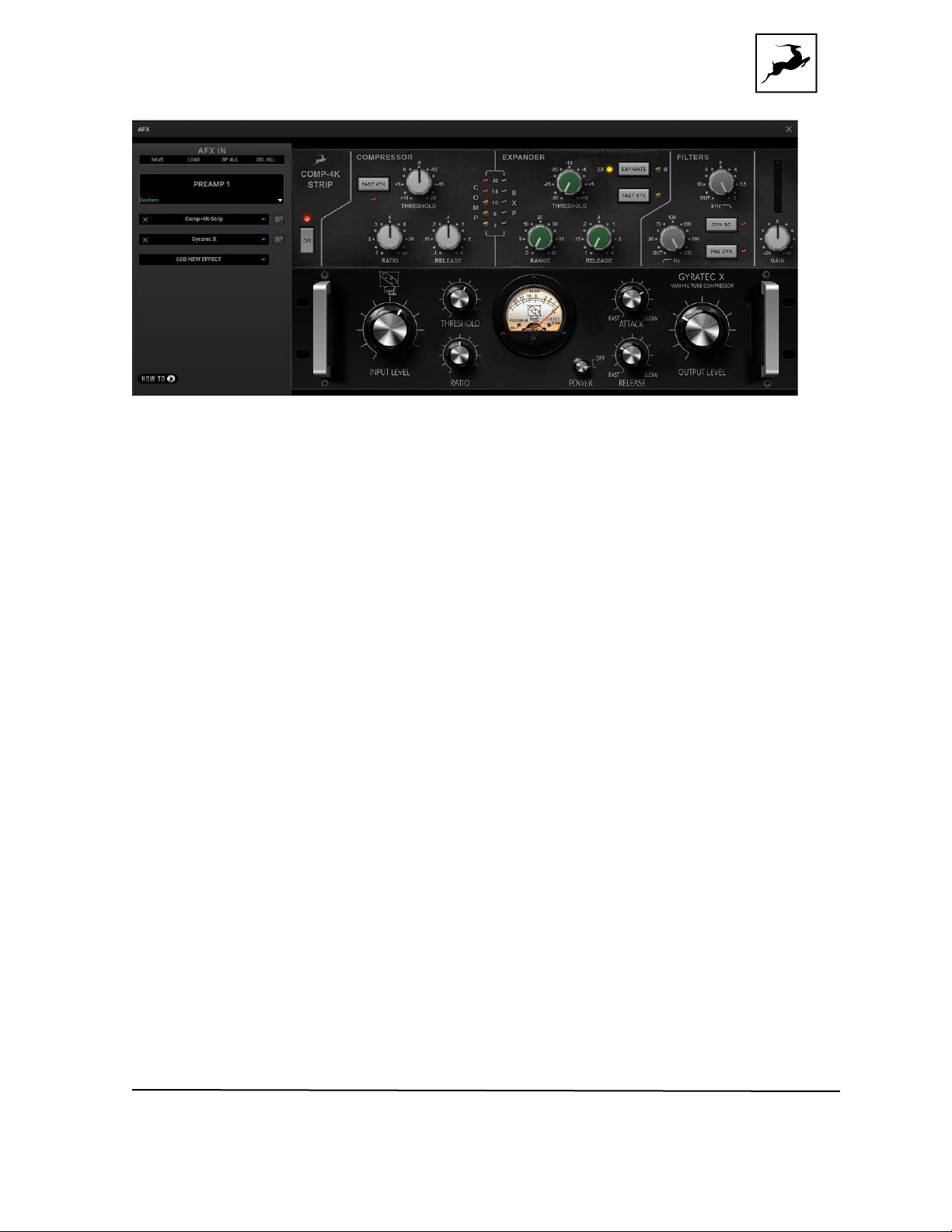
Discrete 4 Pro Synergy Core User Manual
Page 48
The following functionality is available:
●
Use the 'SAVE' and 'LOAD' buttons to store and recall FX Chains.
●
Click the 'BP ALL' button to bypass all FX in the rack. Click again to re-activate.
●
Click the 'DEL ALL' button to clear the FX Rack - Left click + hold Ctrl (Windows)
/ Command (Mac).
●
Click the drop-down menu below the input label to load factory presets.
●
Click the 'ADD NEW EFFECT' button to choose and load Synergy Core FX. Their
controls appear in the right section.
●
The left section lets you click and drag to re-order FX. A 'BP' button is available
next to each effect to bypass it.
●
Hold Ctrl (Windows) or Command (Mac) and drag to adjust controls in smaller
steps.
●
The 'How To' button points your Internet Browser to a video tutorial playlist in
the Antelope Audio YouTube channel.
Note: User manuals for some equalizers and compressors are available
here.
Discrete 4 Pro Synergy Core User Manual
Page 49
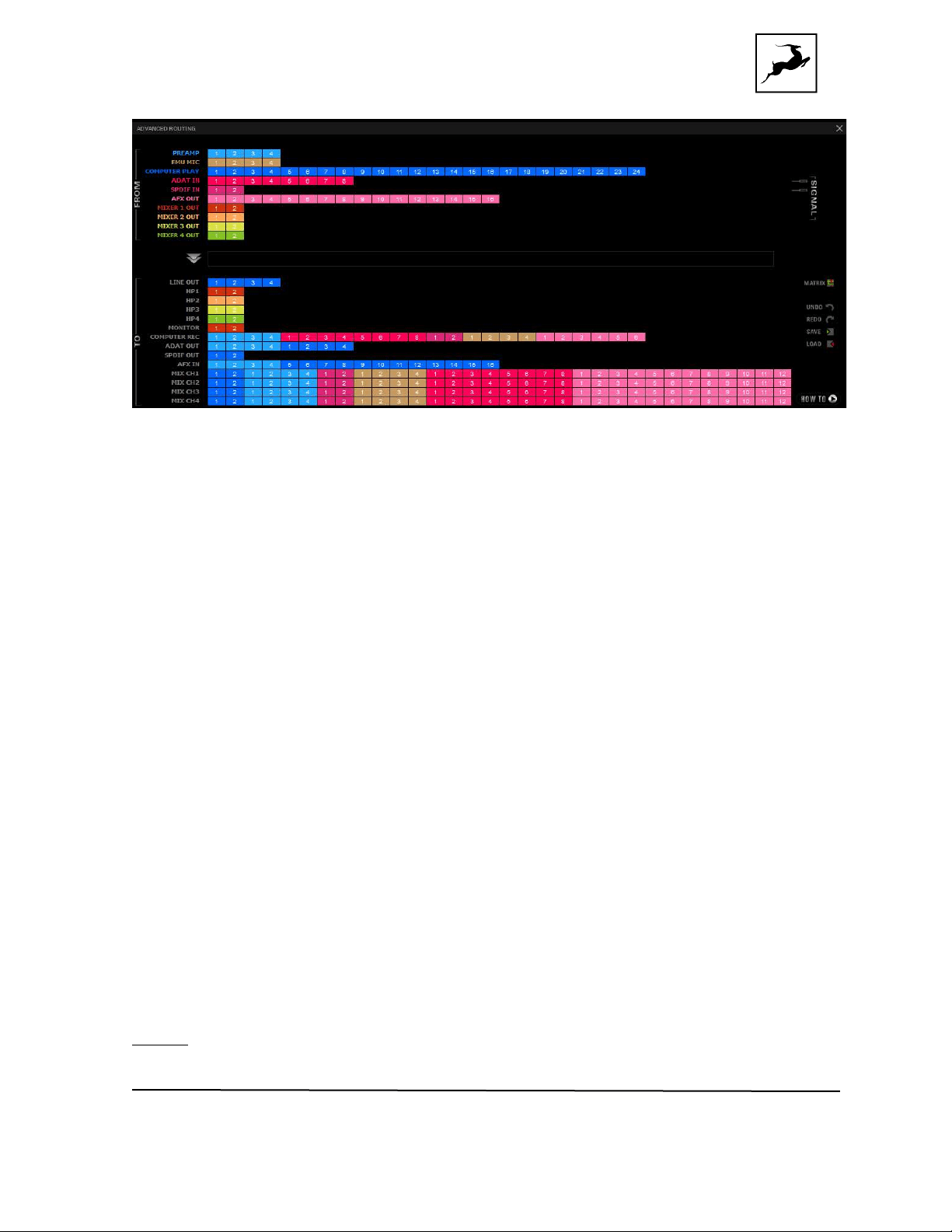
ROUTING
This tab contains the Routing Matrix for analog and digital audio routing. It is
important to know that all changes in the routing matrix affect the settings in the
other tabs and sections in the control panel. The opposite is also valid – making
routing changes with the Input Selectors in the Mixers, Digital outs, Line outs and
HP/Monitor outs affect the routing matrix.
The Routing Matrix is row-based. Each row has its own unique color and
represents a specific audio in or out with its maximum number of channels.
The Routing Matrix is split into two main sections: FROM (Source) and TO
(Destination). Route audio between them by dragging and dropping the
colored number blocks. The following functionalities are also available:
• Drag and drop with left mouse click to route channels FROM into TO
section. For example: Drag and drop PREAMP 1 into COMPUTER REC 1.
• Click on a number block to highlight the destinations it’s currently routed
to.
• Double-click a number block to change its text label. The changed text will
also appear in the other Control panel sections where this channel is
selected in the Input selector.
• Click on a source channel to highlight it and use Shift + Left-Click on a
channel to the right on the same row to select multiple sources.
• Select multiple source channels by using Ctrl/Command + Left-Click.
Routing matrix terminology
FROM:
PREAMP - This row represents each of the 8 preamp/combo inputs.

Discrete 4 Pro Synergy Core User Manual
Page 50
EMU MIC - This row represents mic preamp inputs 1 - 8 with mic emulations
applied to incoming microphone audio. This offers some interesting possibilities,
such as:
● Simultaneous monitoring and recording of dry microphone audio from the
‘PREAMP’ row and mic emulation audio from the ‘EMU MIC’ row on separate
audio tracks in your DAW – with and without Synergy Core FX added on top.
● Setting up multiple monitoring mixes, e.g. ‘dry’ mix for the recording engineer
and ‘mic emulation’ mix for the performing artist, with different FX chains on all
mix channels.
COMP PLAY - This row represents DAW 'Outputs 1 - 32' (Thunderbolt™) or DAW
'Outputs 1 - 24' (USB). This is where you receive audio from your DAW. Create a
new track in your DAW and assign the output with matching number - e.g. DAW
'Output 1' = 'COMP PLAY' 1. This row also represents all computer audio, such as
OS media playback (iTunes, Spotify, YouTube, Zoom, etc.), DAW outputs, etc.
ADAT IN - This row represents up to 8 ADAT optical audio channels. Note
that ADAT runs on S/MUX.
S/PDIF IN - This row represents 2 channels of incoming stereo S/PDIF audio
over coaxial RCA cable.
AFX OUT - The AFX OUT row (‘AFX’ short for 'Antelope FX') represents the
output from 16 mono audio channels with Synergy Core FX applied.
MIXER 1-4 OUT - These rows represent the four 2-channel stereo outputs from
the four virtual 32 channel mixers in the ‘Mixer’ tab. Channel 1 is left and Channel
2 is right.
TO:
LINE OUT - This row represents 4 line outputs over one signal-balanced TRS jacks.
HP1 - This row represents Headphone output 1 as two mono (L/R) channels.
HP2 - This row represents Headphone output 2 as two mono (L/R) channels.
HP3 - This row represents Headphone output 3 as two mono (L/R) channels.
HP4 - This row represents Headphone output 4 as two mono (L/R) channels.
MONITOR - This row represents Monitor output as two mono (L/R) channels.
Discrete 4 Pro Synergy Core User Manual
Page 51
row works only when the output is set to REAMP mode that can be switched from the
MONITOR 2 section in the main control panel.
COMP REC - This row represents DAW Inputs 1 – 32 (Thunderbolt™) or DAW Inputs 1 –
24 (USB). This is where you send audio to your DAW for recording. To record using a
‘COMP REC’ channel, route audio to it from the ‘Routing’ tab. Create a new track in your
DAW and assign the input with the matching number:
- example 'COMP REC' 1 = DAW 'Input 1'.
ADAT OUT - This row lets you route up to 16 mono audio channels to the ADAT
outputs (2 ports of up to 8 mono audio channels each). Note that ADAT runs on S/MUX.
S/PDIF OUT - This row lets you route 2 audio channels to S/PDIF-compliant equipment
over coaxial RCA cable.
AFX IN - The AFX IN row (‘AFX’ short for 'Antelope FX') lets you route audio into the
Synergy Core FX. You can route up to 16 mono channels and stack up to 8 effects on
each, independent of sample rate. Synergy Core FX are found in the ‘AFX’ tab.
MIX 1-4 IN – The ‘Mixer’ tab is home to four low-latency Direct Monitoring mixers with
32 inputs each. This row lets you route audio to them.
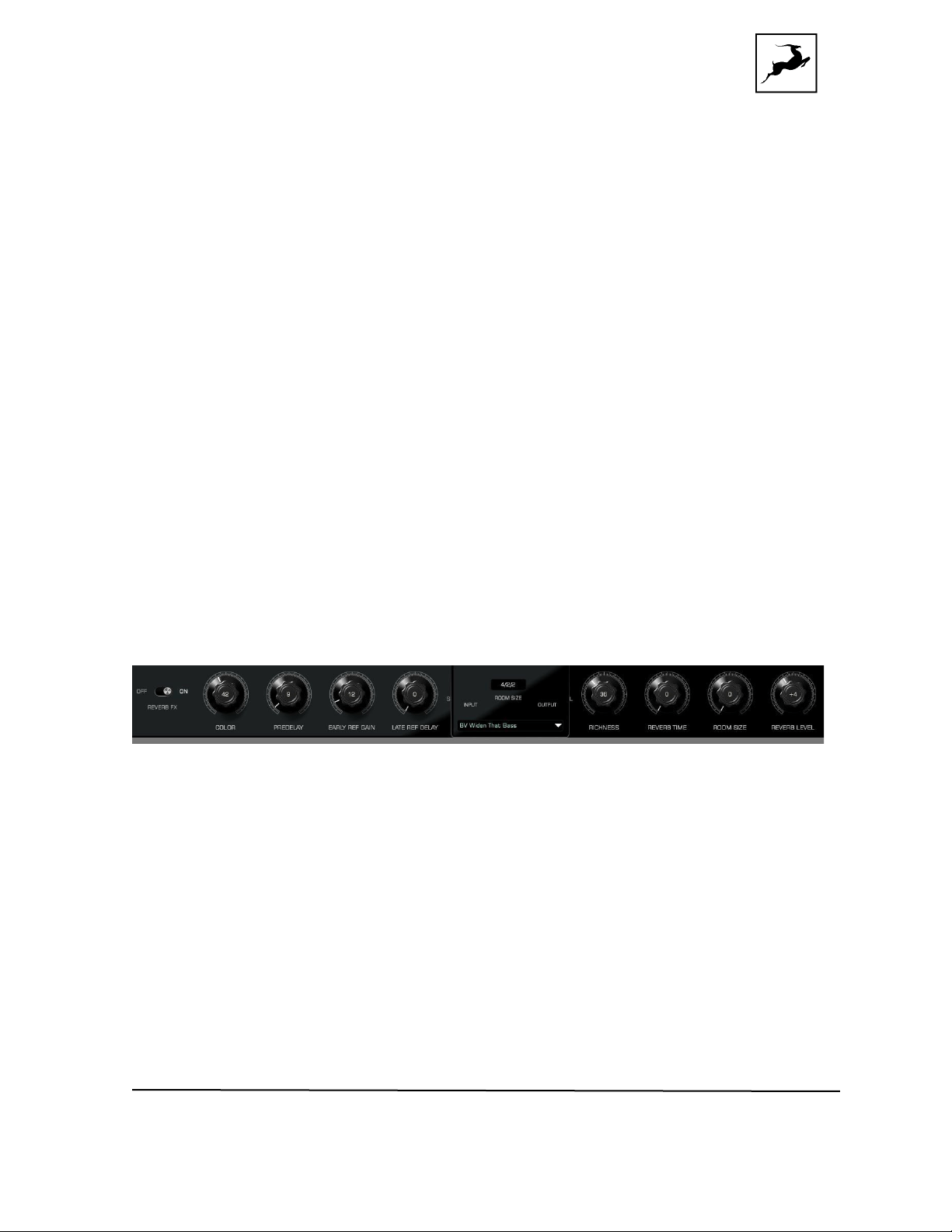
AuraVerb
This is Antelope’s proprietary reverb effect which can be applied as a send on each
channel in MIXER 1. You can use the Auraverb on your Headphones and Monitor mixes by
routing MIXER 1 OUT 1 and 2 to Monitor/HP left and right. If you want to record the
Auraverb in your DAW you would have to route MIXER 1 OUT 1 and 2 into the DAW
section.
AuraVerb provides richness and color using a special new approach and a unique
algorithm. The reverb features eight different controls, including a ‘Color’ parameter to
create everything between darkened textures to bright, sizzling presence. In addition,
there are 24 presets done by award-winning audio engineer and producer Brian Vibberts.
Discrete 4 Pro Synergy Core User Manual
Page 52
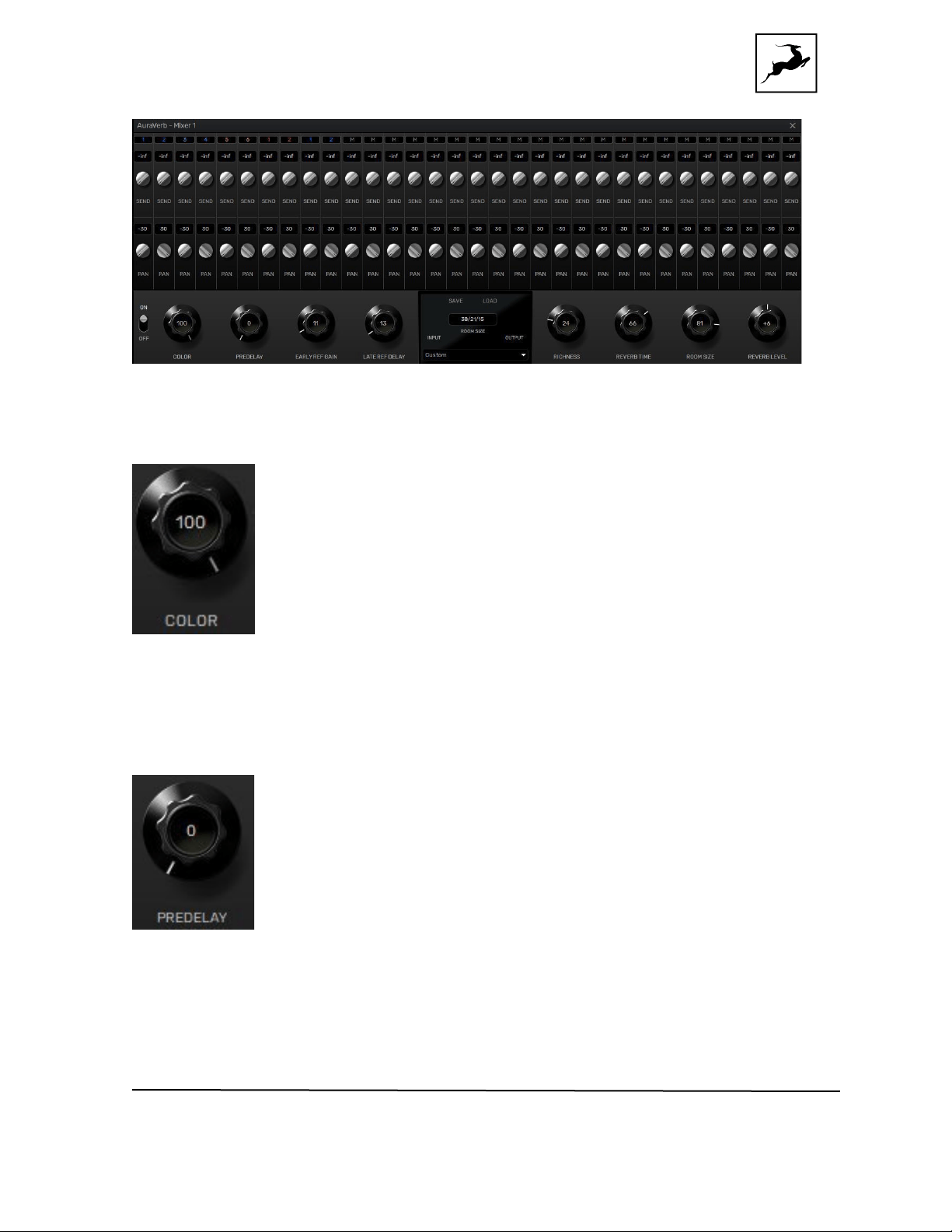
Parameters
The following parameters are available in AuraVerb:
Color
The Color control lets you adjust the overall tone of the reverb. At 0, the space created
is darker, like a lushly carpeted area. At 100, the reverb is at its brightest, which can add
some ‘sizzle’ to a lead vocal, for example.
PreDelay
Common for most reverbs, the pre-delay lets you create a bit of space between the
source and the onset of reverb. This happens by controlling the amount of delay time
that precedes the initial sound from the reverb. This parameter is used to place the
reverberated signal later in time with respect to the unprocessed signal.
Discrete 4 Pro Synergy Core User Manual
Page 53
Natural settings for this are based on the size of the environment and range from 0 to
32 milliseconds. Fine adjustment of this parameter with respect to the tempo of the
song or dramatic timing of the piece can help set the feel of the reverb within the mix.
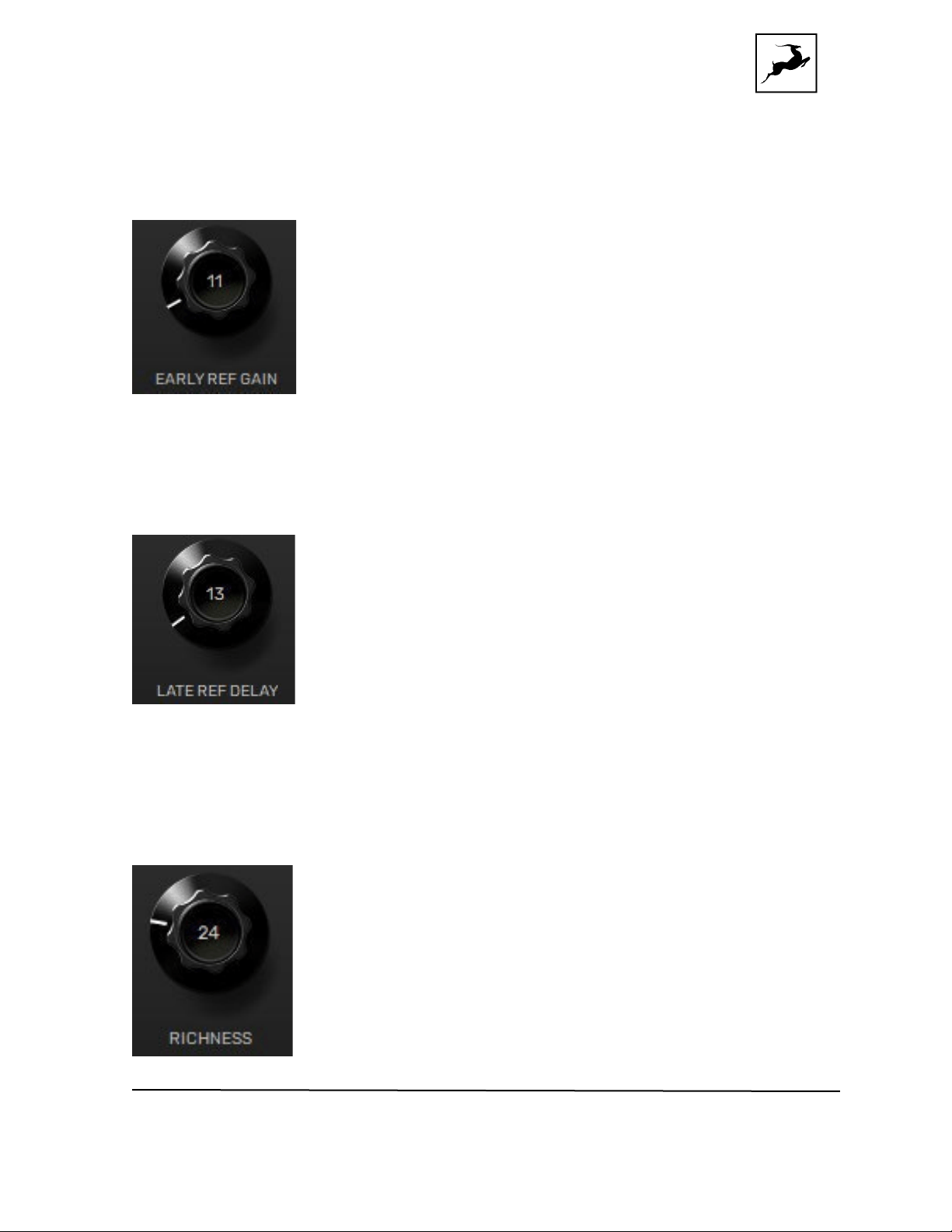
Early Reflection Gain
This is the linear gain value for all early reflections. These reflections are perceptually
grouped with the direct sound when set at lower levels and can nicely thicken a track
when increased.
Late Reflection Delay
Among other things, AuraVerb calculates reflected energy from the side walls and ceiling
of the virtual space. Late Reflection Delay controls the delay of these bursts of
reflections, either creating echoes or supporting the spatial impression of the simulated
acoustic space.
Discrete 4 Pro Synergy Core User Manual
Page 54
Richness
Richness controls the complexity of the reverb envelopment and dampening nuances. At
0, there is less dampening and a brighter decay. This sound is light or airy, but by
increasing the Richness, you can add a sense of spaciousness to the sound and
smoothly increase reverb time for lower frequencies.
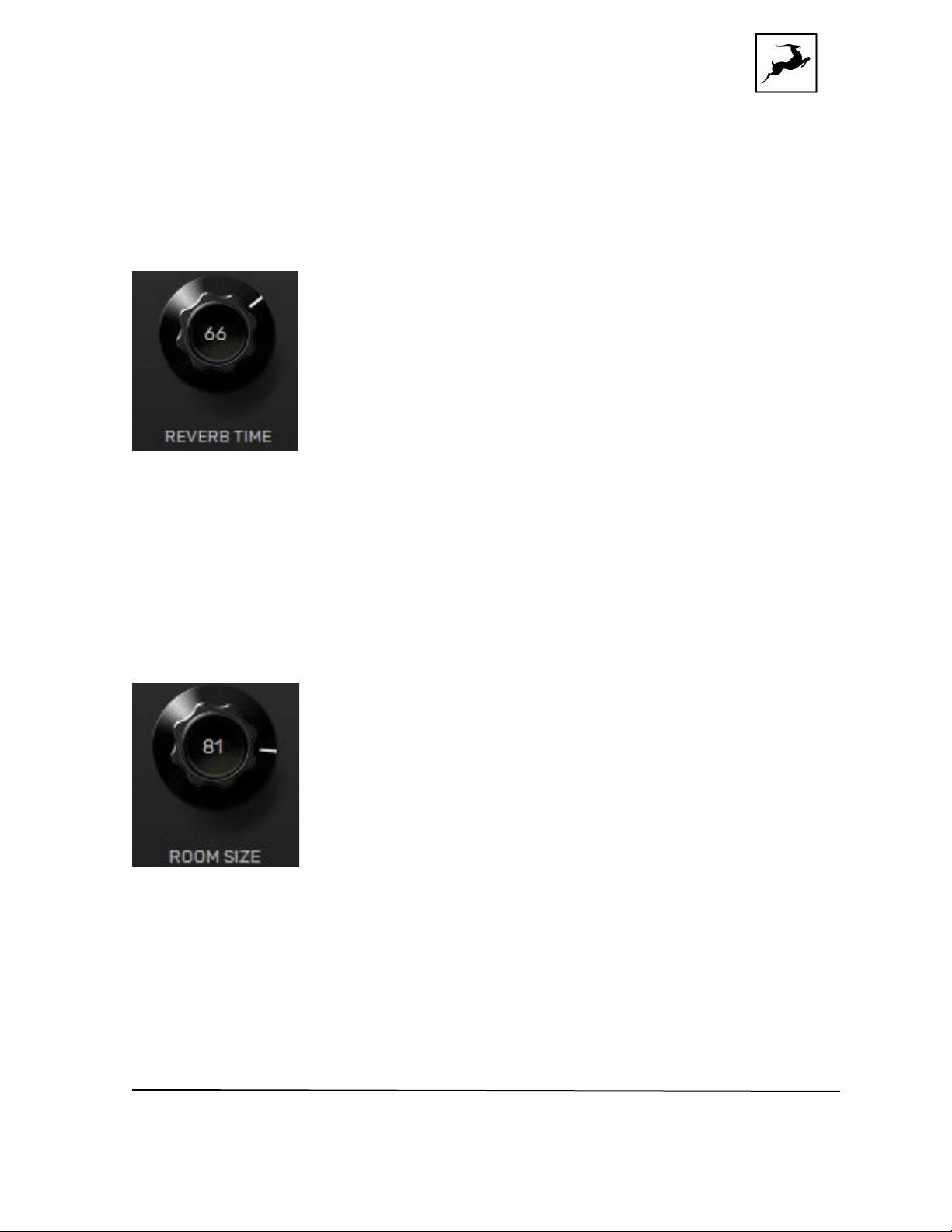
Reverb Time
Reverb Time controls the length of decay, while Room Size increases the virtual space
dimensions. The perceived decay time will also be affected by Richness and Color on
sources with a lot of high frequency content. Generally, as the size of the space
increases, the Reverb Time will also increase.
Setting Reverb Time to 50% gives a natural sounding tail for all room sizes. Interesting
big spaces or subtle ambience reverbs can be created by setting Reverb Time unusually
high or low with respect to the Room Size parameter.
Room Size
Room Size increases the virtual space dimensions.
Discrete 4 Pro Synergy Core User Manual
Page 55
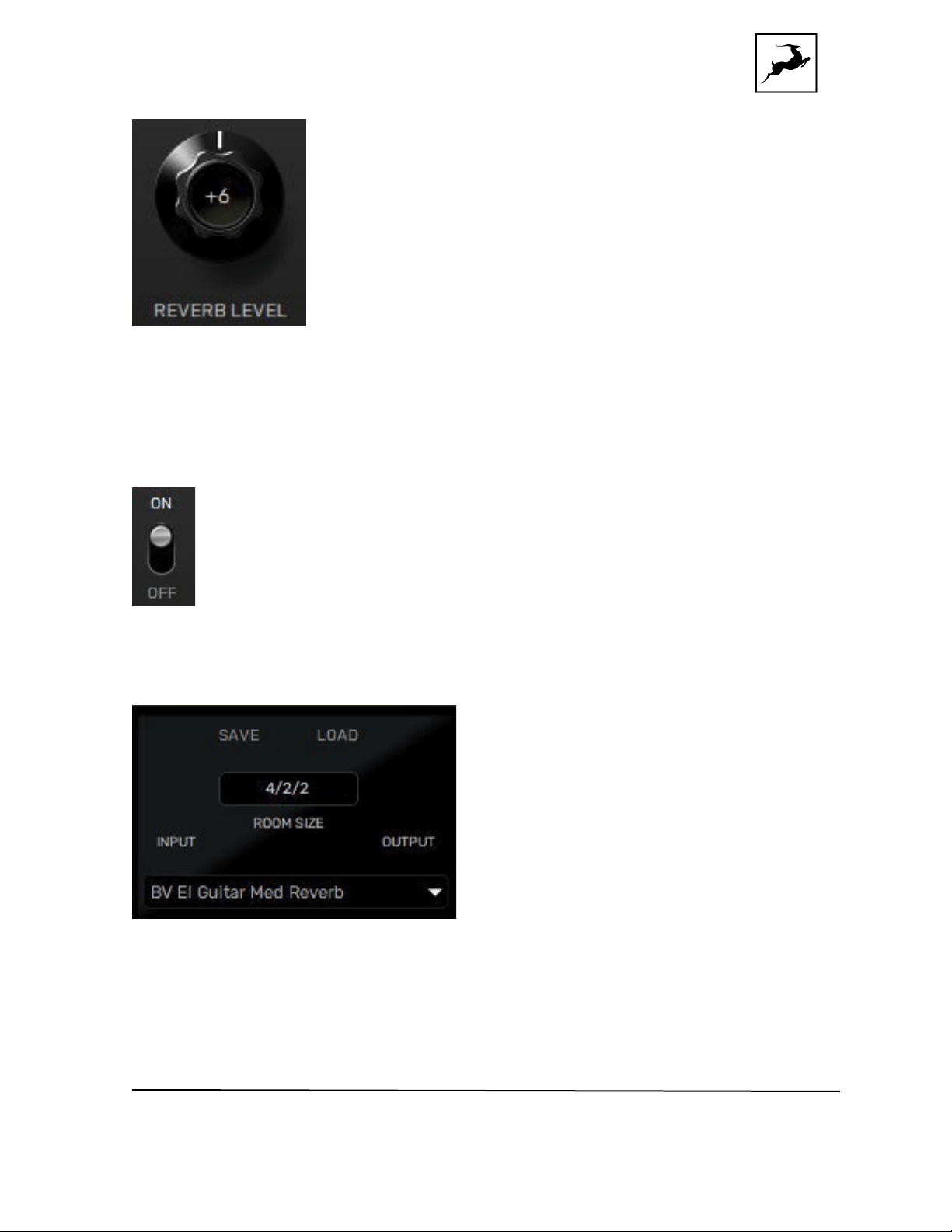
Reverb Level
This is the output level control of the reverb. Since inputs for AuraVerb are assigned to
Send knobs on Mixer 1’s channels, we recommend balancing the channel volume levels
from the Send controls and using Reverb Level to adjust the amount of reverb in the
Master bus.
Reverb FX ON/OFF Switch
Use it to enable and disable AuraVerb.
Preset Manager
The Preset Manager lets you load pre-defined presets. Use the drop-down menu to
choose a preset.
Discrete 4 Pro Synergy Core User Manual
Page 56
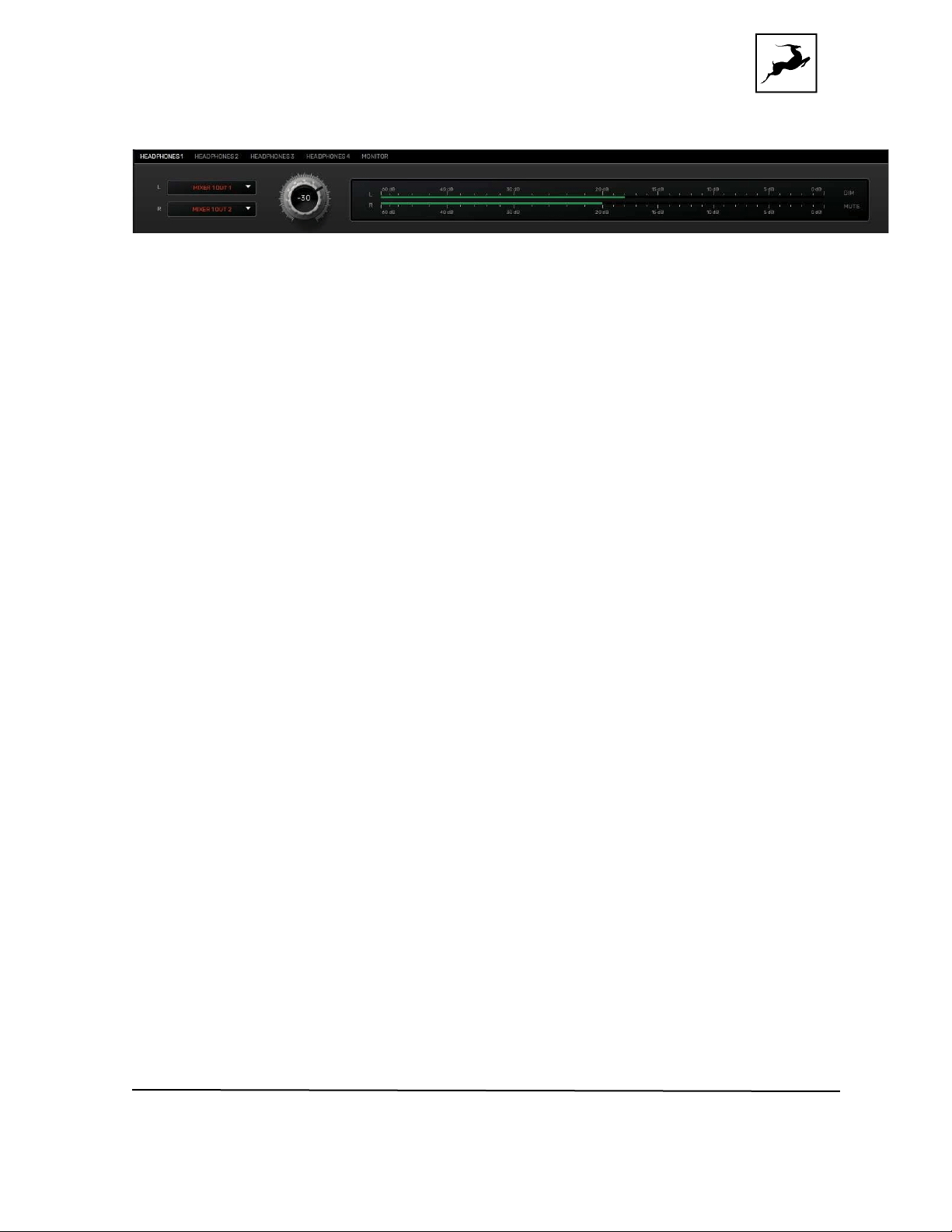
MONITORING CONTROL
This section allows you to route different signals directly to the Monitor and Headphone
outputs and adjust their volume.
On the top left corner, you can switch between, HP1, HP2, HP3, HP4 and
MONITOR.
Each tab has the following:
• 2 Input selectors for the left and right channels – you select the audio source
you want to send to the outputs.
• Volume knob – adjust the volume of the outputs.
• Peak meter – real time visualization of the audio signal going out of the outputs.
• Dim button - attenuates the volume of the output with –20dB.
• Mute button - mutes the output.
Discrete 8 Pro Synergy Core User Manual
Page 57
G
UITAR
A
MPS
& C
ABS
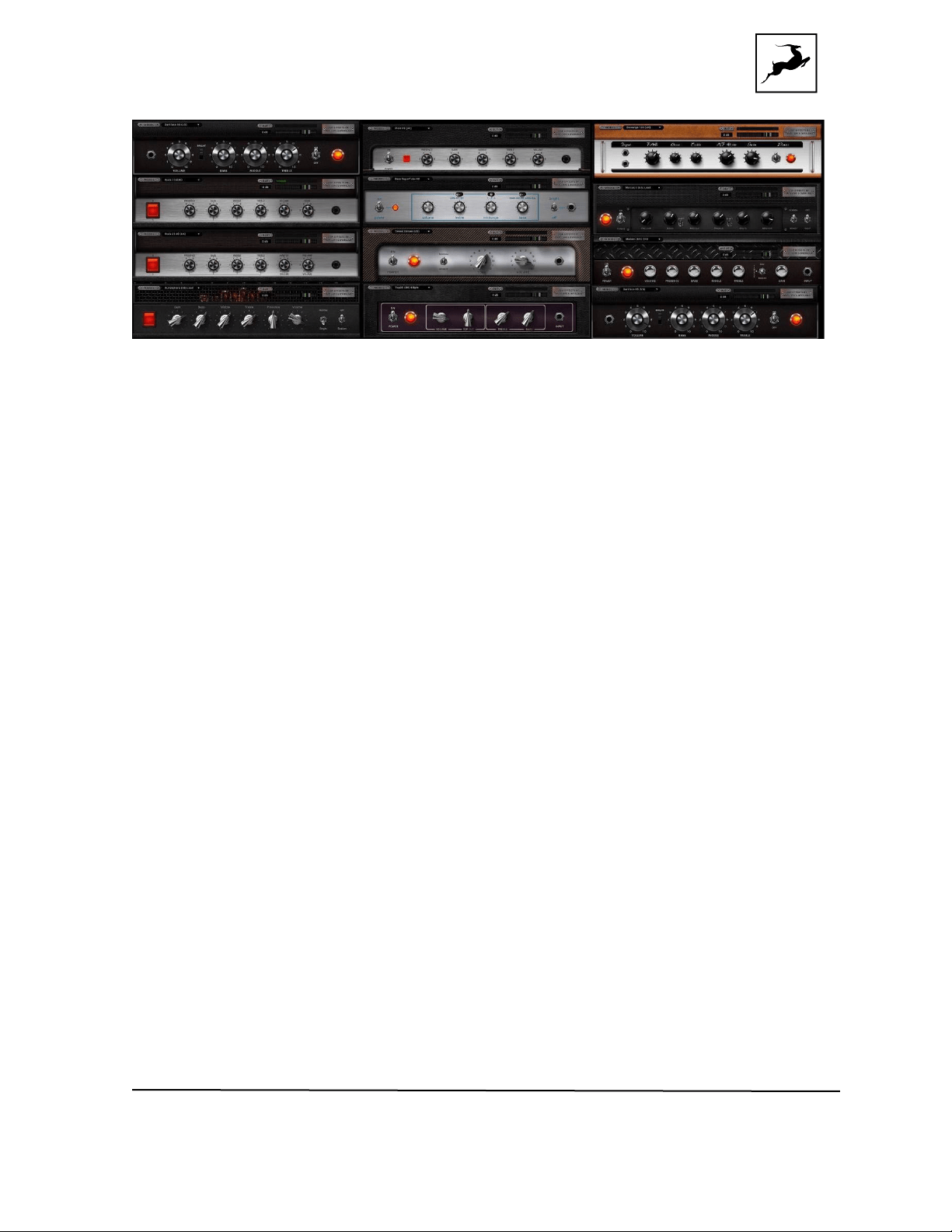
A suite of 11 guitar amps and matching cabinets lets you hear and record the roar of
your electric guitar in real-time. These also include a bass rig as well. If you don’t play
guitar, but like the sound of cooked-up tubes and speaker cabinets pushing air, you can
route any audio into these precise emulations!
Getting Started
Guitar amps and cabs are used like almost any other Synergy Core effect. Here are the
basics:
1. Connect your guitar to A1 and your studio monitors to the Monitor L/R outputs of the
Discrete 4 Pro Synergy Core.
2. Open the Control Panel and head to the leftmost area in the 'PREAMPS' row. Click the
middle symbol to the right of the volume indicator until you get an electric guitar
symbol.
3. Click a channel's input selector in the 'AFX' area and choose PREAMPS > PREAMP 1
from the menu.
4. Click the 'AFX' area below the input selector to launch the Synergy Core FX Rack.
Click 'ADD NEW EFFECT' and make your guitar amp and cabinet choices from the
menu. If you don't know where to start, the 'Modern (US)' amp and 'Modern 4 x 12'
cabinet combination make for a great modern rock/metal rig.

Discrete 4 Pro Synergy Core User Manual
Page 58
Here are some additional tips regarding the cabinet modules:
●
Change the cabinet model anytime from the ‘Cabinet’ drop-down menu.
●
Change your cabinet’s mics from the ‘Mic A’ and ‘Mic B’ drop-down menus. Click
the adjacent ‘Phase’ button if your choice of microphones results in phasing
issues.
●
Click and drag the virtual microphones to adjust their vertical and horizontal
positioning.
●
Click and turn the ‘Mic A’ and ‘Mic B’ knobs to dial-in the amount of signal you
want from each microphone.
●
Click and turn the ‘Rear Mic’ knob to mix-in signal from an additional mic behind
the cabinet.
●
Click and turn the ‘45-degree Mic’ knob to mix-in signal from an additional mic
positioned at a 45-degree angle from a speaker cone.
●
Click the ‘ReSPiRe’ button to hear some cab sim mojo courtesy of our friends
from
Overloud. I
n their own words, the ReSPiRe technology lets you switch
between the ‘real’ response of the cabinet and a processed version optimized to
fit into a mix and avoid frequency overlap with the other instruments.
●
Click the ‘HPF’ button to engage a preset high-pass filter (tames excessive low
end).
●
Click the ‘LPF’ button to engage a preset low-pass filter (tames harsh or shrill-
sounding highs).
●
Click the ‘BP’ button to bypass the cab sim.
Finally, route the AFX OUT channels to COMP REC or in the DAW section to the Record
channel strips so you can record.

Discrete 4 Pro Synergy Core User Manual
Page 59
Software
Re-amping
In addition to hardware re-amping through the REAMP outputs, you can re-amp DI
guitar tracks through the Synergy Core amps & cabs:
1. Open your DAW. Place your DI on a track and assign it to one of Outputs 1 – 32.
Remember: DAW Outputs = 'COMPUTER PLAY' channels.
2. Open the Control Panel and click the AFX tab. Click an Input Selector and choose the
'COMPUTER PLAY' channel with the same number as your DAW output.
3. Stack your amps, cabs and FX from the FX Rack.
4. Go to the DAW section and route AFX OUT channels corresponding to the number of
channels you are using (for example AFX OUT 1-4)
5. Create a new track in your DAW and enable live monitoring. Assign the correct DAW
input channel (same number as the output channel) and hit 'Play' in the transport
controls. You should be hearing your re-amped track and be able to record it.
EDGE &
VERGE MIC EMULATIONS
Edge & Verge mic emulations are intended for use with the Antelope Audio Edge &
Verge modeling microphones only. We cannot guarantee optimal (or even usable) results
with other microphones.
Getting Started
Connect your headphones to HP1 on the front panel. Connect your Antelope Audio Edge
or Verge modeling microphone to the preamp/combo inputs. In our example, we are
using the Edge Duo, which is connected to inputs A1 and A2.

Discrete 4 Pro Synergy Core User Manual
Page 60
1. Open the Control Panel and head to the leftmost preamp from the PREAMPS row.
Click the middle symbol to the right of the volume indicator until you reach the 'mic'
symbol. Then, click the 'cog wheel' symbol. This will launch the mic emulations window.
Choose Edge Duo with the dial.
2. Adjust microphone gain with the gain knobs. Note that preamps A1 and A2 are now
linked and have identical settings between them.
3. Go to any available mixer, ‘MIXER 1’ in this example, and select ‘EMU MIC 1’ and ‘EMU
MIC 2’ as sources for the first two, or any other mixer channels.
4. Open the ‘HEADPHONES 1’ tab on the bottom of the control panel and make sure the
outputs of the first mixer are selected from the left and right channel dropdown menus,
‘MIXER 1 OUT 1’ and ‘MIXER 1 OUT 2’ respectively.
You should be hearing mic audio in your headphones at this point. Use the
‘HEADPHONES 1’ volume knob or the mix faders for Channels 1 and 2 to adjust output
volume.
Gain Calibration
Gain adjustment for the Edge Solo and Verge is straightforward, but the Edge Duo and
Edge Quadro are multi-membrane microphones. There may be differences in the input
signal strength from each membrane, which is to be expected due to the opposite
directions of the capsules.
Note that engaging mic emulations for Edge Duo and Edge Quadro automatically ‘links’
their input channels, thus individual gain adjustments per input are not possible while
using their mic emulations.
Using Mic Emulations
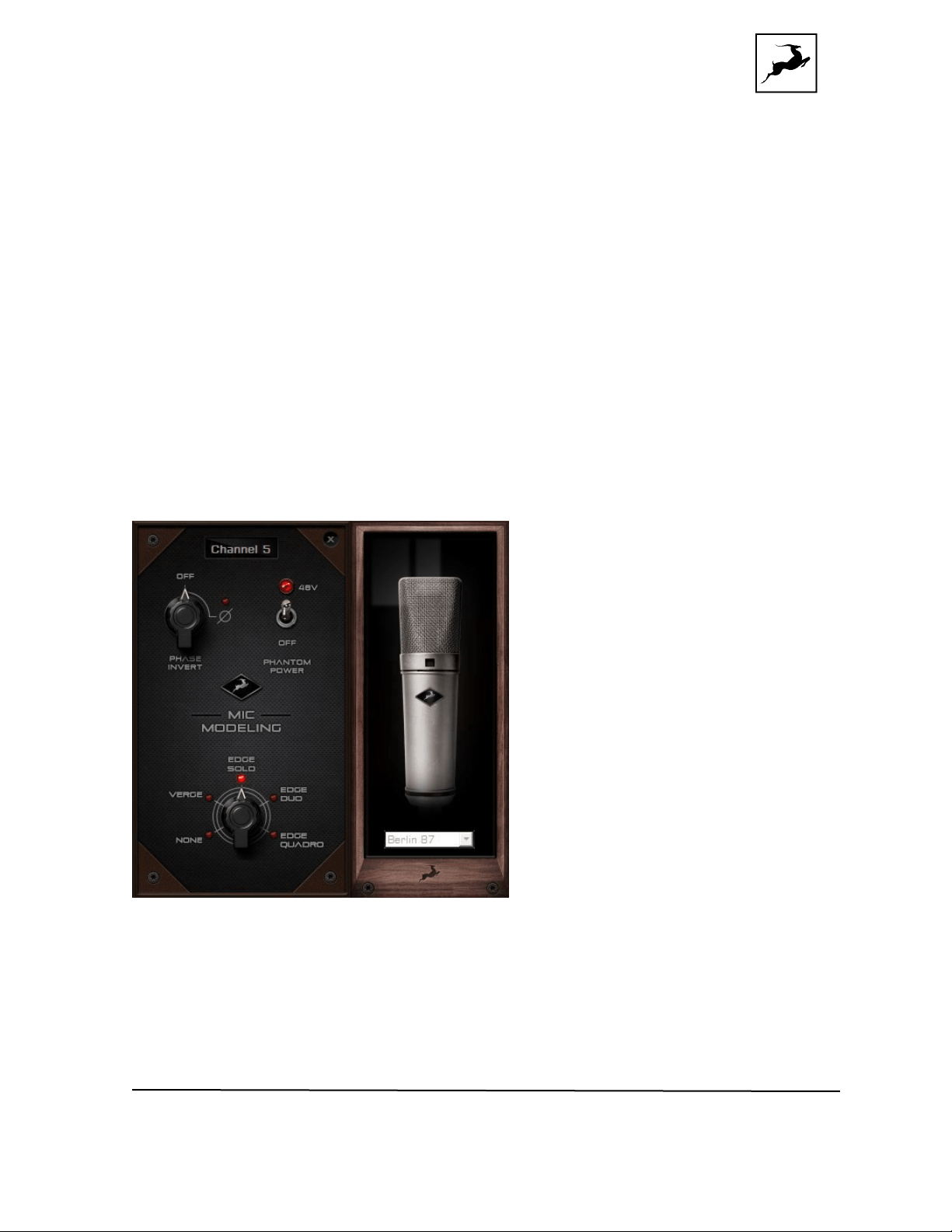
Discrete 4 Pro Synergy Core User Manual
Page 61
In the ‘Mic Emulations’ window, click and rotate the dial to access the emulations
available for your modeling microphone:
Following is a guide to using the mic emulations for each Antelope Audio modeling
microphone.
Edge
Solo
Edge Solo Mic Emulations Window
The following functionality is available:
●
Choose mic emulations from the drop-down menu on the right.

Discrete 4 Pro Synergy Core User Manual
Page 62
●
Click and turn the ‘Phase Invert’ dial to flip the microphone’s polarity.
●
Click and drag the ‘48’V switch to activate or turn off phantom power.
Recording and Monitoring Edge Solo
Edge Solo is a single-membrane condenser microphone. This means the microphone will
occupy one physical mic preamp input and one virtual ‘EMU MIC’ channel.
Edge Solo mic emulations work on a single input audio channel. Recording and
monitoring both ‘dry’ and ‘mic emulation’ audio means dealing with two mono tracks.
●
Route the ‘PREAMP’ input for Edge Solo to your desired outputs to monitor ‘dry’
audio.
●
Route the ‘EMU MIC’ output for Edge Solo (same number as the ‘PREAMP’ input)
to your desired analog and digital outputs to monitor/record ‘mic emulation’
audio.
●
Route ‘PREAMP’ and ‘EMU MIC’ channels to different outputs and record or
monitor from them to get both 'dry' and 'mic emulation' audio.
For more information about Edge Solo, visit its product page.
Discrete 4 Pro Synergy Core User Manual
Page 63
Edge
Duo
Note to owners of the legacy ‘Edge’ modeling microphone: 'Edge' and 'Edge Duo' have
nearly identical hardware, so feel free to use the ‘Edge Duo’ emulations with your legacy
‘Edge’ mic.
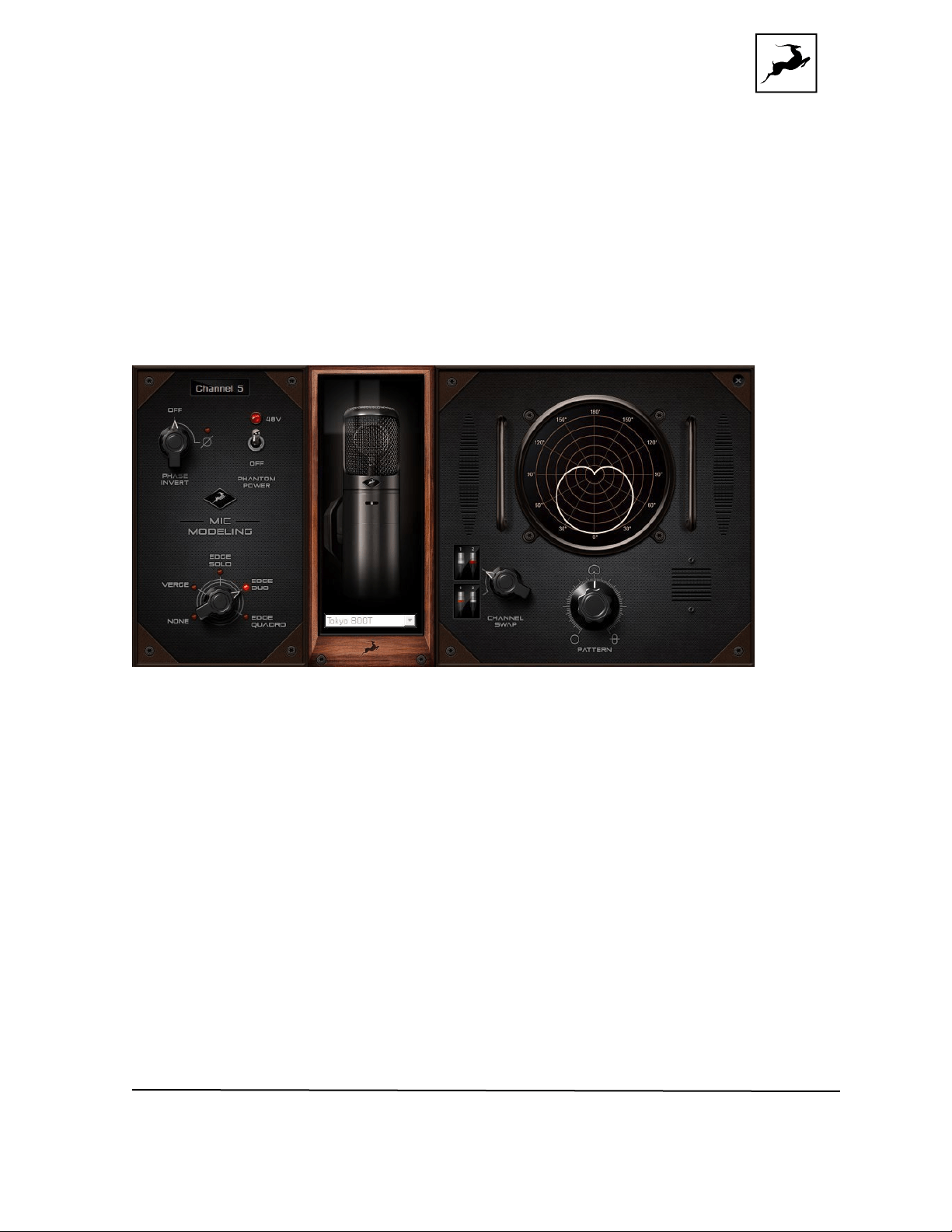
Edge Duo Mic Emulations Window
The following functionality is available:
●
Choose mic emulations from the drop-down menu in the middle.
●
Click and turn the ‘Phase Invert’ dial to flip the microphone’s polarity.
●
Click and drag the ‘48V' switch to activate or turn off phantom power.
●
Click and turn the ‘Channel Swap’ dial to swap the Edge Duo inputs.
●
Click and turn the ‘Pattern’ knob to adjust the polar pattern. Note that some mic
models have fixed or limited polar pattern adjustment.
Recording and Monitoring Edge Duo
Edge Duo is a dual-membrane condenser microphone – it has one capsule with dual
membranes and connects with an Y-XLR cable (included), one XLR connector for each

Discrete 4 Pro Synergy Core User Manual
Page 64
membrane. The Left (white) connector is the front membrane, the Right (red) is for the
rear membrane.
The microphone occupies two physical mic preamp inputs and two ‘EMU MIC’ virtual
outputs.
Note: You can use Edge Duo as a single-membrane condenser mic by disconnecting one
of the XLR connectors. In this case, the mic emulations will be visible, but they won’t
function correctly, you cannot swap inputs and you cannot adjust polar pattern.
Recording and monitoring Edge Duo as a single-membrane condenser mic
Route the ‘PREAMP’ input for Edge Duo to your desired outputs to monitor ‘dry’ audio
and record by routing the signal in the DAW tab.
Recording and monitoring Edge Duo as a dual-membrane condenser mic
In this case, you will record and monitor two concurrent mono inputs, one coming from
each membrane. They will sound slightly different in tone and volume, due to the
physical distance between the membranes and the performer. You may have to
compensate with individual gain adjustments for each membrane.
Route the ‘PREAMP’ inputs occupied by Edge Duo to your desired outputs to monitor
‘dry’ audio and record by routing the signal in the DAW tab.
Recording and monitoring Edge Duo as a modeling microphone
Make sure that ‘Edge Duo’ mic emulations are enabled. Route the ‘EMU MIC’ inputs
corresponding to the ‘PREAMP’ inputs occupied by Edge Duo to your desired outputs for
monitoring and record by routing the signals in the DAW tab.
Recording and monitoring ‘dry’ and ‘mic emulation’ audio simultaneously

Discrete 4 Pro Synergy Core User Manual
Page 65
With the Edge Duo, monitoring and recording ‘dry’ and ‘mic emulation’ audio
simultaneously means handling four concurrent mono signals – two ‘dry’ tracks and two
‘mic emulation’ tracks. ‘Dry’ audio comes from the ‘PREAMP’ inputs, and ‘Mic Emulation’
audio comes from the ‘EMU MIC’ outputs. Route them anywhere you want and record by
routing the signals in the DAW tab.
For more information about Edge Duo, visit its
product page.

Discrete 4 Pro Synergy Core User Manual
Page 66
Edge
Quadro
Connecting Edge Quadro
Edge Quadro is a quad-membrane condenser microphone – it has two heads, each with
dual membranes. The Top head rotates 360-degrees, enabling stereo recording
techniques such as M/S, X/Y, Blumlein, and even 3D sound. Therefore, the microphone is
bundled with a pair of Y-XLR cables. Their Left (White) connectors are for the front
membranes, and their Right (red) connectors are for the rear membranes.
However, each cable is designated for either the Top or Bottom head and labeled
accordingly – T (Top) or B (Bottom). The inputs on the microphone are labeled too,
letting you know where each cable needs to be connected.
There’s a bevy of options for connecting Edge Quadro to your Discrete 8 Pro Synergy
Core:
As a single-membrane (rotatable) condenser mic. Connect just one XLR from the Top
(rotatable) or Bottom head using the corresponding cable. The possible configurations
are:
1. Top Head – Front Membrane.
2. Top Head – Rear Membrane.
3. Bottom Head – Front Membrane.
4. Bottom Head – Rear Membrane.
As a dual-membrane (rotatable) condenser mic. Connect two XLRs from either (or both)
the Top and Bottom heads with the corresponding cables. The possible configurations
are:
Discrete 4 Pro Synergy Core User Manual
Page 67
1. Top Head – Front and Rear Membranes.
2. Bottom Head – Front and Rear Membranes.
3. Top Head – Front Membrane. Bottom Head – Front Membrane.
4. Top Head – Front Membrane. Bottom Head – Rear Membrane.
5. Top Head – Rear Membrane. Bottom Head – Front Membrane.
6. Top Head – Rear Membrane. Bottom Head – Rear Membrane.
As a quad-membrane rotatable condenser microphone. Connect all XLRs from both
heads with the corresponding cables. This is the only option for using the Edge Quadro
mic emulations.
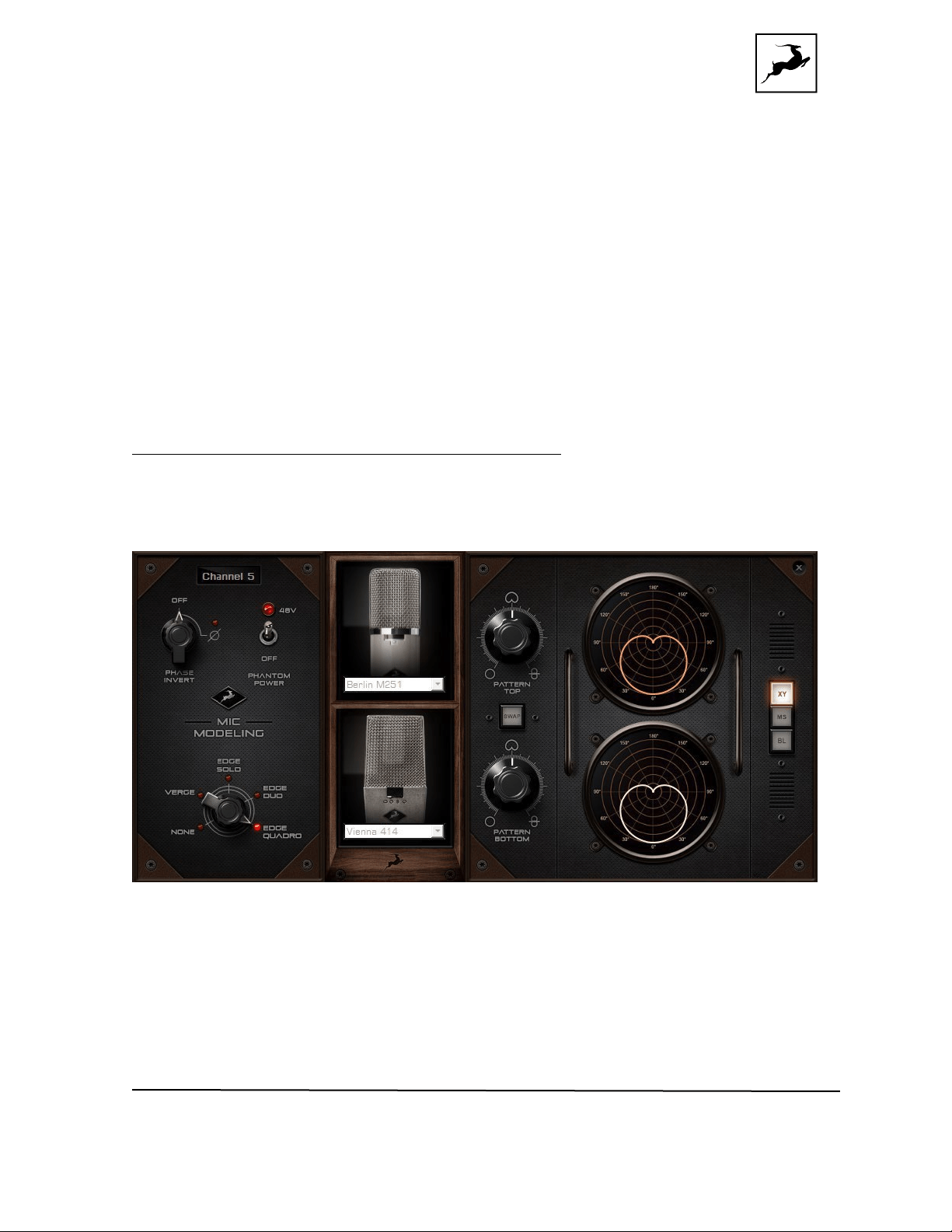
Edge Quadro Mic Emulations Window
Edge Quadro and Edge Duo mic emulations are identical, except for the ability to apply
two different mic emulations in unison - one for each head – complete with two different

Discrete 4 Pro Synergy Core User Manual
Page 68
polar patterns that are also swappable. All in all, the functionality is the same, but with
two mic emulation selectors and two polar pattern changers.
Monitoring and recording Edge Quadro
Taking full advantage of the Edge Quadro’s 360-degree recording and dual-emulation
capabilities means the microphone will occupy four physical mic preamp inputs and four
‘EMU MIC’ virtual outputs.
Monitoring and recording ‘dry’ and ‘mic emulation’ audio simultaneously with the Edge
Quadro mean handling eight concurrent mono tracks – two ‘dry’ tracks from its Top
head, two ‘dry’ tracks from its Bottom head, two ‘mic emulation 1’ tracks and two ‘mic
emulation 2’ tracks.
With so many signals available, the routing and processing possibilities are extensive. Put
the manual down and explore your skills and creativity.
For more information about Edge Quadro, visit its
product page.
Verge
Verge is a small-diaphragm condenser microphone that’s as simple to use as the Edge
Solo. Its dimensions and ability to handle high sound pressure levels make it a better fit
for positioning in tight spaces and recording very loud sources, such as drum kits.
Discrete 4 Pro Synergy Core User Manual
Page 69
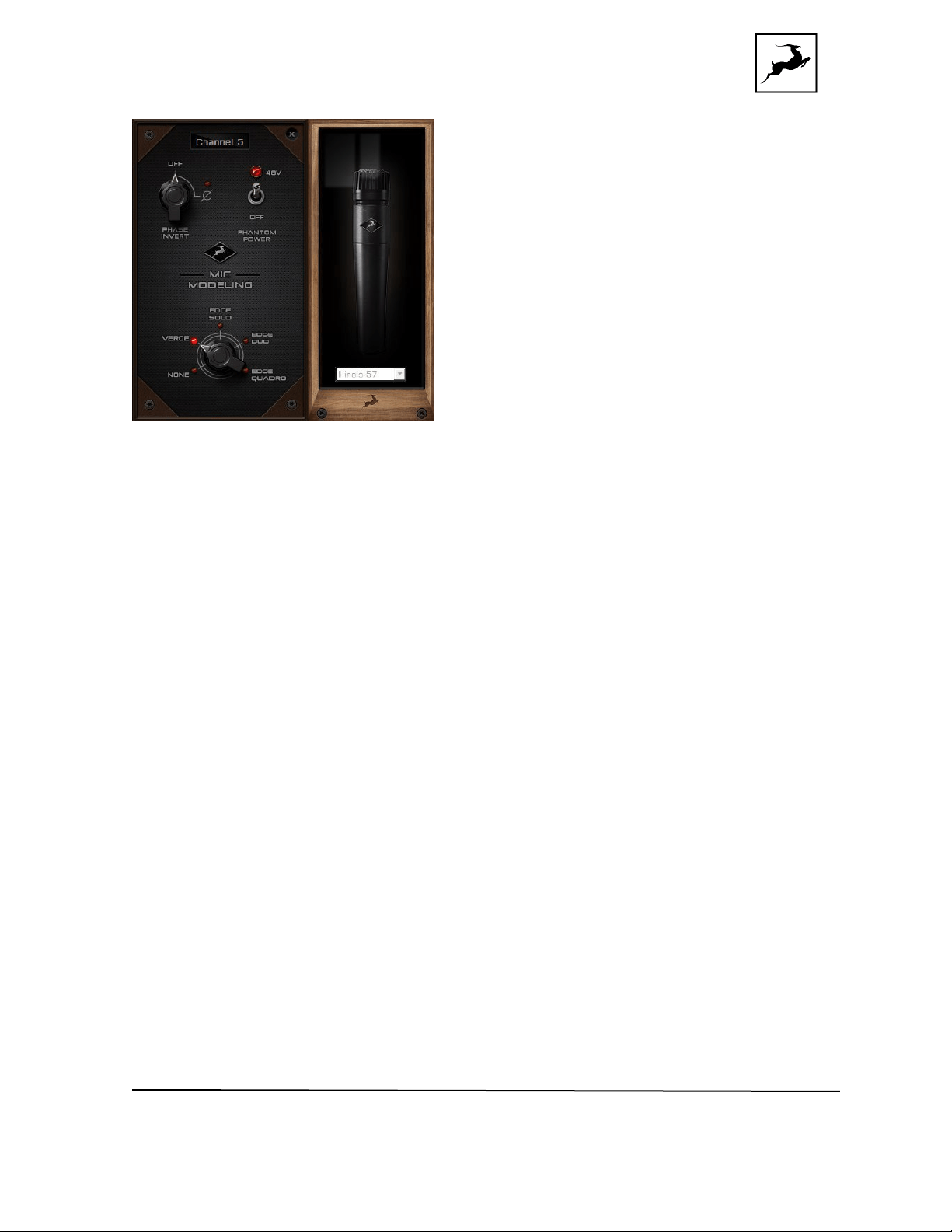
Verge Mic Emulations Window
The following functionality is available:
●
Choose mic emulations from the drop-down menu on the right.
●
Click and turn the ‘Phase Invert’ dial to flip the microphone’s polarity.
●
Click and drag the ‘48’V switch to activate or turn off phantom power.
Recording and Monitoring Verge
Verge is a single-membrane, small-diaphragm condenser microphone. This means the
microphone will occupy one physical mic preamp input and one ‘EMU MIC’ virtual output.
Verge mic emulations work on a single input audio channel. Recording and monitoring
both ‘dry’ and ‘mic emulation’ audio means dealing with two mono tracks simultaneously.
●
Route the ‘PREAMP’ input for Verge to your desired outputs to monitor ‘dry’
audio.
●
Route the ‘EMU MIC’ output for Verge (same number as the ‘PREAMP’ input) to
your desired outputs to monitor ‘mic emulation’ audio.

Discrete 4 Pro Synergy Core User Manual
Page 71
AFX2DAW
Available as a separate purchase or included in a bundle, afx2daw is a bridge plug-in for
using Synergy Core FX as inserts in your DAW. All Synergy Core FX processing and I/O
audio streaming activity is handled by the DSP and FPGA processors in your interface.
afx2daw provides a more immediate workflow with the added bonus of Synergy Core FX
automation in your DAW, which isn’t available otherwise.
afx2daw is supported on Mac and Windows computers via Thunderbolt.
Click here to learn more and purchase afx2daw.
Setting up afx2daw
After purchasing afx2daw, it will be automatically assigned to your account.
In order to install the plug-in files and activate the afx2daw, please follow these steps:
1. Open Antelope Launcher and click the 'Plug-ins' button. Download and install the
latest version of 'afx2daw'.
2. Make sure you are logged in to the Antelope Launcher, then click the 'Devices' button
and select MANAGE DEVICE next to the Discrete 8 Pro Synergy Core.

Discrete 4 Pro Synergy Core User Manual
Page 72
3. Choose 'Register device or assign features' and follow the on-screen instructions to
assign afx2daw or the bundle including it to your Discrete 8 Pro Synergy Core.
4. Launch your DAW and load an instance of afx2daw on a mono or stereo track. The
plug-in behaves almost exactly like the Control Panel 'FX Rack'.
The following functionality is available:
●
Click the ‘ADD NEW EFFECT’ drop-down menu to choose and add effects. Their
instances will appear in the FX Rack to the right. The list on the left lets you click
and drag to re-order.
●
Use the ‘SAVE’ and ‘LOAD’ buttons to store FX chains.
●
Use the ‘BP ALL’ and ‘DEL ALL’ buttons to bypass or clear all FX currently in the
rack.
●
Use the drop-down menu below these buttons to load presets.
●
Individual ‘BP’ (bypass) buttons are available next to each effect on the left side.
●
Command-click and drag on an FX parameter to adjust it in smaller increments.
Note: Closing all open afx2daw windows in your DAW session eliminates the use of CPU
power to animate peak meter movement, as such is no longer being rendered on or off-
screen.
ADVANCED
USER
TIPS
Use the Discrete 4 Pro Synergy Core as a Master clock
We recommend taking advantage of the Discrete 4 Pro Synergy Core’s highly stable and
musical clocking, provided by proprietary 64-bit Antelope Audio algorithms (Acoustically
Focused Clocking & Jitter Management) to generate timing reference for other digital
audio devices in your setup.

Discrete 4 Pro Synergy Core User Manual
Page 73
This is done in a Master - Slave arrangement where the Master device "clocks" the Slave
device with its timing reference signal. To set up the Discrete 8 Pro Synergy Core as a
Master clock, connect Word Clock Out 1 or 2 to the Slave device's Word Clock In using a
standard BNC cable. The Discrete 8 Pro Synergy Core does not require any specific
setup, but the receiving device might require modifying its settings to act as a Slave.
Further reading:
• For a primer on digital clocking and jitter, read
this article. More in-depth
information can be found
here.
•
This interview with Antelope Audio founder and CEO, Igor Levin, is also very
illuminating.

Discrete 4 Pro Synergy Core User Manual
Page 74
CUSTOMER
SUPPORT
INFORMATION
Antelope Audio Customer Support can be reached by the following means:
Online
Visit
support.antelopeaudio.com
Phone
US time: 12AM (midnight) – 8PM (CST), Monday – Friday
US Phone Number:
(916) 238-1643
European time: 6AM – 2AM (GMT), Monday – Friday.
UK Phone Number: +44 1925933423
Live Chat
US time: 12AM (midnight) – 2PM (CST), Monday – Friday
European time: 6AM – 8PM (GMT), Monday – Friday.
Note: If you’re trying to reach us outside working hours, we advise you to file a ticket in
our customer support system or leave a voice message.
Additional Resources
• The
Antelope Audio YouTube channel is home to various tutorial videos and
endorser content which you may find helpful and inspiring.

Discrete 4 Pro Synergy Core User Manual
Page 75
• The
Antelope Audio Users Facebook group lets you interact with fellow users
and some of our employees. Note, however, that it is not meant to be a support
group. Please contact our customer support team for such inquiries.
• The
Knowledge Base in our Customer Support section is an often-overlooked
source of troubleshooting information, answers to commonly asked questions
and Antelope know-how.
MY ANTELOPE AUDIO PRODUCT ISN’T
WORKING.
WHAT SHOULD I DO?
If you can't find a solution on your own, please get in touch with us so we check if you
are having a hardware-related issue. If this is the case, we'll guide you through the repair
process. If the product should be returned, a RMA number will be issued so we can begin
the procedure.
What's an RMA number?
Issuing a RMA (Return Merchandise Authorization) number is required for any factory
service or repair procedure. Please, don't attempt to send us your device without
receiving a RMA number first, as the device will be returned and not serviced.
How do I get an RMA number?
The Antelope Audio Customer Support team is in charge of issuing RMA numbers. Visit
support.antelopeaudio.com and get in touch.

Discrete 4 Pro Synergy Core User Manual
Page 76
After your RMA has been issued, you will receive an email with instructions on how to
proceed.
RMA shipping information
Alongside the product you are returning please, include a letter containing your full
name, shipping address, RMA number issued by our technical support team and a note
with a short information about the technical issue.
Please use the original box if possible, because a worn out one will surely not protect
your product sufficiently on its way to the Antelope Audio HQ. Additional cushioning
materials in multiple layers between the unit and the box walls to prevent from shock,
vibration and various tears and scratches.
Please remove any labels or old shipment markings it may have and ensure you add your
shipping address inside the box in case the original shipment label becomes illegible
during transportation.
The shipping costs are covered by the owner of the product. Antelope Audio will not
cover any local customs charges.
We recommend using a courier service of your choice (e.g. DHL, UPS, FedEx). The
package should be insured for its real value, marked as fragile and a
tracking number
should be provided. We do not recommend using standard mail delivery services.
Please, don't forget to add the RMA number, issued by the Antelope Audio technical
support, on all shipping paperwork.

Discrete 4 Pro Synergy Core User Manual
Page 77
Antelope Audio cannot be held responsible for undelivered packages – lost or damaged
on the way to the Antelope Audio HQ. For damage claims, please contact your shipping
service provider of choice.
Antelope Audio cannot cover any repair costs for product damages due to poor
packaging.
LIMITED
WARRANTY
POLICY
This is a non-transferable voluntary Limited Product Warranty provided to end-
customers who have purchased Antelope Audio-branded hardware product (hereinafter
referred to as “Product”) from an authorized Antelope Audio re-seller.
For customers covered by consumer protection laws or regulations in their country of
purchase or, if different, their country of residence, the benefits conferred by Antelope
Audio's Limited Warranty are in addition to, and not instead of, rights and remedies
convened by such consumer protection laws and regulations and it does not exclude,
limit or suspend buyer’s rights arising from consumer law. Consumers have
the right to choose whether to claim service under the Antelope Audio Limited Warranty
or under their consumer law rights.
All claims made under the Antelope Audio Limited Warranty will be governed by the
terms set out in this warranty document.
Warranty Coverage
Antelope Audio warrants that the Product will be free from defects in material and
workmanship for the period of 1 (one) year commencing on the date of purchase of
Product by end-customer from authorized Antelope Audio’s re-seller.

Discrete 4 Pro Synergy Core User Manual
Page 78
Except where explicitly prohibited by applicable local law, this warranty is limited to the
original purchaser and is non-transferable. This warranty provides you with specific legal
rights, and you may have additional rights that vary under local laws.
In general, this warranty means your Antelope Audio hardware product will operate in
accordance with published technical specifications, as specified by its data-sheet, and in
the operating environment for which it was intended for the length of the warranty
period.
This version of the warranty applies to products purchased on or after January1,2018.
For prior versions of the Antelope Audio limited warranty, please contact customer
service.
Limited Factory Refurbished (B-stock) Warranty
Antelope Audio warrants products sold as “B-stock, Factory Refurbished or Open Box”
to be free from defects in materials (unless otherwise stated in product description) and
workmanship. Only products purchased from an authorized dealer or directly from
Antelope Audio are covered by this Warranty.
The Limited Factory Refurbished (B-stock) Warranty is valid for the period of 6 (six)
months, commencing on the date of purchase of Product, if local regulations do not
require otherwise.
All warranty terms contained hereunder apply also to the B-stock Warranty, unless
otherwise specified.
Remedies

Discrete 4 Pro Synergy Core User Manual
Page 79
Antelope Audio’s entire liability and your exclusive remedy for any Antelope Audio
Product that is not operating in accordance with its published technical specifications is
at Antelope Audio’s discretion:
1) to repair the Product at Antelope Audio’s expense using new or equivalent-to new
refurbished parts in good working condition; or
2) to replace the Product at Antelope Audio’s expense with a product with equivalent
functionality formed from new and/or equivalent-to new refurbished parts in good
working condition, or
3) to refund the price paid. Should Antelope Audio decide to refund the price paid, it
may deduct from the paid Product’s price any damages caused to the Product; where,
within fourteen (14) days of the expiration of the warranty period,(i) Antelope Audio has
received written notice of any nonconformity;(ii) after Antelope Audio’s written
authorization, customer has returned the nonconforming product to the designated
place; and (iii)Antelope Audio has determined that the Product is nonconforming and
that such non conformity is not the result of any of the exclusions designated below.
These warranty obligations are conditioned upon the hardware being returned to the
original place of purchase, or another place as directed by Antelope Audio, with the
original sales receipt attached. You will be required to pay shipping and handling charges
for returning the product. You may be required to pay any other applicable tariffs, duties,
taxes, or other fees with regard to returning the products.
Any repaired or replacement Product will be warranted for the remainder of the original
warranty period.
Obsolete or Discontinued Products

Discrete 4 Pro Synergy Core User Manual
Page 80
An obsolete or discontinued product will be repaired or replaced with the same product
if available. If Antelope Audio is unable to replace your obsolete or discontinued product
with the same product, Antelope Audio will replace the obsolete or discontinued
product, in its sole discretion, with a product having similar function and capacity.
Exclusions
This warranty does not cover problems or damage resulting from, but not limited to, any
of the following: (i)Wear and tear associated with normal use; (ii)Any modification,
abuse, accident, disassembly, misapplication, misuse, negligence, acts of God, accident;
(iii)Unauthorized repair or attempted repair by anyone other than Antelope Audio or
someone authorized by Antelope Audio to do warranty work; any unauthorized repairs
will void this warranty(iv)Any improper operation, maintenance or installation, including
any use not in accordance with any supplied product instructions; (v)Connection to any
improper voltage supply; (vi)Use of consumables or spare parts not supplied by Antelope
Audio, except where such restriction is prohibited by applicable local law; (vii)Any other
cause which does not relate to a Product defect in materials or workmanship.
The warranty does not apply to any Products which have been subject to misuse,
neglect, accident or modification or which have been soldered or altered such that they
are not capable of being tested under normal test conditions.
This warranty does not cover (i) any counterfeit products, i.e. Products that Antelope
Audio, at its sole discretion, determines were not manufactured by Antelope Audio or
any of its authorized manufacturing partners; (ii) Products purchased from a person or
entity which is not an authorized dealer or re-seller of Antelope Audio; (iii)Product sold
“as is” or “with all faults”, to the extent permitted by local law.
This warranty is not valid in case any manufacturer label(s), serial numbers, date
stamp(s) or warranty sticker(s) has been altered or removed from the Product.

Discrete 4 Pro Synergy Core User Manual
Page 81
Limitation of Liability
ANTELOPE AUDIO SHALL NOT BE LIABLE FOR ANY SPECIAL, INCIDENTAL, INDIRECT,
OR CONSEQUENTIAL DAMAGES WHATSOEVER, INCLUDING BUT NOT LIMITED TO
LOSS OF PROFITS, REVENUE, OR DATA (WHETHER DIRECT OR INDIRECT) OR
COMMERCIAL LOSS FOR BREACH OF ANY EXPRESS OR IMPLIED WARRANTY ON
YOUR PRODUCT EVEN IF Antelope Audio HAS BEEN ADVISED PREVIOUSLY OF THE
POSSIBILITY OF SUCH DAMAGES. Some local laws do not allow the exclusion or
limitation of special, indirect, incidental or consequential damages, so this limitation or
exclusion may not apply in your jurisdiction.
ANTELOPE AUDIO WILL NOT ASSUME OR AUTHORIZE ANY OTHER PERSON TO
ASSUME FOR IT ANY OTHER LIABILITY IN CONNECTION WITH ITS PRODUCTS.
Data Recovery
In the event of data loss using Antelope Audio storage devices, Antelope Audio is not
responsible for backing up or recovering any data that you may have lost.
No Other Warranties
No Antelope Audio employee, dealer, re-seller, or other agent is authorized to make any
modification, extension, or addition to this warranty.
How to Make a Warranty Claim
Valid warranty claims should be processed through your point of purchase. Please also
verify the return policy directly with the retailer where you purchased your product. Any
warranty claims that cannot reprocessed through your original point of purchase should
be addressed directly to Antelope Audio. Our customer service contact information can
be found on the web or in the documentation included with your Product.

Discrete 4 Pro Synergy Core User Manual
Page 82
Returning Your Product
In the event that you need to return your Antelope Audio products for repair or
replacement, Antelope Audio will provide you with a Return Merchandise Authorization
Number (RMA#) as well as return instructions. Do not return your product without prior
approval from Antelope Audio. Any product returned without a valid unique RMA# will be
refused and returned to the sender at the sender’s expense. To avoid problems at the
time of receipt, clearly write your RMA# on the outside of the package and include a
copy of your RMA confirmation-mail within the package.
In certain situations, for in-warranty units, we may (entirely at our opinion) offer you a
temporary replacement unit, provided that we have such on stock in your state. To
request a temporary replacement unit, a valid credit card must be provided to secure
the new replacement unit for shipping prior to Antelope Audio receiving the defective
one.
Request a Return Material Authorization Number (RMA#)
Please follow these steps to obtain an RMA number:
(I) For end user customers, submit a claim online at: support.antelopeaudio.com. For
business to business (B2B) / Direct customers of Antelope Audio please email us at
(ii) A valid proof of purchase is required for RMA processing (i.e. receipt, invoice, etc).
Antelope Audio will provide you with the RMA number within 2 working days as of the
claim submission date.

Discrete 4 Pro Synergy Core User Manual
Page 83
RMA Return Addresses
We have multiple RMA receiving locations worldwide. Your RMA confirmation will specify
the specific return address you must use when sending your RMA package. Any
packages received at an unauthorized location may be refused and returned to the
sender at the sender’s expense.
Products Lost or Damaged During Transit
The original packaging material should be used to pack the product for return; if the
original packaging is not available, you should use such materials that provide the same
or greater protection to the product. All packages that arrive with any external damage
or appear inadequately packed will be refused and returned to the sender at the sender’s
expense. We are not responsible for damage incurred during shipping to our RMA
receiving locations or for lost or stolen products.
Company information
Antelope Audio is the trade name, under which the company Elektrosfera ltd.,
registered under the legislation of the Republic of Bulgaria with UIN: 131052590, is doing
business and is worldwide known. Elsewhere in this document where the trade name
Antelope Audio is used shall refer to Elektrosfera ltd., with address of management:
Tsarigradsko Shose Blvd., 7th km, Building of BIC IZOT, floor 6, Mladost region, Sofia,
Bulgaria.
If any term hereunder is held to be illegal or unenforceable, it shall be severed from this
warranty and the legality or enforce ability of the remaining terms shall not be affected.

Discrete 4 Pro Synergy Core User Manual
Page 84
SAFETY
NOTES
To reduce the risk of electrical shocks, fire, and related hazards:
● Do not remove screws, cover, or cabinet. There are no user serviceable parts
inside.
Refer servicing to qualified service personnel.
● Do not expose this device to rain, moisture or spillover of liquid of any kind.
● Should any form of liquid or a foreign object enter the device, do not use it.
Switch off the device and then unplug it from the power source. Do not operate
the device again until the foreign object is removed, or the liquid has completely
dried and its residues fully cleaned up.
● Do not handle the power cables with wet hands!
● Make sure the device is switched off when plugging/unplugging it to/from the
power source.
● Avoid placing things on the cabinet or using the device in a narrow and poorly
ventilated place which could affect its operation or the operation of other closely
located components.
● If anything goes wrong, turn off the device first and then unplug the power. Do
not attempt to repair the device yourself. Consult authorized service personnel or
your dealer instead.
● Do not install near any heat sources such as radiators, stoves, or other apparatus
(including amplifiers) that produce heat.
● Do not use harsh chemicals to clean your unit. Clean only with specialized
cleaners for electronics equipment.
● Connect all your devices before powering your unit.
● This unit is connected via its power cord to the mains safety earth.
● Never operate the unit without this earth connection.
● DC power supply cable should be routed so that it is not likely to be walked on or
squeezed by items placed upon or against it.

Discrete 4 Pro Synergy Core User Manual
Page 85
● To completely turn off the device, unplug the power cable first from the outlet
and then from the rear panel of the unit.
● Both occasional and continued exposure to high sound pressure levels can cause
permanent ear damage via headphones and monitors.
● Your unit should always be un-racked when traveling or in a flight case.
● The device is designed to operate in a temperate environment, with a correct
Operating Temperature of 0-50° C, 32-122° F.
TECHNICAL SPECIFICATIONS
Analog Inputs
2 x Mic / Line Inputs
2 x Mic / Line / Hi-Z inputs
Analog Outputs
1 x Monitor Out on TRS 1/4 Jacks, +20 dBu max
4 x Line Outs on TRS, +20 dBu max, DC-Coupled
2 x Stereo Headphone Outputs
Mic Preamp
EIN: -128 dBu (A-weighted)
Dynamic Range: -121 dB (A-weighted)
THD: -106 dB
Max input: +18 dBu
Max Gain: 65dB
D/A Monitor Converter
Dynamic Range: 130 dB
THD + N: -115dB
A/D Converter
Dynamic Range: 122 dB
THD + N: -112 dB
D/A Converters (Line Out)
Dynamic Range: 118dB
THD + N: - 100dB
Discrete 4 Pro Synergy Core User Manual
Page 86
Digital Inputs
1 x ADAT (up to 8CH)
1 x S/PDIF
Digital Outputs
1 x ADAT (up to 8CH)
1 x S/PDIF
USB 2.0 I/O
USB 2.0 Type B connector
Thunderbolt™ Thunderbolt™ 3 connector
Word Clock Outputs 2 x Outputs @ 75 Ohms 3Vpp on BNC 32 – 192kHz
Clocking System
4th Generation Acoustically Focused Clocking & Jitter
Management
64-bit DDS
Sample Rates (kHz)
32, 44.1, 48, 88.2, 96, 176.4, 192
Bit depth
24
What is included inside the box:
• Discrete 4 Pro Synergy Core
• USB2.0 type A to B cable
• Power supply adapter
• Getting Started leaflet