Owner’s Manual
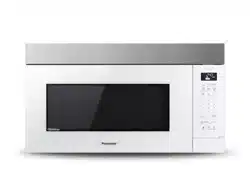
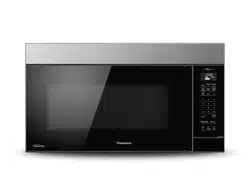
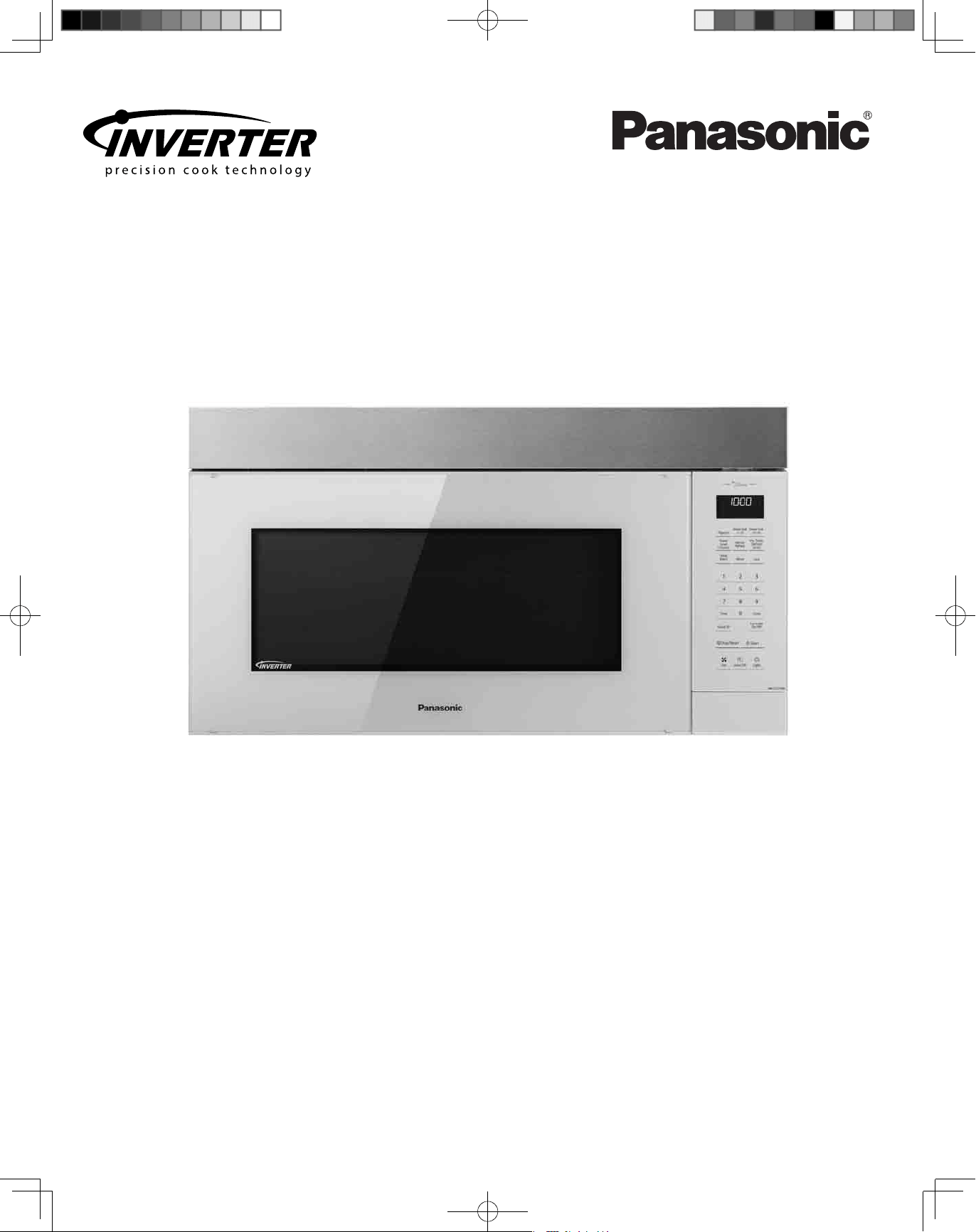
Over The Range microwave Oven
Household Use Only
Model No.NN-ST27HB
NN-ST27HW
ATTACHED INSTALLATION INSTRUCTION
PLEASE READ THESE INSTRUCTIONS CAREFULLY BEFORE USING THIS PRODUCT,
AND SAVE THIS MANUAL FOR FUTURE USE.
Inverser le manuel pour lire les instructions en français.
F0003BX01CP
PA0517-11217
Printed in China
© Panasonic Appliances Microwave Oven (Shanghai) Co., Ltd. 2017
Panasonic Canada Inc.
5770 Ambler Drive
Mississauga, Ontario
L4W 2T3
Tel: (905) 624-5010
www.panasonic.com
F0003BX00CP.indd 1 2017/5/5 10:57:08
CONTENTS
Safety Information
IMPORTANT SAFETY INSTRUCTIONS ............................................................................................................................................... 3-5
Installation and Grounding Instructions ........................................................................................................................................ 5-6
Food Preparation .................................................................................................................................................................................... 6-7
Oven Components Diagram................................................................................................................................................................... 9
Control Panel ..............................................................................................................................................................................................10
Operation
Using the Microwave for the First Time ...........................................................................................................................................11
Menu Action On/Off ................................................................................................................................................................................11
Demo Mode ON/OFF ...............................................................................................................................................................................11
Setting the Clock .......................................................................................................................................................................................12
Setting the Child Safety Lock ...............................................................................................................................................................12
Setting Light ...............................................................................................................................................................................................12
Setting Turntable On/Off .......................................................................................................................................................................12
Setting Fan ..................................................................................................................................................................................................13
Setting Auto Off 1/3/5/10 ......................................................................................................................................................................13
Cooking ........................................................................................................................................................................................................14
Quick 30 .......................................................................................................................................................................................................14
Setting the Timer ......................................................................................................................................................................................14
Setting a Standing Time .........................................................................................................................................................................15
Setting a Delayed Start ...........................................................................................................................................................................15
Keep Warm ..................................................................................................................................................................................................16
Popcorn ........................................................................................................................................................................................................16
Inverter Turbo Defrost ............................................................................................................................................................................17
Defrosting Tips & Techniques ..............................................................................................................................................................17
Sensor Reheat ............................................................................................................................................................................................18
Sensor Cook ................................................................................................................................................................................................18
Sensor Cook Chart ....................................................................................................................................................................................19
Food Characteristics ......................................................................................................................................................................... 21-22
Maintenance
Care and Cleaning of Your Microwave Oven ........................................................................................................................... 23-25
Shop Accessories ......................................................................................................................................................................................25
Before Requesting Service ....................................................................................................................................................................26
Warranty ......................................................................................................................................................................................................27
General Information
Cookware Guide ......................................................................................................................................................................................... 8
Specifications .............................................................................................................................................................................................28
User’s Record ..............................................................................................................................................................................................28
F0003BX00CP.indd 2 2017/5/5 10:57:09
3
IMPORTANT SAFETY INSTRUCTIONS
Your safety and the safety of others are very important.
We have provided important safety messages in this manual and on your appliance. Always read and obey all safety
messages.
This is the safety alert symbol. It is used to alert you to potential hazards that can kill or hurt you and others.
All safety messages will follow the safety alert symbol and either the word “DANGER”, “WARNING” or “CAUTION”. These
words mean:
You can be killed or seriously injured if you don’t immediately follow instructions.
You can be killed or seriously injured if you don’t follow instructions.
You can be exposed to a potentially hazardous situation which, if not avoided, may result in
minor or moderate injury.
All safety messages will tell you what the potential hazard is, tell you how to reduce the chance of injury, and tell you what can happen
if the instructions are not followed.
DANGER
WARNING
CAUTION
PRECAUTIONS TO AVOID POSSIBLE EXPOSURE
TO EXCESSIVE MICROWAVE ENERGY
(a) DO NOT attempt to operate this oven with the door open,
since open-door operation can result in harmful exposure to
microwave energy. It is important not to defeat or tamper
with the safety interlocks.
(b) DO NOT place any object between the oven front face and
the door, or allow soil or cleaner residue to accumulate on
sealing surfaces.
(c) DO NOT operate the oven if it is damaged. It is particularly
important that the oven door close properly and that there is
no damage to the:
(1) door (bent),
(2) hinges and latches (broken or loosened),
(3) door seals and sealing surfaces.
(d) The oven should not be adjusted or repaired by anyone
except properly qualified service personnel.
Thank you for purchasing a Panasonic Microwave Oven
Your microwave oven is a cooking appliance and you should use as much care as you use with a stove or any other cooking appliance.
When using this electric appliance, basic safety precautions should be followed, including the following:
To reduce the risk of burns, electric shock, fire, injury to persons, or exposure to
excessive microwave energy:
1. Read all instructions before using this appliance.
2. Read and follow the specific “PRECAUTIONS TO AVOID POSSIBLE EXPOSURE TO EXCESSIVE MICROWAVE ENERGY,” above.
3. This appliance must be grounded. Connect only to a properly grounded outlet. See “GROUNDING INSTRUCTIONS” found on page 5.
4. As with any cooking appliance, DO NOT leave oven unattended while in use.
5. Install or locate this appliance only in accordance with the installation instructions found on page 5.
6. DO NOT cover or block any openings on this appliance.
7. DO NOT store this appliance outdoors. DO NOT use this product near water (for example, near a kitchen sink, in a wet basement, or
near a swimming pool or similar locations).
8. Use this appliance only for its intended use as described in this manual. DO NOT use corrosive chemicals, vapors or non-food products
in this appliance. This type of oven is specifically designed to heat or cook food. It is not designed for industrial or laboratory use. The
use of corrosive chemicals in heating or cleaning will damage the appliance and may result in radiation leaks.
9. When cleaning surfaces of the door and oven that come together on closing the door, use only mild, non-abrasive soaps or
detergents applied with a sponge or soft cloth.
WARNING
F0003BX00CP.indd 3 2017/5/5 10:57:09
4
10. DO NOT allow children to use this appliance, unless closely supervised by an adult. DO NOT assume that because a child has
mastered one cooking skill he/she can cook everything.
11. DO NOT operate this appliance if it has a damaged cord or plug, if it is not working properly, or if it has been damaged or dropped.
12. DO NOT immerse cord or plug in water.
13. Keep cord away from heated surfaces.
14. DO NOT let cord hang over edge of a table or counter.
15. This appliance should be serviced only by qualified service personnel. Contact the nearest authorized service center for examination,
repair or adjustment.
16. Some products such as whole eggs, with or without shell, narrow neck bottles and sealed containers (for example, closed glass jars)
may explode and should not be heated in this oven.
17. To reduce the risk of fire in the oven cavity:
(a) DO NOT overcook food. Carefully attend appliance when paper, plastic, or other combustible materials are placed inside
the oven to facilitate cooking.
(b) Remove wire twist-ties from paper or plastic bags before placing bag in oven.
(c) If material inside the oven ignites, keep oven door closed, turn oven off, and disconnect the power cord, or shut off
power at the fuse or circuit breaker panel.
(d) DO NOT use the cavity for storage purposes. DO NOT leave paper products, cooking utensils or food in the cavity
when not in use.
18. Superheated Liquids: Liquids, such as water, coffee or tea are able to be overheated beyond the boiling point without showing
evidence (or signs) of boiling. Visible bubbling is not always present when the container is removed from the microwave oven. THIS
COULD RESULT IN VERY HOT LIQUIDS SUDDENLY BOILING OVER WHEN THE CONTAINER IS DISTURBED OR A UTENSIL IS INSERTED
INTO THE LIQUID. To reduce the risk of injury to persons:
(a) STIR THE LIQUID BOTH BEFORE AND HALFWAY THROUGH HEATING.
(b) DO NOT heat water and oil, or fats together. The film of oil will trap steam, and may cause a violent eruption.
(c) DO NOT use straight-sided containers with narrow necks.
(d) After heating, allow the container to stand in the microwave oven for a short time before removing the container.
19. DO NOT cook directly on the turntable. It can crack, and cause injury or damage to the oven.
20. This appliance is suitable for use above both gas and electric cooking equipment 91.4 cm (36 inches) or less wide. To reduce the risk
of fire and electric shock, install at least 34.6 cm (13
5
⁄8 inches), above a cooktop, measured to the bottom of the oven.
21. Clean Ventilating hoods Frequently – Grease should not be allowed to accumulate on hood or filter.
22. Use care when cleaning the Grease filter. Corrosive cleaning agents, such as lye-based oven cleaners, may damage the filter. Clean in
hot detergent solution every month.
23. Never flame foods under the oven with the vent fan operating because it may spread the flames.
SAVE THESE INSTRUCTIONS
IMPORTANT SAFETY INSTRUCTIONS (continued)
TO AVOID THE RISK OF SHOCK:
DO NOT remove remove top or
outer panel from oven. Repairs
must be done only by a qualified
service person.
TO REDUCE THE RISK OF EXPOSURE TO MICROWAVE ENERGY:
DO NOT tamper with, or make any adjustments or repairs to Door,
Control Panel Frame, Safety Interlock Switches, or any other part of
the oven. Microwave leakage may result.
TO AVOID THE RISK OF FIRE:
1. DO NOT operate the microwave
oven empty or use metal containers.
When using the microwave oven
without water or food, microwave
energy cannot be absorbed and will
continuously reflect throughout the
cavity. This will cause arcing and damage the oven cavity, door
or other components, which can lead to a fire hazard.
2. DO NOT store flammable materials next to, on top of, or in the
oven.
Safety Precautions
WARNING
F0003BX00CP.indd 4 2017/5/5 10:57:09
5
IMPORTANT SAFETY INSTRUCTIONS (continued)
Installation and Grounding Instructions
Examine Your Oven
Unpack oven, remove all packing material and examine the oven
for any damage such as dents, broken door latches or cracks in the
door. Notify dealer immediately if oven is damaged. DO NOT install
if oven is damaged.
Placement of Oven
1. This oven must be installed in at least a 76cm (30”) inch opening,
it is suitable for use above gas or electric cooking equipment
91.4cm (36 inches) or less wide.
76 cm (30”)
MINIMUM
2. Be sure to install this oven only in accordance with the
additional installation instructions provided.
3. It is recommended that the product be mounted to a flush wall
of 5 x 10 cm (2” x 4”) stud and 1cm (
3
/
8
”) minimum thickness
drywall or plaster/lath construction. For further information,
please consult the additional installation instructions provided.
4. Make sure the kitchen cabinet height is as high as the
specification described in the installation instructions.
5. This oven was manufactured for household use only.
WARNING: IMPROPER USE OF THE GROUNDING
PLUG CAN RESULT IN A RISK OF ELECTRIC SHOCK.
Consult a qualified electrician or service person if the grounding
instructions are not completely understood, or if doubt exists as to
whether the appliance is properly grounded.
Grounding Instructions
THIS APPLIANCE MUST BE GROUNDED.
In the event of an electrical short circuit, grounding reduces the
risk of electric shock by providing an escape wire for the electric
current. This appliance is equipped with a cord having a grounding
wire with a grounding plug. The plug must be plugged into an
outlet that is properly installed and grounded.
• Plug into properly installed and grounded three-prong
outlet.
• DO NOT remove ground prong.
• DO NOT use an adapter.
3-Pronged Plug
Ground Plug
3-Prong Receptacle
3. DO NOT dry clothes, newspapers or other
materials in the oven, or use newspaper or
paper bags for cooking.
4. DO NOT hit or strike Control Panel. Damage
to controls may occur.
5. DO NOT use recycled paper products
unless the paper product is labeled as safe for microwave oven
use. Recycled paper products may contain impurities, which may
cause sparking.
TO AVOID THE RISK OF SCALDING:
POT HOLDERS should always be used when removing items from
the oven. Heat is transferred from
the HOT food to the cooking
container and from the container
to the Glass Tray. The Glass
Tray can also be very HOT after
removing the cooking container
from the oven.
Glass Tray
1. DO NOT operate the oven without the Roller Ring and the Glass
Tray in place.
2. DO NOT operate the oven without the Glass Tray fully engaged
on the drive hub. Improper cooking or damage to the oven
could result. Verify that the Glass Tray is properly engaged and
rotating by observing its rotation when you press Start.
Note: The Glass Tray can turn in either direction.
3. Use only the Glass Tray specifically designed for this oven.
DO NOT substitute any other Glass Tray.
4. If the Glass Tray is hot, allow to cool before cleaning or placing
in water.
5. DO NOT cook directly on the Glass Tray. Always place food in
a microwave safe dish, or on a rack set in a microwave safe dish.
6. If food or utensil on the Glass Tray touches oven walls, causing
the tray to stop moving, the tray will automatically rotate in the
opposite direction.
Roller Ring
1. The Roller Ring and oven floor should be cleaned frequently to
prevent excessive noise.
2. Always replace the Roller Ring and the Glass Tray in their proper
positions.
3. The Roller Ring must always be used for cooking along with the
Glass Tray.
For proper use of your oven, read remaining safety cautions and operating instructions.
F0003BX00CP.indd 5 2017/5/5 10:57:09
6
Wiring Requirements
The oven must be operated on a SEPARATE CIRCUIT. No other
appliance should share the circuit with the microwave oven. If it
does, the branch circuit fuse may blow or the circuit breaker may
trip. The oven must be plugged into a 15 AMP or 20 AMP,
120 VOLT, 60 Hz GROUNDED OUTLET. (Beginning in 2017, all
new construction and all renovated single family homes
must have at least a 20 A, 120 VOLT, 60 Hz GROUNDED
OUTLET). Where a standard two-prong outlet is encountered, it is
the responsibility and obligation of the consumer to have it
replaced with a properly grounded three-prong outlet. The
VOLTAGE used must be the same as specied on this microwave
oven (120 V, 60 Hz). Using a higher voltage is dangerous and may
result in a re or oven damage. Using a lower voltage will cause
slow cooking. Panasonic is NOT responsible for any damages
resulting from the use of the oven with any voltage other than
specied.
TV / RADIO / WIRELESS EQUIPMENT INTERFERENCE
This product has been tested and found to comply with the limits
for Microwave Oven. This product can radiate radio frequency
energy, which could cause interference to such products as radio,
TV, baby monitor, cordless phone, Bluetooth, wireless router, etc.,
which can be confirmed by turning this product off and on. If
present, the user is encouraged to try to correct by taking one or
more of the following countermeasures:
(1) Increase the spacing distance between the microwave oven and
other product receiving the interference.
(2) If possible, use a properly installed receiver antenna and/or
reorient the receiving antenna of the other product receiving
the interference.
(3) Plug the microwave oven into a different outlet from the other
product receiving the interference.
(4) Clean door and sealing surfaces of the oven. (See Care and
Cleaning of Your Microwave Oven)
The Hood
1. The vent fan in your oven will operate automatically under
certain cooktop operating conditions. This is normal. Caution
is required to prevent the starting and spreading of accidental
cooking fires while the vent fan is in operation.
2. Never leave surface units unattended at high heat setting. Boil
over causes smoking and greasy spillovers that may ignite
and spread if vent fan is operating. To minimize automatic
fan operation, use adequate sized utensils and use high heat
settings only when necessary.
3. In the event of a grease fire, smother flaming pan on surface unit
by covering pan completely with well-fitting lid, cookie sheet or
flat tray.
4. Keep hood and grease filters clean, according to instructions on
page 24, to maintain adequate venting and avoid grease fires.
5. To protect the automatic fan feature, always keep the filter clean
(see page 24). Should the fan require repair, do not operate
microwave oven until it has been repaired.
6. Charcoal filter should be replaced periodically. It may be
purchased from a local Panasonic dealer.
Indoor Venting
If the air exhaust must be recirculated by this unit inside the
kitchen, a charcoal filter must be used. A charcoal filter has been
installed for your convenience. However, we recommend that
this filter be changed as soon as possible with the replacement
charcoal filter kit (NN-CF203) that can be purchased from your local
Panasonic dealer.
Fan Motor Operation
After using the oven repeatedly or for long time, the fan may
operate to cool the electric components. This is perfectly normal,
and you can take out the food from the oven while the fan
operates.
Installation and Grounding Instructions (continued)
Food Preparation
Follow these Safety Precautions when cooking in your oven.
IMPORTANT
Proper cooking depends upon the power, the time setting
and quantity of food. If you use a smaller portion than
recommended but cook at the time for the recommended
portion, fire could result.
1) HOME CANNING / STERILIZING / DRYING FOODS / SMALL
QUANTITIES OF FOODS
• DO NOT use your oven for home canning. Your oven cannot
maintain the food at the proper canning temperature. The food
may be contaminated and then spoil.
• DO NOT use the microwave oven to sterilize objects (baby
bottles, etc.). It is difficult to keep the oven at the high
temperature needed for sterilization.
• DO NOT dry meats, herbs, fruits or vegetables in your oven.
Small quantities of food or foods with low moisture content can
dry out, scorch or catch on fire if overheated.
2) POPCORN
Popcorn may be popped in a microwave oven corn popper.
Microwave popcorn that pops in its own package is also available.
Follow popcorn manufacturers’ directions and use a brand suitable
for the cooking power of your microwave oven.
CAUTION: When using pre-packaged microwave popcorn, you can
follow recommended package instructions or use the Popcorn pad
(refer to page 16). Otherwise, the popcorn may not pop adequately
or may ignite and cause a fire. Never leave the oven unattended
when popping popcorn. Allow the popcorn bag to cool before
opening, and always open the bag facing away from your face and
body to prevent steam burns.
F0003BX00CP.indd 6 2017/5/5 10:57:09
7
3) DEEP FAT FRYING
• DO NOT deep fat fry in your microwave oven. Cooking oils
may burst into flames and may cause damage to the oven and
may result in burns. Microwave utensils may not withstand the
temperature of the hot oil, and can shatter or melt.
4) FOODS WITH NONPOROUS SKINS
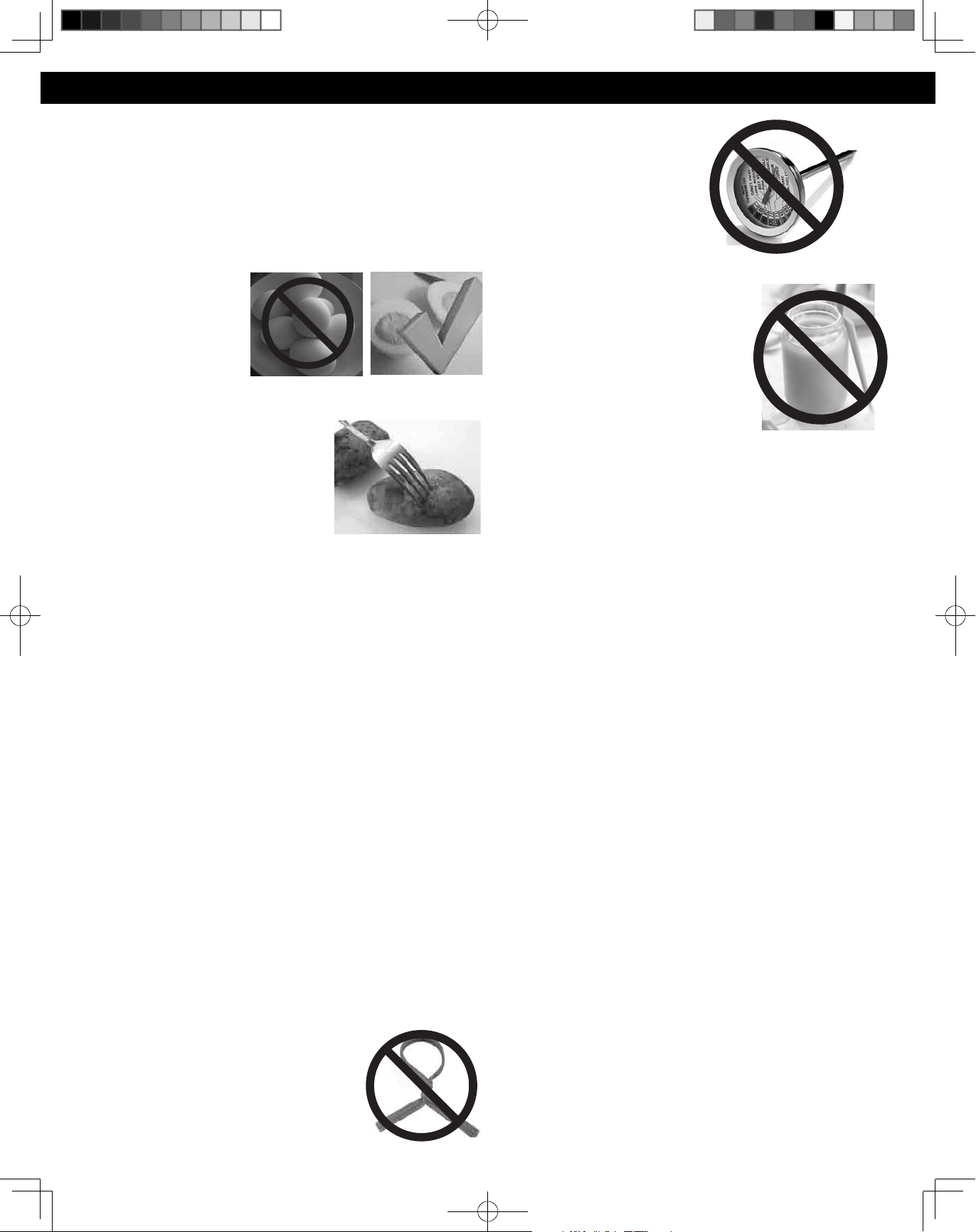
• DO NOT COOK / REHEAT WHOLE EGGS, WITH OR WITHOUT
THE SHELL.
Steam buildup in whole
eggs may cause them
to explode, and possibly
damage the oven or
cause injury. Reheating
SLICED hard-boiled eggs
and cooking SCRAMBLED eggs is safe.
• Potatoes, apples, whole squash
and sausages are examples of
foods with nonporous skins. These
types of foods must be pierced
before microwave cooking to
prevent them from exploding.
CAUTION: Cooking dry or old
potatoes can cause fire.
5) GLASS TRAY / COOKING CONTAINERS / FOIL
• Cooking containers get hot during microwaving. Heat is
transferred from the HOT food to the container and the Glass
Tray. Use pot holders when removing containers from the oven
or when removing lids or plastic wrap covers from cooking
containers, to avoid burns.
• The Glass Tray will get hot during cooking. It should be allowed
to cool before handling or before paper products, such as paper
plates or microwave popcorn bags, are placed in the oven for
microwave cooking.
• When using foil in the oven, allow at least 1-inch (2.5 cm) of
space between foil and interior oven walls or door.
• Dishes with metallic trim should not be used, as arcing
may occur.
6) PAPER TOWELS / CLOTHS
• DO NOT use paper towels or cloths that contain a synthetic fiber
woven into them. The synthetic fiber may cause the towel to
ignite. Use paper toweling under supervision.
7) BROWNING DISHES / OVEN COOKING BAGS
• Browning dishes or grills are designed for microwave cooking
only. Always follow instructions provided by the manufacturer.
DO NOT preheat browning dish more than six minutes.
• If an oven cooking bag is used for microwave cooking, prepare
according to package directions. DO NOT
use a wire twist-tie to close bag. Instead
use plastic ties, cotton string or a strip cut
from the open end of the bag.
8) THERMOMETERS
• DO NOT use a conventional
meat thermometer in
your oven. Arcing may
occur. Microwave safe
thermometers are available
for both meat and candy.
9) BABY FORMULA / BABY FOOD
• DO NOT heat baby formula or baby
food in the microwave oven. The glass
jar or surface of the food may appear
warm while the interior can be so hot
as to burn the infant’s mouth and
esophagus.
10) REHEATING PASTRY PRODUCTS
• When reheating pastry products, check temperatures of any
fillings before eating. Some foods have fillings, which heat faster
and can be extremely hot, while the surface remains warm to the
touch (for example, jelly donuts).
11) GENERAL OVEN USAGE GUIDELINES
• DO NOT use the oven for any purpose other than the
preparation of food.
Food Preparation (continued)
F0003BX00CP.indd 7 2017/5/5 10:57:09
8
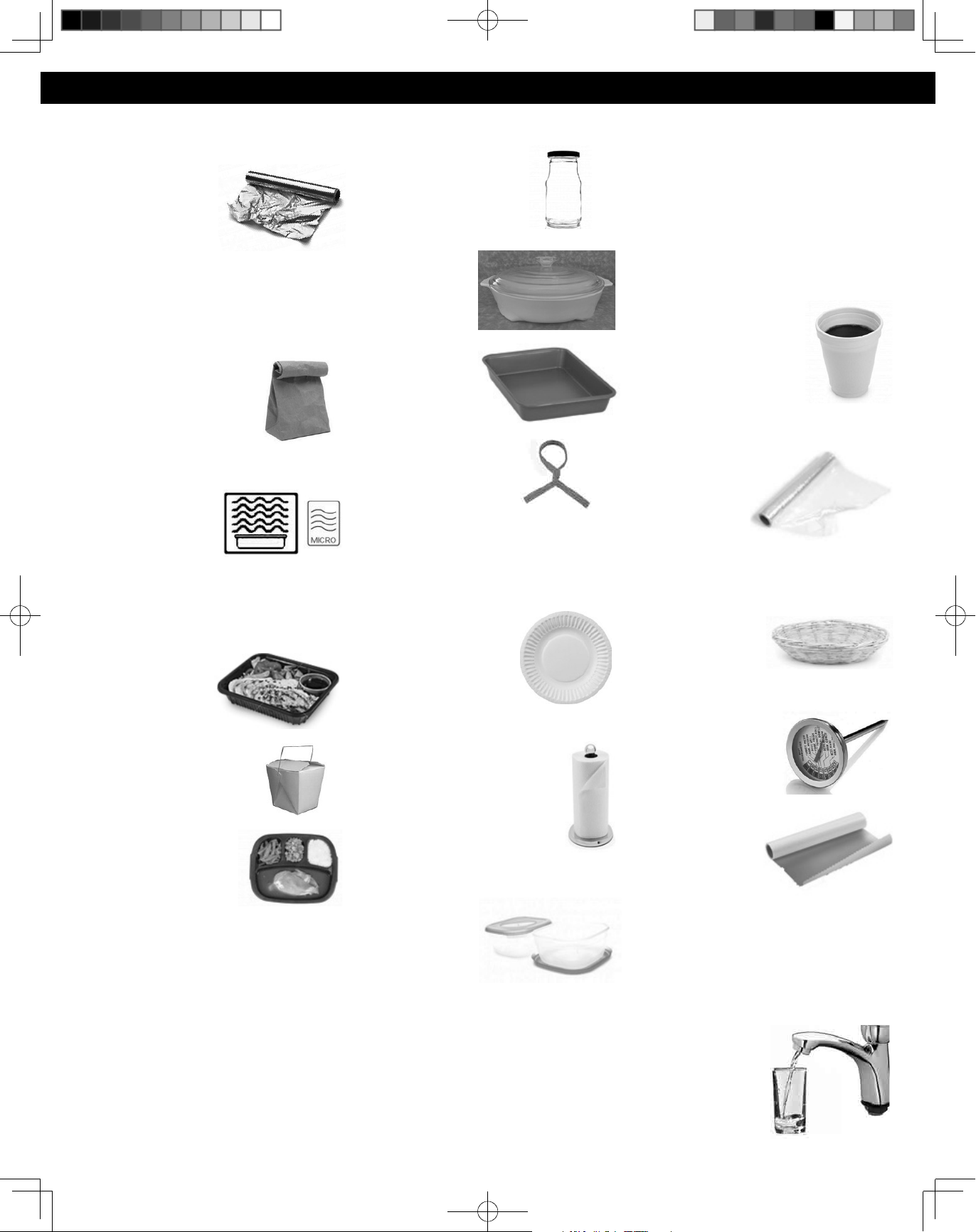
Aluminum Foil
It is not recommended
to use. Arcing can occur
if foil is too close to oven
wall or door and cause
damage to your oven.
Browning Dish
Yes. Only use browning dishes that are designed
for microwave cooking. Check browning dish
information for instructions/heating chart. Do
not preheat for more than six minutes.
Brown Paper Bags
No. They may cause a fire in
the oven.
Microwave Safe
Yes. If labeled Microwave Safe, check
manufacturers’ directions for use in
microwave heating.
Some dinnerware
may state on the back
of the dish, “Oven-
Microwave Safe”.
Dinnerware
If unlabeled, use CONTAINER TEST below.
Disposable Polyester Paperboard Dishes
Yes. Some frozen foods
are packaged in these
dishes. Also can be
purchased in some
grocery stores.
Fast Food Cartons with
Metal Handle
No. Metal handle may cause
arcing.
Frozen Dinner Trays
If made for the microwave,
then yes. If it contains metal,
then no.
Glass Jars
No. Most glass jars are not
heat resistant.
Heat Resistant Oven
Glassware/Ceramic
Yes, but only ones for
microwave cooking
and browning.
(See CONTAINER
TEST below.)
Metal Bakeware
No. Metal can cause
arcing and damage to
your oven.
Metal Twist-Ties
No. May cause arcing
which could cause a fire in
the oven.
Oven Cooking Bag
Yes. Follow manufacturers’ directions. Close bag
with the nylon tie provided, a strip cut from the
end of the bag, or a piece of cotton string. Do
not close with metal twist-tie. Make six
1
⁄2-inch
slits near the closure.
Paper Plates/Cups
Yes. Use to warm cooked
foods, and to cook foods that
require short cooking time,
such as hot dogs. Do not
microwave paper cups; they
may overheat and ignite.
Towels & Napkins
Yes, only paper napkins/towels. Use
to warm rolls and sandwiches, only
if labeled safe for microwave use.
Do NOT use recycled paper towels.
Parchment Paper
Yes. Use as a cover to prevent splattering.
Plastic Cookware
Yes, with caution.
Should be labeled,
“Suitable for
Microwave Heating.”
Check Microwave Safe manufacturers’ directions
for recommended uses. Some microwave safe
plastic containers are not suitable for cooking
foods with high fat or sugar content. The heat
from hot food may cause warping.
Plastic, Melamine
No. This material absorbs microwave energy.
Dishes get HOT!
Plastic Foam Cups
Yes, with caution. Plastic foam
will melt if foods reach a high
temperature. Use short term
only to reheat foods to a low
serving temperature. Do not
microwave paper cups; they
may overheat and ignite.
Plastic Wrap
Yes. Use to cover
food during cooking
to retain moisture
and prevent
splattering.
Should be labeled “Suitable for Microwave
Heating”. Check package directions.
Straw, Wicker, Wood
Yes, short term only.
Use only for short term
reheating and to bring
food to a low serving
temperature. Wood may dry out, split or crack.
Thermometers
Only microwave safe
thermometers can be
used, NOT conventional
thermometers.
Wax Paper
Yes. Use as a cover to
prevent splattering
and to retain moisture.
Cookware Guide
CONTAINER TEST
TO TEST A CONTAINER FOR SAFE MICROWAVE OVEN USE: Fill a microwave safe cup with cool water and place it in
the microwave oven along side the empty container to be tested; heat one (1) minute at P10 (HIGH). If the container is
microwave oven safe (transparent to microwave energy), the empty container should remain comfortably cool and the
water should be hot. If the container is hot, it has absorbed some microwave energy and should NOT be used. This test
cannot be used for plastic containers.
This section answers the question, “Can I use in the Microwave?”
F0003BX00CP.indd 8 2017/5/5 10:57:09
9
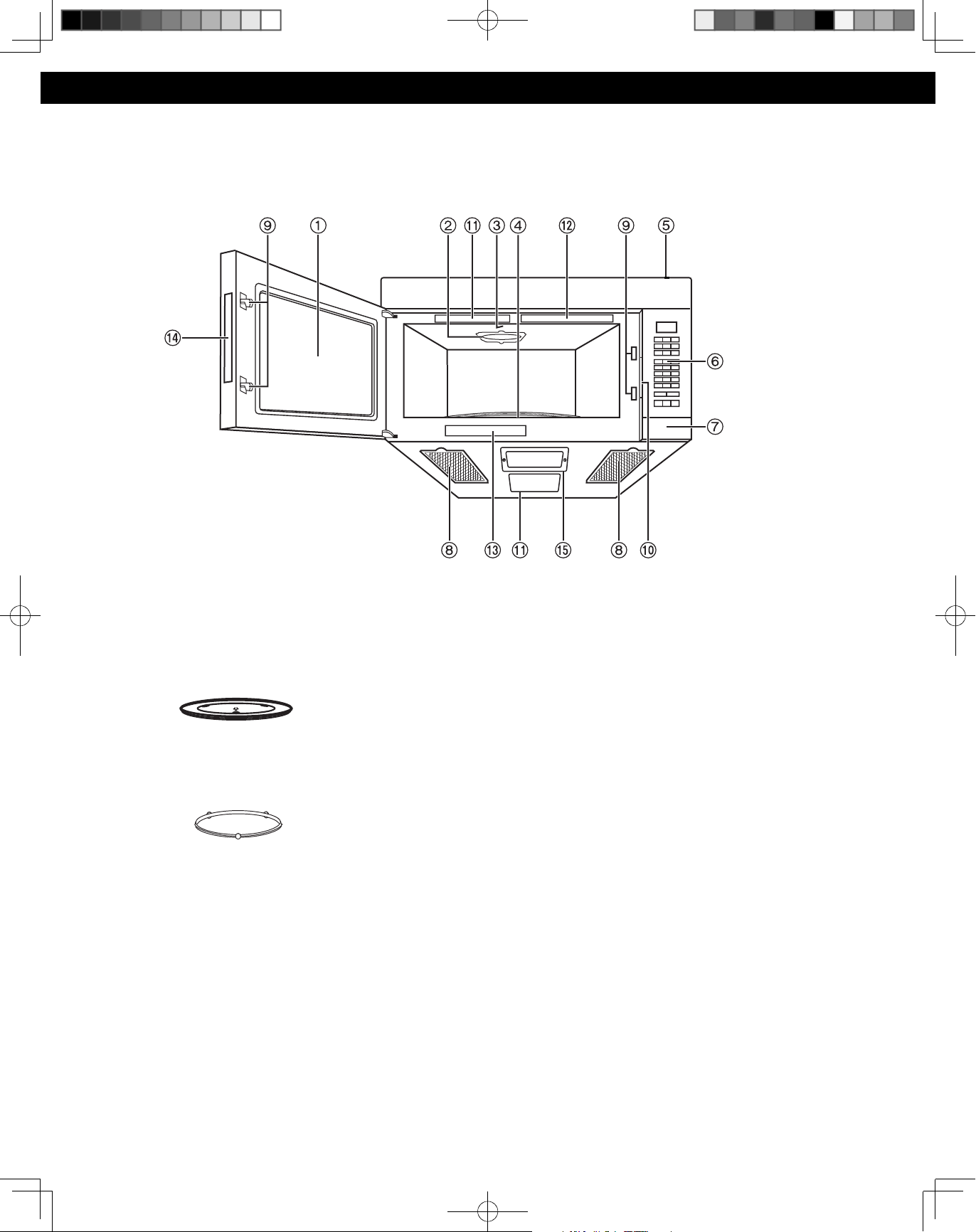
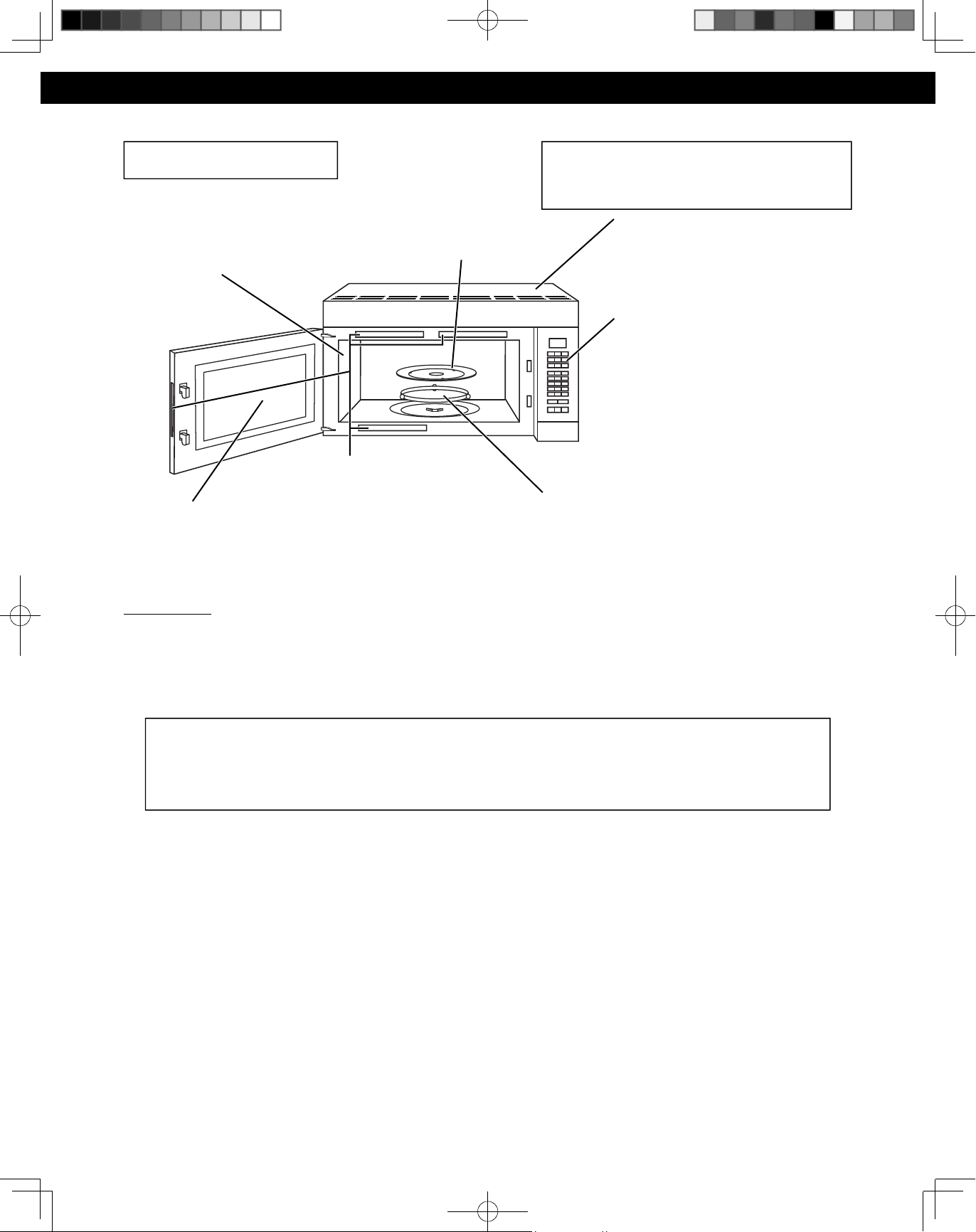
Oven Components Diagram
Glass Tray
Roller Ring
See-through Oven Window
Waveguide Cover (do not remove)
Oven Light
Glass Tray (Turntable)
Oven Air vent (Vent Grille is removable and can be cleaned,
see page 24)
Control Panel
Door Release Key
Grease Filter (Grease filter is removable and can be cleaned,
see page 25)
Door Safety Lock System
Identification Plate
Warning Label
Function Label
Menu Label
DHHS Label
Cook-top Light
1
2
3
4
5
6
7
8
9
10
11
12
13
14
15
NOTE:
The illustration is for reference only.
F0003BX00CP.indd 9 2017/5/5 10:57:09
10
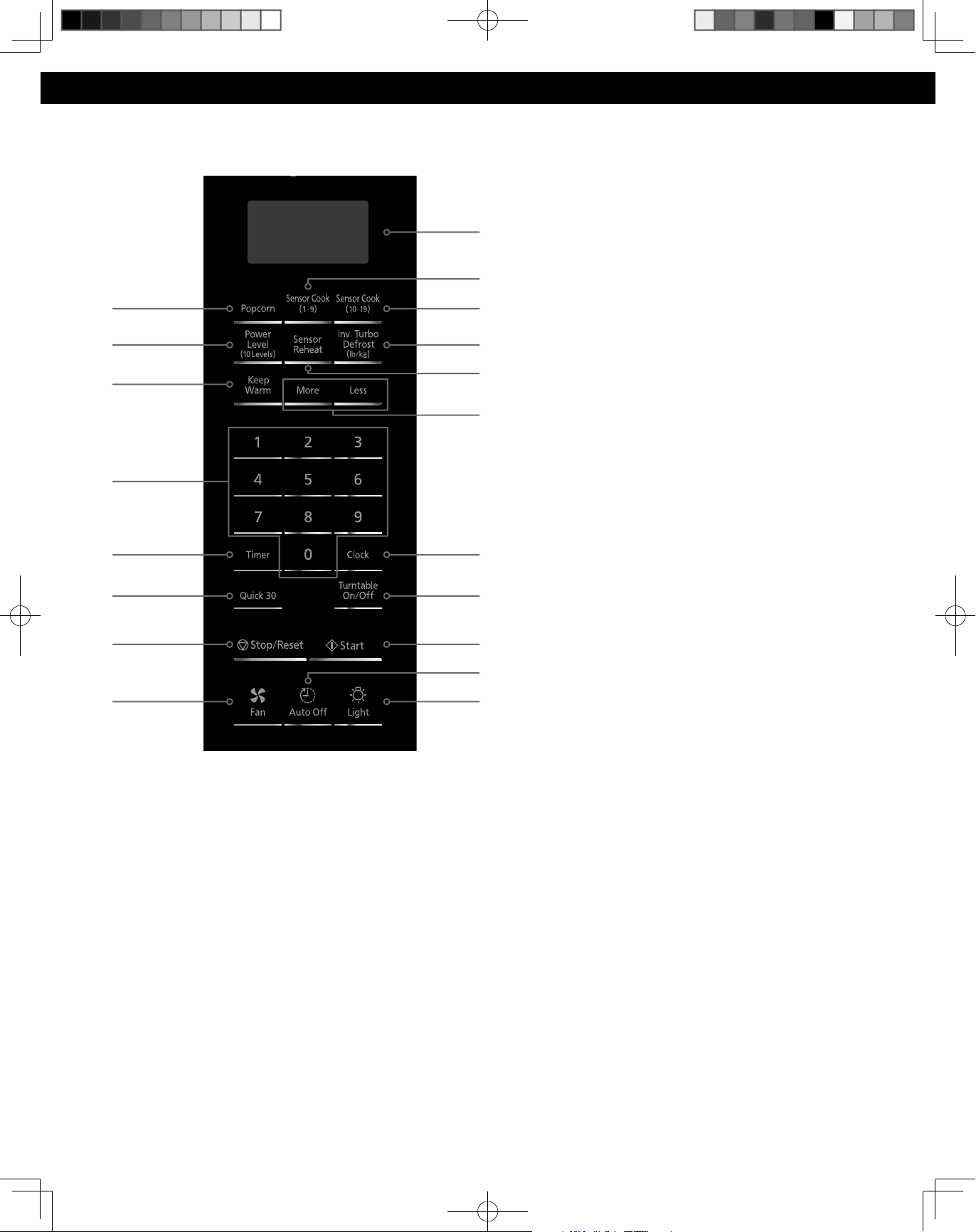
Control Panel
The control panels of NN-ST27HW/NN-ST27HB has the same key layout.
1. Display Window
2. Popcorn Pad (see page 16)
3. Sensor Cook (1-9) (see page 18-19)
4. Sensor Cook (10-19) (see page 18-19)
5. Power Level Pad (see page 11, 14)
6. Inverter Turbo Defrost Pad (see page 17)
7. Keep Warm Pad (see page 16)
8. Sensor Reheat Pad (see page 18)
9. More/Less Pad (see page 11, 16, 18)
10. Number Pads
11. Timer Pad (see page 11, 14, 15)
12. Clock Pad (see page 11, 12)
13. Quick 30 Pad (see page 14)
14. Turn Table On/Off Pad (see page 12)
15. Stop/Reset Pad
Before cooking: one tap clears all your
instructions. During cooking: one press
temporarily stops the cooking process.
Another press cancels all your instructions,
and time of day or colon appears in the
display window.
16. Start pad
After cooking program setting, one press
allows oven to begin functioning. If door is
opened or Stop/Reset pad is pressed once
during oven operation, Start pad must be
pressed again to restart oven.
17. Auto Off Pad (see page 13)
18. Fan Pad (see page 13)
19. Light Pad (see page 12)
Notes:
1. If an operation is set and Start Button is not pressed, after 6 minutes, the oven will automatically cancel the
operation. The display will revert back to clock or colon mode.
2. For saving energy, when the oven is in the following states, the display window backlight will go dark: 1. Plug
in mode. 2. Clock or colon mode. 3. Child-lock. 4. Automatic fan is operating. 5. End of cooking.
2
1
3
4
65
7
10
11
13
15
18
8
12
14
16
17
19
9
F0003BX00CP.indd 10 2017/5/5 10:57:09
11
Operation
Using the Microwave
for the First Time
Menu Action On/Off Demo Mode ON/OFF
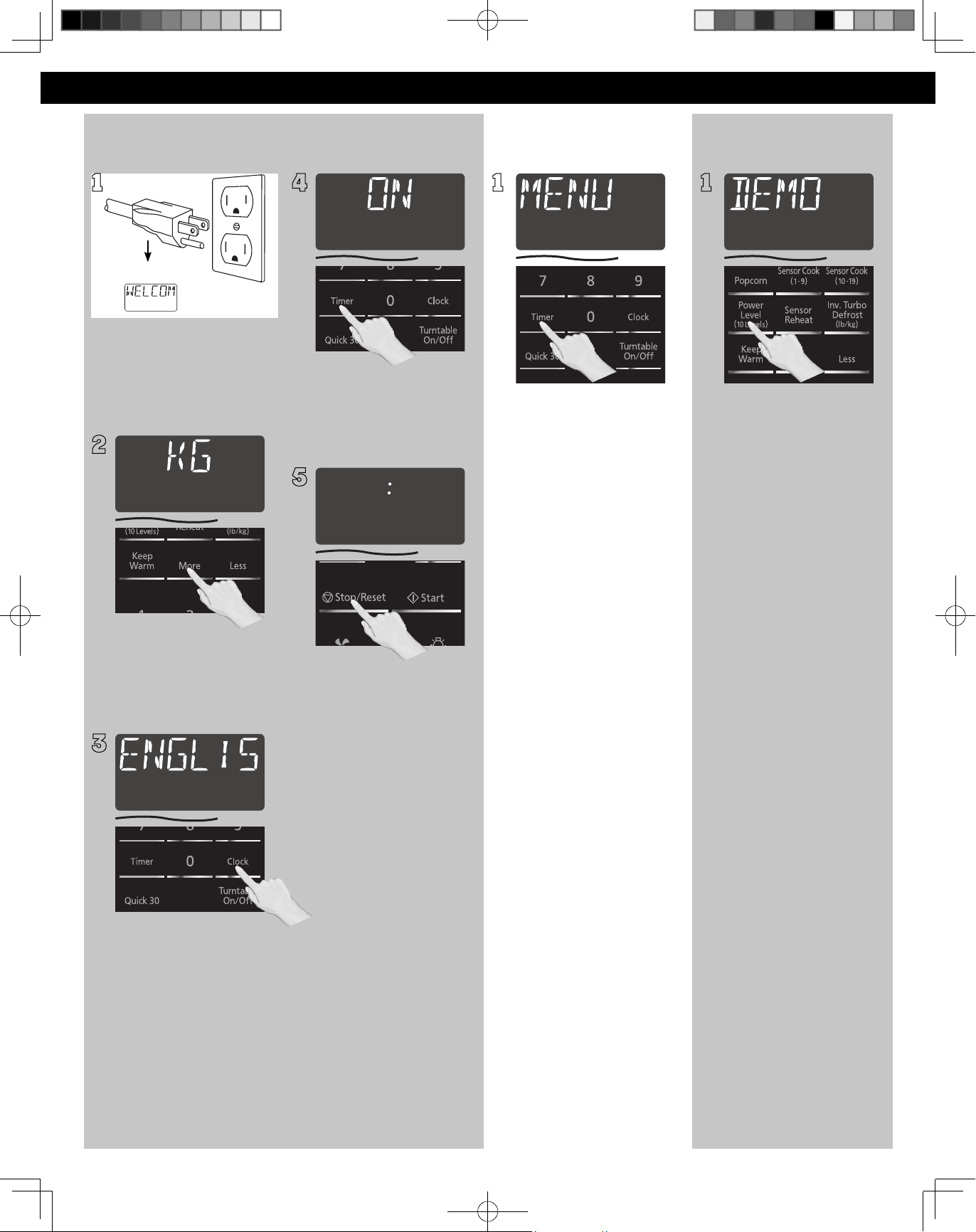
Plug into a properly grounded
electrical outlet. “WELCOME TO
PANASONIC REFER TO OWNER’S
MANUAL BEFORE USE” message
scrolls across display window.
1
Press Start once, then Press
More pad to cycle between the
weight system, Metric (kg) or
Imperial (lb).
Press Start once, then Press
Clock pad to cycle between
the display language, French,
Spanish or English. The oven
automatically defaults to
English Display.
Press Start once, then Press
Timer pad to to cycle between
the Beep on or Beep off. The
default mode is Beep On.
Press Timer 4 times to
turn ON/OFF the Menu
Action feature. The oven
automatically defaults to the
Menu Action ON.
NOTE:
MENU ACTION SCREEN helps
you to program your oven by
prompting the next step to
be taken. When you become
familiar with your oven, the
prompt can be turned off.
Press Power Level once, then
Press Start 4 times, finally Press
Stop/Reset 4 times to turn ON/
OFF the DEMO MODE feature.
The oven automatically
defaults to the DEMO MODE
OFF.
NOTE:
Demo mode is designed
for retail store display. In
this mode, the oven can be
demonstrated with no power
in the oven.
Press Stop/Reset to confirm;
a colon (:) will appear in the
display window.
NOTE:
1. These choices can be
selected only when you
plug-in the oven.
2
3
4 1 1
5
Display Window
F0003BX00CP.indd 11 2017/5/5 10:57:10
12
Operation (continued)
Setting the Clock Setting the Child
Safety Lock
Setting Light
When the time of day appears
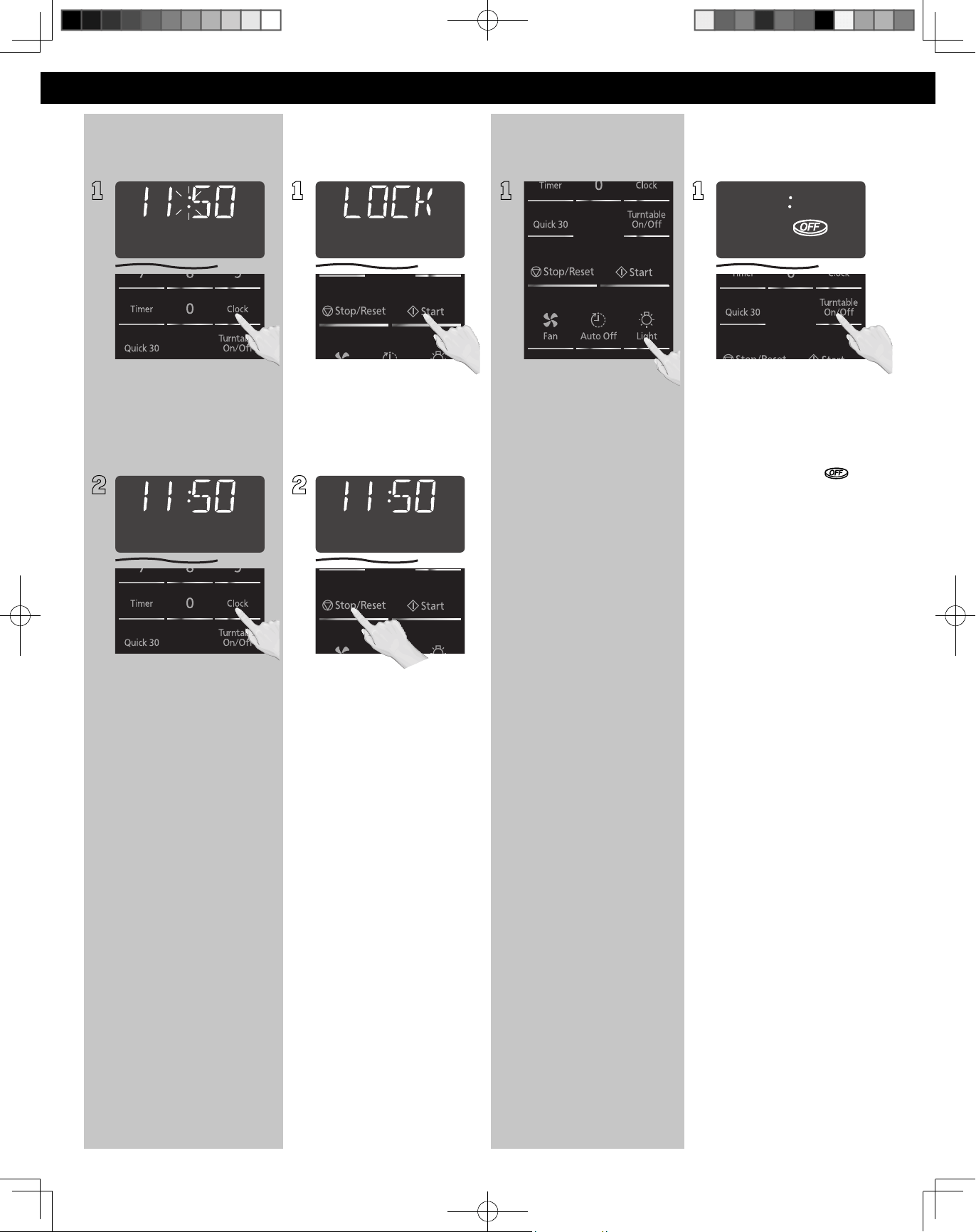
in the display, press Start three
times; “LOCK ” will appears in
the display.
This feature allows you to
control the brightness of
Cooktop Light.
Press Light pad once for
White LED (Full), twice for the
White LED (Duty) and press
again to turn the light off.
Press Stop/Reset three times;
the display will return to the
time of the day and Child Lock
will be cancelled.
NOTES:
1. This feature prevents the
electronic operation of
the oven until cancelled. It
does not lock the door.
2. To set or cancel child
safety lock, Start or Stop/
Reset pad must be pressed
3times within 10seconds.
3. You can set Child Lock
feature when the display
shows a colon or time of
day.
2
Press Clock to finish setting
and the colon (:) will stop
blinking.
NOTES:
1. To reset the clock, repeat
steps.
2. The clock will retain the
time of day as long as the
oven is plugged in and
electricity is supplied.
3. The clock is a 12-hour
display.
4. Oven will not operate while
colon (:) is flashing.
2
With the oven NOT cooking,
press Clock once; the colon
will blink. Enter time of day
using the Number pads.
1 1 1
Setting Turntable
On/Off
For best cooking results, leave
the turntable on. It can be turned
off for large dishes.
Press Turntable On/Off pad to
turn the turntable on or off.
When you turn it off, “ “ will
appear in the display window.
NOTES:
1. When “Turntable Off” is
selected, it will automatically
return to “On” again after the
heating cycle is completed.
Do not operate the oven
“Turntable Off” when cooking
foods on Popcorn / Inverter
Turbo Defrost / Sensor Reheat
/ Sensor Cook.
2. Sometimes the glass tray can
become too hot to touch. Be
careful when touching the
glass tray during and after
cooking.
1
F0003BX00CP.indd 12 2017/5/5 10:57:10
13
Operation (continued)
Setting Fan Setting Auto Off
1/3/5/10
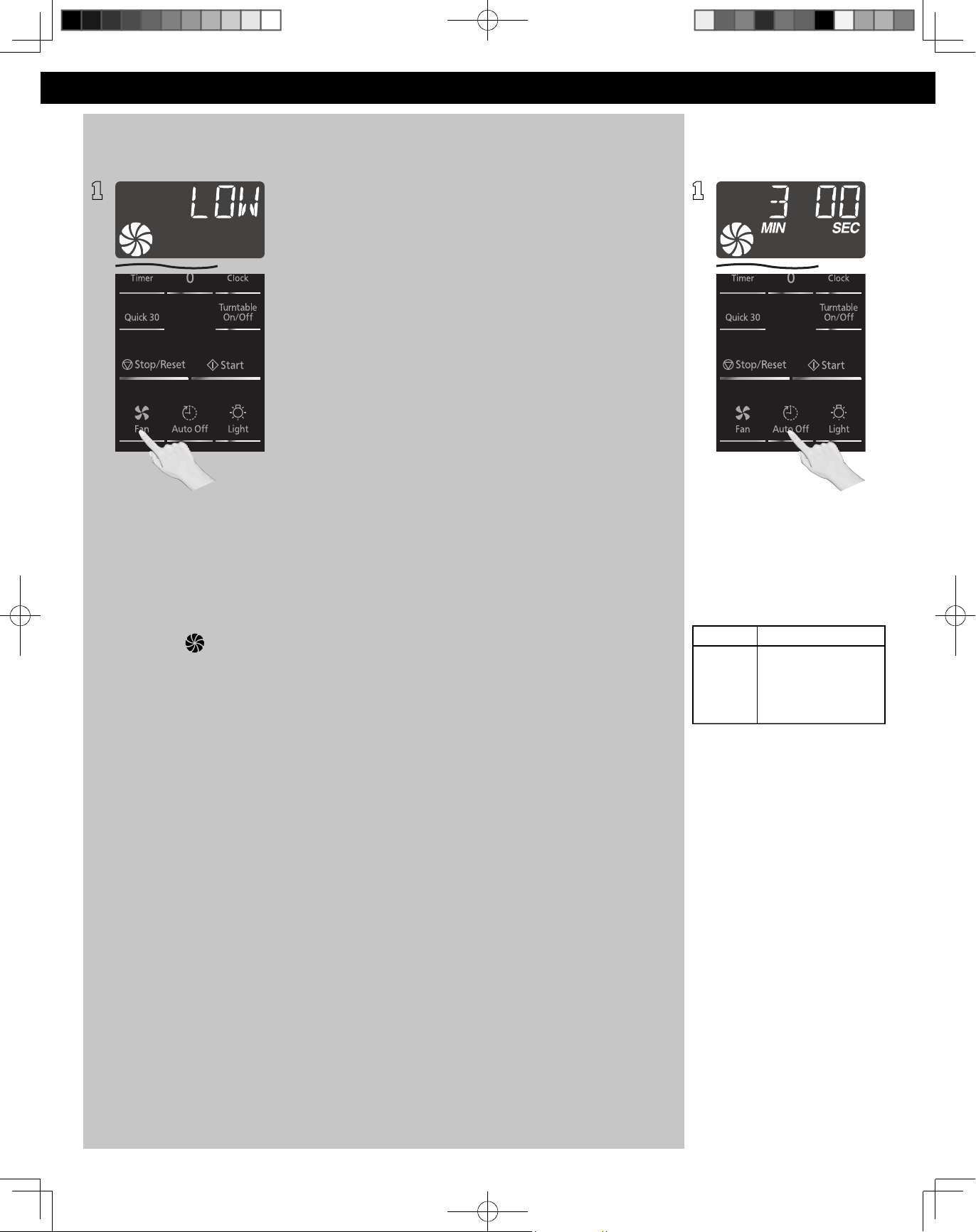
The Fan (Vent Fan) removes
steam and other vapors from
the cooking surface below the
microwave oven. Press Fan pad
once for Low fan speed, twice
for High fan speed , 3 times
for Turbo fan speed, and press
again to turn the fan off. When
you turn it on, “ “will appear
in the display window.
1 1
NOTES:
1. The High fan speed will
run for one second even
though the Low fan
setting is selected. This is
absolutely normal.
2. Hold Fan pad for 2 seconds
to turn off the fan.
Automatic fan
If the microwave oven is
used for a long time or if
cooking equipment under
the microwave oven is
used simultaneously, the
temperature may get too
hot around the microwave
oven and the vent hood fan
will automatically turn on
at the Turbo setting to cool
the oven. When this occurs
the display window shows
“VENTILATING”, and the fan
cannot be manually turned
off. If subsequently another
key is pressed and “HOT”
appears in the display window,
the microwave oven will not
operate, and you must wait
until the microwave is cool
and “HOT” disappears from
the display to re-program. The
fan will automatically turn off
when the internal components
are cool. It may continue
cooling for 30 minutes or
longer.
When “COOLING” appears in
the display window
After you have selected Fan
On, you can set the desired
time that automatically turns
off the Fan. Press Auto Off pad
to set fan time. The following is
the set times for the number of
presses to the pad.
NOTES:
If Auto Off is pressed after
auto Off time had been set,
you must reset the time.
Press time
once
twice
3 times
4 times
1 min
3 min
5 min
10 min
After either using the
microwave oven for a long
time or using the cooking
equipment under the
microwave, “COOLING” may
appear in the display window,
and the cooling fan will run
until components inside are
cool. The microwave oven will
continue to operate normally.
F0003BX00CP.indd 13 2017/5/5 10:57:10
14
Operation (continued)
Cooking
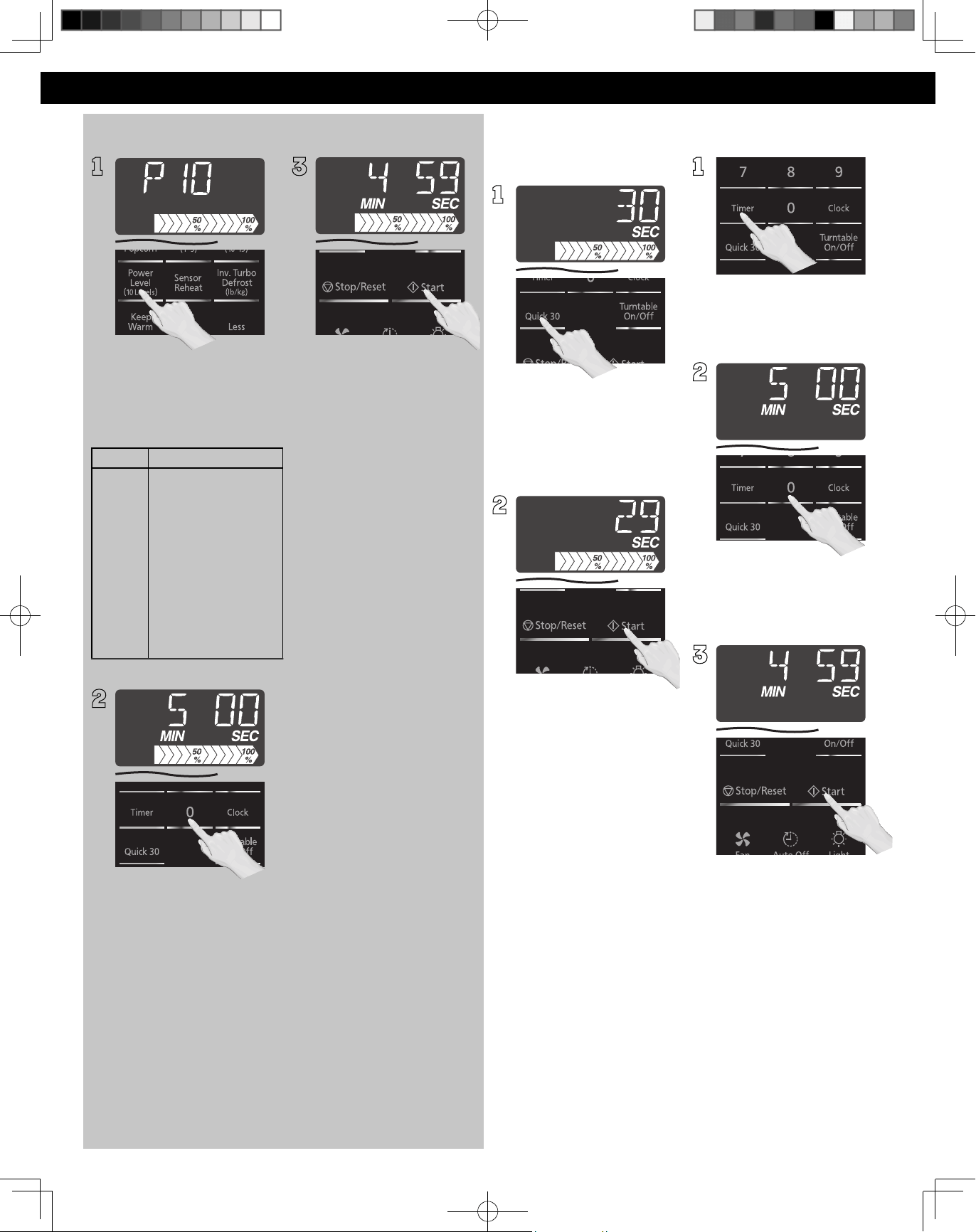
Set Cooking Time using the
Number pads. P10 (HIGH)
has max. cooking time of
30minutes. For other power
levels, the max. time is
99minutes, 99seconds.
If cooking at high power (10),
skip to step 2. Press Power Level
until the desired power level
appears in the display. P10 is the
highest and P1 is the lowest.
2
Press Power Level
once
twice
3 times
4 times
5 times
6 times
7 times
8 times
9 times
10 times
P10 (HIGH)
P9
P8
P7 (MED-HIGH)
P6 (MEDIUM)
P5
P4
P3 (MED-LOW)/
DEFROST
P2
P1 (LOW)
1
Press Start; the cooking will
start and the time will count
down in the display. At the
end of cooking, five beeps will
sound.
NOTES:
1. For reheating, use P10 (HIGH)
for liquids, P7 (MED-HIGH) for
most foods, and P6 (MEDIUM)
for dense foods.
2. For defrosting, use P3
(MED-LOW).
DO NOT OVERCOOK: This
oven requires less time to cook
than older units. Overcooking
will cause food to dry out and
may cause a fire. A microwave
oven’s cooking power tells
you the amount of microwave
power available for cooking.
Stage Cooking:
For more than one stage of
cooking, repeat steps 1 and
2 for each stage of cooking
before pressing Start. The
maximum number of stages
for cooking is three. When
operating, two beeps will
sound between each stage.
Five beeps will sound at the
end of the entire sequence.
Automatic function (such as
sensor cook/reheat, popcorn
and inverter turbo defrost)
can not be used with 3 stage
cooking.
3
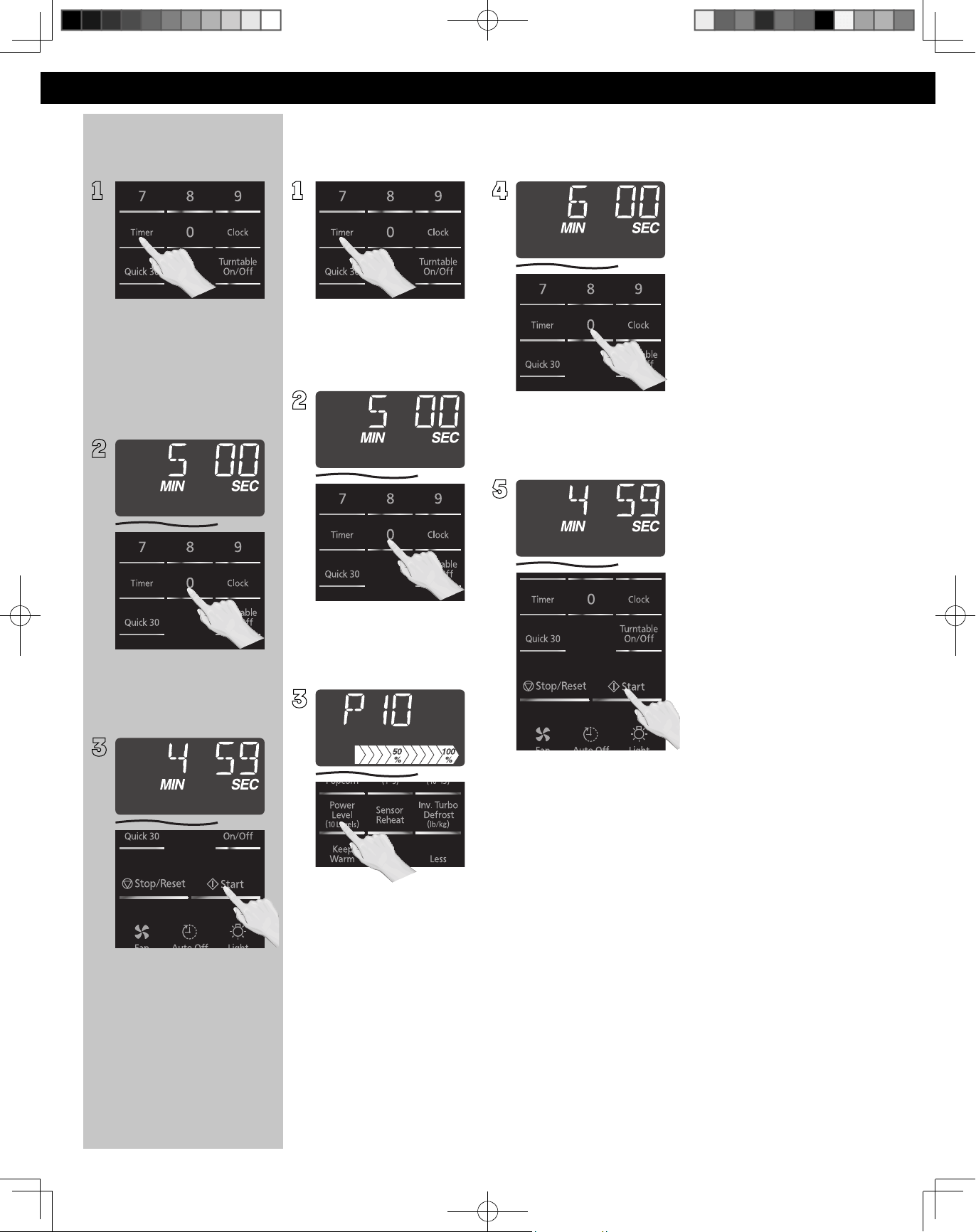
Setting the Timer
Set desired amount of time
using Number pads (up to
99minutes, 99seconds).
Press Start. The timer will count
down without cooking and beep
five times when done.
Caution: If oven lamp is lit
while using the timer feature
with door closed, the oven is
NOT set properly; STOP OVEN
IMMEDIATELY and re-read
instructions.
2
3
1
This feature allows you to
program the oven as a kitchen
timer. Press Timer once.
Quick 30
(Set or add cooking time in
30 seconds increments)
Press Quick 30 until the
desired cooking time (up to
5 minutes) appears in the
display. Power Level is pre-set
at P10.
2
1
Press Start; the cooking will
start and the time will count
down in the display. At the
end of cooking, five beeps will
sound.
NOTES:
1. If desired, you can use
other power levels. Select
desired power level before
pressing Quick 30.
2. After setting the time by
Quick 30 pad, you cannot
use the Number Pads.
3. Quick 30 pad can also be
used to add more time
during manual cooking (up
to 5 minutes) .
F0003BX00CP.indd 14 2017/5/5 10:57:10
15
Operation (continued)
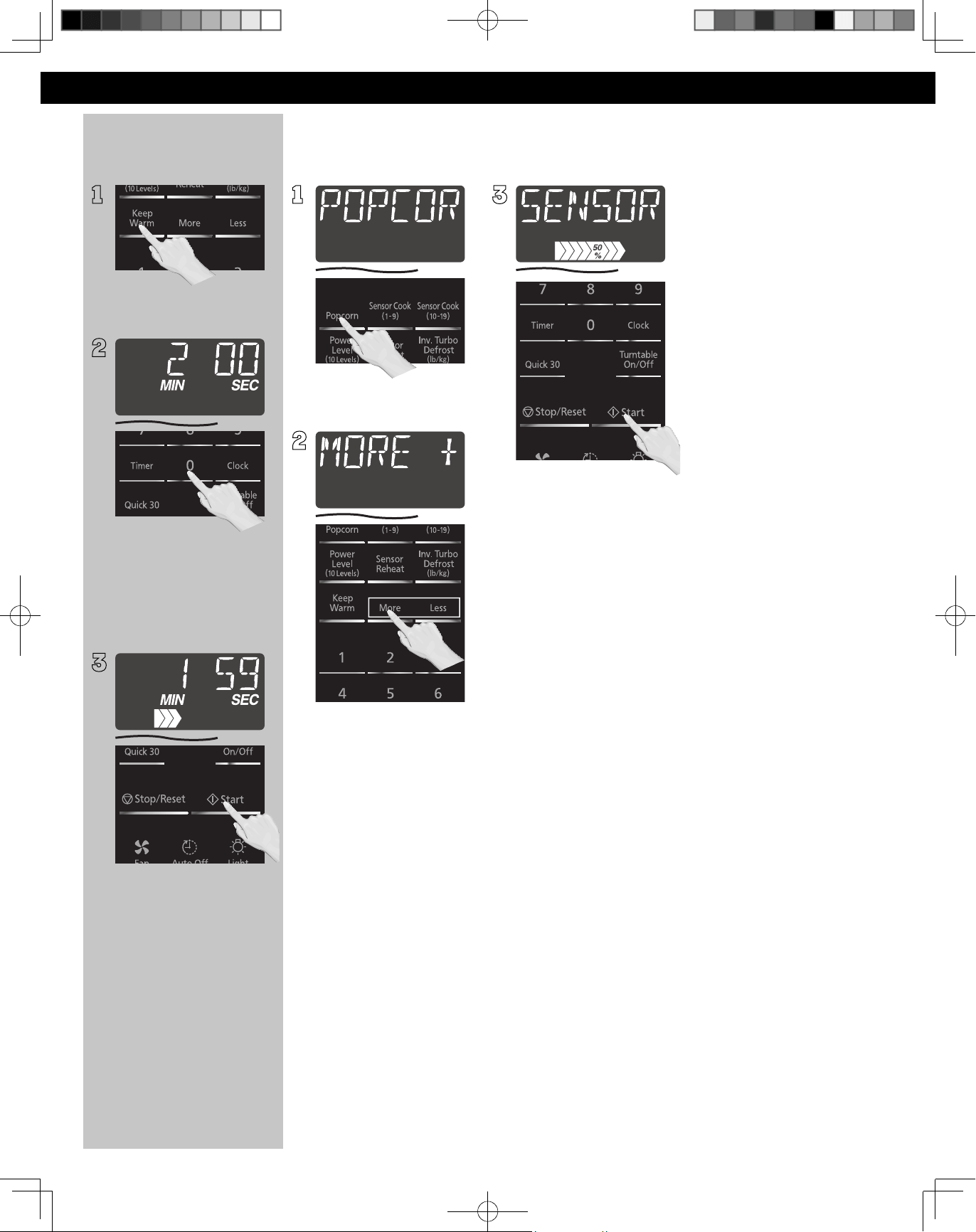
Setting a Standing
Time
Set desired amount of stand
time using Number pads (up
to 99 minutes, 99 seconds).
2
Some recipes call for a
standing time after cooking.
To do this, repeat steps 1 and
2 in the Cooking section on
previous page. Then press
Timer.
1 1
Setting a Delayed
Start
The start time can be delayed
to start cooking at a later time.
To do this, first press Timer.
Enter the desired delay time
(up to 99 minutes, 99 seconds)
using the Number pads.
2
Press Start; the delay time will
count down, then cooking will
begin. At the end of cooking,
five beeps will sound.
NOTES:
1. When each stage finishes,
the oven will beep twice. At
the end of the program, the
oven will beep five times.
2. If the oven door is opened
during Stand Time, Kitchen
Timer or Delay Time, the
time on the display will
continue to count down.
3. Stand Time and Delay start
cannot be programmed
before any automatic
function (such as sensor
cook/reheat, popcorn and
inverter turbo defrost). This
is to prevent the starting
temperature of food from
rising.
4. When using Standing time
or Delay Start, it’s up to 2
power stages.
5
Press Start. The timer will
start and then beep twice at
the end of cooking time (the
beginning of standing time).
Five beeps will sound when
standing time is done.
3
Press Power Level until the
desired power level appears
in the display. P10 is the
highest and P1 is the lowest.
3
Set Cooking Time using the
Number pads (see previous
page for maximum times).
4
F0003BX00CP.indd 15 2017/5/5 10:57:10
16
Operation (continued)
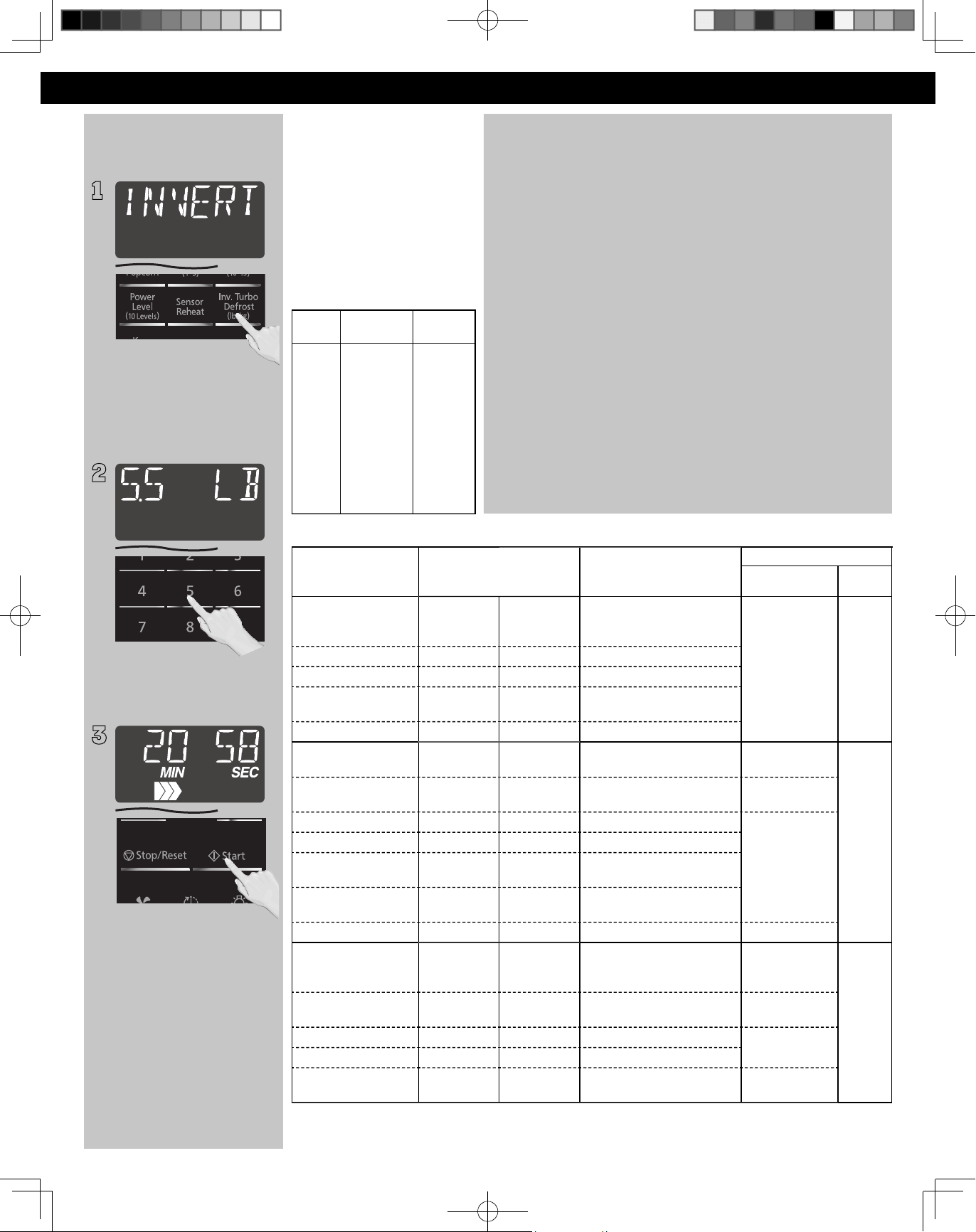
Keep Warm
(Will keep food warm for up to
30 minutes after cooking)
Set warming time using
Number pads (up to
30minutes ). This example
shows two minutes.
2
2
Press Keep Warm.
1
Popcorn
This sensor feature allows you to pop popcorn without setting weight and time. The oven
simplifies programming.
Press Popcorn once.
If desired, press More pad
to add 10% more time than
suggested. Press Less pad to
subtract 10% cooking time.
1
Press Start; the cooking will
start and the time will count
down in the display. At the
end of cooking, five beeps will
sound.
NOTES:
Keep Warm can be set as the
final stage after cook time
has been manually entered. It
cannot be used with sensor or
auto features.
3
Press Start; After several
seconds, cooking time appears
in the display window and
begins to count down.
3
NOTES:
1. Pop one bag at a time.
2. Place bag in oven according
to manufacturers’
directions.
3. Start with popcorn at room
temperature.
4. Allow popped corn to
sit unopened for a few
minutes.
5. Open bag carefully to
prevent burns, because
steam will escape.
6. Do not reheat unpopped
kernels or reuse bag.
7. If popcorn is of a different
weight than listed, follow
instructions on popcorn
package.
8. Never leave the oven
unattended.
9. If popping slows to 2 to
3 seconds between pops,
stop oven. Overcooking
can burn popcorn or
cause fire.
10. When popping multiple bags
one right after the other,
the cooking time may vary
slightly. This does not affect
the popcorn results.
11. If “HOT“ appears in the
display window, the oven
temperature is too high from
previous use and an auto
program can not be set.
Cooking mode and time may
still be set manually.
F0003BX00CP.indd 16 2017/5/5 10:57:10
17
Operation (continued)
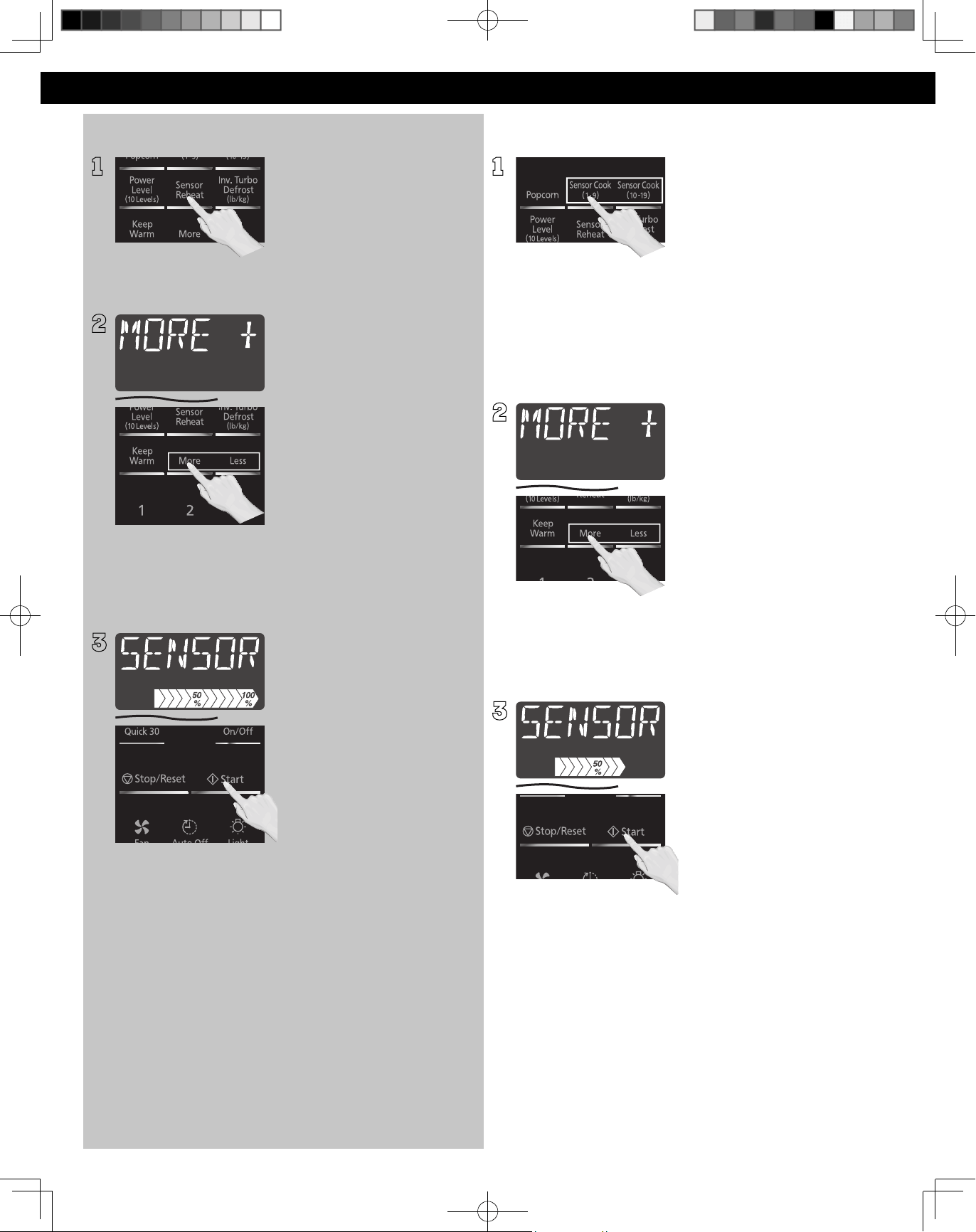
Inverter Turbo
Defrost
Press Start. Defrosting will
start. Larger weight foods will
cause a signal midway through
defrosting. If two beeps sound,
turn over and/or rearrange
foods.
NOTE:
The maximum weight for
Inverter Turbo Defrost is 6 lbs.
(3 kg).
Enter weight of the food using
the Number pads.
3
2
Defrosting Tips & Techniques
1
This feature allows you to
defrost foods such as meat,
poultry and seafood, simply
by entering the weight. Press
Inverter Turbo Defrost.
Conversion
Follow the chart to convert
ounces or hundredths of a
pound into tenths of a pound.
To use Inverter Turbo Defrost,
enter the weight of the food
in pounds (1.0) and tenths of a
pound (0.1). If a piece of meat
weighs 1.95 lbs or 1 lb 14 oz,
enter 1.9 lbs.
Ounces
Hundredths
of a Pound
Tenths of
a Pound
0
1 - 2
3 - 4
5
6 - 7
8
9 - 10
11 - 12
13
14 - 15
.01 - .05
.06 - .15
.16 - .25
.26 - .35
.36 - .45
.46 - .55
.56 - .65
.66 - .75
.76 - .85
.86 - .95
0.0
0.1
0.2
0.3
0.4
0.5
0.6
0.7
0.8
0.9
Preparation For Freezing:
1. Freeze meats, poultry, and fish in
packages with only one or two
layers of food. Place wax paper
between layers.
2. Package in heavy-duty plastic
wraps, bags (labeled “For
Freezer”), or freezer paper.
3. Remove as much air as possible.
4. Seal securely, date, and label.
To Defrost:
1. Remove wrapper. This helps
moisture to evaporate. Juices
from food can get hot and cook
the food.
2. Set food in microwave safe dish.
3. Place roasts fat-side down. Place
whole poultry breast-side down.
4. Select power and minimum
time so that items will be under-
defrosted.
5. Drain liquids during defrosting.
6. Turn over (invert) items during
defrosting.
After Defrosting:
1. Large items may be icy in the
center. Defrosting will complete
during Standing Time.
2. Let stand, covered, following
stand time directions on
page 15.
3. Rinse foods indicated in the chart.
4. Items which have been layered
should be rinsed separately or
have a longer stand time.
FOOD
MANUAL
DEFROST TIME AT P3
(min/kg)(min/lb)
DURING DEFROSTING
AFTER DEFROSTING
Stand Time Rinse
Fish and Seafood
Crabmeat
[up to 3 lbs. (1.4
kg
)]
13 6 Break apart/Rearrange
5 min. YES
Fish Steaks 8 to 12 4 to 6 Turn over
Fish Fillets 8 to 12 4 to 6 Turn over/Rearrange
Sea Scallops 8 to 12 4 to 6
reak apart/
Remove defrosted pieces
Whole fish 8 to 12 4 to 6 Turn over
Meat
Ground Meat
8 to 10 4 to 5
Turn over/
Remove defrosted portion
10 min.
NO
Roasts
[2½-4 lbs. (1.1-1.8
kg
)]
8 to 16 4 to 8 Turn over 30 min. in fridge.
Chops/Steak 12 to 16 6 to 8 Turn over/Rearrange
5 min.
Ribs/T-bone 12 to 16 6 to 8 Turn over/Rearrange
Stew Meat 8 to 16 4 to 8
Break apart/
Remove defrosted pieces
Liver (thinly sliced) 8 to 12 4 to 6
Drain liquid/Turn over/
Separate pieces
Bacon (sliced) 8 4 Turn over ----
Poultry
Chicken, Whole
[up to 3 lbs. (1.4
kg
)]
8 to 12 4 to 6 Turn over 20 min. in fridge
YES
Cutlets 8 to 12 4 to 6
Break apart/Turn over/
Remove defrosted Pieces
5 min.
Pieces 8 to 12 4 to 6 Break apart/Turn over
10 min.
Cornish hens 12 to 16 6 to 8 Turn over
Turkey Breast
[5-6 lbs. (2.3-2.7
kg
)]
12 6 Turn over 20 min. in fridge
F0003BX00CP.indd 17 2017/5/5 10:57:10
18
Operation (continued)
Sensor Reheat
Press Sensor Reheat.
2
Sensor Cook
If desired, press More pad
to add 20% more time than
suggested. Press Less pad to
subtract 20% cooking time.
2
Press Sensor Cook (1-9) or
Sensor Cook (10-19) until the
number corresponding to the
desired food appears in the
display (see chart on the next
page).
11
If desired, press More pad
to add 20% more time than
suggested. Press Less pad to
subtract 20% cooking time.
Press Start. Cooking is
complete when five beeps
sound.
3
Press Start. Reheating is
complete when five beeps
sound.
3
NOTES:
1. After having used the
Sensor Reheat feature a
few times, you may decide
you would prefer your
food cooked to a different
doneness – that is why you
would utilize the More/Less
pads.
2. When steam is detected by
the Genius Sensor and two
beeps sound, the remaining
cooking time will appear in
the display.
Casseroles: Add three to four
tablespoons of liquid, cover
with lid or vented plastic wrap.
Stir when time appears in the
display window.
Canned foods: Empty
contents into casserole dish
or serving bowl, cover dish
with lid or vented plastic wrap.
After reheating, let stand for a
few minutes.
Plate of food: Arrange food on
plate; top with butter, gravy,
etc. Cover with lid or vented
plastic wrap. After reheating,
let stand for a few minutes.
DO NOT USE SENSOR REHEAT:
1. To reheat bread and pastry
products. Use manual power
and time for these foods.
2. For raw or uncooked foods.
3. If oven cavity is warm.
4. For beverages.
5. For frozen foods.
NOTES:
1. After having used the Sensor
Cook feature a few times,
you may decide you would
prefer your food cooked to
a different doneness – that
is why you would utilize the
More/Less pads.
2. When steam is detected by
the Genius Sensor and two
beeps sound, the remaining
cooking time will appear in
the display.
3. Automatic features
are provided for your
convenience. If results are not
suitable to your individual
preference, or if serving size
is other than what is listed
on page 19, please refer to
manual cooking on page 14.
4. If “HOT“ appears in the
display window, the oven
temperature is too high from
previous use and an auto
program can not be set.
Cooking mode and time may
still be set manually.
For the best results with the
GENIUS SENSOR, follow
these recommendations:
BEFORE Reheating/Cooking:
1. The room temperature
surrounding the oven should
be below 95° F (35° C).
2. Food weight should exceed
4oz. (110g).
3. Be sure the glass tray, the
outside of the cooking
containers and the inside
of the microwave oven are
dry before placing food in
the oven. Residual beads of
moisture turning into steam
can mislead the sensor.
4. Cover food with lid, or with
vented plastic wrap. Never
use tightly sealed plastic
containers—they can prevent
steam from escaping and
cause food to overcook.
DURING Reheating/Cooking:
DO NOT open the oven door until
two beeps sound and cooking
time appears in the display.
Doing so will cause inaccurate
cooking since the steam from
food is no longer contained
within the oven cavity.
Once the cooking time begins
to count down, the oven door
may be opened to stir, turn or
rearrange foods.
AFTER Reheating/Cooking:
All foods should have a standing
time.
F0003BX00CP.indd 18 2017/5/5 10:57:11
19
Operation (continued)
Sensor Cook Chart
See the chart below for Sensor Cook categories.
Recipe Serving/Weight Hints
1. Oatmeal
40 - 80 g
(0.5 - 1 cup)
Place inside a microwave safe serving bowl with no cover. Follow manufacturers’
directions for preparation.
2. Breakfast Sausage 2 - 8 links
Follow manufacturers’ directions for preparation of pre-cooked breakfast sausage.
Place in a radial pattern.
3. Omelet 2 - 4 eggs Follow basic Omelet recipe on this page.
4. Soup (250 - 500 ml)
Pour soup into a microwave safe serving bowl. Cover with lid or vented plastic
wrap. Stir after cooking.
5. Quinoa
¼ - 1 cups
(45 - 180 g)
Place quinoa in a microwave safe casserole dish. Add 2 parts water to 1 part
quinoa. Cover with lid or vented plastic wrap. After 2 beeps, stir. Let stand
14 minutes before serving.
6. Hot Dog 1-4 pieces
Make 3 slits on each hot dog. Place hot dog on paper plate or microwave safe dish
leaving space between each. Times may vary by size and brand.
7. Potatoes (pierce skin)
1 - 4 potatoes
(170 - 225 g)
(6 - 8 oz. each)
Pierce each potato with a fork 6 times spacing around surface. Place potato or
potatoes around the edge of paper-towel-lined glass tray (turntable), at least
2.5 cm (1-inch) apart. Do not cover. Let stand 5 minutes to complete cooking.
8. Pasta
56 - 225 g
(2 - 8 oz.)
Place pasta with hot tap water in a microwave safe casserole dish. Cover with lid or
vented plastic wrap.
9. Rice
0.5 - 1.5 cups
(110 - 335 g)
Place rice with hot tap water in a microwave safe casserole dish. Cover with lid or
vented plastic wrap. Let stand 5 to 10 minutes before serving.
10. Frozen Entrées
225 - 900 g
(8 - 32 oz.)
Follow manufacturers’ directions for preparation. After 2 beeps, stir or rearrange.
Be careful when removing the film cover after cooking. Remove facing away from
you to avoid steam burns. If additional time is needed, continue to cook manually.
11. Frozen Pizza (single)
225 g
(8 oz.)
Follow manufacturers’ directions for preparation.
12. Frozen Pocket Sandwich
1 sandwich
(128 g)
(4.5 oz.)
Follow manufacturers’ directions for preparation.
13. Fresh Vegetables
110 - 450 g
(4 - 16 oz.)
All pieces should be the same size. Wash thoroughly, add 1 tbsp of water per
½cup of vegetables, and cover with lid or vented plastic wrap. Do not salt/butter
until after cooking.
14. Frozen Vegetables
170 - 450 g
(6 - 16 oz.)
Wash thoroughly, add 1 tbsp of water per ½ cup of vegetables, and cover with
lid or vented plastic wrap. Do not salt/butter until after cooking. (Not suitable for
vegetables in butter or sauce.) After 2 beeps, stir or rearrange.
15. Canned Vegetables
430 g
(15 oz.)
Empty contents into microwave safe serving bowl. Do not cover.
16. Frozen Dinners
300 - 450 g
(11 - 16 oz.)
Follow manufacturers’ directions for covering or removing covers.
Do not use frozen foods packaged in foil trays. After 2 beeps and before serving,
stir or rearrange.
17. Chicken Pieces
170 - 900 g
(8 - 32 oz.)
Place skin-side up. Cover with vented plastic wrap. Let stand 5 minutes before
serving.
18. Ground Meat
450 - 900 g
(16 - 32 oz.)
Break apart in glass bowl or colander. Cover with lid or vented plastic wrap. After
2 beeps, stir. Re-cover and tap Start. Juices should be clear. Drain.
19. Fish Fillets
110 - 450 g
(4 - 16 oz.)
Arrange in a single layer. Cover with lid or vented plastic wrap.
OMELET
Basic Omelet Recipe
1 Tablespoon butter or margarine
2 Eggs
2 Tablespoons milk
Salt and ground black pepper, if desired
Heat butter in a microwave safe 8-inch pyrex round plate,
20seconds at P10, or until melted.
Turn the plate to coat the bottom with butter. Meanwhile,
combine the remaining ingredients in a separate bowl, beat
together and pour into the pie plate. Cook, covered with vented
plastic wrap, using OMELET selection. Let stand 2 minutes. With a
spatula, loosen the edges of the omelet from the plate, fold into
thirds to serve. Always beat the eggs before making the omelet.
Yield: 1 Serving
Approx. cooking time: 4 minutes.
NOTE: Double ingredients for a 4-egg Omelet.
F0003BX00CP.indd 19 2017/5/5 10:57:11
20
Operation (continued)
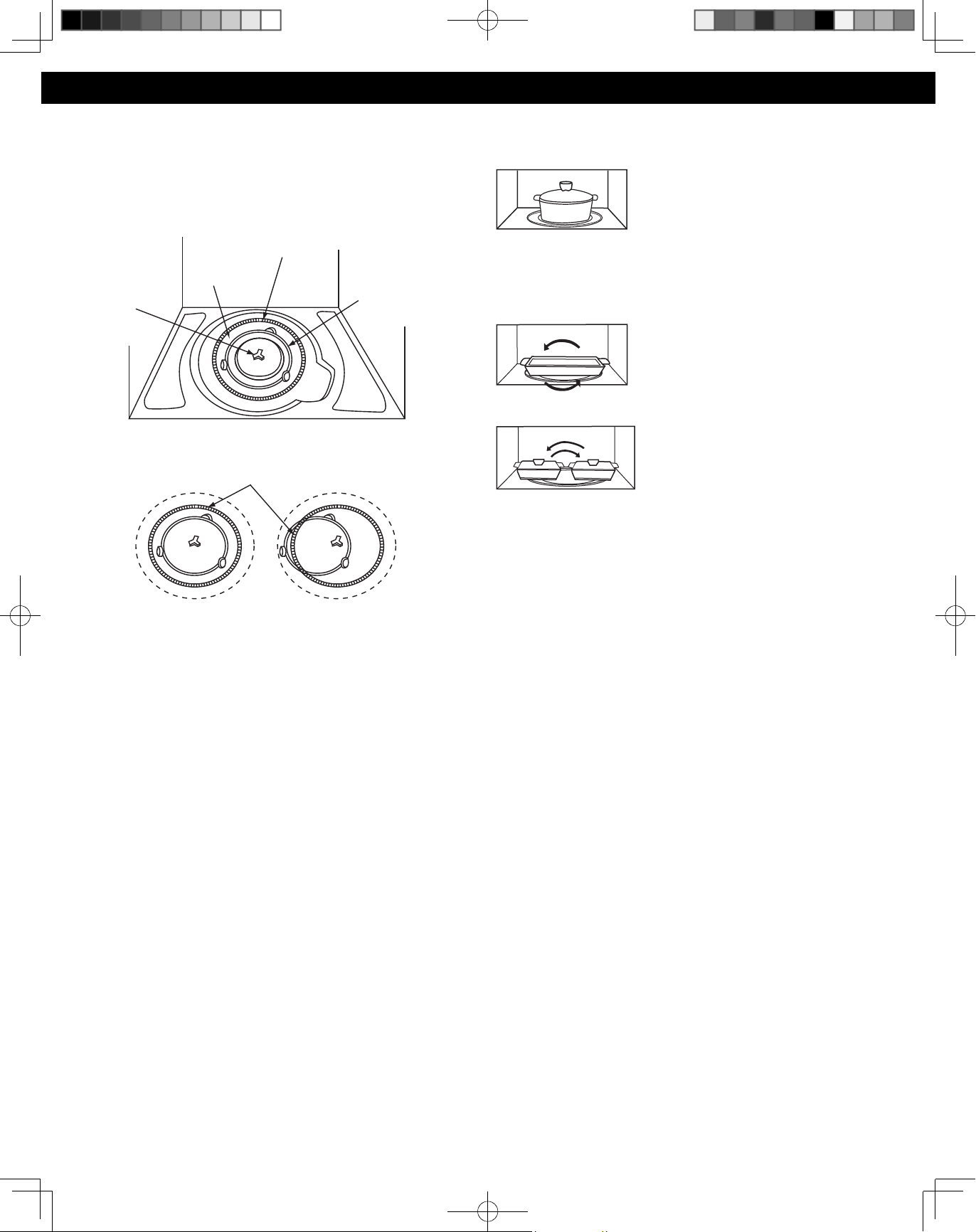
Placement of the Roller Ring
Before using the microwave oven, be sure the Roller Ring is
properly installed. Incorrect installation can result in improper
cooking, damage to the oven or spillage of food. The Roller Ring
must be located on the surface between the raised rib and raised
floor.
Raised Circular Rib
Raised Rib
Roller Ring
Drive Shaft
for Glass Tray
Oven Floor
Correct Wrong
For best cooking Results 1-Level cooking
Food microwaves best when placed onto the turntable, with
turntable on (rotating).
(Turntable On) For best results
When a large dish or more than one dish is used for cooking, the
turntable can be turned off. For best results, rotate large dish and
interchange multiple dishes, halfway through cooking cycle.
(Turntable Off) Rotate dish halfway
through cooking
(Turntable Off) Interchange dishes
halfway through cooking
F0003BX00CP.indd 20 2017/5/5 10:57:11
21
Food Characteristics
Bone and Fat
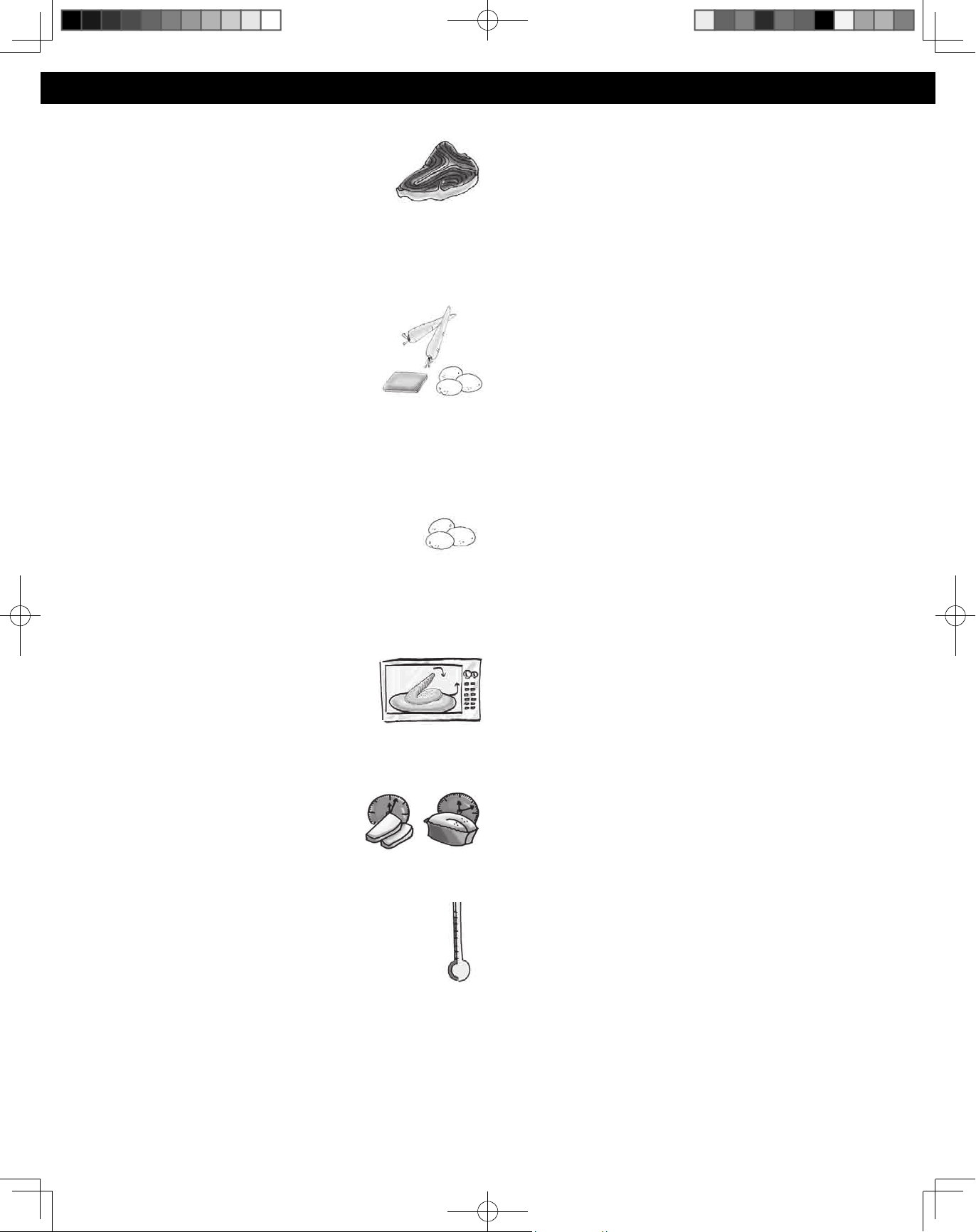
Both bone and fat affect cooking. Bones may cause
irregular cooking. Meat next to the tips of bones may
overcook while meat positioned under a large bone,
such as a ham bone, may be undercooked. Large
amounts of fat absorb microwave energy and the meat next to these areas
may overcook.
Density
Porous, airy foods such as breads, cakes or rolls take
less time to cook than heavy, dense foods such as
potatoes and roasts. When reheating donuts or other
foods with different centers be very careful. Certain
foods have centers made with sugar, water, or fat and
these centers attract microwaves (for example, jelly
donuts). When a jelly donut is heated, the jelly can become extremely hot
while the exterior remains warm to the touch. This could result in a burn if
the food is not allowed to cool properly in the center.
Quantity
Two potatoes take longer to cook than one potato. As the
quantity of the food decreases so does the cooking time.
Overcooking will cause the moisture content in the food to decrease and a
fire could result. Never leave microwave unattended while in use.
Shape
Uniform sizes heat more evenly. The thin end of a
drumstick will cook more quickly than the meaty end.
To compensate for irregular shapes, place thin parts
toward the center of the dish and thick pieces toward
the edge.
Size
Thin pieces cook more quickly than thick pieces.
Starting Temperature
Foods that are at room temperature take less time to cook than if
they are chilled, refrigerated or frozen.
Cooking Techniques
Piercing
Foods with skins or membranes must be pierced, scored or have a strip of
skin peeled before cooking to allow steam to escape. Pierce clams, oysters,
chicken livers, whole potatoes and whole vegetables. Whole apples or
new potatoes should have a 1-inch strip of skin peeled before cooking.
Score sausages and frankfurters. Do not Cook/Reheat whole eggs, with
or without the shell. Steam buildup in whole eggs may cause them to
explode, and possibly damage the oven or cause injury. Reheating SLICED
hard-boiled eggs and cooking SCRAMBLED eggs is safe.
Browning
Foods will not have the same brown appearance as conventionally cooked
foods or those foods which are cooked utilizing a browning feature. Meats
and poultry may be coated with browning sauce, Worcestershire sauce,
barbecue sauce or shake-on browning sauce. To use, combine browning
sauce with melted butter or margarine and brush on before cooking. For
quick breads or muffins, brown sugar can be used in the recipe in place of
granulated sugar, or the surface can be sprinkled with dark spices before
baking.
Spacing
Individual foods, such as baked potatoes, cupcakes and appetizers, will
cook more evenly if placed in the oven equal distances apart. When
possible, arrange foods in a circular pattern.
Covering
As with conventional cooking, moisture evaporates during microwave
cooking. Casserole lids or plastic wrap are used for a tighter seal. When
using plastic wrap, vent the plastic wrap by folding back part of the
plastic wrap from the edge of the dish to allow steam to escape. Loosen
or remove plastic wrap as recipe directs for stand time. When removing
plastic wrap covers, as well as any glass lids, be careful to remove them
away from you to avoid steam burns. Various degrees of moisture
retention are also obtained by using wax paper or paper towels.
Cooking Time
Cooking times will vary because of food shape variations, starting
temperature, and regional preferences. Always cook food for the minimum
cooking time given in a recipe and check for doneness. If the food is
undercooked, continue cooking. It is easier to add time to an undercooked
product. Once the food is overcooked, nothing can be done.
Food Characteristics
F0003BX00CP.indd 21 2017/5/5 10:57:11
22
Stirring
Stirring is usually necessary during microwave cooking. Always bring
the cooked outside edges toward the center and the less cooked center
portions toward the outside of the dish.
Rearranging
Rearrange small items such as chicken pieces, shrimp, hamburger patties
or pork chops. Rearrange pieces from the edge to the center and pieces
from the center to the edge of the dish.
Turning
It is not possible to stir some foods to distribute the heat evenly. At times,
microwave energy will concentrate in one area of the food. To help ensure
even cooking, these foods need to be turned. Turn over large foods, such
as roasts or turkeys, halfway through cooking.
Standing Time
Most foods will continue to cook by conduction after the microwave oven
is turned off. After cooking meat, the internal temperature will rise 5 °F to
15 °F (3 °C to 8 °C), if allowed to stand, tented with foil, for 10 to 15 minutes.
Casseroles and vegetables need a shorter amount of standing time, but
this standing time is necessary to allow foods to complete cooking to the
center without overcooking on the edges.
Test for Doneness
The same tests for doneness used in conventional cooking may be used
for microwave cooking. Meat is done when fork-tender or splits at fibers.
Chicken is done when juices are clear yellow and drumstick moves freely.
Fish is done when it flakes and is opaque. Cake is done when a toothpick or
cake tester is inserted and comes out clean.
Check foods to see that they are cooked to the United States Department
of Agriculture’s recommended temperatures.
To test for doneness, insert a meat thermometer in a thick or dense area
away from fat or bone. NEVER leave the thermometer in the food during
cooking, unless it is approved for microwave oven use.
Cook all food to these minimum internal temperatures as measured
with a food thermometer before removing food from oven. For
reasons of personal preference, you may choose to cook food at higher
temperatures.
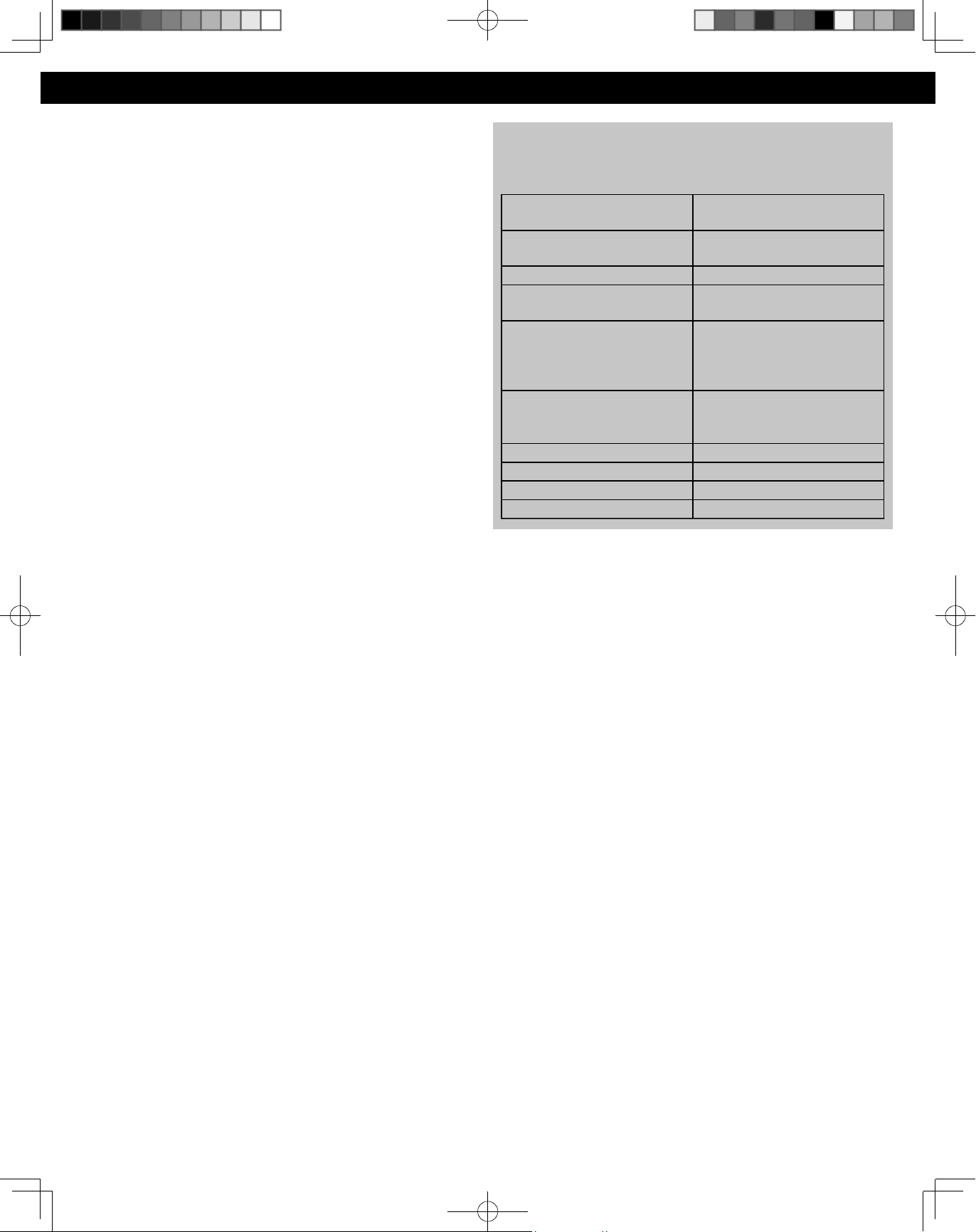
Product
Minimum Internal
Temperature & Rest Time
Beef, Pork, Veal & Lamb
Steaks, chops, roasts
145 °F (63 °C) and allow to rest
for at least 3 minutes
Ground meats 160 °F (71 °C)
Ham, fresh or smoked
(uncooked)
145 °F (63 °C) and allow to rest
for at least 3 min.
Fully Cooked Ham
(to reheat)
Reheat cooked hams
packaged in USDA-inspected
plants to 140 °F (60 °C); all
others to 165 °F (74 °C).
All Poultry (breasts, whole
bird, legs, thighs, and wings,
ground poultry, and stuffing)
165 °F (74 °C)
Eggs 160 °F (71 °C)
Fish & Shellfish 145 °F (63 °C)
Leftovers 165 °F (74 °C)
Casseroles 165 °F (74 °C)
Food Characteristics (continued)
F0003BX00CP.indd 22 2017/5/5 10:57:11
23
Operation (Continued)Care and Cleaning of Your Microwave Oven
BEFORE CLEANING:
Unplug oven at wall outlet.
Inside of the oven:
Wipe with a damp cloth after using,
mild detergent may be used if needed.
Do not use harsh detergents or
abrasives.
Oven Door:
Wipe with a soft, dry cloth when steam accumulates inside
or around the outside of the oven door. During cooking,
especially under high humidity conditions, steam is given
off from the food. (Some steam will condense on cooler
surfaces, such as the oven door. This is normal.)
Inside surface is covered with a heat and vapor barrier film.
Do not remove.
AFTER CLEANING:
Be sure to place the Roller Ring and the Glass Tray in the
proper position and touch Stop/Reset Key to clear the
Display.
IT IS IMPORTANT TO KEEP THE OVEN CLEAN AND DRY. FOOD RESIDUE AND
CONDENSATION MAY CAUSE RUSTING OR ARCING AND DAMAGE TO THE OVEN. AFTER
USE, WIPE DRY ALL SURFACES-INCLUDING VENT OPENINGS, OVEN SEAMS, AND UNDER
GLASS TRAY.
Glass Tray:
Remove and wash in warm soapy
water or in a dishwasher.
Warning/Function/DHHS/Menu Label:
Do not remove, wipe with a damp cloth.
Roller Ring and oven cavity floor:
Clean the bottom surface of the oven with mild detergent
water or window cleaner, and dry. Roller Ring may be washed
in mild soapy water or dishwasher. These areas should be
kept clean to avoid excessive noise.
Control Panel:
If the Control Panel becomes wet, clean
it with a soft, dry cloth. Do not use harsh
detergents or abrasives.
Outside oven surfaces:
Clean with a damp cloth.
To prevent damage to the operating parts
inside the oven, water should not be
allowed to seep into ventilation openings.
F0003BX00CP.indd 23 2017/5/5 10:57:11
24
Care and Cleaning of Your Microwave Oven (continued)
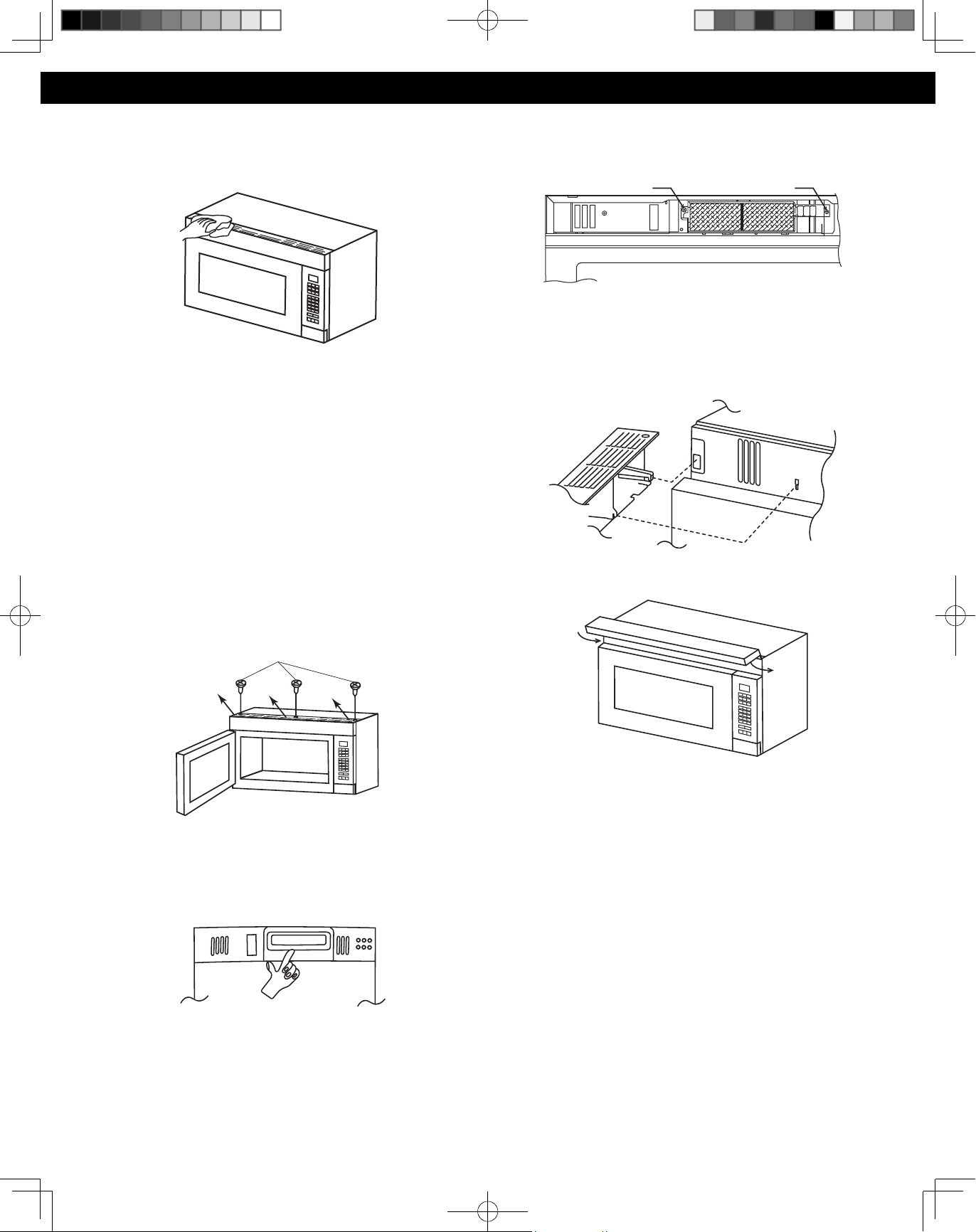
Cleaning Vent Grille (Oven Air Vent)
1. Moisten a soft cloth in hot water containing mild detergent and wipe
gently as shown in Fig. A.
Do not use ammonia or a strong detergent.
(Fig. A)
For Non-vented (ductless) application only.
Charcoal Filter Replacement (NN-CF203)
This product is shipped for use in the top exhaust ventilation mode.
If you wish to install this product without using an exhaust duct, the
exhaust must be recirculated through the front louver and a charcoal
filter. A temporary charcoal filter has been installed for your convenience.
However, we recommend that this filter be changed as soon as possible
with the replacement charcoal filter kit (NN-CF203) that can be purchased
from your local Panasonic dealer. The charcoal filter cannot be cleaned.
Once the replacement filter has been installed, it should be replaced
periodically every 6 to 12 months, or more often if necessary. Refer to the
following instructions for replacement.
1. Remove the Vent Grille
Remove three screws from the top of Grille as shown in Fig. B.
To remove Vent Grille, open the door, and pull the Vent Grille upwards
as shown in Fig. B.
(Fig. B)
Screws
2. Remove the temporary Charcoal Filter
Insert your finger under the bottom of the filter, and pull the Charcoal
Filter frontward as shown in Fig. C.
(Fig. C)
3. Install replacement Charcoal Filter (NN-CF203)
Install the Charcoal Filter aligning the two holes, then secure with two
screws as shown in Fig. D.
(Fig. D)
Screw Screw
Installing Vent Grille
1. Install the bottom of Grille so that the locking tabs hook into the slots of
the steel plate as shown in Fig. E and Fig. F.
(Fig. E)
(Fig. F)
2. Replace three screws on the top of Grille as shown in Fig. B.
F0003BX00CP.indd 24 2017/5/5 10:57:11
25
Care and Cleaning of Your Microwave Oven (continued)
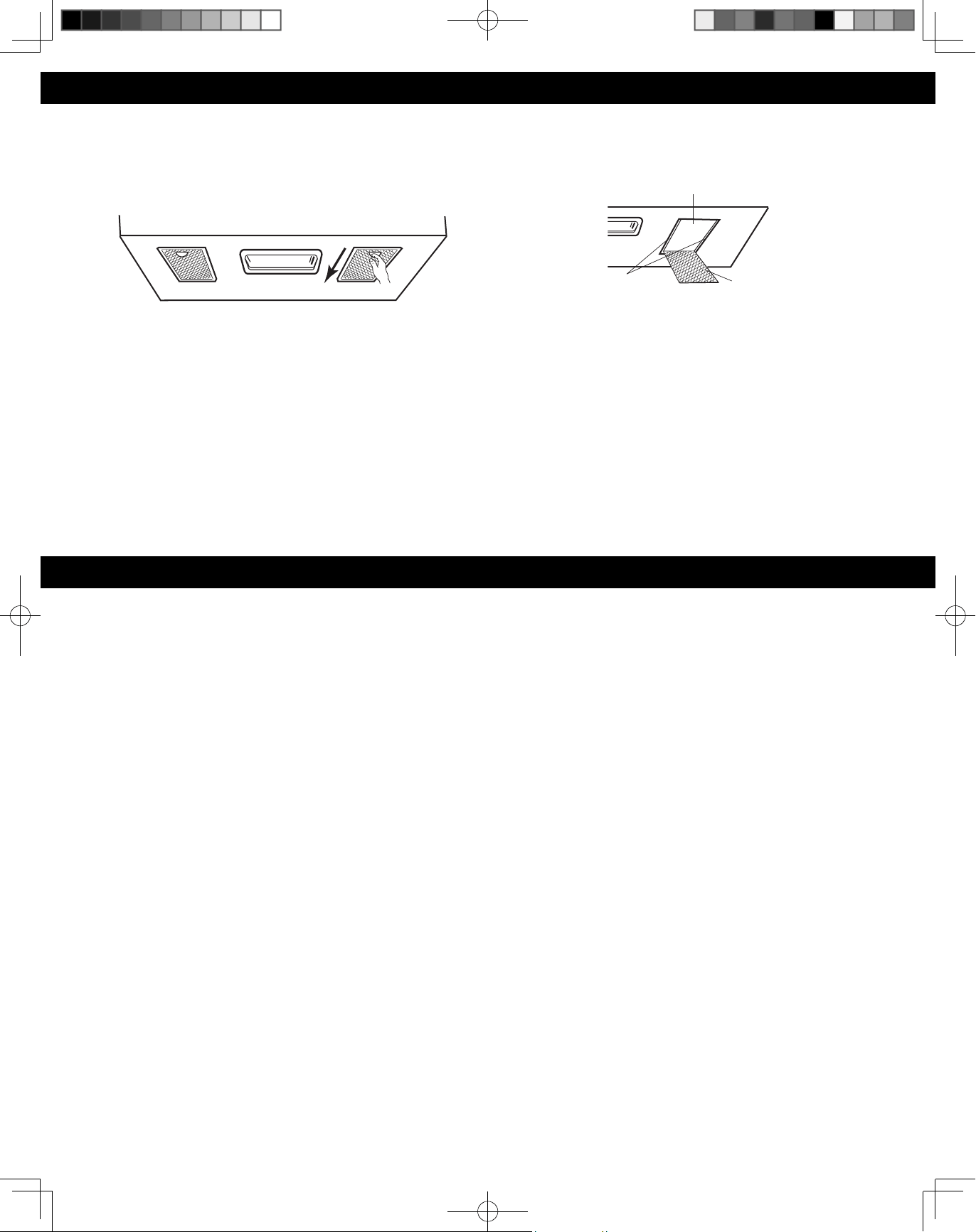
Cleaning Grease Filters
The Grease Filters should be removed and cleaned often, at least once a
month.
1. Grasp the “metal ring” on the Grease Filter. Slide the Grease Filter to the
rear of oven.
Grasp the ring
2. Pull the Grease Filter out.
3. Use care when cleaning the Grease Filters. Corrosive cleaning agents,
such as lye-based oven cleaners, may damage the Grease Filters. Clean
the Grease Filters with a warm detergent solution. Do not use ammonia
or other alkali because it will darken metal. Light brushing can be
used to remove embedded dirt. Shake and remove moisture before
replacing.
Installing Grease Filters
1. Slide in the edge of the Grease Filters along the opening’s guide edges.
2. Push up front edge and pull forward until it fits.
Guide Grease Filter
Opening
Caution: After removing the Grease Filter, be careful with the sharp edges
at the openings.
Never operate the Vent Fan without the Grease Filters in place.
Shop Accessories
Purchase Parts, Accessories and Instruction Books online for all Panasonic Products by visiting our Web Site at:
shop.panasonic.ca
Parts Available to Order
Instructions/Owner’s Manual (this book) ............................................................. F0003BX00CP
Installation Instructions .............................................................................................. F0313BX00CP
Glass Tray......................................................................................................................... A06015H00AP
Roller Ring Assembly ................................................................................................. F290D6W52XP
Grease Filter..................................................................................................................... F400BBL60CP
F0003BX00CP.indd 25 2017/5/5 10:57:11
26
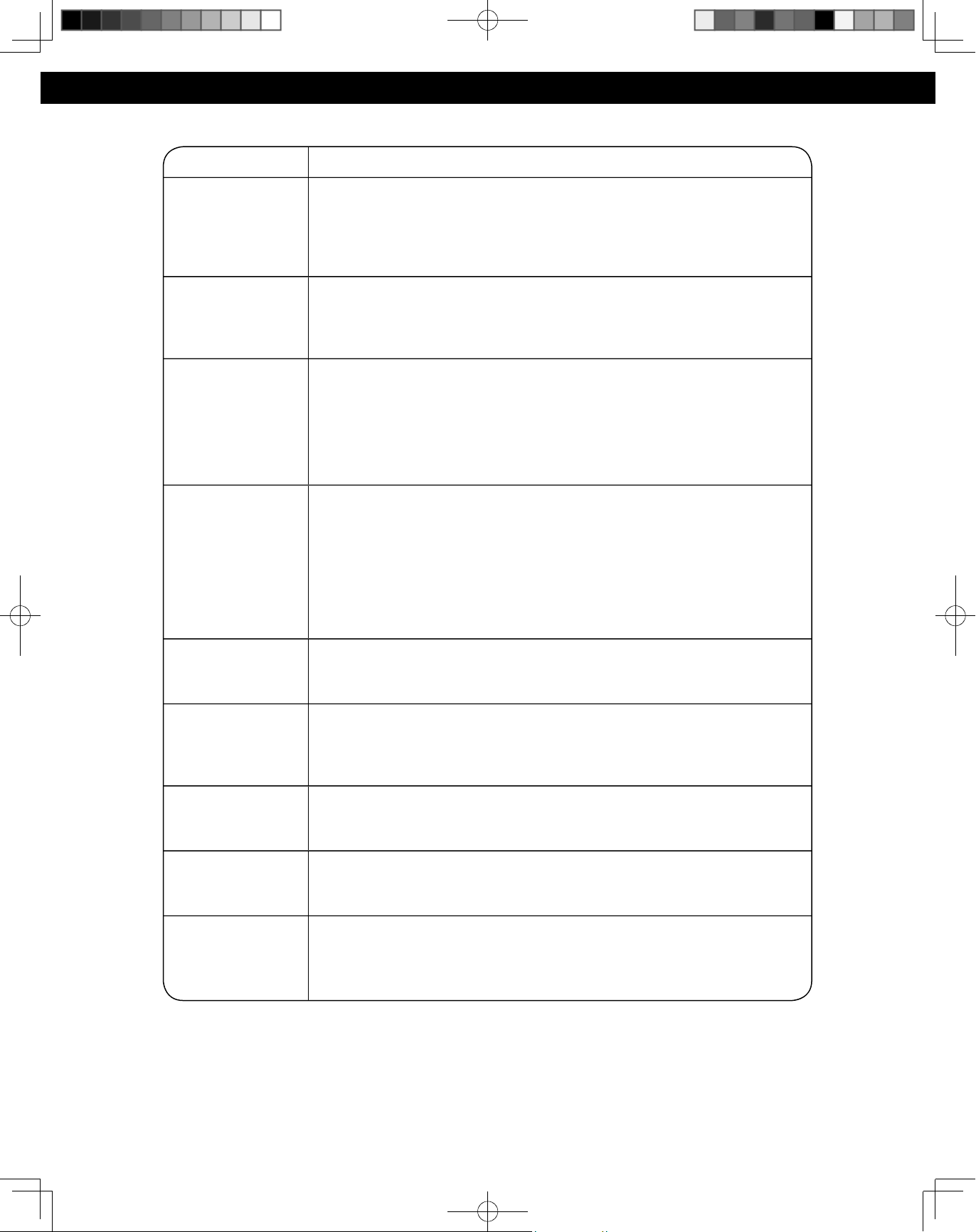
Before Requesting Service
See below before calling for service, as most problems can easily be remedied by following these simple solutions:
Problem Solution
The oven causes TV
interference.
Some radio, TV, Wi-Fi, cordless telephone, baby monitor, blue tooth or
other wireless equipment interference might occur when you cook with the
microwave oven. This interference is similar to the interference caused by small
appliances such as mixers, vacuums, blow dryers, etc. It does not indicate a
problem with your oven.
Steam accumulates
on oven door and
warm air comes from
the oven vents.
During cooking, steam and warm air are given off from the food. Most of the
steam and warm air are removed from the oven by the air which circulates in the
oven cavity. However, some steam will condense on cooler surfaces such as the
oven door. This is normal. After use, the oven should be wiped dry (see page 23).
Oven will not turn on.
The oven is not plugged in securely or needs to be reset; remove plug from
outlet, wait ten seconds and re-insert.
Main circuit breaker or main fuse is tripped; reset main circuit breaker or replace
main fuse.
There is a problem with the outlet; plug another appliance into the outlet to
check if it is working.
Oven will not start
cooking.
The door is not completely closed; close the oven door securely.
Start was not pressed after programming; press Start.
Another program is already entered into the oven; press Stop/Reset to cancel
the previous program and enter new program.
The program is not correct; program again according to the Operating
Instructions.
Stop/Reset has been pressed accidentally; program oven again.
The Glass Tray
wobbles.
The Glass Tray is not positioned properly on the Roller Ring or there is food
under the Roller Ring; take out Glass Tray and Roller Ring. Wipe with a damp
cloth and reset Roller Ring and Glass Tray properly.
When the oven is
operating, there is
noise coming from
the Glass Tray.
The Roller Ring and oven bottom are dirty; clean these parts according to Care
and Cleaning of Your Microwave Oven (see page 23).
The word “LOCK”
appears in the
display.
The CHILD SAFETY LOCK was activated by pressing Start three times; Deactivate
CHILD SAFETY LOCK by pressing Stop/Reset three times.
The word “DEMO
MODE” appears on
the Display Window.
Demo mode was selected “On”. Deactivate mode by pressing Power Level Pad
once Start Pad 4 times and Stop/Reset Pad 4 times.
The oven stops
cooking and
“SERVICE” appears in
the display.
The oven’s power supply has failed; please contact an authorized Service Center
(see next page).
F0003BX00CP.indd 26 2017/5/5 10:57:11
27
WARRANTY
Panasonic Canada Inc.
5770 Ambler Drive, Mississauga, Ontario L4W 2T3
Panasonic PRODUCT – LIMITED WARRANTY
Panasonic Canada Inc. warrants this product to be free from defects in material and workmanship under normal use and for a period as stated
below from the date of original purchase agrees to, at its option either (a) repair your product with new or refurbished parts, (b)
replace it with a new or a refurbished equivalent value product, or (c) refund your purchase price. The decision to repair, replace or
refund will be made by Panasonic Canada Inc.
Category Service type Parts Labour Magnetron
Counter top microwave oven
(except Prestige models)
Carry-in 1 Year 1 Year
Additional 4
Years (Part only)
Counter top microwave oven – Prestige model
(Genius Prestige, Genius Prestige Plus and Genius
Prestige Grill)
In-home 2 Years 2 Years
Additional 3
Years (Part only)
Microwave Convection oven In-home 2 Years 2 Years
Additional 3
Years (Part only)
Over The Range (OTR) microwave oven In-home 2 Years 2 Years
Additional 3
Years (Part only)
In-home Service will be carried out only to locations accessible by roads and within 50 km of an authorized Panasonic service facility.
This warranty is given only to the original purchaser, or the person for whom it was purchased as a gift, of a Panasonic brand product men-
tioned above sold by an authorized Panasonic dealer in Canada and purchased and used in Canada, which product was not sold “as is”, and
which product was delivered to you in new condition in the original packaging.
IN ORDER TO BE ELIGIBLE TO RECEIVE WARRANTY SERVICE HEREUNDER, A PURCHASE RECEIPT OR OTHER PROOF OF DATE
OF ORIGINAL PURCHASE, SHOWING AMOUNT PAID AND PLACE OF PURCHASE IS REQUIRED
LIMITATIONS AND EXCLUSIONS
This warranty ONLY COVERS failures due to defects in materials or workmanship, and DOES NOT COVER normal wear and tear or cosmetic
damage. The warranty ALSO DOES NOT COVER damages which occurred in shipment, or failures which are caused by
products not supplied by
Panasonic Canada Inc.
, or failures which result from accidents, misuse, abuse, neglect, mishandling,
misapplication, alteration, faulty installation, set-up adjustments, misadjustment of consumer controls, improper maintenance, power line surge,
lightning damage, modifi cation, introduction of sand, humidity or liquids, commercial use such as hotel, offi ce, restaurant, or other business or
rental use of the product, or service by anyone other than a Authorized Servicer, or damage that is attributable to acts of God.
Over-The-Range cooktop light bulbs are excluded from coverage under this warranty.
In the case where the microwave oven is built-in, the warranty will be voided if using a non-Panasonic trim kit.
THIS EXPRESS, LIMITED WARRANTY IS IN LIEU OF ALL OTHER WARRANTIES, EXPRESS OR IMPLIED, INCLUDING ANY
IMPLIED WARRANTIES OF MERCHANTABILITY AND FITNESS FOR A PARTICULAR PURPOSE. IN NO EVENT WILL Panasonic Canada
Inc. BE LIABLE FOR ANY SPECIAL, INDIRECT OR CONSEQUENTIAL DAMAGES RESULTING FROM THE USE OF THIS PRODUCT OR
ARISING OUT OF ANY BREACH OF ANY EXPRESS OR IMPLIED WARRANTY. (As examples, this warranty excludes damages for lost time,
travel to and from the Authorized Servicer, loss of or damage to media or images, data or other memory or
recorded content. This list of items is not exhaustive, but for illustration only.)
In certain instances, some jurisdictions do not allow the exclusion or limitation of incidental or consequential damages, or the exclusion of im-
plied warranties, so the above limitations and exclusions may not be applicable. This warranty gives you specifi c legal rights and you may have
other rights which vary depending on your province or territory.
WARRANTY SERVICE
PRODUCT OPERATION ASSISTANCE
For product information and operation assistance, please visit our Support page: www.panasonic.ca/english/support
PRODUCT REPAIRS
Please locate your nearest Authorized Servicentre: panasonic.ca/english/support/servicentrelocator
IF YOU SHIP THE PRODUCT TO A SERVICENTRE
Carefully pack and send prepaid, adequately insured and preferably in the original carton.
Include details of the defect claimed, and proof of date of original purchase.
F0003BX00CP.indd 27 2017/5/5 10:57:11
28
Specifications
*IEC Test procedure Specifications subject to change without notice.
The serial number of this product may be found on the back side of the oven or on the left side of the control panel.
You should note the model number and the serial number of this oven in the space provided and retain this book as
a permanent record of your purchase for future reference.
Model No. ______________________________
Serial No. ______________________________
Date of Purchase ________________________
User’s Record
Power Source 120 V, 60 Hz
Power Consumption 1,140 W
Cooking Power* 1,100 W
Outside Dimensions (W x H x D)
29
7
⁄8” x 16
7
⁄16” x 15
3
⁄8”
(759 mm x 418 mm x 391 mm)
Oven Cavity Dimensions (W x H x D)
23
1
⁄4” x 9
1
⁄2 ” x 14
7
⁄16”
(591 mm x 242 mm x 367 mm)
Charcoal Filter (optional) NN-CF203
Operating Frequency 2,450 MHz
Ventilation Power Turbo (300 CFM) High (180 CFM) Low (140 CFM)
Noise Level 55 dB 49 dB 40 dB
Net Weight Approx. 49.7 lbs (22.5 kg)
F0003BX00CP.indd 28 2017/5/5 10:57:11