Advanced User Guide
E
CT2-D267-A
© CANON INC. 2022

Contents
Introduction. . . . . . . . . . . . . . . . . . . . . . . . . . . . . . . . . . . . . . . . . . . . . . . 10
Package Contents. . . . . . . . . . . . . . . . . . . . . . . . . . . . . . . . . . . . . . . . . . . . . . 11
Supplemental Information. . . . . . . . . . . . . . . . . . . . . . . . . . . . . . . . . . . . . . . . 13
Compatible Accessories. . . . . . . . . . . . . . . . . . . . . . . . . . . . . . . . . . . . . . . . . . 14
Instruction Manuals. . . . . . . . . . . . . . . . . . . . . . . . . . . . . . . . . . . . . . . . . . . . . 15
Quick Start Guide. . . . . . . . . . . . . . . . . . . . . . . . . . . . . . . . . . . . . . . . . . . . . . . 16
About This Guide. . . . . . . . . . . . . . . . . . . . . . . . . . . . . . . . . . . . . . . . . . . . . . . 19
Compatible Cards. . . . . . . . . . . . . . . . . . . . . . . . . . . . . . . . . . . . . . . . . . . . . . 21
Safety Instructions. . . . . . . . . . . . . . . . . . . . . . . . . . . . . . . . . . . . . . . . . . . . . . 22
Handling Precautions. . . . . . . . . . . . . . . . . . . . . . . . . . . . . . . . . . . . . . . . . . . . 25
Part Names. . . . . . . . . . . . . . . . . . . . . . . . . . . . . . . . . . . . . . . . . . . . . . . . . . . 29
Software/Apps. . . . . . . . . . . . . . . . . . . . . . . . . . . . . . . . . . . . . . . . . . . . . . . . . 37
Preparation and Basic Operations. . . . . . . . . . . . . . . . . . . . . . . . . . . . . 41
Charging the Battery. . . . . . . . . . . . . . . . . . . . . . . . . . . . . . . . . . . . . . . . . . . . 42
Inserting/Removing the Battery and Card. . . . . . . . . . . . . . . . . . . . . . . . . . . . 45
Using the Screen. . . . . . . . . . . . . . . . . . . . . . . . . . . . . . . . . . . . . . . . . . . . . . . 51
Turning on the Power. . . . . . . . . . . . . . . . . . . . . . . . . . . . . . . . . . . . . . . . . . . . 53
Attaching and Detaching RF/RF-S Lenses. . . . . . . . . . . . . . . . . . . . . . . . . . . 56
Attaching and Detaching EF/EF-S Lenses. . . . . . . . . . . . . . . . . . . . . . . . . . . . 61
Multi-Function Shoe. . . . . . . . . . . . . . . . . . . . . . . . . . . . . . . . . . . . . . . . . . . . . 65
Using the Viewfinder. . . . . . . . . . . . . . . . . . . . . . . . . . . . . . . . . . . . . . . . . . . . 67
Basic Operations. . . . . . . . . . . . . . . . . . . . . . . . . . . . . . . . . . . . . . . . . . . . . . . 68
Menu Operations and Settings. . . . . . . . . . . . . . . . . . . . . . . . . . . . . . . . . . . . . 75
Quick Control. . . . . . . . . . . . . . . . . . . . . . . . . . . . . . . . . . . . . . . . . . . . . . . . . . 81
Touch-Screen Operation. . . . . . . . . . . . . . . . . . . . . . . . . . . . . . . . . . . . . . . . . 82
Basic Zone. . . . . . . . . . . . . . . . . . . . . . . . . . . . . . . . . . . . . . . . . . . . . . . 84
A+: Fully Automatic Shooting (Scene Intelligent Auto). . . . . . . . . . . . . . . . 86
A+: Assist Features. . . . . . . . . . . . . . . . . . . . . . . . . . . . . . . . . . . . . . . . . . . 94
Hybrid Auto. . . . . . . . . . . . . . . . . . . . . . . . . . . . . . . . . . . . . . . . . . . . . . . . 102
Special Scene Mode. . . . . . . . . . . . . . . . . . . . . . . . . . . . . . . . . . . . . . . . . 105

Self Portrait Mode. . . . . . . . . . . . . . . . . . . . . . . . . . . . . . . . . . . . . . . . . . . . . 108
Portrait Mode. . . . . . . . . . . . . . . . . . . . . . . . . . . . . . . . . . . . . . . . . . . . . . . . . 109
Smooth Skin Mode. . . . . . . . . . . . . . . . . . . . . . . . . . . . . . . . . . . . . . . . . . . . . 110
Group Photo Mode. . . . . . . . . . . . . . . . . . . . . . . . . . . . . . . . . . . . . . . . . . . . . 111
Landscape Mode. . . . . . . . . . . . . . . . . . . . . . . . . . . . . . . . . . . . . . . . . . . . . . 112
Panoramic Shot Mode. . . . . . . . . . . . . . . . . . . . . . . . . . . . . . . . . . . . . . . . . . 113
Sports Mode. . . . . . . . . . . . . . . . . . . . . . . . . . . . . . . . . . . . . . . . . . . . . . . . . . 115
Kids Mode. . . . . . . . . . . . . . . . . . . . . . . . . . . . . . . . . . . . . . . . . . . . . . . . . . . 116
Panning Mode. . . . . . . . . . . . . . . . . . . . . . . . . . . . . . . . . . . . . . . . . . . . . . . . 117
Close-up Mode. . . . . . . . . . . . . . . . . . . . . . . . . . . . . . . . . . . . . . . . . . . . . . . . 120
Food Mode. . . . . . . . . . . . . . . . . . . . . . . . . . . . . . . . . . . . . . . . . . . . . . . . . . . 121
Handheld Night Scene Mode. . . . . . . . . . . . . . . . . . . . . . . . . . . . . . . . . . . . . 122
HDR Backlight Control Mode. . . . . . . . . . . . . . . . . . . . . . . . . . . . . . . . . . . . . 123
Silent Shutter Mode. . . . . . . . . . . . . . . . . . . . . . . . . . . . . . . . . . . . . . . . . . . . 124
Creative Filters Mode. . . . . . . . . . . . . . . . . . . . . . . . . . . . . . . . . . . . . . . . 125
Creative Zone. . . . . . . . . . . . . . . . . . . . . . . . . . . . . . . . . . . . . . . . . . . . 132
P: Program AE. . . . . . . . . . . . . . . . . . . . . . . . . . . . . . . . . . . . . . . . . . . . . . . . 133
Tv: Shutter-Priority AE. . . . . . . . . . . . . . . . . . . . . . . . . . . . . . . . . . . . . . . . . . 135
Av: Aperture-Priority AE. . . . . . . . . . . . . . . . . . . . . . . . . . . . . . . . . . . . . . . . . 137
M: Manual Exposure. . . . . . . . . . . . . . . . . . . . . . . . . . . . . . . . . . . . . . . . . . . 141
Long (Bulb) Exposures. . . . . . . . . . . . . . . . . . . . . . . . . . . . . . . . . . . . . . . . . . 144
Flash Photography. . . . . . . . . . . . . . . . . . . . . . . . . . . . . . . . . . . . . . . . 146
Shooting with the Built-in Flash. . . . . . . . . . . . . . . . . . . . . . . . . . . . . . . . . 147
Flash Function Settings. . . . . . . . . . . . . . . . . . . . . . . . . . . . . . . . . . . . . . 151
Shooting with Speedlites. . . . . . . . . . . . . . . . . . . . . . . . . . . . . . . . . . . . . . 169
Shooting and Recording. . . . . . . . . . . . . . . . . . . . . . . . . . . . . . . . . . . . 173
Still Photo Shooting. . . . . . . . . . . . . . . . . . . . . . . . . . . . . . . . . . . . . . . . . . 174
Tab Menus: Still Photo Shooting. . . . . . . . . . . . . . . . . . . . . . . . . . . . . . . . . . 176
Image Quality. . . . . . . . . . . . . . . . . . . . . . . . . . . . . . . . . . . . . . . . . . . . . . . . . 184
Still Image Aspect Ratio. . . . . . . . . . . . . . . . . . . . . . . . . . . . . . . . . . . . . . . . . 189
Digital Tele-Converter. . . . . . . . . . . . . . . . . . . . . . . . . . . . . . . . . . . . . . . . . . 191
Auto Exposure Bracketing (AEB). . . . . . . . . . . . . . . . . . . . . . . . . . . . . . . . . . 192

Manual Exposure Compensation. . . . . . . . . . . . . . . . . . . . . . . . . . . . . . . . . . 194
Exposure Lock (AE Lock). . . . . . . . . . . . . . . . . . . . . . . . . . . . . . . . . . . . . . . . 196
ISO Speed Settings for Still Photos. . . . . . . . . . . . . . . . . . . . . . . . . . . . . . . . 198
HDR Shooting. . . . . . . . . . . . . . . . . . . . . . . . . . . . . . . . . . . . . . . . . . . . . . . . 201
HDR Mode. . . . . . . . . . . . . . . . . . . . . . . . . . . . . . . . . . . . . . . . . . . . . . . . . . . 203
Auto Lighting Optimizer. . . . . . . . . . . . . . . . . . . . . . . . . . . . . . . . . . . . . . . . . 207
Highlight Tone Priority. . . . . . . . . . . . . . . . . . . . . . . . . . . . . . . . . . . . . . . . . . 209
Anti-Flicker Shooting. . . . . . . . . . . . . . . . . . . . . . . . . . . . . . . . . . . . . . . . . . . 211
Metering Mode. . . . . . . . . . . . . . . . . . . . . . . . . . . . . . . . . . . . . . . . . . . . . . . . 213
White Balance. . . . . . . . . . . . . . . . . . . . . . . . . . . . . . . . . . . . . . . . . . . . . . . . 215
White Balance Correction. . . . . . . . . . . . . . . . . . . . . . . . . . . . . . . . . . . . . . . 226
Color Space. . . . . . . . . . . . . . . . . . . . . . . . . . . . . . . . . . . . . . . . . . . . . . . . . . 230
Picture Style Selection. . . . . . . . . . . . . . . . . . . . . . . . . . . . . . . . . . . . . . . . . . 231
Picture Style Customization. . . . . . . . . . . . . . . . . . . . . . . . . . . . . . . . . . . . . . 235
Picture Style Registration. . . . . . . . . . . . . . . . . . . . . . . . . . . . . . . . . . . . . . . . 239
Clarity. . . . . . . . . . . . . . . . . . . . . . . . . . . . . . . . . . . . . . . . . . . . . . . . . . . . . . . 242
Shooting Creative Filters. . . . . . . . . . . . . . . . . . . . . . . . . . . . . . . . . . . . . . . . 243
Lens Aberration Correction. . . . . . . . . . . . . . . . . . . . . . . . . . . . . . . . . . . . . . 248
Long Exposure Noise Reduction. . . . . . . . . . . . . . . . . . . . . . . . . . . . . . . . . . 256
High ISO Speed Noise Reduction. . . . . . . . . . . . . . . . . . . . . . . . . . . . . . . . . 258
Dust Delete Data Acquisition. . . . . . . . . . . . . . . . . . . . . . . . . . . . . . . . . . . . . 260
Focus Bracketing. . . . . . . . . . . . . . . . . . . . . . . . . . . . . . . . . . . . . . . . . . . . . . 263
Silent Shutter Function. . . . . . . . . . . . . . . . . . . . . . . . . . . . . . . . . . . . . . . . . . 268
Shutter Mode. . . . . . . . . . . . . . . . . . . . . . . . . . . . . . . . . . . . . . . . . . . . . . . . . 269
Releasing Shutter without Card. . . . . . . . . . . . . . . . . . . . . . . . . . . . . . . . . . . 271
Image Stabilizer (IS Mode). . . . . . . . . . . . . . . . . . . . . . . . . . . . . . . . . . . . . . . 272
Customizing Quick Controls. . . . . . . . . . . . . . . . . . . . . . . . . . . . . . . . . . . . . . 274
Shooting with the Touch Shutter. . . . . . . . . . . . . . . . . . . . . . . . . . . . . . . . . . 278
Image Review. . . . . . . . . . . . . . . . . . . . . . . . . . . . . . . . . . . . . . . . . . . . . . . . 280
High-Speed Display. . . . . . . . . . . . . . . . . . . . . . . . . . . . . . . . . . . . . . . . . . . . 283
Metering Timer. . . . . . . . . . . . . . . . . . . . . . . . . . . . . . . . . . . . . . . . . . . . . . . . 285
Display Simulation. . . . . . . . . . . . . . . . . . . . . . . . . . . . . . . . . . . . . . . . . . . . . 286
Optical Viewfinder Simulation. . . . . . . . . . . . . . . . . . . . . . . . . . . . . . . . . . . . 288

Shooting Information Display. . . . . . . . . . . . . . . . . . . . . . . . . . . . . . . . . . . . . 290
Reverse Display. . . . . . . . . . . . . . . . . . . . . . . . . . . . . . . . . . . . . . . . . . . . . . . 302
Viewfinder Display Format. . . . . . . . . . . . . . . . . . . . . . . . . . . . . . . . . . . . . . . 303
Display Performance. . . . . . . . . . . . . . . . . . . . . . . . . . . . . . . . . . . . . . . . . . . 304
General Still Photo Shooting. . . . . . . . . . . . . . . . . . . . . . . . . . . . . . . . . . . . . 306
Movie Recording. . . . . . . . . . . . . . . . . . . . . . . . . . . . . . . . . . . . . . . . . . . . 309
Tab Menus: Movie Recording. . . . . . . . . . . . . . . . . . . . . . . . . . . . . . . . . . . . 310
Movie Recording. . . . . . . . . . . . . . . . . . . . . . . . . . . . . . . . . . . . . . . . . . . . . . 315
Movie Recording Size. . . . . . . . . . . . . . . . . . . . . . . . . . . . . . . . . . . . . . . . . . 332
High Frame Rate. . . . . . . . . . . . . . . . . . . . . . . . . . . . . . . . . . . . . . . . . . . . . . 340
Digital Zoom. . . . . . . . . . . . . . . . . . . . . . . . . . . . . . . . . . . . . . . . . . . . . . . . . . 341
Sound Recording. . . . . . . . . . . . . . . . . . . . . . . . . . . . . . . . . . . . . . . . . . . . . . 343
Shooting Creative Filters. . . . . . . . . . . . . . . . . . . . . . . . . . . . . . . . . . . . . . . . 346
Time-Lapse Movies. . . . . . . . . . . . . . . . . . . . . . . . . . . . . . . . . . . . . . . . . . . . 350
Movie Self-Timer. . . . . . . . . . . . . . . . . . . . . . . . . . . . . . . . . . . . . . . . . . . . . . 362
Image Stabilizer (IS Mode). . . . . . . . . . . . . . . . . . . . . . . . . . . . . . . . . . . . . . . 363
Auto Level. . . . . . . . . . . . . . . . . . . . . . . . . . . . . . . . . . . . . . . . . . . . . . . . . . . 365
Shutter Button Function for Movies. . . . . . . . . . . . . . . . . . . . . . . . . . . . . . . . 366
Zebra Settings. . . . . . . . . . . . . . . . . . . . . . . . . . . . . . . . . . . . . . . . . . . . . . . . 368
Shooting Information Display. . . . . . . . . . . . . . . . . . . . . . . . . . . . . . . . . . . . . 371
Time Code. . . . . . . . . . . . . . . . . . . . . . . . . . . . . . . . . . . . . . . . . . . . . . . . . . . 375
Other Menu Functions. . . . . . . . . . . . . . . . . . . . . . . . . . . . . . . . . . . . . . . . . . 382
General Movie Recording Precautions. . . . . . . . . . . . . . . . . . . . . . . . . . . . . 390
AF/Drive. . . . . . . . . . . . . . . . . . . . . . . . . . . . . . . . . . . . . . . . . . . . . . . . 394
Tab Menus: AF (Still Photos). . . . . . . . . . . . . . . . . . . . . . . . . . . . . . . . . . . . . 395
Tab Menus: AF (Movie Recording). . . . . . . . . . . . . . . . . . . . . . . . . . . . . . . . 399
AF Operation. . . . . . . . . . . . . . . . . . . . . . . . . . . . . . . . . . . . . . . . . . . . . . . . . 401
Movie Servo AF. . . . . . . . . . . . . . . . . . . . . . . . . . . . . . . . . . . . . . . . . . . . . . . 407
Selecting the AF Area. . . . . . . . . . . . . . . . . . . . . . . . . . . . . . . . . . . . . . . . . . 410
Preview AF. . . . . . . . . . . . . . . . . . . . . . . . . . . . . . . . . . . . . . . . . . . . . . . . . . . 434
AF-Assist Beam Firing. . . . . . . . . . . . . . . . . . . . . . . . . . . . . . . . . . . . . . . . . . 435
Touch & Drag AF Settings. . . . . . . . . . . . . . . . . . . . . . . . . . . . . . . . . . . . . . . 437
Manual Focus. . . . . . . . . . . . . . . . . . . . . . . . . . . . . . . . . . . . . . . . . . . . . . . . . 442

Customizing AF Functions. . . . . . . . . . . . . . . . . . . . . . . . . . . . . . . . . . . . . . . 450
Selecting the Drive Mode. . . . . . . . . . . . . . . . . . . . . . . . . . . . . . . . . . . . . . . . 454
Using the Self-Timer. . . . . . . . . . . . . . . . . . . . . . . . . . . . . . . . . . . . . . . . . . . 457
Remote Control Shooting. . . . . . . . . . . . . . . . . . . . . . . . . . . . . . . . . . . . . . . . 459
Customizing Operation. . . . . . . . . . . . . . . . . . . . . . . . . . . . . . . . . . . . . . . . . . 460
Playback. . . . . . . . . . . . . . . . . . . . . . . . . . . . . . . . . . . . . . . . . . . . . . . . 462
Tab Menus: Playback. . . . . . . . . . . . . . . . . . . . . . . . . . . . . . . . . . . . . . . . . . . 464
Image Playback. . . . . . . . . . . . . . . . . . . . . . . . . . . . . . . . . . . . . . . . . . . . . . . 466
Magnified Image Display. . . . . . . . . . . . . . . . . . . . . . . . . . . . . . . . . . . . . . . . 471
Index Display (Multiple-Image Display). . . . . . . . . . . . . . . . . . . . . . . . . . . . . 473
Movie Playback. . . . . . . . . . . . . . . . . . . . . . . . . . . . . . . . . . . . . . . . . . . . . . . 476
Editing a Movie's First and Last Scenes. . . . . . . . . . . . . . . . . . . . . . . . . . . . 481
Frame Extraction from 4K Movies. . . . . . . . . . . . . . . . . . . . . . . . . . . . . . . . . 484
Digest Movie Editing. . . . . . . . . . . . . . . . . . . . . . . . . . . . . . . . . . . . . . . . . . . 487
Playback on a TV Set. . . . . . . . . . . . . . . . . . . . . . . . . . . . . . . . . . . . . . . . . . . 490
Protecting Images. . . . . . . . . . . . . . . . . . . . . . . . . . . . . . . . . . . . . . . . . . . . . 492
Erasing Images. . . . . . . . . . . . . . . . . . . . . . . . . . . . . . . . . . . . . . . . . . . . . . . 496
Rotating Still Photos. . . . . . . . . . . . . . . . . . . . . . . . . . . . . . . . . . . . . . . . . . . . 503
Changing Movie Orientation Information. . . . . . . . . . . . . . . . . . . . . . . . . . . . 505
Rating Images. . . . . . . . . . . . . . . . . . . . . . . . . . . . . . . . . . . . . . . . . . . . . . . . 507
Print Ordering (DPOF). . . . . . . . . . . . . . . . . . . . . . . . . . . . . . . . . . . . . . . . . . 513
Creative Assist. . . . . . . . . . . . . . . . . . . . . . . . . . . . . . . . . . . . . . . . . . . . . . . . 518
Playback Creative Filters. . . . . . . . . . . . . . . . . . . . . . . . . . . . . . . . . . . . . . . . 521
Red-Eye Correction. . . . . . . . . . . . . . . . . . . . . . . . . . . . . . . . . . . . . . . . . . . . 525
Resizing JPEG/HEIF Images. . . . . . . . . . . . . . . . . . . . . . . . . . . . . . . . . . . . . 527
Cropping JPEG/HEIF Images. . . . . . . . . . . . . . . . . . . . . . . . . . . . . . . . . . . . 529
Converting HEIF to JPEG. . . . . . . . . . . . . . . . . . . . . . . . . . . . . . . . . . . . . . . 532
Slide Show. . . . . . . . . . . . . . . . . . . . . . . . . . . . . . . . . . . . . . . . . . . . . . . . . . . 537
Setting Image Search Conditions. . . . . . . . . . . . . . . . . . . . . . . . . . . . . . . . . . 540
Resuming from Previous Playback. . . . . . . . . . . . . . . . . . . . . . . . . . . . . . . . 544
Browsing Images with the Dial. . . . . . . . . . . . . . . . . . . . . . . . . . . . . . . . . . . . 545
Customizing Playback Information Display. . . . . . . . . . . . . . . . . . . . . . . . . . 547
AF Point Display. . . . . . . . . . . . . . . . . . . . . . . . . . . . . . . . . . . . . . . . . . . . . . . 551

Playback Grid. . . . . . . . . . . . . . . . . . . . . . . . . . . . . . . . . . . . . . . . . . . . . . . . . 552
Movie Play Count. . . . . . . . . . . . . . . . . . . . . . . . . . . . . . . . . . . . . . . . . . . . . . 553
HDMI HDR Output. . . . . . . . . . . . . . . . . . . . . . . . . . . . . . . . . . . . . . . . . . . . . 555
Communication Functions. . . . . . . . . . . . . . . . . . . . . . . . . . . . . . . . . . 556
Tab Menus: Communication Functions. . . . . . . . . . . . . . . . . . . . . . . . . . . . . 557
Connecting to a Smartphone or Tablet. . . . . . . . . . . . . . . . . . . . . . . . . . . . . 559
Connecting to a Wireless Remote Control. . . . . . . . . . . . . . . . . . . . . . . . . . . 584
Connecting to EOS Utility. . . . . . . . . . . . . . . . . . . . . . . . . . . . . . . . . . . . . . . . 587
Uploading Images to image.canon. . . . . . . . . . . . . . . . . . . . . . . . . . . . . . . . . 594
Connecting to a Printer via Wi-Fi. . . . . . . . . . . . . . . . . . . . . . . . . . . . . . . . . . 601
Advanced Connections. . . . . . . . . . . . . . . . . . . . . . . . . . . . . . . . . . . . . . . . . 615
Basic Communication Settings. . . . . . . . . . . . . . . . . . . . . . . . . . . . . . . . . . . 618
Reconnecting via Wi-Fi/Bluetooth. . . . . . . . . . . . . . . . . . . . . . . . . . . . . . . . . 641
Editing/Deleting Connection Settings. . . . . . . . . . . . . . . . . . . . . . . . . . . . . . . 642
Airplane Mode. . . . . . . . . . . . . . . . . . . . . . . . . . . . . . . . . . . . . . . . . . . . . . . . 645
Wi-Fi Settings. . . . . . . . . . . . . . . . . . . . . . . . . . . . . . . . . . . . . . . . . . . . . . . . . 646
Bluetooth Settings. . . . . . . . . . . . . . . . . . . . . . . . . . . . . . . . . . . . . . . . . . . . . 648
Camera Name. . . . . . . . . . . . . . . . . . . . . . . . . . . . . . . . . . . . . . . . . . . . . . . . 649
GPS Settings. . . . . . . . . . . . . . . . . . . . . . . . . . . . . . . . . . . . . . . . . . . . . . . . . 650
Error Details. . . . . . . . . . . . . . . . . . . . . . . . . . . . . . . . . . . . . . . . . . . . . . . . . . 654
Resetting Communication Settings. . . . . . . . . . . . . . . . . . . . . . . . . . . . . . . . 655
Virtual Keyboard Operations. . . . . . . . . . . . . . . . . . . . . . . . . . . . . . . . . . . . . 656
Responding to Error Messages. . . . . . . . . . . . . . . . . . . . . . . . . . . . . . . . . . . 657
Wireless Communication Function Precautions. . . . . . . . . . . . . . . . . . . . . . . 664
Security. . . . . . . . . . . . . . . . . . . . . . . . . . . . . . . . . . . . . . . . . . . . . . . . . . . . . 666
Checking Network Settings. . . . . . . . . . . . . . . . . . . . . . . . . . . . . . . . . . . . . . 667
Wireless Communication Status. . . . . . . . . . . . . . . . . . . . . . . . . . . . . . . . . . 668
Set-up. . . . . . . . . . . . . . . . . . . . . . . . . . . . . . . . . . . . . . . . . . . . . . . . . . 670
Tab Menus: Set-up. . . . . . . . . . . . . . . . . . . . . . . . . . . . . . . . . . . . . . . . . . . . . 671
Folder Settings. . . . . . . . . . . . . . . . . . . . . . . . . . . . . . . . . . . . . . . . . . . . . . . . 674
File Numbering. . . . . . . . . . . . . . . . . . . . . . . . . . . . . . . . . . . . . . . . . . . . . . . . 677
Card Formatting. . . . . . . . . . . . . . . . . . . . . . . . . . . . . . . . . . . . . . . . . . . . . . . 682

Auto Rotate. . . . . . . . . . . . . . . . . . . . . . . . . . . . . . . . . . . . . . . . . . . . . . . . . . 685
Adding Orientation Information to Movies. . . . . . . . . . . . . . . . . . . . . . . . . . . 687
Date/Time/Zone. . . . . . . . . . . . . . . . . . . . . . . . . . . . . . . . . . . . . . . . . . . . . . . 688
Language. . . . . . . . . . . . . . . . . . . . . . . . . . . . . . . . . . . . . . . . . . . . . . . . . . . . 691
Video System. . . . . . . . . . . . . . . . . . . . . . . . . . . . . . . . . . . . . . . . . . . . . . . . . 692
Shooting Mode Guide. . . . . . . . . . . . . . . . . . . . . . . . . . . . . . . . . . . . . . . . . . 693
Feature Guide. . . . . . . . . . . . . . . . . . . . . . . . . . . . . . . . . . . . . . . . . . . . . . . . 695
Beeps. . . . . . . . . . . . . . . . . . . . . . . . . . . . . . . . . . . . . . . . . . . . . . . . . . . . . . . 697
Volume. . . . . . . . . . . . . . . . . . . . . . . . . . . . . . . . . . . . . . . . . . . . . . . . . . . . . . 698
Power Saving. . . . . . . . . . . . . . . . . . . . . . . . . . . . . . . . . . . . . . . . . . . . . . . . . 699
Screen and Viewfinder Display. . . . . . . . . . . . . . . . . . . . . . . . . . . . . . . . . . . 701
Screen Brightness. . . . . . . . . . . . . . . . . . . . . . . . . . . . . . . . . . . . . . . . . . . . . 703
Viewfinder Brightness. . . . . . . . . . . . . . . . . . . . . . . . . . . . . . . . . . . . . . . . . . 704
Fine-Tuning Viewfinder Color Tone. . . . . . . . . . . . . . . . . . . . . . . . . . . . . . . . 705
UI Magnification. . . . . . . . . . . . . . . . . . . . . . . . . . . . . . . . . . . . . . . . . . . . . . . 706
HDMI Resolution. . . . . . . . . . . . . . . . . . . . . . . . . . . . . . . . . . . . . . . . . . . . . . 707
Touch Control. . . . . . . . . . . . . . . . . . . . . . . . . . . . . . . . . . . . . . . . . . . . . . . . . 708
App Selection for USB Connections. . . . . . . . . . . . . . . . . . . . . . . . . . . . . . . 709
Resetting the Camera. . . . . . . . . . . . . . . . . . . . . . . . . . . . . . . . . . . . . . . . . . 711
Custom Shooting Mode (C Mode). . . . . . . . . . . . . . . . . . . . . . . . . . . . . . . . . 713
Battery Information. . . . . . . . . . . . . . . . . . . . . . . . . . . . . . . . . . . . . . . . . . . . . 716
Copyright Information. . . . . . . . . . . . . . . . . . . . . . . . . . . . . . . . . . . . . . . . . . . 718
Other Information. . . . . . . . . . . . . . . . . . . . . . . . . . . . . . . . . . . . . . . . . . . . . . 721
Custom Functions/My Menu. . . . . . . . . . . . . . . . . . . . . . . . . . . . . . . . . 722
Tab Menus: Custom Functions. . . . . . . . . . . . . . . . . . . . . . . . . . . . . . . . . . . 723
Custom Function Setting Items. . . . . . . . . . . . . . . . . . . . . . . . . . . . . . . . . . . 725
Tab Menus: My Menu. . . . . . . . . . . . . . . . . . . . . . . . . . . . . . . . . . . . . . . . . . 741
Registering My Menu. . . . . . . . . . . . . . . . . . . . . . . . . . . . . . . . . . . . . . . . . . . 742
Reference. . . . . . . . . . . . . . . . . . . . . . . . . . . . . . . . . . . . . . . . . . . . . . . 749
Importing Images to a Computer. . . . . . . . . . . . . . . . . . . . . . . . . . . . . . . . . . 750
Importing Images to a Smartphone. . . . . . . . . . . . . . . . . . . . . . . . . . . . . . . . 753
Using a USB Power Adapter to Charge/Power the Camera. . . . . . . . . . . . . 756

Troubleshooting Guide. . . . . . . . . . . . . . . . . . . . . . . . . . . . . . . . . . . . . . . . . . 759
Error Codes. . . . . . . . . . . . . . . . . . . . . . . . . . . . . . . . . . . . . . . . . . . . . . . . . . 775
ISO Speed in Movie Recording. . . . . . . . . . . . . . . . . . . . . . . . . . . . . . . . . . . 776
Information Display. . . . . . . . . . . . . . . . . . . . . . . . . . . . . . . . . . . . . . . . . . . . 777
Specifications. . . . . . . . . . . . . . . . . . . . . . . . . . . . . . . . . . . . . . . . . . . . . . . . . 788
Trademarks and Licensing. . . . . . . . . . . . . . . . . . . . . . . . . . . . . . . . . . 808

Introduction
Before starting to shoot, be sure to read the following
To avoid shooting problems and accidents, first read the
Safety Instructions and Handling
Precautions. Also read this Advanced User Guide carefully to ensure that you use the
camera correctly.
Take some test shots, and understand about product liability
After shooting, play images back and check whether they have been properly recorded. If
the camera or memory card is faulty and images cannot be recorded or transferred to a
computer, Canon cannot be held liable for any loss or inconvenience caused.
Copyrights
Copyright laws in some countries prohibit the unauthorized use of images recorded with the
camera (or music/images with music transferred to the memory card) for purposes other
than personal enjoyment. Also be aware that certain public performances, exhibitions, etc.
may prohibit photography even for private enjoyment.
• Package Contents
• Supplemental Information
• Compatible Accessories
• Instruction Manuals
• Quick Start Guide
• About This Guide
• Compatible Cards
• Safety Instructions
• Handling Precautions
• Part Names
• Software/Apps
10
Package Contents
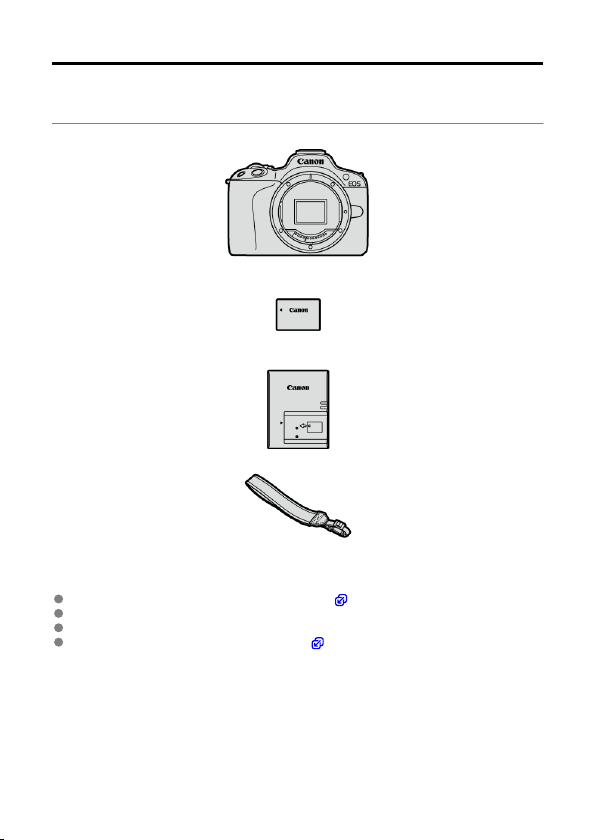
Before use, make sure the following items are included in the package. If anything is
missing, contact your dealer.
Camera
(with body cap (Camera Cover R-F-5) and shoe cover)
Battery Pack LP-E17
(with protective cover)
Battery Charger LC-E17/LC-E17E*
Strap
* Battery Charger LC-E17 or LC-E17E is provided. (The LC-E17E comes with a power cord.)
The camera does not come with a memory card ( ), interface cable, or HDMI cable.
If you purchased a Lens Kit, check that the lenses are included.
Be careful not to lose any of these items.
No software CD-ROM is included. Software ( ) can be downloaded from the Canon
website.
11
Instruction Manuals
The included Instruction Manual provides basic camera instructions.
Advanced User Guide
Complete instructions are provided in this Advanced User Guide.
For the latest Advanced User Guide, refer to the following website.
https://cam.start.canon/C011/
Lens/Software Instruction Manual
View or download from the following website.
https://cam.start.canon/
Note
Select [ : Manual/software URL] to display the QR code on the camera screen.
15
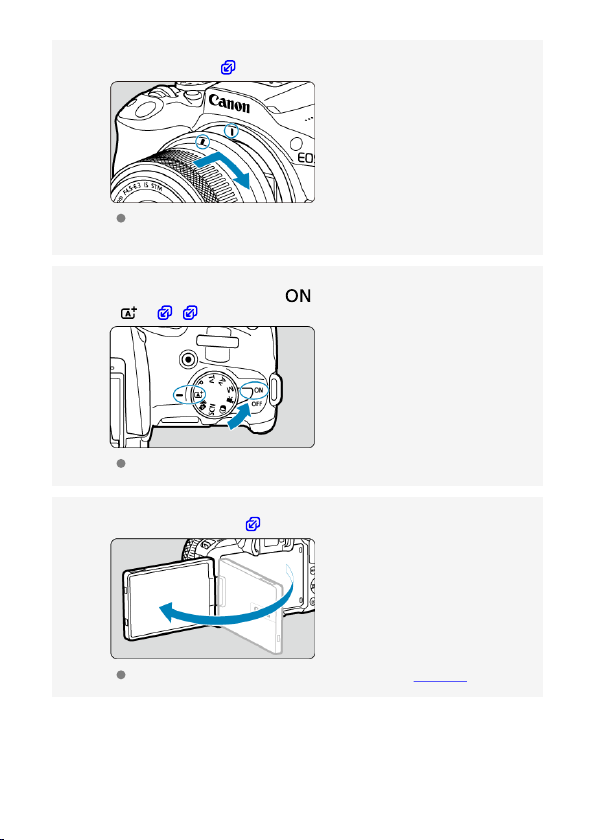
Attach the lens ( ).
Align the red mount index on the lens with the red mount index on the
camera to attach the lens.
Set the power switch to <
>, then set the Mode dial to
<
> ( , ).
All the necessary camera settings is set automatically.
Flip out the screen (
).
When the language setting screen is displayed, see Language.
17
3.
4.
5.
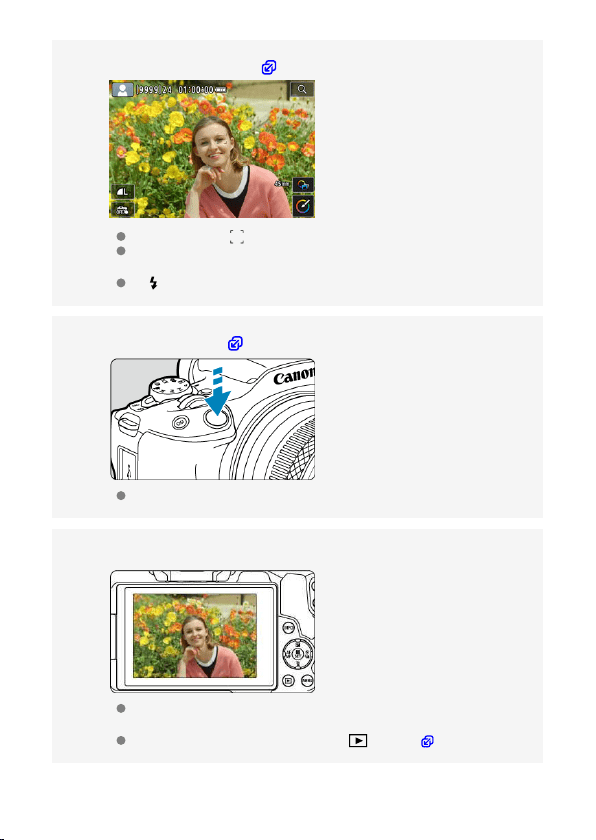
Focus on the subject ( ).
A tracking frame [ ] for AF appears over any face detected.
Press the shutter button halfway, and the camera will focus on the
subject.
If [ ] blinks on the screen, manually raise the built-in flash.
Take the picture (
).
Press the shutter button completely to take the picture.
Review the picture.
The image just captured will be displayed for approx. 2 sec. on the
screen.
To display the image again, press the < > button ( ).
18
6.
7.
8.
About This Guide
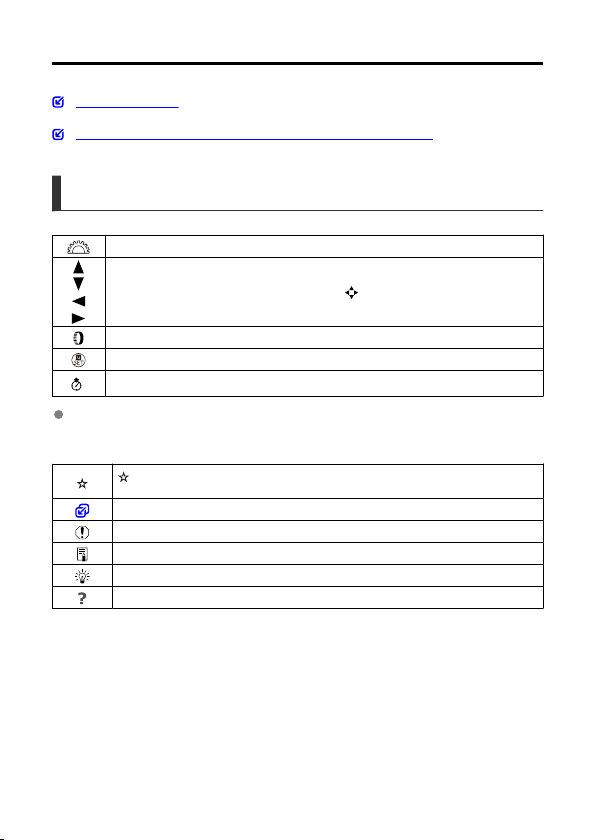
Icons in This Guide
Basic Assumptions for Operational Instructions and Sample Photos
Icons in This Guide
<
>
Indicates the dial.
<
>
<
>
<
>
<
>
Indicates the direction to press the cross keys (< >).
<
>
Indicates the lens control ring.
<
>
Indicates the Quick Control/Set button.
*
Indicates the duration (in * seconds) of the operation for the button you pressed, as timed
after you release the button.
In addition to the above, the icons and symbols used on the camera's buttons and
displayed on the screen are also used in this guide when discussing relevant operations
and functionality.
to the right of titles indicates functions only available in Creative Zone modes (<P>,
<Tv>, <Av>, or <M>).
Links to pages with related topics.
Warning to prevent shooting problems.
Supplemental information.
Tips or advice for better shooting.
Troubleshooting advice.
19

Basic Assumptions for Operational Instructions and
Sample Photos
Before following any instructions, make sure the power switch is set to < > ( ).
It is assumed that all the menu settings and Custom Functions are set to their defaults.
Illustrations in this guide show the camera with the RF-S18-45mm F4.5-6.3 IS STM lens
attached as an example.
The sample photos displayed on the camera and used in this guide are for instructional
purposes only.
In references to using EF or EF-S lenses, it is assumed that a mount adapter is used.
20
Compatible Cards
The following cards can be used with the camera regardless of capacity. If the card is new
or was previously formatted (initialized) by another camera or computer, format the
card with this camera (
).
SD/SDHC/SDXC memory cards
UHS-I cards supported.
Cards That Can Record Movies
When recording movies, use a card with ample performance (fast enough writing and
reading speeds) for the movie recording size (
).
In this guide, “card” refers to SD memory cards, SDHC memory cards,
and SDXC memory cards.
*A card is not included. Please purchase it separately.
21
WARNING:
Safety Instructions
Be sure to read these instructions in order to operate the product safely.
Follow these instructions to prevent injury or harm to the operator of the product or others.
Denotes the risk of serious injury or death.
Keep the product out of the reach of young children.
Keep batteries out of the reach of children.
A strap wrapped around a person's neck may result in strangulation.
The parts or provided items of cameras or accessories are dangerous if swallowed. If
swallowed, seek immediate medical assistance.
The battery is dangerous if swallowed. If swallowed, seek immediate medical assistance.
PRODUCT CONTAINS BUTTON/COIN CELL BATTERY
Button/coin cell batteries are hazardous and must be kept out of reach of children at all
times, whether new or used.
These batteries can cause severe or fatal injuries in 2 hours or less if swallowed or placed
inside any part of the body.
If it is suspected a button/coin cell battery has been swallowed or placed inside any part of
the body, seek medical attention immediately.
Use only power sources specified in this instruction manual for use with the product.
Do not disassemble or modify the product.
Do not expose the product to strong shocks or vibration.
Do not touch any exposed internal parts.
Stop using the product in any case of unusual circumstances such as the presence of
smoke or a strange smell.
Do not use organic solvents such as alcohol, benzine or paint thinner to clean the
product.
Do not get the product wet. Do not insert foreign objects or liquids into the product.
Do not use the product where flammable gases may be present.
This may cause electric shock, explosion or fire.
Do not leave a lens or a camera/camcorder with a lens attached, exposed without the
lens cap attached.
The lens may concentrate the light and cause fire.
Do not touch the product connected to a power outlet during lightning storms.
This may cause electric shock.
22
Observe the following instructions when using commercially available batteries or
provided battery packs.
• Use batteries/battery packs only with their specified product.
• Do not heat batteries/battery packs or expose them to fire.
• Do not charge batteries/battery packs using non-authorized battery chargers.
• Do not expose the terminals to dirt or let them come into contact with metallic pins
or other metal objects.
• Do not use leaking batteries/battery packs.
• When disposing of batteries/battery packs, insulate the terminals with tape or other
means.
This may cause electric shock, explosion or fire.
If a battery/battery pack leaks and the material contacts your skin or clothing, flush the
exposed area thoroughly with running water. In case of eye contact, flush thoroughly with
copious amounts of clean running water and seek immediate medical assistance.
Observe the following instructions when using a battery charger or AC adapter.
• Periodically remove any dust buildup from the power plug and power outlet using a
dry cloth.
• Do not plug in or unplug the product with wet hands.
• Do not use the product if the power plug is not fully inserted into the power outlet.
• Do not expose the power plug and terminals to dirt or let them come into contact
with metallic pins or other metal objects.
• Do not touch the battery charger or AC adapter connected to a power outlet during
lightning storms.
Do not place heavy objects on the power cord. Do not damage, break or modify the
power cord.
Do not wrap the product in cloth or other materials when in use or shortly after use when
the product is still warm in temperature.
Do not unplug the product by pulling the power cord.
Do not leave the product connected to a power source for long periods of time.
Do not charge batteries/battery packs at temperatures outside the range of 5 - 40 °C (41
- 104 °F).
This may cause electric shock, explosion or fire.
Do not allow the product to maintain contact with the same area of skin for extended
periods of time during use.
This may result in low-temperature contact burns, including skin redness and blistering,
even if the product does not feel hot. The use of a tripod or similar equipment is
recommended when using the product in hot places and for people with circulation problems
or less sensitive skin.
Follow any indications to turn off the product in places where its use is forbidden.
Not doing so may cause other equipment to malfunction due to the effect of electromagnetic
waves and even result in accidents.
Do not leave batteries near pets.
Pets biting a battery could cause leakage, overheating, or explosion, resulting in product
damage or fire.
23
CAUTION:
Follow the cautions below. Otherwise physical
injury or property damage may result.
Do not fire the flash near the eyes.
It may hurt the eyes.
Do not look at the screen or through the viewfinder for prolonged periods of time.
This may induce symptoms similar to motion sickness. In such a case, stop using the
product immediately and rest for a while before resuming use.
Flash emits high temperatures when fired. Keep fingers, any other part of your body,
and objects away from the flash unit while taking pictures.
This may cause burns or malfunction of the flash.
Do not leave the product in places exposed to extremely high or low temperatures.
The product may become extremely hot/cold and cause burns or injury when touched.
Strap is intended for use on the body only. Hanging the strap with any product attached
on a hook or other object may damage the product. Also, do not shake the product or
expose the product to strong impacts.
Do not apply strong pressure on the lens or allow an object to hit it.
This may cause injury or damage to the product.
Only mount the product on a tripod that is sufficiently sturdy.
Do not carry the product when it is mounted on a tripod.
This may cause injury or may result in an accident.
Do not touch any parts inside the product.
This may cause injury.
If any abnormal skin reaction or irritation occurs during or following the use of this
product, refrain from further use and get medical advice/attention.
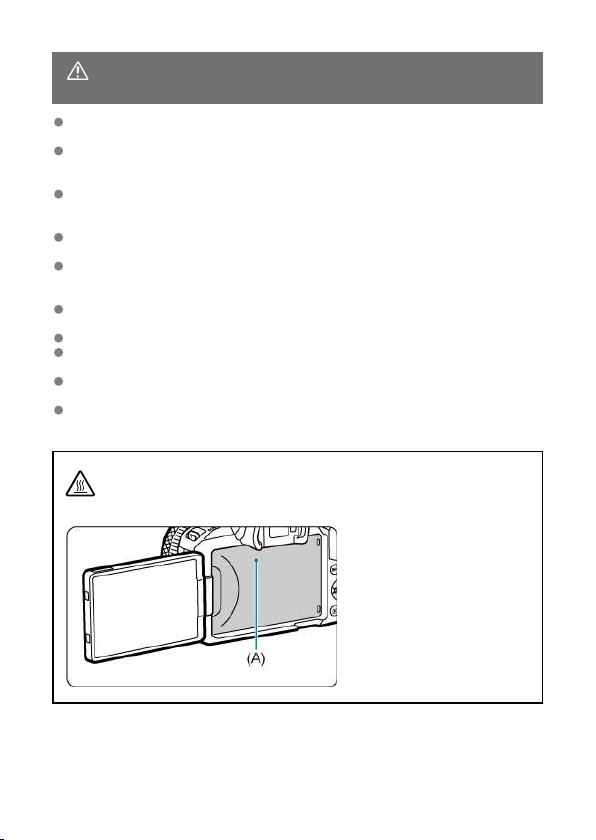
Do not touch the screen storage compartment (A), because its
temperature can increase by repeated continuous shooting for extended time
or movie recording. This may cause burns.
24

Handling Precautions
Camera care
This camera is a precision instrument. Do not drop it or subject it to physical shock.
The camera is not waterproof and cannot be used underwater. If the camera gets wet,
contact a Canon Service Center immediately. Wipe off any water droplets with a dry and
clean cloth. If the camera has been exposed to salty air, wipe it with a clean, well-wrung
wet cloth.
Never leave the camera near anything having a strong magnetic field such as a magnet
or electric motor. Also, avoid using or leaving the camera near anything emitting strong
radio waves, such as a large antenna. Strong magnetic fields can cause camera
malfunction or destroy image data.
Do not leave the camera in excessive heat, such as in a car in direct sunlight. High
temperatures can cause the camera to malfunction.
The camera contains precision electronic circuitry. Never attempt to disassemble the
camera yourself.
Do not block shutter curtain operation with your finger or other objects. Doing so may
cause a malfunction.
Only use a commercially available blower to blow away dust on the lens, viewfinder, or
other parts. Do not use cleaners that contain organic solvents to clean the camera body
or lens. For stubborn dirt, take the camera to the nearest Canon Service Center.
Do not touch the camera's electrical contacts with your fingers. This is to prevent the
contacts from corroding. Corroded contacts can cause camera malfunction.
If the camera is suddenly brought in from the cold into a warm room, condensation may
form on the camera and internal parts. To prevent condensation, first put the camera in
a sealed plastic bag and let it adjust to the warmer temperature before taking it out of
the bag.
If condensation forms on the camera, to avoid damage, do not use the camera or
remove the lens, card, or battery. Turn the camera off and wait until the moisture has
fully evaporated before resuming use. Even after the camera is completely dry, if it is still
internally cold, do not remove the lens, card, or battery until the camera has adjusted to
the ambient temperature.
If the camera will not be used for an extended period, remove the battery and store the
camera in a cool, dry, well-ventilated location. Even while the camera is in storage,
press the shutter button a few times once in a while to check that the camera is still
working.
Avoid storing the camera where there are chemicals that result in rust and corrosion
such as in a chemical lab.
If the camera has not been used for an extended period, test all its functions before
using it. If you have not used the camera for some time or if there is an important shoot
such as a foreign trip coming up, have the camera checked by your nearest Canon
Service Center or check the camera yourself and make sure it is working properly.
The camera may become hot after repeated continuous shooting or still photo/movie
shooting over an extended period. This is not a malfunction.
If there is a bright light source inside or outside the image area, ghosting may occur.
When shooting with backlighting, keep the sun sufficiently away from the angle of view.
Always keep intense light sources such as the sun, lasers, and other intense artificial
light sources out of the image area and not near it. Concentrated intense light may
cause smoke or damage the image sensor or other internal components.
25

Attach the lens cap to prevent direct sunlight and other light from entering the lens when
you are not shooting.
26
Screen and viewfinder
The following does not affect images captured by the camera.
Although the screen and viewfinder are manufactured with very high precision
technology with over 99.99% effective pixels, 0.01% or fewer of the pixels may be dead,
and there may also be spots of black, red, or other colors. This is not a malfunction.
If the screen is left on for a prolonged period, screen burn-in may occur where you see
remnants of what was displayed. However, this is only temporary and will disappear
when the camera is left unused for a few days.
The screen display may seem slightly slow in low temperatures or may look black in
high temperatures, but it will return to normal at room temperature.
Cards
To protect the card and its recorded data, note the following:
Do not drop, bend, or wet the card. Do not subject it to excessive force, physical shock,
or vibration.
Do not touch the card's electronic contacts with your fingers or anything metallic.
Do not affix any stickers, etc. on the card.
Do not store or use the card near anything that has a strong magnetic field, such as a
television, speakers, or magnets. Also avoid places prone to having static electricity.
Do not leave the card in direct sunlight or near a heat source.
Store the card in a case.
Do not store the card in hot, dusty, or humid locations.
Cards may become hot after long sessions of repeated continuous shooting or still photo
shooting/movie recording. This is not a malfunction.
Lens
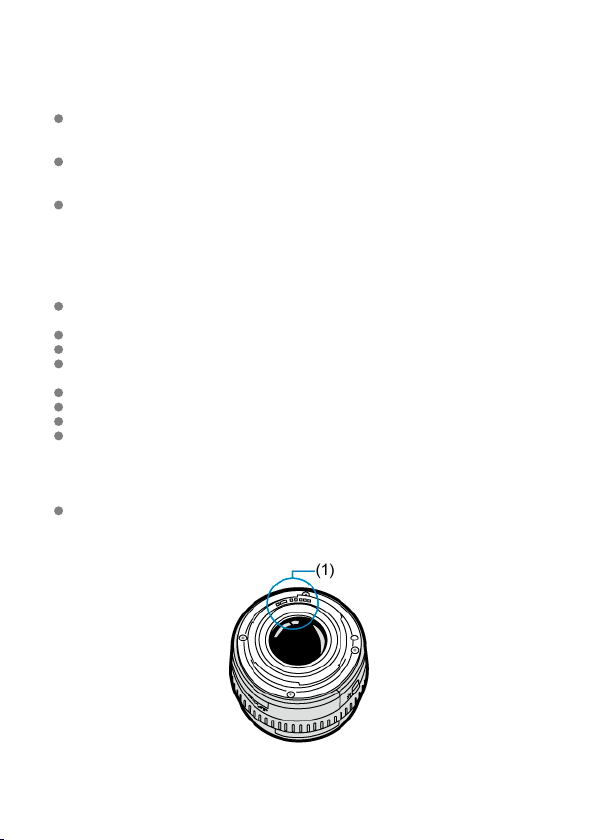
After detaching the lens from the camera, put down the lens with the rear end up and
attach the rear lens cap to avoid scratching the lens surface and electrical contacts
(1).
27

Smudges on the image sensor
You can use a commercially available blower to remove dust or debris on the image
sensor that appears in images.
Besides dust entering the camera from outside, in rare cases, lubricant from the
camera's internal parts may adhere to the front of the sensor.
If smudges are visible on images, have the sensor cleaned by a nearest Canon Service
Center.
28
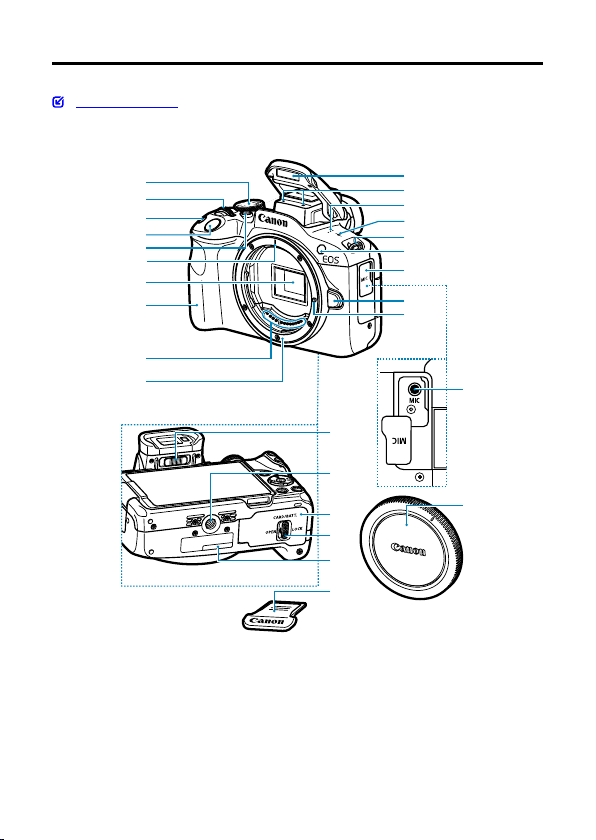
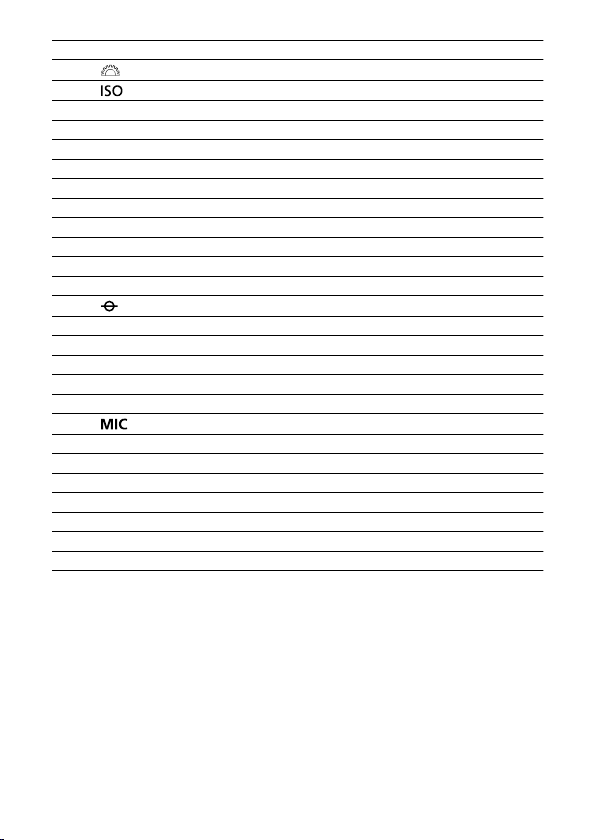
(1) Mode dial
(2) <
> Dial
(3) < > ISO speed setting button
(4) Shutter button
(5) Movie shooting button
(6) RF lens mount index
(7) Image sensor
(8) Grip
(9) Contacts
(10) Lens mount
(11) Built-in flash
(12) Microphone
(13) Speaker
(14) < > Focal plane mark
(15) Strap mount
(16) AF-assist beam/red-eye reduction/self-timer/remote control lamp
(17) Terminal cover
(18) Lens release button
(19) Lens lock pin
(20) <
> External microphone IN terminal
(21) Dioptric adjustment slider
(22) Tripod socket
(23) Card/battery compartment cover
(24) Card/battery compartment cover lock
(25) Serial number (body number)
(26) Body cap
(27) Shoe cover
30
(1)
(4)
(6)
(13)
(12)
(11)
(10)
(9)
(19)
(17)
(18)
(16)
(5)
(22)
(21)
(20)
(7)
(8)
(2)
(3)
(14)
(15)
31
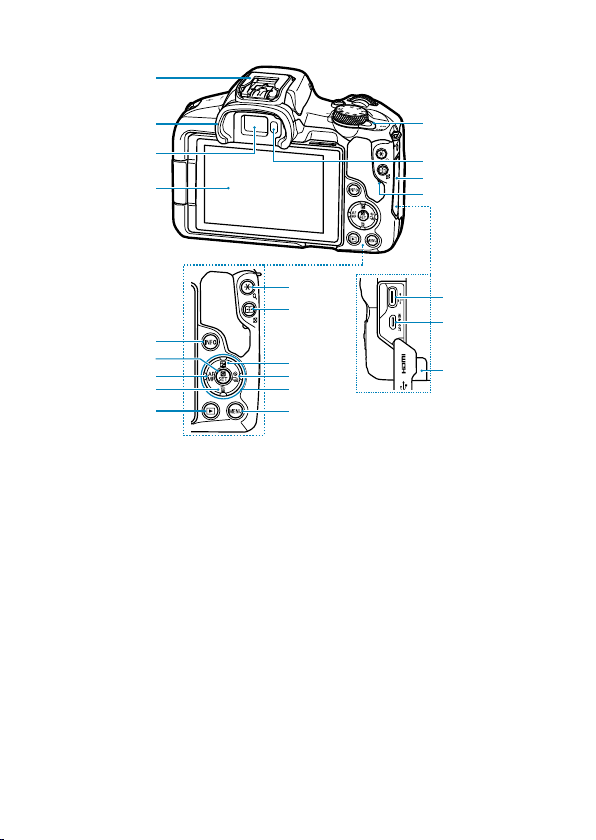
(1) Multi-function shoe
(2) Eyecup
(3) Viewfinder eyepiece
(4) Screen
(5) <
/ > Power switch
(6) Viewfinder sensor
(7) Terminal cover
(8) Access lamp
(9) < > Info button
(10) < > Quick Control/Set button
(11) <
/ > Left/autofocus/manual focus button
(12) < / > Down/erase button
(13) <
> Playback button
(14) < / > AE lock/FE lock/magnify button
(15) <
/ > AF point selection/index/reduce button
(16) < / > Up/exposure compensation button
(17) <
/ / > Right/self-timer/drive mode selection button
(18) < > Cross keys
(19) <
> Menu button
(20) < > HDMI micro OUT terminal
(21) <
> Digital terminal
(22) DC cord hole
32

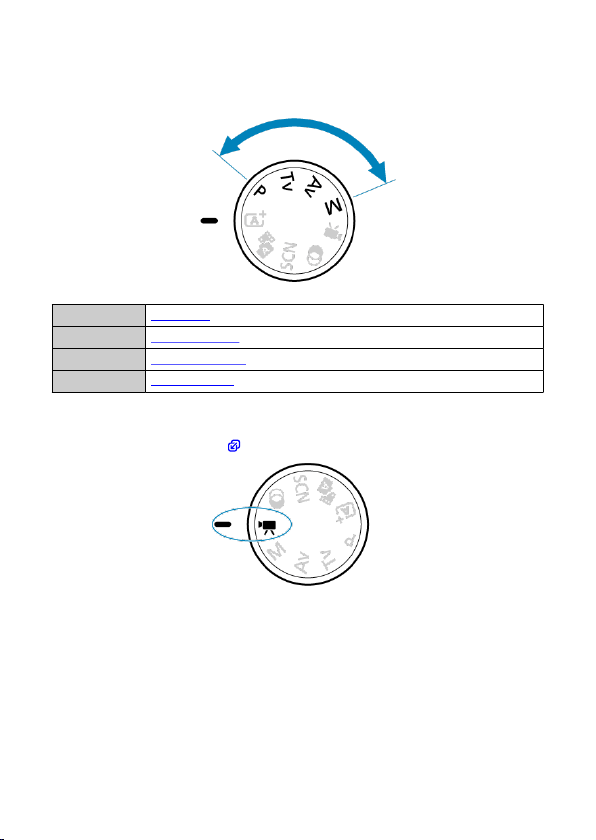
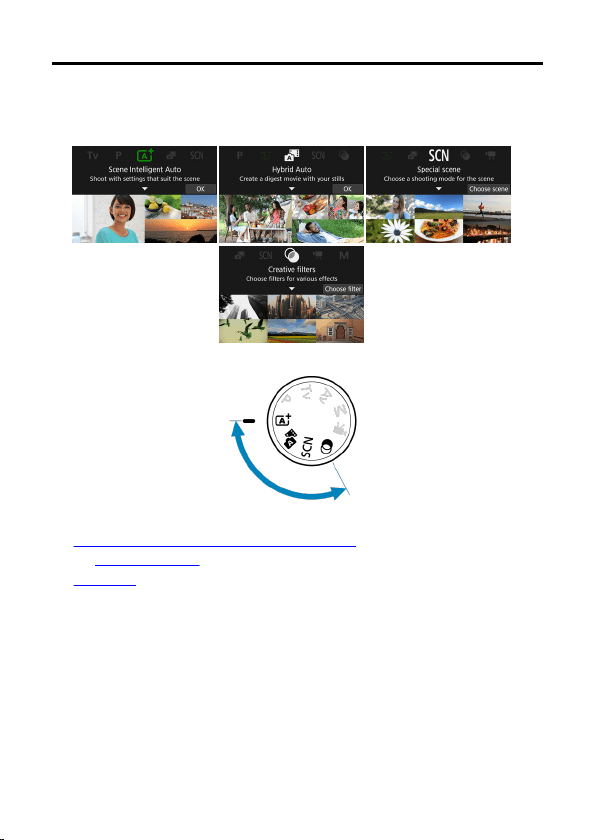
Mode dial
Features on the Mode dial are grouped into Basic Zone, Creative Zone, and movie recording
modes.
(1) Basic Zone
All you do is press the shutter button. The camera sets everything to suit the subject or
scene for shooting.
: Scene Intelligent Auto ( )
: Hybrid Auto ( )
: Special scene ( )
Self Portrait Kids
Portrait Panning
Smooth skin Close-up
Group Photo Food
Landscape Handheld Night Scene
Panoramic shot
HDR Backlight Control
Sports Silent shutter
: Creative filters ( )
Grainy B/W Miniature effect
Soft focus
HDR art standard
Fish-eye effect
HDR art vivid
Water painting effect
HDR art bold
Toy camera effect
HDR art embossed
33

Attaching the Strap
Pass the end of the strap through the strap mount from the bottom, then pass it through the
strap buckle as shown. Pull the strap to take up any slack and make sure the strap will not
loosen from the buckle.
36
Software/Apps
Software/App Overview
Installing Computer Software
Installing Smartphone Apps
Software Instruction Manuals
Software/App Overview
This section summarizes software used with EOS cameras. Note that installing the software
requires an internet connection. The software cannot be installed in environments without an
internet connection.
Computer software
EOS Utility
Enables you to transfer captured images from the camera to a connected computer, set
various camera settings from the computer, and shoot remotely from the computer.
Digital Photo Professional
Software recommended for users who shoot RAW images. Enables image viewing,
editing, printing, and more.
Picture Style Editor
Enables you to edit existing Picture Styles or create and save original Picture Style files.
This software is for users who are familiar with image processing.
Smartphone apps
Camera Connect
Enables you to transfer captured images from the camera to a smartphone over a wired
or wireless connection, set various camera settings from the smartphone, and shoot
remotely from the smartphone.
Digital Photo Professional Express
App for RAW image processing and image editing on a smartphone or tablet. Requires
a paid subscription.
37
Installing Computer Software
Always install the latest version of the software. In this case, previous versions are
overwritten.
Caution
Do not install software while the camera is connected to the computer. The
software will not be installed correctly.
Installation is not possible without an internet connection.
Older versions of the software do not support RAW image processing or correct
display for images from this camera.
1.
Download the software.
Connect to the internet from a computer and access the following
Canon website.
https://cam.start.canon/
Depending on the software, you may need to enter the camera's serial
number. The serial number is on the bottom of the camera.
2.
Extract the installer on the computer.
For Windows
Click the displayed installer file to start the installer.
For macOS
Double-click the dmg file to open the installation window.
Double-click the icon in this window to start the installer.
3.
Follow the on-screen instructions to install the software.
38

Preparation and Basic Operations
This chapter describes preparatory steps before you start shooting and the basic camera
operations.
•
Charging the Battery
• Inserting/Removing the Battery and Card
• Using the Screen
• Turning on the Power
• Attaching and Detaching RF/RF-S Lenses
• Attaching and Detaching EF/EF-S Lenses
• Multi-Function Shoe
• Using the Viewfinder
• Basic Operations
• Menu Operations and Settings
• Quick Control
• Touch-Screen Operation
41
Charging the Battery
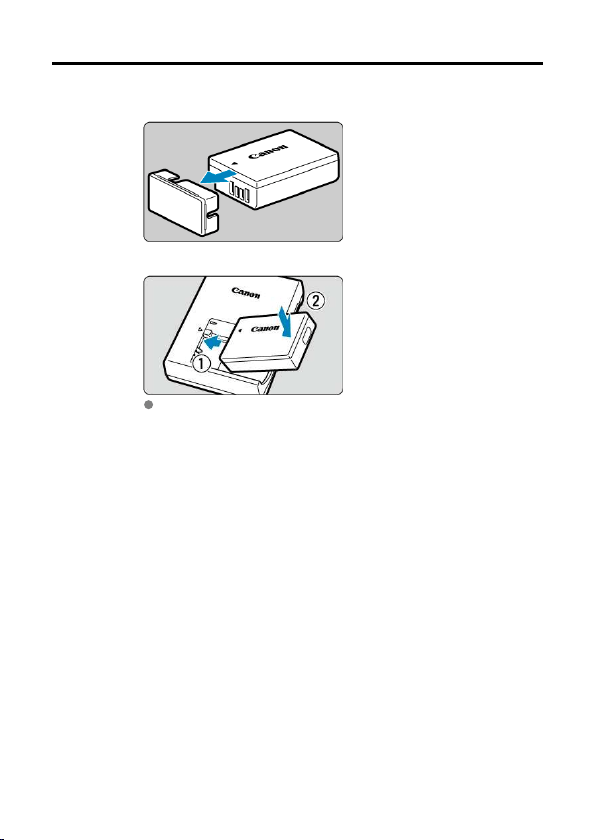
1.
Detach the protective cover provided with the battery.
2.
Fully insert the battery into the charger.
Do the opposite to remove the battery.
42
3.
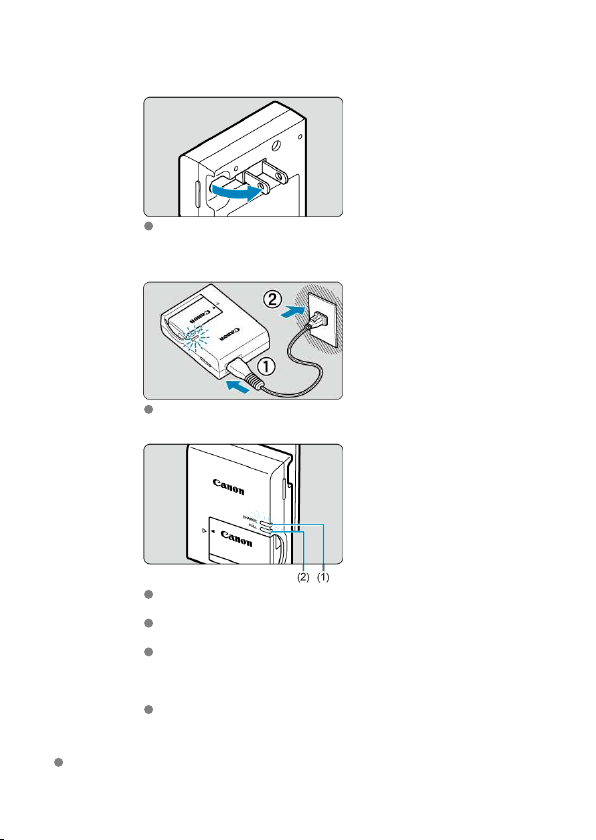
Charge the battery.
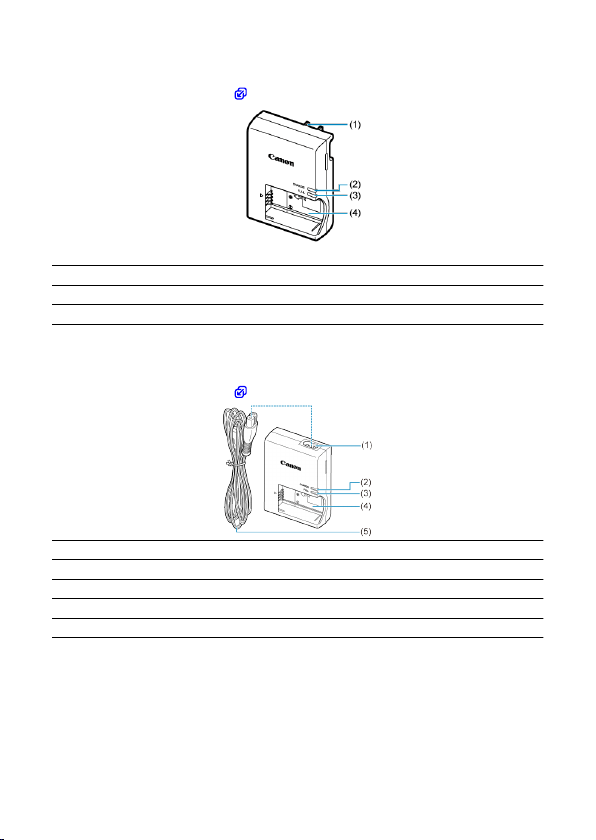
LC-E17
Flip out the charger prongs as shown and plug the charger into a power
outlet.
LC-E17E
Connect the power cord to the charger and insert the plug into a power
outlet.
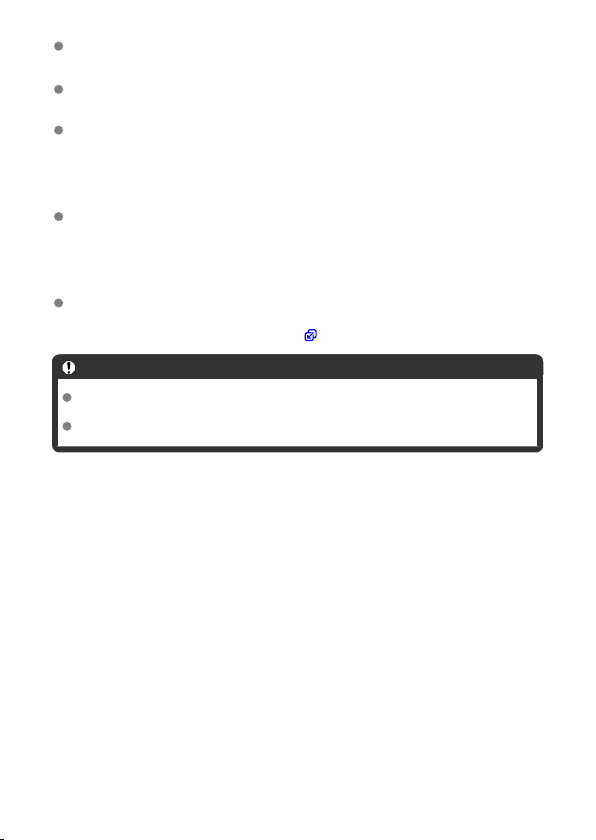
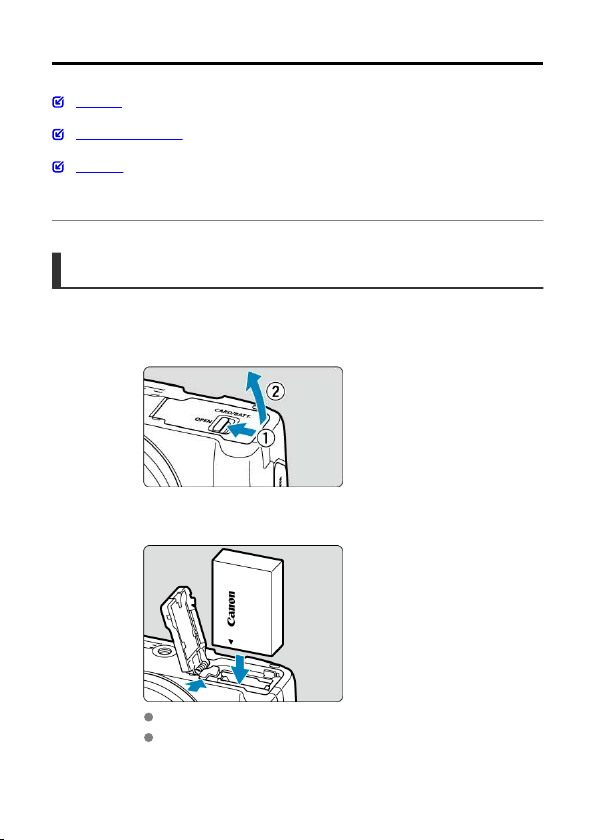
Charging starts automatically and the charge lamp (1) lights up in
orange.
When the battery is fully charged, the full-charge lamp (2) will light up in
green.
Charging a depleted battery takes approx. 2 hr. at room
temperature (23°C/73°F).
The time required to charge the battery will vary greatly depending on
the ambient temperature and the battery's remaining capacity.
For safety, charging in low temperatures (5–10°C/41–50°F) takes
longer (up to approx. 4 hr.).
Upon purchase, the battery is not fully charged.
Charge the battery before use.
43
Charge the battery on the day before or on the day it is to be used.
Charged batteries gradually lose their charge, even when they are not used.
After charging the battery, remove it and disconnect the charger from the power
outlet.
When not using the camera, remove the battery.
If the battery is left in the camera for a prolonged period, a small amount of power
current will keep being released, resulting in excess discharge and shorter battery life.
Store the battery with the protective cover attached. Storing the battery when it is fully
charged may lower the battery performance.
The battery charger can also be used in foreign countries.
The battery charger is compatible with a 100 V AC to 240 V AC 50/60 Hz power source.
If necessary, attach a commercially available plug adapter for the respective country or
region. Do not attach any portable voltage transformer to the battery charger. Doing so
may damage the battery charger.
If the battery becomes exhausted quickly even after having been fully charged,
the battery has reached the end of its service life.
Check the battery's recharge performance (
) and purchase a new battery.
Caution
After disconnecting the charger's power plug, do not touch the prongs for approx. 5
sec.
The provided charger cannot charge any battery other than Battery Pack LP-E17.
44
Inserting/Removing the Battery and Card
Insertion
Formatting the Card
Removal
Insert a fully charged Battery Pack LP-E17 and card in the camera. The captured images
are recorded onto the card.
Insertion
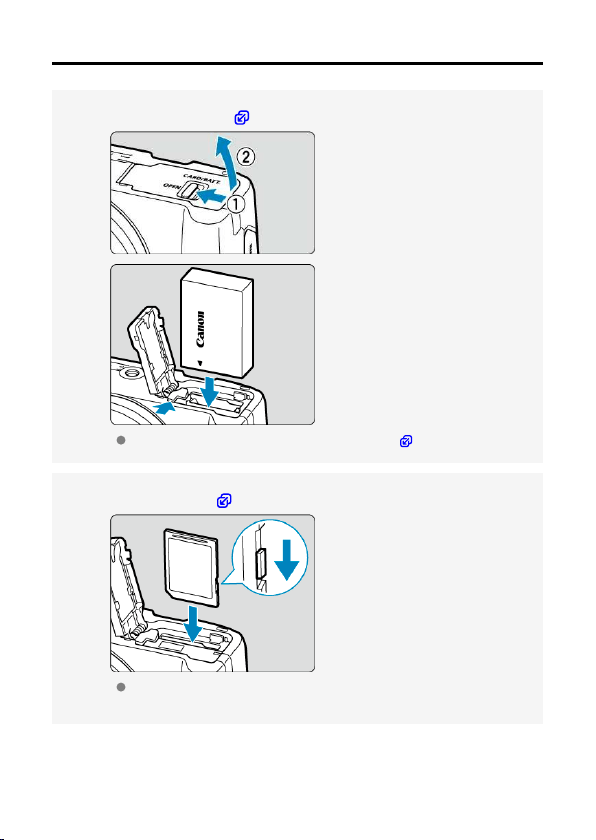
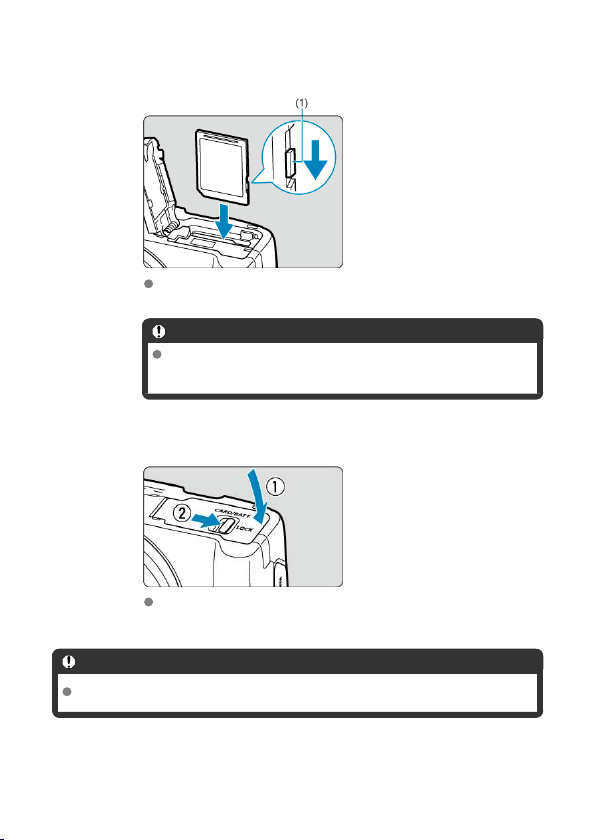
1.
Slide the card/battery compartment cover lock and open the cover.
2.
Insert the battery.
Insert the end with the electrical contacts.
Insert the battery until it locks in place.
45
3.
Insert the card.
Insert the card with the label facing the front of the camera until it clicks
into place.
Caution
Make sure the card's write-protect switch (1) is set upward to
enable writing and erasing.
4.
Close the cover.
Press the cover closed, then slide the card/battery compartment cover
lock to lock it.
Caution
You cannot use batteries other than the Battery Pack LP-E17.
46

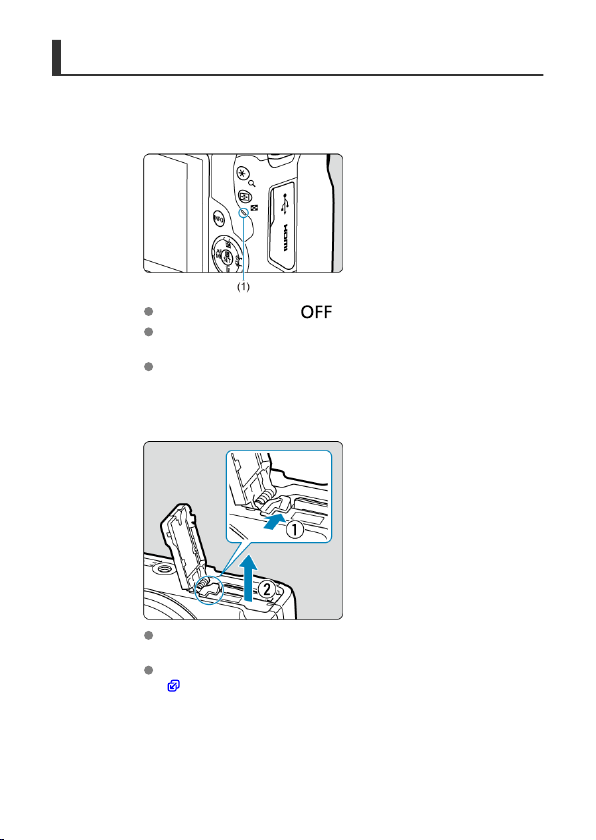
Removal
1.
Slide the card/battery compartment cover lock and open the cover.
Set the power switch to < >.
Make sure the access lamp (1) is off before opening the card/
battery compartment cover.
If [Saving...] is displayed on the screen, close the cover.
2.
Removing the battery.
Press the battery lock lever as shown by the arrow and remove the
battery.
To prevent short-circuits, always attach the included protective cover
( ) to the battery.
48
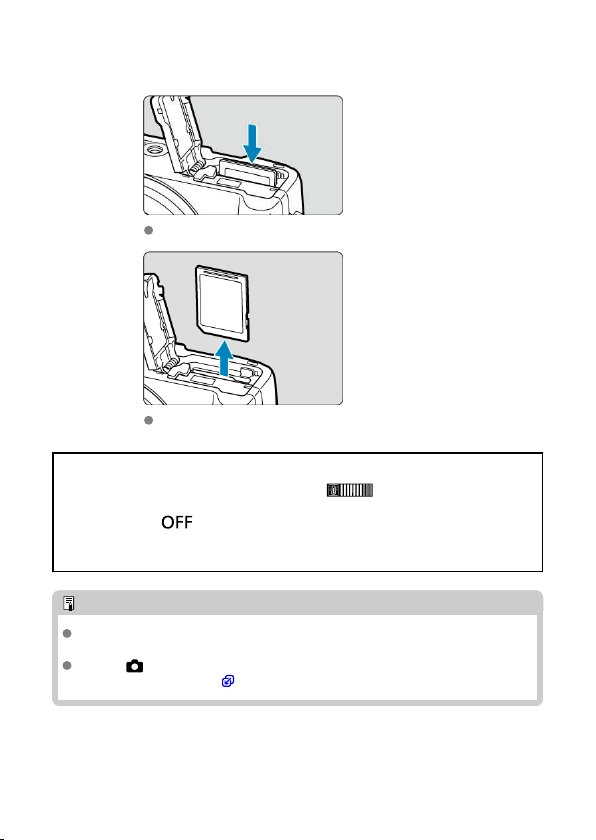
3.
Remove the card.
Gently push in the card, then let it go to eject.
Pull the card straight out, then close the cover.
Caution
Do not remove cards immediately after a red [
] icon is displayed as you
are shooting. Cards may be hot, due to high internal camera temperature. Set the
power switch to <
> and stop shooting for a while before removing cards.
Removing hot cards immediately after shooting may cause you to drop and damage
them. Be careful when removing cards.
Note
The number of shots available varies depending on remaining card capacity and
settings such as image quality and ISO speed.
Setting [ : Release shutter without card] to [Disable] will prevent you from
forgetting to insert a card ( ).
49
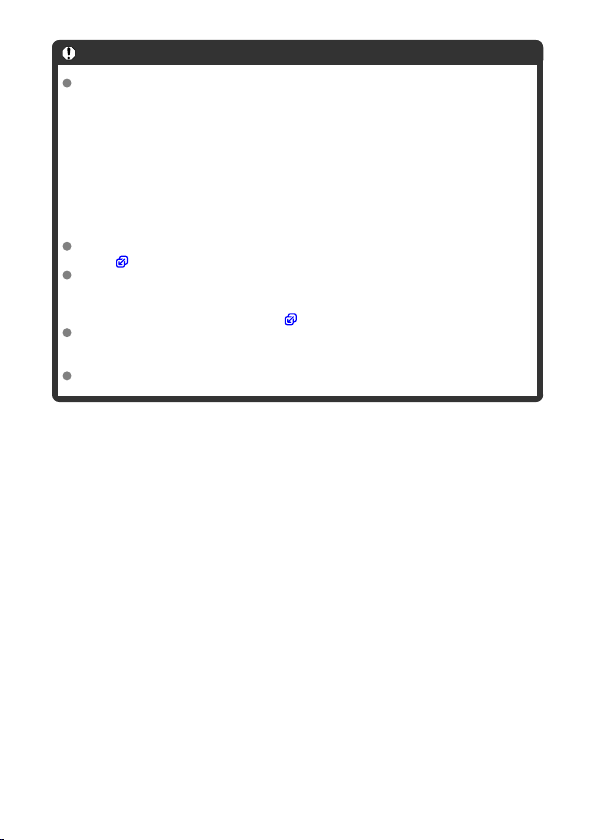
Caution
When the access lamp is lit or blinking, it indicates that images are being
written to, read from, or erased from the card, or data is being transferred. Do
not open the card/battery compartment cover. To avoid corrupting image
data or damaging cards or the camera, never do any of the following while
the access lamp is lit or blinking.
• Removing the card.
• Removing the battery.
• Shaking or striking the camera.
• Unplugging or plugging in a power cord
(when using optional household power outlet accessories).
If the card already contains recorded images, the image number may not start from
0001 ( ).
If a card-related error message is displayed on the screen, remove and reinsert the
card. If the error persists, use a different card.
If you can transfer images on the card to a computer, transfer all the images and
then format the card with the camera ( ). The card may then return to normal.
Do not touch the card's contacts with your fingers or metal objects. Do not expose
the contacts to dust or water. If smudges adhere to the contacts, contact failure
may result.
Multimedia cards (MMC) cannot be used. (Card error will be displayed.)
50
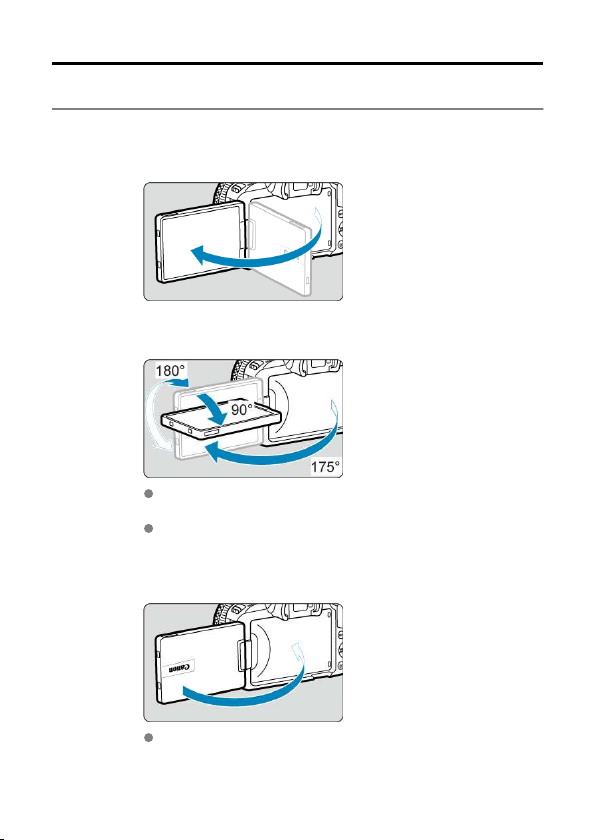
Using the Screen
You can change the direction and angle of the screen.
1.
Flip out the screen.
2.
Rotate the screen.
When the screen is out, you can tilt it up or down or rotate it to face the
subject.
Indicated angles are only approximate.
3.
Face it toward you.
Normally, use the camera with the screen facing you.
51
Caution
Avoid forcing the screen into position as you rotate it, which puts undue pressure
on the hinge.
When a cable is connected to a camera terminal, the rotation angle range of the
flipped-out screen will be limited.
Note
Keep the screen closed and facing the camera body when the camera is not in use.
You can protect the screen.
A mirror image (right/left reversed) of subjects is displayed when the screen faces
subjects in front of the camera.
52
Turning on the Power
Setting the Display Language
Setting the Date, Time, and Time Zone
Connecting the Camera to a Smartphone
Battery Level Indicator
< >
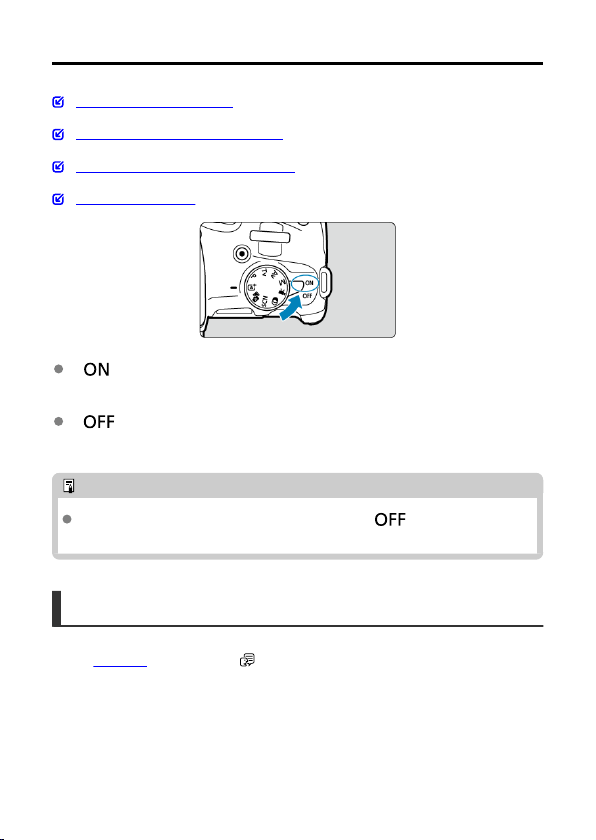
The camera turns on. You can now shoot still photos and record movies.
< >
The camera is turned off and does not function. Set the power switch to this position
when not using the camera.
Note
[Saving...] is displayed if you set the power switch to < > during image
recording to the card, and the camera will turn off after recording is finished.
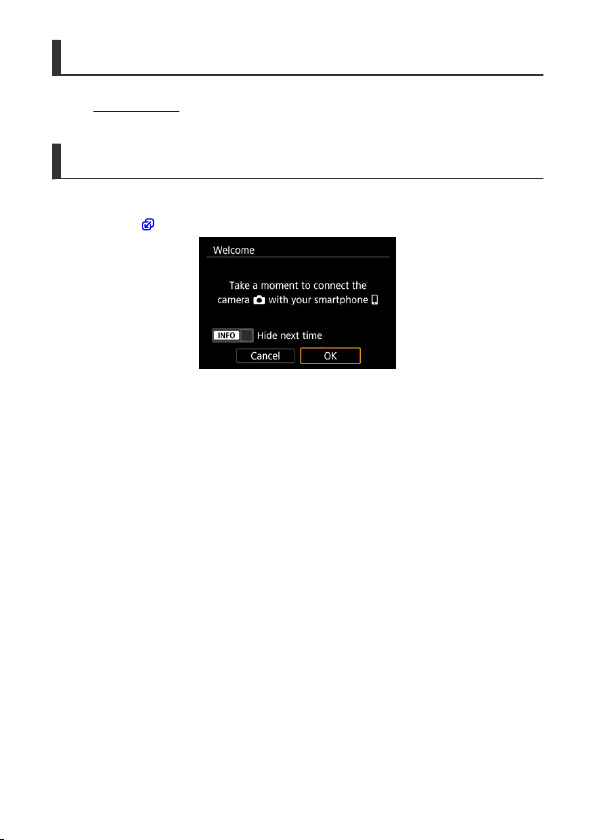
Setting the Display Language
Set the Language if the [Language ] setting screen appears after you turn on the camera.
53
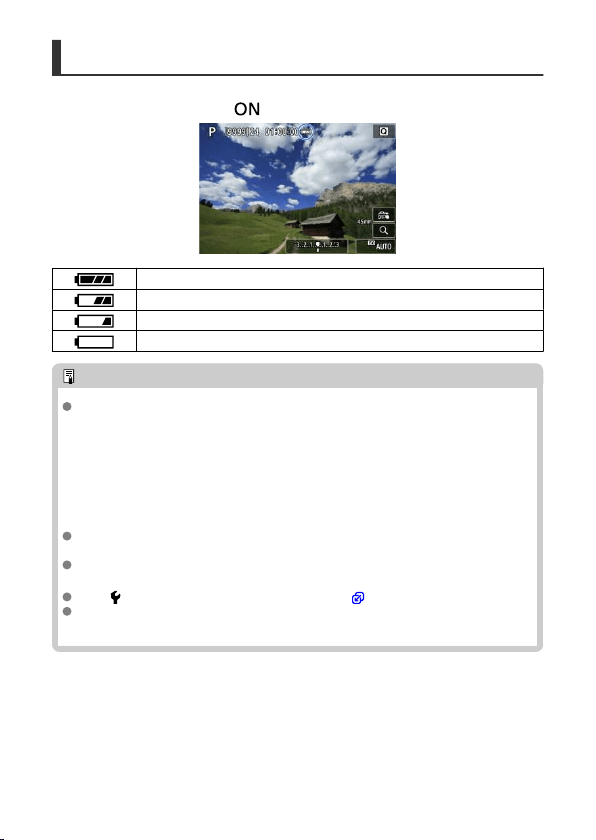
Battery Level Indicator
When the power switch is set to < >, the battery level will be indicated.
Battery level is sufficient.
Battery level is low, but the camera can still be used.
Battery will be exhausted soon (blinks).
Charge the battery.
Note
Doing any of the following will exhaust the battery faster:
• Pressing the shutter button halfway for a prolonged period.
• Activating the AF frequently without taking a picture.
• Using Image Stabilizer.
• Using the Wi-Fi function or Bluetooth function.
• Using the screen frequently.
• Using accessories compatible with the multi-function shoe.
The number of available shots may decrease depending on the actual shooting
conditions.
Lens operations are powered by the camera's battery. Certain lenses may exhaust
the battery faster than others.
See [ : Battery info.] to check the battery status ( ).
In low ambient temperatures, shooting may not be possible even with a sufficient
battery level.
55
Attaching and Detaching RF/RF-S Lenses
Attaching a Lens
Detaching a Lens
Caution
Do not look at the sun directly through any lens. Doing so may cause loss of vision.
When attaching or detaching a lens, set the camera's power switch to < >.
If the front part (focusing ring) of the lens rotates during autofocusing, do not touch
the rotating part.
Tips for avoiding smudges and dust
When changing lenses, do it quickly in a place with minimal dust.
When storing the camera without a lens attached, be sure to attach the body cap to
the camera.
Remove smudges and dust on the body cap before attaching it.
56
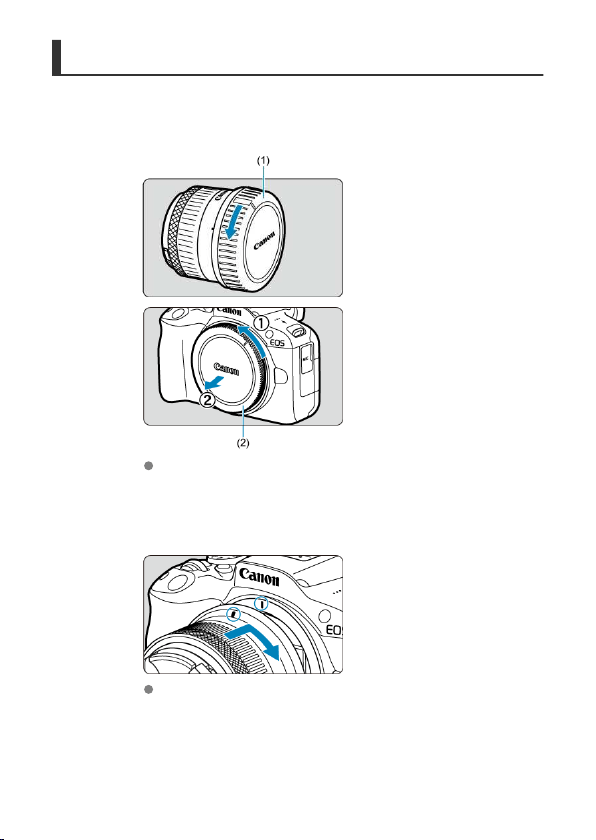
Attaching a Lens
1.
Remove the caps.
Remove the rear lens cap (1) and body cap (2) by turning them as
shown by the arrows.
2.
Attach the lens.
Align the red mount index on the lens with the red mount index on the
camera and turn the lens as shown by the arrow until it clicks in place.
57
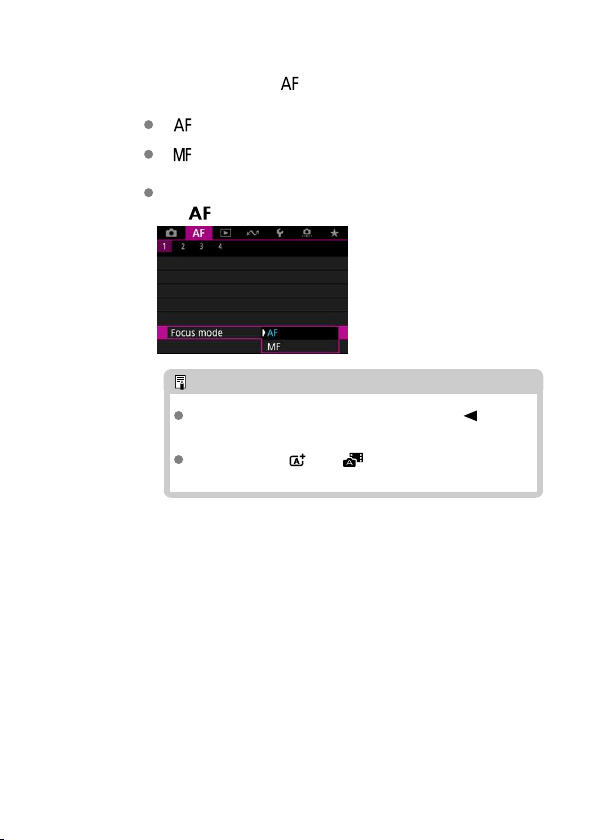
3.
Set the focus mode to <
>.
< > stands for autofocus.
< > stands for manual focus. Autofocus is disabled.
For RF lenses without a focus mode switch
Set [ : Focus mode] to [AF].
Note
You can also select [AF] or [MF] by pressing the < > key
when the shooting screen is displayed.
Not available in < > or < > mode.
58
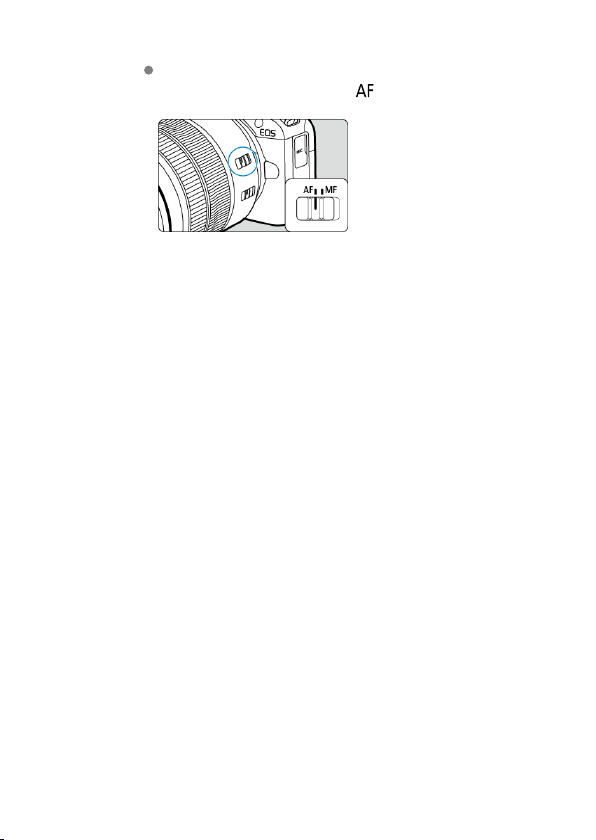
For RF lenses with a focus mode switch
Set the lens focus mode switch to <
>. Because the setting on the
lens takes precedence, the camera setting has no effect.
4.
Remove the front lens cap.
59
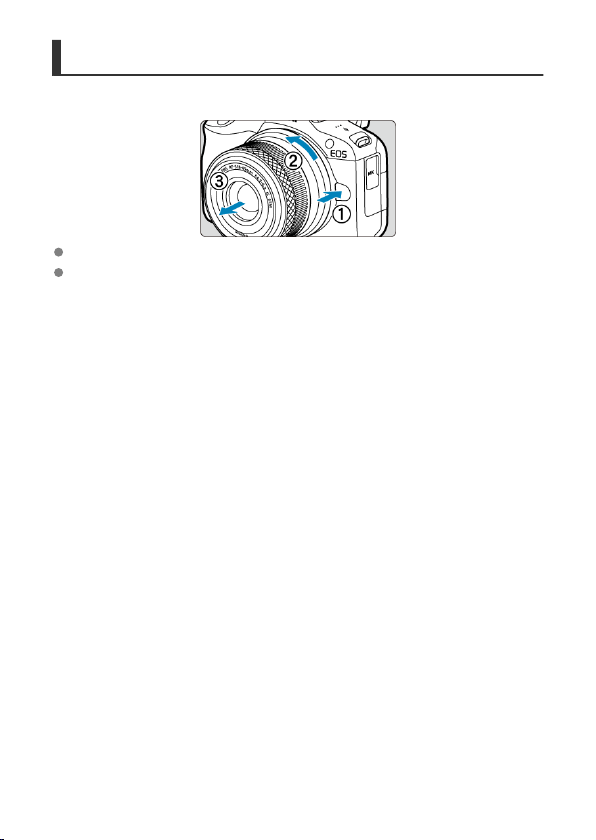
Detaching a Lens
While pressing the lens release button, turn the lens as shown by the arrow.
Turn the lens until it stops, then detach it.
Attach the rear lens cap to the lens you removed.
60
Attaching and Detaching EF/EF-S Lenses
Attaching a Lens
Detaching a Lens
All EF and EF-S lenses can be used by attaching an optional Mount Adapter EF-EOS R.
The camera cannot be used with EF-M lenses.
Attaching a Lens
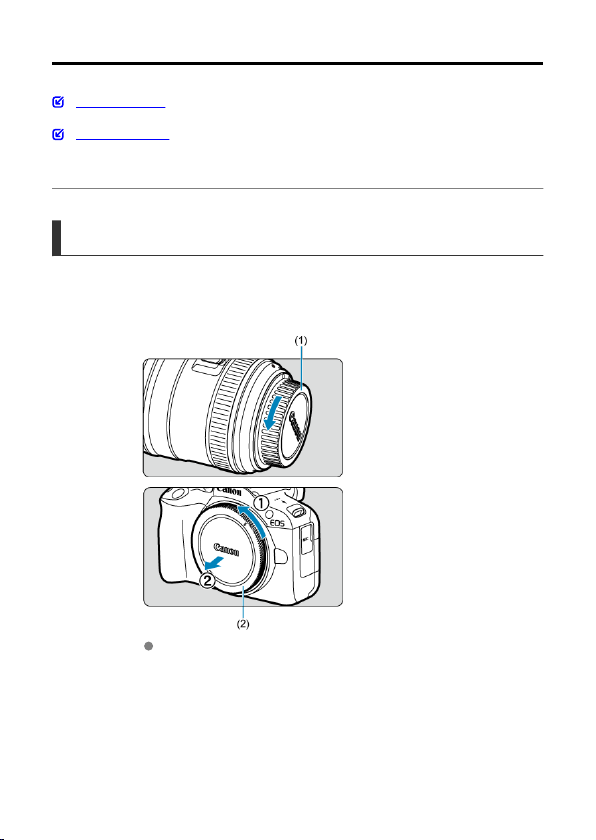
1.
Remove the caps.
Remove the rear lens cap (1) and body cap (2) by turning them as
shown by the arrows.
61
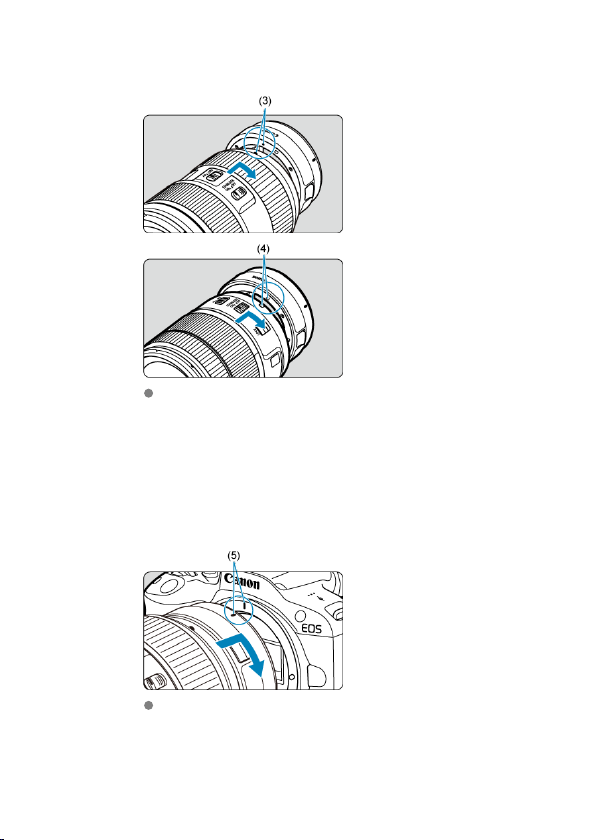
2.
Attach the lens to the adapter.
Align the red or white mount index on the lens with the corresponding
mount index on the adapter and turn the lens as shown by the arrow
until it clicks into place.
(3) Red index
(4) White index
3.
Attach the adapter to the camera.
Align the red mount indexes (5) on the adapter and camera and turn
the lens as shown by the arrow until it clicks into place.
62
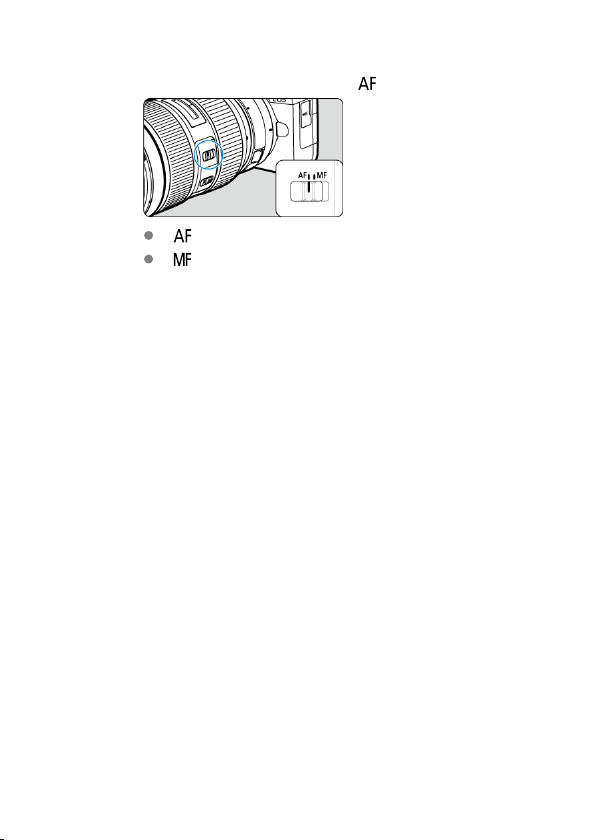
4.
Set the lens's focus mode switch to <
>.
< > stands for autofocus.
< > stands for manual focus. Autofocus is disabled.
5.
Remove the front lens cap.
63
Detaching a Lens
1.
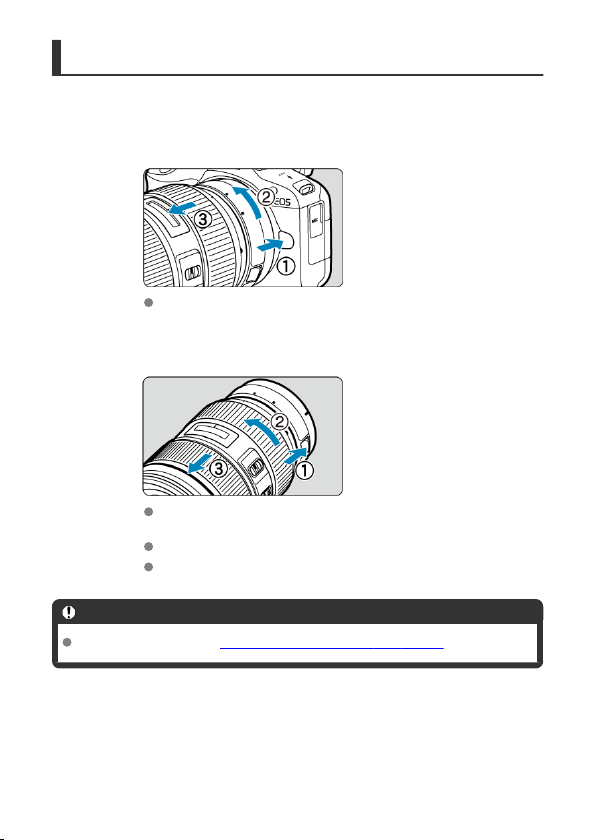
While pressing the lens release button, turn the adapter as shown by
the arrow.
Turn the lens until it stops, then detach it.
2.
Detach the lens from the adapter.
Hold down the lens release lever on the adapter and turn the lens
counterclockwise.
Turn the lens until it stops, then detach it.
Attach the rear lens cap to the lens you removed.
Caution
For lens precautions, see Attaching and Detaching RF/RF-S Lenses.
64
Multi-Function Shoe
Using the Multi-Function Shoe
The multi-function shoe is a hot shoe that supplies power to accessories and offers
advanced communication functionality.
Using the Multi-Function Shoe
Removing the shoe cover
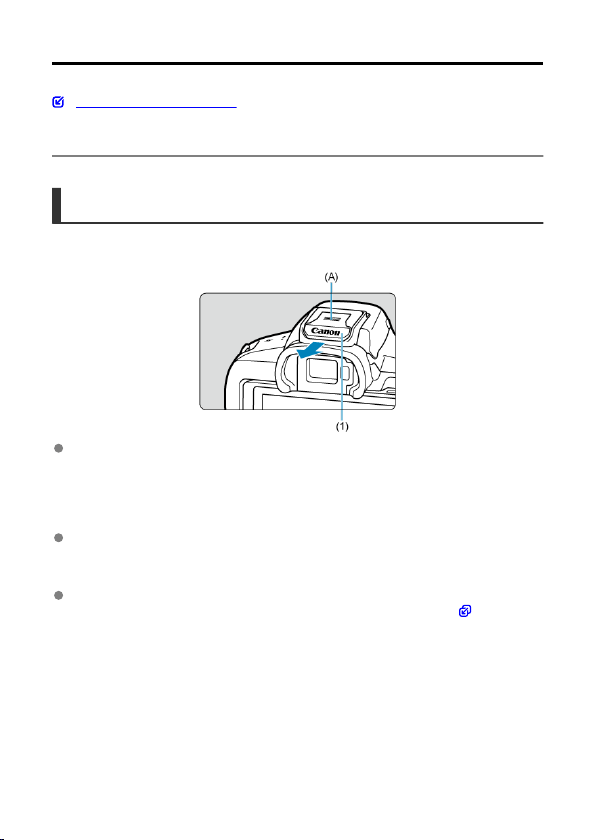
Remove the shoe cover (1) by pressing the part labeled (A) in the figure as shown with
your finger. After removal, keep the shoe cover in a convenient place to avoid losing it.
Attaching accessories
When attaching accessories that communicate through contacts of the multi-function
shoe, insert the accessory's mounting foot until it clicks into place, then slide the
mounting foot locking lever to secure it. For details, refer to the accessory's Instruction
Manual.
Use of accessories not designed for a multi-function shoe requires Multi-Function Shoe
Adapter AD-E1, sold separately. For details, refer to the Canon website ( ).
65
Attaching the shoe cover
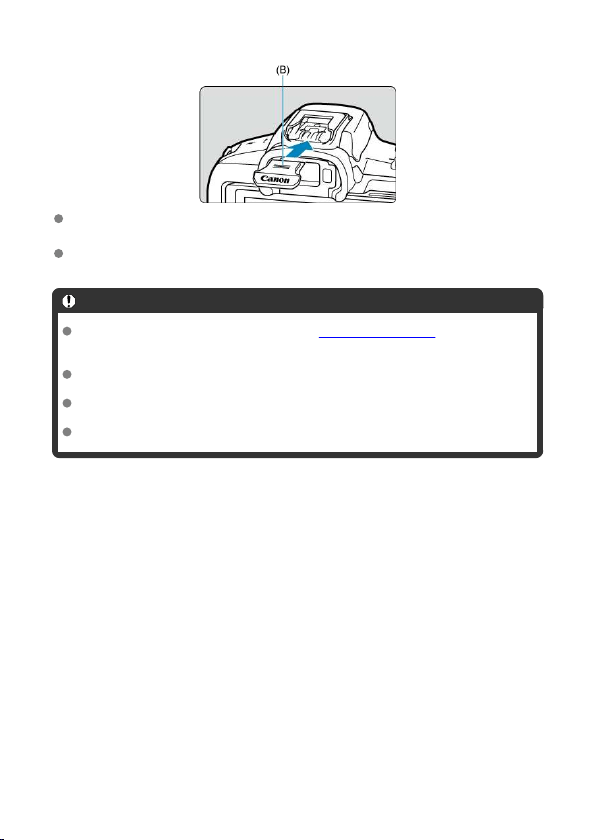
After removing accessories from the multi-function shoe, reattach the shoe cover to
protect the contacts from dust and water.
Slide the shoe cover all the way in by pressing the part labeled (B) in the figure, as
shown.
Caution
Attach accessories correctly as described in Attaching accessories. Incorrect
attachment may cause the camera or accessories to malfunction, and accessories
may fall off.
Blow off any foreign material on the multi-function shoe with a commercially
available blower or similar tool.
If the multi-function shoe becomes wet, turn off the camera and allow it to dry
before use.
Use the shoe cover included with the camera.
66
Using the Viewfinder
Dioptric Adjustment
Look through the viewfinder to activate it. You can also restrict display to either the screen or
viewfinder ( ).
Dioptric Adjustment
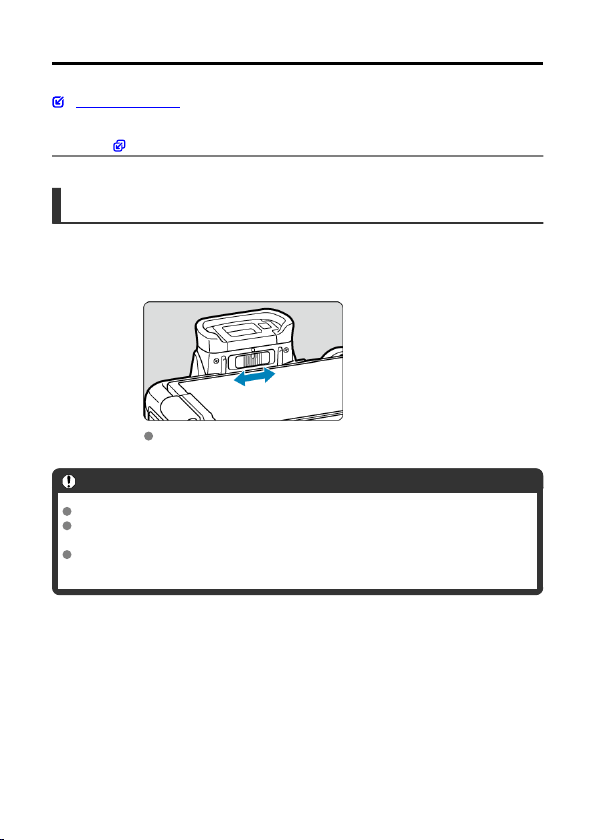
1.
Slide the dioptric adjustment slider.
Slide the slider left or right to make the viewfinder display look sharp.
Caution
The viewfinder and screen cannot be activated at the same time.
Viewfinder display is disabled when the screen is flipped out, even if you look
through the viewfinder.
At some aspect ratios, black bars are displayed on the top and bottom or left and
right edges of the screen. These areas are not recorded.
67

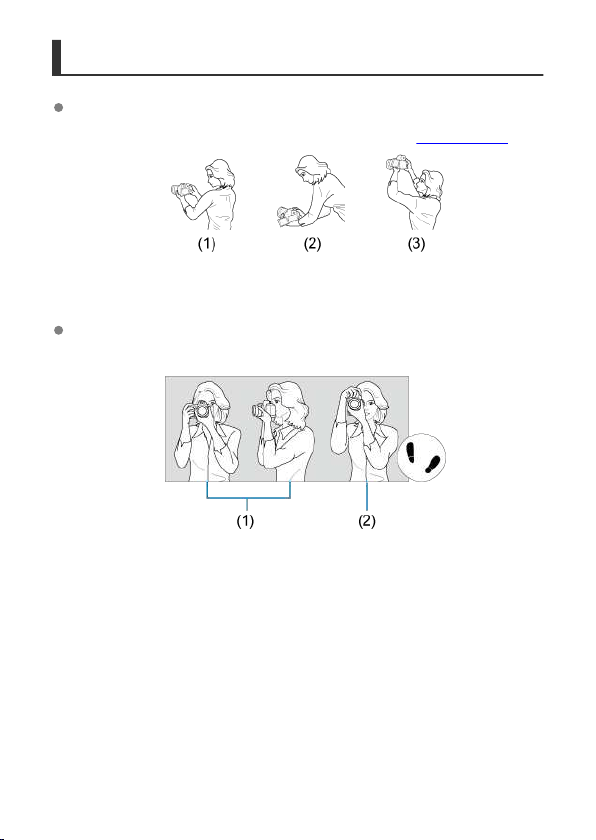
Holding the Camera
Viewing the screen as you shoot
As you shoot, you can tilt the screen to adjust it. For details, see
Using the Screen.
(1) Normal angle
(2) Low angle
(3) High angle
Shooting through the viewfinder
To obtain sharp images, hold the camera still to minimize camera shake.
(1) Horizontal shooting
(2) Vertical shooting
1.With your right hand, hold the camera firmly by the camera grip.
2.With your left hand, support the lens from below.
3.Rest your right index finger lightly on the shutter button.
4.Rest your arms and elbows lightly against the front of your body.
5.To maintain a stable stance, place one foot slightly ahead of the other.
6.Hold the camera near your face and look through the viewfinder.
69
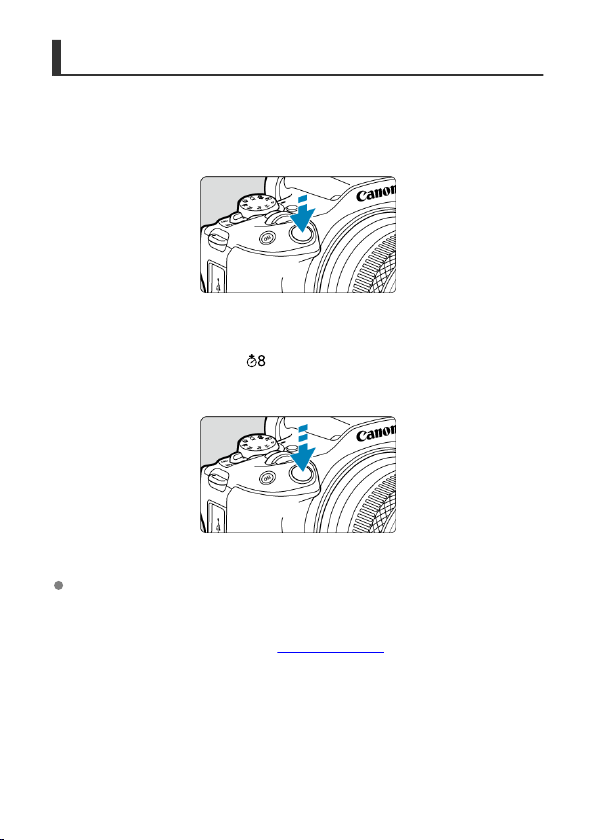
Shutter Button
The shutter button has two steps. You can press the shutter button halfway. Then you can
further press the shutter button completely.
Pressing halfway
This activates autofocusing and the automatic exposure system that sets the shutter speed
and aperture value.
The exposure value (shutter speed and aperture value) is displayed on the screen or in the
viewfinder for 8 sec. (metering timer/
).
Pressing completely
This releases the shutter and takes the picture.
Preventing camera shake
Hand-held camera movement during the moment of exposure is called camera shake. It
can cause blurred pictures. To prevent camera shake, note the following:
• Hold the camera still, as shown in
Holding the Camera.
• Press the shutter button halfway to autofocus, then slowly press the shutter button
completely.
70
Note
The camera will still pause before taking a picture if you press the shutter button
completely without pressing it halfway first, or if you press the shutter button
halfway and immediately press it completely.
Even during menu display or image playback, you can return to shooting standby
by pressing the shutter button halfway.
71
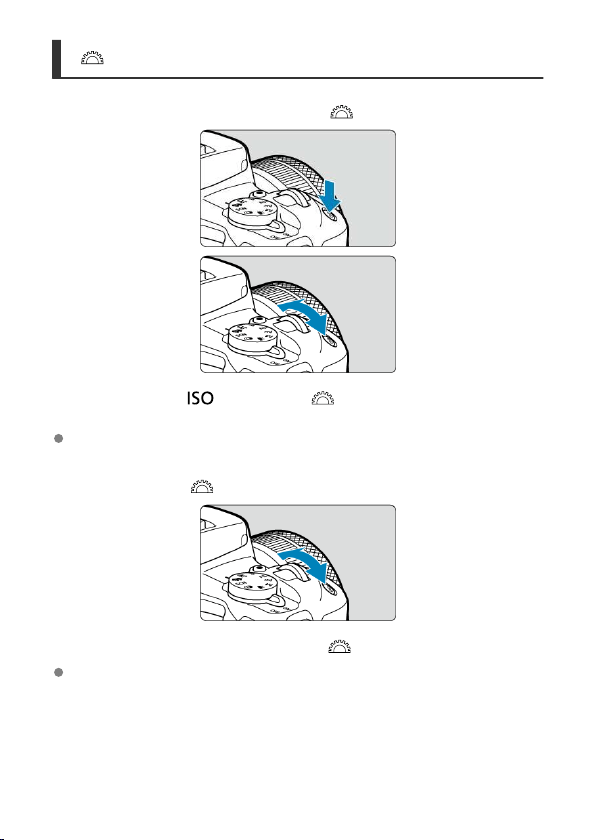
< > Dial
(1) After pressing a button, turn the < > dial.
Press a button such as < >, then turn the < > dial.
If you press the shutter button halfway, the camera will go back to shooting standby.
Used for operations such as setting the ISO speed.
(2) Turn only the
<
> dial.
While looking at the screen or viewfinder, turn the < > dial.
Use this dial to set the shutter speed, aperture value, etc.
72
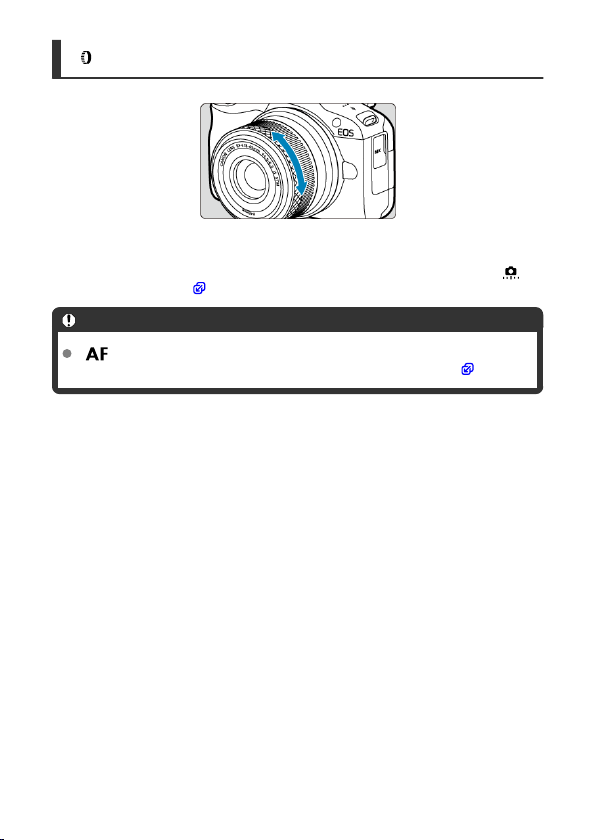
< > Control Ring
Exposure compensation can be set by turning the control ring of RF lenses or mount
adapters while pressing the shutter button halfway in <P>, <Tv>, <Av>, or <M> mode.
Otherwise, you can assign a different function to the control ring by customizing it in [
:
Customize control ring] ( ).
Caution
[ : Focus/control ring] must be set when using lenses that have a combination
focus/control ring but have no switch to switch between these features ( ).
73
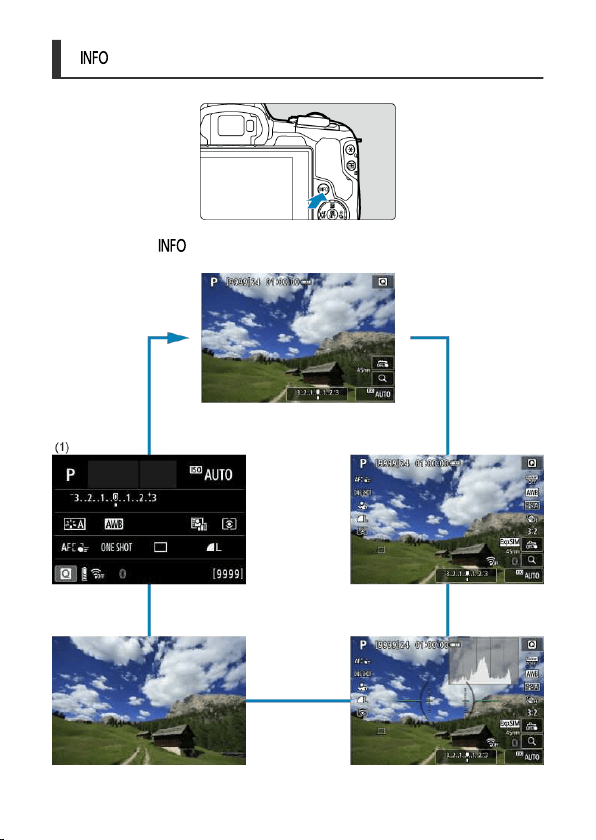
< > Info Button
Each press of the < > button changes the information shown.
The following sample screens are for still photos.
* In Basic Zone modes, the screen by (1) is not displayed.
74
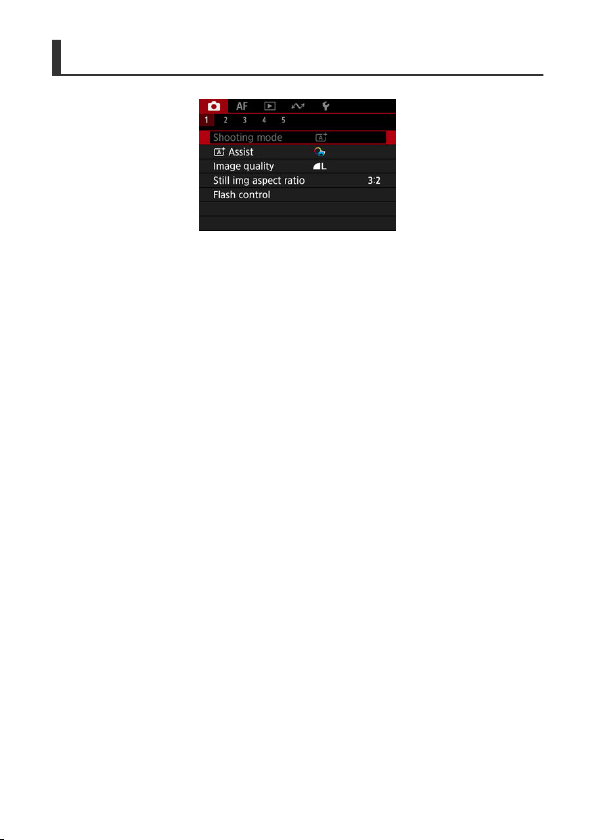
Basic Zone Menu Screen
* In Basic Zone modes, some tabs and menu items are not displayed.
76
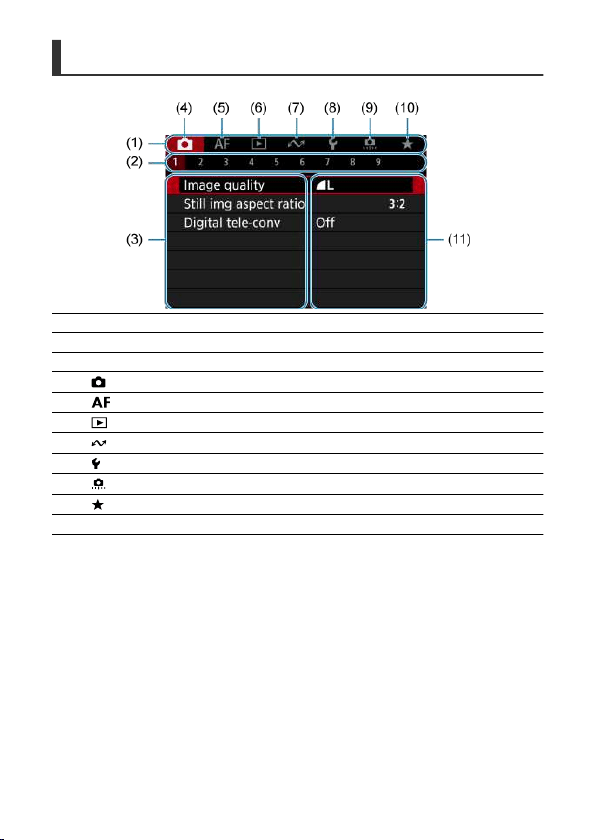
Creative Zone Menu Screen
(1) Main tabs
(2) Secondary tabs
(3) Menu items
(4) : Shooting
(5)
: Autofocus
(6) : Playback
(7)
: Wireless features
(8) : Set-up
(9)
: Custom Functions
(10) : My Menu
(11) Menu settings
77
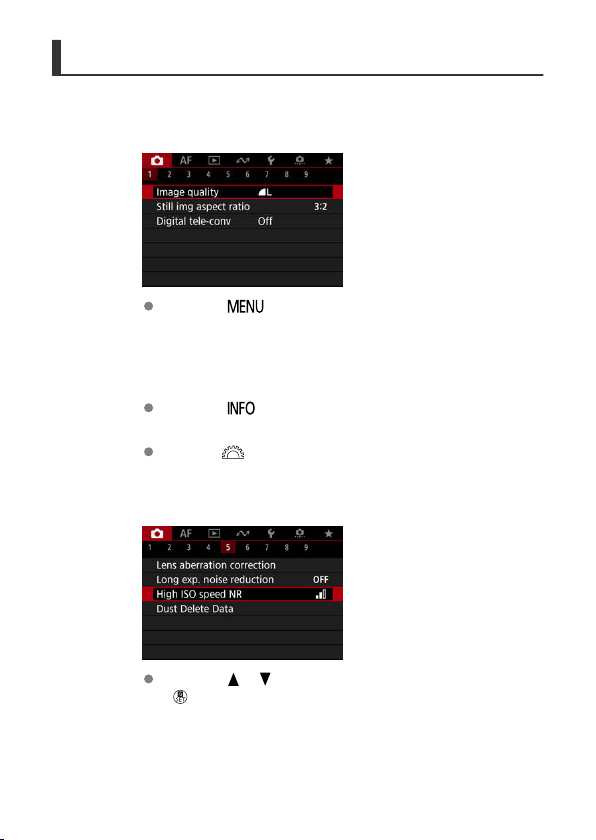
Menu Setting Procedure
1.
Display the menu screen.
Press the < > button to display the menu screen.
2.
Select a tab.
Press the < > button to switch between main tabs (groups of
functions).
Turn the < > dial to select a secondary tab.
3.
Select an item.
Press the < >< > keys to select the setting item, then press the
<
> button.
78
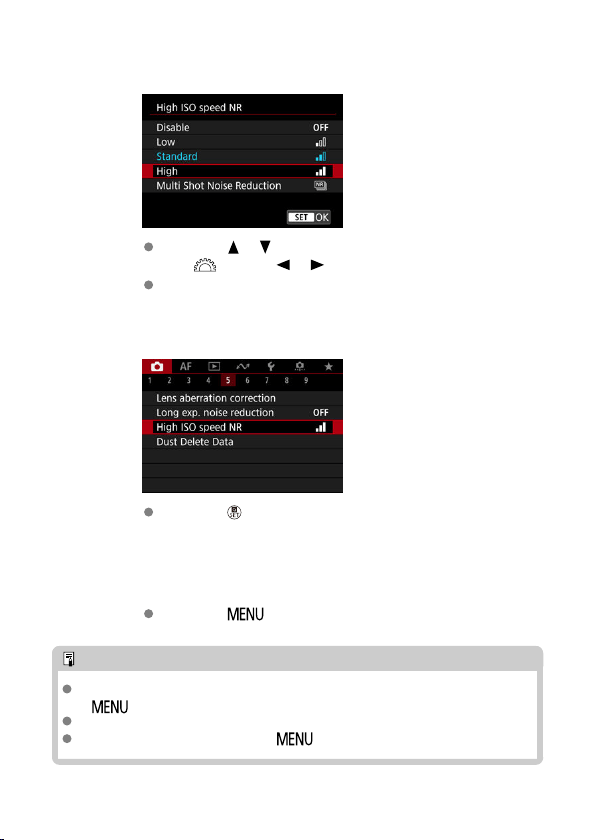
4.
Select an option.
Press the < >< > keys to select an option (or in some cases, use
the <
> dial or < >< > keys).
The current setting is indicated in blue.
5.
Set an option.
Press the < > button to set it.
6.
Exit the setting.
Press the < > button to return to shooting standby.
Note
The description of menu functions hereafter assumes that you have pressed the
<
> button to display the menu screen.
Menu operations are also possible by tapping the menu screen.
To cancel the operation, press the < > button.
79
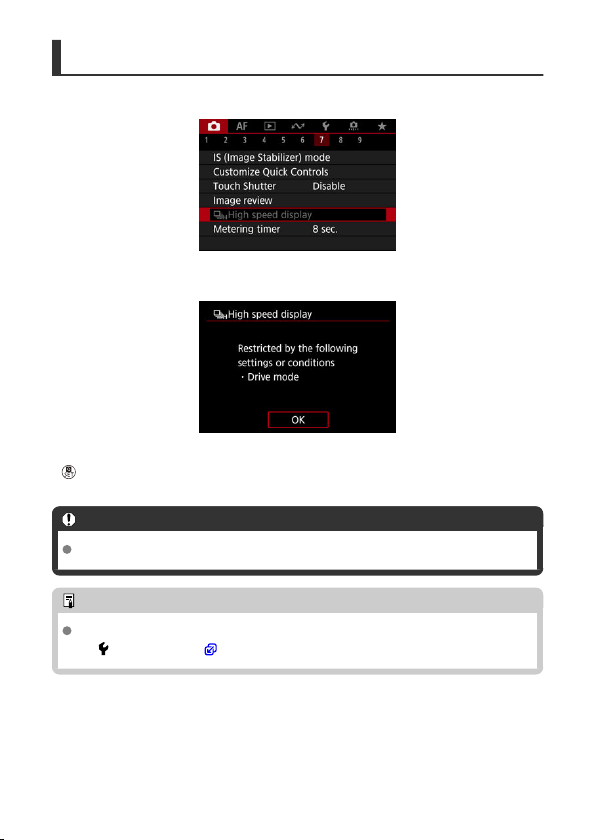
Dimmed Menu Items
Example: When set to single shooting drive mode
Dimmed menu items cannot be set. The menu item is dimmed if another function setting is
overriding it.
You can see the overriding function by selecting the dimmed menu item and pressing the
<
> button.
If you cancel the overriding function's setting, the dimmed menu item will become settable.
Caution
You may not be able to see the overriding function for certain dimmed menu items.
Note
You can reset menu functions to the default settings by selecting [Basic settings]
in [
: Reset camera] ( ).
80
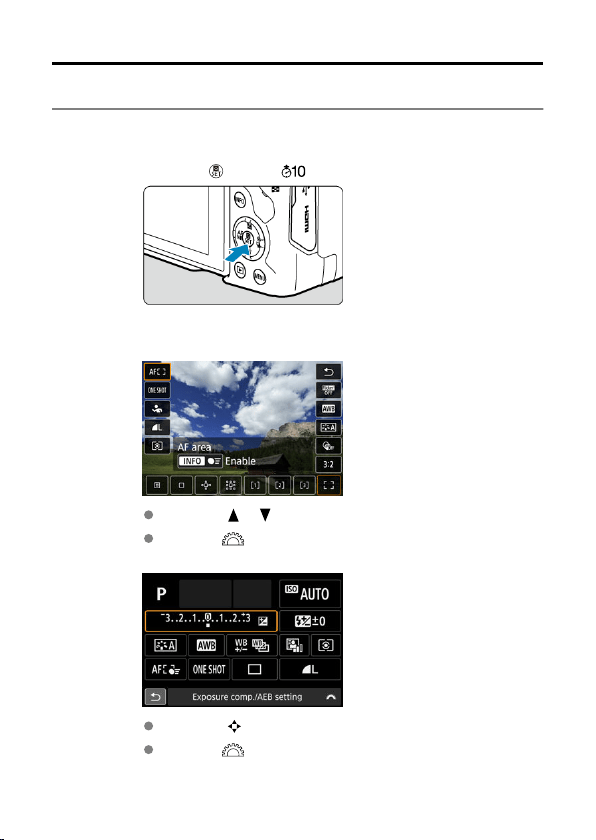
Quick Control
You can directly and intuitively select and set the settings displayed.
1.
Press the <
> button ( ).
2.
Select a setting item and set your preferred option.
Press the < >< > keys to select a setting item.
Turn the < > dial to adjust the setting. Some items are set by
pressing a button after this.
Press the < > keys to select an item on the screen shown above.
Turn the < > dial to adjust the setting. Some items are set by
pressing a button after this.
81
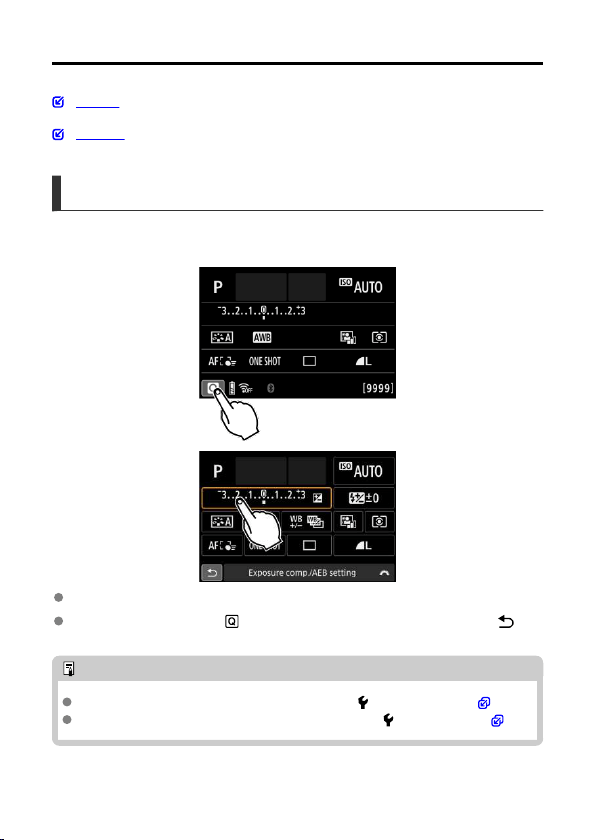
Touch-Screen Operation
Tapping
Dragging
Tapping
Sample screen (Quick Control)
Use your finger to tap (touch briefly and then remove your finger from) the screen.
For example, when you tap [ ], the Quick Control screen appears. By tapping [ ],
you can return to the preceding screen.
Note
To have the camera beep for touch operations, set [ : Beep] to [Enable] ( ).
Responsiveness to touch operations can be adjusted in [ : Touch control] ( ).
82
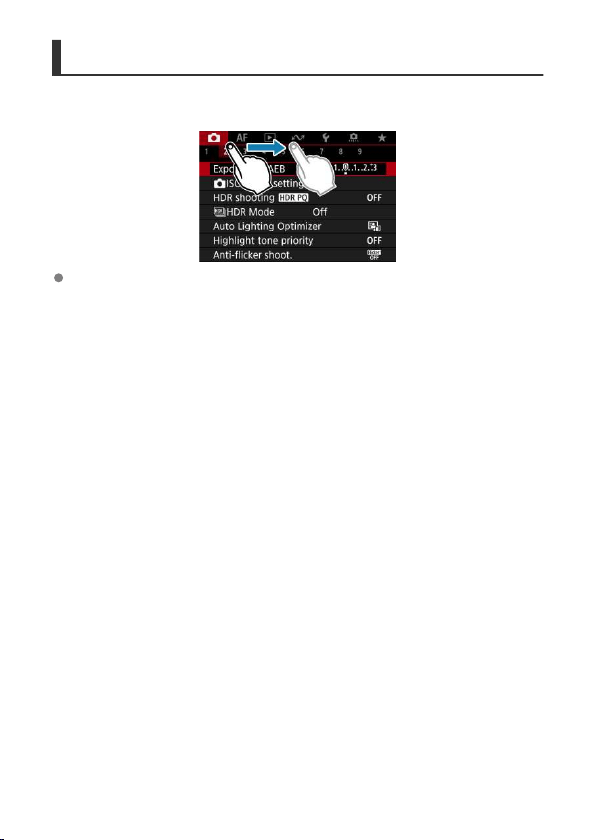
Dragging
Sample screen (Menu screen)
Slide your finger while touching the screen.
83

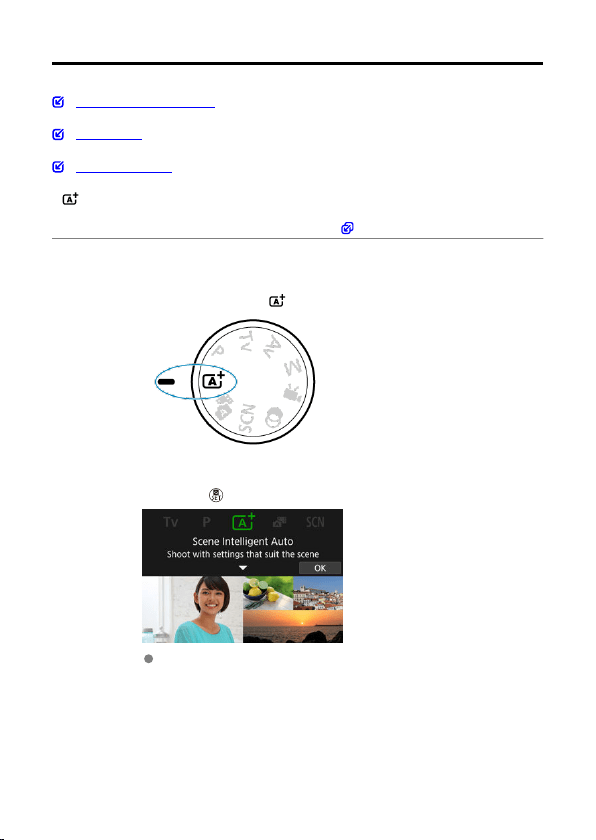
A+: Fully Automatic Shooting (Scene Intelligent Auto)
Shooting Moving Subjects
Scene Icons
Adjusting Settings
< > is a fully automatic mode. The camera analyzes the scene and sets the
optimum settings automatically. It can also adjust focus automatically on either the still or
moving subject by detecting the motion of the subject (
).
1.
Set the Mode dial to <
>.
2.
Press the <
> button.
Read the message and select [OK].
86
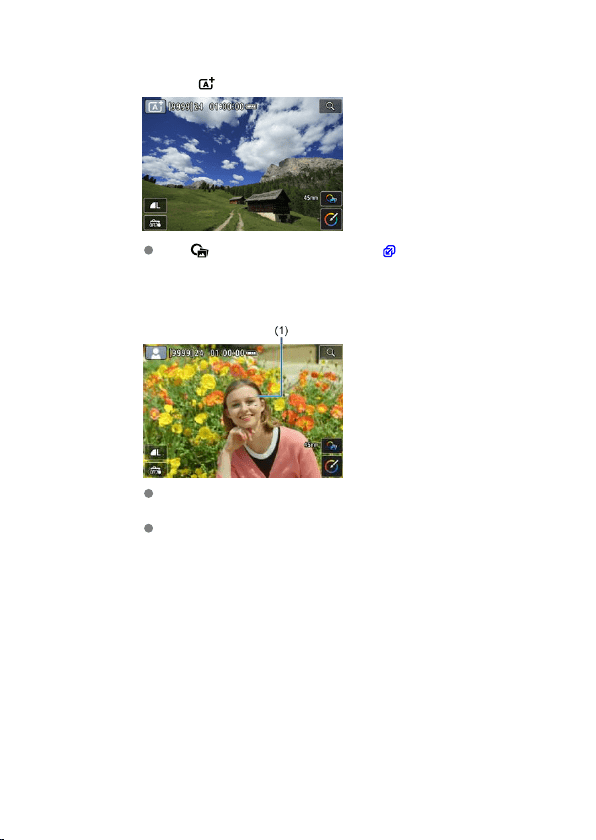
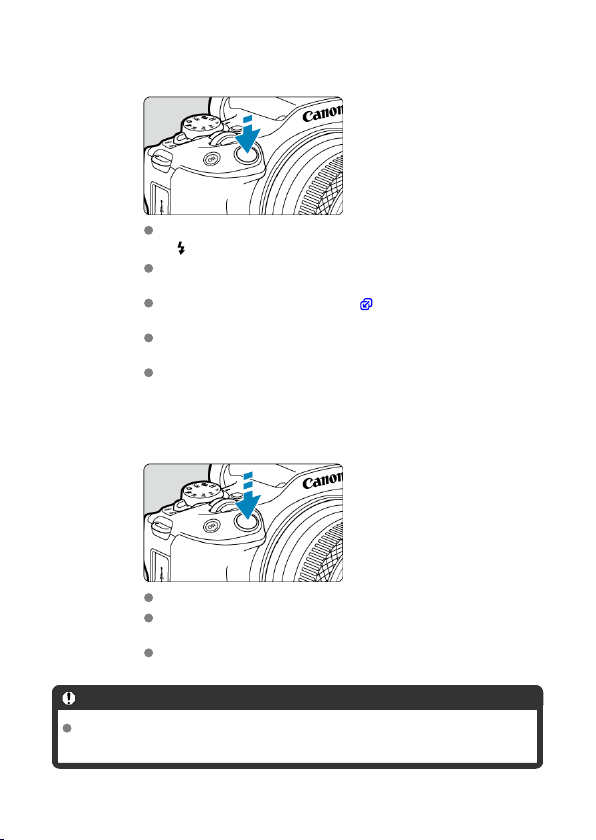
5.
Focus on the subject.
Press the shutter button halfway to focus.
If [
] blinks, manually raise the built-in flash.
You can also focus by tapping a person's face or other subject on the
screen (Touch AF).
Under low light, the AF-assist beam ( ) is automatically activated if
needed.
Once the subject is in focus, that AF point turns green and the camera
beeps (One-Shot AF).
An AF point in focus on a moving subject turns blue and tracks subject
movement (Servo AF).
6.
Take the picture.
Press the shutter button completely to take the picture.
The image just captured will be displayed for approx. 2 sec. on the
screen.
To retract the built-in flash, push it down with your fingers.
Caution
Subject movement (whether subjects are still or moving) may not be detected
correctly for some subject or shooting conditions.
88
Note
AF operation (One-Shot AF or Servo AF) is set automatically when you press the
shutter button halfway. Even when automatically set to One-Shot AF, the camera
will switch to Servo AF if subject motion is detected while you are pressing the
shutter button halfway.
The < > mode makes the colors look more impressive in nature, outdoor, and
sunset scenes. If you do not obtain the desired color tones, change the mode to a
Creative Zone mode (
) and select a Picture Style other than [ ], then shoot
again (
).
Minimizing blurred photos
Be careful about camera shake in handheld shots. To avoid camera shake, consider
using a tripod. Use a sturdy tripod that can bear the weight of the shooting equipment.
Attach the camera securely to the tripod.
Using a wireless remote control (sold separately, ) is recommended.
89
FAQ
Focusing is not possible (indicated by an orange AF point).
Aim the AF point over an area with good contrast, then press the shutter button halfway
( ). If you are too close to the subject, move away and shoot again.
Multiple AF points are displayed simultaneously.
Focus has been achieved at all those points.
The shutter speed display is blinking.
Since it is too dark, taking the picture may result in a blurred subject due to camera
shake. Using a tripod, the built-in flash, or an external flash ( ) is recommended.
Pictures are too dark.
Raise the built-in flash in advance to enable automatic flash firing, in case subjects in
daytime shots are backlit, or when shooting under low light.
Pictures taken with flash are too bright.
Pictures may be bright (overexposed) if you shoot subjects at close range in flash
photography. Move away from the subject and shoot again.
The bottom part of pictures taken with flash is unnaturally dark.
Shooting subjects that are too close may make the shadow of the lens visible in your
shots. Move away from the subject and shoot again. If you are using a lens hood, try
removing it before shooting.
Note
Note the following if you are not using the built-in flash.
• Under low light, when camera shake tends to occur, hold the camera steady or
use a tripod. When using a zoom lens, you can reduce the blur caused by
camera shake by setting the lens to the wide-angle end.
• When shooting portraits under low light, tell subjects to stay still until you have
finished shooting. Any movement as you shoot will make the person look blurry
in the picture.
90

Shooting Moving Subjects
Pressing the shutter button halfway tracks moving subjects to keep them in focus.
Keep the subject on the screen as you hold down the shutter button halfway, and at the
decisive moment, press the shutter button completely.
91
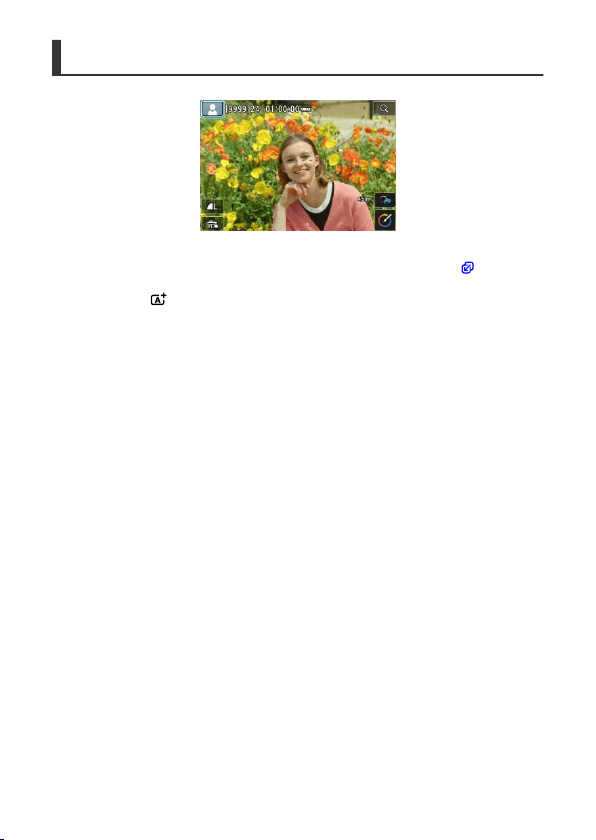
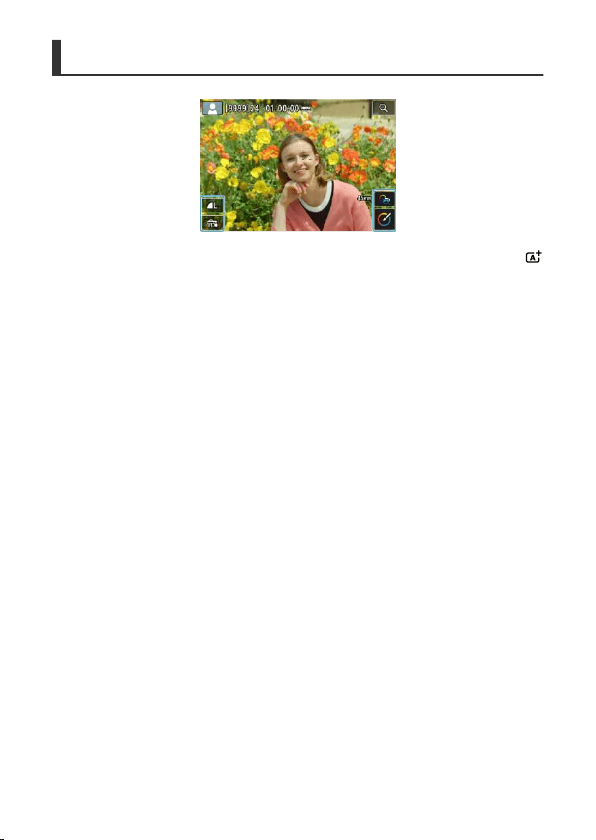
Adjusting Settings
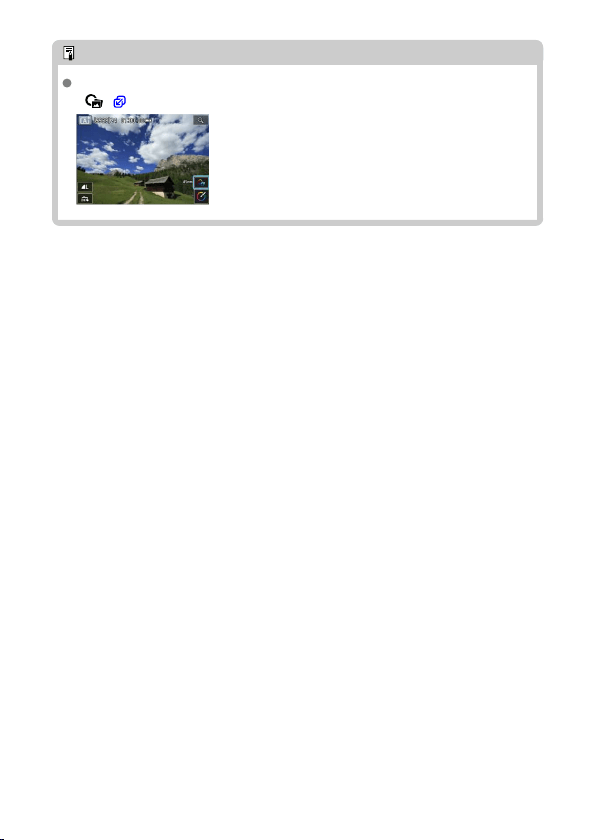
By tapping icons on the screen, you can adjust settings for image quality, Touch Shutter,
Assist, and Creative Assist.
93
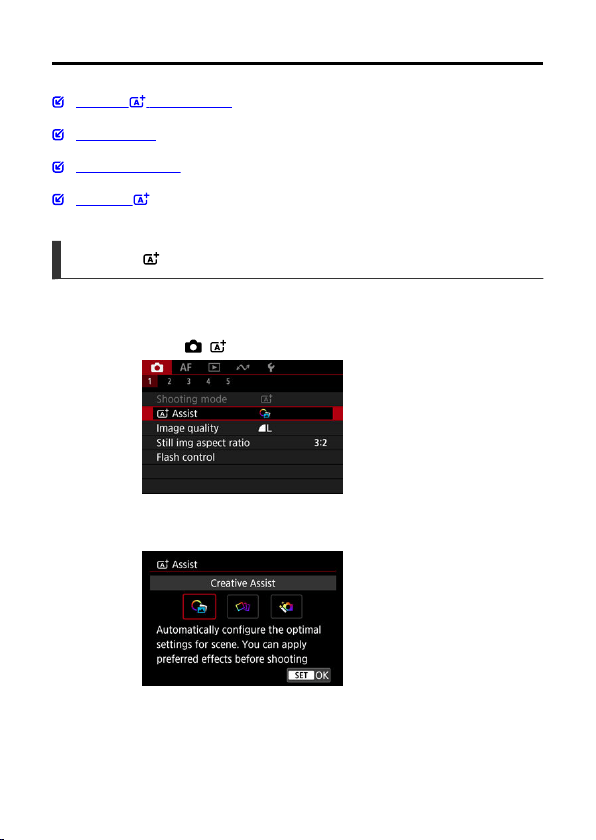
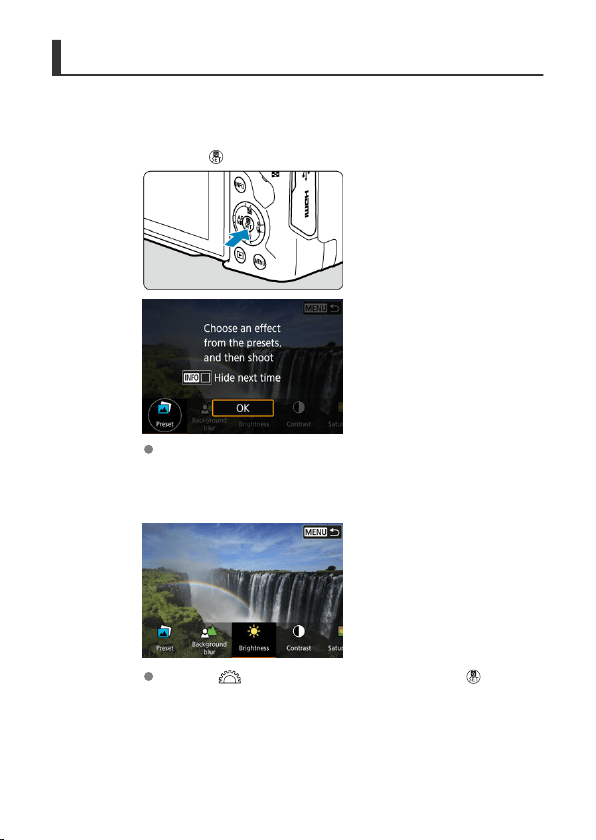
Creative Assist
You can shoot with your preferred effects applied.
1.
Press the <
> button.
Read the message and select [OK].
2.
Select an effect.
Use the < > dial to select an effect, then press the < > button.
96
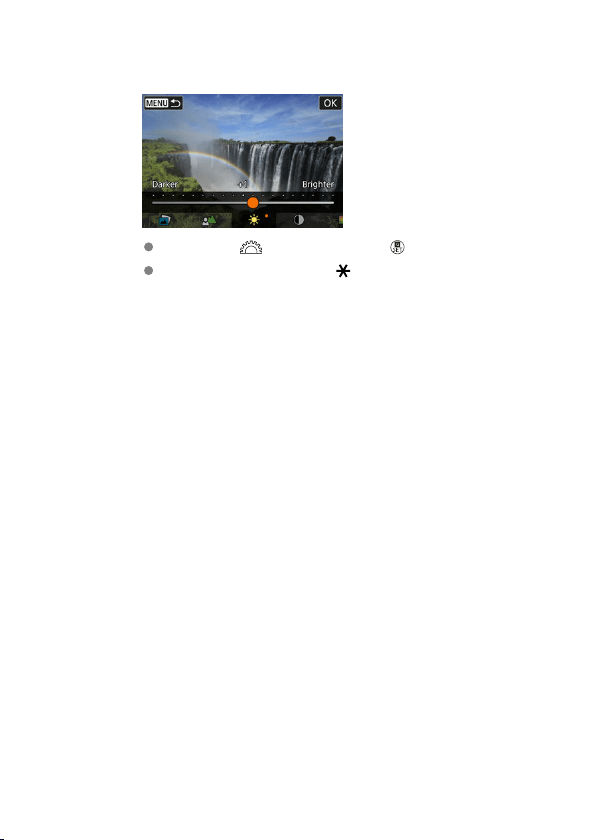
3.
Select the effect level and other details.
Set with the < > dial, then press the < > button.
To reset the setting, press the < > button, then select [OK].
97
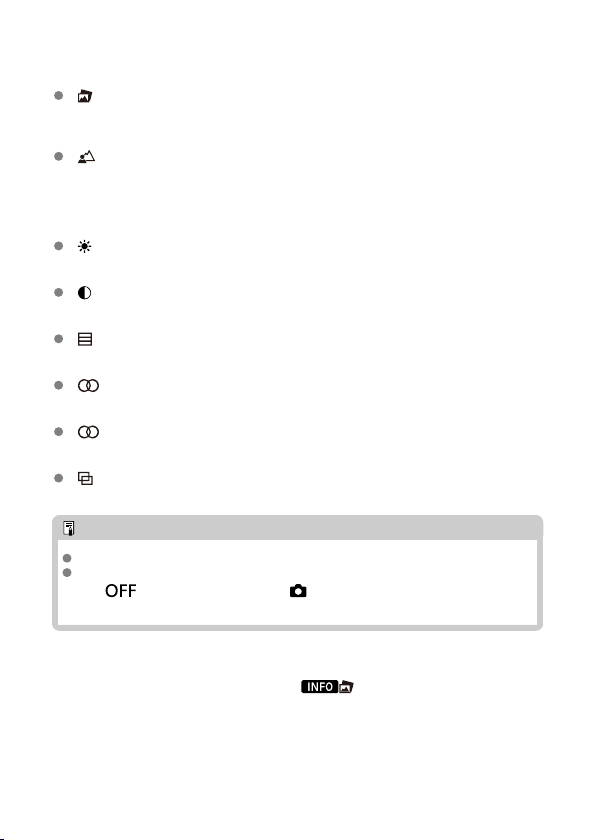
Creative Assist effects
[ ] Preset
Select one of the preset effects.
Note that [Saturation], [Color tone 1], and [Color tone 2] are not available with [B&W].
[ ] Background blur
Adjust background blur. Choose higher values to make backgrounds sharper. To blur
the background, choose lower values. [Auto] adjusts background blurring to match the
brightness. Depending on lens brightness (f/number), some positions may not be
available.
[ ] Brightness
Adjust image brightness.
[ ] Contrast
Adjust contrast.
[ ] Saturation
Adjust the vividness of colors.
[ ] Color tone 1
Adjust amber/blue color tone.
[ ] Color tone 2
Adjust green/magenta color tone.
[ ] Monochrome
Set the toning effect for monochrome shooting.
Note
[Background blur] is not available in flash photography.
These settings are reset when you switch shooting modes or set the power switch
to <
>. To save the settings, set [ : Retain Creative Assist data] to
[Enable].
Saving effects
To save the current setting to the camera, tap [ Register] on the [Creative Assist]
setting screen, then select [OK]. Up to three presets can be saved as [USER*]. After three
have been saved, an existing [USER*] preset must be overwritten to save a new one.
98
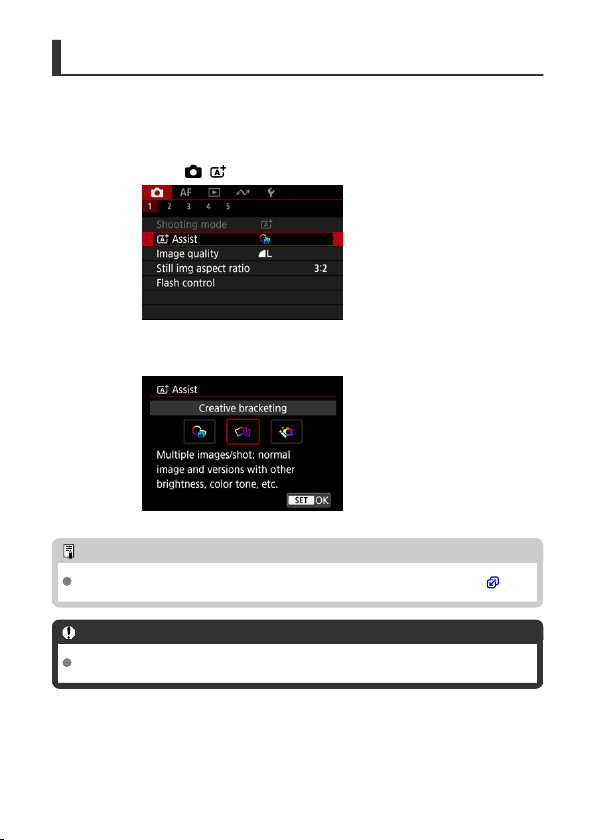
Creative Bracketing
Multiple images are captured per shot besides the normal image, each with characteristics
such as brightness and color tone automatically changed.
1.
Select [
: Assist].
2.
Select [Creative bracketing].
Note
Index display makes it easier to review the captured images on the camera ( ).
Caution
Continuous shooting is not available.
99
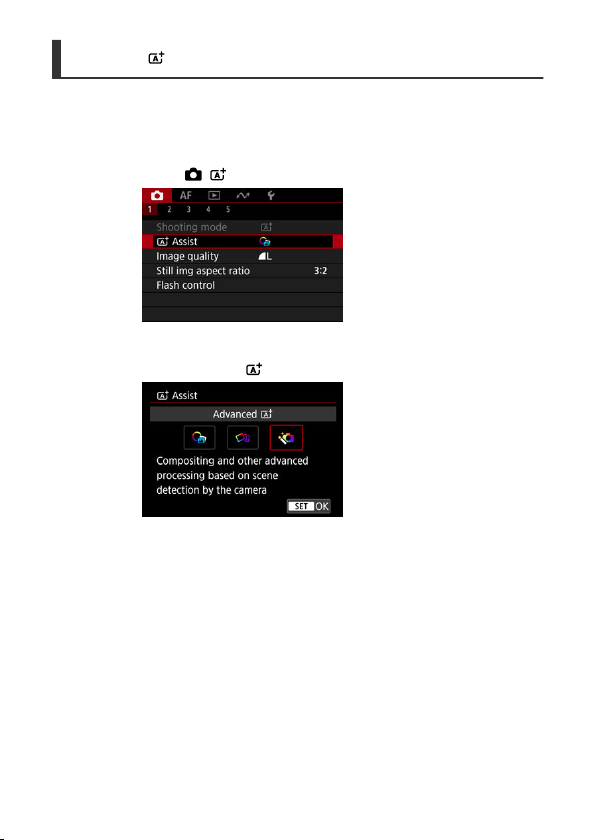
Advanced
Compositing and other advanced processing is applied to your shots based on scene
detection by the camera.
1.
Select [
: Assist].
2.
Select [Advanced
].
100
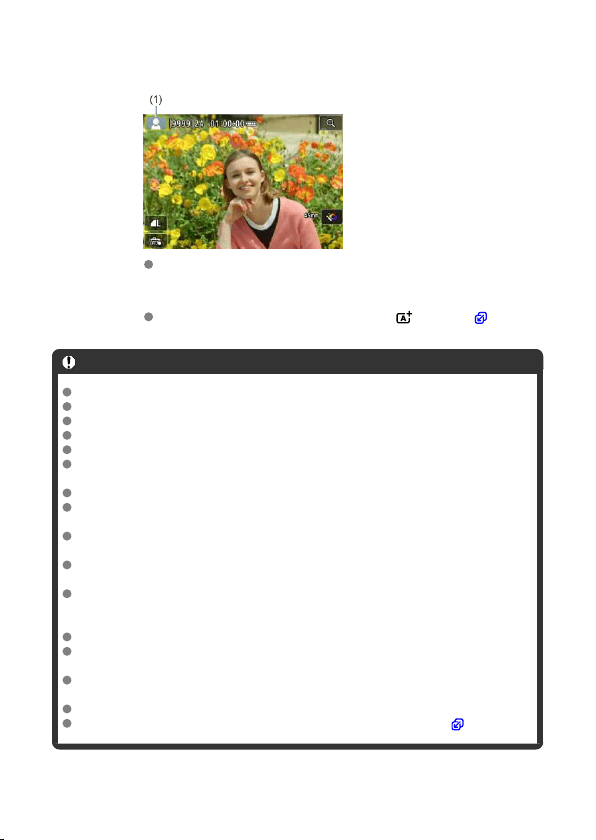
3.
Check the icon.
Blinking scene icon (1): Multiple images are captured per shot and
merged into a single image. In this case, only the composite image is
saved.
Normal scene icon display: Shooting with < > settings ( ).
Caution
Continuous shooting is not available.
The camera shoots in [Electronic] shutter mode.
The image area is smaller than in other shooting modes.
RAW image quality cannot be set.
Flash photography is not available.
Images that are greatly out of alignment due to camera shake or other issues may
not be aligned correctly.
To prevent camera shake, the camera may set a high ISO speed.
Note that the image may not be rendered with a smooth gradation and may look
uneven or noisy.
The image processing may not be sufficient in scenes with strong backlighting or
high contrast.
Shooting moving subjects may result in afterimages from the movement, or
darkness around the subject.
Images may not be aligned correctly if they are patterned (with a lattice or stripes,
for example), are generally flat and uniform, or are greatly out of alignment due to
camera shake or other issues.
Be careful about camera shake in handheld shots.
Shooting under fluorescent or LED lighting may cause issues such as irregular
exposure or colors in the resulting images, due to the flickering light source.
[BUSY] appears on the screen as images are processed, and shooting is not
possible until processing is finished.
Shots will look slightly different from the preview image shown on the screen.
AF point display information is not added to images in some scenes. ( )
101
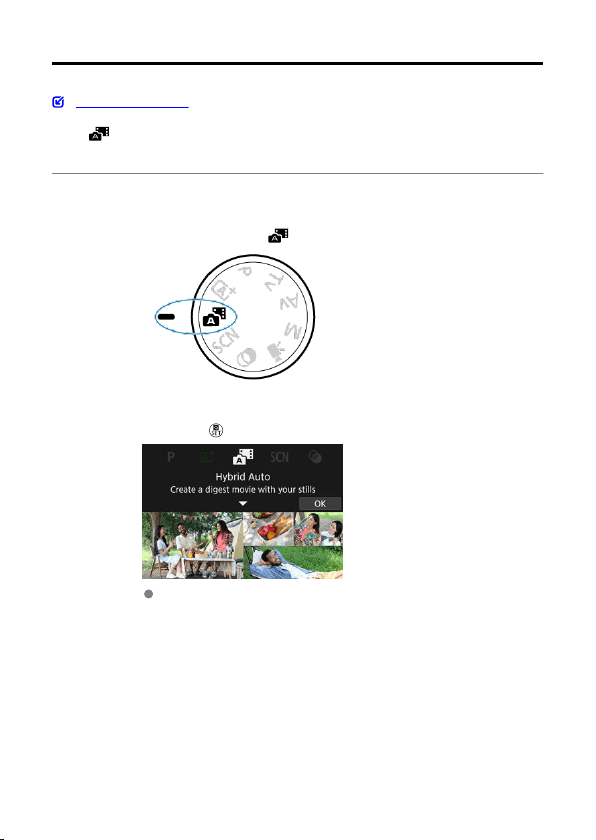
Hybrid Auto
Type of Digest Movie
With < > mode, you can make a short movie of the day just by shooting still photos. The
camera records approx. 2–4-second clips of scenes before each shot, which are later
combined in a digest movie.
1.
Set the Mode dial to <
>.
2.
Press the <
> button.
Compose your shots and shoot.
102
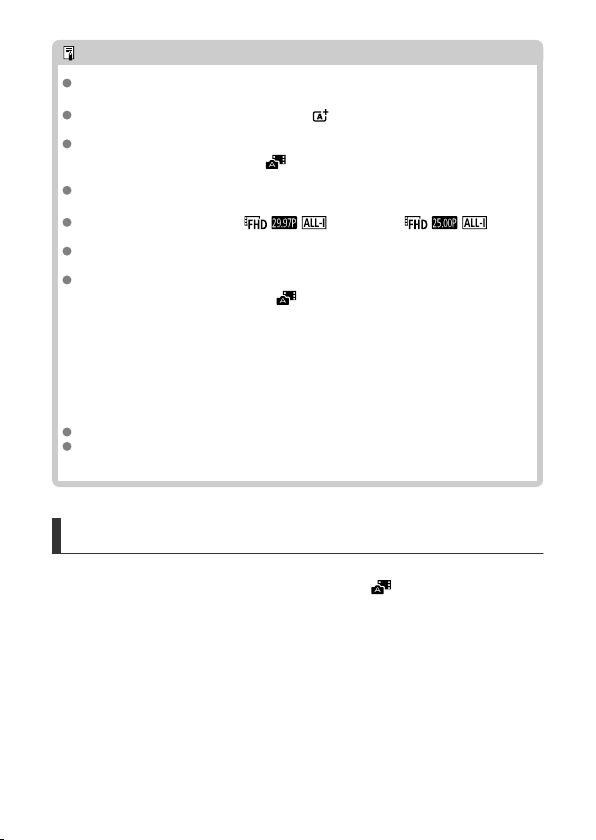
Note
For more impressive digest movies, keep the camera aimed at subjects for about 4
sec. before shooting still photos.
Battery life is shorter in this mode than in < > mode, because digest movies are
recorded for each shot.
A digest movie may not be recorded if you shoot a still photo immediately after
turning the camera on, selecting <
> mode, or operating the camera in other
ways.
Any sounds and vibrations from your camera or lens operations will be recorded in
digest movies.
Digest movie image quality is [ ] for NTSC or [ ] for
PAL. This varies depending on the video system setting.
The camera does not beep in response to operations such as pressing the shutter
button halfway or using the self-timer.
Digest movies are saved as separate movie files in the following cases even if they
were recorded on the same day in <
> mode.
• The digest movie file size exceeds 4 GB (when recording to cards that are not
exFAT-formatted)
• Changes are made to date, time zone, video system, or daylight saving time
settings, or the card is switched
• The digest movie file intended for additional recording is protected
• Author or copyright information of the digest movie file intended for additional
recording differs from that set on the camera
Recorded shutter sounds cannot be modified or erased.
When using EOS Utility to shoot, set [Image saving location] in EOS Utility to
[Computer and camera memory card] or [Camera memory card only].
Type of Digest Movie
Both still photos and clips are captured when you shoot in <
> mode, but you can
specify whether to include the still photos in the resulting digest movie.
103
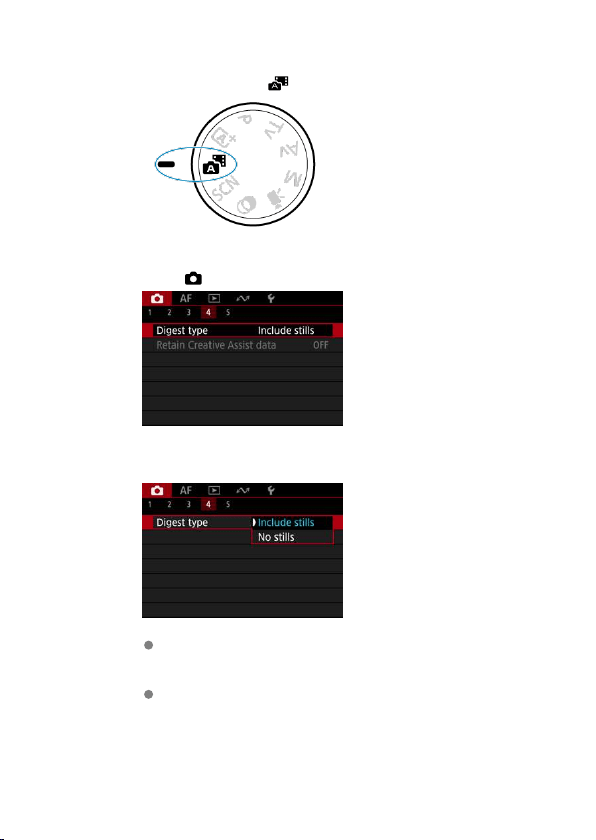
1.
Set the Mode dial to <
>.
2.
Select [
: Digest type].
3.
Select an option.
Include stills
Digest movies include still photos.
No stills
Digest movies do not include still photos.
104
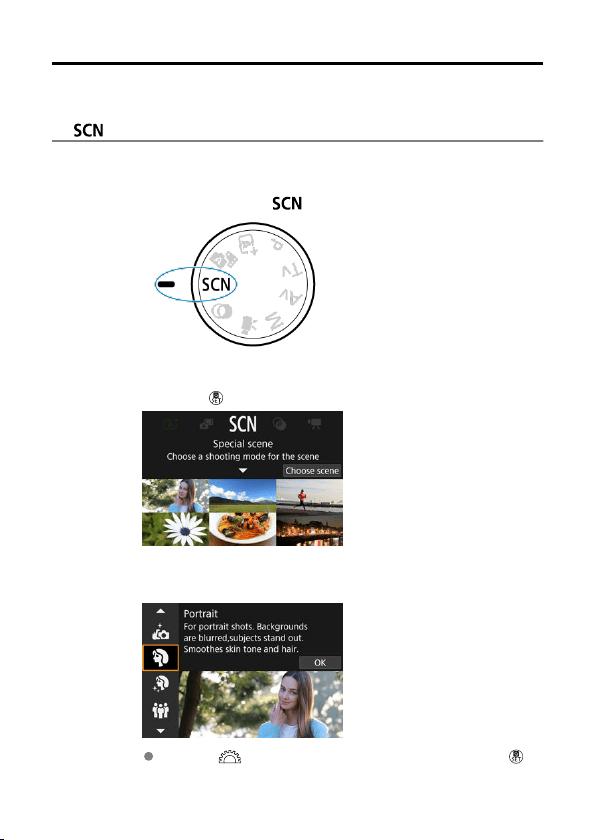
Special Scene Mode
The camera will automatically choose the appropriate settings when you select a shooting
mode for your subject or scene.
* <
> stands for Special Scene.
1.
Set the Mode dial to <
>.
2.
Press the <
> button.
3.
Select a shooting mode.
Use the < > dial to select a shooting mode, then press the < >
button.
105
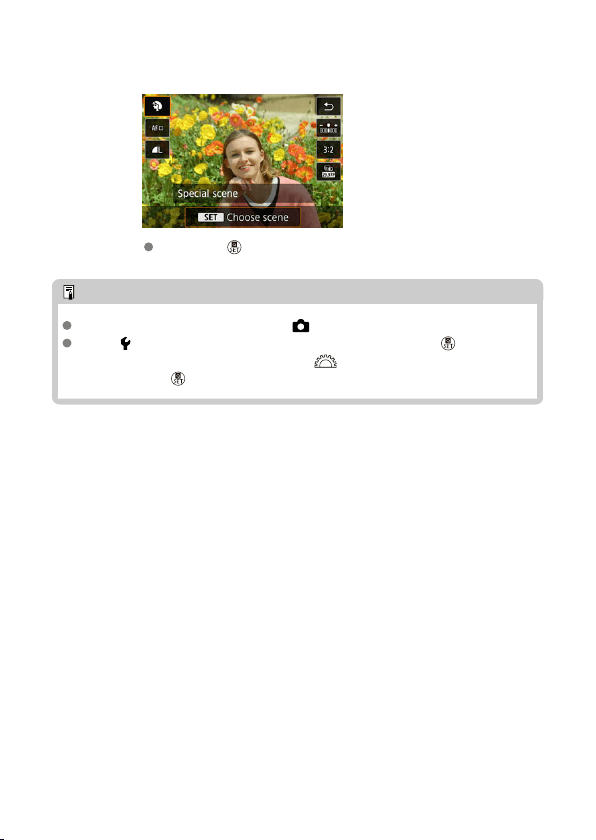
4.
Review the settings.
Press the < > button to display the Quick Control screen.
Note
You can also set the shooting mode in [ : Shooting mode].
When [ : Mode guide] is set to [Disable], after step 1, press the < > button to
access the Quick Control screen, use the
<
> dial to select a shooting mode,
then press the <
> button.
106
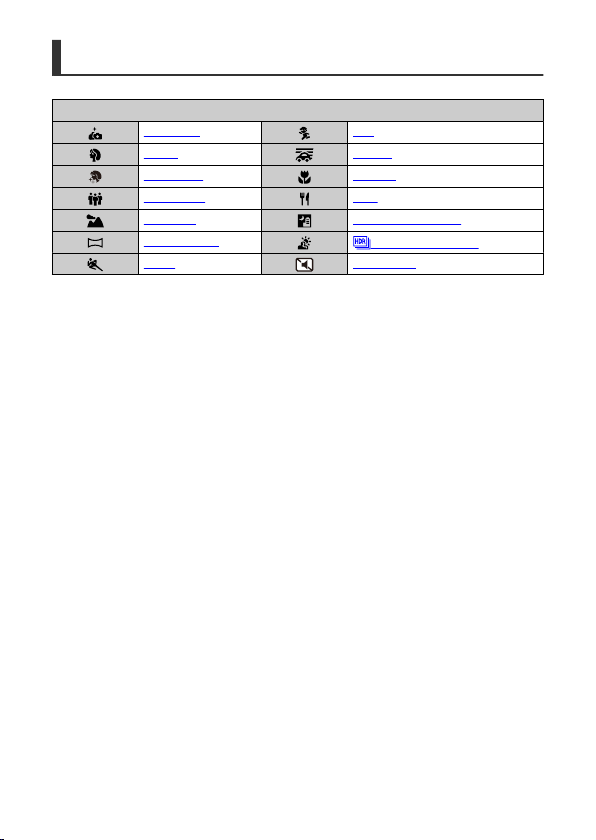
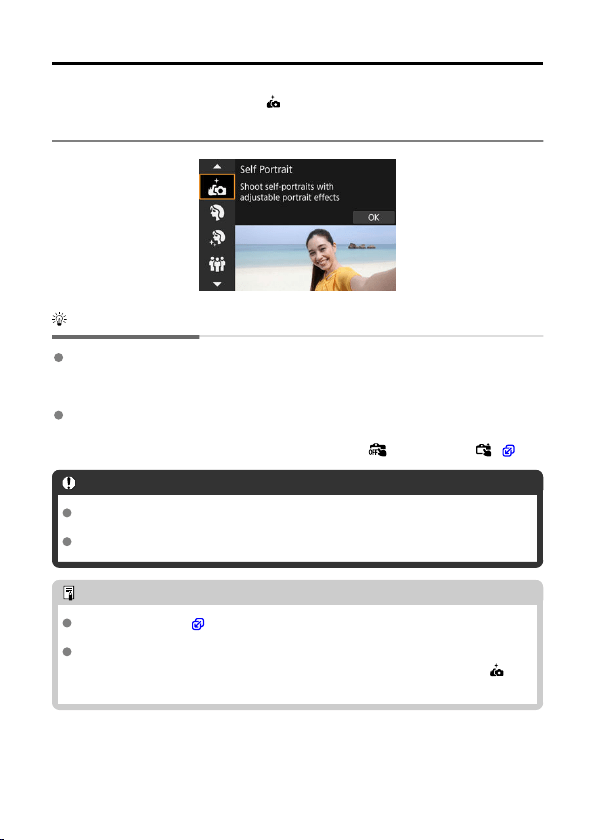
Self Portrait Mode
To take shots that include yourself, use [
] (Self Portrait) mode. Rotate the screen around
toward the lens. Customizable image processing includes skin smoothing as well as
brightness and background adjustment to make yourself stand out.
Shooting tips
Set the brightness and smooth skin effect.
[Brightness] and [Smooth skin effect] can be set in a range of five levels. In
[Background], you can adjust the level of background blurring.
Tap the screen to shoot.
Besides pressing the shutter button completely to shoot, you can also shoot by tapping
the screen, once you enable Touch Shutter by tapping [
] to change it to [ ] ( ).
Caution
After the camera achieves focus, do not change the distance between you and the
camera until the picture is taken.
Be careful not to drop the camera.
Note
The self-timer lamp ( ) does not blink when the screen is facing toward the front
of the camera in [Self Portrait] mode.
You can also take shots of yourself in shooting modes other than [Self Portrait]
(except [Silent shutter]) by rotating the screen toward the front and tapping [
] in
the lower left.
108
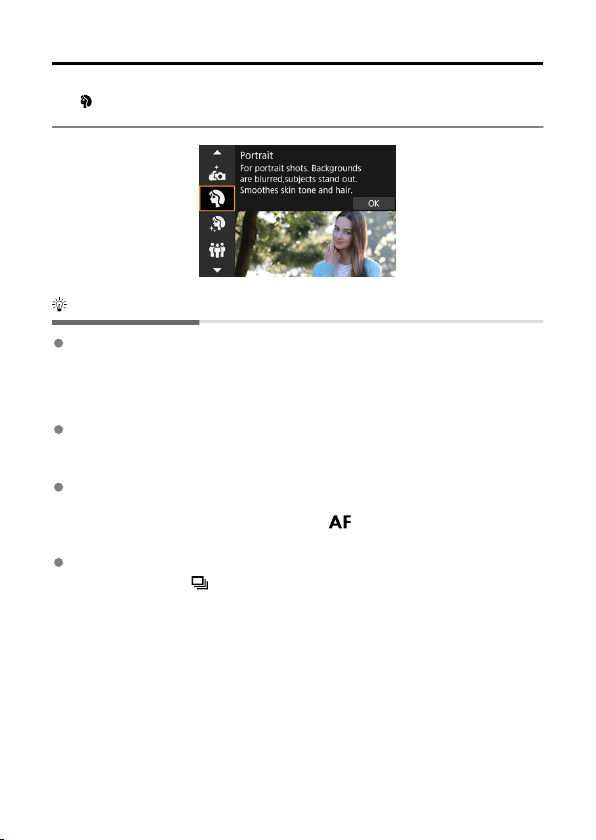
Portrait Mode
Use [
] (Portrait) mode to blur the background and make the person you shoot stand out. It
also makes skin tones and hair look softer.
Shooting tips
Select the location where the distance between the subject and the background is
the farthest.
The further the distance between the subject and background, the more blurred the
background will look. The subject will also stand out better against an uncluttered dark
background.
Use a telephoto lens.
If you have a zoom lens, use the telephoto end to fill the frame with the subject from the
waist up.
Focus on the face.
As you focus before shooting, make sure the AF point on the subject's face is green.
When shooting close-ups of faces, you can set [
: Eye detection] to [Enable] to
shoot with the subject's eyes in focus.
Shoot continuously.
The default setting is [ ] (Low speed continuous). If you keep holding down the shutter
button, you can shoot continuously to capture changes in the subject's facial expression
and pose.
109
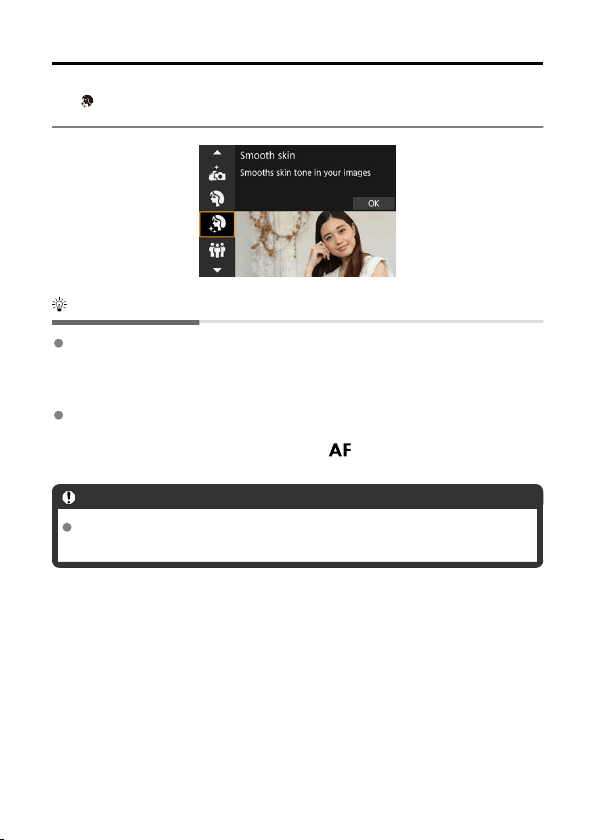
Smooth Skin Mode
Use [
] (Smooth skin) mode to make skin look more attractive. Image processing makes
skin look smoother.
Shooting tips
Enable the camera to detect faces.
Frames are displayed around any main subjects detected for skin smoothing. For more
effective skin smoothing, you can move closer to or farther from the subject so that the
frame is displayed on the subject's face.
Focus on the face.
As you focus before shooting, make sure the AF point on the subject's face is green.
When shooting close-ups of faces, you can set [
: Eye detection] to [Enable] to
shoot with the subject's eyes in focus.
Caution
Areas other than people's skin may be modified, depending on the shooting
conditions.
110
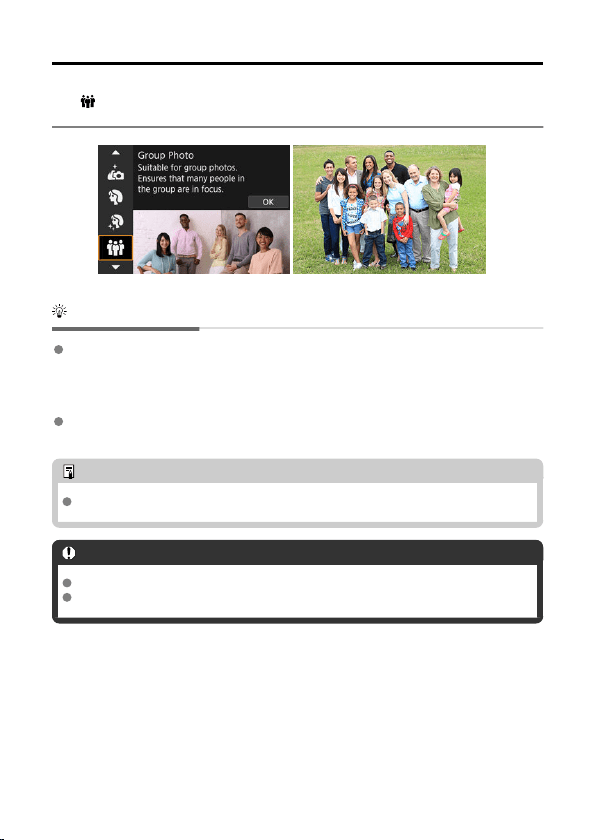
Group Photo Mode
Use [
] (Group Photo) mode to take group photos. You can shoot with people from the
front to the back all in focus.
Shooting tips
Use a wide-angle lens.
With zoom lenses, zooming out near the wide-angle end makes it easier to focus on
everyone in front and back at once. You can also increase the depth of field by standing
a little farther away from subjects, so that they fit completely in the frame.
Take a few shots of the group.
It is a good idea to take a few shots, because people sometimes blink.
Note
Hold the camera steady or use a tripod when shooting indoors or under low light.
Caution
The angle of view changes slightly, due to distortion correction.
Not all people may be in focus, depending on shooting conditions.
111
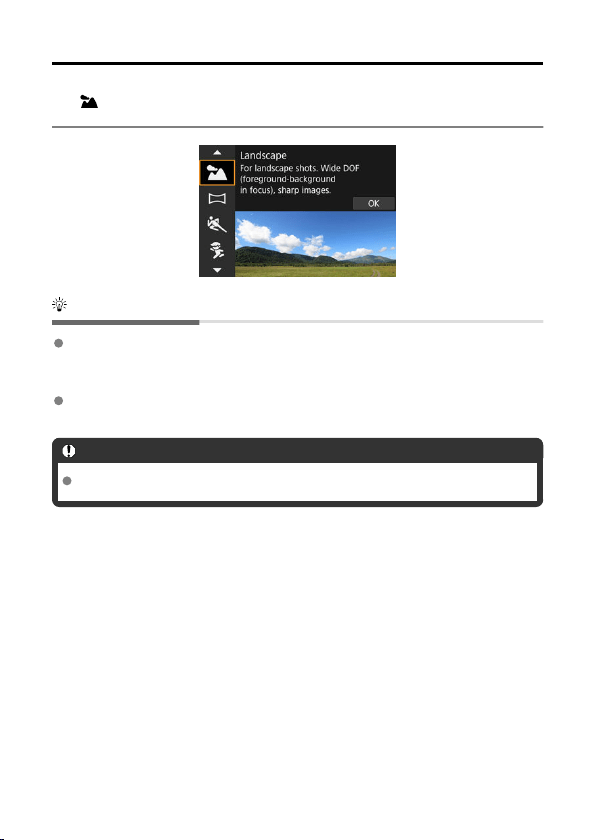
Landscape Mode
Use [
] (Landscape) mode for expansive scenery, to keep everything in focus from near to
far. For vivid blues and greens, and sharp and crisp images.
Shooting tips
With a zoom lens, use the wide-angle end.
When using a zoom lens, set the lens to the wide-angle end to make the objects near
and far in focus. It also adds breadth to landscapes.
Keep the camera steady when shooting night scenes.
Using a tripod is recommended.
Caution
Flash photography is not available.
112
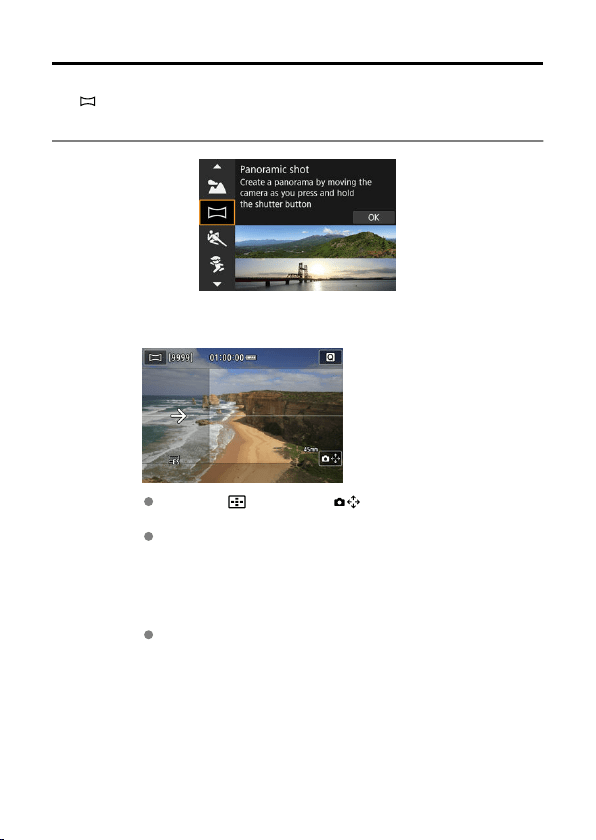
Panoramic Shot Mode
Use [
] (Panoramic Shot) mode to shoot panoramas. The panorama is created by
combining shots captured in continuous shooting as you move the camera in one direction
while pressing the shutter button completely.
1.
Choose a shooting direction.
Press the < > button or tap [ ] in the lower right to choose the
direction you will shoot.
An arrow is displayed showing the direction to move the camera.
2.
Press the shutter button halfway.
Keeping the shutter button pressed halfway, focus on the subject.
113
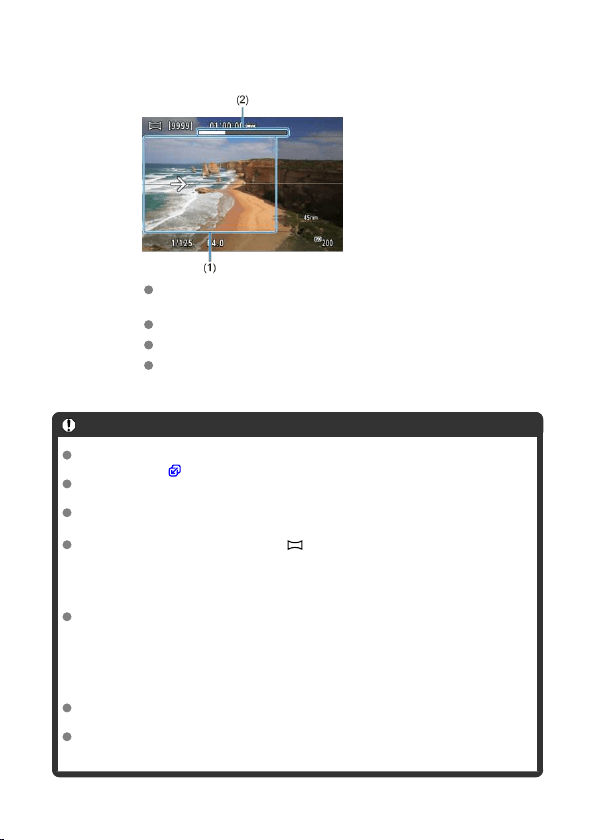
3.
Shoot.
Press the shutter button completely and move the camera at a constant
speed in the direction of the arrow.
The area displayed clearly (1) is captured.
A shooting progress indicator (2) is displayed.
Shooting stops when you release the shutter button, or when all of the
progress indicator is white.
Caution
For details on lenses that can counteract blur from swinging the camera, visit the
Canon website ( ).
In some scenes, images you intended to capture may not be saved as expected,
and the panorama may not look as expected.
Shooting may stop midway if you move the camera too slowly or quickly. However,
the panorama created up to that point will still be saved.
In consideration of the large sizes of < > mode images, use a computer or other
device to reduce panorama images if you will print them from a memory card
inserted in a Canon printer.
If panoramas cannot be managed correctly by software or Web services, try
resizing them on a computer.
Shots of the following subjects and scenes may not be combined correctly.
• Subjects in motion
• Subjects at close range
• Scenes where the contrast varies greatly
• Scenes with long stretches of the same color or pattern, such as the sea or sky
Shooting is not affected by any correction applied to counteract blur from swinging
the camera.
Move the camera slowly when using a lens with a long focal length, or when
shooting night scenes or under low light.
114
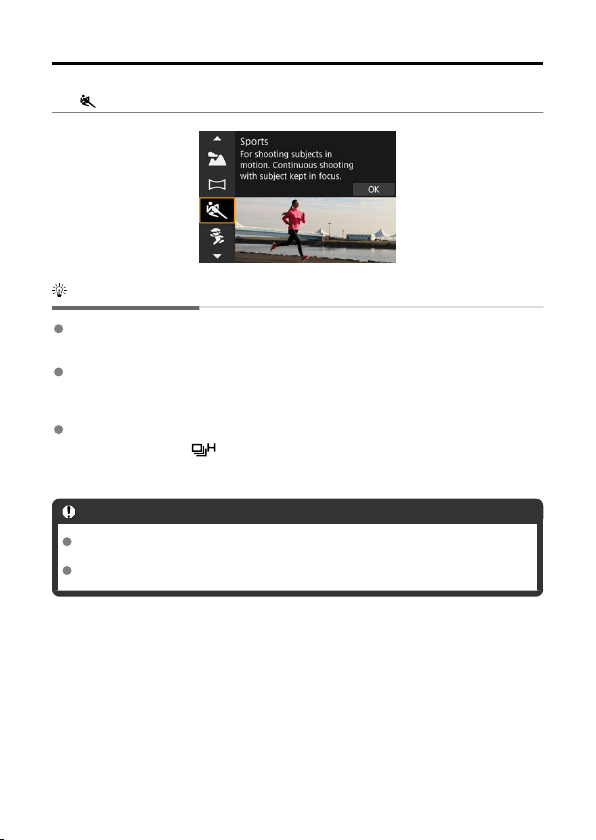
Sports Mode
Use [
] (Sports) mode to shoot subjects in motion, such as runners or moving vehicles.
Shooting tips
Use a telephoto lens.
Use of a telephoto lens is recommended to enable shooting from a distance.
Track the subject with the Area AF frame.
An Area AF frame appears after you press the shutter button halfway. Once the subject
is in focus, the AF point turns blue.
Shoot continuously.
The default setting is [ ] (High speed continuous). At the decisive moment, press the
shutter button completely to take the picture. To track the subject and capture changes
as it moves, keep holding down the shutter button to shoot continuously.
Caution
Under low light where camera shake tends to occur, the shutter speed value in the
lower left will blink. Hold the camera steady and shoot.
Flash photography is not available.
115
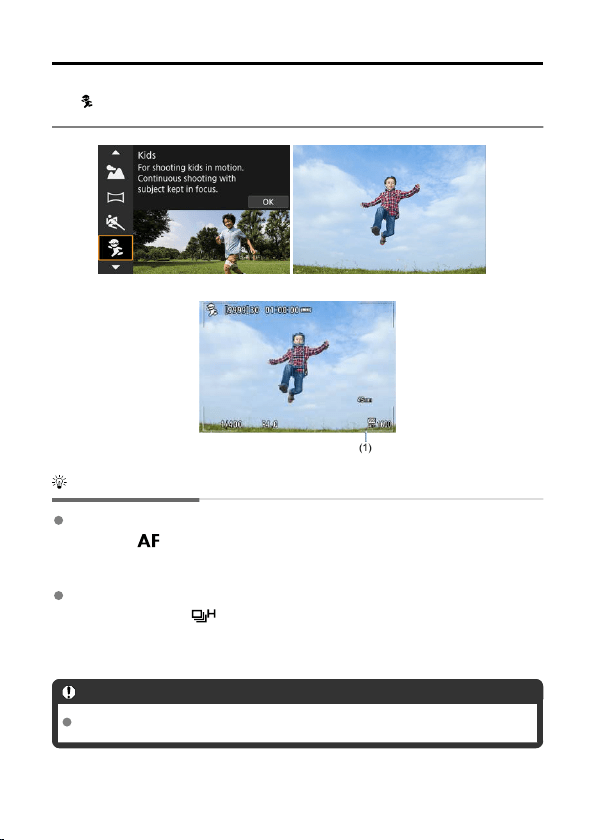
Kids Mode
Use [
] (Kids) mode to capture active children who are moving around. Skin tones will look
vibrant.
Shooting tips
Track the subject with the Area AF frame.
By default, [ : AF area] is set to [Whole area AF]. Area AF frames (1) appear when
you press the shutter button halfway. Once the subject is in focus, the AF point turns
blue.
Shoot continuously.
The default setting is [ ] (High speed continuous). At the decisive moment, press the
shutter button completely to take the picture. To track the subject and capture changes
in facial expression and movement, keep holding down the shutter button to shoot
continuously.
Caution
Using an external flash unit will reduce the continuous shooting speed.
116
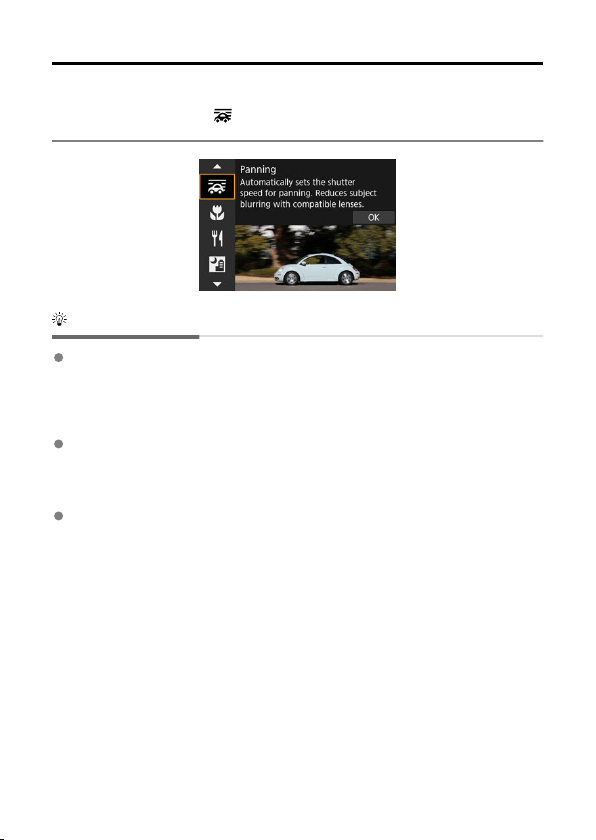
Panning Mode
By panning, you can blur the background to convey a sense of speed.
Attach a lens compatible with [
] (Panning) mode to reduce subject blurring and keep
subjects clear and sharp.
Shooting tips
Turn the camera to follow the moving subject.
As you shoot, turn the camera smoothly while tracking the moving subject. With the AF
point over the part of the moving subject to focus on, press the shutter button halfway,
start turning the camera to keep up with the subject, then press the shutter button
completely to shoot. Continue tracking the subject with the camera after this.
Set the level of background motion blur.
In [Effect], you can set the level of background motion blur. Set to [Effect: max] for a
slower shutter speed and more background motion blur around subjects. If subject blur
is excessive, reduce it by setting [Effect] to [Effect: med] or [Effect: min].
Use the subject blur guide.
Set [Subject blur guide] to [On] to display a guide indicating the extent of subject blur
detected while you are pressing the shutter button halfway, or while you are shooting
continuously as you turn the camera.
The guide consists of gray lines and color-coded lines that vary from red to yellow to
green, in order of decreasing blurriness.
You can set the distance between the subject blur guide and the AF point in [Guide
position].
117
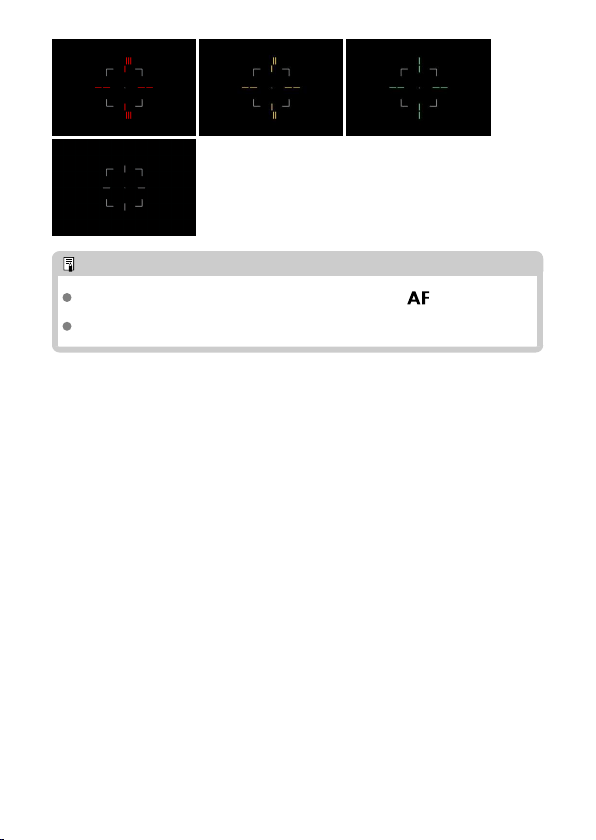
Note
The guide appears when a tracking frame is displayed while [ : Whole area
tracking Servo AF] is set to [On].
Only the gray lines are shown when the shutter button is not pressed.
118
Caution
Dust may be more noticeable in images, because it is easier to stop down the
aperture. Consider acquiring Dust Delete Data before shooting. ( )
For details on lenses compatible with [ ] mode, visit the Canon website ( ).
Shutter speeds are slower. For this reason, Panning mode is not suitable unless
you pan as you shoot.
AF area options are limited to [1-point AF], [Flexible Zone AF 1], [Flexible Zone
AF 2], and [Flexible Zone AF 3].
The default setting is [ ]. Note that [ ] and [ ] are not available.
Flash photography is not available.
Although lens IS is applied to images captured with lenses supporting [ ] mode,
the effect is not shown on the screen as you shoot. (IS and subject blur correction
are activated when you shoot, regardless of the lens IS setting.)
With lenses that do not support [ ] mode, subject blur is not reduced, but shutter
speed is automatically adjusted to match the [Effect] setting.
Your specified panning effect level may not be applied when shooting under bright
light (such as on sunny summer days), or when shooting slow subjects.
The following subjects or shooting conditions may prevent subject blur guide
display and suitable subject blur correction with lenses supporting [
] mode.
• Subjects with very low contrast.
• Subjects in low light.
• Strongly backlit or reflective subjects.
• Subjects with repetitive patterns.
• Subjects with few patterns, or with monotone patterns.
• Subjects with reflections (such as images reflected in glass).
• Subjects smaller than the Zone AF frame.
• Multiple subjects moving within a Zone AF frame.
• Subjects moving in irregular directions or at irregular speeds.
• Subjects who sometimes move erratically (such as runners who move up and
down as they run).
• Subjects whose speed changes greatly (such as immediately after initial
movement, or when moving along a curve).
• When the camera moves too quickly or slowly.
• When camera movement does not match subject movement.
• With long lens focal lengths.
119
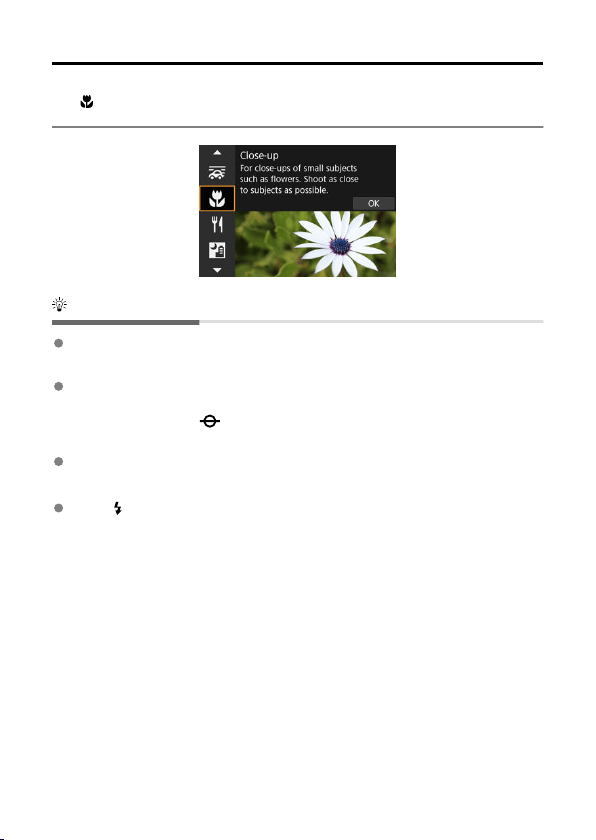
Close-up Mode
Use [
] (Close-up) mode for close-ups of small subjects such as flowers. To make small
things appear much larger, use a macro lens (sold separately).
Shooting tips
Use a simple background.
A simple background makes small objects such as flowers stand out better.
Move in as close as possible to the subject.
Check the lens for its minimum focusing distance. The lens minimum focusing distance
is measured from the <
> (focal plane) mark on the top of the camera to the subject.
Focusing is not possible if you are too close.
With a zoom lens, use the telephoto end.
If you have a zoom lens, using the telephoto end will make the subject look larger.
When [ ] blinks
Manually raise the built-in flash.
120
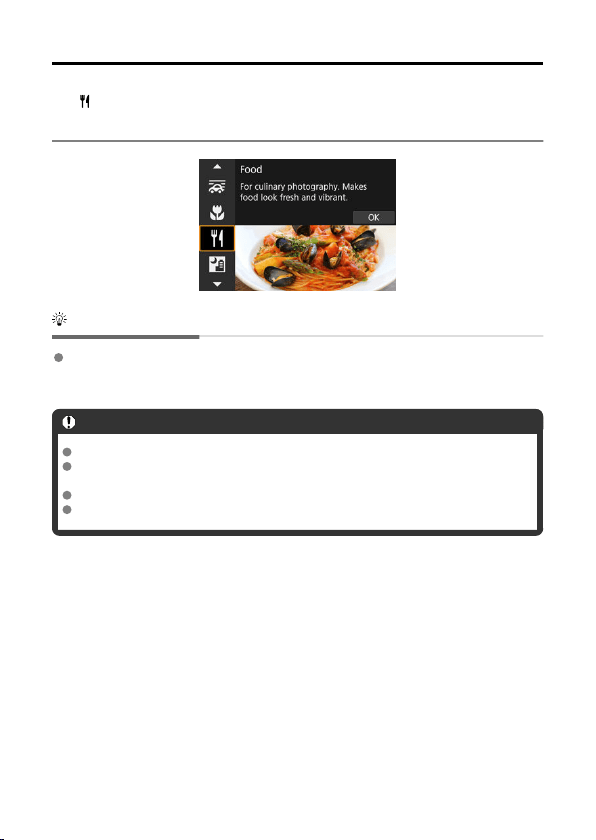
Food Mode
Use [
] (Food) mode for culinary photography. The photo will look bright and appetizing.
Also, the reddish tinge due to the light source will be suppressed in the pictures taken under
tungsten lights, etc.
Shooting tips
Change the color tone.
[Color tone] can be adjusted. To increase the reddish tinge of food, set toward [Warm
tone] (red), or set toward [Cool tone] (blue) if it looks too red.
Caution
The warm color cast of subjects may fade.
When multiple light sources are included in the scene, the warm color cast of the
picture may not be reduced.
In flash photography, [Color tone] switches to the standard setting.
If there are people in the picture, the skin tone may not be reproduced properly.
121
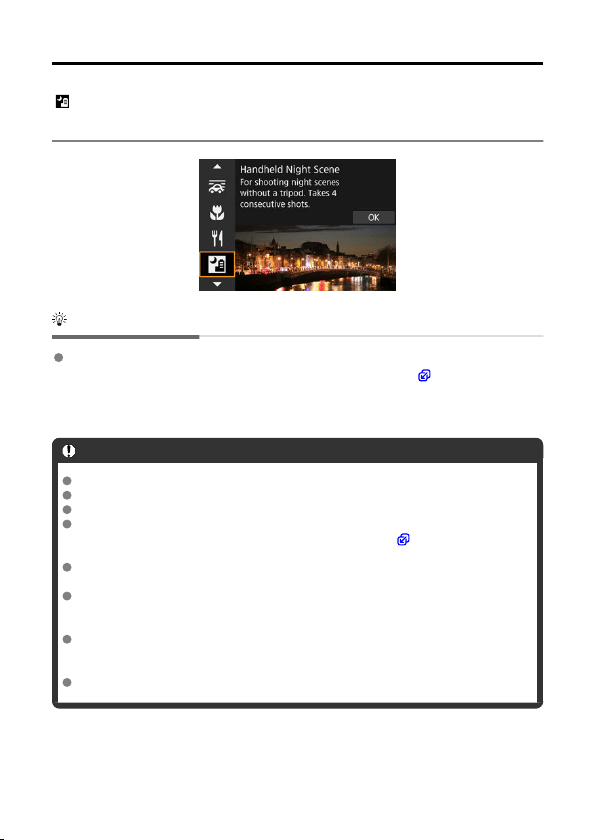
Handheld Night Scene Mode
[
] (Handheld Night Scene) mode enables handheld shooting for night scenes. In this
shooting mode, four shots are taken consecutively for each picture, and the resulting image
with reduced camera shake is recorded.
Shooting tips
Hold the camera steady.
Keep your elbows close to your body to hold the camera steady ( ). In this mode, four
shots are aligned and merged into a single image, but if there is significant misalignment
in any of the four shots due to camera shake, they may not align properly in the final
image.
Caution
The image area is smaller than in other shooting modes.
RAW image quality cannot be set.
Flash photography is not available.
Autofocusing at night or in dark scenes may be difficult when points of light lie
within the AF point. In this case, set the focus mode to MF ( ) and focus
manually.
Shooting moving subjects may result in afterimages from the movement, or
darkness around the subject.
Images may not be aligned correctly if they are patterned (with a lattice or stripes,
for example), are generally flat and uniform, or are greatly out of alignment due to
camera shake or other issues.
It takes some time to record images to the card since they are merged after
shooting. [BUSY] appears on the screen as images are processed, and shooting is
not possible until processing is finished.
Shots will look slightly different from the preview image shown on the screen.
122
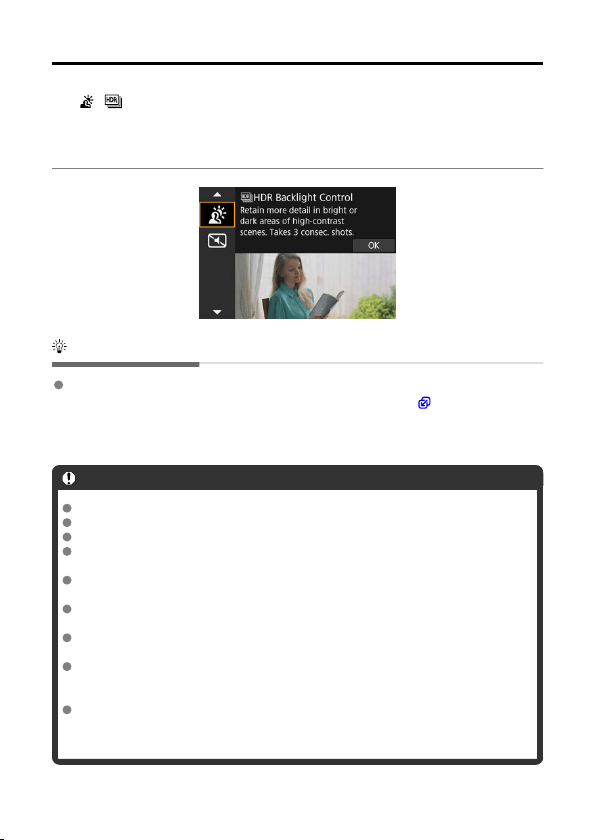
HDR Backlight Control Mode
Use [
] ( HDR Backlight Control) mode for backlit scenes with both bright and dark
areas. Shooting once in this mode captures three consecutive images at different
exposures, which are combined to create a single HDR image that retains detail in shadows
that might otherwise be lost from backlighting.
* HDR stands for High Dynamic Range.
Shooting tips
Hold the camera steady.
Keep your elbows close to your body to hold the camera steady (
). In this mode, three
shots are aligned and merged into a single image. However, if there is significant
misalignment in any of the three shots due to camera shake, they may not align properly
in the final image.
Caution
The image area is smaller than in other shooting modes.
RAW image quality cannot be set.
Flash photography is not available.
Note that the image may not be rendered with a smooth gradation and may look
uneven or noisy.
HDR Backlight Control may not be effective for excessively backlit scenes or
extremely high-contrast scenes.
When shooting subjects that are sufficiently bright as they are, for example for
normally lit scenes, the image may look unnatural due to the HDR effect.
Shooting moving subjects may result in afterimages from the movement, or
darkness around the subject.
Images may not be aligned correctly if they are patterned (with a lattice or stripes,
for example), are generally flat and uniform, or are greatly out of alignment due to
camera shake or other issues.
It takes some time to record images to the card since they are merged after
shooting. [BUSY] appears on the screen as images are processed, and shooting is
not possible until processing is finished.
123
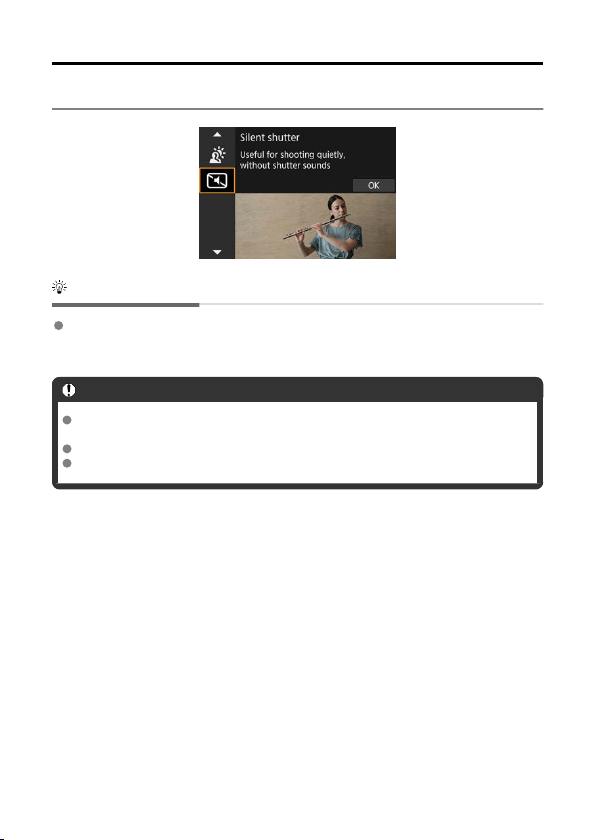
Silent Shutter Mode
Where silence is needed, you can shoot without beeps or shutter release sounds.
Shooting tips
Take some test shots.
Consider taking some test shots in advance, because lens aperture and focusing
adjustment may be audible under some shooting conditions.
Caution
Be responsible when using silent shooting, and respect subject privacy and portrait
rights.
Images of fast-moving subjects may look distorted.
Continuous shooting and flash photography are not available.
124

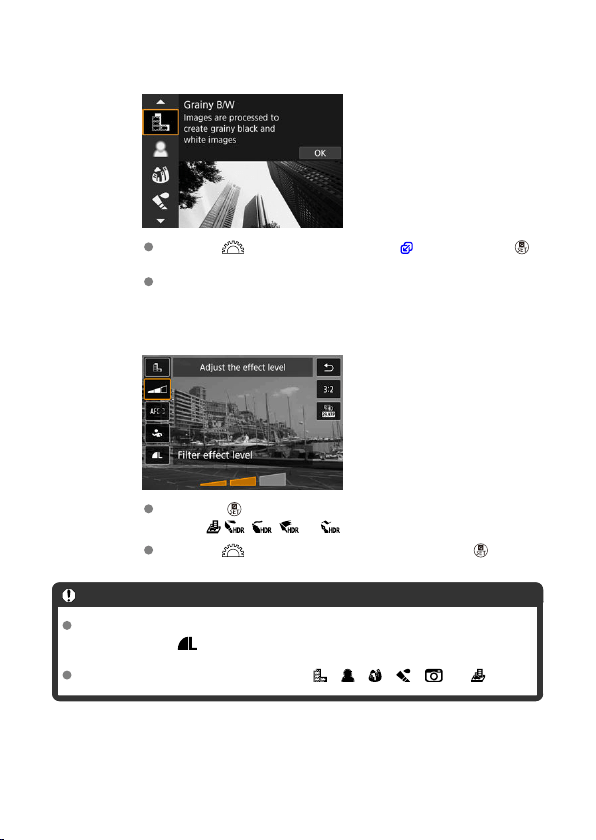
3.
Select a filter effect.
Turn the < > dial to select a filter effect ( ), then press the < >
button.
The image is shown with the filter effect applied.
4.
Adjust the effect and shoot.
Press the < > button and select an icon below [Creative filters]
(except
/ , , , or ).
Turn the < > dial to adjust the effect, then press the < > button.
Caution
RAW and RAW+JPEG are not available. When RAW image quality is set, images
are captured with
image quality. When RAW+JPEG image quality is set,
images are captured with the specified JPEG image quality.
Continuous shooting is not available when [ ], [ ], [ ], [ ], [ ], or [ ] is set.
126
Note
With [Grainy B/W], the grainy preview will differ somewhat from the appearance of
your shots.
With [Soft focus] or [Miniature effect] options, the blurred effect preview may
differ somewhat from the appearance of your shots.
No histogram is displayed.
A magnified view is not available.
Some Creative filter settings are available in Creative Zone modes ( ).
127

Creative Filter Characteristics
Grainy B/W
Makes the image grainy and black and white. By adjusting the contrast, you can change
the black-and-white effect.
Soft focus
Gives the image a soft look. By adjusting the blur, you can change the degree of
softness.
Fish-eye effect
Gives the effect of a fish-eye lens. The image will have barrel distortion.
Depending on the level of this filter effect, the area trimmed along the periphery of the
image changes. Also, because this filter effect magnifies the center of the image, the
apparent resolution at the center may degrade depending on the number of recorded
pixels, so set the filter effect while checking the resulting image. One AF point is used,
fixed at the center.
Water painting effect
Makes the photo look like a watercolor painting with soft colors. By adjusting the effect,
you can change the color density. Note that night scenes or dark scenes may not be
rendered with a smooth gradation and may look uneven or noisy.
Toy camera effect
Shifts colors to those typical of toy cameras and darkens the four corners of the image.
Color tone options can be used to change the color cast.
Miniature effect
Creates a diorama effect.
Shooting under the default setting will keep the center looking sharp.
To move the area that looks sharp (the scene frame), see “Adjusting the Miniature
Effect” ( ).
[AF area] is set to [1-point AF]. Shooting with the AF point and scene frame aligned is
recommended.
HDR art standard
Photos retain more detail in highlights and shadows. With reduced contrast and flatter
gradation, the finish resembles a painting. The subject outlines will have bright (or dark)
edges.
HDR art vivid
Colors are more saturated than with [ HDR art standard], and the low contrast and
flat gradation resemble graphic art.
HDR art bold
The colors are the most saturated, making the subject pop out, and the picture looks like
an oil painting.
128
HDR art embossed
The color saturation, brightness, contrast and gradation are decreased to make the
picture look flat, so that the picture looks faded and old. The subject outlines will have
intensely bright (or dark) edges.
Caution
Precautions for [ ], [ ], [ ], and [ ]
The image area is smaller than in other shooting modes.
Shots will look slightly different from the filter effect previews shown on the screen.
Shooting moving subjects may result in afterimages from the movement, or
darkness around the subject.
Images may not be aligned correctly if they are patterned (with a lattice or stripes,
for example), are generally flat and uniform, or are greatly out of alignment due to
camera shake or other issues.
Be careful about camera shake in handheld shots.
Subjects such as the sky or white walls may not be rendered with smooth gradation
and may have noise or irregular exposure or colors.
Shooting under fluorescent or LED lighting may result in unnatural color
reproduction of the illuminated areas.
It takes some time to record images to the card since they are merged after
shooting. [BUSY] appears on the screen as images are processed, and shooting is
not possible until processing is finished.
Flash photography is not available.
Note
With [ ], [ ], [ ], and [ ], you can shoot high dynamic range photos that
retain detail in highlights and shadows of high-contrast scenes. Three consecutive
images are captured at different brightnesses each time you shoot and used to
create a single image. See the precautions for [
], [ ], [ ], and [ ].
129
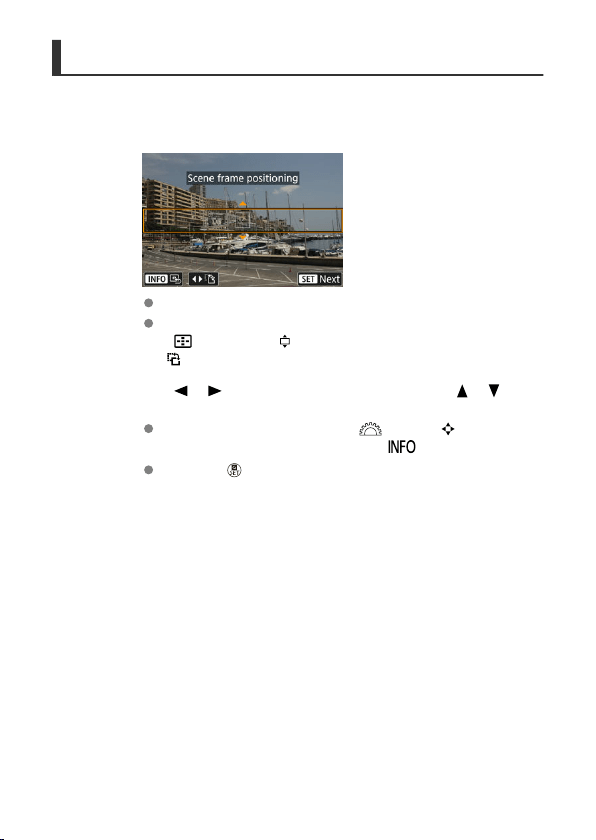
Adjusting the Miniature Effect
1.
Move the scene frame.
Use the scene frame to set an area that will look sharp.
To make the scene frame movable (displayed in orange), press the
<
> button or tap [ ] in the lower right of the screen. By tapping
[
], you can also switch between vertical and horizontal scene frame
orientation. Switching scene frame orientation is also possible with the
<
>< > keys when in horizontal orientation and < >< > keys
when in vertical orientation.
To move the scene frame, use the < > dial or < > keys. To
center the scene frame again, press the <
> button.
Press the < > button to confirm the scene frame position and enable
movement of the AF point, which turns orange.
130
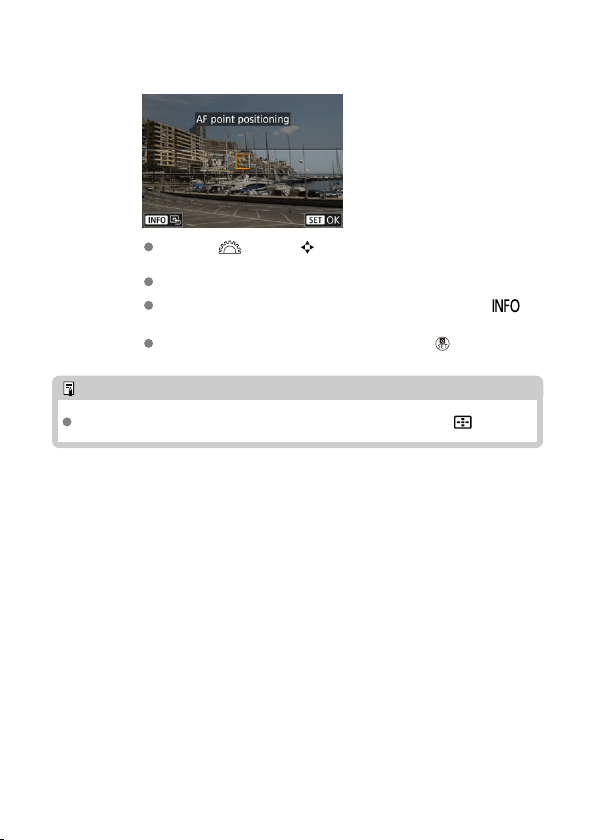
2.
Move the AF point as needed and shoot.
Use the < > dial or < > keys to move the AF point to the
position to focus on.
Aligning the AF point and scene frame is recommended.
To return the AF point to the center of the screen, press the < >
button.
To confirm the position of the AF point, press the < > button.
Note
To switch between moving the scene frame and AF point, press the < > button.
131
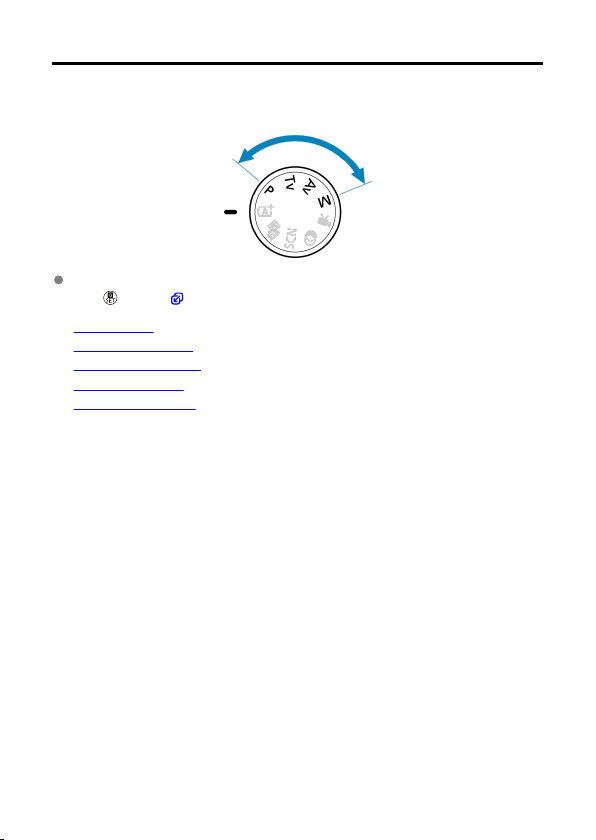
Creative Zone
Creative Zone modes give you the freedom to shoot in a variety of ways by setting your
preferred shutter speed, aperture value, exposure, and more.
To clear the shooting mode description displayed when you turn the Mode dial, press
the <
> button ( ).
•
P: Program AE
• Tv: Shutter-Priority AE
• Av: Aperture-Priority AE
• M: Manual Exposure
• Long (Bulb) Exposures
132
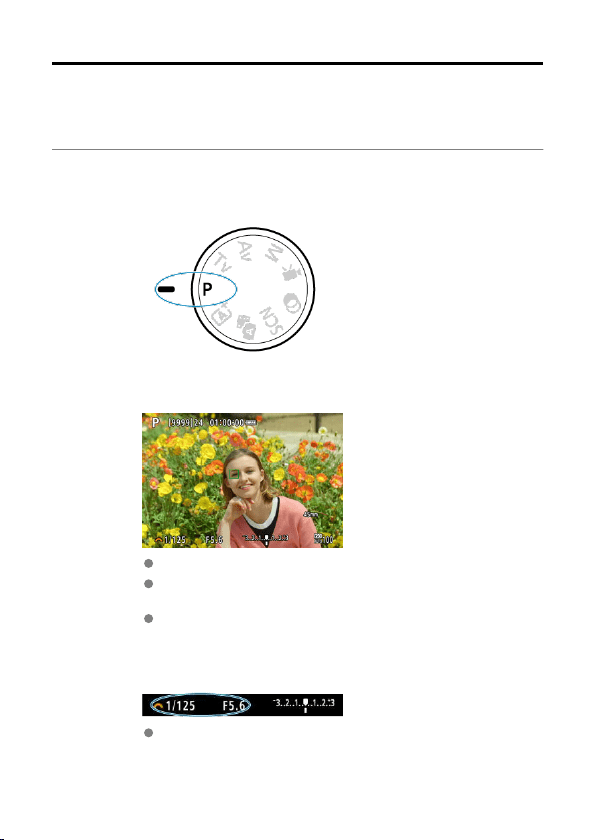
P: Program AE
The camera automatically sets the shutter speed and aperture value to suit subject
brightness.
* <P> stands for Program.
* AE stands for Auto Exposure.
1.
Set the Mode dial to <P>.
2.
Focus on the subject.
Aim the AF point over the subject and press the shutter button halfway.
Once the subject is in focus, the AF point turns green (with One-Shot
AF).
The shutter speed and aperture value are set automatically.
3.
Check the display.
As long as the exposure value is not blinking, standard exposure will be
obtained.
133
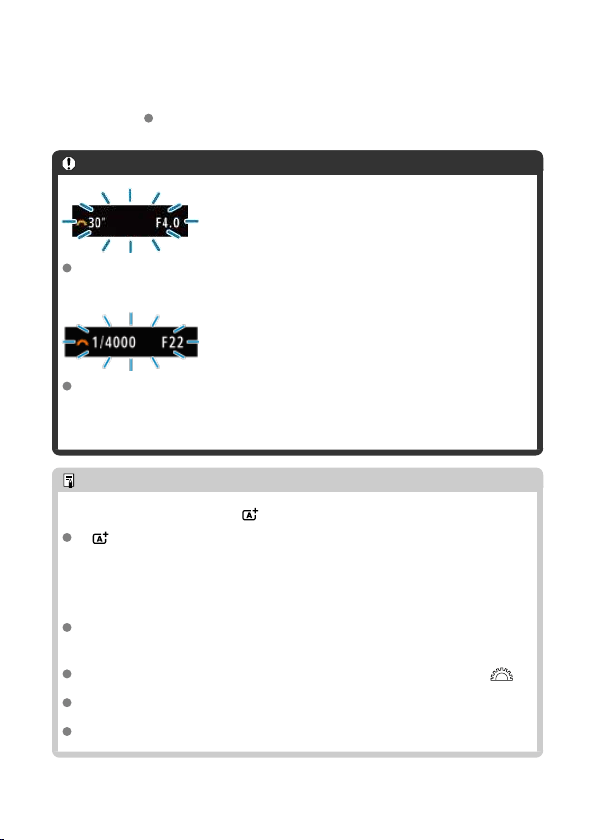
4.
Take the picture.
Compose the shot and press the shutter button completely.
Caution
If the “30"” shutter speed and the lowest aperture value blink, it indicates
underexposure.
Increase the ISO speed or use flash.
If the “1/4000” shutter speed and the highest aperture value blink, it indicates
overexposure.
Lower the ISO speed or use an ND filter (sold separately) to reduce the amount of
light entering the lens.
Note
Differences between <P> and < > modes
< > mode limits available functions and sets the AF area, metering mode, and
many other functions automatically to prevent bad shots. In contrast, <P> mode
only sets the shutter speed and aperture value automatically, and you can freely
set the AF area, metering mode, and other functions.
Program shift
In <P> mode, you can freely change the combination (program) of shutter speed
and aperture value set automatically by the camera while maintaining the same
exposure. This is called Program shift.
With Program shift, you can press the shutter button halfway, then turn the < >
dial until the desired shutter speed or aperture value is displayed.
Program shift will be canceled automatically when the metering timer ends
(exposure setting display turns off).
Program shift cannot be used with flash.
134
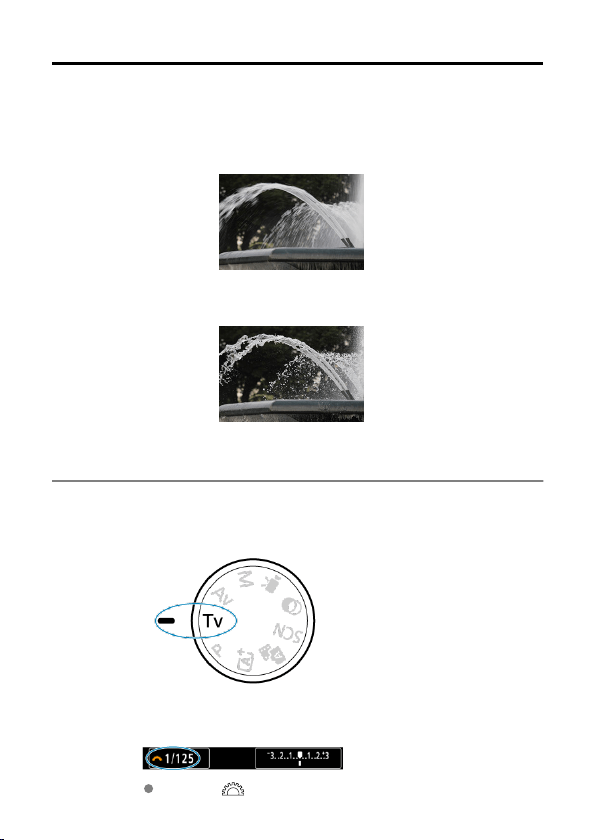
Tv: Shutter-Priority AE
In this mode, you set the shutter speed and the camera automatically sets the aperture
value to obtain the standard exposure matching the brightness of the subject. A faster
shutter speed can freeze the action of a moving subject. A slower shutter speed can create
a blurred effect, giving the impression of motion.
* <Tv> stands for Time value.
Blurred motion
(Slow speed: 1/30 sec.)
Frozen motion
(Fast speed: 1/2000 sec.)
1.
Set the Mode dial to <Tv>.
2.
Set the desired shutter speed.
Turn the < > dial to set it.
135
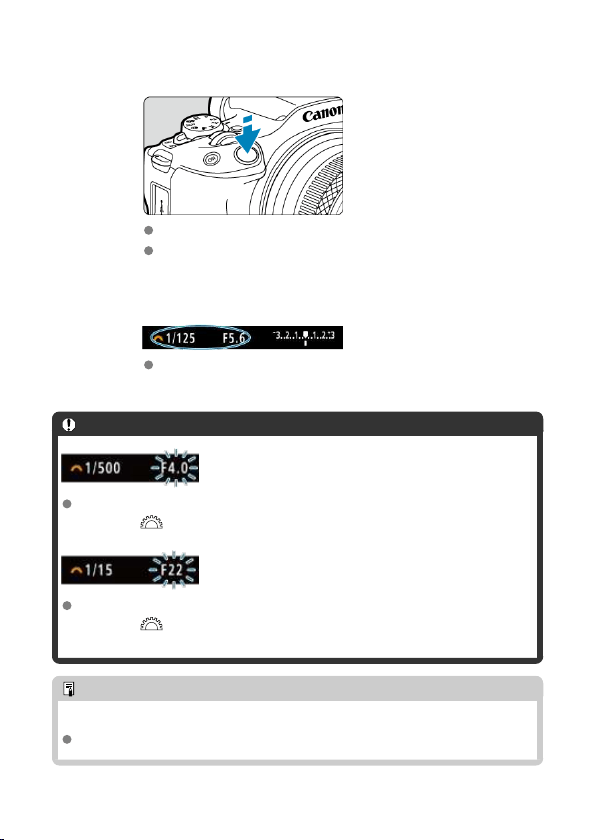
3.
Focus on the subject.
Press the shutter button halfway.
The aperture value is set automatically.
4.
Check the display and shoot.
As long as the aperture value is not blinking, the standard exposure will
be obtained.
Caution
If the lowest aperture value blinks, it indicates underexposure.
Turn the <
> dial to set a slower shutter speed until the aperture value stops
blinking or set a higher ISO speed.
If the highest aperture value blinks, it indicates overexposure.
Turn the <
> dial to set a faster shutter speed until the aperture value stops
blinking, or set a lower ISO speed.
Note
Shutter speed display
For example, “0"5” indicates 0.5 sec. and “15"”, 15 sec.
136
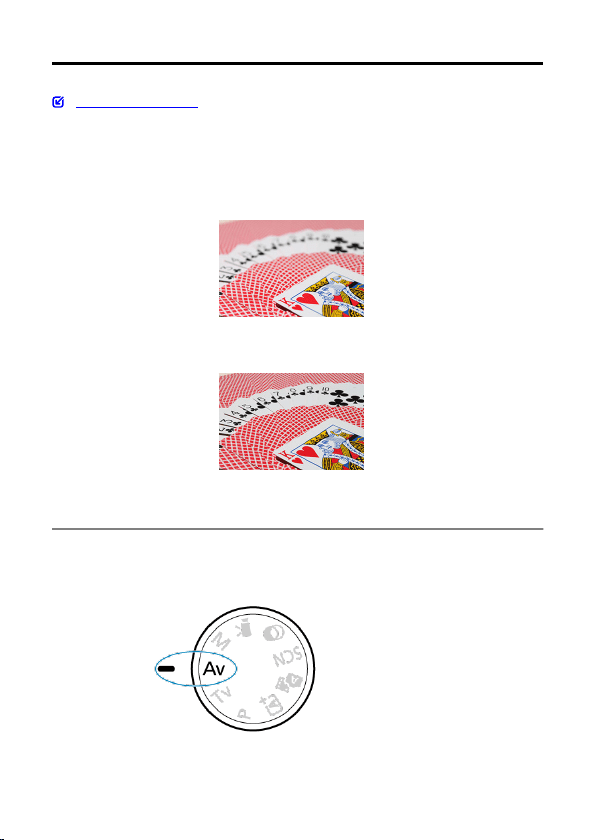
Av: Aperture-Priority AE
Depth-of-Field Preview
In this mode, you set the desired aperture value and the camera sets the shutter speed
automatically to obtain the standard exposure matching the subject brightness. A higher f/
number (smaller aperture hole) will make more of the foreground and background fall within
acceptable focus. On the other hand, a lower f/number (larger aperture hole) will make less
of the foreground and background fall within acceptable focus.
* <Av> stands for Aperture value (aperture opening).
Blurred background
(With a low aperture value: f/5.6)
Sharp foreground and background
(With a high aperture value: f/32)
1.
Set the Mode dial to <Av>.
137
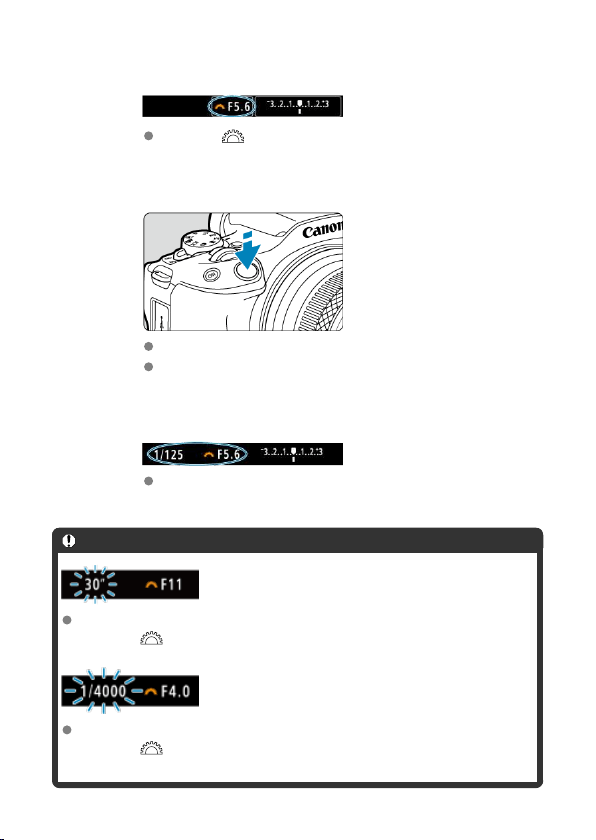
2.
Set the desired aperture value.
Turn the < > dial to set it.
3.
Focus on the subject.
Press the shutter button halfway.
The shutter speed is set automatically.
4.
Check the display and shoot.
As long as the shutter speed is not blinking, the standard exposure will
be obtained.
Caution
If the “30"” shutter speed blinks, it indicates underexposure.
Turn the <
> dial to decrease the aperture value (open the aperture) until the
shutter speed blinking stops or set a higher ISO speed.
If the “1/4000” shutter speed blinks, it indicates overexposure.
Turn the <
> dial to increase aperture value (close the aperture) until the
shutter speed blinking stops or set a lower ISO speed.
138
Note
Aperture value display
The higher the value, the smaller the aperture opening will be. The aperture value
displayed varies depending on the lens. If no lens is attached to the camera, “F00”
will be displayed for the aperture.
139
Depth-of-Field Preview
The aperture changes only at the moment you shoot, and it remains open at other times. For
this reason, the depth of field shown on the screen looks narrow, or shallow. To check the
area in focus, assign [
] (depth-of-field preview) to a button and press it.
Note
The larger the aperture value, the wider the area in focus, from the foreground to
the background.
The depth-of-field effect is readily apparent on images as you press the button
assigned to depth-of-field preview.
Exposure is locked (AE lock) as you hold down the button assigned to depth-of-
field preview.
140
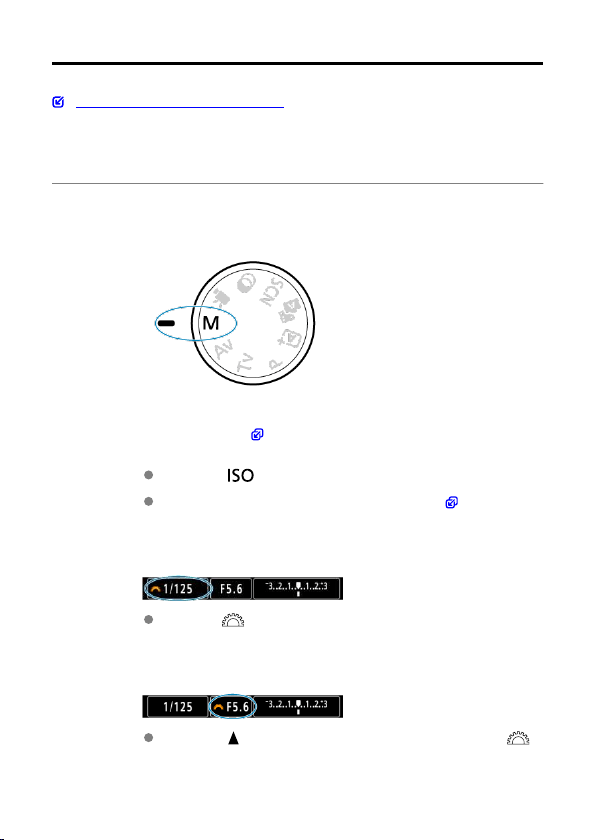
M: Manual Exposure
Exposure Compensation with ISO Auto
In this mode, you set both the shutter speed and aperture value as desired. To determine
the exposure, refer to the exposure level indicator or use a commercially available exposure
meter.
* <M> stands for Manual.
1.
Set the Mode dial to <M>.
2.
Set the ISO speed (
).
Press the < > button to set it.
With ISO Auto, you can set exposure compensation ( ).
3.
Set the desired shutter speed.
Turn the < > dial to set it.
4.
Set the desired aperture value.
Press the < > key to select the aperture value, then turn the < >
dial to set a value.
141
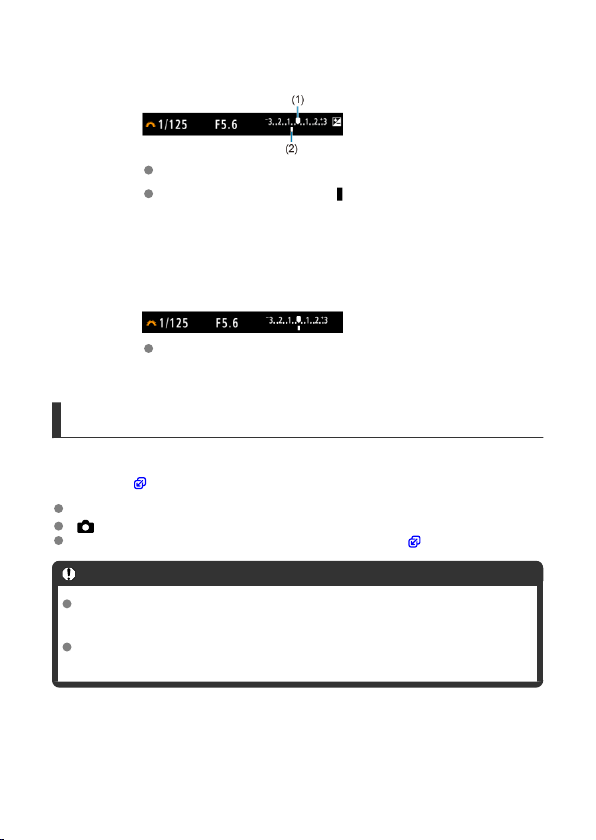
5.
Focus on the subject.
Press the shutter button halfway.
Check the exposure level mark [ ] to see how far the current exposure
level is from the standard exposure level.
(1) Standard exposure index
(2) Exposure level mark
6.
Set the exposure and take the picture.
Check the exposure level indicator and set the desired shutter speed
and aperture value.
Exposure Compensation with ISO Auto
If the ISO speed is set to [AUTO] for manual exposure shooting, you can set exposure
compensation (
) as follows:
Tap the exposure level indicator
[ : Expo.comp./AEB]
Turn the control ring while pressing the shutter button halfway ( )
Caution
Exposure may not be as expected when ISO Auto is set, because the ISO speed is
adjusted to ensure standard exposure for your specified shutter speed and
aperture value. In this case, set the exposure compensation.
Exposure compensation is not applied in flash photography with ISO Auto, even if
you have set an exposure compensation amount.
142
Note
When ISO Auto is set, you can press the < > button to lock the ISO speed.
If you press the < > button and recompose the shot, you can see the exposure
level difference on the exposure level indicator compared to when the <
>
button was pressed.
Any existing exposure compensation amount is maintained if you switch to <M>
mode with ISO Auto after using exposure compensation in <P>, <Tv>, or <Av>
mode ( ).
143
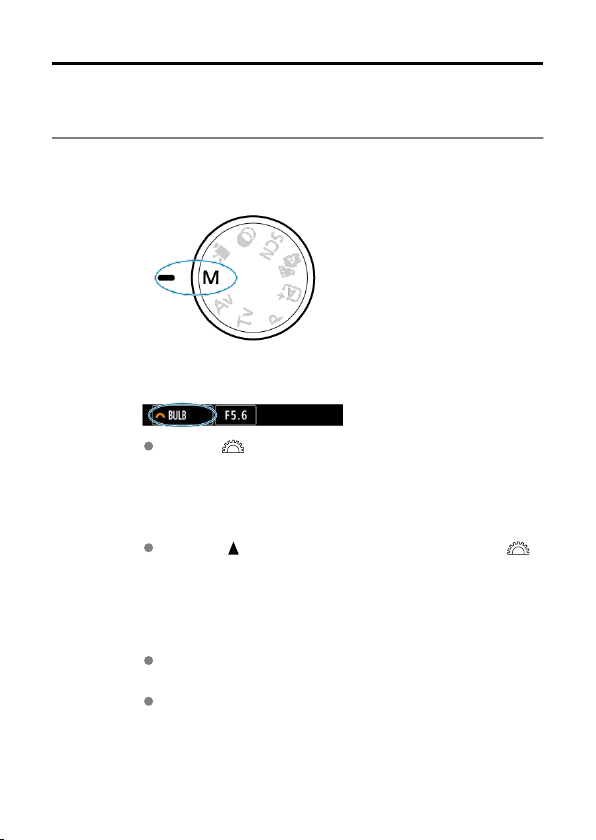
Long (Bulb) Exposures
In this mode, the shutter stays open as long as you hold down the shutter button completely,
and closes when you let go of the shutter button. Use bulb exposures for night scenes,
fireworks, astrophotography, and other subjects requiring long exposures.
1.
Set the Mode dial to <M>.
2.
Set the shutter speed to [BULB].
Turn the < > dial to the left to set [BULB].
3.
Set the desired aperture value.
Press the < > key to select the aperture value, then turn the < >
dial to set a value.
4.
Take the picture.
The exposure will continue for as long as you keep the shutter button
pressed completely.
Elapsed exposure time is shown on the screen.
144
Caution
Do not point the camera toward an intense light source, such as the sun or an
intense artificial light source. Doing so may damage the image sensor or the
camera's internal components.
Long bulb exposures produce more noise in the image than usual.
ISO 400 is used when the camera is set to ISO Auto.
Note
You can reduce the noise generated during long exposures by using [ : Long
exp. noise reduction] ( ).
Using a tripod is recommended for bulb exposures.
You can also shoot bulb exposures by using Wireless Remote Control BR-E1 (sold
separately, ). When you press the remote controller's release (transmit) button,
the bulb exposure will start immediately or 2 sec. later. Press the button again to
stop the bulb exposure.
145
Flash Photography
This chapter describes how to shoot with the built-in flash or an external flash (EL/EX series
Speedlites).
to the right of titles indicates functions only available in Creative Zone modes (<P>, <Tv>,
<Av>, or <M>).
Caution
Flash photography is not available with [ : Shutter mode] set to [Electronic].
Flash cannot be used while you are recording movies.
AEB is not available in flash photography.
• Shooting with the Built-in Flash
• Flash Function Settings
• Shooting with Speedlites
146
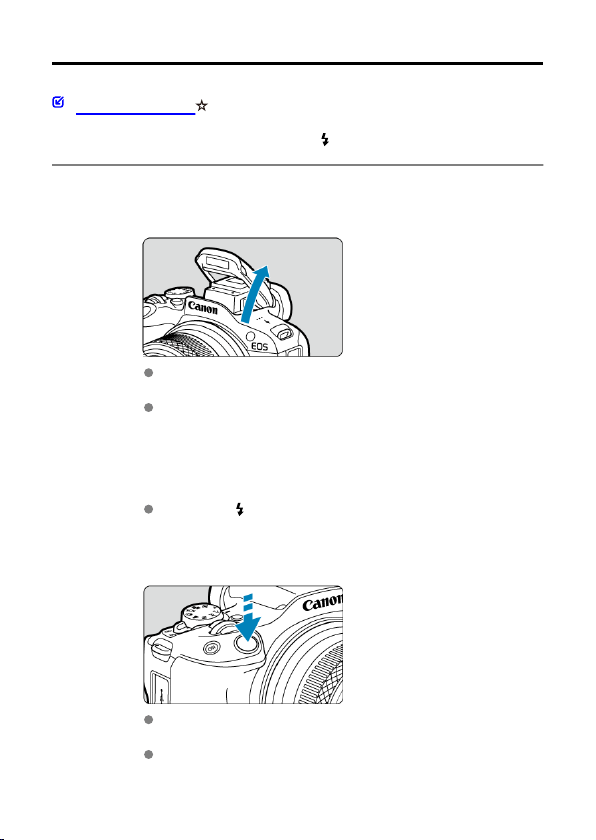
Shooting with the Built-in Flash
Shooting with FE Lock
Using the built-in flash is recommended when the [ ] icon appears in the viewfinder or on
the screen, when subjects in daytime shots are backlit, or when shooting under low light.
1.
Manually raise the flash.
In Creative Zone modes, shooting with flash is possible whenever the
flash is raised.
[BUSY] is displayed on the screen while the flash is charging.
2.
Press the shutter button halfway.
Confirm that [ ] appears on the screen.
3.
Take the picture.
When focus is achieved and you press the shutter button completely,
the flash will fire at all times.
To retract the built-in flash after shooting, push it down with your fingers
until it clicks into place.
147
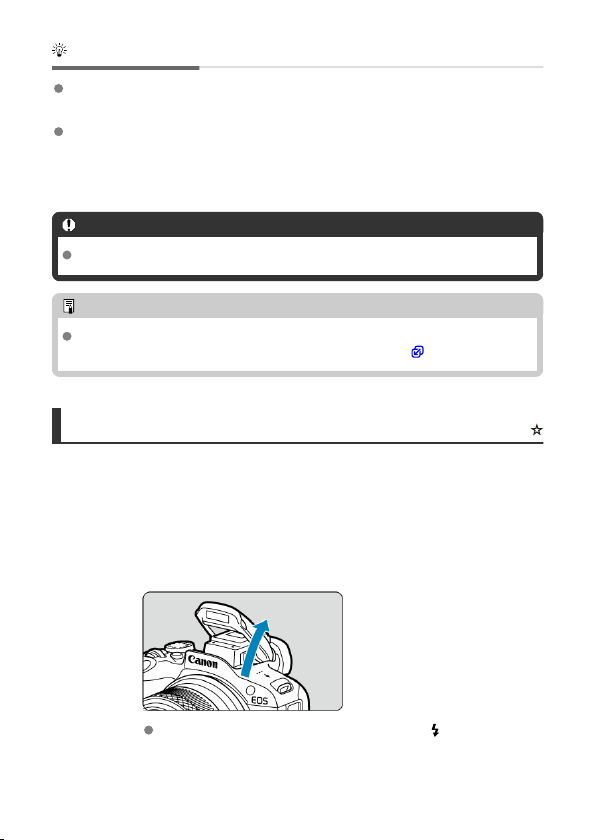
Shooting tips
In bright light, decrease the ISO speed.
If the exposure setting in the viewfinder blinks, decrease the ISO speed.
Detach the lens hood. Do not get too close to the subject.
If the lens has a hood attached or you are too close to the subject, the bottom of the
picture may look dark due to the obstructed flash light. For important shots, play back
the image and check to make sure the picture does not look unnaturally dark at the
bottom part.
Caution
Do not use the built-in flash unless it is fully raised.
Note
If the bottom of images is dark when you use super telephoto or large-diameter
lenses, consider using an external Speedlite (sold separately, ).
Shooting with FE Lock
The background or other factors may make subjects brighter or darker in flash photography
with subjects near the edge of the screen. In this case, use FE lock. After setting the flash
output for the appropriate subject brightness, you can recompose (put the subject toward the
side) and shoot. This feature can also be used with a Canon EL/EX series Speedlite.
* FE stands for Flash Exposure.
1.
Manually raise the flash.
Press the shutter button halfway and confirm that [ ] appears on the
screen.
148
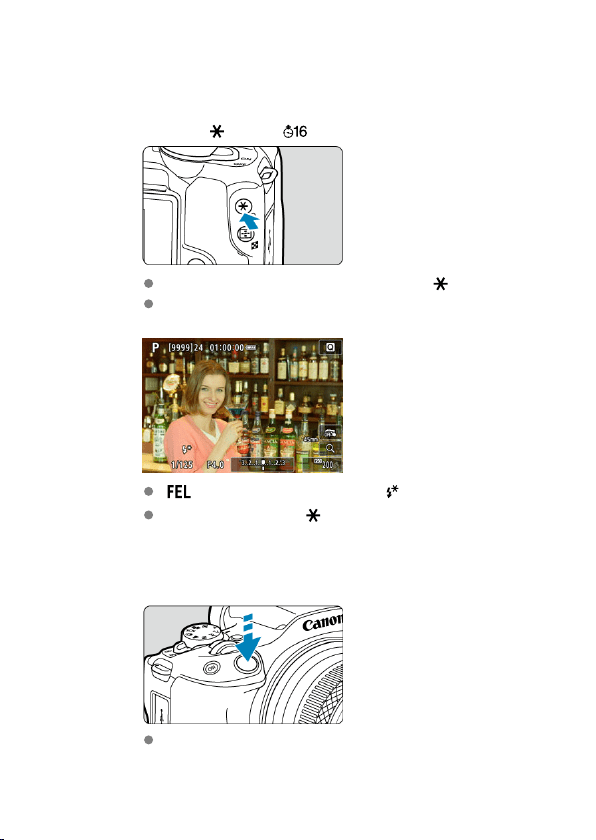
2.
Focus on the subject.
3.
Press the <
> button ( ).
Center the subject on the screen, then press the < > button.
A preflash is fired by the flash, and the flash output required for
shooting is retained.
[ ] appears briefly on the screen, and [ ] is lit.
Each time you press the < > button, a preflash is fired, and the flash
output required for shooting is retained.
4.
Take the picture.
Compose the shot and press the shutter button completely.
149
Caution
The [ ] icon blinks when subjects are too far away and your shots would be dark.
Approach the subject and repeat steps 2 to 4.
150
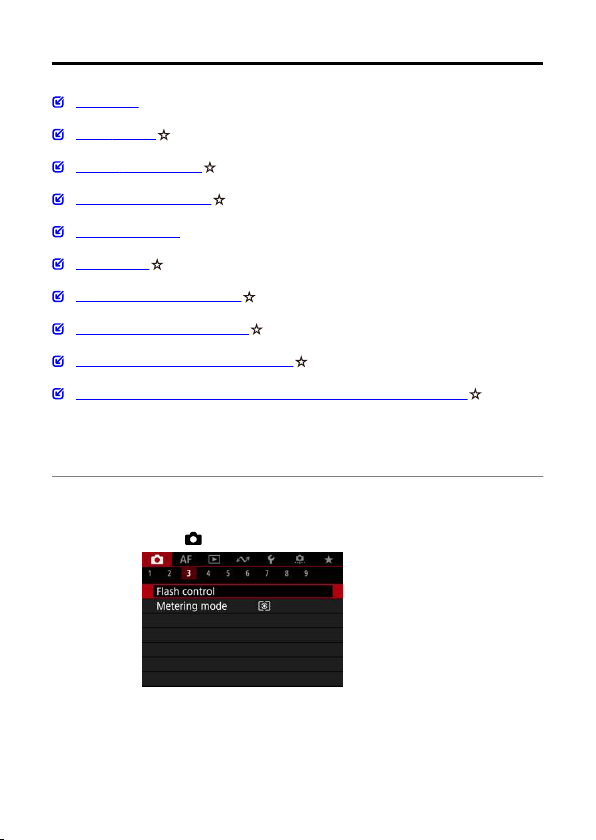
Flash Function Settings
Flash Firing
E-TTL Balance
E-TTL II Flash Metering
Continuous Flash Control
Red-Eye Reduction
Slow Synchro
Built-in Flash Function Settings
External Flash Function Settings
External Flash Custom Function Settings
Clearing Flash Function Settings/Clearing All Speedlite Custom Functions
Functions of the built-in flash or external EL/EX series Speedlites can be set from menu
screens on the camera.
Before setting functions of external Speedlites, attach the Speedlite and turn it on.
For details on external Speedlite functions, refer to the Speedlite's instruction manual.
1.
Select [
: Flash control].
151
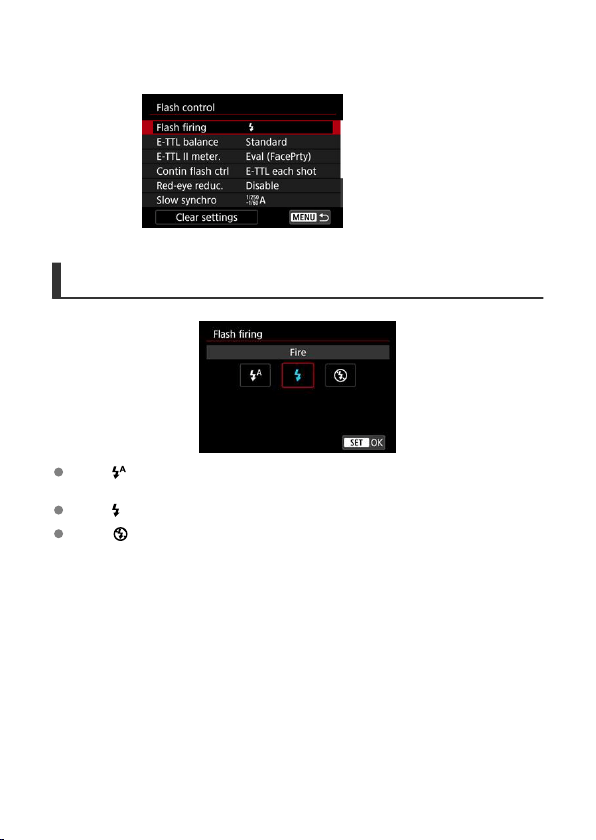
2.
Select an option.
Flash Firing
Set to [ ] (in Basic Zone or <P> modes) to have the flash fire automatically, based on
shooting conditions.
Set to [ ] to have the flash always fire when you shoot.
Select [ ] (in Creative Zone modes) to keep the flash off, or if you will use the AF-assist
beam.
152
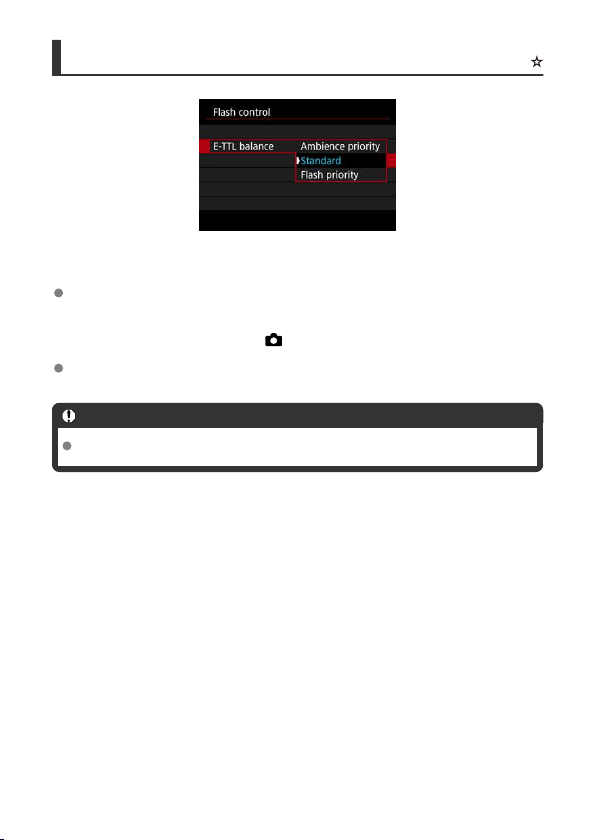
E-TTL Balance
You can set your preferred appearance (balance) for flash shots. This setting enables you to
adjust the ratio of ambient light to Speedlite light output.
Set the balance to [Ambience priority] to lower the proportion of flash output and uses
ambient light to produce lifelike shots with a natural mood. Especially useful when
shooting dark scenes (indoors, for example). After switching to <Av> or <P> mode,
consider setting [Slow synchro] in [
: Flash control] to [1/250-30sec. auto] and
using slow-sync shooting.
Set the balance to [Flash priority] to make the flash the main source of light. Useful for
reducing shadows on subjects and in the background from ambient light.
Caution
For some scenes, [Ambience priority] may yield the same results as [Standard].
153
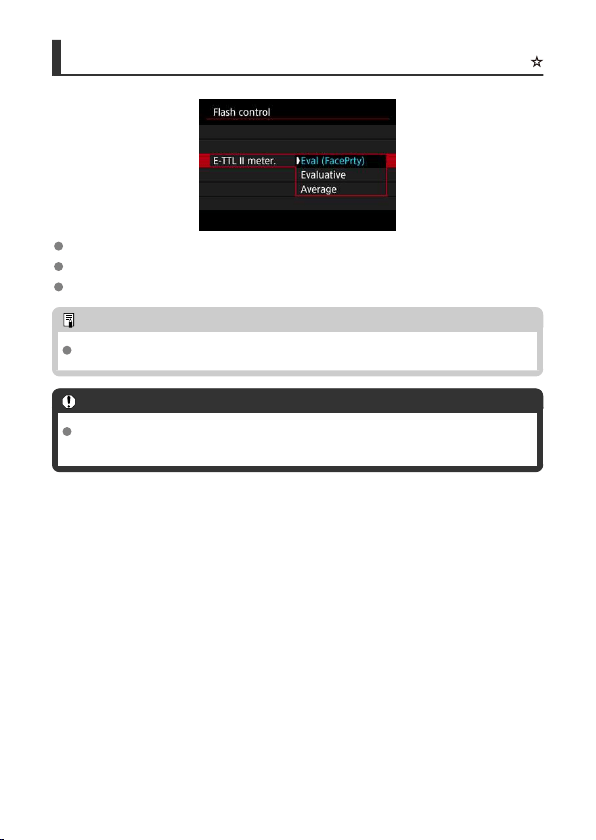
E-TTL II Flash Metering
Set to [Eval (FacePrty)] for flash metering suitable for shots of people.
Set to [Evaluative] for flash metering that emphasizes firing in continuous shooting.
If [Average] is set, the flash exposure will be averaged for the entire metered scene.
Note
Depending on the scene, flash exposure compensation may be necessary.
Caution
Even when [Eval (FacePrty)] is set, some subjects and shooting conditions may
prevent you from obtaining the expected result.
154
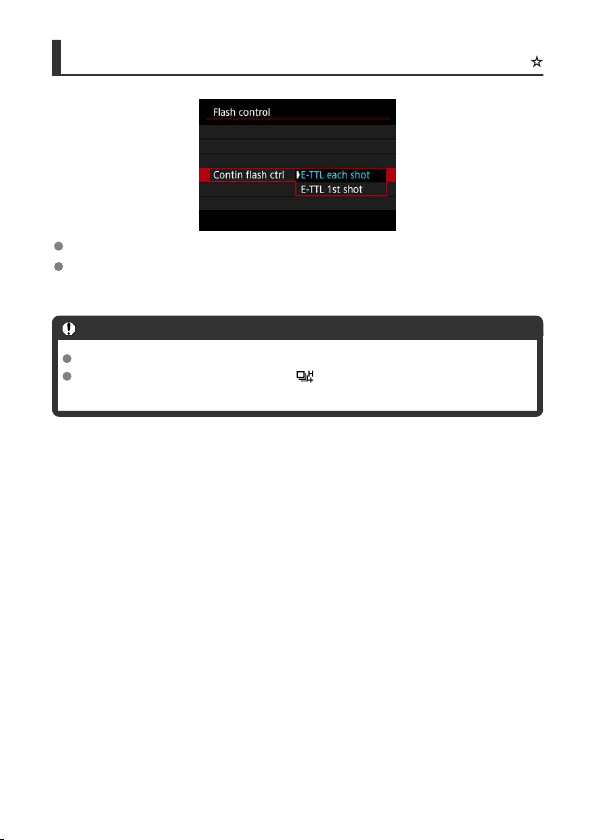
Continuous Flash Control
Set to [E-TTL each shot] to perform flash metering for each shot.
Set to [E-TTL 1st shot] to perform flash metering for only the first shot before
continuous shooting. The flash output level for the first shot is applied to all subsequent
shots. Useful when prioritizing continuous shooting speed without recomposing shots.
Caution
Any subject movement in continuous shooting may cause exposure problems.
[E-TTL 1st shot] is set automatically in [ ] drive mode when external flash units
are used.
155
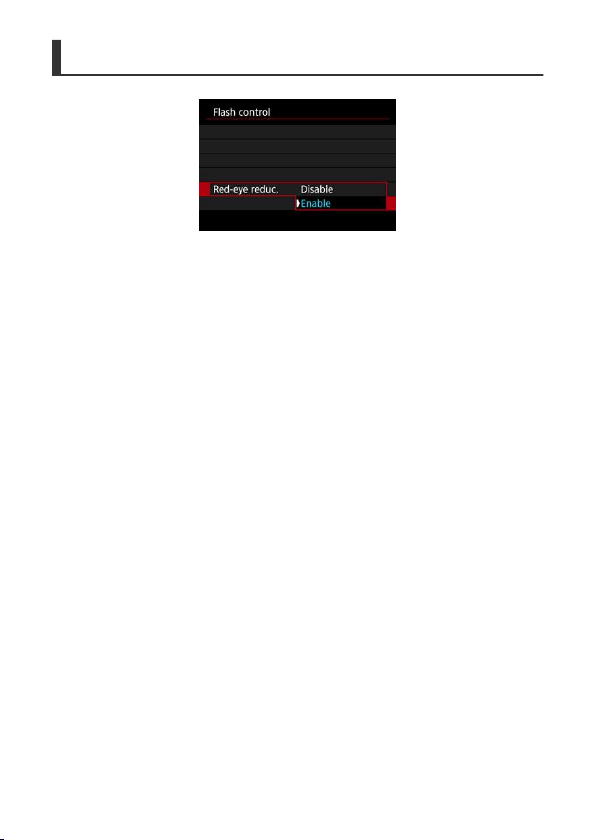
Red-Eye Reduction
Set to [Enable] to reduce red-eye by firing the red-eye reduction lamp before firing the flash.
156
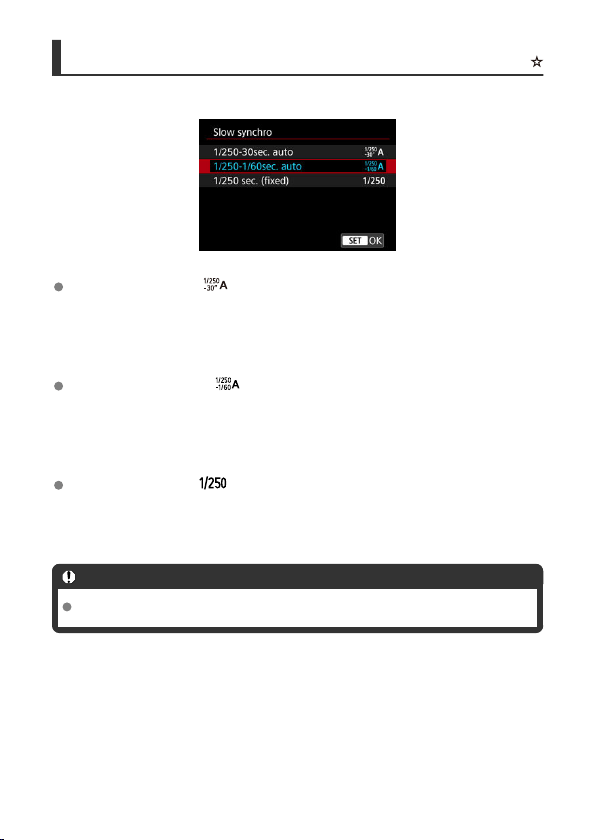
Slow Synchro
You can set the flash-sync speed for flash photography in
<
Av> or <P> mode.
1/250-30sec. auto ( )
The flash sync speed is set automatically within a range of 1/250 sec. to 30 sec. to suit
the scene's brightness. Slow-sync shooting is used in low-light locations (under some
shooting conditions), and shutter speed is automatically lowered.
1/250-1/60sec. auto ( )
Prevents a slow shutter speed from being set automatically in low-light conditions.
Effective for preventing subject blur and camera shake. Light from the flash provides
standard exposure for subjects, but note that backgrounds may be dark.
1/250 sec. (fixed) ( )
The shutter speed is fixed at 1/250 sec., which is more effective in preventing subject
blur and camera shake than with [1/250-1/60sec. auto]. However, in low light, the
subject's background will come out darker than with [1/250-1/60sec. auto].
Caution
To use slow-sync shooting in <P> or <Av> mode, set to [1/250-30sec. auto].
157
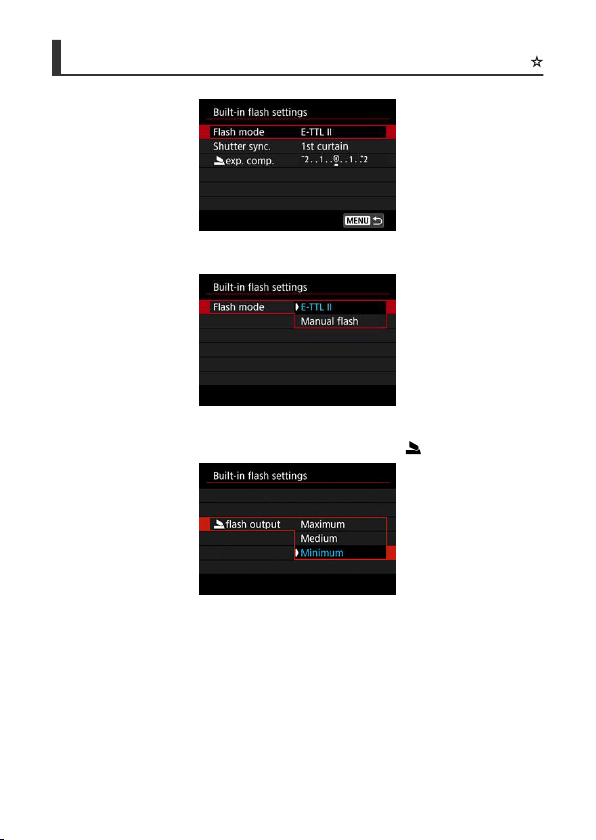
Built-in Flash Function Settings
Flash mode
• Set to [E-TTL II] to shoot in E-TTL II/E-TTL fully automatic flash mode.
• Set to [Manual flash] to specify your preferred flash output in [
flash output].
158
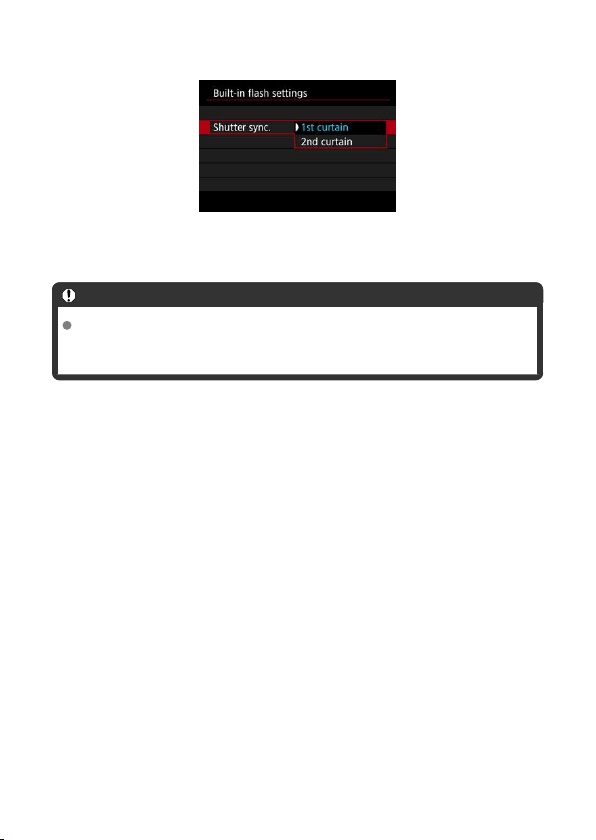
Shutter sync.
Normally, set to [1st curtain] so that the flash fires immediately after shooting starts.
Set to [2nd curtain] and use low shutter speeds for natural-looking shots of subject motion
trails, such as car headlights.
Caution
When using second-curtain synchronization, set the shutter speed to 1/30 sec. or
slower. For shutter speeds exceeding 1/40 sec., first-curtain synchronization is
used automatically even if [2nd curtain] is set.
159
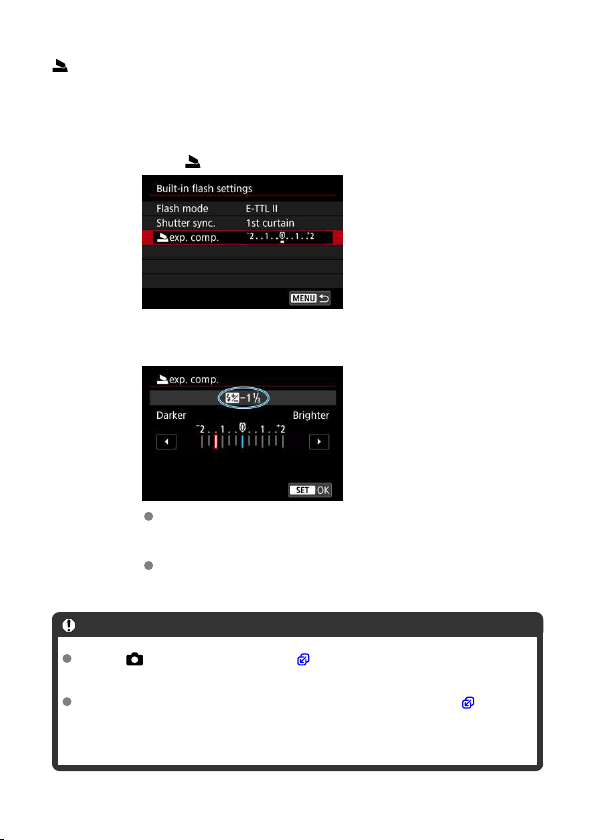
exp. comp.
Set the flash exposure compensation if the brightness of the subject does not come out as
desired (so you want to adjust the flash output) in flash photography.
1.
Select [
exp. comp.].
2.
Set the compensation amount.
To brighten flash exposure, set the compensation amount toward
[Brighter] (positive compensation), or to darken it, set toward [Darker]
(negative compensation).
After taking the picture, cancel the flash exposure compensation by
setting it back to 0.
Caution
Setting [ : Auto Lighting Optimizer] ( ) to an option other than [Disable] may
still cause images to look bright even if you set negative flash exposure
compensation for darker exposure.
If flash exposure compensation is set with a Speedlite (sold separately, ), you
cannot set the flash exposure compensation with the camera (Quick Control or
external flash function setting). Note that the Speedlite's setting overrides the
camera's if both are set at the same time.
160
Note
The exposure compensation amount will remain in effect even after you set the
power switch to <
>.
161
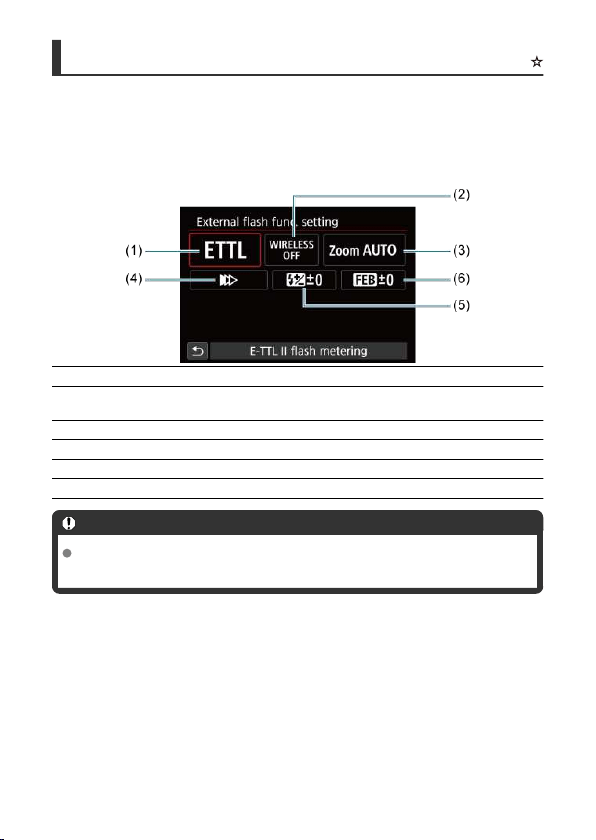
External Flash Function Settings
The information displayed on the screen, position of display, and available options vary
depending on the Speedlite model, its Custom Function settings, the flash mode, and other
factors. Refer to the instruction manual of your flash unit for details on its functions.
Sample display
(1) Flash mode
(2) Wireless functions/
Firing ratio control (RATIO)
(3) Flash zoom (flash coverage)
(4) Shutter synchronization
(5) Flash exposure compensation
(6) Flash exposure bracketing
Caution
Functions are limited when using EX series Speedlites that are not compatible with
flash function settings.
162
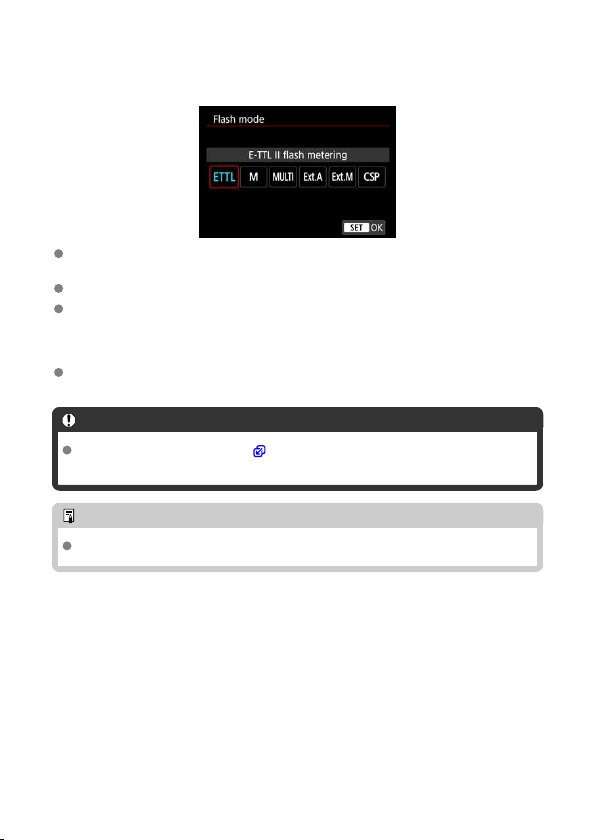
Flash mode
You can select the flash mode to suit your desired flash photography.
[E-TTL II flash metering] is the standard mode of EL/EX series Speedlites for automatic
flash photography.
[Manual flash] is for setting the Speedlite's [Flash output level] yourself.
[CSP] (Continuous shooting priority mode) is available when using a compatible
Speedlite. This mode automatically reduces flash output by one stop and increases ISO
speed by one stop. Useful in continuous shooting, and helps conserve flash battery
power.
Regarding other flash modes, refer to the Instruction Manual of a Speedlite compatible
with the respective flash mode.
Caution
Adjust exposure compensation ( ) as needed in case of overexposure from flash
photography with [CSP] in <Tv> or <M> mode.
Note
With [CSP], ISO speed is automatically set to [Auto].
163
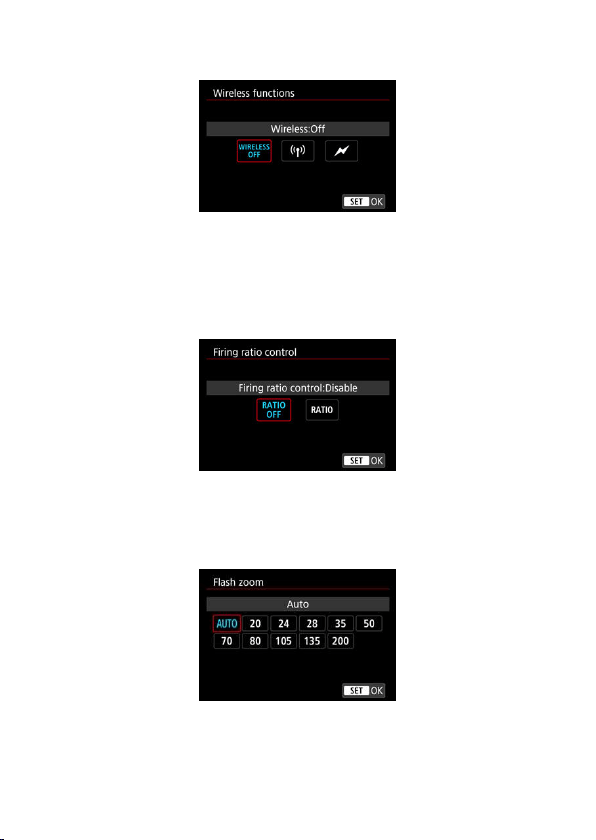
Wireless functions
You can use radio or optical wireless transmission to shoot with wireless multiple-flash
lighting.
For details on wireless flash, refer to the Instruction Manual of a Speedlite compatible with
wireless flash photography.
Firing ratio control (RATIO)
With a macro flash, you can set the firing ratio control.
For details on firing ratio control, refer to the Instruction Manual of the macro flash.
Flash zoom (flash coverage)
With Speedlites having a zooming flash head, you can set the flash coverage.
164
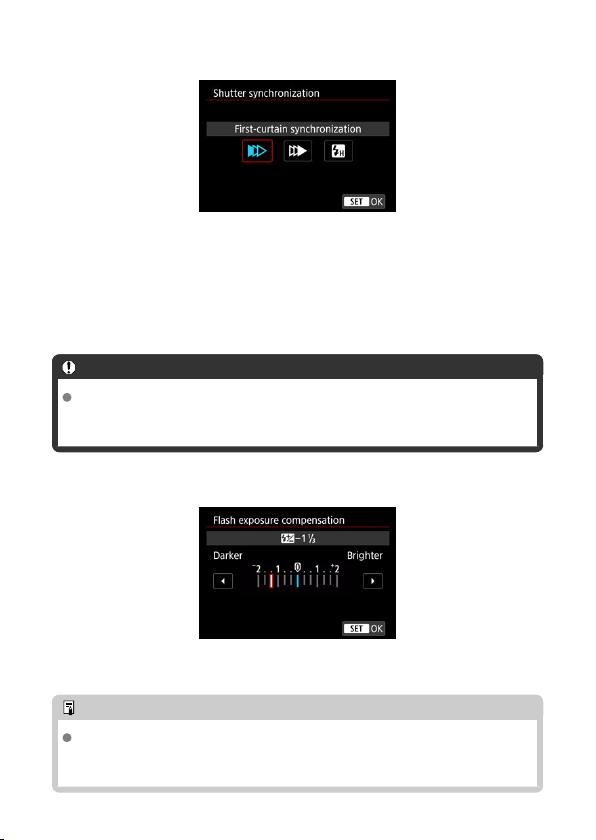
Shutter synchronization
Normally, set this to [First-curtain synchronization] so that the flash fires immediately after
the shooting starts.
Set to [Second-curtain synchronization] and use low shutter speeds for natural-looking
shots of subject motion trails, such as car headlights.
Set to [High-speed synchronization] for flash photography at higher shutter speeds than
the maximum flash sync shutter speed. This is effective when shooting with an open
aperture in <Av> mode to blur the background behind subjects outdoors in daylight, for
example.
Caution
When using second-curtain synchronization, set the shutter speed to 1/30 sec. or
slower. If the shutter speed is 1/40 sec. or faster, first-curtain synchronization will
be applied automatically even if [Second-curtain synchronization] is set.
Flash exposure compensation
Just as exposure compensation is adjustable, you can also adjust flash output of external
Speedlites.
Note
If flash exposure compensation is set with the Speedlite, you cannot set the flash
exposure compensation with the camera. Note that the Speedlite's setting
overrides the camera's if both are set at the same time.
165
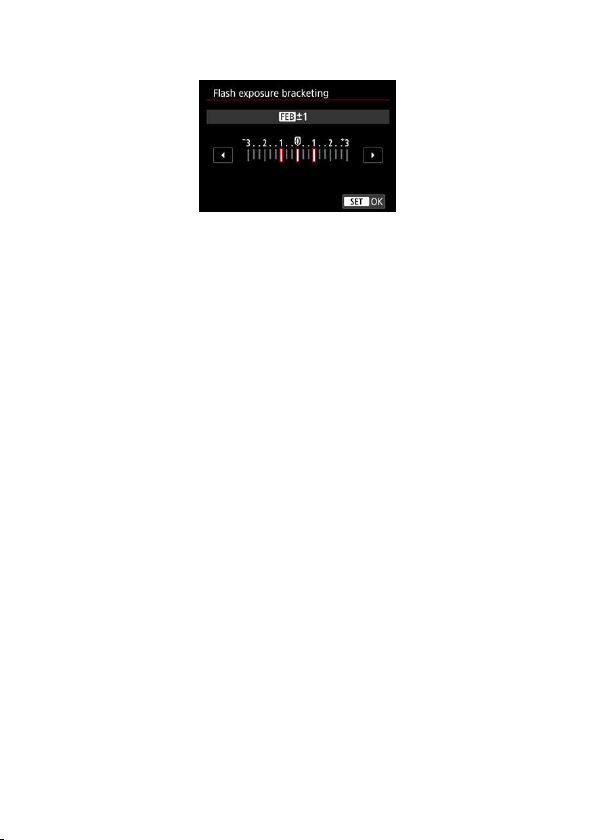
Flash exposure bracketing
Speedlites equipped with flash exposure bracketing (FEB) can change the external flash
output automatically as three shots are taken at once.
166
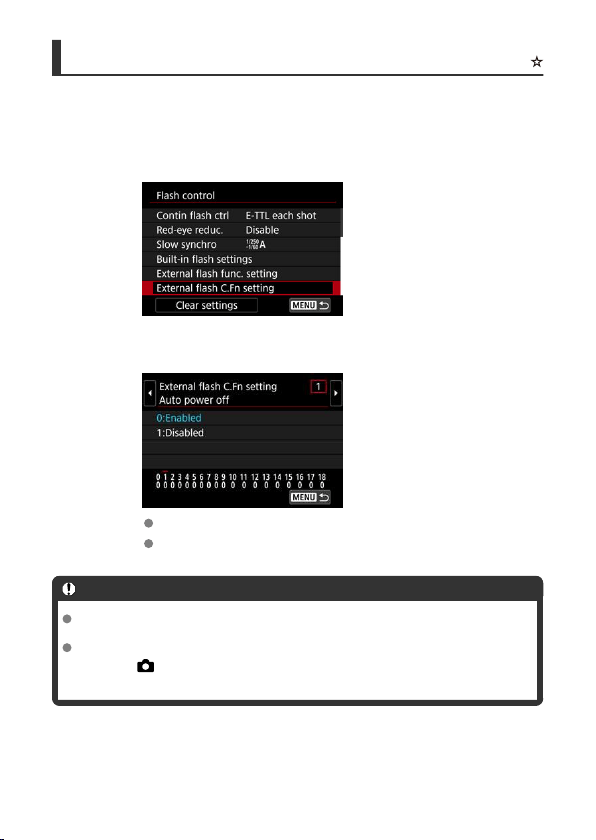
External Flash Custom Function Settings
For details on the external Speedlite's Custom Functions, refer to the Speedlite's Instruction
Manual.
1.
Select [External flash C.Fn setting].
2.
Set the desired functions.
Select the number.
Select an option.
Caution
With an EL/EX series Speedlite, the Speedlite will always fire at full output if the
[Flash metering mode] Custom Function is set to [1:TTL] (autoflash).
Setting or clearing Speedlite Personal Functions (P.Fn) is not possible from the
camera's [
: External flash func. setting] screen. Set it directly on the
Speedlite.
167
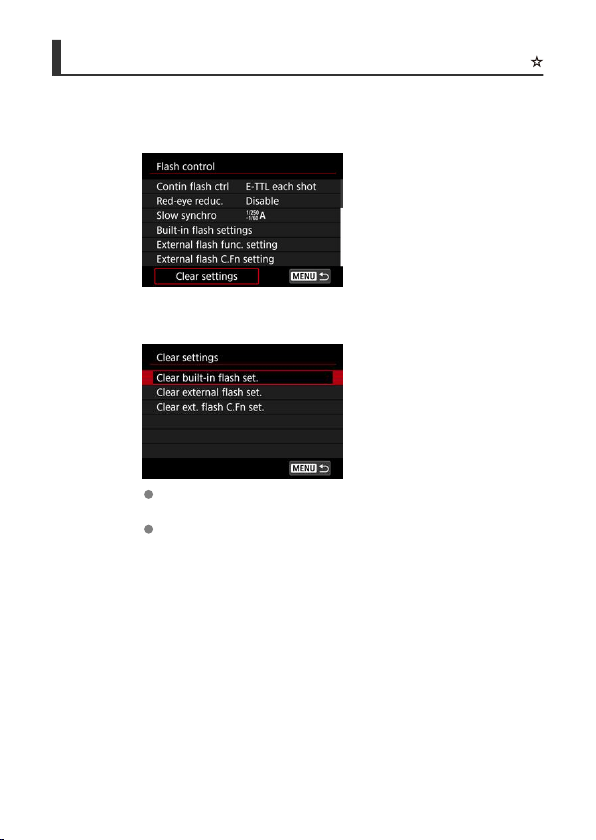
Clearing Flash Function Settings/C.Fn Settings
1.
Select [Clear settings].
2.
Select the settings to be cleared.
Select [Clear built-in flash set.], [Clear external flash set.], or [Clear
ext. flash C.Fn set.].
Select [OK] on the confirmation screen to clear all flash settings or
Custom Function settings.
168
Shooting with Speedlites
EL/EX Series Speedlites for EOS Cameras
Canon Speedlites Other Than the EL/EX Series
Non-Canon Flash Units
Quick Flash Group Control
EL/EX Series Speedlites for EOS Cameras
Features of EL/EX series Speedlites (sold separately) can be used in flash photography with
the camera.
For instructions, refer to the EL/EX series Speedlite's Instruction Manual.
Caution
Use of accessories not designed for a multi-function shoe requires Multi-Function
Shoe Adapter AD-E1, sold separately.
Setting [ : Auto Lighting Optimizer] ( ) to an option other than [Disable] may
still cause images to look bright even if you set lower flash exposure compensation
for darker images.
Note
The Speedlite will fire an intermittent AF-assist beam as needed, if autofocusing is
difficult under low light.
You can also set flash exposure compensation in [External flash func. setting] in
[
: Flash control] ( ).
The camera can turn on certain Speedlites automatically when the camera is
turned on. For details, refer to the instruction manual of Speedlites that support this
feature.
169

Canon Speedlites Other Than the EL/EX Series
With an EZ/E/EG/ML/TL series Speedlite set to A-TTL or TTL autoflash mode, the flash
can be fired at full output only.
Set the camera's shooting mode to <M> or <Av> and adjust the aperture value before
shooting.
When using a Speedlite that has manual flash mode, shoot in manual flash mode.
170
Non-Canon Flash Units
Sync speed
The camera can synchronize with non-Canon compact flash units at up to 1/250 sec.
With large studio flash units, the flash duration is longer than that of a compact flash unit
and varies depending on the model. Before shooting, confirm that flash sync is
performed correctly by taking some test shots at a sync speed of approx. 1/60 sec. to
1/30 sec.
Caution
Manually lower the built-in flash before attaching an external flash unit.
Using the camera with a dedicated flash unit or flash accessory for cameras of
other manufacturers poses a risk of malfunction and even damage.
Do not attach a high-voltage flash unit to the camera's multi-function shoe. It may
not fire.
171
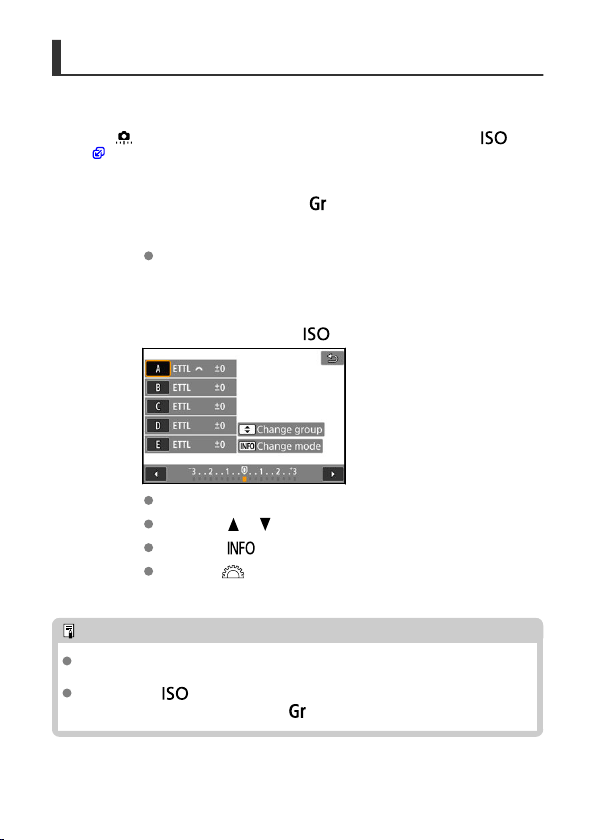
Quick Flash Group Control
As you view the shooting screen in wireless multi-flash photography, you can configure the
settings for each flash group by pressing the button assigned to [Quick flash group
control] in [
: Customize buttons]. This example is based on assigning the < >
button ( ).
1.
Set the flash firing mode to <
> (individual group control) to
prepare for wireless multi-flash photography.
For details, refer to the instruction manuals of flash units supporting
wireless multi-flash photography.
2.
During standby, press the <
> button.
A setting screen for each flash group is displayed.
Press the < >< > keys to select a group (A–E) to configure.
Press the < > button to set the flash mode.
Turn the < > dial to adjust flash output or flash exposure
compensation.
Note
You can access the [Quick flash group control] setting screen in <P>, <Tv>,
<Av>, or <M> mode.
Pressing the < > button displays the [External flash func. setting] screen for
Speedlites in flash modes other than <
> (individual group control).
172

Still Photo Shooting
to the right of titles indicates functions only available in Creative Zone modes (<P>, <Tv>,
<Av>, or <M>).
• Tab Menus: Still Photo Shooting
• Image Quality
• Still Image Aspect Ratio
• Digital Tele-Converter
• Auto Exposure Bracketing (AEB)
• Manual Exposure Compensation
• Exposure Lock (AE Lock)
• ISO Speed Settings for Still Photos
• HDR Shooting
• HDR Mode
• Auto Lighting Optimizer
• Highlight Tone Priority
• Anti-Flicker Shooting
• Metering Mode
• White Balance
• White Balance Correction
• Color Space
• Picture Style Selection
• Picture Style Customization
• Picture Style Registration
• Clarity
• Shooting Creative Filters
• Lens Aberration Correction
• Long Exposure Noise Reduction
• High ISO Speed Noise Reduction
• Dust Delete Data Acquisition
• Focus Bracketing
• Silent Shutter Function
• Shutter Mode
• Releasing Shutter without Card
• Image Stabilizer (IS Mode)
• Customizing Quick Controls
• Shooting with the Touch Shutter
• Image Review
174

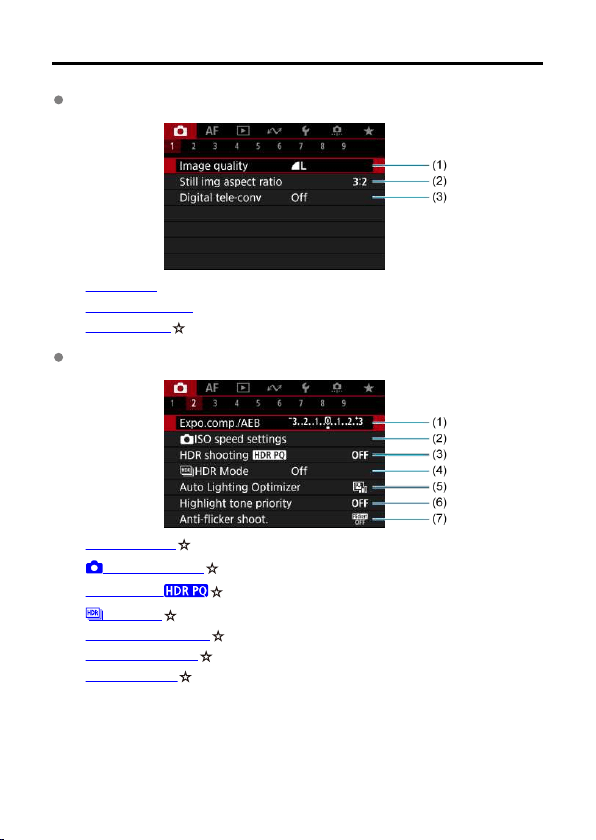
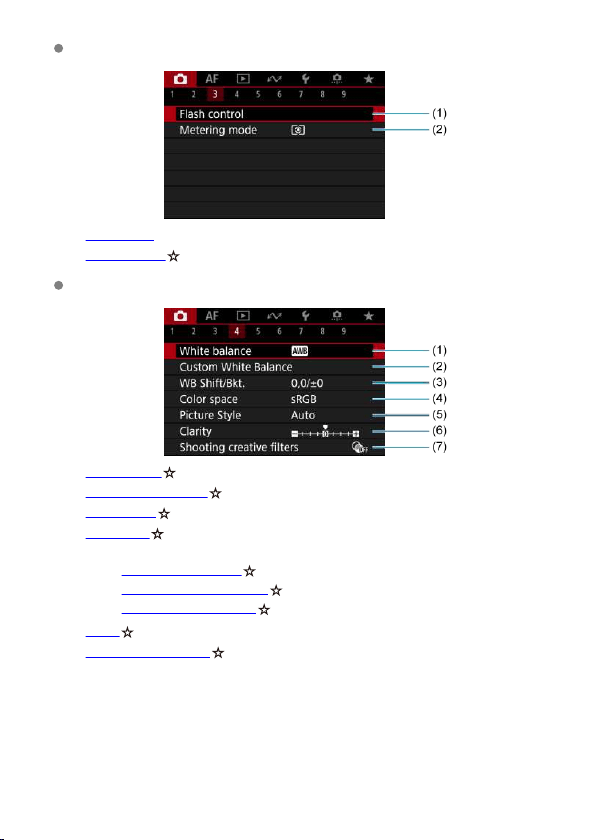
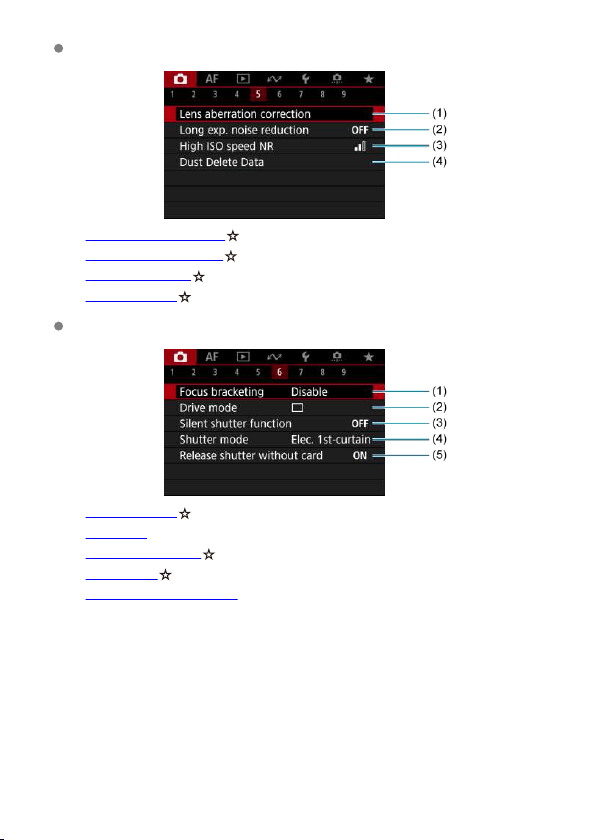
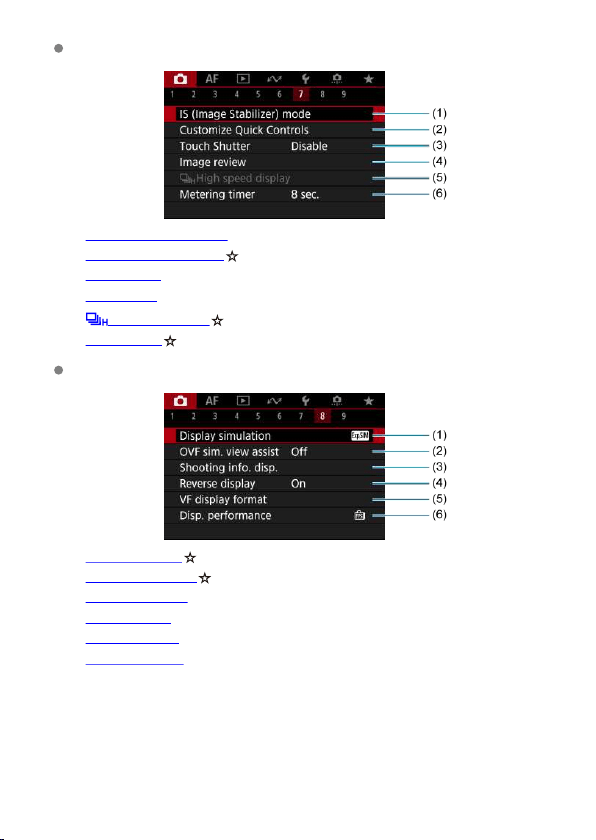
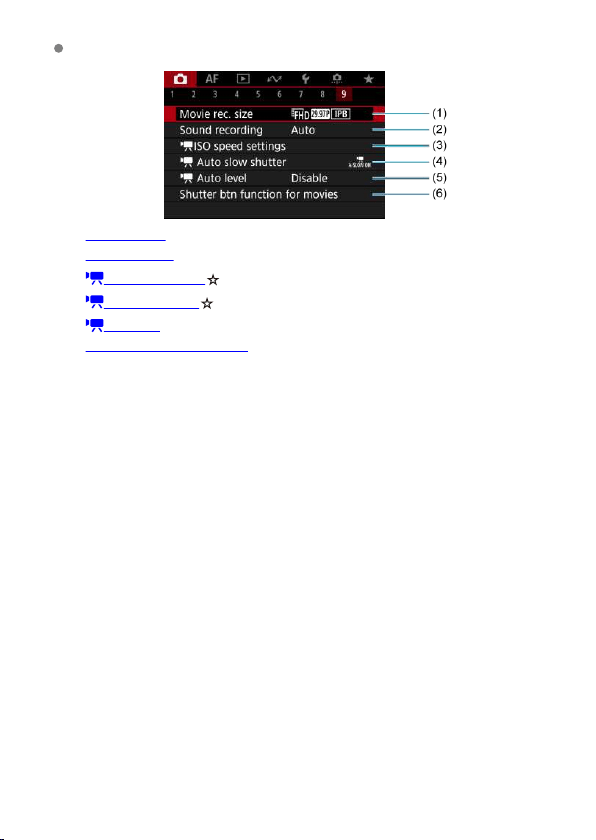
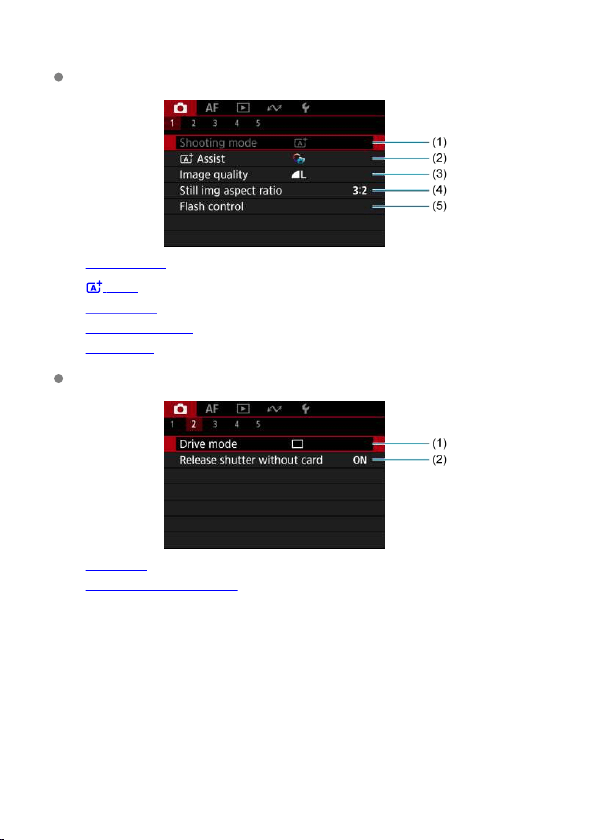
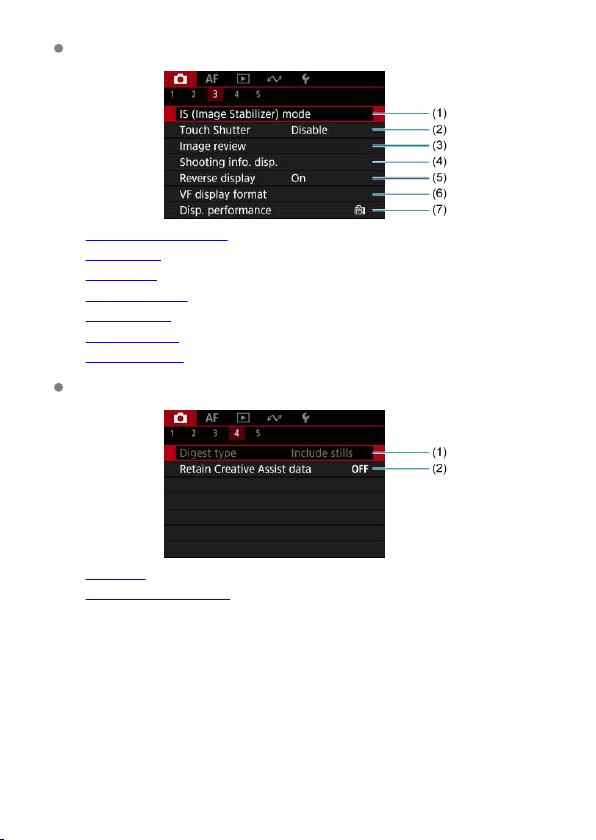
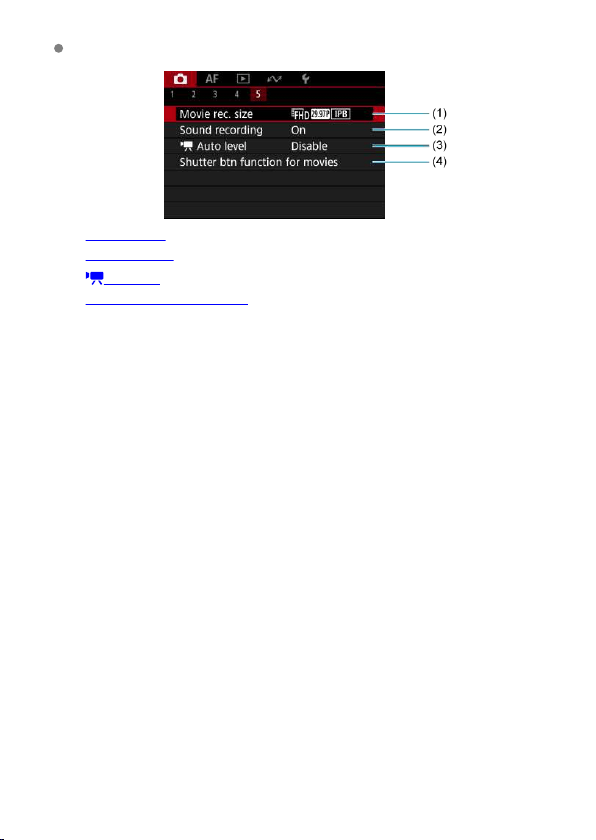
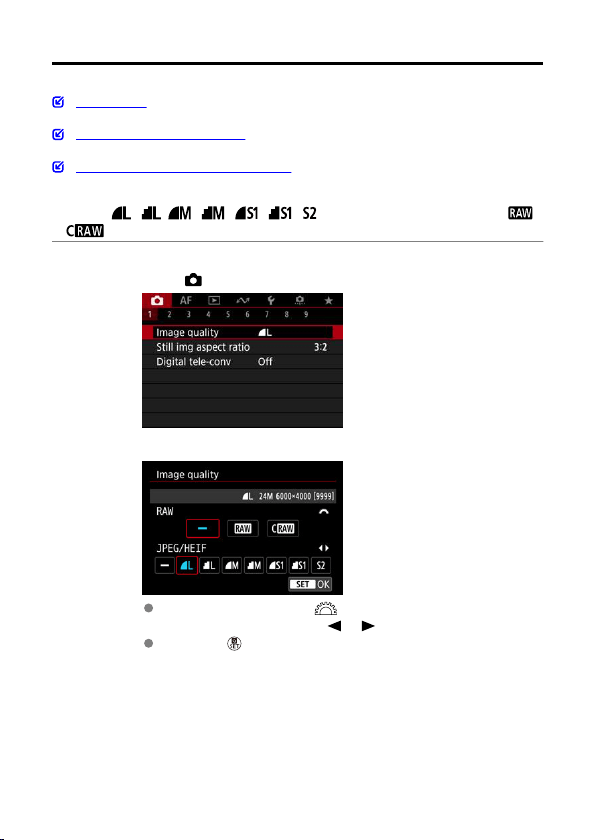
Image Quality
RAW Images
Guide to Image Quality Settings
Maximum Burst for Continuous Shooting
You can select the pixel count and the image quality. JPEG/HEIF image quality options are
as follows:
/ / / / / / . For RAW images, you can specify
or as the image quality.
1.
Select [
: Image quality].
2.
Set the image quality.
For RAW images, use the < > dial to select the size, and for
JPEG/HEIF images, use the <
>< > keys.
Press the < > button to set it.
184
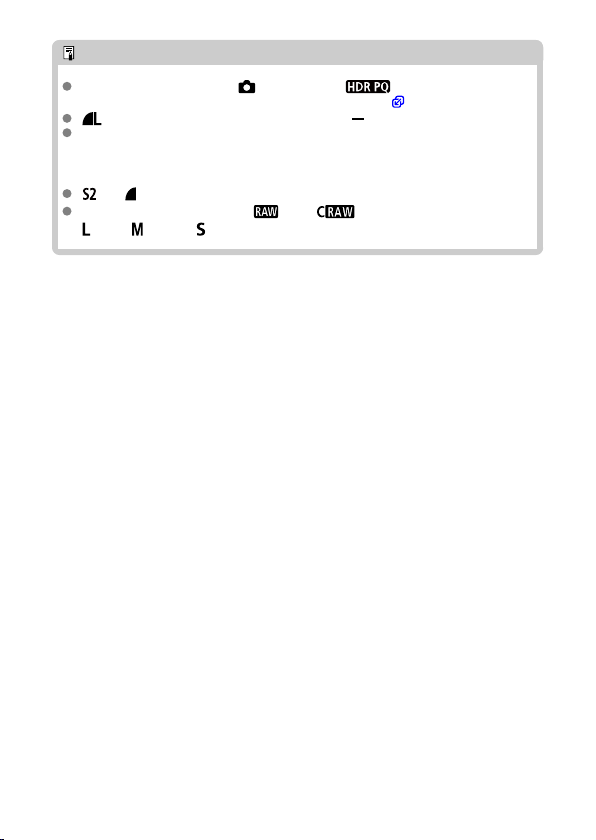
Note
HEIF can be specified when [ : HDR shooting ] is set to [Enable]. You
can convert these images to JPEG images after shooting (
).
is set if you set both RAW and JPEG/HEIF to [ ].
Two versions of each shot are recorded at your specified image quality when you
have selected both RAW and JPEG/HEIF. Both images have the same file number
but each has a different file extension, with .JPG for JPEG, .HIF for HEIF and .CR3
for RAW.
is in (Fine) quality.
Meaning of image quality icons: RAW, Compact RAW, JPEG, HEIF,
Large, Medium, Small.
185
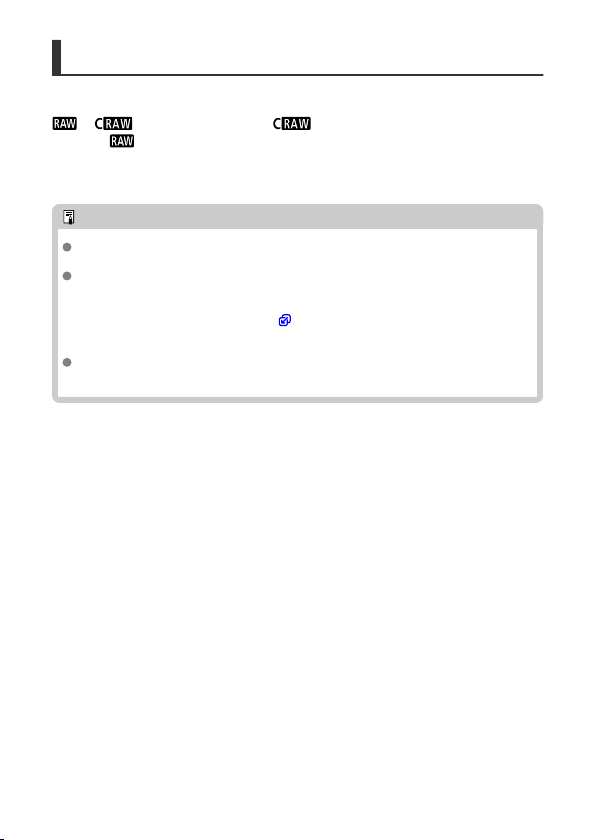
RAW Images
RAW images are raw data from the image sensor that are recorded to the card digitally as
or , based on your selection. produces RAW images with smaller file
sizes than
.
You can use Digital Photo Professional (EOS software) to process RAW images. You can
make various adjustments to images depending upon how they will be used and can
generate JPEG, HEIF, or other types of images reflecting the effects of those adjustments.
Note
To display RAW images on a computer, using Digital Photo Professional (EOS
software, hereafter DPP) is recommended.
Older versions of DPP Ver. 4.x do not support display, processing, editing, or other
operations with RAW images captured by this camera. If a previous version of DPP
Ver. 4.x is installed on your computer, obtain and install the latest version of DPP
from the Canon website to update it ( ), which will overwrite the previous version.
Similarly, DPP Ver. 3.x or earlier does not support display, processing, editing, or
other operations with RAW images captured by this camera.
Commercially available software may not be able to display RAW images captured
by this camera. For compatibility information, contact the software manufacturer.
186

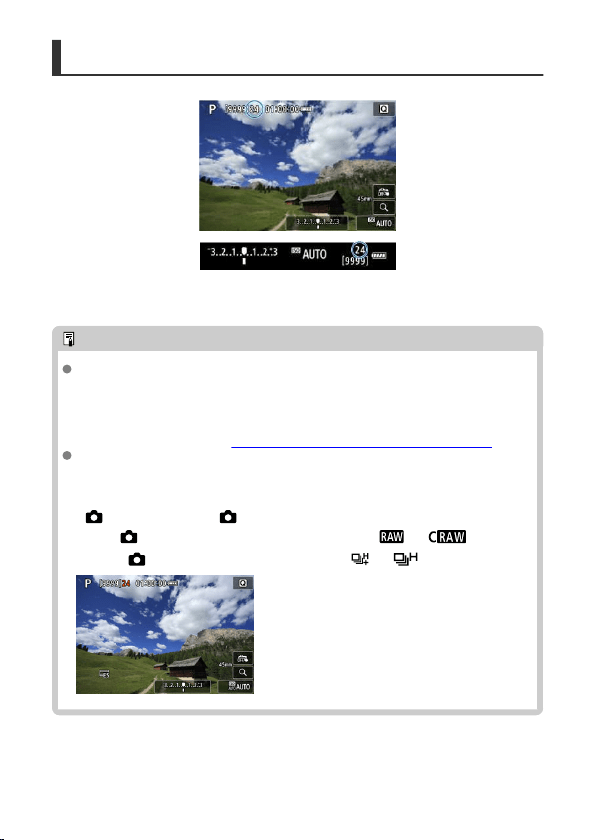
Maximum Burst for Continuous Shooting
The approximate maximum burst is displayed at the upper left of the shooting screen and
lower right of the viewfinder.
Note
If the maximum burst is displayed as “99”, it indicates that you can shoot 99 or
more shots continuously. Fewer shots are available for a value of 98 or lower, and
when [BUSY] is displayed on the screen, internal memory is full and shooting will
stop temporarily. If you stop continuous shooting, the maximum burst will increase.
After all captured images have been written to a card, you can once again shoot at
the maximum burst listed in Maximum burst for continuous shooting [Approx.].
Red display of maximum burst indicates that internal memory will be full in 1 sec. or
less of continuous shooting, after which [BUSY] will appear on the screen and
shooting will stop temporarily.
In this case, you may be able to increase continuous shooting time by adjusting
[
: Image quality] and [ : Drive mode] settings.
• In [
: Image quality], select an option other than [ ] or [ ].
• Set [ : Drive mode] to an option other than [ ] or [ ].
188
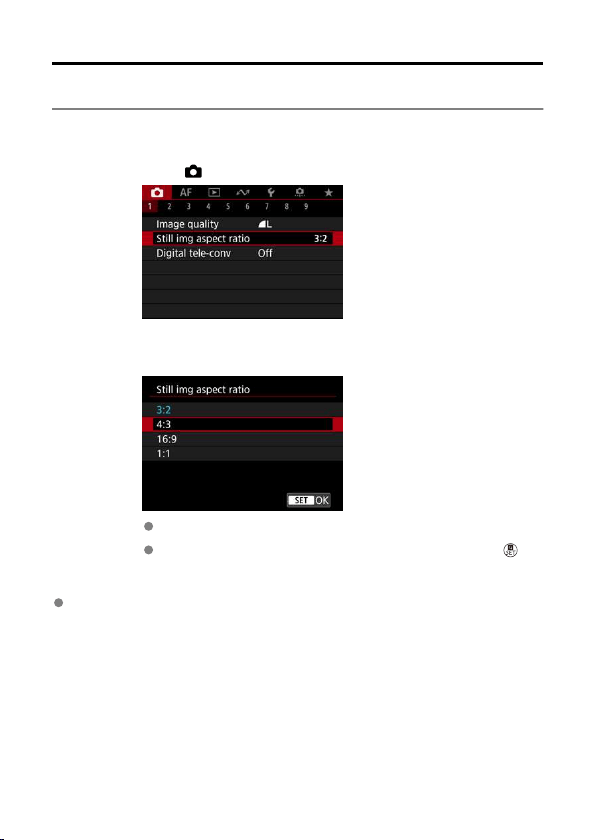
Still Image Aspect Ratio
You can change the image's aspect ratio.
1.
Select [
: Still img aspect ratio].
2.
Set the aspect ratio.
Select an aspect ratio.
To proceed without changing shooting area display, press the < >
button.
JPEG images
The images will be recorded with the set aspect ratio.
189
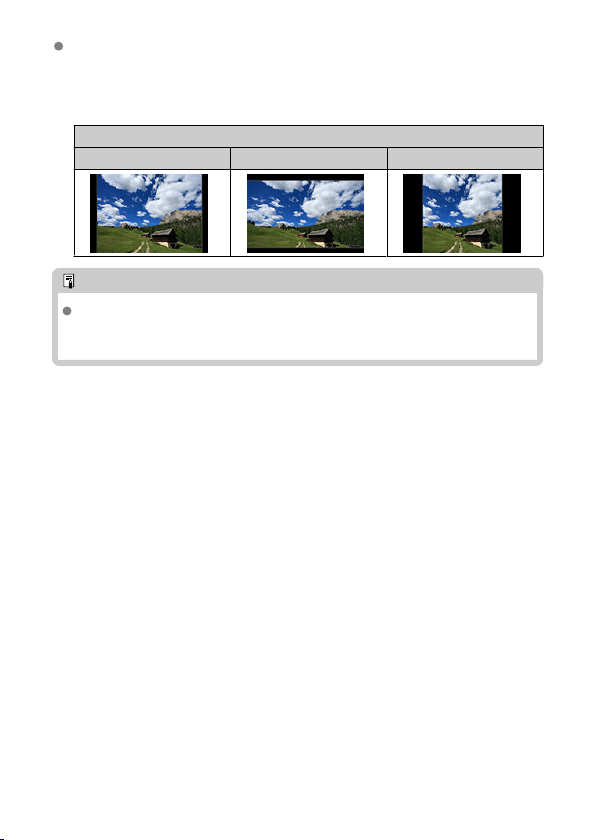
RAW Images
The images will always be recorded in the [3:2] aspect ratio. The selected aspect ratio
information is added to the RAW image file, which enables Digital Photo Professional
(EOS software) to generate an image with the same aspect ratio as set at the time of
shooting when you process RAW images with this software.
Aspect ratio
4:3 16:9 1:1
Note
RAW images shot at an aspect ratio of [4:3], [16:9], or [1:1] are displayed during
playback with lines indicating the shooting area, but these lines are not recorded in
the image.
190
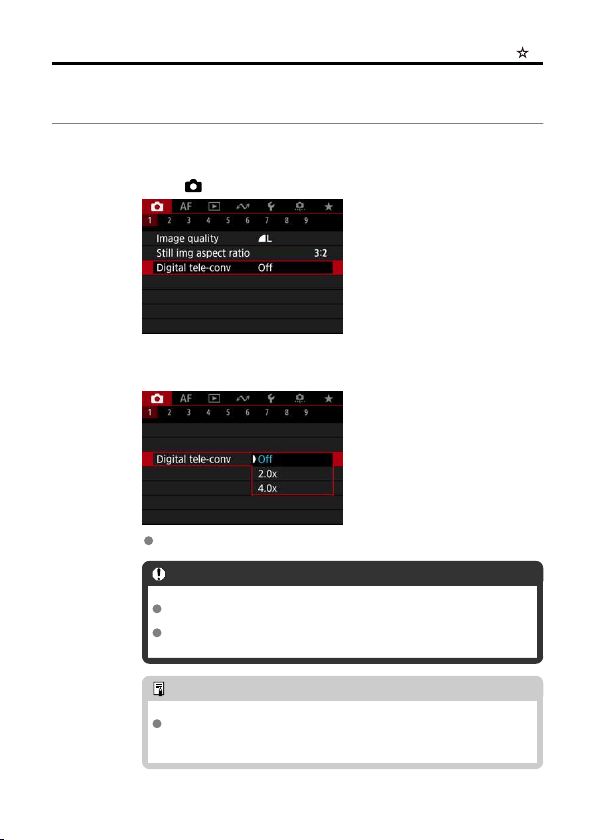
Digital Tele-Converter
Shooting magnification can be increased beyond lens magnification by enlarging the center
of the image area.
1.
Select [
: Digital tele-conv].
2.
Select a shooting magnification.
Shooting magnification is not adjusted when [Off] is selected.
Caution
Higher shooting magnification results in lower image quality.
Not available when RAW image quality is selected.
Note
One AF point is used, fixed at the center. Tracking frames are not
displayed.
191
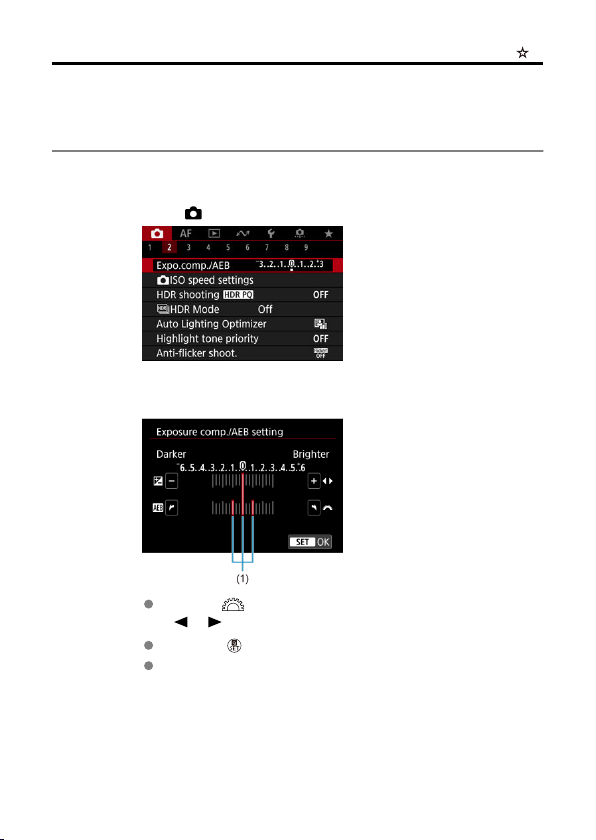
Auto Exposure Bracketing (AEB)
In exposure bracketing, three consecutive images are captured at different exposures within
your specified range of up to ±3 stops (in 1/3-stop increments) by automatically adjusting the
shutter speed, aperture value, or ISO speed.
* AEB stands for Auto Exposure Bracketing.
1.
Select [
: Expo.comp./AEB].
2.
Set the AEB range.
Turn the < > dial to set the AEB range (1). By using the
<
>< > keys, you can set the amount of exposure compensation.
Press the < > button to set it.
Once an AEB range is set, it is shown on the screen on the exposure
level indicator.
192
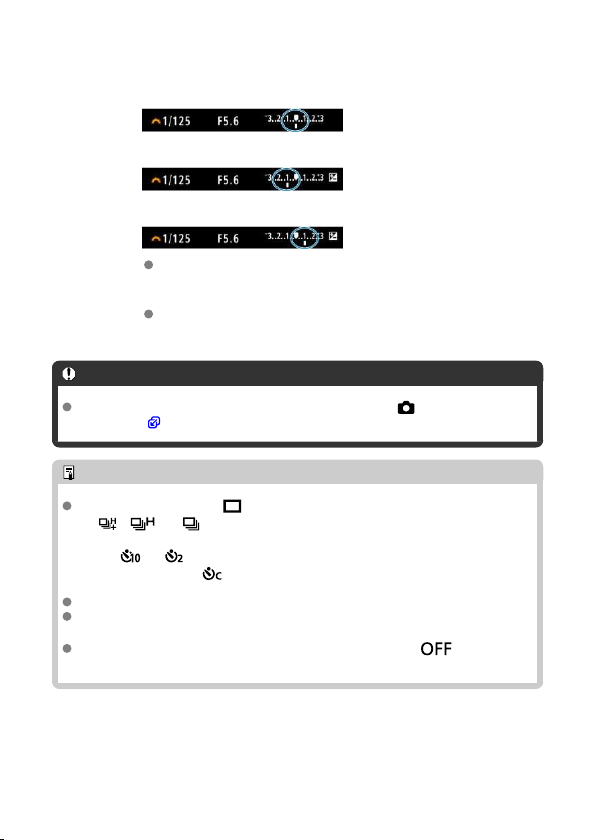
3.
Take the picture.
Standard exposure
Decreased exposure
Increased exposure
Three bracketed shots are taken, according to the specified drive
mode, in this sequence: Standard exposure, decreased exposure, and
increased exposure.
AEB will not be automatically canceled. To cancel AEB, follow step 2 to
turn off the AEB range display.
Caution
Exposure compensation in AEB may be less effective with [ : Auto Lighting
Optimizer] ( ) set to an option other than [Disable].
Note
If the drive mode is set to [ ], press the shutter button three times for each shot.
In [
], [ ], or [ ] mode, holding down the shutter button completely captures
three images, one after another, before the camera automatically stops shooting.
When [
] or [ ] is set, three consecutive shots are captured after a delay of 10
or 2 sec. When set to [
], three times the specified number of shots are taken in
continuous shooting.
You can set AEB in combination with exposure compensation.
AEB is not available in flash photography or bulb exposures, in HDR mode, or with
Multi Shot Noise Reduction, focus bracketing, or shooting creative filters.
AEB is canceled automatically after the power switch is set to < > and after
the flash is fully charged.
193
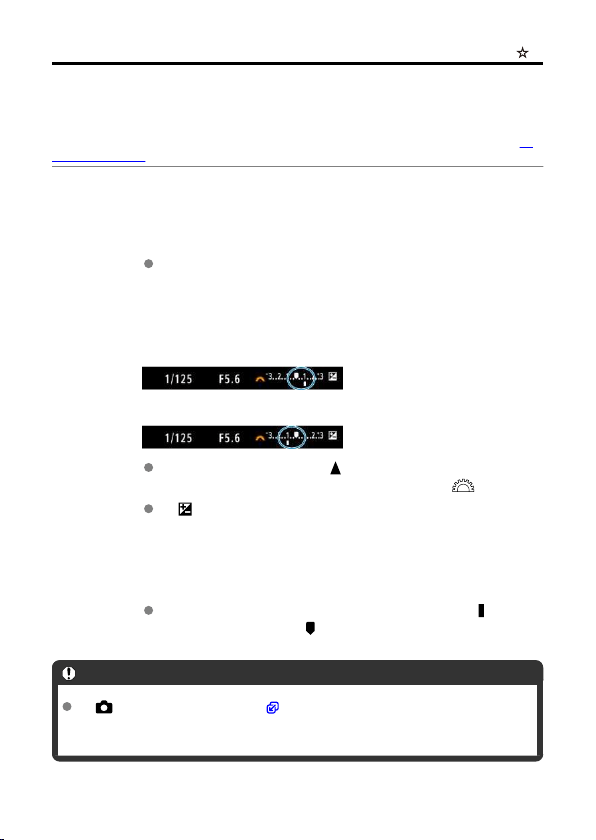
Manual Exposure Compensation
Exposure compensation can brighten (increased exposure) or darken (decreased exposure)
the standard exposure set by the camera.
Exposure compensation is available in <P>, <Tv>, <Av>, and <M> modes.
For details on exposure compensation when <M> mode and ISO Auto are both set, see
M:
Manual Exposure.
1.
Check the exposure.
Press the shutter button halfway and check the exposure level
indicator.
2.
Set the compensation amount.
Increased exposure, to brighten images
Decreased exposure, to darken images
To set the amount, press the < > key to select exposure
compensation and watch the screen as you turn the <
> dial.
A [ ] icon is displayed to indicate exposure compensation.
3.
Take the picture.
To cancel exposure compensation, set the exposure level [ ] to the
standard exposure index ([
]).
Caution
If [ : Auto Lighting Optimizer] ( ) is set to any setting other than [Disable], the
image may still look bright even if decreased exposure compensation is set to
darken images.
194
Note
The exposure compensation amount will remain in effect even after you set the
power switch to <
>.
195
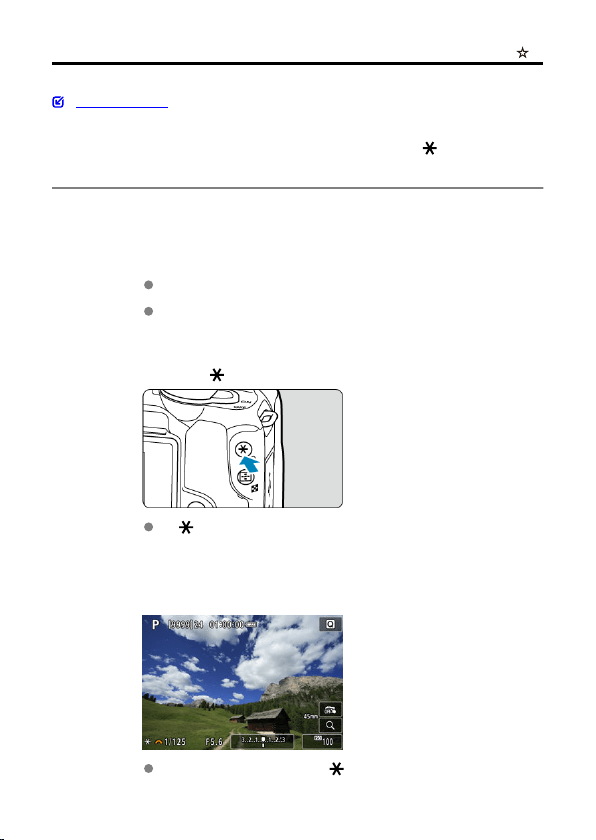
Exposure Lock (AE Lock)
Effect of AE Lock
You can lock the exposure when you want to set the focus and exposure separately or when
you will take multiple shots at the same exposure setting. Press the <
> button to lock the
exposure, then recompose and take the picture. This is called AE lock. It is effective for
shooting backlit subjects, etc.
1.
Focus on the subject.
Press the shutter button halfway.
The exposure value will be displayed.
2.
Press the <
> button.
A [ ] icon is displayed in the lower left of the screen to indicate that
exposure is locked (AE lock).
3.
Recompose and take the picture.
To cancel AE lock, press the < > button.
196
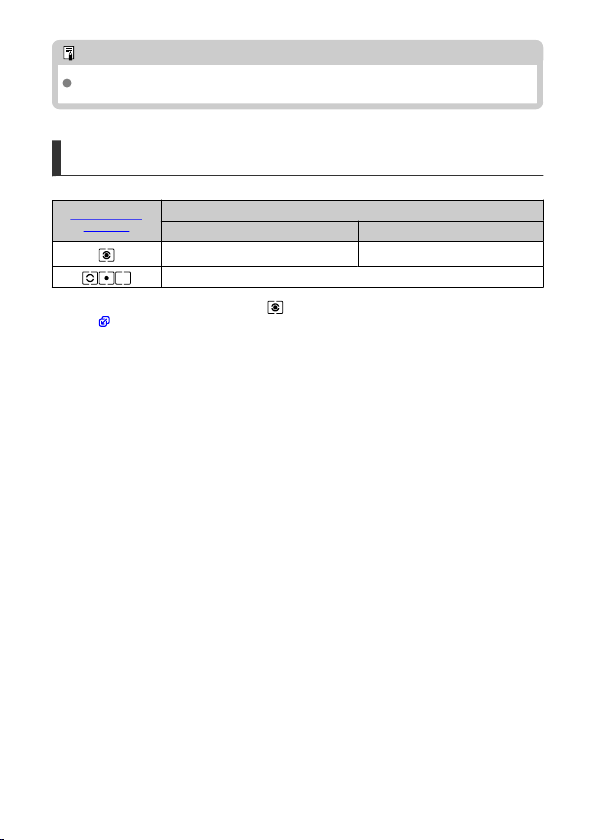
Note
AE lock is not possible with bulb exposures.
Effect of AE Lock
Metering Mode
Selection
AF Point Selection
Automatic Selection Manual Selection
Exposure centered on the AF point in
focus is locked.
Exposure centered on the selected AF
point is locked.
Center-weighted exposure is locked.
* Center-weighted exposure is locked when [ ] is set with the camera configured for manual
focusing (
).
197
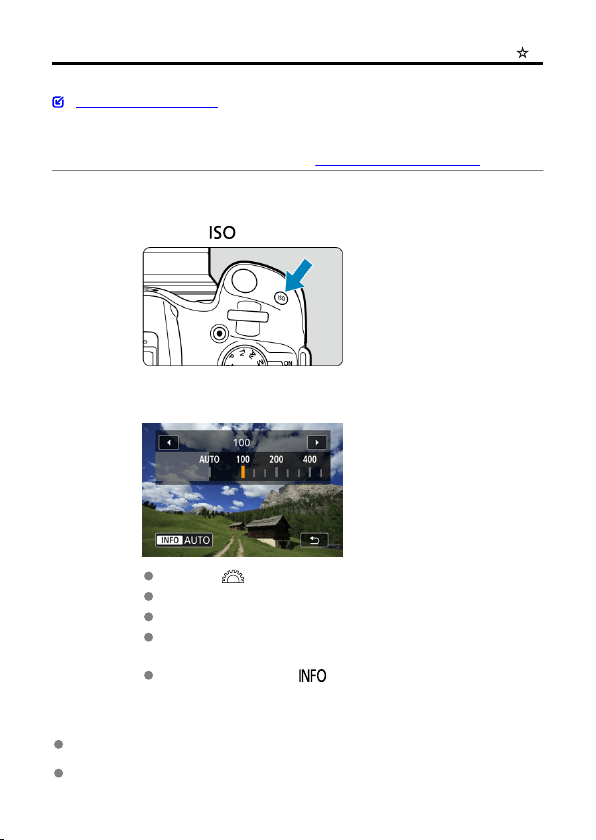
ISO Speed Settings for Still Photos
Maximum Auto ISO Speed
Set the ISO speed (image sensor's sensitivity to light) to suit the ambient light level. In Basic
Zone modes, ISO speed is set automatically.
For details on ISO speed in movie recording, see ISO Speed in Movie Recording.
1.
Press the <
> button.
2.
Set the ISO speed.
Turn the < > dial to set it.
ISO speed can be set within ISO 100–32000 in 1/3-stop increments.
With [AUTO] selected, ISO speed is set automatically.
When [AUTO] is selected, pressing the shutter button halfway will
display the ISO speed actually set.
You can also press the < > button to set the speed to [AUTO].
ISO speed guide
Low ISO speeds reduce image noise but may increase the risk of camera/subject shake
or reduce the area in focus (shallower depth of field), in some shooting conditions.
High ISO speeds enable low-light shooting, a larger area in focus (deeper depth of field),
and longer flash range but may increase image noise.
198
Note
Can also be set on the [ISO speed] screen in [ : ISO speed settings].
Setting [ : ISO expansion] to [Enable] ( ) expands the maximum speed to H
(equivalent to ISO 51200).
Caution
Image noise (such as graininess, dots of light, or banding), irregular colors, or color
shift may be noticeable at high ISO speeds, in high temperatures, or with long
exposures.
When shooting in conditions that produce an extreme amount of noise, such as a
combination of high ISO speed, high temperature, and long exposure, images may
not be recorded properly.
If you use a high ISO speed and flash to shoot a close subject, overexposure may
result.
199
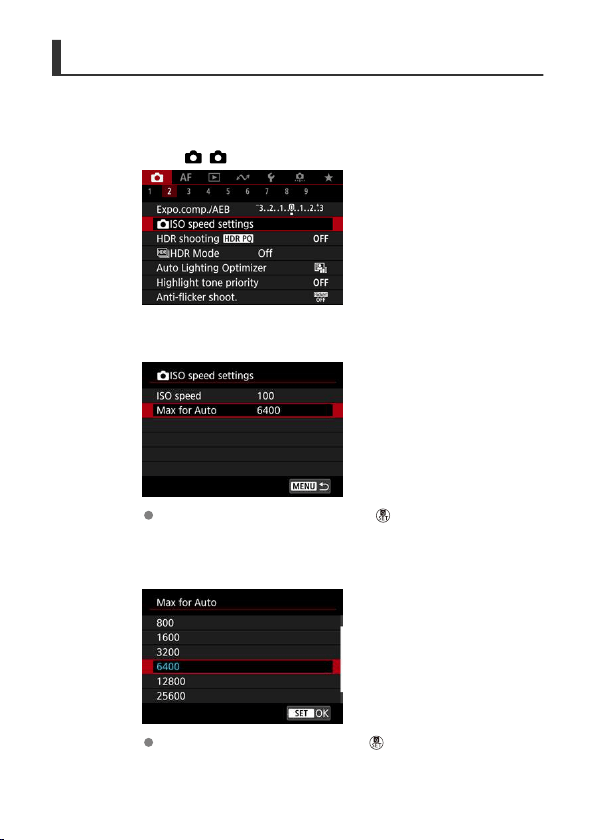
Maximum Auto ISO Speed
For ISO Auto, you can set the maximum ISO speed limit within ISO 400–32000.
1.
Select [
: ISO speed settings].
2.
Select [Max for Auto].
Select [Max for Auto], then press the < > button.
3.
Select the ISO speed.
Select an ISO speed, then press the < > button.
200
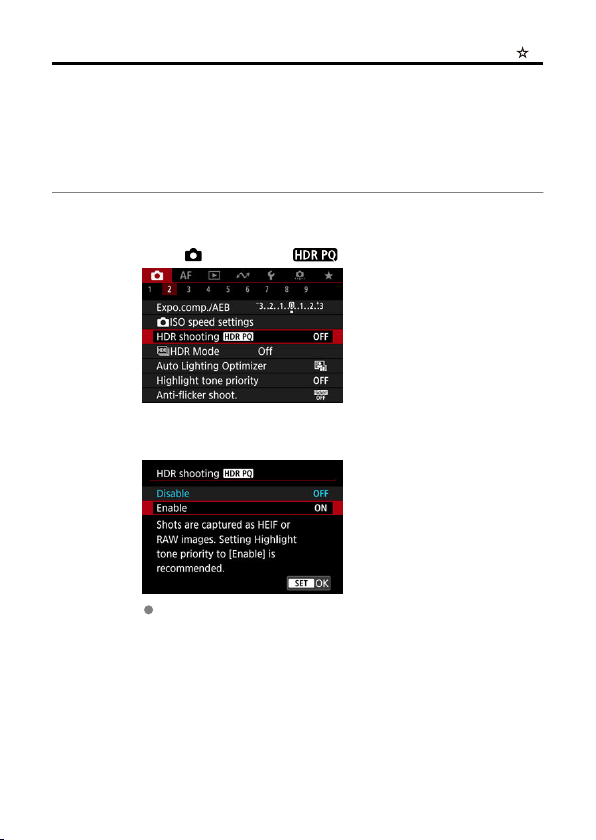
HDR Shooting
PQ in HDR PQ refers to the gamma curve of the input signal for displaying HDR images.
HDR PQ settings enable the camera to produce HDR images conforming to the PQ
specification defined in ITU-R BT.2100 and SMPTE ST.2084. (Actual display depends on
monitor performance.)
Shots are captured as HEIF or RAW images.
* HDR stands for High Dynamic Range.
* PQ stands for Perceptual Quantization.
1.
Select [
: HDR shooting ].
2.
Select [Enable].
On the screen during shooting and playback, converted images are
displayed that resemble how the images would look on an HDR display
device.
201
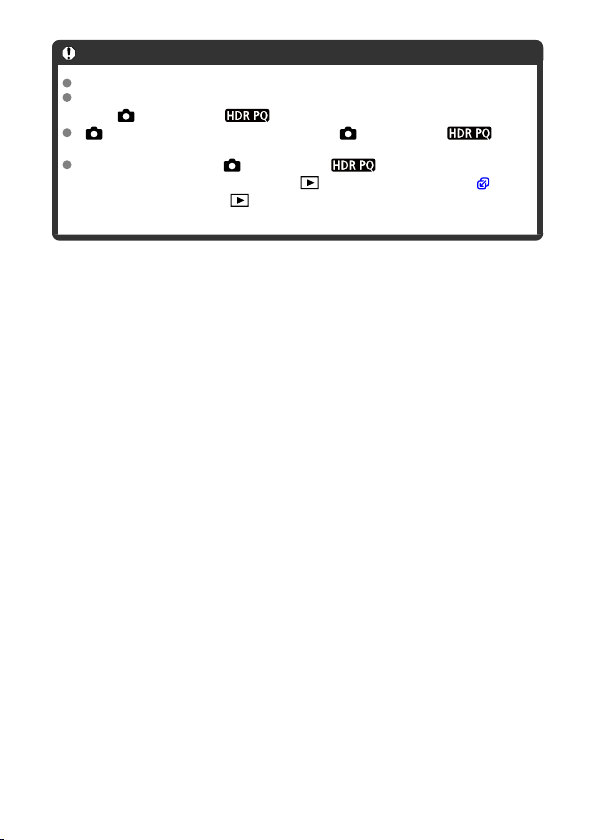
Caution
Some scenes may look different from how they appear on an HDR display device.
Unused signal values are roughly indicated by image areas in gray in the histogram
when [
: HDR shooting ] is set to [Enable].
[ : Disp. performance] is not available when [ : HDR shooting ] is
set to [Enable]. It is set to [Smooth].
For images captured with [ : HDR shooting ] set to [Enable], before
playback on an HDR display device, set [
: HDMI HDR output] to [On] ( ).
Note that regardless of the [
: HDMI HDR output] setting, HDR images are used
for display on HDR display devices.
202
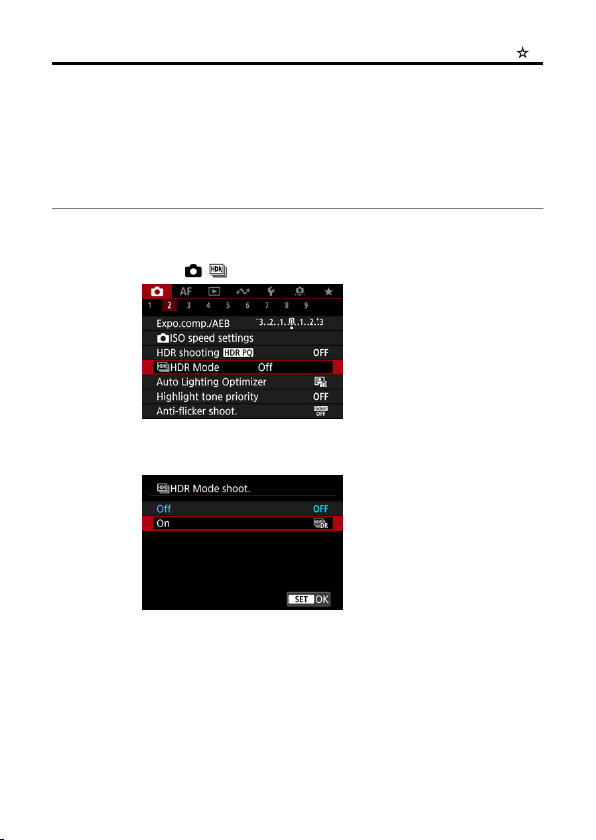
HDR Mode
You can shoot still photos with clipped highlights and shadows reduced for a high dynamic
range of tones even in high-contrast scenes. HDR shooting is effective for landscape and
still-life shots.
HDR shooting enhances gradation in dark image areas by merging three images
deliberately captured at different exposures (standard, underexposed, and
overexposed) to produce an HDR image that compensates for loss of detail in dark
image areas. HDR images are captured as HEIFs or JPEGs.
* HDR stands for High Dynamic Range.
1.
Select [
: HDR Mode].
2.
Select [On].
203
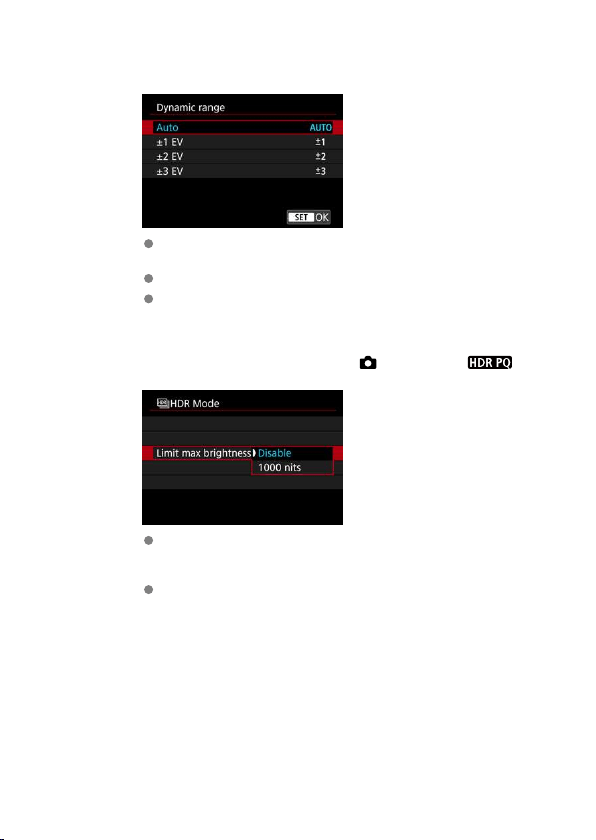
3.
Set [Dynamic range].
Selecting [Auto] will have the dynamic range set automatically
depending on the image's overall tonal range.
The higher the number, the wider the dynamic range will be.
To cancel HDR shooting, select [Off] in step 2.
4.
Set [Limit max brightness] (only with [
: HDR shooting ] set
to [Enable]).
With [Disable], maximum brightness is not limited. Recommended
when you will review images on a monitor supporting display at
brightnesses exceeding 1000 nits.
With [1000 nits], maximum brightness is limited to approx. 1000 nits.
204
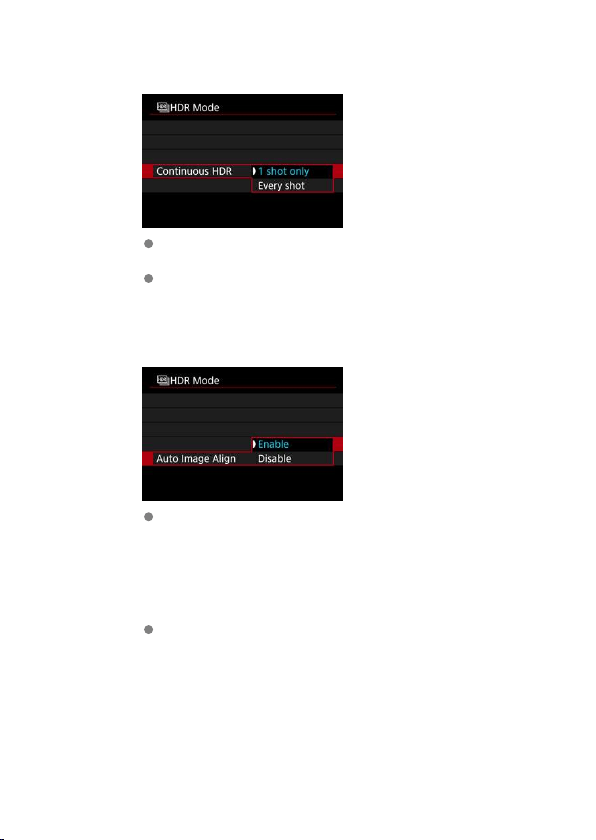
5.
Set [Continuous HDR].
With [1 shot only], HDR shooting is canceled automatically after you
finish shooting.
With [Every shot], HDR shooting continues until the setting in step 2 is
set to [Disable HDR].
6.
Set [Auto Image Align].
For handheld shooting, select [Enable]. When using a tripod, select
[Disable].
7.
Take the picture.
When you press the shutter button completely, three consecutive
images will be captured, and the HDR image will be recorded to the
card.
205
Caution
Expanded ISO speeds (H) are not available in HDR shooting.
The flash will not fire during HDR shooting.
RAW image quality cannot be set.
AEB is not available.
In HDR shooting, three images are captured with settings such as shutter speed
automatically adjusted. For this reason, even in <Tv> or <M> mode, the shutter
speed and ISO speed will change, relative to your specified speed.
To prevent camera shake, the camera may set a high ISO speed.
When shooting HDR images with [Auto Image Align] set to [Enable], AF point
display information ( ) and Dust Delete Data ( ) will not be appended to the
image.
If you perform handheld HDR shooting with [Auto Image Align] set to [Enable],
image periphery will be slightly trimmed and resolution will be slightly lowered.
Also, if the images cannot be aligned properly due to camera shake, etc., auto
image alignment may not take effect. Note that when shooting with excessively
bright (or dark) exposure settings, auto image alignment may not work properly.
If you perform handheld HDR shooting with [Auto Image Align] set to [Disable],
the three images may not be properly aligned and the HDR effect may be reduced.
Using a tripod is recommended.
Auto image alignment may not function properly with repetitive patterns (lattice,
stripes, etc.) or flat, single-tone images.
Subjects such as the sky or white walls may not be rendered with smooth gradation
and may have noise or irregular exposure or colors.
HDR shooting under fluorescent or LED lighting may cause issues such as
irregular exposure or colors in HDR images, due to the flickering light source.
Effects of flickering may be reduced by setting [Anti-flicker shoot.] to [Enable].
With HDR shooting, the images will be merged, then saved to the card, so it may
take some time. [BUSY] appears on the screen as images are processed, and
shooting is not possible until processing is finished.
206
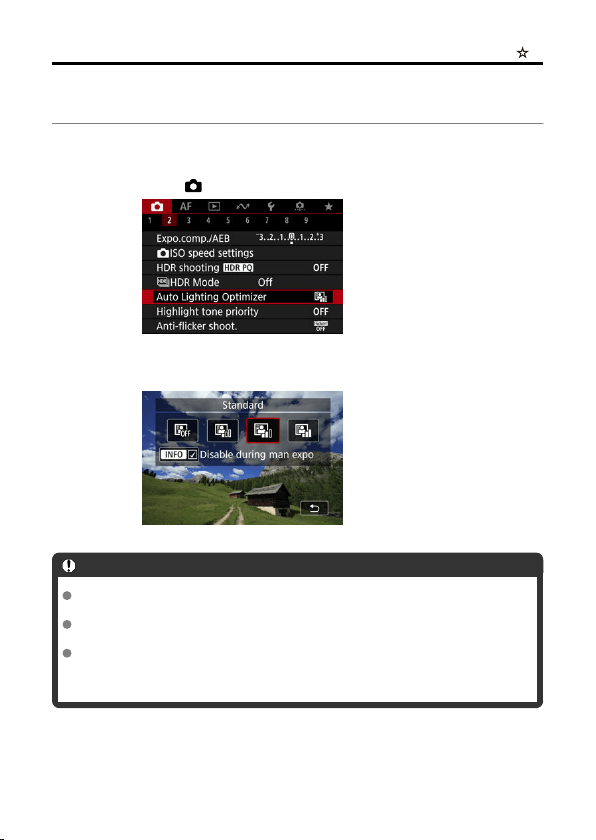
Auto Lighting Optimizer
Brightness and contrast can be corrected automatically if shots look dark or contrast is too
low or high.
1.
Select [
: Auto Lighting Optimizer].
2.
Set a correction option.
Caution
Noise may increase and apparent resolution may change, under some shooting
conditions.
If the effect of Auto Lighting Optimizer is too strong and results are not at your
preferred brightness, set to [Low] or [Disable].
If a setting other than [Disable] is set and you use exposure compensation or flash
exposure compensation to darken the exposure, the image may still come out
bright. If you want a darker exposure, set this function to [Disable].
207
Note
To enable [ : Auto Lighting Optimizer] to be set even in <M> mode, press the
<
> button in step 2 to clear the checkmark [ ] for [Disable during man
expo].
208
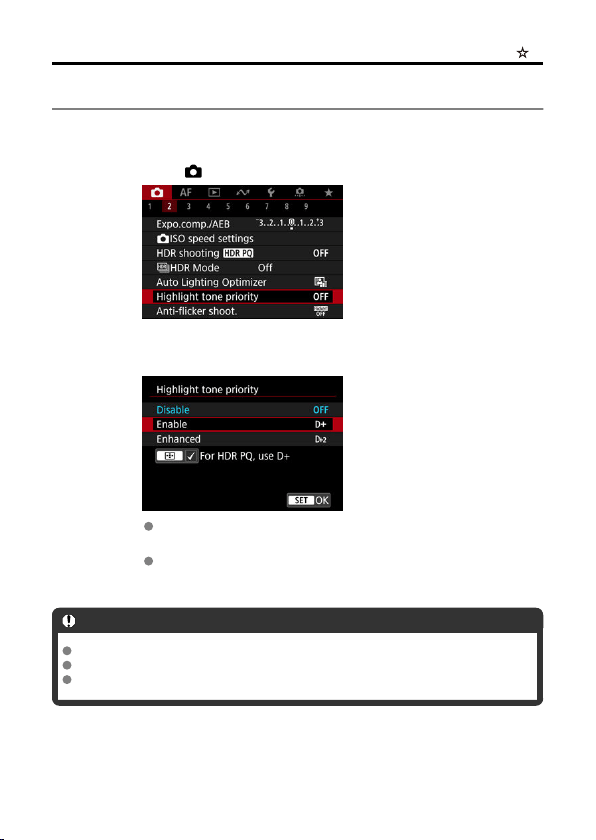
Highlight Tone Priority
You can reduce overexposed, clipped highlights.
1.
Select [
: Highlight tone priority].
2.
Set an option.
[Enable]: Improves gradation in highlights. The gradation between the
grays and highlights becomes smoother.
[Enhanced]: Reduces overexposed highlights even more than
[Enable], under some shooting conditions.
Caution
Noise may increase slightly.
The available ISO range starts at ISO 200. Expanded ISO speeds cannot be set.
With [Enhanced], results in some scenes may not look as expected.
209
Note
[ : Highlight tone priority] is set to [Enable] and cannot be changed after you
set [
: HDR shooting ] to [Enable] by pressing the < > button to add
a checkmark to this setting.
[ : Highlight tone priority] is set to [Disable] when [ : HDR Mode] is set to
[On], even if you set [
: HDR shooting ] to [Enable].
210
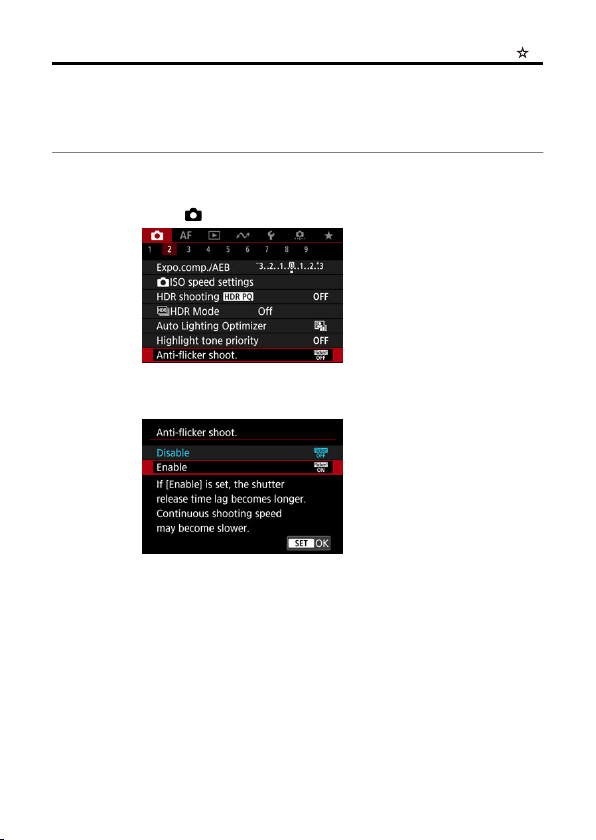
Anti-Flicker Shooting
Uneven exposure and color may appear in continuous shooting at fast shutter speeds under
flickering light sources such as fluorescent lights, due to uneven vertical exposure. Anti-
flicker shooting enables you to take pictures when exposure and colors are less affected by
flickering.
1.
Select [
: Anti-flicker shoot.].
2.
Select [Enable].
3.
Take the picture.
211
Caution
When [Enable] is set and you shoot under a flickering light source, the shutter-
release time lag may become longer. Also, the continuous shooting speed may
become slower, and the shooting interval may become irregular.
Flicker at a frequency other than 100Hz or 120Hz cannot be detected. Also, if the
flickering frequency of the light source changes during continuous shooting, effects
of the flicker cannot be reduced.
In <P> or <Av> mode, color tone of captured images may vary if the shutter speed
changes during continuous shooting or if you take multiple shots of the same scene
at different shutter speeds. To avoid inconsistent color tone, shoot in <M> or <Tv>
mode at a fixed shutter speed.
Color tone of captured images may vary between [Enable] and [Disable].
Shutter speed, aperture value, and ISO speed may change when you start
shooting with AE lock.
If the subject is against a dark background or if there is a bright light in the image,
flicker may not be properly detected.
Flicker reduction may not be possible under special lighting.
Depending on the light source, flicker may not be detected properly.
Depending on the light sources or shooting conditions, the expected result may not
be obtained even if you use this function.
Note
Taking test shots in advance is recommended.
Detect flicker manually if the screen flickers (as when the light source changes) by
pressing the <
> button, selecting [Anti-flicker shoot.], then pressing the
<
> button.
Flicker is not reduced in Basic Zone modes.
Flicker reduction also works with flash photography. However, the expected result
may not be obtained for wireless flash photography.
212
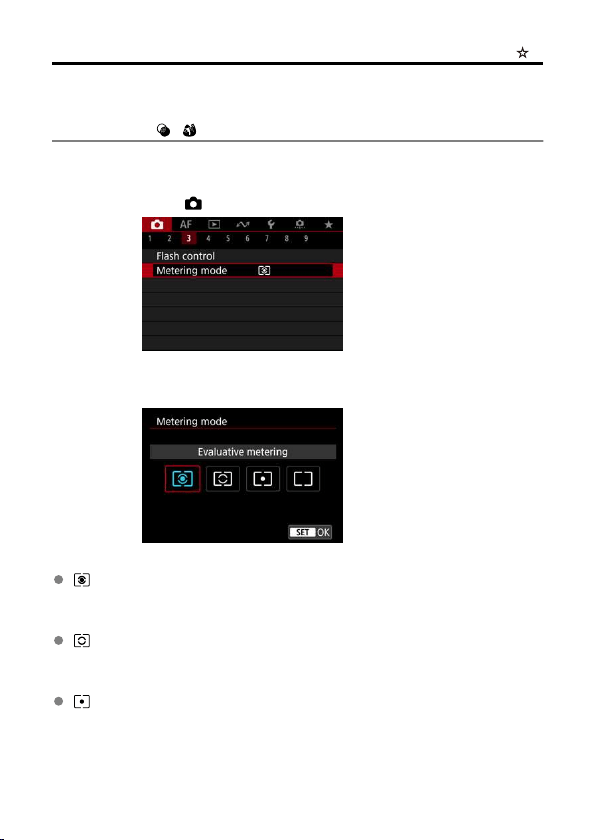
Metering Mode
Four methods (metering modes) to measure the subject's brightness are provided. Normally,
evaluative metering is recommended. Evaluative metering is set automatically in Basic Zone
modes (except in <
: > mode, which uses center-weighted average metering).
1.
Select [
: Metering mode].
2.
Select an option.
: Evaluative metering
General-purpose metering mode suited even for backlit subjects. The camera adjusts
the exposure automatically to suit the scene.
: Partial metering
Effective where there are much brighter lights around the subject due to backlight, etc.
The partial metering area is indicated on the screen.
: Spot metering
Effective when metering a specific part of the subject. The spot metering area is
indicated on the screen.
213
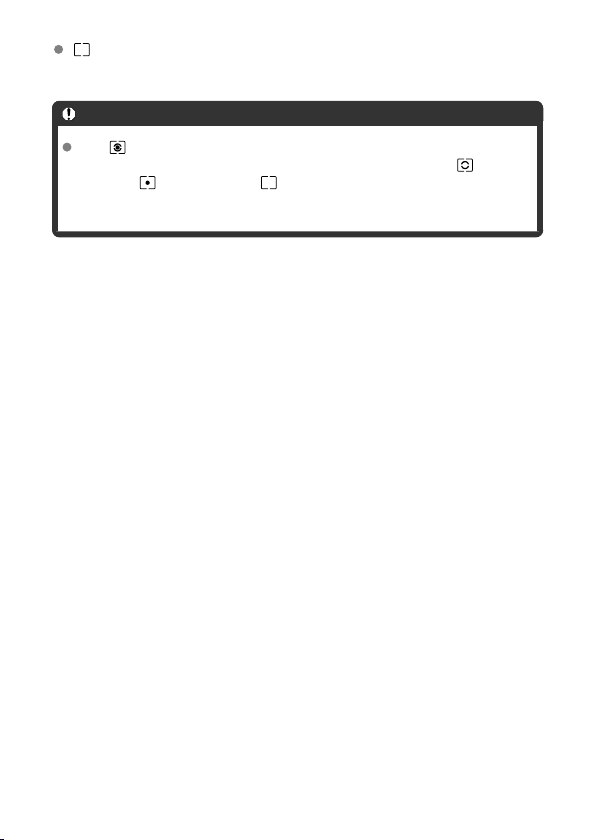
: Center-weighted average
The metering across the screen is averaged, with the center of the screen weighted
more heavily.
Caution
With (evaluative metering), holding down the shutter button halfway when
shooting with [One-Shot AF] locks the exposure value (AE lock). With
(partial
metering),
(spot metering), or (center-weighted average metering),
exposure is set at the moment the picture is taken (without locking the exposure
value when the shutter button is pressed halfway).
214
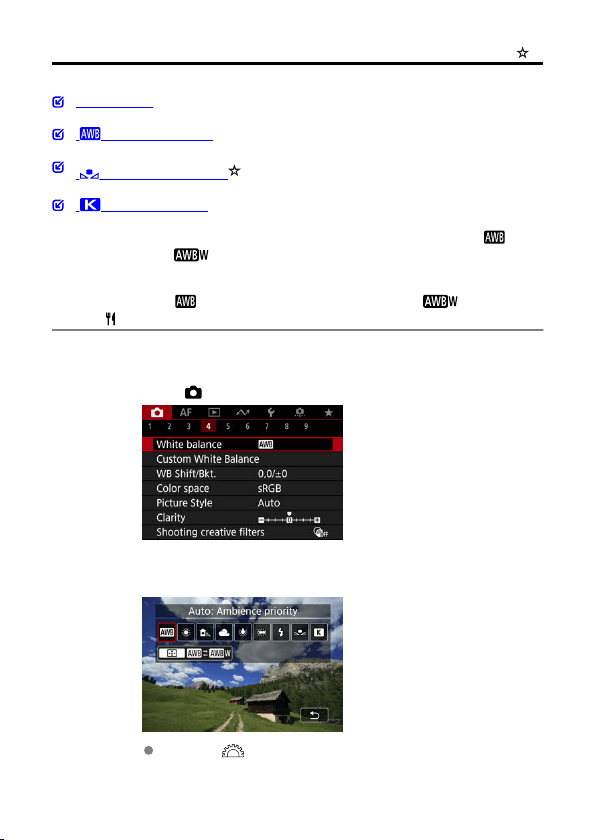
White Balance
White Balance
[ ] Auto White Balance
[ ] Custom White Balance
[ ] Color Temperature
White balance (WB) is for making the white areas look white. Normally, the Auto [ ]
(Ambience priority) or [
] (White priority) setting will obtain the correct white balance. If
natural-looking colors cannot be obtained with Auto, you can select the white balance to
match the light source or set it manually by shooting a white object.
In Basic Zone modes, [
] (Ambience priority) is set automatically. ([ ] (White priority)
is set in <
> mode.)
1.
Select [
: White balance].
2.
Select an option.
Turn the < > dial to select a white balance option.
215
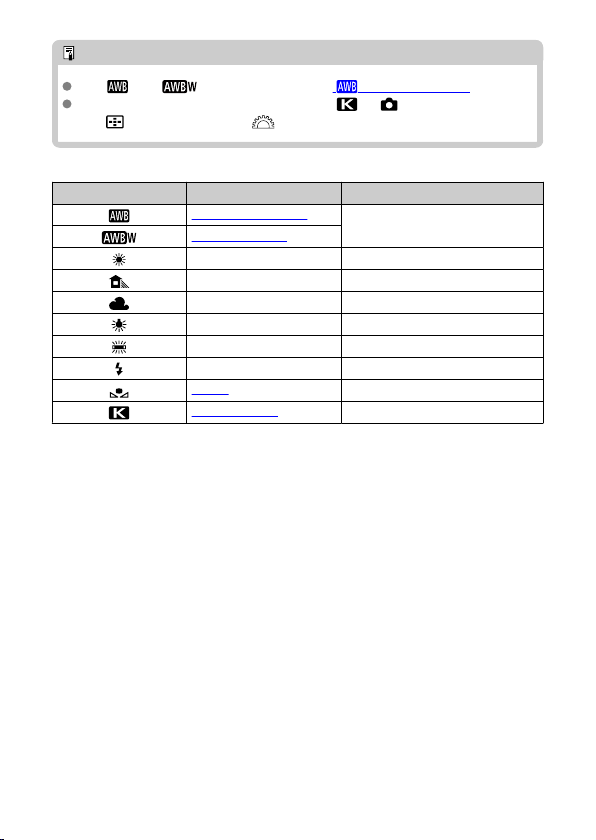
Note
For [ ] and [ ] setting instructions, see [ ] Auto White Balance.
To set your preferred color temperature, select [ ] in [ : White balance], press
the [
] button, then turn the < > dial.
(Approx.)
Display Mode Color Temperature (K: Kelvin)
Auto (Ambience priority)
3000–7000
Auto (White priority)
Daylight 5200
Shade 7000
Cloudy, twilight, sunset 6000
Tungsten light 3200
White fluorescent light 4000
When using Flash Automatically set*
Custom 2000–10000
Color temperature 2500–10000
* Applicable with Speedlites having a color temperature transmission function. Otherwise, it will be
fixed to approx. 6000K.
216

White Balance
The human eye adapts to changes in lighting so that white objects look white under all kinds
of lighting. Cameras determine white from the color temperature of lighting and, based on
this, apply image processing to make color tones look natural in your shots.
217
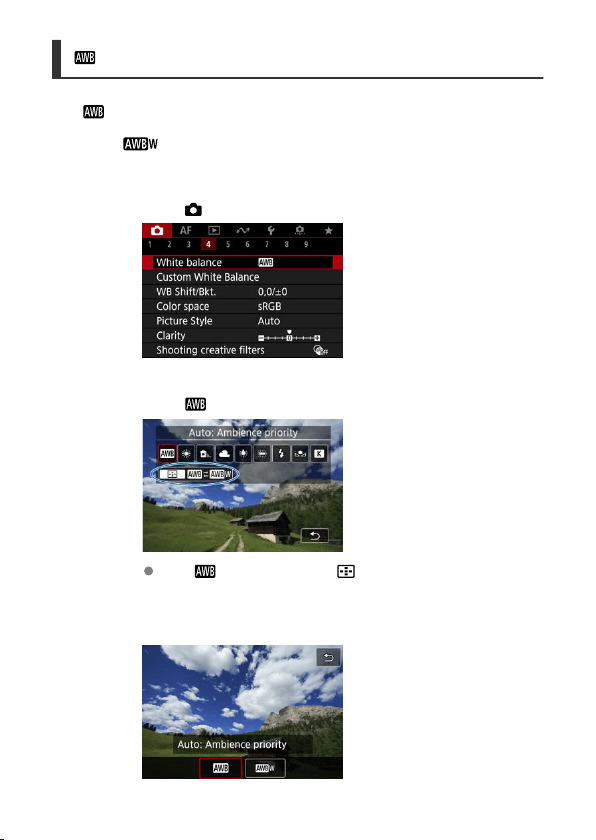
[ ] Auto White Balance
With [ ] (Ambience priority), you can slightly increase the intensity of the image's warm
color cast when shooting a tungsten-light scene.
If you select [
] (White priority), you can reduce the intensity of the image's warm color
cast.
1.
Select [
: White balance].
2.
Select [
].
With [ ] selected, press the < > button.
3.
Select an option.
218
Caution
Precautions when set to [ ] (White priority)
The warm color cast of subjects may fade.
When multiple light sources are included in the scene, the warm color cast of the
picture may not be reduced.
When using flash, the color tone will be the same as with [ ] (Ambience priority).
219
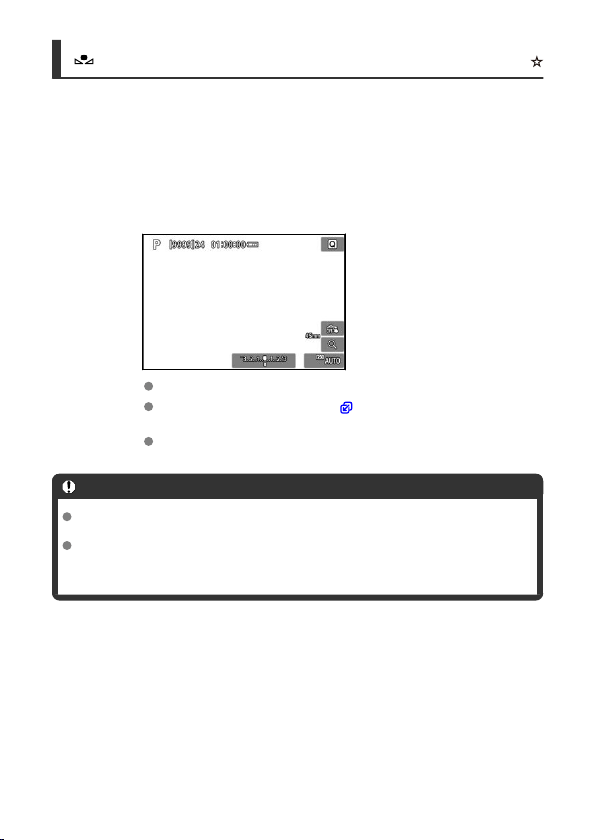
[ ] Custom White Balance
With custom white balance, you can manually set the white balance for the specific light
source of the shooting location. Make sure to perform this procedure under the light source
at the actual location of the shoot.
Registration from an image on a card
1.
Shoot a white object.
Aim the camera at a plain white object, so that white fills the screen.
Set the camera to manual focus ( ) and shoot so that the white object
has standard exposure.
You can use any of the white balance settings.
Caution
Correct white balance may not be obtained if the exposure of your image differs
greatly from standard exposure.
These images cannot be selected: images captured with the Picture Style set to
[Monochrome], images that are cropped or have a Creative filter applied, or
images from other cameras.
220
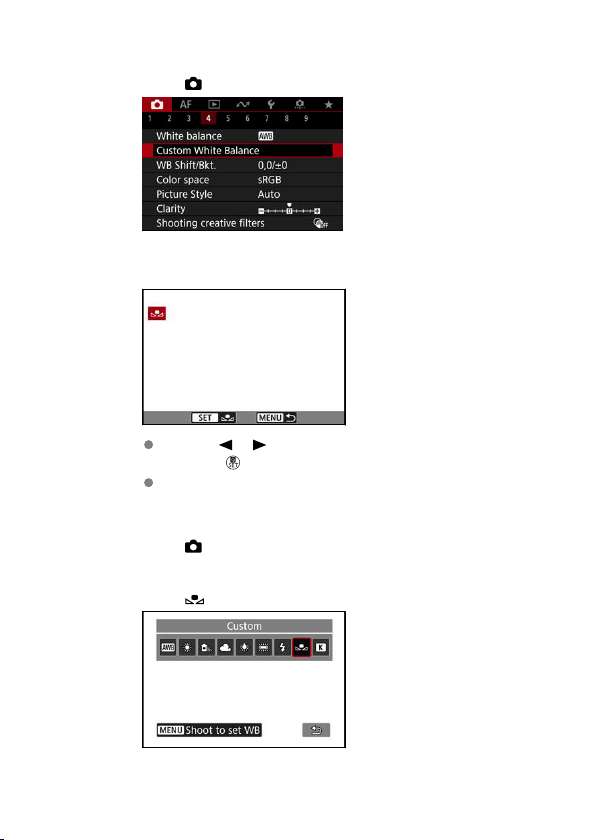
2.
Select [
: Custom White Balance].
3.
Import the white balance data.
Use the < >< > keys to select the image captured in step 1, then
press the <
> button.
Select [OK] to import the data.
4.
Select [
: White balance].
5.
Select [
].
221
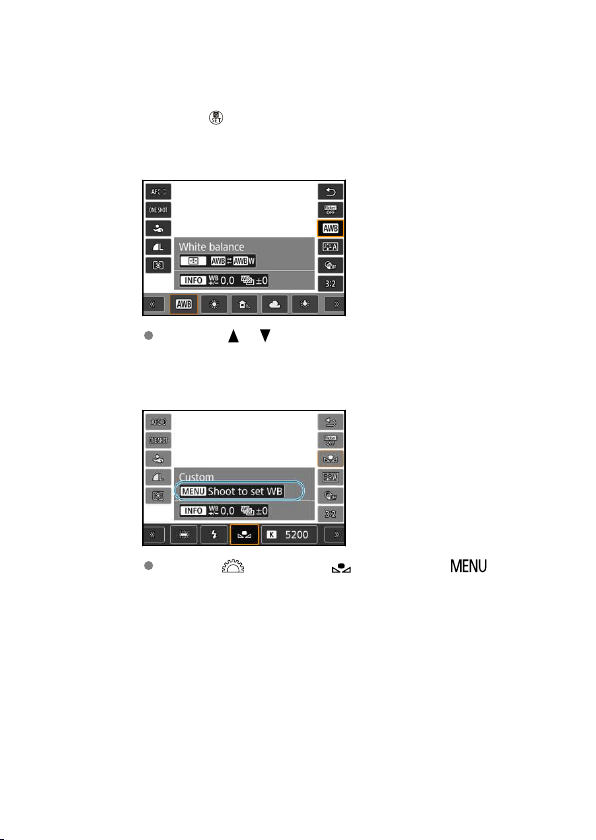
Shooting and registering white balances
1.
Press the <
> button.
2.
Select a white balance setting.
Press the < >< > keys for selection.
3.
Select [Shoot to set WB].
Turn the < > dial to select [ ], then press the < > button.
222
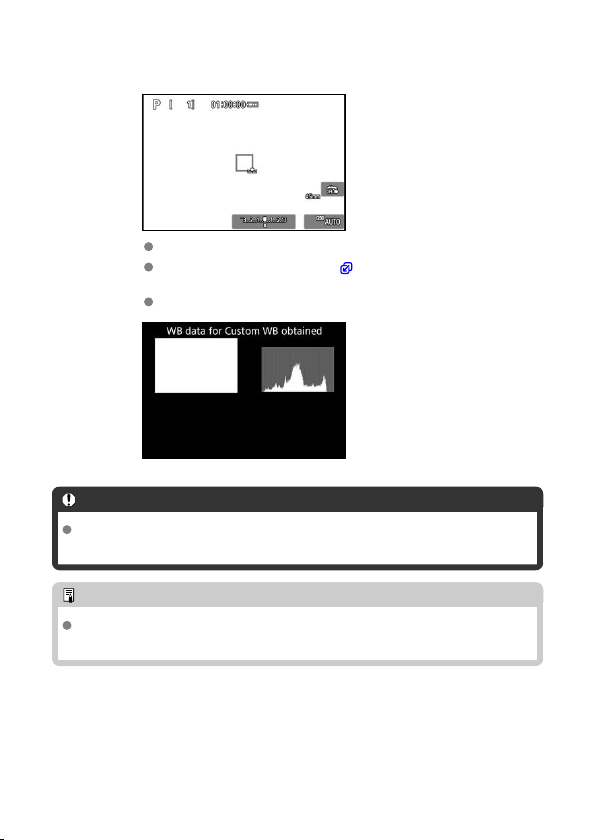
4.
Shoot a white object.
Aim the camera at a plain white object, so that white fills the screen.
Set the camera to manual focus ( ) and shoot so that the white object
has standard exposure.
The custom white balance is registered to the camera.
Caution
Correct white balance may not be obtained if the exposure of your image differs
greatly from standard exposure.
Note
Instead of shooting a white object, you can also shoot a gray card or standard 18%
gray reflector (commercially available).
223
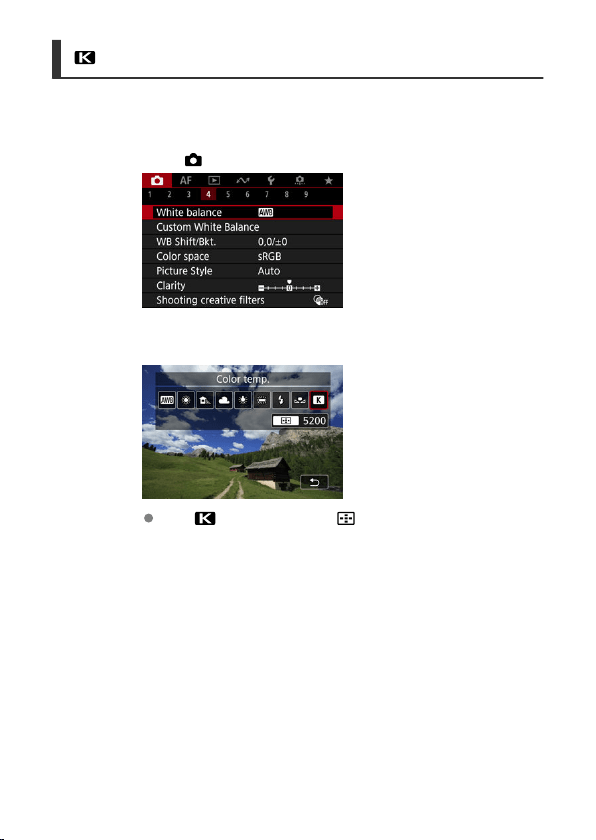
[ ] Color Temperature
A value can be set representing the white balance color temperature.
1.
Select [
: White balance].
2.
Select a color temperature.
With [ ] selected, press the < > button.
224
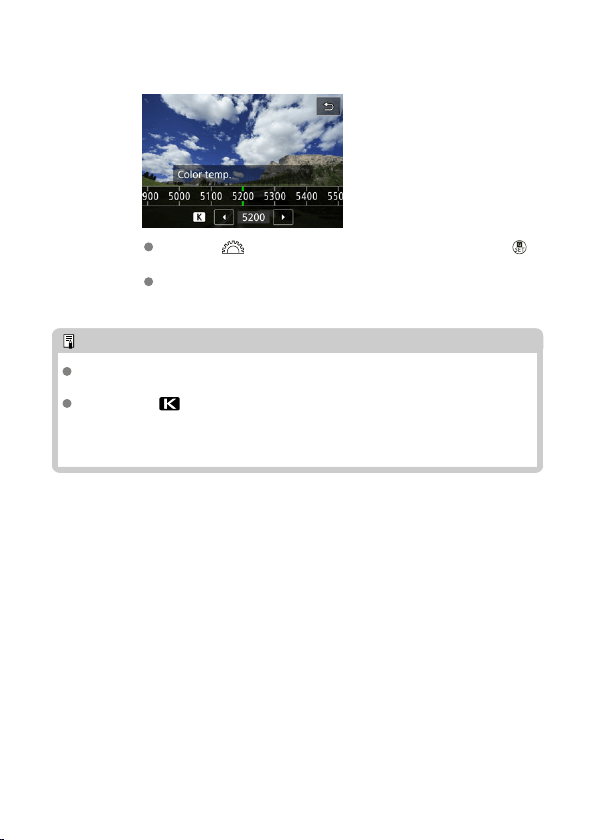
3.
Set the color temperature.
Turn the < > dial to set a color temperature, then press the < >
button.
The color temperature can be set from approx. 2500K to 10000K in
100K increments.
Note
When setting the color temperature for an artificial light source, set the white
balance correction (magenta or green bias) as necessary.
When setting [ ] to a value measured with a commercially available color
temperature meter, take some test shots in advance and adjust the setting as
needed to compensate for any difference between the color temperature meter and
the camera.
225
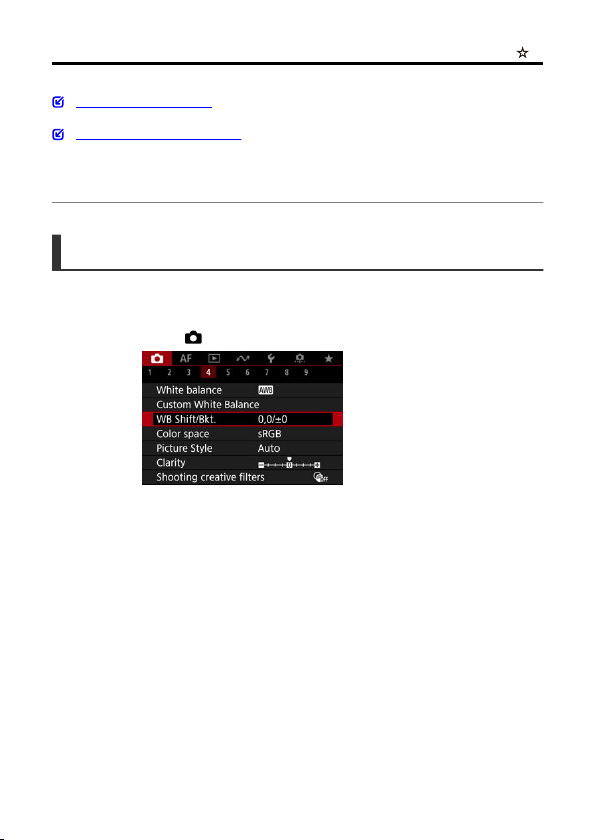
White Balance Correction
White Balance Correction
White Balance Auto Bracketing
You can correct the white balance that is set. This adjustment will have the same effect as
using a commercially available color temperature conversion filter or color compensating
filter.
White Balance Correction
1.
Select [
: WB Shift/Bkt.].
226
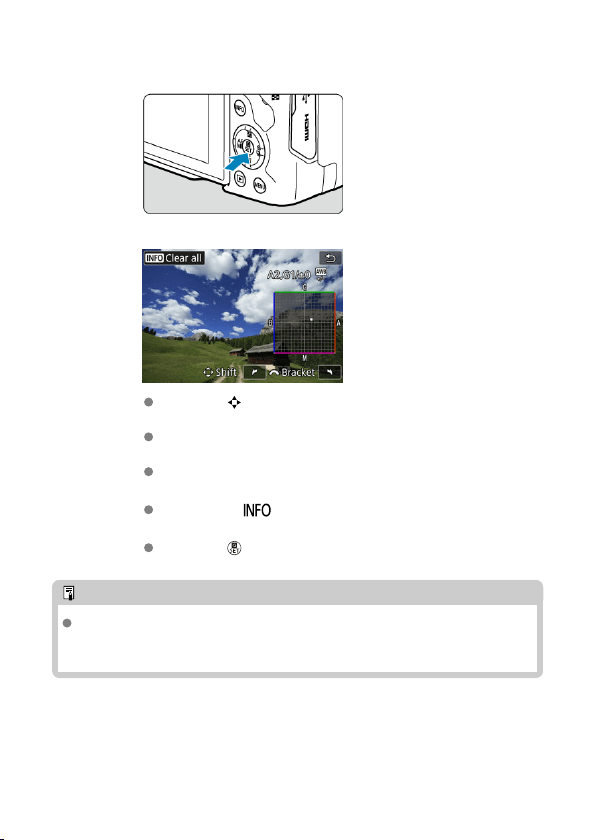
2.
Set the white balance correction.
Sample setting: A2, G1
Press the < > keys to move the [■] mark on the screen to your
preferred position.
B is for blue, A for amber, M for magenta, and G for green. White
balance is corrected in the direction you move the mark.
The direction and amount of correction are indicated in the upper right
of the screen.
Pressing the < > button will cancel all the [WB Shift/Bkt.]
settings.
Press the < > button to exit setup.
Note
One level of the blue/amber correction is equivalent to approx. 5 mireds of a color
temperature conversion filter. (Mired: Unit of measure for color temperature used to
indicate values such as the density of a color temperature conversion filter.)
227
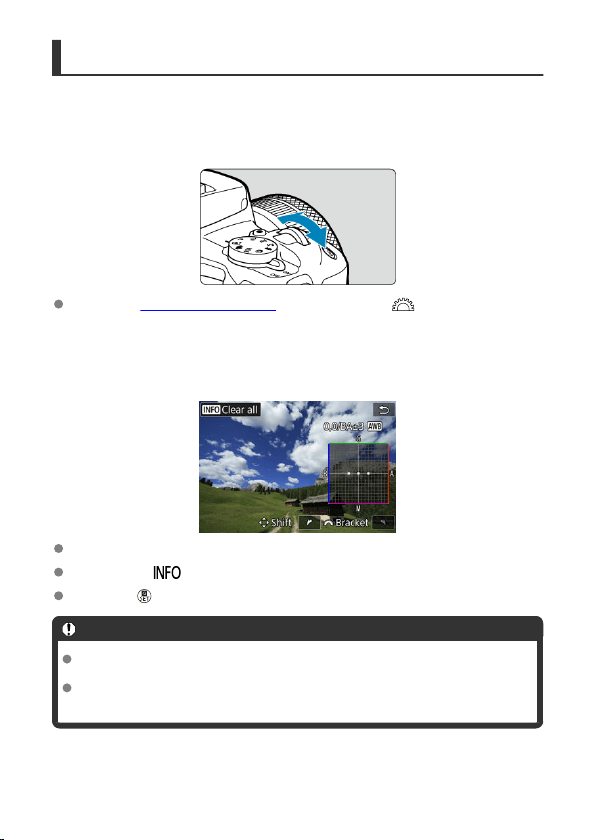
White Balance Auto Bracketing
White balance bracketing enables you to capture three images at once with different color
tones.
Setting the white balance bracketing amount
In step 2 for White Balance Correction, when you turn the < > dial, the “■” mark on
the screen will change to “■ ■ ■” (3 points).
Turning the dial clockwise sets the B/A bracketing, and turning it counterclockwise sets
the M/G bracketing.
B/A bias ±3 levels
The direction and amount of bracketing are indicated in the upper right of the screen.
Pressing the < > button will cancel all the [WB Shift/Bkt.] settings.
Press the < > button to exit setup.
Caution
During white balance bracketing, the maximum burst for continuous shooting will
be lower.
Since three images are recorded for one shot, it takes longer to record the image to
the card.
228
Note
The images will be bracketed in the following sequence: 1. Standard white balance,
2. Blue (B) bias, and 3. Amber (A) bias, or 1. Standard white balance, 2. Magenta
(M) bias, and 3. Green (G) bias.
You can also set white balance correction and AEB together with white balance
bracketing. If you set AEB in combination with white balance bracketing, a total of
nine images will be recorded for a single shot.
The white balance icon blinks to indicate that white balance bracketing has been
set.
Bracket stands for bracketing.
229
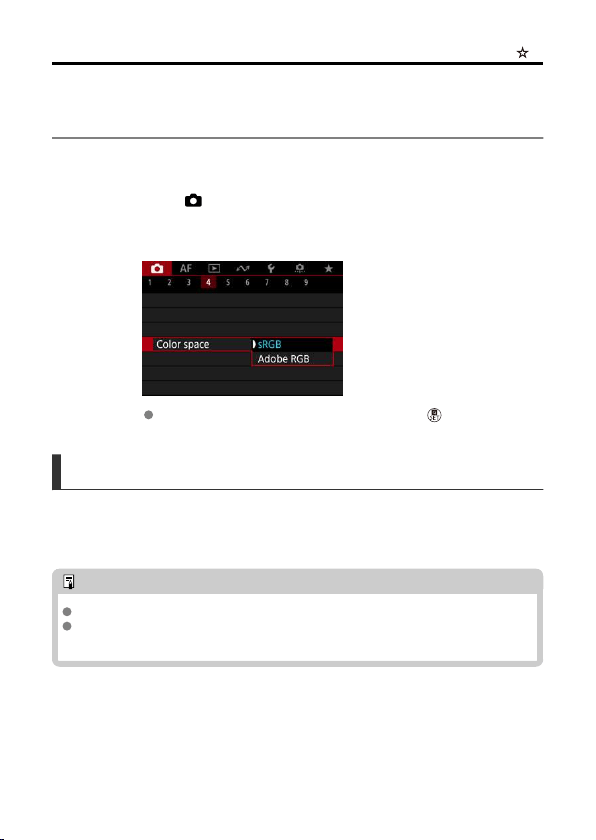
Color Space
The range of reproducible colors is called the “color space.” For normal shooting, sRGB is
recommended.
In Basic Zone, [sRGB] is set automatically.
1.
Select [
: Color space].
2.
Set a color space option.
Select [sRGB] or [Adobe RGB], then press the < > button.
Adobe RGB
This color space is mainly used for commercial printing and other professional applications.
Recommended when using equipment such as Adobe RGB-compatible monitors or DCF 2.0
(Exif 2.21 or later) compatible printers.
Note
File names of still photos shot in the Adobe RGB color space begin with “_”.
The ICC profile is not appended. For the descriptions about the ICC profile, refer to
the Digital Photo Professional Instruction Manual (EOS software).
230
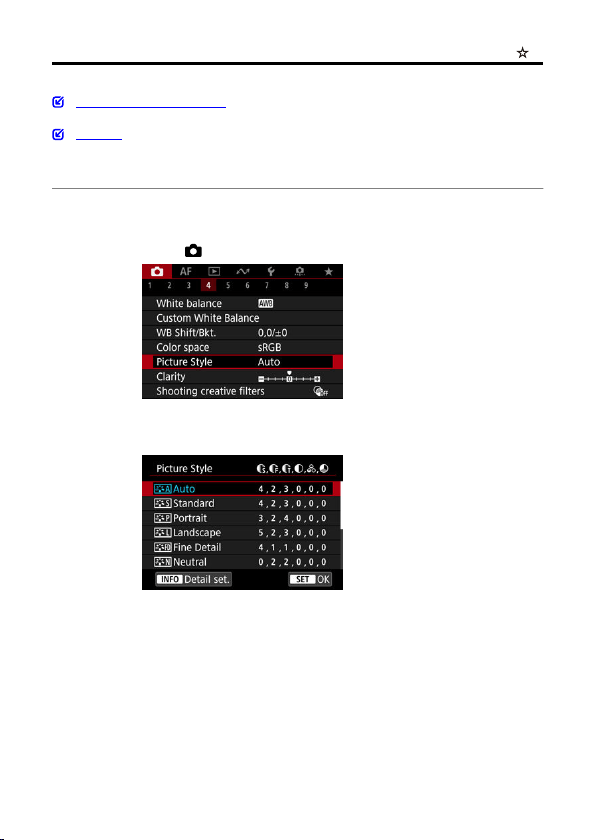
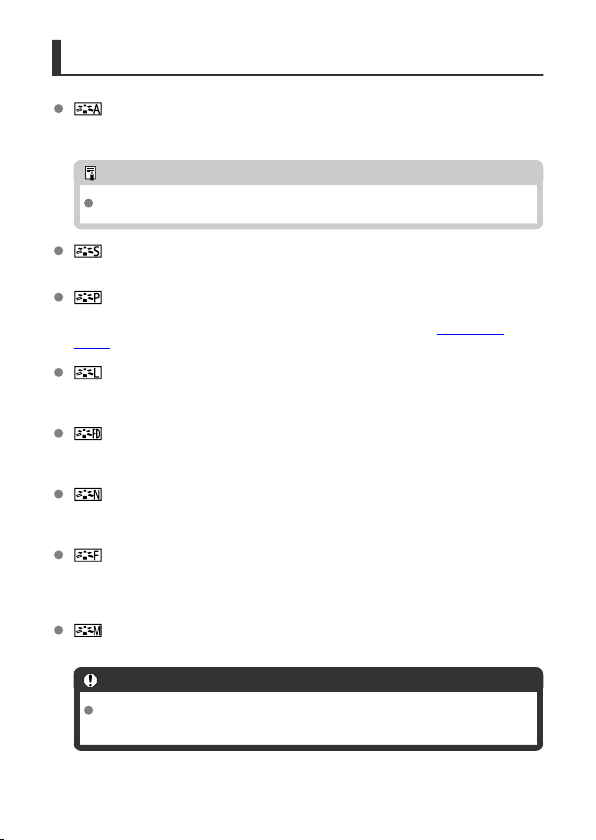
Picture Style Characteristics
Auto
The color tone will be adjusted automatically to suit the scene. The colors will look vivid
for blue skies, greenery and sunsets, particularly in nature, outdoor, and sunset scenes.
Note
If the desired color tone is not obtained with [Auto], use another Picture Style.
Standard
The image looks vivid, sharp, and crisp. Suitable for most scenes.
Portrait
For smooth skin tones, with slightly less sharpness. Suited for close-up portraits.
Skin tone can be adjusted by changing [Color tone] as described in Settings and
Effects.
Landscape
For vivid blues and greens, and very sharp and crisp images. Effective for impressive
landscapes.
Fine Detail
For detailed rendering of fine subject contours and subtle textures. The colors will be
slightly vivid.
Neutral
For retouching later on a computer. Makes images subdued, with lower contrast and
natural color tones.
Faithful
For retouching later on a computer. Faithfully reproduces the actual colors of subjects as
measured in daylight with a color temperature of 5200K. Makes images subdued, with
lower contrast.
Monochrome
Creates black-and-white images.
Caution
Color images cannot be recovered from JPEG/HEIF images shot with the
[Monochrome] Picture Style.
232

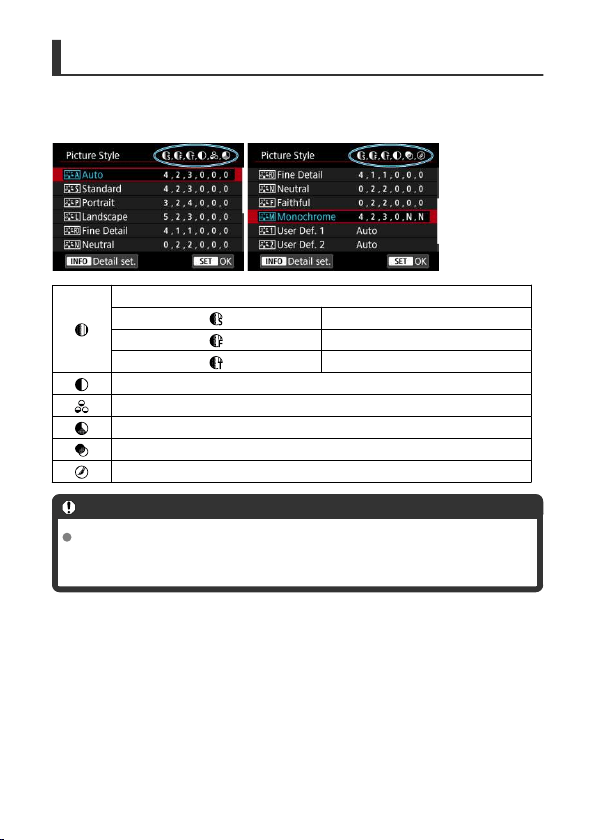
Symbols
Icons on the Picture Style selection screen represent [Strength], [Fineness], and
[Threshold] for [Sharpness] as well as [Contrast] and other parameters. The numbers
indicate the values for these settings specified for the respective Picture Style.
Sharpness
Strength
Fineness
Threshold
Contrast
Saturation
Color tone
Filter effect (Monochrome)
Toning effect (Monochrome)
Caution
For movie recording, “*, *” is indicated for the [Fineness] and [Threshold]
parameters of [Sharpness]. [Fineness] and [Threshold] cannot be set for movie
recording.
234
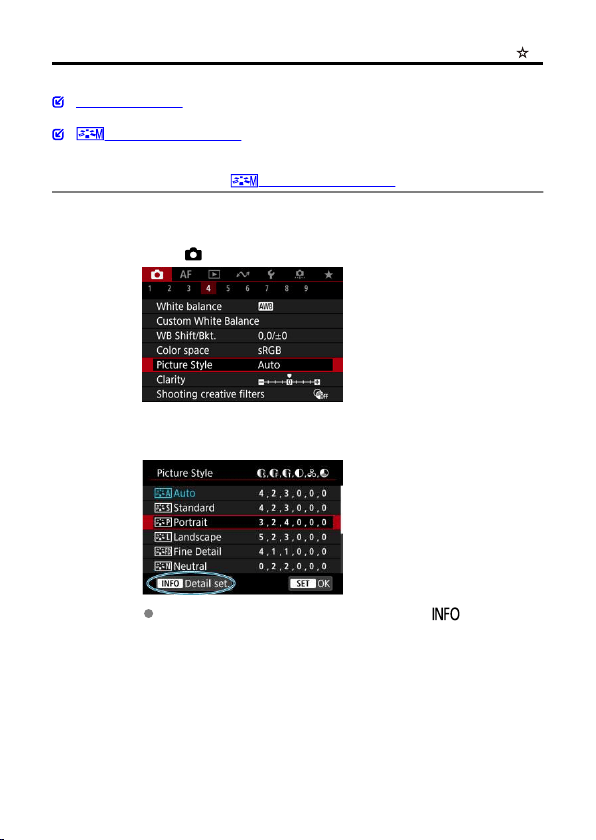
Picture Style Customization
Settings and Effects
Monochrome Adjustment
You can customize any Picture Style by changing it from the default settings. For details on
customizing [Monochrome], see
Monochrome Adjustment.
1.
Select [
: Picture Style].
2.
Select a Picture Style.
Select the Picture Style to adjust, then press the < > button.
235
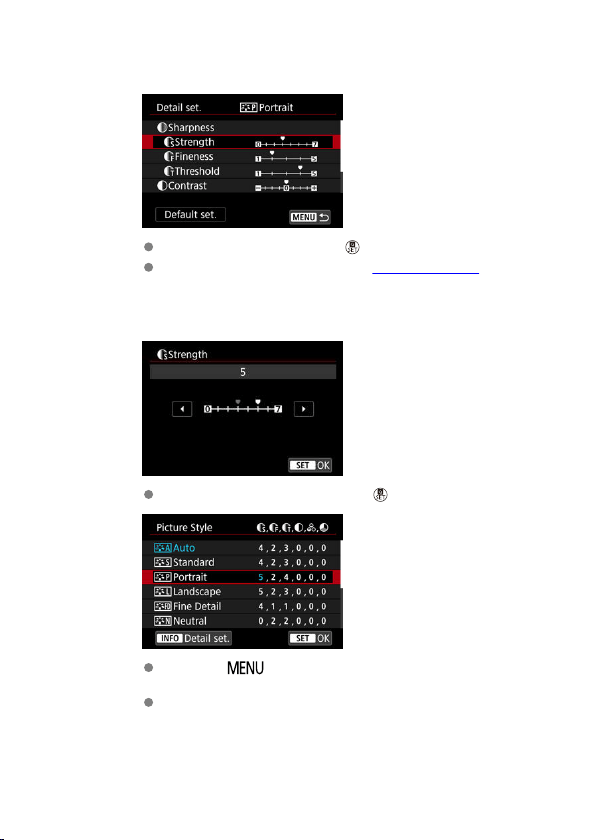
3.
Select an option.
Select an option, then press the < > button.
For details on settings and effects, see Settings and Effects.
4.
Set the effect level.
Adjust the effect level, then press the < > button.
Press the < > button to save the adjusted setting and return to
the Picture Style selection screen.
Any settings you change from default values are displayed in blue.
236
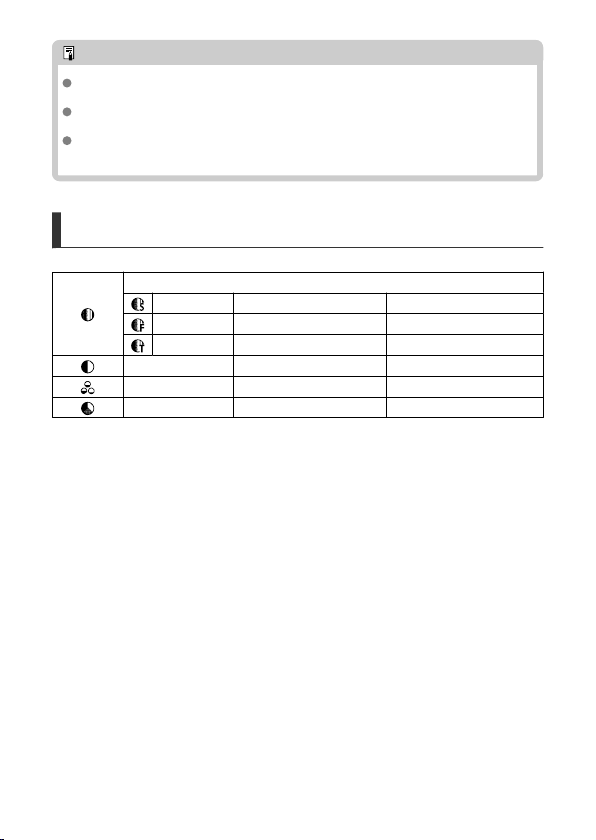
Note
For movie recording, [Fineness] and [Threshold] for [Sharpness] cannot be set
(not displayed).
By selecting [Default set.] in step 3, you can restore the parameter settings of the
respective Picture Style to the defaults.
To shoot with the Picture Style you adjusted, first select the adjusted Picture Style,
then shoot.
Settings and Effects
Sharpness
Strength 0: Weak outline emphasis 7: Strong outline emphasis
Fineness*
1
1: Fine 5: Grainy
Threshold*
2
1: Low 5: High
Contrast –4: Low contrast +4: High contrast
Saturation –4: Low saturation +4: High saturation
Color tone –4: Reddish skin tone +4: Yellowish skin tone
* 1: Indicates the edge thinness that enhancement applies to. The smaller the number, the finer the
outlines that can be emphasized.
* 2: Contrast threshold between edges and surrounding image areas, which determines edge
enhancement. The smaller the number, the more the outline will be emphasized when the contrast
difference is low. However, noise tends to be more noticeable when the number is smaller.
237
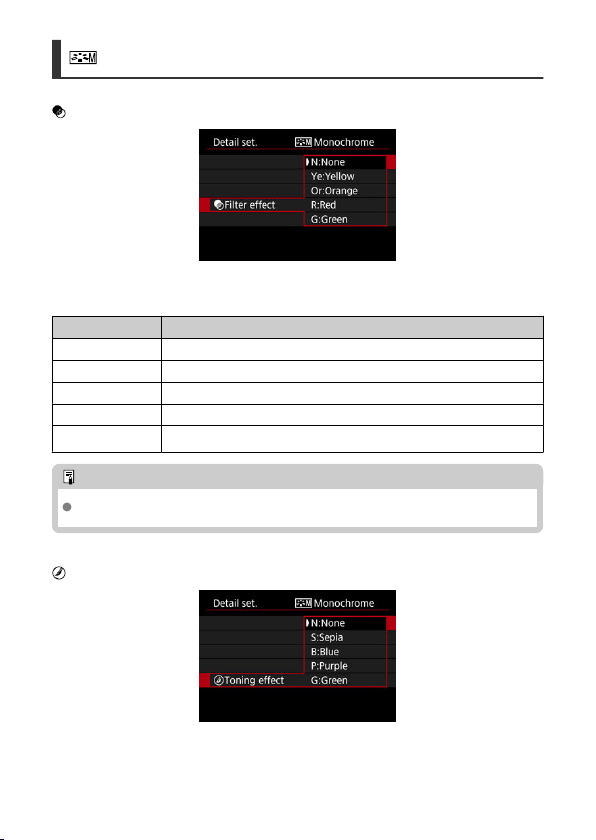
Monochrome Adjustment
Filter effect
With a filter effect applied to a monochrome image, you can make white clouds or green
trees stand out more.
Filter Sample Effects
N:None Normal black-and-white image with no filter effects.
Ye:Yellow Blue sky will look more natural, and white clouds will look crisper.
Or:Orange The blue sky will look slightly darker. The sunset will look more brilliant.
R:Red The blue sky will look quite dark. Fall leaves will look crisper and brighter.
G:Green
Skin tones and lips will appear muted. Green tree leaves will look crisper and
brighter.
Note
Increasing [Contrast] will make the filter effect more pronounced.
Toning effect
By applying a toning effect, you can create a monochrome image in the selected color.
Effective when you want to create memorable images.
238
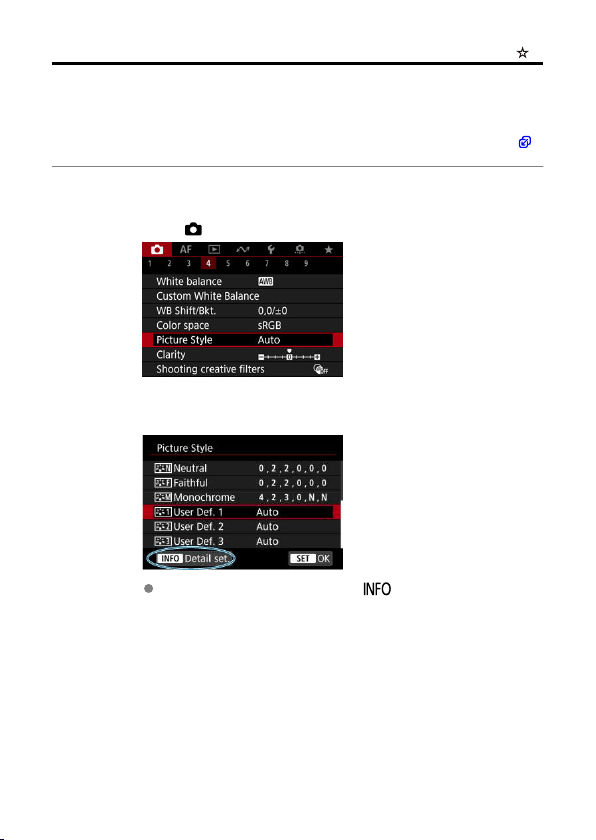
Picture Style Registration
You can select a base Picture Style such as [Portrait] or [Landscape], adjust it as desired,
and register it under [User Def. 1] – [User Def. 3]. Useful when creating several Picture
Styles with different settings.
Picture Styles that you have registered on the camera using EOS Utility (EOS software,
)
can also be modified here.
1.
Select [
: Picture Style].
2.
Select [User Def.].
Select [User Def. *], then press the < > button.
239
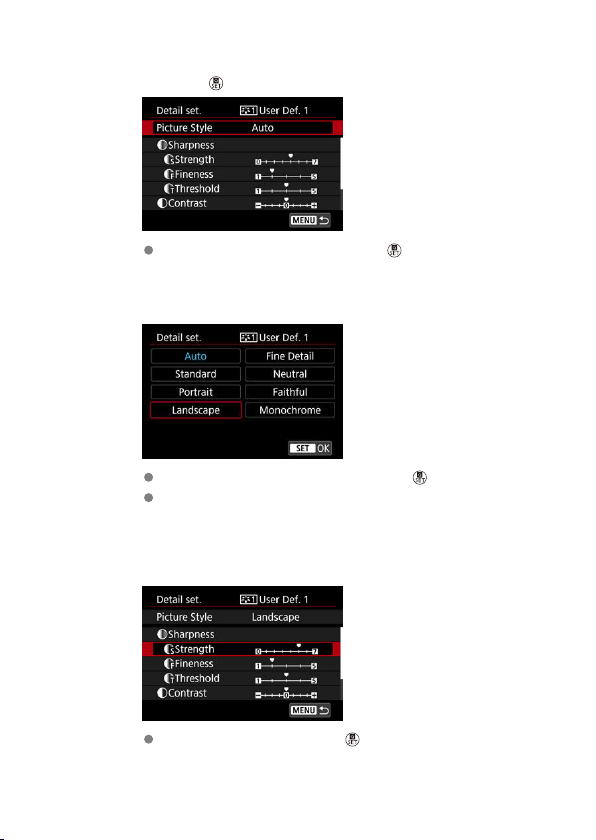
3.
Press the <
> button.
With [Picture Style] selected, press the < > button.
4.
Select a base Picture Style.
Select the base Picture Style, then press the < > button.
Also select styles this way when adjusting styles registered to the
camera with EOS Utility (EOS software).
5.
Select an option.
Select an option, then press the < > button.
240
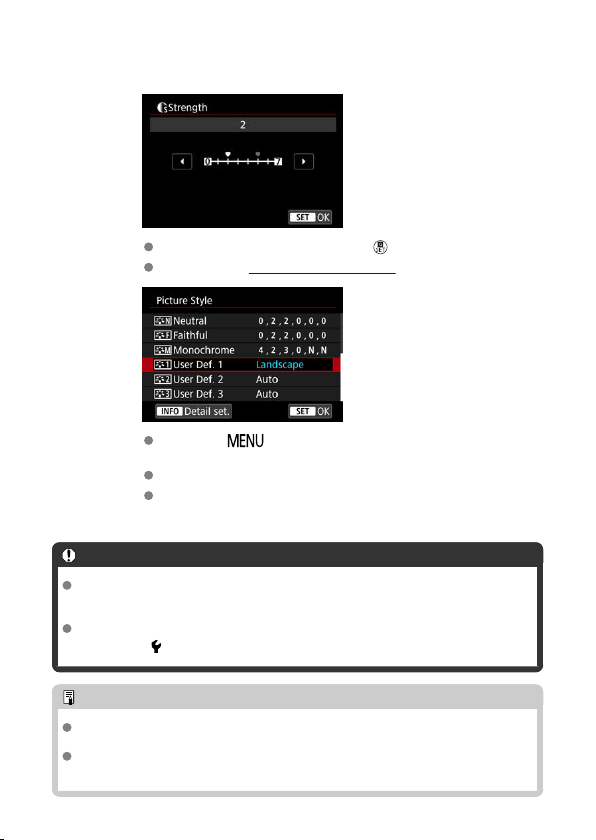
6.
Set the effect level.
Adjust the effect level, then press the < > button.
For details, see Picture Style Customization.
Press the < > button to save the adjusted setting and return to
the Picture Style selection screen.
The base Picture Style will be indicated on the right of [User Def. *].
Blue style names in [User Def. *] have been changed from default
values.
Caution
If a Picture Style is already registered under [User Def. *], changing the base
Picture Style will clear the parameter settings of the previously registered User
Defined Picture Style.
You can restore the default [User Def. *] style and settings by selecting [Basic
settings] in [
: Reset camera].
Note
To shoot with a registered Picture Style, select the registered [User Def. *], then
shoot.
For instructions on registering a Picture Style file to the camera, refer to the EOS
Utility Instruction Manual.
241

Clarity
You can adjust image clarity, as determined by the contrast of image edges.
Set toward the negative end to make images look softer or toward the positive end for a
sharper appearance.
1.
Select [
: Clarity].
2.
Set the effect level.
Caution
Setting clarity may darken or lighten the areas around boundaries in high-contrast
images.
The effect of this setting is not shown in images on the screen in still photo
shooting.
242
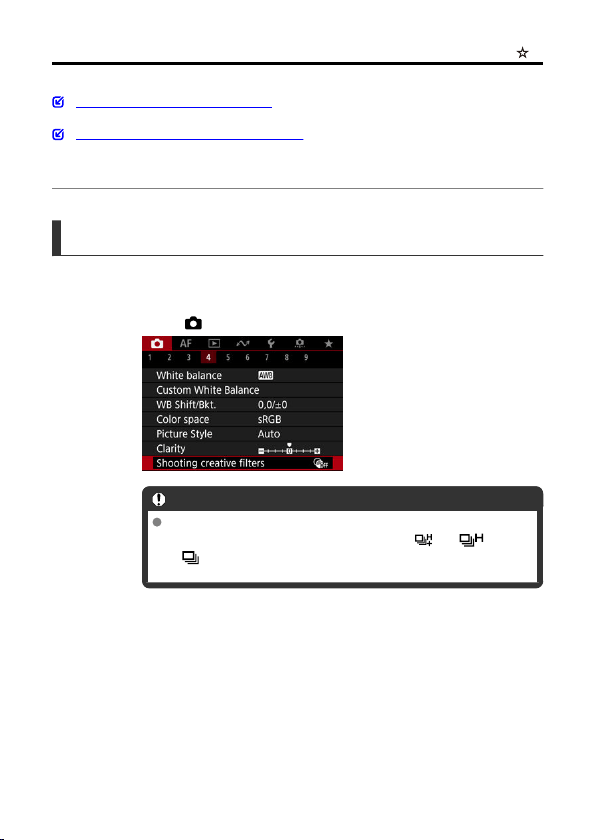
Shooting Creative Filters
Configuring Shooting Creative Filters
Characteristics of Shooting Creative Filters
You can shoot with filter effects applied. Note that only images with the filter effects applied
are saved.
Configuring Shooting Creative Filters
1.
Select [
: Shooting creative filters].
Caution
The camera shoots in single shooting mode when a Creative filter
is set, regardless of the drive mode setting (<
>, < >, or
<
>).
243
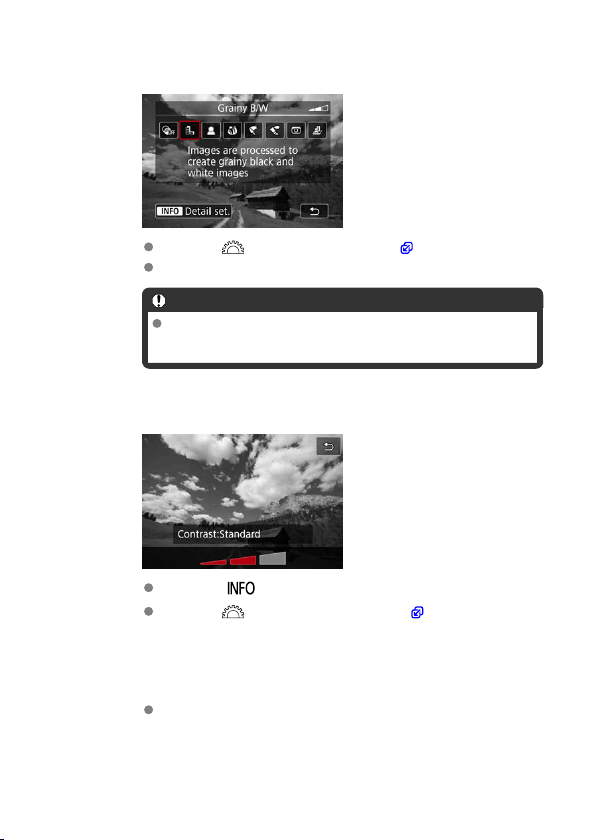
2.
Select a filter effect.
Turn the < > dial to select a filter effect ( ).
The image is shown with the filter effect applied.
Caution
Some items on the AF tab are not available with [Fish-eye effect]
or [Miniature effect] selected.
3.
Adjust the filter effect.
Press the < > button.
Turn the < > dial to adjust the filter effect ( ).
4.
Take the picture.
The images captured have the filter effect applied.
244
Characteristics of Shooting Creative Filters
Grainy B/W
Makes the image grainy and black and white. By adjusting the contrast, you can change
the black-and-white effect.
Soft focus
Gives the image a soft look. By adjusting the blur, you can change the degree of
softness.
Fish-eye effect
Gives the effect of a fish-eye lens. The image will have barrel distortion.
Depending on the level of this filter effect, the area trimmed along the periphery of the
image changes. Also, because this filter effect magnifies the center of the image, the
apparent resolution at the center may degrade depending on the number of recorded
pixels, so set the filter effect while checking the resulting image.
[AF area] is set to [1-point AF].
Art bold effect
Makes the photo look like an oil painting and the subject look more three-dimensional.
By adjusting the effect, you can change the contrast and saturation. Note that subjects
such as the sky or white walls may not be rendered with a smooth gradation and may
look uneven or noisy.
Water painting effect
Makes the photo look like a watercolor painting with soft colors. By adjusting the effect,
you can change the color density. Note that night scenes or dark scenes may not be
rendered with a smooth gradation and may look uneven or noisy.
Toy camera effect
Shifts colors to those typical of toy cameras and darkens the four corners of the image.
Color tone options can be used to change the color cast.
Miniature effect
Creates a diorama effect.
Shooting under the default setting will keep the center looking sharp.
To move the area that looks sharp (the scene frame), see “Adjusting the Miniature
Effect” ( ).
[AF area] is set to [1-point AF]. Shooting with the AF point and scene frame aligned is
recommended.
246
Caution
With [Grainy B/W], the grainy preview will differ somewhat from the appearance of
your shots.
With [Soft focus] or [Miniature effect] options, the blurred effect preview may
differ somewhat from the appearance of your shots.
No histogram is displayed.
A magnified view is not available.
247
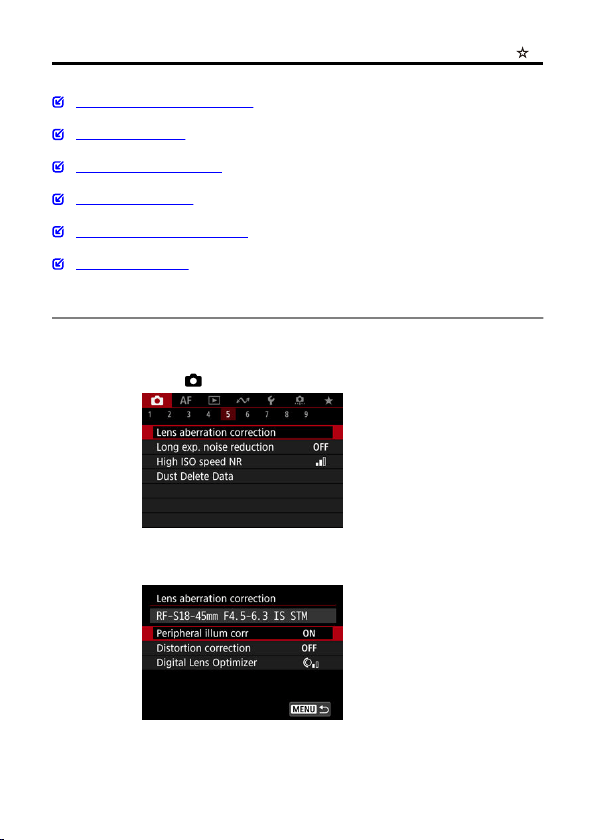
Lens Aberration Correction
Peripheral Illumination Correction
Distortion Correction
Focus Breathing Correction
Digital Lens Optimizer
Chromatic Aberration Correction
Diffraction Correction
Vignetting, image distortion, and other issues may be caused by lens optical characteristics.
The camera can compensate for these phenomena by using [Lens aberration correction].
1.
Select [
: Lens aberration correction].
2.
Select an option.
248
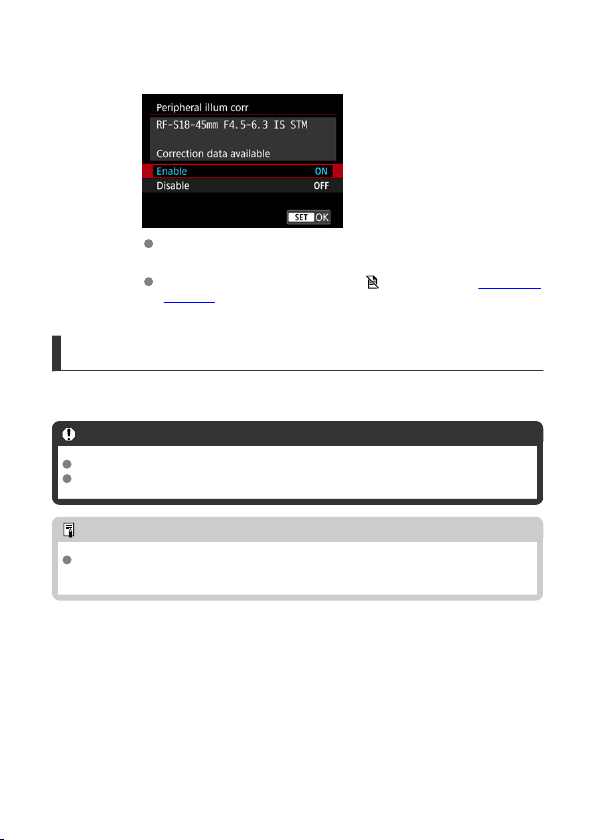
3.
Select a setting.
Confirm that the name of the attached lens and [Correction data
available] are displayed.
If [Correction data not available] or [ ] is displayed, see Digital Lens
Optimizer.
Peripheral Illumination Correction
Vignetting (dark image corners) can be corrected.
Caution
Depending on shooting conditions, noise may appear on the image periphery.
The higher the ISO speed, the lower the amount of correction will be.
Note
The amount of correction applied will be lower than the maximum correction
amount applied with Digital Photo Professional (EOS software).
249
Distortion Correction
Distortion (image warping) can be corrected.
Caution
Specifying distortion correction may subtly change the angle of view, resulting in
images that are cropped a little and seem slightly less sharp.
The amount of image cropped may vary between still photos and movies.
Note
With RF lenses, distortion correction during movie recording is supported.
250
Focus Breathing Correction
Angle of view fluctuations from changes in focal position during movie recording can be
reduced.
This feature can be configured when [Distortion correction] is set to [Enable].
Caution
[Focus breathing correction] is not displayed in still photo shooting.
Applying focus breathing correction will narrow the angle of view. The extent of
narrowing depends on shooting conditions.
Test focus breathing correction before use, because the image processing may
affect apparent image resolution and noise.
Optimal correction is applied based on the position of the focusing distance range
switch on the lens. (The correction is also applied in MF mode.) Correction is not
applied to any difference between the actual focusing distance and the range of the
switch.
Movies with abrupt changes to the angle of view may be recorded if you move the
focusing distance range switch during recording.
Correction artifacts may occur, depending on the lens and shooting conditions.
For details on lenses compatible with this feature, visit the Canon website ( ).
251
Digital Lens Optimizer
Various aberrations from lens optical characteristics can be corrected, along with diffraction
and low-pass filter-induced loss of resolution.
If [Correction data not available] or [
] is displayed by [Digital Lens Optimizer], you can
use EOS Utility to add the lens correction data to the camera. For details, refer to the EOS
Utility Instruction Manual.
Caution
Image processing after you shoot takes longer when set to [High] (which causes
the access lamp to be illuminated longer).
Maximum burst is lower with [High]. Image recording to the card also takes longer.
Depending on shooting conditions, noise may be intensified together with the
effects of correction. Image edges may also be emphasized. Adjust Picture Style
sharpness or set [Digital Lens Optimizer] to [Disable] as needed before shooting.
The higher the ISO speed, the lower the amount of correction will be.
For movie recording, [Digital Lens Optimizer] will not appear. (Correction is not
possible.)
The effect of Digital Lens Optimizer cannot be checked on the screen at the time of
shooting.
Note
With [Digital Lens Optimizer] set to [Standard] or [High], [Chromatic aberr corr]
and [Diffraction correction] are not displayed, but they are both set to [Enable] for
shooting.
252
Chromatic Aberration Correction
Chromatic aberration (color fringing around subjects) can be corrected.
Note
[Chromatic aberr corr] is not displayed when [Digital Lens Optimizer] is set to
[Standard] or [High].
253
Diffraction Correction
Diffraction (loss of sharpness caused by the aperture) can be corrected.
Caution
Depending on shooting conditions, noise may be intensified together with the
effects of correction.
The higher the ISO speed, the lower the amount of correction will be.
For movie recording, [Diffraction correction] will not appear. (Correction is not
possible.)
The effect of diffraction correction cannot be checked on the screen at the time of
shooting.
Note
“Diffraction correction” corrects degraded resolution not only from diffraction but
also from the low-pass filter and other factors. Thus, correction is also effective for
exposures with the aperture wide open.
[Diffraction correction] is not displayed when [Digital Lens Optimizer] is set to
[Standard] or [High].
Caution
General precautions for lens aberration correction
Lens aberration correction cannot be applied to existing JPEG/HEIF images.
When using a non-Canon lens, setting the corrections to [Disable] is
recommended even if [Correction data available] is displayed.
Magnifying the periphery of the image may display parts of the image that will not
be recorded.
The amount of correction (except diffraction correction) is less for lenses that do
not provide distance information.
254
Note
General notes for lens aberration correction
Effects of lens aberration correction vary by lens and shooting conditions. Also, the
effect may be difficult to discern depending on the lens used, shooting conditions,
etc.
If the correction is difficult to discern, magnifying and checking the image after
shooting is recommended.
Corrections are applied even when an extender or life-size converter is attached.
If the correction data for the attached lens is not registered to the camera, the result
will be the same as when the correction is set to [Disable] (except for diffraction
correction).
If necessary, refer to the EOS Utility Instruction Manual as well.
255
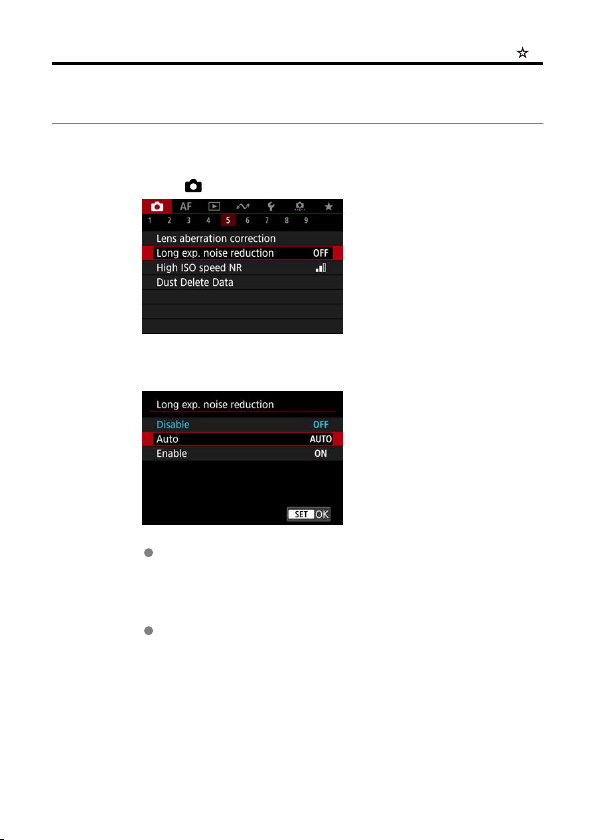
Long Exposure Noise Reduction
Noise such as dots of light or banding that tends to occur in long exposures at shutter
speeds of one sec. or slower can be reduced.
1.
Select [
: Long exp. noise reduction].
2.
Set a reduction option.
Auto
For images exposed for 1 sec. or longer, noise reduction is performed
automatically if noise typical of long exposures is detected. This setting
is effective enough in most cases.
Enable
Noise reduction is performed for all images exposed for 1 sec. or
longer. The [Enable] setting may reduce noise that cannot be detected
with the [Auto] setting.
256
Caution
With [Auto] or [Enable] set, noise reduction after you shoot may take as long as
exposure for the shot.
Images may look grainier with the [Enable] setting than with the [Disable] or [Auto]
setting.
[BUSY] is displayed as noise is reduced, and the shooting screen is not displayed
until processing is finished, when you can shoot again.
257
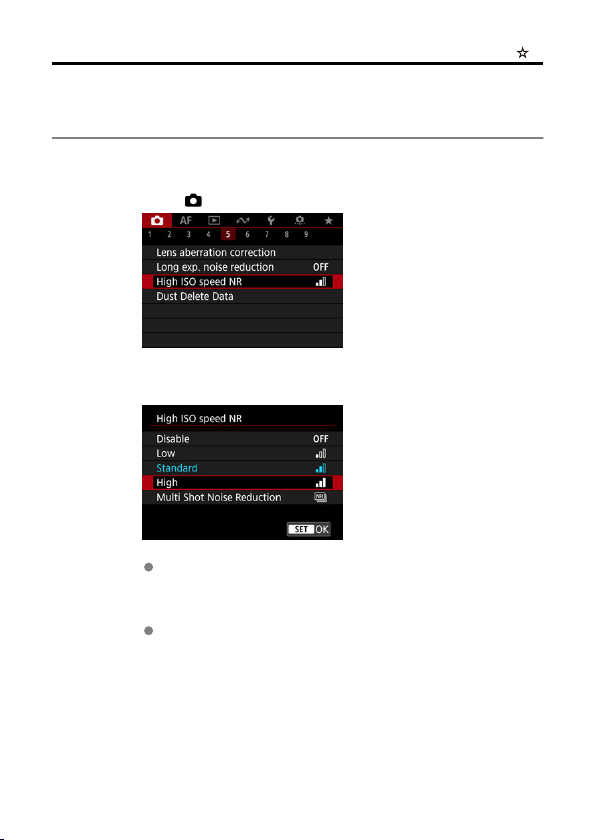
High ISO Speed Noise Reduction
You can reduce the image noise generated. This function is especially effective when
shooting at high ISO speeds. When shooting at low ISO speeds, the noise in the darker
parts of the image (shadow areas) can further be reduced.
1.
Select [
: High ISO speed NR].
2.
Set the level.
Low, Standard, High
The camera applies an amount of noise reduction corresponding to
your specified level.
Multi Shot Noise Reduction
Applies noise reduction with higher image quality than [High]. For a
single photo, four shots are taken continuously and aligned and
merged automatically into a single JPEG image.
Note that [Multi Shot Noise Reduction] is not available with image
quality set to RAW or RAW+JPEG.
258
Caution
Precautions on Multi Shot Noise Reduction
If there is significant misalignment in the image due to camera shake, the noise
reduction effect may become smaller.
Be careful about camera shake in handheld shots. Using a tripod is recommended.
If you shoot a moving subject, the moving subject may leave afterimages.
Auto image alignment may not function properly with repetitive patterns (lattice,
stripes, etc.) or flat, single-tone images.
If the subject's brightness changes as the four consecutive shots are taken,
irregular exposure in the image may result.
After shooting, it may take some time to record an image to the card after
performing noise reduction and merging the images. “BUSY” is displayed as
images are processed, and shooting is not possible until processing is finished.
[Multi Shot Noise Reduction] is not available with any of these features: bulb
exposures, AEB, WB bracketing, RAW/RAW+JPEG, long exposure noise
reduction, HDR mode/HDR PQ settings, focus bracketing or Creative filter
shooting.
Flash photography is not available. Note that the AF-assist beam of Speedlites may
be fired, depending on the [
: AF-assist beam firing] setting.
The camera automatically switches to [Standard] when RAW or RAW+JPEG
image quality is set.
Automatically switches to [Standard] if you set the power switch to < >,
replace the battery or card, or switch to Basic Zone modes, bulb exposure, or
movie recording.
259
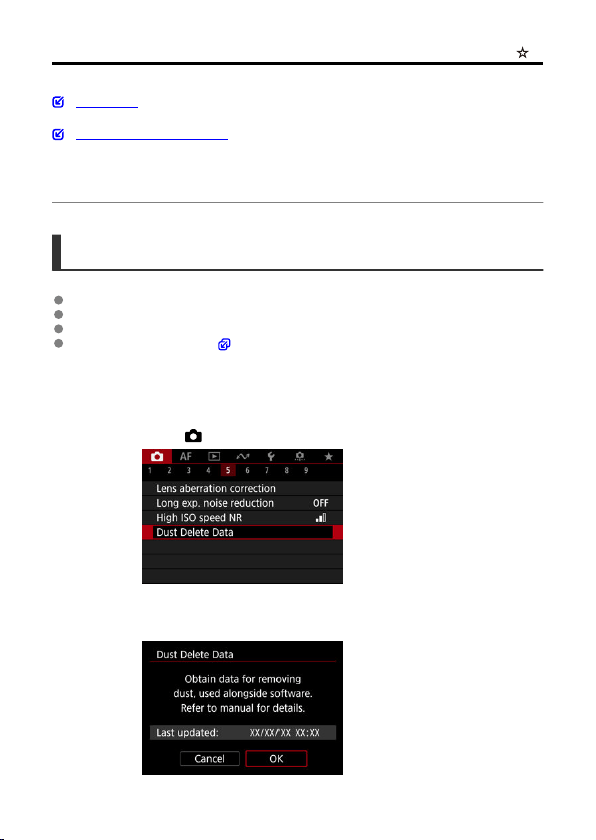
Dust Delete Data Acquisition
Preparation
Dust Delete Data Appending
Dust Delete Data used to erase dust spots can be appended to images. The Dust Delete
Data is used by Digital Photo Professional (EOS software) to erase the dust spots
automatically.
Preparation
Use an RF or EF lens.
Prepare a solid white object such as a sheet of paper.
Set the lens focal length to 50 mm or longer.
Set the focus mode to MF ( ) and focus manually at infinity (∞). If the lens has no
distance scale, rotate the camera to face toward you and turn the focusing ring
clockwise all the way.
1.
Select [
: Dust Delete Data].
2.
Select [OK].
260
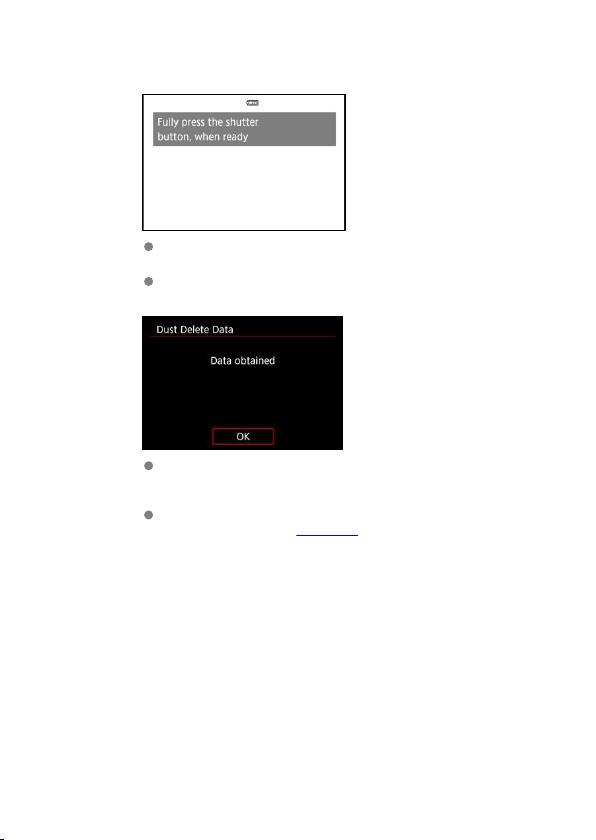
3.
Shoot a plain white object.
Shoot with a plain white object (such as a new sheet of white paper)
filling the screen, at a distance of 20–30 cm (0.7–1.0 ft.).
Since the image will not be saved, the data can still be obtained even if
there is no card in the camera.
When the picture is taken, the camera will start collecting the Dust
Delete Data. When the Dust Delete Data is obtained, a message will
appear.
If the data is not obtained successfully, an error message will appear.
Check the information in Preparation, select [OK], and shoot again.
261
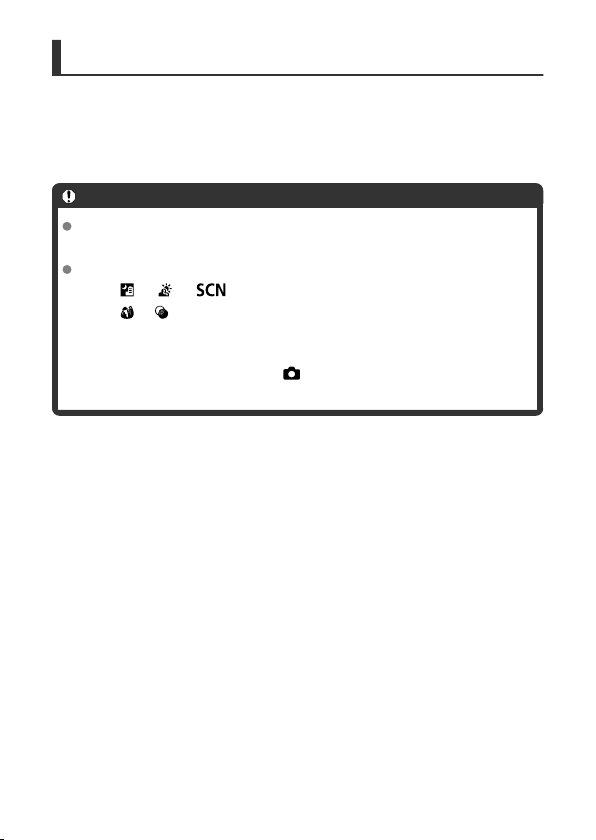
Dust Delete Data Appending
The camera will append the Dust Delete Data obtained to all shots from now on. Acquiring
Dust Delete Data before shooting is recommended.
For details about using Digital Photo Professional (EOS software) to erase dust spots
automatically, refer to the Digital Photo Professional Instruction Manual.
File size is essentially unaffected by Dust Delete Data appended to images.
Caution
If the object has any pattern or design, it may be recognized as dust data and affect
the accuracy of the dust deletion with the Digital Photo Professional (EOS
software).
Dust Delete Data is not added to shots taken under the following conditions.
• In [ ] or [ ] (< > mode) shooting
• In [ ] (< > mode) shooting
• When multi-shot noise reduction is set
• In HDR mode shooting
• When [Distortion correction] in [ : Lens aberration correction] is set to
[Enable]
262
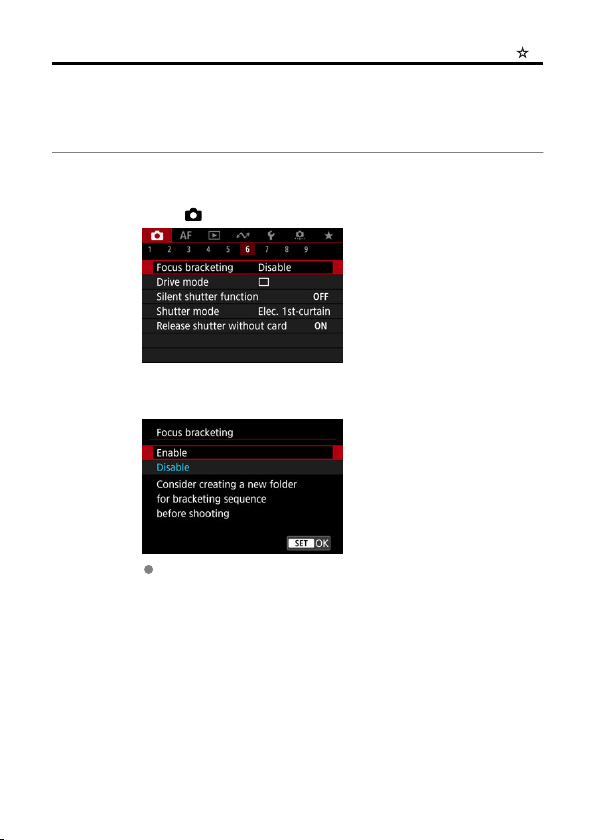
Focus Bracketing
Focus bracketing enables continuous shooting with the focal distance changed automatically
after each shot. These images enable you to create a single image in focus over a deep
depth of field. Compositing is also possible using an application that supports depth
compositing, such as Digital Photo Professional (EOS software).
1.
Select [
: Focus bracketing].
2.
Set [Focus bracketing].
Select [Enable].
263
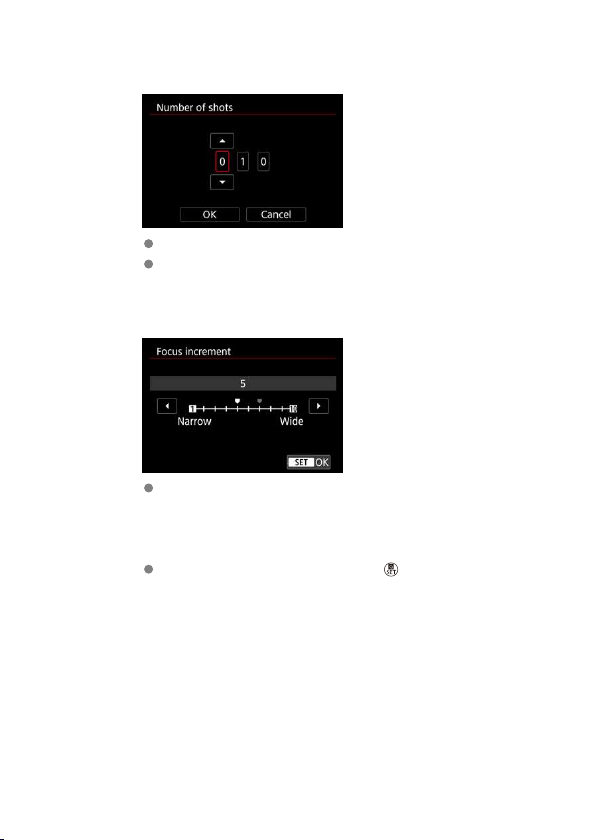
3.
Set [Number of shots].
Specify the number of images captured per shot.
Can be set in a range of [2]–[999].
4.
Set [Focus increment].
Specify how much to shift the focus. This amount is automatically
adjusted to suit the aperture value at the time of shooting.
Larger aperture values increase the focus shift and make focus
bracketing cover a wider range under the same focus increment and
number of shots.
After completing the settings, press the < > button.
264
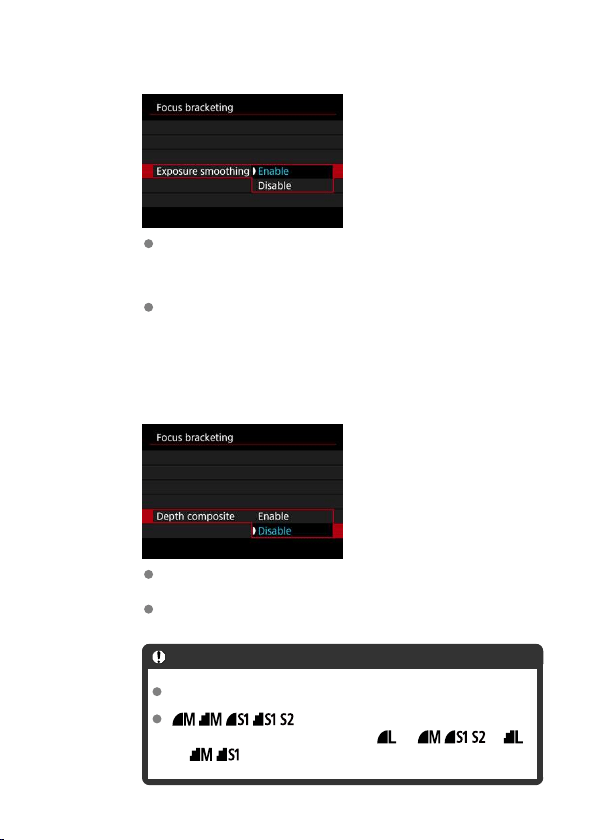
5.
Set [Exposure smoothing].
You can compensate for changes in image brightness during focus
bracketing by selecting [Enable], so that the camera makes
adjustments based on differences between the displayed and actual
aperture value (effective f/number), which varies by focal position.
Select [Disable] if you prefer not to compensate for changes in image
brightness during focus bracketing. Use this option for purposes other
than depth compositing of the captured images in applications such as
DPP.
6.
Set [Depth composite].
Select [Enable] for in-camera depth compositing. The depth-
composited image is saved.
Select [Disable] if you prefer not to perform in-camera depth
compositing. Only captured images are saved.
Caution
Depth-composited images are saved as JPEGs.
/ / / / image quality is not available. Settings are
adjusted so that the resulting image is
for / / or
for / .
265
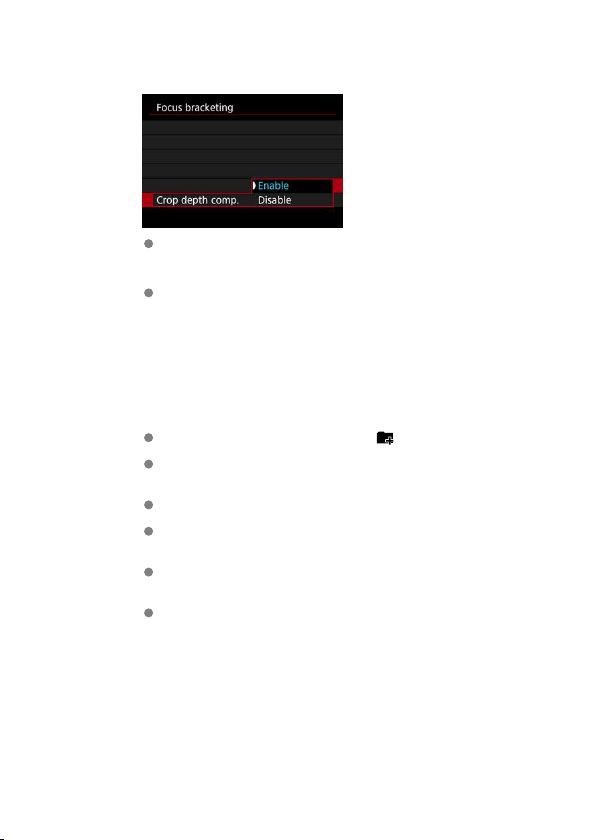
7.
Set [Crop depth comp.].
Select [Enable] for cropping before compositing, to prepare any
images without a sufficient angle of view for compositing alignment by
cropping them to correct the angle of view.
Select [Disable] if you prefer not to crop these images. In this case,
areas without a sufficient angle of view are covered by a black border
in the saved images. You can crop the images manually or edit them
as needed.
8.
Take the picture.
To save your shots in a new folder, tap [ ] and select [OK].
Focus at the nearer end of your preferred focal range, then press the
shutter button completely.
Once shooting begins, release the shutter button.
The camera shoots continuously, shifting the focal position toward
infinity.
Shooting ends after your specified number of images, or at the far end
of the focal range.
To cancel shooting, press the shutter button completely again.
266
Caution
Focus bracketing is intended for still photo shooting on a tripod.
Shooting with a wider angle of view is recommended. After depth compositing, you
can crop the image if necessary.
For details on lenses compatible with this feature, visit the Canon website ( ).
Suitable [Focus increment] settings vary by subject. An unsuitable [Focus
increment] setting may cause unevenness in composite images, or shooting may
take more time because more shots are taken. Take some test shots to decide a
suitable [Focus increment] setting.
Flash photography is not available.
Shooting under flickering light may cause uneven images. In this case, lowering the
shutter speed may give better results.
Focus bracketing is not available when the camera is set to manual focus ( ).
Canceling shooting in progress may cause exposure problems in the last image.
Avoid using the last image when combining the images in Digital Photo
Professional.
Depth compositing is canceled if you open the card/battery compartment cover, or
if the remaining battery capacity becomes too low. After cancellation, composited
images are not saved.
Depth compositing may fail for patterned images (with a lattice or stripes, for
example) or images that are generally flat and uniform.
When taking several shots, start by focusing closer, then gradually focus farther
away.
Too great a distance when moving the focal position between multiple shots may
cause unevenness in depth-composited images, or it may cause compositing to
fail.
Depth compositing is intended for subjects that are not moving. For this reason,
shooting subjects in motion may prevent effective compositing.
Depth compositing of images with multiple subjects may fail if your shots are
composed with the subjects far apart from each other, for example.
In depth compositing, optimal images from the shots are selected and combined by
the camera. Not all of the shots are combined to create the composite image.
Note
Consider using a tripod, wireless remote control (sold separately, ), or other
means of securing the camera.
For best results, set the aperture value in a range of f/5.6–11 before shooting.
Details such as shutter speed, aperture value, and ISO speed are determined by
conditions for the first shot.
[ : Focus bracketing] reverts to [Disable] when the power switch is set to
<
>.
267
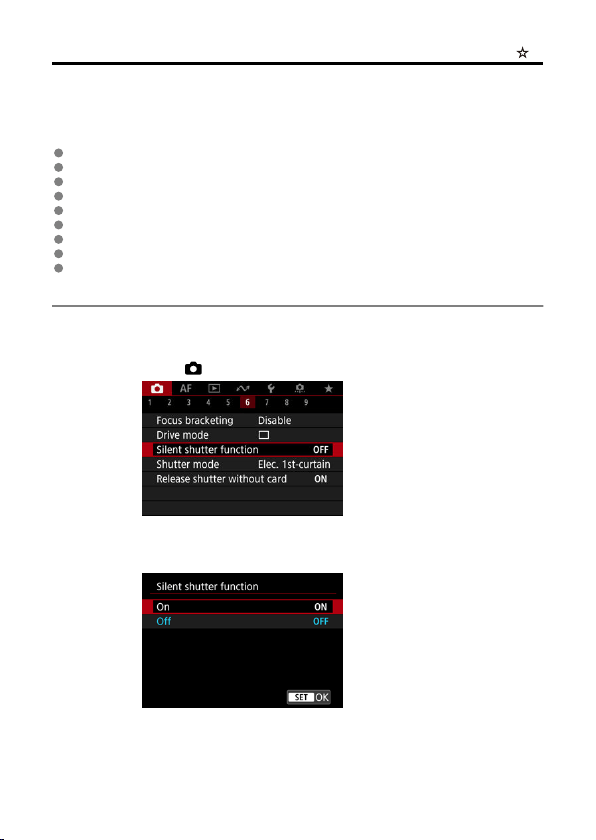
Silent Shutter Function
Disables shutter release sounds, operating sounds, and firing and illumination of the flash
and other light sources.
The following settings are used and cannot be changed.
Anti-flicker shooting: [Disable]
Flash firing: [Off]
Shooting creative filters: [Off]
Long exposure noise reduction: [Disable]
Shutter mode: [Electronic]
AF-assist beam firing: [Disable]
Beep: [Disable]
Self-timer lamp: not illuminated
Remote control lamp: not illuminated
When using lenses equipped with focus preset, consider turning off the focus preset beep.
1.
Select [
: Silent shutter function].
2.
Select [On].
268
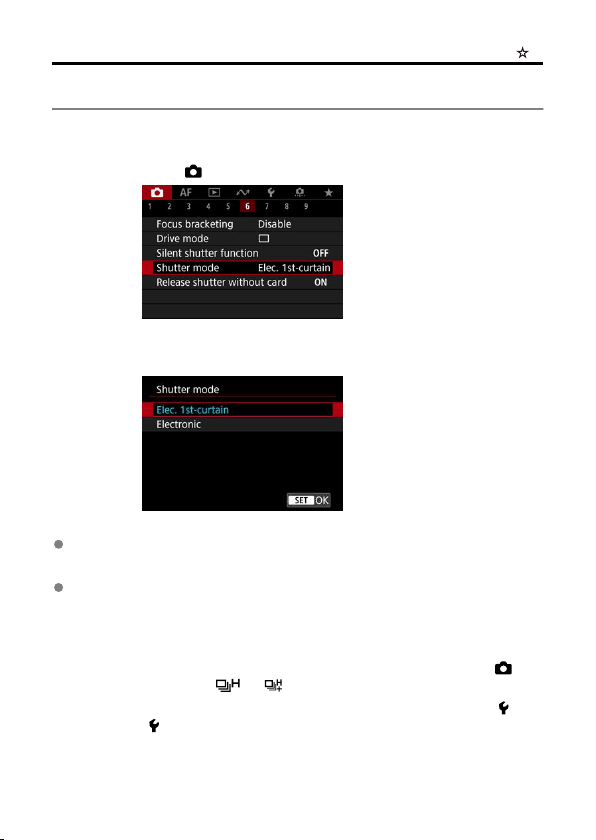
Shutter Mode
You can choose the method of shutter release.
1.
Select [
: Shutter mode].
2.
Select an option.
Elec. 1st-curtain
Electronic shutter is used for first curtain and mechanical for the second.
Electronic
Enables reduced sound and vibration from shutter operations, compared to electronic
first-curtain.
Recommended when shooting with the aperture of a bright lens wide open.
Maximum shutter speed can be set higher than for electronic first-curtain.
• A white frame is displayed around the screen at the time of shooting when [ :
Drive mode] is set to [
] or [ ].
• Shutter operations are accompanied by beeps. Beeping can be disabled in [ :
Beep] or [
: Volume].
269
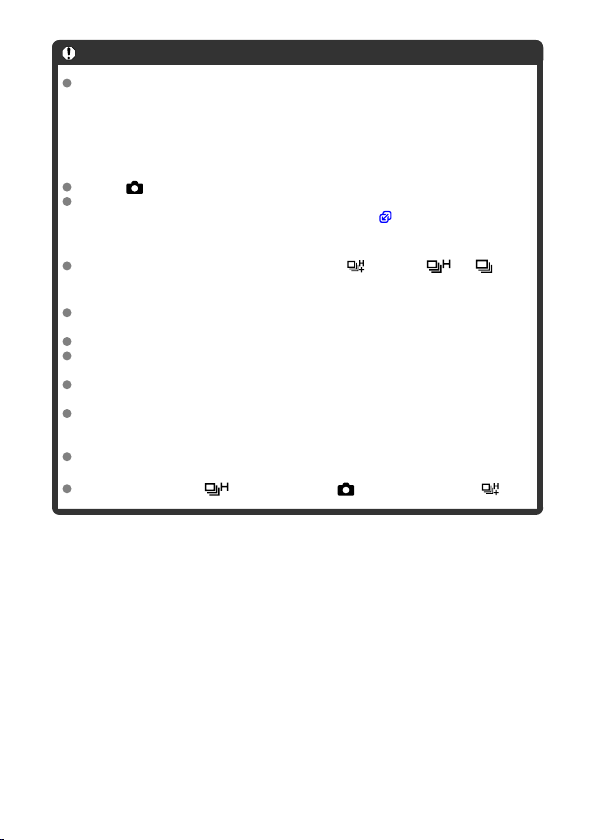
Caution
Defocused image areas may be incomplete when shooting near maximum aperture
at high shutter speeds, depending on shooting conditions. If you dislike the
appearance of defocused image areas, shooting as follows may give better results.
• Shoot with [Electronic].
• Lower the shutter speed.
• Increase the aperture value.
Setting [ : Silent shutter function] to [On] sets the shutter mode to [Electronic].
Zooming during continuous shooting may cause changes in exposure even at the
same f/number. For details, refer to the Canon website ( ).
Precautions when set to [Elec. 1st-curtain]
Camera vibration blur is more likely to occur with [ ] than with [ ] or [ ].
Precautions when set to [Electronic]
The continuous shooting speed may become slower depending on the shooting
conditions.
Images of fast-moving subjects may look distorted.
Images may lack suitable exposure if the aperture value changes in <P> (Program
AE) or <Tv> (Shutter-priority AE) mode.
With some lenses and under some shooting conditions, lens focusing and aperture
adjustment may be audible.
Bands of light may be displayed and captured images may be affected by light and
dark banding if you shoot with electronic shutter during flash firing by other
cameras or under fluorescent lighting or other flickering light sources.
Banding may appear in the viewfinder or on the screen if you shoot under flickering
light sources.
The camera shoots in [ ] mode, even when [ : Drive mode] is set to [ ].
270
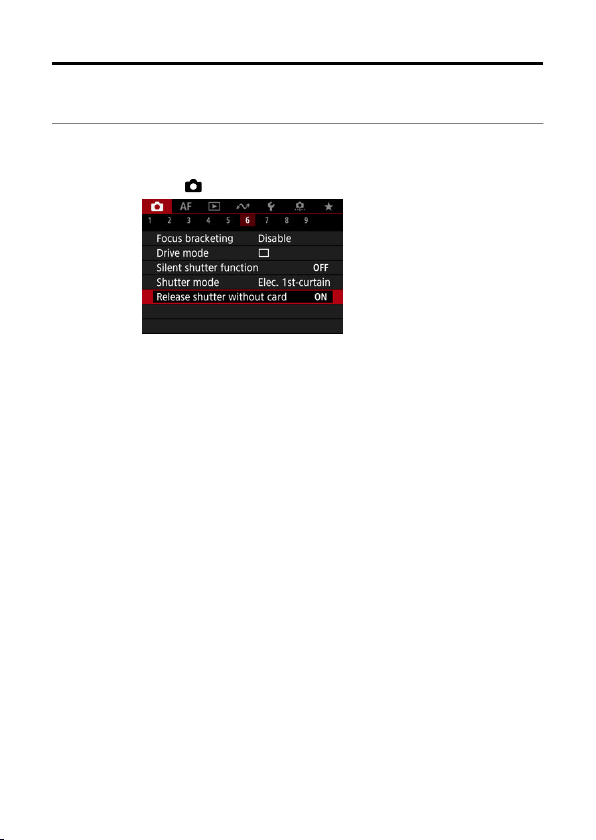
Releasing Shutter without Card
You can set the camera not to shoot unless there is a card in the camera. The default
setting is [Enable].
1.
Select [
: Release shutter without card].
2.
Select [Disable].
271
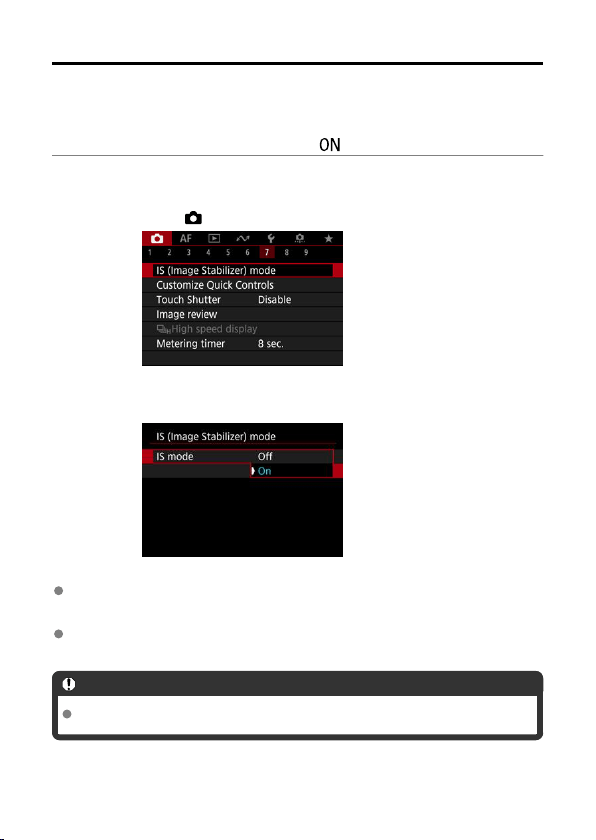
Image Stabilizer (IS Mode)
Image stabilization by the lens reduces camera shake at the time of shooting. To activate
lens IS when using IS lenses without an IS switch, set [IS mode] to [On] as follows. Note
that the [IS mode] setting is not displayed when you are using IS lenses that have an IS
switch. In that case, setting the lens IS switch to <
> activates stabilization by the lens.
1.
Select [
: IS (Image Stabilizer) mode].
2.
Select an [IS mode] option.
[Off]
Deactivates image stabilization.
[On]
Camera shake will be corrected.
Caution
In some cases, this may not provide sufficient stabilization for certain lenses.
272
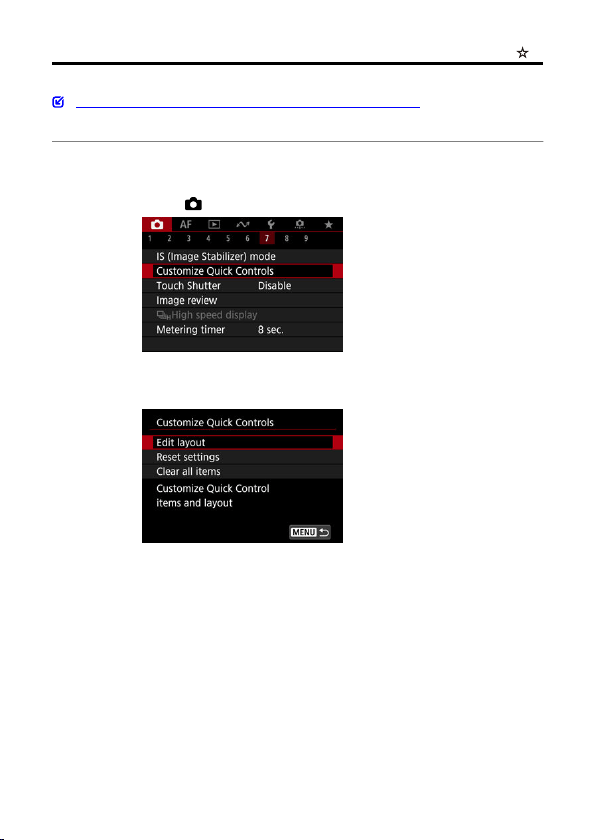
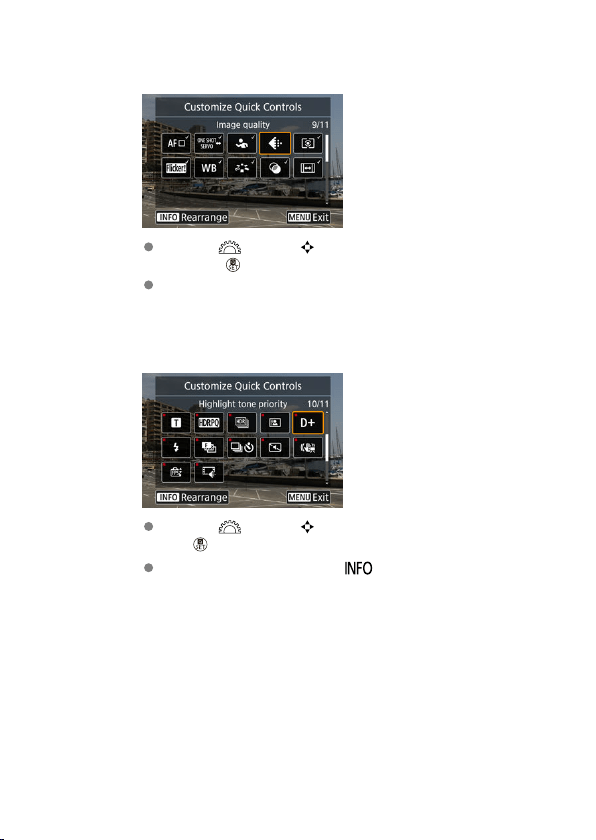
3.
Select items to remove.
Use the < > dial or < > keys to select an item to remove, then
press the <
> button.
Items shown on the Quick Control screen are labeled with a
checkmark. Items without a checkmark will be removed.
4.
Select items to add.
Use the < > dial or < > keys to select an item to add, then press
the <
> button.
To change the layout, press the < > button.
275
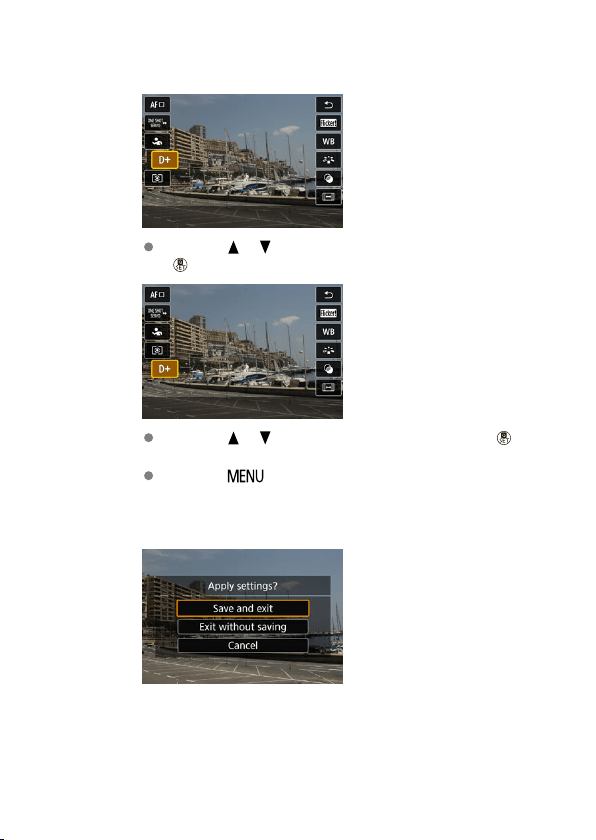
5.
Change the layout.
Press the < >< > keys to select an item to move, then press the
<
> button.
Press the < >< > keys to move the item, then press the < >
button.
Press the < > button to exit setup.
6.
Select [Save and exit].
276
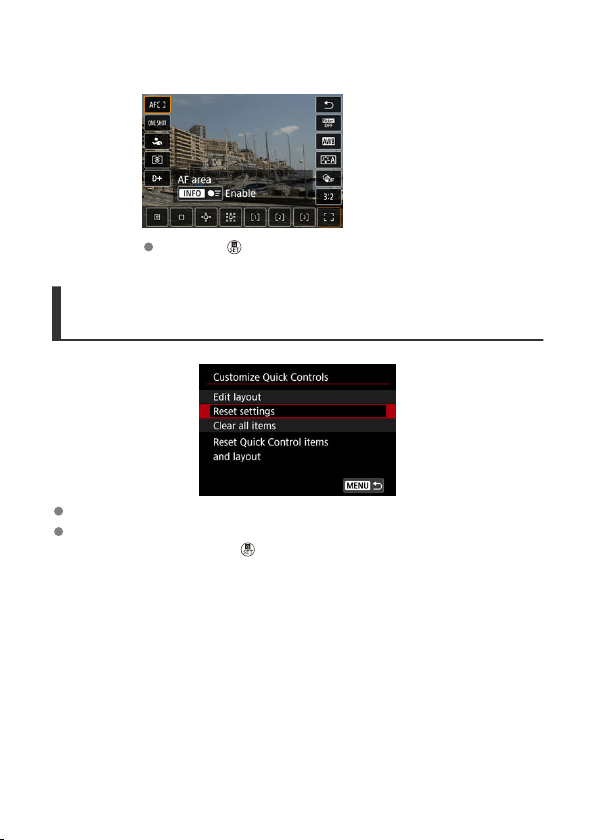
7.
Review the screen.
Press the < > button to check the screen with your settings applied.
Resetting the Custom Quick Control Screen or Clearing
All Items
Select [Reset settings] to restore the default Quick Control screen items and layout.
Select [Clear all items] to remove all items from the layout, so that no Quick Control
screen is displayed when the
<
> button is pressed.
277
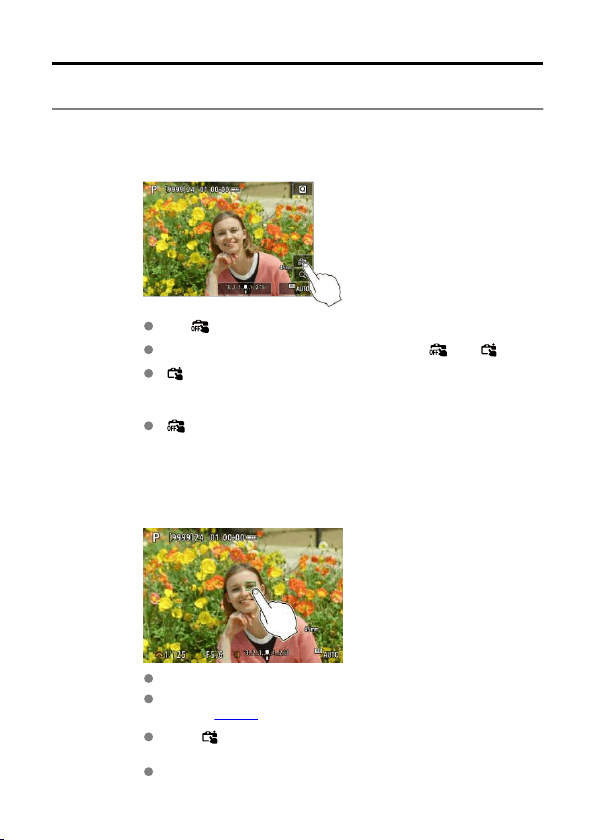
Shooting with the Touch Shutter
Just by tapping the screen, you can focus and take the picture automatically.
1.
Enable the Touch Shutter.
Tap [ ] on the screen.
Each time you tap the icon, it will toggle between [ ] and [ ].
[ ] (Touch Shutter: Enable)
The camera will focus on the spot you tap, then the picture will be
taken.
[ ] (Touch Shutter: Disable)
You can tap a spot to perform focusing on the spot. Press the shutter
button completely to take the picture.
2.
Tap the screen to shoot.
Tap the face or subject on the screen.
On the point you tap, the camera focuses (Touch AF) using your
specified AF Area.
When [ ] is set, the AF point turns green when focus is achieved,
then the picture is taken automatically.
If focus is not achieved, the AF point turns orange and the picture
cannot be taken. Tap the face or subject on the screen again.
278
Caution
The camera shoots in single shooting mode regardless of the drive mode setting
([
], [ ], or [ ]).
Tapping the screen focuses with [One-Shot AF], even if [ : AF operation] is set
to [Servo AF].
Tapping the screen in magnified view will not focus or take the picture.
When shooting by tapping with [Review duration] in [ : Image review] set to
[Hold], you can take the next shot by pressing the shutter button halfway or tapping
[
].
Note
To shoot with bulb exposure, tap the screen twice. Tap once to start exposure and
again to stop it. Be careful not to shake the camera when tapping the screen.
279
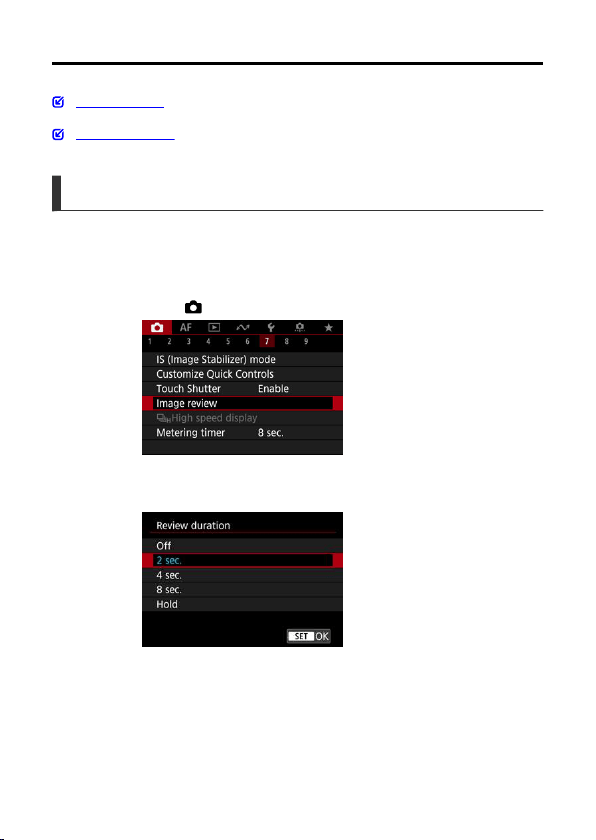
Note
When [Hold] is set, images are displayed as long as the time set in the [Screen
off] option of [
: Power saving].
281
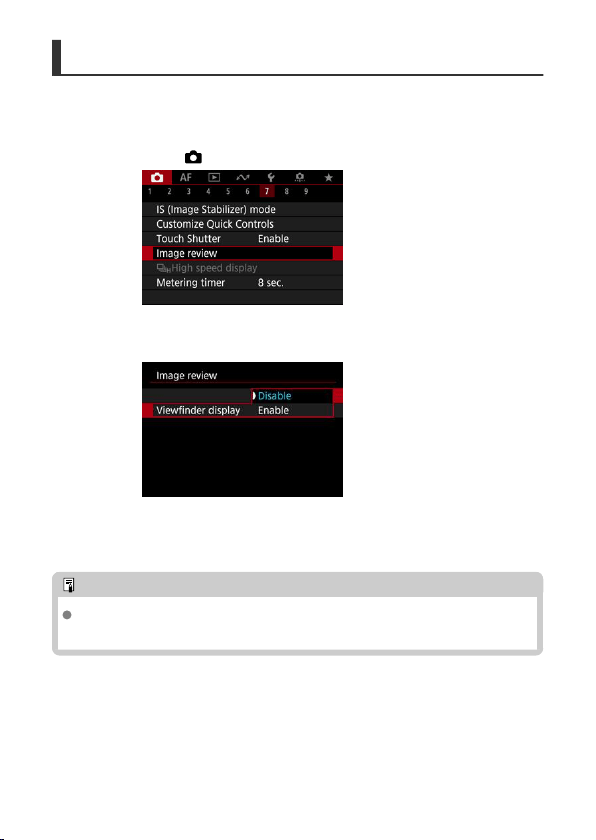
Viewfinder Display
Set to [Enable] for viewfinder display of your shots immediately after you shoot.
1.
Select [
: Image review].
2.
Select [Viewfinder display].
3.
Select an option.
Note
[Viewfinder display] settings take effect when [Review duration] is set to an
option other than [Off].
282
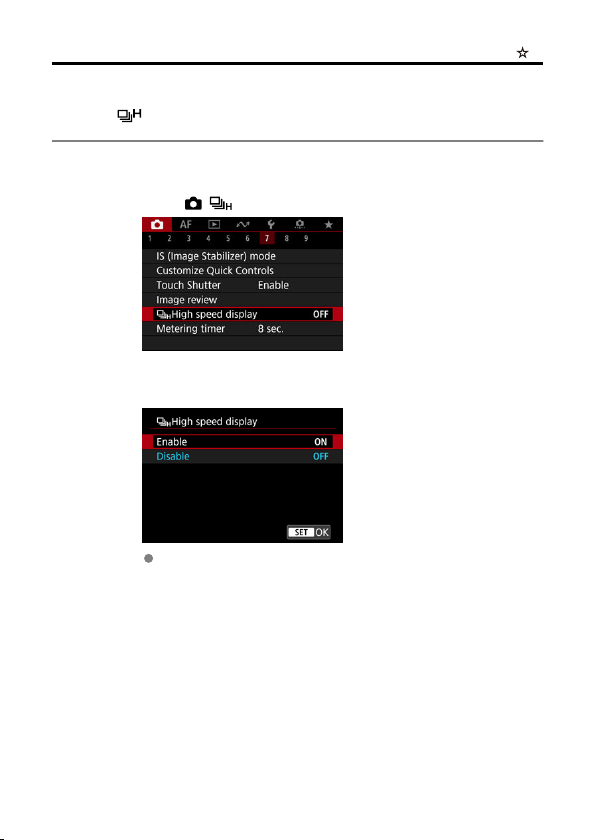
High-Speed Display
High-speed display that switches between each shot and the live image is available when
shooting in [
] (high-speed continuous shooting) drive mode and in a shutter mode other
than electronic shutter.
1.
Select [
: High speed display].
2.
Select an option.
Select [Enable] for display that switches between each shot and the
live image.
283
Caution
Images may waver or flicker during high-speed display. This occurs more often at
high shutter speeds. However, this does not affect shooting results.
High-speed display is not performed for shutter speeds slower than 1/30 sec.,
aperture values higher than f/11, conditions that make autofocusing difficult, flash
photography, or high ISO expansion. It may also stop as you are shooting.
High-speed display is not available in the following cases.
• With [
: OVF sim. view assist] set to [On]
• With [ : Display simulation] set to [Disable] or [Exposure only during
DOF]
284
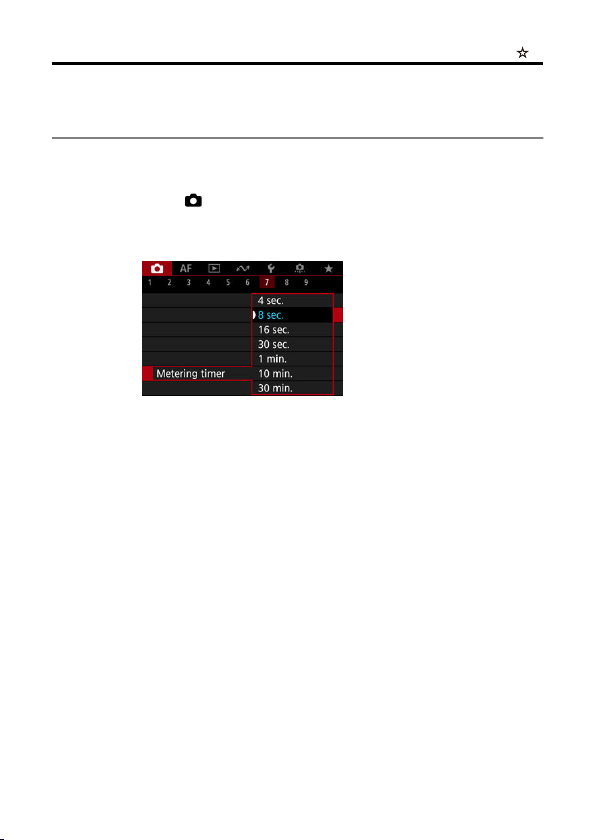
Metering Timer
You can set how long the metering timer runs (which determines the duration of exposure
value display) after it is triggered automatically by an action such as pressing the shutter
button halfway.
1.
Select [
: Metering timer].
2.
Set a time option.
285
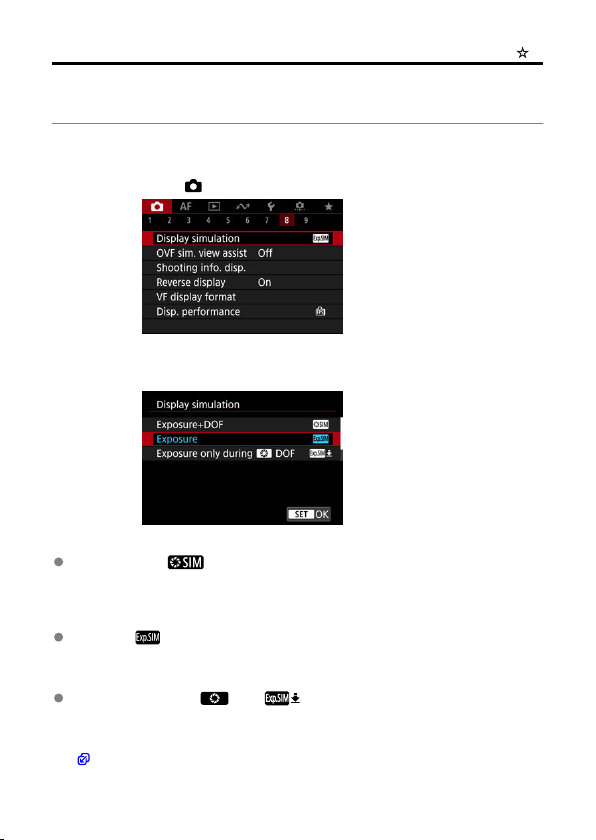
Display Simulation
With display simulation, display of image brightness and depth of field more closely matches
the actual brightness (exposure) of your shots.
1.
Select [
: Display simulation].
2.
Select an option.
Exposure+DOF ( )
Image brightness and depth of field as displayed closely matches the actual brightness
(exposure) of your shots. If you set exposure compensation, the image brightness will
change accordingly. Similarly, changes to the aperture value will alter the depth of field.
Exposure ( )
Image brightness as displayed closely matches the actual brightness (exposure) of your
shots. If you set exposure compensation, the image brightness will change accordingly.
Exposure only during DOF ( )
Normally, the image is displayed at standard brightness, so it is easy to see. Only when
you press and hold the button assigned to depth-of-field preview will image brightness
resemble actual brightness (exposure) of your shot, and you can check depth of field
( ).
286
Disable ( )
The image is displayed at standard brightness, so it is easy to see. Even if you set
exposure compensation, the image is displayed at the standard brightness.
Caution
Notes on [Exposure+DOF]
Display may flicker at some shutter speeds.
With EF lenses, this setting may increase the shutter-release time lag.
The depth of field shown is only a guideline. For more precise indication of the
depth of field, press the button assigned to depth-of-field preview (
).
[Exposure+DOF] is not available with some lenses.
[ ] blinks if either exposure or depth of field cannot be simulated, or if neither
can be simulated.
[ ] is dimmed if either exposure or depth of field simulation stops, or if both
simulations stop.
287
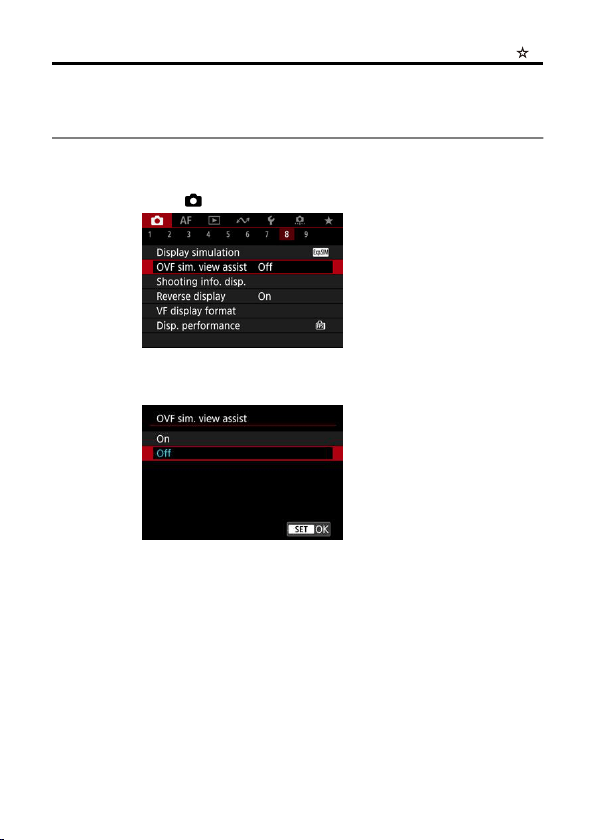
Optical Viewfinder Simulation
Natural-looking viewfinder and screen display, resembling the view from an optical
viewfinder, is available in still photo shooting. Note that images displayed with this feature
set to [On] may differ from actual shooting results.
1.
Select [
: OVF sim. view assist].
2.
Select an option.
288
Caution
Setting this feature to [On] sets [ : Display simulation] to [Disable].
Optical viewfinder simulation is used for display when this feature is set to [On] in
HDR shooting.
Creative filter display is used when shooting with Creative filters, even if this feature
set to [On].
Image brightness before and after One-Shot AF is more likely to change when set
to [On] than when set to [Off].
Optical viewfinder simulation is not used during display to external monitors,
including in display to both an external monitor and the camera screen.
Depending on setting screens, optical viewfinder simulation may not be used for
display.
Display may not resemble an optical viewfinder in some cases.
The display appearance may change during continuous shooting, with some
combinations of drive and shutter modes.
289
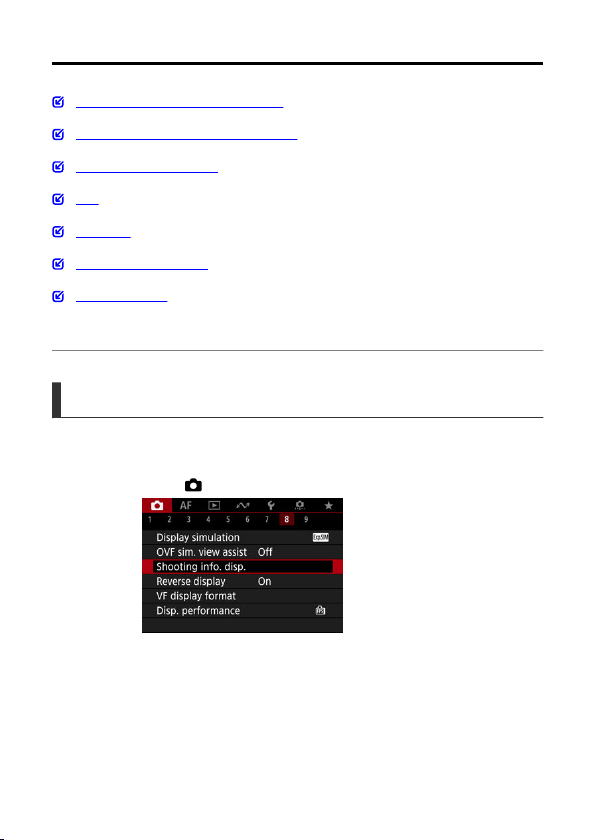
Shooting Information Display
Customizing Information on the Screen
Customizing Information in the Viewfinder
Viewfinder Vertical Display
Grid
Histogram
Lens Information Display
Clearing Settings
You can customize the details and screens of information shown on the screen or in the
viewfinder when you shoot.
Customizing Information on the Screen
1.
Select [
: Shooting info. disp.].
290
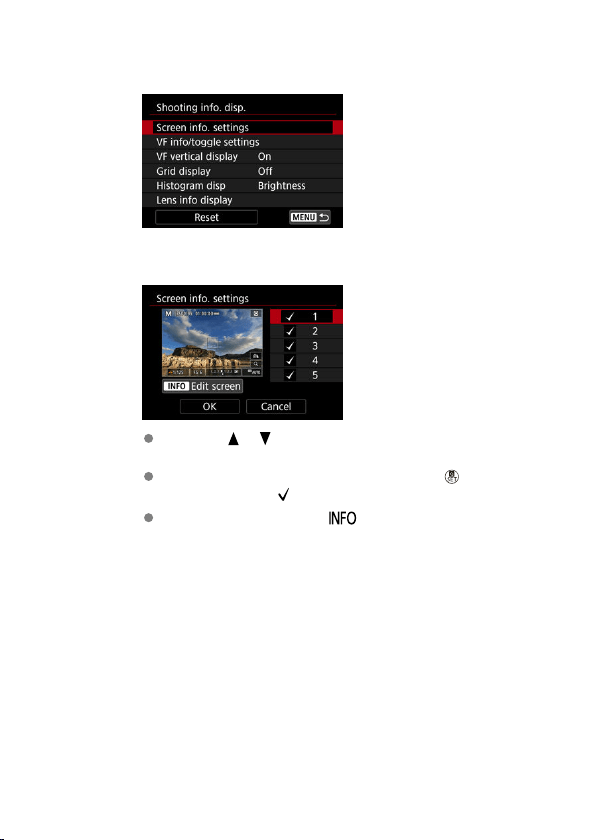
2.
Select [Screen info. settings].
3.
Select screens.
Press the < >< > keys to select screens of information to show on
the camera.
For information you prefer not to display, press the < > button to
clear the checkmark [
].
To edit the screen, press the < > button.
291
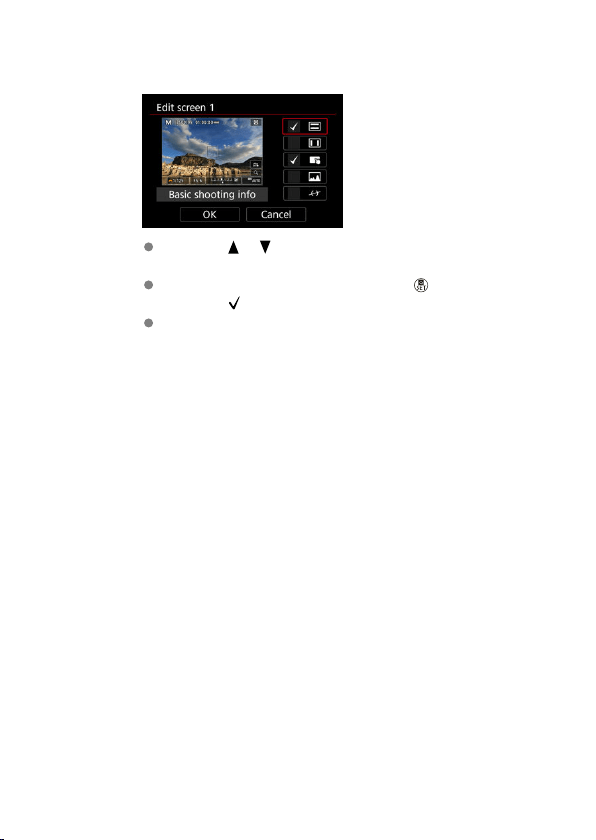
4.
Edit the screen.
Press the < >< > keys to select options to show on the information
screen.
For items you prefer not to display, press the < > button to clear the
checkmark [
].
Select [OK] to register the setting.
292
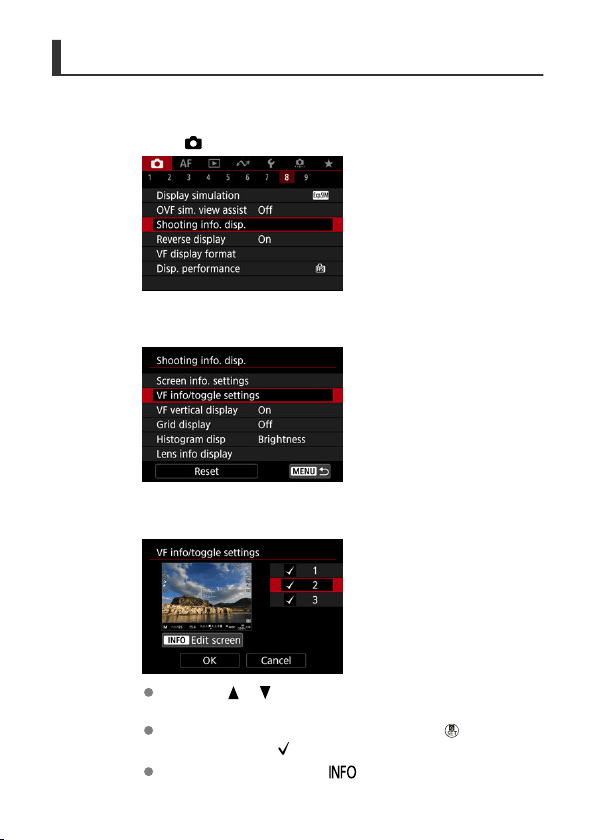
Customizing Information in the Viewfinder
1.
Select [
: Shooting info. disp.].
2.
Select [VF info/toggle settings].
3.
Select screens.
Press the < >< > keys to select screens of information to show on
the camera.
For information you prefer not to display, press the < > button to
clear the checkmark [
].
To edit the screen, press the < > button.
293
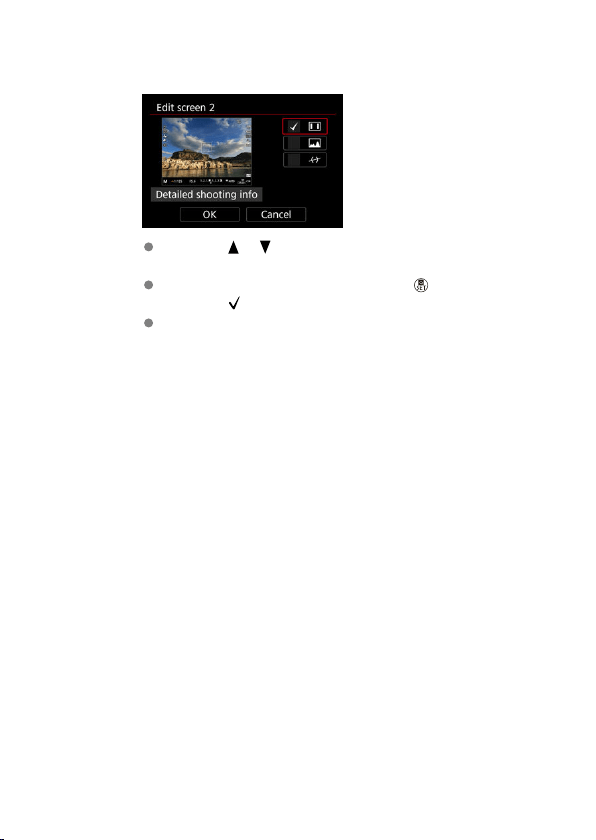
4.
Edit the screen.
Press the < >< > keys to select options to show on the information
screen.
For items you prefer not to display, press the < > button to clear the
checkmark [
].
Select [OK] to register the setting.
294
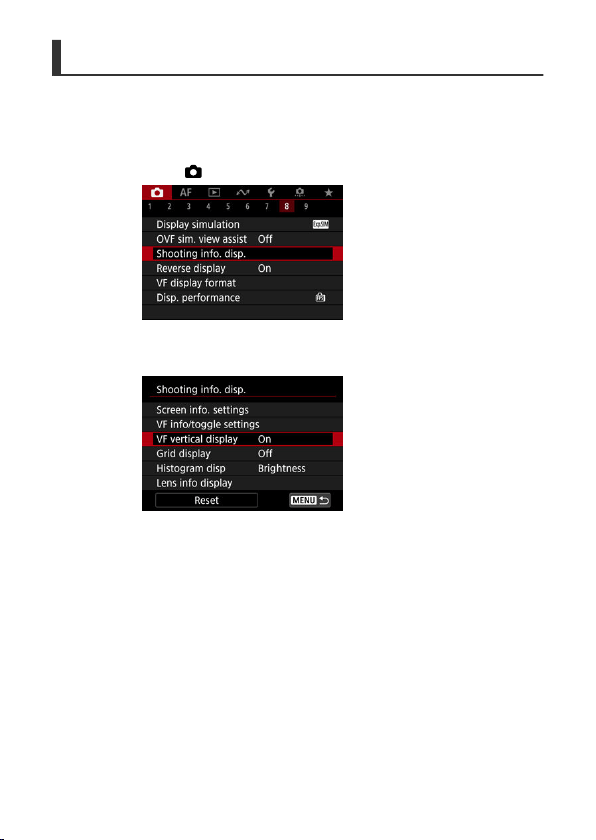
Viewfinder Vertical Display
You can select how viewfinder information is displayed when you are shooting still photos
vertically.
1.
Select [
: Shooting info. disp.].
2.
Select [VF vertical display].
295
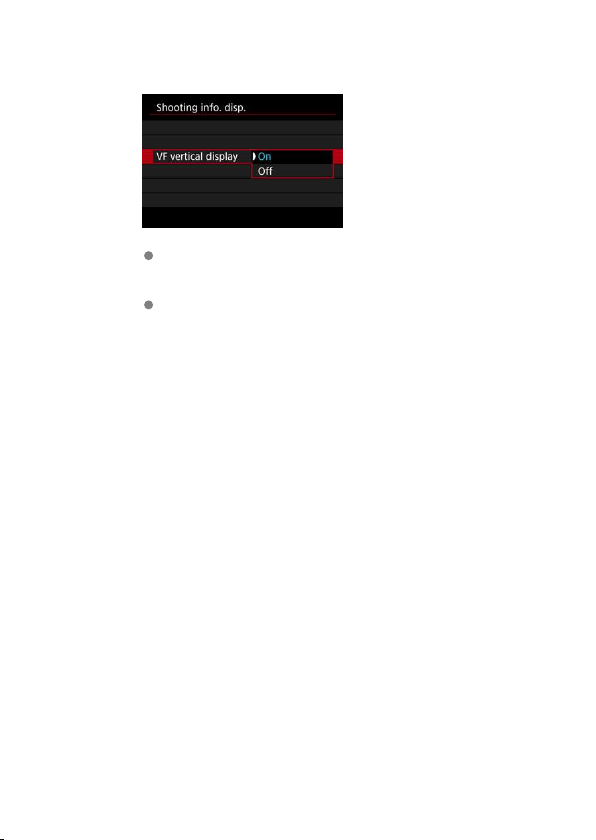
3.
Select an option.
On
Information is automatically rotated, making it easier to read.
Off
Information is not automatically rotated.
296
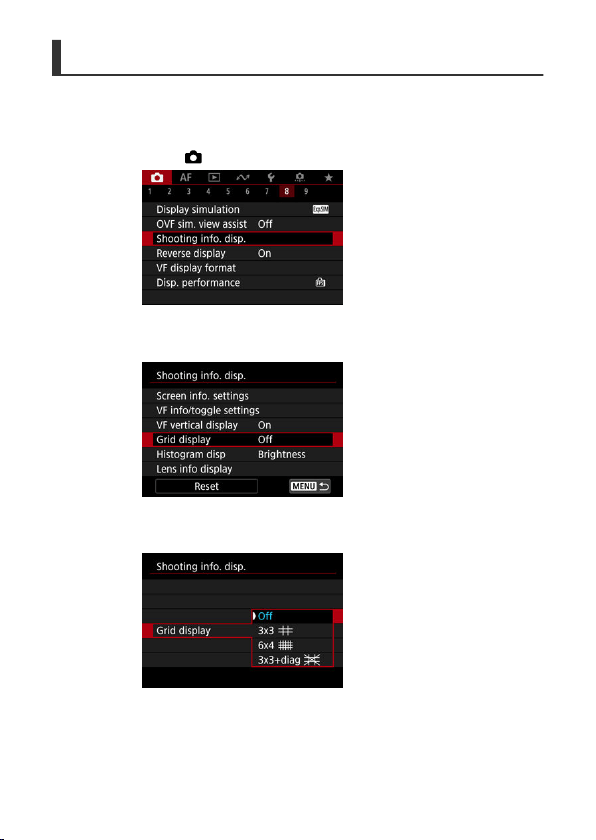
Grid
A grid can be displayed on the screen and viewfinder.
1.
Select [
: Shooting info. disp.].
2.
Select [Grid display].
3.
Select an option.
297
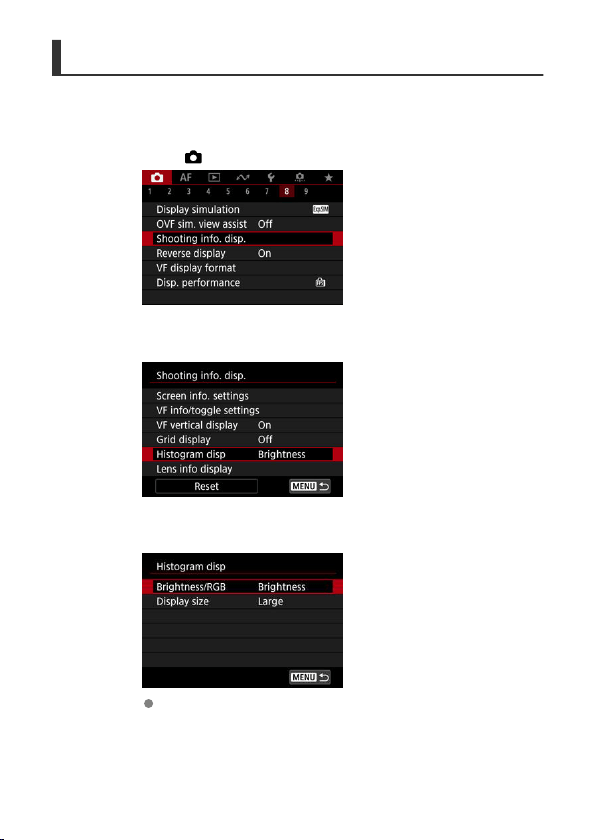
Histogram
You can select the content and display size of the histogram.
1.
Select [
: Shooting info. disp.].
2.
Select [Histogram disp].
3.
Select an option.
Select the content ([Brightness] or [RGB]) and display size ([Large] or
[Small]).
298
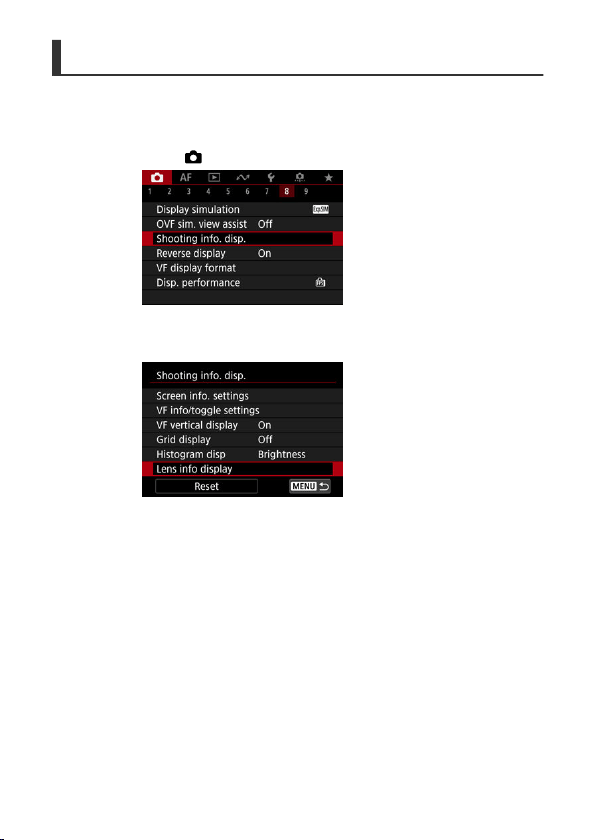
Lens Information Display
You can display information about the lens in use.
1.
Select [
: Shooting info. disp.].
2.
Select [Lens info display].
299
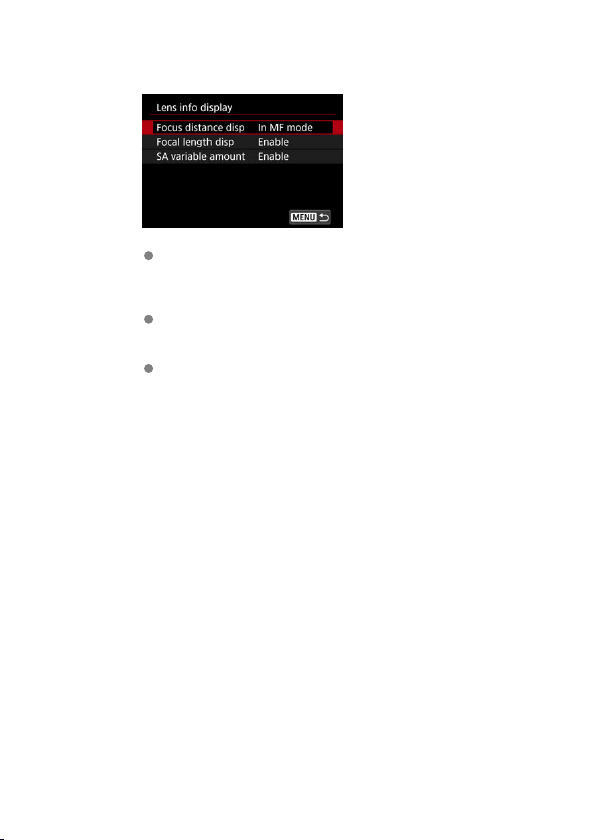
3.
Select an option.
Focus distance disp
You can display focus distance when using RF lenses. In focus
distance display, you can select the timing and unit of measurement.
Focal length disp
You can display the focal length of the lens in use.
SA variable amount
You can display the amount of correction set when using lenses
featuring spherical aberration control.
* SA: spherical aberration
300
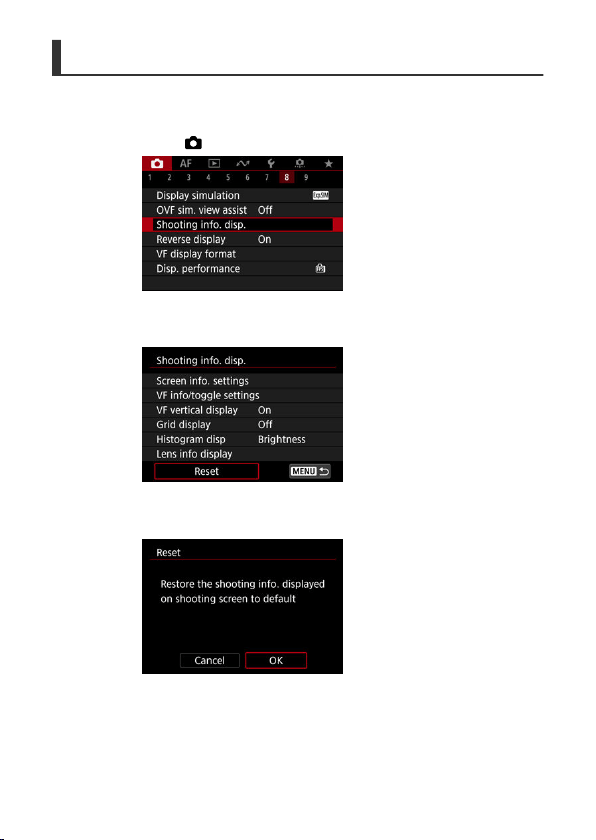
Clearing Settings
1.
Select [
: Shooting info. disp.].
2.
Select [Reset].
3.
Select [OK].
301
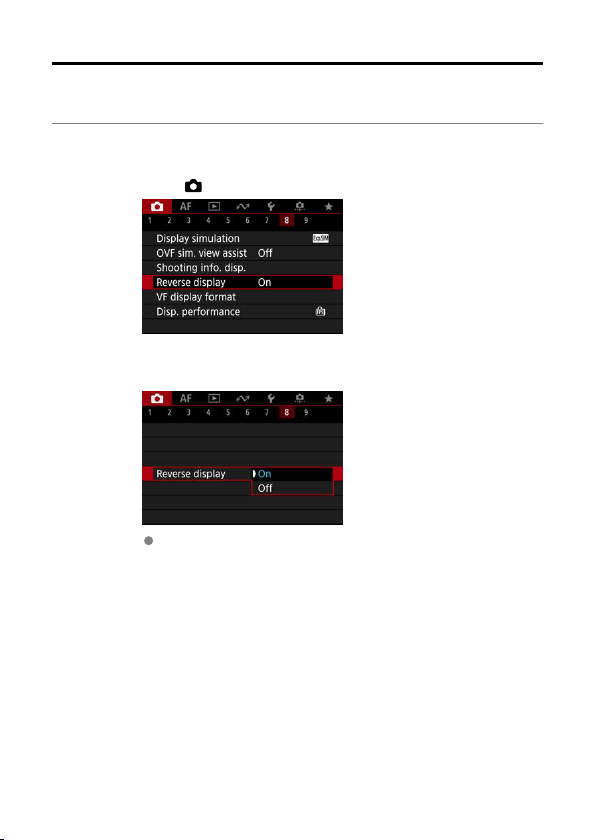
Reverse Display
A mirror image can be displayed when you shoot with the screen rotated toward the subject
(toward the front of the camera).
1.
Select [
: Reverse display].
2.
Select [On].
Select [Off] if you prefer not to reverse display when the screen is
facing the subject.
302
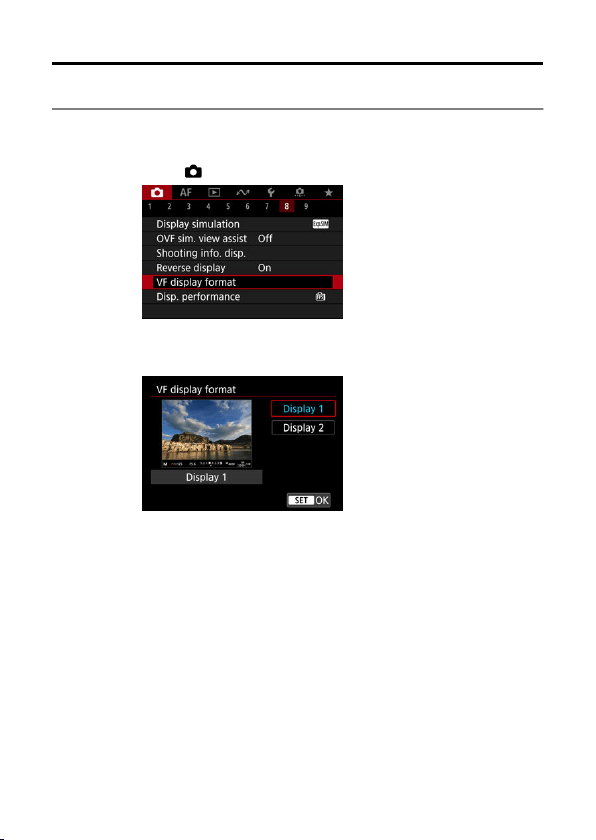
Viewfinder Display Format
You can select how information is presented in the viewfinder.
1.
Select [
: VF display format].
2.
Select an option.
303
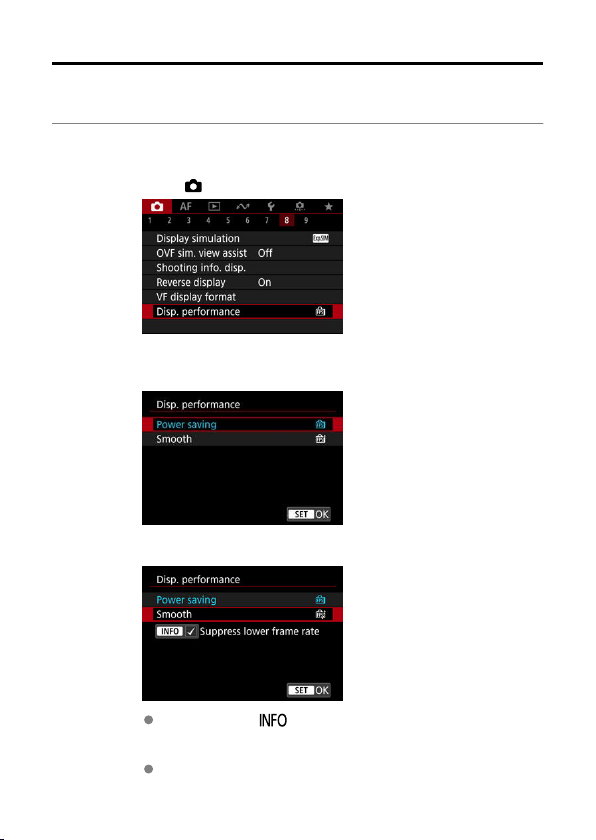
Display Performance
You can select the performance parameter to prioritize in shooting screen display for still
photos.
1.
Select [
: Disp. performance].
2.
Select an option.
When set to [Smooth]
By pressing the < > button to add a checkmark, you can include
low-light locations in the scenarios for suppressing lower display frame
rates.
The high frame rate (119.88 fps) display of the [Smooth] option is used
for shooting standby in viewfinder shooting.
304
Caution
Some shooting conditions and camera operations may prevent smooth, high frame
rate display, even when set to [Smooth].
Shooting under low light with [Suppress lower frame rate] set for shooting screen
display may affect performance as follows.
• Faster battery consumption
• Fewer shots available
• Lower image display brightness
• Difficulty in autofocusing
• Lower metering precision
• Lower flicker detection precision
• Lower subject detection precision
305
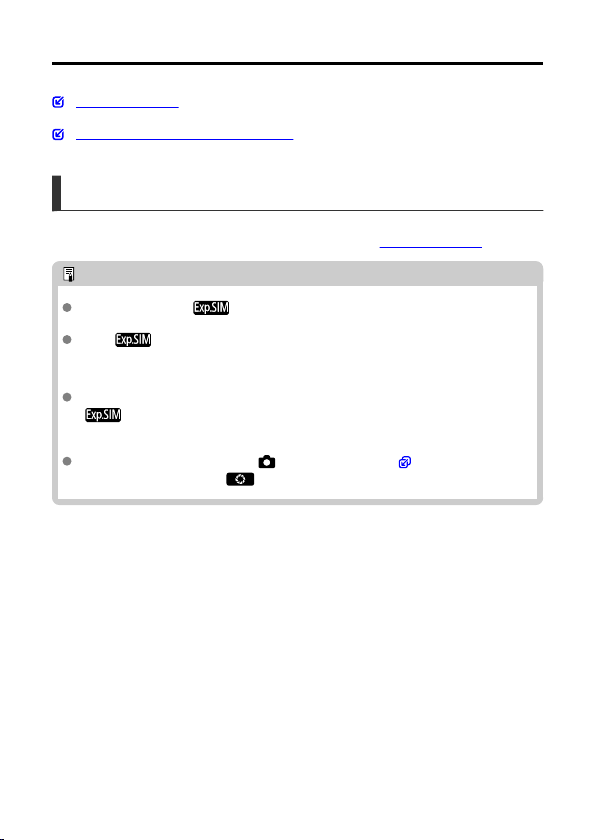
General Still Photo Shooting
Information Display
General Still Photo Shooting Precautions
Information Display
For details on the icons displayed for still photo shooting, see
Information Display.
Note
White display of the [ ] icon indicates that your shots will be about as bright
as the image displayed.
If the [ ] icon is blinking, it indicates that the image is displayed at a
brightness that differs from the actual shooting result because of low- or bright-light
conditions. However, the actual image recorded will reflect the exposure setting.
Note that the noise may be more noticeable than the actual image recorded.
Display simulation may not be performed under some shooting settings. The
[
] icon and histogram will be displayed in gray. The image will be displayed
on the screen at the standard brightness. The histogram may not be properly
displayed in low- or bright-light conditions.
No histogram is displayed when [ : Display simulation] ( ) is set to [Disable]
or [Exposure only during
DOF].
306
General Still Photo Shooting Precautions
Caution
Do not point the camera toward an intense light source, such as the sun or an
intense artificial light source. Doing so may damage the image sensor or the
camera's internal components.
Image quality
When you shoot at high ISO speeds, noise (such as dots of light and banding) may
become noticeable.
Shooting in high temperatures may cause noise and irregular colors in the image.
Frequent shooting over an extended period may cause high internal temperatures
and affect image quality. When you are not shooting, always turn off the camera.
If you shoot a long exposure while the camera's internal temperature is high, image
quality may decline. Stop shooting and wait a few minutes before shooting again.
White [ ] internal temperature warning icon
A white [ ] icon indicates high internal camera temperature. The white [ ] icon
indicates that the image quality of still photos will decline. Stop shooting for a while
and allow the camera to cool down.
If the camera's internal temperature is high, the quality of images shot with a high
ISO speed or long exposure may decline even before the white [
] icon is
displayed.
Shooting results
In magnified view, the shutter speed and aperture value will be displayed in orange.
If you take the picture in magnified view, the exposure may not come out as
desired. Return to the normal view before taking the picture.
Even if you take the picture in magnified view, the image will be captured with the
image area of the normal view.
307
Images and display
Under low- or bright-light conditions, the displayed image may not reflect the
brightness of the captured image.
Although noise may be noticeable in images under low light (even at low ISO
speeds), there will be less noise in your shots, due to differences in image quality
between displayed and captured images.
The screen may flicker if the light source (lighting) changes. In this case, stop
shooting temporarily and resume under the light source you will use.
Pointing the camera at different direction may momentarily prevent correct display
of brightness. Wait until the brightness level stabilizes before shooting.
If there is a very bright light source in the image, the bright area may appear black
on the screen. However, the actual captured image will correctly show the bright
area.
Under low light, bright [ : Screen brightness] settings may cause noise or
irregular colors in images. However, the noise or irregular colors will not be
recorded in the captured image.
When you magnify the image, the image sharpness may look more pronounced
than in the actual image.
Lens
If the attached lens has an Image Stabilizer and you set the Image Stabilizer switch
to <
>, the Image Stabilizer will operate at all times even if you do not press the
shutter button halfway. The Image Stabilizer consumes battery power and may
decrease the number of available shots depending on the shooting conditions.
When the Image Stabilizer is not necessary, such as when using a tripod, it is
recommended that you set the Image Stabilizer switch to <
>.
With EF lenses, focus preset during shooting is only available when using (super)
telephoto lenses equipped with this function released in and after the second half of
2011.
Note
The field of view is approx. 100% (with image quality set to JPEG ).
If the camera is idle over an extended period, the screen turns off automatically
after the time set in [Screen off] or [Viewfinder off] under [
: Power saving], and
the camera itself turns off automatically after the time set in [Auto power off] ( ).
Using a commercially available HDMI cable, you can display images on a television
(
). Note that no sound will be output.
308
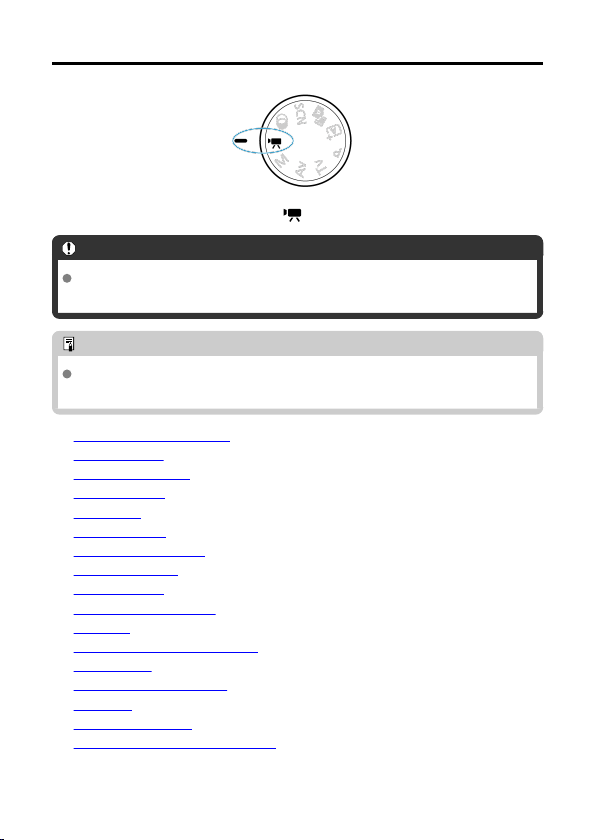
Movie Recording
For movie recording, set the Mode dial to < >.
Caution
When switching from still photo shooting to movie recording, check the camera
settings again before recording movies.
Note
You can record movies by pressing the movie shooting button during still photo
shooting.
• Tab Menus: Movie Recording
• Movie Recording
• Movie Recording Size
• High Frame Rate
• Digital Zoom
• Sound Recording
• Shooting Creative Filters
• Time-Lapse Movies
• Movie Self-Timer
• Image Stabilizer (IS Mode)
• Auto Level
• Shutter Button Function for Movies
• Zebra Settings
• Shooting Information Display
• Time Code
• Other Menu Functions
• General Movie Recording Precautions
309
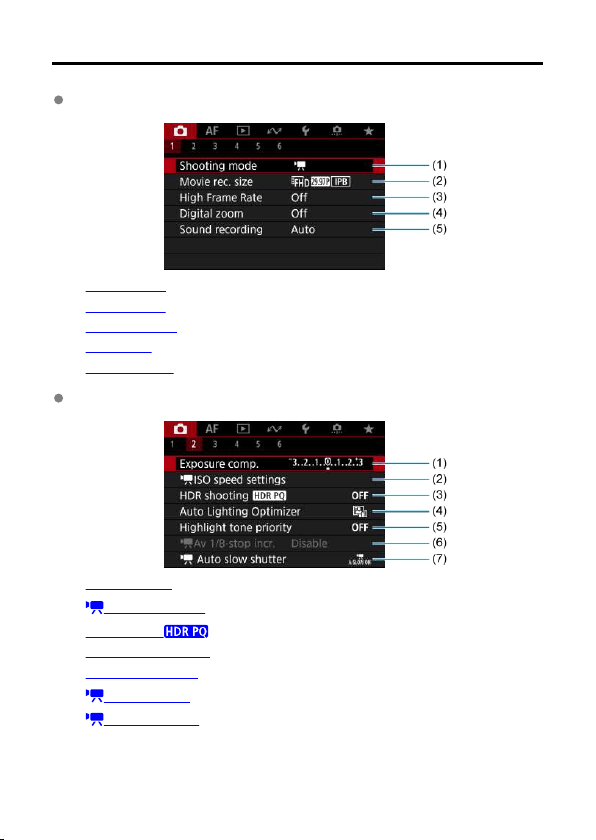
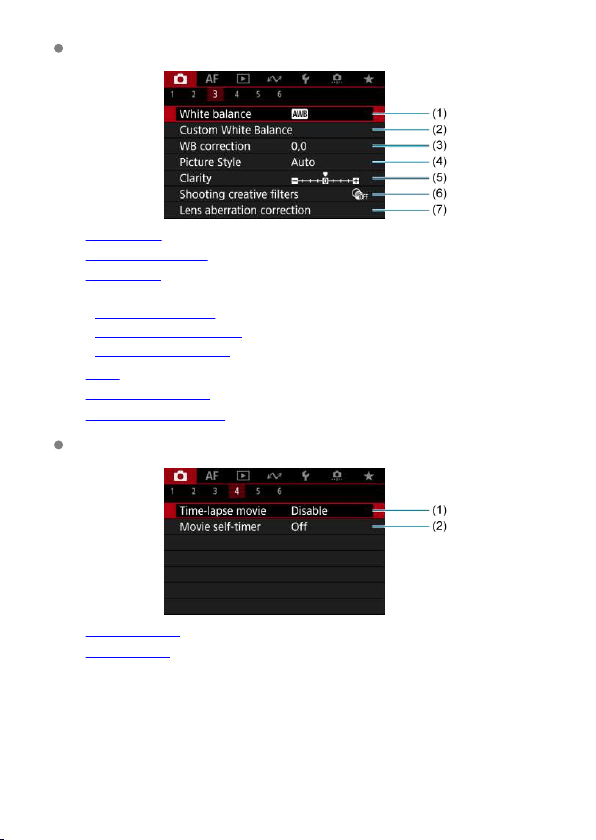
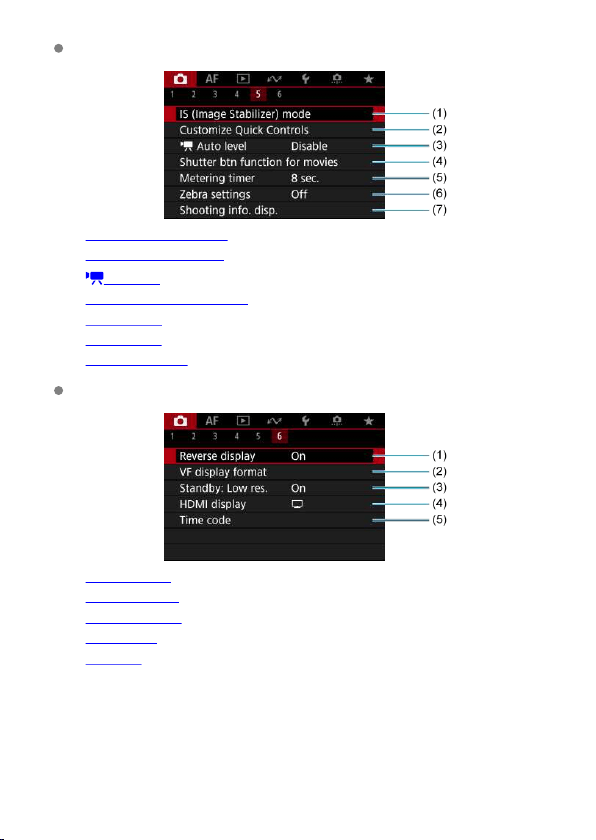
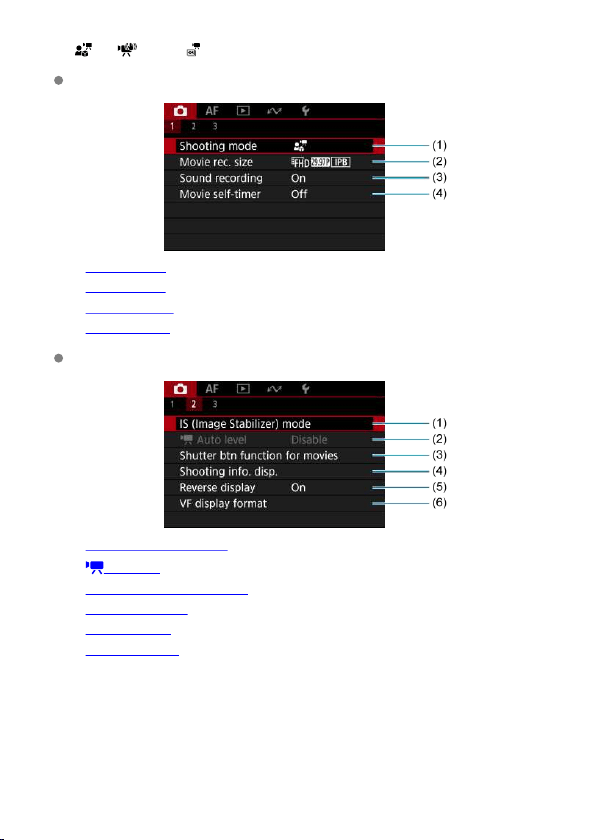
In < >, < >, and < > modes, the following screens are displayed.
Shooting 1
(1) Shooting mode
(2) Movie rec. size
(3) Sound recording
(4) Movie self-timer
Shooting 2
(1) IS (Image Stabilizer) mode
(2) Auto level
(3) Shutter btn function for movies
(4) Shooting info. disp.
(5) Reverse display
(6) VF display format
313
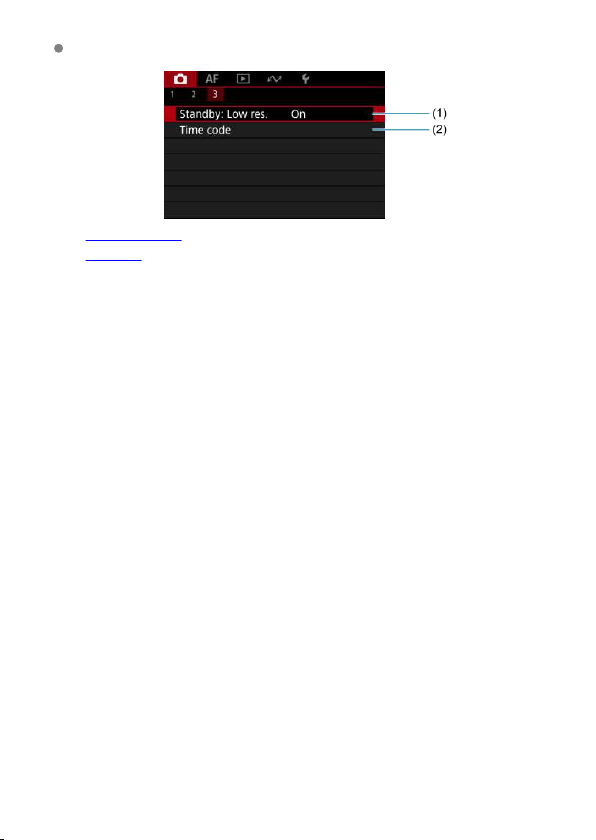
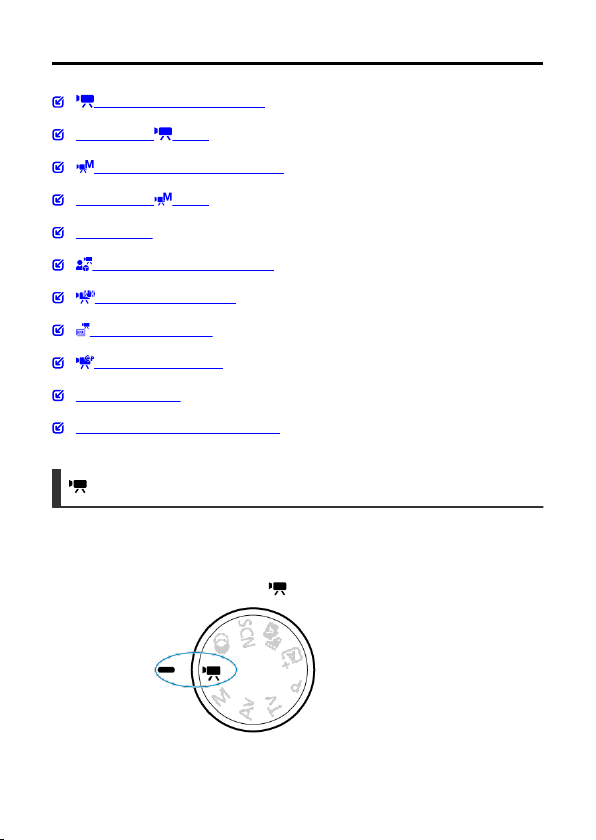
Movie Recording
Autoexposure Movie Recording
ISO Speed in [ ] Mode
Manual Exposure Movie Recording
ISO Speed in [ ] Mode
Shutter Speed
Close-Up Demo Movie Recording
IS Mode Movie Recording
HDR Movie Recording
Custom Shooting Mode
Still Photo Shooting
Information Display (Movie Recording)
Autoexposure Movie Recording
Exposure is controlled automatically to suit the brightness.
1.
Set the Mode dial to <
>.
315

2.
Select [
: Shooting mode].
3.
Select [Movie auto exposure].
4.
Focus on the subject.
Before recording a movie, focus with AF ( ) or manual focus ( ).
By default, [ : Movie Servo AF] is set to [Enable] so that the
camera always keeps focusing ( ).
When you press the shutter button halfway, the camera focuses using
your specified AF area.
316
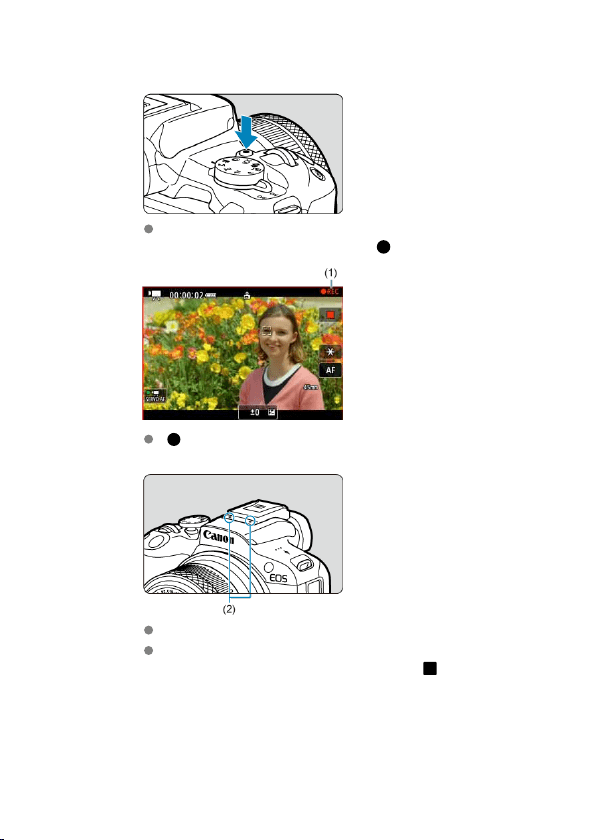
5.
Record the movie.
Press the movie shooting button to start recording a movie. You can
also start recording a movie by tapping [
] on the screen.
[ REC] (1) is displayed in the upper right while movie recording is in
progress, and a red frame around the screen blinks.
Sound is recorded with the movie microphone (2).
To stop recording the movie, press the movie shooting button again.
You can also stop recording a movie by tapping [
] on the screen.
317

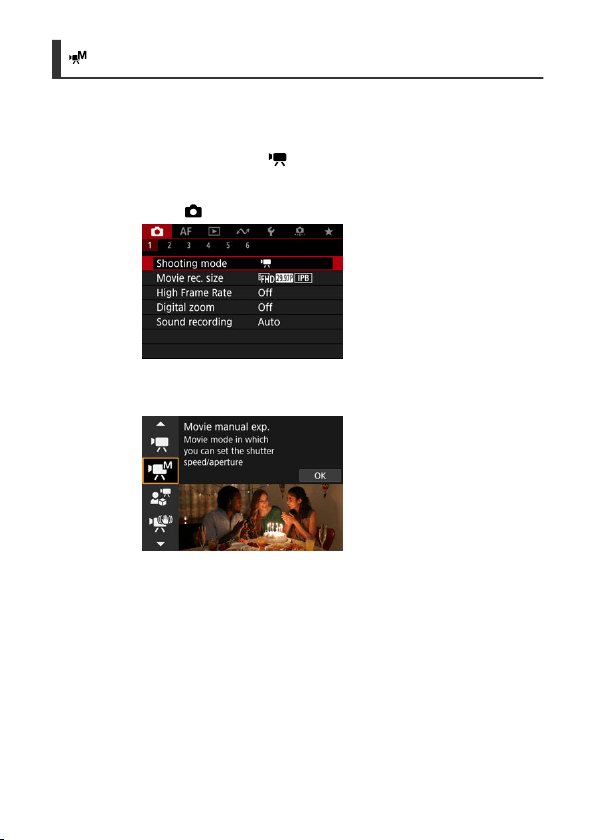
Manual Exposure Movie Recording
You can manually set the shutter speed, aperture value, and ISO speed for movie recording.
1.
Set the Mode dial to <
>.
2.
Select [
: Shooting mode].
3.
Select [Movie manual exp.].
319
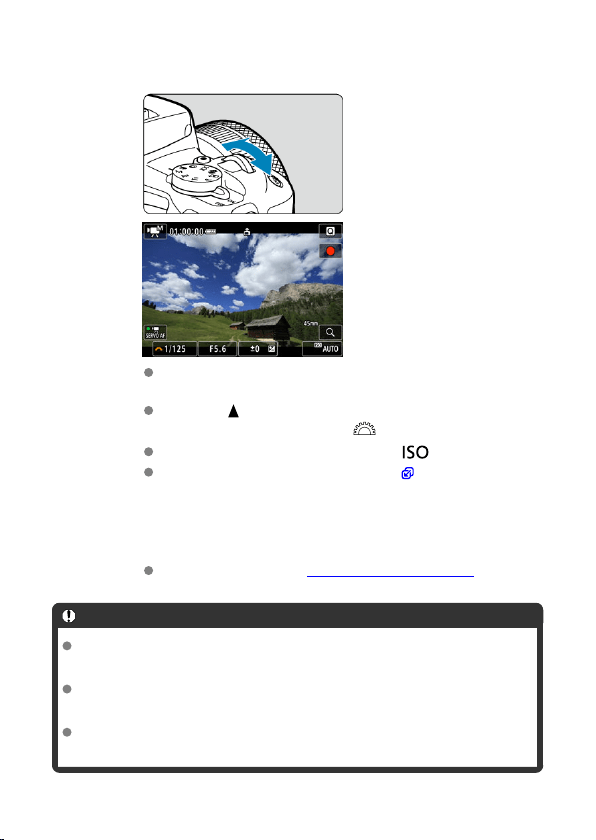
4.
Set the shutter speed, aperture value, and ISO speed.
Press the shutter button halfway and check the exposure level
indicator.
Press the < > key to select shutter speed, aperture value, exposure
level, or ISO speed, then turn the <
> dial to set a value.
ISO speed can also be set by pressing the < > button.
Available shutter speeds vary by frame rate ( ).
5.
Focus and record the movie.
Same as steps 4 and 5 for Autoexposure Movie Recording.
Caution
During movie recording, avoid changing the shutter speed, aperture value, or ISO
speed, which may record changes in the exposure or create more noise at high
ISO speeds.
When recording a movie of a moving subject, a shutter speed of approx. 1/25 sec.
to 1/125 sec. is recommended. The faster the shutter speed, the less smooth the
subject's movement will look.
If you change the shutter speed while recording under fluorescent or LED lighting,
image flicker may be recorded.
320
Note
When ISO Auto is set, you can press the < > button to lock the ISO speed. After
locking during movie recording, ISO speed lock can be canceled by pressing the
<
> button again.
If you press the < > button and recompose the shot, you can see the exposure
level difference on the exposure level indicator (
) compared to when the < >
button was pressed.
321
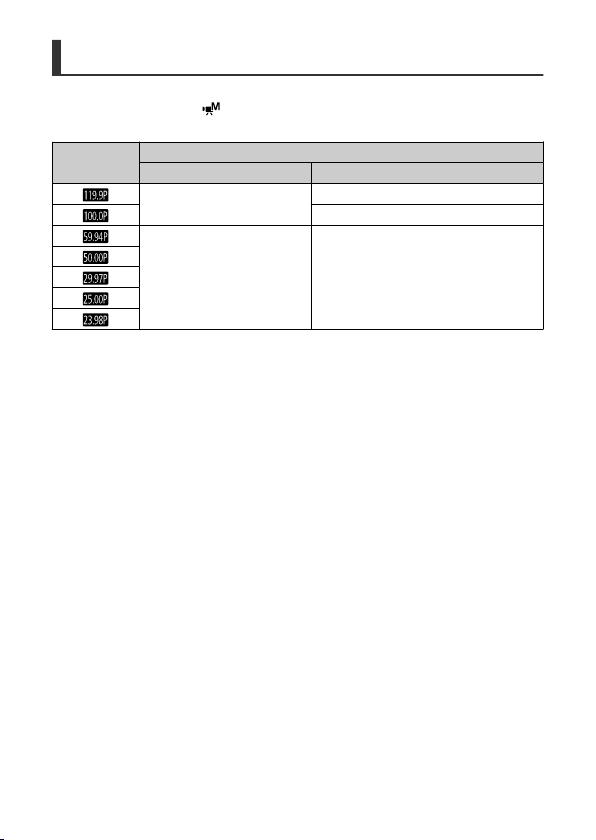
Shutter Speed
Available shutter speeds in [ ] mode vary depending on the frame rate you have set for
your specified movie recording size.
Frame Rate
Shutter Speed (Sec.)
Normal Movie Recording High Frame Rate Movie Recording
–
1/4000–1/125
1/4000–1/100
1/4000–1/8 –
323
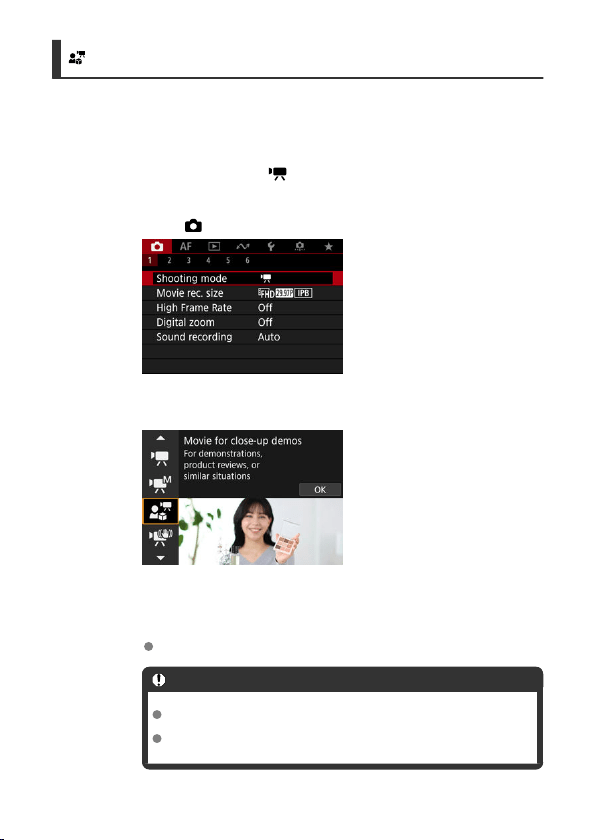
Close-Up Demo Movie Recording
Subjects near the camera can be given priority for focusing. This is useful for
demonstrations, product reviews, or similar situations.
1.
Set the Mode dial to <
>.
2.
Select [
: Shooting mode].
3.
Select [Movie for close-up demos].
4.
Record the close-up demo movie.
Record the movie in the same way as normal movie recording.
Caution
No AF points are displayed.
Subjects cannot be selected manually.
324
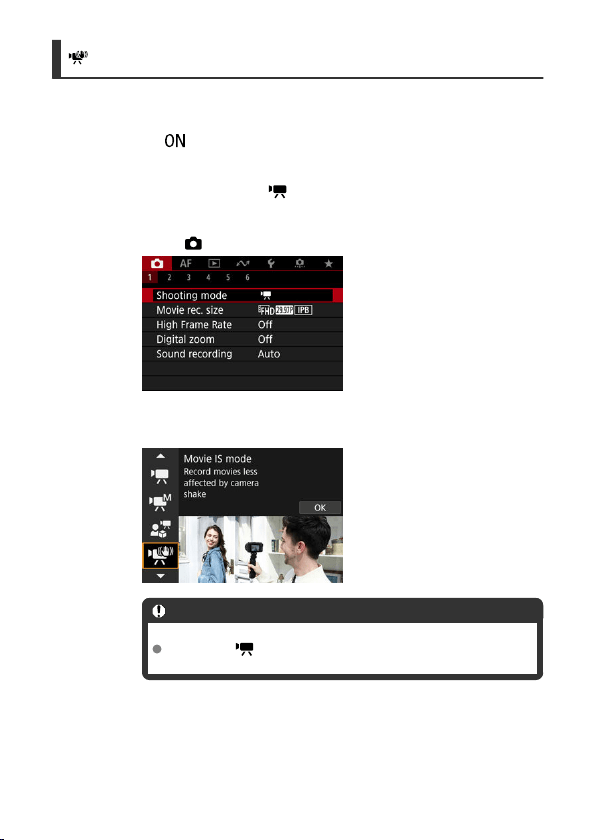
IS Mode Movie Recording
You can reduce camera shake as movies are recorded. This can provide effective
stabilization even when non-IS lenses are used. When using an IS lens, set the Image
Stabilizer switch to <
>.
1.
Set the Mode dial to <
>.
2.
Select [
: Shooting mode].
3.
Select [Movie IS mode].
Caution
By default, [ Digital IS] is set to [Enhanced].
325
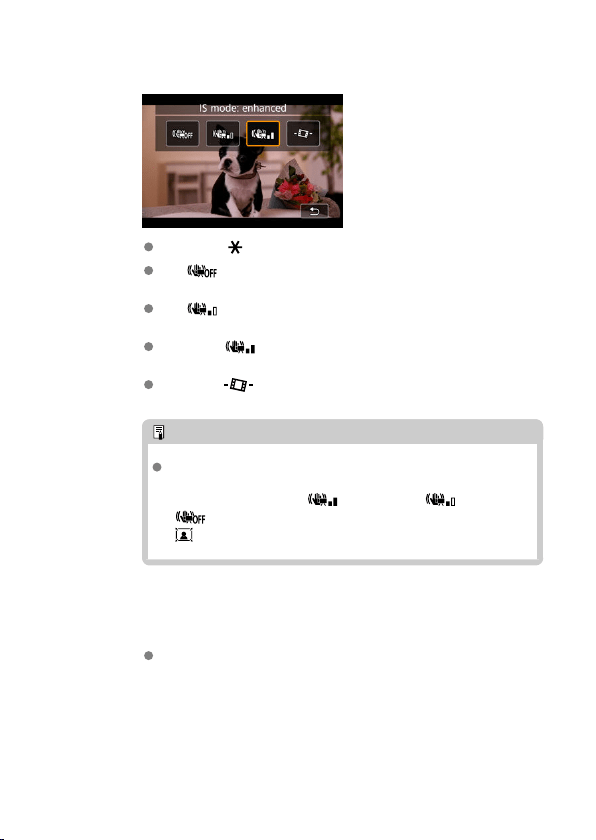
4.
Select a stabilization option.
Press the < > button.
Off ( ): Deactivates image stabilization. Movies are recorded with
a normal angle of view.
On ( ): Activates image stabilization. The image will be slightly
magnified.
Enhanced ( ): Activates stronger image stabilization than for [On].
The image will be more magnified.
Auto level ( ): Keeps images horizontally level during movie
recording.
Note
To avoid close-ups of your face when the screen is facing the front
of the camera for recording that will include your face, you can
switch the IS mode from [
] (enhanced) to [ ] (on) to
[
] (off), which zooms out each time. Otherwise, you can tap
[
] to change the setting directly.
5.
Record the movie.
Record the movie in the same way as normal movie recording.
326
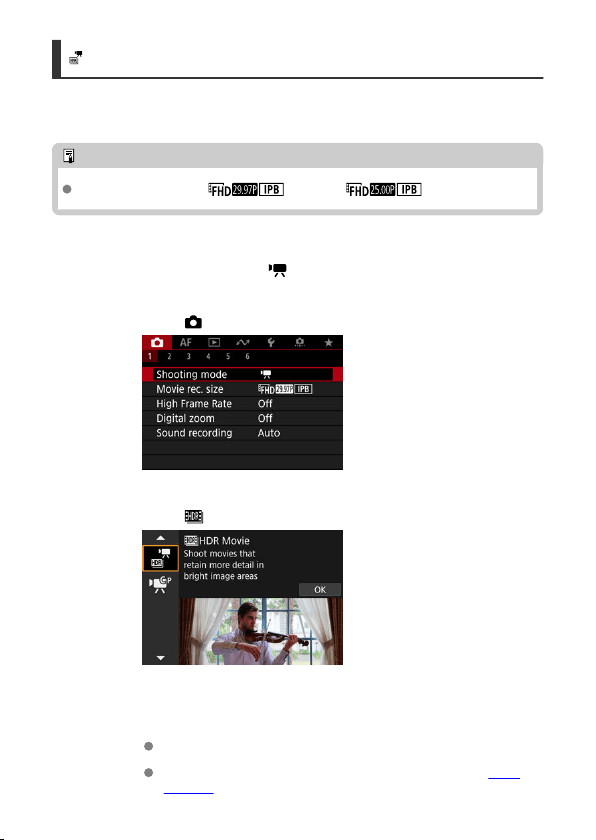
HDR Movie Recording
You can record high dynamic range movies that retain detail in highlights of high-contrast
scenes.
Note
Movies are recorded at (NTSC) or (PAL).
1.
Set the Mode dial to <
>.
2.
Select [
: Shooting mode].
3.
Select [
HDR Movie].
4.
Record an HDR movie.
Record the movie in the same way as normal movie recording.
For details on file sizes and the recording time available, see Movie
recording.
327
Caution
Since multiple frames are merged to create an HDR movie, certain parts of the
movie may look distorted. This is more noticeable in handheld recording affected
by camera shake, so consider using a tripod. Note that even if a tripod is used for
recording, afterimages or noise may become more noticeable, compared to normal
playback, when the HDR movie is played back frame-by-frame or in slow motion.
Image color and brightness may change significantly for a moment if you change
settings for HDR movie recording. Also, the movie will not be updated for a
moment, and the frame stops momentarily. Be aware of this when recording
movies to external devices via HDMI.
328
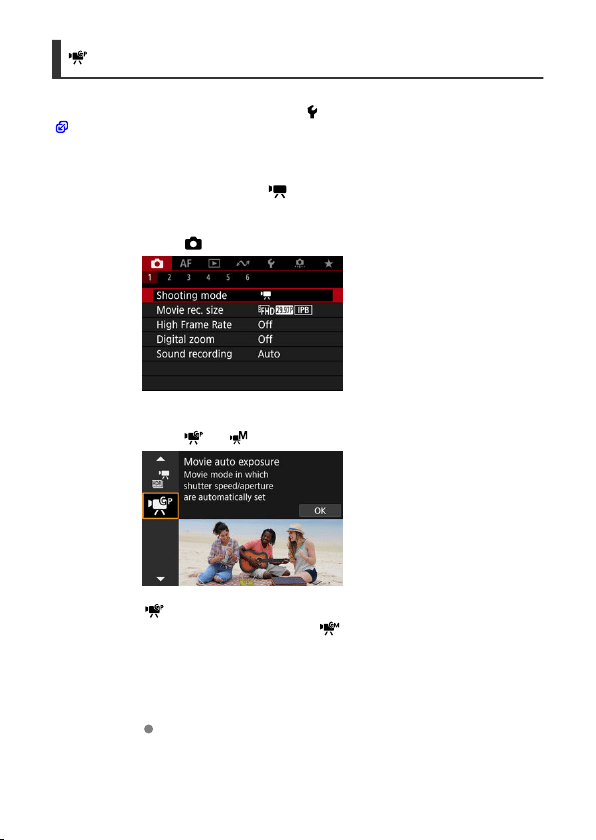
Custom Shooting Mode
You can record using the settings registered to [ : Custom shooting mode (C mode)]
(
).
By default, [Movie auto exposure] recording is used.
1.
Set the Mode dial to <
>.
2.
Select [
: Shooting mode].
3.
Select [
] or [ ].
[ ] is displayed when [Movie auto exposure] is registered to [Custom
shooting mode (C mode)], and [
] is displayed when [Movie manual
exp.] is registered.
4.
Focus and record the movie.
For details, see the instructions for your registered shooting mode.
329

Still Photo Shooting
Still photo shooting is not supported in movie recording mode. To shoot still photos,
turn the Mode dial to switch to another shooting mode.
330

Information Display (Movie Recording)
For details on the icons on the movie recording screen, see
Information Display.
Caution
The remaining time displayed for movie recording is only a guideline.
Movie recording may stop before the initially displayed recording time elapses if the
red [
] icon appears due to high internal camera temperature during
recording ( ).
331
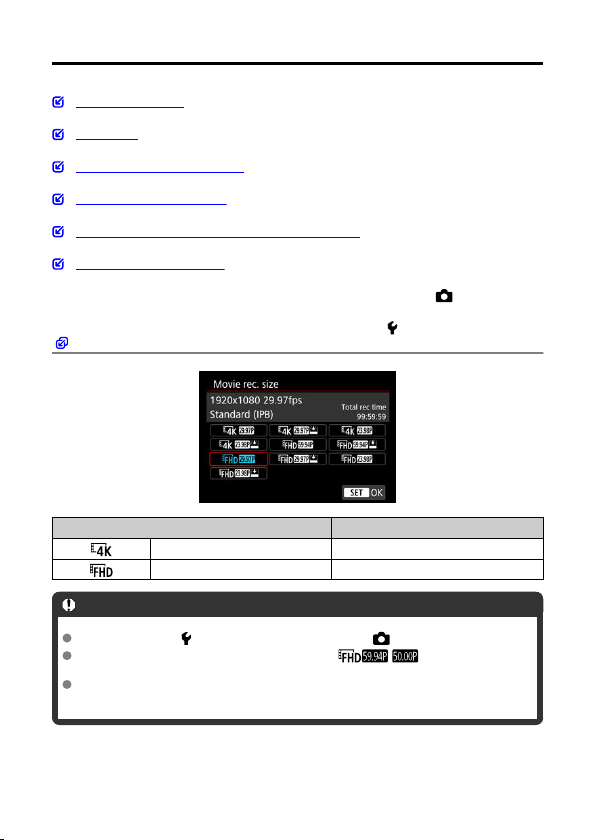
Movie Recording Size
4K Movie Recording
Image Area
Cards That Can Record Movies
Movie Files Exceeding 4 GB
Total Movie Recording Time and File Size Per Minute
Movie Recording Time Limit
You can set the recording size, frame rate, and compression method in [ : Movie rec.
size].
Note that the frame rate is updated automatically to match the [
: Video system] setting
( ).
Image Size Aspect Ratio
3840×2160 16:9
1920×1080 16:9
Caution
If you change the [ : Video system] setting, also set [ : Movie rec. size] again.
Other devices may not play movies such as 4K, / , and High Frame
Rate movies normally, because playback is processing-intensive.
Sharpness and noise vary slightly depending on the movie recording size setting
and lens used.
332
Note
To obtain better performance with the card, formatting the card with the camera
before recording movies is recommended ( ).
Movies cannot be recorded in HD or VGA quality.
4K Movie Recording
Recording 4K movies requires a stable card with a fast writing speed. For details, see
Cards That Can Record Movies.
4K movie recording greatly increases the processing load, which may increase the
internal camera temperature faster or higher than for regular movies. If a white
[
] or red [ ] icon appears during movie recording, the card may be
hot, so stop recording the movie and let the camera cool down before removing
the card. (Do not remove the card immediately.)
From a 4K movie, you can select any frame to save to the card as a JPEG still image
( ).
333

Frame rate (fps: frames per second)
[ ] 119.9 fps/[ ] 59.94 fps/[ ] 29.97 fps
For areas where the TV system is NTSC (North America, Japan, South Korea, Mexico,
etc.). For [
], see High Frame Rate.
[ ] 100.00 fps/[ ] 50.00 fps/[ ] 25.00 fps
For areas where the TV system is PAL (Europe, Russia, China, Australia, etc.). For
[
], see High Frame Rate.
[ ] 23.98 fps
Mainly for cinematic purposes. Available when [ : Video system] is set to [For NTSC].
Compression method
[ ] IPB (Standard)
Compresses multiple frames at a time efficiently for recording.
[ ] IPB (Light)
Since the movie is recorded at a bit rate lower than with IPB (Standard), the file size will
be smaller than with IPB (Standard) and the playback compatibility will be higher. This
will make the available recording time longer than with IPB (Standard) (with a card of the
same capacity).
Movie recording format
[ ] MP4
All movies you record with the camera are recorded as movie files in MP4 format (file
extension “.MP4”).
335
Cards That Can Record Movies
See
Card performance requirements for details on cards supporting all movie recording
sizes.
Test cards by recording a few movies to make sure they can record correctly at your
specified size ( ).
Caution
Before recording 4K movies, format cards by selecting [Low level format] in [ :
Format card] ( ).
If you use a slow-writing card when recording movies, the movie may not be
recorded properly. Also, if you play back a movie on a card with a slow reading
speed, the movie may not be played back properly.
When recording movies, use high-performance cards with a writing speed
sufficiently higher than the bit rate.
When movies cannot be recorded properly, format the card and try again. If
formatting the card does not resolve the problem, refer to the card manufacturer's
website, etc.
Note
To obtain better performance with the card, formatting the card with the camera
before recording movies is recommended ( ).
To check the card's writing/reading speed, refer to the card manufacturer's website,
etc.
336
Movie Files Exceeding 4 GB
Using SDHC cards formatted with the camera
If you use the camera to format an SDHC card, the camera will format it in FAT32.
With a FAT32-formatted card, if you record a movie and the file size exceeds 4 GB, a
new movie file will be created automatically.
When you play back the movie, you will have to play back each movie file individually.
Movie files cannot be played back automatically in consecutive order. After the movie
playback ends, select the next movie and play it back.
Using SDXC cards formatted with the camera
If you use the camera to format an SDXC card, the camera will format it in exFAT.
When using an exFAT-formatted card, even if the file size exceeds 4 GB during movie
recording, the movie will be saved as a single file (rather than being split into multiple
files).
Caution
When importing movie files exceeding 4 GB to a computer, use either EOS Utility
or a card reader ( ). It may not be possible to save movie files exceeding 4 GB if
you attempt this using standard features of the computer's operating system.
337

Movie Recording Time Limit
When recording non-High Frame Rate movies
The maximum recording time per movie is 1 hr. Once 1 hr. is reached, recording stops
automatically. You can start recording a movie again by pressing the movie shooting
button (which records the movie as a new file).
When recording High Frame Rate movies
The maximum recording time per movie is 15 min. Once 15 min. is reached, recording
stops automatically. You can start recording a High Frame Rate movie again by
pressing the movie shooting button (which records the movie as a new file).
Caution
The camera's internal temperature may rise and less recording time may be
available after extended movie playback/Live View display.
339
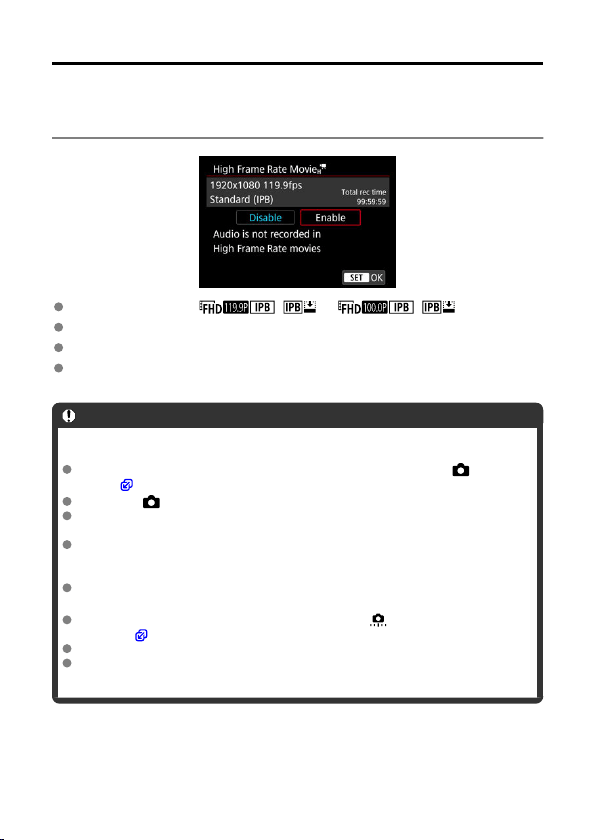
High Frame Rate
You can record movies at a high frame rate of 119.9 fps or 100.0 fps. This is ideal for
recording movies that will be played back in slow motion. Note that the maximum recording
time per movie is 15 min.
Movies are recorded in ( ) or ( ) quality.
Sound is not recorded in High Frame Rate movies.
Time code display during movie recording advances 4 sec. per second.
Because High Frame Rate movies are recorded as 29.97 fps/25.00 fps movie files, they
are played in slow motion at 1/4 speed.
Caution
Precautions when set to [High Frame Rate: On]
Time codes are not recorded when [Count up] is set to [Free run] in [ : Time
code] ( ).
Check the [ : Movie rec. size] setting if you return this setting to [Disable].
The screen may flicker if you record High Frame Rate movies under fluorescent or
LED lighting.
For a moment when you start or stop recording High Frame Rate movies, the
movie is not updated, and the frame stops momentarily. Be aware of this when
recording movies to external devices via HDMI.
Movie frame rates shown on the screen as you record High Frame Rate movies do
not correspond to the frame rate of the movie recorded.
ISO speed can be set within ISO 100–12800. Setting [ : ISO expansion] to
[Enable] ( ) expands the maximum speed to H (equivalent to ISO 25600).
The frame rate of HDMI video output is 59.94 fps or 50.00 fps.
The camera's internal temperature may rise and less recording time may be
available after extended movie playback or image display.
340
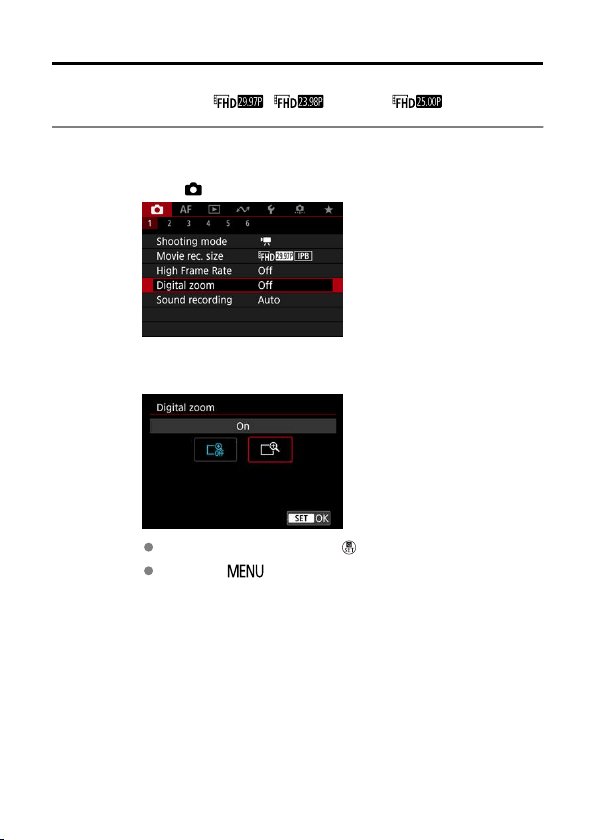
Digital Zoom
With the recording size set to [
]/[ ] (NTSC) or [ ] (PAL), you can
shoot with approx. 1–10× digital zoom.
1.
Select [
: Digital zoom].
2.
Select an option.
Select [Enable], then press the < > button.
Press the < > button to close the menu.
341
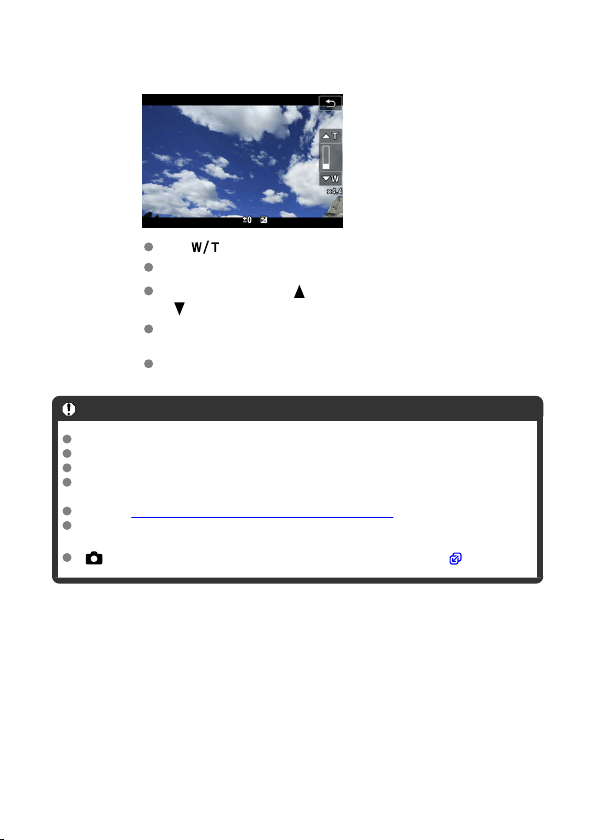
3.
Use digital zoom.
Tap [ ] in the lower right.
The digital zoom bar will appear.
Tap [▲T] or press the < > key to zoom in, and tap [▼W] or press the
<
> key to zoom out.
Pressing the shutter button halfway focuses with [1-point AF] (fixed at
center).
To cancel digital zoom, select [Off] in step 2.
Caution
Using a tripod to prevent camera shake is recommended.
Maximum ISO speed is ISO 12800.
A magnified view is not available.
Since Movie digital zoom processes the image digitally, the image will look grainier
at higher magnifications. Noise, dots of light, etc. may also become noticeable.
Also see Shooting Conditions That Make Focusing Difficult.
The camera's internal temperature may rise and reduce the available recording
time.
[ : Standby: Low res.] is set to [Disable] and cannot be changed ( ).
342
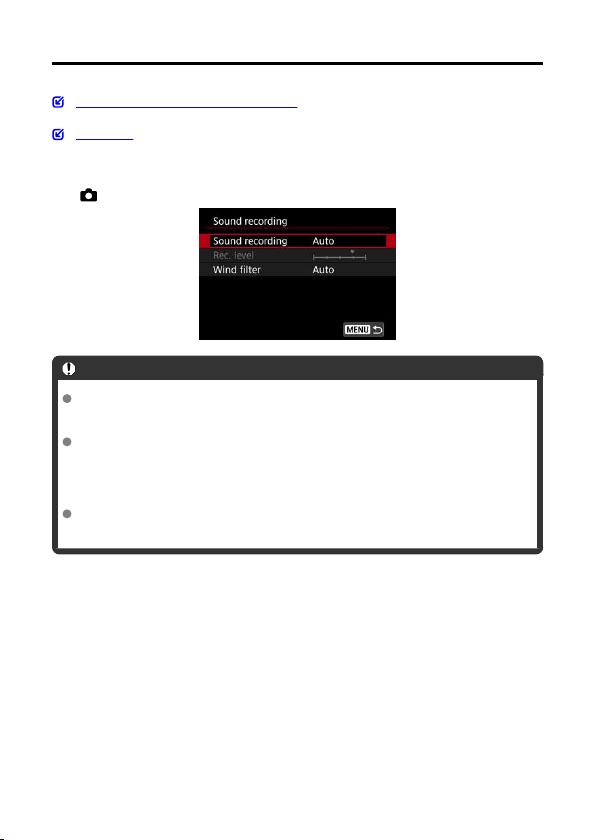
Sound Recording
Sound Recording/Sound-Recording Level
Wind Filter
You can record movies while recording sound with the built-in stereo microphone or an
external stereo microphone. You can also freely adjust the sound-recording level.
Use [
: Sound recording] to set sound recording functions.
Caution
Sounds from Wi-Fi operations may be captured with built-in or external
microphones. During sound recording, using the wireless communication function
is not recommended.
The camera's built-in microphone may also record mechanical sounds of the lens
or sounds of camera/lens operations if AF operations are performed or the camera
or lens is operated during movie recording. If so, it may help reduce these sounds if
you use an external microphone equipped with an output plug and position it away
from the camera and lens.
Do not connect anything other than an external microphone to the camera's
external microphone IN terminal.
343
Note
In Basic Zone modes, the settings available for [ : Sound recording] are [On]
and [Disable]. Set to [On] for automatic adjustment of the recording level.
Audio is also output when the camera is connected to televisions via HDMI, unless
[Sound recording] is set to [Off]. In case of feedback from television audio output,
move the camera away from the television or turn down the volume.
The volume balance between L/R (left/right) cannot be adjusted.
Sound is recorded at a 48 kHz/16-bit sampling rate.
Sound Recording/Sound-Recording Level
Auto
The sound-recording level is adjusted automatically. Auto level control will take effect
automatically in response to the sound level.
Manual
You can adjust the sound-recording level as needed. Select [Rec. level] and press the
<
>< > keys while looking at the level meter to adjust the sound-recording level.
Look at the peak hold indicator, and adjust so that the level meter sometimes lights up
on the right of the “12” (–12 dB) mark for the loudest sounds. If it exceeds “0”, the sound
will be distorted.
Disable
Sound will not be recorded.
344

Wind Filter
Set to [Auto] to reduce audio distortion in windy outdoor scenes. Disabled when external
microphones are connected to the external microphone IN terminal. When the wind filter
function takes effect, part of the low bass sounds will also be reduced.
345
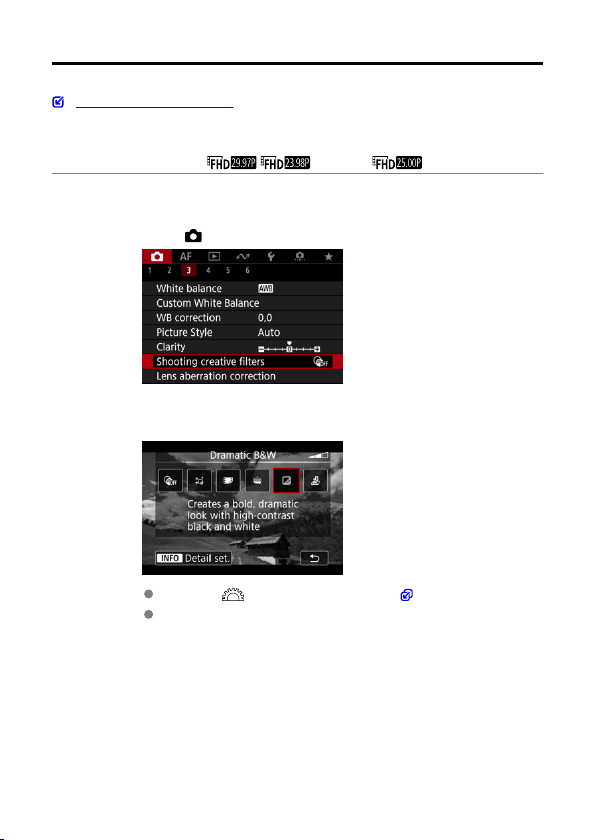
Shooting Creative Filters
Creative Filter Characteristics
You can record movies with one of five filter effects applied: Dream, Old movies, Memory,
Dramatic B&W, or Miniature effect movie.
Recording size can be set to
/ (NTSC) or (PAL).
1.
Select [
: Shooting creative filters].
2.
Select a filter effect.
Turn the < > dial to select a filter effect ( ).
For Miniature effect movies, move the AF point to the position to focus
on. Move the scene frame if the AF point is outside of it, so that the AF
point is aligned with it.
346
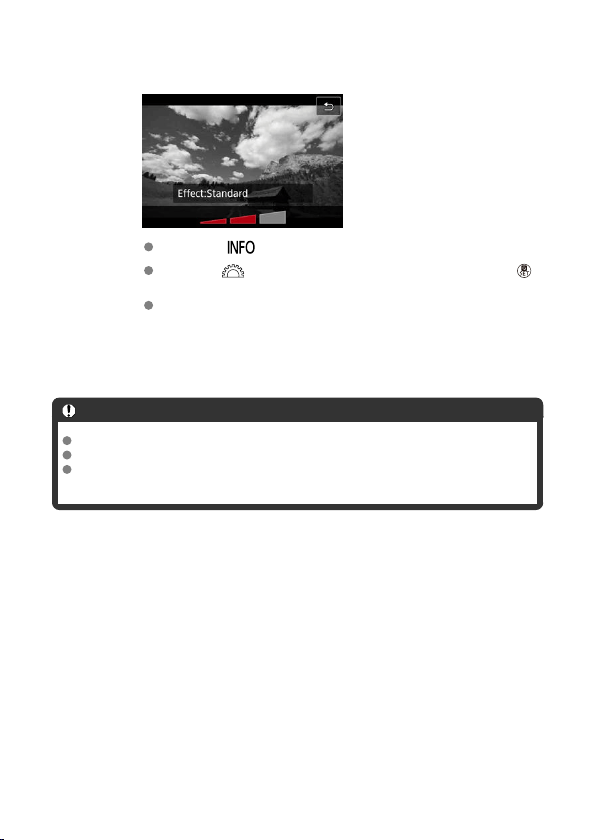
3.
Adjust the filter effect level.
Press the < > button.
Turn the < > dial to select a filter effect level, then press the < >
button.
When setting up miniature effect movies, select the playback speed.
4.
Take the picture.
Caution
A magnified view is not available.
No histogram is displayed.
Subjects such as the sky or white walls may not be rendered with smooth gradation
and may have noise or irregular exposure or colors.
347
Creative Filter Characteristics
Dream
Applies a soft, dreamy, otherworldly appearance. Gives the movie a soft look overall,
blurring the periphery of the screen. You can adjust the blurry areas along the screen
edges.
Old movies
Creates an atmosphere like an old film by adding wavering, scratches, and flickering
effects to the image. The top and bottom of the screen are masked in black. You can
modify the wavering and scratch effects by adjusting the filter effect.
Memory
Creates the atmosphere of a distant memory. Gives the movie a soft look overall,
reducing brightness of the periphery of the screen. You can modify the overall saturation
and the dark areas along the screen edges by adjusting the filter effect.
Dramatic B&W
Creates an atmosphere of dramatic realism with high-contrast black and white. You can
adjust the graininess and black-and-white effect.
Miniature effect movies
You can record movies with a miniature (diorama) effect. Select the playback speed and
record.
Shooting under the default setting will keep the center looking sharp.
To move the area that looks sharp (the scene frame), see “Adjusting the Miniature
Effect” ( ). 1-point AF is used as the AF area. Shooting with the AF point and scene
frame aligned is recommended. The AF point and scene frame are hidden during
recording.
In step 5, set the playback speed to [5x], [10x], or [20x] before recording.
Speed and playback time (for a 1-minute movie)
Speed Playback Time
5x Approx. 12 sec.
10x Approx. 6 sec.
20x Approx. 3 sec.
348
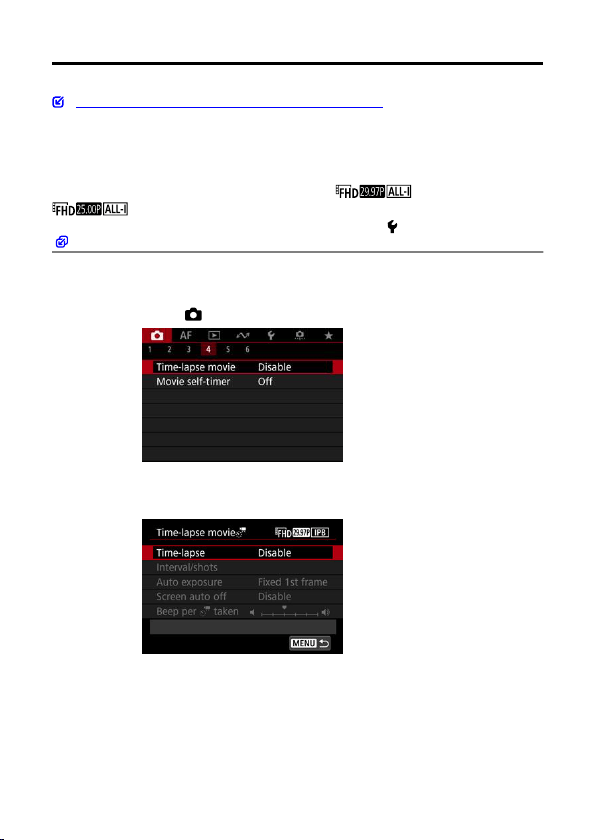
Time-Lapse Movies
Approx. Time Available for Recording Time-Lapse Movies
Still photos captured at your specified interval can be automatically combined to create a
Full HD time-lapse movie. A time-lapse movie shows how a subject changes in a much
shorter period of time than the actual time it took. It is effective for a fixed-point observation
of changing scenery, growing plants, celestial motion, etc.
Time-lapse movies are recorded in MP4 format at
quality for NTSC or
quality for PAL in Full HD recording.
Note that the frame rate is updated automatically to match the [
: Video system] setting
( ).
1.
Select [
: Time-lapse movie].
2.
Select [Time-lapse].
350
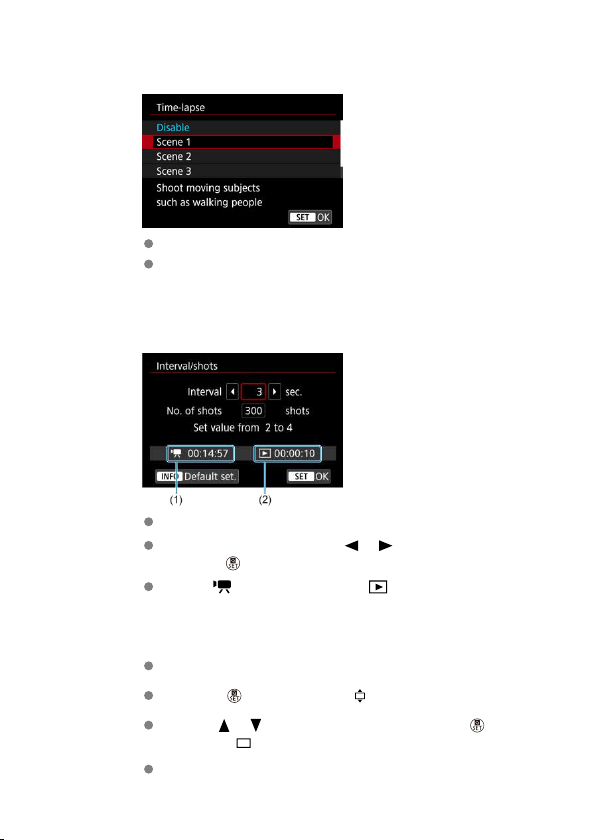
3.
Select a scene.
Select a scene to suit the shooting situation.
For greater freedom when setting the shooting interval and number of
shots manually, select [Custom].
4.
Set the shooting interval.
Select [Interval/shots].
Select [Interval] (sec.). Use the < >< > keys to set a value, then
press the <
> button.
Refer to [ : Time required] (1) and [ : Playback time] (2) as you
set it.
When [Custom] is set
Select [Interval] (min.:sec.).
Press the < > button to display < >.
Use the < >< > keys to set a value, then press the < > button.
(Returns to <
>.)
Select [OK] to register the setting.
351
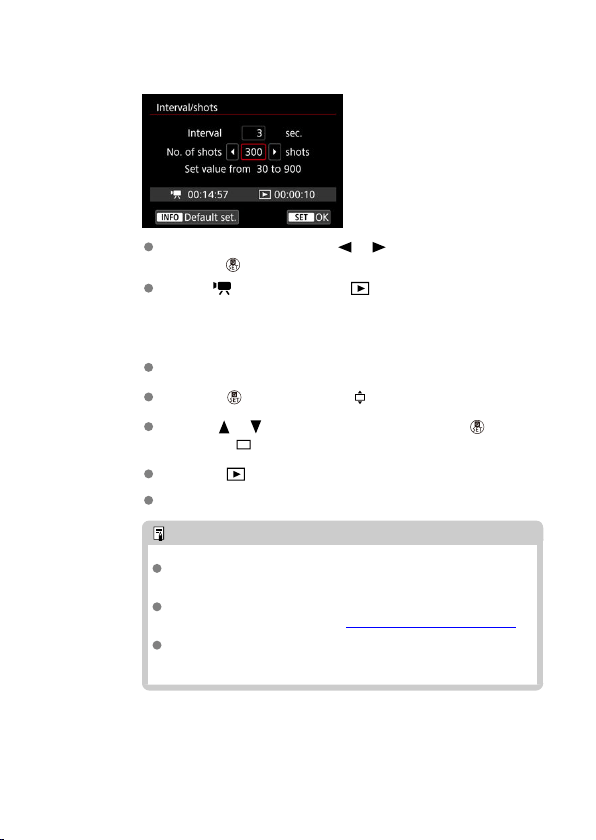
5.
Set the number of shots.
Select [No. of shots]. Use the < >< > keys to set a value, then
press the <
> button.
Refer to [ : Time required] and [ : Playback time] as you set the
number.
When [Custom] is set
Select the digit.
Press the < > button to display < >.
Use the < >< > keys to set a value, then press the < > button.
(Returns to <
>.)
Make sure [ : Playback time] is not displayed in red.
Select [OK] to register the setting.
Note
With [Scene *], available intervals and numbers of shots are
restricted, to suit the type of scene.
For details on cards that can record time-lapse movies (card
performance requirements), see Card performance requirements.
If the number of shots is set to 3600, the time-lapse movie will be
approx. 2 min. in NTSC and approx. 2 min. 24 sec. in PAL.
352
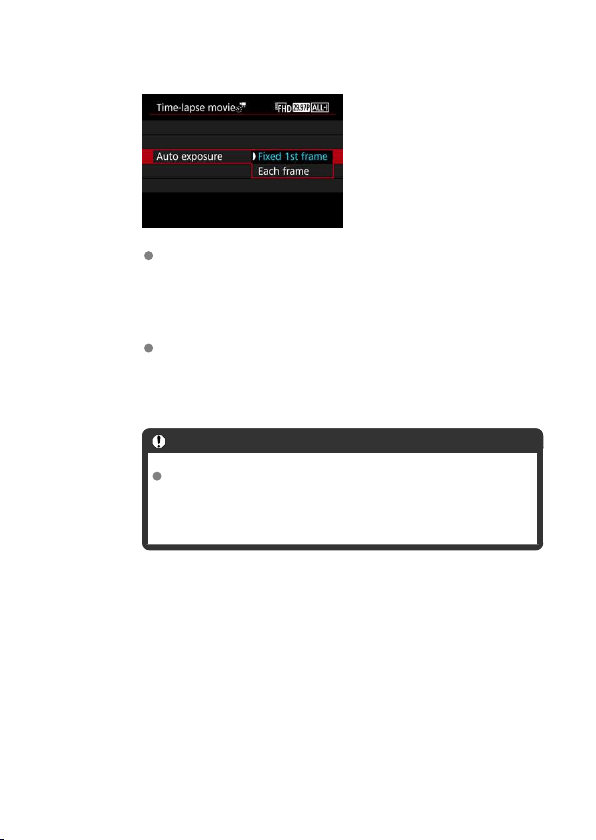
6.
Set [Auto exposure].
Fixed 1st frame
When taking the first shot, metering is performed to set the exposure
automatically to match the brightness. The exposure setting for the first
shot will be applied to subsequent shots. Other shooting-related
settings for the first shot will also be applied for subsequent shots.
Each frame
Metering is also performed for each subsequent shot to set the
exposure automatically to match the brightness. Note that any
functions such as Picture Style and white balance that are set to [Auto]
will be set automatically for each subsequent shot.
Caution
Significant changes in brightness between shots may prevent the
camera from shooting at the specified interval when [Interval] is
set to less than 3 sec. and [Auto exposure] is set to [Each
frame].
353
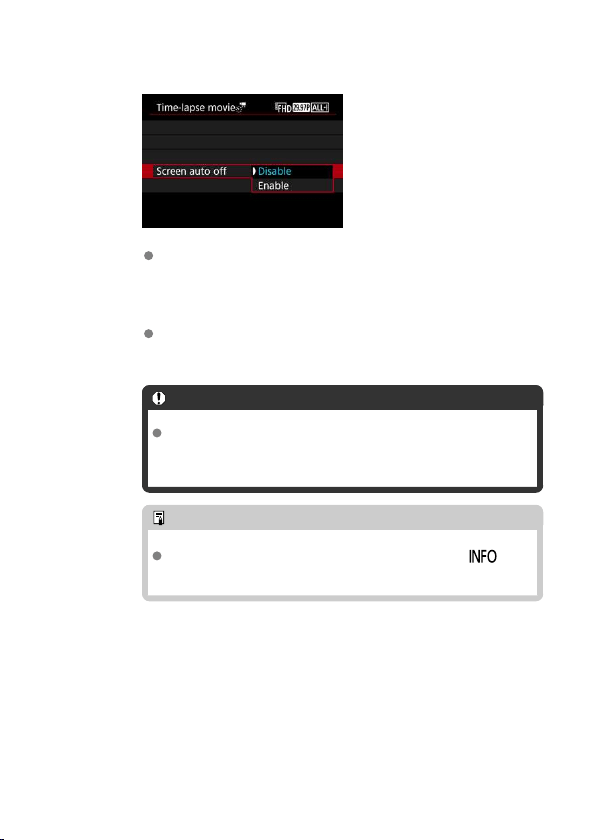
7.
Set [Screen auto off].
Disable
Even during time-lapse movie recording, the image will be displayed.
(The screen turns off only at the time of shooting.) Note that the screen
will turn off when approx. 30 min. elapse after the shooting started.
Enable
Note that the screen will turn off when approx. 10 sec. elapse after the
shooting started.
Caution
Even if [Screen auto off] is set to [Disable], the screen turns off
during exposure. Also note that images may not be displayed if
the interval between shots is too brief.
Note
During time-lapse movie recording, you can press the < >
button to turn on/off the screen.
354
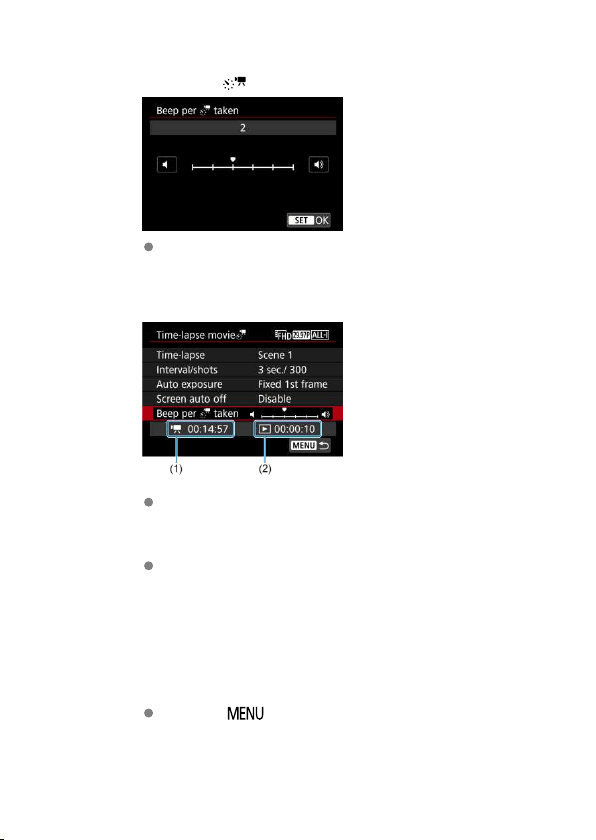
8.
Set [Beep per
taken].
Set to [0] to prevent the camera from beeping for each shot.
9.
Check the settings.
Time required (1)
Indicates the time required to shoot the set number of shots with the
set interval. If it exceeds 24 hours, “*** days” will be displayed.
Playback time (2)
Indicates the movie recording time (equivalent to the time required for
playback) once the Full HD movie is created from still photos taken at
regular intervals.
10.
Close the menu.
Press the < > button to turn off the menu screen.
355
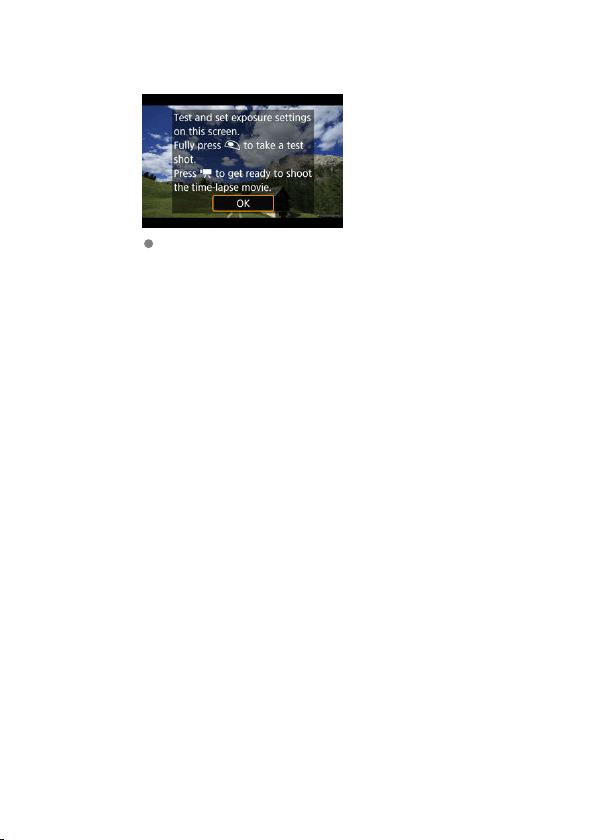
11.
Read the message.
Read the message and select [OK].
356
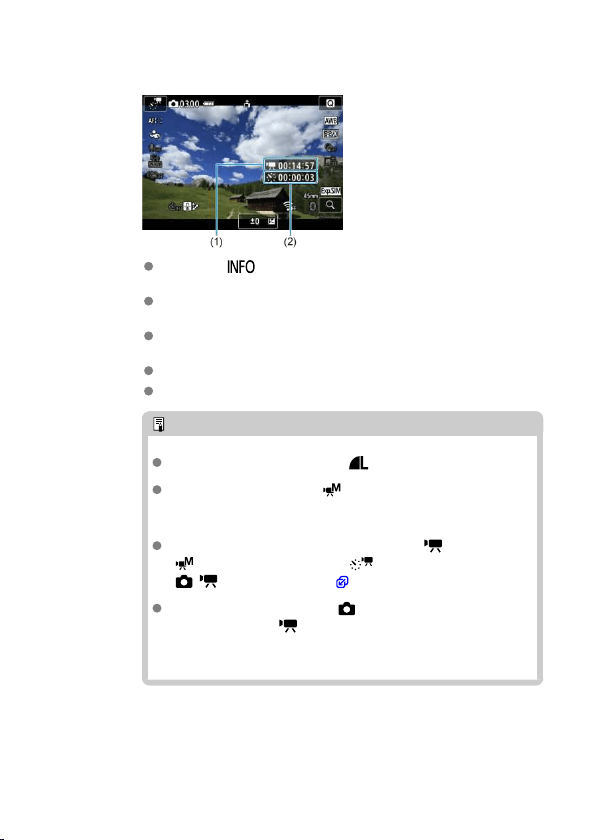
12.
Take a test shot.
Press the < > button and double-check the Time required (1) and
Interval (2) shown on the screen.
As in still photo shooting, set the exposure and shooting functions, then
press the shutter button halfway to focus.
Press the shutter button completely to take a test shot, which is
recorded to the card as a still photo.
If there are no problems with the test shot, go to the next step.
To take more test shots, repeat this step.
Note
Test shots are captured in JPEG quality.
Shutter speeds available in [ ] mode vary depending on [Time-
lapse] settings. The range is 1/4000 to 30 sec. in [Custom] mode
or otherwise 1/4000 to 1/30 sec.
You can set the maximum limit for Auto ISO in [ ] mode or in
[
] mode with ISO Auto, in the [ Max for Auto] option of
[
: ISO speed settings] ( ).
If you have set [Half-press] in [ : Shutter btn function for
movies] to [Meter.+
Servo AF], it is automatically changed to
[Meter.+One-Shot AF] when you set up time-lapse movie
recording.
357
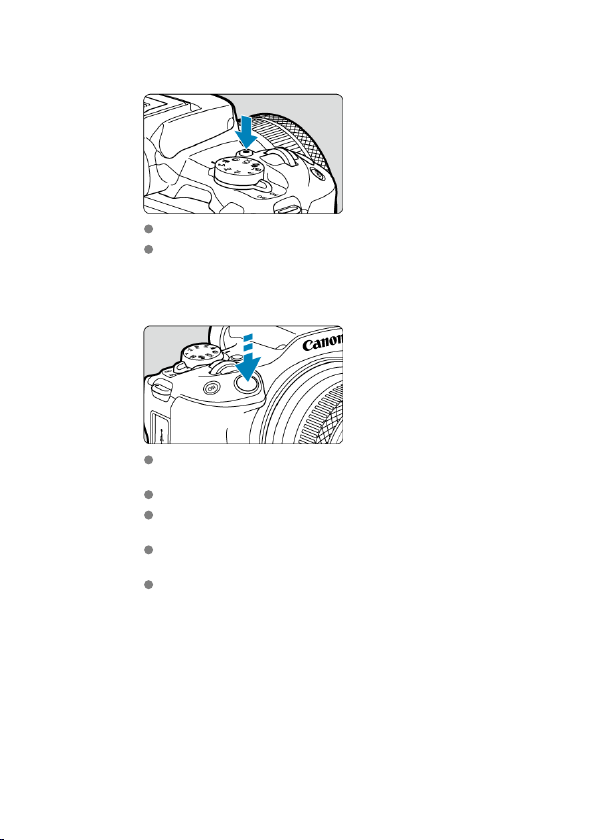
13.
Press the movie shooting button.
The camera is now ready to start recording a time-lapse movie.
To return to step 12, press the movie shooting button again.
14.
Record the time-lapse movie.
Press the shutter button completely to start recording the time-
lapse movie.
AF will not work during time-lapse movie recording.
A recording icon “●” is displayed on the screen as the time-lapse movie
is recorded.
When the set number of shots are taken, the time-lapse movie
recording ends.
To cancel recording time-lapse movies, set [Time-lapse] to
[Disable].
358
Note
Using a tripod is recommended.
Taking test shots as in step 12 and recording test movies for time-lapse movies
beforehand is recommended.
Field of view (coverage) is approx. 100%.
To cancel time-lapse movie recording in progress, either press the shutter button
completely or press the movie shooting button. The time-lapse movie shot so far
will be recorded on the card.
If the time required for recording is more than 24 hours but not more than 48 hours,
“2 days” will be indicated. If three or more days are required, the number of days
will be indicated in 24-hour increments.
Even if the time-lapse movie's playback time is less than 1 sec., a movie file will still
be created. In this case, “00'00"” is indicated in [Playback time].
If the shooting time is long, using the household power outlet accessories (sold
separately) is recommended.
YCbCr 4:2:0 (8-bit) color sampling and the BT.709 color space are used for Full HD
time-lapse movies.
359
Caution
Do not point the camera toward an intense light source, such as the sun or an
intense artificial light source. Doing so may damage the image sensor or the
camera's internal components.
Time-lapse movies cannot be recorded when the camera is connected to a
computer with the interface cable, or when an HDMI cable is connected.
Movie Servo AF is disabled.
If the shutter speed is 1/30 sec. or slower, the exposure of the movie may not be
displayed properly (may differ from that of the resulting movie).
Do not zoom the lens during time-lapse movie recording. Zooming the lens may
cause the image to be out of focus, the exposure to change, or the lens aberration
correction not to function properly.
Recording time-lapse movies under flickering light may cause noticeable screen
flickering, and images may be captured with horizontal stripes (noise) or irregular
exposure.
Images displayed as time-lapse movies are recorded may look different from the
resulting movie (in details such as inconsistent brightness from flickering light
sources, or noise from a high ISO speed).
When recording a time-lapse movie under low light, the image displayed during
shooting may look different from what is actually recorded in the movie. In such
cases, the [
] icon will blink.
If you move the camera from left to right (panning) or shoot a moving subject during
time-lapse movie recording, the image may look extremely distorted.
During time-lapse movie recording, auto power off will not take effect. Also, you
cannot adjust the shooting function and menu function settings, play back images,
etc.
Sound is not recorded for time-lapse movies.
To start or stop time-lapse movie recording, you can press the shutter button
completely, regardless of the [
: Shutter btn function for movies] setting.
Significant changes in brightness between shots may prevent the camera from
shooting at the specified interval when [Interval] is set to less than 3 sec. and
[Auto exposure] is set to [Each frame].
If the shutter speed exceeds the shooting interval (such as for long exposures), or if
a slow shutter speed is set automatically, the camera may not be able to shoot at
the set interval. Shooting may also be prevented by shooting intervals nearly the
same as the shutter speed.
If the next scheduled shot is not possible, it will be skipped. This may shorten the
recording time of the created time-lapse movie.
If the time it takes to record to the card exceeds the shooting interval due to the
shooting functions set or card performance, some of the shots may not be taken
with the set intervals.
The captured images are not recorded as still photos. Even if you cancel the time-
lapse movie recording after only one shot is taken, it will be recorded as a movie
file.
Set [ : Time-lapse movie] to [Disable] if you will connect the camera to a
computer with the interface cable and use EOS Utility (EOS software). Options
other than [Disable] will prevent the camera from communicating with the
computer.
360
Image stabilization is not applied in time-lapse movie recording.
Time-lapse movie shooting ends if the power switch is set to < >, for
example, and the setting is changed to [Disable].
Even if a flash is used, it will not fire.
The following operations cancel standby for time-lapse movie recording and switch
the setting to [Disable].
• Selecting [Basic settings] in [Reset camera]
• Turning the Mode dial
Image quality may be lower if you start time-lapse movie recording while a white
[
] or red [ ] icon ( ) is displayed. For best results, before
recording, wait until the white [
] or red [ ] icon is no longer
displayed, which indicates that the camera has cooled down.
With [Auto exposure] set to [Each frame], the ISO speed, shutter speed, and
aperture value may not be recorded in the time-lapse movie Exif information in
some shooting modes.
Note
You can use Wireless Remote Control BR-E1 (sold separately) to start and stop
time-lapse movie recording.
With Wireless Remote Control BR-E1
First, pair Wireless Remote Control BR-E1 with the camera ( ).
After you take some test shots and the camera is ready to shoot (as in step
13, ), set the release timing/movie shooting switch on the BR-E1 to <●>
(immediate release) or <2> (2-sec. delay).
If the remote control's switch has been set to < >, the time-lapse movie
recording cannot start.
Camera Status/Remote
Control Setting
<●> Immediate Release
<2> 2-sec. Delay
<
> Movie Recording
Test-recording screen Test recording To recording standby
Recording standby Starts recording To test-recording screen
During time-lapse movie
recording
Ends recording Ends recording
Approx. Time Available for Recording Time-Lapse Movies
For guidelines on how long you can record time-lapse movies (until the battery runs out),
see
Movie recording.
361
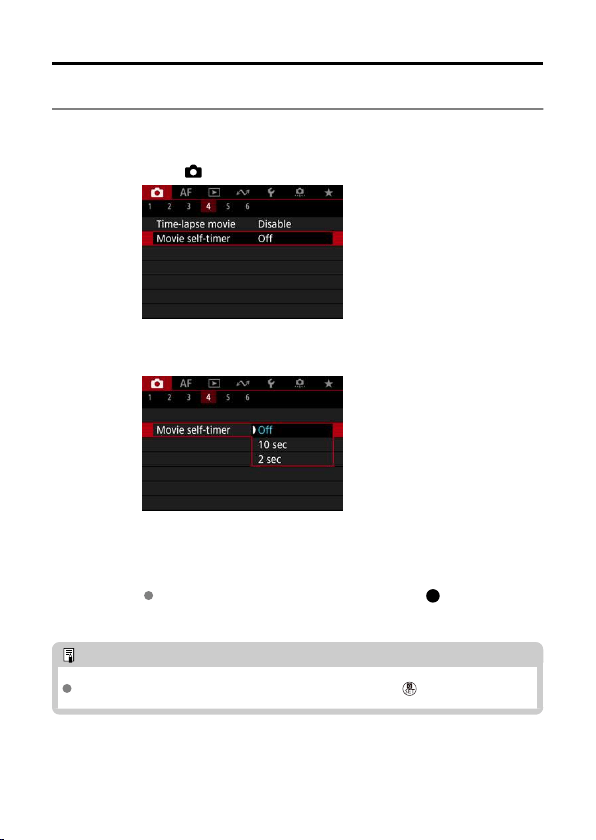
Movie Self-Timer
Movie recording can be started by the self-timer.
1.
Select [
: Movie self-timer].
2.
Select an option.
3.
Record the movie.
After you press the movie shooting button or tap [ ], the camera
displays the number of seconds left before recording and beeps.
Note
To cancel the self-timer, either tap the screen or press the < > button.
362
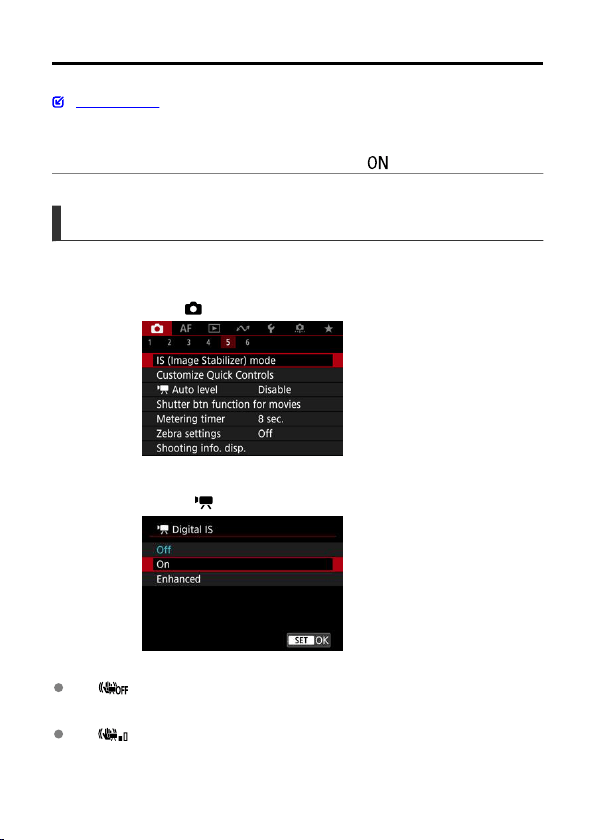
Image Stabilizer (IS Mode)
Movie Digital IS
Movie digital IS reduces camera shake as movies are recorded. This can provide effective
stabilization even when non-IS lenses are used.
When using an IS lens, set the Image Stabilizer switch to <
>.
Movie Digital IS
1.
Select [
: IS (Image Stabilizer) mode].
2.
Select a [
Digital IS] option.
Off ( )
Image stabilization with Movie digital IS is disabled.
On ( )
Camera shake will be corrected. The image will be slightly magnified.
363
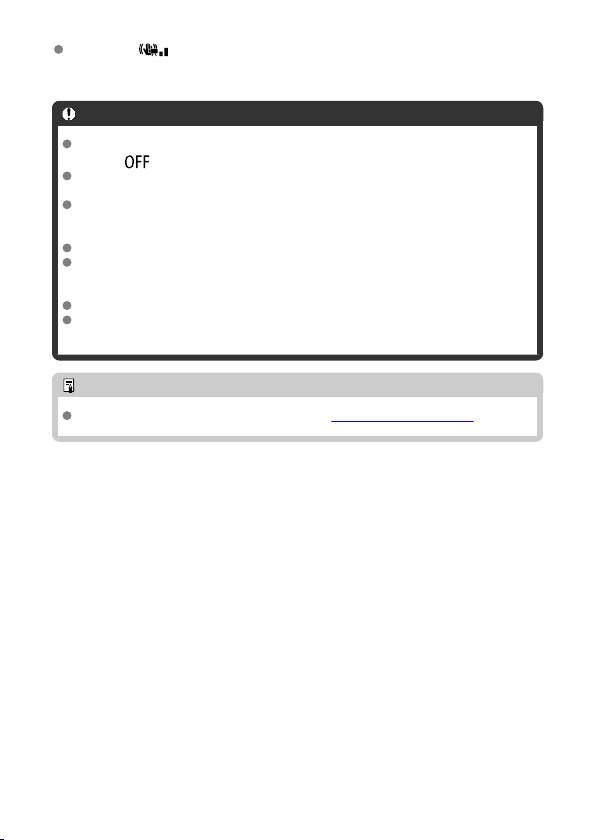
Enhanced ( )
Compared to when [On] is set, stronger camera shake can be corrected. The image will
be more magnified.
Caution
Movie digital IS will not function when the lens's optical Image Stabilizer switch is
set to <
>.
Stabilization by Movie digital IS may be less effective at some movie recording
sizes.
The wider the angle of view (wide angle), the more effective the image stabilization
will be. The narrower the angle of view (telephoto), the less effective the image
stabilization will be.
When using a tripod, setting Movie digital IS to [Off] is recommended.
Depending on the subject and shooting conditions, the subject may blur noticeably
(the subject momentarily looks out of focus) due to the effects of the Movie digital
IS.
Consider setting to [Off] when using a TS-E lens or fish-eye lens.
Since Movie digital IS magnifies the image, the image looks more grainy. Noise,
dots of light, etc. may also become noticeable.
Note
For details configuring image stabilization, see Image Stabilizer (IS Mode).
364
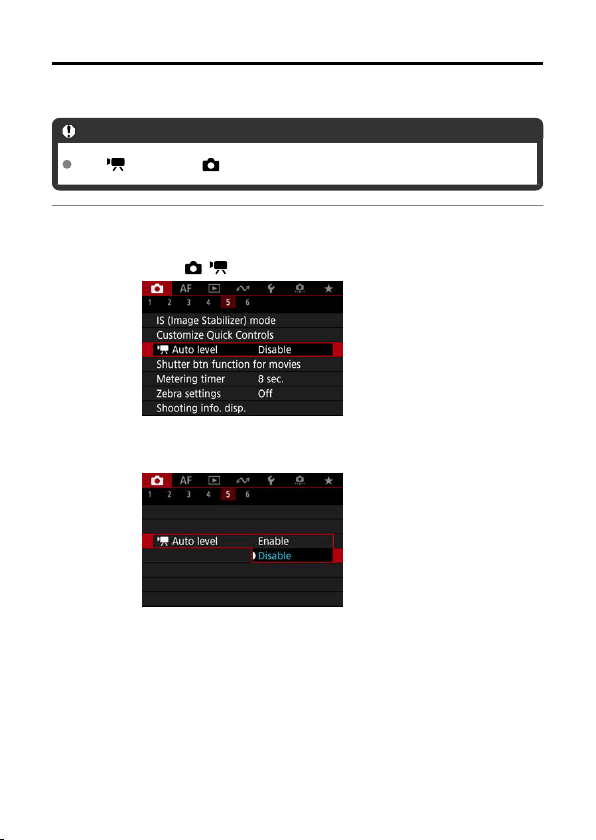
Auto Level
Auto leveling helps keep movies straight during recording.
Caution
Set [ Digital IS] in [ : IS (Image Stabilizer) mode] to [Off].
1.
Select [
: Auto level].
2.
Select an option.
365
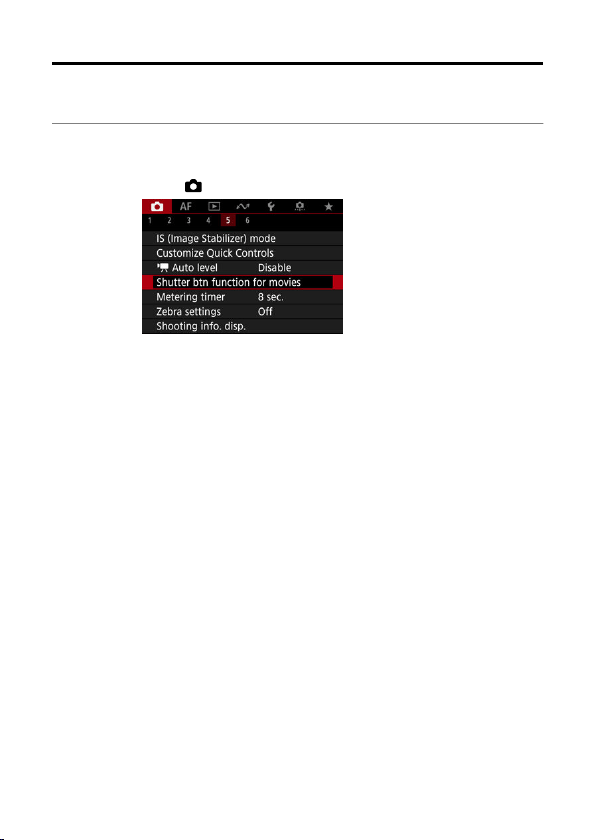
Shutter Button Function for Movies
You can set the functions performed by pressing the shutter button halfway or completely
during movie recording.
1.
Select [
: Shutter btn function for movies].
366
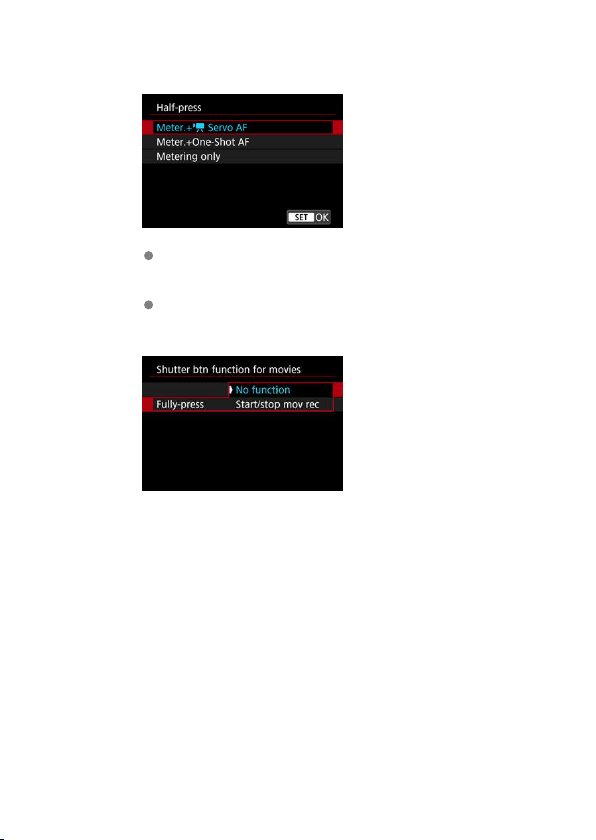
2.
Select an option.
Half-press
Specify the function performed by pressing the shutter button halfway.
Fully-press
Specify the function performed by pressing the shutter button
completely.
With [Fully-press] set to [Start/stop mov rec], you can start/stop movie
recording not only with the movie shooting button but also by pressing the
shutter button completely, or by using Wireless Remote Control
BR-E1
(sold separately).
367
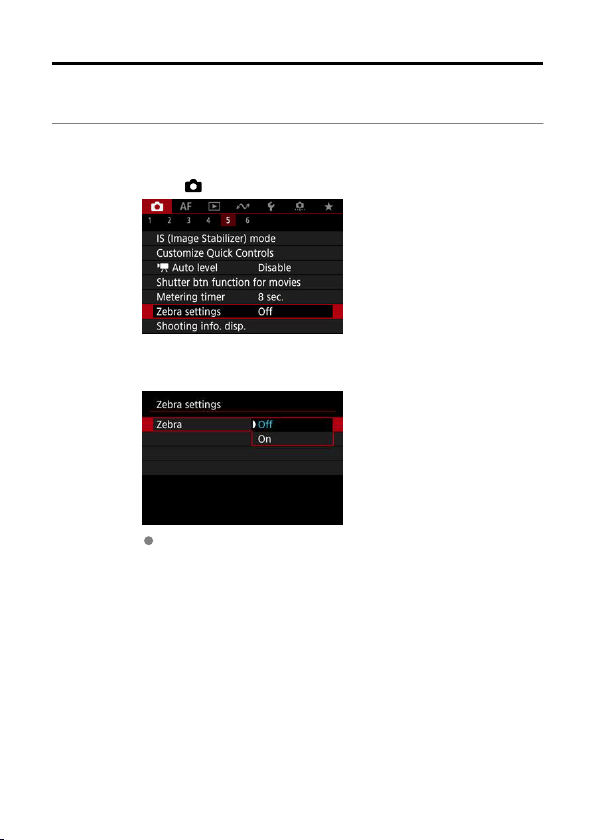
Zebra Settings
To help you adjust exposure before or during movie recording, you can display a striped
pattern over or around image areas of a specified brightness.
1.
Select [
: Zebra settings].
2.
Select [Zebra].
Select [On].
368
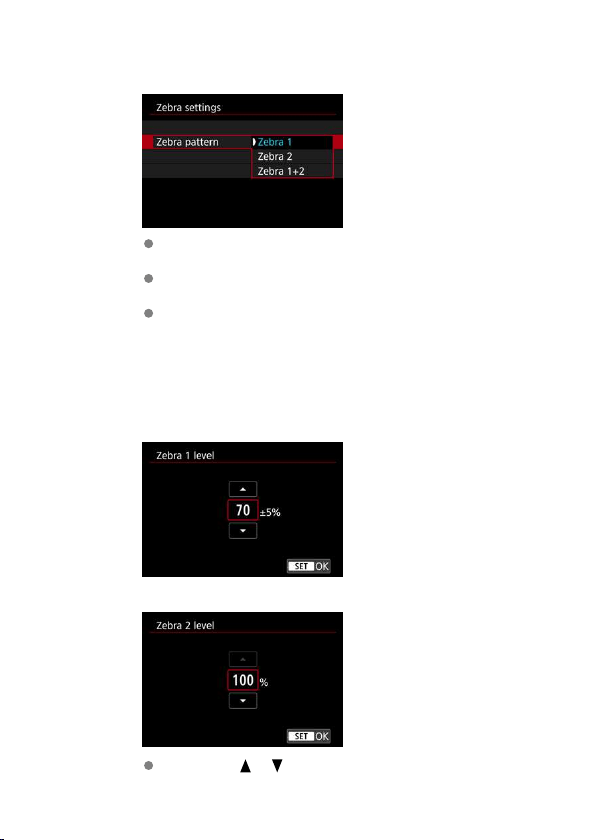
3.
Select [Zebra pattern].
[Zebra 1]: Displays left-slanting stripes around areas of the specified
brightness.
[Zebra 2]: Displays right-slanting stripes over areas that exceed the
specified brightness.
[Zebra 1+2]: Displays both [Zebra 1] and [Zebra 2].
[Zebra 1] display takes precedence where [Zebra 1] and [Zebra 2]
display areas overlap.
4.
Set the level.
Zebra 1 level
Zebra 2 level
Set with the < >< > keys.
369
Note
The maximum brightness value does not reach 100% when HDR-PQ is set. Note
that the maximum brightness value varies depending on [
: Highlight tone
priority] and [
: Picture Style] settings.
Checking the zebra display level in advance is recommended when you will set
[Zebra pattern].
370
Shooting Information Display
Recording Emphasis
Aspect Marker
You can customize the details and screens of information shown on the screen or in the
viewfinder during movie recording.
Note
For details on the following topics, see Shooting Information Display in Still Photo
Shooting.
• Customizing Information on the Screen
• Customizing Information in the Viewfinder
• Viewfinder Vertical Display
• Grid
• Histogram
• Lens Information Display
• Clearing Settings
371
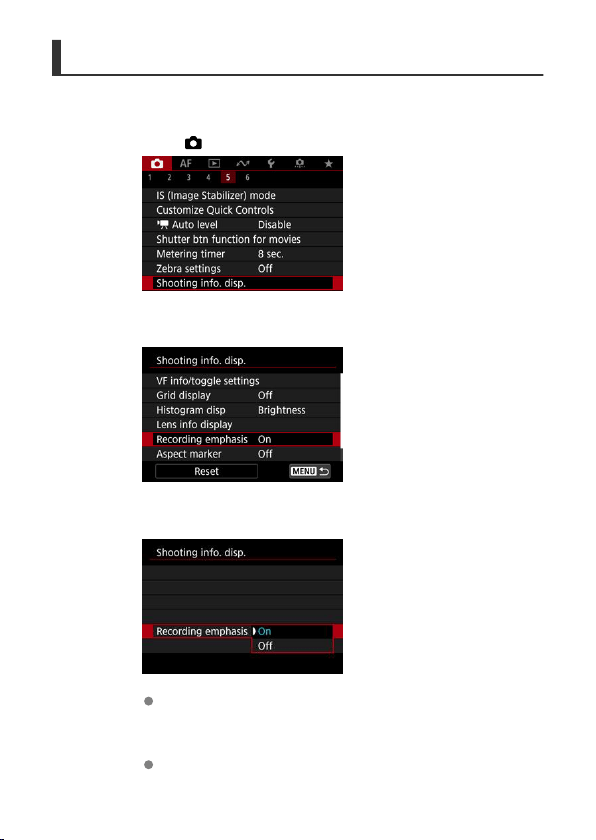
Recording Emphasis
1.
Select [
: Shooting info. disp.].
2.
Select [Recording emphasis].
3.
Select an option.
On
A red frame around the screen blinks while movie recording is in
progress.
Off
No frame is displayed to call attention to recording in progress.
372
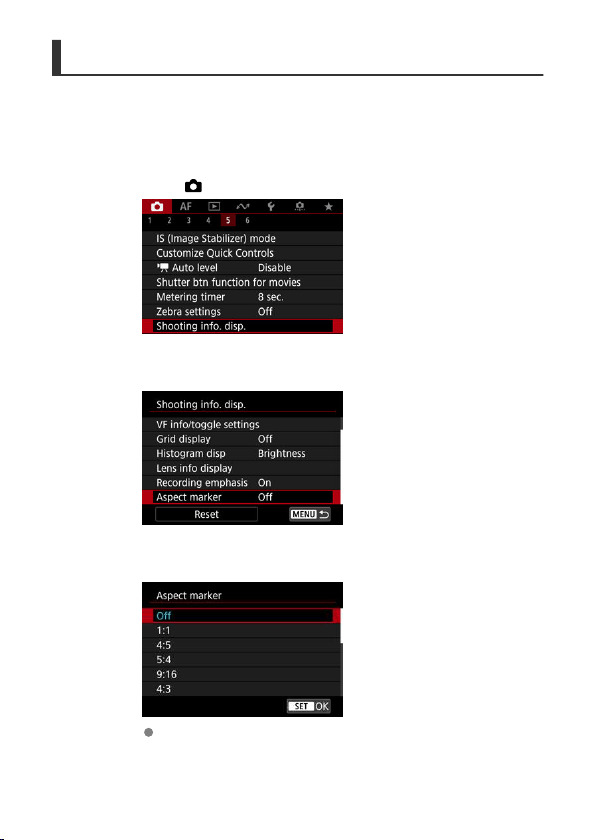
Aspect Marker
If you will change the image aspect ratio when editing the recorded movie, you can display
aspect markers on the movie recording screen (during standby and recording) to be aware
of the final angle of view after editing.
1.
Select [
: Shooting info. disp.].
2.
Select [Aspect marker].
3.
Select an option.
Select a display option.
373
Note
Markers are not shown during movie playback (recorded movies are not tagged
with aspect marker information).
374
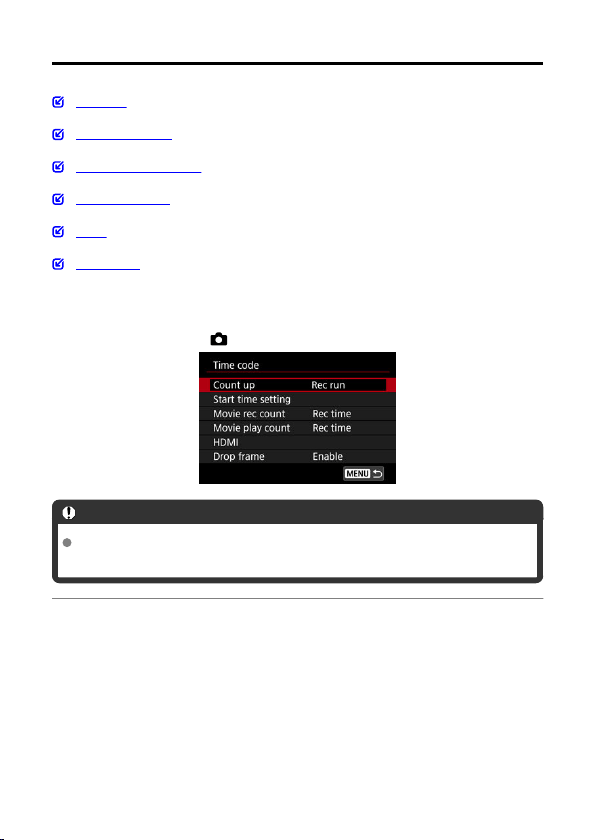
Time Code
Count Up
Start Time Setting
Movie Recording Count
Movie Play Count
HDMI
Drop Frame
Time codes record the time automatically as movies are recorded. Time codes always
record elapsed hours, minutes, seconds, and frames. They are mainly used when movies
are edited.
To set up the time code, use [
: Time code].
Caution
Time codes may not be displayed correctly if your movies are played back on
devices other than the camera.
375
Count Up
Rec run
The time code advances only during movie recording. Time codes in each movie file
recorded continue from the last time code in the previous file.
Free run
The time code keeps advancing, even when you are not recording.
Caution
When set to [Free run], time codes are not added to High Frame Rate movies.
When set to [Free run], time codes will be affected by any changes to settings for
time, zone, or daylight saving time ( ).
376

Start Time Setting
You can set the initial time of the time code.
Manual input setting
Enables you to set any starting hour, minute, second, and frame.
Reset
Resets the time set with [Manual input setting] or [Set to camera time] to “00:00:00.”
or “00:00:00:” ( ).
Set to camera time
Matches the hour, minute, and second set as the time on the camera. Sets the frame
value to “00.”
377
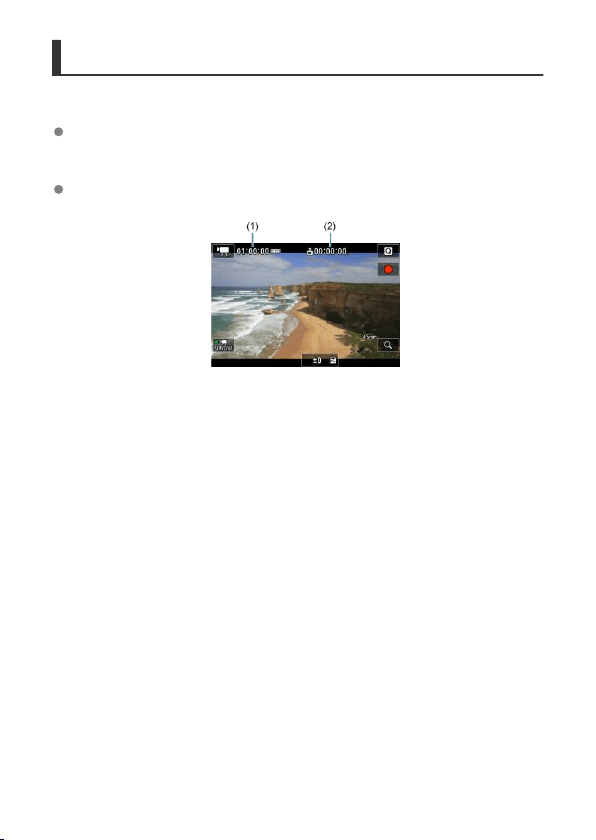
Movie Recording Count
You can select how time is displayed on the movie recording screen.
Rec time
During recording standby, displays the available recording time. During recording,
displays the time that has elapsed since movie recording began (1).
Time code
Displays the time code during movie recording (2).
378
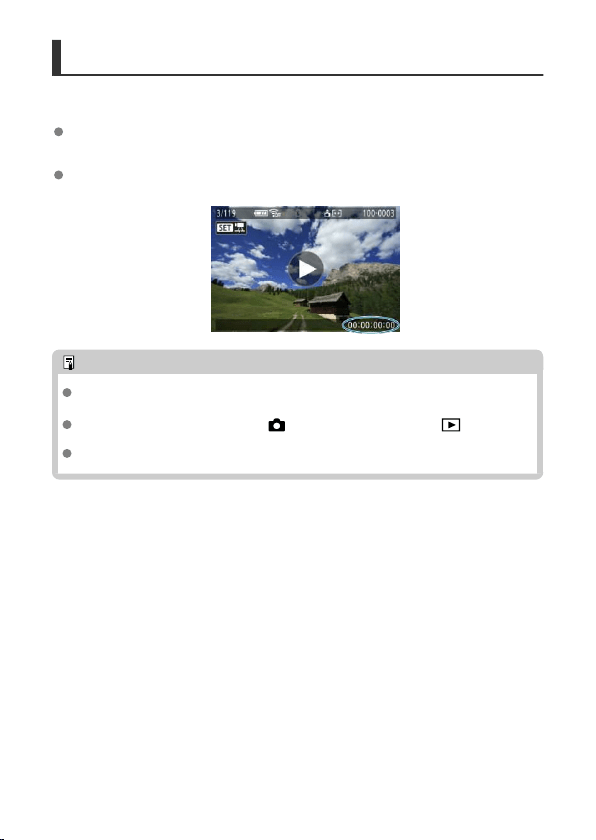
Movie Play Count
You can select how time is displayed on the movie playback screen.
Rec time
Displays the recording or playback time during movie playback.
Time code
Displays the time code during movie playback.
Note
Time codes are always recorded to movie files (except when High Frame Rate
movies are set to [Free run]), regardless of the [Movie rec count] setting.
The [Movie play count] setting in [ : Time code] is linked to the [ : Movie
play count], so that these settings always match.
The “frame” count is not displayed during movie recording or playback.
379
HDMI
Time code
Time codes can be added to movies as you record them to an external device via HDMI.
• Off
No time code is added to HDMI video output.
• On
Time codes are added to HDMI video output. When [On] is set, [Rec Command] is
displayed.
Rec Command
For HDMI video output recorded by an external device, you can synchronize recording
to when you start and stop recording movies on the camera.
• Off
Recording is started and stopped by the external device.
• On
Recording by an external device is synchronized to starting/stopping recording on
the camera.
Caution
Time codes are not added to HDMI video output when you record High Frame Rate
movies with [Count up] in [Time code] set to [Free run].
To determine compatibility of external recording devices with [Time code] and [Rec
Command] functions, check with the device manufacturer.
Even with [Time code] set to [Off], external recording devices may add time codes
to movies, depending on their specifications. For details on device specifications
relevant to adding time code to HDMI input, check with the device manufacturer.
380
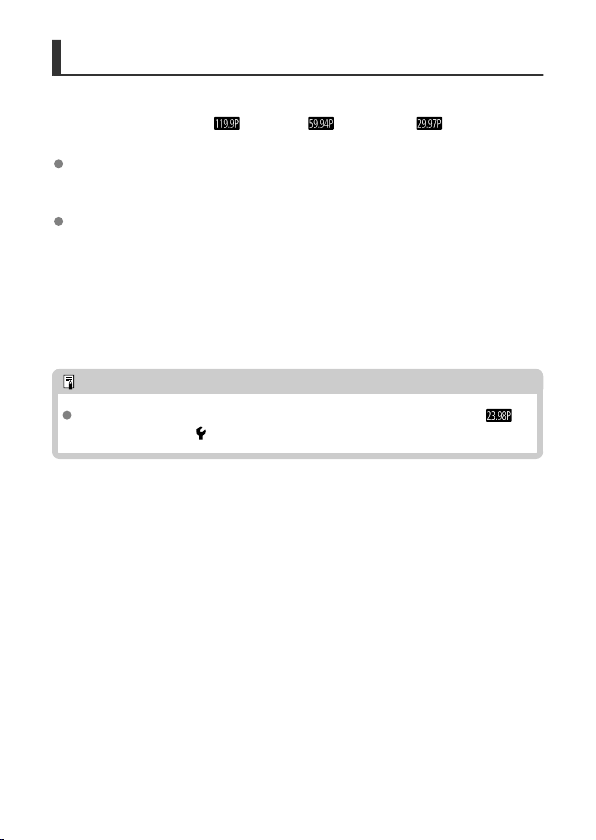
Drop Frame
The time code's frame count will cause a discrepancy between the actual time and the time
code if the frame rate is set to
(119.9 fps), (59.94 fps), or (29.97 fps). The
discrepancy is corrected automatically when [Enable] is set.
Enable
Corrects the discrepancy automatically by skipping time code numbers (DF: drop
frame).
Disable
The discrepancy is not corrected (NDF: non-drop frame).
Time codes are displayed as follows.
• Enable (DF)
00:00:00. (Playback: 00:00:00.00)
• Disable (NDF)
00:00:00: (Playback: 00:00:00:00)
Note
The [Drop frame] setting item is not displayed when the frame rate is set to
(23.98 fps), or when [ : Video system] is set to [For PAL].
381
Other Menu Functions
[ 2]
[ 3]
[ 5]
[ 6]
[
2]
Exposure comp.
Exposure compensation can be adjusted in a range of ±3 stops, in 1/3-stop increments.
For details on exposure compensation, see
Manual Exposure Compensation.
ISO speed settings
• ISO speed
In [
] mode, you can set the ISO speed manually. You can also select ISO Auto.
• Max for Auto
You can set the maximum limit for ISO Auto in movie recording in [ ] mode or in
[
] mode with ISO Auto.
• Max for Auto
You can set the maximum limit for ISO Auto in time-lapse movie recording in [ ]
mode or in [
] mode with ISO Auto.
HDR shooting
For details on HDR shooting , see HDR Shooting.
Auto Lighting Optimizer
Brightness and contrast can be corrected automatically. For details on Auto Lighting
Optimizer, see
Auto Lighting Optimizer.
382
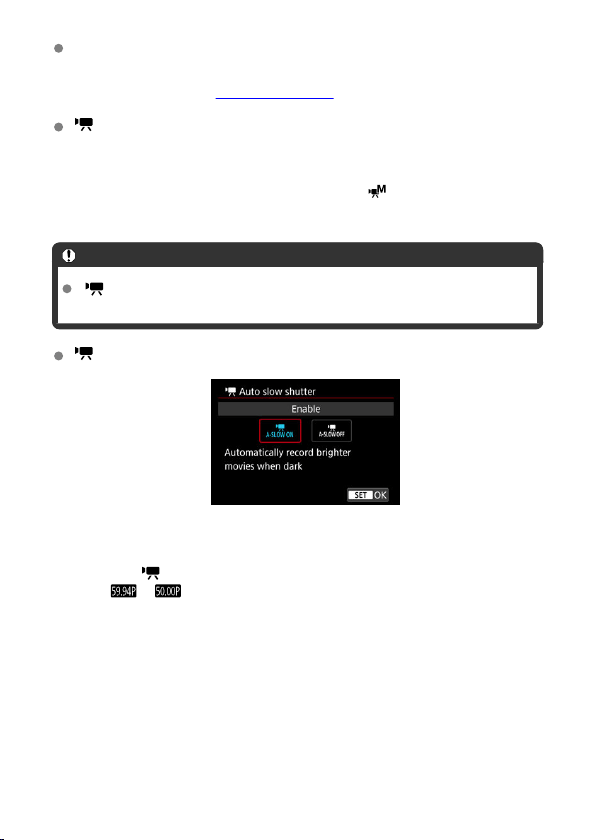
Highlight tone priority
You can reduce overexposed, clipped highlights as you record movies. For details on
Highlight tone priority, see
Highlight Tone Priority.
Av 1/8-stop incr.
• You can set aperture values on a finer scale when recording movies with an RF
lens.
This feature is available when the camera is set to [
].
Select [Enable] to change the aperture increment from 1/3 stop (or 1/2 stop) to 1/8
stop.
Caution
[ Av 1/8-stop incr.] is not available (not displayed) when EF or EF-S lenses are
used.
Auto slow shutter
You can choose whether to record movies that are brighter and less affected by image
noise than when set to [Disable] by automatically slowing the shutter speed under low
light.
Available in [
] recording mode. Applies when the frame rate of the movie recording
size is
or .
• Disable
Enables you to record movies with smoother, more natural movement, less affected
by subject shake than when set to [Enable]. Note that under low light, movies may
be darker than when set to [Enable].
• Enable
Enables you to record brighter movies than when set to [Disable] by automatically
reducing the shutter speed to 1/30 sec. (NTSC) or 1/25 sec. (PAL) under low light.
383
Note
Setting to [Disable] is recommended when recording moving subjects under low
light, or when afterimages such as trails may occur.
384

[ 3]
White balance
For details on white balance, see
White Balance.
Custom White Balance
For details on custom white balance, see
Custom White Balance.
WB correction
For details on white balance correction, see
White Balance Correction.
Picture Style
For details on Picture Styles, see
Picture Style Selection.
Clarity
For details on clarity, see
Clarity.
Lens aberration correction
Peripheral illumination, distortion, focus breathing, and chromatic aberration can be
corrected as you record movies. For details on lens aberration correction, see
Lens
Aberration Correction.
385

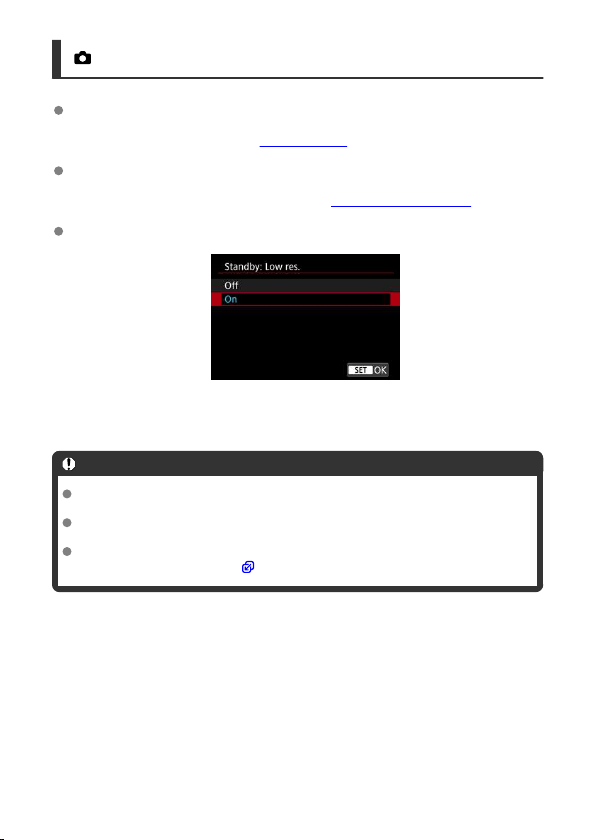
[ 6]
Reverse display
For details on reverse display, see
Reverse Display.
VF display format
For details on the viewfinder display format, see
Viewfinder Display Format.
Standby: Low res.
Set to [On] to conserve battery power and control the rise of camera temperature during
standby.
As a result, it may enable you to record movies over a longer period.
Caution
Image quality on the standby screen may differ from image quality on the screen
during movie recording.
Briefly when you start recording movies, image display may remain on the current
frame instead of being updated.
With digital zoom set to an option other than [Disable], overheat control is set to
[Off] and cannot be changed ( ).
387
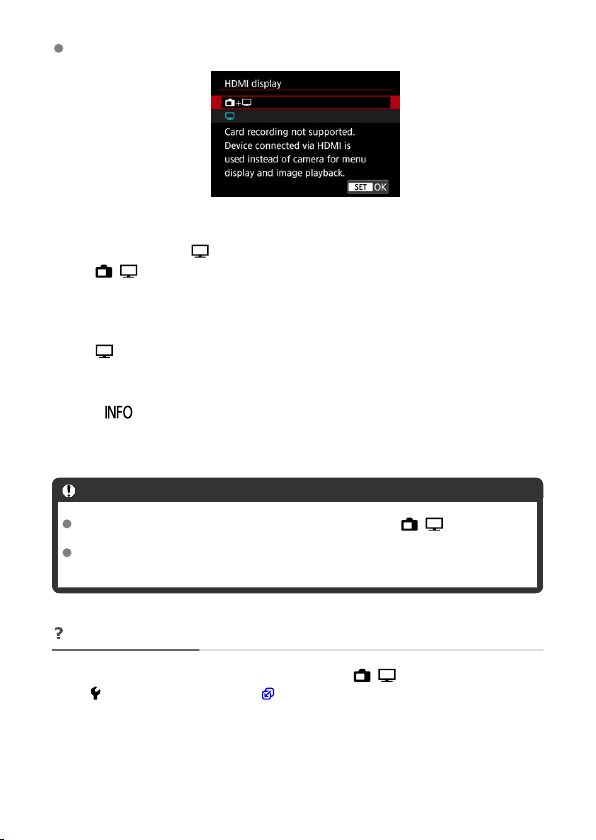
HDMI display
You can specify how movies are displayed as they are recorded via HDMI to an external
device. Movie output itself corresponds to the [Movie rec. size] setting.
The default setting is [
].
• +
Enables movie display both on the camera screen and on the other device, via
HDMI output.
Camera operations such as image playback or menu display are shown on the other
device via HDMI, not on the camera screen.
•
Deactivates the camera screen during output via HDMI, so that the screen is blank.
Shooting information, AF points, and other information is shown on the external
device via HDMI, but you can stop output of this information by pressing the
<
> button.
Before recording movies externally, confirm that no information is being sent by the
camera by making sure no shooting information, AF points, and so on is displayed
on external monitors or other devices.
Caution
Card recording is not performed with [HDMI display] set to [ + ]. Camera
menus and image playback are only displayed on the screen connected via HDMI.
The HDMI output resolution and frame rate are automatically adjusted to suit the
movie recording size.
For longer HDMI output
To continue HDMI output for longer than 30 min., select [
+ ], then set [Auto power
off] in [
: Power saving] to [Disable] ( ). HDMI output will continue after the camera
screen turns off when the time set in [Screen off] elapses.
388
Caution
HDMI output without information prevents display of warnings about the card
space, battery level, or high internal temperature ( ) via HDMI.
During HDMI output, display of the next image may take some time if you switch
between movies of different recording sizes or frame rates.
Avoid operating the camera when recording movies to external devices, which may
cause information to be displayed in the HDMI video output.
Brightness and color of movies recorded with the camera may look different from
that of HDMI video output recorded by external devices, depending on the viewing
environment.
Note
By pressing the < > button, you can change the information displayed.
Time codes can be added to HDMI video output ( ).
Audio is also output via HDMI, except when [Sound rec.] is set to [Disable].
389
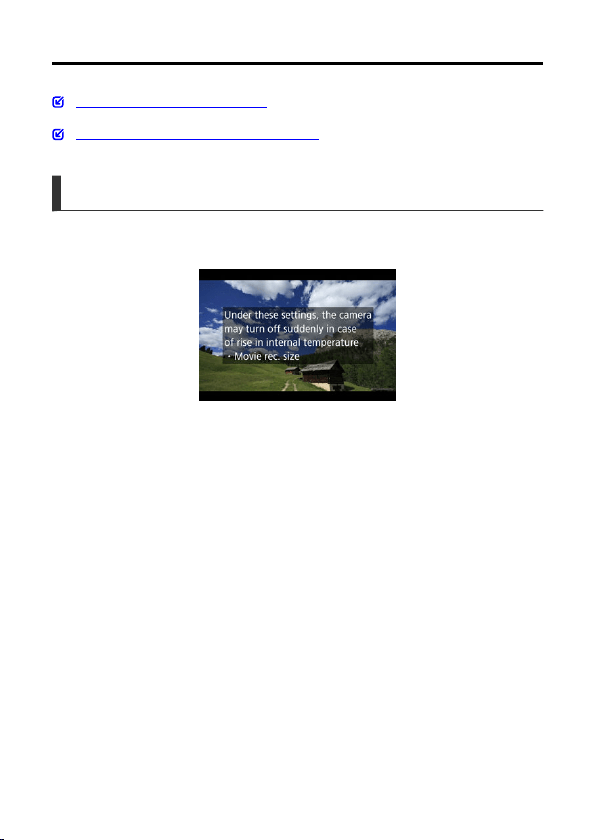
General Movie Recording Precautions
Guidance Display Before Recording
Warning Indicator Display in Movie Recording
Guidance Display Before Recording
Guidance may be displayed when the camera starts up, after settings are adjusted, or in
other situations.
The guidance warns that the camera may become hot internally if movies are recorded
under the current settings, and that if you continue recording, the camera may turn off
automatically.
If you will record over an extended period, consider changing the settings listed in the
guidance (such as movie recording size or use of digital zoom), so that you can record
without the camera displaying guidance.
If you prefer to record without changing the settings, note any warning indicators displayed
as you record.
390
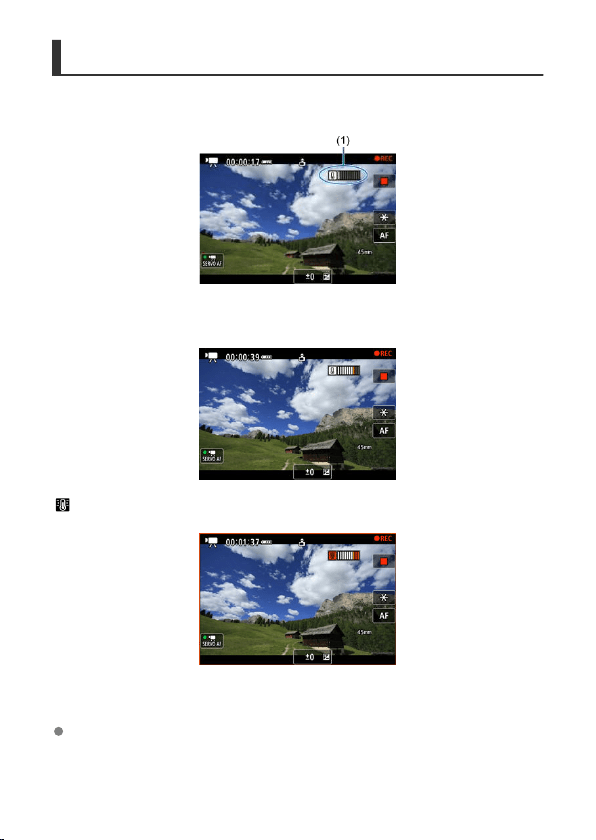
Warning Indicator Display in Movie Recording
A 10-level indicator (1) is displayed during movie recording in case of excessive internal
camera temperature.
As the internal temperature rises, the level on the indicator extends to the right. How fast the
level increases will depend on shooting conditions. Levels 1–7 are marked in white, but once
the temperature reaches level 8, the color changes.
[ ] flashes in red if you continue recording after the indicator reaches level 9, marked in
orange. A flashing icon indicates that the camera will soon turn off automatically.
A message is displayed if you continue to record while the icon is flashing, and the camera
automatically turns off.
Subsequent recording
To keep recording under the same settings, leave the camera off and let it cool down a
while. Note that the camera may overheat again after you resume recording.
391
Caution
Precautions for movie recording
Do not point the camera toward an intense light source, such as the sun or an
intense artificial light source. Doing so may damage the image sensor or the
camera's internal components.
If you record something that has fine detail, moire or false colors may result.
If [ ] or [ ] is set and the ISO speed or aperture value changes during
movie recording, the white balance may also change.
If you record a movie under fluorescent or LED lighting, the movie image may
flicker.
If you perform AF with a USM lens during movie recording in low light, horizontal
banding noise may be recorded in the movie. The same type of noise may occur if
you focus manually with certain lenses equipped with an electronic focusing ring.
Recording a few test movies is recommended if you intend to perform zooming
during movie recording. Zooming as you record movies may cause exposure
changes or lens sounds to be recorded, an uneven audio level, inaccurate lens
aberration correction, or loss of focus.
Large aperture values may delay or prevent accurate focusing.
Performing AF during movie recording may cause the following kinds of issues:
significant temporary loss of focus, recording of changes in movie brightness,
temporary stopping of movie recording, or recording of mechanical lens sounds.
Avoid covering the built-in microphones with your fingers or other objects.
Connecting or disconnecting an HDMI cable during movie recording will end
recording.
If necessary, also see General Still Photo Shooting Precautions.
The camera may become hot in movie recording while connected via Wi-Fi. Use a
tripod or take other measures to avoid handheld recording.
Recording and image quality
If the attached lens has an Image Stabilizer and you set the Image Stabilizer switch
to <
>, the Image Stabilizer will operate at all times even if you do not press the
shutter button halfway. This will consume battery power, and it may reduce the total
movie recording time. When the Image Stabilizer is not necessary, such as when
using a tripod, it is recommended that you set the Image Stabilizer switch to
<
>.
If the brightness changes as you record a movie with auto exposure, the movie
may appear to stop momentarily. In this case, record movies with manual
exposure.
If there is a very bright light source in the image, the bright area may appear black
on the screen. Movies are recorded almost exactly as they appear on the screen.
Image noise or irregular colors may occur when shooting at high ISO speeds, high
temperatures, slow shutter speeds, or under low light. Movies are recorded almost
exactly as they appear on the screen.
Video and audio quality of recorded movies may be worse on other devices, and
playback may not be possible, even if the devices support MP4 formats.
392
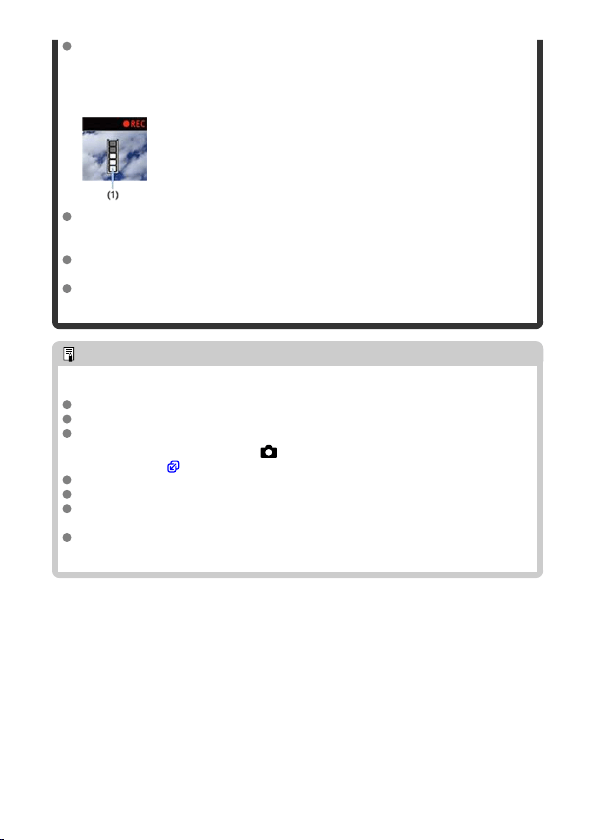
If you use a card with a slow writing speed, an indicator may appear on the right
of the screen during movie recording. The indicator shows how much data has
not yet been written to the card (remaining capacity of the internal buffer
memory), and it increases more quickly the slower the card is. If the indicator (1)
becomes full, movie recording will stop automatically.
If the card has a fast writing speed, the indicator will not appear or the level (if
displayed) will not increase much. First, record a few test movies to see if the card
can write fast enough.
If the indicator shows that the card is full, and movie recording stops automatically,
the sound near the end of the movie may not be recorded properly.
If the card's writing speed is slow (due to fragmentation) and the indicator appears,
formatting the card may make the writing speed faster.
Note
Notes for movie recording
Each time you record a movie, a new movie file is created on the card.
Field of view (coverage) is approx. 100%.
To enable starting/stopping movie recording by pressing the shutter button
completely, set [Fully-press] for [
: Shutter btn function for movies] to [Start/
stop mov rec] ( ).
Most external microphones compatible with 3.5 mm mini-jacks can be used.
Any connected external microphone is used instead of the built-in microphone.
Focus preset during movie recording is available when using (super) telephoto
lenses equipped with this function released in and after the second half of 2011.
YCbCr 4:2:0 (8-bit) color sampling and the BT.709 color space are used for 4K and
Full HD movies.
393
AF/Drive
This chapter describes autofocus operation and drive modes and introduces menu settings
on the AF [
] tab.
to the right of titles indicates functions only available in Creative Zone modes (<P>, <Tv>,
<Av>, or <M>).
Note
< > stands for autofocus. < > stands for manual focus.
• Tab Menus: AF (Still Photos)
• Tab Menus: AF (Movie Recording)
• AF Operation
• Movie Servo AF
• Selecting the AF Area
• Preview AF
• AF-Assist Beam Firing
• Touch & Drag AF Settings
• Manual Focus
• Customizing AF Functions
• Selecting the Drive Mode
• Using the Self-Timer
• Remote Control Shooting
• Customizing Operation
394
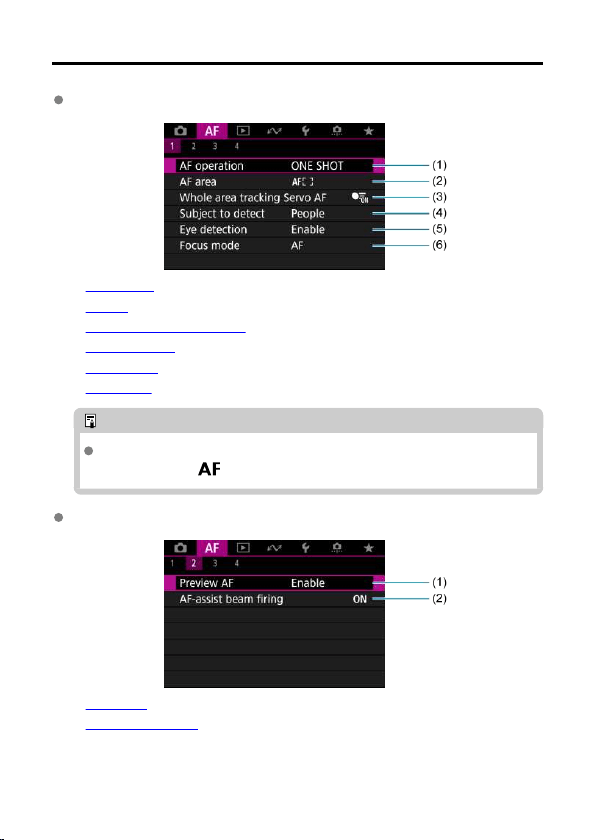

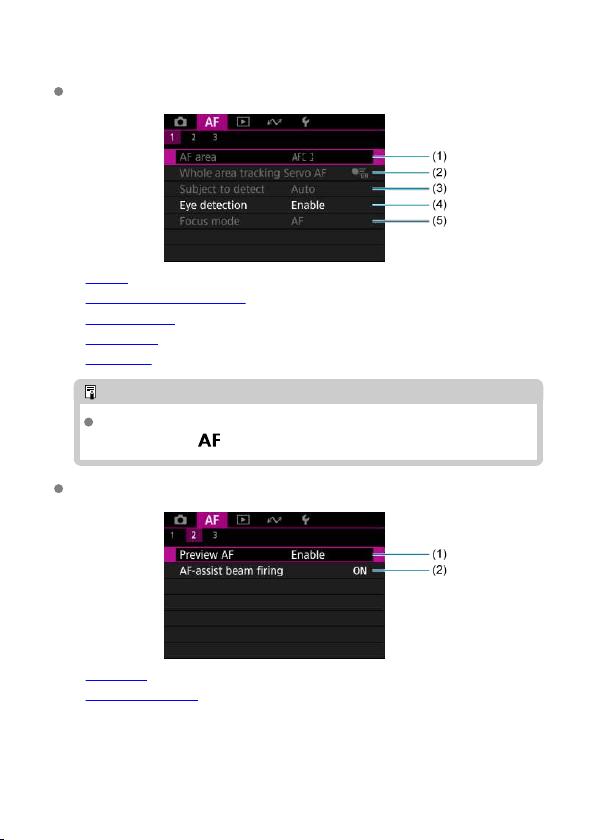
In Basic Zone modes, the following screens are displayed.
Note that available menus vary by shooting mode.
AF1
(1) AF area
(2) Whole area tracking Servo AF
(3) Subject to detect
(4) Eye detection
(5) Focus mode
Note
When lenses without a focus mode switch are used, [Focus mode] is
displayed on the [
1] tab.
AF2
(1) Preview AF
(2) AF-assist beam firing
397
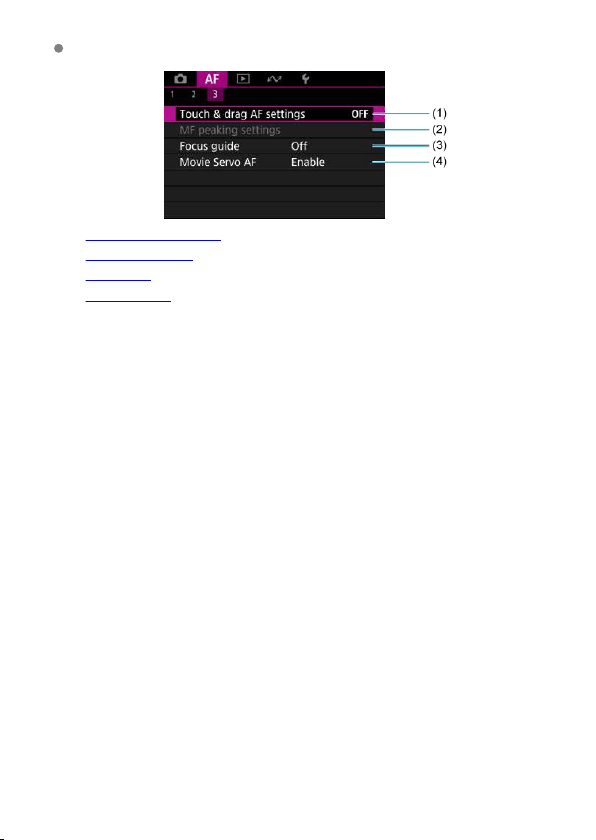
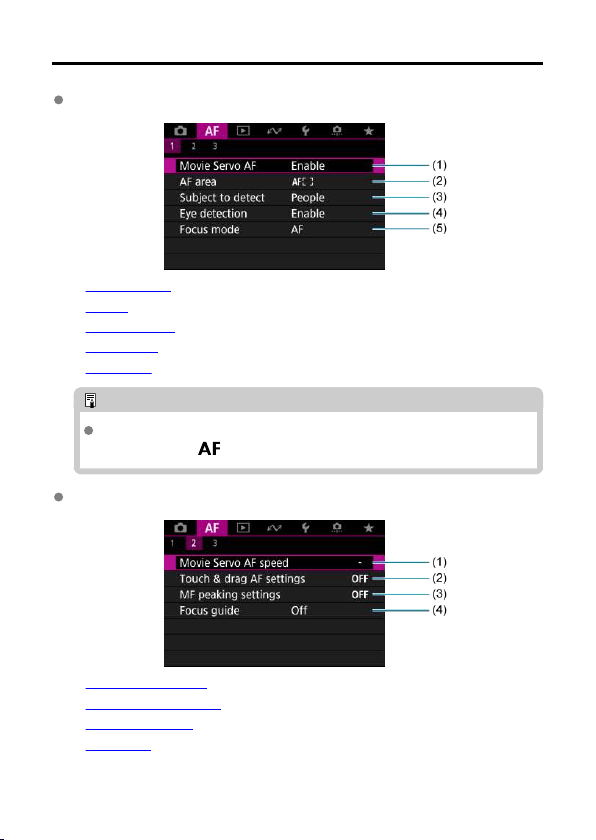
Tab Menus: AF (Movie Recording)
AF1
(1) Movie Servo AF
(2) AF area
(3) Subject to detect
(4) Eye detection
(5) Focus mode
Note
When lenses without a focus mode switch are used, [Focus mode] is
displayed on the [
1] tab.
AF2
(1) Movie Servo AF speed
(2) Touch & drag AF settings
(3) MF peaking settings
(4) Focus guide
399
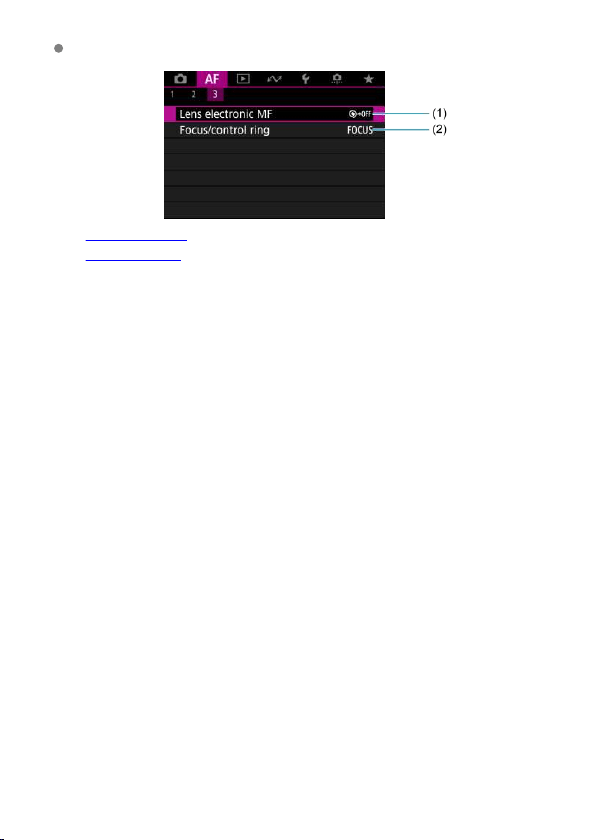
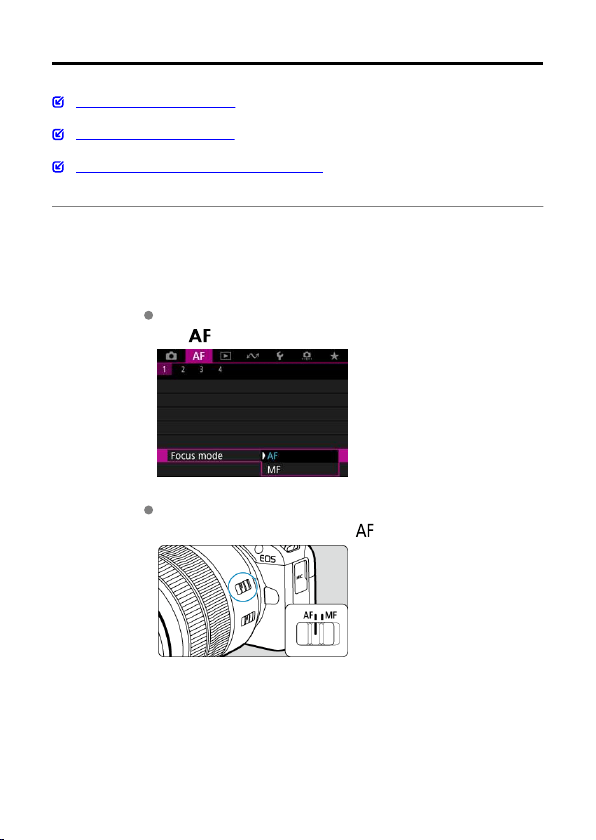
AF Operation
One-Shot AF for Still Subjects
Servo AF for Moving Subjects
AI Focus AF for Automatic AF Mode Switching
You can select the AF operation characteristics to suit the shooting conditions or subject.
1.
Set the focus mode to AF.
For RF lenses without a focus mode switch
Set [ : Focus mode] to [AF].
For RF lenses with a focus mode switch
Set the lens focus mode switch to < >.
401
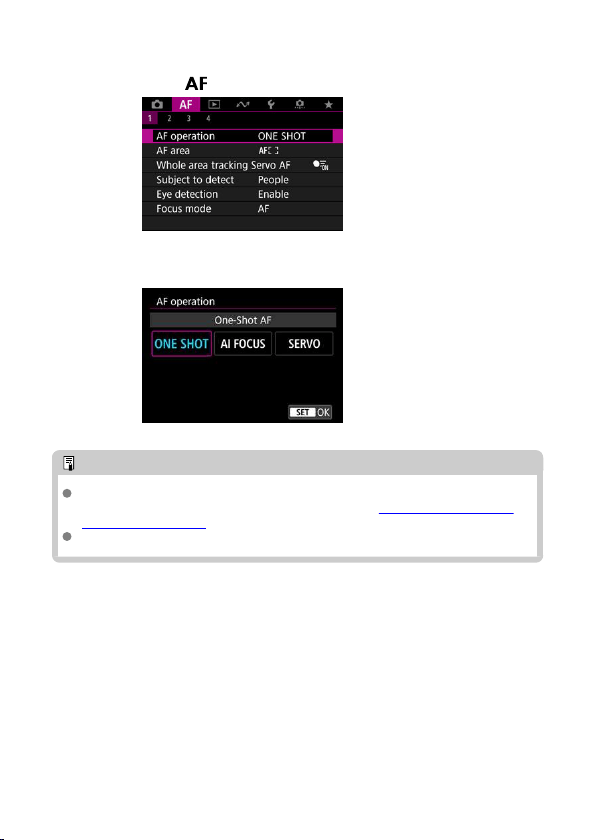
2.
Select [
: AF operation].
3.
Select an option.
Note
If focus is not achieved, the AF point will turn orange. When using One-Shot AF,
either recompose the shot and try to focus again or see Shooting Conditions That
Make Focusing Difficult.
With Servo AF, the camera shoots even when subjects are not in focus.
402

One-Shot AF for Still Subjects
This AF operation is suited for still subjects. When you press the shutter button halfway, the
camera will focus only once.
When focus is achieved, the AF point will turn green and the beeper will sound.
The focus remains locked while you hold down the shutter button halfway, allowing you
to recompose the image before taking the picture.
For details on the continuous shooting speed for continuous shooting, see Selecting the
Drive Mode.
Note
If [ : Beep] is set to [Disable], the beeper will not sound when focus is achieved.
See Lens electronic MF when using a lens that supports electronic manual
focusing.
Shooting with the focus locked
In focus lock shooting, you will use One-Shot AF with a fixed AF point, then recompose the
shot before shooting. The steps are as follows when you will press the shutter button
halfway to focus.
1.
Aim the fixed AF point over the subject to focus on, then press the
shutter button halfway.
403
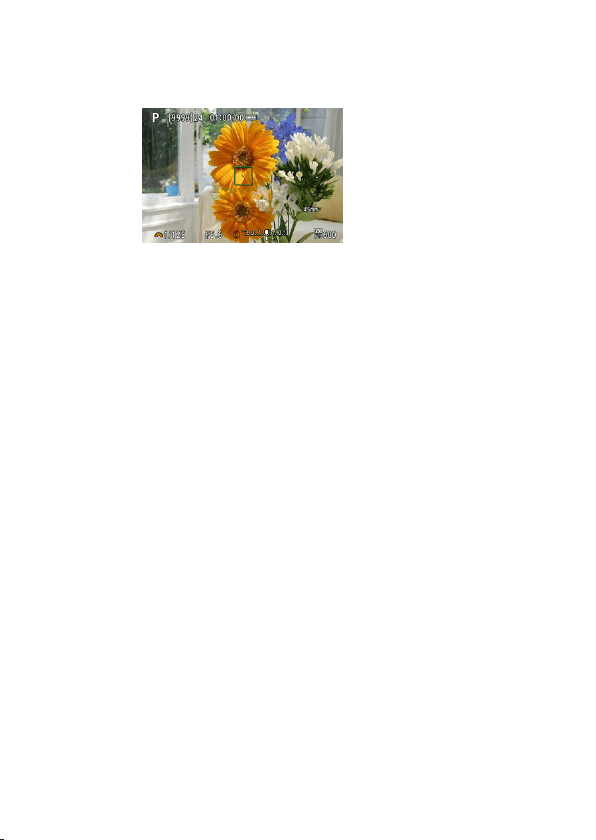
2.
After the AF point in focus turns green, keep the shutter button
pressed halfway and recompose the shot.
3.
Press the shutter button completely to take the picture.
404
Servo AF for Moving Subjects
This AF operation is suited for moving subjects. While you hold down the shutter button
halfway, the camera will keep focusing on the subject continuously.
When focus is achieved, the AF point will turn blue. The beeper will not sound even
when focus is achieved.
The exposure is set at the moment the picture is taken.
For details on the continuous shooting speed for continuous shooting, see Selecting the
Drive Mode.
Caution
Accurate focusing may not be possible at high aperture values or depending on the
lens, the distance to the subject, and how fast the subject is moving.
Zooming during continuous shooting may throw off the focus. Zoom first, then
recompose and shoot.
Consider shooting with One-Shot AF if Servo AF operation is unsteady for still
subjects.
405

AI Focus AF for Automatic AF Mode Switching
The AF mode is automatically switched from [One-Shot AF] to [Servo AF] based on subject
status while you are pressing the shutter button halfway or shooting continuously.
406
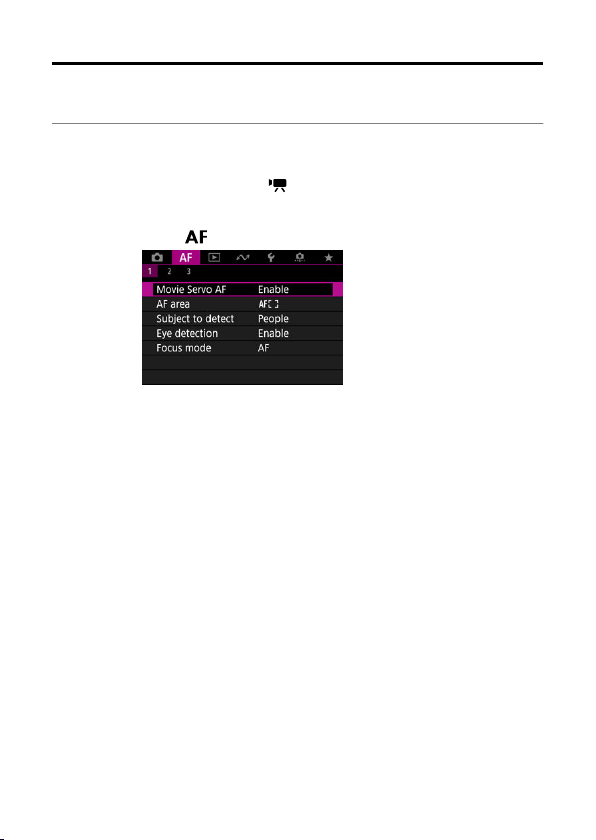
Movie Servo AF
With this function enabled, the camera focuses on the subject continuously during movie
recording.
1.
Set the Mode dial to <
>.
2.
Select [
: Movie Servo AF].
407

3.
Select [Enable].
Enable
• The camera focuses on the subject continuously even when you
are not pressing the shutter button halfway.
• To keep the focus at a specific position, or if you prefer not to
record mechanical sounds from the lens, you can temporarily stop
Movie Servo AF by tapping [
] in the lower left of the screen.
• Movie Servo AF will resume after pausing if you return to movie
recording after operations such as pressing the <
> or
<
> button or changing the AF area.
Disable
Press the shutter button halfway to focus.
408
Caution
Precautions when set to [Movie Servo AF: Enable]
Shooting conditions that make focusing difficult
• A fast-moving subject approaching or moving away from the camera.
• A subject moving at a close distance to the camera.
• When shooting with a higher aperture value.
• Also see
Shooting Conditions That Make Focusing Difficult.
Since the lens is driven continuously and the battery power is consumed, the
possible movie recording time ( ) will be shortened.
The camera's built-in microphone may also record mechanical sounds of the lens
or sounds of camera/lens operations if AF operations are performed or the camera
or lens is operated during movie recording. If so, it may help reduce these sounds if
you use an external microphone equipped with an output plug and position it away
from the camera and lens.
Movie Servo AF pauses during zooming or magnified view.
During movie recording, if a subject approaches or moves away or if the camera is
moved vertically or horizontally (panning), the recorded image may momentarily
expand or contract (change in image magnification).
409

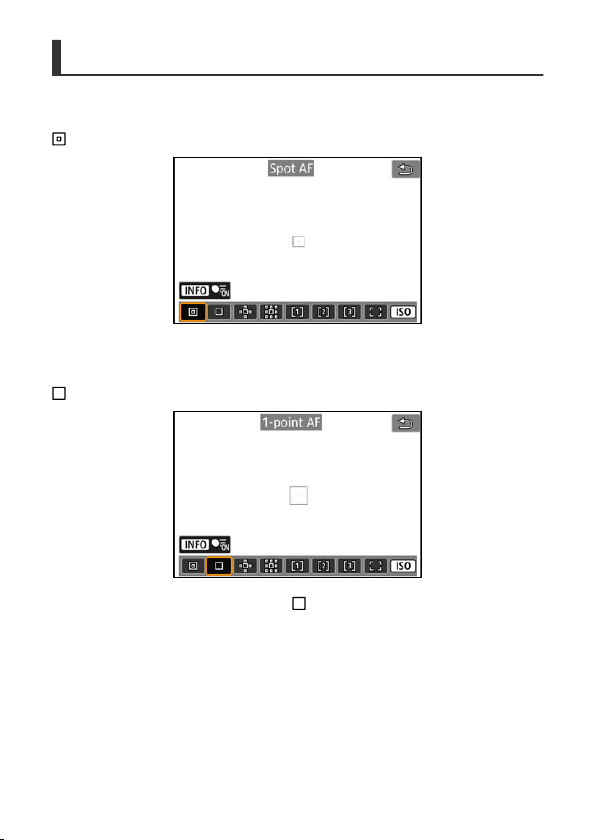
AF Area
Camera operation in the AF area is as follows.
: Spot AF
The camera focuses in a narrower area than 1-point AF.
: 1-point AF
The camera focuses using a single AF point [ ].
411
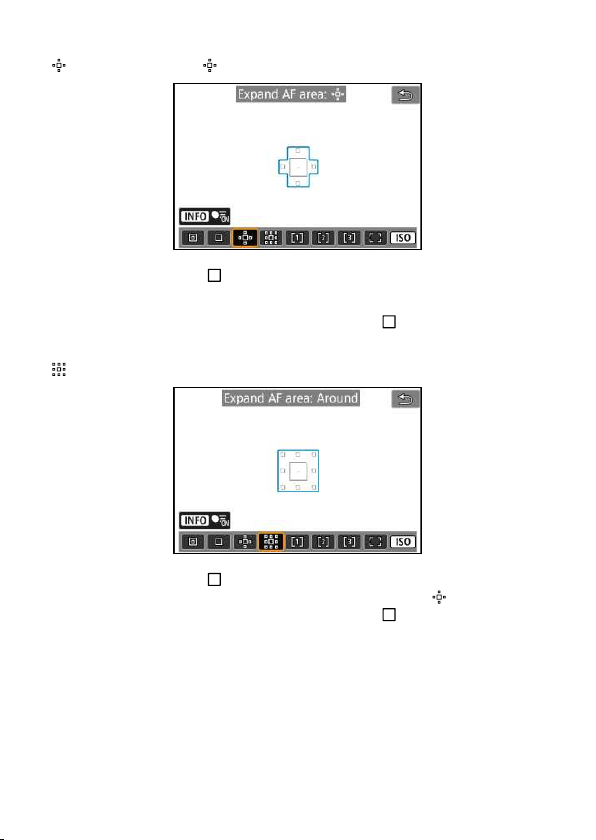
: Expand AF area:
Focuses using one AF point [ ] and the AF area outlined here in blue. Effective for moving
subjects, which are difficult to track with 1-point AF.
Focusing on your preferred subject is easier than with Flexible Zone AF.
When Servo AF is used, first you will focus using an AF point [
].
: Expand AF area: Around
Focuses using one AF point [ ] and the surrounding AF area outlined here in blue, which
makes it easier to focus on moving subjects than with Expand AF area:
.
When Servo AF is used, first you will focus using an AF point [
].
412
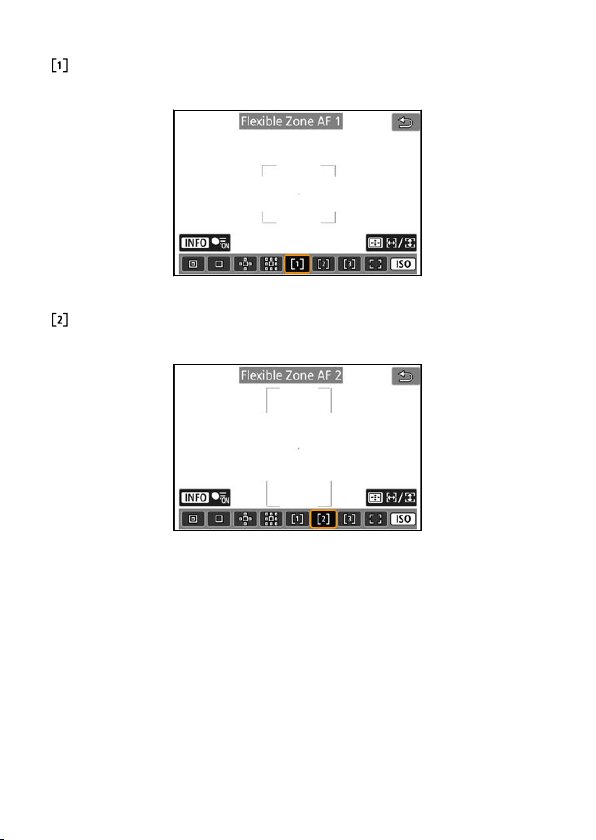
: Flexible Zone AF 1
By default, a square Zone AF frame is set.
: Flexible Zone AF 2
By default, a vertical rectangular Zone AF frame is set.
413
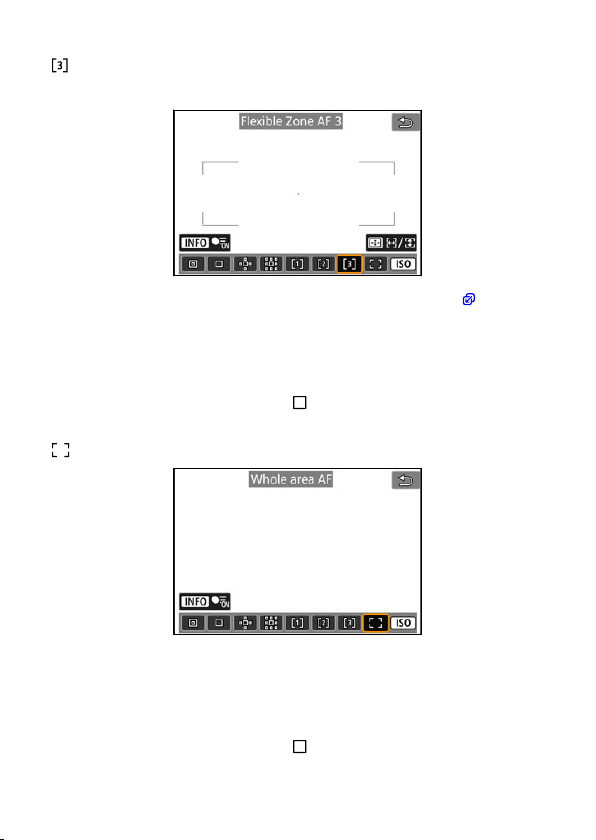
: Flexible Zone AF 3
By default, a horizontal rectangular Zone AF frame is set.
With Flexible Zone AF 1–3, you can freely set the size of the Zone AF frame ( ).
Uses auto selection AF in Zone AF frames to cover a larger area than Expand AF area,
which makes focusing easier than with 1-point AF/Expand AF area and effective for moving
subjects.
Focusing areas are determined not only based on the nearest subject but also based on a
variety of other conditions such as faces (of people or animals), vehicles, subject motion,
and subject distance.
Pressing the shutter button halfway displays [
] over AF points in focus.
: Whole area AF
Uses auto selection AF in a whole-area AF frame to cover a larger area than Flexible Zone
AF, which makes focusing easier than with 1-point AF/Expand AF area/Flexible Zone AF
and effective for moving subjects.
Focusing areas are determined not only based on the nearest subject but also based on a
variety of other conditions such as faces (of people or animals), vehicles, subject motion,
and subject distance.
Pressing the shutter button halfway displays [
] over AF points in focus.
414
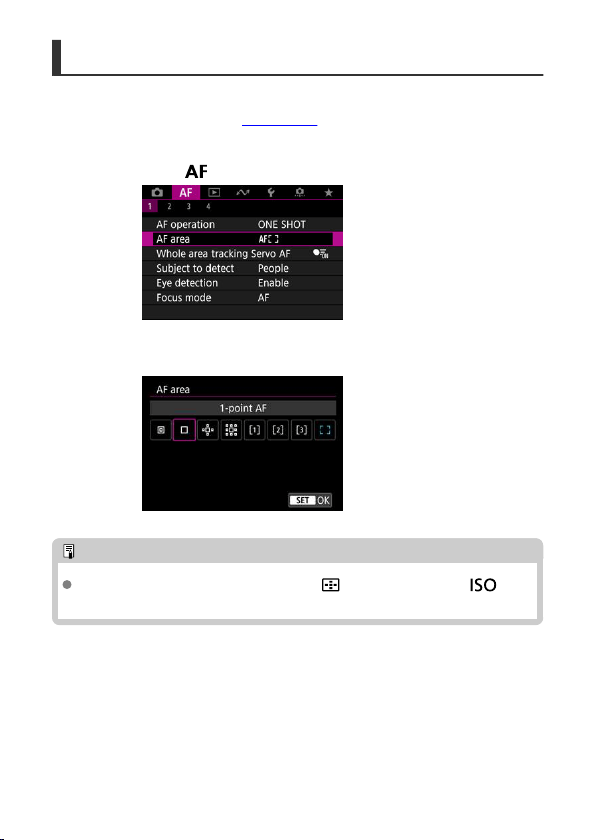
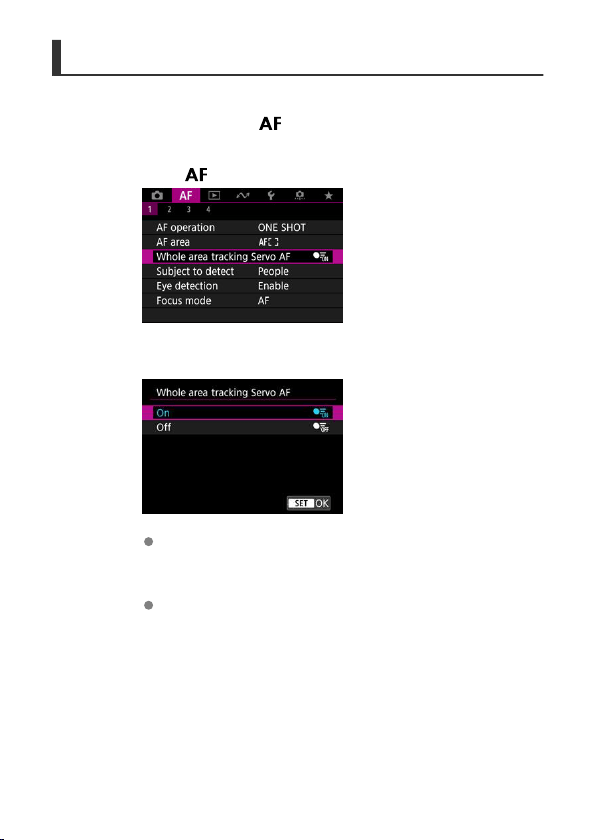
Whole Area Tracking Servo AF
You can set whether to switch to whole-area subject tracking during Servo AF (while the
shutter button is pressed halfway with [
: AF operation] set to [Servo AF]).
1.
Select [
: Whole area tracking Servo AF].
2.
Select an option.
On
The AF area switches to whole-area AF to track subjects across the
entire screen area while the shutter button is pressed halfway.
Off
Subjects are tracked only within AF points when the shutter button is
pressed halfway or completely.
416
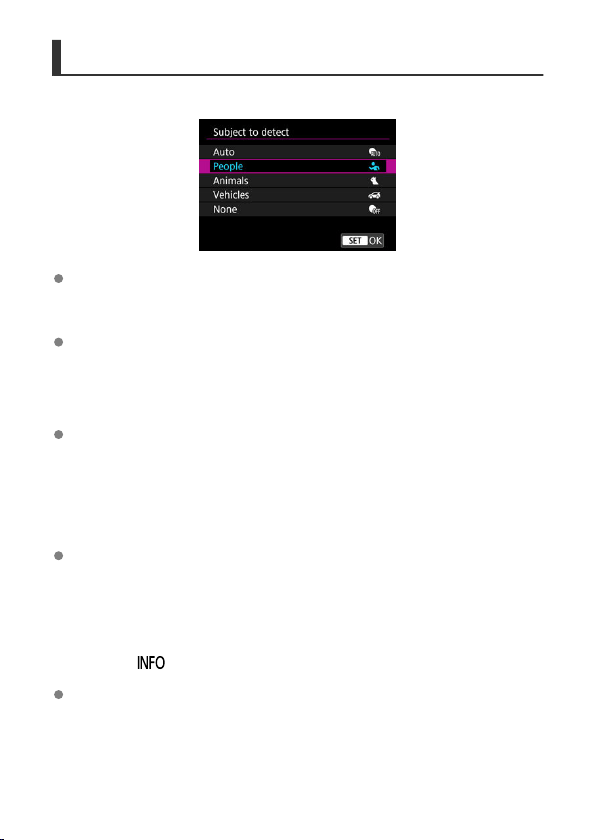
Subject to Detect
You can specify conditions for automatic selection of the main subject to track.
Auto
Automatic selection of the main subject to track from any people, animals, or vehicles in
the scene.
People
Prioritizes the faces or heads of people as the main subjects to track.
When a person's face or head cannot be detected, the camera attempts to detect and
track their torso. If their torso cannot be detected, the camera may track other parts of
their body.
Animals
Detects animals (dogs, cats, or birds) and people and prioritizes detection results for
animals as the main subjects to track.
For animals, the camera attempts to detect faces or bodies, and a tracking frame is
shown over any face detected.
When an animal's face or entire body cannot be detected, the camera may track part of
their body.
Vehicles
Detects two- or four-wheeled motorsports vehicles and people and prioritizes detection
results for vehicles as the main subjects to track.
For vehicles, the camera attempts to detect key details or the entire vehicle, and a
tracking frame is shown over any of these details detected.
If key details or the entire vehicle cannot be detected, the camera may track other parts
of the vehicle.
Press the <
> button to enable or disable Spot detection for key details of vehicles.
None
The camera determines the main subject automatically from how you compose shots,
without detecting subjects.
Tracking frames are not displayed.
417
Caution
The following kinds of subjects may not be detected. Also, the subject's left or right
eye may not be prioritized correctly.
• Extremely small or large
• Too bright or dark
• Partially hidden
• Difficult to distinguish from the background
• Obscured by rain, snow, or dust clouds
People's posture or the color or shape of what they are wearing may prevent
detection. Frames may also appear for subjects other than people.
The camera may not detect dogs, cats, or birds, depending on the breed, color,
shape, or posture. Frames may also appear for similar-looking animals or non-
animal subjects.
The camera may not detect two- or four-wheeled vehicles depending on the type,
color, shape, or orientation. Frames may also appear for similar-looking vehicles or
subjects that are not vehicles.
To avoid having a tracking frame displayed next to unintended subjects when you
are shooting people, animals, or vehicles with the camera set to [Auto], change the
setting to track your intended subjects.
Note
When pressing the shutter button halfway for subject selection, you can choose the
following subjects. In scenes without relevant subjects, the camera tracks other
objects regardless of the [Subject to detect] setting.
• Auto, People
People, animals, vehicles
(When the subject for detection is set to [People], animals or vehicles can only
be selected during Servo AF.)
• Animals
Animals, people
• Vehicles
Vehicles, people
To restrict AF to your specified AF area, set [Whole area tracking Servo AF] to
[Off] and [Subject to detect] to [None].
418
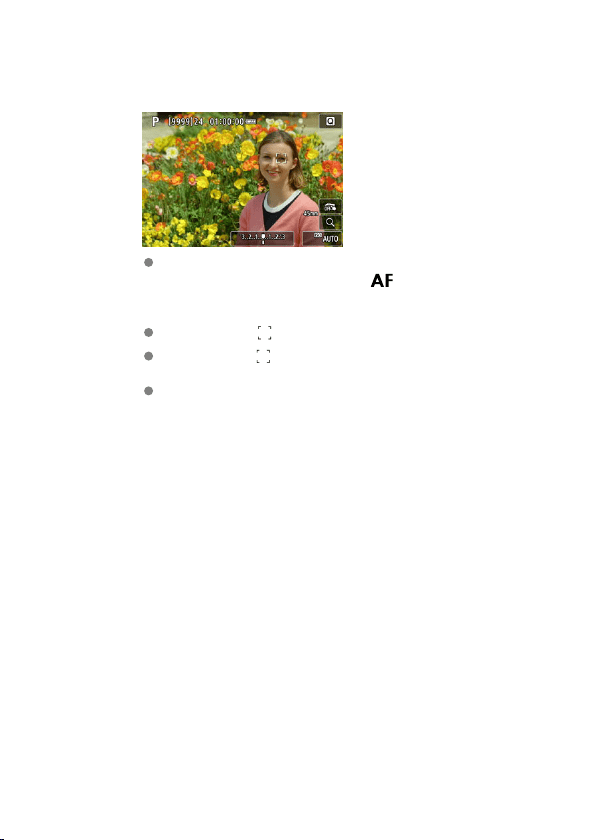
Manually selecting a subject for focus
1.
Check the tracking frame.
Aim the camera at the subject. An AF point (or Zone AF frame)
appears on the screen if you have set [
: AF area] to an option
other than [Whole area AF]. In this case, aim the AF point over the
subject.
A tracking frame [ ] appears over any subjects detected.
Tracking frames [ ] away from AF points are displayed in gray, except
in some cases.
Once the tracked subject is near an AF point, even if it is outside the
AF point, the tracking frame turns white (distinguishing it as an active
frame), which enables selection as the main subject.
419
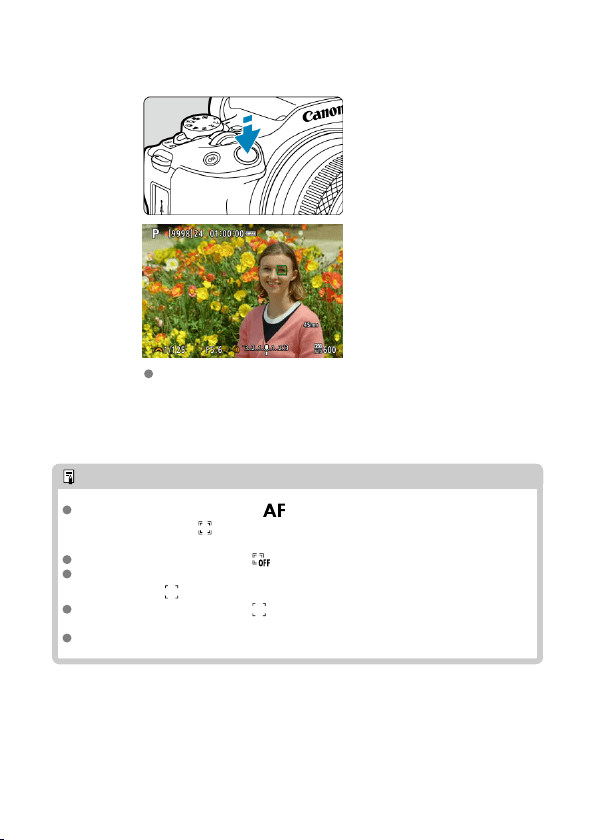
2.
Focus and shoot/record.
A tracking frame is displayed (in green for One-Shot AF or blue for
Servo AF) when you press the shutter button halfway, and the camera
beeps (only for One-Shot AF).
An orange tracking frame indicates that the camera could not focus on
subjects.
Note
Selecting a subject by touch with [ : AF area] set to [Whole area AF] changes
the tracking frame to [
] and locks on to that subject for tracking across the entire
screen.
To release locked tracking, tap [ ].
Pressing the shutter button halfway when the AF point does not overlap the
tracking frame [
] will focus using the active, white AF frame.
For human subjects, the active [ ] may cover only a part of the face, not the whole
face.
The size of tracking frames varies depending on the subject.
420
Caution
Tapping the screen to focus when [Preview AF] is set to [Disable] will focus with
[One-Shot AF], regardless of the AF operation setting.
If the subject's face is significantly out of focus, face detection will not be possible.
Adjust the focus manually ( ) so that the face can be detected, then perform AF.
AF may not detect subjects or people's faces at the edges of the screen.
Recompose the shot to center the subject or bring the subject closer to the center.
421
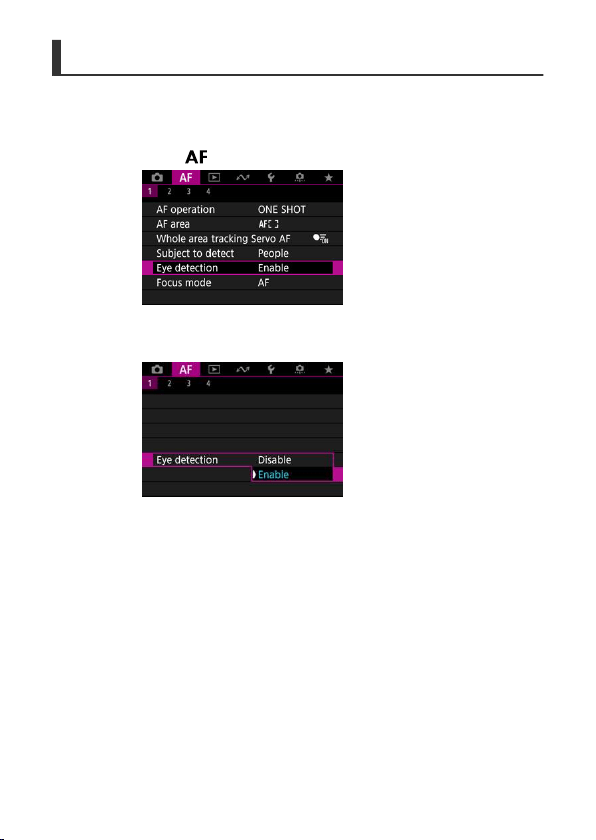
Eye Detection
You can shoot with the eyes of people or animals in focus.
1.
Select [
: Eye detection].
2.
Select an option.
422
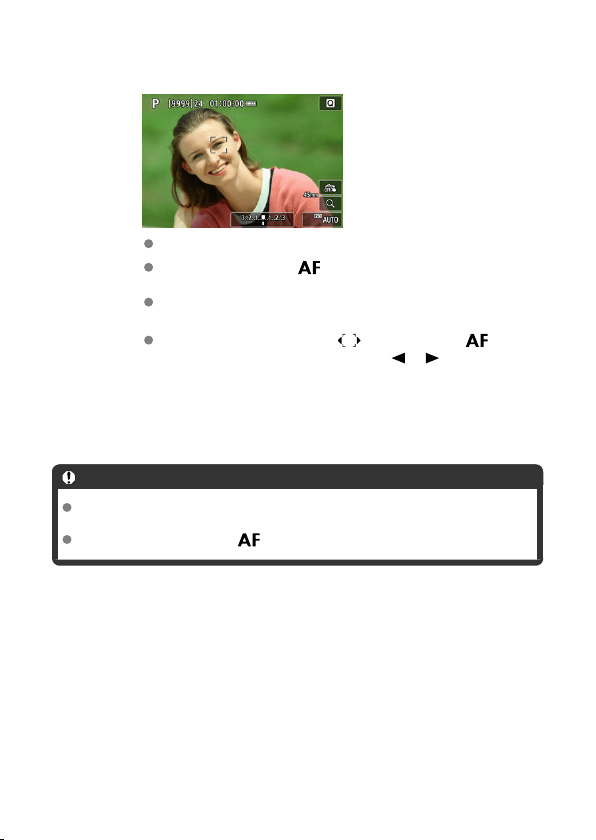
3.
Aim the camera at the subject.
An AF point is displayed around their eye.
To choose an eye when [ : AF area] is set to [Whole area AF], tap
the screen.
If your selected eye is not detected, an eye to focus on is selected
automatically.
To choose an eye to focus on if [ ] is displayed, with [ : AF area]
set to [Whole area AF], you can use the <
>< > keys, depending
on the [Eye detection] setting.
4.
Take the picture.
Caution
Depending on the subject and shooting conditions, subject eyes may not be
detected correctly, or a subject's left or right eye may not be prioritized correctly.
Eyes are not detected when [ : Subject to detect] is set to [None].
423

Tracking with the Button
You can press a button assigned to [Start/stop whole area AF tracking] in [ :
Customize buttons] to track subjects with a tracking frame [
]. This example is based on
assigning the <
> button ( ).
1.
Check the tracking frame.
A tracking frame appears after you aim the camera at a subject.
Aim the AF point over the subject if you have selected an option other
than [Whole area AF] in [
: AF area].
With Expand AF area: or Expand AF area: Around, adjacent AF
points are also displayed.
With Flexible Zone AF, the specified Zone AF frame is displayed.
424
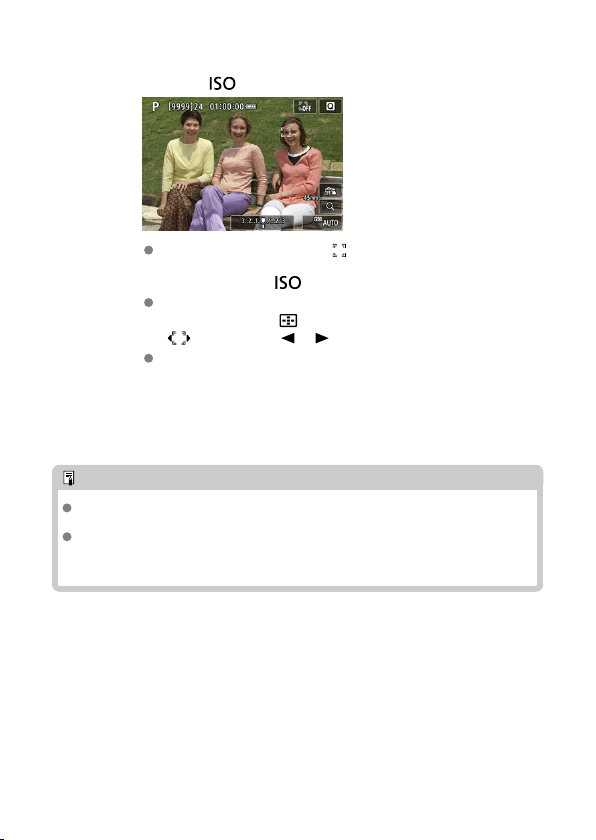
2.
Press the <
> button.
The tracking frame changes to [ ], which locks on to that subject for
tracking and follows the subject within the screen if it moves. To cancel
tracking, press the <
> button again.
To choose a subject to focus on when multiple subjects can be
detected, press the <
> button to change the tracking frame to
[
], then use the < >< > keys.
Once tracking begins, the subject is tracked across the entire screen,
regardless of the specified AF area.
3.
Take the picture.
Note
The position of AF areas and points when tracking stops during shooting standby
corresponds to the position before tracking.
When tracking stops while the shutter button is pressed halfway or completely, the
AF area reverts to the state before tracking, but the AF point is centered in the
tracking frame when tracking stops (during [Servo AF]).
425
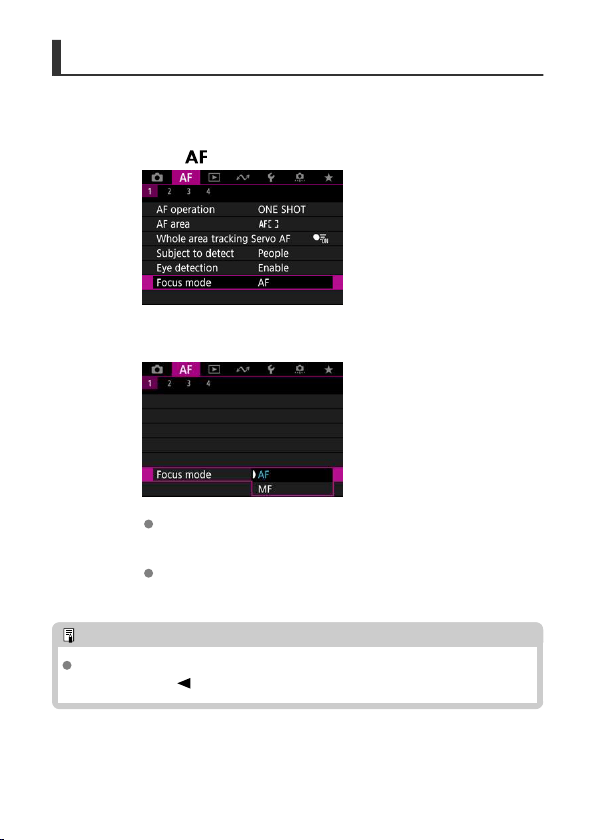
Focus Mode
You can set how the camera focuses.
1.
Select [
: Focus mode].
2.
Select an option.
AF
The camera operates in autofocus mode.
MF
The camera operates in manual focus mode.
Note
You can also switch between [AF] and [MF] when the shooting screen is displayed
by pressing the <
> key.
426
Caution
[ : Focus mode] is not displayed under these conditions.
• When lenses with a focus mode switch are attached
• When lenses designed exclusively for manual focusing are attached
• When no lens is attached
When set to [MF], AF points are hidden during basic information display, and an
MF icon is displayed.
427
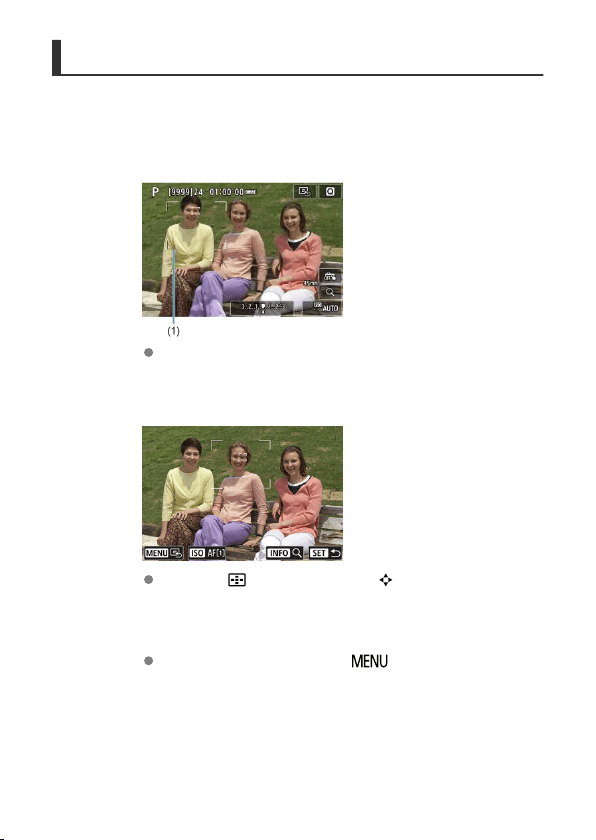
Manually Setting AF Points or Zone AF Frames
You can manually set the AF point or Zone AF frame. Screens such as these are shown
when set to Flexible Zone AF 1.
1.
Check the AF point.
An AF point (1) is displayed.
2.
Move the AF point.
Press the < > button, then use the < > keys to move the AF
point into position for focusing (but note that with some lenses, it may
not move to the edge of the screen).
You can also focus by tapping a position on the screen to move the AF
point there.
To center the AF point, press the < > button.
428
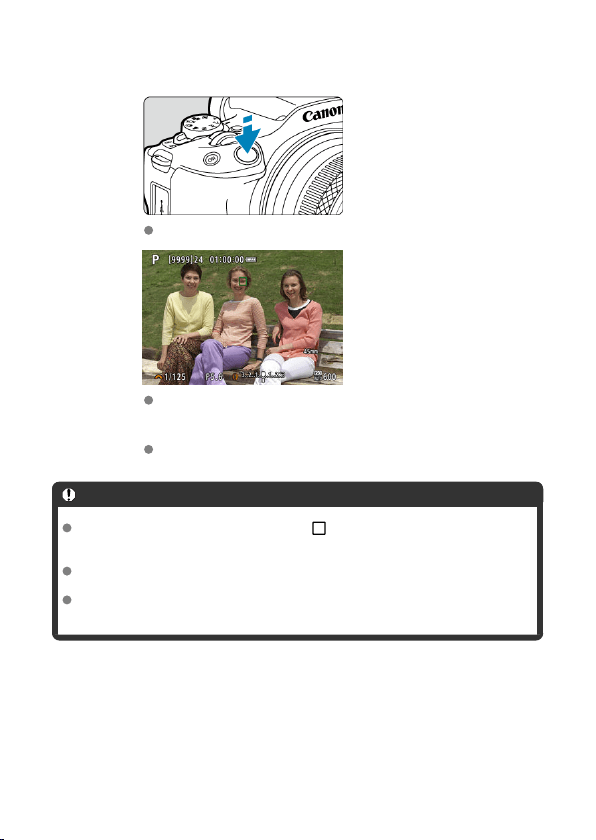
3.
Focus and shoot/record.
Aim the AF point over the subject and press the shutter button halfway.
Once the subject is in focus, the AF point changes color (to green for
One-Shot AF or blue for Servo AF) and the camera beeps (only for
One-Shot AF).
If focus is not achieved, the AF point will turn orange.
Caution
The camera will keep moving the AF point [ ] to track subjects when set to
Flexible Zone AF and Servo AF, but under some shooting conditions (such as
when subjects are small), it may not be possible to track the subject.
Focusing may be difficult when using a peripheral AF point. In this case, select an
AF point in the center.
Tapping the screen to focus will focus with [One-Shot AF], regardless of the AF
operation setting.
429
Magnified View
To check the focus, you can magnify display by approx. 5× or 10× by tapping [ ].
Magnification is also possible by pressing the <
> button and then the < > button.
Magnification is centered on the tracking frame when the tracking frame is white (as an
active frame) after subject detection.
Magnification is centered on the AF point (in the center of the screen) when subjects are
detected and the tracking frame is gray, or when subjects cannot be detected.
Autofocusing is performed in magnified view if you press the shutter button halfway.
When set to Servo AF or AI Focus AF, pressing the shutter button halfway in magnified
view reverts to the normal view for focusing.
Caution
If focusing is difficult in the magnified view, return to the normal view and perform
AF.
If you perform AF in the normal view and then use the magnified view, accurate
focus may not be achieved.
AF speed differs between the normal view and magnified view.
Preview AF and Movie Servo AF are not available in magnified view.
With the magnified view, achieving focus becomes more difficult due to camera
shake. Using a tripod is recommended.
430

AF Shooting Tips
Even when focus is achieved, pressing the shutter button halfway will focus again.
Image brightness may change before and after autofocusing.
Depending on the subject and shooting conditions, it may take longer to focus, or the
continuous shooting speed may decrease.
If the light source changes as you shoot, the screen may flicker, and focusing may be
difficult. In this case, restart the camera and resume shooting with AF under the light
source you will use.
If focusing is not possible with AF, focus manually ( ).
For subjects at the edge of the screen that are slightly out of focus, try centering the
subject (or AF point, or Zone AF frame) to bring them into focus, then recompose the
shot before shooting.
With certain lenses, it may take more time to achieve focus with autofocus, or accurate
focusing may not be achieved.
431
Shooting Conditions That Make Focusing Difficult
Subject with low-contrast such as the blue sky, solid-color flat surfaces or when highlight
or shadow details are clipped.
Subjects in low light.
Stripes and other patterns where there is contrast only in the horizontal direction.
Subjects with repetitive patterns (Example: Skyscraper windows, computer keyboards,
etc.).
Fine lines and subject outlines.
Under light sources with constantly changing brightness, colors, or patterns.
Night scenes or points of light.
The image flickers under fluorescent or LED lighting.
Extremely small subjects.
Subjects at the edge of the screen.
Strongly backlit or reflective subjects (Example: Car with a highly reflective surfaces,
etc.).
Near and distant subjects covered by an AF point (Example: Animal in a cage, etc.).
Subjects that keep moving within the AF point and will not stay still due to camera shake
or subject blur.
Performing AF when the subject is very far out of focus.
Soft focus effect is applied with a soft focus lens.
A special effect filter is used.
Noise (dots of light, banding, etc.) appears on the screen during AF.
432

AF Range
The available autofocus range varies depending on the lens used and settings such as
aspect ratio, movie recording size, and Movie digital IS.
433
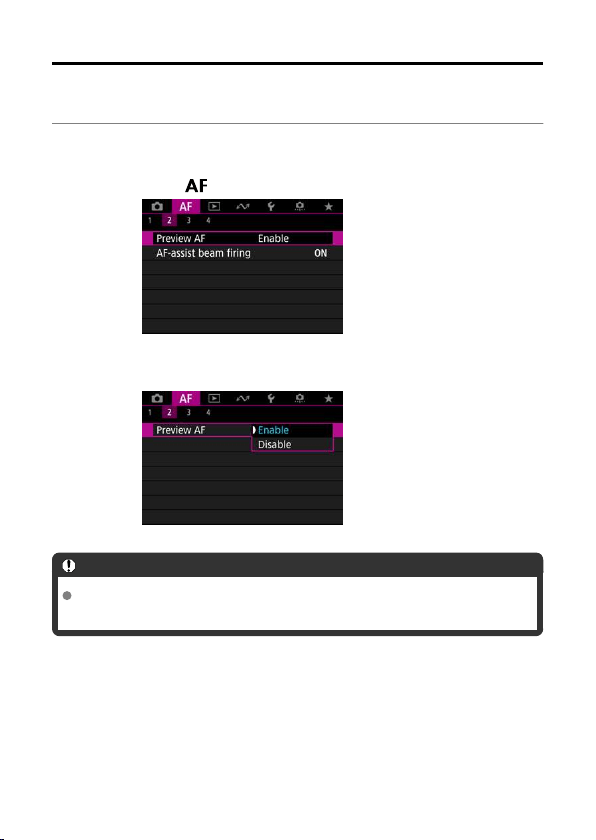
Preview AF
This function keeps subjects generally in focus. The camera is ready to focus immediately
when you press the shutter button halfway.
1.
Select [
: Preview AF].
2.
Select [Enable].
Caution
Fewer shots are available when set to [Enable], because the lens is driven
continuously and battery power is consumed.
434
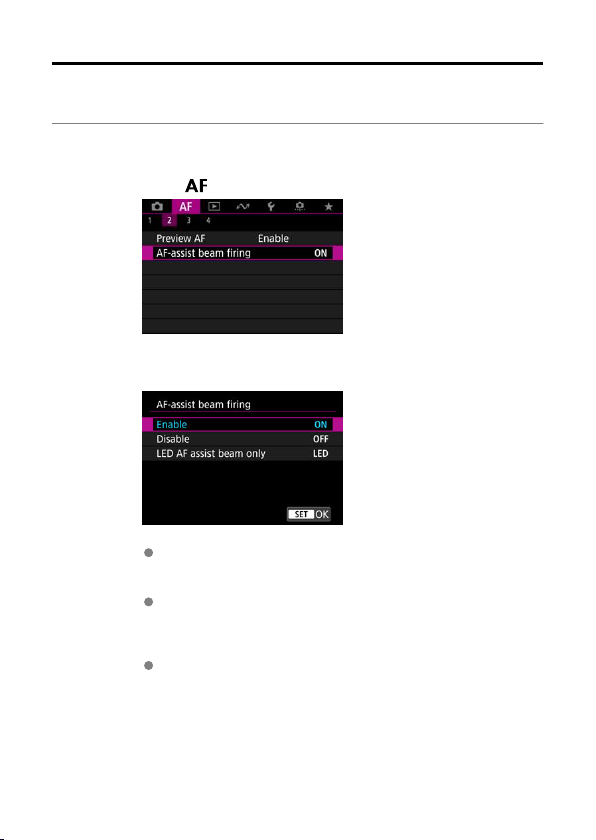
AF-Assist Beam Firing
You can enable or disable AF-assist beam firing of the camera or a Speedlite for EOS
cameras.
1.
Select [
: AF-assist beam firing].
2.
Select an option.
[ON] Enable
Enables firing of the AF-assist beam, when needed.
[OFF] Disable
Disables firing of the AF-assist beam. Set if you prefer not to fire the
AF-assist beam.
[LED] LED AF assist beam only
Enables LED AF-assist beam firing by Speedlites equipped with this
feature, when these flash units are attached. If your Speedlite is not
LED-equipped, the camera's AF-assist beam is fired instead.
435
Caution
Speedlite AF-assist beam firing is disabled when the Speedlite's [ : AF-assist
beam firing] Custom Function is set to [Disable].
436
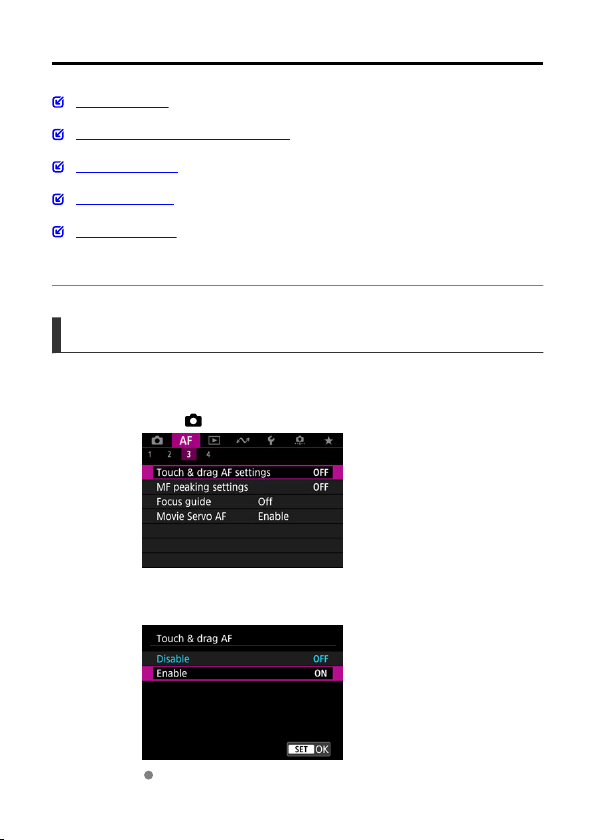
Touch & Drag AF Settings
Touch & Drag AF
Tapping to Select Subjects for Detection
Positioning Method
Active Touch Area
Relative Sensitivity
You can move the AF point or Zone AF frame by tapping or dragging on the screen as you
look through the viewfinder.
Touch & Drag AF
1.
Select [
: Touch & drag AF settings].
2.
Select [Touch & drag AF].
Select [Enable].
437
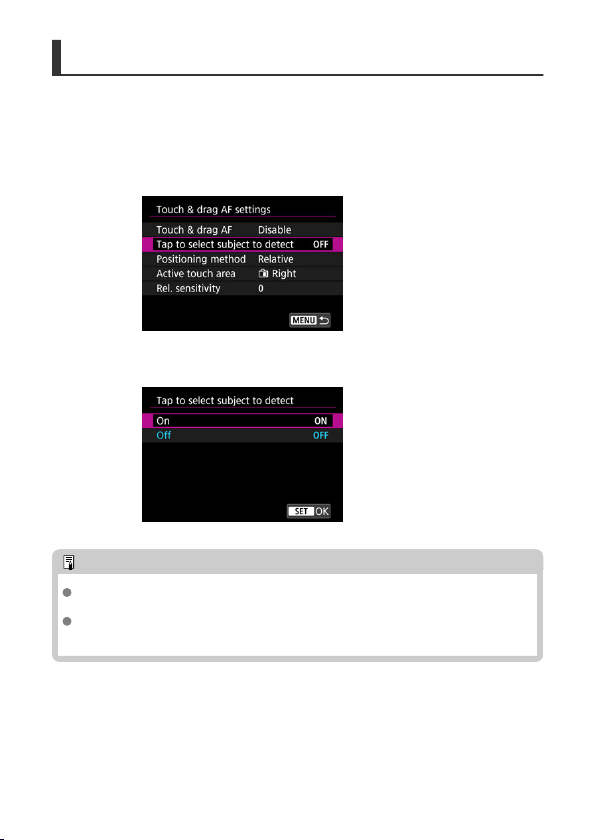
Tapping to Select Subjects for Detection
To switch the subject tracked to a different person when several faces are detected, you can
tap the area set in [Active touch area].
Note that this setting is not available with [Touch & drag AF] set to [Enable].
1.
Select [Tap to select subject to detect].
2.
Select [On].
Note
To switch to a person on the left, tap the left side of the area set in [Active touch
area], and to switch to a person on the right, tap the right side.
With [Eye detection] set to [Enable], the camera switches to the eyes of a different
subject.
438
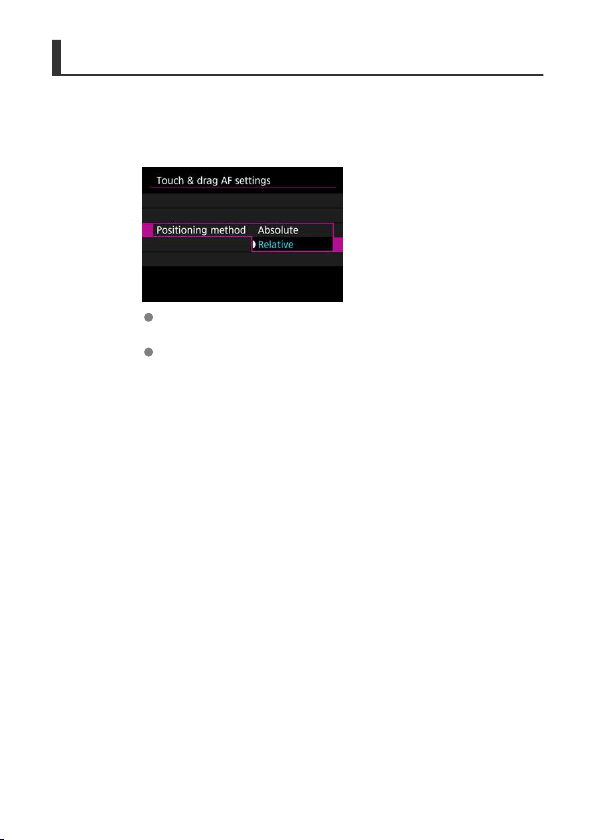
Positioning Method
You can set how positions are specified by tapping or dragging.
1.
Set [Positioning method].
Absolute
The AF point moves to the tapped or dragged position on the screen.
Relative
The AF point moves in the direction you drag, by an amount
corresponding to the amount you drag, no matter where you tap the
screen.
439
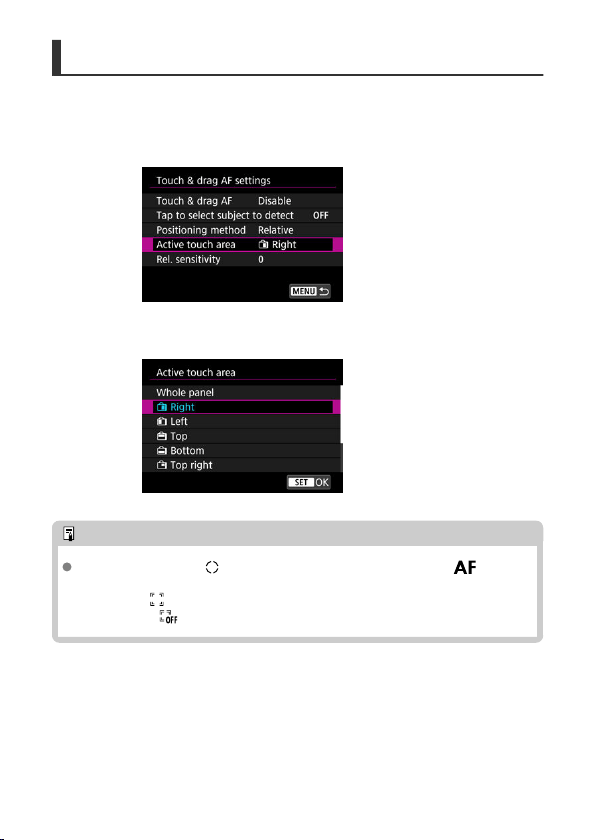
Active Touch Area
You can specify the area of the screen used for tap and drag operations.
1.
Select [Active touch area].
2.
Set the area that will respond to touch.
Note
A round orange frame [ ] is displayed when you tap the screen with [ : AF
area] set to [Whole area AF]. After you lift your finger at the position to move the
AF point to, [
] is displayed and that subject is tracked. To cancel subject
selection, tap [
].
440
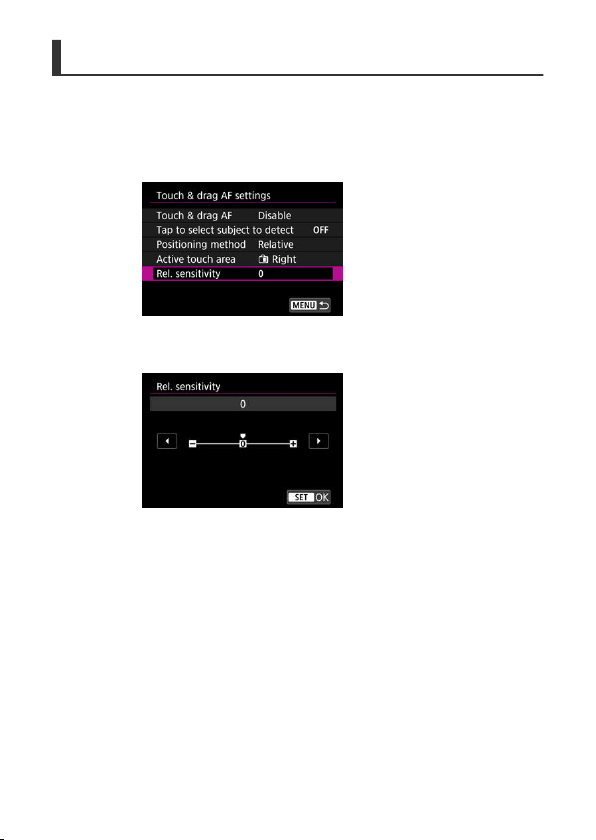
Relative Sensitivity
By setting [Positioning method] to [Relative], you can specify the amount of movement in
response to tapping or dragging.
1.
Select [Rel. sensitivity].
2.
Set the amount of movement.
For faster AF point positioning, set toward the positive end, and for slower
positioning, set toward the negative end.
441
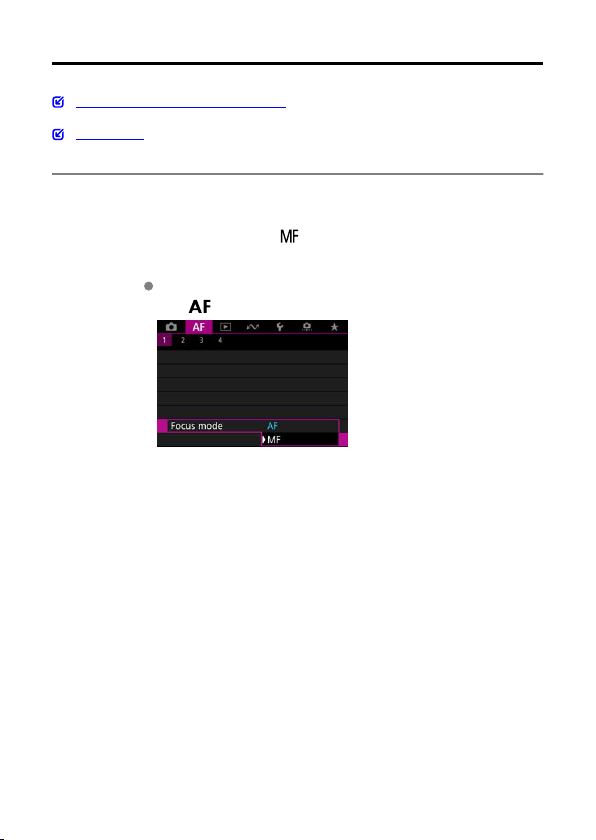
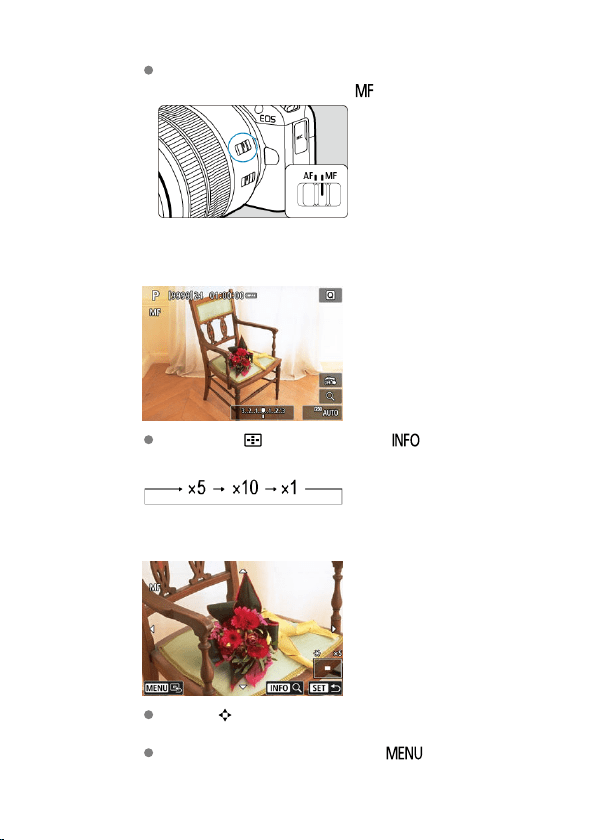
For RF lenses with a focus mode switch
Set the lens focus mode switch to <
>.
2.
Magnify the image.
Pressing the < > button and then the < > button changes the
magnification ratio, as follows.
3.
Move the magnified area.
Use the < > keys to move the magnified area into position for
focusing.
To center the magnified area, press the < > button.
443
4.
Focus manually.
While looking at the magnified image, turn the lens focusing ring to
focus.
After achieving focus, press the < > button to return to the normal
view.
Note
In magnified view, the exposure is locked.
Even when focusing manually, you can use Touch Shutter to shoot.
444
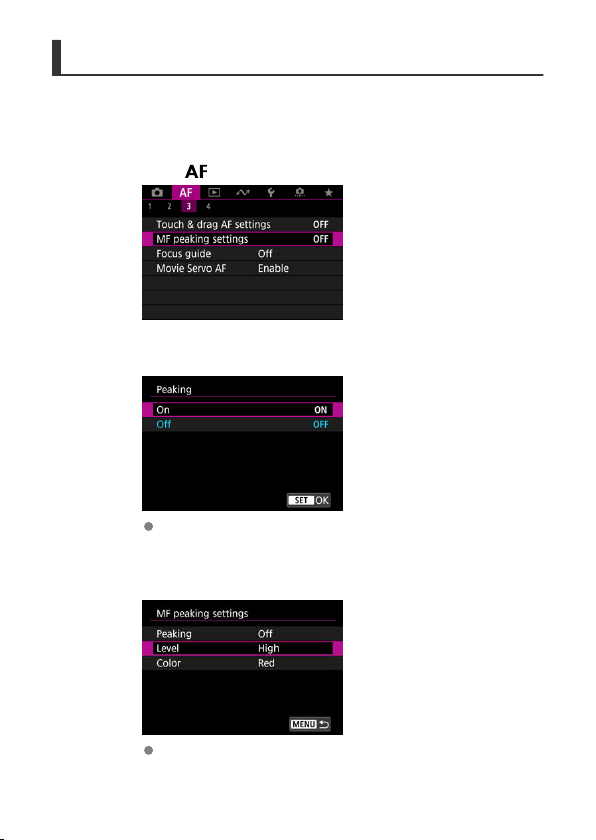
Setting MF Peaking (Outline Emphasis)
Edges of subjects in focus can be displayed in color to make focusing easier. You can set
the outline color and adjust the sensitivity (level) of edge detection.
1.
Select [
: MF peaking settings].
2.
Select [Peaking].
Select [On].
3.
Set [Level] and [Color].
Set as necessary.
445
Caution
In magnified view, peaking display is not shown.
During HDMI output, peaking display is not shown on equipment connected via
HDMI. Note that peaking display is shown on the camera screen when [
: HDMI
display] is set to [
+ ].
MF peaking may be hard to discern at high ISO speeds, especially when ISO
expansion is set. If necessary, lower the ISO speed or set [Peaking] to [Off].
Note
Peaking display shown on the screen is not recorded in images.
446
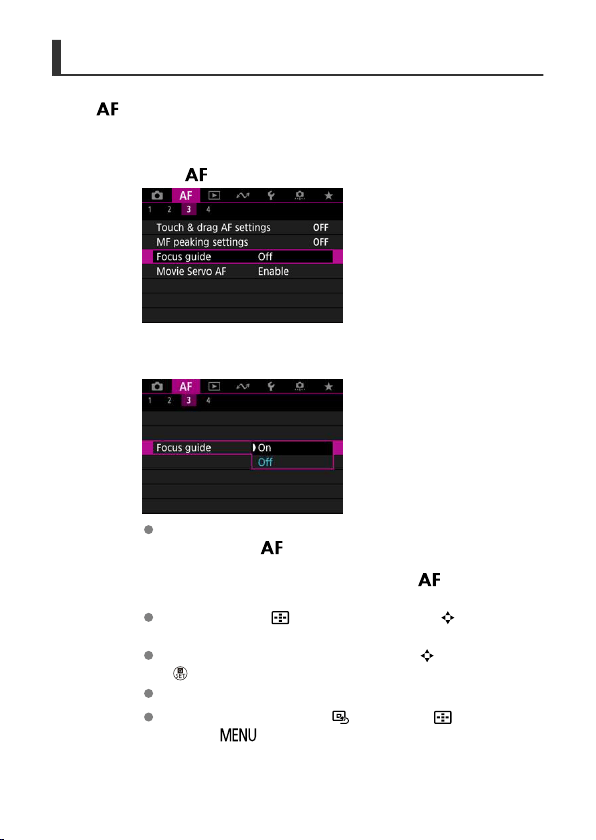
Focus Guide
Setting [ : Focus guide] to [On] provides a guide frame that shows which direction to
adjust focus and the extent of adjustment needed.
1.
Select [
: Focus guide].
2.
Select [On].
To display the guide frame on the face of the person detected as the
main subject, set [
: Subject to detect] to an option other than
[None]. You can also display the guide frame near the eyes of the
person detected as the main subject by setting [
: Eye detection] to
an option other than [Disable].
After pressing the < > button, you can use the < > keys to move
the guide frame in the direction you press.
To set the guide frame after moving it with the < > keys, press the
<
> button.
You can also move and set the guide frame by tapping the screen.
To center the guide frame, tap [ ] or press the < > button and
then the <
> button.
447
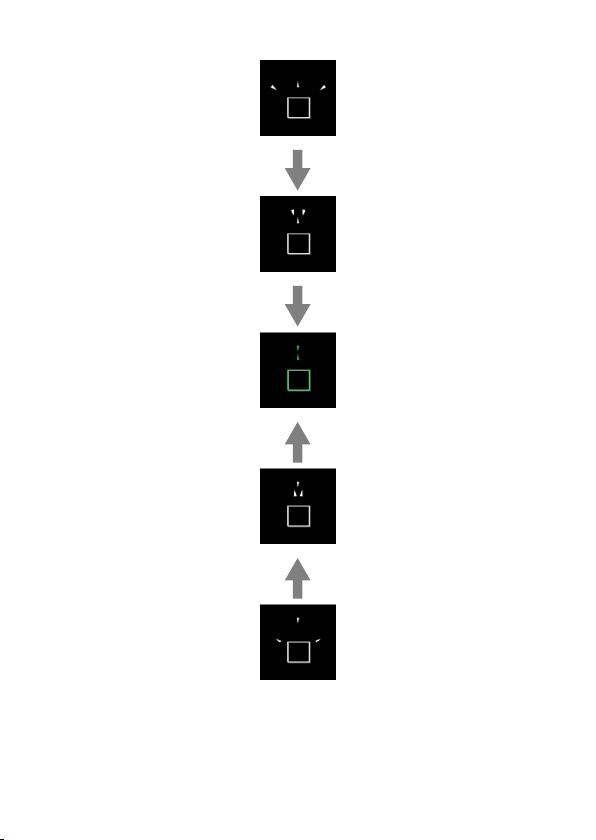
The guide frame indicates the current position in focus and adjustment amount as follows.
Much adjustment needed toward infinity
Slight adjustment needed toward infinity
In focus
Slight adjustment needed toward close range
Much adjustment needed toward close range
448
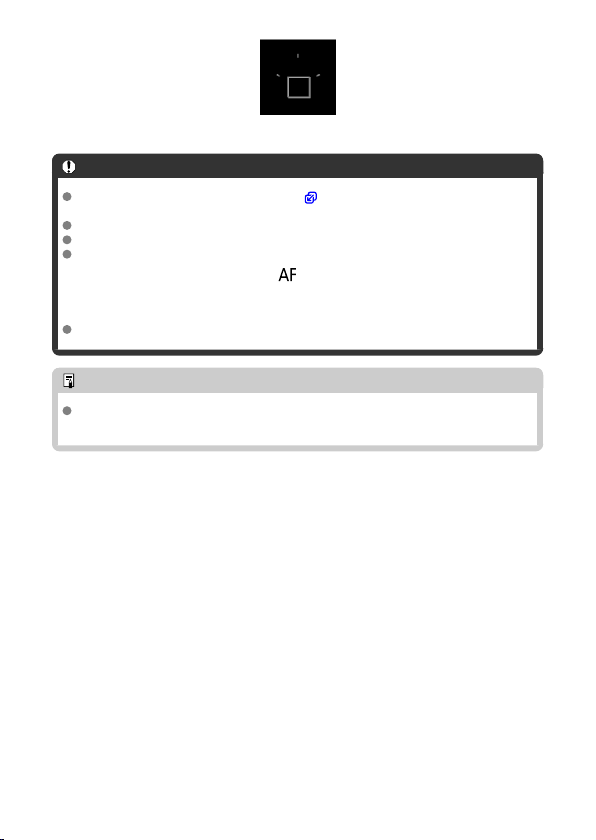
Adjustment information not detected
Caution
Under difficult shooting conditions for AF ( ), the guide frame may not be
displayed correctly.
Higher aperture values are more likely to prevent correct guide frame display.
No AF points are displayed while the guide frame is displayed.
The guide frame is not displayed in these situations.
• When the focus mode is set to < > on the camera or lens
• When display is magnified
• When digital zoom is set
The guide frame is not displayed correctly during shifting or tilting of TS-E lenses.
Note
The camera's auto power off counter does not count time spent adjusting the focus
with a lens's electronic focusing ring.
449
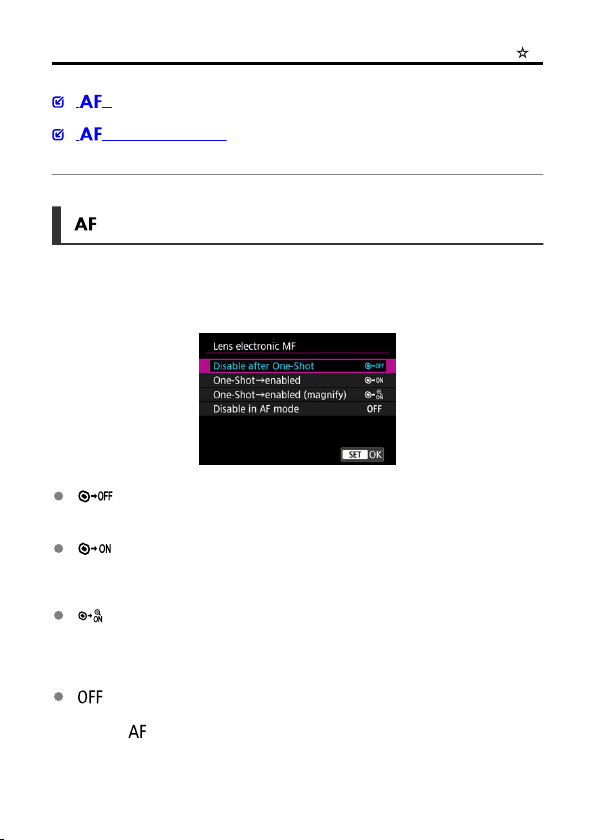
Customizing AF Functions
[ 4]
[ 2] (In Movie Recording)
You can configure AF functions in detail to suit your shooting style or subject.
[
4]
Lens electronic MF
For lenses equipped with electronic manual focusing, you can specify how manual focus
adjustment is used with One-Shot AF.
[ ] Disable after One-Shot
After the AF operation, manual focusing adjustment is disabled.
[ ] One-Shot→enabled
You can manually adjust the focus after the AF operation if you keep holding down the
shutter button halfway.
[ ] One-Shot→enabled (magnify)
You can manually adjust the focus after the AF operation if you keep holding down the
shutter button halfway. You can magnify the area in focus and adjust the focus manually
by turning the lens focusing ring.
[ ] Disable in AF mode
Manual focus adjustment is disabled when the focus mode switch of the camera or lens
is set to <
>.
450
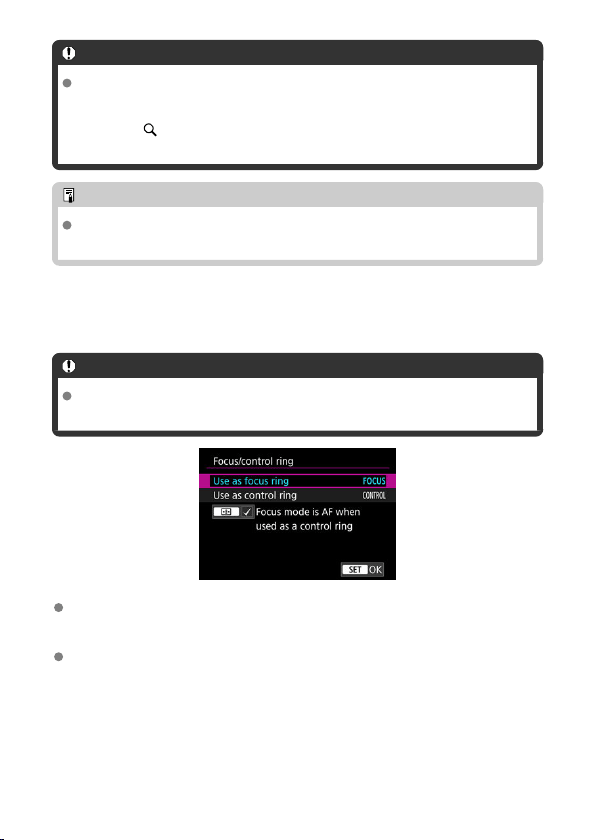
Caution
With [One-Shot→enabled (magnify)], display may not be magnified even if you
turn the lens focusing ring while pressing the shutter button halfway immediately
after shooting. If so, you can magnify display by releasing the shutter button,
waiting for [
] display, then pressing the shutter button halfway as you turn the
lens focusing ring.
Note
For details on your lens's manual focus specifications, refer to the Lens Instruction
Manual.
Use as a focusing or control ring
Menu-based switching of lens focus/control ring functionality.
Caution
Available when using lenses that have a combination focus/control ring but have no
switch to switch between these features.
Use as focus ring
The ring works as a focusing ring.
Use as control ring
The ring works as a control ring.
451
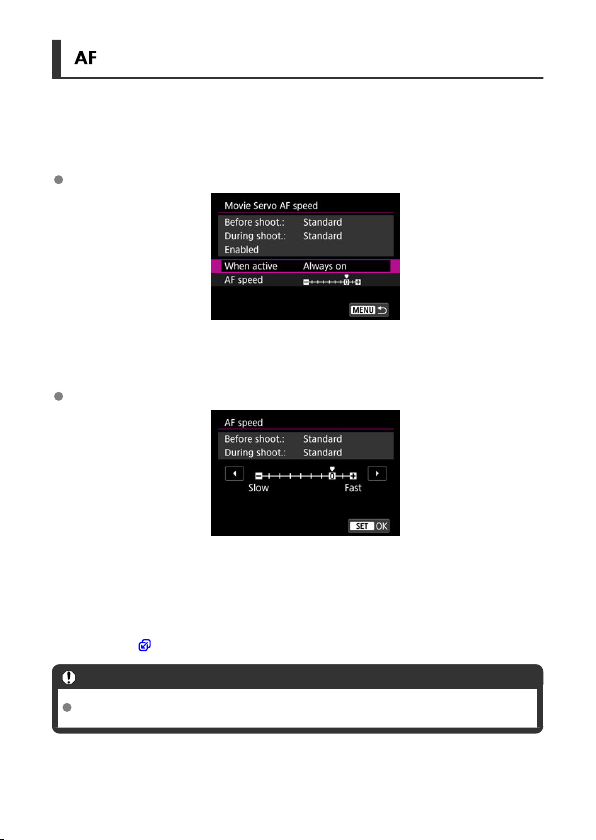
[ 2] (In Movie Recording)
Movie Servo AF speed
You can set the AF speed and operating conditions for Movie Servo AF. The function is
enabled when using a lens supporting slow focus transition during movie recording*.
When active
You can set [Always on] to have the AF speed take effect at all times for movie
recording (before and during movie recording) or set [During shooting] to have the AF
speed take effect only during movie recording.
AF speed
You can adjust the AF speed (focus transition speed) from the standard speed (0) to
slow (one of seven levels) or fast (one of two levels) to obtain the desired effect for the
movie creation.
* Lenses supporting slow focus transition during movie recording
USM and STM lenses released in and after 2009 are compatible. For details, refer to the
Canon website (
).
Caution
With certain lenses, even if you adjust the AF speed, the speed may not change.
453
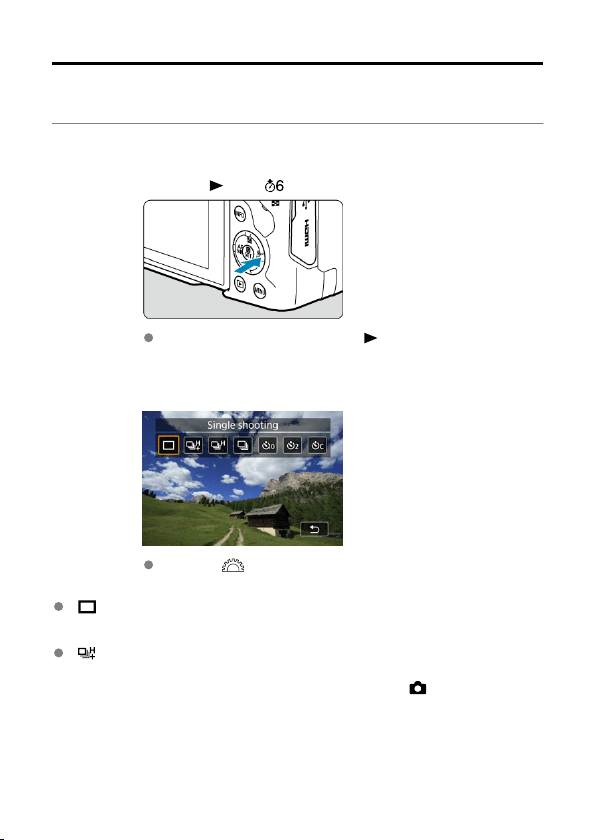
Selecting the Drive Mode
Single and continuous drive modes are provided. You can select the drive mode suiting the
scene or subject.
1.
Press the <
> key ( ).
With an image displayed, press the < > key.
2.
Select the drive mode item.
Turn the < > dial to select the drive mode item.
[ ] Single shooting
When you hold down the shutter button completely, only one shot will be taken.
[ ] High-speed continuous shooting +
When you hold down the shutter button completely, you can shoot continuously as
described below while you keep holding it down, based on the [
: Shutter mode]
setting.
• [Elec. 1st-curtain]: max. approx. 12 shots/sec.
• [Electronic]: max. approx. 15 shots/sec.
454
[ ] High-speed continuous shooting
When you hold down the shutter button completely, you can shoot continuously as
described below while you keep holding it down, based on the [
: Shutter mode]
setting.
• [Elec. 1st-curtain]: max. approx. 7.6 shots/sec.
• [Electronic]: max. approx. 15 shots/sec.
[ ] Low-speed continuous shooting
When you hold down the shutter button completely, you can shoot continuously as
described below while you keep holding it down, based on the [
: Shutter mode]
setting.
• [Elec. 1st-curtain]: max. approx. 3.0 shots/sec.
• [Electronic]: max. approx. 5.0 shots/sec.
[ ] Self-timer: 10 sec.
[ ] Self-timer: 2 sec.
[ ] Self-timer: Continuous shooting
For details on self-timer shooting, see Using the Self-Timer.
455
Caution
[ ] enables approx. 12 shots/sec. continuous shooting speed when set to [Elec.
1st-curtain] under these conditions.
• Room temperature (23°C/73°F)
• Using any of the following power sources
◦ Fully charged LP-E17 (note that continuous shooting speed may become
slower when using batteries with weak recharge performance)
◦ Household power outlet accessories (sold separately)
◦ USB power adapters (sold separately)
• Shutter speed: 1/1000 sec. or faster
• Flicker reduction: None
[ ] or [ ] enables approx. 15 shots/sec. continuous shooting speed when set
to [Electronic] under these conditions.
• Shutter speed: 1/250 sec. or faster
Note that the continuous shooting speed may be less than approx. 15 shots/sec. if
any of the following occurs during continuous shooting.
• Settings are applied in <P> or <Tv> shooting mode that cause the aperture
value to change
• Zooming is performed
• Manual focusing is performed
• Servo AF changes the position in focus
Continuous shooting speed with Servo AF may be slower depending on subject
conditions or the lens used.
Visit the Canon website for details on lenses supporting the maximum continuous
shooting speed ( ).
Continuous shooting speed may be lower when shooting under flickering light with
[
: Anti-flicker shoot.] set to [Enable] ( ). Also, the continuous shooting
interval may become irregular and the release time lag may become longer.
When internal memory becomes full during continuous shooting, the continuous
shooting speed may drop off because shooting will be temporarily disabled ( ).
456
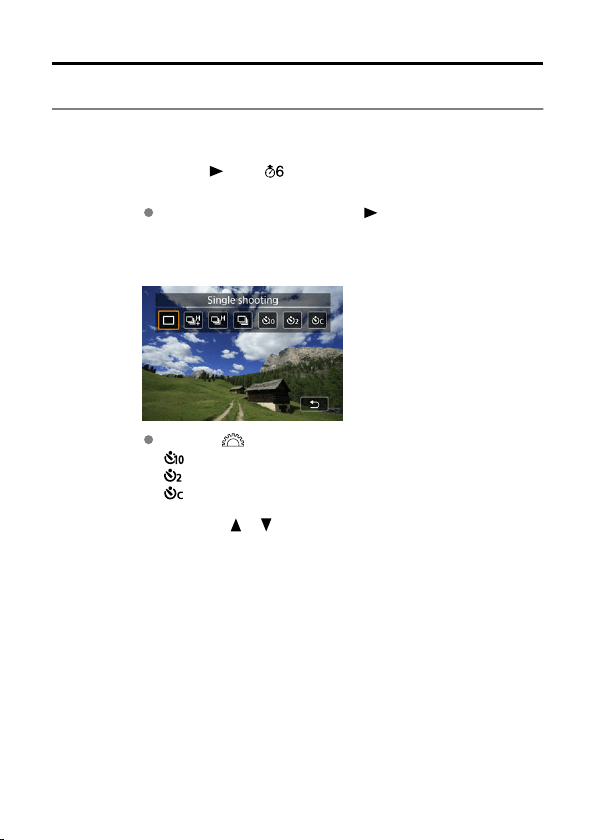
Using the Self-Timer
Use the self-timer when you want to be in the picture such as a commemorative photograph.
1.
Press the <
> key ( ).
With an image displayed, press the < > key.
2.
Select the drive mode item.
Turn the < > dial to select the self-timer.
: Shoot in 10 sec.
: Shoot in 2 sec.
: Shoot continuously in 10 sec. for the specified number of
shots*
* Press the <
>< > keys to set the number of shots to take (2–10).
457
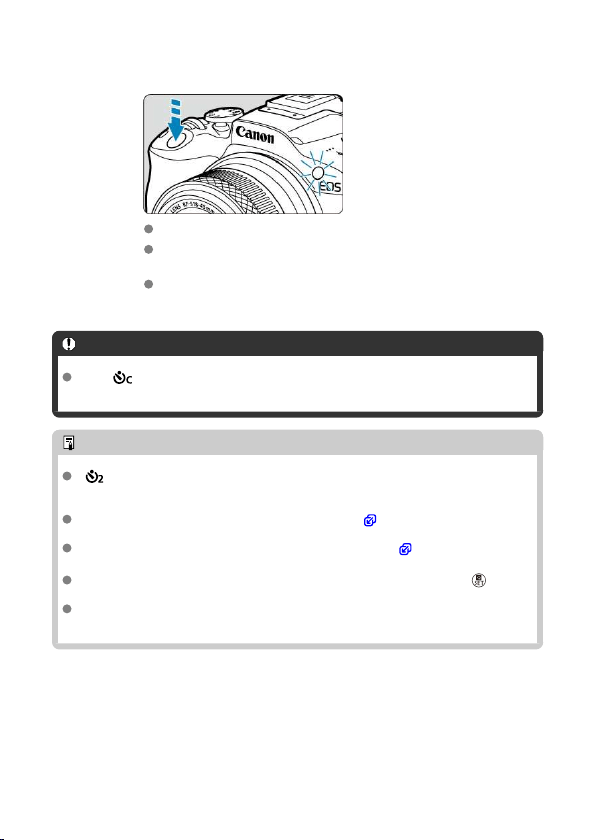
3.
Take the picture.
Focus on the subject, then press the shutter button completely.
To check operation, look at the self-timer lamp, listen for beeps, or
watch the countdown in seconds on the screen.
Self-timer lamp blinking accelerates and the camera beeps quickly
approx. 2 sec. before the picture is taken.
Caution
With [ ], the continuous shooting interval may be longer depending on image
quality, use of external flash, and other shooting conditions.
Note
[ ] is used to start shooting without touching the camera (to avoid camera shake)
when it is mounted on a tripod for shots such as still lifes or long exposures, for
example.
After taking self-timer shots, playing back the image ( ) to check focus and
exposure is recommended.
When using the self-timer to shoot yourself, use focus lock ( ) on an object at the
same distance as where you will stand.
To cancel the self-timer after it starts, either tap the screen or press the < >
button.
Auto power off time may be extended when the camera is set for remote control
shooting.
458
Remote Control Shooting
Wireless Remote Control BR-E1
You can shoot remotely by using an optional Wireless Remote Control BR-E1, which pairs
via Bluetooth.
Wireless Remote Control BR-E1
You can shoot remotely up to approx. 5 meters/16.4 feet from the camera.
First, pair the camera and BR-E1 (
).
For operating instructions, refer to the BR-E1 instruction manual.
Note
Auto power off time may be extended when the camera is set for remote control
shooting.
BR-E1 can also be used for movie recording. Even in still photo shooting, you can
record movies by setting the remote control switch to movie mode.
459
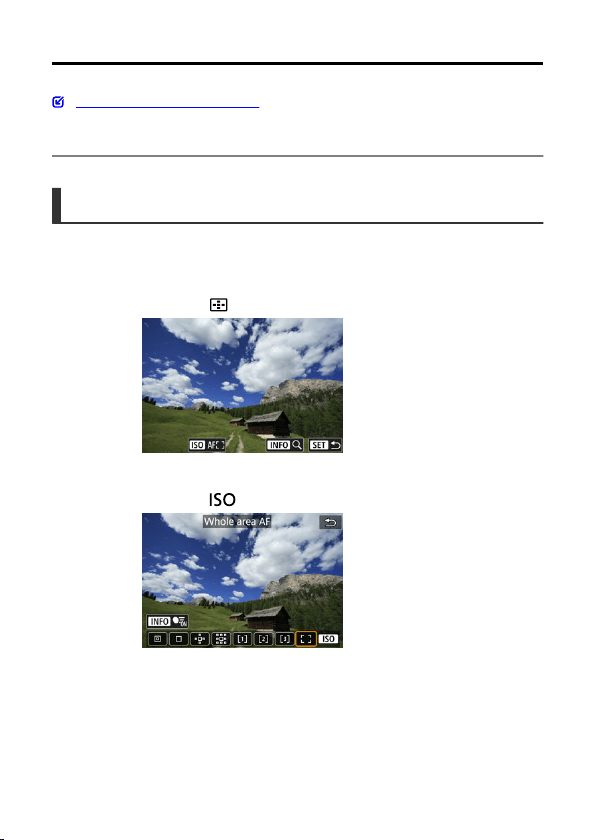
Customizing Operation
Adjusting the Zone AF Frame Size
This section describes ways to customize AF operation. You can also use a combination of
customized settings.
Adjusting the Zone AF Frame Size
You can resize the Zone AF frame displayed for Flexible Zone AF 1–3.
1.
Press the <
> button during shooting screen display.
2.
Press the <
> button.
460
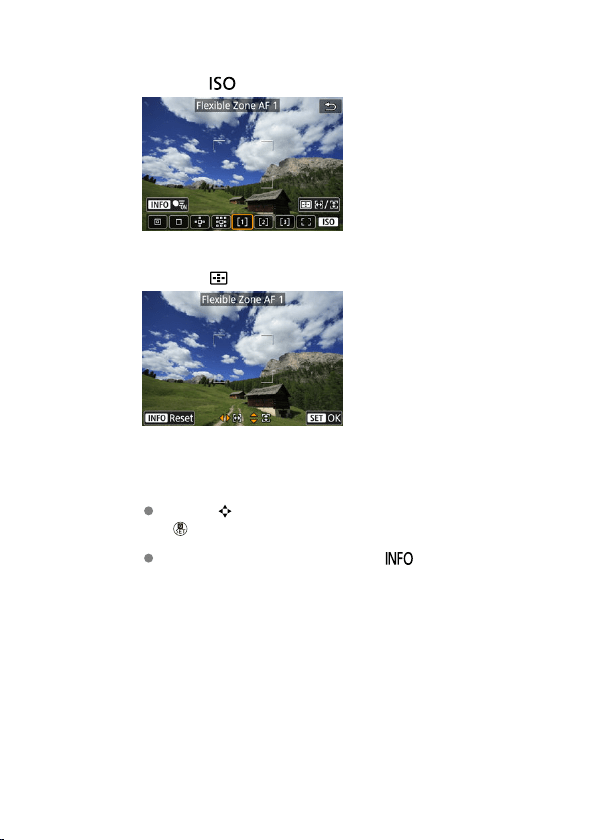
3.
Press the <
> button and select Flexible Zone AF 1, 2, or 3.
4.
Press the <
> button.
5.
Adjust the Zone AF frame size.
Use the < > keys to adjust the Zone AF frame size, then press the
<
> button.
To restore the default setting, press the < > button.
461
Playback
This chapter covers topics related to playback—playing back captured still photos and
movies—and introduces menu settings on the playback [
] tab.
Caution
Normal display or selection on this camera may not be possible for images
captured on other cameras, or images from this camera that have been edited or
renamed on a computer or other device.
Images that cannot be used with playback functions may be displayed.
• Tab Menus: Playback
• Image Playback
• Magnified Image Display
• Index Display (Multiple-Image Display)
• Movie Playback
• Editing a Movie's First and Last Scenes
• Frame Extraction from 4K Movies
• Digest Movie Editing
• Playback on a TV Set
• Protecting Images
• Erasing Images
• Rotating Still Photos
• Changing Movie Orientation Information
• Rating Images
• Print Ordering (DPOF)
• Creative Assist
• Playback Creative Filters
• Red-Eye Correction
• Resizing JPEG/HEIF Images
• Cropping JPEG/HEIF Images
• Converting HEIF to JPEG
• Slide Show
• Setting Image Search Conditions
• Resuming from Previous Playback
• Browsing Images with the Dial
• Customizing Playback Information Display
• AF Point Display
• Playback Grid
462

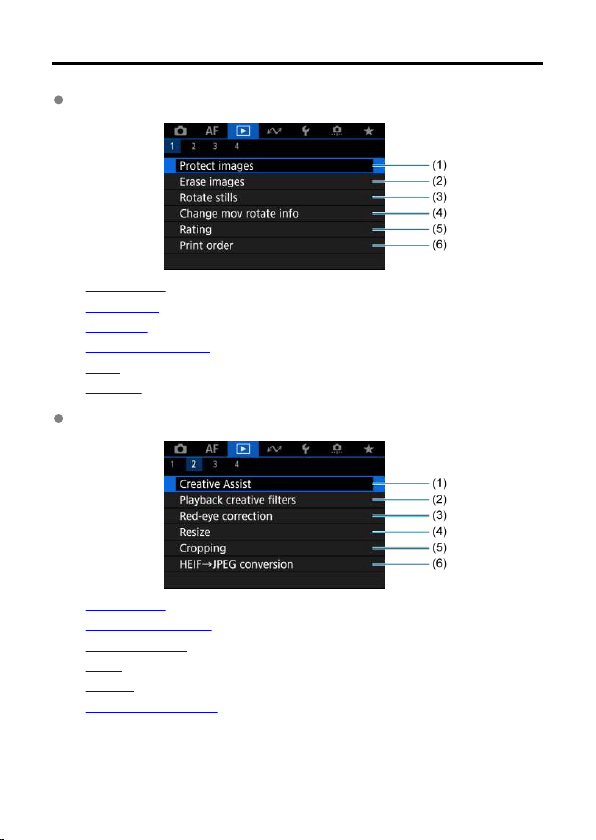
Tab Menus: Playback
Playback 1
(1) Protect images
(2) Erase images
(3) Rotate stills
(4) Change mov rotate info
(5) Rating
(6) Print order
Playback 2
(1) Creative Assist
(2) Playback creative filters
(3) Red-eye correction
(4) Resize
(5) Cropping
(6) HEIF→JPEG conversion
In Basic Zone modes, [HEIF→JPEG conversion] is not displayed.
464
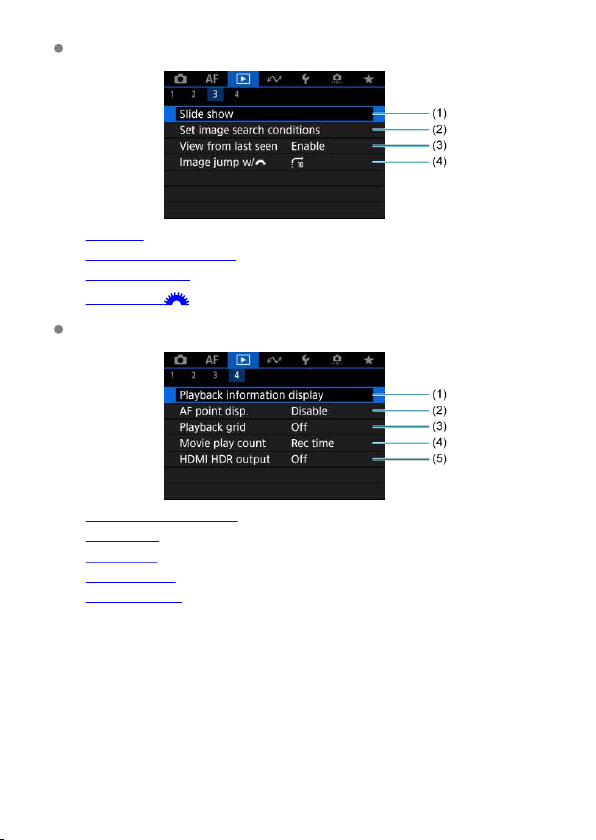
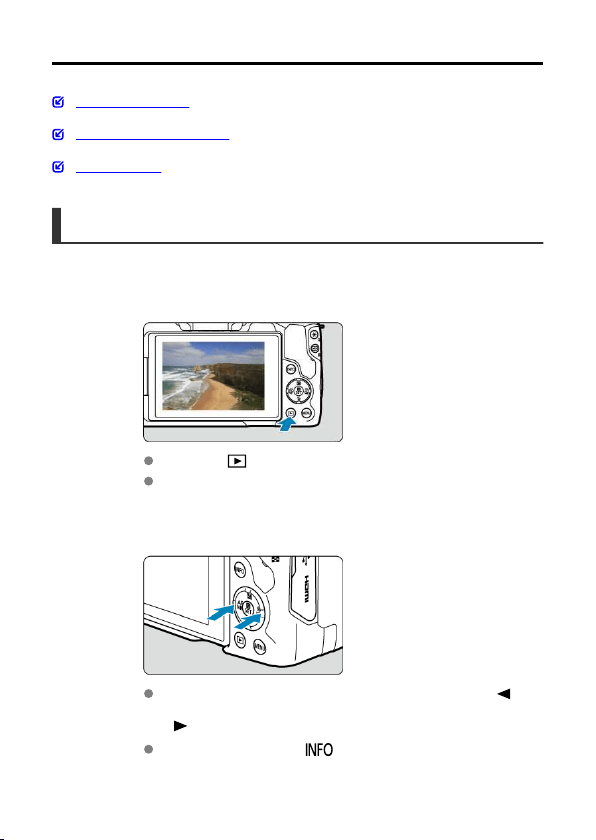
Image Playback
Single-Image Display
Shooting Information Display
Touch Playback
Single-Image Display
1.
Switch to playback.
Press the < > button.
The last image captured or played back is displayed.
2.
Browse images.
To play back images starting with the most recent, press the < >
key. To display images starting with the first captured image, press the
<
> key.
Each time you press the < > button, the display will change.
466
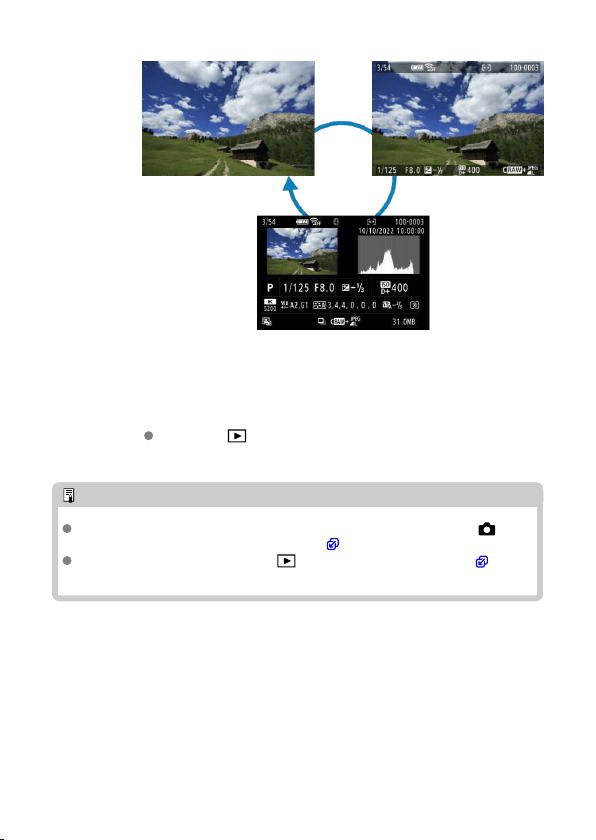
No information Basic information display
Shooting information display
3.
Exit image playback.
Press the < > button to exit image playback and return to shooting
standby.
Note
Lines indicating the image area are shown on RAW images captured with [ : Still
img aspect ratio] set to [1:1], [4:3], or [16:9] ( ).
If the search conditions are set with [ : Set image search conditions] ( ), only
the filtered images will be displayed.
467
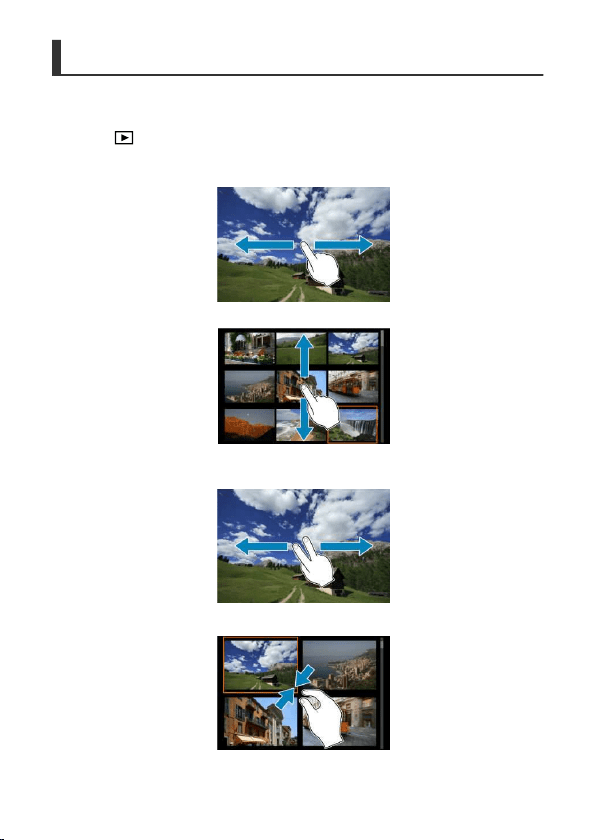
Touch Playback
The camera features a touch-screen panel that you can touch to control playback.
Supported touch operations are like those used with smartphones and similar devices. First,
press the <
> button to prepare for touch playback.
Browse images
Jump display
Index display
469

Magnified view
Note
You can also magnify display by double-tapping with one finger.
470
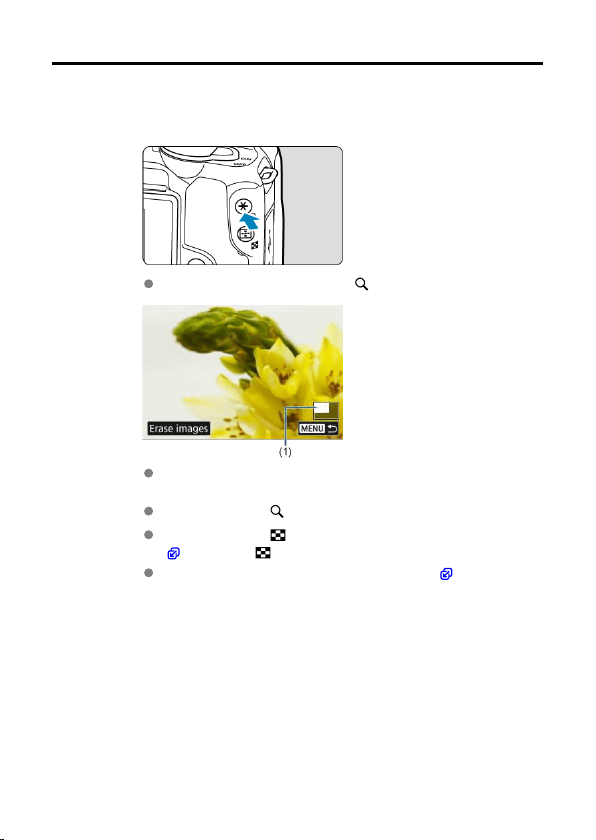
Magnified Image Display
1.
Magnify the image.
During image playback, press the < > button.
The magnified view will appear. The magnified area position (1) will be
displayed in the lower right of the screen.
Each press of the < > button magnifies display.
Each press of the < > button reduces display. For index display
(
), press the < > button again after the final reduction.
To erase the current image, select [Erase images] ( ).
471
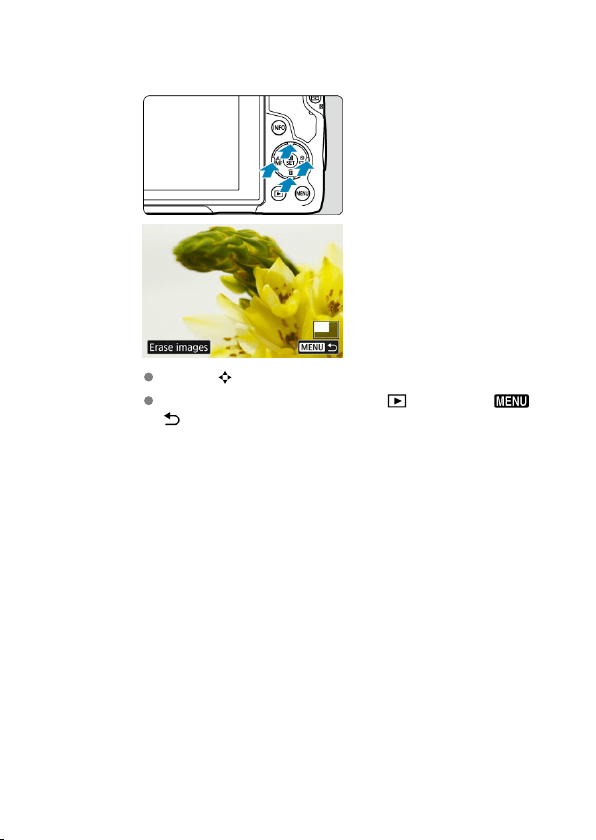
2.
Scroll the image.
Use the < > keys to scroll around the magnified image.
To cancel the magnified view, press the < > button or tap [
].
472
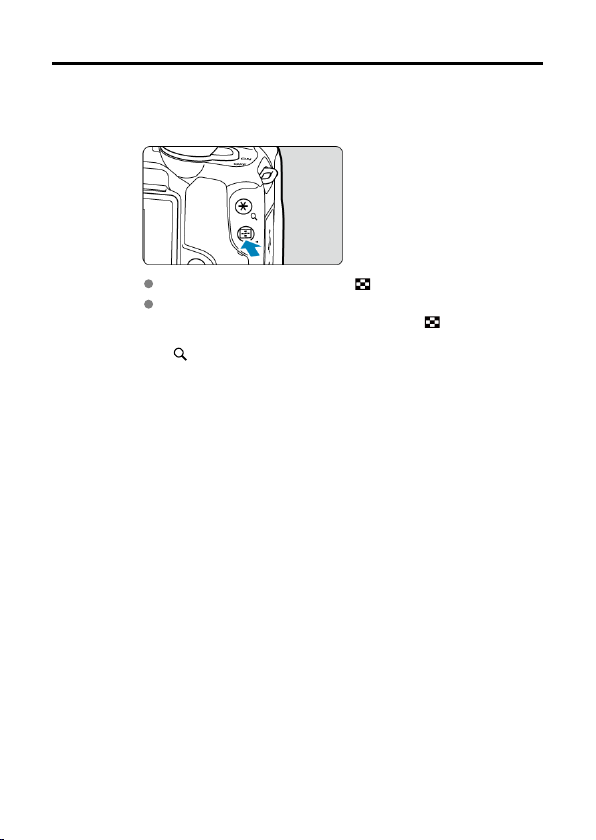
Index Display (Multiple-Image Display)
1.
Switch to the index display.
During image playback, press the < > button.
The 4-image index display will appear. The selected image is
highlighted with an orange frame. Pressing the <
> button again
switches display from 9 images to 36, and then to 100. Pressing the
<
> button switches display from 100 images to 36, 9, 4, and then
single-image display.
473
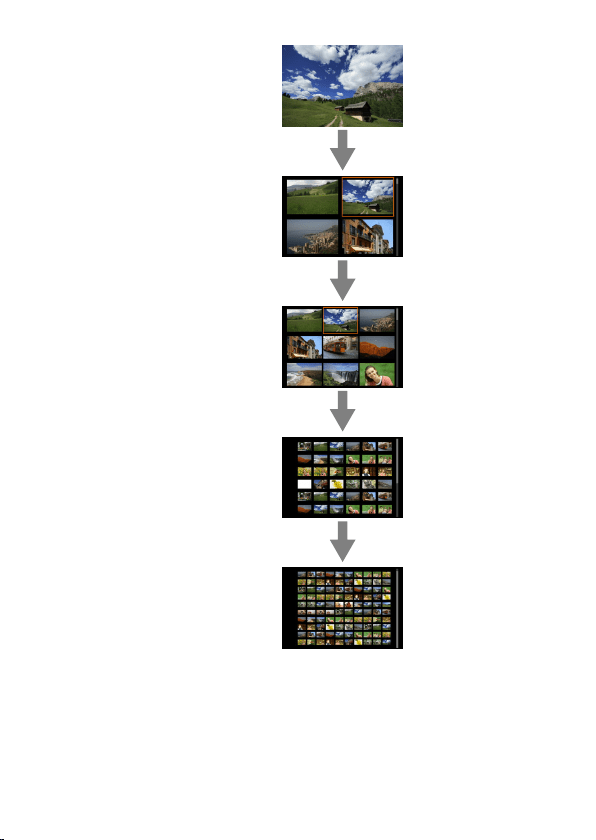
474
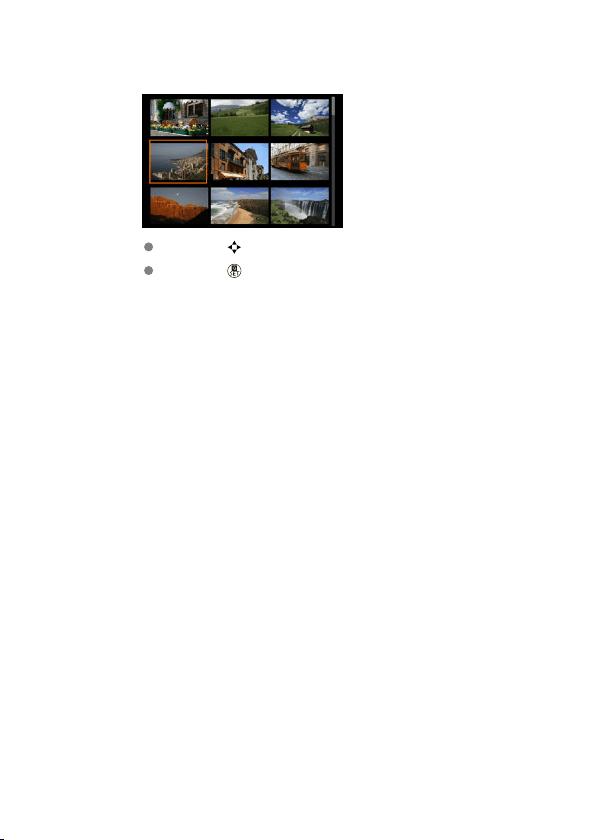
2.
Browse images.
Press the < > keys to move the orange frame for image selection.
Press the < > button in index display to show the selected image in
single-image display.
475
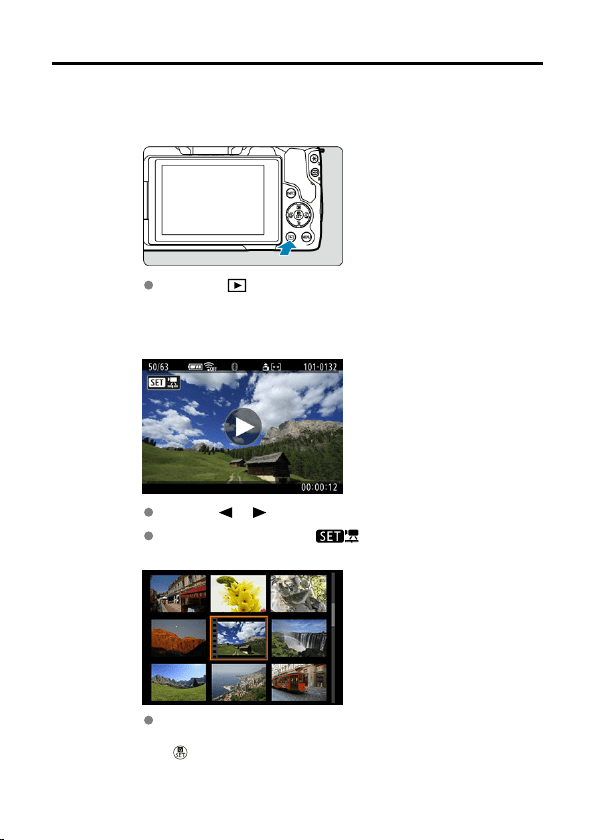
Movie Playback
1.
Switch to playback.
Press the < > button.
2.
Select a movie.
Use the < >< > keys to select a movie to play.
In single-image display, the [ ] icon displayed in the upper left of
the screen indicates a movie.
In index display, perforations at the left edge of a thumbnail indicate a
movie. Movies cannot be played from index display, so press the
<
> button to switch to single-image display.
476
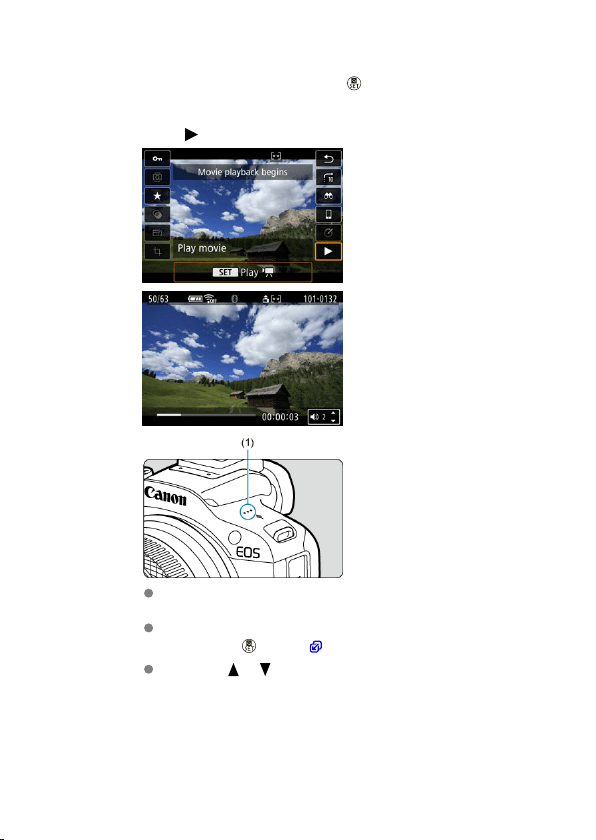
3.
In single-image display, press the <
> button.
4.
Select [
].
The movie will start playing back. Sound is played through the speaker
(1).
You can pause playback and access the movie playback panel by
pressing the <
> button ( ). Press it again to resume the playback.
Press the < >< > keys to adjust the volume (even during
playback).
477
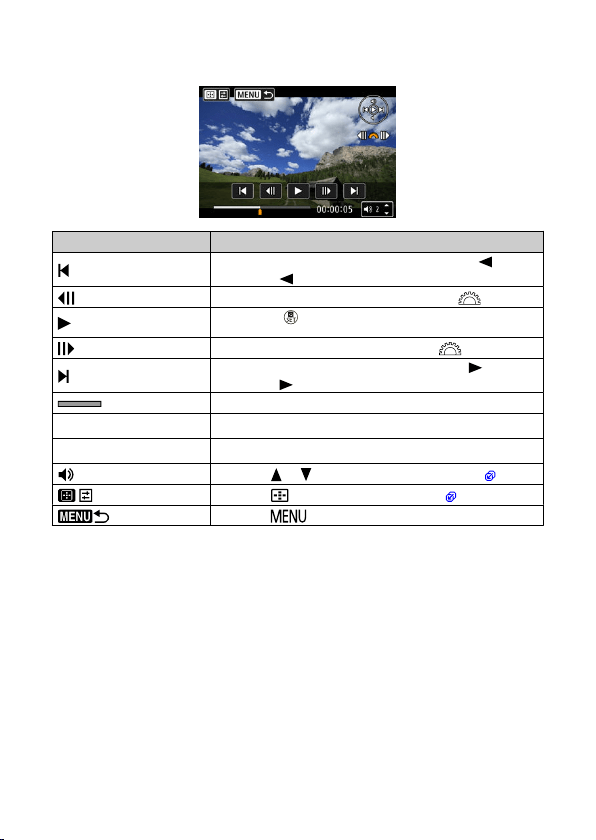
Movie playback panel
Item Playback Operations
Skip backward
Skips backward approx. 1 sec. each time you press the <
> key.
Holding the <
> key down will rewind the movie.
Previous frame Displays the previous frame each time you turn the < > dial left.
Playback
Pressing the <
> button toggles between playing movies and
stopping playback.
Next frame Displays the next frame each time you turn the < > dial right.
Skip forward
Skips forward approx. 1 sec. each time you press the <
> key.
Holding the
<
> key down will fast forward the movie.
Playback position
hh:mm:ss
Playback time (hours:minutes:seconds, when [Movie play count] is
set to [Rec time])
hh:mm:ss.ff (DF)
hh:mm:ss:ff (NDF)
Time code (hours:minutes:seconds:frames, when [Movie play count]
is set to [Time code])
Volume Press the < >< > keys to adjust the speaker volume ( ).
Press the < > button to go to the next screen ( ).
Press the < > button to return to single-image display.
478

Digest movie playback panel
Item Playback Operations
Previous clip Press the < > key to display the first frame of the previous clip.
Previous frame Displays the previous frame each time you turn the < > dial left.
Playback
Pressing the <
> button toggles between playing movies and
stopping playback.
Next frame Displays the next frame each time you turn the < > dial right.
Next clip Press the < > key to display the first frame of the next clip.
Playback position
hh:mm:ss Playback time (hours:minutes:seconds)
Volume Press the < >< > keys to adjust the speaker volume ( ).
Press the < > button to go to the next screen ( ).
Press the < > button to return to single-image display.
479
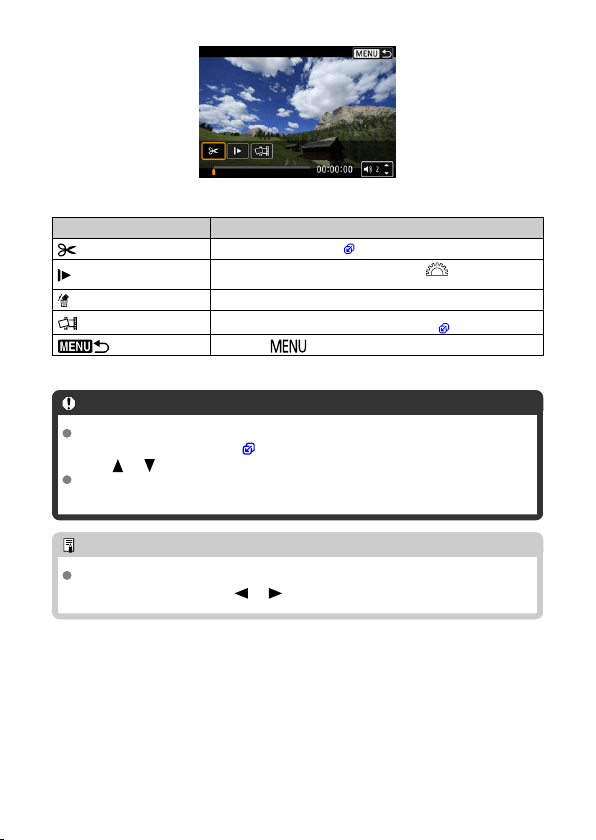
Controls not on the previous two screens are as follows.
Item Playback Operations
Edit
Displays the editing screen (
).
Slow motion
Adjust the slow motion speed by turning the <
> dial. The slow
motion speed is indicated in the upper right of the screen.
Erase clip*
Erases the current clip.
Frame Grab
Available when you play 4K movies. Enables you to extract the current
frame and save it as a JPEG or HEIF still image (
).
Press the < > button to return to the previous screen.
* Displayed only during digest movie playback.
Caution
Adjust the volume using television controls when the camera is connected to a
television for movie playback ( ), because volume cannot be adjusted by pressing
the <
>< > keys.
Movie playback may stop if the card's read speed is too slow or movie files have
corrupted frames.
Note
To skip back or forward to the beginning of the previous or next clip during digest
movie playback, press the <
>< > keys.
480
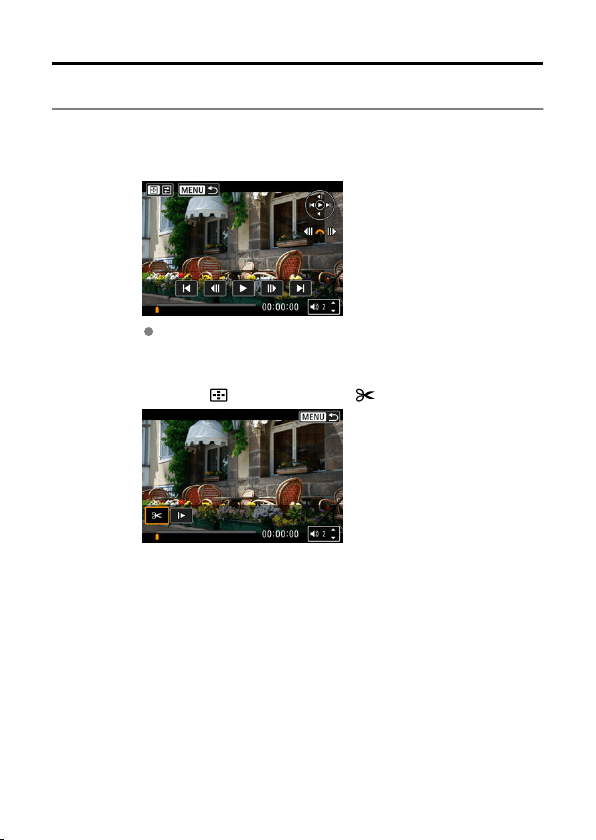
Editing a Movie's First and Last Scenes
You can edit out the first and last scenes of a movie in approx. 1-sec. increments.
1.
Pause movie playback.
The movie playback panel will appear.
2.
Press the <
> button, then select [ ].
481
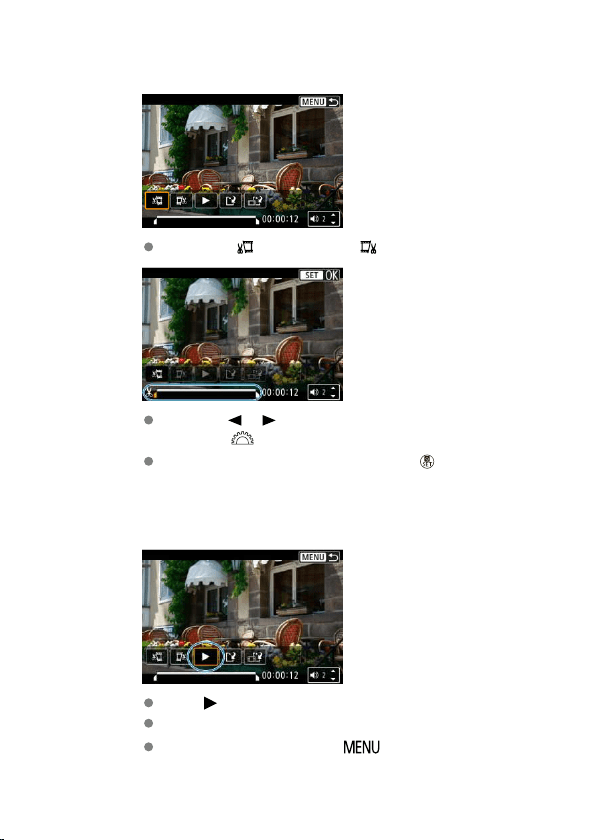
3.
Specify the part to be edited out.
Select either [ ] (cut beginning) or [ ] (cut end).
Press the < >< > keys to go back or forward one frame. Each
turn of the <
> dial goes back or forward one frame.
After deciding which part to edit out, press the < > button. The
portion indicated by a line at the bottom of the screen will remain.
4.
Check the edited movie.
Select [ ] to play back the edited movie.
To change the edited part, go back to step 3.
To cancel the editing, press the < > button.
482
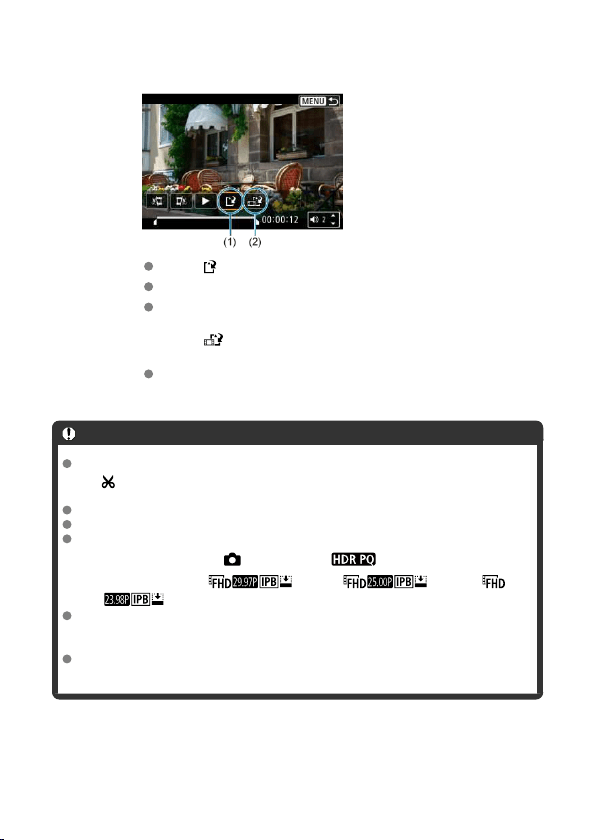
5.
Save.
Select [ ] (1).
The save screen will appear.
To save it as a new file, select [New file], or to save it and overwrite the
original movie file, select [Overwrite].
Select [
] (2) to save a compressed version of the file. 4K movies are
converted to Full HD movies before compression.
On the confirmation screen, select [OK] to save the edited movie and
return to the movie playback screen.
Caution
Because editing is performed in approx. 1 sec. increments (at the position indicated
by [
] at the bottom of the screen), the actual position where movies are trimmed
may differ from your specified position.
Movies shot with another camera cannot be edited with this camera.
You cannot edit a movie when the camera is connected to a computer.
Compress and save is not available for the following movies.
• Movies recorded with [ : HDR shooting ] set to [Enable]
• Movies recorded in (NTSC), (PAL), or
(NTSC) sizes
Movies may not be compressed when the remaining battery capacity is low. Use of
a fully charged battery or a household power outlet accessory (sold separately) is
recommended.
For extensive movie editing, consider using an optional household power outlet
accessory.
483
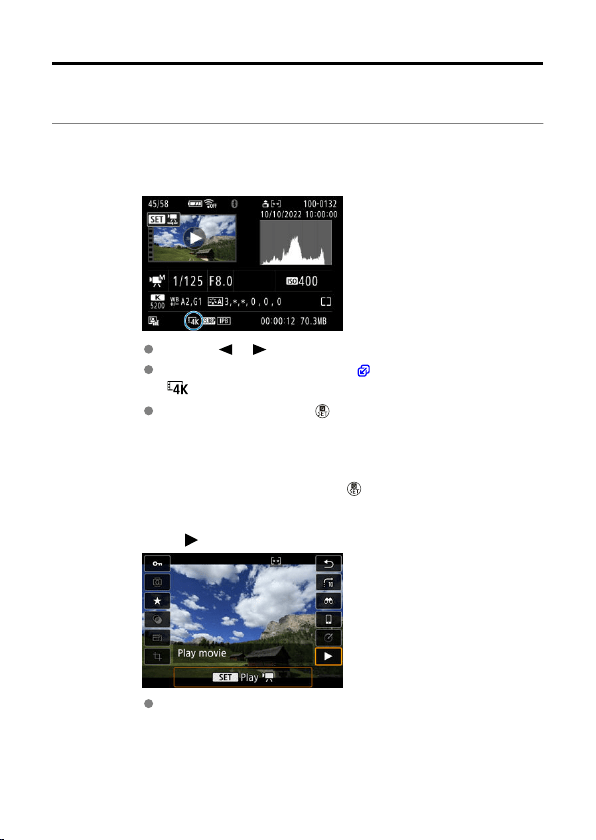
Frame Extraction from 4K Movies
From 4K movies, you can select individual frames to save as JPEG or HEIF still images.
This is referred to as “frame grabbing.”
1.
Select a 4K movie.
Use the < >< > keys for selection.
On the shooting information screen ( ), 4K movies are labeled with
[
] icons.
In index display, press the < > button to switch to single-image
display.
2.
In single-image display, press the <
> button.
3.
Select [
].
The movie will start playing back.
484
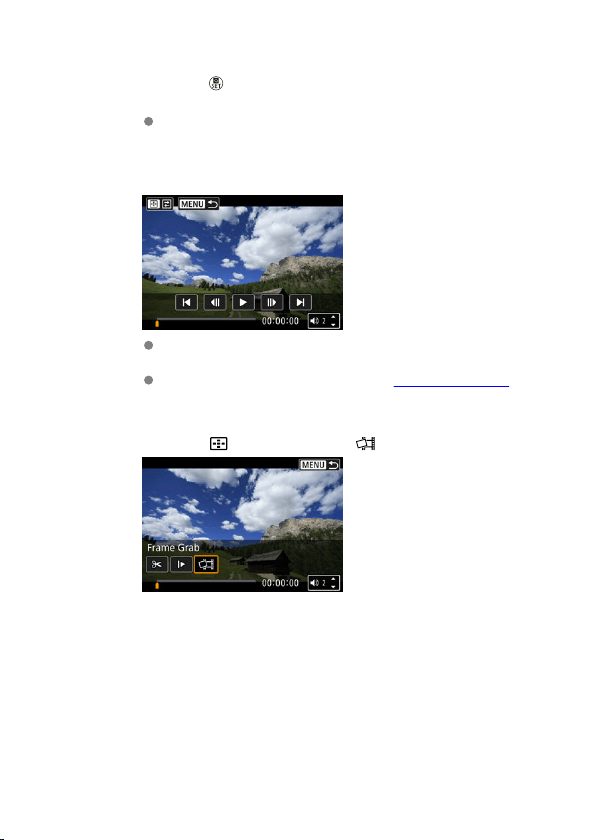
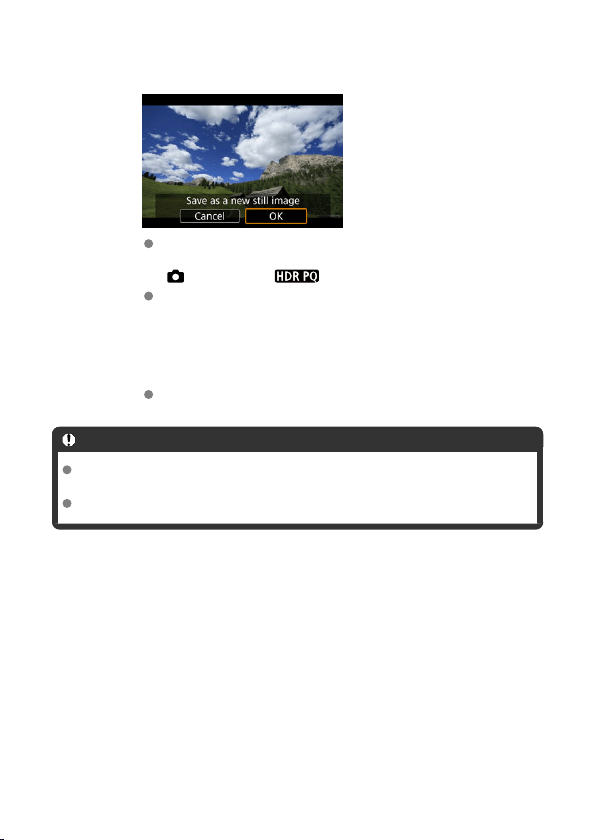
7.
Save.
Select [OK] to save the current frame as a JPEG still image.
HEIF images are saved if you grab frames from movies recorded with
[
: HDR shooting ] set to [Enable].
Check the destination folder and image file number.
8.
Select the image to display.
Select [View original movie] or [View extracted still image].
Caution
Frame grabbing is not possible from the following 4K movies.
• Movies recorded with other cameras
Frame grabbing is not possible while the camera is connected to a computer.
486
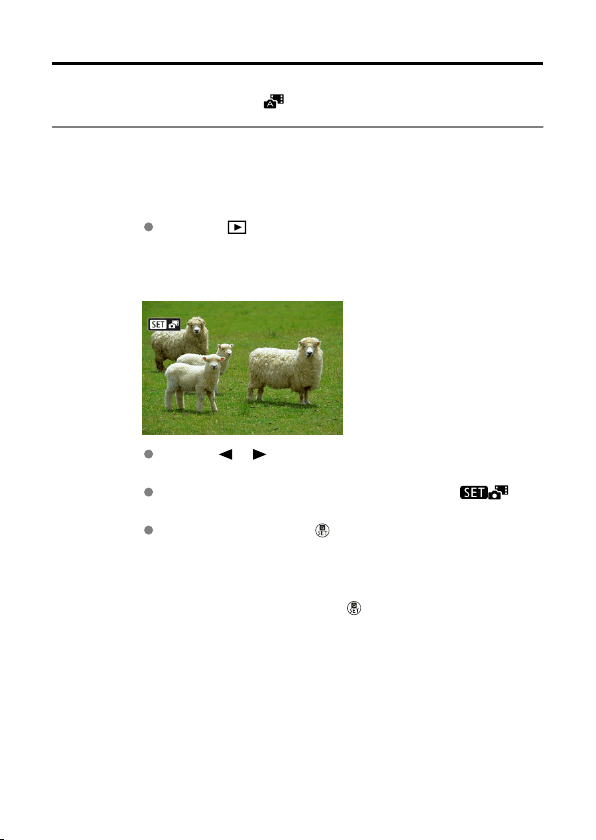
Digest Movie Editing
Individual chapters (clips) recorded in <
> mode can be erased. Be careful when erasing
clips, because they cannot be recovered.
1.
Switch to playback.
Press the < > button.
2.
Select a still photo with an attached digest movie.
Use the < >< > keys to select a still photo that includes a digest
movie.
In single-image display, digest movies are labeled with [ ] in
the upper left.
In index display, press the < > button to switch to single-image
display.
3.
In single-image display, press the <
> button.
487
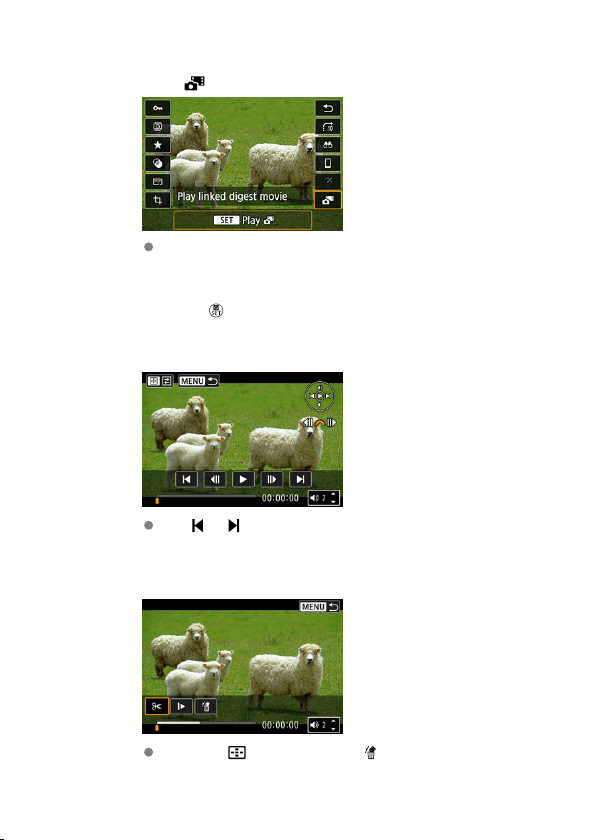
4.
Select [
].
Digest movie playback begins.
5.
Press the <
> button to pause the digest movie.
6.
Select a clip.
Use [ ] or [ ] to select a clip.
7.
Erase the clip.
Press the < > button, then select [ ].
488
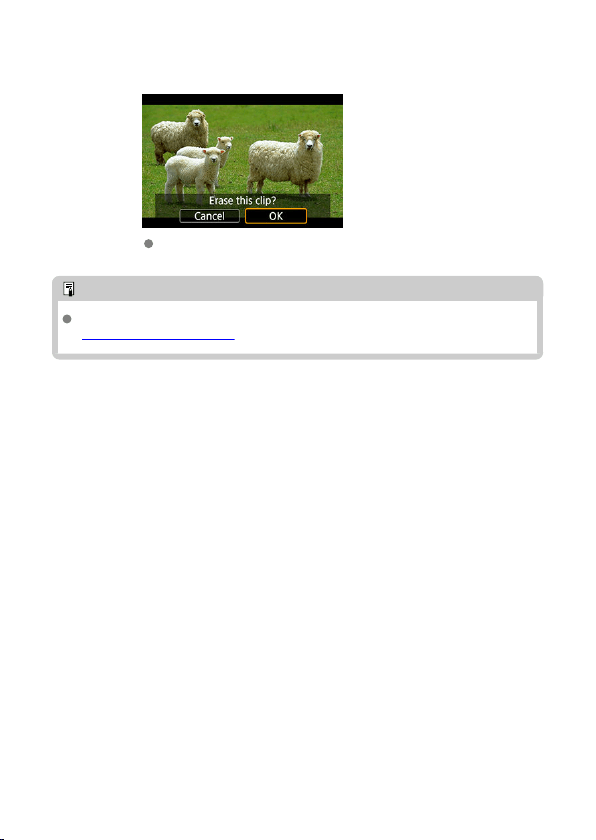
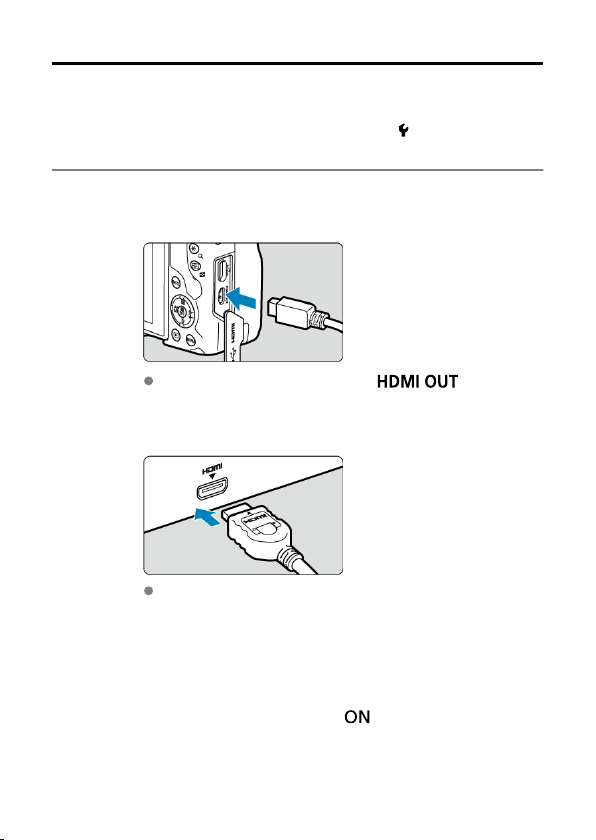
Playback on a TV Set
By connecting the camera to a television with a commercially available HDMI cable, you can
play back the captured still photos and movies on the television.
If the image does not appear on the TV screen, confirm that [
: Video system] is
correctly set to [For NTSC] or [For PAL] (depending on the video system of your
television).
1.
Connect the HDMI cable to the camera.
Insert the HDMI cable in the camera's < > terminal.
2.
Connect the HDMI cable to the television.
Connect the HDMI cable to the television's HDMI IN port.
3.
Turn on the television and switch the television's video input to select
the connected port.
4.
Set the camera's power switch to <
>.
490
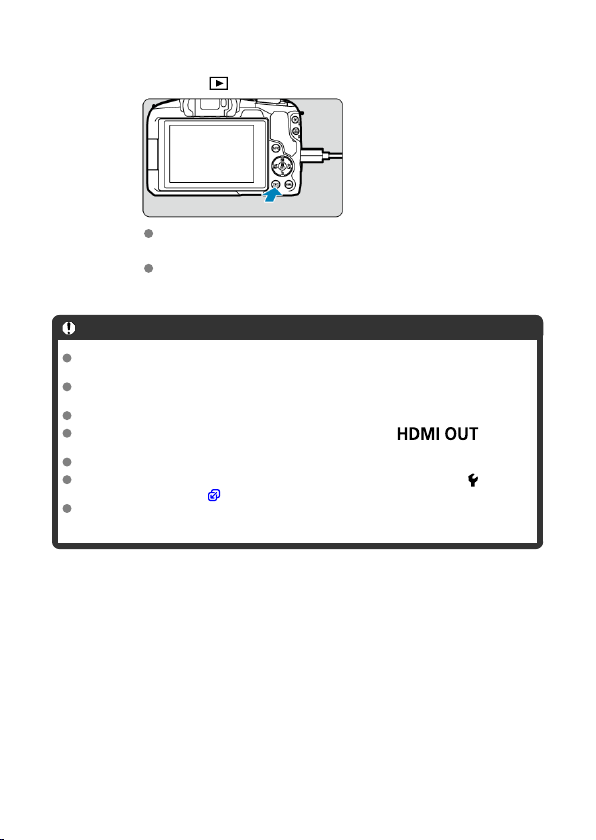
5.
Press the <
> button.
Images are now displayed on the television, with nothing displayed on
the camera screen.
The images will automatically be displayed at the optimum resolution
matching the connected television.
Caution
Adjust movie sound volume with the television. The sound volume cannot be
adjusted with the camera.
Before connecting or disconnecting the cable between the camera and television,
turn off the camera and television.
Depending on the television, part of the image displayed may be cut off.
Do not connect any other device's output to the camera's < >
terminal. Doing so may cause a malfunction.
Certain televisions may not display the images due to incompatibility.
It may take some time before images are displayed. To avoid delay, set [ : HDMI
resolution] to [1080p] ( ).
Touch-screen operations are not supported while the camera is connected to a
television.
491
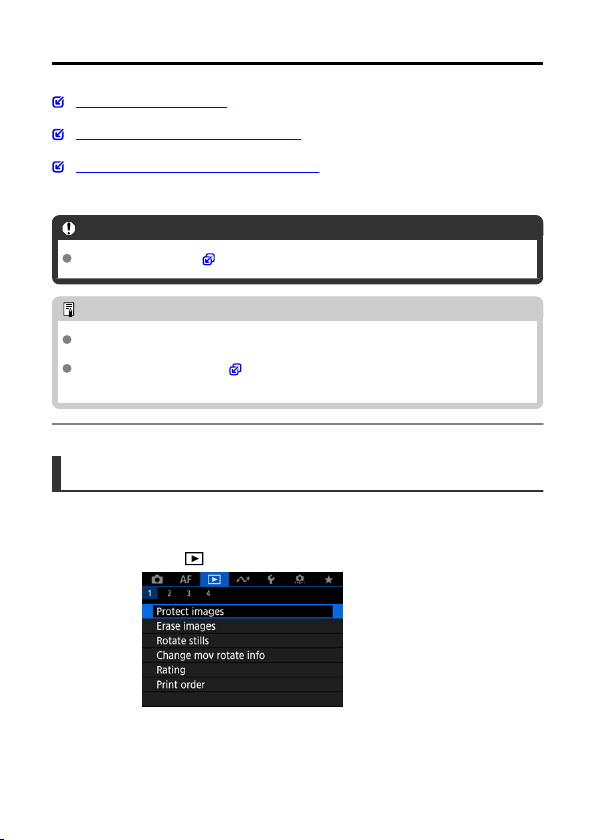
Protecting Images
Protecting Individual Images
Specifying the Range of Images to Protect
Protecting All Images in a Folder or on a Card
You can protect important images from being accidentally erased.
Caution
If you format the card ( ), the protected images will also be erased.
Note
Once an image is protected, it cannot be erased by the camera's erase function. To
erase a protected image, you must first cancel the protection.
If you erase all the images ( ), only the protected images will remain. This is
convenient when you want to erase all unneeded images at once.
Protecting Individual Images
1.
Select [
: Protect images].
492
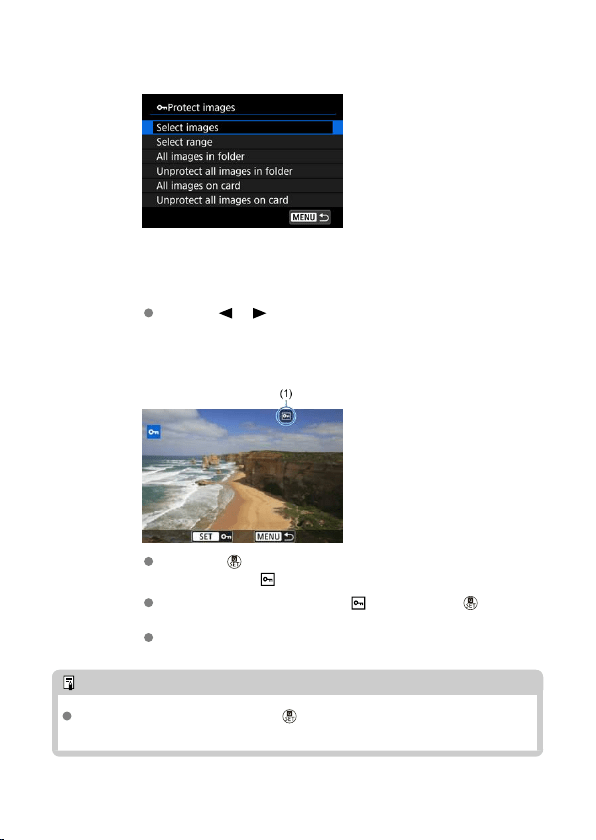
2.
Select [Select images].
3.
Select the image to protect.
Use the < >< > keys to select an image to protect.
4.
Protect the image.
Press the < > button to protect the selected image, after which it will
be labeled with a [
] icon (1) at the top of the screen.
To cancel protection and clear the [ ] icon, press the < > button
again.
To protect another image, repeat steps 3 and 4.
Note
During playback, you can press the < > button and protect images from the
Quick Control screen.
493
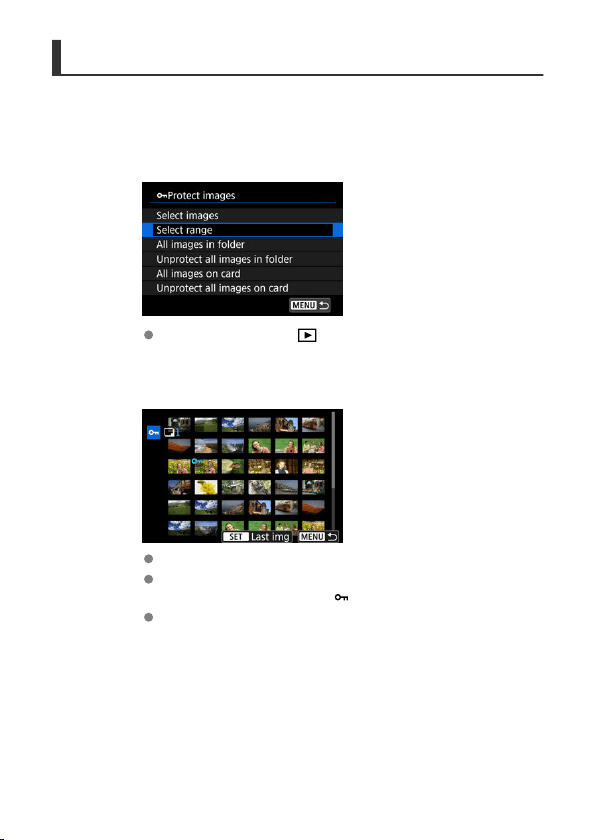
Specifying the Range of Images to Protect
While looking at the images in the index display, you can specify the first and last images for
a range to protect all the specified images at once.
1.
Select [Select range].
Select [Select range] in [ : Protect images].
2.
Specify the range of images.
Select the first image (start point).
Next, select the last image (end point). The images in the specified
range will be protected and the [
] icon will appear.
To select another image to protect, repeat step 2.
494
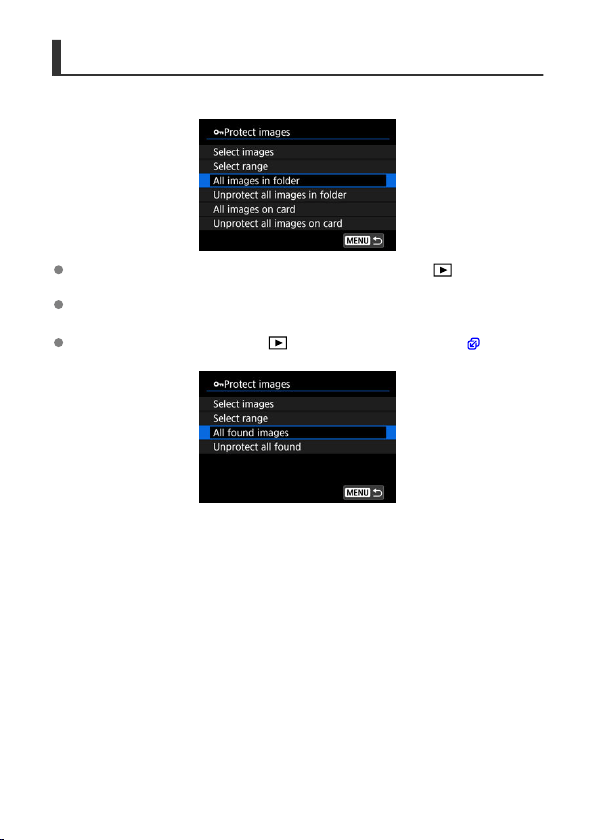
Protecting All Images in a Folder or on a Card
You can protect all the images in a folder or on a card at once.
When you select [All images in folder] or [All images on card] in [ : Protect
images], all the images in the folder or on the card will be protected.
To cancel protection, select [Unprotect all images in folder] or [Unprotect all images
on card].
If the search conditions are set with [ : Set image search conditions] ( ), the
display will change to [All found images] and [Unprotect all found].
• If you select [All found images], all the images filtered by the search conditions will be
protected.
• If you select [Unprotect all found], the protection of all the filtered images will be
canceled.
495
Erasing Images
Erasing Images Individually
Selecting ([ ]) Multiple Images to Erase Together
Specifying the Range of Images to Erase
Erasing All Images in a Folder or on a Card
You can either select and erase unnecessary images individually or erase them in one
batch. Protected images (
) will not be erased.
Caution
Once an image is erased, it cannot be recovered. Make sure you no longer
need the image before erasing it. To prevent important images from being
erased accidentally, protect them.
Erasing Images Individually
1.
Press the <
> button.
2.
Select the image to erase.
Use the < >< > keys to select the image to erase.
496
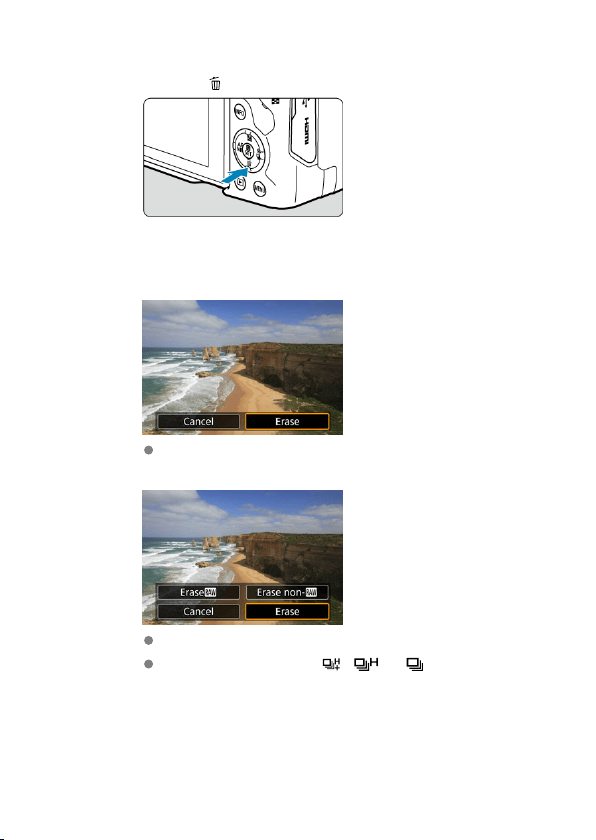
3.
Press the <
> button.
4.
Erase the images.
JPEG/HEIF/RAW images or movies
Select [Erase].
RAW+JPEG/RAW+HEIF images
Select an option.
Series of images captured in [ ], [ ], or [ ] drive mode are
erased when you select [Erase scene including image] during
playback.
497
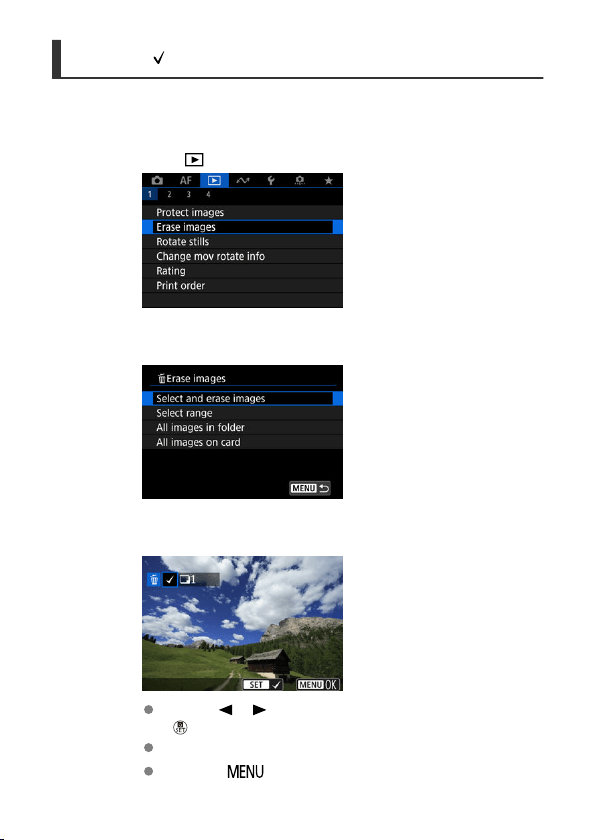
Selecting ([ ]) Multiple Images to Erase Together
By adding checkmarks to the images to be erased, you can erase all those images at once.
1.
Select [
: Erase images].
2.
Select [Select and erase images].
3.
Select an image.
Use the < >< > keys to select an image to erase, then press the
<
> button.
To select another image to be erased, repeat step 3.
Press the < > button.
498
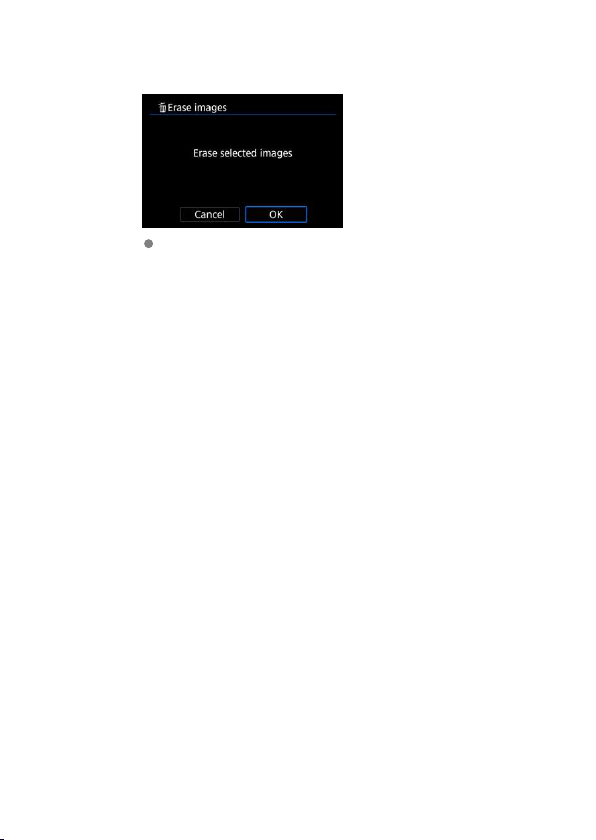
4.
Erase the images.
Select [OK].
499
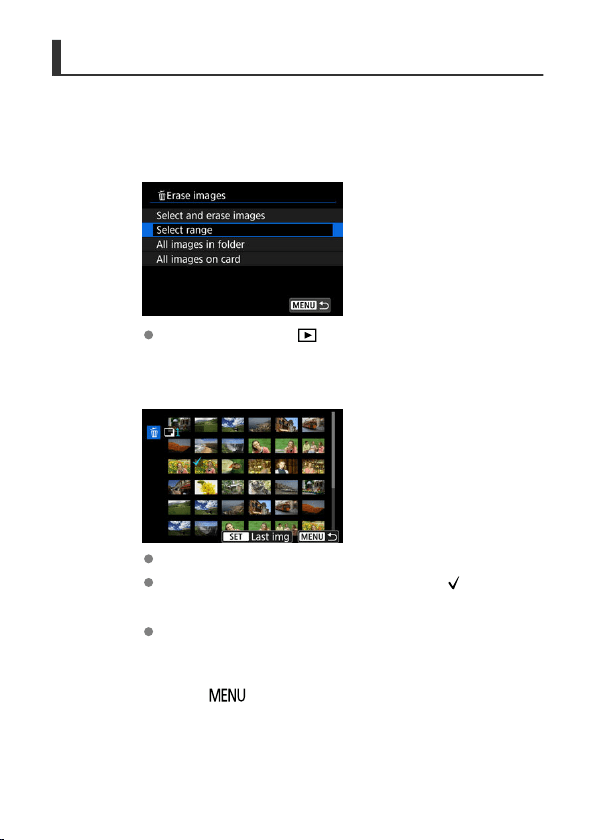
Specifying the Range of Images to Erase
While looking at the images in the index display, you can specify the first and last images for
a range to erase all the specified images at once.
1.
Select [Select range].
Select [Select range] in [ : Erase images].
2.
Specify the range of images.
Select the first image (start point).
Next, select the last image (end point). A checkmark [ ] will be
appended to all the images within the range between first and last
images.
To select another image to be erased, repeat step 2.
3.
Press the <
> button.
500
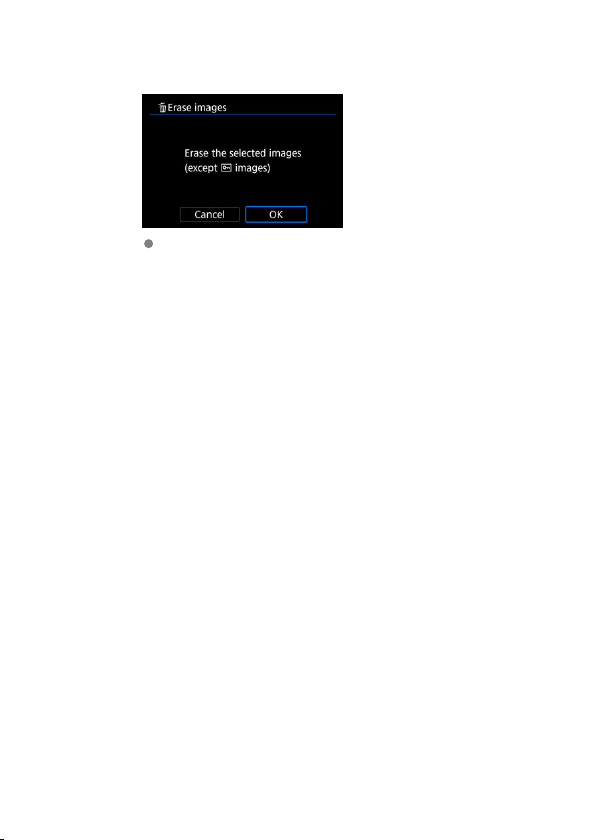
4.
Erase the images.
Select [OK].
501
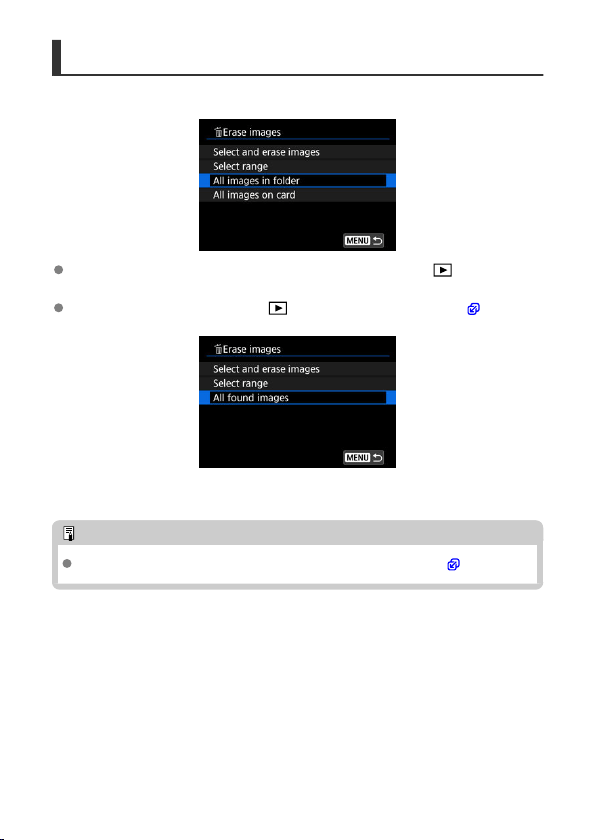
Erasing All Images in a Folder or on a Card
You can erase all the images in a folder or on a card at once.
When you select [All images in folder] or [All images on card] in [ : Erase images],
all the images in the folder or on the card will be erased.
If the search conditions are set with [ : Set image search conditions] ( ), the
display will change to [All found images].
• If you select [All found images], all the images filtered by the search conditions will be
erased.
Note
To erase all the images including protected images, format the card ( ).
502
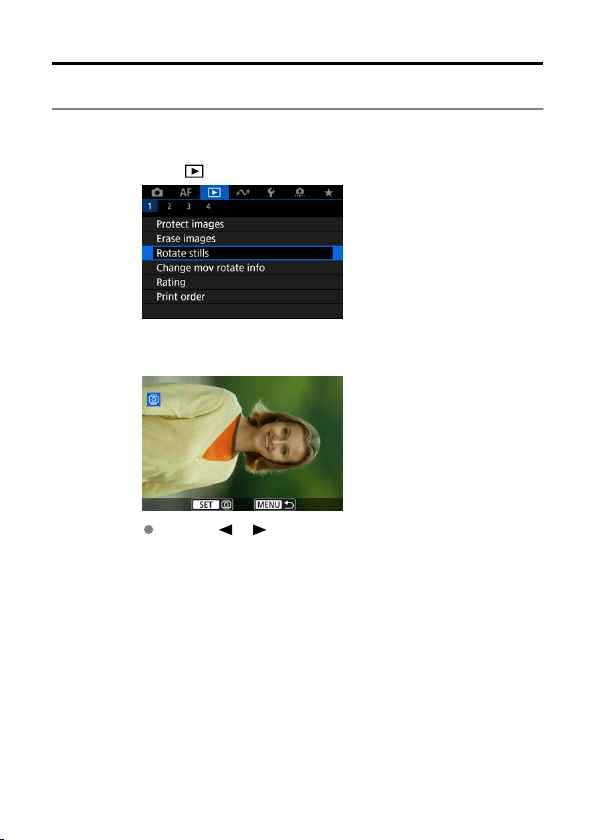
Rotating Still Photos
You can use this feature to rotate the displayed image to the desired orientation.
1.
Select [
: Rotate stills].
2.
Select an image to rotate.
Use the < >< > keys to select an image.
503
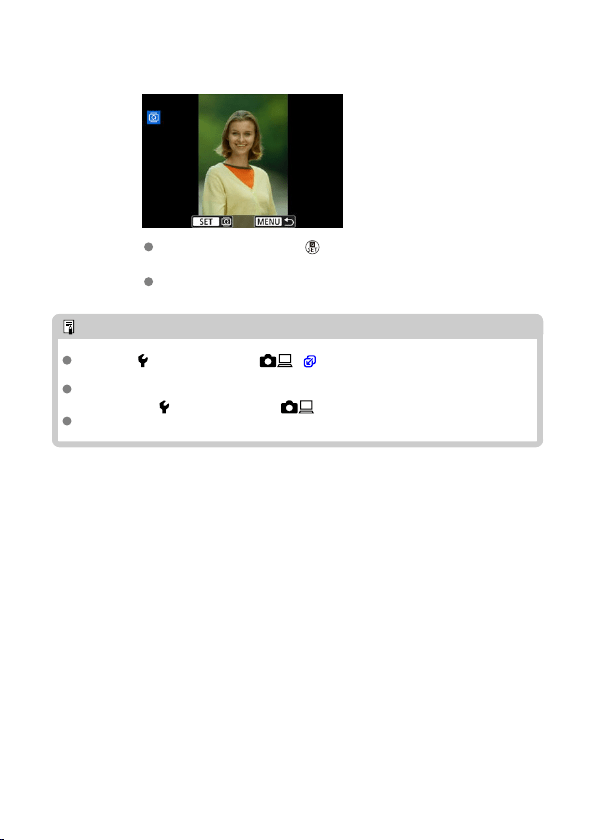
3.
Rotate the image.
Each time you press the < > button, the image is rotated clockwise
as follows: 90° → 270° → 0°.
To rotate another image, repeat steps 2 and 3.
Note
If you set [ : Auto rotate] to [On ] ( ) before taking pictures, you need not
rotate the image with this function.
If the rotated image is not displayed in the rotated orientation during image
playback, set [
: Auto rotate] to [On ].
Movies cannot be rotated.
504
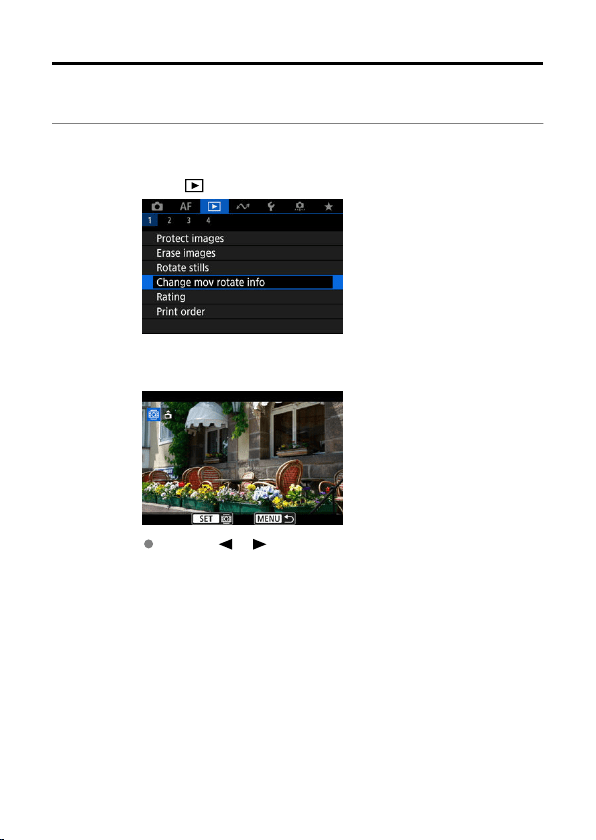
Changing Movie Orientation Information
You can manually edit movie playback orientation information (which determines which side
is up).
1.
Select [
: Change mov rotate info].
2.
Select a movie.
Use the < >< > keys to select a movie with orientation
information to change.
505
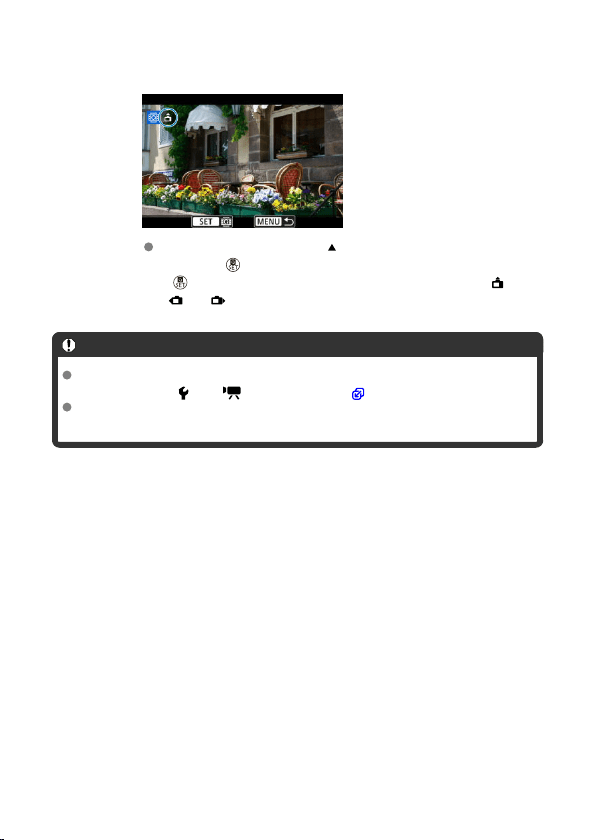
3.
Change the orientation information.
As you watch the camera and icon in the upper left of the screen,
press the <
> button to specify which side is up. Each press of the
<
> button edits the movie rotation information as follows: [ ] →
[
] → [ ].
Caution
Movies are played horizontally on the camera and via HDMI video output,
regardless of the [
: Add rotate info] setting ( ).
Movie orientation information of movies recorded with other cameras cannot be
edited with this camera.
506
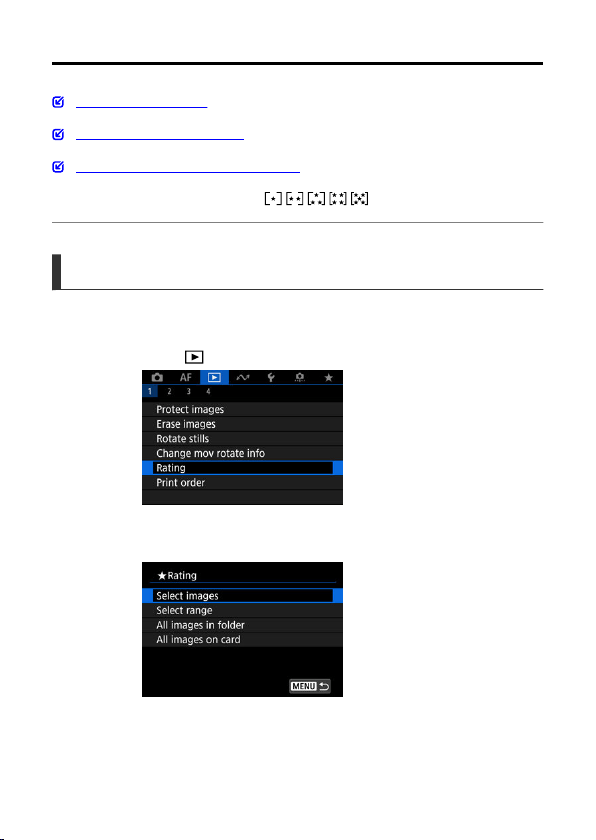
Rating Images
Rating Individual Images
Rating by Specifying the Range
Rating All Images in a Folder or on a Card
You can rate images on a scale of 1–5 ( / / / / ). This function is called rating.
* Rating images can help you organize them.
Rating Individual Images
1.
Select [
: Rating].
2.
Select [Select images].
507
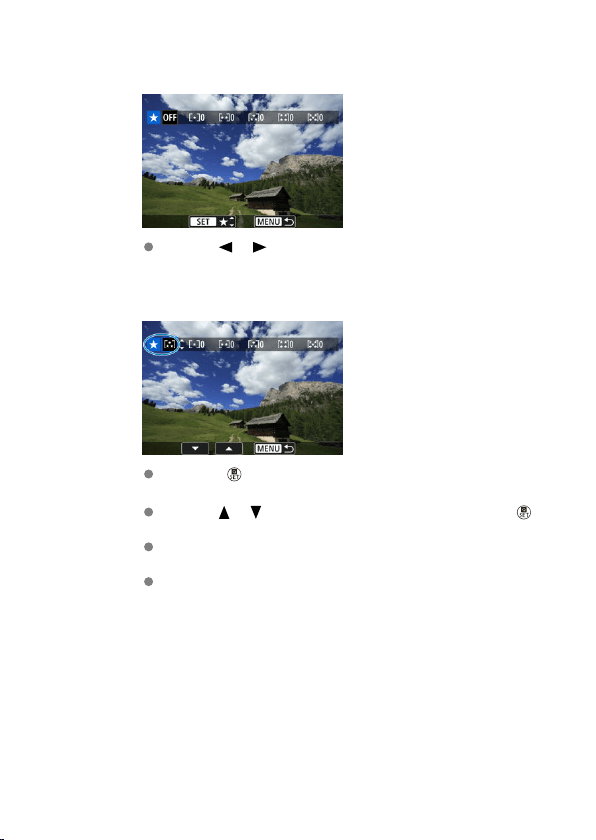
3.
Select the image to rate.
Use the < >< > keys to select the image to rate.
4.
Rate the image.
Press the < > button so that the current rating is outlined in blue, as
shown.
Use the < >< > keys to select a rating mark, then press the < >
button.
When you append a rating mark to the image, the number beside the
set rating will increase by one.
To rate another image, repeat steps 3 and 4.
508
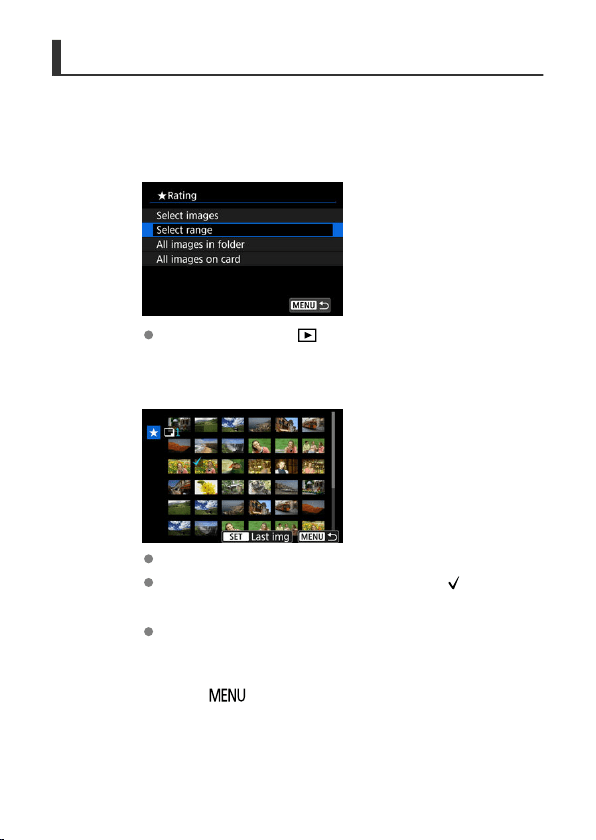
Rating by Specifying the Range
While looking at the images in the index display, you can specify the first and last images for
a range to rate all the specified images at once.
1.
Select [Select range].
Select [Select range] in [ : Rating].
2.
Specify the range of images.
Select the first image (start point).
Next, select the last image (end point). A checkmark [ ] will be
appended to all the images within the range between first and last
images.
To select other images, repeat step 2.
3.
Press the <
> button.
509
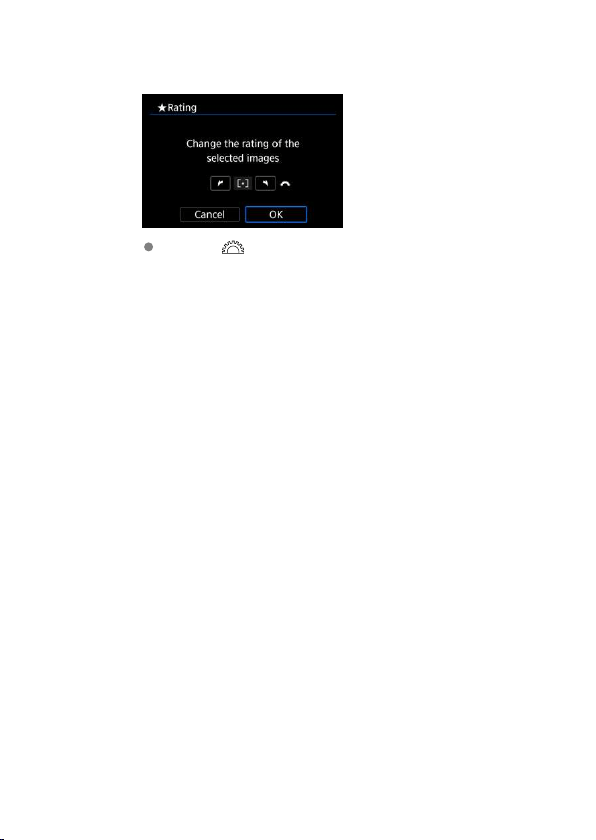
4.
Rate the image.
Turn the < > dial to select a rating mark, then select [OK].
All the images in the specified range will be rated (same rating) at
once.
510
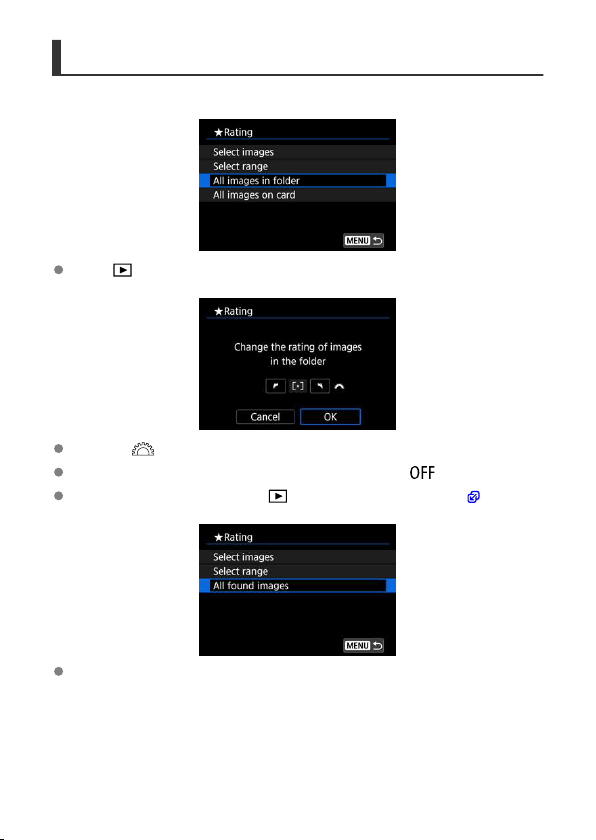
Rating All Images in a Folder or on a Card
You can rate all the images in a folder or on a card at once.
Under [ : Rating], when you select [All images in folder] or [All images on card], all
the images in the folder or on the card will be rated.
Turn the < > dial to select a rating, then select [OK].
When you are not rating images or canceling the rating, select [ ].
If the search conditions are set with [ : Set image search conditions] ( ), the
display will change to [All found images].
If you select [All found images], all the images filtered by the search conditions will be
rated as specified.
511
Note
Values next to ratings are displayed as [###] if more than 1,000 images have that
rating.
With [ : Set image search conditions] and [ : Image jump w/ ], you can
display only the images given a specific rating.
512
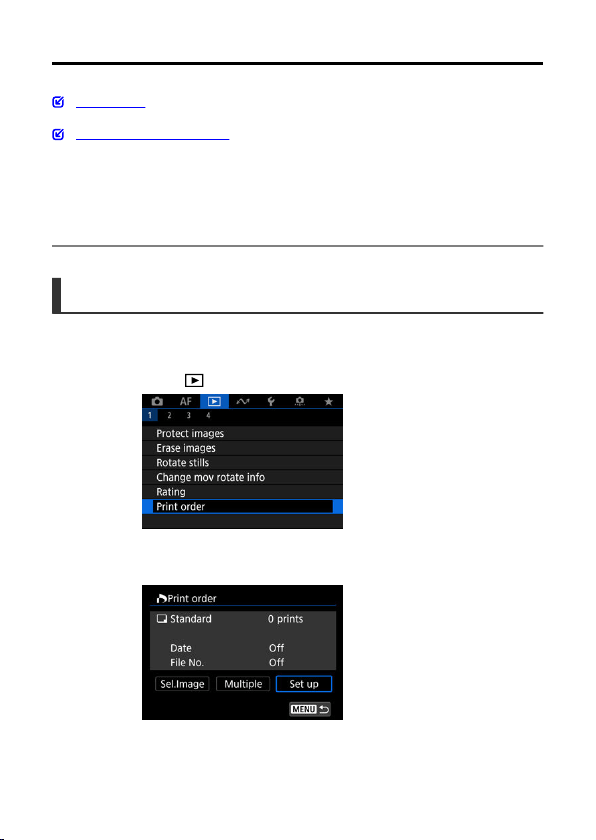
Print Ordering (DPOF)
Print Options
Selecting Images for Printing
DPOF (Digital Print Order Format) enables you to print images recorded on the card
according to your printing instructions such as the image selection, quantity to print, etc. You
can print multiple images in one batch or create a print order for a photofinisher.
You can set the print settings such as print type, date imprinting, file number imprinting, etc.
The print settings will be applied to all the images specified for printing. (They cannot be set
individually for each image.)
Print Options
1.
Select [
: Print order].
2.
Select [Set up].
513
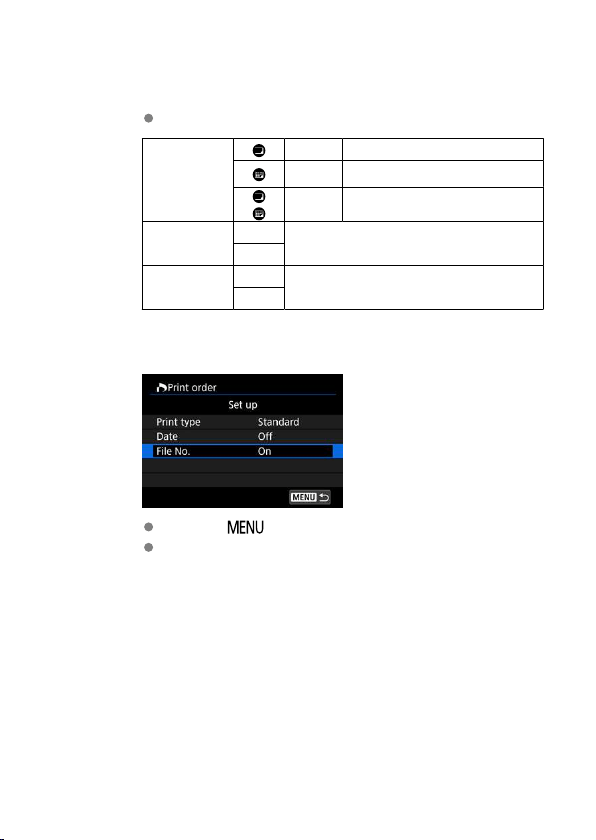
3.
Set the options as desired.
Set [Print type], [Date], and [File No.] options.
Print type
Standard Prints one image on one sheet.
Index
Multiple thumbnail images are printed
on one sheet.
Both
Prints both the standard and index
prints.
Date
On
[On] imprints the recorded date of the captured
image.
Off
File No.
On
[On] imprints the file number.
Off
4.
Exit the setting.
Press the < > button.
Next, select [Sel.Image] or [Multiple] to specify the images to be
printed.
514
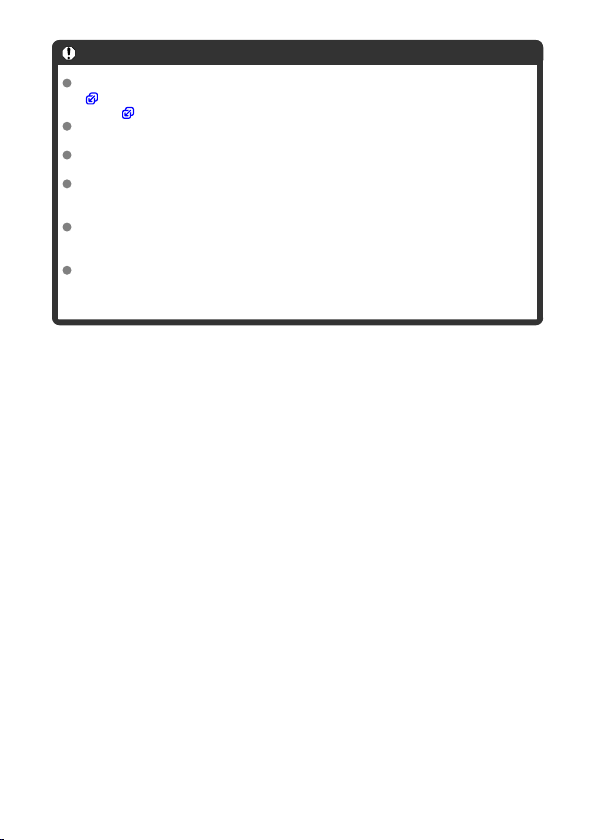
Caution
If you print an image with a large image size using the [Index] or [Both] setting
( ), the index print may not be printed with certain printers. In this case, resize the
image (
), then print the index print.
Even if [Date] and [File No.] are set to [On], the date or file number may not be
imprinted, depending on the print type setting and printer.
With [Index] prints, the [Date] and [File No.] cannot both be set to [On] at the same
time.
When printing with DPOF, use the card for which print order specifications are set.
You cannot print in the specified print order if you extract just the images from the
card for printing.
Certain DPOF-compliant printers and photofinishers may not be able to print the
images as you specified. When using a printer, refer to the printer's instruction
manual. When requesting service from a photofinisher, ask in advance.
Do not use this camera to configure print settings for images with DPOF settings
set up on another camera. All the print orders may be overwritten inadvertently.
Also, the print order may not be possible, depending on the image type.
515
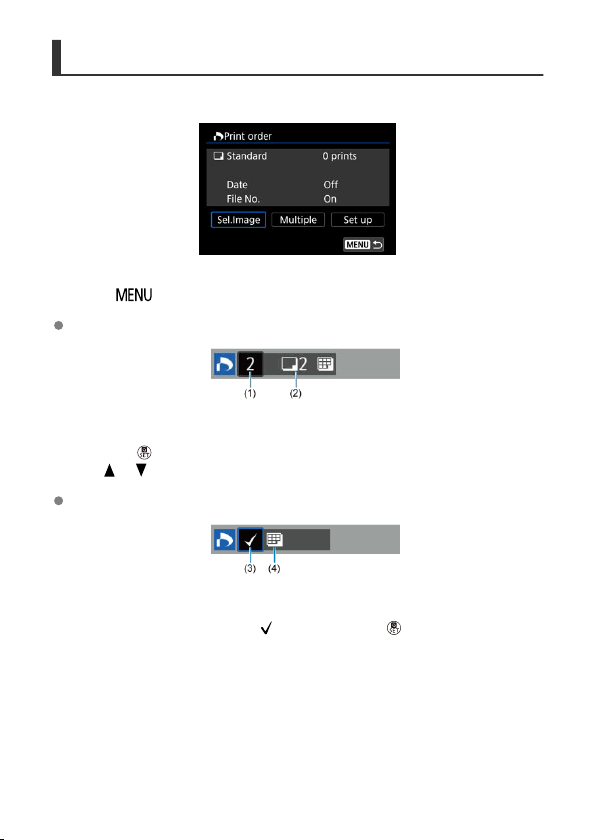
Selecting Images for Printing
Selecting images
Select and specify the images individually.
Press the <
> button to save the print order to the card.
Standard/Both
(1) Quantity
(2) Total images selected
Press the <
> button to set the print quantity for the current image to 1. By pressing
the <
>< > keys, you can set a print quantity of up to 99 copies.
Index
(3) Checkmark
(4) Index icon
Images that you add a checkmark [ ] to by pressing the < > button are included in
index printing.
516
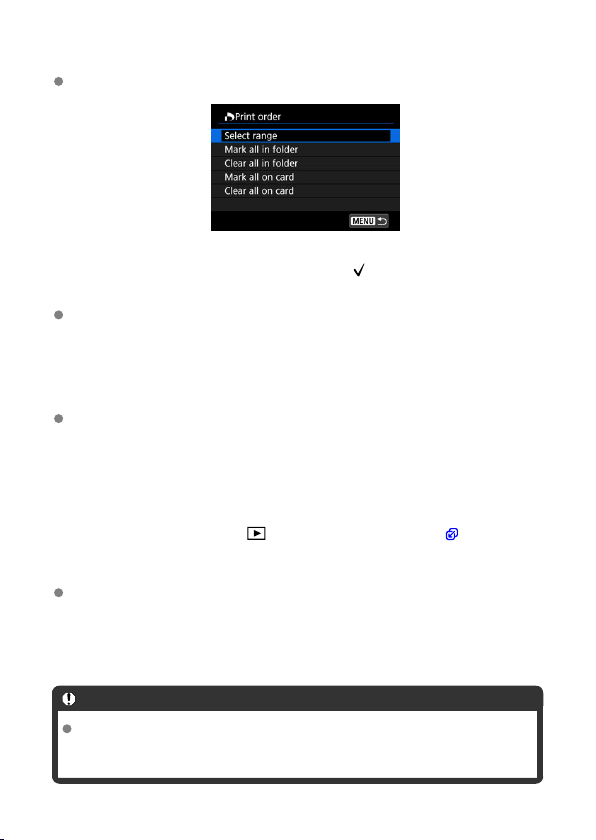
Selecting multiple images
Select range
Select [Select range] in [Multiple]. Selecting the first and last images of the range
marks all the images in the range with a checkmark [
], and one copy of each image
will be specified for printing.
All images in a folder
Select [Mark all in folder] and select the folder. A print order for one copy of all the
images in the folder will be specified.
If you select [Clear all in folder] and select the folder, the print order for all the images
in the folder will be canceled.
All images on a card
If you select [Mark all on card], one copy of all the images on the card will be specified
for printing.
If you select [Clear all on card], the print order will be cleared for all the images on the
card.
If the search conditions are set with [
: Set image search conditions] ( ) and you
select [Multiple], the display will change to [Mark all found images] and [Clear all found
images].
All found images
If you select [Mark all found images], one copy of all the images filtered by the search
conditions will be specified for printing.
If you select [Clear all found images], all the print order of the filtered images will be
cleared.
Caution
RAW/HEIF images and movies cannot be specified for printing. Note that RAW/
HEIF images and movies will not be specified for printing even if you specify all
images with [Multiple].
517

Creative Assist
You can process RAW images by applying your preferred effects and saving as JPEGs.
1.
Select [
: Creative Assist].
2.
Select an image.
Use the < >< > keys to select an image to process, then press
the <
> button.
518
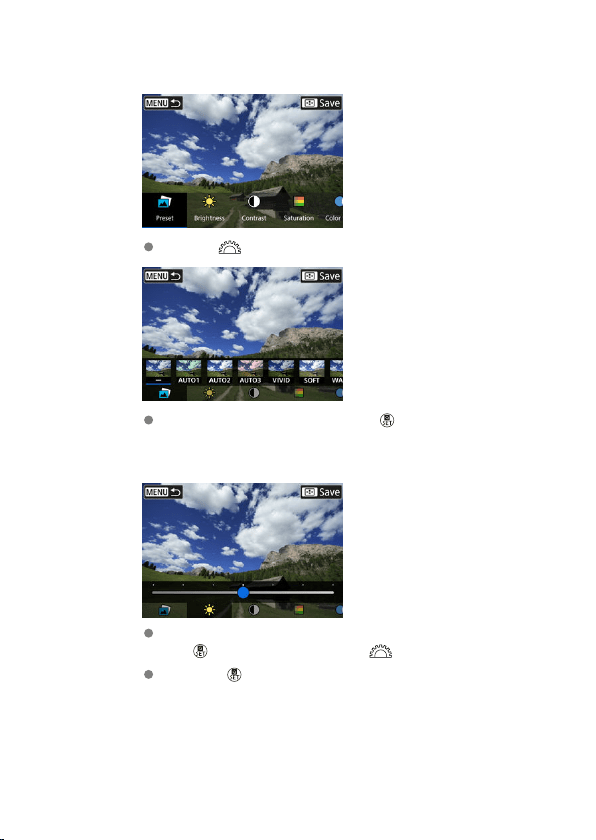
3.
Select an effect.
Use the < > dial to select the effect.
By selecting [Preset] and pressing the < > button, you can choose
[VIVID], [SOFT], or other preset effects. [AUTO1], [AUTO2], and
[AUTO3] are effects recommended by the camera based on image
conditions.
You can select effects such as [Brightness] or [Contrast] by pressing
the <
> button and then using the < > dial.
Press the < > button when adjustment is finished.
519
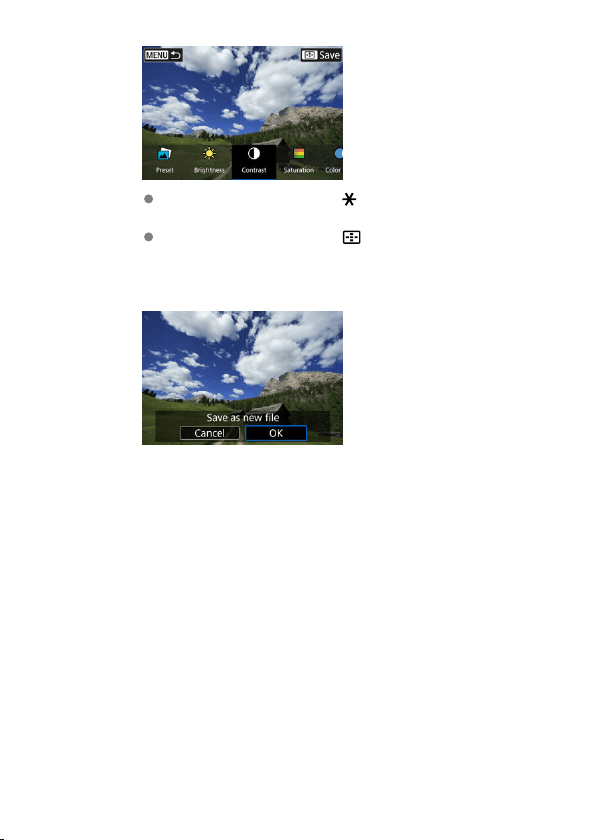
To reset the settings, press the < > button and select [OK] after a
confirmation message is displayed.
To confirm the effect, press the < > button.
4.
Select [OK] to save the image.
520
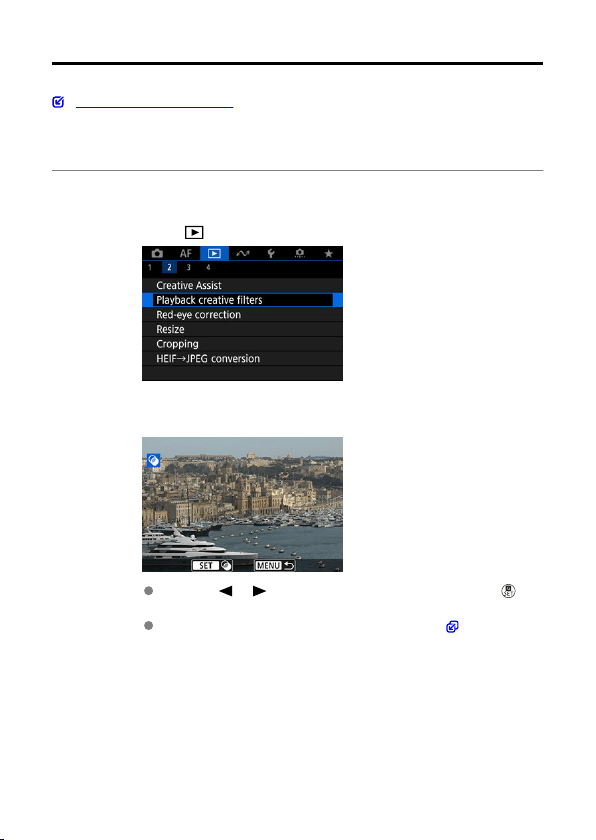
Playback Creative Filters
Creative Filter Characteristics
You can apply the following filter processing to an image and save it as a separate image:
Grainy B/W, Soft focus, Fish-eye effect, Art bold effect, Water painting effect, Toy camera
effect, and Miniature effect.
1.
Select [
: Playback creative filters].
2.
Select an image.
Use the < >< > keys to select an image, then press the < >
button.
Images can be selected by touch from index display ( ).
521
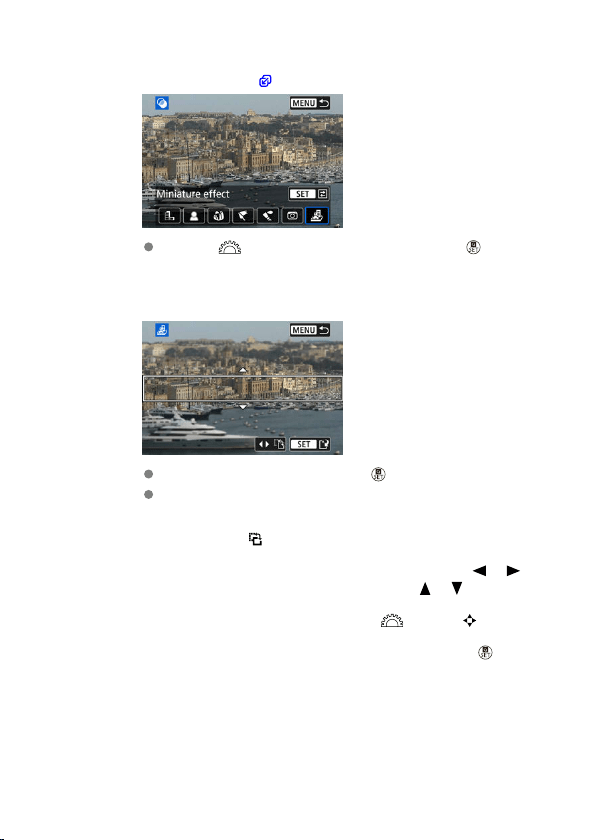
3.
Select a filter effect (
).
Use the < > dial to select an effect, then press the < > button.
4.
Adjust the filter effect.
Adjust the filter effect, then press the < > button.
For [Miniature effect], you can move the area that looks sharp (the
white frame).
• By tapping [ ], you can switch between vertical and horizontal
scene frame orientation. Scene frame orientation can also be
switched from horizontal orientation by pressing the <
>< >
keys and from vertical orientation with the <
>< > keys.
• To move the scene frame, use the < > dial or < > keys.
• To confirm the position of the scene frame, press the <
> button.
522
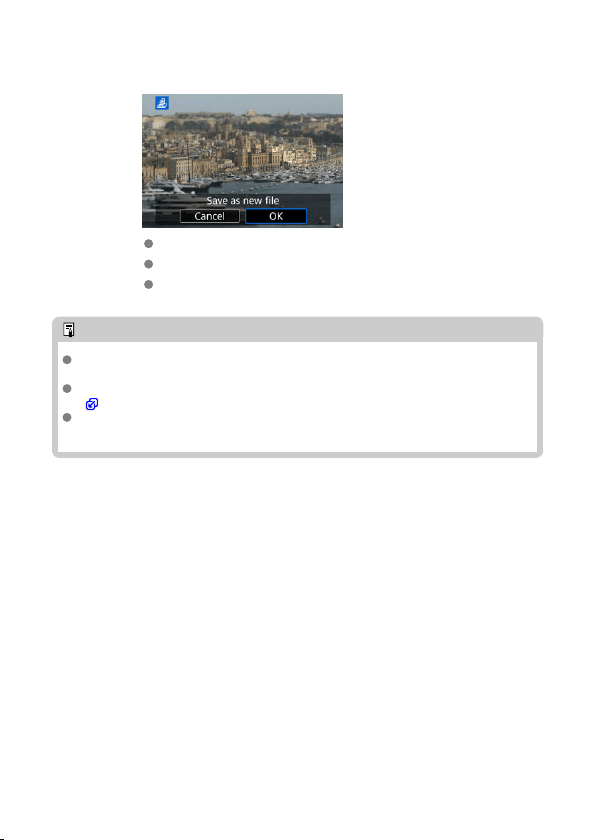
5.
Save.
Select [OK].
Check the destination folder and image file number, then select [OK].
To apply filter processing to other images, repeat steps 2 to 5.
Note
RAW images cannot be selected. Note that for images captured in RAW+JPEG
shooting, filter processing is applied to the JPEG image before saving the results.
Images processed using the fish-eye effect filter will not have Dust Delete Data
( ) appended.
Playback creative filters cannot be applied to still photos from testing time-lapse
movies.
523
Creative Filter Characteristics
Grainy B/W
Makes the image grainy and black and white. By adjusting the contrast, you can change
the black-and-white effect.
Soft focus
Gives the image a soft look. By adjusting the blur, you can change the degree of
softness.
Fish-eye effect
Gives the effect of a fish-eye lens. The image will have barrel distortion.
Depending on the level of this filter effect, the area trimmed along the periphery of the
image changes. Also, because this filter effect magnifies the center of the image, the
apparent resolution at the center may degrade depending on the number of recorded
pixels, so set the filter effect in step 4 while checking the resulting image.
Art bold effect
Makes the photo look like an oil painting and the subject look more three-dimensional.
By adjusting the effect, you can change the contrast and saturation. Note that subjects
such as the sky or white walls may not be rendered with a smooth gradation and may
look uneven or noisy.
Water painting effect
Makes the photo look like a watercolor painting with soft colors. By adjusting the effect,
you can change the color density. Note that night scenes or dark scenes may not be
rendered with a smooth gradation and may look uneven or noisy.
Toy camera effect
Shifts colors to those typical of toy cameras and darkens the four corners of the image.
Color tone options can be used to change the color cast.
Miniature effect
Creates a diorama effect. To move the area that looks sharp (the scene frame), see step
4 (
).
524
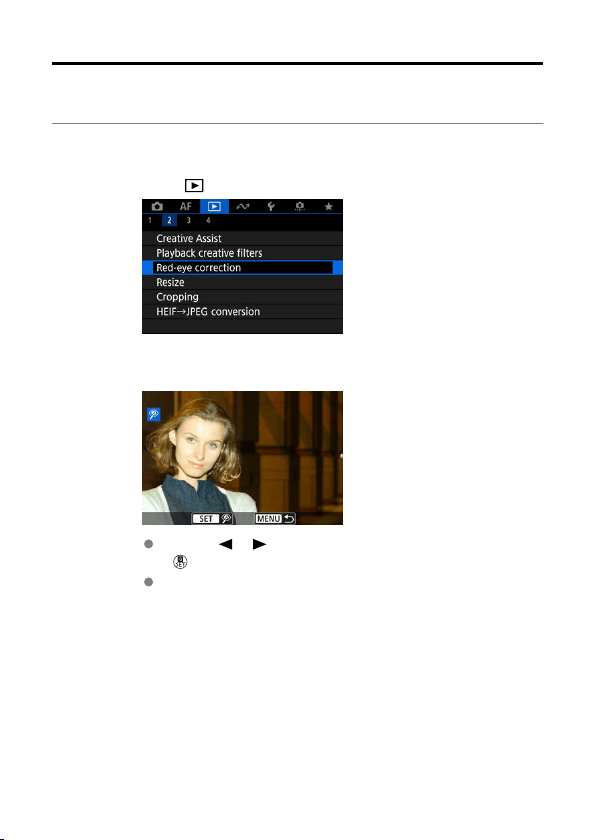
Red-Eye Correction
Automatically corrects relevant portions of images affected by red-eye. The image can be
saved as a separate file.
1.
Select [
: Red-eye correction].
2.
Select an image.
Use the < >< > keys to select an image to correct, then press the
<
> button.
White frames are displayed around corrected image areas.
525
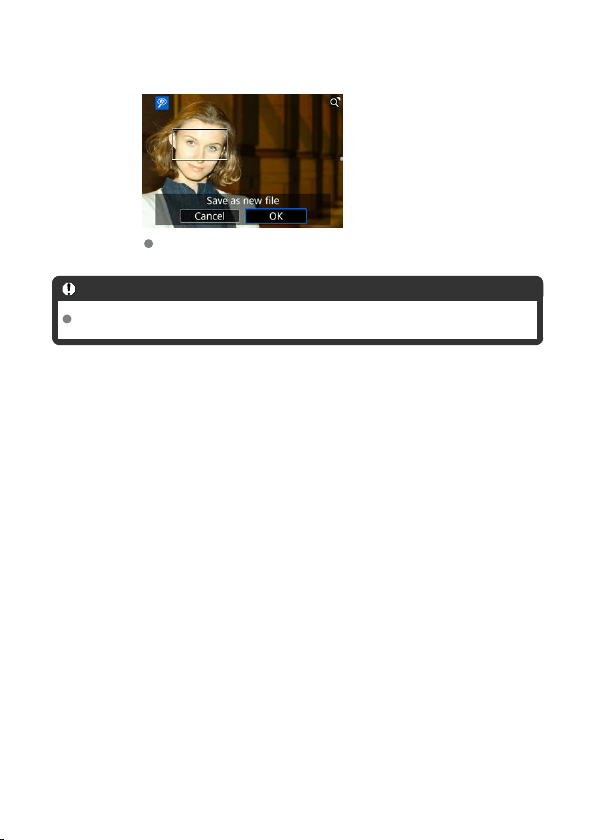
3.
Select [OK].
The image is saved as a separate file.
Caution
Some images may not be corrected accurately.
526
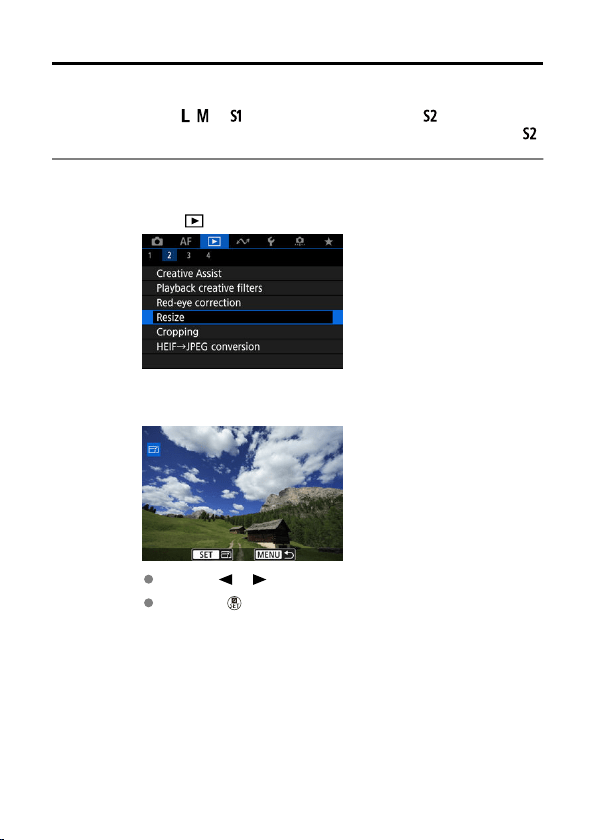
Resizing JPEG/HEIF Images
You can resize a JPEG or HEIF image to reduce the pixel count and save it as a new image.
Resizing is available for
, , or JPEGs or HEIFs (in sizes except ), including those
captured in RAW+JPEG and RAW+HEIF shooting. Note that resizing is not available for
images, RAW images, or frame-grab images from 4K movies.
1.
Select [
: Resize].
2.
Browse your images.
Use the < >< > keys to select an image to resize.
Press the < > button to display the image size.
527
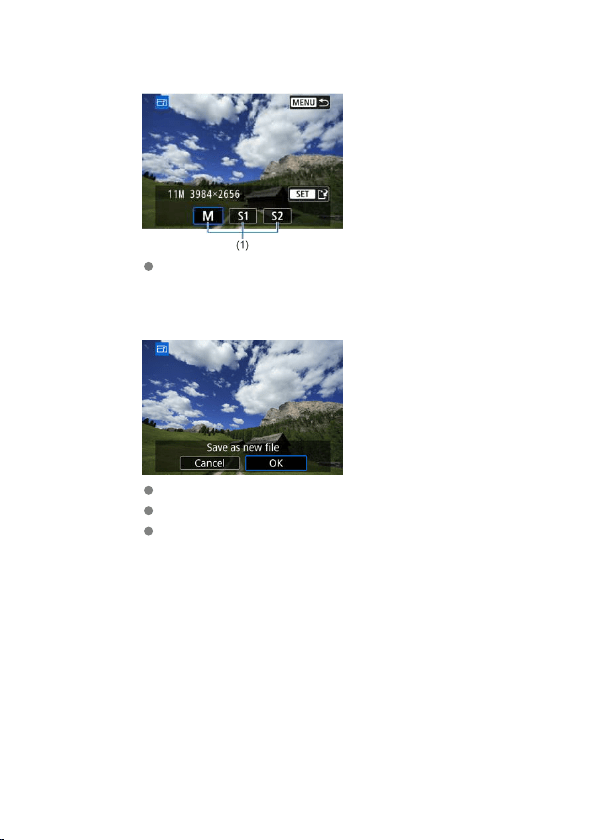
3.
Select the desired image size.
Select the desired image size (1).
4.
Save.
Select [OK] to save the resized image.
Check the destination folder and image file number, then select [OK].
To resize another image, repeat steps 2 to 4.
528
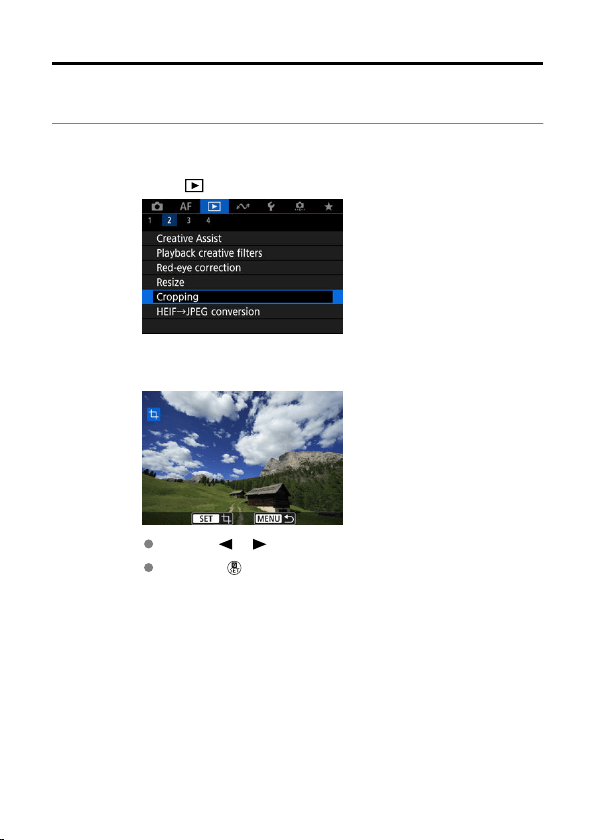
Cropping JPEG/HEIF Images
You can crop a captured JPEG or HEIF image and save it separately. RAW images and
frame-grab images from 4K movies cannot be cropped.
1.
Select [
: Cropping].
2.
Select an image.
Use the < >< > keys to select an image to crop.
Press the < > button to display the cropping frame.
529
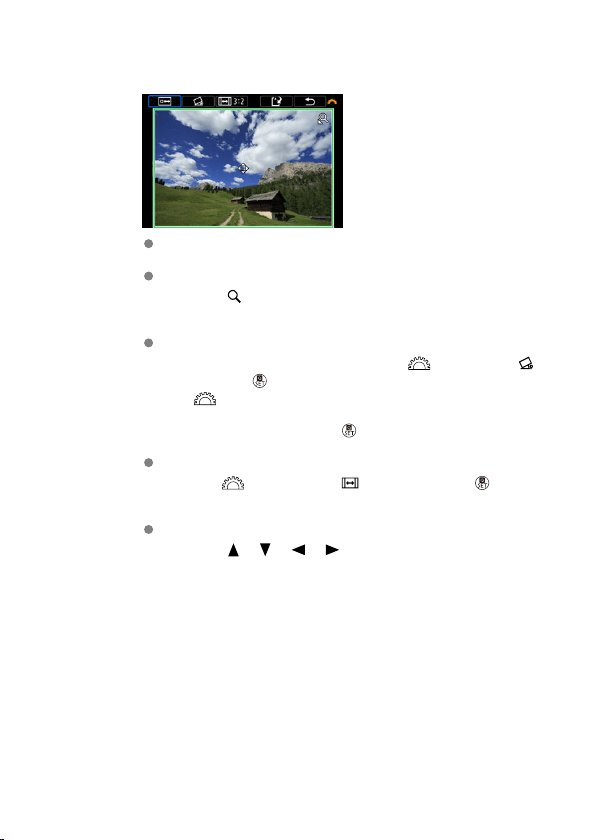
3.
Set the cropping frame.
The image area within the cropping frame will be cropped.
Resizing the cropping frame size
Press the < > button to resize the cropping frame. The smaller the
cropping frame, the more magnified the cropped image will look.
Correcting tilt
You can correct image tilt by ±10°. Turn the < > dial to select [ ],
then press the <
> button. While checking tilt relative to the grid, turn
the <
> dial (in 0.1° increments) or tap the left or right arrow (in
0.5° increments) in the upper left of the screen to correct tilt. After
correction is finished, press the <
> button.
Changing the cropping frame aspect ratio and orientation
Turn the < > dial and select [ ]. Each press of the < > button
changes the cropping frame aspect ratio.
Moving the cropping frame
Press the < >< >< >< > keys to move the frame vertically or
horizontally.
530
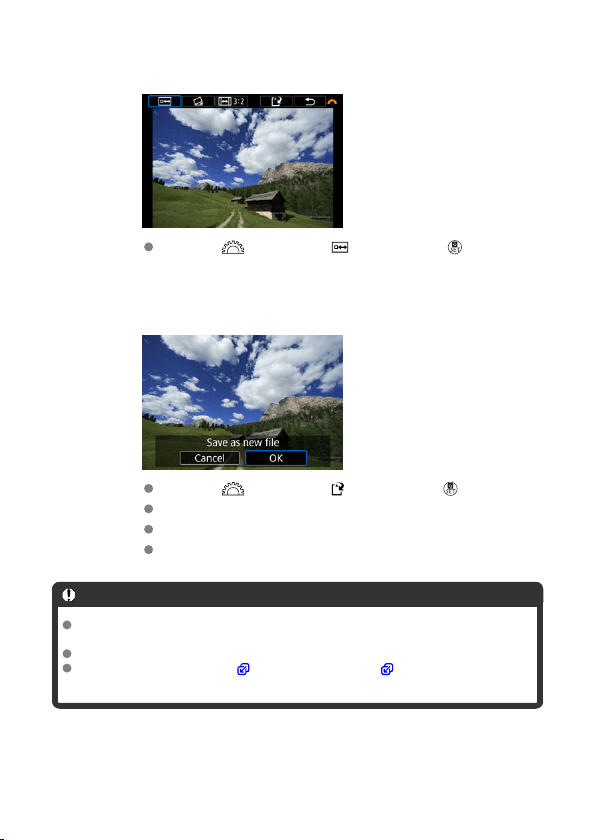
4.
Check a preview of the cropped image.
Turn the < > dial to select [ ], then press the < > button. The
image area to crop is displayed.
5.
Save.
Turn the < > dial to select [ ], then press the < > button.
Select [OK] to save the cropped image.
Check the destination folder and image file number, then select [OK].
To crop another image, repeat steps 2 to 5.
Caution
The position and size of the cropping frame may change depending on the angle
set for tilt correction.
Once a cropped image is saved, it cannot be cropped again or resized.
AF point display information ( ) and Dust Delete Data ( ) will not be appended
to the cropped images.
531
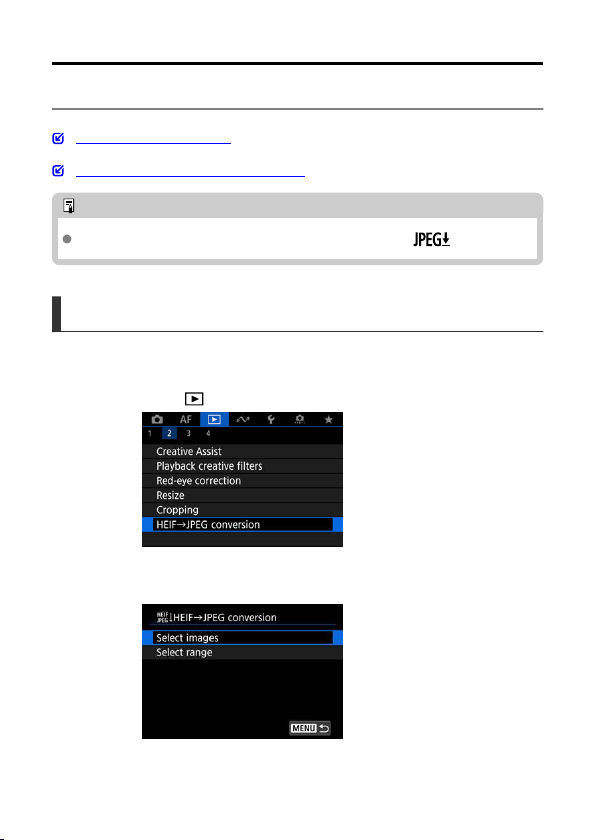
Converting HEIF to JPEG
You can convert HEIF images captured in HDR shooting and save them as JPEG images.
Converting Individual Images
Specifying the Range of Images to Convert
Note
HEIF images that have been converted to JPEGs are labeled [ ].
Converting Individual Images
1.
Select [
: HEIF→JPEG conversion].
2.
Select [Select images].
532
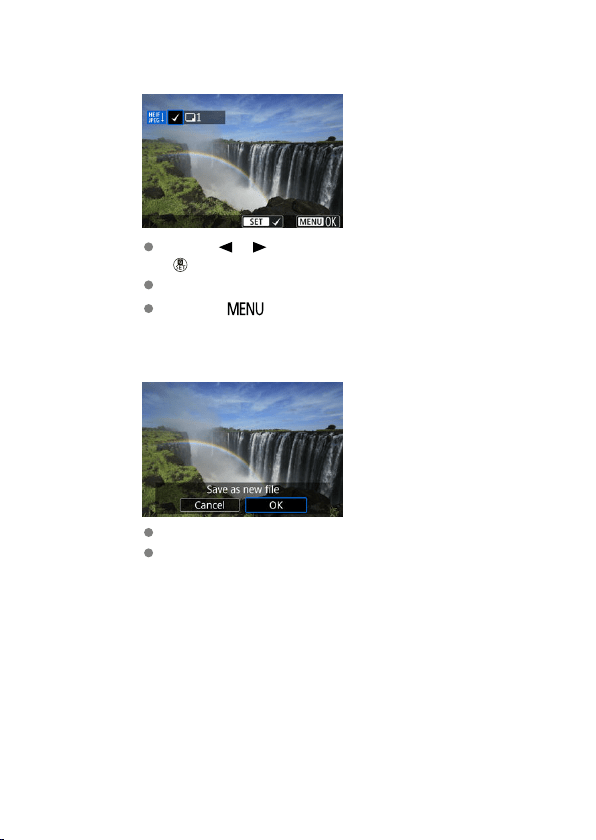
3.
Select an image.
Use the < >< > keys to select an HEIF image, then press the
<
> button.
To select other images, repeat step 3.
Press the < > button to convert to JPEG.
4.
Save.
Select [OK] to save the JPEG image.
If there are other images for conversion, select [Yes].
533
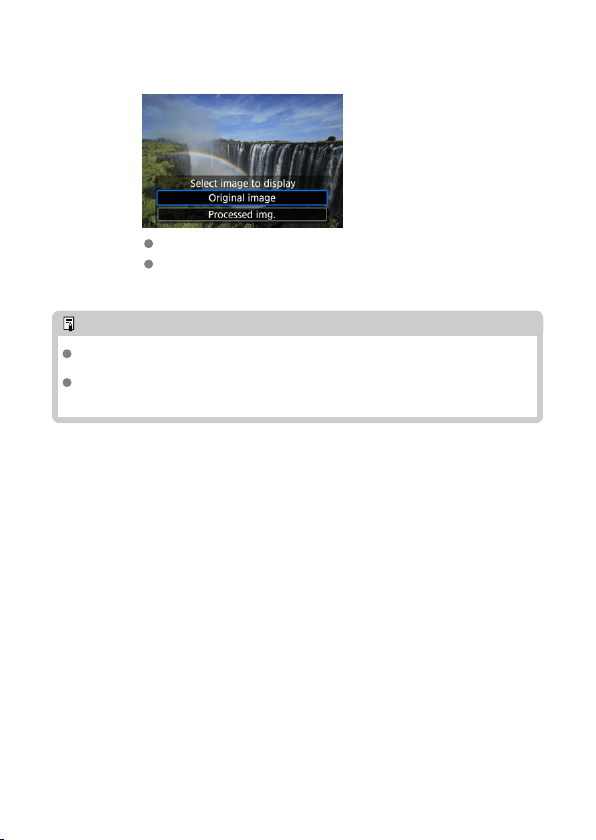
5.
Select the images to use for display.
Select [Original image] to use the original HEIF images for display.
Select [Processed img.] to use the converted JPEG images for
display.
Note
Some scenes may look different after conversion if the original and converted
images are compared.
Conversion is not available for cropped images, or for frame-grab images from 4K
movies.
534
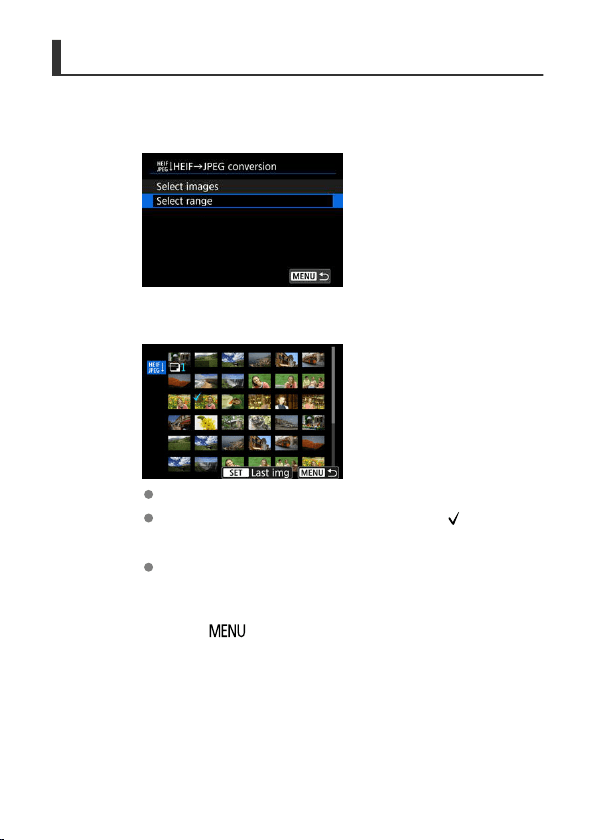
Specifying the Range of Images to Convert
1.
Select [Select range].
2.
Specify the range of images.
Select the first image (start point).
Next, select the last image (end point). A checkmark [ ] will be
appended to all the images within the range between first and last
images.
To select other images, repeat step 2.
3.
Press the <
> button.
535
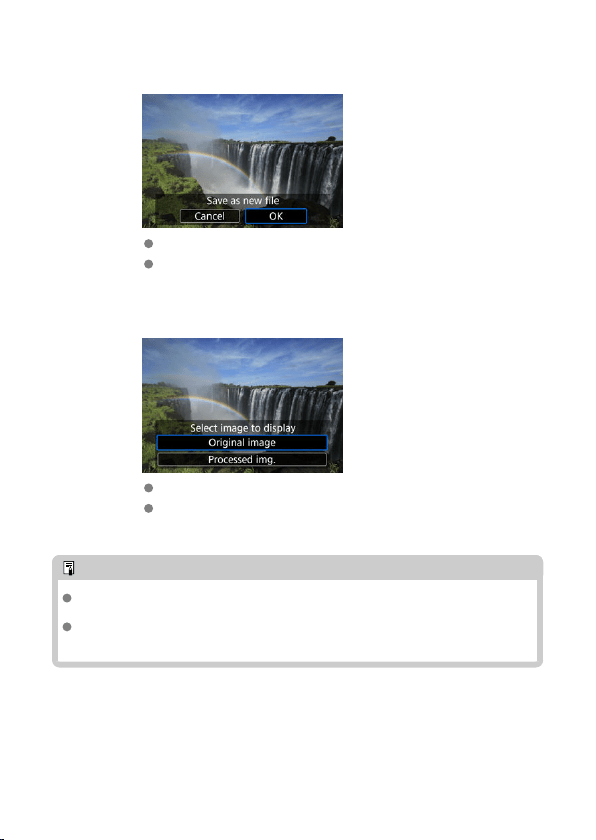
4.
Save.
Select [OK] to save the JPEG image.
If there are other images for conversion, select [Yes].
5.
Select the images to use for display.
Select [Original image] to use the original HEIF images for display.
Select [Processed img.] to use the converted JPEG images for
display.
Note
Some scenes may look different after conversion if the original and converted
images are compared.
Conversion is not available for cropped images, or for frame-grab images from 4K
movies.
536
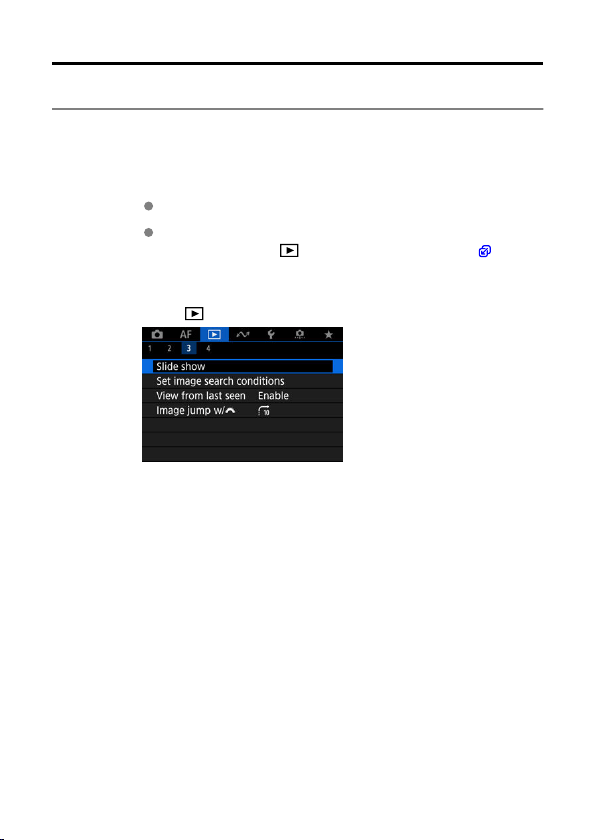
Slide Show
You can play back the images on the card as an automatic slide show.
1.
Specify the images to be played back.
To play back all the images on the card, go to step 2.
If you want to specify the images to be played back in the slide show,
filter the images with [
: Set image search conditions] ( ).
2.
Select [
: Slide show].
537
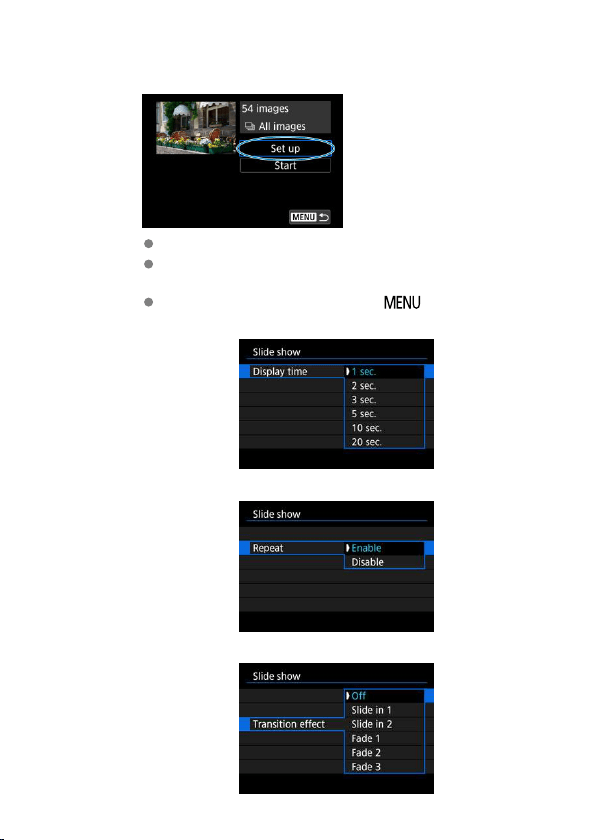
3.
Set the playback as desired.
Select [Set up].
Set the [Display time], [Repeat] (repeated playback), and [Transition
effect] (effect when changing images) settings for the still photos.
After completing the settings, press the < > button.
Display time
Repeat
Transition effect
538
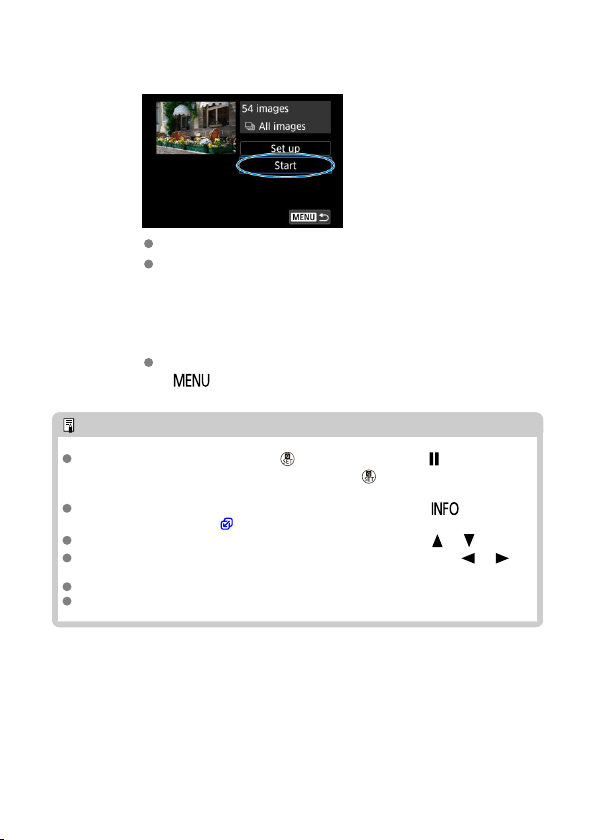
4.
Start the slide show.
Select [Start].
After [Loading image...] is displayed, the slide show will start.
5.
Exit the slide show.
To exit the slide show and return to the setting screen, press the
<
> button.
Note
To pause the slide show, press the < > button. During pause, [ ] will be
displayed in the upper left of the screen. Press the <
> button again to resume
the slide show.
During the automatic playback of still photos, you can press the < > button to
switch the display format ( ).
Volume during movie playback can be adjusted by pressing the < >< > keys.
During auto playback or when playback is paused, you can press the < >< >
keys to view other images.
During auto playback, auto power off will not take effect.
The display time may differ depending on the image.
539
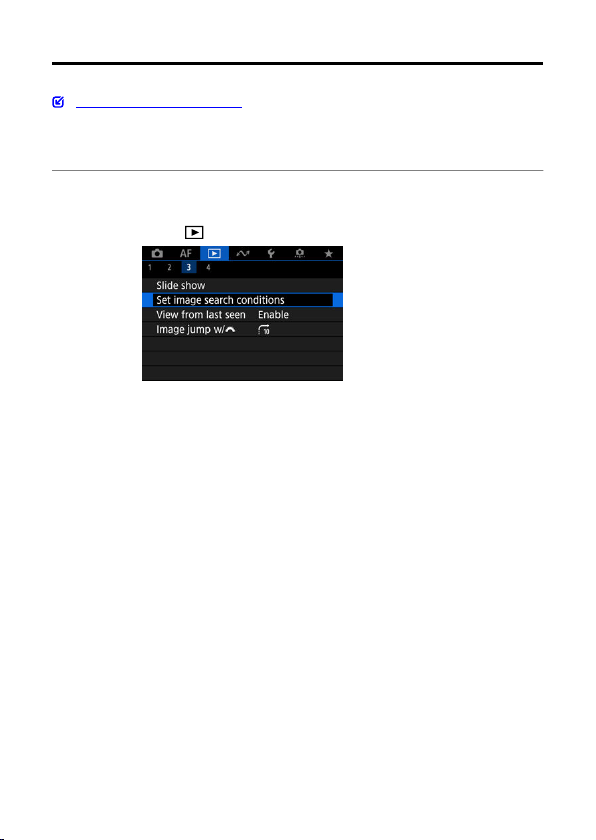
Setting Image Search Conditions
Clearing the Search Conditions
You can filter image display according to your search conditions. After setting the image
search conditions, you can play back and display only the found images. You can also
protect, rate, play a slide show, erase, and apply other operations to filtered images.
1.
Select [
: Set image search conditions].
540
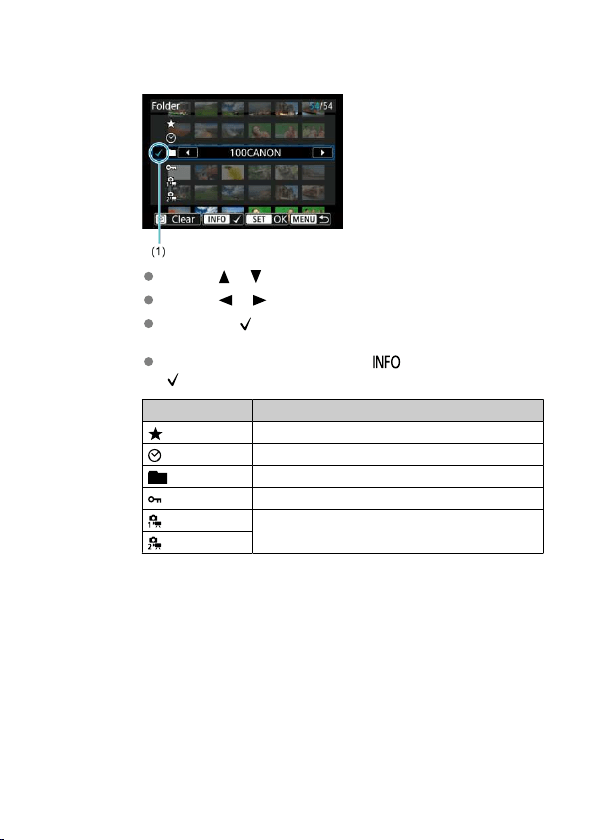
2.
Set the search conditions.
Use the < >< > keys to select an item.
Use the < >< > keys to set the option.
A checkmark [ ] (1) is appended to the left of the option. (Specified as
the search condition.)
If you select the option and press the < > button, the checkmark
[
] will be removed (which cancels the search condition).
Option Description
Rating
Displays images with the selected (rating) condition.
Date
Displays images taken on the selected shooting date.
Folder
Displays images in the selected folder.
Protect
Displays images with the selected (protect) condition.
Type of file (1)
Displays images of the selected file type.
Type of file (2)
541
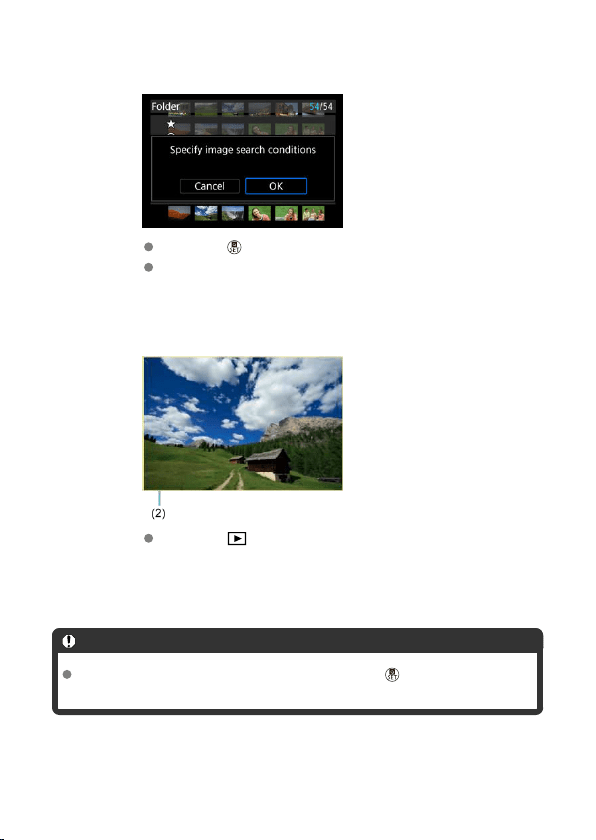
3.
Apply the search conditions.
Press the < > button and read the message displayed.
Select [OK].
The search condition is applied.
4.
Display the found images.
Press the < > button.
Only the images that match the set conditions (filtered) will be played
back.
When the images are filtered for display, the screen will have an outer
yellow frame (2).
Caution
If no images match the search conditions, pressing the < > button in step 3 has
no effect.
542
Note
Search conditions may be cleared after operations involving camera power or card
changes and editing, adding, or erasing images.
Auto power off time may be extended while the [ : Set image search
conditions] screen is displayed.
Clearing the Search Conditions
Access the screen in step 2, then press the <
> button to clear all the search conditions.
543
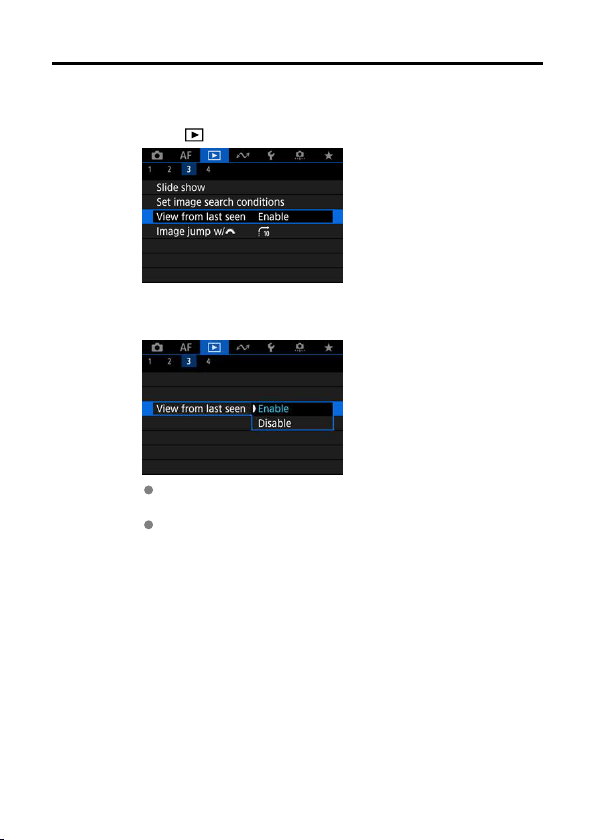
Resuming from Previous Playback
1.
Select [
: View from last seen].
2.
Select an option.
[Enable]: Playback resumes from the last image displayed (unless you
have just finished shooting).
[Disable]: Playback resumes from your most recent shot whenever the
camera is restarted.
544
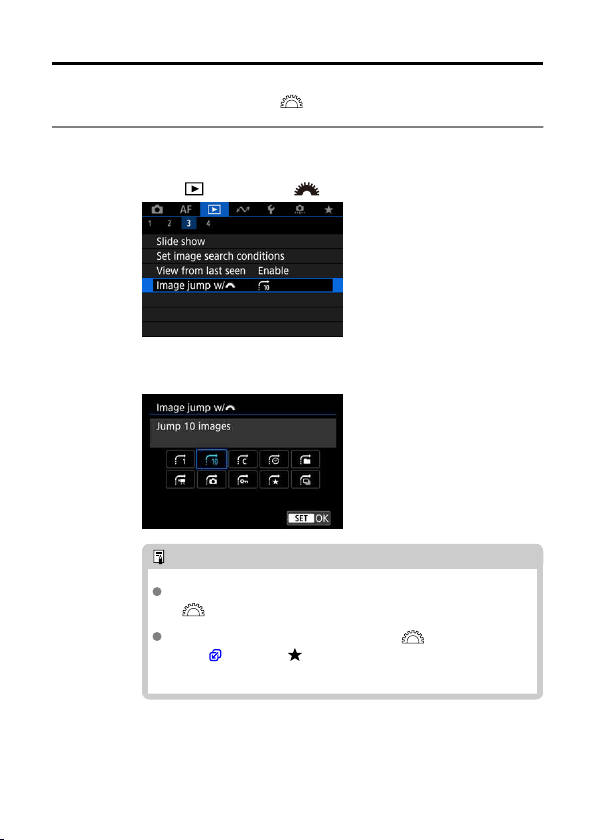
Browsing Images with the Dial
In single-image display, you can turn the <
> dial to jump through the images forward or
backward according to the jump method set.
1.
Select [
: Image jump w/ ].
2.
Select the jump method.
Note
With [Jump images by the specified number], you can turn the
<
> dial to select the number of images to jump by.
With [Display by image rating], turn the < > dial to select the
rating (
). Selecting will show all rated images as you
browse.
545
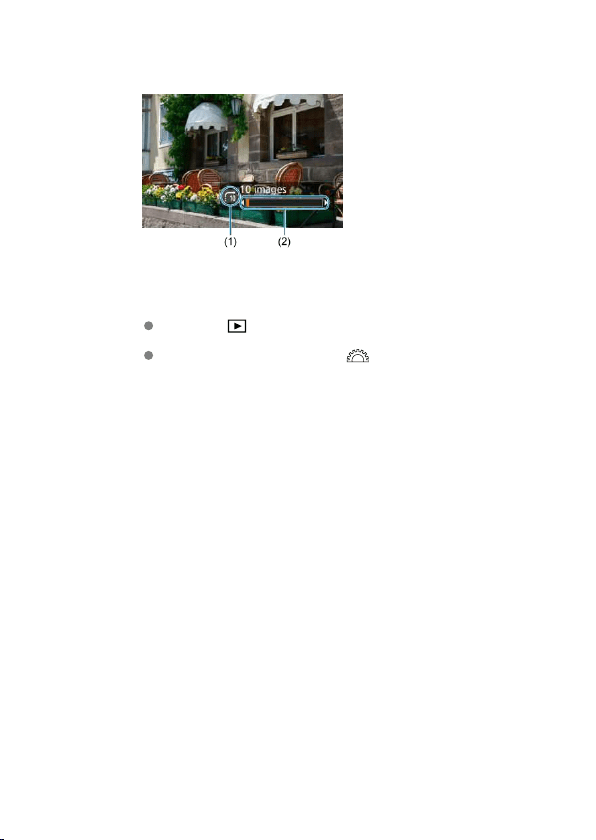
3.
Browse by jumping.
(1) Jump method
(2) Playback position
Press the < > button.
In single-image display, turn the < > dial.
You can browse by the jump method set.
546
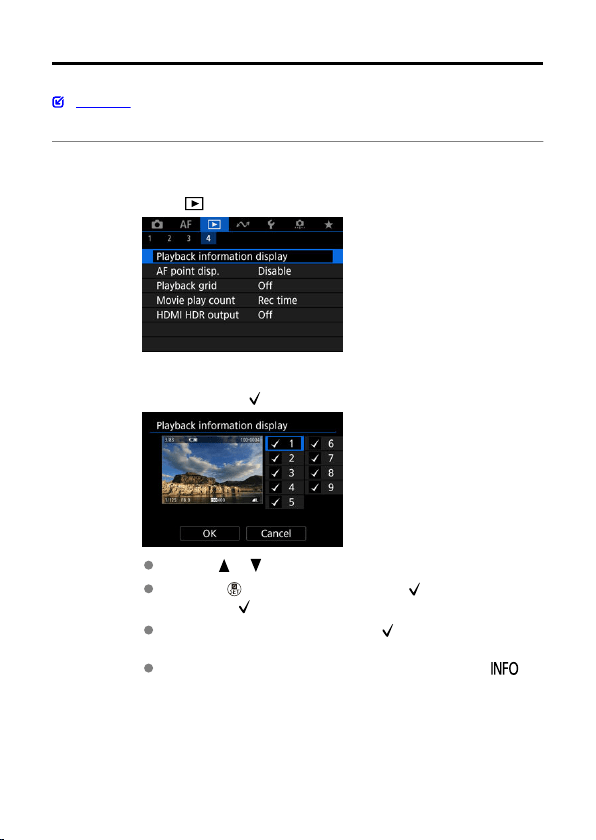
Customizing Playback Information Display
Histogram
You can specify screens and accompanying information displayed during image playback.
1.
Select [
: Playback information display].
2.
Add a checkmark [
] next to the number of screens to display.
Use the < >< > keys to select a number.
Press the < > button to clear a checkmark [ ]. Press it again to add
a checkmark [
].
Repeat these steps to add a checkmark [ ] to the number of each
screen to display, then select [OK].
Your selected information can be accessed by pressing the < >
button during playback.
547
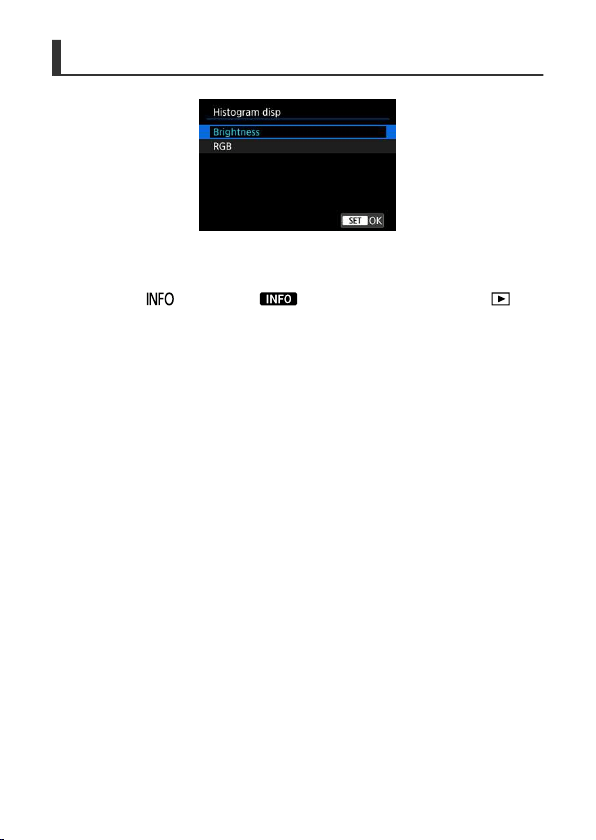
Histogram
The histograms show signal levels across the tonal range. Brightness display (for checking
the general exposure level and overall gradation) and RGB display (for checking saturation
and gradation of red, green, and blue) are available. You can switch the histogram displayed
by pressing the <
> button when [ ] is displayed in the lower left of the [ :
Playback information display] screen.
548
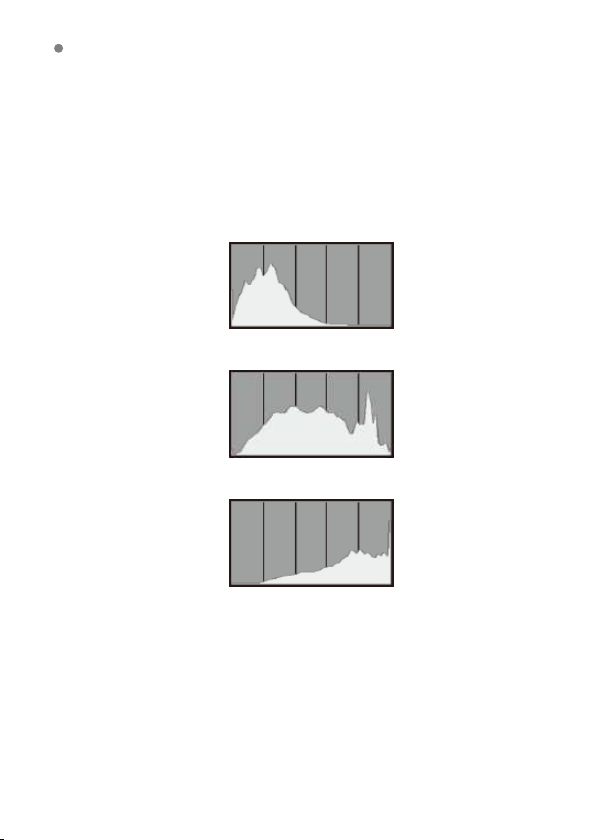
[Brightness] display
This histogram is a graph showing the distribution of the image's brightness level, with
the horizontal axis indicating the brightness level (darker on the left and brighter on the
right) and the vertical axis indicating the pixel count at each brightness level. The more
pixels there are toward the left, the darker the image, and the more pixels there are
toward the right, the brighter the image. If there are too many pixels on the left, detail in
shadows will be lost, and if there are too many pixels on the right, detail in highlights will
be lost. The gradation in-between will be reproduced. By checking the image and its
brightness histogram, you can see the exposure level inclination and the overall
gradation.
Sample histograms
Dark image
Normal brightness
Bright image
549

[RGB] display
This histogram is a graph showing the distribution of each primary color's brightness
level in the image (RGB or red, green, and blue), with the horizontal axis indicating the
color's brightness level (darker on the left and brighter on the right) and the vertical axis
indicating the pixel count at each color brightness level. The more pixels there are
toward the left, the darker and less prominent the color, and the more pixels there are
toward the right, the brighter and denser the color. If there are too many pixels on the
left, the corresponding color information will be lacking, and if there are too many pixels
on the right, the color will be too saturated, without gradation. By checking the image's
RGB histogram, you can see the color's saturation and gradation conditions, as well as
the white balance bias.
550
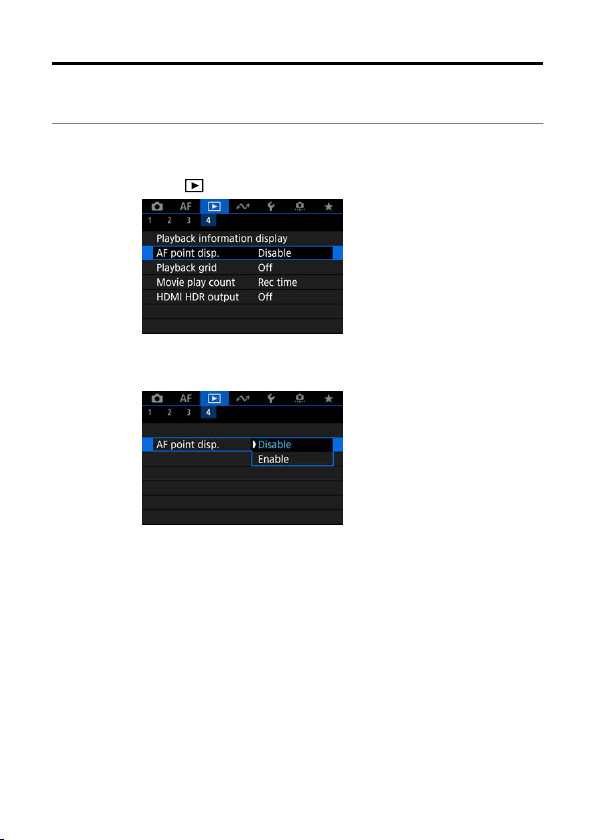
AF Point Display
You can display the AF points that were used to focus, which will be outlined in red on the
playback screen.
1.
Select [
: AF point disp.].
2.
Select [Enable].
551
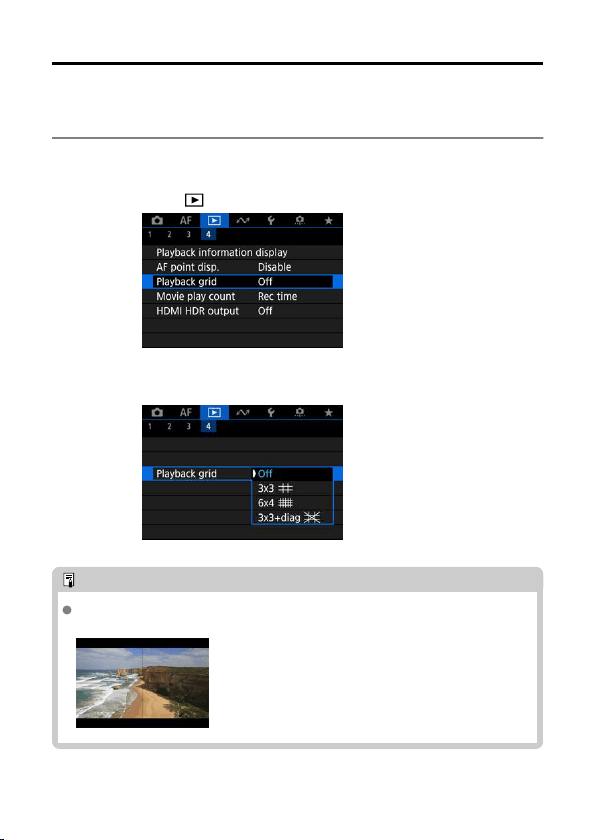
Playback Grid
You can display a grid over still photos shown in single-image display on the playback
screen. This function is convenient for checking the image's vertical or horizontal tilt as well
as composition.
1.
Select [
: Playback grid].
2.
Select an option.
Note
When panoramic images are displayed, a single vertical and horizontal line are
shown if [Playback grid] is set to an option other than [Off].
552
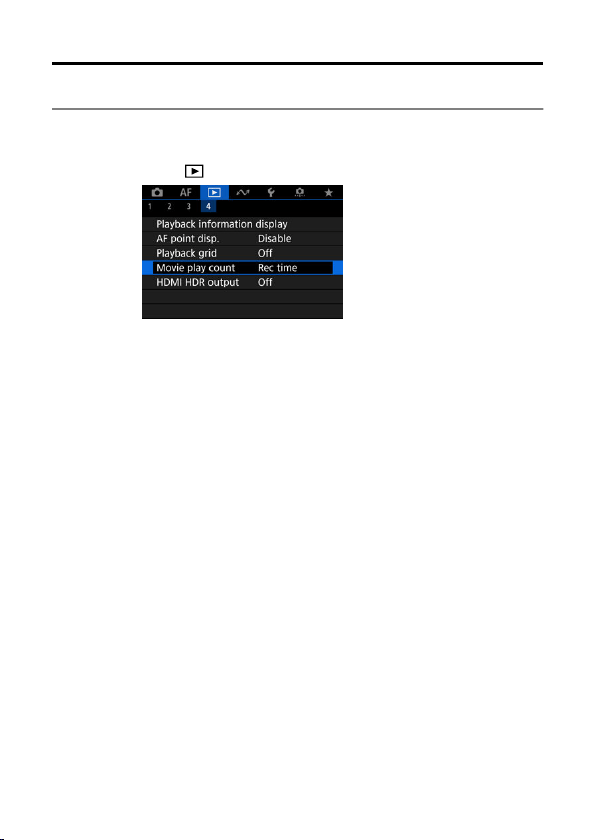
Movie Play Count
You can select how time is displayed on the movie playback screen.
1.
Select [
: Movie play count].
553
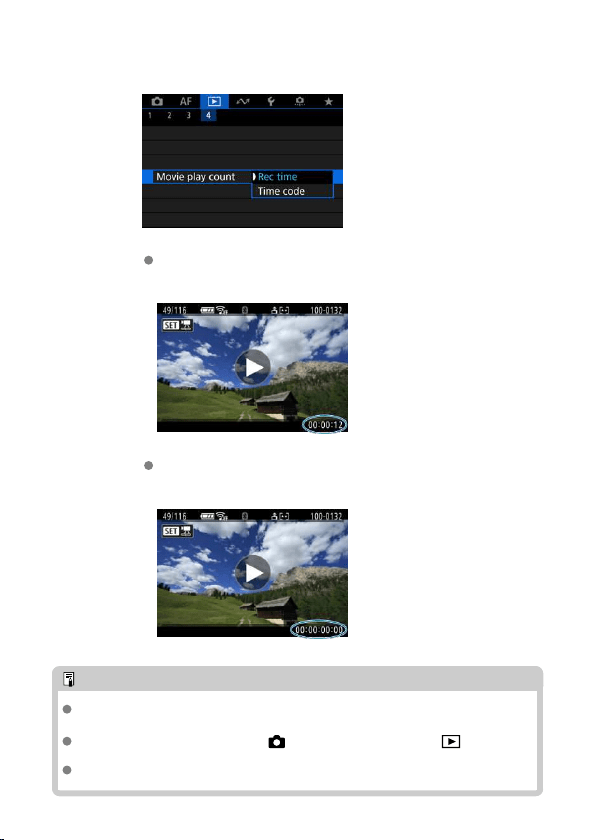
2.
Select an option.
Rec time
Displays the recording or playback time during movie playback.
Time code
Displays the time code during movie playback.
Note
Time codes are always recorded to movie files (except when High Frame Rate
movies are set to [Free run]), regardless of the [Movie rec count] setting.
The [Movie play count] setting in [ : Time code] is linked to the [ : Movie
play count], so that these settings always match.
The “frame” count is not displayed during movie recording or playback.
554
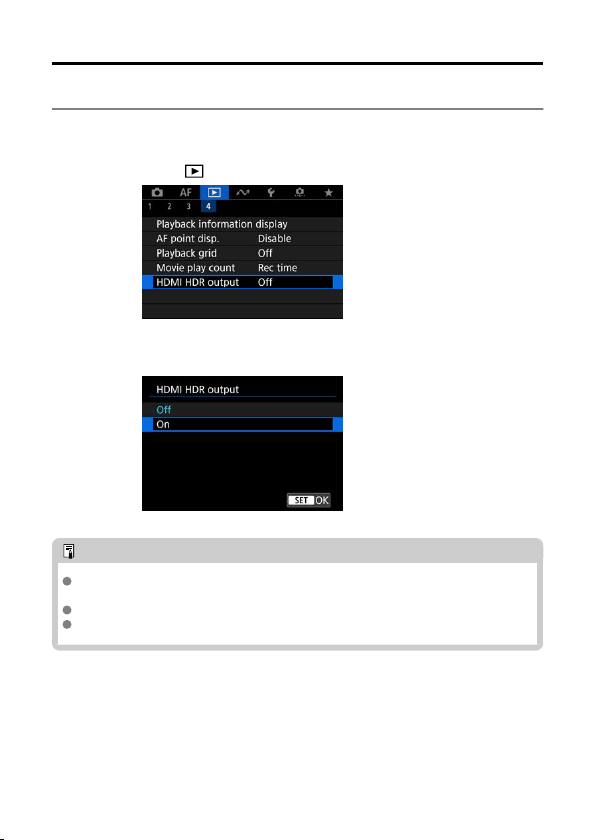
HDMI HDR Output
You can view RAW or HEIF images in HDR by connecting the camera to an HDR TV.
1.
Select [
: HDMI HDR output].
2.
Select [On].
Note
Make sure the HDR TV is set up for HDR input. For details on how to switch inputs
on the TV, refer to the TV manual.
Depending on the TV used, images may not look as expected.
On HDR TVs, some information may not be displayed.
555
Communication Functions
This chapter describes how to send images, shoot remotely, and perform other operations
using communication functions.
Caution
Important
Note that Canon cannot be held liable for any loss or damage caused by erroneous
wireless communication settings when using the camera. In addition, Canon cannot
be held liable for any other loss or damage caused by use of the camera.
When using wireless communication functions, establish appropriate security at
your own risk and discretion. Canon cannot be held liable for any loss or damage
caused by unauthorized access or other security breaches.
• Tab Menus: Communication Functions
• Connecting to a Smartphone or Tablet
• Connecting to a Wireless Remote Control
• Connecting to EOS Utility
• Uploading Images to image.canon
• Connecting to a Printer via Wi-Fi
• Advanced Connections
• Basic Communication Settings
• Reconnecting via Wi-Fi/Bluetooth
• Editing/Deleting Connection Settings
• Airplane Mode
• Wi-Fi Settings
• Bluetooth Settings
• Camera Name
• GPS Settings
• Error Details
• Resetting Communication Settings
• Virtual Keyboard Operations
• Responding to Error Messages
• Wireless Communication Function Precautions
• Security
• Checking Network Settings
• Wireless Communication Status
556
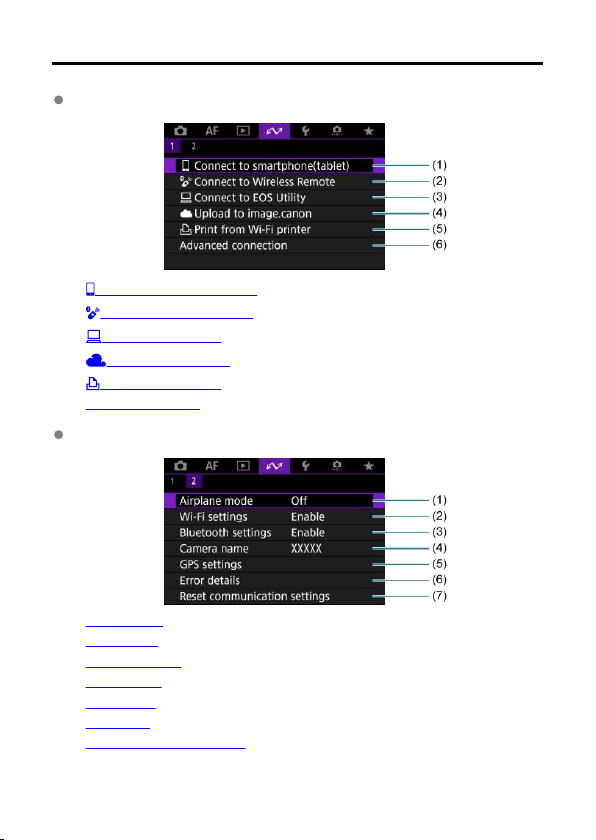
Tab Menus: Communication Functions
Communication functions 1
(1) Connect to smartphone(tablet)
(2)
Connect to Wireless Remote
(3) Connect to EOS Utility
(4) Upload to image.canon
(5) Print from Wi-Fi printer
(6) Advanced connection
Communication functions 2
(1) Airplane mode
(2) Wi-Fi settings
(3) Bluetooth settings
(4) Camera name
(5) GPS settings
(6) Error details
(7) Reset communication settings
557
Caution
Some menu items cannot be configured while the camera is connected to
computers or other devices via an interface cable.
The Wi-Fi connection will be terminated if you set the camera power to < > or
open the card/battery compartment cover.
With a Wi-Fi connection established, the camera's auto power off does not function.
558
Connecting to a Smartphone or Tablet
Preparing the Smartphone
Connecting to a Smartphone via Wi-Fi
Main Functions of Camera Connect
Maintaining a Wi-Fi Connection When the Camera Is Off
Canceling the Pairing
Automatic Image Transfer to a Smartphone as You Shoot
Sending Images to a Smartphone from the Camera
You can do the following after pairing the camera with a smartphone.
Establish a Wi-Fi connection using only the smartphone ( ).
Establish a Wi-Fi connection with the camera even when it is off ( ).
Geotag images with GPS information acquired by the smartphone ( ).
Control the camera remotely from a smartphone ( ).
You can also do the following after connecting the camera to a smartphone via Wi-Fi.
Browse and save images on the camera from a smartphone ( ).
Control the camera remotely from a smartphone ( ).
Send images to a smartphone from the camera ( ).
Note
You can also establish an advanced Wi-Fi connection to smartphones without
using Bluetooth ( ).
559
Preparing the Smartphone
Turning on Bluetooth and
Wi-Fi
on a Smartphone
Turn on Bluetooth and Wi-Fi from the smartphone settings screen. Note that pairing with the
camera is not possible from the smartphone's Bluetooth settings screen.
Installing Camera Connect on a Smartphone
The dedicated app Camera Connect (free of charge) must be installed on the smartphone
on which Android or iOS is installed.
Use the latest version of the smartphone OS.
Camera Connect can be installed from Google Play or App Store. Google Play or App
Store can also be accessed using the QR codes that appear when the camera is paired
or connected via Wi-Fi to a smartphone.
Note
For the operating system versions supported by Camera Connect, refer to the
download site of Camera Connect.
Sample screens and other details in this guide may not match the actual user
interface elements after camera firmware updates or updates to Camera Connect,
Android, or iOS.
560
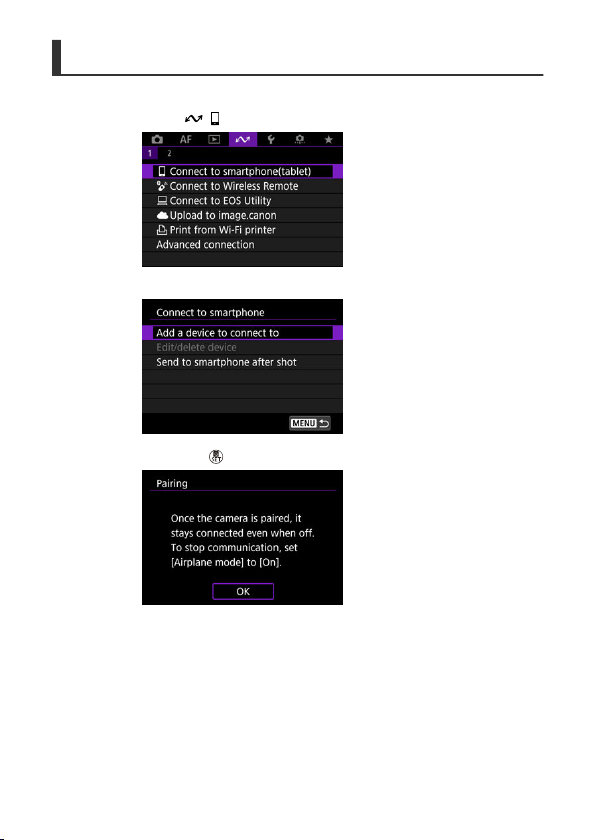
Connecting to a Smartphone via Wi-Fi
1.
Select [
: Connect to smartphone(tablet)].
2.
Select [Add a device to connect to].
3.
Press the <
> button.
561
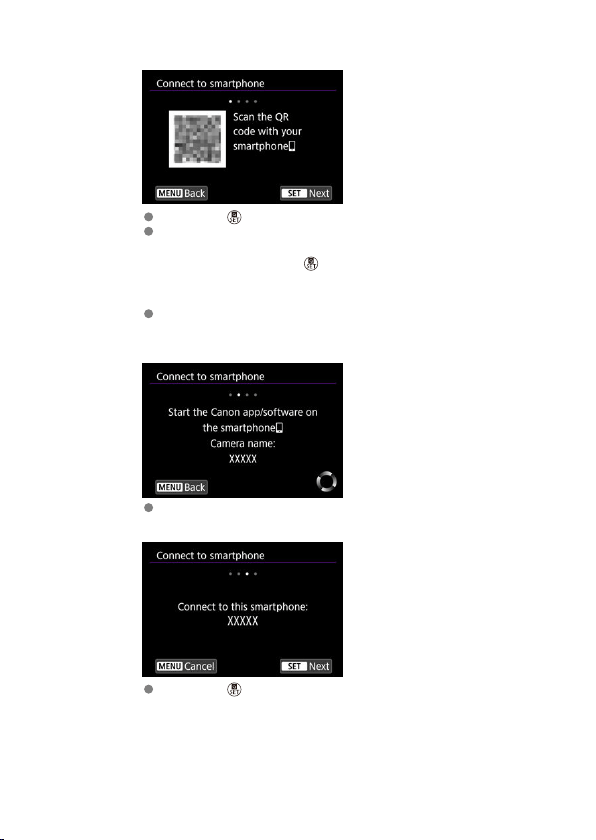
4.
Start pairing.
Press the < > button to start pairing.
If Camera Connect is not installed, use the smartphone to scan the QR
code on the screen, go to Google Play or App Store to install Camera
Connect, then press the <
> button to start pairing.
5.
Start Camera Connect.
Following the instructions in the app, select the camera for pairing.
6.
Establish a Bluetooth connection.
When a message appears on the smartphone, use the smartphone as
indicated.
Press the < > button.
562
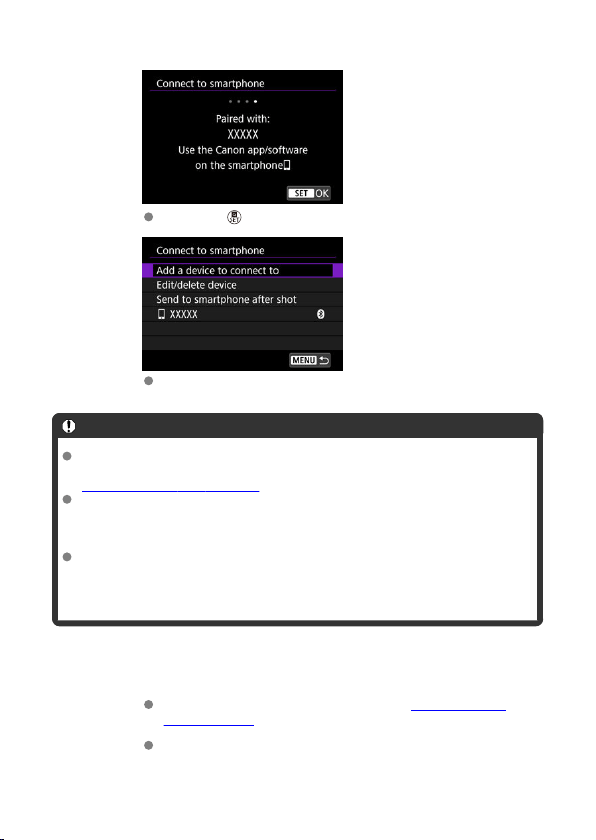
7.
Complete the pairing process.
Press the < > button to finish pairing.
The name of the connected device is displayed.
Caution
The camera cannot be connected to two or more devices at the same time via
Bluetooth. To switch to a different smartphone for the Bluetooth connection, see
Reconnecting via Wi-Fi/Bluetooth.
Bluetooth connection consumes battery power even after the camera's auto power
off is activated. Therefore, the battery level may be low when you use the camera.
Troubleshooting pairing
Keeping pairing records for previously paired cameras on your smartphone will
prevent it from pairing with this camera. Before you try pairing again, remove
pairing records for previously paired cameras from your smartphone's Bluetooth
settings screen.
8.
Tap a Camera Connect function.
For details on Camera Connect functions, see Main Functions of
Camera Connect.
Tap a Camera Connect function to initiate a Wi-Fi connection.
In iOS, tap [Connect] when a message is displayed to confirm camera
connection.
563
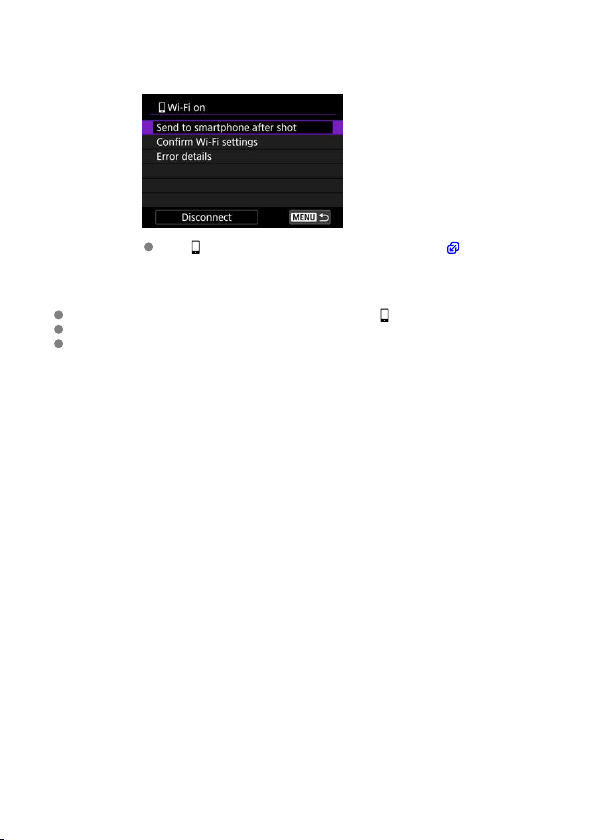
9.
Confirm that the devices are connected via Wi-Fi.
The [ Wi-Fi on] screen is displayed on the camera. ( )
The Wi-Fi connection to a smartphone is now complete.
To end the Wi-Fi connection, select [Disconnect] on the [ Wi-Fi on] screen.
Terminating the Wi-Fi connection will switch the camera to the Bluetooth connection.
To reconnect, start Camera Connect and tap the function you will use.
564
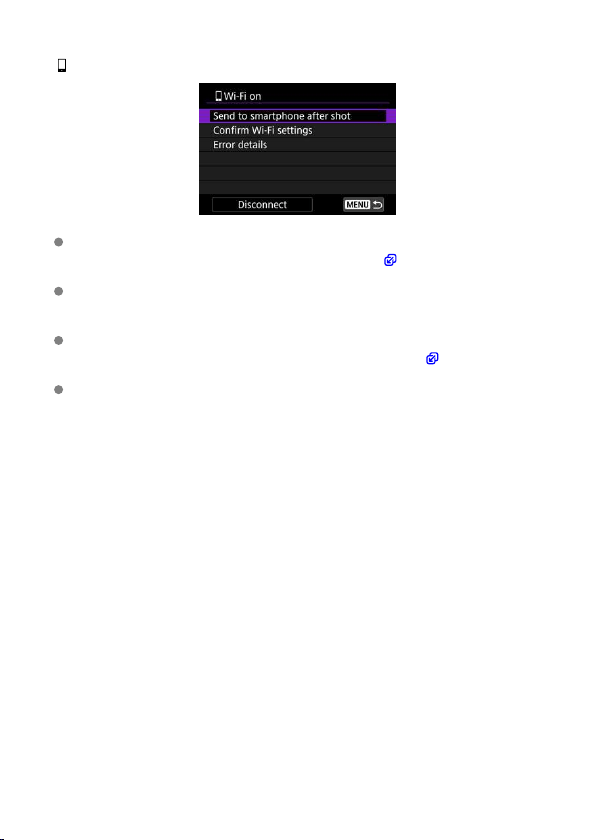
[ Wi-Fi on] screen
Send to smartphone after shot
Images can be transferred to a smartphone automatically ( ).
Confirm Wi-Fi settings
You can check setting details for Wi-Fi connections.
Error details
After any Wi-Fi connection errors, you can check the error details ( ).
Disconnect
Ends the Wi-Fi connection.
565

Main Functions of Camera Connect
Images on camera
Images can be browsed, deleted, or rated.
Images can be saved on a smartphone.
Effects can be applied to RAW images that you can subsequently save to a smartphone
as JPEGs ( ).
Remote live view shooting
Enables remote shooting as you view a live image on the smartphone.
Auto transfer
Enables camera and app setting adjustment for automatic transfer of your shots ( ).
Bluetooth remote controller
Enables remote control of the camera from a smartphone paired via Bluetooth. (Not
available when connected via Wi-Fi.)
Auto power off is disabled while you are using the Bluetooth remote controller feature.
Camera settings
Camera settings can be changed.
You can check other functions from the main Camera Connect screen.
566
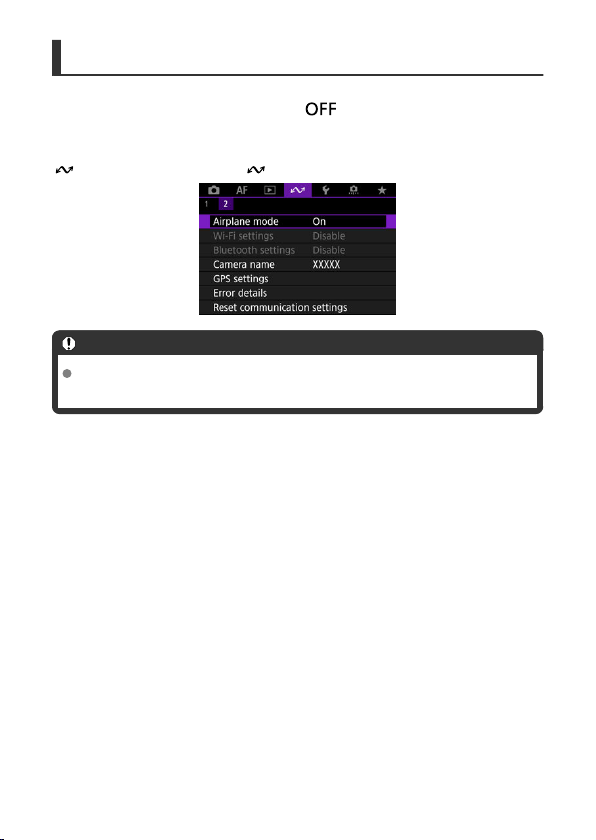
Maintaining a Wi-Fi Connection When the Camera Is Off
Even when the camera power switch is set to
<
>, as long as it is paired to a
smartphone via Bluetooth, you can use the smartphone to browse images on the camera or
perform other operations.
If you prefer not to stay connected to the camera via Wi-Fi/Bluetooth when it is off, either set
[
: Airplane mode] to [On] or set [ : Bluetooth settings] to [Disable].
Caution
This function can no longer be used if the wireless settings are reset or the
smartphone connection information is erased.
567
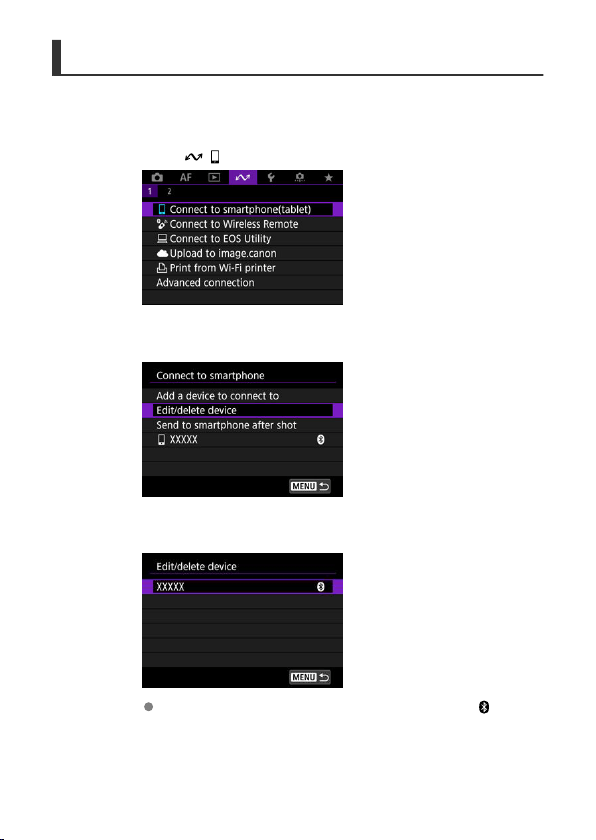
Canceling the Pairing
Cancel pairing with a smartphone as follows.
1.
Select [
: Connect to smartphone(tablet)].
2.
Select [Edit/delete device].
3.
Select the smartphone to cancel pairing with.
Smartphones currently paired with the camera are labeled [ ].
568
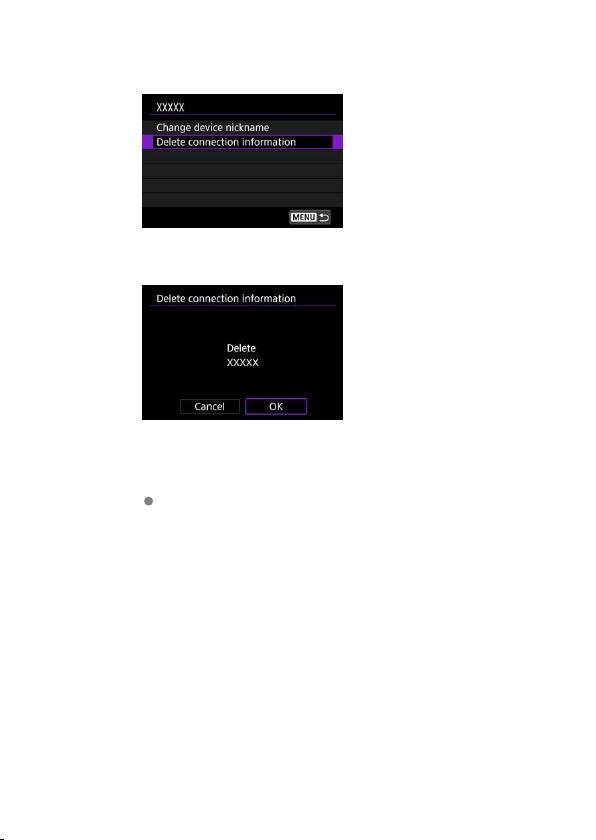
4.
Select [Delete connection information].
5.
Select [OK].
6.
Clear the camera information on the smartphone.
In the smartphone's Bluetooth setting menu, clear the camera
information registered on the smartphone.
569
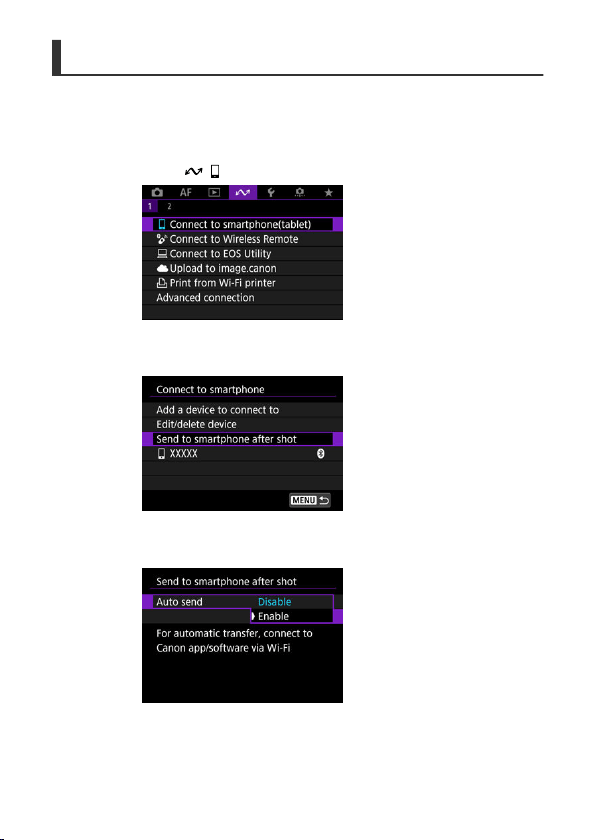
Automatic Image Transfer to a Smartphone as You Shoot
Your shots can be automatically sent to a smartphone. Before following these steps, make
sure the camera and smartphone are connected via
Wi-Fi.
1.
Select [
: Connect to smartphone(tablet)].
2.
Select [Send to smartphone after shot].
3.
Set [Auto send] to [Enable].
570
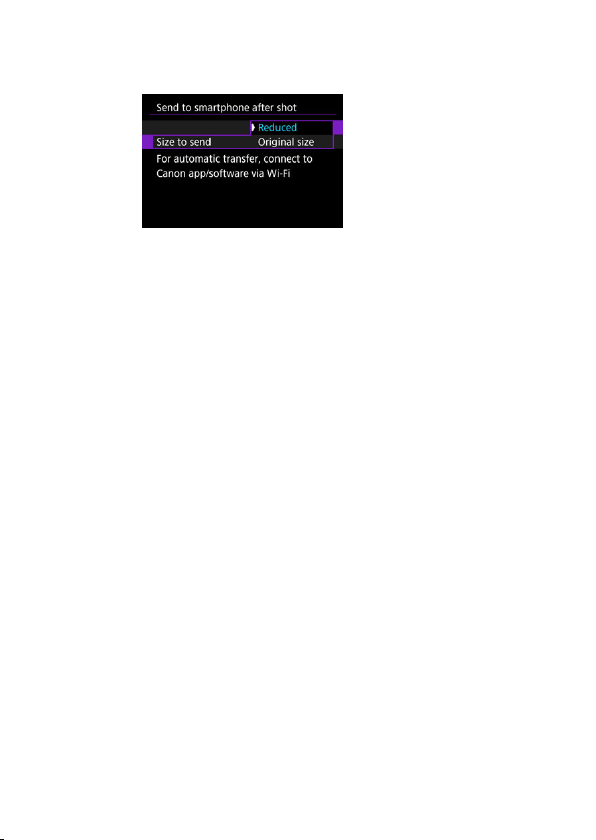
4.
Set [Size to send].
5.
Take the picture.
571
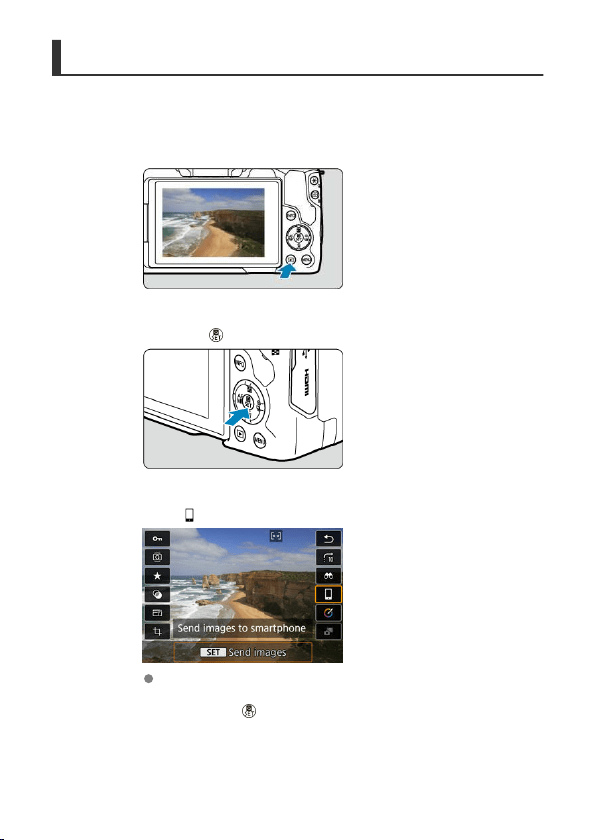
Sending Images to a Smartphone from the Camera
You can use the camera to send images to a smartphone connected via
Wi-Fi.
1.
Switch to playback.
2.
Press the <
> button.
3.
Select [
Send images to smartphone].
If you perform this step while connected via Bluetooth, a message is
displayed requesting you to establish a Wi-Fi connection. After
pressing the <
> button, tap a Camera Connect function to connect
via Wi-Fi, then start again from step 1.
4.
Select sending options and send the images.
572
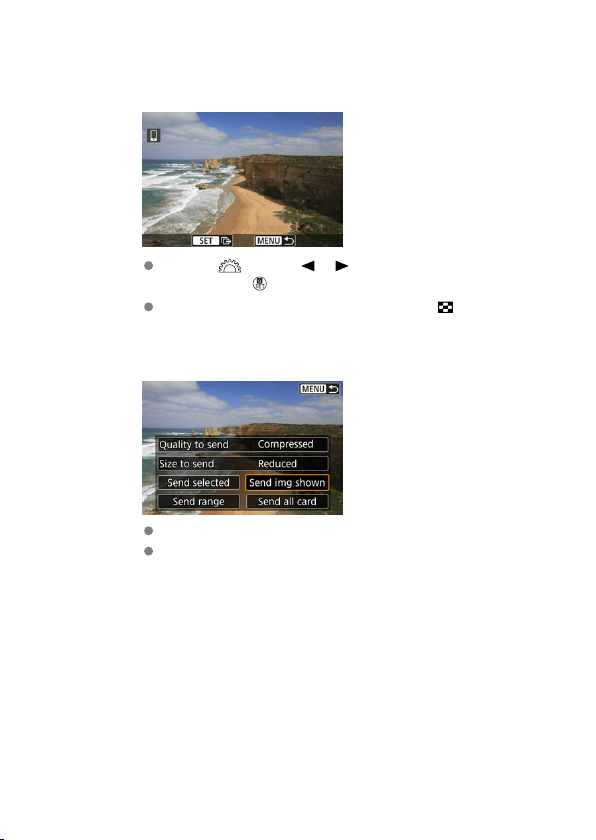
(1) Sending images individually
1.
Select an image to send.
Use the < > dial or < >< > keys to select an image to send,
then press the <
> button.
To select the image from index display, press the < > button.
2.
Select [Send img shown].
In [Size to send], you can select the image sending size.
When sending movies, you can select the image quality of movies to
send in [Quality to send].
573
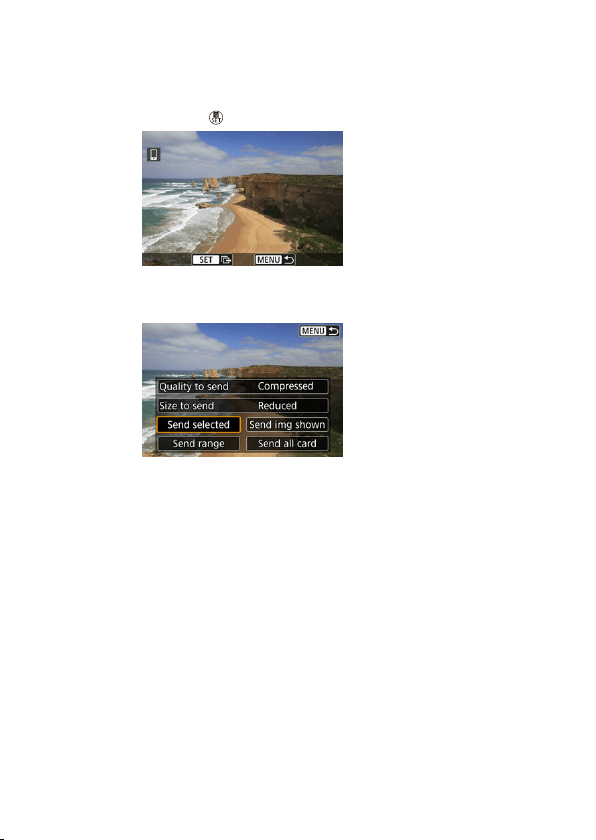
(2) Sending multiple selected images
1.
Press the <
> button.
2.
Select [Send selected].
574
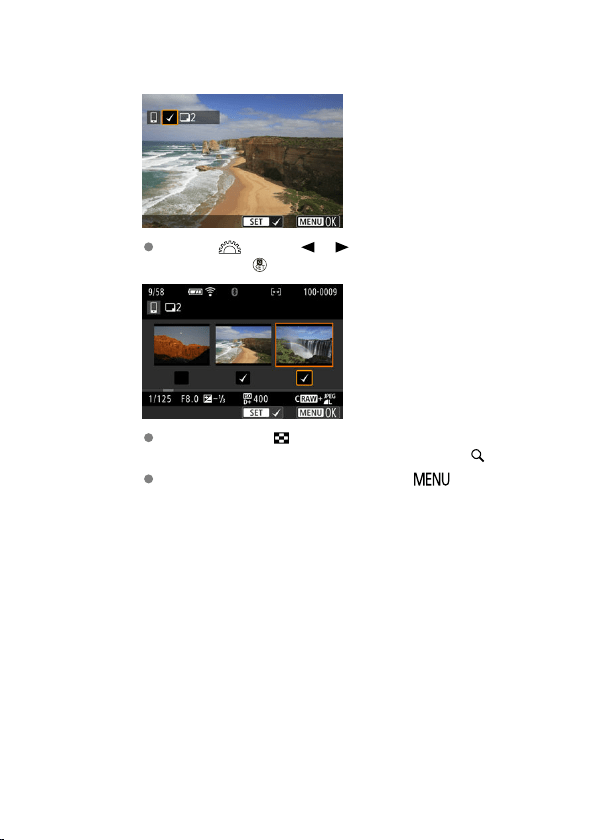
3.
Select images to send.
Use the < > dial or < >< > keys to select an image to send,
then press the <
> button.
You can press the < > button to select the images from 3-image
display. To return to the single-image display, press the <
> button.
After selecting the images to send, press the < > button.
Select [OK] when a message is displayed.
575
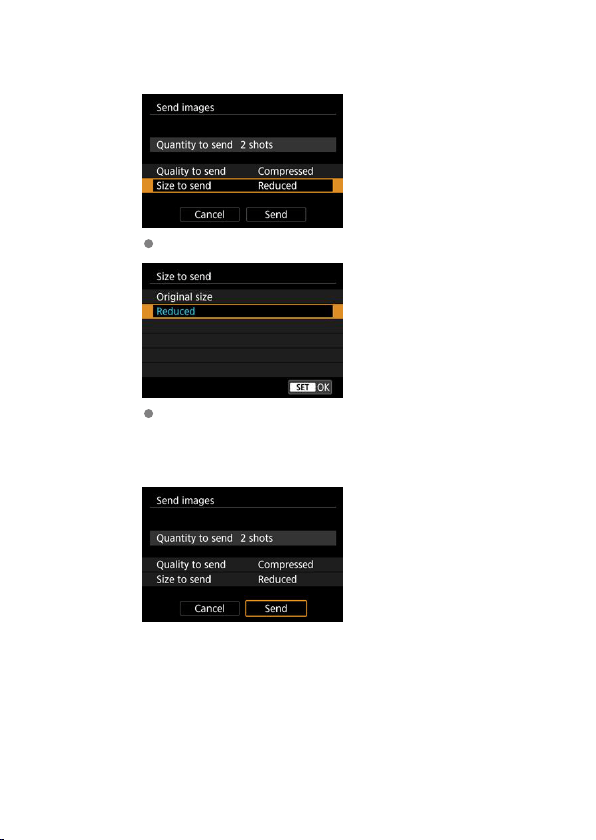
4.
Select [Size to send].
On the displayed screen, select an image size.
When sending movies, select the image quality in [Quality to send].
5.
Select [Send].
576
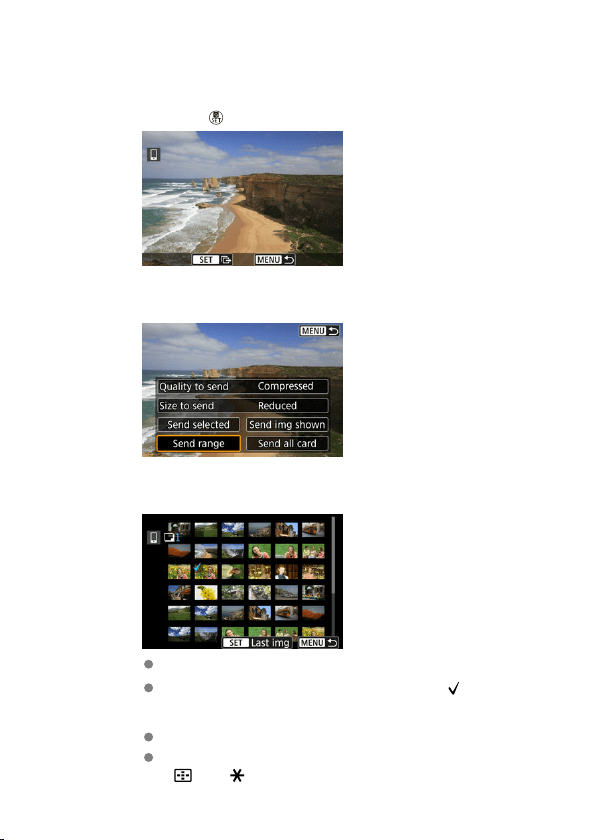
(3) Sending a specified range of images
1.
Press the <
> button.
2.
Select [Send range].
3.
Specify the range of images.
Select the first image (start point).
Next, select the last image (end point). A checkmark [ ] will be
appended to all the images within the range between first and last
images.
To clear the selection, repeat step 3.
To change the number of images shown in index display, press the
<
> or < > button.
577
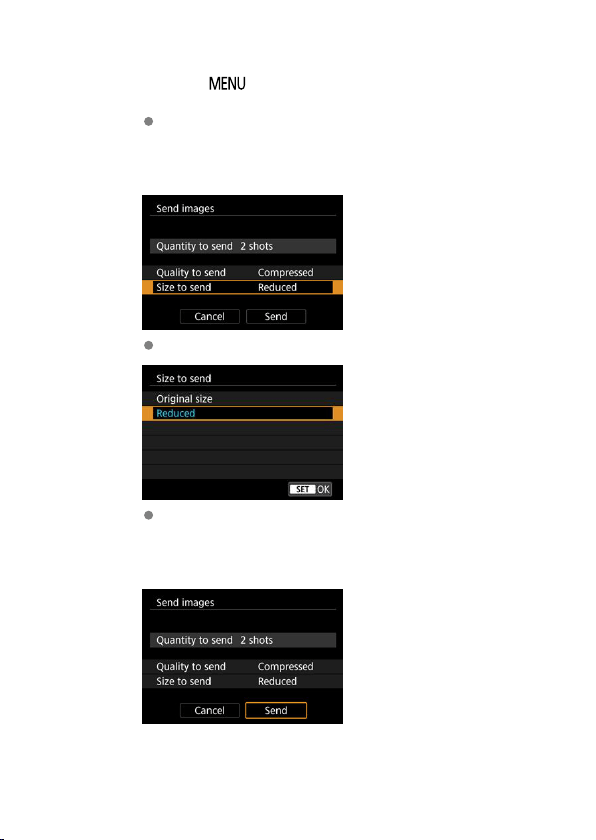
4.
Press the <
> button.
Select [OK] when a message is displayed.
5.
Select [Size to send].
On the displayed screen, select an image size.
When sending movies, select the image quality in [Quality to send].
6.
Select [Send].
578
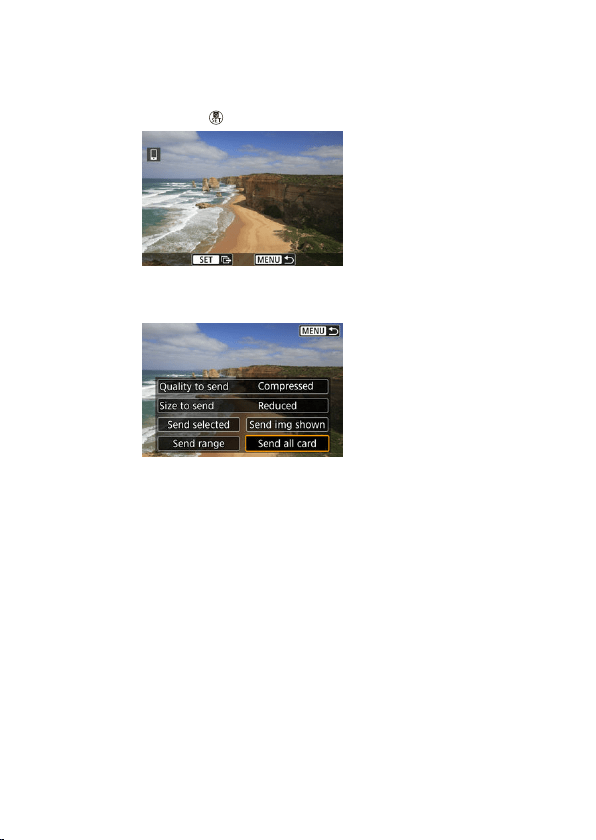
(4) Sending all images on the card
1.
Press the <
> button.
2.
Select [Send all card].
579
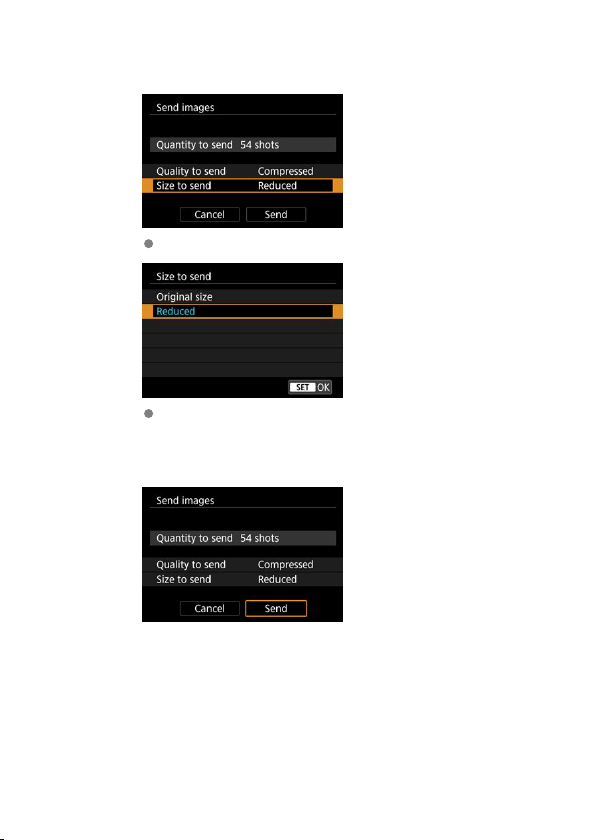
3.
Select [Size to send].
On the displayed screen, select an image size.
When sending movies, select the image quality in [Quality to send].
4.
Select [Send].
580
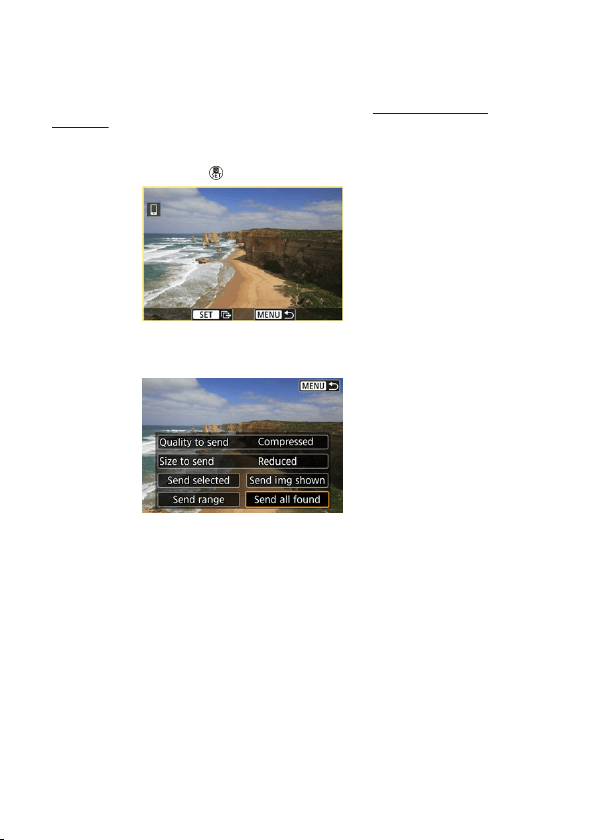
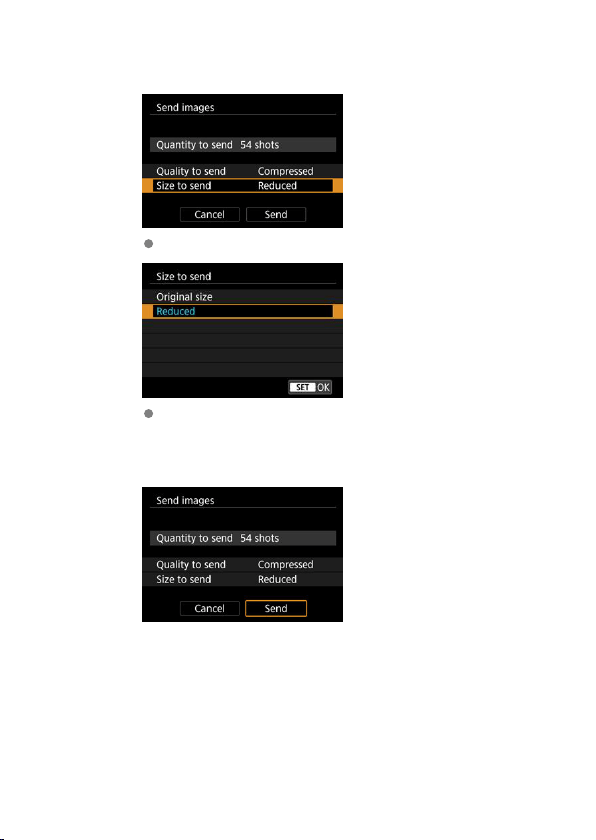
3.
Select [Size to send].
On the displayed screen, select an image size.
When sending movies, select the image quality in [Quality to send].
4.
Select [Send].
582
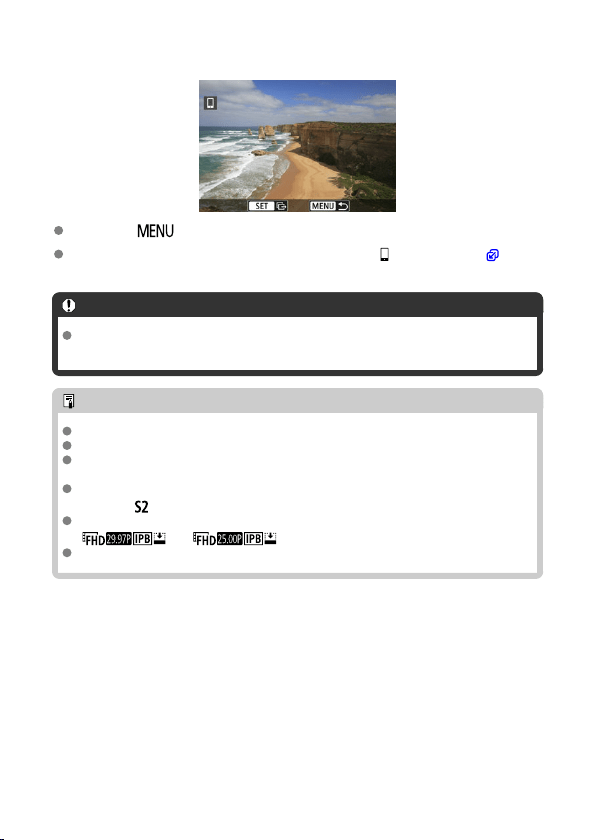
Ending image transfer
Press the < > button on the image transfer screen.
To end the Wi-Fi connection, select [Disconnect] on the [ Wi-Fi on] screen ( ).
Caution
During the image transfer operation, a picture cannot be taken even if the camera's
shutter button is pressed.
Note
You can cancel the image transfer by selecting [Cancel] during the transfer.
You can select up to 999 files at a time.
With a Wi-Fi connection established, disabling the smartphone's power saving
function is recommended.
Selecting the reduced size for still photos applies to all still photos sent at that time.
Note that
size still photos are not reduced.
Selecting compression for movies applies to all movies sent at that time. Note that
and movies are not reduced.
When you use a battery to power the camera, make sure it is fully charged.
583
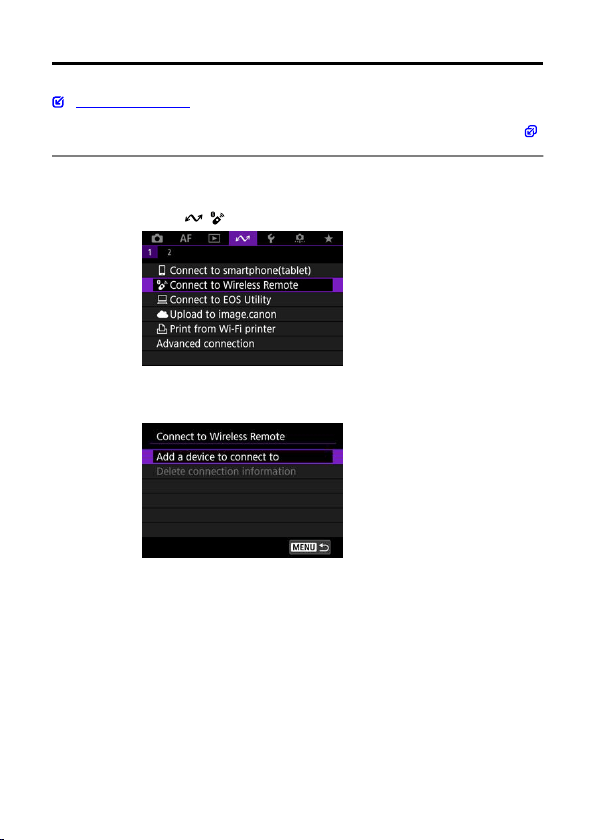
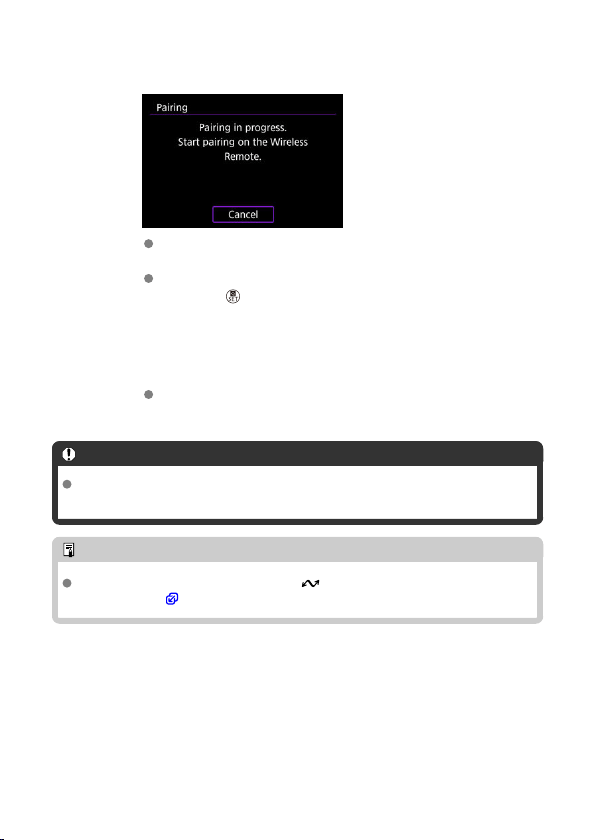
3.
Pair the devices.
When the screen shown above appears, press and hold the <W> and
<T> buttons on the BR-E1 simultaneously for at least 3 sec.
After a message confirms that the camera is paired with the BR-E1,
press the <
> button.
4.
Set up the camera for remote control shooting.
For instructions after the pairing is complete, refer to the BR-E1's
Instruction Manual.
Caution
Bluetooth connections consume battery power even after the camera's auto power
off is activated.
Note
When you will not use Bluetooth, setting [ : Bluetooth settings] to [Disable] is
recommended ( ).
585
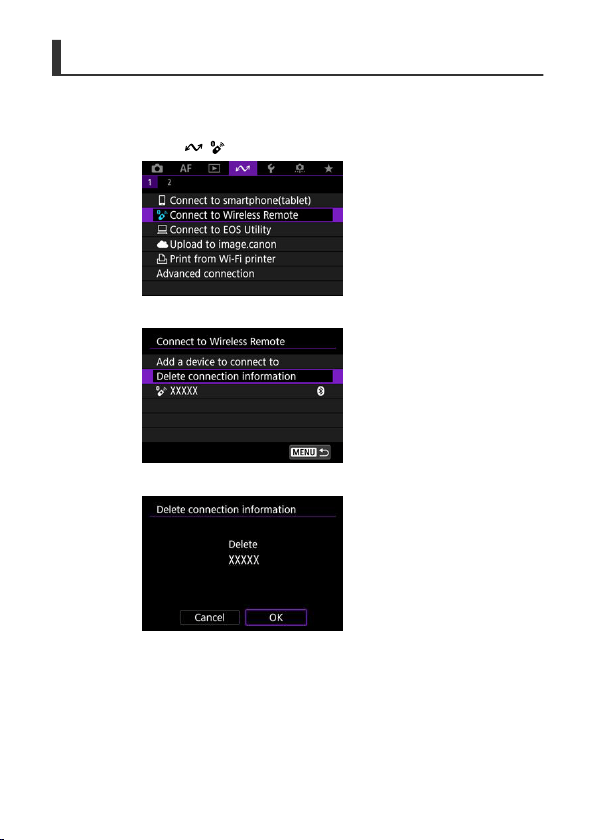
Canceling the Pairing
Before pairing with a different
BR-E1, clear the information about the connected remote
control.
1.
Select [
: Connect to Wireless Remote].
2.
Select [Delete connection information].
3.
Select [OK].
586
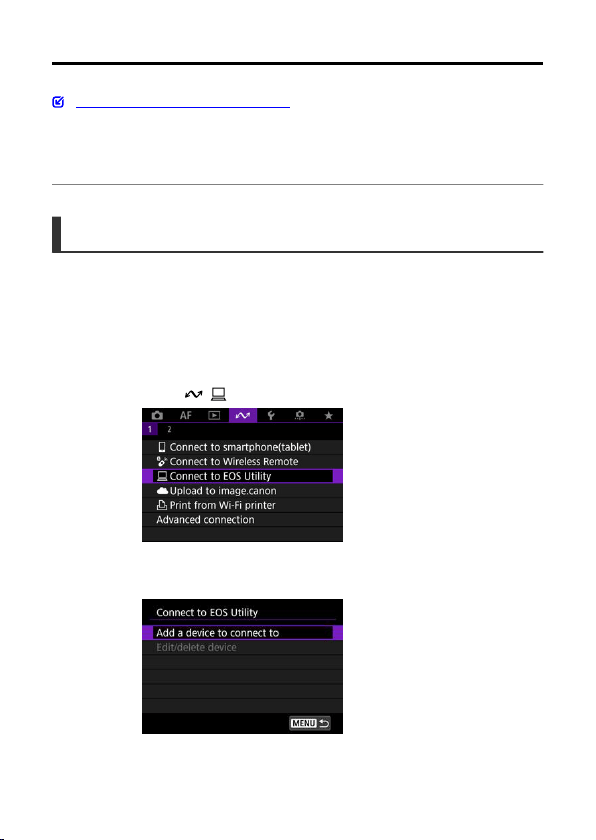
Connecting to EOS Utility
Operating the Camera Using EOS Utility
This section describes how to connect the camera to a computer via Wi-Fi and perform
camera operations using EOS software or other dedicated software. Install the latest version
of software on the computer before setting up a Wi-Fi connection.
For computer operating instructions, refer to the computer user manual.
Operating the Camera Using EOS Utility
Using EOS Utility (EOS software), you can import images from the camera, control the
camera, and perform other operations.
Steps on the camera (1)
1.
Select [
: Connect to EOS Utility].
2.
Select [Add a device to connect to].
587
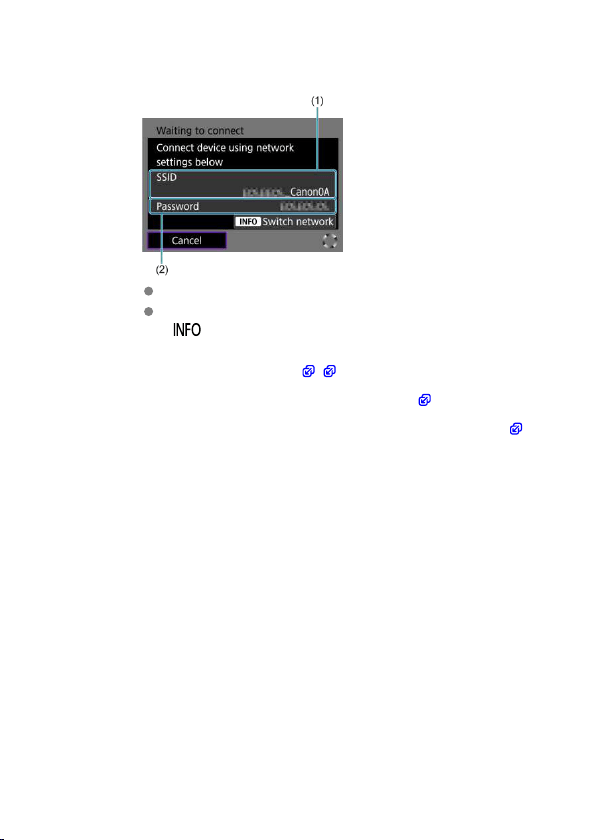
3.
Check the SSID (network name) and password.
Check the SSID (1) and Password (2) displayed on the camera screen.
To establish a Wi-Fi connection using an access point, press the
<
> button. Follow the instructions for the connection method
used.
• Connecting via WPS ( , )
• Connecting manually to detected networks ( )
• Connecting manually by specifying access point information ( )
588
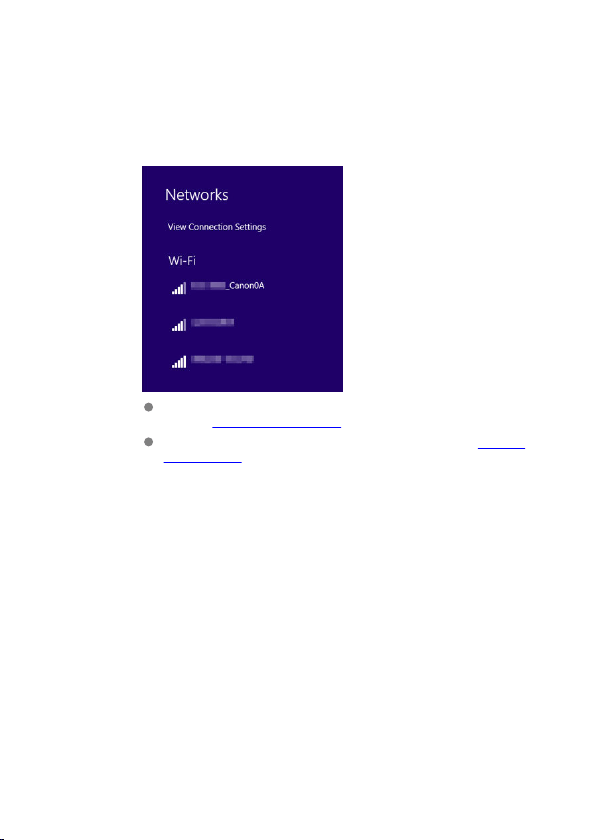
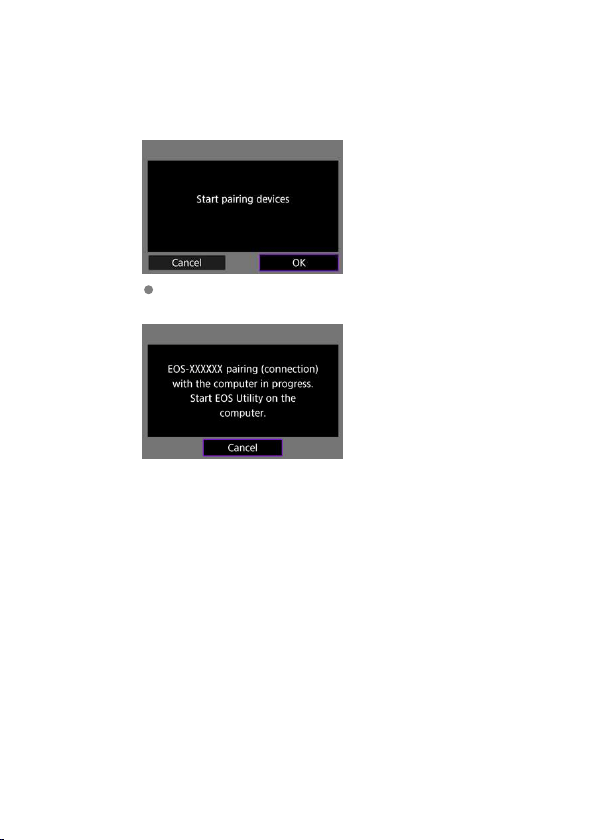
Steps on the camera (2)
5.
Select [OK].
The following message is displayed. “******” represents the last six
digits of the MAC address of the camera to be connected.
590
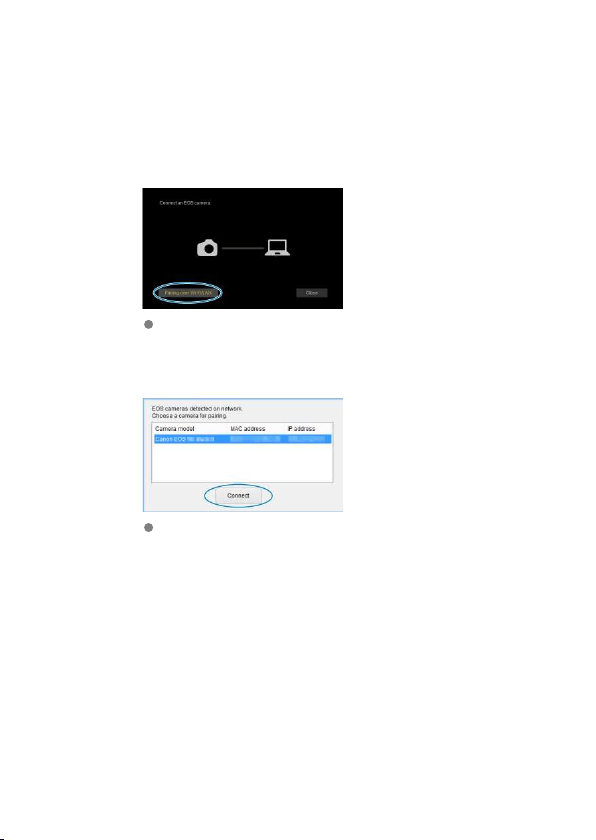
Steps on the computer (2)
6.
Start EOS Utility.
7.
In EOS Utility, click [Pairing over Wi-Fi/LAN].
If a firewall-related message is displayed, select [Yes].
8.
Click [Connect].
Select the camera to connect to, then click [Connect].
591
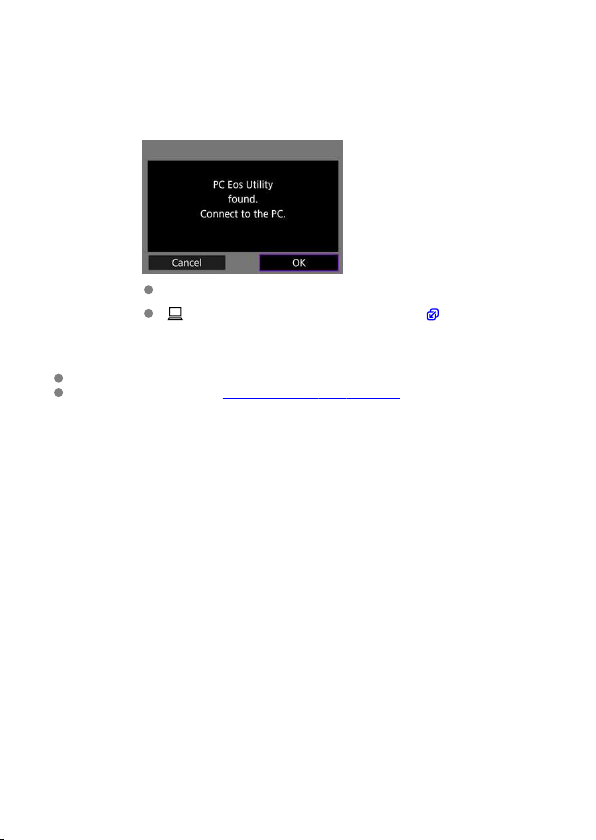
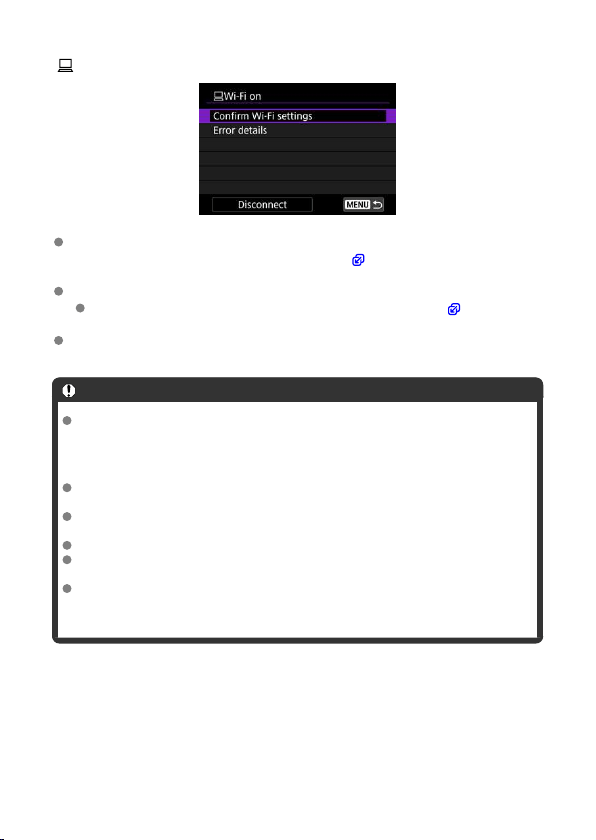
[ Wi-Fi on] screen
Confirm Wi-Fi settings
You can check setting details for Wi-Fi connections ( ).
Error details
After any Wi-Fi connection errors, you can check the error details ( ).
Disconnect
Ends the Wi-Fi connection.
Caution
If the Wi-Fi connection is terminated while recording a movie with remote shooting,
the following will occur.
• Any movie recording in progress in movie recording mode will continue.
• Any movie recording in progress in still photo shooting mode will end.
You cannot use the camera to shoot in still photo shooting mode when it is set to
movie recording mode in EOS Utility.
With a Wi-Fi connection to EOS Utility established, certain functions are
unavailable.
In remote shooting, the AF speed may become slower.
Depending on the communication status, image display or shutter release timing
may be delayed.
In Remote Live View shooting, the rate of image transmission is slower compared
to a connection via an interface cable. Therefore, moving subjects cannot be
displayed smoothly.
593
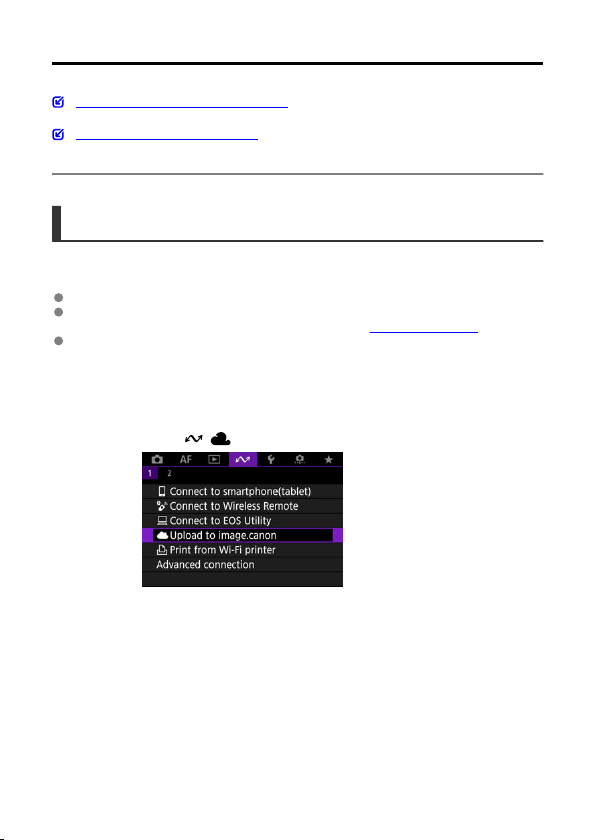
Uploading Images to image.canon
Connecting the Camera to image.canon
Uploading Images to image.canon
This section describes how to send images to image.canon.
Connecting the Camera to image.canon
Link the camera to image.canon to send images directly from the camera.
A smartphone with a browser and internet connection is required.
For instructions on how to use image.canon services and details on countries and
regions where it is available, visit the image.canon site (https://image.canon/).
Separate ISP connection and access point fees may apply.
Steps on the camera (1)
1.
Select [
: Upload to image.canon].
594
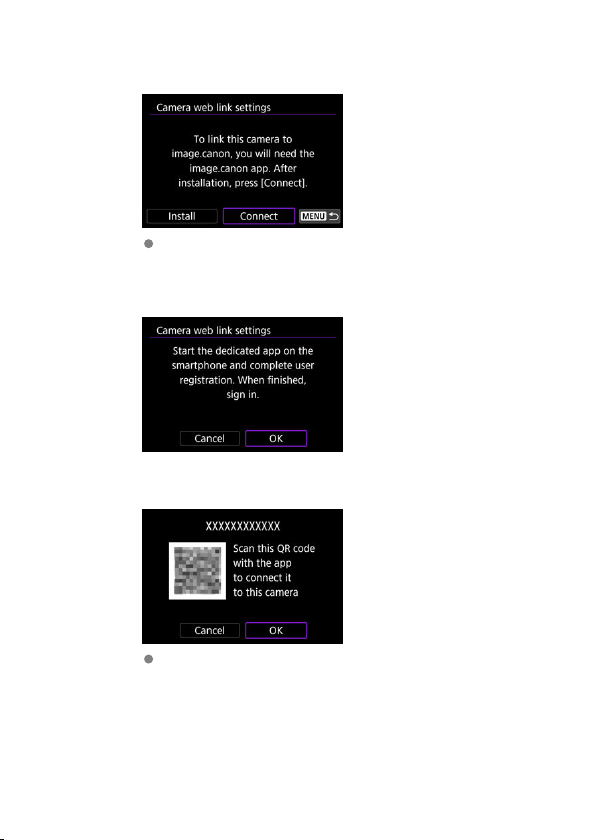
2.
Select [Connect].
If the dedicated app has not been installed, select [Install].
3.
Select [OK].
4.
Scan the QR code with the dedicated app.
Select [OK].
595
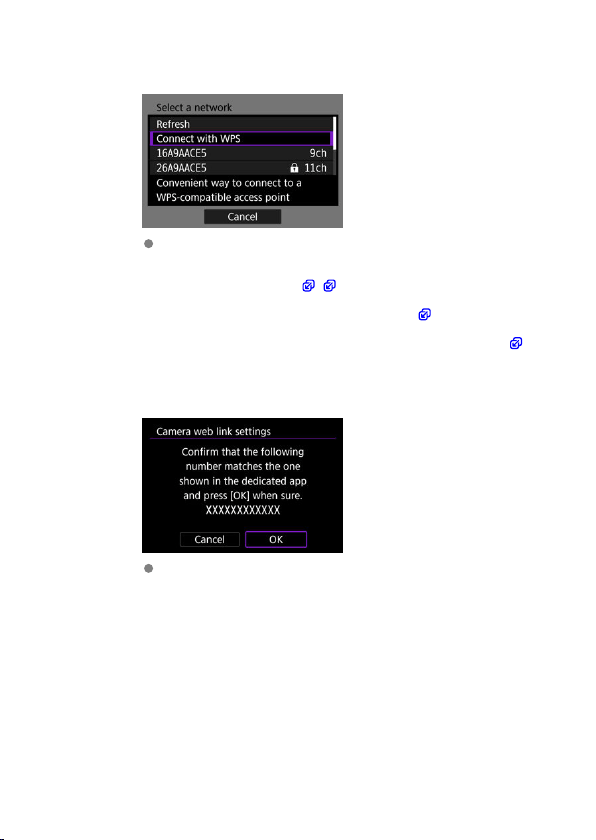
5.
Establish a Wi-Fi connection.
Connect to an access point via Wi-Fi. Follow the instructions for the
connection method used.
• Connecting via WPS ( , )
• Connecting manually to detected networks ( )
• Connecting manually by specifying access point information ( )
6.
Confirm that the number is displayed in the dedicated app.
Select [OK].
596
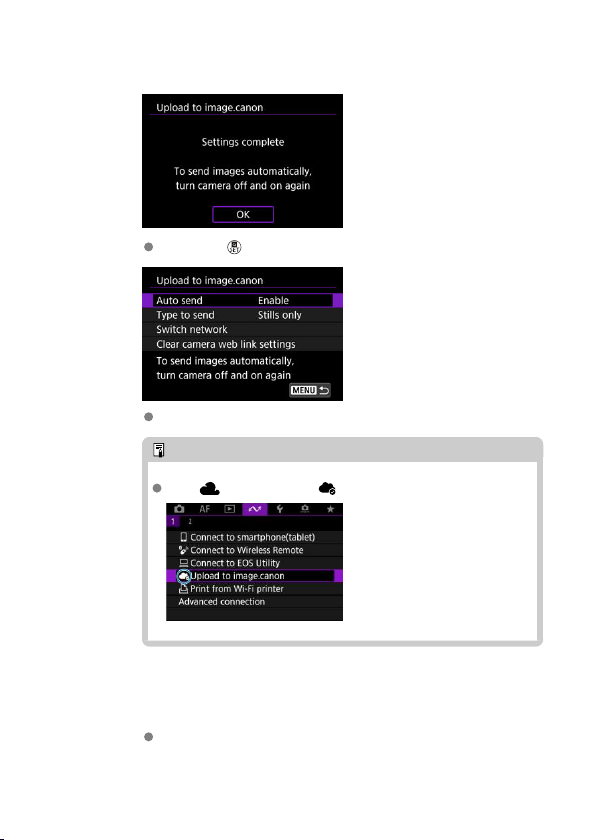
7.
Complete the settings.
Press the < > button.
The setting menu is displayed on the camera screen.
Note
The [ ] icon changes to [ ].
8.
Check the dedicated app.
Confirm that the camera model name is registered in the dedicated
app.
597
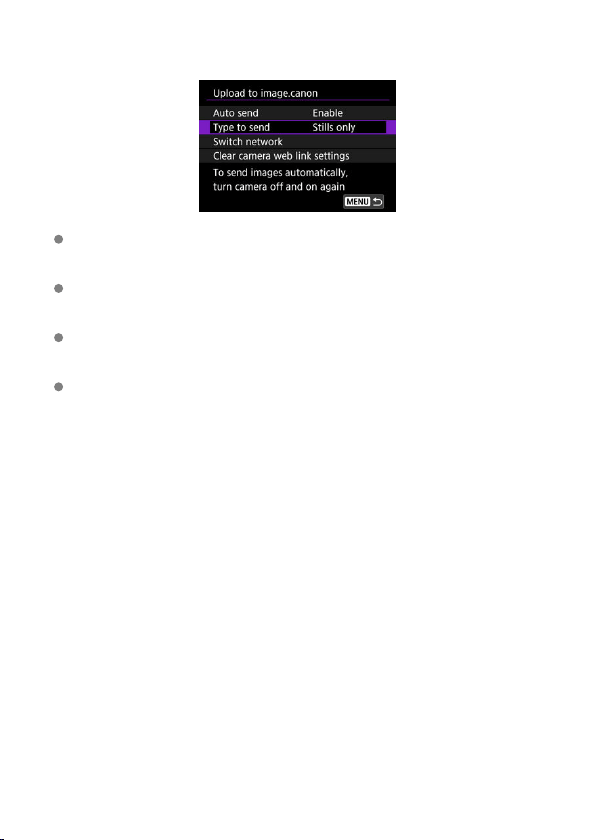
[Upload to image.canon] screen
Auto send
You can choose whether to upload images automatically.
Type to send
You can select the type of images uploaded.
Switch network
You can change the settings for Wi-Fi connections.
Clear camera web link settings
You can clear the camera web link settings.
598
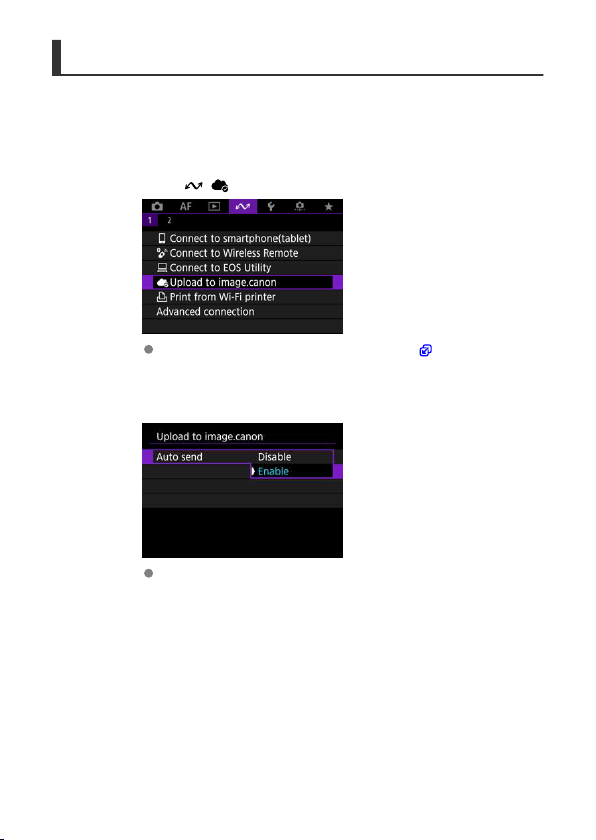
Uploading Images to image.canon
Images are automatically uploaded to image.canon after the camera starts up (or recovers
from auto power off). Images uploaded to image.canon can be downloaded to a computer or
transferred to other web services.
1.
Select [
: Upload to image.canon].
The [Upload to image.canon] screen appears ( ).
2.
Set [Auto send] to [Enable].
If [Auto send] is already set to [Enable], go to step 3.
599
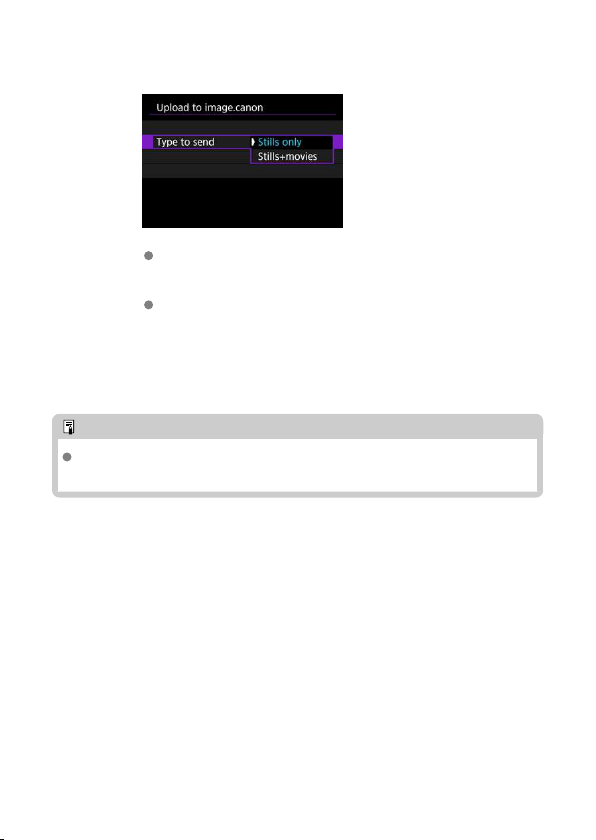
3.
Set [Type to send].
Stills only
Uploading only applies to still photos.
Stills+movies
Uploading applies to both still photos and movies.
4.
Restart the camera.
Note
Uploaded images are stored at image.canon for 30 days at the original image size,
without storage limitations.
600
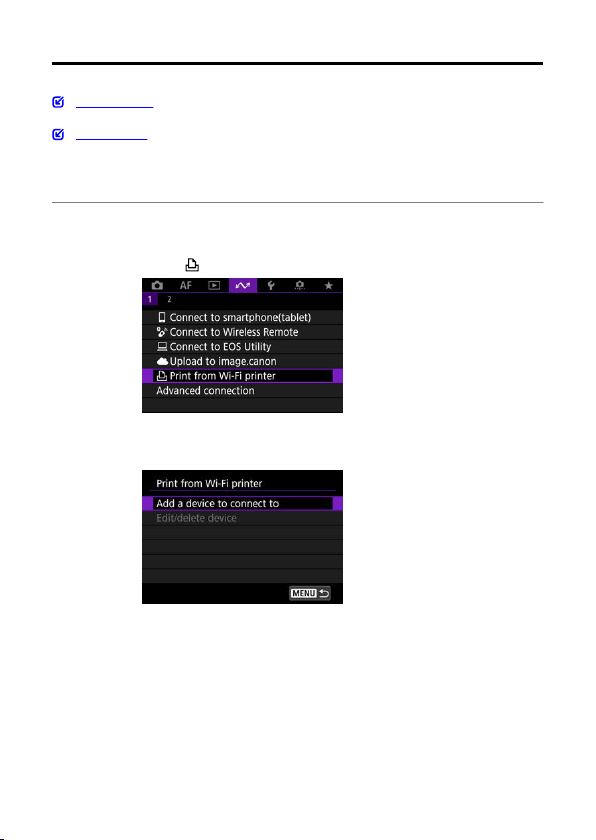
Connecting to a Printer via Wi-Fi
Image Printing
Print Settings
This section describes how to print images by directly connecting the camera to a printer
supporting PictBridge (Wireless LAN) via Wi-Fi. For printer operating instructions, refer to
the printer user manual.
1.
Select [
Print from Wi-Fi printer].
2.
Select [Add a device to connect to].
601
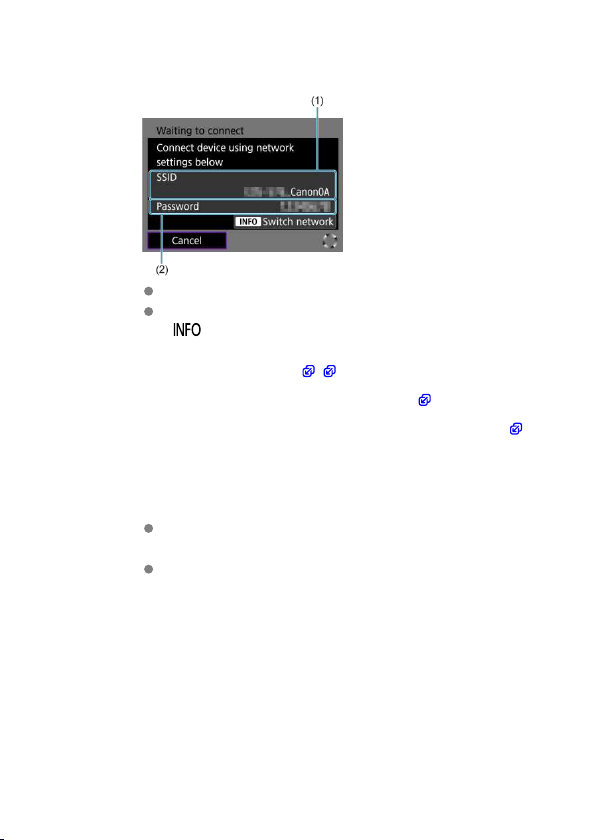
3.
Check the SSID (network name) and password.
Check the SSID (1) and Password (2) displayed on the camera screen.
To establish a Wi-Fi connection using an access point, press the
<
> button. Follow the instructions for the connection method
used.
• Connecting via WPS ( , )
• Connecting manually to detected networks ( )
• Connecting manually by specifying access point information ( )
4.
Set up the printer.
In the Wi-Fi settings menu of the printer to be used, select the SSID
you have checked.
For the password, enter the password checked in step 4.
602
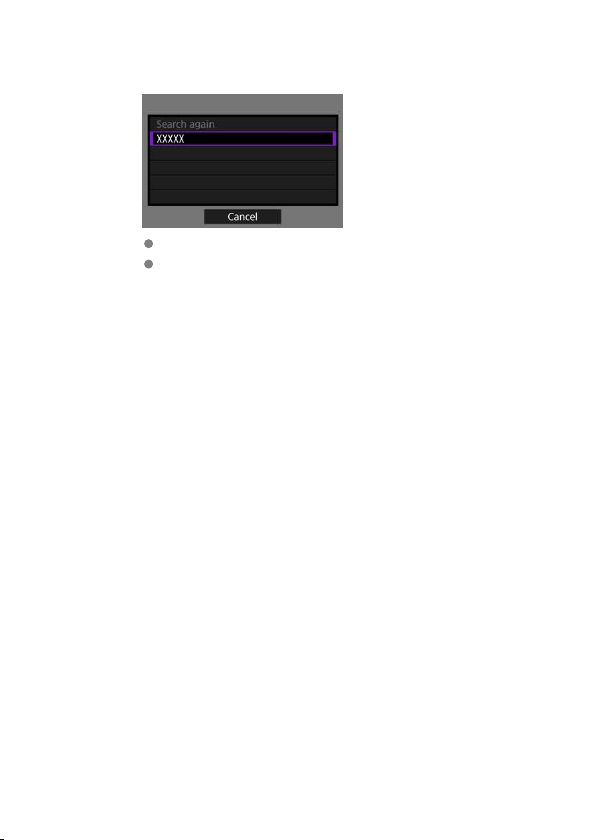
5.
Select the printer.
In the list of detected printers, select the printer to connect to via Wi-Fi.
If your preferred printer is not listed, selecting [Search again] may
enable the camera to find and display it.
603
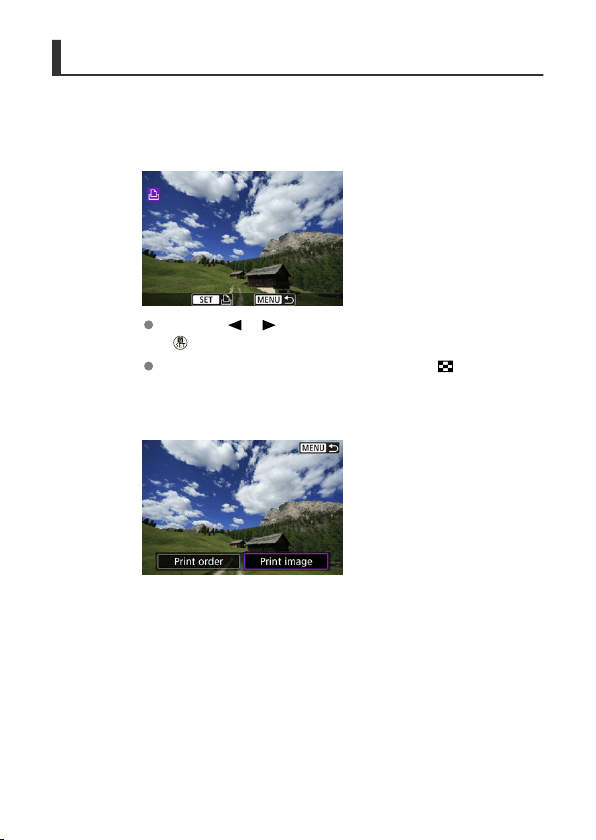
Image Printing
Printing images individually
1.
Select the image to print.
Press the < >< > keys to select an image to print, then press the
<
> button.
To select the image from index display, press the < > button.
2.
Select [Print image].
604
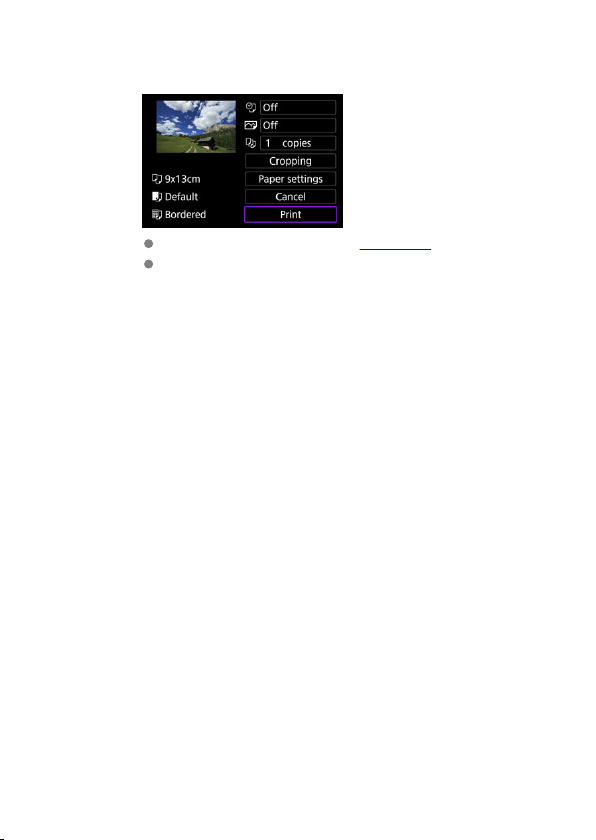
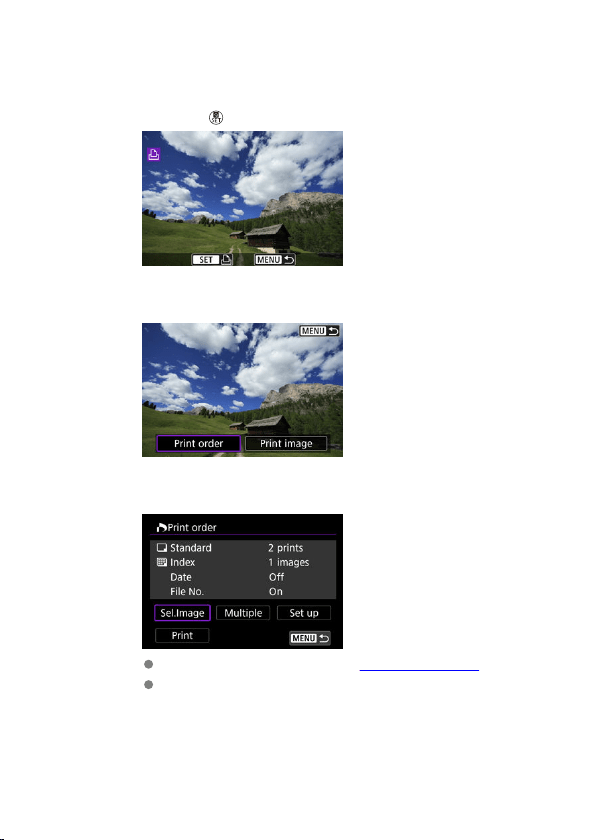
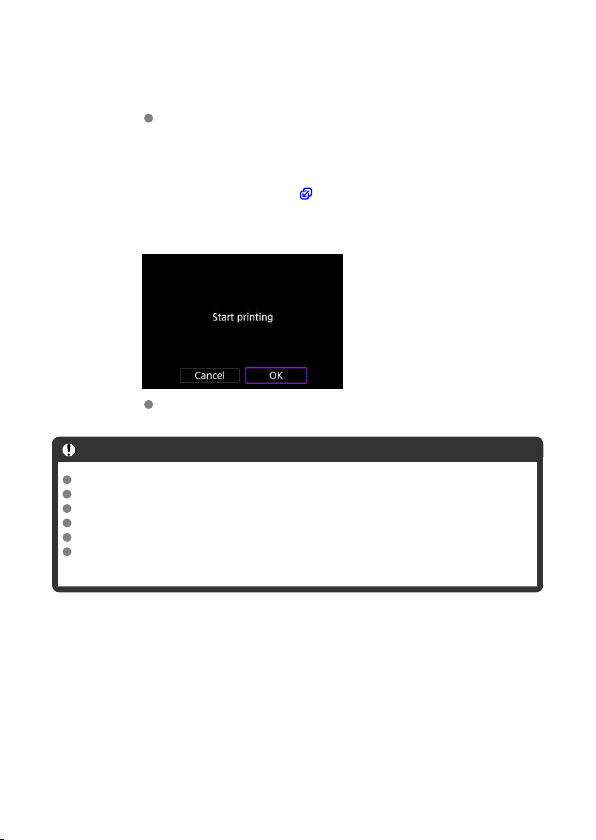
4.
Select [Print].
[Print] can be selected only when an image is selected and the printer
is ready to print.
5.
Configure [Paper settings] (
).
6.
Print the image.
When [OK] is selected, printing starts.
Caution
Shooting is not possible while connected to a printer via Wi-Fi.
RAW images, HEIF images, and movies cannot be printed.
Before printing, be sure to set the paper size.
File number printing may not be supported by certain printers.
Dates may be printed on the border by certain printers when [Bordered] is set.
Depending on the printer, the date may appear faint if it is printed on a bright
background or on the border.
607
Note
When you use a battery to power the camera, make sure it is fully charged.
It may take some time until printing starts after you select [Print], depending on file
size and image quality.
To stop printing, press the < > button while [Cancel] is displayed, then select
[OK].
When printing with [Print order], you can select [Resume] to continue printing the
remaining images if you have stopped printing in progress. Note that printing will
not resume if any of the following occurs.
• You change the print order or delete any of the specified images before
resuming printing.
• When index is set and you change the paper setting before resuming printing.
If a problem occurs during printing, see Notes.
608
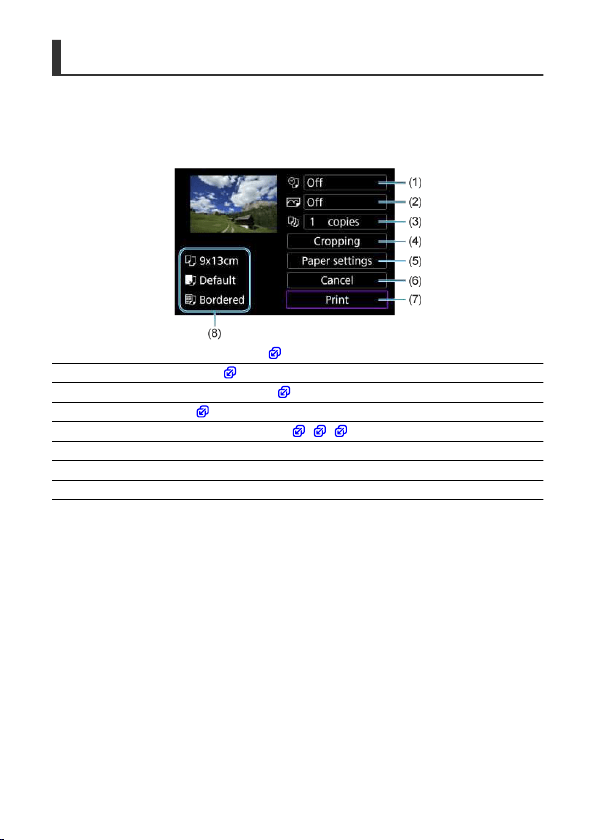
Print Settings
The screen display and setting options vary depending on the printer. Also, certain
settings may not be available. For details, refer to the printer's instruction manual.
Print settings screen
(1) Sets date or file number printing ( ).
(2) Sets the printing effects ( ).
(3) Sets the number of copies to print ( ).
(4) Sets the print area ( ).
(5) Sets the paper size, type, and layout ( , , ).
(6) Returns to the image selection screen.
(7) Starts the printing.
(8) The paper size, type, and layout you have set are displayed.
* Depending on the printer, certain settings may not be selectable.
609
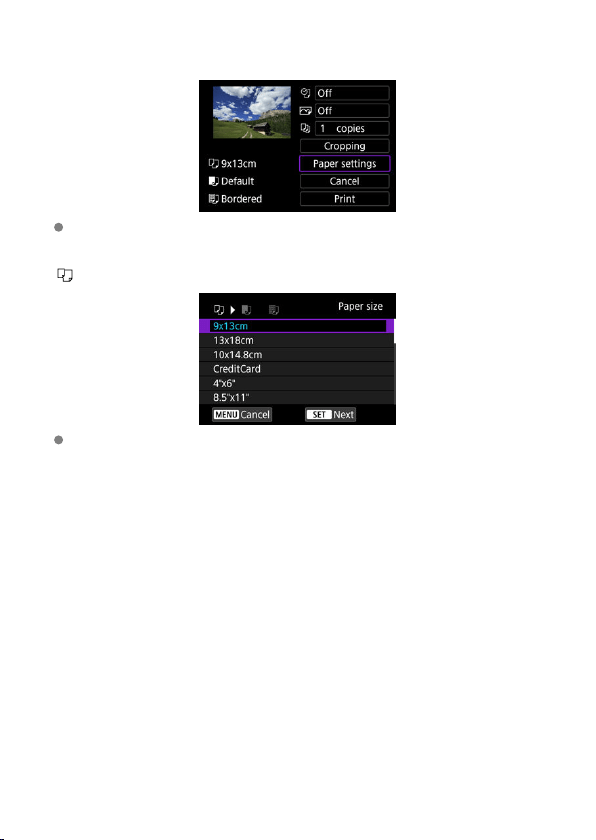
Paper settings
Select [Paper settings].
[
] Setting the paper size
Select the size of the paper in the printer.
610
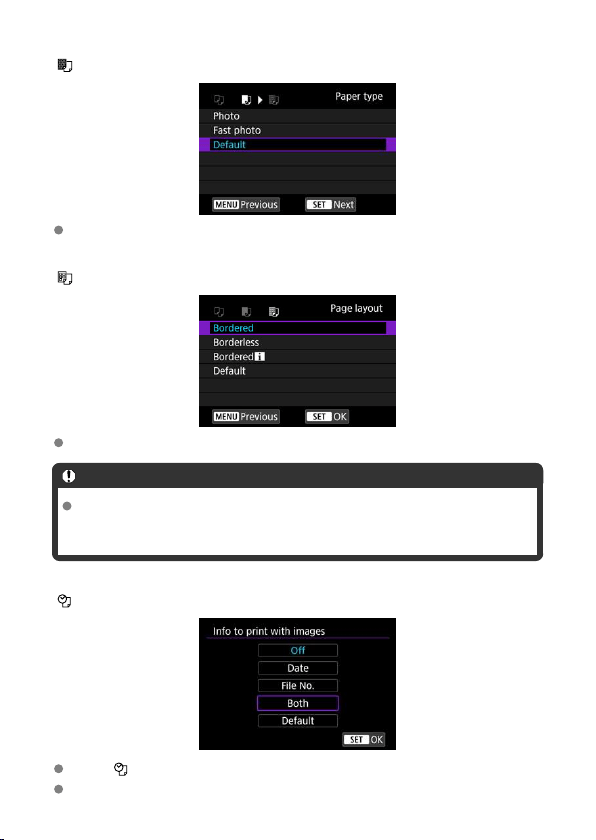
[ ] Setting the paper type
Select the type of the paper in the printer.
[
] Setting the page layout
Select the page layout.
Caution
If the image's aspect ratio is different from the printing paper's aspect ratio, the
image may be cropped significantly when you print it as a borderless print. Images
may also be printed at lower resolution.
[
] Setting printing of the date/file number
Select [ ].
Select what to print.
611
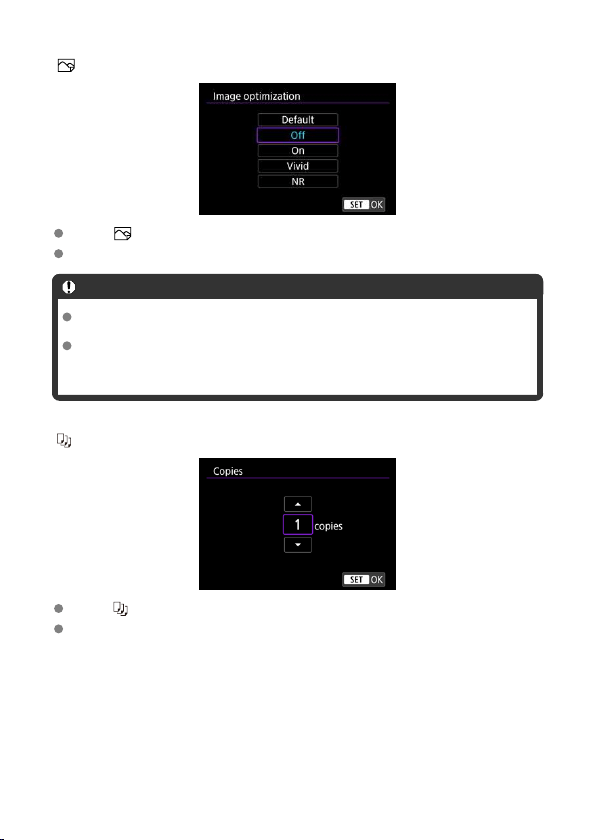
[ ] Setting printing effects (image optimization)
Select [ ].
Select printing effects.
Caution
ISO speeds may be misidentified in shooting information printed for images shot at
an expanded ISO speed (H).
[Default] in printing effects and other options refers to default settings determined
by the printer manufacturer. For [Default] details, refer to the printer instruction
manual.
[
] Setting the number of copies
Select [ ].
Select the number of copies to print.
612
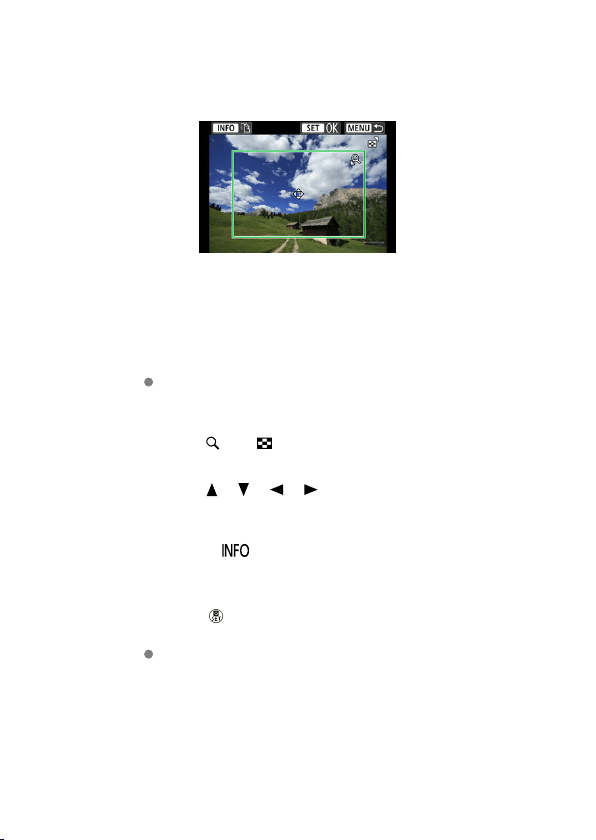
Cropping the image
Set cropping immediately before printing. Changing other print settings after you crop
images may require you to crop the images again.
1.
Select [Cropping] on the print setting screen.
2.
Set the cropping frame size, position, and orientation.
The image area within the cropping frame will be printed. The shape of
the frame (aspect ratio) can be changed in [Paper settings].
Resizing the cropping frame size
Press the < > or < > button to resize the cropping frame.
Moving the cropping frame
Press the < >< >< >< > keys to move the frame vertically or
horizontally.
Switching the orientation of the cropping frame
Pressing the < > button will toggle the cropping frame between the
vertical and horizontal orientations.
3.
Press the <
> button to exit cropping.
You can check the cropped image area in the upper left of the print
setting screen.
613
Caution
Depending on the printer, the cropped image area may not be printed as you
specified.
The smaller the cropping frame, the lower the resolution at which images are
printed.
Note
Handling printer errors
If printing does not resume after you resolve a printer error (such as no ink or
paper) and select [Continue], use buttons on the printer. For details on resuming
printing, refer to the printer's instruction manual.
Error messages
If a problem occurs during printing, an error message will appear on the camera
screen. After fixing the problem, resume printing. For details on how to fix a printing
problem, refer to the printer's instruction manual.
Paper error
Confirm that paper is loaded correctly.
Ink error
Check the printer's ink level and the waste ink tank.
Hardware error
Check for any printer problems other than paper and ink problems.
File error
The selected image cannot be printed. Images taken with a different camera or
images edited with a computer may not be printable.
614
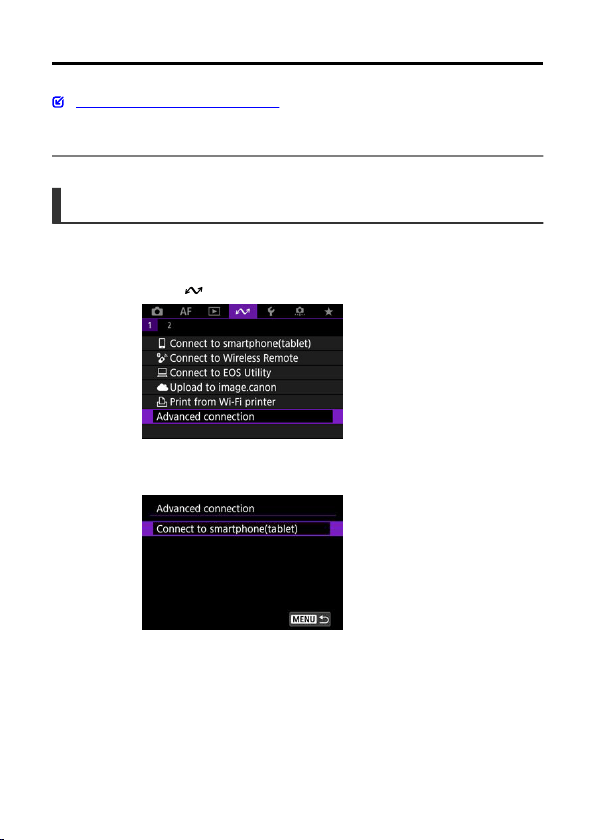
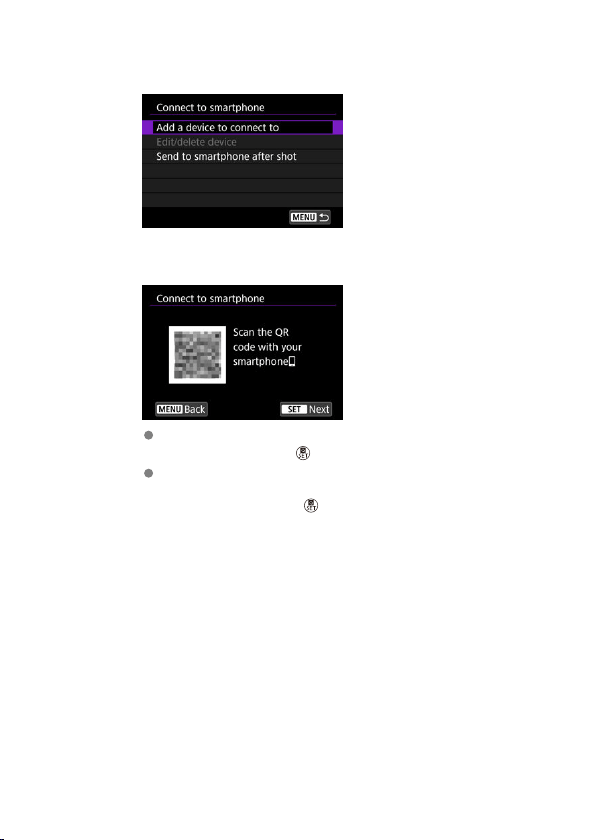
3.
Select [Add a device to connect to].
4.
Start searching for access points.
To start searching if Camera Connect is already installed on the
smartphone, press the
<
> button.
If Camera Connect is not installed, use the smartphone to scan the QR
code on the screen, go to Google Play or App Store to install Camera
Connect, then press the <
> button to start searching.
616
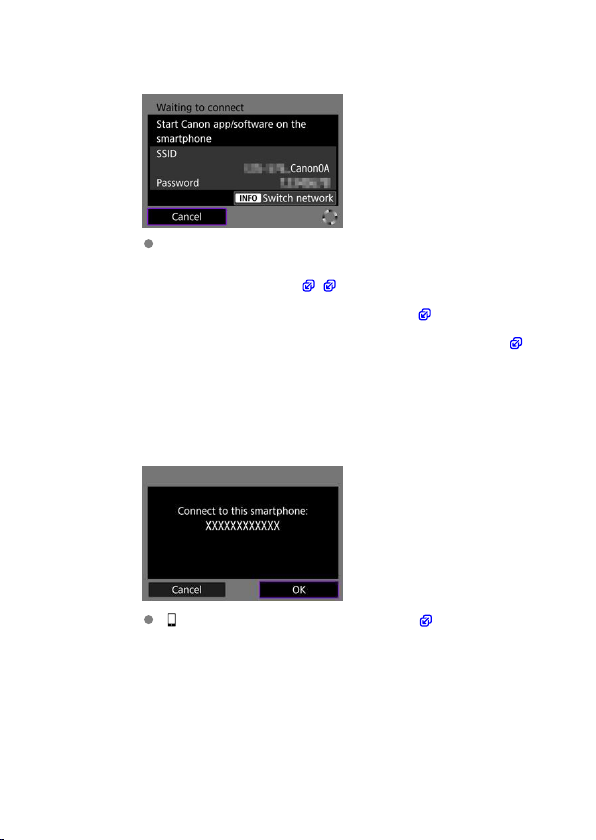
5.
Establish a Wi-Fi connection.
Connect to an access point via Wi-Fi. Follow the instructions for the
connection method used.
• Connecting via WPS ( , )
• Connecting manually to detected networks ( )
• Connecting manually by specifying access point information ( )
6.
Start Camera Connect and tap the camera name.
7.
Select [OK].
[ Wi-Fi on] is displayed on the camera screen ( ).
617
Basic Communication Settings
Preparation
Checking the Type of Access Point
Connecting via WPS (PBC Mode)
Connecting via WPS (PIN Mode)
Connecting Manually to Detected Networks
Connecting Manually by Specifying Networks
Connecting in Camera Access Point Mode
Setting the IP Address
Before using the following camera communication functions, configure camera and
computer settings as described starting in Preparation.
Connect to a smartphone via Wi-Fi without using Bluetooth
Upload images to a Web service
618
Preparation
Preparing to use communication functions
EOS Utility
A computer with EOS Utility (EOS software) installed is required.
For EOS Utility installation instructions, visit the Canon website.
GPS
See
GPS Settings.
Caution
Transferring movies
Each movie file is large, and transferring large files over Wi-Fi may take some time.
Referring to Wireless Communication Function Precautions, arrange your network
environment for stable communication between devices and the access point.
619
Checking the Type of Access Point
When connecting via an access point, check whether the access point supports WPS*,
which simplifies connections between
Wi-Fi devices.
If you are unsure about WPS compatibility, refer to the access point user manual or other
documentation.
* Stands for Wi-Fi Protected Setup.
When WPS is supported
Two connection methods are available, as follows. You can connect more easily via
WPS in PBC mode.
• Connecting via WPS (PBC mode) (
)
• Connecting via WPS (PIN mode) ( )
When WPS is not supported
• Connecting manually to detected networks (
)
• Connecting manually by specifying networks ( )
Access point encryption
The camera supports the following options for [Authentication] and [Encryption settings].
For this reason, the encryption used by the access point must be set to one of the following
when you will connect to detected networks manually.
[Authentication]: Open system, shared key, or WPA/WPA2/WPA3-Personal
[Encryption settings]: WEP, TKIP, or AES
Caution
Connections may not be possible when access point stealth functions are
enabled. Deactivate stealth functions.
Ask any network administrator in charge of networks you will join for setting details.
Note
If MAC address filtering is used on networks you will join, add the camera's MAC
address to the access point. The MAC address can be checked on the [MAC
address] screen ( ).
620

Connecting via WPS (PBC Mode)
Instructions in this section are continued from
Checking the Type of Access Point.
This is a connection method used with access points compatible with WPS. In pushbutton
connection mode (PBC mode), the camera and access point can be connected simply by
pressing the WPS button on the access point.
Connecting may be more difficult if multiple access points are active nearby. If so, try to
connect with [WPS (PIN mode)].
Check the position of the WPS button on the access point in advance.
It may take approx. 1 min. to establish a connection.
1.
Select [Connect with WPS] on the [Select a network] screen.
2.
Select [WPS (PBC mode)].
Select [OK].
621
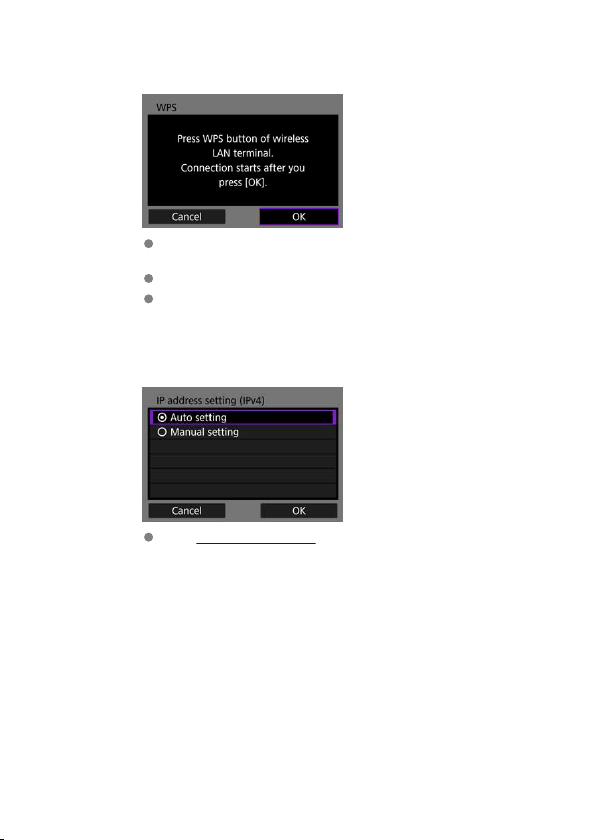
3.
Connect to the access point.
Press the access point's WPS button. For details on where the button
is and how long to press it, refer to the access point user manual.
Select [OK] to initiate connection with the access point.
The following screen is displayed once the camera is connected to the
access point.
4.
Set the IP address.
Go to Setting the IP Address.
622
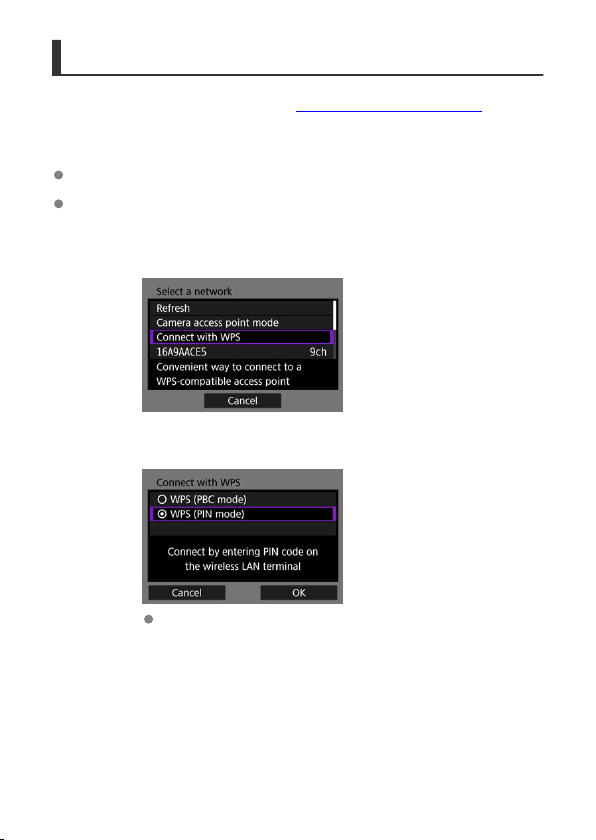
Connecting via WPS (PIN Mode)
Instructions in this section are continued from
Checking the Type of Access Point.
This is a connection method used with access points compatible with WPS. In PIN code
connection mode (PIN mode), an 8-digit identification number indicated on the camera is
entered on the access point to establish a connection.
Even if multiple access points are active nearby, connecting by using this shared
identification number is relatively reliable.
It may take approx. 1 min. to establish a connection.
1.
Select [Connect with WPS] on the [Select a network] screen.
2.
Select [WPS (PIN mode)].
Select [OK].
623
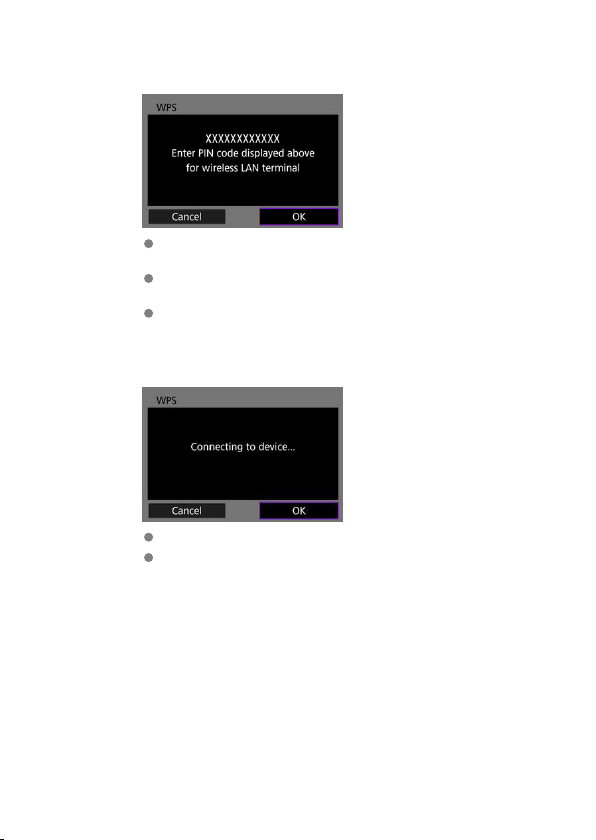
3.
Enter the PIN code.
On the access point, enter the 8-digit PIN code displayed on the
camera screen.
For instructions on entering PIN codes on the access point, refer to the
access point user manual.
After entering the PIN code, select [OK] on the camera.
4.
Connect to the access point.
Select [OK] to initiate connection with the access point.
The following screen is displayed once the camera is connected to the
access point.
624
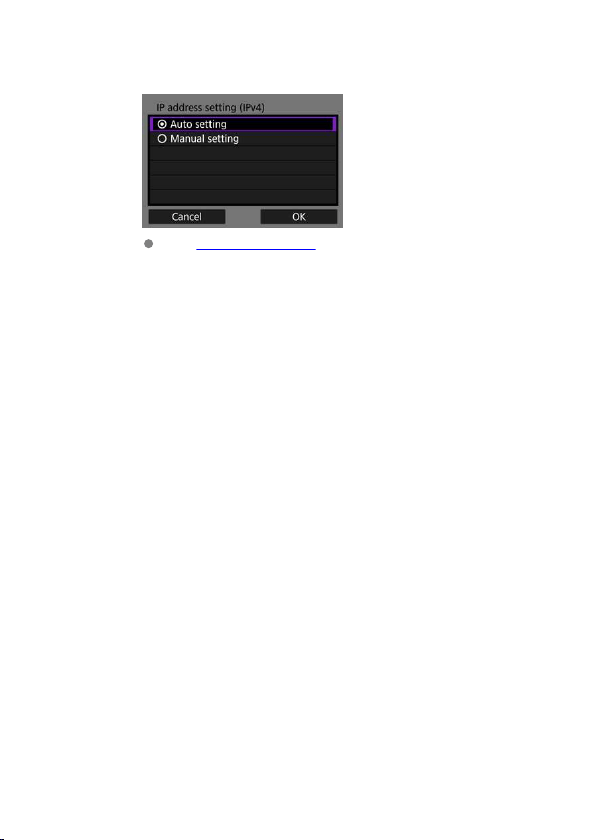
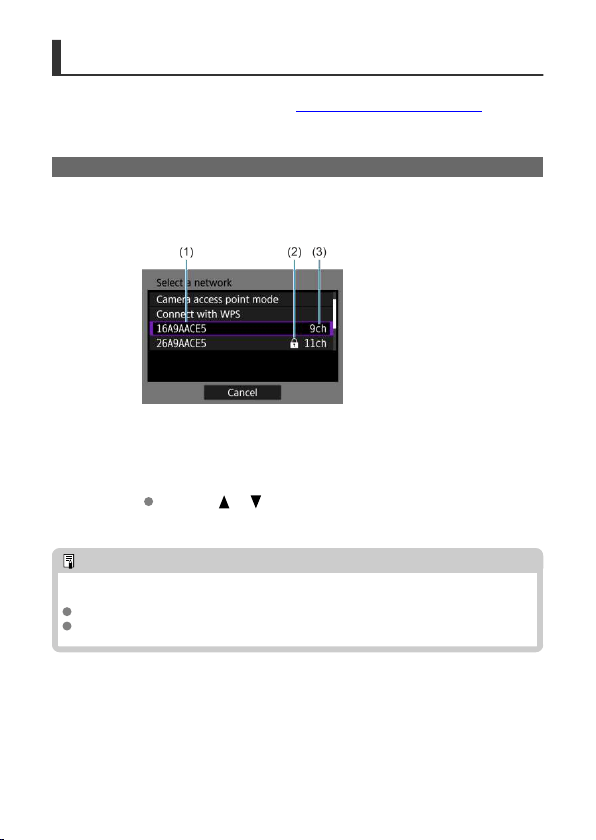
Connecting Manually to Detected Networks
Instructions in this section are continued from
Checking the Type of Access Point.
Connect to an access point by selecting its SSID (or ESS-ID) in a list of active access points
nearby.
Selecting the access point
1.
Select an access point on the [Select a network] screen.
(1) SSID
(2) Security icon (only for encrypted access points)
(3) Channel used
Use the < >< > keys to select the access point to connect to in the
list of access points.
Note
[Refresh]
To display [Refresh], scroll down the screen in step 1.
Select [Refresh] to search for access points again.
626

Entering the access point encryption key
Enter the encryption key (password) set on the access point. For details on the
encryption key that has been set, refer to the access point's user manual.
The screens displayed in steps 2–3 vary depending on the authentication and
encryption set on the access point.
Go to Setting the IP Address if the [IP address set.] screen is displayed instead of the
screens shown for steps 2–3.
2.
Select a key index.
The [Key index] screen is displayed for WEP-encrypted access points.
Select the key index number set on the access point.
Select [OK].
3.
Enter the encryption key.
Press the < > button to access the virtual keyboard ( ), then enter
the encryption key.
Select [OK] to initiate connection with the access point.
The following screen is displayed once the camera is connected to the
access point.
627
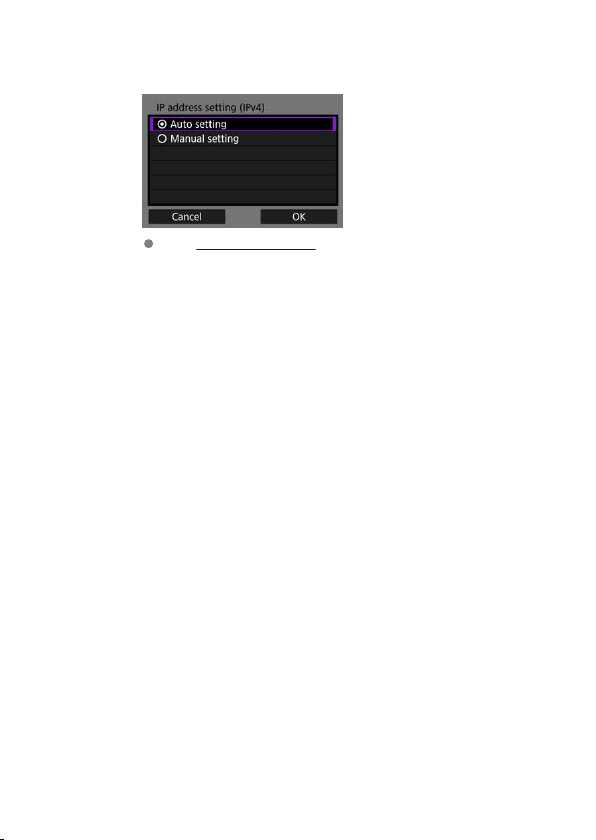
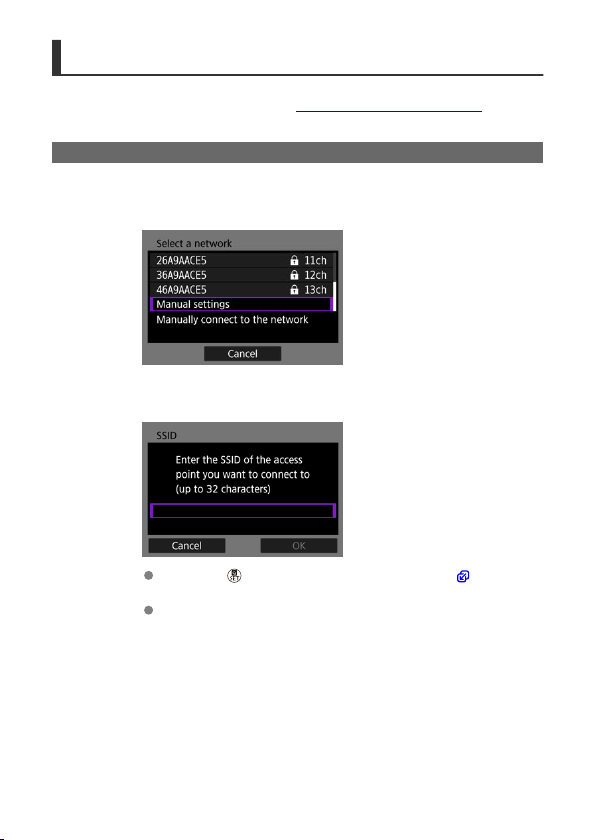
Connecting Manually by Specifying Networks
Instructions in this section are continued from
Checking the Type of Access Point.
Connect to an access point by entering its SSID (or ESS-ID).
Entering the SSID
1.
Select [Manual settings] on the [Select a network] screen.
2.
Enter the SSID (network name).
Press the < > button to access the virtual keyboard ( ), then enter
the encryption key.
Select [OK].
629
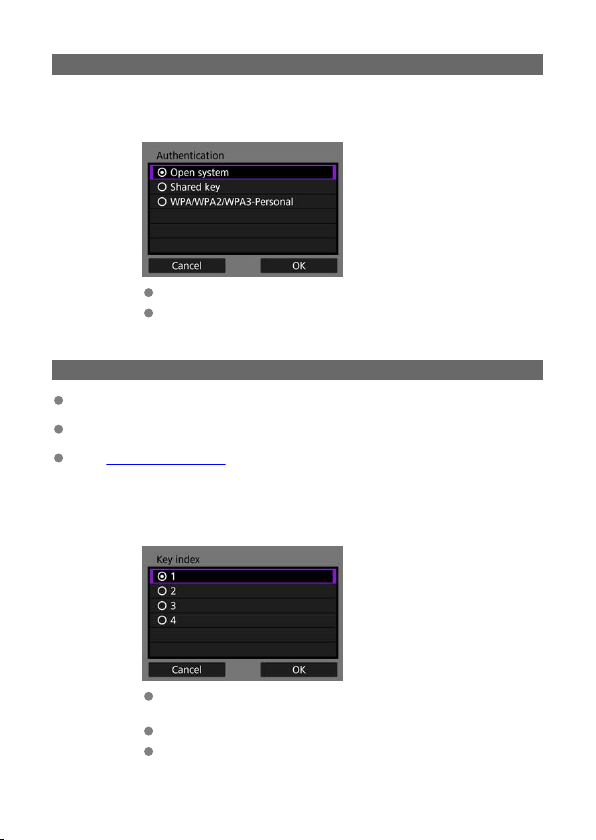
Setting the access point authentication method
3.
Select the authentication method.
Select an option and then [OK] to go to the next screen.
On the [Encryption settings] screen displayed if [Open system] is
selected, select [Disable] or [WEP].
Entering the access point encryption key
Enter the encryption key (password) set on the access point. For details on the
encryption key that has been set, refer to the access point's user manual.
The screens displayed in steps 4–5 vary depending on the authentication and
encryption set on the access point.
Go to Setting the IP Address if the [IP address set.] screen is displayed instead of the
screens shown for steps 4–5.
4.
Select a key index.
The [Key index] screen is displayed if you have selected [Shared key]
or [WEP] in step 3.
Select the key index number set on the access point.
Select [OK].
630
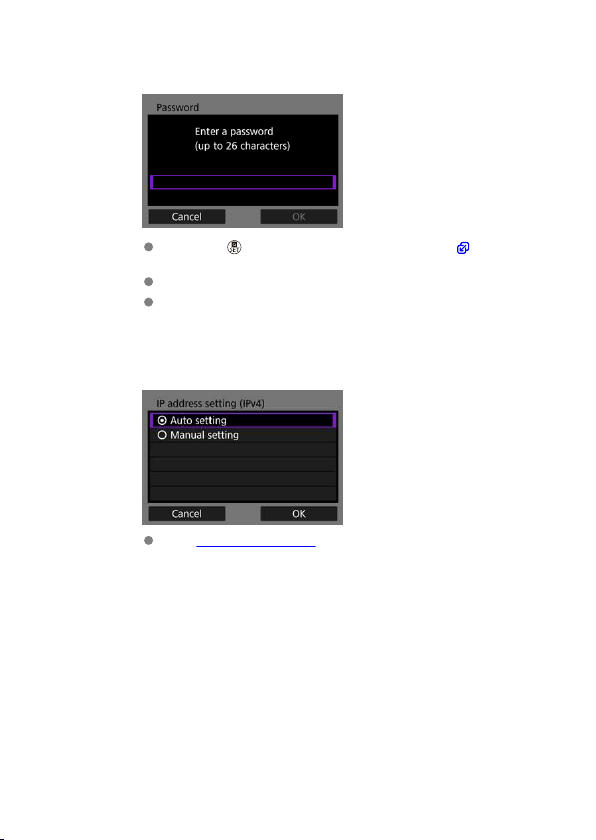
5.
Enter the encryption key.
Press the < > button to access the virtual keyboard ( ), then enter
the encryption key.
Select [OK] to initiate connection with the access point.
The following screen is displayed once the camera is connected to the
access point.
6.
Set the IP address.
Go to Setting the IP Address.
631
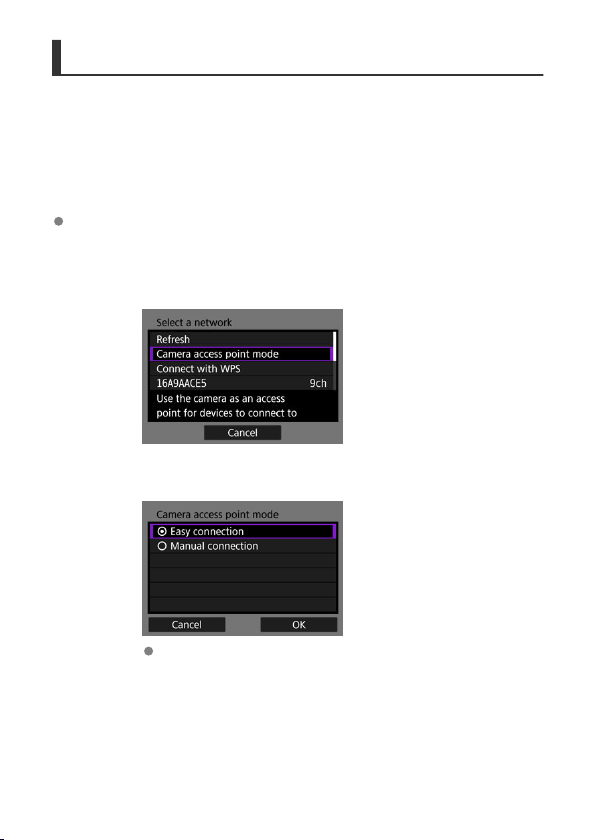
Connecting in Camera Access Point Mode
Camera access point mode is a connection method for directly connecting the camera and
other devices via
Wi-Fi without using an access point. Two connection methods are
available, as follows.
Connecting with Easy connection
Network settings for camera access point mode are configured automatically.
For instructions on using the devices you will connect to, refer to the device instruction
manual.
1.
Select [Camera access point mode] on the [Select a network] screen.
2.
Select [Easy connection].
Select [OK].
632
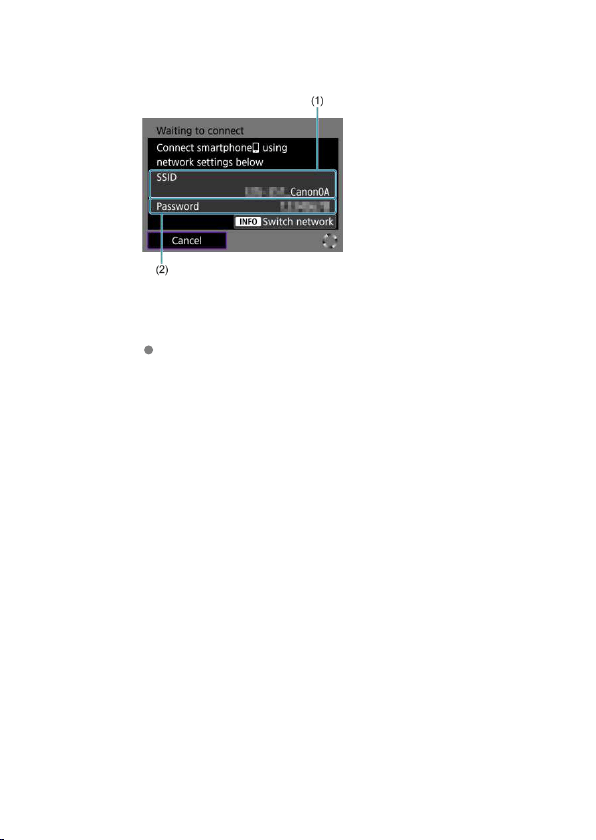
3.
Use the other device to connect to the camera.
(1) SSID (network name)
(2) Encryption key (password)
In other device's Wi-Fi settings, select the SSID (network name) shown
on the camera screen, then enter the password.
4.
Complete the connection settings based on the device to connect to.
633
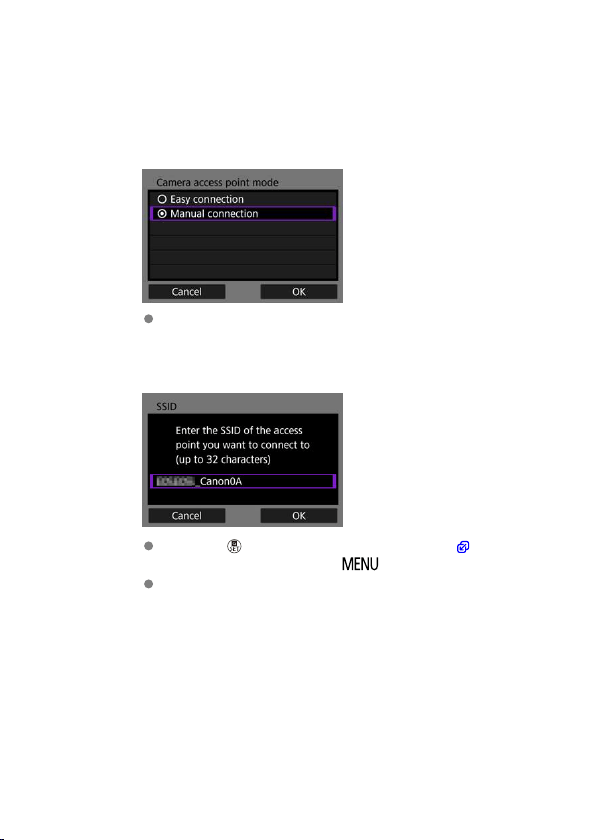
Connecting with Manual connection
Network settings for camera access point mode are configured manually. Set [SSID],
[Channel setting], and [Encryption settings] on each screen displayed.
1.
Select [Manual connection].
Select [OK].
2.
Enter the SSID (network name).
Press the < > button to access the virtual keyboard ( ), then enter
the SSID. After input, press the <
> button.
Select [OK].
634
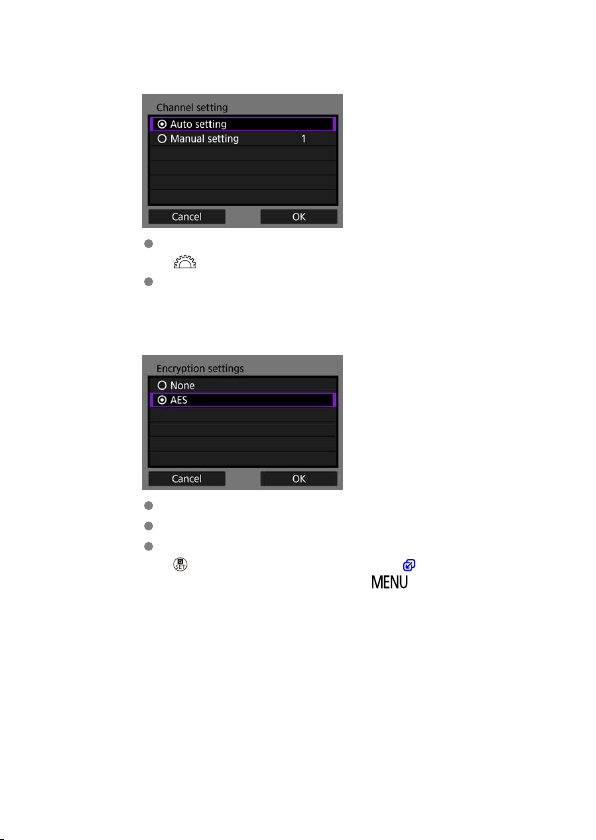
3.
Select a channel setting option.
To specify the settings manually, select [Manual setting], then turn the
<
> dial.
Select [OK].
4.
Select an encryption setting option.
For encryption, select [AES].
Select [OK].
When [AES] is selected, the [Password] screen is displayed. Press the
<
> button to access the virtual keyboard ( ), then enter the
encryption key. After input, press the <
> button.
635
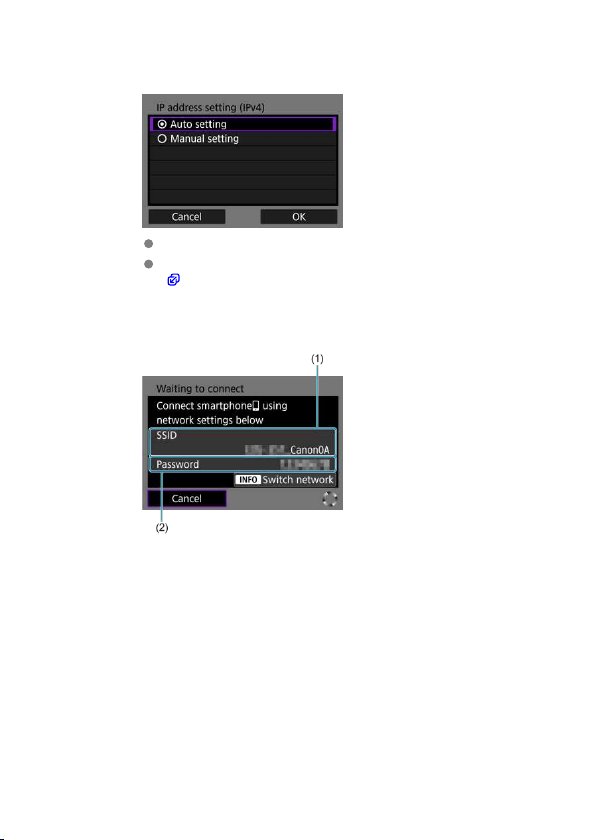
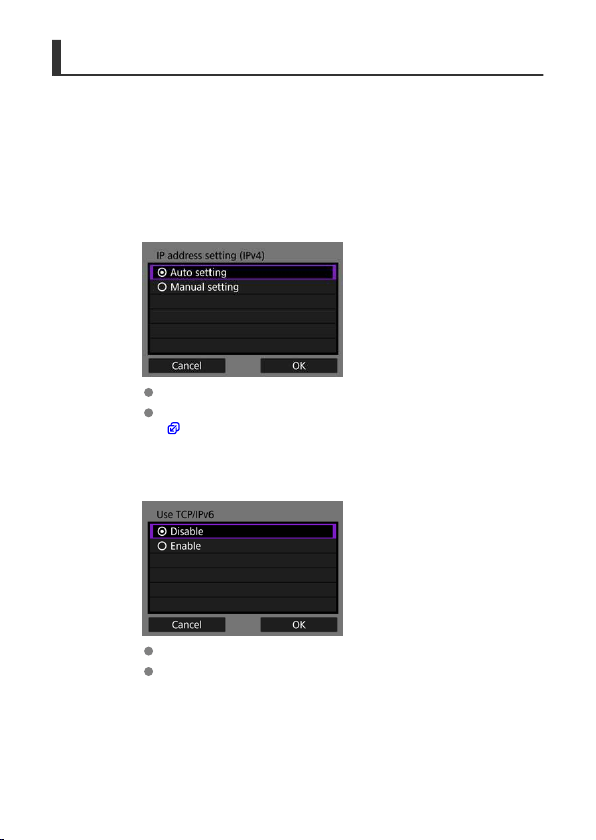
Setting the IP Address
Select a method of setting the IP address, and then set the IP address on the camera. When
IPv6 is used, the camera only connects via IPv6. IPv4 connections are disabled.
Setting the IP address automatically
Set up the IP address settings automatically.
1.
Select [Auto setting].
Select [OK].
If an error is displayed for [Auto setting], set the IP address manually
( ).
2.
Select an IPv6 option.
Select an option and then [OK] to go to the next screen.
Select [Enable] to use IPv6.
3.
Complete the connection settings based on the device to connect to.
637
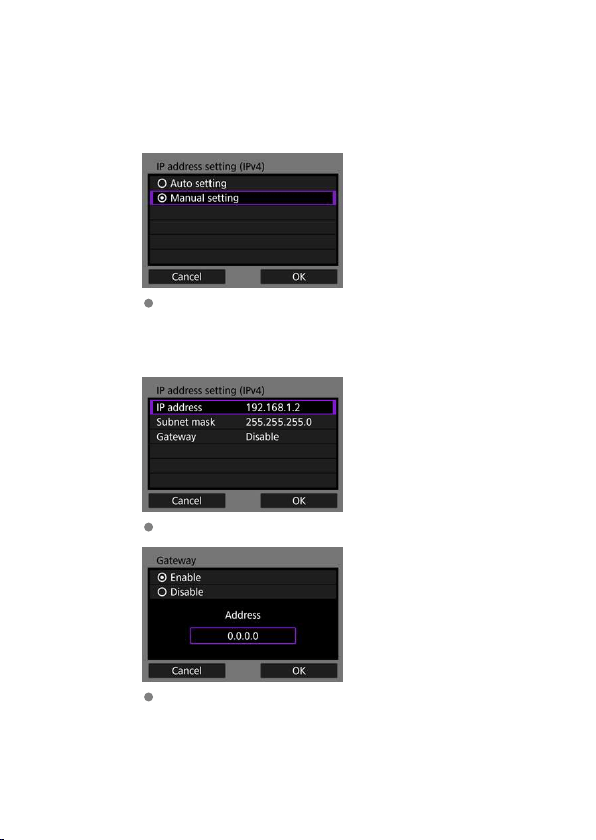
Setting the IP address manually
Set up the IP address settings manually. Note that the items displayed vary depending on
the communication function.
1.
Select [Manual setting].
Select [OK].
2.
Select an option to configure.
Select an option to access the screen for numerical input.
To use a gateway, select [Enable], then select [Address].
638
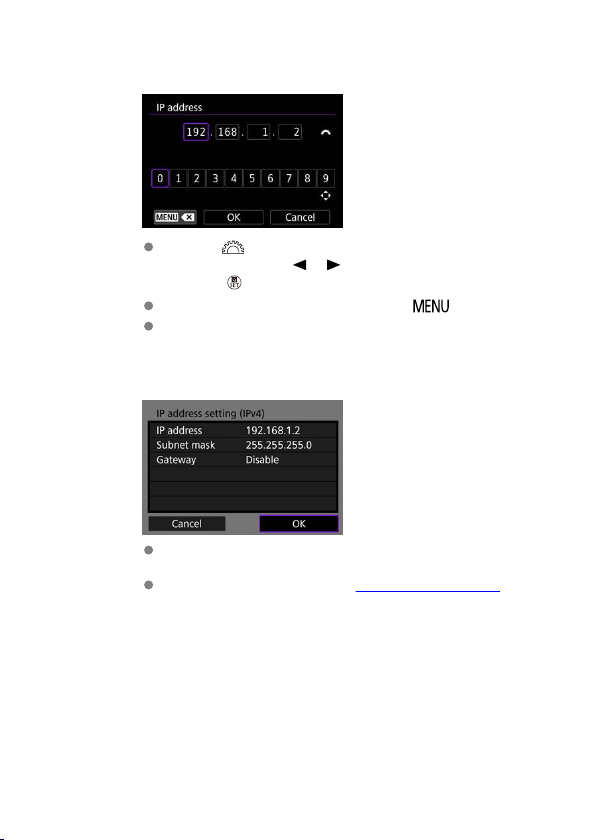
3.
Enter the number.
Turn the < > dial to switch to other input fields at the top of the
screen, and press the <
>< > keys to select numbers to enter.
Press the <
> button to enter the selected number.
To delete the number just entered, press the < > button.
Select [OK] to confirm input and return to the screen in step 2.
4.
Select [OK].
When you have completed setting the necessary items, select [OK].
The next screen is displayed.
If you are unsure what to enter, see Checking Network Settings or ask
the network administrator or other person in charge of the network.
639
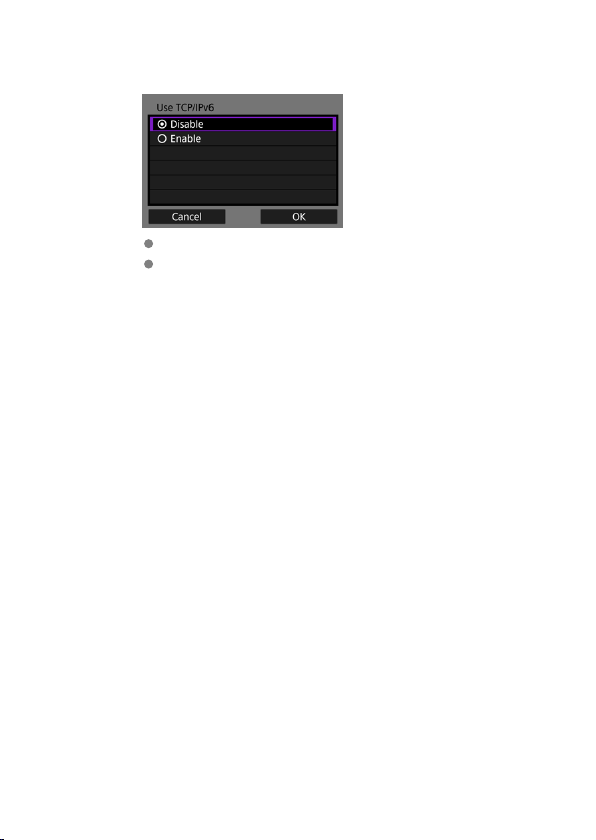
5.
Select an IPv6 option.
Select an option and then [OK] to go to the next screen.
Select [Enable] to use IPv6.
6.
Complete the connection settings based on the device to connect to.
640
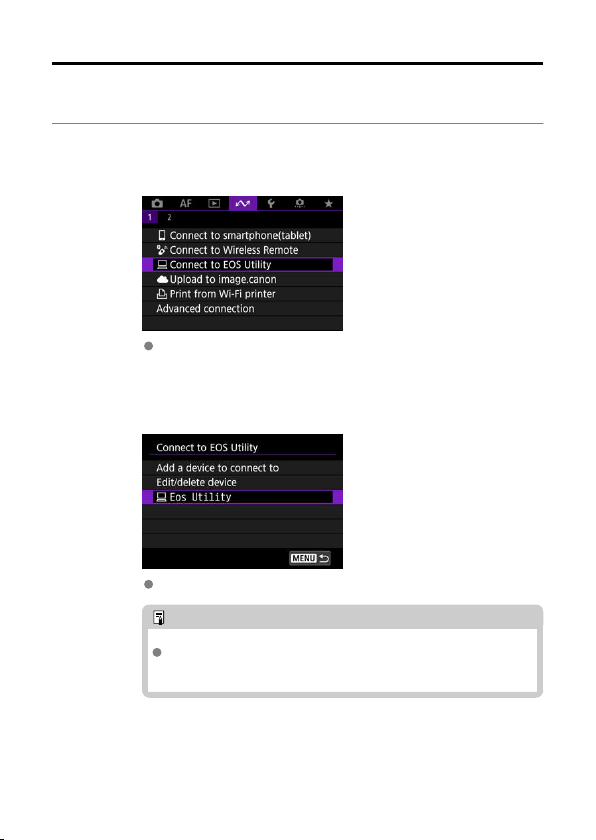
Reconnecting via Wi-Fi/Bluetooth
Connection settings for devices you have connected to via Wi-Fi or Bluetooth are retained
on the camera. You can use these settings to reconnect to the same device.
1.
Select the type of connection for the device to connect to.
After the [Wi-Fi on] screen appears, select [Disconnect], then repeat
step 1.
2.
Select the device for the connection.
Select the connection option in the list of past connections.
Note
For all communication features used, settings for up to 10 past
connections are retained.
3.
Operate the connected device.
641
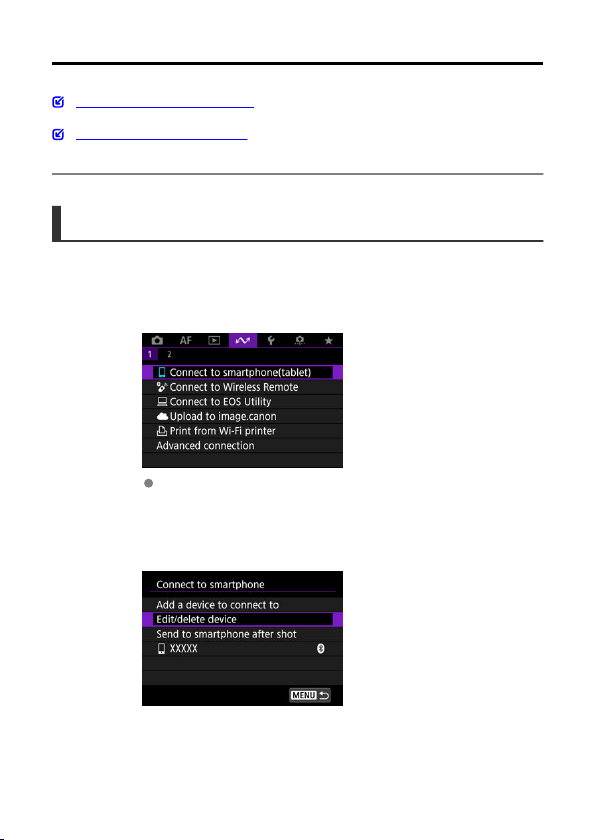
Editing/Deleting Connection Settings
Changing Connection Nicknames
Deleting Connection Information
Before changing or deleting connection settings, end the Wi-Fi connection.
Changing Connection Nicknames
You can change connection setting nicknames.
1.
Select the type of connection for the device to connect to.
After the [Wi-Fi on] screen appears, select [Disconnect], then repeat
step 1.
2.
Select [Edit/delete device].
642
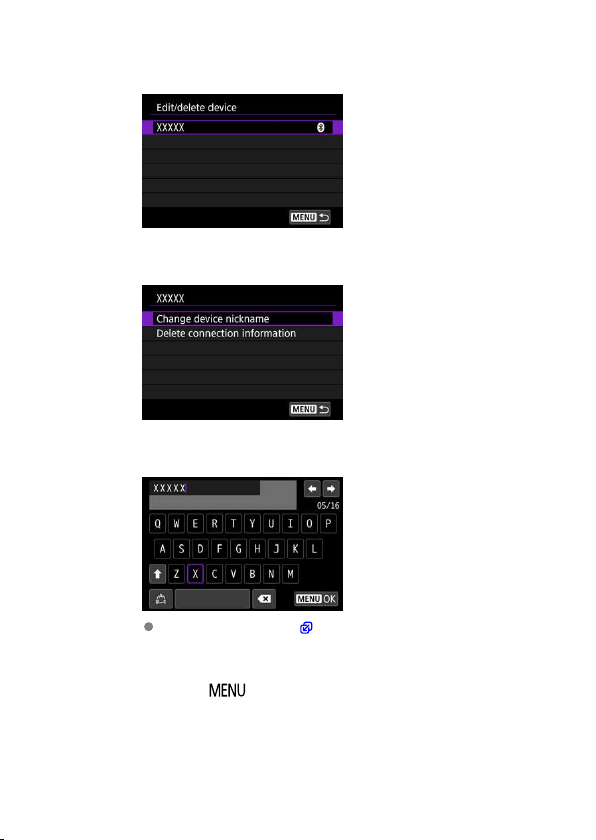
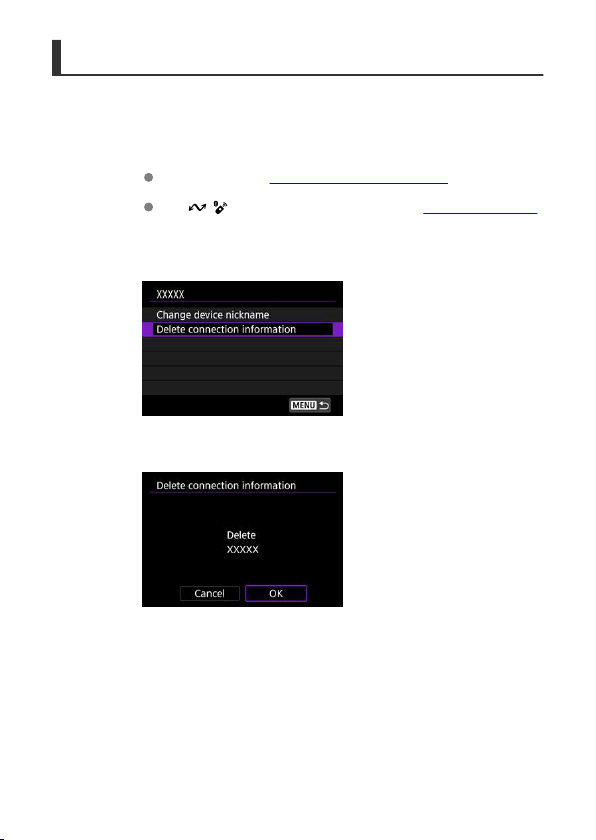
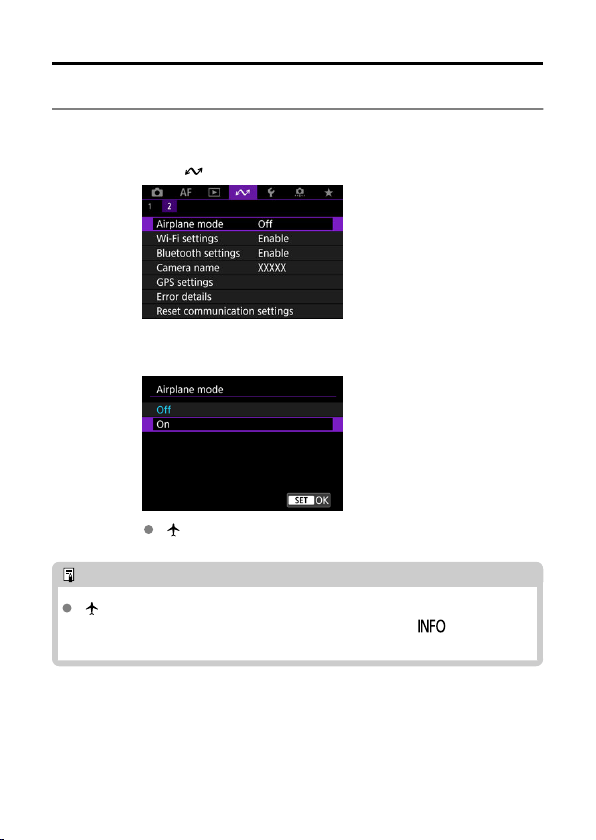
Airplane Mode
You can temporarily disable Wi-Fi and Bluetooth functions.
1.
Select [
: Airplane mode].
2.
Set to [On].
[ ] is displayed on the screen.
Note
[ ] may not be displayed in still photo shooting, movie recording, or playback,
depending on display settings. If it is not displayed, press the <
> button
repeatedly to access detailed information display.
645
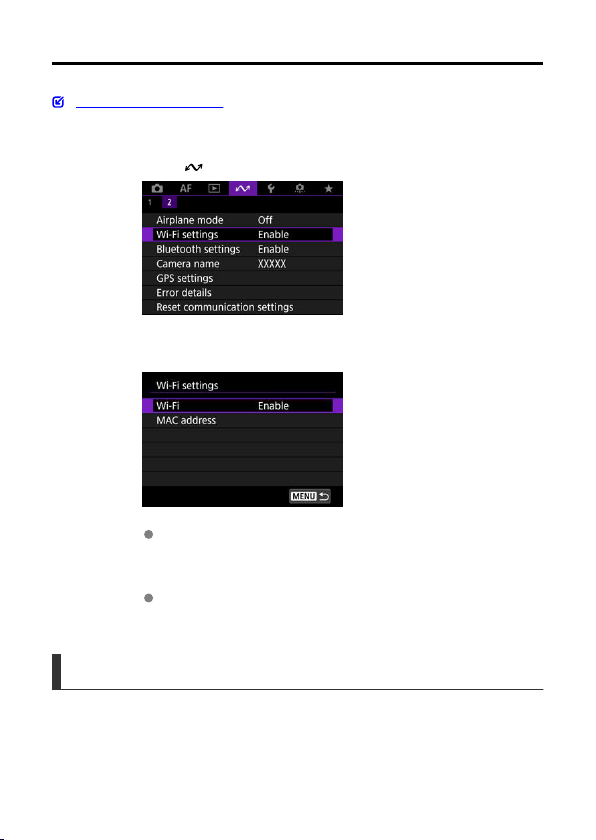
Wi-Fi Settings
Checking the MAC Address
1.
Select [
: Wi-Fi settings].
2.
Select an option.
Wi-Fi
When the use of electronic devices and wireless devices is prohibited,
such as on board airplanes or in hospitals, set it to [Disable].
MAC address
You can check the MAC address of the camera.
Checking the MAC Address
You can check the camera's MAC address.
646
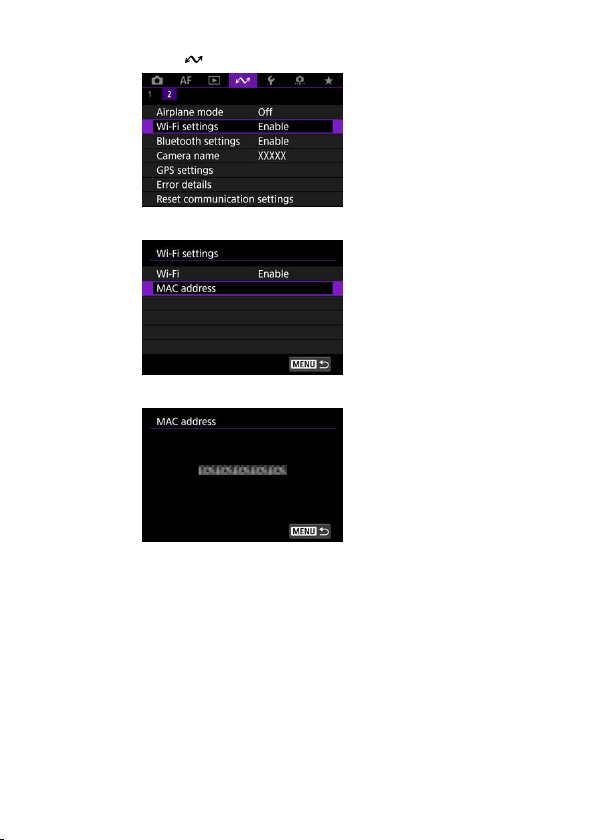
1.
Select [
: Wi-Fi settings].
2.
Select [MAC address].
3.
Check the MAC address.
647
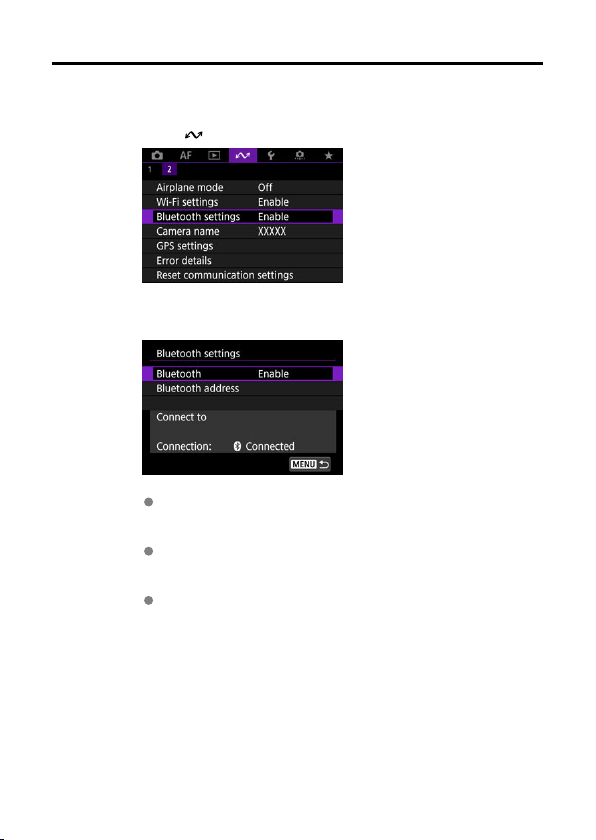
Bluetooth Settings
1.
Select [
: Bluetooth settings].
2.
Select an option.
Bluetooth
If you will not use the Bluetooth function, select [Disable].
Bluetooth address
You can check the camera's Bluetooth address.
Connect to
You can check the name and communication status of the paired
device.
648
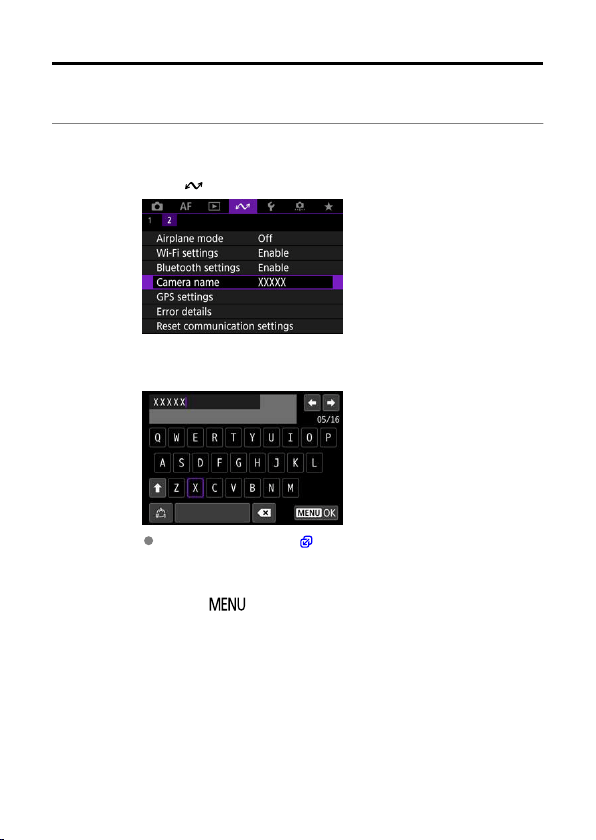
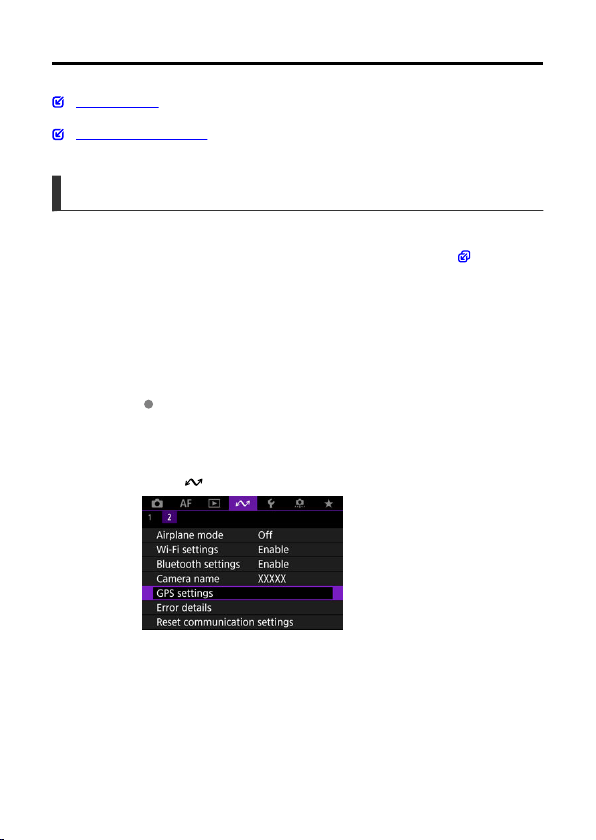
GPS Settings
GPS via Mobile
GPS Information Display
GPS via Mobile
You can use a smartphone to geotag images.
Complete these settings after installing the dedicated Camera Connect app (
) on the
smartphone.
1.
On the smartphone, activate location services.
2.
Establish a Bluetooth connection.
Start Camera Connect and pair the camera and smartphone via
Bluetooth.
3.
Select [
: GPS settings].
650
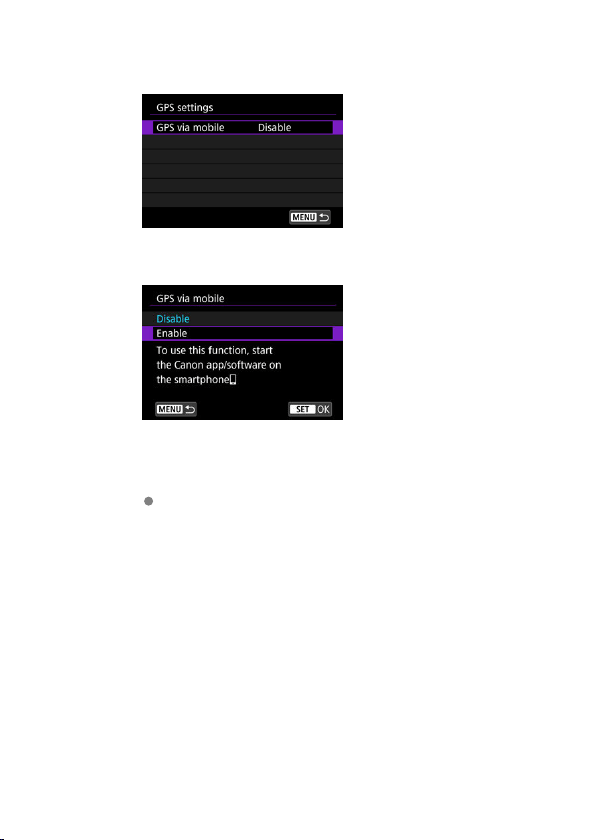
4.
Select [GPS via mobile].
5.
Select [Enable].
6.
Take the picture.
Images are geotagged with the information from the smartphone.
651
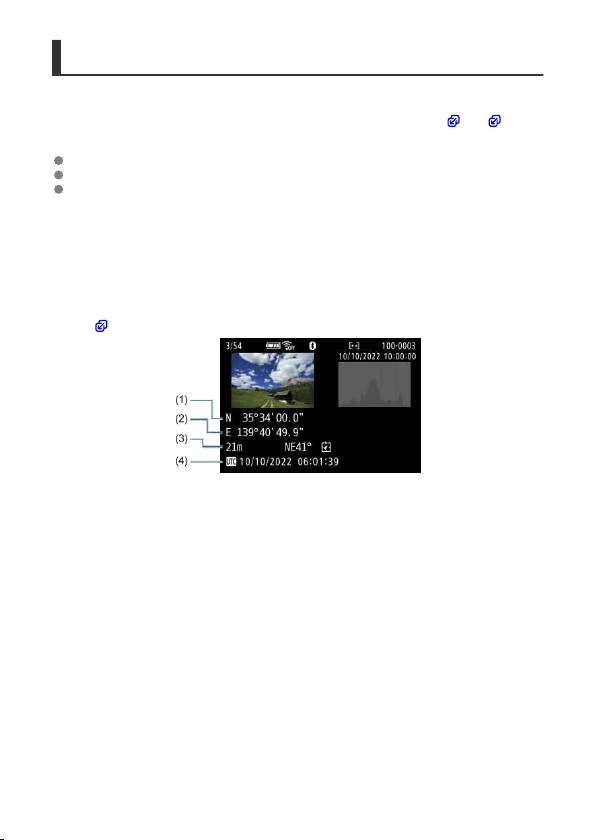
GPS Information Display
You can check the status of smartphone location information acquisition in the GPS
connection icon on the screens for still photo shooting or movie recording (
and ,
respectively).
Gray: Location services are off
Blinking: Location information cannot be acquired
On: Location information acquired
Geotagging images as you shoot
Images you shoot while the GPS icon is on are geotagged.
Geotagging information
You can check the location information added to your shots on the shooting information
screen ( ).
(1) Latitude
(2) Longitude
(3) Elevation
(4) UTC (Coordinated Universal Time)
652
Caution
The smartphone can acquire location information only while it is paired with the
camera via Bluetooth.
Direction information is not acquired.
Acquired location information may not be accurate, depending on traveling
conditions or smartphone status.
It may take some time to acquire location information from the smartphone after
you turn the camera on.
Location information is no longer acquired after any of the following operations.
• Pairing with a wireless remote control via Bluetooth
• Turning the camera off
• Quitting Camera Connect
• Deactivating location services on the smartphone
Location information is no longer acquired in any of the following situations.
• The camera power turns off
• The Bluetooth connection is ended
• The smartphone's remaining battery level is low
Note
Coordinated Universal Time, abbreviated as UTC, is essentially the same as
Greenwich Mean Time.
For movies, the GPS information initially acquired is added.
653
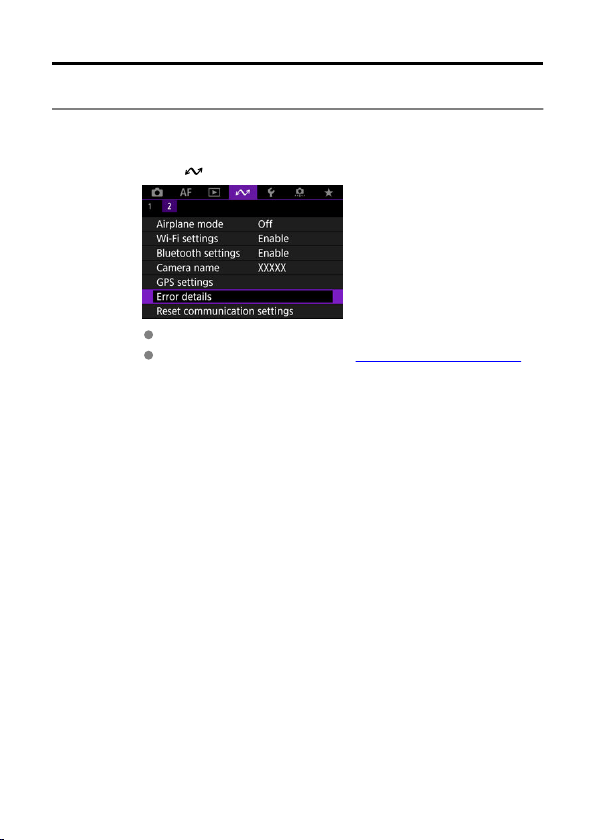
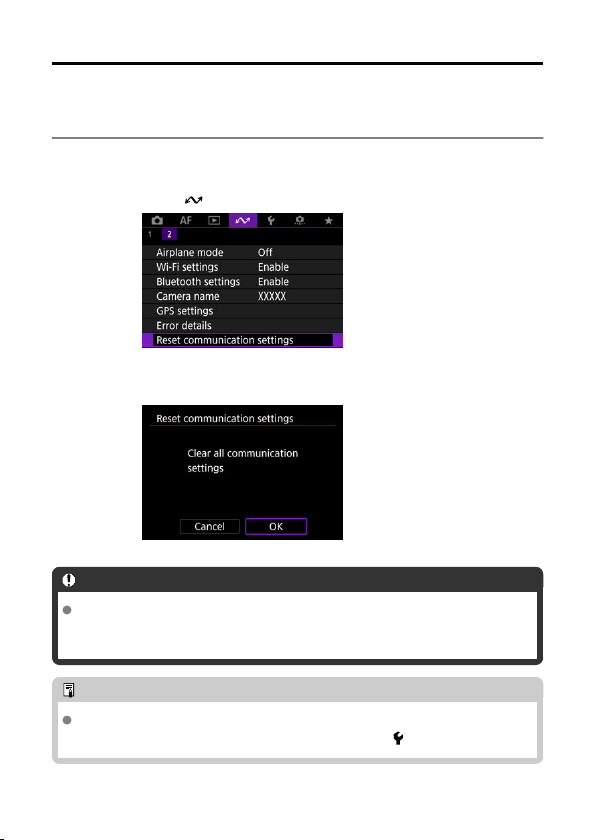
Resetting Communication Settings
All wireless communication settings can be deleted. By deleting the wireless communication
settings, you can prevent their information from being exposed when you lend or give your
camera to other people.
1.
Select [
: Reset communication settings].
2.
Select [OK].
Caution
If you have paired the camera with a smartphone, on the smartphone's Bluetooth
settings screen, delete the connection information of the camera for which you
restored default wireless communication settings.
Note
All wireless communication settings can be cleared by selecting the
[Communication settings] option for [Other settings] in [
: Reset camera].
655
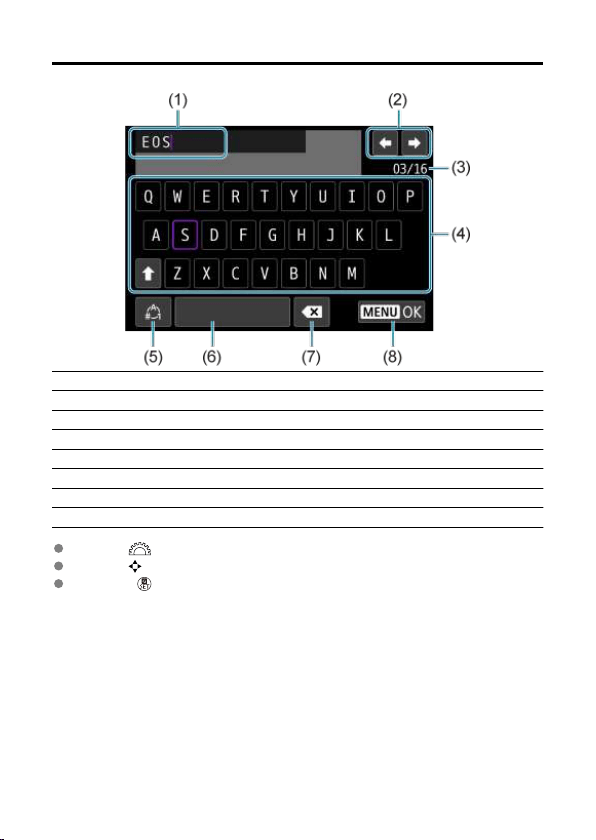
Virtual Keyboard Operations
(1) Input area, for entering text
(2) Cursor keys, for moving in the input area
(3) Current no. of characters/no. available
(4) Keyboard
(5) Switch input modes
(6) Space
(7) Delete a character in the input area
(8) Exit input
Use the < > dial to move within (1).
Use the < > keys to move within (2) and (4)–(7).
Press the < > button to confirm input or when switching input modes.
656
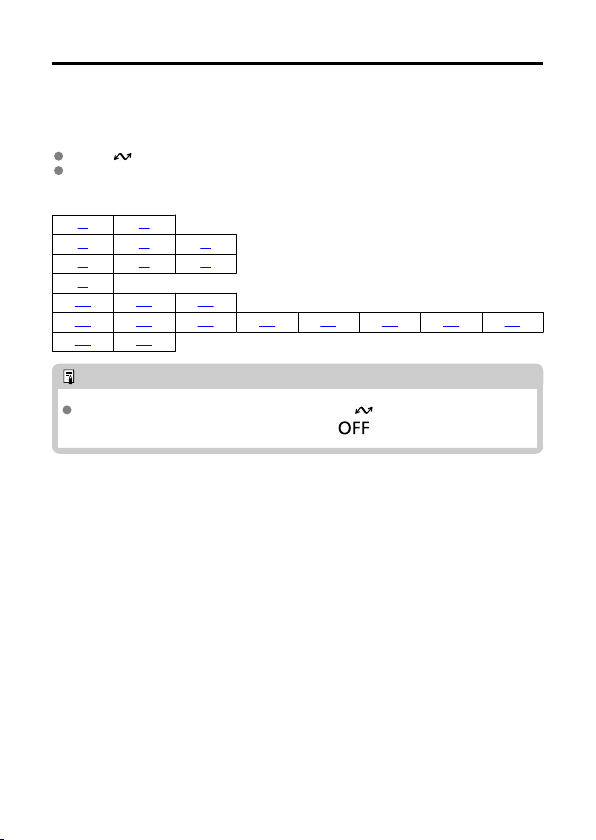
Responding to Error Messages
When an error occurs, display the details of the error by following one of the procedures
below. Then, eliminate the cause of the error by referring to the examples shown in this
chapter.
Select [ : Error details].
Select [Error details] on the [Wi-Fi on] screen.
Click the following error numbers to jump to the corresponding section.
11 12
21 22 23
61 64 65
91
121 125 127
130 131 132 133 134 135 136 137
141 142
Note
In case of errors, [Err**] is displayed to the right of [ : Error details]. It
disappears when the camera's power is set to <
>.
657

11: Connection target not found
In the case of [Connect to smartphone(tablet)], is Camera Connect running?
• Establish a connection using Camera Connect ( ).
In the case of [Connect to EOS Utility], is EOS Utility running?
• Start EOS Utility and try to connect again ( ).
Are the camera and the access point set to use the same encryption key for
authentication?
• This error occurs if the encryption keys do not match when the authentication
method for encryption is [Open system].
Check upper- and lower-case letters, and make sure the correct encryption key for
authentication is set on the camera ( ).
12: Connection target not found
Are the target device and access point turned on?
• Turn on the target device and access point, then wait a while. If a connection still
cannot be established, perform the procedures to establish the connection again.
21: No address assigned by DHCP server
What to check on the camera
On the camera, the IP address is set to [Auto setting]. Is this the correct setting?
• If no DHCP server is used, configure the setting after setting the IP address to
[Manual setting] on the camera ( ).
What to check on the DHCP server
Is the power of the DHCP server on?
• Turn on the DHCP server.
Are there enough addresses for assignment by the DHCP server?
• Increase the number of addresses assigned by the DHCP server.
• Remove devices assigned addresses by the DHCP server from the network to
reduce the number of addresses in use.
Is the DHCP server working correctly?
• Check the DHCP server settings to make sure it is working correctly as a DHCP
server.
• If applicable, ask your network administrator to ensure the DHCP server is available.
658

22: No response from DNS server
What to check on the camera
On the camera, the DNS address is set to [Manual setting]. Is this the correct
setting?
• If no DNS server is used, set the camera's DNS address setting to [Disable] ( ).
On the camera, does the DNS server's IP address setting match the server's
actual address?
• Configure the IP address on the camera to match the actual DNS server address
( , ).
What to check on the DNS server
Is the power of the DNS server on?
• Turn the DNS server on.
Are the DNS server settings for IP addresses and the corresponding names
correct?
• On the DNS server, make sure IP addresses and the corresponding names are
entered correctly.
Is the DNS server working correctly?
• Check the DNS server settings to make sure the server is working correctly as a
DNS server.
• If applicable, ask your network administrator to ensure the DNS server is available.
What to check on the network as a whole
Does your network include a router or similar device that serves as a gateway?
• If applicable, ask your network administrator for the network gateway address and
set it on the camera ( , ).
• Make sure that the gateway address setting is correctly entered on all network
devices including the camera.
659
23: Device with same IP address exists on selected network
Is another device on the camera network using the same IP address as the
camera?
• Change the camera's IP address to avoid using the same address as another
device on the network. Otherwise, change the IP address of the device that has a
duplicate address.
• If the camera's IP address is set to [Manual setting] in network environments using
a DHCP server, change the setting to [Auto setting] ( ).
Note
Responding to error messages 21–23
Also check the following points when responding to errors numbered 21–23.
Are the camera and the access point set to use the same password for
authentication?
• This error occurs if the passwords do not match when the authentication
method for encryption is set to [Open system]. Check upper- and lower-case
letters, and make sure the correct password for authentication is set on the
camera ( ).
61: Selected SSID wireless LAN network not found
Are any obstacles blocking the line of sight between the camera and the antenna
of the access point?
• Move the antenna of the access point to a position clearly visible from the point of
view of the camera.
What to check on the camera
Does the SSID set on the camera match that of the access point?
• Check the SSID at the access point, then set the same SSID on the camera ( ).
What to check at the access point
Is the access point turned on?
• Turn on the power of the access point.
If filtering by MAC address is active, is the MAC address of the camera in use
registered at the access point?
• Register the MAC address of the camera used to the access point.
The MAC address can be checked on the [MAC address] screen ( ).
660

64: Cannot connect to wireless LAN terminal
Are the camera and the access point set to use the same encryption method?
• The camera supports the following encryption methods: WEP, TKIP, and AES ( ).
If filtering by MAC address is active, is the MAC address of the camera in use
registered at the access point?
• Register the MAC address of the camera used to the access point. The MAC
address can be checked on the [MAC address] screen ( ).
65: Wireless LAN connection lost
Are any obstacles blocking the line of sight between the camera and the antenna
of the access point?
• Move the antenna of the access point to a position clearly visible from the point of
view of the camera.
The wireless LAN connection was lost, for some reason, and the connection
cannot be restored.
• The following are possible reasons: excessive access to the access point from
another device, a microwave oven or similar appliance in use nearby (interfering
with IEEE 802.11b/g/n (2.4 GHz band)), or influence of rain or high humidity.
91: Other error
A problem other than error code number 11 to 83 occurred.
• Turn the camera's power switch off and on.
121: Not enough free space on server
The target Web server does not have enough free space.
• Delete unnecessary images on the Web server, check the free space on the Web
server, then try sending the data again.
125: Check the network settings
Is the network connected?
• Check the connection status of the network.
127: An error has occurred
A problem other than error code number 121 to 126 occurred while the camera is
connected to the Web service.
• Try again to establish the Wi-Fi connection to image.canon.
661

130: The server is currently busy
Please wait a moment and try again
The image.canon site is busy at the moment.
• Try accessing image.canon over Wi-Fi again later.
131: Try again
An error occurred when connecting to image.canon over Wi-Fi.
• Try again to establish the Wi-Fi connection to image.canon.
132: Error detected on server
Try again later
The image.canon site is currently offline for maintenance.
• Try accessing image.canon over Wi-Fi again later.
133: Cannot log in to Web service
An error occurred when signing in to image.canon.
• Check the image.canon settings.
• Try accessing image.canon over Wi-Fi again later.
134: Set the correct date and time
The date, time, and time zone settings are incorrect.
• Check the [ : Date/Time/Zone] settings.
135: Web service settings have been changed
The settings for image.canon were changed.
• Check the image.canon settings.
136: The QR code shown on the camera was not scanned correctly
by the dedicated app. Try camera web link setup again.
The QR code was not scanned correctly by the smartphone.
• Reconfigure camera web link settings and scan the QR code displayed again on the
camera.
662

137: The QR code shown on the camera has expired. Try camera web
link setup again.
The QR code displayed has expired.
• Reconfigure camera web link settings and scan the QR code displayed again on the
camera.
141: Printer is busy. Try connecting again.
Is the printer performing a printing process?
• After the printing process is finished, reestablish a Wi-Fi connection with the printer.
Is another camera connected to the printer via Wi-Fi?
• End the Wi-Fi connection with the other camera, then reestablish a Wi-Fi connection
with the printer.
142: Could not acquire printer information. Reconnect to try again.
Is the power of the printer on?
• Turn on the printer, then reestablish a Wi-Fi connection with it.
663

Wireless Communication Function Precautions
Distance between the camera and the smartphone
Installation location of access point antenna
Nearby electronic devices
Precautions for using multiple cameras
If the transmission rate drops, the connection is lost, or other problems occur when using the
wireless communication functions, try the following corrective actions.
664

Distance between the camera and the smartphone
If the camera is too far from the smartphone, a Wi-Fi connection may not be established
even when Bluetooth connection is possible. In this case, bring the camera and the
smartphone closer together, then establish a
Wi-Fi connection.
Installation location of access point antenna
When using indoors, install the device in the room where you are using the camera.
Install the device where people or objects do not come between the device and the
camera.
Nearby electronic devices
If the Wi-Fi transmission rate drops because of the influence of the following electronic
devices, stop using them or move further away from the devices to transmit communication.
The camera communicates over Wi-Fi via IEEE 802.11b/g/n using radio waves in the
2.4 GHz band. For this reason, the Wi-Fi transmission rate will drop if there are
Bluetooth devices, microwave ovens, cordless telephones, microphones, smartphones,
other cameras, or similar devices operating on the same frequency band nearby.
Precautions for using multiple cameras
When connecting multiple cameras to one access point via Wi-Fi, make sure the
cameras' IP addresses are different.
When multiple cameras are connected to one access point via Wi-Fi, the transmission
rate drops.
When there are multiple IEEE 802.11b/g/n (2.4 GHz band) access points, leave a gap of
five channels between each Wi-Fi channel to reduce radio wave interference. For
example, use channels 1, 6, and 11, channels 2 and 7, or channels 3 and 8.
665

Security
If security settings have not been properly set, the following problems may occur.
Transmission monitoring
Third parties with malicious intent may monitor wireless LAN transmissions and attempt
to acquire the data you are sending.
Unauthorized network access
Third parties with malicious intent may gain unauthorized access to the network you are
using to steal, modify, or destroy information. Additionally, you could fall victim to other
types of unauthorized access such as impersonation (where someone assumes an
identity to gain access to unauthorized information) or springboard attacks (where
someone gains unauthorized access to your network as a springboard to cover their
tracks when infiltrating other systems).
It is recommended to make use of the systems and functions to thoroughly secure your
network, preventing these types of problems from occurring.
666

Checking Network Settings
Windows
Open the Windows [Command Prompt], then enter ipconfig/all and press the <Enter> key.
In addition to the IP address assigned to the computer, the subnet mask, gateway, and DNS
server information are also displayed.
macOS
In macOS, open the [Terminal] application, enter ifconfig -a, and press the <Return> key.
The IP address assigned to the computer is indicated in the [enX] item (X: number) next to
[inet], in the format “***.***.***.***”.
For information about the [Terminal] application, refer to the macOS help.
To avoid using the same IP address for the computer and other devices on the network,
change the rightmost number when configuring the IP address assigned to the camera in
the processes described in
Manual IP Address Setup.
Example: 192.168.1.10
667
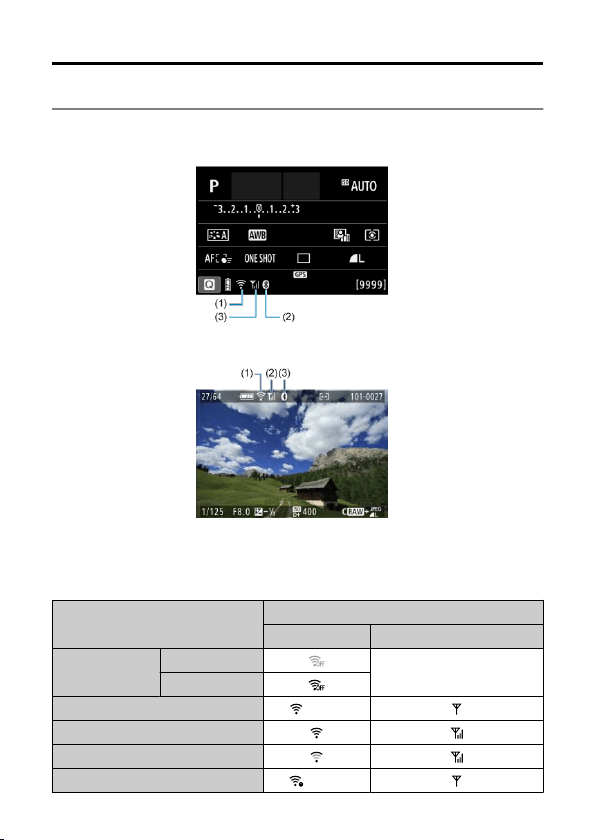
Wireless Communication Status
Wireless communication status can be checked on the screen.
Quick Control screen
Information display screen during playback
(1) Wi-Fi function
(2) Wireless signal strength
(3) Bluetooth function
Communication Status
Screen
Wi-Fi Function Wireless Signal Strength
Not connected
Wi-Fi: Disable
Off
Wi-Fi: Enable
Connecting
(Blinking)
Connected
Sending data
Connection error
(Blinking)
668
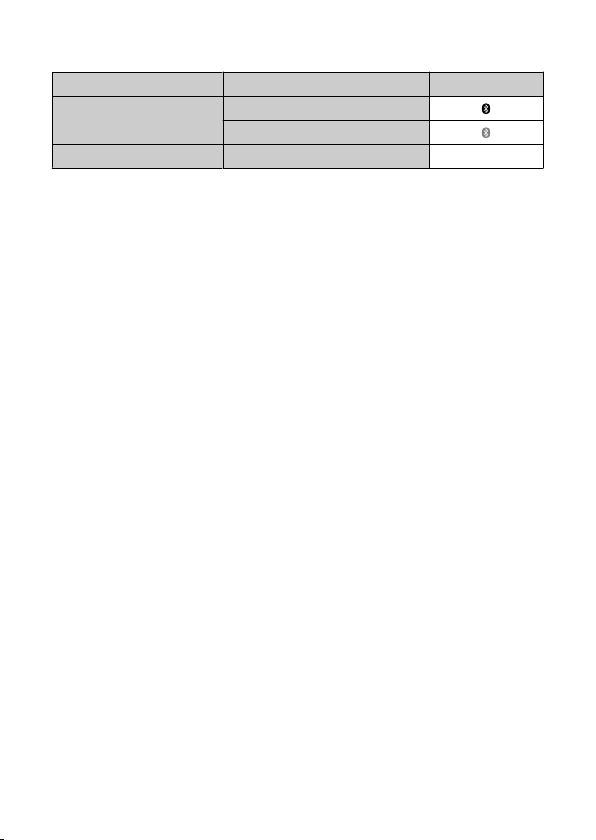
Bluetooth Function Indicator
Bluetooth Function Connection Status Screen
Other than [Disable]
Bluetooth connected
Bluetooth not connected
[Disable] Bluetooth not connected Not displayed
669
Set-up
This chapter describes menu settings on the set-up [
] tab.
to the right of titles indicates functions only available in Creative Zone modes (<P>, <Tv>,
<Av>, or <M>).
• Tab Menus: Set-up
• Folder Settings
• File Numbering
• Card Formatting
• Auto Rotate
• Adding Orientation Information to Movies
• Date/Time/Zone
• Language
• Video System
• Shooting Mode Guide
• Feature Guide
• Beeps
• Volume
• Power Saving
• Screen and Viewfinder Display
• Screen Brightness
• Viewfinder Brightness
• Fine-Tuning Viewfinder Color Tone
• UI Magnification
• HDMI Resolution
• Touch Control
• App Selection for USB Connections
• Resetting the Camera
• Custom Shooting Mode (C Mode)
• Battery Information
• Copyright Information
• Other Information
670
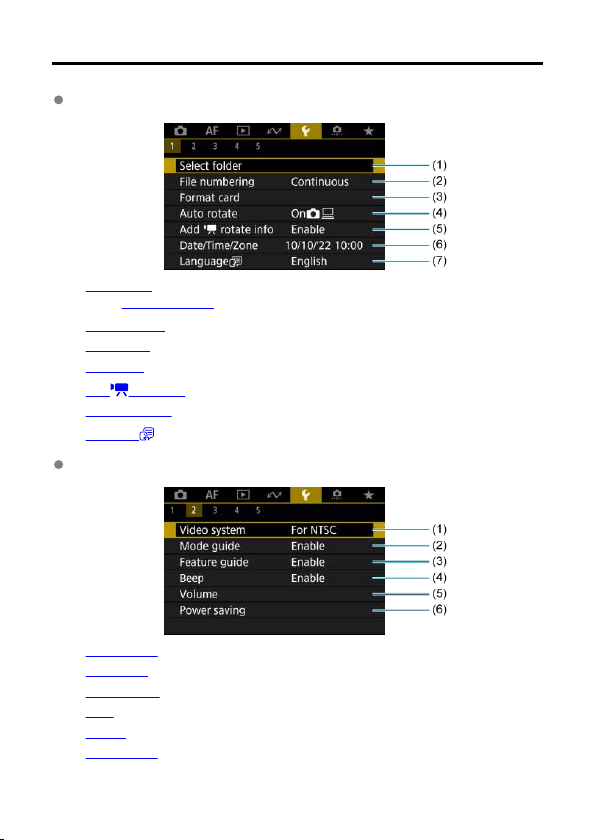
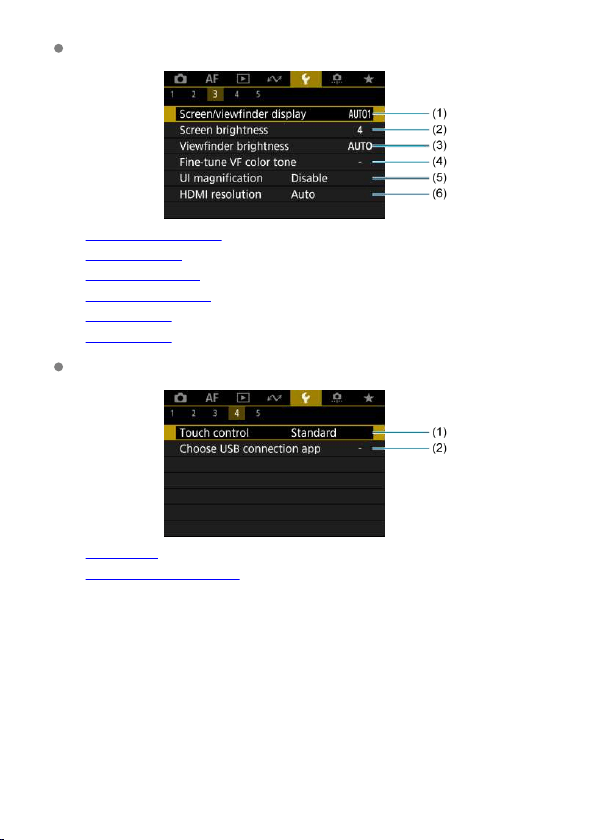
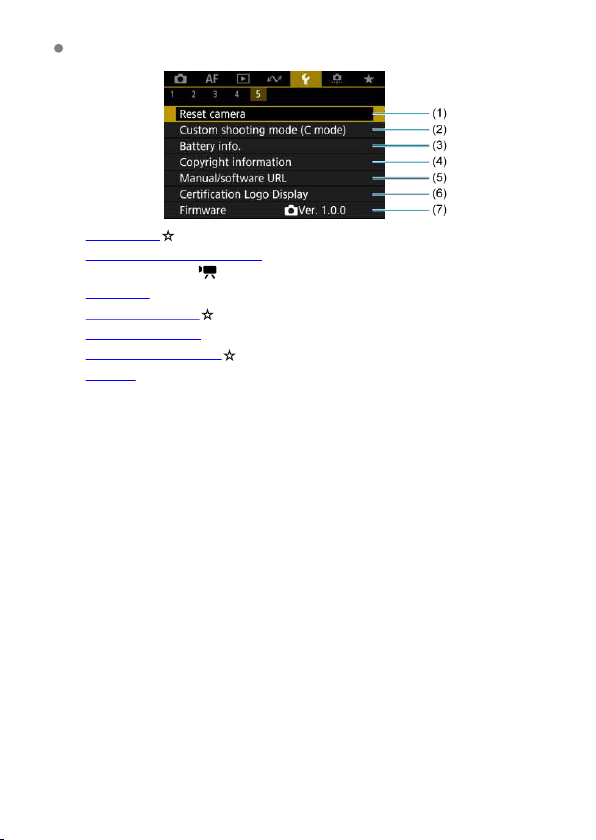
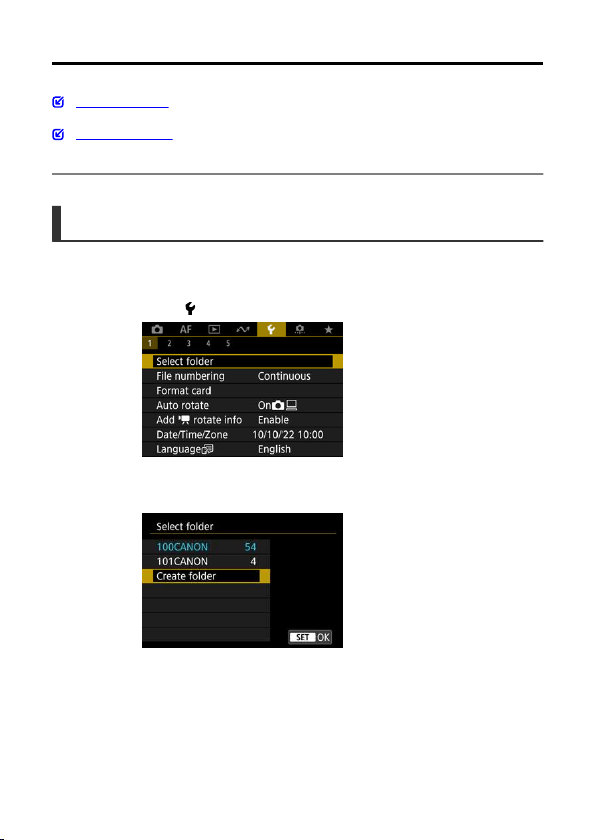
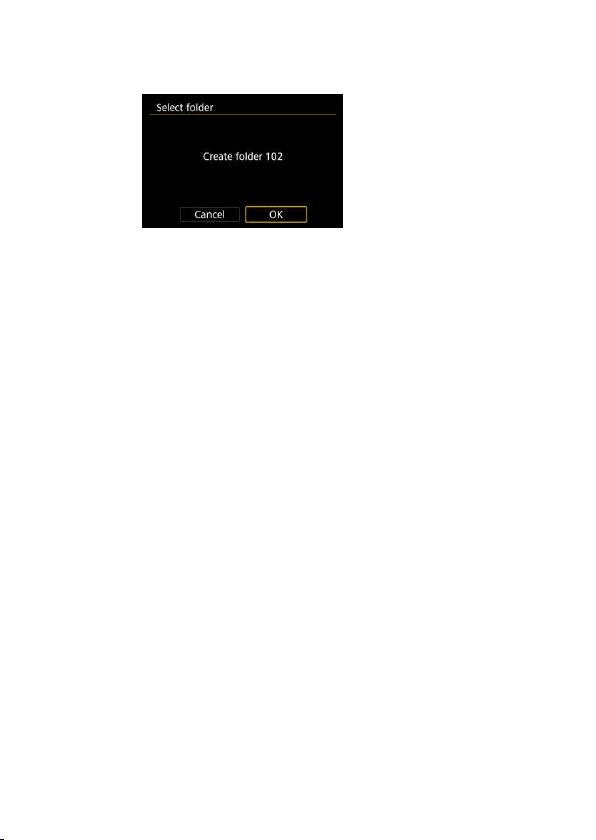
3.
Select [OK].
675
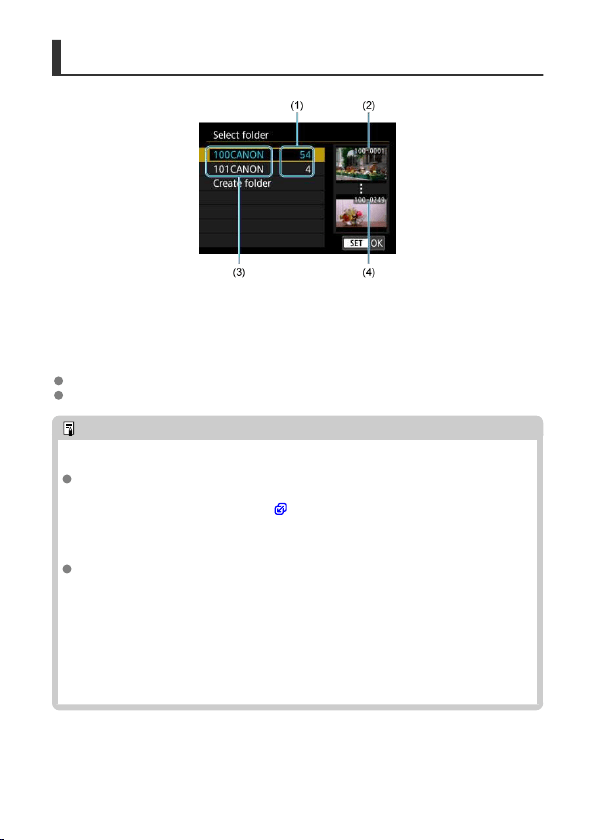
Selecting a Folder
(1) Number of images in folder
(2) Lowest file number
(3) Folder name
(4) Highest file number
Select a folder on the folder selection screen.
Captured images are stored in your selected folder.
Note
Folders
A folder can contain up to 9999 images (file number 0001–9999). When a folder
becomes full, a new folder with the folder number increased by one is created
automatically. Also, if manual reset ( ) is executed, a new folder will be created
automatically. Folders numbered from 100 to 999 can be created.
Creating folders with a computer
With the card open on the screen, create a new folder with “DCIM” as the name.
Open the DCIM folder and create as many folders as necessary to save and
organize your images. “100ABC_D” is the required format for folder names, and
the first three digits must be a folder number in the range 100–999. The last five
characters can be any combination of upper- and lower-case letters from A to Z,
numerals, and the underscore “_”. The space cannot be used. Also note that two
folder names cannot share the same three-digit folder number (for example,
“100ABC_D” and “100W_XYZ”) even if the remaining five characters in each name
are different.
676
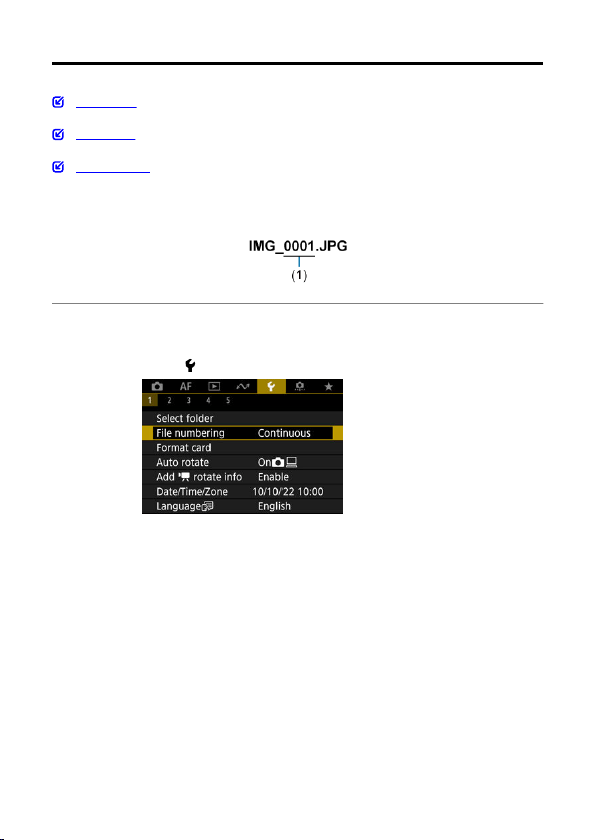
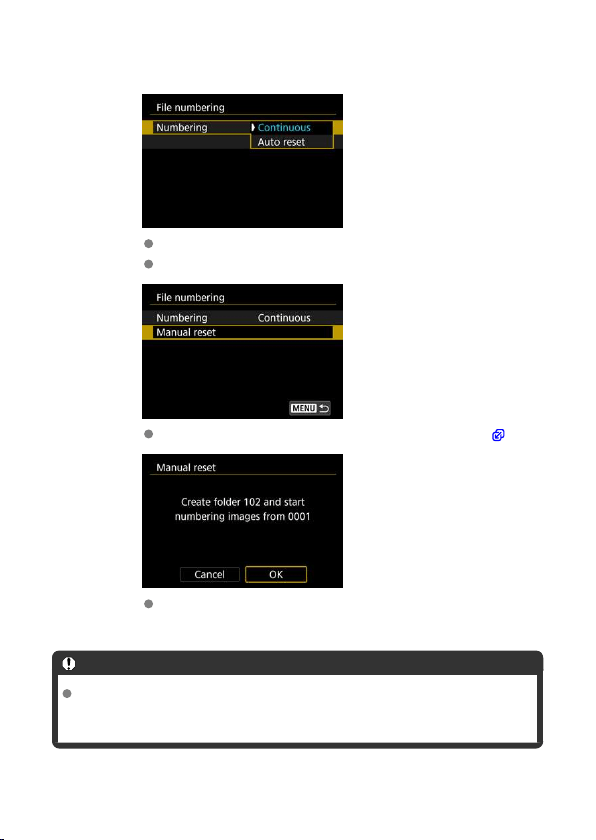
2.
Set the item.
Select [Numbering].
Select [Continuous] or [Auto reset].
If you want to reset the file numbering, select [Manual reset] ( ).
Select [OK] to create a new folder, and the file number will start with
0001.
Caution
If the file number in folder 999 reaches 9999, shooting will not be possible even if
the card still has free space. After a message requesting you to replace the card is
displayed, switch to a new card.
678
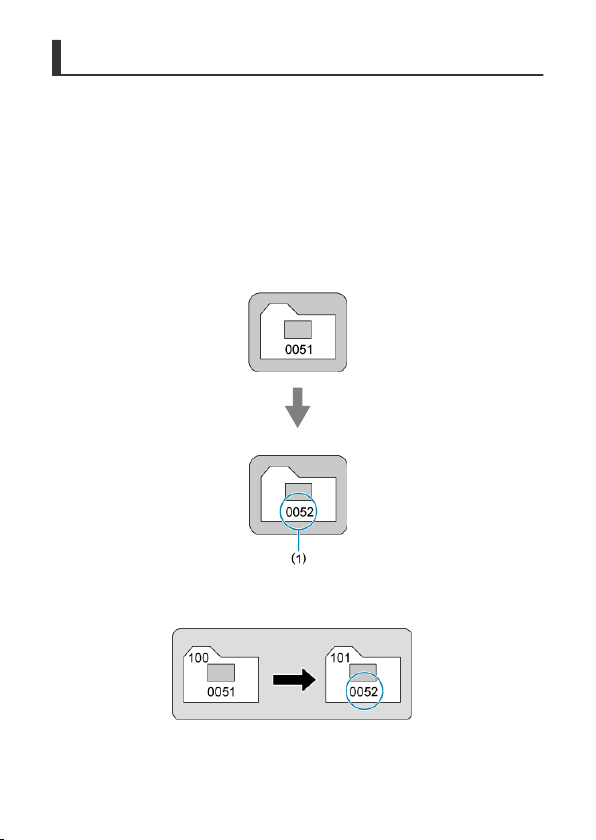
Continuous
For continuous file numbering regardless of switching cards or
creating folders
Even after you replace the card or create a new folder, the file numbering continues in
sequence up to 9999. This is useful when you want to save images numbered anywhere
between 0001 to 9999 on multiple cards or in multiple folders into one folder on a computer.
If the replacement card or existing folder already contains images recorded previously, the
file numbering of the new images may continue from the file numbering of the existing
images on the card or in the folder. If you want to use continuous file numbering, it is
recommended that you use a newly formatted card each time.
File numbering after replacing the card
Card 1
Card 2
(1) Next sequential file number
File numbering after creating a folder
Card 1
679
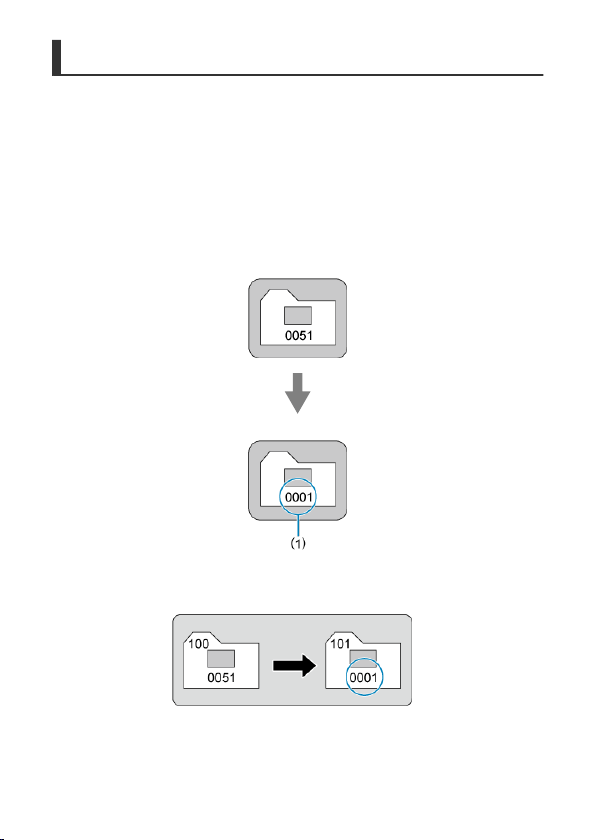
Auto Reset
For restarting file numbering from 0001 after switching cards or
creating folders
When you replace the card or create a folder, the file numbering restarts from 0001 for the
new images saved. This is useful if you want to organize images by cards or folders.
If the replacement card or existing folder already contains images recorded previously, the
file numbering of the new images may continue from the file numbering of the existing
images on the card or in the folder. If you want to save images with the file numbering
starting from 0001, use a newly formatted card each time.
File numbering after replacing the card
Card 1
Card 2
(1) File numbering is reset
File numbering after creating a folder
Card 1
680

Manual Reset
For resetting file numbering to 0001 or starting from 0001 in new
folders
When you reset the file numbering manually, a new folder is created automatically and the
file numbering of images saved to that folder starts from 0001.
This is useful, for example, if you want to use different folders for the images taken
yesterday and the ones taken today.
681
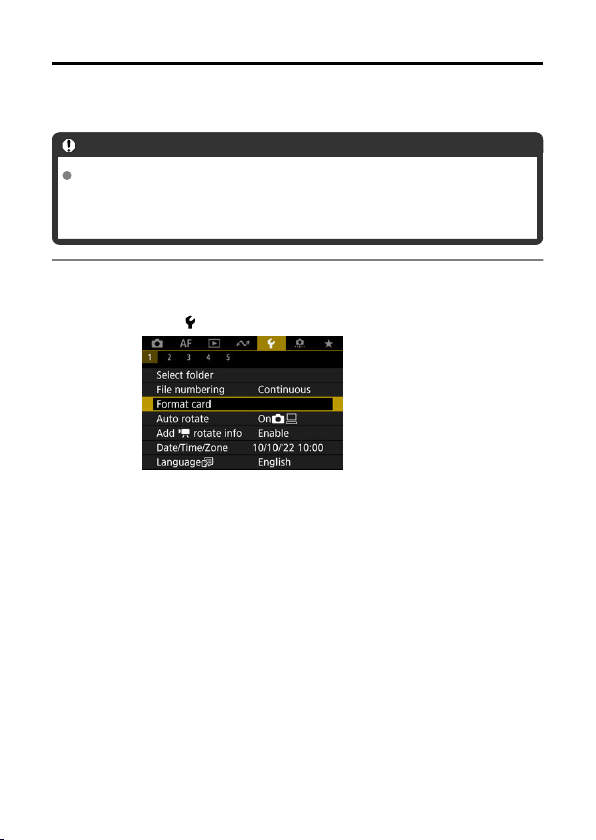
Card Formatting
If the card is new or was previously formatted (initialized) by another camera or computer,
format the card with this camera.
Caution
When the card is formatted, all images and data on the card will be erased.
Even protected images will be erased, so make sure there is nothing you
need to keep. If necessary, transfer the images and data to a computer, etc.
before formatting the card.
1.
Select [
: Format card].
682
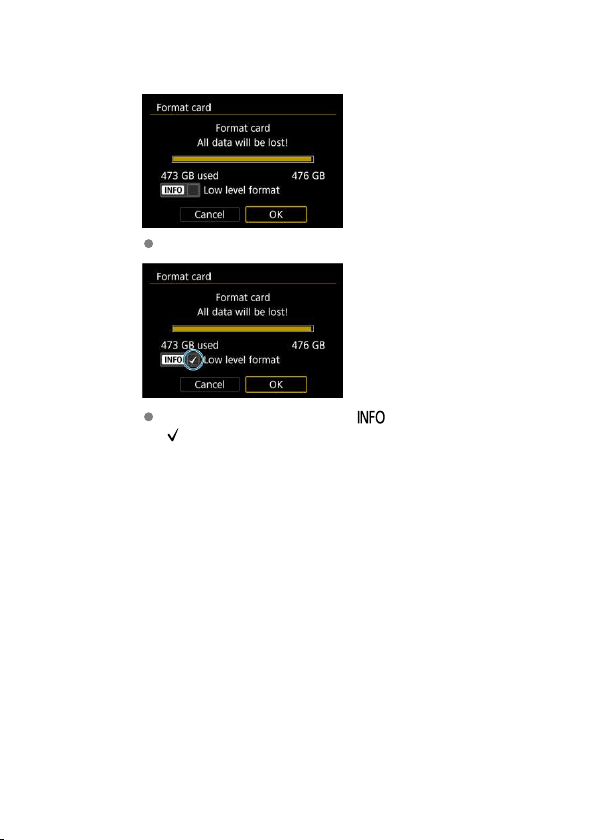
2.
Format the card.
Select [OK].
For low-level formatting, press the < > button to add a checkmark
[
] to [Low level format], then select [OK].
683
Conditions requiring card formatting
The card is new.
The card was formatted by a different camera or a computer.
The card is full of images or data.
A card-related error is displayed ( ).
Low-level formatting
Perform low-level formatting if the card's writing or reading speed seems slow or if you
want to totally erase the data on the card.
Since low-level formatting will format all recordable sectors on the card, the formatting
will take longer than normal formatting.
During low-level formatting, you can cancel formatting by selecting [Cancel]. Even in
this case, normal formatting will already be complete and you can use the card as usual.
Card file formats
SD cards will be formatted in FAT12 or FAT16, SDHC cards in FAT32, and SDXC cards
in exFAT.
Individual movies recorded to exFAT-formatted cards are recorded as a single file
(without splitting them into multiple files) even if they exceed 4 GB, so the resulting
movie file will exceed 4 GB.
Caution
It may not be possible to use SDXC cards formatted with this camera in other
cameras. Also note that exFAT-formatted cards may not be recognized by some
computer operating systems or card readers.
Formatting or erasing data on a card does not completely erase the data. Be aware
of this when selling or discarding the card. When disposing of cards, take steps to
protect personal information if necessary, as by physically destroying cards.
Note
The card capacity displayed on the card format screen may be smaller than the
capacity indicated on the card.
This device incorporates exFAT technology licensed from Microsoft.
684
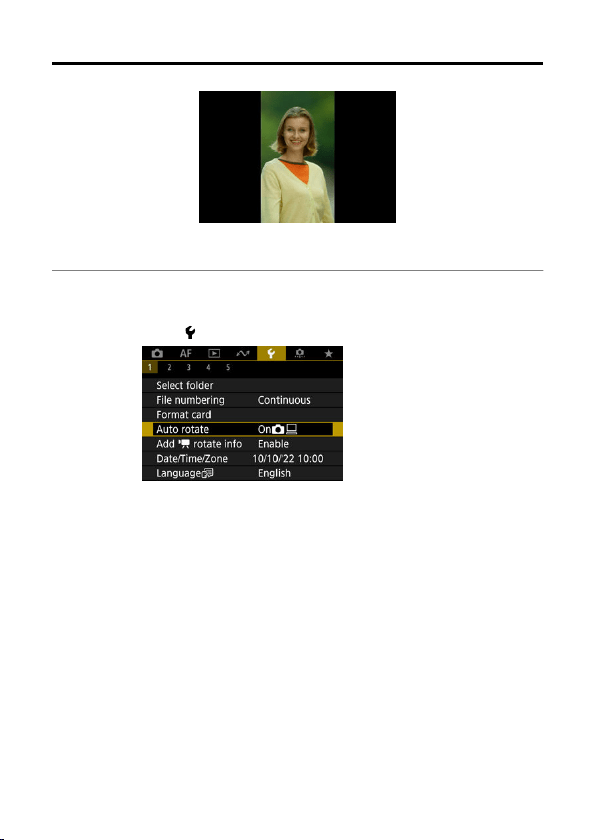
Auto Rotate
You can change the auto rotation setting that straightens images shot in vertical orientation
when they are displayed.
1.
Select [
: Auto rotate].
685
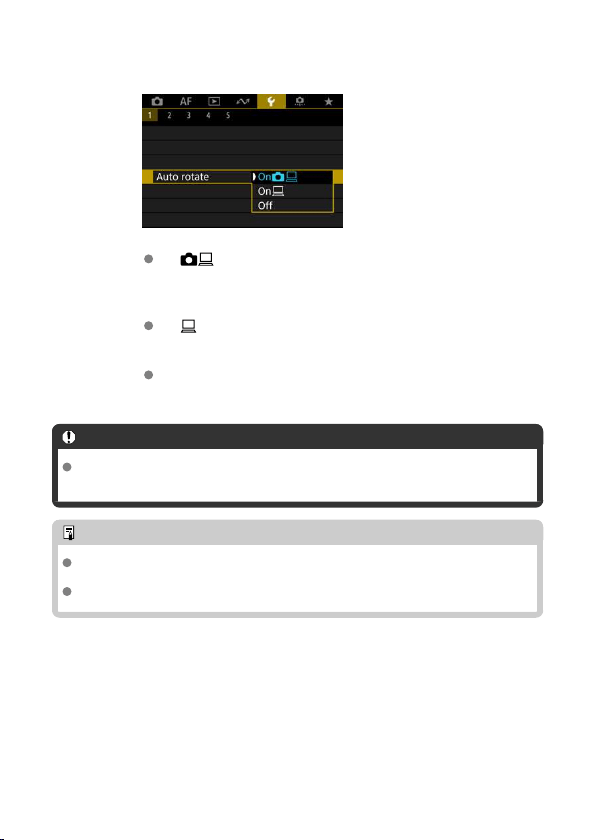
2.
Select an option.
On
Automatically rotates images for display on both the camera and
computers.
On
Automatically rotates images only for display on computers.
Off
Images are not automatically rotated.
Caution
Images captured with auto rotation set to [Off] will not rotate during playback even
if you later set auto rotation to [On].
Note
If a picture is taken while the camera is aimed up or down, automatic rotation to the
proper orientation for viewing may not be performed correctly.
If images are not rotated automatically on a computer, try using EOS software.
686
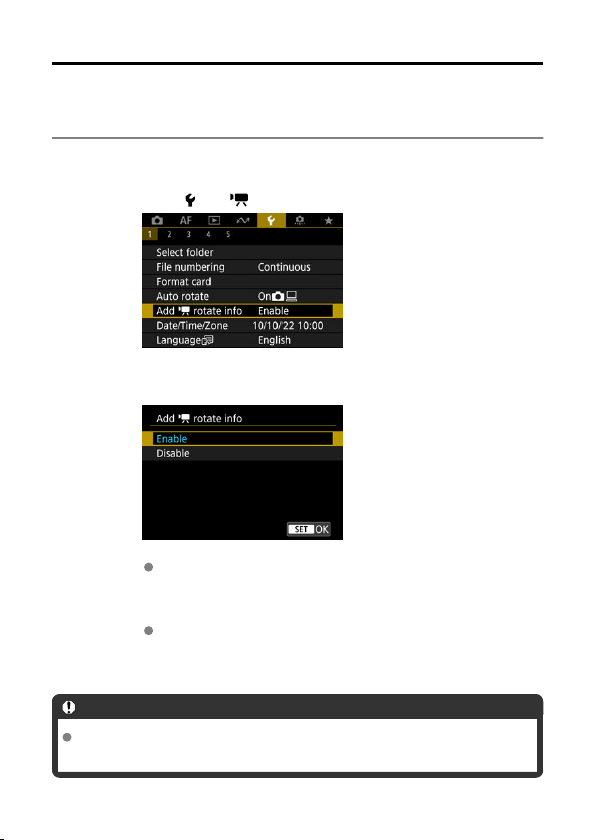
Adding Orientation Information to Movies
For movies recorded with the camera held vertically, orientation information indicating which
side is up can be added automatically to enable playback in the same orientation on
smartphones or other devices.
1.
Select [
: Add rotate info].
2.
Select an option.
Enable
Play movies on smartphones or other devices in the orientation in
which they were recorded.
Disable
Play movies horizontally on smartphones or other devices, regardless
of the recording orientation.
Caution
Movies are played horizontally on the camera and via HDMI video output,
regardless of this setting.
687
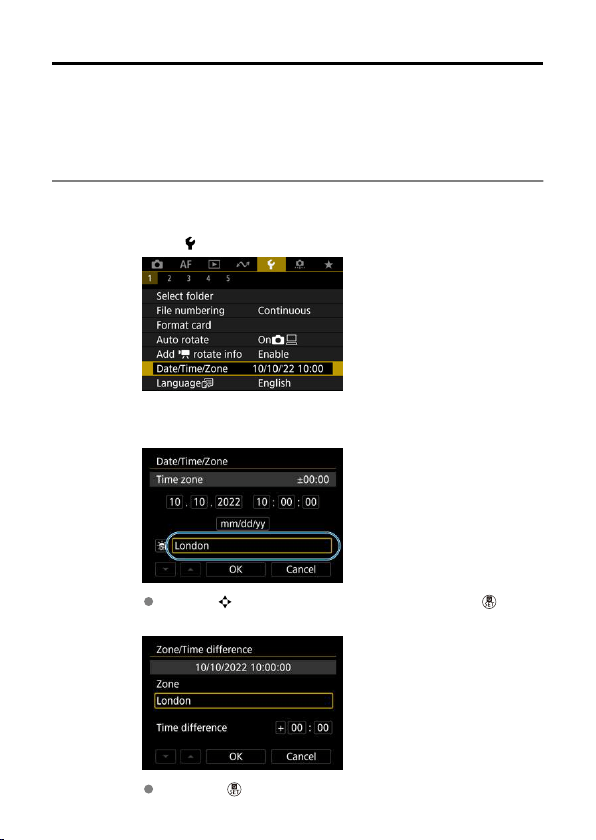
Date/Time/Zone
When you turn on the power for the first time or if the date/time/zone have been reset, follow
these steps to set the time zone first.
By setting the time zone first, you can simply adjust this setting as needed in the future and
the date/time will be updated to match it.
Since the captured images will be appended with the shooting date and time information, be
sure to set your date/time.
1.
Select [
: Date/Time/Zone].
2.
Set the time zone.
Use the < > keys to select [Time zone], then press the < >
button.
Press the < > button.
688
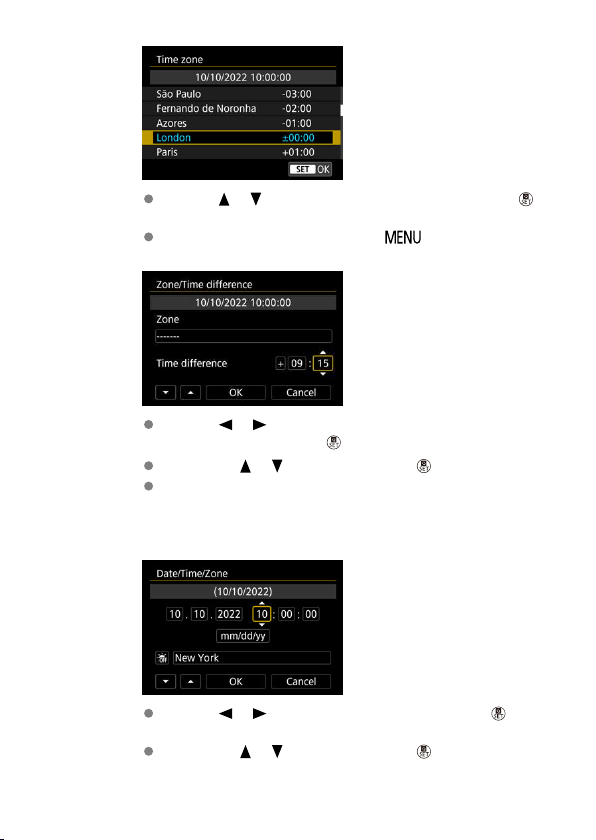
Use the < >< > keys to select the time zone, then press the < >
button.
If your time zone is not listed, press the < > button, then set the
difference from UTC in [Time difference].
Use the < >< > keys to select a [Time difference] option (+–/
hour/minute), then press the <
> button.
Set with the < >< > keys, then press the < > button.
After entering the time zone or time difference, select [OK].
3.
Set the date and time.
Use the < >< > keys to select an item, then press the < >
button.
Set with the < >< > keys, then press the < > button.
689
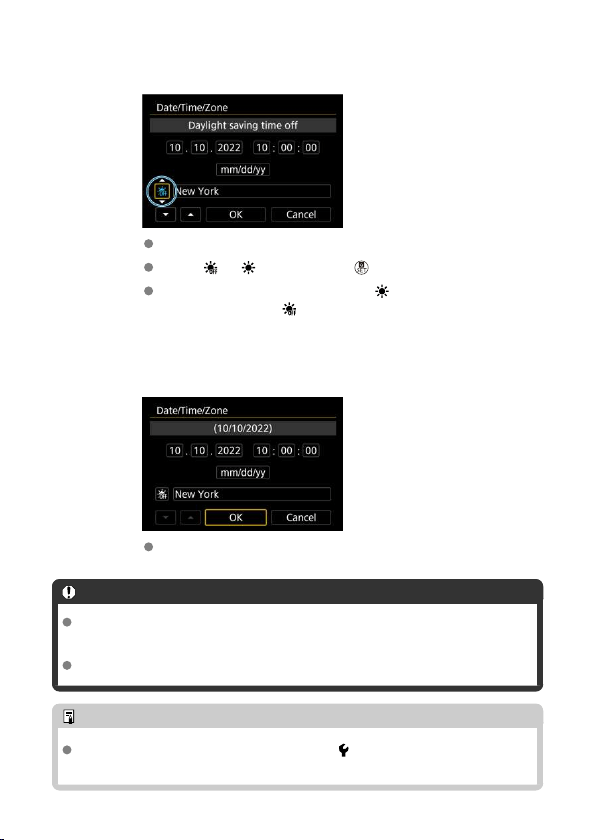
4.
Set daylight saving time.
Set it as necessary.
Select [ ] or [ ], then press the < > button.
When the daylight saving time is set to [ ], the time set in step 3 will
advance by 1 hour. If [
] is set, the daylight saving time will be
canceled and the time will go back by 1 hour.
5.
Exit the setting.
Select [OK].
Caution
The date, time, and time zone settings may be reset when the camera is stored
without the battery, when the battery is exhausted, or when it is exposed to freezing
temperatures for an extended period. If this happens, set them once again.
After changing [Zone/Time difference], check that the correct date/time are set.
Note
Auto power off time may be extended while the [ : Date/Time/Zone] screen is
displayed.
690
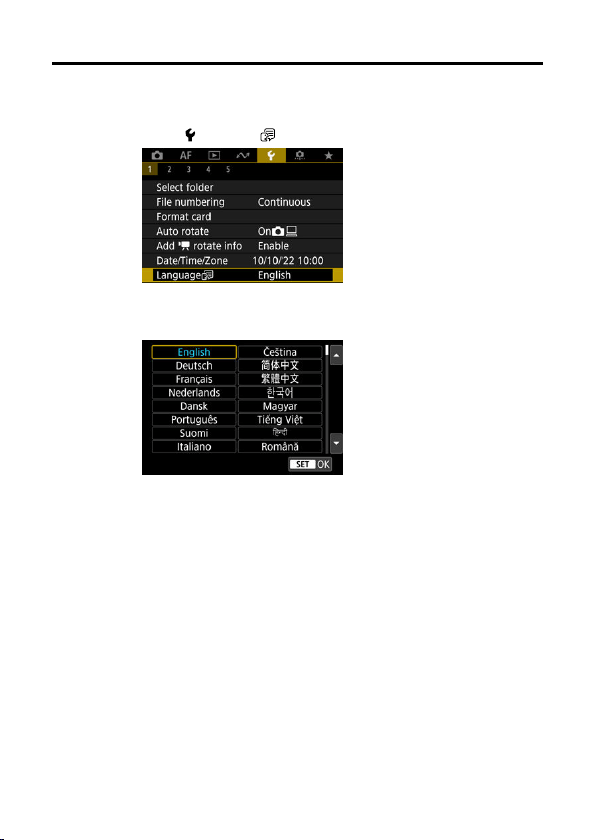
Language
1.
Select [
: Language ].
2.
Set the desired language.
691
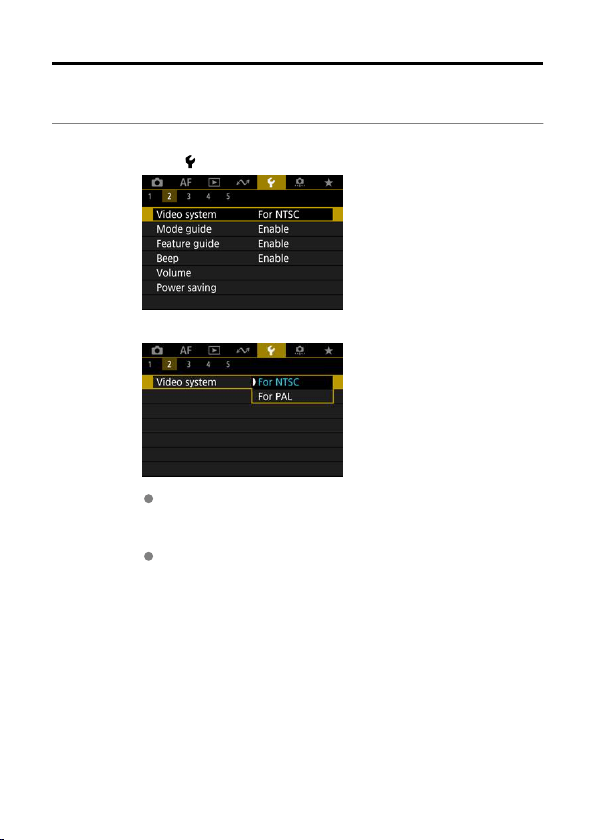
Video System
Set the video system of any television used for display. This setting determines the frame
rates available when you record movies.
1.
Select [
: Video system].
2.
Select an option.
For NTSC
For areas where the TV system is NTSC (North America, Japan, South
Korea, Mexico, etc.).
For PAL
For areas where the TV system is PAL (Europe, Russia, China,
Australia, etc.).
692
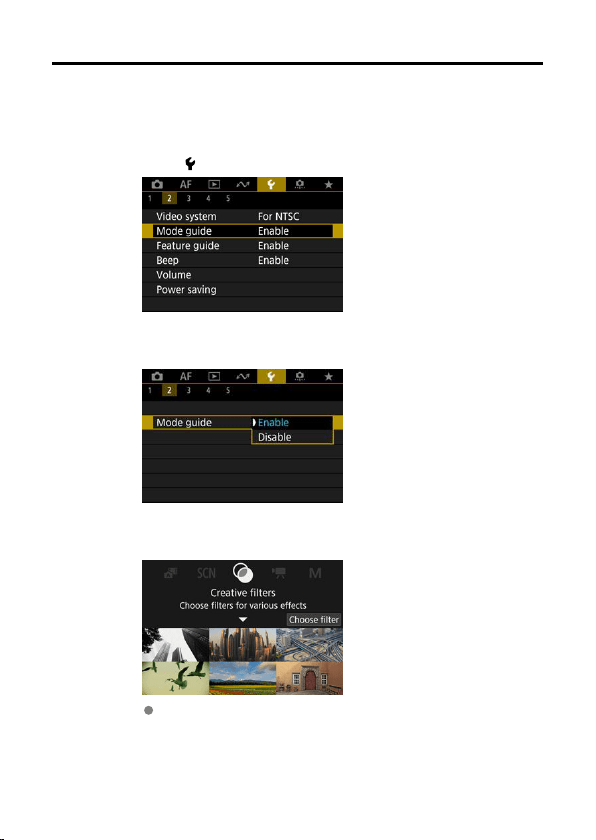
Shooting Mode Guide
A brief description of the shooting mode can be displayed when you switch shooting modes.
The default setting is [Enable].
1.
Select [
: Mode guide].
2.
Select [Enable].
3.
Turn the Mode dial.
A description of the selected shooting mode will appear.
693
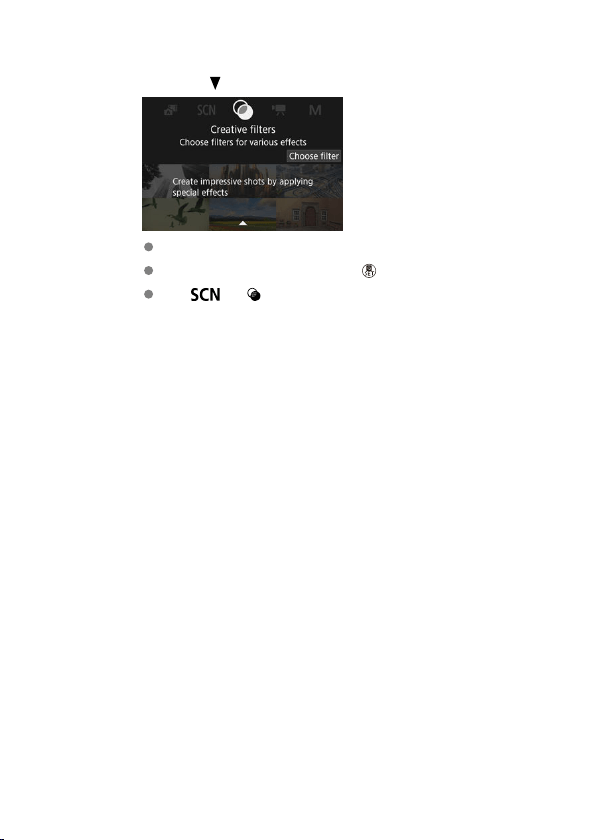
4.
Press the <
> key.
The rest of the description will appear.
To clear the mode guide, press the < > button.
In < >/< > mode, you can display the shooting mode
selection screen.
694
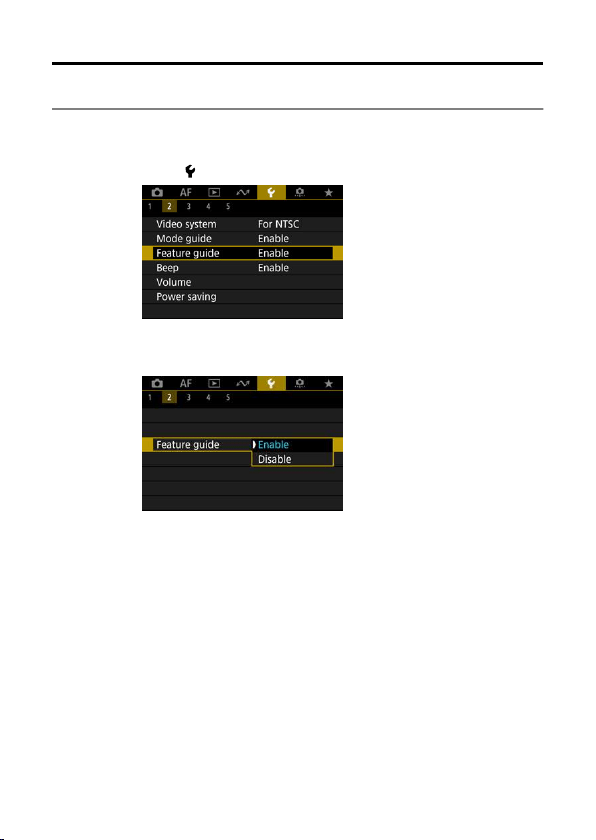
Feature Guide
A brief description of functions and items can be displayed when you use Quick Control.
1.
Select [
: Feature guide].
2.
Select an option.
695
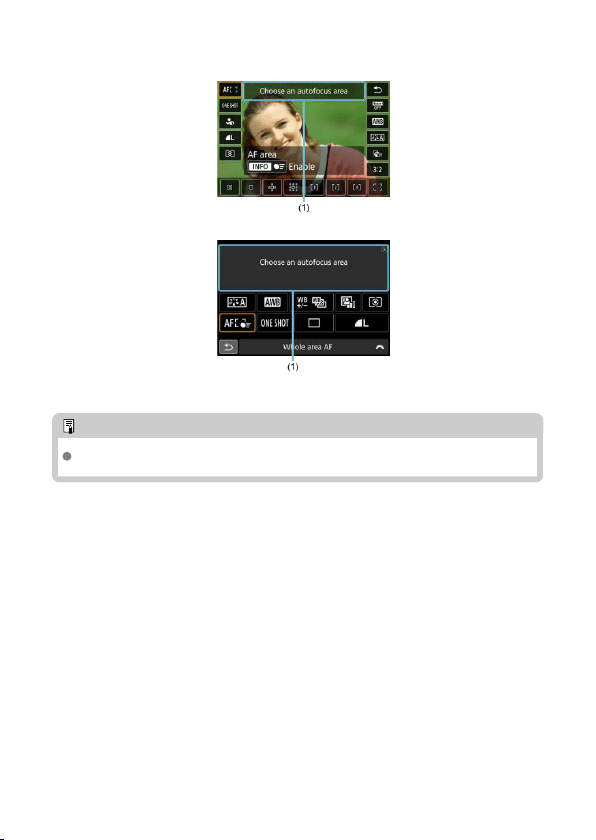
Sample screens
(1) Feature guide
Note
To clear a description, either tap it or continue performing operations.
696
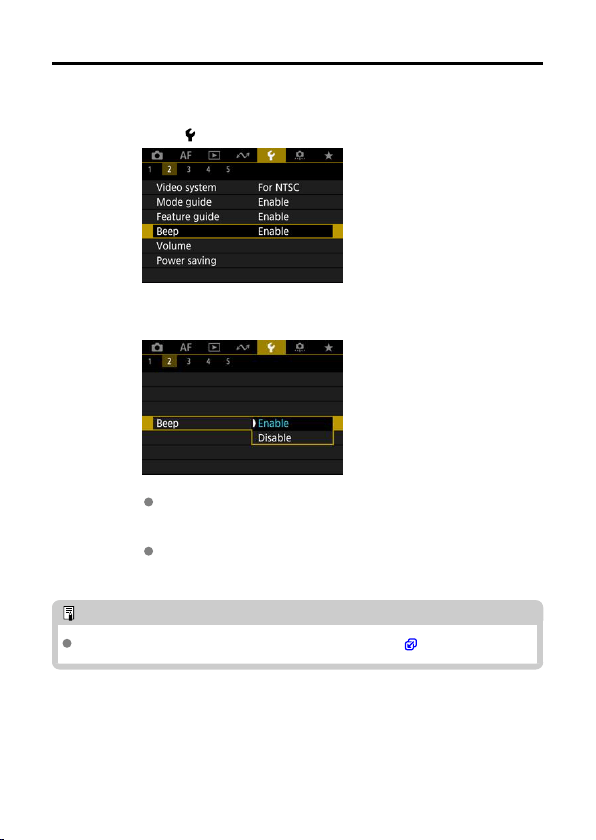
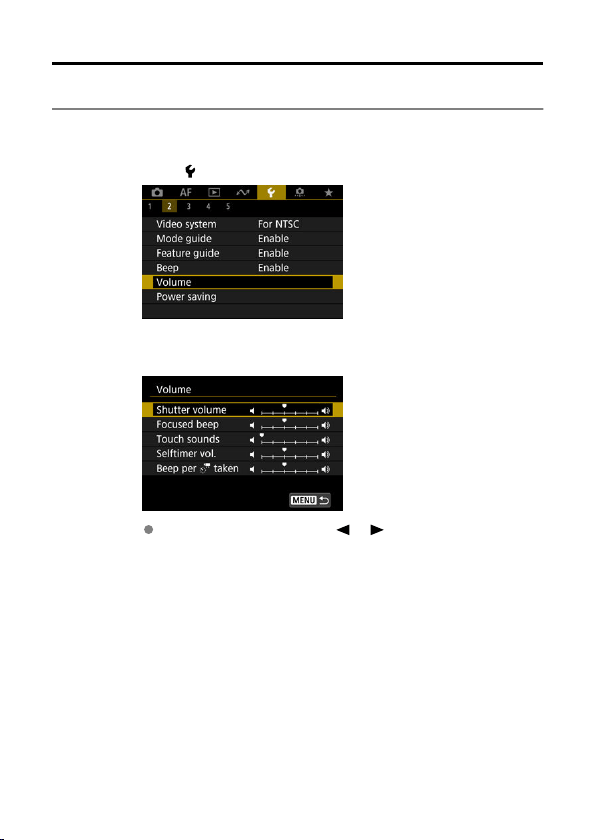
Volume
The volume of camera sounds is adjustable.
1.
Select [
: Volume].
2.
Set the option.
Select an option, then use the < >< > keys to adjust the volume.
698
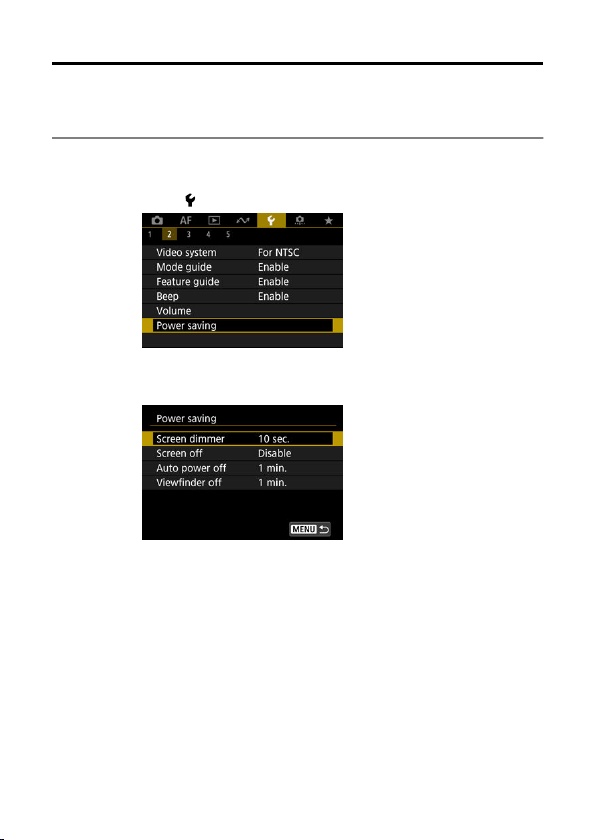
Power Saving
You can adjust the timing of when the screen dims and then turns off, when the camera
turns off, and when the viewfinder turns off after the camera is left idle (Screen dimmer,
Screen off, Auto power off, and Viewfinder off).
1.
Select [
: Power saving].
2.
Select an option.
699
Note
[Screen dimmer] and [Screen off] apply while the shooting screen is displayed.
These settings do not apply during menu display or image playback.
The camera turns off during menu display or image playback after the time set in
[Screen dimmer], [Screen off], and [Auto power off] elapses.
To protect the screen, the screen turns off 30 min. after it is dimmed (although the
camera itself remains on), even if [Screen off] and [Auto power off] are set to
[Disable].
[Viewfinder off] also applies while the screen is still on. After this time elapses, the
viewfinder sensor is deactivated.
Only [Viewfinder off] applies during viewfinder display. After this time elapses, the
viewfinder sensor is deactivated and the viewfinder turns off.
Images on the screen are displayed at a lower frame rate after the screen dims
during still photo shooting standby.
700
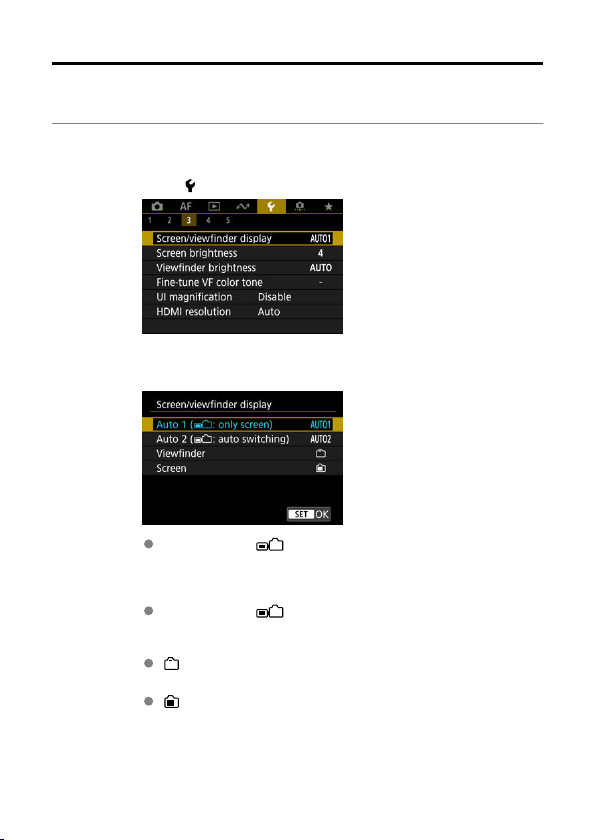
Screen and Viewfinder Display
You can specify to use the screen or viewfinder for display, to avoid accidentally activating
the viewfinder sensor when the screen is open.
1.
Select [
: Screen/viewfinder display].
2.
Select an option.
AUTO1: Auto 1 ( : only screen)
Always use the screen for display when it is open.
Use the screen for display when it is closed and facing you, and switch
to the viewfinder when you look through it.
AUTO2: Auto 2 ( : auto switching)
Use the screen for display when it is closed and facing you, and switch
to viewfinder display when you look through the viewfinder.
: Viewfinder
Always use the viewfinder for display.
: Screen
Always use the screen for display when it is open.
701
Note
You can also switch between viewfinder and screen display by pressing a button
you have customized by assigning to switching. With this setting set to [AUTO1] or
[AUTO2], the camera responds to the viewfinder sensor accordingly.
With [AUTO1] set, the camera does not respond to the viewfinder sensor when the
screen is open.
702
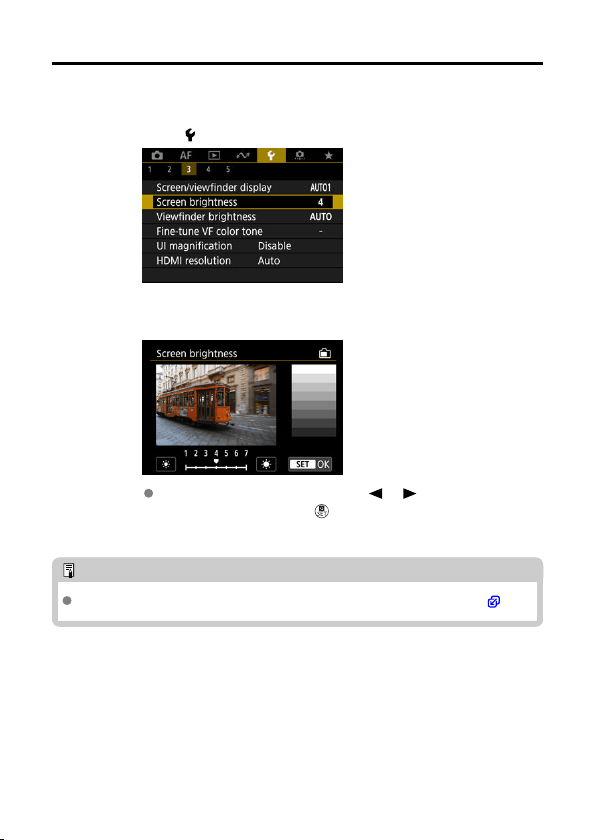
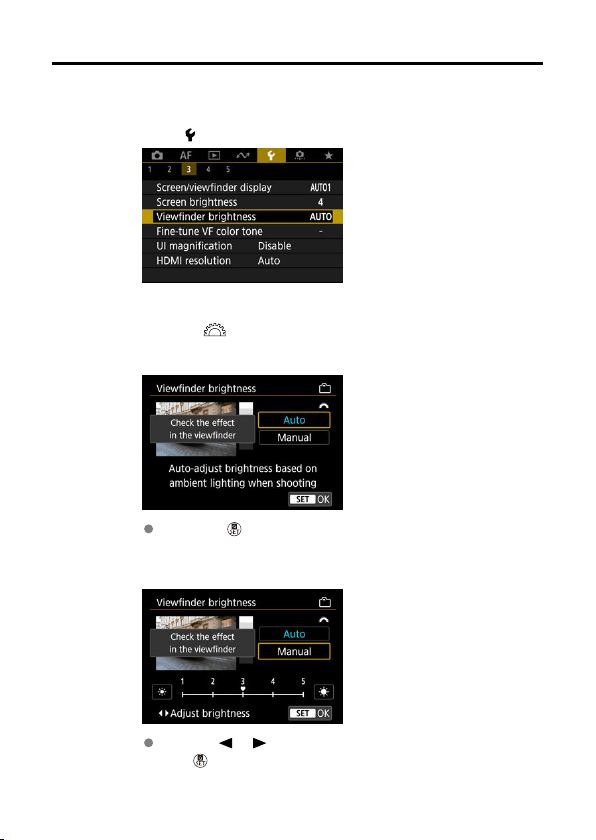
Viewfinder Brightness
1.
Select [
: Viewfinder brightness].
2.
Turn the <
> dial and select either [Auto] or [Manual].
Auto
Press the < > button. Check the effect in the viewfinder while
shooting.
Manual
Use the < >< > key to adjust viewfinder brightness, then press
the <
> button. Check the effect in the viewfinder.
704
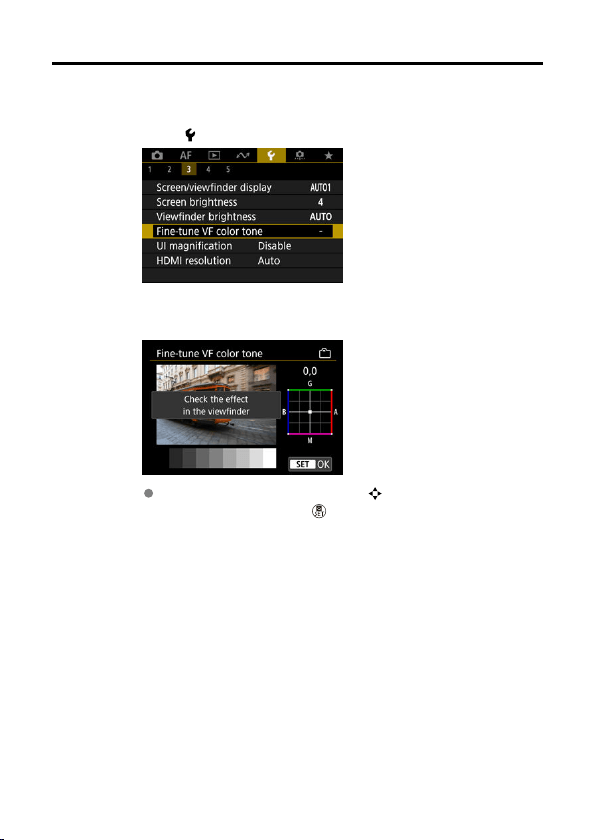
Fine-Tuning Viewfinder Color Tone
1.
Select [
: Fine-tune VF color tone].
2.
Make the adjustment.
Referring to the gray image, use the < > keys to adjust viewfinder
color tone, then press the <
> button. Check the effect in the
viewfinder.
705
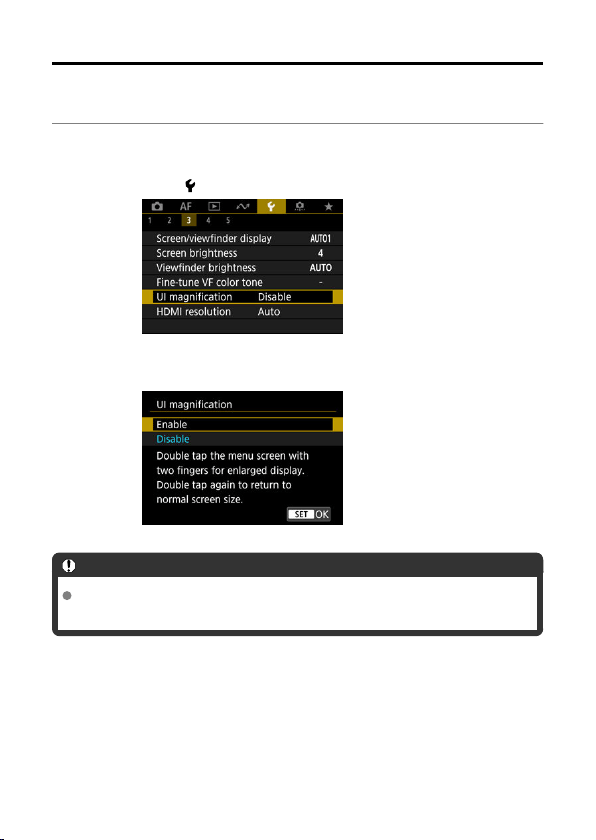
UI Magnification
You can magnify menu screens by double-tapping with two fingers. Double-tap again to
restore the original display size.
1.
Select [
: UI magnification].
2.
Select [Enable].
Caution
Use camera controls when configuring menu functions with the display magnified.
Touch-screen operations are not supported.
706
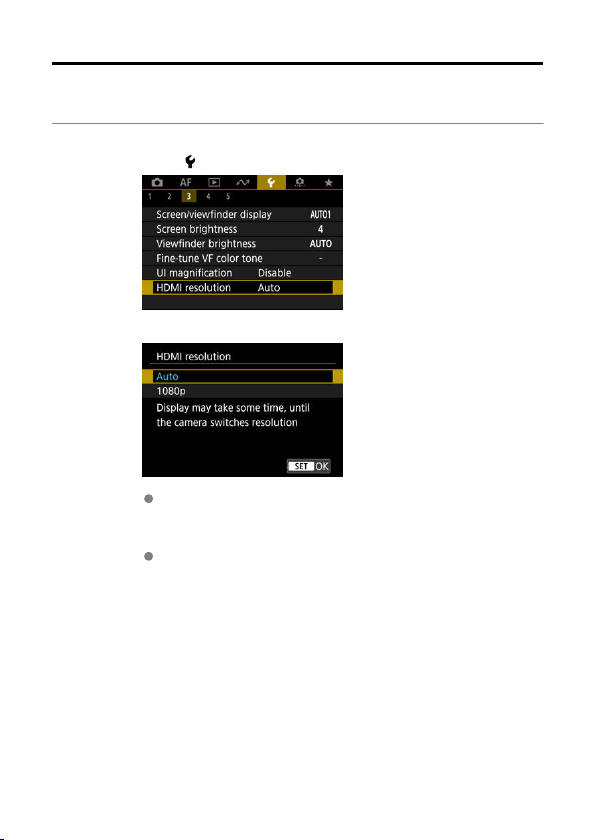
HDMI Resolution
Set the image output resolution used when the camera is connected to a television or
external recording device with an HDMI cable.
1.
Select [
: HDMI resolution].
2.
Select an option.
Auto
The images will automatically be displayed at the optimum resolution
matching the connected television.
1080p
Output at 1080p resolution. Select if you prefer to avoid display or
delay issues when the camera switches resolution.
707
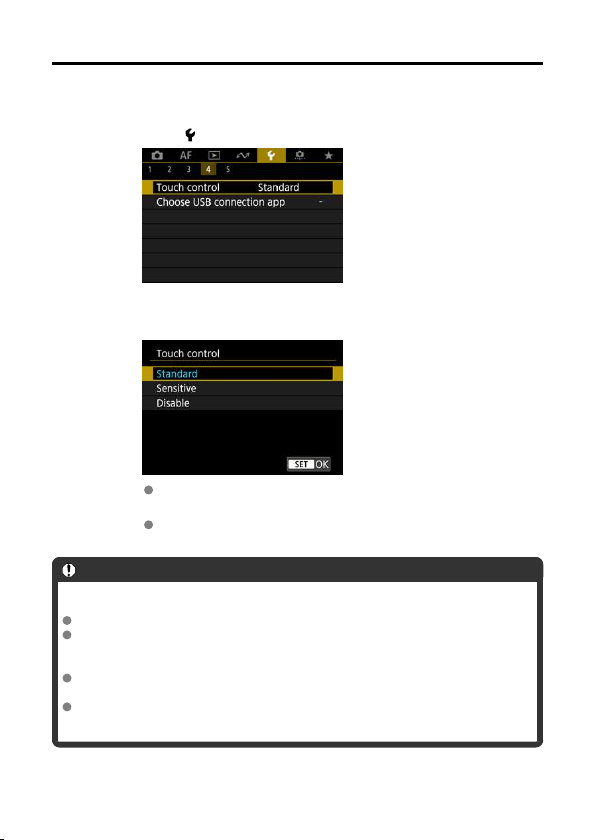
Touch Control
1.
Select [
: Touch control].
2.
Select an option.
[Sensitive] makes the touch-screen panel more responsive than
[Standard].
To disable touch operations, select [Disable].
Caution
Precautions for touch-screen panel operations
Do not use sharp objects such as fingernails or ballpoint pens for touch operations.
Do not use wet fingers for touch operations. If the screen has any moisture or if
your fingers are wet, the touch-screen panel may not respond or malfunction may
occur. In this case, turn off the power and wipe off the moisture with a cloth.
Attaching a commercially available protective sheet or a sticker on the screen may
impair responsiveness to touch operations.
The camera may not respond as well if you quickly perform touch operation when
[Sensitive] is set.
708

App Selection for USB Connections
By connecting the camera to a smartphone or computer with the interface cable, you can
transfer images or import images to the smartphone or computer.
1.
Select [
: Choose USB connection app].
2.
Select an option.
Photo Import/Remote Control
Select if you will use EOS Utility after connecting to a computer, or if
you will use dedicated Android apps or the iOS version of Photos.
Video calls/streaming
Select if you will use UVC/UAC-compatible applications after
connecting to a computer.
After selecting [Video calls/streaming], use the interface cable to
connect to the computer, then start the application.
The resolution and frame rate of image output is 2K (1920×1080) at 30
fps.
Canon app(s) for iPhone
Select if you will use an iOS app.
Connecting the camera to a smartphone requires a cable for this
purpose. For details, refer to the Canon website.
709
Caution
For [Video calls/streaming], consider using an optional household power outlet
accessory when using the camera over extended periods.
710
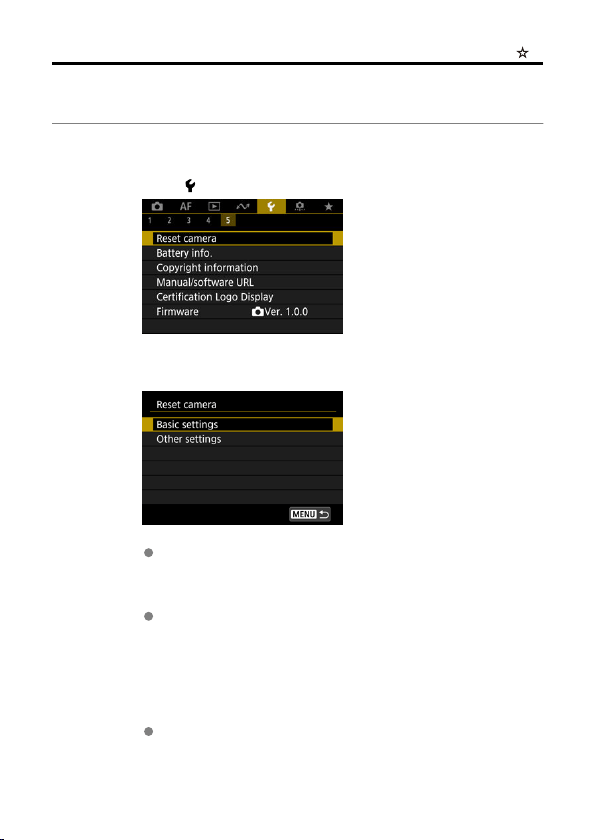
Resetting the Camera
The camera's settings for shooting functions and menu functions can be restored to their
defaults.
1.
Select [
: Reset camera].
2.
Select an option.
Basic settings
Restores default settings for camera shooting functions and menu
settings.
Other settings
Settings for individual selected options can be reset.
3.
Clear the settings.
Select [OK] on the confirmation screen.
711
Caution
Dots of light may appear in captured images or on the shooting screen if the sensor
is affected by cosmic rays or similar factors. If so, it may help to reduce their
appearance by doing one of the following with [Basic settings] selected: (1) Hold
down the <
> key and press the < > button, or (2) Press the < >
button, then select [OK] (but note that (2) restores default camera settings).
712
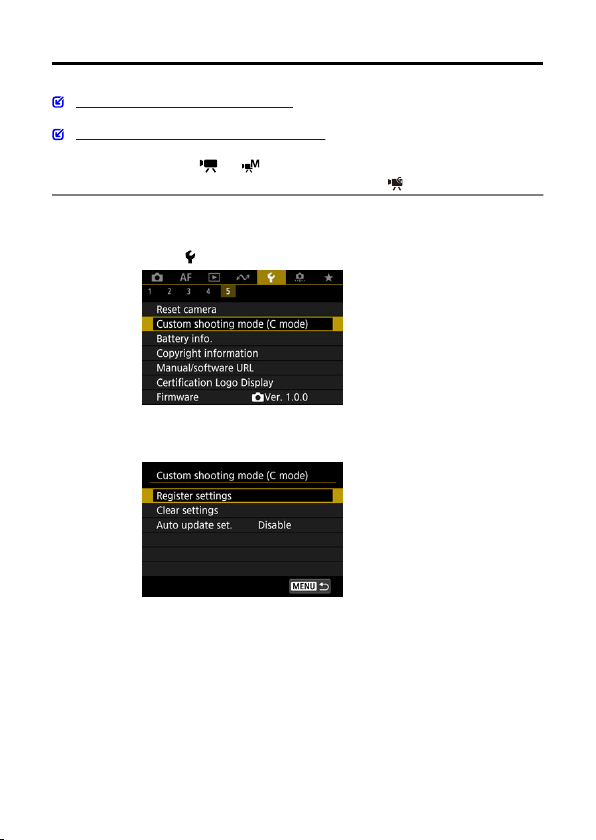
Custom Shooting Mode (C Mode)
Automatic Update of Registered Settings
Canceling Registered Custom Shooting Modes
Current camera settings in [ ] or [ ] mode, such as shooting, menu, and Custom
Function settings, can be registered in Custom shooting mode [
].
1.
Select [
: Custom shooting mode (C mode)].
2.
Select [Register settings].
713
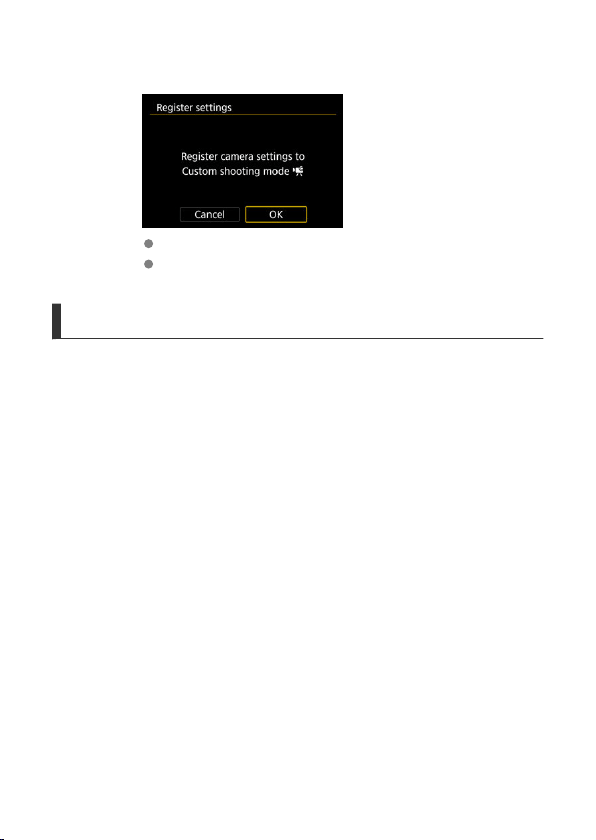
3.
Register the desired items.
Select [OK].
Current camera settings are registered to the Custom shooting mode.
Automatic Update of Registered Settings
If you change a setting while shooting in Custom shooting mode, the mode can be
automatically updated with the new setting (Auto update). To enable this automatic update,
set [Auto update set.] to [Enable] in step 2.
714
Canceling Registered Custom Shooting Modes
If you select [Clear settings] in step 2, the settings of each mode can be restored to default
settings, as they were before registration.
Note
You can also change shooting and menu settings in Custom shooting modes.
715
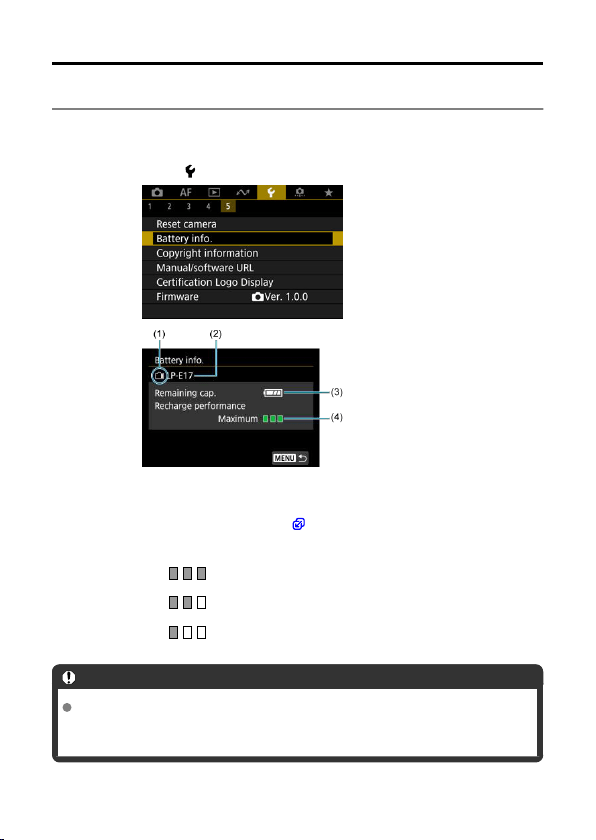
Battery Information
You can check the conditions of the battery you are using on the screen.
1.
Select [
: Battery info.].
(1) Battery position
(2) Model of battery or household power source used
(3) Remaining battery level ( )
(4) Battery recharge performance, in three levels
(Green): Battery recharge performance is good.
(Green): Battery recharge performance is slightly degraded.
(Red): Purchasing a new battery is recommended.
Caution
Using a genuine Canon Battery Pack LP-E17 is recommended. If you use batteries
that are not genuine Canon products, the camera's full performance may not be
attained or malfunction may result.
716
Note
If a battery communication error message is displayed, follow the instructions in the
message.
717
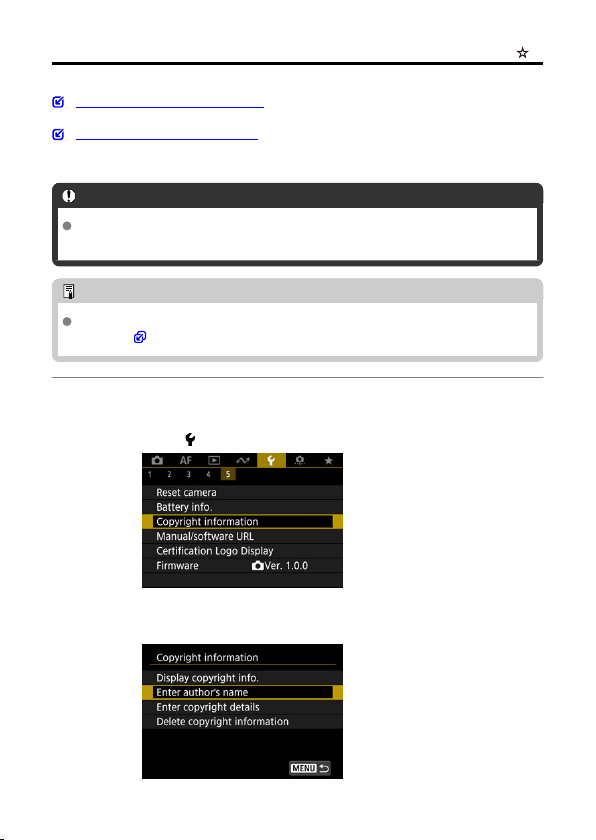
Copyright Information
Checking the Copyright Information
Deleting the Copyright Information
When you set the copyright information, it will be recorded to the image as Exif information.
Caution
If the entry for “Author” or “Copyright” is long, it may not be displayed entirely when
you select [Display copyright info.].
Note
You can also set or check copyright information with EOS Utility (EOS
software, ).
1.
Select [
: Copyright information].
2.
Select an option.
718
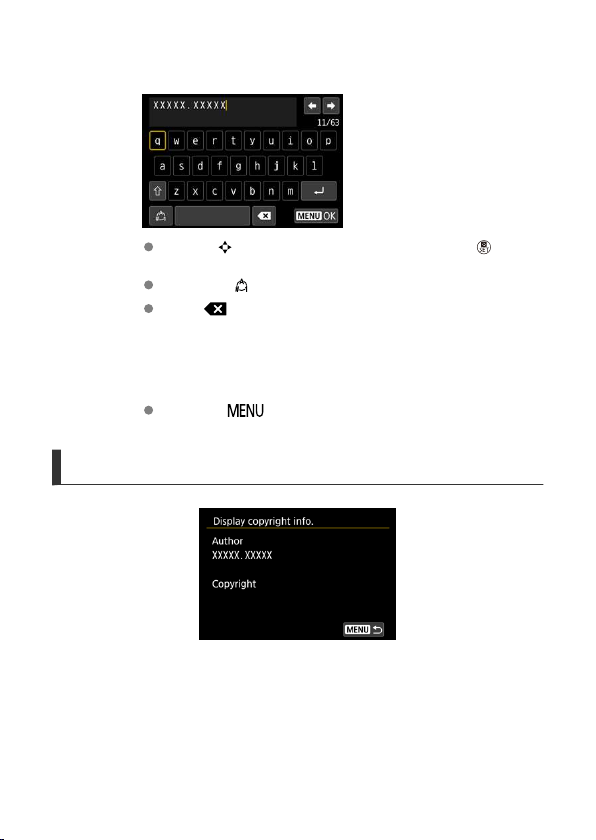
3.
Enter text.
Use the < > keys to select a character, then press the < > button
to enter it.
By selecting [ ], you can change the input mode.
Select [ ] to delete a character.
4.
Exit the setting.
Press the < > button, then press [OK].
Checking the Copyright Information
When you select [Display copyright info.] in step 2, you can check the [Author] and
[Copyright] information that you entered.
719

Deleting the Copyright Information
When you select [Delete copyright information] in step 2, you can delete the [Author] and
[Copyright] information.
720
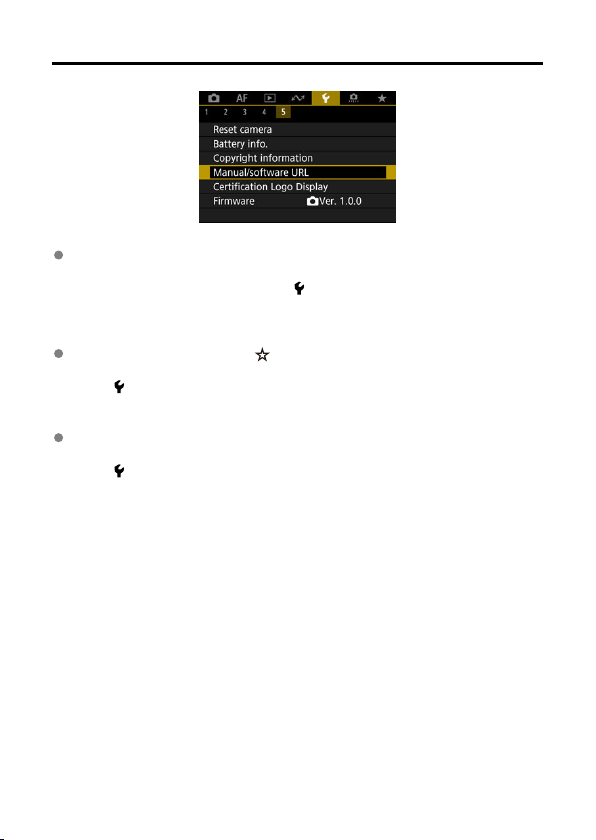
Other Information
Manual/software URL
To download instruction manuals, select [
: Manual/software URL] and scan the
displayed QR code with a smartphone. You can also use a computer to access the
website at the URL displayed and download software.
Certification Logo Display
Select [ : Certification Logo Display] to display some of the logos of the camera's
certifications. Other certification logos can be found on the camera body and packaging.
Firmware
Select [
: Firmware] to update the firmware of the camera, lens, or other compatible
accessories in use.
721

Custom Functions/My Menu
You can fine-tune camera functions and change the functionality of buttons and dials to suit
your shooting preferences. You can also add menu items and Custom Functions that you
adjust frequently to My Menu tabs.
•
Tab Menus: Custom Functions
• Custom Function Setting Items
• Tab Menus: My Menu
• Registering My Menu
722
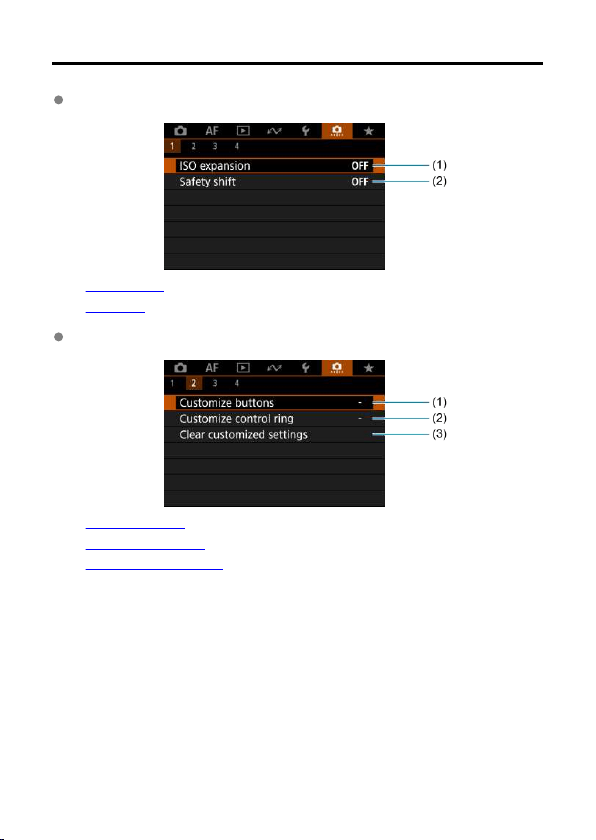
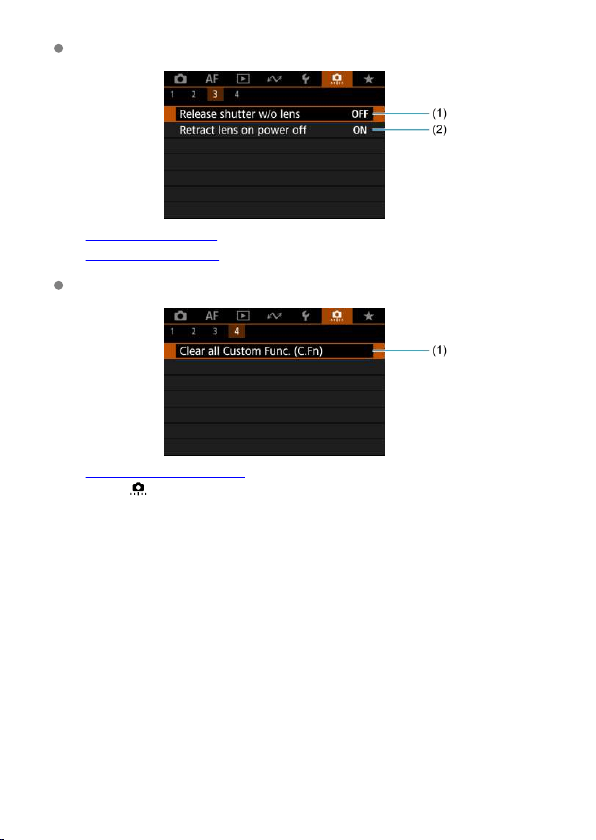
C.Fn1
ISO expansion
Makes “H” (equivalent to ISO 51200 in still photo shooting and ISO 25600 in movie
recording) available as an ISO speed in manual selection. Note that “H” is not available with
[
: Highlight tone priority] set to [Enable] or [Enhanced].
OFF: Disable
ON: Enable
Safety shift
You can shoot with the shutter speed and aperture value automatically adjusted to enable
standard exposure if standard exposure would not be available under your specified shutter
speed or aperture value in <Tv> or <Av> mode.
OFF: Disable
ON: Enable
726
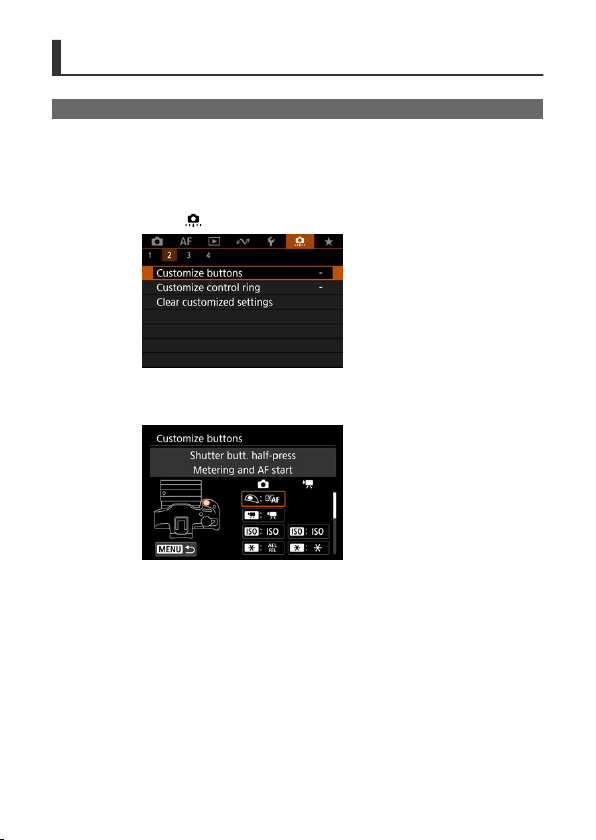
C.Fn2
Customize buttons
You can assign frequently used functions to camera buttons that are easy for you to use.
Different functions, for use when shooting still photos or movies, can be assigned to the
same button.
1.
Select [
: Customize buttons].
2.
Select a camera control.
727
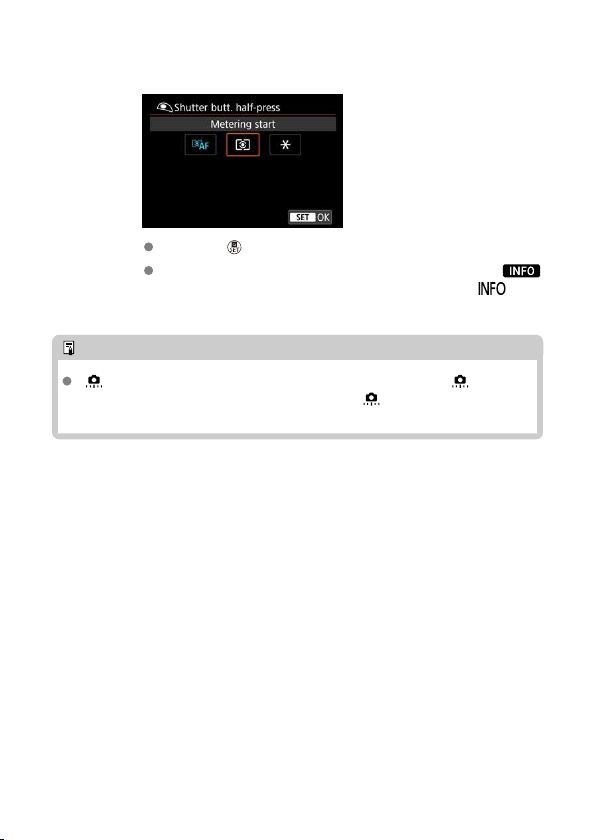
3.
Select a function to assign.
Press the < > button to set it.
You can configure advanced settings for functions labeled with [
Detail set.] in the lower left of the screen by pressing the
<
>
button.
Note
[ : Customize buttons] settings are not cleared even if you select [ : Clear all
Custom Func. (C.Fn)]. To clear the settings, select [
: Clear customized
settings].
728
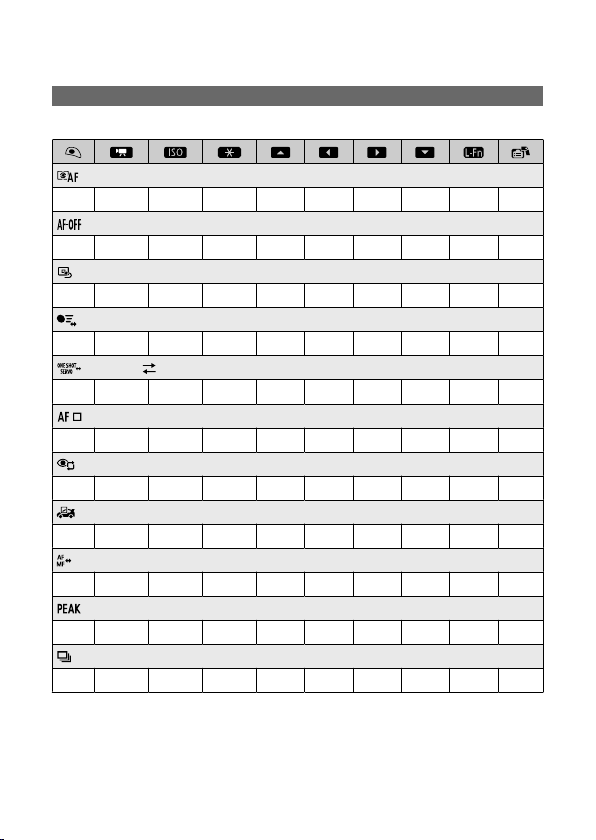
Functions available for customization
AF
●: Default ○: Available for customization
: Metering and AF start
● - - ○ - - - - ○ -
: AF stop
- - - ○ - - - - ● -
: Set AF point to center
- ○ ○ - ○ ○ ○ ○ ○ -
: Start/stop whole area AF tracking
- ○ ○ - ○ ○ ○ ○ ○ -
: One-Shot AF Servo AF*
1
- ○ ○ - ○ ○ ○ ○ ○ -
: AF area
- ○ ○ - ○ ○ ○ ○ - -
: Eye detection
- ○ ○ - ○ ○ ○ ○ ○ -
: Spot detection
- ○ ○ - ○ ○ ○ ○ ○ -
: Focus mode
- ○ ○ - ○ ● ○ ○ ○ -
: Peaking
- ○ ○ - ○ ○ ○ ○ ○ -
: Drive mode*
1
- ○ ○ - ○ ○ ● ○ ○ -
* 1: Cannot be assigned as a function available in movie recording.
729
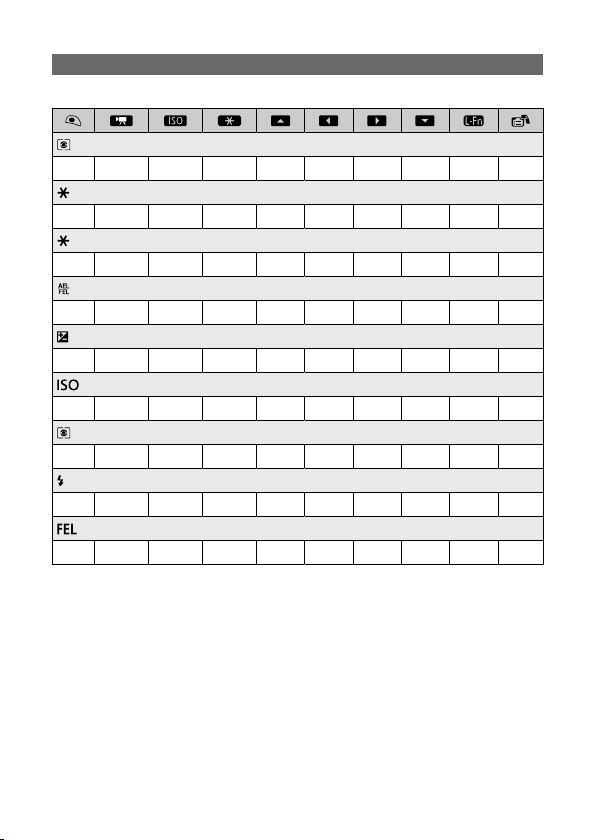
Exposure
●: Default ○: Available for customization
: Metering start*
1
○ - - - - - - - - -
: AE lock
- - -
●*
3
- - - - ○ -
: AE lock (while button pressed)*
1
○ - - - - - - - - -
: AE lock/FE lock*
1
- - -
●*
2
- - - - ○ -
: Exposure compensation
- ○ ○ - ● ○ ○ ○ ○ -
: ISO speed
- ○ ● - ○ ○ ○ ○ ○ -
: Metering mode*
1
- ○ ○ - ○ ○ ○ ○ ○ -
: Flash firing*
1
- ○ ○ - ○ ○ ○ ○ ○ -
: FE lock*
1
- - - ○ - - - - ○ -
* 1: Cannot be assigned as a function available in movie recording.
* 2: Default in still photo shooting.
* 3: Default in movie recording.
730
Image
●: Default ○: Available for customization
: Image quality*
1
- ○ ○ - ○ ○ ○ ○ ○ -
: One-touch image quality setting*
1
- ○ ○ - ○ ○ ○ ○ ○ -
: One-touch image quality (hold)*
1
- ○ ○ - ○ ○ ○ ○ ○ -
: Still img aspect ratio*
1
- ○ ○ - ○ ○ ○ ○ ○ -
: Digital tele-conv*
1
- ○ ○ - ○ ○ ○ ○ ○ -
: Auto Lighting Optimizer
- ○ ○ - ○ ○ ○ ○ ○ -
: White balance
- ○ ○ - ○ ○ ○ ○ ○ -
: Picture Style
- ○ ○ - ○ ○ ○ ○ ○ -
: Protect
- ○ ○ - - - - - ○ -
: Rating
- ○ ○ - - - - - ○ -
: Select folder
- ○ ○ - ○ ○ ○ ○ ○ -
* 1: Cannot be assigned as a function available in movie recording.
731
Movies
●: Default ○: Available for customization
: Movie recording
- ● ○ - - - - - ○ -
: Zebra*
4
- - - - ○ ○ ○ ○ ○ -
: Pause Movie Servo AF*
4
- - ○ - ○ ○ ○ ○ ○ -
: Digital zoom*
4
- - ○ - ○ ○ ○ ○ ○ -
: Movie self-timer*
4
- - ○ - ○ ○
●*
3
○ ○ -
: Standby: Low res.*
4
- - ○ - ○ ○ ○ ○ ○ -
* 3: Default in movie recording.
* 4: Cannot be assigned as a function available in still photo shooting.
732
Operation
●: Default ○: Available for customization
: Flash function settings*
1
- ○ ○ - ○ ○ ○ ○ ○ ●
: Quick flash group control*
1
- ○ ○ - ○ ○ ○ ○ ○ ○
: Depth-of-field preview*
1
- ○ ○ - ○ ○ ○ ○ ○ -
: Quick Control screen
- ○ ○ - ○ ○ ○ ○ ○ -
: Magnify/Reduce
- ○ ○ - ○ ○ ○ ○ ○ -
: Image replay
- ○ ○ - ○ ○ ○ ○ ○ -
: Magnify images during playback
- ○ ○ - ○ ○ ○ ○ ○ -
: Menu display
- ○ ○ - ○ ○ ○ ○ ○ -
: Touch Shutter*
1
- ○ ○ - ○ ○ ○ ○ ○ -
: Create folder*
1
- ○ ○ - ○ ○ ○ ○ ○ -
: OVF sim. view assist*
1
- ○ ○ - ○ ○ ○ ○ ○ -
: Disp. performance*
1
- ○ ○ - ○ ○ ○ ○ ○ -
: Maximize screen brightness (temp)
- ○ ○ - ○ ○ ○ ○ ○ -
733
: Power off
- ○ ○ - - - - - ○ -
: Screen off
- ○ ○ - ○ ○ ○ ○ ○ -
: Silent shutter function*
1
- ○ ○ - ○ ○ ○ ○ ○ -
: Switch focus/control ring
- ○ ○ - ○ ○ ○ ○ ○ -
: Switch between VF/screen
- ○ ○ - ○ ○ ○ ○ ○ -
: Wi-Fi/Bluetooth connection
- ○ ○ - ○ ○ ○ ○ ○ -
: No function (disabled)
- ○ ○ ○ ○ ○ ○ ● ○ ○
* 1: Cannot be assigned as a function available in movie recording.
Note
[ ]: “AF Stop” or “Lens Function” button on super telephoto lenses with Image
Stabilizer.
[ ]: “Menu direct” button on Speedlites.
734
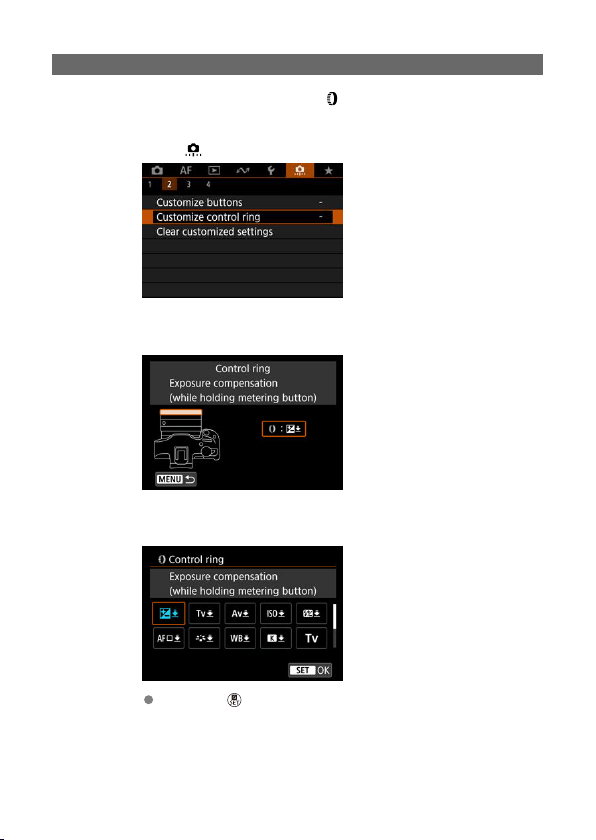
Customize control ring
Frequently used functions can be assigned to the < > ring.
1.
Select [
: Customize control ring].
2.
Select a camera control.
3.
Select a function to assign.
Press the < > button to set it.
735
Note
[ : Customize control ring] settings are not cleared even if you select [ :
Clear all Custom Func. (C.Fn)]. To clear the settings, select [
: Clear
customized settings].
736
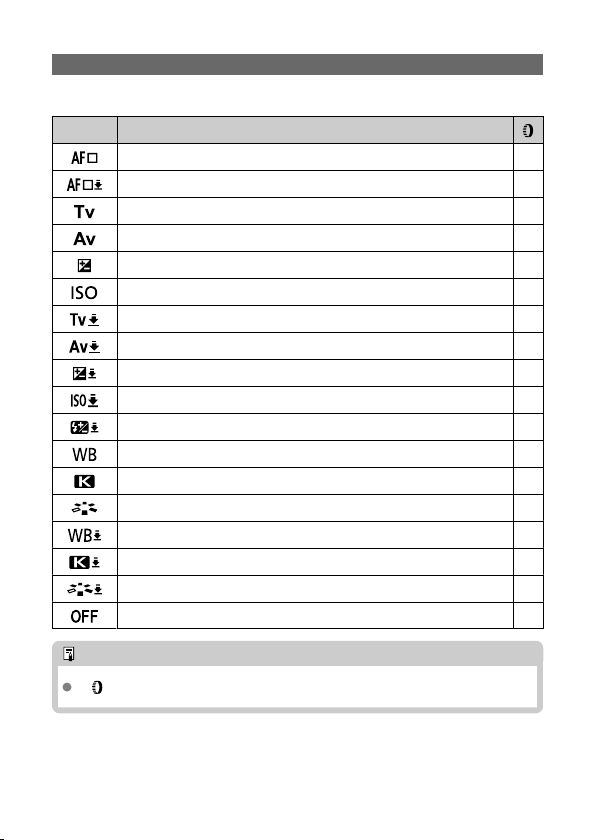
Functions available for the control ring
●: Default ○: Available for customization
Function
Select AF area ○
Select AF area (while holding metering button) ○
Change shutter speed ○
Change aperture value ○
Exposure compensation ○
Set ISO speed ○
Change shutter spd. (hold meter. btn) ○
Change aperture (hold meter. btn) ○
Exposure comp. (hold meter. btn) ●
Set ISO speed (hold meter. btn) ○
Flash exposure comp./output (while holding metering button) ○
White balance selection ○
Select color temperature ○
Picture Style ○
White balance selection (while holding metering button) ○
Select color temperature (while holding metering button) ○
Picture Style (while holding metering button) ○
No function (disabled) ○
Note
< >: Control ring on RF lenses and mount adapters.
737
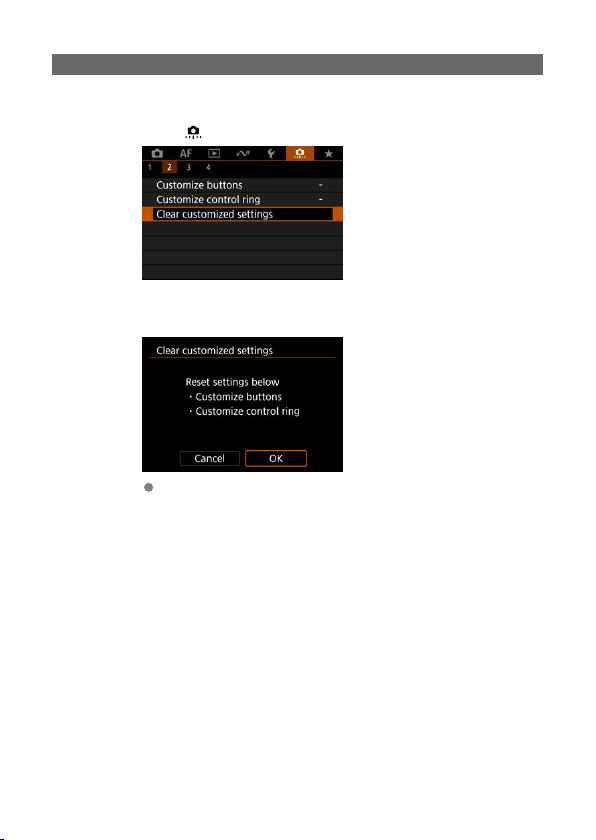
Clear customized settings
1.
Select [
: Clear customized settings].
2.
Select [OK].
[Customize buttons] and [Customize control ring] are restored to
defaults.
738
C.Fn3
Release shutter w/o lens
You can specify whether shooting still photos or movies is possible without a lens attached.
OFF: Disable
ON: Enable
Retract lens on power off
You can set whether to retract gear-type STM lenses (such as RF35mm F1.8 Macro IS
STM) automatically when the camera's power switch is set to <
>.
ON: Enable
OFF: Disable
Caution
With auto power off, the lens will not retract regardless of the setting.
Before detaching the lens, make sure that it is retracted.
Note
When [Enable] is set, this function takes effect regardless of the setting of the
focus mode switch (AF or MF) on the camera or lens.
739
C.Fn4
Clear all Custom Func. (C.Fn)
Selecting [ : Clear all Custom Func. (C.Fn)] clears all Custom Function settings except
[Customize buttons] and [Customize control ring].
Note
To clear settings configured with [ : Customize buttons] and [ : Customize
control ring], select [
: Clear customized settings].
740
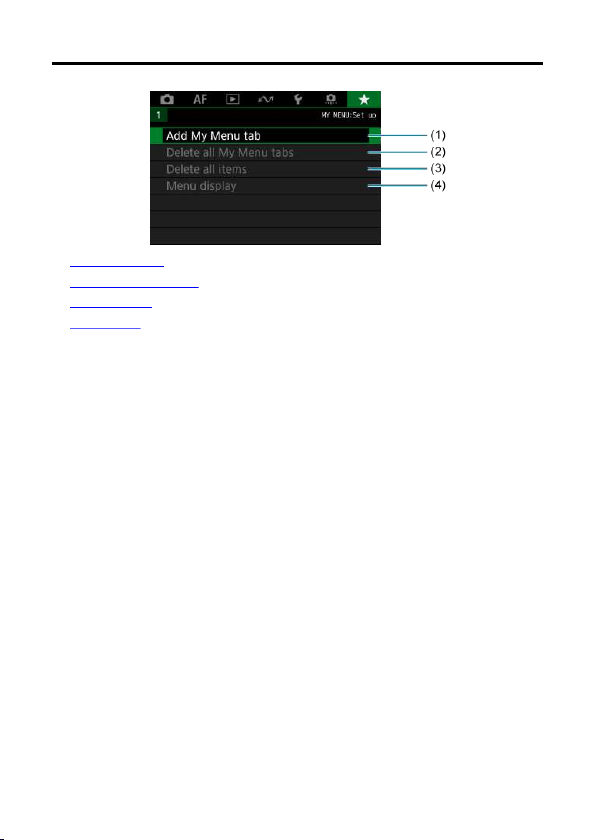
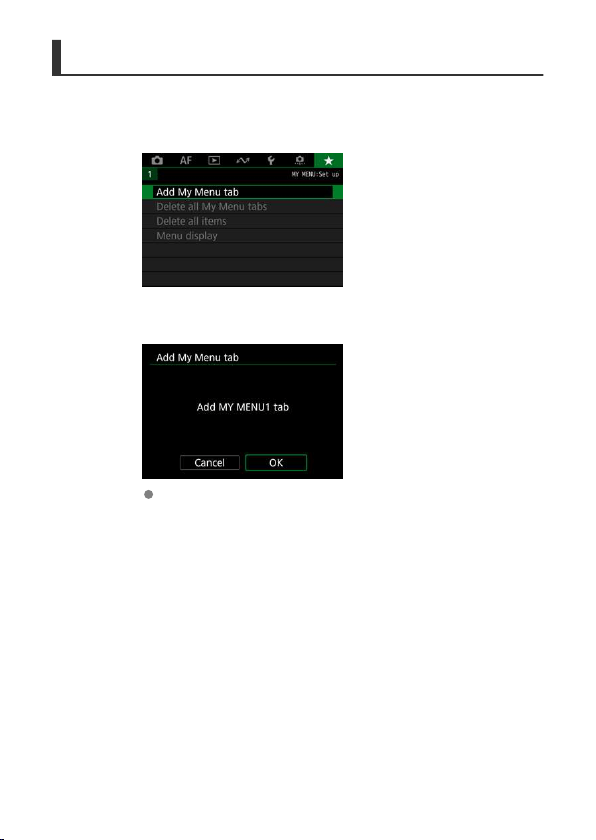
Creating and Adding My Menu Tabs
1.
Select [Add My Menu tab].
2.
Select [OK].
You can create up to five My Menu tabs by repeating steps 1 and 2.
743
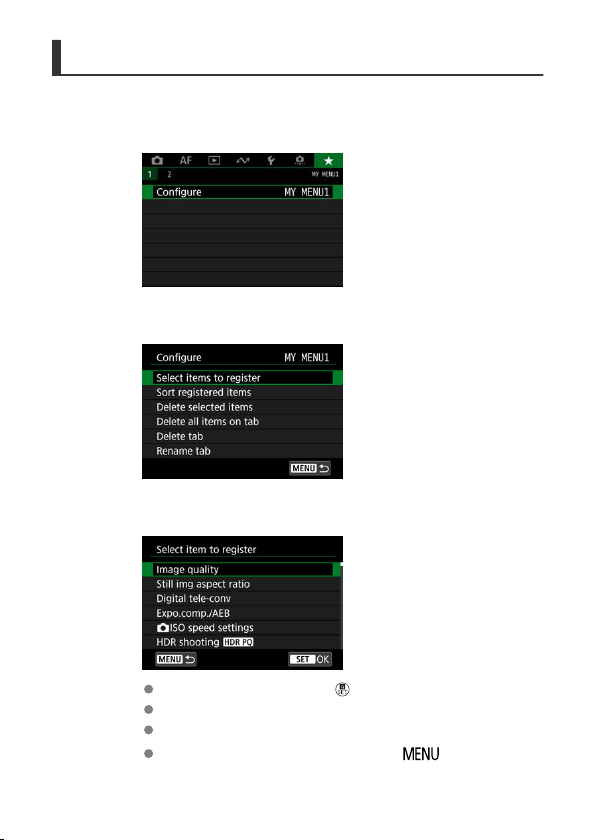
Registering Menu Items on My Menu Tabs
1.
Select [MY MENU*: Configure].
2.
Select [Select items to register].
3.
Register the desired items.
Select an item, then press the < > button.
Select [OK] on the confirmation screen.
You can register up to six items.
To return to the screen in step 2, press the < > button.
744
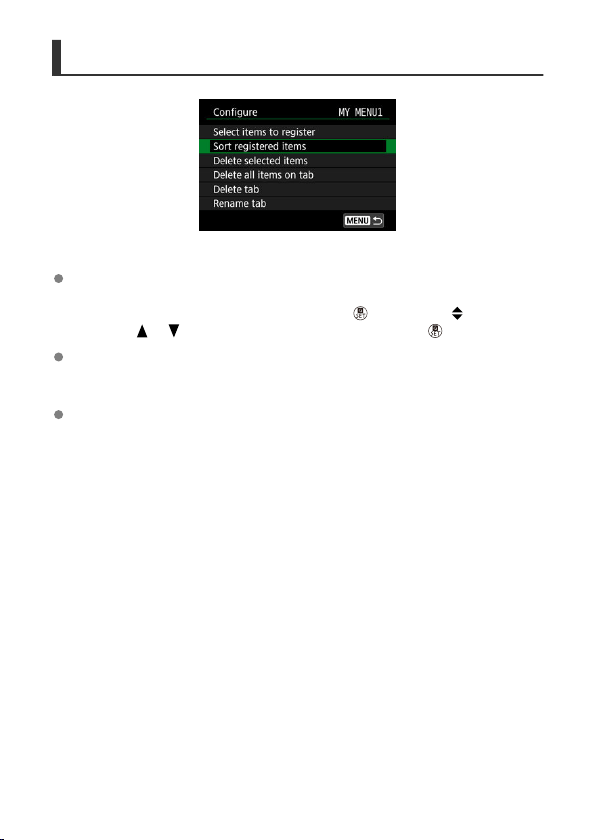
My Menu Tab Settings
You can sort and delete items on the menu tab, and rename or delete the menu tab itself.
Sort registered items
You can change the order of the registered items in My Menu. Select [Sort registered
items], select an item to rearrange, then press the <
> button. With [ ] displayed,
press the <
>< > keys to rearrange the item, then press the < > button.
Delete selected items/Delete all items on tab
You can delete any of the registered items. [Delete selected items] deletes one item at
a time, and [Delete all items on tab] deletes all the registered items on the tab.
Delete tab
You can delete the current My Menu tab. Select [Delete tab] to delete the [MY MENU*]
tab.
745
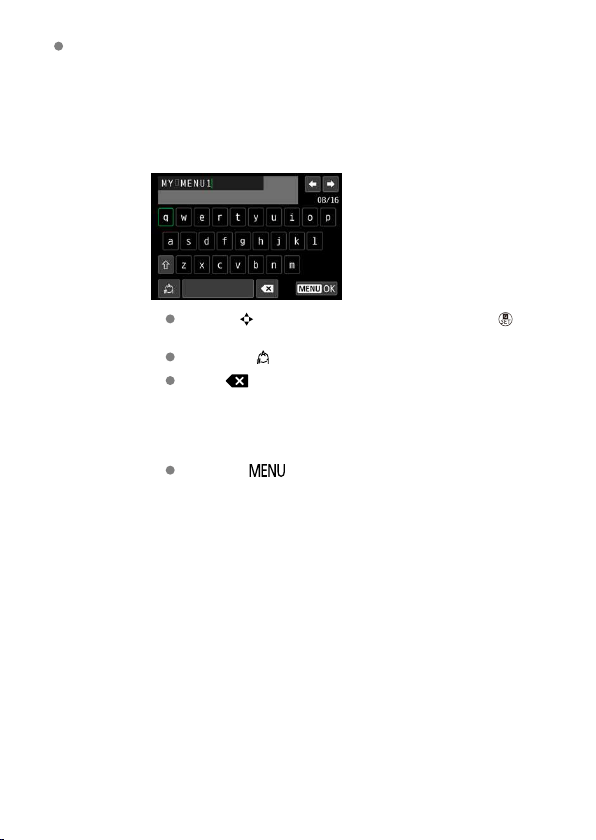
Rename tab
You can rename the My Menu tab from [MY MENU*].
1.
Select [Rename tab].
2.
Enter text.
Use the < > keys to select a character, then press the < >
button to enter it.
By selecting [ ], you can change the input mode.
Select [ ] to delete a character.
3.
Confirm input.
Press the < > button, then select [OK].
746
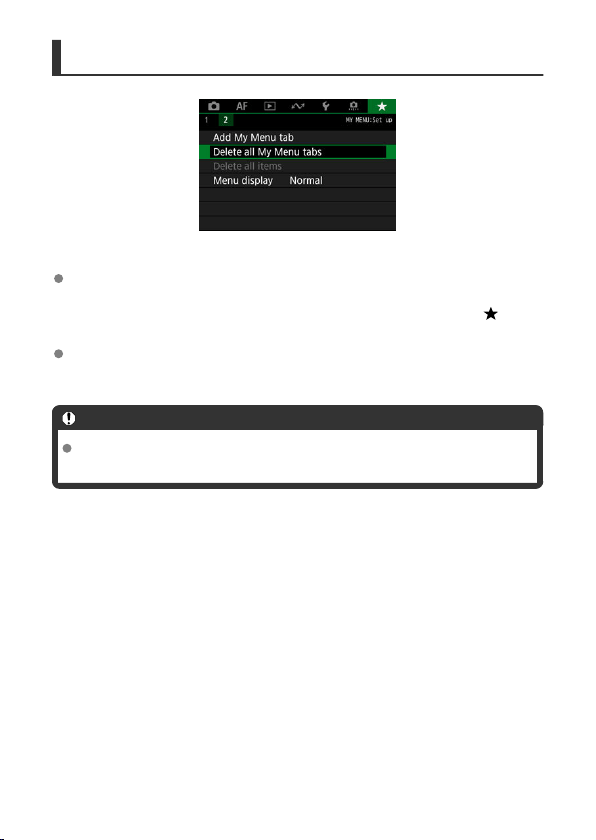
Deleting All My Menu Tabs/Deleting All Items
You can delete all the created My Menu tabs or My Menu items registered on them.
Delete all My Menu tabs
You can delete all My Menu tabs you created. When you select [Delete all My Menu
tabs], all the tabs from [MY MENU1] to [MY MENU5] will be deleted and the [
] tab will
revert to its default.
Delete all items
You can delete all the items registered under the [MY MENU1] to [MY MENU5] tabs. The
tabs themselves will remain.
Caution
Performing [Delete tab] or [Delete all My Menu tabs] will also delete tab names
renamed with [Rename tab].
747
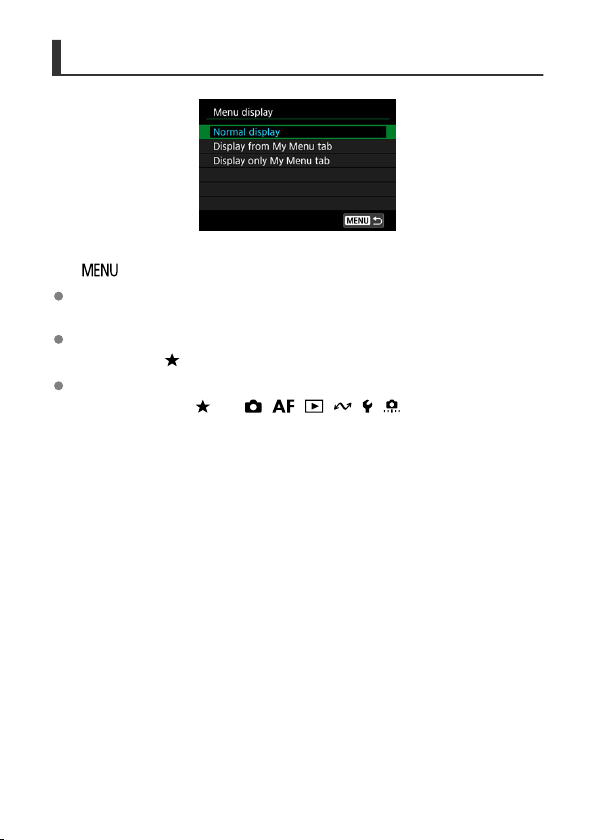
Menu Display Settings
You can select [Menu display] to set the menu screen that is to appear first when you press
the <
> button.
Normal display
Displays the last displayed menu screen.
Display from My Menu tab
Displays with the [ ] tab selected.
Display only My Menu tab
Restricts display to the [ ] tab ([ ]/[ ]/[ ]/[ ]/[ ]/[ ] tabs are not displayed).
748

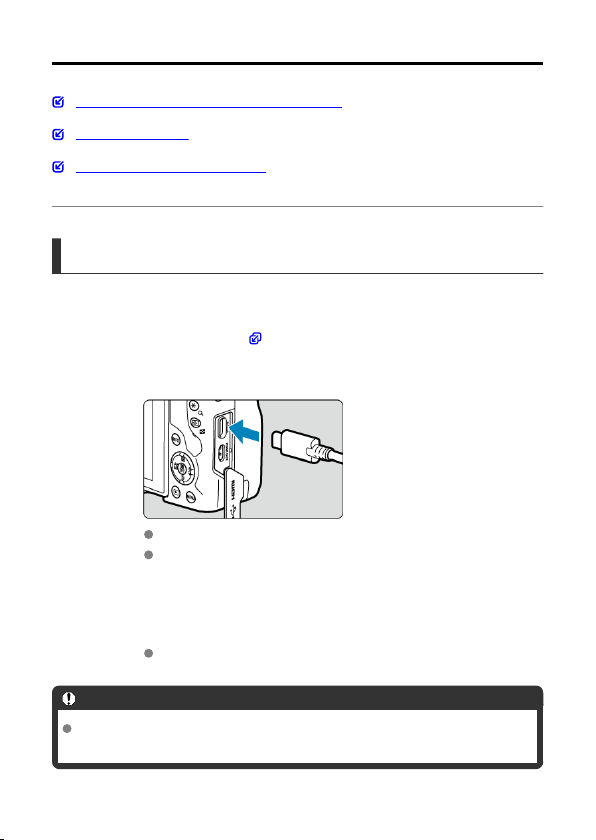
Importing Images to a Computer
Connecting to a Computer with an Interface Cable
Using a Card Reader
Connecting to a Computer via Wi-Fi
You can use EOS software to import images from the camera to a computer.
Connecting to a Computer with an Interface Cable
1.
Install EOS Utility (
).
2.
Connect the camera to the computer.
Use an interface cable.
Connect the other end to a USB port on the computer.
3.
Use EOS Utility to import the images.
Refer to the EOS Utility Instruction Manual.
Caution
With a Wi-Fi connection established, the camera cannot communicate with the
computer even if they are connected with an interface cable.
750
Using a Card Reader
You can use a card reader to import images to a computer.
1.
Install Digital Photo Professional (
).
2.
Insert the card into the card reader.
3.
Use Digital Photo Professional to import the images.
Refer to the Digital Photo Professional Instruction Manual.
Note
When downloading images from the camera to a computer with a card reader
without using EOS software, copy the DCIM folder on the card to the computer.
751


Importing Images to a Smartphone
Preparation
Using Camera Connect
Using Smartphone Features
You can import images captured with the camera to a smartphone by connecting the
smartphone to the camera with Multi-Function Shoe Adapter for Smartphone Link AD-P1
(sold separately, for Android smartphones only) or a USB cable.
Preparation
1.
Select an option in [
: Choose USB connection app] ( ).
Select [Photo Import/Remote Control] when connecting an Android
smartphone, or when connecting an iPhone and using the Photos app.
Select [Canon app(s) for iPhone] when connecting an iPhone and
using Camera Connect.
After the settings are complete, turn the camera off.
2.
Connect the camera to the smartphone with AD-P1 or a USB cable.
When using AD-P1, refer to the instruction manual included with
AD-P1.
Use of a Canon USB cable (Interface Cable IFC-100U or IFC-400U) is
recommended when connecting Android smartphones.
For details on USB cables used to connect iPhones, visit the Canon
website.
753


Using Smartphone Features
1.
Turn the camera on.
2.
Use the smartphone to import images.
Android smartphones: In the [Files] menu, select [Canon Digital
Camera ***], then import images in the DCIM folder.
iPhones: Start the Photos app, then import images from the card.
755
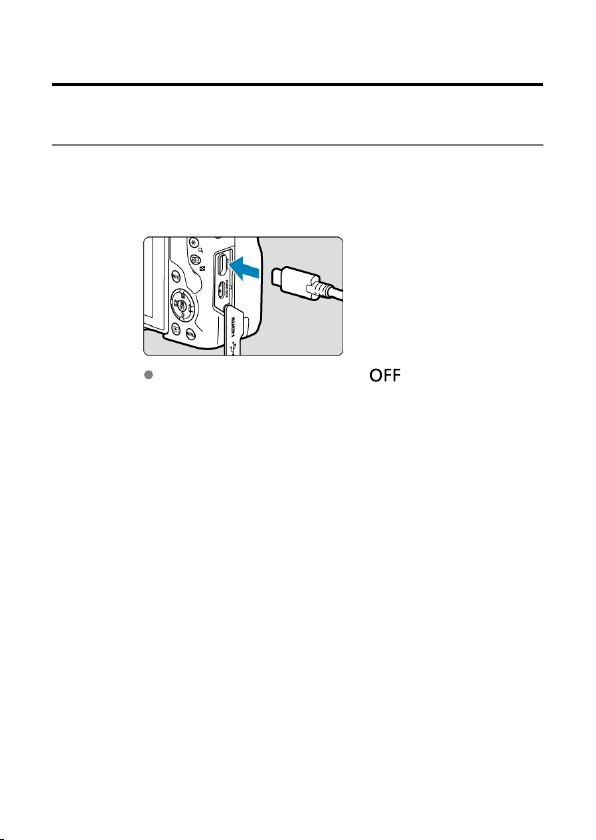
Using a USB Power Adapter to Charge/Power the
Camera
Using USB Power Adapter PD-E1 (sold separately), you can charge Battery Pack LP-E17
without removing it from the camera. The camera can also be powered.
Charging
1.
Connect the USB power adapter.
With the camera power switch set to < >, insert the USB power
adapter plug fully into the digital terminal.
756
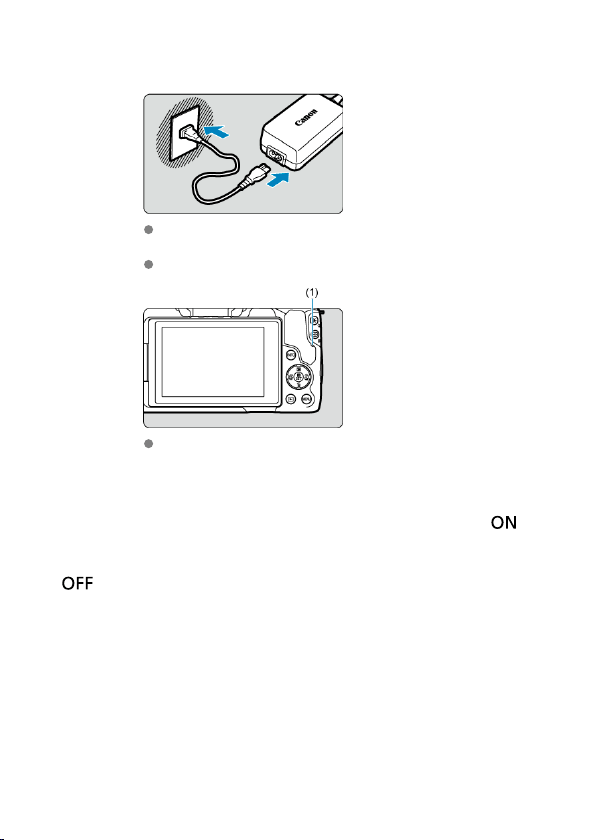
2.
Connect the power cord.
Connect the power cord to the USB power adapter and plug the other
end into a power outlet.
Charging begins, and the access lamp (1) is lit in green.
When charging is finished, the access lamp turns off.
Supplying power
To power the camera without charging batteries, set the camera power switch to <
>.
However, batteries are charged during auto power off.
The battery level indicator is gray when power is supplied.
To change from powering the camera to charging, set the camera power switch to
<
>.
757
Caution
The camera cannot be powered unless a battery pack is in it.
When batteries are depleted, the adapter charges them. In this case, power is not
supplied to the camera.
To protect the battery pack and keep it in optimal condition, do not charge it
continuously for more than 24 hours.
If the charging lamp fails to light up or a problem occurs during charging (shown by
the access lamp blinking in green), unplug the power cord, reinsert the battery, and
wait a few minutes before plugging it in again. If the problem persists, take the
camera to the nearest Canon Service Center.
The charging time required and the amount charged vary depending on ambient
temperature and remaining capacity.
For safety, charging in low temperatures takes longer.
The remaining battery level may decline when power is supplied to the camera. To
avoid running out of battery power, use a fully charged battery when shooting at
regular intervals.
Before disconnecting USB power adapters, set the camera power switch to
<
>.
758
Troubleshooting Guide
Power-related problems
Shooting-related problems
Problems with wireless features
Operation problems
Display problems
Playback problems
Computer connection problems
Problems with the multi-function shoe
If a problem occurs with the camera, first refer to this Troubleshooting Guide. If this
Troubleshooting Guide does not resolve the problem, take the camera to the nearest Canon
Service Center.
Power-related problems
Batteries cannot be charged with the battery charger.
Do not use any battery packs other than a genuine Canon Battery Pack LP-E17.
In case of charging or charger issues, see Charging the Battery.
The battery charger lamp is blinking.
Orange blinking of the lamp indicates that a protection circuit has prevented charging
because (1) there is a problem with the battery charger or battery, or (2) communication
with a non-Canon battery has failed. In the case of (1), unplug the charger, reinsert the
battery, and wait a few minutes before plugging the charger in again. If the problem
persists, take the camera to the nearest Canon Service Center.
759
Batteries cannot be charged with the USB power adapter (sold
separately).
Batteries are not charged while the camera power switch is set to < >. However,
batteries are charged during auto power off.
Operating the camera will stop charging in progress.
The access lamp blinks during charging with the USB power adapter.
In case of charging problems, the access lamp blinks in green and a protective circuit
stops charging. In this case, unplug the power cord, reattach the battery, and wait a few
minutes before plugging it in again. If the problem persists, take the camera to the
nearest Canon Service Center.
If batteries are hot or cold, the access lamp blinks in green and a protective circuit stops
charging. In this case, let the battery adjust to the ambient temperature before
attempting to charge it again.
The access lamp is not lit during charging with the USB power adapter.
Try unplugging the USB power adapter and plugging it in again.
The camera cannot be powered with the USB power adapter.
Check the battery compartment. The camera cannot be powered without a battery pack.
Check the remaining battery level. When batteries are depleted, the adapter charges
them. In this case, power is not supplied to the camera.
The camera is not activated even when the power switch is set to
<
>.
Make sure the battery is inserted properly in the camera ( ).
Make sure the card/battery compartment cover is closed ( ).
Charge the battery ( ).
The access lamp still lights or blinks even when the power switch is set
to <
>.
If the power is turned off while an image is being recorded to the card, the access lamp
will remain on or continue to blink for a few seconds. When the image recording is
complete, the power will turn off automatically.
760
[Battery communication error. Does this battery/do these batteries
display the Canon logo?] is displayed.
Do not use any battery packs other than a genuine Canon Battery Pack LP-E17.
Remove and install the battery again ( ).
If the electrical contacts are dirty, use a soft cloth to clean them.
The battery becomes exhausted quickly.
Use a fully charged battery ( ).
The battery performance may have degraded. See [ : Battery info.] to check the
battery recharge performance level ( ). If the battery performance is poor, replace the
battery with a new one.
The number of available shots will decrease with any of the following operations:
• Pressing the shutter button halfway for a prolonged period
• Activating the AF frequently without taking a picture
• Using the lens's Image Stabilizer
• Using the wireless communication functions
The camera turns off by itself.
Auto power off is in effect. To deactivate auto power off, set [Auto power off] in [ :
Power saving] to [Disable] ( ).
Even if [Auto power off] is set to [Disable], the screen and viewfinder will still turn off
after the camera is left idle for the time set in [Screen off] or [Viewfinder off] (although
the camera itself remains on).
761
Shooting-related problems
The lens cannot be attached.
To attach EF or EF-S lenses, you will need a mount adapter. The camera cannot be
used with EF-M lenses ( ).
No images can be shot or recorded.
Make sure the card is properly inserted ( ).
Slide the card's write-protect switch to the Write/Erase setting ( ).
If the card is full, replace the card or delete unnecessary images to make space
( , ).
Shooting is not possible if the AF point turns orange when you attempt to focus. Press
the shutter button halfway again to refocus automatically, or focus manually ( , ).
The card cannot be used.
If a card error message is displayed, see Inserting/Removing the Battery and Card and
Error Codes.
An error message is displayed when the card is inserted in another
camera.
Since SDXC cards are formatted in exFAT, if you format a card with this camera and
then insert it into another camera, an error may be displayed and it may not be possible
to use the card.
The image is out of focus or blurred.
Set the focus mode to [AF] ( ).
Press the shutter button gently to prevent camera shake ( ).
With a lens equipped with an Image Stabilizer, set the Image Stabilizer switch to
<
>.
In low light, the shutter speed may become slow. Use a faster shutter speed ( ), set a
higher ISO speed ( ), use flash ( ), or use a tripod.
See Minimizing blurred photos.
I cannot lock the focus and recompose the shot.
Set the AF operation to One-Shot AF ( ). Shooting with the focus locked is not
possible with Servo AF ( ).
762
The continuous shooting speed is slow.
High-speed continuous shooting may be slower depending on the battery level, ambient
temperature, flicker reduction, shutter speed, aperture value, subject conditions,
brightness, AF operation, type of lens, use of flash, shooting settings, and other
conditions. For details, see Selecting the Drive Mode or Maximum burst for continuous
shooting [Approx.].
The maximum burst during continuous shooting is lower.
Shooting intricate subjects such as fields of grass may result in larger file sizes, and the
actual maximum burst may be lower than the guidelines in Maximum burst for
continuous shooting [Approx.].
Even after I change the card, the maximum burst displayed for
continuous shooting does not change.
Estimated maximum burst indicated in the viewfinder does not change when you switch
cards, even if you switch to a high-speed card. Maximum burst listed in Maximum burst
for continuous shooting [Approx.] is based on the standard Canon test card, and the
actual maximum burst is higher for cards with faster writing speeds. For this reason,
estimated maximum burst may differ from actual maximum burst.
High-speed display is not available during high-speed continuous
shooting.
Refer to the high-speed display requirements in High-Speed Display.
ISO 100 cannot be set for still photo shooting.
The minimum speed in the ISO speed range is ISO 200 when [ : Highlight tone
priority] is set to [Enable] or [Enhanced].
763
Expanded ISO speeds cannot be selected for still photo shooting.
Set [ : ISO expansion] to [Enable] ( ).
Check the [ISO speed] setting in [ : ISO speed settings].
Expanded ISO speeds (H) are not available when [ : Highlight tone priority] is set to
[Enable] or [Enhanced], even with [
: ISO expansion] set to [Enable].
Even if I set a decreased exposure compensation, the image comes out
bright.
Set [ : Auto Lighting Optimizer] to [Disable] ( ). When [Low], [Standard], or
[High] is set, even if you set a decreased exposure compensation or flash exposure
compensation, the image may come out bright.
I cannot set the exposure compensation when both manual exposure
and ISO Auto are set.
See M: Manual Exposure to set the exposure compensation.
Not all the lens aberration correction options are displayed.
With [Digital Lens Optimizer] set to [Standard] or [High], [Chromatic aberr corr] and
[Diffraction correction] are not displayed, but they are both set to [Enable] for
shooting.
During movie recording, [Digital Lens Optimizer] or [Diffraction correction] are not
displayed.
Using flash in <Av> or <P> mode lowers the shutter speed.
Set [Slow synchro] in [ : Flash control] to [1/250-1/60sec. auto] or [1/250 sec.
(fixed)] ( ).
The built-in flash does not fire.
Shooting with the flash may be temporarily disabled to protect the flash head if the built-
in flash is used repeatedly over a short period.
The external Speedlite does not fire.
Make sure any external flash units are securely attached to the camera.
764
The Speedlite always fires at full output.
Flash units other than EL/EX series Speedlites used in autoflash mode always fire at full
output ( ).
The flash always fires at full output when [Flash metering mode] in external flash
Custom Function settings is set to [1:TTL] (autoflash) ( ).
External flash exposure compensation cannot be set.
If flash exposure compensation is set with the external Speedlite, compensation amount
cannot be set with the camera. When the Speedlite's flash exposure compensation is
canceled (set to 0), flash exposure compensation can be set with the camera.
High-speed sync is not available in <Av> mode.
Set [Slow synchro] in [ : Flash control] to an option other than [1/250 sec. (fixed)]
( ).
Remote control shooting is not possible.
Check the position of the remote control's release timing switch.
If you are using Wireless Remote Control BR-E1, see Remote Control Shooting or
Connecting to a Wireless Remote Control.
To use a remote control for time-lapse movie recording, see Time-Lapse Movies.
A white [
] or red [ ] icon is displayed during movie
recording.
Indicates that the camera's internal temperature is high. For details, see the information
on warning indicator display in movie recording ( ).
Movie recording stops by itself.
If the card's writing speed is slow, movie recording may stop automatically. For details
on cards that can record movies, see Card performance requirements. To find out the
card's writing speed, refer to the card manufacturer's website, etc.
Perform low-level formatting to initialize the card if the card's writing or reading speed
seems slow ( ).
Recording stops automatically once your movie reaches 1 hr. (or 15 min. for a High
Frame Rate movie).
765
The ISO speed cannot be set for movie recording.
ISO speed is set automatically in [ ] recording mode. In [ ] mode, you can manually
set the ISO speed ( ).
The minimum speed in the ISO speed range is ISO 200 when [ : Highlight tone
priority] is set to [Enable] or [Enhanced].
Expanded ISO speeds cannot be selected for movie recording.
Set [ : ISO expansion] to [Enable] ( ).
Check the [ISO speed] setting in [ : ISO speed settings].
Expanded ISO speeds are not available when [ : Highlight tone priority] is set to
[Enable] or [Enhanced].
The exposure changes during movie recording.
If you change the shutter speed or aperture value during movie recording, the changes
in the exposure may be recorded.
Recording a few test movies is recommended if you intend to perform zooming during
movie recording. Zooming as you record movies may cause exposure changes or lens
sounds to be recorded, or loss of focus.
The image flickers or horizontal stripes appear during movie recording.
Flickering, horizontal stripes (noise), or irregular exposures can be caused by
fluorescent lighting, LED lighting, or other light sources during movie recording. Also,
changes in the exposure (brightness) or color tone may be recorded. In [
] mode,
using a slower shutter speed may reduce the problem. The problem may be more
noticeable in time-lapse movie recording.
766
The subject looks distorted during movie recording.
If you move the camera to the left or right (panning) or shoot a moving subject, the
image may look distorted. The problem may be more noticeable in time-lapse movie
recording.
Sound is not recorded in movies.
Sound is not recorded in High Frame Rate movies.
A time code is not added.
Time codes are not added when you record High Frame Rate movies with [Count up] in
[
: Time code] set to [Free run] ( ). Additionally, no time code is added to HDMI
video output ( ).
Time codes advance faster than the actual time.
Time codes in High Frame Rate movie recording advance 4 sec. per second ( ).
I cannot take still photos during movie recording.
Still photos cannot be taken during movie recording. To shoot still photos, stop recording
the movie, then select a shooting mode for still photos.
I cannot record movies during still photo shooting.
It may not be possible to record movies during still photo shooting if operations such as
extended Live View display increase the camera's internal temperature. Turn off the
camera or take other measures, and wait until the camera cools down.
Reducing the movie recording size may enable recording.
767
Problems with wireless features
Cannot pair with a smartphone.
Use a smartphone compliant with Bluetooth Specification Version 4.1 or later.
Turn on Bluetooth from the smartphone settings screen.
Pairing with the camera is not possible from the smartphone's Bluetooth settings screen.
Install the dedicated app Camera Connect (free of charge) on the smartphone ( ).
Pairing with a previously paired smartphone is not possible if pairing information
registered for another camera remains on the smartphone. In this case, remove the
camera's registration retained in the Bluetooth settings on the smartphone and try
pairing again ( ).
Wi-Fi functions cannot be set.
If the camera is connected to a computer or another device with an interface cable,
Wi-Fi functions cannot be set. Disconnect the interface cable before setting any
functions ( ).
A device connected with an interface cable cannot be used.
Other devices, such as computers, cannot be used with the camera by connecting them
with an interface cable while the camera is connected to devices via Wi-Fi. Terminate
the Wi-Fi connection before connecting the interface cable.
Operations such as shooting and playback are not possible.
With a Wi-Fi connection established, operations such as shooting and playback may not
be possible. Terminate the Wi-Fi connection, then perform the operation.
Cannot reconnect to a smartphone.
Even with a combination of the same camera and smartphone, if you have changed the
settings or selected a different setting, reconnection may not be established even after
selecting the same SSID. In this case, delete the camera connection settings from the
Wi-Fi settings on the smartphone and set up a connection again.
A connection may not be established if Camera Connect is running when you
reconfigure connection settings. In this case, quit Camera Connect for a moment and
then restart it.
768
Operation problems
Settings change when I switch from still photo shooting to movie
recording or vice versa.
Separate settings are retained for use when shooting still photos and recording movies.
Touch operation is not possible.
Make sure [ : Touch control] is set to [Standard] or [Sensitive] ( ).
A camera button or dial does not work as expected.
In movie recording, check the [ : Shutter btn function for movies] setting ( ).
Check the [ : Customize buttons] and [ : Customize control ring] settings
( , ).
769
Display problems
The menu screen shows fewer tabs and items.
Tabs and items on the menu screen vary for still photos and movies.
The display starts with [
] My Menu, or the [ ] tab alone is displayed.
[Menu display] on the [ ] tab is set to [Display from My Menu tab] or [Display only
My Menu tab]. Set [Normal display] ( ).
The file name's first character is an underscore (“_”).
Set [ : Color space] to [sRGB]. If [Adobe RGB] is set, the first character will be an
underscore ( ).
The file numbering does not start from 0001.
If the card already contains recorded images, the image number may not start from
0001 ( ).
The shooting date and time displayed are incorrect.
Make sure the correct date and time are set ( ).
Check the time zone and daylight saving time ( ).
The date and time are not in the image.
The shooting date and time do not appear in the image. The date and time are recorded
in the image data as shooting information. When you print photos, this information can
be used to include the date and time ( ).
[###] is displayed.
If the number of images recorded on the card exceeds the number the camera can
display, [###] will be displayed.
The screen does not display a clear image.
If the screen is dirty, use a soft cloth to clean it.
The screen display may seem slightly slow in low temperatures or may look black in
high temperatures, but it will return to normal at room temperature.
770
Playback problems
A red box is displayed on the image.
[ : AF point disp.] is set to [Enable] ( ).
During image playback, the AF points are not displayed.
AF points are not displayed when the following types of images are played back:
• Images taken with Multi Shot Noise Reduction applied.
• Cropped images.
• Images from HDR shooting with [Auto Image Align] set to [Enable].
The image cannot be erased.
If the image is protected, it cannot be erased ( ).
Still photos and movies cannot be played back.
The camera may not be able to play back images taken with another camera.
Movies edited with a computer cannot be played back with the camera.
Only few images can be played back.
The images have been filtered for playback with [ : Set image search conditions]
( ). Clear the image search conditions.
Mechanical sounds or sounds of camera operations can be heard
during movie playback.
The camera's built-in microphone may also record mechanical sounds of the lens or
sounds of camera/lens operations if AF operations are performed or the camera or lens
is operated during movie recording. If so, it may help reduce these sounds if you use an
external microphone equipped with an output plug and position it away from the camera
and lens.
771
Movie playback stops by itself.
Extended movie playback or movie playback under high ambient temperature may
cause the camera's internal temperature to rise, and movie playback may stop
automatically.
If this happens, playback is disabled until the camera's internal temperature decreases,
so turn off the power and let the camera cool down a while.
The movie appears to freeze momentarily.
Significant change in the exposure level during autoexposure movie recording may
cause recording to stop momentarily until the brightness stabilizes. In this case, record
in [
] mode ( ).
The movie is played in slow motion.
High Frame Rate movies are recorded at 29.97 fps or 25.00 fps, so they are played in
slow motion at 1/4 speed.
No picture appears on the television.
Make sure [ : Video system] is set to [For NTSC] or [For PAL] correctly for the video
system of your television.
Make sure the HDMI cable's plug is inserted all the way in ( ).
There are multiple movie files for a single movie recording.
If the movie file size reaches 4 GB, another movie file will be created automatically ( ).
However, if you use an SDXC card formatted with the camera, you can record a movie
in a single file even if it exceeds 4 GB.
My card reader does not recognize the card.
Depending on the card reader used and the computer's operating system, SDXC cards
may not be correctly recognized. In this case, connect the camera to the computer with
the interface cable, then import the images to the computer using EOS Utility (EOS
software, ).
Images cannot be resized or cropped.
This camera cannot resize JPEG images, RAW images, or frame-grab images from
4K movies saved as still photos ( ).
This camera cannot crop RAW images or frame-grab images from 4K movies saved as
still photos ( ).
772
Computer connection problems
I cannot import images to a computer.
Install EOS Utility (EOS software) on the computer ( ).
Make sure the main EOS Utility window is displayed.
If the camera is already connected via Wi-Fi, it cannot communicate with any computer
connected with an interface cable.
Check the version of the application.
Communication between the connected camera and computer does not
work.
When using EOS Utility (EOS software), set [ : Time-lapse movie] to [Disable] ( ).
773

Problems with the multi-function shoe
A message was displayed on the screen when I attached an accessory.
If [Communication error Reattach accessory] is displayed, reattach the accessory. In
case this message is displayed again after reattachment, make sure the terminals of the
multi-function shoe and accessory are clean and dry. If you cannot remove the dirt or
moisture, contact a Canon Service Center.
If [Accessory unavailable status] is displayed, check the terminals of the multi-function
shoe and accessory and make sure the accessory is not damaged.
774
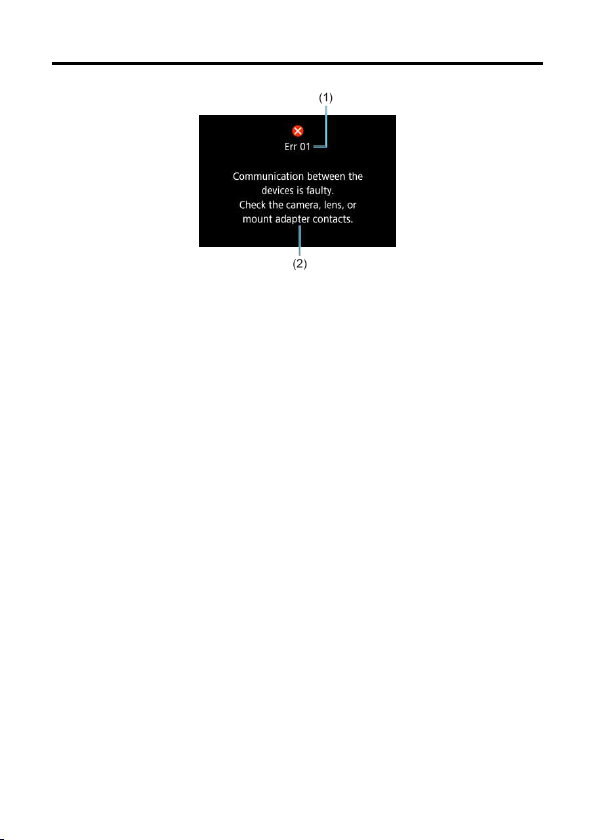
Error Codes
(1) Error number
(2) Cause and countermeasures
If there is a problem with the camera, an error message will appear. Follow the on-screen
instructions.
If the problem persists, write down the error code (Err xx) and request service.
775
ISO Speed in Movie Recording
In [ ] mode
ISO speed is set automatically in a range of ISO 100–12800.
Setting [Max for Auto] in [ : ISO speed settings] to [H (25600)] ( ) expands the
maximum speed in the automatic setting range to H (equivalent to ISO 25600).
The minimum speed in the automatic setting range is ISO 200 when [ : Highlight
tone priority] is set to [Enable] or [Enhanced] ( ). The maximum limit is not
expanded, even when expansion is set in [Max for Auto].
In [
] mode
With ISO speed set to [AUTO], ISO speed is set automatically in a range of ISO 100–
12800.
When ISO Auto is set, setting [Max for Auto] in [ : ISO speed settings] to [H
(25600)] ( ) expands the maximum speed in the automatic setting range to H
(equivalent to ISO 25600).
ISO speed can be set manually in a range of ISO 100–12800. Note that setting [ : ISO
expansion] to [Enable] ( ) expands the maximum speed to H (equivalent to ISO
25600).
The minimum speed in the automatic or manual setting range is ISO 200 when [ :
Highlight tone priority] is set to [Enable] or [Enhanced] ( ). Even when ISO speed
expansion is set, the maximum limit will not be expanded.
In [
], [ ], and [ ] mode
ISO speed is set automatically in a range of ISO 100–12800.
776
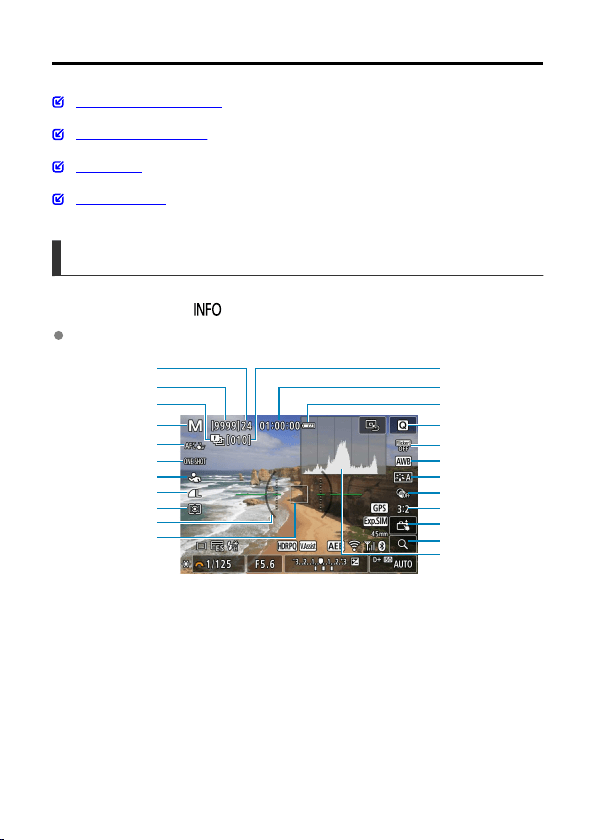
Information Display
Still Photo Shooting Screen
Movie Recording Screen
Scene Icons
Playback Screen
Still Photo Shooting Screen
Each time you press the < > button, the information display will change.
The display will show only the settings currently applied.
(1)
(2)
(3)
(4)
(5)
(6)
(7)
(8)
(9)
(10)
(11)
(12)
(13)
(14)
(15)
(16)
(17)
(18)
(19)
(20)
(21)
(22)
(23)
777

(1) Maximum burst
(2) Number of available shots/Sec. until self-timer shoots
(3) Focus bracketing/HDR shooting/Multi Shot Noise Reduction
(4) Shooting mode
(5) AF area
(6) AF operation
(7) Subject to detect
(8) Image quality
(9) Metering mode
(10) Electronic level
(11) AF point (1-point AF)
(12) Number of remaining shots for focus bracketing
(13) Movie recording time available
(14) Battery level
(15) Quick Control button
(16) Anti-flicker shooting
(17) White balance/White balance correction
(18) Picture Style
(19) Creative filters
(20) Still image aspect ratio
(21) Touch Shutter
(22) Magnify button
(23) Histogram (Brightness/RGB)
778
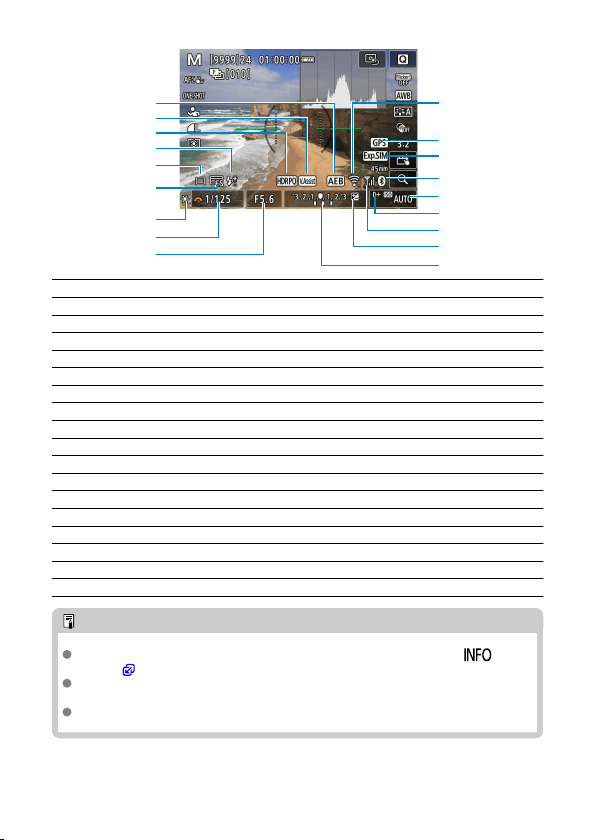
(26)
(25)
(24)
(27)
(28)
(29)
(30)
(31)
(32)
(34)
(35)
(36)
(37)
(38)
(39)
(33)
(40)
(41)
(24) AEB/FEB
(25) View Assist
(26) HDR PQ
(27) Flash ready/FE lock/High-speed sync
(28) Drive mode
(29) Electronic shutter
(30) AE lock
(31) Shutter speed
(32) Aperture value
(33) Wi-Fi function
(34) GPS
(35) Exposure simulation
(36) Bluetooth function
(37) ISO speed
(38) Highlight tone priority
(39) Wi-Fi signal strength
(40) Exposure compensation
(41) Exposure level indicator
Note
You can specify the information displayed in response to pressing the < >
button ( ).
The electronic level is not displayed when the camera is connected via HDMI to a
television.
Other icons may be displayed temporarily after setting adjustments.
779
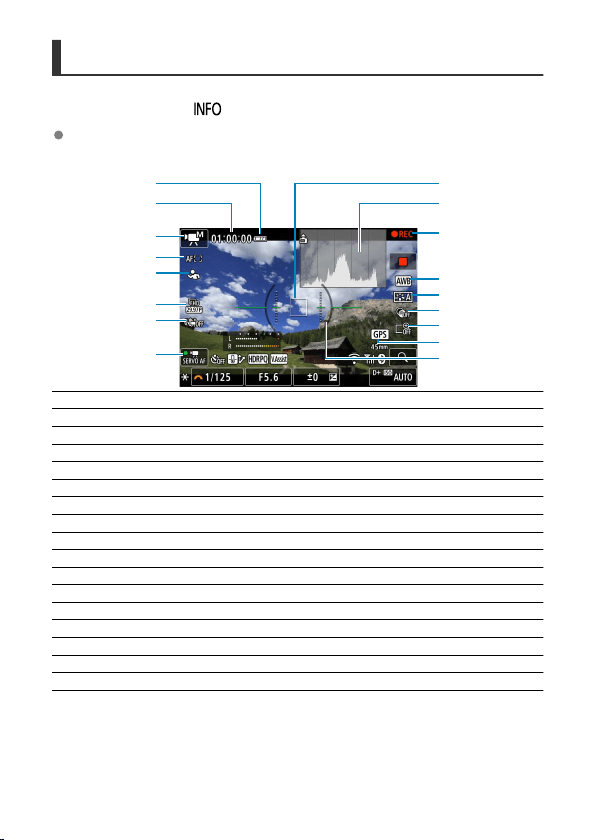
Movie Recording Screen
Each time you press the
<
> button, the information display will change.
The display will show only the settings currently applied.
(1)
(2)
(3)
(4)
(5)
(6)
(7)
(8)
(9)
(10)
(11)
(12)
(13)
(14)
(16)
(17)
(15)
(1) Battery level
(2) Movie recording time available/Elapsed recording time
(3) Shooting mode
(4) AF area
(5) Subject to detect
(6) Movie recording size
(7) Movie digital IS
(8) Movie Servo AF
(9) AF point (1-point AF)
(10) Histogram (Brightness/RGB)
(11) Movie recording in progress
(12) White balance/White balance correction
(13) Picture Style
(14) Creative filters
(15) Digital zoom
(16) GPS
(17) Electronic level
780
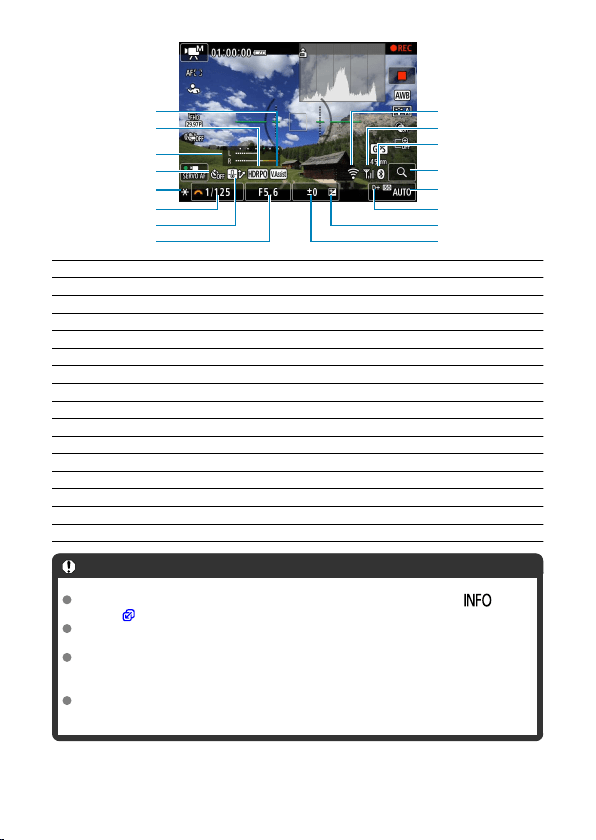
(32)
(33)
(26)
(28)
(27)
(30)
(29)
(31)
(20)
(19)
(18)
(22)
(21)
(23)
(24)
(25)
(18) View Assist
(19) HDR PQ
(20) Audio recording level indicator (manual)
(21) Movie self-timer
(22) AE lock
(23) Shutter speed
(24) Overheat control
(25) Aperture value
(26) Wi-Fi function
(27) Wi-Fi signal strength
(28) Bluetooth function
(29) Magnify button
(30) ISO speed
(31) Highlight tone priority
(32) Exposure compensation
(33) Exposure level indicator (metering levels)
Caution
You can specify the information displayed in response to pressing the < >
button ( ).
The electronic level is not displayed when the camera is connected via HDMI to a
television.
The electronic level, grid lines, and histogram cannot be displayed during movie
recording (and if they are currently displayed, recording a movie will clear the
display).
When movie recording starts, the movie recording remaining time will change to the
elapsed time.
781
Note
Other icons may be displayed temporarily after setting adjustments.
782

Subject
Background
Scene Icons
In
<
> shooting mode, the camera detects the type of scene and sets all settings
accordingly. The detected scene type is indicated in the upper left of the screen.
People Subjects Other Than People
Background Color
In Motion*
1
Nature/
Outdoor
Scene
In Motion*
1
Close*
2
Bright
Gray
Backlit
Blue Sky Included
Light blue
Backlit
Sunset
*
3
*
3
Orange
Spotlight
Dark blueDark
With Tripod*
1
*
4
*
5
*
3
*
3
* 1: Not displayed during movie recording.
* 2: Displayed when the attached lens has distance information. With an extension tube or close-up
lens, the icon displayed may not match the actual scene.
* 3: Icons of scenes selected from those that can be detected are displayed.
* 4: Displayed when all the following conditions apply.
The shooting scene is dark, it is a night scene, and the camera is mounted on a tripod.
* 5: Displayed with any of the following lenses.
• EF300mm f/2.8L IS II USM
• EF400mm f/2.8L IS II USM
• EF500mm f/4L IS II USM
• EF600mm f/4L IS II USM
• Image Stabilizer lenses released in and after 2012.
* Slower shutter speeds are used when the conditions in both *4 and *5 apply.
Note
For certain scenes or shooting conditions, the icon displayed may not match the
actual scene.
The icon may blink when [ : Assist] is set to [Advanced ] ( ).
783
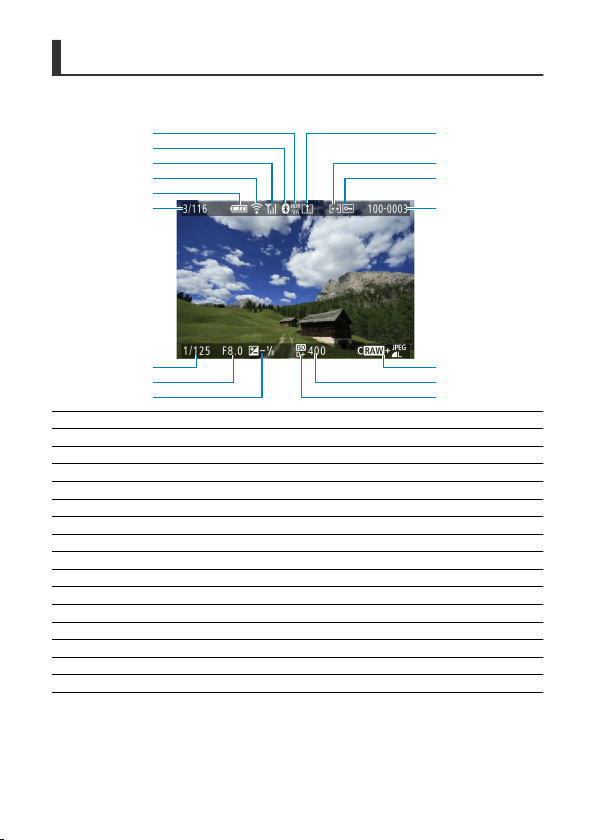
Playback Screen
Basic information display for still photos
(2)
(1)
(11)
(10)
(15)
(14)
(13)
(12)
(16)
(4)
(5)
(6)
(7)
(8)
(9)
(3)
(1) HDR output status/View Assist
(2) Bluetooth function
(3) Wi-Fi signal strength
(4) Wi-Fi function
(5) Battery level
(6) Current image no./Total images/No. of images found
(7) Shutter speed
(8) Aperture value
(9) Exposure compensation amount
(10) Already sent to a computer/smartphone
(11) Rating
(12) Image protection
(13) Folder no.-File no.
(14) Image quality/Edited image/Cropping/Frame Grab
(15) ISO speed
(16) Highlight tone priority
784
Caution
If the image was taken by another camera, certain shooting information may not be
displayed.
It may not be possible to play back images taken with this camera on other
cameras.
785
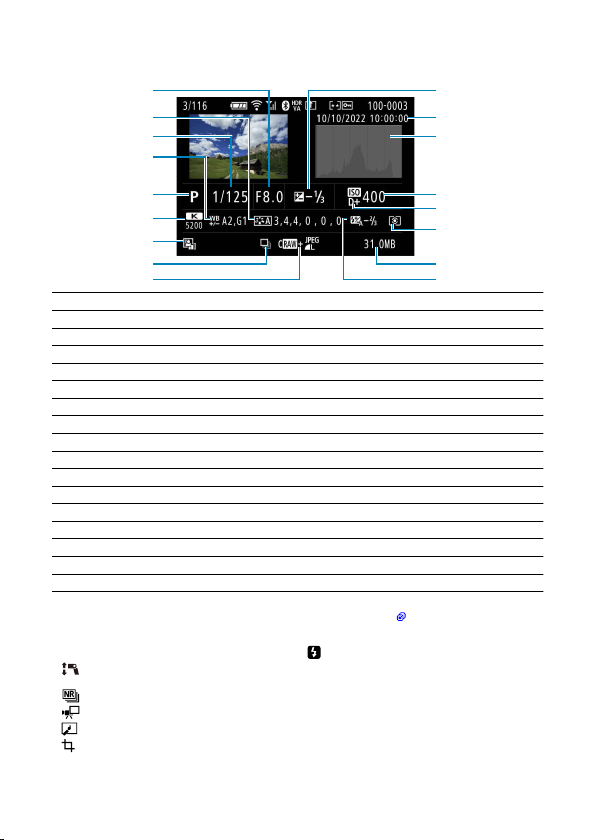
Detailed information display for still photos
(2)
(1)
(10)
(11)
(13)
(15)
(16)
(17)
(12)
(14)
(4)
(5)
(6)
(7)
(8)
(9)
(3)
(1) Aperture value
(2) Picture Style/Settings
(3) Shutter speed
(4) White balance correction/Bracketing
(5) Shooting mode/Frame Grab
(6) White balance
(7) Auto Lighting Optimizer
(8) First image of scene
(9) Image quality/Edited image/Cropping
(10) Exposure compensation amount
(11) Shooting date and time
(12) Histogram (Brightness/RGB)
(13) ISO speed
(14) Highlight tone priority
(15) Metering mode
(16) File size
(17) Flash exposure compensation amount/Bounce/HDR shooting/Multi Shot Noise Reduction
* For images captured in RAW+JPEG/HEIF shooting, indicates RAW file sizes.
* Lines indicating the image area are displayed for images taken with the aspect ratio set (
) and with RAW or RAW+JPEG set
for image quality.
* For images with added cropping information, lines are shown to indicate the image area.
* During flash photography without flash exposure compensation, [
] will be displayed.
* [
] indicates images shot with bounce flash photography.
* The dynamic range adjustment amount is shown for images captured in HDR shooting.
* [
] indicates images processed with Multi Shot Noise Reduction.
*
[
] indicates test shots for time-lapse movies.
* [
] indicates images created and saved by performing resizing, cropping, or frame-grabbing.
* [ ] indicates images cropped and then saved.
786
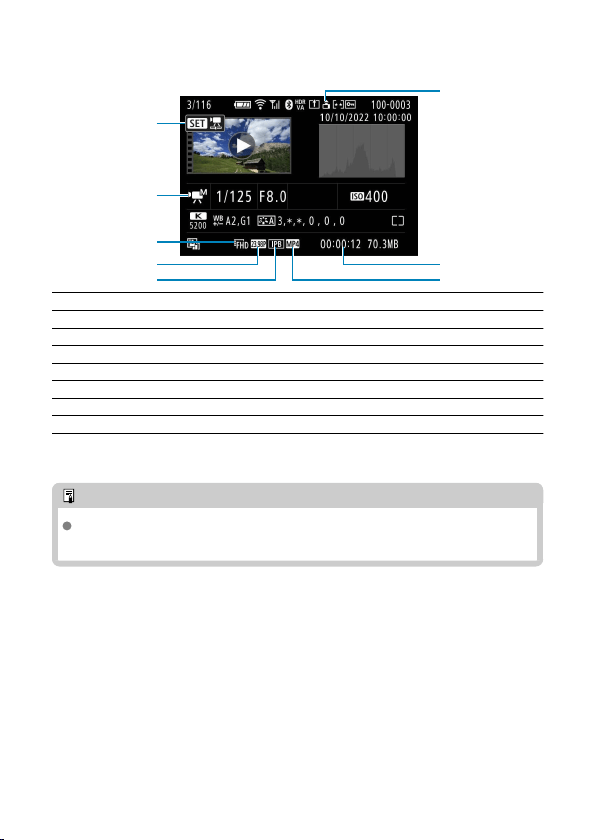
Detailed information display for movies
(2)
(1)
(7)
(8)
(6)
(4)
(5)
(3)
(1) Movie playback
(2) Movie recording mode/High Frame Rate mode
(3) Movie recording size
(4) Frame rate
(5) Compression method
(6) Movie orientation information
(7) Recording time/Time code
(8) Movie recording format
* For simplicity, explanations are omitted for items that are also included in basic/detailed information display for still photos,
which are not shown here.
Note
During movie playback, “*, *” is displayed for the [Fineness] and [Threshold]
parameters of [Sharpness] in [Picture Style].
787
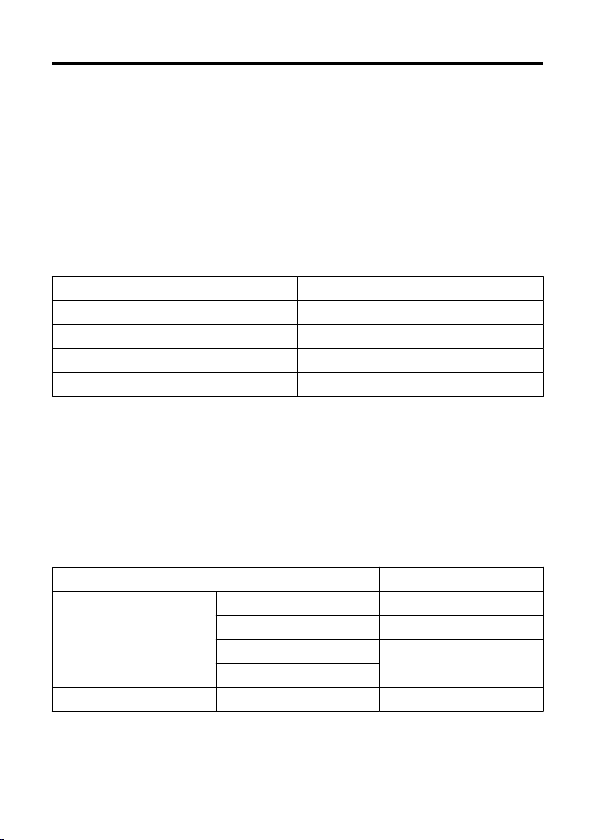
Specifications
Type
Type: Digital single-lens non-reflex AF/AE camera
Lens mount: Canon RF mount
Compatible lenses:
Canon RF lens group (including RF-S lenses)
* Canon EF or EF-S lenses (except for EF-M lenses) are also compatible, using mount adapter
EF-EOS R
Lens focal length: Approx. 1.6 times the focal length indicated on the lens
Image sensor
Type: APS-C CMOS sensor
Screen size Approx. 22.3 × 14.9 mm
CMOS format APS-C
Effective pixels*
1
*
2
Max. approx. 24.2 megapixels
Total pixels*
1
Approx. 25.5 megapixels
Dual Pixel CMOS AF Supported
* 1: Rounded to the nearest 100,000.
* 2: Using RF or EF lenses.
The effective pixel count may be lower with certain lenses and image processing.
Recording system
Image recording format: Compliant with Design rule for Camera File system 2.0 and Exif
2.31*
1
* 1: Supports time offset information
Image type and extension
Image type Extension
Still photos
JPEG .JPG
HEIF .HIF
RAW
.CR3
C-RAW
Movies
ALL-I*
1
, IPB (Standard), IPB (Light)
.MP4
* 1: Time-lapse movies only
788
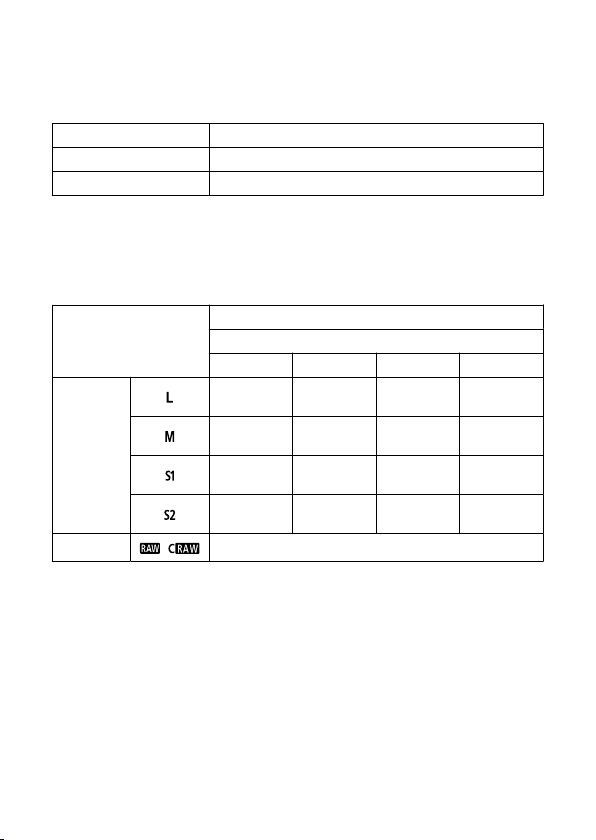
Recording media
Recording media
SD/SDHC/SDXC memory cards
UHS-I Supported
UHS speed class Supported
SD speed class Supported
Card slot: Equipped with a single slot
*
Supports UHS-I
Still photo recording
Still photo pixel count
Image quality
Recorded pixels
Aspect ratio
3:2 4:3 16:9 1:1
JPEG/
HEIF
24.0 megapixels
(6000×4000)
Approx. 21.3
megapixels*
1
(5328×4000)
Approx. 20.2
megapixels*
1
(6000×3368)
16.0 megapixels
(4000×4000)
Approx. 10.6
megapixels
(3984×2656)
Approx. 9.5
megapixels
(3552×2664)
Approx. 8.9
megapixels*
1
(3984×2240)
Approx. 7.1
megapixels
(2656×2656)
Approx. 5.9
megapixels
(2976×1984)
Approx. 5.3
megapixels
(2656×1992)
Approx. 5.0
megapixels*
1
(2976×1680)
Approx. 3.9
megapixels
(1984×1984)
Approx. 3.8
megapixels
(2400×1600)
Approx. 3.4
megapixels*
1
(2112×1600)
Approx. 3.2
megapixels*
1
(2400×1344)
Approx. 2.6
megapixels
(1600×1600)
RAW
/
24.0 megapixels
(6000×4000)
* Values for recorded pixels are rounded to the nearest 100,000.
* RAW/C-RAW images are generated at 3:2 and tagged to indicate the specified aspect ratio.
* JPEG and HEIF images are generated at the specified aspect ratio.
* These aspect ratios (M/S1/S2) and pixel counts also apply to resizing.
* 1: Aspect ratios are slightly different for these image sizes.
789
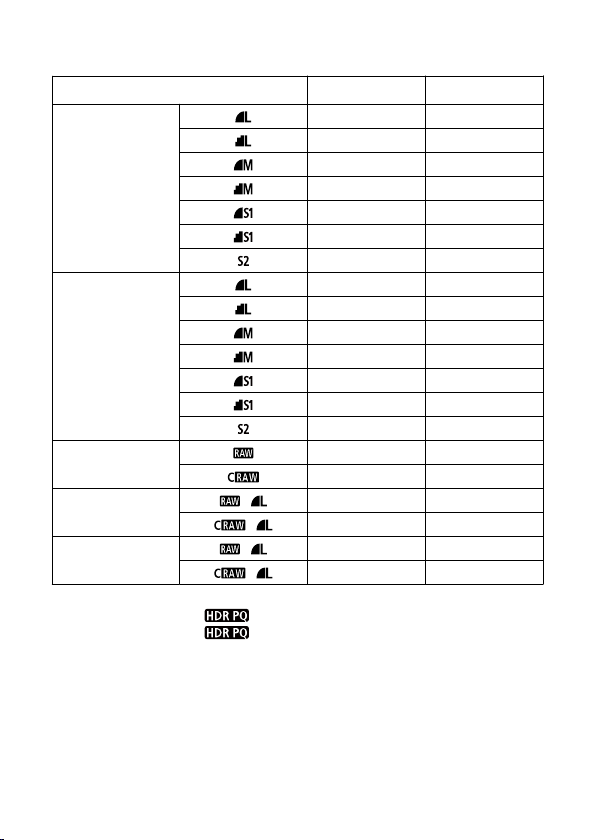
File size/number of shots available
Image quality
File size
[Approx. MB]
Available shots
[Approx.]*
1
JPEG*
2
8.7 3510
4.6 6610
4.7 6430
2.6 11400
3.1 9760
1.8 16130
1.8 16260
HEIF*
3
9.1 3360
7.0 4380
5.4 5630
4.3 7170
3.7 8220
3.0 10100
2.2 14110
RAW*
2
27.0 1140
14.0 2230
RAW+JPEG*
2
+
27.0 + 8.7 860
+
14.0 + 8.7 1360
RAW+HEIF*
3
+
29.9 + 9.1 780
+
16.9 + 9.1 1180
* 1: Number of shots using a 32 GB card that conforms to Canon testing standards.
* 2: When set to [HDR shooting
: Disable].
* 3: When set to [HDR shooting
: Enable].
*
File sizes are determined based on Canon testing standards.
* File size varies by shooting conditions (such as aspect ratio, subject, ISO speed, Picture Style, and
Custom Functions).
790
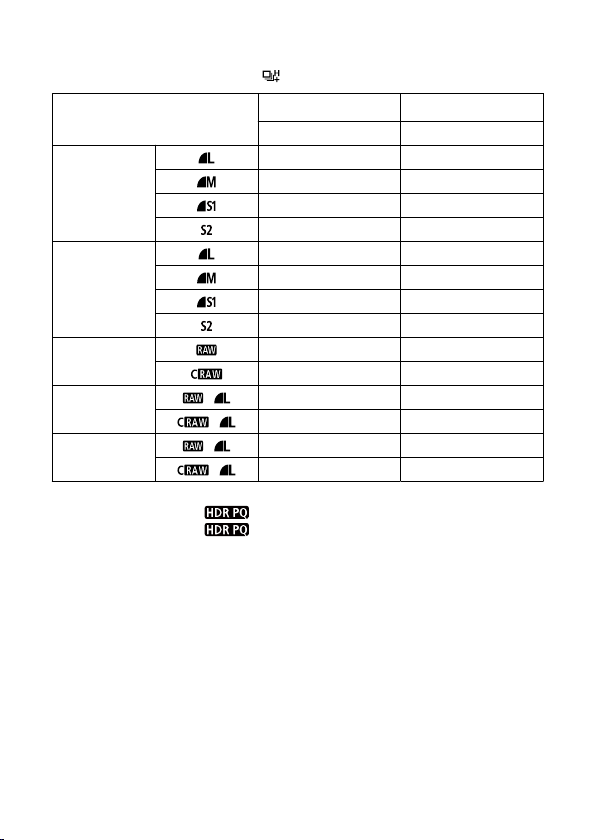
Maximum burst (approx. shots)
Number of shots available when set to [
], without slower continuous shooting
Image quality
Electronic 1st-curtain (approx.
12 shots/sec.)
Electronic shutter (approx. 15
shots/sec.)
Standard card*
1
Standard card*
1
JPEG*
2
42 28
42 28
42 28
42 28
HEIF*
3
41 24
41 24
41 24
41 24
RAW*
2
7 7
15 15
RAW+JPEG*
2
+
7 7
+
13 13
RAW+HEIF*
3
+
7 7
+
13 13
* 1: Number of shots using a 32 GB UHS-I card that conforms to Canon testing standards.
* 2: When set to [HDR shooting
: Disable].
* 3: When set to [HDR shooting
: Enable].
* Maximum burst as measured under conditions conforming to Canon testing standards (High-speed
continuous shooting + in One-Shot AF mode, ISO 100, and Standard Picture Style).
* Maximum burst varies depending on shooting conditions (including aspect ratio, subject, memory card
brand, ISO speed, Picture Style, and Custom Function).
791
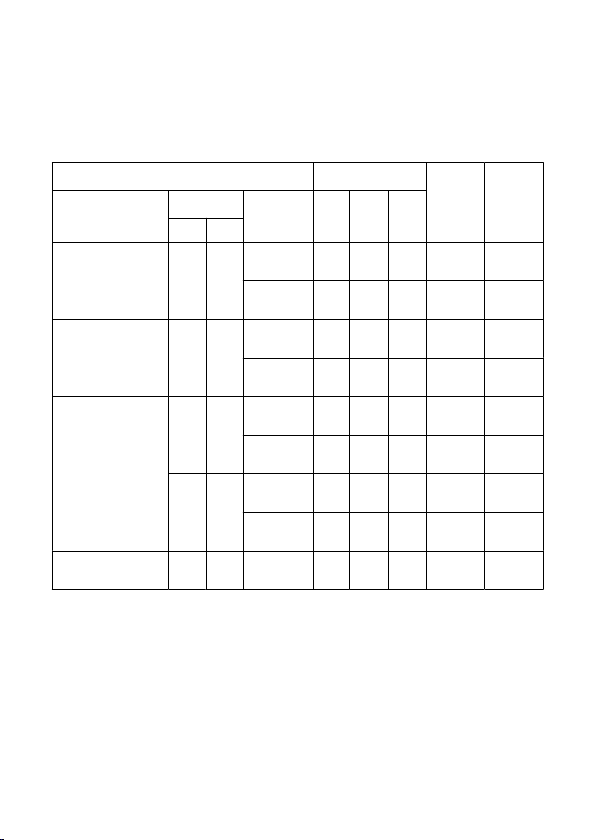
Movie recording
Movie recording format: MP4
Estimated recording time, movie bit rate, and file size
HDR PQ: OFF
Movie recording size
Total recording time
(approx.)
Movie bit
rate
(Approx.
Mbps)
File size
(Approx.
MB/min.)
Movie recording
Frame rate
(fps)
Compression
method
32 GB
128
GB
512
GB
NTSC PAL
4K UHD
29.97
23.98
25.00
IPB
(Standard)
35
min.
2 hr.
21
min.
9 hr.
27
min.
120 860
IPB
(Light)
1 hr.
10
min.
4 hr.
43
min.
18 hr.
52
min.
60 431
Full HD High Frame Rate
movies
119.88 100.00
IPB
(Standard)
35
min.
2 hr.
22
min.
9 hr.
28
min.
120 858
IPB
(Light)
1 hr. 0
min.
4 hr. 3
min.
16 hr.
15
min.
70 501
Full HD
59.94 50.00
IPB
(Standard)
1 hr.
10
min.
4 hr.
43
min.
18 hr.
52
min.
60 431
IPB
(Light)
2 hr. 0
min.
8 hr. 3
min.
32 hr.
15
min.
35 252
29.97
23.98
25.00
IPB
(Standard)
2 hr.
20
min.
9 hr.
23
min.
37 hr.
35
min.
30 216
IPB
(Light)
5 hr.
47
min.
23 hr.
11
min.
92 hr.
47
min.
12 88
Full HD Time-lapse
movies
29.97 25.00 ALL-I
47
min.
3 hr. 9
min.
12 hr.
38
min.
90 644
* Bit rate only applies to video output, not audio or metadata.
* Movie recording stops when the maximum recording time per movie is reached.
* Sound is not recorded for approx. the last two frames when the compression method for movie recording
quality is IPB (Standard) or IPB (Light). Moreover, the video and sound may be slightly out of sync when
movies are played back in Windows.
792
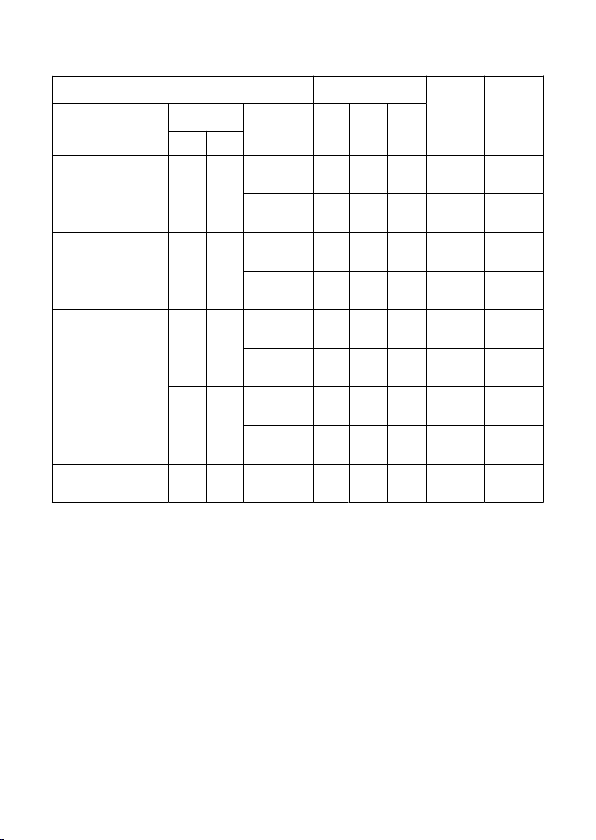
HDR PQ: ON
Movie recording size
Total recording time
(approx.)
Movie bit
rate
(Approx.
Mbps)
File size
(Approx.
MB/min.)
Movie recording
Frame rate
(fps)
Compression
method
32 GB
128
GB
512
GB
NTSC PAL
4K UHD
29.97
23.98
25.00
IPB
(Standard)
25
min.
1 hr.
40
min.
6 hr.
40
min.
170 1218
IPB
(Light)
50
min.
3 hr.
20
min.
13 hr.
20
min.
85 610
Full HD High Frame Rate
movies
119.88 100.00
IPB
(Standard)
23
min.
1 hr.
34
min.
6 hr.
19
min.
180 1287
IPB
(Light)
42
min.
2 hr.
50
min.
11 hr.
22
min.
100 715
Full HD
59.94 50.00
IPB
(Standard)
47
min.
3 hr. 9
min.
12 hr.
36
min.
90 646
IPB
(Light)
1 hr.
24
min.
5 hr.
39
min.
22 hr.
38
min.
50 360
29.97
23.98
25.00
IPB
(Standard)
1 hr.
34
min.
6 hr.
17
min.
25 hr.
8 min.
45 324
IPB
(Light)
2 hr.
30
min.
10 hr.
3 min.
40 hr.
15
min.
28 202
Full HD Time-lapse
movies
29.97 25.00 ALL-I
31
min.
2 hr. 6
min.
8 hr.
25
min.
135 966
* Bit rate only applies to video output, not audio or metadata.
* Movie recording stops when the maximum recording time per movie is reached.
* Sound is not recorded for approx. the last two frames when the compression method for movie recording
quality is IPB (Standard) or IPB (Light). Moreover, the video and sound may be slightly out of sync when
movies are played back in Windows.
793
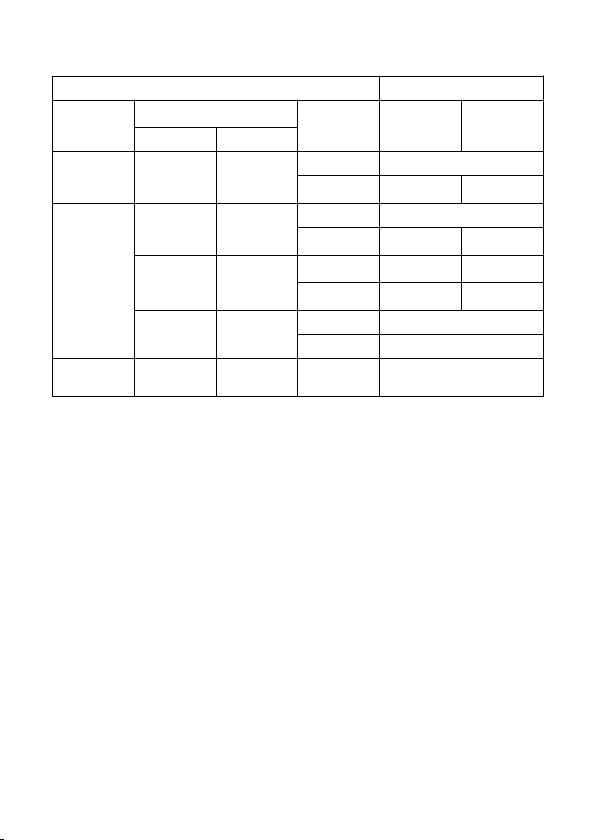
Card performance requirements (movie recording) [write/read speed]
Movie recording size SD card
Resolution
Frame rate
(fps)
Compression
method
8 bits
10 bits
(HDR PQ)
NTSC PAL
4K UHD
29.97
23.98
25.00
IPB (Standard) UHS Speed Class 3 or higher
IPB (Light)
SD Speed Class
10 or higher
UHS Speed
Class 3 or higher
Full HD
119.88 100.00
IPB (Standard) UHS Speed Class 3 or higher
IPB (Light)
SD Speed Class
10 or higher
UHS Speed
Class 3 or higher
59.94 50.00
IPB (Standard)
SD Speed Class
10 or higher
UHS Speed
Class 3 or higher
IPB (Light)
SD Speed Class
6 or higher
SD Speed Class
10 or higher
29.97
23.98
25.00
IPB (Standard) SD Speed Class 6 or higher
IPB (Light) SD Speed Class 4 or higher
Full HD
(Time-lapse
movies)
29.97 25.00 ALL-I Read speed of 30 MB/sec. or higher
Built-in microphone: Stereo microphones
External microphone (External microphone IN terminal): 3.5 mm diameter stereo mini
jack
External microphone (Multi-function shoe): Compatible with Directional Stereo
Microphone DM-E1D
794
Autofocus
Focusing method: Dual Pixel CMOS AF
Focusing brightness range
Still photo shooting: EV –4.0 to 20
(With an f/1.2 lens,* center AF point, One-Shot AF at room temperature, and ISO 100)
* Except for RF lenses with a Defocus Smoothing (DS) coating.
Movie recording: EV –3.5 to 20
(With an f/1.2 lens,* center AF point, One-Shot AF at room temperature, ISO 100, in Full HD
recording at 29.97/25.00 fps.)
* Except for RF lenses with a Defocus Smoothing (DS) coating.
Focusing operation
Still photo shooting Movie recording
AF operation*
1
• One-Shot AF
• AI Focus AF
• Servo AF
• One-Shot AF
• Movie Servo AF
Manual focus (MF) Supported Supported
1: Available in Creative Zone modes. Automatically set in Basic Zone modes to suit the
shooting mode.
* When set to AI Focus AF, the camera automatically switches from One-Shot AF to Servo AF in
response to subject movement (also applies during continuous shooting).
* Automatically set to [AI Focus AF] in <
> mode.
Lens compatibility based on focusing area: Refer to the Canon website
Number of AF area available for automatic selection
Focusing area Horizontal: Approx. 100%, Vertical: Approx. 100%
Number of AF
zones
Still photos Max. 651 zones (31×21)
Movies Max. 527 zones (31×17)
* May vary depending on settings.
Selectable positions for AF point
Focusing area Horizontal: Approx. 90%, Vertical: Approx. 100%
Numbers of
positions
Still photos Max. 4503 positions (79×57)
Movies Max. 3713 positions (79×47)
* When set to [1-point AF] and selected using the cross keys.
795

Viewfinder
Type: OLED color electronic viewfinder
Screen size: Approx. 1.00 cm (0.39 inch)
Dot count: Approx. 2,360,000 dots
Magnification / Angle of view: Approx. 0.95× / Approx. 28.0° (3:2 aspect ratio, with 50mm
lens at infinity, –1 m
–1
)
Coverage: Approx. 100% (at JPEG Large image quality, 3:2 aspect ratio, approx. 22 mm
eyepoint)
Eyepoint: Approx. 22 mm (at –1 m
–1
from eyepiece lens end)
Dioptric adjustment: Approx. –3.0 to +1.0 m
–1
(dpt)
Screen
Type: TFT color, liquid-crystal monitor
Screen size: Approx. 7.5 cm (3.0 inch) (screen aspect ratio of 3:2)
Dot count: Approx. 1,620,000 dots
Angle of view: Approx. 170° vertically and horizontally
Coverage: Approx. 100% vertically and horizontally (at L image size and an aspect ratio of
3:2)
Screen brightness: Manually adjustable in a range of 1–7
Touch-screen: Capacitive sensing
HDMI output
HDMI video / audio output: HDMI micro OUT terminal (Type D)
* HDMI CEC not supported
HDMI resolution: Auto / 1080p
796
Exposure control
Metering functions under various shooting conditions
Item Still photo shooting Movie recording
Metering sensor 384-zone (24×16) metering using image sensor output signals
Metering mode
Evaluative
metering
Yes Yes
Partial metering
Yes
* Approx. 5.8% in the center of the
screen*
2
Spot metering*
1
Yes
*
Approx. 2.9% in the center of the
screen*
2
Center-weighted
average
metering
Yes
Metering brightness range (at room
temperature, ISO 100)
EV –2 to 20 EV 0 to 20
* 1: Multi-spot metering not available (not supported).
* 2: Values differ when set to Digital tele-converter.
ISO speed (recommended exposure index) in still photo shooting
Manual ISO speed setting for still photos
ISO speed
Normal ISO speed ISO 100–32000 (in 1/3- or 1-stop increments)
Expanded ISO speed H (equivalent to ISO 51200)
* When set to [Highlight tone priority], the available manual setting range is ISO 200–32000.
* Expanded ISO speeds cannot be set in HDR mode or for HDR shooting (HDR PQ).
Manual ISO speed setting range for still photos: Not supported
ISO Auto maximum limit setting for still photos
Max. for ISO Auto ISO 400 / 800 / 1600 / 3200 / 6400 / 12800 / 25600 / 32000
ISO Auto setting range for still photos: Not supported
797
ISO Auto details for still photos
Shooting mode
No flash
Using flash
Variable control of maximum ISO
Auto limit for E-TTL
Compatible lens Incompatible lens
Creative Zone
P / Tv / Av / M
(other than bulb)
ISO 100*
1
*
2
–32000*
2
ISO 100*
1
*
2
–6400*
2
ISO 100*
1
*
2
–1600*
2
M (bulb)
ISO 400*
3
ISO 400*
3
Basic Zone
/
ISO 100–6400 ISO 100–6400
ISO 100–3200*
4
Varies by shooting mode
Varies by shooting mode
* 1: ISO 200 when set to [Highlight tone priority: Enable/Enhanced].
* 2: Varies depending on the [Max for Auto] settings.
* 3: If outside the setting range, changed to the value closest to ISO 400.
* 4: When using the built-in flash. ISO 1600 when using an external flash unit.
Variable control of maximum ISO Auto limit for E-TTL: Supported
798
ISO speed (recommended exposure index) in movie recording
Manual ISO speed setting for movies
ISO speed
Normal ISO speed ISO 100–12800 (in 1/3- or 1-stop increments)
Expanded ISO speed H (equivalent to ISO 16000 / 20000 / 25600)
* When set to [Highlight tone priority], the setting range is ISO 200–12800.
* Expanded ISO speeds are not available in HDR PQ movie, HDR movie, or High Frame Rate movie
recording.
Automatic ISO speed setting for movies (with ISO Auto)
ISO speed
Normal ISO speed ISO 100–12800 (in 1/3- or 1-stop increments)
Expanded ISO speed H (equivalent to ISO 25600)
* Maximum ISO speed when set automatically corresponds to the [Max for Auto] setting.
* When set to [Highlight tone priority], the setting range is ISO 200–12800.
* Expanded ISO speeds are not available in HDR or HDR PQ movie recording, in movie recording with
shooting creative filters, or with digital zoom.
Manual ISO speed setting range limit for movies: Not supported
Maximum ISO Auto setting for movies
Max. for ISO Auto ISO 6400 / 12800 / H (equivalent to ISO 25600)
Maximum ISO Auto speed setting for time-lapse movies
Max. for ISO Auto ISO 400 / 800 / 1600 / 3200 / 6400 / 12800
799
Shutter
Still photo shooting
Type:
Electronically controlled focal-plane shutter
Rolling shutter, using the image sensor
Shutter mode
Shutter mode Flash photography
Electronic 1st-curtain Possible
Electronic shutter Disabled
Shutter speed / X-sync speed
Shutter mode Setting range Setting increments X-sync
Electronic 1st-curtain 1/4000–30 sec., Bulb
1/3-stop
1/250 sec.
Electronic shutter 1/8000–30 sec., Bulb
Movie recording
Type: Rolling shutter, using the image sensor
Shutter speed:
Movie auto exposure: 1/4000–1/25* sec.
* Varies by frame rate.
Movie manual exposure: 1/4000–1/8*
1
sec.
* Varies by shooting mode and frame rate.
* 1: 1/125 sec. (NTSC) or 1/100 sec. (PAL) with [High Frame Rate] set to [Enable].
800
Drive
Drive mode and continuous shooting speed
[Max. approx.]
Drive mode AF operation Electronic 1st-curtain Electronic shutter
Single shooting Yes Yes
High-speed continuous
shooting +
One-Shot AF
Servo AF
12 shots/sec.*
1
*
2
15 shots/sec.*
2
High-speed continuous
shooting
One-Shot AF
Servo AF
7.6 shots/sec.*
2
15 shots/sec.*
2
Low-speed continuous
shooting
One-Shot AF
Servo AF
3.0 shots/sec. 5.0 shots/sec.
Self-timer: 10 sec. Yes Yes
Self-timer: 2 sec. Yes Yes
Self-timer: Continuous shooting Yes Yes
801
Built-in flash
Type: Retractable flash
Retraction method: Manual
Guide no.: Guide no. of approx. 6 (ISO 100/m) / 19.7 (ISO 100/feet)
Flash exposure compensation: ±2 stops (in 1/3-stop increments)
Effective flash range (example)
(Approx.)
ISO speed
Lens: RF-S18-45mm F4.5-6.3 IS STM
Wide-angle end f/4.5 Telephoto end f/6.3
m ft. m ft.
100 0.3–1.2 1.0–3.9 0.4–0.9 1.0–3.0
1600 1.1–4.9 3.6–16.1 0.8–3.5 2.6–11.5
25600 4.3–19.6 14.1–64.3 3.0–14.0 9.8–45.9
* Rounded to the first decimal place.
*
Suitable exposure may not be obtained when shooting distant subjects at high ISO speeds, because
preflash metering limits may be exceeded.
External flash
Contacts for multi-function shoe: 21-pin contact
Flash exposure compensation: ±3 stops (in 1/3-stop increments)
802
Playback
Item Still photos Movies
AF point display Yes
Playback grid Off / 3×3 / 6×4 / 3×3+diag
Magnified view 1.5×–10× (15 levels)
Setting image search conditions
Search conditions
Rating / Date / Folder / Protection / Type of file (1) / Type of file (2)
Rating
OFF / ★ to ★★★★★
Select images / Select range / All images in folder / All images on card / All
found images
Protect images
Select images / Select range / All images in folder / Unprotect all images in
folder / All images on card / Unprotect all images on card / All found images /
Unprotect all found images
Resizing Yes
Cropping Yes
Frame grab from 4K movies
Individual frames of 4K movies recorded with the camera can be saved as approx. 8.3-
megapixel (3840×2160) still photos (JPEG or HEIF).
* From normal movies, still photos are saved as JPEGs, and from HDR PQ movies, as HEIF images.
* In-camera resizing or cropping is not supported for extracted still photos, and these images cannot
be edited with Creative filters or Creative Assist.
Print order (DPOF)
Compliant with DPOF Version 1.1
External interface
Digital terminal
Terminal type: USB Type-C
Transmission: Equivalent to Hi-Speed USB (USB 2.0)
Applications:
For computer communication / smartphone communication
USB battery charging / camera power supply
HDMI output terminal: HDMI micro OUT terminal (Type D)
External microphone IN terminal: 3.5 mm diameter stereo mini jack
803
Power source
Battery
Compatible battery pack LP-E17
Quantity used 1
Battery check: Automatic battery check with 4-level display when the power switch is
turned ON.
Battery information
Power supply Type
Remaining capacity 4-level indicator
Number of shots Not supported
Recharge performance 3 levels
USB battery charging and camera power supply: Using USB Power Adapter PD-E1
AC power source
AC adapter AC-E6N
DC coupler DR-E18
Number of shots available
Type of shooting Temperature
Available shots (approx.)
Using 50% flash
AE shooting*
2
Power saving*
1
Smooth*
2
Power saving
Viewfinder shooting
+23°C / 73°F
310 230 320
On-screen shooting 440 370 450
* 1: Based on CIPA standards.
* 2: According to Canon measurement conditions, which are based on CIPA standards.
* Using a new, fully charged LP-E17
* The number of shots available may vary greatly depending on the shooting environment.
* Fewer shots may be available with a compatible accessory attached to the multi-function shoe, because
the camera powers the accessory.
804
Available operating time
Conditions of use Temperature
Available operating
time
Time available for bulb exposure +23°C / 73°F Approx. 2 hr. 50 min.
Time available for Live View shooting
* Using the screen
+23°C / 73°F Approx. 3 hr. 00 min.
Time available for
movie recording
* Movie Servo AF:
Disable
4K
• IPB (Standard)
• 29.97 fps / 25.00
fps
+23°C / 73°F Approx. 1 hr. 00 min.
0°C / 32°F Approx. 1 hr. 00 min.
Full HD
• IPB (Standard)
• 29.97 fps / 25.00
fps
+23°C / 73°F Approx. 2 hr. 00 min.
0°C / 32°F Approx. 2 hr. 00 min.
Time available for
continuous playback
(normal playback)
4K
• IPB (Standard)
• 29.97 fps / 25.00
fps
+23°C / 73°F Approx. 3 hr. 00 min.
* With a fully charged new LP-E17
805
Dimensions and weight
Dimensions
Exterior color
Dimensions
(W) × (H) × (D)
Black
Approx. 116.3 × 85.5 × 68.8 mm / 4.58 × 3.37 × 2.71 in.
White
* Based on CIPA guidelines.
Weight
Exterior color Weight
Body
(including battery and card)*
1
Black Approx. 375 g / Approx. 13.23 oz.
White Approx. 376 g / Approx. 13.26 oz.
Body only
Black Approx. 328 g / Approx. 11.57 oz.
White Approx. 329 g / Approx. 11.61 oz.
* Not including body cap or shoe cover.
*
1: Based on CIPA guidelines.
Operating environment
Operating temperature: 0–+40°C / 32–104°F
Operating humidity: 85% or less
806
Wi-Fi (wireless LAN)
Supported standards (equivalent to IEEE 802.11b/g/n standards)
Wi-Fi standards Transmission method Maximum link speed
IEEE 802.11b DSSS modulation 11 Mbps
IEEE 802.11g
OFDM modulation
54 Mbps
IEEE 802.11n 72.2 Mbps
* Not compatible with MIMO (Multiple-input and multiple-output).
Transmission frequency (Center frequency)
Frequency 2412 to 2462 MHz
Channels 1 to 11 ch
Authentication and data encryption methods
Connection method Authentication method
Encryption
Encryption method
Camera access point
WPA2 / WPA3-Personal AES
Open Disable
Infrastructure
Open
WEP
Disable
Shared key WEP
WPA / WPA2 / WPA3-Personal
TKIP
AES
Bluetooth
Standards compliance: Bluetooth Specification Version 4.2 compliant (Bluetooth Low
Energy technology)
Transmission method: GFSK modulation
All data above is based on Canon testing standards and CIPA (Camera & Imaging
Products Association) testing standards and guidelines.
Dimensions and weight listed above are based on CIPA Guidelines (except weight for
camera body only).
Product specifications and appearance are subject to change without notice.
If a problem occurs with a non-Canon lens attached to the camera, contact the
respective lens manufacturer.
807
Trademarks and Licensing
Trademarks
About MPEG-4 Licensing
Accessories
Trademarks
Adobe is a trademark of Adobe Systems Incorporated.
Microsoft and Windows are trademarks or registered trademarks of Microsoft
Corporation in the United States and/or other countries.
App Store and macOS are trademarks of Apple Inc., registered in the U.S. and other
countries.
Google Play and Android are trademarks of Google LLC.
IOS is a trademark or registered trademark of Cisco in the U.S. and other countries and
is used under license.
QR Code is a trademark of Denso Wave Inc.
SDXC logo is a trademark of SD-3C, LLC.
HDMI, HDMI logo, and High-Definition Multimedia Interface are trademarks or registered
trademarks of HDMI Licensing LLC.
The Wi-Fi CERTIFIED logo and the Wi-Fi Protected Setup mark are trademarks of the
Wi-Fi Alliance.
The Bluetooth
®
word mark and logos are registered trademarks owned by Bluetooth
SIG, Inc. and any use of such marks by Canon Inc. is under license. Other trademarks
and trade names are those of their respective owners.
USB Type-C™ and USB-C™ are trademarks of USB Implementers Forum.
All other trademarks are the property of their respective owners.
808

About MPEG-4 Licensing
“This product is licensed under AT&T patents for the
MPEG-4
standard and may be used for
encoding MPEG-4 compliant video and/or decoding MPEG-4 compliant video that was
encoded only (1) for a personal and non-commercial purpose or (2) by a video provider
licensed under the AT&T patents to provide MPEG-4 compliant video. No license is granted
or implied for any other use for MPEG-4 standard.”
THIS PRODUCT IS LICENSED UNDER THE AVC PATENT PORTFOLIO LICENSE FOR
THE PERSONAL USE OF A CONSUMER OR OTHER USES IN WHICH IT DOES NOT
RECEIVE REMUNERATION TO (i) ENCODE VIDEO IN COMPLIANCE WITH THE AVC
STANDARD (''AVC VIDEO'') AND/OR (ii) DECODE AVC VIDEO THAT WAS ENCODED BY
A CONSUMER ENGAGED IN A PERSONAL ACTIVITY AND/OR WAS OBTAINED FROM
A VIDEO PROVIDER LICENSED TO PROVIDE AVC VIDEO. NO LICENSE IS GRANTED
OR SHALL BE IMPLIED FOR ANY OTHER USE. ADDITIONAL INFORMATION MAY BE
OBTAINED FROM MPEG LA, L.L.C. SEE
HTTP://WWW.MPEGLA.COM
* Notice displayed in English as required.
809
Accessories
Use of genuine Canon accessories is recommended
This product is designed to achieve optimum performance when used with genuine Canon
accessories. Therefore, using this product with genuine accessories is highly recommended.
Canon shall not be liable for any damage to this product and/or accidents such as
malfunction, fire, etc. caused by the failure of non-genuine Canon accessories (e.g., a
leakage and/or explosion of a battery). Please note that repairs arising out of the malfunction
of non-genuine accessories will not be covered by the warranty for repairs, although you
may request such repairs on a chargeable basis.
Caution
Battery Pack LP-E17 is dedicated to Canon products only. Using it with an
incompatible battery charger or product may result in malfunction or accidents for
which Canon cannot be held liable.
Check the following website for details on compatible accessories.
https://cam.start.canon/H002/
810