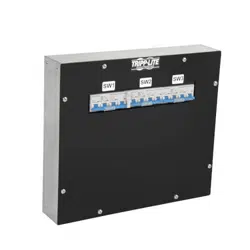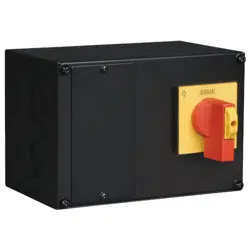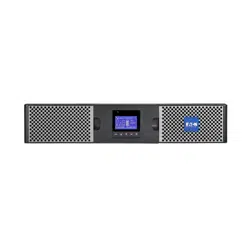

p/n: P-164001006
Revision 01
Eaton 9PX Lithium-Ion Advanced Users Guide
9PX1500RT-L / 9PX2200RT-L / 9PX3000RT-L / 9PX1500GRT-L /
9PX2200GRT-L / 9PX3000GRT-L / 9PXEBM48RT-L /
9PXEBM72RT-L
Eaton 9PX Lithium-Ion
©Copyright 2020 Eaton, Raleigh, NC, USA. All rights reserved. No part of this document may be reproduced in any way without the
express written approval of Eaton.
Safety Instructions
SAVE THESE INSTRUCTIONS.
This manual contains important instructions that should be followed during installation and
maintenance of the UPS and batteries.
The 9PX models that are covered in this manual are intended for installation n an environment within 0
to 40°C, free of conductive contaminant.
This equipment has been tested and found to comply with the limits for a Class B digital device,
pursuant to IEC62040-2 & FCC standards. These limits are designed to provide reasonable protection
against harmful interference when the equipment is operated in a commercial environment. This
equipment generates, uses, and can radiate radio frequency energy and, if not installed and used in
accordance with the instruction manual, may cause harmful interference to radio communications.
Operation of this equipment in a residential area is likely to cause harmful interference in which case
the user will be required to correct the interference at his own expense.
Special Symbols
The following are examples of symbols used on the product to alert you to important information:
Special Symbols
The following are examples of symbols used on the UPS or accessories to alert you to important
information:
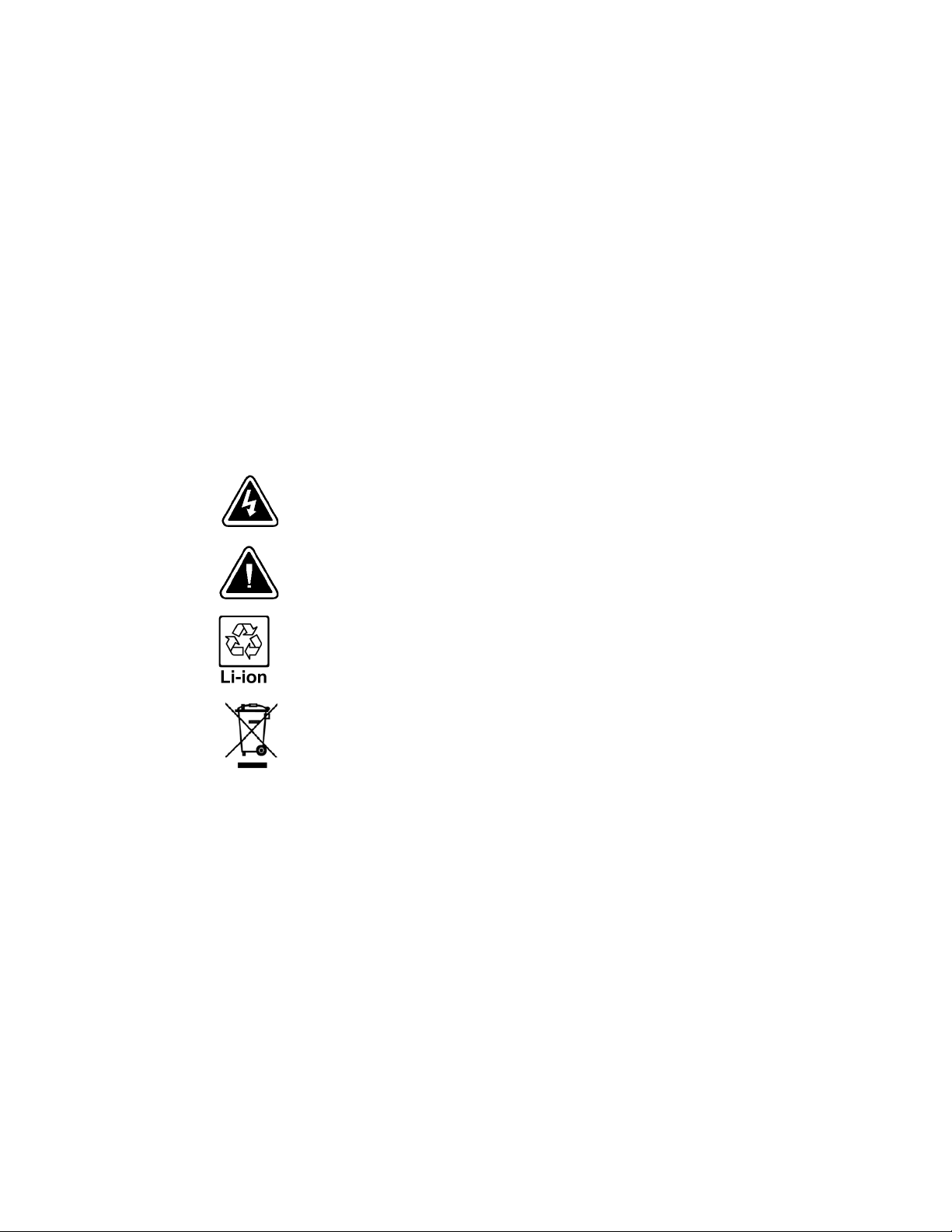
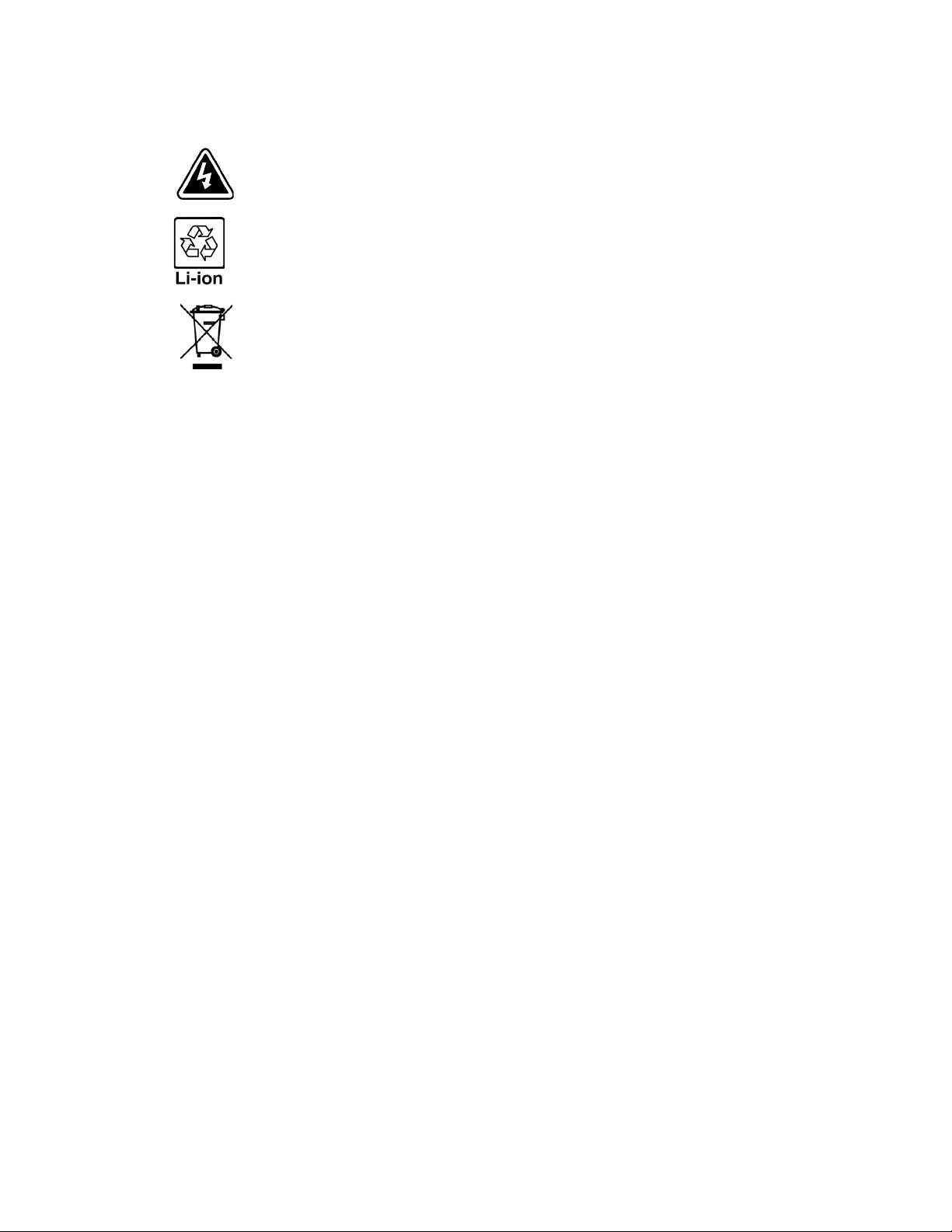
RISK OF ELECTRIC SHOCK - Observe the warning associated with the risk of
electric shock symbol.
CAUTION: REFER TO OPERATOR'S MANUAL - Refer to your operator's manual for
additional information, such as important operating and maintenance
instructions.
This symbol indicates that you should not discard the UPS or the UPS batteries
in the trash. This product contains sealed, lead‐acid batteries and must be
disposed of properly. For more information, contact your local recycling/reuse or
hazardous waste center.
This symbol indicates that you should not discard waste electrical or electronic
equipment (WEEE) in the trash. For proper disposal, contact your local
recycling/reuse or hazardous waste center.
Eaton, Powerware, and BladeUPS are registered trademarks of Eaton Corporation or its subsidiaries and affiliates.
Phillips and Pozidriv are registered trademarks of Phillips Screw Company.
ECopyright 2008–2010 Eaton Corporation, Raleigh, NC, USA. All rights reserved. No part of this document may be
reproduced in any way without the express written approval of Eaton Corporation.
RISK OF ELECTRIC SHOCK - Observe the warning associated with the risk of electric shock
symbol.
Special Symbols
The following are examples of symbols used on the UPS or accessories to alert you to important
information:
RISK OF ELECTRIC SHOCK - Observe the warning associated with the risk of
electric shock symbol.
CAUTION: REFER TO OPERATOR'S MANUAL - Refer to your operator's manual for
additional information, such as important operating and maintenance
instructions.
This symbol indicates that you should not discard the UPS or the UPS batteries
in the trash. This product contains sealed, lead‐acid batteries and must be
disposed of properly. For more information, contact your local recycling/reuse or
hazardous waste center.
This symbol indicates that you should not discard waste electrical or electronic
equipment (WEEE) in the trash. For proper disposal, contact your local
recycling/reuse or hazardous waste center.
Eaton, Powerware, and BladeUPS are registered trademarks of Eaton Corporation or its subsidiaries and affiliates.
Phillips and Pozidriv are registered trademarks of Phillips Screw Company.
ECopyright 2008–2010 Eaton Corporation, Raleigh, NC, USA. All rights reserved. No part of this document may be
reproduced in any way without the express written approval of Eaton Corporation.
CAUTION: REFER TO OPERATOR'S MANUAL - Refer to your operator's manual for
additional information, such as important operating and maintenance instructions.
This symbol indicates that you should not discard the UPS or the UPS batteries in the trash.
This product contains sealed, Lithium-Ion batteries and must be disposed of properly. For
more information, contact your local recycling/reuse or hazardous waste center.
Special Symbols
The following are examples of symbols used on the UPS or accessories to alert you to important
information:
RISK OF ELECTRIC SHOCK - Observe the warning associated with the risk of
electric shock symbol.
CAUTION: REFER TO OPERATOR'S MANUAL - Refer to your operator's manual for
additional information, such as important operating and maintenance
instructions.
This symbol indicates that you should not discard the UPS or the UPS batteries
in the trash. This product contains sealed, lead‐acid batteries and must be
disposed of properly. For more information, contact your local recycling/reuse or
hazardous waste center.
This symbol indicates that you should not discard waste electrical or electronic
equipment (WEEE) in the trash. For proper disposal, contact your local
recycling/reuse or hazardous waste center.
Eaton, Powerware, and BladeUPS are registered trademarks of Eaton Corporation or its subsidiaries and affiliates.
Phillips and Pozidriv are registered trademarks of Phillips Screw Company.
ECopyright 2008–2010 Eaton Corporation, Raleigh, NC, USA. All rights reserved. No part of this document may be
reproduced in any way without the express written approval of Eaton Corporation.
This symbol indicates that you should not discard waste electrical or electronic equipment
(WEEE) in the trash. For proper disposal, contact your local recycling/reuse or hazardous
waste center.

Safety of Persons
• The system has its own power source (the battery). Consequently, the power outlets may be
energized ven if the systems is disconnected from the AC power source. Dangerous voltage
levels are resent within the system. It should be opened exclusively by qualified service
personnel.
• The system must be properly grounded at all times.
• The battery supplied with the system contains small amounts of toxic materials. To avoid
accidents, the directives listed below must be observed:
– Servicing of batteries should be performed or supervised by personnel knowledgeable about
batteries and the required precautions.
– When replacing batteries, replace with the same type and number of batteries or battery
packs.
– Do not dispose of batteries in a fire. The batteries may explode.
– Batteries constitute a danger (electrical shock, burns). The short-circuit current may be very
high.
• Precautions must be taken for all handling:
– Wear rubber gloves and boots.
– Do not lay tools or metal parts on top of batteries.
– Disconnect charging source prior to connecting or disconnecting battery terminals.
– Determine if battery is inadvertently grounded. If inadvertently grounded, remove source
from ground. Contact with any part of a grounded battery can result in electrical shock. The
likelihood of such shock can be reduced if such grounds are removed during installation and
maintenance (applicable to equipment and remote battery supplies not having a grounded
supply circuit).
Product Safety
• To connect the UPS, instructions and operation described in the manual must be followed in the
indicated order.
• CAUTION - To reduce the risk of fire, the unit connects only to a circuit provided with 20 or 30
amperes maximum branch circuit overcurrent protection in accordance with the National Electric
Code, ANSI/NFPA 70 (US installations only).
• Check that the indications on the rating plate correspond to your AC powered system and to the
actual electrical consumption of all the equipment to be connected to the system.
• For PLUGGABLE EQUIPMENT, the socket-outlet shall be installed near the equipment and shall
be easily accessible
• Never install the system near liquids or in an excessively damp environment.
• Never let a foreign body penetrate inside the system.
• Never block the ventilation grates of the system.
• Never expose the system to direct sunlight or source of heat.
• If the system must be stored prior to installation, storage must be in a dry place.
• The admissible storage temperature range is -25ºC to +55ºC without batteries, 0°C to 40°C with
batteries.
• The system is not for use in a computer room AS DEFINED IN the standard for the Protection of
Information Technology Equipment, ANSI/NFPA 75 (US installations only).

Special Precautions
• The unit is heavy: wear safety shoes and use vacuum lifter preferentially for handling operations.
• All handling operations will require at least two people (unpacking, lifting, installation in rack
system).
• Before and after the installation, if the UPS remains de-energized for a long period, the UPS must
be energized for a period of 24 hours, at least once every 6 months (for a normal storage
temperature less than 25°C). This charges the battery, thus avoiding possible irreversible
damage.
• During the replacement of the Battery Module, it is imperative to use the same type and number
of element as the original Battery Module provided with the UPS to maintain an identical level of
performance and safety. If there are any questions, don’t hesitate to contact your local EATON
representative.
• All repairs and service should be performed by AUTHORIZED SERVICE PERSONNEL ONLY.
There are NO USER SERVICEABLE PARTS inside the UPS.
• For potential safety issue on defective UPS : DISCONNECT INTERNAL BATTERY for storage and
transportation.

Eaton 9PX Lithium-Ion P-164001006—Rev 01 v
TTaabbllee ooff CCoonntteennttss
11 IInnttrroodduuccttiioonn....................................................................................................................................................................................................................................................................................................11
1.1 Introduction............................................................................................................................................... 1
1.2 Environmental Protection .............................................................................................................................1
22 PPrreesseennttaattiioonn ..................................................................................................................................................................................................................................................................................................33
2.1 Standard Installations ..................................................................................................................................3
2.2 Rear Panels ...............................................................................................................................................4
2.3 Accessories............................................................................................................................................... 5
2.4 Control Panel ............................................................................................................................................. 5
2.5 LCD Description .........................................................................................................................................6
2.6 Display Functions .......................................................................................................................................7
2.7 User Settings............................................................................................................................................. 8
33 IInnssttaallllaattiioonn .................................................................................................................................................................................................................................................................................................. 1133
3.1 Inspecting the Equipment........................................................................................................................... 13
3.2 Checking the Accessory Kit ........................................................................................................................ 13
3.3 Connecting the Internal Battery ................................................................................................................... 15
3.4 Tower Installation ..................................................................................................................................... 16
3.5 Rack Installation ....................................................................................................................................... 17
3.6 Connecting the EBM(s) .............................................................................................................................. 18
3.7 Detecting other Accessories ....................................................................................................................... 19
3.8 UPS Connection without Hotswap MBP Module ............................................................................................. 20
3.9 Connection with a Hotswap MBP Module ( Optional Accessory)......................................................................... 21
44 CCoommmmuunniiccaattiioonn ...................................................................................................................................................................................................................................................................................... 2233
4.1 Communication Ports ................................................................................................................................ 23
4.2 UPS Remote Control Functions ................................................................................................................... 24
55 OOppeerraattiioonn........................................................................................................................................................................................................................................................................................................ 2299
5.1 Start-up and Normal Operation .................................................................................................................... 29
5.2 Starting the UPS on Battery ........................................................................................................................ 29
5.3 UPS Shutdown ........................................................................................................................................ 29
5.4 Operating Modes ..................................................................................................................................... 29
5.5 Return of AC Power .................................................................................................................................. 30
5.6 Setting High Efficiency Mode ...................................................................................................................... 30
5.7 Configuring Bypass Settings ....................................................................................................................... 31
5.8 Configuring Battery Settings ....................................................................................................................... 31
5.9 Retrieving the Event Log ............................................................................................................................ 32
5.10 Retrieving the Fault Log ........................................................................................................................... 32
66 UUPPSS MMaaiinntteennaannccee................................................................................................................................................................................................................................................................................ 3333
6.1 Storing the Equipment ............................................................................................................................... 33

vi Eaton 9PX Lithium-Ion P-164001006—Rev 01
6.2 Replacing Batteries ................................................................................................................................... 33
6.3 Replacing the UPS Equipped with a HotSwap MBP ......................................................................................... 35
6.4 Recycling The Used Equipment ................................................................................................................... 35
77 TTrroouubblleesshhoooottiinngg .................................................................................................................................................................................................................................................................................... 3377
7.1 Typical Alarms and Faults ........................................................................................................................... 37
7.2 Silencing the Alarm ................................................................................................................................... 38
7.3 Service and Support .................................................................................................................................. 38
7.4 CE Compliance Contact ............................................................................................................................. 39
88 SSppeecciiffiiccaattiioonnss.......................................................................................................................................................................................................................................................................................... 4411
8.1 Model Specifications ................................................................................................................................. 41
Table of Contents

Eaton 9PX Lithium-Ion P-164001006—Rev 01 1
CChhaapptteerr 11 IInnttrroodduuccttiioonn
11..11 IInnttrroodduuccttiioonn
Thank you for selecting an EATON product to protect your electrical equipment.
The 9PX range has been designed with the utmost care.
We recommend that you take the time to read this manual to take full advantage of the many features of your
UPS (Uninterruptible Power System).
Before installing your 9PX, please read the booklet presenting the safety instructions. Then follow the
indications in this manual.
To discover the entire range of EATON products and the options available for the 9PX range, invite you to visit
our web site at Eaton.com or contact your EATON representative.
11..22 EEnnvviirroonnmmeennttaall PPrrootteeccttiioonn
EATON has implemented an environmental-protection policy.
Products are developed according to an eco-design approach.
Substances
This product does not contain CFCs, HCFCs, or asbestos.
Packing
To improve waste treatment and facilitate recycling, separate the various packing components.
• The cardboard we use comprises over 50% of recycled cardboard.
• Sacks and bags are made of polyethylene.
• Packing materials are recyclable and bear the appropriate identification symbol
01
PET
Table 1. Packing Material Symbols
Materials Abbreviations Number in the symbols
Polyethylene terephthalat PET
01
High-density polyethylene HDPE 02
Polyvinyl chloride PVC
03
Low-density polyethylene LDPE 04
Polypropylene PP 05
Polystyrene PS
06
Follow all local regulations for the disposal of packing materials.
End of Life
Eaton will process products at the end of their service life in compliance with local regulations. Eaton works
with companies in charge of collecting and eliminating our products at the end of their service life.
Product

2 Eaton 9PX Lithium-Ion P-164001006—Rev 01
The product is made up of recyclable materials.
Dismantling and destruction must take place in compliance with all local regulations concerning waste. At the
end of its service life, the product must be transported to a processing center for electrical and electronic
waste.
Battery
The product contains lithium-ion (LFP) batteries that must be processed according to applicable local
regulations concerning batteries.
The battery may be removed to comply with regulations and in view of correct disposal.
The Eaton® 9PX uninterruptible power system (UPS) protects your sensitive electronic equipment from the
most common power problems, including power failures, power sags, power surges, brownouts, line noise,
high voltage spikes, frequency variations, switching transients, and harmonic distortion.
Power outages can occur when you least expect it and power quality can be erratic. These power problems
have the potential to corrupt critical data, destroy unsaved work sessions, and damage hardware causing hours
of lost productivity and expensive repairs.
With the Eaton 9PX, you can safely eliminate the effects of power disturbances and guard the integrity of your
equipment. Providing outstanding performance and reliability, the Eaton 9PX’s unique benefits include:
• True online double-conversion technology with high power density, utility frequency independence, and
generator compatibility.
• Constant mode battery charger with a integrated battery management system (BMS) for temperature
regulation and life cycle monitoring.
• Selectable High Efficiency mode of operation.
• Standard communication options: one RS-232 communication port, one USB communication port, and
relay output contacts.
• Optional connectivity cards with enhanced communication capabilities.
• Extended runtime with up to four Extended Battery Modules (EBMs) per UPS.
• Remote On/Off control through Remote On/Off (ROO) and Remote Power Off (RPO) ports.
• Backed by worldwide agency approvals.
Environmental Protection
Eaton 9PX Lithium-Ion P-164001006—Rev 01 3
CChhaapptteerr 22 PPrreesseennttaattiioonn
22..11 SSttaannddaarrdd IInnssttaallllaattiioonnss
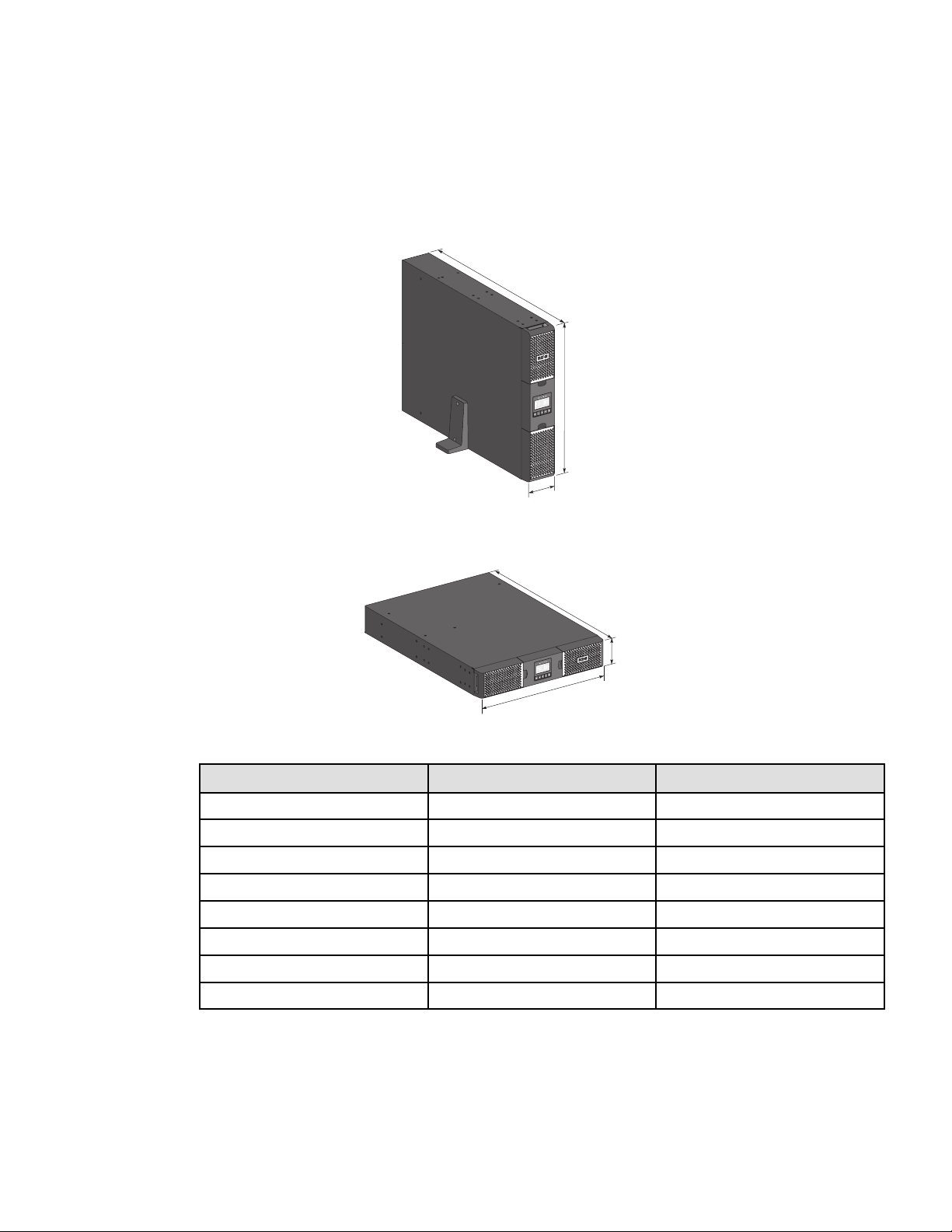
Figure 1. Tower Installation
D
W
H
Figure 2. Rack Installation
D
H
W
Table 2. Weights and Dimensions
Model
Dimensions D x W x H(inch/mm) Weight (lb / kg)
9PX1500RT-L 17.7 x 17.3 x 3.4 / 450 x 440 x 86.5 35.5 / 16.2
9PX2000RT-L 23.8 x 17.3 x 3.4 / 605 x 440 x 86.5 50.6 / 23.0
9PX3000RT-L 23.8 x 17.3 x 3.4 / 605 x 440 x 86.5 52.7 / 24.0
9PX1500GRT-L
17.7 x 17.3 x 3.4 / 450 x 440 x 86.5 34.8 / 15.8
9PX2200GRT-L 23.8 x 17.3 x 3.4 / 605 x 440 x 86.5 48.6 / 22.1
9PX3000GRT-L 23.8 x 17.3 x 3.4 / 605 x 440 x 86.5 50.2 / 22.8
9PXEBM48RT-L 17.6 x 17.2 x 1.7 / 448 x 438 x 42.9 36.5 / 16.6
9PXEBM72RT-L 23.7 x 17.2 x 1.7 / 603 x 438 x 42.9 46.6 / 21.2
4 Eaton 9PX Lithium-Ion P-164001006—Rev 01
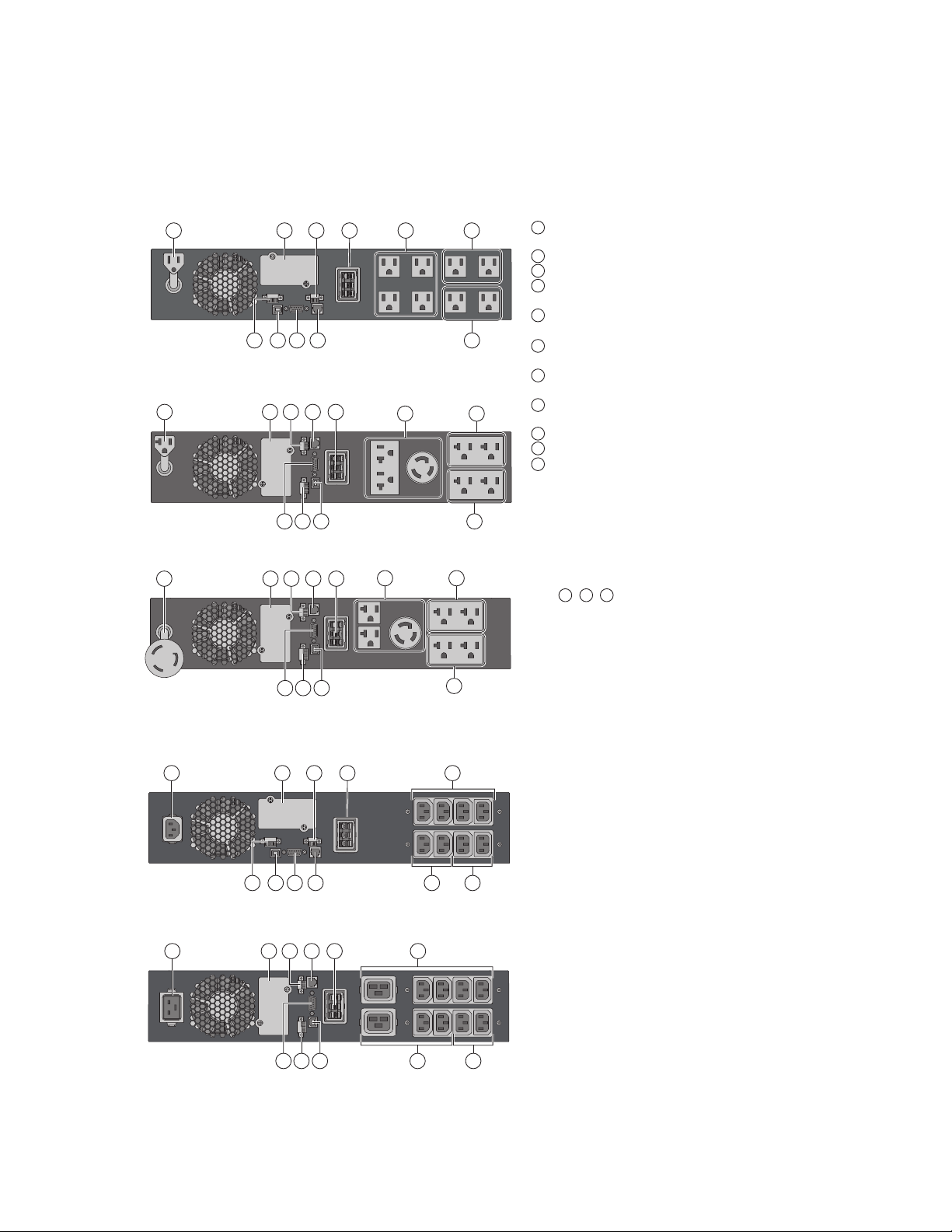
22..22 RReeaarr PPaanneellss
9PX 1500RT-L
1 2 3 4 5 6
9 811 10 7
9PX 2000RT-L
1 82 43
5 6
9 1011
7
9PX 1500GRT-L
9PX 3000RT-L (*)
1 82 43
5 6
9 1011
7
9PX 2200GLRT-L & 9PX 3000GRT-L
1
Socket for connection to AC power
source
2
Slot for optional communication card
3
Relay output contact
4
Connector for additional battery
module
5
Primary group: outlets for
connection of critical equipment
6
Group 1: programmable
outlets for connection of equipment
7
Group 2: programmable
outlets for connection of equipment
8
Connector for automatic recognition
of an additional battery module
9
RS232 communication port
10
USB communication port
11
Connector for ROO (Remote On/Off)
control and RPO (Remote Power Off)
(*) Primary and Grouped outlets
(
5
,
6
,
7
) are protected by 20A
circuit breakers.
1 82 4 53
9 1011 6 7
1 2 3 4 5
9 811 10 6 7
Rear Panels
Eaton 9PX Lithium-Ion P-164001006—Rev 01 5
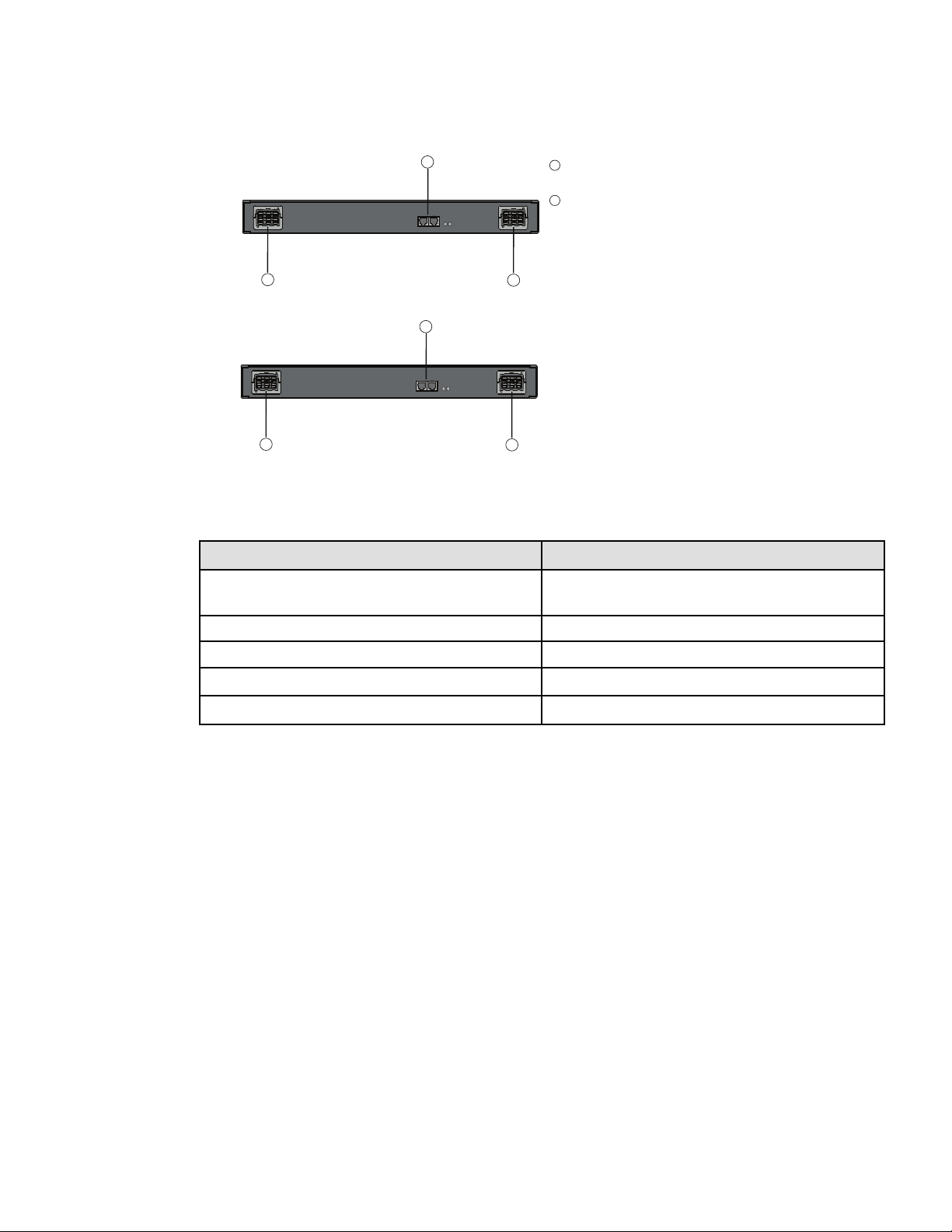
9PXEBM48RT-L
13
12
12
Connectors for battery modules
(to the UPS or to the other battery
modules)
13
Connectors for automatic recognition
of battery modules
9PXEBM72RT-L
12
13
12
12
22..33 AAcccceessssoorriieess
Table 3. UPS Accessories
Part number Description
9PXEBM48RT-L
9PXEBM72RT-L
Extended Battery Module
9RK Rack Kit 9PX
Network-M2 Network Card
INDGW-M2 Industrial Gateway Card (Modbus TCP / RTU)
Relay-MS Relay Card
22..44 CCoonnttrrooll PPaanneell
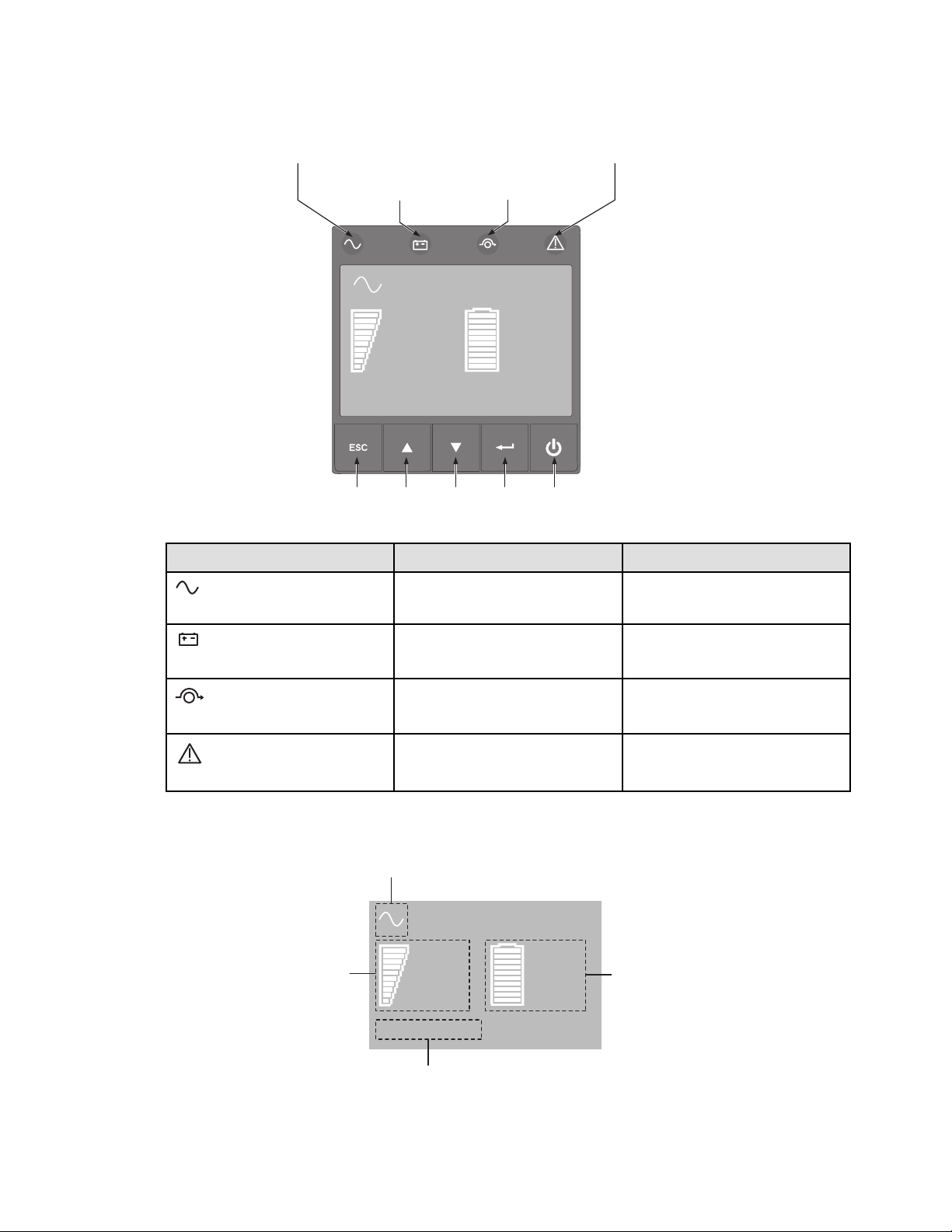
The UPS has a five-button graphical LCD. It provides useful information about the UPS itself, load status, events,
measurements and settings.
Accessories
6 Eaton 9PX Lithium-Ion P-164001006—Rev 01
Online mode
indicator (green)
Fault
indicator (red)
Online mode
100%
19min
1EBM
100%
2.4kW
3.0kVA
Efficiency: 94 %
Escape Up Down Enter On/Off
button
Battery mode
indicator (orange)
Bypass mode
indicator (orange)
Indicator Status Description
Green
On
The UPS is operating normally on Online
or on High Efficiency mode.
Orange
On The UPS is on Battery mode.
Orange
On The UPS is on Bypass mode.
Red
On
The UPS has an active alarm or fault.
22..55 LLCCDD DDeessccrriippttiioonn
Operation status
Load/equipment status
Online mode
100%
19min
1EBM
100%
2.4kW
3.0kVA
Efficiency: 94%
Battery status
Efciency and load group information
LCD Description
Eaton 9PX Lithium-Ion P-164001006—Rev 01 7
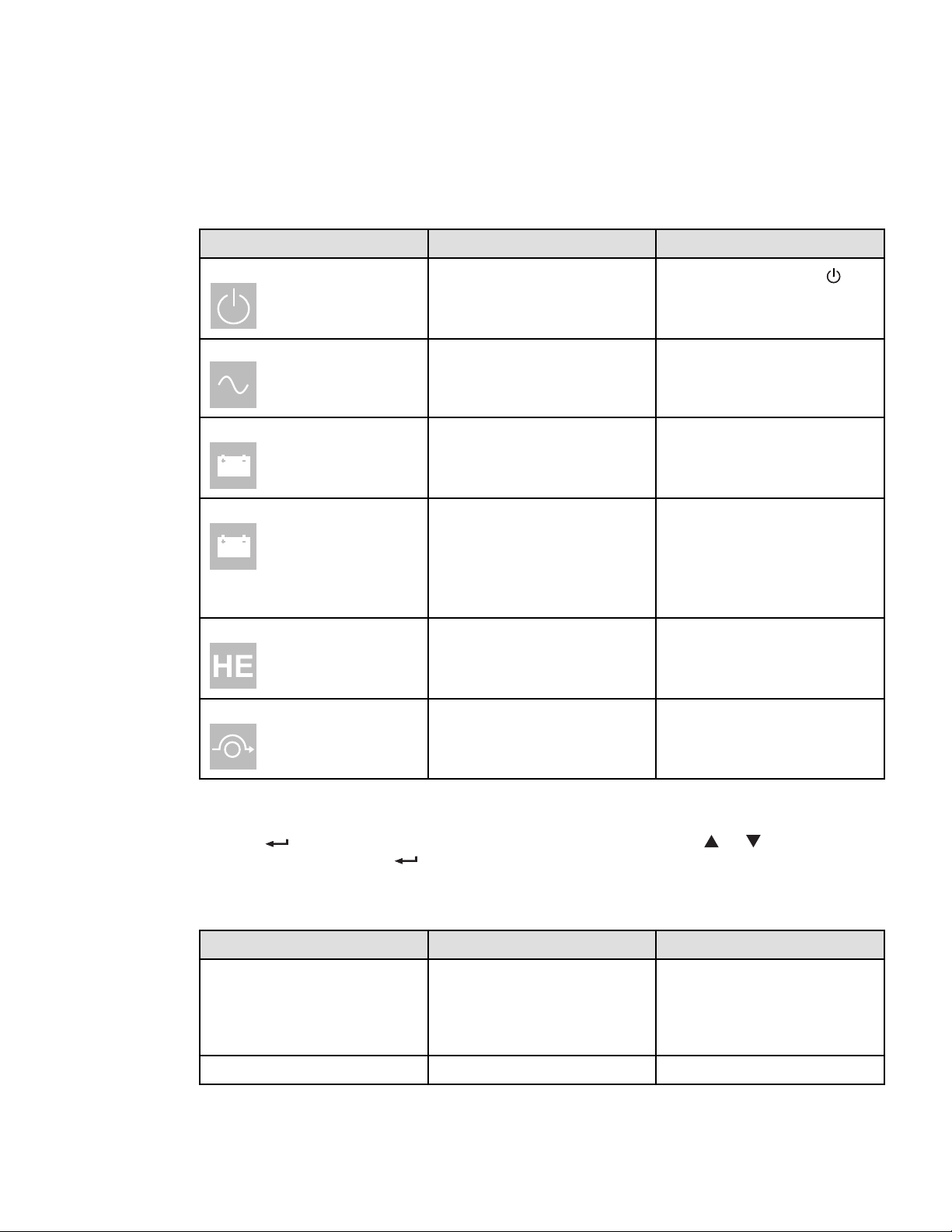
The following table describes the status information provided by the UPS
Note: If other indicator appears, see the troubleshooting for additional information.
Table 4. LCD Operating Status
Operation status Cause Description
Standby mode
The UPS is Off, waiting for startup
command from user.
Equipment is not powered until
button is pressed.
Online mode
The UPS is operating normally. The UPS is powering and protecting the
equipment.
Battery mode
A utility failure has occured and the UPS
is on Battery mode.
The UPS is powering the equipment with
the battery power. Prepare your
equipment for shutdown.
End of backup time
The UPS is on Battery mode and the
battery is running low.
Low Battery Warning settings:
[Capacity] [0%] ... [100%]
[Runtime] [0mn] ... [60mn]
The alarm triggers when the set
percentage of battery capacity or
remaining back-up time is reached.
High Efficiency mode
The UPS is operating on High Efficiency
mode.
The UPS is powering and protecting the
equipment
Bypass mode
An overload or a fault has occurred, or a
command has been received, and the
UPS is in Bypass mode.
Equipment is powered but not protected
by the UPS.
22..66 DDiissppllaayy FFuunnccttiioonnss
Press the ( ) button to activate the menu options. use the two middle buttons ( and ) to scroll through
the menu structure. Press the (
) button to select an option. Press the ESC button to cancel or return to the
previous menu.
Table 5. Display Functions
Main menu Submenu Display information or Menu function
Measurements
[Load] W VA A pf / [Input/Output] V Hz /
[Efficiency] % / [Battery] % min V n°
EBM / [Battery remaining life] months /
[Average power usage] Wh / [Cumulated
power] Wh / BMS Information
Control Go to Bypass Transfers the UPS on Bypass mode
Display Functions

8 Eaton 9PX Lithium-Ion P-164001006—Rev 01
Table 5. Display Functions (Continued)
Main menu Submenu Display information or Menu function
Load segments On/Off Commands the load segments
Start battery test Starts a manual battery test
Connectivity test Tests dry contact relay outputs and relay
card contacts. Simulates line failure and
battery low
Function reset
Clears active fault, power usage, battery
remaining life, reset NMC, Restore
factory settings.
Settings Local settings Sets product general parameters
In/out settings Sets Input and Output parameters
On/Off settings Sets On/Off conditions
Battery settings Sets battery configuration
Com settings Sets communication parameters
Event Log Event filter Selects faults, alarms and/or events to
display
Event list Displays the events stored
Reset fault list Clears events
Fault log Fault list Displays the faults stored
Reset fault list Clears faults
Identification
[Product type/model] / [Part/Serial
number] / [UPS/NMC firmware] / [Com
card IPv4], [Com card IPv6], [Com card
MAC]
Registration Links to Eaton registration website
22..77 UUsseerr SSeettttiinnggss
The following table displays the options that can be changed by the user.
Table 6. User Settings
Submenu
Available settings Default settings
Local settings
Language
[English] [Français] [Deutsch] [Español]
[Русский] [Português] [Italiano]
[Simplified Chinese] [Japanese]
Menus, status, notices and alarms,
UPS fault, Event Log data and settings
are in all supported languages.
[English] User selectable when UPS is powered
for the first time.
Date/ time Format: [International] [US] [US]
User Settings

Eaton 9PX Lithium-Ion P-164001006—Rev 01 9
Table 6. User Settings (Continued)
Submenu
Available settings Default settings
LCD
Modify LCD screen brightness and
contrast to be adapted to room light
conditions.
Audible alarm
Mode: [Enabled] [Disabled on battery]
[Always disabled] Enable or disable
the buzzer if an alarm occurs. Level:
[High] [Low]
[Enabled] [High]
Protected
access
[Enabled] [Disabled] Password is: 0577 [Disabled]
In/Out settings
Output voltage
100V] [110V] [120V] [125V]
[200V] [208V] [220V] [230V] [240V]
[120V]
[208V]
Output
frequency
Mode: [Normal] [Converter] [Marine]
Frequency can be changed in
Frequency [Converter] mode In [Marine]
mode output frequency follows input
frequency
[Normal]
Output mode
Mode: [Industrial] [IT] [Custom]
Overload: [Inv>Stop] [Inv>BP]
[Inv>BP>Inv]
Short-circuit: [Inv>Stop] [Inv>BP]
[Inv>BP>Inv]
[IT] [Inv>BP>Inv] [Inv>Stop]
Input volt
hysteresis
Sets input voltage hysteresis from [1]
to |10V]
[10V]
High Efficiency
mode
[Enabled] [Disabled] Power the output
from Bypass for high efficiency
[Disabled]
Bypass settings
[Volt low]
[Volt high]
[Qualify]
[Hz synch]
[Unsynch]
[80V] LV; [160V] HV;
[144V] LV; [276V] HV;
[In spec];
[5%];
[Half cycle]
Load segments
[Auto start delay]
[Auto shutdown delay]
UPS: [0s]; Group1: [3s]; Group2: [6s] UPS:
[Disabled];
Group1: [Disabled]; Group2: [Disabled]
Overload
prealarm
[10%] … [102%] Load % when
overload alarm occurs
[102%]
On/Off Settings
Start/Restart
[Cold start] [Auto restart] [Auto start]
[Start on bypass]
[Cold start] [Auto restart] are Enabled
[Auto start] [Start on bypass] are Disabled
Forced reboot
[Enabled] [Disabled]
[Timer] [10s] … [180s]
When mains recover during a
shutdown sequence: If set to Enabled,
shutdown sequence will complete and
wait 10 seconds prior to restart, If set
[Enabled]
[10s]
User Settings

10 Eaton 9PX Lithium-Ion P-164001006—Rev 01
Table 6. User Settings (Continued)
Submenu
Available settings Default settings
to Disabled, shutdown sequence will
not complete, UPS stays on.
Energy saving
[Enabled] [Disabled]
[Timer] [1min] … [15min]
[Level] [100W] … [1000W]
If Enabled, UPS will shut-down after
defined duration. of back-up time, if
load is less than set value.
[Disabled]
[5min]
[100W]
Sleep mode
[Enabled] [Disabled]
[Timer] [10min] … [120min]
If Disabled, LCD and communication
will turn OFF immediately after UPS is
OFF.
If Enabled, LCD and communication
stays ON 1h30 min after UPS is OFF.
[Enabled]
[90min]
Site wiring
fault
[Enabled] [Disabled]
Prevents from starting the UPS in case
of phase vs neutral wires swapping.
[Disabled]
Power Off alert
[Enabled] [Disabled]
If Enabled, activates a confirmation
screen that requires user confirmation
after pressing the power button,
before the UPS shutdown occurs.
[Enabled]
Battery settings
Low battery
warning
[Capacity] [0%] … [100%]
[Runtime] [0min] … [60min]
The alarm triggers when the set
percentage of battery capacity or
remaining back-up time is reached.
[0%]
[3min]
Restart bat.
level
[0%] ... [100%]
If set, automatic restart will occur only
when percentage of battery charge is
reached.
[0%]
Com settings Input signals
[ROO] [RPO] [DB9–4}
Sets Input signals parameters
(function, delay, operation) through
external contact connectors or RS232.
ROO port:
- [Function]: [No] [ROO] [RPO] [Building
alarm] [Forced bypass] [On generator]
[Remote shutdown]
[No]
- [Delay]: [0s] … [999s]
- [Active]: [Open] [Closed]
[0s]
[Closed]
RPO port:
User Settings

Eaton 9PX Lithium-Ion P-164001006—Rev 01 11
Table 6. User Settings (Continued)
Submenu
Available settings Default settings
- [Function]: [No] [ROO] [RPO] [Building
alarm] [Forced bypass] [On generator]
[Remote shutdown]
No
- [Delay]: [0s] … [999s]
- [Active]: [Open] [Closed]
[0s]
[Open]
DB9-4 port:
No
- [Function]: [No] [ROO] [RPO] [Building
alarm] [Forced bypass] [On generator]
[Remote shutdown]
- [Delay]: [0s] … [999s]
- [Active]: [High] [Low]
[0s]
[High]
Output signals
[Relay] [DB9-1] [DB9-7] [DB9-8] Sets
events or fault that will actuate Output
signal parameters through external
contact connector or RS232
[Relay]: [On bat] [Low bat] [Bat fault]
[Bypass] [UPS OK] [Load protected]
[Load powered] [General alarm] [Ext.
charger ON] [OVL pre-alarm]
[Relay] [Bypass]
[DB9-1]: [On bat] [Low bat] [Bat fault]
[Bypass] [UPS OK] [Load protected]
[Load powered] [General alarm] [Ext.
charger ON] [OVL pre-alarm]
[DB9-1] [Low bat]
[DB9-7]: [On bat] [Low bat] [Bat fault]
[Bypass] [UPS OK] [Load protected]
[Load powered] [General alarm] [Ext.
charger ON] [OVL pre-alarm]
[DB9-7] [UPS OK]
[DB9-8]: [On bat] [Low bat] [Bat fault]
[Bypass] [UPS OK] [Load protected]
[Load powered] [General alarm] [Ext.
charger ON] [OVL pre-alarm]
[DB9-8] [On bat]
Remote
command
[Enabled] [Disabled] If Enabled,
shutdown or restart commands from
software are authorized.
[Enabled]
Shutdown
commands
[Send CMD] [Output OFF] [OFF delay]
[restart]
Sets events or fault that will actuate
Output signal parameters through
external contact connector or RS232
port
[Send CMD]: [Yes] [No] Send CMD: [No]
[Output OFF]: [No] [UPS] [Group 1] Output OFF: [No]
User Settings

12 Eaton 9PX Lithium-Ion P-164001006—Rev 01
Table 6. User Settings (Continued)
Submenu
Available settings Default settings
[Group 2] [Group 1 + Group 2]
[OFF delay]: [0s] …[999s] OFF delay: [0s]
[Restart]: [Yes] [No] Restart: [Yes]
On battery
notice delay
[0s] ... [99s]
Sets delay before noticing on battery
information to software.
[0s]
General alarm
[On battery] [Battery fault] [Internal fault]
[Overload pre-alarm] [Internal fault]
[Ambient temp.] [Fan lock]
[Bypass overload] [Current limit]
[Short circuit] [Inverter overload]
[Power overload] [Low battery]
[On bypass] [UPS OK] [Load protected]
[Load powered] [Ext. charger ON]
Defines which event or fault generate
a general alarm through Output signal
screen.
User Settings
Eaton 9PX Lithium-Ion P-164001006—Rev 01 13
CChhaapptteerr 33 IInnssttaallllaattiioonn
33..11 IInnssppeeccttiinngg tthhee EEqquuiippmmeenntt
If any equipment has been damaged during shipment, keep the shipping cartons and packing materials for the
carrier or place of purchase and file a claim for shipping damage. If you discover damage after acceptance, file a
claim for concealed damage.
To file a claim for shipping damage or concealed damage:
1. File with the carrier within 15 days of receipt of the equipment;
2. Send a copy of the damage claim within 15 days to your service representative.
!
IMPORTANT
Check the battery recharge date on the shipping carton label. If the date has passed and the batteries were
never recharged, do not use the UPS. Contact your service representative.
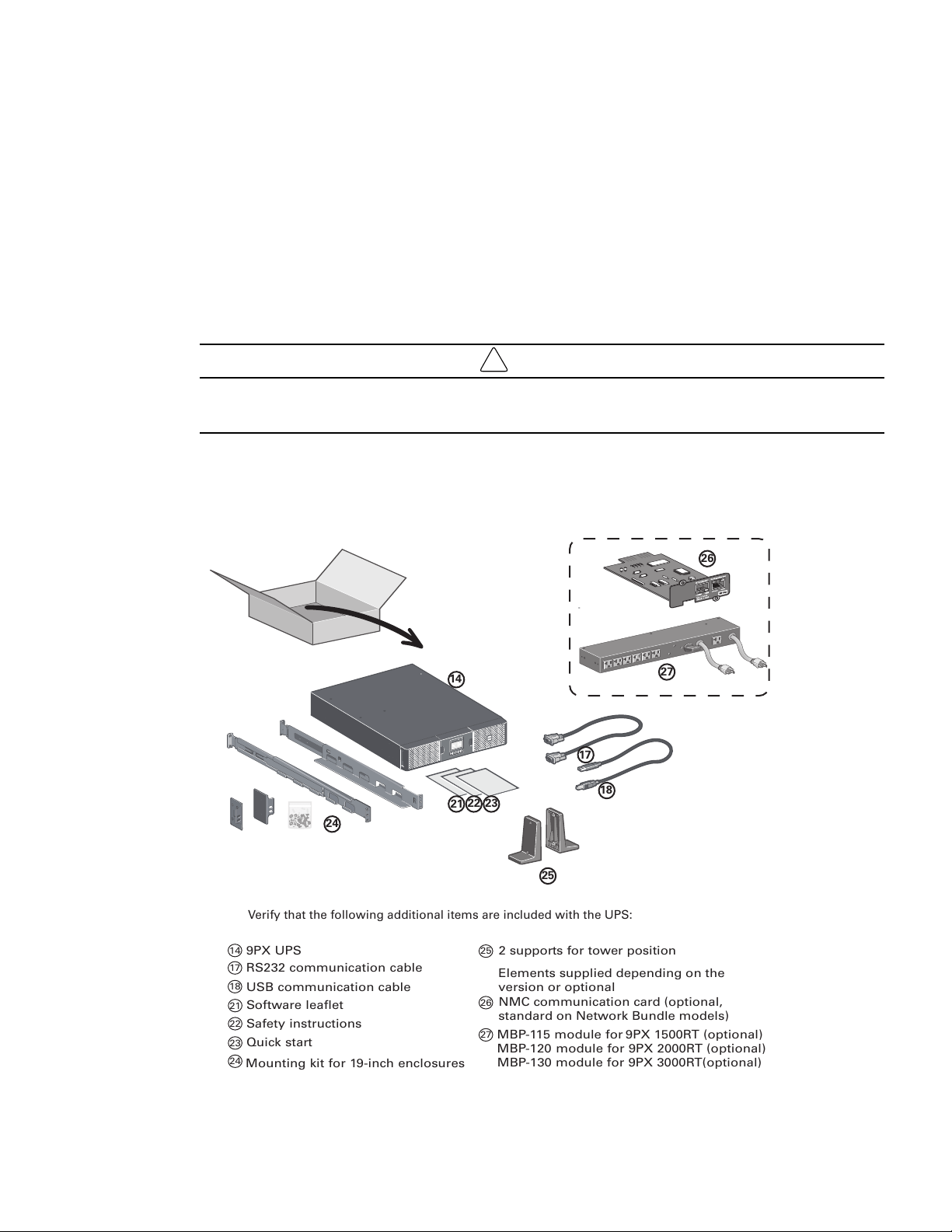
33..22 CChheecckkiinngg tthhee AAcccceessssoorryy KKiitt
Figure 3. 9PX1500RT-L / 9PX2000RT-L / 9PX3000RT-L
14
24
25
21
22 23
17
18
14
9PX UPS
17
RS232 communication cable
18
USB communication cable
21
Software leaet
22
Safety instructions
23
Quick start
24
Mounting kit for 19-inch enclosures
27
26
25
2 supports for tower position
Elements supplied depending on the
version or optional
26
27
MBP-115 module for 9PX 1500RT (optional)
MBP-120 module for 9PX 2000RT (optional)
MBP-130 module for 9PX 3000RT(optional)
NMC communication card (optional,
standard on Network Bundle models)
Verify that the following additional items are included with the UPS:
14 Eaton 9PX Lithium-Ion P-164001006—Rev 01
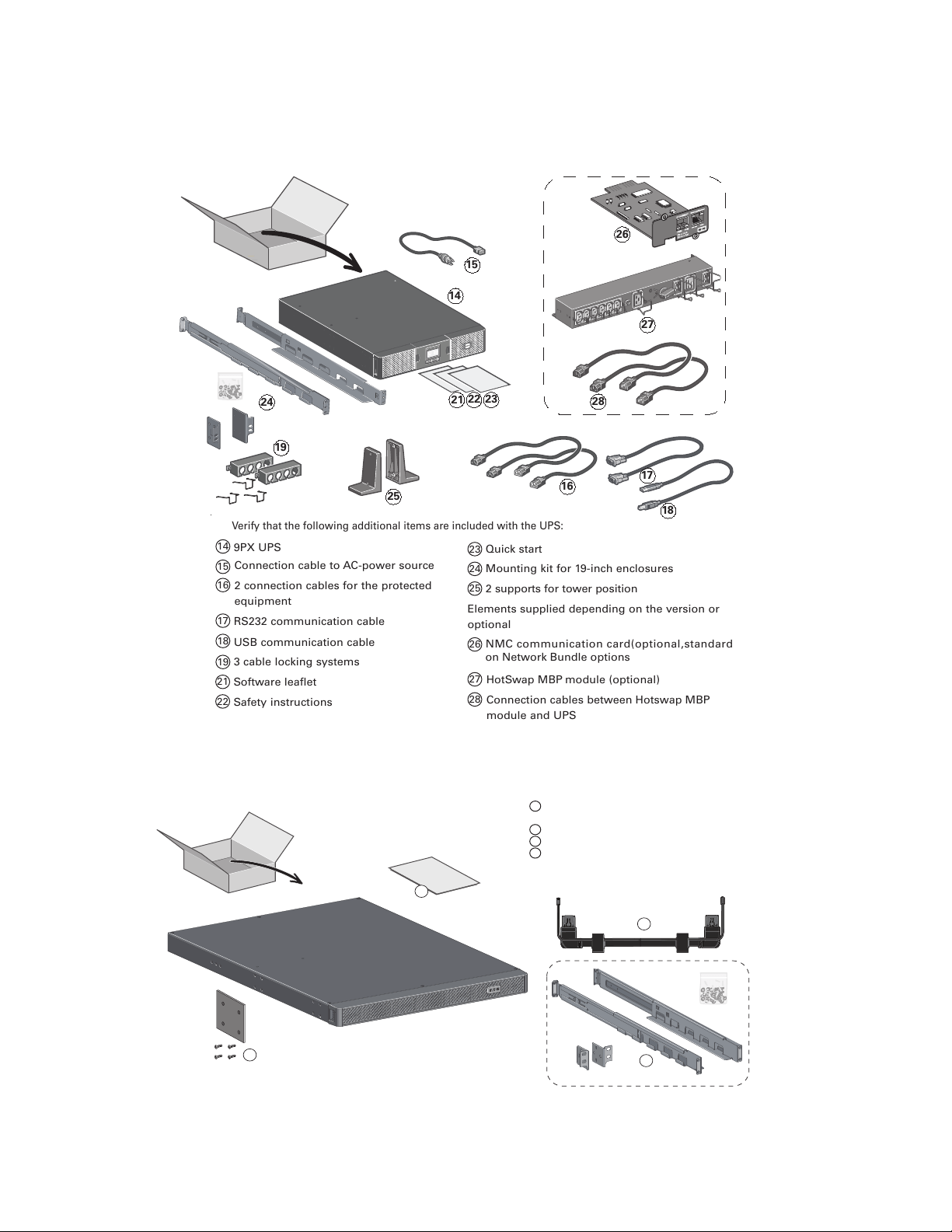
Figure 4. 9PX1500GRT-L / 9PX2200GRT-L / 9PX3000GRT-L
14
21
22 23
24
25
16
15
19
26
27
28
17
18
14
9PX UPS
15
Connection cable to AC-power source
16
2 connection cables for the protected
equipment
17
RS232 communication cable
18
USB communication cable
19
3 cable locking systems
21
Software leaet
22
Safety instructions
23
Quick start
24
Mounting kit for 19-inch enclosures
25
2 supports for tower position
Elements supplied depending on the version or
optional
26
NMC communication card(optional,standard
on Network Bundle options
27
HotSwap MBP module (optional)
28
Connection cables between Hotswap MBP
module and UPS
Verify that the following additional items are included with the UPS:
Figure 5. 9PXEBM48RT-L / 9PXEBM72RT-L
• If you ordered an optional Extended Battery Module (EBM), verify that the following additional items are
included with the EBM:
4
2
1
1
Battery power cable with attached battery
detection cable
2
Stabilizer bracket (4 screws included)
3
Rack kit for 19-inch enclosures (optional)
4
EBM Installation manual.
3
Checking the Accessory Kit
Eaton 9PX Lithium-Ion P-164001006—Rev 01 15
NOTE 1 Discard the EBM user’s guide if you are installing the EBM with a new UPS at the same
time.
NOTE 2 Use the UPS user’s guide to install both the UPS and the EBM.
Remember If you ordered other UPS accessories, refer to specific user manuals to check the packing
contents.
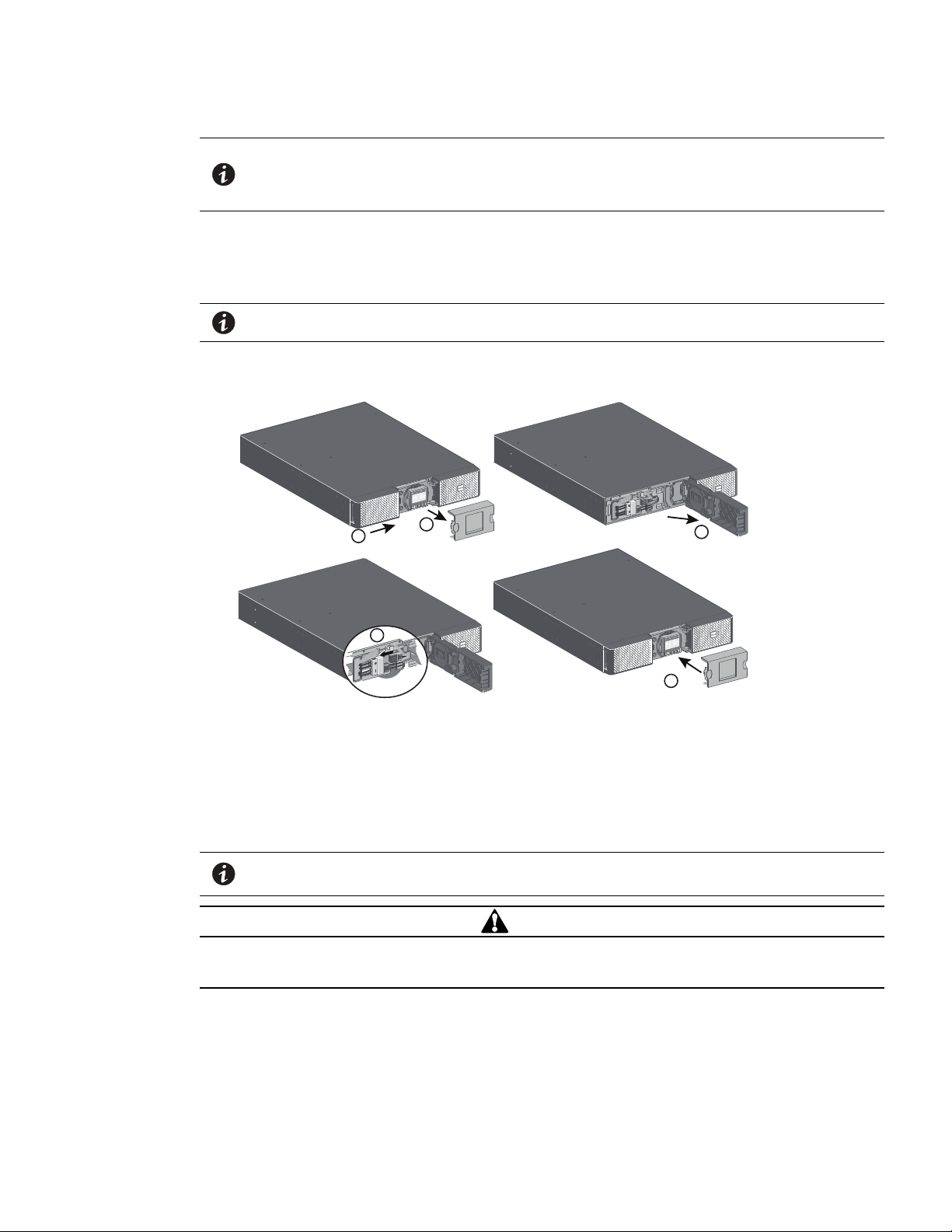
33..33 CCoonnnneeccttiinngg tthhee IInntteerrnnaall BBaatttteerryy
NOTE Do not connect the UPS to the utility until installation is complete.
Figure 6. Internal Battery Connection
1
2
3
5
4
To connect to the UPS:
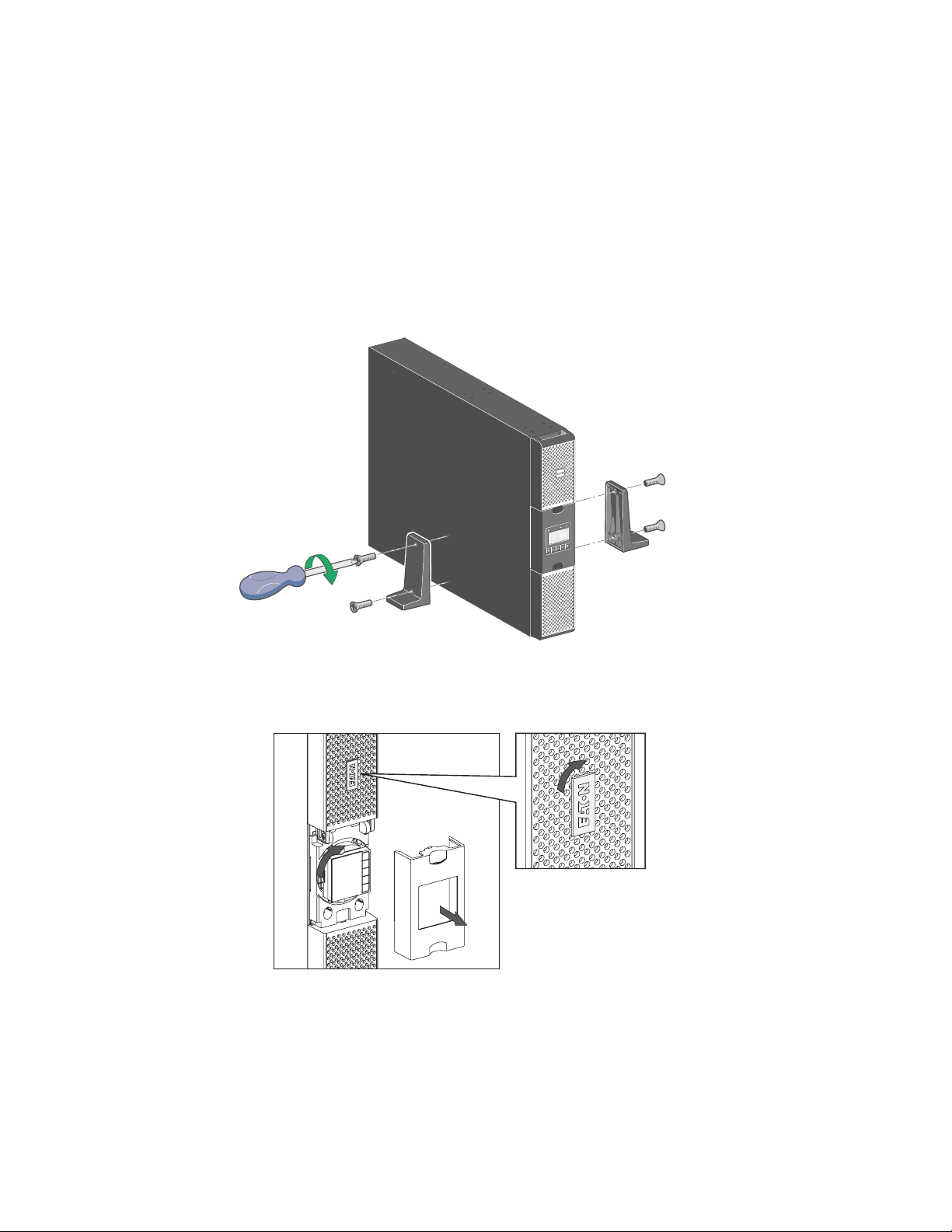
1. Remove the center cover of the front panel.
2. Push left cover toward to right direction.
3. Open the left side of the front panel.
NOTE A ribbon cable connects the LCD control panel to the UPS. Do not pull on the cable or
disconnect it.
CAUTION
A small amount of arcing may occur when connecting the internal batteries. This is normal and will not harm
personnel. Connect the cables quickly and firmly.
4. Connect the two battery connectors together.
5. Put back the front panel, then clip the center cover.
Connecting the Internal Battery
16 Eaton 9PX Lithium-Ion P-164001006—Rev 01
33..44 TToowweerr IInnssttaallllaattiioonn
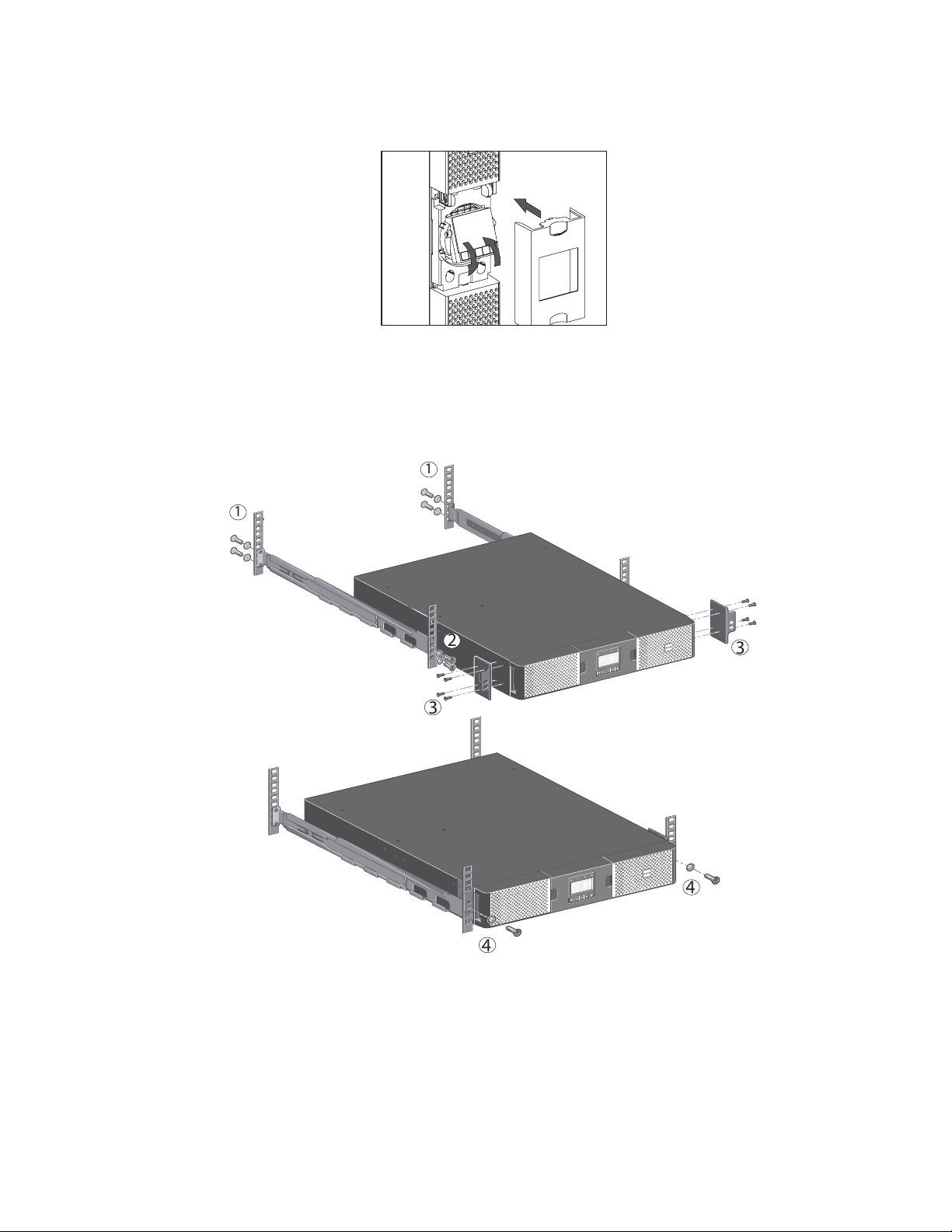
Tip If you ordered other UPS accessories, refer to specific user manuals to check the tower installation with
the UPS.
To install the cabinet:
1. Place the UPS on a flat, stable surface in its final location.
2. Always keep 6" or 150 mm of free space behind the UPS rear panel for ventilation.
3. If installing additional cabinets, place them next to the UPS in their final location.
• Adjustment of the orientation of the LCD panel and of the logo.
• Adjustment of the angle of vision of the LCD panel.
Tower Installation
Eaton 9PX Lithium-Ion P-164001006—Rev 01 17
33..55 RRaacckk IInnssttaallllaattiioonn
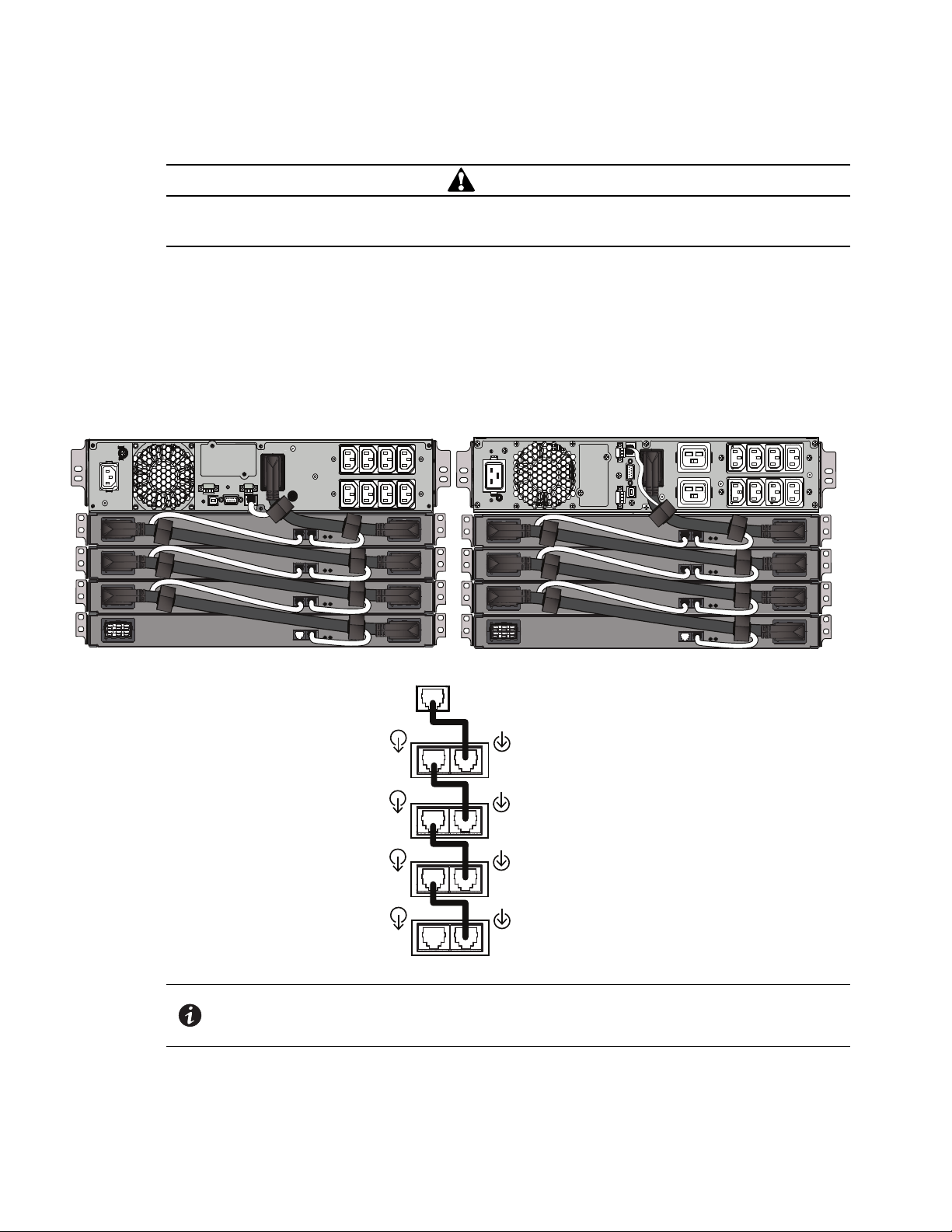
• Rack mounting of UPS, EBM, and accessory modules.
Follow steps 1 to 4 for module mounting on the rails.
1
1
3
3
4
4
2
The rails and necessary hardware are supplied by EATON.
Rack Installation
18 Eaton 9PX Lithium-Ion P-164001006—Rev 01
33..66 CCoonnnneeccttiinngg tthhee EEBBMM((ss))
CAUTION
A small amount of arching may occur when connecting an EBM to the UPS. This is normal and will not harm
personnel. Insert the EBM cable into the UPS battery connector quickly and firmly.
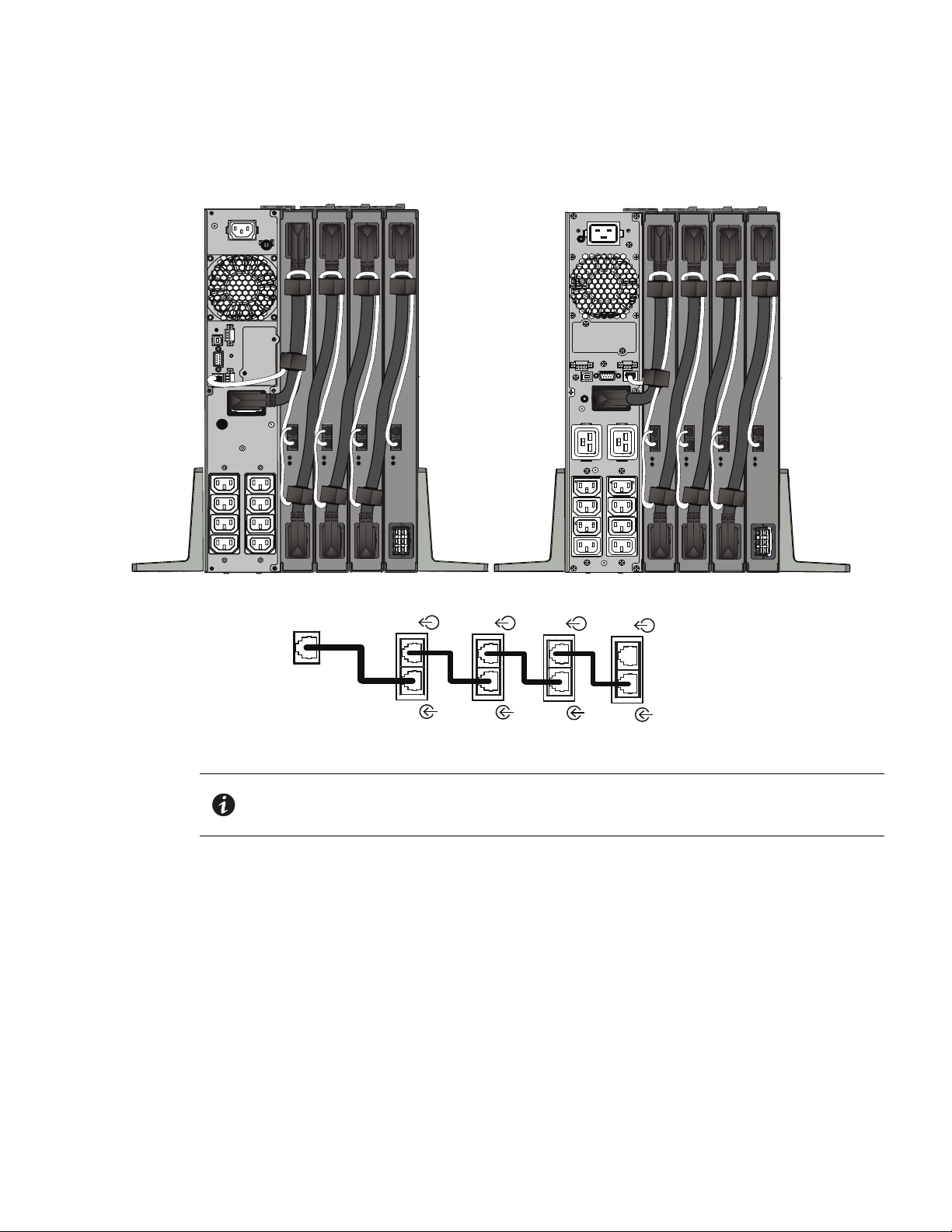
1. Plug the EBM power cable(s) into the battery connector(s). Up to 4 EBMs may be connected to the UPS.
2. Verify that the EBM connections are tight and that adequate bend radius and strain relief exist for each
cable.
3. Connect the battery detection cable(s) to the connector of the UPS and of the EBM(s).
Figure 7. 9PXEBM Rack Mount Connections
9PXEBM48 9PXEBM72
Battery Comm
Battery Comm
Battery Comm
Battery Comm
EBM Communications wiring
UPS
EBM 1
EBM 2
EBM 3
EBM 4
NOTE The EBM communication wiring connections are directional and must be connected in
the correct sequence to ensure proper detection, regulation and lifecycle monitoring of
the integrated battery management system (BMS).
Connecting the EBM(s)
Eaton 9PX Lithium-Ion P-164001006—Rev 01 19
Figure 8. 9PXEBM Tower Mount Connections
9PXEBM48
9PXEBM72
Battery Comm
Battery Comm
Battery Comm
Battery Comm
UPS
EBM Communications wiring
EBM 1 EBM 2 EBM 3
EBM 4
NOTE The EBM communication wiring connections are directional and must be connected in
the correct sequence to ensure proper detection, regulation and lifecycle monitoring of
the integrated battery management system (BMS).
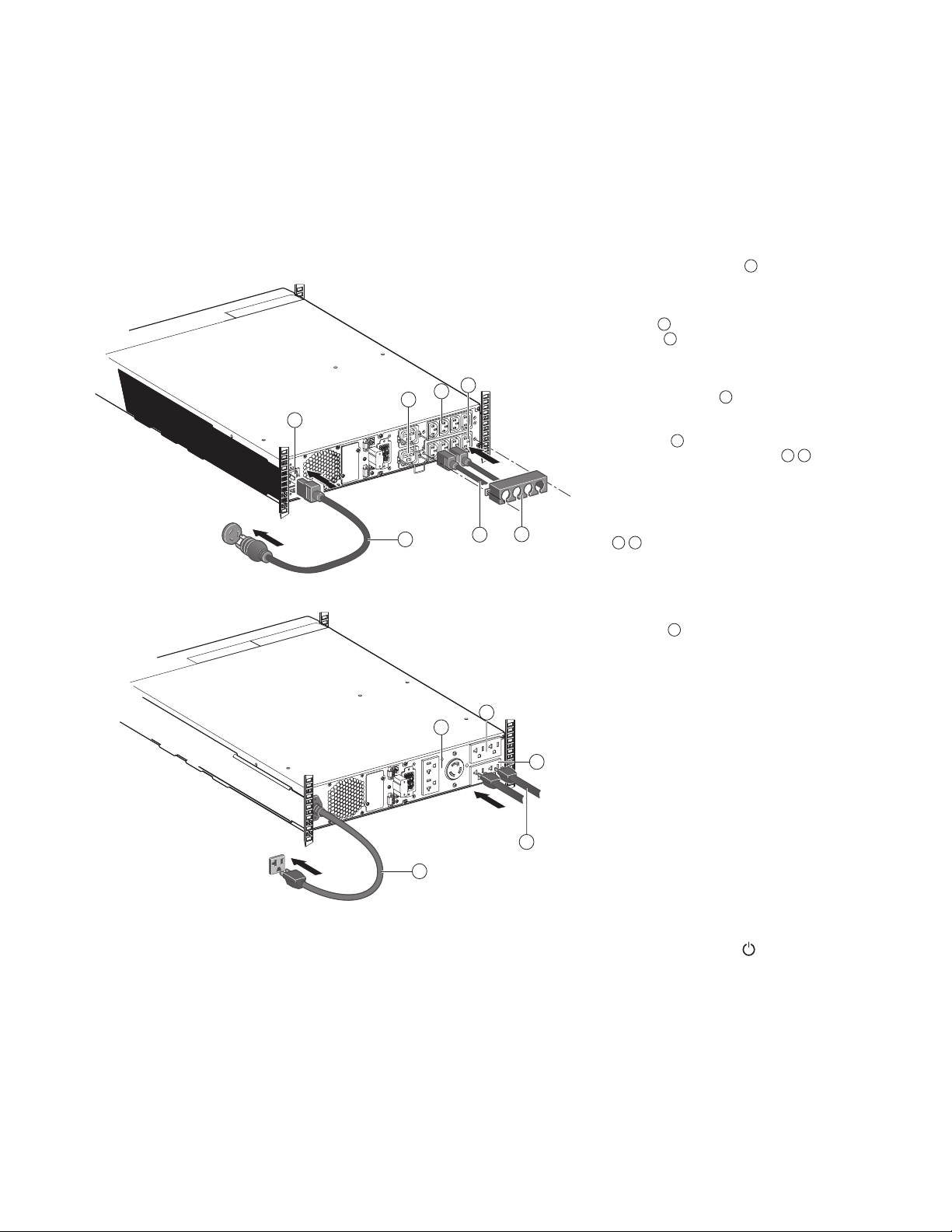
33..77 DDeetteeccttiinngg ootthheerr AAcccceessssoorriieess
Tip If you ordered other UPS accessories, refer to specific user manuals to check the connection to the UPS.
Detecting other Accessories
20 Eaton 9PX Lithium-Ion P-164001006—Rev 01
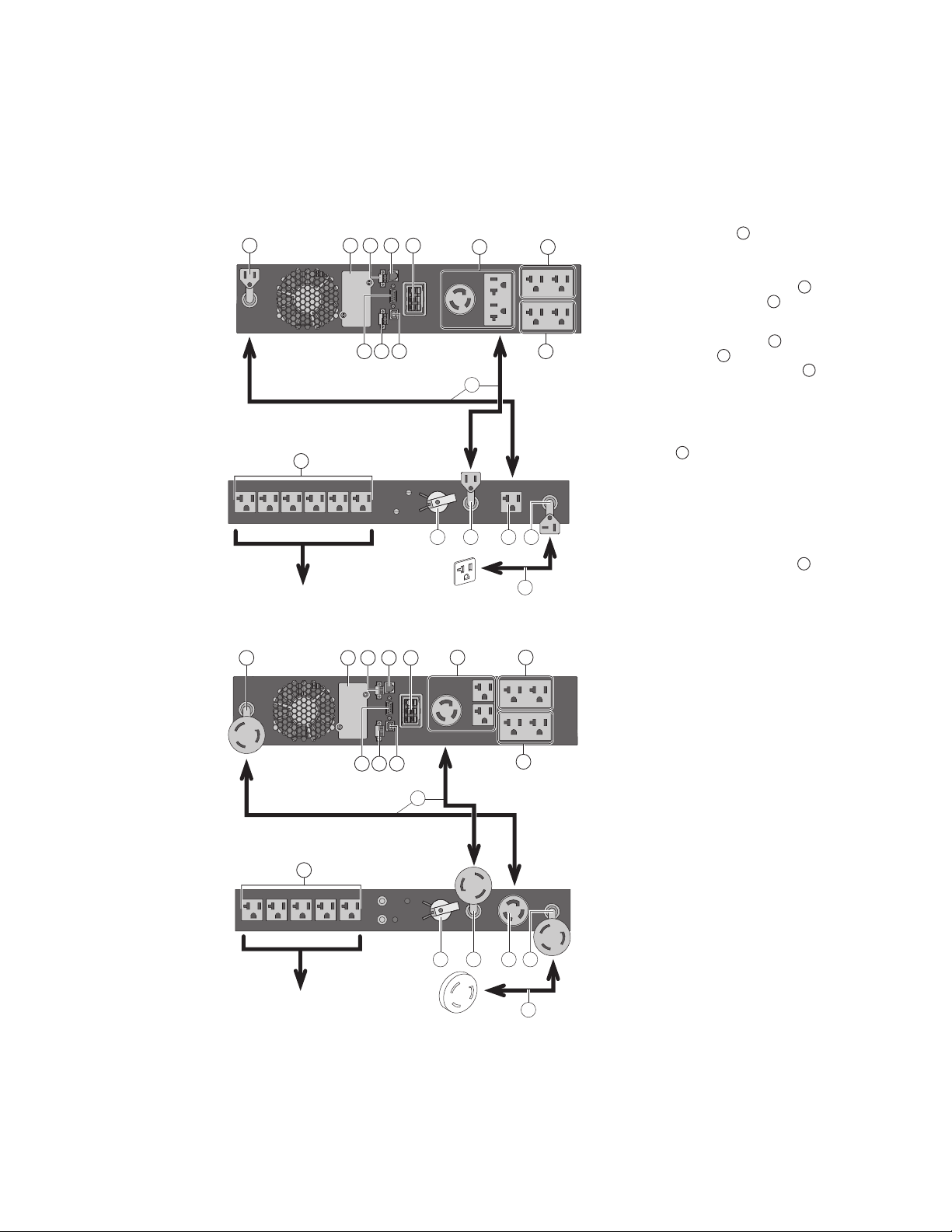
33..88 UUPPSS CCoonnnneeccttiioonn wwiitthhoouutt HHoottsswwaapp MMBBPP MMoodduullee
Check that the indications on the name plate located on the back of the UPS correspond to the AC-power
source and the true electrical consumption of the total load.
15
1
16
19
7
6
5
1. 9PX 2000RT-L / 3000RT-L connect
the UPS input socket
1
to the
AC-power source.
9PX 2200GRT-L / 3000GRT-L /
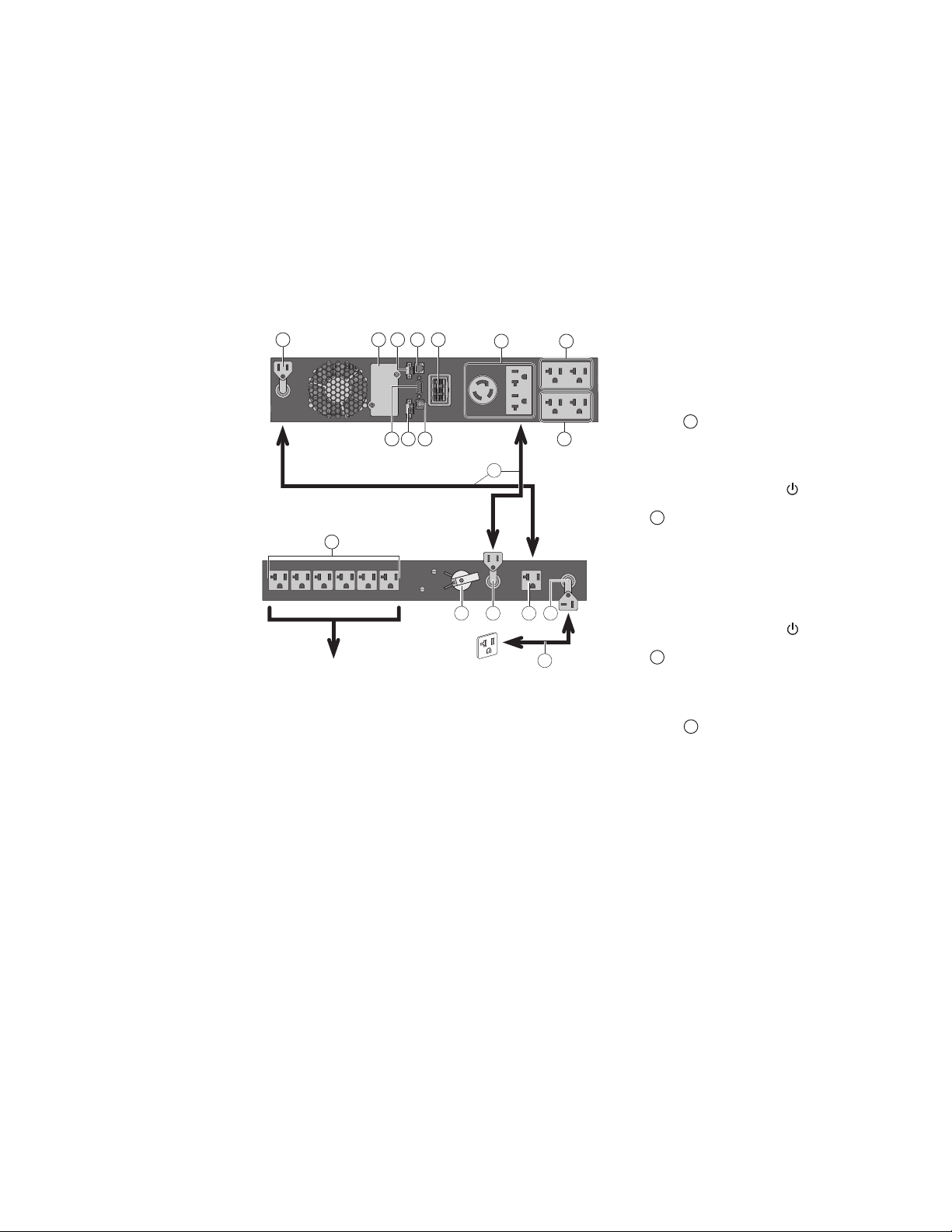
3000GLRT-L: connect the supplied
cable
15
(250 V - 16 A) to the
socket
1
, then to the AC-power
source.
2. Connect the loads to the UPS
using the cables
16
.
It is preferable to connect the
priority loads to the outlets
marked
5
and the non-priority
loads to the outlets marked
6
7
that can be programmed.
Connect any high-power devices
to the 16 A outlet.
To program shutdown of outlets
6
7
during operation on battery
power and thus optimise
the available backup time,
please check the in/out settings.
3. For G models, t the cable locking
system
19
that prevents the plugs
from being pulled out accidentally.
Note. The UPS charges the battery as soon as it is connected to the AC-power source, even if
button is not pressed
.
Once the UPS is connected to the AC-power source, eight hours of charging are required before the
battery can supply the rated backup time.
15
7
16
6
5
UPS Connection without Hotswap MBP Module
Eaton 9PX Lithium-Ion P-164001006—Rev 01 21
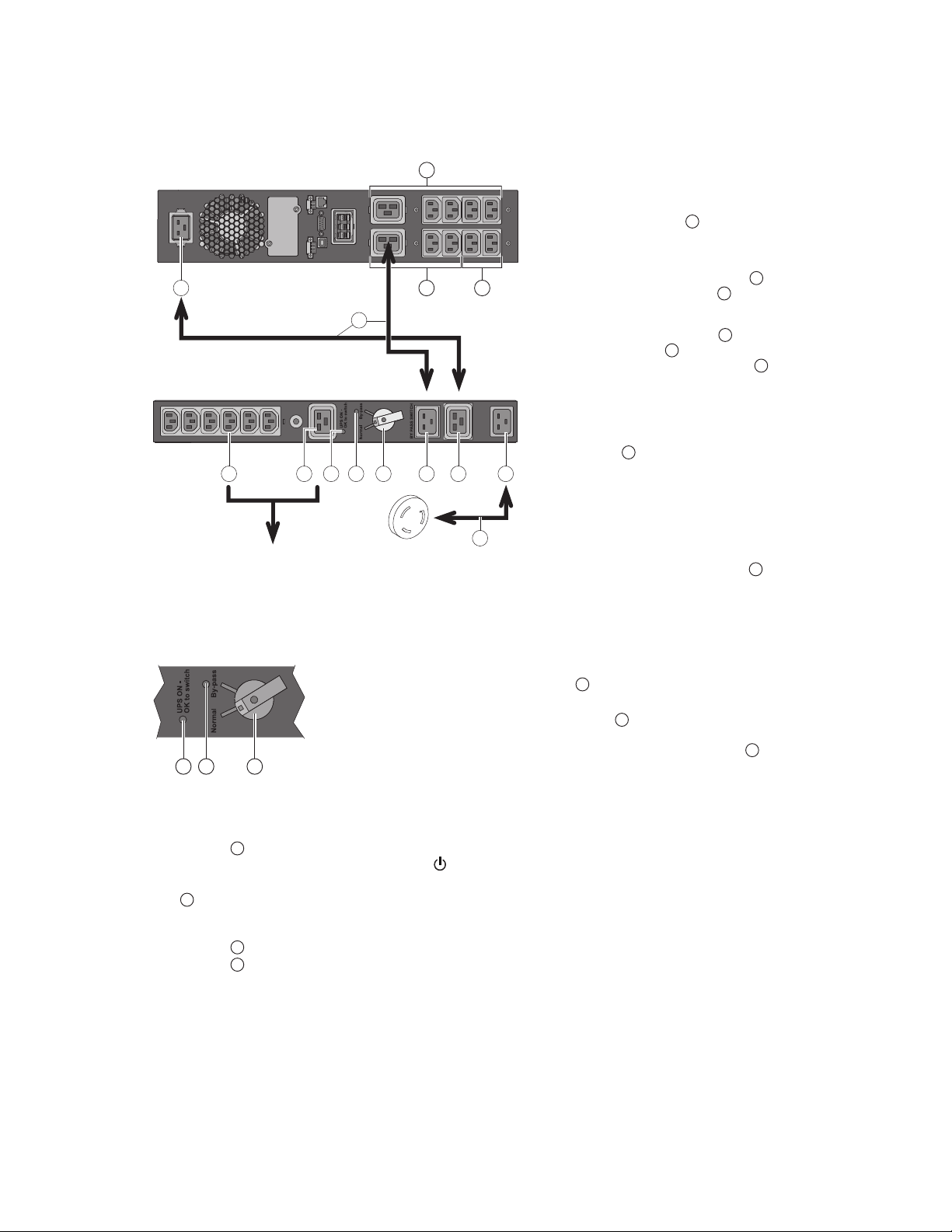
33..99 CCoonnnneeccttiioonn wwiitthh aa HHoottsswwaapp MMBBPP MMoodduullee (( OOppttiioonnaall AAcccceessssoorryy))
The HotSwap MBP module makes it possible to service or even replace the UPS without affecting the connected
loads.
9PX 2000RT-L
MBP-120
LOAD
15
28
1 82 43
5 6
9 1011
7
29
33 34 35 36
9PX 3000RT-L
MBP-130
LOAD
15
28
1 82 43
5 6
9 1011
7
29
33 34 35 36
1. Connect the input
36
on the
HotSwap MBP module to the
AC-power source.
2. Connect the UPS input cable
1
to
the “UPS Input socket”
35
on the
HotSwap MBP module.
3. Connect the UPS outlet
5
to the
“UPS Output”
34
on the HotSwap
MBP module (using the cable
28
supplied for G models).
These cables and the connectors
are marked in red.
4. Connect the equipment to the
outlets
29
on the HotSwap MBP
module. These outlets differ,
depending on the version of the
HotSwap MBP module.
Caution: when using HotSwap
MBP, do not use UPS outlets to
directly power equipment. As
operating the bypass switch
33
will cut supply voltage to the
equipment.
* 9PX 1500RT-L: To connect to MBP-115,
follow the same procedure as for the
9PX 2000RT / 9PX 3000RT.
Connection with a Hotswap MBP Module ( Optional Accessory)
22 Eaton 9PX Lithium-Ion P-164001006—Rev 01
9PX 2200GRT-L & 9PX 3000GRT-L
1
MBP
LOAD
29 30 3331 34 35 36
15
28
32
6 7
5
1. Connect the input
36
on the
HotSwap MBP module to the
AC-power source.
2. Connect the UPS input cable
1
to
the “UPS Input socket”
35
on the
HotSwap MBP module.
3. Connect the UPS outlet
5
to the
“UPS Output”
34
on the HotSwap
MBP module (using the cable
28
supplied for G models).
These cables and the connectors
are marked in red.
4. Connect the equipment to the
outlets
29
on the HotSwap MBP
module. These outlets differ,
depending on the version of the
HotSwap MBP module.
Caution: when using HotSwap
MBP, do not use UPS outlets to
directly power equipment. As
operating the bypass switch
33
will cut supply voltage to the
equipment.
HotSwap MBP module operation
32 33
31
UPS start-up with the HotSwap MBP module
1. Check that the UPS is correctly connected to the HotSwap MBP module.
2. Set switch
33
to Normal position.
3. Start the UPS by pressing the ON/OFF button
on the UPS control panel.
The load is supplied by the UPS.
LED
31
"UPS ON - OK to switch" on the HotSwap MBP module goes ON.
HotSwap MBP module test
1. Set switch
33
to Bypass position and check that the load is still supplied.
2. Set switch
33
back to Normal position.
The HotSwap MBP module has a rotary
switch
33
with two positions:
Normal the load is supplied by the UPS,
LED
31
is on.
Bypass the load is supplied directly by
the AC-power source. LED
32
is on.
Connection with a Hotswap MBP Module ( Optional Accessory)
Eaton 9PX Lithium-Ion P-164001006—Rev 01 23
CChhaapptteerr 44 CCoommmmuunniiccaattiioonn
44..11 CCoommmmuunniiccaattiioonn PPoorrttss
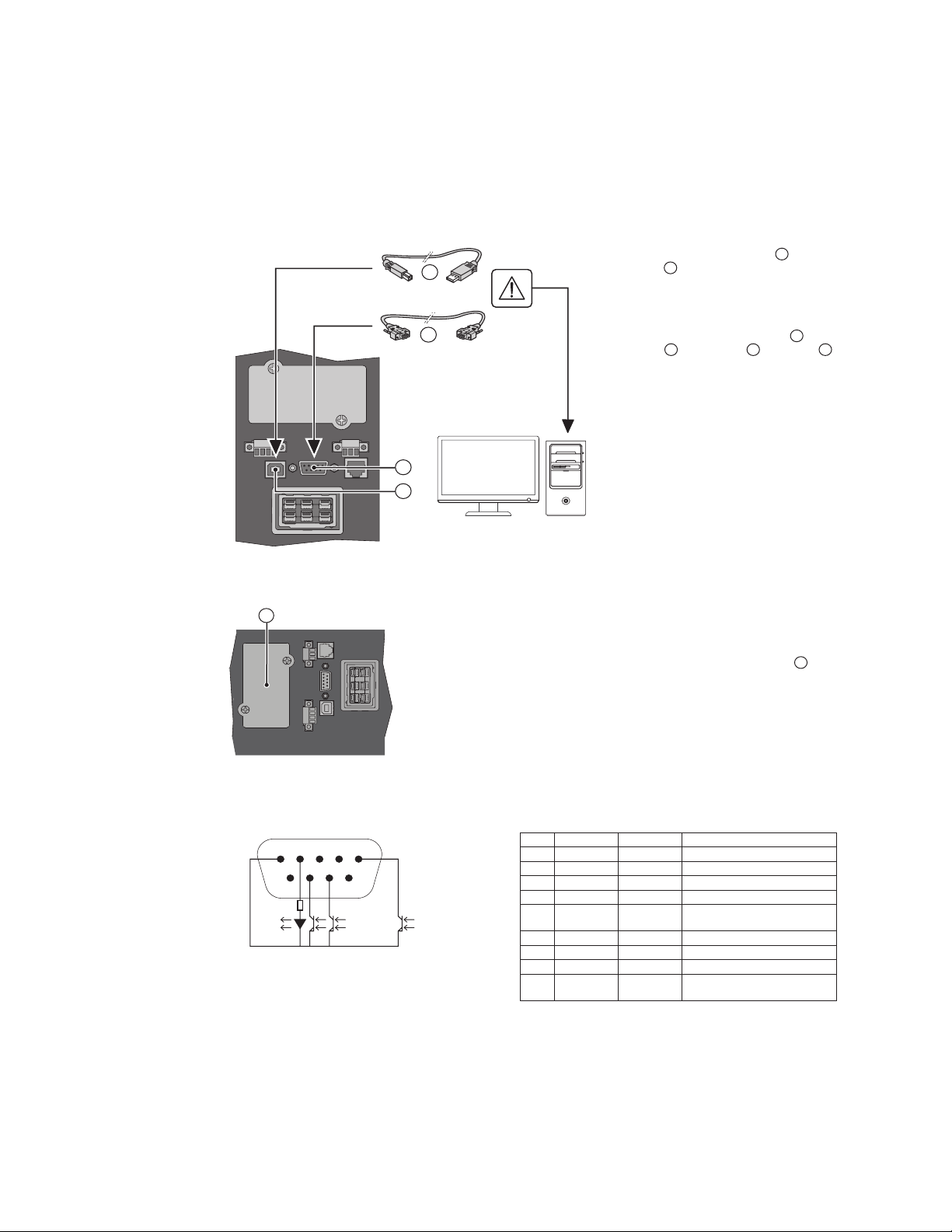
The RS232 and USB communication ports cannot operate simultaneously.
9
10
17
18
1. Connect the RS232
17
or USB
18
communication cable to the
serial or USB port on the com-
puter equipment.
2. Connect the other end of the
communication cable
17
or
18
to the USB
10
or RS232
9
communication port on
the UPS.
The UPS can now communicate
with EATON power management
software.
Installation of the communication cards
2
It is not necessary to shutdown
the UPS before installing
a communication card.
1. Remove the slot cover
2
secured by screws.
2. Insert the communication
card in the slot.
3. Secure the card cover with
the 2 screws.
Characteristics of the contact RS232 communication port
1
6789
300 Ohm
R
2345
Pin Signal Direction Function
1 Bat Low Output Low Battery Output
2 TxD Output Transmit to external device
3 RxD Input Receive from external device
4 I/P SIG Input -
5 GNDS - Signal Common tied to
chassis
6 PNP Input Plug and Play
7 UPS ON Output UPS ON
8 BAT Mode Output -
9 +5V Output Power supply for external
signals or options
Contact characteristics (optocoupler)
• Voltage: 48 V DC max
• Current: 25 mA max

24 Eaton 9PX Lithium-Ion P-164001006—Rev 01
44..22 UUPPSS RReemmoottee CCoonnttrrooll FFuunnccttiioonnss
Programmable Signal Inputs
The 9PX incorporates 3 programmable signal inputs: one Remote Power Off (RPO) input terminal, one Remote
On/Off (ROO) input terminal, one RS-232 input (pin-4). Signal inputs can be configured see Settings > Com
settings > Signal Input in Table 6 to have one of the following functions:
Function Description
No No function, please choose a function if you want to use input
signal
RPO Remote Power Off (RPO) is used to shutdown the UPS remotely
ROO
Remote On/Off allows remote action of button to switch On/Off
the UPS.
(Cold start is prohibited while using the ROO function)
Forced bypass
If feeding the load the unit goes to bypass operation and stays
there regardless of the bypass state until the input is
inactivated
Building alarm Active input generates an alarm “building alarm”
On generator Active input disables synchronization and transfers to bypass
Remote shutdown
Active input turns UPS output (or outlet groups) off after a user
defined shutdown delay but keeps on charging batteries
according to a selected charging scheme, inactive input does
not abort shutdown countdown. Depending on the “Restart”
parameter (see Settings > Com Settings > Shutdown commands
on page 16) the unit may startup automatically.
!
IMPORTANT
Warning Signal inputs have no function by default please choose a function through the LCD (Settings > Com
settings > Input signals).
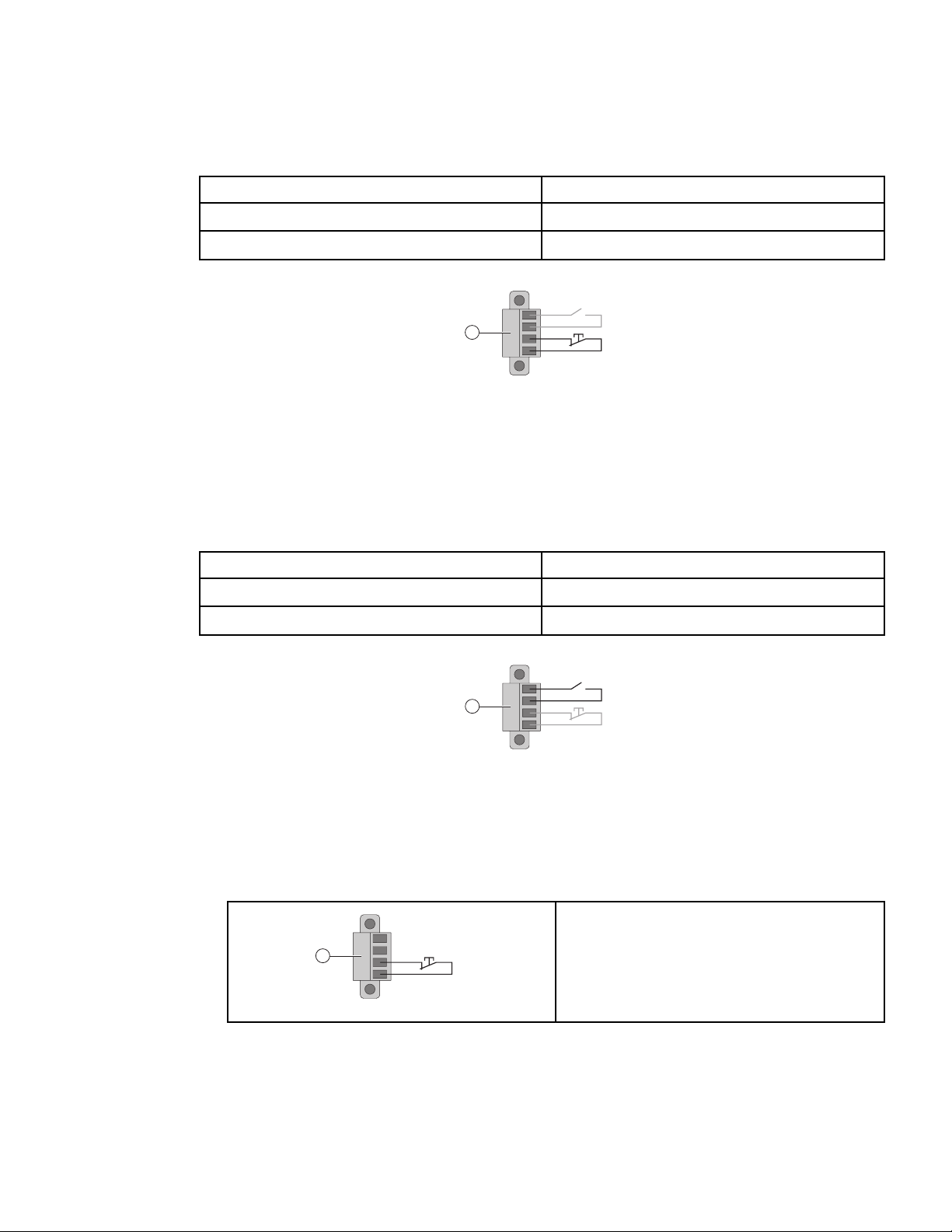
See below 2 examples of configuration with RPO terminal used as RPO function and ROO terminal use as
ROO function:
Remote Power Off (RPO)
RPO is used to shutdown the UPS remotely when the contact is open. This feature can be used for shutting
down the load and the UPS by thermal relay, for instance in the event of room over temperature. When RPO is
activated, the UPS shuts down the output and all its power converters immediately. The UPS remains on to
alarm the fault. The RPO circuit is an IEC 60950 safety extra low voltage (SELV) circuit. This circuit must be
separated from any hazardous voltage circuits by reinforced insulation.
• The RPO must not be connected to any utility connected circuits. Reinforced insulation to the utility is
required. The RPO switch must be a dedicated latching-type switch not tied into any other circuit. The RPO
signal must remain active for at least 250 ms for proper operation.
• To ensure the UPS stops supplying power to the load during any mode of operation, the input power must
be disconnected from the UPS when the Remote Power Off function is activated.
Leave the RPO connector installed in the RPO port on the UPS even if the RPO function is not needed.
UPS Remote Control Functions
Eaton 9PX Lithium-Ion P-164001006—Rev 01 25
RPO connections:
RPO Comments
Connector type Terminal, 14 AWG maximum wires
External breaker specification 60 V DC/30V AC 20mA max
RPO
11
ROO
Remote On/Off (ROO)
• Remote On/Off allows remote action of button to switch On/Off the UPS.
• When contact changes from open to closed, the UPS is switched-on (or stays On).
• When contact changes from closed to open, the UPS is switched-off (or stays Off).
• On/Off control via button has priority over the remote control.
RPO Comments
Connector type Terminal, 14 AWG maximum wires
External breaker specification 60 V DC/30V AC 20mA max
RPO
11
ROO
Remote Control Connection and Test
1. Check the UPS is shut down and the electrical supply network disconnected.
2. Remove RPO connector from the UPS by unfitting the screws.
3. Connect a normally closed volt-free contact between the two pins of connector.
RPO
11
Normally Closed
Contact open: shut down of UPS
To return to normal operation, deactivate the external remote
shut down
contact and restart the UPS from the front panel.
4. Plug the RPO connector into the back of the UPS and fix the screws.
5. Connect and restart the UPS according to the previously described procedures.
UPS Remote Control Functions

26 Eaton 9PX Lithium-Ion P-164001006—Rev 01
6. Activate the external remote shut down contact to test the function. Always test the RPO function before
applying your critical load to avoid accidental load loss.
Programmable Signal Outputs
The 9PX incorporates 4 programmable signal outputs: one relay output, three optocouplers outputs (pin- 1/7/8).
Signal outputs can be configured (see Settings > Com settings > Output Signals in Table 6 to report the
following information:
Signal Default Assignment Description
On battery (On bat)
DB9-Pin 8 UPS is in battery mode
Low battery (Low bat)
DB9-Pin 1 Battery is nearly empty
Battery fault (Bat fault)
-
Battery fault
Bypass
Relay output (1)
UPS is operating in Bypass mode
UPS OK
DB9-Pin 7
Load is powered (from inverter or bypass), with
no alarm
Load powered
-
Load is powered (from inverter or bypass)
Load protected
-
UPS is on inverter, with no alarm and ready to go
to battery
General alarm
-
• Choose events that will trigger this alarm
trough the LCD
• (Settings > Com settings > General alarm )
for more information on possible events
please look at page 16.
Ext charger ON
-
Control an optional external battery charger on
and off.
OVL pre-alarm
-
Overload pre-alarm
(1) Relay output:
Normally Closed
Normally Open
Common
1
2
3
3
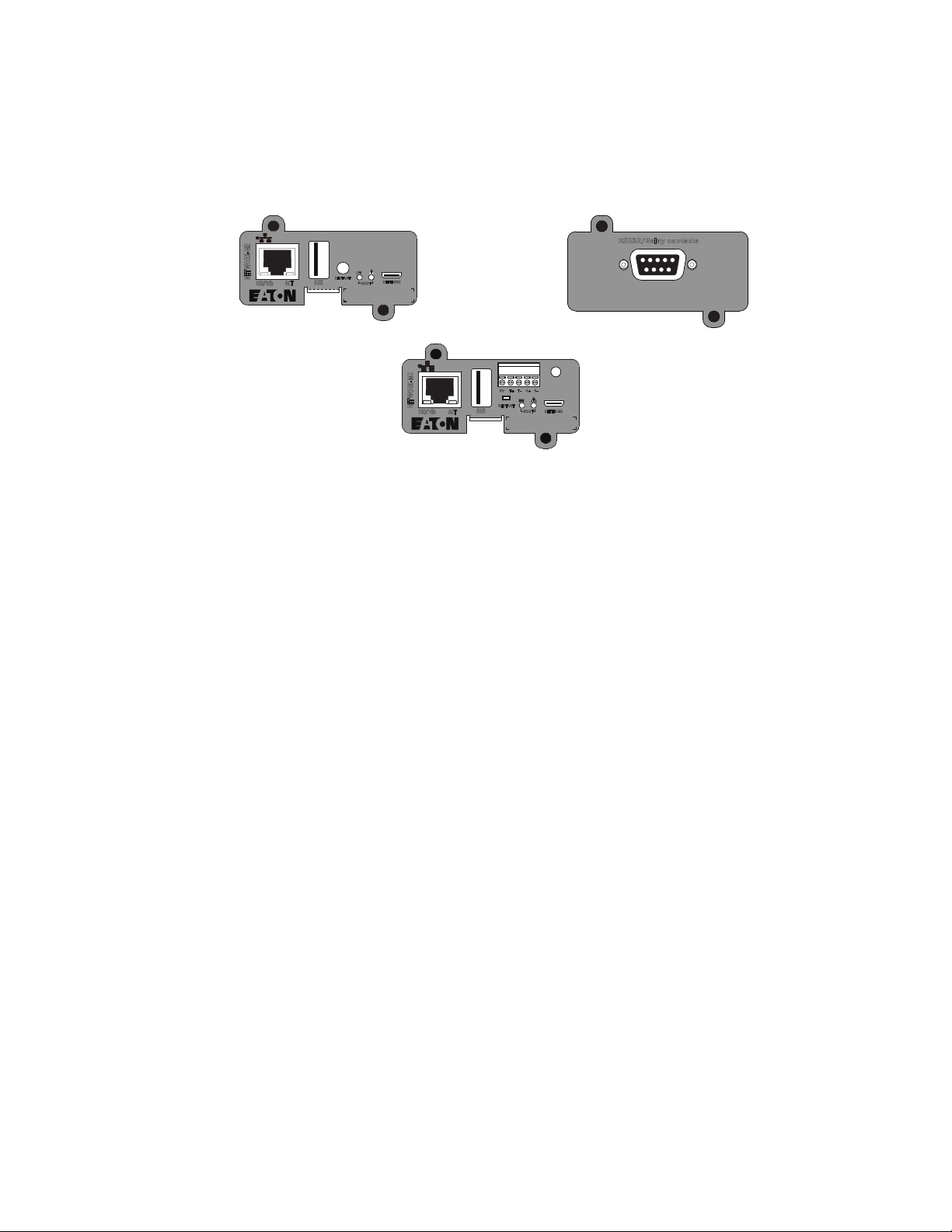
Connectivity Cards
Connectivity cards allow the UPS to communicate in a variety of networking environments and with different
types of devices. The 9PX models have one available communication bay for the following connectivity cards:
• Network-M2 card — has SNMP and HTTP capabilities as well as monitoring through a Web browser
interface; connects to a Gigabit Ethernet network. In addition, a Environmental Monitoring Probe can be
attached to obtain humidity, temperature, smoke alarm, and security information.
• INDGW-M2 card- has SNMP and HTTP capabilities and a Modbus to facilitate remote monitoring of the
UPS system through any Building Management System.
• Relay-MS card- has isolated dry contact (Form-C) relay outputs for UPS status: Utility failure, Battery
UPS Remote Control Functions
Eaton 9PX Lithium-Ion P-164001006—Rev 01 27
low, UPS alarm/OK, or on Bypass.
Figure 9. Connectivity Card Options
INDGW-M2
NETWORK-M2 Card
Relay-MS Card
NETWORK-M2
NETWORK-M2
RS232/Relay contacts
SETTINGSBOOT
RESTART
AUX
ACT
100/1Gb
100/1Gb ACT
AUX
RESTART
BOOT
SETTINGS
0V
T+
T- R+
R-
Eaton Intelligent Power Software suite
Eaton Intelligent Power Software suite is available from eaton.com/download. Eaton Software suite provides
up-to-date graphics of UPS power and system data and power flow. It also gives you a complete record of
critical power events, and it notifies you of important UPS or power information. If there is a power outage and
the 9PX UPS battery power becomes low, Eaton Software suite can automatically shut down your computer
system to protect your data before the UPS shutdown occurs.
UPS Remote Control Functions

28 Eaton 9PX Lithium-Ion P-164001006—Rev 01
UPS Remote Control Functions

Eaton 9PX Lithium-Ion P-164001006—Rev 01 29
CChhaapptteerr 55 OOppeerraattiioonn
55..11 SSttaarrtt--uupp aanndd NNoorrmmaall OOppeerraattiioonn
To start the UPS:
1. Verify that the internal batteries are connected. See section 3.3 Connecting the Internal Battery .
2. If optional EBMs are installed, verify that the EBM are connected to the UPS. See section
3.6 Connecting the EBM(s) .
3. Verify that the UPS power cord is plugged in.
4. The UPS front panel display illuminates and shows EATON logo.
5. Verify that the UPS status screen shows
6. Press the button on the UPS front panel for at least 2 seconds.
7. Check the UPS front panel display for active alarms or notices. Resolve any active alarms before
continuing. See section 7.1 Typical Alarms and Faults . If the
indicator is on, do not proceed until all
alarms are clear. Check the UPS status from the front panel to view the active alarms. Correct the alarms
and restart if necessary.
8. Verify that the
indicator illuminates solid, indicating that the UPS is operating normally and any loads
are powered and protected. The UPS should be in normal mode.
55..22 SSttaarrttiinngg tthhee UUPPSS oonn BBaatttteerryy
Before using this feature, the UPS must have been powered by utility power with output enabled at least once.
Battery start can be disabled. See the "Cold start" setting in "ON/OFF Settings" in Table 6 .
To start the UPS on battery:
1. Press the
button on the UPS front panel until the UPS front panel display illuminates and shows a
status of "UPS starting...". The UPS transfers from Standby mode to Battery mode. The
indicator
illuminates solid. The UPS supplies power to your equipment.
2. Check the UPS front panel display for active alarms or notices besides the "Battery mode" notice and
notices that indicate missing utility power. Resolve any active alarms before continuing. See the
"Troubleshooting" section . Check the UPS status from the front panel to view the active alarms. Correct
the alarms and restart if necessary.
55..33 UUPPSS SShhuuttddoowwnn
To shut down the UPS:
1. Press the
button on the front panel for three seconds. A confirmation message will appear. When
confirmed, the UPS starts to beep and shows a status of "UPS shutting OFF...". The UPS then transfers to
Standby mode, and the
indicator turns off.
55..44 OOppeerraattiinngg MMooddeess
The Eaton 9PX front panel indicates the UPS status through the UPS indicators, see section 2.4 Control Panel .
Online Mode
During Online mode, the indicator illuminates solid and the UPS is powered from the utility. The UPS
monitors and charges the batteries as needed and provides filtered power protection to your equipment.

30 Eaton 9PX Lithium-Ion P-164001006—Rev 01
Optional High Efficiency and Energy Saving settings minimize heat contribution to the rack environment. See
section 2.7 User Settings .
Battery Mode
When the UPS is operating during a power outage, the alarm beeps once every ten seconds and the
indicator illuminates solid. The necessary energy is provided by the battery. When the utility power returns, the
UPS transfers to Online mode operation while the battery recharges. If battery capacity becomes low while on
Battery mode, the audible alarm beeps once every 3 seconds. This warning is approximate, and the actual time
to shutdown may vary significantly. Shutdown all applications on the connected equipment because automatic
UPS shutdown is imminent. When utility power is restored after the UPS shuts down, the UPS automatically
restarts.
Low-Battery Warning
• The
indicator illuminates solid.
• The audio alarm beeps every three seconds.
The remaining battery power is low. Shut down all applications on the connected equipment because
automatic UPS shutdown is imminent.
End of battery backup time
• LCD displays "End of backup time".
• All the LEDs go OFF.
• The audio alarms stops.
Bypass Mode
In the event of a UPS overload or internal failure, the UPS transfers your equipment to utility power. Battery
mode is not available and your equipment is not protected; however, the utility power continues to be passively
filtered by the UPS. The
indicator illuminates. Depending on overload conditions, the UPS remains in
Bypass mode for at least 5 seconds and will stay in this mode if three transfers to Bypass occur within 20
minutes.
The UPS transfers to Bypass mode when:
• the user activates Bypass mode through the front panel.
• the UPS detects an internal failure.
• the UPS has an overtemperature condition.
• the UPS has an overload condition listed in Table 12 .
The UPS shuts down after a specified delay for overload conditions listed in Table 12 . The UPS remains on to
alarm the fault.
55..55 RReettuurrnn ooff AACC PPoowweerr
Following an outage, the UPS restarts automatically when AC input power returns (unless the restart function
has been disabled) and the load is supplied again.
55..66 SSeettttiinngg HHiigghh EEffffiicciieennccyy MMooddee
In High Efficiency mode, the UPS operates normally on Bypass and transfers to Online (or Battery) mode in less
than 10 ms when utility fails. Transfers to High Efficiency mode will be active after 5 minutes of Bypass voltage
monitoring: if Bypass quality is not in tolerance, then the UPS will remain in Online mode.
Return of AC Power

Eaton 9PX Lithium-Ion P-164001006—Rev 01 31
Eaton recommends to use the HE mode only to protect IT equipment.
To set the High Efficiency mode:
1. Select Settings, In/Out settings, and High Efficiency mode.
2. Select Enabled and Enter to confirm.
3. The UPS transfers to High Efficiency mode after 5 minutes.
55..77 CCoonnffiigguurriinngg BByyppaassss SSeettttiinnggss
The following settings are available for configuring Bypass operation.
Changing the settings changes UPS behavior and may result in decreased protection.
Bypass Voltage Low Limit
The default disables a transfer to Bypass if the measured bypass voltage level is below the nominal output
voltage minus 20%. You can configure the setting for another voltage value. This setting can be overruled by
the “Qualify Bypass” setting.
Bypass Voltage High Limit
The default disables a transfer to Bypass if the measured bypass voltage level is above the nominal output
voltage plus 15%. You can configure the setting for another voltage value. This setting can be overruled by the
“Qualify Bypass” setting.
Qualify Bypass
The default setting (“In spec”) allows a transfer to Bypass only when Bypass is within the following
specifications:
• Bypass voltage is between the “Bypass Voltage Low Limit” and “Bypass Voltage High Limit” settings
• Bypass frequency is within nominal frequency 5%.
You can prohibit Bypass (”Never”) or always allow Bypass with no specification checking (“Always”). For
“Always on UPS Fault,” transfer to Bypass is always made on UPS fault; otherwise, operation proceeds as
with the default setting.
Synchronization Window
The UPS tries to synchronize with Bypass when the Bypass frequency is less than the value set for the
“Synchronization Window” setting. When the Bypass frequency is more than the set value, the UPS goes to
nominal frequency.
Unsynchronized Transfers
When Qualify Bypass is set to “Always” or “Always on Fault” you can select the interruption time when
transferring to bypass, default setting is “Half Cycle” but can be changed to “Full cycle”.
55..88 CCoonnffiigguurriinngg BBaatttteerryy SSeettttiinnggss
Low battery warning
During discharge, the low battery alarm is activated if the remaining runtime goes below 3 minutes or less than
the setting capacity threshold (0 % by default). This threshold can be modified.
Restart battery level
This setting is used to define the battery restart level. The battery level must reach this threshold to enable UPS
start.
Configuring Bypass Settings

32 Eaton 9PX Lithium-Ion P-164001006—Rev 01
55..99 RReettrriieevviinngg tthhee EEvveenntt LLoogg
To retrieve the Event log through the display:
1. Press any button to activate the menu options, then select Event log.
2. Scroll through the listed events.
55..1100 RReettrriieevviinngg tthhee FFaauulltt LLoogg
To retrieve the Fault log through the display:
1. Press any button to activate the menu options, then select Fault log.
2. Scroll through the listed faults.
Retrieving the Event Log

Eaton 9PX Lithium-Ion P-164001006—Rev 01 33
CChhaapptteerr 66 UUPPSS MMaaiinntteennaannccee
66..11 SSttoorriinngg tthhee EEqquuiippmmeenntt
If you store the equipment for a long period, recharge the battery every 6 months by connecting the UPS to
utility power. The internal batteries charge to 90% capacity in less than 3 hours. However, Eaton recommends
that the batteries charge for 48 hours after long-term storage. Check the battery recharge date on the shipping
carton label. If the date has passed and the batteries were never recharged, do not use them. Contact your
service representative.
66..22 RReeppllaacciinngg BBaatttteerriieess
!
IMPORTANT
DO NOT DISCONNECT the batteries while the UPS is in Battery mode.
Batteries can be replaced easily without turning off the UPS or disconnecting the load. If you prefer to remove
input power to change the batteries, see "UPS Shutdown".
Consider all warnings, cautions, and notes before replacing batteries.
• Servicing should be performed by qualified service personnel knowledgeable of batteries and required
precautions. Keep unauthorized personnel away from batteries.
• Batteries can present a risk of electrical shock or burn from high short circuit current. Observe the
following precautions:
1. Remove watches, rings, or other metal objects,
2. Use tools with insulated handles,
3. Do not lay tools or metal parts on top of batteries,
4. Wear rubber gloves and boots.
• When replacing batteries, replace with the same type and number of batteries or battery packs. Contact
your service representative to order new batteries.
• Proper disposal of batteries is required. Refer to your local codes for disposal requirements.
• Never dispose of batteries in a fire. Batteries may explode when exposed to flame.
• Do not open or mutilate the battery or batteries. Released electrolyte is harmful to the skin and eyes and
may be extremely toxic.
• Determine if the battery is inadvertently grounded. If inadvertently grounded, remove source from ground.
Contact with any part of a grounded battery can result in electrical shock. The likelihood of such shock can
be reduced if such grounds are removed during installation and maintenance (applicable to equipment and
remote battery supplies not having a grounded supply circuit).
• ELECTRIC ENERGY HAZARD. Do not attempt to alter any battery wiring or connectors. Attempting to alter
wiring can cause injury.
• Disconnect charging source prior to connecting or disconnecting battery terminals.
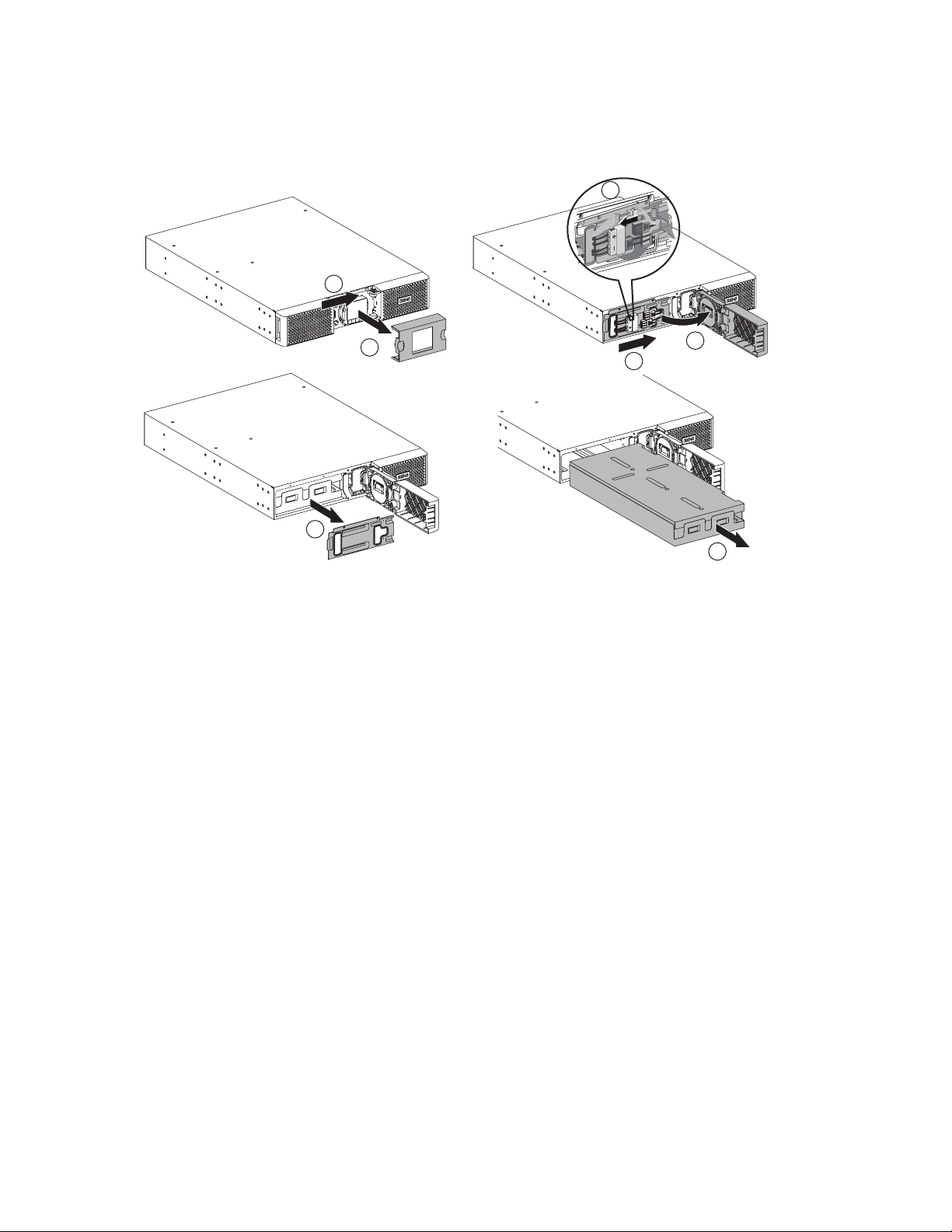
Replacing the internal battery
The internal battery is heavy. Use caution when handling the heavy batteries.
34 Eaton 9PX Lithium-Ion P-164001006—Rev 01
Figure 10. Internal Battery Pack Replacement
3
5
6
7
2
1
4
To replace the battery pack:
1. Remove the center cover of the front panel.
2. Push left cover toward to right direction.
3. Open the battery door.
4. Disconnect the battery connectors.
A ribbon cable connects the LCD control panel to the UPS. Do not pull on the cable or disconnect it.
5. Remove the two screws to pull out the metal protection cover of the battery.
6. Pull out the plastic handle of the battery pack, and slide the pack out slowly on to a flat and stable surface.
Use two hands to support the battery pack. See "Recycling the used equipment" on page 38 for proper
disposal.
7. Verify that the replacement batteries have the same rating as the batteries being replaced.
8. Put the new battery pack into the UPS. Push the battery pack firmly to ensure a proper connection.
9. Screw back the metal protection cover and the front panel, then clip the center cover.
Replacing the EBM(s)
The EBM is heavy. Lifting the cabinet into a rack requires a minimum of two people.
To replace the EBM(s):
1. Unplug the EBM power cable and battery detection cable from the UPS. If additional EBM(s) are installed,
unplug the EBM power cable and battery detection cable from each EBM.
2. Replace the EBM(s). See "Recycling the used equipment" for proper disposal.
Replacing Batteries
Eaton 9PX Lithium-Ion P-164001006—Rev 01 35
A small amount of arcing may occur when connecting an EBM to the UPS. This is normal and will not harm
personnel. Insert the EBM cable into the UPS battery connector quickly and firmly.
3. Plug the EBM cable(s) into the battery connector(s). Up to four EBMs may be connected to the UPS.
4. Verify that the EBM connections are tight and that adequate bend radius and strain relief exist for each
cable.
5. Connect the battery detection cable(s) to the connector of the UPS and of the EBM(s).
66..33 RReeppllaacciinngg tthhee UUPPSS EEqquuiippppeedd wwiitthh aa HHoottSSwwaapp MMBBPP
The HotSwap MBP module makes it
possible to service or even replace
the UPS without affecting the connected
loads.
1. Set switch
33
to Bypass position.
The red LED on the HotSwap MBP
module goes ON, indicating that the
load is supplied directly with AC input
source power.
2. Stop the UPS by pressing the
button on the UPS control panel.
LED
31
"UPS ON - OK to switch"
goes OFF, the UPS can now be
disconnected and replaced.
Return to normal operation
1. Check that the UPS is correctly
connected to the HotSwap MBP
module.
2. Start the UPS by pressing the
button on the UPS control panel.
LED
31
"UPS ON - OK to switch" on
the HotSwap MBP module goes ON
(otherwise, there is a connection error
between the HotSwap MBP module
and the UPS).
3. Set switch
33
to Normal position.
The red LED on the HotSwap MBP
module goes OFF.
MBP-120
LOAD
15
28
1 82 43
5 6
9 1011
7
29
33 34 35 36
Maintenance
66..44 RReeccyycclliinngg TThhee UUsseedd EEqquuiippmmeenntt
Contact your local recycling or hazardous waste center for information on proper disposal of the used
equipment.
Replacing the UPS Equipped with a HotSwap MBP
36 Eaton 9PX Lithium-Ion P-164001006—Rev 01
Special Symbols
The following are examples of symbols used on the UPS or accessories to alert you to important
information:
RISK OF ELECTRIC SHOCK - Observe the warning associated with the risk of
electric shock symbol.
CAUTION: REFER TO OPERATOR'S MANUAL - Refer to your operator's manual for
additional information, such as important operating and maintenance
instructions.
This symbol indicates that you should not discard the UPS or the UPS batteries
in the trash. This product contains sealed, lead‐acid batteries and must be
disposed of properly. For more information, contact your local recycling/reuse or
hazardous waste center.
This symbol indicates that you should not discard waste electrical or electronic
equipment (WEEE) in the trash. For proper disposal, contact your local
recycling/reuse or hazardous waste center.
Eaton, Powerware, and BladeUPS are registered trademarks of Eaton Corporation or its subsidiaries and affiliates.
Phillips and Pozidriv are registered trademarks of Phillips Screw Company.
ECopyright 2008–2010 Eaton Corporation, Raleigh, NC, USA. All rights reserved. No part of this document may be
reproduced in any way without the express written approval of Eaton Corporation.
RISK OF ELECTRIC SHOCK - Observe the warning associated with the risk of electric shock symbol.
This symbol indicates that you should not discard the UPS or the UPS batteries in the trash. This
product contains sealed, Lithium-Ion batteries and must be disposed of properly. For more information,
contact your local recycling/reuse or hazardous waste center.
Special Symbols
The following are examples of symbols used on the UPS or accessories to alert you to important
information:
RISK OF ELECTRIC SHOCK - Observe the warning associated with the risk of
electric shock symbol.
CAUTION: REFER TO OPERATOR'S MANUAL - Refer to your operator's manual for
additional information, such as important operating and maintenance
instructions.
This symbol indicates that you should not discard the UPS or the UPS batteries
in the trash. This product contains sealed, lead‐acid batteries and must be
disposed of properly. For more information, contact your local recycling/reuse or
hazardous waste center.
This symbol indicates that you should not discard waste electrical or electronic
equipment (WEEE) in the trash. For proper disposal, contact your local
recycling/reuse or hazardous waste center.
Eaton, Powerware, and BladeUPS are registered trademarks of Eaton Corporation or its subsidiaries and affiliates.
Phillips and Pozidriv are registered trademarks of Phillips Screw Company.
ECopyright 2008–2010 Eaton Corporation, Raleigh, NC, USA. All rights reserved. No part of this document may be
reproduced in any way without the express written approval of Eaton Corporation.
This symbol indicates that you should not discard waste electrical or electronic equipment (WEEE) in
the trash. For proper disposal, contact your local recycling/reuse or hazardous waste center.
Recycling The Used Equipment

Eaton 9PX Lithium-Ion P-164001006—Rev 01 37
CChhaapptteerr 77 TTrroouubblleesshhoooottiinngg
77..11 TTyyppiiccaall AAllaarrmmss aanndd FFaauullttss
The Eaton 9PX are designed for durable, automatic operation and also alert you whenever potential operating problems may
occur. Usually the alarms shown by the control panel do not mean that the output power is affected. Instead, they are
preventive alarms intended to alert the user.
• Events are silent status information that are recorded into the Event log. Example = "AC freq in range".
• Alarms are recorded into the Event log and displayed on the LCD status screen with the logo blinking.
Some alarms may be announced by a beep every 3 seconds. Example = "Battery low".
• Faults are announced by a continuous beep and red LED, recorded into the Fault log and displayed on the
LCD with a specific message box. Example = Out. short circuit.
Use the following troubleshooting chart to determine the UPS alarm condition.
Checking the Alarms and Faults
To check the Event log or Fault log :
1. Press any button on the front panel display to activate the menu options.
2. Press the button to select Event log or Fault log.
3. Scroll through the listed events or faults.
The following table describes typical conditions.
Conditions Possible cause Action
Battery mode
LED is On.
1 beep every 10 seconds
A utility failure has occurred and the UPS
is in battery mode.
The UPS is powering the equipment with
battery power. Prepare your equipment
for shutdown.
Battery mode
LED is On.
1 beep every 3 seconds
The UPS is in Battery mode and the
battery is running low.
This warning is approximate, and the
actual time to shutdown may vary
significantly. Depending on the UPS load
and number of Extended Battery Modules
(EBMs), the "Battery Low" warning may
occur before the batteries reach 20%
capacity.
No battery
LED is On
Beep continuous
The batteries are disconnected. Verify that all batteries are properly
connected. If the condition persists,
contact your service representative.
Battery fault
LED is On
Beep continuous
The battery test is failed due to bad or
disconnected batteries.
Verify that all batteries are properly
connected. If the condition persists,
contact your service representative.

38 Eaton 9PX Lithium-Ion P-164001006—Rev 01
Conditions Possible cause Action
The UPS does not provide the expected
backup time.
The batteries need charging or service. Apply utility power for 48 hours to charge
the batteries. If the condition persists,
contact your service representative.
Bypass mode
LED is on.
An overload or a fault has occurred, or a
command has been received and the UPS
is in Bypass
Equipment is powered but not protected
by the UPS. Check for one of the
following alarms: overtemperature,
overload or UPS LED is on. failure.
Power Overload
LED is on.
Power requirements exceed the UPS
capacity (greater than 100% of nominal;
see “User Settings” on page 8 for
specific output overload ranges).
Remove some of the equipment from the
UPS. The UPS continues to operate, but
may switch to Bypass mode or shut down
if the load increases. The alarm resets
when the condition becomes inactive.
UPS Overtemperature
LED is on.
1 beep every 3 seconds
The UPS internal temperature is too high
or a fan has failed. At the warning level,
the UPS generates the alarm but remains
in the current operating state. If the
temperature rises another 10°C, the UPS
transfers to Bypass mode or shuts down
if Bypass is unusable.
If the UPS transferred to Bypass mode,
the UPS will return to normal operation
when the temperature drops 5°C below
the warning level. If the condition
persists, shut down the UPS.
Clear vents and remove any heat sources.
Allow the UPS to cool. Ensure the airflow
around the UPS is not restricted. Restart
the UPS. If the condition continues to
persist, contact your service
representative.
The UPS does not start
The input source is not connected
correctly.
Check the input connections.
The Remote Power Off (RPO) switch is
active or the RPO connector is missing.
If the UPS Status menu displays the
"Remote Power Off" notice, inactivate the
RPO input.
77..22 SSiilleenncciinngg tthhee AAllaarrmm
Press the ESC (Escape) button on the front panel display to silence the alarm. Check the alarm condition and
perform the applicable action to resolve the condition. If the alarm status changes, the alarm beeps again,
overriding the previous alarm silencing.
77..33 SSeerrvviiccee aanndd SSuuppppoorrtt
If you have any questions or problems with the UPS, call your Local Distributor or your local service
representative and ask for a UPS technical representative. Please have the following information ready when
you call for service:
• Model number
• Serial number
• Firmware version number
• Date of failure or problem
• Symptoms of failure or problem
• Customer return address and contact information
Silencing the Alarm

Eaton 9PX Lithium-Ion P-164001006—Rev 01 39
If repair is required, you will be given a Returned Material Authorization (RMA) number. This number must
appear on the outside of the package and on the Bill Of Lading (if applicable). Use the original packaging or
request packaging from the Help Desk or distributor. Units damaged in shipment as a result of improper
packaging are not covered under warranty. A replacement or repair unit will be shipped, freight prepaid for all
warrantied units.
!
IMPORTANT
For critical applications, immediate replacement may be available. Call the Help Desk for the dealer or
distributor nearest you.
77..44 CCEE CCoommpplliiaannccee CCoonnttaacctt
• Eaton I.F. SAS - 110 Rue Blaise Pascal - 38330 Montbonnot St Martin – France.
CE Compliance Contact

40 Eaton 9PX Lithium-Ion P-164001006—Rev 01
CE Compliance Contact
Eaton 9PX Lithium-Ion P-164001006—Rev 01 41
CChhaapptteerr 88 SSppeecciiffiiccaattiioonnss
88..11 MMooddeell SSppeecciiffiiccaattiioonnss
Input
Filter
AC/DC
Boost
DC/AC
Inverter
Outpout
Filter
Bypass
DC/DC
Battery
Charger
Table 7. Power Module List
Model Power ratings
9PX1500RT-L 1500VA / 1350W
9PX2000RT-L 2000VA / 1800W
9PX3000RT-L 3000VA / 2400W
9PX1500GRT-L 1500VA / 1350W
9PX2200GRT-L 2200VA / 2000W
9PX3000GRT-L 3000VA / 2400W
Table 8. Extended Battery Module List
Model Configuration Battery Voltage For Power Module
9PXEBM48RT-L Rack / Tower 48Vdc 1500VA
9PXEBM72RT-L Rack / Tower 72Vdc 2000 – 2200 – 3000VA
Table 9. Weights and Dimensions
Model
Dimensions D x W x H(inch/mm) Weight (lb / kg)
9PX1500RT-L 17.7 x 17.3 x 3.4 / 450 x 440 x 86.5 35.5 / 16.2
9PX2000RT-L 23.8 x 17.3 x 3.4 / 605 x 440 x 86.5 50.6 / 23.0
9PX3000RT-L 23.8 x 17.3 x 3.4 / 605 x 440 x 86.5 52.7 / 24.0
9PX1500GRT-L
17.7 x 17.3 x 3.4 / 450 x 440 x 86.5 34.8 / 15.8
9PX2200GRT-L 23.8 x 17.3 x 3.4 / 605 x 440 x 86.5 48.6 / 22.1
9PX3000GRT-L 23.8 x 17.3 x 3.4 / 605 x 440 x 86.5 50.2 / 22.8

42 Eaton 9PX Lithium-Ion P-164001006—Rev 01
Table 9. Weights and Dimensions (Continued)
Model
Dimensions D x W x H(inch/mm) Weight (lb / kg)
9PXEBM48RT-L 17.6 x 17.2 x 1.7 / 448 x 438 x 42.9 36.5 / 16.6
9PXEBM72RT-L 23.7 x 17.2 x 1.7 / 603 x 438 x 42.9 46.6 / 21.2
Table 10. Electrical Input
Model Default Input
(Voltage/Max Current)
Input Nominal Voltages Input Voltage Window at
Rated Load
9PX1500RT-L 120V / 12.5A 100V, 110V, 120V, 125V 100–138V
9PX2000RT-L 120V / 16A
9PX3000RT-L 120V / 24A
9PX1500GRT-L 208V / 7.2A 200V, 208V, 220V, 230V, 240V 176V-276V
9PX2200GRT-L 208V / 10.57A
9PX3000GRT-L 208V / 14.42A
Nominal Frequency 50/60Hz auto-sensing
Frequency Range 40-70Hz before transfer to battery
Bypass Voltage Range
-20% / +15% of nominal value (default)
Noise Filtering Input EMC filter
Table 11. Electrical Input Connections
Model Input Connection Input cable
9PX1500RT-L 5–15P 8ft / 2.4m
9PX2000RT-L 5–20P 8ft / 2.4m
9PX3000RT-L L5–30P 8ft / 2.4m
9PX1500GRT-L IEC-C14, IEC 10A 6ft / 1.8m
9PX2200GRT-L
IEC-C20, 16 A inlet
L6-20P to C19 jumper provided
6ft / 1.8m
9PX3000GRT-L
Table 12. Electrical Output
All Models Normal Mode Efficiency Mode Battery Mode
Voltage Regulation ±1% ±2%
Efficiency
90.0% for 1.5K LV models
91% for 1.5K G models
91.4% for 2K LV models
93% for 2K G models
94% for 3K G models
95.8% for 1K5 LV models
96.5% for 1.5K G models
96.8% for 2K LV models
98% for 2K G models
97.2% for 3K LV models
98% for 3K G models
84% for 1.5K LV models
87.5% for 1.5K G models
86% for 2K LV models
90% fo r 2K G models
86% for 3K LV models
89% for 3K G models
Model Specifications

Eaton 9PX Lithium-Ion P-164001006—Rev 01 43
Table 12. Electrical Output (Continued)
All Models Normal Mode Efficiency Mode Battery Mode
Frequency Regulation
Sync with line ±5% of nominal line frequency (outside this
range: ±0.5% of auto-selected nominal frequency)
±0.5% of auto-selected
nominal frequency
Nominal Output
[100V] [110V] [120V] [125V]
[200V] [208V] [220V] [230V] [240V] (G models)
Frequency 50 or 60 Hz, autosensing or configurable as a frequency converter
Output Overload
Online mode:
102%~130% :12s
130%~150% :2s
>150% :shutdown after 300ms
Percent is based on nominal Watt/VA.
Transfer behavior can change (see output mode setting on page 14)
Battery mode:
102%~130% :12s
>130% :2s
Overload warning then transfer to stop output
Output Overload ( Bypass
Mode )
102%~110% :Overload warning
110%~130% :shutdown after 5mins
130%~150% :shutdown after 15s
>150% :shutdown after 300ms
Percent is based on nominal current in bypass mode
Voltage Waveform Sinewave
Harmonic Distortion
< 3% THDV on linear load
< 5% THDV on non-linear load
Transfer Time Online Mode: 0ms
High Efficiency mode: 10ms maximum (due to loss of utility)
Power Factor Up to 0.9
Load Crest Ratio
Up to 3:1
Table 13. Electrical Output Connections
Model Output Connection Output Cable
9PX1500RT-L
5-15R (2)
No
9PX2000RT-L
5-20R(2) + L5-20R(1)
5-20R(2) Group1
5-20R(2) Group2
No
9PX3000RT-L
5-20R(2) + L5-30R(1)
5-20R(2) Group1
5-20R(2) Group2
No
9PX1500GRT-L
(4) IEC10A
(2) IEC10A
(2) IEC10A (2) IEC 10A
No
Model Specifications

44 Eaton 9PX Lithium-Ion P-164001006—Rev 01
Table 13. Electrical Output Connections (Continued)
Model Output Connection Output Cable
9PX2200GRT-L
(4) IEC10A + (1) IEC16A
(2) IEC10A + (1) IEC16A group 1
(2) IEC10A group 2
(2) IEC 10A
9PX3000GRT-L
Table 14. Environmental and Safety
Certifications
IEC/EN 62040-1
IEC/EN 62040-2 : Cat. C1
IEC/EN 62040-3
UL1778 5th edition
CSA 22.2
EMC ( Emissions)*
CISPR22 Class B
FCC part 15 Class B / ICES-003
EMC (Immunity)*
IEC 61000-4-2, (ESD): 8 kV Contact Discharge / 15 kV Air
Discharge
IEC 61000-4-3, (Radiated field): 10 V/m
IEC 61000-4-4, (EFT): Power (Coupling network) 4 kV / Ethernet
(Coupling
clamp) 2 kV
IEC 61000-4-5, (Surges): 2 kV Differentiel Mode / 4 kV Common
Mode /
1 kV Ethernet
IEC 61000-4-6, (Electromagnetic field): 10 V
IEC 61000-4-8, (Conducted magnetic field): 30 A/m
* for output cable < 10m.
Agency Markings* CE / cULus / NOM / Energy Star / BSMI
Operating Temperatures
0 to 40°C (32 to 104°F) in Online mode, with linear derating for
altitude
Note: thermal protection switches load to Bypass in case of
overheating.
Storage Temperatures
0 to 40°C (32 to 104°F) with batteries
-25 to 55°C (-13 to 130°F) without batteries
Transit Temperature
-25 to 55°C (-13 to 130°F)
Relative Humidity 0 to 96% no condensing
Operating Altitude Up to 3,000 meters (9,843 ft) above sea level, no derating for
35°c (95°F) room temperature
Transit Altitude
Up to 10,000 meters (32,808 ft) above sea level
Audible Noise
< 47 dBA at 1 meter typical for 2K et 3K models
< 40 dBA at 1 meter typical for 70, 1K et 1K5 models
* 9PX1500RT-L, 9PX2000RT-L, 9PX3000RT-L, 9PX1500GRT-L, 9PX2200GRT-L, 9PX3000GRT-L have CE/ cULus/Energy Star/ BSMI.
9PXEBM48RT-L, 9PXEBM72RT-L have CE / cULus / NOM.
Model Specifications

Eaton 9PX Lithium-Ion P-164001006—Rev 01 45
Table 15. Battery
Internal Batteries EBM
Rack / Tower configuration 1500VA: 48Vdc
2200VA: 72Vdc
3000VA: 72Vdc
9PXEBM48RT: 48Vdc
9PXEBM72RT: 72Vdc
Type
Lithium Iron Phosphate (LFP) battery module
Lithium-Ion float service life 8 years /25°C
Monitoring
Integrated battery management system (BMS) for temperature regulation and life
cycle monitoring.
EBM Battery Cable Length 350 mm / 13.78 in
Model Specifications

P-16400100601
P-164001006 01