
Frigidaire.com USA 1-800-944-9044 Frigidaire.ca Canada 1-800-265-8352
use
&
care
WALL OVEN
A22383505 March 2022
Introduction . . . . . . . . . . . . . . . . . . . . . . . . . . . . . . . . . .2
Important Safety Instructions . . . . . . . . . . . . . . . . . .3
Cooking Recommendations . . . . . . . . . . . . . . . . . . . 10
Before Setting Oven Controls . . . . . . . . . . . . . . . . . 14
Setting Oven Controls . . . . . . . . . . . . . . . . . . . . . . . . 18
Care and Cleaning . . . . . . . . . . . . . . . . . . . . . . . . . . 38
Before You Call . . . . . . . . . . . . . . . . . . . . . . . . . . . . . 44
Warranty. . . . . . . . . . . . . . . . . . . . . . . . . . . . . . . . . . . .47
2
INTRODUCTION
INTRODUCTION
Read all the safety instructions in the front of
your Use & Care Manual.
Remove all packaging materials from your ap-
pliance before cooking.
Confi rm that the electrical power to the appli-
ance is turned on.
Wipe out the inside of the oven cavity with a
damp cloth.
Apply a thin layer of cooking oil to the sides of
the oven racks to keep them gliding smoothly.
Set the clock. See (page 17) for instructions.
Before cooking, set the oven to bake at 350°F
(177ºC) for 30 minutes (page 22). Some
noise and odors are normal on the fi rst cooking
cycle.
Remember to complete your product registra-
tion!
Installation Checklist
9
Welcome to our
family
Thank you for bringing Frigidaire into your home!
We see your purchase as the beginning of a long
relationship together.
This manual is your resource for the use and care
of your product. Please read it before using your
appliance. Keep it handy for quick reference. If
something doesn’t seem right, the troubleshooting
section will help you with common issues.
FAQs, helpful tips and videos, cleaning products, and
kitchen and home accessories are available at www.
frigidaire.com.
We are here for you! Visit our website, chat with an
agent, or call us if you need help. We may be able
to help you avoid a service visit. If you do need
service, we can get that started for you.
Let’s make it o cial! Be sure to register your prod-
uct.
Keep your product info here so it’s easy to fi nd.
Model Number:
Serial Number:
Purchase Date:
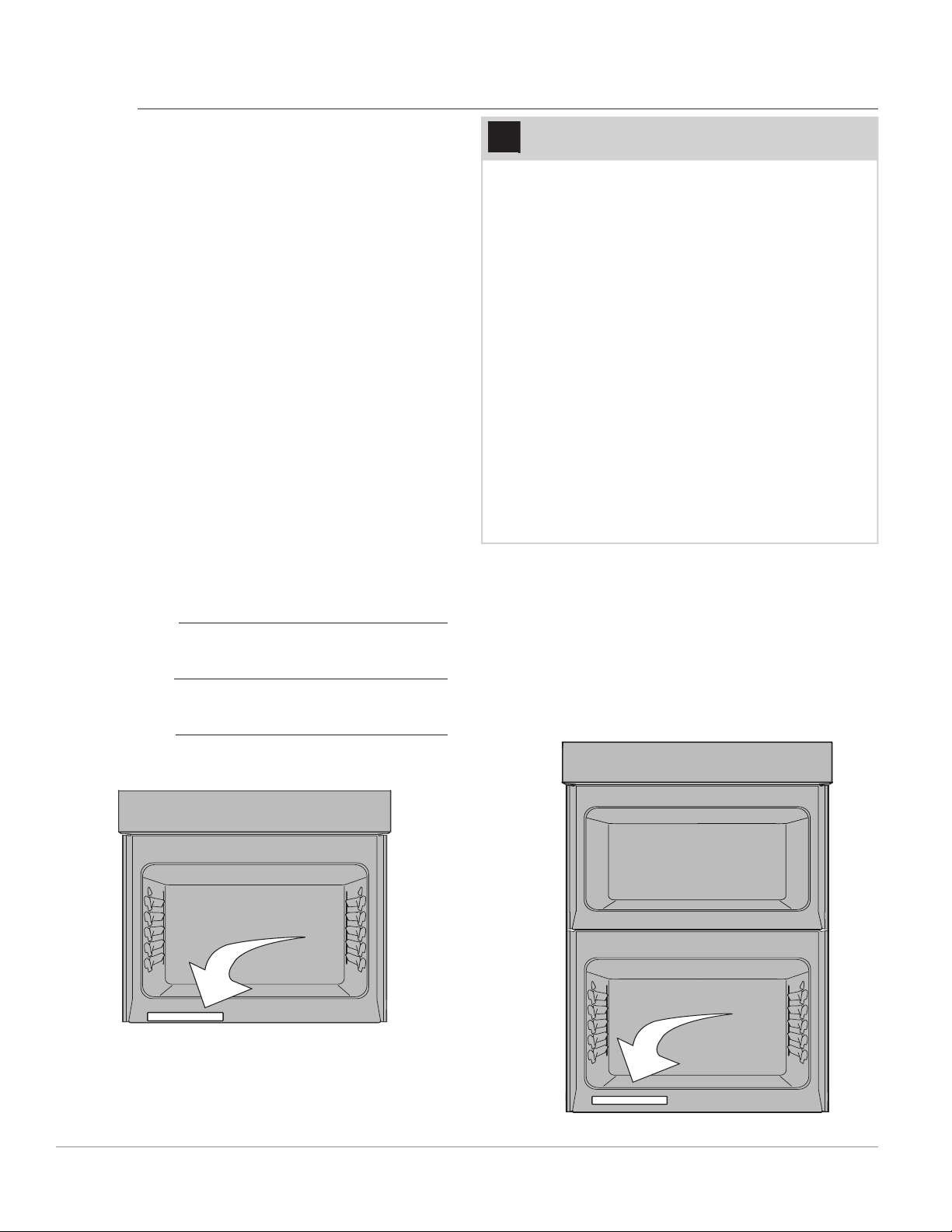
Serial Number Location
Serial Number Location
3
IMPORTANT SAFETY INSTRUCTIONS
DEFINITIONS
This is the safety alert symbol. It is
used to alert of potential personal injury
hazards. Obey all safety messages that
follow this symbol to avoid possible injury
or death.
WARNING
Indicates a potentially hazardous situa-
tion which, if not avoided, may result in
death or serious injury.
CAUTION
Indicates a potentially hazardous situa-
tion which, if not avoided, may result in
minor or moderate injury.
IMPORTANT SAFETY INSTRUCTIONS
Read all instructions before using this ap-
pliance.
This manual contains important safety
symbols and instructions. Please pay at-
tention to these symbols and follow all
instructions given.
Do not attempt to install or operate your
appliance until you have read the safety
precautions in this manual. Safety items
throughout this manual are labeled with a
WARNING or CAUTION statement based
on the risk type.
Warnings and important instructions ap-
pearing in this guide are not meant to
cover all possible conditions and situations
that may occur. Common sense, caution,
and care must be exercised with installing,
maintaining, or operating your appliance.
IMPORTANT
Indicates installation, operation or main-
tenance information which is important
but not hazard-related.
NOTE
Indicates a short, informal reference –
something written down to assist the
memory or for future reference.
4
IMPORTANT SAFETY INSTRUCTIONS
IMPORTANT INSTRUCTIONS FOR
UNPACKING AND INSTALLATION
IMPORTANT
Read and follow the below instructions
and precautions for unpacking, installing,
and servicing your appliance.
Remove all tape and packaging before us-
ing the appliance. Destroy the carton and
plastic bags after unpacking the appliance.
Never allow children to play with pack-
aging material. Do not remove the wiring
label and other literature attached to the
appliance. Do not remove model/serial
number plate.
Cold temperatures can damage the elec-
tronic control. When using this appliance
for the fi rst time, or when the appliance
has not been used for an extended period
of time, be sure the appliance has been in
temperatures above 32ºF (0ºC) for at least
3 hours before turning on the power to the
appliance.
All materials used in construction of cab-
inets, enclosures, and supports surround-
ing the product must have a temperature
rating above 200°F (94°C).
Never modify or alter the construction of
the appliance by removing the leveling
legs, panels, wire covers, anti-tip brackets/
screws, or any other part of the appliance.
Be sure to have an appropriate foam-type
fi re extinguisher available, visible, and easi-
ly accessible located near the appliance.
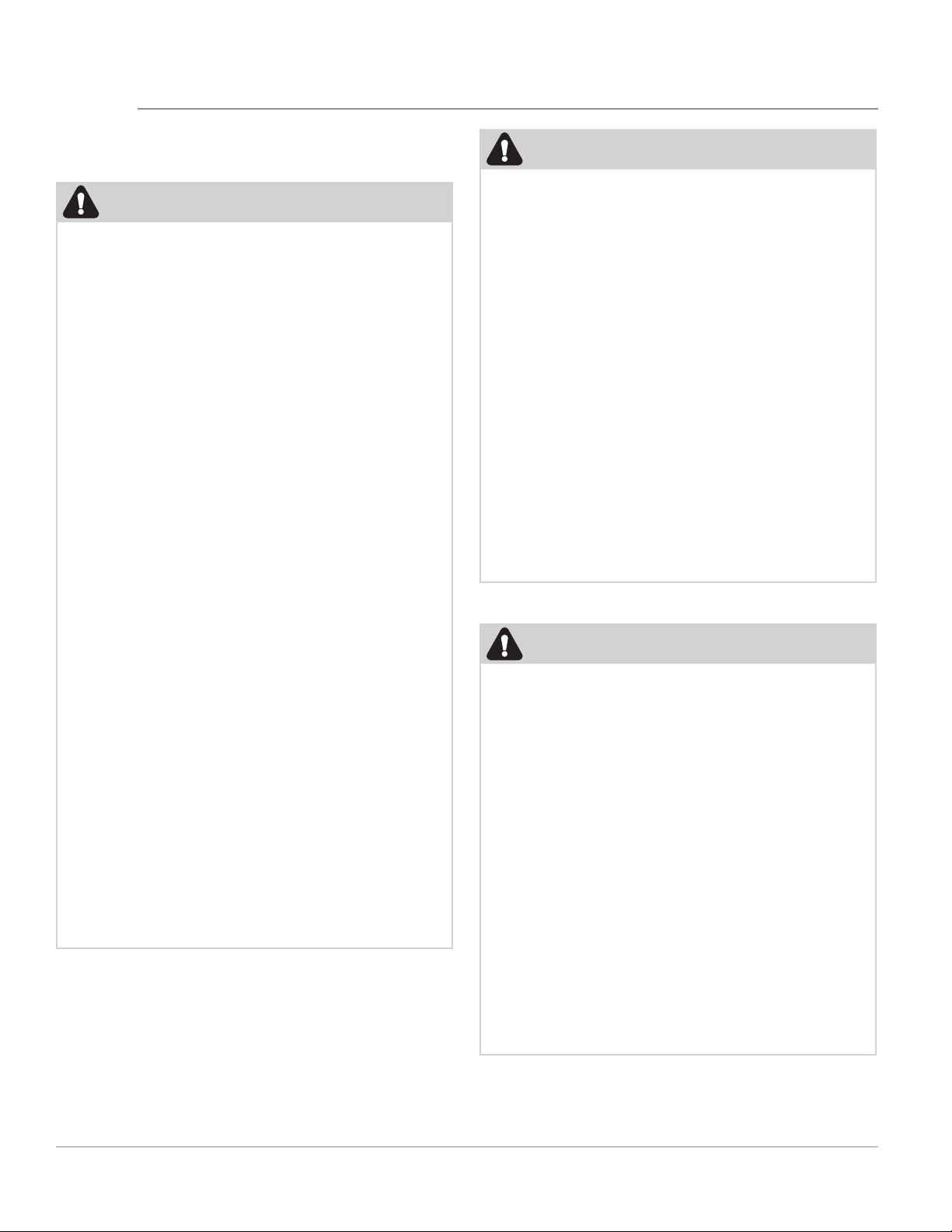
WARNING
Tip Over Hazard
• A child or adult can tip the
oven and be killed.
• Install the anti-tip device
to oven and/or structure
per installation instructions.
• Ensure the anti-tip device is
re-engaged when the oven is moved.
• Do not operate the oven without the
anti-tip device in place and engaged.
• Failure to follow these instructions can
result in death or serious burns to
children and adults.
Refer to the installation
instructions supplied with
your appliance for proper
installation.
Anti-tip mounting holes
Check for proper installation with a visual
check that the anti-tip screws are present. Test
the installation with light downward pressure
on the open oven door. The oven should not
tip forward.

5
IMPORTANT SAFETY INSTRUCTIONS
GROUNDING INSTRUCTIONS
WARNING
• Avoid fi re hazard or electrical shock.
Failure to follow this warning may
cause serious injury, fi re, or death.
• Avoid fi re hazard or electrical shock.
Do not use an adapter plug, use an
extension cord, or remove grounding
prong from the power cord. Failure to
follow this warning may cause serious
injury, fi re, or death.
Proper Installation—Be sure your appliance
is properly installed and grounded by a
qualifi ed technician. In the United States,
install in accordance with the National
Fuel Gas Code ANSI Z223.1/NPFA No. 54,
latest edition and National Electrical Code
NFPA No. 70 latest edition, and local elec-
trical code requirements. In Canada, install
in accordance with CAN/CGA B149.1 and
CAN/CGA B149.2 and CSA Standard C22.1,
Canadian Electrical code, Part 1-latest
editions and local electrical code require-
ments. Install only per installation instruc-
tions provided in the literature package for
this appliance.
For personal safety, this appliance must be
properly grounded. For maximum safety,
the power cord must be securely connect-
ed to an electrical outlet or junction box
that is the correct voltage, is correctly
polarized and properly grounded, and pro-
tected by a circuit breaker in accordance
with local codes.
It is the personal responsibility of the
consumer to have the appropriate outlet
or junction box with the correct, proper-
ly grounded wall receptacle installed by
a qualifi ed electrician. It is the responsi-
bility and obligation of the consumer to
contact a qualifi ed installer to assure that
the electrical installation is adequate and
is in conformance with all local codes and
ordinances.
See the installation instructions packaged
with this appliance for complete installa-
tion and grounding instructions.
6
IMPORTANT SAFETY INSTRUCTIONS
IMPORTANT INSTRUCTIONS FOR USING
THE APPLIANCE
WARNING
• Storage In or On Appliance—Flamma-
ble materials should not be stored in
an oven or microwave, near surface
burners or elements, or in the stor-
age or warmer drawer (if equipped).
This includes paper, plastic, and cloth
items, such as cookbooks, plastic
ware, and towels, as well as fl ammable
liquids. Do not store explosives, such
as aerosol cans, on or near the appli-
ance.
• Do not leave children alone - Children
should not be left alone or unattend-
ed in the area where appliance is in
use. They should never be allowed to
sit or stand on any part of the appli-
ance, including the storage drawer,
lower broiler drawer, warmer drawer,
or lower double oven.
• Do not store items of interest to chil-
dren in the cabinets above the appli-
ance or on the backguards of ranges.
Children climbing on or near the ap-
pliance to reach items could be seri-
ously injured.
• Do not allow children to climb or play
around the appliance. The weight of
a child on an open oven door may
cause the appliance to tip, resulting in
serious burns or other injury. An open
drawer when hot may cause burns.
WARNING
• Stepping, leaning, or sitting on the
door or drawers of this appliance
can result in serious injuries and also
cause damage to the appliance.
• Never cover any slots, holes or pas-
sages in the oven bottom or cover
and entire rack with materials such
as aluminum foil. Aluminum foil lin-
ings may also trap heat, causing a fi re
hazard.
• Do not use oven or warmer drawer (if
equipped) for storage.
• Never use your appliance as a space
heater to heat or warm the room.
Doing so may result in carbon monox-
ide poisoning and overheating of the
appliance.
CAUTION
• When heating fat or grease, watch it
closely. Grease may catch fi re if it be-
comes too hot.
• Do not use water or fl our on grease
fi res. Smother fi re or fl ame or use dry
chemical or foam-type extinguisher.
Cover the fi re with a pan lid or use
baking soda.
• Use dry potholders. Moist or damp
potholders on hot surfaces may result
in burns from steam. Do not let pot-
holders touch hot cooking areas. Do
not use towels or other bulky cloths.
• Do not heat unopened food contain-
ers - Build-up of pressure may cause
container to burst and result in injury.

7
IMPORTANT SAFETY INSTRUCTIONS
CAUTION
• Wear proper apparel - Loose-fi tting
or hanging garments should never be
worn while using the appliance. Do
not let clothing or other fl ammable
materials contact hot surfaces.
• Do not touch surface burners or ele-
ments, areas near these burners or el-
ements, interior surfaces of the oven,
or the warmer drawer (if equipped).
Surface burners and elements may
be hot even though they appear cool.
Areas near surface burners and ele-
ments may become hot enough to
cause burns. During and after use,
do not touch, or let clothing or oth-
er fl ammable materials touch these
areas until they are cool. These areas
may include the cooktop, surfaces
facing the cooktop, oven vent areas,
oven door, and oven window.
• Do not attempt to operate the ap-
pliance during a power failure. If the
power fails, always turn o the appli-
ance. If the appliance is not turned
o and the power resumes, electric
surface elements may resume opera-
tion when power is restored. Once the
power resumes, reset the clock and
the oven function.
IMPORTANT INSTRUCTIONS FOR USING
YOUR OVEN
Protective liners—Do not use aluminum
foil, aftermarket oven liners, or any other
materials or devices to line oven bottom,
oven racks, or any other part of the appli-
ance. Only use aluminum as recommend-
ed for baking, such as lining cookware or
as a cover placed on food. Any other use
of protective liners or aluminum foil may
result in a risk of electric shock or fi re or a
short circuit.
Use care when opening oven door, lower
oven door, or warmer drawer (some mod-
els). Stand to the side of the appliance
when opening the door of a hot oven. Let
hot air or steam escape before you remove
or replace food in the oven.
Keep oven vent ducts unobstructed.
Touching surfaces in this area when the
oven is on may cause severe burns. Do not
place plastic or heat-sensitive items on or
near the oven vent. These items can melt
or ignite.
Placement of oven racks - Always place
oven racks in desired location while oven
is cool. If rack must be moved while oven
is hot, do not let potholder contact hot
burner or element in oven. Use potholders
and grasp the rack with both hands to re-
position. Remove all cookware and utensils
before moving the rack.
Do not use a broiler pan without its insert.
Broiler pans and inserts allow dripping fat
to drain away from the high heat of the
broiler. Do not cover the broiler insert with
aluminum foil; exposed fat and grease
could ignite.
Do not cook food on the oven bottom. Al-
ways cook in proper cookware and always
use the oven racks.
8
IMPORTANT SAFETY INSTRUCTIONS
IMPORTANT INSTRUCTIONS FOR
CLEANING YOUR APPLIANCE
CAUTION
Before manually cleaning any part of the
appliance, be sure all controls are turned
o and the appliance is cool. Cleaning a
hot appliance can cause burns.
Clean the appliance regularly to keep all
parts free of grease that could catch fi re.
Do not allow grease to accumulate. Greasy
deposits in the fan could catch fi re.
Always follow the manufacturer’s rec-
ommended directions for use of kitchen
cleaners and aerosols. Be aware that ex-
cess residue from cleaners and aerosols
may ignite causing damage and injury.
Clean ventilating hoods frequently -
Grease should not be allowed to accumu-
late on hood or fi lter. Follow the manu-
facturer’s instructions for cleaning vent
hoods.
IMPORTANT INSTRUCTIONS FOR SELF
CLEANING OVENS
CAUTION
Before using self clean, remove the broil-
er pan, any food, utensils, and cookware
from the oven, storage drawer or warm-
ing drawer (if equipped). Remove oven
racks unless otherwise instructed.
Do not clean the oven door gasket. The
door gasket is essential for a good seal.
Care should be taken not to rub, damage,
or move the gasket.
Do not use oven cleaners. No commer-
cial oven cleaner or oven liner protective
coating of any kind should be used in or
around any part of the appliance.
Use the self clean cycle to clean only the
parts listed in this manual.
Some birds are extremely sensitive to the
fumes given o during the self clean cy-
cle of any oven. Move birds to another
well-ventilated room.
9
IMPORTANT SAFETY INSTRUCTIONS
IMPORTANT INSTRUCTIONS FOR
SERVICE AND MAINTENANCE
Do not repair or replace any part of the
appliance unless specifi cally recommend-
ed in the manuals. All other servicing
should be done only by a qualifi ed tech-
nician. This reduces the risk of personal
injury and damage to the appliance.
Always contact your dealer, distributor,
service agent, or manufacturer about
problems or conditions you do not under-
stand.
Ask your dealer to recommend a qualifi ed
technician and an authorized repair ser-
vice. Know how to disconnect the power
to the appliance at the circuit breaker or
fuse box in case of an emergency.
Remove the oven door from any unused
oven if it is to be stored or discarded.
Do not touch a hot oven light bulb with
a damp cloth. Doing so could cause the
bulb to break. Handle halogen lights
(if equipped) with paper towels or soft
gloves. Disconnect the appliance or shut
o the power to the appliance before re-
moving and replacing the bulb.
WARNING
California Residents: for cancer and re-
productive harm information, visit
www.P65Warnings.ca.gov
10
COOKING RECOMMENDATIONS
Special Features
Use the special features of your Frigidaire oven to get the best baking and roasting results.
Goal Feature
• Breads and pastries that rise higher with a
crispy, golden crust and a light and fl aky interi-
or
Steam Bake
Steam baking slows the formation of the crust, al-
lowing your dough to grow longer before the crust
forms.
• Moist and tender meats with a golden, crispy
skin on the outside.
Steam Roast
The humidity of steam roasting prevents meats
from drying out during the cooking process.
• Golden, crispy chicken wings
• Crunchy vegetable chips
• Juicy chicken parmesan
• Perfectly crisp tempura shrimp, samosas, and
more
Air Fry
The hot air convection makes crisp, golden fried
foods without the splatter. For even heating on
all sides and large capacity, use the Air Fry Tray
(included).
• Prepare convenience foods without delay No Preheat
Get your culinary delights on the table faster
• Perfectly browned baked goods
• Evenly cooked roasts and braises
Convection Bake
Even your most challenging recipes turn out de-
licious with the precisely-controlled heat and air
circulation of Advanced Convection
• Prevent build-up of burrned, spilled food in the
bottom of the oven
One Hour Steam Clean
Keep your oven looking its best with the one hour
Steam Clean cycle that’s chemical- and odor-free
11
COOKING RECOMMENDATIONS
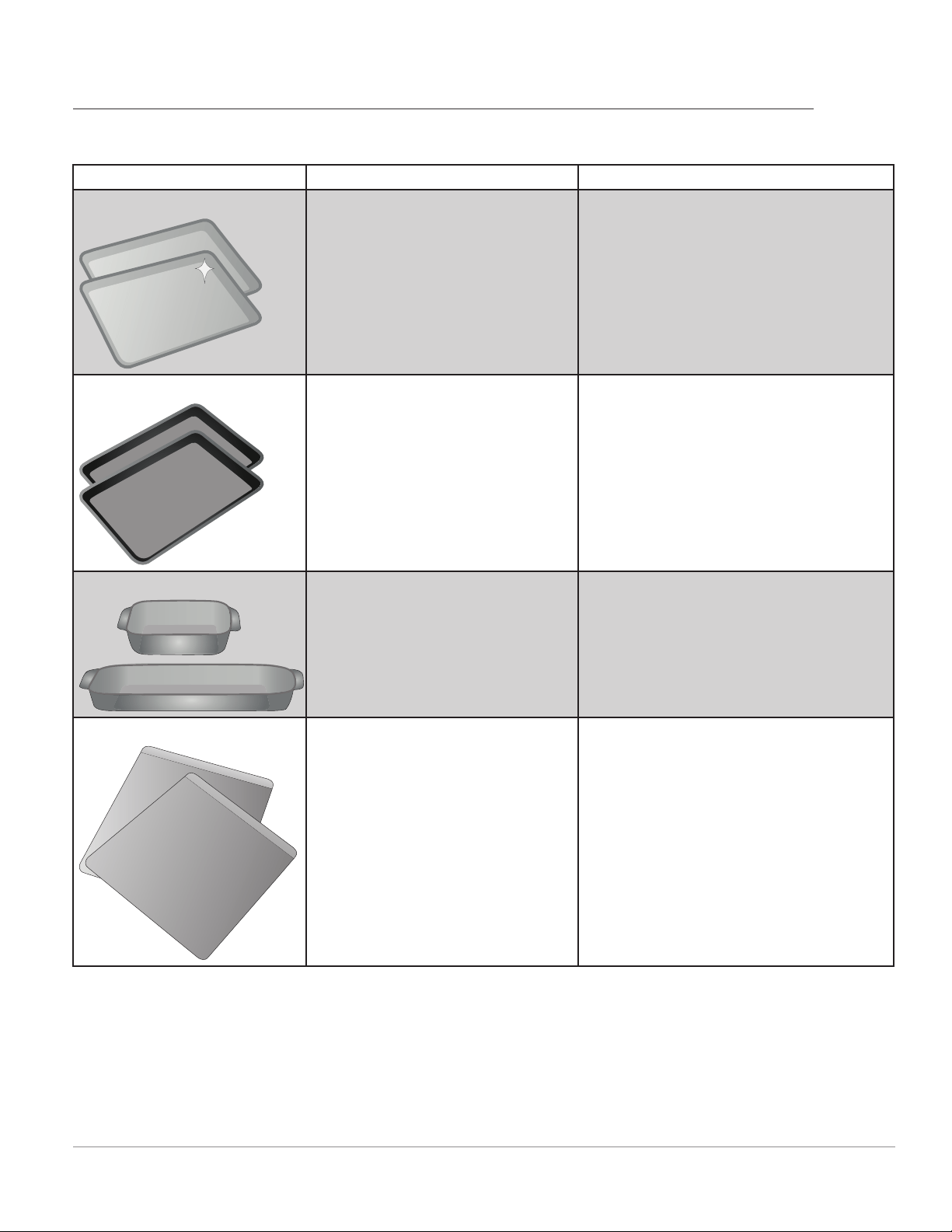
Bakeware
The material of bakeware a ects how evenly and quickly it transfers heat from the pan to the food.
Material Attributes Recommendation
Shiny metal bakeware Shiny, aluminum, and non-coat-
ed bakeware is the best for even
heating. It is suitable for all baked
goods.
Recommended cooking temperatures
and times are based on shiny metal
bakeware.
Dark metal bakeware
Dark bakeware cooks hotter than
shiny bakeware.
Reduce the cooking temperature by
25°F (13-14°C) when using dark bake-
ware.
Glass bakeware
Glass bakeware cooks hotter
than shiny bakeware.
Glass is convenient, as the same
piece of bakeware can be used
for cooking, serving, and storing
food.
Reduce the cooking temperature by
25°F (13-14°C) when using glass bake-
ware.
Insulated bakeware Insulated bakeware cooks cooler
than shiny bakeware.
Insulated bakeware is designed
for baking in gas ovens.
When using insulated bakeware, the
recipe baking time may be longer than
usual.
12
COOKING RECOMMENDATIONS
Cooking Conditions
Conditions in your kitchen can a ect the performance of your appliance when cooking food.
Condition Attributes Recommendation
Aging cookware As pans age and become
discolored, cooking times may
need to be reduced slightly.
If food is too dark or overcooked, use the
minimum cook time in the recipe or packag-
ing.
If food is too light or undercooked, use the
middle to maximum cook time in the recipe
or packaging.
High altitude Air is drier and air pressure is
lower.
Water boils at a lower tem-
perature, and liquids evapo-
rate faster.
Foods may take longer to
bake.
Doughs may rise faster.
Adjust cooking temperature, cooking time, or
recipes as needed.
Increase amount of liquid in baking recipes.
Increase cook time on cooktop. Cover dishes
to reduce evaporation.
Increase bake time or oven temperature.
Reduce amount of baking soda or baking
powder in recipe. Reduce rising time or
punch down dough and allow it to rise twice.
Cooking Results
Small adjustments may help you achieve the best results.
Result Recommendation
Food too light Use the middle to maximum cook time recommended on packaging or recipe.
Food too dark Use the minimum cook time recommended on packaging or recipe.
Cooking Tips
Use these additional tips to get the best results from your appliance.
Situation Recommendation
Baking
Rack placement Follow the instructions in particular oven mode starting in “Setting Oven Con-
trols” on page 18.
Preheat Fully preheat the oven before baking items like cookies, cakes, biscuits and
breads. Insert food immediately after the beep.
Checking food Use the window and oven light when checking food. Opening the door may
reduce baking performance.
Bake or Convection Bake Convection bake is the best function to use for baking on multiple racks. For
best performance, see “Convection Bake” on page 25.
Steam Bake For directions, tips, and benefi ts of Steam Bake see “Steam Bake” on page
28.
Food placement Allow at least 2 inches (5 cm) of space between bakeware for proper air cir-
culation.

13
COOKING RECOMMENDATIONS
Material Recommendation
Broiling / Roasting
Broiling pan For best results when broiling, use a broil pan with an insert designed to drain
the fat from the food, help avoid spatter, and reduce smoking. The broiler pan will
catch grease spills, and the insert helps prevent grease splatters.
Convection Cooking
Convection attri-
butes
Convection cooking uses a fan to circulate hot air around the oven and food. It
browns food more evenly and reduces hot spots in the oven.
Convection saves time when using multiple racks or cooking several food items at
once.
Convection bake Reduce cooking temperature by 25° F (13-14° C) from the recipe unless the recipe
is written for convection baking.
Preheat the oven for best results.
Convection roast Convection roast is best for meats and does not require preheating for most
meats and poultry.
Reducing the cooking temperature for convection roast is not recommended.
Carefully follow your recipe’s temperature and time recommendations, adjusting
the cooking time if the recipe does not specify convection roasting time.
Since convection roast cooks faster, cook time may be reduced by 25% to 40%
depending on food type. You can reduce cook times by 25% from the recom-
mended time of your recipe, and check the food at this time. If needed, continue
cooking until the desired doneness is obtained.
Use the meat probe included with your appliance. Meat probes are also available
from most grocery and home goods stores.
Arrange oven racks so large cuts of meat and poultry are on the lowest rack of
the oven.
Do not cover foods when dry roasting - covering will prevent the meat from
browning properly.
When cooking meats, use the broiler pan and insert or a roasting rack. The broiler
pan will catch grease spills and the insert helps prevent grease splatters.
14
BEFORE SETTING OVEN CONTROLS
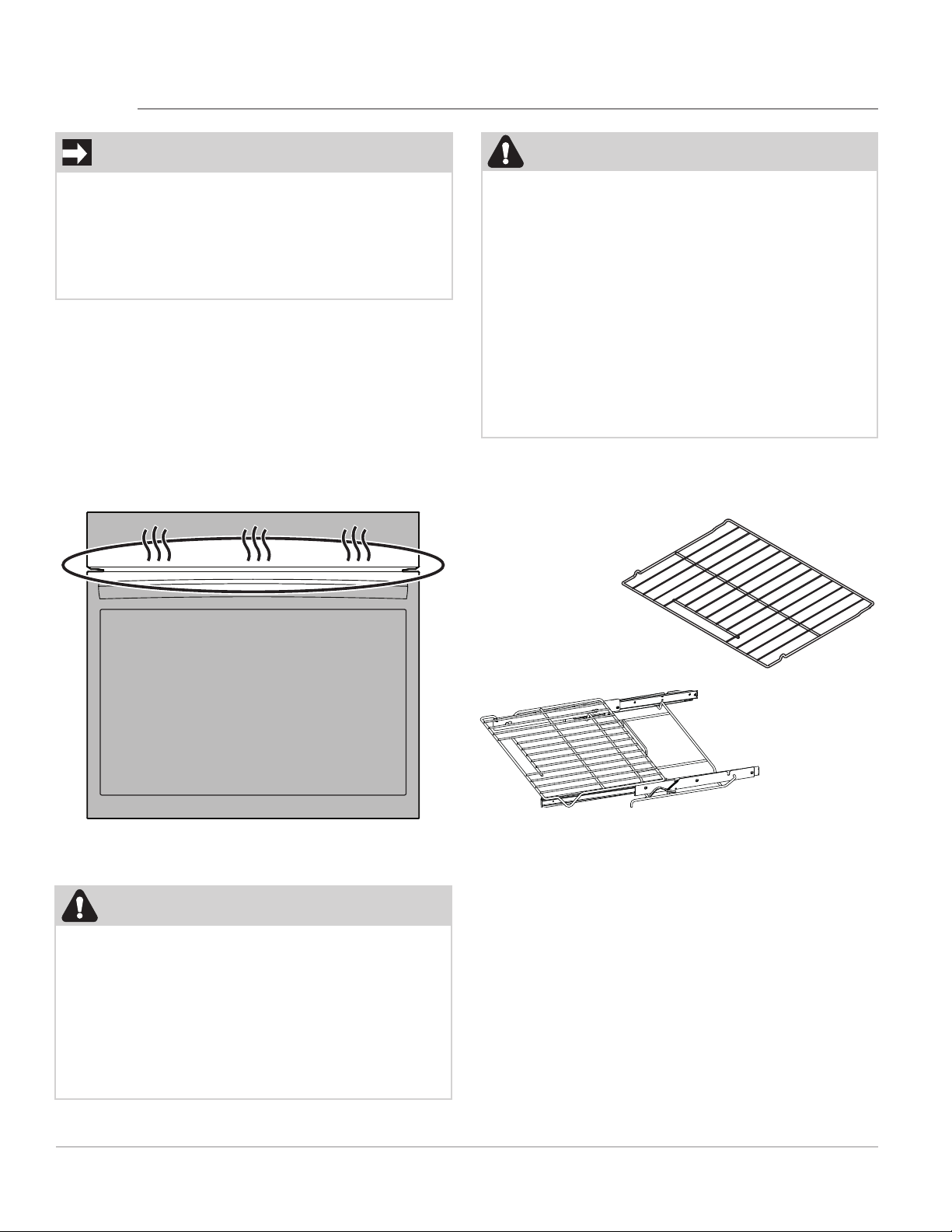
Figure 1: Oven vent
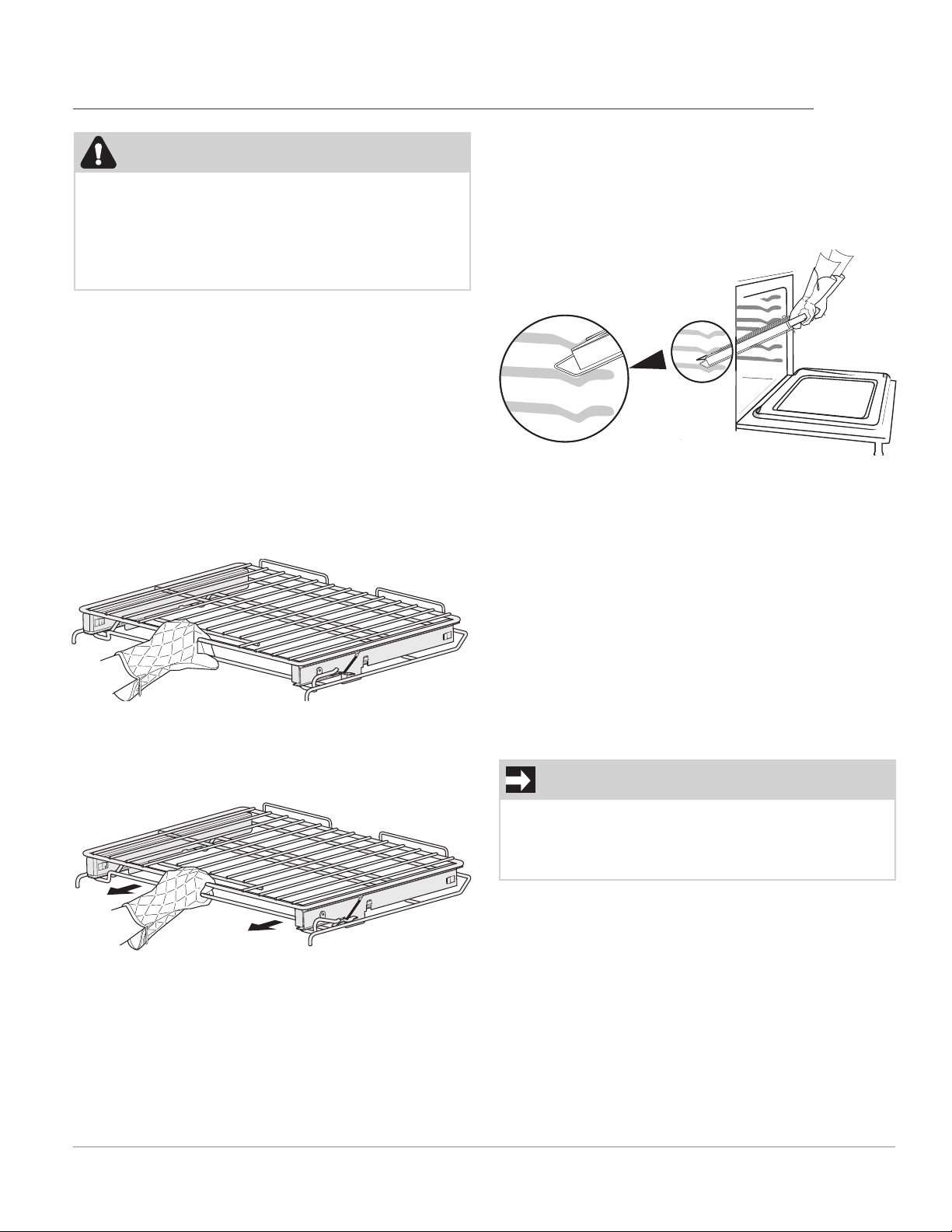
• Flat oven racks may be used for most cooking
needs and may be placed in most oven rack
positions.
• The fully extendable glide rack makes food
preparation easier. This oven rack has glide
tracks that allow the rack to be pulled away
from the oven without rubbing the sides of the
oven wall. See glide rack instructions on next
page.
Figure 2: Oven rack types
CAUTION
Always use pot holders or oven mitts when using
the oven. When cooking, the oven interior, oven
exterior, oven racks, and cooktop will become
very hot which can cause burns.
Remove all oven racks before starting a self clean
cycle. If oven racks are left inside the oven during
a cleaning cycle, the slide ability of the oven
racks may be damaged and all of the oven racks
will lose their shiny fi nish.
To prevent possible damage to the oven, do not
attempt to close the oven door until all the oven
racks are fully positioned back inside the oven
cavity.
WARNING
Protective Liners — Do not use aluminum foil
or any other material or liners to line the oven
bottom, walls, racks or any other part of the
range. Doing so will alter the heat distribution,
produce poor baking results, and possibly cause
permanent damage to the oven interior. Improp-
er installation of these liners may result in risk of
electric shock or fi re. During self clean, tempera-
tures in the oven will be hot enough to melt foil.
Oven Vent Location
The oven is vented as shown below. When the oven
is on, warm air is released through the vent. This
venting is necessary for proper air circulation in the
oven and good baking results. Do not block oven
vent. Never close o the openings with aluminum
foil or any other material. Steam or moisture may
appear near the oven vent. This is normal.
Types of Oven Rack
glide
rack
IMPORTANT
Your Frigidaire wall oven has many features that
allow you to customize the way your oven works.
Take time to read this section for important
safety information and to become familiar with
the many menu option settings starting on page
17.
flat handle
oven rack
15
BEFORE SETTING OVEN CONTROLS
WARNING
Do not line the oven walls, racks, bottom or any
other parts of the range with aluminum foil. Do-
ing so will alter heat distribution, produce poor
baking results and may cause permanent damage
to the oven interior. During self-clean tempera-
tures the oven will be hot enough to melt foil.
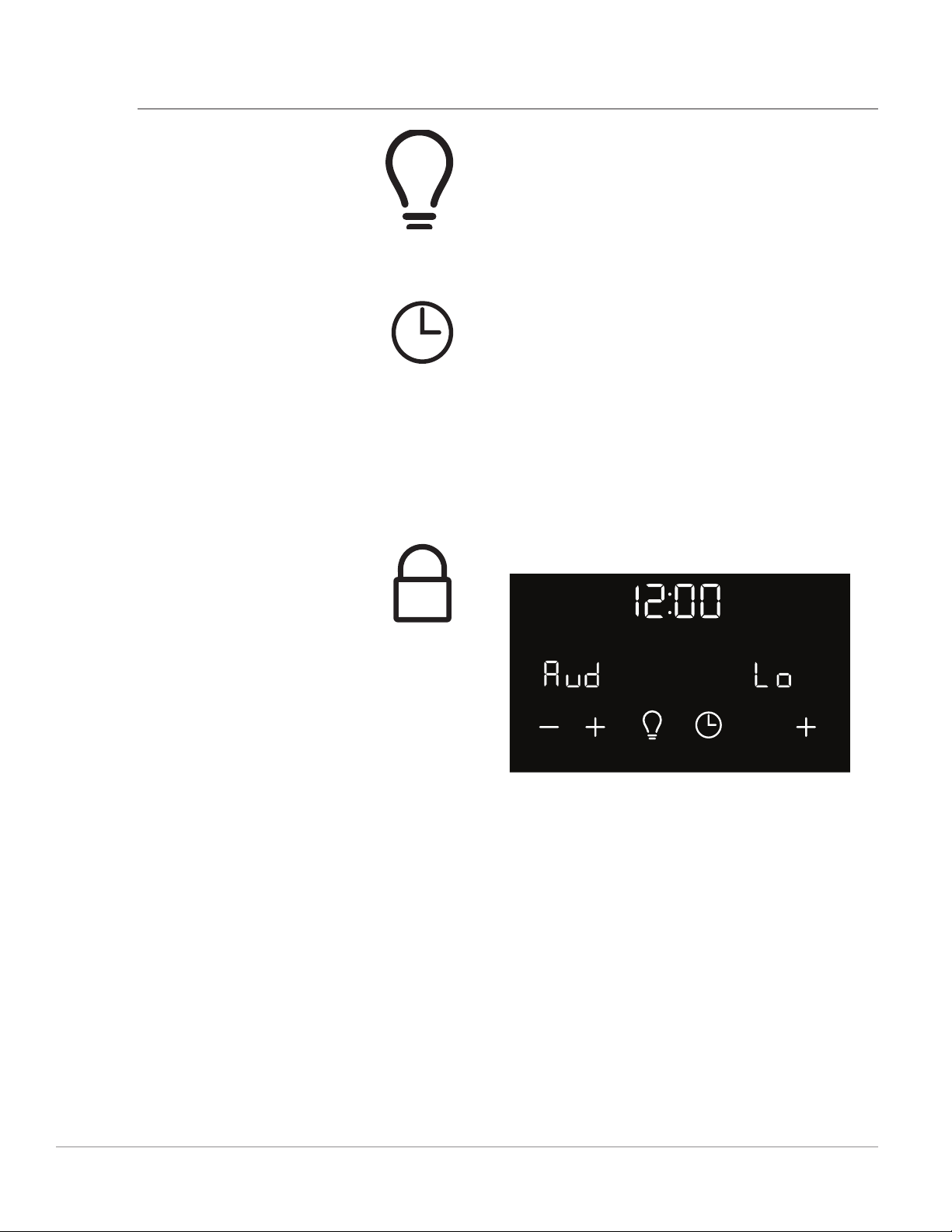
Removing and Replacing the Glide Racks
The fully extendable Glide rack makes food prepa-
ration easier. This oven rack has glide tracks that
allow the rack to be pulled away from the oven
without rubbing the sides of the oven wall.
To remove - Make sure the baking rack is in the
closed position. Using one hand, reach through
handle opening and grasp both the upper and low-
er bars of the glide rack.
While holding both sections, pull the glide rack out
of the oven until the stop position is reached.
Using both hands, lift up the front of the rack
slightly and continue to pull the rack away from the
oven. Be sure to grasp both upper and lower rack
portions together when removing or handling the
glide rack.
The rack portions move independently and are
di cult to handle unless held together.
To replace - Make sure the baking rack is in the
closed position. Grasp both upper and lower
portions of glide rack. Lift and hold the rack level
between the oven cavity walls. Tilt the front of the
rack upward slightly and slide the rack completely
into position.
To prevent possible damage to the oven, do not
attempt to close the oven door until all the oven
racks are fully positioned back inside the oven
cavity.
IMPORTANT
Remove all oven racks and clean according to
instructions provided in the Care & Cleaning
section of this manual. Never pick up hot oven
racks or parts.
16
BEFORE SETTING OVEN CONTROLS
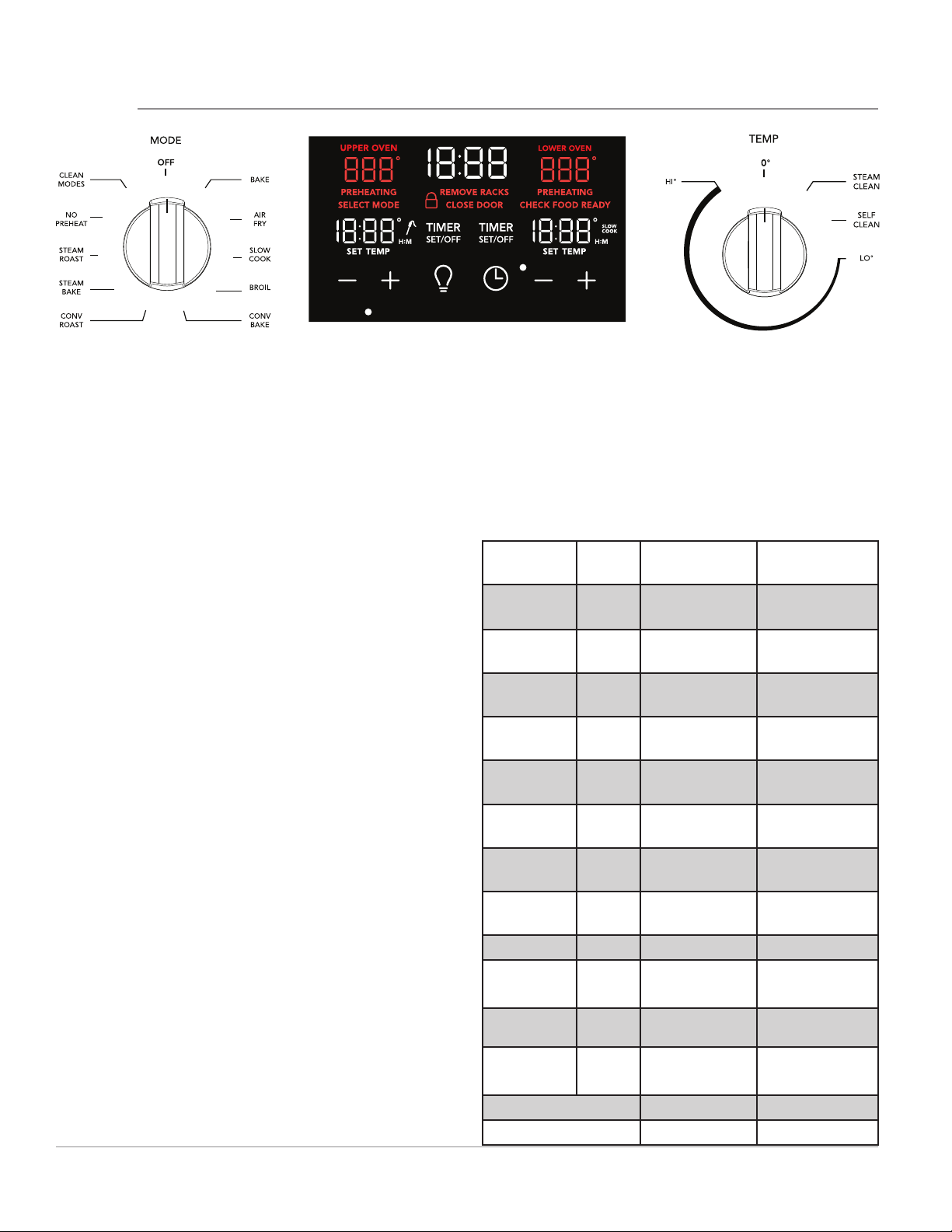
Settings
To open the settings menu, press and hold the light
key for 3 seconds. Then use the + and - keys to
select which setting to adjust.
• delay start (see page 36)
• audio
• temperature units
• energy savings mode
• UPO
• factory reset
Set Clock
When fi rst installed or following a power
outage, the clock will show 12:00 fl ashing.
To set the clock:
1. Press the Clock key.
2. Use the + and - keys to select the correct time.
3. Press the Clock key to save changes
Audio
To switch audio for controls o or on:
1. Press and hold the light key for 3 seconds to
open the settings menu.
2. Use the + and - keys on the left to select the
audio function (Aud).
3. Use the + and - keys on the right to select HI or
Lo.
4. Press and hold the light key for 3 seconds to
confi rm changes.
Oven Light
Press the Light key to turn the oven lights
on or o .
Oven Lockout
You can lock the door and controls of the
oven for safety around children.
To lock the oven:
1. Press and hold both the Light key and the
Clock key for 3 seconds.
2. The lock icon turns on, and all controls but the
Light key and Clock key are disabled.
To unlock the oven:
3. Press and hold both the Light key and the
Clock key for 3 seconds.
4. The lock icon turns o , and all controls return
to normal.

17
BEFORE SETTING OVEN CONTROLS
Fahrenheit / Celcius
To change temperature units:
1. Press and hold the light key for 3 seconds to
open the settings menu.
2. Use the + and - keys on the left to select the
Temperature Units function (unt).
3. Use the + and - keys on the right to select F or
C.
4. Press and hold the light key for 3 seconds to
confi rm changes.
Energy Savings Mode
To set whether the oven automatically turns o
after twelve hours:
1. Press and hold the light key for 3 seconds to
open the settings menu.
2. Use the + and - keys on the left to select the
Energy Savings function (E S).
3. Use the + and - keys on the right to select on or
oFF.
4. Press and hold the light key for 3 seconds to
confi rm changes.
User Programmed O set (UPO)
The oven is adjusted at the factory for accurate
temperatures, but if you feel the temperature is not
right in your kitchen, you can adjust it:
1. Press and hold the light key for 3 seconds to
open the settings menu.
2. Use the + and - keys on the left to select the
User Programmed O set function (uPo).
3. Use the + and - keys on the right to select how
many degrees to adjust the temperature (nega-
tive values are valid).
4. Press and hold the light key for 3 seconds to
confi rm changes.
Food Probe Enable/Disable
You can select whether the food probe is enable or
disable and whether the oven turns o when the
probe detects the specifi ed temperature.
To change the food probe settings:
1. Press and hold the light key for 3 seconds to
open the settings menu.
2. Use the + and - keys on the left to select the
Food Probe function (FP).
3. Use the + and - keys on the right to select on or
oFF.
4. Use the + and - keys on the left to select the
End of Cycle function (EoC).
5. Use the + and - keys on the right to select on or
oFF.
6. Press and hold the light key for 3 seconds to
confi rm changes.
Factory Reset
You can return all modifi ed settings to their original
factor settings.
To reset to factory settings:
1. Press and hold the light key for 3 seconds to
open the settings menu.
2. Use the + and - keys on the left to select the
Reset function (rSt).
3. Use the + and - keys on the right to select YES
or oFF.
4. Press and hold the light key for 3 seconds to
confi rm changes.
18
SETTING OVEN CONTROLS
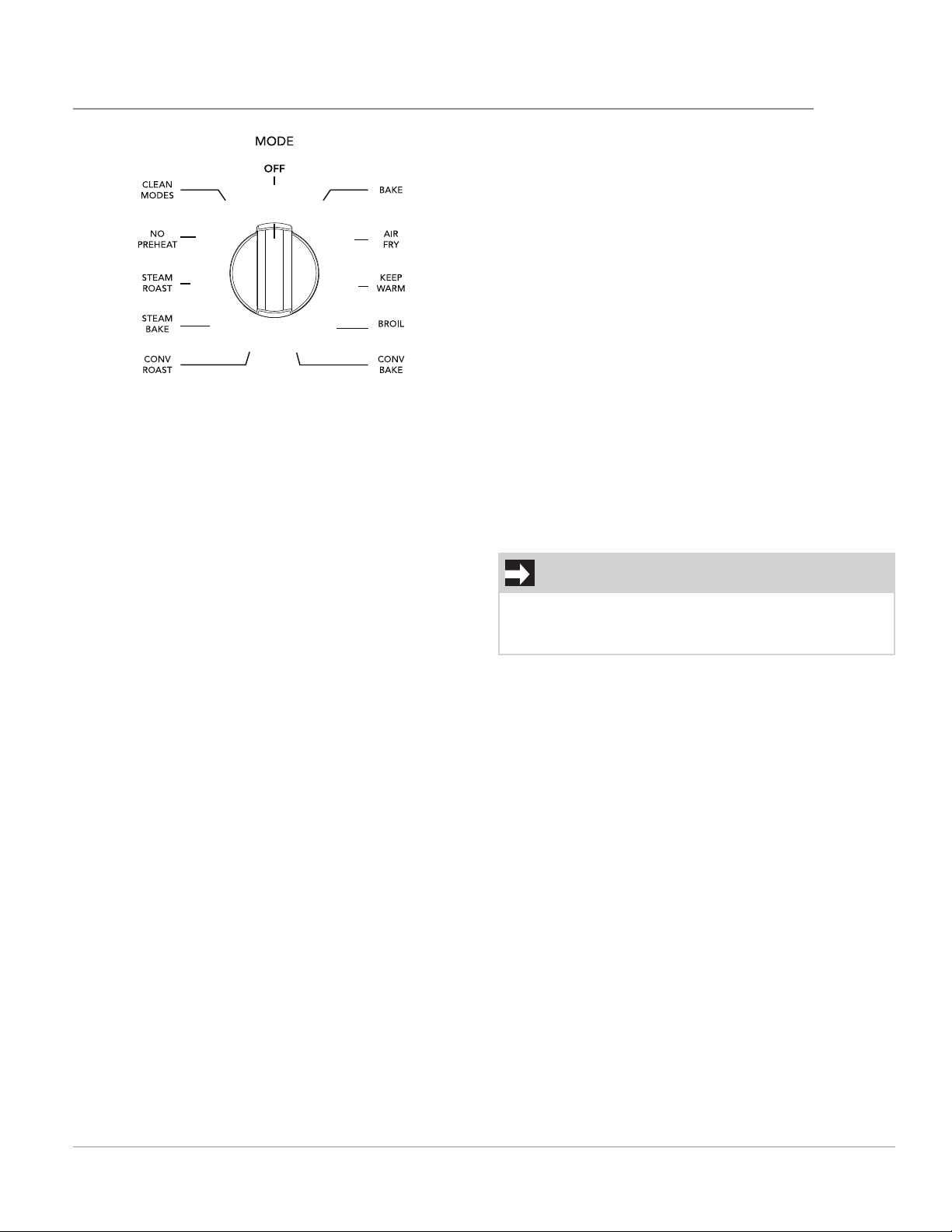
Mode Control (Single Oven / Lower
Oven)
1. O : Turns o all modes.
2. Bake: is for delicate foods that need heat to
rise and move gently in the oven.
3. Air Fry: works best for single rack baking with
packaged and convenience foods.
4. Slow Cook: is for foods that will cook or braise
at low temperature for a long period of time.
5. Broil: is for broiling and grilling foods under
direct, high heat.
6. Conv Bake: circulates the oven heat continu-
ously for baking.
7. Conv Roast: combines a cook cycle with the
convection fan and elements to rapidly roast
meats and poultry.
8. Steam Bake: creates the best conditions for
baking bread on a single rack.
9. Steam Roast: creates the best conditions for
roasting proteins.
10. No Preheat: is available for single rack baking
with packaged and convenience foods and can
be used with regular recipes also.
11. Clean Modes: Enables Self Clean and Steam
Clean on the Temp Control.
Temp Control
1. Hi-Lo: Sets temperature for selected cooking
mode.
2. Self Clean: When Clean Modes is selected,
starts a self cleaning cycle.
3. Steam Clean: When Clean Modes is selected,
starts a steam cleaning cycle.
Table 1: Minimum and maximum control settings
Feature Mode Min Temp/
Time
Max Temp/
Time
No
Preheat
170°F (77°C) 550°F
(288°C)
Bake 170°F (77°C) 550°F
(288°C)
Broil 400°F
(205°C)
550°F
(288°C)
Air Fry 170°F (77°C) 550°F
(288°C)
Steam
Bake
170°F (77°C) 550°F
(288°C)
Steam
Roast
170°F (77°C) 550°F
(288°C)
Conv Bake 170°F (77°C) 550°F
(288°C)
Conv
Roast
170°F (77°C) 550°F
(288°C)
Timer 0:01 Min 11:59 Hr./Min.
Clock
Time
12 Hr.
24 Hr
1:00 Hr./Min.
0:00 Min
11:59 Hr./Min.
23:59 Hr./Min.
Delay
Start
0:01 Min. 1:00 Hr./Min.
Cook
Time
12 Hr.
24 Hr
0:01 Min
0:01 Min
11:59 Hr./Min.
11:59 Hr./Min.
Self clean 2 hours 4 hours
Steam clean 2 hours 4 hours
Single and Double Ovens
Single and double wall ovens have many of the
same features. If you have a double wall oven, it
has a second set of control dials: one set for the
upper oven and another for the lower oven.
19
SETTING OVEN CONTROLS
Modes
• Bake (page 20)
• Air Fry (page 21)
• Slow Cook / Keep Warm (page 22)
• Broil (page 23)
• Convection Bake (page 25)
• Convection Roast (page 26)
• Steam Bake (page 28)
• Steam Roast (page 29)
• No Preheat (page 30)
• Self Clean (page 33)
• Steam Clean (page 35)
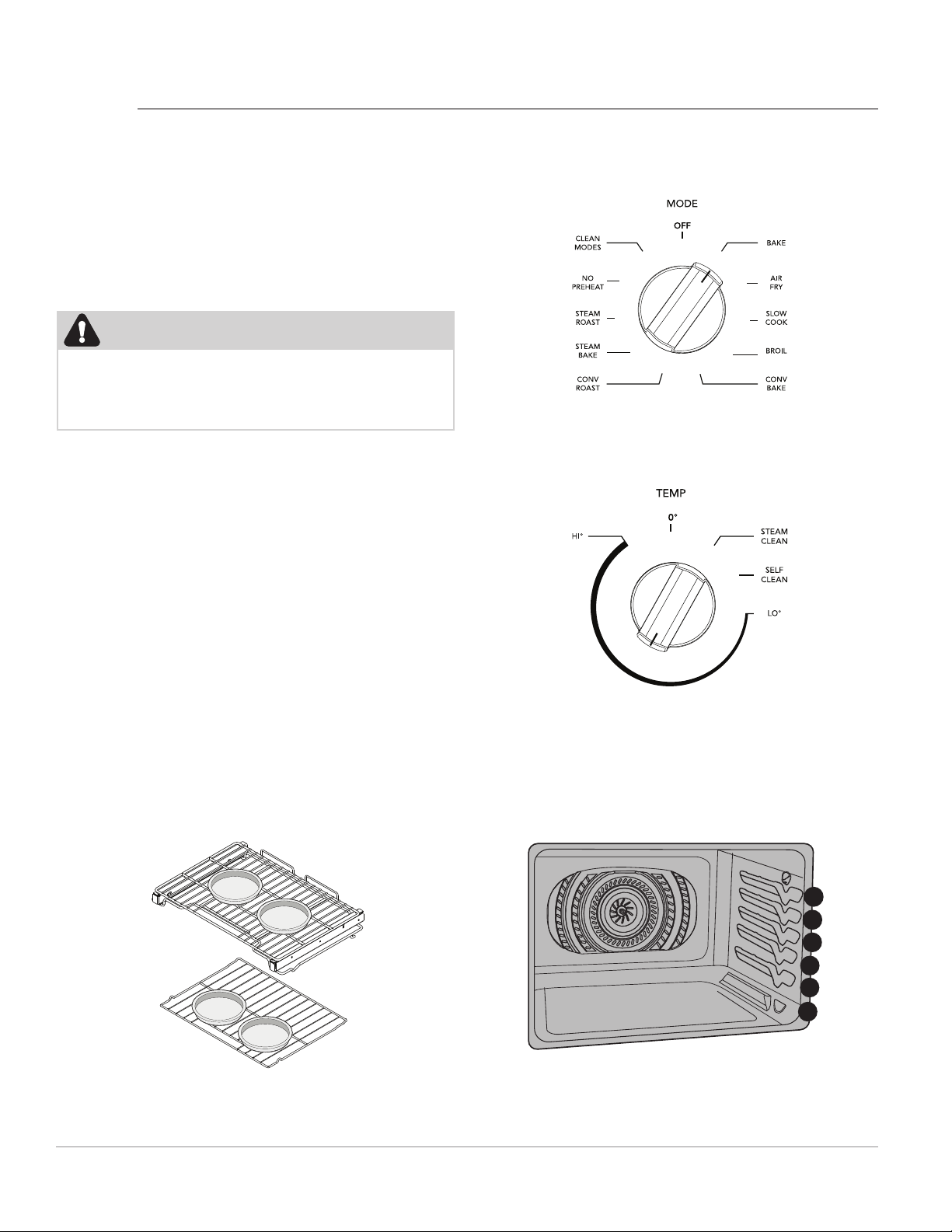
Mode Control (Upper Oven)
1. O : Turns o all modes.
2. Bake: is for delicate foods that need heat to
rise and move gently in the oven.
3. Air Fry: works best for single rack baking with
packaged and convenience foods.
4. Keep Warm: used with foods that are already
cooked to keep them at serving temperatures.
5. Broil: is for broiling and grilling foods under
direct, high heat.
6. Conv Bake: circulates the oven heat continu-
ously for baking.
7. Conv Roast: combines a cook cycle with the
convection fan and elements to rapidly roast
meats and poultry.
8. Steam Bake: creates the best conditions for
baking bread on a single rack.
9. Steam Roast: creates the best conditions for
roasting proteins.
10. No Preheat: is available for single rack baking
with packaged and convenience foods and can
be used with regular recipes also.
11. Clean Modes: Enables Self Clean and Steam
Clean on the Temp Control.
IMPORTANT
When you want to switch from one mode to
another, always turn the Mode dial to OFF in
between.
20
SETTING OVEN CONTROLS
Setting Bake
Bake uses heat that rises from the oven bottom for
best baking results.
A reminder tone will sound indicating when the set
bake temperature is reached and to place the food
in the oven.
Bake may be set for any oven temperature be-
tween 170°F (77°C) to 550°F (288°C).
Baking Tips
• Fully preheat the oven before baking items like
cookies, cakes, biscuits and breads.
• For all baking except layer cakes, pans should
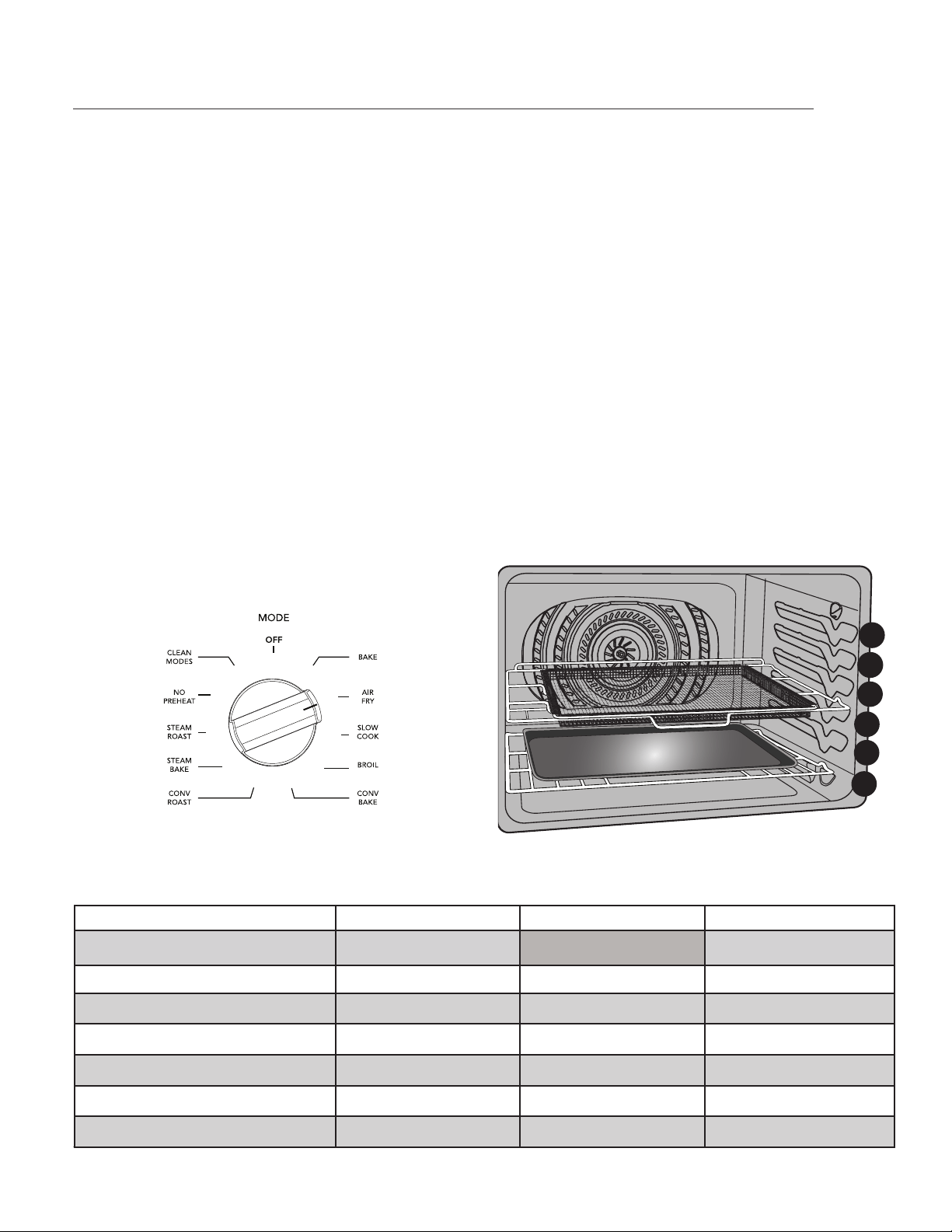
be placed in the middle of the rack. Place layer
cake pans as shown.
• Use the convection bake function for best re-
sults when baking cookies or cakes on multiple
racks.
• For best results when baking layer cakes using
two oven racks, place racks in positions 2 and 5
and place pans centered on each rack.
• When using any single rack for baking cookies,
cakes, biscuits, or mu ns use rack position 3.
• Allow at least 2 inches (5 cm) of space between
bakeware for proper air circulation.
• Leave oven lights o while baking.
CAUTION
Always use pot holders or oven mitts when using
the oven. When cooking the oven interior, oven
racks, and cooktop will become very hot which
can cause burns.
To set Bake
1. Turn the Mode knob to BAKE. The temperature
display will show ---.
2. Turn the Temperature knob until the display
shows 350°F (176°C). The display will show
PREHEATING and the current temperature
inside the oven.
1
2
3
4
5
6
3. When the oven reaches the chosen tempera-
ture, the PREHEATING indicator will turn o .
4. When fi nished cooking, turn the Mode knob to
OFF.
21
SETTING OVEN CONTROLS
Air Fry
The Air Fry feature works best for single rack bak-
ing with packaged and convenience foods. It works
well with most recipes and can be programmed for
temperatures between 170°F and 550°F. Follow the
recipe or package directions for food preparation
quantity, time, and temperature.
Important:
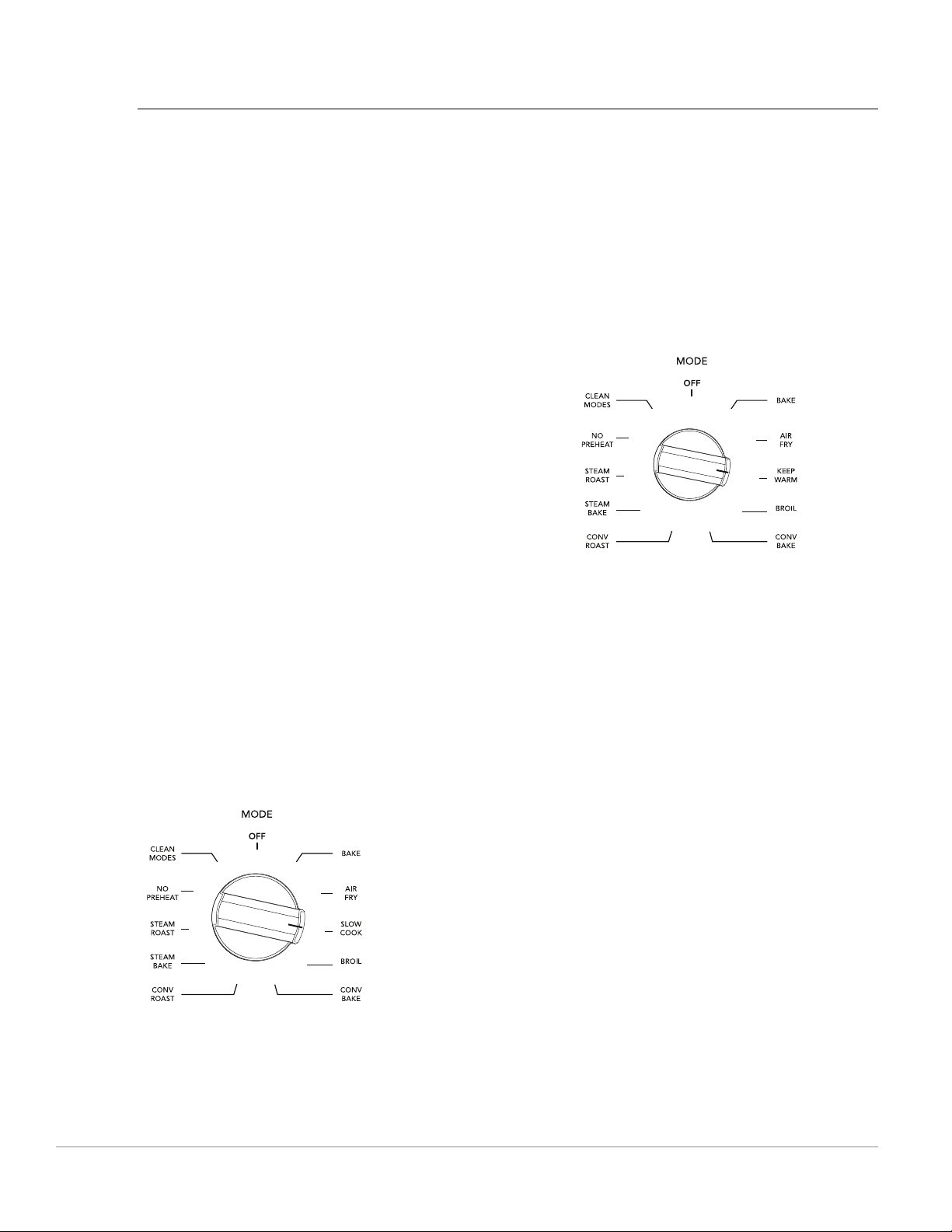
• Food should be arranged in single layers on a
pan and place food near the front of a single
rack on position 3 for best results.
• When using Air Fry tray, place a large, rimmed
cookie sheet on rack position 1 to catch any
crumbs or drippings.
• Leave oven light o when baking.
• Food may need to be removed early and
should be checked at minimum recommended
bake time. However, frozen dense foods and
items with cook times less than 15 minutes may
require additional time.
The Air Fry Tray is specifi cally designed to deliver
superior performance.
Some Benefi ts of the Air Fry Tray:
• Tray optimized for oven space and large capac-
ity air frying.
• Fits in the dishwasher for easy clean up.
• Higher yield than countertop models.
• Frees up countertop space.
Food Type Quantity (oz.) Temperature Cook Time (mins)
Frozen Tater Tots 48 450°F - 232°C 29-33
Frozen Golden Fries 48 425°F - 218°C 25-35
Frozen Chicken Nuggets 48 400°F - 205°C 13-15
Frozen Crispy Chicken Strips 48 400°F - 205°C 20-22
Frozen Hot Wings Bone-In 48 450°F - 232°C 25-28
Frozen Chicken Wings 48 375°F - 190°C 60-65
Fresh Chicken Wings 48 450°F - 232°C 30-40
Figure 4: Air Fry Tray
Table 3: Air Fry Table
To set Air Fry:
1. Turn the Mode knob to AIR FRY. The tempera-
ture display will show ---.
2. Turn the Temperature knob until the display
shows 350°F (176°C). The display will show
PREHEATING and the current temperature
inside the oven.
3. When the oven reaches the chosen tempera-
ture, the PREHEATING indicator will turn o .
For optimum results, allow the oven to fully
preheat before adding food.
4. When fi nished cooking, turn the Mode knob to
OFF.
1
2
3
4
5
6
22
SETTING OVEN CONTROLS
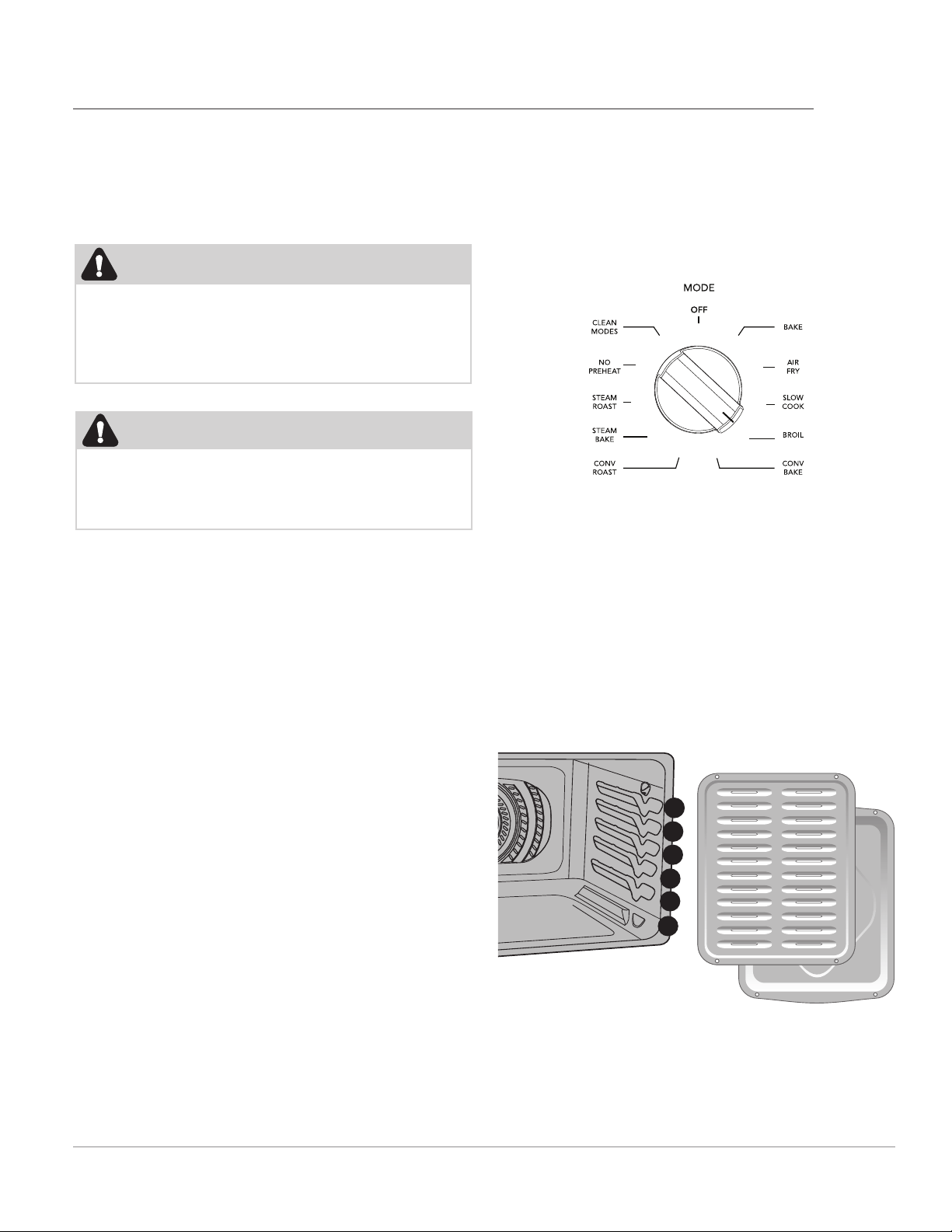
To set Slow Cook
1. Turn the Mode knob to SLOW COOK. The tem-
perature display will show on. and 130 will show
in the SET TEMP display. The - and + keys will
become active.
2. Use the - and + keys to adjust the SET TEMP.
The Temp knob is not active in Slow Cook
mode.
3. When fi nished cooking, turn the Mode knob to
OFF.
Slow Cook (Single Oven / Lower Oven)
Use Slow Cook for foods that will cook or braise at
low temperature for a long period of time.
For best results when using Slow Cook:
• Completely thaw all frozen foods before cook-
ing.
• When using a single oven rack, place in oven
rack position 2 or 3. Position racks to accom-
modate the size of various bakeware when
cooking multiple food items.
• Do not open the oven door often or leave the
door open when checking foods. If the oven
heat escapes often, the Slow Cook time may
need to be extended.
• Cover to keep foods moist or use a loose or
vented type cover to allow foods to turn crisp
or brown.
• Roasts may be left uncovered so browning can
occur. Cook times will vary depending on the
weight, fat content, bone, and the shape of the
roast. Preheating the oven will not be necessary
when using the Slow Cook feature.
• Add any cream or cheese sauces during the last
hour.
Slow cooking meats may result in the outside of
the meat turning dark; this is normal.
Keep Warm (Upper Oven)
Keep Warm should only be used with foods that
are already at serving temperatures. Keep warm
will keep cooked foods warm and ready for serving
after cooking has fi nished.
Keep warm will keep the oven temperature at 140°
F - 200° F (60°C - 93°C).
To set Keep Warm:
1. Turn the Mode knob to KEEP WARM. The tem-
perature display will show on.
2. When fi nished cooking, turn the Mode knob to
OFF
23
SETTING OVEN CONTROLS
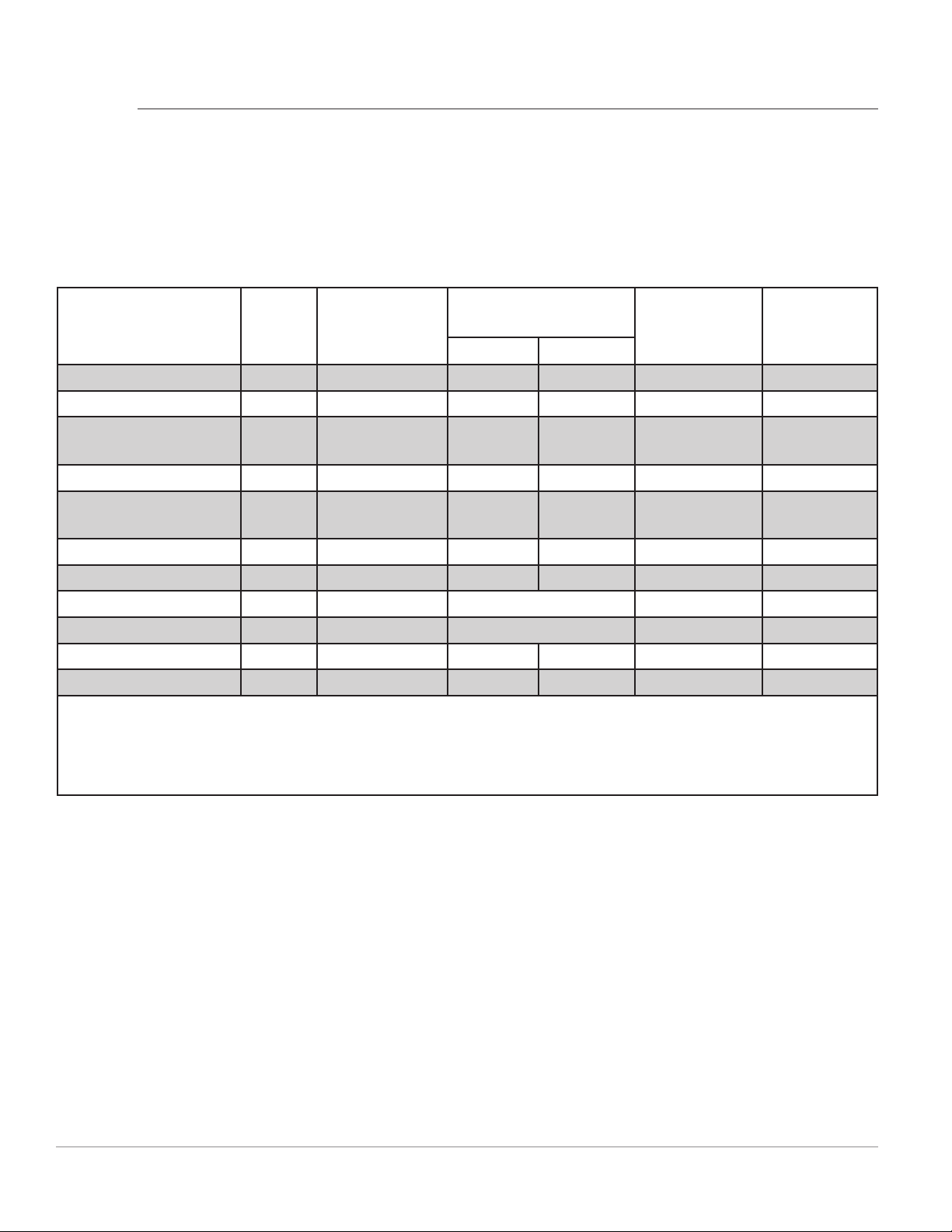
Setting Broil
Use the broil function to cook foods that require
direct exposure to radiant heat for optimum
browning results. Broiling may produce smoke. If
smoke is excessive, place food further away from
the heating element.
CAUTION
Always use pot holders or oven mitts when using
the oven. When cooking, the oven interior, oven
racks, and cooktop will become very hot which
can cause burns.
WARNING
Should an oven fi re occur, close the oven door
and turn the oven o . If the fi re continues, use a
fi re extinguisher. Do not put water or fl our on the
fi re. Flour may be explosive and water can cause
a grease fi re to spread and cause personal injury.
1
2
3
4
5
6
Important: Broiler pans and inserts allow the
grease to drain away from the high heat of the
broiler. Do not use the pan without the insert. Do
not cover the insert with foil – the exposed grease
could ignite.
To set broil with the default broil oven tempera-
ture of 550°F (288°C):
1. Arrange the oven racks when cool. For opti-
mum browning results, allow the oven to fully
preheat before adding food.
2. Turn the Mode knob to Broil. The temperature
display will show on, and the SET TEMP indica-
tor will turn on with a setting of HI.
3. To change between the HI and Lo settings, use
the - and + keys that become active.
4. After the oven starts, the SET TEMP indicator
will turn o . The PREHEATING indicator will
turn on.
5. When the oven is fully preheated, the PRE-
HEATING indicator will turn o . For optimum
results, allow the oven to fully preheat before
adding food.
6. When fi nished cooking, turn the Modes knob to
OFF.
24
SETTING OVEN CONTROLS
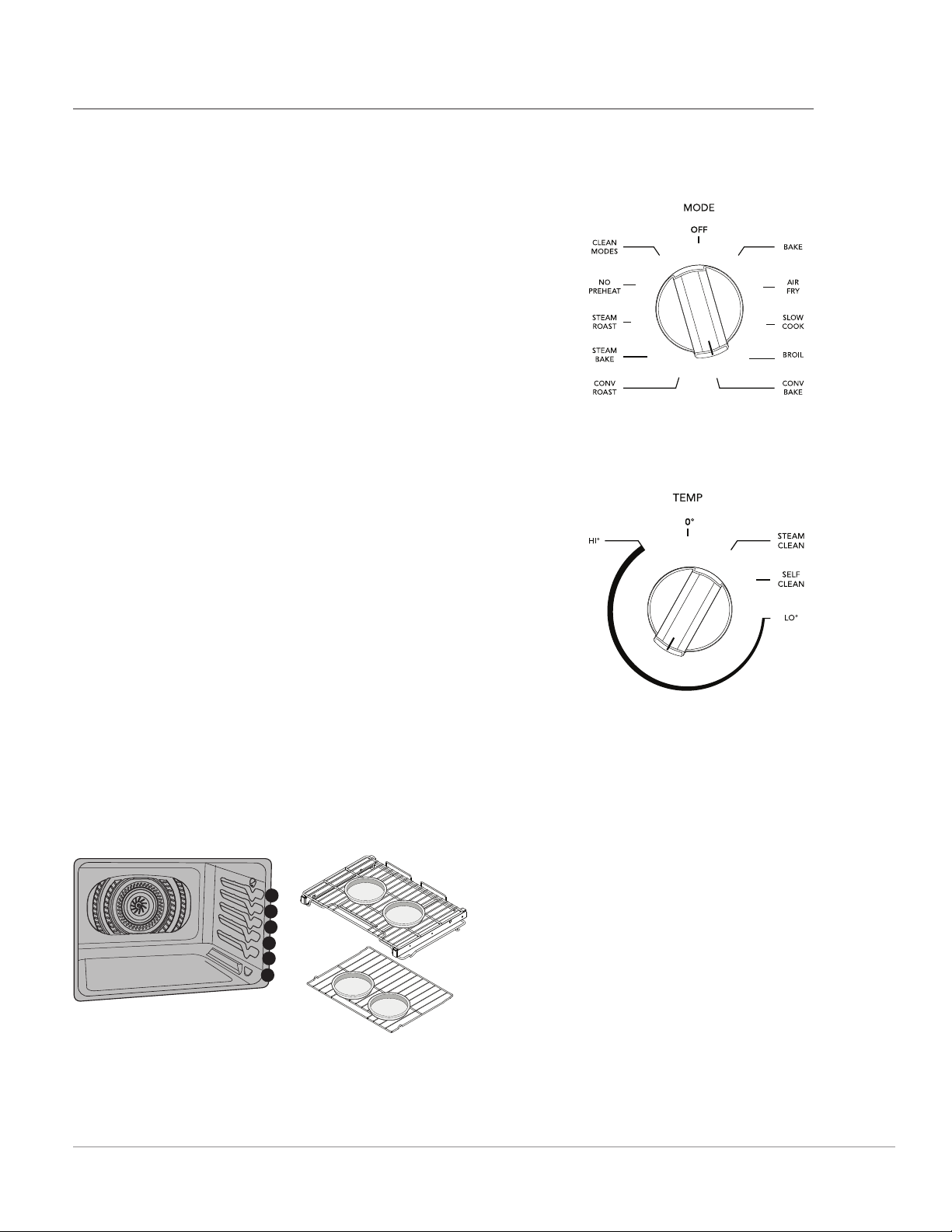
Table 4: Broil recommendations
Food item Rack
Posi-
tion
Temp Cook time in
minutes
Internal
Tempera-
ture
Doneness
1st side 2nd side
Steak 1” thick 6 HI 4:00 4:00 140ºF (60ºC) Rare**
Steak 1” thick 6 HI 6:00 4:00 145°F (63°C) Medium
Steak 1” thick 6 HI 7:00 5:00 160ºF (71ºC) Medi-
um-well
Steak 1” thick 6 HI 8:00 6:00 170°F (77ºC) Well
Pork Chops 3/4
“thick
6 HI 12:00 10:00 170°F (77ºC) Well
Chicken - Bone In 6 LO 20:00 10:00 170°F (77ºC) Well
Chicken Boneless 6 LO 8:00 6:00 170°F (77ºC) Well
Fish 6 HI as directed 170°F (77ºC) Well
Shrimp 6 HI as directed 170°F (77ºC) Well
Hamburger 1” thick 6 HI 9:00 7:00 145ºF (63ºC) Medium
Hamburger 1” thick 6 HI 10:00 8:00 170°F (77ºC) Well
The U.S. Department of Agriculture states, **Rare fresh beef is popular, but you should know that cook-
ing it to only 140°F (60°C) means some food poisoning organisms may survive.” (Source: Safe Food
Book, Your Kitchen Guide, USDA Rev. June 1985.) The lowest temperature recommended by the USDA
is 145°F (63°C) for medium rare fresh beef. For well done 170°F (77ºC). All cook times shown are after 2
minutes of preheating.
Important notes:
• Always arrange oven racks when the oven is cool.
• For best results when broiling, use a broil pan with broil pan insert designed to drain the fat from the
food and help avoid spatter and reduce smoking.
• When broiling, always pull the oven rack out to the stop position before turning or removing food.
25
SETTING OVEN CONTROLS
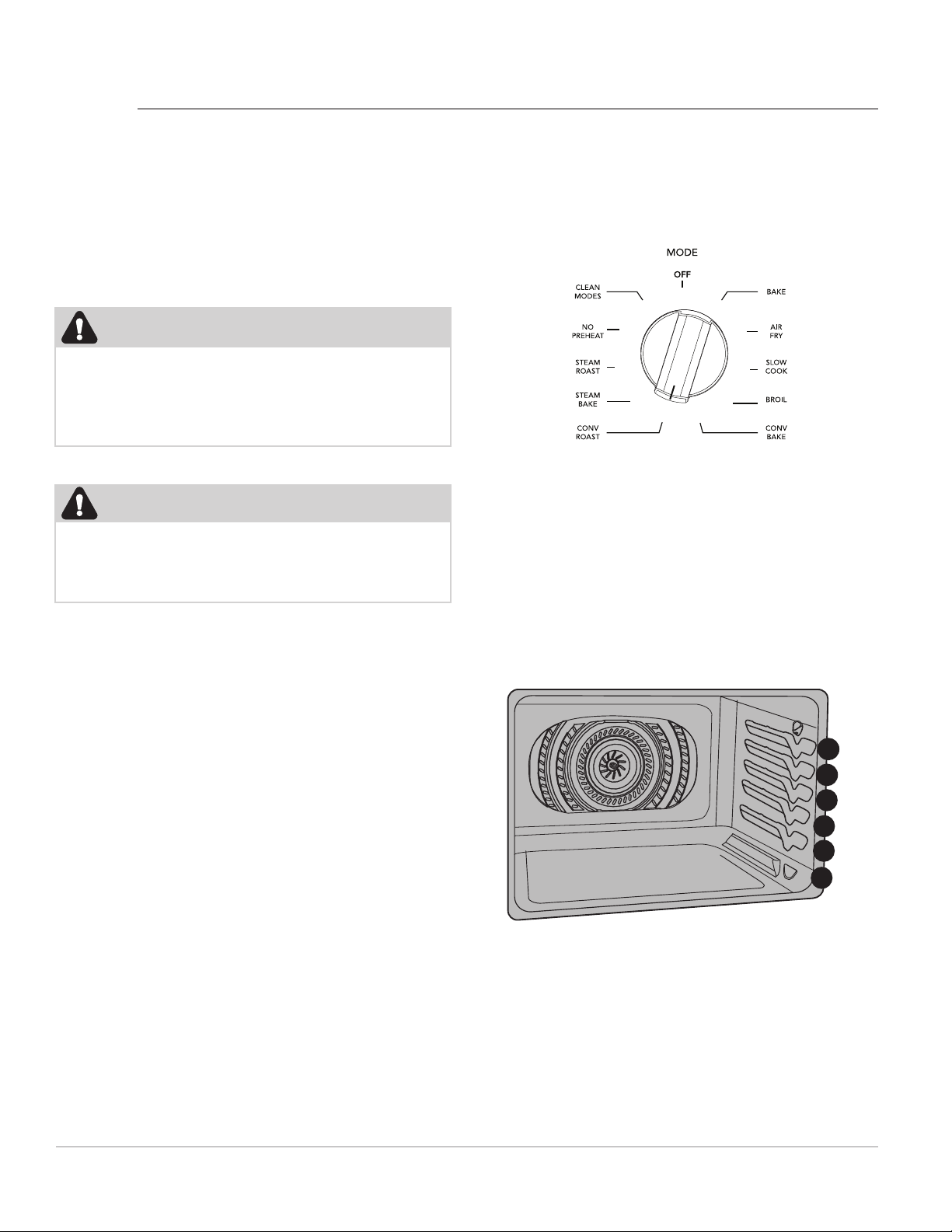
Convection Bake
Convection Bake uses a fan to circulate the oven’s
heat uniformly around the oven. This improved
heat distribution allows for even cooking and
browning results. Heated air fl ows around the food
from all sides.
Convection bake may be set for any oven tempera-
ture between 170°F (77°C) and 550°F (288°C).
Benefi ts of convection cooking include:
• Multiple rack baking.
Convection baking tips:
• Use Convection Bake for best results when
baking cookies and cakes on 2 racks.
• For best results it is recommended to preheat
the oven before baking items like cookies,
biscuits and breads and move pans to center of
the racks.
• If your recipe is not written for convection bak-
ing, reduce the oven temperature by 25° or use
Convection Convert option.
• No special pans or bakeware required.
• For cookies use the following racks:
• Single rack baking use 3 (glide rack).
• Two rack baking use 2 (fl at) and 5 (glide).
• For baking cakes use the following rack posi-
tions and place bakeware as shown in Figure 4.
In upper rack use position 5 (glide) or 6 (fl at).
• Cookies and biscuits should be baked on pans
with no sides or very low side to allow heated
air to circulate around the food. Food items
baked on pans with a dark fi nish will cook fast-
er.
• Leave oven lights o while baking.
To set convection bake with a default oven set
temperature of 325°F (163°C):
1. Turn the Mode knob to CONV BAKE. The tem-
perature display will show ---.
Figure 5: Pan positions for best results when bak-
ing cakes on two racks.
1
2
3
4
5
6
2. Turn the Temperature knob until the display
shows 325°F (164°C). The display will show
PREHEATING and the current temperature
inside the oven.
3. When the oven reaches the chosen tempera-
ture, the PREHEATING indicator will turn o .
For optimum results, allow the oven to fully
preheat before adding food.
4. When fi nished cooking, turn the Mode knob to
OFF.
26
SETTING OVEN CONTROLS
Convection Roast
Convection roast combines a cook cycle with the
convection fan and elements to rapidly roast meats
and poultry. Heated air circulates around the meat
from all sides, sealing in juices and fl avors. Meats
cooked with this feature are crispy and brown on
the outside while staying moist inside.
WARNING
Should an oven fi re occur, close the oven door
and turn the oven o . If the fi re continues, use a
fi re extinguisher. Do not put water or fl our on the
fi re. Flour may be explosive and water can cause
a grease fi re to spread and cause personal injury.
CAUTION
Always use pot holders or oven mitts when using
the oven. When cooking, the oven interior, oven
racks, and cooktop will become very hot which
can cause burns.
Figure 6: Convection roasting on lower oven racks
1
2
3
4
5
6
To set convection roast with a default oven set
temperature of 325°F (164°C):
1. Arrange the oven racks when cool.
2. Turn the Mode knob to CONV ROAST. The tem-
perature display will show ---.
3. Turn the Temperature knob until the display
shows 325°F (164°C). The display will show
PREHEATING and the current temperature
inside the oven. For optimum browning results,
allow the oven to fully preheat before adding
food.
4. When the oven reaches the chosen tempera-
ture, the PREHEATING indicator will turn o .
5. When fi nished cooking, turn the Mode knob to
OFF.

27
SETTING OVEN CONTROLS
Table 5: Convection Roasting recommendations
Meat Weight Oven Temp Internal Temp Mins per
lb
Beef Standing rib roast* 4 to 6 lb. 350°F (177ºC) *160ºF (71ºC) 25-30
Rib eye roast* 4 to 6 lb. 350°F (177ºC) *160ºF (71ºC) 25-30
Tenderloin roast 2 to 3 lb. 400°F (204ºC) *160ºF (71ºC) 15-25
Poul-
try
Turkey whole** 12 to 16 lb. 325°F (163ºC) 180°F (82ºC) 8-10
Turkey whole** 16 to 20 lb 325°F (163ºC) 180°F (82ºC) 10-15
Turkey whole** 20 to 24
lb.
325°F (163ºC) 180°F (82ºC) 12-16
Chicken 3 to 4 lb. 350°F-375°F (177ºC-
191ºC)*
180°F (82ºC) 12-16
Pork Ham roast, fresh 4 to 6 lb. 325°F (163ºC) 160°F (71ºC) 30-40
Shoulder blade
roast
4 to 6 lb. 325°F (163ºC) 160°F (71ºC) 20-30
Loin 3 to 4 lb. 325°F (163ºC) 160°F (71ºC) 20-25
Pre-cooked ham 5 to 7 lb. 325°F (163ºC) 160°F (71ºC) 30-40
* The U.S. Department of Agriculture states, “Rare fresh beef is popular, but you should know that cook-
ing it to only 140°F (60°C) means some food poisoning organisms may survive.” (Source: Safe Food
Book, Your Kitchen Guide) The lowest temperature recommended by the USDA is 145°F (63°C) for medi-
um rare fresh beef. For well done 170°F (77ºC)** Stu ed turkey requires additional roasting time. Shield
legs and breast with foil to prevent over browning and drying of the skin.
Convection Roasting tips:
• Preheating for convection roast is not necessary for most meats and poultry.
• Arrange oven racks so meat and poultry are on the lowest rack of the oven.
• Since convection roast cooks faster, may be able to reduce cook times as much as 25% from the rec-
ommended time of your recipe (check the food at this time). Then if needed, increase cook time until
the desired doneness is obtained.
• Do not cover foods when dry roasting - covering will prevent the meat from browning properly.
• When cooking meats use the broiler pan and insert. The broiler pan will catch grease spills and the
insert helps prevent grease splatters.
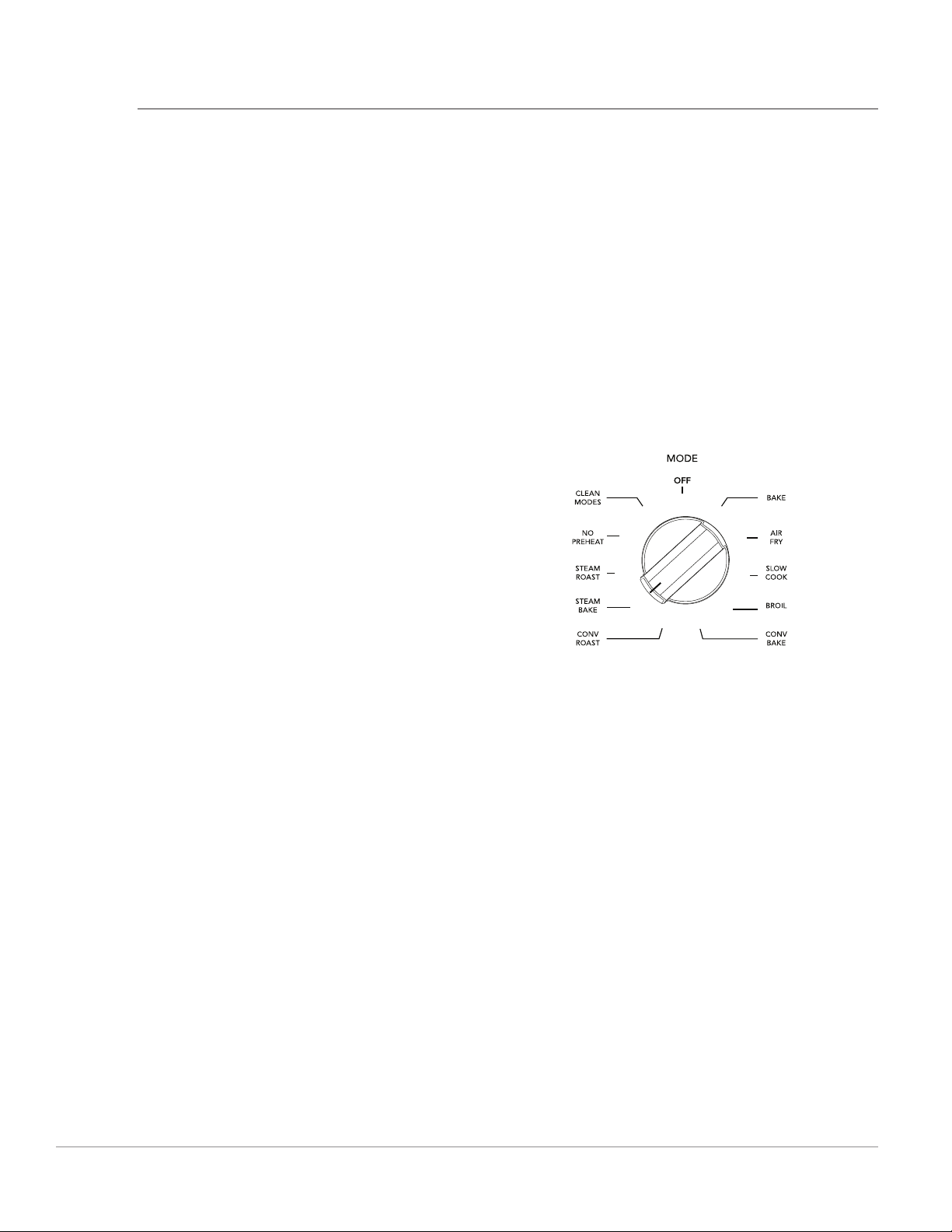
28
SETTING OVEN CONTROLS
Steam Bake
Steam creates the best conditions for baking bread
on a single rack. Baked goods will have improved
browning and texture and is recommended for
baking moist and fl avorful breads and pastries such
as baguettes and croissants.
Use glide rack in position 3 for best results for
Steam Bake. pans should be pulled to the front of
the rack.
Cooking with Steam
Note: More moisture will be present than during
conventional baking or roasting. Moisture could
condense on handle or in the door, and depending
on the conditions in your kitchen possibly drip onto
the fl oor.
Steam Cooking Tips:
Oven Positioning
• Use glide rack in position 3 in the oven for most
steam cooking.
• Lowest position for poultry.
Preparing
• Use 2.5 cups of water for steam bake and
steam roast. If steam functions are frequently
used, use distilled water.
• Using water container, pour water slowly onto
the bottom of oven cavity while still cool.
• Never add water if the oven is warm.
• Never add water during a Steam Bake or Steam
Roast cycle.
While in Use
• When using Steam, follow recipe for preheat-
ing, cook time and cook temperature.
• Always start with a cold oven.
• Preheating is not necessary when using steam
roast.
Cleaning
• With a paper towel lightly soaked in distilled
white vinegar, wipe out bottom of oven cavity
after the oven is cooled or before each use.
• Use the self clean function to clean heavily
soiled areas.
• If residue remains after self clean, pour a thin
layer of distilled white vinegar onto the bottom
of the oven cavity. Allow to sit for 30 minutes.
Wipe out vinegar.
To set steam bake with a default oven set tem-
perature of 350°F (176°C):
1. Arrange the oven racks when cool.
2. Turn the Mode knob to STEAM BAKE. The tem-
perature display will show ---.
3. Turn the Temperature knob until the display
shows 350°F (176°C). urn the Temperature
knob until the display shows 350°F (176°C). The
display will show Add H2o. The DOOR indicator
will come on.
4. Open the oven and add 2.5 cups of water to the
bottom of the oven. The CLOSE DOOR indica-
tor will come on.
5. The display will show PREHEATING and the
current temperature inside the oven. For opti-
mum browning results, allow the oven to fully
preheat before adding food.
6. When the oven reaches the chosen tempera-
ture, the PREHEATING indicator will turn o .
7. When fi nished cooking, turn the Mode knob to
OFF.
Important: Stand to the side of the oven when
opening to allow any steam to escape.
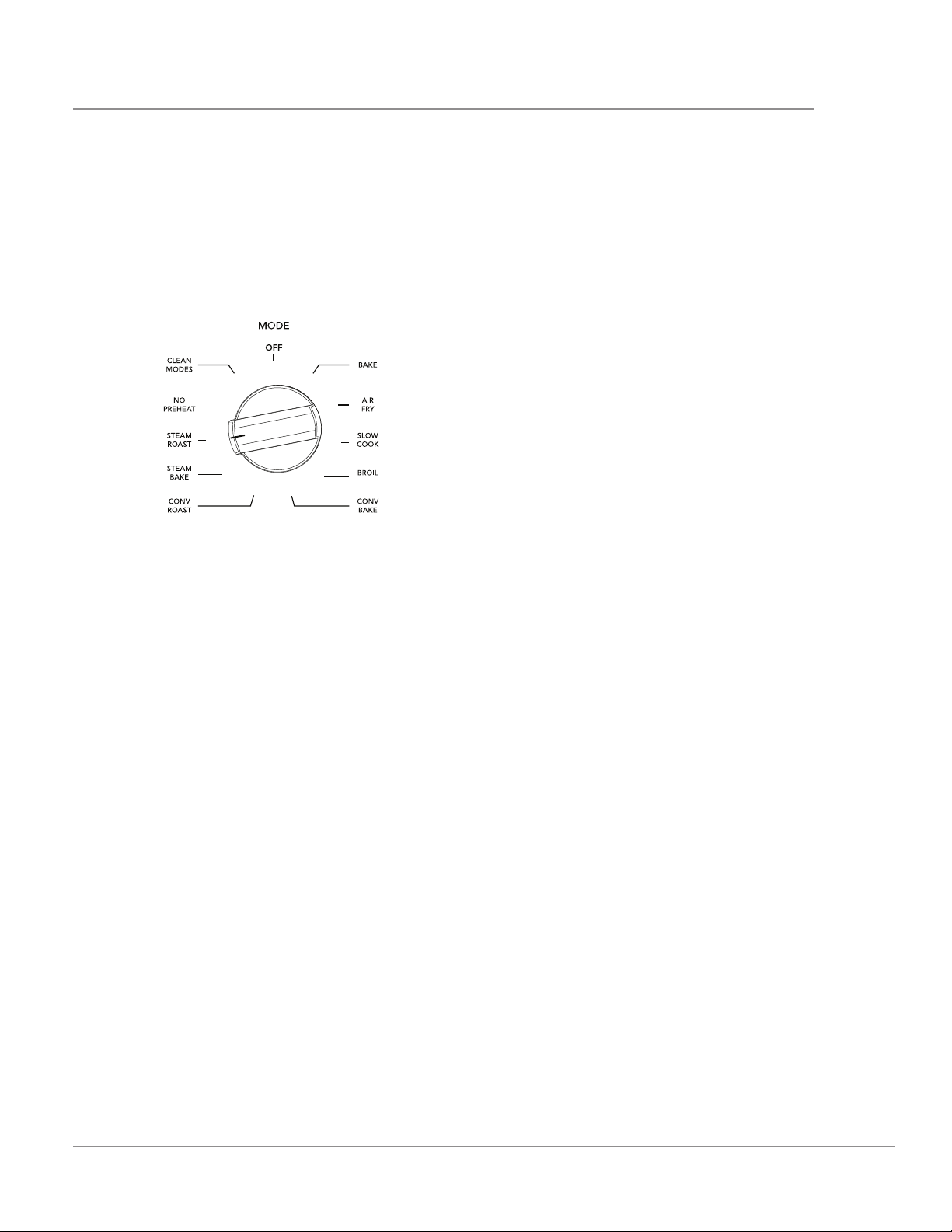
29
SETTING OVEN CONTROLS
Steam Roast
Steam creates the best conditions for roasting pro-
teins. Meats will be crisp outside and juicy inside.
Steam Roast is recommended for meat or poultry.
To set steam roast with a default oven set tem-
perature of 350°F (176°C):
1. Arrange the oven racks when cool.
2. Turn the Mode knob to STEAM ROAST. The
temperature display will show ---.
3. Turn the Temperature knob until the display
shows 350°F (176°C). urn the Temperature
knob until the display shows 350°F (176°C). The
display will show Add H2o. The DOOR indicator
will come on.
4. Open the oven and add 2.5 cups of water to the
bottom of the oven. The CLOSE DOOR indica-
tor will come on.
5. When the oven reaches the chosen tempera-
ture, the PREHEATING indicator will turn o .
For optimum browning results, allow the oven
to fully preheat before adding food.
6. When fi nished cooking, turn the Mode knob to
OFF.
Important: Stand to the side of the oven when
opening to allow any steam to escape.
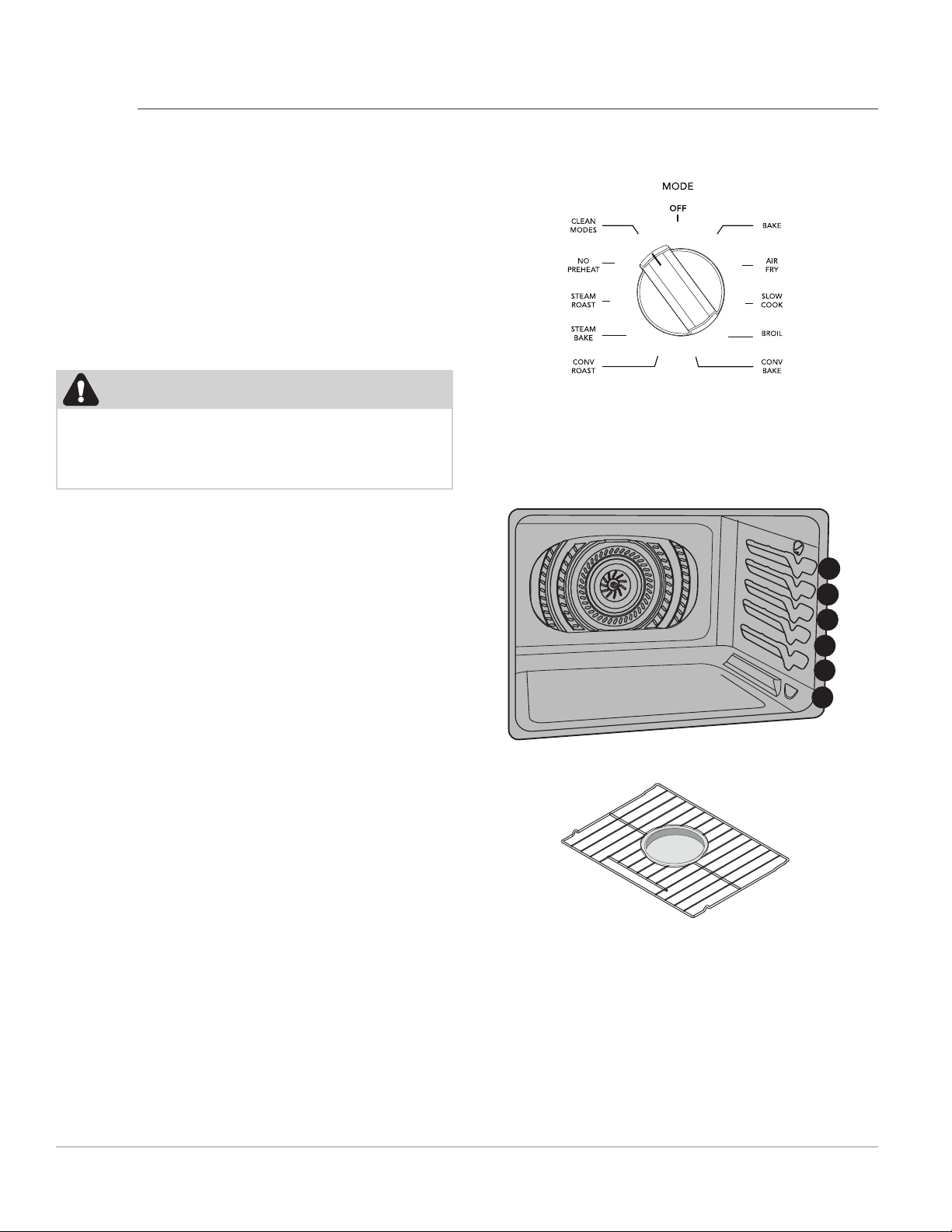
30
SETTING OVEN CONTROLS
No Preheat
No Preheat is available for single rack baking with
packaged and convenience foods and can be used
with regular recipes also. No Preheat may be used
with temperatures between 170°F and 550°F.
Follow the recipe or package directions for food
preparation time and temperature.
During No Preheat function, the oven elements will
cycle on and o . The convection fan will turn on
and stay on until No Preheat is canceled. Depend-
ing on your preference for doneness cooking times
may vary. Watch food closely.
Important:
• Always place food on rack position 3.
• Place the food with the pan or bakeware to the
center of the oven rack.
• When using No Preheat, use bakeware with
low or no sides. This allows the air to circulate
around the food evenly.
• Leave oven light o when baking.
• Food that comes in strips, such as fi sh sticks
and chicken tenders, should be placed on the
pan with the ends pointing to the sides of the
oven. Follow the package directions for food
preparation time and temperature.
• Food may need to be removed early and
should be checked at minimum recommended
cook time.
• No Preheat works best when cooking foods
longer than 10 minutes. If directions call for a
shorter cooking time, a few extra minutes may
be required for optimal cooking results.
• Do not open the oven door often. Opening the
door will reduce the temperature in the oven
and may increase cook time.
• Leave oven lights o while cooking.
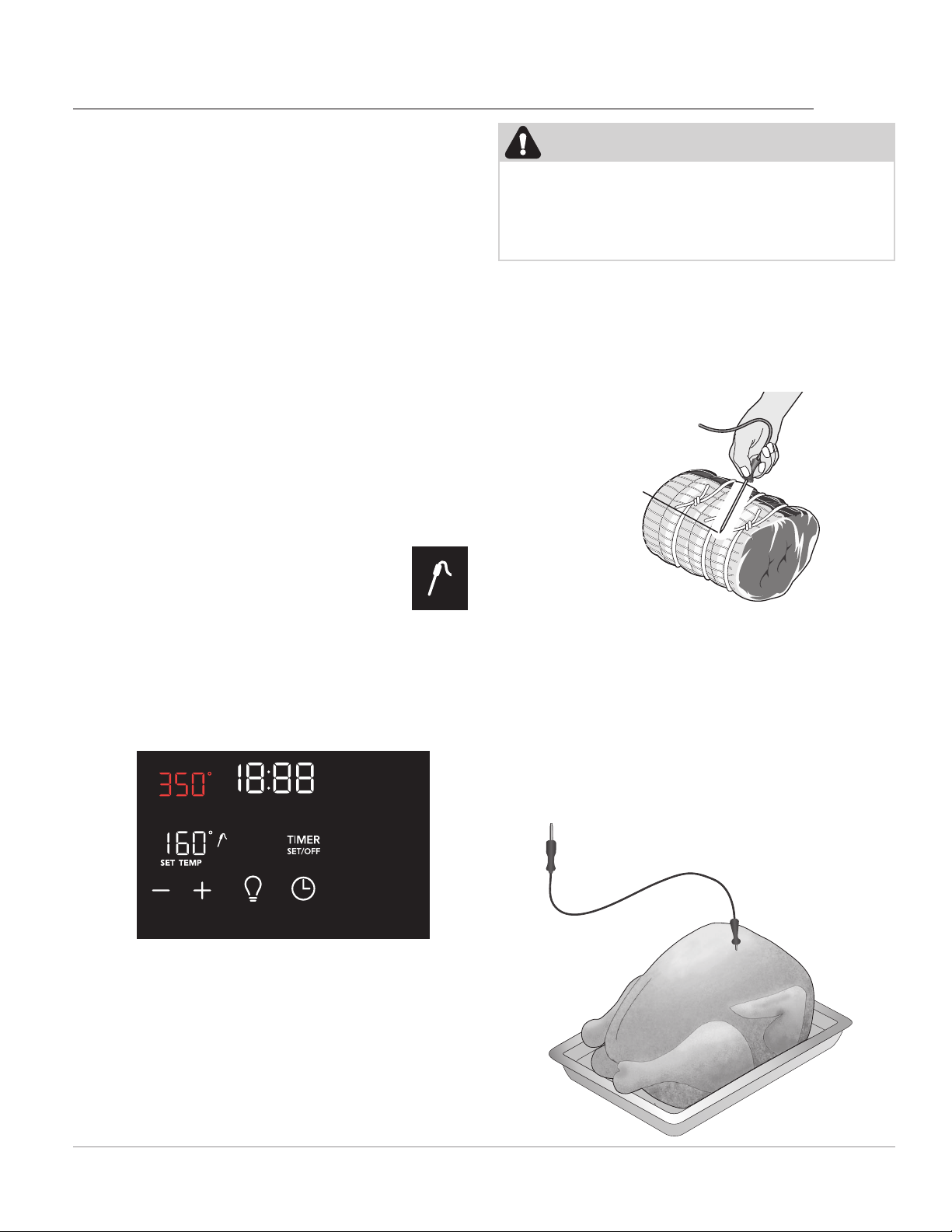
To set the no preheat temperature for 350°F:
1. Turn the Mode knob to NO PREHEAT. The tem-
perature display will show ---.
CAUTION
Always use pot holders or oven mitts when using
the oven. When cooking the oven interior, oven
racks, and cooktop will become very hot which
can cause burns.
2. Turn the Temperature knob until the display
shows 350°F (176°C).
3. When fi nished cooking, turn the Mode knob to
OFF.
1
2
3
4
5
6
31
SETTING OVEN CONTROLS
Cooking with Food Probe (Single / Upper
Oven)
Use the probe feature for best results when cook-
ing foods such as roasts, hams, or poultry.
The Food Probe works with the following oven
modes: Bake, Convection Bake, Air Fry, Convection
Roast, and Steam Roast.
The probe feature, when set correctly, will signal an
alert when the internal food temperature reaches
the desired set target temperature. The probe set-
tings for how the oven behaves should be set fi rst
in the oven menu.
When active, the probe displays the internal food
temperature which is visible in the display during
the cooking process. This eliminates any guesswork
or the need to open the oven door to check the
thermometer.
For meats like poultry and roasts, using a probe to
check internal temperature is the safest method to
ensure properly cooked food.
To set Food Probe:
1. Plug the food probe into the oven re-
ceptacle, the Food Probe indicator will
come on.
2. Select a cooking mode on the Mode dial.
3. Select a temperature on the Temp dial.
4. The SET TEMP indicator turns on with a default
value of 160°F, and the + and - keys come on.
Proper placement of probe in food.
Insert the probe so that the probe tip rests inside
the center of the thickest part of meat or food. For
best results, do not allow the probe temperature
sensor to contact bone, fat, gristle, or the cook-
ware.
• For bone-in ham or lamb, insert the probe into
the center of lowest large muscle or joint.
• For meat loaf or casseroles, insert the probe
into center of food.
• When cooking fi sh, insert meat probe just
above the gill.
• For whole poultry or turkey, fully insert the
probe sensor into the thickest part of the
breast.
CAUTION
Do not use kitchen utensils to pull on the probe
cable or handles. Always insert and remove the
probe using the provided handles, as shown in
and always use a pot holder to protect hands
from possible burns.
Insert
probe tip
to center of
food
5. Use the + and - keys to set the target internal
temperature.
6. After a moment, the display will show the cur-
rent internal temperature.
7. When the target temperature of the turkey
(internal temperature) is reached, the oven will
turn o , and the CHECK FOOD indicator will
come on..
32
SETTING OVEN CONTROLS
Table 6: USDA recommended minimum internal
cooking temperatures
Food Type Internal Temp.
Ground meat and meat mixtures
Beef, Pork, Veal, Lamb 160°F (71°C)
Turkey, Chicken 165°F (74°C)
Fresh beef, veal, lamb
Medium rare +
145°F (63°C)
Medium
160°F (71°C)
Well Done
170°F (77°C)
Chicken and Turkey, whole 165°F (74°C)
Poultry Breasts, Roasts 165°F (74°C)
Poultry Thighs, Wings 165°F (74°C)
Stu ng (cooked alone or in
bird)
165°F (74°C)
Ham Fresh (raw) 160°F (71°C)
Ham Pre-cooked (to reheat) 140°F (60°C
Eggs dishes 160°F (71°C)
Leftovers and Casseroles 165°F (74°C)
The U.S. Department of Agriculture states, “Rare fresh
beef is popular, but you should know that cooking it to
only 140°F (60°C) means some food poisoning or-
ganisms may survive.” (Source: Safe Food Book, Your
Kitchen Guide, USDA) Visit the USDA Food Safety and
Inspection website at www.fsis.usda.gov
IMPORTANT
Do not store the probe inside the oven. Use only
the original probe provided. Connecting any oth-
er probe or device could result in damage to the
oven control, electronics, and the receptacle.
Before starting self clean, double check that the
probe is removed from the oven interior. Defrost
frozen foods completely before inserting the
probe.
NOTE
During cooking, the internal food temperature
will display in the screen. The oven temperature
will be displayed at the top of the screen. To
assure accuracy, do not remove the probe from
the food or receptacle until the desired internal
temperature is reached.
If the probe is removed from the receptacle only,
the probe feature will cancel and the oven will
turn o . If the probe is removed from the food
only, the probe feature will remain active and
may eventually generate a probe too hot mes-
sage.
To change the target (internal food) temperature
or the set oven temperature, use the + or - to
adjust the temperature.
33
SETTING OVEN CONTROLS
Self Clean
A self cleaning oven cleans itself with high tem-
peratures (well above normal cooking tempera-
tures), which vaporizes soils or reduces them to a
fi ne powdered ash you can wipe away afterwards
with a damp cloth. This function can be pro-
grammed for clean times between 2 and 4 hours.
Important: Before starting self clean read all fol-
lowing caution and important statements before
starting a self clean cycle.
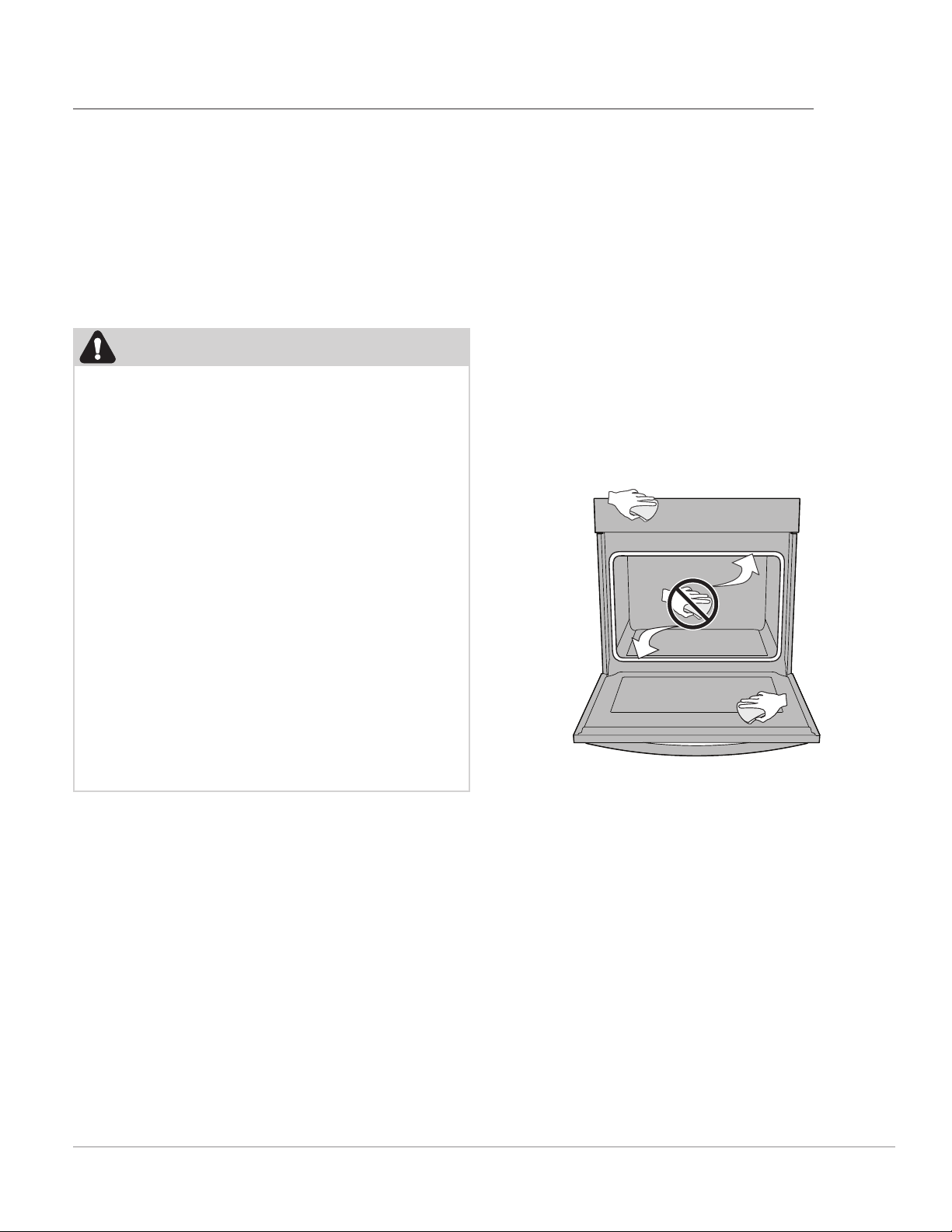
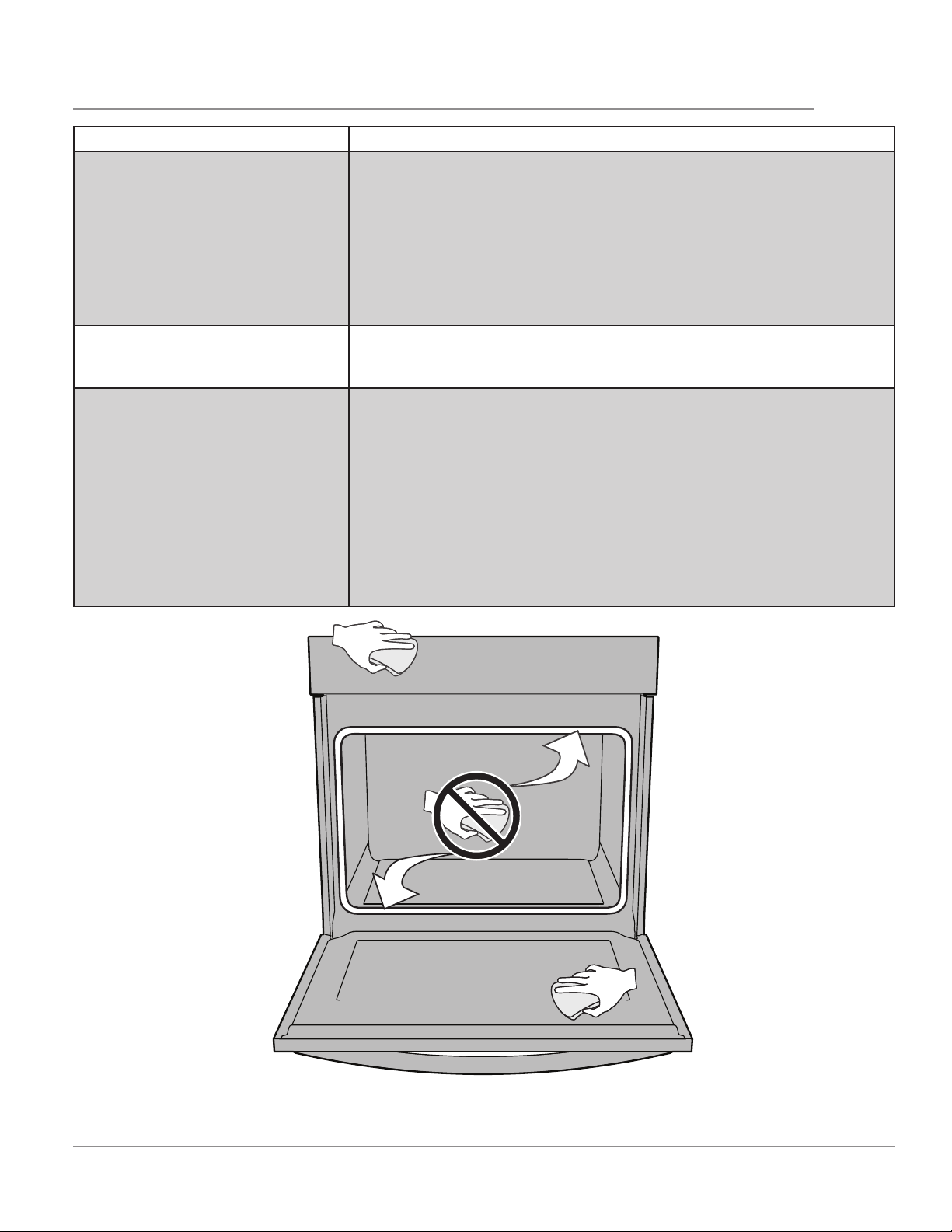
Figure 7: Clean around the oven door gasket
Important notes:
• Completely remove all oven racks and any ac-
cessories from oven cavity to avoid damage to
oven racks. If the oven racks are not removed
they may discolor.
• Remove all items from the oven and cooktop
including cookware, utensils, and any aluminum
foil. Aluminum foil will not withstand high tem-
peratures from a self clean cycle and will melt.
• Do not spray oven cleaners or oven protec-
tive coatings in or around any part of the oven
interior. Clean any soil from the oven frame, the
door liner outside the oven door gasket, and
the small area at the front center of the oven
bottom (page 40). These areas heat su -
ciently to burn soil on. Clean using soap and
water prior to starting Self Clean.
• Remove any excessive spills. Any spills on the
oven bottom should be wiped up and removed
before starting a self clean cycle. To clean use
hot, soapy water and a cloth. Large spills can
cause heavy smoke or fi re when subjected to
high temperatures.
• Do not allow food spills with high sugar or acid
content (such as milk, tomatoes, sauerkraut,
fruit juices, or pie fi llings) to remain on the
surface as they may leave a dull spot even after
cleaning.
• Do not clean the oven door gasket. The woven
material in the gasket is essential for a good
seal. Care should be taken not to rub, dam-
age, or remove the oven door gasket. Doing so
could cause damage to the door gasket and
compromise the performance of the oven.
• The kitchen area should be well ventilated us-
ing an open window, ventilation fan, or exhaust
hood during the fi rst self clean cycle. This will
help eliminate the normal odors.
• Do not attempt to open the oven door when
the OVEN LOCK indicator light is fl ashing.
Allow about 15 seconds for the motorized door
latch mechanism to completely lock or unlock
the oven door.
• When the clean time fi nishes, the oven door will
remain locked until the range has cooled suf-
fi ciently. In addition to the clean time that was
programmed, you must allow about 1 additional
hour for the oven to cool before you will be
able to open the oven door.
CAUTION
• Do not leave small children unattended near
appliance. During self clean cycle, the outside
of the oven can become very hot and cause
burns if touched.
• Do not line the oven walls, racks, oven bot-
tom, or any part of the range with aluminum
foil. This will cause permanent damage to the
oven interior and destroy heat distribution,
and will melt to the oven interior.
• Do not force the oven door open. This will
damage the automatic door locking system.
Use caution when opening the oven door
after the self clean cycle ends. The oven may
still be very hot and cause burns. To avoid
possible burns, stand to side of oven when
opening door to allow steam or hot air to
escape.
• The health of some birds is extremely sensi-
tive to fumes given o during the self clean
cycle of any range. Move birds to a well venti-
lated room.
34
SETTING OVEN CONTROLS
To set a self clean cycle:
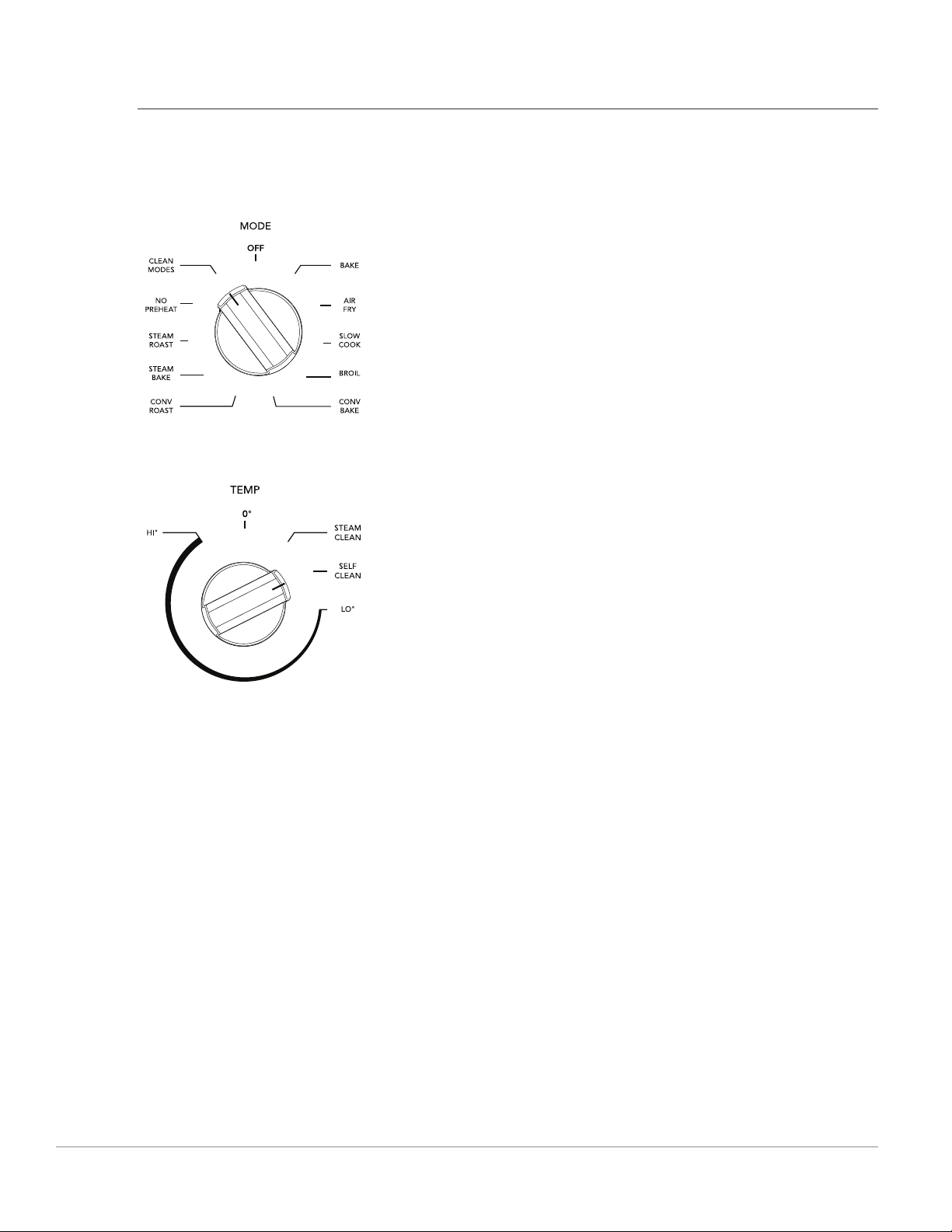
1. Turn the Mode knob to CLEAN MODES. CLn
will show in the temperature display, and the
SELECT MODE indicator will come on.
When the self clean cycle has completed:
1. CLEAN message will turn o , and Hot will
appear in display window. The oven door will
remain locked while the oven cools.
2. Once the oven has cooled down (about 1 hour)
and Hot is no longer displayed, the oven door
may be opened.
3. When the oven interior has completely cooled,
wipe away any residue or powdered ash with a
damp cloth or paper towel.
2. Turn the Temperature knob to SELF CLEAN.
The timer will become active, and the - and +
keys will become active.
3. The REMOVE RACKS indicator will come on.
Open the oven and remove the oven racks, and
make sure the oven cavity is completely empty.
The CLOSE DOOR indicator will come on when
the door is open.
4. Close the oven door. The lock icon will display,
and the oven door will lock closed.
5. Use the + and - keys to choose a 2, 3, or 4 hour
cleaning cycle.
6. The Self Clean cycle will begin, and the timer
will count down.
7. The temperature display will show Hot during
the Self Clean cycle. When the cycle ends, the
display will continue to show Hot, and the oven
will remain locked until the oven cools.
To end the Self Clean cycle at any time, turn the
Mode knob to OFF. The display will continue to
show Hot, and the oven will remain locked until the
oven cools.
35
SETTING OVEN CONTROLS
Steam Clean
The Steam Clean feature o ers a chemical free and
time saving method to assist in the routine clean-
ing of small and light soils. For heavier baked on
soils use the Self Clean feature.
CAUTION
Do not add bleach, ammonia, oven cleaner, or
any other abrasive household cleaners to the wa-
ter used for Steam Clean.
Before cleaning any part of the oven, be sure all
controls are turned o and the oven is cool. The
oven may be hot and can cause burns.
To set a self clean cycle:
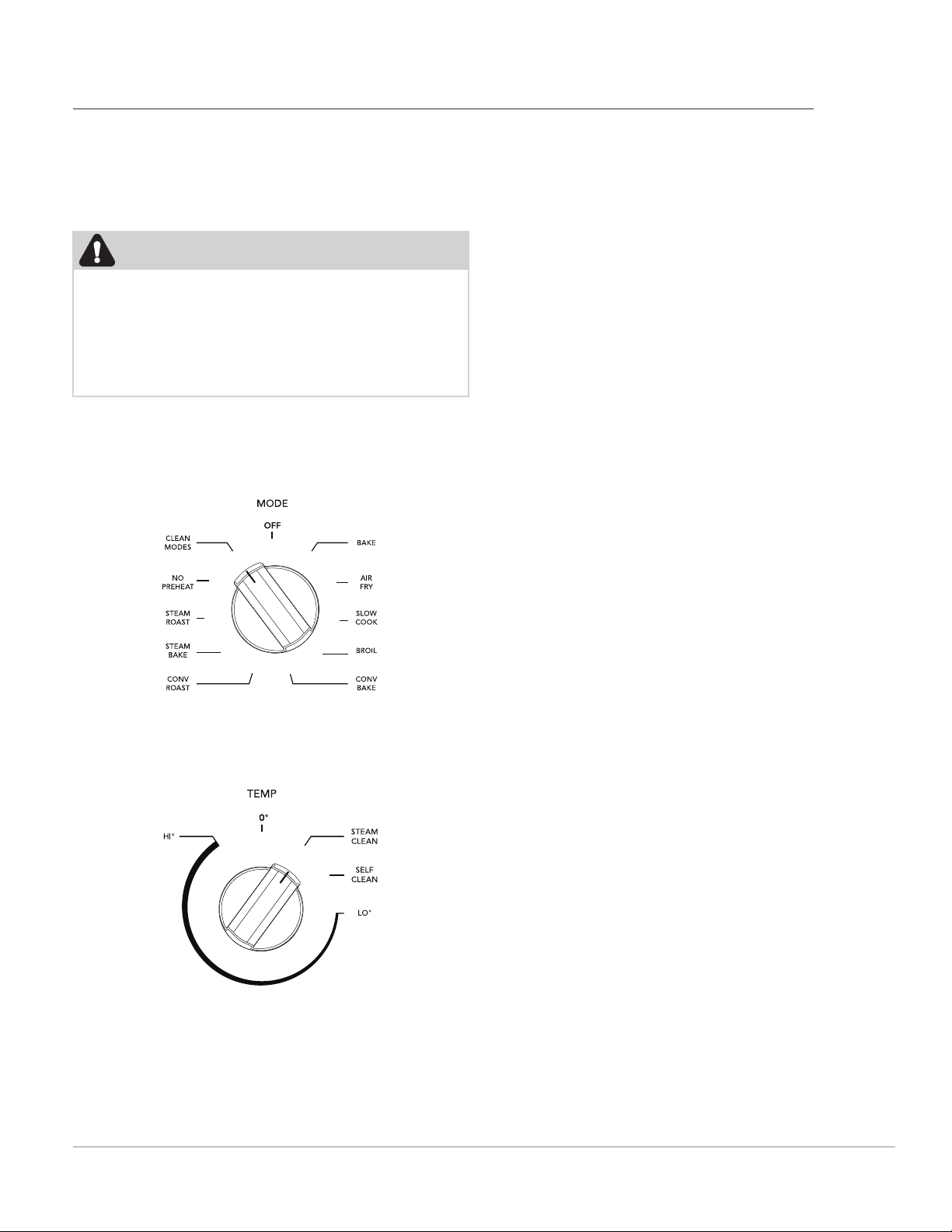
1. Turn the Mode knob to CLEAN MODES. CLn
will show in the temperature display, and the
SELECT MODE indicator will come on.
2. Turn the Temperature knob to STEAM CLEAN.
The timer will become active, and the - and +
keys will become active. The display will show
Add H2o. The DOOR indicator will come on.
3. Open the oven and add 1 cup of water to the
bottom of the oven. The CLOSE DOOR indica-
tor will come on.
4. Close the oven door. The Steam Clean cycle will
begin, and the timer will count down.
5. When the cycle ends, the display will continue
to show oFF.
To end the Self Clean cycle at any time, turn the
Mode knob to OFF.

36
SETTING OVEN CONTROLS
Delay Start
You can set a delayed start time for the following
functions: bake, convection bake, convection roast,
no preheat, air fry, steam bake, steam roast, steam
clean, and self clean.
The maximum delay time for self clean or steam
clean is one hour.
To set a delayed start:
1. Press and hold the light key for 3 seconds to
access the Settings menu.
2. Use the + and - keys on the left to select the
delay start function (dLY).
3. Use the + and - keys on the right to specify the
delay time.
4. Press and hold the light key for 3 seconds to
confi rm the delay time.
5. Use the Mode and Temp dials to select the
function to start and temperature.
6. The display will show the countdown time until
cooking starts.

37
SETTING OVEN CONTROLS
To activate Sabbath Mode:
1. Use the Mode and Temp dials to set the oven
for the desired function.
2. Press and hold the light key for 3 seconds to
activate Sabbath Mode. SAb shows in the dis-
play.
To exit Sabbath Mode, press and hold the light key
for 3 seconds.
Setting the Sabbath Feature for the
Jewish Sabbath and Holidays (some mod-
els)
For further assistance, guidelines for
proper usage, and a complete list
of models with the Sabbath feature,
please visit the web at www.star-k.
org.
This appliance provides special set-
tings for use when observing the Jewish
Sabbath/Holidays. Sabbath mode disables all au-
dible tones or visual display changes on the oven
control. Bake is the only cooking feature available
while in the Sabbath mode. Most oven controls are
locked during Sabbath mode.
To start Sabbath Mode, fi rst select Sabbath from
the settings menu. Next, select Delay (if desired),
Bake temperature, and cook time (if desired) and
set. Cooking will begin after any specifi ed delay.
If cook time was set, once the time has elapsed, the
cooking will end and the display will show Idle to
indicate that the cook time has ended.
Important: The Sabbath mode will override the
factory preset 12 hour energy saving mode, and the
appliance will stay on until the cooking features are
canceled. If cooking is canceled when the appli-
ance is in the Sabbath mode, no audible or visual
indicators will be available to verify the cancella-
tion.
If the oven interior lights are needed, be sure to
activate them prior to setting the Sabbath mode.
Once the oven light is turned on and the Sabbath
mode is active, the oven light will remain on until
the Sabbath mode is turned o and the oven lights
are turned o . The oven door will not activate the
interior oven lights when the oven door is opened
or closed.
It is recommended that any oven temperature
modifi cation made within an active Sabbath mode
press the + or - key.
The temperature will increase or decrease with
each press by 5°F or 1°C and the change will be
accepted automatically.
Important:
• Do not attempt to activate any other oven
function except Bake while the Sabbath feature
is active. When the Sabbath feature is active,
only the + and - keys and OFF will function.
ALL OTHER KEYS should not be used once the
Sabbath feature is active.
• You may change the oven temperature once
baking has started. Use the + and - keys to raise
or lower the oven temperature. Each press of
an arrow key will raise or lower the temperature
by 5°F (1°C).
• Remember that the oven control will no longer
provide audible tones or display any further
changes when the Sabbath feature is active.
• The oven will shut-o automatically after
completing a bake time and therefore may
only be used once during the Sabbath/Jewish
Holidays.
WARNING
Food poisoning hazard. Do not let food sit for
more than one hour before or after cooking.
Doing so can result in food poisoning or sickness.
Foods that can easily spoil such as milk, eggs,
fi sh, meat or poultry, should be chilled in the
refrigerator fi rst. Even when chilled, they should
not stand in the oven for more than 1 hour before
cooking begins, and should be removed promptly
when fi nished cooking.
38
CARE AND CLEANING
Remove spills and any heavy soiling as soon as
possible. Regular cleaning will reduce the di culty
of major cleaning later.
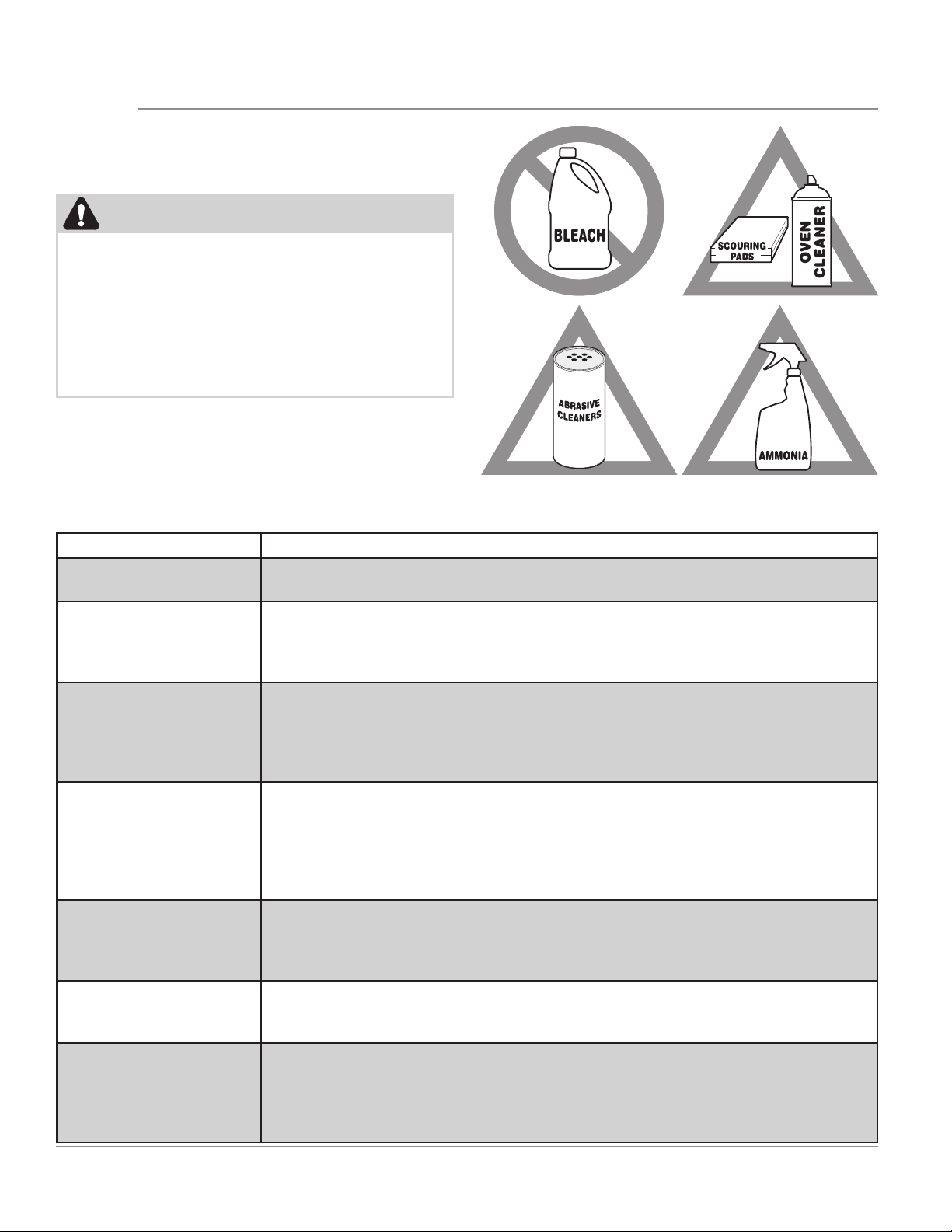
Figure 10: Use cleaners with caution
Surface or Area Cleaning Recommendation
Aluminum and vinyl Using a soft cloth, clean with mild dish detergent and water. Rinse with clean
water, dry and polish with a soft, clean cloth.
Painted body parts
Painted decorative trims
Using a soft cloth, clean with mild dish detergent and water or a 50/50 solu-
tion of vinegar and water. Rinse with clean water, dry and polish with a soft,
clean cloth. Glass cleaners may be used, but do not apply directly to surface;
spray onto cloth and wipe.
Touch display Using a soft cloth, clean with mild dish detergent and water or a 50/50 solu-
tion of vinegar and water. Do not spray liquids directly on the display area.
Do not use large amounts of water on the display - excess water may cause
damage to the appliance. Do not use other liquid cleaners, abrasive cleaners,
scouring pads, or paper towels - they may damage the fi nish.
Control panel Using a soft cloth, clean with mild dish detergent and water or a 50/50 solu-
tion of vinegar and water. Do not spray liquids directly on the oven control
and display area. Do not use large amounts of water on the control panel -
excess water on the control area may cause damage to the appliance. Do not
use other liquid cleaners, abrasive cleaners, scouring pads, or paper towels -
they will damage the fi nish.
Control knobs Using a soft cloth, clean with mild dish detergent and water or a 50/50 solu-
tion of vinegar and water. To remove control knobs: turn to the OFF position,
grasp fi rmly, and pull o the shaft. To replace knobs after cleaning, line up the
OFF markings and push the knobs into place.
Stainless Steel Using a soft cloth, clean with mild dish detergent and water or a 50/50 solu-
tion of vinegar and water. Rinse with clean water, dry with a soft clean cloth.
Do not use cleaners containing abrasives, chlorides, chlorine, or ammonia.
Coated Stainless Steel Using a soft cloth, clean with mild dish detergent and water or a 50/50 solu-
tion of vinegar and water. Rinse with clean water, dry with a soft clean cloth.
Do not use appliance cleaner, stainless steel cleaner, or cleaner containing
abrasives, chlorides, chlorine, or ammonia. These cleaners may damage the
fi nish.
CAUTION
Before cleaning any part of the appliance, be sure
all controls are turned o and the appliance is
cool.
If ammonia or appliance cleaners are used, they
must be removed and the appliance must be
thoroughly rinsed before operating. Follow man-
ufacturer’s instructions and provide adequate
ventilation.
39
CARE AND CLEANING
Surface or Area Cleaning Recommendation
Porcelain-enameled broiler pan
and insert
Porcelain door liner
Porcelain body parts
Rinse with clean water and a damp cloth. Scrub gently with a soapy,
non-abrasive scouring pad to remove most spots. Rinse with a 50/50
solution of clean water and ammonia. If necessary, cover di cult
spots with an ammonia-soaked paper towel for 30 to 40 minutes.
Rinse and wipe dry with a clean cloth. Remove all cleaners or future
heating could damage the porcelain. Do not allow food spills with a
high sugar or acid content (milk, tomatoes, sauerkraut, fruit juices or
pie fi lling) to remain on porcelain surfaces. These spills may cause a
dull spot even after cleaning.
Self-cleaning oven interior Before setting a self-clean cycle, clean soils from the oven frame,
areas outside the oven door gasket, and the small area at the front
center of the oven bottom. See “Self Clean” on page 33.
Oven door Use mild dish detergent and water or a 50/50 solution of vinegar
and water to clean the top, sides, and front of the oven door. Rinse
well. Glass cleaner may be used on the outside glass of the door. Ce-
ramic smoothtop cleaner or polish may be used on the interior door
glass. Do not immerse the door in water. Do not spray or allow water
or cleaners to enter the door vents. Do not use oven cleaners, clean-
ing powders, or any harsh abrasive cleaning materials on the outside
of the oven door.
Do not clean the oven door gasket. The oven door gasket is made of
a woven material which is essential for a good seal. Do not rub, dam-
age, or remove this gasket.
Figure 11: Do not clean oven door gasket
40
CARE AND CLEANING
General Cleaning
Refer to the table at the beginning of this chapter
for more information about cleaning specifi c parts
of the oven.
Cleaning Porcelain Enamel Oven
The oven interior is porcelain on steel, it is safe to
clean using oven cleaners.
To remove heavy soil:
1. Allow a dish of ammonia to sit in the oven over-
night or for several hours with the oven door
closed. Clean softened dirt spots using hot,
soapy water. Rinse well with water and a clean
cloth.
2. If soil remains, use a nonabrasive scouring pad
or a nonabrasive cleaner. If necessary, use an
oven cleaner following manufacturer’s instruc-
tions. Do not mix ammonia with other cleaners.
3. Clean any soil from the oven frame, the door
liner outside the oven door gasket and the
small area at the front center of the oven bot-
tom. Clean with hot, soapy water. Rinse well
using clean water and a cloth.
Follow these cleaning precautions:
• Allow the oven to cool before cleaning.
• Wear rubber gloves when cleaning the appli-
ance manually.
Remove soils using hot, soapy water. Do not allow
food spills with a high sugar or acid content (such
as milk, tomatoes, sauerkraut, fruit juices or pie
fi lling) to remain on the surface as they may cause
a dull spot even after cleaning. Remove spillovers
and heavy soiling as soon as possible. Regular
cleaning will reduce the e ort required for major
cleaning later.
CAUTION
Before manually cleaning any part of the oven,
be sure all controls are turned o and the oven is
cool. The oven may be hot and can cause burns.
Remove all racks and accessories from the oven
before cleaning.
Ammonia must be rinsed before operating the
oven. Provide adequate ventilation.
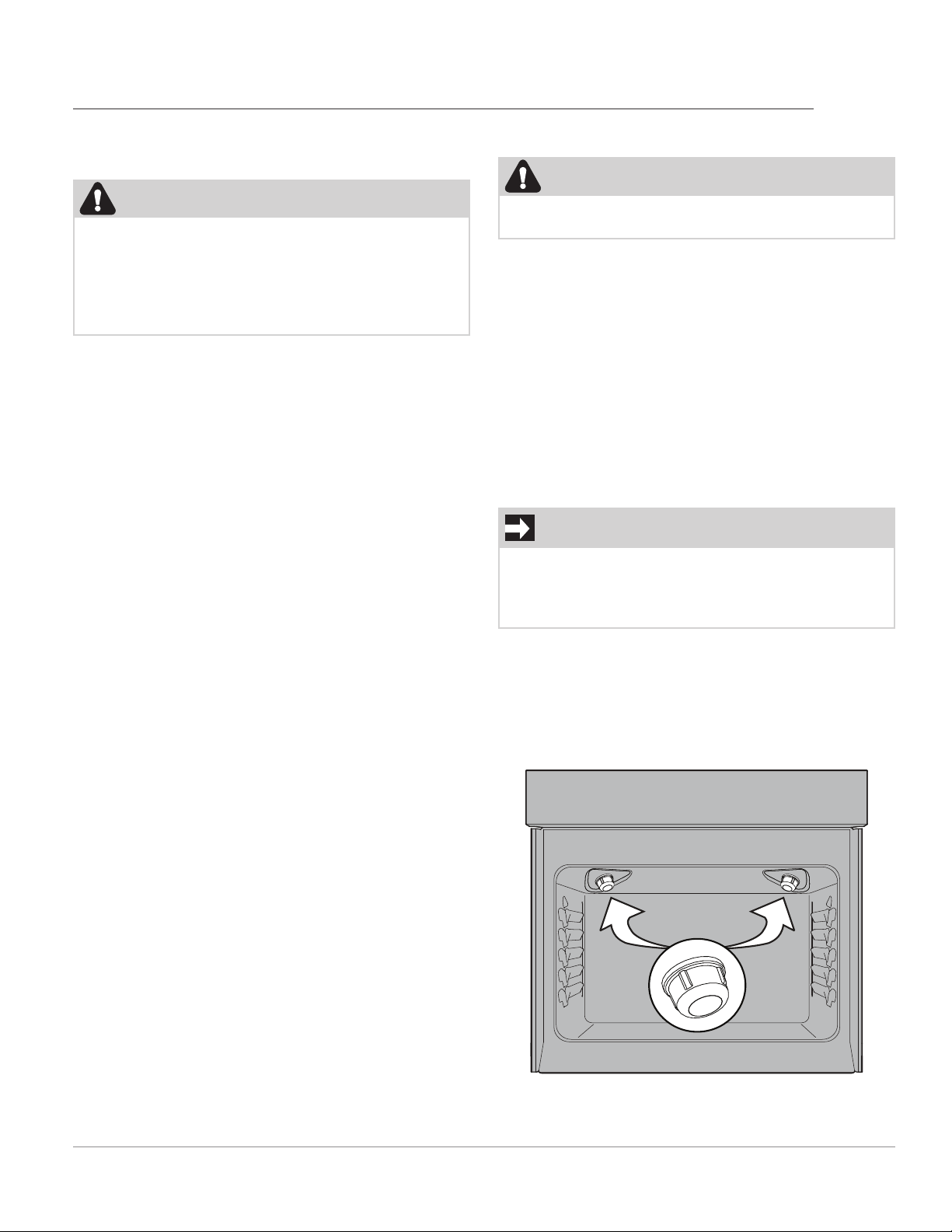
41
CARE AND CLEANING
Aluminum Foil, Aluminum Utensils, and
Oven Liners
WARNING
Never cover any slots, holes, or passages in the
oven bottom or cover an entire oven rack with
materials such as aluminum foil. Doing so blocks
air fl ow through the oven and may cause carbon
monoxide poisoning. Aluminum foil linings may
trap heat, causing a fi re hazard.
• Protective liners—Do not use aluminum foil to
line the oven bottom. The high heat of the oven
can melt these materials to the oven cavity and
ruin the oven. These types of materials can also
reduce the e ectiveness of the air circulation in
the oven and produce poor baking results. Only
use aluminum foil as recommended in this man-
ual. Improper installation of these liners may
result in risk of electric shock or fi re.
• Aluminum utensils - The melting point of alu-
minum is much lower than that of other metals.
Care must be taken when aluminum pots or
pans are used.
• Oven racks - Do not use aluminum foil to cover
the oven racks. Using a liner in the oven re-
stricts the heat and air fl ow needed to obtain
the best possible cooking results for any oven.
Replacing the Oven Light
CAUTION
Be sure the oven is unplugged and all parts are
cool before replacing the oven light.
The interior oven light is located at the rear of the
oven cavity and is covered by a glass shield. The
glass shield must be in place whenever the oven is
in use.
To replace the oven interior light bulb:
1. Turn electrical power o at the main source or
unplug the appliance.
2. Remove interior oven light shield by turning a
quarter turn counter-clockwise.
3. Replace bulb with a new T-4 type Halogen 25
watt appliance bulb.
NOTE
Wear a cotton glove or use a paper towel when
installing a new bulb. Do not touch the new bulb
with your fi ngers when replacing. This will short-
en the life of the bulb.
4. Replace glass oven light shield by rotating
clockwise.
5. Turn power back on again at the main source
(or plug the appliance back in).
6. Be sure to reset the time of day on the clock.
Figure 12: Wall oven Halogen light
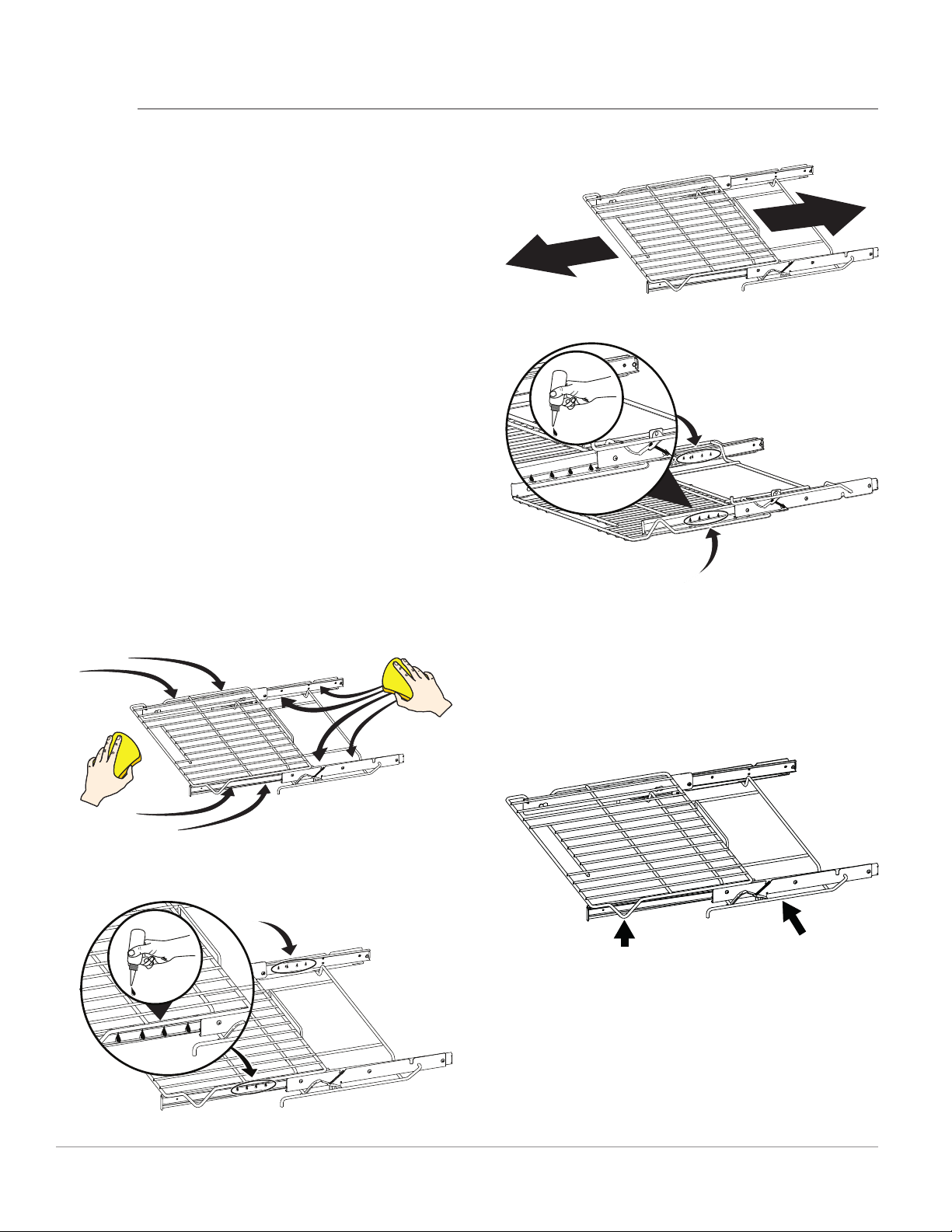
42
CARE AND CLEANING
Caring for Your Glide Racks
Caution: Handle oven racks only when they are
cool. After cooking or after the fresh-clean cycle,
racks will be very hot and can cause burns.
Important Notes:
• Remove all oven racks, including ladder racks,
before starting a clean cycle.
• Do not use cooking oil, cooking spray, or other
oil-based lubrication products on the glide
rack extension tracks. Use only the graphite
lubrication in this area. To order graphite
lubrication, contact your installer, servicer or
dealer.
• It is important that the parts of the rack that
contact the oven sides always have a light
coating of vegetable oil. Apply a thin layer of
vegetable oil to the sides of the rack after every
fresh-clean cycle and when the rack becomes
di cult to reposition in the oven.
To lubricate the glide rack:
1. Remove the rack from the oven and place the
rack on a large fl at surface covered with news-
paper or scrap cloth. Fully extend the rack.
2. Wipe away debris and crumbs from the glide
track using a cloth or sponge.
3. Shake graphite lubrication very well before
applying. Apply to loading guides, and rotation
pin. Repeat on both sides of the glide rack.
4. Extend and return the glide rack several times
along the tracks to distribute the lubrication.
5. Turn the rack upside down and apply graphite
lubrication to the insides of the loading guides.
6. Extend and return the glide rack several times
along the tracks to distribute the lubrication.
7. Apply a thin layer of cooking oil to the bottom
of the “V” and the glide channels. Keeping the
frame sides lightly lubricated allows the entire
rack to slide easily when changing rack posi-
tions.
8. Replace rack in oven right-side up.
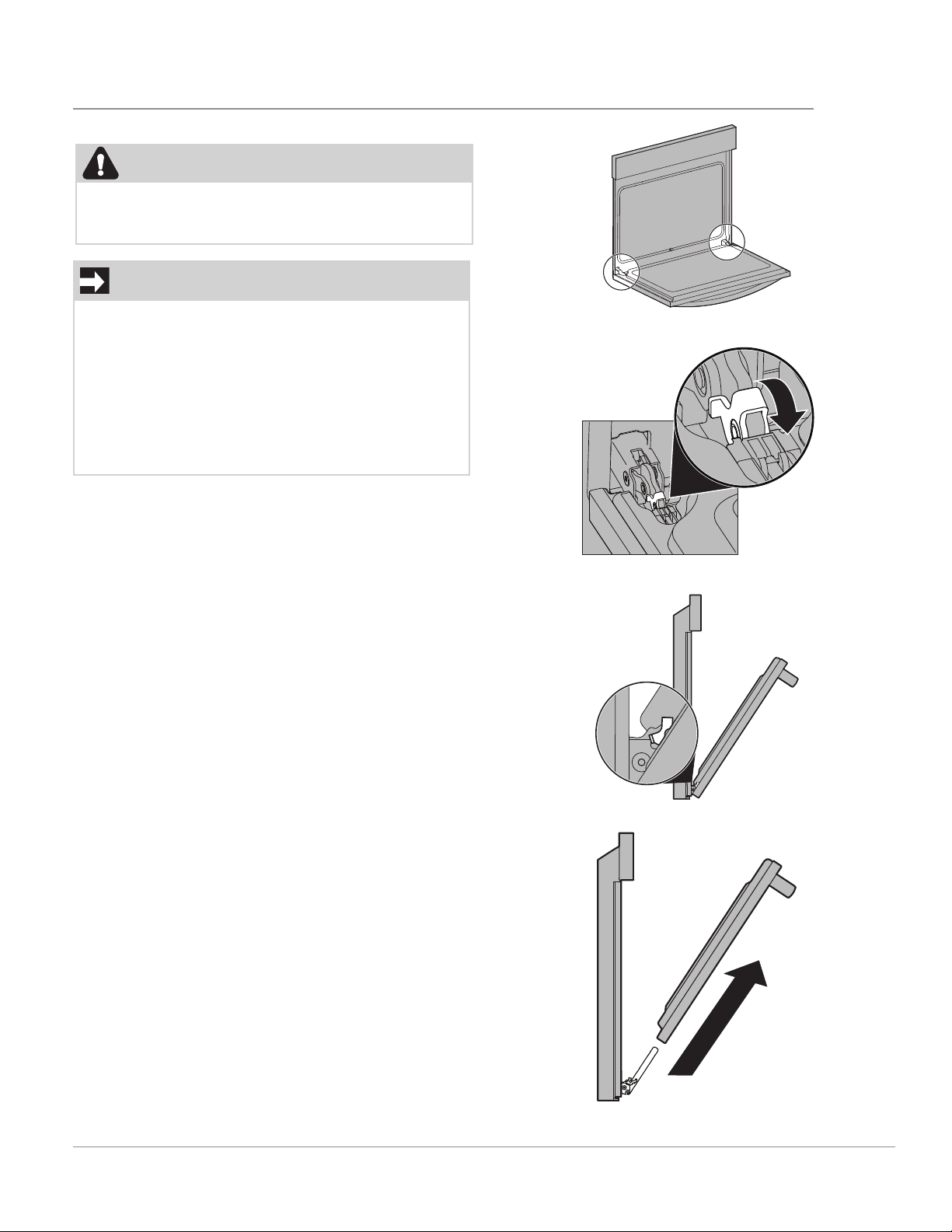
43
CARE AND CLEANING
Removing and Replacing the Oven Door
Figure 14: Door hinge location
To remove the oven door:
1. Open oven door completely, horizontal with
fl oor (Figure 14).
2. Pull up the lock located on each hinge support
toward front of the oven until the lock stops.
You may have to apply a little upward pressure
on the lock to pull it up (Figure 15).
3. Grasp the door by the sides, and close the door
until the door frame makes contact with the
unlocked hinges (Figure 16).
4. Pull the bottom of the door toward you while
rotating the top of the door toward the appli-
ance to completely disengage the hinge levers
(Figure 17).
Figure 15: Door hinge lock
Figure 16: Removal position
Figure 17: Remove door
To replace the oven door:
1. Firmly grasp both sides of oven door along the
door sides. Do not use the oven door handle
(Figure 17).
2. Hold the oven door at the same angle as the
removal position (Figure 16) Carefully insert
the hinge levers into the oven frame until you
feel the hinge levers are seated into the hinge
notches. The hinge arms must be fully seated
into the hinge notches before the oven door
can be fully opened.
3. Fully open the oven door, horizontal with fl oor
(Figure 14).
4. Push the door hinge locks up toward and into
the oven frame on both left and right oven door
hinges to the locked position (Figure 15).
5. Close the oven door.
IMPORTANT
Special door care instructions - For safe,
temporary storage, lay the door fl at with the
inside of the door facing down.
Most oven doors contain glass that can break.
Do not hit the glass with pots, pans, or any other
object. Scratching, hitting, jarring, or stressing
the glass may weaken its structure, causing an
increased risk of breakage at a later time. Do not
close the oven door until all of the oven racks are
fully in place.
CAUTION
The door is heavy. For safe, temporary storage,
lay the door fl at with the inside of the door facing
down.
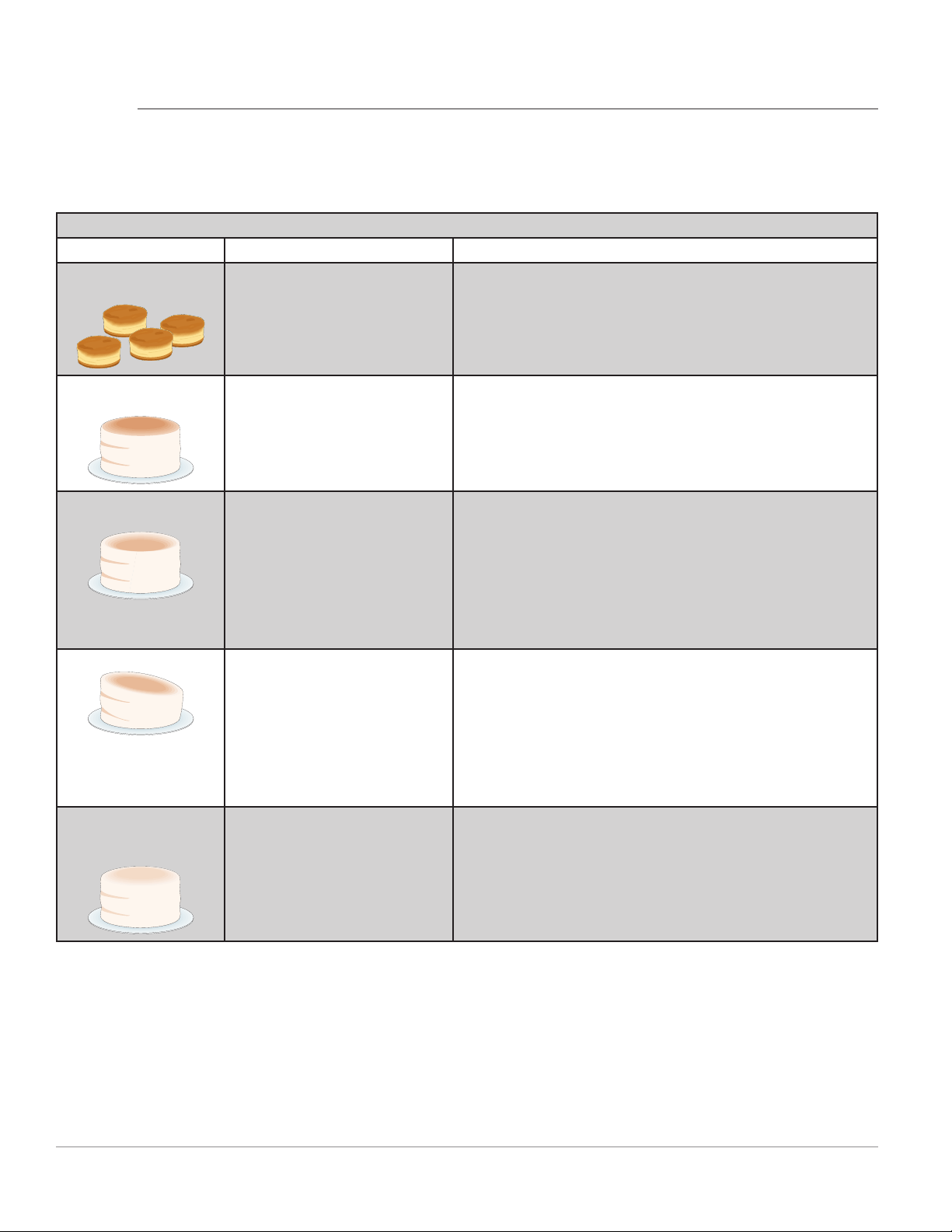
44
BEFORE YOU CALL
Oven Baking
For best cooking results, preheat the oven before baking cookies, breads, cakes, pies, pastries, etc. There is no
need to preheat the oven for roasting meat or baking casseroles. The cooking times and temperatures needed to
bake a product may vary slightly from your previously owned appliance.
Baking Problems and Solutions Baking Problems
Baking Problems Causes Corrections
Cookies and biscuits
burn on the bottom.
Cookies and biscuits put into
oven before oven is preheat-
ed.
Allow oven to preheat to desired temperature before
placing food in oven.
Choose pan sizes that will permit at least 2” of air space.
Cakes too dark on
top or bottom
Cakes put in oven before
oven is preheated.
Rack position too high or too
low.
Oven too hot.
Allow oven to preheat to the selected temperature be-
fore placing food in the oven.
Use proper rack position for baking needs.
Set oven temperature 25°F (13°C) lower than recom-
mended.
Cakes not done in
center
Oven too hot.
Incorrect pan size.
Pan not centered in oven.
Glass cookware slow heat
conductor.
Set oven temperature 25°F (13°C) lower than recom-
mended.
Use pan size suggested in recipe.
Use proper rack position and place pan so there are at
least 2” (5.1 cm) of space on all sides of pan.
Reduce temperature and increase cook time or use shiny
bakeware.
Cakes not level. Oven not level.
Pan too close to oven wall or
rack overcrowded.
Pan warped.
Oven light left on while bak-
ing.
Place a marked glass measuring cup fi lled with water on
the center of the oven rack. If the water level is uneven,
refer to the installation instructions for leveling the oven.
Use proper rack position and place pan so there are at
least 2” (5.1 cm) of space on all sides of pan.
Do not use pans that are dented or warped.
Do not leave the oven light on while baking.
Foods not done
when cooking time is
over.
Oven too cool.
Oven overcrowded.
Oven door opened too fre-
quently.
Set oven temperature 25°F (13°C) higher than suggested
and bake for the recommended time.
Be sure to remove all pans from the oven except the
ones to be used for baking.
Open oven door only after the shortest recommended
baking time.

45
BEFORE YOU CALL
Let us help you troubleshoot your concern! This section will help you with common issues. If you need us, visit our
website, chat with an agent, or call us. We may be able to help you avoid a service visit. If you do need service, we
can get that started for you!
Problem Cause / Solution
Entire appliance does not
operate
Appliance not connected. Make sure power cord is plugged properly into outlet.
Check your fuse box or breaker box to make sure the circuit is active.
Electrical power outage. Check house lights to be sure. Call your local electric
company for service outage information.
Oven Problems
Problem Cause / Solution
Poor baking results. Many factors aff ect baking results. Use proper oven rack position. Center food
in the oven and space pans to allow air to circulate. Preheat the oven to the set
temperature before placing food in the oven. Try adjusting the recipe's recom-
mended temperature or baking time. See “Oven Temperature Calibration” on
page 18 if you feel the oven is too hot or too cool.
Flames inside oven or smok-
ing from oven vent.
Excessive spills in oven. Grease or food spilled onto the oven bottom or oven
cavity. Wipe up excessive spills before starting the oven. If fl ames or excessive
smoke are present when using broil, see “Setting Broil” on page 34.
Oven smokes excessively
when broiling.
Incorrect setting. Follow the “Setting Broil” on page 34.
Meat too close to the broil element or burner. Reposition the broil pan to provide
proper clearance between the meat and broil element or burner. Remove excess
fat from meat. Cut remaining fatty edges to prevent curling, but do not cut into
lean.
Grease build up on oven surfaces. Regular cleaning is necessary when broiling
frequently. Grease or food splatters will cause excessive smoking.
Convection fan does not
rotate.
Oven door is open. The convection fan will turn off if the oven door is opened
when convection is active. Close the oven door.
1-800-265-8352 (Canada)
Frigidaire.ca
1-800-374-4432 (United States)
Frigidaire.com

46
BEFORE YOU CALL
Self-Clean Problems
Problem Cause / Solution
Self clean does not work. Oven control not set properly. See “Self Clean” on page 40.
Oven racks discolored or do
not slide easily.
Oven racks left in oven cavity during self clean. Remove oven racks from oven
cavity before starting a self-clean cycle. Clean by using a mild abrasive cleaner
following manufacturer's instructions. Rinse with clean water, dry, and replace in
oven.
Soil not completely removed
after self clean.
Self clean was interrupted. Review instructions on “Self Clean” on page 40.
Excessive spills on oven bottom. Remove excessive spills before starting self
clean.
Failure to clean soil from the oven frame, the door liner outside the oven door
gasket, and the small area at the front center of the oven bottom. These areas
are not in the self-cleaning area, but get hot enough to burn on residue. Clean
these areas before starting the self-cleaning cycle. Burned-on residue can be
cleaned with a stiff nylon brush and water or a nylon scrubber. Be careful not to
damage the oven gasket.
Other Problems
Problem Cause / Solution
Appliance is not level. Poor installation. Place the oven rack in the center of the oven. Place a level on
the oven rack. Adjust the leveling legs at the base of the appliance until the rack
is level.
Kitchen cabinet alignment may make range appear not level. Be sure cabinets
are square and have suffi cient room for appliance clearance.
Cannot move appliance
easily. Appliance must be
accessible for service.
Cabinets not square or are built in too tightly. Contact the builder or installer to
make the appliance accessible.
Oven light does not work. Be sure the oven light is secure in the socket. See “Replacing the Oven Light” on
page 62.

47
WARRANTY
WARRANTY
Your appliance is covered by a one year limited warranty. For one year from your original date of purchase,
Electrolux will pay all costs for repairing or replacing any parts of this appliance that prove to be defective
in materials or workmanship when such appliance is installed, used and maintained in accordance with the
provided instructions.
Exclusions
This warranty does not cover the following:
1. Products with original serial numbers that have been removed, altered or cannot be readily determined.
2. Product that has been transferred from its original owner to another party or removed outside the USA or
Canada.
3. Rust on the interior or exterior of the unit.
4. Products purchased “as-is” are not covered by this warranty.
5. Food loss due to any refrigerator or freezer failures.
6. Products used in a commercial setting.
7. Service calls which do not involve malfunction or defects in materials or workmanship, or for appliances not
in ordinary household use or used other than in accordance with the provided instructions.
8. Service calls to correct the installation of your appliance or to instruct you how to use your appliance.
9. Expenses for making the appliance accessible for servicing, such as removal of trim, cupboards, shelves, etc.,
which are not a part of the appliance when it is shipped from the factory.
10. Service calls to repair or replace appliance light bulbs, air fi lters, water fi lters, other consumables, or knobs,
handles, or other cosmetic parts.
11. Surcharges including, but not limited to, any after hour, weekend, or holiday service calls, tolls, ferry trip
charges, or mileage expense for service calls to remote areas, including the state of Alaska.
12. Damages to the fi nish of appliance or home incurred during installation, including but not limited to fl oors,
cabinets, walls, etc.
13. Damages caused by: services performed by unauthorized service companies; use of parts other than
genuine Electrolux parts or parts obtained from persons other than authorized service companies; or
external causes such as abuse, misuse, inadequate power supply, accidents, fi res, or acts of God.
DISCLAIMER OF IMPLIED WARRANTIES; LIMITATION OF REMEDIES
CUSTOMER’S SOLE AND EXCLUSIVE REMEDY UNDER THIS LIMITED WARRANTY SHALL BE PRODUCT REPAIR
OR REPLACEMENT AS PROVIDED HEREIN. CLAIMS BASED ON IMPLIED WARRANTIES, INCLUDING WARRANTIES
OF MERCHANTABILITY OR FITNESS FOR A PARTICULAR PURPOSE, ARE LIMITED TO ONE YEAR OR THE
SHORTEST PERIOD ALLOWED BY LAW, BUT NOT LESS THAN ONE YEAR. ELECTROLUX SHALL NOT BE LIABLE
FOR CONSEQUENTIAL OR INCIDENTAL DAMAGES SUCH AS PROPERTY DAMAGE AND INCIDENTAL EXPENSES
RESULTING FROM ANY BREACH OF THIS WRITTEN LIMITED WARRANTY OR ANY IMPLIED WARRANTY. SOME
STATES AND PROVINCES DO NOT ALLOW THE EXCLUSION OR LIMITATION OF INCIDENTAL OR CONSEQUENTIAL
DAMAGES, OR LIMITATIONS ON THE DURATION OF IMPLIED WARRANTIES, SO THESE LIMITATIONS OR EXCLUSIONS
MAY NOT APPLY TO YOU. THIS WRITTEN WARRANTY GIVES YOU SPECIFIC LEGAL RIGHTS. YOU MAY ALSO HAVE
OTHER RIGHTS THAT VARY FROM STATE TO STATE.
If You Need Service
Keep your receipt, delivery slip, or some other appropriate payment record to establish the warranty period
should service be required. If service is performed, it is in your best interest to obtain and keep all receipts.
Service under this warranty must be obtained by contacting Electrolux at the addresses or phone numbers
below.
This warranty only applies in the USA and Canada. In the USA, your appliance is warranted by Electrolux Major
Appliances North America, a division of Electrolux Home Products, Inc. In Canada, your appliance is warranted by
Electrolux Canada Corp. Electrolux authorizes no person to change or add to any obligations under this warranty.
Obligations for service and parts under this warranty must be performed by Electrolux or an authorized service
company. Product features or specifi cations as described or illustrated are subject to change without notice.
USA
1-800-374-4432
Frigidaire
10200 David Taylor Drive
Charlotte, NC 28262
Canada
1.800.265.8352
Electrolux Canada Corp.
5855 Terry Fox Way
Mississauga, Ontario, Canada
L5V 3E4

welcome
home
Frigidaire.com
1-800-374-4432
Frigidaire.ca
1-800-265-8352
owner support
accessories
service
Our home is your home. Visit us if you
need help with any of these things:
registration
(See your registration card
for more information.)
A22383505 March 2022