

Contents
Safety information........................................................................................ 6
Conventions.......................................................................................................................................................... 6
Learning about the printer...........................................................................9
Finding information about the printer.............................................................................................................9
Selecting a location for the printer................................................................................................................ 10
Printer configurations.........................................................................................................................................11
Attaching cables................................................................................................................................................. 13
Using the control panel.................................................................................................................................... 15
Understanding the status of the power button and indicator light.......................................................16
Using the home screen.....................................................................................................................................16
Menu map.............................................................................................................................................................17
Printing a menu settings page........................................................................................................................19
Setting up and using the home screen applications............................. 20
Customizing the home screen.......................................................................................................................20
Setting up Forms and Favorites.................................................................................................................... 20
Setting up Card Copy.......................................................................................................................................20
Using Shortcut Center.......................................................................................................................................21
Setting up Scan Center.....................................................................................................................................21
Managing contacts.............................................................................................................................................21
Adding contacts............................................................................................................................................................ 21
Adding groups..............................................................................................................................................................22
Editing contacts or groups........................................................................................................................................22
Deleting contacts or groups..................................................................................................................................... 22
Setting up and using the accessibility features..................................... 24
Enabling Magnification mode.........................................................................................................................24
Activating Voice Guidance..............................................................................................................................24
Adjusting the Voice Guidance speech rate................................................................................................24
Enabling spoken passwords or personal identification numbers........................................................ 24
Navigating the screen using gestures.........................................................................................................25
Using the keyboard on the display...............................................................................................................25
Loading paper and specialty media......................................................... 26
Setting the size and type of the specialty media......................................................................................26
Contents 2

Configuring Universal paper settings.......................................................................................................... 26
Loading trays......................................................................................................................................................26
Loading the multipurpose feeder................................................................................................................. 28
Linking trays........................................................................................................................................................29
Printing.........................................................................................................30
Printing from a computer.................................................................................................................................30
Printing forms..................................................................................................................................................... 30
Printing from a mobile device........................................................................................................................ 30
Printing from a flash drive................................................................................................................................ 31
Supported flash drives and file types.......................................................................................................... 32
Configuring confidential jobs......................................................................................................................... 33
Printing held jobs...............................................................................................................................................33
Printing a font sample list................................................................................................................................ 34
Canceling a print job.........................................................................................................................................34
Copying........................................................................................................35
Making copies.................................................................................................................................................... 35
Copying photos..................................................................................................................................................35
Copying on letterhead..................................................................................................................................... 35
Copying on both sides of the paper.............................................................................................................35
Reducing or enlarging copies........................................................................................................................36
Collating copies................................................................................................................................................. 36
Placing separator sheets between copies................................................................................................. 36
Copying multiple pages onto a single sheet............................................................................................. 36
Creating a copy shortcut................................................................................................................................. 36
E-mailing...................................................................................................... 37
Setting up the e‑mail function........................................................................................................................ 37
Configuring e‑mail settings.............................................................................................................................37
Sending an e-mail..............................................................................................................................................37
Creating an e-mail shortcut............................................................................................................................ 38
Faxing...........................................................................................................39
Setting up the printer to fax............................................................................................................................39
Sending a fax......................................................................................................................................................52
Scheduling a fax................................................................................................................................................ 53
Contents 3

Creating a fax destination shortcut...............................................................................................................53
Changing the fax resolution........................................................................................................................... 53
Adjusting the fax darkness............................................................................................................................. 53
Viewing a fax log............................................................................................................................................... 54
Blocking junk faxes...........................................................................................................................................54
Holding faxes......................................................................................................................................................54
Forwarding a fax................................................................................................................................................54
Scanning...................................................................................................... 55
Scanning to an FTP server..............................................................................................................................55
Creating an FTP shortcut................................................................................................................................ 55
Scanning to a flash drive.................................................................................................................................55
Sending scanned documents to a computer.............................................................................................56
Securing the printer....................................................................................57
Locating the security slot.................................................................................................................................57
Erasing printer memory....................................................................................................................................57
Erasing printer hard disk memory.................................................................................................................57
Configuring printer hard disk encryption....................................................................................................58
Restoring factory default settings................................................................................................................. 58
Statement of Volatility...................................................................................................................................... 58
Maintaining the printer.............................................................................. 60
Networking......................................................................................................................................................... 60
Setting up serial printing (Windows only).....................................................................................................61
Cleaning printer parts...................................................................................................................................... 62
Ordering parts and supplies...........................................................................................................................65
Replacing parts and supplies.........................................................................................................................68
Storing supplies................................................................................................................................................103
Moving the printer........................................................................................................................................... 104
Saving energy and paper.............................................................................................................................. 104
Recycling............................................................................................................................................................105
Clearing jams.............................................................................................107
Avoiding jams....................................................................................................................................................107
Identifying jam locations................................................................................................................................108
Paper jam in trays............................................................................................................................................. 110
Contents 4

Paper jam in the multipurpose feeder..........................................................................................................111
Paper jam in the automatic document feeder...........................................................................................112
Paper jam in the standard bin........................................................................................................................114
Paper jam in door B..........................................................................................................................................115
Paper jam in the finisher bin.......................................................................................................................... 118
Staple jam in door G....................................................................................................................................... 120
Paper jam in door K.........................................................................................................................................123
Paper jam in door J......................................................................................................................................... 125
Paper jam in door N........................................................................................................................................ 126
Paper jam in door L..........................................................................................................................................127
Paper jam in the staple finisher bin.............................................................................................................128
Staple jam in door J.........................................................................................................................................129
Troubleshooting........................................................................................ 132
Network connection problems.....................................................................................................................132
Hardware options problems......................................................................................................................... 134
Issues with supplies........................................................................................................................................ 136
Paper feed problems...................................................................................................................................... 138
Printing problems.............................................................................................................................................142
Color quality problems................................................................................................................................... 164
Faxing problems...............................................................................................................................................167
Scanning problems..........................................................................................................................................170
Contacting customer support....................................................................................................................... 173
Upgrading and migrating.........................................................................174
Hardware............................................................................................................................................................174
Software............................................................................................................................................................. 196
Firmware.............................................................................................................................................................197
Notices........................................................................................................198
Index.......................................................................................................... 202
Contents 5

Safety information
Conventions
Note: A note identifies information that could help you.
Warning: A warning identifies something that could damage the product hardware or software.
CAUTION: A caution indicates a potentially hazardous situation that could injure you.
Dierent types of caution statements include:
CAUTION—POTENTIAL INJURY: Indicates a risk of injury.
CAUTION—SHOCK HAZARD: Indicates a risk of electrical shock.
CAUTION—HOT SURFACE: Indicates a risk of burn if touched.
CAUTION—TIPPING HAZARD: Indicates a crush hazard.
CAUTION—PINCH HAZARD: Indicates a risk of being caught between moving parts.
CAUTION—ROTATING FAN BLADES: Indicates a risk of laceration from moving fan blades.
CAUTION—POTENTIAL INJURY: To avoid the risk of fire or electrical shock, connect the power cord to
an appropriately rated and properly grounded electrical outlet that is near the product and easily
accessible.
CAUTION—POTENTIAL INJURY: To avoid the risk of fire or electrical shock, use only the power cord
provided with this product or the manufacturer's authorized replacement.
CAUTION—POTENTIAL INJURY: Do not use this product with extension cords, multioutlet power strips,
multioutlet extenders, or UPS devices. The power capacity of these types of accessories can be easily
overloaded by a laser printer and may result in a risk of fire, property damage, or poor printer
performance.
CAUTION—POTENTIAL INJURY: To reduce the risk of fire, use only a 26 AWG or larger
telecommunications (RJ-11) cord when connecting this product to the public switched telephone
network. For users in Australia, the cord must be approved by the Australian Communications and Media
Authority.
CAUTION—POTENTIAL INJURY: Only a Lexmark Inline Surge Protector that is properly connected
between the printer and the power cord provided with the printer may be used with this product. The
use of non-Lexmark surge protection devices may result in a risk of fire, property damage, or poor
printer performance.
CAUTION—SHOCK HAZARD: To avoid the risk of electrical shock, do not place or use this product near
water or wet locations.
CAUTION—SHOCK HAZARD: To avoid the risk of electrical shock, do not set up this product or make
any electrical or cabling connections, such as the power cord, fax feature, or telephone, during a
lightning storm.
Safety information 6

CAUTION—POTENTIAL INJURY: Do not cut, twist, bind, crush, or place heavy objects on the power
cord. Do not subject the power cord to abrasion or stress. Do not pinch the power cord between objects
such as furniture and walls. If any of these things happen, a risk of fire or electrical shock results. Inspect
the power cord regularly for signs of such problems. Remove the power cord from the electrical outlet
before inspecting it.
CAUTION—SHOCK HAZARD: To avoid the risk of electrical shock, make sure that all external
connections (such as Ethernet and telephone system connections) are properly installed in their marked
plug-in ports.
CAUTION—SHOCK HAZARD: To avoid the risk of electrical shock, if you are accessing the controller
board or installing optional hardware or memory devices sometime after setting up the printer, then turn
the printer o, and unplug the power cord from the electrical outlet before continuing. If you have any
other devices attached to the printer, then turn them o as well, and unplug any cables going into the
printer.
CAUTION—SHOCK HAZARD: To avoid the risk of electrical shock, do not use the fax feature during a
lightning storm.
CAUTION—SHOCK HAZARD: To avoid the risk of electrical shock when cleaning the exterior of the
printer, unplug the power cord from the electrical outlet and disconnect all cables from the printer before
proceeding.
CAUTION—POTENTIAL INJURY: The printer weight is greater than 18 kg (40 lb) and requires two or
more trained personnel to lift it safely.
CAUTION—POTENTIAL INJURY: When moving the printer, follow these guidelines to avoid personal
injury or printer damage:
• Make sure that all doors and trays are closed.
• Turn o the printer, and then unplug the power cord from the electrical outlet.
• Disconnect all cords and cables from the printer.
• If the printer has separate floor-standing optional trays or output options attached to it, then disconnect
them before moving the printer.
• If the printer has a caster base, then carefully roll it to the new location. Use caution when passing over
thresholds and breaks in
flooring.
• If the printer does not have a caster base but is configured with optional trays or output options, then remove
the output options and lift the printer
o
the trays. Do not try to lift the printer and any options at the same
time.
• Always use the handholds on the printer to lift it.
• Any cart used to move the printer must have a surface able to support the full footprint of the printer.
• Any cart used to move the hardware options must have a surface able to support the dimensions of the
options.
• Keep the printer in an upright position.
• Avoid severe jarring movements.
• Make sure that your fingers are not under the printer when you set it down.
• Make sure that there is adequate clearance around the printer.
CAUTION—TIPPING HAZARD: Installing one or more options on your printer or MFP may require a
caster base, furniture, or other feature to prevent instability causing possible injury. For more information
on supported configurations, see
www.lexmark.com/multifunctionprinters.
Safety information 7

CAUTION—TIPPING HAZARD: To reduce the risk of equipment instability, load each tray separately.
Keep all other trays closed until needed.
CAUTION—HOT SURFACE: The inside of the printer might be hot. To reduce the risk of injury from a hot
component, allow the surface to cool before touching it.
CAUTION—PINCH HAZARD: To avoid the risk of a pinch injury, use caution in areas marked with this
label. Pinch injuries may occur around moving parts, such as gears, doors, trays, and covers.
CAUTION—ROTATING FAN BLADES: To avoid the risk of laceration from moving fan blades, turn o the
printer and unplug the power cord from the electrical outlet before accessing areas marked with this
symbol.
CAUTION—POTENTIAL INJURY: This product uses a laser. Use of controls or adjustments or
performance of procedures other than those specified in the User’s Guide may result in hazardous
radiation exposure.
CAUTION—POTENTIAL INJURY: The lithium battery in this product is not intended to be replaced.
There is a danger of explosion if a lithium battery is incorrectly replaced. Do not recharge, disassemble,
or incinerate a lithium battery. Discard used lithium batteries according to the manufacturer's instructions
and local regulations.
This equipment is not suitable for use in locations where children are likely to be present.
This product is designed, tested, and approved to meet strict global safety standards with the use of specific
manufacturer's components. The safety features of some parts may not always be obvious. The manufacturer
is not responsible for the use of other replacement parts.
Refer service or repairs, other than those described in the user documentation, to a service representative.
This product uses a printing process that heats the print media, and the heat may cause the media to release
emissions. You must understand the section in your operating instructions that discusses the guidelines for
selecting print media to avoid the possibility of harmful emissions.
This product may produce small amounts of ozone during normal operation, and may be equipped with a filter
designed to limit ozone concentrations to levels well below the recommended exposure limits. To avoid high
ozone concentration levels during extensive usage, install this product in a well-ventilated area and replace
the ozone and exhaust filters if instructed to do so in the product maintenance instructions. If there are no
references to filters in the product maintenance instructions, then there are no filters requiring replacement for
this product.
SAVE THESE INSTRUCTIONS.
Safety information 8
Learning about the printer
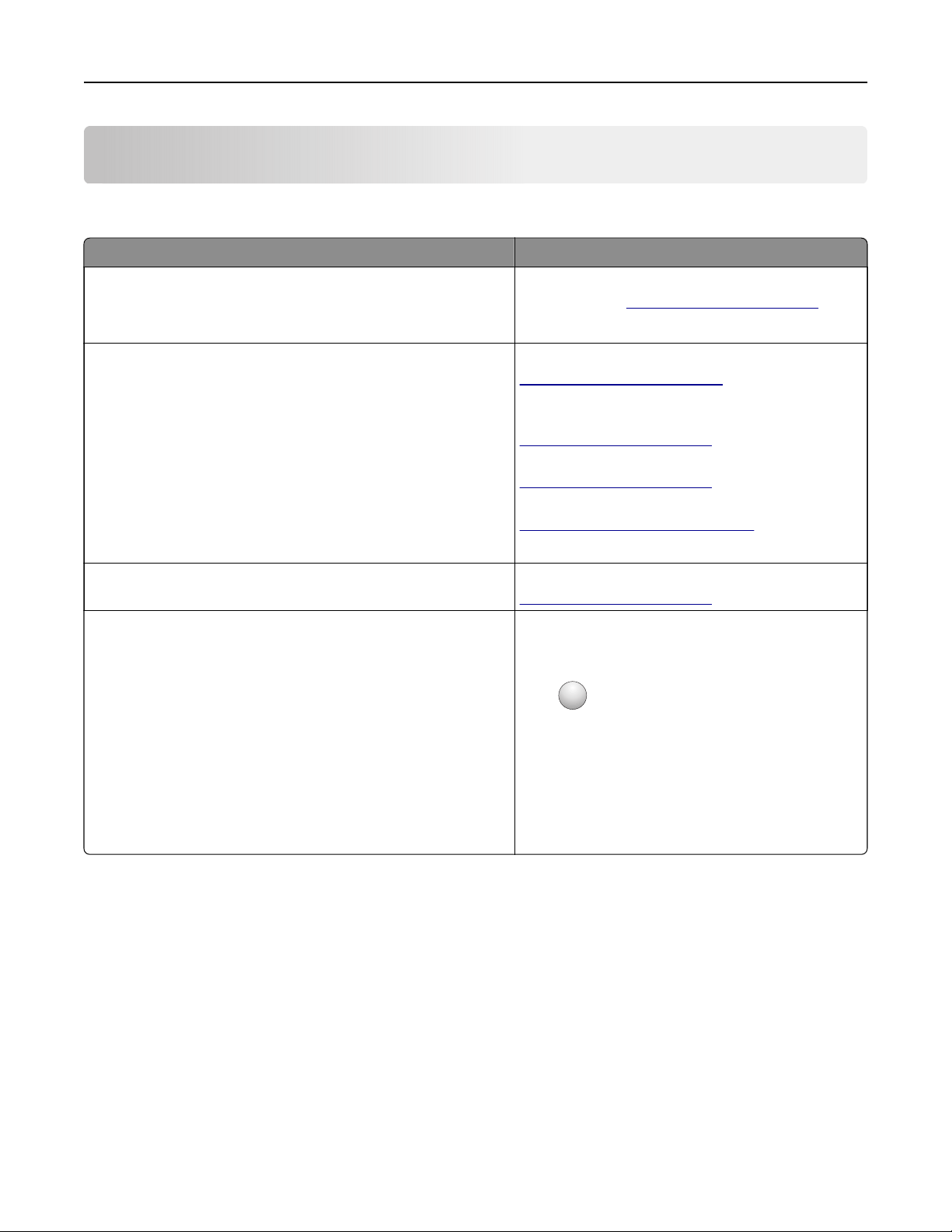
Finding information about the printer
What are you looking for? Find it here
Initial setup instructions:
• Connecting the printer
• Installing the printer software
See the setup documentation that came with the
printer or go to
http://support.lexmark.com.
More setup and instructions for using the printer:
• Selecting and storing paper and specialty media
• Loading paper
• Configuring printer settings
• Viewing and printing documents and photos
• Setting up and using the printer software
• Configuring the printer on a network
• Caring for and maintaining the printer
• Troubleshooting and solving problems
Information Center—Go to
http://infoserve.lexmark.com.
Help Menu Pages—Access the guides on the
printer
firmware
or go to
http://support.lexmark.com.
Touch Screen Guide—Go to
http://support.lexmark.com.
Product videos—Go to
http://infoserve.lexmark.com/idv/.
Information on setting up and configuring the accessibility
features of your printer
Lexmark Accessibility Guide—Go to
http://support.lexmark.com.
Help using the printer software Help for Microsoft® Windows® or Macintosh
operating systems—Open a printer software
program or application, and then click Help.
Click
?
to view context‑sensitive information.
Notes:
• Help is automatically installed with the printer
software.
• Depending on the operating system, the
printer software is located in the printer
program folder or on the desktop.
Learning about the printer 9
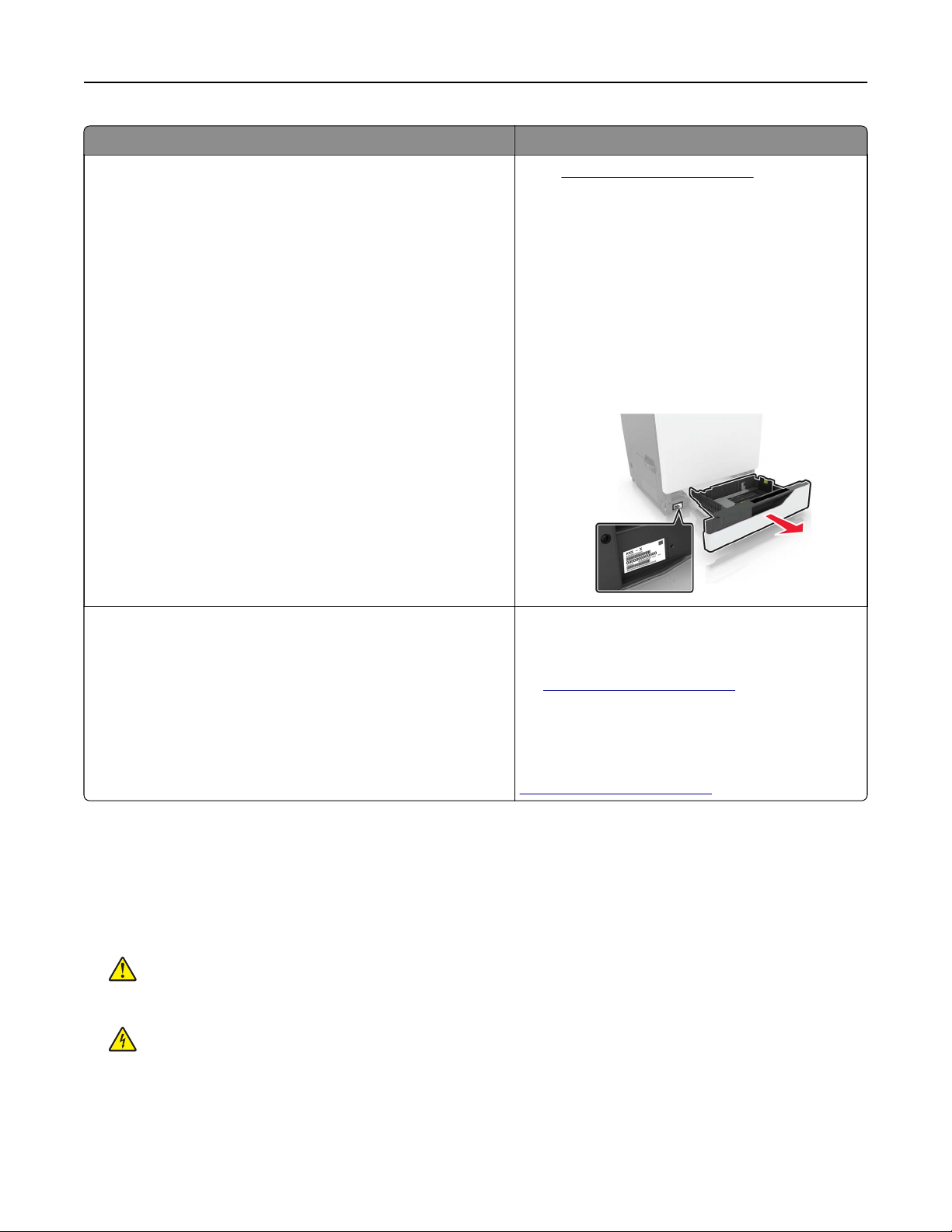
What are you looking for? Find it here
The latest supplemental information, updates, and customer
support:
• Documentation
• Driver downloads
• Live chat support
• E‑mail support
• Voice support
Go to
http://support.lexmark.com.
Note: Select your country or region, and then
select your product to view the appropriate
support site.
Support contact information for your country or
region can be found on the website or on the
printed warranty that came with the printer.
Have the following information ready when you
contact customer support:
• Place and date of purchase
• Machine type and serial number
• Safety information
• Regulatory information
• Warranty information
• Environmental information
Warranty information varies by country or region:
• In the U.S.—See the Statement of Limited
Warranty included with the printer, or go to
http://support.lexmark.com.
• In other countries and regions—See the
printed warranty that came with the printer.
Product Information Guide—See the
documentation that came with the printer or go to
http://support.lexmark.com.
Selecting a location for the printer
When selecting a location for the printer, leave enough room to open trays, covers, and doors and to install
hardware options.
• Set up the printer near an electrical outlet.
CAUTION—POTENTIAL INJURY: To avoid the risk of fire or electrical shock, connect the power cord
to an appropriately rated and properly grounded electrical outlet that is near the product and easily
accessible.
CAUTION—SHOCK HAZARD: To avoid the risk of electrical shock, do not place or use this product
near water or wet locations.
• Make sure that airflow in the room meets the latest revision of the ASHRAE 62 standard or the CEN Technical
Committee 156 standard.
• Provide a
flat,
sturdy, and stable surface.
Learning about the printer 10
• Keep the printer:
– Clean, dry, and free of dust.
– Away from stray staples and paper clips.
– Away from the direct airflow of air conditioners, heaters, or ventilators.
– Free from direct sunlight and humidity extremes.
• Observe the recommended temperatures and avoid
fluctuations:
Ambient temperature 10 to 32.2°C (50 to 90°F)
Storage temperature -40 to 43.3°C (-40 to 110°F)
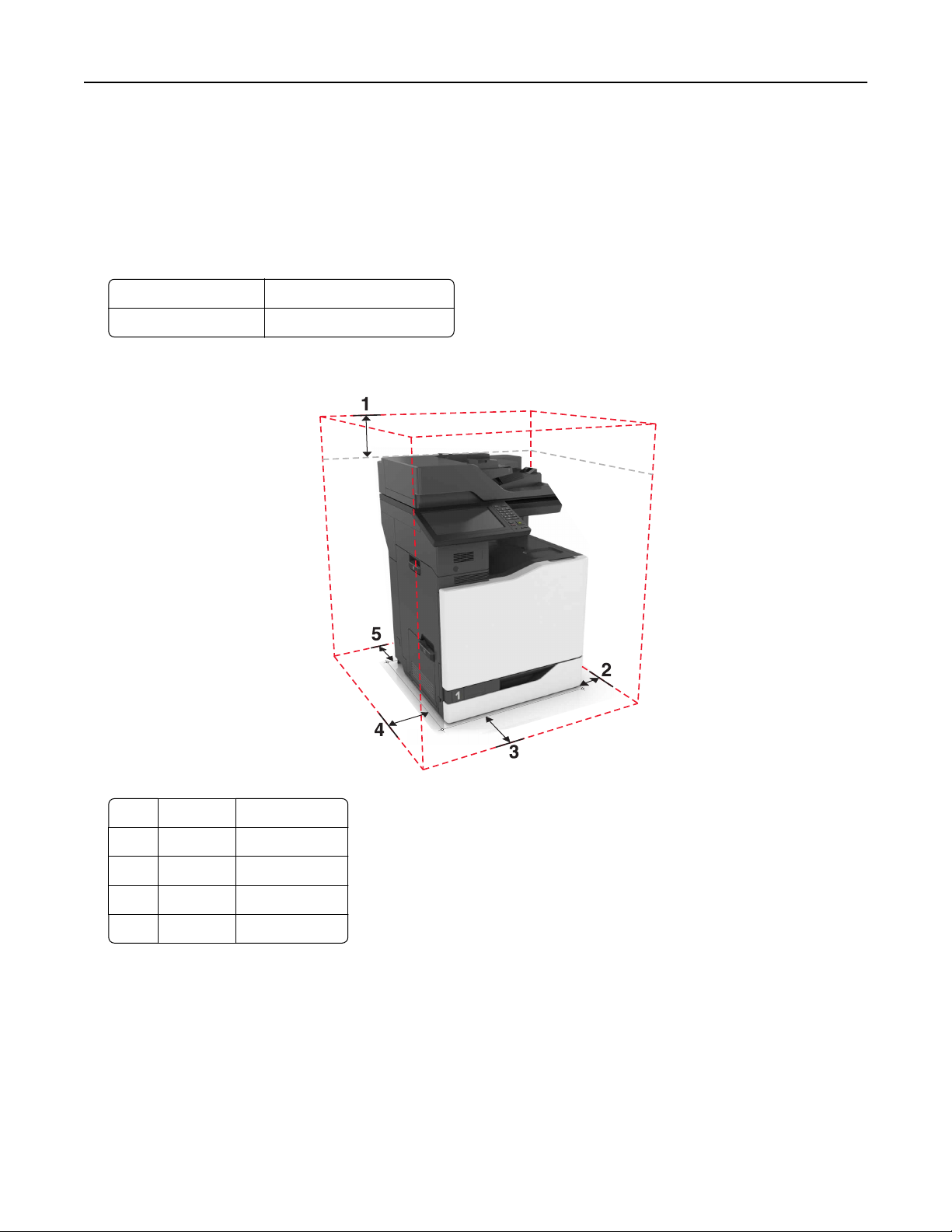
• Allow the following recommended amount of space around the printer for proper ventilation:
1 Top 330 mm (13 in.)
2 Right side 152 mm (6 in.)
3 Front 381 mm (15 in.)
4 Left side 457 mm (18 in.)
5 Rear 203 mm (8 in.)
Printer configurations
Note: Make sure to configure the printer on a flat, sturdy, and stable surface.
Learning about the printer 11
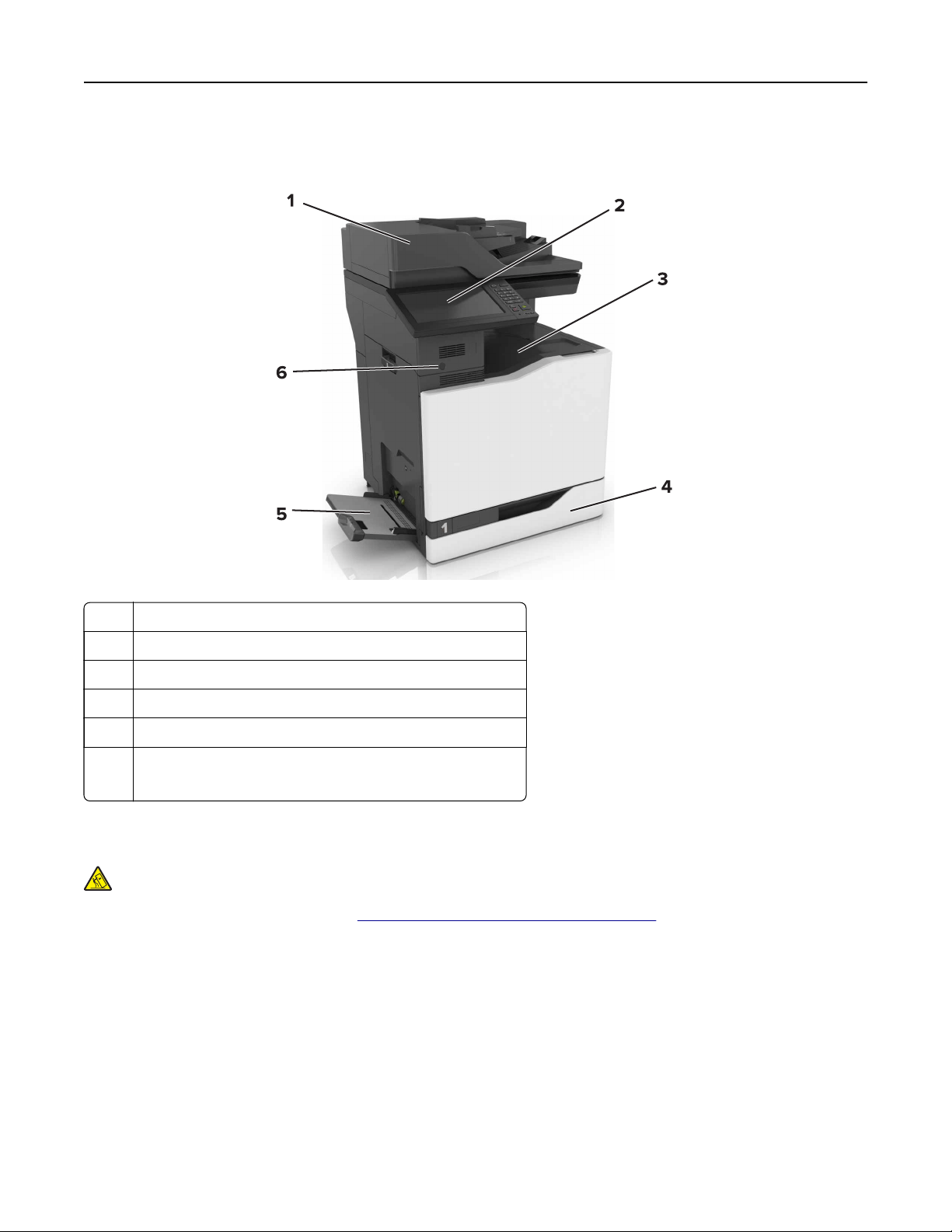
Basic model
1 Automatic document feeder (ADF)
2 Control panel
3 Standard bin
4 Standard 550-sheet tray
5 Multipurpose feeder
6 Proximity sensor
Note: This feature is available only in some printer units.
Configured model
CAUTION—TIPPING HAZARD: Installing one or more options on your printer or MFP may require a
caster base, furniture, or other feature to prevent instability causing possible injury. For more information
on supported configurations, see
www.lexmark.com/multifunctionprinters.
You can configure your printer by adding an optional 2200‑sheet tray or a combination of up to three optional
550‑sheet trays or envelope trays.
Learning about the printer 12
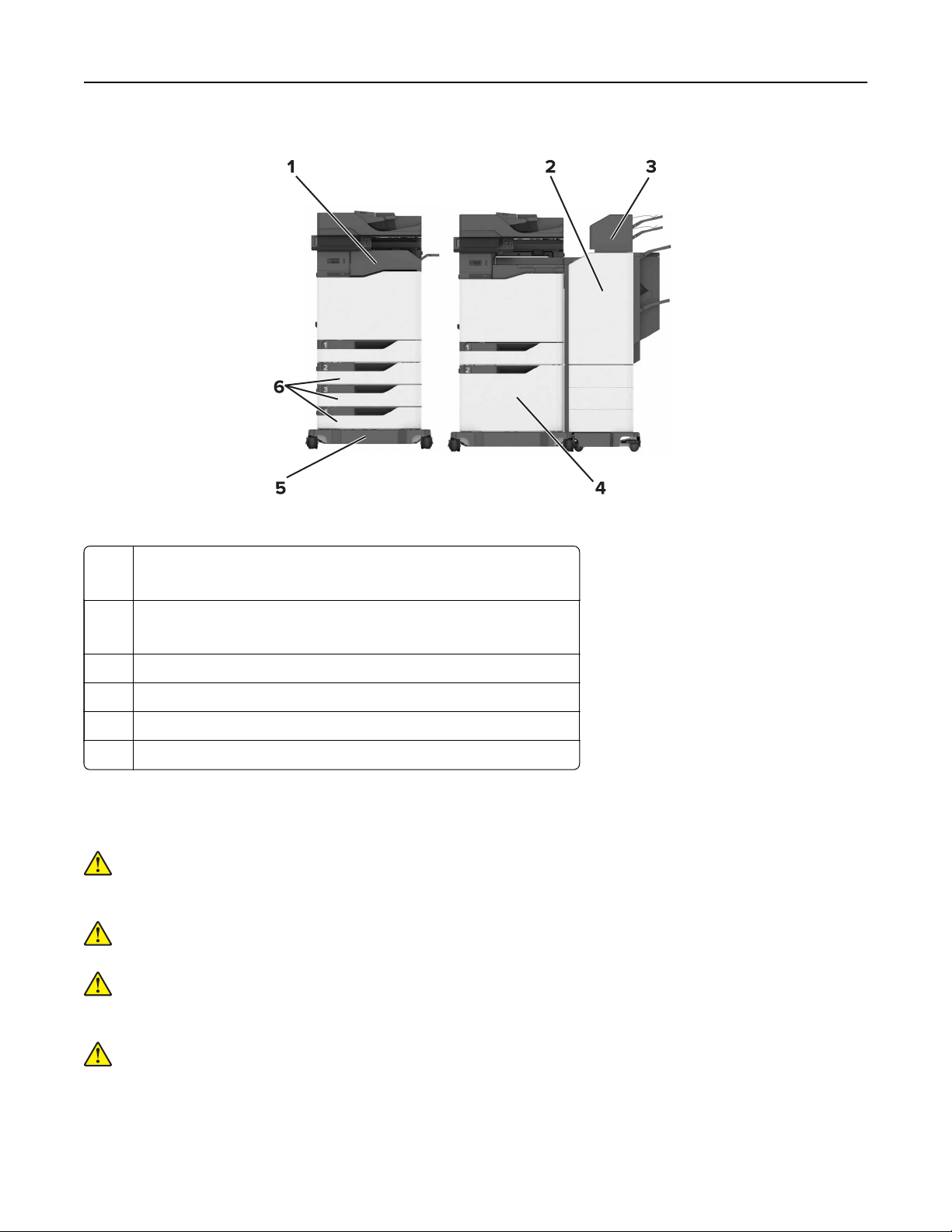
1 Staple finisher
Note: This option is not supported if another
finisher
is installed.
2 Multiposition staple, hole punch finisher
Note: This option is not supported if another finisher is installed.
3 Mailbox
4 Optional 2200‑sheet tray
5 Caster base
6 Optional 550‑sheet trays or envelope trays
Attaching cables
CAUTION—POTENTIAL INJURY: To avoid the risk of fire or electrical shock, connect the power cord to
an appropriately rated and properly grounded electrical outlet that is near the product and easily
accessible.
CAUTION—POTENTIAL INJURY: To avoid the risk of
fire
or electrical shock, use only the power cord
provided with this product or the manufacturer's authorized replacement.
CAUTION—POTENTIAL INJURY: To avoid the risk of electrical shock, do not set up this product or make
any electrical or cabling connections, such as the power cord, fax feature, or telephone, during a
lightning storm.
CAUTION—POTENTIAL INJURY: To reduce the risk of fire, use only a 26 AWG or larger
telecommunications (RJ-11) cord when connecting this product to the public switched telephone
network. For users in Australia, the cord must be approved by the Australian Communications and Media
Authority.
Learning about the printer 13
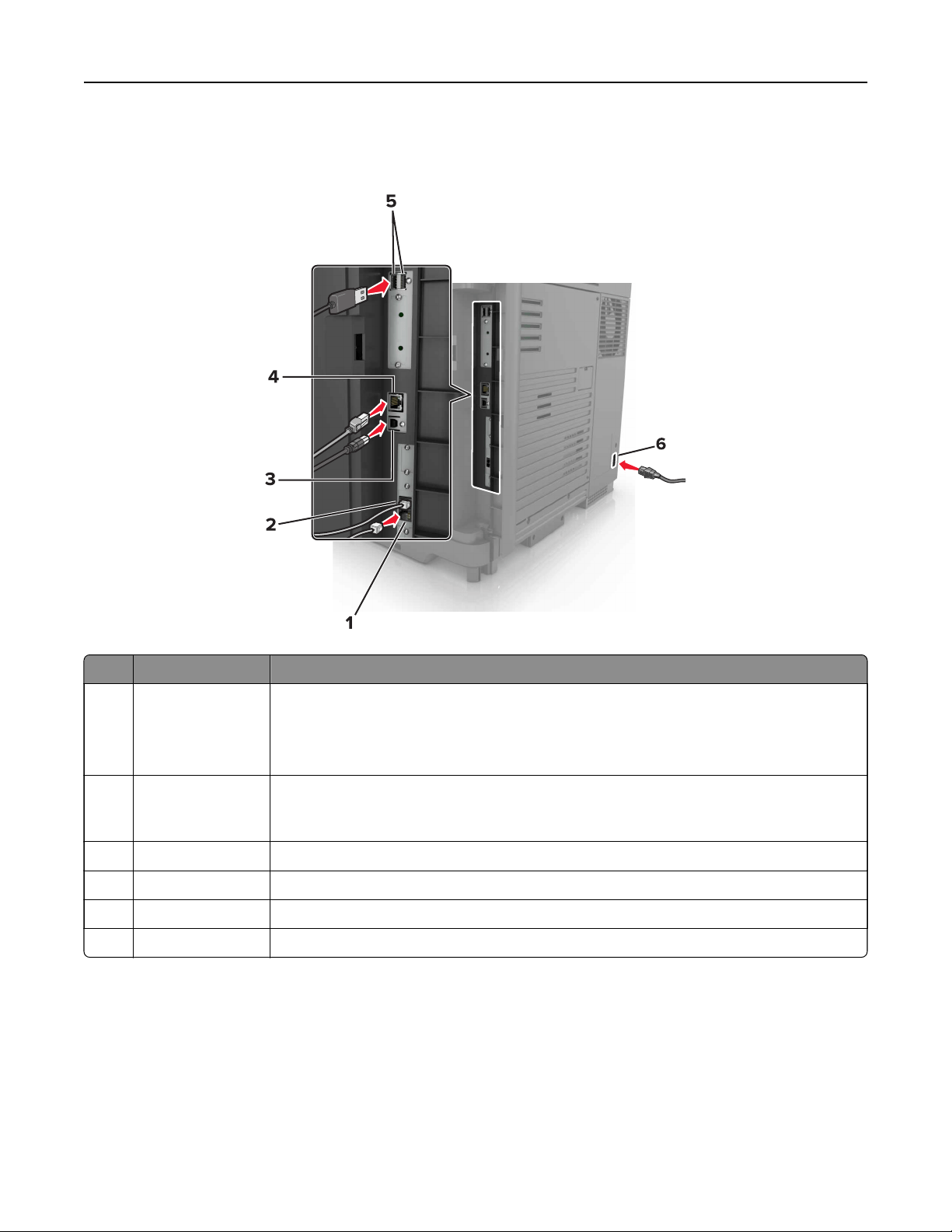
Warning—Potential Damage: To avoid loss of data or printer malfunction, do not touch the USB cable, any
wireless network adapter, or the printer in the areas shown while actively printing.
Use the To
1 EXT port Connect additional devices (telephone or answering machine) to the printer and the
telephone line. Use this port if you do not have a dedicated fax line for the printer and
if this connection method is supported in your country or region.
Note: Remove the plug to access the port.
2 LINE port Connect the printer to an active telephone line through a standard wall jack (RJ‑11), DSL
filter, VoIP adapter, or any other adapter that allows you to access the telephone line to
send and receive faxes.
3 USB printer port Connect the printer to a computer.
4 Ethernet port Connect the printer to an Ethernet network.
5 USB ports Attach a keyboard or any compatible options.
6 Power cord socket Connect the printer to a properly grounded electrical outlet.
Learning about the printer 14
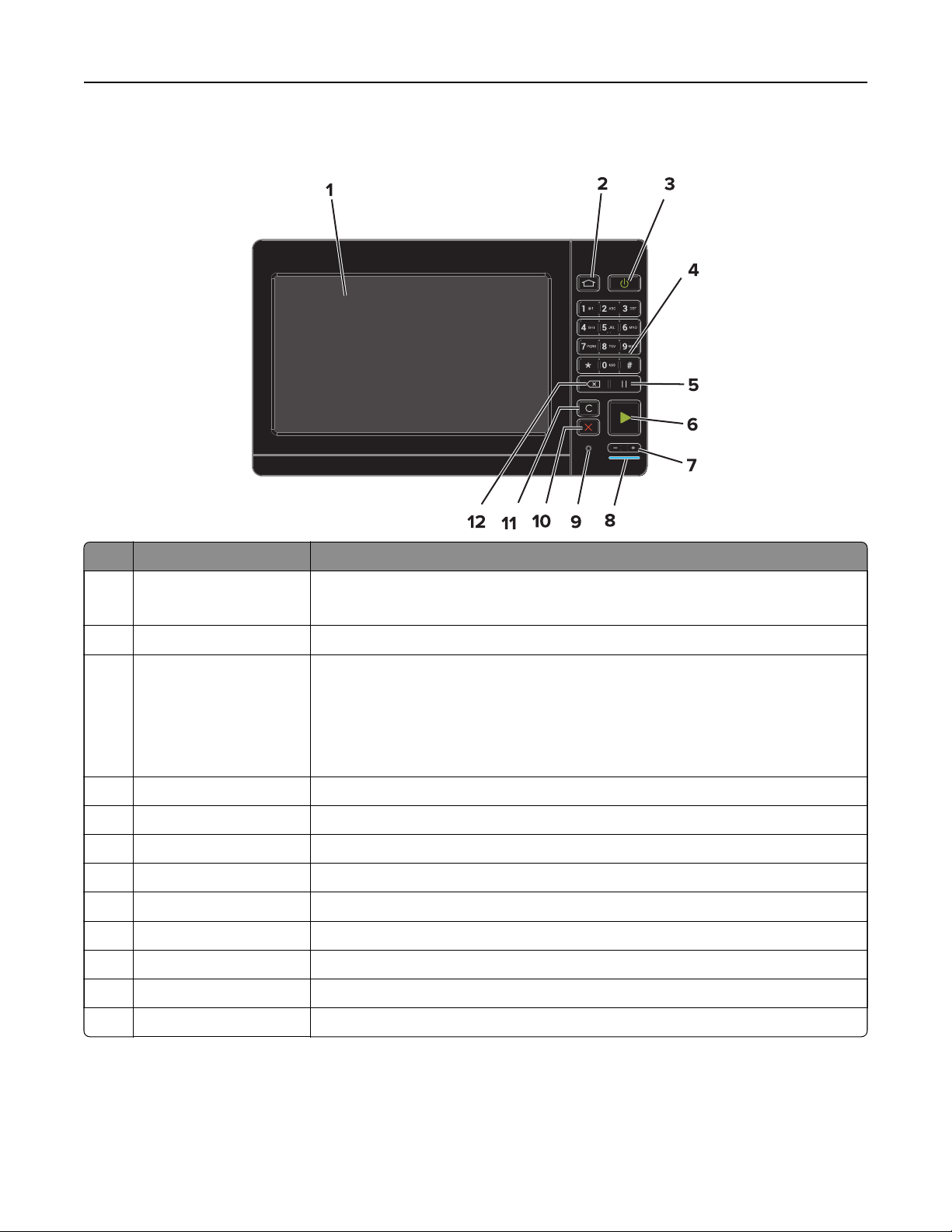
Using the control panel
Use the To
1 Display
• View the printer messages and supply status.
• Set up and operate the printer.
2 Home button Go to the home screen.
3 Power button
• Turn on or turn o the printer.
Note: To turn o the printer, press and hold the power button for five
seconds.
• Set the printer to Sleep or Hibernate mode.
• Wake the printer from Sleep or Hibernate mode.
4 Keypad Enter numbers or symbols in an input field.
5 Pause button Place a dial pause in a fax number.
6 Start button Start a job, depending on which mode is selected.
7 Volume buttons Adjust the volume of the headset or speaker.
8 Indicator light Check the status of the printer.
9 Headset or speaker port Attach a headset or speaker.
10 Stop or Cancel button Stop the current job.
11 Clear all or Reset button Reset the default settings of a function such as copying, faxing, or scanning.
12 Backspace button Move the cursor backward and delete a character in an input field.
Learning about the printer 15

Understanding the status of the power button and
indicator light
Indicator light Printer status
O The printer is o or in Hibernate mode.
Blue The printer is ready or processing data.
Red The printer requires user intervention.
Power button light Printer status
O The printer is o, ready, or processing data.
Solid amber The printer is in sleep mode.
Blinking amber The printer is in hibernate mode.
Using the home screen
Note: Your home screen may vary depending on your home screen customization settings, administrative
setup, and active embedded solutions.
Touc h To
1 Copy Make copies.
2 E‑mail Send e‑mails.
3 Change Language Change the language on the printer display.
4 Fax Send fax.
5 Settings Access the printer menus.
6 Held Faxes Show all the current held fax jobs.
Note: If Held Faxes is hidden, then Release Held Faxes appears.
7 Shortcut Center Organize all shortcuts.
Learning about the printer 16
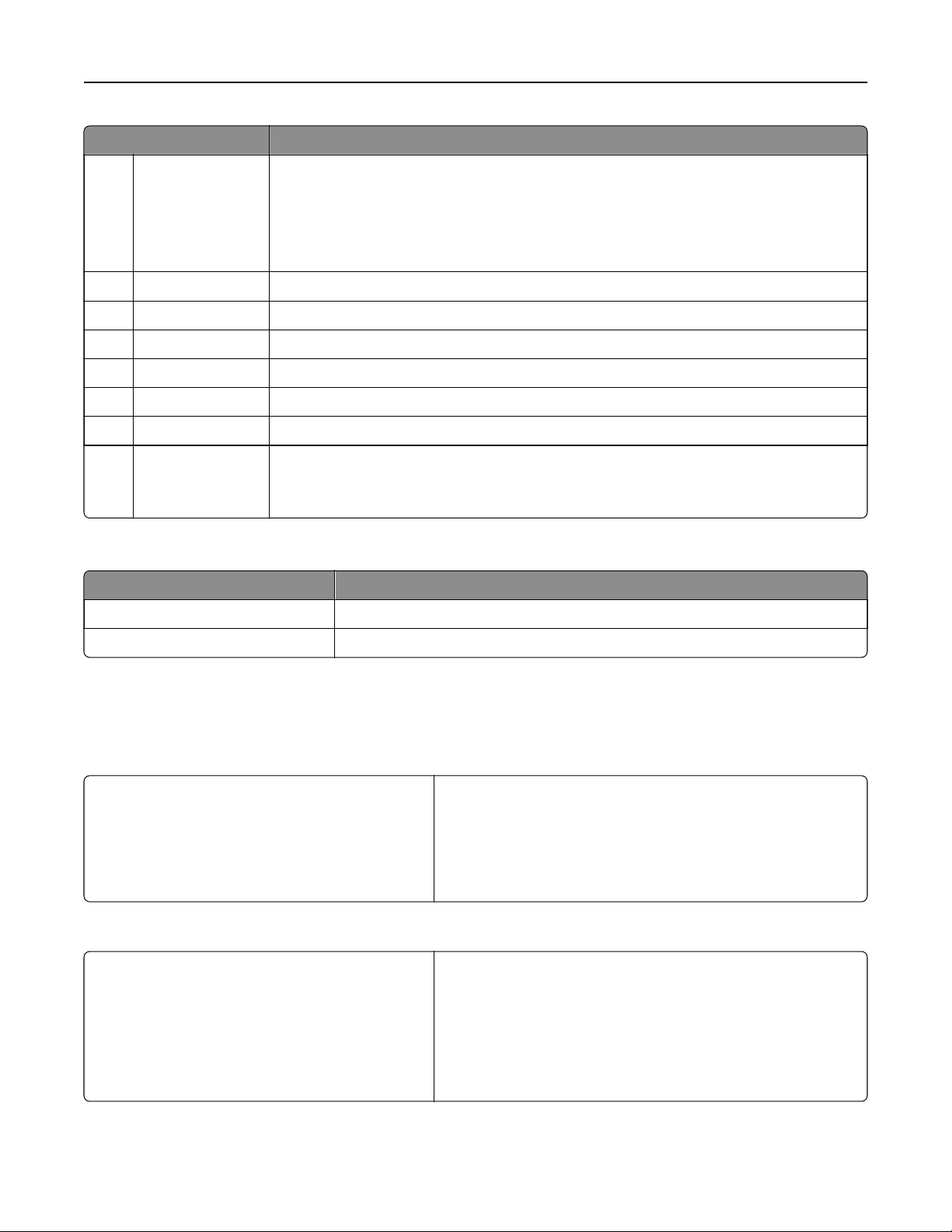
Touc h To
8 Status/Supplies
• Show a printer warning or error message whenever the printer requires intervention
to continue processing.
• View more information on the printer warning or message, and on how to clear it.
Note: You can also access this setting by touching the top section of the home
screen.
9 Address Book Access, create, and organize contacts.
10 Scan Profiles Scan and save documents directly to the computer.
11 FTP Scan and save documents directly to an FTP server.
12 Bookmarks Organize all bookmarks.
13 Held Jobs Show all the current held print jobs
14 USB Drive View, select, or print photos and documents from a flash drive.
15 Job Queue Show all the current print jobs.
Note: You can also access this setting by touching the top section of the home
screen.
These settings may also appear on the home screen
Touc h To
App Profiles Access application profiles.
Lock Device Prevent users from accessing any printer functions from the home screen.
Menu map
Device
• Preferences
• Remote Operator Panel
• Notifications
• Power Management
• Information Sent to Lexmark
• Accessibility
• Restore Factory Defaults
• Maintenance
• Visible Home Screen Icons
• About This Printer
Print
• Layout
• Finishing
• Setup
• Quality
• Job Accounting
• XPS
• PDF
• PostScript
• PCL
• HTML
• Image
• PPDS
Learning about the printer 17

Paper
• Tray Configuration
• Media
Configuration
• Bin Configuration
Copy
Copy Defaults
Fax
• Fax Mode
• Analog Fax Setup
• Fax Server Setup
E‑mail
• E‑mail Setup
• E‑mail Defaults
• Web Link Setup
Network/Ports
• Network Overview
• Wireless
• AirPrint
• Ethernet
• TCP/IP
• IPv6
• SNMP
• IPSec
• LPD Configuration
• HTTP/FTP Settings
• ThinPrint
• USB
• Parallel [x]
• Serial
• Google Cloud Print
• Wi-Fi Direct
FTP
FTP Defaults
USB Drive
• Flash Drive Scan • Flash Drive Print
Security
• Login Methods
• Schedule USB Devices
• Security Audit Log
• Login Restrictions
• Confidential Print Setup
• Disk Encryption
• Erase Temporary Data Files
• Solutions LDAP Settings
• Miscellaneous
Option Card Menu
Note: This setting appears only when an optional card is installed.
Learning about the printer 18

Reports
• Menu Settings Page
• Device
• Print
• Shortcuts
• Fax
• Network
Help
• Print All Guides
• Color Quality Guide
• Connection Guide
• Copy Guide
• E‑mail Guide
• Fax Guide
• Information Guide
• Media Guide
• Moving Guide
• Print Quality Guide
• Scan Guide
• Supplies Guide
Troubleshooting
• Basic Print Quality Samples • Advanced Print Quality Samples
Printing a menu settings page
From the home screen, touch Settings > Reports > Menu Settings Page.
Learning about the printer 19

Setting up and using the home screen
applications
Customizing the home screen
1 Open a web browser, and then type the printer IP address in the address field.
Notes:
• View the printer IP address on the printer home screen. The IP address appears as four sets of
numbers separated by periods, such as 123.123.123.123.
• If you are using a proxy server, then temporarily disable it to load the web page correctly.
2 Click Settings > Device > Visible Home Screen Icons.
3 Select the icons that you want to appear on the home screen.
4 Apply the changes.
Setting up Forms and Favorites
1 Open a Web browser, and then type the printer IP address in the address field.
Notes:
• View the printer IP address on the printer home screen. The IP address appears as four sets of
numbers separated by periods, such as 123.123.123.123.
• If you are using a proxy server, then temporarily disable it to load the Web page correctly.
2 Click Apps > Forms and Favorites > Configure.
3 Click Add, and then customize the settings.
Notes:
• To make sure that the location settings of the bookmark are correct, type the IP address of the host
computer where the bookmark is located.
• Make sure that the printer has access rights to the folder where the bookmark is located.
4 Apply the changes.
Setting up Card Copy
1 Open a Web browser, and then type the printer IP address in the address field.
Notes:
• View the printer IP address on the printer home screen. The IP address appears as four sets of
numbers separated by periods, such as 123.123.123.123.
• If you are using a proxy server, then temporarily disable it to load the Web page correctly.
2 Click Apps > Card Copy > Configure.
Setting up and using the home screen applications 20

3 Configure the output options and scan settings.
Notes:
• When scanning a card, make sure that the scan resolution does not exceed 200 dpi for color and
400 dpi for black and white.
• When scanning multiple cards, make sure that the scan resolution does not exceed 150 dpi for color
and 300 dpi for black and white.
• You need a printer hard disk to scan multiple cards.
• Make sure that the printer network and e‑mail settings are
configured.
4 Apply the changes.
Using Shortcut Center
1 From the home screen, touch Shortcut Center, and then select a printer function.
2 To uc h Create Shortcut, and then configure the settings.
3 Touch Save, and then type a unique shortcut name.
4 Apply the changes.
Setting up Scan Center
1 From the home screen, touch Scan Center.
2 Select and create a destination, and then
configure
the settings.
Notes:
• When creating a network destination, make sure to validate and adjust the settings until no errors
occur.
• Only destinations created from the Embedded Web Server are saved. For more information, see the
documentation that came with the solution.
3 Apply the changes.
Managing contacts
Adding contacts
1 Open a web browser, and then type the printer IP address in the address
field.
Notes:
• View the printer IP address on the printer home screen. The IP address appears as four sets of
numbers separated by periods, such as 123.123.123.123.
• If you are using a proxy server, then temporarily disable it to load the web page correctly.
2 Click Address Book.
Setting up and using the home screen applications 21

3 From the Contacts section, add a contact.
Note: You can assign the contact to one or more groups.
4 If necessary, specify a login method to allow application access.
5 Apply the changes.
Adding groups
1 Open a web browser, and then type the printer IP address in the address field.
Notes:
• View the printer IP address on the printer home screen. The IP address appears as four sets of
numbers separated by periods, such as 123.123.123.123.
• If you are using a proxy server, then temporarily disable it to load the web page correctly.
2 Click Address Book.
3 From the Contact Groups section, add a group name.
Note: You can assign one or more contacts to the group.
4 Apply the changes.
Editing contacts or groups
1 Open a web browser, and then type the printer IP address in the address
field.
Notes:
• View the printer IP address on the printer home screen. The IP address appears as four sets of
numbers separated by periods, such as 123.123.123.123.
• If you are using a proxy server, then temporarily disable it to load the web page correctly.
2 Click Address Book.
3 Do either of the following:
• From the Contacts section, click a contact name, and then edit the information.
• From the Contact Groups section, click a group name, and then edit the information.
4 Apply the changes.
Deleting contacts or groups
1 Open a web browser, and then type the printer IP address in the address field.
Notes:
• View the printer IP address on the printer home screen. The IP address appears as four sets of
numbers separated by periods, such as 123.123.123.123.
• If you are using a proxy server, then temporarily disable it to load the web page correctly.
2 Click Address Book.
Setting up and using the home screen applications 22

3 Do either of the following:
• From the Contacts section, select a contact that you want to delete.
• From the Contact Groups section, select a group name that you want to delete.
Setting up and using the home screen applications 23

Setting up and using the accessibility features
Enabling Magnification mode
1 From the control panel, press and hold the 5 key until you hear a voice message.
2 Select
Magnification
.
3 Select OK.
For more information on navigating a magnified screen, see
“Navigating the screen using gestures” on
page 25.
Activating Voice Guidance
From the control panel
1 Press and hold the 5 key until you hear a voice message.
2 Select OK.
From the keyboard
1 Press and hold the 5 key until you hear a voice message.
2 Press Tab to navigate the focus cursor to the OK button, and then press Enter.
Notes:
• Voice Guidance is also activated when you insert headphones into the headphone jack.
• To adjust the volume, use the volume buttons at the bottom part of the control panel.
Adjusting the Voice Guidance speech rate
1 From the home screen, select Settings > Device > Accessibility > Speech Rate.
2 Select the speech rate.
Enabling spoken passwords or personal identification
numbers
1 From the home screen, select Settings > Device > Accessibility > Speak Passwords/PINs.
2 Enable the setting.
Setting up and using the accessibility features 24
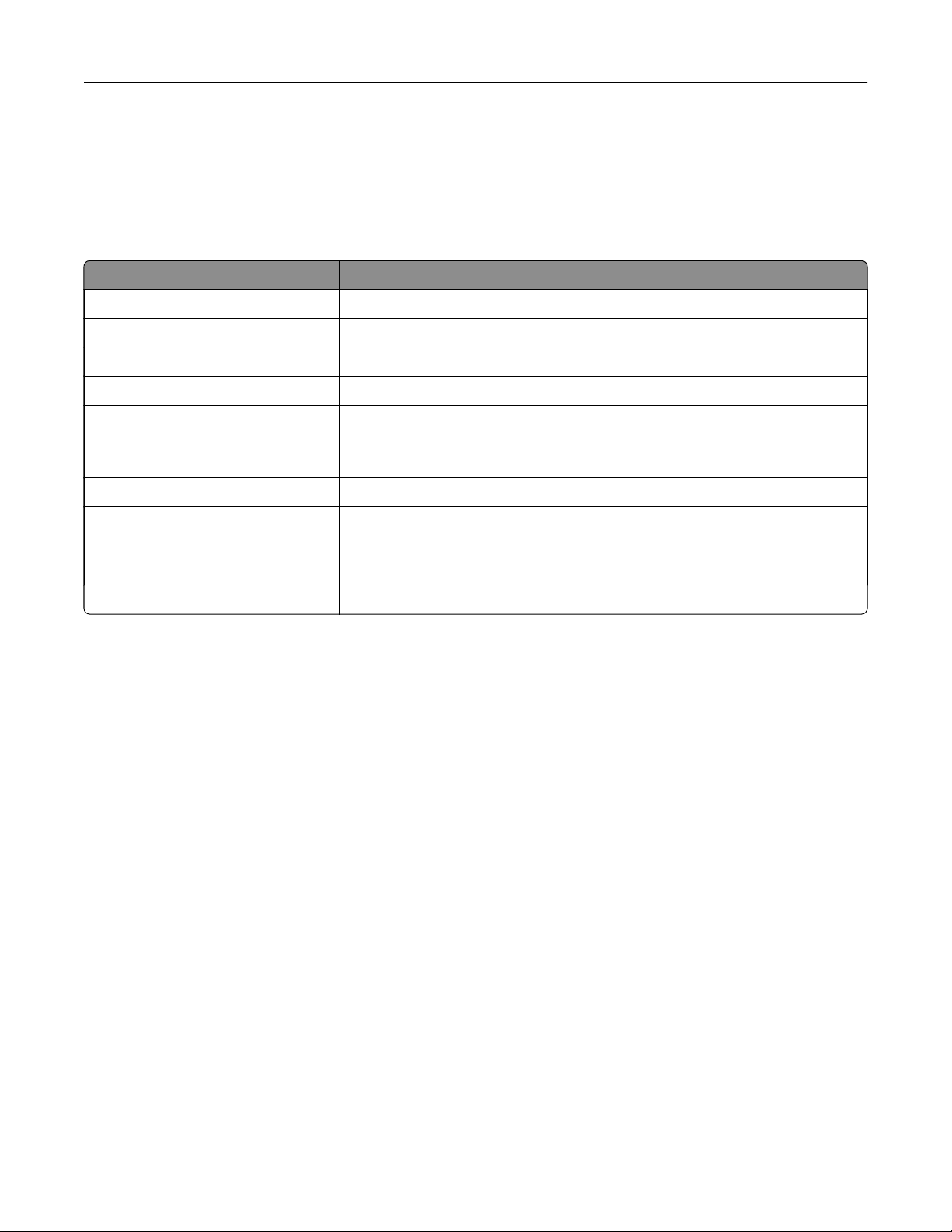
Navigating the screen using gestures
Notes:
• The gestures are applicable only when Voice Guidance is activated.
• A physical keyboard is required for typing characters and adjusting certain settings.
Gesture Function
Double‑tap Select an option or item on the screen.
Triple‑tap Zoom in or zoom out text and images.
Swipe right or swipe down Move to the next item on the screen.
Swipe left or swipe up Move to the previous item on the screen.
Pan Access parts of the zoomed image that are beyond the limits of the screen.
Note: This gesture requires the use of two
fingers
to drag across a zoomed
image.
Swipe up then left Exit an application and return to the home screen.
Swipe down then left
• Cancel a job.
• Go back to the previous setting.
• Exit the screen that appears without changing any setting or value.
Swipe up then down Repeat a spoken prompt.
Using the keyboard on the display
Do one or more of the following:
• Drag a
finger
over the key to announce the character.
• Lift the
finger
to enter or type the character in the
field.
• Press Backspace to delete characters.
• To hear the content in the input field, press Tab, and then press Shift + Tab.
Setting up and using the accessibility features 25
Loading paper and specialty media
Setting the size and type of the specialty media
The trays automatically detect the size of plain paper. For specialty media like labels, card stock, or envelopes,
do the following:
1 From the home screen, navigate to:
Settings > Paper > Tray Configuration > Paper Size/Type > select a paper source
2 Set the size and type of the specialty media.
Configuring Universal paper settings
1 From the home screen, touch Settings > Paper > Media Configuration > Universal Setup.
2 Configure the settings.
Loading trays
CAUTION—TIPPING HAZARD: To reduce the risk of equipment instability, load each tray separately.
Keep all other trays closed until needed.
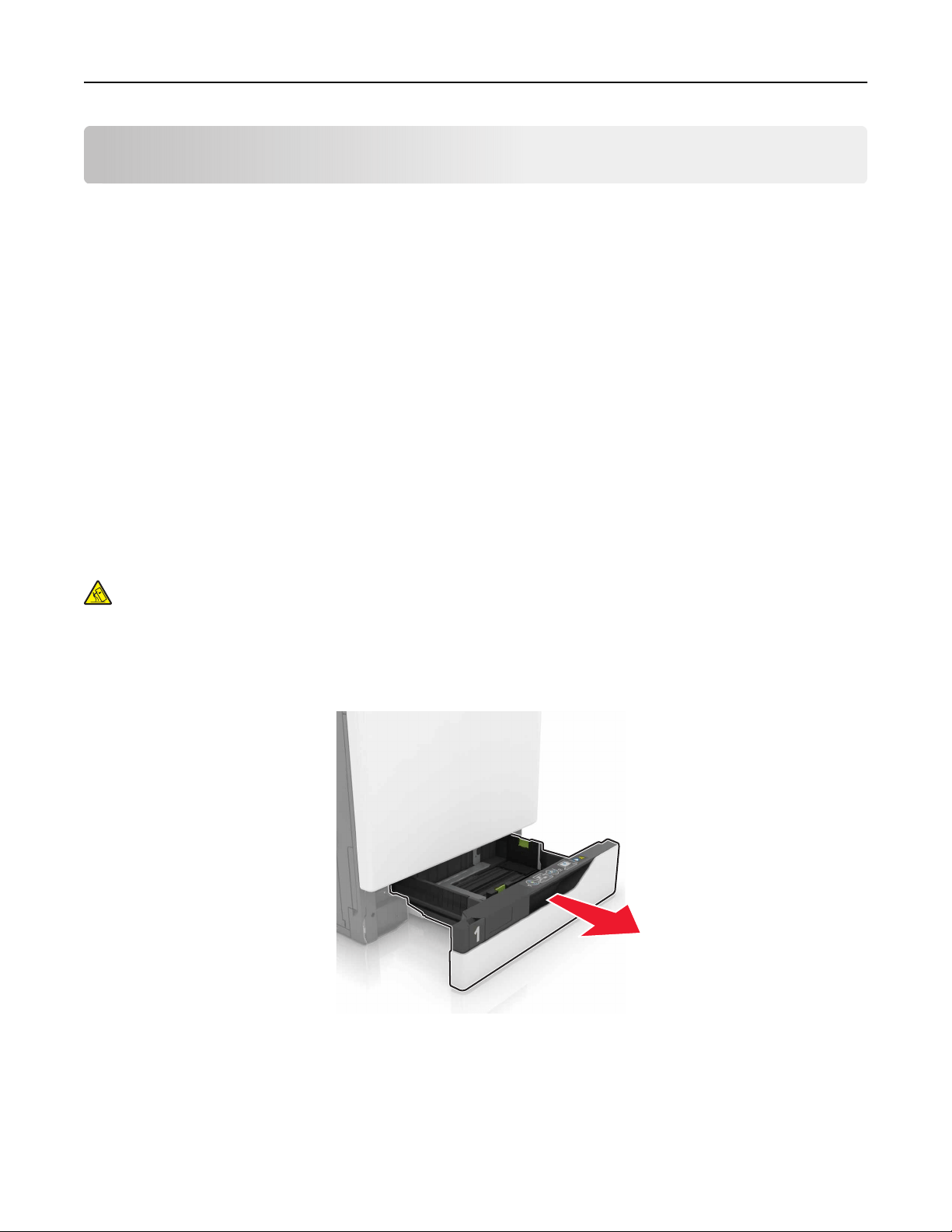
1 Pull out the tray.
Note: To avoid paper jams, do not remove trays while the printer is busy.
2 Adjust the guides to match the size of the paper that you are loading.
Note: Use the indicators on the bottom of the tray to position the guides.
Loading paper and specialty media 26

3 Flex, fan, and align the paper edges before loading.
4 Load the paper with the printable side faceup.
Note: Load envelopes only in the optional envelope tray.
Warning—Potential Damage: Do not use envelopes with stamps, clasps, snaps, windows, coated linings,
or self‑stick adhesives in the optional envelope tray.
Notes:
• Load letterhead faceup with the header on the left side of the tray for one‑sided printing.
• Load letterhead facedown with the header on the right side of the tray for two‑sided printing.
• Load letterhead faceup with the header on the right side of the tray for one‑sided print jobs that
require finishing.
• Load letterhead facedown with the header on the left side of the tray for two‑sided print jobs that
require finishing.
• Load pre‑punched paper with the holes toward the front or left side of the tray.
• Load envelopes with the
flap
side down and against the back side of the tray. Load European
envelopes with the flap side down and against the left side of the tray.
• Do not slide paper into the tray.
• Make sure that the stack height is below the maximum paper fill indicator. Overfilling may cause
paper jams.
Loading paper and specialty media 27
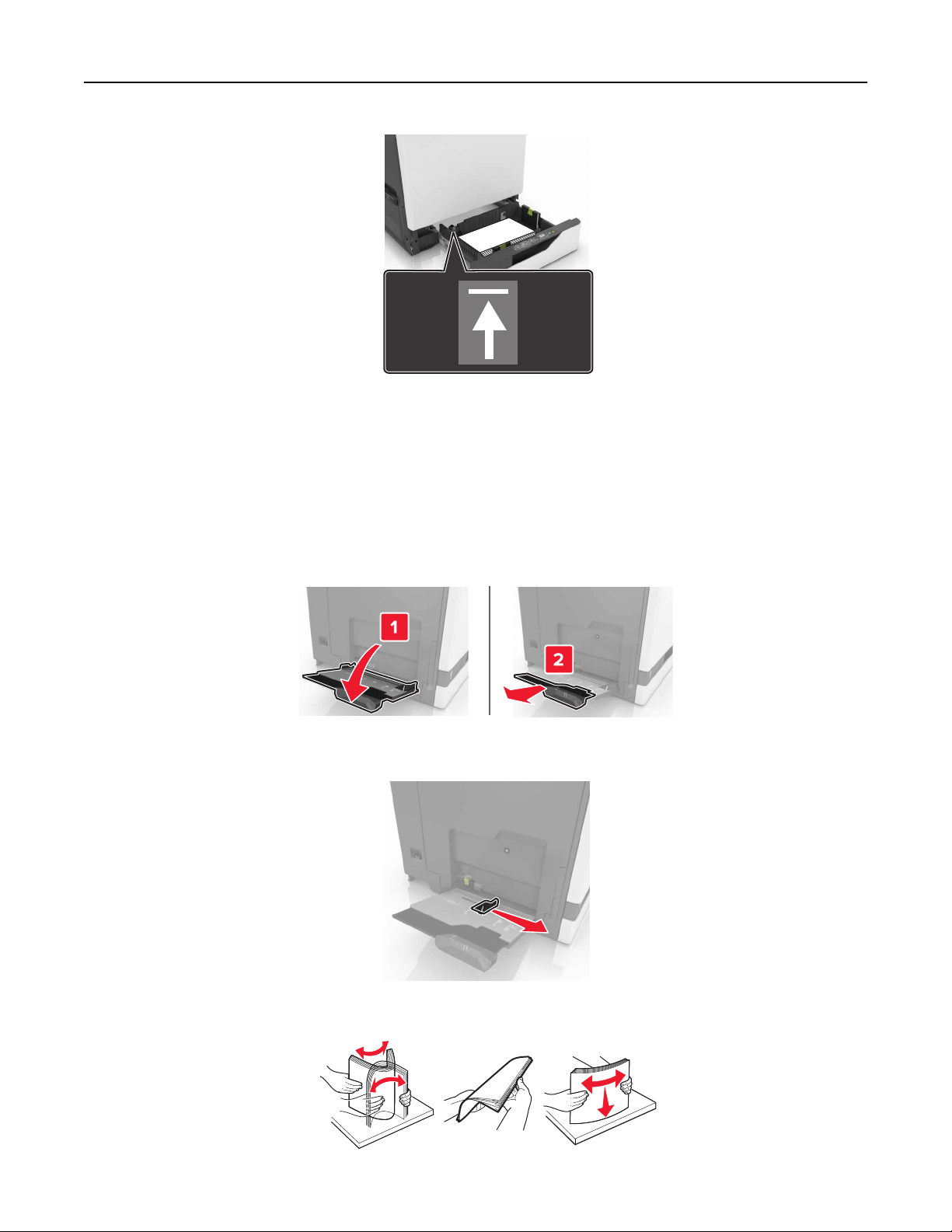
5 Insert the tray.
If loading a paper type other than plain, set the paper size and paper type in the Paper menu to match the
paper loaded.
Loading the multipurpose feeder
1 Open the multipurpose feeder.
2 Adjust the guide to match the size of the paper you are loading.
3 Flex, fan, and align the paper edges before loading.
Loading paper and specialty media 28
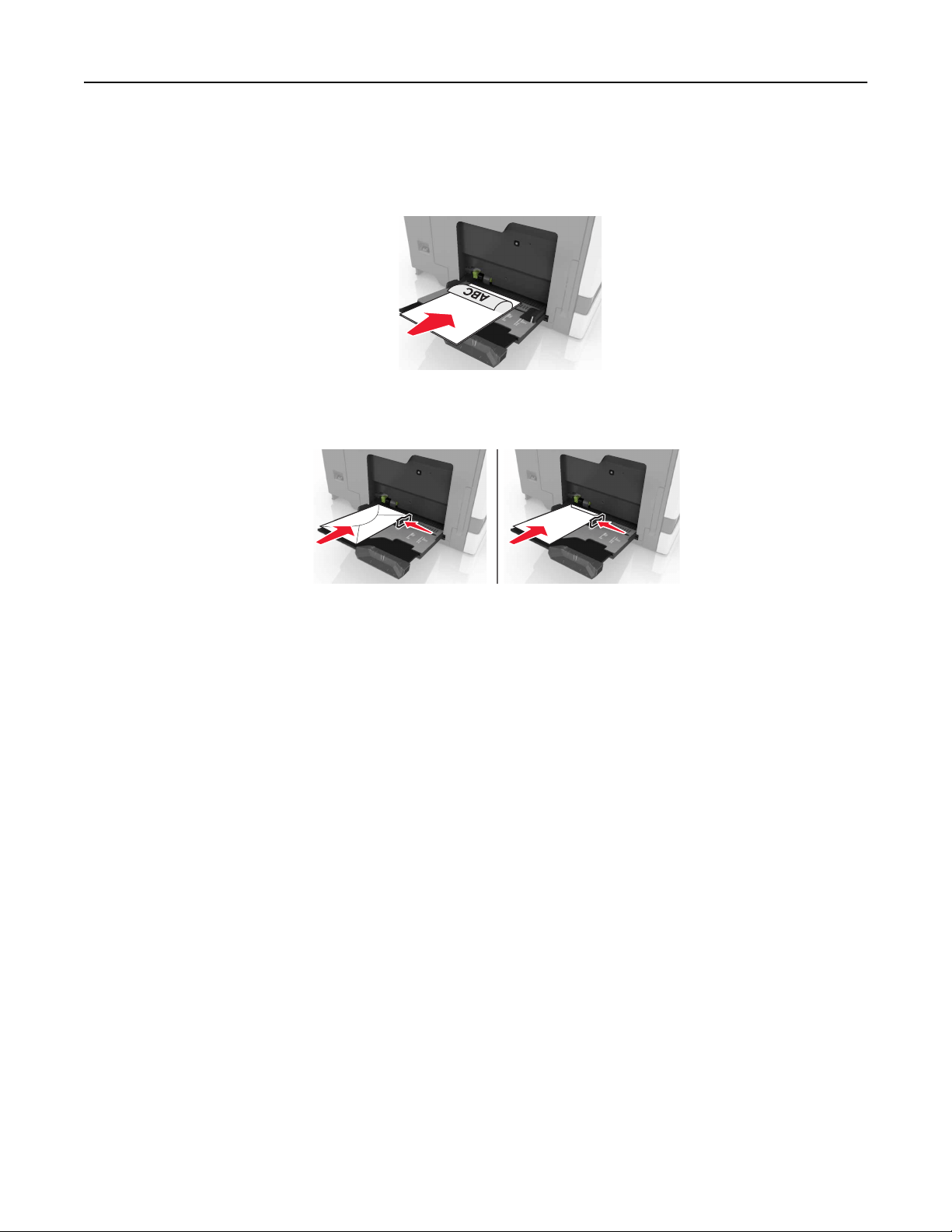
4 Load the paper.
• Load paper, card stock, and transparencies with the printable side facedown and the top edge entering
the printer
first.
• Load envelopes with the
flap
side up and against the left side of the paper guide. Load European
envelopes with the flap side up and entering the printer first.
Warning—Potential Damage: Do not use envelopes with stamps, clasps, snaps, windows, coated
linings, or self‑stick adhesives.
5 From the control panel, set the paper size and type to match the paper loaded in the tray.
Linking trays
1 Open a Web browser, and then type the printer IP address in the address field.
Notes:
• View the printer IP address on the printer home screen. The IP address appears as four sets of
numbers separated by periods, such as 123.123.123.123.
• If you are using a proxy server, then temporarily disable it to load the Web page correctly.
2 Click Settings > Paper.
3 Match the paper size and type for the trays you are linking.
Note: To unlink trays, make sure that no trays have the same paper size or type.
4 Save the settings.
Note: You can also change the paper size and type settings from the printer control panel.
Warning—Potential Damage: The temperature of the fuser varies according to the specified paper type. To
avoid printing issues, match the paper type settings in the printer with the paper loaded in the tray.
Loading paper and specialty media 29

Printing
CAUTION—PINCH HAZARD: To avoid the risk of a pinch injury, use caution in areas marked with this
label. Pinch injuries may occur around moving parts, such as gears, doors, trays, and covers.
Printing from a computer
Note: For labels, card stock, and envelopes, set the paper size and type in the printer before printing the
document.
1 From the document that you are trying to print, open the Print dialog.
2 If necessary, adjust the settings.
3 Print the document.
Printing forms
1 From the home screen, navigate to:
Forms and Favorites > select form > Print
2 If necessary, configure the print settings.
3 Send the print job.
Printing from a mobile device
Printing from a mobile device using Lexmark Mobile Print
Lexmark
TM
Mobile Print allows you to send documents and images directly to a supported Lexmark printer.
1 Open the document, and then send or share the document to Lexmark Mobile Print.
Note: Some third‑party applications may not support the send or share feature. For more information, see
the documentation that came with the application.
2 Select a printer.
3 Print the document.
Printing from a mobile device using Google Cloud Print
Google Cloud Print
TM
is a mobile printing service that allows enabled applications on mobile devices to print
to any Google Cloud Print‑ready printer.
1 From the home screen of your mobile device, launch an enabled application.
2 Tap Print, and then select a printer.
3 Print the document.
Printing 30
Printing from a mobile device using Mopria Print Service
Mopria® Print Service is a mobile printing solution for mobile devices running on Android version 4.4 or later. It
allows you to print directly to any Mopria‑certified printer.
Note: Before printing, make sure that the Mopria Print Service is enabled.
1 From the home screen of your mobile device, launch a compatible application.
2 Tap Print, and then select a printer.
3 Print the document.
Printing from a mobile device using AirPrint
AirPrint is a mobile printing solution that allows you to print directly from Apple devices to an AirPrint‑certified
printer.
Note: This application is supported only in some Apple devices.
1 From the home screen of your mobile device, launch a compatible application.
2 Select an item to print, and then tap the share icon.
3 Tap Print, and then select the printer.
4 Send the print job.
Printing from a flash drive
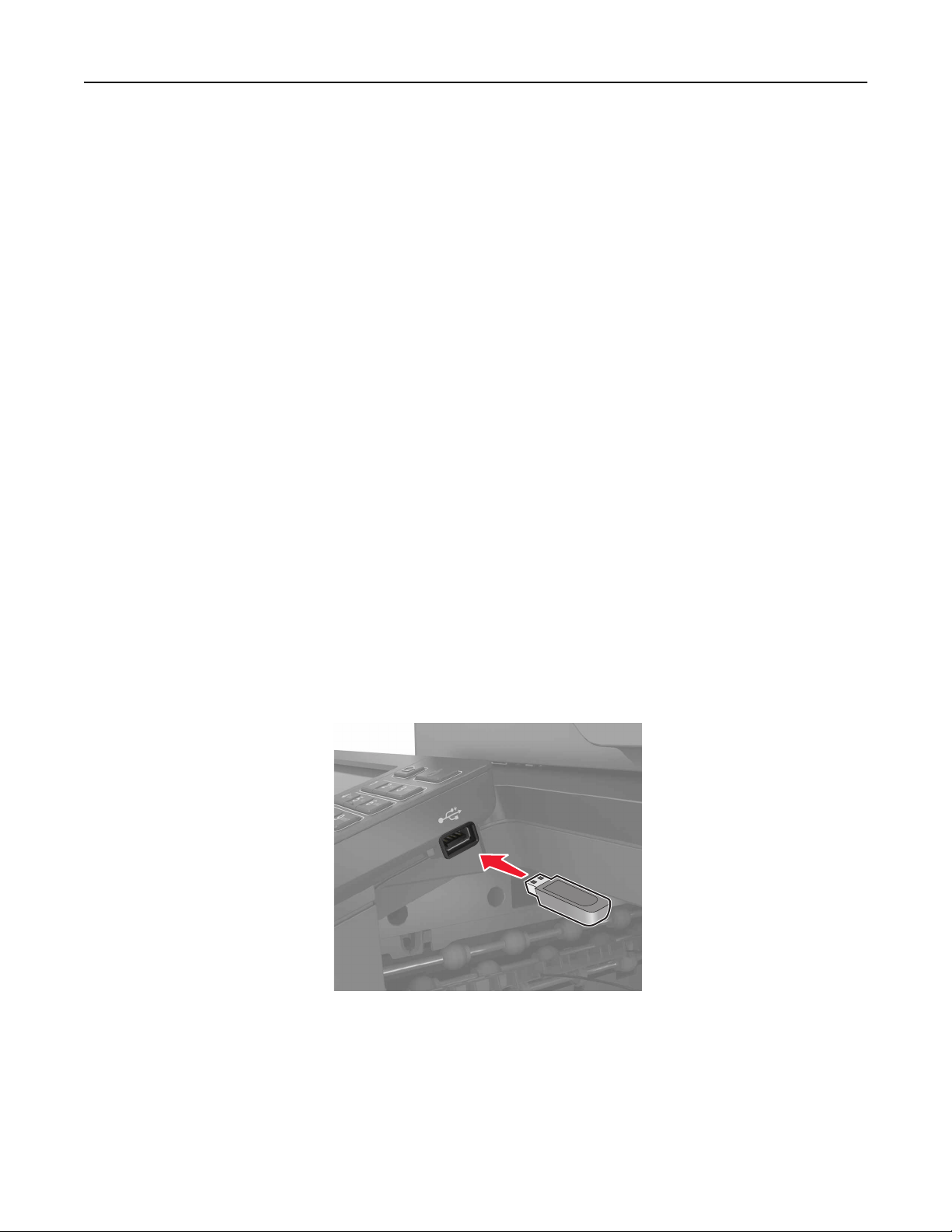
1 Insert a flash drive into the USB port.
Notes:
• If you insert the flash drive when an error message appears, then the printer ignores the flash drive.
• If you insert the flash drive while the printer is processing other print jobs, then Busy appears on the
display.
Printing 31

2 From the display, touch the document that you want to print.
If necessary, configure other print settings.
3 Send the print job.
To print another document, touch USB Drive.
Warning—Potential Damage: Do not touch the printer or the flash drive in the area shown while actively
printing, reading, or writing from the memory device. Loss of data or a malfunction can occur.
Supported flash drives and file types
Flash drives
• Lexar JumpDrive S70 (16GB and 32GB)
• SanDisk Cruzer (16GB and 32GB)
• PNY Attaché (16GB and 32GB)
Notes:
– The printer supports high‑speed USB flash drives with full‑speed standard.
– USB flash drives must support the File Allocation Table (FAT) system.
File types
Documents:
• .doc or .docx
• .xls or .xlsx
• .ppt or .pptx
• .pdf
• .xps
Printing 32

Images:
• .dcx
• .gif
• .jpeg or .jpg
• .bmp
• .pcx
• .ti or .tif
• .png
Configuring confidential jobs
1 From the home screen, touch Settings > Security > Confidential Print Setup.
2 Configure the settings.
Use To
Max Invalid PIN Limit the number of times an invalid PIN can be entered.
Note: When the limit is reached, the print jobs for that user name are deleted.
Confidential Job
Expiration
Set the amount of time before confidential jobs are automatically deleted from the printer
memory.
Note:
Confidential
held jobs are stored in the printer until you log in and release or
delete them manually.
Repeat Job
Expiration
Set the amount of time before repeat jobs are deleted from the printer memory.
Note: Repeat held jobs are stored so extra copies can be printed later.
Verify Job Expiration Set the amount of time before verify jobs are deleted from the printer memory.
Note: Verify jobs print one copy to check if it is satisfactory before printing the
remaining copies.
Reserve Job
Expiration
Set the amount of time before reserved jobs are deleted without being printed.
Note: Reserve held jobs are automatically deleted after printing.
Printing held jobs
1 From the document you are trying to print, open the Print dialog.
2 Select the printer, and then do the following:
• For Windows users, click Properties or Preferences, and then click Print and Hold.
• For Macintosh users, select Print and Hold.
3 Select the print job type.
4 If necessary, assign a user name.
5 Send the print job.
6 From the printer home screen, touch Held Jobs.
7 Send the print job.
Printing 33

Printing a font sample list
1 From the home screen, touch Settings > Reports > Print > Print Fonts.
2 To uc h PCL Fonts or PostScript Fonts.
Canceling a print job
From the printer control panel
1 From the home screen, touch Job Queue.
Note: You can also access this setting by touching the top section of the home screen.
2 Select the job to cancel.
From the computer
1 Depending on the operating system, do either of the following:
• Open the printers folder, and then select your printer.
• From the System Preferences in the Apple menu, navigate to your printer.
2 Select the job to cancel.
Printing 34

Copying
Making copies
1 Load an original document into the ADF tray or on the scanner glass.
Note: To avoid a cropped image, make sure that the original document and output have the same paper
size.
2 From the home screen, touch Copy, and then specify the number of copies.
If necessary, adjust the copy settings.
3 Copy the document.
Note: To make a quick copy, from the control panel, press
.
Copying photos
1 Place a photo on the scanner glass.
2 From the home screen, touch Copy > Content > Photo.
3 From the Content Source menu, select the setting that best matches the original photo.
4 Send the copy job.
Copying on letterhead
1 Load an original document into the ADF tray or on the scanner glass.
2 From the home screen, touch Copy, and then specify the size of the original document.
3 Touch Copy to, and then select the tray that contains the specialty media.
If you are loading the specialty media into the multipurpose feeder, then navigate to:
Multipurpose Feeder > select the size of the specialty media > Letterhead
4 Send the copy job.
Copying on both sides of the paper
1 Load an original document into the ADF tray or on the scanner glass.
2 From the home screen, touch Copy > Paper Setup.
3 Adjust the settings.
4 Copy the document.
Copying 35

Reducing or enlarging copies
1 Load an original document into the ADF tray or on the scanner glass.
2 From the home screen, navigate to:
Copy > Scale > specify a scale value
Note: Changing the size of the original document or output after setting Scale restores the scale value to
Auto.
3 Copy the document.
Collating copies
1 Load an original document into the ADF tray or on the scanner glass.
2 From the home screen, touch Copy, and then set Collate to On.
3 Copy the document.
Placing separator sheets between copies
1 Load an original document into the ADF tray or on the scanner glass.
2 From the home screen, touch Copy > Separator Sheets.
3 Adjust the settings.
4 Send the copy job.
Copying multiple pages onto a single sheet
1 Load an original document into the ADF tray or on the scanner glass.
2 From the home screen, touch Copy > Pages per Side.
3 Adjust the settings.
4 Copy the document.
Creating a copy shortcut
1 From the home screen, touch Copy.
2 Adjust the settings, and then touch .
3 Enter a shortcut name.
4 Apply the changes.
Copying 36

E-mailing
Setting up the e
‑mail function
1 From the home screen, touch Settings > Device > Preferences > Run Initial Setup.
2 Turn
o
the printer, wait for about 10 seconds, and then turn it back on.
3 From the Before You Begin screen, select Change the Settings and Continue with the Wizard.
4 From the Fax/Email Server Setup screen, enter the needed information.
5 Finish the setup.
Configuring e
‑mail settings
1 Open a Web browser, and then type the printer IP address in the address field.
Notes:
• View the printer IP address on the printer home screen. The IP address appears as four sets of
numbers separated by periods, such as 123.123.123.123.
• If you are using a proxy server, then temporarily disable it to load the Web page correctly.
2 Click Settings > E-mail.
3 Enter the needed information.
4 Apply the changes.
Sending an e-mail
Using the control panel
1 Load an original document into the ADF tray or on the scanner glass.
2 From the home screen, touch E-mail, and then enter the needed information.
Note: You can also enter the recipient using the address book or shortcut number.
3 If necessary, configure the output file type settings.
4 Send the e-mail.
Using the shortcut number
1 From the control panel, press #, and then enter the shortcut number using the keypad.
2 Send the e‑mail.
E-mailing 37

Creating an e-mail shortcut
1 From the home screen, touch E
‑mail.
2
Configure
the settings, and then touch
.
3 Enter a shortcut name.
4 Apply the changes.
E-mailing 38
Faxing
Setting up the printer to fax
Notes:
• The following connection methods are applicable only in some countries or regions.
• During the initial printer setup, clear the fax function check box and any other function you plan to set up
later, and then touch Continue.
• The indicator light may blink red if the fax function is enabled and not fully set up.
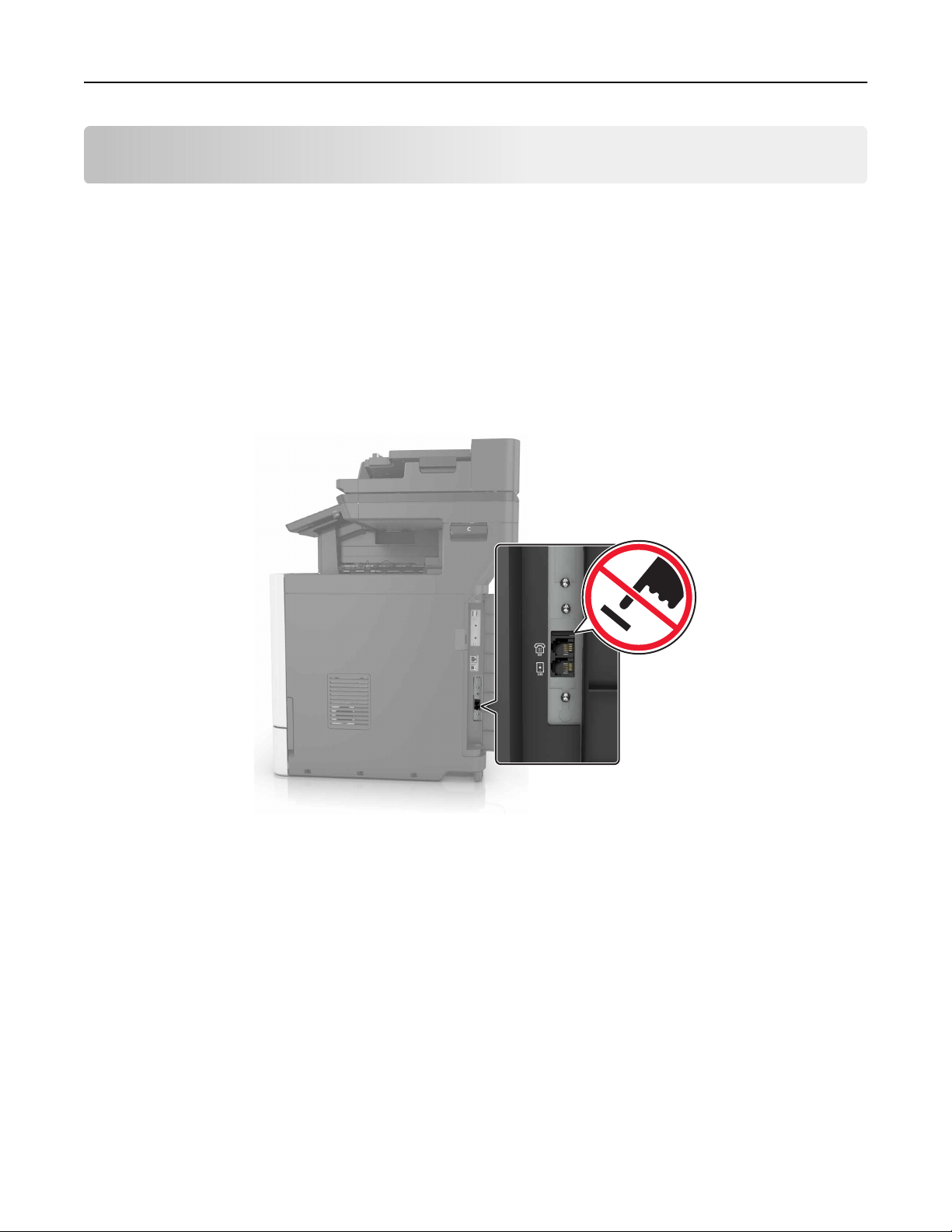
Warning—Potential Damage: Do not touch cables or the printer in the area shown while actively sending or
receiving a fax.
Setting up the fax function
1 From the home screen, touch Settings > Device > Preferences > Run Initial Setup.
2 Turn o the printer, wait for about 10 seconds, and then turn it back on.
3 From the Before You Begin screen, select Change the Settings and Continue with the Wizard.
4 From the Fax/Email Server Setup screen, enter the needed information.
5 Finish the setup.
Faxing 39
Setting up fax using a standard telephone line
CAUTION—SHOCK HAZARD: To avoid the risk of electrical shock, do not set up this product or make
any electrical or cabling connections, such as the power cord, fax feature, or telephone, during a
lightning storm.
CAUTION—SHOCK HAZARD: To avoid the risk of electrical shock, do not use the fax feature during a
lightning storm.
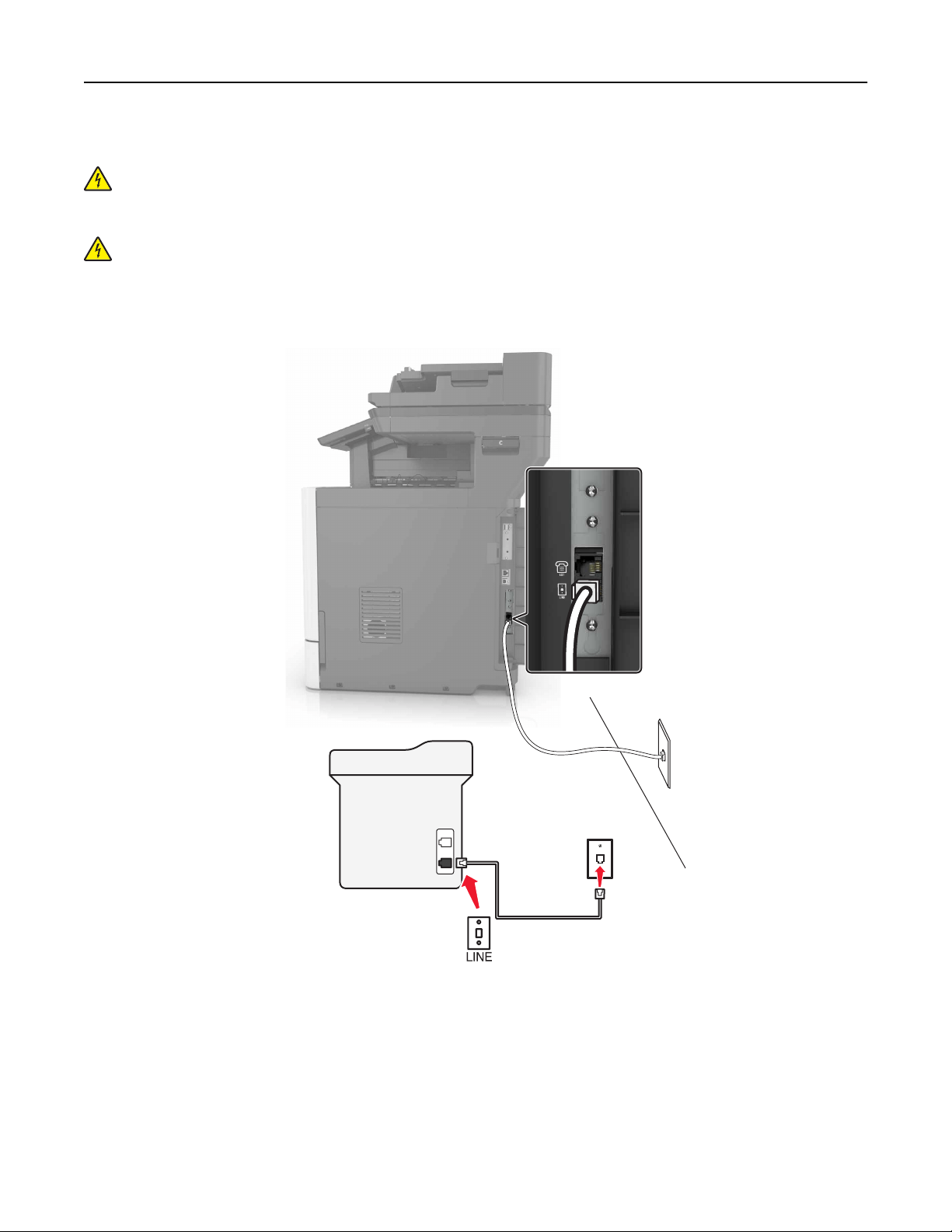
Setup 1: Printer is connected to a dedicated fax line
1 Connect one end of the telephone cable to the line port of the printer.
2 Connect the other end of the telephone cable to an active analog wall jack.
Notes:
• You can set the printer to receive faxes automatically (Auto Answer On) or manually (Auto Answer O).
• If you want to receive faxes automatically, then set the printer to pick up on any number of rings that you
want.
Faxing 40
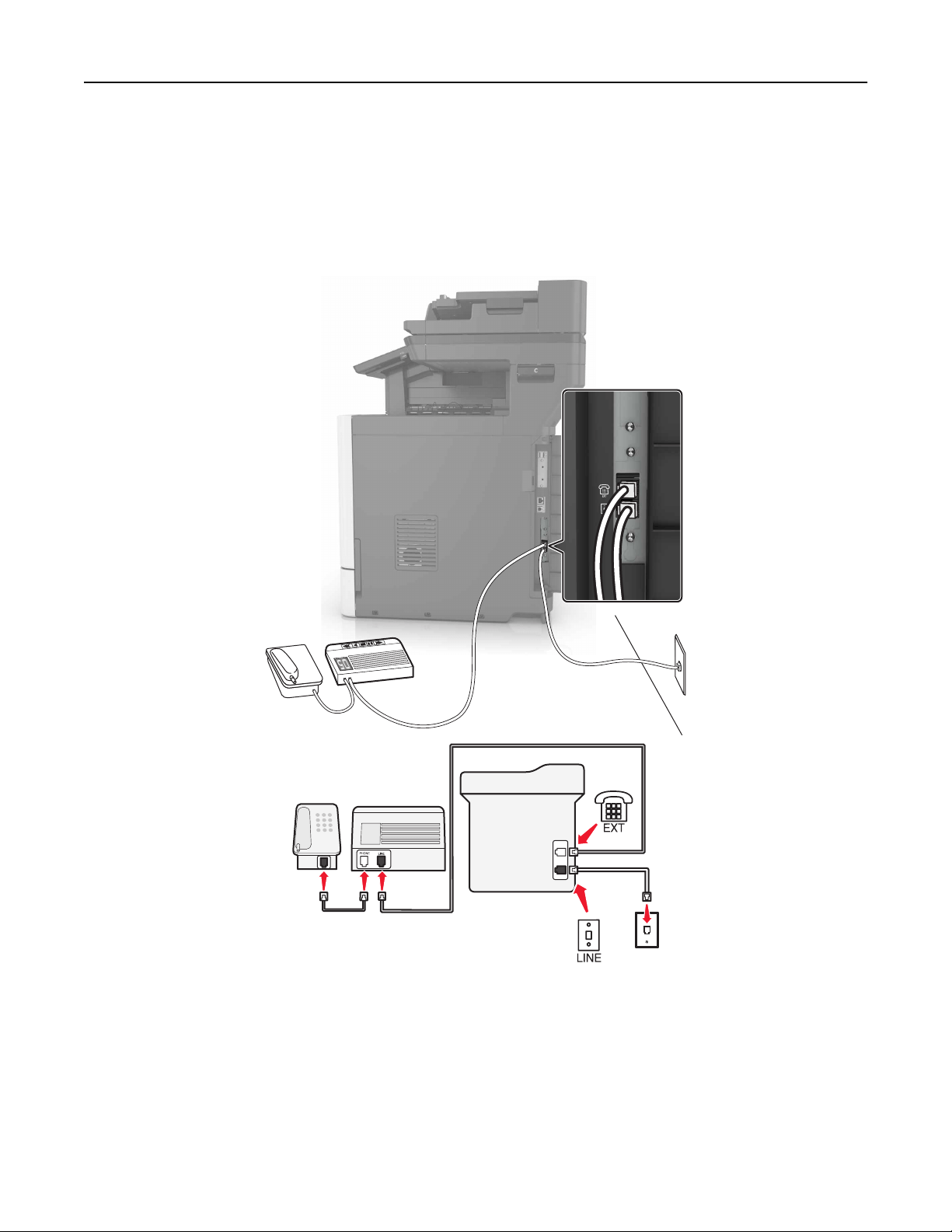
Setup 2: Printer is sharing the line with an answering machine
Note: If you subscribe to a distinctive ring service provided by your telephone company, then make sure that
you set the correct ring pattern for the printer. Otherwise, the printer does not receive faxes even if you have
set it to receive faxes automatically.
Connected to the same telephone wall jack
1 Connect one end of the telephone cable to the line port of the printer.
2 Connect the other end of the telephone cable to an active analog wall jack.
3 Connect the answering machine to the telephone port of the printer.
Faxing 41
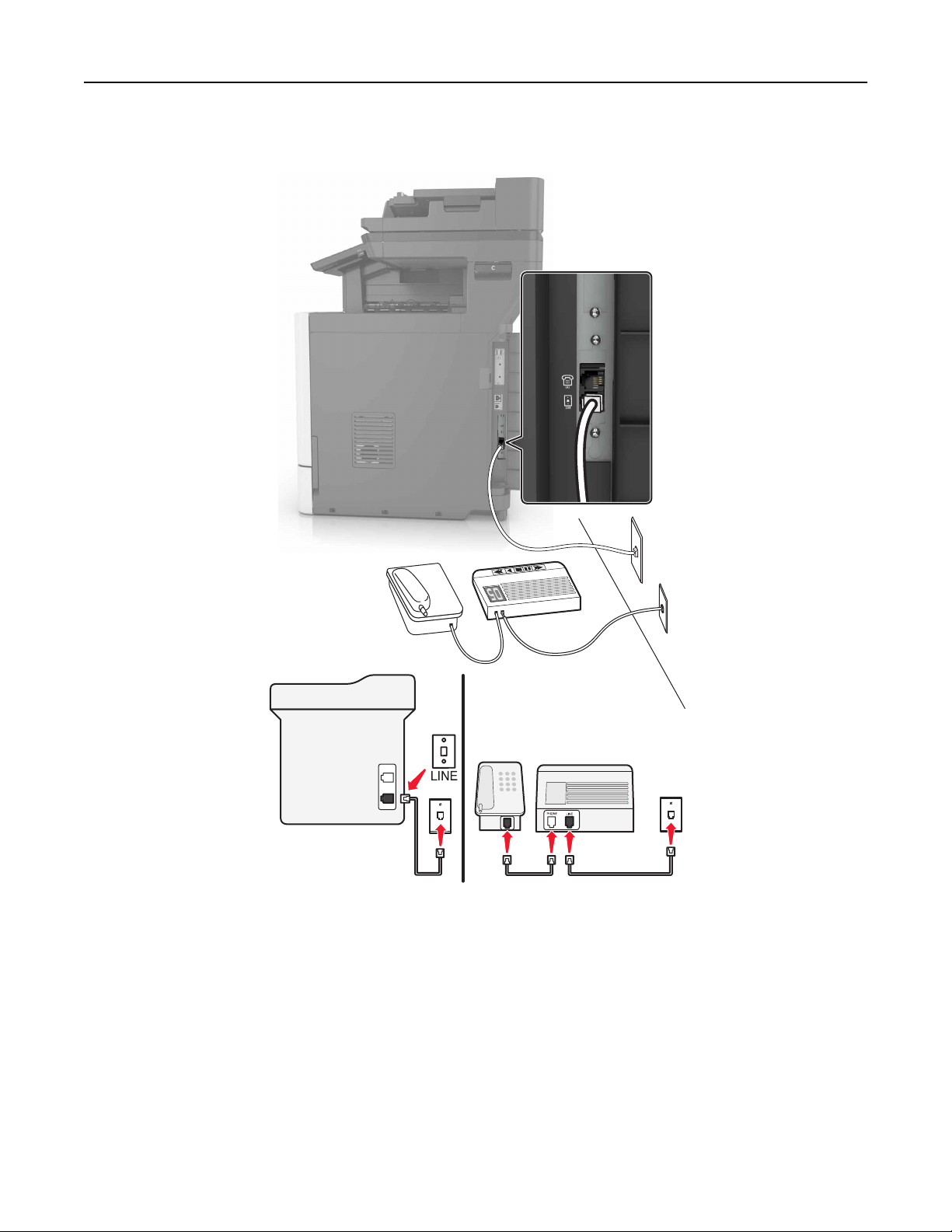
Connected to dierent wall jacks
1 Connect one end of the telephone cable to the line port of the printer.
2 Connect the other end of the telephone cable to an active analog wall jack.
Notes:
• If you have only one telephone number on your line, then set the printer to receive faxes automatically.
• Set the printer to pick up calls two rings after the answering machine. For example, if the answering
machine picks up calls after four rings, then set the printer Rings to Answer setting to six.
Faxing 42
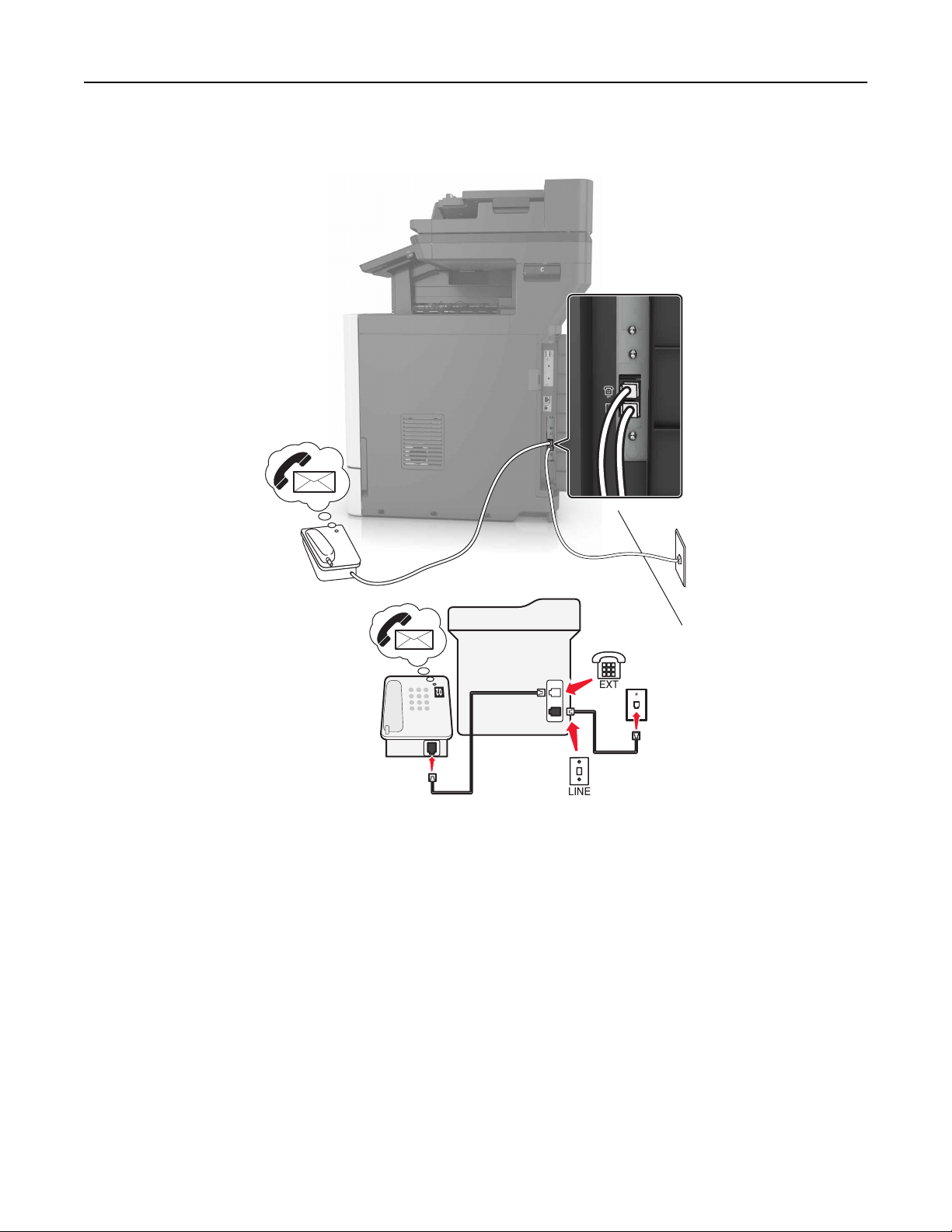
Setup 3: Printer is sharing the line with a telephone subscribed to voice mail service
1 Connect one end of the telephone cable to the line port of the printer.
2 Connect the other end of the telephone cable to an active analog wall jack.
3 Connect the telephone to the telephone port of the printer.
Notes:
• This setup works best if you are using voice mail more often than fax, and if you subscribe to a
distinctive ring service.
• When you answer the telephone and you hear fax tones, press *9* or the manual answer code on the
telephone to receive the fax.
• You can also set the printer to receive faxes automatically, but turn o the voice mail service when you
are expecting a fax.
Faxing 43
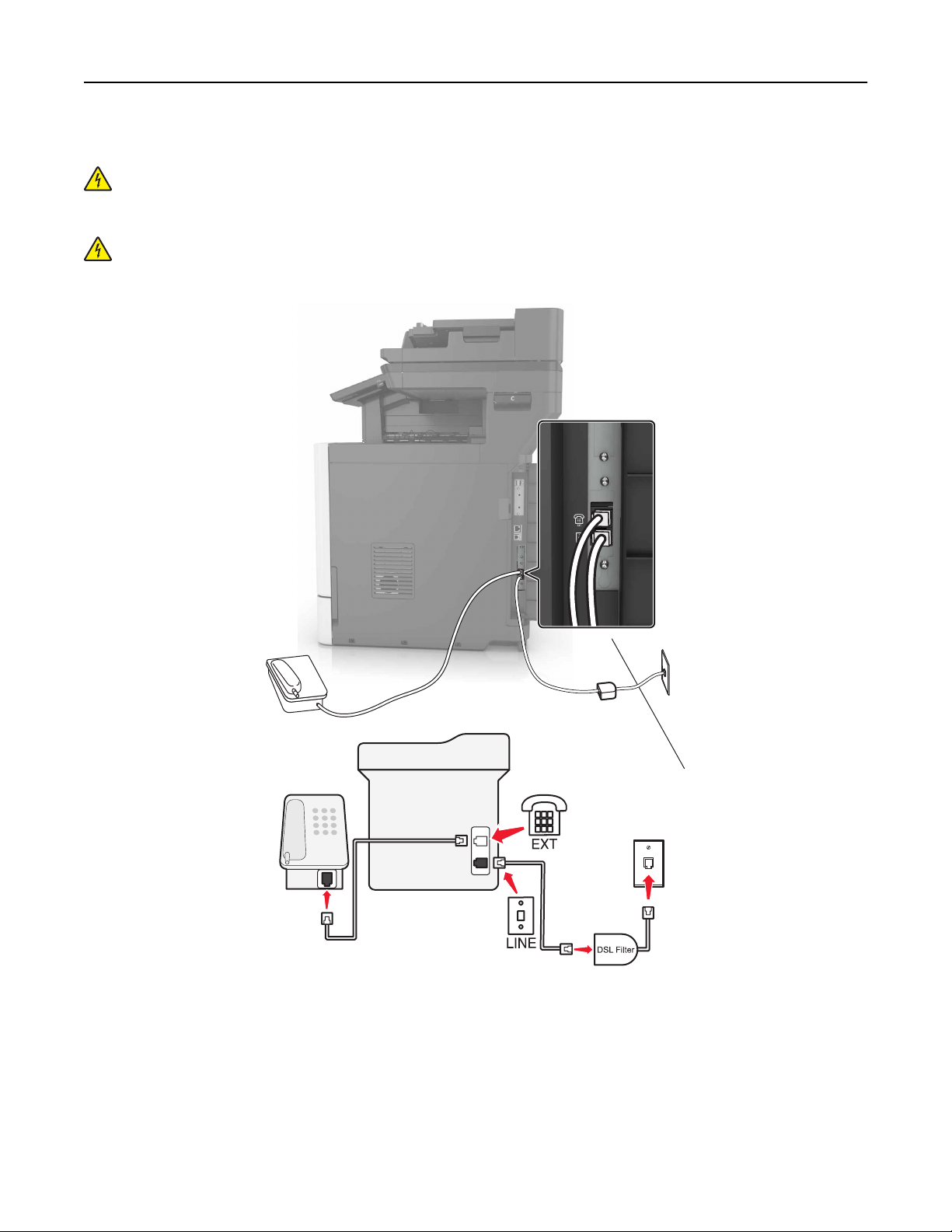
Setting up fax using digital subscriber line
CAUTION—SHOCK HAZARD: To avoid the risk of electrical shock, do not set up this product or make
any electrical or cabling connections, such as the power cord, fax feature, or telephone, during a
lightning storm.
CAUTION—SHOCK HAZARD: To avoid the risk of electrical shock, do not use the fax feature during a
lightning storm.
Digital subscriber line (DSL) splits your regular telephone line into two channels: voice and Internet. Telephone
and fax signals travel through the voice channel, and internet signals pass through the other channel.
Install a DSL filter to minimize interference between the two channels and ensure a quality connection.
Note: Contact your DSL provider to obtain a DSL
filter.
Faxing 44
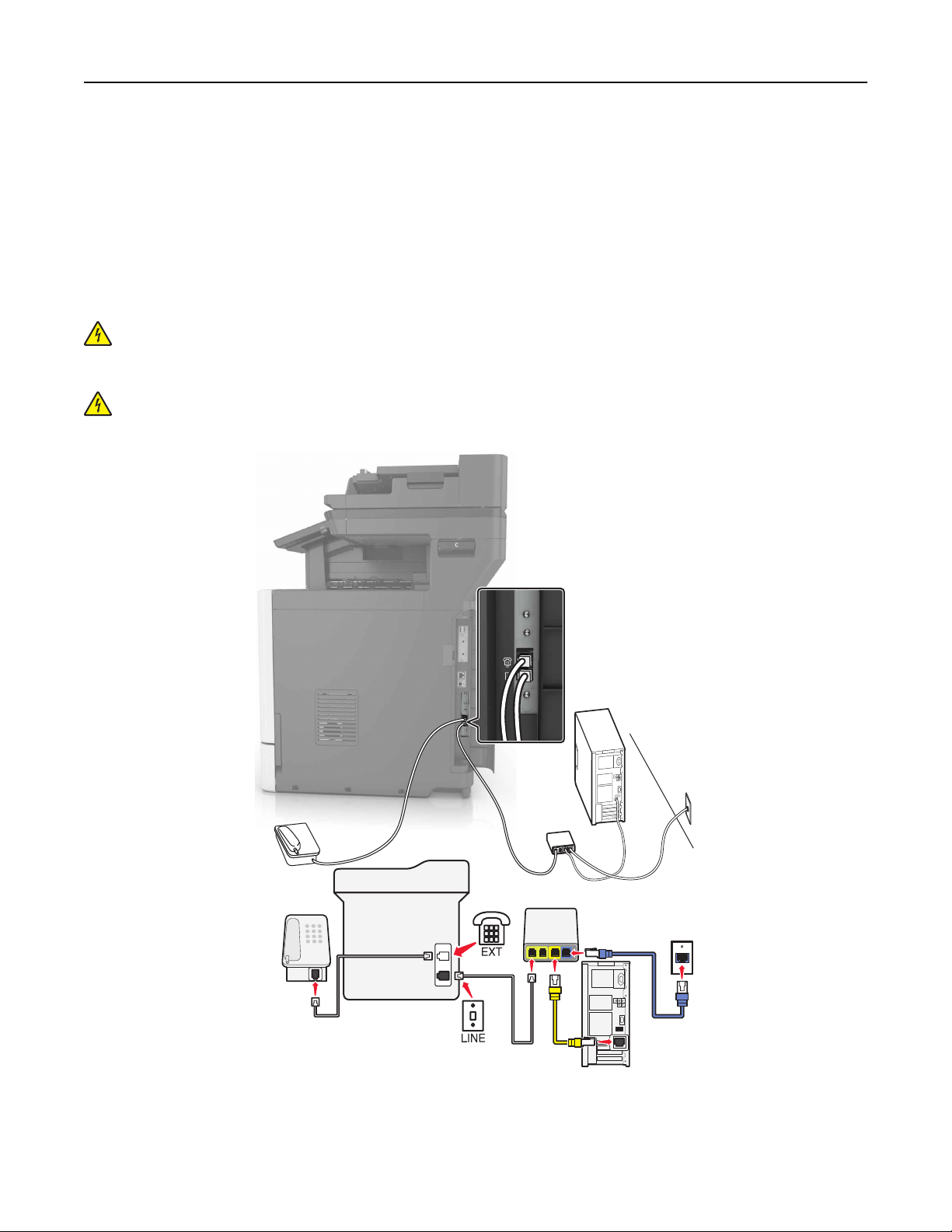
1 Connect the line port of the DSL filter to the wall jack.
2 Connect one end of the telephone cable to the line port of the printer. Connect the other end to the phone
port on the DSL filter.
3 To connect a telephone to the printer, remove any installed adapter plug from the telephone port of the
printer, and then connect the telephone.
Setting up fax using VoIP telephone service
CAUTION—SHOCK HAZARD: To avoid the risk of electrical shock, do not set up this product or make
any electrical or cabling connections, such as the power cord, fax feature, or telephone, during a
lightning storm.
CAUTION—SHOCK HAZARD: To avoid the risk of electrical shock, do not use the fax feature during a
lightning storm.
Faxing 45

1 Connect one end of the telephone cable to the line port of the printer.
2 Connect the other end of the cable to the port labeled Phone Line 1 or Phone Port on the VoIP adapter.
Note: The port labeled Phone Line 2 or Fax Port is not always active. VoIP providers may charge extra
cost for the activation of the second phone port.
3 Connect the telephone to the telephone port of the printer.
Notes:
• To check if the telephone port on the VoIP adapter is active, plug an analog telephone into the port, and
then listen for a dial tone.
• If you need two phone ports for your devices, but do not want to pay extra cost, then use a phone
splitter. Plug the phone splitter into the port labeled Phone Line 1 or Phone Port, and then plug the
printer and telephone into the splitter.
• To check the splitter, plug an analog telephone into the splitter, and then listen for a dial tone.
Setting up fax using cable modem connection
CAUTION—SHOCK HAZARD: To avoid the risk of electrical shock, do not set up this product or make
any electrical or cabling connections, such as the power cord, fax feature, or telephone, during a
lightning storm.
CAUTION—SHOCK HAZARD: To avoid the risk of electrical shock, do not use the fax feature during a
lightning storm.
Faxing 46
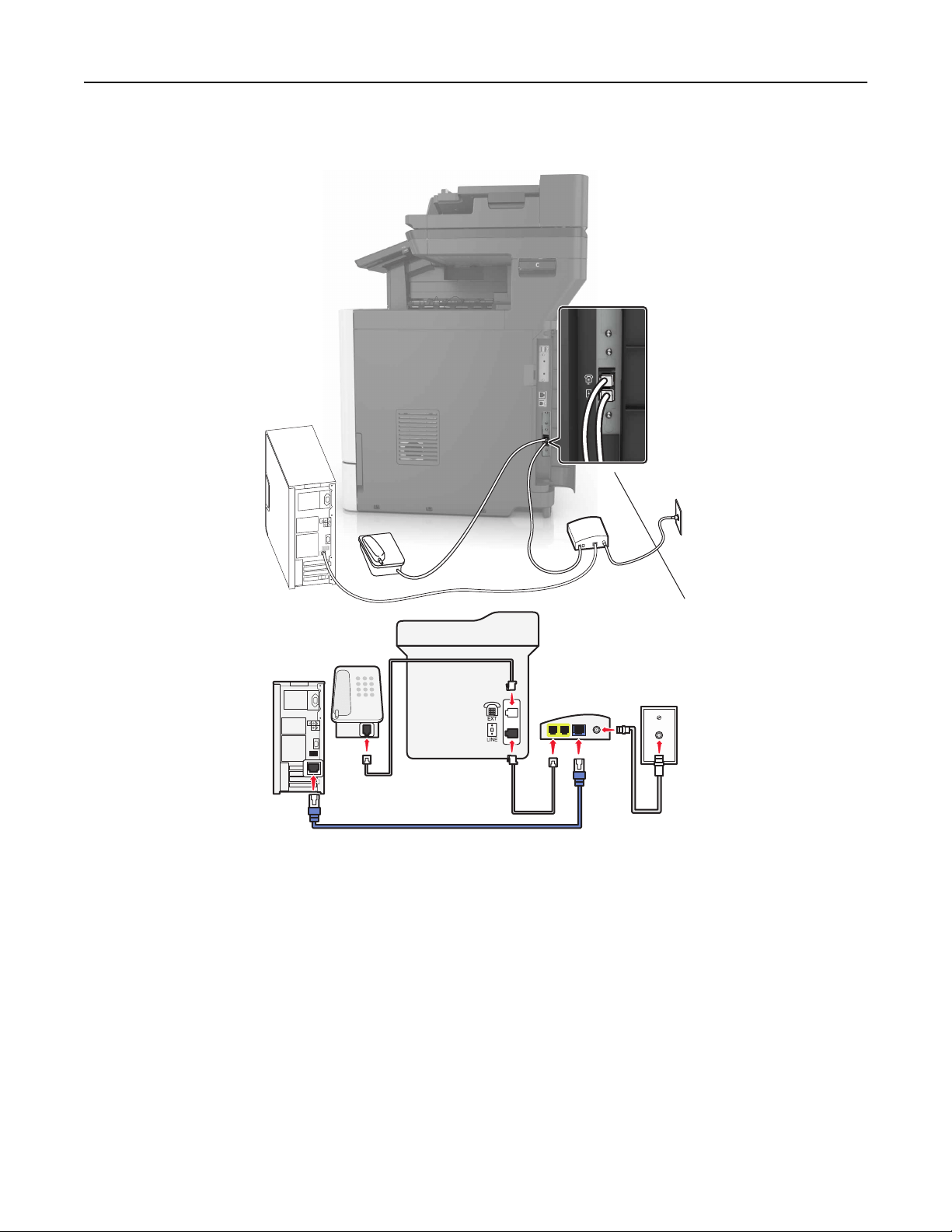
Setup 1: Printer is connected directly to a cable modem
1 Connect one end of the telephone cable to the line port of the printer.
2 Connect the other end of the cable to the port labeled Phone Line 1 or Phone Port on the cable modem.
3 Connect your analog telephone to the telephone port of the printer.
Note: To check if the telephone port on the cable modem is active, connect an analog telephone, and then
listen for a dial tone.
Faxing 47
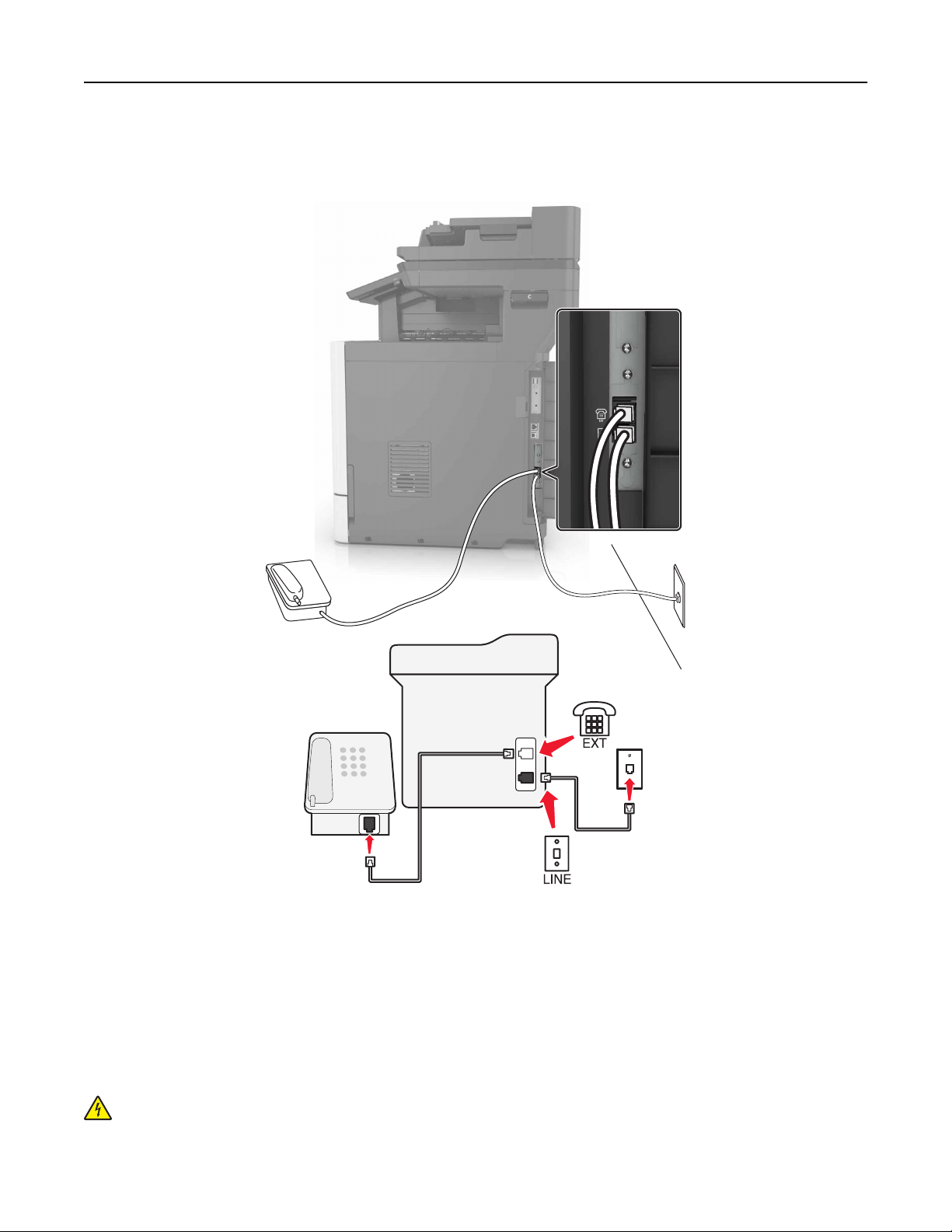
Setup 2: Printer is connected to a wall jack; cable modem is installed elsewhere in the
facility
1 Connect one end of the telephone cable to the line port of the printer.
2 Connect the other end of the telephone cable to an active analog telephone wall jack.
3 Connect your analog telephone to the telephone port of the printer.
Setting up fax in countries or regions with dierent telephone wall jacks
and plugs
CAUTION—SHOCK HAZARD: To avoid the risk of electrical shock, do not set up this product or make
any electrical or cabling connections, such as the power cord, fax feature, or telephone, during a
lightning storm.
Faxing 48

CAUTION—SHOCK HAZARD: To avoid the risk of electrical shock, do not use the fax feature during a
lightning storm.
The standard wall jack adopted by most countries or regions is RJ11. If the wall jack or equipment in your facility
is not compatible with this type of connection, then use a telephone adapter. An adapter for your country or
region may not come with your printer, and you may need to purchase it separately.
There may be an adapter plug installed in the telephone port of the printer. Do not remove the adapter plug
from the telephone port of the printer if you are connecting to a serial or cascaded telephone system.
Part name Part number
Lexmark adapter plug 40X8519
Faxing 49

Connecting the printer to a non‑RJ11 wall jack
1 Connect one end of the telephone cable to the line port of the printer.
2 Connect the other end of the cable to the RJ11 adapter, and then connect the adapter to the wall jack.
3 If you want to connect another device with a non‑RJ11 connector to the same wall jack, then connect it
directly to the telephone adapter.
Faxing 50

Connecting the printer to a wall jack in Germany
The German wall jack has two kinds of ports. The N ports are for fax machines, modems, and answering
machines. The F port is for telephones. Connect the printer to any of the N ports.
1 Connect one end of the telephone cable to the line port of the printer.
2 Connect the other end of the telephone cable to the RJ11 adapter, and then connect the adapter to an N
port.
3 If you want to connect a telephone and answering machine to the same wall jack, then connect the devices
as shown.
Faxing 51

Connecting to a distinctive ring service
A distinctive ring service lets you have multiple telephone numbers on one telephone line. Each telephone
number is assigned a dierent ring pattern.
1 From the home screen, touch Settings > Fax > Analog Fax Setup > Fax Receive Settings > Admin Controls
> Answer On.
2 Select the ring pattern.
3 Apply the changes.
Setting the fax date and time
1 From the home screen, touch Settings > Device > Preferences > Date and Time >
Configure
.
2 Configure the settings.
Configuring
daylight saving time
1 From the home screen, touch Settings > Device > Preferences > Date and Time >
Configure
.
2 In the Time Zone menu, select Custom.
3
Configure
the settings.
Sending a fax
Using the control panel
1 Load the original document into the ADF tray or on the scanner glass.
2 From the control panel, select Fax, and then enter the needed information.
3 If necessary,
configure
other fax settings.
4 Fax the document.
Using the computer
For Windows users
1 From the document that you are trying to fax, open the Print dialog.
2 Select the printer, and then click Properties, Preferences, Options, or Setup.
3 Click Fax > Enable fax, and then enter the recipient number.
4 If necessary, configure other fax settings.
5 Fax the document.
Faxing 52

For Macintosh users
1 With a document open, choose File > Print.
2 Select the printer, and then enter the recipient number.
3 If necessary, configure other fax settings.
4 Fax the document.
Scheduling a fax
1 Load the original document into the ADF tray or on the scanner glass.
2 From the home screen, navigate to:
Fax > enter the fax number > Send Time
3
Configure
the date and time to send the fax.
4 If necessary, configure other fax settings.
5 Send the fax job.
Creating a fax destination shortcut
1 From the home screen, touch Fax > To.
2 Enter the recipient number.
Note: To create a group of fax numbers, touch
, and then enter another fax number.
3 Touch
.
4 Enter a shortcut name.
5 Apply the changes.
Changing the fax resolution
1 Load an original document into the ADF tray or on the scanner glass.
2 From the home screen, touch Fax, and then enter the needed information.
3 Adjust the Resolution setting.
4 Send the fax job.
Adjusting the fax darkness
1 Load an original document into the ADF tray or on the scanner glass.
2 From the home screen, touch Fax, and then enter the needed information.
Faxing 53

3 Adjust the Darkness setting.
4 Send the fax job.
Viewing a fax log
1 Open a Web browser, and then type the printer IP address in the address field.
Notes:
• View the printer IP address on the printer home screen. The IP address appears as four sets of
numbers separated by periods, such as 123.123.123.123.
• If you are using a proxy server, then temporarily disable it to load the Web page correctly.
2 Click Settings > Reports > Fax.
3 Click Fax Job Log or Fax Call Log.
Blocking junk faxes
1 From the home screen, touch Settings > Fax > Analog Fax Setup > Fax Receive Settings > Admin Controls
> Block No Name Fax.
2 Apply the changes.
Holding faxes
1 From the home screen, touch Settings > Fax > Analog Fax Setup > Fax Receive Settings > Holding Faxes.
2 Select a mode.
Forwarding a fax
1 From the home screen, touch Settings > Fax > Analog Fax Setup > Fax Receive Settings > Admin Controls.
2
Configure
the Fax Forwarding, Forward To, and Forward to Shortcut settings.
3 Apply the changes.
Faxing 54

Scanning
Scanning to an FTP server
1 Load the original document into the ADF tray or on the scanner glass.
2 From the home screen, touch FTP, and then enter the needed information.
3 If necessary, configure other FTP settings.
4 Send the FTP job.
Creating an FTP shortcut
1 From the home screen, touch FTP.
2 Enter the FTP server address, and then touch
.
3 Enter a shortcut name.
4 Apply the changes.
Scanning to a flash drive
1 Load an original document into the ADF tray or on the scanner glass.
2 Insert the flash drive.
3 Touch Scan to USB and adjust the settings if necessary.
Note: If the USB Drive screen does not appear, then touch USB Drive on the home screen.
4 Scan the document.
Warning—Potential Damage: To avoid loss of data or printer malfunction, do not touch the
flash
drive or
the printer in the area shown while actively printing, reading, or writing from the memory device.
Scanning 55
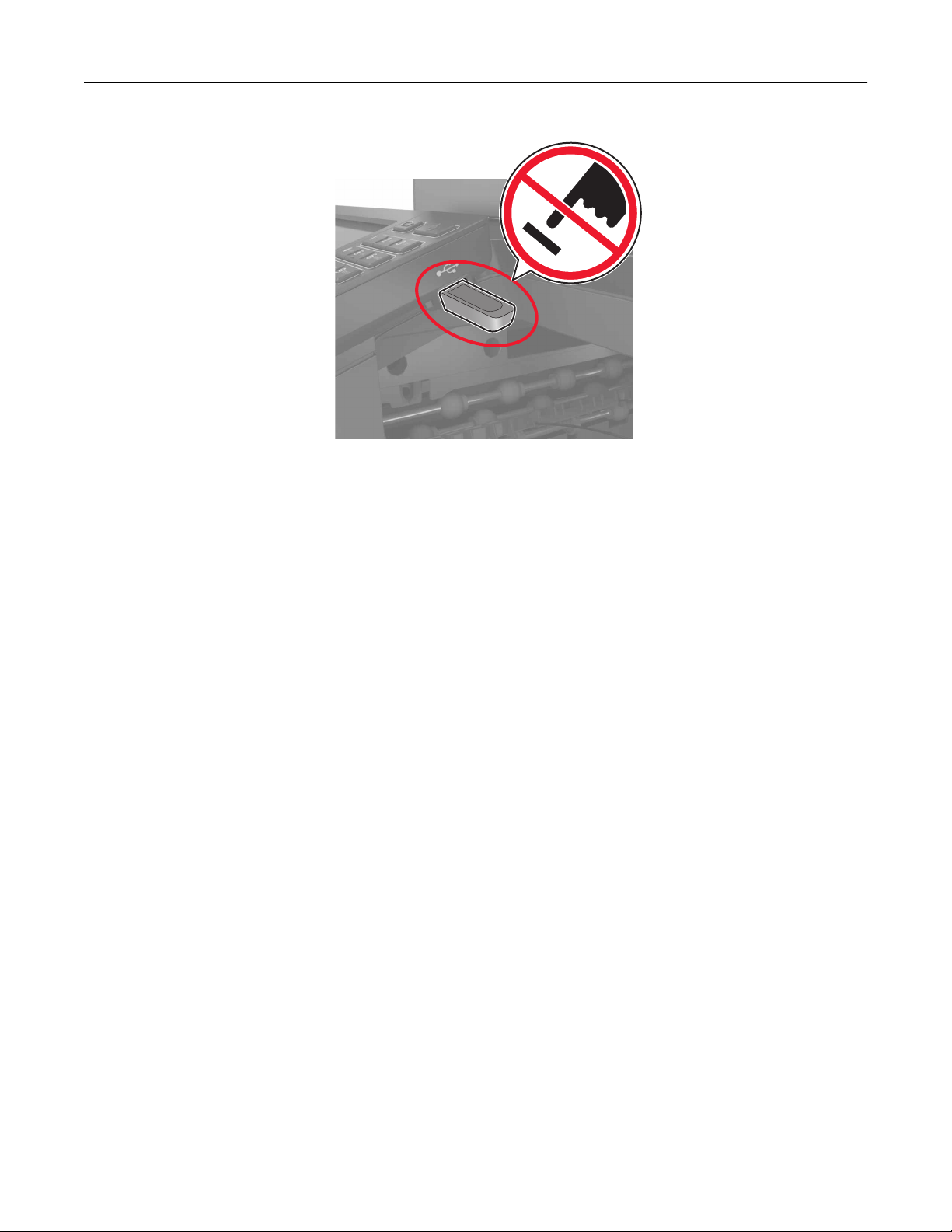
Sending scanned documents to a computer
1 Load an original document into the ADF tray or on the scanner glass.
2 From the home screen, touch Scan Profiles > Scan To Computer.
3 Select the scan profile where you want to save the document.
Scanning 56
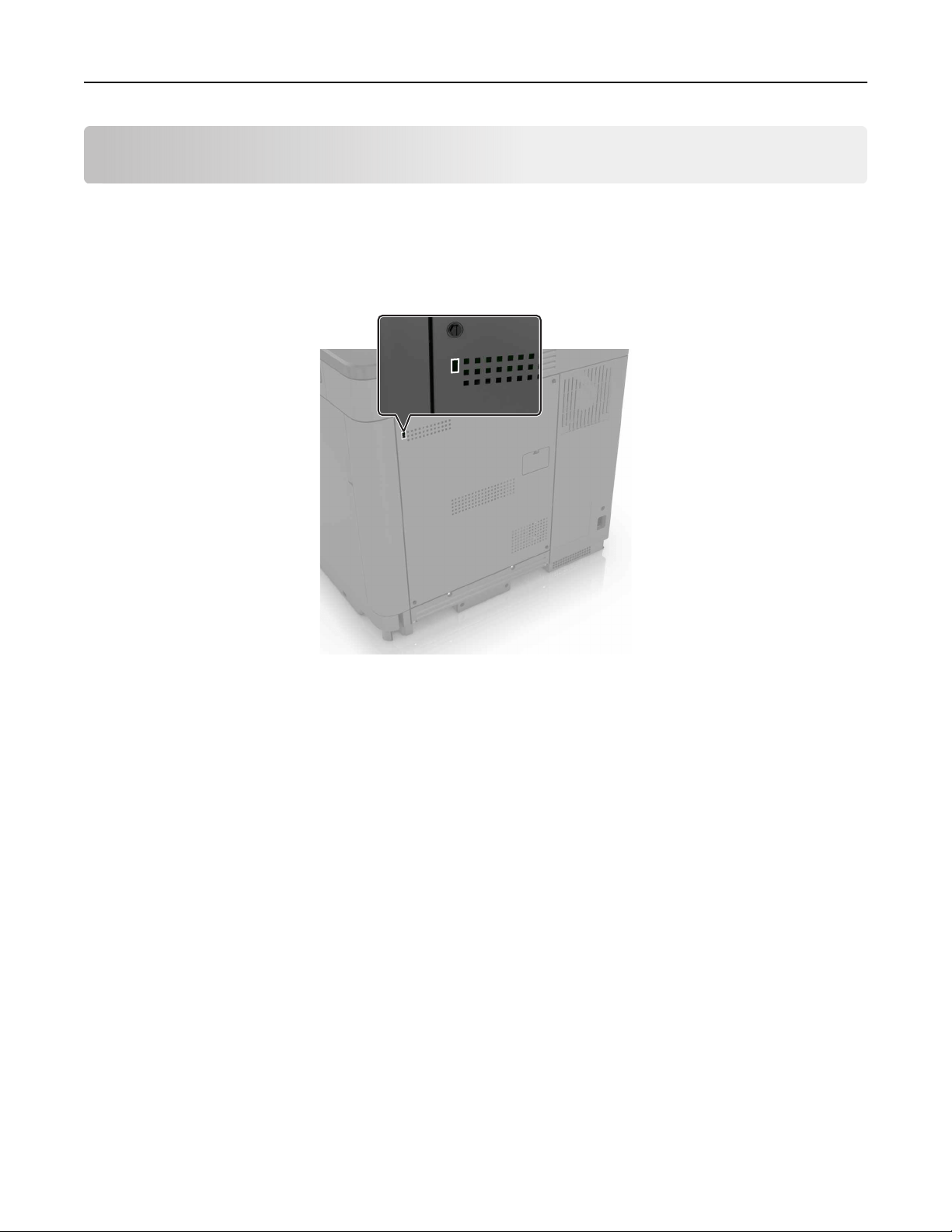
Securing the printer
Locating the security slot
The printer is equipped with a security lock feature. Attach a security lock compatible with most laptop
computers in the location shown to secure the printer in place.
Erasing printer memory
To erase volatile memory or buered data in your printer, turn o the printer.
To erase non‑volatile memory or individual settings, device and network settings, security settings, and
embedded solutions, do the following:
1 From the home screen, touch Settings > Device > Maintenance > Out of Service Erase.
2 Select the Sanitize all information on nonvolatile memory check box, and then touch ERASE.
3 Follow the instructions on the display.
Erasing printer hard disk memory
1 From the home screen, touch Settings > Device > Maintenance > Out of Service Erase.
2 Select the Sanitize all information on hard disk check box, and then touch ERASE.
3 Follow the instructions on the display.
Note: This process can take from several minutes to more than an hour, making the printer unavailable
for other tasks.
Securing the printer 57

Configuring printer hard disk encryption
1 From the home screen, touch Settings > Security > Disk Encryption > Start Encryption.
Note: Enabling disk encryption erases the contents of the hard disk. If necessary, back up important data
from the printer before starting the encryption.
2 Follow the instructions on the display.
Notes:
• Do not turn o the printer during the encryption process. Loss of data can occur.
• Disk encryption can take from several minutes to more than an hour, making the printer unavailable
for other tasks.
• After encryption, the printer returns to the home screen.
Restoring factory default settings
From the home screen, touch Settings > Device > Restore Factory Defaults > Restore Settings > Restore all
settings > RESTORE > Start.
For more information, see
“Erasing printer memory” on page 57.
Statement of Volatility
Your printer contains various types of memory that can store device and network settings, and user data.
Type of memory Description
Volatile memory Your printer uses standard random access memory
(RAM) to temporarily buer user data during simple print
jobs.
Non-volatile memory Your printer may use two forms of non-volatile memory:
EEPROM and NAND (flash memory). Both types are used
to store the operating system, device settings, network
information and bookmark settings, and embedded
solutions.
Hard disk memory Some printers have a hard disk drive installed. The printer
hard disk is designed for printer-specific functionality.
This lets the printer retain buered user data from
complex print jobs, as well as form data, and font data.
Erase the content of any installed printer memory in the following circumstances:
• The printer is being decommissioned.
• The printer hard disk is being replaced.
• The printer is being moved to a dierent department or location.
• The printer is being serviced by someone from outside your organization.
• The printer is being removed from your premises for service.
• The printer is being sold to another organization.
Securing the printer 58

Disposing of a printer hard disk
Note: Some printer models may not have a printer hard disk installed.
In high‑security environments, it may be necessary to take additional steps to make sure that confidential data
stored in the printer hard disk cannot be accessed when the printer—or its hard disk—is removed from your
premises.
• Degaussing—Flushes the hard disk with a magnetic field that erases stored data
• Crushing—Physically compresses the hard disk to break component parts and render them unreadable
• Milling—Physically shreds the hard disk into small metal bits
Note: Most data can be erased electronically, but the only way to guarantee that all data are completely
erased is to physically destroy each hard disk where data is stored.
Securing the printer 59

Maintaining the printer
Warning—Potential Damage: Failure to maintain optimum printer performance, or to replace parts and
supplies, may cause damage to your printer.
Networking
Note: Purchase a MarkNet(TM) N8360 wireless network adapter
first
before setting up the printer on a
wireless network. For information on installing the wireless network adapter, see the setup sheet that came
with the adapter.
Connecting the printer to a wireless network using Wi
‑Fi Protected Setup
(WPS)
Before you begin, make sure that:
• The access point (wireless router) is WPS‑certified or WPS‑compatible. For more information, see the
documentation that came with your access point.
• A wireless network adapter is installed in your printer. For more information, see the instructions that came
with the adapter.
Using the Push Button method
1 From the control panel, navigate to:
Settings > Network/Ports > Wireless > Wi
‑Fi Protected Setup > Start Push Button Method
2 Follow the instructions on the display.
Using the personal
identification
number (PIN) method
1 From the control panel, navigate to:
Settings > Network/Ports > Wireless > Wi
‑Fi Protected Setup > Start PIN Method
2 Copy the eight‑digit WPS PIN.
3 Open a Web browser, and then type the IP address of your access point in the address field.
Notes:
• View the printer IP address on the printer home screen. The IP address appears as four sets of
numbers separated by periods, such as 123.123.123.123.
• If you are using a proxy server, then temporarily disable it to load the Web page correctly.
4 Access the WPS settings. For more information, see the documentation that came with your access
point.
5 Enter the eight‑digit PIN, and then save the changes.
Maintaining the printer 60

Changing port settings after installing an internal solutions port
Notes:
• If the printer has a static IP address, then do not change the configuration.
• If the computers are configured to use the network name instead of an IP address, then do not change
the configuration.
• If you are adding a wireless internal solutions port (ISP) to a printer previously configured for an Ethernet
connection, then disconnect the printer from the Ethernet network.
For Windows users
1 Open the printers folder.
2 From the shortcut menu of the printer with the new ISP, open the printer properties.
3 Configure the port from the list.
4 Update the IP address.
5 Apply the changes.
For Macintosh users
1 From System Preferences in the Apple menu, navigate to the list of printers, and then select + > IP.
2 Type the IP address in the address field.
3 Apply the changes.
Setting up serial printing (Windows only)
1 Set the parameters in the printer.
a From the control panel, navigate to the menu for the port settings.
b Locate the menu for the serial port settings, and then adjust the settings, if necessary.
c Apply the changes.
2 From your computer, open the printers folder, and then select your printer.
3 Open the printer properties, and then select the COM port from the list.
4 Set the COM port parameters in Device Manager.
Notes:
• Serial printing reduces printing speed.
• Make sure that the serial cable is connected to the serial port on your printer.
Maintaining the printer 61

Cleaning printer parts
Cleaning the printer
CAUTION—SHOCK HAZARD: To avoid the risk of electrical shock when cleaning the exterior of the
printer, unplug the power cord from the electrical outlet and disconnect all cables from the printer before
proceeding.
Notes:
• Perform this task after every few months.
• Damage to the printer caused by improper handling is not covered by the printer warranty.
1 Turn o the printer, and then unplug the power cord from the electrical outlet.
2 Remove paper from the standard bin and multipurpose feeder.
3 Remove any dust, lint, and pieces of paper around the printer using a soft brush or vacuum.
4 Wipe the outside of the printer with a damp, soft, lint‑free cloth.
Notes:
• Do not use household cleaners or detergents, as they may damage the finish of the printer.
• Make sure that all areas of the printer are dry after cleaning.
5 Connect the power cord to the electrical outlet, and then turn on the printer.
CAUTION—POTENTIAL INJURY: To avoid the risk of fire or electrical shock, connect the power cord
to an appropriately rated and properly grounded electrical outlet that is near the product and easily
accessible.
Cleaning the scanner glass
1 Open the scanner cover.
Maintaining the printer 62
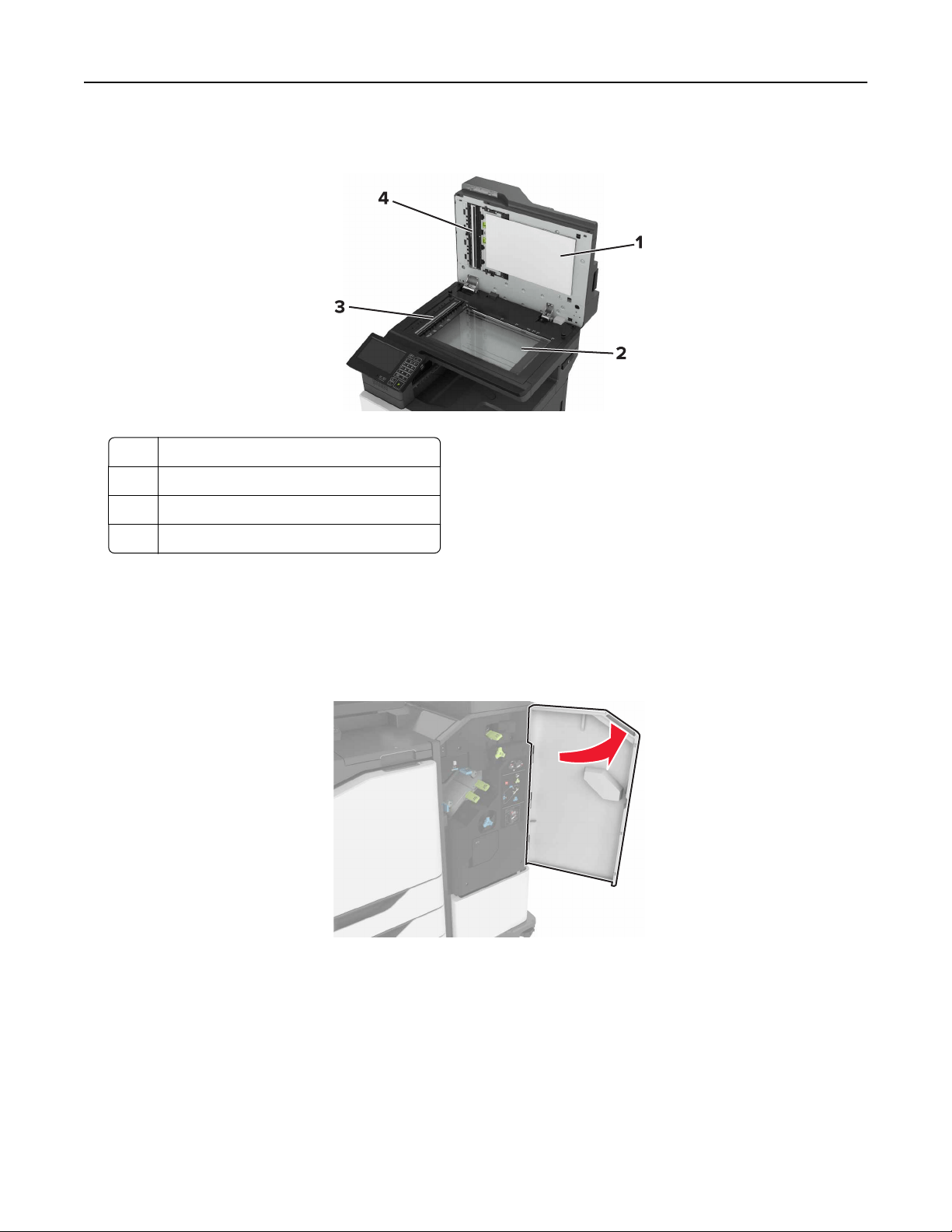
2 Wipe the areas shown with a damp, soft, lint-free cloth.
1 White underside of the scanner cover
2 Scanner glass
3 Automatic document feeder (ADF) glass
4 White underside of the ADF cover
3 Close the scanner cover.
Emptying the hole punch box
1 Open door J.
Maintaining the printer 63
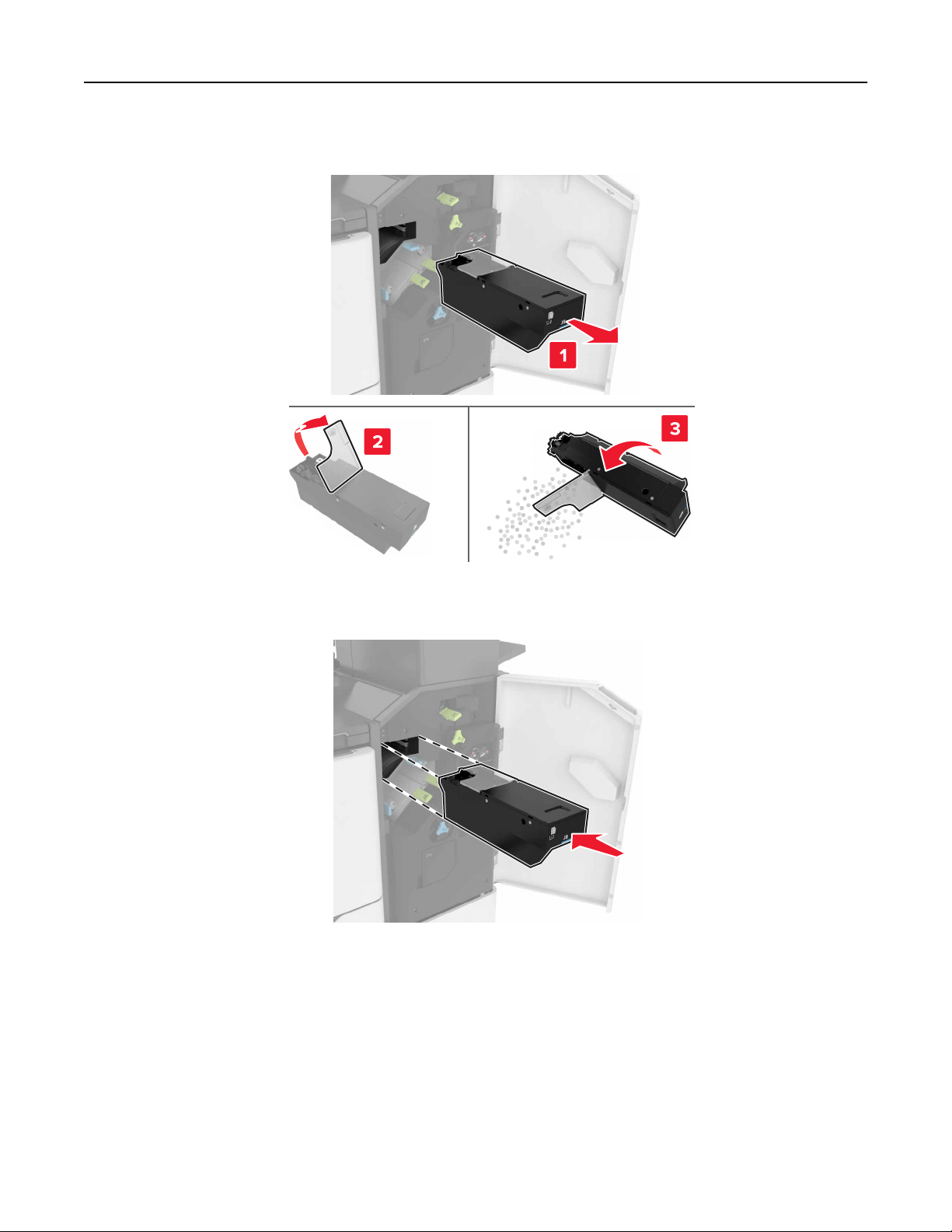
2 Remove and empty the hole punch box.
3 Insert the hole punch box.
4 Close door J.
Maintaining the printer 64

Ordering parts and supplies
To order parts and supplies in the U.S., contact 1-800-539-6275 for information about Lexmark authorized
supplies dealers in your area. In other countries or regions, go to
www.lexmark.com or contact the place where
you purchased the printer.
Note: All life estimates for printer supplies assume printing on letter‑ or A4‑size plain paper.
Checking the status of parts and supplies
1 From the home screen, touch Status/Supplies.
2 Select the parts or supplies that you want to check.
Note: You can also access this setting by touching the top section of the home screen.
Using genuine Lexmark parts and supplies
Your Lexmark printer is designed to function best with genuine Lexmark parts and supplies. Use of third-party
supplies or parts may aect the performance, reliability, or life of the printer and its imaging components. It can
also aect warranty coverage. Damage caused by the use of third-party parts and supplies is not covered by
the warranty. All life indicators are designed to function with Lexmark parts and supplies, and may deliver
unpredictable results if third-party parts and supplies are used. Imaging component usage beyond the intended
life may damage your Lexmark printer or its associated components.
Ordering toner cartridges
Notes:
• The estimated cartridge yield is based on the ISO/IEC 19798 standard.
• Extremely low print coverage for extended periods of time may negatively aect actual yield and may
cause cartridge parts to fail before toner exhaustion.
Return Program cartridges
Item United States
and Canada
European
Economic
Area (EEA+)
Rest of
Europe,
Middle East,
and Africa
(EMEA)
Latin America
Distribution
(LAD)
Rest of Asia
Pacific (AP)
Australia and
New Zealand
(ANZ)
Return Program toner cartridges
Black 72K10K0 72K20K0 72K50K0 72K40K0 72K30K0 72K60K0
Cyan 72K10C0 72K20C0 72K50C0 72K40C0 72K30C0 72K60C0
Magenta 72K10M0 72K20M0 72K50M0 72K40M0 72K30M0 72K60M0
Yellow 72K10Y0 72K20Y0 72K50Y0 72K40Y0 72K30Y0 72K60Y0
High Yield Return Program toner cartridges
Cyan 82K1HC0 82K2HC0 82K5HC0 82K4HC0 82K3HC0 82K6HC0
Maintaining the printer 65

Item United States
and Canada
European
Economic
Area (EEA+)
Rest of
Europe,
Middle East,
and Africa
(EMEA)
Latin America
Distribution
(LAD)
Rest of Asia
Pacific (AP)
Australia and
New Zealand
(ANZ)
Magenta 82K1HM0 82K2HM0 82K5HM0 82K4HM0 82K3HM0 82K6HM0
Yellow 82K1HY0 82K2HY0 82K5HY0 82K4HY0 82K3HY0 82K6HY0
Extra High Yield Return Program toner cartridges
Black 72K1XK0 72K2XK0 72K5XK0 72K4XK0 72K3XK0 72K6XK0
Cyan 82K1XC0 82K2XC0 82K5XC0 82K4XC0 82K3XC0 82K6XC0
Magenta 82K1XM0 82K2XM0 82K5XM0 82K4XM0 82K3XM0 82K6XM0
Yellow 82K1XY0 82K2XY0 82K5XY0 82K4XY0 82K3XY0 82K6XY0
Ultra High Yield Return Program toner cartridges
Black 82K1UK0 82K2UK0 82K5UK0 82K4UK0 82K3UK0 82K6UK0
Cyan 82K1UC0 82K2UC0 82K5UC0 82K4UC0 82K3UC0 82K6UC0
Magenta 82K1UM0 82K2UM0 82K5UM0 82K4UM0 82K3UM0 82K6UM0
Yellow 82K1UY0 82K2UY0 82K5UY0 82K4UY0 82K3UY0 82K6UY0
Regular cartridges
Item Worldwide
Extra High Yield regular toner cartridges
Black 72K0X10
Cyan 82K0X20
Magenta 82K0X30
Yellow 82K0X40
Ultra High Yield regular toner cartridges
Black 82K0U10
Cyan 82K0U20
Magenta 82K0U30
Yellow 82K0U40
Ordering a photoconductor unit
Item Part number
Photoconductor unit (1 pack) 72K0P00
Photoconductor unit (3 pack) 72K0Q00
Maintaining the printer 66
Ordering developer units
Item Part number
Return Program developer units
Black developer unit 72K0DK0
Color (CMY) developer kit 72K0DV0
Cyan developer unit 72K0DC0
Magenta developer unit 72K0DM0
Yellow developer unit 72K0DY0
Regular developer units
Black developer unit 72K0D10
Color (CMY) developer kit 72K0D50
Cyan developer unit 72K0D20
Magenta developer unit 72K0D30
Yellow developer unit 72K0D40
Ordering imaging units
Item All countries and regions
Return Program imaging units
Black imaging unit 21K3401
Cyan imaging unit 21K3403
Magenta imaging unit 21K3402
Yellow imaging unit 21K3404
Ordering staple cartridges
Item Part number
Staple cartridges 25A0013
Ordering a waste toner bottle
Item Part number
Waste toner bottle 72K0W00
Configuring supply notifications
1 Open a web browser, and then type the printer IP address in the address field.
Maintaining the printer 67
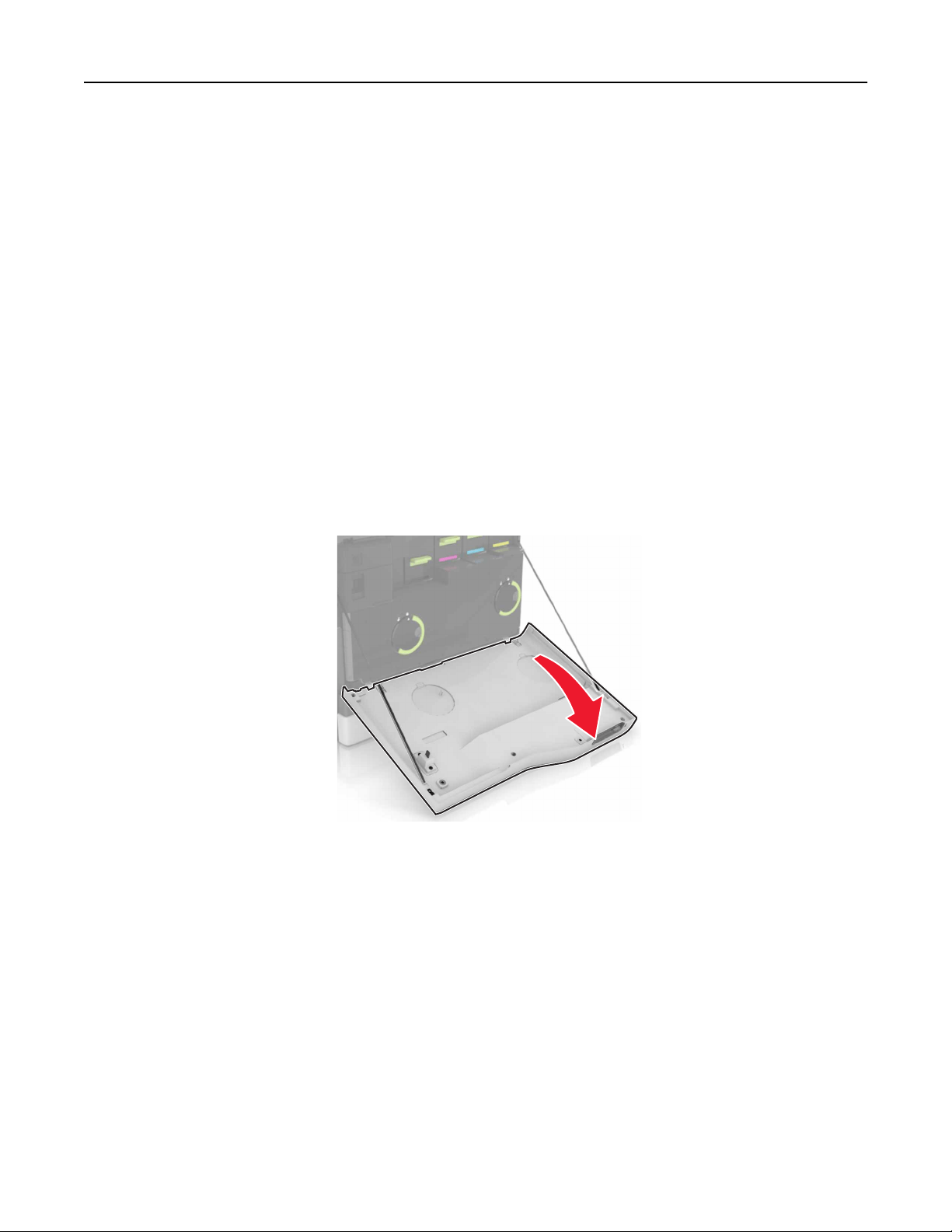
Notes:
• View the printer IP address on the printer home screen. The IP address appears as four sets of
numbers separated by periods, such as 123.123.123.123.
• If you are using a proxy server, then temporarily disable it to load the web page correctly.
2 Click Settings > Device >
Notifications
.
3 From the Supplies menu, click Custom Supply
Notifications
.
4 Select a notification for each supply item.
5 Apply the changes.
Replacing parts and supplies
Replacing a developer unit
1 Open door A.
Maintaining the printer 68
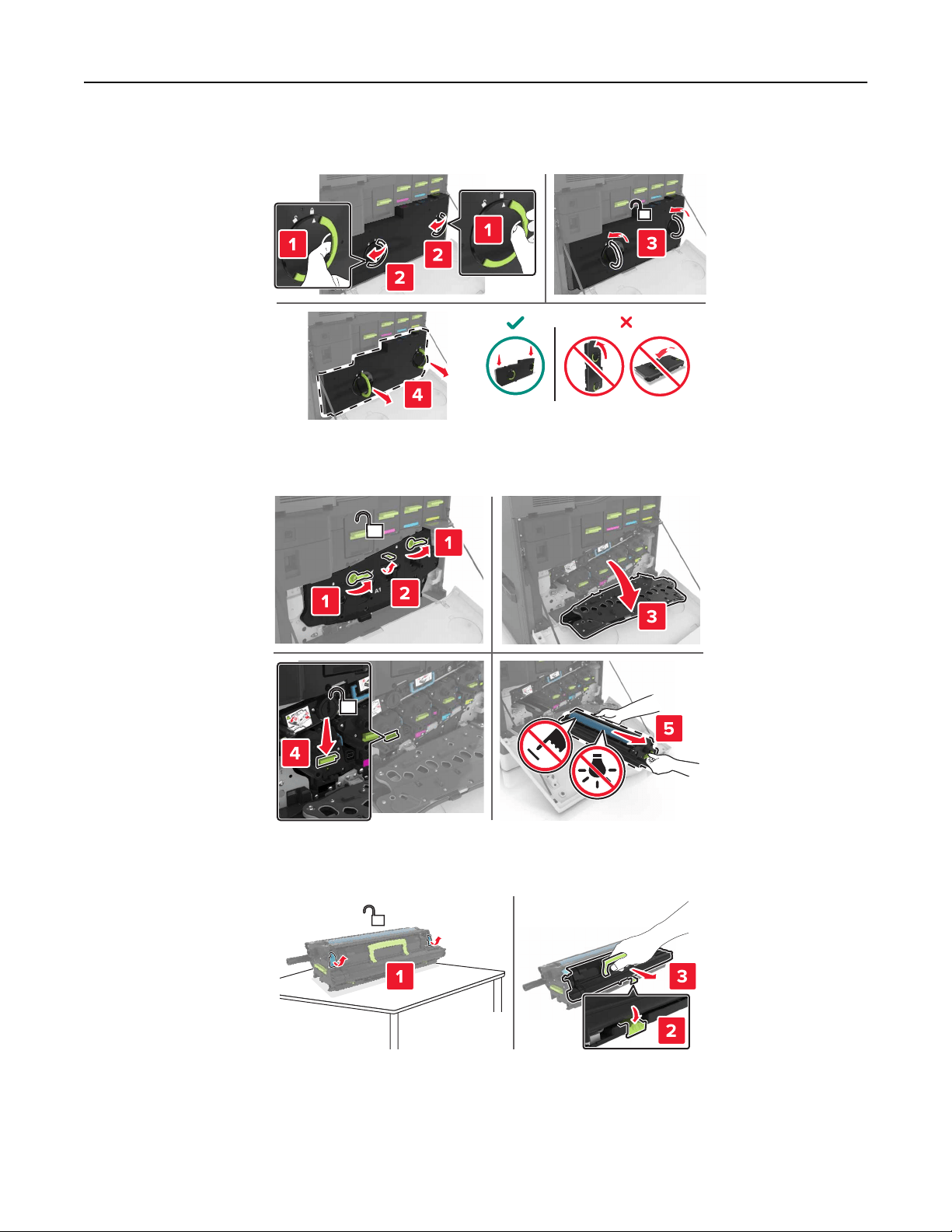
2 Remove the waste toner bottle.
3 Remove the imaging unit.
4 Remove the developer unit.
5 Unpack the new developer unit, and then remove the packing material.
Maintaining the printer 69

6 Insert the new developer unit.
7 Insert the imaging unit.
8 Insert the waste toner bottle.
9 Close door A.
Replacing the fuser
1 Turn o the printer.
2 Open door B.
CAUTION—HOT SURFACE: The inside of the printer might be hot. To reduce the risk of injury from a
hot component, allow the surface to cool before touching it.
Maintaining the printer 70
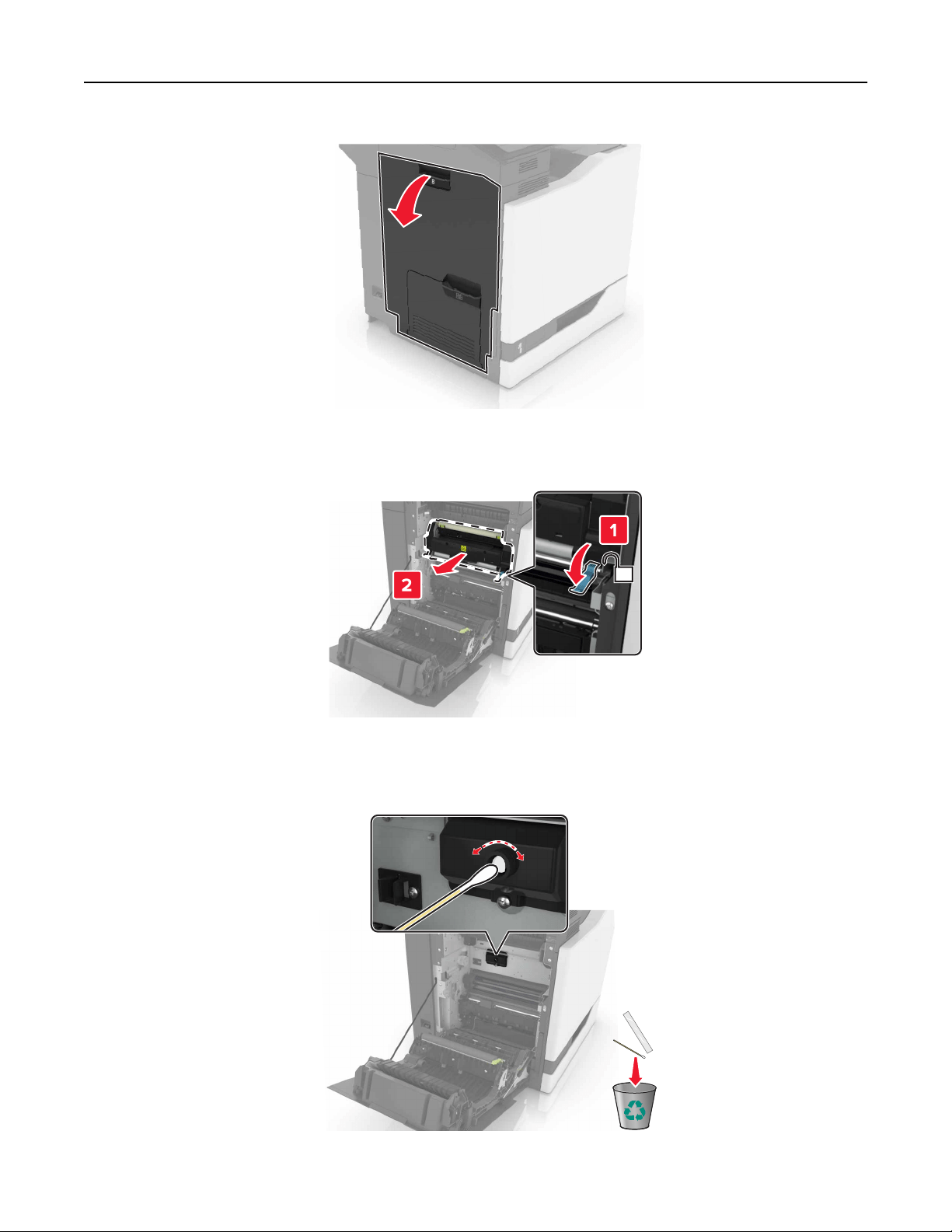
3 Remove the fuser.
4 Unpack the new fuser.
5 Clean the fuser lens using the cotton swab that came with the package.
Maintaining the printer 71
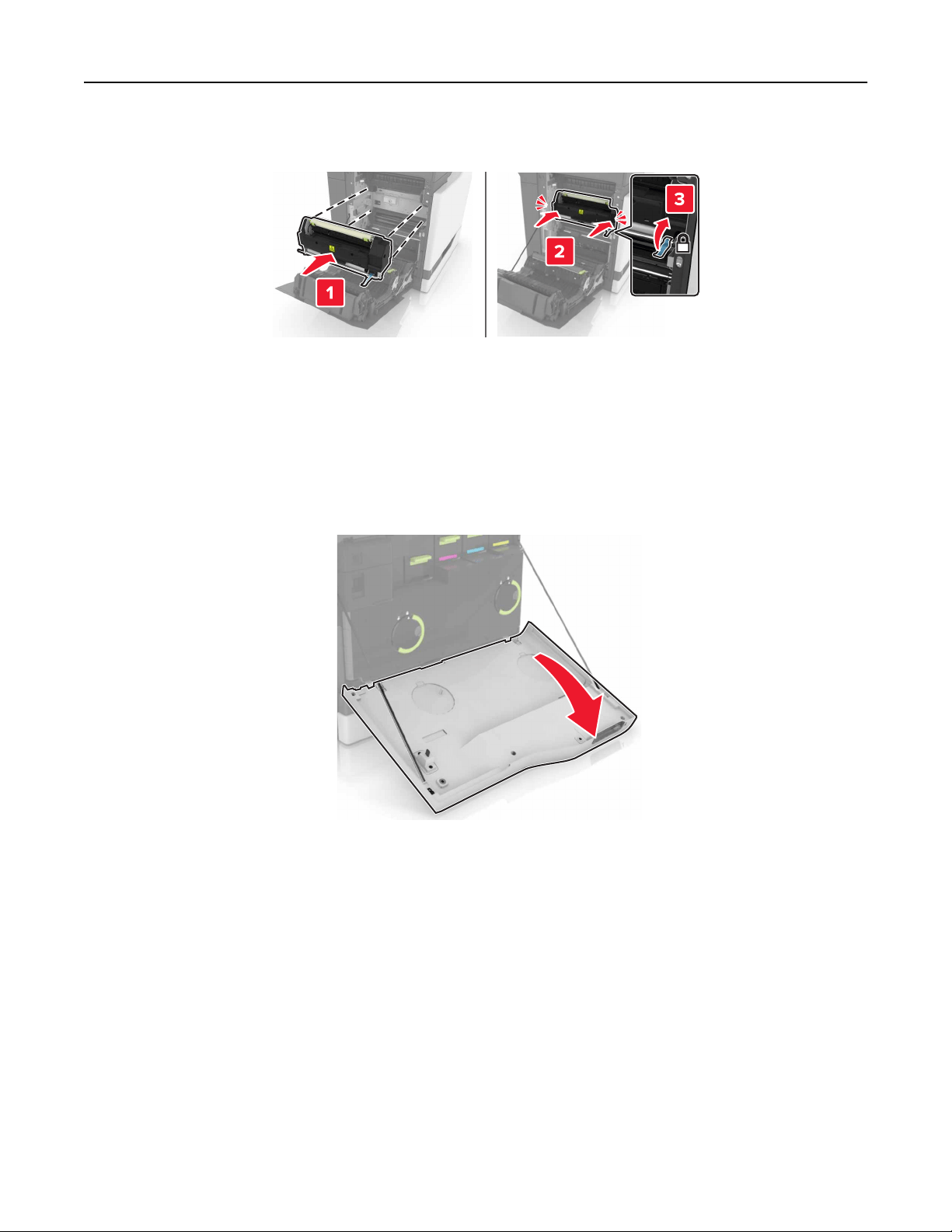
6 Insert the new fuser until it clicks into place.
7 Close door B.
8 Turn on the printer.
Replacing a photoconductor unit
1 Open door A.
Maintaining the printer 72
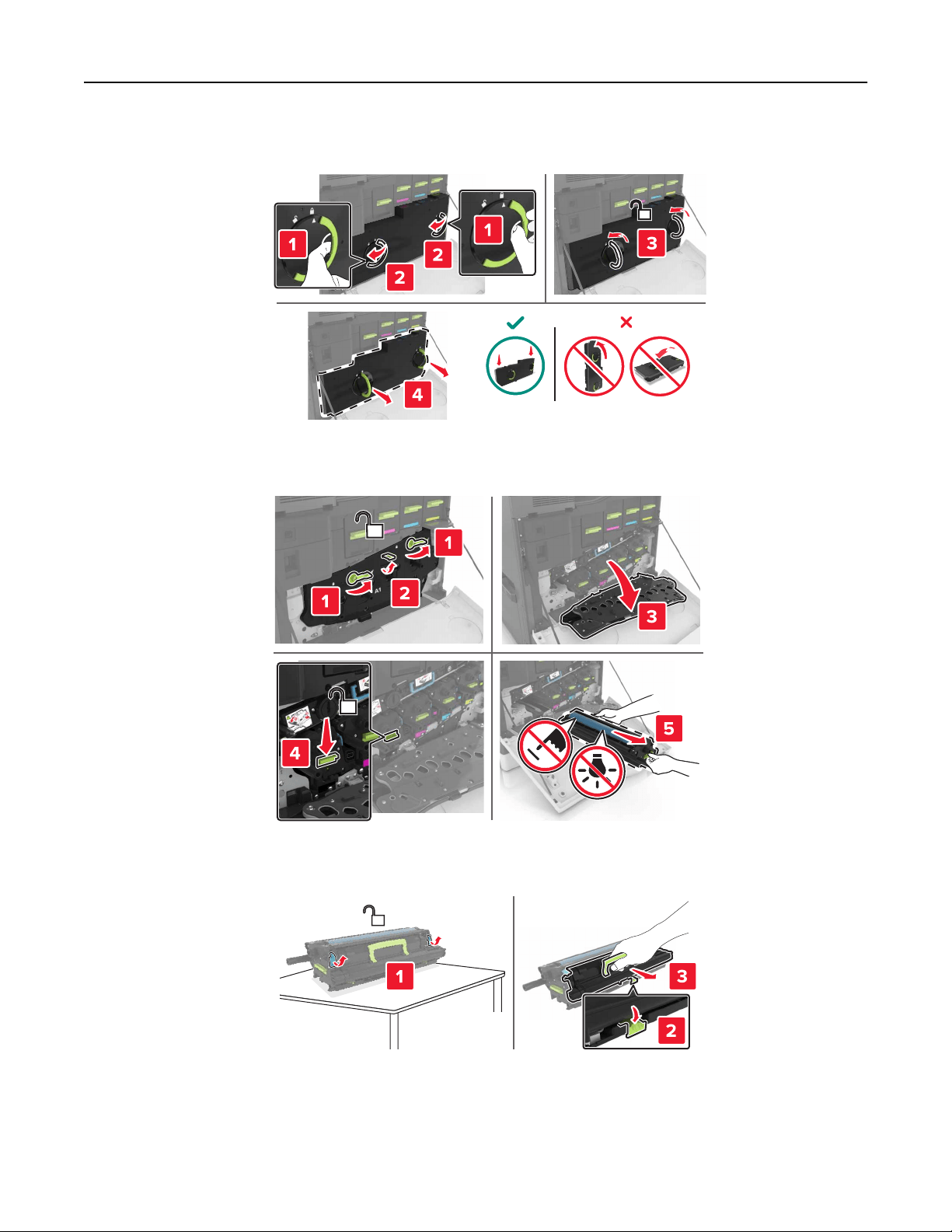
2 Remove the waste toner bottle.
3 Remove the imaging unit.
4 Remove the photoconductor unit.
Maintaining the printer 73
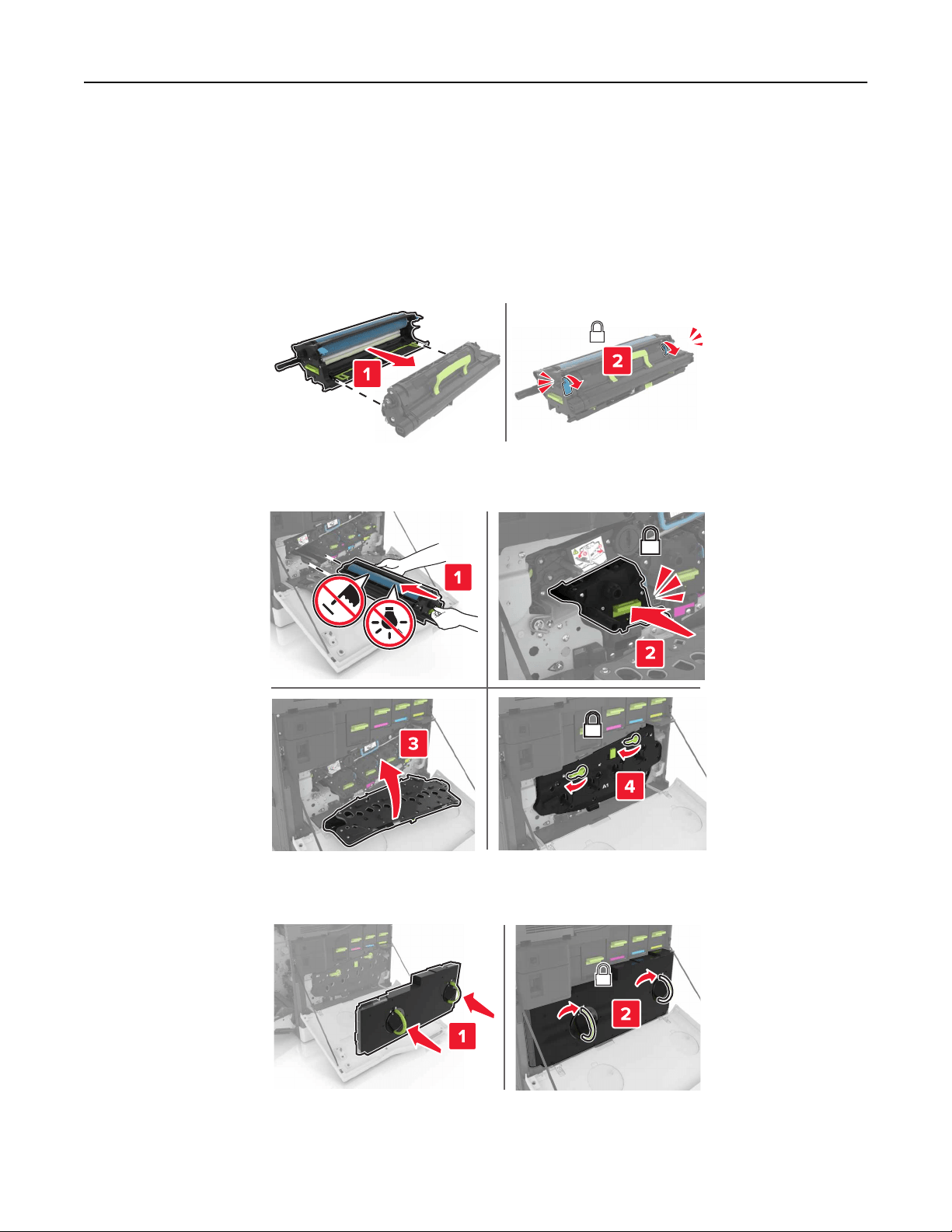
5 Unpack the new photoconductor unit, and then remove the packing material.
Warning—Potential Damage: Do not expose the photoconductor unit to direct light for more than 10
minutes. Extended exposure to light may cause print quality problems.
Warning—Potential Damage: Do not touch the photoconductor drum. Doing so may aect the print
quality of future print jobs.
6 Insert the new photoconductor unit.
7 Insert the imaging unit.
8 Insert the waste toner bottle.
9 Close door A.
Maintaining the printer 74
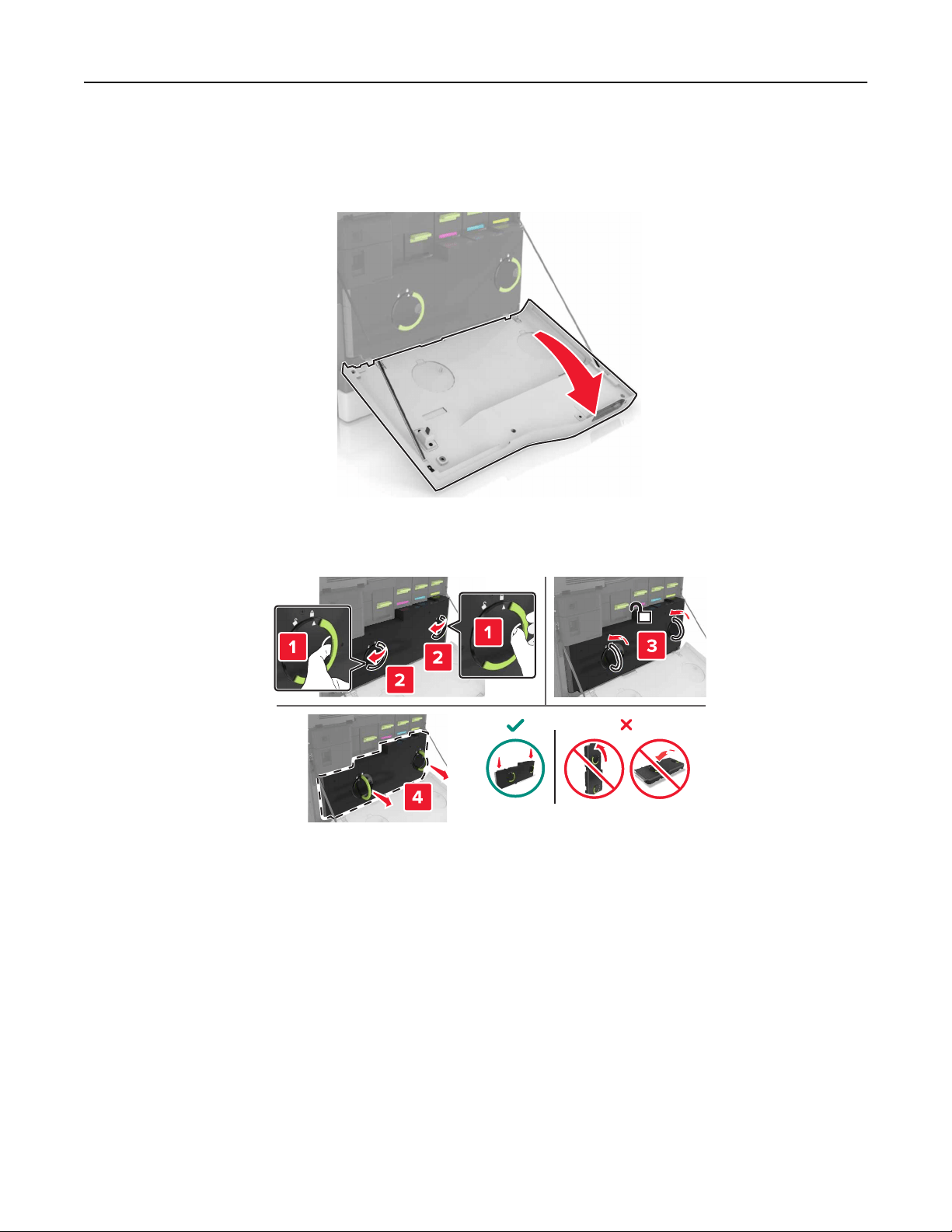
Replacing an imaging unit
1 Open door A.
2 Remove the waste toner bottle.
Maintaining the printer 75
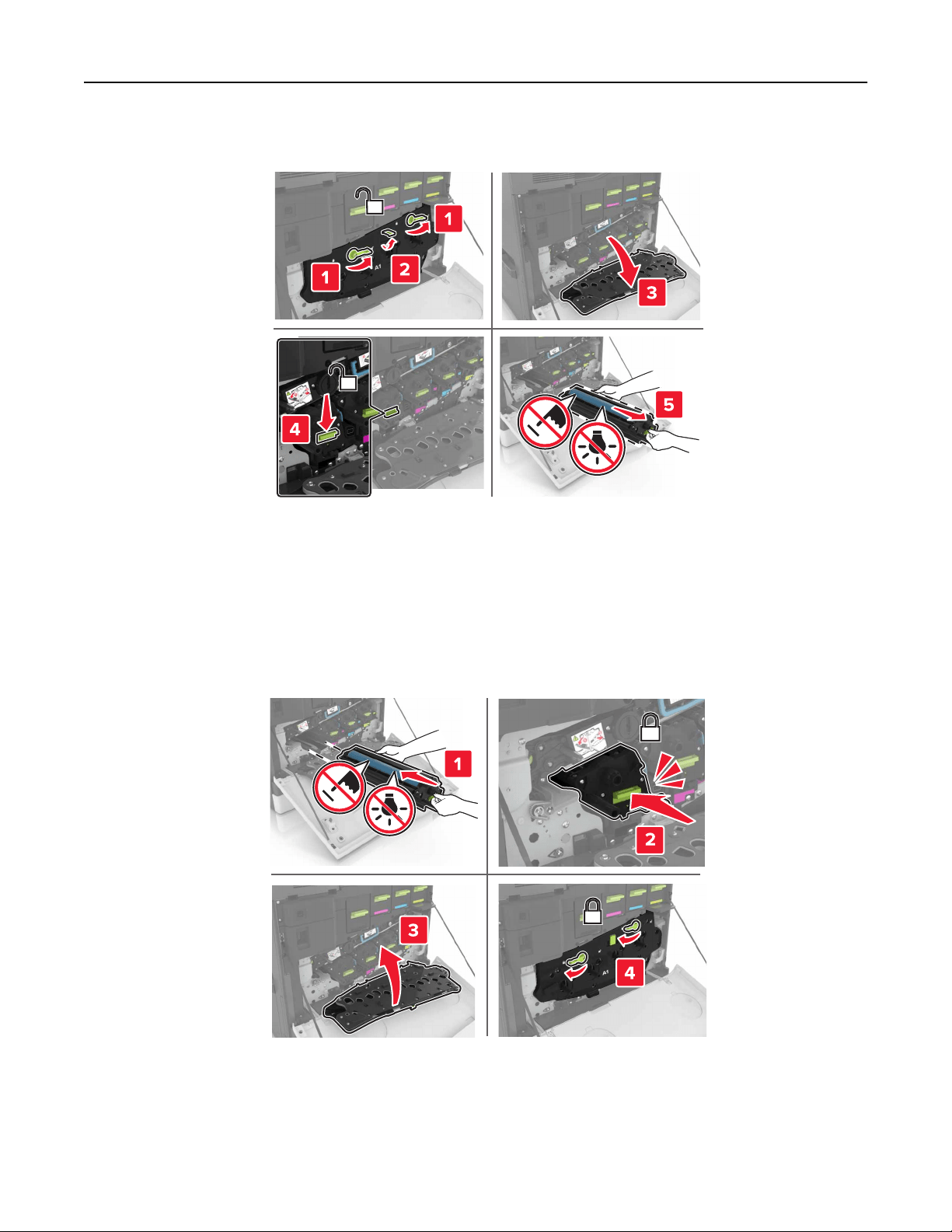
3 Remove the imaging unit.
4 Unpack the new imaging unit, and then remove the packing material.
Warning—Potential Damage: Do not expose the photoconductor unit to direct light for more than 10
minutes. Extended exposure to light may cause print quality problems.
Warning—Potential Damage: Do not touch the photoconductor drum. Doing so may aect the print
quality of future print jobs.
5 Insert the new imaging unit.
Maintaining the printer 76

6 Insert the waste toner bottle.
7 Close door A.
Replacing a toner cartridge
1 Open door A.
2 Remove the toner cartridge.
3 Unpack the new toner cartridge.
Maintaining the printer 77
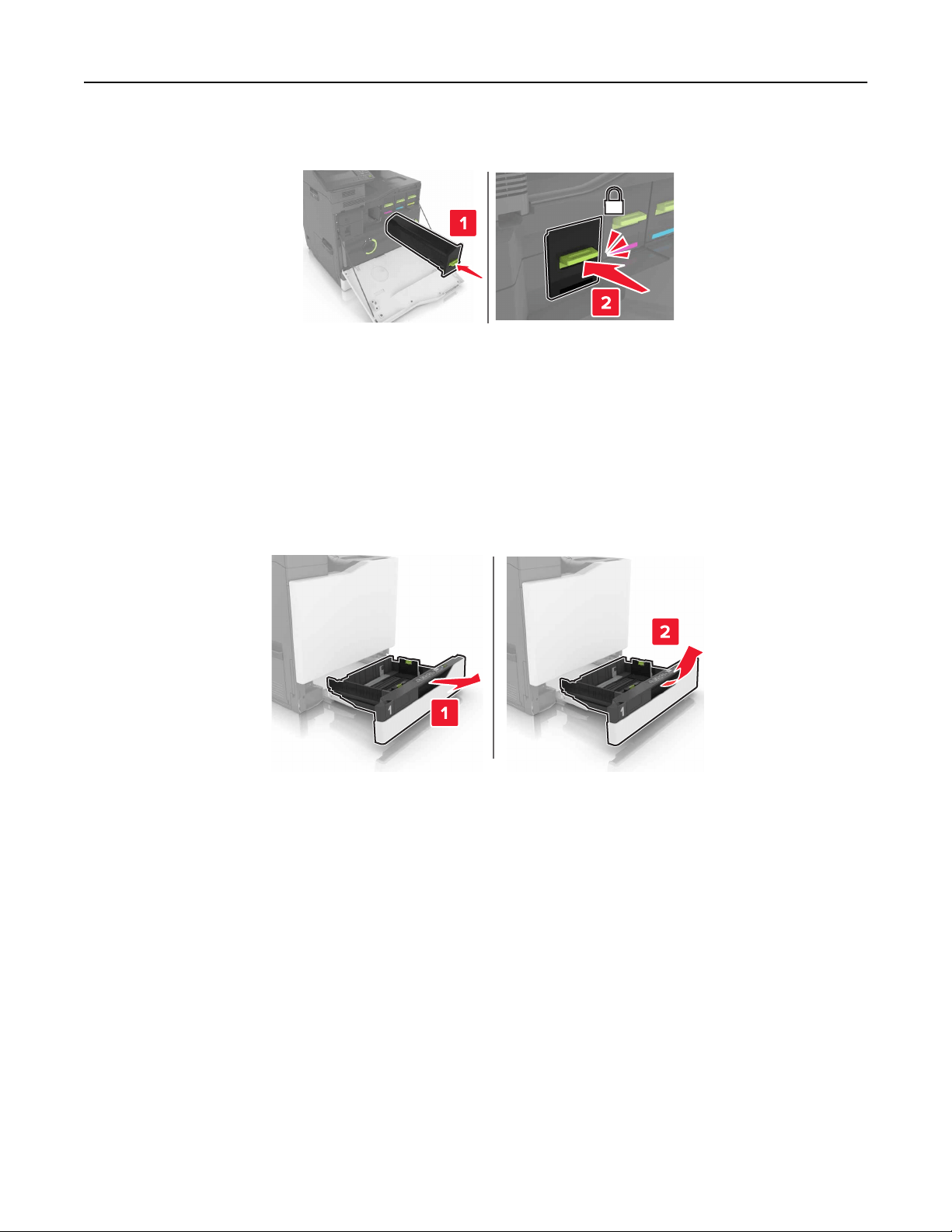
4 Insert the new toner cartridge until it clicks into place.
5 Close door A.
Replacing the pick roller
Replacing the pick roller in the 550
‑sheet tray or envelope tray
1 Turn o the printer.
2 Remove the tray.
Maintaining the printer 78
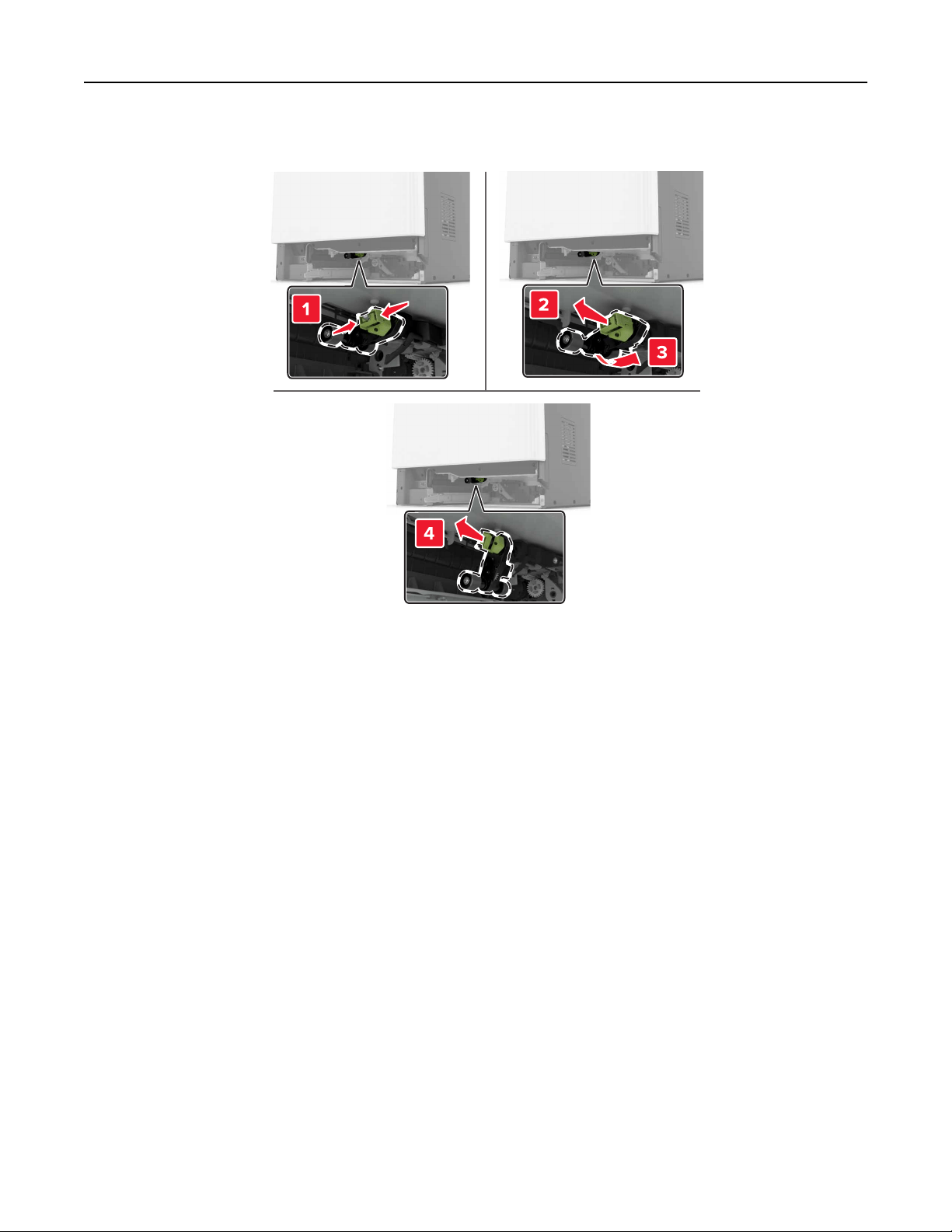
3 Remove the pick roller.
4 Unpack the new pick roller.
Maintaining the printer 79

5 Insert the new pick roller until it clicks into place.
6 Insert the tray.
7 Turn on the printer.
Maintaining the printer 80
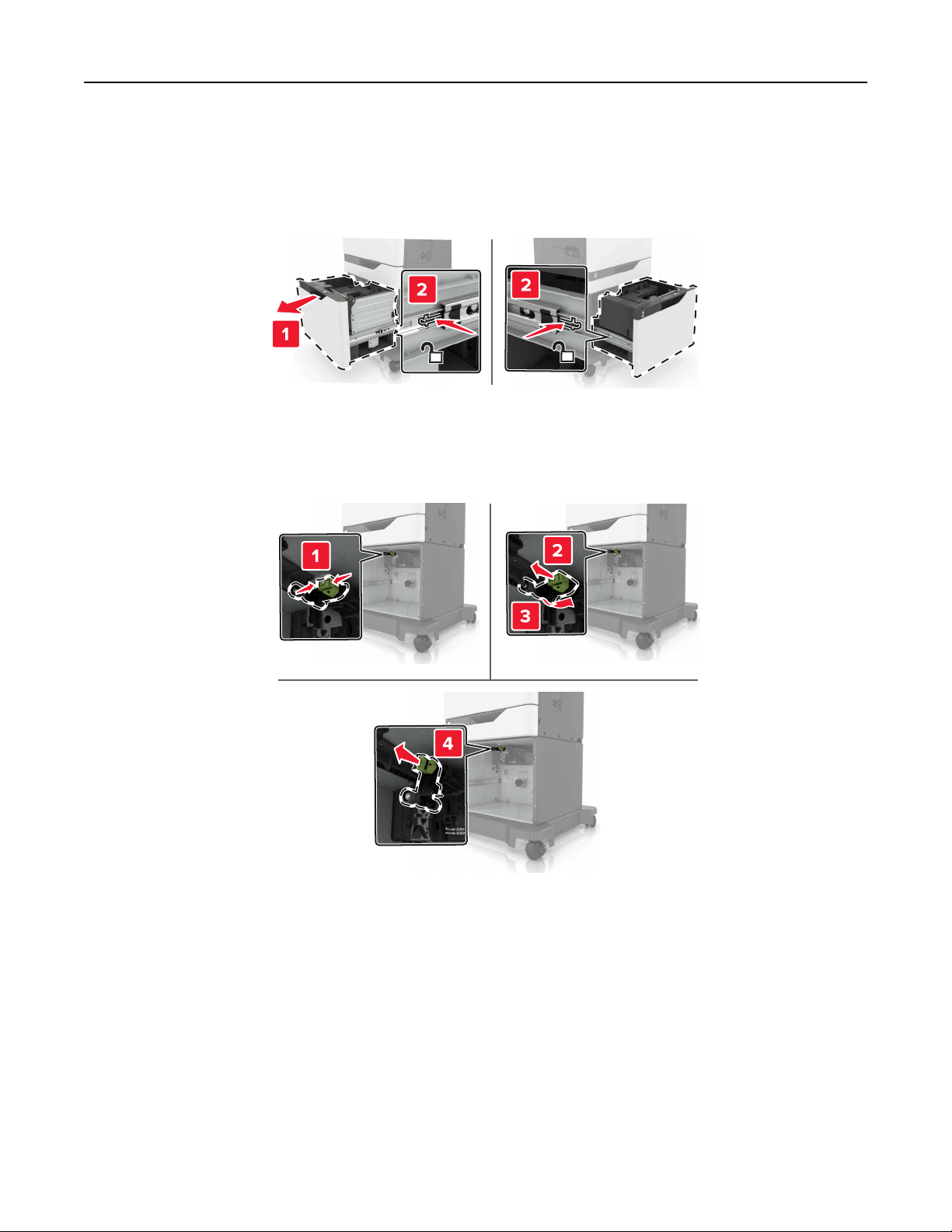
Replacing the pick roller in the 2200‑sheet tray
1 Turn o the printer.
2 Pull out, and then unlock the tray.
3 Remove the tray.
4 Remove the pick roller.
5 Unpack the new pick roller.
Maintaining the printer 81
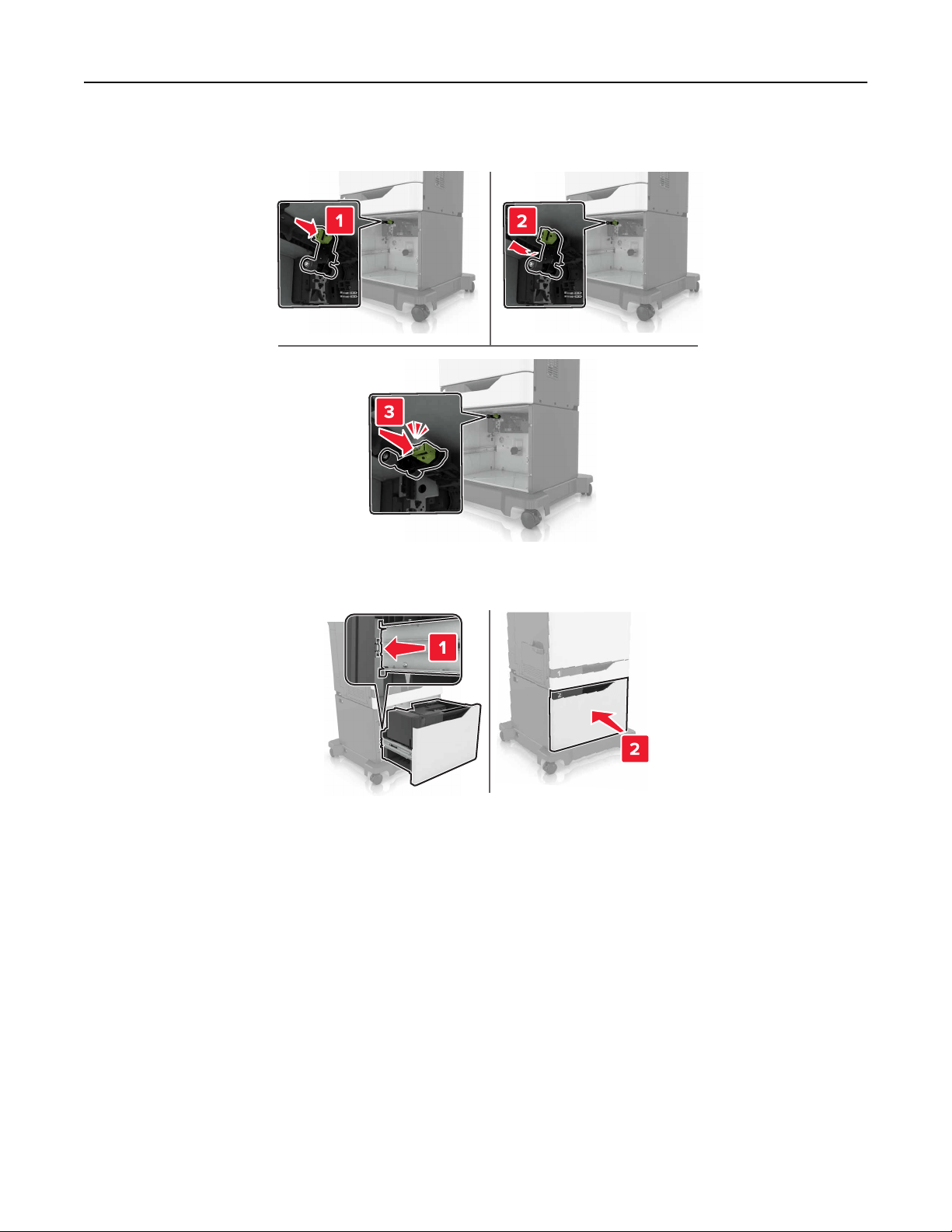
6 Insert the new pick roller until it clicks into place.
7 Insert the tray.
8 Turn on the printer.
Maintaining the printer 82
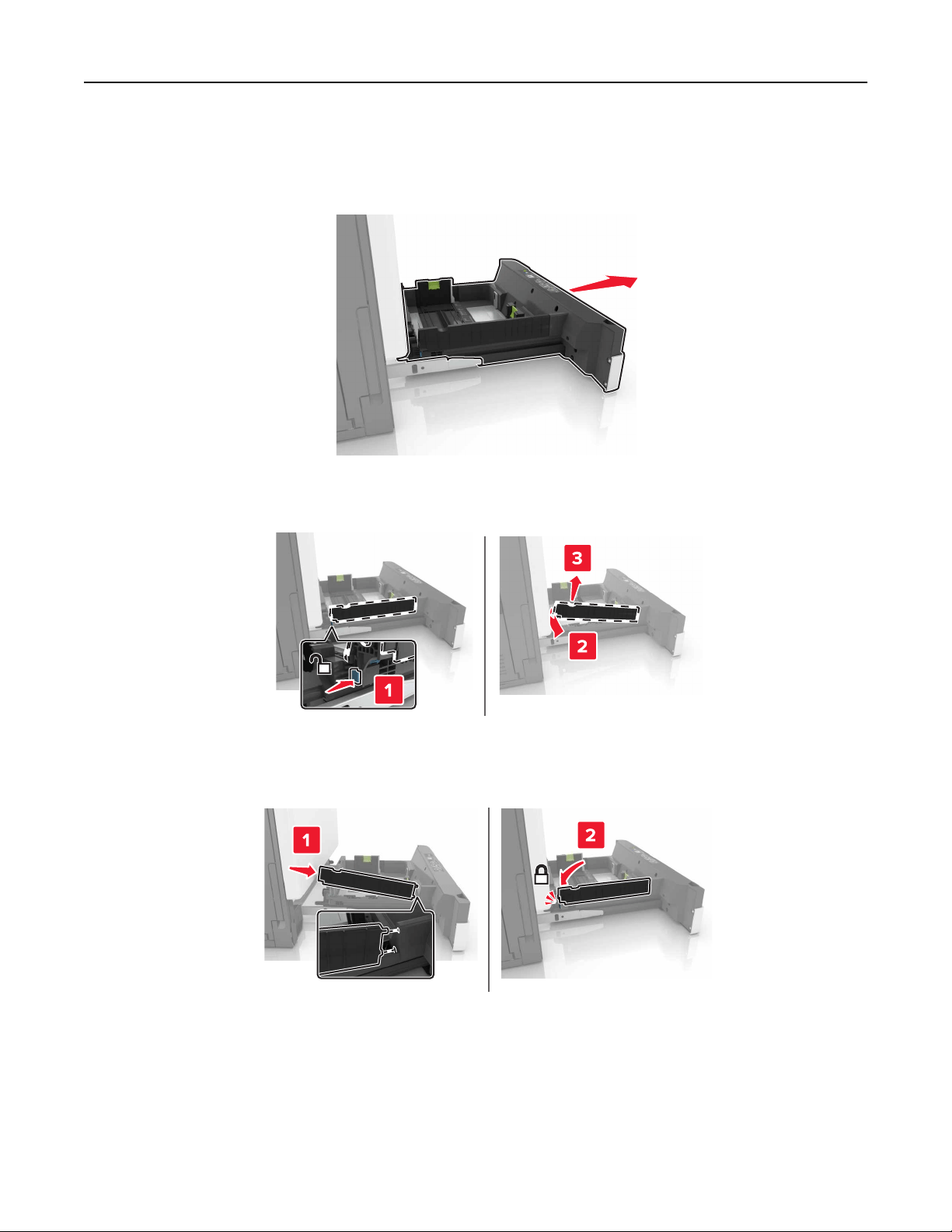
Replacing the separator pad
1 Pull out the tray.
2 Remove the separator pad.
3 Unpack the new separator pad.
4 Insert the new separator pad until it clicks into place.
5 Insert the tray.
Maintaining the printer 83
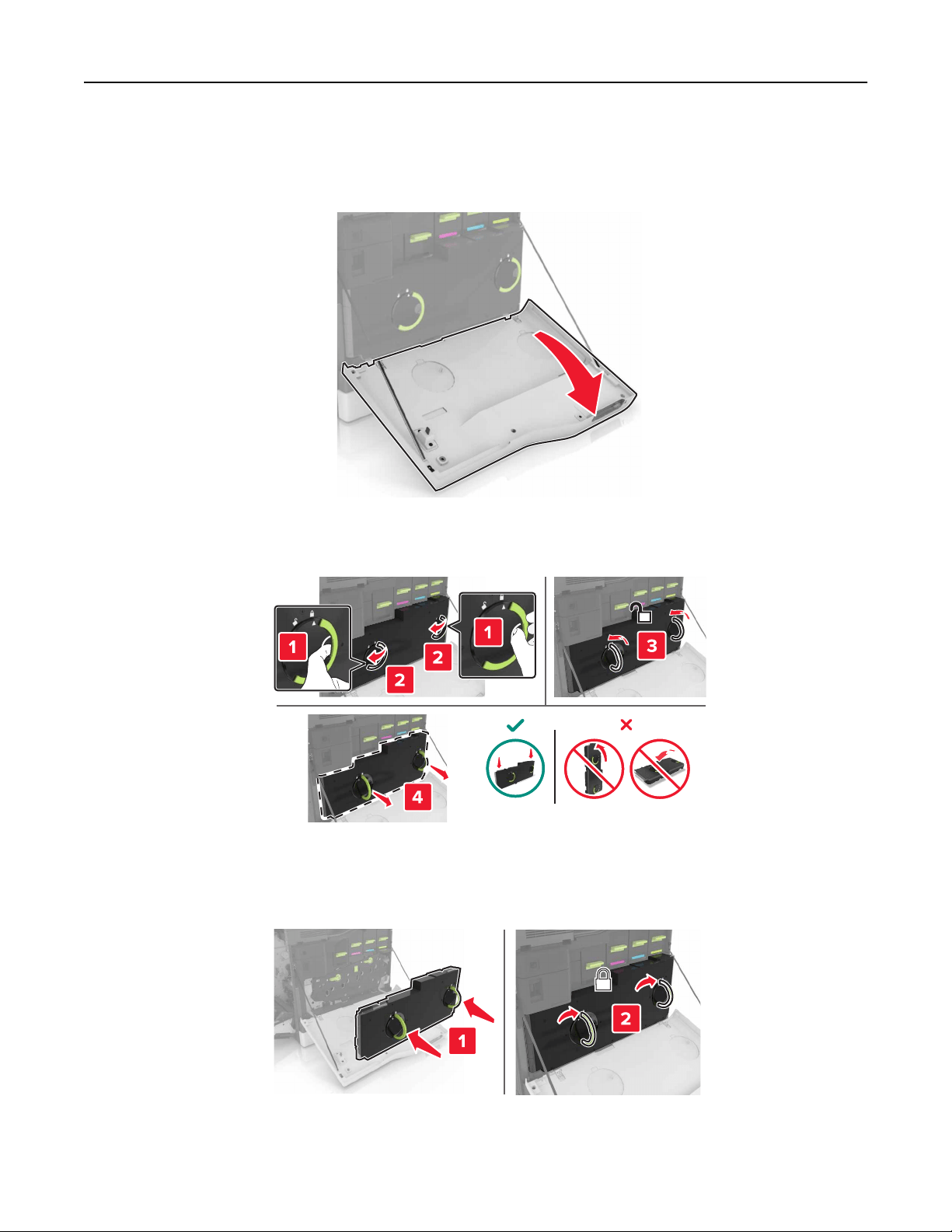
Replacing the waste toner bottle
1 Open door A.
2 Remove the waste toner bottle.
3 Unpack the new waste toner bottle.
4 Insert the new waste toner bottle.
5 Close door A.
Maintaining the printer 84
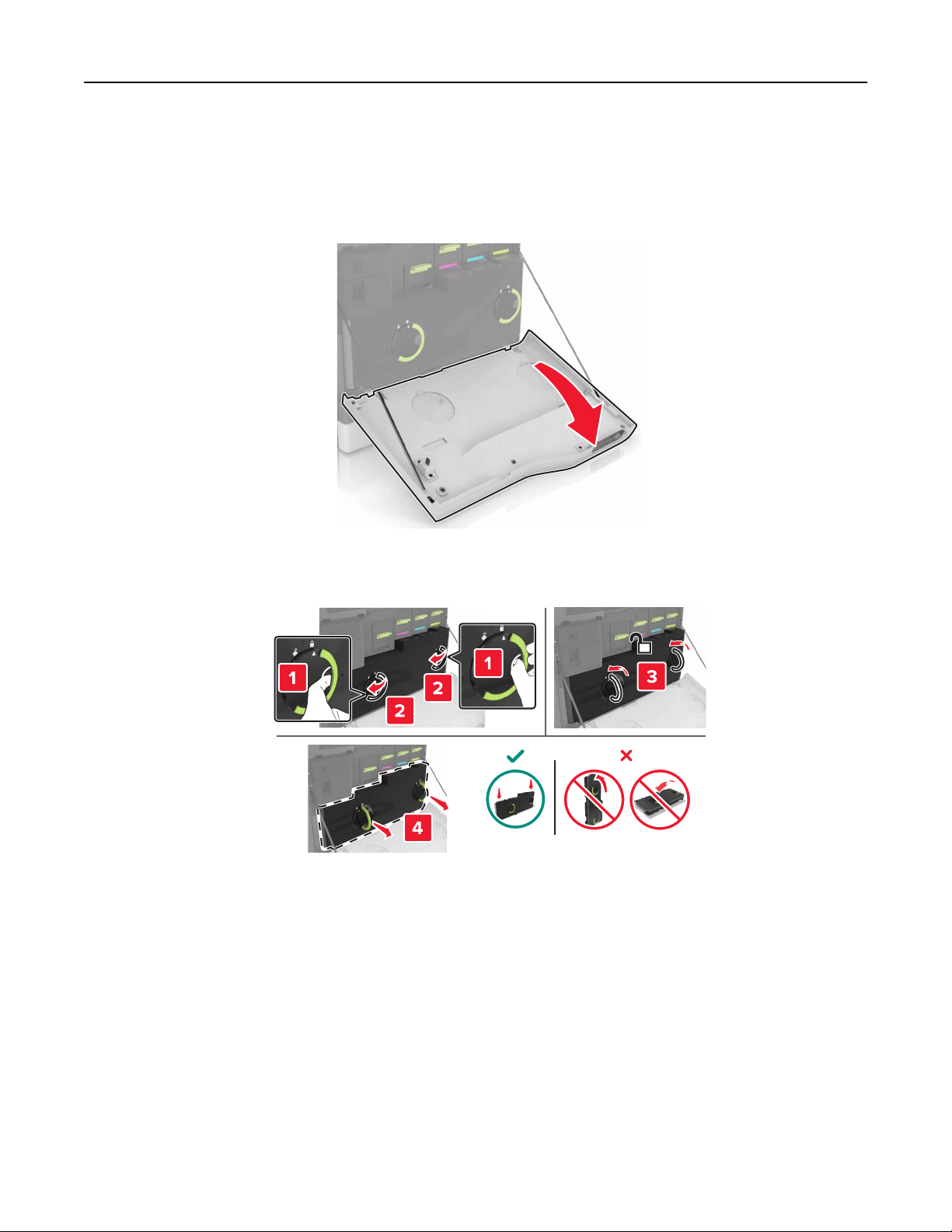
Replacing the transfer belt
1 Turn
o
the printer.
2 Open door A.
3 Remove the waste toner bottle.
Maintaining the printer 85
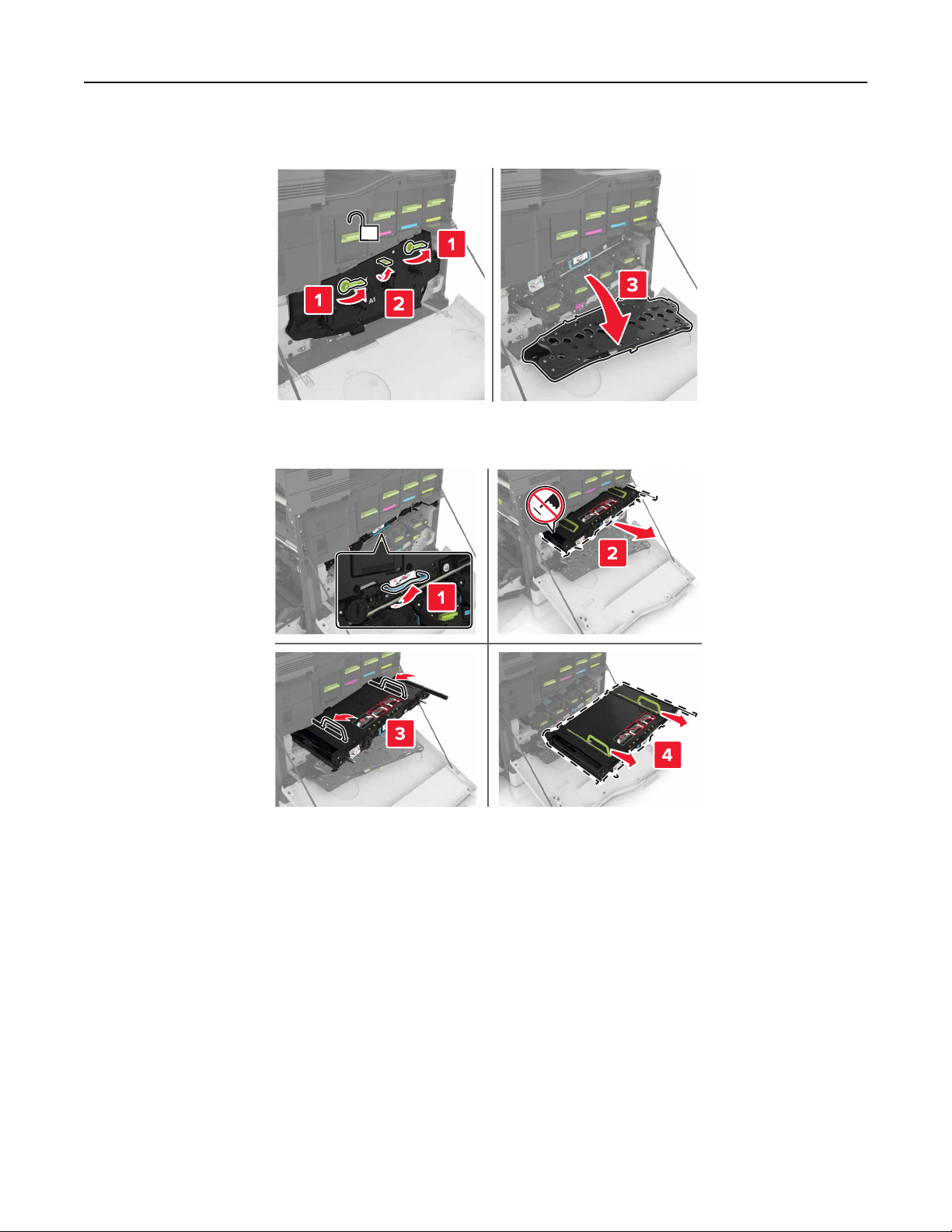
4 Open door A1.
5 Remove the transfer belt.
6 Unpack the new transfer belt, and then remove the packing material.
Warning—Potential Damage: Do not expose the transfer belt to direct light for more than 10 minutes.
Extended exposure to light may cause print quality problems.
Warning—Potential Damage: Do not touch the transfer belt. Doing so may aect the print quality of
future print jobs.
Maintaining the printer 86
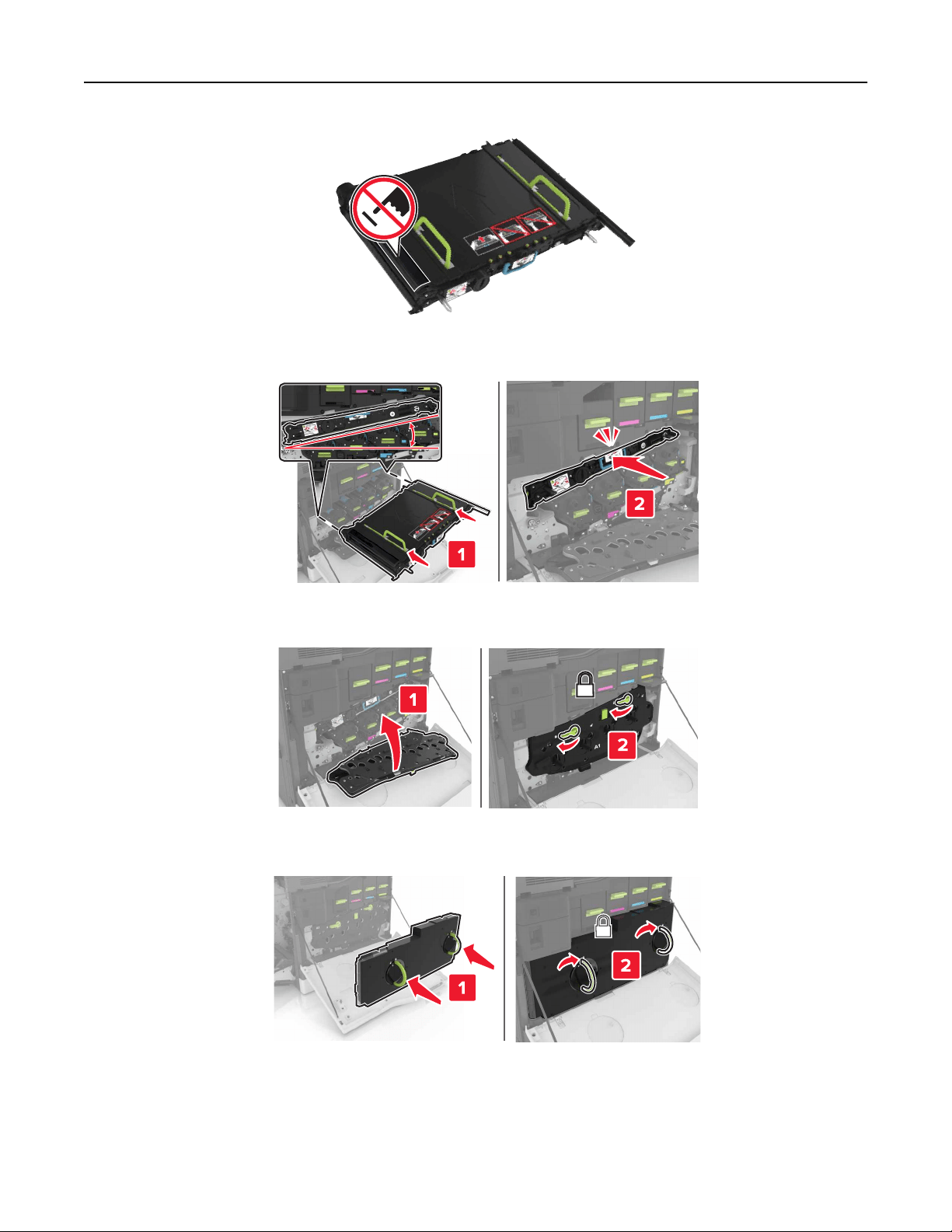
7 Insert the new transfer belt until it clicks into place.
8 Close door A1.
9 Insert the waste toner bottle.
10 Close door A .
11 Turn on the printer.
Maintaining the printer 87
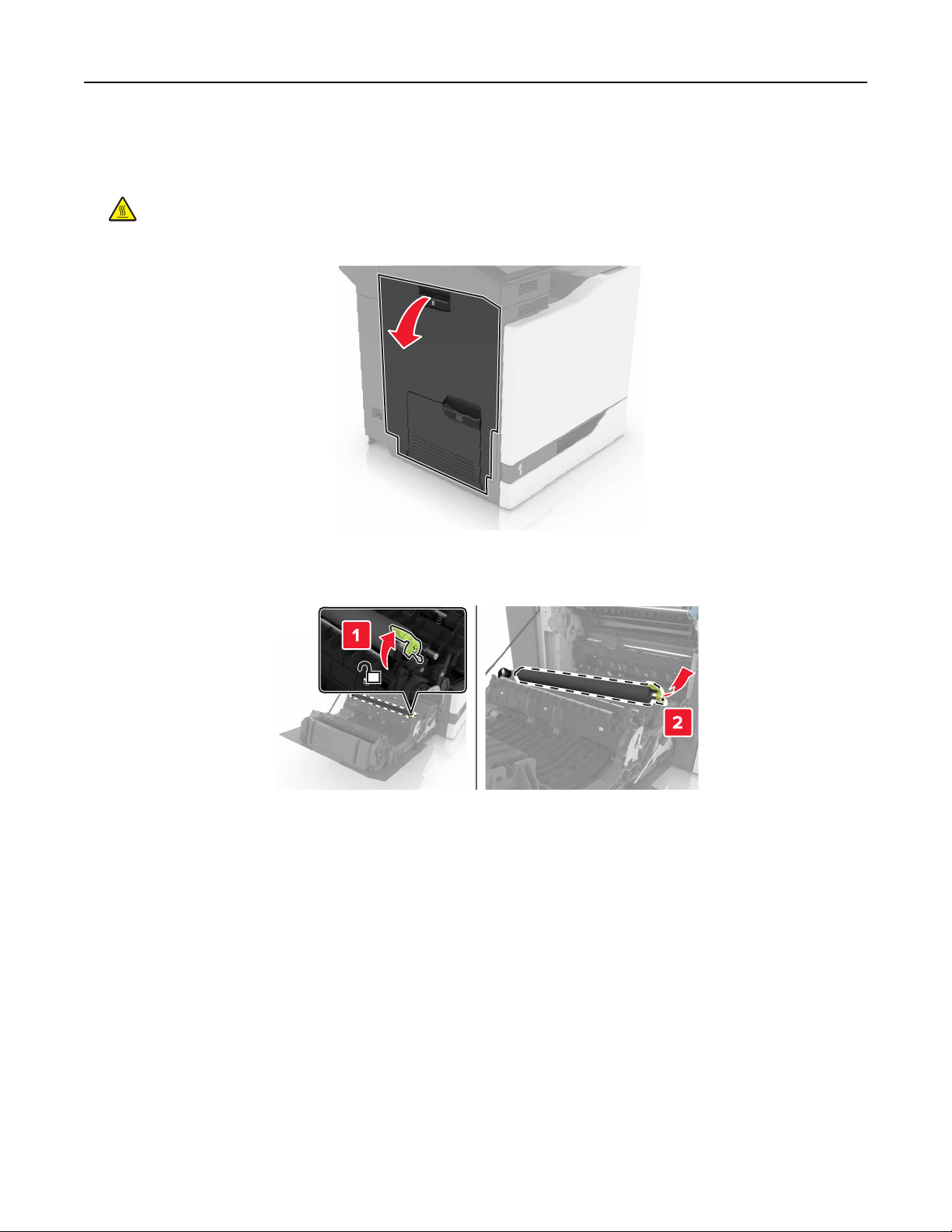
Replacing the transfer roller
1 Open door B.
CAUTION—HOT SURFACE: The inside of the printer might be hot. To reduce the risk of injury from a
hot component, allow the surface to cool before touching it.
2 Remove the transfer roller.
3 Unpack the new transfer roller.
Note: Do not remove the white packing material.
Maintaining the printer 88
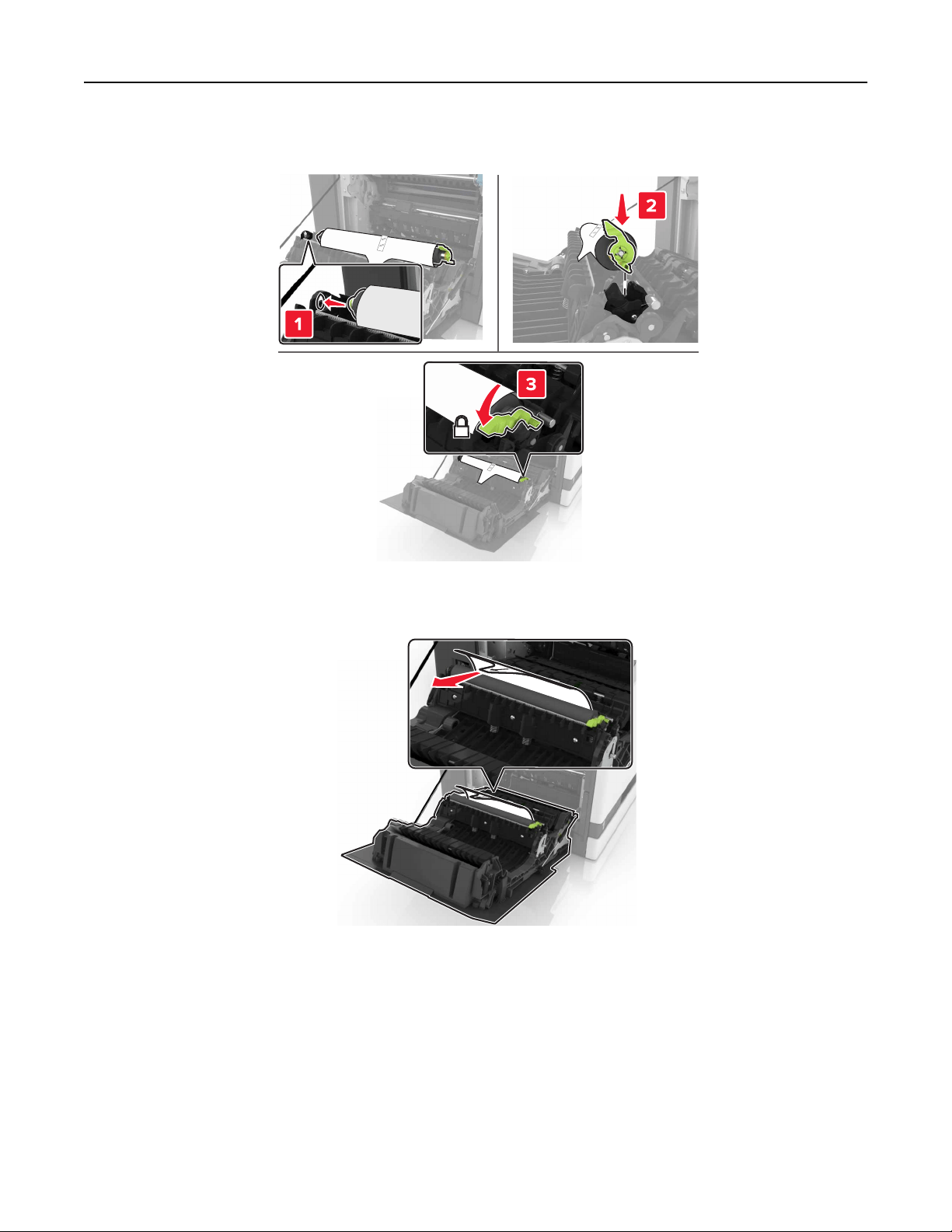
4 Insert the new transfer roller.
5 Remove the white packing material.
6 Close door B.
Maintaining the printer 89
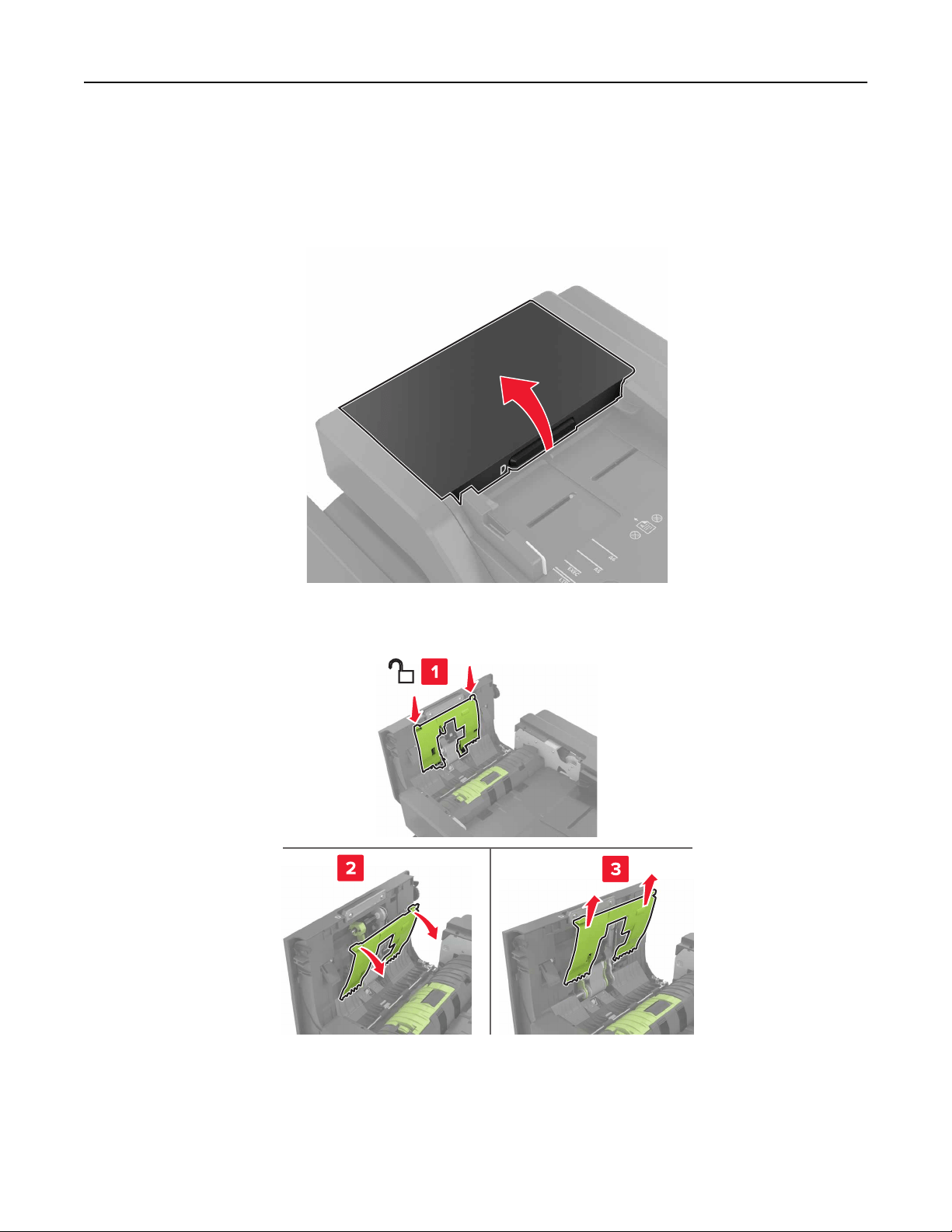
Replacing the ADF pick roller
1 Turn
o
the printer.
2 Open door D.
3 Remove the ADF pick roller cover.
4 Remove the ADF pick roller.
Warning—Potential Damage: Some parts of the printer are easily damaged by static electricity. Before
touching any parts or components in an area marked with the static‑sensitive symbol, touch a metal
surface in an area away from the symbol.
Maintaining the printer 90
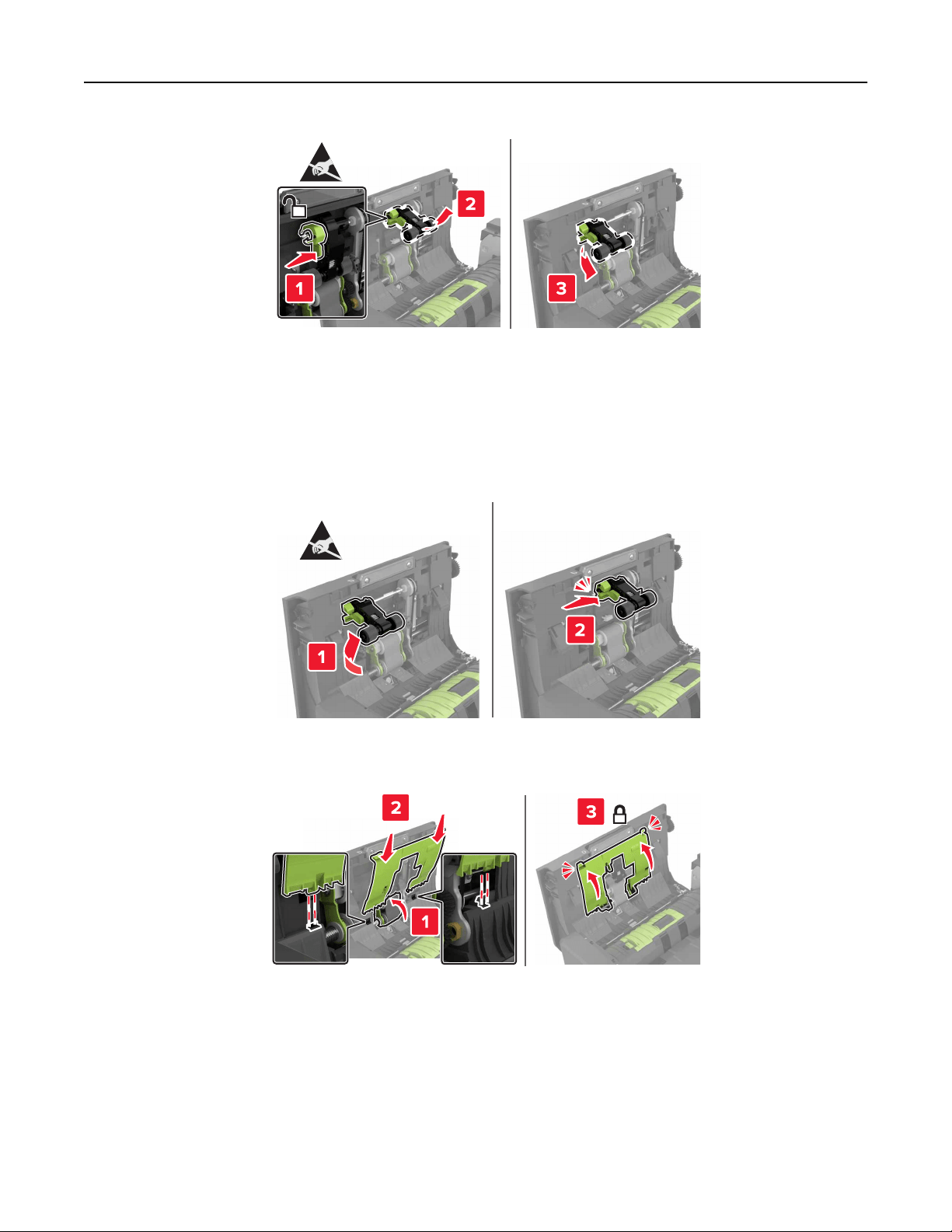
5 Unpack the new ADF pick roller.
6 Insert the new ADF pick roller until it clicks into place.
Warning—Potential Damage: Some parts of the printer are easily damaged by static electricity. Before
touching any parts or components in an area marked with the static‑sensitive symbol, touch a metal
surface in an area away from the symbol.
7 Insert the ADF pick roller cover until it clicks into place.
8 Close door D.
9 Turn on the printer.
Maintaining the printer 91
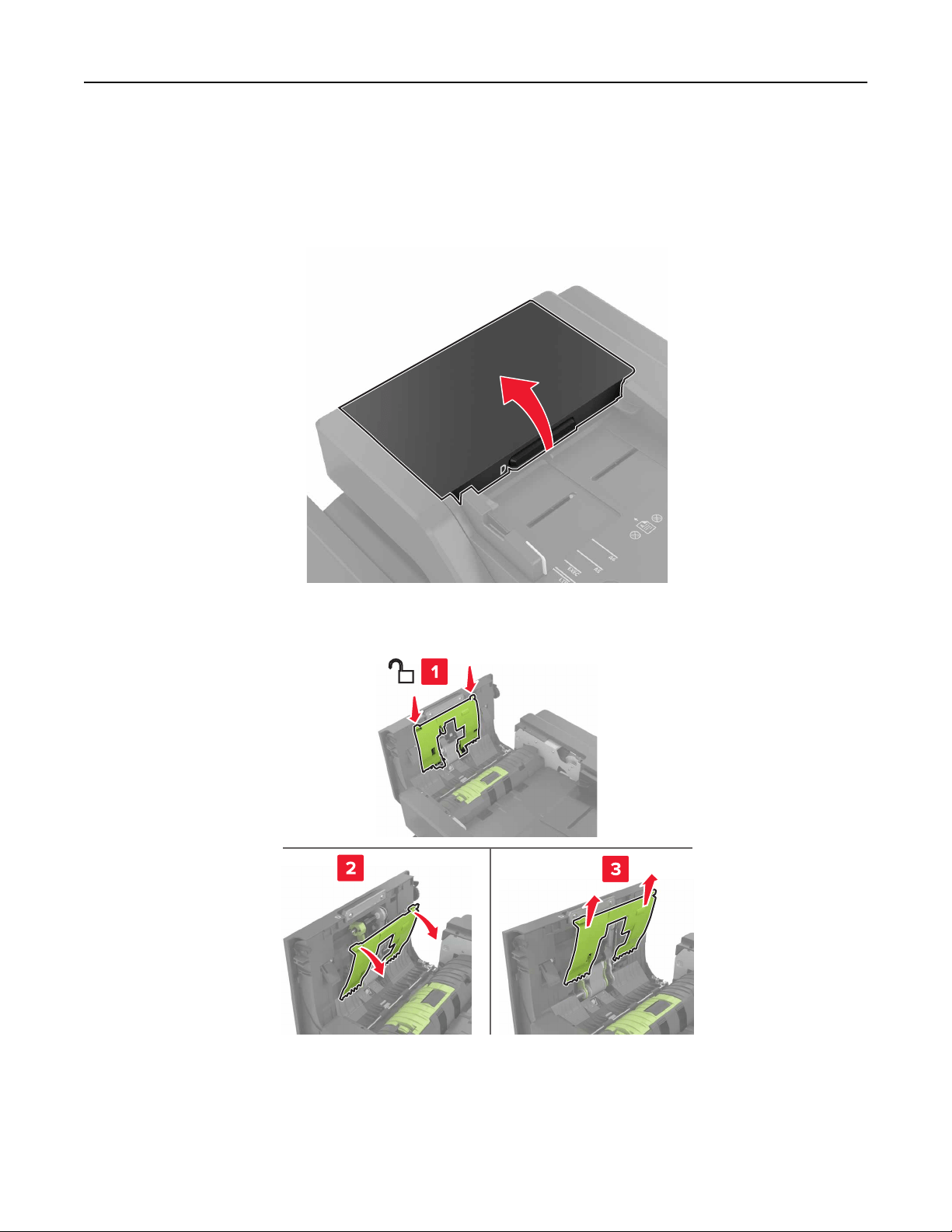
Replacing the ADF feed roller
1 Turn
o
the printer.
2 Open door D.
3 Remove the ADF pick roller cover.
4 Remove the ADF feed roller.
Warning—Potential Damage: Some parts of the printer are easily damaged by static electricity. Before
touching any parts or components in an area marked with the static‑sensitive symbol, touch a metal
surface in an area away from the symbol.
Maintaining the printer 92
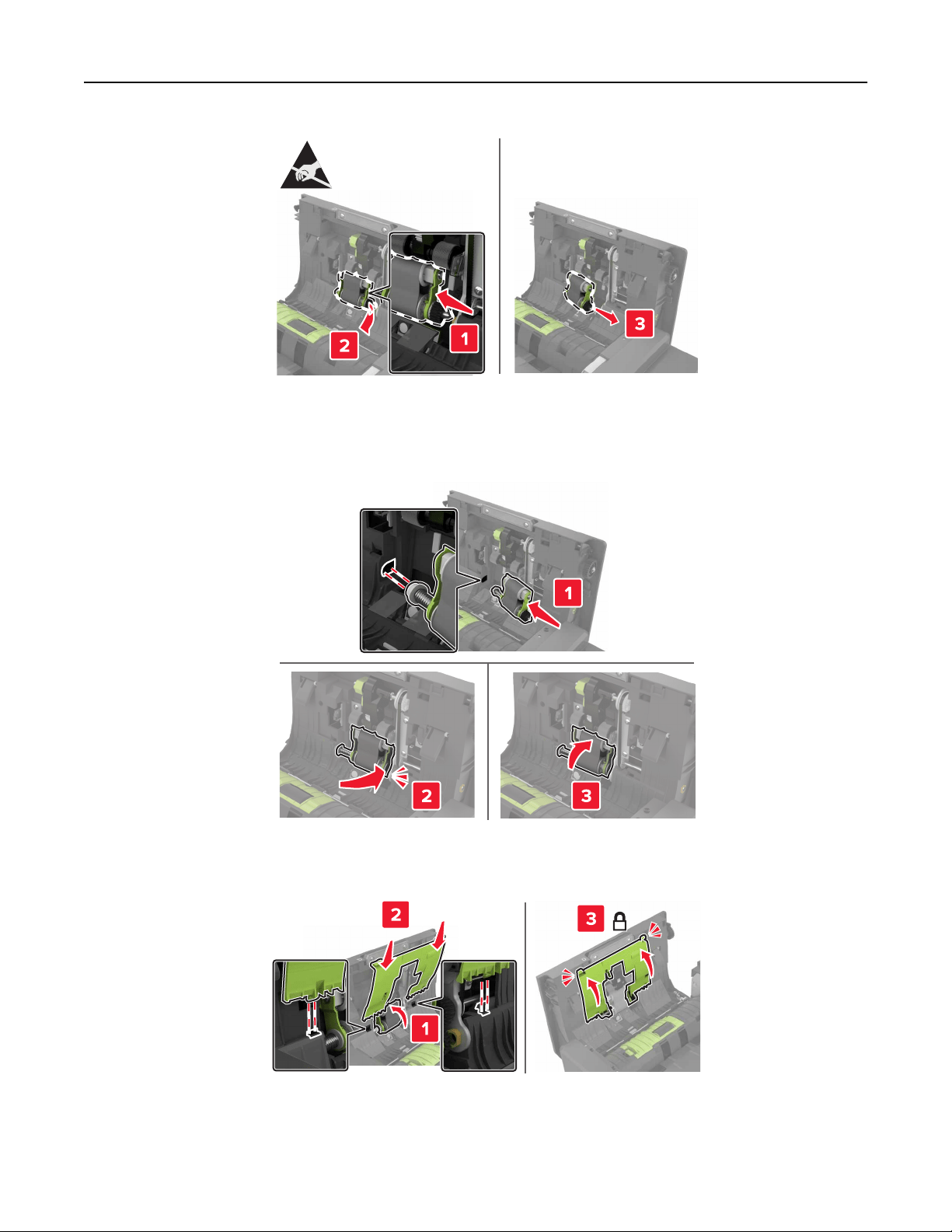
5 Unpack the new ADF feed roller.
6 Insert the new ADF feed roller until it clicks into place.
7 Insert the ADF pick roller cover until it clicks into place.
8 Close door D.
9 Turn on the printer.
Maintaining the printer 93
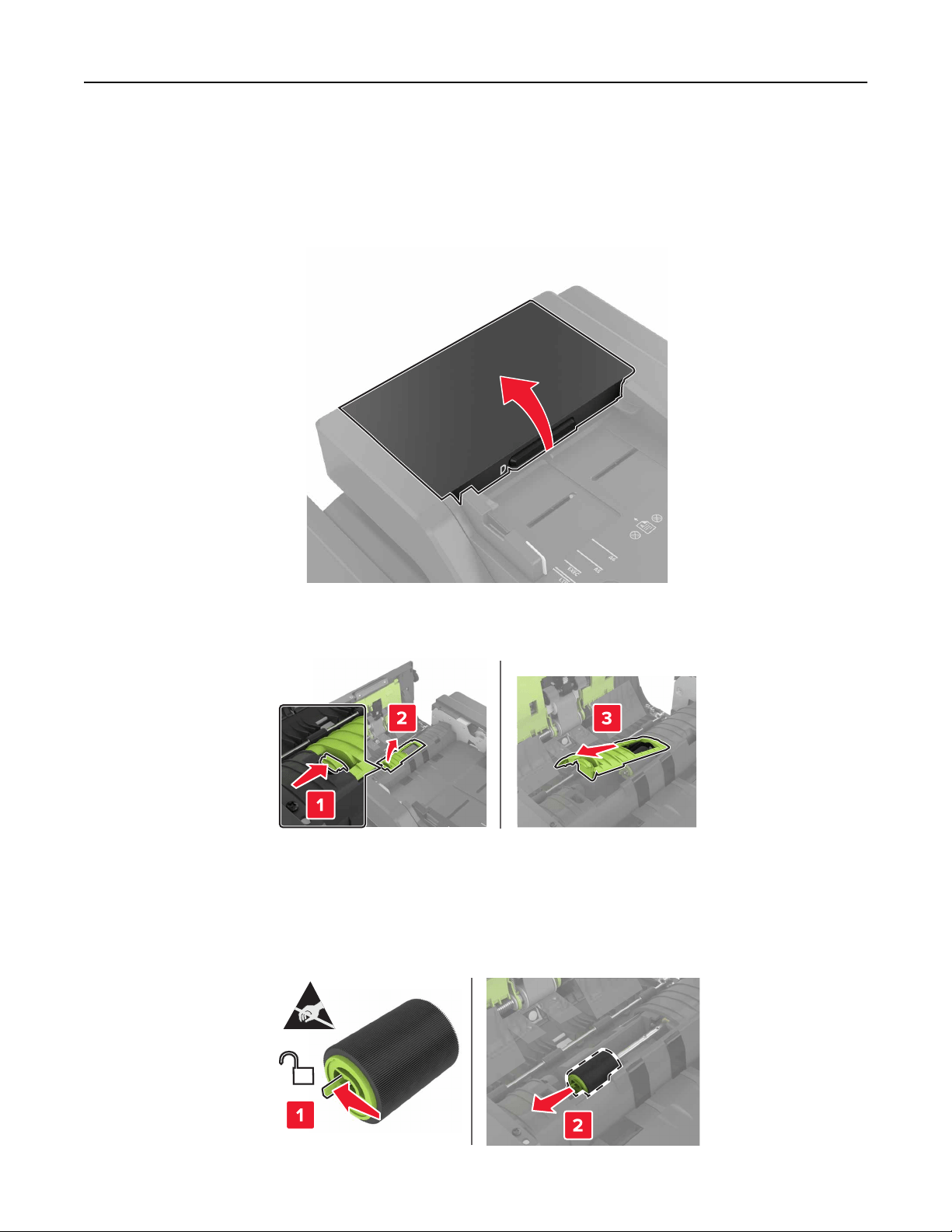
Replacing the ADF separator roller
1 Turn
o
the printer.
2 Open door D.
3 Remove the ADF separator roller cover.
4 Remove the ADF separator roller.
Warning—Potential Damage: Some parts of the printer are easily damaged by static electricity. Before
touching any parts or components in an area marked with the static‑sensitive symbol, touch a metal
surface in an area away from the symbol.
Maintaining the printer 94

5 Unpack the new ADF separator roller.
6 Insert the new ADF separator roller until it clicks into place.
7 Insert the ADF separator roller cover until it clicks into place.
8 Close door D.
9 Turn on the printer.
Replacing the staple cartridge unit
Replacing the staple cartridge in the staple finisher
1 Open door C.
Maintaining the printer 95
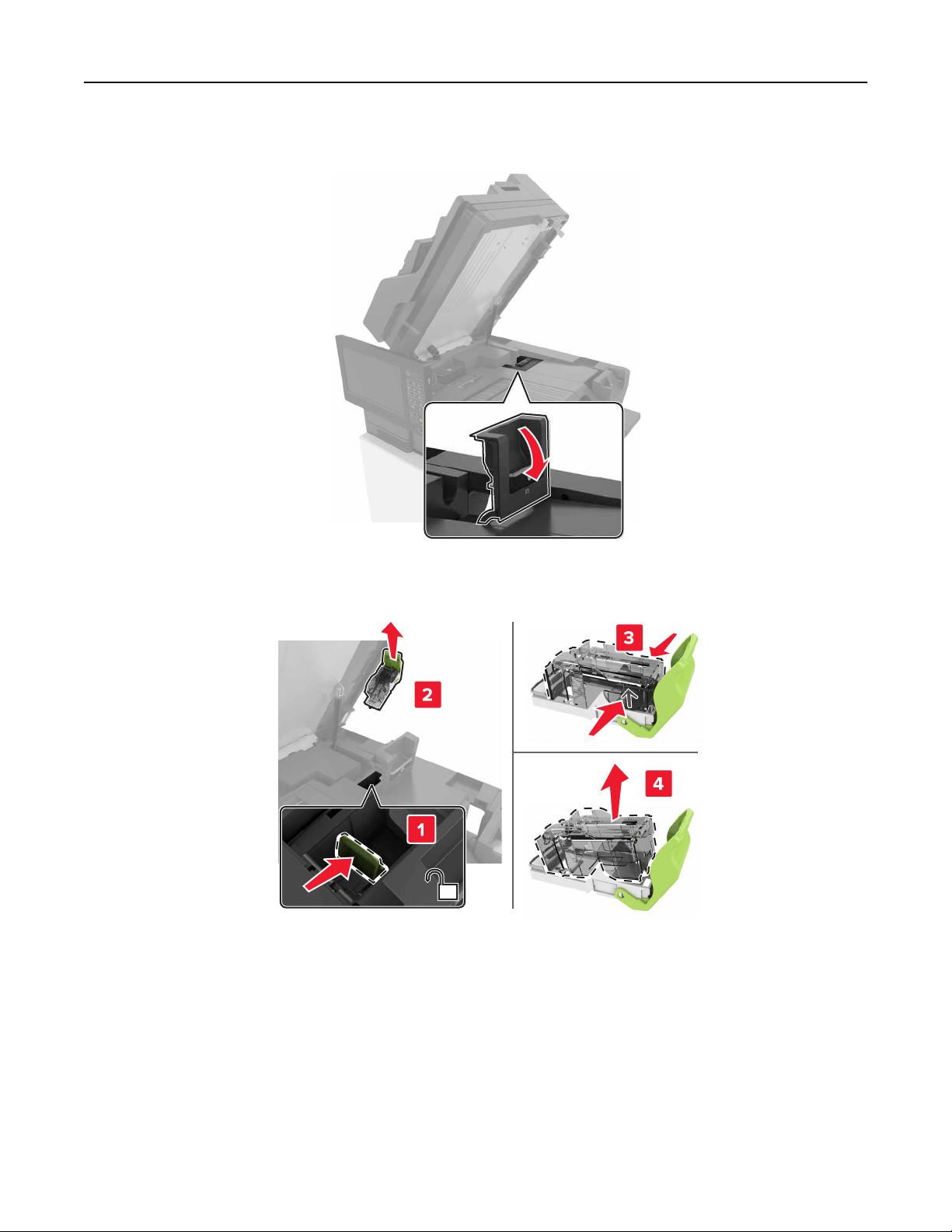
2 Open door G.
3 Remove the staple cartridge.
4 Unpack the new staple cartridge.
Maintaining the printer 96
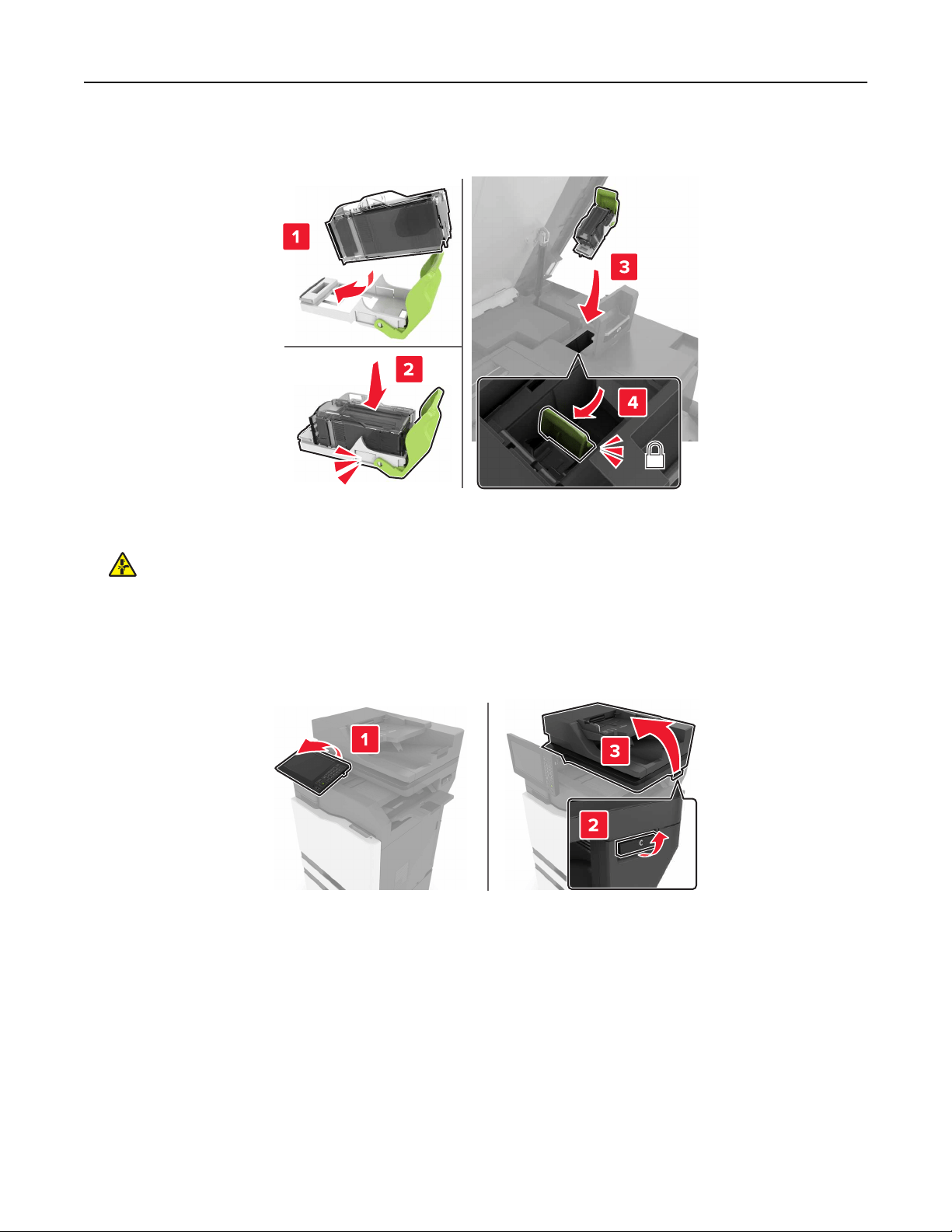
5 Insert the new staple cartridge until it clicks into place.
6 Close doors G and C.
CAUTION—PINCH HAZARD: To avoid the risk of a pinch injury, keep hands clear of the labeled area
when closing door C.
Replacing the staple cartridge holder in the staple finisher
1 Open door C.
Maintaining the printer 97
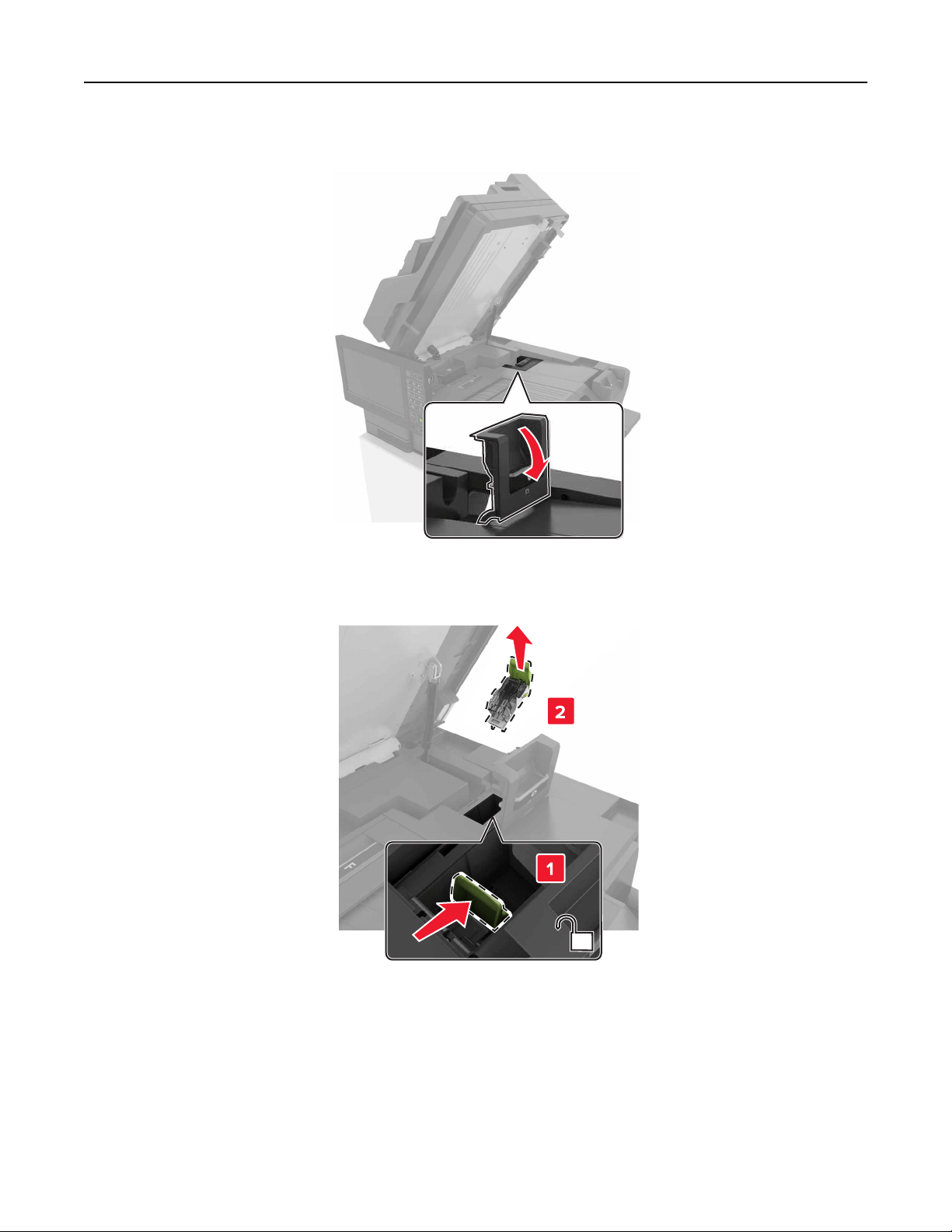
2 Open door G.
3 Pull out the staple cartridge holder.
Maintaining the printer 98
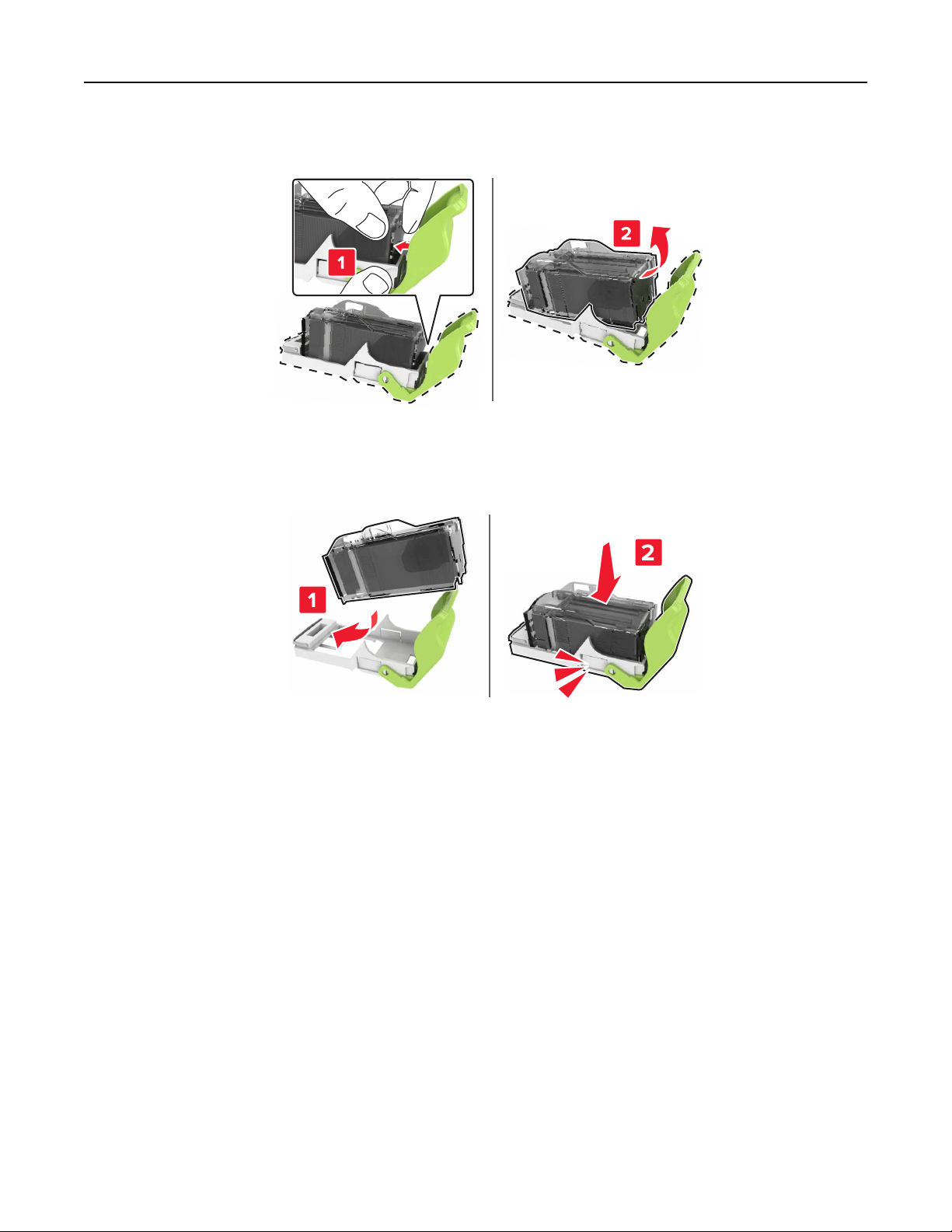
4 Remove the staple cartridge.
5 Unpack the new staple cartridge holder.
6 Insert the staple cartridge until it clicks into place.
Maintaining the printer 99

7 Insert the staple cartridge holder until it clicks into place.
8 Close doors G and C.
CAUTION—PINCH HAZARD: To avoid the risk of a pinch injury, keep hands clear of the labeled area
when closing door C.
Replacing the staple cartridge in the multiposition staple, hole punch finisher
1 Open door J.
2 Remove the staple cartridge.
Note: If necessary, remove the tape from the staple cartridge holder.
Maintaining the printer 100
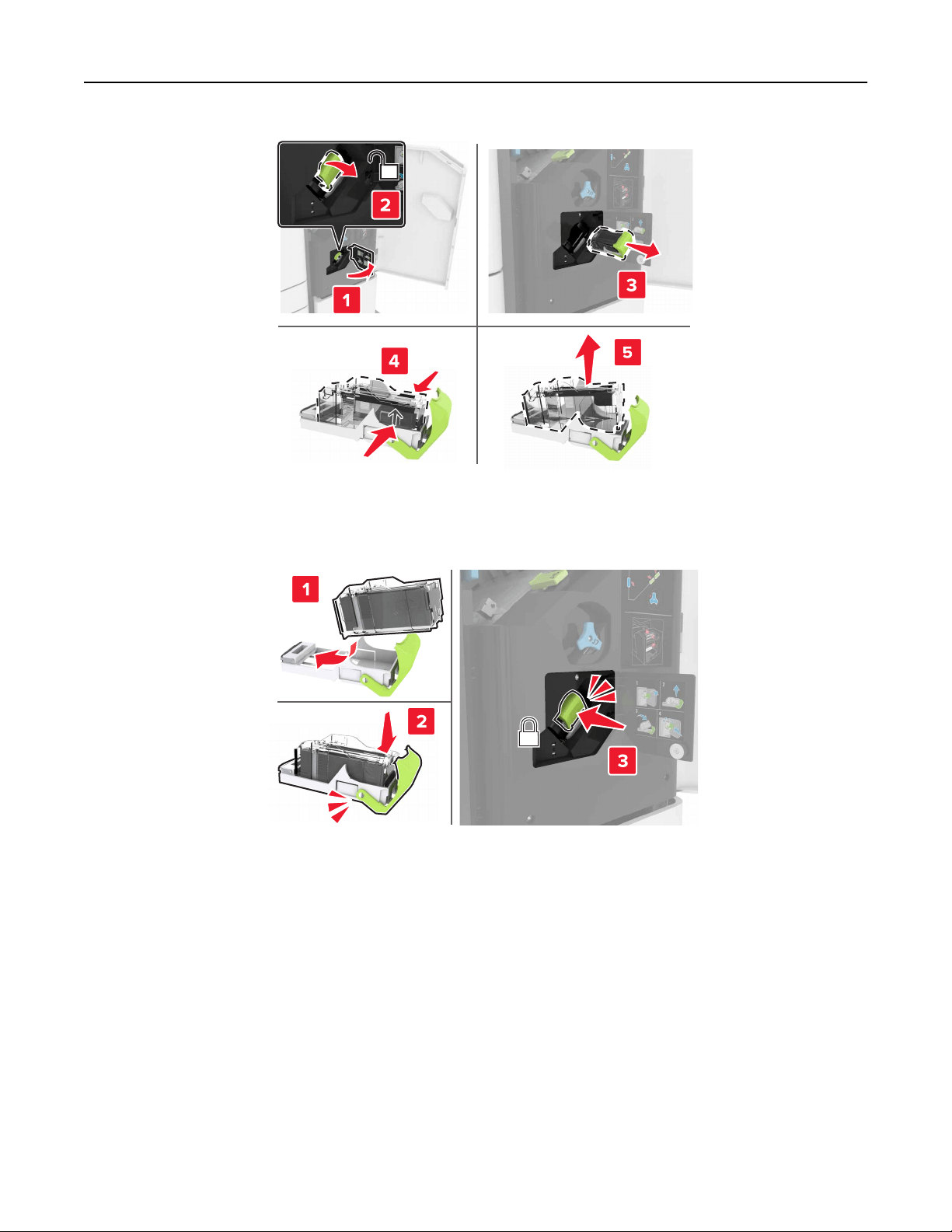
3 Unpack the new staple cartridge.
4 Insert the new staple cartridge until it clicks into place.
5 Close door J.
Maintaining the printer 101

Replacing the staple cartridge holder in the multiposition staple, hole punch finisher
1 Open door J.
2 Remove the staple cartridge holder.
3 Remove the staple cartridge.
4 Unpack the new staple cartridge holder.
Maintaining the printer 102
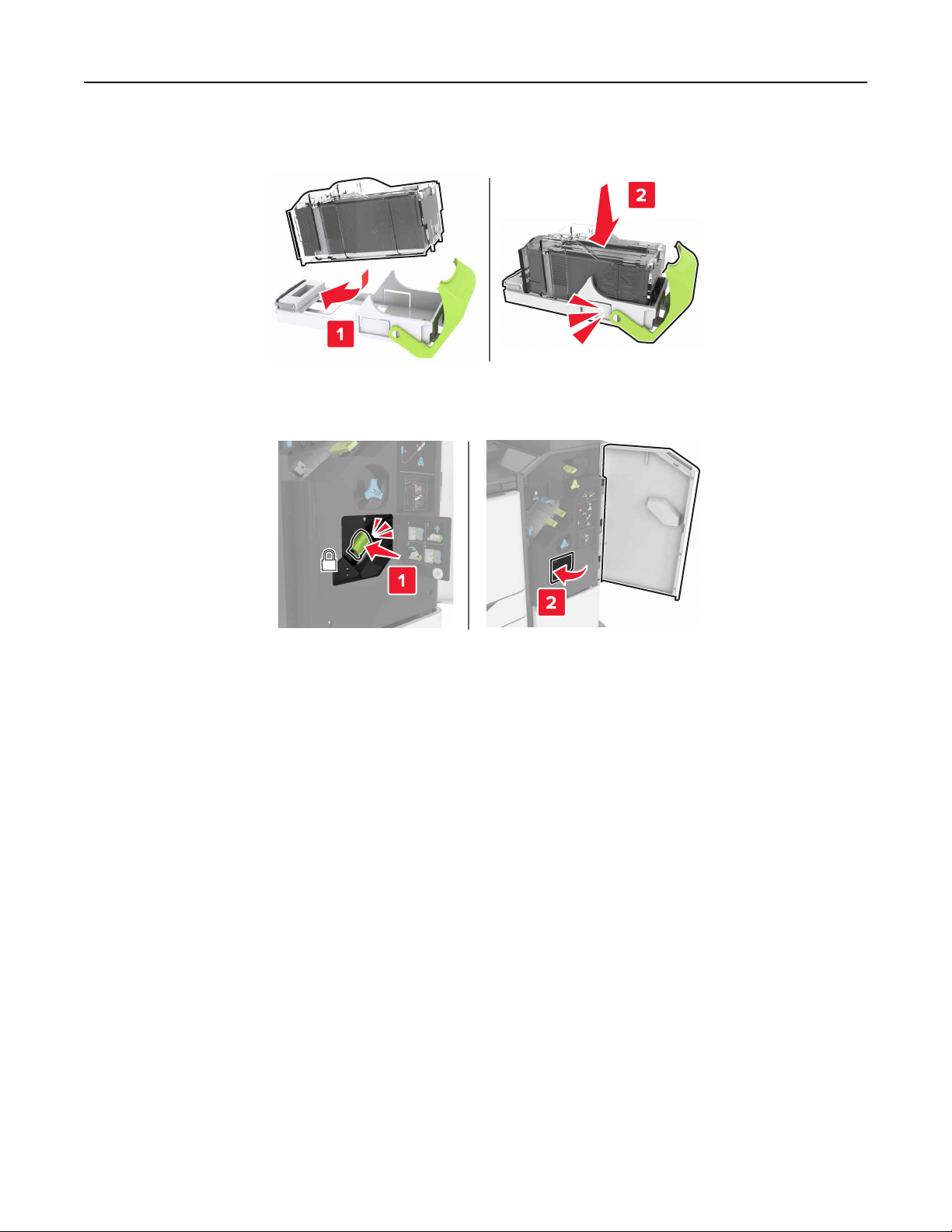
5 Insert the staple cartridge until it clicks into place.
6 Insert the staple cartridge holder until it clicks into place.
7 Close door J.
Storing supplies
Choose a cool, clean storage area for the printer supplies. Store supplies right side up in their original packing
until you are ready to use them.
Do not expose supplies to:
• Direct sunlight
• Temperatures above 35°C (95°F)
• High humidity above 80%
• Salty air
• Corrosive gases
• Heavy dust
Maintaining the printer 103

Moving the printer
Moving the printer to another location
CAUTION—POTENTIAL INJURY: The printer weight is greater than 18 kg (40 lb) and requires two or
more trained personnel to lift it safely.
CAUTION—POTENTIAL INJURY: To avoid the risk of fire or electrical shock, use only the power cord
provided with this product or the manufacturer's authorized replacement.
CAUTION—POTENTIAL INJURY: When moving the printer, follow these guidelines to avoid personal
injury or printer damage:
• Make sure that all doors and trays are closed.
• Turn o the printer, and then unplug the power cord from the electrical outlet.
• Disconnect all cords and cables from the printer.
• If the printer has a caster base, then carefully roll it to the new location. Use caution when passing over
thresholds and breaks in flooring.
• If the printer does not have a caster base but is configured with optional trays, then lift the printer o the
trays. Do not try to lift the printer and the trays at the same time.
• Always use the handholds on the printer to lift it.
• Any cart used to move the printer must have a surface able to support the full footprint of the printer.
• Any cart used to move the hardware options must have a surface able to support the dimensions of the
options.
• Keep the printer in an upright position.
• Avoid severe jarring movements.
• Make sure that your fingers are not under the printer when you set it down.
• Make sure that there is adequate clearance around the printer.
Note: Damage to the printer caused by improper moving is not covered by the printer warranty.
Shipping the printer
For shipping instructions, go to
http://support.lexmark.com or contact customer support.
Saving energy and paper
Setting up power saver modes
Eco
‑Mode
1 From the home screen, touch Settings > Device > Power Management > Eco
‑Mode.
2 Select a setting.
Maintaining the printer 104

Sleep mode
1 From the home screen, touch Settings > Device > Power Management > Timeouts > Sleep Mode.
2 Enter the number of minutes the printer stays idle before it enters Sleep mode.
Hibernate mode
1 From the home screen, touch Settings > Device > Power Management > Timeouts > Hibernate Timeout.
2 Select the amount of time before the printer enters hibernate mode.
Notes:
• Make sure to wake the printer from hibernate mode before sending a print job.
• The Embedded Web Server is disabled when the printer is in hibernate mode.
Adjusting the brightness of the printer display
1 From the home screen, touch Settings > Device > Preferences > Screen Brightness.
2 Adjust the setting.
Conserving supplies
• Print on both sides of the paper.
Note: Two-sided printing is the default setting in the print driver.
• Print multiple pages on a single sheet of paper.
• Use the preview feature to see how the document looks like before printing it.
• Print one copy of the document to check its content and format for accuracy.
Disabling the proximity sensor
Note: This feature is available only in some printer units.
From the home screen, touch Settings > Power Management > Timeouts > Disabled.
To keep the sensor running, do the following:
• Remove any obstructions within 1.5 m (5 ft.).
• Remove other devices that interfere with the sensor.
Recycling
Recycling Lexmark products
To return Lexmark products for recycling:
1 Go to
www.lexmark.com/recycle.
2 Select the product you want to recycle.
Maintaining the printer 105

Note: Printer supplies and hardware not listed in the Lexmark Collection and Recycling Program may be
recycled through your local recycling center.
Recycling Lexmark packaging
Lexmark continually strives to minimize packaging. Less packaging helps to ensure that Lexmark printers are
transported in the most ecient and environmentally sensitive manner and that there is less packaging to
dispose of. These eciencies result in fewer greenhouse emissions, energy savings, and natural resource
savings. Lexmark also
oers
recycling of packaging components in some countries or regions. For more
information, go to
www.lexmark.com/recycle, and then choose your country or region. Information on available
packaging recycling programs is included with the information on product recycling.
Lexmark cartons are 100% recyclable where corrugated recycling facilities exist. Facilities may not exist in your
area.
The foam used in Lexmark packaging is recyclable where foam recycling facilities exist. Facilities may not exist
in your area.
When you return a cartridge to Lexmark, you can reuse the box that the cartridge came in. Lexmark recycles
the box.
Returning Lexmark cartridges for reuse or recycling
The Lexmark Cartridge Collection Program allows you to return used cartridges for free to Lexmark for reuse
or recycling. One hundred percent of the empty cartridges returned to Lexmark are either reused or
demanufactured for recycling. The boxes used to return the cartridges are also recycled.
To return Lexmark cartridges for reuse or recycling, do the following:
1 Go to
www.lexmark.com/recycle.
2 Select the product that you want to recycle.
Maintaining the printer 106
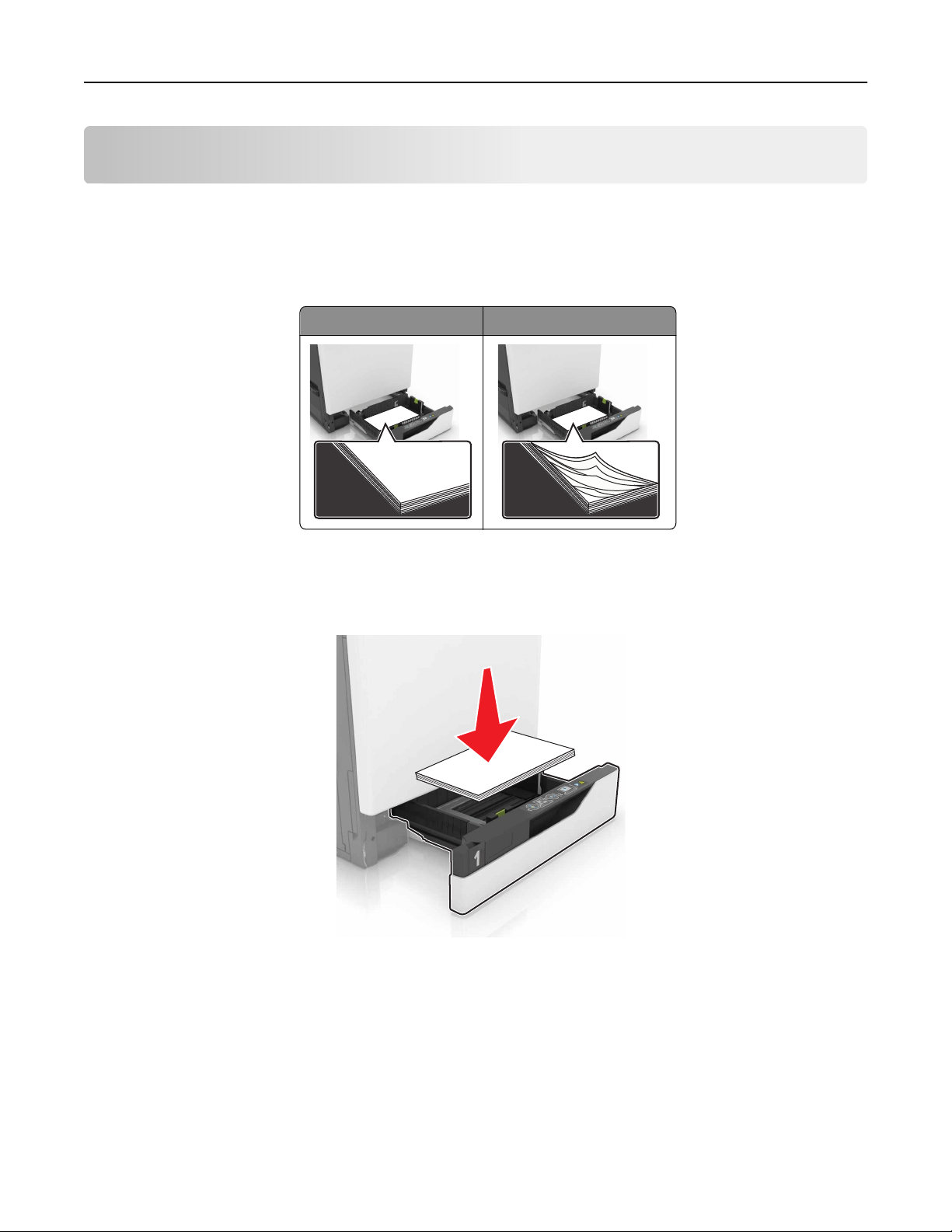
Clearing jams
Avoiding jams
Load paper properly
• Make sure that the paper lies flat in the tray.
Correct loading of paper Incorrect loading of paper
• Do not load or remove a tray while the printer is printing.
• Do not load too much paper. Make sure that the stack height is below the maximum paper fill indicator.
• Do not slide paper into the tray. Load paper as shown in the illustration.
• Make sure that the paper guides are positioned correctly and are not pressing tightly against the paper or
envelopes.
• Push the tray
firmly
into the printer after loading paper.
Use recommended paper
• Use only recommended paper or specialty media.
• Do not load paper that is wrinkled, creased, damp, bent, or curled.
Clearing jams 107
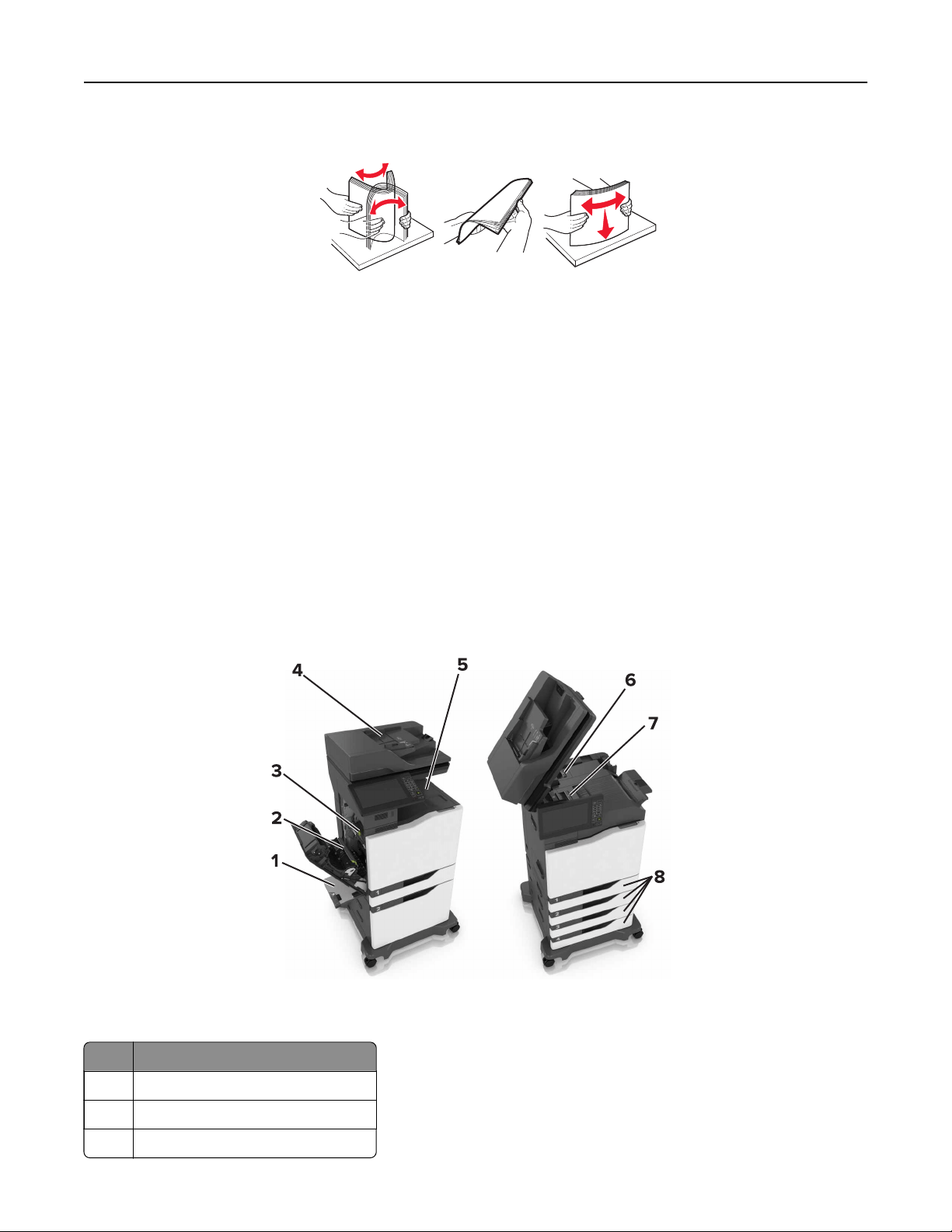
• Flex, fan, and align the paper edges before loading.
• Do not use paper that has been cut or trimmed by hand.
• Do not mix paper sizes, weights, or types in the same tray.
• Make sure that the paper size and type are set correctly on the computer or printer control panel.
• Store paper according to manufacturer recommendations.
Identifying jam locations
Notes:
• When Jam Assist is set to On, the printer flushes blank pages or pages with partial prints after a jammed
page has been cleared. Check your printed output for blank pages.
• When Jam Recovery is set to On or Auto, the printer reprints jammed pages.
Basic model
Jam locations
1 Multipurpose feeder
2 Duplex unit
3 Fuser
Clearing jams 108
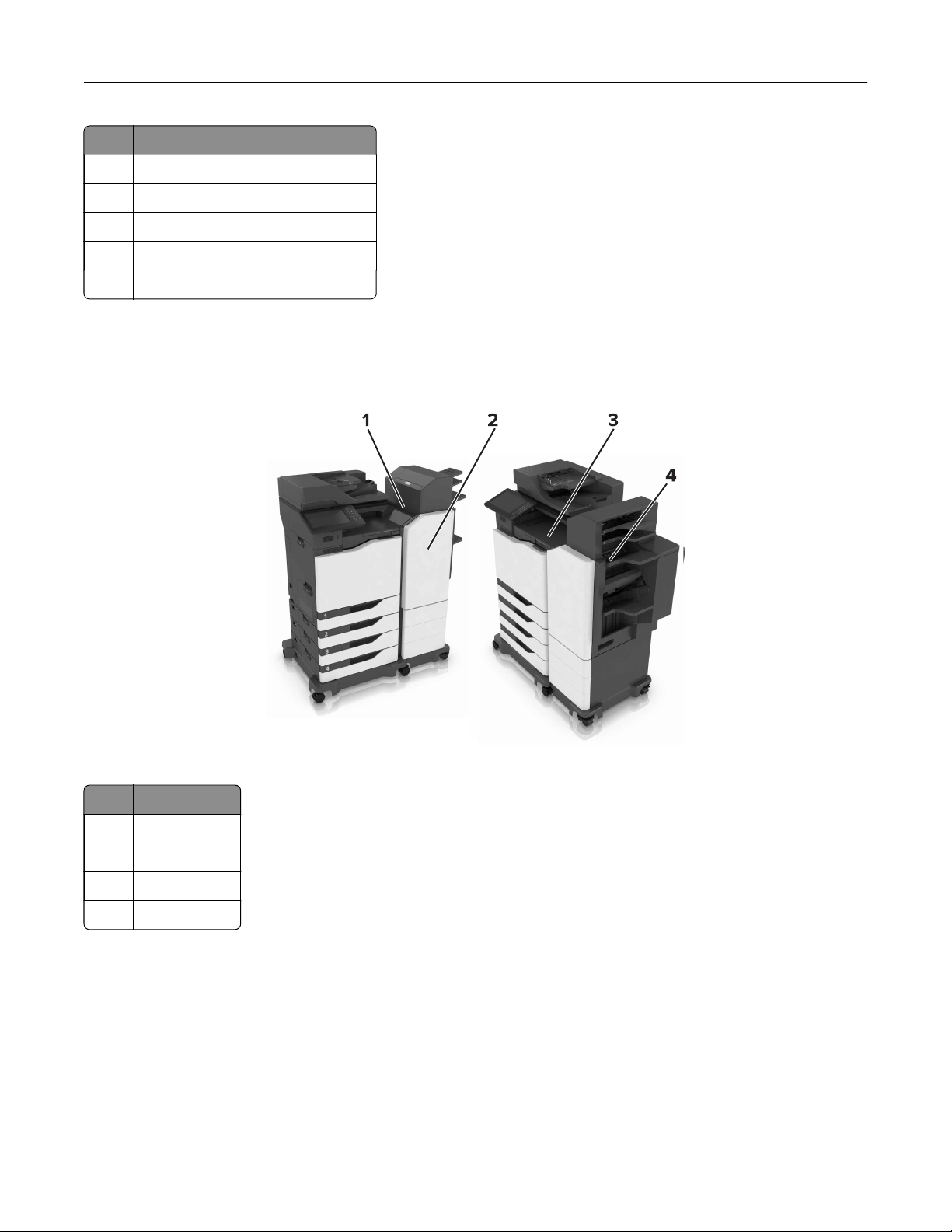
Jam locations
4 Automatic document feeder (ADF)
5 Standard bin
6 Door G
7 Door F
8 Trays
Configured model
Jam locations
1 Door L
2 Door J
3 Door K
4 Door N
Clearing jams 109
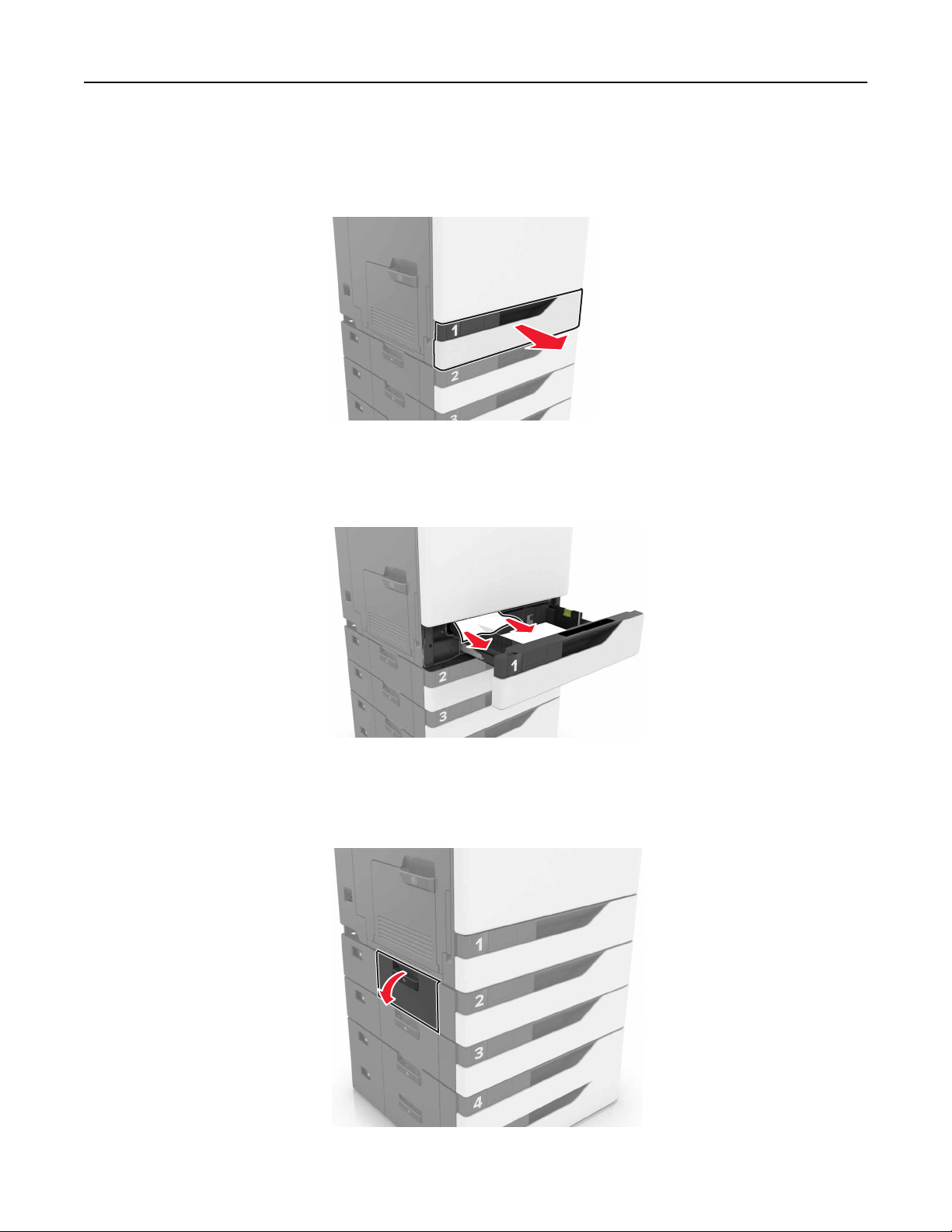
Paper jam in trays
1 Pull out the tray.
2 Remove the jammed paper.
Note: Make sure that all paper fragments are removed.
3 Insert the tray.
4 Open the tray cover.
Clearing jams 110
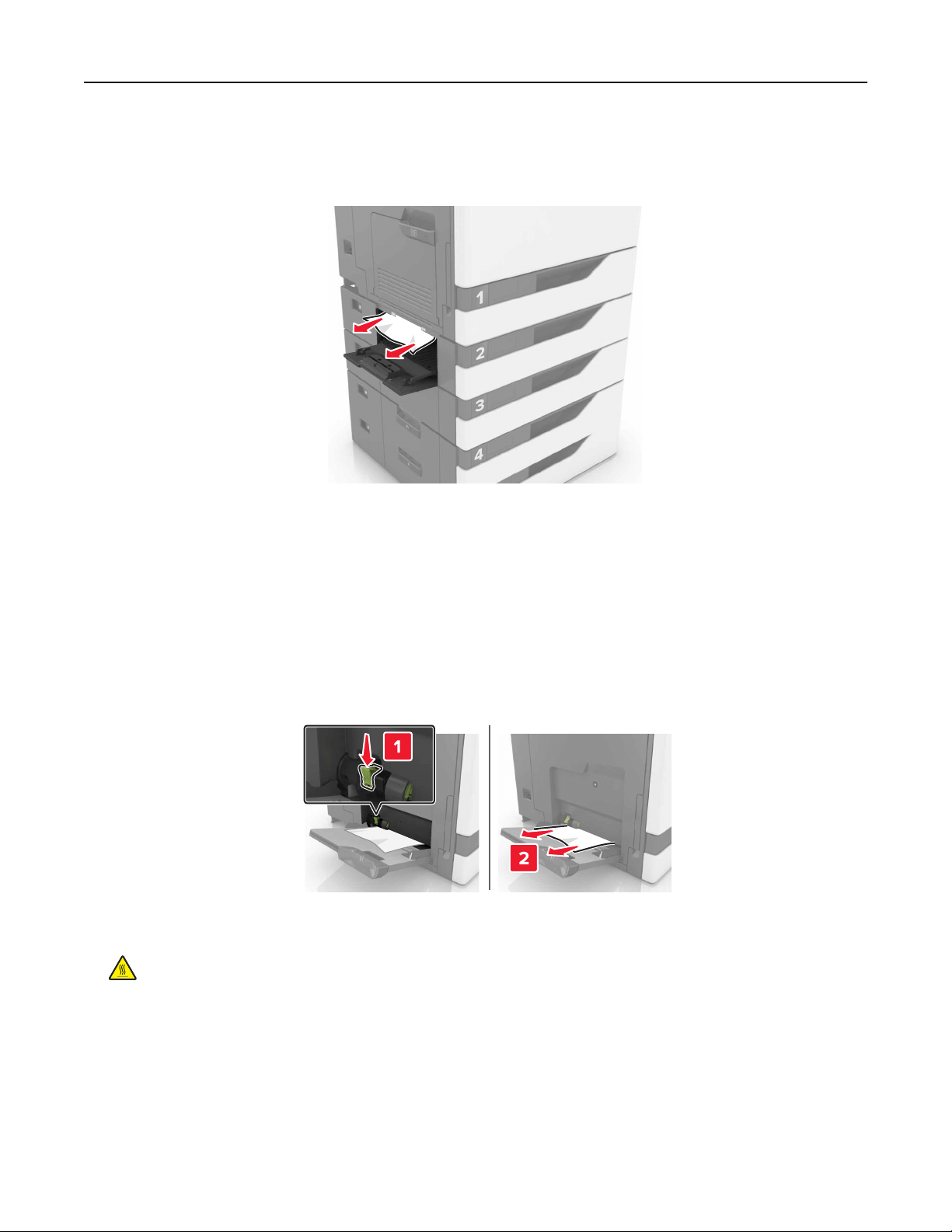
5 Remove the jammed paper.
Note: Make sure that all paper fragments are removed.
6 Close the tray cover.
Paper jam in the multipurpose feeder
1 Remove paper from the multipurpose feeder.
2 Remove the jammed paper.
Note: Make sure that all paper fragments are removed.
3 Open door B, and then remove any paper fragments.
CAUTION—HOT SURFACE: The inside of the printer might be hot. To reduce the risk of injury from a
hot component, allow the surface to cool before touching it.
Clearing jams 111
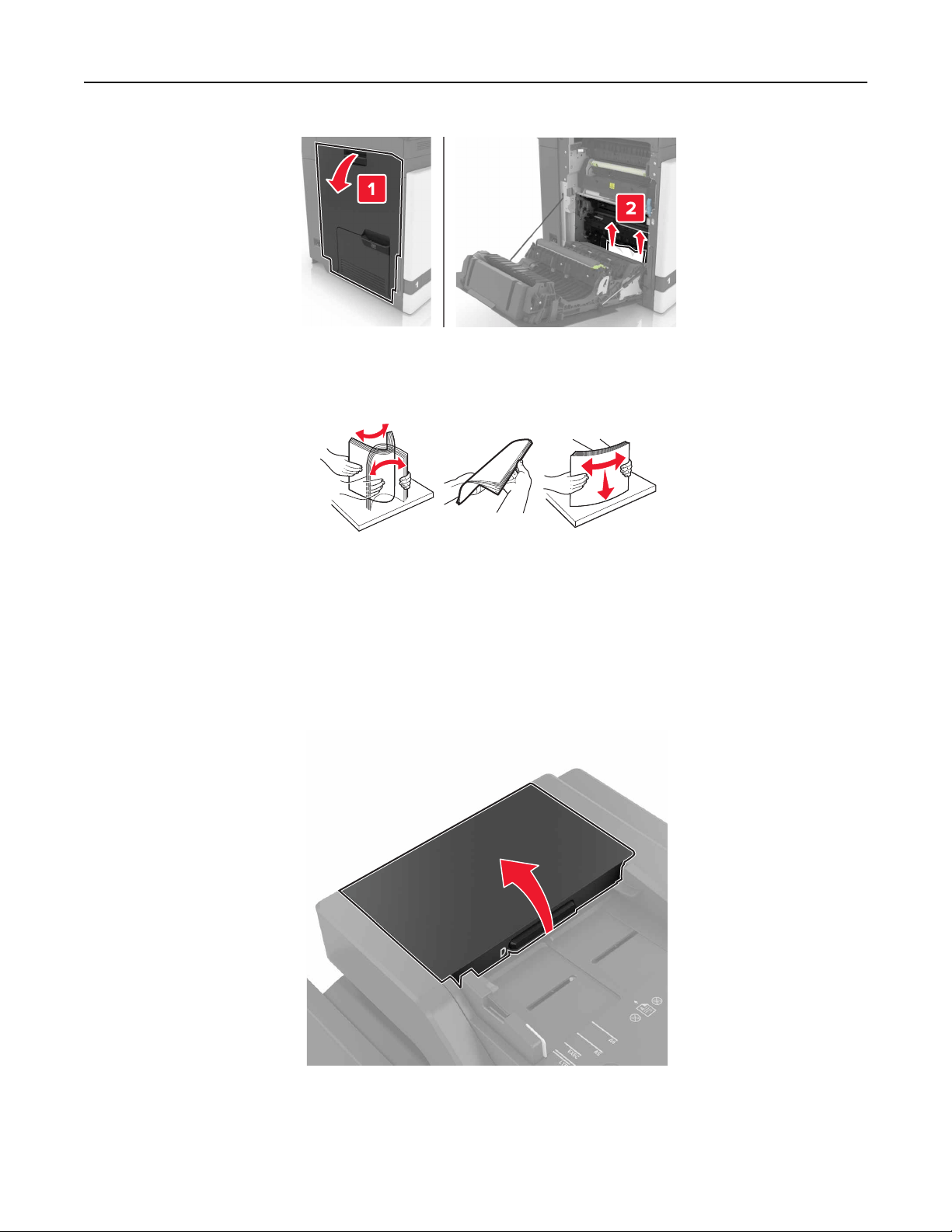
4 Close door B.
5 Flex, fan, and align the paper edges before loading.
6 Reload paper.
Paper jam in the automatic document feeder
1 Remove all original documents from the ADF tray.
2 Open door D.
3 Remove the jammed paper.
Note: Make sure that all paper fragments are removed.
Clearing jams 112
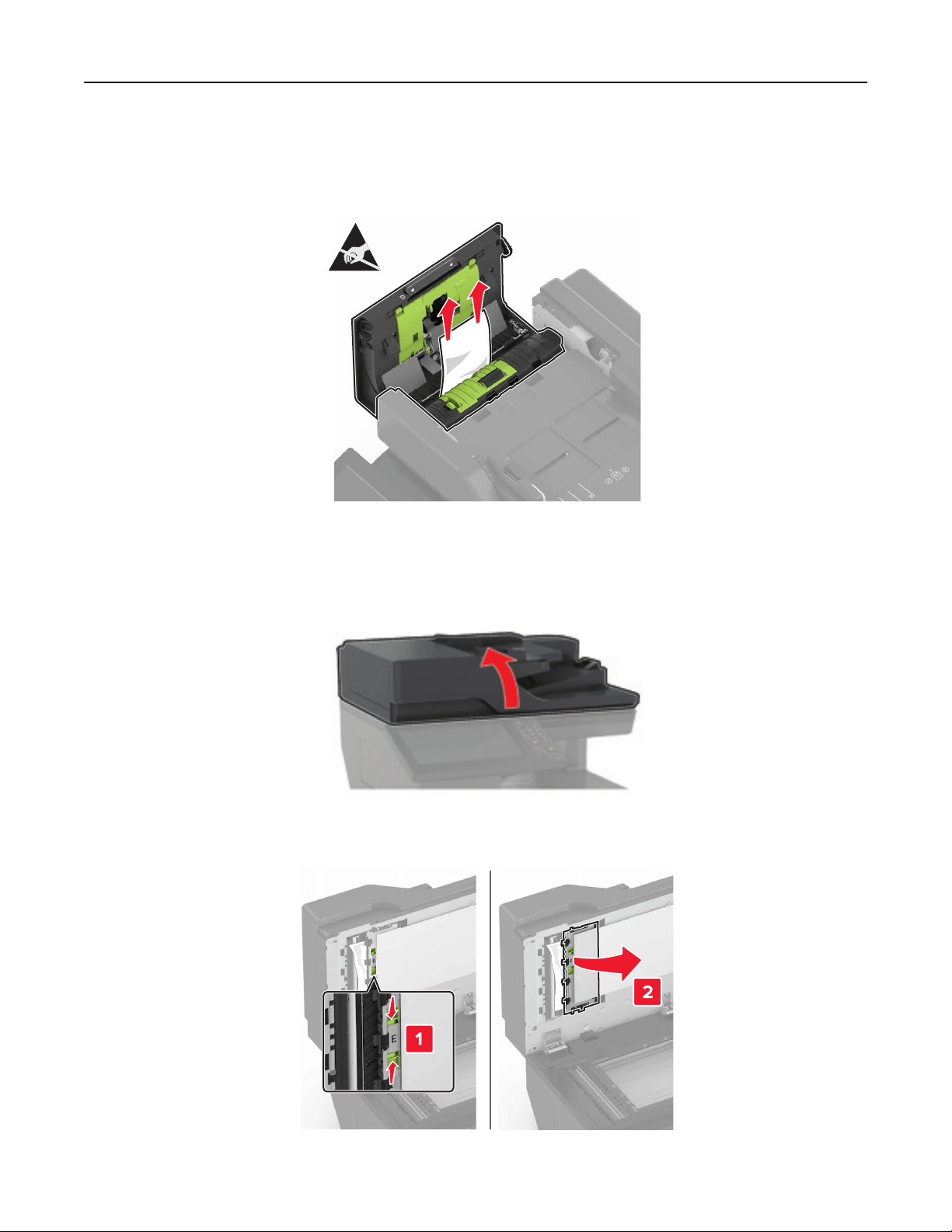
Warning—Potential Damage: Some parts of the printer are easily damaged by static electricity. Before
touching any parts or components in an area marked with the static‑sensitive symbol, touch a metal
surface in an area away from the symbol.
4 Close door D.
5 Open the scanner cover.
6 Open door E.
Clearing jams 113
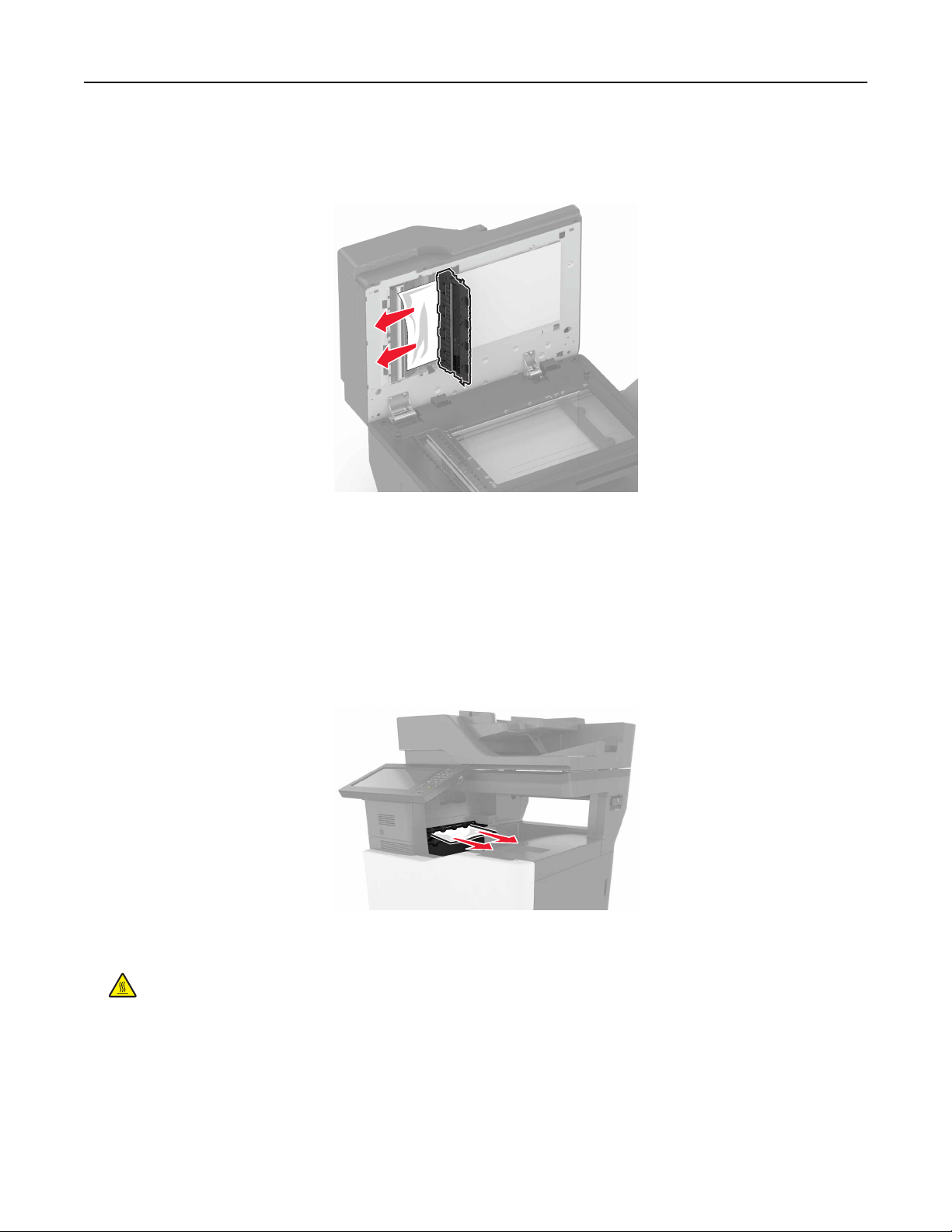
7 Remove the jammed paper.
Note: Make sure that all paper fragments are removed.
8 Close door E and the scanner cover.
Paper jam in the standard bin
1 Remove the jammed paper.
Note: Make sure that all paper fragments are removed.
2 Open door B, and then remove any paper fragments.
CAUTION—HOT SURFACE: The inside of the printer might be hot. To reduce the risk of injury from a
hot component, allow the surface to cool before touching it.
Clearing jams 114
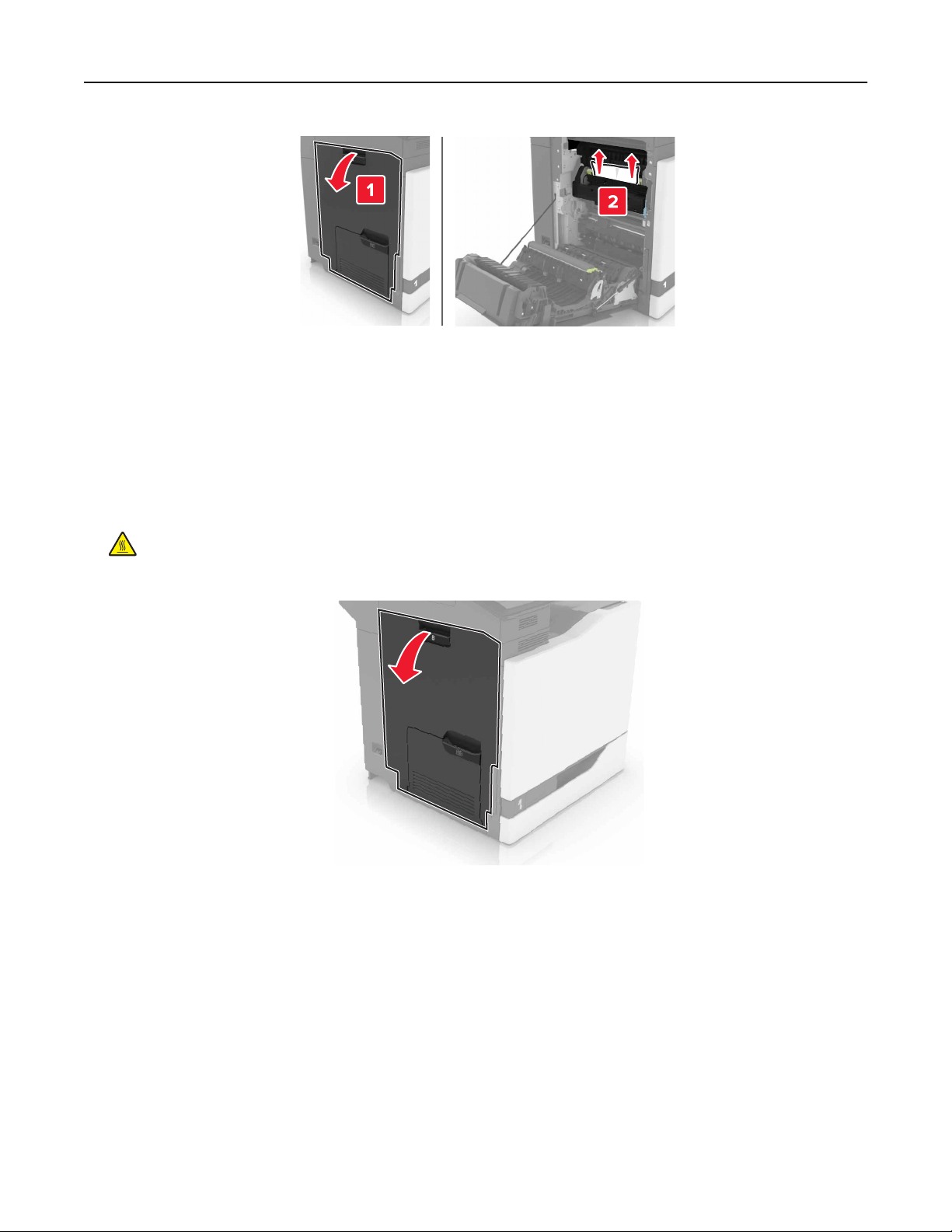
3 Close door B.
Paper jam in door B
Paper jam in the fuser
1 Open door B.
CAUTION—HOT SURFACE: The inside of the printer might be hot. To reduce the risk of injury from a
hot component, allow the surface to cool before touching it.
2 Remove the jammed paper.
Note: Make sure that all paper fragments are removed.
Clearing jams 115
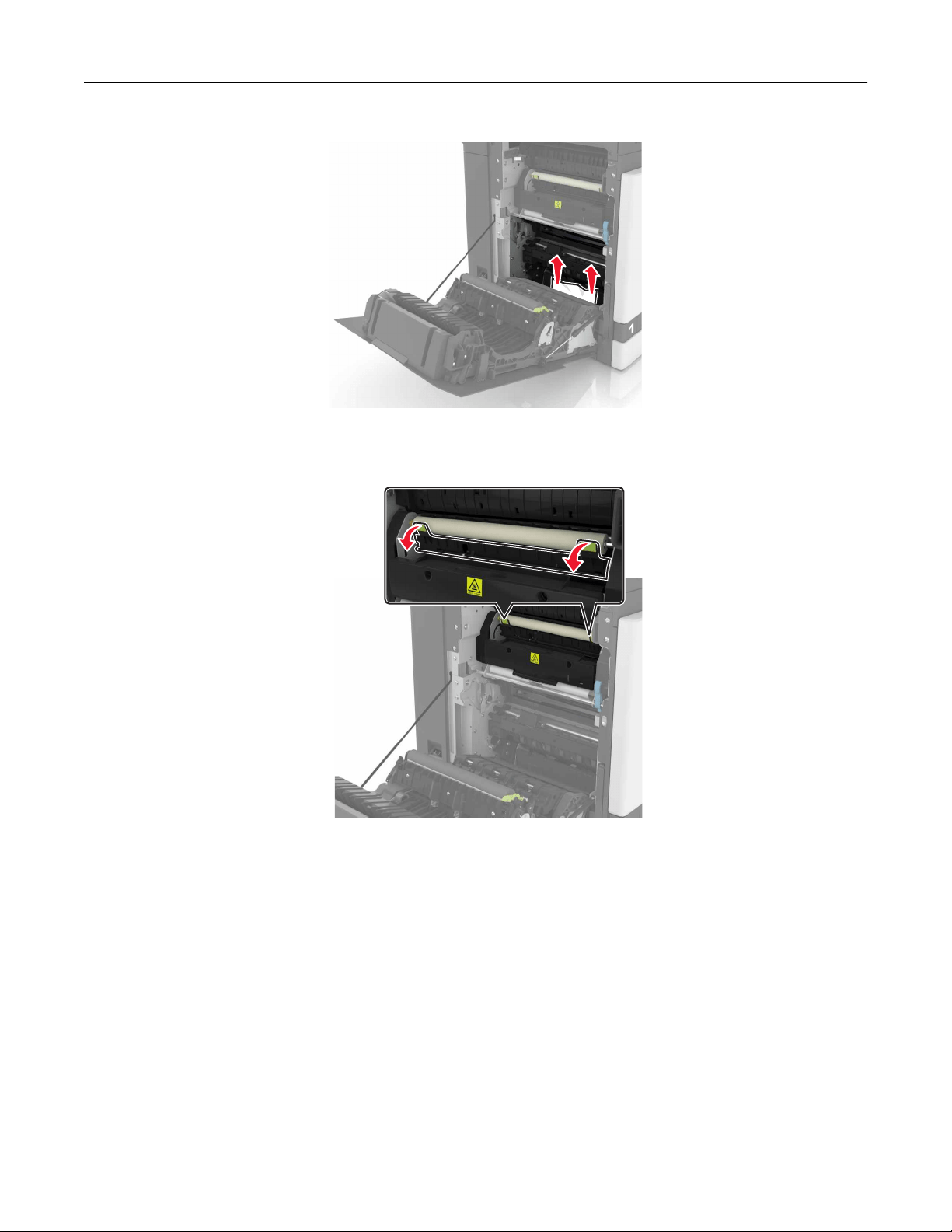
3 Open the fuser access door.
4 Remove the jammed paper.
Note: Make sure that all paper fragments are removed.
Clearing jams 116
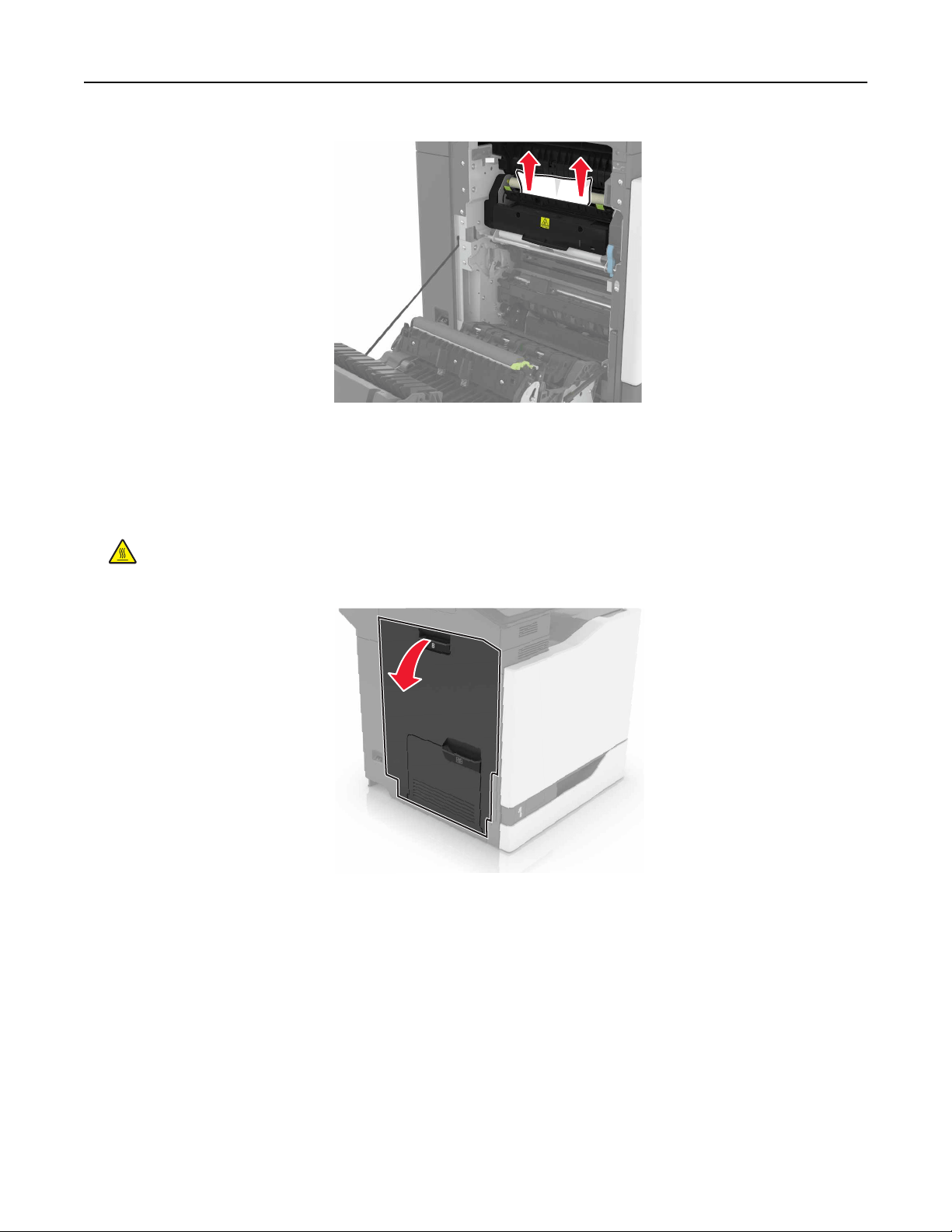
5 Close door B.
Paper jam in the duplex unit
1 Open door B.
CAUTION—HOT SURFACE: The inside of the printer might be hot. To reduce the risk of injury from a
hot component, allow the surface to cool before touching it.
2 Remove the jammed paper.
Note: Make sure that all paper fragments are removed.
Clearing jams 117
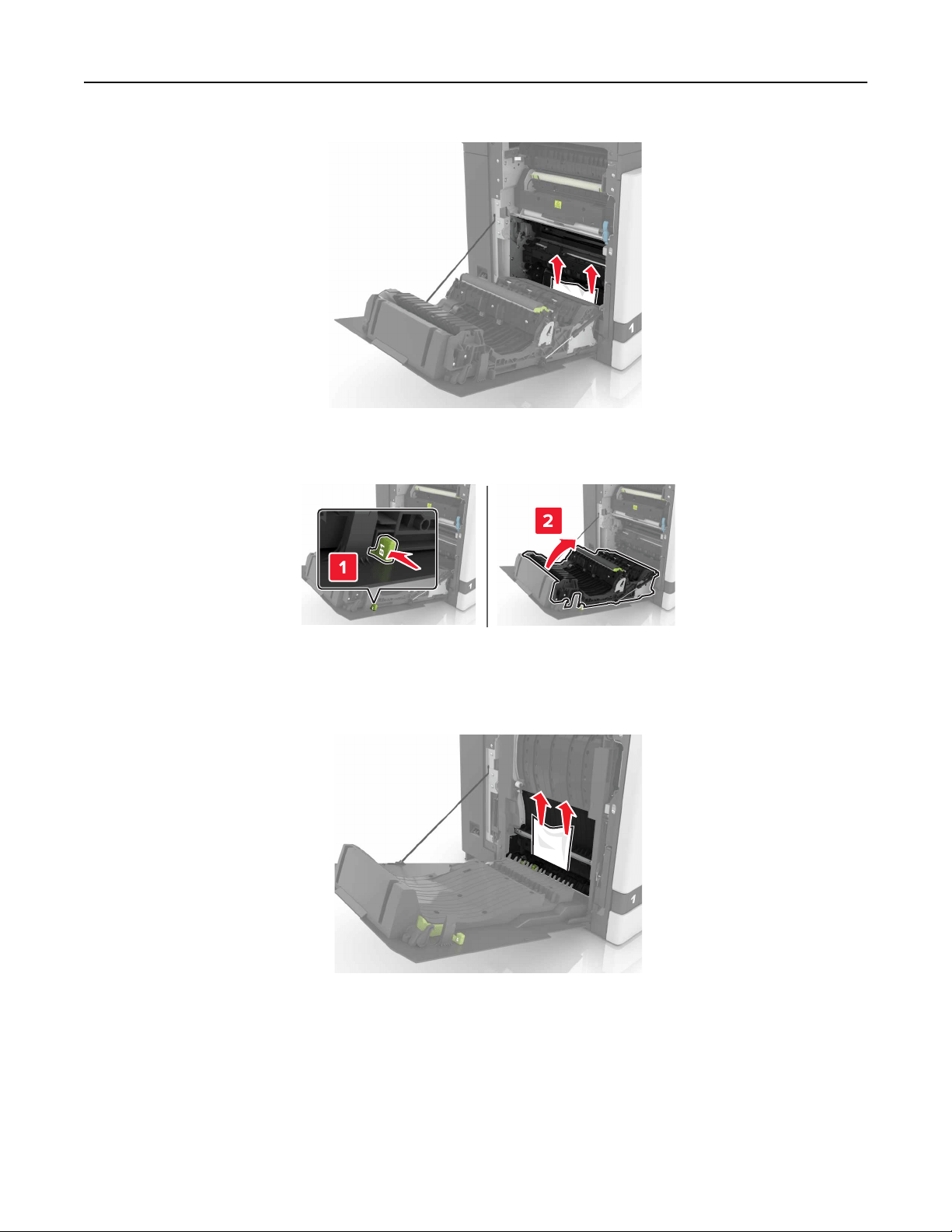
3 Open the duplex cover.
4 Remove the jammed paper.
Note: Make sure that all paper fragments are removed.
5 Close the duplex cover and door B.
Paper jam in the finisher bin
1 Remove the jammed paper.
Note: Make sure that all paper fragments are removed.
Clearing jams 118
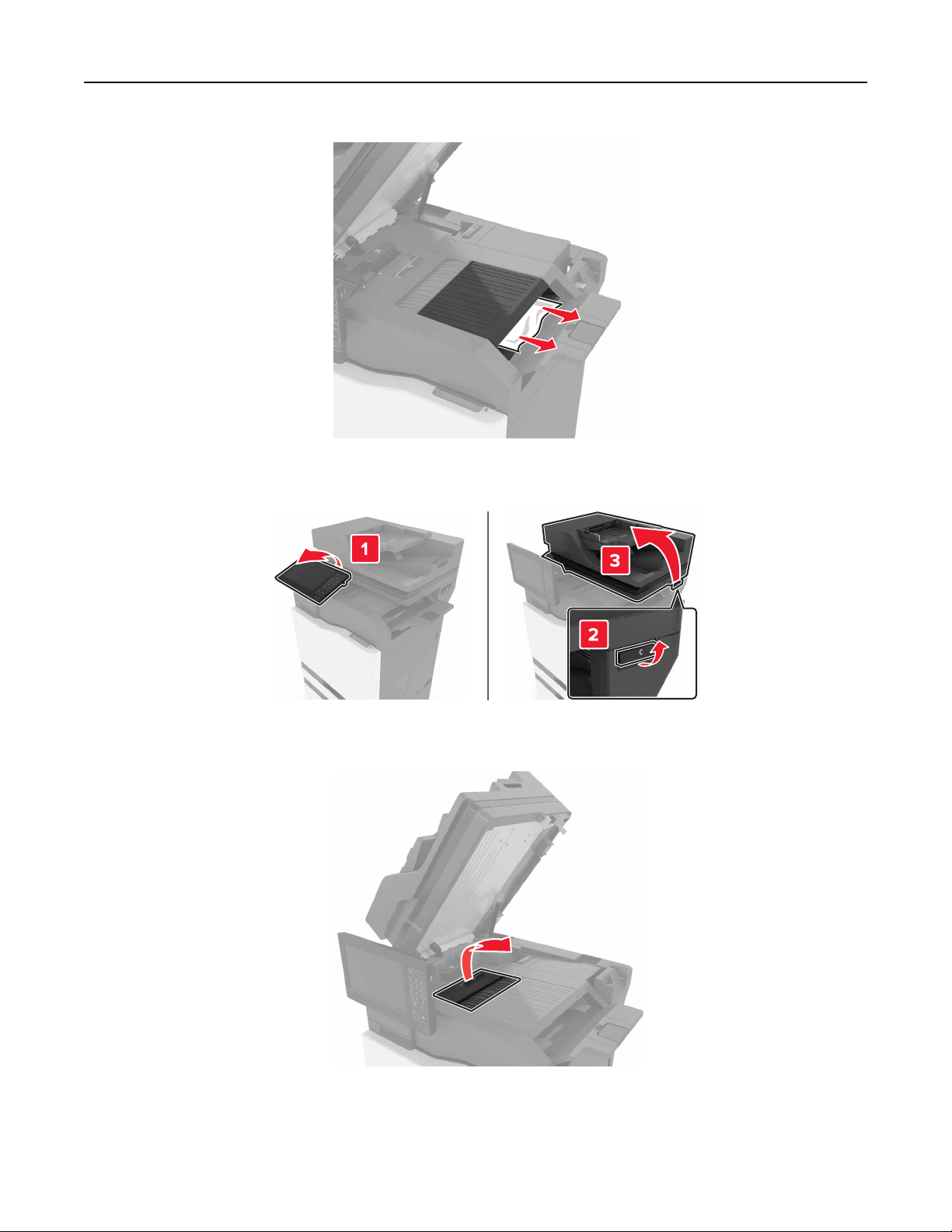
2 Open door C.
3 Open door F.
4 Remove the jammed paper.
Note: Make sure that all paper fragments are removed.
Clearing jams 119

5 Close doors F and C.
CAUTION—PINCH HAZARD: To avoid the risk of a pinch injury, keep hands clear of the labeled area
when closing door C.
Staple jam in door G
1 Open door C.
Clearing jams 120
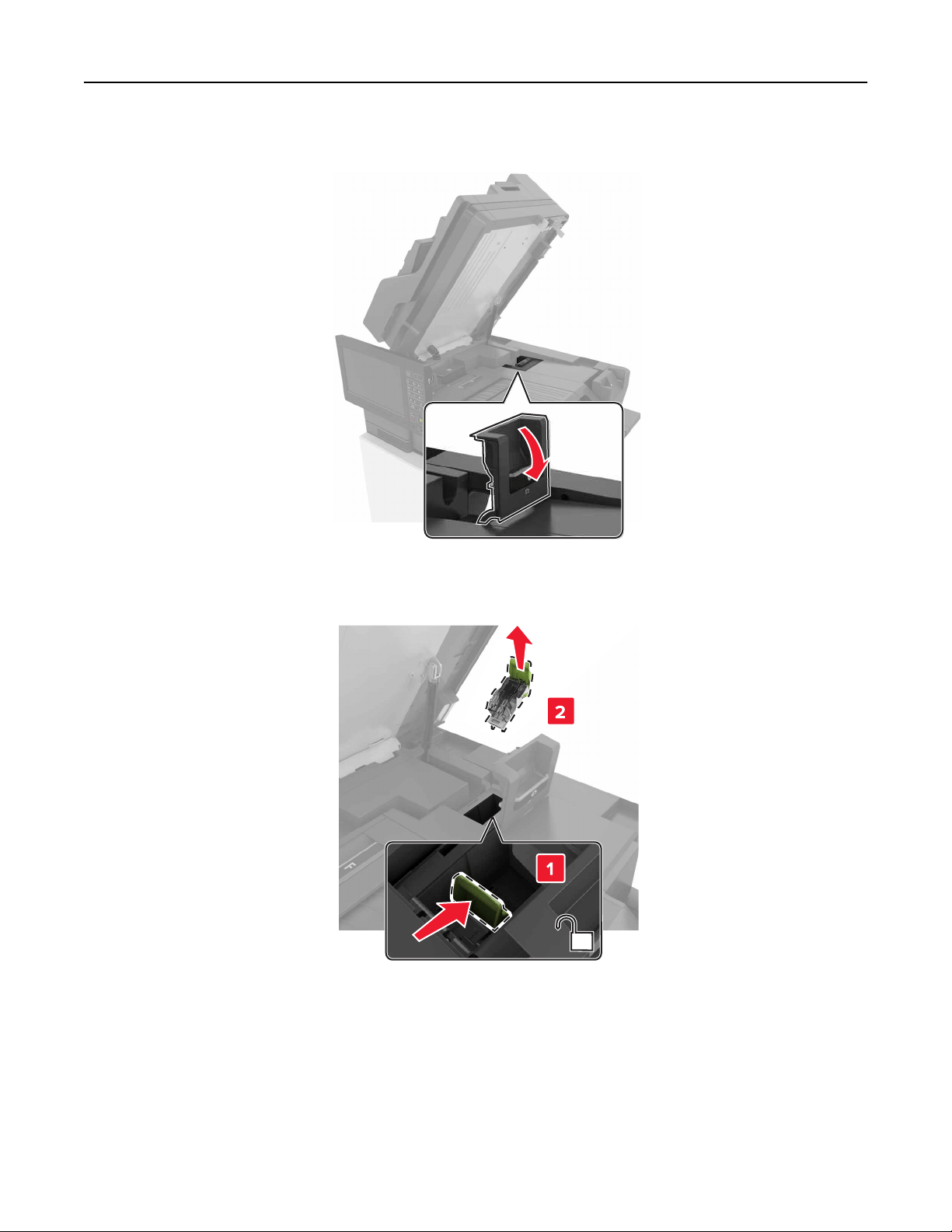
2 Open door G.
3 Pull out the staple cartridge holder.
Clearing jams 121

4 Lift the staple guard, and then remove the loose staples.
Note: Do not insert the staples that came out of the cartridge.
5 Close the staple guard.
Clearing jams 122
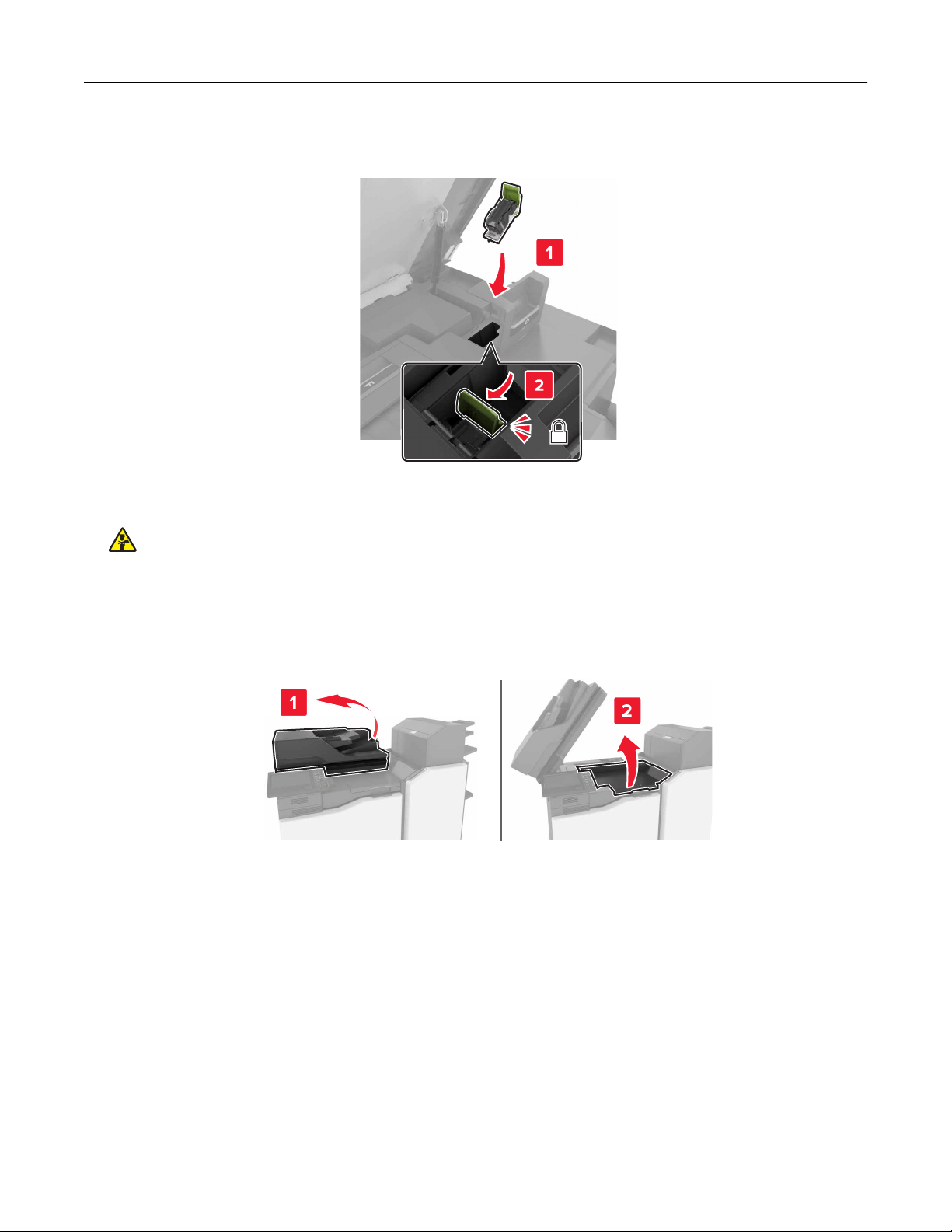
6 Insert the staple cartridge holder.
7 Close doors G and C.
CAUTION—PINCH HAZARD: To avoid the risk of a pinch injury, keep hands clear of the labeled area
when closing door C.
Paper jam in door K
1 Open doors C and K.
2 Remove the jammed paper.
Note: Make sure that all paper fragments are removed.
Clearing jams 123
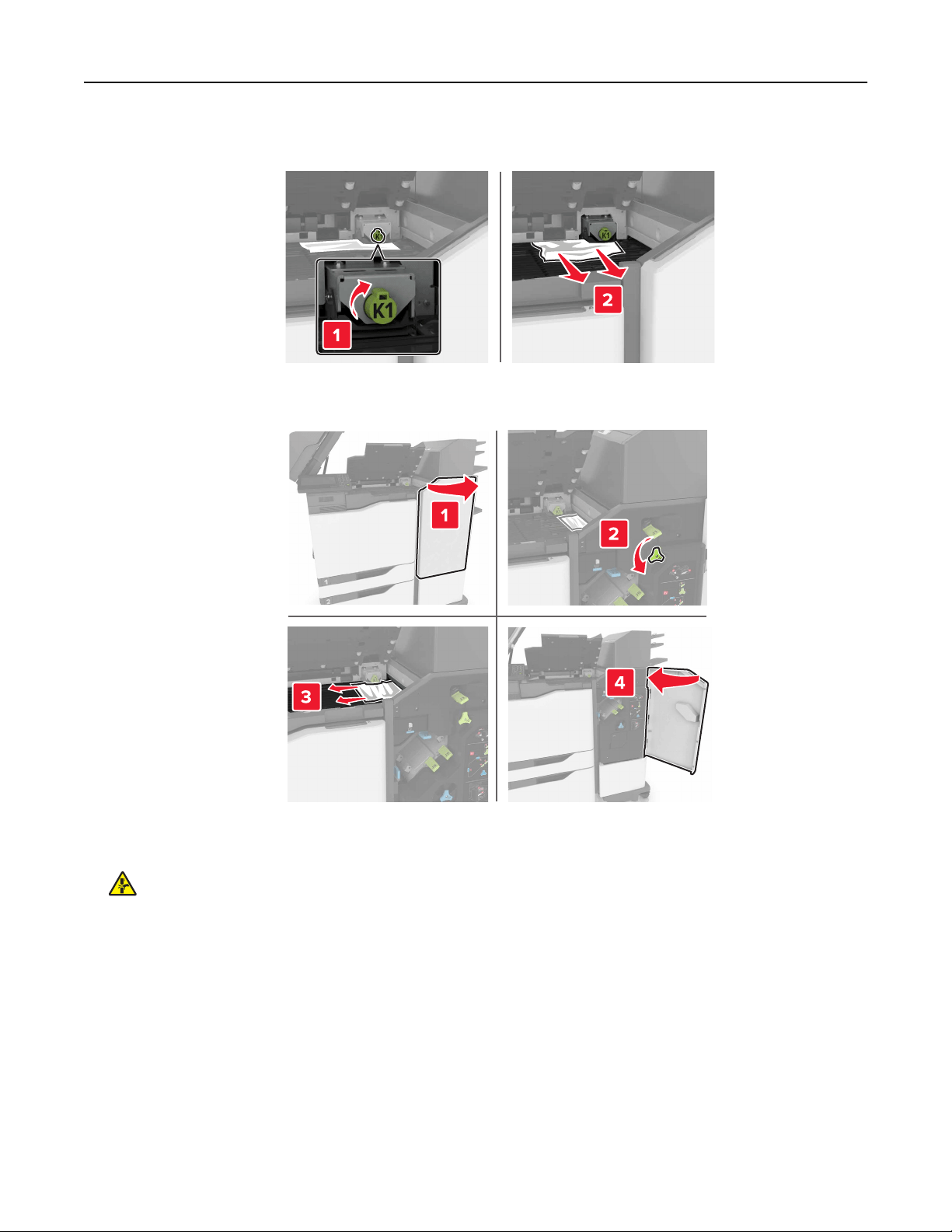
• Using knob K1
• Using knob J2
3 Close doors K and C.
CAUTION—PINCH HAZARD: To avoid the risk of a pinch injury, keep hands clear of the labeled area
when closing door C.
Clearing jams 124

Paper jam in door J
1 Open door J.
2 Remove the jammed paper.
Note: Make sure that all paper fragments are removed.
• Area J1
• Areas J3 and J4
Clearing jams 125
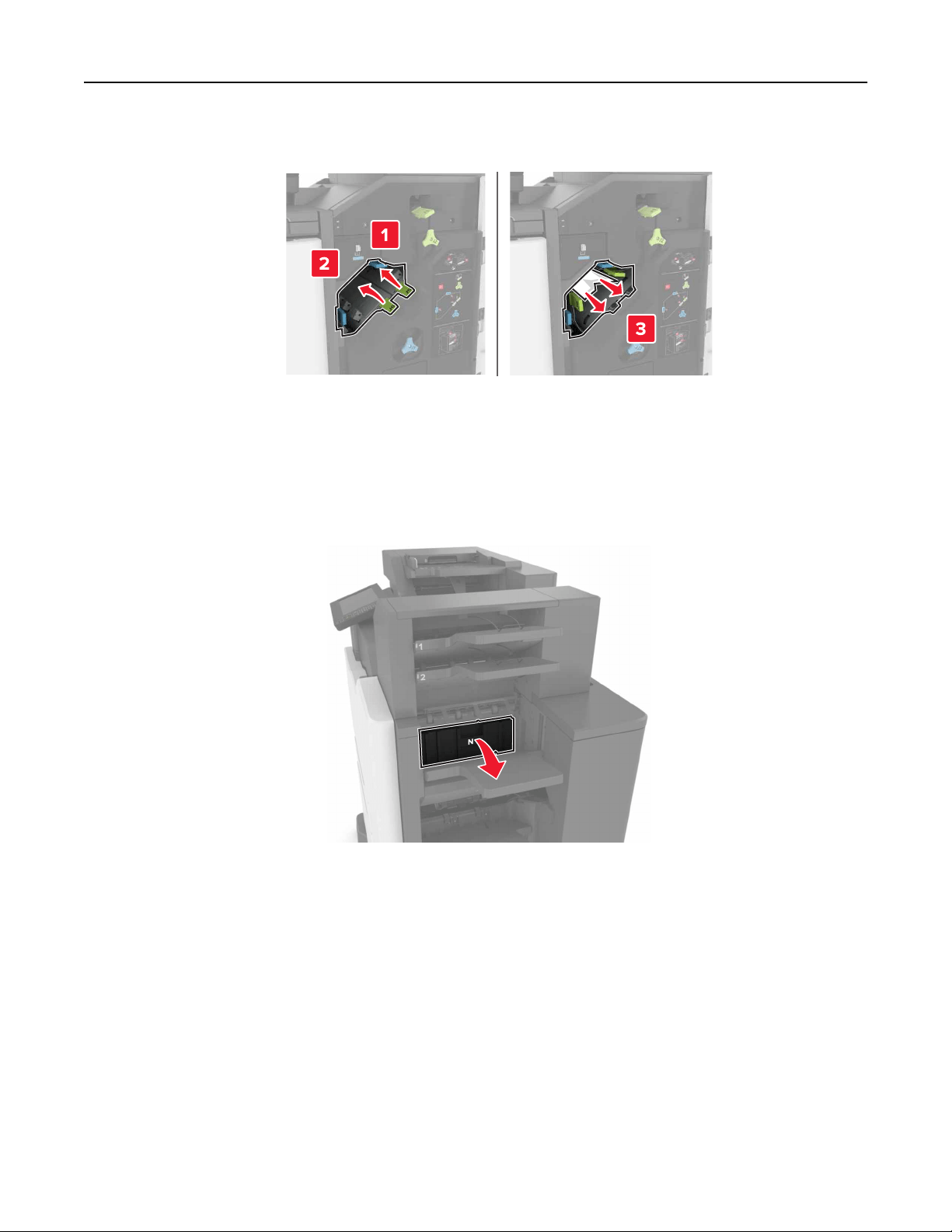
• Areas J5 and J6
3 Close door J.
Paper jam in door N
1 Open door N.
2 Remove the jammed paper.
Note: Make sure that all paper fragments are removed.
Clearing jams 126
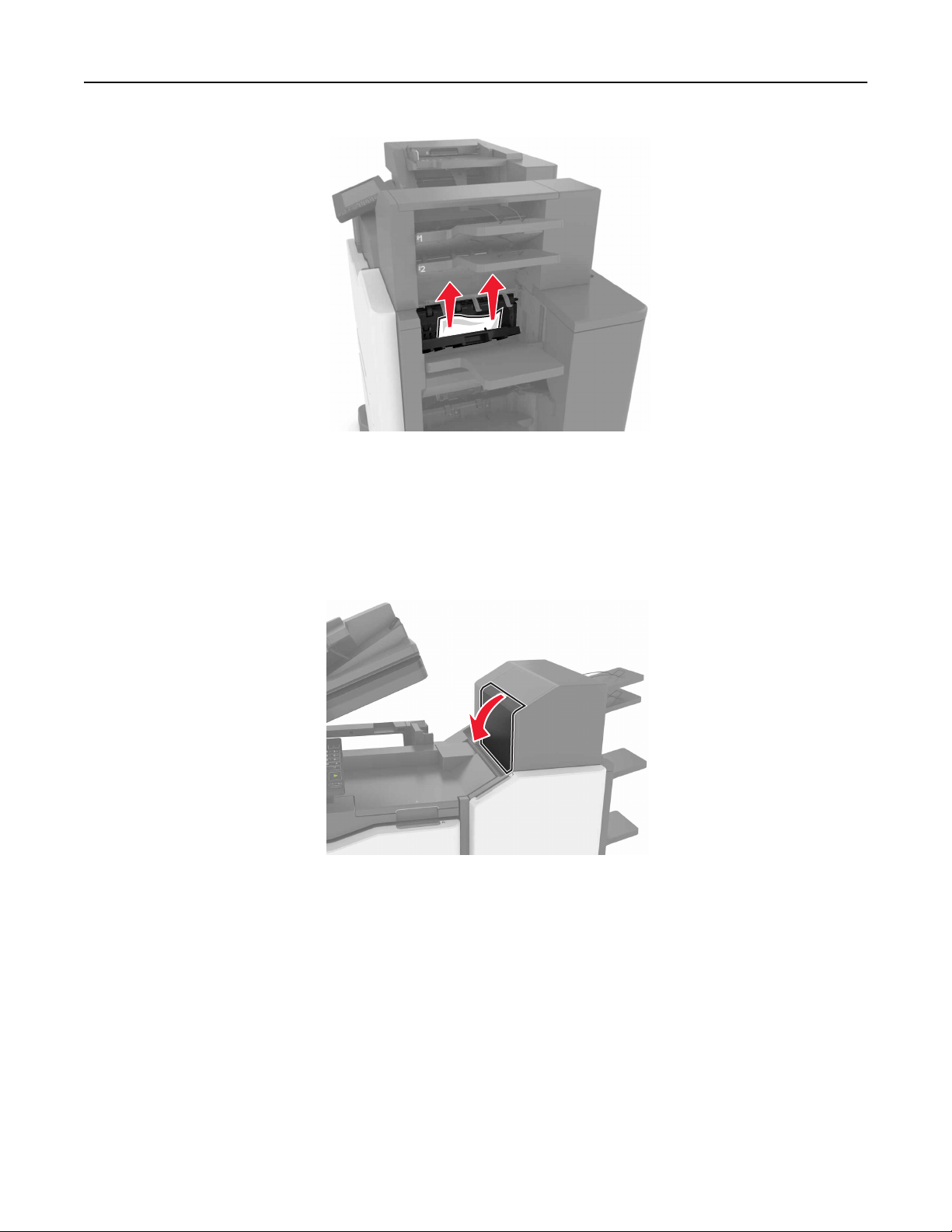
3 Close door N.
Paper jam in door L
1 Open door L.
2 Remove the jammed paper.
Note: Make sure that all paper fragments are removed.
Clearing jams 127
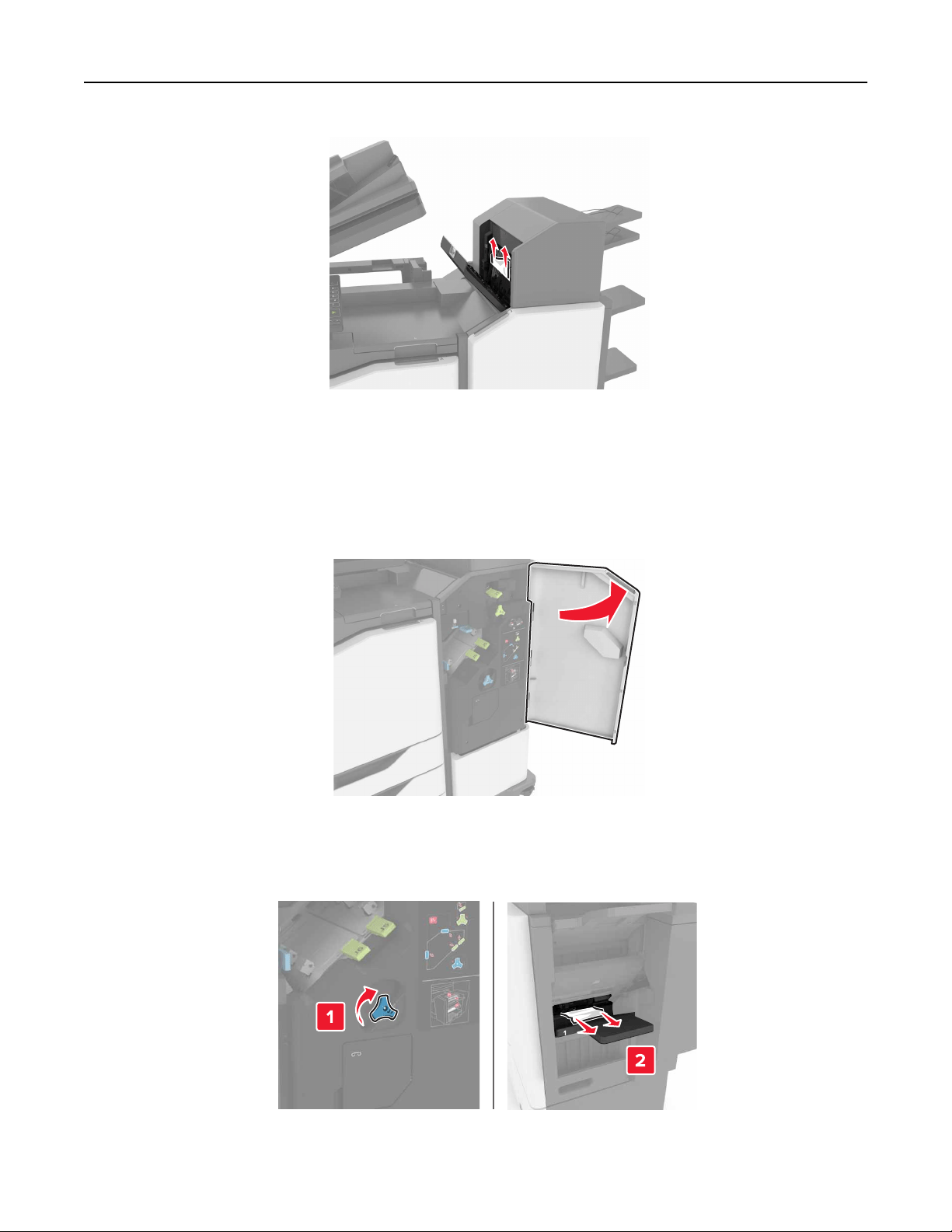
3 Close door L.
Paper jam in the staple finisher bin
1 Open door J.
2 Remove the jammed paper.
Note: Make sure that all paper fragments are removed.
Clearing jams 128
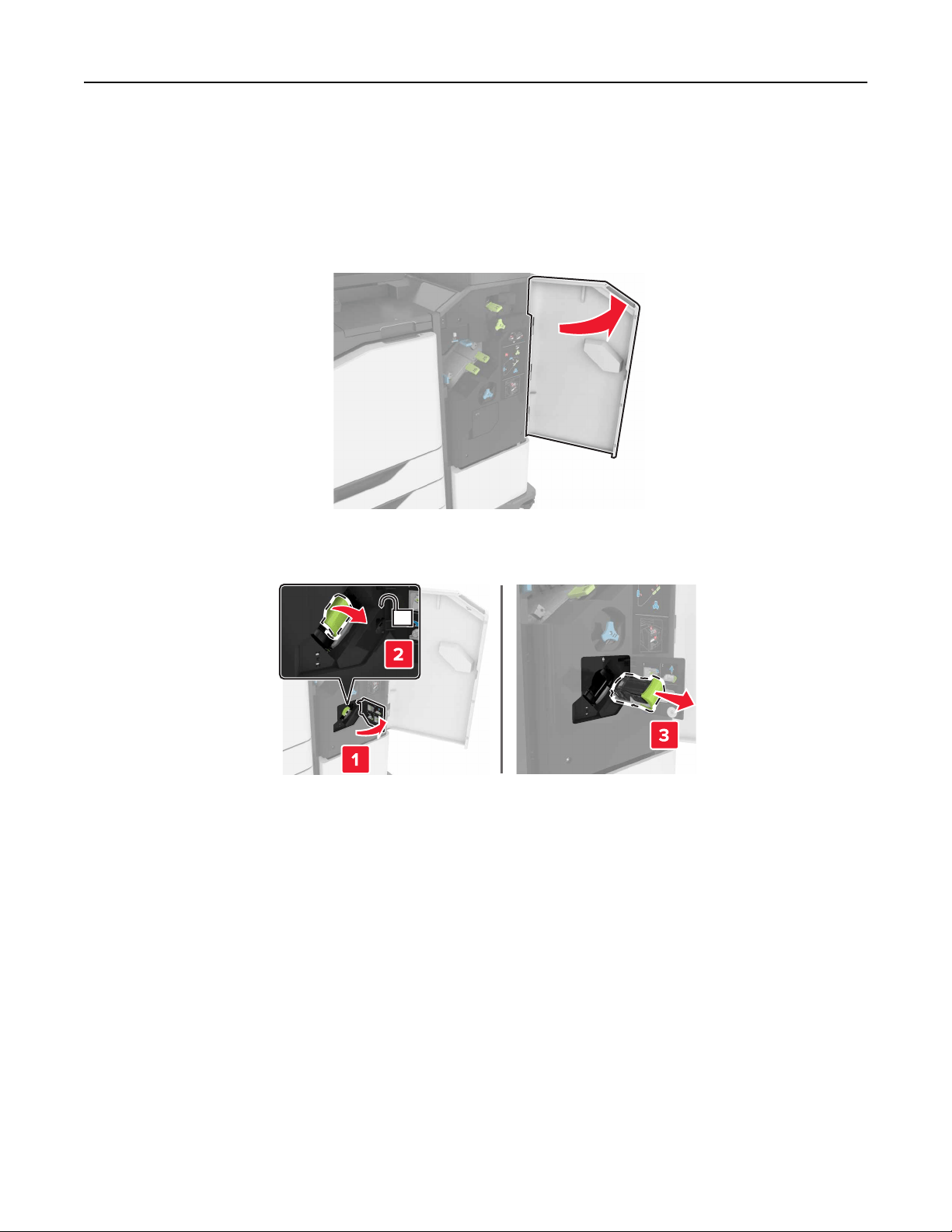
3 Close door J.
Staple jam in door J
1 Open door J.
2 Remove the staple cartridge holder.
Clearing jams 129

3 Open the staple guard, and then remove the loose staples.
Note: Do not insert the staples that came out of the cartridge.
4 Close the staple guard.
Clearing jams 130
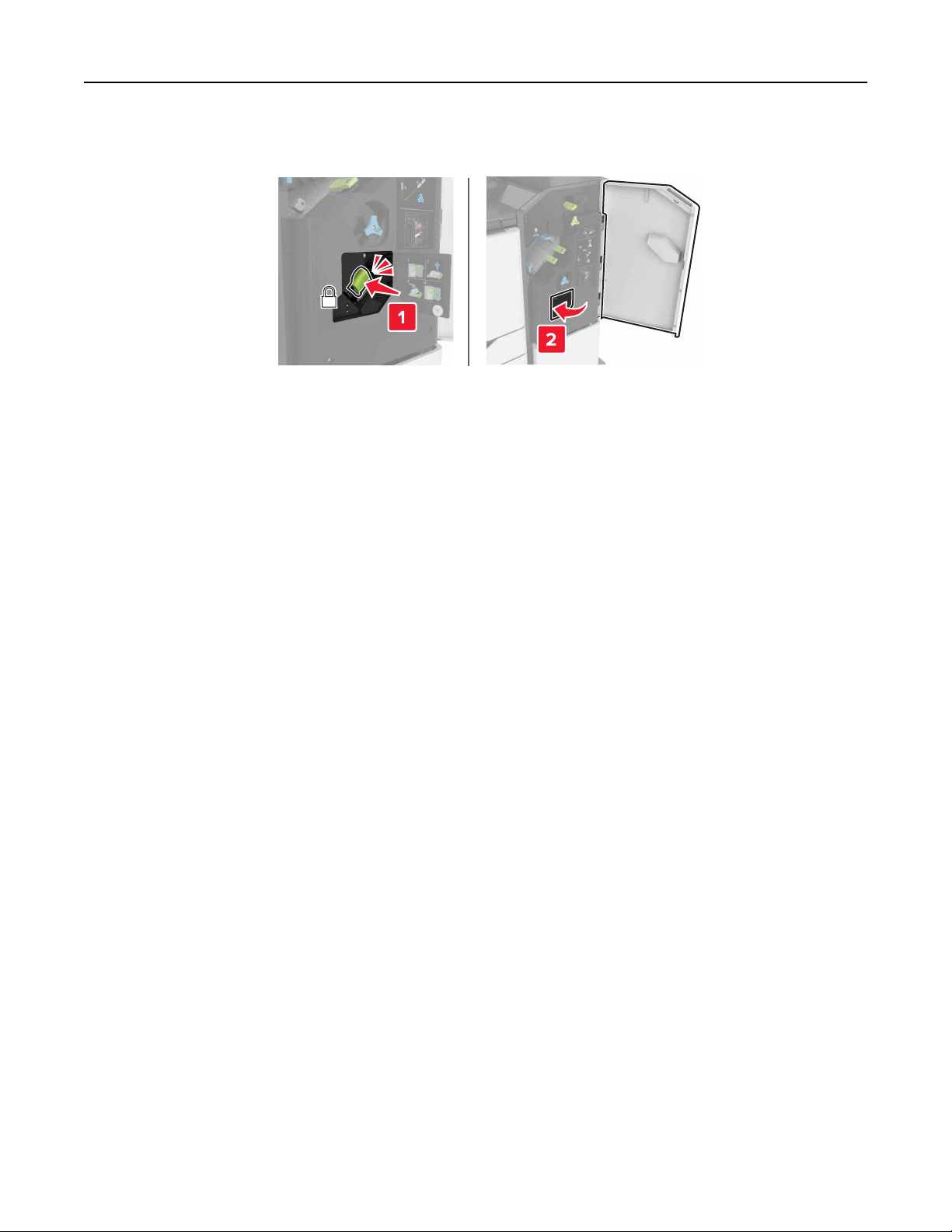
5 Insert the staple cartridge holder.
6 Close door J.
Clearing jams 131

Troubleshooting
Network connection problems
Cannot open Embedded Web Server
Action Yes No
Step 1
Check if you are using a supported browser:
• Internet Explorer® version 9 or later
• Safari version 8.0.3 or later
• Google Chrome
TM
• Mozilla Firefox
Is your browser supported?
Go to step 2. Install a supported
browser.
Step 2
Make sure that the printer IP address is correct.
View the printer IP address:
• From the home screen
• From the TCP/IP section in the Network/Ports menu
• By printing a network setup page or menu settings page,
and then finding the TCP/IP section
Note: An IP address appears as four sets of numbers separated
by periods, such as 123.123.123.123.
Is the printer IP address correct?
Go to step 3. Type the correct
printer IP address in
the address
field.
Step 3
Check if the printer is on.
Is the printer on?
Go to step 4. Turn on the printer.
Step 4
Check if the network connection is working.
Is the network connection working?
Go to step 5. Contact your
administrator.
Step 5
Make sure that the cable connections to the printer and print server
are secure.
For more information, see the setup documentation that came with
the printer.
Are the cable connections secure?
Go to step 6. Secure the cable
connections.
Troubleshooting 132

Action Yes No
Step 6
Check if the web proxy servers are disabled.
Are the web proxy servers disabled?
Go to step 7. Contact your
administrator.
Step 7
Access the Embedded Web Server.
Did the Embedded Web Server open?
The problem is
solved.
Contact
customer
support.
Unable to read
flash
drive
Action Yes No
Step 1
Check if the flash drive is inserted into the front USB port.
Note: The flash drive does not work when it is inserted into the
rear USB port.
Is the
flash
drive inserted into the front USB port?
Go to step 2. The problem is
solved.
Step 2
Check if the flash drive is supported. For more information, see
“Supported flash drives and file types” on page 32
Does the error message still appear?
Go to step 3. The problem is
solved.
Step 3
Check if the front USB port is disabled. For more information, see
“Enabling the USB port” on page 133.
Does the error message still appear?
Contact
customer
support.
The problem is
solved.
Enabling the USB port
From the home screen, touch Settings > Network/Ports > USB > Enable USB Port.
Checking the printer connectivity
1 From the home screen, touch Settings > Reports > Network > Network Setup Page.
2 Check the first section of the network setup page, and confirm that the status is connected.
If the status is not connected, then the LAN drop may be inactive, or the network cable may be unplugged
or malfunctioning. Contact your administrator for assistance.
Troubleshooting 133

Hardware options problems
Cannot detect internal option
Action Yes No
Step 1
Turn o the printer, wait for about 10 seconds, and then turn it back
on.
Does the internal option operate correctly?
The problem is
solved.
Go to step 2.
Step 2
Print a menu settings page, and then check if the internal option
appears in the Installed Features list.
Is the internal option listed in the menu settings page?
Go to step 4. Go to step 3.
Step 3
Check if the internal option is properly installed in the controller
board.
a Turn o the printer, and then unplug the power cord from the
electrical outlet.
b Make sure that the internal option is installed in the appropriate
connector in the controller board.
c Connect the power cord to the electrical outlet, and then turn
on the printer.
CAUTION—POTENTIAL INJURY: To avoid the risk of fire
or electrical shock, connect the power cord to an
appropriately rated and properly grounded electrical outlet
that is near the product and easily accessible.
Does the internal option operate correctly?
The problem is
solved.
Go to step 4.
Step 4
a Check if the internal option is available in the print driver.
Note: If necessary, manually add the internal option in the
print driver to make it available for print jobs. For more
information, see
“Adding available options in the print driver”
on page 196.
b Resend the print job.
Does the internal option operate correctly?
The problem is
solved.
Contact
customer
support.
Troubleshooting 134

Internal solutions port does not operate correctly
Action Yes No
Step 1
Print a menu settings page, and then check if the internal solutions
port (ISP) appears in the Installed Features list.
Is the ISP listed in the Installed Features list?
Go to step 3. Go to step 2.
Step 2
Remove, and then install the ISP. For more information, see
“Installing an internal solutions port” on page 175.
Note: Use a supported ISP.
Does the ISP operate correctly?
The problem is
solved.
Go to step 3.
Step 3
Check the cable and the ISP connection.
a Use the correct cable, and then make sure that it is securely
connected to the ISP.
b Check if the ISP solution interface cable is securely connected
into the receptacle of the controller board.
Does the ISP operate correctly?
The problem is
solved.
Contact
customer
support.
Parallel or serial interface card does not operate correctly
Action Yes No
Step 1
Print a menu settings page, and then check if the parallel or serial
interface card appears in the Installed Features list.
Is the parallel or serial interface card listed in the Installed Features
list?
Go to step 3. Go to step 2.
Step 2
Remove, and then install the parallel or serial interface card.
For more information, see
“Installing an internal solutions port” on
page 175.
Does the parallel or serial interface card operate correctly?
The problem is
solved.
Go to step 3.
Step 3
Check the connection between the cable and the parallel or serial
interface card.
Does the parallel or serial interface card operate correctly?
The problem is
solved.
Contact
customer
support.
Troubleshooting 135

Defective flash detected
Try one or more of the following:
• Replace the defective flash memory.
• From the printer control panel, select Continue to ignore the message and continue printing.
• Cancel the current print job.
Not enough free space in
flash
memory for resources
Try one or more of the following:
• From the printer control panel, select Continue to clear the message and continue printing.
• Delete fonts, macros, and other data stored in the flash memory.
• Install flash memory with larger capacity.
Note: Downloaded fonts and macros that are not previously stored in the
flash
memory are deleted.
Unformatted
flash
detected
Try one or more of the following:
• From the control panel, select Continue to stop the defragmentation and continue printing.
• Format the flash memory.
Note: If the error message remains, then the flash memory may be defective and needs to be
replaced.
Issues with supplies
Replace cartridge, printer region mismatch
To correct this problem, purchase a cartridge with the correct region that matches the printer region, or
purchase a worldwide cartridge.
• The first number in the message after 42 indicates the region of the printer.
• The second number in the message after 42 indicates the region of the cartridge.
Printer and toner cartridge regions
Region Numeric code
Worldwide or Undefined region 0
North America (United States, Canada) 1
European Economic Area, Western Europe, Nordic countries, Switzerland 2
Asia Pacific 3
Latin America 4
Rest of Europe, Middle East, Africa 5
Australia, New Zealand 6
Troubleshooting 136

Region Numeric code
Invalid region 9
Note: To find the region settings of the printer and toner cartridge, print the print quality test pages.
From the control panel, navigate to: Settings > Troubleshooting > Print Quality Test Pages.
Non‑Lexmark supply
The printer has detected a non‑Lexmark supply or part installed in the printer.
Your Lexmark printer is designed to function best with genuine Lexmark supplies and parts. Use of third-
party supplies or parts may aect the performance, reliability, or life of the printer and its imaging
components.
All life indicators are designed to function with Lexmark supplies and parts and may deliver unpredictable
results if third-party supplies or parts are used. Imaging component usage beyond the intended life may
damage your Lexmark printer or associated components.
Warning—Potential Damage: Use of third-party supplies or parts can aect warranty coverage.
Damage caused by the use of third-party supplies or parts may not be covered by the warranty.
To accept any and all of these risks and to proceed with the use of non-genuine supplies or parts in your
printer, from the control panel, press and hold X and # simultaneously for 15 seconds.
If you do not want to accept these risks, then remove the third-party supply or part from your printer and
install a genuine Lexmark supply or part. For more information, see
“Using genuine Lexmark parts and
supplies” on page 65.
If the printer does not print after pressing and holding X and # simultaneously for 15 seconds, then reset
the supply usage counter.
1 From the control panel, navigate to:
Settings > Device > Maintenance >
Configuration
Menu > Supply Usage And Counters
2 Select the part or supply that you want to reset, and then select Start.
3 Read the warning message, and then select Continue.
4 Press and hold X and # simultaneously for 15 seconds to clear the message.
Note: If you are unable to reset the supply usage counters, then return the item to the place of
purchase.
Scanner maintenance required, use ADF Kit
The printer is scheduled for maintenance. For more information, go to http://support.lexmark.com or
contact your service representative, and then report the message.
Troubleshooting 137

Paper feed problems
Envelope seals when printing
Action Yes No
1 Use envelopes that have been stored in a dry environment.
Note: Printing on envelopes with high moisture content can seal the
flaps.
2 Resend the print job.
Does the envelope seal when printing?
Contact
customer
support.
The problem is
solved.
Collated printing does not work
Action Yes No
Step 1
a From the home screen, touch Settings > Print > Layout >
Collate.
b Set Collate to On.
c Print the document.
Are the pages collated correctly?
The problem is
solved.
Go to step 2.
Step 2
a From the document that you are trying to print, open the Print
dialog, and then select Collate.
b Print the document.
Are the pages collated correctly?
The problem is
solved.
Go to step 3.
Step 3
a Reduce the number of pages to print.
b Print the document.
Are the pages collated correctly?
The problem is
solved.
Contact
customer
support.
Troubleshooting 138

Paper curl
Action Yes No
Step 1
Move the paper guides in the tray to the correct position for the
paper loaded.
Is the paper still curled?
Go to step 2. The problem is
solved.
Step 2
a Depending on your operating system, specify the paper type
and weight from the Printing Preferences or Print dialog.
Notes:
• Make sure that the settings match the paper loaded in
the tray.
• You can also change the settings on the printer control
panel.
b Resend the print job.
Is the paper still curled?
Go to step 3. The problem is
solved.
Step 3
a Remove paper from the tray, and then turn it over.
b Resend the print job.
Is the paper still curled?
Go to step 4. The problem is
solved.
Step 4
a Load paper from a fresh package.
Note: Paper absorbs moisture due to high humidity. Store
paper in its original wrapper until you are ready to use it.
b Resend the print job.
Is the paper still curled?
Contact
customer
support.
The problem is
solved.
Tray linking does not work
Action Yes No
Step 1
a Check if the trays contain paper of the same size and type.
b Check if the paper guides are positioned correctly.
c Print the document.
Do the trays link correctly?
The problem is
solved.
Go to step 2.
Troubleshooting 139
Action Yes No
Step 2
a From the home screen, touch Settings > Paper > Tray
Configuration > Paper Size/Type.
b Set the paper size and type to match the paper loaded in the
linked trays.
c Print the document.
Do the trays link correctly?
The problem is
solved.
Contact
customer
support.
Check tray connection
Try one or more of the following:
• Turn o the printer, wait for about 10 seconds, and then turn it back on.
If the error occurs a second time, then:
1 Turn o the printer.
2 Unplug the power cord from the electrical outlet.
3 Remove the indicated tray.
4 Insert the tray.
5 Connect the power cord to the electrical outlet.
CAUTION—POTENTIAL INJURY: To avoid the risk of fire or electrical shock, connect the
power cord to an appropriately rated and properly grounded electrical outlet that is near
the product and easily accessible.
6 Turn on the printer.
If the error occurs again, then:
1 Turn o the printer.
2 Unplug the power cord from the electrical outlet.
3 Remove the indicated tray.
4 Contact customer support.
• From the control panel, select Continue to clear the message and resume printing.
Troubleshooting 140

Paper frequently jams
Action Yes No
Step 1
a Pull out the tray.
b Check if the paper is loaded correctly.
Notes:
• Make sure that the paper guides are positioned correctly.
• Make sure that the stack height is below the maximum
paper
fill
indicator.
• Make sure to print on recommended paper size and type.
c Insert the tray.
d Print the document.
Do paper jams still occur frequently?
Go to step 2. The problem is
solved.
Step 2
a From the Paper menu on the control panel, check if the printer
is detecting the correct paper size.
b Resend the print job.
Do paper jams still occur frequently?
Go to step 3. The problem is
solved.
Step 3
a Load paper from a fresh package.
b Print the document.
Do paper jams still occur frequently?
Contact
customer
support.
The problem is
solved.
Jammed pages are not reprinted
Action Yes No
a From the home screen, touch Settings > Device > Notifications
> Jam Content Recovery.
b Select On or Auto.
c Apply the changes.
Are the jammed pages reprinted?
The problem is
solved.
Contact
customer
support.
Troubleshooting 141

Printing problems
Confidential and other held documents do not print
Action Yes No
Step 1
a From the control panel, check if the documents appear in the
Held Jobs list.
Note: If the documents are not listed, then print the
documents using the Print and Hold options.
b Print the documents.
Are the documents printed?
The problem is
solved.
Go to step 2.
Step 2
The print job may contain a formatting error or invalid data.
• Delete the print job, and then send it again.
• For PDF files, generate a new file, and then print the
documents.
Are the documents printed?
The problem is
solved.
Go to step 3.
Step 3
If you are printing from the Internet, then the printer may be reading
the multiple job titles as duplicates.
For Windows users
a Open the Printing Preferences dialog.
b From the Print and Hold section, select Keep duplicate
documents.
c Enter a PIN.
d Resend the print job.
For Macintosh users
a Save and name each job dierently.
b Send the job individually.
Are the documents printed?
The problem is
solved.
Go to step 4.
Step 4
a Delete some held jobs to free up printer memory.
b Resend the print job.
Are the documents printed?
The problem is
solved.
Go to step 5.
Troubleshooting 142

Action Yes No
Step 5
a Add printer memory.
b Resend the print job.
Are the documents printed?
The problem is
solved.
Contact
customer
support.
Slow printing
Action Yes No
Step 1
a Make sure that the printer is not in Eco‑Mode and Quiet Mode.
b Print the document.
Is the printer printing slow?
Go to step 2. The problem is
solved.
Step 2
a Depending on your operating system, specify the paper type
from the Printing Preferences or Print dialog.
Notes:
• Make sure that the setting matches the paper loaded in
the tray.
• You can also change the setting on the printer control
panel.
b Print the document.
Is the printer printing slow?
Go to step 3. The problem is
solved.
Step 3
a Reduce the number of pages to print.
b Print the document.
Is the printer printing slow?
Go to step 4. The problem is
solved.
Step 4
a Remove held jobs.
b Print the document.
Is the printer printing slow?
Go to step 5. The problem is
solved.
Step 5
a Connect the printer cable securely to the printer and the
computer, print server, option, or other network device.
b Print the document.
Is the printer printing slow?
Go to step 6. The problem is
solved.
Troubleshooting 143

Action Yes No
Step 6
a From the Quality menu on the control panel, set the Print
Resolution to 4800CQ.
b Print the document.
Is the printer printing slow?
Go to step 7. The problem is
solved.
Step 7
a Make sure that the printer is not overheating.
Notes:
• Allow the printer to cool down after a long print job.
• Observe the recommended ambient temperature for the
printer. For more information, see
“Selecting a location
for the printer” on page 10.
b Print the document.
Is the printer printing slow?
Go to step 8. The problem is
solved.
Step 8
a Add more printer memory.
b Print the document.
Is the printer printing slow?
Contact
customer
support.
The problem is
solved.
Print jobs do not print
Action Yes No
Step 1
a From the document you are trying to print, open the Print
dialog, and then check if you have selected the correct printer.
b Resend the print job.
Is the document printed?
The problem is
solved.
Go to step 2.
Step 2
a Check if the printer is on.
b Resolve any error messages that appear on the display.
c Resend the print job.
Is the document printed?
The problem is
solved.
Go to step 3.
Troubleshooting 144

Action Yes No
Step 3
a Check if the ports are working and if the cables are securely
connected to the computer and the printer.
For more information, see the setup documentation that came
with the printer.
b Resend the print job.
Is the document printed?
The problem is
solved.
Go to step 4.
Step 4
a Turn o the printer, wait for about 10 seconds, and then turn it
back on.
b Resend the print job.
Is the document printed?
The problem is
solved.
Go to step 5.
Step 5
a Remove, and then reinstall the printer software.
Note: The printer software is available at
http://support.lexmark.com.
b Resend the print job.
Is the document printed?
The problem is
solved.
Contact
customer
support.
Print quality is poor
Blank or white pages
Note: Before solving the problem, print the quality sample pages to determine the missing color. From the
home screen, touch Settings > Troubleshooting > Basic Print Quality Pages.
Troubleshooting 145
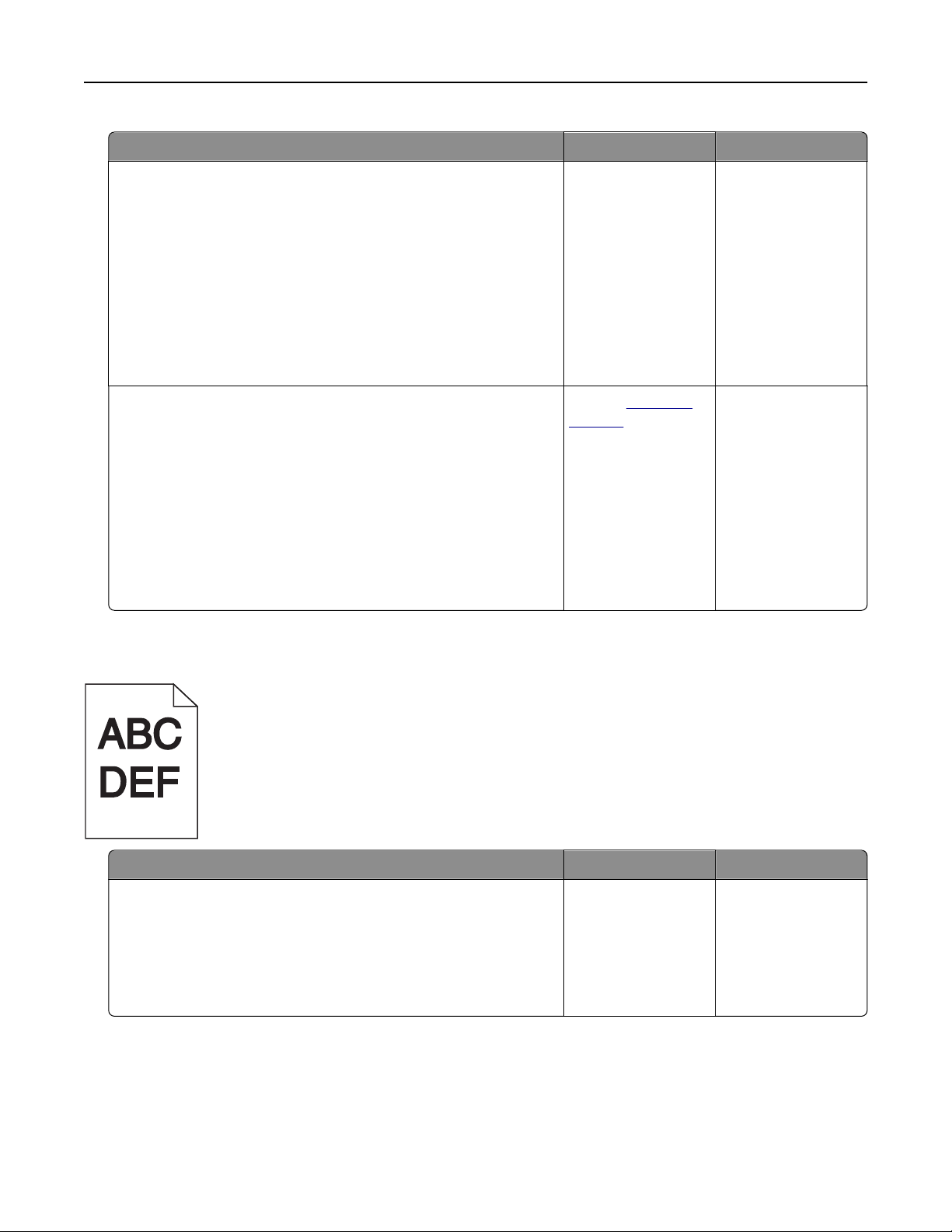
Action Yes No
Step 1
a Remove, and then reinstall the imaging unit or imaging kit.
Warning—Potential Damage: Do not expose the imaging unit
or imaging kit to direct light for more than 10 minutes.
Extended exposure to light may cause print quality problems.
Warning—Potential Damage: To avoid damage, do not touch
the underside of the imaging unit or imaging kit.
b Print a document.
Is the printer still printing blank or white pages?
Go to step 2. The problem is
solved.
Step 2
a Replace the imaging unit or imaging kit.
Warning—Potential Damage: Do not expose the imaging unit
or imaging kit to direct light for more than 10 minutes.
Extended exposure to light may cause print quality problems.
Warning—Potential Damage: To avoid damage, do not touch
the underside of the imaging unit or imaging kit.
b Print a document.
Is the printer still printing blank or white pages?
Contact
customer
support.
The problem is
solved.
Dark print
Action Yes No
Step 1
a From the Quality menu on the control panel, select Color
Adjust.
b Resend the print job.
Is the print still too dark?
Go to step 2. The problem is
solved.
Troubleshooting 146

Action Yes No
Step 2
a Depending on your operating system, reduce the toner
darkness from the Printing Preferences or Print dialog.
Note: You can also change the settings on the printer control
panel.
b Resend the print job.
Is the print still too dark?
Go to step 3. The problem is
solved.
Step 3
a Depending on your operating system, specify the paper type,
texture, and weight from the Printing Preferences or Print
dialog.
Notes:
• Make sure that the settings match the paper loaded in
the tray.
• You can also change the settings on the printer control
panel.
b Resend the print job.
Is the print still too dark?
Go to step 4. The problem is
solved.
Step 4
Make sure that the paper has no texture or rough finishes.
Are you printing on textured or rough paper?
Change the texture
settings to match the
paper you are
printing on.
Go to step 5.
Step 5
a Load paper from a fresh package.
Note: Paper absorbs moisture due to high humidity. Store
paper in its original wrapper until you are ready to use it.
b Resend the print job.
Is the print still too dark?
Go to step 6. The problem is
solved.
Step 6
Replace the imaging unit or imaging kit, and then resend the print
job.
Is the print still too dark?
Contact
customer
support.
The problem is
solved.
Troubleshooting 147
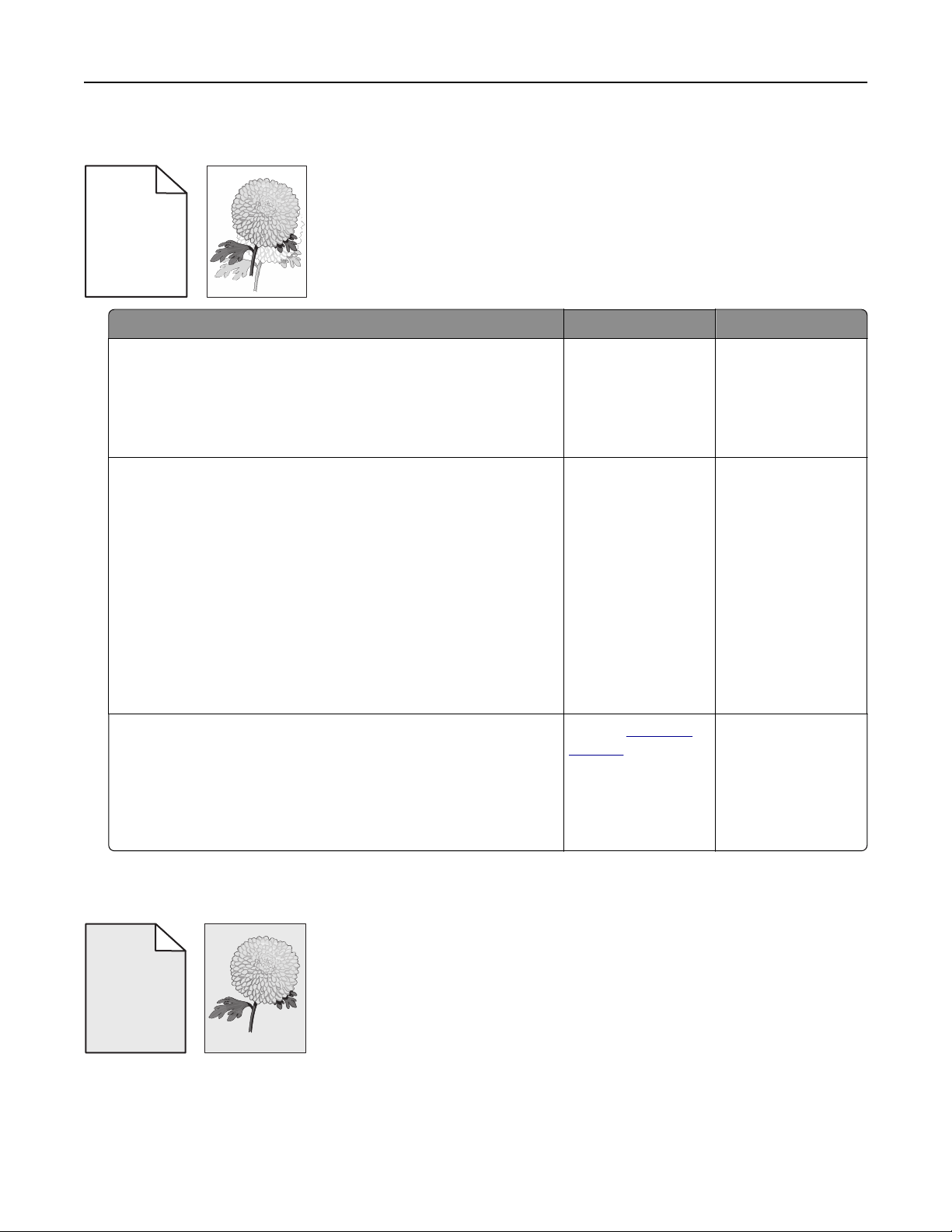
Ghost images
ABCD
ABCD
ABCD
ABCD
Leading edge
Trailing edge
Action Yes No
Step 1
a Load the tray with the correct paper type and weight.
b Resend the print job.
Do ghost images still appear on prints?
Go to step 2. The problem is
solved.
Step 2
a Depending on your operating system, specify the paper type
and weight from the Printing Preferences or Print dialog.
Notes:
• Make sure that the settings match the paper loaded in
the tray.
• You can also change the settings on the printer control
panel.
b Resend the print job.
Do ghost images still appear on prints?
Go to step 3. The problem is
solved.
Step 3
a From the Quality menu on the control panel, select Color
Adjust.
b Resend the print job.
Do ghost images still appear on prints?
Contact
customer
support.
The problem is
solved.
Gray background
ABCDE
ABCDE
ABCDE
Leading edge
Trailing edge
Troubleshooting 148

Action Yes No
Step 1
a From the home screen, touch Settings > Print > Quality.
b Adjust the toner darkness.
c Print the document.
Does gray background still appear on prints?
Go to step 2. The problem is
solved.
Step 2
a From the home screen, touch Settings > Print > Quality >
Advanced Imaging > Color Adjust.
b Start the process.
c Print the document.
Does gray background still appear on prints?
Go to step 3. The problem is
solved.
Step 3
a Remove, and then reinstall the imaging unit or imaging kit.
Warning—Potential Damage: Do not expose the imaging unit
or imaging kit to direct light for more than 10 minutes.
Extended exposure to light may cause print quality problems.
Warning—Potential Damage: To avoid damage, do not touch
the underside of the imaging unit or imaging kit.
b Print the document.
Does gray background still appear on prints?
Contact
customer
support.
The problem is
solved.
Horizontal dark lines
ABCDE
ABCDE
ABCDE
Note: If horizontal dark lines keep appearing on your prints, then see the “Repeating defects” topic.
Action Yes No
Step 1
a Depending on your operating system, specify the tray or feeder
from the Printing Preferences or Print dialog.
b Resend the print job.
Do horizontal dark lines still appear on prints?
Go to step 2. The problem is
solved.
Troubleshooting 149

Action Yes No
Step 2
a Depending on your operating system, specify the paper type
and weight from the Printing Preferences or from Print dialog.
Notes:
• Make sure that the settings match the paper loaded in
the tray.
• You can also change the settings on the printer control
panel.
b Resend the print job.
Do horizontal dark lines still appear on prints?
Go to step 3. The problem is
solved.
Step 3
a Load paper from a fresh package.
Note: Paper absorbs moisture due to high humidity. Store
paper in its original wrapper until you use it.
b Resend the print job.
Do horizontal dark lines still appear on prints?
Go to step 4. The problem is
solved.
Step 4
a Remove, and then reinstall the imaging unit or imaging kit.
Warning—Potential Damage: Do not expose the imaging unit
or imaging kit to direct light for more than 10 minutes.
Extended exposure to light may cause print quality problems.
Warning—Potential Damage: To avoid damage, do not touch
the underside of the imaging unit or imaging kit.
b Resend the print job.
Do horizontal dark lines still appear on prints?
Go to step 5. The problem is
solved.
Step 5
Replace the imaging unit or imaging kit, and then resend the print
job.
Do horizontal dark lines still appear on prints?
Contact
customer
support.
The problem is
solved.
Horizontal white lines
Leading edge
Trailing edge
Troubleshooting 150

Note: If horizontal dark lines keep appearing on your prints, then see the “Repeating defects” topic.
Action Yes No
Step 1
a Depending on your operating system, specify the paper type
and weight from the Printing Preferences or Print dialog.
Notes:
• Make sure that the settings match the paper loaded in
the tray.
• You can also change the settings on the printer control
panel.
b Resend the print job.
Do horizontal white lines still appear on prints?
Go to step 2. The problem is
solved.
Step 2
a Load the specified tray or feeder with the recommended paper
type.
b Resend the print job.
Do horizontal white lines still appear on prints?
Go to step 3. The problem is
solved.
Step 3
a Remove, and then reinstall the imaging unit or imaging kit.
Warning—Potential Damage: Do not expose the imaging unit
or imaging kit to direct light for more than 10 minutes.
Extended exposure to light can cause print quality problems.
Warning—Potential Damage: To avoid damage, do not touch
the underside of the imaging unit or imaging kit.
b Resend the print job.
Do horizontal white lines still appear on prints?
Go to step 4. The problem is
solved.
Step 4
Replace the imaging unit or imaging kit, and then resend the print
job.
Do horizontal white lines still appear on prints?
Contact
customer
support.
The problem is
solved.
Incorrect margins
ABCD
ABCD
ABCD
Troubleshooting 151

Action Yes No
Step 1
a Squeeze and slide the paper guides to the correct position for
the size of the paper you are loading.
b Resend the print job.
Are the margins correct?
The problem is
solved.
Go to step 2.
Step 2
a From the Paper menu on the control panel, check if the printer
is detecting the correct paper size.
b Resend the print job.
Are the margins correct?
The problem is
solved.
Go to step 3.
Step 3
a Depending on your operating system, specify the paper size
from the Printing Preferences or Print dialog.
Notes:
• Make sure that the settings match the paper loaded in
the tray.
• You can also change the settings on the printer control
panel.
b Resend the print job.
Are the margins correct?
The problem is
solved.
Contact
customer
support.
Jagged or uneven characters
Troubleshooting 152
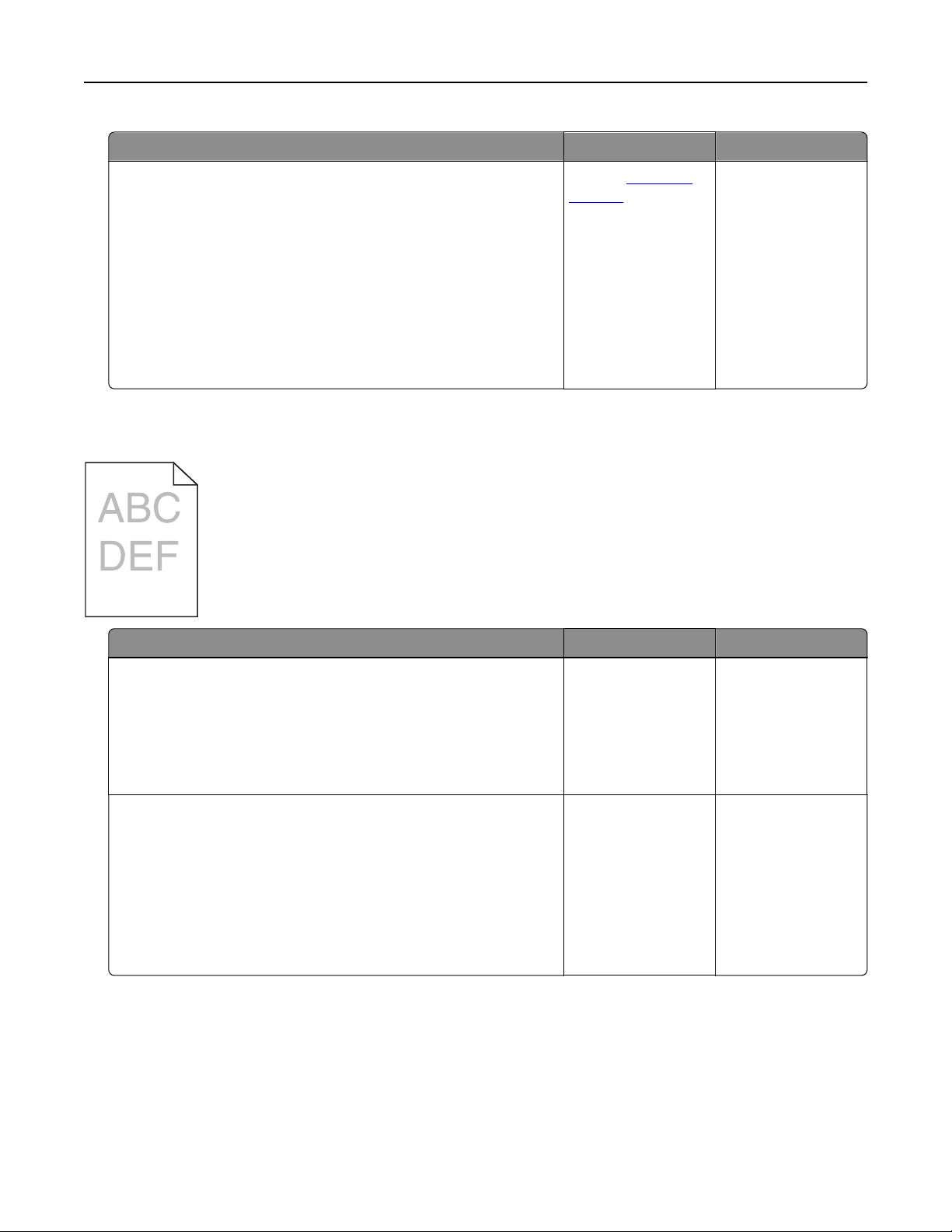
Action Yes No
a Check if the printer supports the fonts that are installed on your
computer.
1 From the control panel, touch:
Settings > Reports > Print > Print Fonts
2 Select PCL Fonts or PS Fonts.
b If the font is not supported, then install a supported font. For
more information, contact your administrator.
c Resend the print job.
Do prints still contain jagged or uneven characters?
Contact
customer
support.
The problem is
solved.
Light print
Action Yes No
Step 1
a From the Quality menu on the control panel, select Color
Adjust.
b Resend the print job.
Is the print still too light?
Go to step 2. The problem is
solved.
Step 2
a Depending on your operating system, increase the toner
darkness from the Printing Preferences or Print dialog.
Note: You can also change the settings on the printer control
panel.
b Resend the print job.
Is the print still too light?
Go to step 3. The problem is
solved.
Troubleshooting 153

Action Yes No
Step 3
a Depending on your operating system, specify the paper type,
texture, and weight from the Printing Preferences or Print
dialog.
Notes:
• Make sure that the settings match the paper loaded in
the tray.
• You can also change the settings on the printer control
panel.
b Resend the print job.
Is the print still too light?
Go to step 4. The problem is
solved.
Step 4
Make sure that the paper has no texture or rough finishes.
Are you printing on textured or rough paper?
Change the texture
settings to match the
paper you are
printing on.
Go to step 5.
Step 5
a Load paper from a fresh package.
Note: Paper absorbs moisture due to high humidity. Store
paper in its original wrapper until you are ready to use it.
b Resend the print job.
Is the print still too light?
Go to step 6. The problem is
solved.
Step 6
Replace the imaging unit or imaging kit, and then resend the print
job.
Warning—Potential Damage: Do not expose the imaging unit or
imaging kit to direct light for more than 10 minutes. Extended
exposure to light can cause print quality problems.
Warning—Potential Damage: To avoid damage, do not touch the
underside of the imaging unit or imaging kit.
Is the print still too light?
Contact
customer
support.
The problem is
solved.
Mottled print and dots
ABC
DEF
Troubleshooting 154

Action Yes No
Step 1
Check the printer for leaked toner contamination.
Is the printer free of leaked toner?
Go to step 2. Contact
customer
support.
Step 2
a From the home screen, touch Settings > Device > Preferences.
b Check if the paper type and size settings match the paper type
and size set in the tray.
Do the settings match?
Go to step 4. Go to step 3.
Step 3
a Change the paper size and type in the Paper menu or adjust
the size settings in the tray.
b Print the document.
Is the print still mottled?
Go to step 4. The problem is
solved.
Step 4
a Replace the textured or rough paper loaded in the tray with
plain paper.
b Print the document.
Is the print still mottled?
Go to step 5. The problem is
solved.
Step 5
a Replace the imaging unit or imaging kit.
Warning—Potential Damage: Do not expose the imaging unit
or imaging kit to direct light for more than 10 minutes.
Extended exposure to light can cause print quality problems.
Warning—Potential Damage: To avoid damage, do not touch
the underside of the imaging unit or imaging kit.
b Print the document.
Is the print still mottled?
Contact
customer
support.
The problem is
solved.
Print crooked or skewed
)
)
ABCDE
ABCDE
ABCDE
Troubleshooting 155

Action Yes No
Step 1
a Remove the tray.
b Remove the paper, and then load paper from a fresh package.
Note: Paper absorbs moisture due to high humidity. Store
paper in its original wrapper until you are ready to use it.
c Squeeze and slide the paper guides to the correct position for
the size of the paper you are loading.
d Insert the tray.
e Resend the print job.
Is the print still crooked or skewed?
Go to step 2. The problem is
solved.
Step 2
a Check if you are printing on a supported paper.
b Resend the print job.
Is the print still crooked or skewed?
Contact
customer
support.
The problem is
solved.
Repeating defects
)
)
)
Note: Before solving the problem, print the Maintenance Defect Ruler from the Troubleshooting section of
the Settings menu.
Action Yes No
Step 1
a Print the quality sample pages.
From the home screen, touch Settings > Troubleshooting >
Basic Print Quality Samples.
b Determine how many colors have defects.
Is only one color aected?
Go to step 2. Go to step 3.
Troubleshooting 156

Action Yes No
Step 2
a Using the Maintenance Defect Ruler, measure the distance
between the repeating defects on the aected color page.
b Replace the supply item that matches the measurement on the
aected
color page.
Photoconductor unit
• 125.70 mm (4.95 in.)
• 35.40 mm (1.39 in.)
Developer unit
42 mm (1.65 in.)
c Print the quality sample pages.
Do the defects still appear?
Take note of the
distance, and then
contact
customer
support or your
service
representative.
The problem is
solved.
Step 3
a Using the Maintenance Defect Ruler, measure the distance
between the repeating defects on the aected color page.
b Replace the supply item that matches the measurement on the
aected
color page.
Transfer roller
78.50 mm (3.09 in.)
Transfer module
• 47.10 mm (1.86 in.)
• 90 mm (3.54 in.)
Fuser
• 96.60 mm (3.80 in.)
• 127.60 mm (5.02 in.)
c Print the quality sample pages.
Do the defects still appear?
Take note of the
distance, and then
contact
customer
support or your
service
representative.
The problem is
solved.
Solid color or black images
Troubleshooting 157
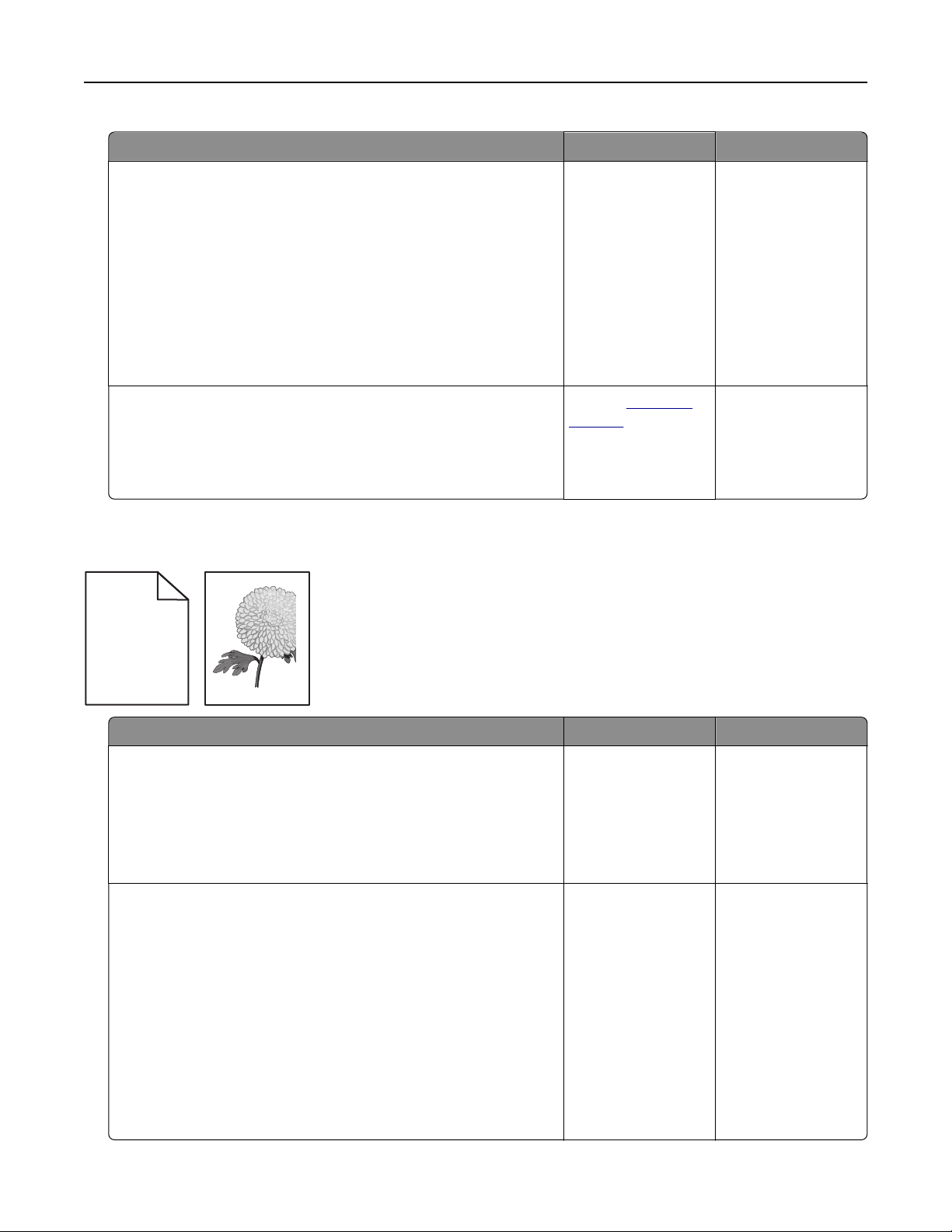
Action Yes No
Step 1
a Remove, and then reinstall the imaging unit or imaging kit.
Warning—Potential Damage: Do not expose the imaging unit
or imaging kit to direct light for more than 10 minutes.
Extended exposure to light may cause print quality problems.
Warning—Potential Damage: To avoid damage, do not touch
the underside of the imaging unit or imaging kit.
b Resend the print job.
Is the printer still printing solid color or black images?
Go to step 2. The problem is
solved.
Step 2
Replace the imaging unit or imaging kit, and then resend the print
job.
Is the printer still printing solid color or black images?
Contact
customer
support.
The problem is
solved.
Text or images cut o
Leading edge
Trailing edge
ABCDE
ABCDE
ABCDE
Action Yes No
Step 1
a Move the paper guides in the tray to the correct position for the
paper loaded.
b Resend the print job.
Is the page or image still clipped?
Go to step 2. The problem is
solved.
Step 2
a Depending on your operating system, specify the paper size
from the Printing Preferences or Print dialog.
Notes:
• Make sure that the settings match the paper loaded in
the tray.
• You can also change the settings on the printer control
panel.
b Resend the print job.
Is the page or image still clipped?
Go to step 3. The problem is
solved.
Troubleshooting 158
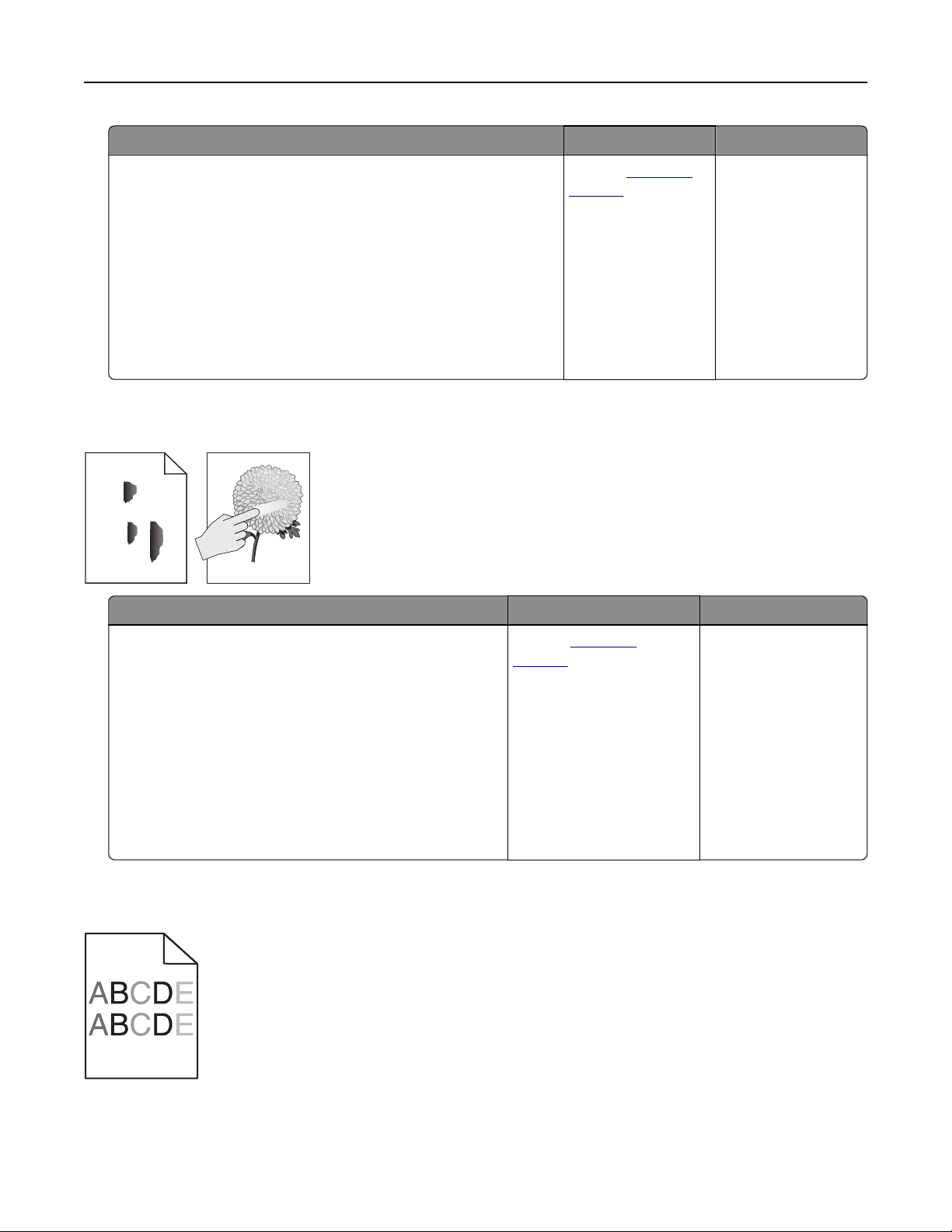
Action Yes No
Step 3
a Remove, and then reinstall the imaging unit or imaging kit.
Warning—Potential Damage: Do not expose the imaging unit
or imaging kit to direct light for more than 10 minutes.
Extended exposure to light may cause print quality problems.
Warning—Potential Damage: To avoid damage, do not touch
the underside of the imaging unit or imaging kit.
b Resend the print job.
Is the page or image still clipped?
Contact
customer
support.
The problem is
solved.
Toner easily rubs o
Leading edge
Trailing edge
ABC
DEF
Action Yes No
1 Depending on your operating system, specify the
paper type, texture, and weight from the Printing
Preferences or Print dialog.
Notes:
• Make sure that the settings match the paper
loaded in the tray.
• You can also change the settings on the printer
control panel.
2 Resend the print job.
Does the toner still rub o?
Contact
customer
support.
The problem is solved.
Uneven print density
Troubleshooting 159

Action Yes No
Replace the imaging unit or imaging kit, and then resend the print
job.
Warning—Potential Damage: Do not expose the imaging unit or
imaging kit to direct light for more than 10 minutes. Extended
exposure to light can cause print quality problems.
Warning—Potential Damage: To avoid damage, do not touch the
underside of the imaging unit or imaging kit.
Is the print density uneven?
Contact
customer
support.
The problem is
solved.
Vertical dark lines or streaks
ABCDE
ABCDE
ABCDE
Leading edge
Trailing edge
Action Yes No
Step 1
a Depending on your operating system, specify the paper type,
texture, and weight from the Printing Preferences or Print
dialog.
Notes:
• Make sure that the settings match the paper loaded in
the tray.
• You can also change the settings on the printer control
panel.
b Resend the print job.
Do vertical dark lines or streaks still appear on prints?
Go to step 2. The problem is
solved.
Step 2
a Load paper from a fresh package.
Note: Paper absorbs moisture due to high humidity. Store
paper in its original wrapper until you use it.
b Resend the print job.
Do vertical dark lines or streaks still appear on prints?
Go to step 3. The problem is
solved.
Troubleshooting 160
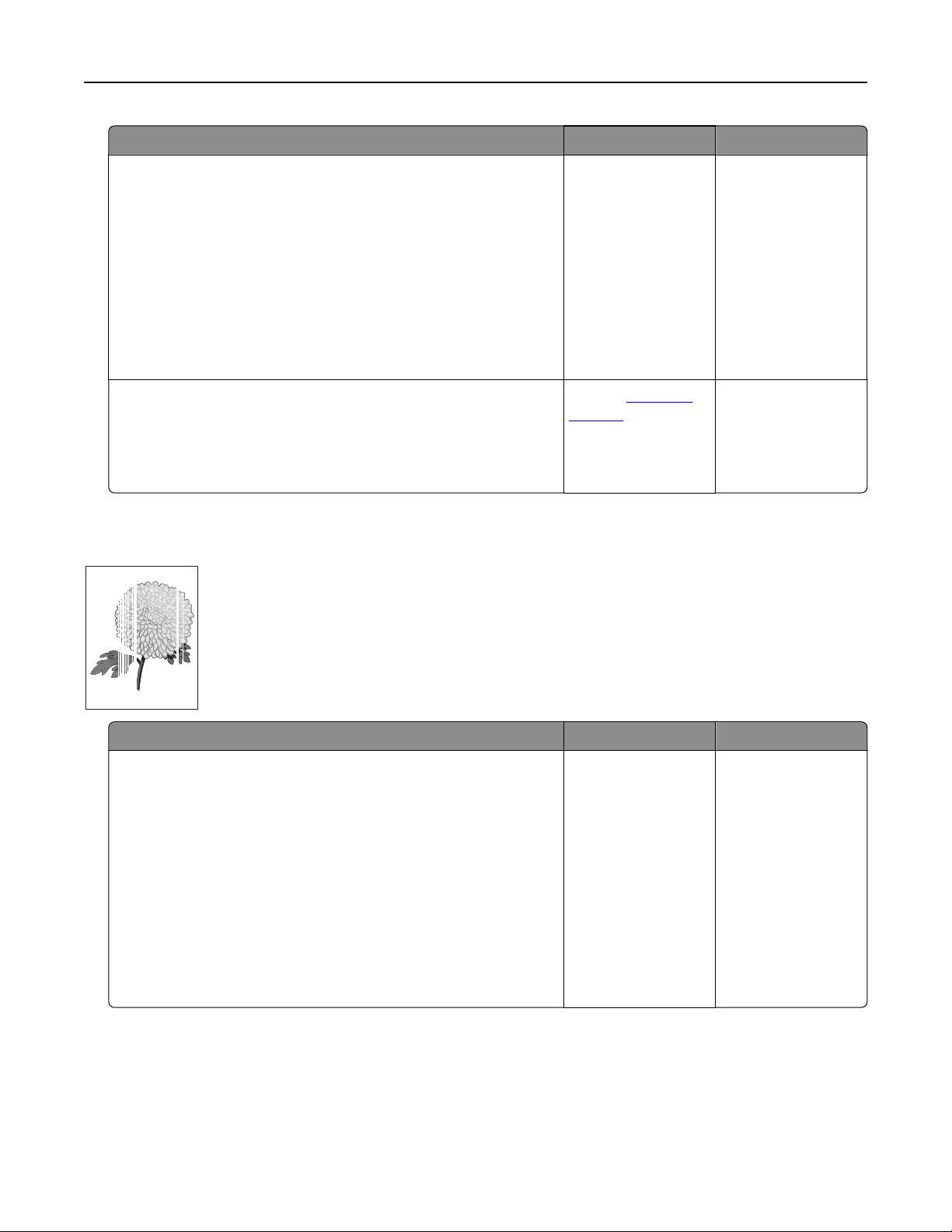
Action Yes No
Step 3
a Remove, and then reinstall the imaging unit or imaging kit.
Warning—Potential Damage: Do not expose the imaging unit
or imaging kit to direct light for more than 10 minutes.
Extended exposure to light can cause print quality problems.
Warning—Potential Damage: To avoid damage, do not touch
the underside of the imaging unit or imaging kit.
b Resend the print job.
Do vertical dark lines or streaks still appear on prints?
Go to step 4. The problem is
solved.
Step 4
Replace the imaging unit or imaging kit, and then resend the print
job.
Do vertical dark lines or streaks still appear on prints?
Contact
customer
support.
The problem is
solved.
Vertical white lines
Leading edge
Trailing edge
Action Yes No
Step 1
a Depending on your operating system, specify the paper type
and weight from the Printing Preferences or Print dialog.
Notes:
• Make sure that the settings match the paper loaded in
the tray.
• You can also change the settings on the printer control
panel.
b Resend the print job.
Do vertical white lines still appear on prints?
Go to step 2. The problem is
solved.
Troubleshooting 161

Action Yes No
Step 2
Check if you are using the recommended paper type.
a Load the specified tray or feeder with the recommended paper
type.
b Resend the print job.
Do vertical white lines still appear on prints?
Go to step 3. The problem is
solved.
Step 3
a Remove, and then reinstall the imaging unit or imaging kit.
Warning—Potential Damage: Do not expose the imaging unit
or imaging kit to direct light for more than 10 minutes.
Extended exposure to light may cause print quality problems.
Warning—Potential Damage: To avoid damage, do not touch
the underside of the imaging unit or imaging kit.
b Resend the print job.
Do vertical white lines still appear on prints?
Go to step 4. The problem is
solved.
Step 4
Replace the imaging unit or imaging kit, and then resend the print
job.
Do vertical white lines still appear on prints?
Contact
customer
support.
The problem is
solved.
The printer is not responding
Action Yes No
Step 1
Connect the power cord to the electrical outlet.
CAUTION—POTENTIAL INJURY: To avoid the risk of fire or
electrical shock, connect the power cord to an appropriately
rated and properly grounded electrical outlet that is near the
product and easily accessible.
Is the printer responding?
The problem is
solved.
Go to step 2.
Step 2
Check if the electrical outlet is turned o by a switch or breaker.
Is the electrical outlet turned o by a switch or breaker?
Turn on the switch or
reset the breaker.
Go to step 3.
Step 3
Check if the printer is on.
Is the printer on?
Go to step 4. Turn on the printer.
Troubleshooting 162

Action Yes No
Step 4
Check if the printer is in sleep or hibernate mode.
Is the printer in sleep or hibernate mode?
Press the power
button to wake the
printer.
Go to step 5.
Step 5
Check if the cables connecting the printer and the computer are
inserted in the correct ports.
Are the cables inserted in the correct ports?
Go to step 6. Make sure to match
the following:
• The USB cable
with the USB port
on the printer
• The Ethernet
cable with the
Ethernet port on
the printer
Step 6
Turn o the printer, reinstall the hardware options, and then turn it
back on.
For more information, see the documentation that came with the
option.
Is the printer responding?
The problem is
solved
Go to step 7.
Step 7
Install the correct print driver.
Is the printer responding?
The problem is
solved
Go to step 8.
Step 8
Turn o the printer, wait for about 10 seconds, and then turn it back
on.
Is the printer responding?
The problem is
solved.
Contact
customer
support.
Job prints from the wrong tray or on the wrong paper
Action Yes No
Step 1
a Check if you are printing on a supported paper.
b Print the document.
Is the document printed from the correct tray or on the correct
paper?
The problem is
solved.
Go to step 2.
Troubleshooting 163

Action Yes No
Step 2
a Depending on your operating system, specify the paper size
from the Printing Preferences or Print dialog.
Notes:
• Make sure that the settings match the paper loaded in
the tray.
• You can also change the settings on the printer control
panel.
b Print the document.
Is the document printed from the correct tray or on the correct
paper?
The problem is
solved.
Go to step 3.
Step 3
a Check if the trays are not linked.
b Print the document.
Is the document printed from the correct tray or on the correct
paper?
The problem is
solved.
Contact
customer
support.
Color quality problems
Adjusting toner darkness
1 From the home screen, touch Settings > Print > Quality.
2 Adjust the toner darkness.
3 Apply the changes.
Modifying the colors in printed output
1 From the home screen, touch Settings > Print > Quality > Advanced Imaging > Color Correction > Manual.
2 From the Advanced Imaging menu, select Color Correction Content.
3 Choose the appropriate color conversion setting.
Troubleshooting 164

Object type Color conversion tables
RGB Image
RGB Text
RGB Graphics
• Vivid—Produces brighter, more saturated colors and may be
applied to all incoming color formats.
• sRGB Display—Produces an output that approximates the colors
displayed on a computer monitor. Black toner usage is optimized
for printing photographs.
• Display
‑True Black—Produces an output that approximates the
colors displayed on a computer monitor. This setting uses only
black toner to create all levels of neutral gray.
• sRGB Vivid—Provides an increased color saturation for the sRGB
Display color correction. Black toner usage is optimized for
printing business graphics.
• O
CMYK Image
CMYK Text
CMYK Graphics
• US CMYK—Applies color correction to approximate the
Specifications
for Web
Oset
Publishing (SWOP) color output.
• Euro CMYK—Applies color correction to approximate Euroscale
color output.
• Vivid CMYK—Increases the color saturation of the US CMYK color
correction setting.
•
O
FAQ about color printing
What is RGB color?
RGB color is a method of describing colors by indicating the amount of red, green, or blue used to produce
a certain color. Red, green, and blue light can be added in various amounts to produce a large range of colors
observed in nature. Computer screens, scanners, and digital cameras use this method to display colors.
What is CMYK color?
CMYK color is a method of describing colors by indicating the amount of cyan, magenta, yellow, and black
used to reproduce a particular color. Cyan, magenta, yellow, and black inks or toners can be printed in various
amounts to produce a large range of colors observed in nature. Printing presses, inkjet printers, and color
laser printers create colors in this manner.
How is color specified in a document to be printed?
Software programs are used to specify and modify the document color using RGB or CMYK color
combinations. For more information, see the software program Help topics.
How does the printer know what color to print?
When printing a document, information describing the type and color of each object is sent to the printer and
is passed through color conversion tables. Color is translated into the appropriate amounts of cyan, magenta,
yellow, and black toner used to produce the color you want. The object information determines the application
of color conversion tables. For example, it is possible to apply one type of color conversion table to text while
applying a dierent color conversion table to photographic images.
Troubleshooting 165

What is manual color correction?
When manual color correction is enabled, the printer employs user‑selected color conversion tables to
process objects. Manual color correction settings are specific to the type of object being printed (text,
graphics, or images). It is also specific to how the color of the object is specified in the software program
(RGB or CMYK combinations). To apply a dierent color conversion table manually, see
“Modifying the colors
in printed output” on page 164.
If the software program does not specify colors with RGB or CMYK combinations, then manual color correction
is not useful. It is also not eective if the software program or the computer operating system controls the
adjustment of colors. In most situations, setting the Color Correction to Auto generates preferred colors for
the documents.
How can I match a particular color (such as a corporate logo)?
From the printer Quality menu, nine types of Color Samples sets are available. These sets are also available
from the Color Samples page of the Embedded Web Server. Selecting any sample set generates
multiple‑page prints consisting of hundreds of colored boxes. Each box contains a CMYK or RGB combination,
depending on the table selected. The observed color of each box is obtained by passing the CMYK or RGB
combination labeled on the box through the selected color conversion table.
By examining Color Samples sets, you can identify the box with color closest to the color being matched.
The color combination labeled on the box can then be used for modifying the color of the object in a software
program. For more information, see the software program Help topics. Manual color correction may be
necessary to use the selected color conversion table for the particular object.
Selecting which Color Samples set to use for a particular color‑matching problem depends on:
• The Color Correction setting being used (Auto, O, or Manual)
• The type of object being printed (text, graphics, or images)
• How the color of the object is specified in the software program (RGB or CMYK combinations)
If the software program does not specify colors with RGB or CMYK combinations, then the Color Samples
pages are not useful. Additionally, some software programs adjust the RGB or CMYK combinations specified
in the program through color management. In these situations, the printed color may not be an exact match
of the Color Samples pages.
The print appears tinted
Action No Yes
Adjust the color balance.
a From the home screen, touch Settings > Print > Quality >
Advanced Imaging > Color Balance.
b Adjust the setting.
c Resend the print job.
Does the print still appear tinted?
The problem is
solved.
Contact
customer
support.
Troubleshooting 166

Faxing problems
Cannot send or receive faxes
Action Yes No
Step 1
Resolve any error messages that appear on the display.
Can you send or receive a fax?
The problem is
solved.
Go to step 2.
Step 2
Make sure that the cable connections for the following equipment
are secure:
• Telephone
• Handset
• Answering machine
Can you send or receive a fax?
The problem is
solved.
Go to step 3.
Step 3
Check for a dial tone.
• Call the fax number to check if it is working properly.
• If you are using the On Hook Dial feature, then turn up the
volume to check if you hear a dial tone.
Can you hear a dial tone?
Go to step 5. Go to step 4.
Step 4
Check the telephone wall jack.
a Connect the analog telephone directly to the wall jack.
b Listen for a dial tone.
c If you do not hear a dial tone, then use a
dierent
telephone
cable.
d If you still do not hear a dial tone, then connect the analog
telephone to a
dierent
wall jack.
e If you hear a dial tone, then connect the printer to that wall jack.
Can you send or receive a fax?
The problem is
solved.
Go to step 5.
Troubleshooting 167

Action Yes No
Step 5
Check if the printer is connected to an analog phone service or to
the correct digital connector.
• If you are using an Integrated Services for Digital Network
(ISDN) telephone service, then connect to an analog telephone
port of an ISDN terminal adapter. For more information, contact
your ISDN provider.
• If you are using DSL, then connect to a DSL filter or router that
supports analog use. For more information, contact your DSL
provider.
• If you are using a private branch exchange (PBX) telephone
service, then make sure that you are connecting to an analog
connection on the PBX. If none exists, then consider installing
an analog telephone line for the fax machine.
Can you send or receive a fax?
The problem is
solved.
Go to step 6.
Step 6
Temporarily disconnect other equipment and disable other
telephone services.
a Disconnect other equipment (such as answering machines,
computers, modems, or telephone line splitters) between the
printer and the telephone line.
b Disable call waiting and voice mail. For more information,
contact your telephone company.
Can you send or receive a fax?
The problem is
solved.
Go to step 7.
Step 7
Scan the original document one page at a time.
a Dial the fax number.
b Scan the document.
Can you send or receive a fax?
The problem is
solved.
Contact
customer
support.
Troubleshooting 168

Can receive but not send faxes
Action Yes No
Step 1
Load the original document properly into the ADF tray or on the
scanner glass.
Can you send faxes?
The problem is
solved.
Go to step 2.
Step 2
Set up the shortcut number properly.
• Check if the shortcut number is set for the telephone number
that you want to dial.
• Dial the telephone number manually.
Can you send faxes?
The problem is
solved.
Contact
customer
support.
Can send but not receive faxes
Action Yes No
Step 1
Make sure that the tray or multipurpose feeder is not empty.
Can you receive faxes?
The problem is
solved.
Go to step 2.
Step 2
Check the ring count delay settings.
a From the home screen, touch Settings > Fax > Analog Fax
Setup > Fax Receive Settings > Rings to Answer.
b If necessary, configure the setting.
Can you receive faxes?
The problem is
solved.
Go to step 3.
Step 3
Replace the toner cartridge.
For more information, see the instruction sheet that came with the
supply.
Can you receive faxes?
The problem is
solved.
Contact
customer
support.
Troubleshooting 169

Poor fax print quality
Action Yes No
Step 1
Enhance the print quality.
a From the home screen, touch Settings > Print > Quality.
b Adjust the settings.
Is the fax print quality satisfactory?
The problem is
solved.
Go to step 2.
Step 2
Decrease the incoming fax transmission speed.
a From the home screen, touch Settings > Fax > Analog Fax
Setup > Fax Receive Settings > Admin Controls > Max Speed.
b Select a lower transmission speed.
Is the fax print quality satisfactory?
The problem is
solved.
Go to step 3.
Step 3
Replace the toner cartridge.
For more information, see the instruction sheet that came with the
supply.
Is the fax print quality satisfactory?
The problem is
solved.
Contact
customer
support.
Scanning problems
Cannot scan from a computer
Action Yes No
Step 1
a Turn o the printer, wait for about 10 seconds, and then turn it
back on.
b Resend the scan job.
Can you send the scan job?
The problem is
solved.
Go to step 2.
Step 2
a Make sure that the cables between the printer and the print
server are secure.
For more information, see the setup documentation that came
with the printer.
b Resend the scan job.
Can you send the scan job?
The problem is
solved.
Contact
customer
support.
Troubleshooting 170

Partial copies of document or photo
Action Yes No
Step 1
a Make sure that the document or photo is loaded facedown on
the upper left corner of the scanner glass.
b Copy the document or photo.
Is the document or photo copied correctly?
The problem is
solved.
Go to step 2.
Step 2
a Match the paper size setting and the paper loaded in the tray.
b Copy the document or photo.
Is the document or photo copied correctly?
The problem is
solved.
Contact
customer
support.
Poor copy quality
Action Yes No
Step 1
a Clean the scanner glass and the ADF glass with a damp, soft,
lint‑free cloth.
b Make sure that the document or photo is loaded facedown on
the upper left corner of the scanner glass.
c Copy the document or photo.
Is the copy quality satisfactory?
The problem is
solved.
Go to step 2.
Step 2
a Check the quality of the original document or photo.
b Adjust the scan quality settings.
c Copy the document or photo.
Is the copy quality satisfactory?
The problem is
solved.
Contact
customer
support.
Scan job was not successful
Action Yes No
Step 1
Check the cable connections.
a Make sure that the Ethernet or USB cable is securely connected
to the computer and the printer.
b Resend the scan job.
Is the scan job successful?
The problem is
solved.
Go to step 2.
Troubleshooting 171

Action Yes No
Step 2
Check the file you want to scan.
a Make sure that the file name is not already used in the
destination folder.
b Make sure that the document or photo you want to scan is not
open in another application.
c Resend the scan job.
Is the scan job successful?
The problem is
solved.
Go to step 3.
Step 3
a Make sure that the Append time stamp or the Overwrite
existing file check box is selected in the destination
configuration settings.
b Resend the scan job.
Is the scan job successful?
The problem is
solved.
Contact
customer
support.
Scanner does not close
Action Yes No
Remove obstructions that keep the scanner unit open.
Did the scanner unit close correctly?
The problem is
solved.
Contact customer
support.
Scanning takes too long or freezes the computer
Action Yes No
Close all applications that are interfering with the scan.
Does scanning take too long or freeze the computer?
Contact customer
support.
The problem is
solved.
Scanner does not respond
Action Yes No
Step 1
a Check if the printer is turned on.
b Resolve any error messages that appear on the display.
c Copy or scan the document.
Is the scanner responding?
The problem is
solved.
Go to step 2.
Troubleshooting 172

Action Yes No
Step 2
a Check if the power cord is connected properly to the printer
and the electrical outlet.
CAUTION—POTENTIAL INJURY: To avoid the risk of fire
or electrical shock, connect the power cord to an
appropriately rated and properly grounded electrical outlet
that is near the product and easily accessible.
b Copy or scan the document.
Is the scanner responding?
The problem is
solved.
Go to step 3.
Step 3
a Turn o the printer, wait for about 10 seconds, and then turn it
back on.
b Copy or scan the document.
Is the scanner responding?
The problem is
solved.
Contact
customer
support.
Contacting customer support
Before contacting customer support, make sure to have the following information:
• Printer problem
• Error message
• Printer model type and serial number
Go to
http://support.lexmark.com to receive e‑mail or chat support, or browse through the library of manuals,
support documentation, drivers, and other downloads.
Technical support via telephone is also available. In the U.S. or Canada, call 1-800-539-6275. For other countries
or regions, go to
http://support.lexmark.com.
Troubleshooting 173
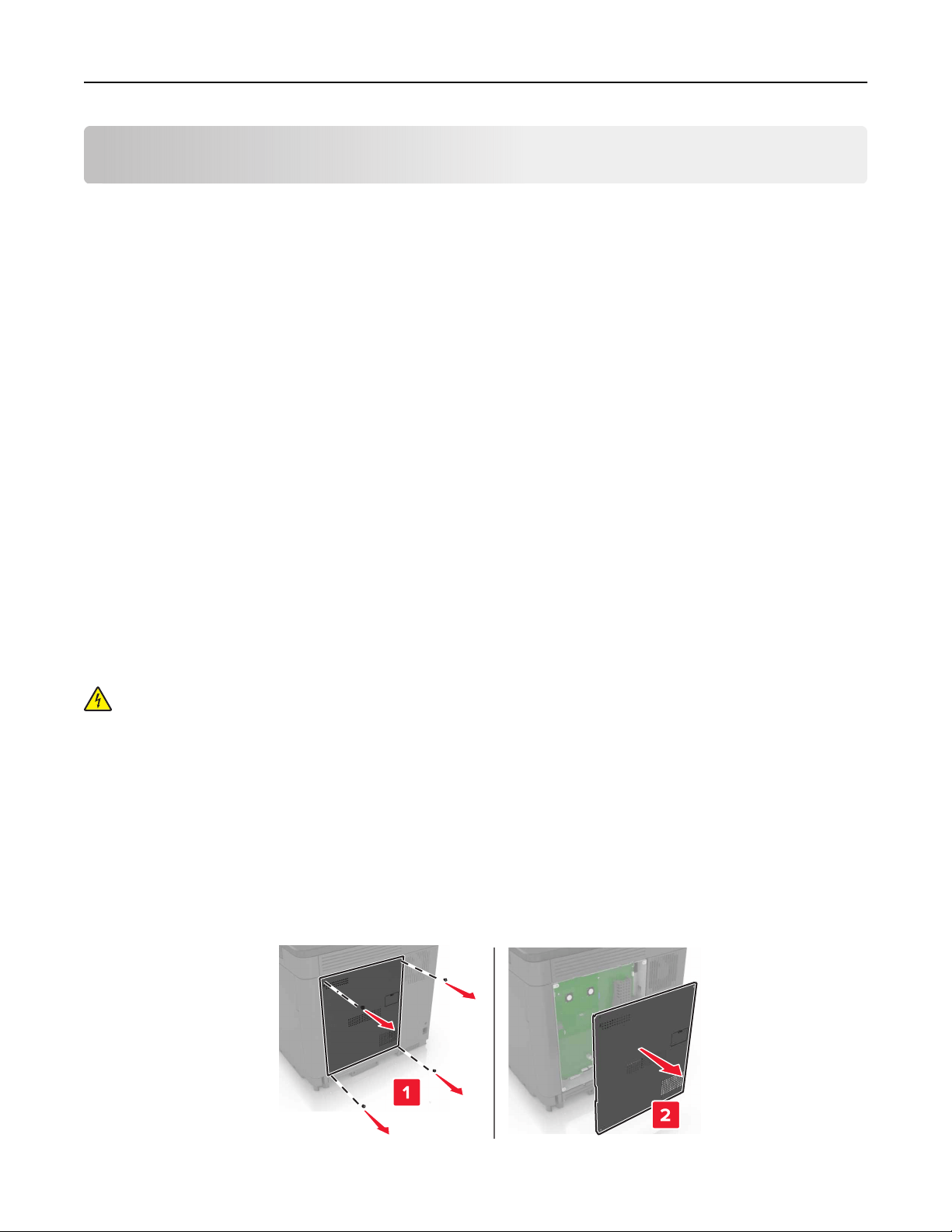
Upgrading and migrating
Hardware
Available internal options
• Memory card
– DDR3 DIMM
– Flash memory
• Fonts
– Application cards
• Forms and Bar Code
• PRESCRIBE
• IPDS
• Lexmark Internal Solutions Port (ISP)
– MarkNet
TM
N8360 (802.11 b/g/n/a wireless print server bundled with LEX‑M06‑001 Mobile Solutions
Module)
– IEEE 1284‑B Parallel Card
– RS‑232C Serial Card
Installing a memory card
CAUTION—SHOCK HAZARD: To avoid the risk of electrical shock, if you are accessing the controller
board or installing optional hardware or memory devices sometime after setting up the printer, then turn
the printer o, and unplug the power cord from the electrical outlet before continuing. If you have any
other devices attached to the printer, then turn them o as well, and unplug any cables going into the
printer.
1 Turn o the printer, and then unplug the power cord from the electrical outlet.
2 Using a flat‑head screwdriver, remove the controller board access cover.
Warning—Potential Damage: Controller board electronic components are easily damaged by static
electricity. Touch a metal surface on the printer before touching any controller board components or
connectors.
Upgrading and migrating 174
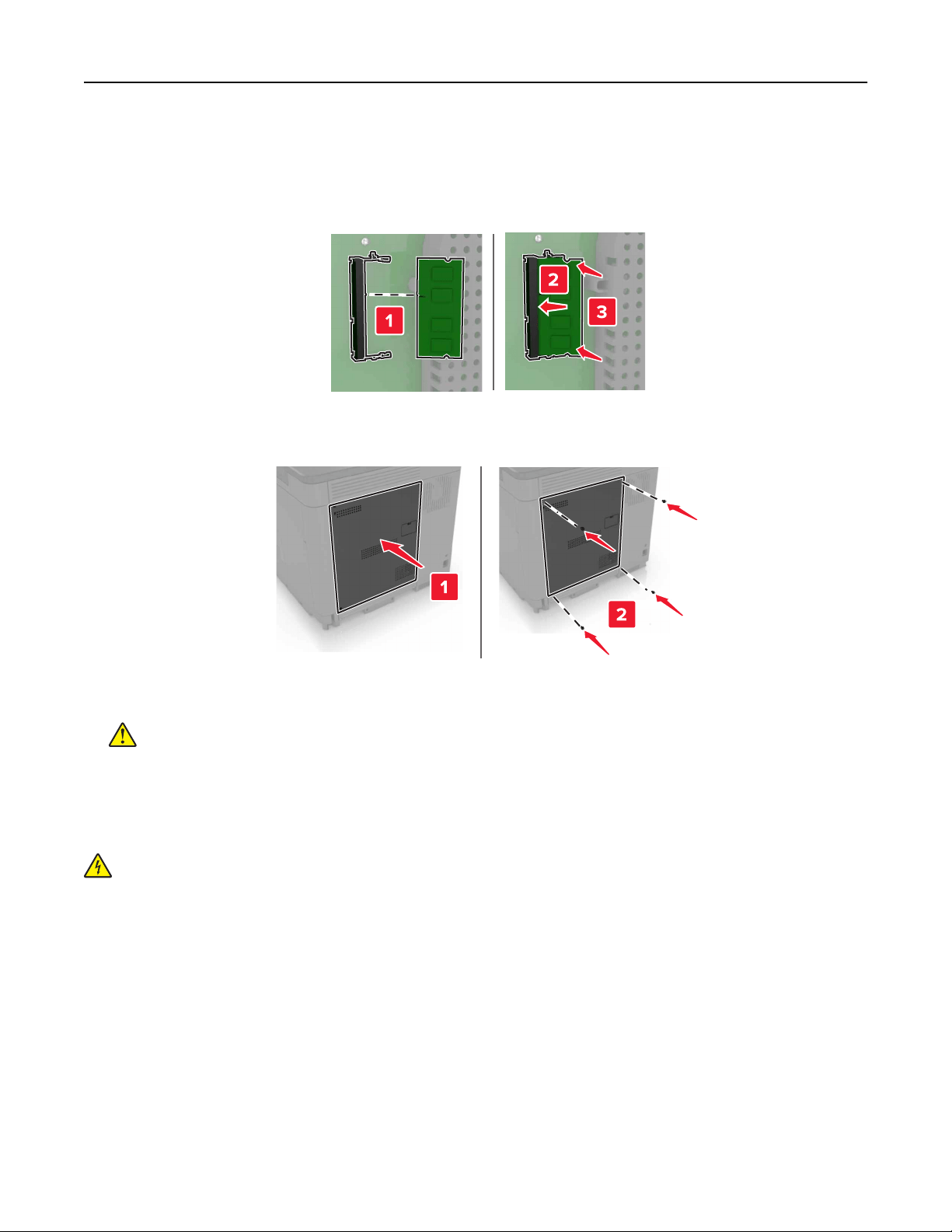
3 Unpack the memory card.
Warning—Potential Damage: Avoid touching the connection points along the edge of the card.
4 Insert the memory card until it clicks into place.
5 Reattach the access cover.
6 Connect the power cord to the electrical outlet, and then turn on the printer.
CAUTION—POTENTIAL INJURY: To avoid the risk of
fire
or electrical shock, connect the power cord
to an appropriately rated and properly grounded electrical outlet that is near the product and easily
accessible.
Installing an internal solutions port
CAUTION—SHOCK HAZARD: To avoid the risk of electrical shock, if you are accessing the controller
board or installing optional hardware or memory devices sometime after setting up the printer, then turn
the printer o, and unplug the power cord from the electrical outlet before continuing. If you have any
other devices attached to the printer, then turn them o as well, and unplug any cables going into the
printer.
1 Turn
o
the printer, and then unplug the power cord from the electrical outlet.
2 Using a flat‑head screwdriver, remove the controller board access cover.
Warning—Potential Damage: Controller board electronic components are easily damaged by static
electricity. Touch a metal surface on the printer before touching any controller board components or
connectors.
Upgrading and migrating 175
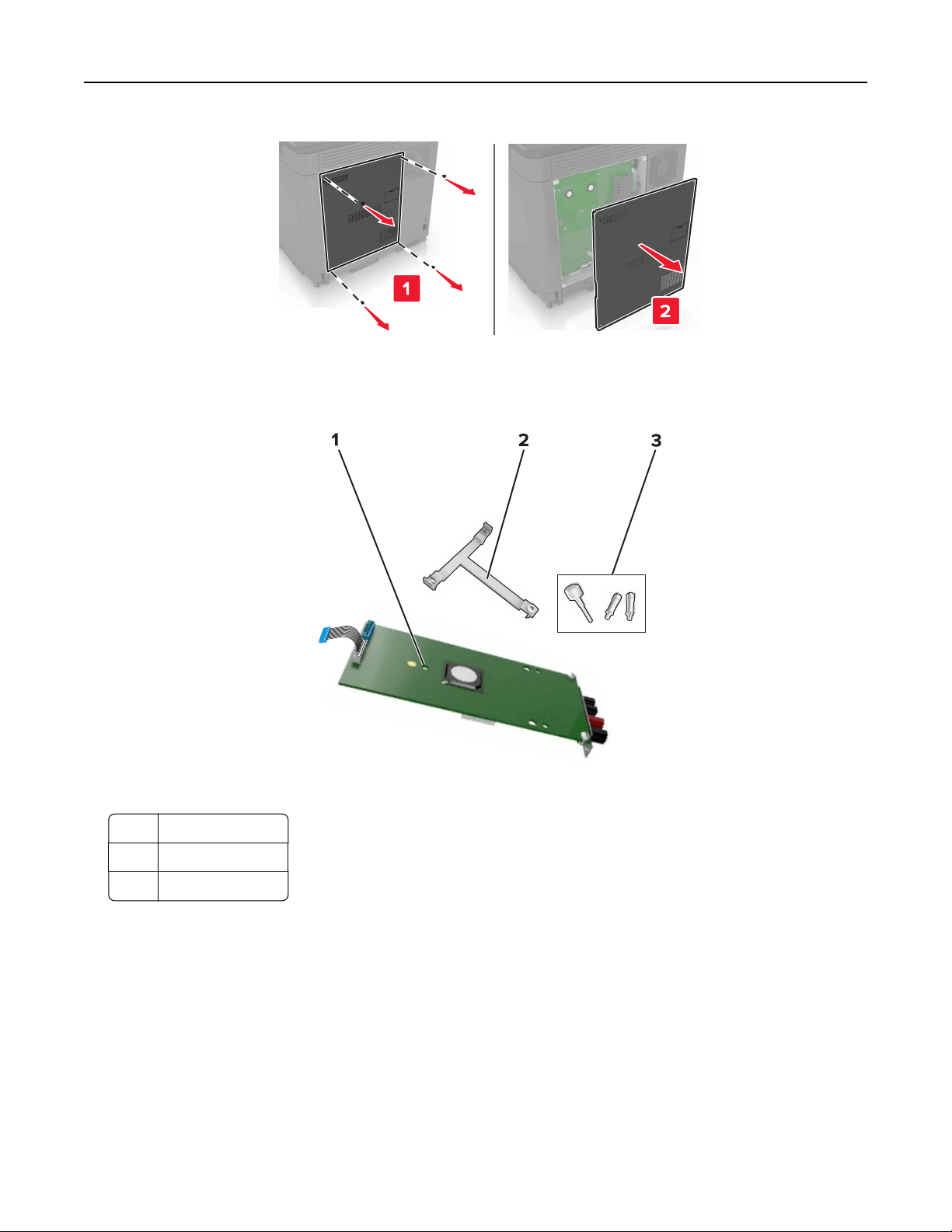
3 Unpack the internal solutions port (ISP) kit.
1 ISP
2 Mounting bracket
3 Thumbscrews
4 If necessary, remove the printer hard disk.
Upgrading and migrating 176
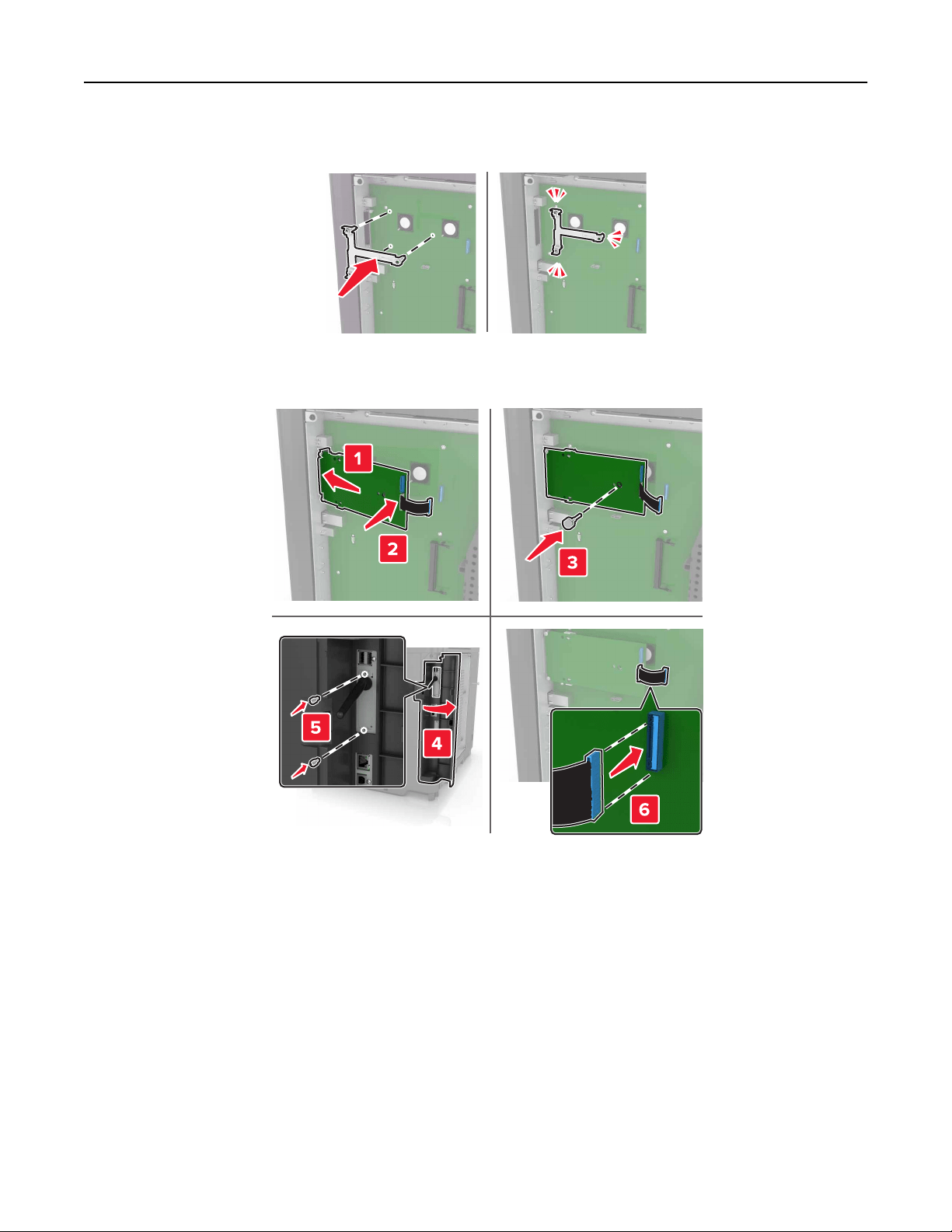
5 Insert the bracket into the board until it clicks into place.
6 Attach the ISP to the bracket.
Upgrading and migrating 177

7 If necessary, attach the hard disk to the ISP.
a Remove the hard disk bracket.
b Connect the hard disk to the ISP.
Warning—Potential Damage: Do not touch or press the center of the hard disk.
Upgrading and migrating 178
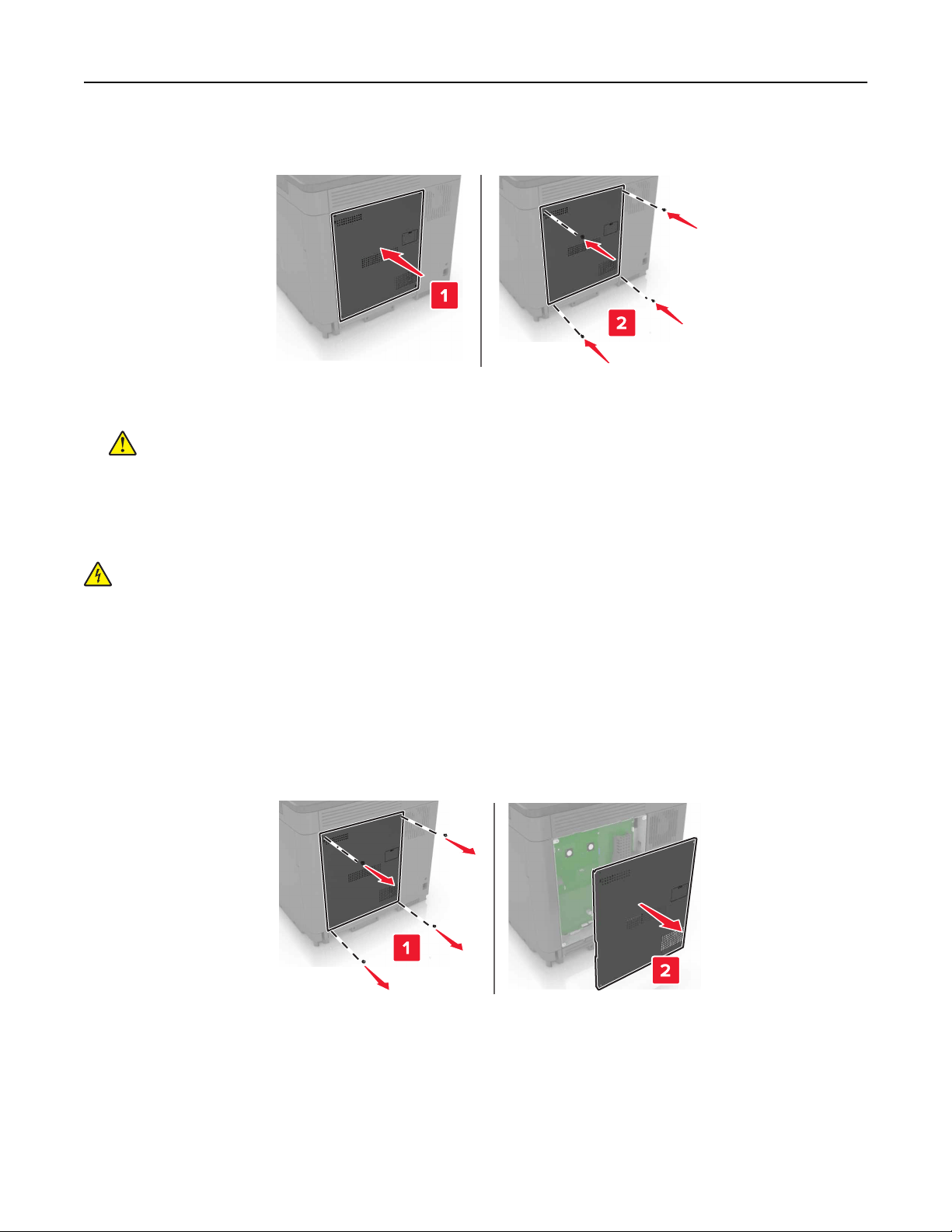
8 Reattach the access cover.
9 Connect the power cord to the electrical outlet, and then turn on the printer.
CAUTION—POTENTIAL INJURY: To avoid the risk of fire or electrical shock, connect the power cord
to an appropriately rated and properly grounded electrical outlet that is near the product and easily
accessible.
Installing an optional card
CAUTION—SHOCK HAZARD: To avoid the risk of electrical shock, if you are accessing the controller
board or installing optional hardware or memory devices sometime after setting up the printer, then turn
the printer o, and unplug the power cord from the electrical outlet before continuing. If you have any
other devices attached to the printer, then turn them o as well, and unplug any cables going into the
printer.
1 Turn o the printer, and then unplug the power cord from the electrical outlet.
2 Using a flat‑head screwdriver, remove the controller board access cover.
Warning—Potential Damage: Controller board electronic components are easily damaged by static
electricity. Touch a metal surface on the printer before touching any components or connectors.
3 Unpack the optional card.
Warning—Potential Damage: Avoid touching the connection points along the edge of the card.
Upgrading and migrating 179
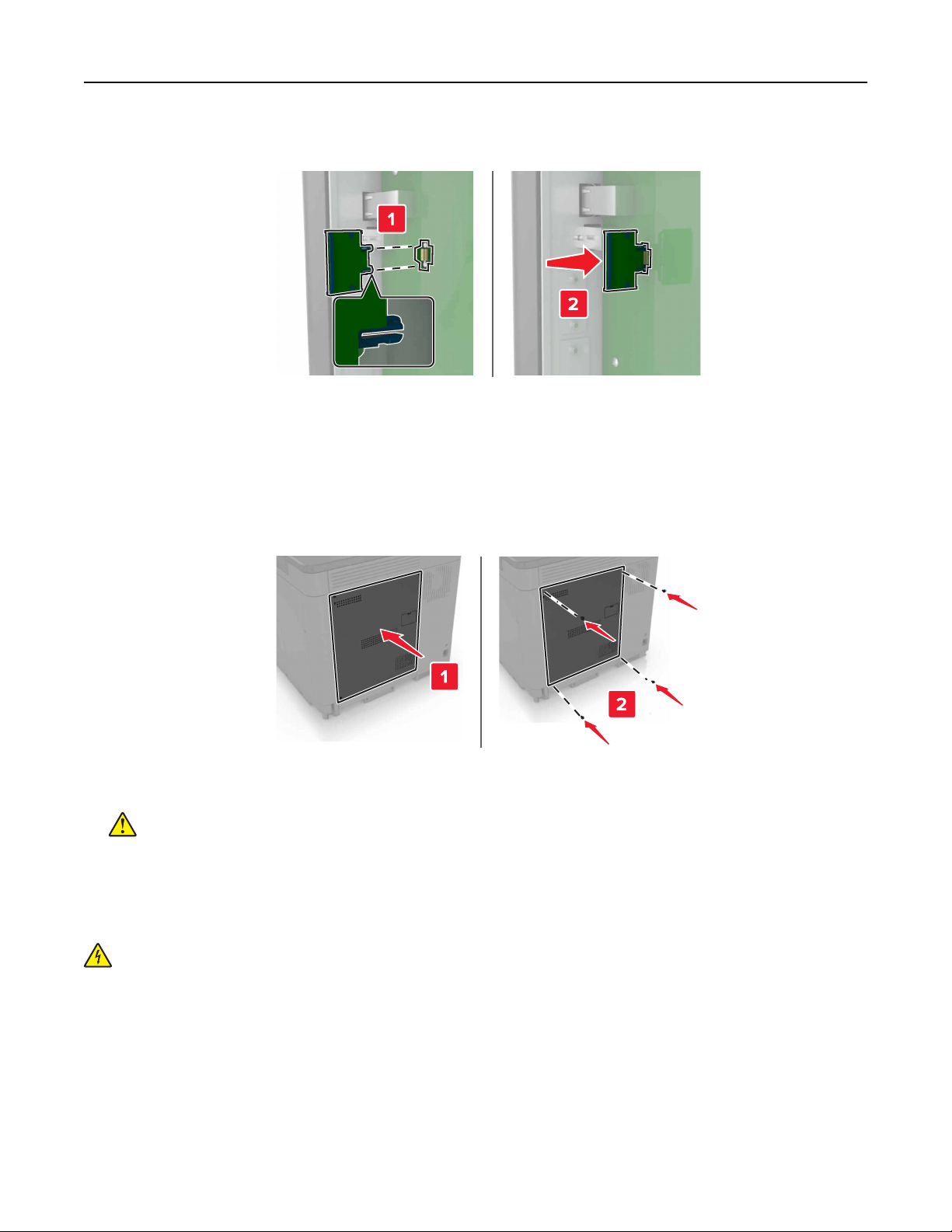
4 Push the card firmly into place.
Note: The entire length of the connector on the card must touch and be flush against the controller
board.
Warning—Potential Damage: Improper installation of the card may cause damage to the card and the
controller board.
5 Reattach the access cover.
6 Connect the power cord to the electrical outlet, and then turn on the printer.
CAUTION—POTENTIAL INJURY: To avoid the risk of
fire
or electrical shock, connect the power cord
to an appropriately rated and properly grounded electrical outlet that is near the product and easily
accessible.
Installing a printer hard disk
CAUTION—SHOCK HAZARD: To avoid the risk of electrical shock, if you are accessing the controller
board or installing optional hardware or memory devices sometime after setting up the printer, then turn
the printer o, and unplug the power cord from the electrical outlet before continuing. If you have any
other devices attached to the printer, then turn them o as well, and unplug any cables going into the
printer.
1 Turn
o
the printer, and then unplug the power cord from the electrical outlet.
2 Using a flat‑head screwdriver, remove the controller board access cover.
Upgrading and migrating 180
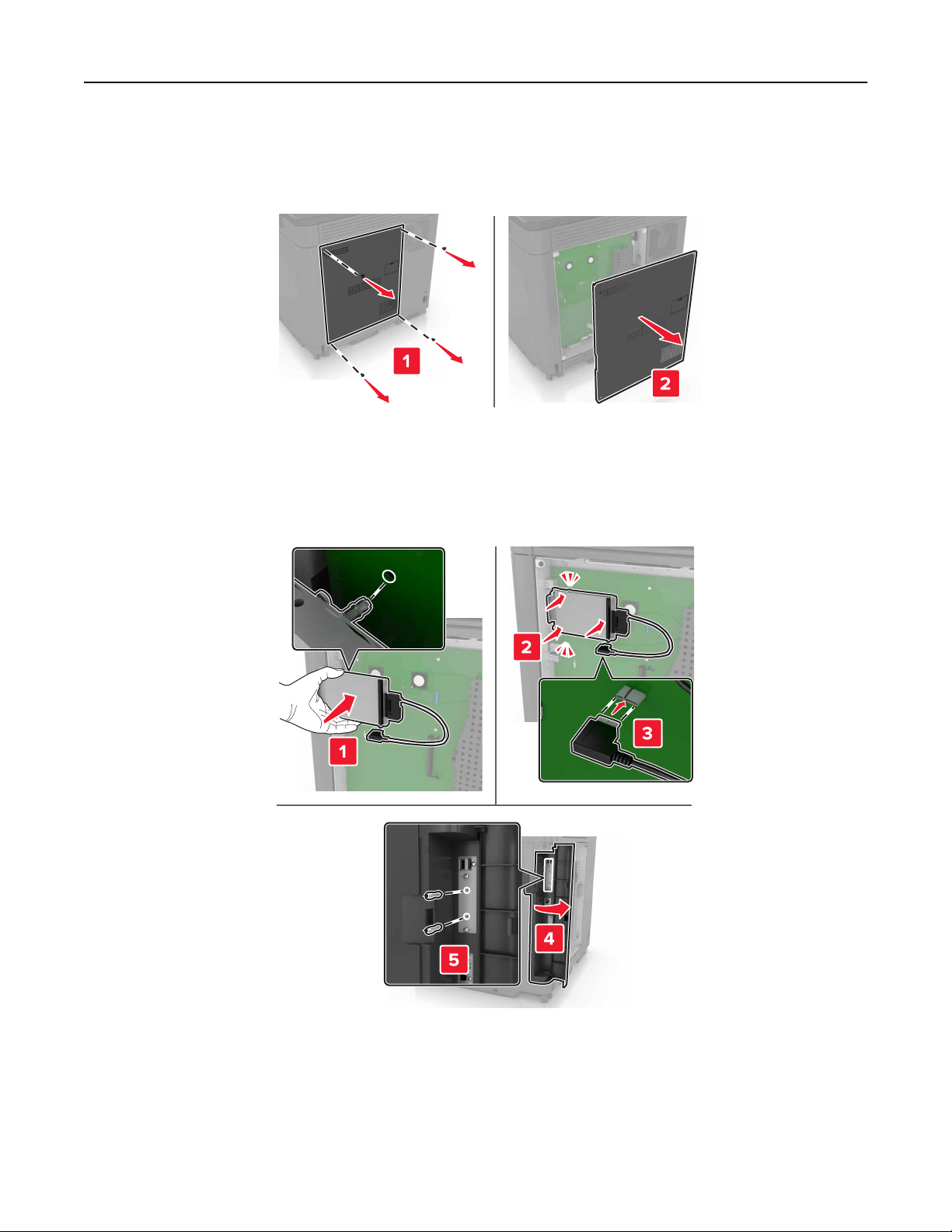
Warning—Potential Damage: Controller board electronic components are easily damaged by static
electricity. Touch a metal surface on the printer before touching any controller board components or
connectors.
3 Unpack the hard disk.
4 Attach the hard disk to the controller board.
Warning—Potential Damage: Do not touch or press the center of the hard disk.
Upgrading and migrating 181
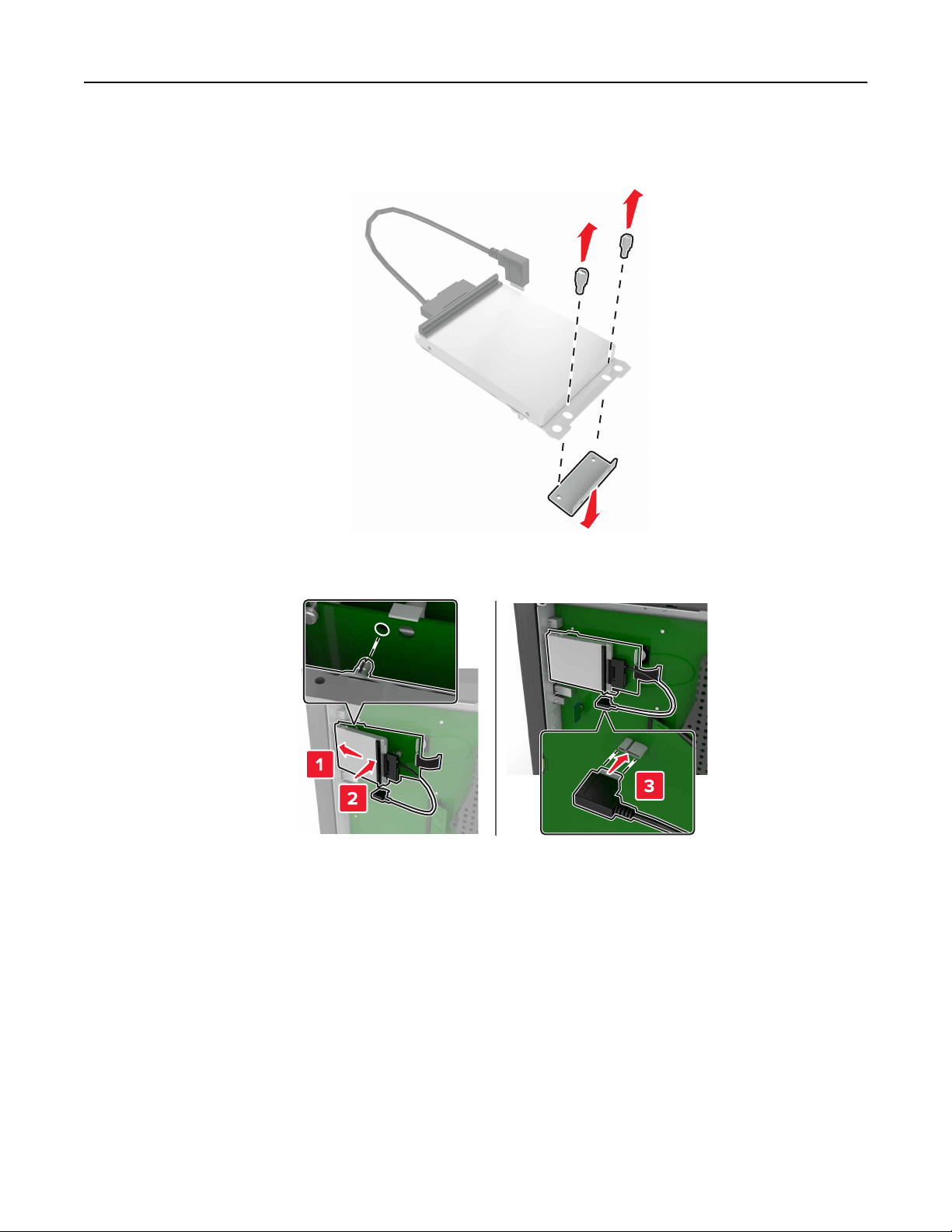
If an internal solutions port (ISP) is installed, then do the following:
a Remove the hard disk bracket.
b Attach the hard disk to the ISP.
Upgrading and migrating 182
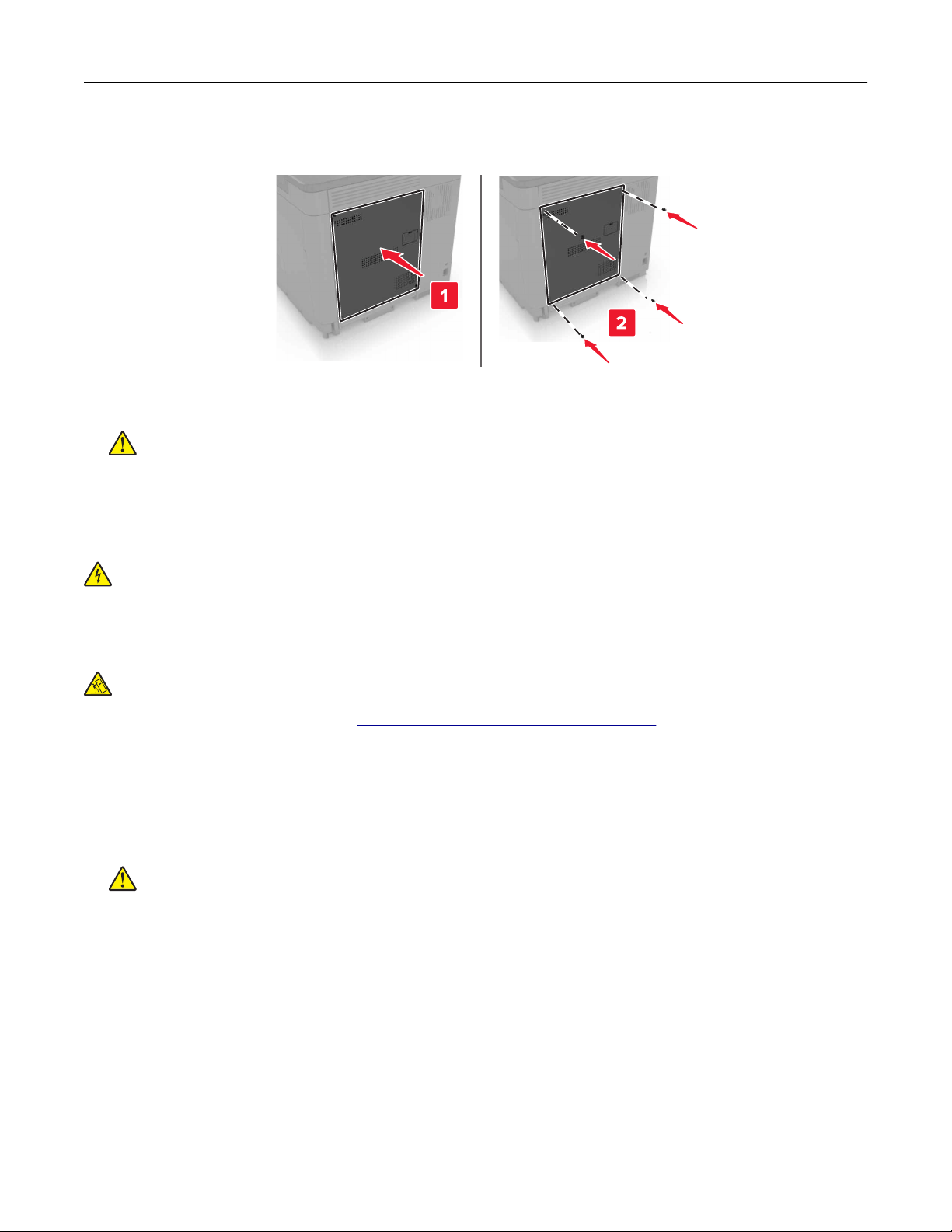
5 Reattach the access cover.
6 Connect the power cord to the electrical outlet, and then turn on the printer.
CAUTION—POTENTIAL INJURY: To avoid the risk of fire or electrical shock, connect the power cord
to an appropriately rated and properly grounded electrical outlet that is near the product and easily
accessible.
Installing optional trays
CAUTION—SHOCK HAZARD: To avoid the risk of electrical shock, if you are accessing the controller
board or installing optional hardware or memory devices sometime after setting up the printer, then turn
the printer o, and unplug the power cord from the electrical outlet before continuing. If you have any
other devices attached to the printer, then turn them o as well, and unplug any cables going into the
printer.
CAUTION—TIPPING HAZARD: Installing one or more options on your printer or MFP may require a
caster base, furniture, or other feature to prevent instability causing possible injury. For more information
on supported configurations, see
www.lexmark.com/multifunctionprinters.
1 Turn o the printer.
2 Unplug the power cord from the electrical outlet, and then from the printer.
3 Unpack the optional tray, and then remove all packing material.
4 Lift the printer using the side and rear handles.
CAUTION—POTENTIAL INJURY: If the printer weight is greater than 18 kg (40 lb), then it requires
two or more trained personnel to lift it safely.
Upgrading and migrating 183

Note: If optional trays are already installed, then unlock them from the printer before lifting the printer. Do
not try to lift the printer and trays at the same time.
5 Align the printer with the optional tray, and then lower the printer until it clicks into place.
6 Connect the power cord to the printer, and then to the electrical outlet.
CAUTION—POTENTIAL INJURY: To avoid the risk of
fire
or electrical shock, connect the power cord
to an appropriately rated and properly grounded electrical outlet that is near the product and easily
accessible.
7 Turn on the printer.
If necessary, manually add the tray in the print driver to make it available for print jobs. For more information,
see
“Adding available options in the print driver” on page 196.
When installing more than one hardware option, follow this order of installation.
• Caster base
• Optional 2200‑sheet tray
• Optional 550‑sheet tray or envelope tray
Upgrading and migrating 184
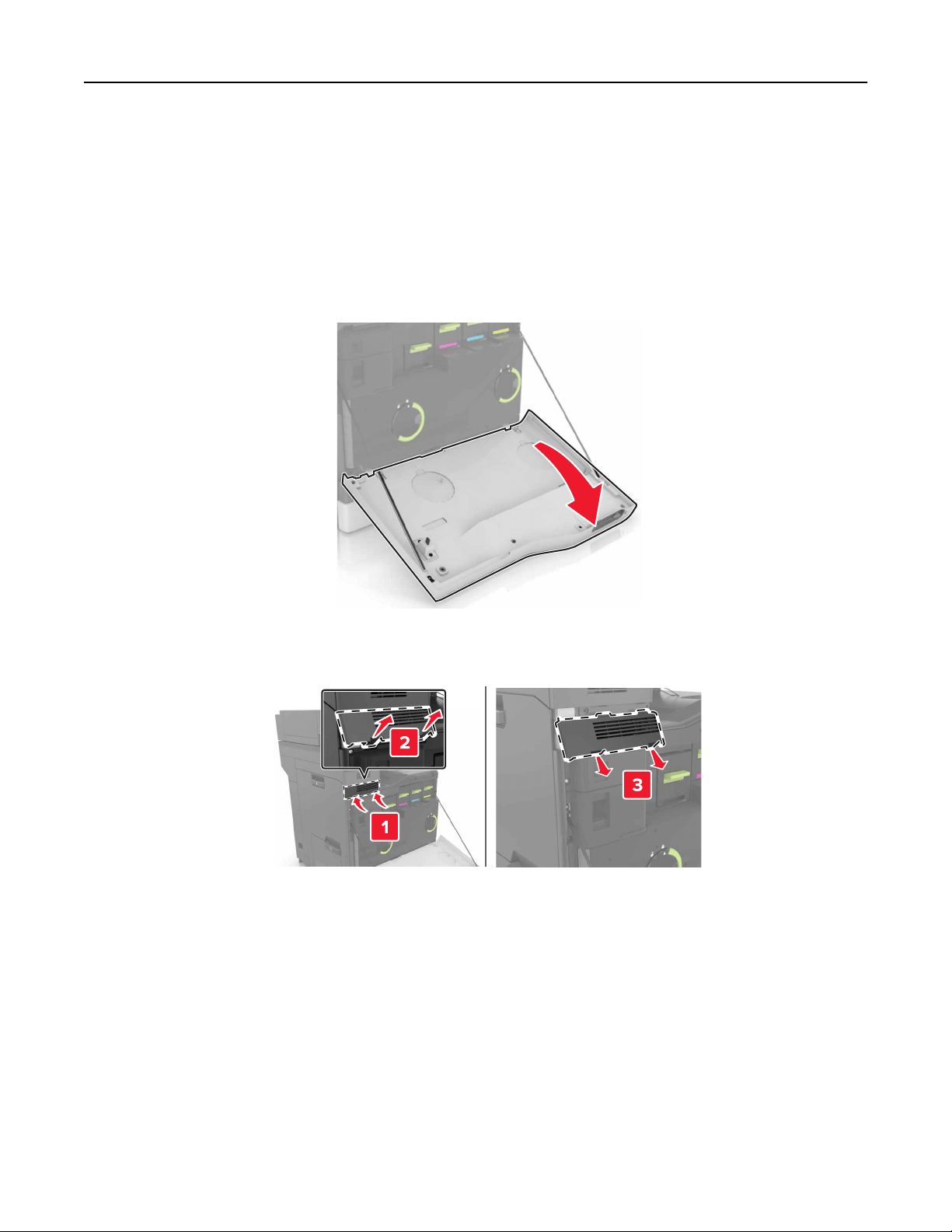
• Printer
• Staple finisher
Installing the keyboard tray
1 Turn
o
the printer.
2 Open door A.
3 Remove the keyboard attach cover.
4 Unpack the keyboard tray.
Upgrading and migrating 185
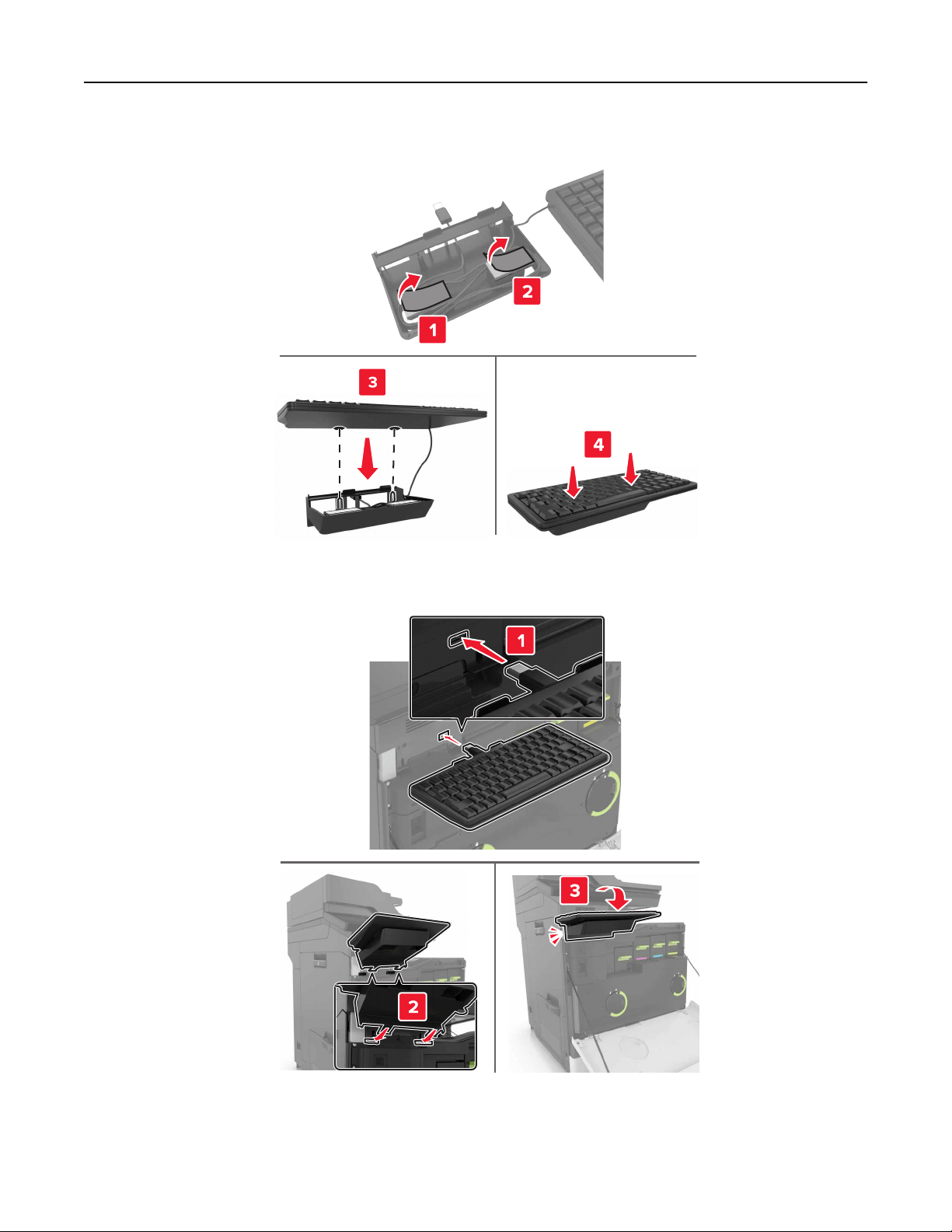
5 Attach the keyboard to the base.
6 Insert the keyboard tray.
7 Close door A.
8 Turn on the printer.
Upgrading and migrating 186
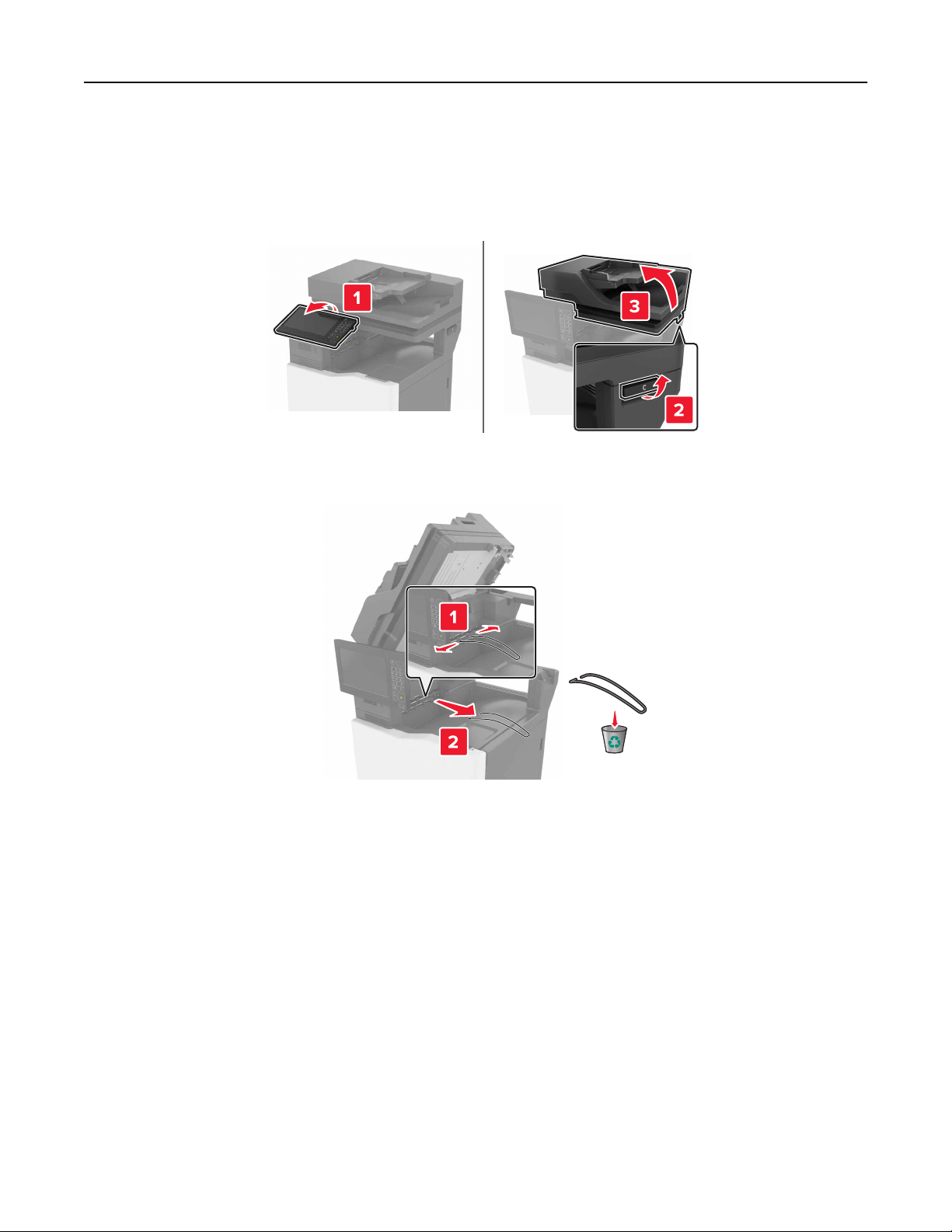
Installing the staple finisher
1 Turn
o
the printer.
2 Open door C.
3 Remove the paper bail.
Upgrading and migrating 187
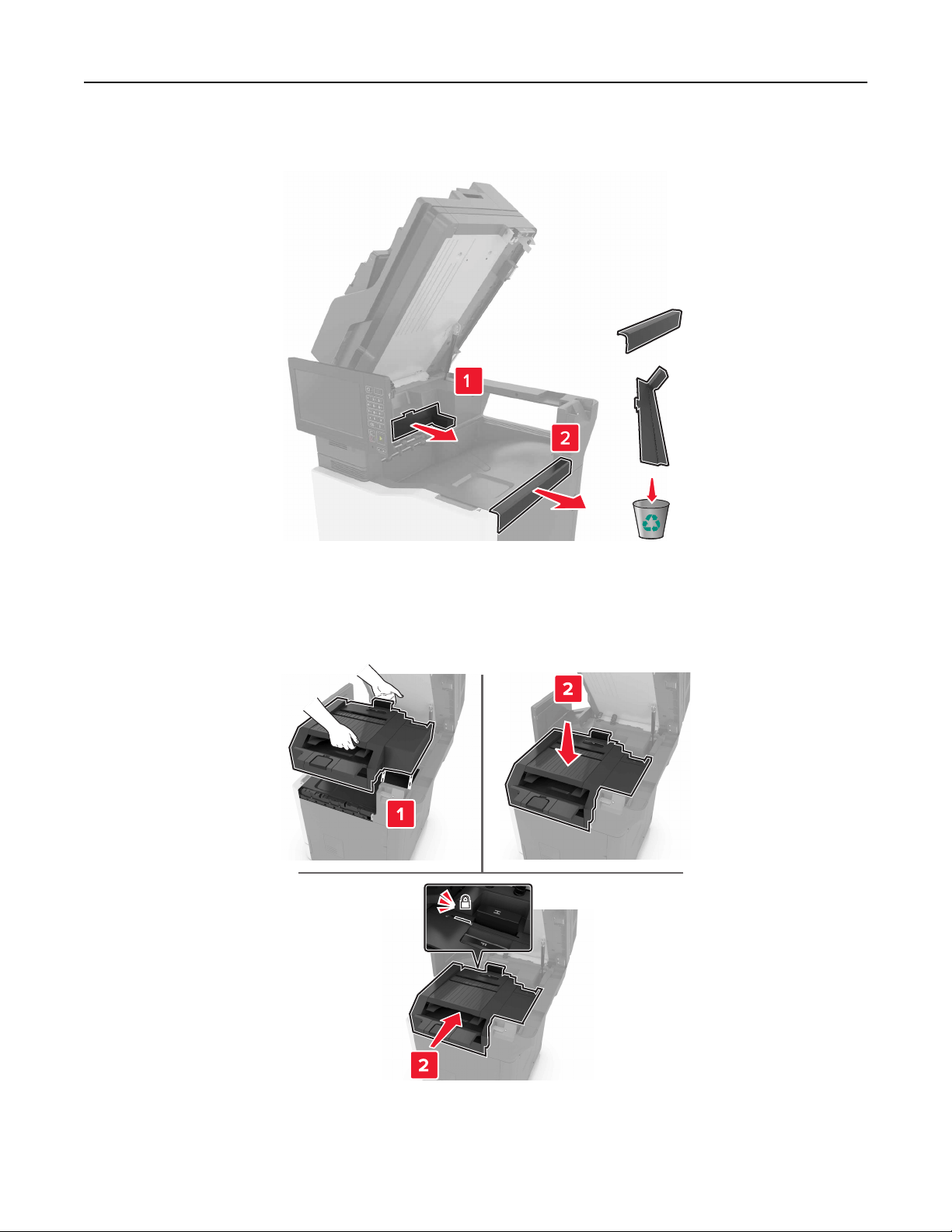
4 Remove the paper transport and staple finisher connector covers.
5 Unpack the staple finisher.
6 Insert the staple finisher until it clicks into place.
Upgrading and migrating 188
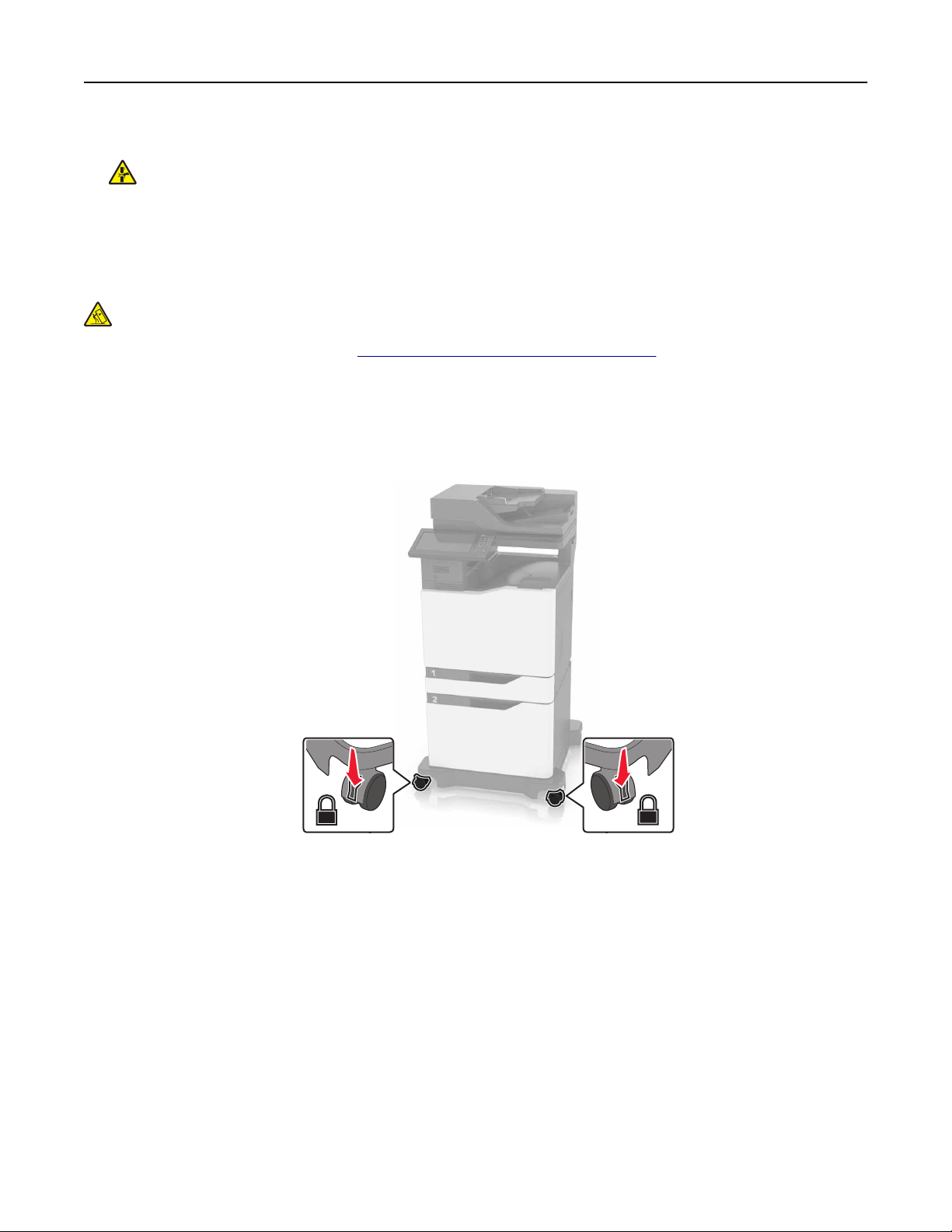
7 Close door C.
CAUTION—PINCH HAZARD: To avoid the risk of a pinch injury, keep hands clear of the labeled area
when closing door C.
8 Turn on the printer.
Installing the multiposition staple, hole punch finisher
CAUTION—TIPPING HAZARD: Installing one or more options on your printer or MFP may require a
caster base, furniture, or other feature to prevent instability causing possible injury. For more information
on supported configurations, see
www.lexmark.com/multifunctionprinters.
1 From the control panel, press and hold the power button for 5 seconds to turn o the printer.
2 Unplug the power cord from the electrical outlet, and then from the printer.
3 Lock the caster base wheels to keep the printer from moving.
Upgrading and migrating 189
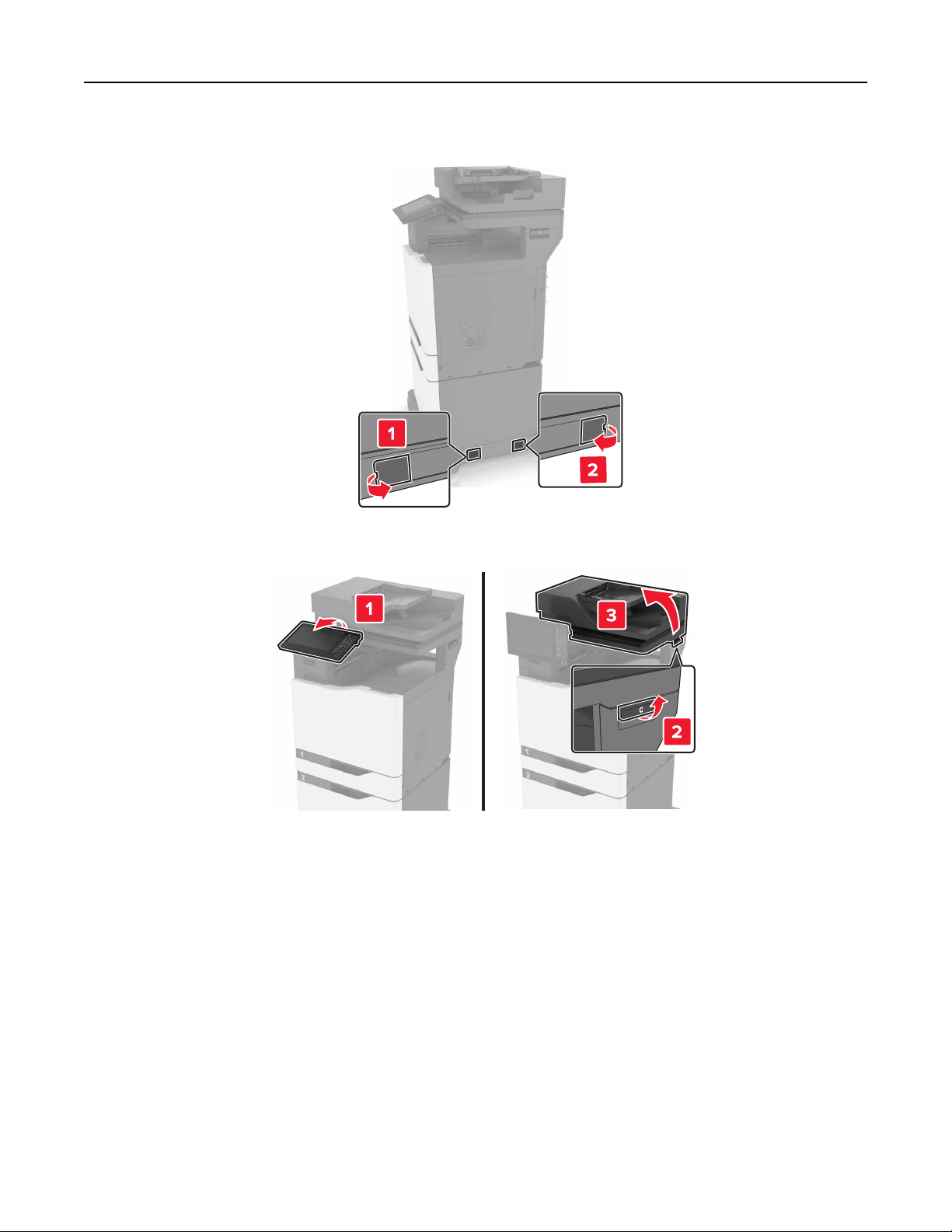
4 Open the covers at the side of the caster base.
5 Open door C.
Upgrading and migrating 190
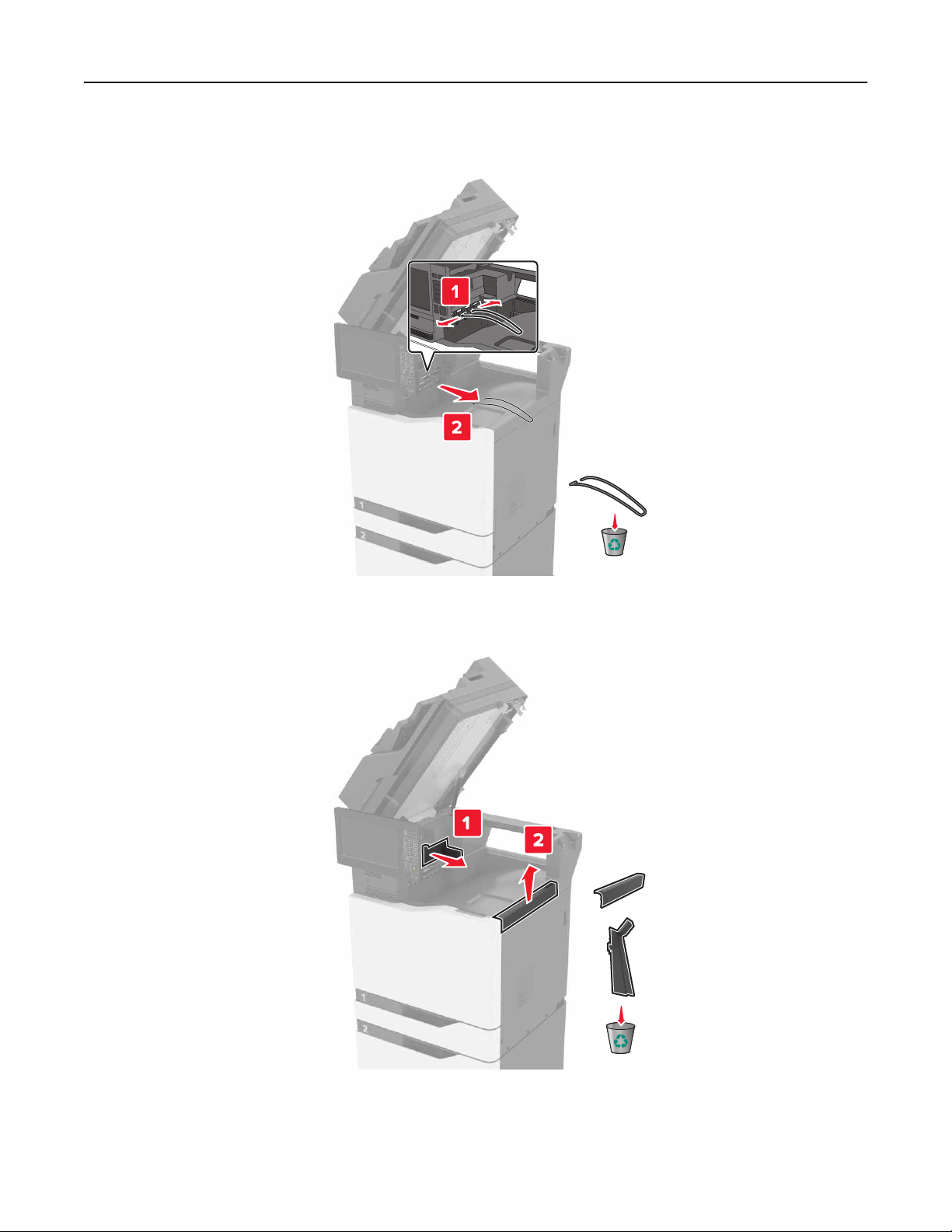
6 Remove the paper bail.
7 Remove the covers.
8 Unpack the paper transport, and then remove the pieces of tape.
Upgrading and migrating 191
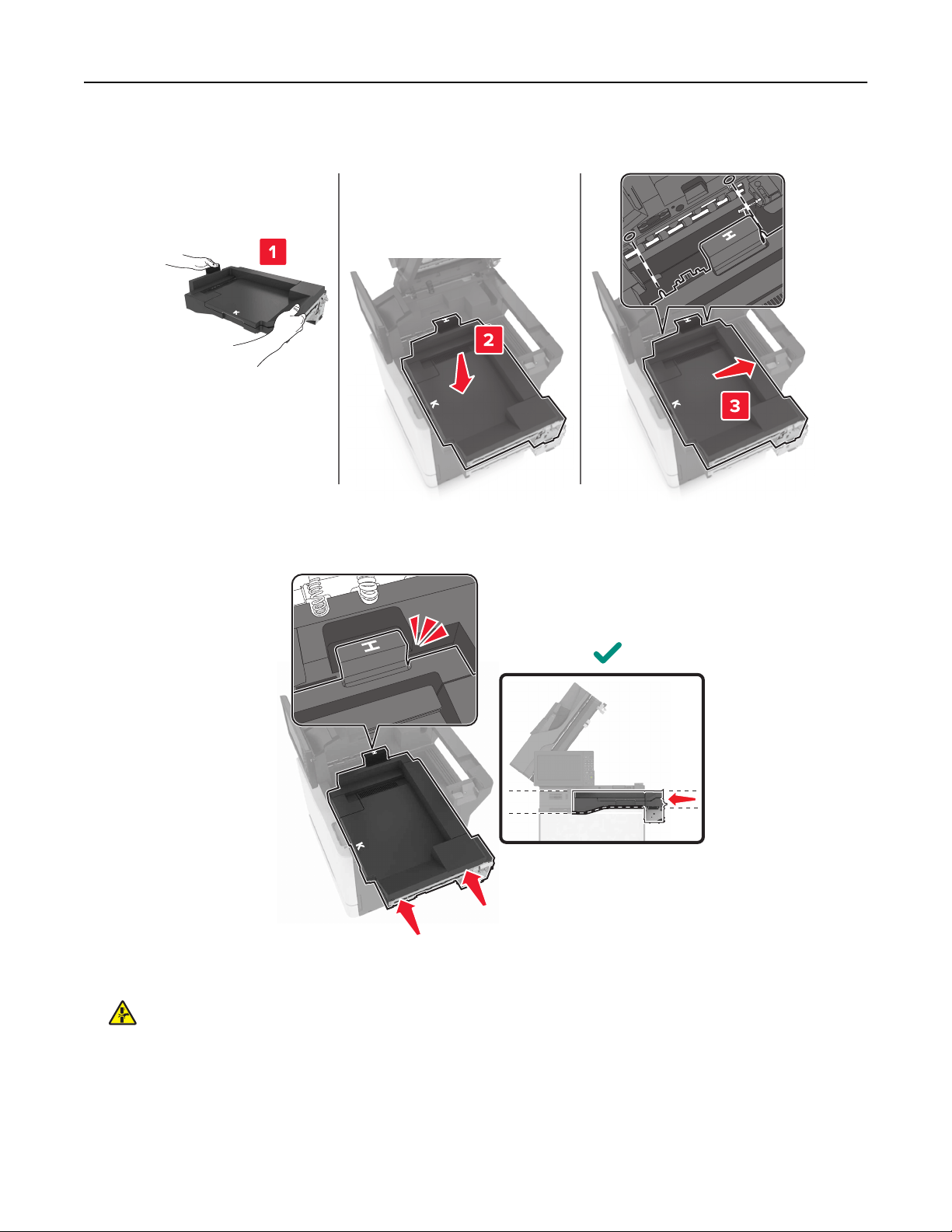
9 Lift, and then align the paper transport to the printer.
10 Firmly push the paper transport until it clicks into place.
11 Close door C.
CAUTION—PINCH HAZARD: To avoid the risk of a pinch injury, keep hands clear of the labeled area
when closing door C.
Upgrading and migrating 192
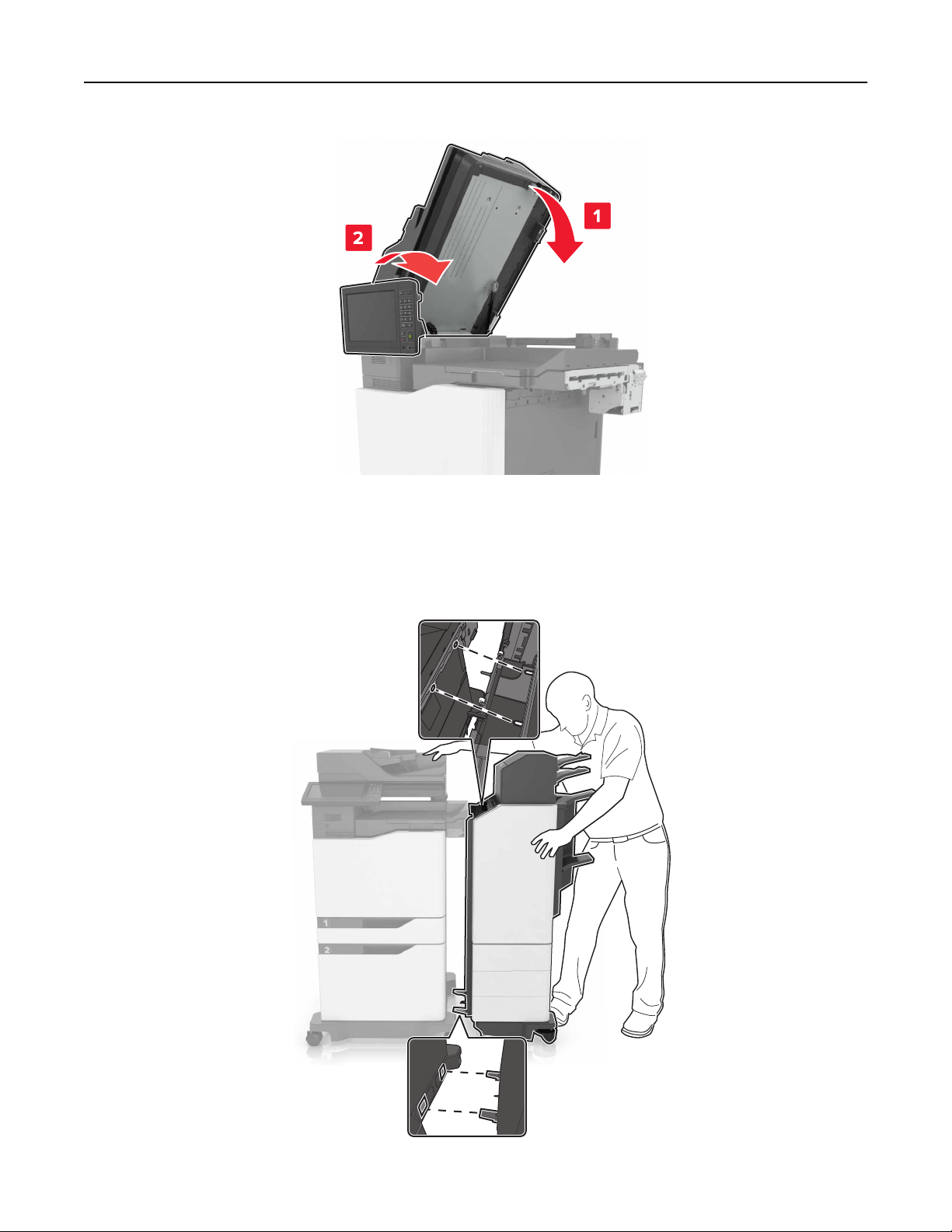
12 Unpack the multiposition staple, hole punch finisher, and then remove the pieces of tape.
13 On a flat, sturdy, and stable surface, align the finisher to the printer.
Note: Avoid installing the finisher on a carpeted surface.
Upgrading and migrating 193
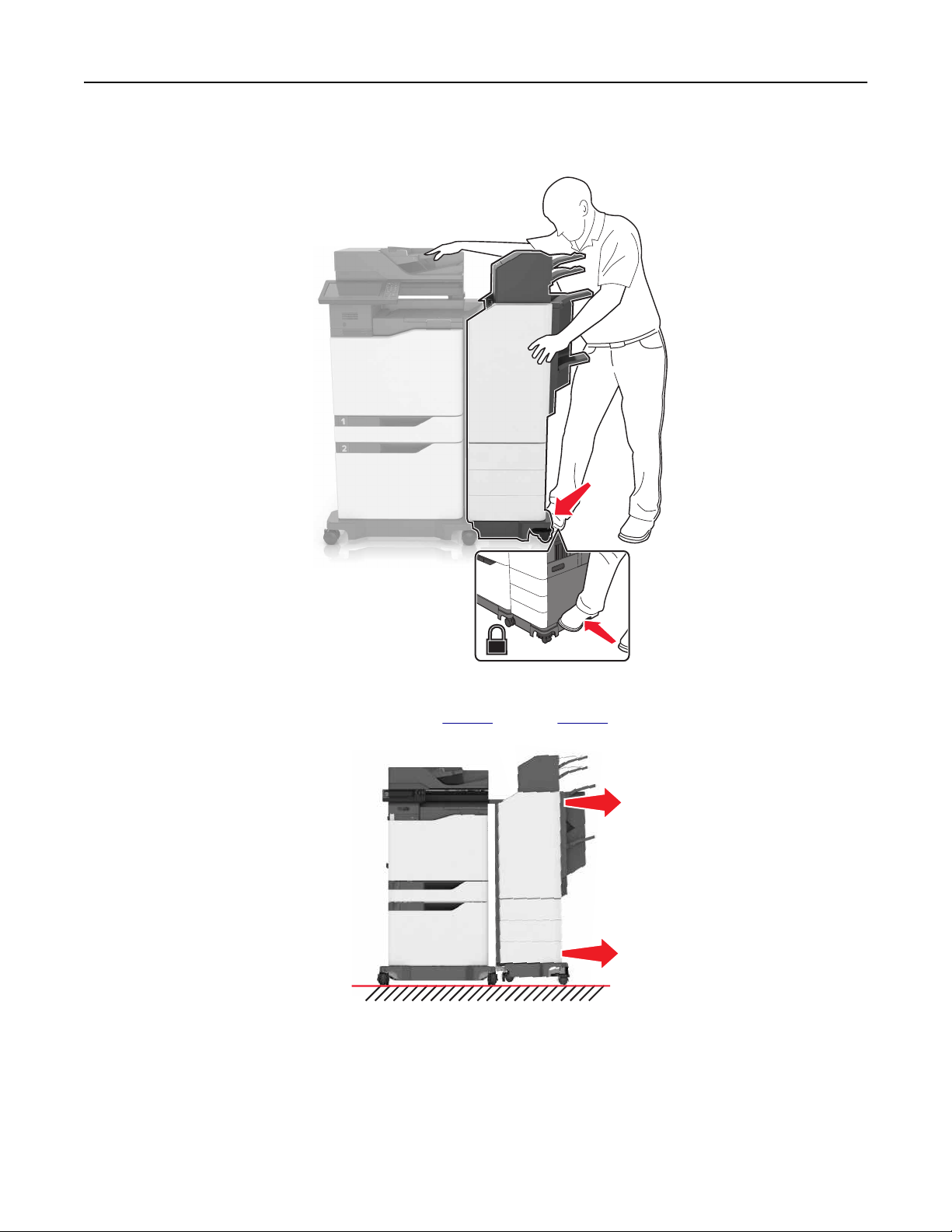
14 Push the finisher to the printer by applying pressure at the bottom of the finisher until it clicks into place.
Check if the
finisher
and printer are properly locked by pulling hard the
finisher
away from the printer. If the
finisher detaches from the printer, then repeat
step 13 through step 14 until they are properly locked.
Upgrading and migrating 194
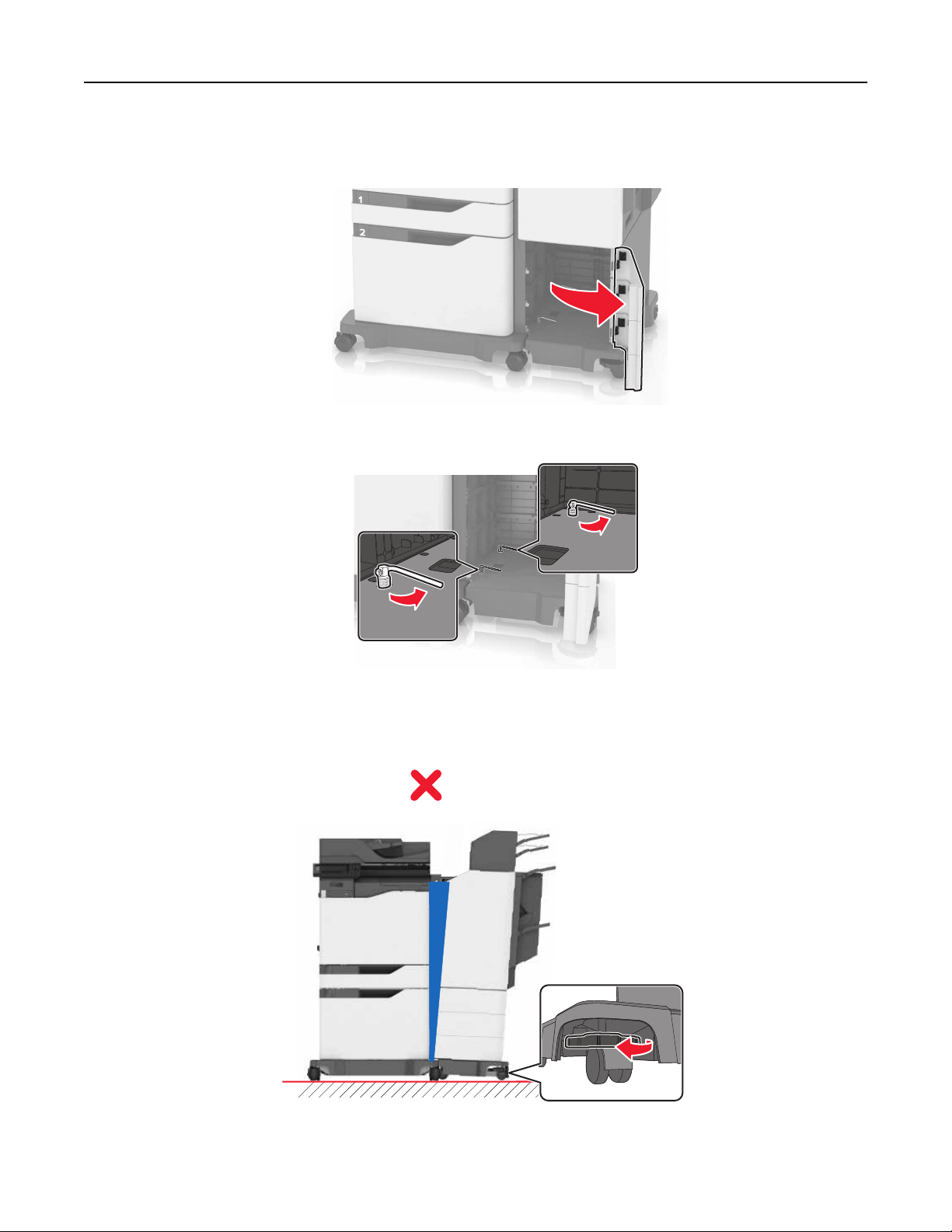
15 When the finisher is locked, do the following:
a Open the bottom front door of the finisher.
b Turn the levers of the finisher counterclockwise until the levers are loose.
c Close the door.
16 Check the gap between the printer and the finisher.
Upgrading and migrating 195

If the gap is uneven, then do either of the following:
a To fix the gap at the top, rotate the side wheels of the finisher clockwise.
b To fix the gap at the bottom, rotate the side wheels of the finisher counterclockwise.
17 Connect the power cords to the finisher and the printer, and then connect them to a properly grounded
electrical outlet.
CAUTION—POTENTIAL INJURY: To avoid the risk of fire or electrical shock, connect the power cord
to an appropriately rated and properly grounded electrical outlet that is near the product and easily
accessible.
CAUTION—POTENTIAL INJURY: Do not use this product with extension cords, multioutlet power
strips, multioutlet extenders, or UPS devices. The power capacity of these types of accessories can
be easily overloaded by a laser printer and may result in a risk of fire, property damage, or poor
printer performance.
18 Turn on the printer.
If necessary, manually add the
finisher
in the print driver to make it available for print jobs.
CAUTION—PINCH HAZARD: To avoid the risk of a pinch injury, keep hands clear of the labeled area
during print jobs that use the stapler in the multiposition staple, hole punch finisher.
Software
Installing the printer software
1 Obtain a copy of the software installer package.
• From the software CD that came with your printer.
• Go to
http://support.lexmark.com, and then select your printer and operating system.
2 Run the installer, and then follow the instructions on the computer screen.
3 For Macintosh users, add the printer.
Note: Obtain the printer IP address from the TCP/IP section in the Network/Ports menu.
Adding available options in the print driver
For Windows users
1 Open the printers folder.
2 Select the printer you want to update, and then do either of the following:
• For Windows 7 or later, select Printer properties.
• For earlier versions, select Properties.
3 Navigate to the Configuration tab, and then select Update Now ‑ Ask Printer.
4 Apply the changes.
Upgrading and migrating 196

For Macintosh users
1 From System Preferences in the Apple menu, navigate to your printer, and then select Options & Supplies.
2 Navigate to the list of hardware options, and then add any installed options.
3 Apply the changes.
Firmware
Exporting or importing a configuration file
You can export the configuration settings of your printer into a text file, and then import the file to apply the
settings to other printers.
1 Open a web browser, and then type the printer IP address in the address field.
Notes:
• View the printer IP address on the printer home screen. The IP address appears as four sets of
numbers separated by periods, such as 123.123.123.123.
• If you are using a proxy server, then temporarily disable it to load the web page correctly.
2 Export or import a configuration file for one or multiple applications.
For one application
a From the Embedded Web Server, click Apps > the application that you want > Configure.
b Click Export or Import.
For multiple applications
a From the Embedded Web Server, click Export Configuration or Import Configuration.
b Follow the instructions on the screen.
Updating firmware
Some applications require a minimum device firmware level to operate correctly.
For more information on updating the device firmware, contact your Lexmark representative.
1 From the Embedded Web Server, click Settings > Device > Update Firmware.
2 Browse to locate the required flash file.
3 Apply the changes.
Upgrading and migrating 197

Notices
Product information
Product name:
Lexmark CX825de, CX825dte, CX825dtpe, CX825dtfe, CX860de, CX860dte, CX860dtpe, CX860dtfe
Machine type:
7564
Model(s):
336, 337, 536, 537
Edition notice
February 2018
The following paragraph does not apply to any country where such provisions are inconsistent with local
law: LEXMARK INTERNATIONAL, INC., PROVIDES THIS PUBLICATION “AS IS” WITHOUT WARRANTY OF ANY
KIND, EITHER EXPRESS OR IMPLIED, INCLUDING, BUT NOT LIMITED TO, THE IMPLIED WARRANTIES OF
MERCHANTABILITY OR FITNESS FOR A PARTICULAR PURPOSE. Some states do not allow disclaimer of
express or implied warranties in certain transactions; therefore, this statement may not apply to you.
This publication could include technical inaccuracies or typographical errors. Changes are periodically made
to the information herein; these changes will be incorporated in later editions. Improvements or changes in the
products or the programs described may be made at any time.
References in this publication to products, programs, or services do not imply that the manufacturer intends to
make these available in all countries in which it operates. Any reference to a product, program, or service is
not intended to state or imply that only that product, program, or service may be used. Any functionally
equivalent product, program, or service that does not infringe any existing intellectual property right may be
used instead. Evaluation and
verification
of operation in conjunction with other products, programs, or services,
except those expressly designated by the manufacturer, are the user’s responsibility.
For Lexmark technical support, visit
http://support.lexmark.com.
For information on supplies and downloads, visit
www.lexmark.com.
© 2016 Lexmark International, Inc.
All rights reserved.
GOVERNMENT END USERS
The Software Program and any related documentation are "Commercial Items," as that term is
defined
in 48
C.F.R. 2.101, "Computer Software" and "Commercial Computer Software Documentation," as such terms are
used in 48 C.F.R. 12.212 or 48 C.F.R. 227.7202, as applicable. Consistent with 48 C.F.R. 12.212 or 48 C.F.R.
227.7202-1 through 227.7207-4, as applicable, the Commercial Computer Software and Commercial Software
Documentation are licensed to the U.S. Government end users (a) only as Commercial Items and (b) with only
those rights as are granted to all other end users pursuant to the terms and conditions herein.
Notices 198

Licensing notices
All licensing notices associated with this product can be viewed from the CD:\NOTICES directory of the
installation software CD.
Trademarks
Lexmark, the Lexmark logo, and MarkNet are trademarks or registered trademarks of Lexmark International,
Inc. in the United States and/or other countries.
Google Cloud Print and Google Chrome are trademarks of Google Inc.
Macintosh, the Mac logo, and Safari are trademarks of Apple Inc.
Microsoft, Windows, and Internet Explorer are either registered trademarks or trademarks of the Microsoft group
of companies in the United States and other countries.
Mopria®, the Mopria® logo, and the Mopria® Alliance logo are registered trademarks and service marks of Mopria
Alliance, Inc. in the United States and other countries. Unauthorized use is strictly prohibited.
PCL® is a registered trademark of the Hewlett-Packard Company. PCL is Hewlett-Packard Company’s
designation of a set of printer commands (language) and functions included in its printer products. This printer
is intended to be compatible with the PCL language. This means the printer recognizes PCL commands used
in various application programs, and that the printer emulates the functions corresponding to the commands.
PostScript is a registered trademark of Adobe Systems Incorporated in the United States and/or other countries.
All other trademarks are the property of their respective owners.
AirPrint and the AirPrint logo are trademarks of Apple, Inc.
Noise emission levels
The following measurements were made in accordance with ISO 7779 and reported in conformance with ISO
9296.
Note: Some modes may not apply to your product.
1-meter average sound pressure, dBA
Printing One-sided: 55 (mono), 56 (color); Two-
sided: 57 (mono), 57 (color)
Scanning 56 (CX825); 55 (CX860)
Copying 58 (mono); 59 (color)
Ready 16 (CX825); 14 (CX860)
Values are subject to change. See www.lexmark.com for current values.
Notices 199
Static sensitivity notice
This symbol identifies static-sensitive parts. Do not touch the areas near these symbols without first touching
a metal surface in an area away from the symbol.
Temperature information
Operating temperature and relative humidity 10 to 32.2°C (50 to 90°F) and 15 to 80% RH
15.3 to 32.2°C (60 to 90°F) and 8 to 15% RH
Maximum wet bulb temperature: 22.8°C (73°F)
Shipping temperature -40 to 43.3°C (-40 to 110°F)
Storage temperature and relative humidity -40 to 43.3°C (-40 to 110°F)
8 to 80% RH
Laser notice
The printer is certified in the U.S. to conform to the requirements of DHHS 21 CFR, Chapter I, Subchapter J for
Class I (1) laser products, and elsewhere is certified as a Class I laser product conforming to the requirements
of IEC 60825-1: 2014.
Class I laser products are not considered to be hazardous. The printer contains internally a Class IIIb (3b) AlGaAs
laser that is nominally 20 milliwatts operating in the wavelength region of 755–800 nanometers and enclosed
in a non-serviceable printhead assembly. The laser system and printer are designed so there is never any human
access to laser radiation above a Class I level during normal operation, user maintenance, or prescribed service
conditions.
Laser advisory label
A laser notice label may be
axed
to this printer as shown:
DANGER - Invisible laser radiation when cartridges are removed and interlock defeated. Avoid exposure to laser
beam.
PERIGO - Radiação a laser invisível será liberada se os cartuchos forem removidos e o lacre rompido. Evite a
exposição aos feixes de laser.
Opasnost - Nevidljivo lasersko zračenje kada su kasete uklonjene i poništena sigurnosna veza. Izbjegavati izlaganje
zracima.
NEBEZPEČÍ - Když jsou vyjmuty kazety a je odblokována pojistka, ze zařízení je vysíláno neviditelné laserové záření.
Nevystavujte se působení laserového paprsku.
FARE - Usynlig laserstråling, når patroner
ernes,
og spærreanordningen er slået fra. Undgå at blive udsat for
laserstrålen.
Notices 200

GEVAAR - Onzichtbare laserstraling wanneer cartridges worden verwijderd en een vergrendeling wordt genegeerd.
Voorkom blootstelling aan de laser.
DANGER - Rayonnements laser invisibles lors du retrait des cartouches et du déverrouillage des loquets. Eviter
toute exposition au rayon laser.
VAARA - Näkymätöntä lasersäteilyä on varottava, kun värikasetit on poistettu ja lukitus on auki. Vältä lasersäteelle
altistumista.
GEFAHR - Unsichtbare Laserstrahlung beim Herausnehmen von Druckkassetten und oener Sicherheitssperre.
Laserstrahl meiden.
ΚΙΝΔΥΝΟΣ - Έκλυση αόρατης ακτινοβολίας laser κατά την αφαίρεση των κασετών και την απασφάλιση της
μανδάλωσης. Αποφεύγετε την έκθεση στην ακτινοβολία laser.
VESZÉLY – Nem látható lézersugárzás fordulhat elő a patronok eltávolításakor és a zárószerkezet felbontásakor.
Kerülje a lézersugárnak való kitettséget.
PERICOLO - Emissione di radiazioni laser invisibili durante la rimozione delle cartucce e del blocco. Evitare l
´esposizione al raggio laser.
FARE – Usynlig laserstråling når kassettene tas ut og sperren er satt ut av spill. Unngå eksponering for laserstrålen.
NIEBEZPIECZEŃSTWO - niewidzialne promieniowanie laserowe podczas usuwania kaset i blokady. Należy unikać
naświetlenia promieniem lasera.
ОПАСНО! Невидимое лазерное излучение при извлеченных картриджах и снятии блокировки. Избегайте
воздействия лазерных лучей.
Pozor – Nebezpečenstvo neviditeľného laserového žiarenia pri odobratých kazetách a odblokovanej poistke.
Nevystavujte sa lúčom.
PELIGRO: Se producen radiaciones láser invisibles al extraer los cartuchos con el interbloqueo desactivado. Evite
la exposición al haz de láser.
FARA – Osynlig laserstrålning när patroner tas ur och spärrmekanismen är upphävd. Undvik exponering för
laserstrålen.
危险 - 当移除碳粉盒及互锁失效时会产生看不见的激光辐射,请避免暴露在激光光束下。
危險 - 移除碳粉匣與安全連鎖開關失效時會產生看不見的雷射輻射。請避免曝露在雷射光束下。
危険 - カートリッジが取り外され、内部ロックが無効になると、見えないレーザー光が放射されます。 このレ
ーザー光に当たらないようにしてください。
Notices 201

Index
A
activating Voice Guidance 24
adapter plug 48
adding contacts 21
adding groups 22
adding hardware options
print driver 196
adding internal options
print driver 196
ADF feed roller
replacing 92
ADF pick roller
replacing 90
ADF separator roller
replacing 94
adjusting speech rate
Voice Guidance 24
adjusting the brightness
printer display 105
adjusting the brightness of the
printer display 105
adjusting toner darkness 164
AirPrint
using 31
answering machine
setting up 40
attaching cables 13
available internal options 174
avoiding paper jams 107
B
blank pages 145
blocking junk faxes 54
C
canceling a print job
from the computer 34
from the printer control
panel 34
cannot open Embedded Web
Server 132
Card Copy
setting up 20
card stock
loading 28
changing port settings
internal solutions port 61
Check tray connection 140
checking the printer
connectivity 133
checking the status of parts and
supplies 65
cleaning
exterior of the printer 62
interior of the printer 62
scanner glass 62
cleaning the printer 62
collated printing does not
work 138
collating copies 36
Color Correction
manual 164
Color Correction Content 164
color quality, troubleshooting
print appears tinted 166
confidential print jobs 33
configuring
daylight saving
time 52
configuring e‑mail settings 37
configuring
port settings 61
configuring
supply
notifications 67
connecting printer to distinctive
ring service 52
connecting to a wireless network
using PIN method 60
using Push Button method 60
conservation settings
Eco‑Mode 104
hibernate mode 104
sleep mode 104
conserving supplies 105
contacting customer support 173
contacts
adding 21
deleting 22
editing 22
control panel
using 15
copy troubleshooting
partial copies of documents or
photos 171
poor copy quality 171
scanner does not respond 172
scanner unit does not close 172
copying
creating shortcuts 36
on both sides of the paper 35
copying dierent paper sizes 35
copying from
selected tray 35
copying multiple pages
onto a single sheet 36
copying on letterhead 35
copying photos 35
creating shortcuts
e‑mail 38
fax destination 53
customer support
contacting 173
D
date and time
fax settings 52
daylight saving time,
configuring 52
Defective flash detected 136
deleting contacts 22
deleting groups 22
developer unit
ordering 67
replacing 68
dierent paper sizes, copying 35
digital subscriber line (DSL)
fax setup 44
digital telephone service
fax setup 46
disabling the proximity
sensor 105
disposing of printer hard disk 58
distinctive ring service, fax
connecting to 52
documents, printing
from a computer 30
from a mobile device 30, 31
DSL filter 44
E
Eco‑Mode setting 104
editing contacts 22
editing groups 22
emission notices 199
emptying the hole punch box 63
Index 202

enabling Magnification mode 24
enabling personal identification
numbers 24
enabling spoken passwords 24
enabling the USB port 133
encrypting the printer hard
disk 58
enlarging copies 36
envelopes
loading 28
environmental setting
Eco‑Mode 104
environmental settings
hibernate mode 104
sleep mode 104
erasing printer hard disk
memory 57
exporting a configuration file
using the Embedded Web
Server 197
e‑mail
creating shortcuts 38
setting up 37
e‑mailing
configuring e‑mail settings 37
using a shortcut number 37
using the address book 37
using the printer 37
F
FAQ about color printing 165
fax log
viewing 54
fax resolution
changing 53
fax setup
country‑ or region‑specific 48
digital telephone service 46
DSL connection 44
standard telephone line
connection 40
VoIP 45
fax troubleshooting
cannot receive faxes 169
cannot send faxes 169
cannot send or receive
faxes 167
received fax has poor print
quality 170
faxing
adjusting darkness 53
blocking junk faxes 54
changing resolution 53
creating shortcuts 53
fax setup 39
forwarding faxes 54
holding faxes 54
setting the date and time 52
viewing a fax log 54
finding more information about
the printer 9
firmware
update 197
firmware card 174
flash drive
printing from 31
scanning to 55
font sample list
printing 34
forms
printing 30
Forms and Favorites
setting up 20
forwarding faxes 54
FTP address
creating shortcuts 55
FTP server, scanning to
using the control panel 55
fuser
replacing 70
G
Google Cloud Print
using 30
green settings
Eco‑Mode 104
hibernate mode 104
sleep mode 104
groups
adding 22
deleting 22
editing 22
H
hardware options
installing 183
hardware options, adding
print driver 196
held jobs 33
printing from a Macintosh
computer 33
printing from Windows 33
held print jobs
printing from a Macintosh
computer 33
printing from Windows 33
hibernate mode
setting 104
holding faxes 54
hole punch box
emptying 63
home screen
customizing 20
showing icons 20
home screen icons
using 16
horizontal dark lines 149
I
icons on the home screen
showing 20
imaging unit
replacing 75
imaging units
ordering 67
importing a configuration file
using the Embedded Web
Server 197
indicator light
printer status 16
installing a memory card 174
installing a printer hard disk 180
installing an internal solutions
port 175
installing an optional card 179
installing optional trays 183
installing options
internal solutions port 175
printer hard disk 180
installing the keyboard tray 185
installing the multiposition staple,
hole punch
finisher
189
installing the printer software 196
installing the staple finisher 187
internal options 174
installing 179
memory card 174
internal options, adding
print driver 196
internal solutions port
installing 175
troubleshooting 135
Index 203

J
jam, clearing
automatic document feeder 112
door J 125
door K 123
door L 127
door N 126
duplex unit 115
finisher bin 118
fuser 115
multipurpose feeder 111
standard bin 114
staple cartridge 120, 129
staple finisher bin 128
trays 110
jams
avoiding 107
locating jam areas 108
locations 108
K
keyboard on the display
using 25
keyboard tray
installing 185
L
letterhead
copying on 35
Lexmark Mobile Print
using 30
line filter 44
linking trays 29
loading
card stock 28
envelopes 26
transparencies 28
trays 26
loading envelopes
multipurpose feeder 28
loading paper
multipurpose feeder 28
locating the security slot 57
M
Magnification mode
enabling 24
making copies 35
manual Color Correction
applying 164
memory
types installed on printer 58
memory card 174
installing 174
menu map 17
menu settings page
printing 19
mobile device
printing from 30, 31
Mopria Print Service
using 31
moving the printer 10, 104
multiposition staple, hole punch
finisher
installing 189
multipurpose feeder
loading 28
N
navigating the screen
using gestures 25
navigating the screen using
gestures 25
noise emission levels 199
Non‑Lexmark supply 137
non‑volatile memory 58
erasing 57
Not enough free space in flash
memory for resources 136
notices 199
O
optional card
installing 179
optional trays
installing 183
options
firmware cards 174
memory card 174
ordering
developer unit 67
imaging units 67
photoconductor unit 66
toner cartridges 65
ordering supplies
staple cartridges 67
waste toner bottle 67
P
paper
Universal size setting 26
paper jam behind door N 126
paper jam in door B 115
paper jam in door J 125
paper jam in door K 123
paper jam in door L 127
paper jam in the automatic
document feeder 112
paper jam in the finisher bin 118
paper jam in the multipurpose
feeder 111
paper jam in the standard bin 114
paper jam in the staple finisher
bin 128
paper jam in trays 110
paper jam, clearing
automatic document feeder 112
door J 125
door K 123
door L 127
door N 126
duplex unit 115
finisher bin 118
fuser 115
multipurpose feeder 111
standard bin 114
staple finisher bin 128
trays 110
paper jams
avoiding 107
paper size
setting 26
paper type
setting 26
parallel interface card
troubleshooting 135
parts status
checking 65
personal identification number
method 60
personal identification numbers
enabling 24
phone splitter 45
photoconductor unit
ordering 66
replacing 72
photos
copying 35
pick roller
replacing 78
placing separator sheets
between copies
copying 36
Index 204

port settings
configuring 61
power button light
printer status 16
print driver
hardware options, adding 196
print job
canceling from the
computer 34
canceling from the printer
control panel 34
print quality
cleaning the scanner glass 62
print quality troubleshooting
blank pages 145
crooked print 155
dark print 146
ghost images appear on
prints 148
gray background 148
horizontal dark lines 149
horizontal white lines 150
jagged or uneven
characters 152
light print 153
mottled print and dots 154
repeating print defects 156
skewed print 155
solid color or black images 157
text or images cut o 158
toner easily rubs o 159
uneven print density 159
vertical dark lines or streaks
appear on prints 160
white lines 161
white pages 145
print troubleshooting
confidential and other held
documents do not print 142
envelope seals when
printing 138
incorrect margins on prints 151
jammed pages are not
reprinted 141
job prints from the wrong
tray 163
job prints on the wrong
paper 163
paper curl 139
paper frequently jams 141
print jobs do not print 144
slow printing 143
tray linking does not work 139
unable to read flash drive 133
printer
basic model 11
fully configured 11
minimum clearances 10
moving 10, 104
selecting a location 10
shipping 104
printer configurations 11
printer display
adjusting the brightness 105
printer hard disk
disposing of 58
encrypting 58
printer hard disk encryption 58
printer hard disk memory
erasing 57
printer information
finding 9
printer is not responding 162
printer menus 17
printer messages
Check tray connection 140
Defective flash detected 136
Non‑Lexmark supply 137
Not enough free space in flash
memory for resources 136
Replace cartridge, printer region
mismatch 136
Scanner maintenance required,
use ADF Kit 137
Unformatted flash detected 136
printer options troubleshooting
internal option is not
detected 134
internal solutions port 135
parallel interface card 135
serial interface card 135
printer ports 13
printer settings
restoring to factory defaults 58
printer software, installing 196
printing
font sample list 34
from a computer 30
from a flash drive 31
from a mobile device 31
menu settings page 19
printing a font sample list 34
printing a menu settings page 19
printing a network setup
page 133
printing forms 30
printing from a computer 30
printing from a flash drive 31
printing held jobs
from a Macintosh computer 33
from Windows 33
Push Button method 60
R
recycling
Lexmark packaging 106
Lexmark products 105
toner cartridges 106
reducing copies 36
repeat print jobs 33
printing from a Macintosh
computer 33
printing from Windows 33
repeating print defects 156
Replace cartridge, printer region
mismatch 136
replacing
transfer belt 85
replacing a developer unit 68
replacing a photoconductor
unit 72
replacing a toner cartridge 77
replacing an imaging unit 75
replacing parts
ADF feed roller 92
ADF pick roller 90
ADF separator roller 94
pick roller 78
separator pad 83
replacing supplies
staple cartridge 95, 100
staple cartridge holder 97, 102
waste toner bottle 84
replacing the ADF feed roller 92
replacing the ADF pick roller 90
replacing the ADF separator
roller 94
replacing the fuser 70
replacing the pick roller 78
replacing the separator pad 83
replacing the staple cartridge
holder in the multiposition staple,
hole punch finisher 102
replacing the staple cartridge
holder in the staple finisher 97
Index 205

replacing the staple cartridge in
the multiposition staple, hole
punch finisher 100
replacing the staple cartridge in
the staple finisher 95
replacing the transfer belt 85
replacing the waste toner
bottle 84
replacing transfer roller 88
reserve print jobs
printing from a Macintosh
computer 33
printing from Windows 33
resetting
supply usage counters 137
resetting the supply usage
counters 137
restoring factory default
settings 58
RJ11 adapter 48
S
safety information 7, 8
saving paper 36
saving toner 36
Scan Center
setting up 21
Scan to Computer
setting up 56
scan troubleshooting
cannot scan from a
computer 170
partial copies of documents or
photos 171
poor copy quality 171
scan job was not successful 171
scanner does not respond 172
scanner unit does not close 172
scanning freezes the
computer 172
scanning takes too long 172
scanner glass
cleaning 62
Scanner maintenance required,
use ADF Kit 137
scanning
to an FTP server 55
scanning to a computer 56
scanning to a flash drive 55
scanning to an FTP server
using the control panel 55
scheduling a fax 53
security slot
locating 57
selecting a location for the
printer 10
sending a fax
scheduled 53
using the computer 52
using the control panel 52
sending an e‑mail 37
separator pad
replacing 83
serial interface card
troubleshooting 135
serial printing
setting up 61
setting hibernate mode 104
setting sleep mode 104
setting the paper size 26
setting the paper type 26
setting the Universal paper
size 26
setting up e‑mail function 37
setting up fax
country‑ or region‑specific 48
digital telephone service 46
DSL connection 44
standard telephone line
connection 40
VoIP connection 45
setting up fax function 39
setting up serial printing 61
shipping the printer 104
Shortcut Center
using 21
shortcuts, creating
copy screen 36
FTP address 55
showing icons on the home
screen 20
spoken passwords
enabling 24
staple cartridge
replacing 95, 100
staple cartridge holder
replacing 97, 102
staple cartridges
ordering 67
staple finisher
installing 187
staple jam in door G 120
staple jam in door J 129
staple jam, clearing
door G 120
door J 129
statement of volatility 58
storing
supplies 103
storing print jobs 33
supplies
conserving 105
storing 103
supplies status
checking 65
supplies, ordering
developer unit 67
imaging units 67
photoconductor unit 66
staple cartridges 67
toner cartridges 65
waste toner bottle 67
supply notifications
configuring 67
supply usage counters
resetting 137
supported file types 32
supported flash drives 32
T
toner cartridge
replacing 77
toner cartridges
ordering 65
recycling 106
toner darkness
adjusting 164
transfer belt
replacing 85
transfer roller
replacing 88
transparencies
loading 28
trays
linking 29
loading 26
unlinking 29
troubleshooting
cannot open Embedded Web
Server 132
FAQ about color printing 165
printer is not responding 162
troubleshooting, color quality
print appears tinted 166
Index 206

troubleshooting, copy
partial copies of documents or
photos 171
poor copy quality 171
scanner does not respond 172
scanner unit does not close 172
troubleshooting, fax
cannot receive faxes 169
cannot send faxes 169
cannot send or receive
faxes 167
received fax has poor print
quality 170
troubleshooting, print
collated printing does not
work 138
confidential and other held
documents do not print 142
envelope seals when
printing 138
incorrect margins on prints 151
jammed pages are not
reprinted 141
job prints from the wrong
tray 163
job prints on the wrong
paper 163
paper curl 139
paper frequently jams 141
print jobs do not print 144
slow printing 143
tray linking does not work 139
troubleshooting, print quality
blank pages 145
crooked print 155
dark print 146
ghost images appear on
prints 148
gray background 148
horizontal dark lines 149
horizontal white lines 150
jagged or uneven
characters 152
light print 153
mottled print and dots 154
repeating print defects 156
skewed print 155
solid color or black images 157
text or images cut o 158
toner easily rubs o 159
uneven print density 159
vertical dark lines or streaks
appear on prints 160
white lines on a page 161
white pages 145
troubleshooting, printer options
internal option is not
detected 134
internal solutions port 135
troubleshooting, scan
cannot scan from a
computer 170
partial copies of documents or
photos 171
poor copy quality 171
scan job was not successful 171
scanner does not respond 172
scanner unit does not close 172
two‑sided copying 35
U
unable to read flash drive
troubleshooting, print 133
understanding the status of the
power button and indicator
light 16
uneven print density 159
Unformatted flash detected 136
Universal paper size
setting 26
unlinking trays 29
updating firmware
flash file 197
USB port
enabling 133
using
genuine Lexmark parts 65
genuine Lexmark supplies 65
using the ADF
copying 35
using the control panel 15
using the home screen 16
using the keyboard on the
display 25
using the scanner glass
copying 35
V
verify print jobs 33
printing from a Macintosh
computer 33
printing from Windows 33
vertical dark lines or streaks
appear on prints 160
vertical white lines appear 161
viewing a fax log 54
Voice Guidance
activating 24
speech rate 24
Voice Guidance speech rate
adjusting 24
voice mail
setting up 40
voice over Internet Protocol
(VoIP)
fax setup 45
VoIP adapter 45
volatile memory 58
erasing 57
volatility
statement of 58
W
waste toner bottle
ordering 67
replacing 84
white lines appear 161
white pages 145
wireless network
Wi‑Fi Protected Setup 60
Wi‑Fi Protected Setup
wireless network 60
Index 207