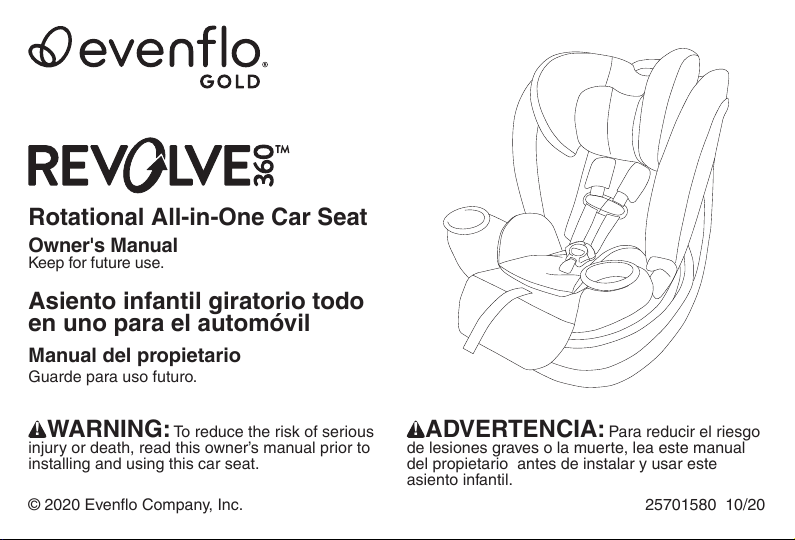
Rotational All-in-One Car Seat
Owner's Manual
Keep for future use.
© 2020 Eveno Company, Inc. 25701580 10/20
WARNING:
!
To reduce the risk of serious
injury or death, read this owner’s manual prior to
installing and using this car seat.
ADVERTENCIA:
!
Para reducir el riesgo
de lesiones graves o la muerte, lea este manual
del propietario antes de instalar y usar este
asiento infantil.
Asiento infantil giratorio todo
en uno para el automóvil
Manual del propietario
Guarde para uso futuro.

According to the U.S. National Highway Trafc Safety Administration
(NHTSA), car seats and boosters provide protection for infants and children
in a crash, yet car crashes are a leading cause of death for children.
To reduce the risk of SERIOUS INJURY or DEATH, read this owner’s manual
and your vehicle owner’s manual before installing and using this Car Seat. Using
a Car Seat makes a big difference. By properly using this Car Seat and following
these instructions, the instructions on the Car Seat, and the instructions that
accompany your vehicle, you will greatly reduce the risk of serious injury or death
to your child from a crash. Do not be misled by the commonly used term “safety
seat”; no restraint system can prevent all injuries in all crashes. Many properly
restrained adults and children are injured in motor vehicle crashes, including
relatively minor crashes. A properly used Car Seat is the best way to minimize
injuries to your child and to increase the chances for your child’s survival in most
crashes.
FEDERAL MOTOR VEHICLE SAFETY STANDARD NO. 213 (FMVSS 213)
Child Restraint Systems
This Child Restraint conforms to all applicable Federal motor vehicle safety
standards.
CANADIAN REGULATORY NOTICE
(Model numbers ending in “C”)
This Child Restraint meets all applicable requirements of Canadian Motor
Vehicle Safety Standards CMVSS 213, 213.1, and 213.2.
4
IMPORTANT INFORMATION
Child Requirements ......................................................................................................... 7
Rear-Facing Mode .................................................................................................. 10
Forward-Facing Mode ............................................................................................. 12
Booster Mode ......................................................................................................... 14
Warnings ........................................................................................................................ 16
Motor Vehicle/Aircraft Usage .......................................................................................... 35
Registration and Recall Information ............................................................................... 36
Car Seat Features .......................................................................................................... 38
Seat Rotation .......................................................................................................... 42
Adjustable Buckle Strap .......................................................................................... 44
Height Adjustable Headrest .................................................................................... 45
Cup Holders ............................................................................................................ 46
Body Pillow ............................................................................................................. 47
Head Pillow ............................................................................................................. 48
Tether Strap ............................................................................................................ 49
Harness Strap Pads and Harness Covers .............................................................. 50
Lower Anchor Connectors ...................................................................................... 51
USING THE REVOLVE360
Installing and Removing the Seat Shell from the Base .................................................. 53
Installing the Seat Shell to the Base ....................................................................... 53
Removing the Seat Shell from the Base ................................................................. 54
Table of Contents
5
Lap/Shoulder Belt (Rear-Facing and Forward-Facing)................................................... 55
Installing Lap/Shoulder Belt (Preferred Method) ..................................................... 55
Removing Lap/Shoulder Belt .................................................................................. 63
Lap Belt Only (Rear-Facing and Forward-Facing).......................................................... 65
Installing Lap Belt ................................................................................................... 65
Removing Lap Belt ................................................................................................. 73
LATCH/UAS (Rear-Facing and Forward-Facing) ........................................................... 75
Installing LATCH/UAS ............................................................................................. 75
Removing LATCH/UAS ........................................................................................... 83
Booster Mode (Forward-Facing Only) ............................................................................ 85
Converting to Booster Mode ................................................................................... 85
Installing the Booster .............................................................................................. 90
GENERAL INFORMATION
Securing the Child with Harness .................................................................................... 95
Securing the Child in Booster Mode ............................................................................ 103
How is a Booster Seat Used? ............................................................................... 103
Securing with the Booster ..................................................................................... 104
Removing/Replacing the Seat Cover ........................................................................... 105
Care and Cleaning ....................................................................................................... 114
Proper Disposal ........................................................................................................... 115
Replacement Parts ...................................................................................................... 116
Recording Model Information and Storing Your Instructions ........................................ 118
Eveno Gold Lifetime Warranty .................................................................................... 119
Table of Contents
6
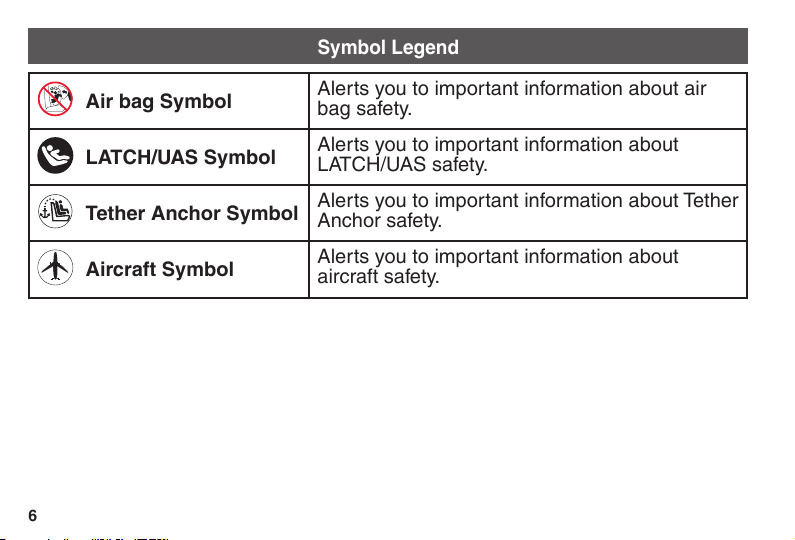
Symbol Legend
Air bag Symbol
Alerts you to important information about air
bag safety.
LATCH/UAS Symbol
Alerts you to important information about
LATCH/UAS safety.
Tether Anchor Symbol
Alerts you to important information about Tether
Anchor safety.
Aircraft Symbol
Alerts you to important information about
aircraft safety.
7
Child Requirements
This Car Seat is designed for use by children in both REAR-FACING and
FORWARD-FACING mode, as well as in BOOSTER mode. To use this Car Seat
properly, children MUST meet the size and age requirements on the following
pages. In addition, Eveno recommends consulting with your child’s physician
before allowing your child to transition between modes.
The American Academy of Pediatrics (AAP) recommends keeping children
REAR-FACING for as long as possible, until they reach the maximum height or
weight for their Car Seat in REAR-FACING orientation.* Additionally, some states’
laws require children to be REAR-FACING until age 2. Accordingly, you will see
this guidance reected in the Child Requirements on the following pages. Please
review any applicable local, state or provincial laws related to child passenger
safety before installing and using this Car Seat.
!
WARNING! DEATH or SERIOUS INJURY can occur.
*Pediatrics. 2018;142(4):e20182460
8
Before using this Child Restraint for preterm or low birth weight infants, ensure
the Child Requirements are met and follow the guidelines in this section.
According to NHTSA, a properly installed Child Restraint reduces the risk of death
by over 70% for infants involved in crashes. Federal Motor Vehicle Safety Standard
(FMVSS) 213 establishes design and dynamic performance requirements for
Child Restraint systems. However, the standard has no minimum weight limit and
does not address the special medical needs of preterm or low birth weight infants.
To ensure that preterm and low birth weight infants are transported safely, the
guidelines published by the American Academy of Pediatrics (AAP) in Pediatrics
2009;123:1424–1429 (reafrmed June 2018) must be followed.
Preterm and low birth weight infants are at additional risk of breathing difculties and
heart problems when placed in a Child Restraint. Eveno requires that the evaluation
recommended by the AAP be conducted for all infants born earlier than 37 weeks
and all newborn infants who weigh less than 2.26 kg (5 lbs) at birth before their
rst car trip to check for breathing difculties or heart rate problems when traveling
in a
REAR-FACING Child Restraint. Newborn infants should NEVER travel in a
FORWARD-FACING
Child Restraint.
Premature Infant Use
9
The AAP recommends that appropriate hospital staff observe your infant in the
Child Restraint for a period of 90 to 120 minutes or the duration of travel, whichever
is longer. This period of observation must be performed with the infant properly
positioned as described in these instructions and with the Child Restraint placed at
an angle that is approved for use in the vehicle. The hospital staff will check for any
breathing difculties or heart rate problems. Your child’s pediatrician will let you know
if there are any special considerations for travel. The number of trips and the duration
of time the infant is seated in the Child Restraint should be minimized. A caregiver
should ride in the back seat to monitor the infant during travel.
You can learn more about the AAP’s recommendations as well as other resources for
parents and medical professionals, at https://www.healthychildren.org/english/safety-
prevention/on-the-go/Pages/default.aspx.
Premature Infant Use
10
Child Requirements
CHILD REQUIREMENTS
• 1.9 - 18 kg (4 - 40 lbs)
• 44 - 101 cm (17 - 40 in)
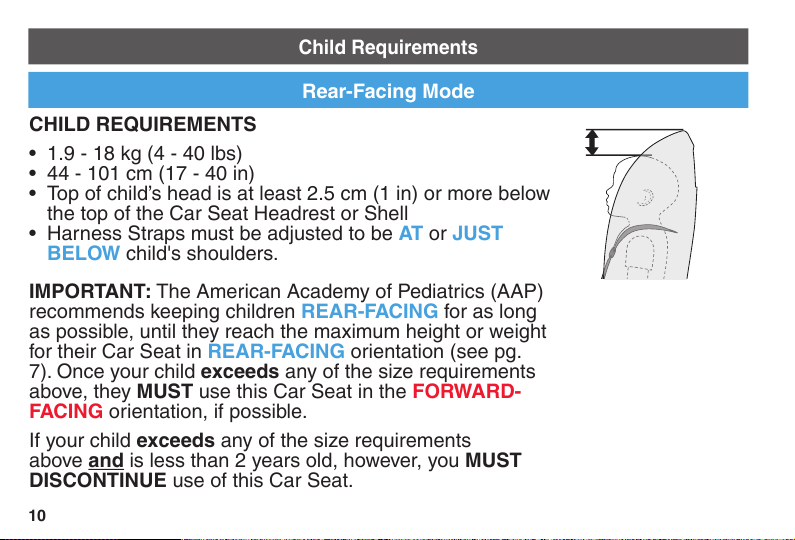
• Top of child’s head is at least 2.5 cm (1 in) or more below
the top of the Car Seat Headrest or Shell
• Harness Straps must be adjusted to be AT or JUST
BELOW child's shoulders.
IMPORTANT: The American Academy of Pediatrics (AAP)
recommends keeping children REAR-FACING for as long
as possible, until they reach the maximum height or weight
for their Car Seat in
REAR-FACING orientation (see pg.
7). Once your child exceeds any of the size requirements
above, they MUST use this Car Seat in the FORWARD-
FACING orientation, if possible.
If your child exceeds any of the size requirements
above and is less than 2 years old, however, you MUST
DISCONTINUE use of this Car Seat.
Rear-Facing Mode
11
Child Requirements
Rear-Facing Mode
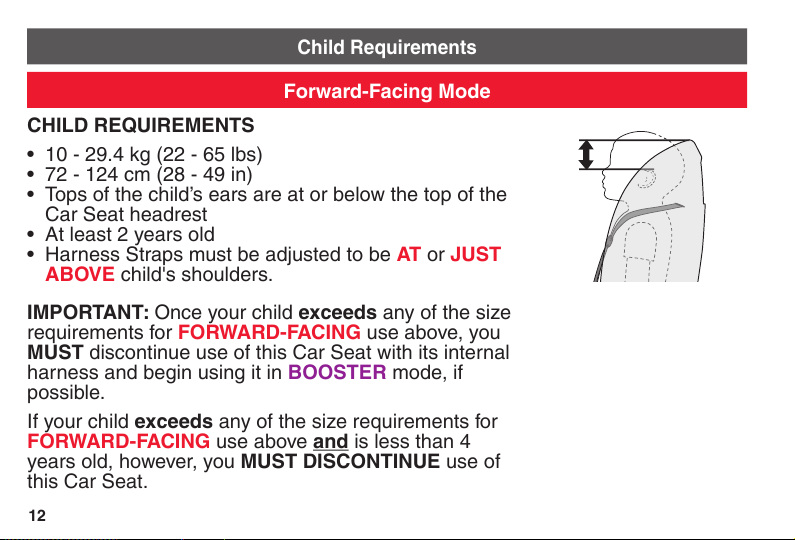
OPTIONAL: To ensure a better t for
smaller infants, the Body Pillow (pg. 47)
and/or Head Pillow (pg. 48) may be used
in REAR-FACING mode ONLY.
1.9 - 9kg (4 - 20 lbs)
Lower Connectors/UAS
Lap/Shoulder Belt Lap Belt
Always use tether strap in rear-facing installation.
Ball must be in proper
zone for child size:
Vehicle MUST be on
level ground.
25809042 10/20
9 - 18kg (20 - 40 lbs)
Do not install by
this method for a
child weighing
more than
15.9 kg
(35 lbs).
LEVEL INDICATOR
REAR-FACING ONLY
1.9 - 18 kg (4 - 40 lbs)
44 - 101 cm (17 - 40 in)
REAR-FACING
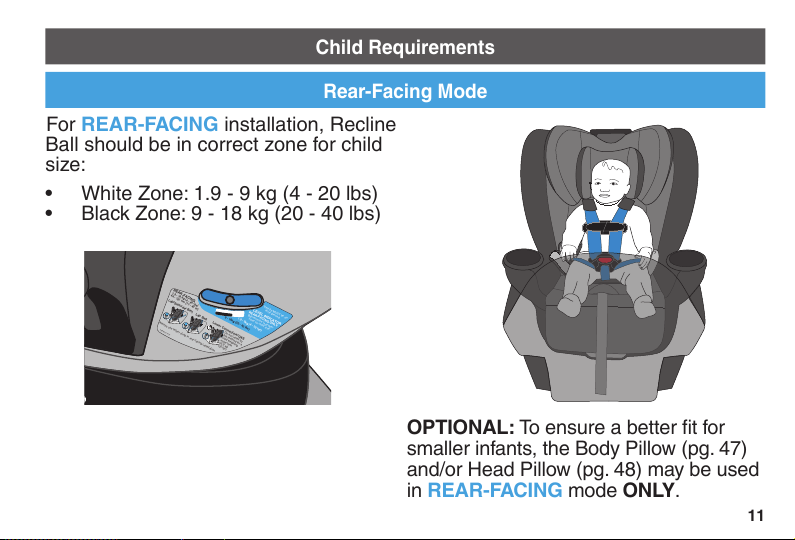
For REAR-FACING installation, Recline
Ball should be in correct zone for child
size:
• White Zone: 1.9 - 9 kg (4 - 20 lbs)
• Black Zone: 9 - 18 kg (20 - 40 lbs)
12
Child Requirements
Forward-Facing Mode
CHILD REQUIREMENTS
• 10 - 29.4 kg (22 - 65 lbs)
• 72 - 124 cm (28 - 49 in)
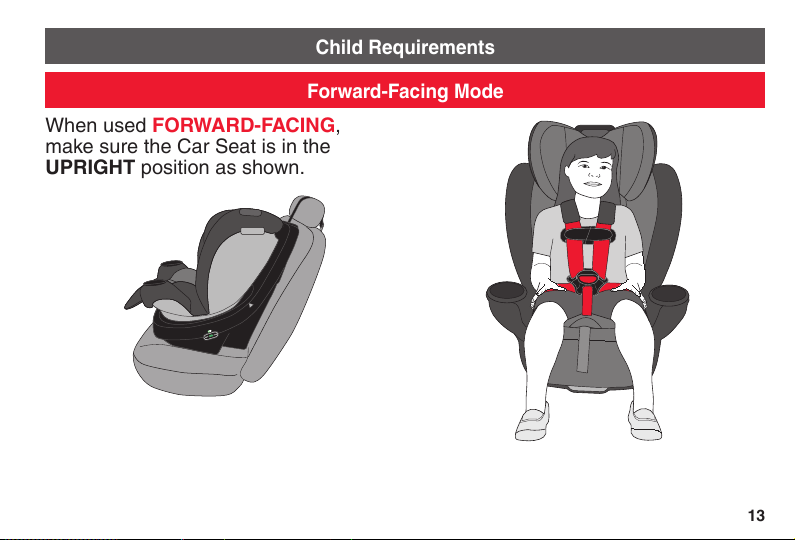
• Tops of the child’s ears are at or below the top of the
Car Seat headrest
• At least 2 years old
• Harness Straps must be adjusted to be AT or JUST
ABOVE child's shoulders.
IMPORTANT: Once your child exceeds any of the size
requirements for FORWARD-FACING use above, you
MUST discontinue use of this Car Seat with its internal
harness and begin using it in BOOSTER mode, if
possible.
If your child exceeds any of the size requirements for
FORWARD-FACING use above and is less than 4
years old, however, you MUST DISCONTINUE use of
this Car Seat.
13
Child Requirements
Forward-Facing Mode
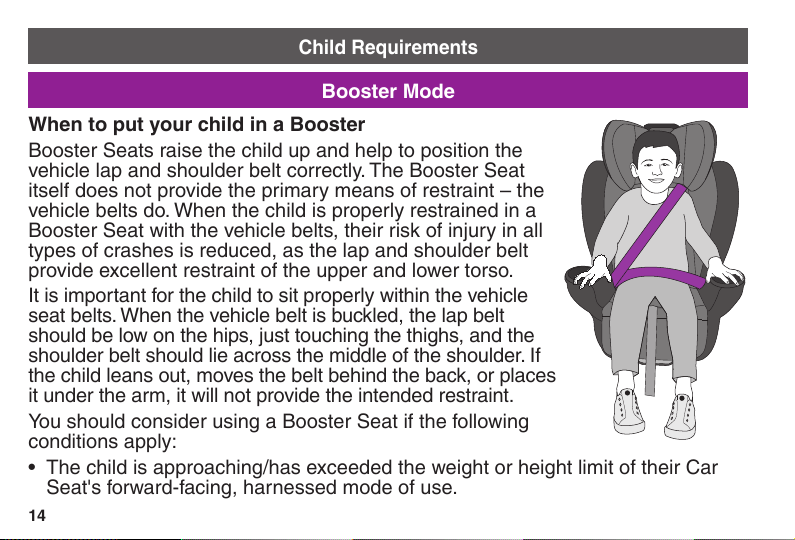
When used FORWARD-FACING,
make sure the Car Seat is in the
UPRIGHT position as shown.
14
Child Requirements
Booster Mode
When to put your child in a Booster
Booster Seats raise the child up and help to position the
vehicle lap and shoulder belt correctly. The Booster Seat
itself does not provide the primary means of restraint – the
vehicle belts do. When the child is properly restrained in a
Booster Seat with the vehicle belts, their risk of injury in all
types of crashes is reduced, as the lap and shoulder belt
provide excellent restraint of the upper and lower torso.
It is important for the child to sit properly within the vehicle
seat belts. When the vehicle belt is buckled, the lap belt
should be low on the hips, just touching the thighs, and the
shoulder belt should lie across the middle of the shoulder. If
the child leans out, moves the belt behind the back, or places
it under the arm, it will not provide the intended restraint.
You should consider using a Booster Seat if the following
conditions apply:
• The child is approaching/has exceeded the weight or height limit of their Car
Seat's forward-facing, harnessed mode of use.
15
CHILD REQUIREMENTS
• 18 - 54.4 kg
(40 - 120 lbs)
• 112 - 144 cm
(44 - 57 in)
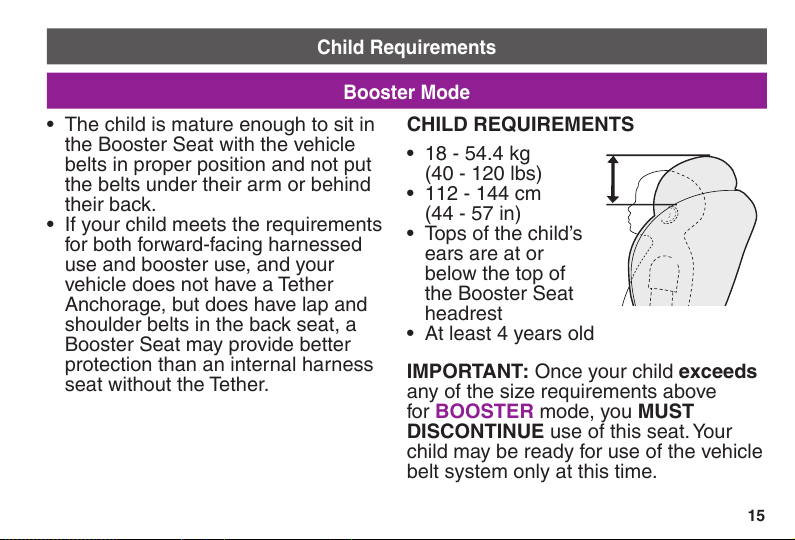
• Tops of the child’s
ears are at or
below the top of
the Booster Seat
headrest
• At least 4 years old
IMPORTANT: Once your child exceeds
any of the size requirements above
for
BOOSTER mode, you MUST
DISCONTINUE use of this seat. Your
child may be ready for use of the vehicle
belt system only at this time.
Child Requirements
Booster Mode
• The child is mature enough to sit in
the Booster Seat with the vehicle
belts in proper position and not put
the belts under their arm or behind
their back.
• If your child meets the requirements
for both forward-facing harnessed
use and booster use, and your
vehicle does not have a Tether
Anchorage, but does have lap and
shoulder belts in the back seat, a
Booster Seat may provide better
protection than an internal harness
seat without the Tether.
16
!
WARNING! DEATH or SERIOUS INJURY can occur.
Air bag Warnings
• DO NOT use this Car Seat in the front seat of a vehicle equipped with an air
bag, unless the air bag has been deactivated. Interaction between a REAR-
FACING Car Seat and air bags may cause serious injury or death. Air bags
may cause serious injury or death to children 12 years of age and under. If
your vehicle has an air bag, refer to your vehicle owner’s manual for Car Seat
installation.
• The back seat is the safest place for children 12 and under.
• DO NOT place any objects between the Car Seat and the side air bag, as an
expanding air bag may cause the items to strike your child.
17
!
WARNING! DEATH or SERIOUS INJURY can occur.
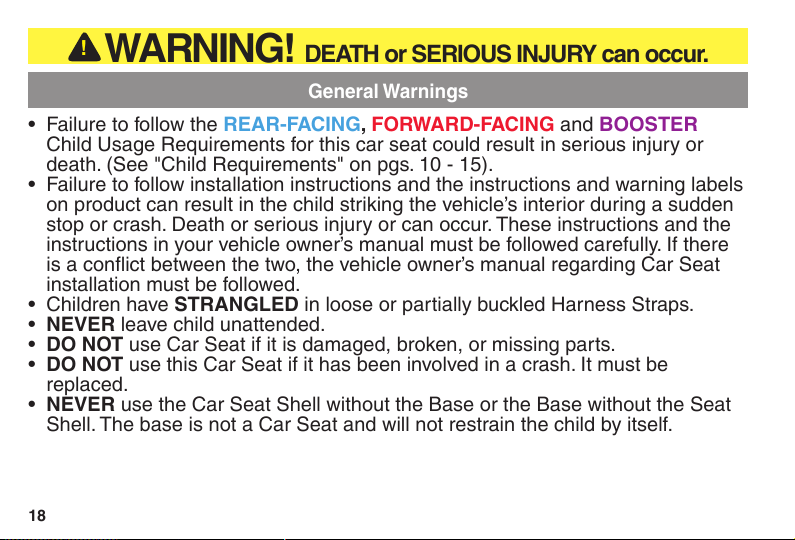
• If the rear seat of your vehicle is equipped with side air bags, refer to the
following information for proper usage:
Vehicles built prior to the 2002 model year:
DO NOT use this Car Seat in a vehicle seating position equipped with a side air
bag unless authorized by the vehicle manufacturer.
Model year 2002 and newer vehicles:
Refer to your vehicle owner’s manual before placing this Car Seat in a seating
position equipped with a side air bag.
Air bag Warnings
The FORWARD-FACING back seat is the safest place
for children 12 and under.
18
!
WARNING! DEATH or SERIOUS INJURY can occur.
General Warnings
• Failure to follow the REAR-FACING, FORWARD-FACING and BOOSTER
Child Usage Requirements for this car seat could result in serious injury or
death. (See "Child Requirements" on pgs. 10 - 15).
• Failure to follow installation instructions and the instructions and warning labels
on product can result in the child striking the vehicle’s interior during a sudden
stop or crash. Death or serious injury or can occur. These instructions and the
instructions in your vehicle owner’s manual must be followed carefully. If there
is a conict between the two, the vehicle owner’s manual regarding Car Seat
installation must be followed.
• Children have STRANGLED in loose or partially buckled Harness Straps.
• NEVER leave child unattended.
• DO NOT use Car Seat if it is damaged, broken, or missing parts.
• DO NOT use this Car Seat if it has been involved in a crash. It must be
replaced.
• NEVER use the Car Seat Shell without the Base or the Base without the Seat
Shell. The base is not a Car Seat and will not restrain the child by itself.
19
!
WARNING! DEATH or SERIOUS INJURY can occur.
Location Warnings
• ALWAYS read and follow exactly the instructions that accompany your vehicle
and Child Restraint.
• According to accident statistics, children are safer when properly restrained
in the rear seating positions than in the front seating positions. Generally, the
center rear position is safest and should be used if available.
• Some Car Seats do not t all vehicles or all seating locations. There are many
thousands of combinations of vehicle makes, models, Car Seat congurations,
vehicle seat belt designs, and seat cushion shapes. The easiest way to
determine whether your Car Seat is suitable for a particular seating position is
to check for a tight installation. If the Car Seat cannot be properly installed, DO
NOT use the Car Seat. Consult vehicle owner’s manual, try a different seating
location, or call Eveno for further assistance.
• NEVER use this Car Seat in a vehicle seating position where it cannot be
secured tightly. A loosely installed Car Seat will not protect your child in a crash.
20
!
WARNING! DEATH or SERIOUS INJURY can occur.
Location Warnings
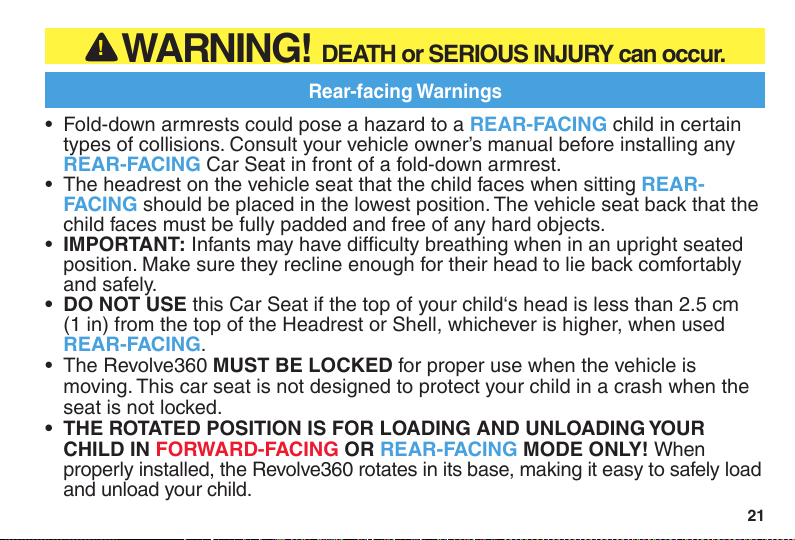
• ONLY use this Car Seat on FORWARD-FACING vehicle seats. DO NOT use
this Car Seat with vehicle seats that face the rear or side.
• ONLY use this Car Seat on vehicle seats with backs that lock into place.
• VEHICLE TYPES IN WHICH THE CAR SEAT SYSTEM CANNOT BE USED:
This Car Seat is not to be used in vehicles that do not have vehicle seat belts
or LATCH/UAS lower anchorages.
• NEVER use this Car Seat on boats, low speed vehicles (LSV), all-terrain
vehicles (ATV), golf carts, or any other non-certied application.
21
!
WARNING! DEATH or SERIOUS INJURY can occur.
• Fold-down armrests could pose a hazard to a
REAR-FACING child in certain
types of collisions. Consult your vehicle owner’s manual before installing any
REAR-FACING Car Seat in front of a fold-down armrest.
• The headrest on the vehicle seat that the child faces when sitting REAR-
FACING should be placed in the lowest position. The vehicle seat back that the
child faces must be fully padded and free of any hard objects.
• IMPORTANT: Infants may have difculty breathing when in an upright seated
position. Make sure they recline enough for their head to lie back comfortably
and safely.
• DO NOT USE this Car Seat if the top of your child‘s head is less than 2.5 cm
(1 in) from the top of the Headrest or Shell, whichever is higher, when used
REAR-FACING.
• The Revolve360 MUST BE LOCKED for proper use when the vehicle is
moving. This car seat is not designed to protect your child in a crash when the
seat is not locked.
• THE ROTATED POSITION IS FOR LOADING AND UNLOADING YOUR
CHILD IN FORWARD-FACING OR REAR-FACING MODE ONLY! When
properly installed, the Revolve360 rotates in its base, making it easy to safely load
and unload your child.
Rear-facing Warnings
22
!
WARNING! DEATH or SERIOUS INJURY can occur.
Forward-facing Warnings
• DO NOT USE this Car Seat FORWARD-FACING if your child is less than 2
years old.
• Adjust or remove the vehicle headrest in the seat where the Car Seat is to
be installed, so the back of the Car Seat rests against the vehicle seat back.
• The headrest on the vehicle seat in front of the child should be put in its lowest
position. The vehicle seat back that the child faces must be fully padded and
free of any hard objects.
• DO NOT USE the optional Body Pillow or Head Pillow with this Car Seat in
FORWARD-FACING mode.
• The Revolve360 MUST BE LOCKED for proper use when the vehicle is
moving. This car seat is not designed to protect your child in a crash when the
seat is not locked.
• THE ROTATED POSITION IS FOR LOADING AND UNLOADING YOUR
CHILD IN
FORWARD-FACING OR REAR-FACING MODE ONLY! When
properly installed, the Revolve360 rotates in its base, making it easy to safely load
and unload your child.
23
!
WARNING! DEATH or SERIOUS INJURY can occur.
Booster Warnings
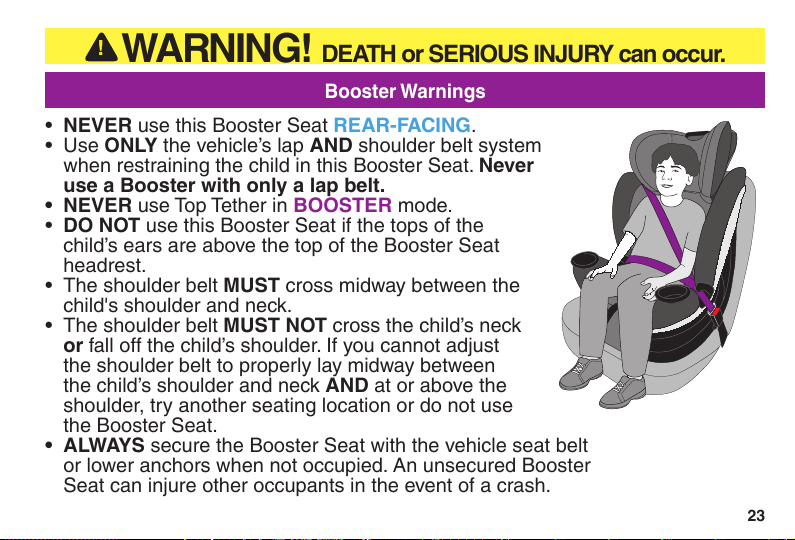
• NEVER use this Booster Seat REAR-FACING.
• Use ONLY the vehicle’s lap AND shoulder belt system
when restraining the child in this Booster Seat. Never
use a Booster with only a lap belt.
• NEVER use Top Tether in BOOSTER mode.
• DO NOT use this Booster Seat if the tops of the
child’s ears are above the top of the Booster Seat
headrest.
• The shoulder belt MUST cross midway between the
child's shoulder and neck.
• The shoulder belt MUST NOT cross the child’s neck
or fall off the child’s shoulder. If you cannot adjust
the shoulder belt to properly lay midway between
the child’s shoulder and neck AND at or above the
shoulder, try another seating location or do not use
the Booster Seat.
• ALWAYS secure the Booster Seat with the vehicle seat belt
or lower anchors when not occupied. An unsecured Booster
Seat can injure other occupants in the event of a crash.
24
!
WARNING! DEATH or SERIOUS INJURY can occur.
Seat Belt Warnings
• ALWAYS read your vehicle owner's manual to determine
what vehicle belts and retractors are used in your vehicle.
• ALWAYS lock your vehicle seat belt when installing the
car seat in one of the harness modes. Check your vehicle
owner’s manual to determine how to lock your seat belt for
Car Seat installation.
• DO NOT use this Car Seat if it moves more than 2.5 cm
(1 in) side to side or front to back at the belt path in use.
Serious injury or death may result from loose installation. If
you cannot tightly secure the Car Seat, try again or move it
to another location.
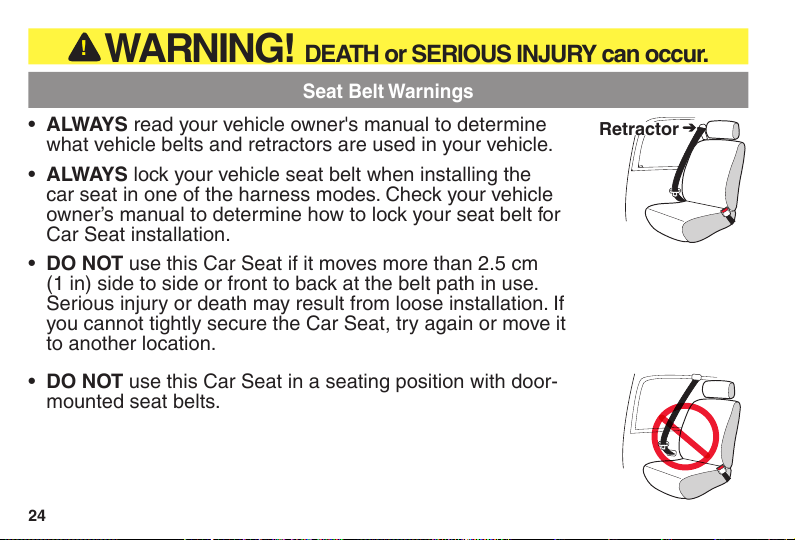
• DO NOT use this Car Seat in a seating position with door-
mounted seat belts.
Retractor
25
!
WARNING! DEATH or SERIOUS INJURY can occur.
Seat Belt Warnings
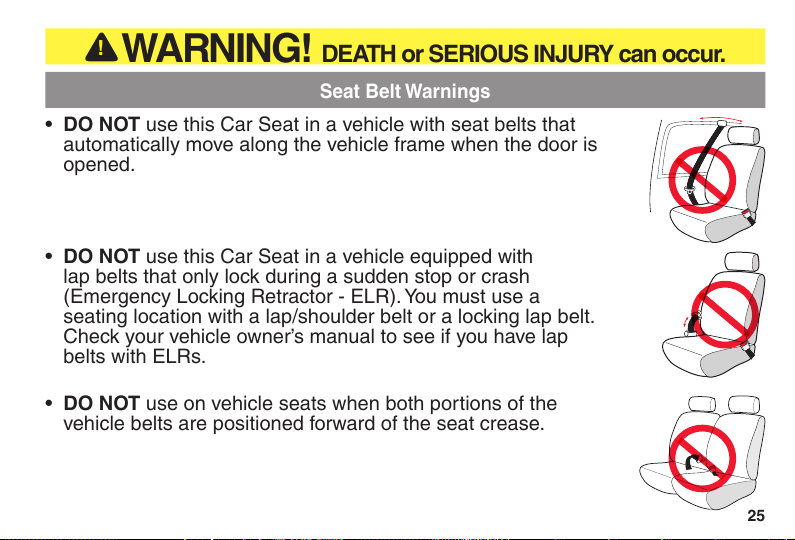
• DO NOT use this Car Seat in a vehicle with seat belts that
automatically move along the vehicle frame when the door is
opened.
• DO NOT use this Car Seat in a vehicle equipped with
lap belts that only lock during a sudden stop or crash
(Emergency Locking Retractor - ELR). You must use a
seating location with a lap/shoulder belt or a locking lap belt.
Check your vehicle owner’s manual to see if you have lap
belts with ELRs.
• DO NOT use on vehicle seats when both portions of the
vehicle belts are positioned forward of the seat crease.
26
!
WARNING! DEATH or SERIOUS INJURY can occur.
Seat Belt Warnings
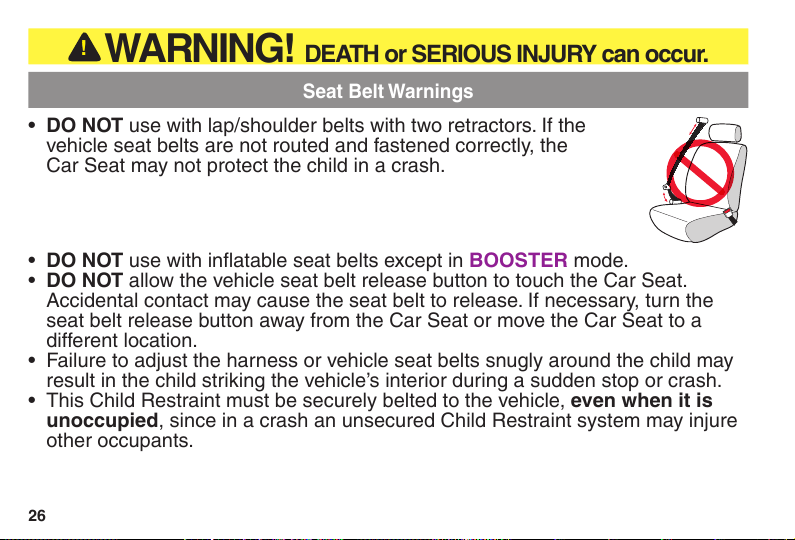
• DO NOT use with lap/shoulder belts with two retractors. If the
vehicle seat belts are not routed and fastened correctly, the
Car Seat may not protect the child in a crash.
• DO NOT use with inatable seat belts except in BOOSTER mode.
• DO NOT allow the vehicle seat belt release button to touch the Car Seat.
Accidental contact may cause the seat belt to release. If necessary, turn the
seat belt release button away from the Car Seat or move the Car Seat to a
different location.
• Failure to adjust the harness or vehicle seat belts snugly around the child may
result in the child striking the vehicle’s interior during a sudden stop or crash.
• This Child Restraint must be securely belted to the vehicle, even when it is
unoccupied, since in a crash an unsecured Child Restraint system may injure
other occupants.
27
!
WARNING! DEATH or SERIOUS INJURY can occur.
Seat Belt Warnings
If you have any of these types of vehicle belt systems listed, these are SAFE to
use to install your Car Seat in the vehicle. Review vehicle owner’s manual for
specic instructions on Car Seat installation.
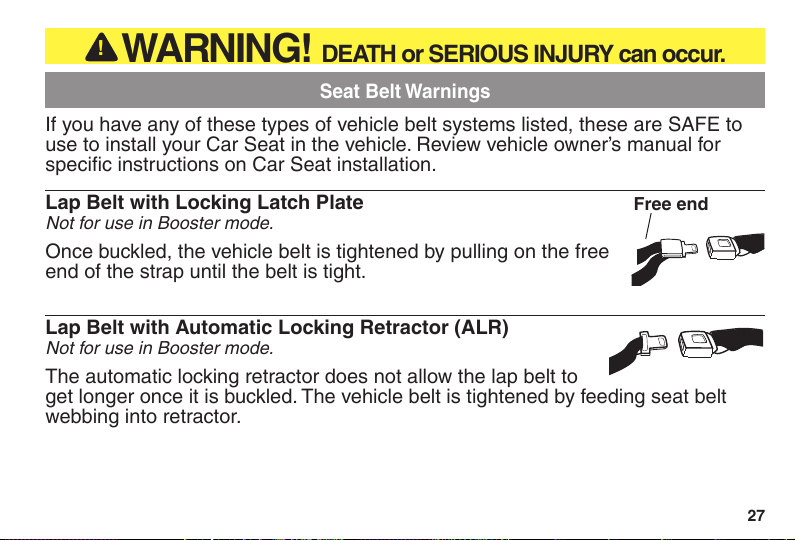
Lap Belt with Locking Latch Plate
Not for use in Booster mode.
Once buckled, the vehicle belt is tightened by pulling on the free
end of the strap until the belt is tight.
Lap Belt with Automatic Locking Retractor (ALR)
Not for use in Booster mode.
The automatic locking retractor does not allow the lap belt to
get longer once it is buckled. The vehicle belt is tightened by feeding seat belt
webbing into retractor.
Free end
28
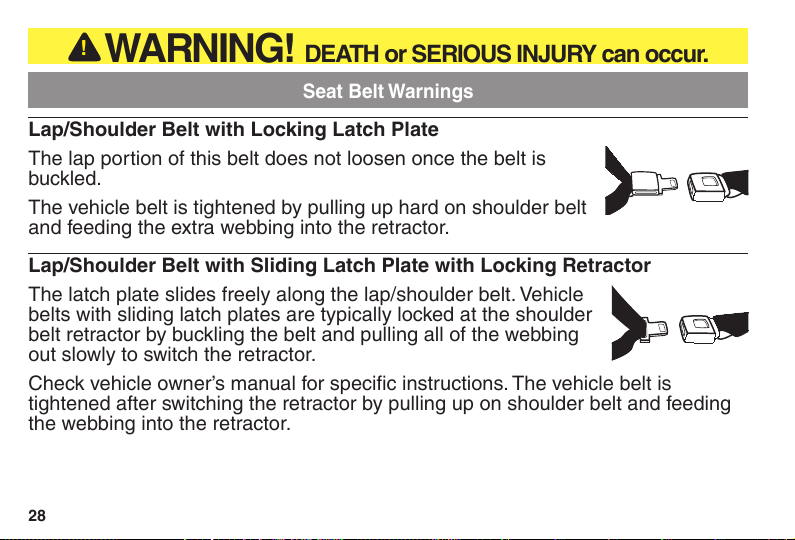
Lap/Shoulder Belt with Locking Latch Plate
The lap portion of this belt does not loosen once the belt is
buckled.
The vehicle belt is tightened by pulling up hard on shoulder belt
and feeding the extra webbing into the retractor.
Lap/Shoulder Belt with Sliding Latch Plate with Locking Retractor
The latch plate slides freely along the lap/shoulder belt. Vehicle
belts with sliding latch plates are typically locked at the shoulder
belt retractor by buckling the belt and pulling all of the webbing
out slowly to switch the retractor.
Check vehicle owner’s manual for specic instructions. The vehicle belt is
tightened after switching the retractor by pulling up on shoulder belt and feeding
the webbing into the retractor.
!
WARNING! DEATH or SERIOUS INJURY can occur.
Seat Belt Warnings
29
!
WARNING! DEATH or SERIOUS INJURY can occur.
Seat Belt Warnings
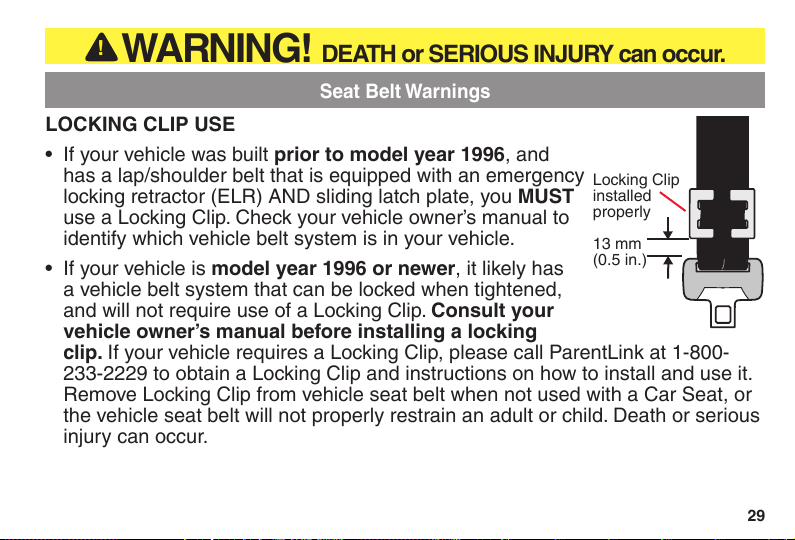
LOCKING CLIP USE
• If your vehicle was built prior to model year 1996, and
has a lap/shoulder belt that is equipped with an emergency
locking retractor (ELR) AND sliding latch plate, you MUST
use a Locking Clip. Check your vehicle owner’s manual to
identify which vehicle belt system is in your vehicle.
• If your vehicle is model year 1996 or newer, it likely has
a vehicle belt system that can be locked when tightened,
and will not require use of a Locking Clip. Consult your
vehicle owner’s manual before installing a locking
clip. If your vehicle requires a Locking Clip, please call ParentLink at 1-800-
233-2229 to obtain a Locking Clip and instructions on how to install and use it.
Remove Locking Clip from vehicle seat belt when not used with a Car Seat, or
the vehicle seat belt will not properly restrain an adult or child. Death or serious
injury can occur.
Locking Clip
installed
properly
13 mm
(0.5 in.)
30
!
WARNING! DEATH or SERIOUS INJURY can occur.
LATCH/UAS Warnings
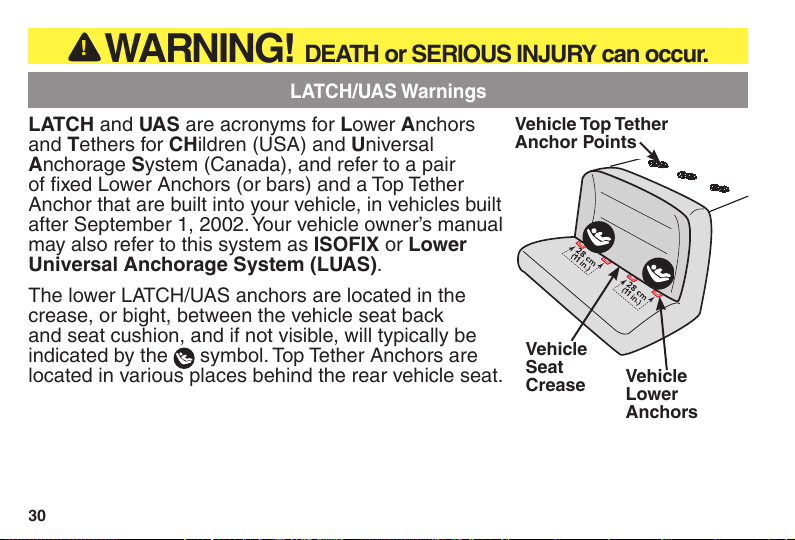
Vehicle
Lower
Anchors
Vehicle Top Tether
Anchor Points
Vehicle
Seat
Crease
LATCH and UAS are acronyms for Lower Anchors
and Tethers for CHildren (USA) and Universal
Anchorage System (Canada), and refer to a pair
of xed Lower Anchors (or bars) and a Top Tether
Anchor that are built into your vehicle, in vehicles built
after September 1, 2002. Your vehicle owner’s manual
may also refer to this system as ISOFIX or Lower
Universal Anchorage System (LUAS).
The lower LATCH/UAS anchors are located in the
crease, or bight, between the vehicle seat back
and seat cushion, and if not visible, will typically be
indicated by the
symbol. Top Tether Anchors are
located in various places behind the rear vehicle seat.
31
!
WARNING! DEATH or SERIOUS INJURY can occur.
LATCH/UAS Warnings
Center installation in a non-standard LATCH/UAS position:
Center installation of this Car Seat is permitted using inner Lower Anchor Bars
from the outside seating positions if:
1. Your vehicle manual allows such installation; and
2. The inner Lower Anchor Bars from the outside seating positions are
28 - 51 cm (11 - 20 in) apart.
This Car Seat can be safely installed using either LATCH/UAS or vehicle belts and
meets the requirements of Federal Safety Standard FMVSS 213 and Canadian
Safety Standard CMVSS 213 with either installation method. Either method is safe
for your child when installed correctly. When using either method with harness,
ALWAYS USE Tether.
DO NOT install this Car Seat with LATCH/UAS and the vehicle’s seat belts at the
same time. However, in Booster Mode, you may install the Car Seat with LATCH/
UAS while using the vehicle seat belt for the restraint of the child.
The LATCH/UAS system is intended to be used ONLY as described in these
instructions. Refer to your vehicle Owner’s Manual for lower anchor bar and
Tether Anchor positions in your vehicle.
32
!
WARNING! DEATH or SERIOUS INJURY can occur.
LATCH/UAS Warnings
• DO NOT use the lower anchors of the Child Restraint anchorage system
(LATCH/UAS system) to attach this Child Restraint when restraining a
child weighing more than 15.9 kg (35 lbs) REAR-FACING or 18 kg (40
lbs) FORWARD-FACING with harness. ONLY USE VEHICLE BELT
INSTALLATION.
• In addition to these instructions, read and follow your vehicle owner’s manual
regarding installation of the Child Restraint and LATCH/UAS. If there is a
discrepancy, follow your vehicle owner’s manual.
• ONLY use for securing Car Seat to vehicle lower anchor bars.
• NEVER attach two Lower Anchor Connectors to one vehicle lower anchor bar.
• NEVER use the vehicle seat belts when using the Lower Anchor Connector
assembly. Using both together can cause slack in a sudden stop or crash.
• To avoid strangulation, you must store the unused LATCH/UAS straps, with all
slack removed, in the storage areas on the sides of your Base. Roll or fold the
excess LATCH/UAS strap and secure with a rubber band.
33
!
WARNING! DEATH or SERIOUS INJURY can occur.
LATCH/UAS Warnings
• ALWAYS be sure that the Lower Anchor Connectors are attached to the vehicle
lower anchor bars by pulling hard on the Lower Anchor Connectors. If they are
not attached, the Lower Anchor Connector assembly will not secure your Car
Seat.
• DO NOT use this Car Seat if it moves more than 2.5 cm (1 in) side to side
or front to back at the belt path. Serious injury or death may result from poor
installation. If you cannot tightly secure the Car Seat, try again or move it to
another location.
Tether Strap Warnings
• ALWAYS USE A Tether Strap FOR HARNESS INSTALLATION.
• To avoid a strangulation hazard, you MUST tightly roll or fold excess of unused
Tether Strap and secure with a rubber band. Attach the Tether hook to the
storage clip on the underside of the base when not in use. This will keep an
unused Tether or Tether hook from hitting someone during a crash.
• After adjusting the Tether Strap, you may have excess strap. DO NOT cut it off.
If you do, it may not be long enough to use in another vehicle. Instead, tightly
roll up the excess Tether Strap and place the rubber band around the bundle.
34
!
WARNING! DEATH or SERIOUS INJURY can occur.
Additional Warnings
• DO NOT use the cup holder to store cans or hard cups. DO NOT place any
cups that contain hot liquids in the cup holder.
• DO NOT use the cup holder for storage while the seat is being rotated.
• DO NOT attach additional padding, toys, or other devices not made by Eveno
or described in these instructions for the Car Seat. Items not tested with the
Car Seat could injure the child. Additional pads or pillows may interfere with the
function of the harness system, or cause breathing problems if the child’s head
falls forward, increasing the risk of serious injury or death.
• In hot or sunny weather, ALWAYS check the areas of the Car Seat that may
contact your child (e.g., Buckle, Buckle Tongues, etc.) for hot areas before
placing him/her into the Car Seat. The child could be burned. Cover the Car
Seat with a light colored blanket when you leave the vehicle.
• In cold weather, DO NOT dress the child in bulky clothing like snowsuits if the
child is riding in a Car Seat. Bulky coats/snowsuits make it difcult to properly
tighten the harness to the child, which may allow the child to be ejected from
the restraint during a crash. If necessary, place a blanket over the harnessed
child without interfering with the Car Seat harness system.
• NEVER use this car seat without the seat pad.
35
Motor Vehicle/Aircraft Usage
Regulatory Notice: This Child Restraint system meets all applicable
requirements of Federal Motor Vehicle Safety Standard (FMVSS) 213 and
Canadian Motor Vehicle Safety Standards (CMVSS) 213, 213.1, and 213.2.
When used WITH the internal harness and properly installed pursuant to
these instructions, this restraint is certied for use only in passenger and multi-
purpose passenger motor vehicles, buses and trucks equipped with either lap
belts only or lap/shoulder belt systems.
When used WITHOUT the internal harness system (in BOOSTER mode) and
properly installed pursuant to these instructions, this car seat is certied for
use only in passenger and multi-purpose passenger motor vehicles, buses, and
trucks equipped with lap/shoulder belt systems only.
THIS RESTRAINT IS NOT CERTIFIED FOR AIRCRAFT USE.
36
Registration and Recall Information
• Child Restraints could be recalled for safety
reasons. You must register this restraint to
be reached in a recall. Send your name,
address, email address if available, and the
restraint’s model number and manufacturing
date to:
Eveno Company, Inc.
1801 Commerce Dr.
Piqua, OH 45356
or call 1-800-233-2229
or register online at
www.eveno.com/registercarseat
• For recall information, call the U.S. Government’s Vehicle Safety Hotline at
1-888-327-4236 (TTY:1-800-424-9153) or go to http://www.NHTSA.gov
.
Consumer: Just fill in your name and address and e-mail address.
Your Name
CHILD RESTRAINT REGISTRATION CARD
Your Street Address
State
Zip Code
City
E-mail Address
Recall Information for US Customers
37
Registration and Recall Information
• Child Restraints could be recalled for safety reasons.
You must register this restraint to be reached in a recall.
Send your name, address, and the restraint’s model
number and manufacturing date to:
Eveno Company, Inc.
1801 Commerce Dr.
Piqua, OH 45356
or call
1-800-233-2229
or register online at:
www.eveno.com/registercarseatcanada
• For public notice information, call Transport Canada at
1-800-333-0510 (1-613-993-9851 in Ottawa region).
CANADIAN RESIDENTS ONLY
DOMICILIES DU CANADA SEULEMENT
PRODUCT REGISTRATION CARD
CARTE D'ENREGISTREMENT DU PRODUIT
1. Name
Nom
2. Street Address
Adresse
3. City
Ville
4. Prov.
Prov
5. Postal Code
Code postal
6. Telephone Number (with Area Code)
Num. de téléphone (et indicatif régional) ( )
8. Date of Purchase
Date d'achat
ATTENTION: This card may be important to the safety of your child.
Please complete using blue or black ink and mail this card so that
you can be contacted in the event of a safety defect notice on this
product. The information you provide must be complete.
Or register online at www.evenflo.com/registercarseatcanada.
ATTENTION : Cette carte pourait être importante
à
la sécurité de
votre enfant. Veuillez remplir cette carte à l’encre bleue ou noire
et la poster afin de pouvoir être contacté en cas d’un avis de
défaut lié à la sécurité de ce produit. Les informations
fournies doivent être complètes. Ou enregistrez-vous en
ligne à www.evenflo.com/registercarseatcanada.
PLACE DATE/MODEL # LABEL HERE.
AFFIXER L'ÉTIQUETTE DE LA DATE ET
DU NUMÉRO DE MODÈLE ICI.
7. Email Address
Adresse électronique
Public Notice for Canadian Customers
38
Car Seat Features
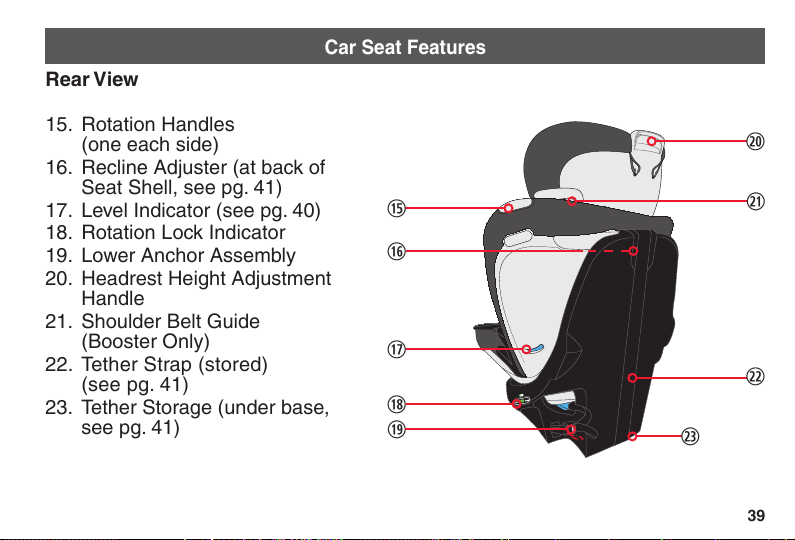
Front View
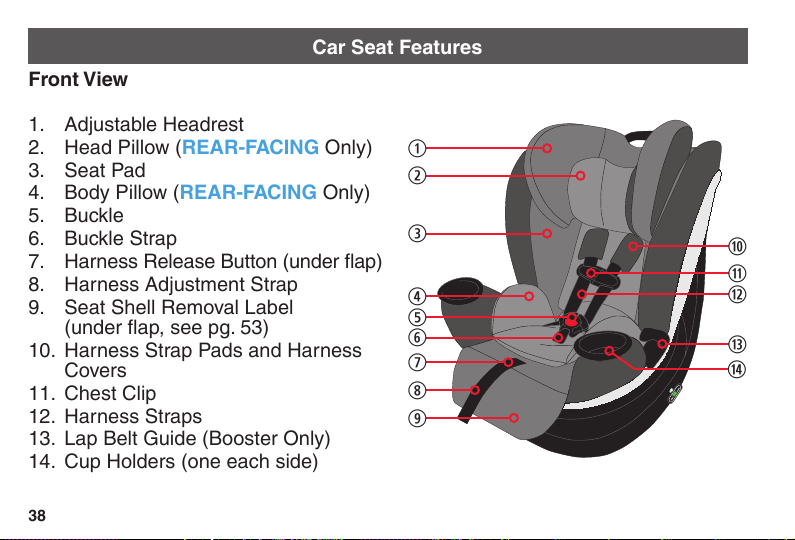
1. Adjustable Headrest
2. Head Pillow (
REAR-FACING Only)
3. Seat Pad
4. Body Pillow (REAR-FACING Only)
5. Buckle
6. Buckle Strap
7. Harness Release Button (under ap)
8. Harness Adjustment Strap
9. Seat Shell Removal Label
(under ap, see pg. 53)
10. Harness Strap Pads and Harness
Covers
11. Chest Clip
12. Harness Straps
13. Lap Belt Guide (Booster Only)
14. Cup Holders (one each side)
i
q
w
e
r
t
y
u
a
d
s
f
o
g
39
Car Seat Features
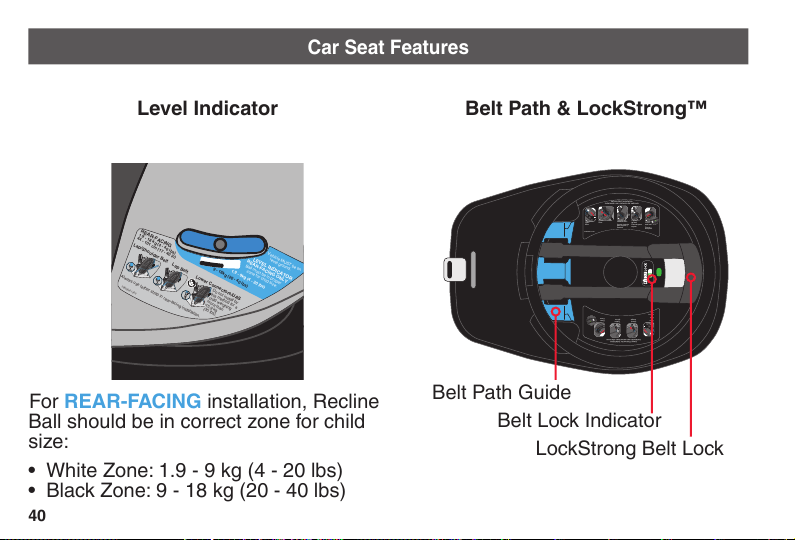
Rear View
15. Rotation Handles
(one each side)
16. Recline Adjuster (at back of
Seat Shell, see pg. 41)
17. Level Indicator (see pg. 40)
18. Rotation Lock Indicator
19. Lower Anchor Assembly
20. Headrest Height Adjustment
Handle
21. Shoulder Belt Guide
(Booster Only)
22. Tether Strap (stored)
(see pg. 41)
23. Tether Storage (under base,
see pg. 41)
2)
1%
1^
1&
2@
1*
2#
1(
2!
40
Car Seat Features
Belt Path & LockStrong™Level Indicator
2
Tighten
Aprete
1
4
Instalación con conectores inferiores
Lower Connector Installation
Open
Abre
Close
Cierre
Attach
Acople
25809061
10/20
3
Vehicle Belt Installation
Instalación con cinturón del vehículo
Open
Abre
Route
Ruta
Close
and lock
3
Or
O
4
2
1
Tighten
lap belt
Cinturón para
regazo
Tighten lap/
shoulder belt
Apreta cinturón
para regazo y
hombro
25809059 10/20
Cierre y
bloquear
1.9 - 9kg (4 - 20 lbs)
Lower Connectors/UAS
Lap/Shoulder Belt Lap Belt
Always use tether strap in rear-facing installation.
Ball must be in proper
zone for child size:
Vehicle MUST be on
level ground.
25809042 10/20
9 - 18kg (20 - 40 lbs)
Do not install by
this method for a
child weighing
more than
15.9 kg
(35 lbs).
LEVEL INDICATOR
REAR-FACING ONLY
1.9 - 18 kg (4 - 40 lbs)
44 - 101 cm (17 - 40 in)
REAR-FACING
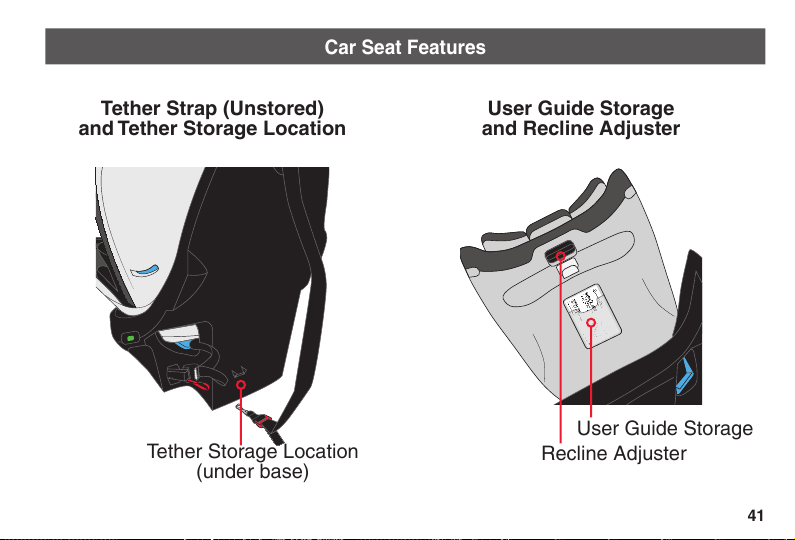
For REAR-FACING installation, Recline
Ball should be in correct zone for child
size:
• White Zone: 1.9 - 9 kg (4 - 20 lbs)
• Black Zone: 9 - 18 kg (20 - 40 lbs)
Belt Path Guide
Belt Lock Indicator
LockStrong Belt Lock
41
Car Seat Features
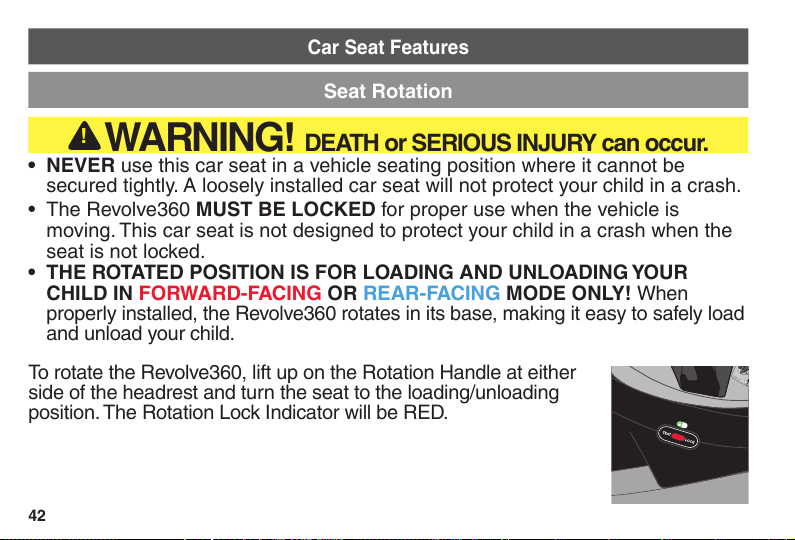
Tether Strap (Unstored) Tether Strap (Unstored)
and Tether Storage Locationand Tether Storage Location
User Guide Storage
and Recline Adjuster
User Guide Storage
Recline Adjuster
Tether Storage Location
(under base)
42
Car Seat Features
Seat Rotation
!
WARNING! DEATH or SERIOUS INJURY can occur.
• NEVER use this car seat in a vehicle seating position where it cannot be
secured tightly. A loosely installed car seat will not protect your child in a crash.
• The Revolve360 MUST BE LOCKED for proper use when the vehicle is
moving. This car seat is not designed to protect your child in a crash when the
seat is not locked.
• THE ROTATED POSITION IS FOR LOADING AND UNLOADING YOUR
CHILD IN
FORWARD-FACING OR REAR-FACING MODE ONLY! When
properly installed, the Revolve360 rotates in its base, making it easy to safely load
and unload your child.
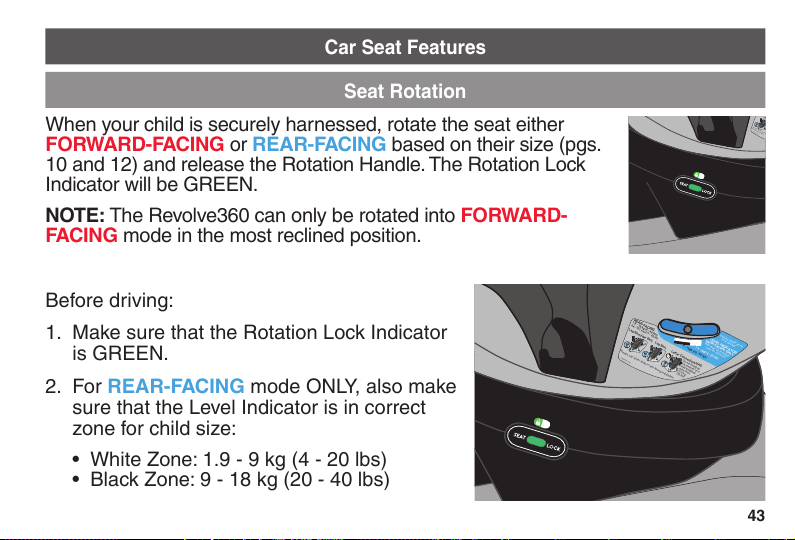
To rotate the Revolve360, lift up on the Rotation Handle at either
side of the headrest and turn the seat to the loading/unloading
position. The Rotation Lock Indicator will be RED.
Lap/Shoulder Belt
P25809042 7/20
43
Cinturón para
regazo y hombro
Siempre use la correa de sujeción con la instalación
orientado hacia atrás.
sobre una supercie
25809042 10/20
1,9 a 18 kg (4 a 40 lb)
44 a 101 cm (17 a 40 in)
Car Seat Features
Seat Rotation
1.9 - 9kg (4 - 20 lbs)
Lower Connectors/UAS
Lap/Shoulder Belt Lap Belt
Always use tether strap in rear-facing installation.
Ball must be in proper
zone for child size:
Vehicle MUST be on
level ground.
25809042 10/20
9 - 18kg (20 - 40 lbs)
Do not install by
this method for a
child weighing
more than
15.9 kg
(35 lbs).
LEVEL INDICATOR
REAR-FACING ONLY
1.9 - 18 kg (4 - 40 lbs)
44 - 101 cm (17 - 40 in)
REAR-FACING
When your child is securely harnessed, rotate the seat either
FORWARD-FACING or REAR-FACING based on their size (pgs.
10 and 12) and release the Rotation Handle. The Rotation Lock
Indicator will be GREEN.
NOTE: The Revolve360 can only be rotated into
FORWARD-
FACING mode in the most reclined position.
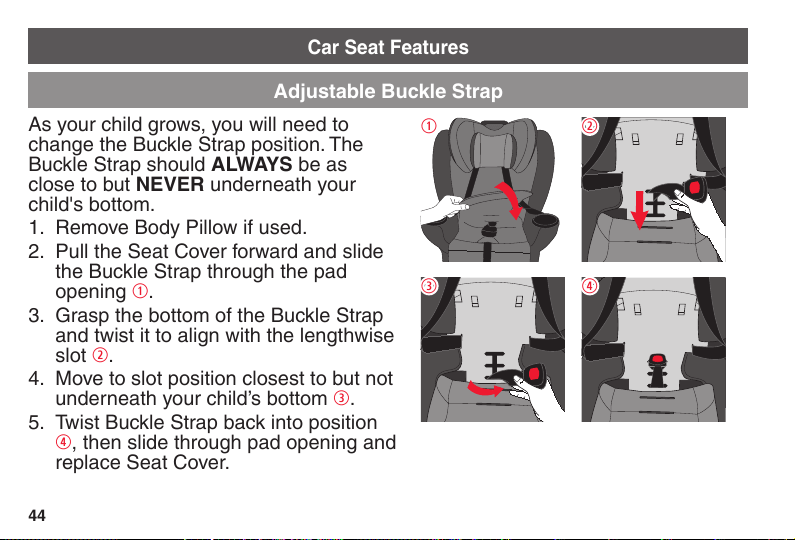
Before driving:
1. Make sure that the Rotation Lock Indicator
is GREEN.
2. For
REAR-FACING mode ONLY, also make
sure that the Level Indicator is in correct
zone for child size:
• White Zone: 1.9 - 9 kg (4 - 20 lbs)
• Black Zone: 9 - 18 kg (20 - 40 lbs)
44
Car Seat Features
Adjustable Buckle Strap
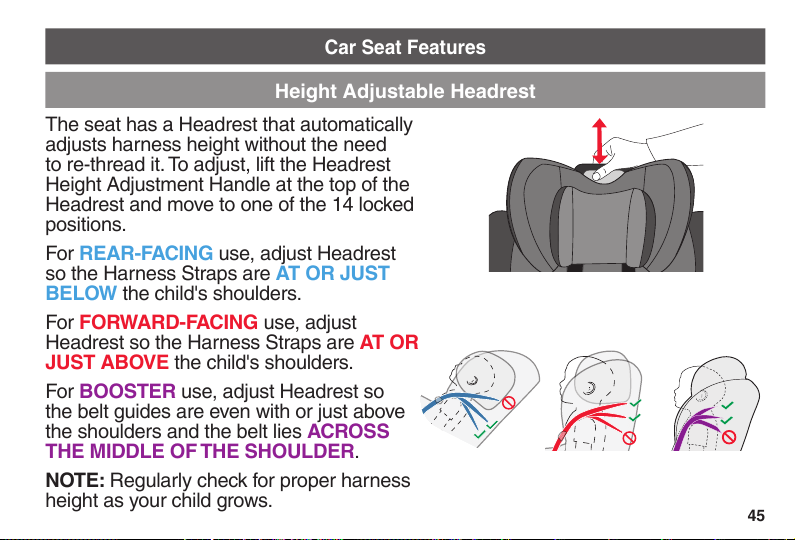
As your child grows, you will need to
change the Buckle Strap position. The
Buckle Strap should ALWAYS be as
close to but NEVER underneath your
child's bottom.
1. Remove Body Pillow if used.
2. Pull the Seat Cover forward and slide
the Buckle Strap through the pad
opening q.
3. Grasp the bottom of the Buckle Strap
and twist it to align with the lengthwise
slot
w.
4. Move to slot position closest to but not
underneath your child’s bottom e.
5. Twist Buckle Strap back into position
r, then slide through pad opening and
replace Seat Cover.
qq ww
ee rr
45
Height Adjustable Headrest
Car Seat Features
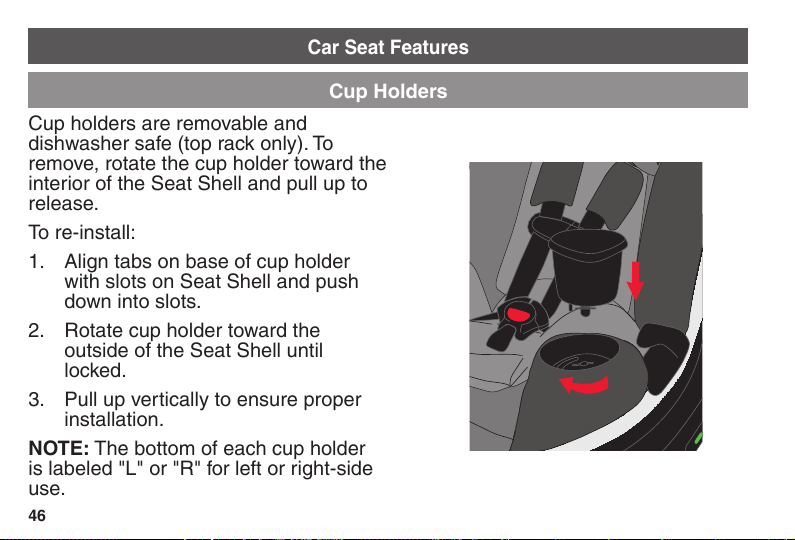
The seat has a Headrest that automatically
adjusts harness height without the need
to re-thread it. To adjust, lift the Headrest
Height Adjustment Handle at the top of the
Headrest and move to one of the 14 locked
positions.
For REAR-FACING use, adjust Headrest
so the Harness Straps are AT OR JUST
BELOW the child's shoulders.
For FORWARD-FACING use, adjust
Headrest so the Harness Straps are
AT OR
JUST ABOVE the child's shoulders.
For BOOSTER use, adjust Headrest so
the belt guides are even with or just above
the shoulders and the belt lies ACROSS
THE MIDDLE OF THE SHOULDER.
NOTE: Regularly check for proper harness
height as your child grows.
46
Car Seat Features
Cup Holders
Cup holders are removable and
dishwasher safe (top rack only). To
remove, rotate the cup holder toward the
interior of the Seat Shell and pull up to
release.
To re-install:
1. Align tabs on base of cup holder
with slots on Seat Shell and push
down into slots.
2. Rotate cup holder toward the
outside of the Seat Shell until
locked.
3. Pull up vertically to ensure proper
installation.
NOTE: The bottom of each cup holder
is labeled "L" or "R" for left or right-side
use.
47
Car Seat Features
Body Pillow
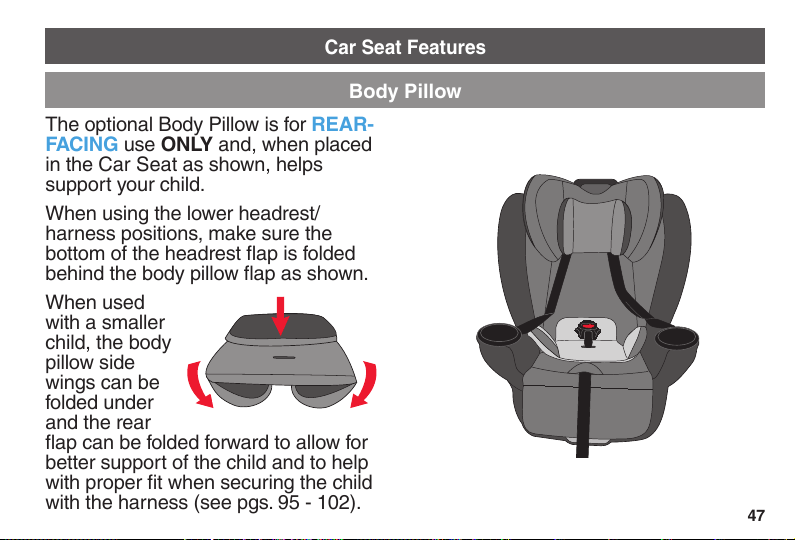
The optional Body Pillow is for REAR-
FACING use ONLY and, when placed
in the Car Seat as shown, helps
support your child.
When using the lower headrest/
harness positions, make sure the
bottom of the headrest ap is folded
behind the body pillow ap as shown.
When used
with a smaller
child, the body
pillow side
wings can be
folded under
and the rear
ap can be folded forward to allow for
better support of the child and to help
with proper t when securing the child
with the harness (see pgs. 95 - 102).
48
Car Seat Features
Head Pillow
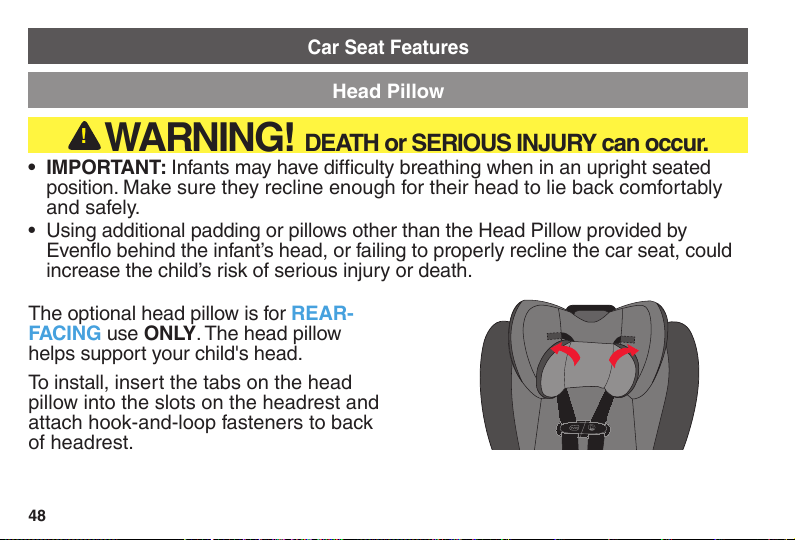
The optional head pillow is for REAR-
FACING
use ONLY. The head pillow
helps support your child's head.
To install, insert the tabs on the head
pillow into the slots on the headrest and
attach hook-and-loop fasteners to back
of headrest.
• IMPORTANT: Infants may have difculty breathing when in an upright seated
position. Make sure they recline enough for their head to lie back comfortably
and safely.
• Using additional padding or pillows other than the Head Pillow provided by
Eveno behind the infant’s head, or failing to properly recline the car seat, could
increase the child’s risk of serious injury or death.
!
WARNING! DEATH or SERIOUS INJURY can occur.
49
Car Seat Features
Tether Strap
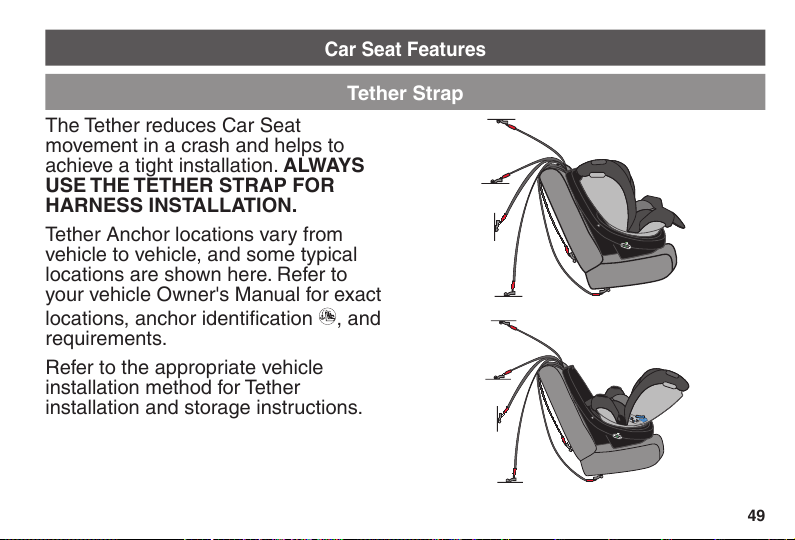
The Tether reduces Car Seat
movement in a crash and helps to
achieve a tight installation. ALWAYS
USE THE TETHER STRAP FOR
HARNESS INSTALLATION.
Tether Anchor locations vary from
vehicle to vehicle, and some typical
locations are shown here. Refer to
your vehicle Owner's Manual for exact
locations, anchor identication , and
requirements.
Refer to the appropriate vehicle
installation method for Tether
installation and storage instructions.
REAR-FACING
LEVEL INDICATOR
Bead must be located
within appropriate zone.
Vehicle MUST be on level ground.
Lower Connectors/UAS
Do not install
by this method
for a child
weighing more
than 15.9 kg
(35 lbs).
Lap/Shoulder Belt
Lap Belt
Always use tether strap
in rear facing installation.
P25809042 7/20
50
Car Seat Features
Harness Strap Pads and Harness Covers
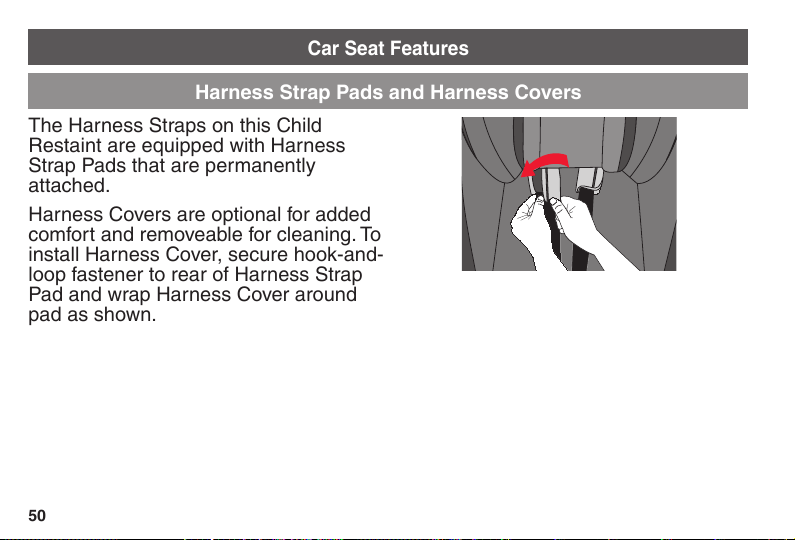
The Harness Straps on this Child
Restaint are equipped with Harness
Strap Pads that are permanently
attached.
Harness Covers are optional for added
comfort and removeable for cleaning. To
install Harness Cover, secure hook-and-
loop fastener to rear of Harness Strap
Pad and wrap Harness Cover around
pad as shown.
51
Car Seat Features
Lower Anchor Connectors
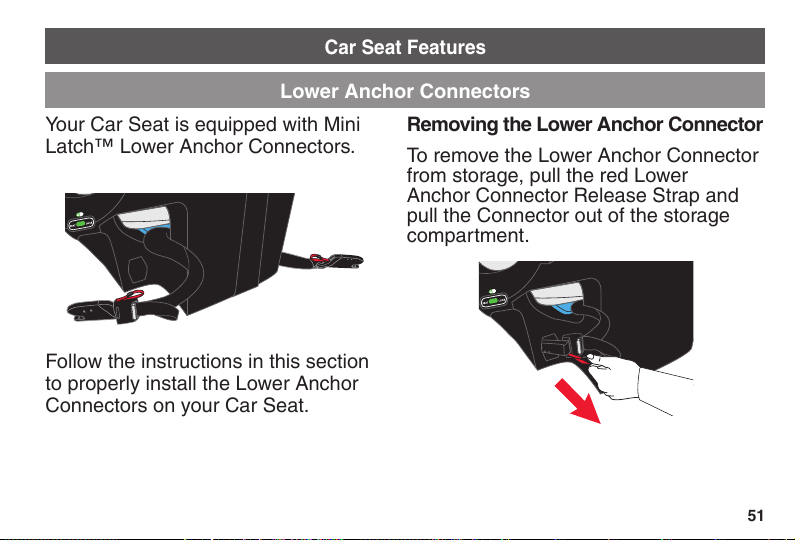
Your Car Seat is equipped with Mini
Latch™ Lower Anchor Connectors.
Follow the instructions in this section
to properly install the Lower Anchor
Connectors on your Car Seat.
Removing the Lower Anchor Connector
To remove the Lower Anchor Connector
from storage, pull the red Lower
Anchor Connector Release Strap and
pull the Connector out of the storage
compartment.
52
Car Seat Features
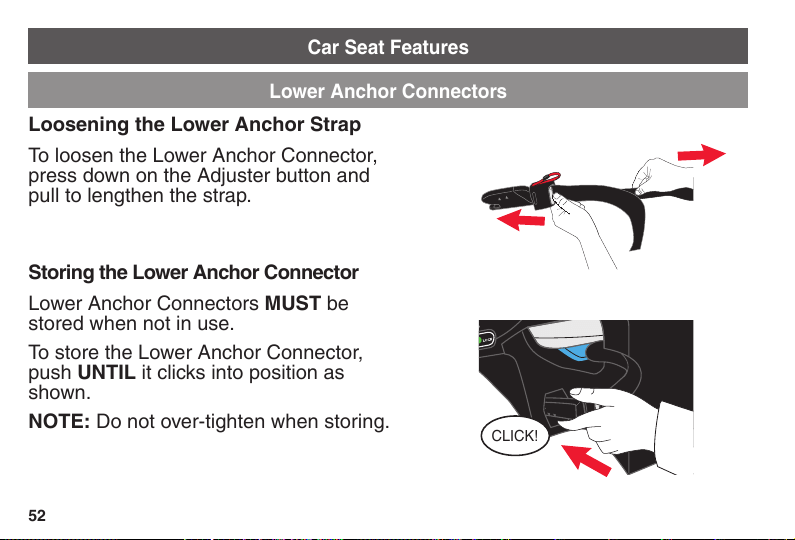
Loosening the Lower Anchor Strap
To loosen the Lower Anchor Connector,
press down on the Adjuster button and
pull to lengthen the strap.
Storing the Lower Anchor Connector
Lower Anchor Connectors MUST be
stored when not in use.
To store the Lower Anchor Connector,
push UNTIL it clicks into position as
shown.
NOTE: Do not over-tighten when storing.
Lower Anchor Connectors
CLICK!
53
Installing and Removing the Seat Shell from the Base
Installing the Seat Shell to the Base
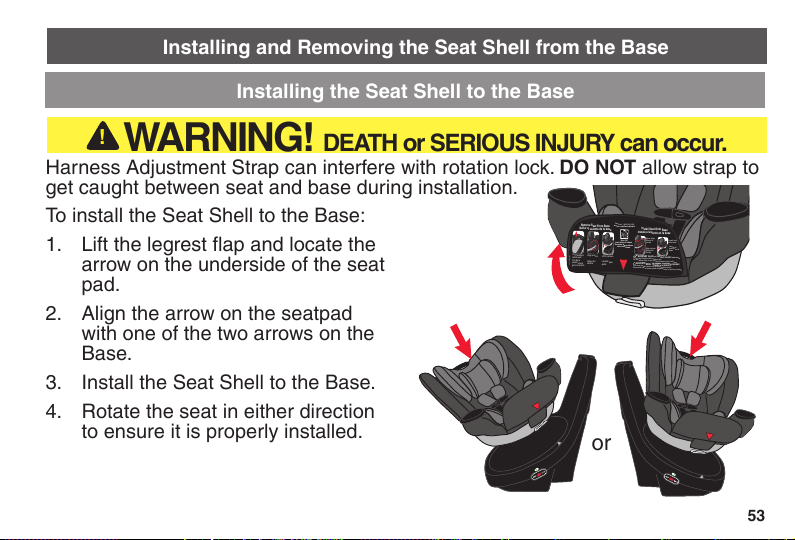
To install the Seat Shell to the Base:
1. Lift the legrest ap and locate the
arrow on the underside of the seat
pad.
2. Align the arrow on the seatpad
with one of the two arrows on the
Base.
3. Install the Seat Shell to the Base.
4. Rotate the seat in either direction
to ensure it is properly installed.
Remove Seat From Base
Pull handle to
rotate seat
Align arrows Lift to remove
Tire de la
palanca para
girar el asiento
Alinee las
echas
Levante para
quitar
Quitar el asiento de la base
25809098 10/20
Install Seat Onto Base
Insert seat
onto base
Align arrows
Alinee las
echas
Inserte el
asiento en la
base
Instale el asiento en la base
Parentlink: 1-800-233-2229
Scan for
instructional videos.
Escanear para videos
instruccionales.
evenflo.com/RevolveHowTo
Move strap
Mueve la
correa
WARNING!
DEATH or SERIOUS INJURY can occur
Strap can interfere with rotation lock.
Do not allow strap to get caught between seat and base.
¡ADVERTENCIA!
Se pueden ocasionar LESIONES
GRAVES o la MUERTE.
La correa puede interferir con el bloqueo de rotaci
ón.
No permita que la correa quede atrapada entre el as
iento y la base.
Harness Adjustment Strap can interfere with rotation lock. DO NOT allow strap to
get caught between seat and base during installation.
!
WARNING! DEATH or SERIOUS INJURY can occur.
or
54
Installing and Removing the Seat Shell from the Base
Removing the Seat Shell from the Base
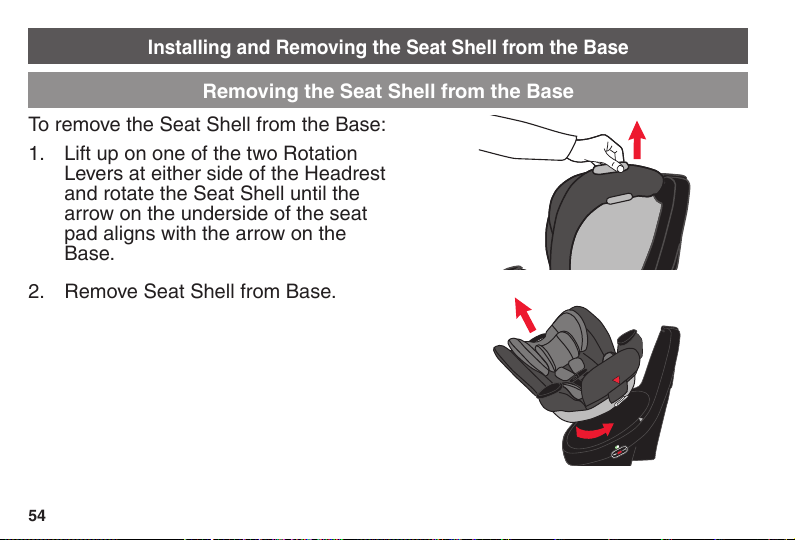
To remove the Seat Shell from the Base:
1. Lift up on one of the two Rotation
Levers at either side of the Headrest
and rotate the Seat Shell until the
arrow on the underside of the seat
pad aligns with the arrow on the
Base.
2. Remove Seat Shell from Base.
55
Lap/Shoulder Belt (Rear-Facing and Forward-Facing)
Installing Lap/Shoulder Belt (Preferred Method)
ALWAYS USE A TETHER STRAP FOR HARNESS INSTALLATION.
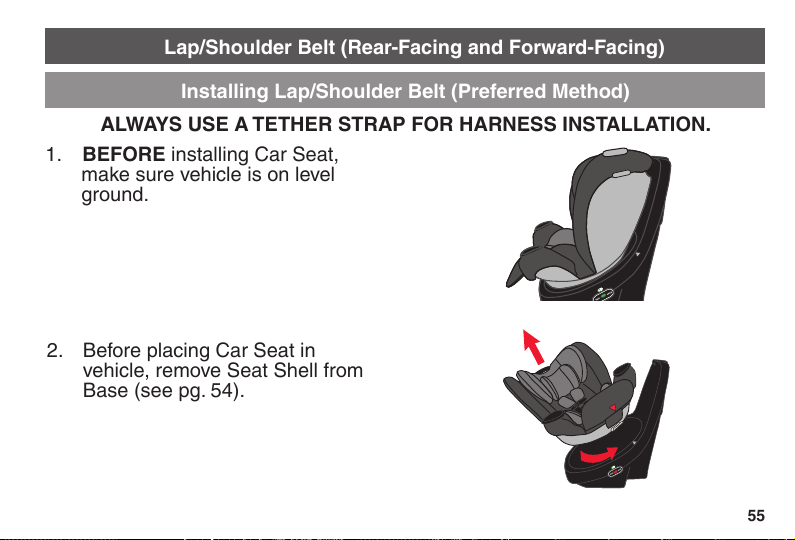
1. BEFORE installing Car Seat,
make sure vehicle is on level
ground.
2. Before placing Car Seat in
vehicle, remove Seat Shell from
Base (see pg. 54).
56
Lap/Shoulder Belt (Rear-Facing and Forward-Facing)
Installing Lap/Shoulder Belt (Preferred Method)
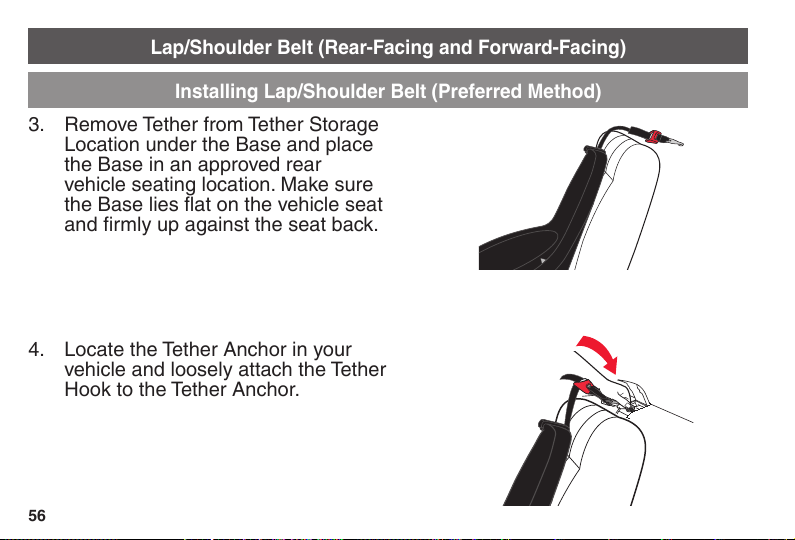
3. Remove Tether from Tether Storage
Location under the Base and place
the Base in an approved rear
vehicle seating location. Make sure
the Base lies at on the vehicle seat
and rmly up against the seat back.
4. Locate the Tether Anchor in your
vehicle and loosely attach the Tether
Hook to the Tether Anchor.
57
Lap/Shoulder Belt (Rear-Facing and Forward-Facing)
Installing Lap/Shoulder Belt (Preferred Method)
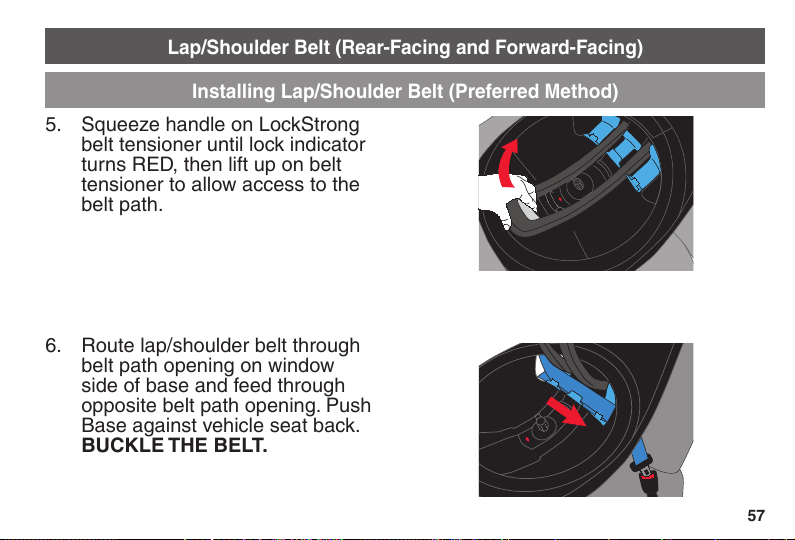
5. Squeeze handle on LockStrong
belt tensioner until lock indicator
turns RED, then lift up on belt
tensioner to allow access to the
belt path.
6. Route lap/shoulder belt through
belt path opening on window
side of base and feed through
opposite belt path opening. Push
Base against vehicle seat back.
BUCKLE THE BELT.
58
Lap/Shoulder Belt (Rear-Facing and Forward-Facing)
Installing Lap/Shoulder Belt (Preferred Method)
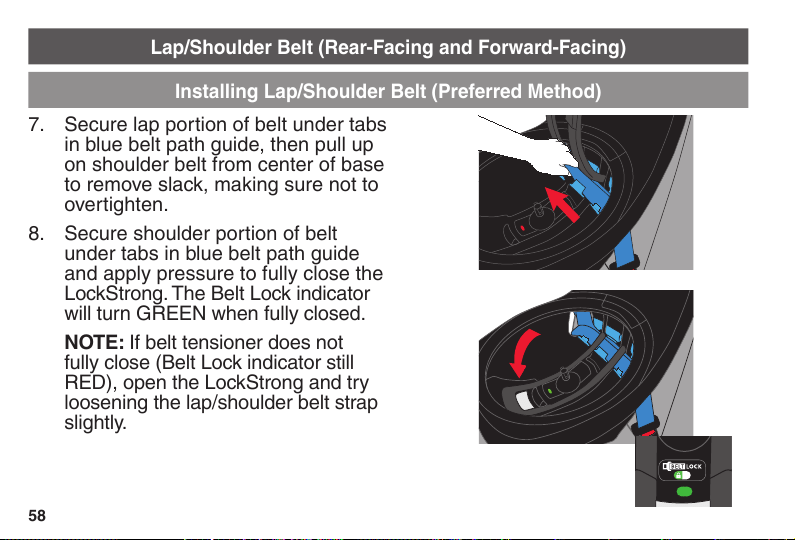
7. Secure lap portion of belt under tabs
in blue belt path guide, then pull up
on shoulder belt from center of base
to remove slack, making sure not to
overtighten.
8. Secure shoulder portion of belt
under tabs in blue belt path guide
and apply pressure to fully close the
LockStrong. The Belt Lock indicator
will turn GREEN when fully closed.
NOTE: If belt tensioner does not
fully close (Belt Lock indicator still
RED), open the LockStrong and try
loosening the lap/shoulder belt strap
slightly.
59
Lap/Shoulder Belt (Rear-Facing and Forward-Facing)
Installing Lap/Shoulder Belt (Preferred Method)
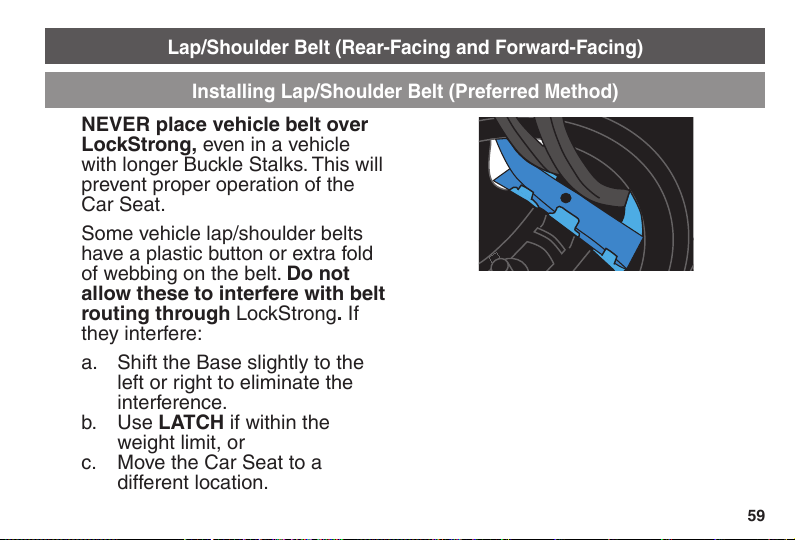
NEVER place vehicle belt over
LockStrong, even in a vehicle
with longer Buckle Stalks. This will
prevent proper operation of the
Car Seat.
Some vehicle lap/shoulder belts
have a plastic button or extra fold
of webbing on the belt. Do not
allow these to interfere with belt
routing through LockStrong. If
they interfere:
a. Shift the Base slightly to the
left or right to eliminate the
interference.
b. Use LATCH if within the
weight limit, or
c. Move the Car Seat to a
different location.
60
Lap/Shoulder Belt (Rear-Facing and Forward-Facing)
Installing Lap/Shoulder Belt (Preferred Method)
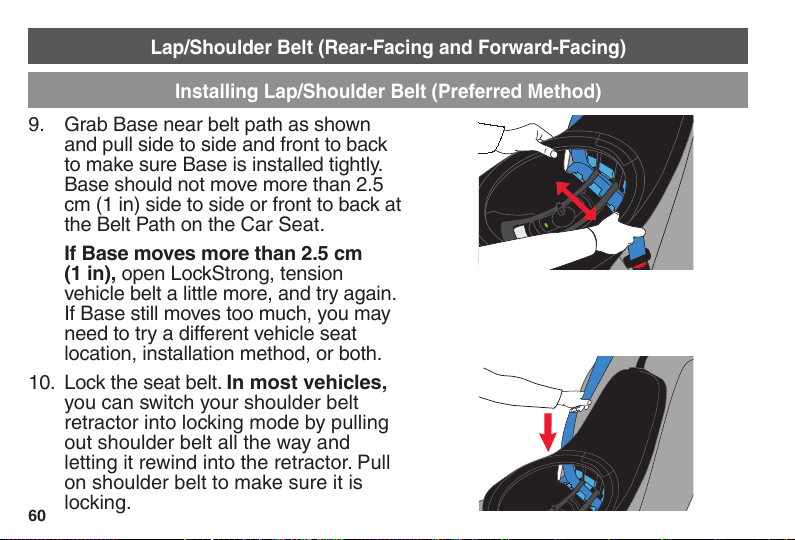
9. Grab Base near belt path as shown
and pull side to side and front to back
to make sure Base is installed tightly.
Base should not move more than 2.5
cm (1 in) side to side or front to back at
the Belt Path on the Car Seat.
If Base moves more than 2.5 cm
(1 in), open LockStrong, tension
vehicle belt a little more, and try again.
If Base still moves too much, you may
need to try a different vehicle seat
location, installation method, or both.
10. Lock the seat belt. In most vehicles,
you can switch your shoulder belt
retractor into locking mode by pulling
out shoulder belt all the way and
letting it rewind into the retractor. Pull
on shoulder belt to make sure it is
locking.
61
Lap/Shoulder Belt (Rear-Facing and Forward-Facing)
Installing Lap/Shoulder Belt (Preferred Method)
NEVER install this Car Seat using
a non-locking vehicle lap/shoulder
belt.
NOTE: Refer to your vehicle
Owner’s Manual for information.
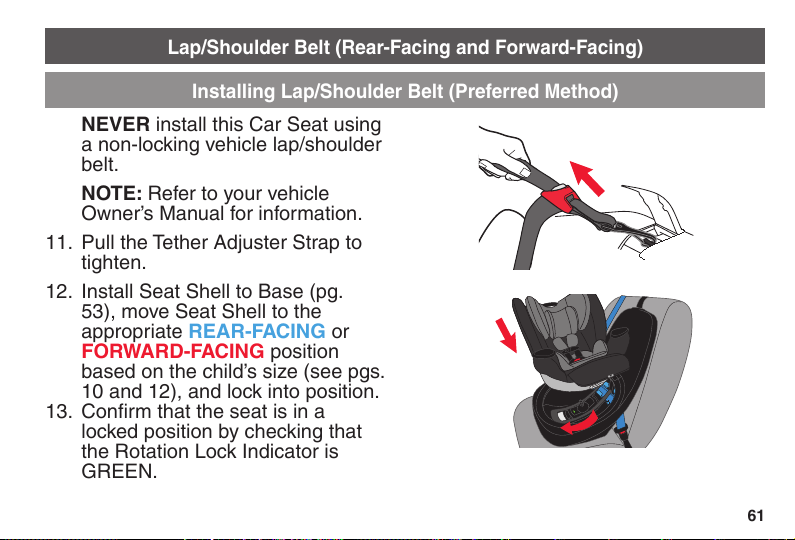
11. Pull the Tether Adjuster Strap to
tighten.
12. Install Seat Shell to Base (pg.
53), move Seat Shell to the
appropriate REAR-FACING or
FORWARD-FACING position
based on the child’s size (see pgs.
10 and 12), and lock into position.
13. Conrm that the seat is in a
locked position by checking that
the Rotation Lock Indicator is
GREEN.
62
Lap/Shoulder Belt (Rear-Facing and Forward-Facing)
Installing Lap/Shoulder Belt (Preferred Method)
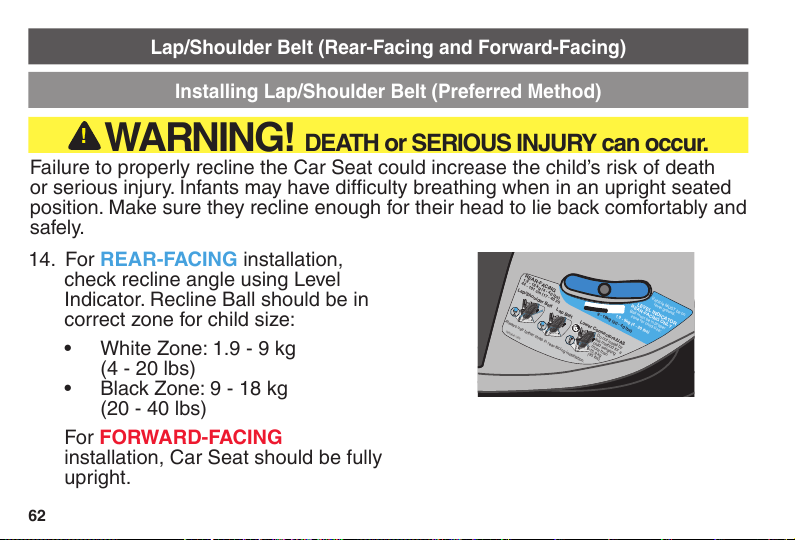
14. For REAR-FACING installation,
check recline angle using Level
Indicator. Recline Ball should be in
correct zone for child size:
• White Zone: 1.9 - 9 kg
(4 - 20 lbs)
• Black Zone: 9 - 18 kg
(20 - 40 lbs)
For
FORWARD-FACING
installation, Car Seat should be fully
upright.
1.9 - 9kg (4 - 20 lbs)
Lower Connectors/UAS
Lap/Shoulder Belt Lap Belt
Always use tether strap in rear-facing installation.
Ball must be in proper
zone for child size:
Vehicle MUST be on
level ground.
25809042 10/20
9 - 18kg (20 - 40 lbs)
Do not install by
this method for a
child weighing
more than
15.9 kg
(35 lbs).
LEVEL INDICATOR
REAR-FACING ONLY
1.9 - 18 kg (4 - 40 lbs)
44 - 101 cm (17 - 40 in)
REAR-FACING
!
WARNING! DEATH or SERIOUS INJURY can occur.
Failure to properly recline the Car Seat could increase the child’s risk of death
or serious injury. Infants may have difculty breathing when in an upright seated
position. Make sure they recline enough for their head to lie back comfortably and
safely.
63
Removing Lap/Shoulder Belt
Lap/Shoulder Belt (Rear-Facing and Forward-Facing)
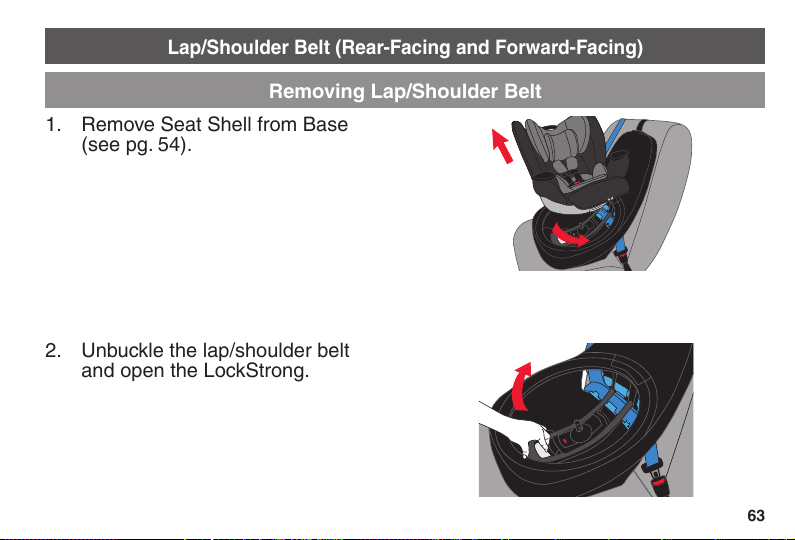
1. Remove Seat Shell from Base
(see pg. 54).
2. Unbuckle the lap/shoulder belt
and open the LockStrong.
64
Lap/Shoulder Belt (Rear-Facing and Forward-Facing)
Removing Lap/Shoulder Belt
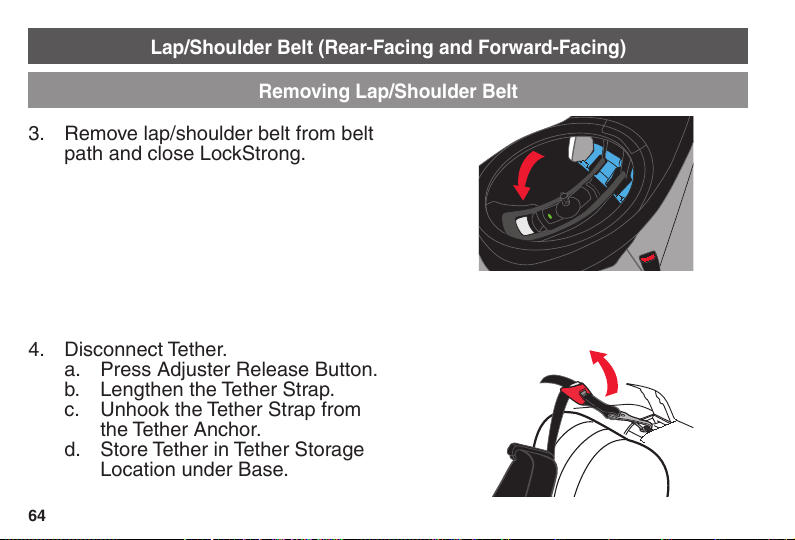
3. Remove lap/shoulder belt from belt
path and close LockStrong.
4. Disconnect Tether.
a. Press Adjuster Release Button.
b. Lengthen the Tether Strap.
c. Unhook the Tether Strap from
the Tether Anchor.
d. Store Tether in Tether Storage
Location under Base.
65
Lap Belt Only (Rear-Facing and Forward-Facing)
Installing Lap Belt
ALWAYS USE A TETHER STRAP FOR HARNESS INSTALLATION.
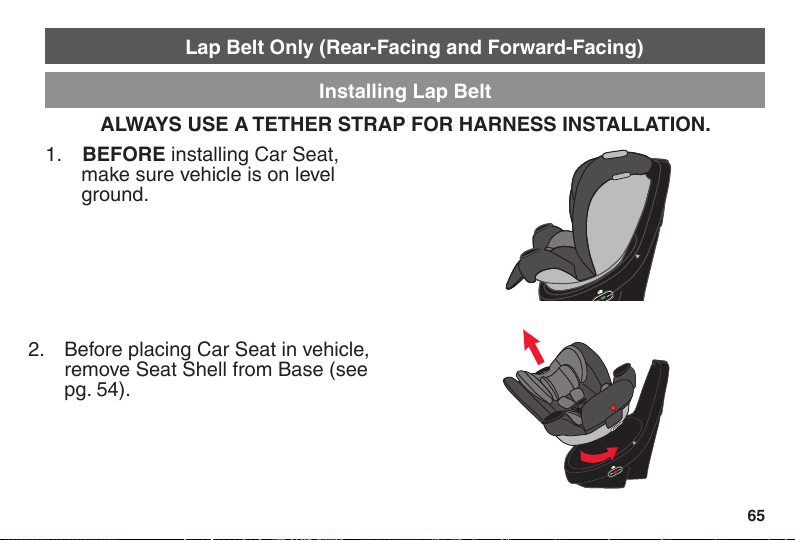
1. BEFORE installing Car Seat,
make sure vehicle is on level
ground.
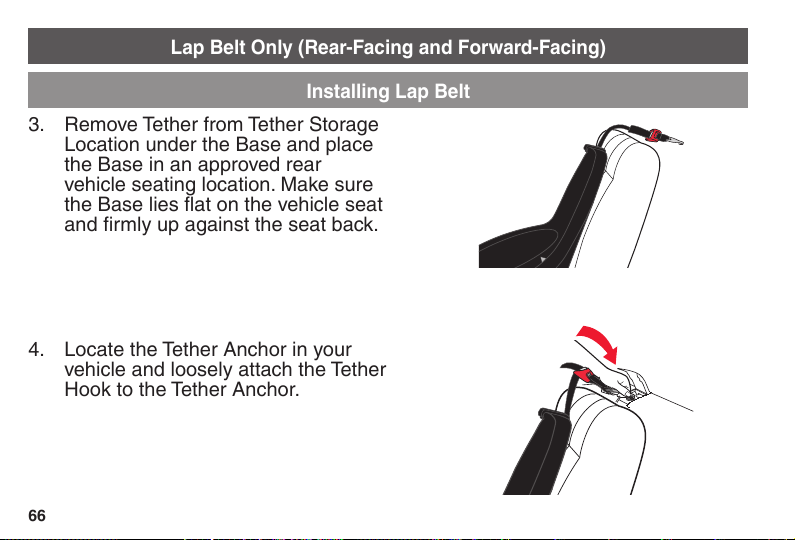
2. Before placing Car Seat in vehicle,
remove Seat Shell from Base (see
pg. 54).
66
Lap Belt Only (Rear-Facing and Forward-Facing)
Installing Lap Belt
3. Remove Tether from Tether Storage
Location under the Base and place
the Base in an approved rear
vehicle seating location. Make sure
the Base lies at on the vehicle seat
and rmly up against the seat back.
4. Locate the Tether Anchor in your
vehicle and loosely attach the Tether
Hook to the Tether Anchor.
67
Lap Belt Only (Rear-Facing and Forward-Facing)
Installing Lap Belt
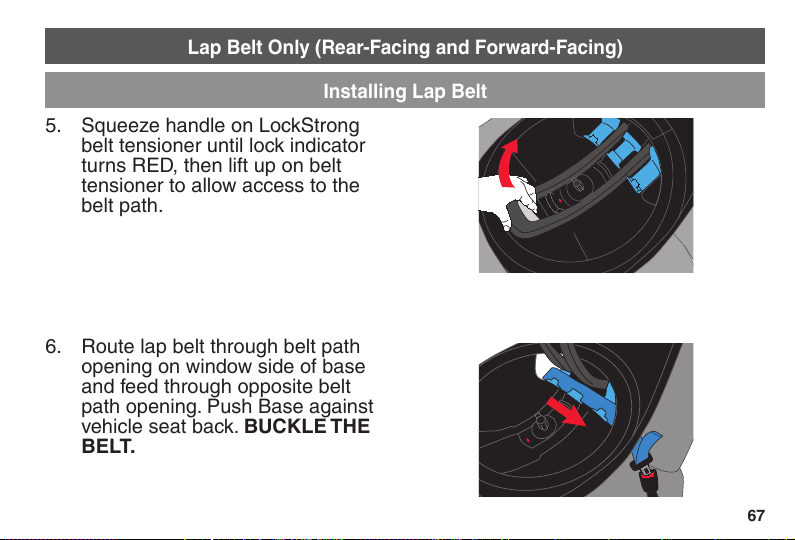
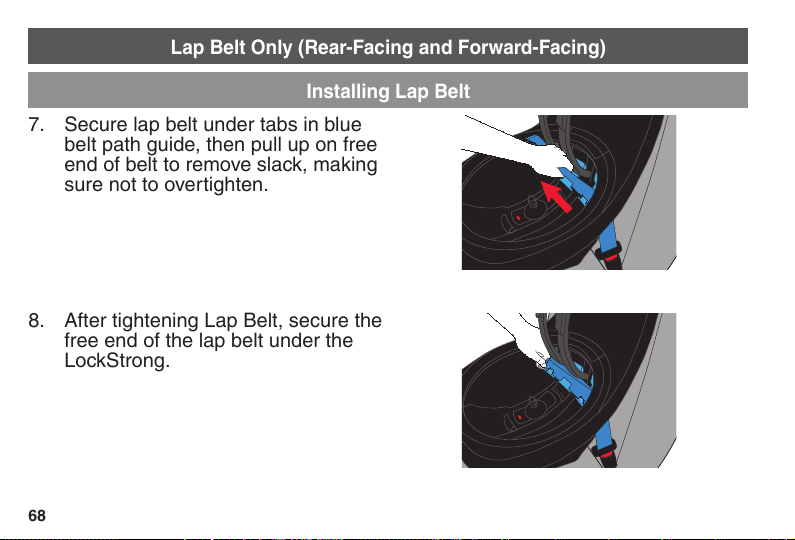
5. Squeeze handle on LockStrong
belt tensioner until lock indicator
turns RED, then lift up on belt
tensioner to allow access to the
belt path.
6. Route lap belt through belt path
opening on window side of base
and feed through opposite belt
path opening. Push Base against
vehicle seat back. BUCKLE THE
BELT.
68
Lap Belt Only (Rear-Facing and Forward-Facing)
Installing Lap Belt
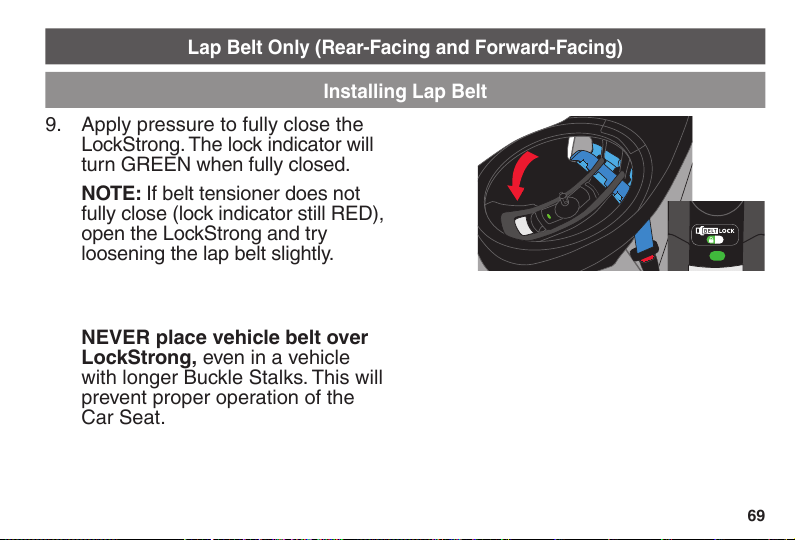
7. Secure lap belt under tabs in blue
belt path guide, then pull up on free
end of belt to remove slack, making
sure not to overtighten.
8. After tightening Lap Belt, secure the
free end of the lap belt under the
LockStrong.
69
Lap Belt Only (Rear-Facing and Forward-Facing)
Installing Lap Belt
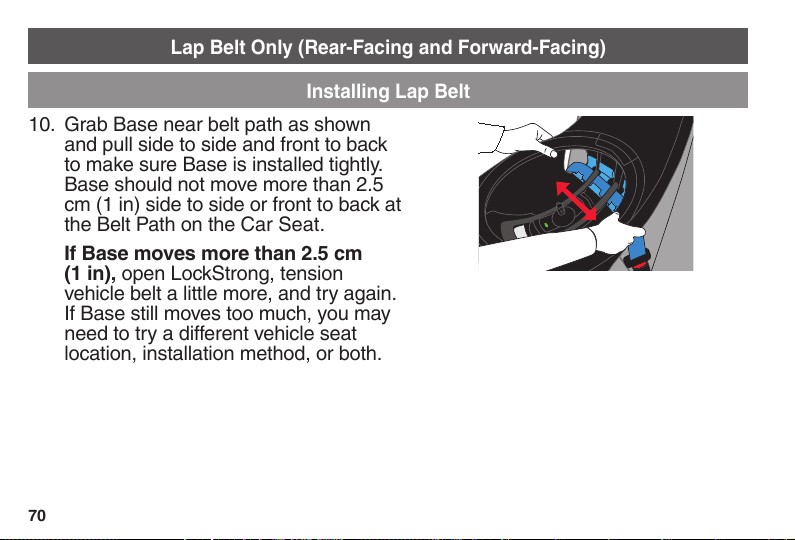
9. Apply pressure to fully close the
LockStrong. The lock indicator will
turn GREEN when fully closed.
NOTE: If belt tensioner does not
fully close (lock indicator still RED),
open the LockStrong and try
loosening the lap belt slightly.
NEVER place vehicle belt over
LockStrong, even in a vehicle
with longer Buckle Stalks. This will
prevent proper operation of the
Car Seat.
70
Lap Belt Only (Rear-Facing and Forward-Facing)
Installing Lap Belt
10. Grab Base near belt path as shown
and pull side to side and front to back
to make sure Base is installed tightly.
Base should not move more than 2.5
cm (1 in) side to side or front to back at
the Belt Path on the Car Seat.
If Base moves more than 2.5 cm
(1 in), open LockStrong, tension
vehicle belt a little more, and try again.
If Base still moves too much, you may
need to try a different vehicle seat
location, installation method, or both.
71
Lap Belt Only (Rear-Facing and Forward-Facing)
Installing Lap Belt
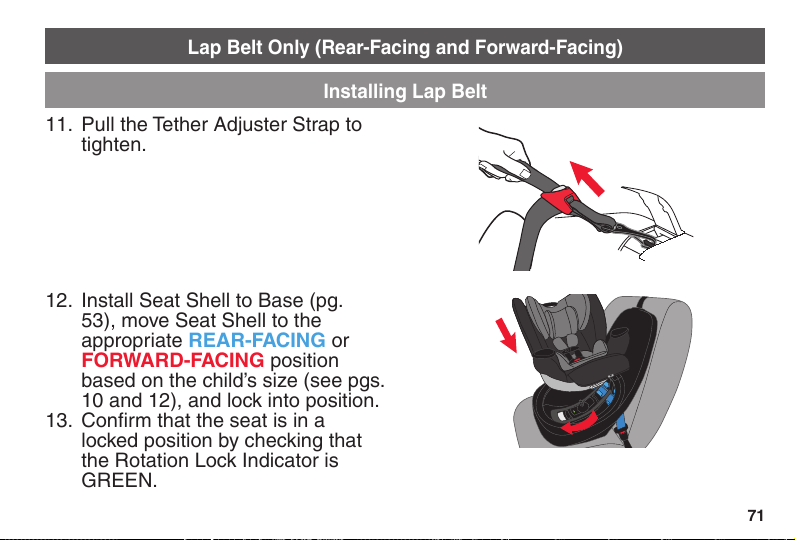
11. Pull the Tether Adjuster Strap to
tighten.
12. Install Seat Shell to Base (pg.
53), move Seat Shell to the
appropriate
REAR-FACING or
FORWARD-FACING position
based on the child’s size (see pgs.
10 and 12), and lock into position.
13. Conrm that the seat is in a
locked position by checking that
the Rotation Lock Indicator is
GREEN.
72
Lap Belt Only (Rear-Facing and Forward-Facing)
Installing Lap Belt
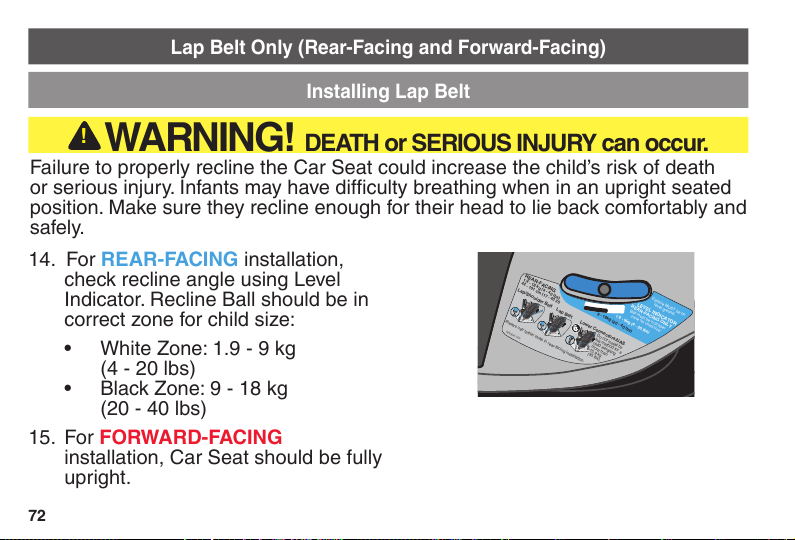
14. For REAR-FACING installation,
check recline angle using Level
Indicator. Recline Ball should be in
correct zone for child size:
• White Zone: 1.9 - 9 kg
(4 - 20 lbs)
• Black Zone: 9 - 18 kg
(20 - 40 lbs)
15. For
FORWARD-FACING
installation, Car Seat should be fully
upright.
1.9 - 9kg (4 - 20 lbs)
Lower Connectors/UAS
Lap/Shoulder Belt Lap Belt
Always use tether strap in rear-facing installation.
Ball must be in proper
zone for child size:
Vehicle MUST be on
level ground.
25809042 10/20
9 - 18kg (20 - 40 lbs)
Do not install by
this method for a
child weighing
more than
15.9 kg
(35 lbs).
LEVEL INDICATOR
REAR-FACING ONLY
1.9 - 18 kg (4 - 40 lbs)
44 - 101 cm (17 - 40 in)
REAR-FACING
!
WARNING! DEATH or SERIOUS INJURY can occur.
Failure to properly recline the Car Seat could increase the child’s risk of death
or serious injury. Infants may have difculty breathing when in an upright seated
position. Make sure they recline enough for their head to lie back comfortably and
safely.
73
Lap Belt Only (Rear-Facing and Forward-Facing)
Removing Lap Belt
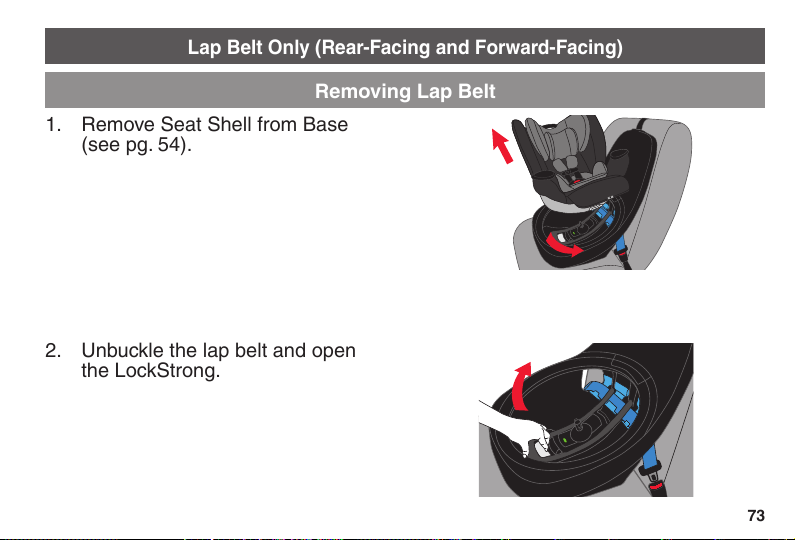
1. Remove Seat Shell from Base
(see pg. 54).
2. Unbuckle the lap belt and open
the LockStrong.
74
Lap Belt Only (Rear-Facing and Forward-Facing)
Removing Lap Belt
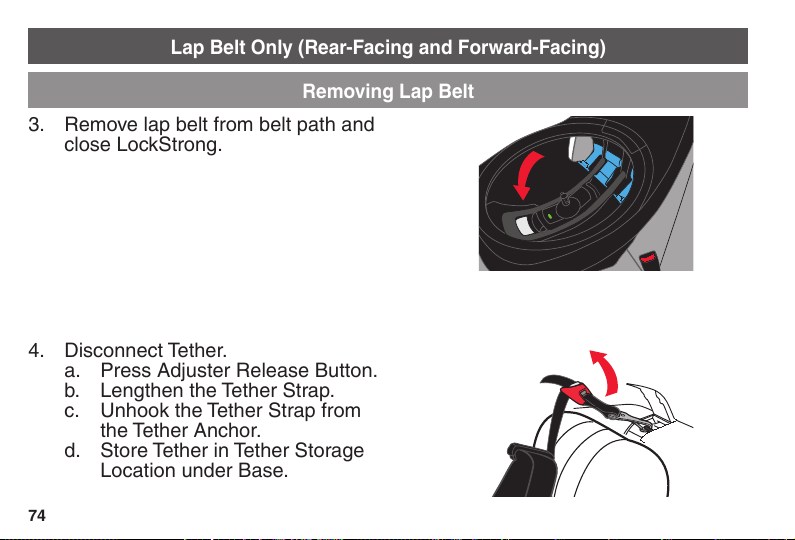
3. Remove lap belt from belt path and
close LockStrong.
4. Disconnect Tether.
a. Press Adjuster Release Button.
b. Lengthen the Tether Strap.
c. Unhook the Tether Strap from
the Tether Anchor.
d. Store Tether in Tether Storage
Location under Base.
75
LATCH/UAS (Rear-Facing and Forward-Facing)
Installing LATCH/UAS
ALWAYS USE A TETHER STRAP FOR HARNESS INSTALLATION.
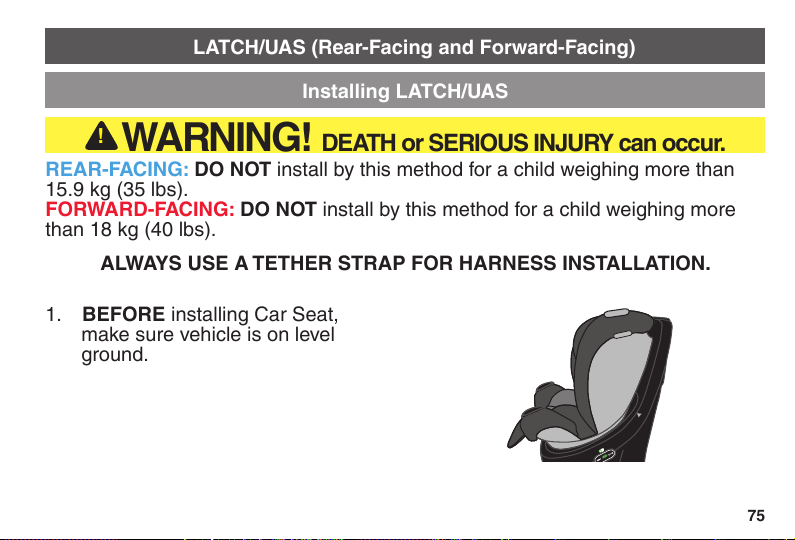
1. BEFORE installing Car Seat,
make sure vehicle is on level
ground.
!
WARNING! DEATH or SERIOUS INJURY can occur.
REAR-FACING: DO NOT install by this method for a child weighing more than
15.9 kg (35 lbs).
FORWARD-FACING: DO NOT install by this method for a child weighing more
than 18 kg (40 lbs).
76
LATCH/UAS (Rear-Facing and Forward-Facing)
Installing LATCH/UAS
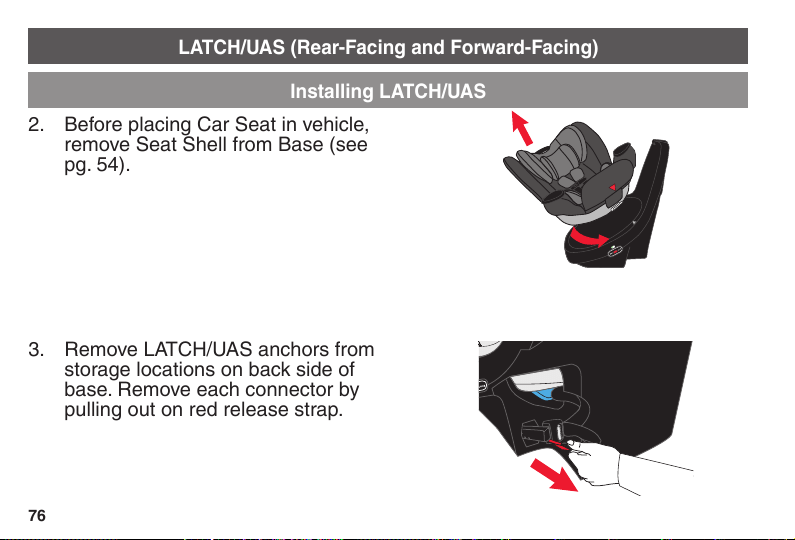
2. Before placing Car Seat in vehicle,
remove Seat Shell from Base (see
pg. 54).
3. Remove LATCH/UAS anchors from
storage locations on back side of
base. Remove each connector by
pulling out on red release strap.
77
LATCH/UAS (Rear-Facing and Forward-Facing)
Installing LATCH/UAS
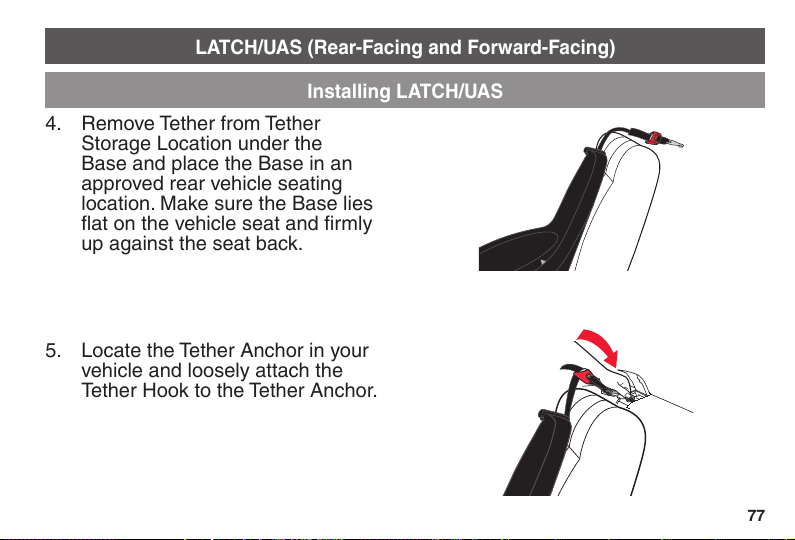
4. Remove Tether from Tether
Storage Location under the
Base and place the Base in an
approved rear vehicle seating
location. Make sure the Base lies
at on the vehicle seat and rmly
up against the seat back.
5. Locate the Tether Anchor in your
vehicle and loosely attach the
Tether Hook to the Tether Anchor.
78
LATCH/UAS (Rear-Facing and Forward-Facing)
Installing LATCH/UAS
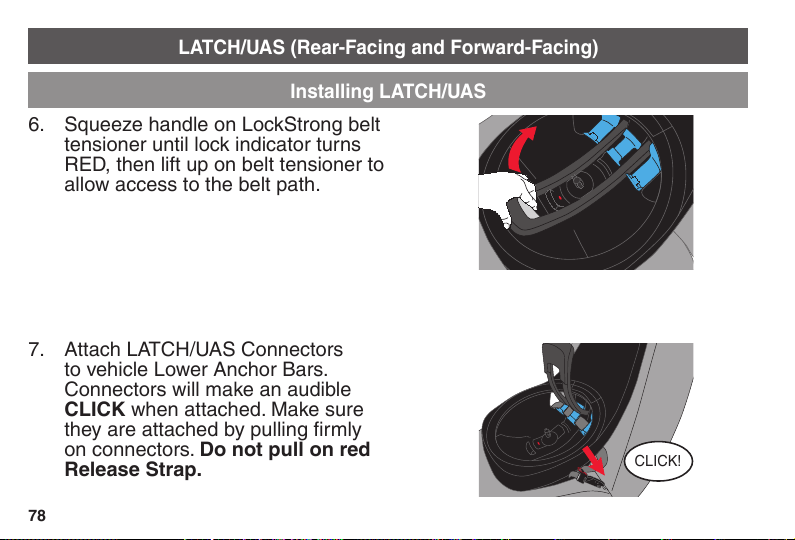
6. Squeeze handle on LockStrong belt
tensioner until lock indicator turns
RED, then lift up on belt tensioner to
allow access to the belt path.
7. Attach LATCH/UAS Connectors
to vehicle Lower Anchor Bars.
Connectors will make an audible
CLICK when attached. Make sure
they are attached by pulling rmly
on connectors. Do not pull on red
Release Strap.
CLICK!
79
LATCH/UAS (Rear-Facing and Forward-Facing)
Installing LATCH/UAS
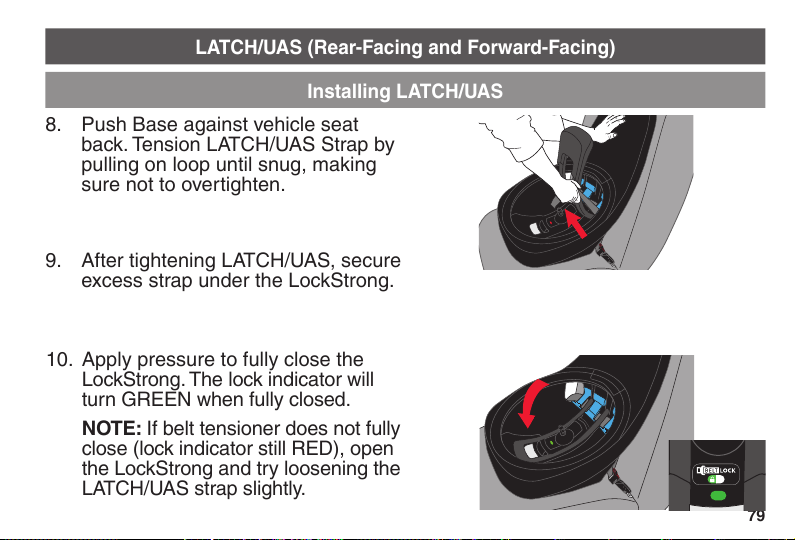
8. Push Base against vehicle seat
back. Tension LATCH/UAS Strap by
pulling on loop until snug, making
sure not to overtighten.
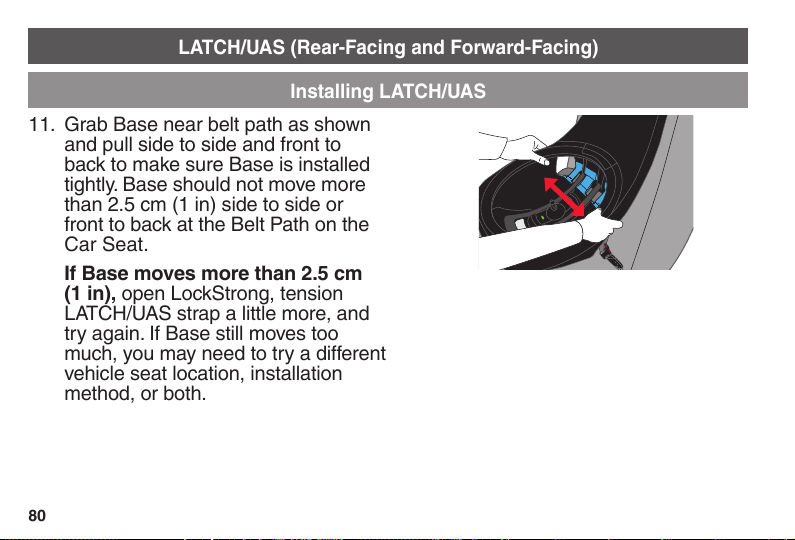
10. Apply pressure to fully close the
LockStrong. The lock indicator will
turn GREEN when fully closed.
NOTE: If belt tensioner does not fully
close (lock indicator still RED), open
the LockStrong and try loosening the
LATCH/UAS strap slightly.
9. After tightening LATCH/UAS, secure
excess strap under the LockStrong.
80
LATCH/UAS (Rear-Facing and Forward-Facing)
Installing LATCH/UAS
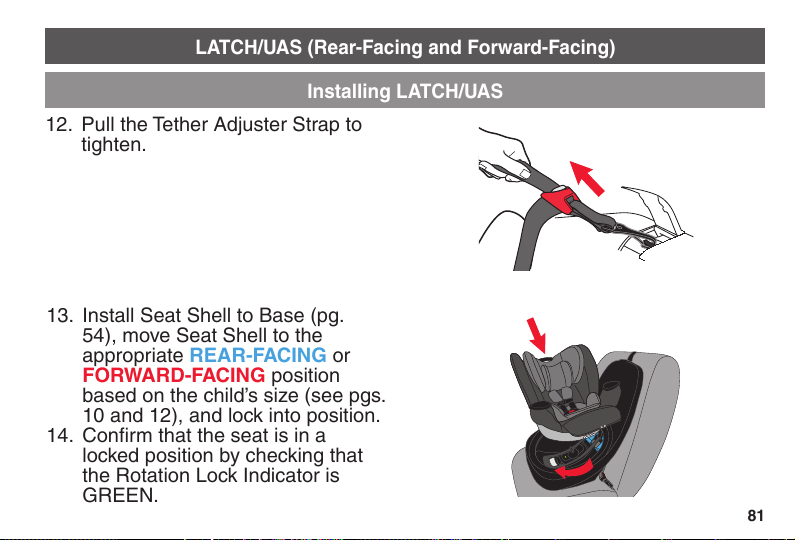
11. Grab Base near belt path as shown
and pull side to side and front to
back to make sure Base is installed
tightly. Base should not move more
than 2.5 cm (1 in) side to side or
front to back at the Belt Path on the
Car Seat.
If Base moves more than 2.5 cm
(1 in), open LockStrong, tension
LATCH/UAS strap a little more, and
try again. If Base still moves too
much, you may need to try a different
vehicle seat location, installation
method, or both.
81
LATCH/UAS (Rear-Facing and Forward-Facing)
Installing LATCH/UAS
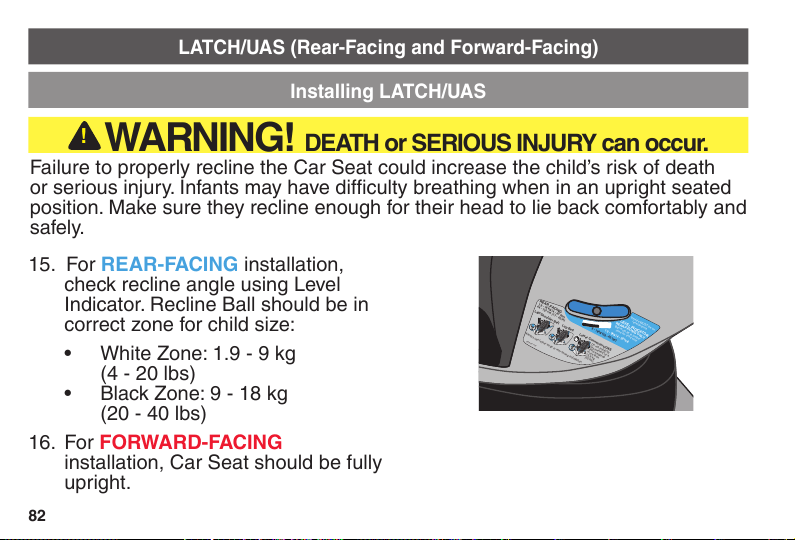
12. Pull the Tether Adjuster Strap to
tighten.
13. Install Seat Shell to Base (pg.
54), move Seat Shell to the
appropriate
REAR-FACING or
FORWARD-FACING position
based on the child’s size (see pgs.
10 and 12), and lock into position.
14. Conrm that the seat is in a
locked position by checking that
the Rotation Lock Indicator is
GREEN.
82
LATCH/UAS (Rear-Facing and Forward-Facing)
Installing LATCH/UAS
15. For REAR-FACING installation,
check recline angle using Level
Indicator. Recline Ball should be in
correct zone for child size:
• White Zone: 1.9 - 9 kg
(4 - 20 lbs)
• Black Zone: 9 - 18 kg
(20 - 40 lbs)
16. For FORWARD-FACING
installation, Car Seat should be fully
upright.
1.9 - 9kg (4 - 20 lbs)
Lower Connectors/UAS
Lap/Shoulder Belt Lap Belt
Always use tether strap in rear-facing installation.
Ball must be in proper
zone for child size:
Vehicle MUST be on
level ground.
25809042 10/20
9 - 18kg (20 - 40 lbs)
Do not install by
this method for a
child weighing
more than
15.9 kg
(35 lbs).
LEVEL INDICATOR
REAR-FACING ONLY
1.9 - 18 kg (4 - 40 lbs)
44 - 101 cm (17 - 40 in)
REAR-FACING
!
WARNING! DEATH or SERIOUS INJURY can occur.
Failure to properly recline the Car Seat could increase the child’s risk of death
or serious injury. Infants may have difculty breathing when in an upright seated
position. Make sure they recline enough for their head to lie back comfortably and
safely.
83
LATCH/UAS (Rear-Facing and Forward-Facing)
Removing LATCH/UAS
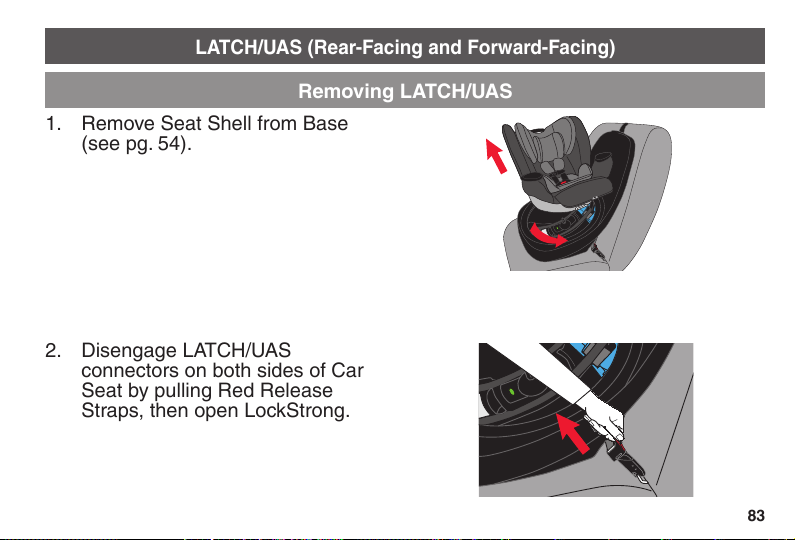
1. Remove Seat Shell from Base
(see pg. 54).
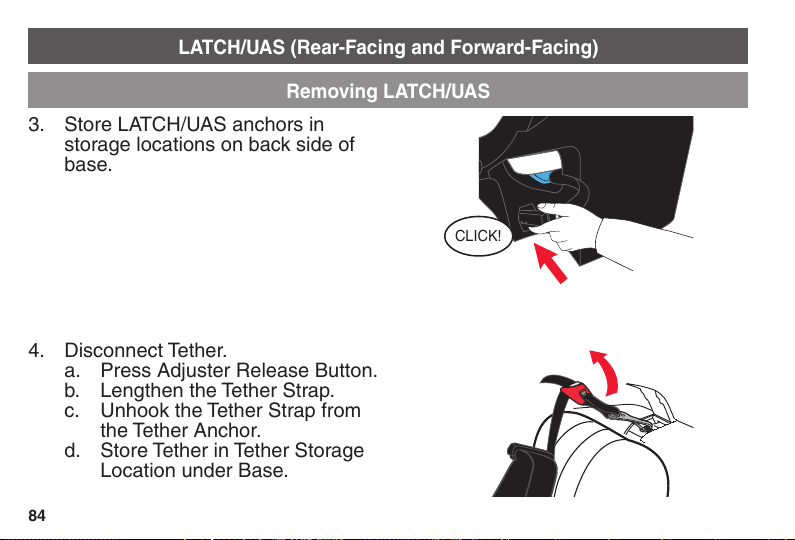
2. Disengage LATCH/UAS
connectors on both sides of Car
Seat by pulling Red Release
Straps, then open LockStrong.
84
LATCH/UAS (Rear-Facing and Forward-Facing)
Removing LATCH/UAS
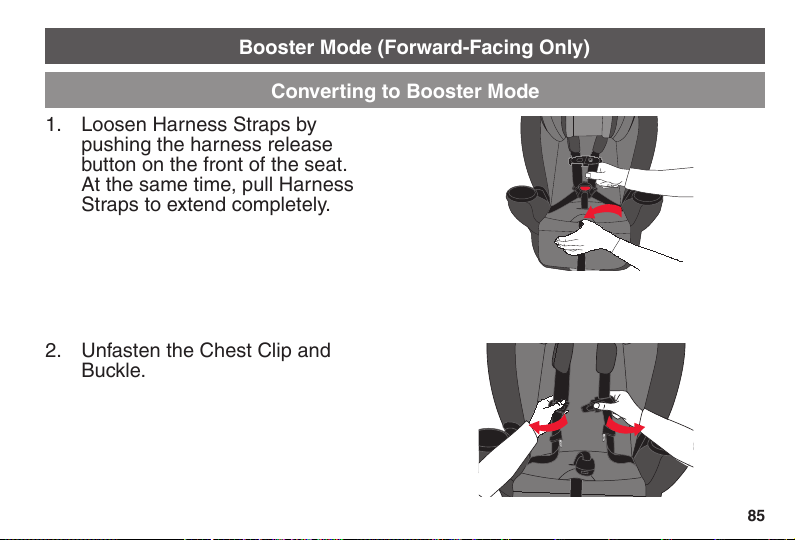
3. Store LATCH/UAS anchors in
storage locations on back side of
base.
4. Disconnect Tether.
a. Press Adjuster Release Button.
b. Lengthen the Tether Strap.
c. Unhook the Tether Strap from
the Tether Anchor.
d. Store Tether in Tether Storage
Location under Base.
CLICK!
85
Booster Mode (Forward-Facing Only)
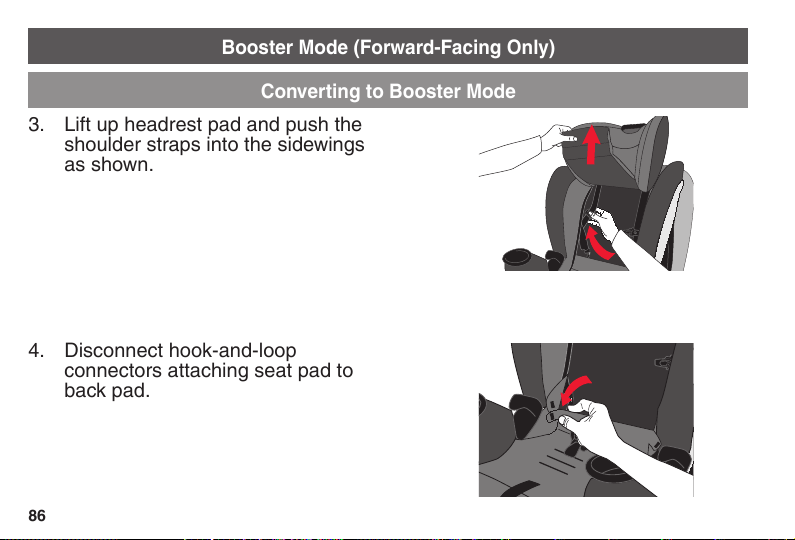
1. Loosen Harness Straps by
pushing the harness release
button on the front of the seat.
At the same time, pull Harness
Straps to extend completely.
2. Unfasten the Chest Clip and
Buckle.
Converting to Booster Mode
86
Booster Mode (Forward-Facing Only)
Converting to Booster Mode
3. Lift up headrest pad and push the
shoulder straps into the sidewings
as shown.
4. Disconnect hook-and-loop
connectors attaching seat pad to
back pad.
buckle
storage
87
Booster Mode (Forward-Facing Only)
Converting to Booster Mode
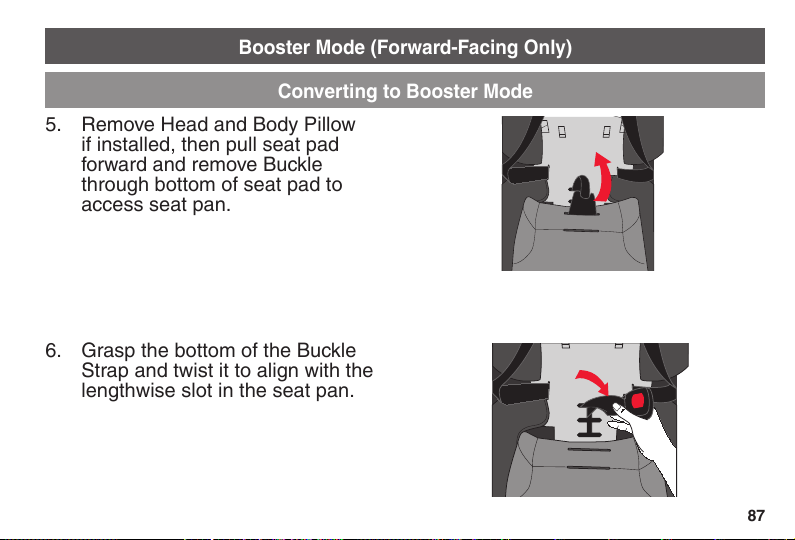
5. Remove Head and Body Pillow
if installed, then pull seat pad
forward and remove Buckle
through bottom of seat pad to
access seat pan.
6. Grasp the bottom of the Buckle
Strap and twist it to align with the
lengthwise slot in the seat pan.
88
Booster Mode (Forward-Facing Only)
Converting to Booster Mode
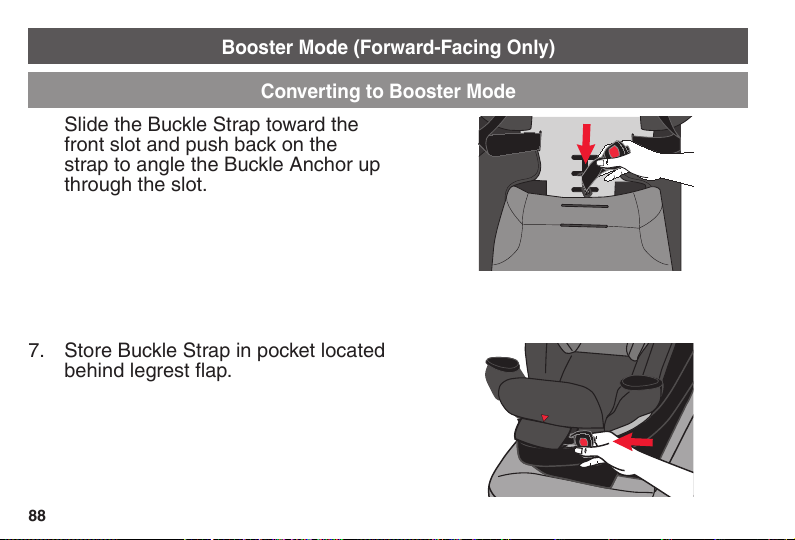
Slide the Buckle Strap toward the
front slot and push back on the
strap to angle the Buckle Anchor up
through the slot.
7. Store Buckle Strap in pocket located
behind legrest ap.
89
Booster Mode (Forward-Facing Only)
Converting to Booster Mode
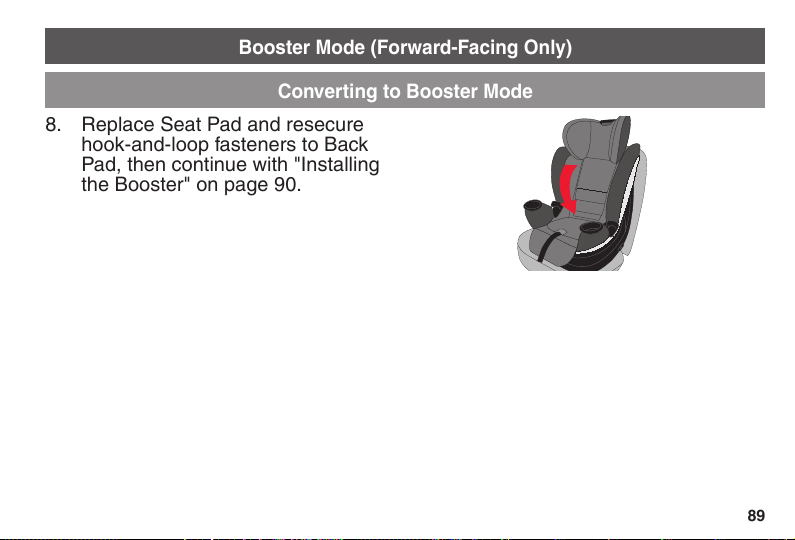
8. Replace Seat Pad and resecure
hook-and-loop fasteners to Back
Pad, then continue with "Installing
the Booster" on page 90.
90
Installing the Booster
Booster Mode (Forward-Facing Only)
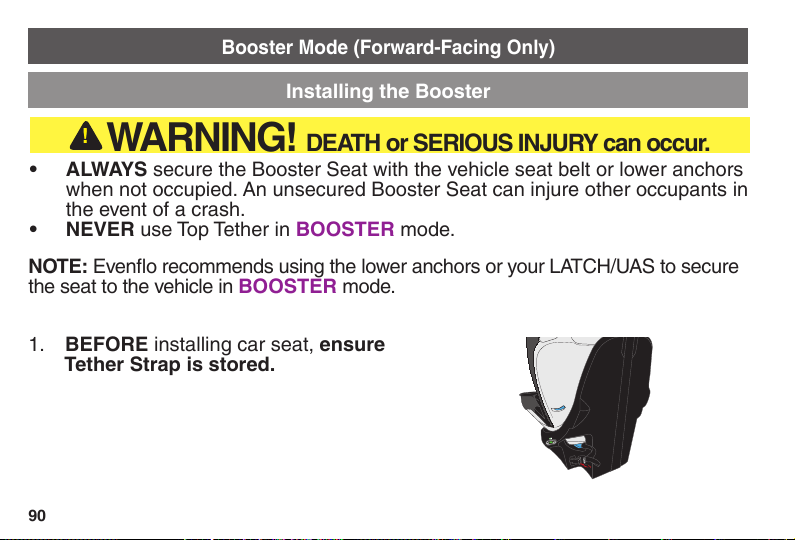
1. BEFORE installing car seat, ensure
Tether Strap is stored.
!
WARNING! DEATH or SERIOUS INJURY can occur.
• ALWAYS secure the Booster Seat with the vehicle seat belt or lower anchors
when not occupied. An unsecured Booster Seat can injure other occupants in
the event of a crash.
• NEVER use Top Tether in
BOOSTER mode.
NOTE: Eveno recommends using the lower anchors or your LATCH/UAS to secure
the seat to the vehicle in
BOOSTER mode.
91
Booster Mode (Forward-Facing Only)
Installing the Booster
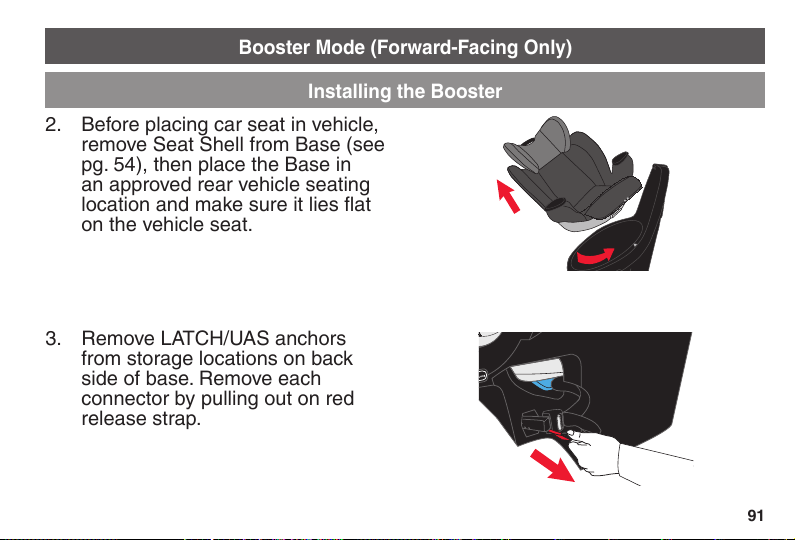
3. Remove LATCH/UAS anchors
from storage locations on back
side of base. Remove each
connector by pulling out on red
release strap.
2. Before placing car seat in vehicle,
remove Seat Shell from Base (see
pg. 54), then place the Base in
an approved rear vehicle seating
location and make sure it lies at
on the vehicle seat.
92
Booster Mode (Forward-Facing Only)
Installing the Booster
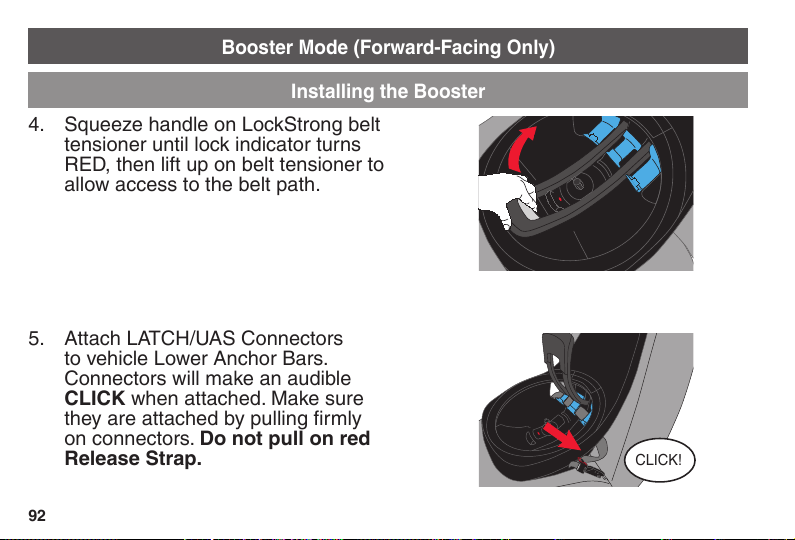
4. Squeeze handle on LockStrong belt
tensioner until lock indicator turns
RED, then lift up on belt tensioner to
allow access to the belt path.
5. Attach LATCH/UAS Connectors
to vehicle Lower Anchor Bars.
Connectors will make an audible
CLICK when attached. Make sure
they are attached by pulling rmly
on connectors. Do not pull on red
Release Strap.
CLICK!
93
Booster Mode (Forward-Facing Only)
Installing the Booster
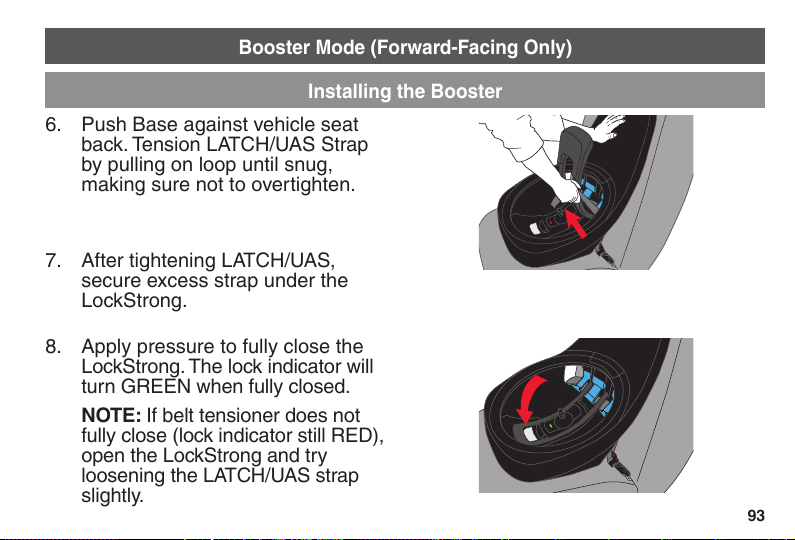
8. Apply pressure to fully close the
LockStrong. The lock indicator will
turn GREEN when fully closed.
NOTE: If belt tensioner does not
fully close (lock indicator still RED),
open the LockStrong and try
loosening the LATCH/UAS strap
slightly.
6. Push Base against vehicle seat
back. Tension LATCH/UAS Strap
by pulling on loop until snug,
making sure not to overtighten.
7. After tightening LATCH/UAS,
secure excess strap under the
LockStrong.
94
Booster Mode (Forward-Facing Only)
Installing the Booster
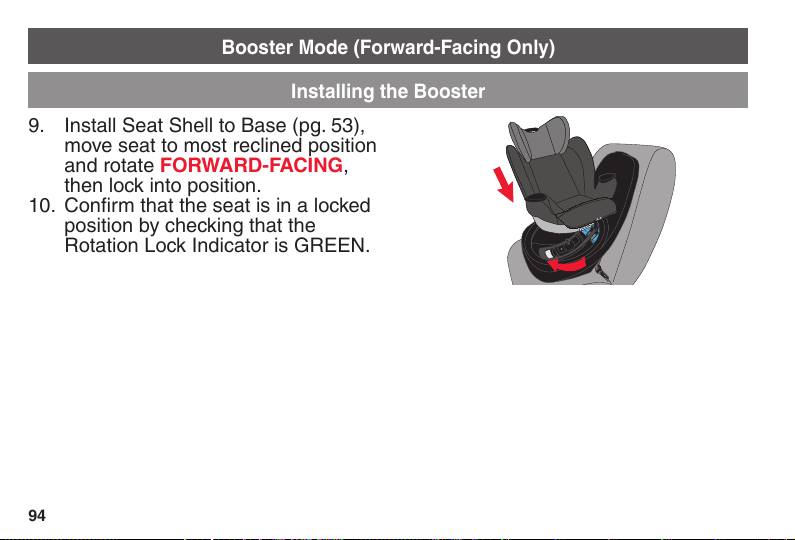
9. Install Seat Shell to Base (pg. 53),
move seat to most reclined position
and rotate FORWARD-FACING,
then lock into position.
10. Conrm that the seat is in a locked
position by checking that the
Rotation Lock Indicator is GREEN.
95
Securing the Child with Harness
!
WARNING! DEATH or SERIOUS INJURY can occur.
• NEVER secure child in Car Seat with child dressed in bulky or heavy clothing.
Heavy clothing can prevent Harness from being properly tightened around the
child.
• NEVER secure child in Car Seat with child wrapped in a blanket. To keep child
warm, place a blanket over the child AFTER you have properly secured and
tightened Harness around the child.
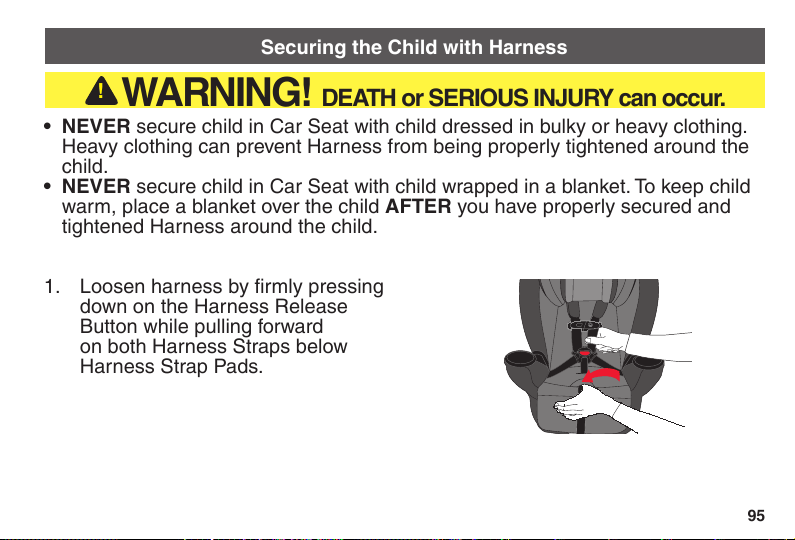
1. Loosen harness by rmly pressing
down on the Harness Release
Button while pulling forward
on both Harness Straps below
Harness Strap Pads.
96
Securing the Child With Harness
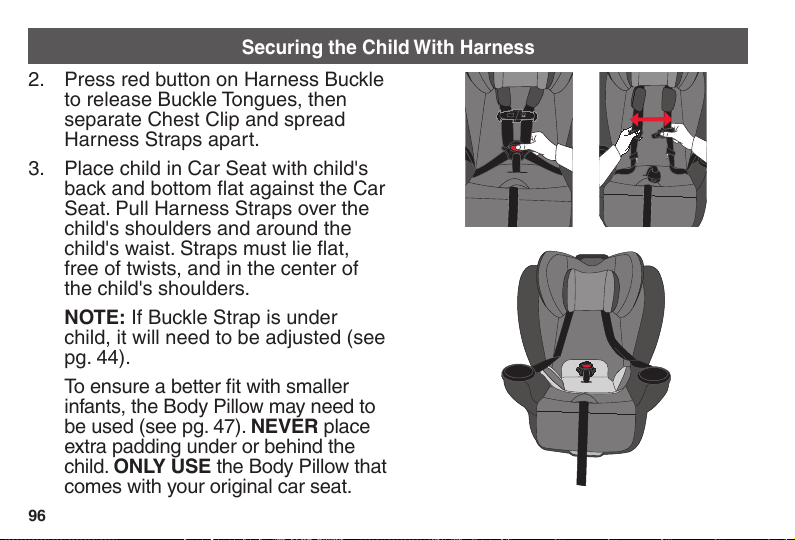
2. Press red button on Harness Buckle
to release Buckle Tongues, then
separate Chest Clip and spread
Harness Straps apart.
3. Place child in Car Seat with child's
back and bottom at against the Car
Seat. Pull Harness Straps over the
child's shoulders and around the
child's waist. Straps must lie at,
free of twists, and in the center of
the child's shoulders.
NOTE: If Buckle Strap is under
child, it will need to be adjusted (see
pg. 44).
To ensure a better t with smaller
infants, the Body Pillow may need to
be used (see pg. 47). NEVER place
extra padding under or behind the
child. ONLY USE the Body Pillow that
comes with your original car seat.
97
Securing the Child With Harness
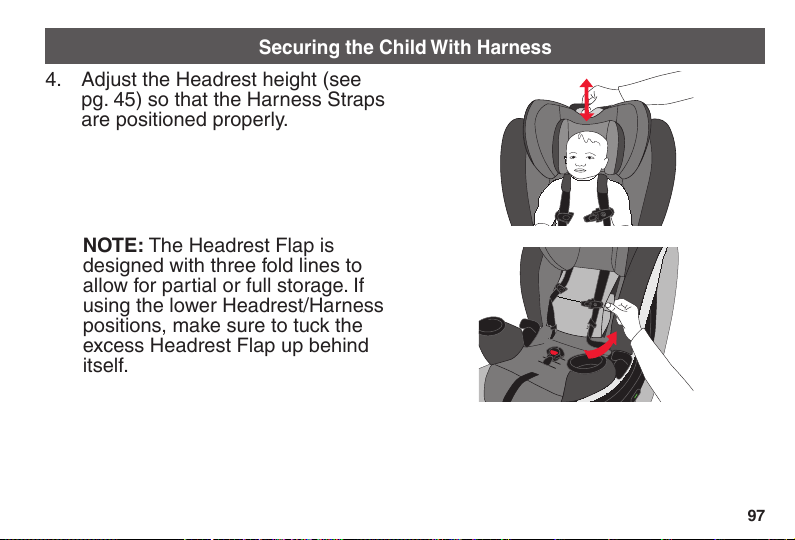
4. Adjust the Headrest height (see
pg. 45) so that the Harness Straps
are positioned properly.
NOTE: The Headrest Flap is
designed with three fold lines to
allow for partial or full storage. If
using the lower Headrest/Harness
positions, make sure to tuck the
excess Headrest Flap up behind
itself.
98
Securing the Child With Harness
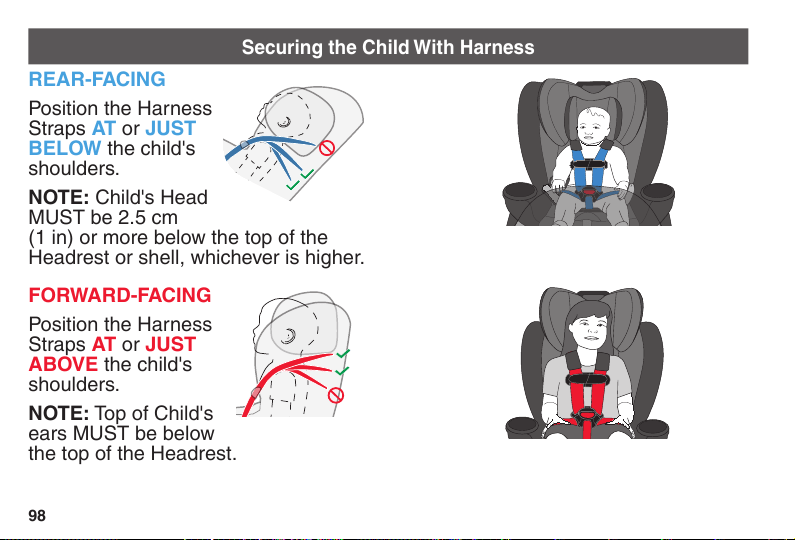
REAR-FACING
Position the Harness
Straps AT or JUST
BELOW the child's
shoulders.
NOTE: Child's Head
MUST be 2.5 cm
(1 in) or more below the top of the
Headrest or shell, whichever is higher.
FORWARD-FACING
Position the Harness
Straps
AT or JUST
ABOVE the child's
shoulders.
NOTE: Top of Child's
ears MUST be below
the top of the Headrest.
99
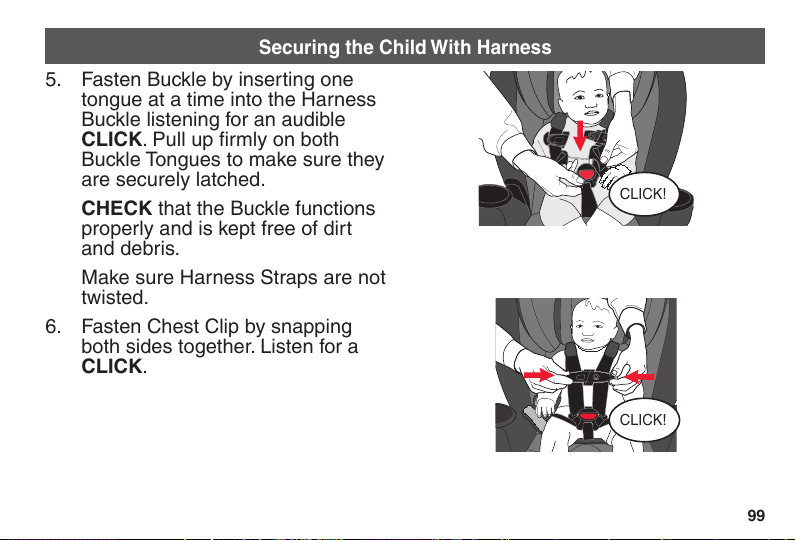
5. Fasten Buckle by inserting one
tongue at a time into the Harness
Buckle listening for an audible
CLICK. Pull up rmly on both
Buckle Tongues to make sure they
are securely latched.
CHECK that the Buckle functions
properly and is kept free of dirt
and debris.
Make sure Harness Straps are not
twisted.
6. Fasten Chest Clip by snapping
both sides together. Listen for a
CLICK.
Securing the Child With Harness
buckle
storage
PLACE
AT
ARMPIT
CLICK!
CLICK!
100
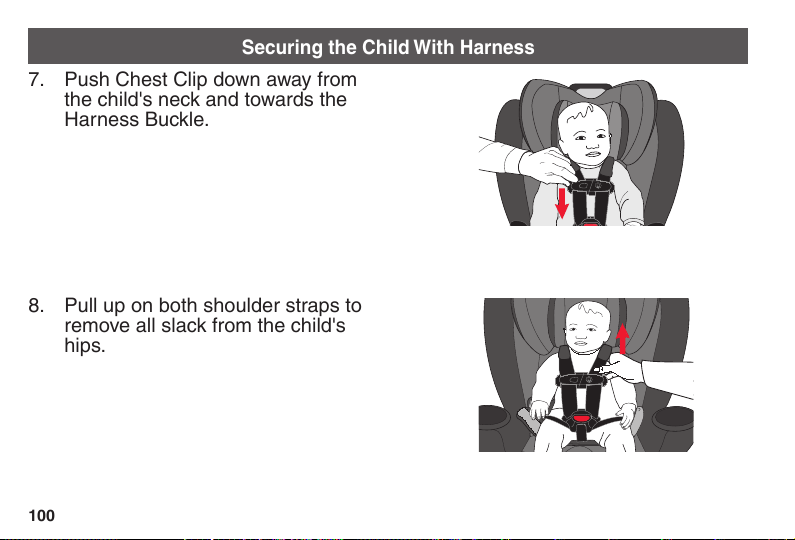
7. Push Chest Clip down away from
the child's neck and towards the
Harness Buckle.
Securing the Child With Harness
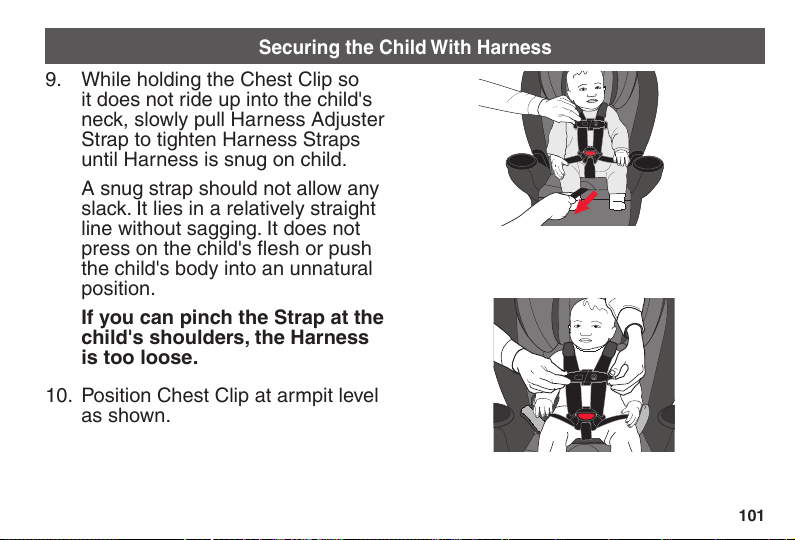
8. Pull up on both shoulder straps to
remove all slack from the child's
hips.
101
Securing the Child With Harness
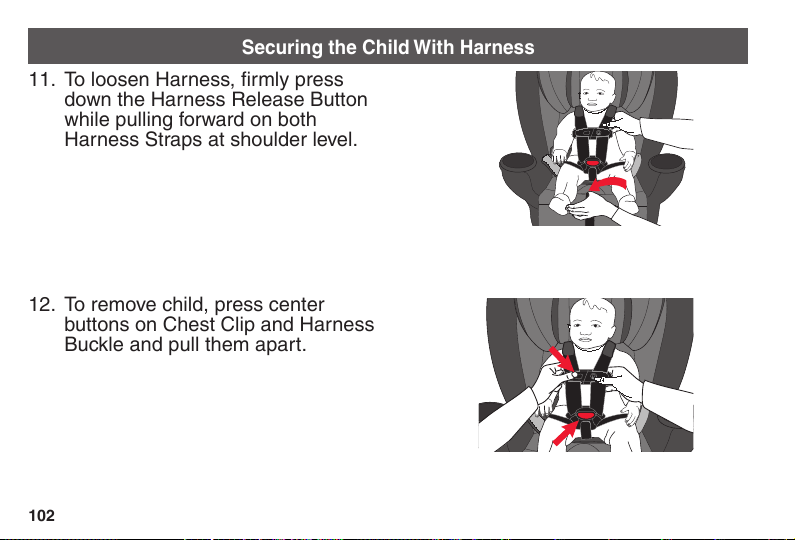
9. While holding the Chest Clip so
it does not ride up into the child's
neck, slowly pull Harness Adjuster
Strap to tighten Harness Straps
until Harness is snug on child.
A snug strap should not allow any
slack. It lies in a relatively straight
line without sagging. It does not
press on the child's esh or push
the child's body into an unnatural
position.
If you can pinch the Strap at the
child's shoulders, the Harness
is too loose.
10. Position Chest Clip at armpit level
as shown.
102
Securing the Child With Harness
11. To loosen Harness, rmly press
down the Harness Release Button
while pulling forward on both
Harness Straps at shoulder level.
12. To remove child, press center
buttons on Chest Clip and Harness
Buckle and pull them apart.
103
Using a Booster Seat is very similar to buckling yourself into the vehicle because
you are using the vehicle's restraint system to secure your child:
• Read the instruction manuals for both the Booster Seat and the vehicle before
you start.
• Put the Booster in the back seat in a location with a lap and shoulder belt.
Never use a Booster Seat with only a lap belt, as this could cause serious
injuries.
• Base of Booster should be at on vehicle seat.
• After the child is in the Booster, pull the lap and shoulder belt across and
buckle it. In
BOOSTER mode, your child is being restrained by the vehicle's lap
and shoulder belt, so t of the belts is important.
• Check that the shoulder belt lies across the middle of the shoulder and that the
lap belt is low on the hips, just touching the thighs (see pg. 104).
Securing the Child in Booster Mode
How is a Booster Seat Used?
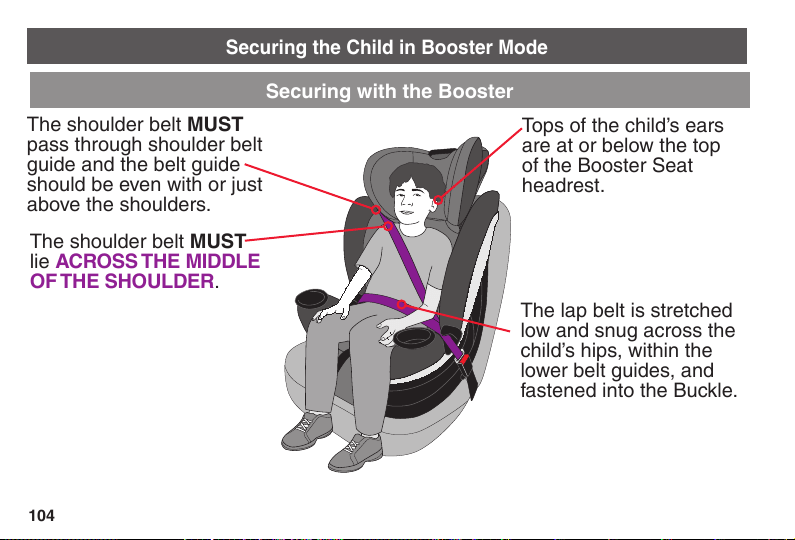
104
Securing the Child in Booster Mode
The shoulder belt MUST
lie ACROSS THE MIDDLE
OF THE SHOULDER.
The lap belt is stretched
low and snug across the
child’s hips, within the
lower belt guides, and
fastened into the Buckle.
Tops of the child’s ears
are at or below the top
of the Booster Seat
headrest.
The shoulder belt MUST
pass through shoulder belt
guide and the belt guide
should be even with or just
above the shoulders.
Securing with the Booster
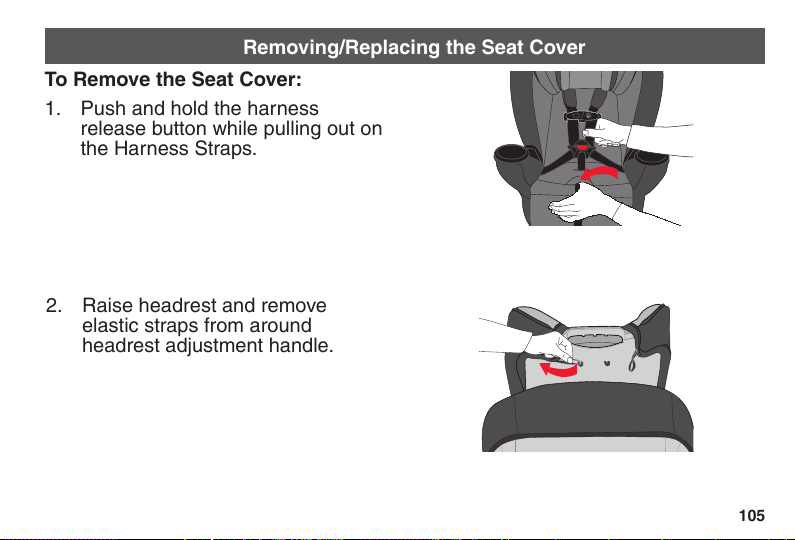
105
Removing/Replacing the Seat Cover
To Remove the Seat Cover:
1. Push and hold the harness
release button while pulling out on
the Harness Straps.
2. Raise headrest and remove
elastic straps from around
headrest adjustment handle.
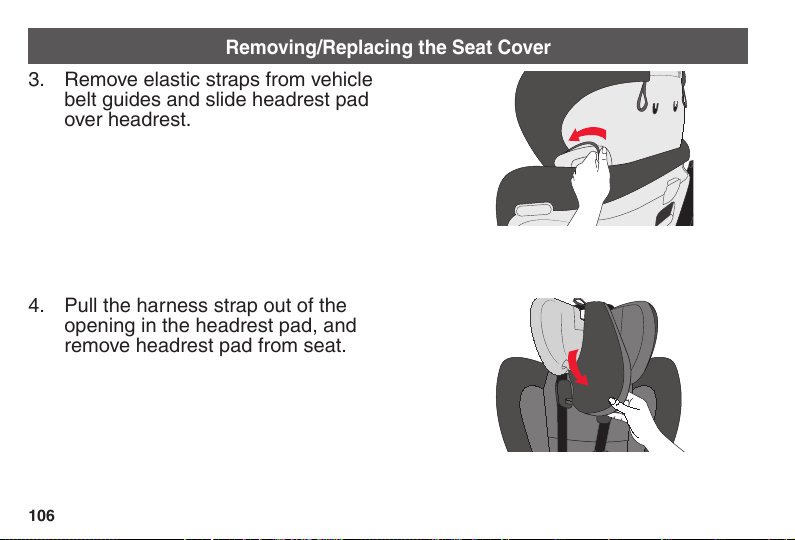
106
Removing/Replacing the Seat Cover
3. Remove elastic straps from vehicle
belt guides and slide headrest pad
over headrest.
4. Pull the harness strap out of the
opening in the headrest pad, and
remove headrest pad from seat.
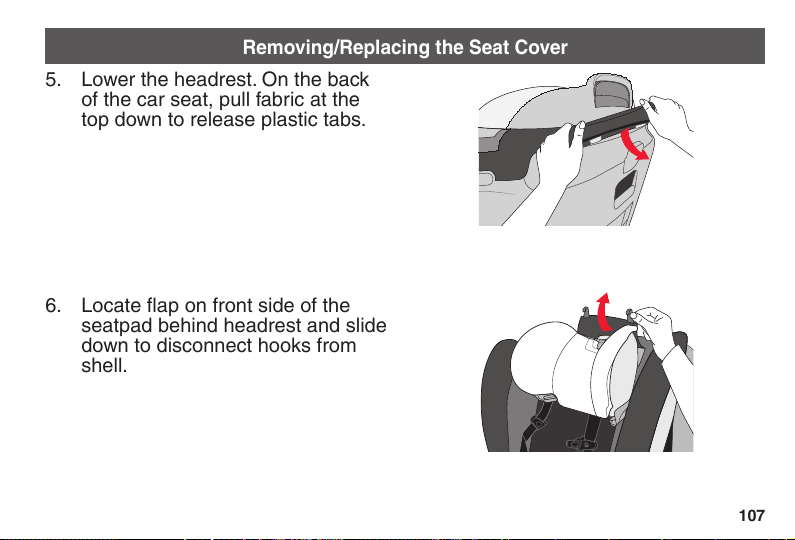
107
Removing/Replacing the Seat Cover
5. Lower the headrest. On the back
of the car seat, pull fabric at the
top down to release plastic tabs.
6. Locate ap on front side of the
seatpad behind headrest and slide
down to disconnect hooks from
shell.
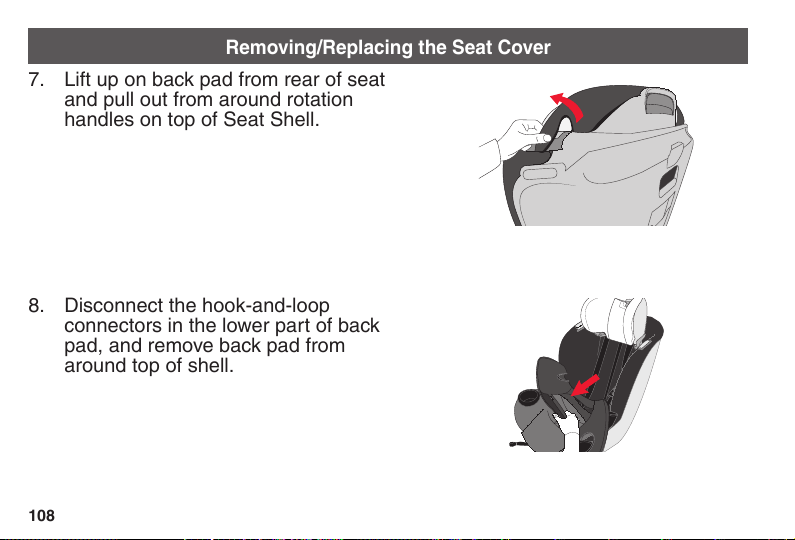
108
Removing/Replacing the Seat Cover
7. Lift up on back pad from rear of seat
and pull out from around rotation
handles on top of Seat Shell.
8. Disconnect the hook-and-loop
connectors in the lower part of back
pad, and remove back pad from
around top of shell.
PLACE
AT
ARMPIT
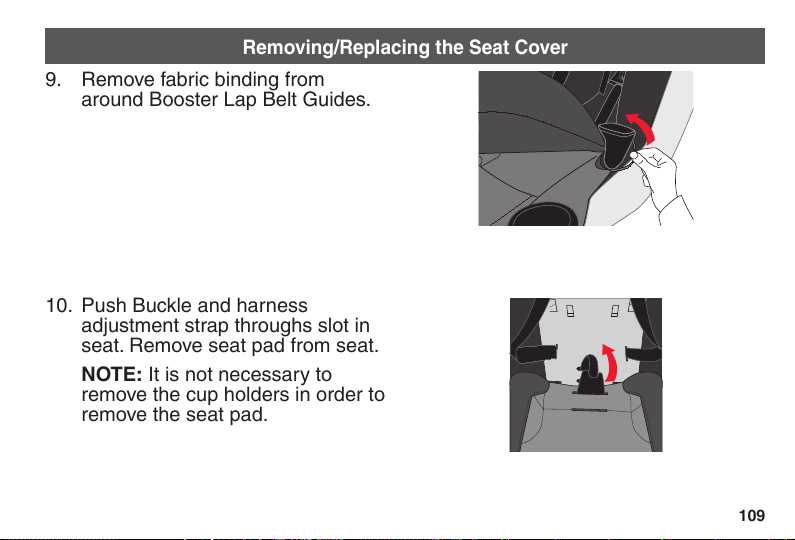
109
Removing/Replacing the Seat Cover
9. Remove fabric binding from
around Booster Lap Belt Guides.
10. Push Buckle and harness
adjustment strap throughs slot in
seat. Remove seat pad from seat.
NOTE: It is not necessary to
remove the cup holders in order to
remove the seat pad.
PLACE
AT
ARMPIT
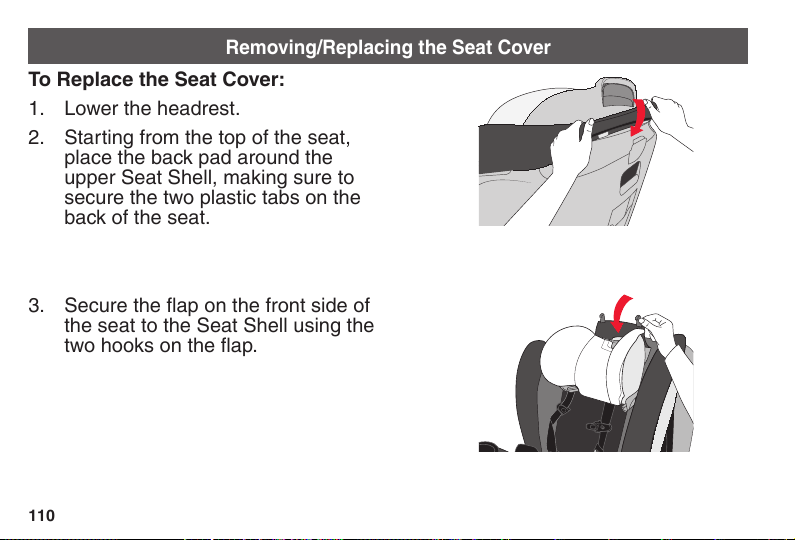
110
Removing/Replacing the Seat Cover
To Replace the Seat Cover:
1. Lower the headrest.
2. Starting from the top of the seat,
place the back pad around the
upper Seat Shell, making sure to
secure the two plastic tabs on the
back of the seat.
3. Secure the ap on the front side of
the seat to the Seat Shell using the
two hooks on the ap.
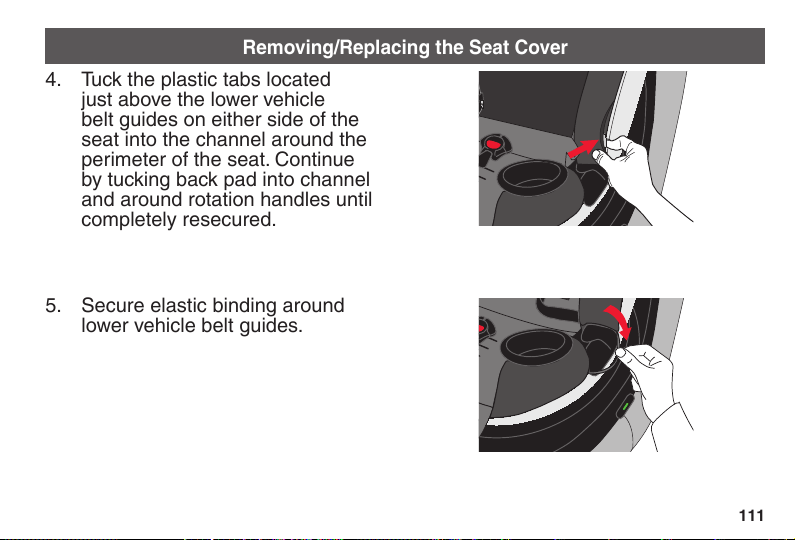
111
Removing/Replacing the Seat Cover
4. Tuck the plastic tabs located
just above the lower vehicle
belt guides on either side of the
seat into the channel around the
perimeter of the seat. Continue
by tucking back pad into channel
and around rotation handles until
completely resecured.
5. Secure elastic binding around
lower vehicle belt guides.
buckle
storage
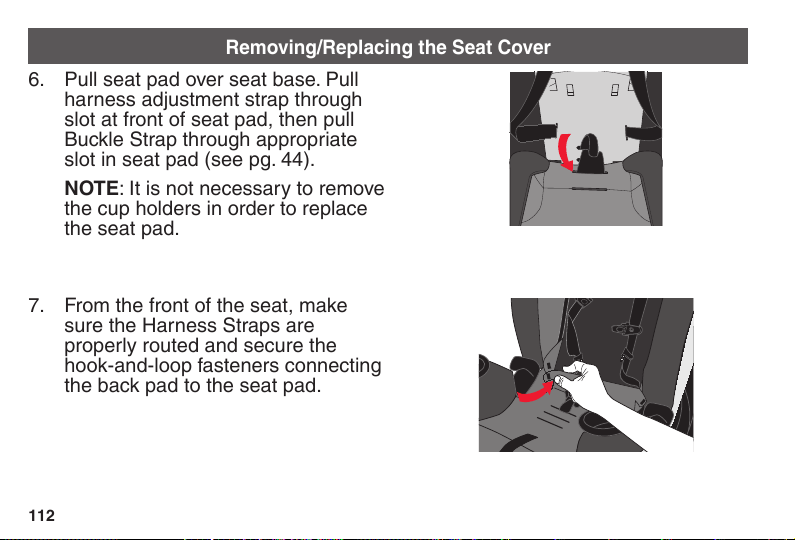
112
Removing/Replacing the Seat Cover
6. Pull seat pad over seat base. Pull
harness adjustment strap through
slot at front of seat pad, then pull
Buckle Strap through appropriate
slot in seat pad (see pg. 44).
NOTE: It is not necessary to remove
the cup holders in order to replace
the seat pad.
7. From the front of the seat, make
sure the Harness Straps are
properly routed and secure the
hook-and-loop fasteners connecting
the back pad to the seat pad.
buckle
storage
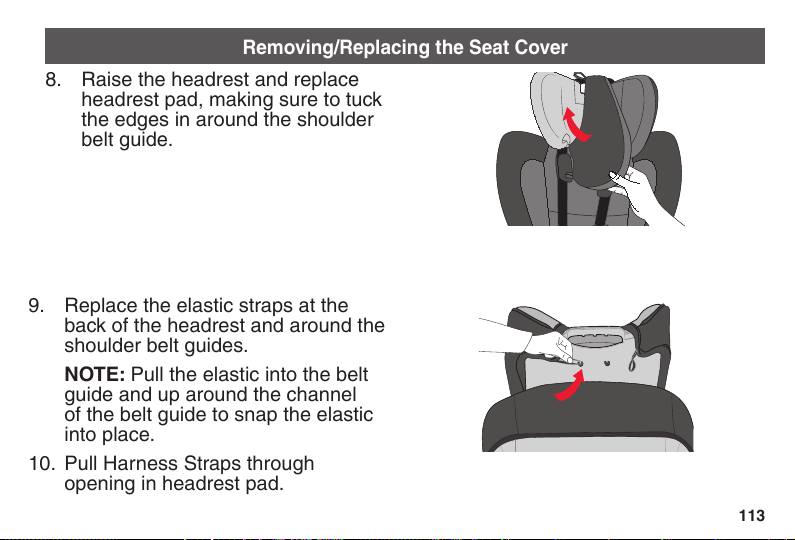
113
8. Raise the headrest and replace
headrest pad, making sure to tuck
the edges in around the shoulder
belt guide.
Removing/Replacing the Seat Cover
9. Replace the elastic straps at the
back of the headrest and around the
shoulder belt guides.
NOTE: Pull the elastic into the belt
guide and up around the channel
of the belt guide to snap the elastic
into place.
10. Pull Harness Straps through
opening in headrest pad.
114
Care and Cleaning
• DO NOT lubricate or immerse in water the LATCH/UAS connectors, the Buckle,
or any other part of this Car Seat, unless rinsing is permitted, as stated on the
back of the Buckle for your Car Seat.
• Plastic and metal parts may be wiped clean with
mild soap and water and dried with a soft cloth.
Do not use abrasive cleaners or solvents.
• Take care not to damage any labels.
• The harness can be wiped clean with mild soap
and water. Allow harness to air dry.
• Machine wash soft goods separately in cold
water, delicate cycle, NO CHLORINE BLEACH. Tumble dry 10 - 15 minutes on
low heat. Remove immediately.
Soft goods include headrest pad, seat pad, head pillow, body pillow, harness
covers, and Buckle Cover.* Remove the foam inserts from the headrest pad prior
to washing.
• NEVER use this car seat without the seat pad.
• To protect the car seat from damage caused by weather, rodents, and other
elements common to garages, the outdoors, and other storage locations, remove
the seat pad and thoroughly clean the Car Seat and pad prior to storage. Take
care to clean in the areas where crumbs and other debris tend to accumulate.
* Not all features are available on all models. Styles may vary.
TIP!
To help protect the
vehicle upholstery, place a
towel beneath and behind
the Car Seat.
115
Proper Disposal
When this Car Seat reaches the expiration date found on the date of manufacture
label, Eveno encourages you to dispose of it properly. Most components of this
Car Seat are recyclable.
1. Remove all fabric and padding.
2. Remove all screws and disassemble the Car Seat.
3. Recycle all fabric, padding, plastic, foam and metal parts, if accepted by your
local recycling center. Responsibly discard the rest.
If your local recycling center won’t accept the padding, you may dispose of it in
the landll.
To prevent injury due to hidden damage, lost instructions, outdated technology,
etc., discontinue use of this Car Seat after the expiration date on the label
or if it has been involved in a crash.
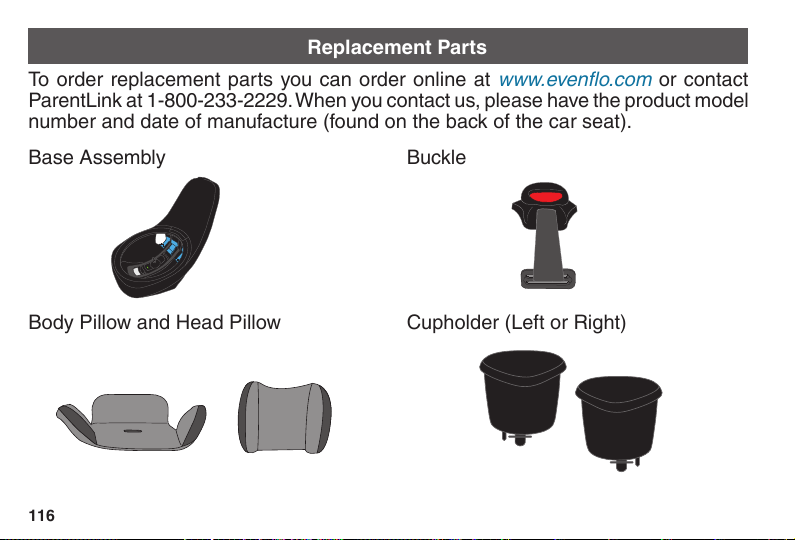
116
Replacement Parts
To order replacement parts you can order online at www.eveno.com or contact
ParentLink at 1-800-233-2229. When you contact us, please have the product model
number and date of manufacture (found on the back of the car seat).
Base Assembly
Body Pillow and Head Pillow
Buckle
Cupholder (Left or Right)
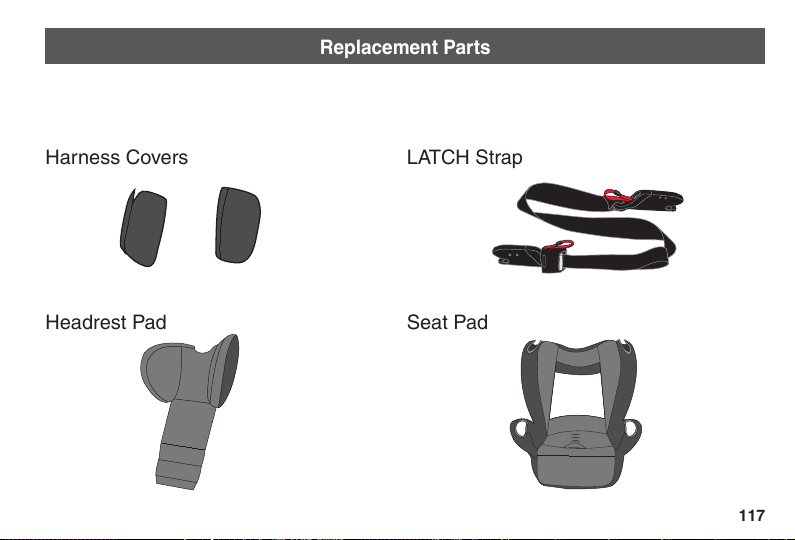
117
Replacement Parts
Harness Covers
Headrest Pad
LATCH Strap
Seat Pad
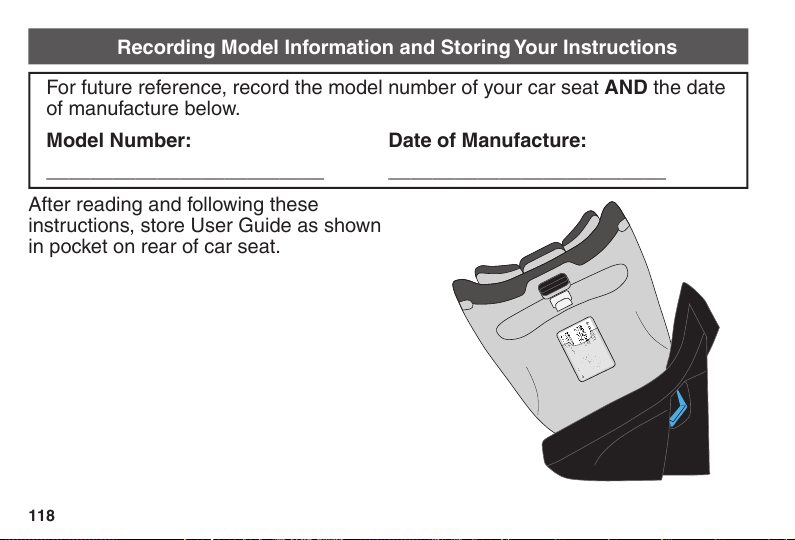
118
Recording Model Information and Storing Your Instructions
After reading and following these
instructions, store User Guide as shown
in pocket on rear of car seat.
For future reference, record the model number of your car seat AND the date
of manufacture below.
Model Number: Date of Manufacture:
_________________________ _________________________
119
Eveno Gold Lifetime Warranty
Registration in the Eveno Gold Lifetime Warranty means that for the life of this
Gold product, Eveno warrants to the original purchaser who registers online
(“Registrant”) this Gold product against material irregularity. Eveno’s sole
obligation under this warranty shall be, at Eveno’s option, to repair or replace
any Gold product that is determined by Eveno to be covered by this warranty.
Repair or replacement as provided under this warranty is the exclusive remedy of
the Registrant. Colors and fabrics change over time. Accordingly, we will replace
your product or part with one of equal value. Proof of registration or proof of
purchase in the form of a receipted invoice or bill of sale evidencing that the Gold
product is eligible for this Gold Lifetime Warranty must be presented to obtain
warranty service. This warranty is extended by Eveno ONLY to the original
Registrant and is not assignable or transferable to subsequent purchasers or
end users of the Gold product. For warranty service, contact Eveno’s ParentLink
Consumer Resource Center at 1-800-233-2229 or
www.evenogold.com or
www.evenogold.ca.
Applicable in the United States and Canada Only.
120
Eveno Gold Lifetime Warranty
By simply registering your Eveno Gold Car Seat online within 3 months of
purchase, you, the Registrant, will have access to the following Gold Lifetime
Warranty benets:
• Lifetime Warranty - Through the expiration date of your Gold Car Seat,
Eveno warrants this Gold product to the Registrant against material
irregularities.
• Replacement Parts - Eveno will send out free replacement parts based on
Gold Lifetime Warranty and subject to the exclusions listed below.
• Premier Consumer Resource Center located in the USA--for product
support, installation and assembly advice.
• Live Chat Support
• Motor Vehicle Accident Replacement - Eveno will replace your Gold Car
Seat in the event of a motor vehicle accident.
GOLD CAR SEAT WARRANTY INFORMATION:
Your Eveno Gold Car Seat is warranted to be free from any manufacturing
irregularities for the life of the car seat under normal use conditions and
according to the instruction manual. The expiration date for your Gold Car Seat is
on the date of manufacture label.
121
Eveno Gold Lifetime Warranty
This warranty is effective in the United States and Canada only. This warranty is
not transferable and extends only to the original purchaser who registered in the
Eveno Gold Lifetime Warranty.
If your Gold Car Seat is damaged due to the following, the Gold Lifetime
Warranty does not apply:
• Misuse or poor maintenance. Please refer to this instruction manual for
guidance;
• Sun intensity, sweat, detergents, damp storage or frequent washings;
• Airline or freight damage;
• Improper storage; or
• Second-hand use.
Eveno reserves the right to make modications to the terms and conditions of
this Lifetime Warranty. Please review the current Lifetime Warranty applicable
to your Gold product by accessing the online instruction manuals at
www.
evenogold.com and www.evenogold.ca.