2
Natural U-LPG
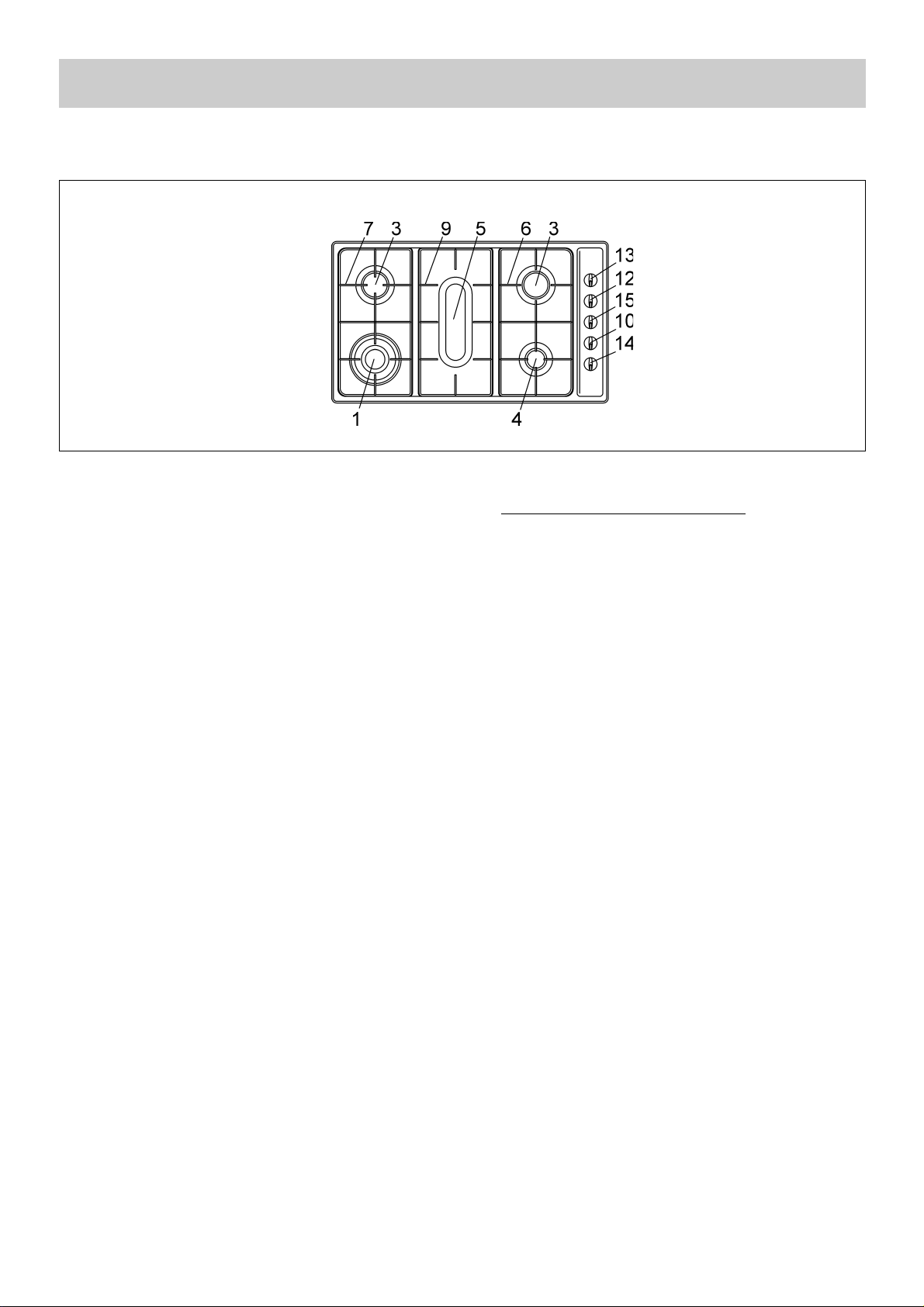
1 Ultra rapid gas burner/Wok 15.0 MJ 15.0* MJ
3 Semi-rapid gas burner 7.3 MJ 6.9 MJ
4 Auxiliary gas burners 4.0 MJ 3.8 MJ
5 Fish gas burner 12.0 MJ 11.5 MJ
6 Right trivet 2 burners
7 Left trivet 2 burners
9 Central fish trivet
10 Burner 1 control knob
12 Burner 3 control knob (left back)
13 Burner 3 control knob (right back)
14 Burner 4 control knob
15 Burner 5 control knob
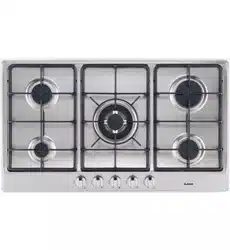
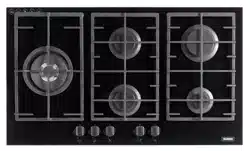
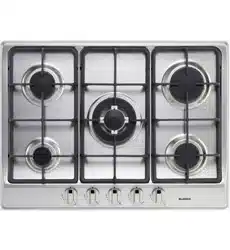
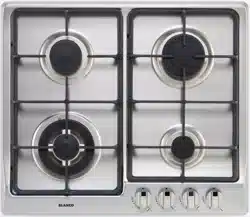
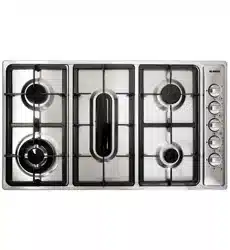
DESCRIPTION OF THE HOT PLATES
*13.0 MJ for models with enamelled steel trivets.
Attention: this appliance has been manufactured for domestic use only and it employment by
private person.
1) BURNERS
A diagram is screen-printed above each knob on
the front panel. This diagram indicates to which
burner the knob in question corresponds. After
having opened the gas mains or gas bottle tap, light
the burners as described below:
- Manual ignition
Push and turn the knob corresponding to the
required burner in an anticlockwise direction until it
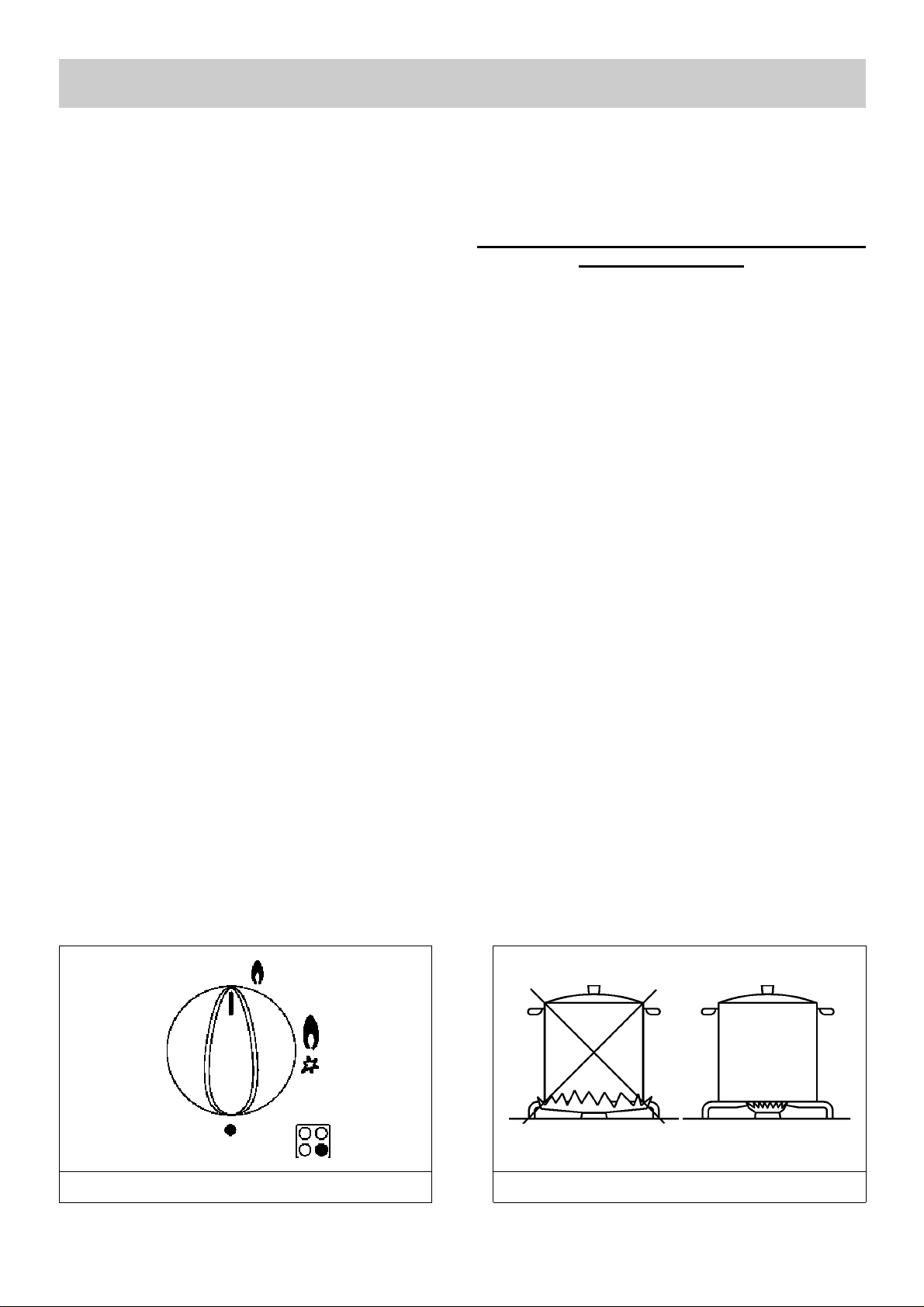
reaches the full on position (large flame fig. 1), then
place a lighted match near the burner.
- Electrical ignition
Push and turn the knob corresponding to the
required burner in an anticlockwise direction until it
reaches the full on position (large flame fig. 1), then
depress and release the ignition button “E”.
- Automatic electrical ignition
Push and turn the knob corresponding to the
required burner in an anticlockwise direction until it
reaches the full on position (large flame fig. 1), then
depress the knob.
- Lighting burners equipped with flame failure
device
The knobs of burners equipped with flame failure
device must be turned in an anticlockwise direction
until they reach the full on position (large flame fig.
1) and come to a stop. Now depress the knob in
question and repeat the previously indicated
operations.
Keep the knob depressed for about 10 seconds
once the burner has ignited.
Note: you are advised not to try and light a burner if
the flame divider (Burner Cap) is not correctly
placed.
HOW TO USE THE BURNERS
Bear in mind the following indications in order to achieve
maximum efficiency with the least possible gas
consumption:
- Use adequate pans for each burner (consult the following
table and fig. 2).
- When the pan comes to the boil, set the knob to the
reduced rate position (small flame fig. 1).
- Always place a lid on the pans.
Burners Power ratings Pan Ø in cm
Natural U-LPG
Ultra rapid
or Wok 15.0 MJ 15.0* MJ 24 - 26
Rapid 12.0 MJ 11.5 MJ 20 - 22
Semi-rapid 7.3 MJ 6.9 MJ 16 - 18
Auxiliary 4.0 MJ 3.8 MJ 10 - 14
Fish 12.0 MJ 11.5 MJ (Width) 20
(Lenght) 36
*13.0 MJ for models with enamelled steel trivets.
WARNINGS:
- Burners with flame failure device may only be
ignited when the relative knob has been set to the
Full on position (large flame fig. 1).
- Matches can be used to ignite the burners in a
blackout.
- Never leave the appliance unattended when the
burners are being used. Make sure there are no
children in the near vicinity. Particularly make sure
that the pan handles are correctly positioned and
keep a check on foods requiring oil and grease to
cook since these products can easily catch fire.
- Never use aerosols in the vicinity of this appliance
while it is in operation.
- If the built-in hot plate has a lid, any spilt food
should be immediately removed from this before it
is opened. If the appliance has a glass lid, this
could shatter when the hot plate becomes hot.
Always switch off all the burners before closing
the lid.
- This appliance is not to be installed in marine craft.
Where this appliance is installed in a caravan, it
shall not be used as a space heater.
- Do not store or use flammable liquids or items in
the vicinity of the hotplate.
3
USE
FIG. 1 FIG. 2
4
USE
Notes:
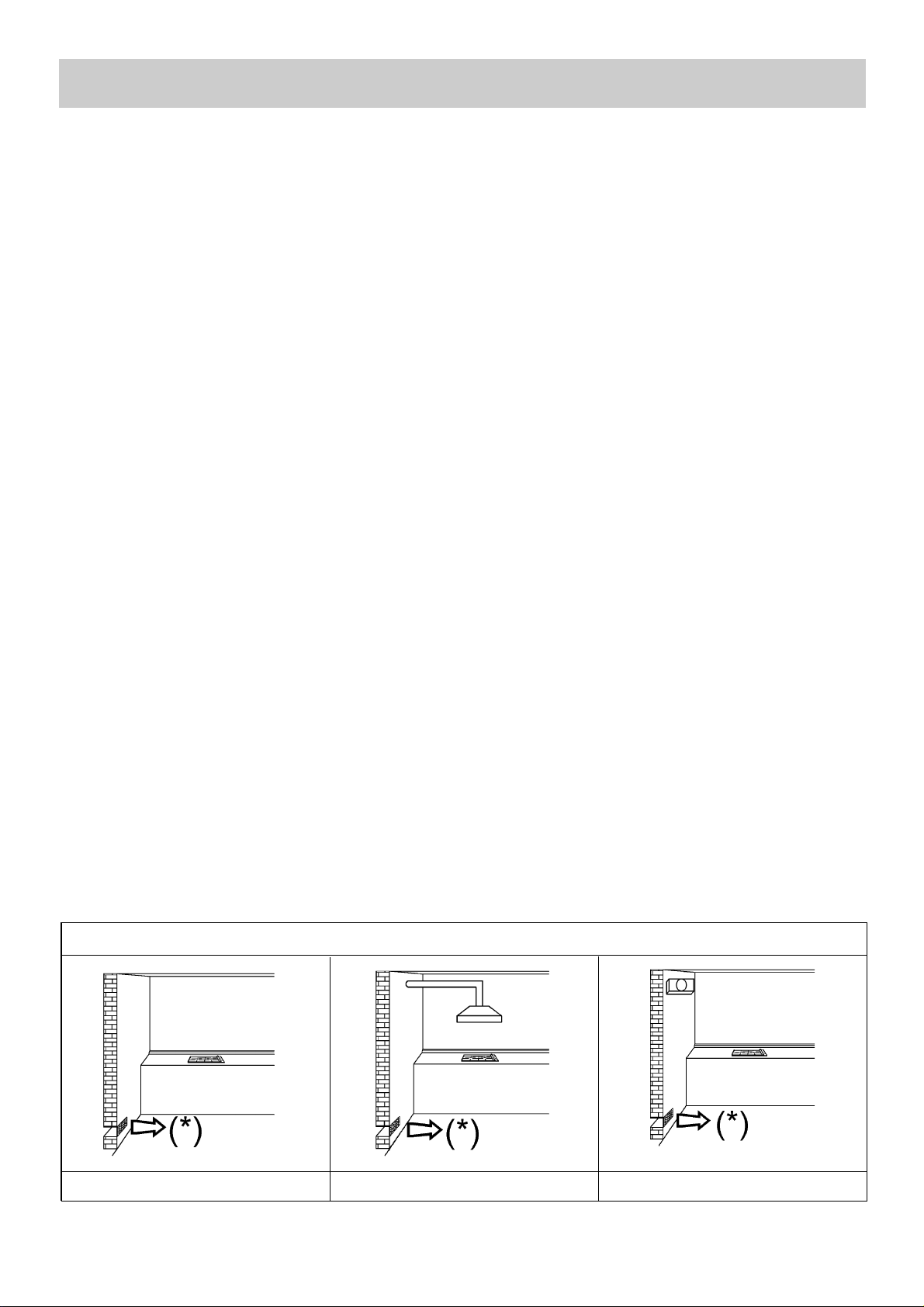
Use of a gas cooking appliance produces heat and moisture in the room in which it is installed. The
room must therefore be well ventilated by keeping the natural air vents clear (fig. 3) and by
activating the mechanical aeration device (suction hood or electric fan fig. 4 and fig. 5).
Intensive and lengthy use of the appliance may require additional ventilation. This can be achieved
by opening a window or by increasing the power of the mechanical exhausting system if installed.
Star Trivet: use star trivet whenever using a small pot.
Abnormal Operation:
Any of the following are considered to be abnormal operation and may require servicing:
- Yellow tipping of the hob burner flame.
- Sooting up of cooking utensils.
- Burners not igniting properly.
- Burners failing to remain alight.
- Burners extinguished by cupboard doors.
- Gas valves which are difficult to turn.
In case the appliance fails to operate correctly, contact the authorised service provider in your area.
FIG. 3 FIG. 4 FIG. 5
(*) Air inlet – minimun section 100 cm
2
5
CLEANING
IMPORTANT:
Always disconnect the appliance from the gas
and electricity mains before carrying out any
cleaning operation.
2) HOT PLATE
Periodically wash the hot plate, the enamelled steel
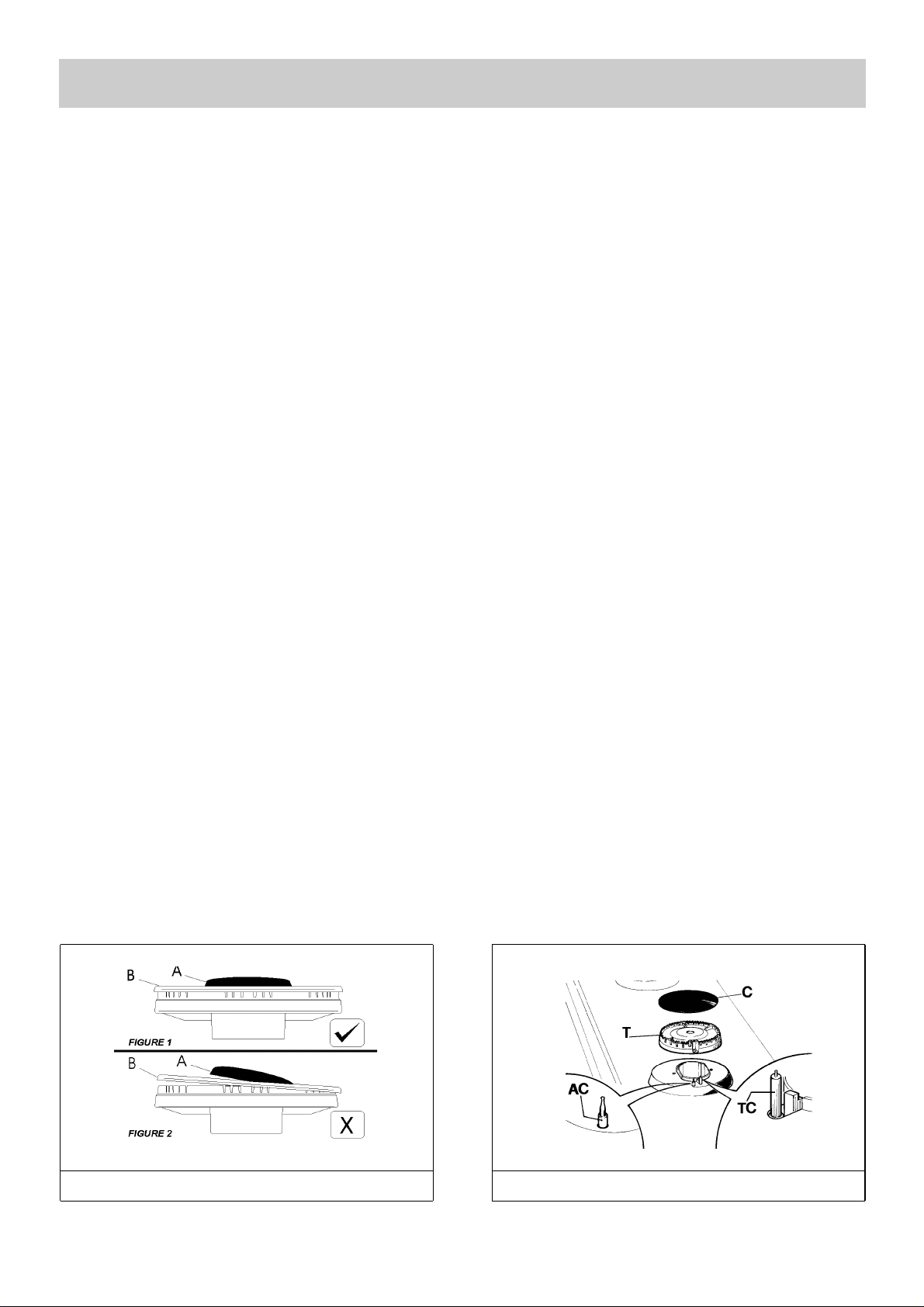
or cast iron pan support, the enamelled burner caps
“A”, “B” and “C” and the burner heads “T” (see fig. 6
and 7) with lukewarm soapy water. Following this,
all parts should be thoroughly rinsed and dried.
Never wash them while they are still warm and
never use abrasive powders. Do not allow vinegar,
coffee, milk, salted water, lemon or tomato juice
from remaining in contact with the enamelled
surfaces for long periods of time.
WARNINGS:
Comply with the following instructions, before
remounting the parts:
- Check that burner head slots have not become
clogged by foreign bodies.
- Check that enamelled burner cap “A”, “B” and
“C” (fig. 6 and 7) have correctly positioned on
the burner head. It must be steady.
- The exact position of the pan support is
established by the rounded corners, which
should be set towards the side edge of the hot
plate.
- Do not force the taps if they are difficult open
or close. Contact the technical assistance
service for repairs.
- Don’t use steam jets for cleaning the cooktop.
CARE & MAINTENANCE
To optimise the appearance and up keep of
stainless steel:
1)ALWAYS keep stainless steel out of contact from
acid/acid based solvent (liquid or vapour form).
2)After installation, wipe clean all stainless steel
products with a soft damp cloth to remove any
traces of dirt (e.g. cement dust) or condensation
marks.
In the event where persistent marks appear:
Immediately clean affected areas with stainless
steel cleaner, using a clean damp soft cloth.
Ensure surface is rinsed and thoroughly clean of all
marks and stainless steel cleaner.
PREVENTATIVE MAINTENANCE
This cooktop should not require ongoing
maintenance provided you ensure:
- All spillages are cleaned up as soon as they occur.
- Burners are kept clean.
- Burner ports are free of debris, food or anything
else that may cause an obstruction.
- Electrode and thermocouples are kept clean.
- Burners are re-assembled correctly.
- Do not get water in the area where the injectors
are located.
FIG. 6 FIG. 7
6
INSTALLATION
TECHNICAL INFORMATION FOR THE
INSTALLER
This appliance shall be installed only by
authorised personnel and in accordance with
the manufacturer’s installation instructions,
local gas fitting regulations, municipal building
codes, water supply regulations, electrical
wiring regulations, AS 5601/AG 601 – Gas
Installations and any other statutory
regulations.
Ventilation must be in accordance with
AS 5601/AG 601 - Gas Installation.
In general, the appliance should have adequate
ventilation for complete combustion of gas,
proper flueing and to maintain temperature of
immediate surroundings within safe limits. The
wall and bench surfaces must be capable of
sustaining temperatures of 75°C. All laminates,
fixing adhesive and surfacing materials should
be suitable for this temperature.
3) INSTALLING THE HOT PLATE
Check that the appliance is in a good condition after
having removed the outer packaging and internal
wrappings from around the various loose parts. If in
any doubt, do not use the appliance and contact
qualified personnel.
Never leave the packaging materials (cardboard,
bags, polystyrene foam, staples, etc.) within
children’s reach since they could become
potential sources of danger.
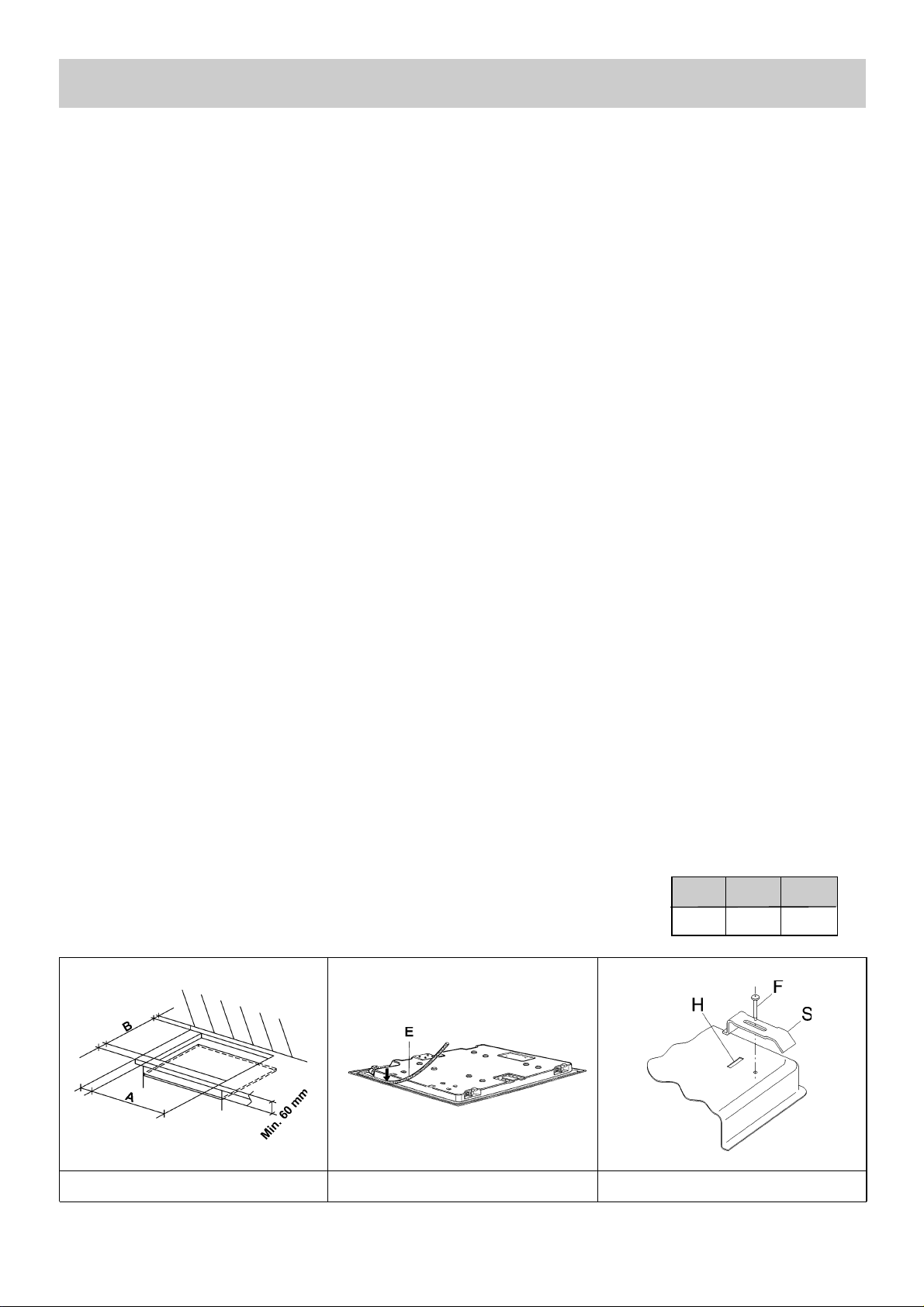
The measurements of the opening made in the top of
the modular cabinet and into which the hot plate will
be installed are indicated in fig.8. Always comply with
the measurements given for the hole into which the
appliance will be recessed (see fig. 8).
Any adjoining wall surface situated within 200 mm
from the edge of any hob burner must be a suitable
non-combustible material for a height of 150 mm for
the entire length of the hob. Any combustible
construction above the hotplate must be at least
600 mm above the construction above the top of
the burner and no construction shall be within 450
mm above the top of the burner. A minimum depth
of 60 mm from the top of the work surface must be
provided for this appliance.
4) FIXING THE COOKTOP
The hot plate has a special seal which prevents
liquid from getting into the cabinet. Strictly comply
with the following instructions in order to correctly
apply this seal:
- Detach the seals from their backing, checking that
the transparent protection still adheres to the seal
itself.
- Overturn the hot plate and correctly position seal
“E” (fig. 9) under the edge of the hot plate itself, so
that the outer side of the seal perfectly matches
the outer edge of the hot plate. The ends of the
strips must fit together without overlapping.
- Evenly and securely fix the seal to the hot plate,
pressing into place with the fingers and remove the
strip of protective paper from the seal and set the
plate into the hole made in the cabinet.
- Fix the hob with the proper brackets “S” and fit the
prominent part into the porthole “H” on the bottom;
turn the srew “F” until the bracket “S” stick on the
top (fig. 10).
- In order to avoid accidentaly touching the
potentially hot base of the cooktop, it is necessary
to fix a wodden insert panel 60 mm minimum from
the top of the bench. Fix the 25 mm spacers
supplied to the bottom panel of the cooktop to
ensure a 25 mm gap between the cooktop base
and the wooden insert panel (fig. 8).
FIG. 8 FIG. 9
FIG. 10
AB
5F 833 475
COMPLY WITH THE DIMENSIONS
Overall Dimensions: 860 x 500 mm
7
5) GAS CONNECTION
The gas connection is located in the rear and on the
underside of the appliance 100 mm from the right
hand side.
There are two ways to carry out the connection to
the main gas line:
A. The hotplate can be connected with rigid pipe as
specified in AS5601 table 3.1.
B. If installing with a hose assembly, install with a
hose assembly that complies with AS/ANZ 1869
(AGA Approved), 10mm ID, class B or D, no more
than 1.2m long and in accordance with AS5601.
Ensure that the hose does not contact the hot
surfaces of the hotplate, oven, dishwasher or any
other appliance that may be installed underneath or
next to the hotplate. The hose should not be
subjected to abrasion, kinking or permanent
deformation and should be able to be inspected
along its entire length with the cooktop in the
installed position.
Unions compatible with the hose fittings must be
used and all connections tested for gas leaks.
The gas supply connection for the hose assembly
must be accessible.
Natural Gas
Natural Gas installations require the connection of
a gas regulator at the appliance. This regulator is
supplied with the appliance on purchase.
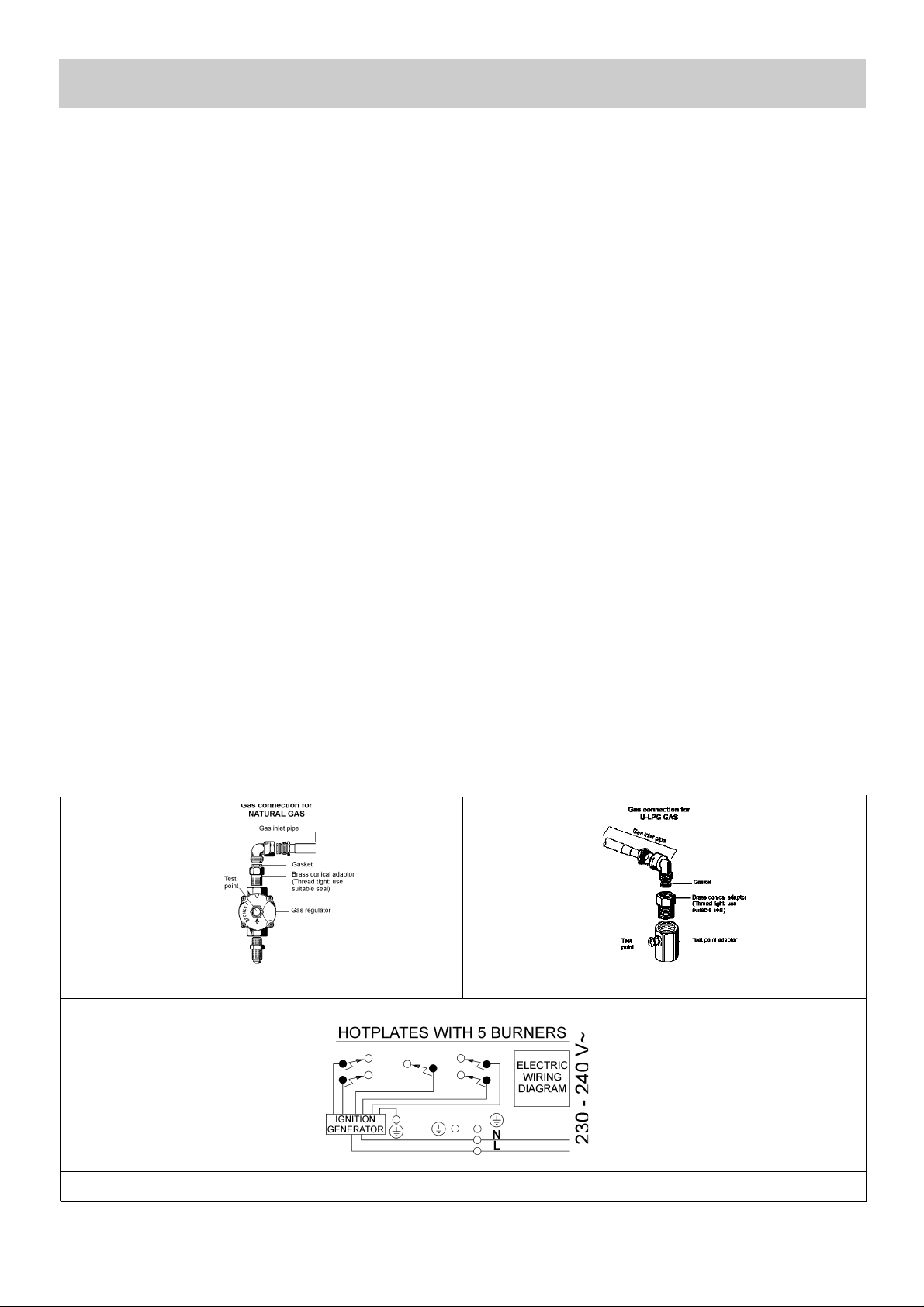
Assemble the regulator (noting the gas flow
direction) and transition pieces (supplied with the
appliance), in accordance with figure 11.
The transition piece on the supply side of the
regulator must be provided by the installer.
Liquified Petroleum Gas
In a LPG installation the gas regulation is made at
the gas cylinder and regulation at the appliance is
not required. To connect supply to the appliance
use transition pieces as shown in figure 12. These
pieces are supplied with the appliance on
purchase.
WARNING:
THE BURNER FLAME MUST BE ADJUSTED BY
THE INSTALLER.
FAULTY INSTALLATION WILL NOT BE
COVERED UNDER WARRANTY.
6) ELECTRICAL CONNECTION
The appliance is supplied with a 1800 mm long
flexible supply lead.
The point of attachment for this lead is located at
the rear and on the underside of the appliance
380 mm from the right hand side.
The voltage and power consumption are detailed on
the underside of the appliance. Ensure that the
appliance is correctly rated to the supply.
Connect appliance by way of a switched power
point.
THE APPLIANCE MUST BE EARTHED
Ensure that this power point is properly earthed.
Look at the connection wiring diagrams
(fig. 13).
INSTALLATION
FIG. 13
FIG. 11
FIG. 12
8
ADJUSTMENTS
Always disconnect the appliance from the
electricity main before making any adjustments.
All seals must be replaced by the technician at
the end of any adjustments or regulations.
Our burners do not require primary air
adjustment.
a) Data Label
The Data Label is located on the underside of the
hotplate. A duplicate Data Label is supplied to
adhere in an accessible area next to the hotplate.
This hotplate is suitable for Natural Gas and
Universal LPG; ensure that the available gas supply
matches the Data Label.
b) Before Leaving
Check that there are no gas leaks, but do not use a
naked flame to detect gas leaks. Ignite all burners
to ensure correct operation of gas valves, burners,
ignition and if fitted, flame failure valves. Turn gas
taps to low flame position and observe stability of
the flame. When satisfied with the hotplate, please
instruct the user on the correct method of operation.
In case the appliance fails to operate correctly after
all checks have been carried out, refer to the
authorised service provider in your area.
7) TAPS
Our taps are suitable for all gas, they are male
conical type.
“Reduced rate” adjustment
- Switch on the burner and turn the relative knob to
the “Reduced rate” position (small flame fig. 1).
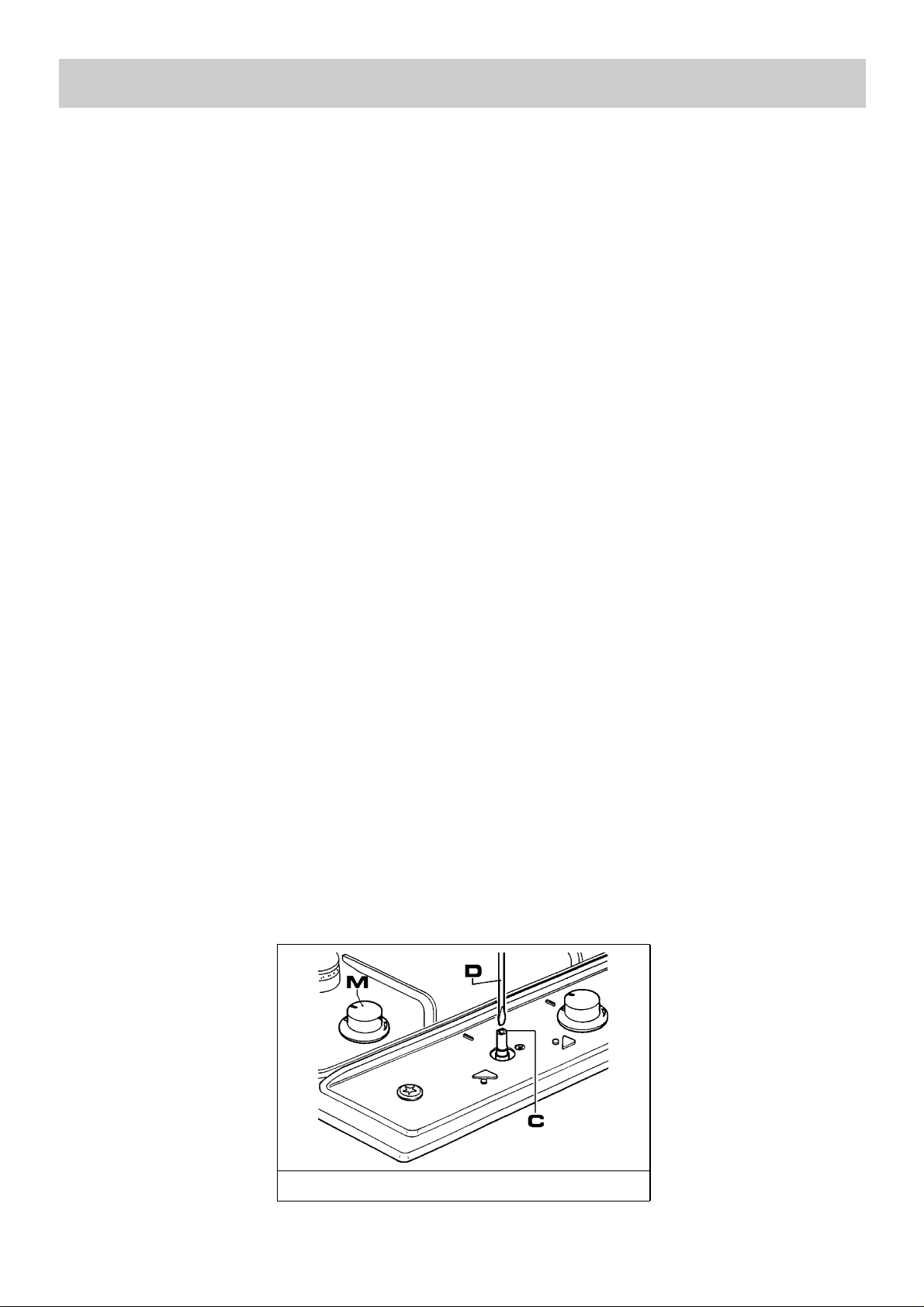
- Remove knob “M” (fig. 14) of the tap, which is
simply pressed on to its rod.
- Insert a small screwdriver “D” into hole “C” (fig. 14)
and turn the throttle screw to the right or left until
the burner flame has been adequately regulated to
the “Reduced rate” position.
Check that the flame does not go out when the knob
is sharply switched from the “Full on” to the
“Reduced rate” position.
It is understood that only burners operating
with Natural gas should be subjected to the
above mentioned adjustments. The screw must
be fully locked when the burners operate with
Liquid gas.
FIG. 14

CONVERSIONS
8) U-LPG TO NATURAL GAS CONVERSION
PROCEDURE
Appliance models: Gas stainless steel hotplate
models:
BCG95 5 Burners
1. Remove each burner cap and burner skirt.
2. Remove the U-LPG main injector with a 7
mm/VF tube spanner and replace with the
appropriate size Natural Gas injector for each
burner. The following injector sizes are required for
Natural Gas:
Burner Main injector
Wok 1.76 mm
Rapid 1.55 mm
Semi Rapid 1.20 mm
Auxiliary 0.90 mm
Fish 1.55 mm
3. Shut off gas supply to the appliance.
4. Disconnect gas inlet pipe from the U-LPG Gas
test point inlet fitting.
5. Remove the U-LPG test point inlet fitting from
the appliance.
6. Fit the Natural Gas Regulator supplied in the
conversion kit.
7. Connect the gas supply to the Regulator.
8. Check for gas leaks. Do not use a naked flame
to check for gas leaks.
9. Adjust the gas pressure to 1.00 kPa.
10. Remove the control knob, with a thin shaft blade
screwdriver down the centre of each gas valve
shaft, screw the by-pass injector anti-clockwise.
Test the appliance on both high and low flame for
each burner. If the burner fails to remain alight or
the flame is not stable on the simmer setting, adjust
the by-pass screw, until flame is stable.
11. If not already removed, remove the “Only for
use with U-LPG” label adhered to the bottom panel
near the gas connection.
9) NATURAL GAS TO UNIVERSAL
LPG CONVERSION PROCEDURE
Appliance models: Gas stainless steel hotplate
models:
BCG95 5 Burners
1. Remove each burner cap and burner skirt.
2. Remove the Natural Gas main injector with a 7
mm/VF tube spanner and replace with the
appropriate size U-LPG main injector for each
burner. The following injector sizes are required for
U-LPG:
Burner Main injector
Wok 1.06* mm
Rapid 0.94 mm
Semi Rapid 0.73 mm
Auxiliary 0.54 mm
Fish 0.94 mm
*1.00 mm main injector for models with enamelled
steel trivets.
3. Remove the control knob, with a thin shaft blade
screwdriver down the centre of each gas valve
shaft, screw the by-pass injector fully clockwise.
4. Shut off gas supply to the appliance.
5. Disconnect gas inlet pipe from the Natural Gas
Regulator.
6. Remove the Natural Gas Regulator from the
appliance.
7. Fit the U-LPG test point inlet fitting supplied in
the conversion kit.
8. Connect the gas supply to the inlet fitting.
9. Check for gas leaks. Do not use a naked flame
to check for gas leaks.
10. Adjust the gas pressure to 2.75 kPa.
11. Test the appliance on both high and low flame
for each burner and check the gas pressure. If the
burner fails to remain alight or the flame is not
stable on the simmer setting, adjust the by-pass
screw, until flame is stable.
12. If not already removed, remove the “Only for
use with Natural Gas” label adhered to the bottom
panel near the gas connection.
9
10
CONVERSIONS
10) REPLACING THE INJECTORS
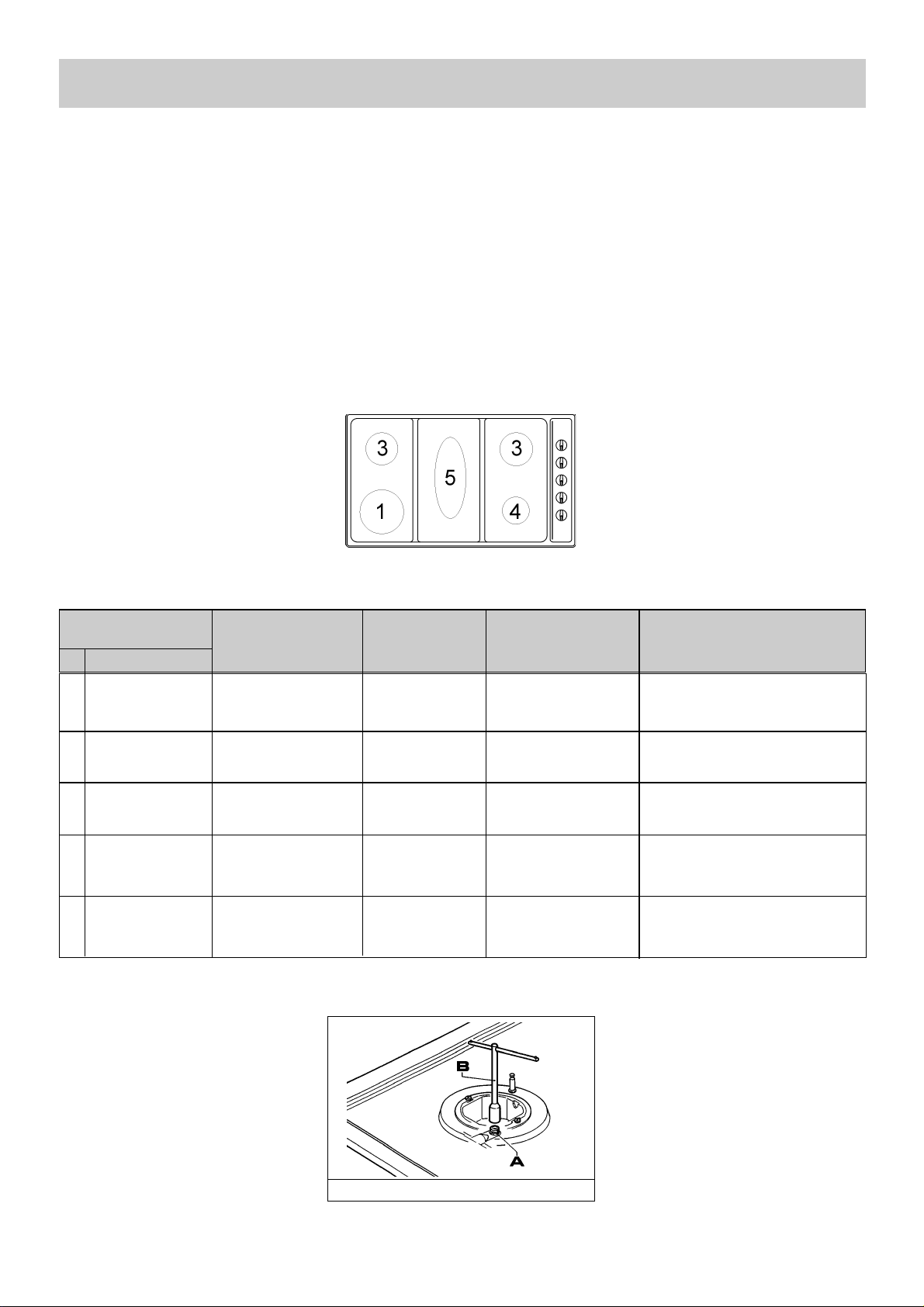
The burners can be adapted to different types of gas
by installing injectors suited to the type of gas
required. To do this, first remove the burner tops
using a wrench “B”. Now unscrew injector “A” (see
fig. 15) and fit a injector corresponding to the type of
gas required.
It is advisable to tighten the injector in place.
After the injectors have been replaced, the
burners must be regulated as explained in
paragraphs 7. The technician must reset any seals
on the regulating or pre-regulating devices and
affix the label corresponding to the new gas
regulation on the appliance instead of the already
existing one. This label is supplied in the packet
containing the spare injectors.
The envelope with the injectors and the labels can
be included in the kit, or at disposal to the
authorised customer Service Centre.
For the sake of convenience, the nominal rate chart
also lists the heat inputs of the burners, the diameter
of the injectors and the working pressures of the
various types of gas.
BURNER ARRANGEMENT ON THE HOT PLATE
FIG. 15
*100 injector diameter and 13.0 MJ Nominal Heat Input for models with enamelled steel trivets.
U-LPG 2.75 94 11.5
2 RAPID NATURAL 1.00 155 12.0
U-LPG 2.75 106* 15.0*
1
ULTRA RAPID
NATURAL 1.00 176 15.0
U-LPG 2.75 73 6.9
3 SEMI-RAPID NATURAL 1.00 120 7.3
U-LPG 2.75 54 3.8
4 AUXILIARY NATURAL 1.00 90 4.0
U-LPG 2.75 94 11.5
5 FISH NATURAL 1.00 155 12.0
BURNERS
N° DESCRIPTION
GAS
NORMAL
PRESSURE
INJECTOR
DIAMETER
NOMINAL HEAT INPUT ( MJ/h )
(kPa) ( 1/100 mm ) MAX.
TABLE 1
11
SERVICING
Always turn off the electrical ignition before
proceeding with any servicing operation.
Servicing should be carried out only by
authorised personnel.
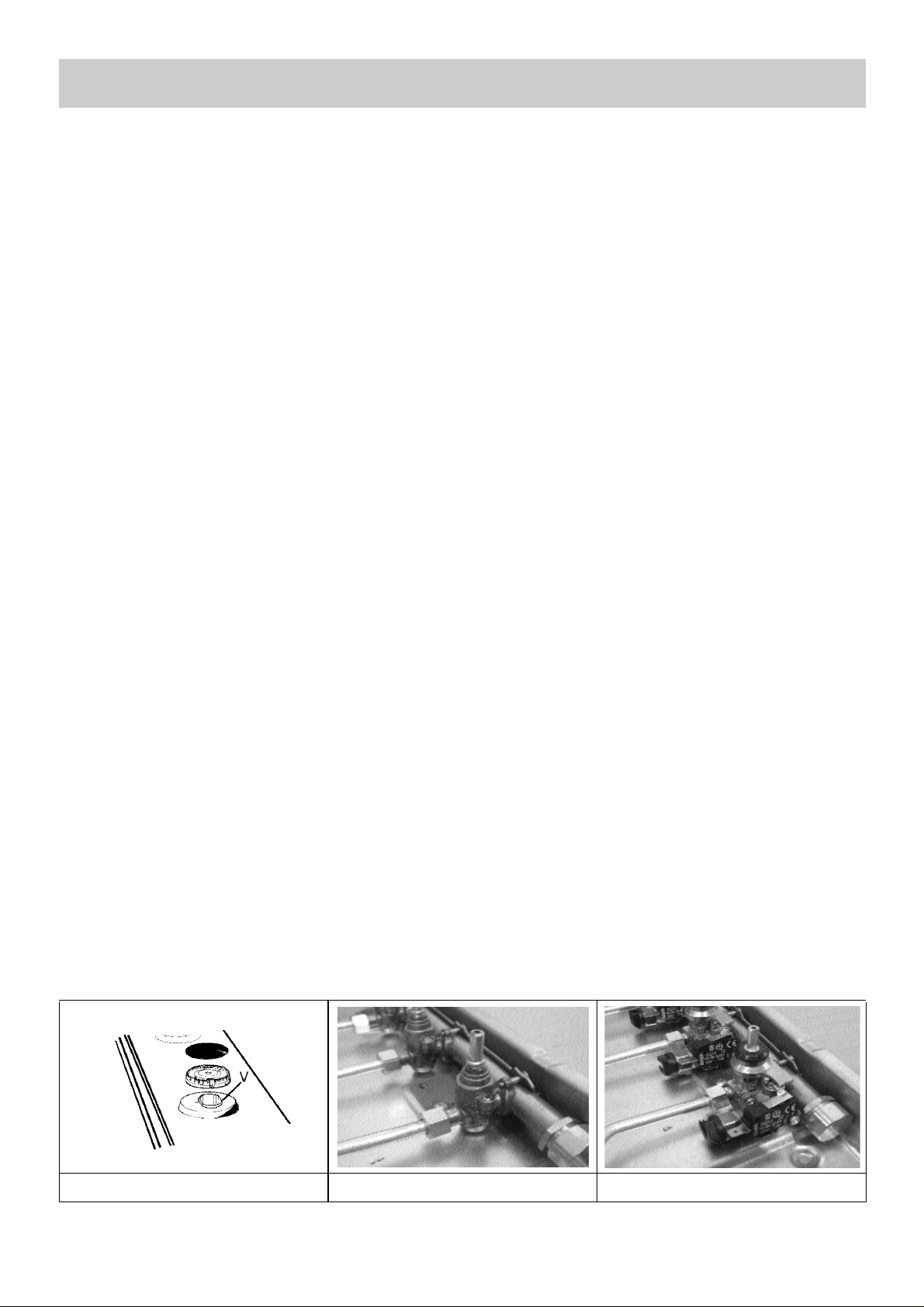
11) REPLACING HOT PLATE PARTS
To replace the components fitted inside the hob,
take off the knobs, all the movable parts of the hobs
(trivets, burners and caps) and the screws “V” on
the burners (see fig. 16).
After having carried out the above listed operations,
the replacement of the electrical components and
the taps is possible.
REMARKS: before replacing the taps on the hob
without flame failure device, take off the
microswitches fitted on the taps.
It is advisable to change seal “D” whenever a tap is
replaced to ensure a perfect tightness.
Greasing the taps (see fig. 17 - 18)
If a tap becomes stiff to operate, it must be
immediately greased in compliance with the
following instructions:
- Remove the tap.
- Clean the cone and its housing using a cloth
soaked in solvent.
- Lightly spread the cone with the relevant grease.
- Fit the cone back in place, operate it several times
and then remove it again. Eliminate any excess
grease and check that the gas ducts have not
become clogged.
- Fit all parts back in place, complying with the
demounting order in reverse.
- The tight closure test must be done using a foamy
liquid.
To facilitate the servicing technician’s task, here is a
chart with the types and sections of the powering
cables and the ratings of the electrical components.
FIG. 16 FIG. 17 FIG. 18
12
SERVICING
TYPE OF TYPE OF SINGLE - PHASE
HOT PLATE CABLE POWER SUPPLY
CABLE TYPES AND SECTIONS
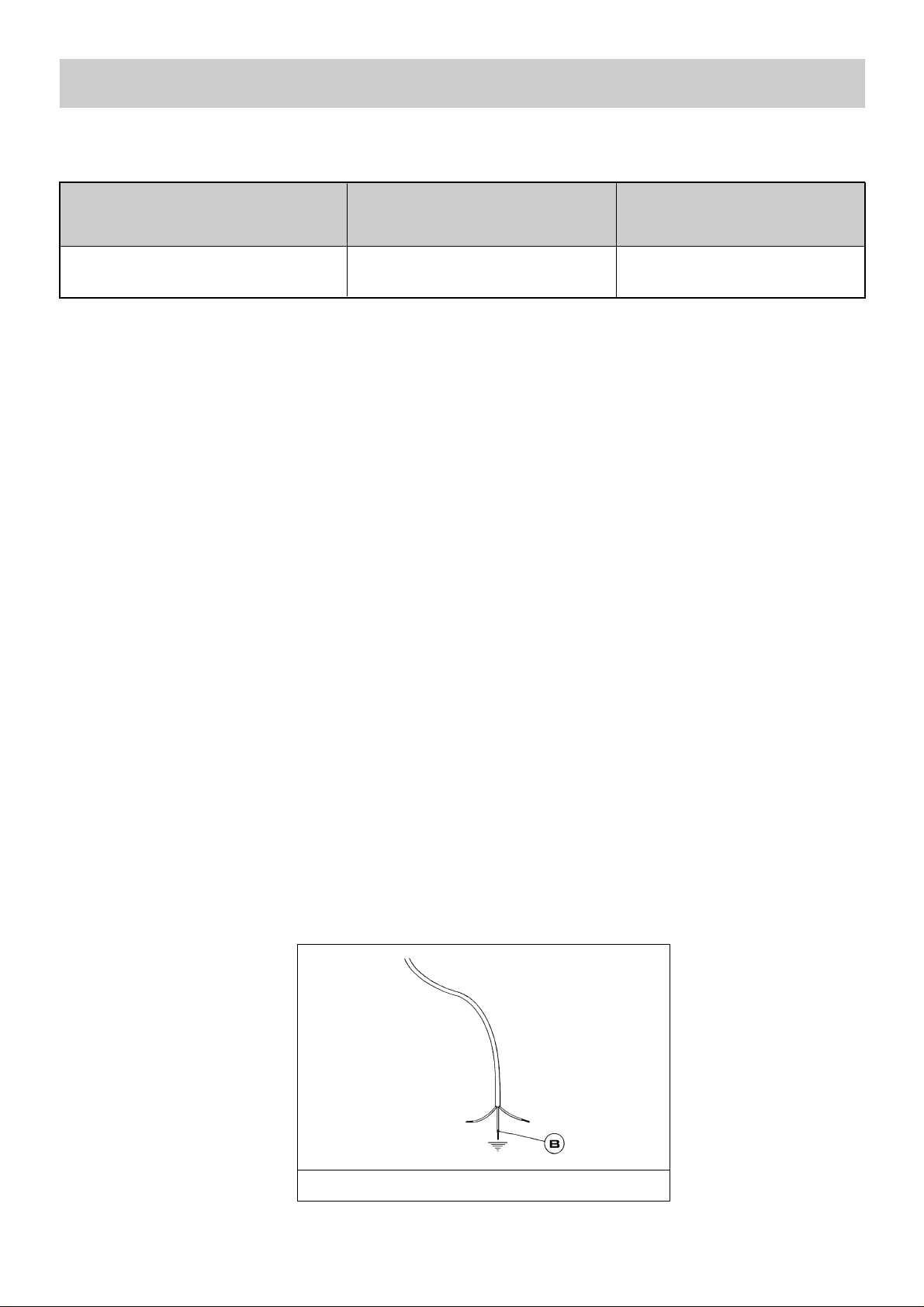
ATTENTION!!!
If the power supply cable is replaced, the installer should leave the ground wire longer than the phase
conductors (fig. 19) and comply with the recommendations given in paragraph 6.
FIG. 19
H05 RR - F Section 3 X 0.75 mm
2
Gas hot plate