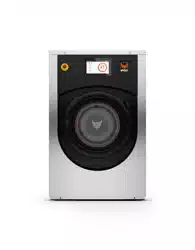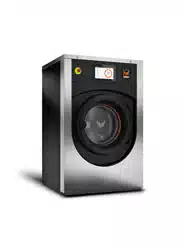

Installation/Operation/Maintenance
Washer-Extractors
Cabinet Freestanding
Refer to Page 9 for Model Identification
Original Instructions
Keep These Instructions for Future Reference.
CAUTION: Read the instructions before using the machine.
(If this machine changes ownership, this manual must accompany machine.)
www.alliancelaundry.com
Part No. D1625ENR7
February 2019


Table of Contents
Safety Information..................................................................................5
Explanation of Safety Messages....................................................................... 5
Important Safety Instructions........................................................................... 5
Safety Decals................................................................................................. 7
Operator Safety.............................................................................................. 7
Introduction........................................................................................... 9
Model Identification........................................................................................9
Serial Plate Location..................................................................................... 11
Manufacturing Date.......................................................................................11
Delivery Inspection.......................................................................................12
Replacement Parts ........................................................................................12
Customer Service..........................................................................................12
Specifications and Dimensions.............................................................. 13
Machine Dimensions.....................................................................................16
Machine Dimensions (Machines with Optional Filter Tanks for Mops).............. 19
Mounting Bolt Hole Locations....................................................................... 21
Floor Mounting Layout .................................................................................23
Installation........................................................................................... 24
Pallet Removal............................................................................................. 24
Mounting Bolt Installation (If Required)......................................................... 24
Shipping Brace Removal............................................................................... 25
Machine Installation......................................................................................26
Elevated Base Frame Installation with Existing Floor.......................................26
Weighing System Installation 18 kg - 28 kg / 40 lb. - 70 lb. / 180 L- 280 L Models
................................................................................................................26
Drain Connection..........................................................................................28
Drain Valve...............................................................................................29
Drain Pump 6.5 kg/ 14 lb. / 65 L and 7.5 kg / 20 lb. / 80 LModels outside of
North America.......................................................................................32
Venting........................................................................................................ 32
Water Connection Requirements.....................................................................33
Connecting Hoses......................................................................................35
Water Reuse Connection ........................................................................... 37
Reused Water Treatment............................................................................ 37
Water Reuse Tank Properties...................................................................... 37
Electrical Installation Requirements................................................................38
Residual Current Device (RCD) - Models Outside of North America............. 39
Supply Protection Device...........................................................................39
©
Copyright 2019, Alliance Laundry Systems LLC
All rights reserved. No part of the contents of this book may be reproduced or transmitted in any form or by any means without the expressed
written consent of the publisher.
©
Copyright, Alliance Laundry Systems LLC -
DO NOT COPY or TRANSMIT
3 Part No. D1625ENR7

Supply Cable............................................................................................ 40
Machine Protective Earth Connection and Equipotential Bonding.................. 41
Input Power Conditioning..............................................................................42
Input Voltage Requirements........................................................................42
Circuit Breakers and Quick Disconnects......................................................... 42
Connection Specifications..............................................................................43
Single-Phase Connections ......................................................................... 43
Three-Phase Connections........................................................................... 44
Phase Adder..............................................................................................45
Voltage Settings.........................................................................................45
Frequency Settings.................................................................................... 45
Thermal Overload Protector....................................................................... 45
Electrical Specifications................................................................................ 46
Electrical Specifications - North American Models.......................................... 52
Steam Requirements (Steam Heat Option Only)...............................................54
Steam Valve Installation.............................................................................54
Supply Dispensing........................................................................................ 55
Connection of External Liquid Supplies.......................................................... 55
Electrical Connection of External Liquid Soap Supply System.......................... 56
External Wait Control....................................................................................57
Chemical Injection Supply System........................................................ 58
Operation............................................................................................. 59
Operating Instructions................................................................................... 59
Power Cut.................................................................................................... 60
Automatic Door-lock Unlocking Module ........................................................60
Maintenance......................................................................................... 61
Maintenance.................................................................................................61
Daily........................................................................................................... 61
Beginning of Day...................................................................................... 61
End of Day............................................................................................... 61
Quarterly......................................................................................................62
Every 6 Months............................................................................................ 62
Care of Stainless Steel...................................................................................64
Disposal of Unit.................................................................................... 65
Disconnecting the Machine............................................................................65
Disposal of Unit............................................................................................65
China Restriction of hazardous substances (RoHS)............................... 66
©
Copyright, Alliance Laundry Systems LLC -
DO NOT COPY or TRANSMIT
4 Part No. D1625ENR7
Safety Information
Explanation of Safety Messages
Precautionary statements (“DANGER,” “WARNING,” and
“CAUTION”), followed by specific instructions, are found in this
manual and on machine decals. These precautions are intended
for the personal safety of the operator, user, servicer, and those
maintaining the machine.
DANGER
Indicates an imminently hazardous situation that, if
not avoided, will cause severe personal injury or
death.
WARNING
Indicates a hazardous situation that, if not avoided,
could cause severe personal injury or death.
CAUTION
Indicates a hazardous situation that, if not avoided,
may cause minor or moderate personal injury or
property damage.
Additional precautionary statements (“IMPORTANT” and
“NOTE”) are followed by specific instructions.
IMPORTANT: The word “IMPORTANT” is used to in-
form the reader of specific procedures where minor
machine damage will occur if the procedure is not fol-
lowed.
NOTE: The word “NOTE” is used to communicate in-
stallation, operation, maintenance or servicing informa-
tion that is important but not hazard related.
Important Safety Instructions
WARNING
To reduce the risk of fire, electric shock, serious in-
jury or death to persons when using your washer,
follow these basic precautions:
W023
• Read all instructions before using the washer.
• Install the washer according to the INSTALLATION instruc-
tions. Refer to the Earthing (grounding) instructions in the IN-
STALLATION manual for the proper earthing (grounding) of
the washer. All connections for water, drain, electrical power
and earthing (grounding) must comply with local codes and
be made by licensed personnel when required. The machine
has to be installed by qualified technicians.
• Do not install or store the washer where it will be exposed to
water and/or weather.
• To prevent fire and explosion, keep the area around machine
free from flammable and combustible products. Do not add
the following substances or textiles containing traces of the
following substances to the wash water: gasoline, kerosene,
waxes, cooking oils, vegetable oils, machine oils, dry-clean-
ing solvents, flammable chemicals, thinners, or other flamma-
ble or explosive substances. These substances give off vapors
that could ignite, explode or cause the fabric to catch fire by
itself.
• Under certain conditions, hydrogen gas may be produced in a
hot water system that has not been used for two weeks or
more. HYDROGEN GAS IS EXPLOSIVE. If the hot water
system has not been used for such a period, before using a
washing machine or combination washer-dryer, turn on all hot
water faucets and let the water flow from each for several mi-
nutes. This will release any accumulated hydrogen gas. The
gas is flammable, do not smoke or use an open flame during
this time.
• To reduce the risk of an electric shock or fire, DO NOT use an
extension cord or an adapter to connect the washer to the elec-
trical power source.
• Do not allow children to play on or in the washer. Close su-
pervision of children is necessary when the washer is used
near children. This appliance is not intended for use by young
children or infirm persons without supervision. Young chil-
dren should be supervised to ensure that they do not play with
the appliance. This is a safety rule for all appliances.
• DO NOT reach and/or climb into the tub or onto the washer,
ESPECIALLY if the wash drum is moving. This is an immi-
nently hazardous situation that, if not avoided, will cause se-
vere personal injury or death.
• Never operate the washer with any guards, panels and/or parts
removed or broken. DO NOT bypass any safety devices or
tamper with the controls.
• Use washer only for its intended purpose, washing textiles.
Never wash machine parts or automotive parts in the ma-
chine. This could result in serious damage to the basket or
tub.
• Use only low-sudsing, no-foaming types of commercial deter-
gent. Be aware that hazardous chemicals may be present.
Wear hand and eye protection when adding detergents and
chemicals. Always read and follow manufacturer’s instruc-
tions on packages of laundry and cleaning aids. Heed all
warnings or precautions. To reduce the risk of poisoning or
Safety Information
©
Copyright, Alliance Laundry Systems LLC -
DO NOT COPY or TRANSMIT
5 Part No. D1625ENR7
chemical burns, keep them out of the reach of children at all
times [preferably in a locked cabinet].
• Do not use fabric softeners or products to eliminate static un-
less recommended by the manufacturer of the fabric softener
or product.
• To avoid machine corrosion and component failure, do not
use corrosive chemicals in the machine. Warranty claims rela-
ted to damage caused by corrosive chemicals will be denied.
• Always follow the fabric care instructions supplied by the tex-
tile manufacturer.
• Loading door MUST BE CLOSED any time the washer is to
fill, tumble or spin. DO NOT bypass the loading door switch
by permitting the washer to operate with the loading door
open. Do not attempt to open the door until the washer has
drained and all moving parts have stopped.
• Be aware that hot water is used to flush the supply dispenser.
Avoid opening the dispenser lid while the machine is running.
• Do not attach anything to the supply dispenser's nozzles, if
applicable. The air gap must be maintained.
• Do not operate the machine without the water reuse plug or
water reuse system in place, if applicable.
• Be sure water connections have a shut-off valve and that fill
hose connections are tight. CLOSE the shut-off valves at the
end of each wash day.
• Keep washer in good condition. Bumping or dropping the
washer can damage safety features. If this occurs, have wash-
er checked by a qualified service person.
• DANGER: Before inspecting or servicing machine, power
supply must be turned OFF. The servicer needs to wait for at
least 10 minutes after turning the power OFF and needs to
check for residual voltage with a voltage meter. The inverter
remains charged with high voltage for some time after power-
ing OFF. This is an imminently hazardous situation that, if not
avoided, will cause severe personal injury or death. Before
starting inspection of the inverter, check for residual voltage
across main circuit terminals + and -. This voltage must be
below 30 VDC before the servicer can access the inverter for
inspection.
• Do not repair or replace any part of the washer, or attempt any
servicing unless specifically recommended in the user-mainte-
nance instructions or in published user-repair instructions that
the user understands and has the skills to carry out. ALWAYS
disconnect the washer from electrical, power and water sup-
plies before attempting any service.
• Disconnect the power by turning off the circuit breaker or by
unplugging the machine. Replace worn power cords.
• Before the washer is removed from service or discarded, re-
move the door to the washing compartment.
• Failure to install, maintain, and/or operate this washer accord-
ing to the manufacturer’s instructions may result in conditions
which can produce bodily injury and/or property damage.
NOTE: The WARNING and IMPORTANT SAFETY IN-
STRUCTIONS appearing in this manual are not meant
to cover all possible conditions and situations that may
occur. Observe and be aware of other labels and pre-
cautions that are located on the machine. They are in-
tended to provide instruction for safe use of the ma-
chine. Common sense, caution and care must be exer-
cised when installing, maintaining, or operating the
washer.
Always contact your dealer, distributor, service agent or the man-
ufacturer on any problems or conditions you do not understand.
NOTE: For European Union member states only: Elec-
trical safety of the washers described in this manual is
in compliance with the requirements of the European
standard EN60204-1.
DANGER
Electrical shock hazard will result in death or serious
injury. Disconnect electric power and wait ten (10)
minutes before servicing.
W911
WARNING
Machine installations must comply with minimum
specifications and requirements stated in the appli-
cable Installation Manual, any applicable municipal
building codes, water supply requirements, electrical
wiring regulations and any other relevant statutory
regulations. Due to varied requirements and applica-
ble local codes, this machine must be installed, ad-
justed, and serviced by qualified maintenance per-
sonnel familiar with applicable local codes and the
construction and operation of this type of machinery.
They must also be familiar with the potential hazards
involved. Failure to observe this warning may result
in personal injury, property damage, and/or equip-
ment damage, and will void the warranty.
W820
WARNING
Dangerous voltages are present inside the machine.
Only qualified personnel should attempt adjustments
and troubleshooting. Disconnect power from the ma-
chine before removing any cover and guards, and
before attempting any service procedures.
W736
Safety Information
©
Copyright, Alliance Laundry Systems LLC -
DO NOT COPY or TRANSMIT
6 Part No. D1625ENR7
IMPORTANT: Ensure that the machine is installed on a
level floor of sufficient strength. Ensure that the recom-
mended clearances for inspection and maintenance are
provided. Never allow the inspection and maintenance
space to be blocked.
WARNING
Never touch internal or external steam pipes, con-
nections, or components. These surfaces can be ex-
tremely hot and will cause severe burns. The steam
must be turned off and the pipe, connections, and
components allowed to cool before the pipe can be
touched.
SW014
WARNING
Install the machine on a level floor of sufficient
strength. Failure to do so may result in conditions
which can produce serious injury, death and/or prop-
erty damage.
W703
WARNING
Never interfere with the setting of the door handle.
Never try to modify the setting or repair the handle!
Any interference with its setting may lead to serious
risk for the operator! A damaged or incorrectly func-
tioning door handle must always be immediately re-
placed with a new original part.
C014
CAUTION
Models outside of North America - Machine with
weighing system: Never carry load sensors by their
cables. Avoid electric welding near the load sensors.
An impact may cause permanent damage to the load
sensor. Avoid unequal load distribution between the
load sensors when putting the machine down. When
the power of the machine is switched on, the system
needs a ten (10) minute warm-up time. This is impor-
tant when the power has been off for more than five
(5) minutes. Ignoring warm-up may result in a major
error in weighing.
W941
NOTE: All appliances are produced according the EMC-
directive (Electro-Magnetic-Compatibility). They can be
used in restricted surroundings only (comply minimally
with class A requirements). For safety reasons there
must be kept the necessary precaution distances with
sensitive electrical or electronic device(s). These ma-
chines are not intended for domestic use by private
consumers in the home environment.
Safety Decals
Safety decals appear at crucial locations on the machine. Failure
to maintain legible safety decals could result in injury to the oper-
ator or service technician.
Use manufacturer-authorized spare parts to avoid safety hazards.
Operator Safety
WARNING
NEVER insert hands or objects into basket until it
has completely stopped. Doing so could result in se-
rious injury.
SW012
The following maintenance checks must be performed daily:
1. Verify that all warning labels are present and legible, replace
as necessary.
2. Check door interlock before starting operation of the ma-
chine:
a. Attempt to start the machine with the door open. The ma-
chine should not start.
b. Close the door without locking it and start the machine.
The machine should not start.
c. Attempt to open the door while a cycle is in progress. The
door should not open.
If the door lock and interlock are not functioning properly, dis-
connect power and call a service technician.
3. Do not attempt to operate the machine if any of the following
conditions are present:
a. The door does not remain securely locked during the en-
tire cycle.
b. Excessively high water level is evident.
c. Machine is not connected to a properly grounded circuit.
Do not bypass any safety devices in the machine.
Safety Information
©
Copyright, Alliance Laundry Systems LLC -
DO NOT COPY or TRANSMIT
7 Part No. D1625ENR7
WARNING
Operating the machine with severe out-of-balance
loads could result in personal injury and serious
equipment damage.
W728
Safety Information
©
Copyright, Alliance Laundry Systems LLC -
DO NOT COPY or TRANSMIT
8 Part No. D1625ENR7
Introduction
Model Identification
Information in this manual is applicable to these models:
H105
H135
H180
H65
H80
IY105_ARIES
IY105_ARIES-ELITE
IY135_ARIES
IY135_ARIES-ELITE
IY180_ARIES
IY180_ARIES-ELITE
IY20_ARIES
IY20_ARIES-ELITE
IY240_ARIES
IY240_ARIES-ELITE
IY25_ARIES
IY25_ARIES-ELITE
IY280_ARIES
IY280_ARIES-ELITE
IY30_ARIES
IY30_ARIES-ELITE
IY40_ARIES
IY40_ARIES-ELITE
IY55_ARIES
IY55_ARIES-ELITE
IY65_ARIES
IY65_ARIES-ELITE
IY70_ARIES
IY70_ARIES-ELITE
IY80_ARIES
IY80_ARIES-ELITE
IYB180J
IYB180R
IYC065J
IYC065R
IYC080J
IYC080R
IYC105J
IYC105R
IYC135J
IYC135R
IYC180J
IYC180R
IYC240J
IYC240R
IYC280J
IYC280R
IYE065J
IYE065R
IYE080J
IYE080R
IYE105J
IYE105R
IYE135J
IYE135R
IYE180J
IYE180R
IYE240J
IYE240R
IYE280J
IYE280R
IYG065J
IYG065R
IYG080J
IYG080R
IYG105J
IYG105R
IYG135J
IYG135R
IYG180J
IYG180R
IYG240J
IYG240R
IYG280J
IYG280R
IYH065J
IYH065R
IYH080J
IYH080R
IYH105J
IYH105R
IYH135J
IYH135R
IYH180J
IYH180R
IYH240J
IYH240R
IYH280J
IYH280R
IYN020R
IYN025R
IYN030R
IYN040R
IYN055R
IYN070R
IYQ065J
IYQ065R
IYQ080J
IYQ080R
IYQ105J
IYQ105R
IYQ135J
IYQ135R
IYQ180J
IYQ180R
IYQ240J
IYQ240R
IYQ280J
IYQ280R
IYU065J
IYU065R
IYU080J
IYU080R
IYU105J
IYU105R
IYU135J
IYU135R
IYU180J
IYU180R
IYU240J
IYU240R
IYU280J
IYU280R
IYW065J
IYW065R
Table continues...
Introduction
©
Copyright, Alliance Laundry Systems LLC -
DO NOT COPY or TRANSMIT
9 Part No. D1625ENR7
IYW080J
IYW080R
IYW105J
IYW105R
IYW135J
IYW135R
IYW180J
IYW180R
IYW240J
IYW240R
IYX065J
IYX065R
IYX080J
IYX080R
IYX105J
IYX105R
IYX135J
IYX135R
IYX180J
IYX180R
IYX240J
IYX240R
IYX280J
IYX280R
IYY065J
IYR065J
IYR080J
IYR105J
IYR135J
IYY065R
IYY080J
IYY080R
IYY105J
IYY105R
IYY135J
IYY135R
IYY180J
IYY180R
IYY240J
IYY240R
IYY280J
IYY280R
JLA16_ARIES
JLA16_ARIES-ELITE
JLA16C_ARIES
JLA16C_ARIES-ELITE
JLA22_ARIES
JLA22_ARIES-ELITE
JLA22C_ARIES
JLA22C_ARIES-ELITE
JLA30_ARIES
JLA30_ARIES-ELITE
JLA30C_ARIES
JLA30C_ARIES-ELITE
IYR180J
IYR240J
IYR280J
IYR065R
JLA40_ARIES
JLA40_ARIES-ELITE
JLA40C_ARIES
JLA40C_ARIES-ELITE
JLA50_ARIES
JLA50_ARIES-ELITE
JLA65_ARIES
JLA65_ARIES-ELITE
JYC080J
JYC080R
JYC105J
JYC105R
JYC135J
JYC135R
JYC180J
JYC180R
JYC240J
JYC240R
JYC280J
JYC280R
JYE080J
JYE080R
JYE105J
JYE105R
JYE135J
IYR080R
IYR105R
IYR135R
IYR180R
JYE135R
JYE180J
JYE180R
JYE240J
JYE240R
JYE280J
JYE280R
WMA504EP
H240_ARIES
H240_ARIES-
ELITE
H280_ARIES
H280_ARIES-
ELITE
JYH180J
JYH180R
JYH240J
JYH240R
JYH280J
JYH280R
JYX180J
JYX180R
JYX240J
JYX240R
JYX280J
JYX280R
IYR240R
IYR280R
Introduction
©
Copyright, Alliance Laundry Systems LLC -
DO NOT COPY or TRANSMIT
10 Part No. D1625ENR7
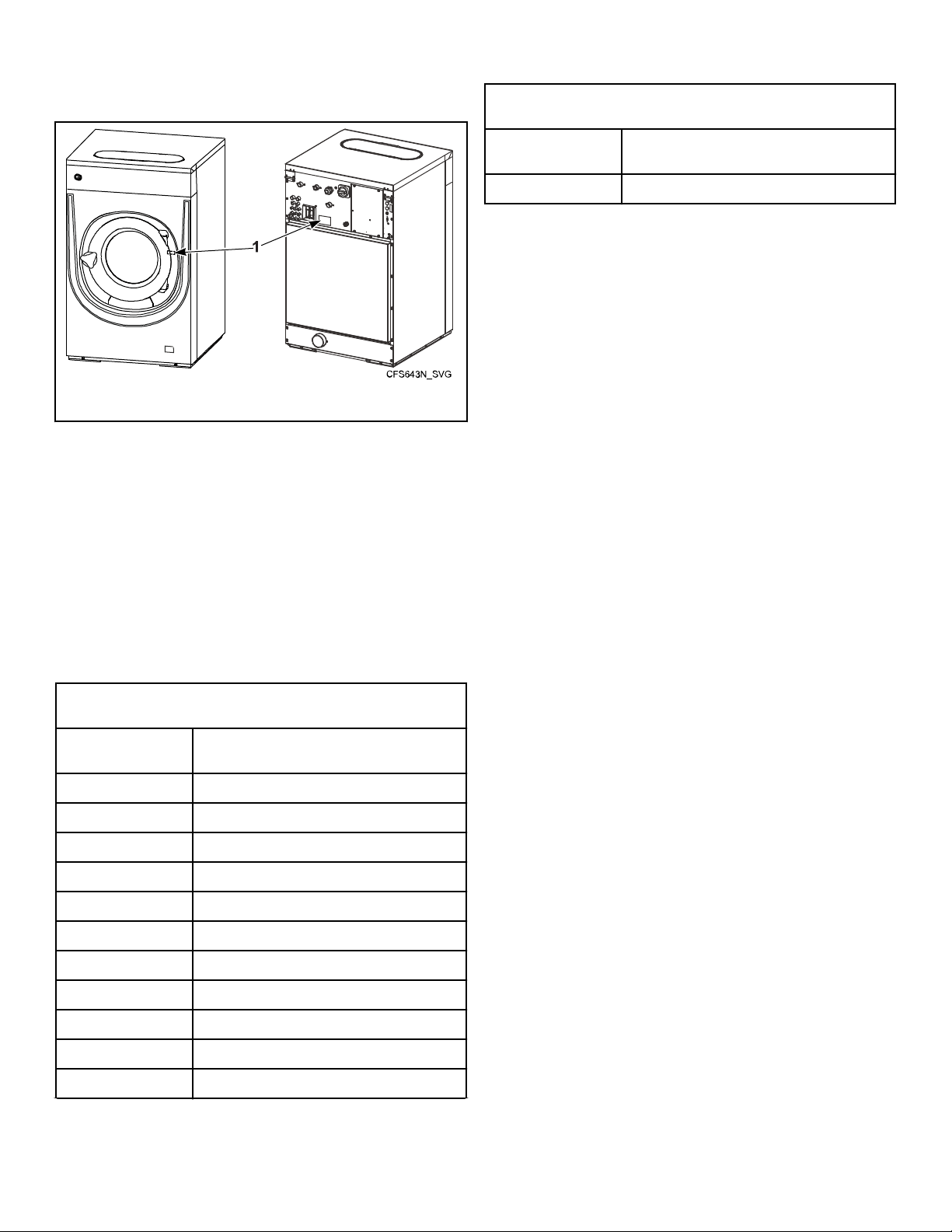
Serial Plate Location
1. Serial Plate Location
Figure 1
The serial plate is located on the rear panel of the machine and on
the frame inside the machine.
Always provide the machine serial number when ordering parts
or when seeking technical assistance.
Manufacturing Date
The manufacturing date for your unit can be found on the serial
number. The last two characters indicate first the year and then
the month. Refer to Table 1 and Table 2 . For example, a unit with
serial number 520I000001DK was manufactured in May 2015.
Manufacturing Date - Year
Year Serial Number Character
2009 P
2010 R
2011 T
2012 V
2013 X
2014 B
2015 D
2016 F
2017 H
2018 K
2019 M
Table 1 continues...
Manufacturing Date - Year
Year Serial Number Character
2020 Q
Table 1
Introduction
©
Copyright, Alliance Laundry Systems LLC -
DO NOT COPY or TRANSMIT
11 Part No. D1625ENR7
Manufacturing Date - Month
Month Serial Number Character
January A or B
February C or D
March E or F
April G or H
May J or K
June L or M
July N or Q
August P or S
September R or U
October T or W
November V or Y
December X or Z
Table 2
Delivery Inspection
Upon delivery, visually inspect crate, protective cover, and unit
for any visible shipping damage. If signs of possible damage are
evident, have the carrier note the condition on the shipping pa-
pers before the shipping receipt is signed, or advise the carrier of
the condition as soon as it is discovered.
Replacement Parts
If literature or replacement parts are required, contact the source
from which the machine was purchased or contact Alliance Laun-
dry Systems at +1 (920) 748-3950 for the name and address of
the nearest authorized parts distributor.
Customer Service
For technical assistance, contact your local distributor or contact:
Alliance Laundry Systems
Shepard Street
P.O. Box 990
Ripon, WI 54971-0990
U.S.A.
www.alliancelaundry.com
Phone: +1 (920) 748-3121 Ripon, Wisconsin
Introduction
©
Copyright, Alliance Laundry Systems LLC -
DO NOT COPY or TRANSMIT
12 Part No. D1625ENR7
Specifications and Dimensions
General Specifications
Specifi-
cations
6.5 kg /
14 lb. /
65 L
Models
7.5 kg /
20 lb. /
80 L
Models
10.5 kg /
25 lb. /
105 L
Models
13.5 kg /
30 lb. /
135 L
Models
18 kg /
40 lb. /
180 L
Models
24 kg /
55 lb. /
240 L
Models
28 kg /
70 lb. /
280 L
Models
Capacity
Drum Ca-
pacity,lb.
[kg]
14 lb. [6.5
kg]
20 lb. [7.5
kg]
25 lb. [10.5
kg]
30 lb. [13.5
kg]
40 lb. [ 18
kg]
55 lb. [24 kg] 70 lb. [28 kg]
Drum Vol-
ume, gal [l]
17.17 [65] 21.13 [80] 27.74 [105] 35.66 [135] 47.55 [180] 63.40 [240] 73.97 [280]
Overall Dimensions
Overall
width, in.
[mm]
27.95 [710] 27.95 [710] 31.29 [795] 31.29 [795] 38.18 [970] 38.18 [970] 38.18 [970]
Overall
height, in.
[mm]
43.89 [1115] 43.89 [1115] 48.22 [1225] 48.22 [1225] 55.51 [1410] 55.51 [1410] 55.51 [1410]
Overall
depth, in.
[mm]
29.13 [740] 31.10 [790] 31.29 [795] 37.20 [945] 38.18 [970] 43.50 [1105] 46.65 [1185]
Weight and Shipping Information
Net weight,
lbs. [kg]
375 [170] 408 [185] 463 [210] 563 [255] 838 [380] 948 [430] 1092 [495]
Shipping
weight, lbs.
[kg]
397 [180] 441 [200] 518 [235] 606 [275] 871 [395] 992 [450] 1135 [515]
Shipping di-
mensions
(WxDxH),
in. [mm]
29.53 x
33.01 x
49.02 [750 x
840 x 1245]
29.53 x
33.01 x
49.02 [750 x
840 x 1245]
32.87 x
33.01 x
52.95 [835 x
840 x 1345]
32.87 x
38.78 x
52.95 [835 x
985 x 1345]
40.35 x
39.96 x
61.02 [1025
x 1015 x
1550]
40.35 x
45.28 x
61.02 [1025
x 1150 x
1550]
40.35 x
48.23 x
61.02 [1025
x 1225 x
1550]
Wash Cylinder Information
Cylinder di-
ameter in.
[mm]
20.87 [530] 20.87 [530] 24.40 [620] 24.40 [620] 29.53 [750] 29.53 [750] 29.53 [750]
Table 3 continues...
Specifications and Dimensions
©
Copyright, Alliance Laundry Systems LLC -
DO NOT COPY or TRANSMIT
13 Part No. D1625ENR7
Specifi-
cations
6.5 kg /
14 lb. /
65 L
Models
7.5 kg /
20 lb. /
80 L
Models
10.5 kg /
25 lb. /
105 L
Models
13.5 kg /
30 lb. /
135 L
Models
18 kg /
40 lb. /
180 L
Models
24 kg /
55 lb. /
240 L
Models
28 kg /
70 lb. /
280 L
Models
Cylinder
depth in.
[mm]
12.01 [305] 13.78 [350] 13.78 [350] 17.72 [450] 16.14 [410] 21.46 [545] 24.41 [620]
Cylinder vol-
ume ft
3
[l]
2.3 [65] 2.6 [75] 3.7 [105] 4.8 [135] 6.4 [180] 8.5 [240] 9.9 [280]
Table 3 continues...
Specifications and Dimensions
©
Copyright, Alliance Laundry Systems LLC -
DO NOT COPY or TRANSMIT
14 Part No. D1625ENR7
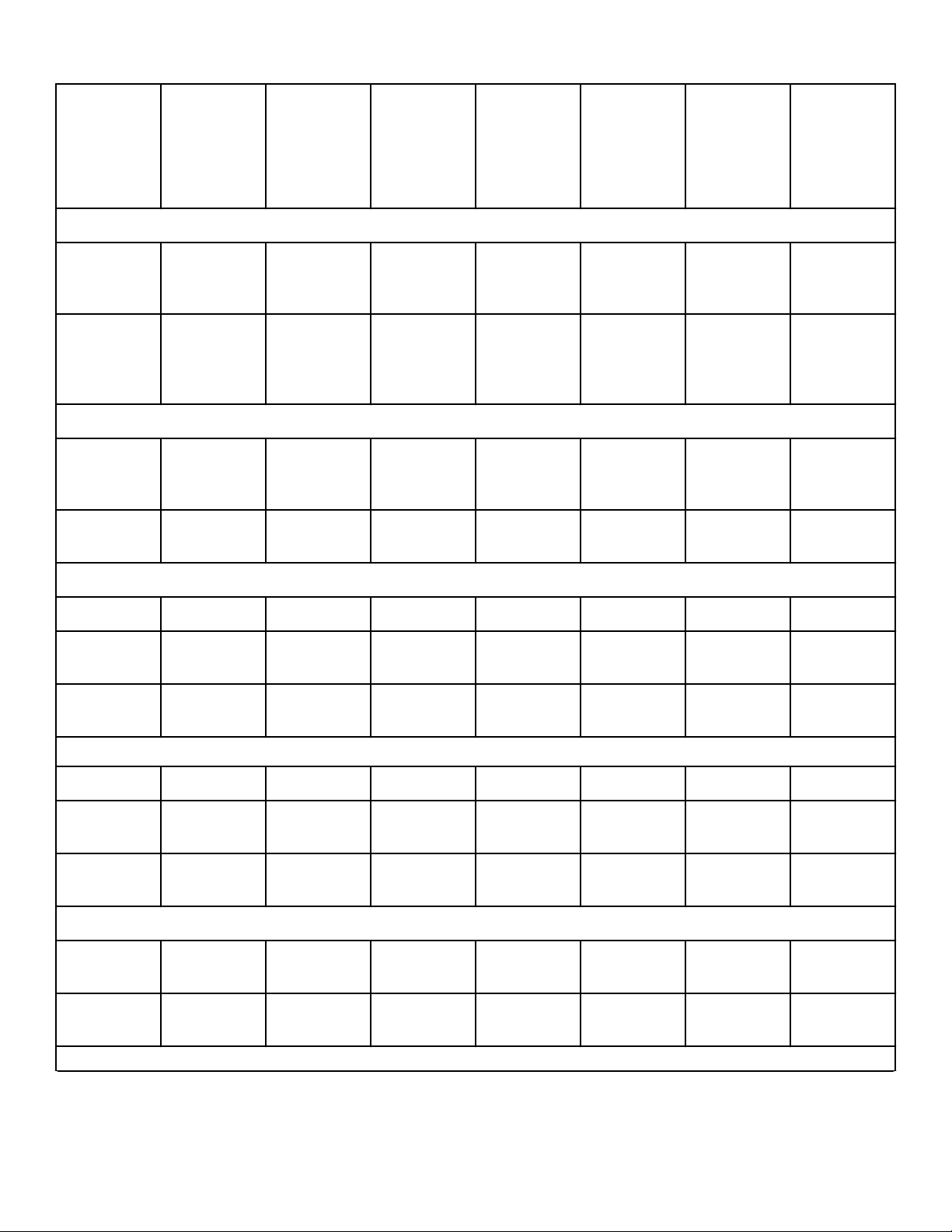
Specifi-
cations
6.5 kg /
14 lb. /
65 L
Models
7.5 kg /
20 lb. /
80 L
Models
10.5 kg /
25 lb. /
105 L
Models
13.5 kg /
30 lb. /
135 L
Models
18 kg /
40 lb. /
180 L
Models
24 kg /
55 lb. /
240 L
Models
28 kg /
70 lb. /
280 L
Models
Door Opening Information
Door open-
ing size, in.
[mm]
13 [330] 13 [330] 16.14 [410] 16.14 [410] 18.11 [460] 18.11 [460] 18.11 [460]
Height of
door bottom
above floor,
in. [mm]
13.74 [349] 13.74 [349] 13.46 [342] 13.46 [342] 18.77 [477] 18.77 [477] 18.77 [477]
Drive Train Information
Number of
motors in
drive train
1 1 1 1 1 1 1
Motor Size,
hp [kW]
1 [0.75] 1 [0.75] 1.48 [1.1] 2.01 [1.5] 2.95 [2.20] 4.02 [3.0] 4.02 [3.0]
Cylinder Speeds
Wash, RPM 49 49 49 49 42 42 42
Extraction,
RPM (350G)
1086 1086 1005 1005 915 915 915
Extraction,
RPM (400G)
1165 1165 1075 1075 980 980 N/A
Heating
Electric, kW 6 / 9 (4.6) 6 / 9 (4.6) 6 / 9 / 12 9 / 12 12 / 18 18 21.9
Steam, psi
[bar]
15-116 [1-8] 15-116 [1-8] 15-116 [1-8] 15-116 [1-8] 15-116 [1-8] 15-116 [1-8] 15-116 [1-8]
Hot water, °F
[°C]
194 [90] 194 [90] 194 [90] 194 [90] 194 [90] 194 [90] 194 [90]
Noise Emissions
Wash se-
quence, dB
46 52 52 50 50 50 47
Extract se-
quence, dB
59 63 66 65 68 66 70
Table 3 continues...
Specifications and Dimensions
©
Copyright, Alliance Laundry Systems LLC -
DO NOT COPY or TRANSMIT
15 Part No. D1625ENR7
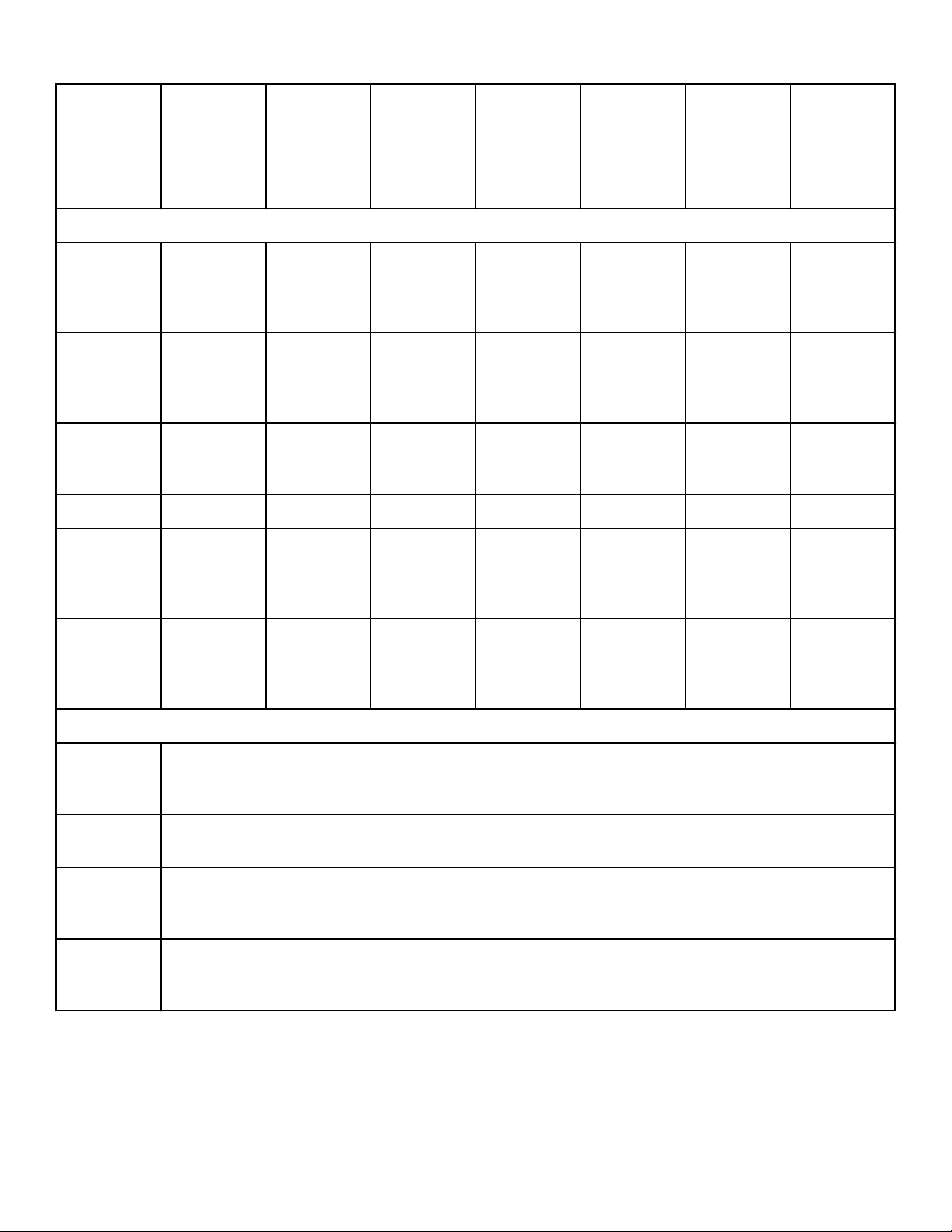
Specifi-
cations
6.5 kg /
14 lb. /
65 L
Models
7.5 kg /
20 lb. /
80 L
Models
10.5 kg /
25 lb. /
105 L
Models
13.5 kg /
30 lb. /
135 L
Models
18 kg /
40 lb. /
180 L
Models
24 kg /
55 lb. /
240 L
Models
28 kg /
70 lb. /
280 L
Models
Floor Load Data
Maximum
static load on
floor, lbs.
[kN]
472 [2.1] 517 [2.3] 585 [2.6] 719 [3.2] 1102 [4.9] 1191 [5.3] 1304 [5.8]
Maximum
dynamic load
on floor, lbs.
[kN]
405 ± 112
[1.8 ± 0.5]
428 ± 112
[1.9 ± 0.5]
495 ± 112
[2.2 ± 0.5]
607 ± 112
[2.7 ± 0.5]
899 ± 112
[4.0 ± 0.7]
1034 ± 112
[4.6 ± 1.1]
1124 ± 112
[5.0 ± 1.1]
Frequency of
dynamic
load, Hz
19.4 19.4 17.9 17.9 16.3 16.3 15.25
G factor 400 400 400 400 400 400 350
Static floor
pressure
lbs/ft
2
[kN/m
2
]
96 [4.61] 98 [4.68] 99 [4.73] 100 [4.78] 121 [5.8] 113 [5.43] 116 [5.53]
Dynamic
floor pres-
sure lbs/ft
2
[kN/m
2
]
83 ± 23 [3.95
± 1.1]
81 ± 21 [3.87
± 1.02]
84 ± 19 [4.0
± 0.91 ]
84 ± 16 [4.04
± 0.75]
99 ± 17 [4.73
± 0.83]
98 ± 24 [4.71
± 1.13]
99 ± 22 [4.76
± 1.05]
General Data
Ambient
Temperature,
°F [°C]
41-95 [5-35]
Relative Hu-
midity
30%-90% without condensation
Height above
sea level ft.
[m]
up to 3280 [up to 1000]
Storage Tem-
perature, °F
[°C]
34-131 [1-55]
Table 3
Specifications and Dimensions
©
Copyright, Alliance Laundry Systems LLC -
DO NOT COPY or TRANSMIT
16 Part No. D1625ENR7
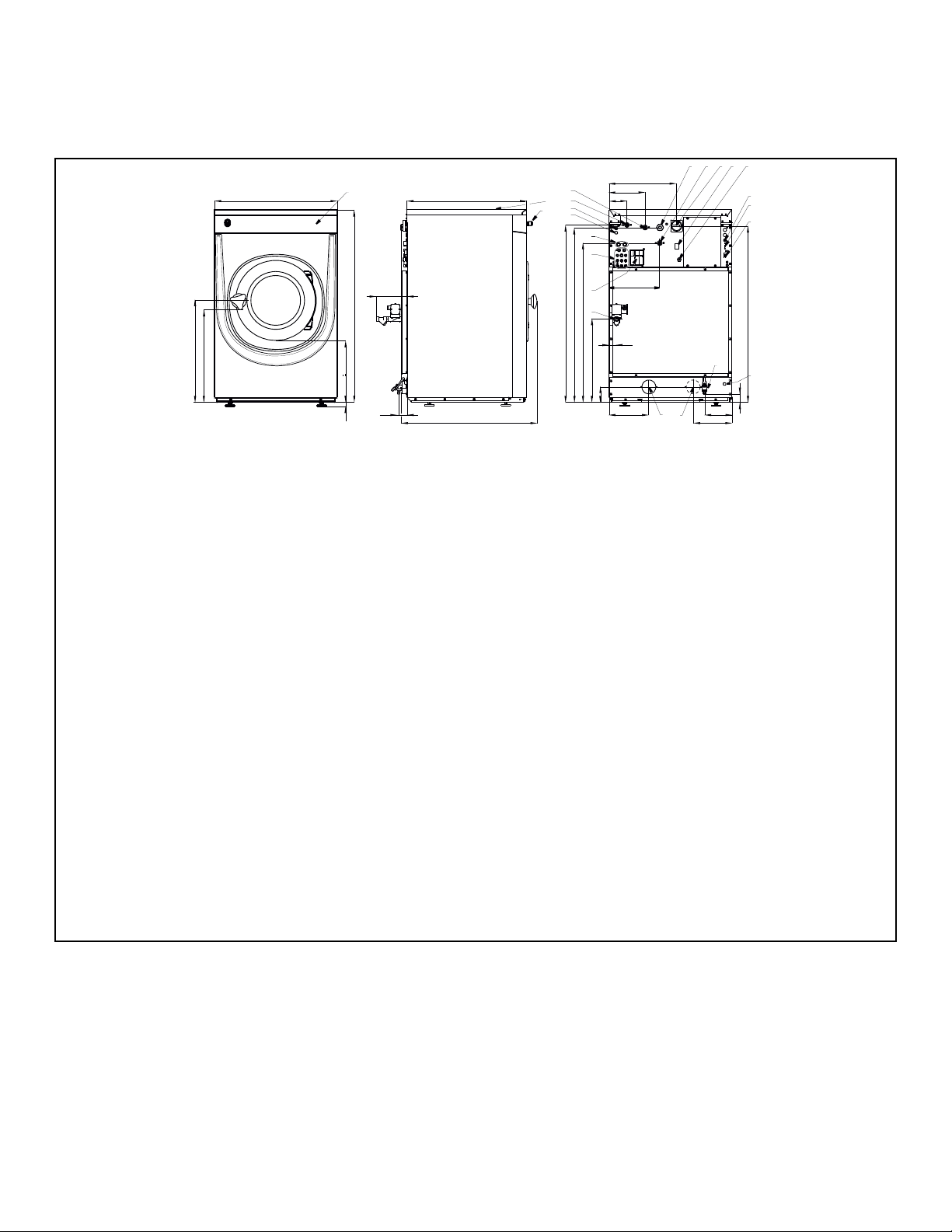
Machine Dimensions
NOTE: Beginning January, 2018: 65-135 L (20-30 lb.)
models have embossed side panels.
1
2
3
4
5
6
8
10
11
12
13
14 15 16
17
9
7
18
19
21
2322
20
C
D
E
F
G
H
J
I
X
W
V
U
T
S
Q
O
R
P
N
L
M
K
Y
CFD1224N A
A
B
1. Control panel
2. Soap dispenser
3. Centralstop button
4. Steam connection
5. Air relieve
6. Liquid soap connection
7. Recyled water inlet
8. Steam valve connection
9. Recycled water valve cable inlet
10. Cold water inlet, soft
11. Cold water inlet, hard
12. Electrical connection
13. Hot water inlet
14. Heating change-over switch
15. Main switch
16. Liquid soap pump eletrical connection
17. Fuses
18. USB port
19. PC programming connection
20. Drain Valve - 1/2", applicable for wash bath sample (on request only), 28 kg/70 lb. /280 L Models only
21. Discharge water cable inlet
22. Drain valve or recycle valve - 3 in. [76 mm], 28 kg/70 lb. / 280 L Models only
23. Drain valve - 3 in. [76 mm]
Figure 2
Specifications and Dimensions
©
Copyright, Alliance Laundry Systems LLC -
DO NOT COPY or TRANSMIT
17 Part No. D1625ENR7
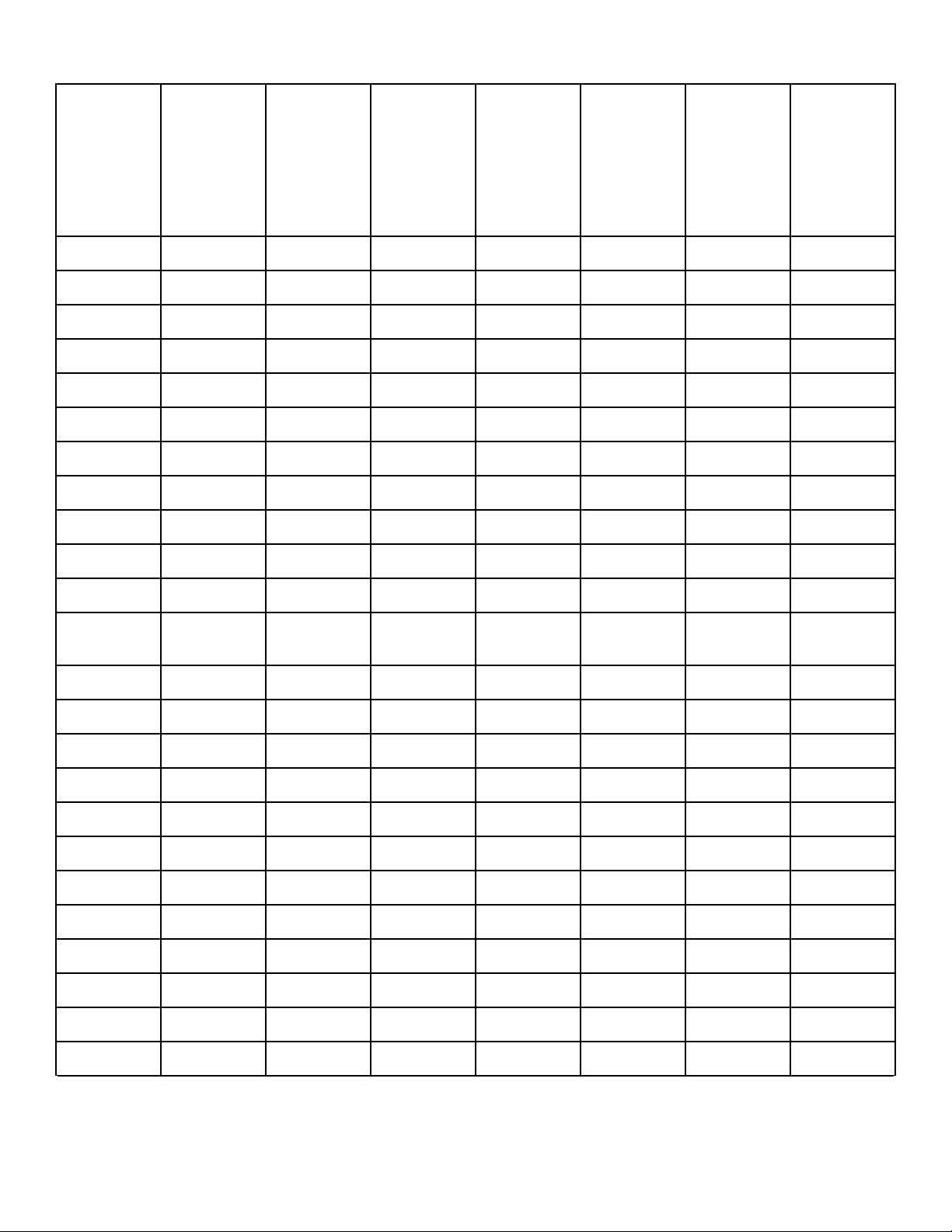
Specifi-
cations
6.5 kg /
14 lb. /
65 L
Models
in. [mm]
7.5 kg /
20 lb. /
80 L
Models
in. [mm]
10.5 kg /
25 lb. /
105 L
Models
in. [mm]
13.5 kg /
30 lb. /
135 L
Models
in. [mm]
18 kg /
40 lb. /
180 L
Models
in. [mm]
24 kg /
55 lb. /
240 L
Models
in. [mm]
28 kg /
70 lb. /
280 L
Models
in. [mm]
A 24.09 [612] 24.09 [612] 25.51 [648] 25.51 [648] 31.73 [806] 31.73 [806] 31.73 [806]
B 22.20 [564] 22.20 [564] 23.62 [600] 23.62 [600] 29.84 [758] 29.84 [758] 29.84 [758]
C 27.95 [710] 27.95 [710] 31.29 [795] 31.29 [795] 38.18 [970] 38.18 [970] 38.18 [970]
D 0.94 [24] 0.94 [24] 0.94 [24] 0.94 [24] 0.94 [24] 0.94 [24] 0.94 [24]
E 13.74 [349] 13.74 [349] 13.46 [342] 13.46 [342] 18.77 [477] 18.77 [477] 18.77 [477]
F 43.89 [1115] 43.89 [1115] 48.22 [1225] 48.22 [1225] 55.51 [1410] 55.51 [1410] 55.51 [1410]
G 7.08 [180] 7.08 [180] 7.08 [180] 7.08 [180] 3.54 [90] 3.54 [90] 3.54 [90]
H 1.89 [48] 1.89 [48] 1.89 [48] 1.89 [48] 1.89 [48] 1.89 [48] 1.89 [48]
I 29.13 [740] 31.10 [790] 31.29 [795] 37.20 [945] 38.18 [970] 43.50 [1105] 46.65 [1185]
J 25.51 [648] 27.48 [698] 27.48 [698] 33.39 [848] 34.57 [878] 39.88 [1012] 42.83 [1088]
K 40.35 [1025] 40.35 [1025] 44.68 [1135] 44.68 [1135] 51.96 [1320] 51.96 [1320] 51.96 [1320]
L 39.76 [1010] 39.76 [1010] 44.09 [1120] 44.09 [1120] 51.08
[1297.5]
51.08
[1297.5]
51.37 [1305]
M 36.22 [920] 36.22 [920] 40.55 [1030] 40.55 [1030] 47.83 [1215] 47.83 [1215] 47.83 [1215]
N 18.89 [480] 18.89 [480] 19.92 [506] 19.92 [506] 19.29 [490] 19.29 [490] 19.29 [490]
O 3.46 [88] 3.46 [88] 3.46 [88] 3.46 [88] 4.27 [108.5] 4.27 [108.5] 4.27 [108.5]
P 9.05 [230] 9.05 [230] 9.05 [230] 9.05 [230] 10.62 [270] 10.62 [270] 10.62 [270]
Q 7.99 [203] 7.99 [203] 7.99 [203] 7.99 [203] 7.99 [203] 7.99 [203] 7.99 [203]
R N/A N/A N/A N/A N/A N/A 10.79 [274]
S 2.64 [67] 2.64 [67] 2.64 [67] 2.64 [67] 2.64 [67] 2.64 [67] 2.64 [67]
T 40.15 [1020] 40.15 [1020] 44.48 [1130] 44.48 [1130] 51.77 [1315] 51.77 [1315] 51.77 [1315]
U 1.65 [42] 1.65 [42] 1.65 [42] 1.65 [42] 3.14 [80] 3.14 [80] 3.14 [80]
V 11.53 [293] 11.53 [293] 11.53 [293] 11.53 [293] 11.53 [293] 11.53 [293] 11.53 [293]
W 15.35 [390] 15.35 [390] 18.70 [475] 18.70 [475] 24.01 [610] 24.01 [610] 24.01 [610]
X 8.58 [218] 8.58 [218] 8.58 [218] 8.58 [218] 8.58 [218] 8.58 [218] 8.58 [218]
Table 4 continues...
Specifications and Dimensions
©
Copyright, Alliance Laundry Systems LLC -
DO NOT COPY or TRANSMIT
18 Part No. D1625ENR7
Specifi-
cations
6.5 kg /
14 lb. /
65 L
Models
in. [mm]
7.5 kg /
20 lb. /
80 L
Models
in. [mm]
10.5 kg /
25 lb. /
105 L
Models
in. [mm]
13.5 kg /
30 lb. /
135 L
Models
in. [mm]
18 kg /
40 lb. /
180 L
Models
in. [mm]
24 kg /
55 lb. /
240 L
Models
in. [mm]
28 kg /
70 lb. /
280 L
Models
in. [mm]
Y 4.44 [113] 4.44 [113] 4.44 [113] 4.44 [113] 4.44 [113] 4.44 [113] 4.44 [113]
Table 4
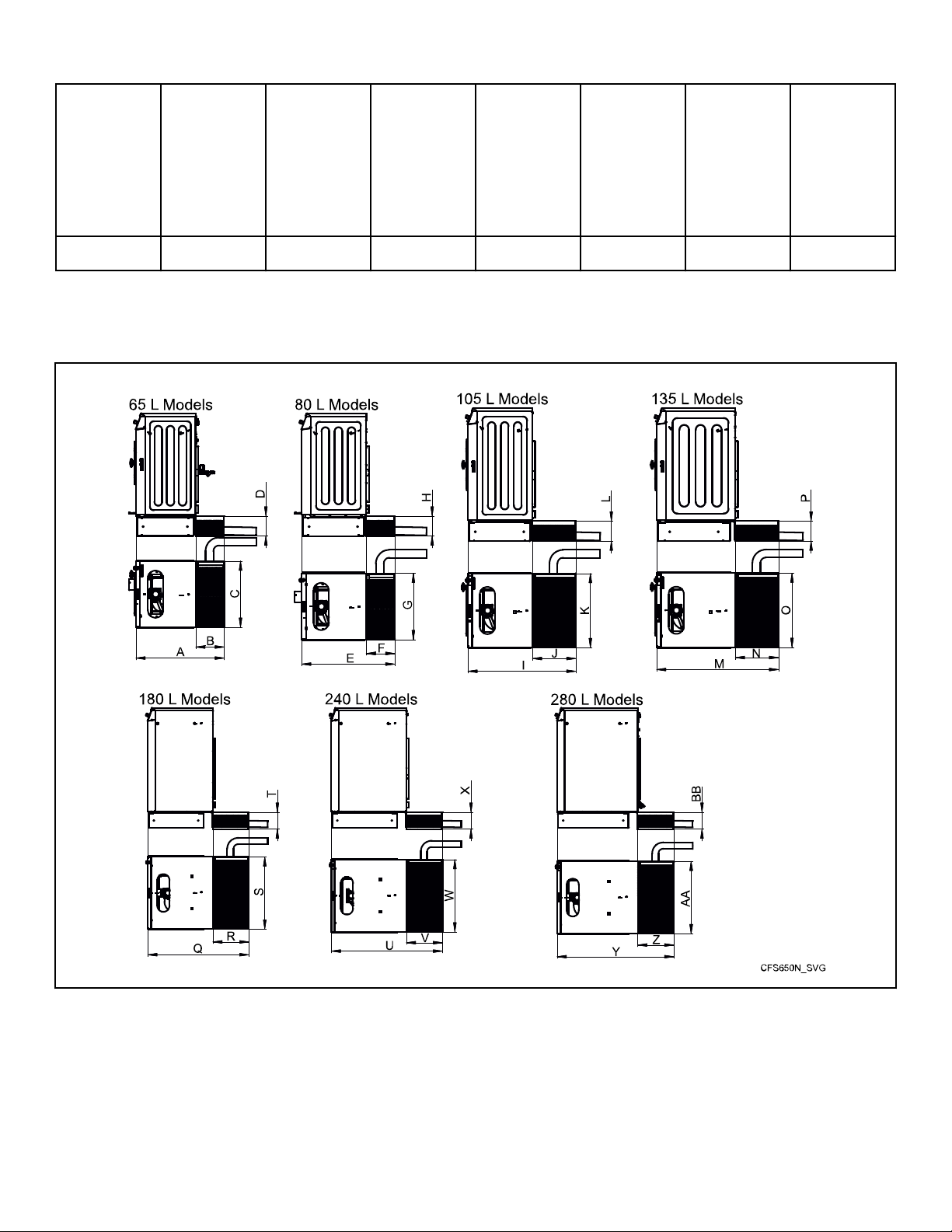
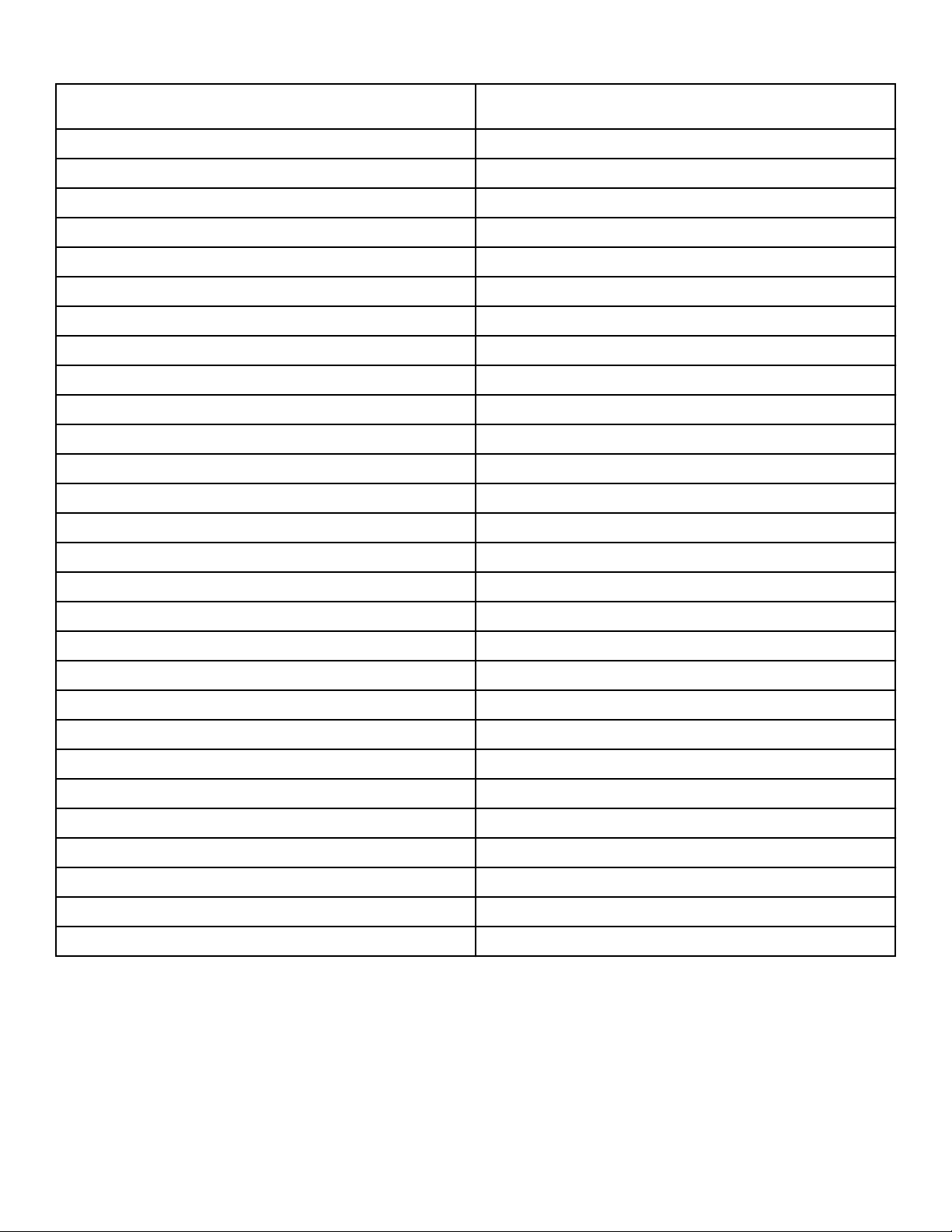
Machine Dimensions (Machines with Optional Filter Tanks for Mops)
Figure 3
Specifications and Dimensions
©
Copyright, Alliance Laundry Systems LLC -
DO NOT COPY or TRANSMIT
19 Part No. D1625ENR7
Specification in. [mm]
A 37.40 [950]
B 12.09 [307]
C 27.95 [710]
D 8.43 [214]
E 39.37 [1000]
F 12.09 [307]
G 27.95 [710]
H 8.43 [214]
I 45.63 [1159]
J 18.39 [467]
K 31.30 [795]
L 8.43 [214]
M 51.54 [1309]
N 18.39 [467]
O 31.30 [795]
P 8.43 [214]
Q 53.43 [1357]
R 19.09 [485]
S 38.19 [970]
T 8.98 [228]
U 58.74 [1492]
V 19.09 [485]
W 38.19 [970]
X 8.98 [228]
Y 61.69 [1567]
Z 19.09 [485]
AA 38.19 [970]
BB 8.98 [228]
Specifications and Dimensions
©
Copyright, Alliance Laundry Systems LLC -
DO NOT COPY or TRANSMIT
20 Part No. D1625ENR7
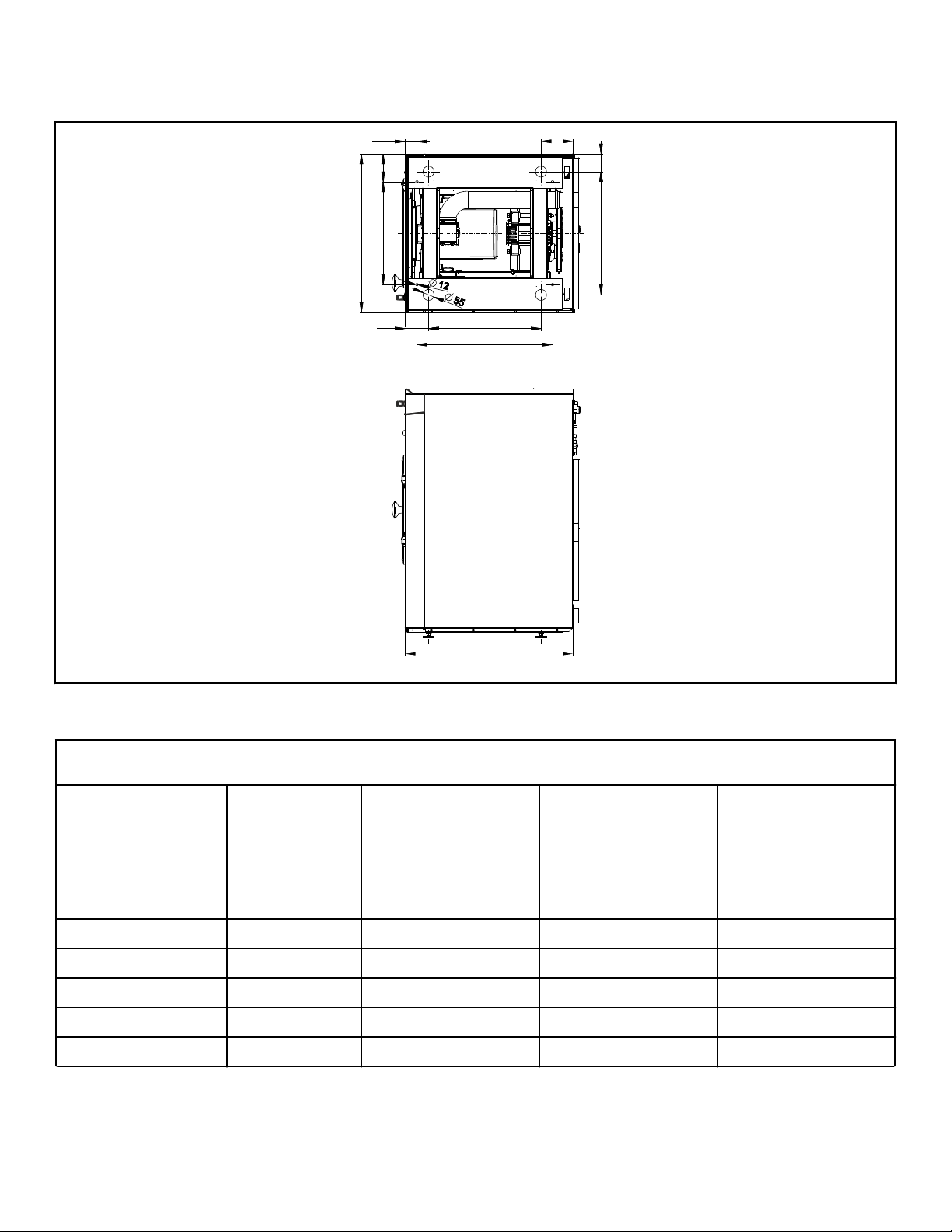
Mounting Bolt Hole Locations
A
C
B
D
E
H
F
G
I
J
K
CZW37N
Figure 4
Mounting Bolt Hole Locations, in. [mm]
Specification
6.5 kg /
14 lb. /
65 L
Models
7.5 kg /
20 lb. /
80 L
Models
10.5 kg /
25 lb. /
105 L
Models
13.5 kg /
30 lb. /
135 L
Models
A 20.86 [530] 20.86 [530] 24.33 [618] 24.33 [618]
B 15.51 [394] 17.48 [444] 17.48 [444] 22.20 [564]
C 3.54 [90] 3.54 [90] 3.48 [88.5] 3.48 [88.5]
D 5.09 [129.5] 5.09 [129.5] 5.09 [129.5] 6.27 [159.5]
E 14.76 [375] 14.76 [375] 17.91 [455] 20.27 [515]
Table 5 continues...
Specifications and Dimensions
©
Copyright, Alliance Laundry Systems LLC -
DO NOT COPY or TRANSMIT
21 Part No. D1625ENR7
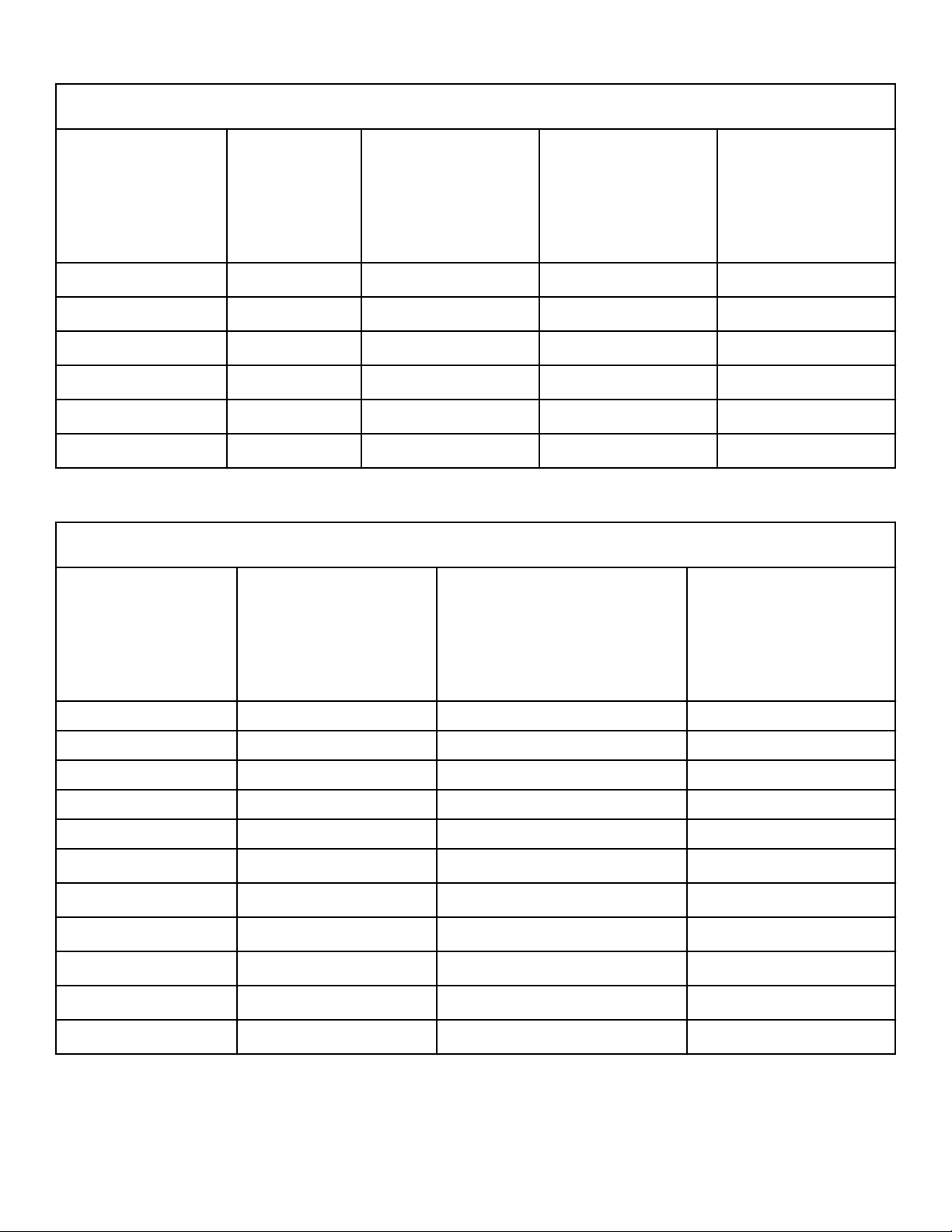
Mounting Bolt Hole Locations, in. [mm]
Specification
6.5 kg /
14 lb. /
65 L
Models
7.5 kg /
20 lb. /
80 L
Models
10.5 kg /
25 lb. /
105 L
Models
13.5 kg /
30 lb. /
135 L
Models
F 6.59 [167.5] 6.59 [167.5] 6.69 [170] 5.51 [140]
G 1.57 [40] 1.57 [40] 1.37 [35] 2.36 [60]
H 4.64 [118] 4.64 [118] 4.64 [118] 4.64 [118]
I 27.95 [710] 27.95 [710] 31.29 [795] 31.29 [795]
J 25.25 [641.5] 27.22 [691.5] 27.22 [691.5] 33.12 [841.5]
K 21.65 [550] 23.62 [600] 24.02 [610] 26.77 [680]
Table 5
Mounting Bolt Hole Locations, in. [mm]
Specification
18 kg /
40 lb. /
180 L
Models
24 kg /
55 lb. /
240 L
Models
28 kg /
70 lb. /
280 L
Models
A 30.90 [785] 30.90 [785] 30.90 [785]
B 22.04 [560] 27.36 [695] 30.31 [770]
C 3.64 [92.5] 3.64 [92.5] 3.64 [92.5]
D 8.32 [211.5] 8.32 [211.5] 8.32 [211.5]
E 26.37 [670] 26.37 [670] 26.37 [670]
F 5.90 [150] 5.90 [150] 5.90 [150]
G 1.96 [50] 1.96 [50] 1.96 [50]
H 3.94 [100] 3.94 [100] 3.94 [100]
I 38.18 [970] 38.18 [970] 38.18 [970]
J 34.31 [871.5] 39.62 [1006.5] 42.60 [1082]
K 25.98 [660] 31.30 [795] 34.25 [870]
Table 6
Specifications and Dimensions
©
Copyright, Alliance Laundry Systems LLC -
DO NOT COPY or TRANSMIT
22 Part No. D1625ENR7
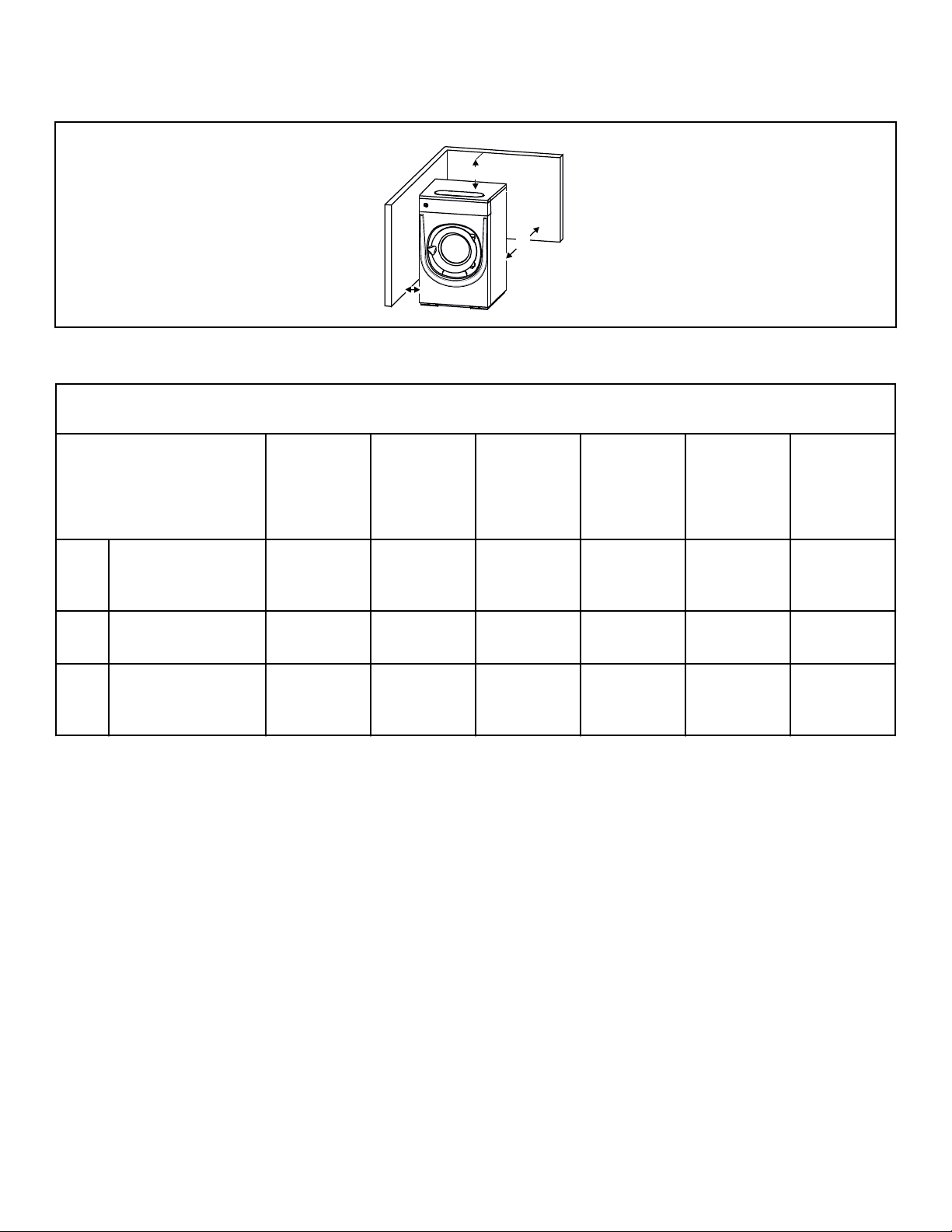
Floor Mounting Layout
Dimensional Clearances
CHM2466N _SVG1
A
B
C
Figure 5
Dimensional Clearances, in. [mm]
Models
6.5 kg/
14 lb./
65 L
7.5 kg/
20 lb./
80 L
10.5 kg/
25 lb./
105 L
13.5 kg/
30 lb./
135 L
18 kg/
40 lb./
180 L
24 kg/
55 lb./
240 L
A Distance of machine
to side wall or other
machine (minimum)
0.79 [20] 0.79 [20] 0.79 [20] 0.79 [20] 0.79 [20] 0.79 [20]
B Distance to wall
(minimum)
20 [500] 20 [500] 20 [500] 20 [500] 20 [500] 20 [500]
C Dimensional clear-
ance above machine
(minimum)
35.43 [900] 35.43 [900] 35.43 [900] 35.43 [900] 43.31 [1100] 43.31 [1100]
Table 7
Specifications and Dimensions
©
Copyright, Alliance Laundry Systems LLC -
DO NOT COPY or TRANSMIT
23 Part No. D1625ENR7
Installation
Pallet Removal
The machine is delivered bolted onto the transport pallet and
packed in shrink-wrap foil or box.
1. Remove packing from machine.
2. Remove front and rear panel.
3. Remove bolts between machine and pallet.
4. Mount front and rear panel.
5. When machine is lifted off pallet, make sure the machine does
not come down on the floor with either of the rear corners
first. The machine's side panel can be damaged.
NOTE: Two self-adhesive rubber stop-blocks are
supplied with the machine. They may be applied as
paint protection when opening the door.
6. Mount leveling legs.
7. Level machine with feet of the machine.
WARNING
It is of utmost importance that the machine is
placed level, from side to side as well as front to
back. If the machine is not properly leveled, it
may result in out-of-balance error without a real
out of balance in the drum.
W913
8. Recheck the setting of the safety switch, refer to Every 6
Months.
Mounting Bolt Installation (If Required)
Machines do not have to be mounted by means of anchoring
bolts. If anchoring is necessary, perform the following steps:
1. Drill 2 holes for the anchoring bolts, refer to Figure 4 . Hole
diameter in machine's base is 0.47 in. [12 mm].
2. Place the machine adjacent to the foundation. Do not attempt
to move it by pushing on the sides. Always use the bottom of
the frame of the washer-extractor to lift and move the whole
machine.
3. Place the machine carefully over the two drilled holes.
4. Check that the machine is seated in a perfectly level manner.
Adjust leveling legs as needed.
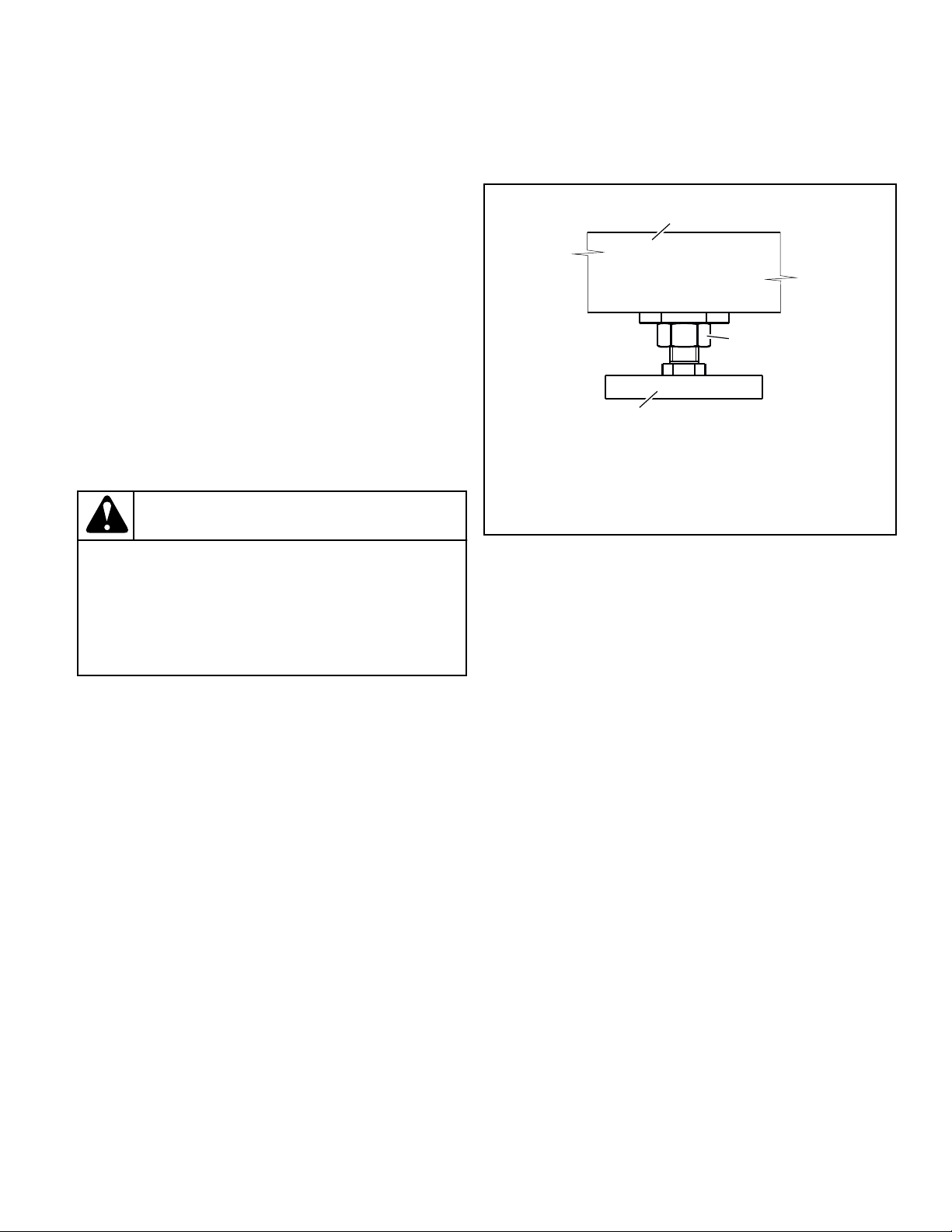
NOTE: After leveling is complete, tighten the nut se-
curely against the machine's base. Refer to Figure 6 .
2
1
3
CFD1208N
1. Machine
2. Nut
3. Leveling Leg
Figure 6
5. Mount the anchoring bolts in the holes drilled in the floor.
6. Position washers and locknuts on machinery anchor bolts and
finger-tighten to machine base.
NOTE: If necessary, prop up the machine frame so
that not deformation occurs during the tightening of
the anchoring bolts.
7. Remove the shipping braces which secure the moving compo-
nents of the machine during shipping. Refer to Shipping
Brace Removal.
Installation
©
Copyright, Alliance Laundry Systems LLC -
DO NOT COPY or TRANSMIT
24 Part No. D1625ENR7
Shipping Brace Removal
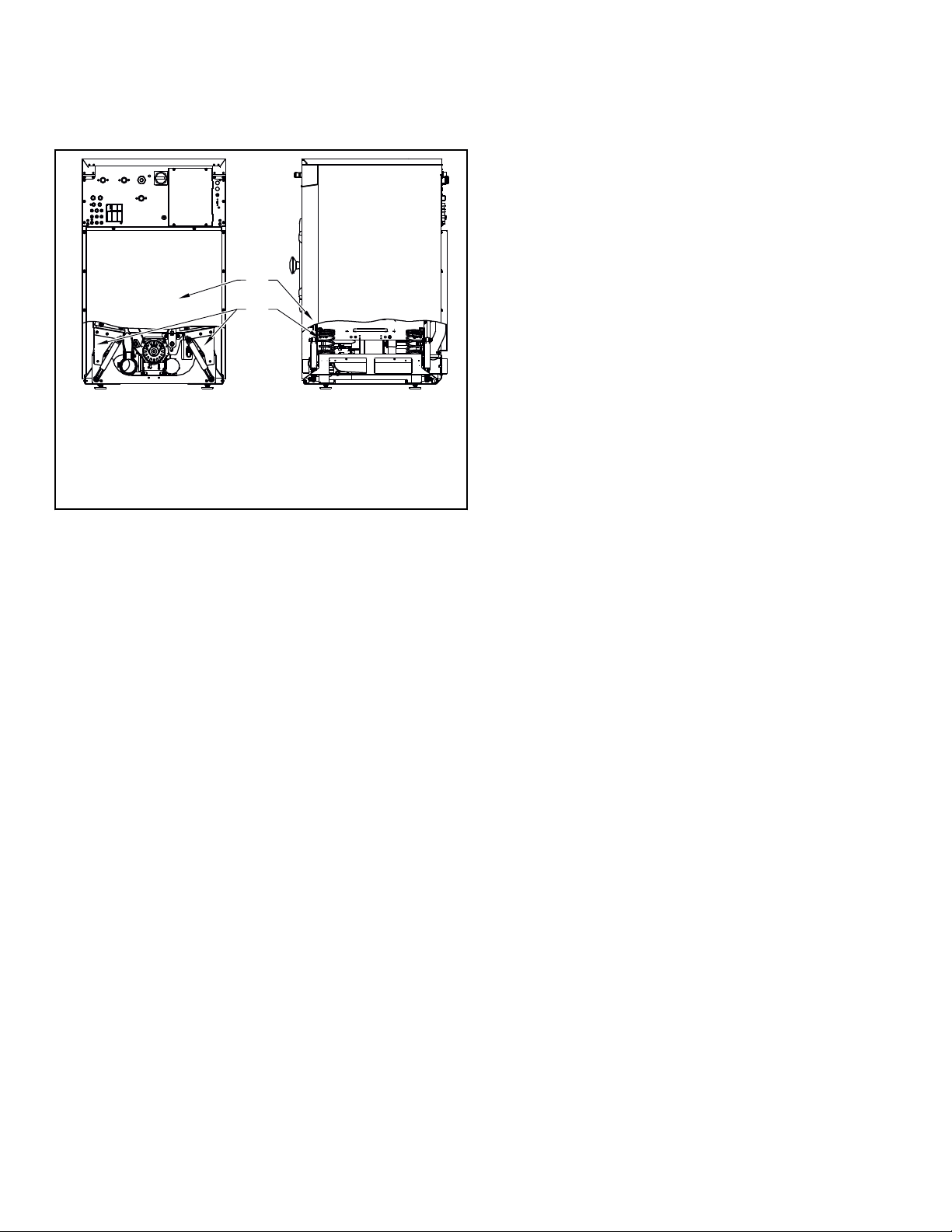
1. Remove front and rear panel, refer to Figure 7 .
34
2 1
CFD1225N
1. Front transport holder
2. Rear transport holder
3. Front panel
4. Rear panel
Figure 7
2. Remove both front metal transport holders.
3. Remove both rear transport holders.
IMPORTANT: The machine may not be moved with
the shipping braces removed. Save the shipping
braces for future use.
Installation
©
Copyright, Alliance Laundry Systems LLC -
DO NOT COPY or TRANSMIT
25 Part No. D1625ENR7
Machine Installation
Install the machine close to a floor drain or open drain.
Elevated Base Frame Installation with
Existing Floor
The elevated base frame structure must be able to withstand the
static and dynamic loads of the machine floor (refer to General
Specifications), and it must allow the machine to be seated in a
perfectly level manner.
Install the machine on a base without adjustable feet.
Weighing System Installation 18 kg - 28
kg / 40 lb. - 70 lb. / 180 L- 280 L Models
1. Lift up the machine.
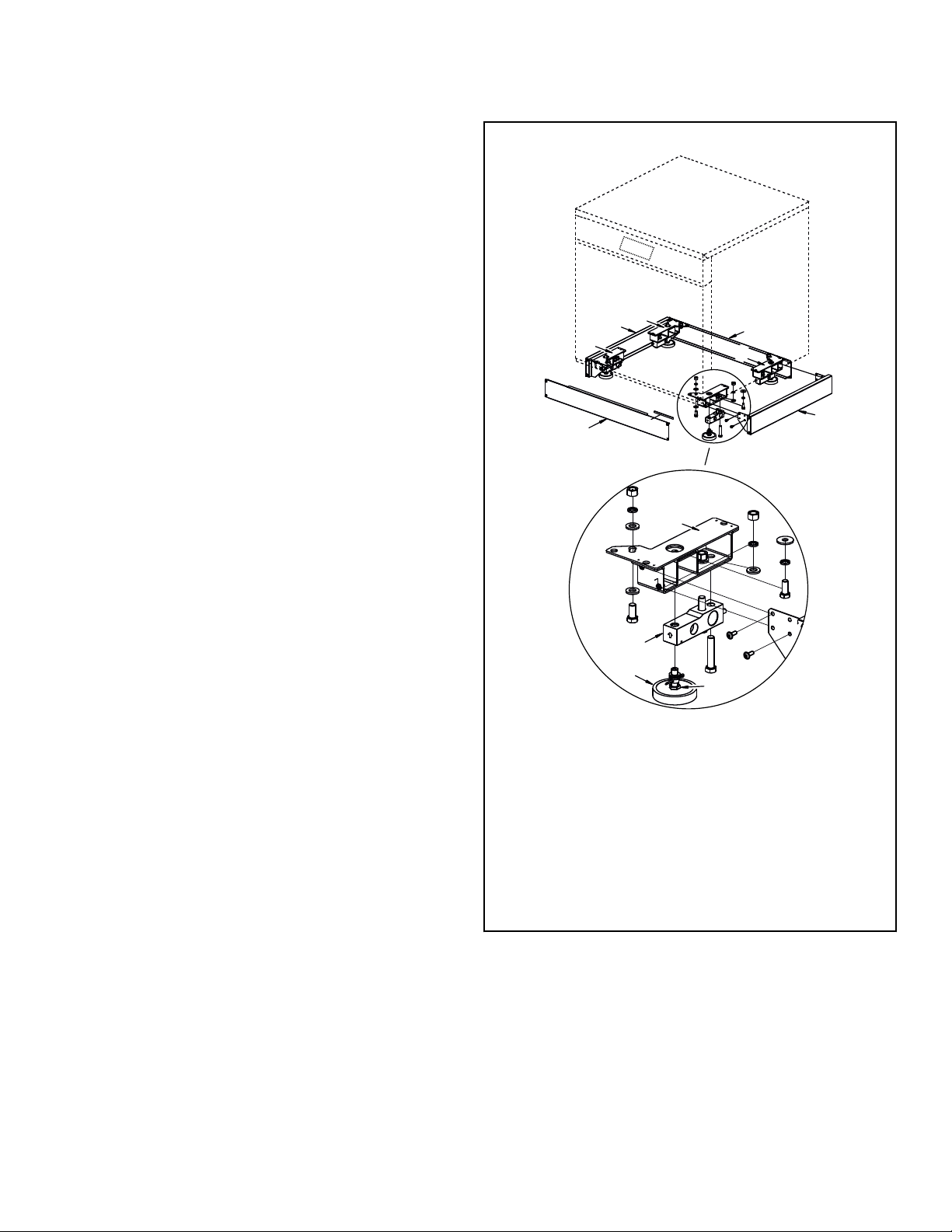
2. Install two left load sensor supports and two right load sensor
supports to the machine frame. Refer to Figure 8 .
5
6
7
7
1
3
4
8
1
2
2
CFD1226N
1. Load sensor support
2. Load sensor support
3. Load sensor
4. Leveling leg
5. Cover
6. Cover
7. Cover
8. Nut
Figure 8
3. Install load sensors with their rubber leveling legs on to the
supports.
4. Check that all the supports and load sensors with rubber level-
ing legs are correctly placed on the machine frame and tight-
ened.
5. Place the machine in the required position.
6. Check that all the rubber leveling legs of the load sensors are
stable.
Installation
©
Copyright, Alliance Laundry Systems LLC -
DO NOT COPY or TRANSMIT
26 Part No. D1625ENR7
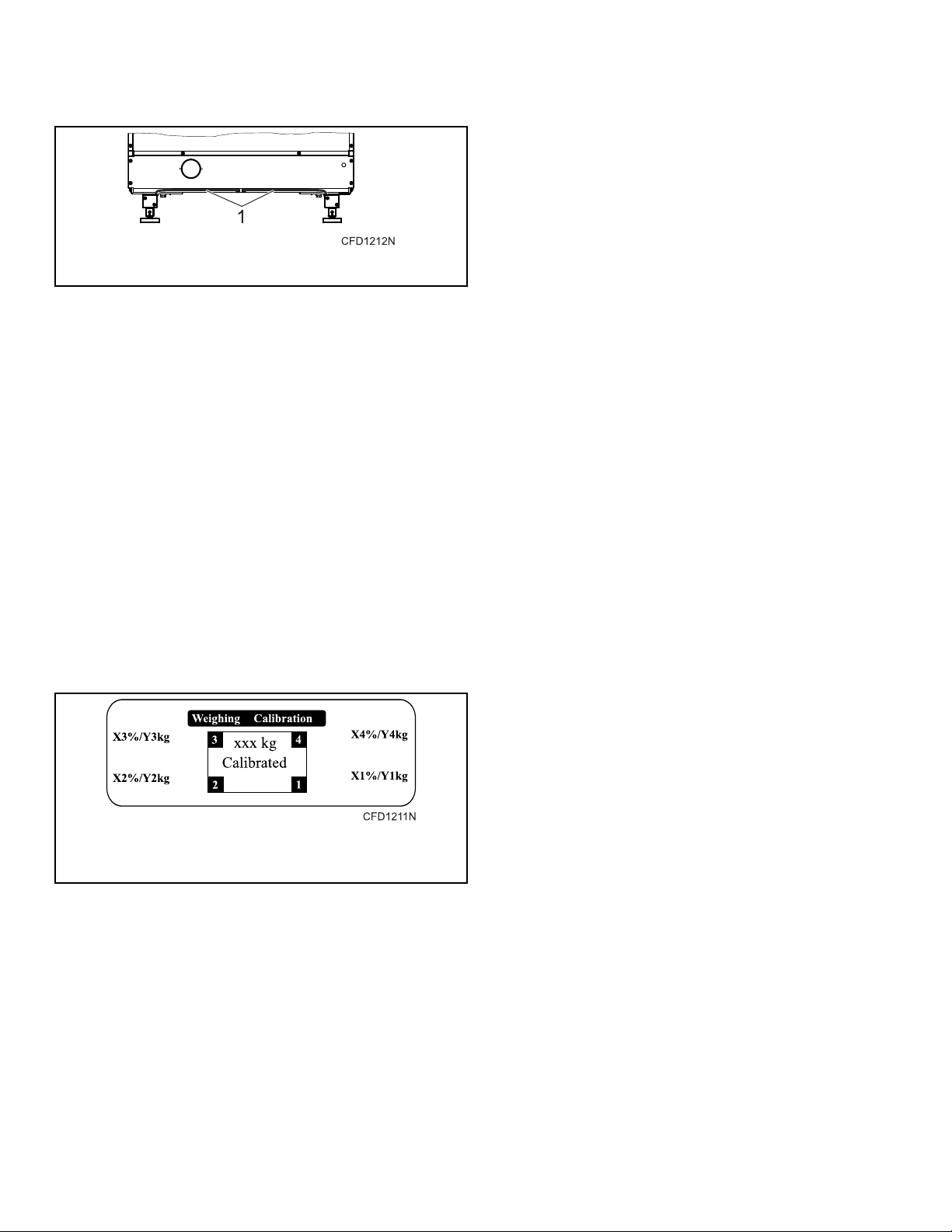
7. Fit the sensor cables into the prepared openings with cable
fixtures. Refer to Figure 9 .
1. Sensor cable openings
Figure 9
8. Remove the transport safety devices (transport props).
9. Use a water-level to check that the lower frame of machine is
positioned totally level.
10. Attach hoses for water supply to the machine.
NOTE: The machine is not anchored into the floor; it
stands on the load sensor feet. Take into considera-
tion that the entire machine acts as a measuring
gauge. Therefore, anything that you place on to the
machine or anything that is in physical contact with
it influences the weighing process. Make sure that
the water connection, as regards the pressure in the
hoses, does not interfere with the weighing. The ho-
ses must no pull or push the machine in any direc-
tion or prop it up in any way.
11. Install the covers. Refer to Figure 8 .
12. Check and, if necessary, adjust the height of the load sensor
feet so that an even load distribution among all the load sen-
sors is ensured. Refer to Figure 10 .
1. X1, X2, X3, X4 - range must be within 10-40%
2. Y1, Y2, Y3, Y4 - load of each load sensor in kg
Figure 10
13. If the load sensors are outside of the specified range, it is nec-
essary to adjust the leveling legs of load sensors. Each load
sensor leveling leg can be adjusted within the range of 0.2 in.
[5 mm].
a. Lift up the machine.
b. Loosen the nut and turn the level leg in order to achieve
the required position.
c. Tighten the nut.
d. Put the machine down and verify that the load applied to
each sensor is within the specified range.
Installation
©
Copyright, Alliance Laundry Systems LLC -
DO NOT COPY or TRANSMIT
27 Part No. D1625ENR7
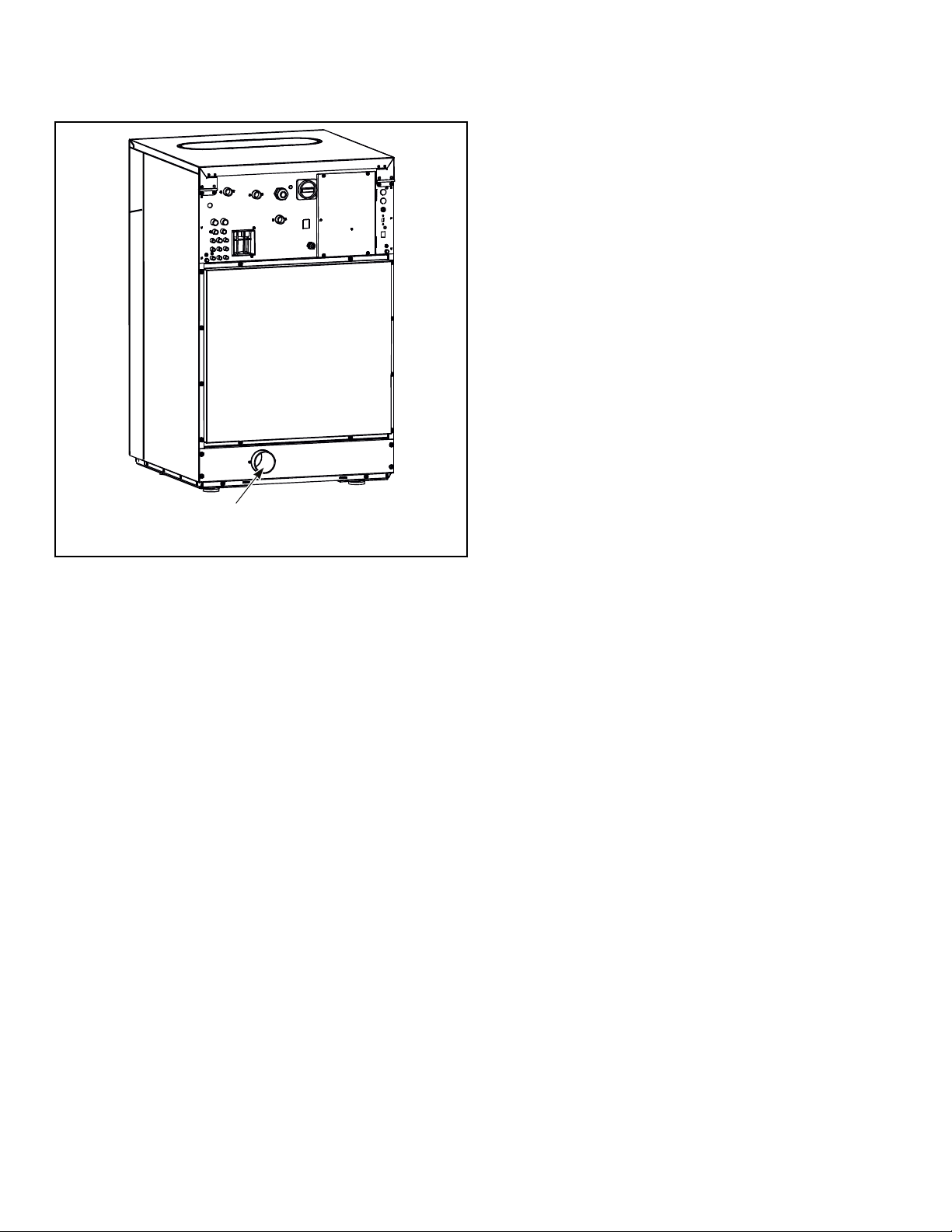
Drain Connection
CHM2480N_SVG
1
1. Drain connection
Figure 11
Installation
©
Copyright, Alliance Laundry Systems LLC -
DO NOT COPY or TRANSMIT
28 Part No. D1625ENR7

Drain Valve
IMPORTANT: Machine must be installed in accordance
with all local codes and ordinances.
All drain systems must be vented to prevent an air lock or siphon-
ing.
Connect a 3 inch [76 mm] pipe or rubber hose to the machine's
drain pipe, ensuring a downward flow from the machine. Avoid
sharp bends which may prevent proper draining.
The drainage pipe should be located over a floor drain, drainage
channel.
Installation
©
Copyright, Alliance Laundry Systems LLC -
DO NOT COPY or TRANSMIT
29 Part No. D1625ENR7
CHM2479N_SVG
A
4
D
C
3
B
2
1
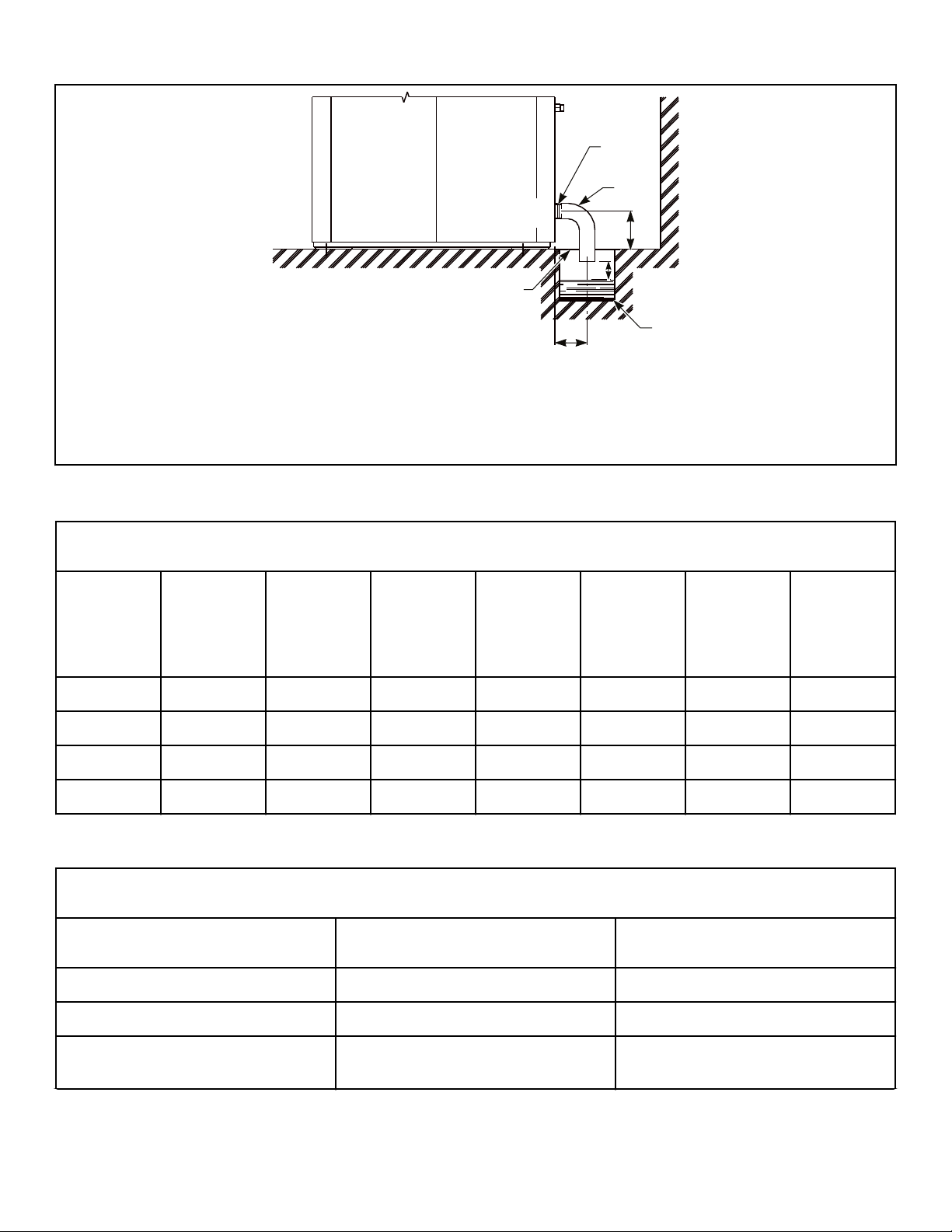
1. Clamp
2. Drain elbow 3 in. [76 mm]
3. Waste channel
4. Waste channel cover
Figure 12
Drainage Pipe Information, in. [mm]
Specifi-
cation
6.5 kg /
14 lb. /
65 L
7.5 kg /
20 lb. /
80 L
10.5 kg/
25 lb. /
105 L
13.5 kg /
30 lb. /
135 L
18 kg/
40 lb. /
180 L
24 kg /
55 lb. /
240 L
28 kg /
70 lb. /
280 L
A 3 [75] 3 [75] 3 [75] 3 [75] 3 [75] 3 [75] 3 [75]
B 4.17 [106] 4.4 [112] 4.4 [112] 4.4 [112] 5.21 [132.5] 5.21 [132.5] 5.21 [132.5]
C minimum 0.79 [20] 0.79 [20] 0.79 [20] 0.79 [20] 0.79 [20] 0.79 [20] 0.79 [20]
D minimum 3.94 [100] 3.94 [100] 3.94 [100] 3.94 [100] 3.94 [100] 3.94 [100] 3.94 [100]
Table 8
Drain Connections
Specification Model Requirement
Drain connection number All 1
Drain connection size, in. [mm] All 3 [76]
Average flow rate of draining gal/min. [l/
min.]
All 55.48 [210]
Table 9 continues...
Installation
©
Copyright, Alliance Laundry Systems LLC -
DO NOT COPY or TRANSMIT
30 Part No. D1625ENR7
Drain Connections
Specification Model Requirement
Drain pump with hose - internal diameter
of hose, in [mm]
6.5 kg - 7.5 kg /
14 lb.- 20 lb./
65 L- 80 L
0.75 [19]
Flow rate of drain pump, gal/min. [l/
min.]
6.5 kg - 7.5 kg /
14 lb.- 20 lb./
65 L- 80 L
9.51 [36]
Table 9
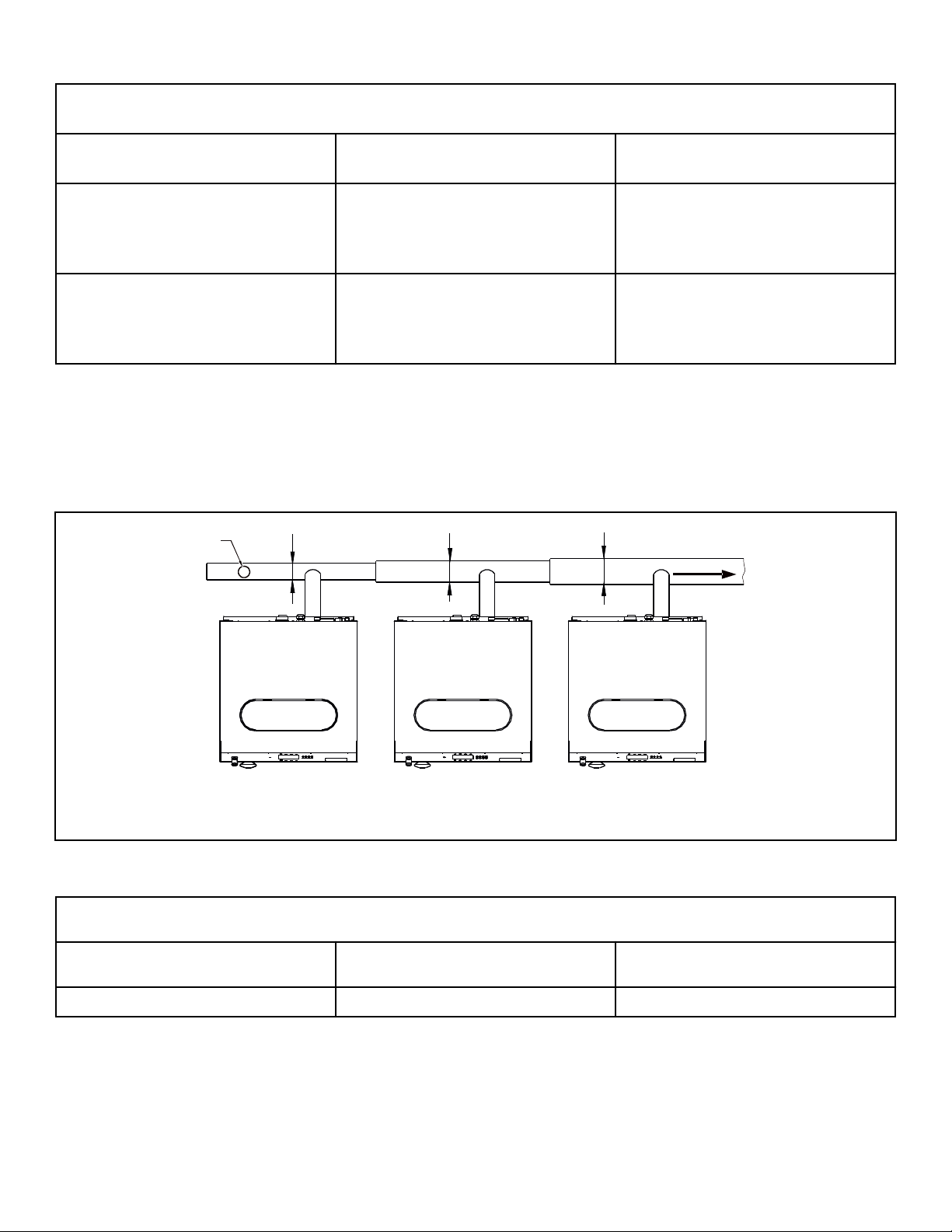
The main drain channel-pipe must have the capacity to be able to
handle the total output of all connected machines. In a drainpipe,
a vent must be provided every 65.62 ft. [20 m] to assure the drain
pipe will work. If the main drain pipe cannot be sufficiently ven-
ted, install a vent per machine. Every time a machine is coupled
on the drainpipe, the diameter of the tube or the width of the
waste channel must increase. Refer to Figure 13 .
The diameters of drain pipe for machines with two drain valves
must have dimensions suitable for double the value of water flow.
CHM2481N_SVG
2
C
B
A
1
1. Vent
2. Flow
Figure 13
Drain Line Sizing / Minimum Drain ID, in. [mm]
A - 1 Machine B - 2 Machines C - 3 Machines
3 [75] 4 [100] 5 [125]
Table 10
Installation
©
Copyright, Alliance Laundry Systems LLC -
DO NOT COPY or TRANSMIT
31 Part No. D1625ENR7
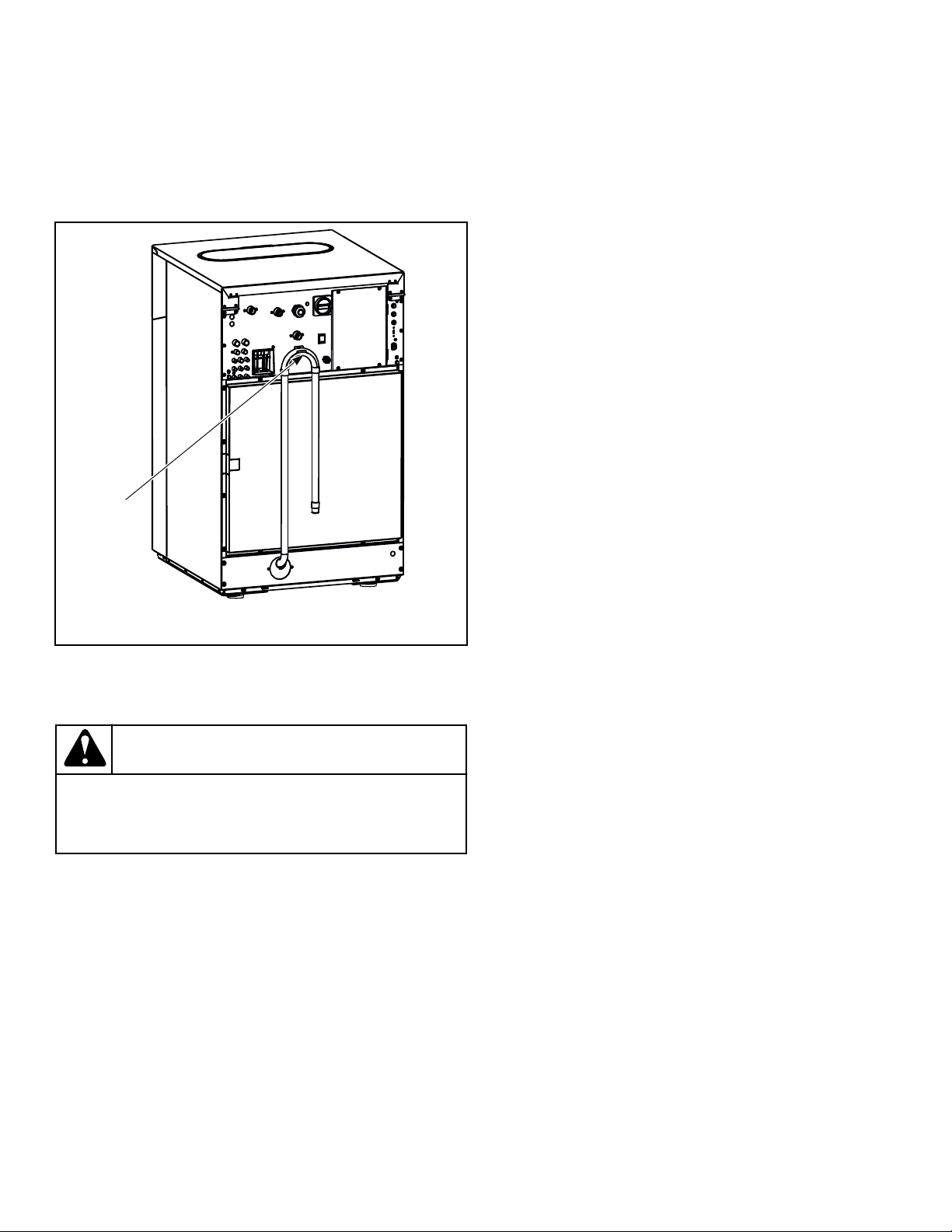
Drain Pump 6.5 kg/ 14 lb. / 65 L and 7.5 kg / 20 lb. /
80 LModels outside of North America
Connect a flexible hose to a drain pipe so that the hose bend must
not be located lower than the water level to provide sufficient si-
phon effect. In order to achieve good draining, the hose must not
bend at a sharp angle. Refer to Figure 14 .
CHM2482N_SVG
1
1. Drain hose bend
Figure 14
Venting
WARNING
Vapours escape from the machine through the air
vent opening! Do not cover!
C238
Installation
©
Copyright, Alliance Laundry Systems LLC -
DO NOT COPY or TRANSMIT
32 Part No. D1625ENR7
Water Connection Requirements
WARNING
To prevent personal injury, avoid contact with inlet
water temperatures higher than 125° Fahrenheit [51°
Celsius] and hot surfaces.
W748
WARNING
Hot water is used to flush the supply dispenser. Do
not open the supply dispenser lid while the machine
is running. The discharge or splashing of hazardous
liquid can cause serious scalding and burning.
C377
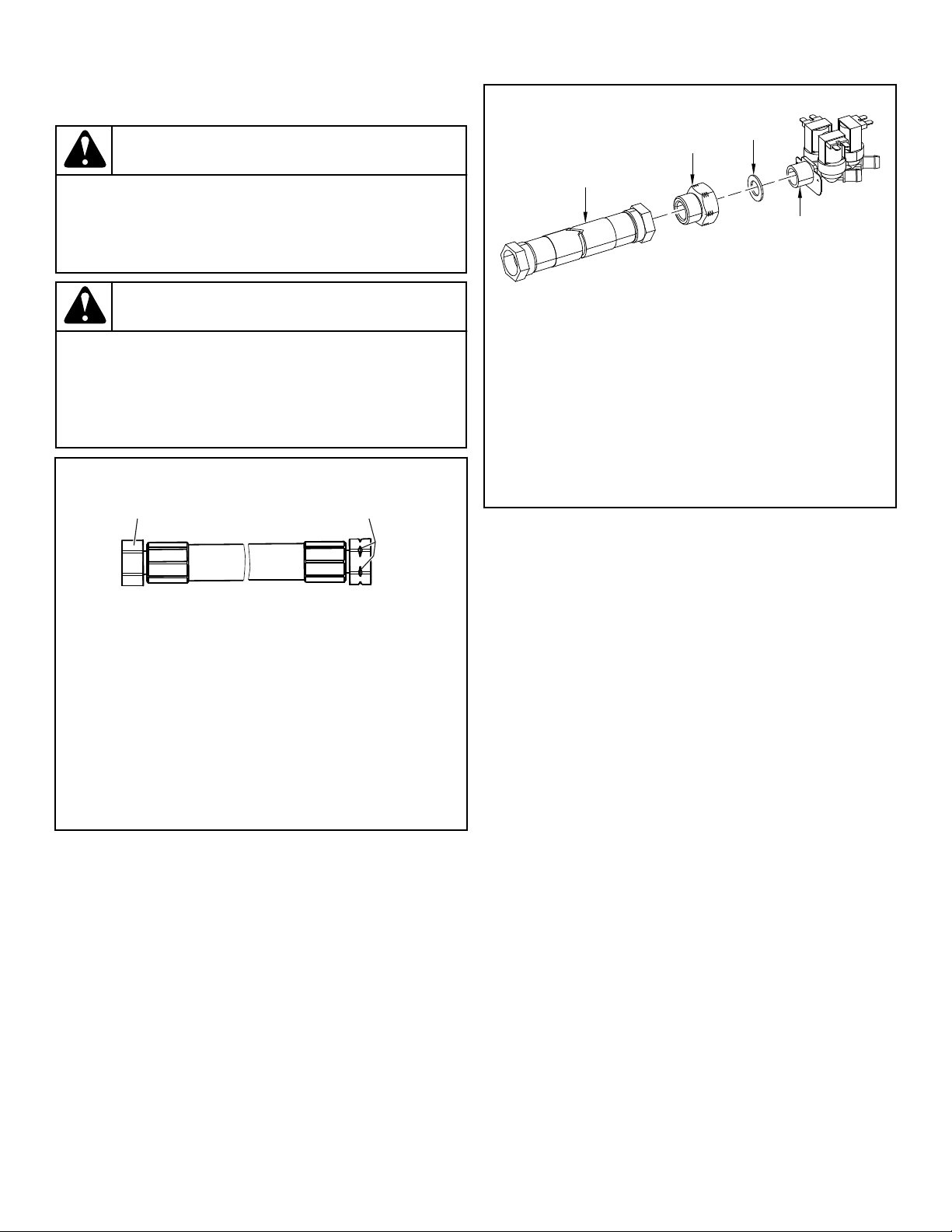
Models manufactured through April, 2017
CHM2503N_SVG
1 2
NOTE: North American Models: Water inlet hose with
notches should be connected to the water supply
faucet, while the side of the water inlet hose without
notches should be connected to the water inlet
valves.
1. Water inlet valve connection (hose connection without
notch)
2. Water supply faucet connection (hose connection with
notch)
Figure 15
Models manufactured starting May, 2017
C-CZW2N
1
2
3
4
NOTE: North American Models: Install threaded re-
duction pieces together with sealant on all inlet
valves. The filling hose end piece with an internal fil-
ter must be connected to the water inlet tap. The
second end of the hose must be connected to a re-
duction piece.
1. Hose
2. Reduction
3. Seal
4. Valve
Figure 16
NOTE: Models outside of North America: For 6.5 kg/14
lb./ 65 L, 7.5 kg / 20 lb. / 80 L, 10.5 kg/ 25 lb. / 105 L, 13.5
kg / 30 lb. / 135 L , 18 kg/ 40 lb. / 180 L and 24 kg / 55
lb. / 240 LModels, to connect cold water, use a hose
with plastic elbow. To connect hot water, use a hose
with metal elbow.
Do not re-use water hoses; only use new water hoses.
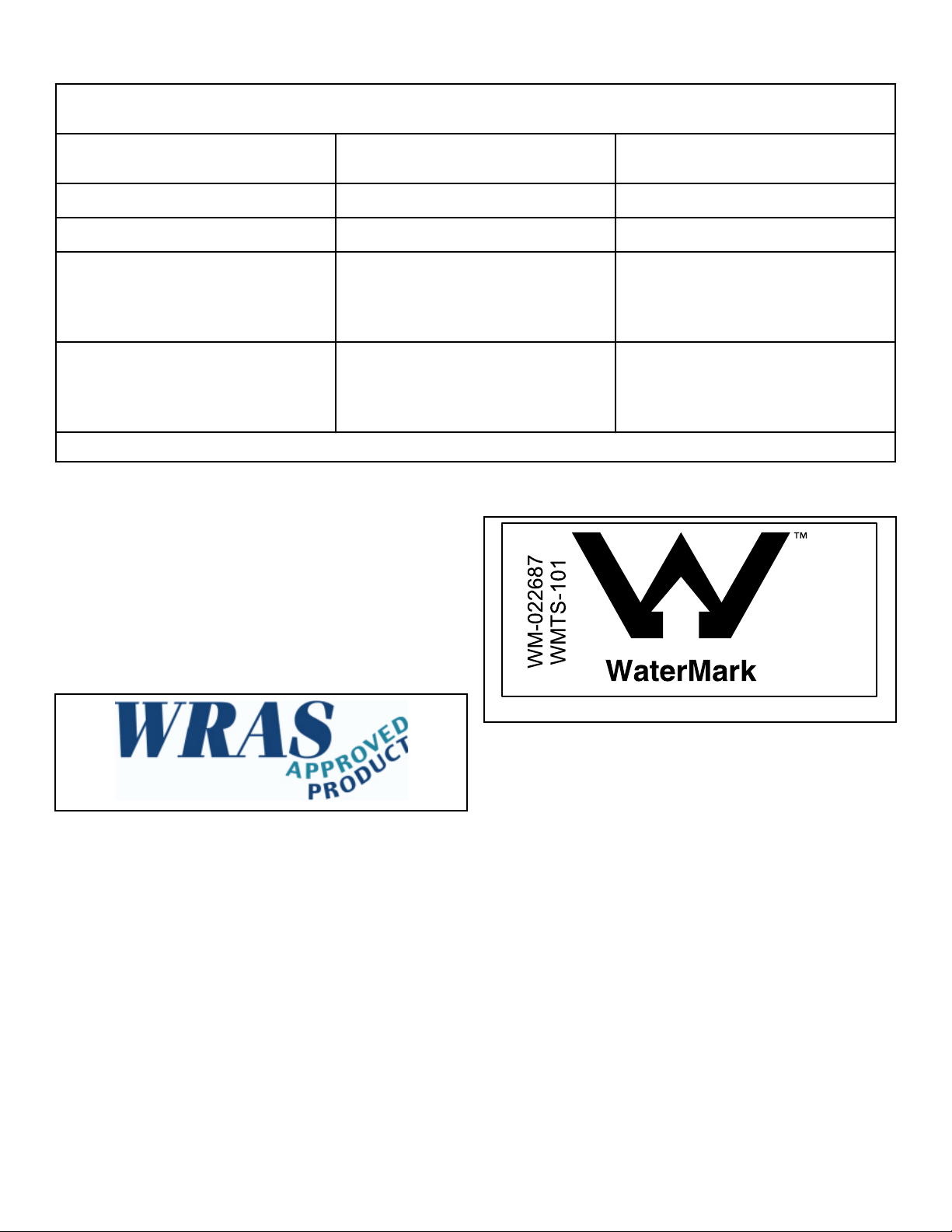
The appliance has been designed with a built-in "AB" airgap sys-
tem according to EN1717. Nevertheless, when potable water will
be connected to the appliance, a WRAS approved double check
valve or some other no less effective device providing backflow
prevention protection to at least fluid category three shall be fit-
ted at the point of connections between the water supply and the
appliance.
All intake connections to the machine are to be fitted with man-
ual shut-off valves and filters, to facilitate installation and servic-
ing.
All water connectors present on the machine must be connected
or the wash program will not function correctly. Refer to Table 11
for possible connection options, which will depend on the water
types to be connected to the machine, which can be found by
checking the machine plates.
Installation
©
Copyright, Alliance Laundry Systems LLC -
DO NOT COPY or TRANSMIT
33 Part No. D1625ENR7
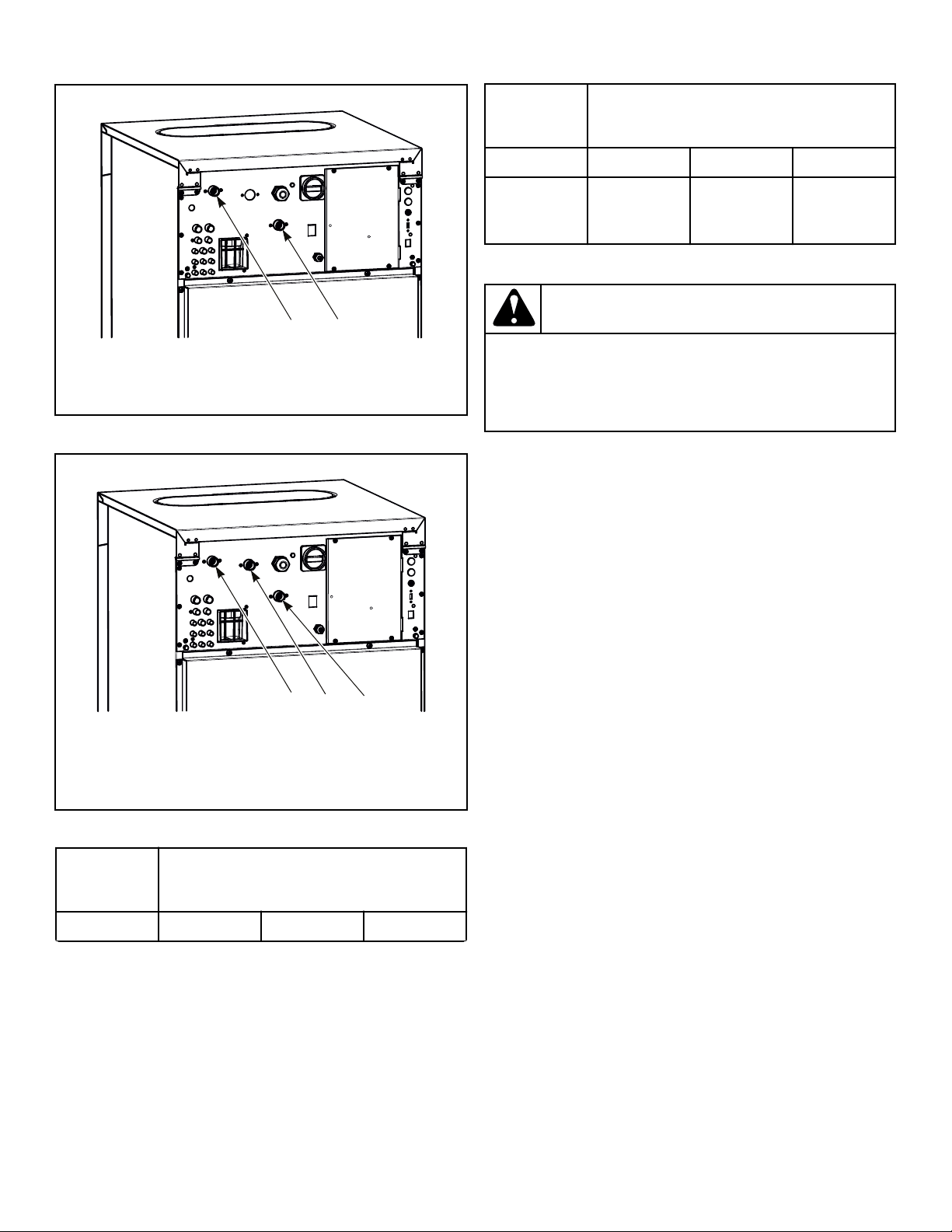
2 Water Connection Models
CHM2475N_SVG
21
1. Refer to Table 11 .
2. Refer to Table 11 .
Figure 17
3 Water Connection Models
CHM2476N_SVG
3
2
1
1. Refer to Table 11 .
2. Refer to Table 11 .
3. Refer to Table 11 .
Figure 18
Water
type Water connection
1 2 3
Table 11 continues...
Water
type Water connection
Cold and Hot Cold Hot N/A
Cold soft,
Cold hard and
Hot
Cold soft Hot Cold hard
Table 11
WARNING
If the water pressure is below the minimum value,
the wash result can not be guaranteed for a selected
program.
W914
The maximum water inlet temperature for vended models is
151°F [66°C]and the maximum water inlet temperature for on-
premises models is 194°F [90°C] (models without WRAS appro-
val) or 140°F [60°C] (WRAS approved models).
Connections should be supplied by a hot and a cold water line of
at least the sizes shown in Water Supply Line Sizing . Installation
of additional machines will require proportionately larger water
lines.
Connections should be supplied by a hot and a cold water line per
national and local codes and in accordance with IEC 61770.
To connect water service to a machine with hoses, use the follow-
ing procedure:
1. Before installing hoses, flush the building’s water system at
the machine connection valves for at least two (2) minutes.
2. Check filters in the machine’s inlet hoses for proper fit and
cleanliness before connecting.
3. Hang hoses in a large loop; do not allow them to kink.
If additional hose lengths are needed or using hoses other than
those supplied by manufacturer, flexible hoses with screen filters
are required.
Installation
©
Copyright, Alliance Laundry Systems LLC -
DO NOT COPY or TRANSMIT
34 Part No. D1625ENR7
Water Connections
Specification Model Requirement
Water inlet connection size, in. BSP All 3/4
Recommended pressure, PSI [bar] All 44-73 [3-5]
Inlet flow capacity per inlet, gal/min [l/
min.]
6.5 kg - 24 kg /
14 lb.- 55 lb./
65 L- 240 L
5.28 [20]
Inlet flow capacity per inlet, gal/min at
60 PSI [l/min. at 4 bar]
18 kg - 28 kg /
40 lb.- 70 lb./
180 L- 280 L*
34.88 [133]
* 18 kg - 24 kg /40 lb.- 55 lb./180 L- 240 L-optional
Table 12
Suitable air cushions (risers) should be installed in supply lines to
prevent “hammering.”
Alliance Laundry Systems, LLC ranges of front loading commer-
cial clothes washing machines have solenoid valves at the inlets.
Minimum and maximum working pressure 1 bar and 8 bar. The
machines are supplied with approved inlet hoses.
Solenoid valves provide machine protection to comply with
WRAS (IRN R150), European standard EN1717.
Figure 19
Connecting Hoses
To comply with Australian water regulations and Australian
standard AS/NZS3500.1, an approved dual check valve backflow
prevention device with the watermark is provided with the unit
and must be fitted at the point of connection(s) between the sup-
ply and the fitting. Refer to Figure 21 .
CZB92N
Figure 20
Connections should be supplied by a hot and a cold water line per
national and local codes and in accordance with AS/NZS 3500.1.
1. Insert rubber washers and filter screens (from accessories
bag) in water fill hose couplings (two hoses supplied with
washer). The filter screen must be facing outward.
NOTE: If using hoses with BSPP thread coupling, in-
sert filter screens into the BLACK colored hose cou-
plings and the rubber washers into the brass col-
ored hose couplings.
2. Connect fill hose couplings with filter screens to water supply
taps.
3. Connect the other hose couplings to the hot and cold valve
connections at the rear of the washer.
NOTE: If using hoses with BSPP thread coupling,
connect the BLACK colored hose coupling end of
the fill hoses (with filter screens) to the water supply
taps. Then connect end of hoses with the brass col-
ored hose couplings to the hot and cold water mix-
ing valve connections at rear of washer.
Installation
©
Copyright, Alliance Laundry Systems LLC -
DO NOT COPY or TRANSMIT
35 Part No. D1625ENR7
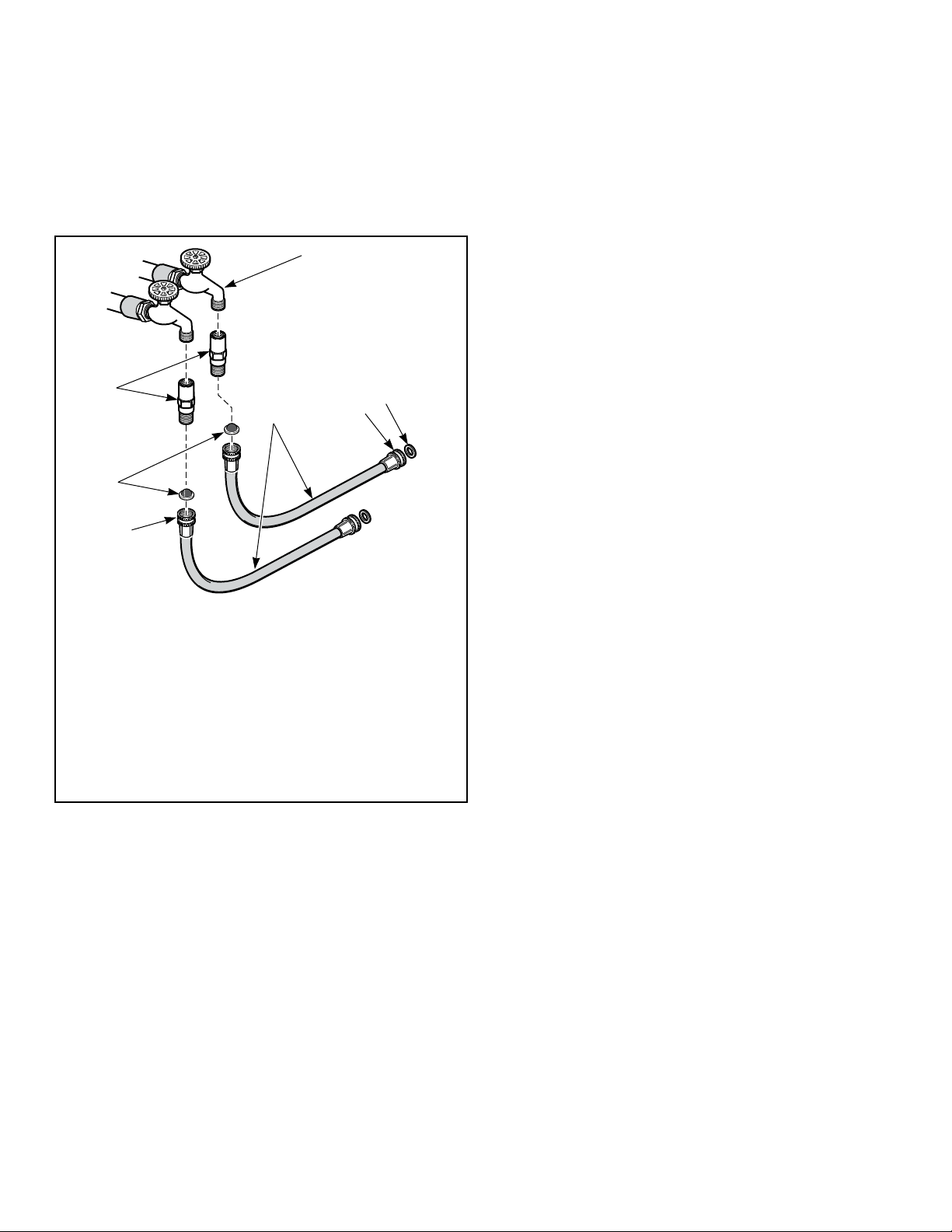
4. Thread hose couplings onto valve connections finger tight.
Then turn 1/4 turn with pliers.
IMPORTANT: DO NOT cross thread or overtighten
couplings. This will cause them to leak.
5. Turn water on and check for leaks.
6. If leaks are found, retighten the hose couplings.
7. Continue tightening and rechecking until no leaks are found.
FLW2216N_SVG
HOT
COLD
7
6
5
4
3
2
1
1. Tap
2. Fill Hoses
3. Install this end of hose to valve connections at rear of
washer
4. Plain Rubber Washer
5. Install this end of hose to water supply tab (Black colored
coupling for BSPP thread)
6. Filter Screens
7. Dual Check Valves
Figure 21
Installation
©
Copyright, Alliance Laundry Systems LLC -
DO NOT COPY or TRANSMIT
36 Part No. D1625ENR7
Water Reuse Connection
WARNING
Disconnect the machine power supply. When the
main switch is turned off, the inlet terminals of the
machine main switch are still under current.
W900
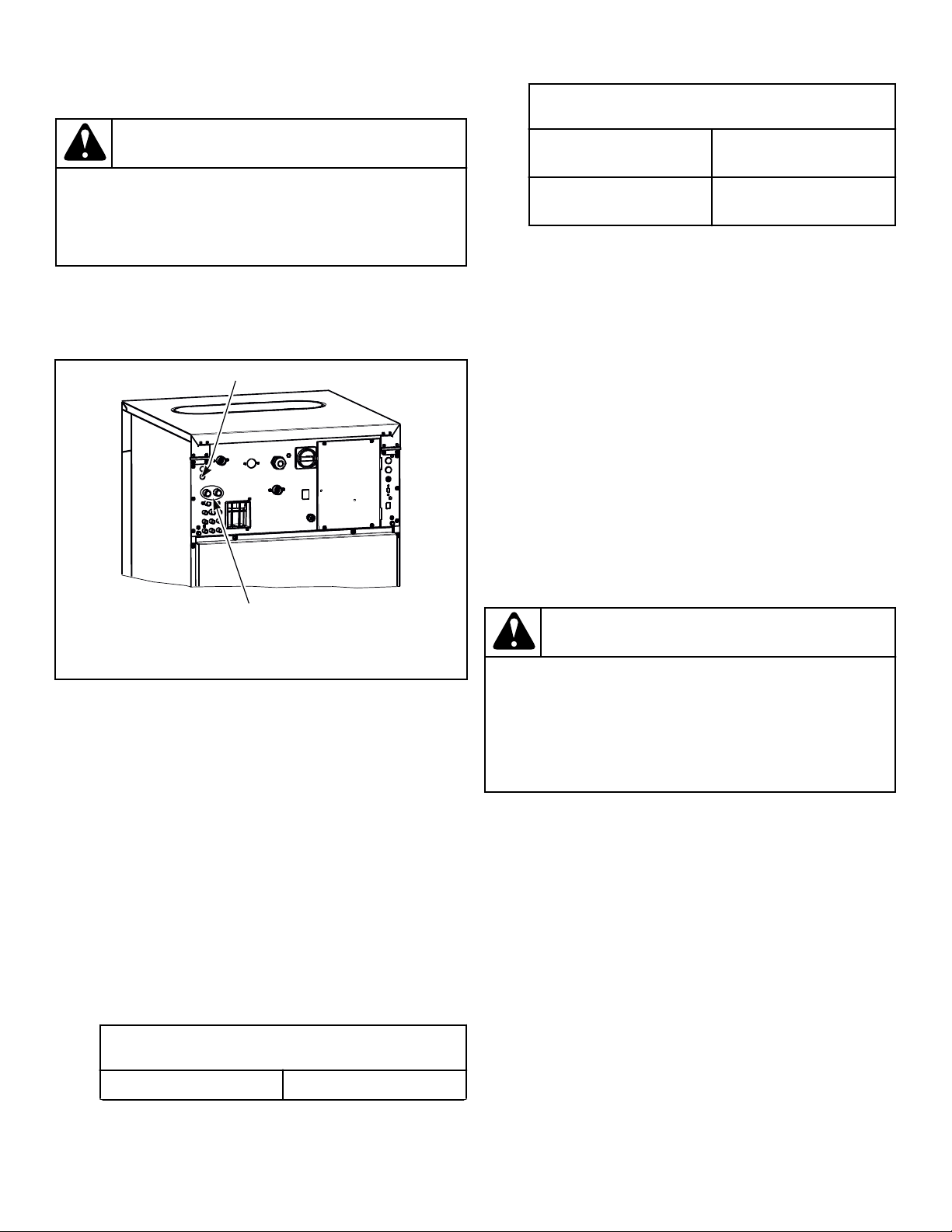
1. Drill out the protective screens of the water reuse inlet using a
drill bit of 0.59 in. [15 mm] diameter. Refer to Figure 22 .
IMPORTANT: Do not pierce the screens open. It
could lead to blockage of the water channel.
CHM2477N_SVG
2
1
1. Cable inlet for control of water reuse valve or pump
2. Water reuse inlet
Figure 22
2. Connect the control of your reuse valve or pump onto the con-
ductor of inlet valve I5 or I7 provided by the manufacturer,
which will disconnect the valve in question from standard
function.
IMPORTANT: The manufacturer waives all responsi-
bility for malfunction of the washing machine if a
different valve than the specified I5 or I7 is used as
the water recycle valve.
3. Fit a cable bushing into the opening, and pull the cable
through the bushing. Refer to Figure 22 .
4. Connect the coil for control of the recuperated water inlet (the
coil is not supplied with the machine), operating voltage
208-240V 50/60 Hz.
5. Secure the cable so that it cannot be pulled out of the machine
or inlet valve.
Water Reuse Specifications
Temperature range, °F [°C] 41 to 194 [5 to 90]
Table continues...
Water Reuse Specifications
Maximum pressure, PSI
[bar]
116 [8]
Connection - outside diam-
eter, in. [mm]
0.75 [19]
The hose and the connector must be resistant to chemical sub-
stances which are used for the washing process. It is also possible
to use a hose with enhanced performance such as the rubber
EPDM hose.
The water reuse system must be fitted with a filter which must be
regularly and thoroughly cleaned (based on water quality). This
cleaning prevents prolongation of filling up times and malfunc-
tion of water valves.
Reused Water Treatment
The reused water must be filtered before entering the water reuse
tank. A mechanical filter must be installed which filters off small
particles (fluff, buttons, paper, etc.) of sizes 0.0079 in. [0.2 mm]
or smaller. The denser the mesh, the better. There must also be a
filter installed on the pressure side of the pump. It is also possible
to install an additional, chemical filter. The manufacturer advises
to consult a specialist in filter systems.
Water Reuse Tank Properties
WARNING
It is prohibited to heat the water in the reuse tank.
This would disturb the temperature balance of the
washer and make the remaining chemicals in the re-
cuperated water more active, which would lead to
corrosion of the entire installation.
W901
The reuse tank must meet the following minimum requirements:
• The tank must be made according to national standards.
• Tank capacity varies depending on multiple factors, so it must
be calculated by an authorized engineer. The factors are:
• The number of washing steps per washer, in which the wa-
ter will be re-used.
• The programmable amount of water that will be re-used in
a washing step (to find this amount, please refer to the
Programming Manual).
• The number of washers that will deliver water to the re-
use tank.
• The use of recuperated water per washer.
The tank must have an overflow to the sewer. Water from the
sewer must not be able to flow back into the reuse tank.
Installation
©
Copyright, Alliance Laundry Systems LLC -
DO NOT COPY or TRANSMIT
37 Part No. D1625ENR7
The network of pipes and hoses, the water pump and the reuse
tank must be of a non-corroding material. It must be resistant to
water and chemicals used for washing.
The tank must be equipped with a system that fills the tank with
clean water to a minimum required working level, in case the wa-
ter level drops below this minimum. If this requirement is not met
and an insufficient or no amount of recuperated water is fed into
the washer, it will not function properly.
A pump must transport the recuperated water from the tank to the
washer. The requirements for the pump depend on the number
and type of washers that are connected to the water re-use sys-
tem. The maximum pump pressure is 116 psi [8 bar].
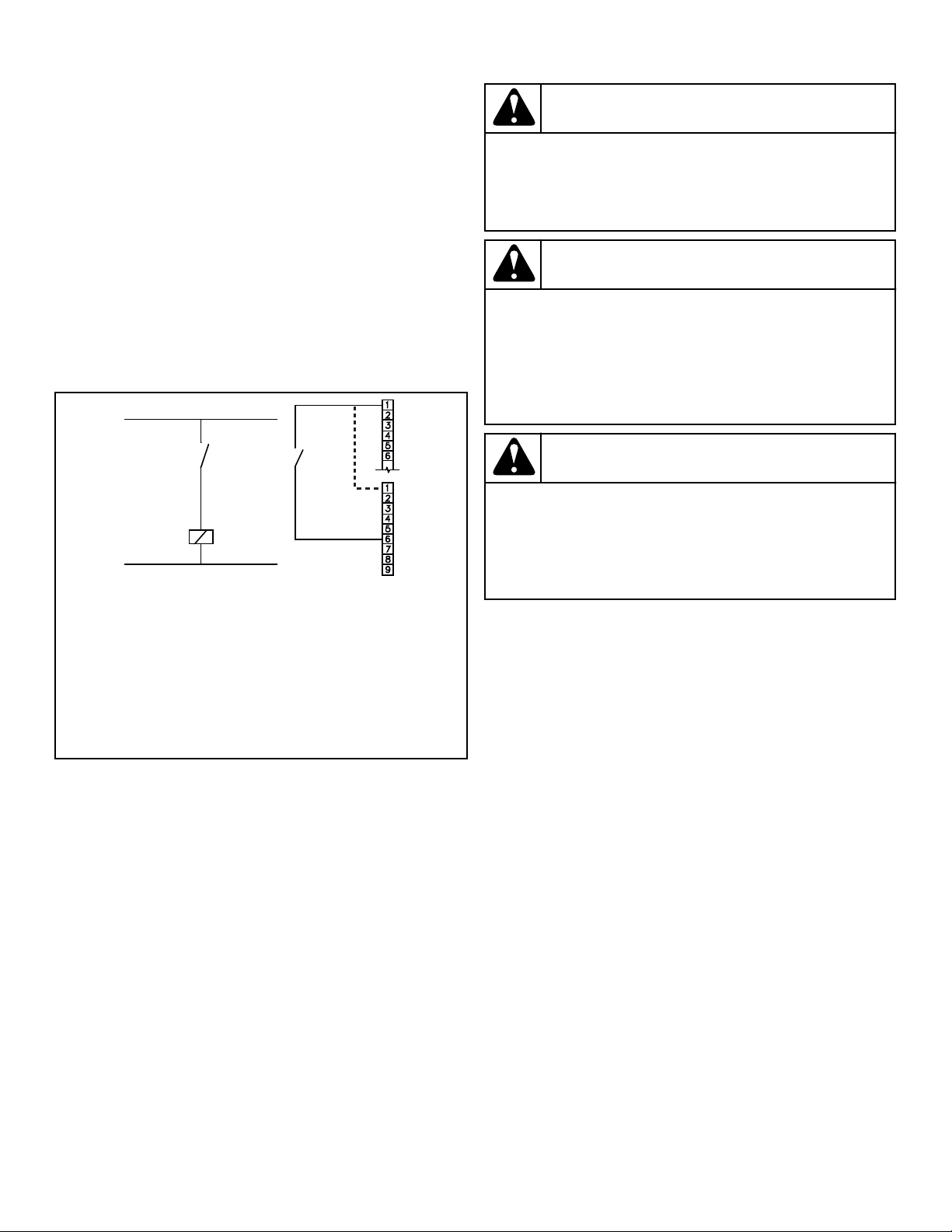
It is advisable to install a level switch. This level switch must be
connected to the microprocessor by means of a potential-free
contact. Refer to Figure 23 .
CHM2560N_SVG
7
6
5
4
3
2
1
1. L
2. Level switch
3. K1
4. Terminal A
5. Terminal B
6. K1
7. N
Figure 23
The relay contact K1 has to close when the water level is too low.
Terminal B is positioned on the left side, in the lower part of the
microprocessor. Terminal A is positioned directly above Terminal
B. The microprocessor is positioned inside the washer. If the
"Check signal recycle" parameter is set to "yes" in the configura-
tion menu, the timer will send a signal if the water level of the
reuse tank is too low.
Electrical Installation Requirements
IMPORTANT: Electrical ratings are subject to change.
Refer to serial plate for electrical ratings information
specific to your machine.
DANGER
Electrical shock hazard will result in death or serious
injury. Disconnect electric power and wait ten (10)
minutes before servicing.
W911
WARNING
Dangerous voltages are present inside the machine.
Only qualified personnel should attempt adjustments
and troubleshooting. Disconnect power from the ma-
chine before removing any cover and guards, and
before attempting any service procedures.
W736
WARNING
Hazardous Voltage. Can cause shock, burn or death.
Verify that a ground wire from a proven earth ground
is connected to the lug near the input power block
on this machine.
W360
IMPORTANT: If the machine is not equipped with a
main switch, supply disconnecting devices need to be
provided in the installation for all electrical supplies
connected to the machine, in accordance with EN
60204-1 standard, point 5.3.
IMPORTANT: Make sure the supply voltage is always
within the limits specified. When you have long distan-
ces in the electrical installation, it may be necessary to
use bigger cables to reduce the voltage drop.
Models outside of North America:
IMPORTANT: When the machine is connected near a
large capacity power supply transformer (500kVA or
more, wiring length shorter than 32.81 ft [10 m]) or
there is a power capacitor switch-over, a power supply
improving reactor must be installed. If you do not in-
stall this, the inverter may get damaged. Contact your
distributor for more information.
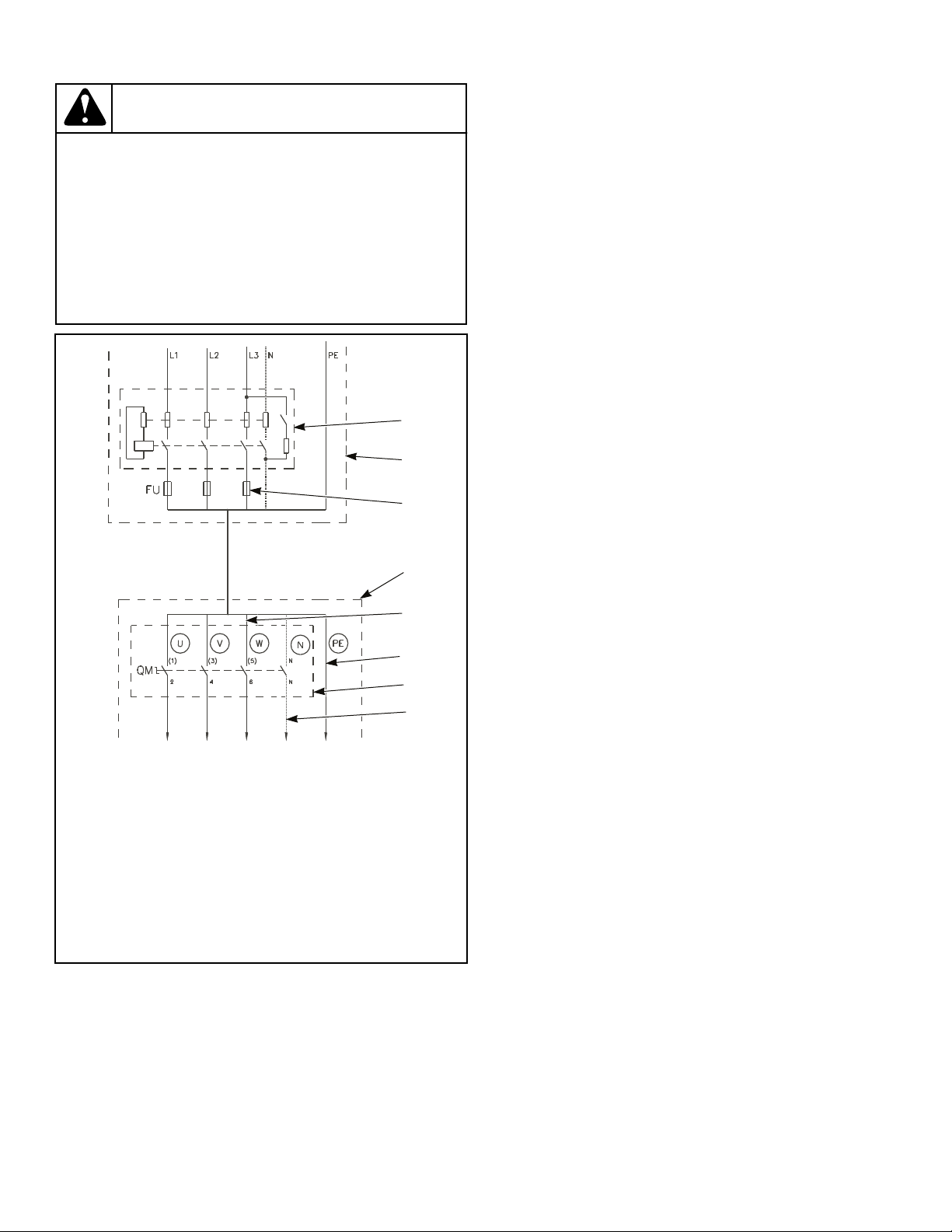
Models outside of North America: For electrical protection, if re-
quired by local regulations, there must be installed a residual cur-
rent device (RCD) and a circuit breaker in the electrical installa-
tion of the building (laundry switchboard). Refer to Figure 24 .
Electrical connections are made at the rear of the machine. The
machine must be connected to the proper electrical supply shown
on the serial plate on the rear of the machine, using copper con-
ductors only.
Installation
©
Copyright, Alliance Laundry Systems LLC -
DO NOT COPY or TRANSMIT
38 Part No. D1625ENR7
WARNING
Grounding: In event of malfunction, breakdown or
leakage current, grounding will reduce the risk of
electrical shock and serve as a protecting device by
providing a path of least resistance of electrical cur-
rent. Therefore, it is very important and the responsi-
bility of the installer to assure the washer is ade-
quately grounded at installation, following all nation-
al and local requirements.
W902
CHM2486N_SVG
8
7
6
5
4
3
2
1
1. Residual current device (RCD) (models outside North
America)
2. Laundry electrical switchboard
3. Supply protection device
4. Washing machine
5. Phase conductors
6. Protective conductor
7. Main switch inlet terminal switchboard
8. Neutral conductor
Figure 24
IMPORTANT: Alliance Laundry Systems warranty does
not cover components that fail as a result of improper
input voltage.
Residual Current Device (RCD) - Models Outside
of North America
In some countries, an RCD is known as an Earth Leakage Trip,
Ground Fault Circuit Interrupter (GFCI), Appliance Leakage
Current Interrupter (ALCI) or Earth (Ground) Leakage Current
Breaker.
When locally allowed, an RCD must be installed. In some power
network earthing systems, an RCD may not be allowed.
The RCD must have the following specifications:
• Tripping current of 100mA (if not locally available/allowed,
use a 30mA trip current, preferably selective type with small
time delay set)
• Type B (components inside the machine which make use of
DC voltages and require this better performance RCD)
• Maximum of 2 machines installed on each RCD (for 30mA,
only 1 machine)
Some washer control circuits are supplied with a separating trans-
former. Therefore, the RCD may not detect faults in the control
circuits (but the fuse(s) on the separating transformer will).
Supply Protection Device
A supply protection device protects the machine and wiring
against short circuits. (Glow-wire) fuses or (automatic) circuit
breakers may be used as supply protection devices.
Protection must be the "slow" type, which means curve D for cir-
cuit breakers.
Installation
©
Copyright, Alliance Laundry Systems LLC -
DO NOT COPY or TRANSMIT
39 Part No. D1625ENR7
Supply Cable
The supply cable is not delivered with the machine. The supply
cable must have the following specifications:
• Conductors with copper cores (For wire size details, refer to
Electrical Specifications - Models Outside of North America
or Electrical Specifications - North American Models)
• Stranded conductors (flexible wiring) that can withstand vi-
bration from machine
• For crossection size, refer to Table 13
• Route the supply cable as short as possible, directly from the
supply protection device to the washer without branching off
• Do not use a plug or extensions cords (the machine is inten-
ded to be permanently connected to the electrical network)
Determining AWG Sizes
Power supply protection device nominal current
Min. phase conductor
section, AWG [mm
2
]
Min. protection conduc-
tor section, AWG [mm
2
]
Automatic circuit break-
ers Fuses
16A (15A) 10A (10A) 15 [1.5] 15 [1.5]
20A (20A) 16A (15A) 13 [2.5] 13 [2.5]
25A (-) 20A (20A) 11 [4] 11 [4]
40A (40A) 32A (30A) 9 [6] 9 [6]
63A (-) 50A (50A) 7 [10] 7 [10]
80A 63A 5 [16] 5 [16]
100A 80A 3 [25] 5 [16]
125A 100A 2 [35] 3 [25]
Table 13
To connect the supply cable, the following steps must be per-
formed:
1. Insert cable through opening on rear panel. Insure a strain re-
lief is used so the supply cable can not move.
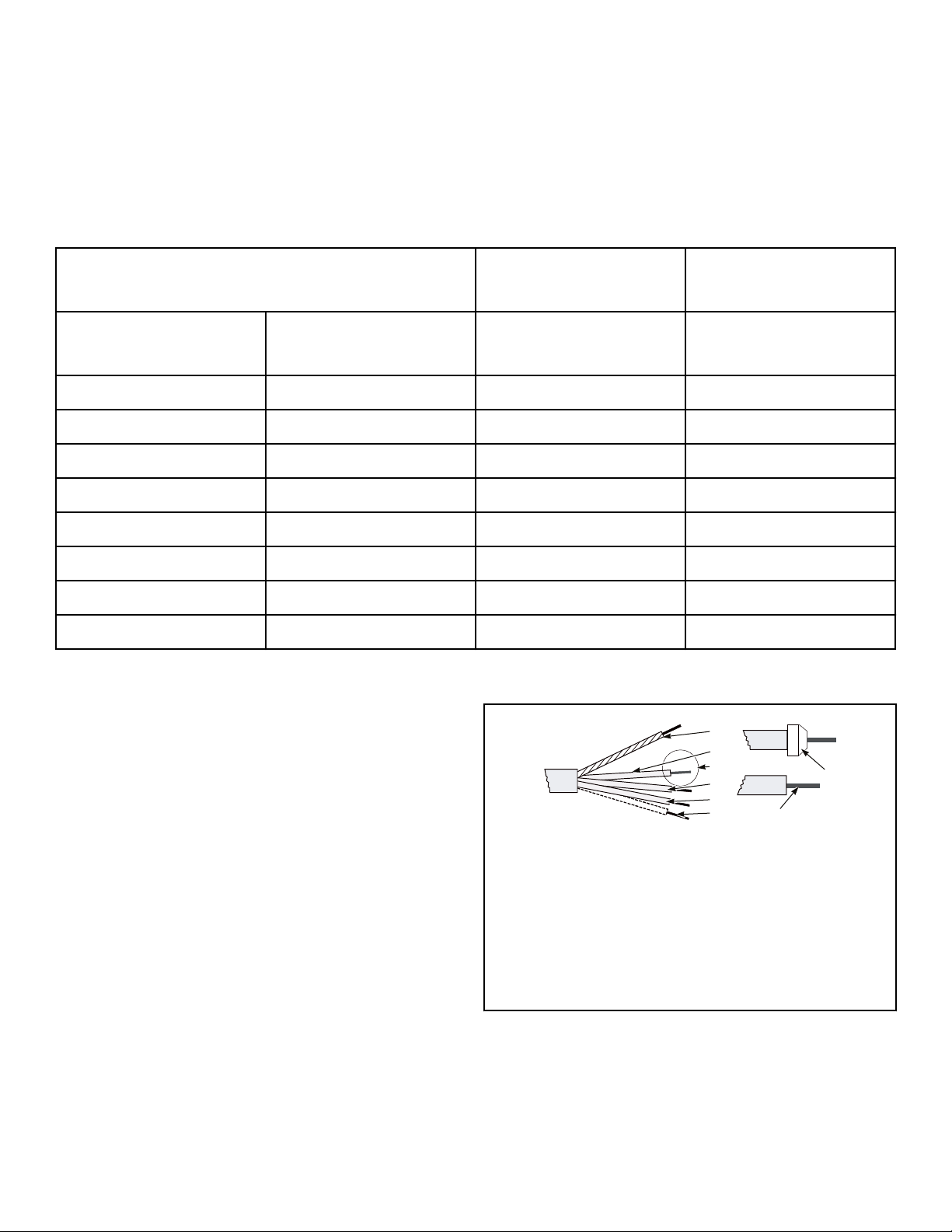
2. Strip the conductor ends. Refer to Figure 25 . The protection
conductor must be longer so it can be routed to the machine
without tension.
CHM2487N_SVG
7
6
5
4
3
2
1
1. Protection conductor
2. Phase conductor
3. Phase conductor
4. Phase conductor
5. Neutral conductor
6. Molded tube
7. Stripped length of conductors
Figure 25
3. With stranded conductors, use wire end tubes with an insula-
ted sleeve (6) for L1/U, (L2/V), (L3/W), (N) conductors.
Make sure there is no accidental contact, since the supply ca-
ble stays under voltage even when the main switch is off.
Installation
©
Copyright, Alliance Laundry Systems LLC -
DO NOT COPY or TRANSMIT
40 Part No. D1625ENR7
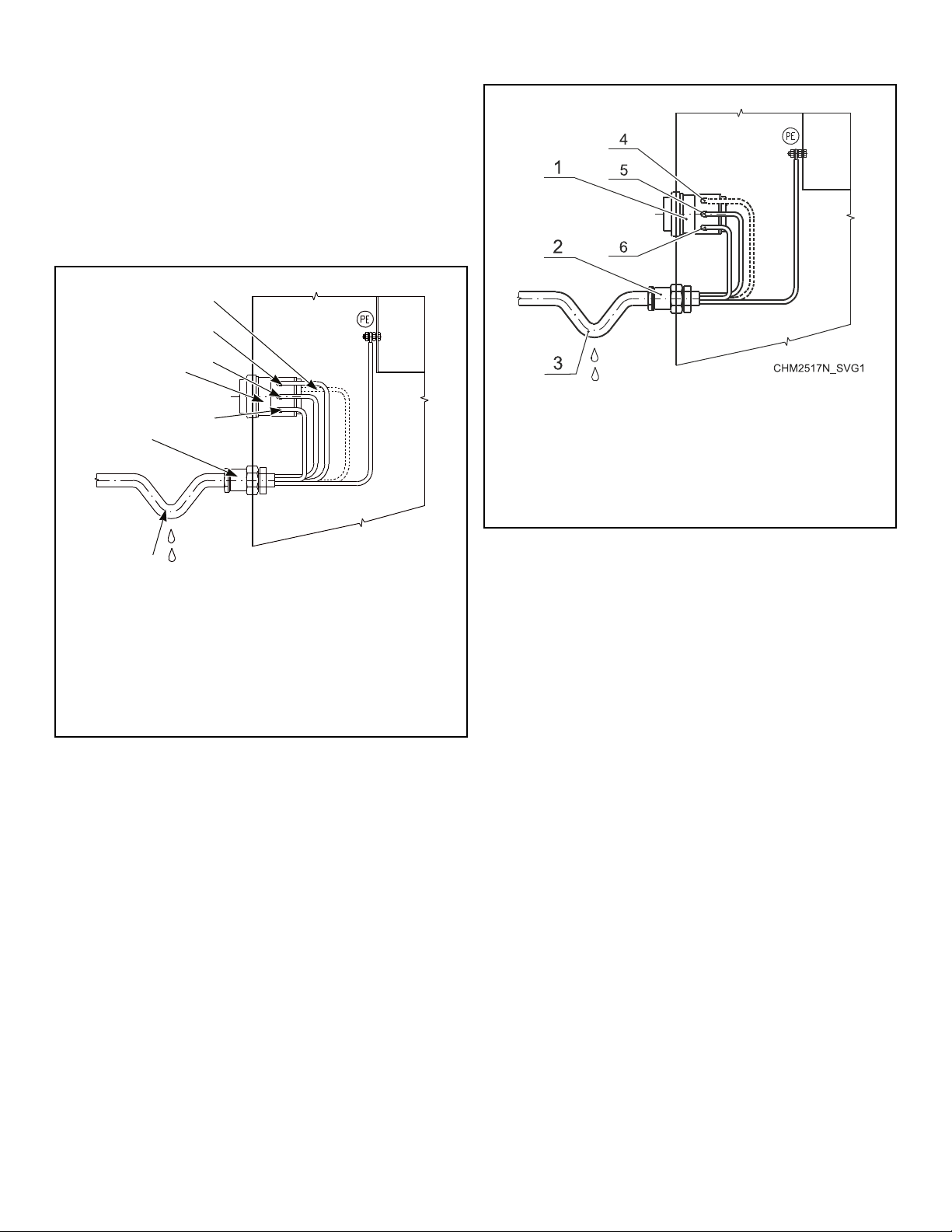
4. Crimp a ring terminal to the protection conductor so it stays
fixed to the PE terminal.
5. Connect the supply cable conductors to the incoming termi-
nals (main switch [1]), marked with L1/U, (L2/V), (L3/W),
(N) and the terminal marked with PE. Refer to Figure 26 or
Figure 27 .
6. Provide a sag in the cable, in front of the strain relief. This
will prevent condensed water from dripping into the machine.
Refer to Figure 26 or Figure 27 .
Models outside of North America
CHM2488N_SVG
7
6
5
4
3
2
1
1. Main switch
2. Strain relief
3. Sag of inlet cable
4. N
5. W
6. V
7. U
Figure 26
North American Models
1. Main switch
2. Strain relief
3. Sag of inlet cable
4. L3
5. L2
6. L1
Figure 27
Machine Protective Earth Connection and
Equipotential Bonding
If there are other washers or appliances with exposed conductive
parts, which can touch simultaneously, make sure to make equi-
potential bonding between all these appliances. The external pro-
tective terminal for this purpose is located on the rear panel of the
machine frame. The minimum protection conductor's cross sec-
tion depends on the supply cable cross section (refer to Table
13 ). However, for the protection purposes, with the supply cable
cross section of a min. 4 mm
2
, select a larger conductor section,
i.e., 6 mm
2
.
Installation
©
Copyright, Alliance Laundry Systems LLC -
DO NOT COPY or TRANSMIT
41 Part No. D1625ENR7
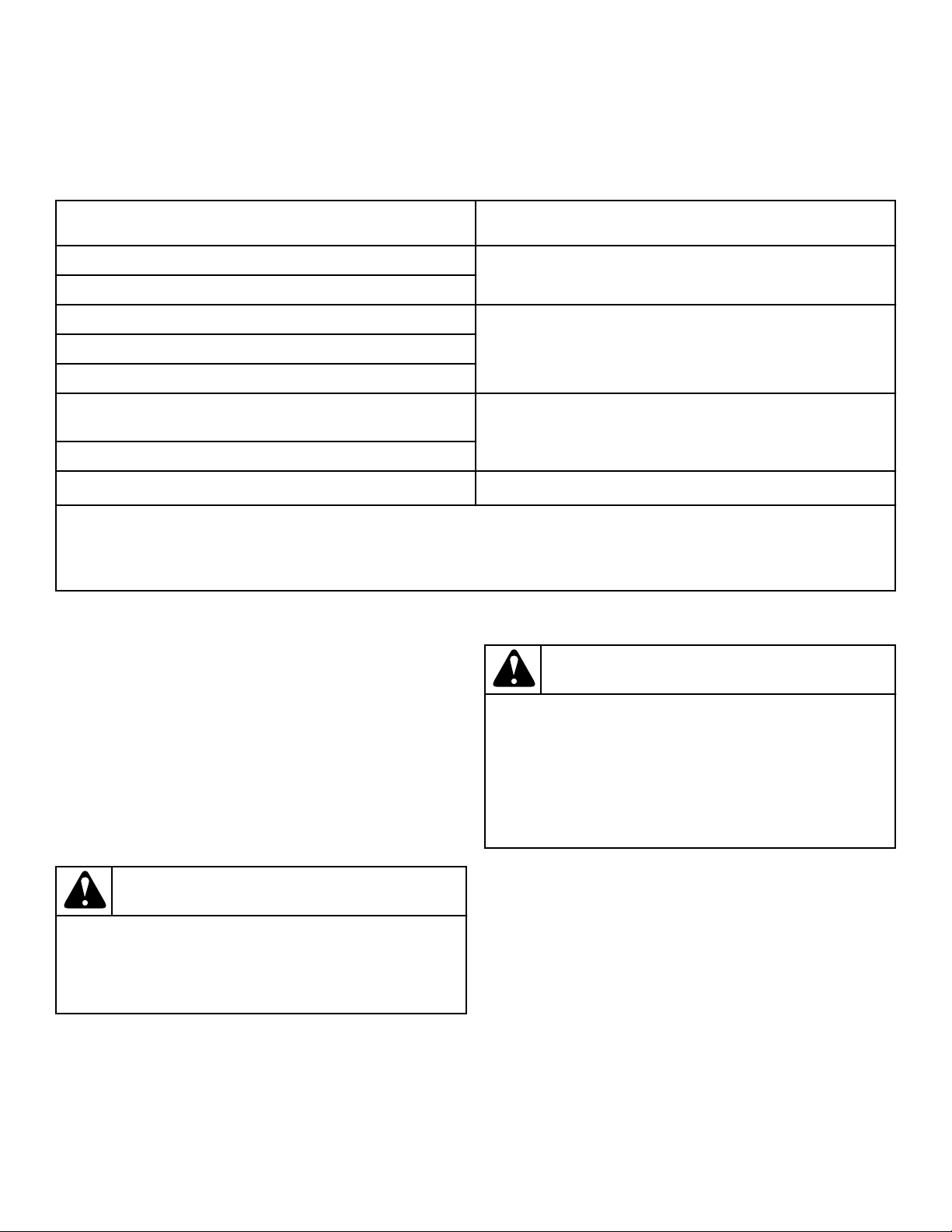
Input Power Conditioning
The drive is suitable for direct connection to input power within
the rated voltage of the drive. Listed in Input Power Condition
are certain input power conditions which may cause component
damage or reduction in product life. If any of the conditions exist,
install one of the devices listed under the Possible Corrective Ac-
tion(s).
IMPORTANT: Only one device per branch circuit is re-
quired. It should be mounted closest to the branch and
sized to handle the total current of the branch circuit.
Input Power Condition Possible Corrective Action(s)
Low Line impedance (less than 1% line reactance) • Install Line Reactor
• Isolation Transformer
Greater than 120 kVA supply transformer
Line has power factor correction capacitors • Install Line Reactor
• Isolation Transformer
Line has frequent power interruptions
Line has intermittent noise spikes in excess of 6000V (lightning)
Phase to ground voltage exceeds 125% of normal line to line
voltage
• Remove MOV jumper to ground
• Install Isolation Transformer with grounded secondary (if
necessary)
Ungrounded distribution system
240V open delta configuration (stinger leg)* • Install Line Reactor
* For drives applied on an open delta with a middle phase grounded neutral system, the phase opposite the phase that is tapped in the
middle to the neutral or earth is referred to as the “stinger leg,” “high leg,” “red leg,” etc. This leg should be identified throughout
the system with red or orange tape on the wire at each connection point. The stinger leg should be connected to the center Phase B
on the reactor.
Table 14
Input Voltage Requirements
For voltages above or below listed specifications, contact your
power company or local electrician.
If machine is intended for four-wire service, a neutral leg must be
provided by power company.
If a delta supply system is used on a four-wire model, connect
high leg to L3.
IMPORTANT: Improper connections will result in equip-
ment damage and will void warranty.
DANGER
Electrical shock hazard will result in death or serious
injury. Disconnect electric power and wait five (5) mi-
nutes before servicing.
W810
DANGER
Hazardous Rotation Speed. Will cause serious injury
when controlling AC inverter drive with a parameter
unit, safety features are bypassed allowing basket to
rotate at high speeds with the door open. Place large
sign on front of machine to warn people of imminent
danger.
W361
Circuit Breakers and Quick Disconnects
Single-phase machines require a single-phase inverse-time circuit
breaker. Three-phase machines require a separate, three-phase in-
verse-time circuit breaker to prevent damage to the motor by dis-
connecting all legs if one should be lost accidentally. Refer to
section for model-specific circuit breaker requirements.
IMPORTANT: All quick disconnects should comply with
the specifications. DO NOT use fuses instead of circuit
breakers.
Installation
©
Copyright, Alliance Laundry Systems LLC -
DO NOT COPY or TRANSMIT
42 Part No. D1625ENR7
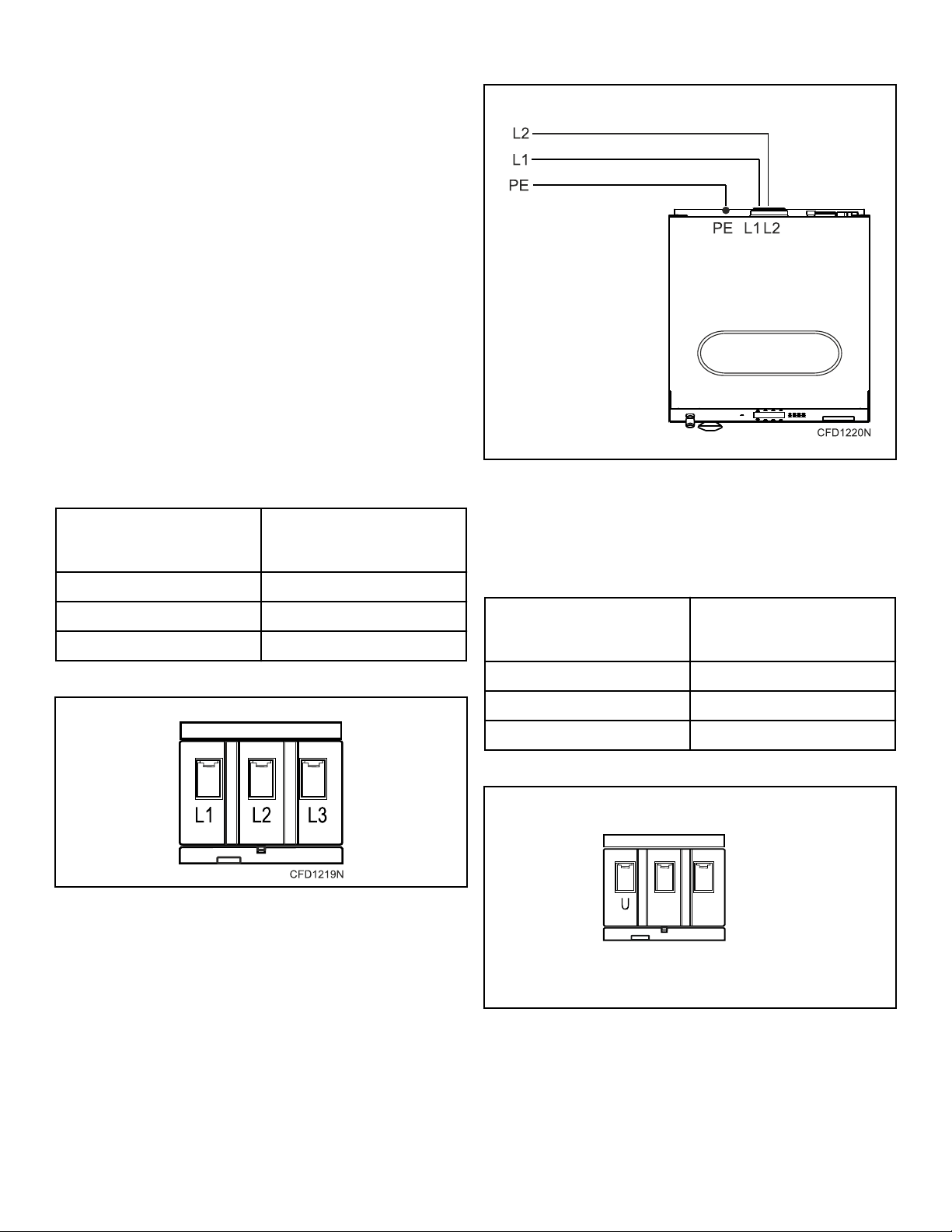
Connection Specifications
IMPORTANT: Connection must be made by a qualified
electrician using wiring diagram provided with ma-
chine, or according to accepted European Union stand-
ards.
Connect machine to an individual branch circuit not shared with
lighting or other equipment. Shield connection in a liquid-tight or
approved flexible conduit. Copper conductors of correct size
must be installed in accordance with National Electric Code
(NEC) or other applicable codes.
Use wire sizes indicated in the Electrical Specifications chart for
runs up to 50 feet [15 m]. Use next larger size for runs of 50 to
100 feet [15 to 30 m]. Use two (2) sizes larger for runs greater
than 100 feet [30 m].
Single-Phase Connections
Single Phase Connection - North American Models
Connect the electrical service's wires to the machine's electrical
connection terminal as shown.
Electrical Service Wire
Machine's Electrical
Connection Terminal
L1 L1
L2 L2
PE PE (Ground)
Table 15
Electrical Connection Terminal Block
Figure 28
North American Models with Single-Phase Connec-
tion
Figure 29
Single Phase Connection - Models outside of North
America
Connect the electrical service's wires to the machine's electrical
connection terminal as shown.
Electrical Service Wire
Machine's Electrical
Connection Terminal
U U
Neutral N
PE PE (Ground)
Table 16
Electrical Connection Terminal Block
N
CHM2499N_SVG
Figure 30
Installation
©
Copyright, Alliance Laundry Systems LLC -
DO NOT COPY or TRANSMIT
43 Part No. D1625ENR7
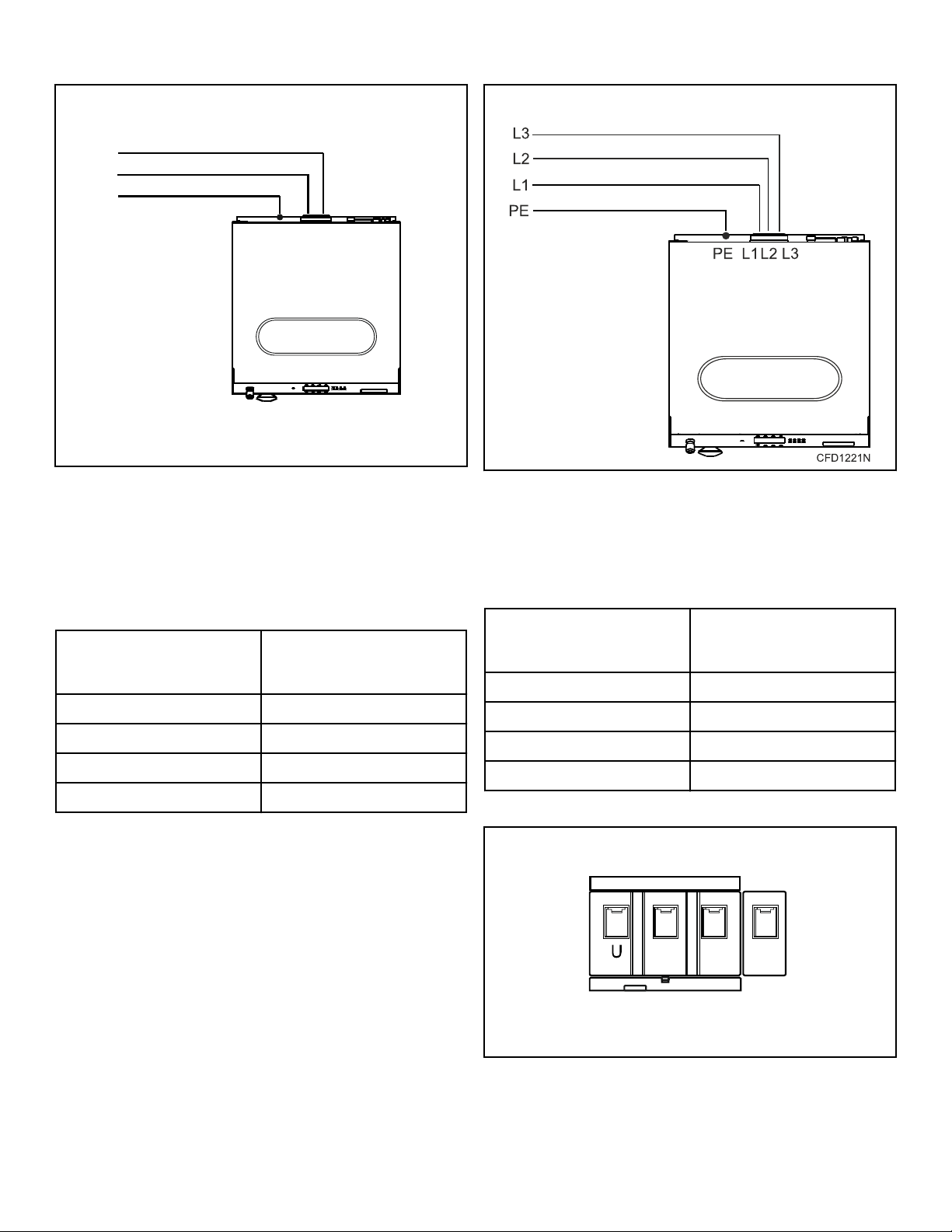
Models outside of North America with Single-Phase
Connection
PE U N
PE
N
U
CHM2500N_SVG
Figure 31
Three-Phase Connections
Three Phase Connection - North American Models
Connect the electrical service's wires to the machine's electrical
connection terminal as shown.
Electrical Service Wire
Machine's Electrical
Connection Terminal
L1 L1
L2 L2
L3 L3
PE PE (Ground)
Table 17
North American Models with Three-Phase Connec-
tion
Figure 32
Three Phase Connection - Models Outside of North
America
Connect the electrical service's wires to the machine's electrical
connection terminal as shown.
Electrical Service Wire
Machine's Electrical
Connection Terminal
U U
V V
W W
PE PE (Ground)
Table 18
Electrical Connection Terminal Block
V W N
CHM2501N_SVG
Figure 33
Installation
©
Copyright, Alliance Laundry Systems LLC -
DO NOT COPY or TRANSMIT
44 Part No. D1625ENR7
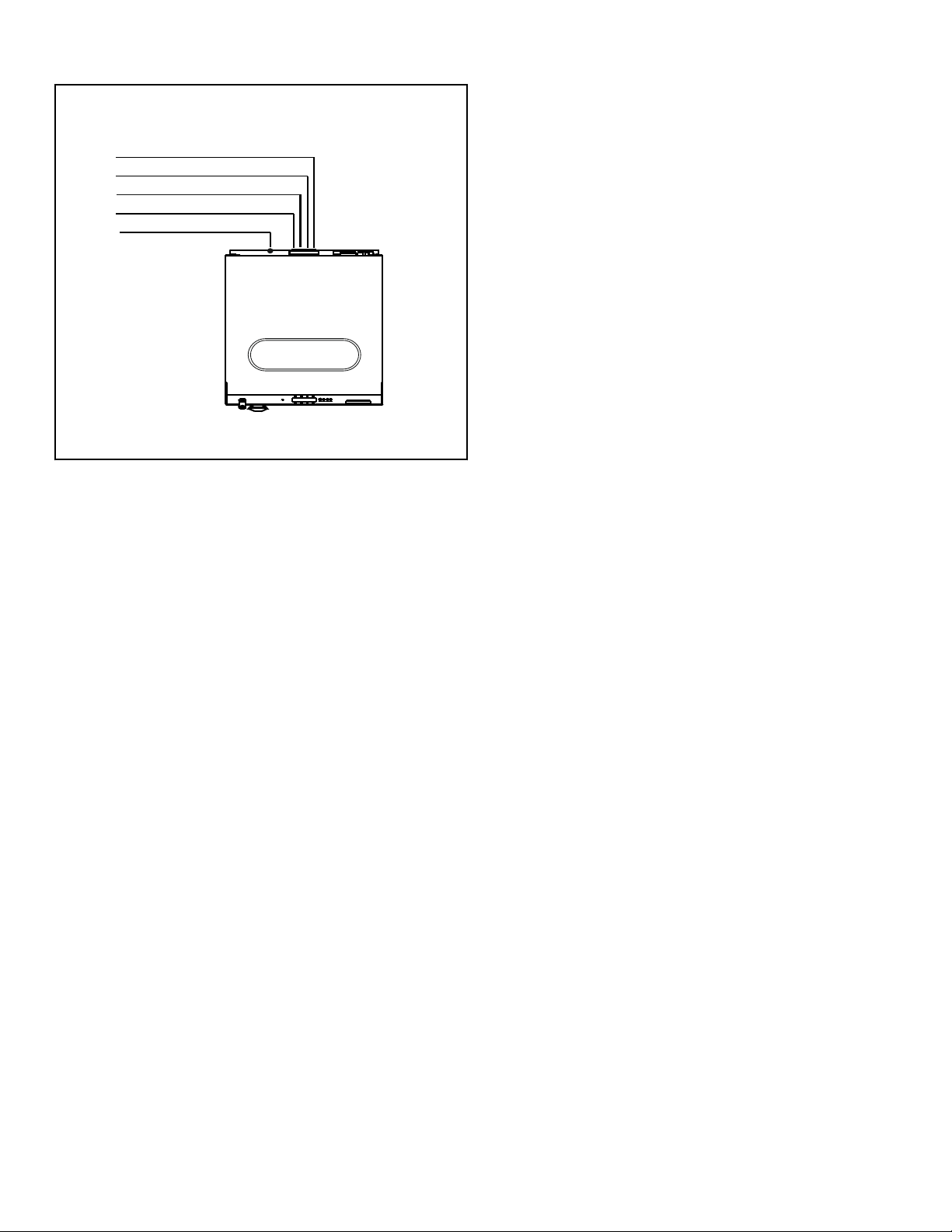
Models Outside of North America with Three-Phase
Connection
U
V
PE UV
W
W
PE
N
N
CHM2502N_SVG
Figure 34
Phase Adder
Machines can be converted for lower voltage operation and/or 50
Hz operation. Refer to conversion label by serial plate for details.
IMPORTANT: Do not use a phase adder on any ma-
chine.
Voltage Settings
The machines are designed and manufactured for a voltage range.
Refer to the serial plate for votage range information specific to
your machine.
Make sure the supply voltage is always within the limits
specified.
When a transformer is provided (control or step down transform-
er), it is set to the highest voltage of the range at the manufactur-
ing facility. If, at installation, the nominal supply voltage is lower,
the appropriate voltage terminal on the transformer must be se-
lected. For example, if the voltage range is 208-240V, the connec-
ted terminal transformer will be 240V. If the supply voltage is
208V, redirect the voltage wire to the 208V terminal.
Frequency Settings
The machines are designed and manufactured for 50/60HZ. Refer
to the serial plate for frequency information specific to your ma-
chine.
Make sure the frequency is always within the limits specified.
When a gravity drain is provided (no pump execution), the facto-
ry setting for the drain valve is 60Hz for North American models
and 50Hz for models outside of North America.
If the frequency required at installation is different than the de-
fault setting, redirect the voltage wire to the appropriate frequen-
cy terminal at the drain valve.
Thermal Overload Protector
For models with inverter drives, the inverter drive provides over-
load protection for the drive motor.
Installation
©
Copyright, Alliance Laundry Systems LLC -
DO NOT COPY or TRANSMIT
45 Part No. D1625ENR7
Electrical Specifications
6.5 kg/14 lb./65 L Models
Voltage (V)
Frequency (Hz)
Phase
Wire
Standard Electric Heat
Total Power (kW)
Full Load Amps (A)
Fuse (A)
Total Power (kW)
Full Load Amps
(Electric Heating kW)
Fuse (A)
200-240 50/60 1 2 (L1, L2,
or L1, N)
0.85 6.6 10 3.6 17.9 (3) 20
5.2 24.9 (4.6) 32
200-240 50/60 3 3 (L1, L2,
L3)
0.85 6.6 10 6.7 20 (6) 25
9.7 27.5 (9) 32
380-415
+ N
50/60 3 4 (L1, L2,
L3, N)
0.85 6.6 10 5.3 10 (4.6) 16
6.7 13.5 (6) 16
9.7 18 (9) 20
380-415 50/60 3 3 (L1, L2,
L3)
0.85 2.4 10 6.7 9.9 (6) 16
9.7 15.3 (9) 20
440-480 50/60 3 3 (L1, L2,
L3)
0.85 2.4 10 7.7 11.6 (7) 16
9.7 13.8 (9) 16
Table 19
Installation
©
Copyright, Alliance Laundry Systems LLC -
DO NOT COPY or TRANSMIT
46 Part No. D1625ENR7
7.5 kg/20 lb./80 L Models
Voltage (V)
Frequency (Hz)
Phase
Wire
Standard Electric Heat
Total Power (kW)
Full Load Amps (A)
Fuse (A)
Total Power (kW)
Full Load Amps
(Electric Heating kW)
Fuse (A)
200-240 50/60 1 2 (L1, L2,
or L1, N)
0.85 6.7 10 3.6 18 (3) 20
5.2 25.1 (4.6) 32
200-240 50/60 3 3 (L1, L2,
L3)
0.85 6.7 10 6.7 20.2 (6) 25
9.7 27.9 (9) 32
380-415
+ N
50/60 3 4 (L1, L2,
L3, N)
0.85 6.7 10 5.3 10 (4.6) 16
6.7 13.7 (6) 16
9.7 18.2 (9) 20
380-415 50/60 3 3 (L1, L2,
L3)
0.85 2.5 10 6.7 10 (6) 16
9.7 15.4 (9) 20
440-480 50/60 3 3 (L1, L2,
L3)
0.85 2.5 10 7.7 11.7 (7) 16
9.7 13.9 (9) 16
Table 20
Installation
©
Copyright, Alliance Laundry Systems LLC -
DO NOT COPY or TRANSMIT
47 Part No. D1625ENR7
10.5 kg/25 lb./105 L Models
Voltage (V)
Frequency (Hz)
Phase
Wire
Standard Electric Heat
Total Power (kW)
Full Load Amps (A)
Fuse (A)
Total Power (kW)
Full Load Amps
(Electric Heating kW)
Fuse (A)
200-240 50/60 1 2 (L1, L2,
or L1, N)
1.2 9.8 16 3.8 18.5 (3) 25
5.4 25.5 (4.6) 32
200-240 50/60 3 3 (L1, L2,
L3)
1.2 9.8 16 6.8 20.5 (6) 25
9.8 28.1 (9) 32
12.8 35.6 (12) 40
380-415
+ N
50/60 3 4 (L1, L2,
L3, N)
1.2 9.8 16 6.8 14.1 (6) 16
9.8 18.5 (9) 20
12.8 22.8 (12) 25
380-415 50/60 3 3 (L1, L2,
L3)
1.2 3.2 10 6.8 10.1 (6) 16
9.8 15.5 (9) 16
12.8 19.9 (12) 25
440-480 50/60 3 3 (L1, L2,
L3)
1.2 3.2 10 7.8 12.8 (7) 16
9.8 14 (9) 16
12.8 18.2 (12) 25
Table 21
Installation
©
Copyright, Alliance Laundry Systems LLC -
DO NOT COPY or TRANSMIT
48 Part No. D1625ENR7
13.5 kg/30 lb./135 L Models
Voltage (V)
Frequency (Hz)
Phase
Wire
Standard Electric Heat
Total Power (kW)
Full Load Amps (A)
Fuse (A)
Total Power (kW)
Full Load Amps
(Electric Heating kW)
Fuse (A)
200-240 50/60 1 2 (L1, L2,
or L1, N)
1.6 10.1 16 4.1 19 (3) 25
5.7 27 (4.6) 32
200-240 50/60 3 3 (L1, L2,
L3)
1.6 10.1 16 7.1 22 (6) 25
10.1 29.6 (9) 32
13.1 37.2 (12) 40
14.9 41.7
(13.8)
50
380-415
+ N
50/60 3 4 (L1, L2,
L3, N)
1.6 10.1 16 7.1 13 (6) 16
10.1 18 (9) 20
13.1 22.6 (12) 25
14.9 27 (13.8) 32
380-415 50/60 3 3 (L1, L2,
L3)
1.6 3.6 10 7.1 11.6 (6) 16
10.1 16 (9) 20
13.1 19.9 (12) 20
14.9 22.5
(13.8)
32
440-480 50/60 3 3 (L1, L2,
L3)
1.6 3.6 10 8.1 13.2 (7) 16
10.1 14.8 (9) 16
13.1 18.7 (12) 25
Table 22
Installation
©
Copyright, Alliance Laundry Systems LLC -
DO NOT COPY or TRANSMIT
49 Part No. D1625ENR7
18 kg/40 lb./180 L Models
Voltage (V)
Frequency (Hz)
Phase
Wire
Standard Electric Heat
Total Power (kW)
Full Load Amps (A)
Fuse (A)
Total Power (kW)
Full Load Amps
(Electric Heating kW)
Fuse (A)
200-240 50/60 1 2 (L1, L2,
or L1, N)
2.3 14.2 20 N/A N/A N/A
200-240 50/60 3 3 (L1, L2,
L3)
2.3 14.2 20 13.5 37.9 (12) 40
19.5 53.3 (18) 63
380-415
+ N
50/60 3 4 (L1, L2,
L3, N)
2.3 14.2 20 13.5 23.1 (12) 25
19.5 31.9 (18) 32
380-415 50/60 3 3 (L1, L2,
L3)
2.3 5.2 10 13.5 20.9 (12) 25
19.5 30.5 (18) 32
440-480 50/60 3 3 (L1, L2,
L3)
2.3 5.2 10 13.5 19.7 (12) 25
19.5 27.2 (18) 32
Table 23
Installation
©
Copyright, Alliance Laundry Systems LLC -
DO NOT COPY or TRANSMIT
50 Part No. D1625ENR7
24 kg/55 lb./240 L Models
Voltage (V)
Frequency (Hz)
Phase
Wire
Standard Electric Heat
Total Power (kW)
Full Load Amps (A)
Fuse (A)
Total Power (kW)
Full Load Amps
(Electric Heating kW)
Fuse (A)
200-240 50/60 1 2 (L1, L2,
or L1, N)
3.1 15 20 N/A N/A N/A
200-240 50/60 3 3 (L1, L2,
L3)
3.1 15 20 20 54.3 (18) 63
380-415
+ N
50/60 3 4 (L1, L2,
L3, N)
3.1 15 20 20 31.9 (18) 32
380-415 50/60 3 3 (L1, L2,
L3)
3.1 7.1 10 20 31.5 (18) 32
440-480 50/60 3 3 (L1, L2,
L3)
3.1 7.1 10 20 28.2 (18) 32
Table 24
Installation
©
Copyright, Alliance Laundry Systems LLC -
DO NOT COPY or TRANSMIT
51 Part No. D1625ENR7
28 kg/70 lb./280 L Models
Voltage (V)
Frequency (Hz)
Phase
Wire
Standard Electric Heat
Total Power (kW)
Full Load Amps (A)
Fuse (A)
Total Power (kW)
Full Load Amps
(Electric Heating kW)
Fuse (A)
200-240 50/60 1 2 (L1, L2,
or L1, N)
3.1 16 20 N/A N/A N/A
200-240 50/60 3 3 (L1, L2,
L3)
3.1 16 20 20 54.3 (18) 63
23.9 64 (21.9) 80
380-415
+ N
50/60 3 4 (L1, L2,
L3, N)
3.1 16 20 20 31.9 (18) 32
23.9 40.5
(21.9)
50
380-415 50/60 3 3 (L1, L2,
L3)
3.1 7.2 10 20 31.6 (18) 32
23.9 37 (21.9) 40
440-480 50/60 3 3 (L1, L2,
L3)
3.1 7.2 10 20 28.3 (18) 32
23.9 34 (21.9) 40
Table 25
Electrical Specifications - North American Models
7.5 kg/20 lb./80 L Models
Code
Voltage
(V)
Frequen-
cy (Hz) Phase Wire
Full Load
Amps (A)
Circuit
Breaker
CSA (A)
AWG
(mm
2
)
X and Z 208-240 50/60 1/3 2 (L1, L2 or
L1, N)
6.7 10 14 (2.5)
Table 26
10.5 kg/25 lb./105 L Models
Installation
©
Copyright, Alliance Laundry Systems LLC -
DO NOT COPY or TRANSMIT
52 Part No. D1625ENR7
Code
Voltage
(V)
Frequen-
cy (Hz) Phase Wire
Full Load
Amps (A)
Circuit
Breaker
CSA (A)
AWG
(mm
2
)
X and Z 208-240 60 1/3 2 (L1, L2 or
L1, N)
9.8 15 14 (2.5)
Table 27
13.5 kg/30 lb./135 L Models
Code
Voltage
(V)
Frequen-
cy (Hz) Phase Wire
Full Load
Amps (A)
Circuit
Breaker
CSA (A)
AWG
(mm
2
)
X and Z 208-240 60 1/3 2 (L1, L2 or
L1, N)
10.1 15 14 (2.5)
Table 28
18 kg/40 lb./180 L Models
Code
Voltage
(V)
Frequen-
cy (Hz) Phase Wire
Full Load
Amps (A)
Circuit
Breaker
CSA (A)
AWG
(mm
2
)
X and Z 208-240 60 1/3 2 (L1, L2 or
L1, N)
14.2 20 12 (4)
Table 29
Installation
©
Copyright, Alliance Laundry Systems LLC -
DO NOT COPY or TRANSMIT
53 Part No. D1625ENR7
24 kg/55 lb./240 L Models
Code
Voltage
(V)
Frequen-
cy (Hz) Phase Wire
Full Load
Amps (A)
Circuit
Breaker
CSA (A)
AWG
(mm
2
)
X and Z 208-240 60 1/3 2 (L1, L2 or
L1, N)
15 20 12 (4)
N and 7 440-480 60 3 3 (L1, L2, L3) 7.1 10 14 (2.5)
Table 30
28 kg/70 lb./280 L Models
Code
Voltage
(V)
Frequen-
cy (Hz) Phase Wire
Full Load
Amps (A)
Circuit
Breaker
CSA (A)
AWG
(mm
2
)
X and Z 208-240 60 1/3 2 (L1, L2 or
L1, N)
16 20 12 (4)
N and 7 440-480 60 3 3 (L1, L2, L3) 7.2 10 14 (2.5)
Table 31
Steam Requirements (Steam Heat
Option Only)
WARNING
Hot Surfaces. Will cause severe burns. Turn steam
off and allow steam pipes, connections and compo-
nents to cool before touching.
W505
For machines equipped with optional steam heat, install piping in
accordance with approved commercial steam practices. Steam re-
quirements are shown in Table 32 .
Specification Requirement
Steam inlet connection size,
in. BSP
1/2"
Steam pressure, PSI [bar] 15-116 [1-8]
Table 32
IMPORTANT: It is necessary to insert a filter with per-
meability up to 0.0118 in. [300 µm] in front of the steam
valve. Dirt larger than 0.0118 in. [300 µm] may damage
the steam valve and cause leaks.
IMPORTANT: Failure to install the customer supplied
steam filter may void the warranty.
Use an inlet steam pressure hose only adapted to the steam valve
with appropriate seal suitable for the applied working pressure.
Steam Valve Installation
1. Remove the rear cover.
2. Fit the bracket with the steam valve and filter onto the rear
part of machine.
Installation
©
Copyright, Alliance Laundry Systems LLC -
DO NOT COPY or TRANSMIT
54 Part No. D1625ENR7
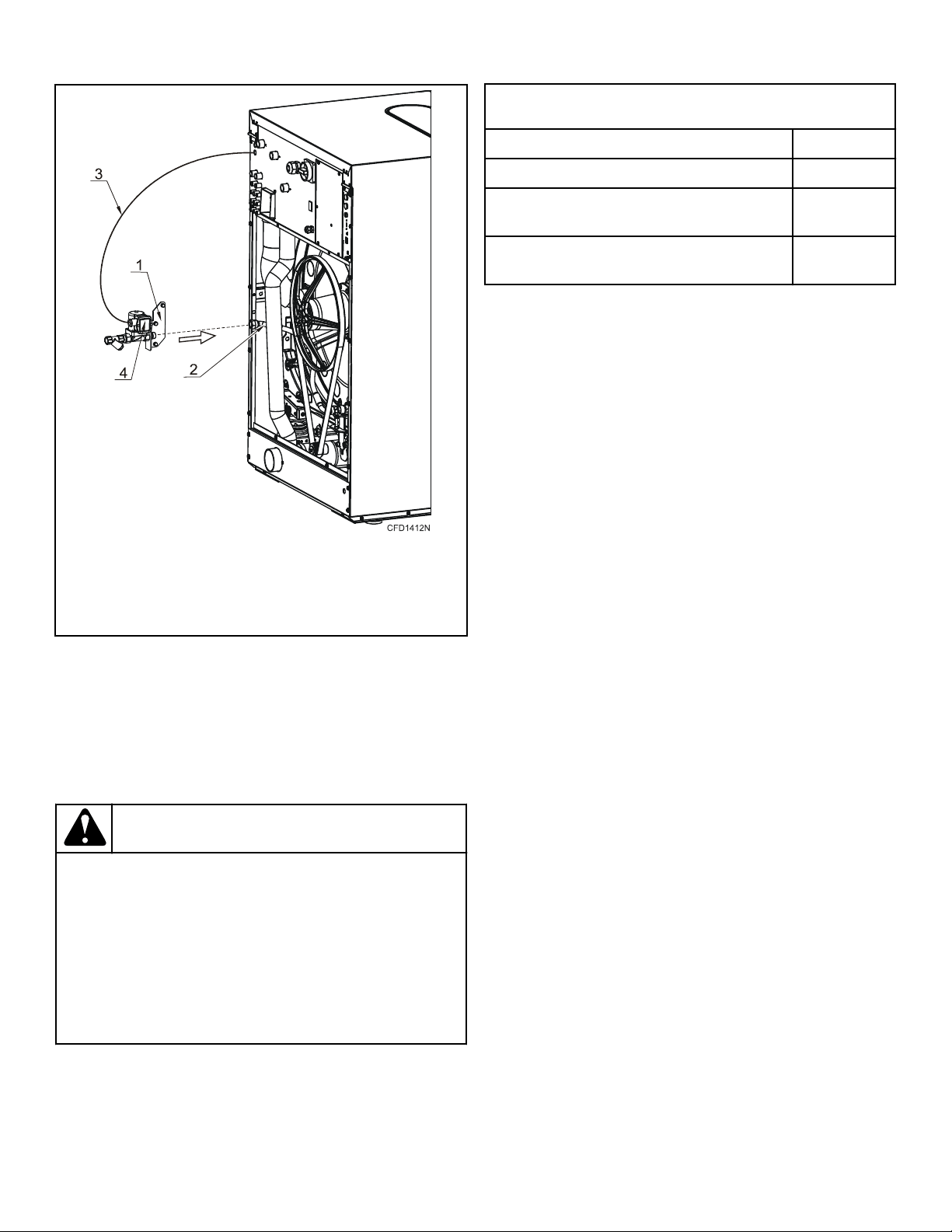
1. Bracket
2. Steam hose
3. Cable
4. Steam coil
Figure 35
3. Connect steam hose to steam valve.
4. Connect the cable to the steam coil.
5. Fit rear cover back to its original place.
Supply Dispensing
WARNING
Dangerous Chemicals. May damage eyes and skin.
Wear eye and hand protection when handling chemi-
cals; always avoid direct contact with raw chemicals.
Read the manufacturer’s directions for accidental
contact before handling chemicals. Ensure an eye-
rinse facility and an emergency shower are within
easy reach. Check at regular intervals for chemical
leaks.
W363
Supply Dispensing
Number of external liquid supply connections 8
Liquid supply connection size, in. [mm] 5/16 [8]
Number of diluted liquid soap supply connec-
tions
3
Diluted liquid soap supply connection size, in.
[mm]
1/2 [12]
Table 33
IMPORTANT: Always use liquid soap pumps with a
flow that bring the requested quantity in less than 30
sec.
IMPORTANT: Start pumping immediately after water
valves are open. The incoming water dilutes the liquid
soap and brings it into the tub assembly.
Secure the location of the wiring and hoses so they can not be
pinched, damaged or rubbed. Before you start to use liquid soap,
check with your liquid soap supplier whether the liquid soap is
harmless and inert to PP and PVC material in order to avoid dam-
age to machine.
IMPORTANT: Failure to follow these instructions could
damage the machine and void the warranty.
Connection of External Liquid Supplies
1. Facing the rear of the machine, locate the eight (8) 5/16 inch
[8 mm] supply hose connections found on the left-hand side
of the valve panel. Refer to Figure 36 .
NOTE: Recommended setting of the pump's flow
rate is 60 to 100 liters per hour.
Installation
©
Copyright, Alliance Laundry Systems LLC -
DO NOT COPY or TRANSMIT
55 Part No. D1625ENR7
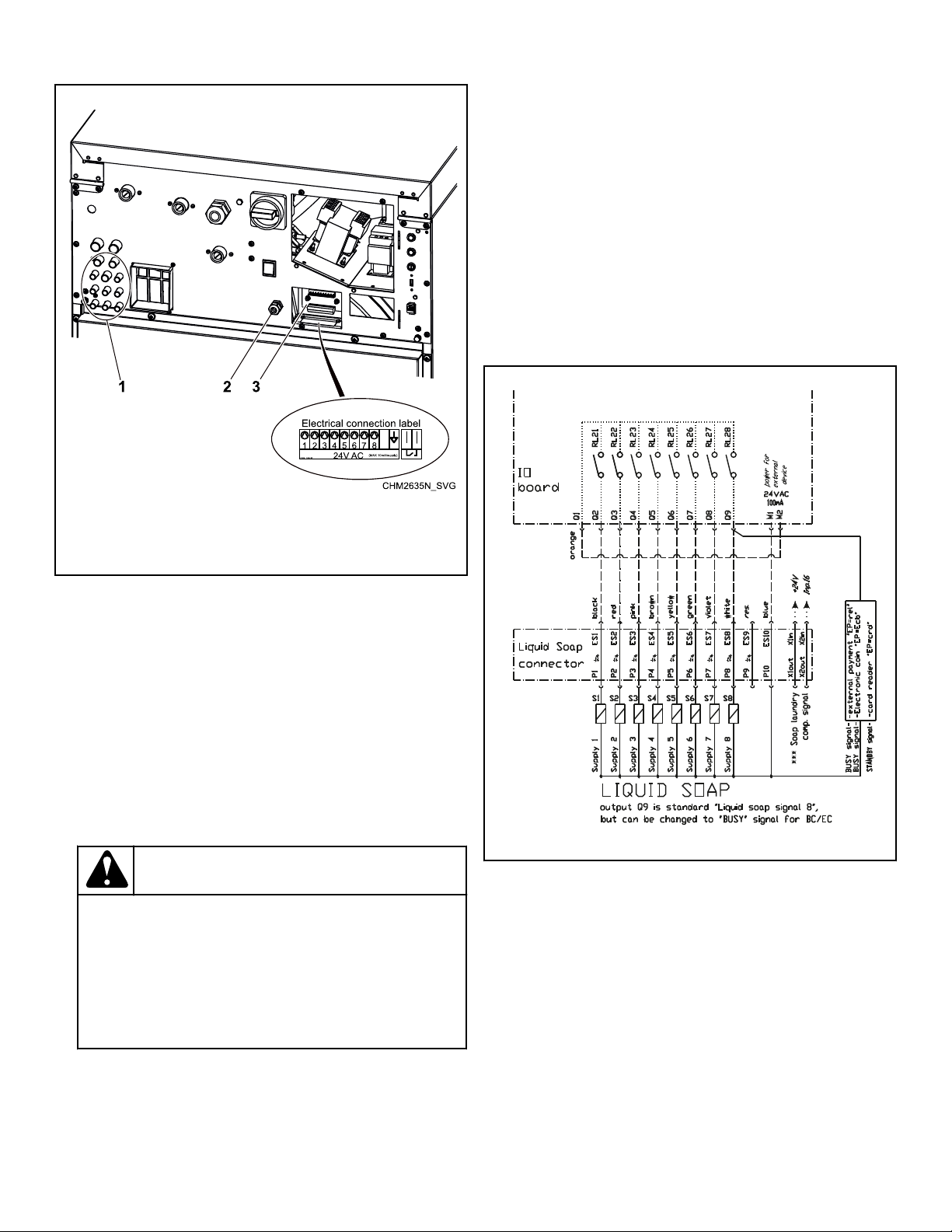
Valve Panel-Rear View
1. External Supply Hose Connections
2. Cable Bushing
3. Control Signals Terminal Box
Figure 36
2. Drill through the eight (8) plastic holes on the valve panel for
the external supply hoses as needed.
NOTE: On the valve panel by the external supply
hose connections are three (3) connections of 1/2
in. 12 mm that are to be used only for entering dilu-
ted soap. To use, drill a 7/16 inch 11.5 mm hole only
in connections that will be used.
3. Remove plastic debris.
4. Attach the external supply hoses to the ports at each of the
drilled holes.
5. Secure with proper clamps.
WARNING
Check that the hose connections are tight (check
the clamps). Any chemical leakage may cause se-
rious bodily injuries as well as serious damage to
the washer. If one of the connections is open,
close and secure the opening with an appropriate
cover.
W909
NOTE: Do not attempt to make chemical injection sup-
ply pump electrical connections to points other than
those provided specifically for that purpose by the fac-
tory.
Electrical Connection of External
Liquid Soap Supply System
The power supply of the external liquid soap supply system has
to be connected to an external electrical source. Only authorized
workers with valid qualifications must execute the electrical con-
nection on the machine according to valid local standards. The
correction connection can be found on the wiring diagram inclu-
ded with the machine. Do not connect the liquid soap pump sys-
tem in the washer.
The electric connection for supply control signals is available on
the rear panel. Refer to Figure 36 . At the terminal box, there is a
label for electric connection. Detail on connection of signals can
also be found on the electric scheme of the machine.
CFD3113N
Figure 37
Signals for supply pump control are 24 VAC. Maximum current
for control circuits of pump must be limited to 100mA. Lead the
cable for connection of pump control signals through the plastic
cable bushing. After connection of conductors to the respective
positions of the connector "P", fix up the cable by tightening the
cable bushing against disconnections and close the box with the
cover. For details about liquid soap supply sytem programming,
refer to Programming Manual.
Installation
©
Copyright, Alliance Laundry Systems LLC -
DO NOT COPY or TRANSMIT
56 Part No. D1625ENR7
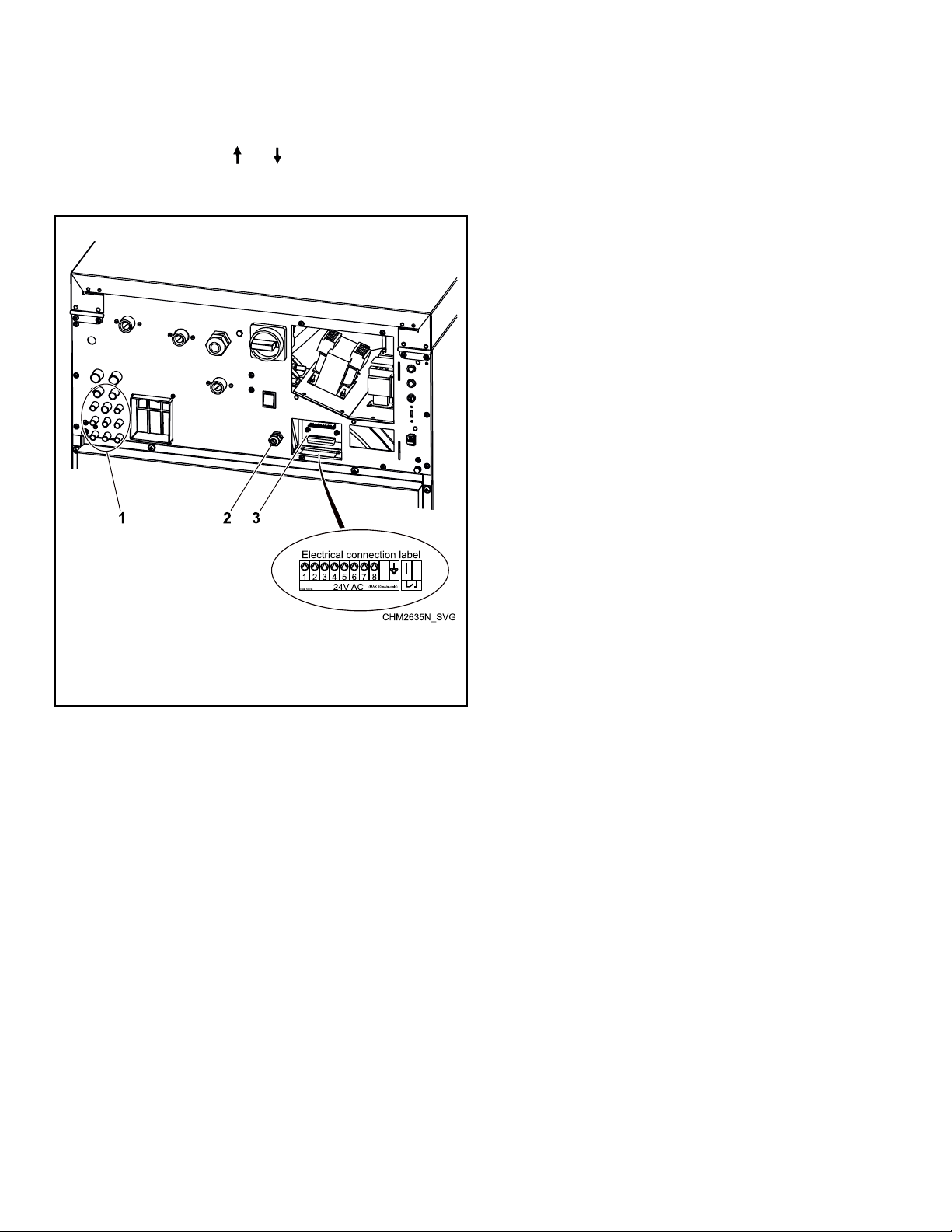
External Wait Control
This function can be activated by an external contact which is
connected between the pins
and . Refer to Figure 38 . Such
connection is possible only with machines which had been or-
dered with the "Heating Delay / Waiting for Detergent" option.
Valve Panel-Rear View
1. External Supply Hose Connections
2. Cable Bushing
3. Control Signals Terminal Box
Figure 38
Installation
©
Copyright, Alliance Laundry Systems LLC -
DO NOT COPY or TRANSMIT
57 Part No. D1625ENR7
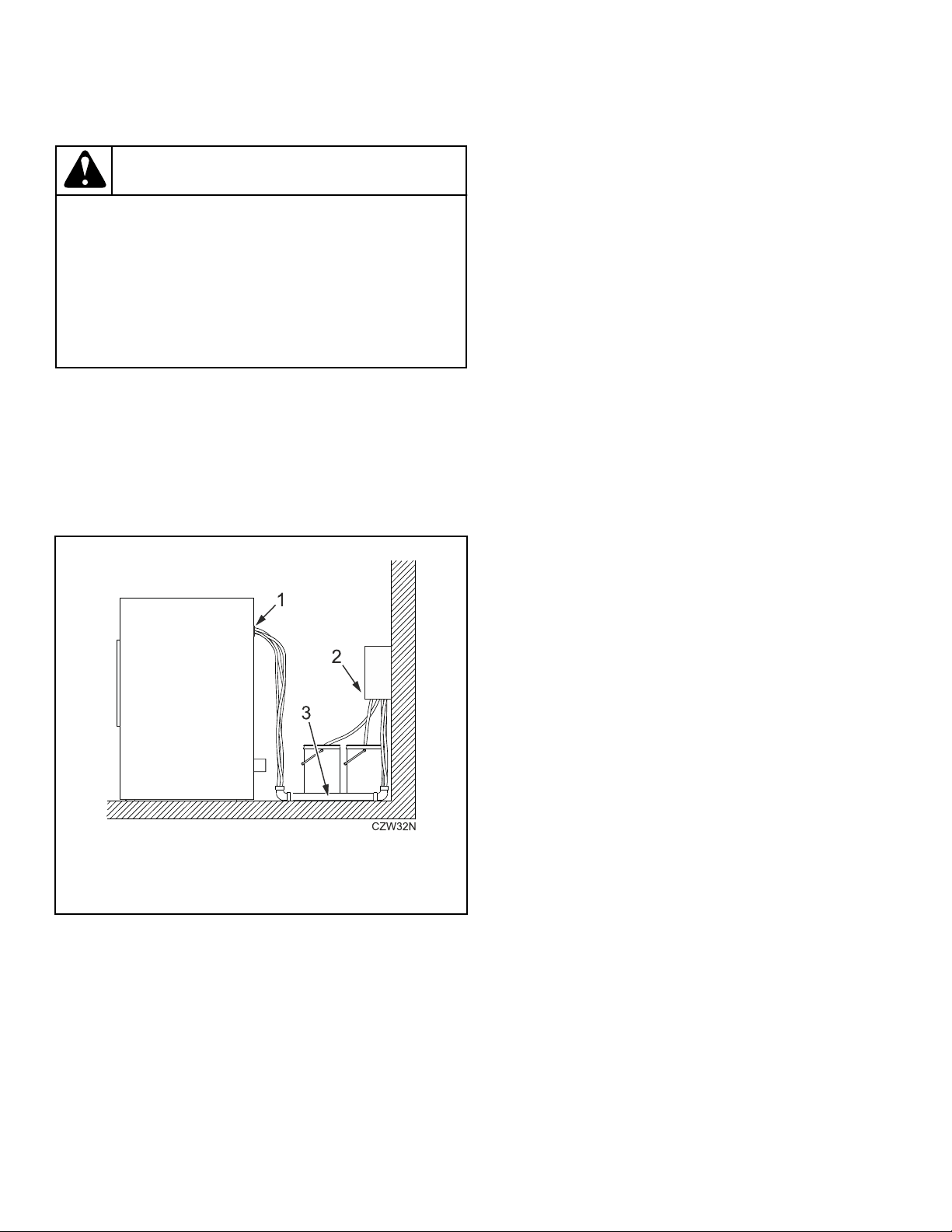
Chemical Injection Supply System
WARNING
Wear eye and hand protection when handling chemi-
cals; always avoid direct contact with raw chemicals.
Read the manufacturer’s directions for accidental
contact before handling chemicals. Ensure an eye-
rinse facility and an emergency shower are within
easy reach. Check at regular intervals for chemical
leaks.
C365
Undiluted chemical dripping can damage the washerextractor.
Therefore, all chemical supply dispenser pumps should be moun-
ted below the washerextractor’s injection point. All dispenser
tubing should also run below the injection point. Loops do not
prevent drips if these instructions are not followed. Failure to fol-
low these instructions could damage the machine and void the
warranty. Figure 39 shows a typical chemical injection supply
system.
Chemical Injection Supply System
1. Injection Point
2. Chemical Dispenser Pump Outlet
3. PVC Pipe
Figure 39
Chemical Injection Supply System
©
Copyright, Alliance Laundry Systems LLC -
DO NOT COPY or TRANSMIT
58 Part No. D1625ENR7
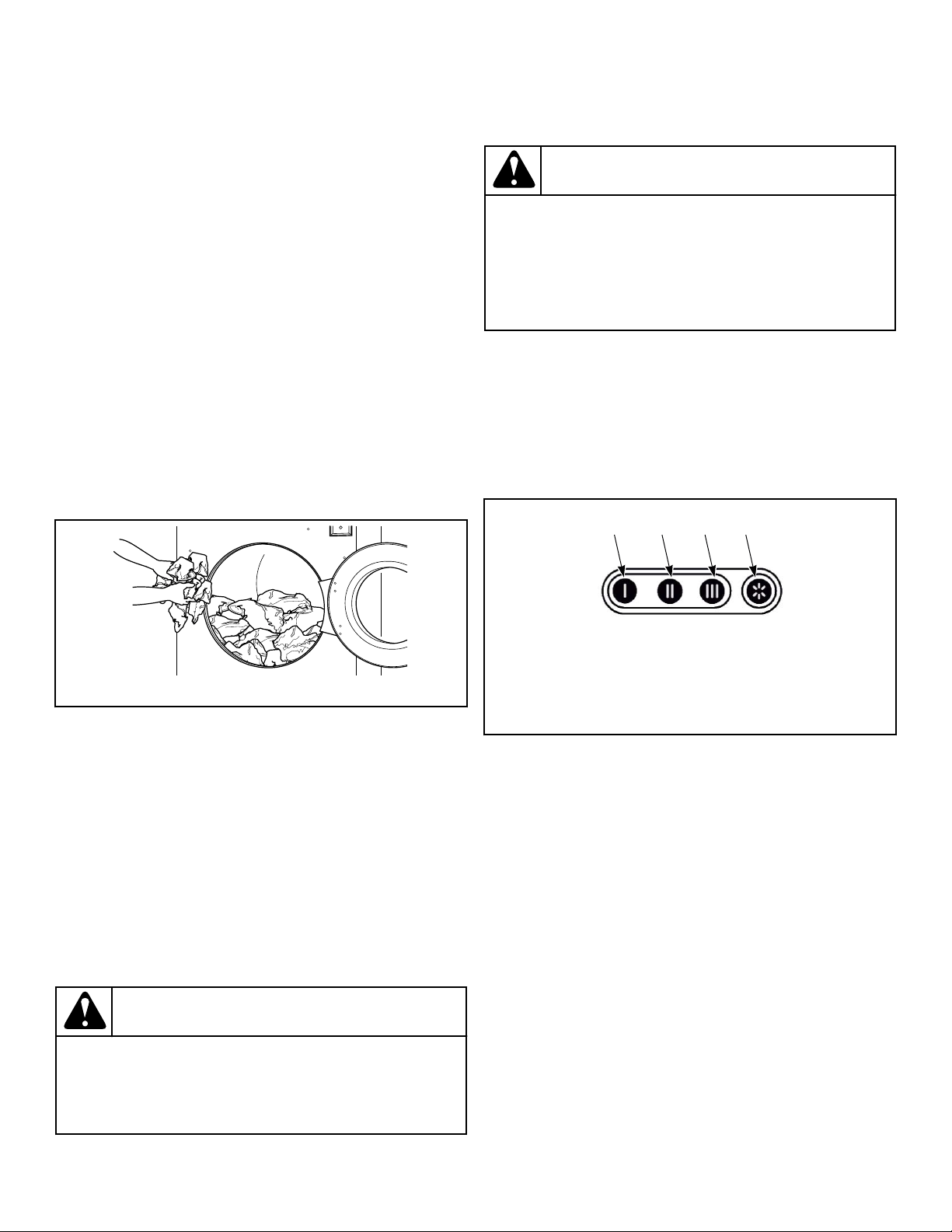
Operation
Operating Instructions
1. Turn on main power source (circuit breaker).
2. Pull on the door handle to open the door.
3. Load to capacity whenever possible. DO NOT OVERLOAD.
Refer to Figure 40 .
NOTE: Underloading can cause out-of-balance con-
ditions that can shorten machine life.
NOTE: Different fabrics have different densities.
Loads must be adjusted accordingly to meet ma-
chine loading specifications. The optimal washing
load is determined by the loading ratio (kg/lb linen :
l/gal drum volume). The proper loading ratio is de-
termined by the type of linen and other factors. Cot-
ton textiles normally require a loading ratio of
1:10-1:13, which is a full drum load. Synthetics and
blended fabrics usually require a loading ratio of
1:18-1:20, which is half drum load.
U003I_SVG
Figure 40
4. Close the door by applying moderate pressure on the door
handle and simultaneously turning door handle partially to the
left.
5.
NOTE: Make sure the door is closed properly before
operating washing machine. Do not turn the handle
completely around or the safety system will not en-
gage. The safety system serves as protection
against violent handling and damage to the door
lock while the machine is operating.
6. Choose the desired wash program best corresponding to the
quality of the garments and allowed wash temperature in the
wash load.
WARNING
To prevent personal injury, avoid contact with inlet
water temperatures higher than 125° Fahrenheit [51°
Celsius] and hot surfaces.
W748
WARNING
Water cannot be extracted from rubber backed
items. To avoid damage to machine from out of bal-
ance conditions, do not use a spin (extract) step
when washing rubber backed items. Warranty will be
voided.
W880
7. Add liquid supplies to supply dispenser and close lid.
NOTE: It is advisable to use only detergents with
"softener to break the suds", which can easily be
found in retail shops. Do not use gel detergents.
The dosage of soap is generally mentioned on the
packing. An overdose of detergent can lead to poor
wash results and suds or overflow which can dam-
age the machine.
CHM2462N_SVG
1 2
3
4
1. Detergent for the pre-wash
2. Detergent for the main wash
3. Liquid detergent for the main wash or liquid bleach, etc.
4. Liquid fabric softener or liquid starch for the last rinse
Figure 41
8. For vended models only, insert coin(s) or card as necessary.
• If the machine is a coin operated unit, add coins. As each
coin is added, the vend counts down to the amount re-
maining.
9. Press the START keypad.
10. During first 150 seconds, the desired wash cycle can be
changed. After first 150 seconds have ended, the wash cycle
active at that moment remains the chosen wash cycle.
11. The wash cycle time is counted down to zero on the display.
After completion, the door lock unlocks and the display
shows “UNLOAD”.
Operation
©
Copyright, Alliance Laundry Systems LLC -
DO NOT COPY or TRANSMIT
59 Part No. D1625ENR7
WARNING
If, after a power disconnect, the machine door
cannot be opened and the machine is fitted with
an automatic unlocking circuit, wait until the lock-
ing circuit unlocks the door lock. Before you open
the door, make sure that the drum is completely
still and all water has drained.
W903
Power Cut
If a power cut occurs in an idle conditon of the machine and no
wash program is running, the machine remains in the idle condi-
tion.
Models without numeric keypad
If a power cut occurs during the wash process and the door re-
mains closed and locked, the wash program will, after the power
supply has been restored, automatically continue in the program
beginning from the step in which the program was interrupted.
For machines fitted with an automatic door-lock unlocking mod-
ule, refer to Automatic Door-lock Unlocking Module section. If
during the power cut, the door lock gets unlocked and the door
remains closed, the message "PRESS START / OPEN DOOR"
appears as soon as the power supply is restored. If you open the
door, the wash program will be cancelled. If you press the
START button, the wash program will continue beginning from
the step in which the program was interrupted.
Models with numeric keypad
If a power cut occurs during the wash process, the message
"CONTINUE / STOP" appears as soon as the power supply is re-
stored. If you press the STOP button, the wash program will be
cancelled. If you press the START button, the wash program will
continue beginning from the step in which the program was inter-
rupted.
Automatic Door-lock Unlocking Module
Some machines are fitted with an automatic module for unlock-
ing the door lock in case of a power cut.
If a short term power cut occurs, this module does not affect the
operation of the machine.
If a long term power cut occurs, the module unlocks the door
lock. It is then possible to open the door and remove laundry.
WARNING
The automatic door-lock unlocking module must not
be utilized on machines that are fitted with a drain
pump or reverse function drain valve.
W910
Operation
©
Copyright, Alliance Laundry Systems LLC -
DO NOT COPY or TRANSMIT
60 Part No. D1625ENR7
Maintenance
Maintenance
WARNING
Use the proper chemical agents which avoid calcium
sediments on heating elements and other machine
parts. Discuss the issue with your supplier of wash-
ing products. The manufacturer of the machine is
not responsible for the damage of heating elements
and other machine parts due to calcium sediments.
W904
WARNING
Sharp edges can cause personal injury. Wear safety
glasses and gloves, use proper tools and provide
lighting when handling sheet metal parts.
W366R1
IMPORTANT: Replace all panels that are removed to
perform service and maintenance procedures. Do not
operate the machine with missing guards or with bro-
ken or missing parts. Do not bypass any safety devi-
ces.
NOTE: Measuring and adjusting the balance switch
must be done while the machine is empty.
Daily
IMPORTANT: Replace all panels that are removed to
perform maintenance procedures. Do not operate the
machine with missing guards or with broken or miss-
ing parts. Do not bypass any safety devices.
WARNING
Do not spray the machine with water. Short circuiting
and serious damage may result.
W782
IMPORTANT: Door lock should be checked daily to en-
sure proper operation. Also check that all safety and
instruction stickers are on the machine. Any missing or
illegible safety instructions stickers should be replaced
immediately.
Beginning of Day
1. Check door interlock before starting operation:
a. Attempt to start the machine with the door open. The ma-
chine should not start.
b. Close the door without locking it and start the machine.
The machine should not start.
c. Attempt to open the door while the cycle is in progress.
The door should not open.
If the door lock and interlock are not functioning properly, dis-
connect power and call a service technician.
2. Check the machine for leaks.
a. Start an unloaded cycle to fill the machine.
b. Verify that door and door gasket do not leak.
c. Verify that the drain valve is operating and that the drain
system is free from obstruction. If water does not leak out
during the first wash segment, the drain valve is closed
and functioning properly.
3. Inspect water inlet valve hose connections on the back of the
machine for leaks.
4. Inspect steam hose connections for leaks (if applicable).
5. On machines equipped with an automatic Chemical Supply
System, check all the hoses and hose connections for leaks or
visible signs of deterioration. Replace immediately if either
are present. Chemical leaks can cause damage to the ma-
chine’s components.
WARNING
To reduce the risk of electrical shock, serious injury
or death, disconnect the electrical power to washer-
extractor before examining the wiring.
6. Verify that insulation is intact on all external wires and that all
connections are secure. If bare wire is evident, call a service
technician.
7. Ensure all panels and guards are properly installed.
End of Day
1. Inspect and clean the basket and door gasket of residual deter-
gent and all foreign matter.
2. Clean the door glass and between the door gasket and the
door with a damp cloth.
3. Clean supply dispenser lid and general area with mild deter-
gent. Flush the dispenser with clean water.
4. Clean the machine’s top, front and side panels with all-pur-
pose cleaner. Rinse with clean water and dry.
IMPORTANT: Use only isopropyl alcohol to clean
graphic overlays. Never use ammonia-based, vine-
gar- based or acetone-based cleaners on graphic
overlays.
IMPORTANT: Do not use abrasive cleaners.
Maintenance
©
Copyright, Alliance Laundry Systems LLC -
DO NOT COPY or TRANSMIT
61 Part No. D1625ENR7
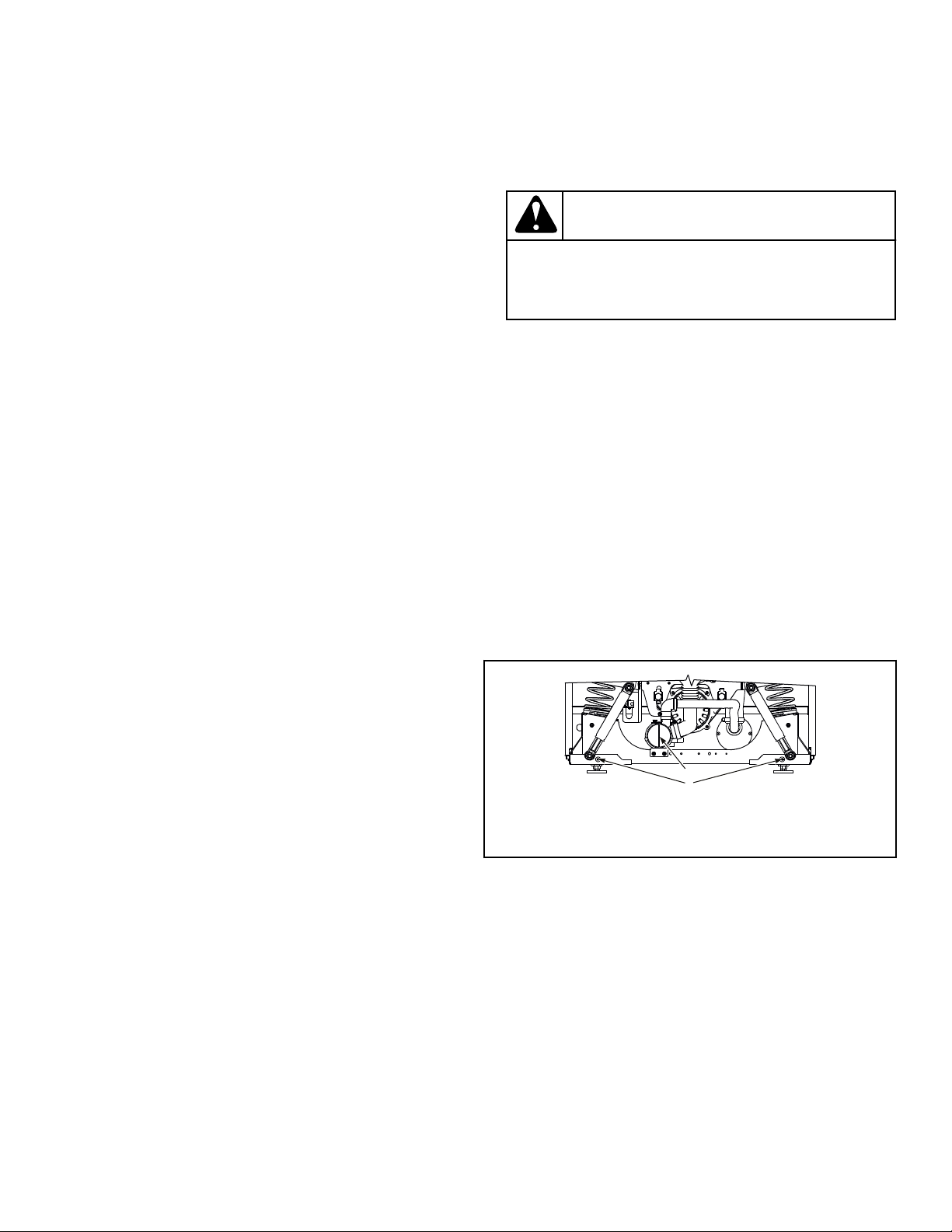
NOTE: Unload the machine promptly after each
completed cycle to prevent moisture buildup. Leave
loading door open at the end of each completed cy-
cle to allow moisture to evaporate.
5. Leave the loading door open at the end of each day to allow
moisture to evaporate.
6. Shut off water supply.
Quarterly
NOTE: Disconnect power to the machine at its source
before performing the quarterly maintenance proce-
dures.
1. Check the bearing house for leakage.
2. Verify that the drain valve is operating and that the drain sys-
tem is free from obstruction. If water does not leak out during
the first wash segment, the drain valve is closed and function-
ing properly.
3. Visually check all hoses and connections inside machine for
leaks.
4. Make sure that control components are protected against
moisture and dust during the clean up. Wipe and clean the
machine inside.
5. For models with electric heat, check the tightening of the con-
tacts of heating elements terminals and other power terminals
(main switch, fuse disconnectors, contactors).
6. In order to increase the service life of the door gasket, apply a
glycerine-based impregnating agent.
Every 6 Months
NOTE: Disconnect power to the machine at its source
before performing maintenance procedures.
1. Clean the water valve filters.
WARNING
Before you start cleaning the water filters, make
sure all water inlets to machine are closed.
W907
a. Turn off the water supply.
b. Unscrew the hoses at the back of machine.
c. Take out filter at center with pointed pliers.
d. Clean the filter and re-insert.
e. When reattaching the hoses, make sure the seals are seated
correctly.
f. Check water inlets for leaks.
g. Tighten the connections or replace the seals of inlet hose if
necessary.
2. If machine is fitted with a drain pump, make sure the pump
provides normal flow rate during draining. The drain pump
can be cleaned when it becomes clogged with foreign objects.
a. Drain all water from machine.
b. Disconnect machine from power supply.
c. Remove the front panel of cabinet by unlocking bolts. Re-
fer to Figure 42 .
CHM2489N_SVG
2
1
1. Bolts
2. Pump lid
Figure 42
d. Slightly turn the pump lid until water starts flowing out,
making sure to catch the water.
e. Unscrew the lid and remove any foreign objects.
f. Reattach pump lid and front panel of cabinet.
3. Remove dust or dirt and verify functionality of the following:
a. Inverter cooling fin
Maintenance
©
Copyright, Alliance Laundry Systems LLC -
DO NOT COPY or TRANSMIT
62 Part No. D1625ENR7
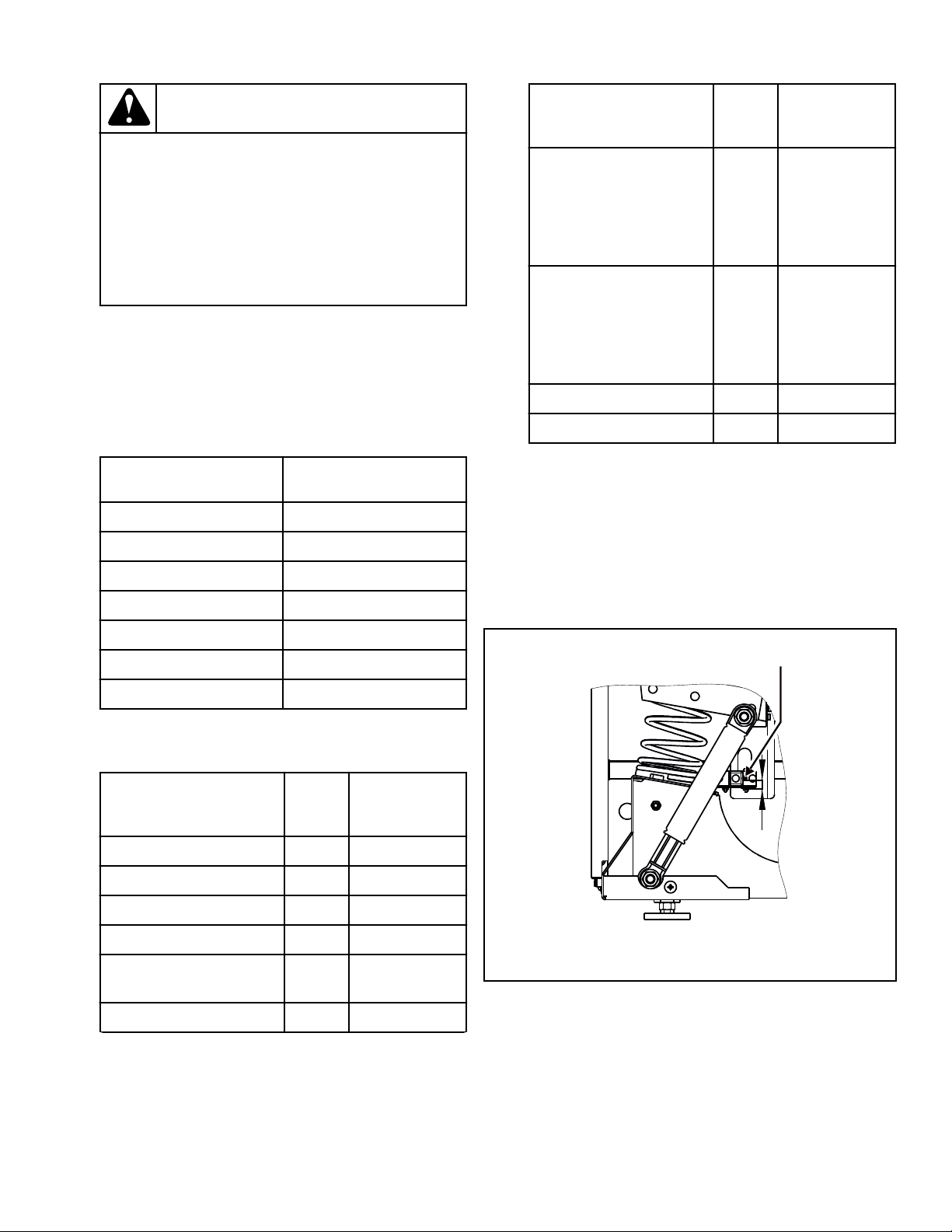
WARNING
Before removing top or back panel of machine,
switch power off and wait for at least 10 mi-
nutes. Before starting inspection of frequency
inverter, check for residual voltage across
main circuit terminals. This voltage must be
below 30 VDC before you can access the inver-
ter for inspection.
W905
b. Motor cooling fins
c. Interior inverter ventilator (if present)
d. Exterior inverter ventilator (if present)
IMPORTANT: All torque joints must remain dry
(non-lubricated).
4. Check for belts for wear and inspect tightness. For recom-
mended values, refer to Table 34 .
Model Torque, Hz
6.5 kg/ 14 lb. / 65 L 67 - 70
7.5 kg / 20 lb./ 80 L 67 - 70
10.5 kg / 25 lb./ 105 L 65 - 68
13.5 kg / 30 lb. / 135 L 79 - 83
18 kg / 40 lb./ 180 L 64 - 69
24 kg / 55 lb. / 240 L 72 - 75
28 kg / 70 lb. / 280 L 72 - 75
Table 34
5. Check the tightness of bolts. Refer to Table 35 .
Item
Bolt
Type
Torque, lb.
ft. [Nm]
Bolts of the dampers M10 17.70 [24]
Bolts of the weight M8 19.18 [26]
Door lock bolts M5 1.84 [2.5]
Door handle central bolt M6 6.49 [8.8]
Door hinge and front panel
bolts
M6 6.49 [8.8]
Anchoring bolts M16 73.76 [100]
Table 35 continues...
Item
Bolt
Type
Torque, lb.
ft. [Nm]
External tub bolts
18 kg - 28 kg /
40 lb. - 70 lb. /
180 L - 280 L Models
M8 19.18 [26]
External tub bolts
6.5 kg - 13.5 kg /
14 lb. - 30 lb. /
65 L - 135 L Models
M8 8.85 [12]
Motor bolts M12 N/A
Spring holder bolts M8 7.38 [10]
Table 35
6. Adjust the safety switch.
NOTE: The safety switch is an important component
which must, if correctly adjusted, stop the machine
when excessive movement and shaking occur due
to an unbalance caused by improper distribution of
linen in the washing drum or when the amount of
laundry exceeds the machine capacity.
1
CFD1223N
A
1. Stick of safety switch
Figure 43
Maintenance
©
Copyright, Alliance Laundry Systems LLC -
DO NOT COPY or TRANSMIT
63 Part No. D1625ENR7
Specifica-
tion Model
Require-
ment, in.
[mm]
A - distance be-
tween lower edge
of lug and stick
of safety switch
6.5 kg- 13.5
kg /
14 lb. - 30 lb. /
65 L - 135 L
0.2 - 0.59 [5 - 15]
18 kg - 28 kg /
40 lb. - 70 lb. /
180 L - 280 L
0 - 0.39 [0 - 10]
Table 36
Care of Stainless Steel
• Remove dirt and grease with detergent and water. Thoroughly
rinse and dry after washing.
• Avoid contact with dissimilar metals to prevent galvanic cor-
rosion when salty or acidic solutions are present.
• Do not allow salty or acidic solutions to evaporate and dry on
stainless steel. Wipe clean of any residues.
• Rub in the direction of the polish lines or “grain” of the stain-
less steel to avoid scratch marks when using abrasive clean-
ers. Use stainless steel wool or soft, non-metal bristle brushes.
Do not use ordinary steel wool or steel brushes.
• If the stainless steel appears to be rusting, the source of the
rust may be an iron or steel part not made of stainless steel,
such as a nail or screw.
• Remove discoloration or heat tint from overheating by scour-
ing with a powder or by employing special chemical solu-
tions.
• Do not leave sterilizing solutions on stainless steel equipment
for prolonged periods of time.
• When an external chemical supply is used, ensure no siphon-
ing of chemicals occurs when the machine is not in use. High-
ly concentrated chemicals can cause severe damage to stain-
less steel and other components within the machine. Damage
of this kind is not covered by the manufacturer’s warranty.
Locate the pump and tubing below the machine’s injection
point to prevent siphoning of chemicals into the machine.
Maintenance
©
Copyright, Alliance Laundry Systems LLC -
DO NOT COPY or TRANSMIT
64 Part No. D1625ENR7
Disposal of Unit
Disconnecting the Machine
1. Switch off the external electric power inlet to machine.
2. Turn off the main switch on machine.
3. Shut the external water or steam inlets to machine.
4. Make sure the external electric power and steam inlets are
shut off. Disconnect all electric, water or steam inlets.
5. Insulate the external electric power inlet conductors.
6. Equip the machine with an "Out of Service" sign.
7. Unscrew nuts and bolts that fix machine to floor.
8. If the machine will never be used again, secure it so injury to
persons and damage to health, property and nature is avoided.
Remove the door, secure the drum so it does not turn and re-
move any sharp parts of machine so enclosure or injury of a
person or animal will not occur.
CAUTION
Be careful when disconnecting machine from
service. Falling door and glass can cause injuries.
W922
WARNING
Take all necessary action and precautions when
disassembling the washer to avoid injury from
glass or sharp metal edges.
W908
Disposal of Unit
This appliance is marked according to the European directive
2002/96/EC on Waste Electrical and Electronic Equipment
(WEEE).
This symbol on the product or on its packaging indicates that this
product shall not be treated as household waste. Refer to Figure
44 . Instead it shall be handed over to the applicable collection
point for the recycling of electrical and electronic equipment. En-
suring this product is disposed of correctly will help prevent po-
tential negative consequences for the environment and human
health which could otherwise be caused by inappropriate waste
handling of this product. The recycling of materials will help to
conserve natural resources. For more detailed information about
recycling of this product, please contact the local city office,
household waste disposal service, or the source from which the
product was purchased.
MIX1N_SVG
Figure 44
Disposal of Unit
©
Copyright, Alliance Laundry Systems LLC -
DO NOT COPY or TRANSMIT
65 Part No. D1625ENR7
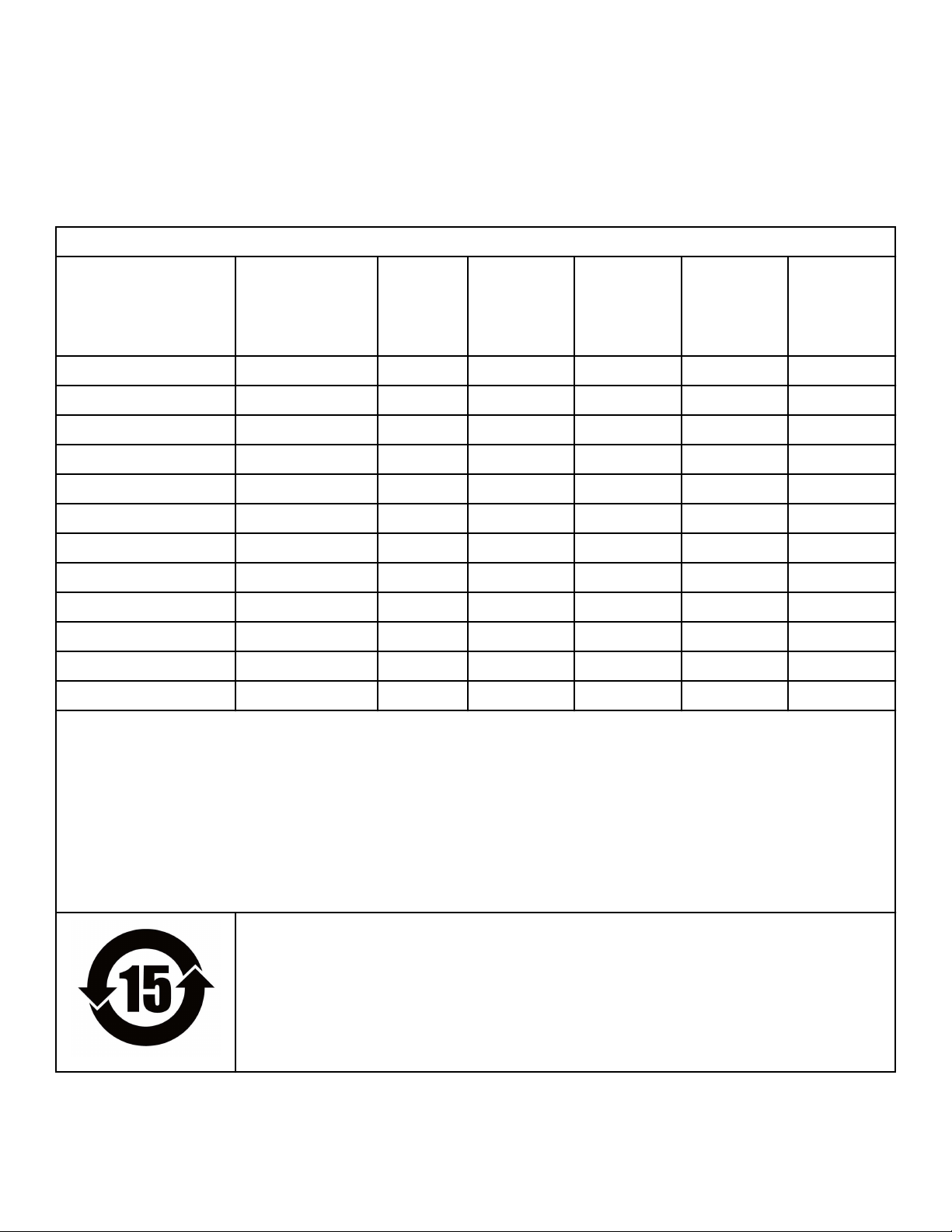
China Restriction of hazardous substances
(RoHS)
The Table of Hazardous Substances/Elements and their Content As required by China’s Management Methods for Restricted Use
of Hazardous Substances in Electrical and Electronic Products
Hazardous substances
Part Name Lead
(Pb)
Mercury
(Hg)
Cadmium
(Cd)
Hexavalent
Chromium
(CR[VI])
Polybromina-
ted biphenyls
(PBB)
Polybromina-
ted diphenyl
ethers
(PBDE)
PCBs X O O O O O
Electromechanical Parts O O O O O O
Cables and Wires O O O O O O
Metal Parts O O O O O O
Plastic Parts O O O O O O
Batteries O O O O O O
Hoses and Tubing O O O O O O
Textile O O O O O O
Timing Belts O O O O O O
Insulation O O O O O O
Glass O O O O O O
Display O O O O O O
This table is prepared in accordance with the provisions of SJ/T-11364.
O: Indicates that the content of said hazardous substance in all of the homogenous materials in the component is within the limits
required by GB/T 26572.
X: Indicates that the content of said hazardous substance exceeds the limits required by GB/T 26572 in at least one homogenous
material in the component.
All parts named in this table with an “X” are in compliance with the European Union’s RoHS Legislation.
NOTE: The referenced Environmental Protection Use Period Marking was determined according to normal oper-
ating use conditions of the product such as temperature and humidity.
This product under normal use, durable years of environmental protection is 15 years.
China Restriction of hazardous substances (RoHS)
©
Copyright, Alliance Laundry Systems LLC -
DO NOT COPY or TRANSMIT
66 Part No. D1625ENR7