OWNER’S MANUAL
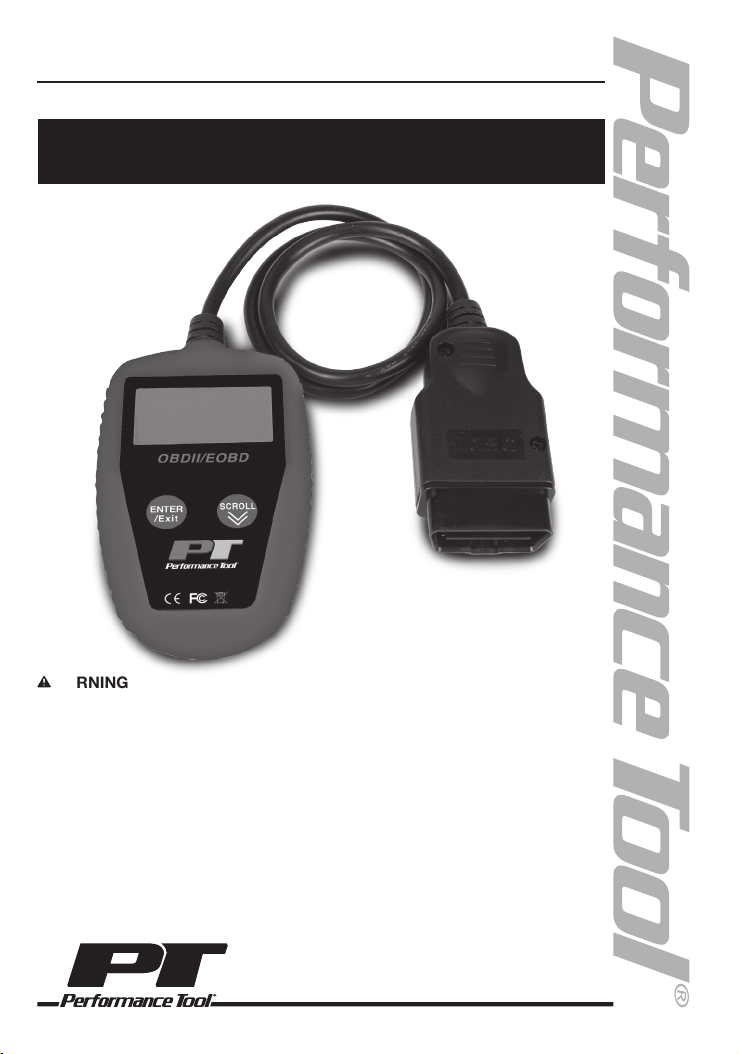
Item Number W2976
WARNING
It is the owner and/or operators’ responsibility to study all WARNINGS, operating, and maintenance
instructions contained on the product label and instruction manual prior to operation of this product. The
owner/operator shall retain product instructions for future reference.
The owner and/or operator are responsible for maintenance, maintaining all decals or warning labels and while
in use, maintaining the unit in good working order. If the owner and/or operator are not fluent in English, the
product warnings and instructions shall be read and discussed with the operators’ native language by the
purchaser/owner or his designee. Make sure that the operator comprehends its contents. Safety information
shall be emphasized and understood prior to usage. The product shall be inspected per the operating
instructions.
Users of this product must fully understand these instructions. Each person operating this product must also
be of sound mind and body and must not be under the influence of any substance that might impair their
vision, dexterity or judgment.
Protect yourself and others by observing all safety information.
Failure to comply with instructions could result in personal injury and/or property damage!
If you encounter any problems or difficulties, please contact our customer service department at:
1-800-426-1262 between 6:30 a.m. and 4:30 p.m. Pacific time.
MULTILINGUAL DIAGNOSTIC SCANNER
Please read these instructions carefully and retain them for future use.

TABLE OF CONTENTS
2
Product Specifictions................................................................2
Safety Precautions and Warnings........................................3
Product Features ................................................................3
General Information .............................................................4
On-Board-Diagnostics (OBD) II .........................................4
Diagnostic Trouble Codes (DTCs) .....................................4
Location of the Data Link Connector (DLC)........................5
OBD II Readiness Monitors ................................................5
OBD II Monitor Readiness Status ......................................6
OBD II Terminology ............................................................7
Product Information ..............................................................8
Tool Description...................................................................8
Vehicle Coverage ...............................................................10
Operating Instructions..........................................................11
Reading Codes ..................................................................11
Erasing Codes ...................................................................14
Retrieving I/M Readiness Status........................................15
Viewing VIN Number..........................................................17
Rescanning Data ...............................................................18
Diagnostic Trouble Code (DTC) Definitions..........................19
Limited One Year Warranty..................................................48
Product Specifications
• Display: Backlit, 128 x 64 pixel display
• Operating Temperature: 32 to 140 F° (0 to 60°C)
• Storage Temperature: -4 to 158 F°(-20 to 70°C)
• Power: 8 to 18 Volts provided via vehicle battery
•
Dimensions: Length/Width/Height 4.34"(110.3 mm) 2.74" (69.5 mm) 0.80"(20.2 mm)
• Weight: 0.46lb (0.21Kg)

SAFETY PRECAUTIONS AND WARNINGS
3
To prevent personal injury or damage to vehicles and/or the Scan Tool, read this
instruction manual first and observe the following safety precautions at a minimum
whenever working on a vehicle:
• Always perform automotive testing in a safe environment.
• Wear safety eye protection that meets ANSI standards.
• Keep clothing, hair, hands, tools, test equipment, etc, away from all moving or
hot engine parts.
• Operate the vehicle in a well-ventilated work area; Exhaust gases are poisonous.
•
Put blocks on drive wheels and never leave vehicle unattended while running tests.
• Use extreme caution when working around the ignition coil, distributor cap,
ignition wires and spark plugs. These components create hazardous voltages
when the engine is running.
• Put transmission in PARK (for automatic transmission) or NEUTRAL (for manual
transmission) and make sure the parking brake is engaged.
• Keep a fire extinguisher suitable for gasoline/chemical/electrical fires nearby.
•
Don’t connect or disconnect any test equipment with ignition on or engine running.
• Keep the Scan Tool dry, clean and free from oil, water and grease. Use a mild
detergent on a clean cloth to clean the outside of the Scan Tool, when necessary.
Product Features
• Works with most 1996 and newer cars & light trucks that are OBD II
compliant (including the CAN, VPW, PWM, ISO and KWP 2000 protocols).
• Reads and clears generic and manufacturer specific Diagnostic Trouble Codes
(DTCs) and turns off check engine light
• Supports multiple trouble code requests: generic codes, pending codes and
manufacturer’s specific codes
• Reviews the emission readiness status of OBD monitors
•
Retrieves VIN (Vehicle Identification No.) on 2002 and newer vehicles that
support Mode 9
• Determines the malfunction indicator lamp (MIL) status
• Easy to use with one plug-in; Highly reliable and accurate
• Easy-to-read crystal-clear backlit 2-line LCD display
• Stand-alone unit with no need for an additional laptop computer to operate
• Small in size and conveniently fits in your palm
• Safely communicates with the on-board computer
• No batteries needed--powered via detachable OBD II cable

4
GENERAL INFORMATION
On-Board-Diagnostics (OBD) II
The OBD II system is designed to monitor emission control systems and
key engine components by performing either continuous or periodic tests
of specific components and vehicle conditions. When a problem is
detected, the OBD II system turns on a warning lamp (MIL) on the vehicle
instrument panel to alert the driver typically by the phrase of “Check
Engine” or “Service Engine Soon”. The system will also store important
information about the detected malfunction so that a technician can
accurately find and fix the problem. Here below follow three pieces of
such valuable information:
•
Whether the Malfunction Indicator Light (MIL) is commanded ‘on’ or ‘off’;
• Which, if any, Diagnostic Trouble Codes (DTCs) are stored;
• Readiness Monitor Status.
Diagnostic Trouble Codes (DTCs)
OBD II Diagnostic Trouble Codes are codes that are stored by the
on-board computer diagnostic system in response to a problem found in
the vehicle. These codes identify a particular problem area and are
intended to provide you with a guide as to where a fault might be
occurring within a vehicle. OBD II Diagnostic Trouble Codes consist of a
five-digit alphanumeric code. The first character, a letter, identifies the
control system which sets the code. The other four characters, all
numbers, provide additional information on where the DTC originated and
the operating conditions that caused it to set. On the next page is an
example to illustrate the structure of the digits.
Location of the Data Link Connector (DLC)
The DLC (Data Link Connector or Diagnostic Link Connector) is the standardized
16-cavity connector where diagnostic scan tools interface with the vehicle’s
on-board computer. The DLC is usually located 12 inches from the center of the
instrument panel (dash), under or around the driver’s side for most vehicles. For
some Asian and European vehicles, the DLC is located behind the ashtray and
the ashtray must be removed to access the connector. Refer to the vehicle’s
service manual for the location if the DLC cannot be found.

5
OBD II Readiness Monitors
An important part of a vehicle’s OBDII system is the Readiness
monitors, which are indicators used to find out if all of the emissions
components have been evaluated by the OBD II system. They are running
periodic tests on specific systems and components to ensure that they are
performing within allowable limits.
Currently, there are eleven OBD II Readiness Monitors (or I/M Monitors)
defined by the U.S. Environmental Protection Agency (EPA). Not all
monitors are supported by all vehicles and the exact number of
monitors in any vehicle depends on the motor vehicle manufacturer’s
emissions control strategy.
Continuous Monitors - Some of the vehicle components or systems are
continuously tested by the vehicle’s OBDII system, while others are tested
only under specific vehicle operating conditions. The continuously
monitored components listed below are always ready:
1. Misfire
2. Fuel System
3. Comprehensive Components (CCM)
DTC EXAMPLE
P0202
Systems Identifying
B = Body Sub-Systems specific
C = Chassis 1 = Fuel & Air Metering
malfunctioning
P = Powertrain 2 = Fuel & Air Metering section of the
U = Network 3 = Ignition System or systems
Engine Misfire
4 =
Auxiliary Emissions Controls
5 = Vehicle Speed Control
Code Type & Idol Controls
0 = Generic 6 = Computer Output Circuits
1 = Manufacturer 7 = Transmission Controls
Specific 8 = Transmission Controls

6
Once the vehicle is running, the OBDII system is continuously checking the
above components, monitoring key engine sensors, watching for engine
misfire, and monitoring fuel demands. Non--Continuous Monitors -- Unlike
the continuous monitors, many emissions and engine system components
require the vehicle to be operated under specific conditions before the
monitor is ready. These monitors are termed non-continuous monitors and
are listed below:
1. EGR System 5. O2 Sensor Heater
2. O2 Sensors 6. Secondary air
3. Catalyst 7. Heated Catalyst
4. Evaporative System 8. A/C system
OBD II Monitor Readiness Status
OBDII systems must indicate whether or not the vehicle’s PCM’s monitor
system has completed testing on each component. Components that have
been tested will be reported as “Ready”, or “Complete”, meaning they have
been tested by the OBDII system. The purpose of recording readiness
status is to allow inspectors to determine if the vehicle’s OBDII system has
tested all the components and/or systems.
The powertrain control module (PCM) sets a monitor to “Ready” or
“Complete” after an appropriate drive cycle has been performed. The drive
cycle that enables a monitor and sets readiness codes to “ready” varies for
each individual monitor. Once a monitor is set as “Ready” or “Complete”, it
will remain in this state. A number of factors, including erasing of diagnostic
trouble codes (DTCs) with a scan tool or a disconnected battery, can result in
Readiness Monitors being set to “not ready”. Since the three continuous monitors
are constantly evaluating, they will be reported as “Ready” all of the time. If testing
of a particular supported non-continuous monitor has not been completed, the
monitor status will be reported as “Not Complete” or “Not Ready.”
In order for the OBD monitor system to become ready, the vehicle should be
driven under a variety of normal operating conditions. These operating conditions
may include a mix of highway driving and stop and go, city type driving, and at
least one overnight-off period. For specific information on getting your vehicle’s
OBD monitor system ready, please consult your vehicle owner’s manual.

7
OBD II Terminology
Powertrain Control Module (PCM) - OBDII terminology for the on-board
computer that controls engine and drive train.
Malfunction Indicator Light (MIL) - Malfunction Indicator Light (Service Engine
Soon, Check Engine) is a term used for the light on the instrument panel. It is to
alert the driver and/or the repair technician that there is a problem with one or
more of vehicle’s systems and may cause emissions to exceed federal standards.
If the MIL illuminates with a steady light, it indicates that a problem has been
detected and the vehicle should be serviced as soon as possible. Under certain
conditions, the dashboard light will blink or flash. This indicates a severe problem
and flashing is intended to discourage vehicle operation. The vehicle onboard
diagnostic system can not turn the MIL off until the necessary repairs are
completed or the condition no longer exists.
DTC - Diagnostic Trouble Codes (DTC) that identifies which section of the
emission control system has malfunctioned.
Enabling Criteria - Also termed Enabling Conditions. They are the vehicle-specific
events or conditions that must occur within the engine before the various monitors
will set, or run. Some monitors require the vehicle to follow a prescribed “drive
cycle” routine as part of the enabling criteria. Drive cycles vary among vehicles
and for each monitor in any particular vehicle.
OBDII Drive Cycle-- A specific mode of vehicle operation that provides conditions
required to set all the readiness monitors applicable to the vehicle to the “Ready”
condition. The purpose ofcompleting an OBD II drive cycle is to force the vehicle
to run its onboard diagnostics. Some form of a drive cycle needs to be performed
after DTCs have been erased from the PCM’s memory or after the battery has
been disconnected. Running through a vehicle’s complete drive cycle will “set” the
readiness monitors so that future faults can be detected. Drive cycles vary
depending on the vehicle and the monitor that needs to be reset. For vehicle
specific drive cycle, consult the vehicle’s Owner’s Manual.
Freeze Frame Data - When an emissions related fault occurs, the OBD II system
not only sets a code but also records a snapshot of the vehicle operating
parameters to help in identifying the problem. This set of values is referred to as
Freeze Frame Data and may include important engine parameters such as engine
RPM, vehicle speed, air flow, engine load, fuel pressure, fuel trim value, engine
coolant temperature, ignition timing advance, or closed loop status
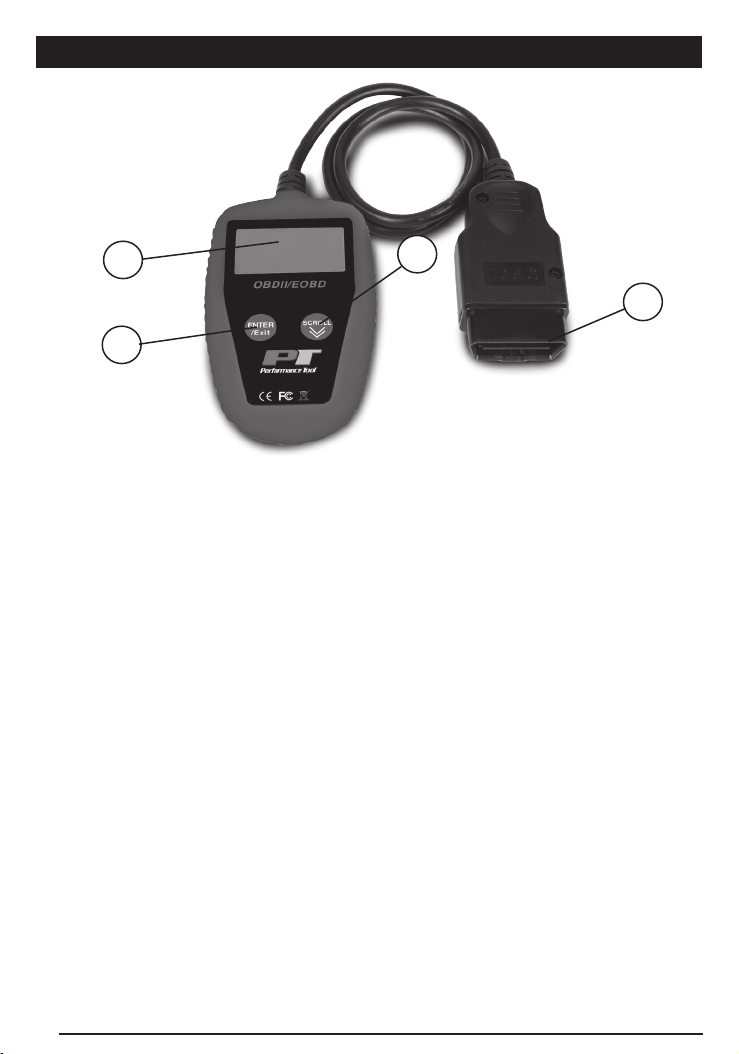
Tool Description
1. LCD DISPLAY - Indicates test results. It is a backlit 2-line display with 8
characters on each line.
2. ENTER/EXIT BUTTON - Confirms a selection (or action) from a menu list, or
returns to the main menu.
3. SCROLL BUTTON - Scrolls through menu items or It is also used to enter
system setup menu when pressed.
4. OBD II CONNECTOR - Connects the Code Scanner to the vehicle’s Data Link
Connector (DLC).
Navigation
Characters used to help navigate the code reader are:
1) “u” -- Indicates current selection.
2) “Pd” -- Identifies a pending DTC when viewing DTCs.
3) “$” -- Identifies the control module number from which the data is retrieved.
Power
The power of the code reader is provided via the vehicle Data Link
Connector (DLC). Follow the steps below to turn on the code reader:
1) Find DLC on vehicle. (A plastic DLC cover may be found for some vehicles and
you need to remove it before plugging the OBD2 cable.)
2) Plug OBD II cable to the vehicle’s DLC.
PRODUCT INFORMATION
1
2
4
3
8
9
Setup
The code reader allows you to make the following adjustments and settings:
1) Language: Selects desired language.
2) Unit of measure: Sets the unit of measure to English or Metric.
3) Contrast adjustment: Adjusts the contrast of the LCD display.
• The Settings of the unit will remain until change to the existing settings is made.
To enter the setup menu
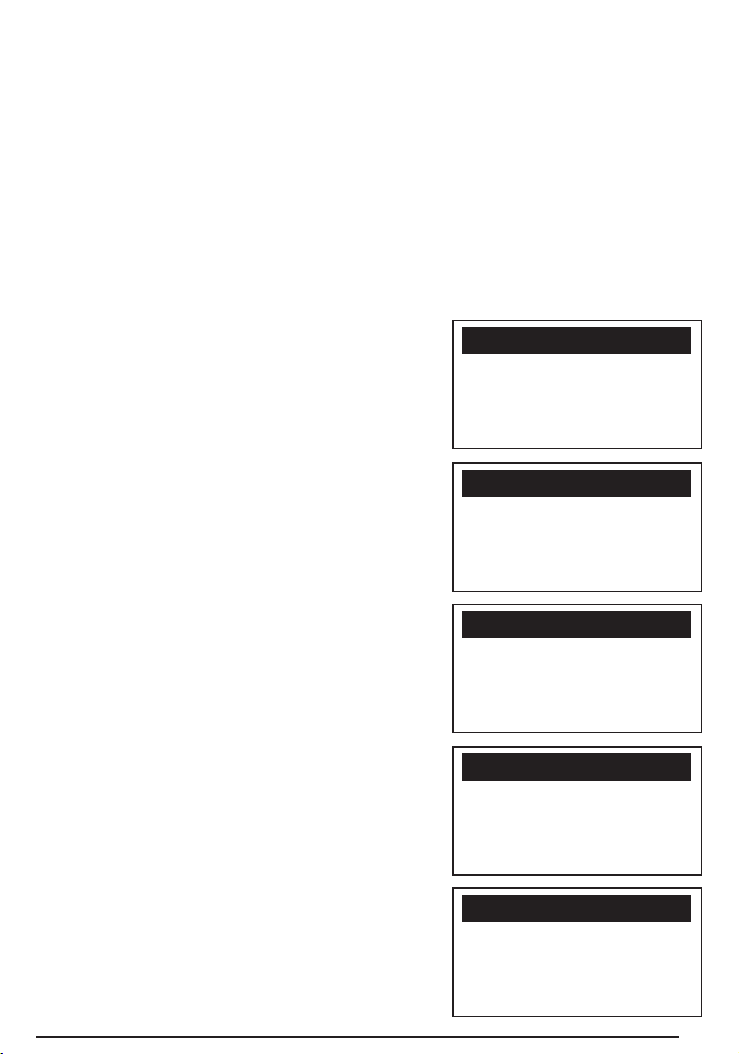
From the second startup screen, press SCROLL button to enter System Setup menu.
Follow the instructions to make adjustments and
settings as described in the following setup options.
• The number in the upper right corner
of the screen indicates total number of items
under the menu and sequence of currently
selected item.
Language Setup
• English is the default language.
1) From System Setup menu, use SCROLL button
to select Language, and press ENTER/EXIT button.
2) Use SCROLL button to select the desired
language and press ENTER/EXIT button to
save your selection and return to previous menu.
Unit of Measurement
• Metric is the default measurement unit.
1) From System Setup menu, use SCROLL
button to select Unit of Measure and press
ENTER/EXIT button.
2) From Unit of Measure menu, use SCROLL
button to select the desired unit of measurement.
3) Press ENTER/EXIT button to save your
selection and return to previous menu.
============================1/4
u 1) Language
2) Unit of Measure
3) Contrast
4) Exit
System Setup
============================1/4
u 1) Language
2) Unit of Measure
3) Contrast
4) Exit
System Setup
============================1/3
u English
Français
Español
Language
============================2/4
1) Language
u 2) Unit of Measure
3) Contrast
4) Exit
System Setup
============================2/2
English
u Metric
Unit of Measure
10
Contrast Adjustment
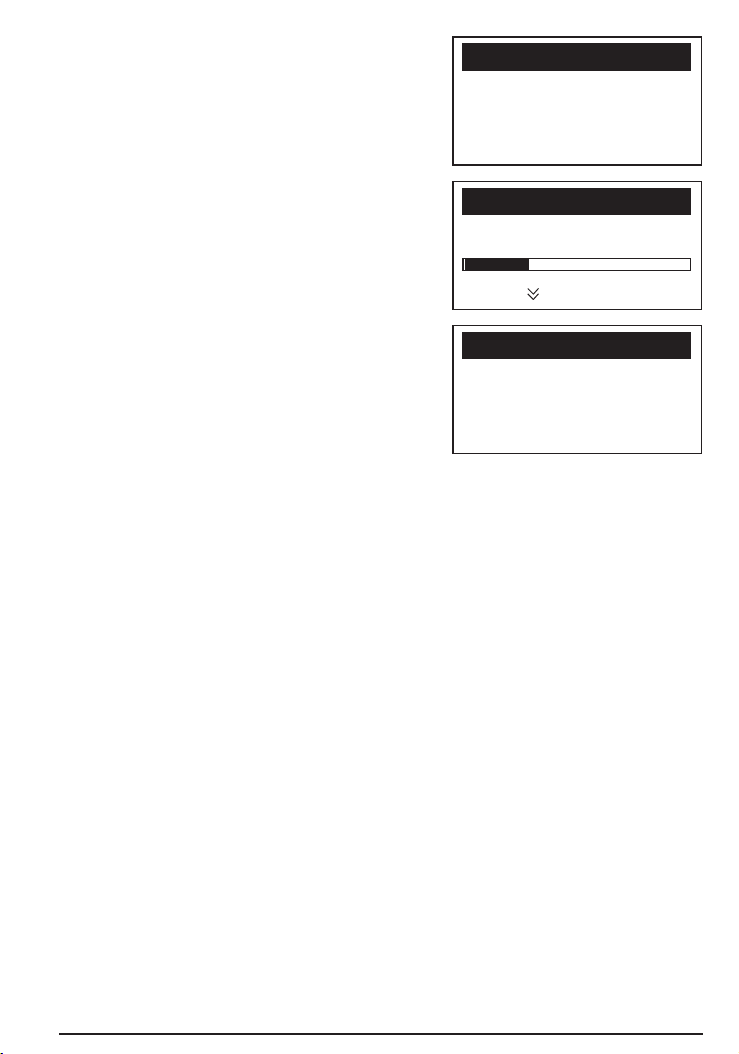
1) From System Setup menu, use SCROLL button
to select Contrast, and press ENTER/EXIT button.
2) From Contrast menu, use SCROLL button to
adjust contrast.
3) Press ENTER/EXIT button to save your
settings and return to previous menu.
Exiting System Setup
1) Use SCROLL button to select Exit and press
ENTER/EXIT button to return to startup menu.
Vehicle Coverage
The Multilingual Digital Scanner is specially
designed to work with all OBD II compliant
vehicles, including those equipped with the next-generation protocol-Control Area
Network (CAN). It is required by EPA that All 1996 and newer vehicles (cars and
light trucks) sold in the United States must be OBD II compliant and this includes
all Domestic, Asian and European vehicles.
A small number of 1994 and 1995 model year gasoline vehicles are OBD II
compliant. To verify if a 1994 or 1995 vehicle is OBD II compliant, check the
Vehicle Emissions Control Information (VECI) Label which is located under the
hood or by the radiator of most vehicles. If the vehicle is OBD II compliant, the
label will designate “OBD II Certified”. Additionally, Government regulations
mandate that all OBD II compliant vehicles must have a “common” sixteen-pin
Data Link Connector (DLC).
For your vehicle to be OBD II compliant it must have a 16-pin DLC (Data Link
Connector) under the dash and the Vehicle Emission Control Information Label
must state that the vehicle is OBD II compliant.
OBD II Diagnostics
When more than one vehicle control module is detected by the scan tool, you will
be prompted to select the module where the data may be retrieved. The most
often to be selected are the Powertrain Control Module [PCM] and Transmission
Control Module [TCM].
CAUTION:
Don’t connect or disconnect any test equipment with ignition on or engine running.
==============================
Contrast (35%)
Use to change
Contrast
============================3/4
1) Language
2) Unit of Measure
u 3) Contrast
4) Exit
System Setup
============================4/4
1) Language
2) Unit of Measure
3) Contrast
u 4) Exit
System Setup
OPERATING INSTRUCTIONS
11
1) Turn the ignition off.
2) Locate the vehicle’s 16-pin Data Link Connector (DLC).
3) Plug into the OBDII cable to the vehicle’s DLC.
4) Turn the ignition on. Engine can be off or running.
5) Press ENTER/EXIT button to enter Diagnostic Menu. A sequence of messages
displaying the OBD2 protocols will be observed on the display until the vehicle
protocol is detected.
◆ If the code reader fails to communicate with the vehicle’s ECU (Engine Control
Unit), a “LINKING ERROR!” message shows up on the display.
✓ Verify that the ignition is ON;
✓ Check if the code reader’s OBD II connector is securely connected to the
vehicle’s DLC;
✓ Verify that the vehicle is OBD2 compliant;
✓ Turn the ignition off and wait for about 10 seconds. Turn the ignition back to on
and repeat the procedure from step 5.
◆ If the “LINKING ERROR” message does not go away,
then there might be problems for the code reader
to communicate with the vehicle. Contact your
local distributor or the manufacturer’s customer
service department for
assistance.
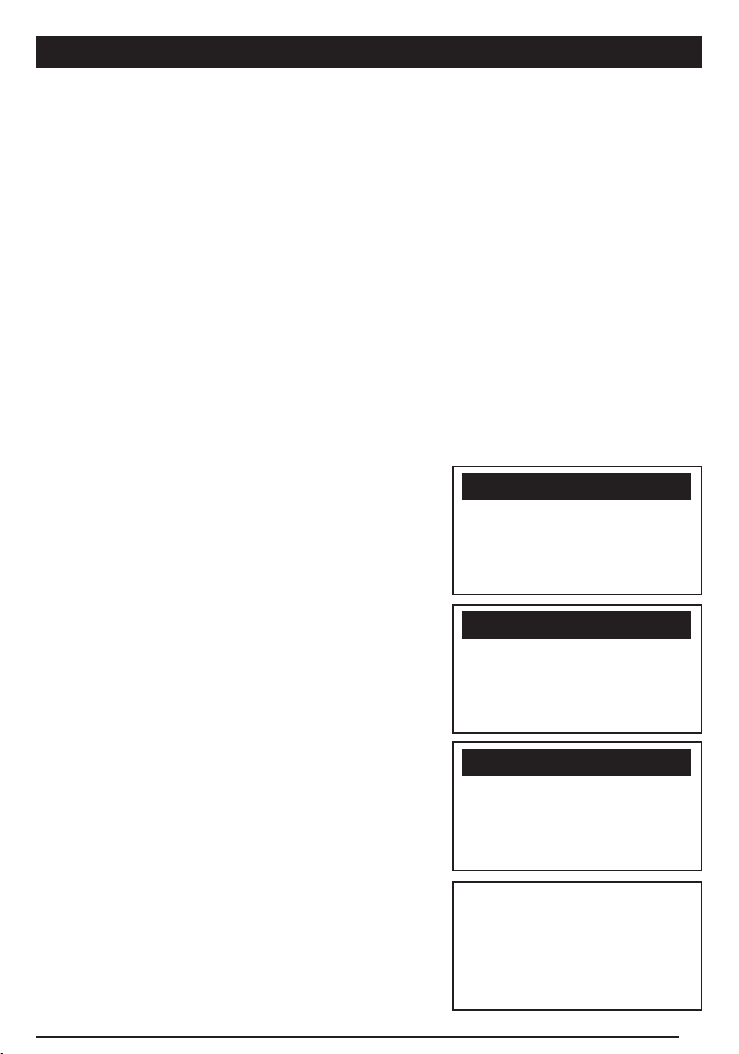
6) After the system status is displayed
(MIL status, DTC counts, Monitor status),
wait a few seconds or press any key for
Diagnostic Menu to come up.
Reading Codes
1) Use SCROLL button to select Read Codes
from Diagnostic Menu and press
ENTER/EXIT button.
• If more than one module is detected,
you will be prompted to select a module
before test.
• Use SCROLL button to select a module,
and press ENTER/EXIT button.
2) View DTCs and their definitions
on screen.
============================1/6
u 1) Read Codes
2) Erase Codes
3) View Freeze Frame
4) I/M Readiness
Diagnostic Menu
==============================
Codes Found 1
Monitors N/A 4
Monitors OK 3
Monitors INC 3
System Status
============================1/3
u Engine
Module $A4
Exit
Control Module
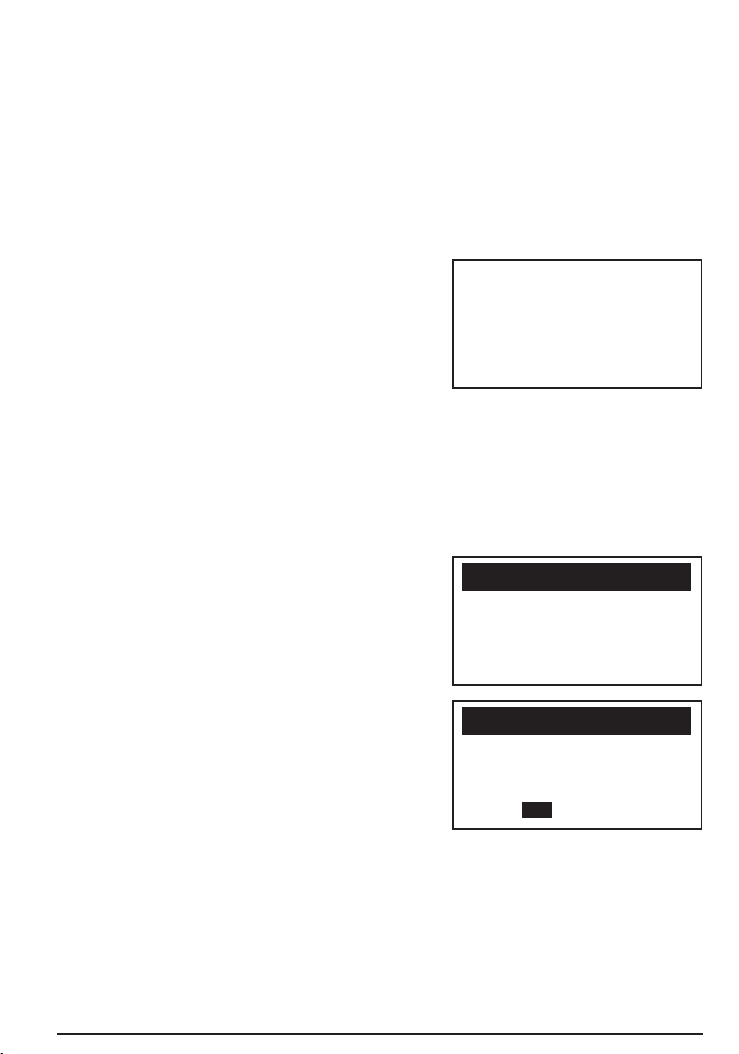
$11 Pd 1/6
P0115 Generic
==============================
Engine Coolant Temperature
Sensor 1 Circuit
12
• The control module number, sequence of the DTCs, total number of codes
detected and type of codes (Generic or Manufacturer specific, Stored or Pending
codes) will be observed on the upper right hand corner of the display.
3) If more than one DTC is found, use SCROLL button, as necessary, until all the
codes have been shown up.
• If no codes are detected, a “No codes are stored in the module!” message displays on
the screen.
• If retrieved DTCs contain any manufacturer specific or enhanced codes, the
display indicates “Manufacturer Control”.
4) Press ENTER/EXIT button to return
to previous menu.
Erasing Codes
CAUTION: Erasing the Diagnostic Trouble Codes may allow the code reader to delete not only the
codes from the vehicle’s on-board computer, but also “Freeze Frame” data and manufacturer
enhanced data. Further, the I/M Readiness Monitor Status for all vehicle monitors is reset to Not
Ready or Not Complete status. Do not erase the codes before the system has been checked
completely by a technician.
• This function is performed with key on engine off (KOEO). Do not start the engine.
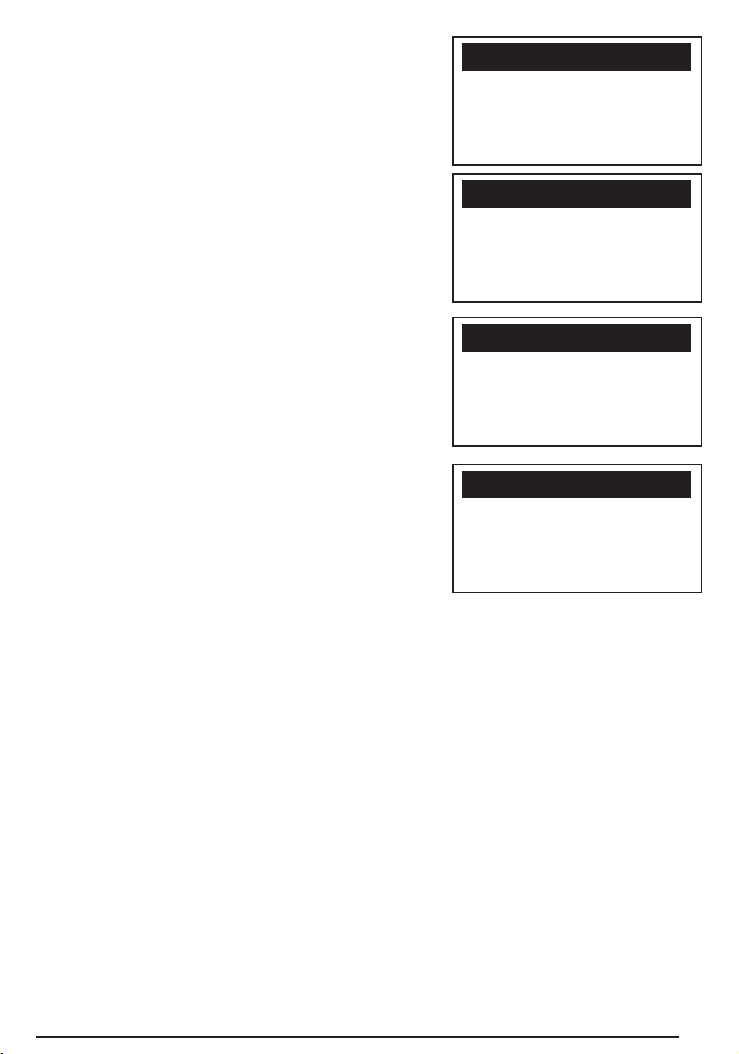
1) If you decide to erase the DTCs, use
SCROLL button to select Erase Codes from
Diagnostics Menu and press ENTER/EXIT button.
2) A warning message comes up asking for
your confirmation.
3)
If you want to proceed with erasing the codes,
press ENTER/EXIT button to erase.
• If the codes are cleared successfully, an
“Erase Done!” message shows up.
• If the codes are not cleared, then an
“Erase Failure. Turn Key on with Engine off!” message displays.
4) Wait a few seconds or press any key to return to Diagnostic Menu.
• If you do wish to proceed to erase the codes, then press SCROLL button to select
NO and press ENTER/EXIT. A “Command Canceled” message shows up. Press any key
or wait a few seconds to return to Diagnostic Menu.
$09 4/6
P0115 Other
==============================
Manufacturer control
============================2/6
1) Read Codes
u 2) Erase Codes
3) View Freeze Frame
4) I/M Readiness
Diagnostic Menu
==============================
Erase trouble codes!
Are you sure?
YES NO
Erase Codes
13
Viewing Freeze frame Data
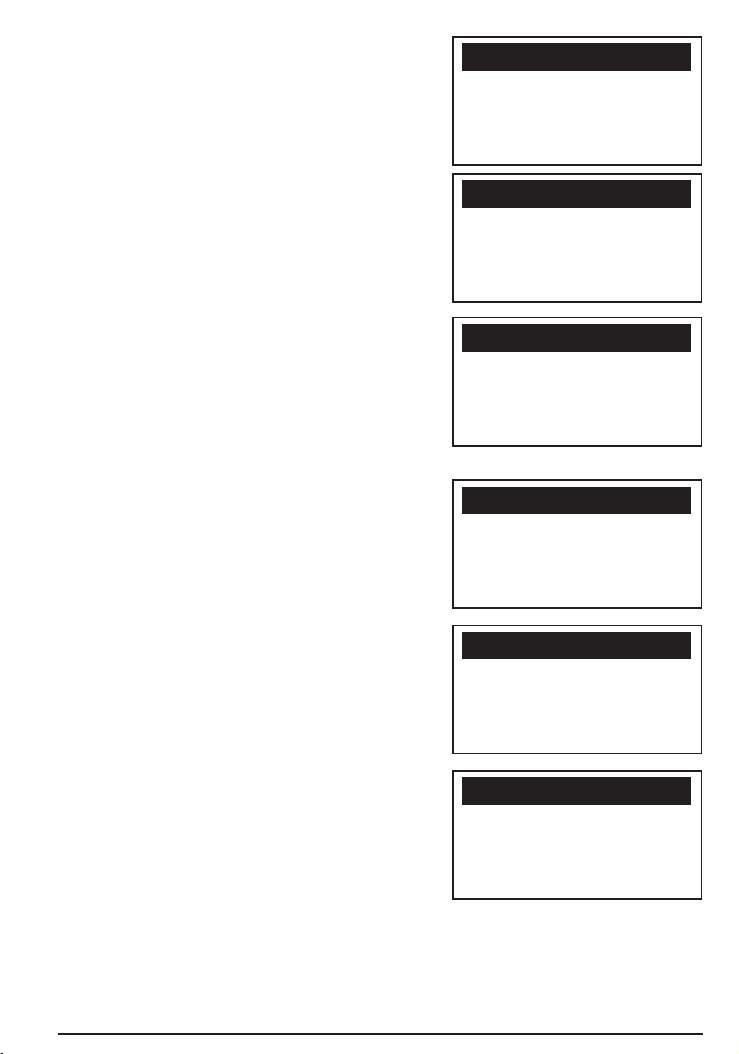
1) To view freeze frame, use SCROLL button
to select View Freeze Frame from Diagnostic Menu
and press ENTER/EXIT button.
• If more than one module is detected, you will
be prompted to select a module before test.
• Use SCROLL button to select a module and
press ENTER/EXIT button.
2) Wait a few seconds while the code reader
validates the PID MAP.
3) If the retrieved information covers more than
one screen, use SCROLL button, as necessary,
until all data have been shown up.
• The number in the upper right corner of the
screen indicates total number of screens the
retrieved freeze frame covers and sequence of
currently displayed data.
• If there is no freeze frame data available, an
advisory message “No Freeze Frame Data Stored!”
shows on the display.
4) Press ENTER/EXIT to return to Diagnostic Menu.
Retrieving I/M Readiness Status
I/M Readiness function is used to check the operations of the Emission System on
OBD2 compliant vehicles. It is an excellent function to use prior to having a vehicle
inspected for compliance to a state emissions program.
Some latest vehicle models may support two types of I/M Readiness tests:
A.
Since DTCs Cleared - indicates status of the monitors since the DTCs are erased.
B. This Drive Cycle - indicates status of monitors since the beginning of the current
drive cycle.
An I/M Readiness Status result of “NO” does not necessarily indicate that the
vehicle being tested will fail the state I/M inspection. For some states, one or more
such monitors may be allowed to be “Not Ready” to pass the emissions inspection.
• “OK” - Indicates that a particular monitor being checked has completed its
diagnostic testing.
• “INC” - Indicates that a particular monitor being checked has not completed its
diagnostic testing.
• “N/A” -
The monitor is not supported on that vehicle.
============================3/6
1) Read Codes
2) Erase Codes
u 3) View Freeze Frame
4) I/M Readiness
Diagnostic Menu
============================1/3
u Engine
Module $A4
Exit
Control Module
==============================
Reading PID.01!
- Please Wait -
View Freeze Frame
============================1/4
DTCFRZF P2770
FUELSYS1 OL
FUELSYS2 N/A
LOAD_PCT (%) 0.0
View Freeze Frame
1) Use SCROLL button to select I/M Readiness from
Diagnostic Menu and press ENTER/EXIT.
• If more than one module is detected, you will
be prompted to select a module before test.
• Use the SCROLL button to select a module,
and press ENTER/EXIT button.
2) Wait a few seconds while the code reader
validates the PID MAP.
3) If the vehicle supports both types of tests,
then both types shows on the screen for selection.
4) Use SCROLL button to view the status of the
MIL light (“ON” or “OFF”) and the following monitors:
• Misfire monitor - Misfire monitor
• Fuel System Mon - Fuel System Monitor
• Comp. Component - Comprehensive Components Monitor
• EGR - EGR System Monitor
• Oxygen Sens Mon - O2 Sensors Monitor
• Catalyst Mon - Catalyst Monitor
• EVAP System Mon - Evaporative System Monitor
• Oxygen Sens htr - O2 Sensor Heater Monitor
• Sec Air System - Secondary Air Monitor
• Htd Catalyst - Heated Catalyst Monitor
• A/C Refrig Mon - A/C system Monitor
5) If the vehicle supports readiness test of
“This Drive Cycle”, a screen of the following
will be displayed:
• The number in the upper right corner of the
screen indicates total number of screens the
retrieved data cover and sequence of currently
displayed data.
6)
Press ENTER/EXIT button to return to previous menu.
Viewing Vehicle Information
The Vehicle Info. function enables retrieval of the Vehicle Identification No. (VIN),
Calibration ID(s), Calibration Verification Nos. (CVNs) and In-use Performance
Tracking on 2000 and newer vehicles that support Mode 9.
============================4/6
1) Read Codes
2) Erase Codes
3) View Freeze Frame
u 4) I/M Readiness
Diagnostic Menu
============================1/3
u Engine
Module $A4
Exit
Control Module
==============================
Reading PID...
- Please Wait -
I/M Readiness
============================1/3
u Since DTCs Cleared
This Drive Cycle
Exit
I/M Readiness
============================1/3
MIL Status OFF
Misfire Monitor OK
Fuel System Mon OK
Comp. Component OK
Since DTCs Cleared
============================1/3
MIL Status ON
Misfire Monitor OK
Fuel System Mon OK
Comp. Component OK
This Drive Cycle
14
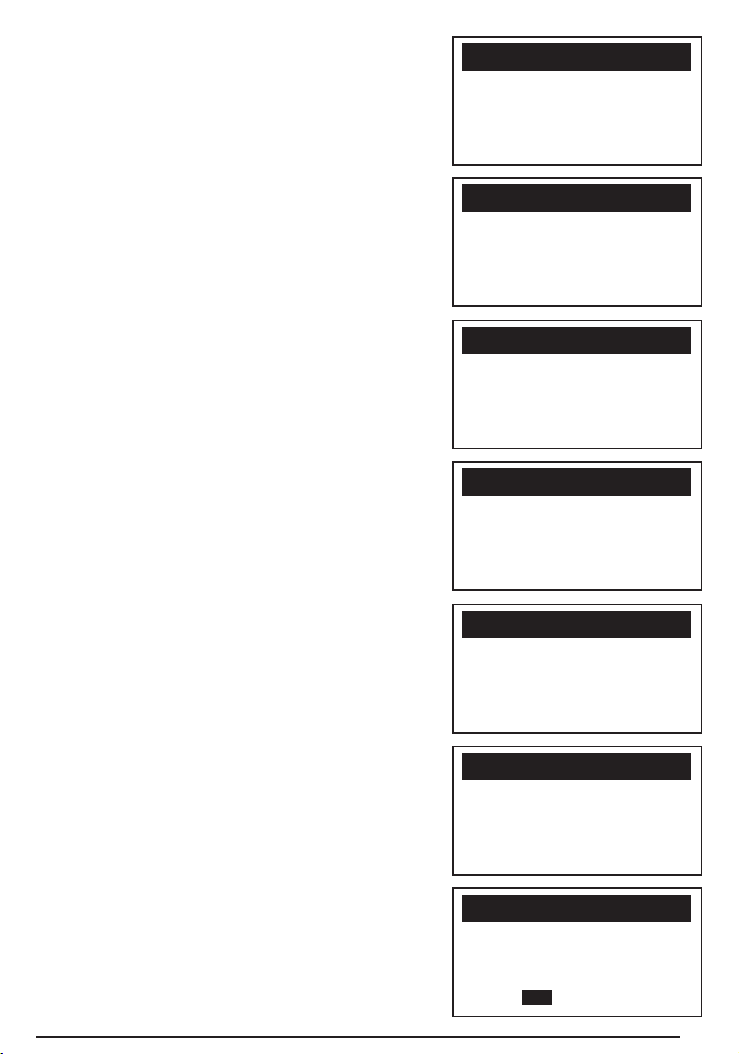
1) Use SCROLL button to select Vehicle Info. from
Diagnostic Menu and press ENTER/EXIT button.
2) Wait a few seconds or press ENTER/EXIT
button to continue.
• If the vehicle does not support this mode,
a “The selected mode is not supported!” message
shows on the display.
• If more than one module is detected, you
will be prompted to select a module before test.
• Use SCROLL button to select a module, and
press ENTER/EXIT button.
3) Wait a few seconds while the code reader
reads vehicle information.
4) From Vehicle Info. menu, use SCROLL button
to select an available items to view and
press ENTER/EXIT button.
5)
View retrieved vehicle information on the screen.
6) Press ENTER/EXIT to return to previous menu.
Exiting OBDII Test
1) To exit OBDII test, use SCROLL button to select
Exit from Diagnostic Menu and press E
NTER/EXIT button.
2) A warning message comes up asking
your confirmation.
3) If you do want to exit OBDII test, press
ENTER/EXIT button.
• If you do not want to exit, use SCROLL button then
select NO and press ENTER/EXIT button to return.
============================5/6
u 5) I/M Readiness
6) Exit
Diagnostic Menu
==============================
Turn key on
with engine off!
Press [ENTER] to con.
Vehicle Info.
============================1/3
u Engine
Module $A4
Exit
Control Module
==============================
VIN:
2HJ198406H6539415
Vehicle ID Number
============================1/4
u Vehicle ID Number
Calibration ID
Cal. Verif. Number
Exit
Vehicle Info.
============================6/6
5) I/M Readiness
u 6) Exit
Diagnostic Menu
==============================
Exit OBDII Test!
Are you sure?
YES NO
Exit Test
15
The following Diagnostic Trouble Code Definitions lists provide only
Generic Diagnostic Trouble Codes. For Manufacturer Specific Diagnostic
Trouble Code Definitions, consult the vehicle’s service manual.
CAUTION:
Parts or components should not be replaced based on
only a DTC without first consulting the vehicle service manual for
more information on possible causes of the fault as well as required
testing procedures.
OBDII Generic DTC Definitions
P0001 Fuel Volume Regulator Control Circuit Open
P0002 Fuel Volume Regulator Control Circuit Range/Performance
P0003 Fuel Volume Regulator Control Circuit Low
P0004 Fuel Volume Regulator Control Circuit High
P0005 Fuel Shutoff Valve. A Control Circuit Open
P0006 Fuel Shutoff Valve. A Control Circuit Low
P0007 Fuel Shutoff Valve. A Control Circuit High
P0008 Engine Position System Performance (Bank 1)
P0009 Engine Position System Performance (Bank 2)
P0010 Camshaft Position Actuator A -Bank 1 Circuit Malfunction
P0011 Camshaft Position Actuator A -Bank 1 Timing Over-Advanced
P0012 Camshaft Position Actuator A - Bank 1 Timing Over-Retarded
P0013 Camshaft Position Actuator B - Bank 1 Circuit Malfunction
P0014 Camshaft Position Actuator B - Bank 1 Timing Over-Advanced
P0015 Camshaft Position Actuator B - Bank 1 Timing Over-Retarded
P0016 Cam/Crankshaft Pos. Correlation Sensor A - Bank 1
P0017 Cam/Crankshaft Pos. Correlation Sensor B - Bank 1
P0018 Cam/Crankshaft Pos. Correlation Sensor A - Bank 2
P0019 Cam/Crankshaft Pos. Correlation Sensor B - Bank 2
P0020 Camshaft Position Actuator A - Bank 2 Circuit Malfunction
P0021 Camshaft Position Actuator A - Bank 2 Timing Over-Advanced
P0022 Camshaft Position Actuator A -Bank 2 Timing Over-Retarded
DIAGNOSTIC TROUBLE CODE (DTC) DEFINITIONS
16
OBDII Generic DTC Definitions
P0023 Camshaft Position Actuator B - Bank 2 Circuit Malfunction
P0024 Camshaft Position Actuator B - Bank 2 Timing Over-Advanced
P0025 Camshaft Position Actuator B - Bank 2 Timing Over-Retarded
P0026 Intake Valve-Bank 1 Control Solenoid CKT Range/Performance
P0027
Exhaust Valve-Bank 1 Control Solenoid CKT Range/Performance
P0028 Intake Valve-Bank 2 Control Solenoid CKT Range/Performance
P0029
Exhaust Valve-Bank 2 Control Solenoid CKT Range/Performance
P0030 HO2S Bank 1 Sensor 1 Heater Circuit
P0031 HO2S Bank 1 Sensor 1 Heater Circuit Low
P0032 HO2S Bank 1 Sensor 1 Heater Circuit High
P0033 Turbo/Sup Wastegate Control Circuit
P0034 Turbo/Sup Wastegate Control Circuit Low
P0035 Turbo/Sup Wastegate Control Circuit High
P0036 HO2S Bank 1 Sensor 2 Heater Circuit
P0037 HO2S Bank 1 Sensor 2 Heater Circuit Low
P0038 HO2S Bank 1 Sensor 2 Heater Circuit High
P0039 Turbo/Super Charger Bypass Control CKT Performance
P0040 O2 Bank 1 Sensor 1 Signals Swapped w/ O2 Bank 2 Sensor 1
P0041 O2 Bank 1 Sensor 2 Signals Swapped w/ O2 Bank 2 Sensor 2
P0042 HO2S Bank 1 Sensor 3 Heater Circuit
P0043 HO2S Bank 1 Sensor 3 Heater Circuit Low
P0044 HO2S Bank 1 Sensor 3 Heater Circuit High
P0045 Turbo/Super Charger Boost Control Solenoid A Circuit Open
P0046
Turbo/Super Charger Boost Control Solenoid A Circuit Range/ Perform
P0047 Turbo/Super Charger Boost Control Solenoid A Circuit Low
P0048 Turbo/Super Charger Boost Control Solenoid A Circuit High
P0049 Turbo/Super Charger Boost Input/Turbine Speed Overspeed
P0050 HO2S Bank 2 Sensor 1 Heater Circuit
P0051 HO2S Bank 2 Sensor 1 Heater Circuit Low
P0052 HO2S Bank 2 Sensor 1 Heater Circuit High
P0053 HO2S Bank 1 Sensor 1 Heater Resistance
P0054 HO2S Bank 1 Sensor 2 Heater Resistance
P0055 HO2S Bank 1 Sensor 3 Heater Resistance
P0056 HO2S Bank 2 Sensor 2 Heater Circuit
P0057 HO2S Bank 2 Sensor 2 Heater Circuit Low
P0058 HO2S Bank 2 Sensor 2 Heater Circuit High
17
OBDII Generic DTC Definitions
P0059 HO2S Bank 2 Sensor 1 Heater Resistance
P0060 HO2S Bank 2 Sensor 2 Heater Resistance
P0061 HO2S Bank 2 Sensor 3 Heater Resistance
P0062 HO2S Bank 2 Sensor 3 Heater Circuit
P0063 HO2S Bank 2 Sensor 3 Heater Circuit Low
P0064 HO2S Bank 2 Sensor 3 Heater Circuit High
P0065 Air Assisted Injector. Control Range/Performance
P0066 Air Assisted Injector. Control Circuit Low
P0067 Air Assisted Injector. Control Circuit High
P0068 MAF/MAP Sensor Throttle Position Correlation
P0069 MAP/BARO Correlation
P0070 Ambient Air Temp. Sensor Circuit
P0071 Ambient Air Temp. Sensor Range/Performance
P0072 Ambient Air Temp. Sensor Circuit Low
P0073 Ambient Air Temp. Sensor Circuit High
P0074 Ambient Air Temp. Sensor CKT Intermittent
P0075 Intake Valve-Bank 1 Control Circuit
P0076 Intake Valve-Bank 1 Control Circuit Low
P0077 Intake Valve-Bank 1 Control Circuit High
P0078 Exhaust Valve-Bank1 Control Circuit
P0079 Exhaust Valve-Bank1 Control Circuit Low
P0080 Exhaust Valve-Bank1 Control Circuit High
P0081 Intake Valve-Bank 2 Control Circuit
P0082 Intake Valve-Bank 2 Control Circuit Low
P0083 Intake Valve-Bank 2 Control Circuit High
P0084 Exhaust Valve-Bank2 Control Circuit
P0085 Exhaust Valve-Bank2 Control Circuit Low
P0086 Exhaust Valve-Bank2 Control Circuit High
P0087 Fuel Rail Pressure Too Low
P0088 Fuel Rail Pressure Too High
P0089 Fuel Pressure Regulator 1 Performance
P0090 Fuel Pressure Regulator 1 Control Circuit
P0091 Fuel Pressure Regulator 1 Control Circuit Low
P0092 Fuel Pressure Regulator 1 Control Circuit High
P0093 Fuel System Leak (Large)
P0094 Fuel System Leak (Small)
18
OBDII Generic DTC Definitions
P0095 IAT Sensor 2 Circuit
P0096 IAT Sensor 2 CKT Range/Performance
P0097 IAT Sensor 2 Circuit Low
P0098 IAT Sensor 2 Circuit High
P0099 IAT Sensor 2 CKT Intermittent
P0100 MAF or VAF A Circuit Malfunction
P0101 MAF or VAF A Circuit Range/Performance
P0102 MAF or VAF A Circuit Low Input
P0103 MAF or VAF A Circuit High Input
P0104 MAF or VAF A Circuit Intermittent
P0105 MAP/BARO Circuit Malfunction
P0106 MAP/BARO CKT Range/Performance
P0107 MAP/BARO Circuit Low Input
P0108 MAP/BARO Circuit High Input
P0109 MAP/BARO CKT Intermittent
P0110 IAT Sensor Circuit Malfunction
P0111 IAT Sensor 1 CKT Range/Performance
P0112 IAT Sensor 1 Circuit Low Input
P0113 IAT Sensor 1 Circuit High Input
P0114 IAT Sensor 1 CKT Intermittent
P0115 Engine Coolant Temp Circuit Malfunction
P0116 Engine Coolant Temp CKT Range/Performance
P0117 Engine Coolant Temp Circuit Low Input
P0118 Engine Coolant Temp Circuit High Input
P0119 Engine Coolant Temp CKT Intermittent
P0120 TPS/Pedal Position Sensor A Circuit Malfunction
P0121 TPS/Pedal Position Sensor A CKT Range/Performance
P0122 TPS/Pedal Position Sensor A Circuit Low Input
P0123 TPS/Pedal Position Sensor A Circuit High Input
P0124 TPS/Pedal Position Sensor A CKT Intermittent
P0125 Closed Loop Fuel Ctrl Insufficient Coolant Temp
P0126 Coolant Temp Insufficient Stable Operation
P0127 IAT Sensor Too High
P0128 Coolant Temp Below Thermostat Regulating Temp
P0129 Barometric Pressure Too Low
P0130 O2 Sensor Circuit Malfunction (Bank 1 Sensor 1)
19
OBDII Generic DTC Definitions
P0131 O2 Sensor Circuit Low Volts (Bank 1 Sensor 1)
P0132 O2 Sensor Circuit High Volts (Bank 1 Sensor 1)
P0133 O2 Sensor CKT Slow Response (Bank 1 Sensor 1)
P0134 O2 Sensor CKT No Activity (Bank 1 Sensor 1)
P0135 O2 Sensor Heater Circuit Malfunction (Bank 1 Sensor 1)
P0136 O2 Sensor Circuit Malfunction (Bank 1 Sensor 2)
P0137 O2 Sensor Circuit Low Volts (Bank 1 Sensor 2)
P0138 O2 Sensor Circuit High Volts (Bank 1 Sensor 2)
P0139 O2 Sensor CKT Slow Response (Bank 1 Sensor 2)
P0140 O2 Sensor CKT No Activity (Bank 1 Sensor 2)
P0141 O2 Sensor Heater Circuit Malfunction (Bank 1 Sensor 2)
P0142 O2 Sensor Circuit Malfunction (Bank 1 Sensor 3)
P0143 O2 Sensor Circuit Low Volts (Bank 1 Sensor 3)
P0144 O2 Sensor Circuit High Volts (Bank 1 Sensor 3)
P0145 O2 Sensor CKT Slow Response (Bank 1 Sensor 3)
P0146 O2 Sensor CKT No Activity (Bank 1 Sensor 3)
P0147 O2 Sensor Heater Circuit Malfunction (Bank 1 Sensor 3)
P0148 Fuel Delivery Malfunction
P0149 Fuel Timing Malfunction
P0150 O2 Sensor Circuit Malfunction (Bank 2 Sensor 1)
P0151 O2 Sensor Circuit Low Volts (Bank 2 Sensor 1)
P0152 O2 Sensor Circuit High Volts (Bank 2 Sensor 1)
P0153 O2 Sensor CKT Slow Response (Bank 2 Sensor 1)
P0154 O2 Sensor CKT No Activity (Bank 2 Sensor 1)
P0155 O2 Sensor Heater Circuit Malfunction (Bank 2 Sensor 1)
P0156 O2 Sensor Circuit Malfunction (Bank 2 Sensor 2)
P0157 O2 Sensor Circuit Low Volts (Bank 2 Sensor 2)
P0158 O2 Sensor Circuit High Volts (Bank 2 Sensor 2)
P0159 O2 Sensor CKT Slow Response (Bank 2 Sensor 2)
P0160 O2 Sensor CKT No Activity (Bank 2 Sensor 2)
P0161 O2 Sensor Heater Circuit Malfunction (Bank 2 Sensor 2)
P0162 O2 Sensor Circuit Malfunction (Bank 2 Sensor 3)
P0163 O2 Sensor Circuit Low Volts (Bank 2 Sensor 3)
P0164 O2 Sensor Circuit High Volts (Bank 2 Sensor 3)
P0165 O2 Sensor CKT Slow Response (Bank 2 Sensor 3)
P0166 O2 Sensor CKT No Activity (Bank 2 Sensor 3)
20
OBDII Generic DTC Definitions
P0167 O2 Sensor Heater Circuit Malfunction (Bank 2 Sensor 3)
P0168 Engine Fuel Temperature Too High
P0169 Fuel Composition Incorrect
P0170 Fuel Trim Malfunction (Bank 1)
P0171 System Too Lean (Bank 1)
P0172 System Too Rich (Bank 1)
P0173 Fuel Trim Malfunction (Bank 2)
P0174 System Too Lean (Bank 2)
P0175 System Too Rich (Bank 2)
P0176 Fuel Compensation Sensor Circuit Malfunction
P0177 Fuel Compensation Sensor CKT Range/Performance
P0178 Fuel Compensation Sensor Circuit Low Input
P0179 Fuel Compensation Sensor Circuit High Input
P0180 Fuel Temperature Sensor A Circuit Malfunction
P0181 Fuel Temperature Sensor A CKT Range/Performance
P0182 Fuel Temperature Sensor A Circuit Low Input
P0183 Fuel Temperature Sensor A Circuit High Input
P0184 Fuel Temperature Sensor A CKT Intermittent
P0185 Fuel Temperature Sensor B Circuit Malfunction
P0186 Fuel Temperature Sensor B CKT Range/Performance
P0187 Fuel Temperature Sensor B Circuit Low Input
P0188 Fuel Temperature Sensor B Circuit High Input
P0189 Fuel Temperature Sensor B CKT Intermittent
P0190 Fuel Rail Pressure Sensor Circuit Malfunction
P0191 Fuel Rail Pressure Sensor CKT Range/Performance
P0192 Fuel Rail Pressure Sensor Circuit Low Input
P0193 Fuel Rail Pressure Sensor Circuit High Input
P0194 Fuel Rail Pressure Sensor CKT Intermittent
P0195 Engine Oil Temp Sensor Circuit Malfunction
P0196 Engine Oil Temp Sensor CKT Range/Performance
P0197 Engine Oil Temp Sensor Circuit Low Input
P0198 Engine Oil Temp Sensor Circuit High Input
P0199 Engine Oil Temp Sensor CKT Intermittent
P0200 Injector Circuit Open
P0201 Injector Circuit Open Cylinder 1
P0202 Injector Circuit Open Cylinder 2
21
OBDII Generic DTC Definitions
P0203 Injector Circuit Open Cylinder 3
P0204 Injector Circuit Open Cylinder 4
P0205 Injector Circuit Open Cylinder 5
P0206 Injector Circuit Open Cylinder 6
P0207 Injector Circuit Open Cylinder 7
P0208 Injector Circuit Open Cylinder 8
P0209 Injector Circuit Open Cylinder 9
P0210 Injector Circuit Open Cylinder 10
P0211 Injector Circuit Open Cylinder 11
P0212 Injector Circuit Open Cylinder 12
P0213 Cold Start Injector 1 Malfunction
P0214 Cold Start Injector 2 Malfunction
P0215 Engine Shutoff Solenoid Malfunction
P0216 Injection Timing Control Circuit Malfunction
P0217 Engine Overtemp Condition
P0218 Transmission Overtemp Condition
P0219 Engine Overspeed Condition
P0220 TPS/Pedal Position Sensor/Switch B Circuit Malfunction
P0221 TPS/Pedal Position Sensor/Switch B CKT Range/Performance
P0222 TPS/Pedal Position Sensor/Switch B Circuit Low Input
P0223 TPS/Pedal Position Sensor/Switch B Circuit High Input
P0224 TPS/Pedal Position Sensor/Switch B CKT Intermittent
P0225 TPS/Pedal Position Sensor/Switch C Circuit Malfunction
P0226 TPS/Pedal Position Sensor/Switch C CKT Range/Performance
P0227 TPS/Pedal Position Sensor/Switch C Circuit Low Input
P0228 TPS/Pedal Position Sensor/Switch C Circuit High Input
P0229 TPS/Pedal Position Sensor/Switch C CKT Intermittent
P0230 Fuel Pump Primary Circuit Malfunction
P0231 Fuel Pump Secondary Circuit Low
P0232 Fuel Pump Secondary Circuit High
P0233 Fuel Pump Secondary Circuit Intermittent Ckt
P0234 Engine Overboost Condition
P0235 Turbo/Super Boost Sensor A Circuit Malfunction
P0236 Turbo/Super Boost Sensor A CKT Range/Performance
P0237 Turbo/Super Boost Sensor A Circuit Low Input
P0238 Turbo/Super Boost Sensor A Circuit High Input
22
OBDII Generic DTC Definitions
P0239 Turbo/Super Boost Sensor B Circuit Malfunction
P0240 Turbo/Super Boost Sensor B CKT Range/Performance
P0241 Turbo/Super Boost Sensor B Circuit Low Input
P0242 Turbo/Super Boost Sensor B Circuit High Input
P0243 Turbo/Sup Wastegate Solenoid A Malfunction
P0244 Turbo/Sup Wastegate Solenoid A Range/Performance
P0245 Turbo/Sup Wastegate Solenoid A Low
P0246 Turbo/Sup Wastegate Solenoid A High
P0247 Turbo/Sup Wastegate Solenoid B Malfunction
P0248 Turbo /Sup Wastegate Solenoid B Range/Performance
P0249 Turbo/Sup Wastegate Solenoid B Low
P0250 Turbo/Sup Wastegate Solenoid B High
P0251 Injection Pump Metering Control A
P0252 Injection Pump Metering Control A Range/Performance
P0253 Injection Pump Metering Control A Low
P0254 Injection Pump Metering Control A High
P0255
Injection Pump Metering Control A Intermittent (Cam/Rotor/Injector)
P0256
Injection Pump Metering Control B Malfunction (Cam/Rotor/Injector)
P0257
Injection Pump Metering Control B Range/Performance
(Cam/Rotor/Injector)
P0258 Injection Pump Metering Control B Low (Cam/Rotor/Injector)
P0259 Injection Pump Metering Control B High (Cam/Rotor/Injector)
P0260
Injection Pump Metering Control B Intermittent
(Cam/Rotor/Injector)
P0261 Cylinder 1 Injector Control Circuit Low
P0262 Cylinder 1 Injector Control Circuit High
P0263 Cylinder 1 Contribution Balance Fault
P0264 Cylinder 2 Injector Control Circuit Low
P0265 Cylinder 2 Injector Control Circuit High
P0266 Cylinder 2 Contribution Balance Fault
P0267 Cylinder 3 Injector Control Circuit Low
P0268 Cylinder 3 Injector Control Circuit High
P0269 Cylinder 3 Contribution Balance Fault
P0270 Cylinder 4 Injector Control Circuit Low
P0271 Cylinder 4 Injector Control Circuit High
P0272 Cylinder 4 Contribution Balance Fault
23
OBDII Generic DTC Definitions
P0273 Cylinder 5 Injector Control Circuit Low
P0274 Cylinder 5 Injector Control Circuit High
P0275 Cylinder 5 Contribution Balance Fault
P0276 Cylinder 6 Injector Control Circuit Low
P0277 Cylinder 6 Injector Control Circuit High
P0278 Cylinder 6 Contribution Balance Fault
P0279 Cylinder 7 Injector Control Circuit Low
P0280 Cylinder 7 Injector Control Circuit High
P0281 Cylinder 7 Contribution Balance Fault
P0282 Cylinder 8 Injector Control Circuit Low
P0283 Cylinder 8 Injector Control Circuit High
P0284 Cylinder 8 Contribution Balance Fault
P0285 Cylinder 9 Injector Control Circuit Low
P0286 Cylinder 9 Injector Control Circuit High
P0287 Cylinder 9 Contribution Balance Fault
P0288 Cylinder 10 Injector Control Circuit Low
P0289 Cylinder 10 Injector Control Circuit High
P0290 Cylinder 10 Contribution Balance Fault
P0291 Cylinder 11 Injector Control Circuit Low
P0292 Cylinder 11 Injector Control Circuit High
P0293 Cylinder 11 Contribution Balance Fault
P0294 Cylinder 12 Injector Control Circuit Low
P0295 Cylinder 12 Injector Control Circuit High
P0296 Cylinder 12 Contribution Balance Fault
P0297 Vehicle Overspeed Error
P0298 Engine Oil Temperature Too High
P0299 Turbo/Super Charger UnderBoost
P0300 Random/Multiple Cylinder Misfire Detected
P0301 Cylinder 1 Misfire Detected
P0302 Cylinder 2 Misfire Detected
P0303 Cylinder 3 Misfire Detected
P0304 Cylinder 4 Misfire Detected
P0305 Cylinder 5 Misfire Detected
P0306 Cylinder 6 Misfire Detected
P0307 Cylinder 7 Misfire Detected
P0308 Cylinder 8 Misfire Detected
24
OBDII Generic DTC Definitions
P0309 Cylinder 9 Misfire Detected
P0310 Cylinder 10 Misfire Detected
P0311 Cylinder 11 Misfire Detected
P0312 Cylinder 12 Misfire Detected
P0313 Misfire Detected Low Fuel Level
P0314 Misfire Detected Cyl. not Specific
P0315 Crankshaft Position System Variation Not Learned
P0316 Misfire Detected 1st 1000 Revs.
P0317 Rough Road Hardware Not Present
P0318 Rough Road Sensor A Signal Circuit
P0319 Rough Road Sensor B
P0320 Ignition/Dist Engine Speed Input Circuit Malfunction
P0321
Ignition/Dist Engine Speed Input CKT Range/Performance
P0322 Ignition/Dist Engine Speed Input Circuit No Signal
P0323 Ignition/Dist Engine Speed Input CKT Intermittent
P0324 Knock Control System Malfunction
P0325 Knock Sensor 1 Circuit Malfunction Bank 1 or 1 Sensor
P0326
Knock Sensor 1 CKT Range/Performance Bank 1 or 1 Sensor
P0327 Knock Sensor 1 Circuit Low Input Bank 1 or 1 Sensor
P0328 Knock Sensor 1 Circuit High Input Bank 1 or 1 Sensor
P0329 Knock Sensor 1 CKT Intermittent Bank 1 or 1 Sensor
P0330 Knock Sensor 2 Circuit Malfunction (Bank 2)
P0331 Knock Sensor 2 CKT Range/Performance (Bank 2)
P0332 Knock Sensor 2 Circuit Low Input (Bank 2)
P0333 Knock Sensor 2 Circuit High Input (Bank 2)
P0334 Knock Sensor 2 CKT Intermittent (Bank 2)
P0335 Crankshaft Position Sensor A Circuit Malfunction
P0336 Crankshaft Position Sensor A CKT Range/Performance
P0337 Crankshaft Position Sensor A Circuit Low Input
P0338 Crankshaft Position Sensor A Circuit High Input
P0339 Crankshaft Position Sensor A CKT Intermittent
P0340 Camshaft Position Sensor A - Bank 1 Circuit Malfunction
P0341
Camshaft Position Sensor A - Bank 1 CKT Range/Performance
P0342 Camshaft Position Sensor A - Bank 1 Circuit Low Input
P0343 Camshaft Position Sensor A - Bank 1 Circuit High Input
P0344 Camshaft Position Sensor A - Bank 1 CKT Intermittent
25
OBDII Generic DTC Definitions
P0345 Camshaft Position Sensor A - Bank 2 Circuit Malfunction
P0346
Camshaft Position Sensor A - Bank 2 CKT Range/Performance
P0347 Camshaft Position Sensor A - Bank 2 Circuit Low Input
P0348 Camshaft Position Sensor A - Bank 2 Circuit High Input
P0349 Camshaft Position Sensor A - Bank 2 CKT Intermittent
P0350 Ignition Coil Primary/Secondary Circuit Malfunction
P0351 Ignition Coil A Primary/Secondary Circuit Malfunction
P0352 Ignition Coil B Primary/Secondary Circuit Malfunction
P0353 Ignition Coil C Primary/Secondary Circuit Malfunction
P0354 Ignition Coil D Primary/Secondary Circuit Malfunction
P0355 Ignition Coil E Primary/Secondary Circuit Malfunction
P0356 Ignition Coil F Primary/Secondary Circuit Malfunction
P0357 Ignition Coil G Primary/Secondary Circuit Malfunction
P0358 Ignition Coil H Primary/Secondary Circuit Malfunction
P0359 Ignition Coil I Primary/Secondary Circuit Malfunction
P0360 Ignition Coil J Primary/Secondary Circuit Malfunction
P0361 Ignition Coil K Primary/Secondary Circuit Malfunction
P0362 Ignition Coil L Primary/Secondary Circuit Malfunction
P0363 Misfire Detected Fueling Disabled
P0365 Camshaft Position Sensor B - Bank 1 Circuit Malfunction
P0366
Camshaft Position Sensor B - Bank 1 CKT Range/Performance
P0367 Camshaft Position Sensor B - Bank 1 Circuit Low Input
P0368 Camshaft Position Sensor B - Bank 1 Circuit High Input
P0369 Camshaft Position Sensor B - Bank 1 CKT Intermittent
P0370 Timing Reference High Resolution Signal A Malfunction
P0371
Timing Reference High Resolution Signal A Too Many Pulses
P0372
Timing Reference High Resolution Signal A Too Few Pulses
P0373 Timing Reference High Resolution Signal A Erratic Pulses
P0374 Timing Reference High Resolution Signal A No Pulses
P0375 Timing Reference High Resolution Signal B Malfunction
P0376
Timing Reference High Resolution Signal B Too Many Pulses
P0377
Timing Reference High Resolution Signal B Too Few Pulses
P0378 Timing Reference High Resolution Signal B Erratic Pulses
P0379 Timing Reference High Resolution Signal B No Pulses
P0380 Glow Plug/Heater CKT A Malfunction
P0381 Glow Plug/Heater Indicator Circuit Malfunction
26
OBDII Generic DTC Definitions
P0382 Glow Plug/Heater CKT B Malfunction
P0383 Glow Plug Module Control Circuit Low
P0384 Glow Plug Module Control Circuit High
P0385 Crankshaft Position Sensor B Circuit Malfunction
P0386 Crankshaft Position Sensor B CKT Range/Performance
P0387 Crankshaft Position Sensor B Circuit Low Input
P0388 Crankshaft Position Sensor B Circuit High Input
P0389 Crankshaft Position Sensor B CKT Intermittent
P0390 Camshaft Position Sensor B - Bank 2 Circuit Malfunction
P0391
Camshaft Position Sensor B - Bank 2 CKT Range/Performance
P0392 Camshaft Position Sensor B - Bank 2 Circuit Low Input
P0393 Camshaft Position Sensor B - Bank 2 Circuit High Input
P0394 Camshaft Position Sensor B - Bank 2 CKT Intermittent
P0400 EGR Flow Malfunction
P0401 EGR Flow Insufficient
P0402 EGR Flow Excessive
P0403 EGR Flow Circuit Malfunction
P0404 EGR Flow CKT Range/Performance
P0405 EGR Flow Sensor A Circuit Low Input
P0406 EGR Flow Sensor A Circuit High Input
P0407 EGR Flow Sensor B Circuit Low Input
P0408 EGR Flow Sensor B Circuit High Input
P0409 EGR Flow Sensor A Circuit
P0410 Secondary Air Injection System Malfunction
P0411 Secondary Air Injection System Incorrect Flow
P0412 Secondary Air Injection System Valve A Malfunction
P0413 Secondary Air Injection System Valve A CKT Open
P0414 Secondary Air Injection System Valve A CKT Short
P0415 Secondary Air Injection System Valve B Malfunction
P0416 Secondary Air Injection System Valve B CKT Open
P0417 Secondary Air Injection System Valve B CKT Short
P0418 Secondary Air Injection System Relay A Malfunction
P0419 Secondary Air Injection System Relay B Malfunction
P0420 Catalyst Efficiency Below Threshold (Bank 1)
P0421 Warm Up Catalyst Below Threshold (Bank 1)
P0422 Main Catalyst Below Threshold (Bank 1)
27
OBDII Generic DTC Definitions
P0423 Heated Catalyst Below Threshold (Bank 1)
P0424 Heated Catalyst Temp Below Threshold (Bank 1)
P0425 Catalyst Temp. Sensor (Bank 1 Sensor 1)
P0426 Catalyst Temp. Sensor Performance (Bank 1 Sensor 1)
P0427 Catalyst Temp. Sensor Circuit Low (Bank 1 Sensor 1)
P0428 Catalyst Temp. Sensor Circuit High (Bank 1 Sensor 1)
P0429 Catalyst Heater Control (Bank 1)
P0430 Catalyst Efficiency Below Threshold (Bank 2)
P0431 Warm Up Catalyst Below Threshold (Bank 2)
P0432 Main Catalyst Below Threshold (Bank 2)
P0433 Heated Catalyst Below Threshold (Bank 2)
P0434 Heated Catalyst Temp Below Threshold (Bank 2)
P0435 Catalyst Temp. Sensor (Bank 2 Sensor 1)
P0436 Catalyst Temp. Sensor Performance (Bank 2 Sensor 1)
P0437 Catalyst Temp. Sensor Circuit Low (Bank 2 Sensor 1)
P0438 Catalyst Temp. Sensor Circuit High (Bank 2 Sensor 1)
P0439 Catalyst Heater Control (Bank 2)
P0440 EVAP Emission Control System Malfunction
P0441 EVAP Emission Control System Purge Flow Fault
P0442 EVAP Emission Control System Leak (Small)
P0443 EVAP Emission Control System Purge Valve C Fault
P0444 EVAP Emission Control System Purge Valve C Open
P0445 EVAP Emission Control System Purge Valve C Short
P0446 EVAP Emission Control System Vent Circuit Malf
P0447 EVAP Emission Control System Vent Circuit Open
P0448 EVAP Emission Control System Vent Circuit Short
P0449 EVAP Emission Control System Vent Vlv/Sol Malf
P0450 EVAP Emission Control System Pres Sensor Fault
P0451 EVAP Emission Control System Pres Sensor Range
P0452 EVAP Emission Control System Pres Sensor Low
P0453 EVAP Emission Control System Pres Sensor High
P0454 EVAP Emission Control System Pres Sensor Erratic
P0455 EVAP Emission Control System Leak (Large)
P0456 EVAP Emission Control System Leak Very Small
P0457 EVAP Emission Control System Leak Cap Loose/Off
P0458 EVAP System Canister Purge Sol Circuit Low
28
OBDII Generic DTC Definitions
P0459 EVAP System Canister Purge Sol Circuit High
P0460 Fuel Level Sensor A Circuit Malfunction
P0461 Fuel Level Sensor A CKT Range/Performance
P0462 Fuel Level Sensor A Circuit Low Input
P0463 Fuel Level Sensor A Circuit High Input
P0464 Fuel Level Sensor A CKT Intermittent
P0465 EVAP Emission Purge Flow Sensor Circuit Malfunction
P0466
EVAP Emission Purge Flow Sensor CKT Range/Performance
P0467 EVAP Emission Purge Flow Sensor Circuit Low Input
P0468 EVAP Emission Purge Flow Sensor Circuit High Input
P0469 EVAP Emission Purge Flow Sensor CKT Intermittent
P0470 Exhaust Pressure Sensor Circuit Malfunction
P0471 Exhaust Pressure Sensor CKT Range/Performance
P0472 Exhaust Pressure Sensor Circuit Low Input
P0473 Exhaust Pressure Sensor Circuit High Input
P0474 Exhaust Pressure Sensor CKT Intermittent
P0475 Exhaust Pressure Control Valve Circuit Malfunction
P0476 Exhaust Pressure Control Valve CKT Range/Performance
P0477 Exhaust Pressure Control Valve Circuit Low Input
P0478 Exhaust Pressure Control Valve Circuit High Input
P0479 Exhaust Pressure Control Valve CKT Intermittent
P0480 Cooling Fan 1 Control Circuit
P0481 Cooling Fan 2 Control Circuit
P0482 Cooling Fan 3 Control Circuit
P0483 Control Fan Rationality Check Malfunction
P0484 Control Fan CKT Over Current
P0485 Control Fan Power/Ground Circuit Malfunction
P0486 EGR System Sensor B Circuit
P0487 EGR TPS Control Circuit
P0488 EGR TPS Control CKT Range/Performance
P0489 EGR Control Circuit Low
P0490 EGR Control Circuit High
P0491 Secondary Air System (Bank 1)
P0492 Secondary Air System (Bank 2)
P0493 Fan Speed Overspeed
P0494 Fan Speed Low
29
OBDII Generic DTC Definitions
P0495 Fan Speed High
P0496 EVAP Emission High Purge Flow Fault
P0497 EVAP Emission Low Purge Flow Fault
P0498 EVAP Emission Vent Vlv/Sol Malf Circuit Low
P0499 EVAP Emission Vent Vlv/Sol Malf Circuit High
P0500 Vehicle Speed Sensor A Malfunction
P0501 Vehicle Speed Sensor A Range/Performance
P0502 Vehicle Speed Sensor A Circuit Low Input
P0503 Vehicle Speed Sensor A Erratic/High
P0504 Brake Switch A Brake Switch B Correlation
P0505 Idle Control System Malfunction
P0506 Idle Control System RPM Low
P0507 Idle Control System RPM High
P0508 Idle Control System Circuit Low
P0509 Idle Control System Circuit High
P0510 Closed Throttle Position Switch
P0511 Idle Air Control Circuit
P0512 Starter Signal Circuit
P0513 Immobilizer Incorrect
P0514 Battery Temperature Sensor CKT Range/Performance
P0515 Battery Temperature Sensor Circuit
P0516 Battery Temperature Circuit Low
P0517 Battery Temperature Circuit High
P0518 Idle Air Control CKT Intermittent
P0519 Idle Air Control System Performance
P0520 Engine Oil Pressure Sensor/Switch Circuit Malfunction
P0521 Engine Oil Pressure Sensor/Switch Range/Performance
P0522 Engine Oil Pressure Sensor/Switch Low Voltage
P0523 Engine Oil Pressure Sensor/Switch High Voltage
P0524 Engine Oil Pressure Too Low
P0525 Cruise Servo CKT Range/Performance
P0526 Fan Speed Sensor Circuit
P0527 Fan Speed Sensor CKT Range/Performance
P0528 Fan Speed Sensor Circuit No Signal
P0529 Fan Speed Sensor CKT Intermittent
P0530 A/C Refrigerant Pressure Sensor A Circuit Malfunction
30
OBDII Generic DTC Definitions
P0531
A/C Refrigerant Pressure Sensor A CKT Range/Performance
P0532 A/C Refrigerant Pressure Sensor A Circuit Low Input
P0533 A/C Refrigerant Pressure Sensor A Circuit High Input
P0534 A/C Refrigerant Charge Loss
P0535 A/C Evaporator Temperature Sensor Circuit
P0536
A/C Evaporator Temperature Sensor CKT Range/Performance
P0537 A/C Evaporator Temperature Sensor Circuit Low
P0538 A/C Evaporator Temperature Sensor Circuit High
P0539 A/C Evaporator Temperature Sensor CKT Intermittent
P0540 Intake Air Heater A Circuit
P0541 Intake Air Heater A Circuit Low
P0542 Intake Air Heater A Circuit High
P0543 Intake Air Heater A Circuit Open
P0544 Exhaust Gas Temp. Sensor Circuit (Bank 1 Sensor 1)
P0545 Exhaust Gas Temp. Sensor Circuit Low (Bank 1 Sensor 1)
P0546
Exhaust Gas Temp. Sensor Circuit High (Bank 1 Sensor 1)
P0547 Exhaust Gas Temp. Sensor Circuit (Bank 2 Sensor 1)
P0548 Exhaust Gas Temp. Sensor Circuit Low (Bank 2 Sensor 1)
P0549
Exhaust Gas Temp. Sensor Circuit High (Bank 2 Sensor 1)
P0550 Power Steering Pres Sensor Circuit Malfunction
P0551 Power Steering Pres Sensor CKT Range/Performance
P0552 Power Steering Pres Sensor Circuit Low Input
P0553 Power Steering Pres Sensor Circuit High Input
P0554 Power Steering Pres Sensor CKT Intermittent
P0555 Brake Booster Pressure Sensor Circuit
P0556 Brake Booster Pressure Sensor CKT Range/Performance
P0557 Brake Booster Pressure Sensor Circuit Low Input
P0558 Brake Booster Pressure Sensor Circuit High Input
P0559 Brake Booster Pressure Sensor CKT Intermittent
P0560 System Voltage Malfunction
P0561 System Voltage Unstable
P0562 System Voltage Low
P0563 System Voltage High
P0564 Cruise Control Multi-Function. Input A Signal Error
P0565 Cruise Control On Signal Malfunction
P0566 Cruise Control Off Signal Malfunction
31
OBDII Generic DTC Definitions
P0567 Cruise Control Resume Signal Malfunction
P0568 Cruise Control Set Signal Malfunction
P0569 Cruise Control Coast Signal Malfunction
P0570 Cruise Control Acceleration Signal Error
P0571 Brake Switch A Circuit Malfunction
P0572 Brake Switch A Circuit Low Input
P0573 Brake Switch A Circuit High Input
P0574 Cruise Control Vehicle Speed Too High
P0575 Cruise Control Circuit Malfunction
P0576 Cruise Control Circuit Low Input
P0577 Cruise Control Circuit High Input
P0578 Cruise Control Multi-Function Input A Circuit Stuck
P0579
Cruise Control Multi-Function Input A CKT Range/Performance
P0580 Cruise Control Multi-Function Input A Circuit Low
P0581 Cruise Control Multi-Function Input A Circuit High
P0582 Cruise Control Vacuum Control Circuit Open
P0583 Cruise Control Vacuum Control Circuit Low
P0584 Cruise Control Vacuum Control Circuit High
P0585 Cruise Control Multi-Function Input Correlation
P0586 Cruise Control Vent Control Circuit Open
P0587 Cruise Control Vent Control Circuit Low
P0588 Cruise Control Vent Control Circuit High
P0589 Cruise Control Multi-Function Input B Circuit
P0590 Cruise Control Multi-Function Input B Circuit Stuck
P0591
Cruise Control Multi-Function Input B CKT Range/Performance
P0592 Cruise Control Multi-Function Input B Circuit Low
P0593 Cruise Control Multi-Function Input B Circuit High
P0594 Cruise Control Servo Control Circuit Open
P0595 Cruise Control Servo Control Circuit Low
P0596 Cruise Control Servo Control Circuit High
P0597 Cruise Control Circuit Open
P0598 Cruise Control Circuit Low
P0599 Cruise Control Circuit High
P0600 Serial Communication Link Malfunction
P0601 Internal Control Module Memory Check Sum Error
P0602 Control Module Programming Error
32
OBDII Generic DTC Definitions
P0603 PCM Keep Alive Memory (KAM) Error
P0604 PCM Random Access Memory (RAM) Error
P0605 PCM Read Only Memory (ROM) Error
P0606 PCM Processor Fault
P0607 Control Module Performance
P0608 Control Module VSS Output A Malfunction
P0609 Control Module VSS Output B Malfunction
P0610 Control Module Vehicle Options Malfunction
P0611 Injector Control Module Performance
P0612 Injector Control Module Relay Control
P0613 TCM Processor Fault
P0614 ECM/TCM Incompatible
P0615 Starter Relay Circuit
P0616 Starter Relay Circuit Low
P0617 Starter Relay Circuit High
P0618 Alternative Fuel Module (KAM) Error
P0619 Alternative Fuel Module Memory
P0620 Generator Control Malfunction
P0621 Generator L-Term. Lamp Control
P0622 Generator F-Term. Field F Control
P0623 Generator Lamp Control Circuit
P0624 Fuel Cap Lamp Circuit
P0625 Generator F-Term. Circuit Low
P0626 Generator F-Term. Circuit High
P0627 Fuel Pump A Control Circuit Open
P0628 Fuel Pump A Control Circuit Low
P0629 Fuel Pump A Control Circuit High
P0630 PCM VIN Not Program. Or Mismatch
P0631 TCM VIN Not Program. Or Mismatch
P0632 Odometer Code Not Programmed ECM/PCM
P0633 Immobilizer Code Not Programmed ECM/PCM
P0634 PCM/ECM/TCM Internal Temp. Too High
P0635 Power Steering Control Circuit
P0636 Power Steering Control Circuit Low
P0637 Power Steering Control Circuit High
P0638 Throttle Actuator Range/Performance (Bank 1)
33
OBDII Generic DTC Definitions
P0639 Throttle Actuator Range/Performance (Bank 2)
P0640 Intake Air Heater Control Circuit
P0641 Sensor A Reference Voltage Circuit Open
P0642 Sensor A Reference Voltage Circuit Low
P0643 Sensor A Reference Voltage Circuit High
P0644 Driver Display Serial Communication Link
P0645 A/C Clutch Relay Control Circuit
P0646 A/C Clutch Relay Control Circuit Low
P0647 A/C Clutch Relay Control Circuit High
P0648 Immobilizer Lamp Circuit
P0649 Cruise Control Lamp Circuit
P0650 MIL Control Circuit Malfunction
P0651 Sensor B Reference Voltage Circuit Open
P0652 Sensor B Reference Voltage Circuit Low
P0653 Sensor B Reference Voltage Circuit High
P0654 Engine RPM Circuit Malfunction
P0655 Engine Hot Lamp Output Circuit Malfunction
P0656 Fuel Level Output Circuit Malfunction
P0657 Actuator Supply Voltage A Circuit Open
P0658 Actuator Supply Voltage A Circuit Low
P0659 Actuator Supply Voltage A Circuit High
P0660 Intake Man Tuning Control CKT Open (Bank 1)
P0661 Intake Man Tuning Control CKT Low (Bank 1)
P0662 Intake Man Tuning Control CKT High (Bank 1)
P0663 Intake Man Tuning Control CKT Open (Bank 2)
P0664 Intake Man Tuning Control CKT Low (Bank 2)
P0665 Intake Man Tuning Control CKT High (Bank 2)
P0666 PCM/ECM/TCM Internal Temp. Sensor Circuit
P0667
PCM/ECM/TCM Internal Temp. Sensor Range/Performance
P0668 PCM/ECM/TCM Internal Temp. Sensor Circuit Low
P0669 PCM/ECM/TCM Internal Temp. Sensor Circuit High
P0670 Glow Plug/Heater Module Control
P0671 Glow Plug/Heater Cylinder 1
P0672 Glow Plug/Heater Cylinder 2
P0673 Glow Plug/Heater Cylinder 3
P0674 Glow Plug/Heater Cylinder 4
3 4
OBDII Generic DTC Definitions
P0675 Glow Plug/Heater Cylinder 5
P0676 Glow Plug/Heater Cylinder 6
P0677 Glow Plug/Heater Cylinder 7
P0678 Glow Plug/Heater Cylinder 8
P0679 Glow Plug/Heater Cylinder 9
P0680 Glow Plug/Heater Cylinder 10
P0681 Glow Plug/Heater Cylinder 11
P0682 Glow Plug/Heater Cylinder 12
P0683 Glow Plug/Heater Module Communication Problem
P0684
Glow Plug/Heater Communication Problem CKT Range/Performance
P0685 ECM/PCM Power Relay Control Circuit Open
P0686 ECM/PCM Power Relay Control Circuit Low
P0687 ECM/PCM Power Relay Control Circuit High
P0688 ECM/PCM Power Relay Sense Circuit Open
P0689 ECM/PCM Power Relay Sense Circuit Low
P0690 ECM/PCM Power Relay Sense Circuit High
P0691 Fan 1 Control Circuit Low
P0692 Fan 1 Control Circuit High
P0693 Fan 2 Control Circuit Low
P0694 Fan 2 Control Circuit High
P0695 Fan 3 Control Circuit Low
P0696 Fan 3 Control Circuit High
P0697 Sensor C Reference Voltage Circuit Open
P0698 Sensor C Reference Voltage Circuit Low
P0699 Sensor C Reference Voltage Circuit High
P0700 Trans Control Sys Malfunction
P0701 Trans Control Sys Range/Performance
P0702 Trans Control Sys Electrical
P0703 Brake Switch B Circuit Malfunction
P0704 Clutch Switch Input Circuit Malfunction
P0705 Trans Range Sensor Circuit Malfunction (PRNDL Input)
P0706 Trans Range Sensor CKT Range/Performance
P0707 Trans Range Sensor Circuit Low Input
P0708 Trans Range Sensor Circuit High Input
P0709 Trans Range Sensor CKT Intermittent
P0710
Transmission Fluid Temperature Sensor Circuit Malfunction
35
OBDII Generic DTC Definitions
P0711 Trans Fluid Temp Sensor A CKT Range/Performance
P0712 Trans Fluid Temp Sensor A Circuit Low Input
P0713 Trans Fluid Temp Sensor A Circuit High Input
P0714 Trans Fluid Temp Sensor A CKT Intermittent
P0715 Input/Turbine Speed Sensor A Circuit Malfunction
P0716 Input/Turbine Speed Sensor A CKT Range/Performance
P0717 Input/Turbine Speed Sensor A Circuit No Signal
P0718 Input/Turbine Speed Sensor A CKT Intermittent
P0719 Brake Switch B Circuit Low Input
P0720 Output Speed Sensor Circuit Malfunction
P0721 Output Speed Sensor Circuit Range/Performance
P0722 Output Speed Sensor Circuit No Signal
P0723 Output Speed Sensor CKT Intermittent
P0724 Brake Switch B Circuit High Input
P0725 Engine Speed Sensor Circuit Malfunction
P0726 Engine Speed Sensor CKT Range/Performance
P0727 Engine Speed Sensor Circuit No Signal
P0728 Engine Speed Sensor CKT Intermittent
P0729 Gear 6 Ratio Incorrect
P0730 Gear Ratio Incorrect
P0731 Gear 1 Ratio Incorrect
P0732 Gear 2 Ratio Incorrect
P0733 Gear 3 Ratio Incorrect
P0734 Gear 4 Ratio Incorrect
P0735 Gear 5 Ratio Incorrect
P0736 Reverse Ratio Incorrect
P0737 TCM Engine Speed Output Circuit
P0738 TCM Engine Speed Output Circuit Low
P0739 TCM Engine Speed Output Circuit High
P0740 TCC Circuit Malfunction
P0741 Torque Converter CKT Performance Or Stuck Off
P0742 Torque Converter Circuit Stuck On
P0743 Torque Converter Circuit Electrical
P0744 Torque Converter CKT Intermittent
P0745 Pres Control Sol. A Circuit Malfunction
P0746 Pres Control Sol. A CKT Performance Or Stuck Off
36
OBDII Generic DTC Definitions
P0747 Pres Control Sol. A Circuit Stuck On
P0748 Pres Control Sol. A Circuit Electrical
P0749 Pres Control Sol. A CKT Intermittent
P0750 Shift Solenoid A Malfunction
P0751 Shift Solenoid A CKT Performance Or Stuck Off
P0752 Shift Solenoid A Circuit Stuck On
P0753 Shift Solenoid A Circuit Electrical
P0754 Shift Solenoid A CKT Intermittent
P0755 Shift Solenoid B Malfunction
P0756 Shift Solenoid B CKT Performance Or Stuck Off
P0757 Shift Solenoid B Circuit Stuck On
P0758 Shift Solenoid B Circuit Electrical
P0759 Shift Solenoid B CKT Intermittent
P0760 Shift Solenoid C Malfunction
P0761 Shift Solenoid C CKT Performance Or Stuck Off
P0762 Shift Solenoid C Circuit Stuck On
P0763 Shift Solenoid C Circuit Electrical
P0764 Shift Solenoid C CKT Intermittent
P0765 Shift Solenoid D Malfunction
P0766 Shift Solenoid D CKT Performance Or Stuck Off
P0767 Shift Solenoid D Circuit Stuck On
P0768 Shift Solenoid D Circuit Electrical
P0769 Shift Solenoid D CKT Intermittent
P0770 Shift Solenoid E Malfunction
P0771 Shift Solenoid E CKT Performance Or Stuck Off
P0772 Shift Solenoid E Circuit Stuck On
P0773 Shift Solenoid E Circuit Electrical
P0774 Shift Solenoid E CKT Intermittent
P0775 Pres Ctrl Sol. B Circuit Malfunction
P0776 Pres Ctrl Sol. B CKT Performance Or Stuck Off
P0777 Pres Ctrl Sol. B Circuit Stuck On
P0778 Pres Ctrl Sol. B Circuit Electrical
P0779 Pres Ctrl Sol. B CKT Intermittent
P0780 Shift Malfunction
P0781 1-2 Shift Malfunction
P0782 2-3 Shift Malfunction
37
OBDII Generic DTC Definitions
P0783 3-4 Shift Malfunction
P0784 4-5 Shift Malfunction
P0785 Shift/Timing Solenoid Malfunction
P0786 Shift/Timing Solenoid Range/Performance
P0787 Shift/Timing Solenoid Low
P0788 Shift/Timing Solenoid High
P0789 Shift/Timing Solenoid Intermittent Ckt
P0790 Normal/Performance Switch Circuit Malfunction
P0791 Intermediate Shaft Speed Sensor A Circuit
P0792
Intermediate Shaft Speed Sensor A Circuit Range/Performance
P0793 Intermediate Shaft Speed Sensor A Circuit No Signal
P0794 Intermediate Shaft Speed Sensor A CKT Intermittent
P0795 Pres Ctrl Sol. C Malfunction
P0796 Pres Ctrl Sol. C CKT Performance Or Stuck Off
P0797 Pres Ctrl Sol. C Circuit Stuck On
P0798 Pres Ctrl Sol. C Circuit Electrical
P0799 Pres Ctrl Sol. C CKT Intermittent
P0800 Transfer Case Control System MIL Request
P0801 Reverse Inhibit Control Circuit Malfunction
P0802 Trans Control Sys MIL Request Circuit Open
P0803 1-4 Upshift (Skip Shift) Solenoid Circuit Malfunction
P0804 1-4 Upshift (Skip Shift) Lamp Circuit Malfunction
P0805 Clutch Position Sensor Circuit Malfunction
P0806 Clutch Position Sensor Circuit Range/Performance
P0807 Clutch Position Sensor Circuit Low
P0808 Clutch Position Sensor Circuit High
P0809 Clutch Position Sensor Circuit Intermittent Ckt
P0810 Clutch Position Control Malfunction
P0811 Clutch Slippage Excessive
P0812 Reverse Input Circuit Malfunction
P0813 Reverse Output Circuit Malfunction
P0814 Trans Range Display Circuit Malfunction
P0815 Upshift Switch Circuit Malfunction
P0816 Downshift Switch Circuit Malfunction
P0817 Starter Disable Circuit
P0818 Driveline Disconnect Switch Input
38
OBDII Generic DTC Definitions
P0819 Up/Down Shift SW Transmission Range Correlation
P0820 Gear Lever X-Y Sensor Circuit
P0821 Gear Lever X Sensor Circuit
P0822 Gear Lever Y Sensor Circuit
P0823 Gear Lever X Sensor Circuit Intermittent Ckt
P0824 Gear Lever Y Sensor Circuit Intermittent Ckt
P0825 Gear Lever Push/Pull Switch (Shift Anticipate)
P0826 Upshift Switch Downshift Switch Circuit
P0827 Upshift Switch Downshift Switch Circuit Low
P0828 Upshift Switch Downshift Switch Circuit High
P0829 5-6 Shift
P0830 Clutch Position Switch A Circuit Malfunction
P0831 Clutch Position Switch A Circuit Low
P0832 Clutch Position Switch A Circuit High
P0833 Clutch Position Switch B Circuit Malfunction
P0834 Clutch Position Switch B Circuit Low
P0835 Clutch Position Switch B Circuit High
P0836 4 Wheel Drive Switch Circuit Malfunction
P0837 4 Wheel Drive Switch CKT Range/Performance
P0838 4 Wheel Drive Switch Circuit Low
P0839 4 Wheel Drive Switch Circuit High
P0840 Trans Fluid Press Sensor/Switch A Circuit Malfunction
P0841
Trans Fluid Press Sensor/Switch A CKT Range/Performance
P0842 Trans Fluid Press Sensor/Switch A Circuit Low
P0843 Trans Fluid Press Sensor/Switch A Circuit High
P0844 Trans Fluid Press Sensor/Switch A CKT Intermittent
P0845 Trans Fluid Press Sensor/Switch B Circuit Malfunction
P0846
Trans Fluid Press Sensor/Switch B CKT Range/Performance
P0847 Trans Fluid Press Sensor/Switch B Circuit Low
P0848 Trans Fluid Press Sensor/Switch B Circuit High
P0849 Trans Fluid Press Sensor/Switch B CKT Intermittent
P0850 Park/Neutral Switch Input Circuit
P0851 Park/Neutral Switch Circuit Low Input
P0852 Park/Neutral Switch Circuit High Input
P0853 Drive Switch Input Circuit
P0854 Drive Switch Circuit Low Input
39
OBDII Generic DTC Definitions
P0855 Drive Switch Circuit High Input
P0856 Traction Control Input Signal
P0857 Traction Control Input Signal Range/Performance
P0858 Traction Control Input Signal Low
P0859 Traction Control Input Signal High
P0860 Gear Shift Module Communications Circuit
P0861 Gear Shift Module Communications Circuit Low
P0862 Gear Shift Module Communications Circuit High
P0863 TCM Communications Circuit
P0864 TCM Communications CKT Range/Performance
P0865 TCM Communications Circuit Low
P0866 TCM Communications Circuit High
P0867 Trans Fluid Press
P0868 Trans Fluid Press Low
P0869 Trans Fluid Press High
P0870 Trans Fluid Press Sensor/Switch C Circuit
P0871
Trans Fluid Press Sensor/Switch C CKT Range/Performance
P0872 Trans Fluid Press Sensor/Switch C Circuit Low
P0873 Trans Fluid Press Sensor/Switch C Circuit High
P0874 Trans Fluid Press Sensor/Switch C CKT Intermittent
P0875 Trans Fluid Press Sensor/Switch D Circuit
P0876
Trans Fluid Press Sensor/Switch D CKT Range/Performance
P0877 Trans Fluid Press Sensor/Switch D Circuit Low
P0878 Trans Fluid Press Sensor/Switch D Circuit High
P0879 Trans Fluid Press Sensor/Switch D CKT Intermittent
P0880 TCM Power Input Signal
P0881 TCM Power Input Signal Range/Performance
P0882 TCM Power Input Signal Low
P0883 TCM Power Input Signal High
P0884 TCM Power Input Signal CKT Intermittent
P0885 TCM Power Relay Control Circuit Open
P0886 TCM Power Relay Control Circuit Low
P0887 TCM Power Relay Control Circuit High
P0888 TCM Power Relay Sense Circuit
P0889 TCM Power Relay Sense CKT Range/Performance
P0890 TCM Power Relay Sense Circuit Low
40
OBDII Generic DTC Definitions
P0891 TCM Power Relay Sense Circuit High
P0892 TCM Power Relay Sense CKT Intermittent
P0893 Multiple Gears Engaged
P0894 Transmission Comp. Slipping
P0895 Shift Time Too Short
P0896 Shift Time Too Long
P0897 Transmission Fluid Deteriorated
P0898 Transmission Ctrl. MIL Request Circuit Low
P0899 Transmission Ctrl. MIL Request Circuit High
P0900 Clutch Actuator Circuit Open
P0901 Clutch Actuator CKT Range/Performance
P0902 Clutch Actuator Circuit Low
P0903 Clutch Actuator Circuit High
P0904 Gate Select Position Circuit
P0905 Gate Select Position CKT Range/Performance
P0906 Gate Select Position Circuit Low
P0907 Gate Select Position Circuit High
P0908 Gate Select Position CKT Intermittent
P0909 Gate Select Control Error
P0910 Gate Select Actuator Circuit Open
P0911 Gate Select Actuator CKT Range/Performance
P0912 Gate Select Actuator Circuit Low
P0913 Gate Select Actuator Circuit High
P0914 Gear Shift Position Circuit
P0915 Gear Shift Position CKT Range/Performance
P0916 Gear Shift Position Circuit Low
P0917 Gear Shift Position Circuit High
P0918 Gear Shift Position CKT Intermittent
P0919 Gear Shift Position Control Error
P0920 Gear Shift Forward Actuator Circuit Open
P0921 Gear Shift Forward Actuator CKT Range/Performance
P0922 Gear Shift Forward Actuator Circuit Low
P0923 Gear Shift Forward Actuator Circuit High
P0924 Gear Shift Reverse Actuator Circuit Open
P0925 Gear Shift Reverse Actuator CKT Range/Performance
P0926 Gear Shift Reverse Actuator Circuit Low
41
OBDII Generic DTC Definitions
P0927 Gear Shift Reverse Actuator Circuit High
P0928 Gear Shift Lock Solenoid Ctrl Circuit Open
P0929 Gear Shift Lock Solenoid Ctrl CKT Range/Performance
P0930 Gear Shift Lock Solenoid Ctrl Circuit Low
P0931 Gear Shift Lock Solenoid Ctrl Circuit High
P0932 Hydraulic Pressure Sensor Circuit
P0933 Hydraulic Pressure Sensor CKT Range/Performance
P0934 Hydraulic Pressure Sensor Circuit Low
P0935 Hydraulic Pressure Sensor Circuit High
P0936 Hydraulic Pressure Sensor CKT Intermittent
P0937 Hydraulic Oil Temp Sensor Circuit
P0938 Hydraulic Oil Temp Sensor CKT Range/Performance
P0939 Hydraulic Oil Temp Sensor Circuit Low
P0940 Hydraulic Oil Temp Sensor Circuit High
P0941 Hydraulic Oil Temp Sensor CKT Intermittent
P0942 Hyd. Pressure Unit
P0943 Hyd. Pressure Unit Cycling Too Short
P0944 Hyd. Pressure Unit Loss of Pressure
P0945 Hyd. Pump Relay Circuit Open
P0946 Hyd. Pump Relay CKT Range/Performance
P0947 Hyd. Pump Relay Circuit Low
P0948 Hyd. Pump Relay Circuit High
P0949 Auto Shift Adaptive Learning Not Complete
P0950 Auto Shift Manual Control Circuit
P0951 Auto Shift Manual Control CKT Range/Performance
P0952 Auto Shift Manual Control Circuit Low
P0953 Auto Shift Manual Control Circuit High
P0954 Auto Shift Manual Control CKT Intermittent
P0955 Auto Shift Manual Mode Circuit
P0956 Auto Shift Manual Mode CKT Range/Performance
P0957 Auto Shift Manual Mode Circuit Low
P0958 Auto Shift Manual Mode Circuit High
P0959 Auto Shift Manual Mode CKT Intermittent
P0960 Pressure Control Solenoid A Control Circuit Open
P0961
Pressure Control Solenoid A Control CKT Range/Performance
P0962 Pressure Control Solenoid A Control Circuit Low
42
OBDII Generic DTC Definitions
P0963 Pressure Control Solenoid A Control Circuit High
P0964 Pressure Control Solenoid B Control Circuit Open
P0965
Pressure Control Solenoid B Control CKT Range/Performance
P0966 Pressure Control Solenoid B Control Circuit Low
P0967 Pressure Control Solenoid B Control Circuit High
P0968 Pressure Control Solenoid C Control Circuit Open
P0969
Pressure Control Solenoid C Control CKT Range/Performance
P0970 Pressure Control Solenoid C Control Circuit Low
P0971 Pressure Control Solenoid C Control Circuit High
P0972 Shift Solenoid A Control CKT Range/Performance
P0973 Shift Solenoid A Control Circuit Low
P0974 Shift Solenoid A Control Circuit High
P0975 Shift Solenoid B Control CKT Range/Performance
P0976 Shift Solenoid B Control Circuit Low
P0977 Shift Solenoid B Control Circuit High
P0978 Shift Solenoid C Control CKT Range/Performance
P0979 Shift Solenoid C Control Circuit Low
P0980 Shift Solenoid C Control Circuit High
P0981 Shift Solenoid D Control CKT Range/Performance
P0982 Shift Solenoid D Control Circuit Low
P0983 Shift Solenoid D Control Circuit High
P0984 Shift Solenoid E Control CKT Range/Performance
P0985 Shift Solenoid E Control Circuit Low
P0986 Shift Solenoid E Control Circuit High
P0987 Trans Fluid Press Sensor/Switch E Circuit
P0988
Trans Fluid Press Sensor/Switch E CKT Range/Performance
P0989 Trans Fluid Press Sensor/Switch E Circuit Low
P0990 Trans Fluid Press Sensor/Switch E Circuit High
P0991 Trans Fluid Press Sensor/Switch E CKT Intermittent
P0992 Trans Fluid Press Sensor/Switch F Circuit
P0993
Trans Fluid Press Sensor/Switch F CKT Range/Performance
P0994 Trans Fluid Press Sensor/Switch F Circuit Low
P0995 Trans Fluid Press Sensor/Switch F Circuit High
P0996 Trans Fluid Press Sensor/Switch F CKT Intermittent
P0997 Shift Solenoid F Control CKT Range/Performance
P0998 Shift Solenoid F Control Circuit Low
P0999 Shift Solenoid F Control Circuit High
43

1 YEAR LIMITED WARRANTY
PERFORMANCE TOOL® extends only the following warranties, and only to original retail purchasers. These warranties give specific legal
rights. Except where prohibited by local law, the law of the State of Washington governs all warranties and all exclusions and limitations of
warranties and remedies. There may be other rights which vary from state to state.
PERFORMANCE TOOL® warrants the product to be free from defects in materials and workmanship under normal use and service. A
defective product may be returned for a free replacement within 90 days from the date of purchase, provided that product is returned to place
of purchase immediately after discovery of defect. After 90 days and up to one year from date of purchase, PERFORMANCE TOOL® will
replace at no charge any parts which our examination shall disclose to be defective and under warranty. These warranties shall be valid only
when a sales receipt showing the date of purchase accompanies the defective product or defective part(s) being returned. For part(s) after 90
days, please remit your request, postage prepaid to:
PERFORMANCE TOOL, P.O. Box 88259 Tukwila, WA 98138
These warranties exclude blades, bits, punches, dies, bulbs, fuses, hoses, and other consumables which must be replaced under normal use
and service. These warranties shall not apply to any product or part which is used for a purpose for which it is not designed, or which has
been repaired or altered in any way so as to affect adversely its performance or reliability, nor shall these warranties apply to any product or
part which has been subject to misuse, neglect, accident or wear and tear incident to normal use and service.
PERFORMANCE TOOL® does not authorize any other person to make any warranty or to assume any liability in connection with its products.
Except for warranties of title and the limited express warranties set forth above, PERFORMANCE TOOL® makes no express or implied
warranties of any kind with respect to its products. In particular, PERFORMANCE TOOL® makes no implied warranty of merchantability and
no implied warranty of fitness for any particular purpose, except that for goods purchased primarily for personal, family or household use and
not for commercial or business use, PERFORMANCE TOOL® makes an implied warranty of merchantability (and, if otherwise applicable, an
implied warranty of fitness for a particular purpose), but only for the particular qualities or characteristics, and for the duration, expressly
warranted above. The laws on limitation of implied warranties may differ from state to state, so the above limitations may not apply in all
cases.
PERFORMANCE TOOL® shall not be liable for consequential, incidental or special damages resulting from or in any manner related to any
product, or to the design, use, or any inability to use the product. The sole and exclusive remedy for a defective product or part shall be the
repair, or replacement thereof as provided above. The laws on limitation of remedies or on consequential, incidental or special damages may
vary from state to state, so the above limitations may not apply in all cases.
© Copyright 2017 WILMAR CORPORATION, P.O. Box 88259 Tukwila, WA 98138