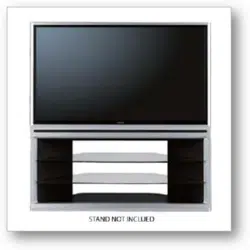
HM66 (E/F) Web 213:276
HIGH-DEFINITION TELEVISION
50HM66
56HM66
I
S
O
1
4
0
0
1
F
I
L
E
N
o
.
A
9
6
4
5
T
O
S
H
I
B
A
A
M
E
R
I
C
A
C
O
N
S
U
M
E
R
P
R
O
D
U
C
T
S
,
L
.
L
.
C
.
YC/N
VX1A00001000
Integrated High Definition
DLP
™
Projection Television
© 2006 TOSHIBA CORPORATION
All Rights Reserved
Owner’s Record
The model number and serial number are on the back of
your TV. Record these numbers in the spaces below.
Refer to these numbers whenever you communicate
with your Toshiba dealer about this TV.
Model number:
Serial number:
For an overview of steps for setting up your new TV, see page 4.
Note: If the TV is powered off and then quickly on again when the
lamp unit is hot, it may take several minutes for the picture to appear
on-screen. This is a property of DLP
TM
TV lamp technology and is NOT
a sign of malfunction. For details, see "IMPORTANT NOTICE ABOUT
HOT LAMP RESTART" on page 2.
Note: To display a High Definition picture, the TV must be receiving a
High Definition signal (such as an over-the-air High Definition TV
broadcast, a High Definition digital cable program, or a High Definition
digital satellite program). For details, please contact your TV antenna
installer, cable provider, or satellite provider.
IMPORTANT NOTE
Before connecting, operating, or adjusting this product, carefully
read the Important Safety, Installation, Care, and Service
information in the Installation Guide.
HM66_EN.book Page 1 Thursday, February 23, 2006 2:49 PM
2
HM66 (E/F) Web 213:276
Welcome to Toshiba
Thank you for purchasing this Toshiba TV, one of the most
innovative DLP™ projection TVs on the market. We have
provided two separate guides to facilitate the installation and
operation of your TV.
Please use the Guides in the order shown below to get the most
enjoyment from your new TV.
• The “Installation Guide” explains how to connect your TV to
your antenna and equipment.
• The “Operating Guide” (this Guide) provides step-by-step
instructions for using your TV’s many features.
Important notes about your
DLP™ projection TV
1) The light source for this TV is a projection lamp unit with a
limited service life. When the lamp wears out, the picture
may become dark or black or the lamp may fail, at which time
you must replace the lamp unit. See “Lamp unit replacement
and care” (- pages 47–49).
2) When the lamp mode is set to Low Power, every time the
TV is powered on, the lamp will initially be in High Bright
mode but will switch to Low Power mode after a short
period of time. You may notice a change in screen brightness
when this happens. This is normal and is not a sign of
malfunction.
(- page 42 for details.)
3) Every time the TV is powered on, it may take several minutes
for the picture to obtain full brightness (- IMPORTANT
NOTICE ABOUT “HOT LAMP RESTART,” at right).
4) The TV’s display is manufactured using an extremely high
level of precision technology; however, an occasional pixel
(dot of light) may show constantly on the screen. This is a
structural property of DLP™ (Digital Light Processing™)
technology and is not a sign of malfunction. Such pixels are
not visible when the picture is viewed from a normal viewing
distance.
5) Always sit approximately 10–25 feet away from the TV and
as directly in front of it as possible. The picture quality may
be affected by your viewing position and length of viewing
time. If you sit too closely to the TV for too long, you may
suffer from eye fatigue. See item 29 of the “care” information
in the separate Installation Guide.
6) Depending on the media you are viewing, it is possible,
although unlikely, that a limited number of viewers may see
a “rainbow effect” on the screen, which can, in rare instances,
result in eye fatigue. This is a rare occurrence related to DLP
technology and is not a sign of TV malfunction.
7) This TV contains several cooling fans to moderate the
internal temperature. You may be able to hear the
fans for several minutes after the TV is turned off.
This is a function of the Quick Restart™ feature
and is not a sign of TV malfunction. You can set
the Quick Restart™ feature to stop the fans as soon as the TV
is powered off. See “Setting the Quick Restart™ feature”
(- page 20).
8) The yellow and blue LED lights at the bottom center of the
TV front indicate your TV’s current status. If either light
flashes, see “LED indications” (- page 46).
9) Every time the TV power cord is plugged in, the yellow LED
will blink until the TV enters standby mode (plugged in but
not powered on). This is normal and is not a sign of
malfunction.
Trademark Information
• This product incorporates copyright protection technology that is
protected by U.S. patents and other intellectual property rights. Use
of this copyright protection technology must be authorized by
Macrovision, and is intended for home and other limited viewing
uses only unless otherwise authorized by Macrovision. Reverse
engineering or disassembly is prohibited.
• WOW, SRS and l symbol are trademarks of SRS Labs, Inc.
WOW technology is incorporated under license from SRS Labs, Inc.
• *Manufactured under license from Dolby Laboratories. Dolby and
the double-D symbol are registered trademarks of Dolby
Laboratories.
• CableCARD™ is a trademark of Cable Television Laboratories, Inc.
• HDMI, the HDMI logo and High-Definition Multimedia Interface are
trademarks or registered trademarks of HDMI Licensing LLC.
• Digital Light Processing™, DLP™ and the DLP™ medallion are
trademarks of Texas Instruments.
CAUTION: This television is for use only with
the Toshiba stand indicated below. Use with other
carts or stands is capable of resulting in
instability, causing possible injury.
Television
Stand Model
50HM66 ST5066
56HM66 ST5666
“Voice announce” feature
When certain non-standard conditions occur, the LEDs on
the TV will blink and the TV will play a recorded
“voice announcement” describing the condition (see the
LED indication table on page 46 for the specific conditions
that include a voice announcement).
To repeat the voice announcement and hear additional
information, press the MENU button on the TV while the
LEDs are blinking.
IMPORTANT NOTICE ABOUT “HOT LAMP RESTART”
When the TV has been powered on long enough for the lamp
unit to get hot, it may take several minutes for the picture to
appear on-screen in the following situations:
• When the Quick Restart™ feature is set to OFF and
you turn the TV off and then on again within a few
minutes; or
• If the TV is on when a short-term power failure, power
surge, or other similar power failure occurs, such that
the TV loses and regains power within a few minutes.
This is a property of DLP TV lamp technology and is
NOT a sign of malfunction.
If this occurs, the yellow LED on the TV front panel will blink
(and the blue LED will be lit solid) until the TV is finished
restarting the lamp and the normal picture appears. If both
LEDs are blinking, you will need to turn the TV off and then
on again to restart the lamp.
HM66_EN.book Page 2 Thursday, February 23, 2006 2:49 PM

HM66 (E/F) Web 213:276
3
Contents
Chapter 1: Introduction . . . . . . . . . . . . . . . . . . . . . . . . . . . . 4
Features of your new TV . . . . . . . . . . . . . . . . . . . . . . . . . . . . 4
Overview of steps for installing, setting up, and using
your new TV . . . . . . . . . . . . . . . . . . . . . . . . . . . . . . . . . . 4
TV front and side panel controls and connections . . . . . . . . . 5
TV back panel connections. . . . . . . . . . . . . . . . . . . . . . . . . . . 6
Chapter 2: Using the remote control . . . . . . . . . . . . . . . . . . . 7
Preparing the remote control for use. . . . . . . . . . . . . . . . . . . . 7
Installing the remote control batteries . . . . . . . . . . . . . . . . . . 7
Remote control effective range . . . . . . . . . . . . . . . . . . . . . . . . 7
Learning about the remote control . . . . . . . . . . . . . . . . . . . . . 8
Using the remote control to control your other devices . . . . . 9
Remote Control functional key chart . . . . . . . . . . . . . . . . . . 10
Programming the remote control to control your other
devices . . . . . . . . . . . . . . . . . . . . . . . . . . . . . . . . . . . . . . 11
Remote control codes . . . . . . . . . . . . . . . . . . . . . . . . . . . . . . 12
Chapter 3: Menu layout and navigation . . . . . . . . . . . . . . . . .14
Main menu layout . . . . . . . . . . . . . . . . . . . . . . . . . . . . . . . . . 14
Setup/Installation menu layout . . . . . . . . . . . . . . . . . . . . . . . 15
Navigating the menu system. . . . . . . . . . . . . . . . . . . . . . . . . 15
Chapter 4: Setting up your TV. . . . . . . . . . . . . . . . . . . . . . . .16
Selecting the menu language . . . . . . . . . . . . . . . . . . . . . . . . 16
Configuring the antenna input sources for the ANT 1
and ANT 2 terminals . . . . . . . . . . . . . . . . . . . . . . . . . . . 16
Programming channels into the TV’s channel memory . . . . 17
Programming channels automatically . . . . . . . . . . . . . . 17
Manually adding and deleting channels in the channel
memory . . . . . . . . . . . . . . . . . . . . . . . . . . . . . . . . . . 17
Programming your favorite channels . . . . . . . . . . . . . . . . . . 18
Setting the ColorStream HD audio mode . . . . . . . . . . . . . . . 20
Setting the HDMI™ audio mode . . . . . . . . . . . . . . . . . . . . . 20
Viewing the CableCARD™ menu . . . . . . . . . . . . . . . . . . . . 20
Setting the Quick Restart™ feature . . . . . . . . . . . . . . . . . . . 20
Viewing the digital signal meter . . . . . . . . . . . . . . . . . . . . . . 21
Viewing the system status. . . . . . . . . . . . . . . . . . . . . . . . . . . 22
Chapter 5: Using the TV’s basic features . . . . . . . . . . . . . . . .23
Selecting the video input source to view . . . . . . . . . . . . . . . 23
Labeling the video input sources . . . . . . . . . . . . . . . . . . . . . 23
Tuning channels . . . . . . . . . . . . . . . . . . . . . . . . . . . . . . . . . . 24
Using the Channel Browser™ . . . . . . . . . . . . . . . . . . . . 24
Tuning your favorite channels . . . . . . . . . . . . . . . . . . . . 26
Tuning to the next programmed channel . . . . . . . . . . . . 26
Tuning to a specific channel (programmed or
unprogrammed) . . . . . . . . . . . . . . . . . . . . . . . . . . . . 26
Switching between two channels using Channel
Return . . . . . . . . . . . . . . . . . . . . . . . . . . . . . . . . . . . 26
Switching between two channels using SurfLock™ . . . 26
Selecting the picture size . . . . . . . . . . . . . . . . . . . . . . . . . . . 27
Scrolling the TheaterWide
®
picture (TheaterWide 2
and 3 only) . . . . . . . . . . . . . . . . . . . . . . . . . . . . . . . . . . . 28
Using the auto aspect ratio feature . . . . . . . . . . . . . . . . . . . . 29
Selecting the cinema mode
(480i signals only) . . . . . . . . . . . . . . . . . . . . . . . . . . . . . 29
Adjusting the picture. . . . . . . . . . . . . . . . . . . . . . . . . . . . . . . 30
Selecting the picture mode . . . . . . . . . . . . . . . . . . . . . . . 30
Adjusting the picture quality . . . . . . . . . . . . . . . . . . . . . 30
Using the closed caption mode . . . . . . . . . . . . . . . . . . . . . . . 31
Closed Caption Advanced . . . . . . . . . . . . . . . . . . . . . . . 31
Digital closed captions . . . . . . . . . . . . . . . . . . . . . . . . . . 32
Adjusting the audio . . . . . . . . . . . . . . . . . . . . . . . . . . . . . . . . 32
Muting the sound . . . . . . . . . . . . . . . . . . . . . . . . . . . . . . 32
Using the digital audio selector . . . . . . . . . . . . . . . . . . . 32
Selecting stereo/SAP broadcasts . . . . . . . . . . . . . . . . . . 33
Adjusting the audio quality . . . . . . . . . . . . . . . . . . . . . . 33
Using the StableSound
®
feature. . . . . . . . . . . . . . . . . . . 34
Turning off the built-in speakers . . . . . . . . . . . . . . . . . . 34
Selecting the optical audio output format . . . . . . . . . . . 34
Using the Locks menu . . . . . . . . . . . . . . . . . . . . . . . . . . . . . 35
Entering the PIN code . . . . . . . . . . . . . . . . . . . . . . . . . . 35
If you cannot remember your PIN code. . . . . . . . . . . . . 35
Changing your PIN code . . . . . . . . . . . . . . . . . . . . . . . . 35
Blocking TV programs and movies
by rating (V-Chip) . . . . . . . . . . . . . . . . . . . . . . . . . . 36
Blocking channels . . . . . . . . . . . . . . . . . . . . . . . . . . . . . 37
Unlocking programs temporarily . . . . . . . . . . . . . . . . . . 38
Using the input lock feature . . . . . . . . . . . . . . . . . . . . . . 38
Using the control panel lock feature . . . . . . . . . . . . . . . 39
Setting the sleep timer. . . . . . . . . . . . . . . . . . . . . . . . . . . . . . 39
Displaying TV setting information on-screen using
RECALL . . . . . . . . . . . . . . . . . . . . . . . . . . . . . . . . . . . . 40
Understanding the auto power off feature . . . . . . . . . . . . . . 40
Understanding the last mode memory feature . . . . . . . . . . . 40
Chapter 6: Using the TV’s advanced features . . . . . . . . . . . . .41
Using the advanced picture settings features . . . . . . . . . . . . 41
Using dynamic contrast . . . . . . . . . . . . . . . . . . . . . . . . . 41
Using CableClear
®
/DNR (digital noise reduction) . . . . 41
Using MPEG noise reduction. . . . . . . . . . . . . . . . . . . . . 41
Selecting the color temperature . . . . . . . . . . . . . . . . . . . 42
Selecting the lamp mode . . . . . . . . . . . . . . . . . . . . . . . . 42
Using the Game Mode feature . . . . . . . . . . . . . . . . . . . . 43
Using the advanced audio settings features . . . . . . . . . . . . . 43
Using the SRS WOW™ surround sound feature. . . . . . 43
Chapter 7: Troubleshooting . . . . . . . . . . . . . . . . . . . . . . . . .44
General troubleshooting . . . . . . . . . . . . . . . . . . . . . . . . . . . . 44
LED indications . . . . . . . . . . . . . . . . . . . . . . . . . . . . . . . . . . 46
Chapter 8: Appendix . . . . . . . . . . . . . . . . . . . . . . . . . . . . . .47
Lamp unit replacement and care. . . . . . . . . . . . . . . . . . . . . . 47
Replacing the lamp unit
(User-replaceable component). . . . . . . . . . . . . . . . . 47
When to replace the lamp unit . . . . . . . . . . . . . . . . . . . . 47
How to replace the lamp unit . . . . . . . . . . . . . . . . . . . . . 48
Disposing of the used lamp unit. . . . . . . . . . . . . . . . . . . 49
Specifications . . . . . . . . . . . . . . . . . . . . . . . . . . . . . . . . . . . . 50
Limited United States Warranty
for DLP™ Television Models . . . . . . . . . . . . . . . . . . . . 51
Limited Canada Warranty
for DLP™ Television Models . . . . . . . . . . . . . . . . . . . . 52
Index . . . . . . . . . . . . . . . . . . . . . . . . . . . . . . . . . . . . . . . .54
HM66_EN.book Page 3 Thursday, February 23, 2006 2:49 PM
4
HM66 (E/F) Web 213:276
Chapter 1: Introduction
Features of your new TV
The following are just a few of the many exciting features of
your new Toshiba widescreen, integrated HD, DLP™
projection TV:
• Integrated digital tuning (8VSB ATSC and QAM)
eliminates the need for a separate digital converter set-top
box (in most cases).
• Digital CableCARD™ slot for viewing encrypted digital
Cable TV programs (- Installation Guide).
• Two HDMI™ digital, high-definition multimedia
interfaces (- Installation Guide).
• Two sets of ColorStream
®
HD high-resolution component
video inputs (- Installation Guide).
• SRS WOW™ (- page 43), audio technologies.
• Digital Audio Out optical audio connection with Dolby
®
Digital optical output format (- page 34; also see
Installation Guide).
• CableClear
®
DNR digital picture noise reduction
(- page 41).
Overview of steps for installing,
setting up, and using your new TV
Follow these steps to set up your TV and begin using its many
exciting features.
1 Carefully read the important safety, installation, care, and
service information in the separate Installation Guide.
Keep this manual for future reference.
2 Observe the following when choosing a location for the
TV:
• Read the separate Installation Guide.
• Read “Important notes about your DLP™ projection
TV” (- page 2).
• Place the TV on the applicable optional TV stand listed
in the “Specifications” section (if available for this TV
model) or on a sturdy, level, stable surface that can
safely support the size and weight of the unit.
• Place the TV in a location where light does not reflect
on the screen.
• Place the TV far enough from walls and other objects to
allow proper ventilation. Inadequate ventilation may
cause overheating, which will damage the TV. THIS
TYPE OF DAMAGE IS NOT COVERED UNDER
THE TOSHIBA WARRANTY.
3 Do not plug in any power cords until AFTER you have
connected all cables and devices to your TV.
4 BEFORE connecting cables or devices to the TV, learn
the functions of the TV’s connections and controls
(
- pages 5-6).
5 Connect your other electronic device(s) to the TV
(
- Installation Guide).
6 Install the batteries in the remote control (- page 7).
7 See “Learning about the remote control” (- page 8) for
an overview of the buttons on the remote control.
8 Program the remote control to operate your other
device(s) (
- pages 9–13).
9 AFTER connecting all cables and devices, plug in the
power cords for your TV and other devices.
10 After you plug in the TV power cord, the yellow LED
(on the TV front ) will blink 3 times. Wait several
seconds until the yellow LED stops blinking and then
press p on the TV or remote control.
See “LED indications” (- page 46).
11 See “Menu layout and navigation” for a quick overview of
navigating the TV’s menu system (
- page 14).
12 Program channels into the TV’s channel memory
(
- page 17).
13 For details on using the TV’s features, see Chapters 5
and 6.
14 For help, refer to the Troubleshooting Guide
(
- Chapter 7).
15 For lamp unit replacement instructions, see Chapter 8.
16 For technical specifications and warranty information, see
Chapter 8.
17 Enjoy your new TV!
NOTICE OF POSSIBLE TV STAND INSTABILITY
DANGER: RISK OF SERIOUS PERSONAL
INJURY OR DEATH! Use this TV only with
the TOSHIBA TV stand listed in the
“Specifications” section of this manual. Use with other
stands may result in instability, causing possible injury or
death.
CAUTION:This television is for use only with the Toshiba
stand indicated below. Use with other carts or stands is
capable of resulting in instability, causing possible injury.
Television
Stand Model
50HM66 ST5066
56HM66 ST5666
“Voice announce” feature
When certain non-standard conditions occur, the LEDs on
the TV will blink and the TV will play a recorded
“voice announcement” describing the condition (see the
LED indication table on page 46 for the specific conditions
that include a voice announcement).
To repeat the voice announcement and hear additional
information, press the MENU button on the TV while the
LEDs are blinking.
HM66_EN.book Page 4 Thursday, February 23, 2006 2:49 PM
5
HM66 (E/F) Web 213:276
Chapter 1: Introduction
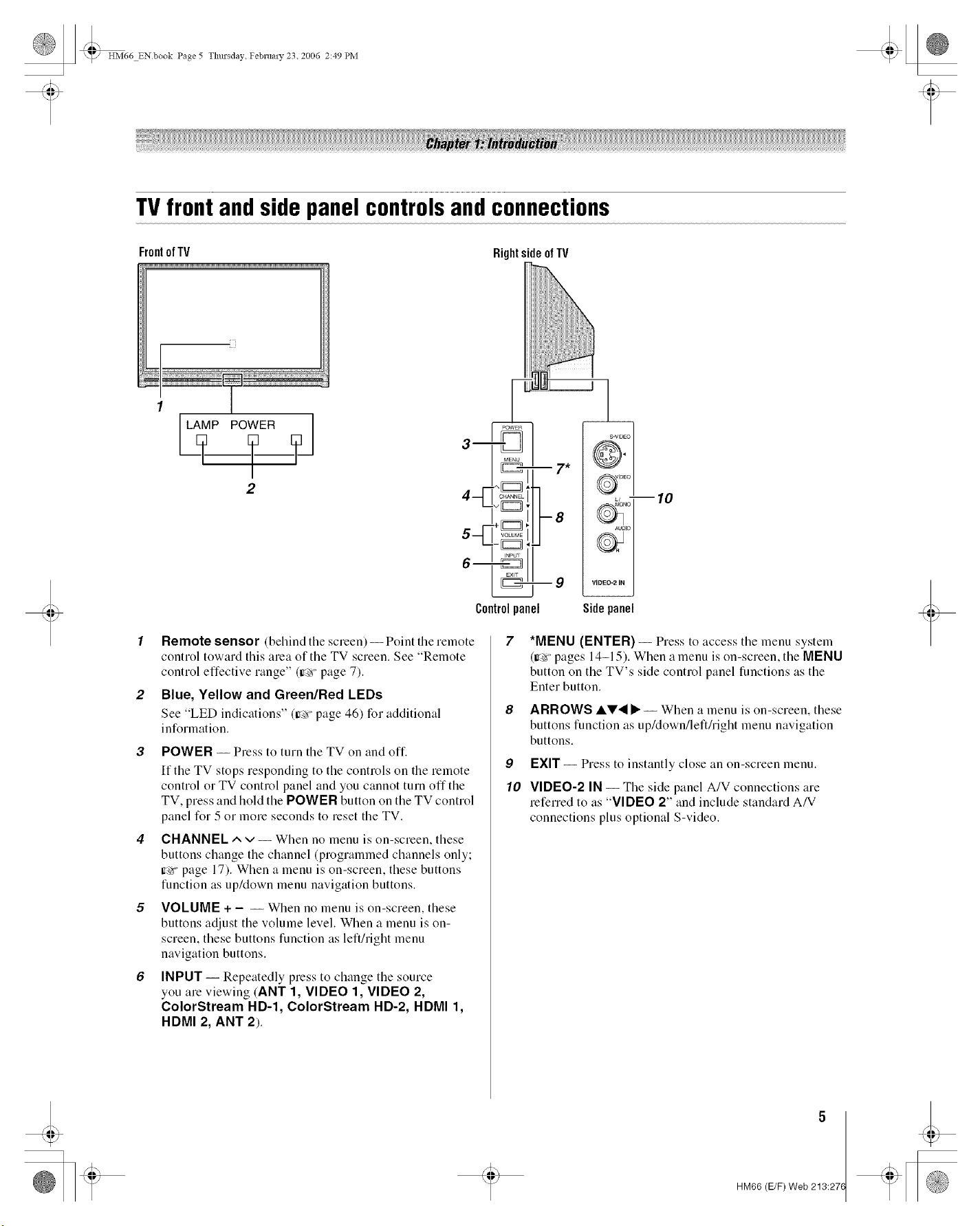
TV front and side panel controls and connections
1
2
9
10
3
4
5
6
8
7*
Side panel
Right side of TV
Front of TV
Control panel
1 Remote sensor (behind the screen) — Point the remote
control toward this area of the TV screen. See “Remote
control effective range” (- page 7).
2 Blue, Yellow and Green/Red LEDs
See “LED indications” (- page 46) for additional
information.
3 POWER — Press to turn the TV on and off.
If the TV stops responding to the controls on the remote
control or TV control panel and you cannot turn off the
TV, press and hold the POWER button on the TV control
panel for 5 or more seconds to reset the TV.
4 CHANNEL U u — When no menu is on-screen, these
buttons change the channel (programmed channels only;
- page 17). When a menu is on-screen, these buttons
function as up/down menu navigation buttons.
5 VOLUME + – — When no menu is on-screen, these
buttons adjust the volume level. When a menu is on-
screen, these buttons function as left/right menu
navigation buttons.
6 INPUT — Repeatedly press to change the source
you are viewing (ANT 1, VIDEO 1, VIDEO 2,
ColorStream HD-1, ColorStream HD-2, HDMI 1,
HDMI 2, ANT 2).
7 *MENU (ENTER) — Press to access the menu system
(- pages 14–15). When a menu is on-screen, the MENU
button on the TV’s side control panel functions as the
Enter button.
8 ARROWS BbC c — When a menu is on-screen, these
buttons function as up/down/left/right menu navigation
buttons.
9 EXIT — Press to instantly close an on-screen menu.
10 VIDEO-2 IN — The side panel A/V connections are
referred to as “VIDEO 2” and include standard A/V
connections plus optional S-video.
HM66_EN.book Page 5 Thursday, February 23, 2006 2:49 PM
6
HM66 (E/F) Web 213:276
Chapter 1: Introduction
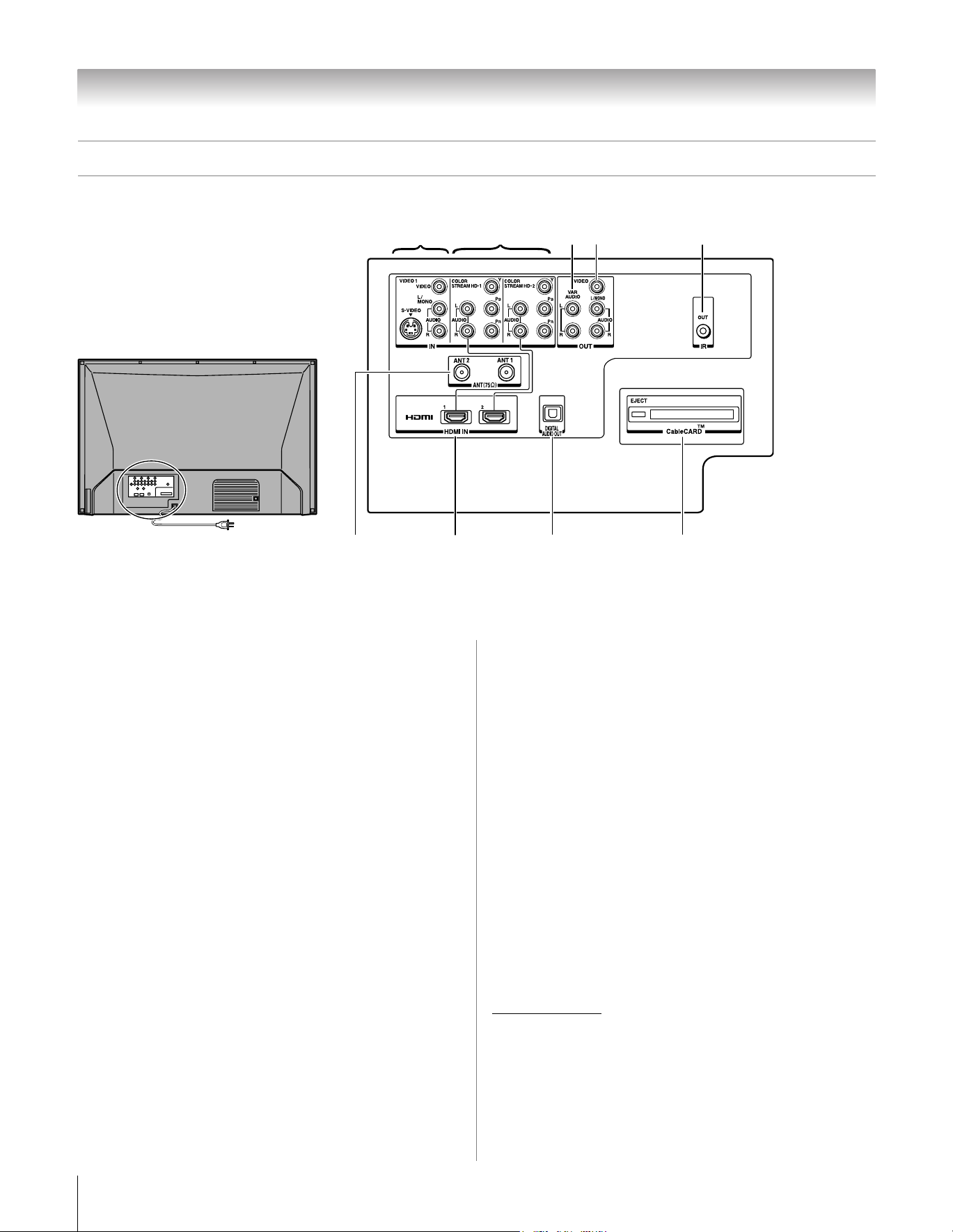
TV back panel connections
For an explanation of cable types and connections, see the Installation Guide.
1234 5
6
7
98
1 VIDEO 1 IN — Standard (composite) video and standard
audio inputs plus optional S-video inputs for connecting
devices with composite video or S-video output.
Note: Standard (composite) video and S-video cables
carry only video information; separate audio cables are
required for a complete connection.
2 ColorStream
®
HD-1 and ColorStream
®
HD-2 —
Two sets of ColorStream
®
high-definition component
video inputs (with standard stereo audio inputs) for
connecting devices with component video output, such as
a Toshiba DVD player with ColorStream
®
.
Note: Component video cables carry only video
information; separate audio cables are required for a
complete connection.
ColorStream
®
HD-1 and ColorStream
®
HD-2
Audio IN — ColorStream HD-1/2 audio input terminals
are shared with HDMI 1/2 analog audio input terminals,
and their use can be configured in the Setup menu
(- “Setting the ColorStream HD audio mode” page 20).
3 Variable Audio OUT — Standard analog audio outputs
for connecting an analog amplifier with external speakers.
4 A/V OUT — Standard composite video and analog audio
outputs for connecting a VCR for editing and dubbing.
5 IR OUT — For controlling infrared remote-controlled
devices through the TV. You can connect up to two
devices with an IR blaster cable, and then control the
devices using the TV’s IR pass-through features.
6 ANT 1 and ANT 2 — Two inputs that support analog
(NTSC) and digital (ATSC) off-air antenna signals and
analog and digital (QAM) Cable TV signals.
Note: If you have an antenna only, connect it to ANT 1. If
you have both cable TV and an antenna, connect the
cable TV to ANT 1 and the antenna to ANT 2.
7 HDMI™ 1 and 2 IN — Two High-Definition Multimedia
Interface inputs receive digital audio and uncompressed
digital video from an HDMI device or uncompressed
digital video from a DVI device. Also see item 2.
8 Digital Audio OUT — Optical audio output in Dolby
Digital or PCM (pulse-code modulation) format for
connecting an external Dolby Digital decoder, amplifier,
A/V receiver, or home theater system with optical audio
input.
9 CableCARD™ slot — For use with a digital security
card and digital cable TV service (provided by your local
cable operator) to view encrypted digital programming
(- page 20).
HDMI, the HDMI logo and High-Definition Multimedia Interface are
trademarks or registered trademarks of HDMI Licensing LLC.
CableCARD is a trademark of Cable Television Laboratories, Inc.
HM66_EN.book Page 6 Thursday, February 23, 2006 2:49 PM
7
HM66 (E/F) Web 213:276
Chapter 2: Using the remote control
Preparing the remote control
for use
Your TV remote control can operate your TV and many other
devices such as cable converter boxes, satellite receivers,
VCRs, DVD players, and HTIBs (home theater in a box), even
if they are different brands.
If you have a Toshiba device:
Your TV remote control is preprogrammed to operate most
Toshiba devices (- page 11).
If you have a non-Toshiba device or a Toshiba device
that the remote control is not preprogrammed to
operate:
You can program the TV remote control so it will operate the
other device (- pages 9–13).
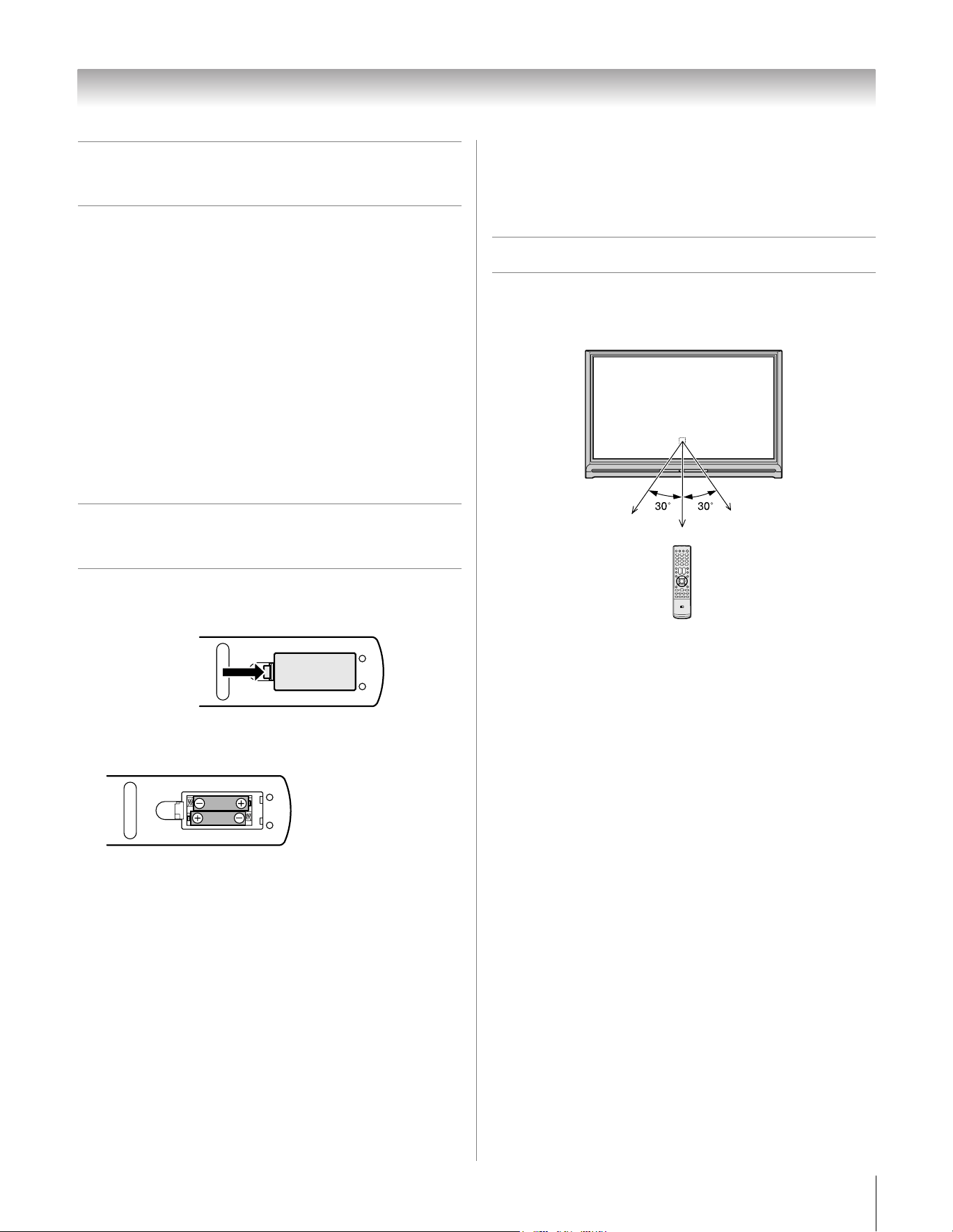
Installing the remote control
batteries
1 Remove the battery cover from the back of the remote
control.
2 Install two “AAA” size batteries, making sure to match
the + and – signs on the batteries to the signs on the battery
compartment.
3 Reinsert the battery cover in the remote control until the
tab snaps.
Caution: Never throw batteries into a fire.
Notes:
• Be sure to use AAA size batteries.
• Dispose of batteries in a designated disposal area.
• Batteries should always be disposed of with the
environment in mind. Always dispose of batteries in
accordance with applicable laws and regulations.
• If the remote control does not operate correctly, or if the
operating range becomes reduced, replace batteries with
new ones.
• When necessary to replace batteries in the remote control,
always replace both batteries with new ones. Never mix
battery types or use new and used batteries in combination.
• Always remove batteries from remote control if they are
dead or if the remote control is not to be used for an
extended period of time. This will prevent battery acid from
leaking into the battery compartment.
Remote control effective range
For optimum performance, aim the remote control directly at
the TV and make sure there is no obstruction between the
remote control and the TV.
Squeeze tab and
lift cover.
16.4 ft (5m)
Point remote control
toward remote sensor
on front of TV.
HM66_EN.book Page 7 Thursday, February 23, 2006 2:49 PM
8
HM66 (E/F) Web 213:276
Chapter 2: Using the remote control
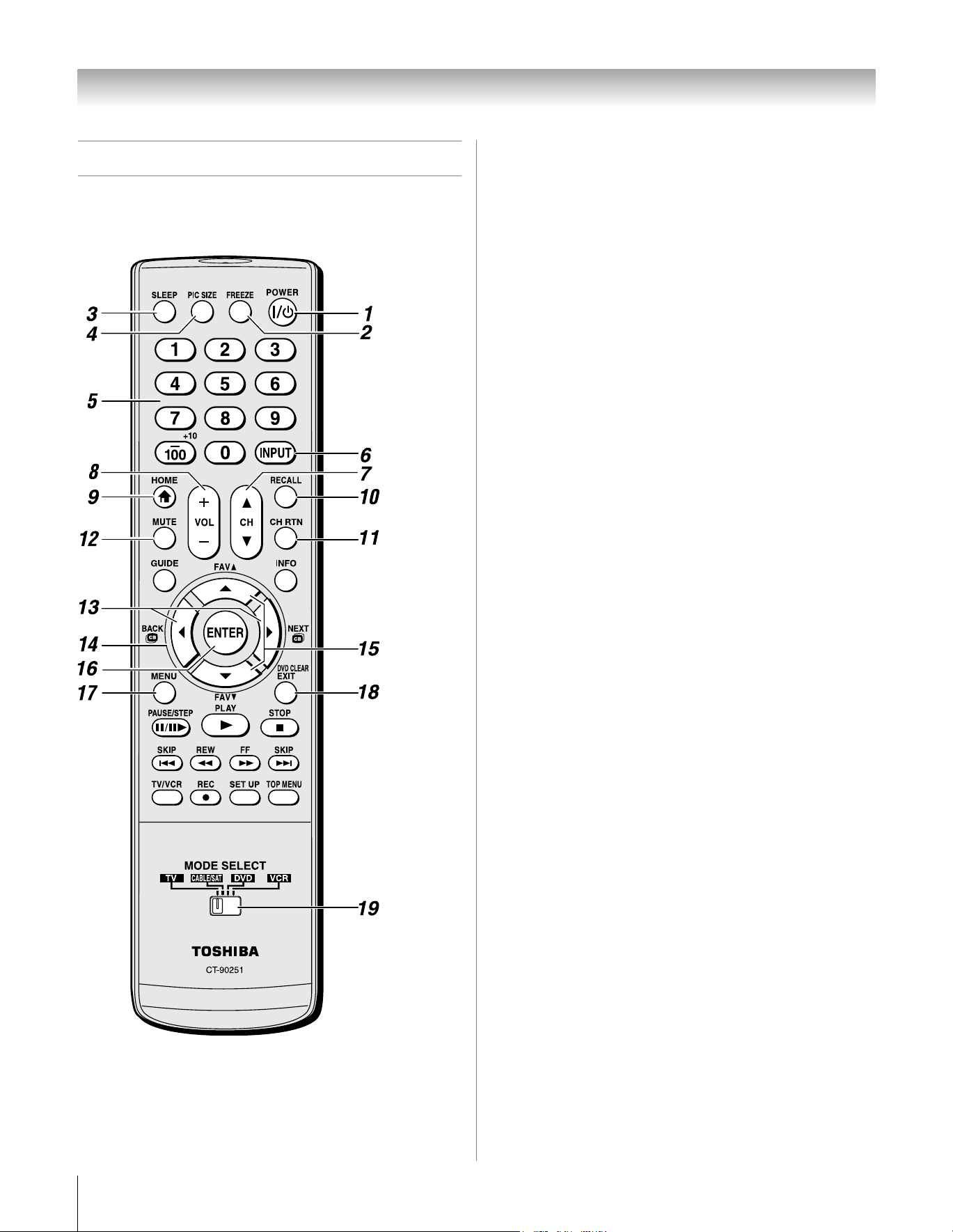
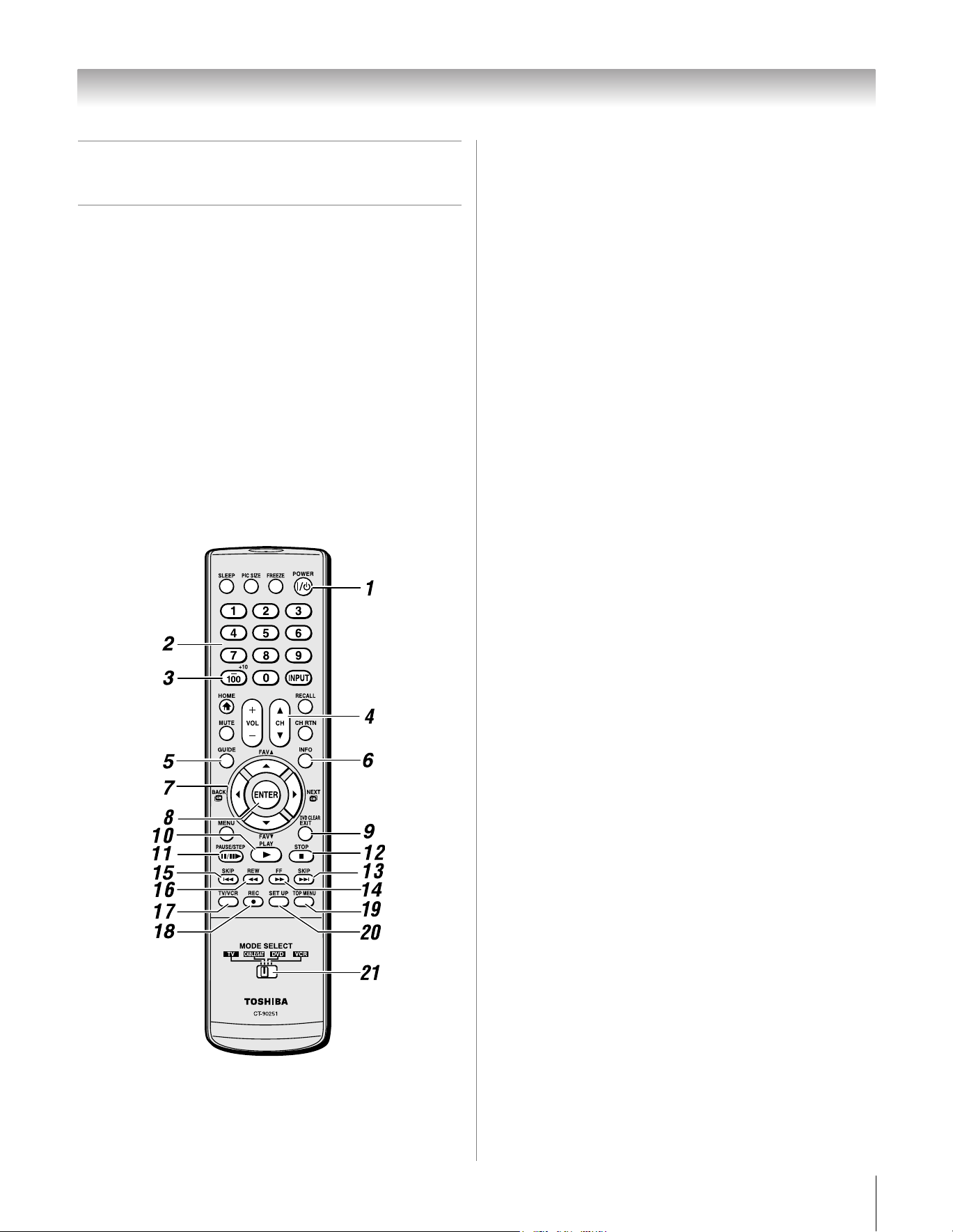
Learning about the remote control
The buttons used for operating the TV only are described here.
For a complete list of the remote control’s functions, see the
remote control functional key chart (- page 10).
Note: The error message “NOT AVAILABLE” may appear if
you press a key for a function that is not available.
1 POWER turns the TV on and off. Press p to turn on the
TV. The blue LED indicator on the TV front will be
illuminated. Press p again to turn off the TV.
Note: The Quick Restart™ setting will affect the amount of
time it takes for the picture to appear when you turn on the
TV (- page 20).
2 FREEZE freezes the picture. Press again to restore the
moving picture.
3 SLEEP accesses the sleep timer (
- page 39).
4 PIC SIZE cycles through the five pictures sizes: Natural,
TheaterWide 1/2/3, and Full (
- page 27).
5 Channel Numbers (0–9, –/100) directly tune
channels. The “–” button is used to tune digital channels
(
- page 26) or to display the favorite channel list
(
- page 19).
6 INPUT selects the video input source (
- page 23).
7 CH Bb cycles through programmed channels when no
menu is on-screen (
- page 17) and functions as page up/
down when a menu is on-screen.
8 VOL + – adjusts the volume level.
9 HOME (~) accesses the home function of the Channel
Browser™ feature (- page 26).
10 RECALL displays TV setting information on-screen
(- page 40).
11 CH RTN returns to the last viewed channel (- page 26).
12 MUTE reduces or turns off the sound (- page 32).
13 3C / #c While watching TV, these buttons open the
Channel Browser™ banner and tune to the previous/next
channel in the channel history (- page 24). (Also see
“Arrow buttons”.)
14 Arrow buttons (BbC c) When a menu is on-screen,
these buttons select or adjust programming menus. (Also
see 3C/ #c.)
15 FAV Bb tunes to the next higher/lower favorite channel
(- page 19).
16 ENTER activates highlighted items in the main menu
system.
17 MENU accesses the main TV menu system (
- pages 14
and 15).
18 EXIT closes on-screen menus.
19 MODE SELECT Switch switches between TV,
CABLE/SAT, DVD, and VCR modes (
- page 9). Set to
“TV” to control the TV.
HM66_EN.book Page 8 Thursday, February 23, 2006 2:49 PM
9
HM66 (E/F) Web 213:276
Chapter 2: Using the remote control
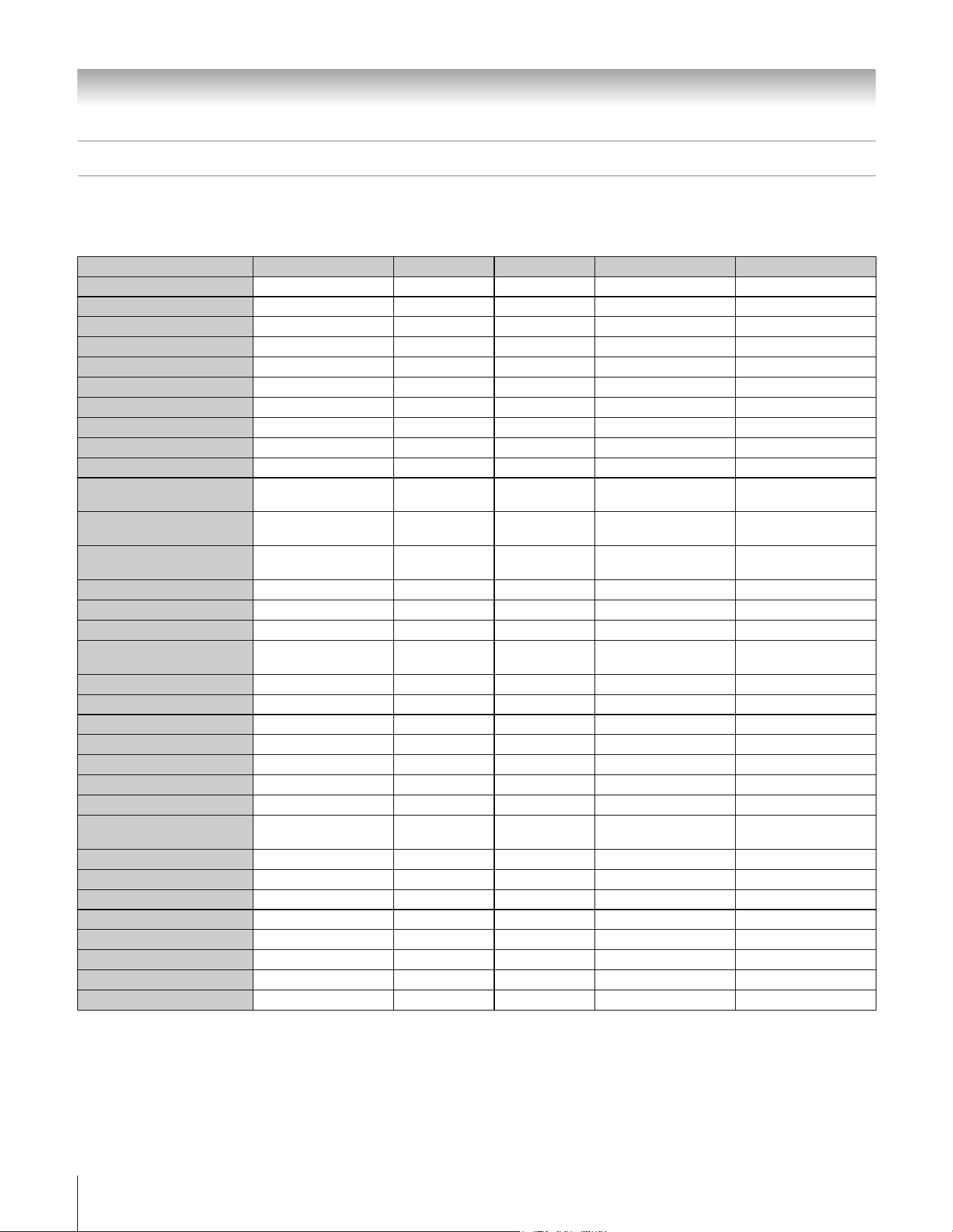
Using the remote control to control
your other devices
If you have a non-Toshiba device or a Toshiba device that the
remote control is not preprogrammed to operate, you must first
program the remote control to recognize the device (if you
have not already done so) (- pages 11–13).
To use your TV remote control to operate a:
• Cable converter box or satellite receiver, set the MODE
SELECT Switch to CABLE/SAT.
• VCR, set the MODE SELECT Switch to VCR.
• DVD player or HTIB, set the MODE SELECT Switch to
DVD.
Note: Even after the TV remote control is programmed, it may
not operate certain features on your other device. If this
happens and you wish to use those features, you will need to
use the device’s original remote control.
1 POWER Turns the selected device on and off.
2 Channel Numbers (0-9) Press to directly access
channels (as opposed to < ,).
3 +10 Press to directly access DVD chapters higher than 10.
4 CH Bb
B selects the next higher channel;
b selects the next lower channel (for channels
programmed into memory only).
5 GUIDE Displays channel guide.
6 INFO Displays TV status information on-screen.
7 BbC c Press to navigate DVD menus (may not work on
some DVD players).
8 ENTER Required by some satellite receivers and DVD
players.
9 DVD CLEAR Press to reset the title and chapter number.
10 PLAY Begins playback of a tape or DVD.
11 PAUSE Press during play or record mode to pause the
picture; press again to restart.
12 STOP Stops the tape or DVD.
13 SKIP z Skips forward to locate later DVD chapters.
14 FF Fast-forwards the tape or DVD. (Press during play
mode to view the picture moving rapidly forward.)
15 SKIP Z Skips back to beginning of current DVD chapter
or locates previous chapters.
16 REW Rewinds/reverses the tape or DVD. (Press during
play mode to view the picture moving rapidly backward.)
17 TV/VCR To view one program while recording another,
press to select TV mode.
18 REC Starts tape recording.
19 TOP MENU Accesses a DVD’s top menu.
20 SET UP Accesses a DVD’s setup menu.
21 MODE SELECT Switch Set to “TV” to control the TV;
“CABLE/SAT” to control a cable converter box or
satellite receiver; “DVD” to control a DVD player or
HTIB; “VCR” to control a VCR.
Point the remote control
directly at the device.
HM66_EN.book Page 9 Thursday, February 23, 2006 2:49 PM
10
HM66 (E/F) Web 213:276
Chapter 2: Using the remote control
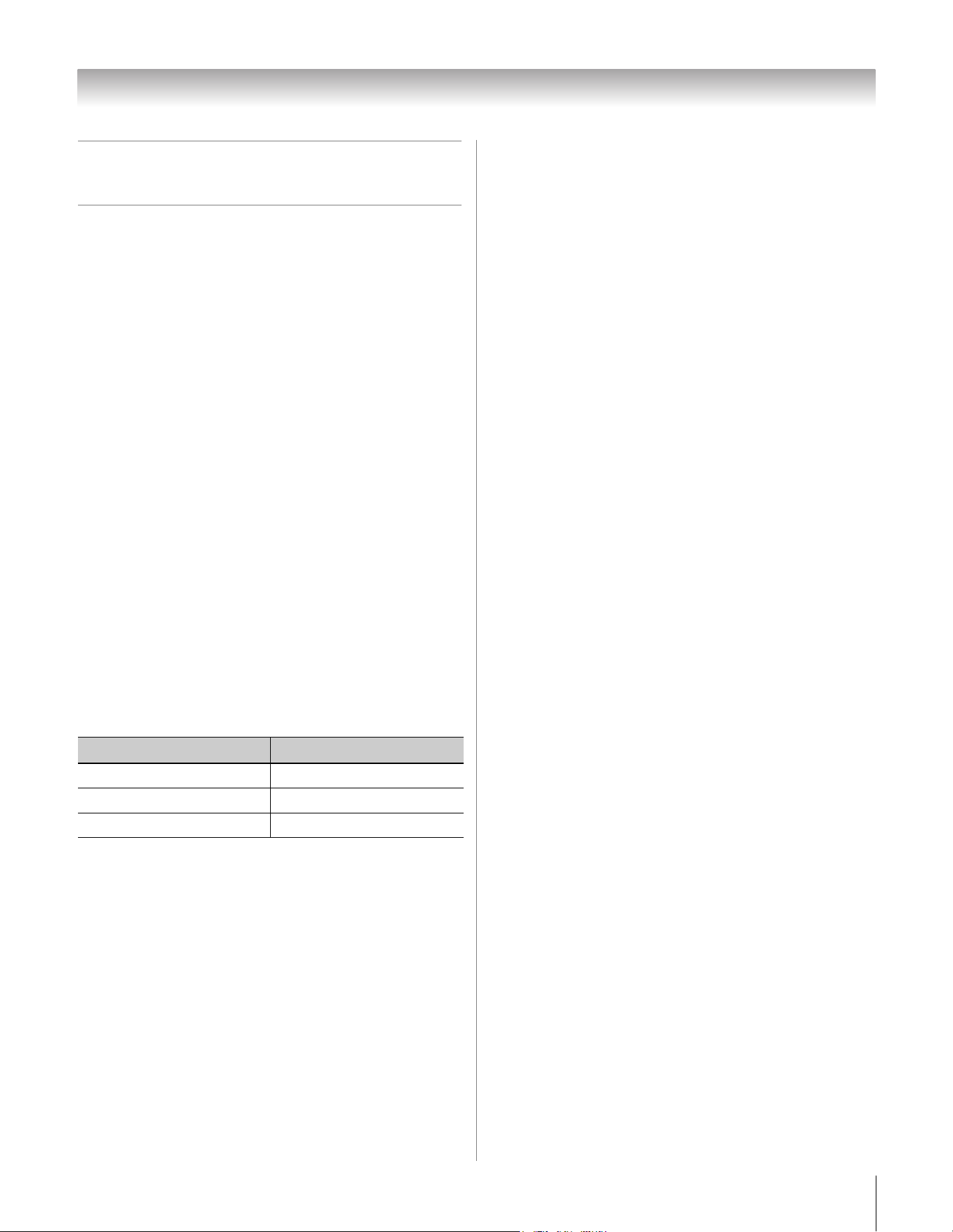
Remote Control functional key chart
Notes:
• “---” = key does not send a signal in that remote control mode.
• sTV = key will affect the TV, even when the remote control is not in the “TV” device mode.
REMOTE CONTROL KEY Toshiba TV (TV) CABLE SAT (satellite) VCR DVD
POWER Power Power Power Power Power
SLEEP Sleep timer s TV s TV s TV s TV
INPUT TV/Video select s TV s TV s TV s TV
1-9 Digit 1-9 Digit 1-9 Digit 1-9 Digit 1-9 Digit 1-9
0 Digit 0 Digit 0 Digit 0 Digit 0 Digit 0
100/–/+10 – (sub channel) --- – (sub CH) 100 +10
RECALL RECALL s TV s TV Display s TV
CH RTN Previous channel --- --- --- ---
INFO --- --- Info --- ---
MENU Menu/DVD Menu --- Menu --- DVD Menu
Bb/FAVBb
Menu select/
FAV up/down
---
Menu
up/down
--- Menu up/down
C 3
Menu select/
Channel Browser™
--- Menu left --- Menu left
c #
Menu select/
Channel Browser™
--- Menu right --- Menu right
ENTER Enter --- Select Enter --- Enter
EXIT/DVD CLEAR Exit --- Exit --- DVD Clear
VOL + – Volume up/down s TV s TV s TV s TV
CHBb
Channel
up/down
Channel
up/down
Channel
up/down
Channel
up/down
---
PIC SIZE Picture size s TV s TV s TV s TV
MUTE Sound mute s TV s TV s TV s TV
GUIDE --- --- SAT Guide --- ---
FF --- --- --- Fast FWD Fast FWD
PAUSE/STEP --- --- --- Pause Pause
PLAY --- --- --- Play Play
REW --- --- --- Rewind Rewind
HOME
Channel Browser™
Home
--- --- --- ---
STOP --- --- --- Stop Stop
FREEZE Freeze picture s TV s TV s TV s TV
SKIP Z --- --- --- --- Skip REV
SKIP z --- --- --- --- Skip FWD
TV/VCR --- --- --- TV/VCR ---
REC --- --- --- Record (2 click) ---
SET UP --- --- --- --- DVD Setup
TOP MENU --- --- --- --- Top Menu
HM66_EN.book Page 10 Thursday, February 23, 2006 2:49 PM
11
HM66 (E/F) Web 213:276
Chapter 2: Using the remote control
Programming the remote control to
control your other devices
Your Toshiba TV remote control is preprogrammed to operate
most Toshiba devices. To program your TV remote control to
operate a non-Toshiba device (or a Toshiba device that it is not
preprogrammed to operate), follow the steps below. For details
on using the remote control to operate the device, see page 9.
1 In the remote control code table (- page 12), find the
code for your device. If more than one code is listed, try
each one separately until you find one that works.
2 Set the MODE SELECT Switch to the type of device you
are programming the remote control to operate —
CABLE/SAT (for a cable converter box or satellite
receiver), DVD (for a DVD player or HTIB [home theater
in a box]), or VCR (for a VCR or TV/VCR combo).
3 While holding down E, press the Channel Number
buttons to enter the 3-digit code for your device.
4 To test the code, turn on the device, point the remote
control at it, and press p. See notes below.
• If the correct code was entered, the device will turn off.
• If the device does not respond, repeat steps 1–4 using
another code.
• If the device does not respond to another code, you will
need to use the remote control that came with the
device.
5 Remember to set the MODE SELECT Switch back to TV
to control the TV.
6 For future reference, write down the code(s) you used:
Notes:
• In addition to POWER, confirm that all necessary keys on the
TV remote control operate your device. If some keys are not
operational, repeat the device code setup using another
code (if other codes are listed for your device). If, after trying
all listed codes, the necessary keys do not operate your
device, use the device’s original remote control.
• Every time you change the batteries, you will need to
reprogram the remote control.
• Some newer VCRs respond to either of two codes. These
VCRs have a switch labeled “VCR1/VCR2.” If your VCR has
this kind of switch and does not respond to the codes for
your VCR brand, set the switch to the other position (“VCR1”
or “VCR2”) and reprogram the remote control.
DEVICE CODE DEVICE CODE
HM66_EN.book Page 11 Thursday, February 23, 2006 2:49 PM

12
HM66 (E/F) Web 213:276
Chapter 2: Using the remote control
Remote control codes
In some cases you may not be able to
operate your device with the TV
remote control. Your other device may
use a code that is not recognized by the
TV remote control. If this happens, use
the device’s remote control.
Cable converter box
ABC 061, 062, 063, 082,
084, 087, 091, 092,
096, 098
Archer 065, 092, 097, 099
Cableview 064, 094
Century 092
Citizen 090, 092, 097
Contec 083, 085, 086, 088,
093, 098
Diamond 093
Eagle 091
GE 061, 062
Gemini 069, 070, 094
General Instruments 062, 089, 096
Hamlin 093
Hitachi 062, 095, 096
Jasco 097
Jerrold 062, 069, 071, 082,
086, 089, 091, 096
Magnavox 072, 096
Memorex 091, 092, 104
Multi Canal 090
Novavision 101
Panasonic 081, 083, 085
Philco 087
Philips 066, 067, 068, 070,
072, 073, 074, 075,
091, 092
Pioneer 076, 077
Proscan 061, 062
Radio Shack 092, 097, 099
RCA 064, 081
Realistic 065
Recoton 102
Samsung 077, 090
Scientific Atlanta 063, 078, 079, 080,
088, 098, 101, 105
Sears 095
Signature 062
Signature 2000 096
Sprucer 081, 085
Starcom 069, 082, 087, 096,
103, 104
Stargate 069, 090
Sylvania 095, 100
TeleView 090
Texscan 100
Tocom 071, 084, 085
U. S. Electronics 087, 096, 098
United Cable 082
Universal 065, 092, 097, 099,
102, 103
Wards 096
Satellite receiver
Alphastar 038, 059
Chaparral 034
DISH Network 057
Drake 020, 040, 044, 046,
050, 053
Echostar 018, 041, 051
Express Vu 057
Fujitsu 027
GE 008, 009, 013
General Instruments 010, 011, 012, 022,
023, 031, 049
Hitachi 033
Hughes 033
Hughes Network
Systems 019
Intersat 048
Janeil 027
JVC 017, 057
Kenwood 029
Magnavox 060
Optimus 058
Pansat 036, 052
Primestar 015, 042
Proscan 008, 009, 013
Radio Shack 022, 023, 030
RCA 008, 009, 013, 016
Realistic 030
Samsung 059
Sony 014, 055
Star Choice 057
Star Trak 025, 026, 037, 054
STS 024
Toshiba 000, 001, 002, 003,
004, 005, 006, 007,
020, 031, 056
Uniden 021, 028, 030, 032,
035, 039, 043, 045,
047, 058
Zenith 027
TV/VCR Combo
Action 078
GE 059, 062
Goldstar 065
Panasonic 065
Precision 078
Quasar 065
Realistic 079
Sony 074
Toshiba 057
Totevision 009, 010, 065
Zenith 065
DVD/VCR Combo
Go Video DVD=087,
VCR=081
JVC DVD=088,
VCR=082
RCA DVD=089,
VCR=083
Samsung DVD=090,
VCR=084
Sanyo DVD=091,
VCR=085
Zenith DVD=092,
VCR=086
DVD player
Aiwa 006, 015
Apex 016, 017
BOSE 097
Broksonic 018
Clarion 019
Classic 020
Daewoo 021
Denon 022, 023, 024, 025
Emerson 026, 027
Fisher 028
Funai 027
GE 001, 029, 030
Go Video 087
GPX 031
Hitachi 005, 032, 033, 034,
035
JVC 003, 007, 036, 042,
088
Kenwood 037
Konka 008, 009
Magnavox 004, 038
Memorex 039
Mintek 040
NAD 026
Nakamichi 041
Norcent 043
Onkyo 044
Oritron 058
Panasonic 010, 045, 046, 047,
048, 049, 050
Philips 004, 051
Pioneer 052, 053, 054, 055
Proscan 001, 056
Qwestar 057, 058
RCA 001, 002, 059, 089
Sampo 060
Samsung 061, 062, 086, 090
Sansui 073
Sanyo 063, 091
Sharp 064, 067
Sherwood 074
Sony 011, 012, 065, 066,
068, 069, 070
Sylvania 027
Teac 071
Technics 072
Techwood 075
Toshiba 000, 013, 076, 077,
078
Yamaha 079, 080, 081
Zenith 014, 082, 092
Portable DVD player
Aiwa 093
Audiovox 094, 095
Panasonic 024, 096, 099
RCA 098
VCR
Admiral 049
Aiko 019
Aiwa 018
Akai 003, 004, 037, 038,
039, 058, 069
Audiovox 010
Bell & Howell 007, 068
Broksonic 008, 017
Calix 010
Carver 026
CCE 019
Citizen 009, 010, 011, 012,
013, 014, 015, 019,
057, 073
Colortyme 005
Craig 009, 010, 016, 061,
065, 079
HM66_EN.book Page 12 Thursday, February 23, 2006 2:49 PM

13
HM66 (E/F) Web 213:276
Chapter 2: Using the remote control
Curtis Mathes 001, 005, 009, 012,
014, 040, 048, 053,
056, 057
Daewoo 011, 013, 015, 017,
018, 019, 057, 078
Daytron 078
Denon 063
Dimensia 001, 048
Electrohome 010, 020, 065
Emerson 003, 008, 010, 011,
017, 018, 020, 028,
039, 054, 057, 062,
065, 068, 072
Fisher 007, 016, 021, 022,
023, 057, 064, 068,
070, 071, 079
Fuji 004, 041
Funai 018, 073
Garrard 018
GE 001, 002, 009, 040,
042, 048, 056
Go Video 056, 059, 061, 081
Goldstar 005, 010, 014, 054,
056, 065, 067
Gradiente 018, 065
Harman Kardon 005
Hitachi 024, 025, 035, 037,
042, 063, 070, 080
JBL 076
JC Penney 005, 006, 007, 008,
009, 010, 023, 024,
025, 026, 035, 056,
061, 063, 065
Jensen 024, 025, 037
JVC 005, 006, 007, 014,
037, 043, 062, 063,
068, 082
Kenwood 005, 006, 007, 012,
014, 037, 043, 053,
068, 071
Kodak 010
LG 010
Lloyds 053, 073, 079
Logik 061
LXI 010
Magnasonic 061, 065, 078
Magnavox 026, 027, 034, 044,
057, 061, 072
Marantz 005, 006, 007, 012,
014, 026, 053, 067
Memorex 007, 009, 010, 016,
018, 034, 049, 063,
065, 066, 068, 075,
079
MGA 020, 028, 039
MGN 056
Minolta 024, 025, 035, 063
Mitsubishi 020, 024, 025, 028,
039, 043, 065
Montgomery Ward 049
Motorola 049
MTC 009, 046, 061
Multitech 009, 012, 018
NEC 005, 006, 007, 012,
014, 037, 043, 053,
054, 067, 070
Nikko 010
Noblex 009
Optimus 010, 049, 065
Optonica 031
Orion 054, 057, 062, 065,
068, 072
Panasonic 036, 045, 046, 057,
061, 072, 079
Pentax 012, 024, 025, 035,
042, 053, 063
Pentex Research 014
Philco 026, 027, 063
Philips 026, 031, 044, 057
Pioneer 006, 024, 043, 055
Portland 012, 013, 015
Proscan 001, 002, 048
Proton 061
Quasar 045
Radio Shack 010, 031, 065
Radio Shack/Realistic 007, 009, 010, 016,
018, 020, 021, 022,
031, 049
Radix 010
RCA 001, 002, 003, 009,
024, 025, 029, 035,
040, 042, 045, 048,
055, 056, 063, 071,
083
Realistic 007, 009, 010, 011,
016, 018, 020, 021,
022, 031, 049, 051,
056, 060, 065, 075,
079
Ricoh 047
Runco 034
Samsung 009, 011, 038, 056,
073, 084
Sansui 006, 037, 043, 061
Sanyo 007, 009, 016, 054,
064, 068, 071, 075,
079, 085
Scott 008, 011, 017, 028,
030, 057, 065, 072
Sears 007, 010, 016, 021,
022, 023, 024, 025,
035, 053, 057, 063,
064, 065, 068, 071,
075, 079
Sharp 013, 020, 031, 049,
051, 060, 066
Shintom 004, 025, 032, 061
Signature 049
Signature 2000 075
Singer 047, 061
Sony 004, 032, 033, 041,
052, 058, 070, 074,
076, 077, 080
STS 035
Sylvania 018, 026, 027, 028,
044, 072
Symphonic 018, 051, 053, 073,
079
Tandy 007
Tashiko 010
Tatung 037
Teac 018, 029, 037
Technics 036
Teknika 010, 018, 065
Toshiba 000, 011, 021, 023,
024, 028, 030, 039,
057, 074, 078, 079
Totevision 009, 010, 065
Unitec 073
Unitech 009
Vector Research 005, 006, 011, 012,
053
Video Concepts 005, 006, 011, 012,
039, 053
Wards 009, 010, 011, 016,
018, 020, 024, 025,
031, 035, 049, 051,
056, 057, 060, 065,
066, 079
White Westinghouse 073
XR-1000 018
Yamaha 005, 006, 007, 014,
037, 053
Zenith 004, 032, 034, 041,
047, 069, 086
HTIB
Lasonic 083
Panasonic 084
Venturer 085
HM66_EN.book Page 13 Thursday, February 23, 2006 2:49 PM
14
HM66 (E/F) Web 213:276
Chapter 3: Menu layout and navigation
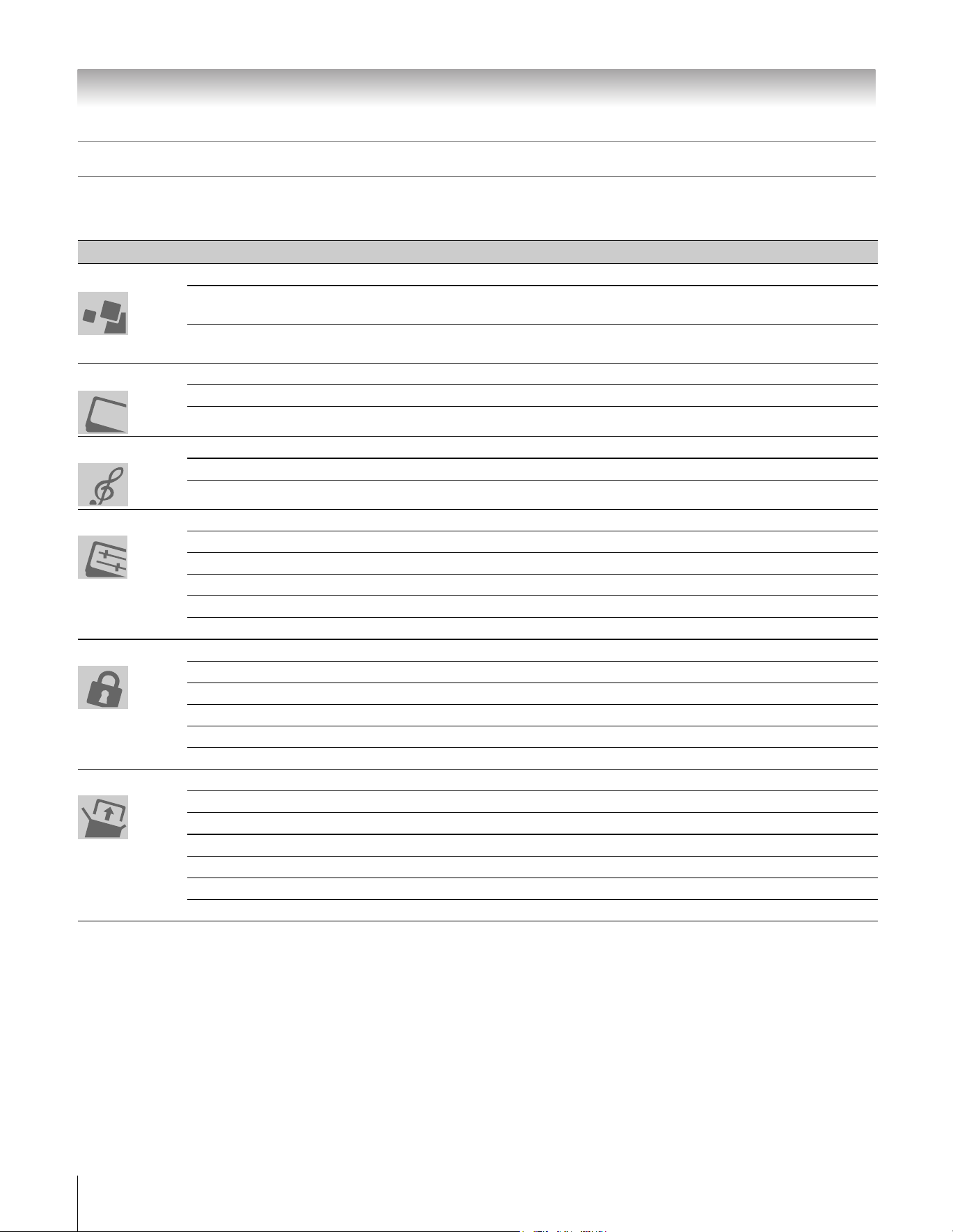
Main menu layout
The illustrations below and on the next page provide a quick overview of your TV’s menu system.
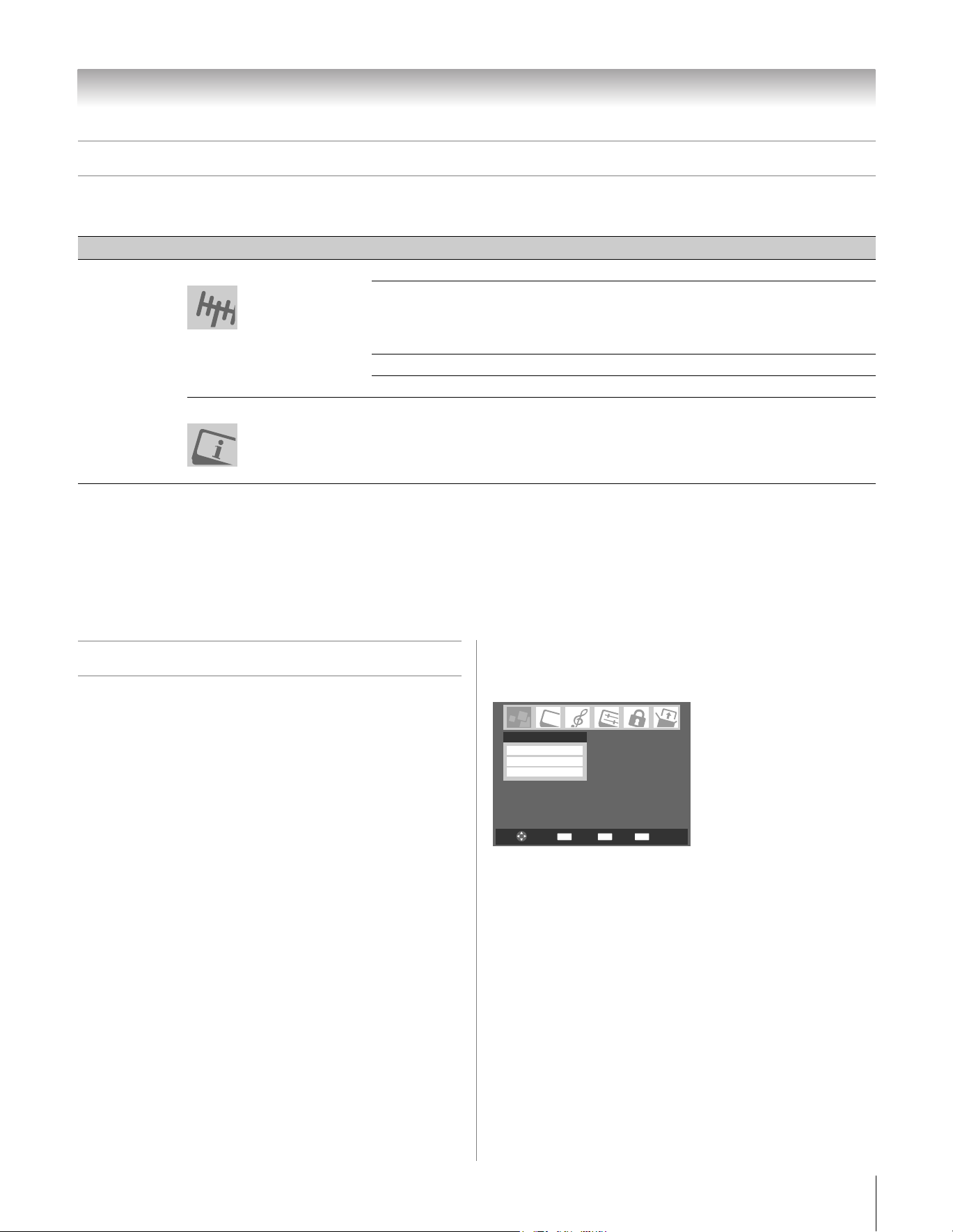
To open the main menus (illustrated below), press Y on the remote control or TV control panel.
Icon Item Option
Channel Browser S [Launches the Channel Browser™]
Digital CC/Audio Selector
S [Launches the ATSC Digital CC Selector] (This option is not available,
if you are not on a digital channel).
CableCARD™
S Dynamic list of items provided by Cable company.
(This option is not available if a CableCARD™ is not inserted.)
Picture Settings S [Picture Settings edit window]
Advanced Picture Settings S [Advanced Picture Settings edit window]
Theater Settings S [Theater Settings edit window]
Audio Settings S [Audio Settings window]
Advanced Audio Settings S [Advanced Audio Settings window]
Audio Setup S [Audio Setup window]
Favorite Channels S [Favorite Channels edit window]
Closed Caption Mode S Off/CC1/CC2/CC3/CC4/T1/T2/T3/T4
Closed Caption Advanced S [Closed Caption Advanced window]
Input Labeling S [Input Labeling edit window]
Menu Language S English / Français / Español
Channel Browser Setup S [Channel Browser Setup window]
Enable Rating Blocking S Off/On
Edit Rating Limits S [Edit Rating Limits edit window]
Channels Block S [Channels Block edit window]
Input Lock S Off/Video/Video+
Front Panel Lock S Off/On
New PIN Code S [New PIN Code entry window]
Installation S [Opens the Installation menu (- page 15)]
Sleep Timer S [Sleep Timer edit window]
ColorStream HD1 Audio S No/Yes
HDMI 1 Audio S Auto / Digital / Analog
ColorStream HD2 Audio S No/Yes
HDMI 2 Audio S Auto / Digital / Analog
Quick Restart S Off/On
Applications
Video
Audio
Preferences
Locks
Setup
HM66_EN.book Page 14 Thursday, February 23, 2006 2:49 PM
15
HM66 (E/F) Web 213:276
Chapter 3: Menu layout and navigation
Setup/Installation menu layout
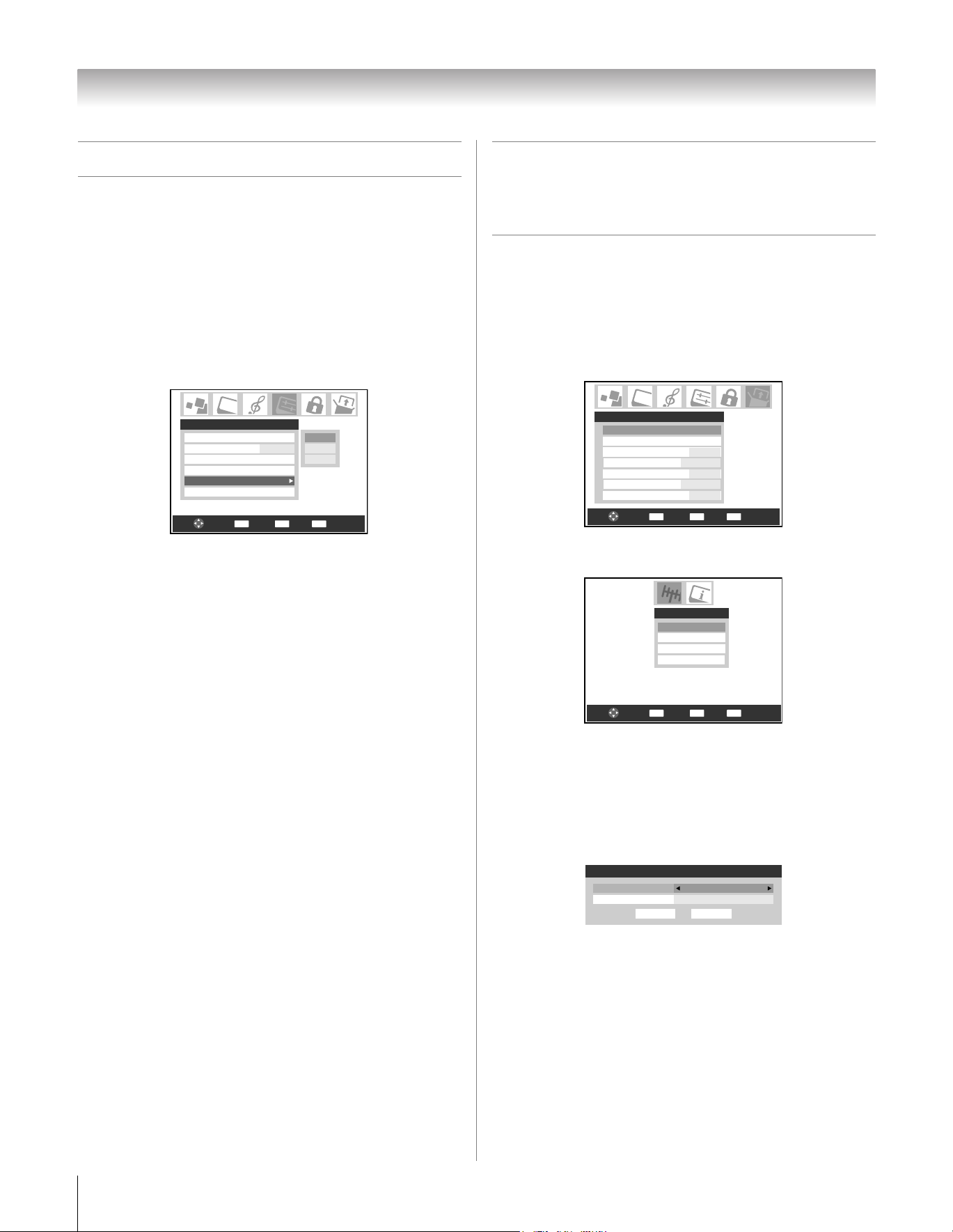
To open the Installation menu (illustrated below), press Y on the remote control or TV control panel, open the Setup menu,
select Installation, and press T.
Icon Item Option
Press Y.
Open the
Setup menu,
and then open
the
Installation
sub-menu.
Input Configuration S [Input Configuration window]
Channel Program
S ANT1 S [Scans for new channels on desired
Antenna]
S ANT2 S [Scans for new channels on desired
Antenna]
Channel Add/Delete S [Channel Add / Delete Window]
Signal Meter S [Signal Meter Window]
System Information S [Opens the System Information window]
Terrestrial
System Status
Navigating the menu system
You can use the buttons on the remote control or TV control
panel to access and navigate your TV’s on-screen menu
system.
• Press Y to open the menu system.
• When a menu is open, use the up/down/left/right arrow
buttons (BbC c) on the remote control or TV control panel
to move in the corresponding direction in the menu.
• Press T to save your menu settings or select a highlighted
item. (A highlighted menu item appears in a different color
in the menu.)
• All menus close automatically if you do not make a selection
within 60 seconds, except the signal meter menu, which
closes automatically after about 5 minutes.
• To close a menu instantly, press O.
Note: The menu background may sometimes appear black,
depending on the signal the TV is receiving.
This is not a sign of malfunction.
CH RTNENTER
EXIT
Navigate
Select
Back Exit
Applications
Digital CC/Audio Selector
CableCARD
Channel Browser
HM66_EN.book Page 15 Thursday, February 23, 2006 2:49 PM
16
HM66 (E/F) Web 213:276
Chapter 4: Setting up your TV
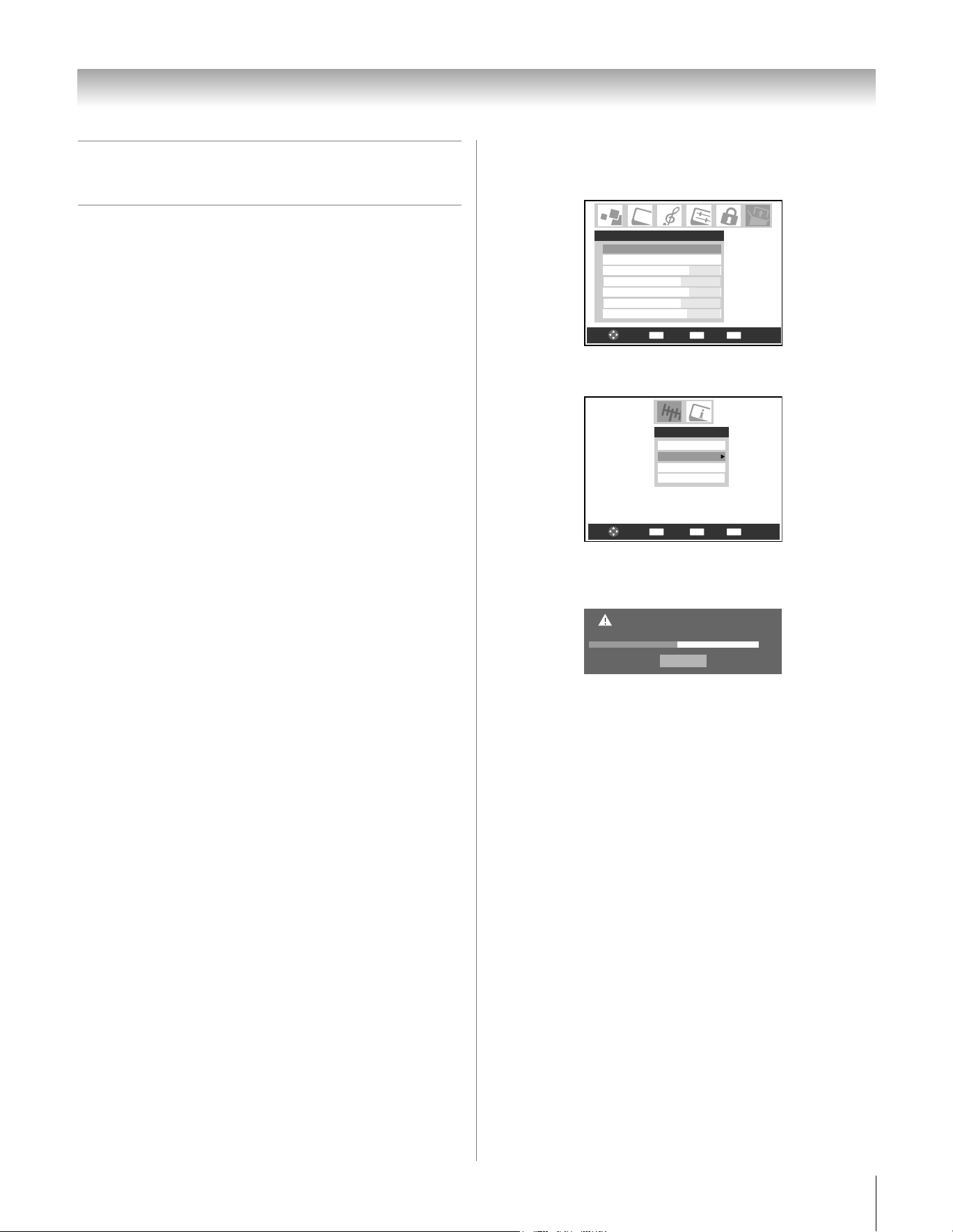
Selecting the menu language
You can choose from three different languages (English,
French and Spanish) for the on-screen display of menus and
messages.
To select the menu language:
1 Press Y and open the Preferences menu.
2 Highlight Menu Language and press c.
3 Press B or b to select your preferred menu language and
press T.
4 Press O to close the Preferences menu.
Configuring the antenna input
sources for the ANT 1 and ANT 2
terminals
To configure the ANT 1 and ANT 2 input sources:
1 Press Y and open the Setup menu.
2 Highlight Installation and press T. (A new set of
Installation menu icons will appear on-screen, as shown
in step 3 below.)
3 Open the Terrestrial menu, highlight Input
Configuration, and press T.
4 Press B or b to highlight ANT 1, and press C or c to
select the input source (Cable or Antenna) for the
ANT 1 input on the TV.
5 Press b to highlight Antenna 2 in and then C or c to select
the input source (Cable or Antenna) for the ANT 2
input on the TV, if applicable. If you have not connected
anything to the ANT 2 input, skip this step.
6 To save your new settings, highlight Done and press T.
To revert to your original settings, highlight Cancel and
press T.
CH RTNENTER
EXIT
Navigate
Select
Back Exit
Channel Browser Setup
English
Français
Español
Favorite Channels
Closed Caption Mode
Off
Closed Caption Advanced
Input Labeling
Menu Language English
Preferences
CH RTNENTER
EXIT
Navigate
Select
Back Exit
Installation
Sleep Timer
ColorStream HD1 Audio
Setup
HDMI 1 Audio
Auto
Auto
No
ColorStream HD2 Audio
No
On
HDMI 2 Audio
Quick Restart
CH RTNENTER
EXIT
Navigate
Select
Back Exit
Terrestrial
Input Configuration
Channel Program
Channel Add/Delete
Signal Meter
Input Configuration
Antenna 1 In
Antenna 2 In
Cable
Antenna
Cancel Done
HM66_EN.book Page 16 Thursday, February 23, 2006 2:49 PM
17
HM66 (E/F) Web 213:276
Chapter 4: Setting up your TV
Programming channels into the
TV’s channel memory
When you press < or , on the remote control or TV control
panel, your TV will stop only on the channels you program into
the TV's channel memory.
Follow the steps below to program channels into the TV’s
channel memory.
Programming channels automatically
Your TV can automatically detect all active channels in your
area and store them in its memory. After the channels are
programmed automatically, you can manually add or erase
individual channels.
Notes:
• You must configure the antenna input sources before
programming channels (- page 16).
• If the input signal type is set to Cable for an antenna input,
the automatic channel programming process erases
channels that were previously programmed into the TV’s
memory.
• If the input signal type is set to Antenna, the automatic
channel programming process does NOT erase channels
that were previously programmed into the TV’s memory, but
adds newly found channels to the existing set of
programmed channels. To remove a channel from the
memory, you must manually delete it.
• To tune the TV to a channel not programmed in the channel
memory, you must use the Channel Number buttons on the
remote control.
• Programming channels for an antenna input configured for
Cable will take substantially longer than for an antenna input
configured for Antenna. This is normal; however, once
channel programming is completed, you should not have to
repeat the programming process again unless your Cable
TV service lineup changes significantly.
• If you have a CableCARD™ inserted, channel programming
for ANT 1 is disabled because the CableCARD™
automatically loads the Cable channel list into the TV’s
channel memory. See Installation Guide for details on
CableCARD™.
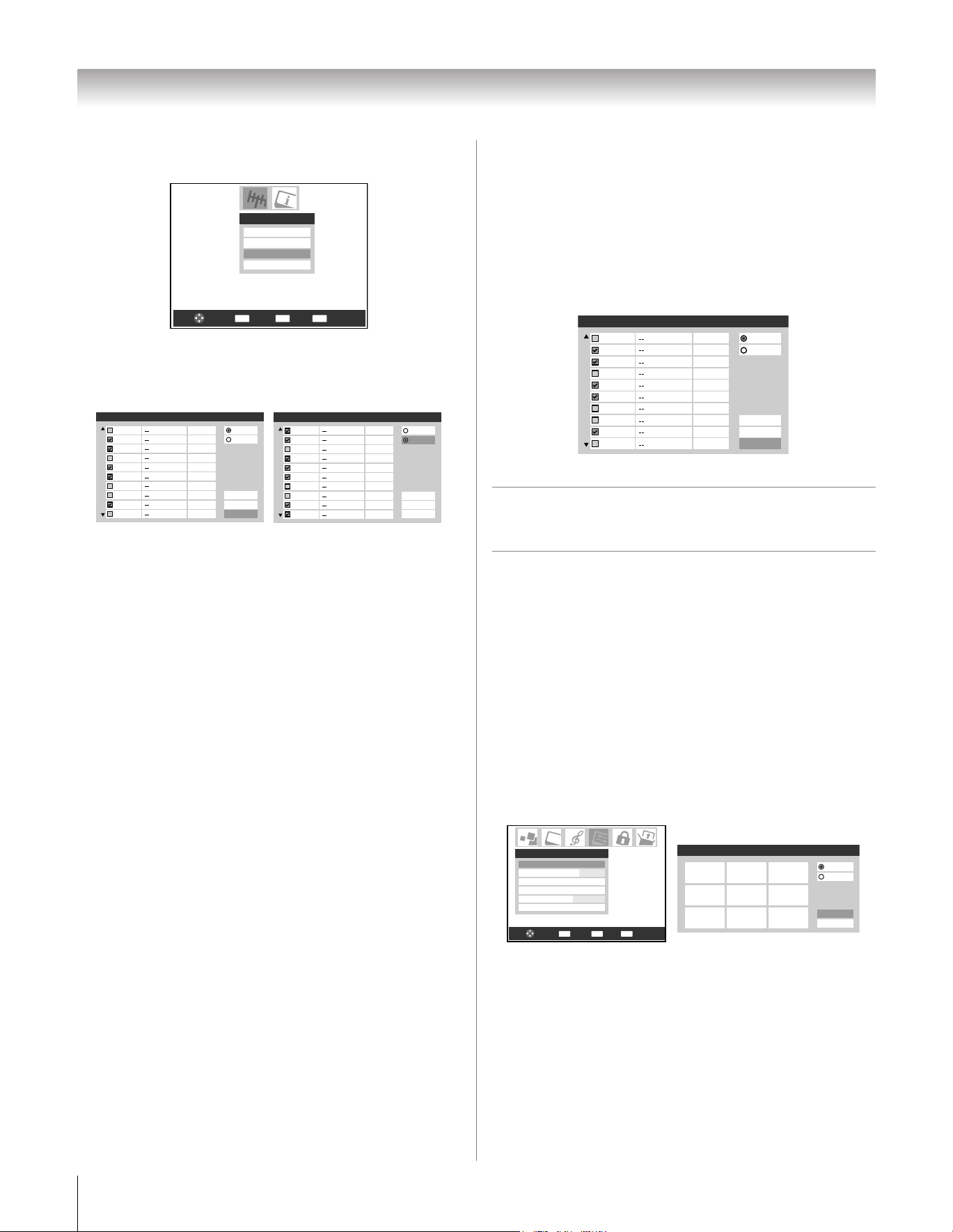
To program channels automatically:
1 Make sure you have configured the antenna input sources
(
- page 16).
2 Press Y and open the Setup menu.
3 Highlight Installation and press T. (A new set of
Installation menu icons will appear on-screen, as shown
in step 4.)
4 Open the Terrestrial menu, highlight Channel
Program, and press T.
5 Highlight ANT 1 or ANT 2, depending on which antenna
input you want to program channels for, and then press T
to start automatic channel programming.
The TV will automatically cycle through all the channels
for the antenna input you selected, and store all active
channels in the channel memory. While the TV is cycling
through the channels, the message “Scanning channels,
please wait” appears (as shown above).
6 To cancel channel programming, either press O or
highlight Abort in the on-screen display and press T.
When channel programming is done, press < or , to
view the programmed channels.
Manually adding and deleting channels in
the channel memory
After automatically programming channels into the channel
memory, you can manually add or delete individual channels.
To add or delete channels in the channel memory:
1 Press Y and open the Setup menu.
2 Highlight Installation and press T. (A new set of
Installation menu icons will appear on-screen, as shown
in step 3.)
CH RTNENTER
EXIT
Navigate
Select
Back Exit
Installation
Sleep Timer
ColorStream HD1 Audio
Setup
HDMI 1 Audio
Auto
Auto
No
ColorStream HD2 Audio
No
On
HDMI 2 Audio
Quick Restart
CH RTNENTER
EXIT
Navigate
Select
Back Exit
Terrestrial
Input Configuration
Channel Program
Channel Add/Delete
Signal Meter
ANT 1 Antenna
Scanning channels, please wait ...
Abort
52%
(continued)
HM66_EN.book Page 17 Thursday, February 23, 2006 2:49 PM
18
HM66 (E/F) Web 213:276
Chapter 4: Setting up your TV
3 Open the Terrestrial menu, highlight Channel Add/
Delete, and then press T.
4 The illustration below left shows channels programmed
for the ANT 1 antenna input. To view the list of channels
programmed for the ANT 2 antenna input, press Bb to
highlight ANT 2 and press T.
To add a channel to the channel memory:
Highlight the unchecked box next to the channel number you
want to add, and then press T to check the box.
To manually add digital subchannels on a physical
channel:
Use the Channel Numbers and the Dash (=) on the remote
control to enter the channel number (for example, 56–1).
If the channel is found, the number will be added to the list and
the box will be checked.
If the channel is not found, a message will appear.
To remove a channel from the channel memory:
Highlight the checked box next to the channel number you
want to remove, and then press T to uncheck the box.
To save your new settings:
Highlight Done and press T.
To revert to your original settings:
Highlight Cancel and press T before saving.
To remove all channels from the channel memory:
Highlight Reset and press T, and then highlight Done and
press T.
Notes:
• This action applies to the current antenna input only. To
delete/add channels on the other input, highlight the input
you want (ANT1, or ANT 2) and press T.
• This action cannot be cancelled unless you highlight Cancel
and press T before saving your changes.
Programming your favorite
channels
You can program up to 18 channels as favorite channels into
two Favorite Channel lists (nine channels from the ANT 1
input, and nine from the ANT 2 input). You can then scan
through your favorite channels only, skipping other channels
you do not normally watch.
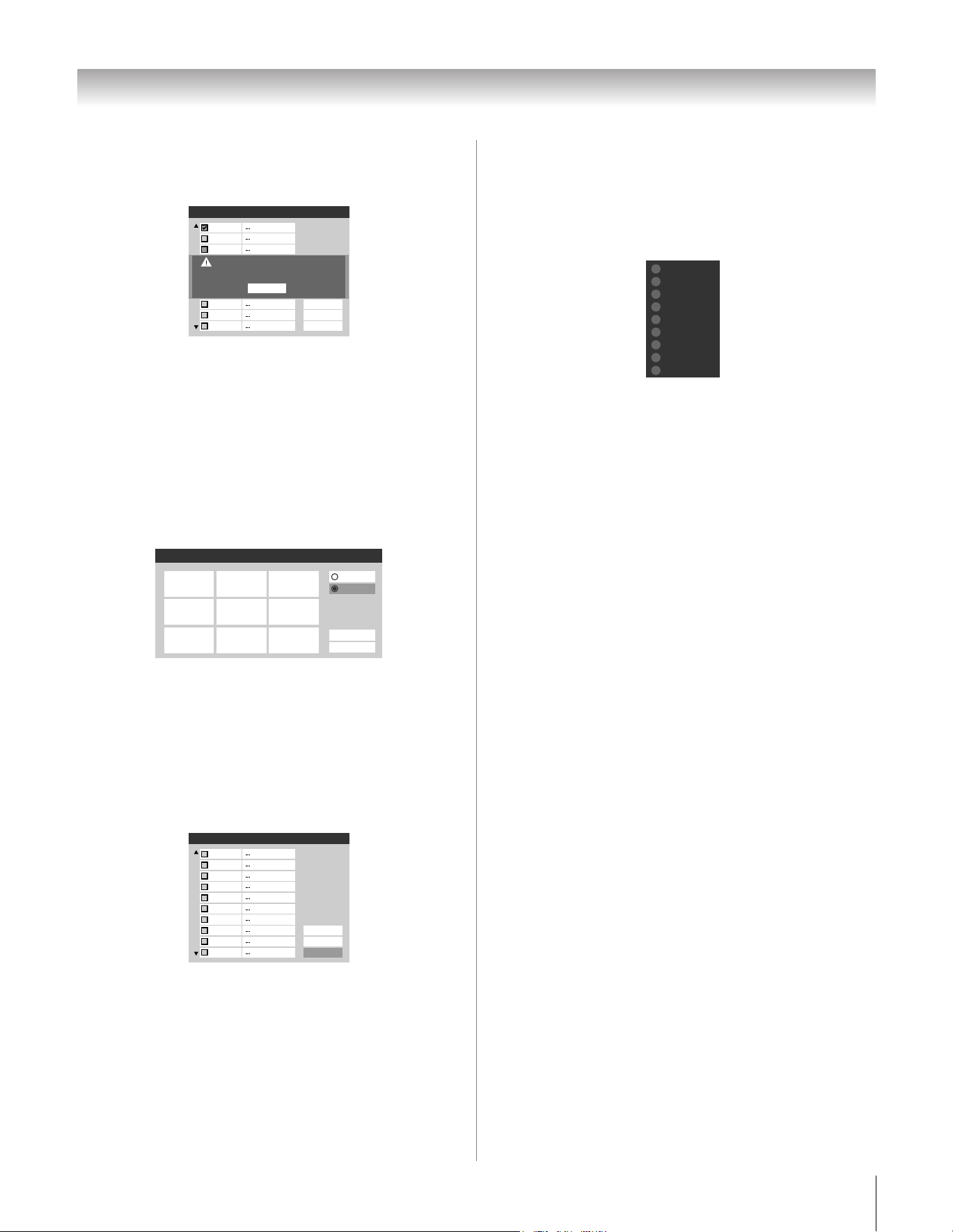
To add and delete channels in the Favorite Channels
lists:
1 Press Y and open the Preferences menu.
2 Highlight Favorite Channels and press T.
3 Use Bb to select either ANT 1, or ANT 2, and press T.
4 Highlight Edit and press T.
To add a channel to the selected Favorite Channel
list:
Use Bb to highlight an unchecked box next to a channel you
want to set as a favorite, and then press T to check the box.
Note: You must first use Channel Program or Channel Add/
Delete to add channels to the channel memory before setting
up favorite channels.
CH RTNENTER
EXIT
Navigate
Select
Back Exit
Terrestrial
Input Configuration
Channel Program
Channel Add/Delete
Signal Meter
Channel Add/Delete
2
Analog ANT 1
ANT 2
Reset
Cancel
Done
Digital
Digital
Analog
Analog
Analog
Analog
Analog
Digital
Analog
2 - 1
2 - 2
3
4
5
6
7
7 - 1
8
Channel Add/Delete
1
Analog ANT 1
ANT 2
Analog
Analog
Analog
Analog
Analog
Analog
Analog
Analog
Analog
2
3
4
5
6
7
8
9
10
Reset
Cancel
Done
Channel Add/Delete
2
Analog ANT 1
ANT 2
Reset
Cancel
Done
Digital
Digital
Analog
Analog
Digital
Analog
Analog
Digital
Analog
2 - 1
2 - 2
3
4
5
6
7
7 - 1
8
CH RTNENTER
EXIT
Navigate
Select
Back Exit
Channel Browser Setup
Favorite Channels
Closed Caption Mode
Off
Closed Caption Advanced
Input Labeling
Menu Language English
Preferences
Favorite Channels ANT 1
Empty Empty Empty
ANT 1
Empty Empty Empty
Empty Empty Empty
ANT 2
Edit
Done
HM66_EN.book Page 18 Thursday, February 23, 2006 2:49 PM
19
HM66 (E/F) Web 213:276
Chapter 4: Setting up your TV
To delete the channel from the selected Favorite
Channel list:
Highlight a checked box and press T to uncheck it.
Note: If you try to add more than nine favorite channels per
input, an error message will appear. You will need to delete
(uncheck) a channel before you can add another.
When done, highlight Done and press T.
To program favorite channels for another input:
• Either... Highlight ANT 1, or ANT 2, which will change the
favorite channel settings in the selected input. (This will not
change the TV’s current input.)
• Or... Press + to select ANT 1, or ANT 2 and then repeat
steps 1–4, on page 18.
To clear your favorite channel lists:
1 Press Y and open the Preferences menu.
2 Highlight Favorite Channels and press T.
3 Highlight Edit and press T.
4 Highlight Reset and press T.
5 Highlight Done and press T.
To tune your favorite channels for the current ANT
input:
Press M / m.
To tune your favorite channels using the favorite
channel list:
1 Press = to display the favorite channel list.
2 Press the corresponding number button (1-9) to select
your desired channel.
Note: To tune your favorite channels for another input,
press + to select the other input.
Edit Favorite Channels
2
ANT 1
Reset
Done
Cancel
3
4
9
10
11
Only 9 favorite channels are allowed,
please deselect other channels first.
OK
Favorite Channels ANT 2
6 Empty Empty
ANT 1
Empty Empty Empty
Empty Empty Empty
ANT 2
Edit
Done
Edit Favorite Channels
2
ANT 2
Reset
Done
Cancel
2 - 1
2 - 2
4 - 1
5
17 - 1
17 - 2
28 - 1
28 - 2
28 - 3
CH 4-1
CH 4-2
CH 9
CH 10
CH 12
CH 17
CH 19
---
1
2
3
4
5
6
7
8
---
9
HM66_EN.book Page 19 Thursday, February 23, 2006 2:49 PM
20
HM66 (E/F) Web 213:276
Chapter 4: Setting up your TV
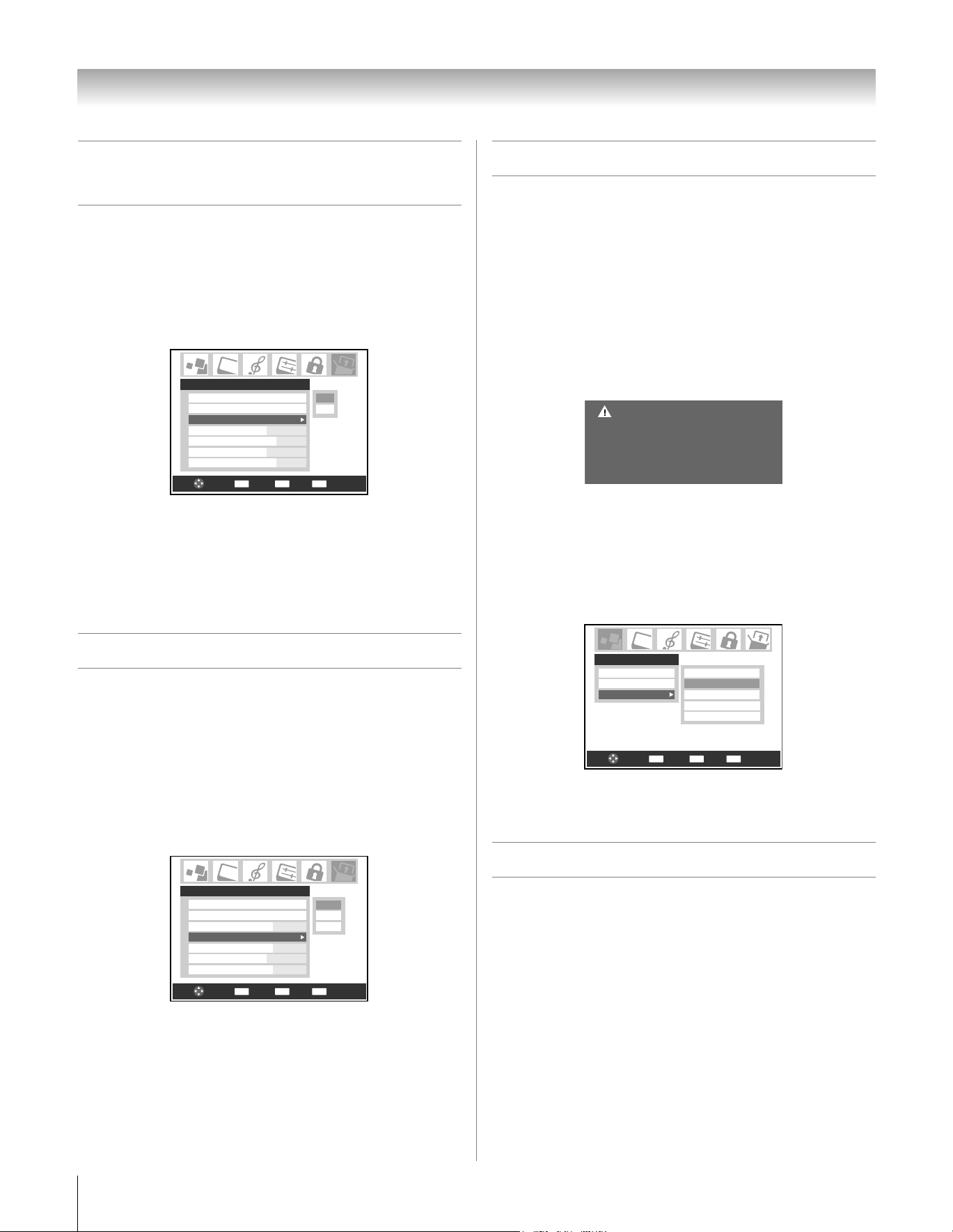
Setting the ColorStream HD audio
mode
To set the ColorStream HD audio mode:
1 Press Y and open the Setup menu.
2 Highlight ColorStream HD1(or 2) Audio and press c.
3 Press B or b to select Yes or No and press T to display
the information.
Note: The analog audio terminals for the ColorStream HD and
HDMI inputs are used in common. When the ColorStream HD
1 (or 2) audio mode is set to Yes, the HDMI 1 (or 2) audio mode
is set to Digital and will be greyed out. When the ColorStream
HD 1 (or 2) audio mode is set to No, the HDMI 1 (or 2) Audio
changes to Auto.
Setting the HDMI™ audio mode
To set the HDMI audio mode:
1 Press Y and open the Setup menu.
2 Highlight HDMI 1 (or 2) Audio and press c.
3 Press b or B to select the HDMI audio mode (Auto,
Digital, or Analog) and press T. (Auto is the
recommended mode.) See “Connecting an HDMI or DVI
device to the HDMI input” (- Installation Guide).
Note: The ColorStream HD1/HD2 Audio settings influence the
HDMI Audio settings. If ColorStream HD1 (or 2) Audio is set to
No, the HDMI 1 (or 2) Audio setting changes to Auto. If either
ColorStream HD1 (or 2) Audio is set to Yes, the HDMI 1 (or 2)
Audio setting is set to Digital and will be greyed out.
Viewing the CableCARD™ menu
A CableCARD™ enables you to view encrypted digital
channels. See “Connecting a digital CableCARD™”
(- Installation Guide) for connection and subscription
information.
Note: Connecting your TV directly to the Audio/Video output of
your Set-Top-Box will assure a more vivid picture and enhance
your viewing enjoyment.
After the CableCARD™ is inserted, a CableCARD™ option
appears in the Applications menu, with informational
screens provided by your digital CableCARD™ service (see
illustrations below).
To view the CableCARD™ menu:
1 Press Y and open the Applications menu.
2 Highlight CableCARD™ and press c.
3 Press B or b to select one of the side menu items and
press T to display the information.
Note: The CableCARD™ menu is for informational
purposes only and has no user-adjustable options.
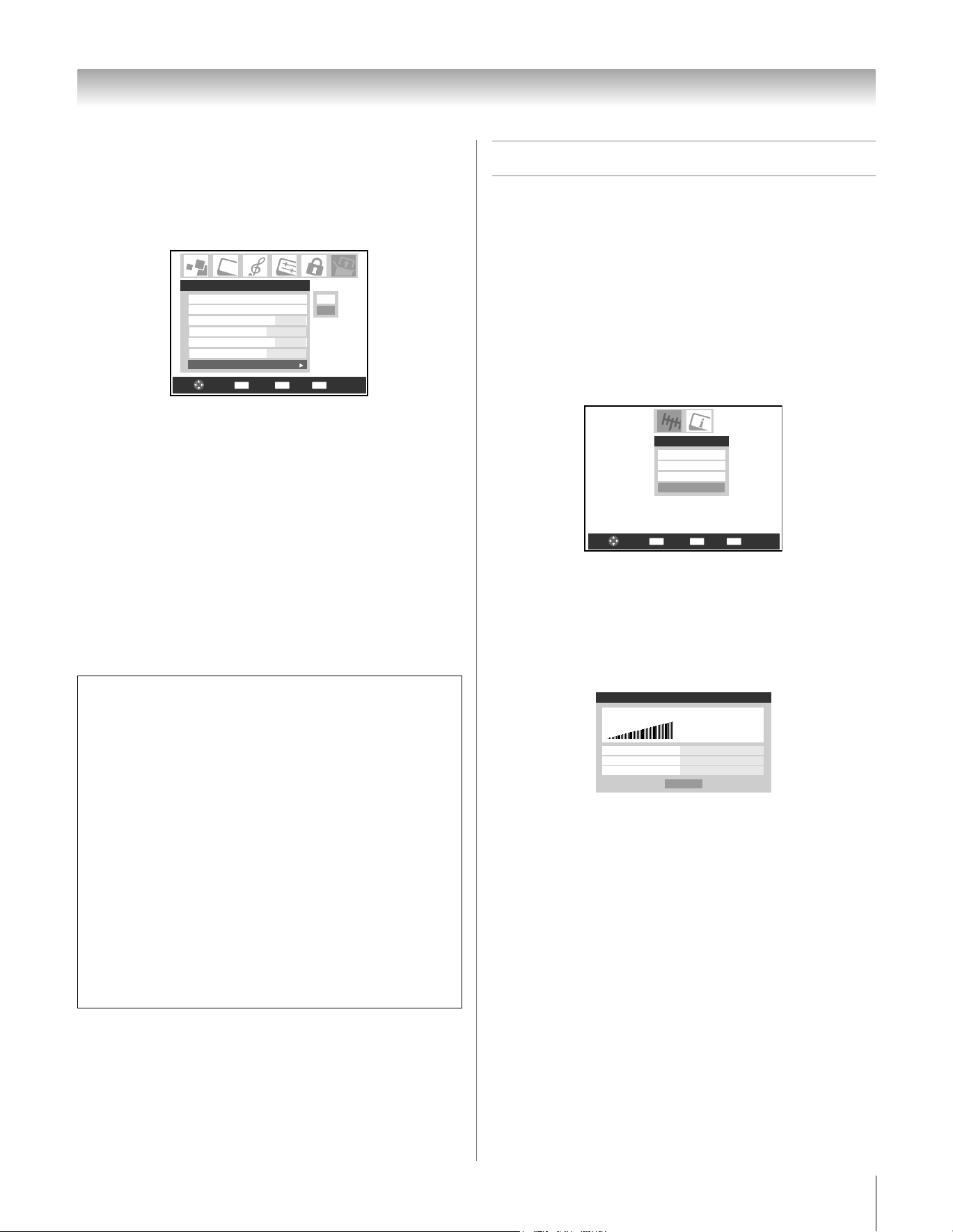
Setting the Quick Restart™ feature
With the Quick Restart™ feature set to On, the TV will stay in
Standby mode for several minutes after the TV is turned off
(see Note on page 21).
If the TV is turned on from Standby mode, the full picture
appears immediately.
Yes
No
Installation
Sleep Timer
ColorStream HD1 Audio
Setup
HDMI 1 Audio
Auto
Auto
No
ColorStream HD2 Audio
No
On
HDMI 2 Audio
Quick Restart
CH RTNENTER
EXIT
Navigate
Select
Back Exit
CH RTNENTER
EXIT
Navigate
Select
Back Exit
Analog
Digital
Auto
Installation
Sleep Timer
ColorStream HD1 Audio
Setup
HDMI 1 Audio
Auto
Auto
No
ColorStream HD2 Audio
No
On
HDMI 2 Audio
Quick Restart
CableCard Connected -- Acquiring
channel information.
CableCard services will only operate
with cable signal connected to Antenna 1.
CH RTNENTER
EXIT
Navigate
Select
Back Exit
Applications
Digital CC/Audio Selector
IP Service
Conditional Access
CableCARD(tm) Status
Network Setup
CableCARD(tm) Pairing
CableCARD
Channel Browser
HM66_EN.book Page 20 Thursday, February 23, 2006 2:49 PM
21
HM66 (E/F) Web 213:276
Chapter 4: Setting up your TV
To set the Quick Restart™ feature:
1 Press Y and open the Setup menu.
2 Highlight Quick Restart and press c.
3 Press b or B to select either On or Off and Press T.
Note: If Quick Restart is set to Off and you turn off the TV, it
can take several seconds for the picture to appear when you
turn on the TV again. See “important notice about hot lamp
restart,” below.
If Quick Restart is set to On and you turn off the TV, the
following will occur for a few minutes:
• The screen (lamp) lights dimly; and
• The fans continue to run.
This is a function of the Quick Restart Shutdown mode and is
not a TV malfunction. If you do not prefer this, set the Quick
Restart feature to Off.
When the Quick Restart feature is set to Off, if you repeatedly
turn the TV on and off in a short period of time, the useful
service life of the lamp may be shorter than the average useful
service life (- page 47).
Viewing the digital signal meter
You can view the digital signal meter in the ANT 1 and ANT
2 digital TV input sources only.
To view the digital signal meter:
1 Press Y and open the Setup menu.
2 Highlight Installation and press T.
3 A new set of Installation menu icons will appear on-
screen, as shown below.
Open the Terrestrial menu, highlight Signal Meter,
and press T.
4 Press BbC c to select the antenna input and digital
channel whose signal you want to check.
Note: The physical digital channel number listed in the
Signal Meter screen may not correspond to a virtual TV
channel number. Contact your local broadcasters to
obtain the RF channel numbers for your local digital
stations.
To close the screen and return to the Terrestrial
menu:
Highlight Done and press T.
To return to normal viewing:
Press O.
IMPORTANT NOTICE ABOUT “HOT LAMP RESTART”
When the TV has been powered on long enough for
the lamp unit to get hot, it may take several minutes for
the picture to appear on-screen in the following
situations:
• When the Quick Restart™ feature is set to Off and
you turn the TV off and then on again within a few
minutes; or
• If the TV is on when a short-term power failure,
power surge, or other similar power failure occurs,
such that the TV loses and regains power within a
few minutes.
This is a property of DLP™ TV lamp technology
and is NOT a sign of malfunction.
If this occurs, the yellow LED on the TV front panel will
blink (and the blue LED will be lit solid) until the TV is
finished restarting the lamp and the normal picture
appears. If both LEDs are blinking, you will need to
turn the TV off and then on again to restart the lamp.
CH RTNENTER
EXIT
Navigate
Select
Back Exit
On
Off
On
Quick Restart
Installation
Sleep Timer
ColorStream HD1 Audio
Setup
HDMI 1 Audio
Auto
Auto
No
ColorStream HD2 Audio
No
HDMI 2 Audio
CH RTNENTER
EXIT
Navigate
Select
Back Exit
Terrestrial
Input Configuration
Channel Program
Channel Add/Delete
Signal Meter
Signal Meter
Antenna 1
Physical Digital Channel 4
Virtual Digital Channel
Done
4/1
Signal Locked
0
0
Peak
HM66_EN.book Page 21 Thursday, February 23, 2006 2:49 PM
22
HM66 (E/F) Web 213:276
Chapter 4: Setting up your TV
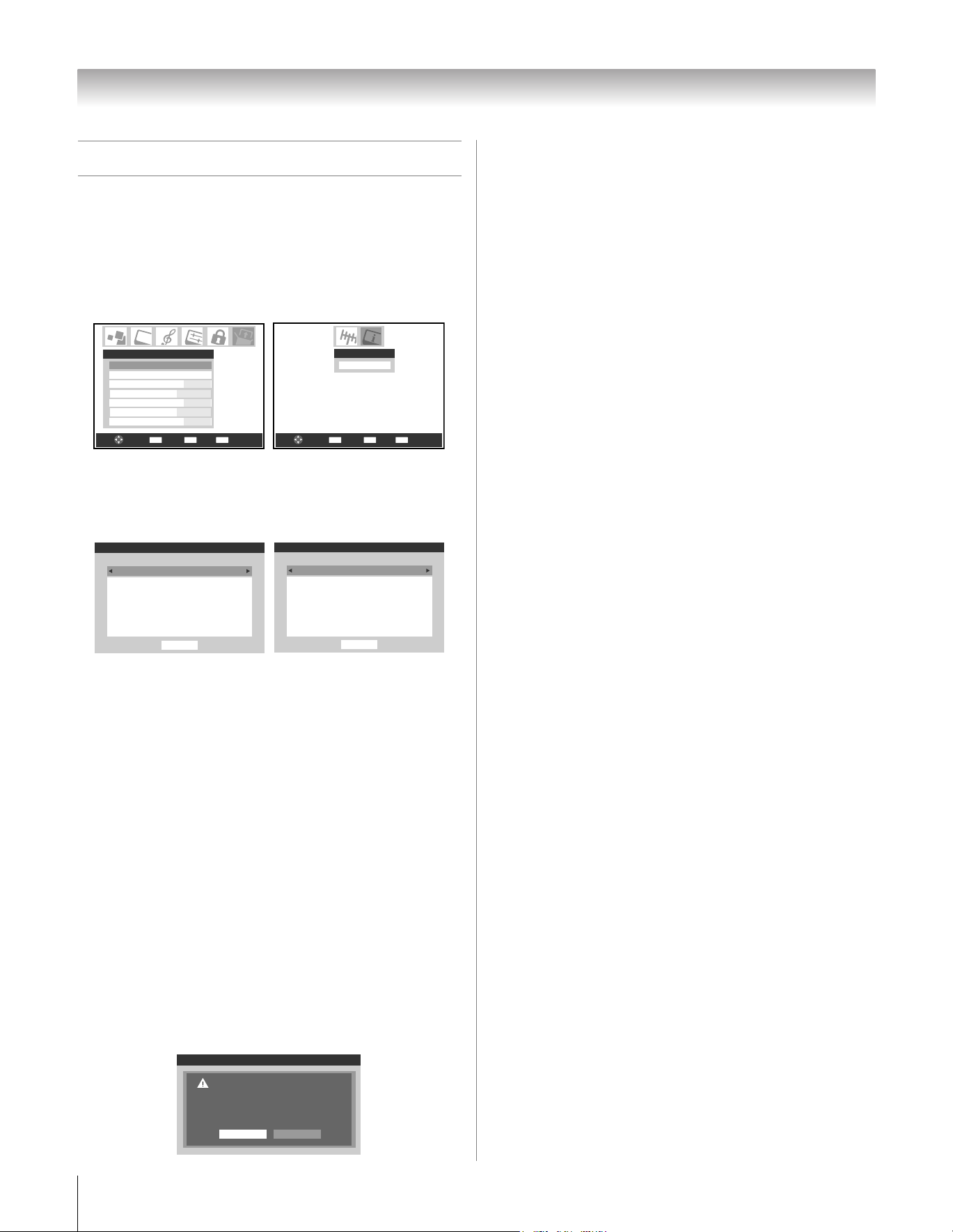
Viewing the system status
To view the system status:
1 Press Y and open the Setup menu.
2 Highlight Installation and press T. A new set of
Installation menu icons will appear on-screen, as shown
below right.
3 Open the System Status menu, highlight System
Information, and press T.
4 Press C c to scroll through the menu bar to check the
Product Information and Software Version.
To close the screen and return to the Installation
menu:
Highlight Done and press T.
To return to normal viewing:
Press O.
Restore Factory Defaults
To restore all settings and channels to their factory
default values:
1 Follow steps 1–3 above.
2 Press C c to scroll through the menu bar to select
Factory Defaults.
3 Enter your PIN code (or 0000 if no PIN code has been set).
4 Highlight Yes and press T. The TV will turn off
automatically after a few seconds. After the TV turns off,
unplug the TV power cord and then plug it in again to
complete the restore process.
To cancel the reset:
Highlight No and press T.
Note: If you have previously set the TV to High Bright mode,
and have restored Factory Defaults, the TV will default to Low
Power mode. To set the TV back to High Bright mode, see
page 42.
CH RTNENTER
EXIT
Navigate
Select
Back Exit
CH RTNENTER
EXIT
Navigate
Select
Back Exit
System Infomation
System Status
Installation
Sleep Timer
ColorStream HD1 Audio
Setup
HDMI 1 Audio
Auto
Auto
No
ColorStream HD2 Audio
No
On
HDMI 2 Audio
Quick Restart
System Information
Done
Brand:
Model:
Toshiba
50HM66
Product Information
System Information
Done
2.2.26.0
Jan 24 2006 - 11:04:47
FW: 17
Software Version
System Information
Press YES to confirm. After the TV
turns off, unplug it and plug it back
in to complete the reset.
YesNo
HM66_EN.book Page 22 Thursday, February 23, 2006 2:49 PM
23
HM66 (E/F) Web 213:276
Chapter 5: Using the TV’s basic features
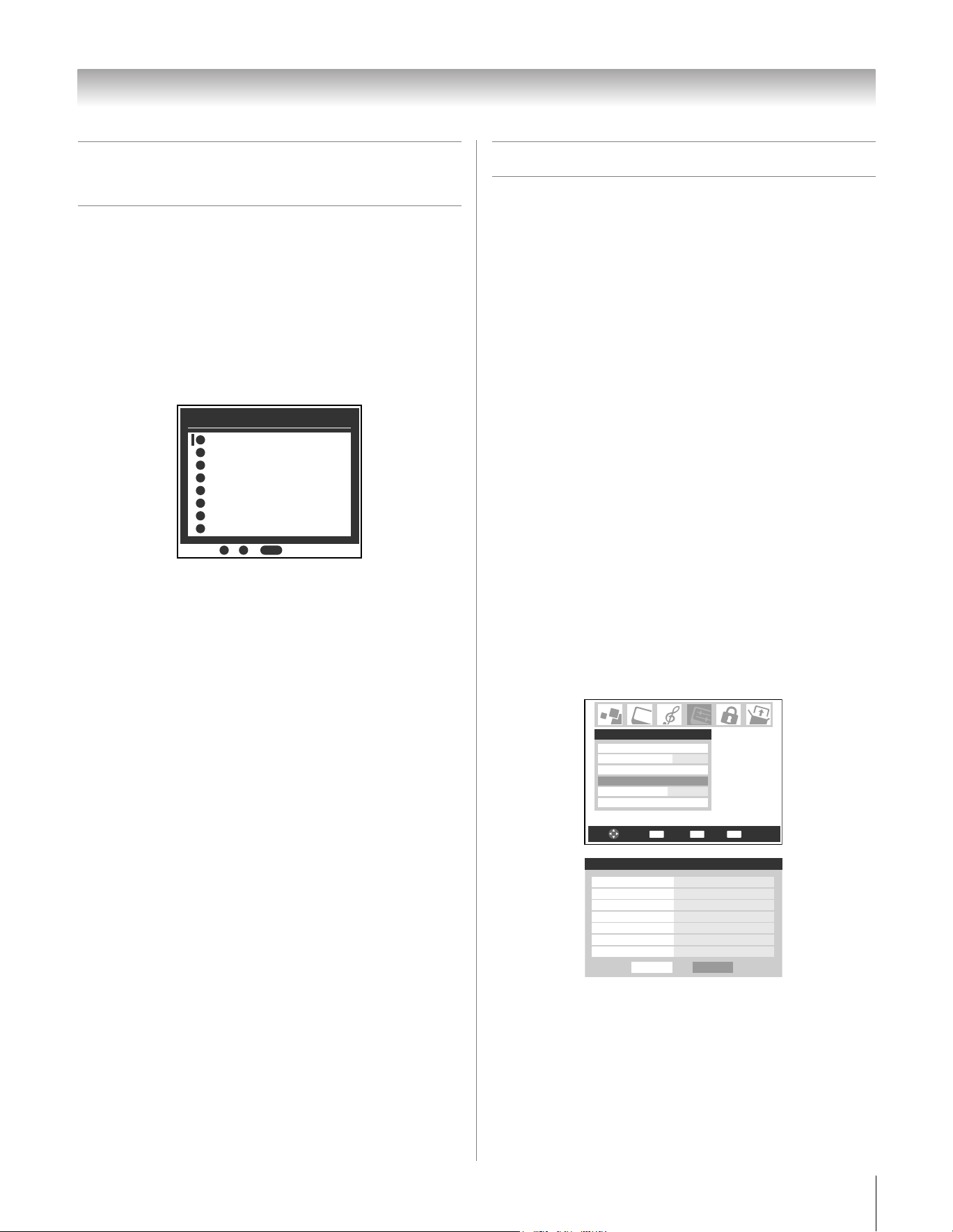
Selecting the video input source
to view
To select the video input source to view:
1 Press + on the remote control or INPUT on the TV
control panel.
2 Press 0–7 to select the input source you want to view,
which will depend on the input terminals you used to
connect your devices (- Installation Guide).
The current signal source displays in the top right corner
of the Input Selection screen.
Notes:
• When the Input Selection screen is open, you also can use
Bb on the remote control (or the CHANNEL U u buttons on
the control panel) to change the input.
• You can repeatedly press + on the remote control or the
INPUT button on the TV control panel to change the input.
• You can label the video input sources according to the
specific devices you have connected to the TV
(- “Labeling the video input sources” at right).
• The source can be “hidden” (- “Labeling the video input
sources” at right).
Labeling the video input sources
You can label each video input source according to the type of
device you connected to each source, from the following preset
list of labels:
• “– –”(default label)
• Cable
• DTV
• Satellite/DSS
• VCR
• Laser Disk
• DVD
• Audio Receiver
• Compact Disc
• Video Recorder
• Game Console
• Hide (to hide an unused input in the Input Selection
screen)
Note: If you select ANT 2 in the Input selection screen, you can
select either “– –” or “Hide”.
To label the video input sources:
1 Press Y and open the Preferences menu.
2 Highlight Input Labeling and press T.
3 Press B or b to highlight the video source you want to
label.
4 Press C or c to select the desired label for that input
source. If a particular input is not used, you can select
Hide as the label, which will cause that input to be
“grayed out” in the input list and skipped over when you
press + on the remote control.
5 To save the new input labels, highlight Done and press
T. To revert to the factory default labels, highlight
Reset and press T.
INPUT
Input Selection
ANT 1
ANT 1ANT 1
Video 1
Video 2
ColorStream HD1
ColorStream HD2
HDMI 1
ANT 2
- / to Select
0
0
1
2
3
4
5
HDMI 2
6
7
7
CH RTNENTER
EXIT
Navigate
Select
Back Exit
Channel Browser Setup
Favorite Channels
Closed Caption Advanced
Input Labeling
Closed Caption Mode
Off
English
Menu Language
Preferences
Done
Input Labeling
Video 1 DVD
Video 2 Cable
ColorStream HD 1 Video Recorder
ColorStream HD 2 Hide
HDMI 1 DTV
HDMI 2 Satellite/DSS
ANT 2
--
Reset
(continued)
HM66_EN.book Page 23 Thursday, February 23, 2006 2:49 PM
24
HM66 (E/F) Web 213:276
Chapter 5: Using the TV’s basic features
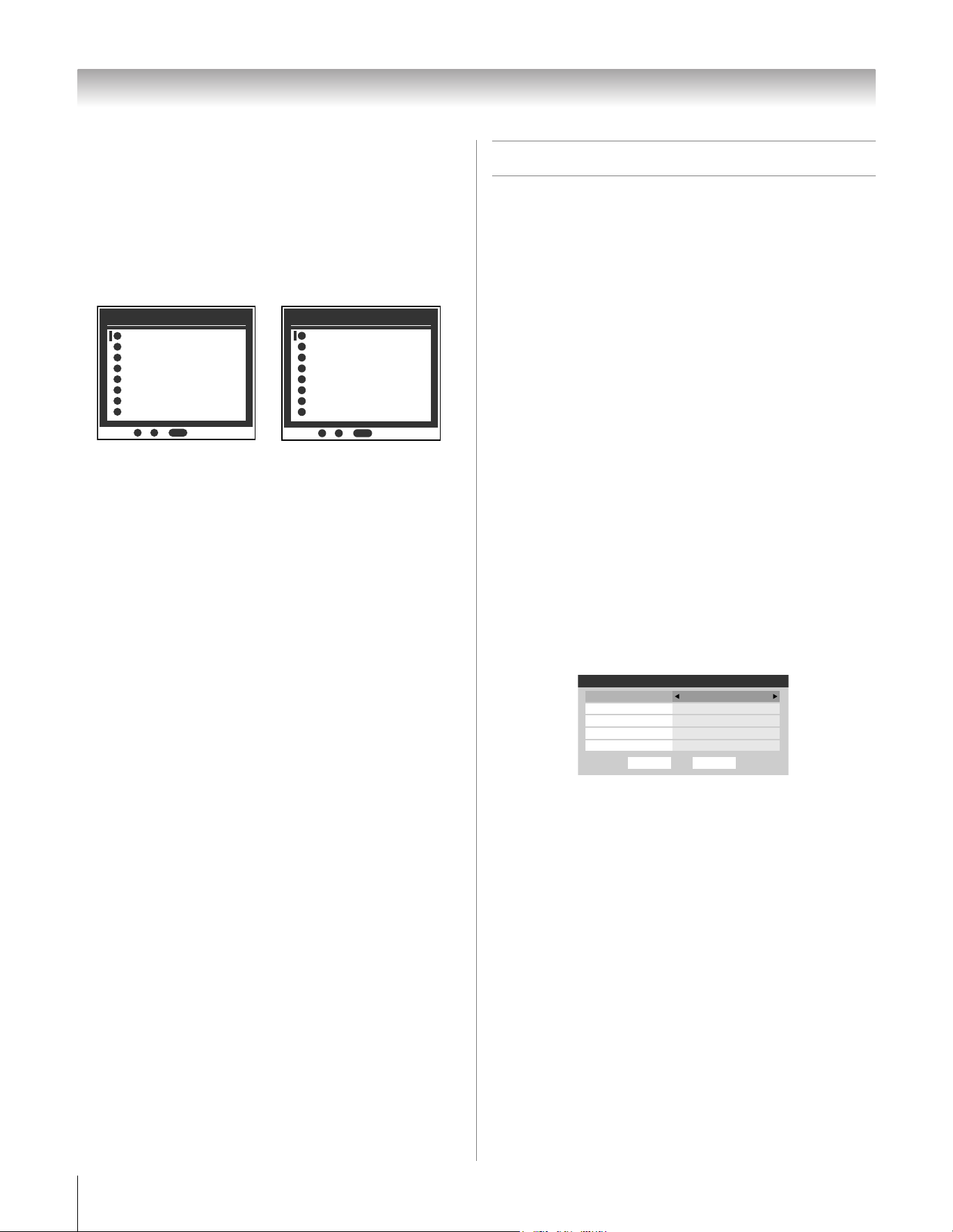
Input labeling example:
The screen below left shows the default Input Selection
screen (with none of the inputs labeled). The screen below
right is an example of how you could label the inputs if you had
connected a DVD player to VIDEO 1, Cable TV to VIDEO 2,
a video recorder to ColorStream HD1, a DTV set-top box to
HDMI 1, and a satellite/DSS set-top box to HDMI 2. Also note
that the ColorStream HD2 input is labeled “Hidden,” which
means that the input will be skipped over when + is pressed.
To clear the input labels:
1 Press Y and open the Preferences menu.
2 Highlight Input Labeling and press T.
3 Highlight Reset and press T.
Tuning channels
Using the Channel Browser™
The Channel Browser™ stores the most recently viewed
channels or inputs in a history list. In addition, it provides a list
of all the available channels on the ANT1 input (up to 2000),
the ANT2 input (up to 2000) and a list of all the inputs on the
TV. This feature allows you to:
• Keep a history of the last 32 channels or inputs viewed.
• Quickly surf and tune your recently viewed channels/inputs
from the Channel Browser™ banner (illustrated on the next
page).
• Surf via Browse mode (to immediately tune channels as you
highlight them in the Channel Browser™ banner) or Select
mode (to surf over channels in the browser banner before
you select one to tune).
• Quickly change inputs from the Inputs List.
• Set a “HOME” source for an ANT1 or ANT2 channel or TV
input.
To set the Channel Browser™:
1 Press Y and open the Preferences menu.
2 Highlight Channel Browser Setup and press T.
3 Press B to highlight Navigation, and then press C or c
to select either Browse Mode or Select Mode.
4 Press b to highlight History List field, then press C or c
to select the setting you prefer either Power Off Clear
(On), On or Off.
Note: When History List is set to On, the channels and
inputs stored in the list will be saved through power on
and off. When History List is set to Power Off Clear (On),
the channels and inputs stored in the list will be cleared
with every power on/off cycle of the TV.
5 Press b to highlight ANT1 List field, then press C or c
to select On or Off.
6 Press b to highlight ANT2 List field, then press C or c
to select On or Off.
7 Press b to highlight Inputs List field, then press C or c
to select On or Off.
8 To save your entries, highlight Done and press T.
To return to factory defaults, highlight Reset and press
T.
INPUT
INPUT
Input Selection ANT 1
ANT 1ANT 1
Video 1
Video 2
ColorStream HD1
ColorStream HD2
HDMI 1
ANT 2
- / to Select
0
0
1
2
3
4
5
HDMI 2
6
7
7
Input Selection ANT 1
ANT 2
- / to Select
0
7
ANT 1ANT 1
DVD
Cable
Video Recorder
ColorSteram HD2 (Hidden)
DTV
Satellite/DSS
0
1
2
3
4
5
6
7
Input Selection screen
with no inputs labeled
Input Selection screen with
all inputs labeled except input 4,
which has been hidden.
Done
Channel Browser Setup
Navigation
History List
Inputs List On
ANT2 List On
ANT1 List On
Reset
Select Mode
Power Off Clear(On)
HM66_EN.book Page 24 Thursday, February 23, 2006 2:49 PM
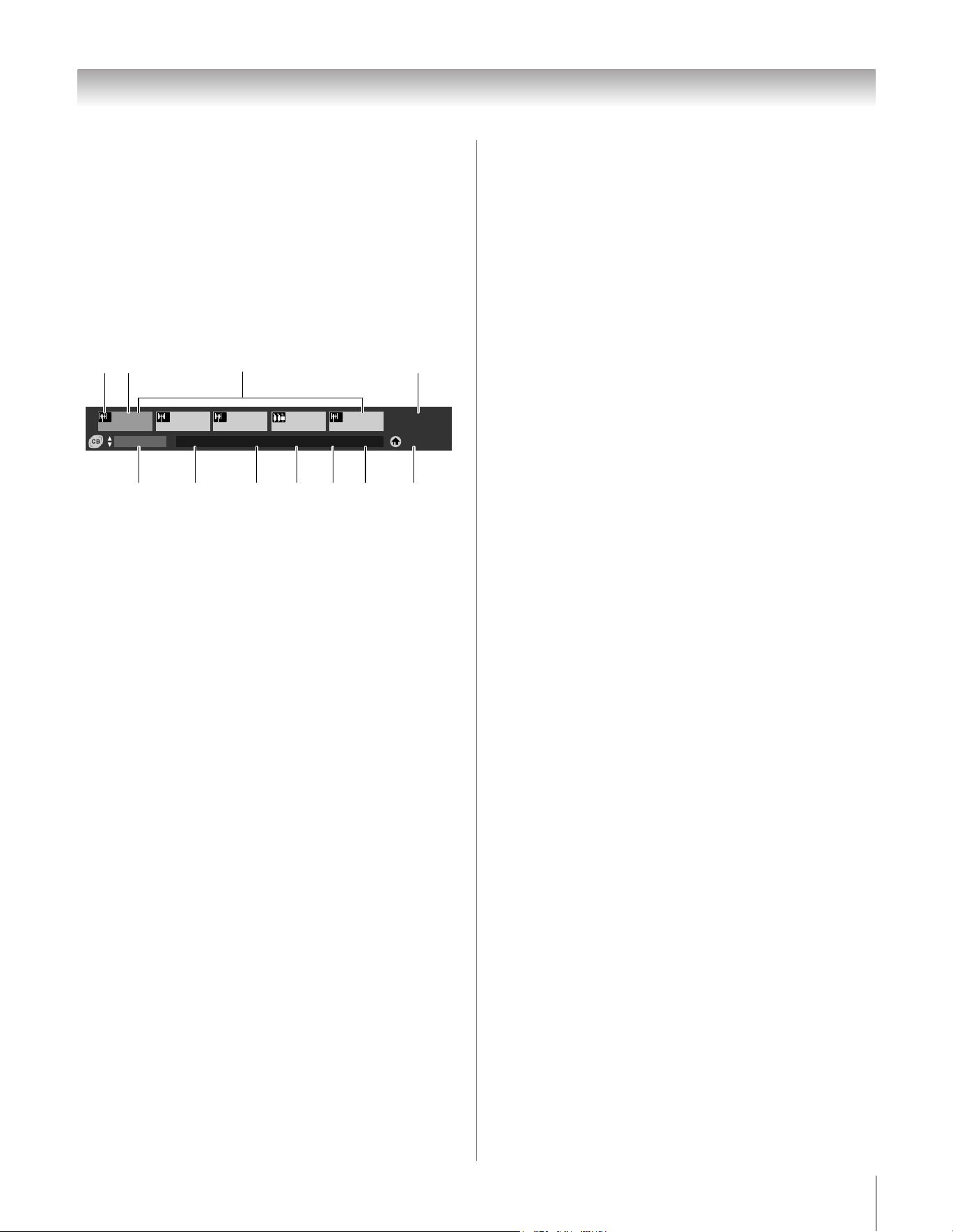
25
HM66 (E/F) Web 213:276
Chapter 5: Using the TV’s basic features
To open the Channel Browser™ banner:
• Press 3 C, # c, or i on the remote control.
• Press 3 C to surf back from the most recently viewed
channel through the last 32 channels or inputs in the History
list, ANT 1 channels list, ANT 2 channels list or the inputs
list.
• Press # c to surf forward from the previous item in the
channel history, ANT 1, ANT 2, or inputs up to the most
recently viewed item or end of list.
Elements of the Channel Browser™ banner
1 Input type
2 Highlighted item (channel or input)
3 Channels stored in the channel history
4 Home instructions (this will be replaced once there are at
least 6 items in the History, ANT 1 or Inputs lists)
5 Current list (History, ANT 1, ANT 2 or Inputs)
6 Current input
7 Current antenna type (cable or TV)
8 Active channel number
9 Channel call letters (if available)
10 Resolution
11 Home source
To toggle between History, ANT 1, ANT 2 and
Inputs:
After opening the Channel Browser™ banner, press B or b to
toggle between History, ANT 1, ANT 2 and Inputs.
Note: The Channel Browser™ banner opens in History List by
default. Once another list has been selected, the
Channel Browser™ will open in the last selected list.
To tune to a channel or input in Browse mode:
1 While watching TV, press 3 C or # c to open the
Channel Browser™ banner and surf back to a previous
item or surf forward to the next item in the list.
In Browse mode, when you stop on an item in the
browser banner, it will be highlighted and the TV will
automatically tune to the channel or input.
2 Press O to close the Channel Browser™ banner.
Note: The Channel Browser™ banner will close
automatically if you do not make a selection within 30
seconds.
To tune to a channel or input in Select mode:
1 While watching TV, press 3 C or # c to open the
Channel Browser™ banner and surf back to a previous
item or surf forward to the next item in the list.
In Select mode, when you stop on an item in the browser
banner, it will be highlighted but the TV will not
automatically tune to the channel or input.
2 Press T to tune the TV to the highlighted item.
3 Press O to close the Channel Browser™ banner.
Adding and clearing channels and inputs in the
channel history
Adding channels and inputs to the channel history:
The Channel Browser™ automatically creates a history of the
last 32 channels or inputs that were tuned by adding that
channel or input to the right of the list (revisited items are
moved to the end of the list).
The Channel Browser™ will store the following channels:
• All channels that are tuned using the numeric buttons on the
remote control.
• All channels that are tuned to using < or ,, M or m
on the remote control and inputs that are tuned to for at least
5 seconds.
Note: The TV will automatically tune to the previously viewed
channel or input whenever an item is selected that cannot be
tuned for various reasons.
Clearing channels from the channel history:
• Turning off the TV will clear the channel history only if
History List in the Channel Browser Setup is set to
“Power Off Clear (On).”
• Reconfiguring the ANT 1 or ANT 2 input will clear the
channel history.
Note: See page16 for details on configuring the antenna
input.
•
Removing the CableCARD™ will clear the channel history.
• Once 32 channels or inputs are stored in the history list, the
oldest item will be removed from the list when a new
channel or input is tuned.
4
History
ANT 1 CABLE 4 AAA 480i
ANT 1(4)
Hold HOME key
3 sec to program
1 1
87-1
1
4-1
1
6
ClrStrmHD2
BLOCKED
__
5 678 9 10 11
1 23 4
HM66_EN.book Page 25 Thursday, February 23, 2006 2:49 PM

26
HM66 (E/F) Web 213:276
Chapter 5: Using the TV’s basic features
Using the Home feature
To set a channel or input as Home:
1 Tune the TV to the channel or input you would like to set
as the Home source.
2 Press and hold i on the remote control for 3 seconds.
When HOME is saved, the Channel Browser™ banner
will appear at the bottom of the screen and the HOME
icon will flash green.
To tune to HOME:
Press the i button on the remote to tune to your HOME
channel or input. The Channel Browser™ banner will display
when HOME is tuned unless all lists have been turned to “Off”
in the Channel Browser Setup.
Note: If all lists are turned to off, Home may not be set at this
time; however, if it is already set, pressing the i button on the
remote will tune to the Home source, but will not display the
Channel Browser™ .
Tuning your favorite channels
To tune to the channels you programmed as Favorite Channels,
see page 18.
Tuning to the next programmed channel
To tune to the next programmed channel:
Press < or , on the remote control or TV control panel.
Note:This feature will not work unless you program channels
into the TV’s channel memory (- page 17).
Tuning to a specific channel (programmed
or unprogrammed)
Tuning analog channels:
Press the Channel Number buttons (0–9) on the remote
control. For example, to select channel 125, press 1, 2, 5.
Tuning digital channels:
Press the Channel Number buttons (0–9) on the remote
control, followed by the dash (=) button and then the sub-
channel number. For example, to select digital channel 125-1,
press 1, 2, 5, –, 1.
Note: If a digital channel is not programmed–either through
the automatic channel scan (- page 17) or the channel add/
delete function (- page 17)–you will have to tune the RF
channel using the Channel Number and the dash (=) buttons
on the remote control.
Switching between two channels using
Channel Return
The Channel Return feature allows you to switch between two
channels without entering an actual channel number each time.
1 Select the first channel you want to view.
2 Select a second channel using the Channel Number
buttons (and the dash (=) button if selecting a digital
channel).
3 Press R on the remote control. The previous channel
will display. Each time you press R , the TV will switch
back and forth between the last two channels that were
tuned.
Note:If you press R from a non-antenna input, the TV
will return to the last-viewed ANT input and channel.
Switching between two channels using
SurfLock™
The SurfLock™ feature temporarily “memorizes” one channel
in the R button, so you can return to that channel quickly
from any other channel by pressing R. To memorize a
channel in the R button:
1 Tune the TV to the channel you want to program into the
R button.
2 Press and hold R for about 2 seconds until the message
“Channel Memorized” appears on the screen. The channel
has been programmed into the R button.
3 You can then change channels repeatedly, and when you
press R, the memorized channel will be selected.
The TV will return to the memorized channel one time only.
Once you press R and then change channels again, the CH
RTN memory will be cleared and the button will function as
Channel Return, by switching back and forth between the last
two channels that were tuned.
HM66_EN.book Page 26 Thursday, February 23, 2006 2:49 PM
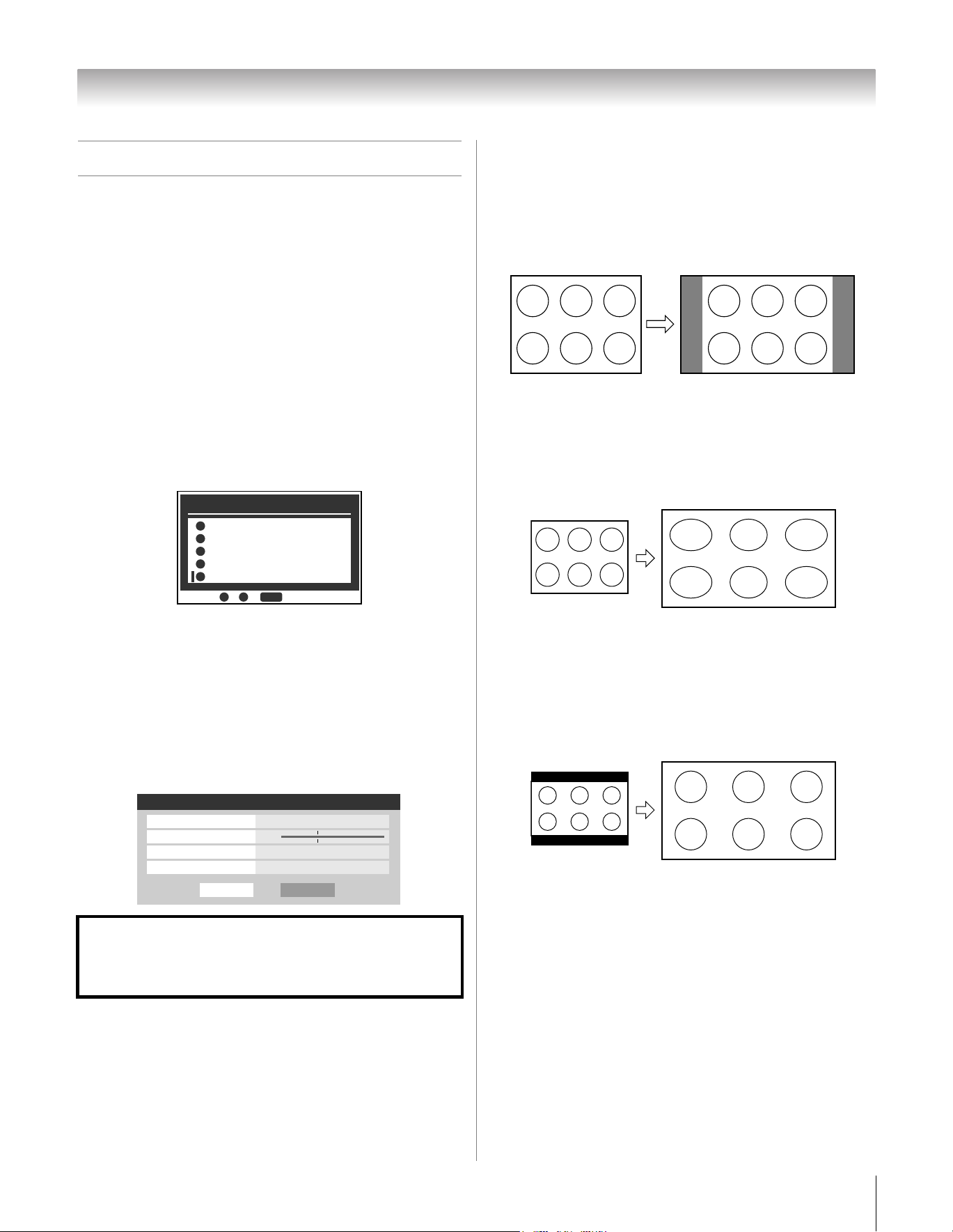
27
HM66 (E/F) Web 213:276
Chapter 5: Using the TV’s basic features
Selecting the picture size
You can view many program formats in a variety of picture
sizes—Natural, TheaterWide 1, TheaterWide 2,
TheaterWide 3, and Full.
The way the image displays in any of the picture sizes will vary
depending on the format of the program you are viewing.
Select the picture size that displays the current program the
way that looks best to you.
Your picture size preferences can be saved for each input on
your TV.
To select the picture size:
1 Press I on the remote control.
2 While the Picture Size screen is on-screen, press the
corresponding number button (0–4) to select the desired
picture size.
Notes:
• You also can repeatedly press I to select the desired
picture size (or press Bb on the remote control while the
Picture Size screen is open).
• Full may not be available for some program formats (it will
be “grayed out” in the Picture Size screen).
• You also can select the picture size using the menu system.
Select Picture Size in the Theater Settings menu. Select
the input for which you want to save your picture settings. To
save your settings, highlight Done and press T.
Natural picture size
• The image is displayed close to its originally formatted
proportion. Some program formats will display with
sidebars and/or bars at the top and bottom.
Natural picture size example: The way the image displays
will vary depending on the format of the program you are
currently watching.
TheaterWide 1 picture size (For 4:3 format program)
• The center of the picture remains close to its original
proportion, but the left and right edges are stretched wider to
fill the screen.
TheaterWide 2 picture size (for letter box programs)
• The picture is stretched wider to fill the width of the screen,
but only slightly stretched taller.
• The top and bottom edges of the picture are hidden. To view
the hidden areas, see “Scrolling the TheaterWide
®
picture”
(- page 28).
Using these functions to change the picture size (i.e.,
changing the height/ width ratio) for any purpose other than
your private viewing may be prohibited under the Copyright
Laws of the United States and other countries, and may
subject you to civil and criminal liability.
PIC SIZE
Picture Size
Natural
0
0
TheaterWide 1
1
TheaterWide 2
2
TheaterWide 3
3
Full
4
4
- / to Select
Done
Theater Settings
Picture Size Natural
Picture Scroll
--
Cinema Mode Film
Auto Aspect Ratio On
Reset
Conventional picture on a
conventional TV screen
Conventional picture in Natural size on
your wide-screen TV
TheaterWide 1 picture size example
A B C D E F G - - - - - - - - - - - - - - - -
TheaterWide 2 picture size example
(continued)
HM66_EN.book Page 27 Thursday, February 23, 2006 2:49 PM
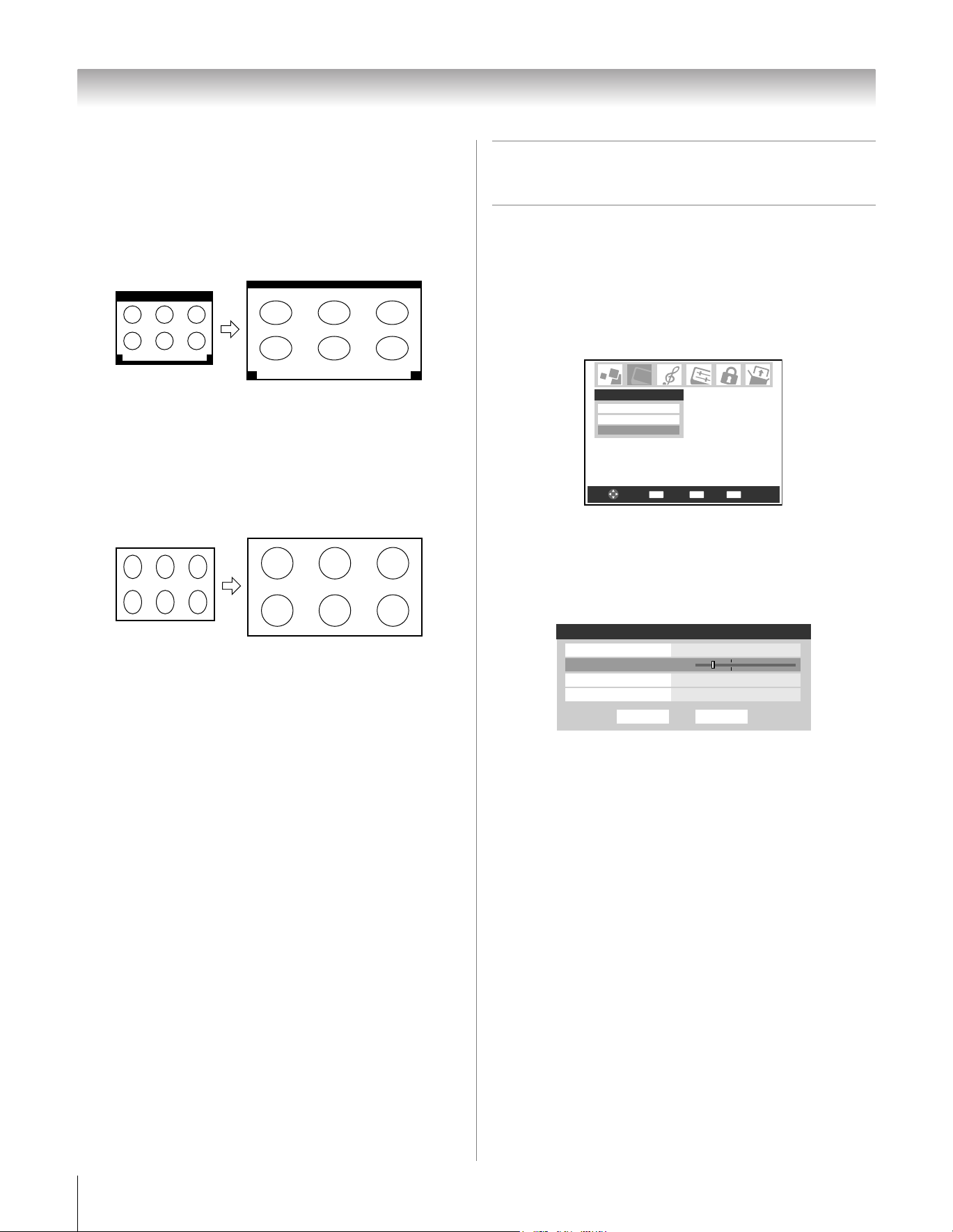
28
HM66 (E/F) Web 213:276
Chapter 5: Using the TV’s basic features
TheaterWide 3 picture size (for letter box programs
with subtitles)
• The picture is stretched wider to fill the width of the screen,
but only slightly stretched taller.
• The top and bottom edges are hidden. To view the hidden
areas (such as subtitles or captions), see “Scrolling the
TheaterWide
®
picture”.
Full picture size (for 16:9 [480i, 480p] source
programs only)
• If receiving a squeezed 4:3 format program, the picture is
stretched wider to fill the width of the screen, but not
stretched taller.
• None of the picture is hidden.
Notes:
• If you select one of the TheaterWide
®
picture sizes, the top
and bottom edges of the picture (including subtitles or
captions) may be hidden. To view the hidden edges, either
scroll the picture (TheaterWide 2 and 3 only) or try viewing
the program in Full or Natural picture size.
• When selecting the picture size, the way the image displays
will vary depending on the format of the program you are
currently watching.
Scrolling the TheaterWide
®
picture
(TheaterWide 2 and 3 only)
You can set separate scroll settings for the TheaterWide 2 and
TheaterWide 3 modes for each input.
To set the scroll settings:
1 Press Y and open the Video menu.
2 Highlight Theater Settings and press T.
3 In the Picture Size field, select either TheaterWide 2
or TheaterWide 3 (you cannot scroll in any other mode).
4 Press b to highlight the Picture Scroll field.
5 Press C or c to scroll the picture up and down as needed,
from –10 to +20.
6 To save the new settings, highlight Done and press T.
To revert to the factory defaults, highlight Reset and
press T.
A B C D E F G - - - - - - - - - - - - - - - -
A B C D E F G - - - - - - - - - - - - - - - - - - - - - - - - - -
TheaterWide 3 picture size example
Full picture size example
CH RTNENTER
EXIT
Navigate
Select
Back Exit
Picture Settings
Advanced Picture Settings
Theater Settings
Video
DoneReset
Theater Settings
Picture Size TheaterWide 2
Picture Scroll -5
Cinema Mode Film
Auto Aspect Ratio On
HM66_EN.book Page 28 Thursday, February 23, 2006 2:49 PM
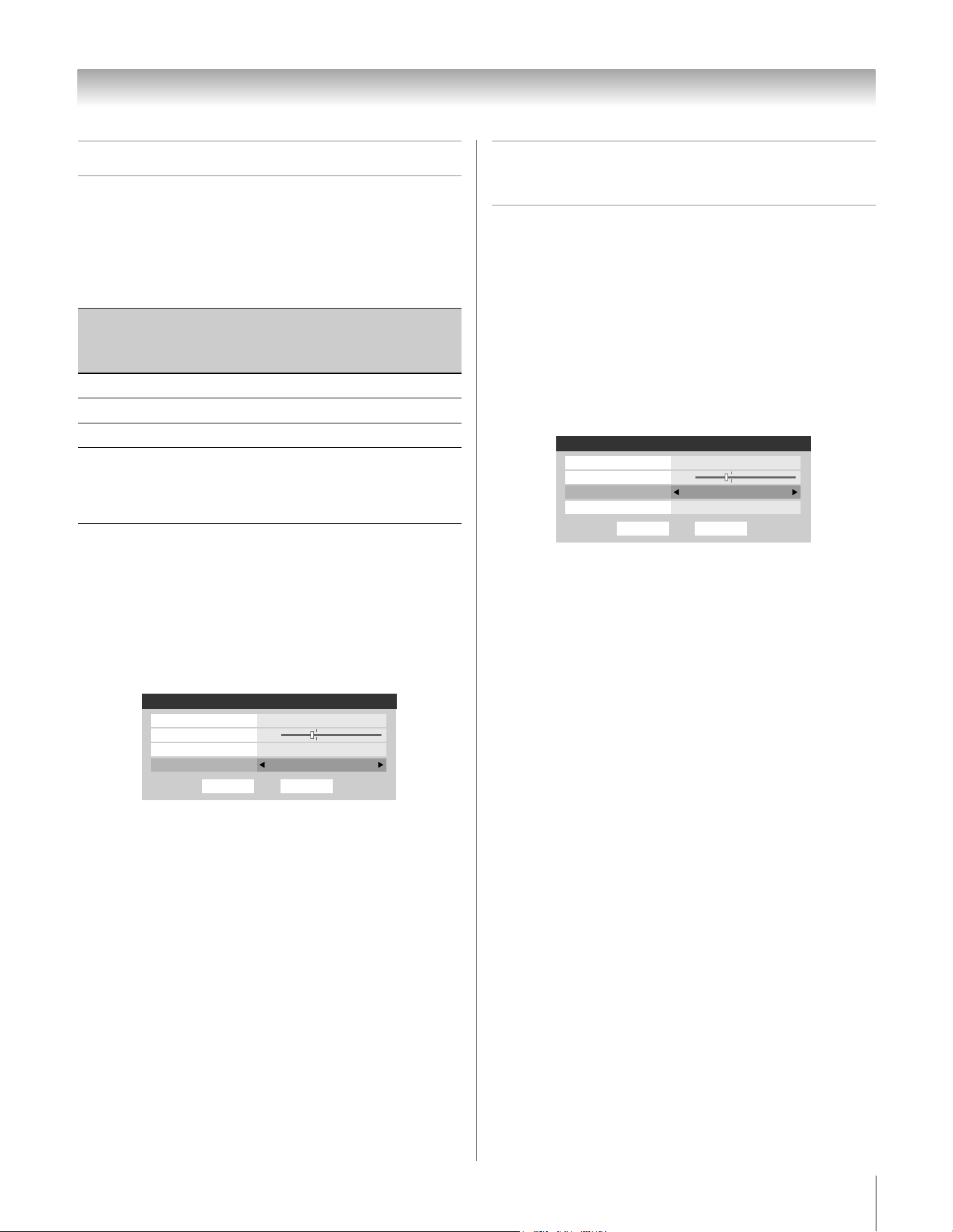
29
HM66 (E/F) Web 213:276
Chapter 5: Using the TV’s basic features
Using the auto aspect ratio feature
When the auto aspect ratio feature is set to On, the picture size
is automatically selected when one of the following input
sources is received:
• A 480i signal from the VIDEO 1, VIDEO 2, ColorStream
HD-1, or ColorStream HD-2 input.
• A 1080i, 480i, 480p, or 720p signal from the HDMI input.
Note: The auto aspect ratio feature is not applicable to
antenna or cable input sources.
To turn on the auto aspect ratio feature:
1 Press Y and open the Video menu.
2 Highlight Theater Settings and press T.
3 In the Auto Aspect Ratio field, select On.
4 To save the new settings, highlight Done and press T.
To revert to the factory defaults, highlight Reset and
press T.
To turn off the auto aspect ratio feature:
Select Off in step 3 above.
Selecting the cinema mode
(480i signals only)
When you view a DVD (480i signal; 3:2 pulldown processed)
from a DVD player connected to the VIDEO 1, VIDEO 2,
ColorStream HD-1/HD-2 (component video), or HDMI
inputs on the TV, smoother motion can be obtained by setting
the Cinema Mode to Film.
To set the Cinema Mode to Film:
1 Press Y and open the Video menu.
2 Highlight Theater Settings and press T.
3 In the Cinema Mode field, select Film.
4 To save the new settings, highlight Done and press T.
To revert to the factory defaults, highlight Reset and
press T.
To set the Cinema Mode to Video:
Select Video in step 3 above.
Aspect ratio
of signal
source
Automatic aspect size (automatically
selected when Auto Aspect is On)
4:3 normal Natural (with sidebars)
4:3 letter box TheaterWide 2
16:9 full Full
Not defined
(no ID-1 data
or HDMI
aspect data)
Selecting the picture size (- page 27)
DoneReset
Theater Settings
Picture Size Natural
Picture Scroll -1
Cinema Mode Film
Auto Aspect Ratio On
DoneReset
Theater Settings
Picture Size Natural
Picture Scroll -1
Cinema Mode
Auto Aspect Ratio On
Film
HM66_EN.book Page 29 Thursday, February 23, 2006 2:49 PM
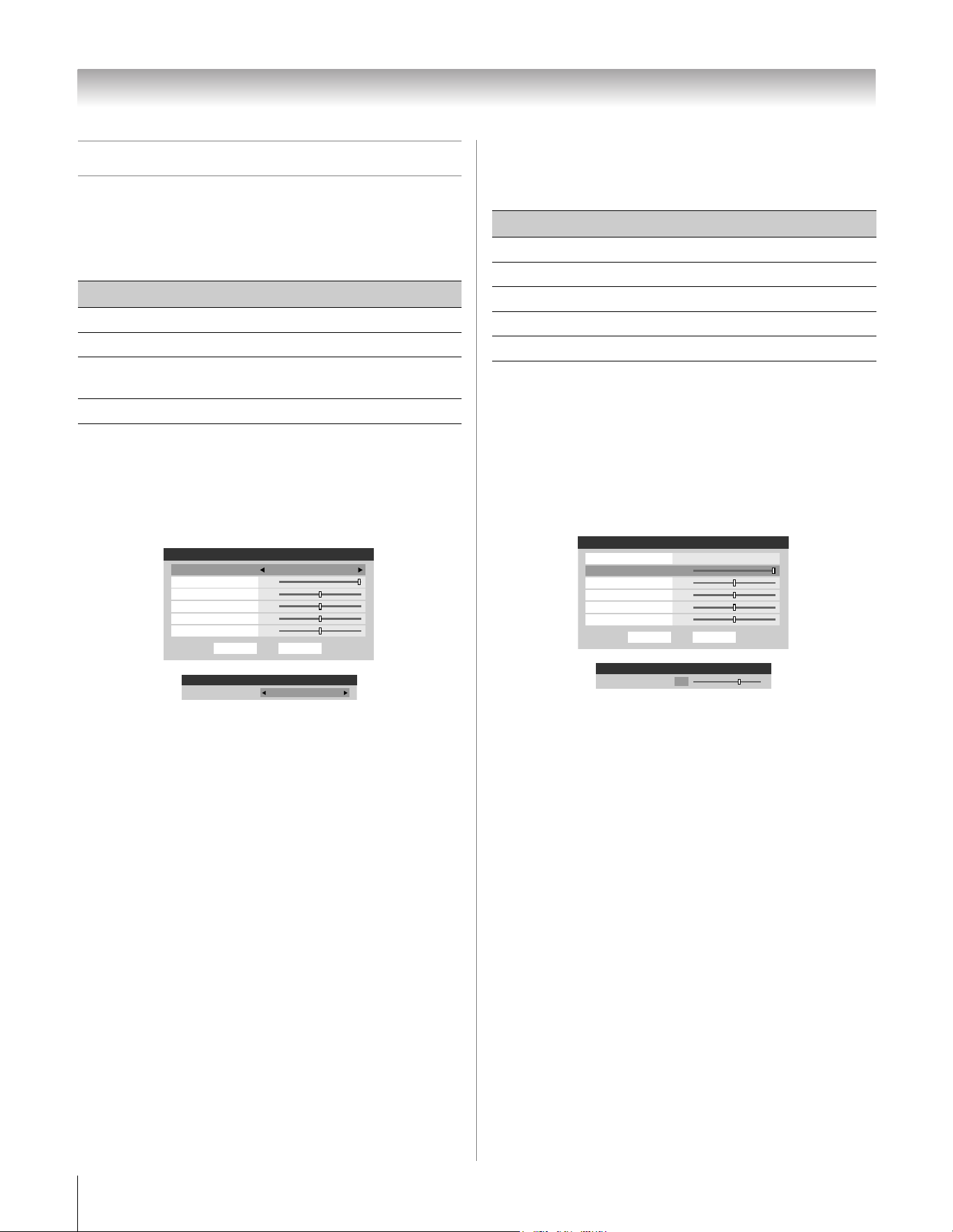
30
HM66 (E/F) Web 213:276
Chapter 5: Using the TV’s basic features
Adjusting the picture
Selecting the picture mode
You can select your desired picture settings from four different
modes, as described below.
To select the picture mode using the menu system:
1 Press Y and open the Video menu.
2 Highlight Picture Settings and press T.
3 In the Mode field, select the picture mode you prefer.
4 To save the new settings, highlight Done and press T.
To revert to the factory defaults, highlight Reset and
press T.
Notes:
• The picture mode you select affects the current input
only (ANT 1 in the example above). You can select a
different picture mode for each input.
• If you select one of the factory-set picture modes
(Sports, Standard, or Movie) and then change a
picture quality setting (for example, increase the
contrast or change the color temperature), the picture
mode automatically changes to Preference in the
Picture Settings menu.
• If you have previously set the TV to High Bright mode,
and have chosen Reset in item 4 above, the TV will
default to Low Power mode. To set the TV back to High
Bright mode, see page 42.
Adjusting the picture quality
You can adjust the picture quality (contrast, brightness, color,
tint, and sharpness) to your personal preferences.
To adjust the picture quality:
1 Press Y and open the Video menu.
2 Highlight Picture Settings and press T.
3 Press B or b to select the picture quality you want to
adjust (Contrast, Brightness, Color, Tint, or
Sharpness), and then press C and c to adjust the setting,
as described in the table above.
4 To save the new settings, highlight Done and press T.
To revert to the factory defaults, highlight Reset and
press T.
The picture qualities you adjusted are automatically saved in
the Preference mode (- “Selecting the picture mode,”
above left).
Mode Picture Quality
Sports Bright and dynamic picture (factory setting)
Standard Standard picture settings (factory setting)
Movie
Lower contrast for darkened room (factory
setting)
Preference Your personal preferences
Done
Picture Settings
Mode Sports
Contrast 100
Brightness
Reset
50
50
0
50
ANT 1
Color
Tint
Sharpness
Picture Settings Mode: Standard
Mode Standard
Selection C Pressing c
contrast lower higher
brightness darker lighter
color paler deeper
tint reddish greenish
sharpness softer sharper
Done
Picture Settings
Mode Sports
Contrast 100
Brightness
Reset
50
50
0
50
ANT 1
Color
Tint
Sharpness
Picture Settings Mode: Preference
Contrast 70
HM66_EN.book Page 30 Thursday, February 23, 2006 2:49 PM
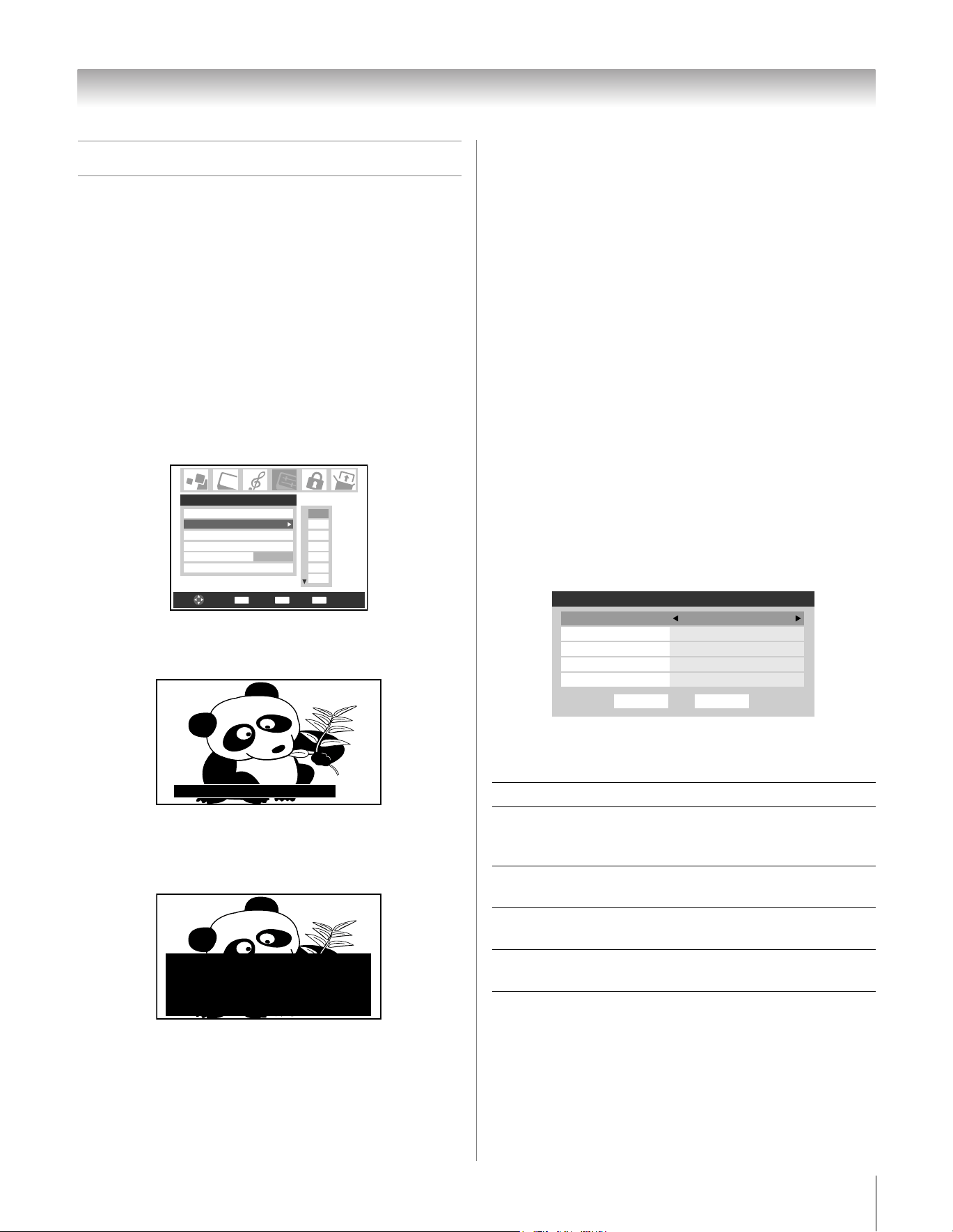
31
HM66 (E/F) Web 213:276
Chapter 5: Using the TV’s basic features
Using the closed caption mode
The closed caption mode has two options:
• Captions—An on-screen display of the dialogue, narration,
and sound effects of TV programs and videos that are closed
captioned (usually marked “CC” in program guides).
• Text—An on-screen display of information not related to
the current program, such as weather or stock data (when
provided by individual stations).
To view captions or text:
1 Press Y and open the Preferences menu.
2 Highlight Closed Caption Mode and press c.
3 Press B or b to select the desired closed caption mode and
press T.
• To view captions:
Highlight CC1, CC2, CC3, or CC4. (CC1 displays
translation of the primary language in your area.)
Note: If the program or video you selected is not closed
captioned, no captions will display on-screen.
•
To view text:
Highlight T1, T2, T3, or T4.
Note: If text is not available in your area, a black rectangle
may appear on your screen. If this happens, turn the
Closed Caption Mode Off.
•
To turn off the Closed Caption mode:
Select Off in step 3 above.
Note: A closed caption signal may not display in the following
situations:
• When a videotape has been dubbed
• When the signal reception is weak
• When the signal reception is non-standard
Closed Caption Advanced
You can customize the closed caption display characteristics
by changing the text size, type, edge, color, and the
background color. You cannot set the Caption Text and
Background as the same color.
Notes:
• This feature is available for digital channels only.
• You cannot set the Caption Text and Background as the
same color.
To customize the closed captions:
1 Press Y and open the Preferences menu.
2 Highlight Closed Caption Advanced and press T.
3 Press B or b to highlight the characteristic you want to
change, and then press C or c to select the format for that
characteristic.
4 To save the new settings, highlight Done and press T.
To revert to the factory defaults, highlight Reset and
press T.
CH RTNENTER
EXIT
Navigate
Select
Back Exit
Input Labeling
Menu Language
Channel Browser Setup
Favorite Channels
English
Closed Caption Advanced
Preferences
Off
Closed Caption Mode
Off
CC1
CC2
CC3
CC4
T1
T2
Giant pandas eat leaves.
WORLD WEATHER
Temps Current
F C Weather
LONDON 51 11
MOSCOW
PARIS
ROME
TOKYO
57 14
53 12
66 19
65 18
Cloudy
Clear
Cloudy
Rain
Clear
Caption Size Auto, Small, Standard, Large
Caption Text
Type
Auto, Default, Mono w. Serif, Prof. w. Serif,
Mono w/o Serif, Prop w/o Serif, Casual,
Cursive, Small Capitals
Caption Text
Edge
Auto, None, Raised, Depressed, Uniform,
Left Drop Shadow, Right Drop shadow
Caption Text
Color
Auto, Black, White, Red, Green, Blue,
Yellow, Magenta, Cyan
Background
Color
Auto, Black, White, Red, Green, Blue,
Yellow, Magenta, Cyan
Done
Closed Caption Advanced
Caption Size Auto
Auto
Caption Text Type
Caption Text Edge
Caption Text Color
Background Color
Reset
Auto
Auto
Auto
HM66_EN.book Page 31 Thursday, February 23, 2006 2:49 PM
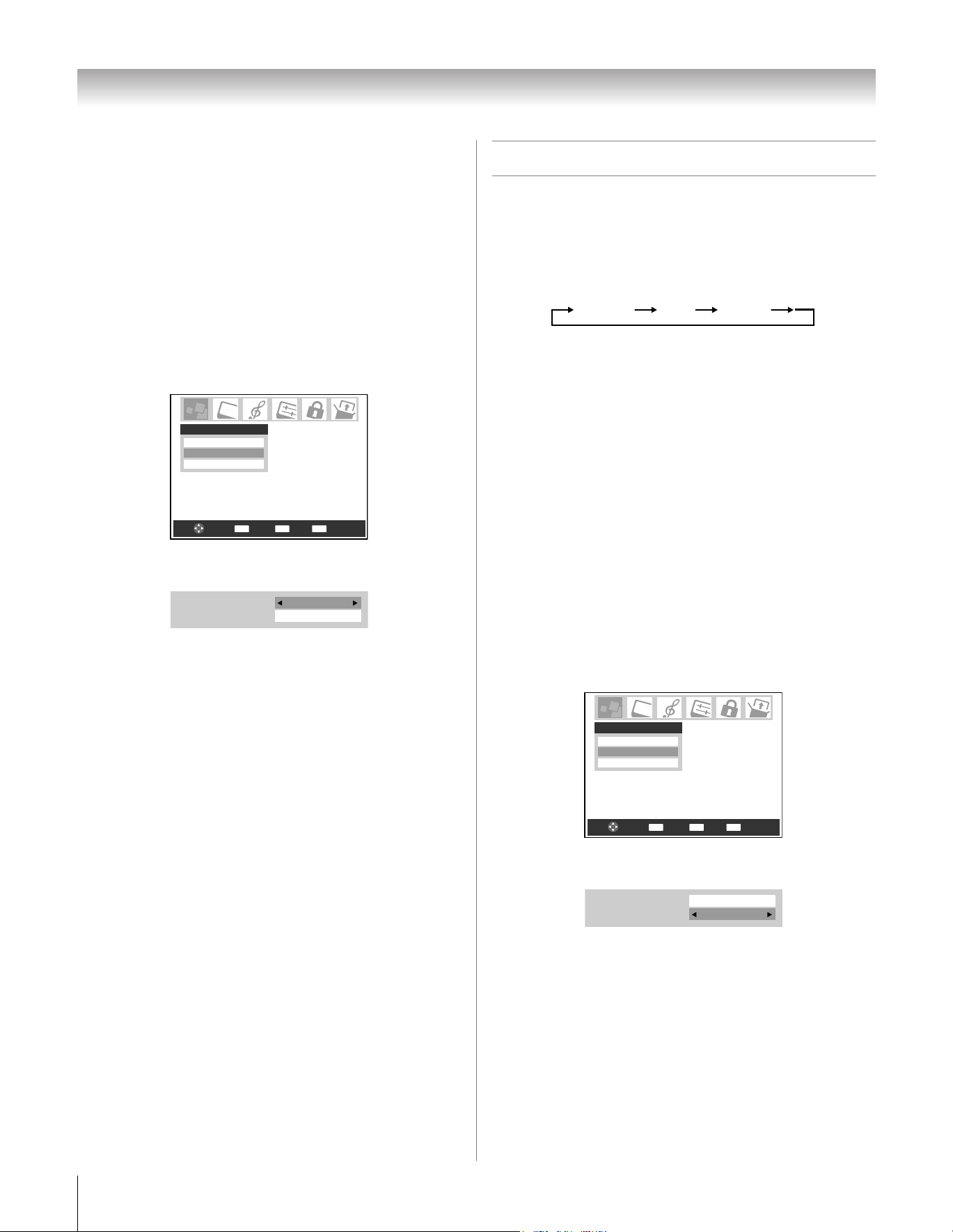
32
HM66 (E/F) Web 213:276
Chapter 5: Using the TV’s basic features
Digital closed captions
You can use the Digital CC/Audio Selector to select digital
closed caption services (if available), which will temporarily
override closed captions for digital channels only.
When such services are not available, the Digital CC/Audio
Selector presents a default list of services. If the selected
service is not available, the next best service will be used
instead.
To select digital closed captions:
1 Press Y and open the Applications menu.
2 Highlight Digital CC/Audio Selector and press T.
3 Press B or b to select Closed Caption, and then press
C or c to select the desired service.
4 Press O.
Adjusting the audio
Muting the sound
Press W to partially reduce (1/2 MUTE) or turn off (MUTE)
the sound. Each time you press W, the mute mode will change
in the following order:
If the closed caption mode is set to Off when you select
“MUTE” mode, the closed caption feature is automatically
activated. To mute the audio without automatically activating
the closed caption feature, use Z to set the volume to 0. See
“Using the closed caption mode” (- page 31)
for more information on closed caption modes.
Using the digital audio selector
You can use the Digital CC/Audio Selector to conveniently
switch between audio tracks on a digital channel (for those
channels that have multiple audio tracks). This temporarily
overrides the audio track chosen by the language option under
Audio Setup (see “Selecting stereo/SAP broadcasts,” on
page 33).
To use the digital audio selector:
1 Press Y and open the Applications menu.
2 Highlight Digital CC/Audio Selector and press T.
3 Press B or b to select Audio, and then press C or c to
select the desired service.
4 Press O.
CH RTNENTER
EXIT
Navigate
Select
Back Exit
Applications
Digital CC/Audio Selector
CableCARD
Channel Browser
CC 1Closed Caption
Audio
None
Volume1/2 Mute Mute
CH RTNENTER
EXIT
Navigate
Select
Back Exit
Applications
Digital CC/Audio Selector
CableCARD
Channel Browser
CC 1Closed Caption
Audio
None
HM66_EN.book Page 32 Thursday, February 23, 2006 2:49 PM
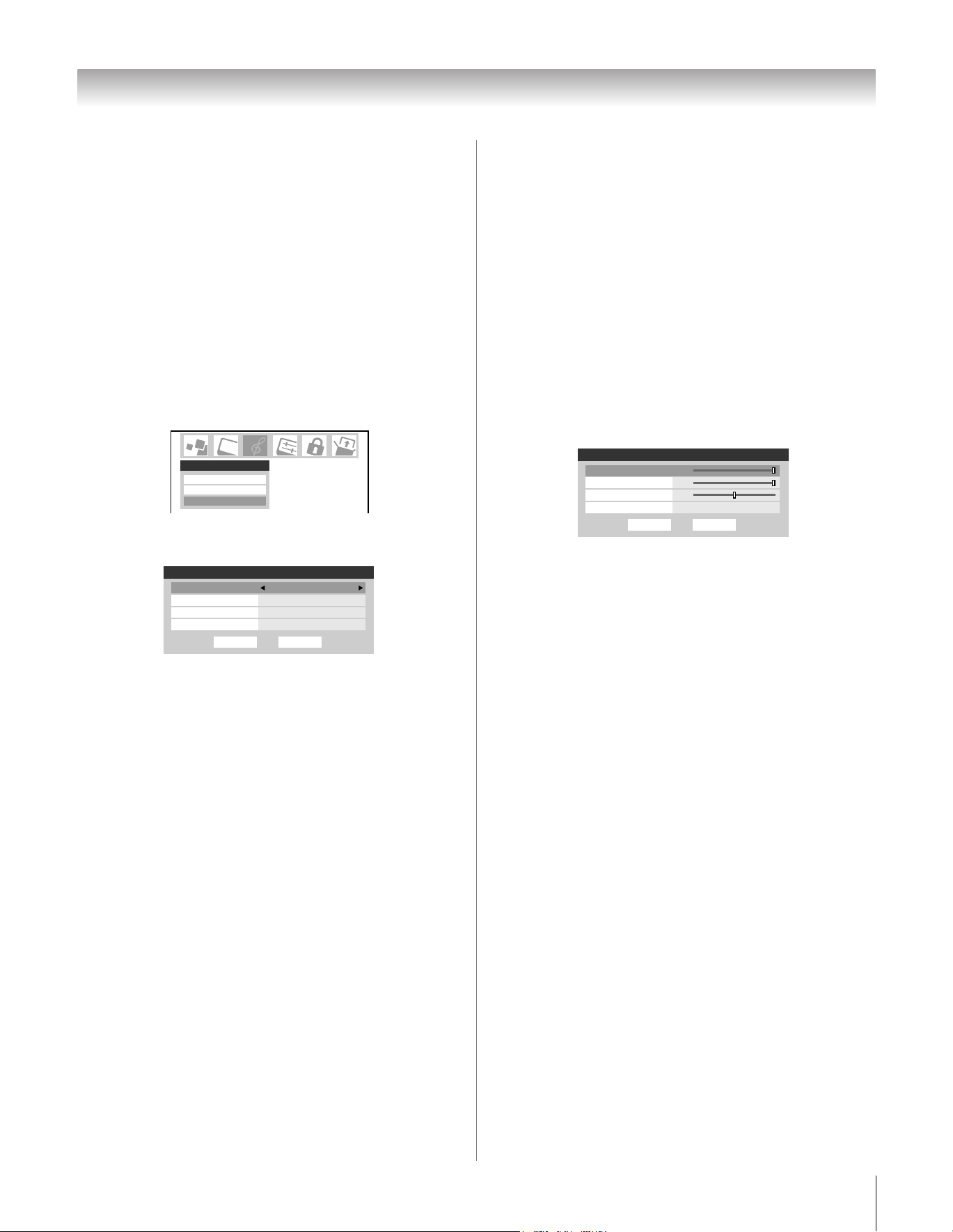
33
HM66 (E/F) Web 213:276
Chapter 5: Using the TV’s basic features
Selecting stereo/SAP broadcasts
The multi-channel TV sound (MTS) feature allows you to
output high-fidelity stereo sound. MTS also can transmit a
second audio program (SAP) containing a second language,
music, or other audio information (when provided by
individual stations).
The MTS feature is not available when the TV is in VIDEO
mode. When the TV receives a stereo or SAP broadcast, the
word “STEREO” or “SAP” appears on-screen when E is
pressed.
To listen to stereo sound:
1 Press Y and open the Audio menu.
2 Highlight Audio Setup and press T.
3 In the MTS field, select Stereo.
4 To save the new settings, highlight Done and press T.
To reset the settings to the factory defaults, highlight
Reset and press T.
Notes:
• If you leave the TV in Stereo mode because it will
automatically output the type of sound being broadcast
(stereo or monaural).
• If the stereo sound is noisy, select Mono to reduce the
noise.
To listen to an alternate language on an ATSC digital
station (if available):
Highlight the Language field in step 3 above, and then press
C or c to select the language you prefer.
To listen to a second audio program on an analog
station (if available):
Select SAP in step 3 above.
Notes:
• A second audio program (SAP) can be heard only on those
TV stations that offer it. For example, a station might
broadcast another language as a second audio program. If
you have SAP on, you will see the current program on the
screen but hear the other language instead of the program’s
normal audio.
• If you have SAP on and the station you are watching is not
broadcasting a second audio program, the station’s normal
audio will be output. However, occasionally there is no
sound at all in SAP mode. If this happens, set the MTS
feature to Stereo mode.
Adjusting the audio quality
You can adjust the audio quality by adjusting the bass, treble,
and balance.
To adjust the audio quality:
1 Press Y and open the Audio menu.
2 Highlight Audio Settings and press T.
3 Press b or B to highlight the item you want to adjust
(Bass, Treble, or Balance).
4 Press C or c to adjust the level.
• C makes the bass or treble weaker or increases the
balance in the left channel (depending on the item
selected).
• c makes the bass or treble stronger or increases the
balance in the right channel (depending on the item
selected).
5 To save the new settings, highlight Done and press T.
To reset the settings to the factory defaults, highlight
Reset and press T.
Audio Settings
Advanced Audio Settings
Audio Setup
Audio
Done
Audio Setup
MTS
Language
Speakers On
Optical Output Format Dolby Digital
Reset
Stereo
English
Done
Audio Settings
Bass 100
Treble
Reset
100
0
Balance
StableSound Off
HM66_EN.book Page 33 Thursday, February 23, 2006 2:49 PM
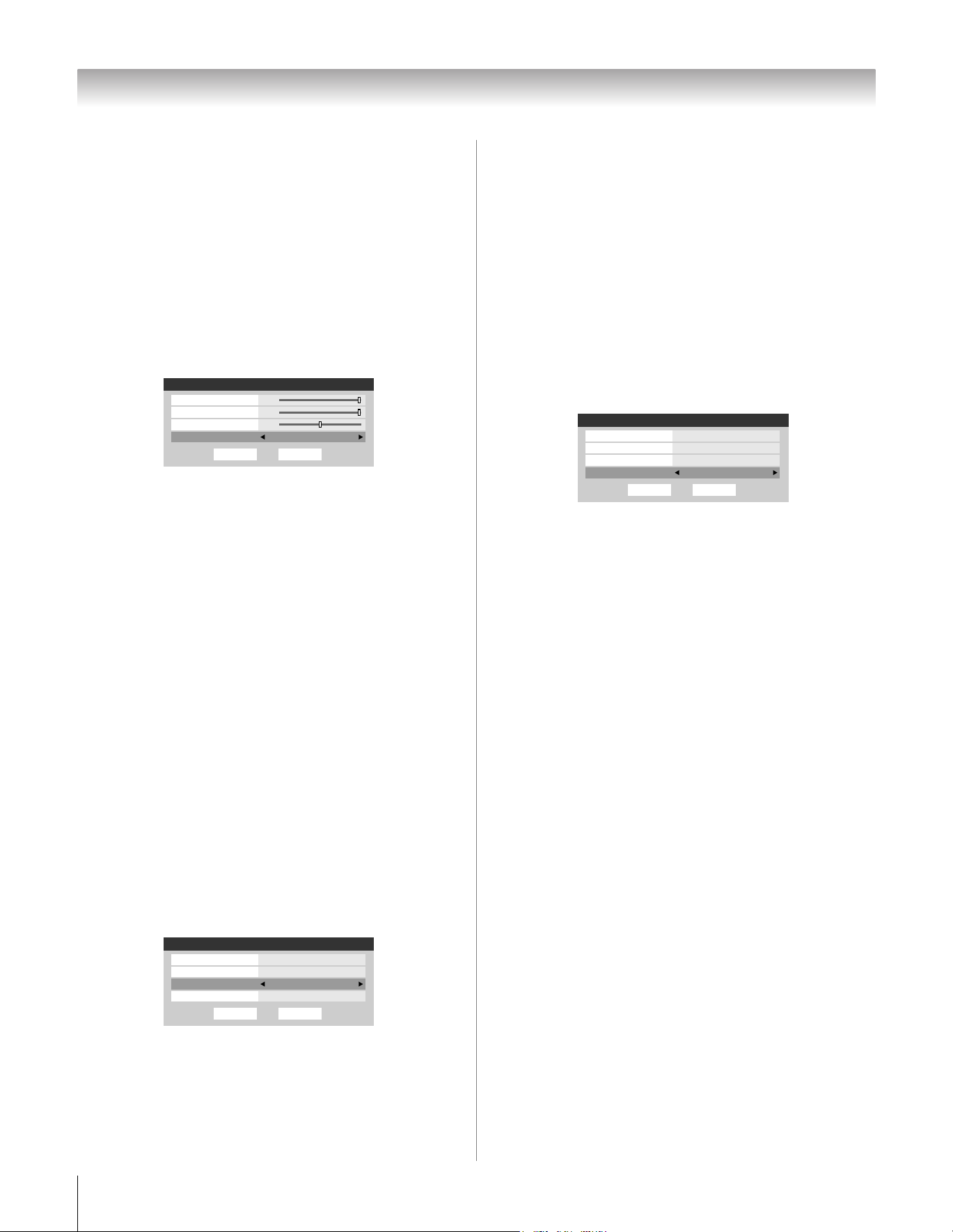
34
HM66 (E/F) Web 213:276
Chapter 5: Using the TV’s basic features
Using the StableSound
®
feature
The StableSound
®
feature limits the highest volume level to
prevent extreme changes in volume when the signal source
changes (for example, to prevent the sudden increase in
volume that often happens when a TV program switches to a
commercial).
To turn on the StableSound
®
feature:
1 Press Y and open the Audio menu.
2 Highlight Audio Settings and press T.
3 In the StableSound field, select On.
4 To save the new settings, highlight Done and press T.
To revert to the factory defaults, highlight Reset and
press T.
Note: The RESET function returns your audio adjustments
to the following factory settings:
Bass . . . . . . . . . center (50)
Treble. . . . . . . . center (50)
Balance . . . . . . center (0)
StableSound. . . Off
To turn off the StableSound feature:
Select Off in step 3 above.
Turning off the built-in speakers
You can use this feature to turn off the TV speakers when you
connect an audio system to your TV (- “Connecting a digital
audio system” and “Connecting an analog audio system” in the
Installation Guide).
To turn off the built-in speakers:
1 Press Y and open the Audio menu.
2 Highlight Audio Setup and press T.
3 In the Speakers field, select Off.
4 To save the new settings, highlight Done and press T.
To revert to the factory defaults, highlight Reset and
press T.
To turn on the built-in speakers:
Select On in step 3 above.
Selecting the optical audio output format
You can use this feature to select the optical audio output
format when you connect a Dolby Digital decoder or other
digital audio system to the Optical Audio Out terminal on
the TV
(- “Connecting a digital audio system” in the Installation
Guide).
To select the optical audio output format:
1 Press Y and open the Audio menu.
2 Highlight Audio Setup and press T.
3 In the Optical Output Format field, select either
Dolby Digital or PCM, depending on your device.
4 To save the new settings, highlight Done and press T.
To revert to the factory defaults, highlight Reset and
press T.
Done
Audio Settings
Bass 100
Treble
Reset
100
0
Balance
StableSound On
Done
Audio Setup
MTS
Language
Speakers Off
Optical Output Format Dolby Digital
Reset
Stereo
English
Done
Audio Setup
MTS
Language
Speakers On
Optical Output Format
Dolby Digital
Reset
Stereo
English
HM66_EN.book Page 34 Thursday, February 23, 2006 2:49 PM
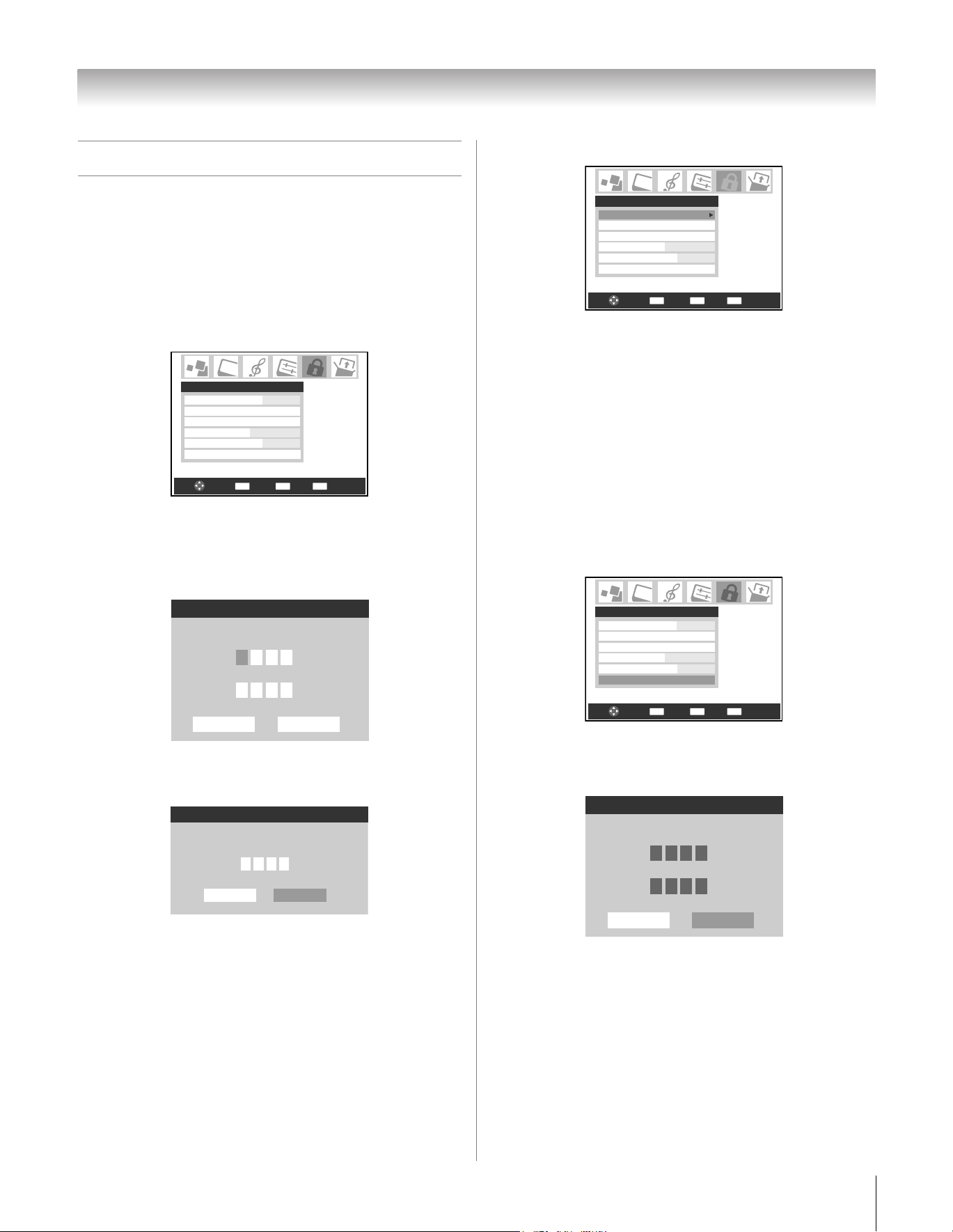
35
HM66 (E/F) Web 213:276
Chapter 5: Using the TV’s basic features
Using the Locks menu
The Locks menu includes the Enable Rating Blocking, Edit
Rating Limits, Channels Block, Input Lock, Front (control)
Panel Lock, and New PIN Code features. You can use these
features after entering the correct PIN code.
Entering the PIN code
1
Press Y and highlight the Locks menu icon.
2 Press b, which displays the PIN code entry screen.
• The Lock System screen (below) appears if a PIN
code has not been stored. Press the Channel Number
buttons to enter a new four-digit code, enter the code a
second time to confirm, and press T.
• The Locks/Active screen (below) appears if the PIN
code is already stored. Use the Number buttons to enter
your four-digit code and press T.
If the wrong PIN code is entered, the message “Incorrect PIN
code, please try again!” appears. Highlight Retry and press
T. Enter the code again and press T.
When the correct PIN code is entered, the Locks menu opens.
If you cannot remember your PIN code
While the PIN code entering screen is displayed, press E
four times within five seconds. The PIN code will be cleared
and you can enter a new PIN code.
Changing your PIN code
1
Press Y and highlight the Locks menu icon.
2 Press b to display the PIN code entering screen.
3 Enter your four-digit PIN code and press T.
4 Press b to highlight New PIN Code and press T.
5 Press the Number buttons to enter a new four-digit code.
Retype the numbers to confirm the PIN code you entered.
6 Press T. The new PIN code is now active.
CH RTNENTER
EXIT
Navigate
Select
Back Exit
Enable Rating Blocking
Edit Rating Limits
Channels Block
Input Lock
Off
OffFront Panel Lock
New PIN Code
Locks
Off
Please enter a 4 digit PIN code
Confirm PIN code
Cancel Done
Lock System
Locks Active
Please enter the 4 digit PIN code
Cancel
****
Done
Off
MENU
ENTER
EXIT
Navigate
Select
Back Exit
Enable Rating Blocking
Edit Rating Limits
Channels Block
Input Lock
Off
OffFront Panel Lock
New PIN Code
Locks
Off
MENU
ENTER
EXIT
Navigate
Select
Back Exit
Enable Rating Blocking
Edit Rating Limits
Channels Block
Input Lock
Off
OffFront Panel Lock
New PIN Code
Locks
Please enter a 4 digit PIN code
Confirm PIN code
Cancel Done
New PIN Code
****
****
HM66_EN.book Page 35 Thursday, February 23, 2006 2:49 PM
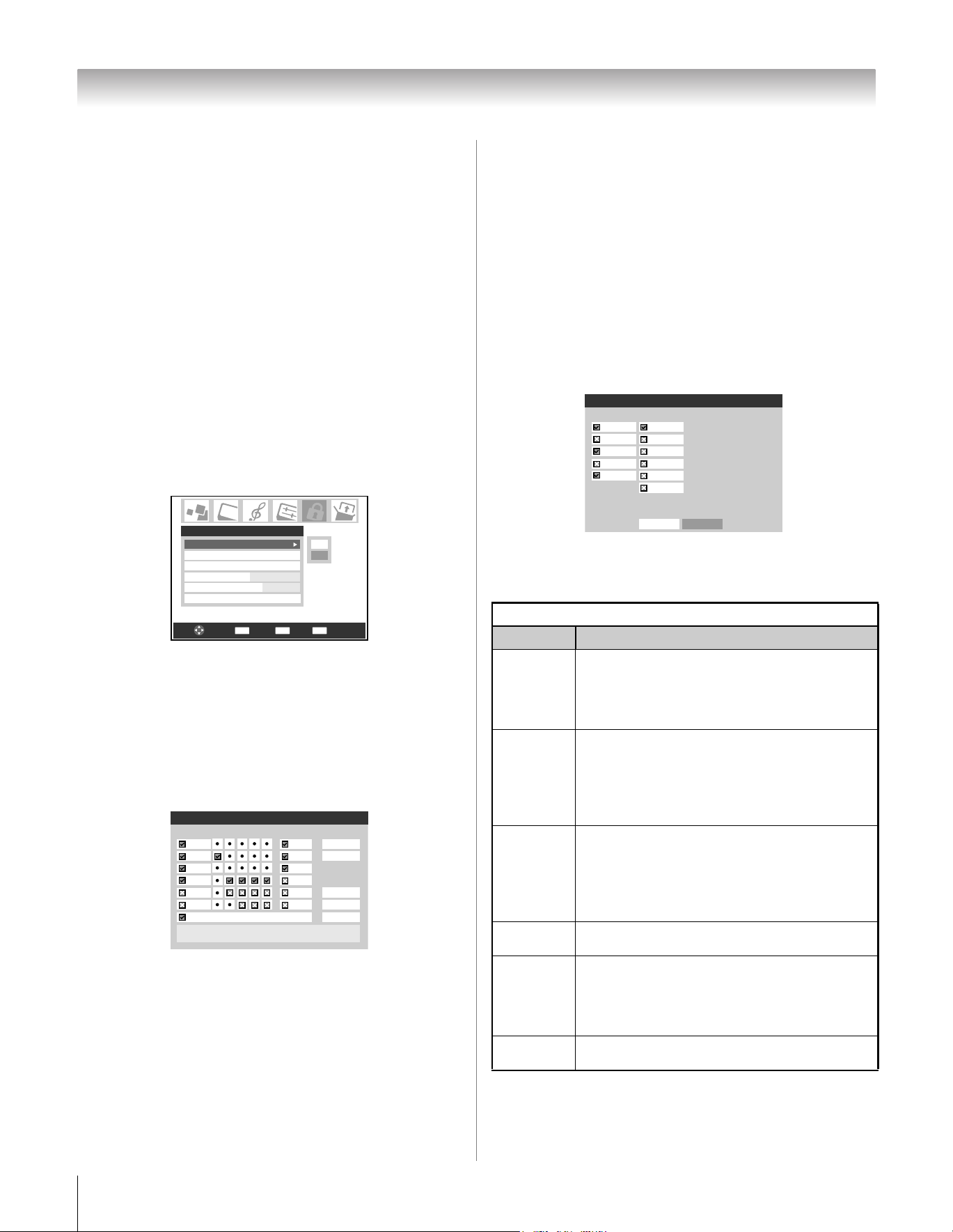
36
HM66 (E/F) Web 213:276
Chapter 5: Using the TV’s basic features
Blocking TV programs and movies
by rating (V-Chip)
Some TV programs and movies include signals that classify
the content of the program (violence, sex, dialog, language).
The V-Chip feature in this TV detects the signals and blocks
the programs according to the ratings you select. (See the
tables at below right for rating descriptions.)
Note: Rating blocking is a function of the V-Chip feature in this
TV, which supports the U.S. V-Chip system only.
To block and unblock TV programs and movies:
1 Press Y and highlight the Locks menu icon.
2 Press b to display the PIN code entering screen.
3 Enter your four-digit PIN code and press T.
4 Press b to highlight Enable Rating Blocking.
5 Press c and b to select On, and press T.
6 Press b to highlight Edit Rating Limits and press T.
The Edit Rating Limits screen (below) appears.
7 Press BbC c and then press T to select the level of
blocking you prefer. A box with an “5” is a rating that will
be blocked. As you highlight a rating, a definition for the
rating appears at the bottom of the screen.
8 When done selecting the ratings you want to block,
highlight Done and press T.
Blocking TV programs and movies by alternate
ratings:
The alternate rating system is provided by some broadcasters
as a supplement the standard V-Chip ratings. This system is
dependant on the broadcaster’s information.
1 Repeat steps 1-6 above.
2 Highlight Alt RS and press T. The Edit Alternate
Ratings screen will appear. (This button will only be
available if your television has detected that the
broadcaster is send alternate ratings with that program.)
3 Press B b C c and then press T to select the level of
blocking you prefer. A box with and “5” is a rating that
will be blocked. (The information contained within this
menu window will depend on what the broadcaster is
providing.)
4 When done selecting the ratings you want to block,
highlight Done and press T.
5 In the Edit Rating Limits screen, highlight Done and
press T.
Note: The above illustration is example data only. The
Alternate Ratings screen on your TV may not look the same.
Off
MENU
ENTER
EXIT
Navigate
Select
Back Exit
Enable Rating Blocking
Edit Rating Limits
Channels Block
Input Lock
Off Off
OffFront Panel Lock
New PIN Code
Locks
On
Edit Rating Limits
TV
(V-CHIP)
FV
D L S V
TV-Y
TV-Y7
TV-G
TV-PG
TV-14
TV-MA
"None" Rated
G
Movies
Children
Youth
Cancel
Done
Alt RS
PG
PG-13
R
NC-17
X
Independent rating system for broadcasters
Ratings Description and Content themes
TV-MA
Mature Audience Only (This program is specifically
designed to be viewed by adults and therefore may
be unsuitable for children under 17.)
L) Crude or indecent language S) Explicit sexual
activity V) Graphic violence
TV-14
Parents Strongly Cautioned (This program contains
some material that many parents would find
unsuitable for children under 14 years of age.)
D)
Intensely suggestive dialog L) Strong, coarse
language
S) Intense sexual situations V) Intense
violence
TV-PG
Parental Guidance Suggested (This program
contains material parents may find unsuitable for
younger children.)
D)
Some suggestive dialog L) Infrequent coarse
language
S) Some sexual situations V) Moderate
violence
TV-G
General Audience (Most parents would find this
program suitable for all ages.)
TV-Y7,
TV-Y7FV
Directed to Older Children (This program is designed
for children age 7 and above. Note: Programs in
which fantasy violence may be more intense or more
combative than other programs in this category are
designated Y7FV.)
TV-Y
All Children (This program is designed to be
appropriate for all children.)
Edit Alternate Ratings
Humor Level
DH
MH
H
VH
EH
Intelligence level
VL
LL
NL
HL
VH
TEST-MAX
Cancel Done
HM66_EN.book Page 36 Thursday, February 23, 2006 2:49 PM
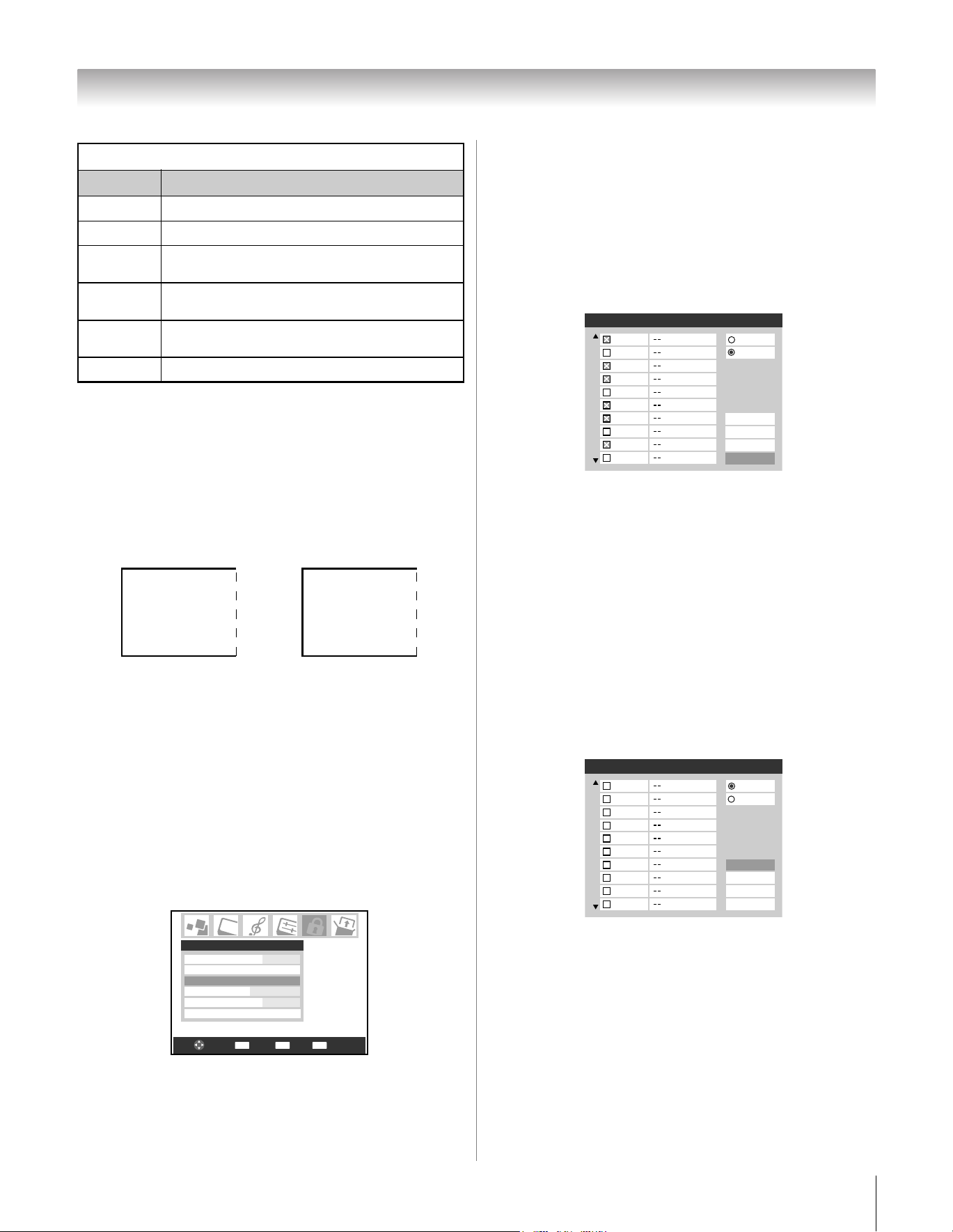
37
HM66 (E/F) Web 213:276
Chapter 5: Using the TV’s basic features
Notes:
• If you place an “5” in the box next to “‘None’ Rated,”
programs rated “None” will be blocked; however, programs
that do not provide any rating information will not be
blocked.
• To display the rating of the program you are watching, press
E on the remote control. If it is rated “None,” the word
“NONE”appears in the RECALL screen (as shown below
right). If rating information is not provided, no rating will
appear in the RECALL screen.
Blocking channels
With the Channels Block feature, you can block specific
channels. You will not be able to tune blocked channels unless
you clear the setting first.
To block channels:
1 Press Y and highlight the Locks menu icon.
2 Press b to display the PIN code entering screen.
3 Enter your four-digit PIN code and press T (- page 35).
4 Press b to highlight Channels Block and then press T.
5 Using BbC c buttons, select the input for which you
want to change the rating limits (ANT1, or ANT2) and
press T.
A list of the channels available for that input will be
displayed along with the call letters for each channel, if
available.
6 Press Bb to highlight the channel you want to block, and
press T, which puts an “5” in the box next to that
channel.
7 Repeat step 6 for other channels you want to block.
8 Highlight Done and press T.
To unblock individual channels:
In step 6 above, press Bb to highlight the channel you want to
unblock, and then press T to remove the “5” from the box,
and then highlight Done, and then press T.
To block all channels at once:
Highlight Block All in step 6 above, and then highlight Done,
and press T.
To unblock all locked channels at once:
Highlight Allow All in step 6 above, and then highlight Done
and press T.
Independent rating system for movies
Ratings Description and Content themes
X
X-rated (For adults only)
NC-17
Not intended for anyone 17 and under
R
Restricted (Under 17 requires accompanying parent
or adult)
PG-13
Parents Strongly Cautioned (Some material may be
inappropriate for children under 13)
PG
Parental Guidance Suggested (Some material may
not be suitable for children)
G
General Audience (Appropriate for all ages)
TV PG L V– NONE
MENU
ENTER
EXIT
Navigate
Select
Back Exit
Edit Rating Limits
Channels Block
Input Lock
Off
Off
OffFront Panel Lock
New PIN Code
Locks
Enable Rating Blocking
Channels Block
ANT 2
1
ANT 1
ANT 2
2
3
4
5
6
7
8
9
10
Cancel
Done
Block All
Allow All
Channels Block
ANT 1
1
ANT 1
ANT 2
Cancel
Done
Block All
Allow All
2
3
4
5
6
7
8
9
10
(continued)
HM66_EN.book Page 37 Thursday, February 23, 2006 2:49 PM
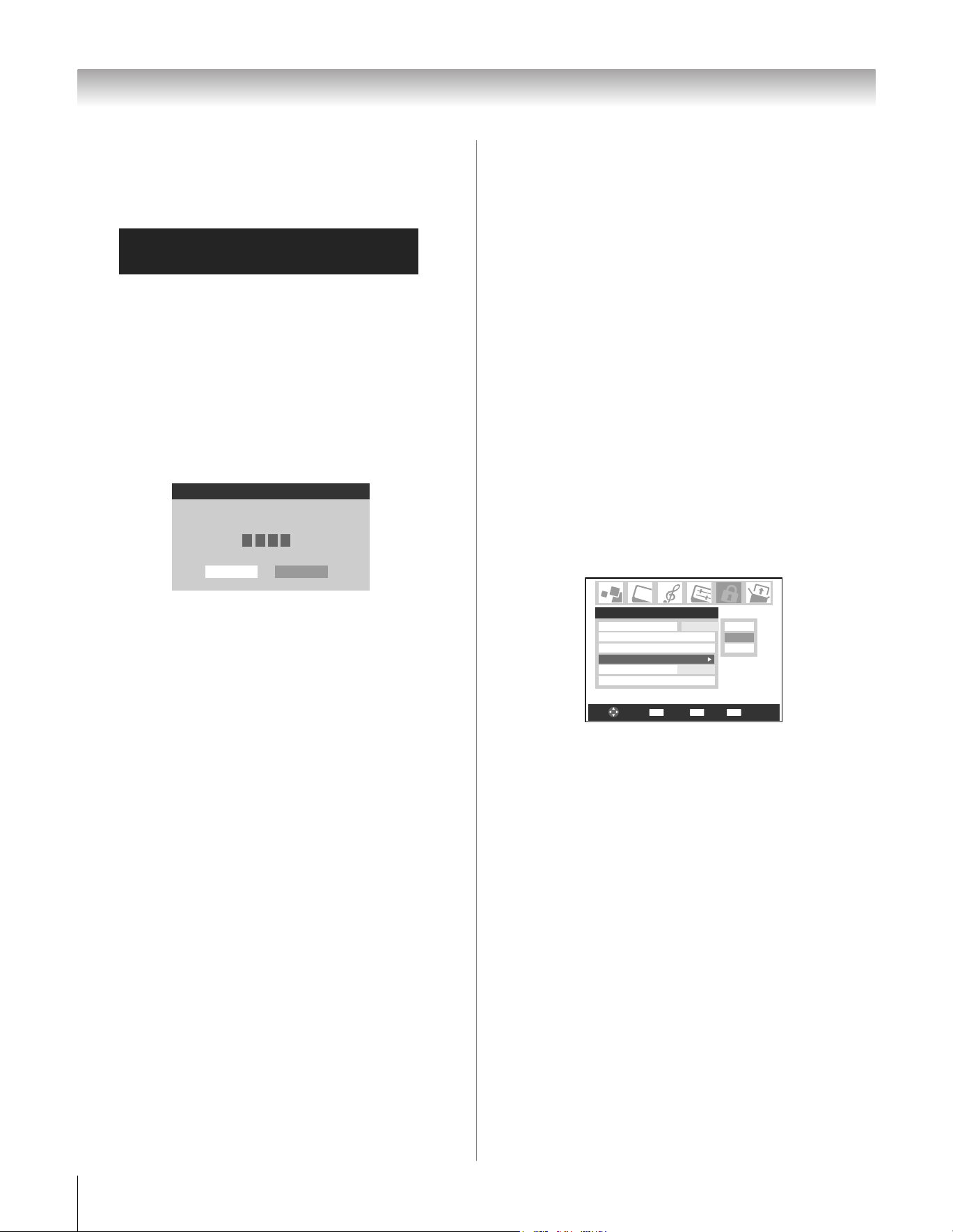
38
HM66 (E/F) Web 213:276
Chapter 5: Using the TV’s basic features
Unlocking programs temporarily
If you try to tune the TV to a program that exceeds the rating
limits you set, the TV will enter program lock mode and the
following message will appear on-screen:
You can either temporarily unlock the program or select an
unlocked program to watch.
To temporarily unlock the program:
1 Press W.
2 Enter your four-digit PIN code and press T. If the correct
code is entered, the program lock mode is released and the
normal picture appears. All locking is disabled until the
TV is turned off, and will be enabled when the TV is
turned on again.
Using the input lock feature
You can use the Input Lock feature to lock the video inputs
(VIDEO 1, VIDEO 2, ColorStream HD-1, ColorStream
HD-2, HDMI 1, and HDMI 2) and channels 3 and 4. You will
not be able to view the input sources or channels until you
unlock the inputs.
To lock/unlock the video inputs:
1 Press Y and highlight the Locks menu icon.
2 Press b to display the PIN code entering screen.
3 Enter your four-digit PIN code and press T.
4 Press b to highlight Input Lock and press c.
5 Press B or b to select the level of video input locking you
prefer, as described below.
Video: Locks VIDEO 1, VIDEO 2, ColorStream HD1/
HD2, HDMI 1/HDMI 2.
Video+: Locks VIDEO 1, VIDEO 2, ColorStream HD1/
HD2, HDMI 1/HDMI 2, and channels 3 and 4.
• Select Video+ if you play video tapes via an ANT input.
• When a CableCARD™ is inserted, Video+ will not
lock channels 3 and 4.
Off: Unlocks all video inputs and channels 3 and 4.
6 Press T.
This program exceeds the rating limit you set.
Push 'mute' to enter PIN.
Locks Active
Enter PIN code to temporaily un-
block.
Cancel
****
Done
MENU
ENTER
EXIT
Navigate
Select
Back Exit
Enable Rating Blocking
Edit Rating Limits
Channels Block
Input Lock Off
OffFront Panel Lock
New PIN Code
Locks
Off
Off
Video
Video +
HM66_EN.book Page 38 Thursday, February 23, 2006 2:49 PM
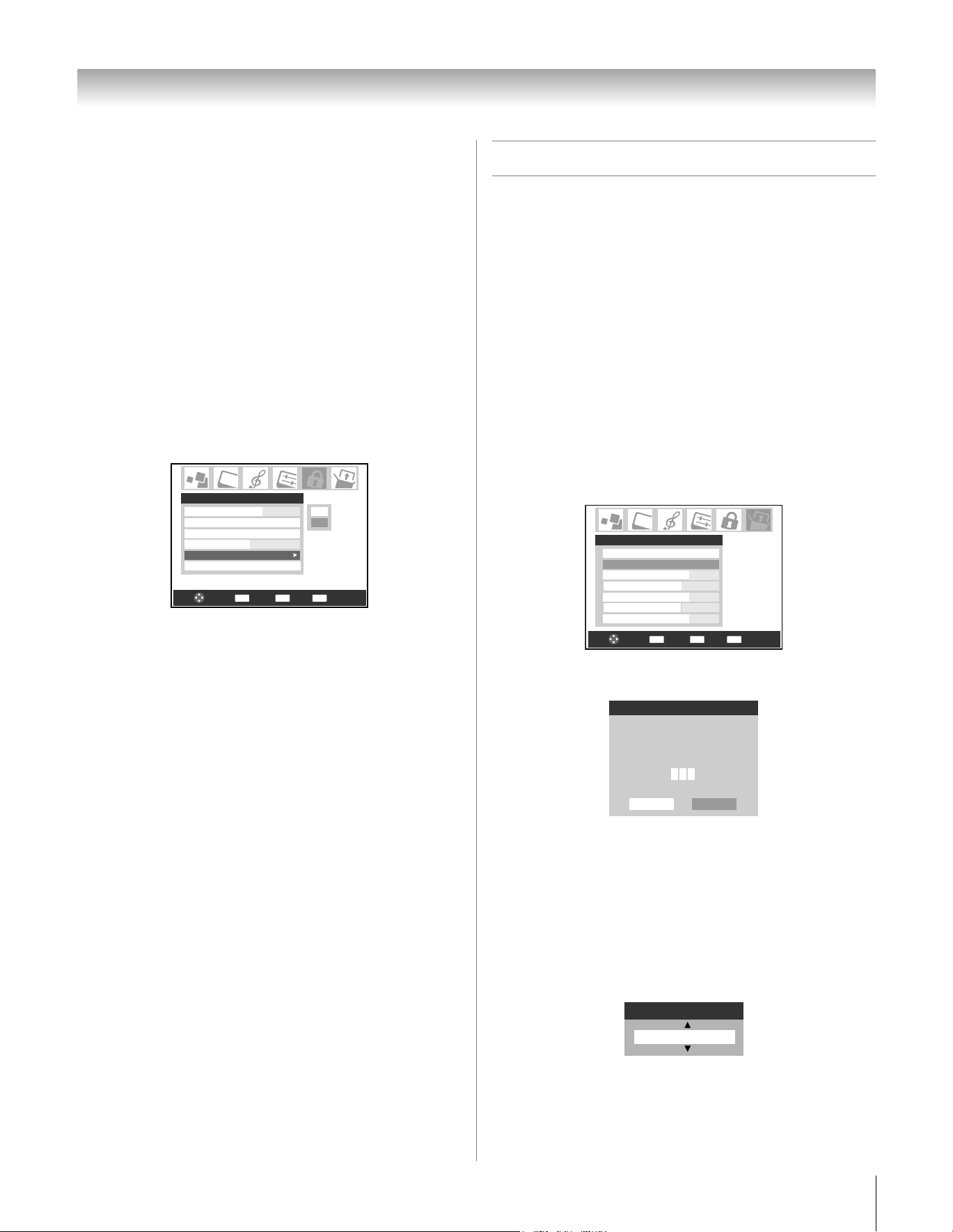
39
HM66 (E/F) Web 213:276
Chapter 5: Using the TV’s basic features
Using the control panel lock feature
You can lock the control panel to prevent your settings from
being changed accidentally (by children, for example). When
the control panel lock is On, none of the controls on the TV
control panel will operate except POWER.
To lock the control panel:
1 Press Y and highlight the Locks menu icon.
2 Press b to display the PIN code entering screen.
3 Enter your four-digit PIN code and press T.
4 Press b to highlight Front Panel Lock.
5 Press c and B or b to highlight On and press T. When
the control panel is locked and a button on the control
panel except POWER button is pressed, the message
“NOT AVAILABLE” appears.
To unlock the control panel:
Highlight Off in step 5 above, or press and hold the
VOLUME – button on the TV control panel for about 10
seconds until the volume icon appears on-screen.
Setting the sleep timer
You can set the sleep timer to turn off the TV after a set length
of time (maximum of 180 minutes).
To set the sleep timer:
Press [ on the remote control to set the length of time until
the TV turns off. Repeatedly press [ to increase the time in
10-minute increments or press B or b to increase or decrease
the time in 10-minute increments, to a maximum of 180
minutes.
To cancel the sleep timer:
Press [ until it is set to 0 minutes.
To set the sleep timer using the on-screen menus:
1 Press Y and open the Setup menu.
2 Highlight Sleep Timer and press T.
3 Press the Number buttons to enter the length of time in
10-minute increments.
4 Highlight Done and press T.
Notes:
• When a power failure occurs, the sleep timer setting
may be cleared.
• To display the amount of time left on the sleep timer,
press E.
To display the remaining sleep time:
Press [.
Note: A message will display on-screen when there is one
minute remaining on the sleep timer.
MENU
ENTER
EXIT
Navigate
Select
Back Exit
Enable Rating Blocking
Edit Rating Limits
Channels Block
Input Lock
Off Off
OffFront Panel Lock
New PIN Code
Locks
On
Off
CH RTNENTER
EXIT
Navigate
Select
Back Exit
Installation
Sleep Timer
ColorStream HD1 Audio
HDMI 1 Audio
Auto
Auto
No
ColorStream HD2 Audio
No
On
HDMI 2 Audio
Quick Restart
Setup
Sleep Timer
Enter total minutes until the TV
turns off automatically (Maximum
180 minutes)
120
Cancel Done
Sleep Timer
120 Minutes
HM66_EN.book Page 39 Thursday, February 23, 2006 2:49 PM
40
HM66 (E/F) Web 213:276
Chapter 5: Using the TV’s basic features
Displaying TV setting information
on-screen using RECALL
To display TV setting information on-screen:
Press E on the remote control.
The following information will display on-screen
(if applicable):
• Current input (ANT 1, ANT 2, VIDEO 1, etc.)
• If ANT 1 or ANT 2 is the current input, whether it is Cable
TV (“CABLE”) or off-air (“TV”)
• Channel number (if in ANT 1 or ANT 2 mode)
• Signal strength indicator (bar graph in lower right corner of
screen; for ATSC signal only)
Note: The signal strength indicator will react to fading and
increasing signals.
•
Remaining time on sleep timer (if set)
• Stereo or SAP audio status
• V-Chip rating status
• Picture size
• Video resolution
• Lamp mode (appears only if the TV is in High Bright mode)
To close the RECALL screen:
Press E again.
Understanding the auto power off
feature
The TV will automatically turn itself off after approximately
15 minutes if it is tuned to a vacant channel or a station that
completes its broadcast for the day. This feature functions in
ANT 1 and ANT 2 modes only.
Understanding the last mode
memory feature
If the power is cut off while you are viewing the TV, the
Last Mode Memory feature automatically turns on the TV
when the power is resupplied.
Note: You should unplug the TV’s power cord if it is possible
that you will be away from the TV for an extended period of time
after the power is restored.
STEREO
CABLE
81-1
ANT 1
Lamp High Bright
NC-17
Sleep Timer: 18 min.
Natural
480i
Sample RECALL screen
HM66_EN.book Page 40 Thursday, February 23, 2006 2:49 PM
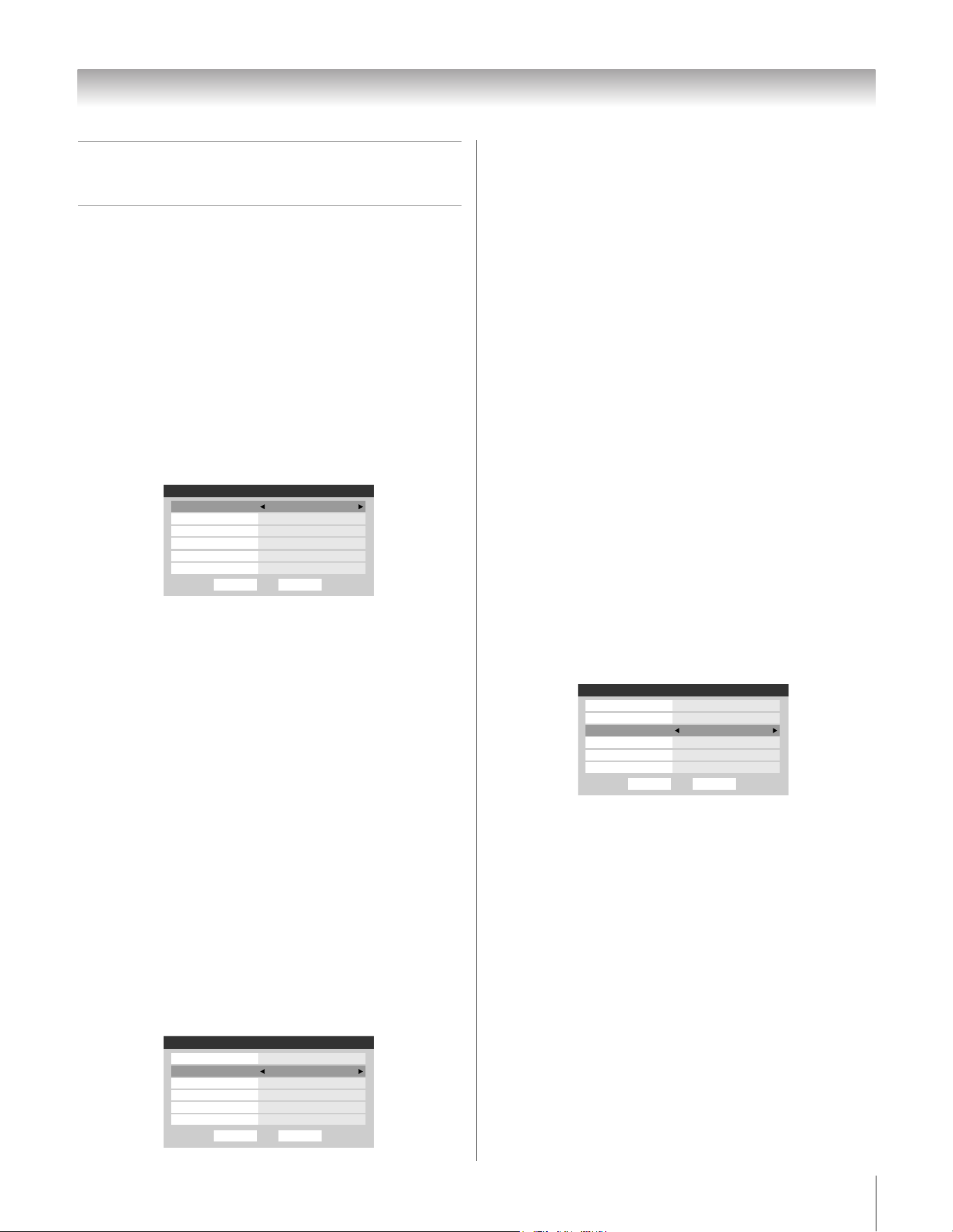
41
HM66 (E/F) Web 213:276
Chapter 6: Using the TV’s advanced features
Using the advanced picture settings
features
Using dynamic contrast
When dynamic contrast is set to On, the TV will detect
changes in the picture quality that affect the appearance of your
contrast settings and then automatically adjust the video.
When dynamic contrast is set to
Off, the settings selected in the
Contrast field in Picture Settings will be used.
To select dynamic contrast preferences:
1 Press Y and open the Video menu.
2 Highlight Advanced Picture Settings and press T.
3 In the Dynamic Contrast field, select either On or Off.
\
4 To save the new settings, highlight Done and press T. To
revert to the factory defaults, highlight
Reset and press
T.
Note: If you select the Movie picture mode and then set
the dynamic contrast to On, the picture mode will
automatically change to Preference in the Picture
Settings menu.
Using CableClear
®
/DNR (digital noise
reduction)
The CableClear
®
digital noise reduction feature allows you to
reduce visible interference in your TV picture. This may be
useful when receiving a broadcast with a weak signal
(especially a Cable channel) or playing a noisy video cassette
or disc.
To change the CableClear/DNR settings:
1 Press Y and open the Video menu.
2 Highlight Advanced Picture Settings and press T.
3 In the CableClear/DNR field, select your desired
setting.
Notes:
• If the current input is ANT 1, ANT 2, VIDEO 1, or VIDEO
2, the menu will display the text “CableClear.” The
available selections are Off, Low, Middle, High, and
Auto.
• If the current input is ColorStream HD1, ColorStream
HD2, or HDMI, the menu will display the text DNR. The
available selections are Off, Low, Middle, High and
Auto. Auto will react proportionally to the strength of
the noise. Low, Middle, and High will reduce the noise
in varying degrees, from lowest to highest, respectively.
4 To save the new settings, highlight Done and press T.
To revert to the factory defaults, highlight Reset and
press T.
Using MPEG noise reduction
The MPEG noise reduction feature allows you to reduce
visible interference caused by MPEG compression. Choices
for MPEG noise reduction are
Off, Low, Middle, and High. Off
is automatically selected when this feature is disabled (“grayed
out”).
To select the MPEG noise reduction level:
1 Press Y and open the Video menu.
2 Highlight Advanced Picture Settings and press T.
3 Press B or b to highlight the MPEG Noise Reduction
field, and then press C or c to select either Off, Low,
Middle or High.
4 To save the new settings, highlight Done and press T.
To revert to the factory defaults, highlight Reset and
press T.
Done
Game Mode Off
Lamp Mode Low Power
Reset
Low
Dynamic Contrast On
Color Temperature Cool
Auto
ANT 1Advanced Picture Settings
CableClear
MPEG Noise Reduction
Done
Cool
Game Mode Off
Lamp Mode Low Power
Reset
Color Temperature
Dynamic Contrast On
ANT 1Advanced Picture Settings
MPEG Noise Reduction Low
CableClear
Auto
Done
Game Mode Off
Lamp Mode Low Power
Reset
MPEG Noise Reduction
Low
Dynamic Contrast On
Color Temperature Cool
Auto
ANT 1Advanced Picture Settings
CableClear
(continued)
HM66_EN.book Page 41 Thursday, February 23, 2006 2:49 PM
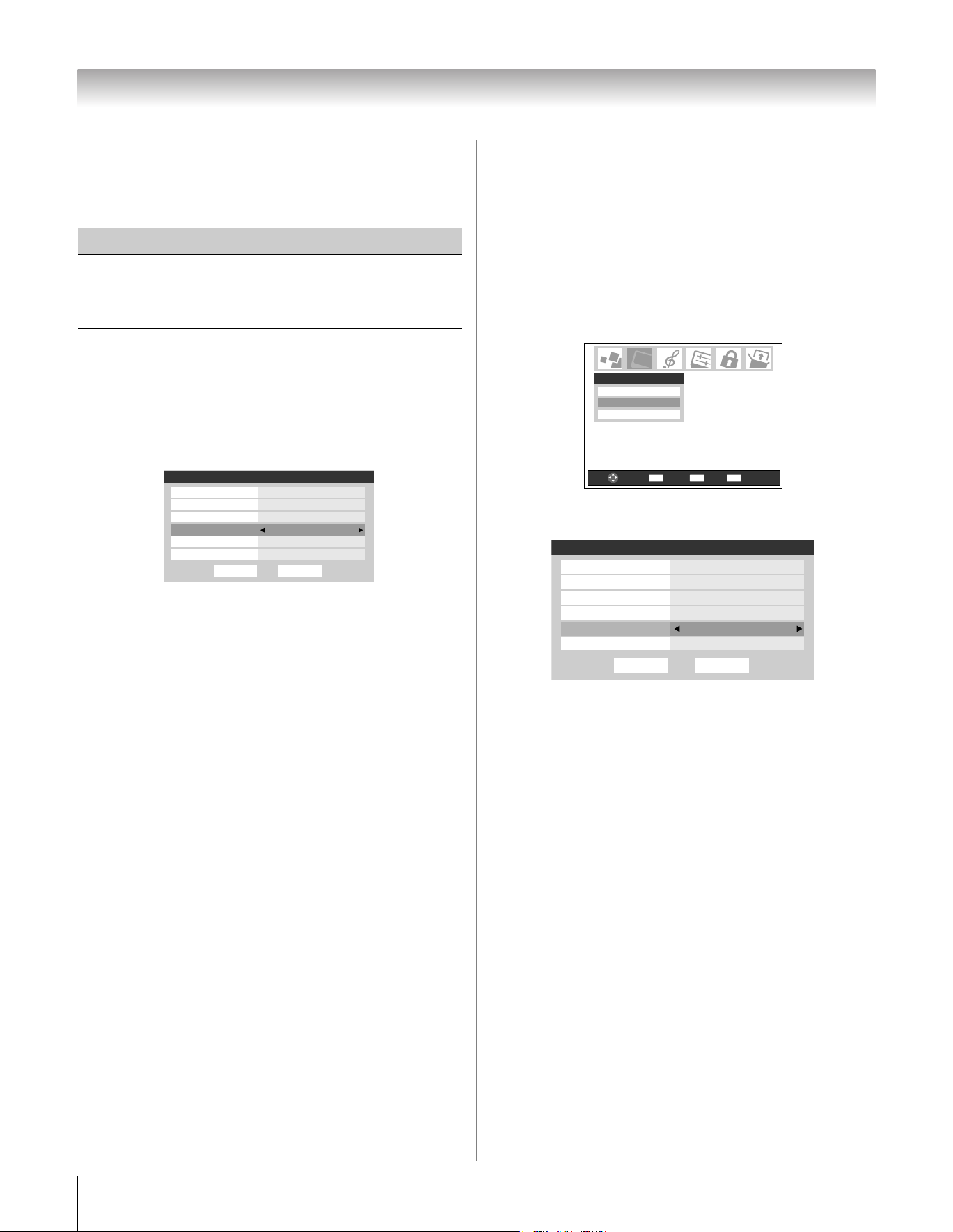
42
HM66 (E/F) Web 213:276
Chapter 6: Using the TV’s advanced features
Selecting the color temperature
You can change the quality of the picture by selecting from
three preset color temperatures (cool, medium, and warm), as
described below.
To select the color temperature:
1 Press Y and open the Video menu.
2 Highlight Advanced Picture Settings and press T.
3 In the Color Temperature field, select the mode you
prefer (Cool, Medium, or Warm).
4 To save the new settings, highlight Done and press T.
To revert to the factory defaults, highlight Reset and
press T.
Note: If you select one of the factory-set picture modes
(Sports, Standard, or Movie) and then change the color
temperature mode, the picture mode automatically
changes to Preference in the Picture Settings menu.
Selecting the lamp mode
You can select either the High Bright or Low Power lamp
mode.
• The High Bright mode is useful when additional picture
brightness is desired (such as in a bright room).
To select the lamp mode:
1 Press Y and open the Video menu.
2 Highlight Advanced Picture Settings and press T.
3 In the Lamp Mode field, select High Bright or Low
Power, whichever you prefer.
4 To save the new settings, highlight Done and press T.
To revert to the factory defaults, highlight Reset and
press T.
Note: If you set the lamp mode to Low Power, each time
you turn on the TV, the lamp will start out in High Bright
mode but will switch to Low Power mode after a short
period of time. You may notice a change in screen
brightness when this happens. This is normal and is not a
sign of malfunction.
Mode Picture Quality
cool blueish
medium neutral
warm reddish
Done
Cool
Game Mode Off
Lamp Mode Low Power
Reset
Color Temperature
Dynamic Contrast On
ANT 1Advanced Picture Settings
MPEG Noise Reduction Low
CableClear
Auto
CH RTN
EXIT
ENTER
Picture Settings
Advanced Picture Settings
Theater Settings
Video
Back Exit
Navigate
Select
Done
Advanced Picture Settings ANT 1
Dynamic Contrast On
MPEG Noise Reduction
CableClear Auto
Color Temperature Cool
Game Mode Off
Lamp Mode Low Power
Reset
Low
HM66_EN.book Page 42 Thursday, February 23, 2006 2:49 PM
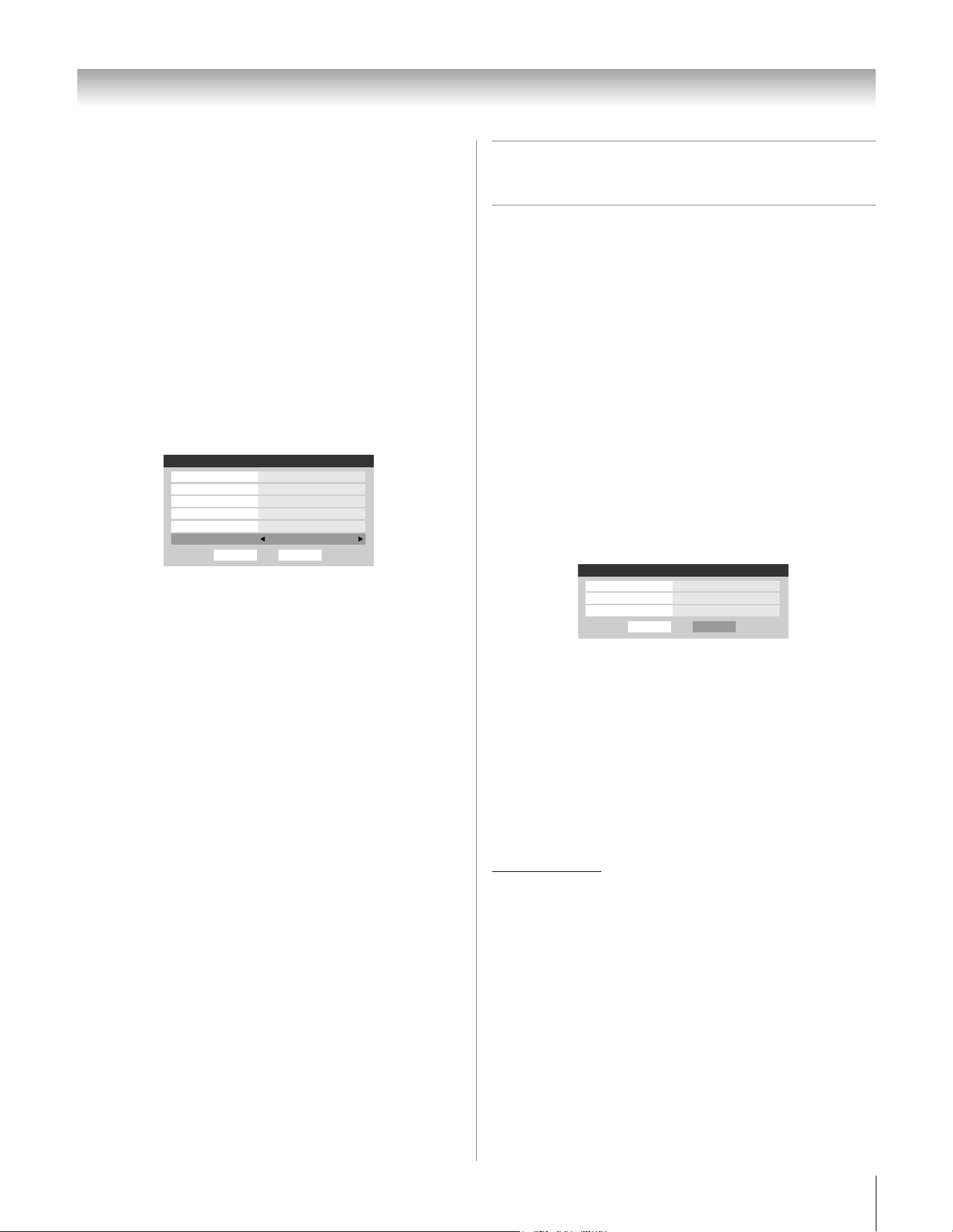
43
HM66 (E/F) Web 213:276
Chapter 6: Using the TV’s advanced features
Using the Game Mode feature
You can use the Game Mode feature for shorter frame delays
when playing a video game requiring split-second timing
between the on-screen display and input from the controller
(such as music creation and high-action games).
Note: To use the Game Mode feature, the current video input
must be Video 1, Video 2, ColorStream HD1,
ColorStream HD2, HDMI 1 or HDMI 2. The Game Mode
cannot be turned on when any other video input is selected.
To turn on Game Mode:
1 Press Y and open the Video menu.
2 Highlight Advanced picture settings and press T.
3 Press B or b to highlight the Game Mode field, and then
press C or c to select On.
To turn off Game Mode:
Select Off in step 3 above or change the video input.
You can change the video input in any of the following ways:
• pressing + on the remote control (- page 23);
• changing the channel using the Numbers or < / ,, R,
3C, #c, or M / m;
• Turning the TV off and back on again will set Game Mode to
Off.
Using the advanced audio settings
features
Using the SRS WOW™ surround sound
feature
WOW™ is a special combination of SRS Labs audio
technologies (SRS 3D, SRS FOCUS, and SRS TruBass) that
creates a thrilling surround sound experience with deep, rich
bass from stereo sound sources. Your TV’s audio will sound
fuller, richer, and wider.
To adjust the WOW™ settings:
1 Put the TV in STEREO mode (- “Selecting stereo/SAP
broadcasts” page 33).
2 Press Y and open the Audio menu.
3 Highlight Advanced Audio Settings and press T.
4 Press b or B to highlight the WOW feature you want to
adjust, and then press C or c to adjust the item.
• WOW: SRS 3D — To turn the surround sound effect
On or Off.
Note: If the broadcast is monaural, the SRS 3D effect will
not work.
•
WOW: SRS Focus — To turn the vocal emphasis effect
On or Off.
• WOW: SRS TruBass — To select the desired bass
expansion level (Off, Low, or High).
5 To save the new settings, highlight Done and press T.
To revert to the factory defaults, highlight Reset and
press T.
WOW, SRS and l symbol are trademarks of SRS Labs, Inc.
WOW technology is incorporated under license from SRS Labs, Inc.
Done
Game Mode On
Lamp Mode Low Power
Reset
Low
Dynamic Contrast On
Color Temperature Cool
Auto
Video 1Advanced Picture Settings
CableClear
MPEG Noise Reduction
Done
Advanced Audio Settings
WOW: SRS 3D
WOW: SRS FOCUS
WOW: SRS TruBass Low
Reset
Off
Off
HM66_EN.book Page 43 Thursday, February 23, 2006 2:49 PM
44
HM66 (E/F) Web 213:276
Chapter 7: Troubleshooting
General troubleshooting
Before calling a service technician, please check this entire
chapter for a possible cause of the problem and some solutions
you can try.
Black box on screen
• The Closed Caption feature is set to one of the Text
modes (T1, T2, T3, or T4). Set the Closed Caption
feature to Off (- page 31).
TV plays a recorded anouncement when LEDs are blinking
• When certain non-standard conditions occur, the LEDs
on the TV will blink and the TV will play a recorded
“voice announcement” describing the condition (see
“LED indications” on page 46 for details).
TV stops responding to controls
• If the TV stops responding to the controls on the remote
control or TV control panel and you cannot turn off the
TV, press and hold the POWER button on the TV control
panel for 5 or more seconds to reset the TV.
Other problems
• If your TV’s problem is not addressed in this
Troubleshooting section or the recommended solution
has not worked, use the Restore Factory Defaults
procedure (- page 22).
TV will not turn on
• Make sure the power cord is plugged in, and then press
p.
• The remote control batteries may be dead. Replace the
batteries or try the control panel buttons.
• If you have recently replaced the lamp unit, make sure the
lamp unit and lamp unit door are installed properly
(- pages 47–49).
• The lamp unit may need to be replaced (- pages 47–49).
Also see “LED indications” (- page 46).
• If the TV is powered off and then quickly on again when
the lamp unit is hot, it may take several minutes for the
picture to appear on-screen. This is a property of DLP TV
lamp technology and is NOT a sign of malfunction. For
details, see IMPORTANT NOTICE ABOUT “HOT
LAMP RESTART” (- page 2).
Picture problems
General picture problems
• Check the antenna/cable connections (- Installation
Guide).
• Press + on the remote control or INPUT on the TV
control panel and select a valid video input source
(- page 23). If no device is connected to any of the
inputs on the TV, no picture will display when you select
that particular input source. For device connection
details, see the Installation Guide.
• Antenna reception may be poor. Use a highly directional
outdoor antenna (if applicable).
• The station may have broadcast difficulties. Try another
channel.
• Adjust the picture qualities (- page 30).
• If you are using a VCR, make sure L on the remote
control is set correctly (- page 9).
• If you have two VCRs connected to your TV, make sure
you have not connected the same VCR to the TV’s output
and input connections at the same time (- Installation
Guide).
• Do not connect both a standard video cable and an S-
video cable to the same set of VIDEO inputs (VIDEO 1,
or VIDEO 2) at the same time (- Installation Guide).
Noisy picture
• If you are watching a tuned analog channel (off-air
broadcast or Cable TV), set the CableClear
®
/DNR
feature to AUTO to reduce visible interference in the TV
picture (- page 41).
Video Input Selection problems
• If the Input Selection window does not appear when
you press + on the remote control or INPUT on the TV
control panel, press + a second time, which will change
to the next video input source and display the Input
Selection window.
Cannot view external signals or channel 3 or 4
• If you cannot view signals from external devices
connected to VIDEO 1, VIDEO 2, or ColorStream
®
,
or from channels 3 or 4, make sure the Input Lock is set
to Off (- page 38).
Poor color or no color
• The station may have broadcast difficulties. Try another
channel.
• Adjust the Tint and/or Color (- page 30).
• When the ColorStream
®
signal source is active, the
VIDEO OUT terminal outputs blank video. To receive
video from the VIDEO OUT signal, a standard video or
S-video IN terminal must be used instead of the
ColorStream
®
connections.
Picture brightness changes soon after turning on TV
• If you set the lamp mode to Low Power, each time you
turn on the TV, the lamp will start out in High Bright
mode but will switch to Low Power mode after a short
period of time. You may notice a change in screen
brightness when this happens. This is normal and is not a
sign of malfunction (- page 42).
Poor composite or S-video picture
• If the TV is connected to an external A/V device (e.g.,
DVD player, video game system, set-top box, etc.) try
using a ColorStream or HDMI video connection
instead.
Picture and sound are out of sync
• As with all products that contain a digital display, in rare
instances, when viewing certain content (e.g.. television
broadcasts, video games, DVDs), you may notice that the
sound and picture are slightly out of sync. This
phenomenon can be caused by various factors including,
without limitation, video processing within the TV, video
processing in an attached gaming system, and video
processing or different compression rates used by
broadcasters in their programming. You may want to try
one or more of the following suggestions, which may
help to reduce the effect of this phenomenon:
HM66_EN.book Page 44 Thursday, February 23, 2006 2:49 PM
45
HM66 (E/F) Web 213:276
Chapter 7: Troubleshooting
– If the TV is connected to an A/V receiver that has a
programmable audio delay feature, use this feature
to help synchronize the sound to the picture.
– If you notice this phenomenon only on certain TV
channels, please contact your local broadcast,
cable, or satellite provider to inform them of this
issue.
Sound problems
• Check the antenna/cable connections (- Installation
Guide).
• The station may have broadcast difficulties. Try another
channel.
• The sound may be muted. Press z.
• If you hear no sound, try setting the MTS feature to
Stereo mode (- page 33).
• Make sure the Speakers function in the Audio Setup
menu is set correctly (- page 34).
• If you are not receiving a second audio program from a
known SAP source, make sure the MTS feature is set to
SAP mode (- page 33).
• If you hear audio that seems “incorrect” for the program
you are watching (such as music or a foreign language),
the SAP mode may be on. Set the MTS feature to Stereo
mode (- page 33).
• When using an external audio amplifier, if you connect
the amplifier to the VAR. AUDIO OUT terminals, the
volume of the TV and amplifier must be set above 0 or
you will not hear any sound (- Installation Guide).
Remote control problems
• Make sure the remote control is set to the correct device
mode (- pages 9–10).
• Remove all obstructions between the remote control and
the TV.
• The remote control batteries may be dead. Replace the
batteries (- page 7).
• Your TV remote control may not operate certain features
on your external device. Refer to the owner’s manual for
your other device to determine its available features. If
your TV remote control does not operate a specific
feature on another device, use the remote control that
came with the device (- pages 9–13).
• If the TV still does not act as expected, use the Restore
Factory Defaults procedure (- page 22).
Channel tuning problems
• Make sure the remote control is set to the correct device
mode (- page 8).
• The channel may have been erased from the channel
memory by the Channel Add/Delete feature. Add the
channel to the channel memory (- page 17).
• The channel may be blocked by the Channels Block
feature. Unblock the channel (- page 37).
• If you are unable to tune digital channels, check the
antenna configuration (- page 16). If you are still
unable to tune digital channels, clear all channels from
the channel list (- page 18) and reprogram channels into
the channel memory (- page 17). If you are still unable
to tune digital channels, use the Restore Factory Defaults
procedure (- page 22). Also see “TV stops responding
to controls” and “Other problems” (- page 44).
Closed caption problems
• If the program or video you selected is not closed-
captioned, no captions will display on-screen
(- page 31).
• If text is not available, a black rectangle may appear on-
screen. If this happens, turn off the closed caption feature
(- page 31).
• A closed caption signal may not display correctly in the
following situations: a) when a videotape has been
dubbed; b) when the signal reception is weak; or c) when
the signal reception is nonstandard (- page 31).
Rating blocking (V-Chip) problems
• If you forget your PIN code: While the PIN code entering
screen is displayed, press E four times within 5
seconds. The PIN code you previously stored will be
cleared (- page 35).
• The V-Chip feature is available for the U.S. V-Chip
system only (- page 36).
HM66_EN.book Page 45 Thursday, February 23, 2006 2:49 PM
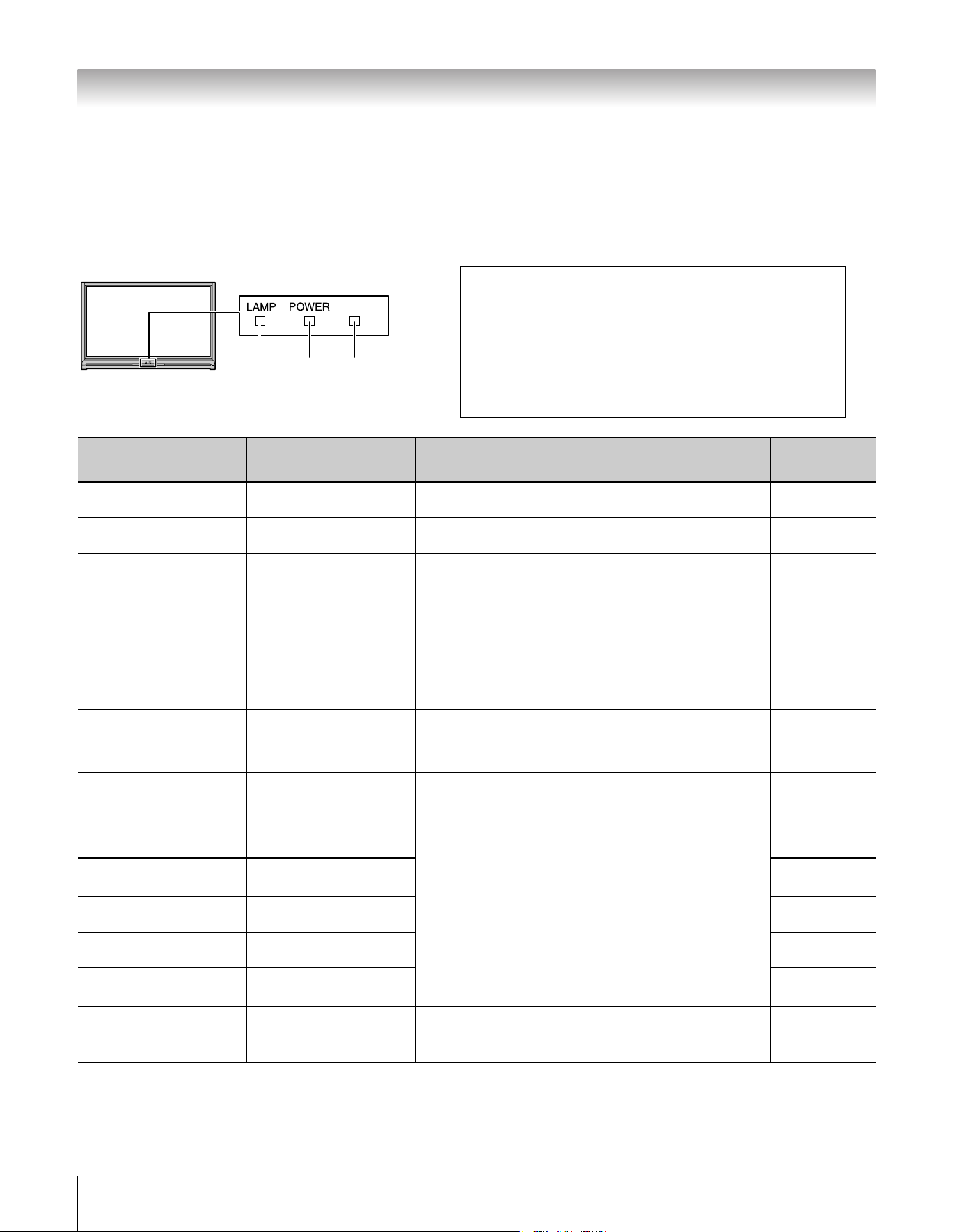
46
HM66 (E/F) Web 213:276
Chapter 7: Troubleshooting
LED indications
The yellow blue and red/green LED lights on the TV (at the bottom center of the TV) indicate the TV’s status, as described below:
Note: If the TV loses A/C power (e.g., a power outage occurs or the power cord is unplugged), when power is restored, the yellow
LED will blink while the TV is booting until the remote control is usable. This is normal and is not a sign of malfunction.
If, after trying solutions, the problem still exists:
• In the U.S., call TACP Consumer Solutions at 1-800-631-3811.
• In Canada, locate the nearest Toshiba authorized service depot by directing your web browser to www.toshiba.ca; click
“Home Entertainment,” and then click “Support.”
LED Indication Condition Solution Voice
announce
1) Blue is ON (solid). The TV is operating
properly.
––
2) Yellow blinks. In LPS mode (standby
with Quick Restart ON).
See “Setting the Quick Restart™ feature” (- page 20). –
3) Blue is ON (solid).
Yellow blinks.
The lamp is not working
properly.
The TV will automatically try to restart itself eight times
(see item #4).
Note: If the TV is powered off and then quickly on again
when the lamp unit is hot, it may take several minutes
for the picture to appear on-screen. This is a property of
DLP TV lamp technology and is NOT a sign of
malfunction. For details, see “Setting the Quick
Restart™ feature” and “IMPORTANT NOTICE ABOUT
HOT LAMP RESTART” (- page 21).
–
4) Yellow is ON
(solid). Red blinks.
The lamp is not working
properly after the eighth
automatic restart (see
item #3).
Turn the TV OFF and then ON again. If the problem
persists, contact Consume Solutions at
1-800-631-3811.
“Lamp not
working”
5) Yellow is ON
(solid).
The lamp unit door is not
seated properly.
Turn OFF the TV and unplug the power cord. Review
“Lamp unit replacement and care” in Chapter 8 to
ensure that the lamp door is installed securely.
“Lamp door is
open.”
6) Red blinks. Fan stopped
(light engine).
Turn OFF the TV and unplug the power cord. Plug the
power cord in again and turn ON the TV.
“Fan
stopped.”
7) Blue is ON (solid).
Green blinks.
Fan stopped (POD).
“Fan
stopped.”
8) Blue blinks slowly. Abnormal operation of
BUS line.
–
9) Blue blinks quickly. Power Protect
Detection.
–
10)Blue blinks quickly.
Red blinks.
The color wheel has
stopped.
“Color wheel
stopped.”
11)Blue blinks quickly.
Yellow blinks.
Red blinks.
An abnormal
temperature increase
has occurred.
Turn OFF the TV. Check to make sure all slots and
openings in the TV cabinet are not covered, blocked, or
dusty. Turn ON the TV again.
“Temperature
warning.”
Blue LED Red/Green LEDYellow LED
TV front
“Voice announce” feature
When certain non-standard conditions occur, the LEDs on
the TV will blink and the TV will play a recorded
“voice announcement” describing the condition (see the
table below for the specific conditions that include a voice
announcement).
To repeat the voice announcement and hear additional
information, press the MENU button on the TV while the
LEDs are blinking.
HM66_EN.book Page 46 Thursday, February 23, 2006 2:49 PM
47
HM66 (E/F) Web 213:276
Chapter 8: Appendix
Lamp unit replacement and care
Replacing the lamp unit
(User-replaceable component)
The light source for this TV is a mercury lamp with internal
atmospheric pressure that increases during use. The lamp has a
limited service life that varies depending on product use and
user settings.
As is generally the case with all projection TVs that use
projection lamps as a light source, the brightness of the lamp
in this TV may vary somewhat over the expected service life
and will generally decrease over time. Because of the many
variables that can affect the useful service life of the lamp, your
experience may vary from other users.
Note : The lamp is warranted only for the periods and to the
extent set forth in the Limited Warranty applicable to this set.
See “Limited United States Warranty” (- page 51) or “Limited
Canada Warranty” (- page 52), as applicable.
If you use the lamp beyond its service life:
• you may notice a reduction in the colors and/or brightness of
the picture; and
• the strength of the quartz glass in the lamp will be reduced
and the lamp may rupture (often making a loud noise when
this happens). If the lamp ruptures, the TV will not operate
until the lamp unit is replaced.
When to replace the lamp unit
You should replace the lamp unit:
• if the picture darkens and/or colors fade;
• if the screen (lamp) does not light (LED indication #4,
- page 46); or
• if you hear a loud noise and the picture goes black, which
may indicate a lamp rupture (LED indication #4,
- page 46).
To obtain a replacement lamp unit:
Always replace the lamp unit with the model
currently recommended by Toshiba.
For more information, please contact us at the
telephone numbers listed above, or visit the
websites listed above, as applicable.
Using any lamp other than those recommended by
Toshiba may cause damage to the TV and/or lamp.
SUCH DAMAGE IS NOT COVERED UNDER YOUR
TOSHIBA WARRANTY.
WARNING: RISK OF ELECTRIC
SHOCK!
TO REDUCE THE RISK OF ELECTRIC
SHOCK, NEVER REMOVE TV COVERS, EXCEPT AS
SPECIFIED HEREIN. REFER ALL SERVICING NOT
SPECIFIED IN THIS MANUAL TO QUALIFIED SERVICE
PERSONNEL. Failure to follow this WARNING may result in
death or serious injury.
CAUTION: Always handle the lamp unit
with care.
The lamp unit in this TV was designed for safe
replacement by consumers; however, if the lamp unit is
subjected to intentional abuse (such as excessive
mechanical abuse or handling by children or pets), the unit
may break, exposing sharp edges or pinch points.
In the U.S.
In warranty:
Visit www.tacp.toshiba.com/service or
call toll-free 1-800-631-3811.
Out of
warranty:
Visit
www.ceaccessories.toshiba.com
or
consult your consumer electronics dealer.
In Canada
Locate a Toshiba parts distributor by visiting
www.toshiba.ca. Click “Home Entertainment” and then
click “Support.”
HM66_EN.book Page 47 Thursday, February 23, 2006 2:49 PM
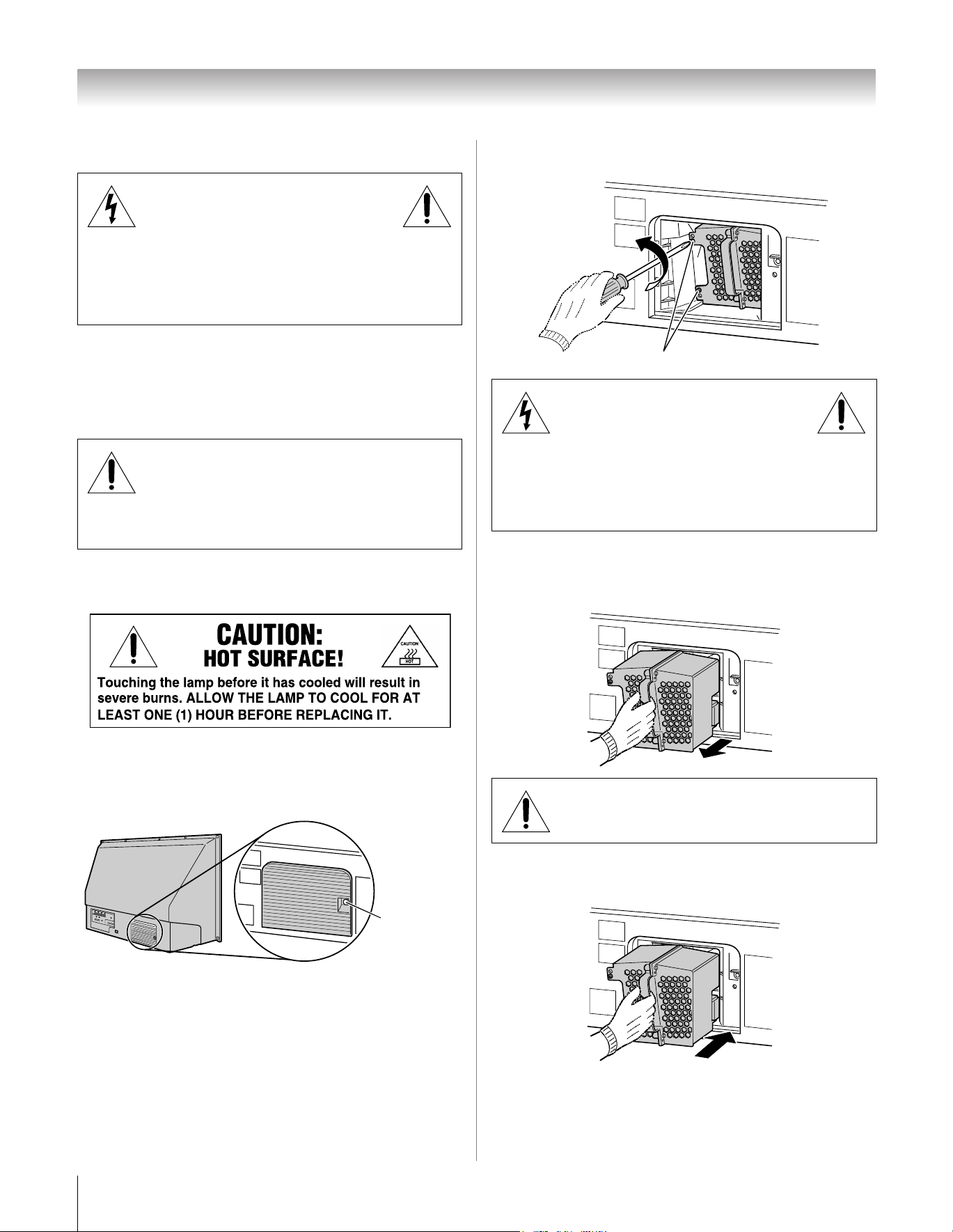
48
HM66 (E/F) Web 213:276
Chapter 8: Appendix
How to replace the lamp unit
Required tools:
• Manual screwdrivers (Phillips and slotted)
• Soft, lint-free gloves
1 Turn off the TV and unplug the power cord.
2 STOP! Allow the lamp to cool for at least one (1) hour
before replacing it.
3 On the lamp unit door on the back of the TV, loosen the
screw by using manual screwdriver, and then remove the
lamp unit door.
4 Using a manual Phillips screwdriver, loosen the two
screws on the lamp unit.
5 Grasp the lamp unit handle and gently pull the lamp unit
straight out of the TV. Set the old lamp unit aside
(- “Disposing of the used lamp unit” on page 49).
[
6 Carefully insert the new lamp unit straight into the TV
until it is fully seated.
WARNING: RISK OF ELECTRIC
SHOCK!
TO REDUCE THE RISK OF ELECTRIC
SHOCK, NEVER REMOVE TV COVERS, EXCEPT AS
SPECIFIED HEREIN. REFER ALL SERVICING NOT
SPECIFIED IN THIS MANUAL TO QUALIFIED SERVICE
PERSONNEL. Failure to follow this WARNING may result in
death or serious injury.
WARNING: Eye damage may result from
directly viewing the light produced by
this lamp.
Always turn off the TV and unplug the power cord before
opening the lamp unit door.
Loosen screw
using manual
screwdriver
TV back
Lamp unit door detail
WARNING: RISK OF ELECTRIC
SHOCK!
The lamp unit door is provided with an
interlock to reduce the risk of electric shock and excessive
ultraviolet radiation. Never defeat its purpose or attempt
to service without removing the lamp unit door
completely. Failure to follow this WARNING may result in
death or serious injury.
NOTE: Wear soft, lint-free gloves when
replacing the lamp unit.
Lamp unit screws
HM66_EN.book Page 48 Thursday, February 23, 2006 2:49 PM
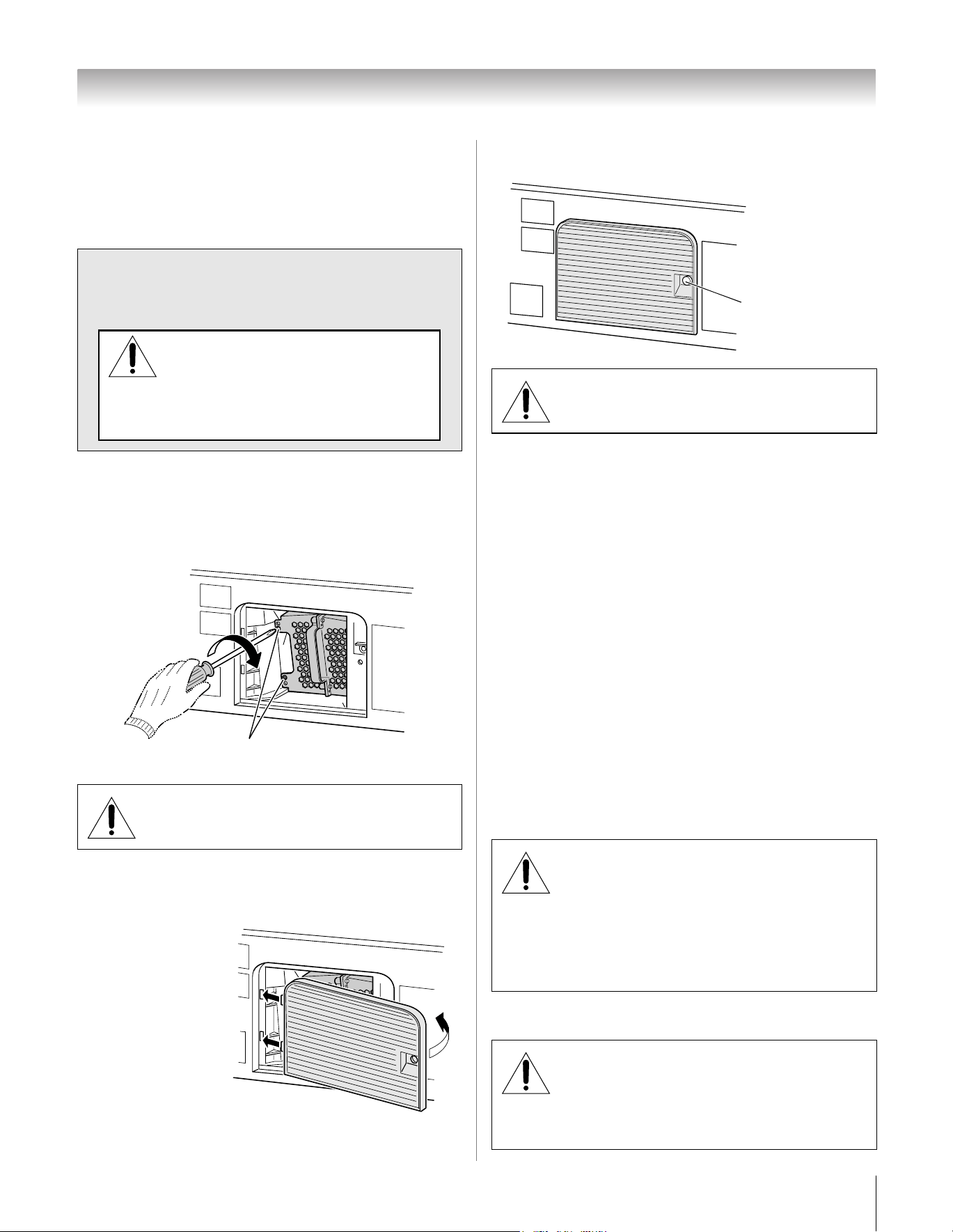
49
HM66 (E/F) Web 213:276
Chapter 8: Appendix
Notes:
• Never subject the lamp unit to excessive shock.
• Never touch the lamp unit glass or otherwise get it dirty.
Doing so may affect the image quality and reduce the
service life of the lamp. See “Cleaning the lamp unit glass”
below.
7 Using a manual phillips screwdriver, tighten the two lamp
unit screws.
Note: Hand-tighten only. Do not use an electric
screwdriver.
8 Reattach the lamp unit door, making sure to insert the
hooks on the left side of the lamp unit door inside the
opening in the TV cabinet.
9 Replace the screw and tighten using a manual
screwdriver.
10 Plug in the power cord and turn on the TV. After the initial
warmup period (which may take several seconds for full
picture brightness), the TV should operate normally. If
any of the following conditions exist, turn off the TV,
unplug the power cord, and repeat steps 1–9 to ensure that
the lamp unit and lamp unit door are installed correctly:
• No picture
• Dark picture
• TV will not turn on
If, after repeating steps 1–9, the problem still exists:
• In the U.S., call TACP consumer solutions at 1-800-
631-3811.
• In Canada, locate the nearest Toshiba authorized
service depot by directing your web browser to
www.toshiba.ca; click “Home Entertainment,” and
then click “Support.”
Disposing of the used lamp unit
• Place the used lamp unit in the empty box from the new unit.
• Keep the lamp unit out of reach of children and pets.
• Dispose of the used lamp unit by the approved method for
your area.
CLEANING THE LAMP UNIT GLASS
If you accidentally touch the lamp unit glass or otherwise get
it dirty, wipe it with a lint-free lens cleaning cloth (such as a
cloth for cleaning camera lenses or eyeglasses).
NOTE : Make sure the lamp unit and screws are
installed securely; otherwise, the TV may not turn
on and the lamp life may be shortened.
CAUTION
:
NEVER
clean a hot lamp with any
type of flammable liquid or aerosol cleaning
agent.
Many ordinary cleaning agents (such as
glass cleaners) contain chemicals that may be flammable at
certain temperatures. If the lamp unit is not allowed to cool for at
least one (1) hour, such chemicals may ignite.
Lamp unit screws
(use manual Phillips screwdriver only)
Insert the hooks inside the
TV cabinet opening.
Lamp unit door
NOTE: Make sure the lamp unit door is installed
securely; otherwise, the TV may not turn on.
CAUTION: Always handle the lamp unit
with care.
The lamp unit in this TV was designed for safe
replacement by consumers; however, if the lamp unit is
subjected to intentional or accidental abuse (such as
excessive mechanical abuse or handling by children or
pets), the unit may break, exposing sharp edges or pinch
points.
NOTE : The lamp unit contains mercury.
Disposal of mercury may be regulated due to
environmental considerations. For disposal or
recycling information, contact your local
authorities or the Electronic Industries Alliance
(www.eiae.org).
Hand tighten using
manual screwdriver
Lamp unit door
HM66_EN.book Page 49 Thursday, February 23, 2006 2:49 PM

50
HM66 (E/F) Web 213:276
Chapter 8: Appendix
Specifications
Notes:
• This model complies with the specifications listed
below.
• Designs and specifications are subject to change
without notice.
• This model may not be compatible with features and/or
specifications that may be added in the future.
Television System
NTSC standard
ATSC standard (8VSB)
Digital Cable (64 QAM, 256 QAM; in-the-clear,
unencrypted*)
Channel Coverage
VHF: 2 through 13
UHF: 14 through 69
Cable TV: Mid band (A-8 through A-1, A through I)
Super band (J through W)
Hyper band (AA through ZZ, AAA, BBB)
Ultra band (65 through 94, 100 through 135)
Power Source
120 V AC, 60 Hz
Power Consumption
215 W (average)
28 W in standby mode (using a CableCARD™)
24 W in standby mode (without a CableCARD™)
Audio Power
10 W + 10 W
Speaker Type
Main: Two 2-3/8 × 4-3/4 inches (6×12 cm) round
Tweeter: Two 1-5/16 inches (33 mm) round
Video/Audio Terminals
S-VIDEO INPUT:
Y: 1 V(p-p), 75 ohm, negative sync.
C: 0.286 V(p-p) (burst signal), 75 ohm
VIDEO/AUDIO INPUT:
VIDEO: 1 V(p-p), 75 ohm, negative sync.
AUDIO: 150 mV(rms) (30% modulation equivalent, 22 k
ohm or greater)
ColorStream
®
(component video) HD INPUT:
VIDEO:Y: 1V(p-p), 75 ohm
P
R: 0.7 V(p-p), 75 ohm
P
B: 0.7 V(p-p), 75 ohm
Suggested formats: 1080i, 480p, 480i, 720p
AUDIO: 150 mV(rms), 22 k ohm or greater
HDMI™ INPUT:
HDMI compliant (type A connector)
HDCP compliant
E-EDID
**
compliant
Suggested formats: 1080i, 480p, 480i, 720p
HDMI Audio: 2-channel PCM; 32/44.1/48 kHz
sampling frequency; 16/20/24 bits per sample
VIDEO/AUDIO OUTPUT (also for recording):
VIDEO: 1 V(p-p), 75 ohm, negative sync.
AUDIO: 150 mV(rms) (30% modulation equivalent,
2.2 k ohm or less)
VARIABLE AUDIO OUTPUT:
0–300 mV(rms) (30% modulation equivalent, 2.2 k
ohm or less)
DIGITAL AUDIO OUTPUT:
Optical type
Dimensions
50HM66: Width: 47-3/16 inches (1,199 mm)
Height: 30-11/16 inches (780 mm)
Depth: 16-5/8 inches (422 mm)
56HM66: Width: 52-3/8 inches (1,330 mm)
Height: 33-3/4 inches (857 mm)
Depth: 18-3/8 inches (467 mm)
Weight
50HM66:64 lbs (29.0 kg)
56HM66:72 lbs (32.7 kg)
Operating conditions
Temperature: 41ºF–95ºF (5ºC–35ºC)
Humidity: 20–80% (no moisture condition)
Supplied Accessories
• Remote control with two size “AAA” batteries
• Dual-wand IR blaster cable
• Installation Guide
• Operating Guide (this book)
Optional Stands
50HM66:ST 5066
56HM66:ST 5666
* Encrypted channels can be viewed on this TV using a
CableCARD.™ (- Installation Guide).
** E-EDID = Enhanced-Extended Display Identification
HM66_EN.book Page 50 Thursday, February 23, 2006 2:49 PM

51
HM66 (E/F) Web 213:276
Chapter 8: Appendix
Limited United States Warranty
for DLP™ Television Models
Toshiba America Consumer Products, L.L.C. (“TACP”) makes the
following limited warranties to original consumers in the United States.
THESE LIMITED WARRANTIES EXTEND TO THE ORIGINAL
CONSUMER PURCHASER OR ANY PERSON RECEIVING THIS DLP™
TELEVISION AS A GIFT FROM THE ORIGINAL CONSUMER
PURCHASER AND TO NO OTHER PURCHASER OR TRANSFEREE.
DLP™ TELEVISIONS PURCHASED IN THE U.S.A. AND USED
ANYWHERE OUTSIDE OF THE U.S.A., INCLUDING, WITHOUT
LIMITATION, CANADA AND MEXICO, ARE NOT COVERED BY THESE
WARRANTIES.
DLP™ TELEVISIONS PURCHASED ANYWHERE OUTSIDE OF THE
U.S.A., INCLUDING, WITHOUT LIMITATION, CANADA AND MEXICO,
AND USED IN THE U.S.A., ARE NOT COVERED BY THESE
WARRANTIES.
Limited One (1) Year Warranty on Parts and Labor
TACP warrants this DLP™ Television and its parts against defects in
materials or workmanship for a period of one (1) year after the date of
original retail purchase.
DURING THIS PERIOD, TACP WILL, AT TACP’S
OPTION, REPAIR OR REPLACE A DEFECTIVE PART WITH A NEW OR
REFURBISHED PART WITHOUT CHARGE TO YOU FOR PARTS OR
LABOR.
During this period, TACP Authorized Service Station personnel
will come to your home when warranty service is required. Depending on
the type of repair required, the service will either be performed in your
home or the DLP™ Television will be taken to a TACP Authorized Service
Station for repair and returned to your home at no cost to you.
Limited One (1) Year Warranty on Lamp Unit
TACP warrants the original lamp unit contained in this DLP™ Television
against defects in materials or workmanship for a period of one (1) year
after the date of original retail purchase.
DURING THIS PERIOD, TACP
WILL, AT TACP’S OPTION, EXCHANGE A DEFECTIVE LAMP UNIT
WITH A NEW OR REFURBISHED LAMP UNIT WITHOUT CHARGE TO
YOU. LABOR CHARGES FOR LAMP UNIT REPLACEMENT ARE YOUR
RESPONSIBILITY AND ARE NOT COVERED UNDER THIS
WARRANTY.
The lamp unit is a user-replaceable component.
Rental Units
The warranty for DLP™ Television rental units begins on the date of the
first rental or thirty (30) days after the date of shipment to the rental firm,
whichever comes first.
Limited Warranty for Commercial Units
TACP warrants DLP™ Televisions, including the lamp units contained
therein, that are sold and used for commercial purposes as follows: all
parts are warranted against defects in materials or workmanship for a
period of ninety (90) days after the date of original retail purchase.
DURING THIS PERIOD, TACP WILL, AT TACP’S OPTION, REPAIR OR
REPLACE A DEFECTIVE PART WITH A NEW OR REFURBISHED PART
WITHOUT CHARGE TO YOU.
Owner’s Manual and Product Registration
Read this owner’s manual thoroughly before operating this DLP™
television.
Complete and mail the enclosed product registration card or register your
DLP™ Television online at
www.tacp.toshiba.com/service
as soon
as possible. By registering your DLP™ Television you will enable TACP to
bring you new products specifically designed to meet your needs and
help us to contact you in the unlikely event a safety notification is required
under the Consumer Product Safety Act. Failure to register your product
does not diminish your warranty rights.
Your Responsibility
THE ABOVE WARRANTIES ARE SUBJECT TO THE FOLLOWING
CONDITIONS:
(1) You must retain your original bill of sale or provide other proof of
purchase.
(2) All warranty servicing of this DLP™ Television must be performed by
an Authorized TACP Service Station.
(3) The warranties from TACP are effective only if this DLP™ Television is
purchased and operated in the Continental U.S.A. or Puerto Rico.
(4) Labor service charges for set installation, setup, adjustment of
customer controls, and installation or repair of antenna systems are
not covered by this warranty. Reception problems caused by
inadequate antenna systems, misaligned satellite dishes, cable
television distribution, VCRs, DVD players/recorders, personal
computer level IEEE1394 devices, and any other connected signal
source device are your responsibility.
(5) Warranties extend only to defects in materials or workmanship as
limited above, and do not extend to any DLP™ Television or parts that
have been lost or discarded by you or to damage to the DLP™
Television or parts caused by fires, misuse, accident, Acts of God
(such as lightning or fluctuations in electric power), improper
installation, improper maintenance, or use in violation of instructions
furnished by TACP; use or malfunction through simultaneous use of
this DLP™ Television and connected equipment; or to units that have
been modified or had the serial number removed, altered, defaced,
or rendered illegible.
How to Obtain Warranty Service
If, after following all of the operating instructions in this manual and
reviewing the section titled “Troubleshooting,” you find that service is
needed:
(1) To find the nearest TACP Authorized Service Station, visit TACP’s
website at
www.tacp.toshiba.com/service
or contact TACP’s
Consumer Solution Center toll free at 1-800-631-3811.
(2) You must present your original bill of sale or other proof of purchase
to the TACP Authorized Service Station.
ALL WARRANTIES IMPLIED BY THE LAW OF ANY STATE OF THE
U.S.A., INCLUDING THE IMPLIED WARRANTIES OF
MERCHANTABILITY AND FITNESS FOR A PARTICULAR PURPOSE,
ARE EXPRESSLY LIMITED TO THE DURATION OF THE LIMITED
WARRANTIES SET FORTH ABOVE. WITH THE EXCEPTION OF ANY
WARRANTIES IMPLIED BY THE LAW OF ANY STATE OF THE U.S.A.
AS HEREBY LIMITED, THE FOREGOING WARRANTY IS EXCLUSIVE
AND IN LIEU OF ALL OTHER WARRANTIES, GUARANTEES,
AGREEMENTS, AND SIMILAR OBLIGATIONS OF TACP WITH
RESPECT TO THE REPAIR OR REPLACEMENT OF ANY PARTS. IN NO
EVENT SHALL TACP BE LIABLE FOR CONSEQUENTIAL OR
INCIDENTAL DAMAGES (INCLUDING, BUT NOT LIMITED TO, LOST
PROFITS, BUSINESS INTERRUPTION, OR MODIFICATION OR
ERASURE OF RECORDED DATA CAUSED BY USE, MISUSE OR
INABILITY TO USE THIS DLP™ TELEVISION).
No person, agent, distributor, dealer, or company is authorized to change,
modify, or extend the terms of these warranties in any manner whatsoever.
The time within which an action must be commenced to enforce any
obligation of TACP arising under the warranty or under any statute or law
of the United States or any state thereof is hereby limited to ninety (90)
days from the date you discover, or should have discovered, the defect.
This limitation does not apply to implied warranties arising under the law
of any state of the U.S.A.
THIS WARRANTY GIVES YOU SPECIFIC LEGAL RIGHTS AND YOU
MAY ALSO HAVE OTHER RIGHTS WHICH MAY VARY FROM STATE
TO STATE IN THE U.S.A. SOME STATES OF THE U.S.A. DO NOT
ALLOW LIMITATIONS ON THE DURATION OF AN IMPLIED
WARRANTY, WHEN AN ACTION MAY BE BROUGHT, OR THE
EXCLUSION OR LIMITATION OF INCIDENTAL OR CONSEQUENTIAL
DAMAGES. THEREFORE, THE ABOVE PROVISIONS MAY NOT APPLY
TO YOU UNDER SUCH CIRCUMSTANCES. 05
For additional information, visit TACP’s web site:
www.tacp.toshiba.com.
HM66_EN.book Page 51 Thursday, February 23, 2006 2:49 PM

52
HM66 (E/F) Web 213:276
Chapter 8: Appendix
Limited Canada Warranty
for DLP™ Television Models
Toshiba of Canada Limited (“TCL”) makes the following limited warranties
to original consumers in Canada.
THESE LIMITED WARRANTIES EXTEND TO THE ORIGINAL
CONSUMER PURCHASER OR ANY PERSON RECEIVING THIS DLP™
TELEVISION AS A GIFT FROM THE ORIGINAL CONSUMER
PURCHASER AND TO NO OTHER PURCHASER OR TRANSFEREE.
PRODUCTS PURCHASED IN THE U.S.A. AND USED IN CANADA ARE
NOT COVERED BY THESE WARRANTIES.
PRODUCTS PURCHASED IN CANADA AND USED IN THE U.S.A. ARE
NOT COVERED BY THESE WARRANTIES.
Limited One (1) Year Warranty on Parts and Labor*
TCL warrants this DLP™ television television and its parts against defects
in materials or workmanship for a period of one (1) year after the date of
original retail purchase.
DURING THIS PERIOD, TCL WILL, AT TCL’S
OPTION, REPAIR OR REPLACE A DEFECTIVE PART WITH A NEW OR
REFURBISHED PART WITHOUT CHARGE TO YOU FOR PARTS OR
LABOR.
TCL Authorized Service Depot personnel will come to your home
when warranty service is required. Depending on the type of repair
required, either the service will be performed in your home or the set will
be taken to the TCL Authorized Service Depot for repair and returned to
your home at no cost to you. IN-HOME SERVICE ONLY APPLIES WITHIN
100 KILOMETERS OF AN AUTHORIZED TCL SERVICE DEPOT.
Limited One (1) Year Warranty on Lamp Unit*
TCL warrants the lamp unit in this DLP™ television against defects in
materials or workmanship for a period of one (1) year after the date of
original retail purchase.
DURING THIS PERIOD, TCL WILL, AT TCL’S
OPTION, EXCHANGE A DEFECTIVE LAMP UNIT WITH A NEW OR
REFURBISHED LAMP UNIT WITHOUT CHARGE TO YOU. LABOR
CHARGES FOR LAMP UNIT REPLACEMENT ARE NOT COVERED
UNDER WARRANTY.
The lamp unit is a user-replaceable component.
Rental Units
The warranty for rental units, including the lamp units contained therein,
begins with the date of first rental or thirty (30) days from the date of
shipment to the rental firm, whichever comes first.
*Limited Warranty for Commercial Units
TCL warrants DLP™ televisions, including the lamp units contained
therein, sold and used for commercial purposes as follows: all parts are
warranted against defects in materials or workmanship for a period of
ninety (90) days after the date of original purchase.
DURING THIS
PERIOD, TCL WILL, AT TCL’S OPTION, REPAIR OR REPLACE A
DEFECTIVE PART WITH A NEW OR REFURBISHED PART WITHOUT
CHARGE TO YOU. ON-SITE SERVICE ONLY APPLIES WITHIN 100
KILOMETERS OF AN AUTHORIZED TCL SERVICE DEPOT.
Owner’s Manual and Product Registration
Read this owner’s manual thoroughly before operating this DLP™
television.
Register your product online at
www.toshiba.
ca as soon as possible.
By registering your product you will enable TCL bring you new products
specifically designed to meet your needs and help us to contact you in the
unlikely event a safety notification is required under the Consumer
Product Safety Act. Failure to register your product does not diminish your
warranty rights.
Your Responsibility
THE ABOVE WARRANTIES ARE SUBJECT TO THE FOLLOWING
CONDITIONS:
(1) You must provide your bill of sale or other proof of purchase.
(2) All warranty servicing of this DLP™ television must be performed by
an Authorized TCL Service Depot.
(3) These warranties from TCL are effective only if the DLP™ television is
purchased in Canada from an authorized TCL dealer and operated in
Canada.
(4) Labor charges for installation, setup, adjustment of customer
controls, and installation or repair of antenna systems are not covered
by these warranties. Reception problems caused by inadequate
antenna systems are your responsibility.
(5) Warranties extend only to defects in materials or workmanship as
limited above, and do not extend to any DLP™ television or parts that
have been lost or discarded by you or to damage to the television or
parts caused by fires, misuse, accident, Acts of God (such as
lightning or fluctuations in electric power), improper installation,
improper maintenance, or use in violation of instructions furnished by
TCL; use or malfunction through simultaneous use of this product and
connected equipment; or to units that have been modified or had the
serial number removed, altered, defaced, or rendered illegible.
How to Obtain Warranty Services
If, after following all of the operating instructions in this manual and
checking the “Troubleshooting” section, you find that service is needed:
(1) To find the nearest TCL Authorized Service Depot, visit TCL’s web site
at
www.toshiba.ca.
(2) Present your bill of sale or other proof of purchase to the Authorized
Service Depot.
ALL WARRANTIES IMPLIED BY THE LAW OF ANY PROVINCE OF
CANADA, INCLUDING THE IMPLIED WARRANTIES OF
MERCHANTABILITY AND FITNESS FOR A PARTICULAR PURPOSE,
ARE EXPRESSLY LIMITED TO THE DURATION OF THE LIMITED
WARRANTIES SET FORTH ABOVE. WITH THE EXCEPTION OF ANY
WARRANTIES IMPLIED BY THE LAW OF ANY PROVINCE OF CANADA
AS HEREBY LIMITED, THE FOREGOING WARRANTY IS EXCLUSIVE
AND IN LIEU OF ALL OTHER WARRANTIES, GUARANTEES,
AGREEMENTS, AND SIMILAR OBLIGATIONS OF TCL WITH RESPECT
TO THE REPAIR OR REPLACEMENT OF ANY PARTS. IN NO EVENT
SHALL TCL BE LIABLE FOR CONSEQUENTIAL OR INCIDENTAL
DAMAGES (INCLUDING, BUT NOT LIMITED TO, LOST PROFITS,
BUSINESS INTERRUPTION, OR MODIFICATION OR ERASURE OF
RECORDED DATA CAUSED BY USE, MISUSE, OR INABILITY TO USE
THIS PRODUCT).
No person, agent, distributor, dealer, or company is authorized to change,
modify, or extend the terms of these warranties in any manner whatsoever.
The time within which action must be commenced to enforce any
obligation of TCL arising under this warranty or under any law of Canada
or of any province thereof is hereby limited to 90 days from the date you
discover, or should have discovered, the defect. This limitation does not
apply to implied warranties arising under the law of any province of
Canada.
THIS WARRANTY GIVES YOU SPECIFIC LEGAL RIGHTS, AND YOU
MAY ALSO HAVE OTHER RIGHTS, WHICH MAY VARY FROM
PROVINCE TO PROVINCE IN CANADA. SOME PROVINCES OF
CANADA DO NOT ALLOW LIMITATIONS ON THE DURATION OF AN
IMPLIED WARRANTY, LIMITATIONS ON THE TIME WITHIN WHICH AN
ACTION MAY BE BROUGHT, OR THE EXCLUSION OR LIMITATION OF
INCIDENTAL OR CONSEQUENTIAL DAMAGES; THEREFORE, THE
ABOVE LIMITATIONS OR EXCLUSIONS MAY NOT APPLY TO YOU
UNDER SUCH CIRCUMSTANCES.
For additional information, visit TCL’s web site:
www.toshiba.ca
HM66_EN.book Page 52 Thursday, February 23, 2006 2:49 PM
53
HM66 (E/F) Web 213:276
Chapter 8: Appendix
A copy of the GPL source code in this product may be obtained by
contacting Toshiba Consumer Solutions at (800)631-3811. There will be
a charge to cover the costs of providing the source code.
A copy of the LGPL source code in this product may be obtained by
contacting Toshiba Consumer Solutions at (800)631-3811. There will be
a charge to cover the costs of providing the source code.
USB Protocol Copyright © 2005 The NetBSD Foundation, Inc. All rights
reserved.
Redistribution and use in source and binary forms, with or without
modification, are permitted provided that the following conditions are met:
(1) Redistributions of source code must retain the above copyright
notice, this list of conditions and the following disclaimer.
(2) Redistributions in binary form must reproduce the above copyright
notice, this list of conditions and the following disclaimer in the
documentation and/or other materials provided with the distribution.
(3) Neither the name of The NetBSD Foundation nor the names of its
contributors may be used to endorse or promote products derived
from this software without specified prior written permission.
THIS SOFTWARE IS PROVIDED BY THE NETBSD FOUNDATION, INC.
AND CONTRIBUTORS “AS IS” AND ANY EXPRESS OR IMPLIED
WARRANTIES, INCLUDING, BUT NOT LIMITED TO, THE IMPLIED
WARRANTIES OF MERCHANTABILITY AND FITNESS FOR A
PARTICULAR PURPOSE ARE DISCLAIMED. IN NO EVENT SHALL
THE FOUNDATION OR CONTRIBUTORS BE LIABLE FOR ANY
DIRECT, INDIRECT, INCIDENTAL, SPECIAL, EXEMPLARY, OR
CONSEQUENTIAL DAMAGES (INCLUDING, BUT NOT LIMITED TO,
PROCUREMENT OF SUBSTITUTE GOODS OR SERVICES; LOSS OF
USE, DATA, OR PROFITS; OR BUSINESS INTERRUPTION) HOWEVER
CAUSED AND ON ANY THEORY OF LIABILITY, WHETHER IN
CONTRACT, STRICT LIABILITY, OR TORT (INCLUDING NEGLIGENCE
OR OTHERWISE) ARISING IN ANY WAY OUT OF THE USE OF THIS
SOFTWARE, EVEN IF ADVISED OF THE POSSIBILITY OF SUCH
DAMAGE.
This product includes software developed by the OpenSSL Project for use
in the OpenSSL Toolkit (http://www.openssl.org).
This product includes cryptographic software written by Eric Young
OpenSSL 0.9.7d Copyright © 1998-2000 the OpenSSL Project. All Rights
reserved. Redistribution and use in source and binary forms, with or
without modification, are permitted provided that the following conditions
are met:
(1) Redistributions of source code must retain the above copyright
notice, this list of conditions and the following disclaimer.
(2) Redistributions in binary form must reproduce the above copyright
notice, this list of conditions and the following disclaimer in the
documentation and/or other materials provided with the distribution.
(3) All advertising materials mentioning features or use of this software
must display the following acknowledgement: This product includes
software developed by the OpenSSL Project for use in the OpenSSL
Toolkit (http://openssl.org).
(4) The names “OpenSSL Toolkit” and “Open SSL Project” must not be
used to endorse or promote products derived from this software
without prior written permission. For written permission, please
contact openssl-core@openssl.org.
(5) Products derived from this software may not be called “OpenSSL” nor
may “Open SSL” appear in their names without prior written
permission of the OpenSSL Project.
(6) Redistributions of any form whatsoever must retain the following
acknowledgement: “This product includes software developed by the
OpenSSL Project for use in the OpenSSL Toolkit (http://
www.openssl.org).”
THIS SOFTWARE IS PROVIDED BY THE OpenSSL PROJECT “AS IS”
AND ANY EXPRESSED OR IMPLIED WARRANTIES, INCLUDING, BUT
NOT LIMITED TO, THE IMPLIED WARRANTIES OF
MERCHANTABILITY AND FITNESS FOR A PARTICULAR PURPOSE
ARE DISCLAIMED. IN NO EVENT SHALL THE OpenSSL PROJECT OR
CONTRIBUTORS BE LIABLE FOR ANY DIRECT, INDIRECT,
INCIDENTAL, SPECIAL, EXEMPLARY, OR CONSEQUENTIAL
DAMAGES (INCLUDING, BUT NOT LIMITED TO, PROCUREMENT OF
SUBSTITUTE GOODS OR SERVICES; LOSS OF USE, DATA, OR
PROFITS; OR BUSINESS INTERRUPTION) HOWEVER CAUSED AND
ON ANY THEORY OF LIABILITY, WHETHER IN CONTRACT, STRICT
LIABILITY, OR TORT (INCLUDING NEGLIGENCE OR OTHERWISE)
ARISING IN ANY WAY OUT OF THE USE OF THIS SOFTWARE, EVEN
IF ADVISED OF THE POSSIBILITY OF SUCH DAMAGE. This product
includes cryptographic software written by Eric Young
([email protected]). This product includes software written by Tim
Hudson ([email protected]).
Copyright © 1995-1998 Eric Young (eay@cryptsoft.com). All Rights
reserved. This package is an SSL implementation written by Eric Young
([email protected]). The implementation was written so as to conform
with Netscapes SSL. This library is free for commercial and non-
commercial use so long as the following conditions are adhered to. The
following conditions apply to all code found in this distribution, be it the
RC4, RSA, Ihash, DES, etc., code; not just the SSL code. The SSL
documentation included with this distribution is covered by the same
copyright terms except that the holder is Tim Hudson ([email protected]).
Copyright remains Eric Young’s, and as such any Copyright notices in
the code are not to be removed. If this package is used in a product, Eric
Young should be given attribution as the author of the parts of the library
used. This can be in the form of a textual message at program startup
or in documentation (online or textual) provided with the package.
Redistribution and use in source and binary forms, with or without
modification, are permitted provided that the following conditions are met:
(1) Redistributions of source code must retain the copyright notice, this
list of conditions and the following disclaimer.
(2) Redistributions in binary form must reproduce the above copyright
notice, this list of conditions and the following disclaimer in the
documentation and/or other materials provided with the distribution.
(3) All advertising materials mentioning features or use of this software
must display the following acknowledgement: “This product includes
cryptographic software written by Eric Young ([email protected]m).”
The word ‘cryptographic’ can be left out if the routines from the library
being used are not cryptographic related.
(4) If you include any Windows specific code (or derivative thereof) from
the apps directory (application code) you must include an
acknowledgement: “This product includes software written by Tim
Hudson ([email protected]).”
THIS SOFTWARE IS PROVIDED BY ERIC YOUNG “AS IS” AND ANY
EXPRESS OR IMPLIED WARRANTIES, INCLUDING, BUT NOT LIMITED
TO, THE IMPLIED WARRANTIES OF MERCHANTABILITY AND
FITNESS FOR A PARTICULAR PURPOSE ARE DISCLAIMED. IN NO
EVENT SHALL THE AUTHOR OR CONTRIBUTORS BE LIABLE FOR
ANY DIRECT, INDIRECT, INCIDENTAL, SPECIAL, EXEMPLARY, OR
CONSEQUENTIAL DAMAGES (INCLUDING, BUT NOT LIMITED TO,
PROCUREMENT OF SUBSTITUTE GOODS OR SERVICES; LOSS OF
USE, DATA, OR PROFITS; OR BUSINESS INTERRUPTION) HOWEVER
CAUSED AND ON ANY THEORY OF LIABILITY, WHETHER IN
CONTRACT, STRICT LIABILITY, OR TORT (INCLUDING NEGLIGENCE
OR OTHERWISE) ARISING IN ANY WAY OUT OF THE USE OF THIS
SOFTWARE, EVEN IF ADVISED OF THE POSSIBILITY OF SUCH
DAMAGE. The license and distribution terms for any publicly available
version or derivative of this code cannot be changed, i.e. this code cannot
simply be copied and put under another distribution license (including the
GNU Public License).
HM66_EN.book Page 53 Thursday, February 23, 2006 2:49 PM

HM66 (E/F) Web 213:276
54
Index
A
Antenna input configuration ............ 16
Audio quality adjustments ............... 33
Auto aspect.................................... 29
Auto power off................................ 40
B
Back of the TV.................................. 6
Blocking channels .......................... 37
C
CableClear DNR ............................ 41
CH RTN button............................... 26
CH U u buttons.............................. 26
Channel Browser Setup .................. 24
Channel Browser™ ........................ 24
Channel Browser™ banner............. 25
Channel Number buttons ................ 26
Channel programming
Automatic programming
........... 17
Manually adding and deleting... 17
Cinema mode................................. 29
Closed captions.............................. 31
Color temperature .......................... 42
ColorStream HD audio.................... 20
D
Defaults, restore TV factory ............ 22
Digital audio selector ...................... 32
Digital signal meter ......................... 21
DNR (Digital Noise Reduction)........ 41
Dynamic contrast............................ 41
F
Favorite channels ........................... 18
Features, TV .................................... 4
Front of the TV ................................. 5
H
HDMI audio mode .......................... 20
I
INPUT button ................................. 23
Installation, setup ............................. 4
Integrated digital tuning .................... 4
L
Labeling video input........................ 23
Lamp mode .................................... 42
Lamp unit replacement....................47
Language selection.........................16
Last mode memory feature ............. 40
LED indications............................... 46
LOCKS menu
Channels, blocking
...................37
Enable rating blocking .............. 36
New PIN code.......................... 35
Panel lock................................39
Unlocking programs
temporarily ................. 38
Video inputs, locking ................ 38
Locks menu.................................... 35
M
MPEG noise reduction .................... 41
MTS feature ...................................33
MUTE button ..................................32
O
Optical audio output format .............34
P
Picture adjustment.......................... 30
Picture mode .................................. 30
Picture quality.................................30
Picture scroll................................... 28
Picture size selection ......................27
POWER button................................. 5
Q
Quick Restart™ ..............................20
R
RECALL button .............................. 40
Remote control
Battery installation
......................7
Device code table ....................12
Effective range........................... 7
Functional key chart.................10
Learning about the buttons......... 8
Programming........................... 11
S
SAP sound .....................................33
Scroll settings .................................28
Selecting Menu Language ...............16
Side panel control .............................5
Sleep timer .....................................39
Speaker On/Off...............................34
Specifications .................................50
StableSound
®
.................................34
Stereo sound ..................................33
SurfLock™......................................26
System status .................................22
T
TheaterWide
®
picture size...............27
Troubleshooting ..............................44
V
V-Chip blocking (Locks menu) .........35
Video input label .............................23
Video input lock ..............................38
W
Warranty
Canada
....................................52
U.S. .........................................51
WOW:SRS 3D ................................43
WOW:SRS Focus ...........................43
WOW:SRS TruBass........................43
HM66_EN.book Page 54 Thursday, February 23, 2006 2:49 PM

HM66 (E/F) Web 213:276
55
Notes
HM66_EN.book Page 55 Thursday, February 23, 2006 2:49 PM

Corporate Headquarters: 82 TOTOWA ROAD, WAYNE, NJ 07470, U.S.A.
NATIONAL SERVICE DIVISION: 1420-B TOSHIBA DRIVE, LEBANON, TN 37087, U.S.A.
PRINTED IN USA
(06-03)
CableClear, ColorStream, StableSound, and TheaterWide are registered trademarks of Toshiba America Consumer Products, L.L.C.
Channel Browser, SurfLock, and Quick Restart are trademarks of Toshiba America Consumer Products, L.L.C.
Digital Light Processing™, DLP™ and the DLP™ medallion are trademarks of Texas Instruments.
MANUFACTURED BY
HEAD OFFICE: 191 McNABB STREET, MARKHAM, ONTARIO, L3R 8H2, CANADA – TEL: (905) 470-5400
SERVICE CENTERS:
TORONTO: 191 McNABB STREET, MARKHAM, ONTARIO L3R 8H2, CANADA – TEL: (905) 470- 5400
MONTREAL: 18050 TRANS CANADA, KIRKLAND, QUEBEC, H9J 4A1, CANADA – TEL: (514) 390-7766
VANCOUVER: 22171 FRASERWOOD WAY, RICHMOND, B.C., V6W 1J5, CANADA – TEL: (604) 303-2500
HM66 (E/F) Web 213:276
HM66_EN.book Page 56 Thursday, February 23, 2006 2:49 PM