1
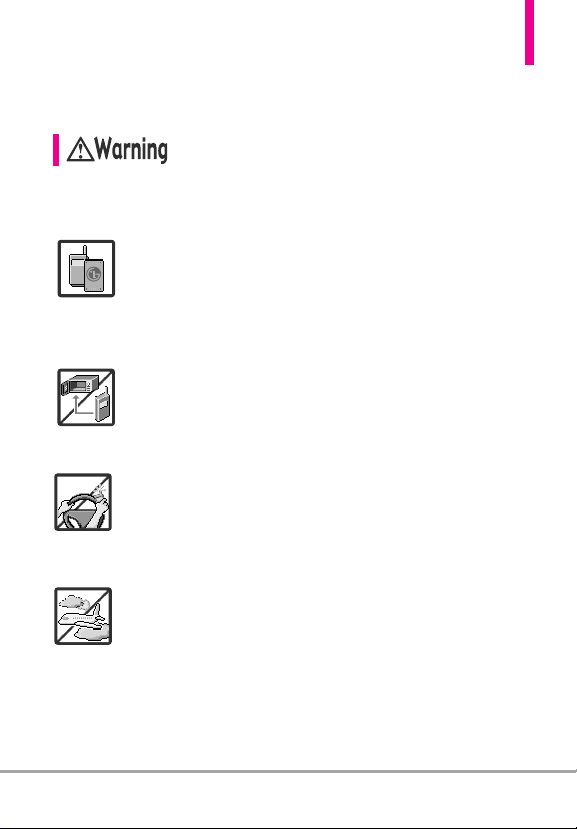
Read these instructions. Breaking the rules may be dangerous or illegal.
Further detailed information is given in this user guide.
Violation of the instructions may cause serious injury or death.
●
Never use an unapproved battery since this could damage
the phone and/or the battery and could cause the
battery to explode.
●
Never place your phone in a microwave oven as it will
cause the battery to explode.
●
Never store your phone in temperatures lower than
-4°F or higher than 122°F.
●
Do not dispose of your battery near fire or with
hazardous or flammable materials.
●
When riding in a car, do not leave your phone or set up
the hands-free kit near the air bag. If wireless equipment
is improperly installed and the air bag is deployed, you
may be seriously injured.
●
Do not use a hand-held phone while driving.
●
Do not use the phone in areas where its use is prohibited.
(For example: aircraft)
Important Safety Precautions
KEYBOII

2
Important Safety Precautions
●
Do not expose the battery charger or adapter to direct
sunlight or use it in places with high humidity, such as a
bathroom.
●
Do not use harsh chemicals (such as alcohol, benzene,
thinner, etc.) or detergent to clean your phone. This could
cause a fire.
●
Do not drop, strike, or shake your phone severely. It may
harm the internal circuit boards of the phone.
●
Do not use your phone in highly explosive areas as the
phone may generate sparks.
●
Do not damage the power cord by bending, twisting,
pulling, or heating. Do not use the plug if it is loose as it
may cause electric shock or fire.
●
Do not place any heavy items on the power cord. Do not
allow the power cord to be crimped as it may cause
electric shock or fire.
●
Do not handle the phone with wet hands while it is being
charged. It may cause an electric shock or seriously
damage your phone.
●
Do not disassemble the phone.
KEYBOII
3
●
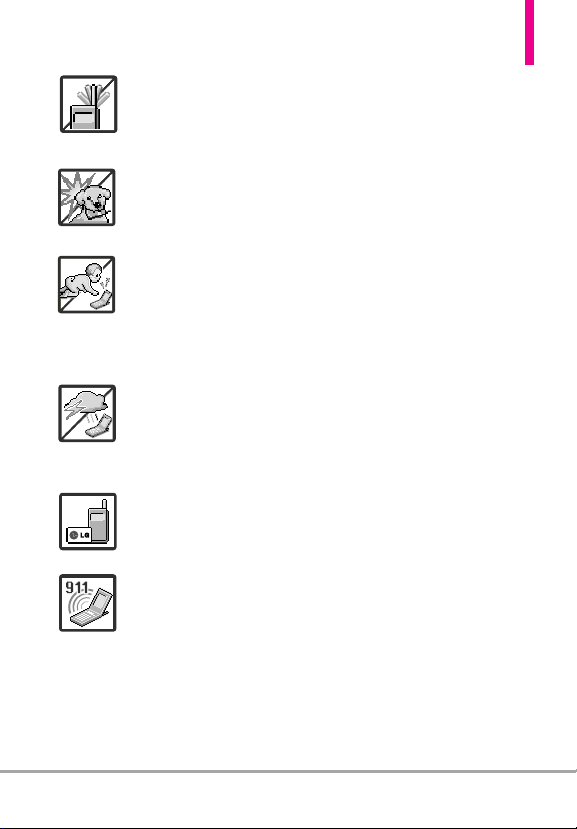
Do not place or answer calls while charging the phone as
it may short-circuit the phone and/or cause electric shock
or fire.
●
Make sure that no sharp-edged items, such as animal’s
teeth or nails, come into contact with the battery. This
could cause a fire.
●
Store the battery out of reach of children.
●
Be careful that children do not swallow any parts (such as
earphone, connection parts of the phone, etc). This could
cause asphyxiation or suffocation resulting in serious
injury or death.
●
Unplug the power cord and charger during lightning
storms to avoid electric shock or fire.
●
Only use the batteries and chargers provided by LG. The
warranty will not be applied to products provided by
other suppliers.
●
Only authorized personnel should service the phone and
its accessories. Faulty installation or service may result in
accidents and consequently invalidate the warranty.
●
Your service provider programs one or more emergency
phone numbers, such as 911, that you can call under any
circumstance, even when your phone is locked. Your
phone’s preprogrammed emergency number(s) may not
work in all locations, and sometimes an emergency call
cannot be placed due to network, environmental, or
interference issues.
KEYBOII

4
Table of Contents
Important Safety Precautions 1
Table of Contents . . . . . . . . . .4
Welcome . . . . . . . . . . . . . . . . . .9
Technical Details . . . . . . . . . .10
Phone Overview . . . . . . . . . . .14
Entering and Editing
Information . . . . . . . . . . . . . . .16
Menu Tree on the Internal
Screen . . . . . . . . . . . . . . . . . . .17
Getting Started with Your
Phone . . . . . . . . . . . . . . . . . . .20
The Battery . . . . . . . . . . . . . . . . . . . . . .20
Installing the Battery . . . . . . . . . . . .20
Removing the Battery . . . . . . . . . . . .20
Charging the Battery . . . . . . . . . . . . . .20
Charging with USB . . . . . . . . . . . . . . . .21
How to Install Your microSD
™
Card . .22
How to Remove Your microSD
™
Card . . . . . . . . . . . . . . . . . . . . . . . . . . . .22
Battery Temperature Protection . . . . .23
Battery Charge Level . . . . . . . . . . . . . . .23
Turning the Phone On and Off . . . . . .23
Turning the Phone On . . . . . . . . . . .23
Turning the Phone Off . . . . . . . . . . .23
Signal Strength . . . . . . . . . . . . . . . . . . .24
Screen Icons . . . . . . . . . . . . . . . . . . . . . .24
Making Calls . . . . . . . . . . . . . . . . . . . . . .24
Redialing Calls . . . . . . . . . . . . . . . . . . . .25
Receiving Calls . . . . . . . . . . . . . . . . . . . .25
Quick Access to Convenient
Features . . . . . . . . . . . . . . . . .26
Vibrate Mode . . . . . . . . . . . . . . . . . . . . .26
Mute Function . . . . . . . . . . . . . . . . . . . .26
Volume Quick Adjustment . . . . . . . . . .26
Call Waiting . . . . . . . . . . . . . . . . . . . . . .26
Shortcuts . . . . . . . . . . . . . . . . . . . . . . . .27
Voice Commands . . . . . . . . . . . . . . . . .27
Contacts in Your Phone’s
Memory . . . . . . . . . . . . . . . . .28
Storing Basics . . . . . . . . . . . . . . . . . . . .28
Customizing Individual Entries . . . . . .29
Speed Dial . . . . . . . . . . . . . . . . . . . . . . .29
Storing a Number with Pauses . . . . . .30
Adding Additional Phone
Number(s) to Existing Contact . . . . . .31
Changing the Default Number . . . . . .31
Deleting . . . . . . . . . . . . . . . . . . . . . . . . .32
Speed Dialing . . . . . . . . . . . . . . . . . . . .33
KEYBOII

5
CONTACTS . . . . . . . . . . . . . . .34
1. New Contact . . . . . . . . . . . . .34
2. Contact List . . . . . . . . . . . . . .34
3. Favourites . . . . . . . . . . . . . . . .35
4. Groups . . . . . . . . . . . . . . . . . .36
5. Speed Dials . . . . . . . . . . . . . .36
6. My Name Card . . . . . . . . . . .37
Call History . . . . . . . . . . . . . . .38
1. Missed Calls . . . . . . . . . . . . . .38
2. Received Calls . . . . . . . . . . . .38
3. Dialed Calls . . . . . . . . . . . . .39
4. All Calls . . . . . . . . . . . . . . . . .39
5. View Call Timers . . . . . . . . . .40
MESSAGING . . . . . . . . . . . . . .41
1. Voicemail . . . . . . . . . . . . . . . .41
2. Create Message . . . . . . . . . . .42
3. Messages . . . . . . . . . . . . . . . .47
4. E-mail . . . . . . . . . . . . . . . . . . .50
5. Instant Messaging . . . . . . . . .50
6. Drafts . . . . . . . . . . . . . . . . . .50
7. Web Alerts . . . . . . . . . . . . . . .51
8. Short Codes . . . . . . . . . . . . . .51
Wireless Web . . . . . . . . . . . . . .54
1. Launch Web . . . . . . . . . . . . . .54
Music & Media . . . . . . . . . . . .55
1. TELUS mobile music . . . . . . .55
1.1 Music Player . . . . . . . . . . . . . . . . . .55
1.2 My Music List . . . . . . . . . . . . . . . . .56
2. TV & Radio . . . . . . . . . . . . . .56
3. Ringtones & Sounds . . . . . . .56
3.1 Get New Ringtones . . . . . . . . . . . .57
3.2 My Ringtones . . . . . . . . . . . . . . . . .57
3.3 My Sounds . . . . . . . . . . . . . . . . . . .57
4. Pictures & Videos . . . . . . . . .58
4.1 Get New Pictures . . . . . . . . . . . . . .58
4.2 Get New Videos . . . . . . . . . . . . . . .58
4.3 My Pictures . . . . . . . . . . . . . . . . . . .59
4.4 My Videos . . . . . . . . . . . . . . . . . . .60
4.5 Take Picture . . . . . . . . . . . . . . . . . .61
4.6 Record Video . . . . . . . . . . . . . . . . .62
5. Memory Info . . . . . . . . . . . . .63
Search . . . . . . . . . . . . . . . . . . .64
1. Maps & Navigation . . . . . . . .64
2. Search the Web . . . . . . . . . . .64
3. Find Ringtones & Wallpapers 64
4. Find Videos . . . . . . . . . . . . . .64
Tools . . . . . . . . . . . . . . . . . . . .65
1. Bluetooth Menu . . . . . . . . . .65
1.1 Add New Device . . . . . . . . . . . . . .65
2. USB Mass Storage . . . . . . . . .69
KEYBOII

6
Table of Contents
3. Voice Recorder . . . . . . . . . . .69
4. Voice Commands . . . . . . . . . .70
4.1 Call <Name or Number> . . . . . . . .70
4.2 Send Msg to <Name or Number> 71
4.3 Go to <Menu> . . . . . . . . . . . . . . . . .71
4.4 Check <Item> . . . . . . . . . . . . . . . . .71
4.5 Lookup <Name> . . . . . . . . . . . . . . .71
4.6 Help . . . . . . . . . . . . . . . . . . . . . . . . .71
5. Calculator . . . . . . . . . . . . . . .72
6. Calendar . . . . . . . . . . . . . . . .72
7. Alarm Clock . . . . . . . . . . . . . .73
8. Stopwatch . . . . . . . . . . . . . . .74
9. World Clock . . . . . . . . . . . . . .74
10. Notepad . . . . . . . . . . . . . . . .75
11. Ez Tip Calc . . . . . . . . . . . . . .75
Games & Apps . . . . . . . . . . . .76
1. Games . . . . . . . . . . . . . . . . . .76
2. Apps . . . . . . . . . . . . . . . . . . . .76
Settings . . . . . . . . . . . . . . . . . .77
1. Sounds Settings . . . . . . . . . . .77
1.1 Easy Set-up . . . . . . . . . . . . . . . . . . .77
1.2 Master Volume . . . . . . . . . . . . . . . .77
1.3 Call Sounds . . . . . . . . . . . . . . . . . .77
1.3.1 Call Ringtone . . . . . . . . . . . . .78
1.3.2 Call Vibrate . . . . . . . . . . . . . . .78
1.3.3 Audio Output . . . . . . . . . . . . .78
1.4 Alert Sounds . . . . . . . . . . . . . . . . .78
1.5 Keypad Volume . . . . . . . . . . . . . . .79
1.6 Service Alerts . . . . . . . . . . . . . . . . .79
1.7 Power On/Off . . . . . . . . . . . . . . . .79
1.8 Voice Clarity . . . . . . . . . . . . . . . . . .80
2. Display Settings . . . . . . . . . . .80
2.1 Easy Set-up . . . . . . . . . . . . . . . . . . .80
2.2 Banner . . . . . . . . . . . . . . . . . . . . . . .81
2.3 Backlight . . . . . . . . . . . . . . . . . . . . .81
2.4 Brightness . . . . . . . . . . . . . . . . . . . .82
2.5 Wallpaper . . . . . . . . . . . . . . . . . . . .82
2.6 Charging Screen . . . . . . . . . . . . . .83
2.7 Clock Format . . . . . . . . . . . . . . . . .83
2.8 Time Format . . . . . . . . . . . . . . . . . .84
3. Games & Apps . . . . . . . . . . .84
3.1 Backlight Settings . . . . . . . . . . . . .84
3.2 Volume . . . . . . . . . . . . . . . . . . . . . .84
3.3 Notifications . . . . . . . . . . . . . . . . . .84
3.4 Others . . . . . . . . . . . . . . . . . . . . . . .85
3.5 Plug-Ins . . . . . . . . . . . . . . . . . . . . . .85
4. Phone Settings . . . . . . . . . . .85
4.1 Airplane Mode . . . . . . . . . . . . . . .85
4.2 Media Mode . . . . . . . . . . . . . . . . . .86
4.3 Set Shortcut Keys . . . . . . . . . . . . .86
4.4 Voice Commands . . . . . . . . . . . . . .86
4.4.1 Prompts . . . . . . . . . . . . . . . . . .86
KEYBOII

7
4.4.2 Call Alert . . . . . . . . . . . . . . . . .87
4.5 Language . . . . . . . . . . . . . . . . . . . . .87
4.6 Location . . . . . . . . . . . . . . . . . . . . .87
4.7 Security . . . . . . . . . . . . . . . . . . . . . .88
4.7.1 Edit Codes . . . . . . . . . . . . . . . .88
4.7.2 Restrictions . . . . . . . . . . . . . . .88
4.7.3 Phone Lock . . . . . . . . . . . . . . .89
4.7.4 Camera Lock . . . . . . . . . . . . . .90
4.7.5 Lock Phone Now . . . . . . . . . . .90
4.7.6 Reset Default . . . . . . . . . . . . . .90
4.8 S
yst
em Select . . . . . . . . . . . . . . . . .
90
4.9 NAM Select . . . . . . . . . . . . . . . . . .91
4.10 Serving System . . . . . . . . . . . . . . .91
5. Call Settings . . . . . . . . . . . . . .91
5.1 Answer Options . . . . . . . . . . . . . . .91
5.2 End Call Options . . . . . . . . . . . . . .92
5.3 Auto Retry . . . . . . . . . . . . . . . . . . .92
5.4 TTY Mode . . . . . . . . . . . . . . . . . . .92
5.5 One Touch Dial . . . . . . . . . . . . . . .94
5.6 DTMF Tones . . . . . . . . . . . . . . . . . .94
5.7 Auto Prepend . . . . . . . . . . . . . . . . .94
5.8 Do Not Disturb . . . . . . . . . . . . . . .94
5.9 International Dialing Code . . . . .95
6. Memory . . . . . . . . . . . . . . . . .95
6.1 Save Options . . . . . . . . . . . . . . . . .95
6.2 Phone Memory . . . . . . . . . . . . . . .96
6.3 Card Memory . . . . . . . . . . . . . . . . .96
6.4 USB Mass Storage . . . . . . . . . . . .96
7. Phone Info . . . . . . . . . . . . . . .97
7. 1 My Number . . . . . . . . . . . . . . . . . . .97
7. 2 SW/HW Version . . . . . . . . . . . . . . .97
7. 3 Icon Glossary . . . . . . . . . . . . . . . . .97
Safety . . . . . . . . . . . . . . . . . . .98
TIA Safety Information . . . . . . .98
Exposure to Radio Frequency
Signal . . . . . . . . . . . . . . . . . . . . . . . . .98
Antenna Care . . . . . . . . . . . . . . . . . . .98
Phone Operation . . . . . . . . . . . . . . .98
Tips on Efficient Operation . . . . . . .99
Driving . . . . . . . . . . . . . . . . . . . . . . . .99
Electronic Devices . . . . . . . . . . . . . . .99
Pacemakers . . . . . . . . . . . . . . . . . . . . .99
Hearing Aids . . . . . . . . . . . . . . . . . .100
Other Medical Devices and
Health Care Facilities . . . . . . . . . . .100
Vehicles . . . . . . . . . . . . . . . . . . . . . . .100
Aircraft . . . . . . . . . . . . . . . . . . . . . . .100
Blasting Areas . . . . . . . . . . . . . . . . .100
Potentially Explosive Atmosphere 100
For Vehicles Equipped with
an Air Bag . . . . . . . . . . . . . . . . . . . . .101
Safety Information . . . . . . . . . .101
KEYBOII

8
Table of Contents
Charger and Adapter Safety . . . . .102
Battery Information and Care . . . .102
Explosion, Shock, and Fire
Hazards . . . . . . . . . . . . . . . . . . . . . . .104
General Notice . . . . . . . . . . . . . . . .105
Caution: Avoid potential
hearing loss. . . . . . . . . . . . . . . .106
FDA Consumer Update . . . . . .108
10 Driver Safety Tips . . . . . . . .115
Consumer Information on SAR 118
FCC Hearing-Aid Compatibility
(HAC) Regulations for
Wireless Devices . . . . . . . . . . . .120
Accessories . . . . . . . . . . . . . .123
LIMITED WARRANTY
STATEMENT . . . . . . . . . . . .124
Glossary . . . . . . . . . . . . . . . .127
Terminology . . . . . . . . . . . . . .127
Acronyms and Abbreviations . .127
Index . . . . . . . . . . . . . . . . . . .129
KEYBOII

9
KEYBOII
Welcome
Thank you for choosing the
KEYBOII
cellular phone designed to
operate with the latest digital
mobile communication technology,
Code Division Multiple Access
(CDMA). Along with the many
advanced features of the CDMA
system, such as greatly enhanced
voice clarity, this compact phone
offers:
●
Instant Messaging, E-mail
●
50-key internal keypad
●
21-key external keypad and
screen with auto screen lock
●
Themes display and
screensavers
●
Built-in 3.0 Megapixel digital
camera
●
External easy-to-read 5-line LCD
screen with status icons
●
Int
ernal, easy-to-read, 8-line
backlit LCD with status icons
●
Paging, messaging, voicemail,
and caller ID
●
HTML Web Browser
●
Long battery standby and talk
time
●
Any key answer, auto answer
with hands-free accessories,
auto retry, one-touch and speed
dialing with 99 memory
locations
●
Bilingual (English and French)
capability
●
Bluetooth
®
wireless technology
NOTE
The Bluetooth
®
word mark and
logos are owned by the
Bluetooth SIG, Inc. and any use
of such marks by LG Electronics
is under license. Other
trademarks and trade names are
those of their respective owners.

10
Technical Details
Important Information
This user’s guide provides
important information on the use
and operation of your phone.
Please read this guide carefully
prior to using the phone to be
able to use your phone to its
greatest advantage and to prevent
any accidental damage or misuse.
Any unapproved changes or
modifications will void your
warranty.
Technical Details
The
KEYBOII
is an all digital phone
that operates on both Code
Division Multiple Access (CDMA)
frequencies: cellular services at
800 MHz and Personal
Communication Services (PCS) at
1.9 GHz.
CDMA technology uses a feature
called DSSS (Direct Sequence
Spread Spectrum) that enables the
phone to keep communication
from being crossed and to use one
frequency channel by multiple
users in the same specific area.
This results in a 10-fold capacity
increase when compared with
analog mode. In addition, features
such as soft/softer handoff, hard
handoff, and dynamic RF power
control technologies combine to
reduce call interruptions.
The Cellular and PCS CDMA
networks consist of MSO (Mobile
Switching Office), BSC (Base
Station Controller), BTS (Base
Station Transmission System), and
MS (Mobile Station).
1xRTT system receives twice as
many subscribers in the wireless
section as IS-95. Its battery life is
twice as long as IS-95. High-speed
data transmission is also possible.
EV-DO system is optimized for
data service and is much faster
than 1xRTT system in applicable
area.
The table on the following page
lists some major CDMA standards.
FCC RF Exposure Information
WARNING! Read this information
before operating the phone.
In August 1996, the Federal
Communications Commission (FCC)
of the United States, with its action
in Report and Order FCC 96-326,
adopted an updated safety standard
for human exposure to Radio
Frequency (RF) electromagnetic
KEYBOII

11
KEYBOII
CDMA
Standard
Designator Description
Basic Air
Interface
TIA/EIA-95A
TSB-74
ANSI J-STD-008
TIA/EIA-IS2000
CDMA Dual-Mode Air Interface
14.4kbps Radio Link Protocol and
Inter-Band Operations
IS-95 Adapted for PCS Frequency Band
CDMA2000 1xRTT Air Interface
Network
TIA/EIA/IS-634
TIA/EIA/IS/651
TIA/EIA/IS-41-C
TIA/EIA/IS-124
MAS-BS
PCSC-RS
Intersystem Operations
Non-Signaling Data Communications.
Service
TIA/EIA/IS-96-B
TIA/EIA/IS-637
TIA/EIA/IS-657
IS-801
TIA/EIA/IS-707-A
Speech CODEC
Short Message Service
Packet Data
Position Determination Service (gpsOne)
High Speed Packet Data
1x EV-DO
Related
Interface
TIA/EIA/IS-856
TIA/EIA/IS-878
TIA/EIA/IS-866
TIA/EIA/IS-890
CDMA2000 High Rate Packet Data Air Interface
1x EV-DO Inter-Operability Specification for HRPD
Access Network Interfaces
Recommended Minimum Performance Standards for
HRPD High Rate Packet Data Access Terminal
Test Application Specification (TAS) for High Rate
Packet Data Air Interface
energy emitted by FCC regulated
transmitters. Those guidelines are
consistent with the safety standard
previously set by both U.S. and
international standards bodies. The
design of this phone complies with
the FCC guidelines and these
international standards.
Bodily Contact During Operation
This device was tested for typical
use with the back of the phone
kept 0.79 inches (2.0 cm) from
the body. To comply with FCC RF
exposure requirements, a minimum
separation distance of 0.79 inches
(2.0 cm) must be maintained
between the user’s body and the
back of the phone, including the
antenna, whether extended or

12
Technical Details
retracted. Third-party belt-clips,
holsters, and similar accessories
containing metallic components
should not be used. Avoid the use
of accessories that cannot maintain
0.79 inches (2.0 cm) distance
between the user’s body and the
back of the phone and have not
been tested for compliance with
FCC RF exposure limits.
Vehicle-Mounted External
Antenna
(Optional, if available.)
To satisfy FCC RF exposure
requirements, keep 8 inches (20
cm) between the user / bystander
and vehicle-mounted external
antenna. For more information
about RF exposure, visit the FCC
website at www.fcc.gov.
FCC Notice and Cautions
This device and its accessories
comply with part 15 of FCC rules.
Operation is subject to the
following two conditions: (1) This
device and its accessories may not
cause harmful interference, and (2)
this device and its accessories must
accept any interference received,
including interference that causes
undesired operation.
Any changes or modifications not
expressly approved in this user
guide could void your warranty for
this equipment. Use only the
supplied antenna. Use of
unauthorized antennas (or
modifications to the antenna) could
impair call quality, damage the
phone, void your warranty and/or
violate FCC regulations.
Don't use the phone with a
damaged antenna. A damaged
antenna could cause a minor skin
burn. Contact your local dealer for a
replacement antenna.
KEYBOII

13
Part 15.105 statement
This equipment has been tested
and found to comply with the
limits for a class B digital device,
pursuant to Part 15 of the FCC
Rules. These limits are designed to
provide reasonable protection
against harmful interference in a
residential installation. This
equipment generates, uses, and can
radiate radio frequency energy and,
if not installed and used in
accordance with the instructions,
may cause harmful interference to
radio communications. However,
there is no guarantee that
interference will not occur in a
particular installation. if this
equipment does cause harmful
interference or television reception,
which can be determined by
turning the equipment off and on,
the user is encouraged to try to
correct the interference by one or
more of the following measures:
- Reorient or relocate the receiving
antenna.
- Increase the separation between
the equipment and receiver.
- Connect the equipment into an
outlet on a circuit different from
that to which the receiver is
connected.
- Consult the dealer or an
experienced radio/TV technician
for help.
KEYBOII

14
Phone Overview
KEYBOII
1. Earpiece Lets you hear the caller.
2. CONTACTS Key Use to access the Contact List.
3.
Camer
a Key
Use for quick access to Camera
function.
4.
Volume Keys Use to adjust the Master Volume in
standby mode* and the Earpiece Volume during a
call.
5.
SEND Key Use to make and answer calls.
6.
Vibrate Mode Key From standby mode*, press and
hold for about 3 seconds to activate Vibrate Mode.
7.
Accessory/ Charger Port Connects the phone to
the battery charger, or other compatible accessory.
8.
Alphanumeric keypad Use to enter numbers and
characters and select menu items
9.
Lock Mode Key Use to lock phone with 4-digit
password.
10.
microSD
™
Slot Accommodates an optional
microSD
™
card.
11.
OK Key/Directional Keys
Use to unlock the
screen, access the Menu, and accept entered or
highlighted information. Use for quick, convenient
navigation. From standby mode, access Messaging
(by pressing Up), My Pictures (Left), Call History
(Down), and the Create Message menu (Right). You
can view more information on page 27. When
navigating menus, use the Directional Keys to scroll
to choices and settings.
12. PWR/END Key Use to turn the power on/off and
to end a call. Also returns to standby mode.*
13.
CLR Key/Voice Commands Key Deletes single
spaces or characters with a quick touch, but press
and hold to delete entire words. Also backs out of
menus, one level at a time. In standby mode*,
simply press the key to start Voice Commands or
press and hold to start recording a new sound.
14.
Headset Jack Allows you to plug in an optional
headset for convenient, hands-free conversations.
Plug headset into the 2.5mm jack located at the
top right corner of the device.
15.
External LCD Screen Allows you to view incoming
calls, messages and icons indicators as well as a
wide variety of content you select for viewing.
16.
Camera Lens Used for taking pictures and
recor
ding video. Keep it clean for optimal photo
quality.
14. Headset Jack
1. Earpiece
2. CONTACTS Key
5. SEND Key
6. Vibrate Mode Key
13. CLR Key/Voice
Commands Key
10. microSD
™
Slot
12. PWR/END Key
11. OK Key/Directional Keys
7. Acce
ssory/Charger Port
9. Lock Mode Key
4. Volume Keys
3. Camera Key
16. Camera Lens
15. External LCD
Screen
8. Alphanumeric keypad

15
KEYBOII
1. Left Soft Key
Use to access Me
ssage menu when in
Standby mode, or other function displayed at the
bottom left of the LCD.
2. FAVOURITES Key Add up to 10 favorite contacts
or groups as Favorites, so you can easily make calls,
send messages, and review messages.
3.
Multi-tasking Key When an application is running in
the background, use this Multi-tasking key to manage
applications. When no applications are running in the
background, use this Shortcut key for convenient
access to a list of 10 customizable shortcuts.
4.
Shift Key Use to change letter case when typing.
5.
Sym Key Use to insert symbols (displayed at the
top of designated keys) into your text.
6. Game Directional Keys Use for game navigation.
7.
Alphanumeric Keypad Use to enter numbers and
characters and select menu items.
8.
Space/TTS (Text to Speech) Key Use to enter a
space while editing. TTS (Text to Speech) function is
available with in Messaging Inbox, and Notepad.
Use to activate Voice Commands in standby mode.
9.
Return Key Moves cursor to the next line.
10.
CLR/Voice Command Key Press to delete a single
space or character, or press and hold to delete a
specific word plus its space. Press once in a menu
to go back one level.
11.
Speakerphone Key Use to activate Speakerphone
Mode.
12.
Directional Keys Use for quick, convenient
navigation. From standby mode, access My Email
2.0 (Up), Wireless Web (Left), Messenger 2.0
(Down), and TELUS Mobile Music (Right). In
menus use to scroll to choices and settings.
13.
OK Key Use to activate a selected screen item.
14. PWR/END K
ey
Use to turn the power on/off and
to end a call. Use to return to standby mode.
15.
SEND Key Use to make or answer calls.
16.
Right Soft Key Use to access the Contact List
when in Standby mode, or select the option
displayed at the bottom right of the LCD.
17.
LCD Screen Displays incoming calls, messages and
indicator icons as well as a wide variety of content
you select to view.
18.
Light Sensor Automatically adjusts the brightness
of the main LCD to disable this sensor and set the
brightness to a fixed level, use the Brightness
submenu in the Display menu.
19.
Speakers Lets you hear the caller's voice, music
and video in speakerphone mode.
19. Speakers
18. Light Sensor
7. Alphanumeric
Keypad
8. Space/TTS
(Text to Speech) Key
9. Return Key
5. Sym Key
1. Left Soft Key
4. Shift Key
3. Multi-tasking Key
10. CLR Key
13. OK Key
15. SEND Key
16. Right Soft Key
11. Speakerphone Key
12. Directional Keys
14. PWR/END Key
6. Game Directional
Keys
17. LCD Screen
2. FAVOURITES Key

16
Entering and Editing Information
KEYBOII
From the Internal Qwerty Keypad
Press this key to access your Favorite
contacts list. From here you can
easily make calls, send and view
messages.
Use the arrow keys to go to next field
such as recipient address, text, picture
and video depending on the message
types. Use the Key to send a
message when finished.
Use to enter
letters.
Use to insert a
space between a
letter, words and
sentences.
Press this key first and then any
key with a symbol on it to
insert that symbol in your
message.
Use to go to next
line editing your
message.
Use to delete a letter,
words or sentences. Also
use it to exit the menu and
go back to standby mode.
Use to enter numbers.
When creating a Text, Picture or Video message using the inside LCD, use
the Qwerty keypad.
17
KEYBOII
Menu Tree on the Internal Screen
C
C
ont
ont
act
act
s
s
1. New Contact
2. Contact List
3. Favourites
4. Groups
5. Speed Dials
6. My Name Card
Call Hist
Call Hist
ory
ory
1. Missed Calls
2. Received Calls
3. Dialed Calls
4. All Calls
5. View Call Timers
Me
Me
ssaging
ssaging
1. Voicemail
2. Create Message
3. Message
4. E-mail
5. Instant
Messaging
6. Drafts
7. Web Alerts
8. Short Codes
W
W
ir
ir
ele
ele
ss W
ss W
eb
eb
1. Launch Web
Music & Media
Music & Media
1. TELUS mobile
music
1. Music Player
2. My Music List
2. TV & Radio
3. Ringtones &
Sounds
1. Get New
Ringtones
2. My Ringtones
3. My Sounds
4. Pictures & Videos
1. Get New
Pictures
2. Get New
Videos
3. My Pictures
4. My Videos
5. Take Picture
6. Record Video
5. Memory Info
Sear
Sear
ch
ch
1. Maps &
Navigation
2. Search the Web
3. Find Ringtones &
Wallpapers
4. Find Videos

18
KEYBOII
Menu Tree on the Internal Screen
T
T
ools
ools
1. Bluetooth Menu
2. USB Mass
Storage
3. Voice Recorder
4. Voice Commands
5. Calculator
6. Calendar
7. Alarm Clock
8. Stopwatch
9. World Clock
10. Notepad
11. Ez Tip Calc
Game
Game
s & Apps
s & Apps
1. Games
2. Apps
Se
Se
t
t
tings
tings
1. Sounds Settings
1. Easy Set-up
2. Master Volume
3. Call Sounds
4. Alert Sounds
5. Keypad Volume
6. Service Alerts
7. Power On/Off
8. Voice Clarity
2. Display Settings
1. Easy Set-up
2. Banner
3. Backlight
4. Brightness
5. Wallpaper
6. Char
ging
Screen
7. Clock Format
8. Time Format
3. Games & Apps
1. Backlight
Settings
2. Volume
3. Notifications
4. Others
5. Plug-Ins
4. Phone Settings
1. Airplane Mode
2. Media Mode
3. Set Shortcut
Keys
4. Voice
Commands
5. Language
6. Location
7. Security
8. System Select
9. NAM Select
10. Serving System
5. Call Settings
1. Answer
Options
2. End Call
Options
3. Auto Retry
4. TTY Mode
5. One Touch
Dial
6. DTMF Tones
7. Auto Prepend
8. Do Not
Disturb

19
9. International
Dialing Code
6. Memory
1. Save Options
2. Phone Memory
3. Card Memory
4. USB Mass
Storage
7. Phone Info
1. My Number
2. SW/HW
Version
3. Icon Glossary
KEYBOII
NOTE
Keyguard Settings
is available on the
External display.
1. Press to unlock
2. Press
MENU
3. Use key to scroll to
KEY GUARD and press
4. Select
Keyguard Timer:
Always Off/7 Seconds/
15 Seconds/30 Seconds
20
Getting Started with Your Phone
The Battery
NOTE
It is important to fully charge the
battery before initial use of the phone.
The phone comes with a
rechargeable battery. Keep the
battery charged while not in use in
order to maximize talk and standby
time. The battery charge level is
shown at the top of the LCD
screen.
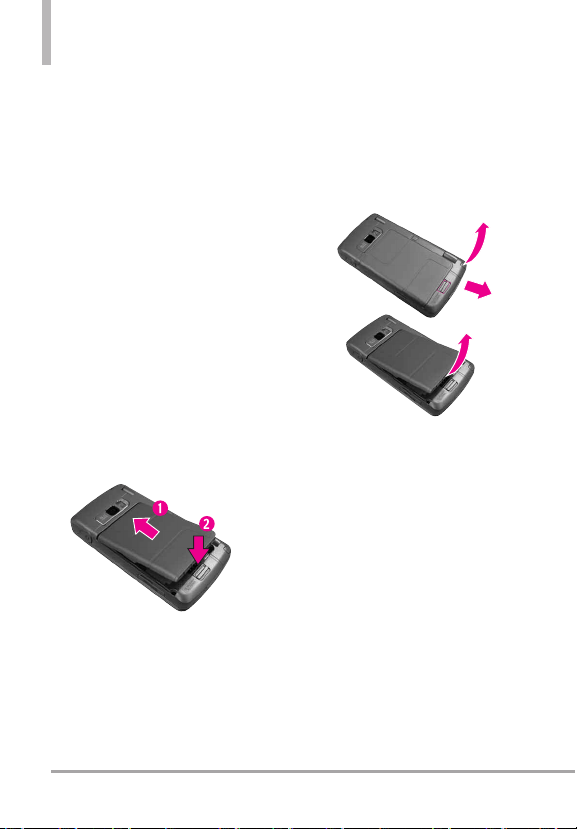
Installing the Battery
To install the battery, insert the top
edge (opposite the battery
terminals) of the battery into the
opening on the back of the phone.
Push the bottom of the battery
down until it clicks into place.
Removing the Battery
Turn power off using the PWR/END
Key. Slide the battery release latch
away from the edge of the battery,
then lift the edge of the battery to
remove it.
Charging the Battery
NOTICE
Please use only an approved charging
accessory to charge your LG phone.
Improper handling of the charging port, as
well as the use of an incompatible charger,
may cause damage to your phone and
void the warranty.
KEYBOII

21
KEYBOII
1. Plug the end of the adapter into
the phone’s charger port and the
other end into an electrical
outlet.
2. The charge time varies
depending upon the battery
level.
Charging with USB
You can use your computer to
charge your phone. To be able to
charge with the USB cable, you
need to have the necessary USB
drivers installed on your PC first.
Connect one end of the USB cable
to the charging accessory port on
your phone and the other end to a
highpower USB port on your PC
(commonly located on the front
panel of the computer). It is best to
use the rear USB port when
connecting to a desktop PC. A USB
Hub should be powered by an
external power source (see Note
below).
NOTE
●
Low-power USB ports are not
supported, such as the USB
port on your keyboard or bus-
powered USB hub.
NOTICE
Please make sure that the
'B' Side faces up before
inserting a charger or data cable into
the charger port of your phone.

22
Getting Started with Your Phone
KEYBOII
How to Install Your microSD
™
Card
1. Locate the microSD
™
slot on the
right side of the phone and
gently uncover the slot opening
(microSD
™
slot cover stays
attached to the phone so you
don't lose it).
2. Insert the microSD
™
card facing
up and push until it clicks into
the slot. If you insert the card in
the wrong direction, it may
damage your phone or your
card.
How to Remove Your
microSD
™
Card
1. Push the card in to release the
exposed edge of the microSD
™
card to eject it.
2. Remove the microSD
™
card from
the slot and replace the cover.
NOTE
l
Do not attempt to remove the
microSD
™
card while reading or
writing to the card.
l
Users wishing to transfer or
do
wnload music onto a
MicroSD
™
card inserted into this
phone (through USB Mass
Storage or Over the air) should
format the MicroSD
™
card on
this handset before using it
through
(
Menu -> Settings -> Memory ->
Card Memory -> Options ->
Format
). Warning: Formatting
the MicroSD
™
card will erase all
contents on the card. In the
event the MicroSD
™
car
d is used
on this phone without first
formatting it, the phone will
display a “License acquisition
failed” during OTA downloading.
Files downloaded or otherwise
purchased from third party
providers and stored on a
MicroSD
™
card inserted into this
device may be protected or
encrypted by such provider and
cannot be played on this device.

23
KEYBOII
Battery Temperature
Protection
Though extremely rare, if the
battery becomes overheated, the
phone will automatically turn off.
When you turn the phone back on,
a message pops up alerting you
that the phone was powered off for
your safety.
Battery Charge Level
You can find the battery charge
level at the top right of the LCD
screen. When the charge level
becomes low, the battery sensor
sounds a warning tone, blinks the
battery icon, and displays a warning
message. As the charge level
approaches empty, the phone
automatically switches off without
saving.
Turning the Phone On and
Off
Turning the Phone On
Using the Internal Keypad
1. Install a charged battery or
connect the phone to external
power source.
2. Open the flip and press
for a few seconds until the LCD
screen lights up.
Using the External Power Key
1. Install a charged battery or
connect the phone to external
power source.
2. Press and hold until the
LCD screen lights up.
Turning the Phone Off
Using the Internal Keypad
1. Press and hold until the
display turns off.
Using the External Power Key
1. Unlock the screen by pressing
once.
2.
Press and hold until the
display turns off.
24
Getting Started with Your Phone
KEYBOII
Signal Strength
Call quality depends on the signal
strength in your area. You can tell
how much signal strength you have
by the number of bars next to the
signal strength icon: the more bars,
the stronger the signal. If you’re
having problems with signal quality,
move to an open area or, when
inside a building, try moving
towards a nearby window.
Screen Icons
When the phone is on, the top line
of the LCD screen displays phone
status icons.
Using the Internal Keypad
To see the icon glossary, go to
MENU
Ô
Settings
Ô
Phone Info
Ô
Icon Glossary
on your phone.
Making Calls
Make sure the phone is turned on.
If necessary, enter the lock code.
NOTE
To activate the speakerphone
during a call, simply open the flip.
Using the External Keypad
1. Unlock the screen by pressing
once.
2. Enter the phone number (include
the area code, if needed).
3. Press the key.
4. Press the key to end the
call.
Using the Internal Keypad
1. Open the flip and enter the
phone number (include the area
code, if needed).
2. Press the key.
3.
Press the key to end the call.
Correcting Dialing Mistakes
If you make a mistake while dialing
a number, press once to erase
the last digit entered, or hold down
for at least 2 seconds to
delete all digits. When using
external keypad, use
.

25
Redialing Calls
Press and hold the external
key or the internal key to
redial the last number you dialed,
received or missed in call history.
The last 270 numbers are stored in
the call history list and you can
select any of these to redial.
Receiving Calls
Using the External Keypad
1. When the phone rings or vibrates,
press the key.
2.
Press the key to end the call.
NOTE
Simply press the key to
immediately silence the ringtone
or vibration for that call. Or, you
can press the key twice, then
select
Quiet. (1=Quiet,
2=Ignore).
NOTE
To ignore the incoming call, press
the key twice to
immediately end the call. Or, you
can press the key twice, then
select
Ignore.
Using the Internal Keypad
1. There are several ways of
answering a call, depending on
your selected Answer Options
(for instructions on how to set
your preferences, see page 110):
●
Flip Open
: Open the flip.
●
Any Key
: Press the
key
or,
with the phone unlocked, press
any other key except the
key
.
●
Auto with Handsfree
: The call
automatically connects when
connected to a handsfree
device.
NOTE
If you press the Left Soft Key
[
[
Q
Q
u
u
i
i
e
e
t
t
]
]
while the phone is ringing
and the flip is open, the ringing or
vibration is muted for that call.
NOTE
If you press the Right Soft Key
[
[
I
I
g
g
n
n
o
o
r
r
e
e
]
]
while the phone is ringing
and the flip is open, the call will end
or go to voicemail.
NOTE
If you press while the phone is
ringing and the flip is already open,
the call will end and will be able to
select a Quick Text to send to the
caller.
KEYBOII

26
Quick Access to Convenient Features
KEYBOII
Vibrate Mode
Sets the phone to vibrate instead
of ring ( is displayed on the
Status bar). To set Vibrate Mode,
press and hold on the
internal keypad, or on the
external keypad (after unlocking
the phone if locked).
To return to Normal Mode, press
and hold again on the
internal keypad, or on the
external keypad.
Mute Function
The Mute Function prevents the
transmission of your voice to the
caller. To quickly activate Mute
using the internal keypad, press
the Left Soft Key
[Mute]
during the call. To unmute press
the Left Soft Key
[Unmute]
again.
When the flip is closed, press
[
OPTIONS
], then press
[
Mute
]. To unmute, press
[
OPTIONS
], then press
[
Unmute
].
Volume Quick Adjustment
Quickly adjust ringer and earpiece
volumes by pressing the upper
volume key to increase and the
lower volume key to decrease.
NOTE
The earpiece volume can only be
adjusted during a call.
Call Waiting
During a call, one beep indicates
that you have another incoming call.
Ignoring a Call Waiting
If you don't want to answer the
incoming call, press the Right Soft
Key
[Ignore] when the flip
is open. When the flip is closed,
you can ignore the call by pressing
[
OPTIONS] and selecting
Ignore.
Answering a Call Waiting
1. Press the internal key /
the external key whether
the flip is open or closed to
automatically put the first call
on hold and answer the new call.
2. Press the internal key /
the external key again to
put the second call on hold and
return to the first call.

27
KEYBOII
Shortcuts
Your
KEYBOII
device has shortcut
keys built in to allow quick and
convenient access to phone
features.
NOTE
The preset shortcuts for the
internal keypad can be changed
to suit your needs.
External Directional Keys
Shortcut Access
1. Unlock the screen by pressing
once or twice.
2. Press the Navigation Key:
●
Up Navigation Key
accesses
MESSAGING
●
Down Navigation Key
accesses
CALL HISTORY
●
Left Navigation Key
acce
sses
My Pictures
●
Right Navigation Key
accesses
Create Message
Internal Directional Keys
Shortcut Access
1. Open the flip.
2. Press the Navigation Key:
●
Up Navigation Key
accesses
My Email
●
Down Navigation Key
accesses
Instant Messengers
●
Left Navigation Key
accesses
WIRELESS WEB
●
Right Navigation Key
accesses
TELES mobile music
Voice Commands
Voice Commands allow you to do
things by verbal command (e.g.,
make calls, confirm Voicemail,
etc.).
1. Access the Voice Commands
feature:
●
With the flip open, press .
●
With the flip closed and the
screen unlocked, give the
a quick press (an extended press
activates the Voice Recorder
feature instead).
2. Follow the prompts to use your
voice command(s).
NOTE
Voice Commands can also be
started with the designated key
on your Bluetooth
®
device.
Please check the manual of the
Bluetooth
®
device for further
instructions.
Storing Basics
Using the Internal Keypad
1. Open the flip.
2. Enter a number (max. 48 digits),
then press the Left Soft Key
[Save]
.
3.
Use the Directional Key to
scroll to
Add New Contact/
Update Existing
, then press .
4. Use the Directional Key to
scroll to
Mobile 1/Home/Work/
Mobile 2/Fax,
then press .
5. Enter a name (max. 32
characters), then press to
save.
6. Press to exit, to call,
or the Right Soft Key
[Options] for other options.
Using the External Keypad
1. Unlock the screen by pressing
once or twice.
2. Enter a number (max. 48 digits),
then press
[OPTIONS].
3. Press to Save.
4. Use the Directional Key to
scroll to
Mobile 1/Home/Work
/
Mobile 2/Fax,
then press .
5.
Enter a name (max. 32
characters), then press to
save.
Using the External Keypad with
the Contacts Menu
1. Unlock the screen by pressing
once or twice.
2. Press [
MENU].
3. Use the Directional Key to
scroll to Contacts, then press
.
4. Press
New Contact.
5. Enter the name, then use the
Directional Key to scroll
down to the phone number
type you want to enter.
6. Enter the n
umber, then press
to
save.
28
Contacts in Your Phone’s Memory
KEYBOII
29
KEYBOII
Customizing Individual Entries
Using the Internal Keypad
1. Press the Right Soft Key
[Contacts], use the Directional
Key to scroll to an entry.
2. Press the VIWE and press
[Edit].
3. Use the Directional Key to
scroll to the information to
customize.
4. Change the entry as you want,
then press to save your
changes.
NOTE
The external keypad cannot be
used to customize an existing
Contact entry.
Speed Dial
Allows you to set up your Speed
Dials.
Using the Internal Keypad
1. Press the Right Soft Key
[Contacts], then use the
Directional Key to scroll to an
entry.
2. Press the VIWE and press
[Edit].
3. Use the Directional Key to
scroll to a phone number, then
press the Right Soft Key
[Options].
4. Use the Directional Key to
scroll to
Set Speed Dial
, then
press .
5. Enter a Speed Dial digit.
●
Use the keypad, then press
to set.
●
You can also use the
Directional Key to scroll
to the Speed Dial digit, then
press to set.
6. Screen prompt appears
Assign
Speed Dial to Contact?
Press
to select
Ye s , then press
to select
No.

30
Contacts in Your Phone’s Memory
KEYBOII
Storing a Number with
Pauses
Pauses allow you to enter
additional series of numbers to
access automated systems such as
Voicemail or credit billing
numbers. Pause types are:
Wait
(W) The phone stops dialing until
you press the Right Soft Key
[Options]
to advance to the
next number.
Pause
(P) The phone
waits two seconds before
advancing to the next number.
Using the Internal Keypad
1. Enter a number, then press the
Right Soft Key
[Options]
.
2. Use the Directional Key
to scroll to
Pause
or
Wait,
then
press .
3. Enter additional number(s)
(e.g., pin number, credit card
number, etc.).
4. Press the Left Soft Key
[Save]
.
5. Complete the Contact entry as
necessary.
Using the External Keypad
1. Unlock the screen by pressing
once or twice.
2. Enter a number, then press
[OPTIONS].
3. Use the Directional Key
to scroll to
Pause
or
Wait,
then
press .
4. Enter additional number(s)
(e.g., pin number, credit card
number, etc.).
5. Press
[OPTIONS] and
select
Save.
6. Complete the Contact entry as
necessary.

31
KEYBOII
Adding Additional Phone
Number(s) to Existing
Contact
From Standby Mode Using the
Internal Keypad
1. Enter a phone number, then
press the Left Soft Key
[Save]
.
2. Use the Directional Key
to scroll to
Update Existing
,
then press .
3. Use the Directional Key
to scroll to an existing entry,
then press .
4. Use the Directional Key
to scroll to
Mobile 1/Home/
Work/Mobile 2/Fax
, then press
to save.
From the Contact List Screen
Using the Internal Keypad
1. Press the Right Soft Key
[Contacts].
2. Use the Directional Key to
scroll to an entry, then press
the
[VIEW]
and press
[Edit]
.
3. Use the Directional Key
to scroll to the phone number
field to add, then enter the
number and press to save.
Changing Saved Information
Using the Internal Keypad
1. Press the Right Soft Key
[Contacts].
2. Use the Directional Key to
scroll to an entry, then press
the
[VIEW]
and press
[Edit]
.
3. Use the Directional Key
to scroll to the field you want
to change.
4. Make the changes, then press
to save.
Changing the Default
Number
The Default Number is the first
phone number you entered when
you created the Contact. Another
number can be saved as the
Default Number.

32
KEYBOII
Contacts in Your Phone’s Memory
Using the Internal Keypad
1. Press the Right Soft Key
[Contacts].
2. Use the Directional Key
to scroll to an entry.
3. Press the Right Soft Key
[Options] and press 4 [Edit].
4. Use the Directional Key
to highlight a phone number,
then press the Right Soft Key
[Options].
5. Use the Directional Key
to highlight
Set As Default
,
then press .
6. A confirmation message is
displayed. Press to set the
new number as the default.
7. Press again to save.
Deleting
Deleting a Phone Number Using
the Internal Keypad
1. Press the Right Soft Key
[Contacts].
2. Use the Directional Key
to scroll to an entry.
3. Press the
[VIEW]
and press
[Edit]
.
4. Use the Directional Key to
scroll to a phone number.
5.
Press and hold to delete it.
6. Press .
NOTE
This will only work when you
have more than one number
listed per contact.
Deleting a Contact Entry Using
the Internal Keypad
1.
Press the Right Soft Key
[Contacts].
2. Use the Directional Key
to scroll to an entry.
3. Press the Right Soft Key
[Options]
, then press
Erase
.
4. Press
[Yes]
.
Deleting a Speed Dial
Using the Internal Keypad
1. Press the Right Soft Key
[Contacts].
2. Use the Directional Key
to highlight a Contact entry to
edit and press
[VIEW]
.

33
KEYBOII
3. Select the phone number with
the Speed Dial, then press
[EDIT]
.
4. Press the Right Soft Key
[Options].
5. Press
Remove Speed Dial
.
6. Press
[Yes]
.
7. Press to save.
Speed Dialing
Allows you to make phone calls
quickly and easily to numbers
stored in Contacts. You need to
set Speed Dials in your Contacts
before using this feature.
NOTE
Speed Dial 1 is for Voicemail.
Single Digit Speed Dials
From the Standby screen, press
and hold the Speed Dial digit. Your
phone recalls the phone number
from your Contacts, displays it, and
dials it for you.
Multiple Digit Speed Dials
When you press and hold a number
key, it signals the phone to attempt
a Speed Dial transmission. To dial
Speed Dials with multiple digits,
press the first digit(s) as necessary,
then press and hold the last digit.
For example, to Speed Dial 25, press
, then press and hold .
NOTE
You can also enter the Speed
Dial digit(s), then press the
internal key / external
key.
34
CONTACTS
CONTACTS
The Contacts Menu allows you to
store names, phone numbers and
other information in your phone’s
memory.
SHORTCUT
With the flip open, the Right Soft Key
is a shortcut key to the Contact
List. Pressing the Favorites Key is a
shortcut key to the Favorites contact.
1. New Contact
Allows you to add a new entry to
your Contact List.
NOTE
Using this submenu, the number
is saved as a new Contact. To
save the number into an existing
Contact, edit the Contact entry.
Using the Internal Keypad
1.
Open the flip and press
[
MENU
].
2. Press
Contacts
.
3. Press
New Contact
.
4. Enter the name.
5.
Use the Directional Key to
scroll to the phone number type.
6. Enter the number and press
to save.
NOTE
For more detailed information,
see page 28.
2. Contact List
Allows you to view your Contact List.
Using the Internal Keypad
1.
Open the flip and press
[
MENU
].
2.
Press
Contacts
.
3. Press
Contact List
.
4. Press the Directional Key
to scroll through your Contacts
alphabetically.
●
Press the Right Soft Key
[Options]
to select
one of the following:
New Contact/Dial 1 +
Number/ Erase/Edit/Call/
Manage Contacts/Set As
Favourite/Send Name Card
●
Press the Left Soft Key
[Message]
to send message.
●
Press [VIEW] to view
the entry.
KEYBOII
35
KEYBOII
NOTE
You can also use the External
Keypad to access your Contacts
List:
First, unlock the screen by
pressing [
MENU] once or
twice --> press --> press
to scroll to
[
CONTACTS]--> press -->
press
Contact List.
3. Favourites
Allows you to create and view your
Favorites contact list.
SHORTCUT
From standby mode with the flip open,
pressing is a hot key to the Favorites
menu.
Using the Internal Keypad
1.
Open the flip and press
[
MENU
].
2.
Press
Contacts
.
3. Press
Favourites
.
TIP
You can add up to 10 contacts and/or
contact groups as Favorites to easily make
calls, send messages, and view messages.
4. With the ADD square selected,
press to add a Favorite.
5. Select whether you want to add
a favorite from your
Contacts/
Group
.
6. Use the Directional Key to
scroll through your Contacts or
Groups alphabetically and press
[
MARK
].
7. Press the Left Soft Key
[
Done
]. Once you have added
Contacts to the Favorites list,
the following options will
become available in the Favorites
menu:
Left Soft Key :
View
OK Key :
MESSAGES
or
SEND
(If you added Groups as a
favorite, SEND Key appears
instead of MESSAGES)
Right Soft Key :
Options
Move Position/ Remove/
Remove All

36
CONTACTS
4. Groups
Allows you to view your grouped
Contacts, add a new group, change
the name of a group, delete a
group, or send a message to
everyone in the selected group.
Using the Internal Keypad
1. Open the flip and press
[
MENU
]
.
2. Press
Contacts
.
3. Press
Groups
.
4. Use the Directional Key to
highlight a group.
●
Press the Left Soft Key
[New]
to add a new group to
the list.
●
Press the Right Soft Key
[Options]
to select
one of the following:
Send Message/Edit/Erase
Group/Add/Set As
Favourite
●
Press
[VIEW]
to view the
Group member(s).
5. Speed Dials
Allows you to view your list of
Speed Dials or designate Speed
Dials for numbers entered in your
Contacts.
Using the Internal Keypad
1. Open the flip and press
[
MENU
]
.
2. Press
Contacts
.
3. Press
Speed Dials
.
4. Use the Directional Key to
scroll to a Speed Dial position,
or enter the Speed Dial digit
and press
[SET]
.
5. Use the Directional Key to
scroll to a Contact entry, then
press . If the contact has
more than one phone number
saved, you will need to highlight
the number you want to set as a
Speed Dial and press .
6. Press
[Yes]
.
A confirmation message is
displayed.
KEYBOII
37
KEYBOII
6. My Name Card
Allows you to view and edit your
own Contact information including
name, phone numbers, and email
address.
Edit Using the Internal Keypad
1. Open the flip and press
[
MENU
]
.
2. Press
Contacts
.
3. Press
My Name Card
.
4. Press
[EDIT]
.
5. Use the Directional Key to
scroll to information fields, enter
your information as necessary,
then press
[SAVE]
.
TIP
You may send your name card via
Message or Bluetooth using the Right
Soft Key
[
[
O
O
p
p
t
t
i
i
o
o
n
n
s
s
]
]
.

Call History
The Call History Menu is a list of
the last phone numbers or Contact
entries for calls you placed,
accepted, or missed. It's
continually updated as new
numbers are added to the
beginning of the list and the oldest
entries are removed from the
bottom of the list.
1. Missed Calls
Allows you to view the list of
missed calls; up to 90 entries.
Using the Internal Keypad
1. Open the flip and press
[
MENU
].
2. Press
Call History
.
3. Press
Missed Calls
.
4. Use the Directional Key to
scroll to an entry, then
●
Press to view the entry.
●
Press to place a call to
the number.
●
Press the Right Soft Key
[Options]
to select:
Save To Contacts (Contact
info)/Dial 1 + Number /
Erase/Lock (Unlock)/ Erase
All/View Timers
Save To Contacts
and
Contact Info
options depend
on whether the contact has
been stored in your contact
or not.
●
Press the Left Soft Key
[Message]
to send this
contact one of the following:
Text/Picture/Video/Sound/
Name Card/Subject
2. Received Calls
Allows you to view the list of
incoming calls; up to 90 entries.
Using the Internal Keypad
1.
Open the flip and press
[
MENU
].
2. Press
Call History
.
3. P
ress
Received Calls
.
4. Use the Directional Key to
scroll to an entry, then
●
Press to view the entry.
38
RECENT CALLS
KEYBOII

39
KEYBOII
●
Press to place a call to
the number.
●
Press the Right Soft Key
[Options]
to select:
Save To Contacts (Contact
info)/Dial 1 + Number/
Erase/Lock (Unlock)/
Erase All/View Timers
●
Press the Left Soft Key
[Message]
to send this
contact one of the following:
Text/ Picture/Video/
Sound/Name Card/Subject
3. Dialed Calls
Allows you to view the list of
outgoing calls; up to 90 entries.
Using the Internal Keypad
1. Open the flip and press
[
MENU
].
2. Press
Call History
.
3. Press
Dialed Calls
.
4. Use the Directional Key to
scroll to an entry, then
●
Press to view the entry.
●
Press to place a call to
the number.
●
Press the Right Soft Key
[Options]
to select:
Save To Contacts (Contact
info)/Dial 1 + Number/
Erase/Lock (Unlock)/
Erase All/View Timers
●
Press the Left Soft Key
[Message]
to send this
contact one of the following:
Text/ Picture/Video/
Sound/Name Card/Subject
4. All Calls
Allows you to view the list of all
calls; up to 270 entries.
Using the Internal Keypad
1. Open the flip and press
[
MENU
].
2. Press
Call History
.
3. Press
All Calls
.
4. Use the Directional Key to
scroll to an entry, then
●
Press to view the entry.
●
Press to place a call to
the number.

40
RECENT CALLS
KEYBOII
●
Press the Right Soft Key
[Options]
to select:
Save To Contacts (Contact
info)/Dial 1 + Number/
Erase/Lock (Unlock)/
Erase All/View Timers
●
Press the Left Soft Key
[Message]
to send this
contact one of the following:
Text/ Picture/Video/
Sound/Name Card/Subject
SHORTCUT
To view a quick list of all your recent
calls, press the internal key or
the external key from standby
mode.
5. View Call Timers
Allows you to view the duration of
selected calls.
Using the Internal Keypad
1. Open the flip and press
[
MENU
].
2. Press
Call History
.
3. Press
View Call Timers
. A
below message pops up:
NOT INTENDED FOR BILLING
PURPOSES!
4. Use the Directional Key to
scroll to a call list.
Last Call/All Calls/Received
Calls/Dialed Calls/Roaming
Calls/Transmit Data/Received
Data/Total Data/Last Reset/
Lifetime Calls/Lifetime Data
Counter
5. Reset the selected call list timer
by pressing the Left Soft Key
[Reset]
, or reset all the
timers by pressing the Right
Soft Key
[Reset All]
if you
want to reset all the timers at
once.
NOTE
Last Reset, Lifetime Calls, and
Lifetime Data Counter cannot be
reset.

MESSAGING
The phone can store over 650
messages. The information stored
in the message is determined by
phone model and service
capability. Other limits to available
characters per message may exist.
Please check with your service
provider for system features and
capabilities.
●
When in Standby mode, with
the flip open, you can open the
Messaging Menu by pressing
the Left Soft Key
[Messaging]
.
●
You can call the person that
sent you a message by simply
pressing the internal Send key
or the external Send key
when the message is
highlighted.
New Message Alert
Your phone will alert you when
you have new messages.
1. The phone displays a message
on the screen and the message
alert ringtone sounds.
2. The message icon ( ) is
displayed on the display screen.
In the case of a high priority
message, the icon ( ) is
displayed on the screen.
1. Voicemail
Allows you to view the number of
new voice messages recorded in
the Voicemail box. Once you
exceed the storage limit, old
messages are overwritten. When
you have a new voice message,
your phone will alert you.
Checking Your Voicemail Box
Using the Internal Keypad
1.
Open the flip and press
[
MENU
].
2.
Press
Messaging
.
3. Press
Voicemail
.
4.
Options from here:
41
MESSAGING
KEYBOII

42
MESSAGING
KEYBOII
●
Press or
[CALL]
to
listen to the message(s).
2. Create Message
Allows you to send messages (Text,
Picture, Video, and Sound). Each
message has a destination (Address)
and information (Message). These are
dependent upon the type of message
you want to send.
TXT Message
The Basics of Sending a Message
Using the Internal Keypad
1.
Open the flip and press
[
MENU
].
2. Press
Messaging
.
3. Press
Create Message
.
4. Enter the phone number of the
recipient or the email address
for an email message. You can
enter up to 10 addresses for a
single me
ssage.
5. Press .
6. Type your message.
7. Press
[SEND]
.
A sending screen is displayed.
Customizing the Message Using
Options
1. Create a new Text Message.
●
Editing the To: field
2. With the To field highlighted,
press the Right Soft Key
[Add]
.
3.
Select the option(s) to
customize.
From Contacts/ Recent Calls/
Groups/ To Contacts/ Set as
Cc/ Set as Bcc
●
Editing Text
2. With the Text field highlighted,
press the Right Soft Key
[Options].
3. Select the option(s) to
customize.
Add Quick Text Allows you to
insert a Quick Text saved on
the phone.
Save As Draft Saves the
message into the Drafts folder.
Priority Level Gives priority to
the message.
High/ Normal
Callback# Inserts a pre-
programmed callback number
with your message.

43
KEYBOII
Smileys Inserts a smileys.
Cancel Message Cancels
message editing and goes to
Messaging menu.
4. Complete and send by pressing
, or .
Using the External Keypad
1. Unlock the screen by pressing
once or twice.
2. Press [MENU].
3. Use the Directional Key
to scroll to
Messaging
, then
press .
4. Press
Create Message.
5. Enter the phone number of the
recipient or the email address
for an email message. You can
only enter to 1 address for a
single message.
NOTE
Press [OPTIONS] to
change the entry mode or enter
the address from your Contacts
or Recent Call.
6. Press .
7. Type your message (text or email).
8. Press
[OPTIONS] and
select
Send.
A sending screen is displayed.
Picture Message
The Basics of Sending a Message
Using the Internal Keypad
1. Press the Left Soft Key
[Messaging]
.
2.
Press
Create Message
.
3. Enter the cellular phone
number or email address of the
recipient.
4. Press .
5. Type your message.
6.
Use the Directional Key to
highlight
Picture/Video and
press the Left Soft Key
[Add]. Scroll to Picture and
press . Use the Directional
Key to scroll to the image
you want to send, then press
.
7. Use the Directional Key
to highlight
Sound
, then press
the Left Soft Key
[MY
Sounds]
. Use the Directional
Key to scroll to the audio
file you want to send then press
.
44
MESSAGING
KEYBOII
8.
Use the Directional Key to
highlight
Name Card
, then
press the Left Soft Key
[Contacts]
. Use the Directional
Key to choose
My Name
Card/ From Contacts
, and
press . If you choose
From
Contacts
, you need to select
more than one of your contacts.
9. Use the Directional Key
to highlight
Subject
and enter
the subject.
10. Press
[SEND]
.
A confirmation message is
displayed.
Customizing the Message Using
Options
1. Create a new Picture Message.
●
Editing the To: field
2. With the To: field highlighted,
press the Right Soft Key
[Add] .
3. Select the option(s) to
customize.
From Contacts/Recent Calls/
Groups/To Contacts/Set as
Cc/Set as Bcc
●
Editing Text or Subject
2. With the Text: field highlighted,
press the Right Soft Key
[Options]
.
3. Select the option(s) to customize.
Add Quick Text Allows you to
insert quick text customized on
phone.
Save As Draft Saves the
message into the Drafts folder.
Priority Level Gives priority to
the message.
High/Normal
Callback# Inserts a
preprogrammed callback
number with your message.
Smileys Inserts a smileys.
Cancel Message Cancels
message editing and goes to
Message menu.
●
Editing Picture, Sounds, and
Name Card
2. With the Picture/Video:, Sound:
or Name Card: field highlighted,
p
ress the Right Soft Key
[Options]
.
3. Select the options to customize.
Save As Draft/Priority Level/
Callback#/Cancel Message

45
KEYBOII
4. Complete and send by pressing
, or save as draft.
* Add Slides to Your Picture
Message
When you want to send multiple
pictures, use the Add Slide option.
This allows you to create one
picture message with multiple
pictures attached to it.
Using the Internal Screen
1. Create a picture message.
2. Add a picture to your message.
3. Press the Right Soft Key
[Options]
.
4. Press
Add Slide
(numbers
at the top left of the screen
indicate the current slide / total
number of slides).
5. Enter text (if necessary), then
press
to edit the slide.
6. Continue adding slides and text
as desired. Use the Directional
Key to scroll through the
attached slides.
7. Complete and send by pressing
, or .
Video Message
The Basics of Sending a Message
Using the Internal Keypad
1. Press the Left Soft Key
[Messaging]
.
2.
Press
Create Message
.
3. Enter the cellular phone
number or email address of the
recipient.
4. Press the Directional Key
downward.
5. Type your message.
6. Use the Directional Key
to highlight
Picture/Video
and
press the Left Soft Key
[Add] and Video.
Use the Directional Key to
scroll t
o the video file you want
to send, then press .
7.
Use the Dir
ectional Key to
highlight
Name Card
and press
the Left Soft Key
[Contacts]
.
Use the Directional Key to
choose
My Name Card/From
Contacts
, and press . If you
choose
From Contacts
, you
need to select more than one of
your contacts.

46
MESSAGING
KEYBOII
8. Use the Directional Key
to highlight
Subject
and enter
the subject.
9. Press
[SEND]
.
A confirmation message is
displayed.
Customizing the Message Using
Options
1. Create a new video message.
●
Editing the To: field
2. With the To: field highlighted,
press the Right Soft Key
[Add]
.
3. Select the option(s) to
customize.
From Contacts/Recent Calls/
Groups/To Contacts/Set as Cc/
Set as Bcc
●
Editing Text
2. With the Text: field highlighted,
press the Right Soft Key
[Options].
3. Select the option(s) to
customize.
Add Quick Text Allows you to
insert quick text customized on
phone.
Save As Draft Saves the
message into the Drafts folder.
Priority Level Gives priority to
the message.
High/Normal
Callback# Inserts a
preprogrammed callback
number with your message.
Smileys Inserts a smileys.
Cancel Message Cancels
message editing and goes to
Message menu.
●
Editing Video and Name Card
2. With the Picture/Video field
highlighted, press the Right
Soft Key
[Options].
3. Select the option(s) to
customize.
Save As Draft/Priority Level/
Callback#/Cancel Message
●
Editing Subject
2. With the Subject: field
highlighted, press the Right
Soft Key
[Options].
3. Select the option(s) to
customize.
47
KEYBOII
Add Quick Text/Save As Draft/
Priority Level/Callback#/
Smileys/Cancel Message
4. Complete and send by pressing
, or .
Voice Message
The Basics of Sending a Message
Using the Internal Keypad
1. Press the Left Soft Key
[Messaging]
.
2.
Press
Create Message
.
3. Scroll to Sound: field and press
the Left Soft Key [
Sounds
].
4. Select Record New and press
to start recording.
5. Record your voice message.
6. Press [
STOP] to end
recording.
7. Select the sound file and enter
the cellular phone number or
email address in To: field
8. Press the Directional Key
downward , and highlight
the Text field.
9. Type your message (text or
email).
10.
Use the Directional Key
to highlight
Name Card
, then
press the Left Soft Key
[Contacts]
. Use the
Directional Key to choose
My Name Card/From
Contacts
, and press . If
you choose
From Contacts
,
you need to select more than
one of your contacts.
11. Use the Directional Key
to highlight
Subject
and enter
the subject.
12. Press
[SEND]
.
A confirmation message is
displayed.
3. Messages
The phone can store over 650
(Inbox+ Sent: 600 / Draft: 50)
messages. The information stored
in the message is determined by
phone mode and service capability.
Other limits to available characters
per message may exist. Please
check with your service provider
for system features and
capabilities.
When your phone receives a
message, you are alerted by:
48
MESSAGING
KEYBOII
●
a notification message on the
screen.
●
an alert tone or vibration,
depending on your personal
settings.
Sorting Your Messages
You can choose to view your
messages by Time (sorted into
Inbox and Sent folders) or by
Contact (all messages in one
folder sorted by address).
To change the message view:
1. Open the flip, then press the
Left Soft Key [
Messaging
].
2. Press the Left Soft Key
[
Settings
].
3. Press
Messages View
, then
choose:
●
Time - to view messages
separated into Inbox and Sent
folders.
●
Contact - to view all messages in
a single messages folder. Sent
and received messages are
displayed alphabetically by
address.
Viewing Your Messages
Using the Internal Keypad
When you set the Messages View
settings as Contact:
1. Open the flip and press
[
MENU].
2. Press Messaging.
3. Press
Message.
4. Use the Directional Key
to scroll to a message entry.
5. Options from here:
●
Press [OPEN] to open
the message.
●
Press the Right Soft Key
[Options]
.
Erase/ Add to Contacts/
Manage Messages
When you set the Messages View
as Time: Inbox Options:
Reply Replies to the message
sender.
Forward Forwards a received
message to other destination
address(es).
49
KEYBOII
Add To Contacts Stores the
callback number, email address,
and numbers from the address
of the received message into
your Contacts.
Extract Addresses Allows the
address(es) included in the
message to be extracted for
viewing.
Manage Inbox Allows you to
erase, mark all, lock, or unlock
your Inbox messages.
Message Info Displays
information about the selected
Inbox message.
Sent Options:
Forward Forwards a sent
message to other destination
address(es).
Send Allows you to retransmit
the selected message.
Add To Contacts Stores the
callback n
umber, email address,
and numbers from the address
of the received message into
your Contacts.
Manage Sent Allows you to
erase, mark all, lock, or unlock
your Sent messages.
Message Info Displays
information about the selected
Sent message.
NOTE
Options may vary depending on
the type of message.
Message Icon Reference
New TXT Message
TXT Message Read
High Priority
Lock
Multimedia Message
Unread
Multimedia Message Read

50
MESSAGING
KEYBOII
Message Icon Reference
Message Sent
Message delivered
Message Failed
Pending Message
Multiple Messages sent
Multiple Messages
delivered
Multiple Messages failed
4. E-mail
Allows you to send and receive
emails at any time.
Using the Internal Keypad
1.
Open the flip and press
[
MENU
].
2. Press Messaging.
3.
Press
E-mail
.
4. Select My Email 2.0 and press
.
5. Use the Directional Key to
highlight your email service
provider, then press .
5. Instant Messaging
Allows you to send and receive an
Instant Message at any time.
Using the Internal Keypad
1.
Open the flip and press
[
MENU
].
2. Press Messaging.
3.
Press
Instant Messaging
.
6. Drafts
Displays messages started, but not
yet sent.
Using the Internal Keypad
1. Open the flip and press
[
MENU
]
.
2.
Press Messaging.
3. Press
Drafts
. If your
Message View setting is Time.
Press .
4. Use the Directional Key to
scroll to a message entry.
51
KEYBOII
5. Options from here:
●
Press the Left Soft Key
[Erase]
.
●
Press
[EDIT]
.
●
Press the Right Soft Key
[Options]
.
Send Sends the highlighted
message to the recipient.
Add To Contacts Stores the
callback number, email address,
and numbers from the address
included in the Draft message
into your Contacts.
Manage Drafts Allows you to
erase, mark all, lock, or unlock
your Draft messages.
Message Icon Reference
TXT Message Draft
Multimedia Message Draft
7. Web Alerts
Allows you to store the received
web messages in a separate folder.
Using the Internal Keypad
1. Open the flip and press
[
MENU
]
.
2.
Press Messaging.
3. Press
Web Alerts
. If your
Message View setting is Time.
Press .
4. Use the Directional Key to
scroll to a message entry.
8. Short Codes
Shows you the Short Codes List.
Using the Internal Keypad
1. Open the flip and press
[
MENU
]
.
2. Press
Messaging
.
3. Press
Short Codes
. If your
Message View setting is Time.
Press .

52
MESSAGING
KEYBOII
Message Settings
Allows you to configure settings
for your messages.
Using the Internal Keypad
1.
Open the flip and press
[
MENU
].
2.
Press
Messaging
.
3.
Press the Left Soft Key
[Settings]
.
4. Use the Directional Key
to scroll to one of the settings
and press to select it.
Message Settings Sub-Menu
Descriptions
1. Messages View
Select Time to display messages
chronologically in Inbox and
Outbox. Select
Contact to sort all
messages alphabetically in one
folder.
2. Entry Mode
Select Word , Abc , ABC or 12 3
to be your default input method.
3. Auto Save
Select On to automatically save
your transmitted messages.
Select
Off if you don't want to
save them. Select
Prompt to be
asked to save.
4. Auto Erase
Select On to automatically delete
read messages when you exceed
the storage limit. Or, select
Off.
5. Auto Receive
Select On to automatically
download attachments to Picture/
Video messages. Or, select
Off.
6. Quick Text
Displays your list of text phrases
to help you to reduce manual
input into messages. Use this
setting to edit and add text.
7. Callback #
Select On to automatically send a
designated callback number with
your messages.
Or, select Off.

53
KEYBOII
8. Signature
Select Custom to create/edit a
signature to automatically send
with your messages. Select
None
for no signature.
Erasing Messages
You can erase messages stored in
your Inbox, Sent, or Drafts folders.
You can also erase all messages at
the same time.
Using the Internal Keypad
1.
Open the flip and press
[
MENU
].
2.
Press
Messaging
.
3. Press the Right Soft Key
[Options]
.
●
Press
Erase Received
Messages
to erase All (read
and unread) Messages or Only
read Messages in the Inbox.
●
Press
Erase Sent
Messages
to erase all
unlocked messages stored in
the Sent folder.
●
Press
Erase Drafts
to
erase all unlocked messages
stored in the Drafts folder.
●
Press Erase Web Alerts
to erase web alerts messages.
●
Press
Erase All
to erase
all messages from the Inbox,
Sent, Drafts, and Web Alerts
folders (except locked
messages). You can choose
whether or not unread
messages will be erased.
NOTE
Message View setting (Time or
Contact), affects the Erase
Message submenu names, but
nonetheless they function the
same.
4. Select
Yes
to erase the
messages selected.
A confirmation message is
displayed.

54
MESSAGING
KEYBOII
Wireless Web
The Wireless Web feature allows
you to view Internet content
specially designed for your mobile
phone. Access and selections
within this feature are dependent
upon your service provider.
1. Launch Web
Allows you to initiate an Wireless
Web session to the Home Page.
Using the Internal Keypad
1. Flip open the phone and press
[MENU].
2. Press
Wireless Web
.
3. Press
Launch Web
.
Music & Media
Music & Media allows you to do
more than just talk on your phone.
Music & Media is a technology
and service that allows you to
download and use applications on
your phone.
With Music & Media, it's quick
and easy to personalize your
phone to suit your lifestyle and
tastes. Just download the
applications that appeal to you.
With a wide range of software
available, from ringtones and
wallpapers, to games and
productivity tools, you can be
assured that you will find
something useful, practical, or
entertaining.
NOTE
Do not insert or remove the
microSD card while playing,
deleting or downloading
Pictures/ Videos/ Music/
Sounds.
Anything Unclear?
From the Music & Media menu, press
[Memory Info]
to see your
memory status, activity log, and help
and about text. Use the Help option
to view information on how to use
Music & Media, everything from
buying new applications to expired
applications.
1. TELUS mobile music
TELUS mobile music lets you
browse, preview and download
music directly to your phone so
you can listen to your favourite
tunes while on the go. Select the
TELUS mobile music shortcut key
from the home screen to access
mobile music and to choose from
hundreds of thousands of songs.
For more information on TELUS
mobile music, please visit:
www.telusmobility.com/music.
Using the Internal Keypad
1. Flip open the phone and press
[
MENU
].
2. Press
Music & Media
.
3. Press
TELUS mobile music
.
1.1 Music Player
Launches the TELUS mobile music
player.
Using the Internal Keypad
1. Open the flip and press
[
MENU
].
55
Music & Media
KEYBOII

56
Music & Media
KEYBOII
2. Press
Music & Media
.
3. Press
TELUS mobile music
.
4. Press
Music Player.
1.2 My Music List
Displays the list of music files you
downloaded.
Using the Internal Keypad
1. Open the flip and press
[
MENU
].
2. Press
Music & Media
.
3. Press
TELUS mobile music
.
4. Press
My Music List
.
2. TV & Radio
TELUS Mobile Radio allows access
to a wide range of commercial free
music and real-time tv on your
phone. For more information on
TELUS mobile radio, please visit:
www.telusmobility.com/mobileradio.
Using the Internal Keypad
1. Open the flip and press
[
MENU].
2. Press
Music & Media
.
3. Press
TV & Radio
.
3. Ringtones & Sounds
Personalize your phone with
ringtones. A wide variety of choices
are available, such as current hits,
pop, hip-hop, and more.
Access and Options
Using the Internal Keypad
1. Open the flip and
press
[MENU]
.
2. Press
Music & Media
.
3. Press
Ringtones &
Sounds
.
4. Use the Directional Key to
highlight an option and press
, or press the corresponding
number key.
TIP
Your KEYBOII device can be used as an
MP3 player when you use your Bluetooth
headset and set and set Media Mode On.
Listen exclusively to your music without
being interrupted by calls.
3.1 Get New Ringtones
Allows you to connect to Music &
Media and download various
ringtones.
Using the Internal Keypad
1. Open the flip and
press
[MENU]
.
2. Press
Music & Media
.
3. Press
Ringtones &
Sounds
.
4. Press
Get New Ringtones
.
5. Press
Get New Applications
to shop for ringtones and ringtone
applications.
3.2 My Ringtones
Allows you to set a ringtone as
your phone's ringer or alert sound,
and download new ringtones.
Using the Internal Keypad
1. Open the flip and press
[MENU]
.
2. Press
Music & Media
.
3. Press
Ringtones &
Sounds
.
4. Press
My Ringtones
.
5. Use to scroll to a ringtone
and press
[PLAY]
to
preview the ringtone. Press the
Left Soft Key
[Set As]
to set the
ringtone as one of the following:
●
Ringtone:
Sets the
selected ringtone as your
phone's default ringtone.
●
Contact ID
:
Scroll and
select the Contact to be
identified by the ringtone you
selected.
●
Alert Sounds
: Press the
corresponding number key to
set the ringtone for one of the
following:
All Messages/TXT Message/
Multimedia Message/Voicemail
3.3 My Sounds
Allows you to select a desired
sound or record a new sound.
Using the Internal Keypad
1. Open the flip and press
[MENU]
.
2. Press
Music & Media
.
3. Press
Ringtones &
Sounds
.
57
KEYBOII
58
Music & Media
KEYBOII
4. Press
My Sounds
.
5. Press
Record New
or scroll
and select a sound using the
Directional Key .
Options with a sound file
highlighted:
●
Press the Left Soft Key
[Erase]
to erase the
highlighted file.
●
Press
[PLAY]
.
●
Press the Right Soft Key
[Options]
to scroll to:
Send/Rename/Move/Copy/
Lock/Erase All/File Info/
Send via Bluetooth
4. Pictures & Videos
View, take, and trade your digital
pictures and videos right from your
wireless phone.
Access and Options
Using the Internal Keypad
1. Open the flip and press
[MENU]
.
2. Press
Music & Media
.
3. Press
Pictures & Videos.
4. Use the Directional Key to
highlight an option and press
, or press the corresponding
number key.
4.1 Get New Pictures
Allows you to connect to browser
and download a variety of images for
My Pictures.
Using the Internal Keypad
1. Open the flip and press
[MENU]
.
2. Press
Music & Media
.
3. Press
Pictures & Videos
.
4. Press
Get New Pictures
.
5. Select the Application you wish to
use to download new pictures.
4.2 Get New Videos
Allows you to connect to browser to
download video content.
Using the Internal Keypad
1. Open the flip and press
[MENU]
.
2. Press
Music & Media
.
3. Press
Pictures & Videos
.

4. Press
Get New Videos
.
Browsing, Selecting, and Playing
Video Clips
1. Open the flip and press
[MENU]
.
2. Press
Music & Media.
3. Press
Pictures & Videos
.
4. Press
Get New Videos
to
open the Video Clips Catalog.
To download a Video Clip
Using the Internal Keypad
1. Open the flip and press
[MENU]
.
2. Press
Music & Media
.
3. Press
Pictures & Videos
.
4. Press
Get New Videos
.
5. Navigate thru the sub-
ca
tegories and find a video you
can download.
4.3 My Pictures
Allows you to view and manage the
pictures stored in your phone. You
can also take new photos and
download new pictures.
Using the Internal Keypad
1. Open the flip and press
[MENU]
.
2. Press
Music & Media
.
3. Press
Pictures & Videos
.
4. Press
My Pictures
.
5. Use the Directional Key to
highlight a picture and press the
Left Soft Key
[Erase]
to
erase the selected picture. Press
[VIEW]
to view the
selected picture. Pr
ess the
Right Soft Key
[Options]
to access additional options.
6. Select the option(s) to
customize.
Send
Picture Message
/
Via
Bluetooth
Set As
Internal Wallpaper/
External Wallpaper/Picture ID
Take Picture Turns on the
camera function.
59
KEYBOII
60
Music & Media
Slide Show Allows you to play
all your pictures.
Edit Allows you to edit the
picture.
Manage My Pics Allows you to
erase, send, lock and unlock
pictures.
Print
Print via Bluetooth/
Print Preferences
Rename Allows you to rename
the selected picture.
Lock(Unlock)
Erase All Allows you to erase all
pictures stored in card or
phone at once.
File Info
Name/ Date/ Time/
Resolution/ Size/ Type
NOTE
You can still access Options by
pressing the Right Soft Key
[
Options] while viewing a
picture in full screen.
NOTE
The option 'Via Bluetooth' is not
displayed when you select
pictures protected by DRM
(Digital Rights Management).
Also, the option is available only
when you select a Bluetooth
device that supports receiving
pictures.
4.4 My Videos
Allows you to view and manage the
videos stored in your phone. You
can also record and download new
videos.
Using the Internal Keypad
1. Open the flip and press
[MENU]
.
2. Press
Music & Media
.
3. Press
Pictures & Videos
.
4. Press
My Videos
.
5. Select a video with the
Directional Key and press
the Right Soft Key
[Options]
.
Select one of the following
options (Options are
dependent on file types):
Send
Send Message/Via
Bluetooth
Record Video Turns on the
video camera function.
Manage My Videos Allows you
to erase, lock and unlock your
selected videos.
KEYBOII
61
Set As Wallpaper Displays the
selected video file as the
background for your phone.
Rename Allows you to rename
the selected video.
File Info
Name/ Date/ Time/
Duration/ Size/ Type
6. Press to play.
NOTE
File storage varies according to
the size of each file as well as
memory allocation of other
applications.
●
: Adjust the volume.
●
Left Soft Key : Mute/
Unmute.
●
: Pause/ Play.
●
Up Directional Key :
Shows the full screen.
●
Down Directional Key :
Stop
●
Right Directional Key : FF
●
Left Directional Key :
Rewind
4.5 Take Picture
Take pictures straight from your
phone.
TIPS
●
To take a clear picture, use the
Up/Down Directional Keys to set the
proper brightness level before taking
the picture.
●
To set the zoom level before taking a
picture, open the flip completely to
reveal the volume keys and use them to
zoom. Keep in mind that
Zoom is not
available when the camera is set to
the highest resolution
. You can also
use the Left/Right Directional Key to
zoom.
●
Avoid jolting the camera.
●
Wipe the camera lens with a soft cloth.
●
Do not cover the lens with your finger.
Using the Internal Keypad
1. Open the flip and press
[MENU]
.
2. Press
Music & Media
.
3. Press
Pictures & Videos
.
4. Press
Take Picture
.
5. Hold the phone horizontally to
take pictures.
KEYBOII
Camera Key
Camera Lens
62
Music & Media
6. Set the brightness by pressing
the Directional Key , zoom
by pressing the Directional Key
, and press the Right Soft
Key [
Options
] to change
other settings.
●
Customize using the option(s)
available:
RESOLUTION 2048X1536/
1600X1200/1280X960/
640X480/320X240
FLASH On/Off
SELF TIMER Off/3 Seconds/
5 Seconds/10 Seconds
SHOT MODE Off/Smile Shot/
Panorama/Intelligent Shot/
Dual Display
WHITE BALANCE Auto/Sunny/
Cloudy/Fluorescent/Glow
COLOR EFFECTS Normal/
Negative/Aqua/Sepia/
Black&White
SHUTTER SOUND
Shutter/
Say “Cheese”/Ready! 1 2 3
SAVE OPTION Internal/External
CAPTURE Camera/Video
AUTO SAVE On/Off
7. Take a picture by pressing
or located above the Right
Soft Key .
8. Save, send, or erase the picture.
(Only available when Auto Save
is set to Off.)
●
Press the Left Soft Key
[Save]
to store it in My Pictures.
●
Press
[SEND]
to send a
picture message.
●
Press the Right Soft Key
[Erase]
to delete it.
4.6 Record Video
Lets you record a video message
with sound.
Using the Internal Keypad
1. Open the flip and press
[MENU]
.
2. Press
Music & Media
.
3. Press
Pictures & Videos
.
4. Press
Record Video
.
5. Hold the phone horizontally to
record videos.
KEYBOII

63
6. Set the brightness by pressing
the Directional Key , zoom
by pressing the Directional Key
or press the Right Soft Key
[
Options
] to change other
settings.
●
Customize using the option(s)
available:
RECORDING TIME For Send/
For Save
RESOLUTION
320X240/176X144
FLASH On/Off
SAVE OPTION
Internal/External
COLOR EFFECTS
Normal/ Negative/Aqua/Sepia/
Black&White
WHITE BALANCE Auto/
Sunny/Cloudy/Fluorescent/
Glow
CAPTURE Camera/Video
7. Press
[REC]
to begin
recording, and again to stop.
8. Save, send, or erase the video.
●
Press the Left Soft Key
[Save] to store it in My Videos.
●
Press [SEND] to send a
video message.
●
Press the Right Soft Key
[Erase] to delete it.
5. Memory Info
Shows the memory information
saved in your phone.
Using the Internal Keypad
1. Flip open the phone and press
[
MENU
].
2. Press
Music & Media
.
3. Press
Memory
.
5. Scroll to
My Ringtones/ My
Sounds/ My Pictures/ My
Videos/ Games&Apps /
Messaging/ Etc/ My Music
then press .
KEYBOII

64
Search
Search
Allows you to search and purchase
from a variety of content provided
by your service provider.
1. Maps & Navigation
You can get services using TELUS
navigator. If available, GPS services
are downloadable. Additional fees
may apply.
Using the Internal Keypad
1. Open the flip and press
[MENU]
.
2. Press
Search
.
3. Press
Maps & Navigation
.
2. Search the Web
Allows you to search various topics
through the Web.
Using the Internal Keypad
1. Open the flip and press
[MENU]
.
2. Press
Search
.
3. Press
Search the Web
.
3. Find Ringtones &
Wallpapers
Allows you to search and download
various Ringtones and Wallpapers
via the Web.
Using the Internal Keypad
1. Open the flip and press
[MENU]
.
2. Press
Search
.
3. Press
Find Ringtones &
Wallpapers
.
4. Find Videos
Allows you to search and download
a variety of video clips via the Web.
Using the Internal Keypad
1. Open the flip and press
[MENU]
.
2. Press
Search
.
3. Press
Find Videos
.
KEYBOII

65
Tools
Your phone tools include Bluetooth
Menu, USB Mass Storage, Voice
Recorder, Voice commands,
Calculator, Calendar, Alarm Clock,
Stopwatch, World Clock, Notepad,
and Ez Tip Calculator.
1. Bluetooth Menu
The
KEYBOII
is compatible with
devices that support the
Bluetooth
®
Headset, Handsfree,
Dial Up Networking, Stereo,
Phonebook Access, Basic Printing,
Object Push, File Transfer, Basic
Imaging and Human Interface
profiles.
You may create and store 20
pairings within the
KEYBOII
and
connect to one device at a time.
The approximate communication
range for Bluetooth
®
wireless
technology is up to 30 feet (10
meters).
Bluetooth QD ID B015560
NOTE
Read the user guide of each
Bluetooth
®
accessory that you are
trying to pair with your phone
because the instructions may be
different.
NOTE
Your phone is based on the
Bluetooth
®
specification, but it is
not guaranteed to work with all
devices enabled with Bluetooth
®
wireless technology.
Phone does not support ALL
Bluetooth
®
OBEX Profiles.
* For vehicle/accessory
compatibility go to
www.verizonwireless.com/
bluetoothchart
1.1 Add New Device
Pairing is the process that allows a
handset to locate, establish, and
register 1-to-1 connection with a
target device.
To Pair with a New Bluetooth
®
Device Using the Internal Keypad
1. Follow the Bluetooth
®
accessory
instructions to set the device to
pairing mode.
2. Press
[
MENU
]
.
3. Press
Tools
.
4. Press
Bluetooth Menu
.
5. Press
Add New Device
.
Set the desired device to pairing.
6. If Bluetooth
®
power is set to off,
you will be prompted to turn
power on. Select
Ye s
and press
then press again.
Tools
KEYBOII

66
7. The device will appear in
Add
New Device
menu once it has
been located. Highlight the
device and press .
8. The handset will prompt you for
the passkey in BT. Consult the
Bluetooth
®
accessory
instructions for the appropriate
passkey in BT (typically “0000” -
4 zeroes). Enter the passkey in
BT and press .
9. Once pairing is successful, select
either
Always Ask
or
Always
Connect
(except for audio
devices) and press .
10. Once connected, you will see
the device listed in the
Bluetooth
®
Menu and the
Bluetooth
®
device connected
icon will show up on your
enunciator when connected to
the Bluetooth
®
device.
Icon Reference in Adding New
Device
When the Bluetooth
®
wireless
connection is started and paired
devices are found, the following icons
will display to demonstrate the type
of device found (see below).
●
Icon References When a
Bluetooth
®
Wireless Connection
is Found
(neither connected nor
paired).
When an audio device is
found by your
KEYBOII
device
When a PC is found by your
KEYBOII
device
When a PDA is found by
your
KEYBOII
device
When another phone device
is found by your
KEYBOII
device
When a printer is found by
your
KEYBOII
device
When other undefined
devices are found by your
KEYBOII
device
When a keyboard is found
by your
KEYBOII
device
When Car kit or Handsfree
device is searched by your
KEYBOII
device
KEYBOII

67
●
Icon References When
Successfully Connected
My Phone Name
Allows you to edit the name of the
Bluetooth
®
device when
Add New
Device
menu is highlighted.
Using the Internal Keypad
1.
Open the flip and press
[
MENU
].
2. Press
Tools
.
3. Press
Bluetooth Menu
.
4. Press the Right Soft Key
[Options]
.
5. Press
My Device Info
.
6. Press to clear the existing
name or edit it.
7. Use the keypad to enter a new
custom name.
8. Press to save and exit.
TIP
Bluetooth
®
wireless connection is
dependent on your Blueooth
®
stereo
device. Even though you want to connect
with a headset that supports both HFP
and A2DP, you may only be able to
connect with one.
Turn On/Off
Allows you to set the phone's
Bluetooth
®
power On/Off.
Using the Internal Keypad
1.
Open the flip and press
[
MENU
].
2. Press
Tools
.
3.
Press
Bluetooth Menu
.
4. Press the Left Soft Key
[Turn On]
/[
Turn Off
].
NOTE
By default, your device’s
Bluetooth
®
functionality is turned
off.
When an only mono
headset is connected with
your
KEYBOII
device
When an only stereo
headset is connected with
your
KEYBOII
device
When stereo headsets and
mono headsets are all
connected with your
KEYBOII
device
When Car kit or Handsfree
device is connected with your
KEYBOII
device
KEYBOII

68
Discovery Mode
Allows you to set whether your
device is able to be found when
searched by other Bluetooth
®
devices in the area.
Using the Internal Keypad
1.
Open the flip and press
[
MENU
].
2. Press
Tools
.
3. Press
Bluetooth Menu
.
4. Press the Right Soft Key
[Options]
.
5. Press
Discovery Mode
.
6. If your Bluetooth is Off, you will
be prompted to turn it On.
Select
Ye s
. Then use the
Directional Key to scroll to
a setting, then press .
On/Off
Supported Profiles
Allows you to see profiles that your
KEYBOII phone can support.
Using the Internal Keypad
1.
Open the flip and press
[
MENU
].
2. Press
Tools
.
3. Press
Bluetooth Menu
.
4. Press the Right Soft Key
[Options]
.
5. Press
Supported Profiles
.
TIPS
●
The Human Interface Design (HID)
profile is supported only for keyboard
input and available when the flip is open
or closed.
●
Headset and handsfree profiles support
voice calls with a compatible Bluetooth
®
headset or car kit. Bluetooth
®
Stereo
profiles supported by KEYBOII provides
you with the ability to use the integrated
music player (and optional Bluetooth
®
stereo headset) to listen to MP3, AAC,
AAC+, etc. music providing you with lots
of listening enjoyment.
●
Object Push Profile allows you to
transfer a contact entry (vCard) and/or
transfer a calendar event (vCal) to
another OPP-enabled Bluetooth
®
device.
●
Image transfer of user generated content
is available via the Basic Imaging Profile.
This profile allows sending of non-
protected images to a compatible device
for storing and printing.
●
Phonebook Access Profile allows your
car kit and your phone to share
information. By pairing the devices and
connecting with this profile, you can
access and use your phone book data
while in your vehicle.
KEYBOII
69
●
File Transfer allows sending or receiving
non-protected data files to a compatible
Bluetooth
®
device.
●
Basic Print Profile is a profile to transfer
user-generated images to a printer and
print them out.
The steps are: Open the flip and press
[
[
M
M
E
E
N
N
U
U
]
]
Ô press
M
M
u
u
s
s
i
i
c
c
&
&
M
M
e
e
d
d
i
i
a
a
menu Ô press
P
P
i
i
c
c
t
t
u
u
r
r
e
e
&
&
V
V
i
i
d
d
e
e
o
o
s
s
Ô
press
M
M
y
y
P
P
i
i
c
c
t
t
u
u
r
r
e
e
s
s
Ô highlight the
picture you want to print and press the Right
Soft Key
[
[
O
O
p
p
t
t
i
i
o
o
n
n
s
s
]
]
Ô use the Directional
Key to scroll to
P
P
r
r
i
i
n
n
t
t
then press ,
and press
P
P
r
r
i
i
n
n
t
t
v
v
i
i
a
a
B
B
l
l
u
u
e
e
t
t
o
o
o
o
t
t
h
h
to select a
Bluetooth
®
device and print the selected file.
2. USB Mass Storage
This menu allows you to transfer
content from your phone to your
Windows
®
XP or Windows Vista
™
PC (or vice versa) when your
phone is connected to your
Windows
®
XP or Windows Vista
™
PC with a compatible USB cable.
Mac OS operating system is
supported. You can only access
this menu when a microSD
™
card is
inserted in your phone (see page
21 for more information).
NOTE
Do not insert or remove the
microSD
™
card while playing,
deleting or downloading
Pictures/Videos/Music/Sounds.
Using the Internal Keypad
1.
Open the flip and press
[
MENU
].
2.
Press
Tools
.
3. Press
USB Mass Storage
.
3. Voice Recorder
Allows you to record voice through
MIC.
Using the Internal Keypad
1.
Open the flip and press
[
MENU
].
2. Press
Tools
.
3. Press
Voice Recorder
.
KEYBOII
70
4. Voice Commands
This feature provides you with the
following options equipped with AVC
(Advanced Voice Commands)
technology. Each option has its
detailed information on the phone and
you can check it out by pressing the
Left Soft Key
[Info]
.
Using the Internal Keypad
1.
Open the flip and press
[
MENU
].
2. Press
Tools
.
3.
Press
Voice Commands
.
4.
Press the Right Soft Key
[Settings]
.
Digit Dial Readout On/ Off
Choice List Automatic/ Always
Off/ Automatique
Sensitivity Adjust the sensitivity as
Reject Mor
e/Automa
tic/
Reject Less
Train Voice If the phone asks you
to repeat your voice command too
often, train the phone to recognize
your voice patterns.
Train Words/
Train Digits
Prompts
Mode/Audio Playback/
Timeout
For Mode, set to
Prompts/
Readout + Alerts/ Readout/
Tones Only.
For Audio Playback,
set to
Speakerphone
or
Earpiece
.
For Timeout, set to
5 seconds
or
10 seconds.
Call Alert Ring Only/Caller ID +
Ring/Name Repeat
4.1 Call <Name or Number>
Say "Call" and then call someone
simply by saying the phone number
or name. Please speak clearly and
exactly as in your Contacts list.
When you have more than one
contact number, you can state the
name and the number type of the
contact in order (for example, 'Call
John Work').
KEYBOII

71
4.2 Send Msg to <Name or
Number>
Say 'Send Message' and the voice
command will prompt you for the
type of message. After choosing
the message type, you will be
asked for the contact name,
number or group. It will
automatically start a message. If
you say a full-sentence command,
such as 'Send Picture Message to
Bob', it will automatically start a
picture message. When using 'Send
Message' command, speak clearly
and say the number, group name,
or name exactly as it is entered in
your Contacts list.
4.3 Go to <Menu>
The 'Go to' command allows you
to access a menu within the phone
(for example, 'Go to Calendar').
If no menu option is stated, a list of
options will be provided.
Please note that the options
available with the Flip closed are
different from those available with
the Flip open.
4.4 Check <Item>
The "Check" command allows you
to check out a wide range of items
such as Phone Status, Voicemail,
Message, Missed Calls, Time, Signal
Strength, Battery, Volume.
4.5 Lookup <Name>
You can look up names in your
Contacts (for example, 'Contact
join') as well as manage your
Contact List by calling, creating,
erasing or modifying.
Read out/ Create New/ Erase/
Modify
4.6 Help
Provides a general guideline for
using Voice Commands.
NOTE
When saying phone numbers in a
Voice Command, say the numbers
continuously (e.g., avoid pausing
between numbers).
KEYBOII

72
5. Calculator
Allows you to perform simple
mathematical calculations. You can
enter numbers up to eight digits
and the sixth decimal place.
Calculations can be made with up
to 4 lines of input at one time.
Using the Internal Keypad
1.
Open the flip and press
[
MENU
].
2. Press
Tools
.
3. Press
Calculator
.
4. Enter numbers and appropriate
operation key(s) to perform
desired calculations. To cancel a
calculation, press the Left Soft
Key
[Clear].
5. Press the Right Soft Key
[Options] to add parenthesis or
power for exponential numbers.
6. Calendar
Allows you to keep your agenda
convenient and easy to access.
Simply store your appointments,
and your phone will alert you with
reminders.
Using the Internal Keypad
1.
Open the flip and press
[
MENU
].
2. Press
Tools
.
3. Press
Calendar
.
4. Use the Directional Key to
scroll to the scheduled day.
Left Moves cursor to the
previous day.
Right Moves cursor to the
next day.
Up Moves to the previous
week.
Down
Moves to the next
week.
KEYBOII

73
5. Press the Left Soft Key
[Add]
.
6. Enter a Subject.
7. Scroll to a Calendar setting field,
then press the Left Soft Key
[Set]
. For each Calendar
event you can set:
●
Start Time
●
End Time
●
Repeat
●
Until
●
Alerts
●
Tones
●
Vibrate
8. Press
[SAVE]
when Calendar
information is complete.
7. Alarm Clock
Allows you to set up to ten alarms.
At the alarm time, alarm notification
will be displayed on the LCD screen
and the alarm will sound(depending
on your Master Sound settings).
Using the Internal Keypad
1.
Open the flip and press
[
MENU
].
2. Press
Tools
.
3. Press
Alarm Clock
.
4. Press the Left Soft Key
[
Add
].
5. Enter the alarm information
including:
●
Turn On/Off
●
Set Time
●
Repeat
●
Ringtone
Use the Directional Key to
scroll to the information you
want to set, then press the Left
Soft Key
[Set]
to view
settings and enter your choices.
6. Press
[SAVE]
after setting all
of the Alarm fields as necessary.
When the alarm sounds, the alarm
notification includes the option to
"snooze" or "dismiss" the alarm,
but you can quickly turn it off by
pressing , the
volume keys, any
of the alphanumeric
keys, or the
vibrate mode key. Opening and
closing the flip will also end the
alarm.
KEYBOII

74
8. Stopwatch
Allows you to use your phone as a
stopwatch.
Using the Internal Keypad
1.
Open the flip and press
[
MENU
].
2. Press
Tools
.
3. Press
Stopwatch
.
4. Press
[START]
, then options
from here:
●
Press the Left Soft Key
[Lap]
.
●
Press
[STOP]
to stop.
5. Press the Right Soft Key
[Reset]
to reset the stopwatch.
9. World Clock
Allows you to determine the current
time in another time zone or
country by navigating with the left
or right Directional Key.
Using the Internal Keypad
1.
Open the flip and press
[
MENU
].
2.
Press
Tools
.
3. Press
World Clock
.
4. Press the Right Soft Key
[Cities]
to choose from a list of
available cities.
5. Select a city from the list, then
press . The display shows the
position of the city on a global
map.
6. Press again to zoom in on
the city and view its date and
time infomation.
NOTE
With the Left Soft Key
[
[
S
S
e
e
t
t
D
D
S
S
T
T
]
]
set to daylight saving
time.
KEYBOII
75
10. Notepad
Allows you to add, read, edit, and
erase notes to yourself.
Using the Internal Keypad
1.
Open the flip and press
[
MENU
].
2. Press
Tools
.
3.
Use the Directional Key to
scroll to
Notepad and press .
4. Press the Left Soft Key
[Add]
to write a new note.
5. After filling in the note, press
to save it. You can also put
some symbols in your note by
using the Left Soft key
[
Symbols].
11. Ez Tip Calc
Allows you to quickly and easily
calculate bill amount(s) using the
bill total, tip % and number of
people as variables.
Using the Internal Keypad
1.
Open the flip and press
[
MENU
].
2. Press
Tools
.
3. Use the Directional Key to
scroll to
Ez Tip Calculator
and
press
.
4. Enter values for all variable fields
(Total bill, Tip (%), Split) and the
corresponding calculation fields
(tip and total for each person)
are upda
ted automatically.
5. Press the Left Soft Key
[Reset]
for another calculation.
KEYBOII
76
Games & Apps
1. Games
Allows you to download ringtones
or wallpapers once the Get New is
executed and connected to Browser.
On the homepage, the games are
located under Games menu.
Use Left Soft Key to run the
selected MIDlet and Right Soft Key
to select options.
-Run Open the Game to run.
-Properties Displays the information
of Game.
Using the Internal Keypad
1. Open the flip and press
[
MENU
].
2. Press
Games & Apps
.
3. Press
Games
.
4. Highlight Get New and press the
OK Key (The br
owser will
launch and take you to the
Games download menu).
2. Apps
Using the Internal Keypad
1. Open the flip and press
[
MENU
].
2. Press
Games & Apps
.
3. Press
Apps
.
4. Highlight Get New and press the
OK Key (The browser will
launch and take you to the
Application download menu).
KEYBOII

77
Settings
KEYBOII
Settings
1. Sounds Settings
Provides options to customize the
phone’s sounds.
1.1 Easy Set-up
Allows you quickly set the main
Sounds Settings.
Using the Internal Keypad
1.
Open the flip and press
[
MENU
].
2.
Press
Settings
.
3. Press
Sounds Settings
.
4. Press
Easy Set-up.
5. Quickly and easily set your
phone sounds settings for
keypad v
olume as well as
incoming calls and messages
(text, multimedia, and
voicemail).
NOTE
Set each alert separately with
Ring Only, Vibrate Only, Ring and
Vibrate, Be Silent, and ringtone as
necessary.
1.2 Master Volume
Allows you to set volume settings.
Using the Internal Keypad
1.
Open the flip and press
[
MENU
].
2.
Press
Settings
.
3. Press
Sounds Settings
.
4. Press
Master Volume
.
5. Adjust the volume with the
Directional Key then press
to save the setting.
●
You can test the volume at each
master volume level with the
Left Soft Key
[Play]
except for Vibrate Only and
Alarm Only.
1.3 Call Sounds
Allows you to set how the phone
alerts you for various types of
incoming calls. The
Call Sounds
menu has three submenus that are
set independently.

78
Settings
KEYBOII
1.3.1 Call Ringtone
Using the Internal Keypad
1.
Open the flip and press
[
MENU
].
2.
Press
Settings
.
3. Press
Sounds Settings
.
4. Press
Call Sounds
.
5. Press
Call Ringtone
.
6. Use the Directional Key to
scroll to a ringtone then press
to save the sound.
1.3.2 Call Vibrate
Using the Internal Keypad
1.
Open the flip and press
[
MENU
].
2.
Press
Settings
.
3. Press
Sounds Settings
.
4. Press
Call Sounds
.
5. Press
Call Vibrate
.
6.
Use the Directional Key to
scroll to a setting, then press
.
On/ Off
.
1.3.3 Audio Output
Using the Internal Keypad
1.
Open the flip and press
[
MENU
].
2.
Press
Settings
.
3. Press
Sounds Settings
.
4. Press
Call Sounds
.
5. Press
Audio Output
.
6.
Use the Directional Key to
scroll to a setting, then press
.
Speaker/ Headset Only/
Headset and Vibrate
1.4 Alert Sounds
Allows you to select the alert type
for a new message.
Using the Internal Keypad
1.
Open the flip and press
[
MENU
].
2.
Press
Settings
.
3. Press
Sounds Settings
.
4. Press
Alert Sounds
.
5. Select
TXT Message/
Multimedia Message/
Voicemail.

79
KEYBOII
6. Set how you want to be alerted.
For
TXT Message, Multimedia
Message
, and Voicemail
choose:
Tone/Vibrate/Reminder
1.5 Keypad Volume
Allows you to set the keypad
volume.
Using the Internal Keypad
1.
Open the flip and press
[
MENU
].
2.
Press
Settings
.
3. Press
Sounds Settings
.
4. Press
Keypad Volume
.
5. Adjust the volume with the
Directional Key then press
to save the setting.
1.6 Service Alerts
Allows you to set any of the four
Alert options to either On or Off.
Using the Internal Keypad
1.
Open the flip and press
[
MENU
].
2.
Press
Settings
.
3. Press
Sounds Settings
.
4. Press
Service Alerts
.
5. Select an alert option.
Service Change
Alerts you for the
current status of cellular service.
Minute Beep
Alerts you 10
seconds before every minute
during a call.
Call Connect
Alerts you when the
call is connected.
Charge Complete
Alerts you
when the battery is completely
charged.
6.
Use the Directional Key to
scroll to a setting, then press .
On/Off
.
1.7 Power On/Off
Allows you to set the phone to
sound a tone when the phone is
powered on/off.
Using the Internal Keypad
1.
Open the flip and press
[
MENU
].
2.
Press
Settings
.
3. Press
Sounds Settings
.

80
Settings
KEYBOII
4. Press
Power On/Off
.
5.
Use the Directional Key to
scroll to a setting, then press .
Power On/Power Off
1.8 Voice Clarity
Allows you to set the voice clarity.
Using the Internal Keypad
1.
Open the flip and press
[
MENU
].
2.
Press
Settings
.
3. Press
Sounds Settings
.
4. Press
Voice Clarity
.
5.
Use the Directional Key to
scroll to a setting, then press
.
On/Off
2. Display Settings
Provides options to customize the
phone’s display screen.
2.1 Easy Set-up
Allows you quickly set the main
Display Settings.
Using the Internal Keypad
1.
Open the flip and press
[
MENU
].
2.
Press
Settings
.
3. Press
Display Settings
.
4. Press
Easy Set-up.
5. Customize the following display
settings:
●
Enter the Banner text to be
displayed on your screen.
You can also designate the
color of the text.
●
Set the Backlight duration for
internal display, external
display and keypad.
●
Set the internal & external
wallpaper.
●
Select the format of the
internal clock
.

81
KEYBOII
●
Select the format of the
external clock.
2.2 Banner
Allows you to enter text to display
on the inner LCD and outside LCD.
Using the Internal Keypad
1.
Open the flip and press
[
MENU
].
2.
Press
Settings
.
3. Press
Display Settings
.
4. Press
Banner
.
5. Enter up to 23 characters for
the banner text you want to
display on the inside LCD, then
press to save it.
6. Scroll down to Select Color and
select the color for the banner
text, then press or press the
Right Soft Key [
Options]
to preview the banner.
2.3 Backlight
Allows you to set the duration for
illuminating the backlight. Screens
and Keypad are set separately.
Using the Internal Keypad
1.
Open the flip and press
[
MENU
].
2.
Press
Settings
.
3. Press
Display Settings
.
4. Press
Backlight
.
5. Choose a Backlight submenu
and press .
Internal Backlight/ External
Backlight/ Keypad Backlight
.
Display
●
Internal Backlight
: 7
Seconds/15 Seconds/30
Seconds/Always On/Always Off
●
External Backlight
:
7 Seconds/
15 Seconds/30 Seconds
●
Keypad Backlight
: 7 Seconds/15
Seconds/30 Seconds/Always On/
Always Off
82
Settings
KEYBOII
TIP
When the phone's internal backlight is set
to Always On, the battery may deplete
more quickly and shorten battery life
because it deactivates power save mode.
2.4 Brightness
Allows you to set the backlight
levels.
Using the Internal Keypad
1.
Open the flip and press
[
MENU
].
2.
Press
Settings
.
3. Press
Display Settings
.
4. Press
Brightness
.
5. Choose a Brightness submenu
and press .
Auto Brightness/ Brightness
Level
NOTE
Brightness level cannot be
adjusted when Auto Brightness
is activated.
Brightness level can be 1 to 7.
2.5 Wallpaper
Allows you to choose the type of
background wallpaper displayed on
the phone. The possibilities are
endless; Fun Animations, in
particular, provides you with flash
screens for your background
wallpaper.
Using the Internal Keypad
1.
Open the flip and press
[
MENU
].
2.
Press
Settings
.
3. Press
Display Settings
.
4. Press
Wallpaper
.
5. Select the wallpaper location.
Internal Wallpaper/
External Wallpaper
6. For Internal Wallpaper select a
submenu.
My Pictures/My Videos/
Fun Animations
NOTE
External Wallpaper can only be
selected from My Pictures.
7. Select from the available options
then press .

2.6 Charging Screen
Allows you to set the screen
displayed when you are charging
the battery.
Using the Internal Keypad
1.
Open the flip and press
[
MENU
].
2. Press
Settings
.
3. Press
Display Settings
.
4. Press
Charging Screen
.
5.
Scroll to a setting and press .
Off/ Desk Clock/ Calendar
NOTE
For Desk Clock and Calendar,
press the Left Soft Key
[
[
P
P
r
r
e
e
v
v
i
i
e
e
w
w
]
]
to view the options
before setting it.
2.7 Clock Format
Allows you to choose the kind of
clock to be displayed on the LCD
screen.
Using the Internal Keypad
1.
Open the flip and press
[
MENU
].
2.
Press
Settings
.
3. Press
Display Settings
.
4. Press
Clock Format
.
4. Use the Directional Key to
scroll to
Clock Format
.
5. Press
Internal Clock
or
External Clock
.
6.
Use the Directional Key to
scroll to a setting, then press .
Internal Clock :
Normal/
Analog/ Large Analog/
Digital 1/Digital 2/Dual
City/Off
External Clock :
Digital 1/
Digital 2/Digital 3/Off
NOTE
Press the Left Soft Key
[
[
P
P
r
r
e
e
v
v
i
i
e
e
w
w
]
]
to preview the
selected clock format.
83
KEYBOII

84
Settings
2.8 Time Format
Allows you to choose the time
format as 12 Hours or 24 Hours.
Using the Internal Keypad
1.
Open the flip and press
[
MENU
].
2.
Press
Settings
.
3. Press
Display Settings
.
4. Press
Time Format
.
5. Use the Directional Key to
scroll to a setting, then
press .
12 Hours/24 Hours
3. Games & Apps
3.1 Backlight Settings
Using the Internal Keypad
1.
Open the flip and pr
ess
[
MENU
].
2.
Press
Settings
.
3. Press
Games & Apps
.
4. Press
Backlight Settings
.
5. Use the Directional Key to
scroll to a setting, then press
7 Seconds/15 Seconds/
30 Seconds/Always On/
Always Off
3.2 Volume
Using the Internal Keypad
1.
Open the flip and press
[
MENU
].
2.
Press
Settings
.
3. Press
Games & Apps
.
4. Press
Volume
.
5.
Use the Directional Key to
scroll to a setting, then press .
High/Medium High/Medium/
Medium Low/Low/Off
3.3 Notifications
Using the Internal Keypad
1.
Open the flip and press
[
MENU
].
2.
Press
Settings
.
3. Press
Games & Apps
.
4. Press
Notifications
.
5. Press
Voicemail
or
Messages
.
KEYBOII

85
6. Use the Directional Key to
scroll to a setting, then press
.
On/Off
.
3.4 Others
Using the Internal Keypad
1.
Open the flip and press
[
MENU
].
2.
Press
Settings
.
3. Press
Games & Apps
.
4. Press
Others
.
3.5 Plug-Ins
Using the Internal Keypad
1.
Open the flip and press
[
MENU
].
2.
Press
Settings
.
3. Press
Games & Apps
.
4. Press
Plug-Ins
.
4. Phone Settings
The Phone Settings Menu allows
you to designate specific settings to
customize how you use your phone.
4.1 Airplane Mode
Allows you to use the non-wireless
handset functions when radio
transmission is restricted. Activating
Airplane Mode will disable all
wireless communications. When in
Airplane Mode, services supporting
Location On functionality (such as
Chaperone) will be suspended.
Using the Internal Keypad
1.
Open the flip and press
[
MENU
].
2.
Press
Settings
.
3. Press
Phone Settings
.
4. Press
Airplane Mode.
5.
Use the Directional Key to
scroll to a setting, then press
.
On/Off
KEYBOII

86
Settings
4.2 Media Mode
Allows you to use the menu
functions except making calls and
web accessing, when radio
transmission is restricted.
Activating Media Mode will disable
all wireless communications. When
in Media Mode, services supporting
Location On functionality will be
suspended.
Using the Internal Keypad
1.
Open the flip and press
[
MENU
].
2.
Press
Settings
.
3. Press
Phone Settings
.
4. Press
Media Mode
.
5.
Use the Directional Key to
scroll to a setting, then press .
On/ Off
4.3 Set Shortcut Keys
Allows you to set shortcuts to the
phone menus using the down, up,
left and right Directional Keys.
1.
Open the flip and press
[
MENU
].
2.
Press
Settings
.
3. Press
Phone Settings
.
4. Press
Set Shortcut Keys
.
5. Use the Directional Key
to scroll to a shortcut key you
want to set and press the Left
Soft Key [
Set
].
Up Key/Left Key/
Down Key/Right Key/
A
~Y Directional key
6. Set the menu you want to be
accessed by the selected
Directional Key and press [
OK
].
4.4 Voice Commands
This feature provides you with the
following options equipped with
AVR(Advanced Voice Recognition)
technology.
4.4.1 Prompts
1.
Open the flip and press
[
MENU
].
2.
Press
Settings
.
3. Press
Phone Settings
.
4. Press
Voice Commands
.
KEYBOII
87
5. Press
Prompts
.
6.
Use the Directional Key to
scroll to a setting, then press .
●
Mode
: Prompts/ Readout +
Alerts/ Readout/ Tones Only
●
Audio Playback
: Speakerphone/
Earpiece
●
Timeout
: 5 seconds/ 10
seconds
4.4.2 Call Alert
1.
Open the flip and press
[
MENU
].
2.
Press
Settings
.
3. Press
Phone Settings
.
4. Press
Voice Commands
.
5. Press
Call Alert
.
6.
Use the Directional Key to
scroll to a setting, then press .
Ring Only/Caller ID + Ring/
Name Repeat
4.5 Language
Allows you to set the language
mode (English or Spanish)
according to your preference.
Using the Internal Keypad
1.
Open the flip and press
[
MENU
].
2.
Press
Settings
.
3. Press
Phone Settings
.
4. Press
Language
.
5.
Use the Directional Key to
scroll to a setting, then press .
English/Français
4.6 Location
Allows you to set GPS (Global
Positioning System: Satellite
assisted location information
system) mode.
Using the Internal Keypad
1.
Open the flip and press
[
MENU
].
2.
Press
Settings
.
3. Press
Phone Settings
.
4. Press
Location
.
KEYBOII

88
Settings
5.
Use the Directional Key to
scroll to a setting, then press .
Location On/E911 Only
NOTES
•
GPS satellite signals are not always
received by the phone under bad
atmospheric and environmental
conditions, indoors, etc.
•
When a location lock mode is activated
in the Security Menu, the lock code is
required to access the location menu.
The lock code is the same 4 digits you
use as your device lock code; initially
the last 4 digits of your phone number.
•
When in Airplane Mode, services supporting
Location On functionality (such as
Chaperone) will be suspended.
4.7 Security
The Security menu allows you to
secure the phone electronically.
Using the Internal Keypad
1.
Open the flip and press
[
MENU
].
2.
Press
Settings
.
3. Press
Phone Settings
.
4. Press
Security
.
5. Enter the four-digit lock code.
The lock code is the last 4
digits of your mobile phone
number if it is set. The lock
code is the last 4 digits of your
MEID if your mobile phone
number is not set.
4.7.1 Edit Codes
Allows you to enter a new four-
digit lock code.
Using the Internal Keypad
1.
Open the flip and press
[
MENU
].
2.
Press
Settings
.
3. Press
Phone Settings
.
4. Press
Security
.
5. Enter the four-digit lock code.
6. Press
Edit Codes
.
7. Select Phone Only or Calls &
Services
.
8. Enter your new lock code, then
enter it again to confirm.
4.7.2 Restrictions
Allows you to set separate restrictions
for Location Setting, Calls, Messages,
and Dial-up Modem.
KEYBOII
89
Using the Internal Keypad
1.
Open the flip and press
[
MENU
].
2.
Press
Settings
.
3. Press
Phone Settings
.
4. Press
Security
.
5. Enter the four-digit lock code.
6. Press
Restrictions
.
7. Enter the four-digit service lock
code.
8. Scroll to a Restrictions submenu
then press .
Location Setting/Calls/
Messages/Dial-up Modem
9. Use the Directional Key to
set the restriction then press
.
Location Setting Lock Setting/
Unlock Setting
Calls Incoming Calls/Outgoing
Calls
Messages Incoming Messages/
Outgoing Messages
Dial-up Modem Allow All/
Block All
4.7.3 Phone Lock
Keeps your phone from unauthorized
use. Once the phone is locked, it's in
restricted mode until the lock code is
entered. You can receive phone calls
and still make emergency calls. You
can modify the lock code using the
Edit Codes submenu within the
Security menu.
Using the Internal Keypad
1.
Open the flip and press
[
MENU
].
2.
Press
Settings
.
3. Press
Phone Settings
.
4. Press
Security
.
5. Enter the four-digit lock code.
6. Press
Phone Lock
.
7. Scroll to an option then press
.
Unlocked The phone is not
locked.
On Power Up The phone locks
when it is turned on.
KEYBOII

90
Settings
4.7.4 Camera Lock
Using the Internal Keypad
1.
Open the flip and press
[
MENU
].
2.
Press
Settings
.
3. Press
Phone Settings
.
4. Press
Security
.
5. Enter the four-digit lock code.
6. Press
Camera Lock
.
7. Use the Directional Key to
scroll to a setting, then press .
Unlocked/Locked
4.7.5 Lock Phone Now
Using the Internal Keypad
1.
Open the flip and press
[
MENU
].
2.
Press
Settings
.
3. Press
Phone Settings
.
4. Press
Security
.
5. Enter the four-digit lock code.
6. Press
Lock Phone Now
.
4.7.6 Reset Default
Allows you to reset your phone to
the factory default settings.
Using the Internal Keypad
1.
Open the flip and press
[
MENU
].
2.
Press
Settings
.
3. Press
Phone Settings
.
4. Press
Security
.
5. Enter the four-digit lock code.
6. Press
Reset Default
.
7. Press after reading the
warning message.
8. Press to select
Revert.
A confirmation message is
displayed briefly before the
phone resets itself.
4.8 System Select
Allows you to set up the phone
management environment. Leave
this setting as the default unless
you want to alter system selection
as instructed by your service
provider.
KEYBOII
91
Using the Internal Keypad
1.
Open the flip and press
[
MENU
].
2.
Press
Settings
.
3. Press
Phone Settings
.
4. Press
System Select
.
5.
Use the Directional Key to
scroll to a setting, then press .
Home Only/Automatic
4.9 NAM Select
Allows you to select the phone’s
NAM (Number Assignment
Module) if the phone is registered
with multiple service providers.
Using the Internal Keypad
1.
Open the flip and press
[
MENU
].
2.
Press
Settings
.
3. Press
Phone Settings
.
4. Press
NAM Select
.
5.
Use the Directional Key to
scroll to a setting, then press .
NAM1/NAM2
4.10 Serving System
Identifies the channel number of a
system that is served and an SI
Number. This information is only fo
technical support.
Using the Internal Keypad
1.
Open the flip and press
[
MENU
].
2.
Press
Settings
.
3. Press
Phone Settings
.
4. Press
Serving System.
5.
You can see the CH, SID and NID
information.
5. Call Settings
The Call Settings Menu allows you
to designate how the phone
handles both incoming and
outgoing calls.
5.1 Answer Options
Allows you to determine how the
phone will answer an incoming call.
Using the Internal Keypad
1.
Open the flip and press
[
MENU
].
2.
Press
Settings
.
KEYBOII

92
Settings
3. Press
Call Settings
.
4. Press
Answer Options
.
5. Use the Directional Key to
scroll to a setting, then press
to place a checkmark next to
each setting you want to activate
(choose as many as you want).
Flip Open/Any Key/Auto with
Handsfree
NOTE
Auto with Handsfree is available
only when an external device is
connected to your phone.
5.2 End Call Options
Allows you to determine how the
phone will end a call.
Using the Internal Keypad
1.
Open the flip and press
[
MENU
].
2.
Press
Settings
.
3. Press
Call Settings
.
4. Press
End Call Options
.
5.
Use the Directional Key to
scroll to a setting, then press .
Flip Close/End Key Only
5.3 Auto Retry
Allows you to set the length of
time the phone waits before
automatically redialing a number
when the attempted call fails.
Using the Internal Keypad
1.
Open the flip and press
[
MENU
].
2.
Press
Settings
.
3. Press
Call Settings
.
4. Press
Auto Retry
.
5.
Use the Directional Key to
scroll to a setting, then press .
Off/Every 10 Seconds/Every
30 Seconds/Every 60 Seconds
5.4 TTY Mode
Allows you to attach a TTY device
enabling you to communicate with
parties also using a TTY device. A
phone with TTY support is able to
translate typed characters to voice.
Voice can also be translated into
characters and then displayed on
the TTY.
Using the Internal Keypad
1.
Open the flip and press
[
MENU
].
KEYBOII
93
2.
Press
Settings
.
3. Press
Call Settings
.
4. Press
TTY Mode
.
An notification message is
displayed.
5. Press to continue.
6.
Use the Directional Key to
scroll to a setting, then press .
TTY Full/ TTY + Talk/ TTY +
Hear/ TTY Off
TTY Full:
- Users who cannot talk and
hear send and receive a text
message through TTY
equipment.
TTY + Talk:
- Users who can talk but cannot
hear receive a text message and
send voice through TTY
equipment.
TTY + Hear:
- Users who can hear but cannot
talk send a text message and
receive voice through TTY
equipment.
TTY Off:
- Users send and receive voice
without TTY equipment.
Connecting TTY Equipment to a
Terminal
1. Connect a TTY cable to TTY
connection on the terminal
(TTY connection location is the
same as a headset jack).
2.
Enter the phone menu and set
the desired TTY mode.
3. After setting a TTY mode, check
the LCD screen of the phone
for the TTY icon.
4. Connect the TTY equipment to
the power source and turn it on.
5. Make a phone connection to
the de
sired number.
6. When connection is made, use
the TTY equipment to type in
and send a text message or
send voice.
7. The voice or text message from
the receiver displays on the TTY
equipment display.
KEYBOII
94
Settings
5.5 One Touch Dial
Allows you to initiate a speed dial
call by pressing and holding the
speed dial digit. If set to Off,
designated Speed Dial numbers will
not function.
Using the Internal Keypad
1.
Open the flip and press
[
MENU
].
2.
Press
Settings
.
3. Press
Call Settings
.
4. Press
One Touch Dial
.
5.
Use the Directional Key to
scroll to a setting, then press .
On/Off
5.6 DTMF Tones
Allows you to set the DTMF tone
length.
Using the Internal Keypad
1.
Open the flip and press
[
MENU
].
2.
Press
Settings
.
3. Press
Call Settings
.
4. Press
DTMF Tones
.
5.
Use the Directional Key to
scroll to a setting, then press .
Normal/Long
5.7 Auto Prepend
This option will automatically
prepend 1 when dialing 10 digit
numbers. However 1 will not
prepend when dialing numbers that
has less than 10 digits.
Using the Internal Keypad
1.
Open the flip and press
[
MENU
].
2.
Press
Settings
.
3. Press
Call Settings
.
4. Press
Auto Prepend
.
5.
Use the Directional Key to
scroll to a setting, then press .
On/Off
5.8 Do Not Disturb
Allows you prevent interruptions
when connected via tethered data.
Using the Internal Keypad
1.
Open the flip and press
[
MENU
].
KEYBOII

95
2.
Press
Settings
.
3. Press
Call Settings
.
4. Press
Do Not Disturb
.
5. Press after reading the
warning message.
6. Use the Directional Key to
scroll to a setting, then
press .
On/Off
5.9 International Dialing
Code
Using the Internal Keypad
1.
Open the flip and press
[
MENU
].
2.
Press
Settings
.
3. Press
Call Settings
.
4. Press
International Dialing
Code
.
5. Use the Directional Key to scroll
to a setting, then press .
On/Off
6. Memory
Allows you to check your
KEYBOII
internal phone memory as well as
the microSD
TM
external memory.
The
KEYBOII
can access the
following file types stored on the
removable microSD
T
M
card.
My Pictures
: png, jpg, bmp, gif,
wbmp
My Sounds
: mid, qcp, midi, aac,
mp3, wav, amr (used for MMS
cannot be set as ringtones)
My Videos
: 3g2, 3gp, mp4
My Music
: mp3
6.1 Save Options
Allows you to select which memory
(phone or memory car
d) to use to
save your files.
Using the Internal Keypad
1.
Open the flip and press
[
MENU
].
2.
Press
Settings
.
3. Press
Memory
.
4. Press
Save Options
.
5. Scroll to
Pictures/ Videos/
Sounds
then press .
KEYBOII
96
Settings
6. Scroll to
Phone Memory/Card
Memory
then press .
6.2 Phone Memory
Shows the memory information
saved in your phone.
Using the Internal Keypad
1.
Open the flip and press
[
MENU
].
2.
Press
Settings
.
3. Press
Memory
.
4. Press
Phone Memory
.
5. Scroll to
Memory Usage/My
Pictures/My Videos/My Music/
My Sounds
then press .
6.3 Card Memory
Shows the memory information
saved in the card.
Using the Internal Keypad
1.
Open the flip and press
[
MENU
].
2.
Press
Settings
.
3. Press
Memory
.
4. Press
Card Memory
.
5. Scroll to
Memory Usage/ My
Pictures/ My Videos/ My
Music/ My Sounds
then press
.
NOTE
The option Card Memory Usage
shows the total used memory and
memory space remaining.
6.4 USB Mass Storage
Your phone automatically detects
a USB deice when it is connected
to your phone for USB Mass
Storage.
Using the Internal Keypad
1.
Open the flip and press
[
MENU
].
2.
Press
Settings
.
3. Press
Memory
.
4. Press
USB Mass Storage
.
5.
Use the Directional Key to
scroll to a setting, then press .
Automatic/Manual
KEYBOII

97
7. Phone Info
Allows you to view the information
specific to your phone and
software.
Using the Internal Keypad
1.
Open the flip and press
[
MENU
].
2.
Press
Settings
.
3. Press
Phone Info
.
7.1 My Number
Allows you to view your phone
number.
1.
Open the flip and press
[
MENU
].
2.
Press
Settings
.
3. Press
Phone Info
.
4. Press
My Number
.
7. 2 SW/HW Version
Allows you to view the versions of
various applications such as SW,
PRL, Browser, AVR, MMS,
Bluetooth, HW, and ESN.
Using the Internal Keypad
1.
Open the flip and press
[
MENU
].
2.
Press
Settings
.
3. Press
Phone Info
.
4. Press
SW/HW Version
.
7. 3 Icon Glossary
Allows you to view all the icons and
their meanings.
Using the Internal Keypad
1.
Open the flip and press
[
MENU
].
2.
Pr
ess
Settings
.
3. Press
Phone Info
.
4. Press
Icon Glossary
.
KEYBOII

98
Safety
TIA Safety Information
The following is the complete TIA
Safety Information for wireless
handheld phones.
Exposure to Radio Frequency
Signal
Your wireless handheld portable
phone is a low power radio
transmitter and receiver. When ON,
it receives and sends out Radio
Frequency (RF) signals.
In August, 1996, the Federal
Communications Commissions
(FCC) adopted RF exposure
guidelines with safety levels for
handheld wireless phones. Those
guidelines are consistent with the
safety standards previously set by
both U.S. and international
standards bodies:
ANSI C9
5.1 (1992) *
NCRP Report 86 (1986)
ICNIRP (1996)
* American National Standards
Institute; National Council on
Radiation Protection and
Measurements; International
Commission on Non-Ionizing
Radiation Protection
Those standards were based on
comprehensive and periodic
evaluations of the relevant
scientific literature. For example,
over 120 scientists, engineers, and
physicians from universities,
government health agencies, and
industry reviewed the available
body of research to develop the
ANSI Standard (C95.1).
The design of your phone
complies with the FCC guidelines
(and those standards).
Antenna Care
Use only the supplied or an
approved replacement antenna.
Unauthorized antennas,
modifications, or attachments
could damage the phone and may
violate FCC regulations.
Phone Operation
NORMAL POSITION: Hold the
phone as you would any other
telephone with the antenna
pointed up and over your shoulder.
KEYBOII

99
Tips on Efficient Operation
For your phone to operate most
efficiently:
Don’t touch the antenna
unnecessarily when the phone is in
use. Contact with the antenna
affects call quality and may cause
the phone to operate at a higher
power level than otherwise needed.
Driving
Check the laws and regulations on
the use of wireless phones in the
areas where you drive and always
obey them. Also, if using your
phone while driving, please observe
the following:
l
Give full attention to driving --
driving safely is your first
responsibility;
l
Use hands-free operation, if
available;
l
Pull off the road and park before
making or answering a call if
driving conditions or the law
require it.
Electronic Devices
Most modern electronic equipment
is shielded from RF signals.
However, certain electronic
equipment may not be shielded
against the RF signals from your
wireless phone.
Pacemakers
The Health Industry Manufacturers
Association recommends that a
minimum separation of six (6)
inches be maintained between a
handheld wireless phone and a
pacemaker to avoid potential
interference with the pacemaker.
These recommendations are
consistent with the independent
research by and recommendations
of Wireless Technology Research.
Persons with pacemakers:
l
Should AL
WAYS keep the phone
more than six (6) inches from
their pacemaker when the
phone is turned ON;
l
Should not carry the phone in a
breast pocket;
l
Should use the ear opposite the
pacemaker to minimize the
potential for interference;
l
Should turn the phone OFF
KEYBOII

100
Safety
immediately if there is any
reason to suspect that
interference is taking place.
Hearing Aids
Some digital wireless phones may
interfere with some hearing aids. In
the event of such interference, you
may want to consult your service
provider (or call the customer
service line to discuss alternatives).
Other Medical Devices and
Health Care Facilities
If you use any other personal
medical device, consult the
manufacturer of your device to
determine if it is adequately
shielded from the external RF
energy. Your physician may be able
to assist you in obtaining this
information.
Turn your phone OFF in health
care facilities when any regulations
posted in these areas instruct you
to do so. Hospitals or health care
facilities may use equipment that
could be sensitive to the external
RF energy.
Vehicles
RF signals may affect improperly
installed or inadequately shielded
electronic systems in motor
vehicles. Check with the
manufacturer or its representative
regarding your vehicle. You should
also consult the manufacturer of
any equipment that has been
added to your vehicle.
Aircraft
FCC regulations prohibit using
your phone while in the air. Switch
OFF your phone before boarding
an aircraft.
Blasting Areas
To avoid interfering with blasting
operations, turn your phone OFF
when in a “blasting area” or in
areas posted: “Turn off two-way
radio”. Obey all signs and
instructions.
Potentially Explosive Atmosphere
Turn your phone OFF when in any
area with a potentially explosive
atmosphere and obey all signs and
instructions. Sparks in such areas
KEYBOII

101
could cause an explosion or fire
resulting in bodily injury or even
death.
Areas with a potentially explosive
atmosphere are often, but not
always marked clearly. Potential
areas may include: fueling areas
(such as gasoline stations); below
deck on boats; fuel or chemical
transfer or storage facilities;
vehicles using liquefied petroleum
gas (such as propane or butane);
areas where the air contains
chemicals or particles (such as
grain, dust, or metal powders); and
any other area where you would
normally be advised to turn off
your vehicle engine.
For Vehicles Equipped with an Air
Bag
An air bag inflates with great force.
DO NOT place objects, including
either installed or portable wireless
equipment, in the area over the air
bag or in the air bag deployment
area. If in-vehicle wireless
equipment is improperly installed
and the air bag inflates, serious
injury could result.
Safety Information
Please read and observe the
following information for safe and
proper use of your phone and to
prevent damage. Also, keep the
user guide in an accessible place at
all times after reading it.
Violation of the
instructions may
cause minor or serious damage
to the product.
l
Do not disassemble or open
crush, bend or deform, puncture
or shred.
l
Do not modify or
remanufacture, attempt to insert
foreign objects into the battery,
immerse or expose to water or
other liquids, expose to fire,
explosion or other hazard.
l
Only use the battery for the
system for which it is specified.
l
Only use the battery with a
charging system that has been
qualified with the system per
IEEE-Std-1725-2006. Use of an
unqualified battery or charger
may present a risk of fire,
explosion, leakage, or other
hazard.
l
Do not short circuit a battery or
Caution
KEYBOII

102
Safety
allow metallic conductive objects
to contact battery terminals.
l
Replace the battery only with
another battery that has been
qualified with the system per this
standard, IEEE-Std-1725-2006.
Use of an unqualified battery
may present a risk of fire,
explosion, leakage or other
hazard.
l
Promptly dispose of used
batteries in accordance with local
regulations.
l
Battery usage by children should
be supervised.
l
Avoid dropping the phone or
battery. If the phone or battery is
dropped, especially on a hard
surface, and the user suspects
damage, take it to a service
center for inspection.
l
Improper battery use may result
in a fire, explosion or other
hazard.
l
The phone shall only be
connected to USB products that
bear the USB-IF logo or have
completed the USB-IF
compliance program.
Charger and Adapter Safety
l
The charger and adapter are
intended for indoor use only.
l
Insert the battery pack charger
vertically into the wall power
socket.
l
Only use the approved battery
charger. Otherwise, you may
cause serious damage to your
phone.
l
Use the correct adapter for your
phone when using the battery
pack charger abroad.
Battery Information and Care
●
Please read the manual for
proper installation and removal
of the battery.
●
Please read the manual for
specified charger and charging
method.
●
Do not damage the power cord
by bending, twisting, or heating.
Do no
t use the plug if it is loose
as it may cause electric shock or
fire.
Do not place any heavy items on
the power cord. Do not allow the
power cord to be crimped as it
may cause electric shock or fire.
●
Unplug the power cord prior to
cleaning your phone, and clean
KEYBOII

103
the power plug pin when it’s
dirty. When using the power
plug, ensure that it’s firmly
connected. If not, it may cause
excessive heat or fire. If you put
your phone in a pocket or bag
without covering the receptacle
of the phone (power plug pin),
metallic articles (such as a coin,
paperclip or pen) may short-
circuit the phone. Always cover
the receptacle when not in use.
●
Recharge the battery after long
periods of non-use to maximize
battery life. Battery life will vary
due to usage pattern and
environmental conditions.
●
Please use only an approved
charging accessory to charge
your LG phone. Improper
handling of the charging port, as
well as the use of an
incompatible char
ger, may cause
damage to your phone and void
the warranty.
●
Never store your phone in
temperatures less than -4°F or
greater than 122°F.
●
Charging temperature range is
32°F and 113°F. Do not charge
the battery outside this range.
Doing so may generate excessive
heat causing serious damage to
the battery deteriorating battery
life and/or other battery
characteristics.
●
Do not use or leave the battery
in direct sunlight or inside a hot
car. The battery may generate
heat, smoke or flame, as well as
deteriorating battery life and/or
other battery characteristics.
●
The battery pack has a
protection circuit. Do not use
near places that can generate
more than 100V static electricity
which could damage the
protection circuit. Damaged
protection circuits may rupture,
smoke, or ignite.
●
When using the battery for the
first time, if it emits a bad smell,
you see rust on it, or anything
else abnormal, do not use the
equipment. Return it to the
place where it was bought.
●
If childr
en are allowed to use the
device battery, an adult is
responsible for teaching about
the safe handling and use of
batteries, as well as supervising
their proper use and care.
●
Keep the battery away from
young children. Safeguard so
that small children do not
KEYBOII

104
Safety
remove the battery from the
charger or device.
●
If liquid from the battery rubs
against skin or clothing, rinse
with clean water. The battery
liquid could cause skin irritation.
●
Do not handle the phone with
wet hands while it is being
charged. It may cause an electric
shock or seriously damage your
phone.
●
Do not place or answer calls
while charging the phone as it
may short-circuit the phone
and/or cause electric shock or
fire.
●
The charger and adapter are
intended for indoor use only.
●
Insert the battery pack charger
vertically into the wall power
sock
et.
●
Do not use harsh chemicals
(such as alcohol, benzene,
thinners, etc.) or detergents to
clean your phone. This could
cause a fire. Do not place or
answer calls while charging the
phone as it may short-circuit the
phone and/or cause electric
shock or fire. Don’t short-circuit
the battery. Metallic articles
such as a coin, paperclip or pen
in your pocket or bag may
short-circuit the + and –
terminals of the battery (metal
strips on the battery) upon
moving. Short-circuit of the
terminal may damage the
battery and cause an explosion.
●
Never use and unapproved
battery since this could damage
the phone and/or battery and
could cause the ba
ttery to
explode. Only use the batteries
and chargers provided by LG.
The warranty will not be applied
to products provided by other
suppliers. Only authorized
personnel should service the
phone and its accessories. Faulty
installation or service may result
in accidents and consequently
invalidate the warranty.
Explosion, Shock, and Fire
Hazards
l
Do not put your phone in a
place subject to excessive dust
and keep the minimum required
distance between the power
cord and heat sources.
l
Unplug the power cord prior to
cleaning your phone, and clean
the power plug pin when it’s
dirty.
KEYBOII

105
l
When using the power plug,
ensure that it’s firmly connected.
If not, it may cause excessive
heat or fire.
l
If you put your phone in a
pocket or bag without covering
the receptacle of the phone
(power plug pin), metallic
articles (such as a coin,
paperclip or pen) may short-
cir
cuit the phone. Always cover
the receptacle when not in use.
l
Don’t short-circuit the battery.
Metallic articles such as a coin,
paperclip or pen in your pocket
or bag may short-circuit the +
and – terminals of the battery
(metal strips on the battery)
upon moving. Short-circuit of
the terminal may damage the
battery and cause an explosion.
General Notice
l
Using a damaged battery or
placing a battery in your mouth
may cause serious injury.
l
Do not place items containing
magnetic components such as a
credit card, phone card, bank
book, or subway ticket near
your phone. The magnetism of
the phone may damage the data
stored in the magnetic strip.
l
Talking on your phone for a long
period of time may reduce call
quality due to heat generated
during use.
l
When the phone is not used for
a long period time, store it in a
safe place with the power cord
unplugged.
l
Using the phone in proximity to
receiving equipment (i.e., TV or
radio) may cause interference to
the phone.
l
Do not use the phone if the
antenna is damaged. If a
damaged antenna contacts skin,
it may cause a slight burn.
Please contact an LG Authorized
Service Center to replace the
damaged antenna.
l
Do no
t immerse your phone in
water. If this happens, turn it off
immediately and remove the
battery. If the phone does not
work, take it to an LG
Authorized Service Center.
l
Do not paint your phone.
l
The data saved in your phone
might be deleted due to careless
use, repair of the phone, or
upgrade of the software. Please
backup your important phone
KEYBOII

106
Safety
numbers. (Ringtones, text
messages, voice messages,
pictures, and videos could also
be deleted.) The manufacturer is
not liable for damage due to the
loss of data.
l
When you use the phone in
public places, set the ringtone
to vibration so you don't disturb
others.
l
Do not turn your phone on or
off when putting it to your ear.
l
Use accessories, such as
earphones and headsets, with
caution. Ensure that cables are
tucked away safely and do not
touch the antenna unnecessarily.
Caution:
Avoid potential hearing
loss.
Prolonged exposure to loud sounds
(including music) is the most
common cause of preventable
hearing loss. Some scientific
research suggests that using
portable audio devices, such as
portable music players and cellular
telephones, at high volume settings
for long durations may lead to
permanent noise induced hearing
loss. This includes the use of
headphones (including headsets,
earbuds and Bluetooth
®
or other
wireless devices). Exposure to very
loud sound has also been
associated in some studies with
tinnitus (a ringing in the ear),
hypersensitivity to sound and
distorted hearing. Individual
susceptibility to noise-induced
hearing loss and other potential
hearing problems varies.
The amount of sound produced by
a portable audio device varies
depending on the nature of the
sound, the device, the device
settings and the headphones. You
should follow some commonsense
recommendations when using any
portable audio device:
l
Set the volume in a quiet
environment and select the
lowest volume at which you can
hear adequately.
l
When using headphones, turn
the volume down if you cannot
hear the people speaking near
you or if the person sitting next
to you can hear what you are
listening to.
l
Do not turn the volume up to
block out noisy surroundings. If
you choose to listen to your
KEYBOII

107
portable device in a noisy
environment, use noise-
cancelling headphones to block
out background environmental
noise.
l
Limit the amount of time you
listen. As the volume increases,
less time is required before your
hearing could be affected.
l
Avoid using headphones after
exposure to extremely loud
noises, such as rock concerts,
that might cause temporary
hearing loss. Temporary hearing
loss might cause unsafe volumes
to sound normal.
l
Do not listen at any volume that
causes you discomfort. If you
experience ringing in your ears,
hear muffled speech or
experience any temporary
hearing difficulty after listening
to y
our portable audio device,
discontinue use and consult
your doctor.
You can obtain additional
information on this subject from
the following sources:
American Academy of Audiology
11730 Plaza American Drive, Suite
300
Reston, VA 20190
Voice: (800) 222-2336
Email: info@audiology.org
Internet: www.audiology.org
National Institute on Deafness
and Other Communication
Disorders
National Institutes of Health
31 Center Drive, MSC 2320
Bethesda, MD USA 20892-2320
Voice: (301) 496-7243
Email: [email protected]v
Internet:
http://www.nidcd.nih.gov/health/h
earing
National Institute for
Occupational Safety and Health
Hubert H. Humphrey Bldg.
200 Independence Ave., SW
Washington, DC 20201
Voice: 1-800-35-NIOSH (1-800-
356-4674)
Internet:
http://www.cdc.gov/niosh/topics/n
oise/default.html
KEYBOII

108
Safety
FDA Consumer Update
The U.S. Food and
Drug Administration’s
Center for Devices and
Radiological Health Consumer
Update on Mobile Phones:
1. Do wireless phones pose a
health hazard?
The available scientific evidence
does not show that any health
problems are associated with using
wireless phones. There is no proof,
however, that wireless phones are
absolutely safe. Wireless phones
emit low levels of Radio Frequency
(RF) energy in the microwave range
while being used. They also emit
very low levels of RF when in
standby mode. Whereas high levels
of RF can produce health effects
(by heating tissue), exposure to
low level RF that does not produce
heating effects causes no known
adverse health effects. Many
studies of low level RF exposures
have not found any biological
effects. Some studies have
suggested that some biological
effects may occur, but such
findings have not been confirmed
by additional research. In some
cases, other researchers have had
difficulty in reproducing those
studies, or in determining the
reasons for inconsistent results.
2. What is the FDA's role
concerning the safety of wireless
phones?
Under the law, the FDA does not
review the safety of radiation-
emitting consumer products such
as wireless phones before they can
be sold, as it does with new drugs
or medical devices. However, the
agency has authority to take action
if wireless phones are shown to
emit Radio Frequency (RF) energy
at a level that is hazardous to the
user. In such a case, the FDA could
require the manufacturers of
wireless phones to notify users of
the health hazard and to repair,
replace, or recall the phones so
that the hazard no longer exists.
Although the existing scientific
data does not justify FDA
regulatory actions, the FDA has
urged the wireless phone industry
to take a number of steps,
including the following:
l
Support needed research into
possible biological effects of RF
of the type emitted by wireless
KEYBOII

109
phones;
l
Design wireless phones in a way
that minimizes any RF exposure
to the user that is not necessary
for device function; and
l
Cooperate in providing users of
wireless phones with the best
possible information on possible
effects of wireless phone use on
human health.
The FDA belongs to an interagency
working group of the federal
agencies that have responsibility
for different aspects of RF safety to
ensure coordinated efforts at the
federal level. The following
agencies belong to this working
group:
l
National Institute for
Occupational Safety and Health
l
Environmental Protection
Agency
l
Occupational Safety and Health
Administration
l
National Telecommunications
and Information Administration
The National Institutes of Health
participates in some interagency
working group activities, as well.
The FDA shares regulatory
responsibilities for wireless phones
with the Federal Communications
Commission (FCC). All phones that
are sold in the United States must
comply with FCC safety guidelines
that limit RF exposure. The FCC
relies on the FDA and other health
agencies for safety questions
about wireless phones.
The FCC also regulates the base
stations that the wireless phone
networks rely upon. While these
base stations operate at higher
power than do the wireless phones
themselves, the RF exposures that
people get from these base
stations are typically thousands of
times lower than those they can
get from wireless phones. Base
stations are thus not the subject of
the safety questions discussed in
this document.
3. What kinds of phones are the
subject of this update?
The term “wireless phone” refers
here to handheld wireless phones
with built-in antennas, often called
“cell”, “mobile”, or “PCS” phones.
These types of wireless phones can
expose the user to measurable
KEYBOII

110
Safety
Radio Frequency (RF) energy
because of the short distance
between the phone and the user’s
head.
These RF exposures are limited by
FCC safety guidelines that were
developed with the advice of the
FDA and other federal health and
safety agencies. When the phone is
located at greater distances from
the user, the exposure to RF is
drastically lower because a
person's RF exposure decreases
rapidly with increasing distance
from the source. The so-called
“cordless phones,” which have a
base unit connected to the
telephone wiring in a house,
typically operate at far lower power
levels, and thus produce RF
exposures far below the FCC safety
limits.
4. What are the results of the
research done already?
The research done thus far has
produced conflicting results, and
many studies have suffered from
flaws in their research methods.
Animal experiments investigating
the effects of Radio Frequency
(RF) energy exposures
characteristic of wireless phones
have yielded conflicting results that
often cannot be repeated in other
laboratories. A few animal studies,
however, have suggested that low
levels of RF could accelerate the
development of cancer in
laboratory animals. However, many
of the studies that showed
increased tumor development used
animals that had been genetically
engineered or treated with cancer-
causing chemicals so as to be pre-
disposed to develop cancer in the
absence of RF exposure. Other
studies exposed the animals to RF
for up to 22 hours per day. These
conditions are not similar to the
conditions under which people use
wireless phones, so we do not
know with certainty what the
results of such studies mean for
human health. Three large
epidemiology studies have been
published since December 2000.
Between them, the studies
investigated any possible
association between the use of
wireless phones and primary brain
cancer, glioma, meningioma, or
acoustic neuroma, tumors of the
brain or salivary gland, leukemia, or
other cancers. None of the studies
demonstrated the existence of any
harmful health effects from wireless
KEYBOII

111
phone RF exposures. However,
none of the studies can answer
questions about long-term
exposures, since the average period
of phone use in these studies was
around three years.
5. What research is needed to
decide whether RF exposure from
wireless phones poses a health
risk?
A combination of laboratory
studies and epidemiological studies
of people actually using wireless
phones would provide some of the
data that are needed. Lifetime
animal exposure studies could be
completed in a few years. However,
very large numbers of animals
would be needed to provide
reliable proof of a cancer
promoting effect, if one exists.
Epidemiological studies can
provide data that is directly
applicable to human populations,
but ten or more years follow-up
may be needed to provide answers
about some health effects, such as
cancer. This is because the interval
between the time of exposure to a
cancer-causing agent and the time
tumors develop — if they do —
may be many, many years. The
interpretation of epidemiological
studies is hampered by difficulties
in measuring actual RF exposure
during day-to-day use of wireless
phones. Many factors affect this
measurement, such as the angle at
which the phone is held, or which
model of phone is used.
6. What is the FDA doing to find
out more about the possible
health effects of wireless phone
RF?
The FDA is working with the U.S.
National Toxicology Program and
with groups of investigators around
the world to ensure that high
priority animal studies are
conducted to address important
questions about the effects of
exposure to Radio Frequency (RF)
energy.
The FDA has been a leading
participant in the World Health
Organization International Electro
Magnetic Fields (EMF) Project
since its inception in 1996. An
influential result of this work has
been the development of a
detailed agenda of research needs
that has driven the establishment
of new research programs around
KEYBOII

112
Safety
the world. The project has also
helped develop a series of public
information documents on EMF
issues.
The FDA and the Cellular
Telecommunications & Internet
Association (CTIA) have a formal
Cooperative Research And
Development Agreement (CRADA)
to do research on wireless phone
safety. The FDA provides the
scientific oversight, obtaining input
from experts in government,
industry, and academic
organizations. CTIA-funded
research is conducted through
contracts with independent
investigators. The initial research
will include both laboratory studies
and studies of wireless phone
users. The CRADA will also include
a broad assessment of additional
research needs in the context of
the latest research developments
around the world.
7. How can I find out how much
Radio Frequency energy exposure
I can get by using my wireless
phone?
All phones sold in the United
States must comply with Federal
Communications Commission
(FCC) guidelines that limit Radio
Frequency (RF) energy exposures.
The FCC established these
guidelines in consultation with the
FDA and the other federal health
and safety agencies. The FCC limit
for RF exposure from wireless
phones is set at a Specific
Absorption Rate (SAR) of 1.6
watts per kilogram (1.6 W/kg). The
FCC limit is consistent with the
safety standards developed by the
Institute of Electrical and
Electronic Engineering (IEEE) and
the National Council on Radiation
Protection and Measurement. The
exposure limit takes into
consideration the body’s ability to
remove heat from the tissues that
absorb energy from the wireless
phone and is set well below levels
known to have effects.
Manufacturers of wireless phones
must report the RF exposure level
for each model of phone to the
FCC. The FCC website
(http://www.fcc.gov/oet/rfsafety)
gives directions for locating the
FCC identification number on your
phone so you can find your
phone’s RF exposure level in the
online listing.
8. What has the FDA done to
KEYBOII

113
measure the Radio Frequency
energy coming from wireless
phones?
The Institute of Electrical and
Electronic Engineers (IEEE) is
developing a technical standard for
measuring the Radio Frequency
(RF) energy exposure from wireless
phones and other wireless
handsets with the participation
and leadership of FDA scientists
and engineers. The standard,
“Recommended Practice for
Determining the Spatial-Peak
Specific Absorption Rate (SAR) in
the Human Body Due to Wireless
Communications Devices:
Experimental Techniques”, sets
forth the first consistent test
methodology for measuring the
rate at which RF is deposited in the
heads of wireless phone users. The
test method uses a tissue-
simulating model of the human
head. Standardized SAR test
methodology is expected to greatly
improve the consistency of
measurements made at different
laboratories on the same phone.
SAR is the measurement of the
amount of energy absorbed in
tissue, either by the whole body or
a small part of the body. It is
measured in watts/kg (or
milliwatts/g) of matter. This
measurement is used to determine
whether a wireless phone complies
with safety guidelines.
9. What steps can I take to
reduce my exposure to Radio
Frequency energy from my
wireless phone?
If there is a risk from these
products — and at this point we
do not know that there is — it is
probably very small. But if you are
concerned about avoiding even
potential risks, you can take a few
simple steps to minimize your
exposure to Radio Frequency (RF)
energy. Since time is a key factor in
how much exposure a person
receives, reducing the amount of
time spent using a wireless phone
will reduce RF exposure. If you
must conduct extended
conversations by wireless phone
every day, you could place more
distance between your body and
the source of the RF, since the
exposure level drops off
dramatically with distance. For
example, you could use a headset
and carry the wireless phone away
from your body or use a wireless
phone connected to a remote
KEYBOII

114
Safety
antenna. Again, the scientific data
does not demonstrate that wireless
phones are harmful. But if you are
concerned about the RF exposure
from these products, you can use
measures like those described
above to reduce your RF exposure
from wireless phone use.
10. What about children using
wireless phones?
The scientific evidence does not
show a danger to users of wireless
phones, including children and
teenagers. If you want to take steps
to lower exposure to Radio
Frequency (RF) energy, the
measures described above would
apply to children and teenagers
using wireless phones. Reducing
the time of wireless phone use and
increasing the distance between
the user and the RF source will
reduce RF exposure.
Some groups sponsored by other
national governments have advised
that children be discouraged from
using wireless phones at all. For
example, the government in the
United Kingdom distributed
leaflets containing such a
recommendation in December
2000. They noted that no
evidence exists that using a
wireless phone causes brain tumors
or other ill effects. Their
recommendation to limit wireless
phone use by children was strictly
precautionary; it was not based on
scientific evidence that any health
hazard exists.
11. What about wireless phone
interference with medical
equipment?
Radio Frequency (RF) energy from
wireless phones can interact with
some electronic devices. For this
reason, the FDA helped develop a
detailed test method to measure
Electro Magnetic Interference
(EMI) of implanted cardiac
pacemakers and defibrillators from
wireless telephones. This test
method is now part of a standard
sponsored by the Association for
the Advancement of Medical
Instrumentation (AAMI). The final
draft, a joint effort by the FDA,
medical device manufacturers, and
many other groups, was completed
in late 2000. This standard will
allow manufacturers to ensure that
cardiac pacemakers and
defibrillators are safe from wireless
phone EMI.
KEYBOII

115
The FDA has tested hearing aids
for interference from handheld
wireless phones and helped
develop a voluntary standard
sponsored by the Institute of
Electrical and Electronic Engineers
(IEEE). This standard specifies test
methods and performance
requirements for hearing aids and
wireless phones so that no
interference occurs when a person
uses a “compatible” phone and a
“compatible” hearing aid at the
same time. This standard was
approved by the IEEE in 2000.
The FDA continues to monitor the
use of wireless phones for possible
interactions with other medical
devices. Should harmful
interference be found to occur, the
FDA will conduct testing to assess
the interference and work to
resolve the problem.
12. Where can I find additional
information?
For additional information, please
refer to the following resources:
FDA web page on wireless phones
(http://www.fda.gov/cellphones/)
Federal Communications
Commission (FCC) RF Safety
Program
(http://www.fcc.gov/oet/rfsafety)
International Commission on Non-
lonizing Radiation Protection
(http://www.icnirp.de)
World Health Organization (WHO)
International EMF Project
(http://www.who.int/emf)
National Radiological Protection
Board (UK)
(http://www.nrpb.org.uk/)
10 Driver Safety Tips
Your wireless phone gives you the
powerful ability to communicate by
voice almost anywhere, anytime. An
important responsibility
accompanies the benefits of
wireless phones, one that every
user must uphold.
When operating a car, driving is
your first responsibility. When
using your wireless phone behind
the wheel of a car, practice good
common sense and remember the
following tips:
1. Get to know your wireless
phone and its features such as
speed dial and redial. Carefully
read your instruction manual
and learn to take advantage of
KEYBOII

116
Safety
valuable features most phones
offer, including automatic redial
and memory. Also, work to
memorize the phone keypad so
you can use the speed dial
function without taking your
attention off the road.
2. When available, use a hands-free
device. A number of hands-free
wireless phone accessories are
readily available today. Whether
you choose an installed
mounted device for your
wireless phone or a speaker
phone accessory, take
advantage of these devices if
available to you.
3. Make sure you place your
wireless phone within easy reach
and where you can reach it
without removing your eyes
from the road. If you get an
incoming call at an incon
venient
time, if possible, let your
Voicemail answer it for you.
4. Suspend conversations during
hazardous driving conditions or
situations. Let the person you
are speaking with know you are
driving; if necessary, suspend
the call in heavy traffic or
hazardous weather conditions.
Rain, sleet, snow, and ice can be
hazardous, but so is heavy
traffic. As a driver, your first
responsibility is to pay attention
to the road.
5. Don’t take notes or look up
phone numbers while driving. If
you are reading an address book
or business card, or writing a
“to-do” list while driving a car,
you are not watching where you
ar
e going. It is common sense.
Do not get caught in a
dangerous situation because
you are reading or writing and
not paying attention to the road
or nearby vehicles.
6. Dial sensibly and assess the
traffic; if possible, place calls
when you are not moving or
before pulling into traffic. Try to
plan your calls before you begin
your trip or attempt to coincide
your calls with time
s you may be
stopped at a stop sign, red light,
or otherwise stationary. But if
you need to dial while driving,
follow this simple tip -- dial only
a few numbers, check the road
and your mirrors, then continue.
7. Do not engage in stressful or
emotional conversations that
may be distracting. Stressful or
emotional conversations and
KEYBOII

117
driving do not mix; they are
distracting and even dangerous
when you are behind the wheel
of a car. Make people you are
talking with aware you are
driving and if necessary, suspend
conversations which have the
potential to divert your
attention from the road.
8. Use your wireless phone to call
for help. Y
our wireless phone is
one of the greatest tools you
can own to protect yourself and
your family in dangerous
situations -- with your phone at
your side, help is only three
numbers away. Dial 911 or other
local emergency number in the
case of fire, traffic accident, road
hazard, or medical emergency.
Remember
, it’s a free call on
your wireless phone!
9. Use y
our wireless phone to help
others in emergencies. Your
wireless phone provides you a
perfect opportunity to be a
“Good Samaritan” in your
community. If you see an auto
accident, crime in progress or
other serious emergency where
lives are in danger, call 911 or
other local emergency number,
as you would want others to do
for you.
10. Call roadside assistance or a
special wireless non-emergency
assistance number when
necessary. Certain situations
you encounter while driving may
require attention, but are not
urgent enough to merit a call for
emergency services. But you can
still use your wireless phone to
lend a hand. If y
ou see a
broken-down vehicle posing no
serious hazard, a broken traffic
signal, a minor traffic accident
where no one appears injured or
a vehicle you know to be stolen,
call roadside assistance or other
special non-emergency wireless
number.
The above tips are meant as
general guidelines. Before
deciding to use your mobile
device while oper
ating a vehicle,
it is recommended that you
consult your applicable
jurisdiction’s local laws or other
regulations regarding such use.
Such laws or other regulations
may prohibit or otherwise
restrict the manner in which a
driver may use his or her phone
while operating a vehicle.
KEYBOII

118
Safety
Consumer Information on
SAR
(Specific Absorption Rate)
This Model Phone Meets the
Government’s Requirements for
Exposure to Radio Waves.
Your
wireless phone is a radio
transmitter and receiver. It is
designed and manufactured not to
exceed the emission limits for
exposure to radiofrequency (RF)
energy set by the Federal
Communications Commission
(FCC) of the U.S. Government.
These FCC exposure limits are
derived from the recommendations
of two expert organizations, the
National Counsel on Radiation
Protection and Measurement
(NCRP) and the Institute of
Electrical and Electronics Engineers
(IEEE). In both cases, the
recommendations were developed
by scientific and engineering
experts drawn from industry,
government, and academia after
extensive reviews of the scientific
literature related to the biological
effects of RF energy.
The exposure Limit for wireless
mobile phones employs a unit of
measurement known as the Specific
Absorption Rate, or SAR. The SAR
is a measure of the rate of
absorption of RF energy by the
human body expressed in units of
watts per kilogram (W/kg). The
FCC requires wireless phones to
comply with a safety limit of 1.6
watts per kilogram (1.6 W/kg). The
FCC exposure limit incorporates a
substantial margin of safety to give
additional protection to the public
and to account for any variations
in measurements.
Tests for SAR are conducted using
standard operating positions
specified by the FCC with the
phone transmitting at its highest
certified power level in all tested
frequency bands. Although SAR is
determined at the highest certified
power level, the actual SAR level of
the phone while operating can be
well below the maximum value.
Because the phone is designed to
operate at multiple power levels to
use only the power required to
reach the network, in general, the
closer you are to a wireless base
station antenna, the lower the
power output.
KEYBOII

119
Before a phone model is available
for sale to the public, it must be
tested and certified to the FCC
that it does not exceed the limit
established by the government-
adopted requirement for safe
exposure. The tests are performed
in positions and locations (e.g., at
the ear and worn on the body) as
required by the FCC for each
model.
This device was tested for typical
body-worn operations with the
back of the phone kept 0.79
inches (2.0 cm) between the user’s
body and the back of the phone.
To comply with FCC RF exposure
requirements, a minimum
separation distance of 0.79 inches
(2.0 cm) must be maintained
between the user s body and the
back of the phone. Third-party
belt-clips, holsters, and similar
accessories containing metallic
components should not be used.
Body-worn accessories that cannot
maintain 0.79 inches (2.0 cm)
separation distance between the
user's body and the back of the
phone, and have not been tested
for typical body-worn operations
may not comply with FCC RF
exposure limits and should be
avoided.
The FCC has granted an
Equipment Authorization for this
model phone with all reported SAR
levels evaluated as in compliance
with the FCC RF emission
guidelines.
The highest SAR value for this
model phone when tested for use
at the ear is 1.31 W/kg and when
worn on the body, as described in
this user’s manual, is 1.07 W/kg.
While there may be differences
between SAR levels of various
phones and at various positions,
they all meet the government
requirement for safe exposure.
SAR information on this model
phone is on file with the FCC and
can be found under the Display
Grant section of
http://www.fcc.gov/oet/fccid after
searching on FCC ID.
To find information that pertains to
a particular model phone, this site
uses the phone FCC ID number
which is usually printed somewhere
on the case of the phone.
Sometimes it may be necessary to
remove the battery pack to find the
KEYBOII

120
Safety
number. Once you have the FCC ID
number for a particular phone,
follow the instructions on the
website and it should provide
values for typical or maximum SAR
for a particular phone.
Additional information on Specific
Absorption Rates (SAR) can be
found on the Cellular
Telecommunications Industry
Association (CTIA) website at
ht
tp://www.ctia.org/
*In the United States and Canada,
the SAR limit for mobile phones
used by the public is 1.6 watts/kg
(W/kg) averaged over one gram of
tissue. The standard incorporates a
substantial margin of safety to give
additional protection for the public
and to account for any variations
in measurements.
FCC Hearing-Aid
Compatibility (HAC)
Regulations for Wireless
Devices
On July 10, 2003, the U.S. Federal
Communications Commission
(FCC) Report and Order in WT
Docket 01-309 modified the
exception of wireless phones under
the Hearing Aid Compatibility Act
of 1988 (HAC Act) to require
digital wireless phones be
compatible with hearing-aids. The
intent of the HAC Act is to ensure
reasonable access to
telecommunications services for
persons with hearing disabilities.
While some wireless phones are
used near some hearing devices
(hearing aids and cochlear
implants), users may detect a
buzzing, humming, or whining
noise. Some hearing devices are
more immune than others to this
interference noise, and phones also
vary in the amount of interference
they generate.
The wireless telephone industry
has developed a rating system for
wireless phones, to assist hearing
device users to find phones that
may be compatible with their
KEYBOII
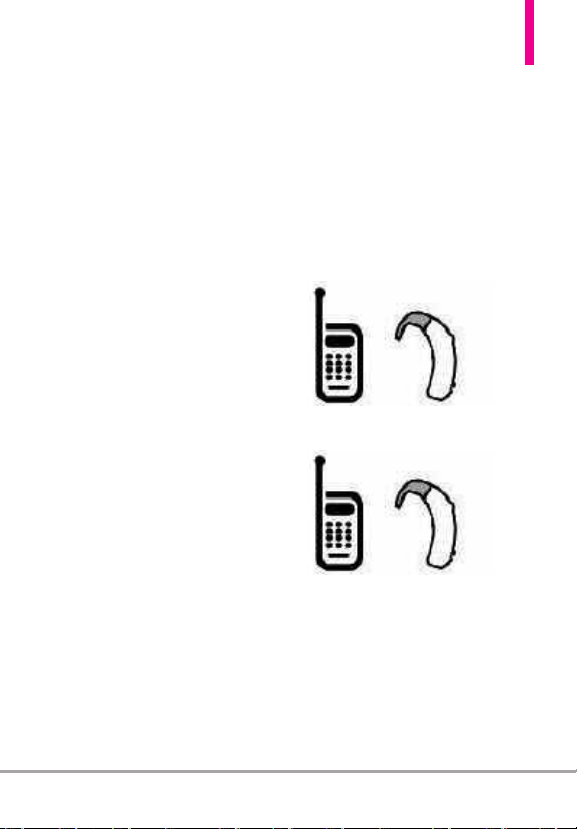
121
hearing devices. Not all phones
have been rated. Phones that are
rated have the rating on their box
or a label located on the box.
The ratings are not guarantees.
Results will vary depending on the
user's hearing device and hearing
loss. If your hearing device
happens to be vulnerable to
interference, you may not be able
to use a rated phone successfully.
Trying out the phone with your
hearing device is the best way to
evaluate it for your personal needs.
M-Ratings: Phones rated M3 or
M4 meet FCC requirements and
are likely to generate less
interference to hearing devices
than phones that are not labeled.
M4 is the better/higher of the two
ratings.
T-Ratings: Phones rated T3 or T4
meet FCC requirements and are
likely to generate less interference
to hearing devices than phones
that are not labeled. T4 is the
better/higher of the two ratings.
Hearing devices may also be rated.
Your hearing device manufacturer
or hearing health professional may
help you find this rating. Higher
ratings mean that the hearing
device is relatively immune to
interference noise. The hearing aid
and wireless phone rating values
are then added together. A sum of
5 is considered acceptable for
normal use. A sum of 6 is
considered for best use.
In the above example, if a hearing
aid meets the M2 level rating and
the wireless phone meets the M3
level rating, the sum of the two
values equal M5. This should
provide the hearing aid user with
M3 + M2 = 5
M3 + M2 = 5
KEYBOII

122
Safety
“normal usage” while using their
hearing aid with the particular
wireless phone. “Normal usage” in
this context is defined as a signal
quality that’s acceptable for normal
operation.
The M mark is intended to be
synonymous with the U mark. The
T mark is intended to be
synonymous with the UT mark.
The M and T marks are
recommended by the Alliance for
Telecommunications Industries
Solutions (ATIS). The U and UT
marks are referenced in Section
20.19 of the FCC Rules. The HAC
rating and measurement procedure
are described in the American
National Standards Institute
(ANSI) C63.19 standard.
To enter that the Hearing Aid
Compatibility rating for your phone
is maintained, secondary
transmitters such as Bluetooth and
WLAN(this phone does not have
WLAN) components must be
disabled during a call. See Page 91
for instructions to disable these
components.
KEYBOII
For information about hearing aids
and digital wireless phones
FCC Hearing Aid Compatibility and
Volume Control
http://www.fcc.gov/cgb/dro/hearing.
html
Gallaudet University, RERC
http://tap.gallaudet.edu/DigWireless
.KS/DigWireless.htm
HLAA (Hearing Loss Association of
America)
http://www.hearingloss.org/learn/cel
lphonetech.asp
The Hearing Aid Compatibility FCC
Order
http://hraunfoss.fcc.gov/edocs_publi
c/attachmatch/FCC-03-168A1.pdf

123
Accessories
KEYBOII
There are a variety of accessories available for your phone and three easy
ways to purchase them:
Charger
Batteries
Charger
USB Cable

124
LIMITED WARRANTY STATEMENT
1. WHAT THIS WARRANTY
COVERS:
LG offers you a limited warranty
that the enclosed subscriber unit
and its enclosed accessories will be
free from defects in material and
workmanship, according to the
following terms and conditions:
(1) The limited warranty for the
product extends for ONE (1)
year beginning on the date of
purchase of the product by
the original end user.
(2) The limited warranty extends
only to the original end user
of the product and is not
assignable or transferable to
any subsequent
purchaser/end user.
(3) This warr
anty is good only to
the original end user of the
product during the warranty
period as long as it is in
Canada.
(4) Upon request from LG, the
consumer must provide
information to reasonably
prove the date of purchase.
(5) During the applicable warranty
period, LG will repair or
replace at LG’s sole option,
without charge to the original
end user, any defective
component part of the phone
or accessory.
(6) LG may, use rebuilt,
reconditioned, or new parts or
components when repairing
any product or replace a
product with a rebuilt,
reconditioned or new product.
KEYBOII

125
2. WHAT THIS WARRANTY
DOES NOT COVER:
(1) Defects or damages resulting
from use of the product in
other than its normal and
customary manner.
(2) Defects or damages from
abnormal use, abnormal
conditions, improper storage,
exposure to moisture or
dampness, unauthorized
modifications, unauthorized
connections, unauthorized
repair, misuse, neglect, abuse,
accident, alteration, improper
installation, or other acts
which are not the fault of LG,
including damage caused by
spills of food or liquids.
(3) Breakage or damage to
antennas unless caused
directly by defects in material
or workmanship.
(4) If the carrier’s or
manufacturer’s Customer
Service Centre was not
notified by the end user of the
alleged defect or malfunction
of the product, during the
warranty period.
(5) Products which have had their
serial numbers removed or
made illegible.
(6) Damage resulting from use of
non-LG approved accessories.
(7) All plastic surfaces and all
other externally exposed parts
that are scratched or damaged
due to normal customer use.
(8) Products serviced by non-
authorized persons or
companies.
NOTES
:
(1) This limited warranty is in lieu of all
other warranties, express or implied
either in fact or by operations of law,
statutory or otherwise, including, but
not limited to any implied warranty of
merchantability or fitness for a
particular purpose.
(2) Shipping damage is the sole
responsibility of the shipping
company.
KEYBOII

126
LIMITED WARRANTY STATEMENT
3. EXCLUSION OF LIABILITY:
No other express warranty is
applicable to this product. THE
DURATION OF ANY IMPLIED
WARRANTIES, INCLUDING THE
IMPLIED WARRANTY OF
MARKETABILITY, IS LIMITED TO
THE DURATION OF THE
EXPRESS WARRANTY HEREIN.
LG ELECTRONICS CANADA,
INC. SHALL NOT BE LIABLE
FOR THE LOSS OF THE USE OF
THE PRODUCT,
INCONVENIENCE, LOSS OR
ANY OTHER DAMAGES,
DIRECT OR CONSEQUENTIAL,
ARISING OUT OF THE USE OF,
OR INABILITY TO USE, THIS
PRODUCT OR FOR ANY
BREACH OF ANY EXPRESS OR
IMPLIED WARRANTY,
INCLUDING THE IMPLIED
WARRANTY OF Merchantability
APPLICABLE TO THIS
PRODUCT.
4. HOW TO GET WARRANTY
SERVICE:
To obtain warranty service,
please call the following
telephone number from
anywhere in Canada:
LG Electronics Canada, Inc.
Tel. 1-888-542-2623
KEYBOII

127
Terminology
Ez Tip Calculator
Feature for easy bill calculation
using the total cost, tip, and
number of people as variables.
Advanced Voice Commands
Feature that allows you to perform
a wide range of verbal commands
by training the phone to recognize
your individual speech patterns.
Bluetooth
®
wireless technology
Technology used to allow mobile
phones, computers, and other
personal devices to be easily
coordinated and interconnected
using a short-range wireless
connection.
Music & Media
Feature that accesses the Internet
to provide the ability to access and
even download a wide variety of
software, information, music, video,
and more right on your TELUS
wireless phone.
microSD
TM
Additional external memory for
your mobile phone.
Acronyms and
Abbreviations
DTMF
D
D
ual-
T
T
one
M
M
ulti
F
F
requency (or
“touch-tone”) is a method used to
communicate keys pressed on the
phone. Pressing a key generates
two simultaneous tones, one for
the row and one for the column to
determine which key was pressed.
EVDO
E
E
v
v
olution
D
D
ata
O
O
nly or Evolution
Data Optimized (abbreviated as
EVDO, EV-DO, EvDO, 1xEV-DO or
1xEvDO) provides fast wireless
broadband access (3G) anywhere,
without needing a WiFi hotspot.
GPS
G
G
lobal
P
P
ositioning
S
S
ystem is a
system of satellites, computers, and
receivers able to determine the
latitude and longitude of a specific
receiver on Earth. Position is
calculated using time and distance.
IS 2000
Type of digital signaling. It's the
second generation of CDMA digital
Glossary
KEYBOII

128
Glossary
cellular, an extension of IS-95.
Differences between signaling
types have to do with pilot signal
and links to provide more traffic
channels, and control protocols.
NAM
N
N
umber
A
A
ssignment
M
M
odule is
how the phone stores the phone
number and its electronic serial
number.
SSL
S
S
ecure
S
S
ockets
L
L
ayer Protocol
used to encrypt data sent over the
air.
TTY
T
T
ele
t
t
y
y
pewriter. An
electromechanical typewriter that
either transmits or receives
messages coded in electrical
signals. A phone with TTY support
is able to translate typed
characters to voice or translate
voice into characters to display on
the TTY.
KEYBOII

10 Driver Safety Tips 115
A
Accessories 123
Acronyms and Abbreviations
127
Add New Device 65
Adding Additional Phone
Number(s) to Existing
Contact 31
Airplane Mode 85
Alarm Clock 73
Alert Sounds 78
All Calls 39
Answer Options 91
Apps 76
Auto Prepend
94
Auto Retry 92
B
Backlight 81
Backlight Settings 84
Banner 81
Battery Charge Level 23
Battery Temperature
Protection 23
Bluetooth Menu 65
Brightness 82
C
Calculator 72
Calendar 72
Call <Name or Number> 70
Call History 38
Call Ringtone 78
Call Settings 91
Call Sounds 77
Call Vibrate 78
Call Waiting 26
Card Memory 96
Caution: Avoid potential
hearing loss. 106
Changing the Default
Number 31
Charging Screen 83
Charging the Battery 20
Charging with USB 21
Check <Item> 71
Clock Format 83
Consumer Information on
SAR 118
Contact List 34
CONTACTS 34
Contacts in Your Phone’s
Memory 28
Create Message 42
Customizing Individual
Entries 29
D
Deleting 32
Dialed Calls 39
Display Settings 80
Do Not Disturb 94
Drafts 50
DTMF Tones 94
E
E-mail 50
Easy Set-up 77, 80
End Call Options 92
Entering and Editing
Information 16
Erasing Messages 53
Ez Tip Calc 75
F
Favourites 35
FCC Hearing-Aid
Compatibility (HAC)
Regulations for Wireless
Devices 120
FDA Consumer Update 108
Find Ringtones & Wallpapers
64
Find Videos 64
From the Internal Qwerty
Keypad 16
G
Games 76
Games & Apps 76, 84
Get New Pictures 58
Get New Ringtones 57
Get New Videos 58
Getting Started with Your
Phone 20
Glossary 127
Go to <Menu> 71
Groups 36
H
Help 71
How to Install Your
microSD™ Card 22
How to Remove Your
microSD™ Card 22
I
Icon Glossary 97
Important Information 10
Important Safety Precautions
1
129
Index
KEYBOII

Instant Messaging 50
International Dialing Code 95
K
Keypad Volume 79
L
Language 87
Launch Web 54
LIMITED WARRANTY
STATEMENT 124
Location 87
Lookup <Name> 71
M
Making Calls 24
Maps & Navigation 64
Master Volume 77
Media Mode 86
Memory 95
Memory Info 63
Menu Tree on the Internal
Screen 17
Message Settings 52
Messages 47
MESSAGING 41
Missed Calls 38
Music & Media 55
Music & Tones 56
Music Player 55
Mute Function 26
My Music List 56
My Name Card 37
My Number 97
My Pictures 59
My Ringtones 57
My Sounds 57
My Videos 60
N
NAM Select 91
New Contact 34
Notepad 75
Notifications 84
O
One Touch Dial 94
Others 85
P
Phone Info 97
Phone Memory 96
Phone Overview 14
Phone Settings 85
Picture Message 43
Pictures & Videos 58
Plug-Ins 85
Power On/Off 79
Prompts 86
Q
Quick Access to Convenient
Features 26
R
Received Calls 38
Receiving Calls 25
Record Video 62
Redialing Calls 25
Removing the Battery 20
S
Safety 98
Safety Information 101
Save Options 95
Screen Icons 24
Search 64
Search the Web 64
Security 88
Send Msg to <Name or
Number> 71
Service Alerts 79
Serving System 91
Set Shortcut Keys 86
SETTINGS & TOOLS 77
Short Codes 51
Shortcuts 27
Signal Strength 24
Sounds Settings 77
Speed Dial 29
Speed Dialing 33
Speed Dials 36
Stopwatch 74
Storing a Number with
Pauses 30
Storing Basics 28
SW/HW Version 97
System Select 90
T
Table of Contents 4
Take Picture 61
Technical Details 10
TELUS mobile music 55
Ter
minology 127
The Battery 20
TIA Safety Information 98
Time Format 84
Tools 65
TTY Mode 92
Turning the Phone On and
Off 23
130
Index
KEYBOII


MEMO

MEMO