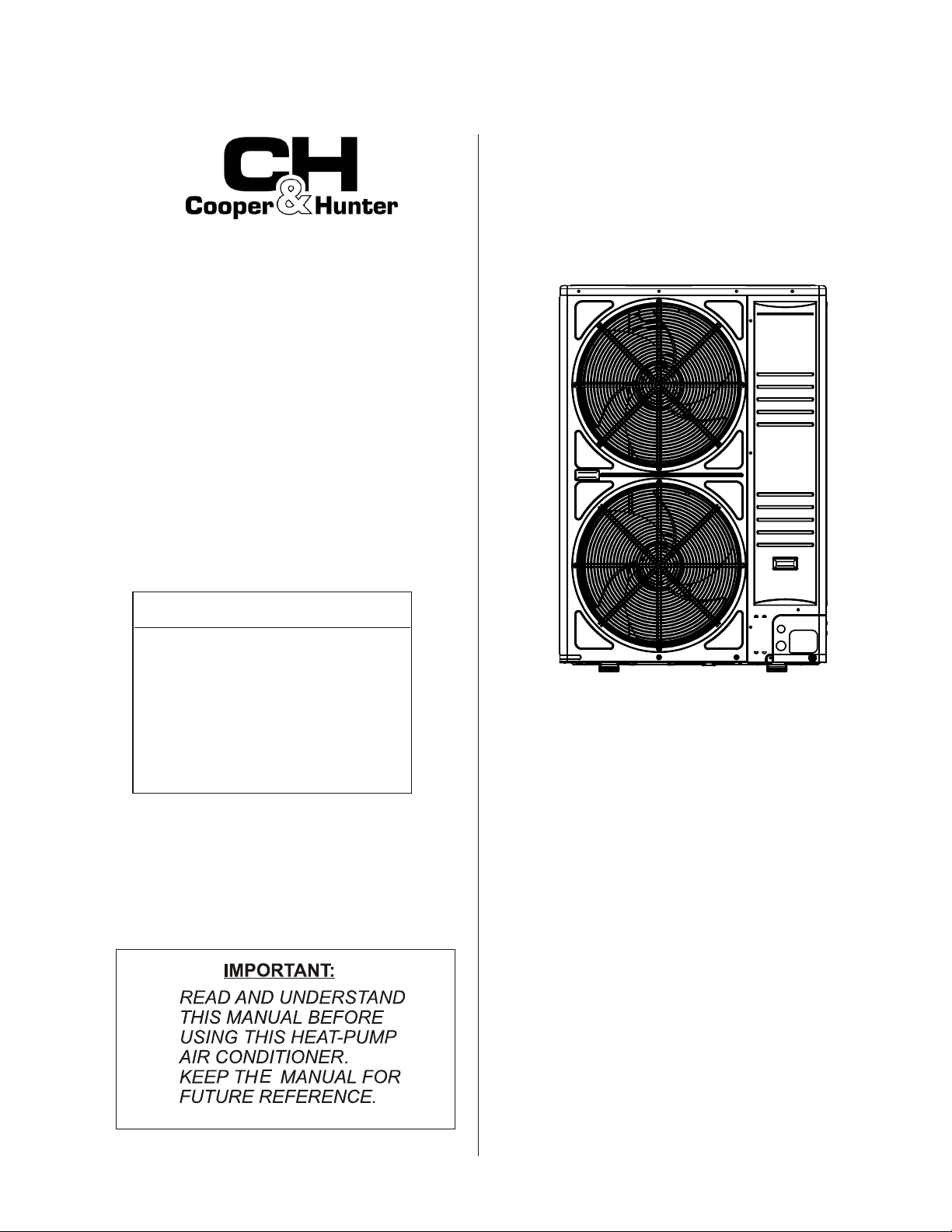
CHV6-36URBM
CHV6-48URBM
CHV6-60URBM
MODEL
Installation
&
Maintenance
Manual
VRF AIR-CONDITIONER
(HEAT PUMP)
OUTDOOR UNIT
- Outdoor Units -
ORIGINAL INSTRUCTIONS

Install these air conditioners by local regulations or standards.
Our company
I
NOTE:
These air conditioners are only appliable for cooling or heating mode. Do not operate cool and heat mode
together, if operate cool and heat mode at the same time, air conditioner system will be fluctuated for large
difference in temperature for changing operate mode.
Our company
our company
The air-conditioning installation, maintenance can only be conducted by dealers or professionals.
Temperature
Cooling
Operation
Indoor
Maximum
Outdoor
90°F DB / 73°F WB (32°C DB / 23°C WB)
114
o
F DB (46
o
C DB)
Heating
Operation
Indoor
Outdoor
86
o
F DB (30
o
C DB)
60
o
F WB (15.5
o
C WB)
Minimum
70°F DB / 59°F WB (21°C DB / 15°C WB)
23
o
F DB (-5
o
C DB)
59
o
F DB ( 15
o
C DB)
-4
o
F WB (-20
o
C WB)
DB: Dry Bulb, WB: Wet Bulb
distributor

SAFETY SUMMARY
● Use refrigerant R410A in the refrigerant cycle. Do not charge oxygen, acetylene
● Do not pour water into the indoor or outdoor unit. These products are equipped with
electrical parts. If poured, it will cause a serious electrical shock.
● Do not touch or adjust safety devices inside the indoor or outdoor units. If these
devices are touched or readjusted, it may cause a serious accident.
● Do not open the service cover or access panel for the indoor or outdoor units without
turning OFF the main power supply.
● Refrigerant leakage can cause difficulty with breathing due to insufficient air. Turn OFF
the main switch, extinguish any naked flames and contact your service contractor, if
refrigerant leakage occurs.
● The installer and system specialist shall secure safety against refrigerant leakage
according to local regulations or standards.
● Use an ELB (Electric Leakage Breaker). In the event of a fault, there is danger of an
electric shock or a fire if it is not used.
● Do not install the outdoor unit where there is a high level of oil mist, flammable gases,
salty air or harmful gases such as sulphur.
● Do not use any sprays such as insecticide, lacquer, hair spray or other flammable
gases within approximately one 3.3 ft. (1 meter) from the system.
● If circuit breaker or fuse is often activated, stop the system and contact your service
contractor.
● Do not perform installation work, refrigerant piping work, drain piping and electrical
wiring connection without referring to our installation manual. If the instructions are
not followed, it may result in a water leakage, electric shock or a fire.
● Check that the ground wire is securely connected. If the unit is not correctly grounded,
it may lead to electric shock. Do not connect the ground wiring to gas piping, water
piping, lightning conductor or ground wiring for telephone.
● Connect a fuse of specified capacity.
● Do not put any foreign material on the unit or inside the unit.
● Make sure that the outdoor unit is not covered with snow or ice, before operation.
● Before performing any brazing work, check to ensure that there is no flammable
material around.
When using refrigerant be sure to wear leather gloves to prevent cold injuries.
● Protect the wires, electrical parts, etc. from rats or other small animals.
If not protected, rats may gnaw at unprotected parts which may lead to a fire.
● Fix the cables securely. External forces on the terminals could lead to a fire.
● If the supply cord is damaged, it must be replaced by the manufacturer, its service
agent or similarly qualified persons in order to avoid a hazard.
● This appliance can be used by children aged from 8 years and above and persons with
reduced physical, sensory or mental capabilities or lack of experience and knowledge if
they have been given supervision or instruction concerning use of the appliance in a
safe way and understand the hazards involved. Children shall not play with the
appliance. Cleaning and user maintenance shall not be done by children without
supervision.
● The appliances are not intended to be operated by means of an external timer or
separate remote-control system.
II
or other flammable and poisonous gases into the refrigerant cycle when performing a
leakage test or an air-tightness test. These types of gases are extremely dangerous
and can cause an explosion. It is recommended that nitrogen be used for these types
of t tests.
III
SAFETY SUMMARY
● Do not install the indoor unit, outdoor unit, remote control switch and cable within
approximately 0 from strong electromagnetic wave
radiators such as medical equipment.
● Supply electrical power to the system to energize the oil heater for 12 hours before start-up
after a long shutdown.
● Do not step or put any material on the product.
● Provide a strong and correct foundation so that;
a. The outdoor unit is not on an incline.
b. Abnormal sound does not occur.
c. The outdoor unit will not fall down due to a strong wind or earthquake.
CHECKING PRODUCT RECEIVED
●
●
●
●
●
●
Upon receiving this product, inspect it for any shipping damage.
Claims for damage, either apparent or concealed, should be filed immediately with the shipping
company.
Check the model number, electrical characteristics (power supply, voltage and frequency) and
accessories to determine if they are correct.
The standard utilization of the unit shall be explained in these instructions.
Therefore, the utilization of the unit other than those indicated in these instructions is not
recommended.
Please contact your local agent, as the occasion arises.
Our company
,
s liability shall not cover defects arising from the alteration performed by a customer
without our company
,
s consent in a written form.
NOTE:
● It is recommended that the room be ventilated every 3 to 4 hours.
● The heating capacity of the heat pump unit is decreased according to the outdoor air
temperature. Therefore, it is recommended that auxiliary heating equipment be used in the
field when the unit is installed in a low temperature region.
● Operate the heat pump air conditioner within this range.
Regarding installation altitude below 000;
Regarding frequency of supply power within ±1%Hz of rated frequency;
Regarding transport/storage temperature within -13~°;
This appliance is intended to be used by expert or trained users in shops, in light industry and
on farms, or for commercial use by lay persons.
The A-weighted emission sound pressure level at workstations, all this level does not exceed
70 dB(A) .
The appliance is not to be used by children or person with reduced physical, sensory or
mental capabilities, or lack of experience and knowledge, unless they have been given
supervision or instruction concerning use of the appliance by a person responsible for
their safety.
Children should be supervised to ensure that they do not play with the appliance. eep
the appliance and its cord out of reach of children under 8 years.
●
●
●

TABLE OF CONTENTS
1. Safety Summary.............................................................................................................................. 1
2.
Structure.......................................................................................................................................... 1
1
2.1 Outdoor Unit & Refrigerant Cycle..............................................................................................
2.2 Necessary Tools and Instrument List for Installation.................................................................
3
3.
Transportation and Handling........................................................................................................... 4
3.1 Transportation.............................................................................................................................
4
3.2 Handling of Outdoor Unit.............................................................................................................
4
4.
Outdoor Unit Installation..................................................................................................................5
5
5
6
4.1 Factory-Supplied Accessories...................................................................................................
4.2 Initial Check..............................................................................................................................
4.3 Service Space...........................................................................................................................
4.4 Installation Work........................................................................................................................
6
5.
Refrigerant Piping Work................................................................................................................. 8
8
8
11
12
13
14
16
17
5.1 Piping Materials.......................................................................................................................
5.2 Refrigerant Piping Work..........................................................................................................
5.3 Branch Pipe for Line Branch.....................................................................................................
5.4 Piping Connection....................................................................................................................
5.5 Air Tightness Test....................................................................................................................
5.6 Vacuum Pumping and Charging Refrigerant. ..........................................................................
5.7 Caution of the Pressure by Check Joint ..................................................................................
5.8 Additional Refrigerant Charge..................................................................................................
5.9 Collecting Refrigerant............................................................................................................... 19
6.
Electrical Wiring............................................................................................................................ 19
6.1 General Check.........................................................................................................................
19
6.2 Electrical Wiring Connection....................................................................................................
20
7. Outdoor Unit Dip-Switch Setting................................................................................................... 24
8. Test Run........................................................................................................................................ 25
9. Safety and Control Device Setting................................................................................................ 30

2. Structure
1. Safety Summary
1
-CHV6-36/48/60URBM
26
25
24
23
22
21
20
19
18
17
16
15
14
13
12
11
10
2
3
4
5
6
7
8
9
Bypass Solenoid Valve
Stop Valve for Gas Line
Stop Valve for Liquid Line
Compressor
Heat Exchanger
Propeller Fan
Fan Motor
Check Valve
Reversing Valve
Distributor
Check Joint for High/Low Pressure(Cool/Heat)
Strainer
Electrical Expansion Valve
Gas & Liquid Separator
.
.
1
High Pressure Switch
Pressure Sensor
Crankcase Heater
Electrical Box
Base assembly
Vibration Absorbing Rubber
Air Inlet
Air Outlet
ON
12
1
ON
2 3 4
1
ON
2 3 4
1
ON
2 3
5 6
12
ON
3 45612
ON
3 4
9.8 . (3 meters)

Check Joint
Capilary Tube
Individual Valve
Reversing Valve
Heat Exchanger
Compressor
Refrigerant Flow Direction(Heating Operation)
<Refrigerant Cycle>
Outdoor Unit-CHV6-36/48/60URBM
Bypass
Flare Connection
Field Refrigerant Piping
Refrigerant Flow Direction(Cooling Operation)
Sensor
Condensator Temperature
Air Temperature Sensor
NO.
Strainer
Electrical Expansion Valve
Stop Valve for Gas Line
Stop Valve for Liquid Line
Bypass
High Pressure Protect
High Pressure
Low Pressure
Remark
Gas & Liquid Separator
Compressor
Heat Exchanger
Check Valve
Check Joint
Capilary Tube
Reversing Valve
Distributor
Solenoid Valve
Pressure Switch
Pressure Sensor
Pressure S
Bypass
P
HPP
S
ss
s
Liquid Line Refrigerant
Piping Connection
Gas Line Refrigerant
Piping Connection
17
Expansion Muffler
Discharge Temperature
Sensor
3/8
5/8
in

2.2 Necessary Tools and Instrument List for Installation
No. Tool No. Tool No. Tool No. Tool
1 Handsaw 6 Copper Pipe Bender 11 Spanner 16 Leveller
2
Phillips
Screwdriver
7
Manual Water Pump
12
Charging Cylinder
17
Clamper for Solder-
less Terminals
3 Vacuum Pump 8 Pipe Cutter 13 Gauge Manifold 18
Hoist
(for Indoor Unit)
4
Refrigerant Gas
Hose
9 Brazing Kit 14 Cutter for Wires 19 Ammeter
5 Megohmmeter 10 Hexagon Wrench 15 Gas Leak Detector 20 Voltage Meter
✕: Prohibited
✦
: Only for Refrigerant R407C (No Interchangeability with R22)
Measuring Instrument and Tool
Interchangeability
with R22
Reason of Non-Interchangeability and Attention
(
: Strictly Required)
Use
R410A R407C
Refrigerant
Pipe
Pipe Cutter,
Chamfering
Reamer
-
Cutting Pipe
Removing Burrs
Flaring Tool
* The flaring tools for R407C are applicable to R22.
* If using faring tube, make dimension of tube larger
for R410A.
* In case of hard temper pipe, flaring is not available.
Flaring for Tubes
Extrusion
Adjustment Gauge
-
Dimensional Control
for Extruded Portion
of Tube after Flaring
Pipe Bender
* In case of hard temper pipe, bending is not
available.
Use elbow for bend and braze.
Bending
Expanding Tool
* In case of hard temper pipe, expanding of tube is
not available. Use socket for connecting tube.
Expanding Tubes
Torque Wrench
* For 1/2 in D. (12.7mm), 5/8 in D. (15.88mm),
spanner size is up 3/32 in (2mm).
Connection of
Flare Nut
* For 1/4 in D. (6.35mm), 3/8 in D. (9.52mm),3/4
in D. (19.05mm), spanner size is the same.
Brazing Tool
* Perform correct brazing work. Brazing for Tubes
Nitrogen Gas
* Strict Control against Contamin
(Blow nitrogen during brazing.)
Prevention from
Oxidation during
Brazing
Lubrication Oil
(for Flare Surface)
* Use a synthetic oil which is equivalent to the oil
used in the refrigeration cycle.
* Synthetic oil absorbs moisture quickly.
Applying Oil to
the Flared Surface
Vacuum
Drying
Refrigerant
Charge
Refrigerant
Cylinder
* Check refrigerant cylinder color.
Liquid refrigerant charging is required regarding
zeotropic refrigerant.
Refrigerant Charging
Vacuum Pump
The current ones are applicable. However, it is
required to mount a vacuum pump adapter which
can prevent from reverse flow when a vacuum
pump stops, resulting in no reverse oil flow.
Vacuum Pumping
Adapter for
Vacuum Pump
Manifold Valve
* No interchangeability is available due to higher
pressures when compared with R22.
Do not use current ones to the different refrigerant.
If used, mineral oil will f ow into the cycle and
cause sludges, resulting in clogging or compressor
failure.
Connection diameter is different; R410A: UNF1/2,
R407C: UNF7/16.
Vacuum Pumping,
Vacuum Holding,
Refrigerant Charging
and Check of
Pressures
Charging Hose
Charging Cylinder
* Use the weight scale. -
Weight Scale
-
Measuring
Instrument for
Refrigerant Charging
Refrigerant Gas
Leakage Detector
* The current gas leakage detector (R22) is not
applicable due to different detecting method.
Gas Leakage Check
: Interchangeability with R407C.
Use tools and measuring instruments exclusive for the new refridgerant in case of direct contact with refrigerant.
✧: Interchangeability is available with current R22 ●: Only for Refrigerant R410A (No Interchangeability with R22)
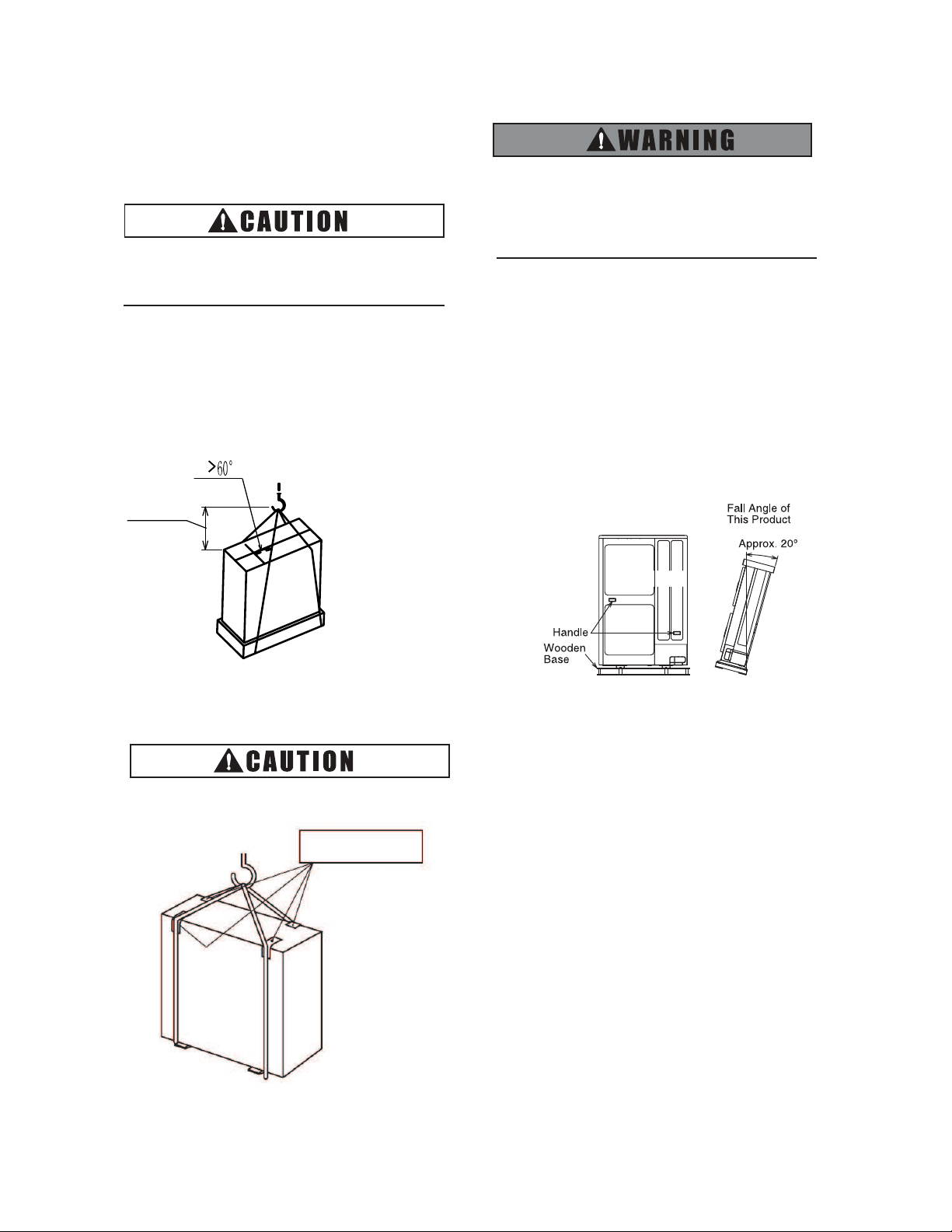
3.1 Transportation
Transport the product as close to the installation
location as possible before unpacking.
Do not put any material on the product.
Apply two lifting wires onto the outdoor unit,
when lifting it by crane.
● Hanging Method:
When hanging the unit, ensure a balance of
the unit, check safety and lift up smoothly.
(1) Do not remove any packing materials.
(2) Hang the unit under packing condition with
two (2) ropes, as shown in Fig. 3.1.
Fig.3.2 Transportation for no wooden base
Fig. 3.1 Hanging Work for Transportation
If have no package to move, please protect with
cloth or paper
Put Cloth or Paper
Do not put any foreign material into the
outdoor unit and check to ensure that none
exists in the outdoor unit before the
installation and test run. Otherwise, a fire or
failure, etc. may occur.
3. Transportation and Handling
3.2 Handling of Outdoor Unit
● When Using Handles:
When manually lifting the unit using the
handles, pay attention to the following points.
(1) Do not remove the wooden base from the
outdoor unit.
(2) To prevent the unit from overturning, pay
attention to the center of gravity as shown
in the below figure.
(3) Two or more personnel should be used to
move the unit.
Fig. 3.3 Handling of Outdoor Unit
Do not remove the plastic
band or the corrugated
paper frame.
Pass the wire ropes
through each lifting
hole in the wooden
base as shown.
2~3 ft.

4. Outdoor Unit Installation
For Anchor Bolts
Accessories
Recommend
Secure the adequateservice
space(600mm).
4.1 Factory-Supplied Accessories
Check to ensure that the following accessories
are packed with the outdoor unit.
If any of these accessories are not packed with
the unit, please contact your contractor.
Table 4.1 Factory-Supplied Accessories
4.2 Initial Check
• Install the outdoor unit where good ventilation is
available, and where it is dry.
• Install the outdoor unit where the sound or the
discharge air from the outdoor unit does not
affect neighbors or surrounding vegetation.
The operating sound at the rear or right/left
sides is higher than the value in the catalog at
the front side.
• Check to ensure that the foundation is flat, level
and sufficiently strong.
• Do not install the outdoor unit where there is a
high level of oil mist, salty air or harmful gases
such as sulphur.
• Do not install the outdoor unit where the
electromagnetic wave is directly radiated to the
electrical box.
•
Install the outdoor unit as far as possible being
at least 0(3 meters) from the
electromagnetic wave radiator.
• When installing the outdoor unit in snow-
covered areas, mount the field-supplied hoods
at the discharge side of the outdoor unit and
the inlet side of the heat exchanger.
• Install the outdoor unit where it is in the shade
or it will not be exposed to direct sunshine or
direct radiation from high temperature heat
source.
• Do not install the outdoor unit where dust or
other contamination could block the outdoor
heat exchanger.
• Install the outdoor unit in a space with limited
access to general public.
NOTE
Washer
x4
Direction of Strong Wind
• Do not install the outdoor unit in a space where
a seasonal wind directly blows to the outdoor
heat exchanger or a wind from a building space
directly blows to the outdoor fan.
• Install near the wall to avoid facing wind
directly. Ensure that the service space
should be secured.
A Wall to Guard Against Wind
Wall
Direction of Strong Wind
Aluminum fins have very sharp edges. Pay
attention to the fins to avoid any injury.
NOTE
NOTE:
If the extreme strong wind blows directly against
the air discharge portion, the fan may rotate
reversely and be damaged.
Install the outdoor unit on a roof or in an area
where people except service engineers can not
touch the outdoor unit.
Direction of Air Discharge
5

M10
shown below Fig4.1.
>50
4.3 Service Space
Install the outdoor unit with a sufficient space around the outdoor unit for operation and maintenance as
Single Installation
Multiple Installation
Upper Side is Open
>
Keep a distance of 6
100mm on right side of unit
Fig. 4.1 Installation Space Requirement
Single Installation
Left, Right&Upper Sides are Open
4.4 Installation Work
(1) Secure the outdoor unit with the anchor
bolts.
Fig. 4.2 Installation of Anchor Bolts
Fix the outdoor unit to the anchor bolts by
special washer of factory-supplied
accessory.
(2) When installing the outdoor unit, fix the unit
by anchor bolts. Refer to Fig. 4.3
regarding the location of fixing holes.
Max.
27/32
A
ir Flow Direction
Anchor Bolt
Base of Outdoor Unit
Nut
Special Washer
Filled Mortar
Concrete
Fig. 4.3 Position of Anchor Bolts
NOTE:
When the mark * dimension is secured, piping
work from bottom side is easy without
interference of foundation.
( in.)
(3) Example of fixing outdoor unit by anchor
bolts.
Cut this portion when this type
of anchor bolt is used.
If not, it is difficult to remove
the service cover.
Concrete Anchor Bolt
Max. 27/32
(After cut "A " )
A
Fig. 4.4 Fixing Example
(4) Fix the outdoor unit firmly so that declining,
making noise, and falling down by strong
wind or earthquake is avoided.
Fixing Plate
(Field-Supplied)
(in)
Both sides on the unit fixing
can be possible.
When vibration measures
are necessary,
add vibration proof rubber.
(Field-Supplied)
Fig. 4.5 Additional Fixing Arrangement
(5) When installing the unit on a roof or a
veranda, drain water sometimes turns to
ice on a cold morning. Therefore, avoid
draining in an area people often use
because it is slippery.
>6
>
6
>6
Front
Air Outlet
6
>
>6
Keep a distance of 6
100mm on right side of unit
in
4-11/32
23-5/8
37-13/32
16- 5/32
17- 11/32
14- 9/16
2-3/4
19- 1/2
4-5/32
2-31/32
Anchor bolts
1/2
hole
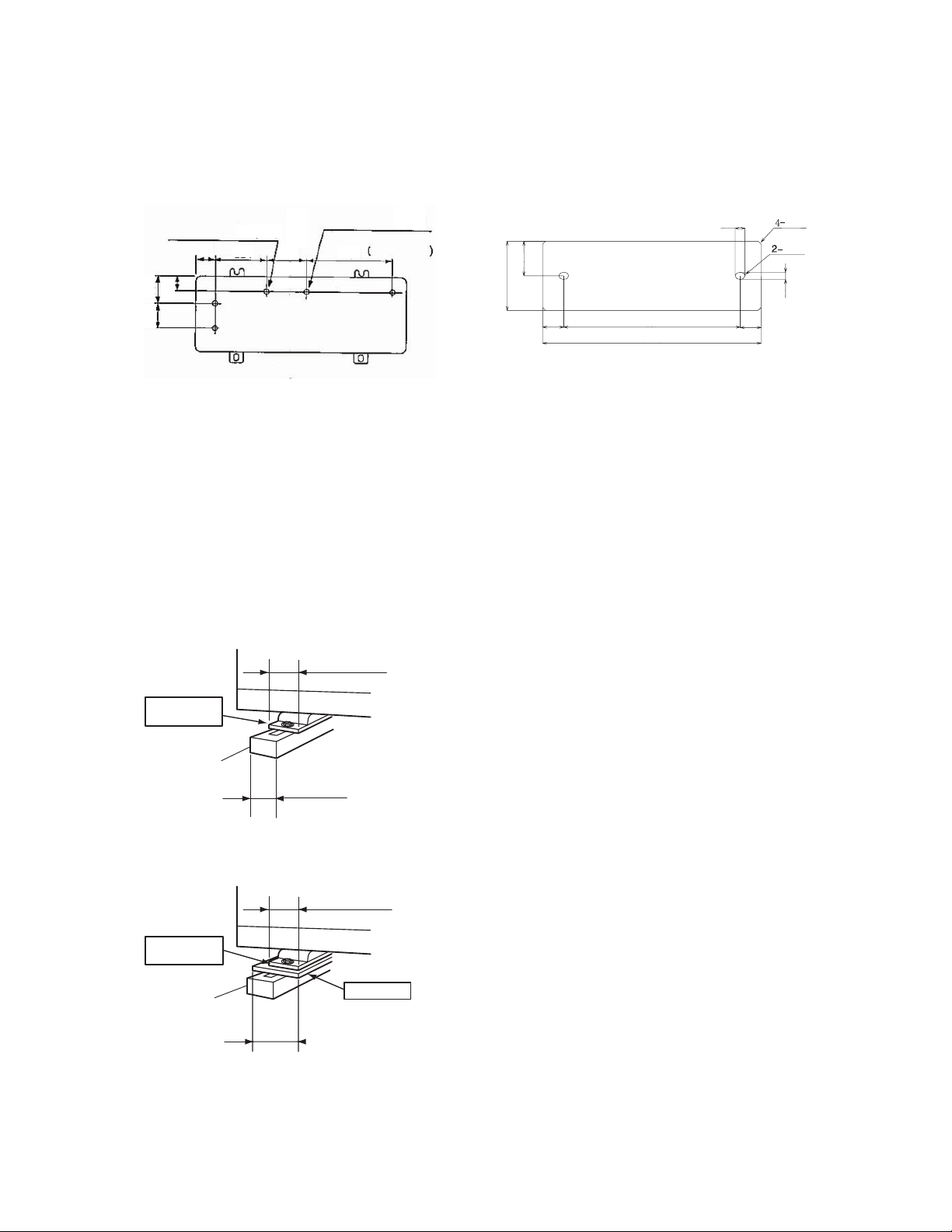
Fig. 4.6 Frame and Base Installation
(6) In case the drain piping is necessary for
the outdoor unit, use the drain-kit
(DC-01Q:Optional Parts).
(7) The whole of the base of the outdoor unit
should be installed on a foundation. When
using vibration-proof mat, it should also be
positioned the same way.
When installing the outdoor unit on a field-
supplied frame, use metal plates to adjust
the frame width for stable installation as
shown in Fig. 4.6.
(in)
Base Width of Outdoor Unit
2-31/32
Frame Width 2-3/8
(Field-Supplied)
Frame
Incorrect
Outdoor Unit
is Unstable.
Metal Plate
Metal Plate 3-15/16
or more
Correct
Frame
Base Width of Outdoor
Unit 2-31/32
Outdoor Unit
is Stable.
C13/32
Recommended Metal Plate Size (Field-Supplied)
Material: Hot-Rolled Mild Steel Plate (SPHC)
Plate Thickness: 4.5T
Hole
Drain Hole
Drain Hole
Position of Drain pipe joint
Optional
Front(Air Outlet)
7
(in)
(in)
2-3/4
(21-21/32)
2-3/4
16-5/32
25/32
9/16
2- 3/8
4- 23/32
3-5/16
3-11/16
5-17/32
2-23/32
8-13/16
9-13/32
13-23/32
4---15/16
1-1/32
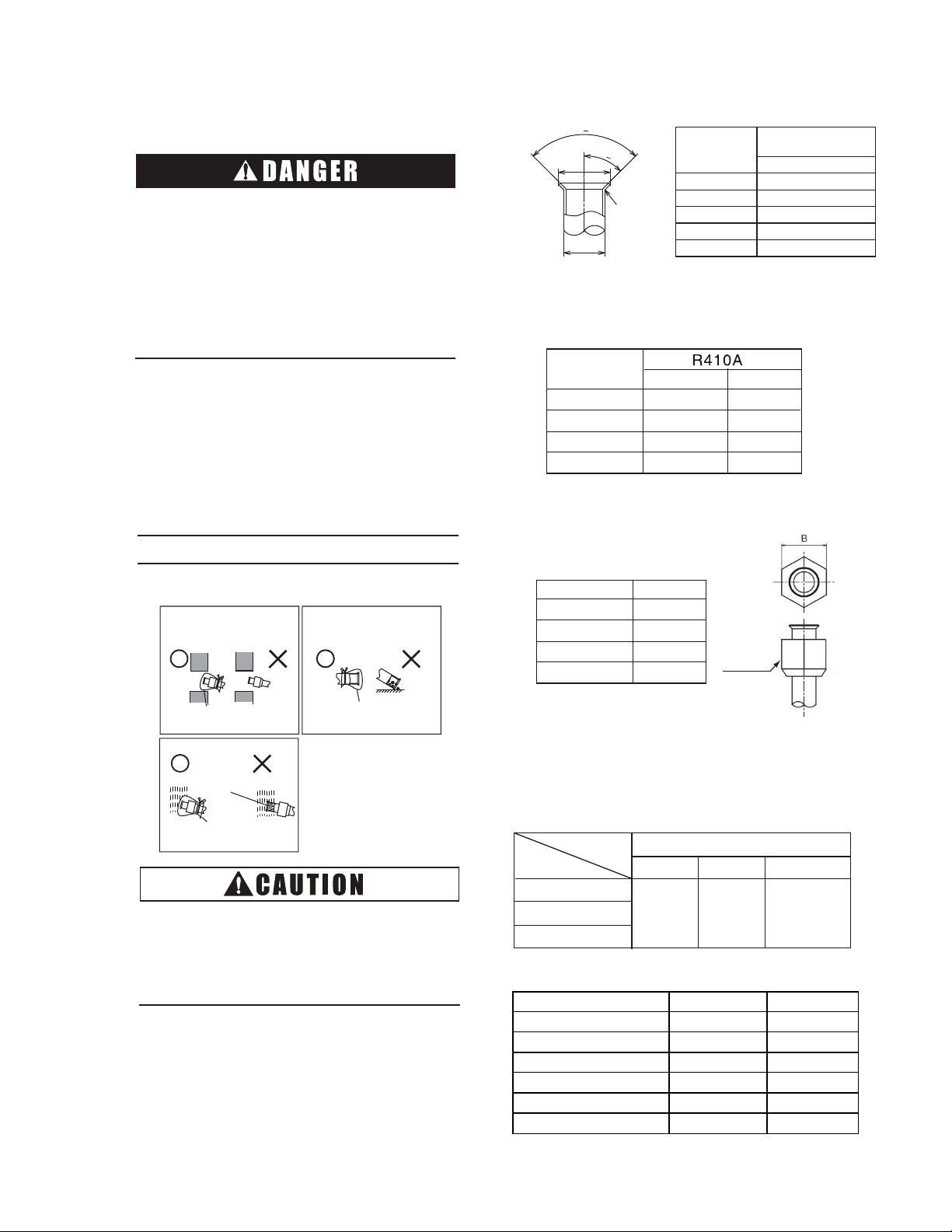
● Piping Thickness and Material
Use the pipe as below.
Thickness Material
Diameter
● Flare Nut Dimension
Use the flare nut as below.
<Flare Nut Dimension B in(mm)
Diameter R410A
Flare Nut
8
Use refrigerant R410A in the refrigerant cycle.
Do not charge oxygen, acetylene or other
flammable and poisonous gases into the
refrigerant cycle when performing a leakage
test or an air-tightness test. These types of
gases are extremely dangerous and can
cause an explosion. It is recommended that
compressed air, nitrogen or refrigerant be
used for these types of tests.
5.1 Piping Materials
(1) Prepare locally-supplied copper pipes.
(2) Select the piping size from the Table 5.1.
(3) Select clean copper pipes. Make sure
there is no dust and moisture inside of the
pipes. Blow the inside of the pipes with
nitrogen or dry air, to remove any dust or
foreign materials before connecting pipes.
NOTE
● Cautions for Refrigerant Pipe Ends
When installing pipe through
the wall, secure a cap at the
end of the pipe.
Correct
CorrectIncorrect Incorrect
Correct Incorrect
HoleHole
Attach a cap
or vinyl tape.
Attach a cap
or vinyl tape.
Attach a cap
or vinyl bag with
rubber band.
Do not place the pipe
directly on the ground.
Rain water can
enter.
5. Refrigerant Piping Work
O
O
O
O
● Flaring Dimension
Perform the flaring work as shown below.
● Cap the end of the pipe when the pipe is to
be inserted through a hole.
● Do not put pipes on the ground directly
without a cap or vinyl tape at the end of the
pipe.
work according to the tables.
Table 5.2 Limitation of Outdoor Unit
Outer Diameter of Pipe
Gas Liquid
5.2 Refrigerant Piping Work
(1) Ensure that the directions for refrigerant piping
Diameter
Branch Pipe
B-102H
Capacity
(Btu/h)
36
48
60
Table 5.3 Indoor Unit Pipe Model
Table 5.1 Piping Size
in (mm)
Diameter
(d)
A
+0
-0.02 (-0.4)
R410A
1/4 (6.35) 0.36 (9.1)
3/8 (9.52) 0.52 (13.2)
1/2 (12.7) 0.65 (16.6)
5/8 (15.88) 0.78 (19.7)
3/4 (19.05) (
)
1/64 ~ 1/32R
A
d
90
o
+
2
o
45
o
+
2
o
in (mm)
1/4 (6.35)
3/8 (9.52)
1/2 (12.7)
5/8 (15.88)
0.031 (0.8)
0.031 (0.8)
0.039 (1.0)
0.031 (0.8)
1/4 (6.35)
21/32 (17)
3/8 (9.53)
7/8 (22)
1/2 (12.7)
1-1/32 (26)
5/8 (15.88)
1-5/32 (29)
5/8 (15.88)
3/8 (9.53)
in (mm)
in (mm)
Capacity(kBtu/h) Gas Pipe Liquid Pipe
0~17 1/2(12.7) 1/4(6.35)
19~22(4-Way Cassette) 1/2(12.7) 1/4(6.35)
19(Ducted) 5/8(15.88) 1/4(6.35)
22(Ducted) 5/8(15.88) 3/8(9.53)
18~22(Wall-Mounted) 5/8(15.88) 3/8(9.53)
24~ 5/8(15.88) 3/8(9.53)
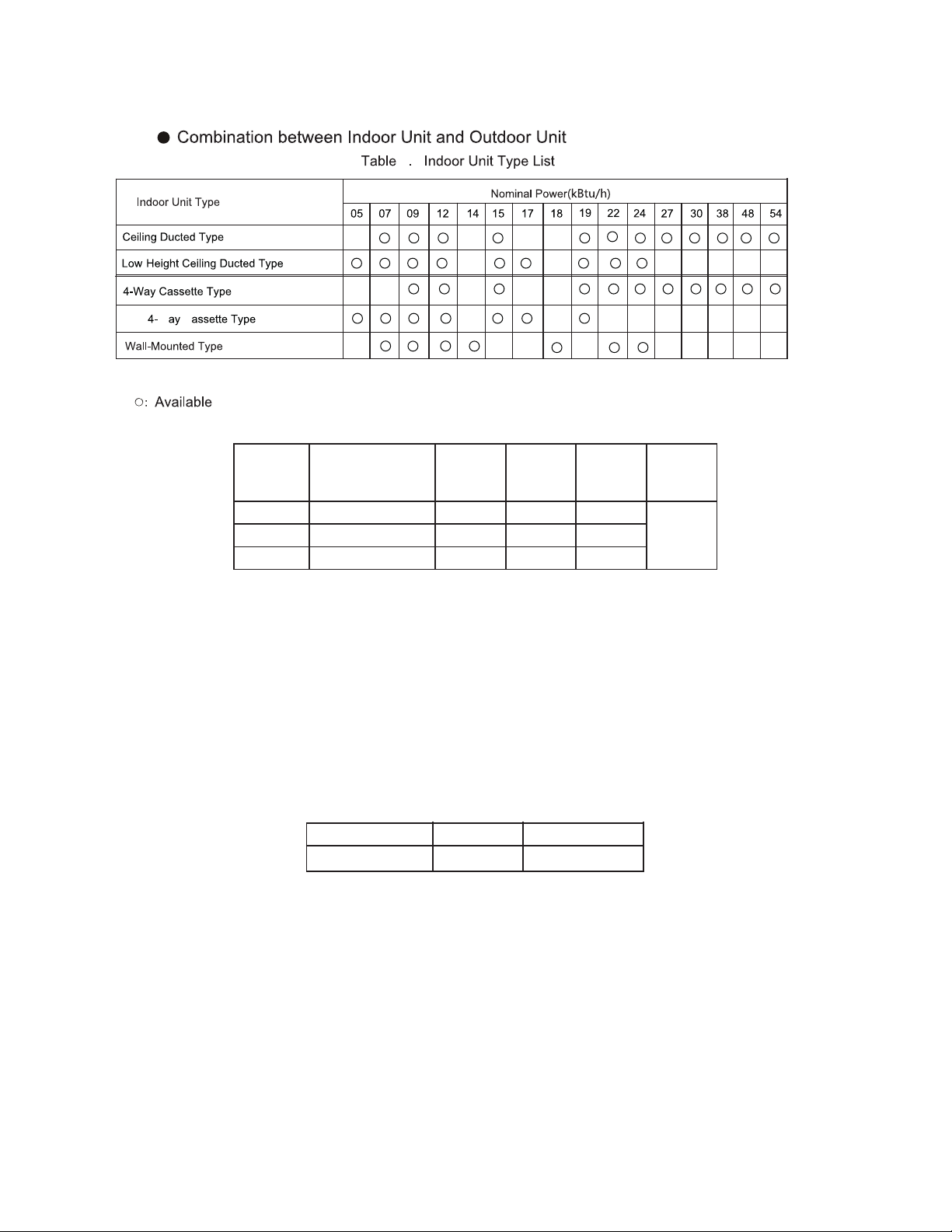
36 05 1 9 5
48 0
5 1 11 5
60 0
5 1 11 5
50%~150%
Model
Minimum Individual
Operation Capacity
˄kBtu/h˅
Minimum
Combination
Quantity
Maximum
Combination
Quantity
Recommend
Combination
Quantity
Combination
Range
Table 5.5 Limitation of Combination Quantity
9
5
4
(*1) he connection ratio should than 100%
; otherwise, overload operation may occur in harsh conditions or narrow range.
(*2) 100 additional
charge should be reduced according to the indoor unit type 510.
3 The capacity of indoor unit should be modified when the capacity ratio exceeds 100% or the
combination quantity exceeds the recommended quantity.
Modified capacity = nominal capacity correction factor
Correction factor are defined as follows:
ModelIndoor Unit Type
Wall mounted 2.0
Correction Factor
07/09
Mini W
C
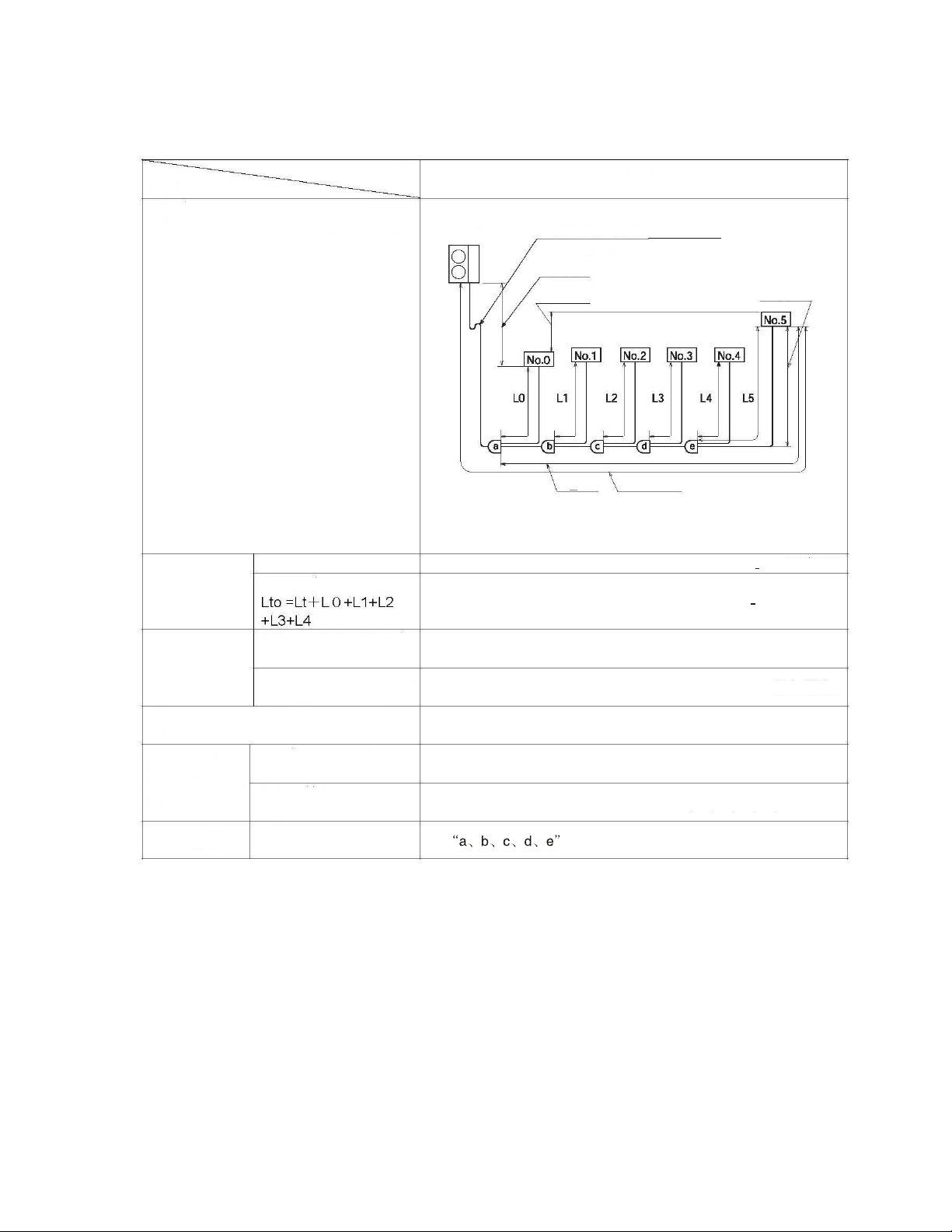
Table 5.6 Refrigerant Pipe System
10
Outdoor Unit
Oil Trap is recommendedat
System
Item
Example
This is a system of one outdoor unit
and six indoor units. Pipe materials are
not provided by the manufacturer.
Max.Pipe Length
Height Distance
between Outdoor
and Indoor Unit
Max.Saving Length Lt
Total Pipe Lentth
Outdoor is Higher than
Indoor Unit
Indoor is Higher than
Outdoor Unit
Indoor and Branch Pipe
Max.Height Distance betwen Indoor and
Indoor or
Max.Pipe Length
between Branch
Pipe and Indoor
From "a" Branch Pipe to
Indoor of Max. Distance
From every Branch
Pipe
to Indoor of connecting
with
Branch pipe for Line Branch
Choose Branch
Pipe
B-102H
36/48/60
98 ft(30m)
0
H1≤ 0m
H1≤
0m
32
ft
(10m)
< 6 ft(m)
< ft(0m)
98 ft(30m)
6 ft(m)
every 10meters lift
H1≤ 0m
32 ft(10m)
32 ft(10m)

53 Branch Pipe for Line Branch
Unit in
Inner Diameter
Table 57
Shape Branch Pipe
B-10H
11
Branch Pipe

Front Side Piping Cover
(4) Pipes can be connected from 4 directions
Tightening Torque for Flare Nut
Pipe Size
Right Side Piping Work
5.4 Piping Connection
Pipes can be connected from 4 directions.
Rear Side
Piping Cover
(Knock-Out Hole)
Rear Side Piping Wor
k
(Knock-Out Hole)
(Knock-Out Hole)
Right Side Piping Work
Bottom Side
Piping Work
(Knock-Out Hole)
Front Side
Piping Work
(Knock-Out Hole)
Front Side Piping Cover
Fig. 5.1 Piping Direction
Front Side Piping Cover
Stop Valve
Distribution Pipe
Remove Direction of
Service Cover
Note Item for Remove Service Cover
Main Points for Remove
Service Cover
Service Cover
Remove the bolts of
service cover follow
Note
Press the service
cover
right Fig.
when remove the bolts.
It is possible for service
cover to slide down.
Fix Hook (3 Points)
Fig. 5.2 Remove Service Cover
(1) Confirm that the valve is closed.
(2) Prepare a field-supplied bend pipe for
liquid line. Connect it to the liquid valve by
flare nut through the square hole of bottom
base.
(3) For Gas Piping Connection
Prepare a field-supplied bend pipe for gas
line. Braze it and the factory-supplied pipe
flange at the outside of the unit.
Do not apply the double
spanner work here.
Refrigerant leakage shall
occur.
Double Spanner Work Tightening Work for Stop Valve
Table 5.8
as shown Fig. 5.1. Make a knock-out hole
in the front pipe cover or bottom base to
pass through the hole.
After removing the pipe cover from the unit,
punch out the holes following the guide line
with screwdriver and a hammer.
Then, cut the edge of the holes and attach
insulation (Field-Supplied) for cables and
pipes protection.
Gap
Connect Front and Right Side Pipe
B
A
Front Side Piping Hole
Right Side Piping Hole
Press the service cover at front,
then remove it down slowly.
12
()
Torque
14.7 ft·lbs (20 N·m)
29.5 ft·lbs (40 N·m)
44.3 ft·lbs (60 N·m)
59.0 ft·lbs (80 N·m)

(4) Stop Valve
<Stop Valve>
Stop Valve Core for Opening and closing
Gas Valve
Liquid Valve
5.5 Air-Tightness Test
pipes with rubber sheath (Field-
Rear Piping Work
Liquid Piping
Bottom Side Piping Work
Liquid Piping
Power Wire
Gas Piping
Knock Out Hole
Bottom Base
Bottom Side Piping Hole
Rear Cover
To avoid damage protect cables and
Supplied).
Rubber Sheath(attatch part)
Cut a "+" shape gap at rubber sheath
center,wire lead rubber sheath.
Gas Pipe
Liquid Pipe
Power and Communication Wire
Pipe Cover
(1) The stop valve has been closed before
shipment, however, make sure that the stop
valves are closed completely.
(2) Connect the indoor unit and the outdoor
unit with field-supplied refrigerant piping.
Suspend the refrigerant piping at certain
points and prevent the refrigerant piping
from touching the weak part of the building
such as wall, ceiling, etc.
(If touched, abnormal sound may occur due
to the vibration of the piping. Pay special
attention in case of short piping length.)
(3)
Tighten the flare nut by using two
spanners.
Completion
of Ref.
Piping
Repairing
of Leakage
Part
Check of
Pressure
Decrease
Applying
Nitrogen
Gas
Pass
Procedure
Fig.5.3 Stop Valve Position
Operation of the stop valve should be
performed according to the figure below.
Rear Piping Guide Hole
13
Spindle Valve Torque ft·lbs (N m)
Gas Liquid
.
()
()
(5)
Liquid Valve:12ft·lbs (16N·m) Cap
Gas Valve:36ft·lbs (49N·m)
Wrench Size: 5/32 (4mm)
~1 (~1)
~ (~)
Heat Preservation Pipe
To prevent gaps use a rubber bush and
insulation (Factory-Supplied) adequately
when installing the piping cover. Cut the
lower side guide line of the piping cover
when attaching work is difficult.

2.
If vacuum degree of -14.5psi (-0.1MPa/756mmHg)
pressure reaches 756mmHg or lower for
5.6 Vacuum Pumping and Charging Refrigerant
cause damages to the units.
(7) Fully open the liquid valve.
balance. an excess or a shortage of refrigerant can
(5) Operate cool mode, charge stated refrigerant.
(6) Confirm the capacity of charging refrigerant with
(4) Open adjusted valve to add refrigerant (must be
(3) Fully open the gas valve and liquid valve slowly.
check joint of liquid valve.
(2) Connect adjusted valve and charge kettle to
1.
the spindle valve at the end of opening
● Do not apply an abnormal big force to
(5.0N m or smaller).
The back seat construction is not provided.
● Do not loosen the stop ring. If the stop ring
is loosened, it is dangerous, since the
spindle will hop out.
(5) Connect the gauge manifold using
charging hoses with a nitrogen cylinder to
the check joints of the liquid line and the
gas line stop valves.
Perform the air-tightness test.
Do not open the stop valves. Apply nitrogen
gas pressure of 601psi(4.15MPa).
(6) Check for any gas leakage at the flare nut
connections, or brazed parts by gas leak
detector or foaming agent.
(1) Connect a mani-fold gauge to the check
joints at the both sides.
Continue vacuum pumping work until the
one to two hours.
After vacuum pumping work, stop the
mani-fold valve’s valve, stop the vacuum
pump and leave it for one hour. Check to
ensure that the pressure in the mani-fold
gauge does not increase.
Note:
This unit is only for the refrigerant R410A. The
manifold gauge and the charging hose should
be exclusive use for R410A.
is not available, it is considered a gas leakage or
entering moisture. Check for any gas leakage
once again. If no leakage exists, operate the
vacuum pump for more than one to two hours.
refrigerant in liquid).
14
.
Note:
Do not connect nut cap on test joint, which is used for
connecting refrigerant charging hose. It is normal that
the slight leak sound comes out when the seal cap of
the check joint and the valve spindle cap are opened,
which has no effect upon the unit's function.
Make air-tightness test after valve spindle is
turned off closely.
After pipe and nut cap connected,when make air
tightness test , open the stop valve spindle cap,
make sure valve closed
already(clock wise).
●
Tighten nut cap below torque,over torque will
bring on refrigerant leakage of valve spindle.
●
<Gas Valve>
Hexagonal Wrench Size in. (mm)
Gas Liquid
Refrigerant Pressure
Hexagonal Wrench
(to open/close spindle valve)
Check joint
Spindle Valve
Counterclockwise---- Open
O Ring
Refrigerant Piping
(Rubber)
Clockwise----Close
(Closed before Shipment)
(Only charging hose can be connected)
Tighten the cap with a torque 6.6ftlbs
Pipe Size
1/4 in(6.35 mm)
3/8 in(9.52 mm)
1/2 in(12.7 mm)
5/8 in(15.88 mm)
Tightening Torque
10.3 - 13.3 ft·lbs(14 - 18 N·m)
25.1 - 31.0 ft·lbs(34 - 42 N·m)
36.1 - 45.0 ft·lbs(49 - 61 N·m)
50.2 - 60.5 ft·lbs(68 - 82 N·m)
5/32 ( 4 )
/ ( )
Cap
Tighten the cap with a
torque 21.7ft·lbs (29.4N·m).
(7)
After the air tight test, release nitrogen

Never use the refrigerant charged in the outdoor unit for air purging.
Insufficient refrigerant will lead to failure.
Thermal Insulation Finishing Work
Wrap tape around the thermal
insulation of gas pipe and liquid
pipe.
Gas Line
Liquid Line
Liquid Line Stop Valve
Gas Line Stop Valve
Cover the liquid line
with thermal insulation.
Nitrogen Tank
for Air Tight Test
and
Nitrogen Blow
during Brazing
Vacuum Pump
Manifold
Gauge
Cover the flare nut and union of the
piping connection with thermal insulation.
Insulate the liquid pipe for
prevention of the capacity
decrease according to the
ambient air conditions and
the dewing on the pipe surface
by the low pressure.
Check to ensure that there is
no gas leakage. When large
amount of the refrigerant leaks,
the troubles as follows may occur;
1. Oxygen Deficiency
2. Generation of Harmful Gas
Due to Chemical Reaction
with Fire.
Indoor Unit
15
●
●
●
At the test run, fully open the spindle.
If not fully opened, the devices will be damaged.
An excess or a shortage of refrigerant is the main
cause of damages to the units.
Charge the correct refrigerant quantity according
to the description of label at the inside of service
cover.
Check for refrigerant leakage in detail. If a large
refrigerant leakage occurs, it will cause difficulty
with breathing or harmful gases would occur if a
fire was being used in the room.
NOTE:
(ft
3
(m
3
))
*
his value should be decided according to each country’s regulation such as 3 and
t . In the case that the calculated critical concentration is higher than t l, take the folloing
actions:
Critical Concentration lbft
3
(kg/m
3
)
1)
Provide a gas leakage detector and exhaust fan controlled by its gas leakage detector.
2)
Provide effective opening the wall or door for ventilation to next door so that the critical gas concentration
be maintained lower than the above value. (Provide an opening than 0.15% of
floor surface at the lower part of a door.)
●
Special Attention Regarding Refrigerant Gas Leakage
Pay attention to the critical gas concentration to avoid accidental refrigerant gas leakage before installing
air conditioning systems.
≤
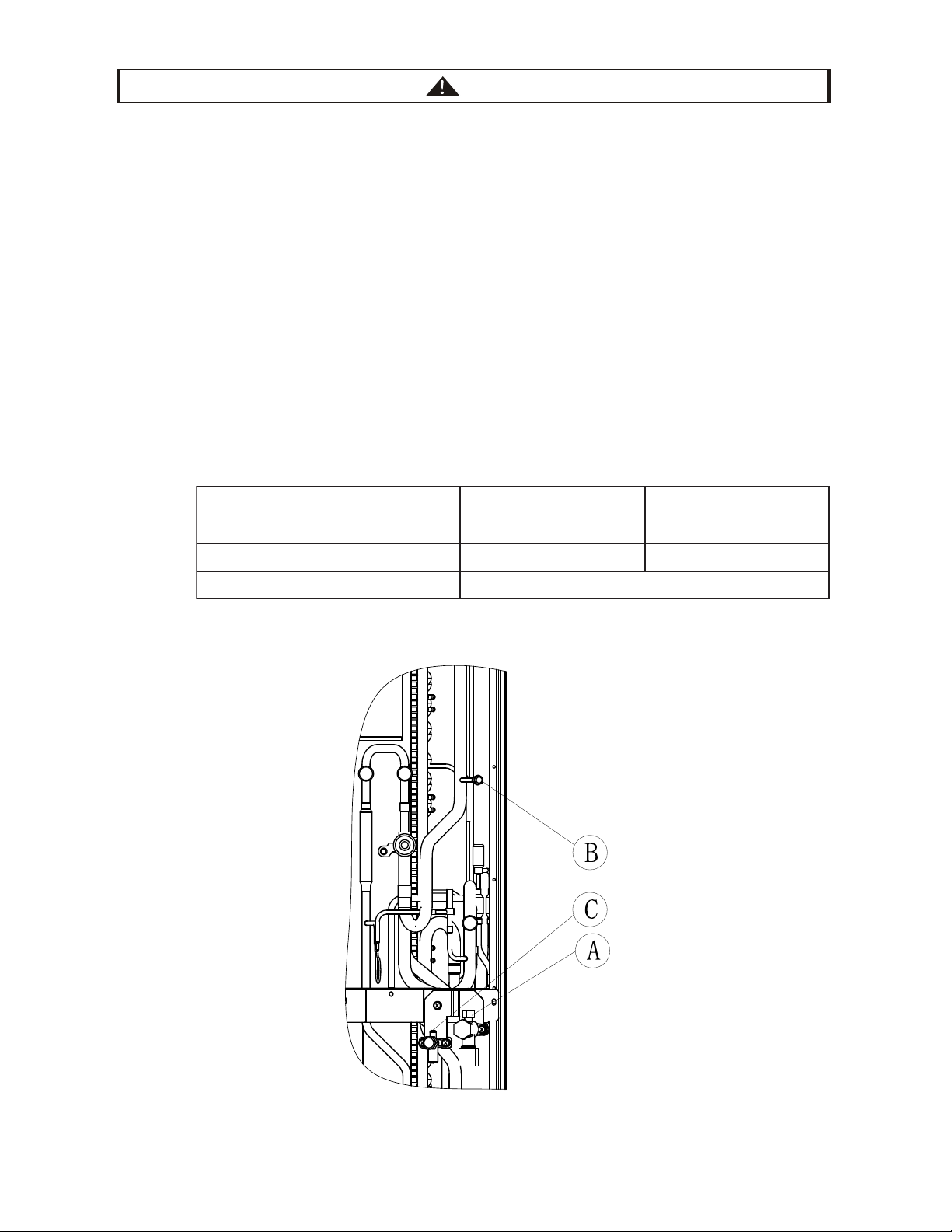
5.7 Caution of the Pressure by Check Joint
When the pressure is measured, use the check joint of gas stop valve ((A) in the figure below) and use the
check joint of liquid piping ((B) in the figure below).
At that time, connect the pressure gauge according to the following table because of high pressure side and
low pressure side changes by operation mode.
Cooling Operation Heating Operation
Check Joint for Gas Stop Valve "A" Low Pressure High Pressure
Check Joint for Piping "B" High Pressure Low Pressure
Check Joint for Liquid Stop Valve "C"
NOTE:
Be careful that refrigerant and oil do not splash onto the electrical parts when removing the charge
hoses.
Exclusive for Vacuum Pump and Refrigerant Charge
16
Fig 5.4 Check Joint Position
1.
Maximum Permissible Concentration of HFC GAS R410A
The refrigerant R410A is an incombustible and non-toxic gas.
However, if leakage occurs and gas fills a room, it may cause suffocation.
lkg t mt t tk fft t t mk t tt f l
t lbft
3
( kgm
3
)
Calculation of Refrigerant Concentration
(1) Calculate the total quantity of refrigerant R (lb(kg)) charged in the system connecting all the
indoorunits of tgt rooms.
(2) Calculate the room this unit (ft
3
(m
3
)).
Calculate the refrigerant concentration C (lbft
3
) (kg/m
3
) of the room according to the equation.
2.
CAUTION
3.

W12=
W11=
1.1
5.8 Additional Refrigerant Charge
It is necessary to add additional refrigerant charge as follows.
1. Calculating Method of Additional Refrigerant Charge
A. Determine an to additional refrigerant quantity according to the following procedure, and charge it into the
system. B. Record the additional refrigerant quantity to facilitate service activities thereafter.
Although refrigerant has been charged into this unit, it is required that additional refrigerant be charged according
to piping length.
See Example for Model CHV6-60URBM, and fill in the following table.
Pipe Diameter in(mm) Total Piping Length ft (m) Additional Charge (lbs)
Total Piping Length 16ft
Total Piping Length
Additional R
ef.Charge
<EXAMPLE>
W11=
CHV6-60URBM
17
a
b
Ref.Charge
W0
W1
W2
a
b
100%~130%
130%~150%
CHV6-36URBM
8.4 0.026 0.013 17.4
CHV6-48URBM
8.4 0.026
0.013
17.4
CHV6-60URBM
9.0 0.026 0.013 17.4
0.33lbs for
each 10%
ķ
1.32lbs for
each 10%
ķ
W0+W1+W2
NOTE:ķLess than 10% is calculated as 10%.
Model
W0:
Ref.Charge
before
shipment
(lbs)
W1:
Additional
Ref.Charge according
to piping
(lbs/ft)
W2:
Additional Ref.Charge
according to
Connection Ratio
(lbs)
Wt˖
Total Ref.
Charge
(lbs)
Max. Total
Ref.
Charge
(lbs)
Additional Refrigerant Charge according to Table 5.9
Tabe 5.9 Additional Refrigerant Charge Calculation
W2 = 0
W2 =
Pipe Diameter (in) Total Piping Length (ft)
Additional Charge
W12=
Additional Refrigerant Charge Calculation
lbs
lbs
lbs
lbs
1/4
3/8
3.3
1/4
3/8
32.8
16.4
16.4
16.4
32.8
32.8
16.4
0.026
2.2
0.0134
3/8×32.8ft
3/8×16.4ft
3/8×16.4ft
1/4×16.4ft
3/8×16.4ft
1/4×32.8ft
1/4×32.8ft
lbs
lbs

Duct type
4-Way
Cassette Type
CHV6-36URBM 0
CHV6-48URBM
0
100%
Model Connection ratio
Indoor Unit Type
When the system is connected one-to-one, the connection ratio must be 100%, and the additional refrigerant need
to be reduced as the following requirements:
CHV6-60URBM
0
0
5.
Notice of Additional Charge
18
_
Follow below, setting the Dip-Switch for piping length.
4.
Dip-Switch Setting for Piping Length
2. Charging Work
3. Record of Additional Charge
Record the refrigerant charging quantity in order to facilitate maintenance
and servicing activities.
Total refrigerant charge of this system is calculated in the following formula.
Total Ref. Charge of This System = 0W12
This System = + = lbs
Charge refrigerant (R410A) into the system as follows.
(1) For charging refrigerant, connect the gauge mani-fold using charging hoses with a refrigerant cylinder to the check joint
of the liquid line stop valve.
(2) Fully open the gas line stop valve and slightly open the liquid line stop valve.
Charge refrigerant by opening the gauge manifold valve.
(3) Charge the required refrigerant by operating the system in cooling.
Ensure to charge correct volume by utilizing a weight scale. An excess or shortage of refrigerant is the main cause
of trouble to the units.
Fully open the liquid line stop valve after completing refrigerant charge.
lbs
lbs
Total Additional Charge
Total Ref. Charge of This System
Date of Ref. Charge Work
Day Month Year
Mark
Show Switch Key Position)
Shipment
I.U.is located
higher
O.U.is located
1
Tabe 5.10 Refrigerant Charge
than O.U.66ft(20m)
higher
than O.U.0ft(25m)
_
6. Electrical Wiring
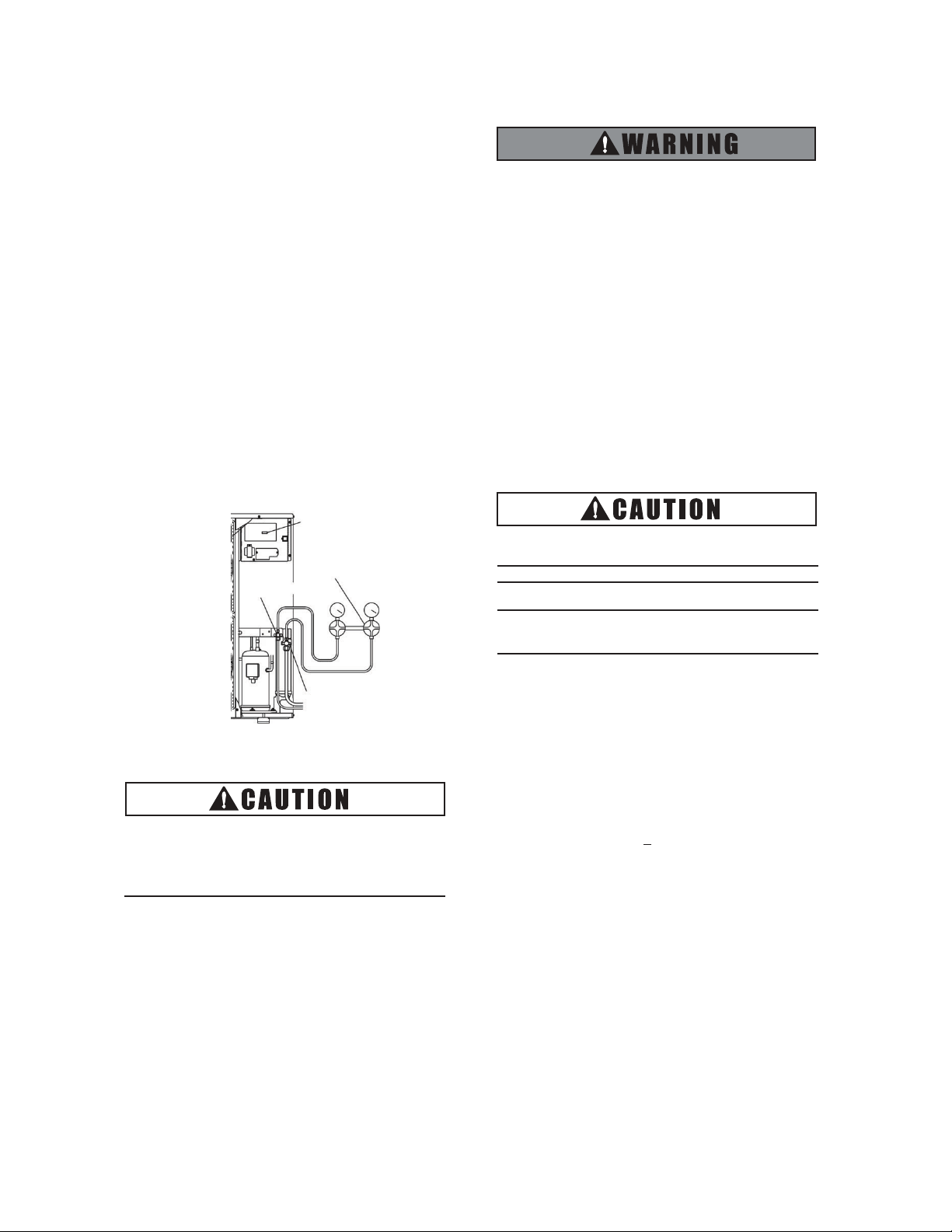
5.9 Collecting Refrigerant
When the refrigerant should be collected into the
outdoor unit due to indoor/outdoor unit relocation,
collect the refrigerant as follows.
(1) Attach the manifold gauge to the gas stop
valve and the liquid stop valve.
(2) Turn ON the power source.
(3) Set the DSW1-1 pin of the outdoor unit
PCB at the “ON” side for cooling operation.
Close the liquid stop valve and collect the
refrigerant.
(4) When the pressure at lower pressure side
(gas stop valve) indicates -1.5 psi
(-0.01MPa ,684mmHg), perform the
following procedures immediately.
* Close the gas stop valve.
* Set the DSW1-1 pin at the “OFF” side.
(To stop the unit operation.)
(5) Turn OFF the power source.
Use the pressure gauge to measure the low pressure
and keep it above -1.45 psi(-0.01MPa). If the
pressure is lower than -1.45 psi(-0.01MPa), the
compressor may be faulty.
6.1 General Check
(1) Make sure that the field-selected electrical
components (main power switches, circuit
breakers, wires, conduit connectors and
wire terminals) have been properly
selected according to the electrical data.
Make sure that the components comply
with National Electrical Code (NEC).
(2) Check to ensure that the voltage of power
supply is within +10% of nominal voltage
If not, electrical parts will be damaged.
(3) Check to ensure that the capacity of power
(4) Check to ensure that the ground wire is
connected.
(5) Check to ensure that the electrical
resistance is more than 1 megohm, by
measuring the resistance between ground
and the terminal of the electrical parts.
If not, do not operate the system until the
electrical leakage is found and repaired.
● Turn OFF the main power switch to the
indoor unit and the outdoor unit and wait for
more than 10 minutes before electrical wiring
work or a periodical check is performed.
● Check to ensure that the indoor fan and the
outdoor fan have stopped before electrical
wiring work or a periodical check is
performed.
● Protect the wires, electrical parts, etc. from
rats or other small animals.
If not protected, rats may gnaw at
unprotected parts and at the worst, a fire
will occur.
● Avoid the wirings from touching the
refrigerant pipes, plate edges and electrical
parts inside the unit.
If not do, the wires will be damaged and at
the worst, a fire will occur.
● Tightly secure the power source wiring
using the cord clamp inside the unit.
Dip Switch
(DSW1-ON)
Manifold Gauge
Gas Stop Valve
Liquid
Stop Valve
19
NOTE
Fix the rubber bushes with adhesive when
conduit tubes to the outdoor unit are not used.
supply is enough.
If not, the compressor will not be able to
operate cause of abnormally voltage
drop at starting.
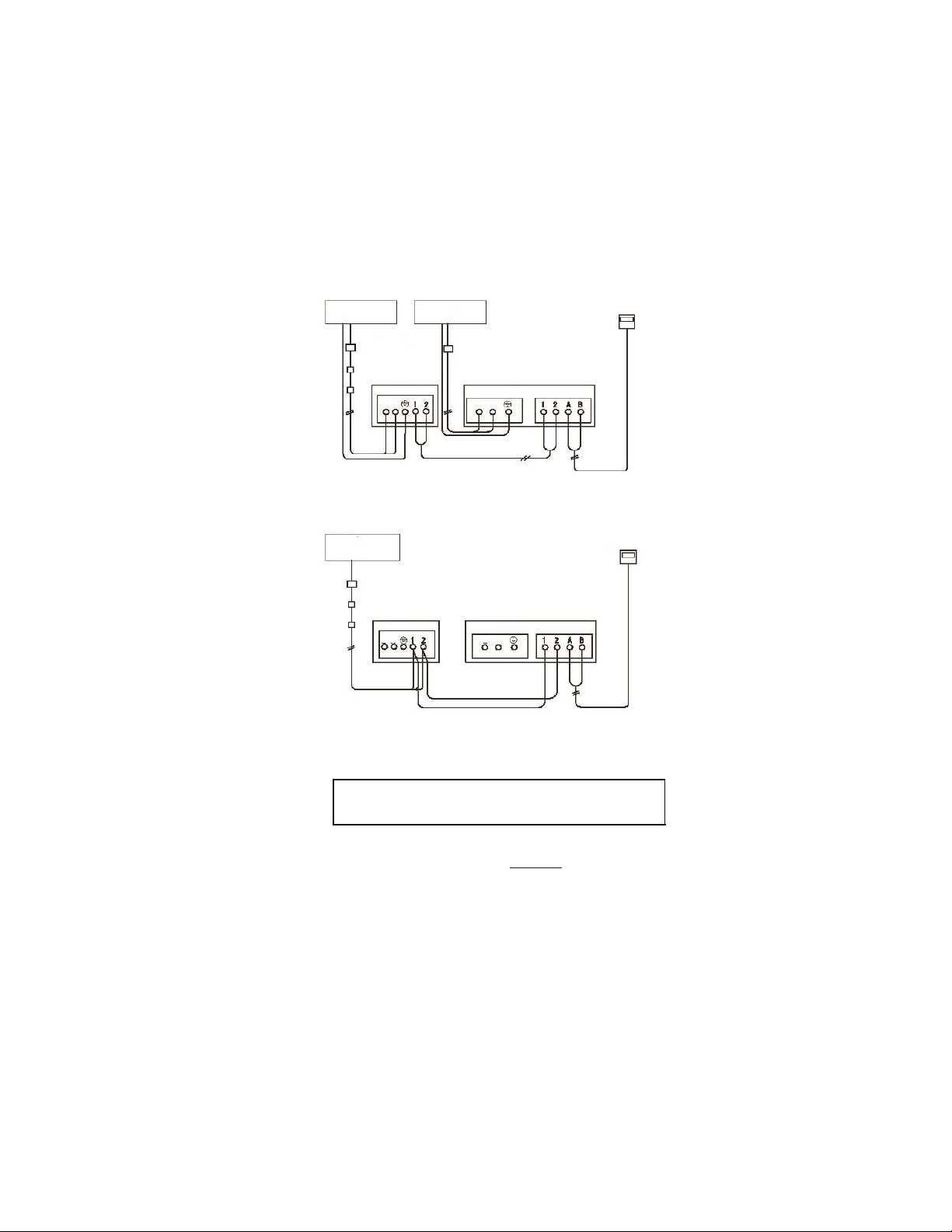
Fig. 6.1 ndoor unit and outdoor unit
communication wire connection
20
If connected, the pr
inted circuit board will be damaged.
These terminals are for the Control.
Do not connect the Power Source Line to the terminal 1 and 2.
INCORRECT
Indoor Unit
Outdoor Unit
ELB for
(4)
terminal board in the electrical control box
of both outdoor unit and indoor unit, and
connect the ground wire to the electrical
control box of outdoor unit.
In addition, connect the ground wire to
earth screw in the electrical control box of
indoor unit. Refer to Fig. 6.2.
Refer to Fig. 6.1.
6.2 Electrical Wiring Connection
(1) Connect the power supply wires to the
(2) Connect the wires between the outdoor
and indoor units to terminals 1 and 2 on the
terminal board.
If power supply wiring is connected to 1
and 2 of terminal board (TB1), printed
circuit board will be damaged.
Remote
Control
Switch
(Option)
(3) Do not wire in front of the fixing screw of
the service panel. If you do, the screw can
not be removed.
NOTES:
2.
If total wiring length less than 98ft
(30m), it is possible to use the normal
wiring (0.3mm
2
) except twist pair
cable.
1. In case of total wiring length at intermediate
wiring between outdoor unit and indoor unit
and between indoor units is less than 328 ft
(100m), it is possible to use the normal wiring
(more than AWG18 (0.75mm
2
) )except twist
pair cable.
ELB for
Outdoor Unit
Indoor Unit
Indoor Unit
CORRECT
Remote
Control
Switch
(Option)
Remote
Control
Switch
(Option)
INCORRECT
ELB for
Outdoor Unit
Outdoor Unit
Indoor Unit
FUSE
Switch
FUSE
Switch
208/230V ~ 60Hz
208/230V ~ 60Hz
208/230V ~ 60Hz
can be extended up to 1640.4ft.(500m).
Total wiring length for remote control switch
L1 L2
L1 L2
L1 L2 L1 L2
U par or communcaon r
conncn noor un an ouoor un,
rpcy connc o an rmna o
rmna oc n noor an ouoor
un Connc communcaon r o r
conror o an B rmna o noor un
rmna oc

21
Fig. 6.2 Wiring Connection for Indoor & Outdoor
No.1 Indoor Unit
Power Source Cable
Pay an attention to the phase
of power source when wiring.
Remote Control
Switch Cable
Shielded Twist-Pair Cable AWG18 x 2
This cable dose not need any polarity. Do
not apply an excessively high voltage to
this cable. (Rated Voltage: 12V)
Remote
Control Switch
(Option)
Remote
Control Switch
(Option)
Switch
Outdoor Unit
No.2 Indoor Unit
Fuse
ELB
ELB
Switch
Fuse
208/230V ~ 60Hz
208/230V ~ 60Hz
Distribution Box or Pull Box
L1 L2
L1 L2
L1 L2
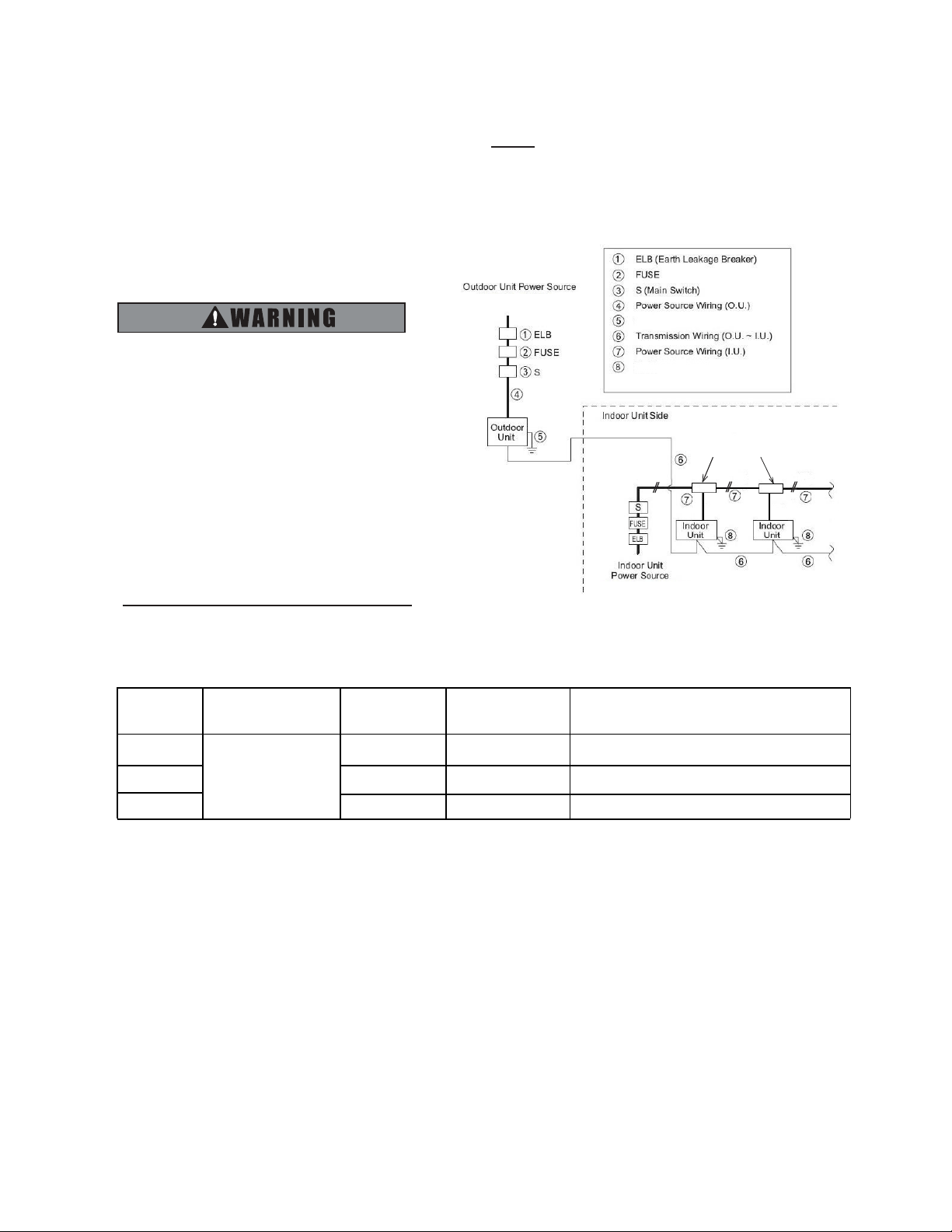
22
● Install an ELB in the power source.
If ELB is not used, it will cause electric shock or
fire at the worst.
● The tightening torque of each screw shall be as
Keep the above tightening torque when wiring work.
Power Source Wiring is fundamental
according to this method.
NOTE:
Supply the power source of outdoor units and indoor
units respectively.
(1) Power Source Wiring:
() In the case that a conduit tube for field-
wiring is not used, fix rubber bushes
with
adhesive on the panel.
● Install main switch and ELB for each system
separately. Select the high response type ELB that
is
acted
within
0.1
second.
● Separate the control wiring between outdoor unit
CHV6-36URBM
CHV6-48URBM
CHV6-60URBM
Model
Power Source
200V ~ 60Hz
Distribution Box or Pull Box
Tabe 61
follows.
M4: 0.7 to 1.0 ft.·lbs (1.0 to 1.3 N·m)
M5: 1.5 to 1.8 ft.·lbs (2.0 to 2.5 N·m)
M6: 3.0 to 3.7 ft.·lbs (4.0 to 5.0 N·m)
M8: 6.6 to 8.1 ft.·lbs (9.0 to 11.0 N·m)
M10: 13.3 to 17.0 ft.·lbs (18.0 to 23.0 N·m)
208/230V ~ 60Hz
208/230V ~ 60Hz
a
nd indoor unit more than approximately 1-3132 to 2-38 in.
(50 to 60mm) from power supply wiring. Do not use a
coaxial cable.
0
0
0
0
Ground Wiring (O.U.)
Ground Wiring (O.U.)
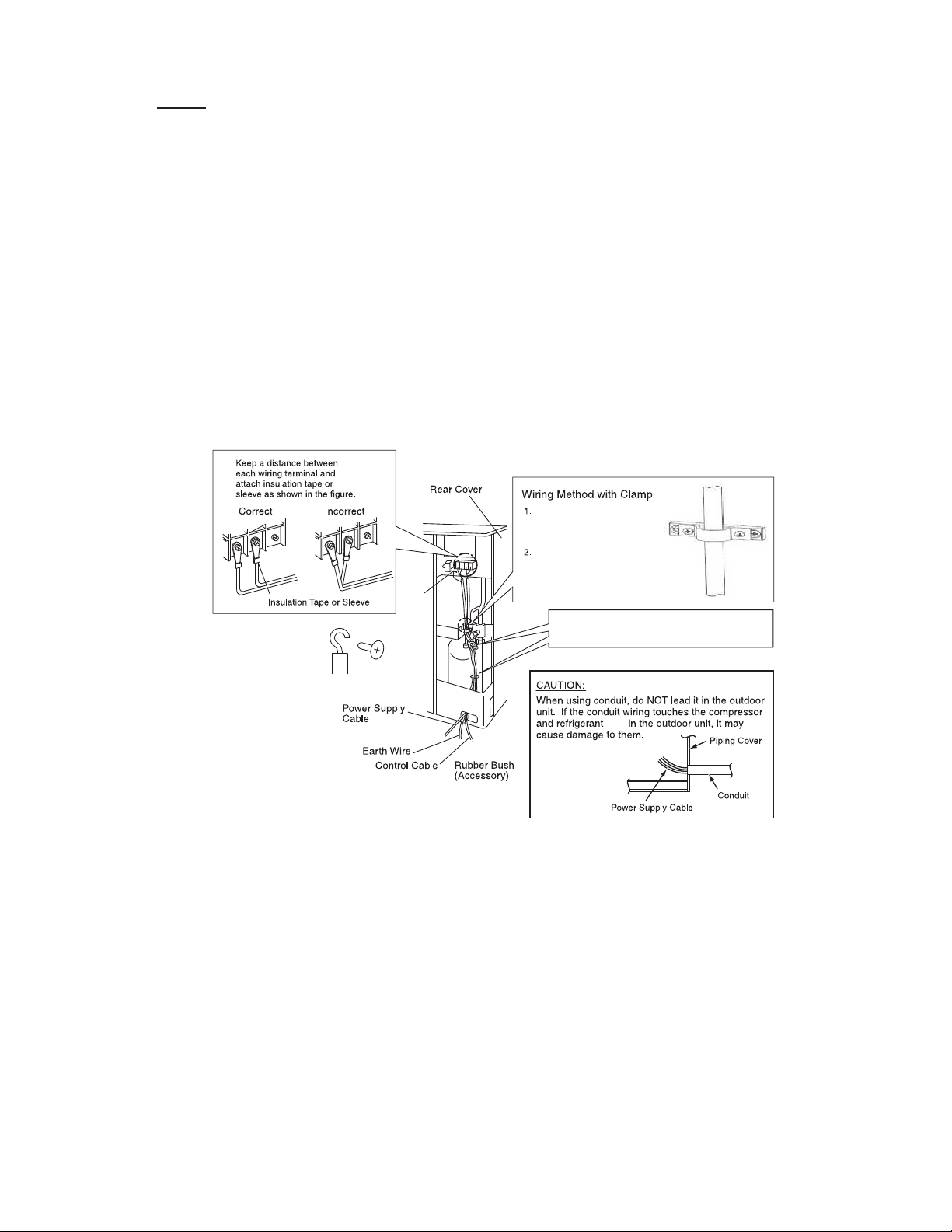
Fig. 6.3 Wiring Connection of Outdoor Unit
23
NOTES:
(1) Field wiring shall conform to local laws and regulations, and all wiring operations
must be performed by qualified professionals.
(2) Refer to relevant standards for above-noted power cord size.
(3) Where power cord is connected through junction box in series, be sure to determine the
total current and choose wires based on the table below6.
() The wiring specifications for weak-current communication circuit shall not be lower than
that for RVV(S)P shielded wires or equivalent, and the shielding layer shall be
grounded.
() A switch that can ensure all-pole disconnection shall be installed between power supply
and air conditioning unit in such a manner that the contact spacing shall not be less than
3mm.
(6) Once the power cord is damaged, the dealer or the professionals from designated
maintenance department must be contacted in a timely manner for repair and
replacement.
() For the installation of power cord, the ground wire must be longer than the current-
Mount the clamp on stop
valve mounting plate, and
tighten it with screws.
Do not use a solderless
terminal when a single
wire is used, or it will
cause abnormal heating
at the caulking portion
of the terminal.
If a single wire is used,
connect the wire direct
as shown in the figure.
Insert the wires with a cord
clamp as shown in the figure.
Make a loop of the wires so that disconnecting
the wirings for replacing parts is not required.
.
pipe
graund
O.U.is located higher
Test Run(Cool)
7. Outdoor Unit Dip-Swtich Setting
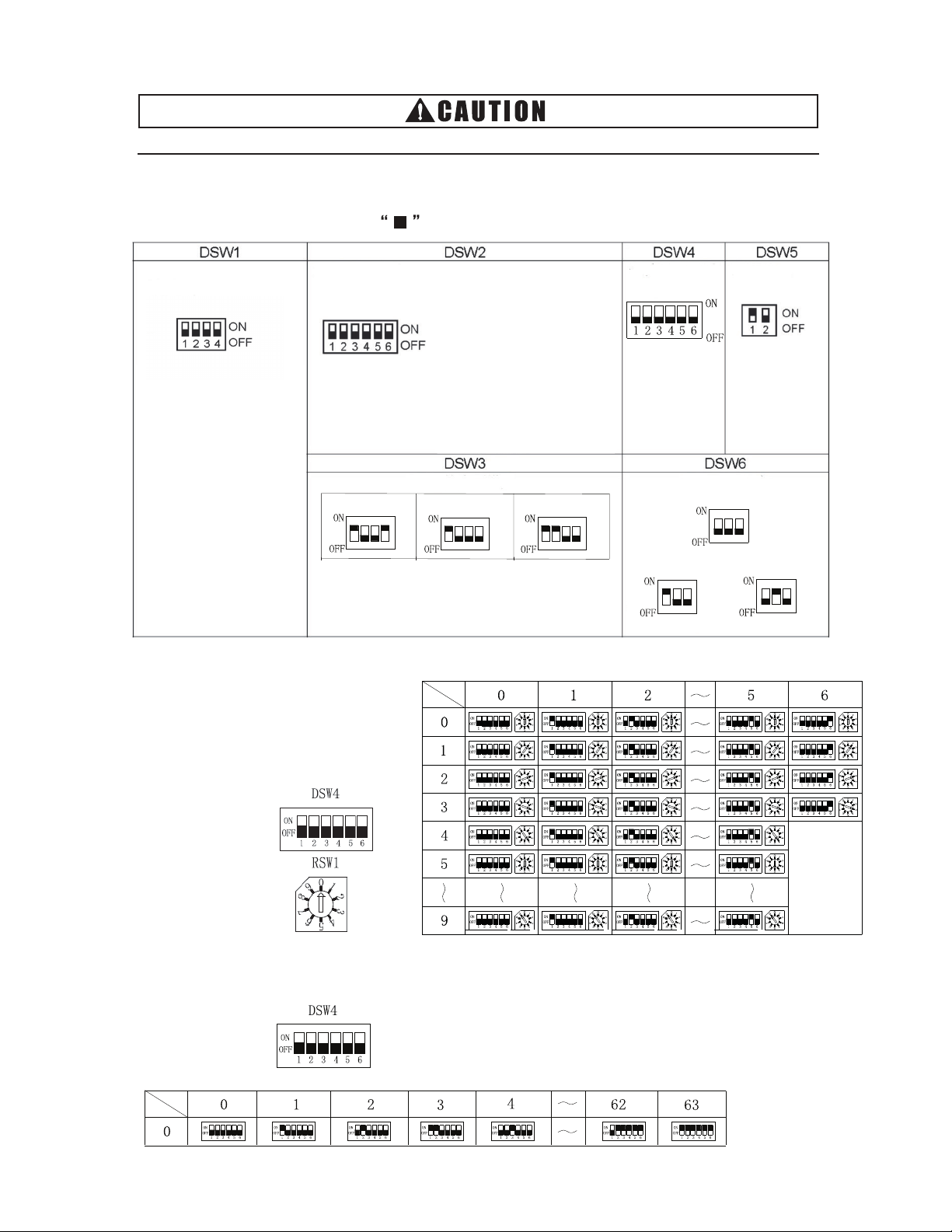
Turn off all power switch before setting Dip-Switch, or else the Dip-Switch is of no effect.
Follow this table setting Dip-Switch,
Test Run(Heat)
symbol denote the position of Dip-Switch contact joint.
ALL OFF: Shipment Set
Optional Function Setting
Input Power Setting
Ref. Cycle No.
Setting
Communication
Setting
Capacity Setting
Pipe length Setting
Shipment
I.U.is located higher
than O.U.(>65ft)
than I.U.(>82ft)
Test Run(Cool)
O.U.is located higher
24
CHV6-60URBM
CHV6-36URBM
CHV6-48URBM
Compressor Forced Stop
Digital
Unit
Forbid
Setting
● Communication Setting
It is necessary to set Ref. cycle system No.
and terminal resistor
connect to H-NET system.
● Setting Ref.cycle system No.
Setting Ref.cycle
(DSW4&RSW1)
Tens Digit Setting
Install a multi-pole main switch with a space of 1/8 in. (3.0mm) or more between each phase.
Single Digit Setting
●
Setting Ref.cycle system No.
Setting Ref.cycle
(DSW4)
High Digit Setting
A Bit
Ten
ON:
6 ON:
ON:
, ON:
ON:
ALL OFF: Shipment Set
Setting
8. Test Run
system.
(A) Check and confirm Ref. pipe system and
communication wire link to same Ref. cycle
(D) Check to ensure that the switch on the
(C) Check to ensure that the stop valves of
(B) Check to ensure that the electrical
Resetting
Test run should be performed according to the
Table 8.1 on page 26. Use the Table 8.2 on
page 28 for recording test run.
● Do not operate the system until all the check
points have been cleared.
resistance is more than 1 megohm, by
measuring the resistance between
ground and the terminal of the electrical
parts. If not, do not operate the system
until the electrical leakage is found and
repaired.
the outdoor unit are fully opened, and
then start the system.
main power source has been ON for
more than 12 hours, to warm the
compressor oil by the oil heater.
● Pay attention to the following items while
the system is running.
(A) Do not touch any of the parts by hand at
the discharge gas side, since the
compressor chamber and the pipes at
the discharge side are heated higher
than 194
o
F (90
o
C).
(B) DO NOT PUSH THE BUTTON OF THE
MAGNETIC SWITCH(ES). It will cause a
●
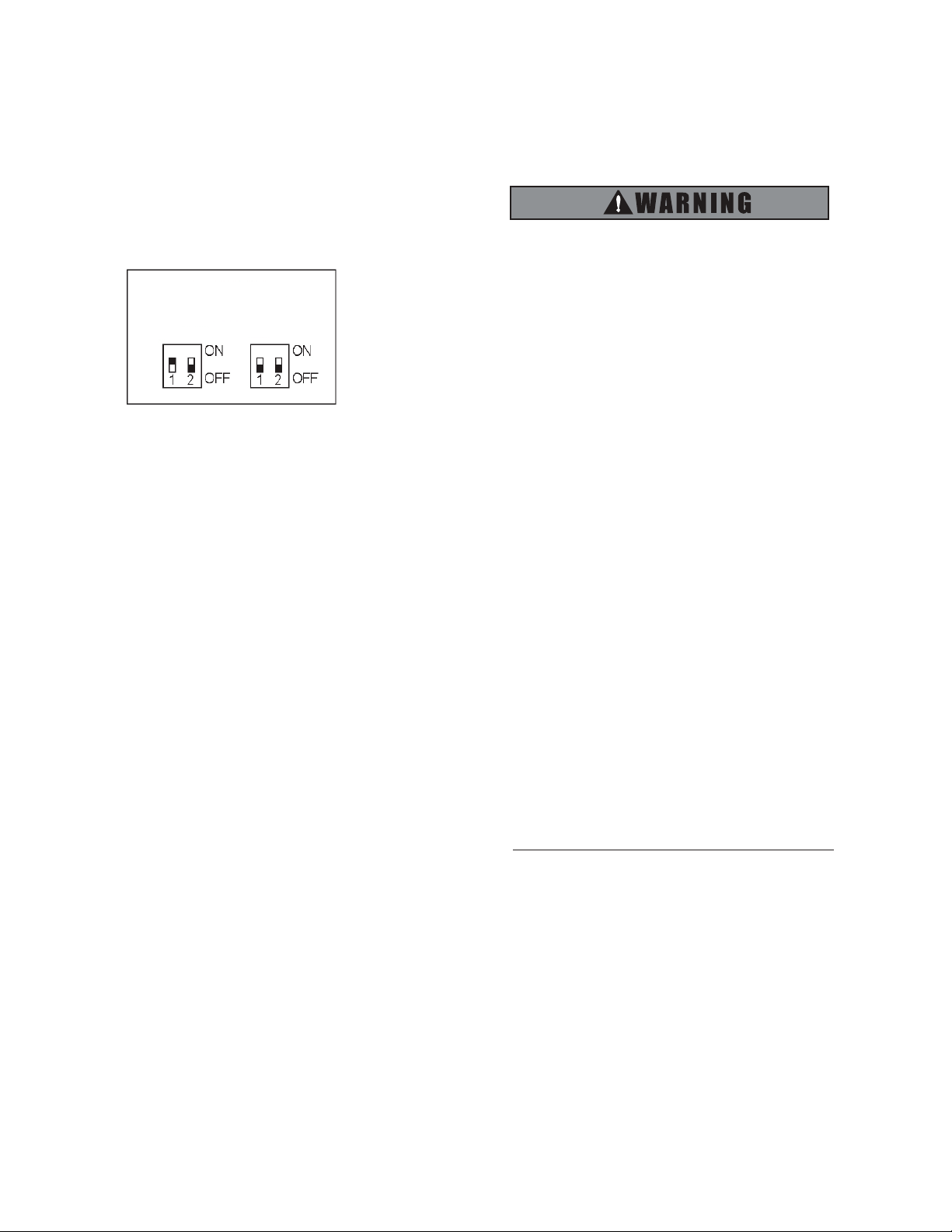
Terminal Resistor Setting
Shipment
Resetting
Setting Terminal Resistor
DSW5
Setting
25
Before shipment, No.1 pin of DSW5 is set at the
“ON” side. In the case that the outdoor units
quantity in the same H-NET is 2 or more, set No. 1
pin of DSW5 at the “OFF” side from the 2nd
refrigerant group outdoor unit. If only one outdoor
unit is used, no setting is required.
confirm their Ref. cycle and connect wire joint to
same Ref. cycle system.
serious accident.
● Do not touch any electrical components
within ten minutes after turning OFF the
main switch.
● Operate eery indoor unit one by onechec and
26
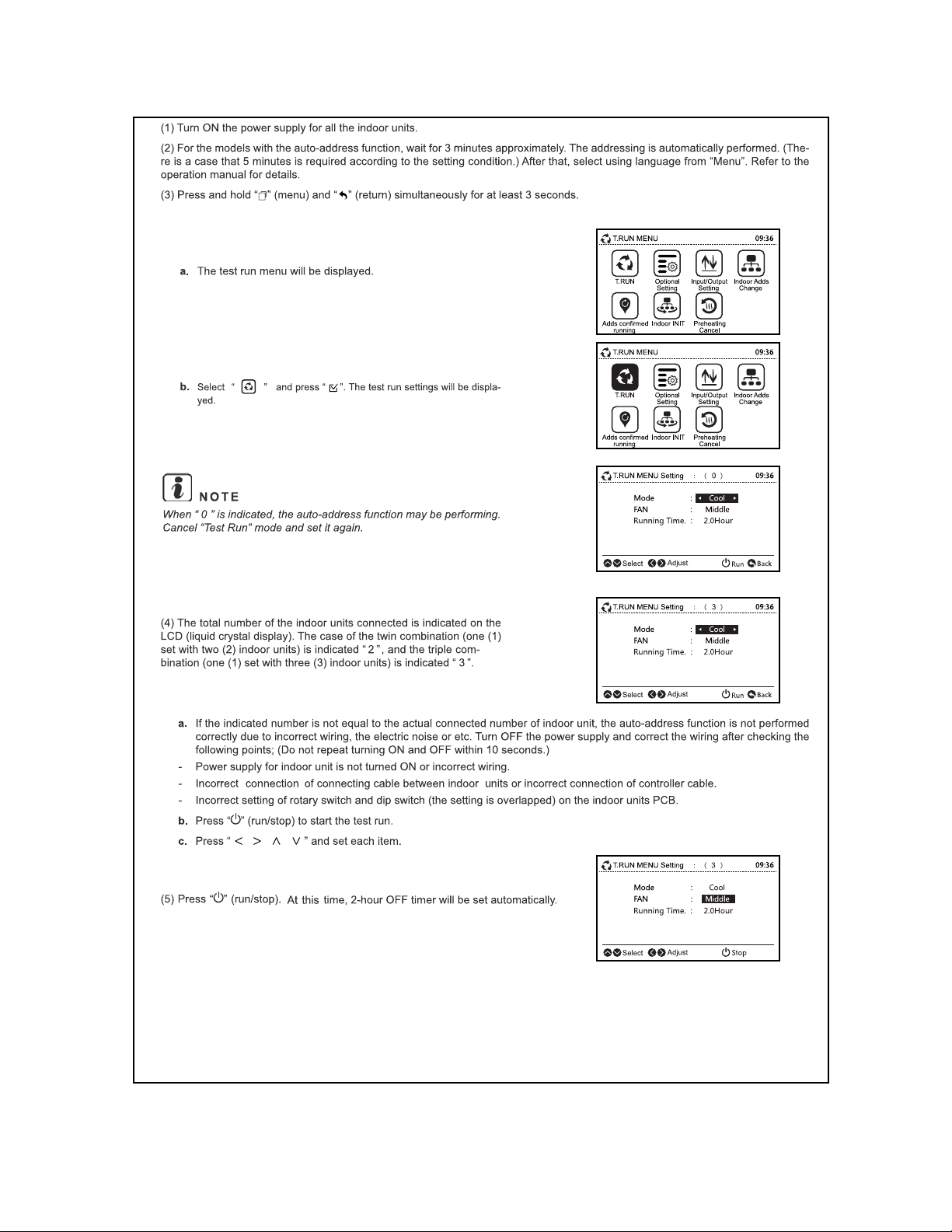
Table 8.1 Checking of Wire Connection by Test Run

SPWT-J01
27
7
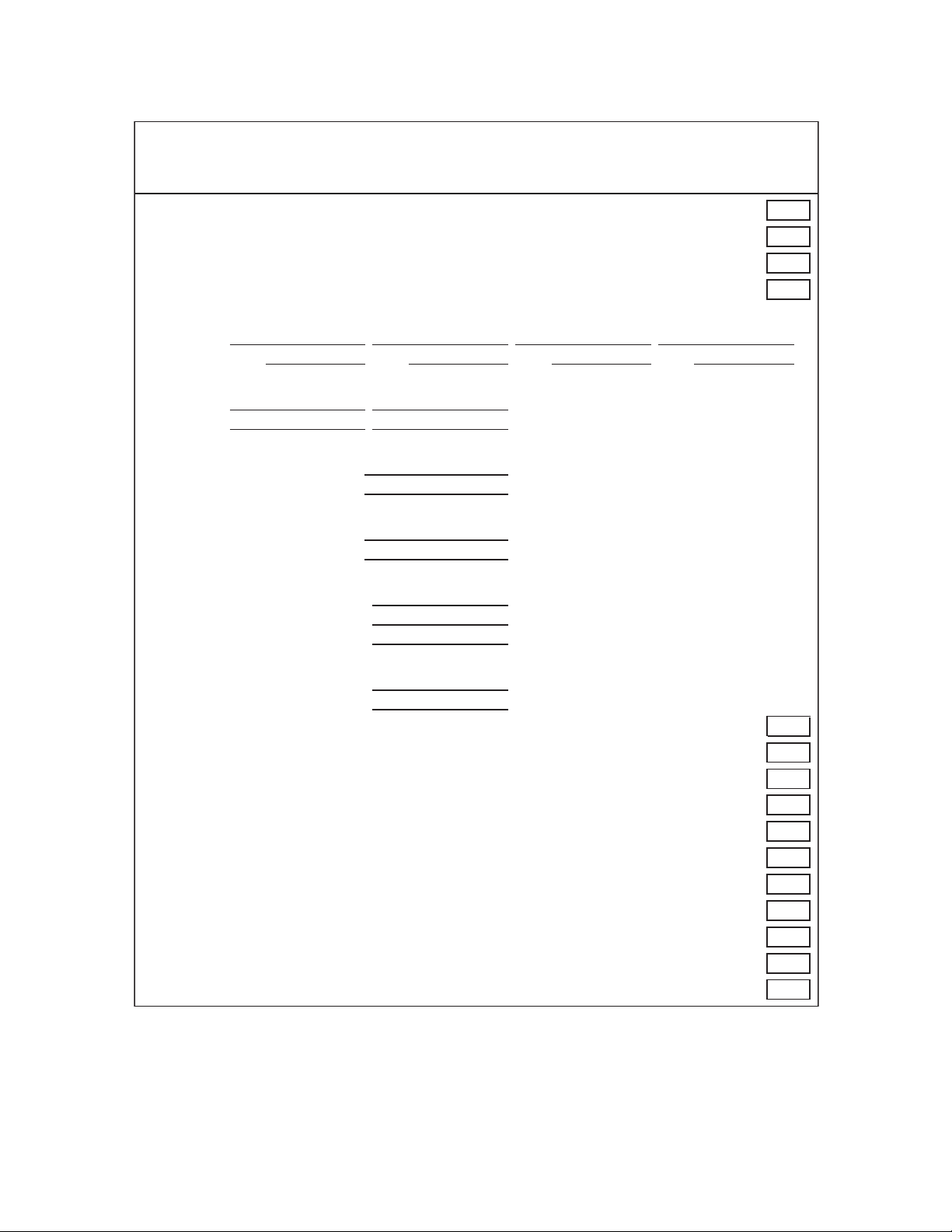
able 8.2 Test Run and Maintenance RecordT
MODEL: SERIAL. No. COMPRESSOR MFG. No.
CUSTOMER'S NAME AND ADDRESS: DATE:
1. Is the rotation direction of the indoor coil fan correct?
2. Is the rotation direction of the outdoor coil fan correct?
3. Are there any abnormal compressor sounds?
4. Has the unit been operated at least twenty (20) minutes?
5. Check Room Temperature
Inlet: No. 1 DB /WB
,
No. 2 DB /WB
o
,
No.3 DB /WB
o
,
No.4 DB /WB
o
Outlet:
DB /WB
o
,
DB /WB
o
,
DB /WB
o
,
DB /WB
o
6. Check Outdoor Ambient Temperature
Inlet: DB
o
Outlet: DB
o
,
WB
o
,
WB
o
7. Check Refrigerant Temperature
Liquid Temperature:
o
Discharge Gas Temperature:
o
8. Check Pressure
Discharge Pressure:
P
Suction Pressure:
P
9. Check Voltage
Rated Voltage: V
Operating Voltage:
V
Starting Voltage: V
10. Check Compressor Input Running Current
Input: kW
Running Current: A
11. Is the refrigerant charge adequate?
12. Do the operation control devices operate correctly?
13. Do the safety devices operate correctly?
14. Has the unit been checked for refrigerant leakage?
15. Is the unit clean inside and outside?
16. Are all cabinet panels fixed?
17. Are all cabinet panels free from rattles?
18. Is the filter clean?
19. Is the heat exchanger clean?
20. Are the stop valves open?
21. Does the drain water flow smoothly from the drain pipe?
28
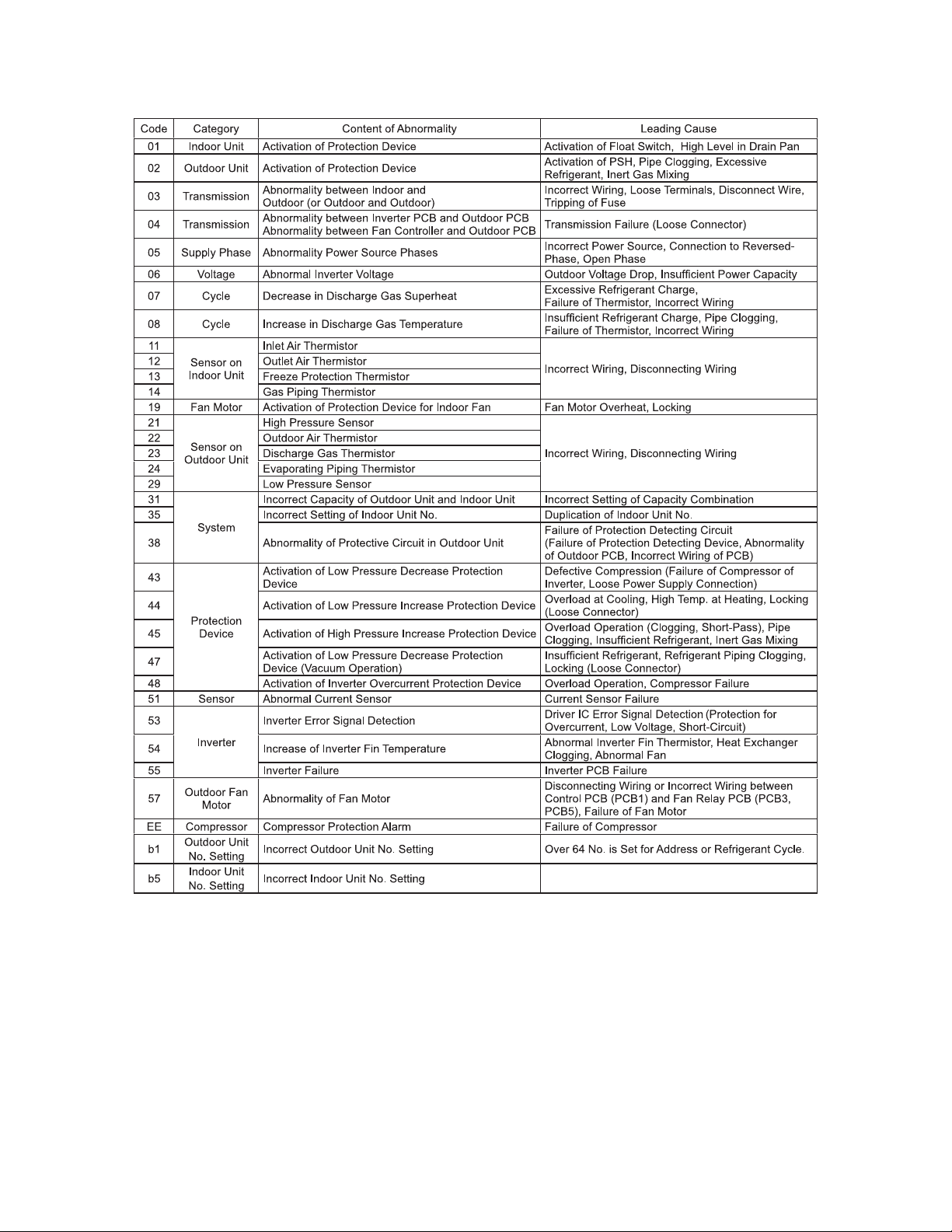
able 8.3 Alarm Code T
29
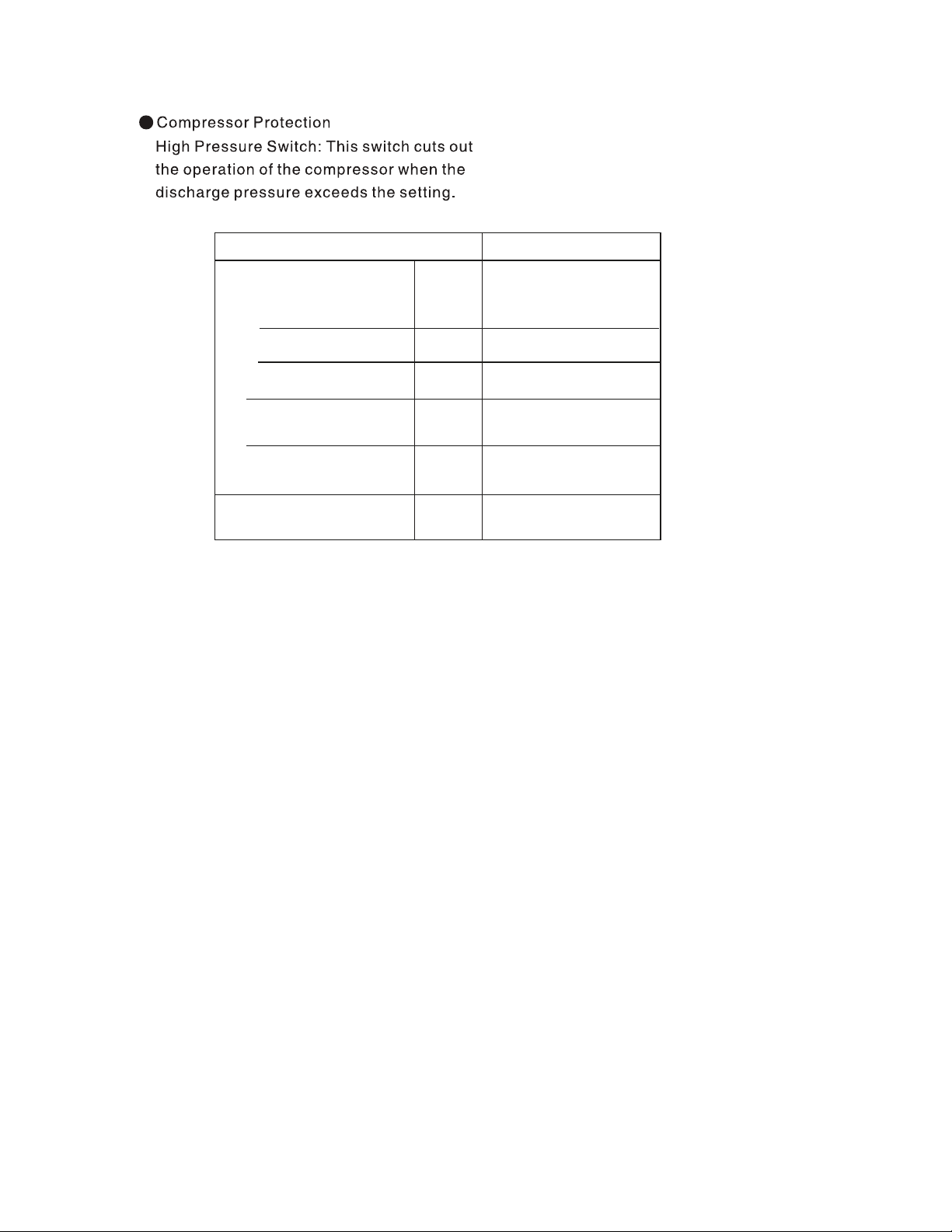
9. Safety and Control Device Setting
-0. 20)
0.15)
CCP Timer Set Time
Model
3
(4.15
(3.2
-0.05)
-0.20)
(MPa)
A
50
W
Min
A
5
CHV6-36/48/60URBM
Automatic Reset,Non-Adjustable
For Compressor
Pressure Switch
High Pressure
Cut-Out
Cut-In
Fuse on Main Circuit
Compressor Crank
Heater Power
Control Circuit Fuse
Non-Adjustable
+
60 28
+
30
-7
-29
601
Psi
Psi
(
MPa)
+22
464
- 29

080 V01
The Company is committed to continuous product improvement. We reserve the right, therefore, to alter the product information
at any time and without prior announcement.