All about the
Use & Care
of your
TABLE OF CONTENTS
www.frigidaire.com USA 1-800-944-9044 www.frigidaire.ca Canada 1-800-265-8352
Gas Range
808528001 (Oct 2014)
Important Safety Instructions ...........................3-6
Before Setting Oven Controls ..............................7
Before Setting Surface Controls ...........................8
Setting Surface Controls ....................................9
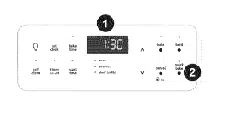
Oven Control Functions (100) ............................10
Setting Oven Controls .................................. 10-13
Care & Cleaning .......................................... 14-17
Before You Call ........................................... 18-19
Major Appliance Warranty .................................20
2
Thank you for choosing Frigidaire.
This Use & Care Guide is part of our commitment to
customer satisfaction and product quality throughout the
service life of your new appliance. We view your purchase
as the beginning of a relationship. To ensure our ability
to continue serving you, please use this page to record
important product information.
©2014 Electrolux Home Products, Inc.
All rights reserved. Printed in the USA
Registering your product with Frigidaire enhances our
ability to serve you. You can register online at www.
frigidaire.com or by dropping your Product Registration
Card in the mail.
PRODUCT RECORD AND REGISTRATION
Product Registration
Need help??
Visit the Frigidaire web site at www.frigidaire.com
Before you call for service, there are a few things you can
do to help us serve your better.
Read this Use & Care manual.
It contains instructions to help you use and maintain your
range properly.
If you received a damaged range ...
immediately contact the dealer (or builder) that sold you
the range.
Save time and money.
Check the section titled “Before you call”. This section
helps step you through some common problems that
might occur. If you do need service, help is only a phone
call away. Call Frigidaire Customer Services at 1-800-
944-9044.
Contents
Purchase date
Model number
Serial number
Record model & serial numbers here
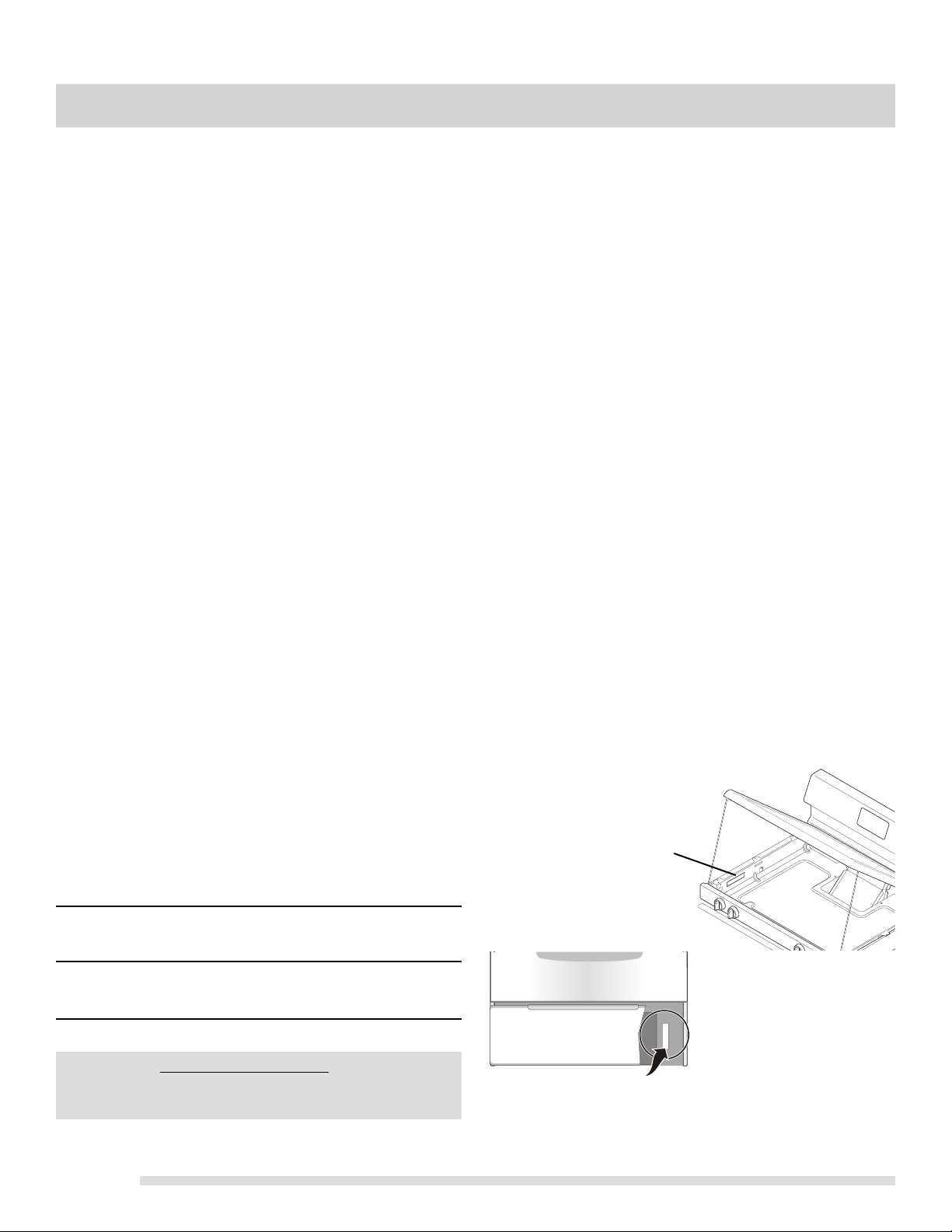
Serial plate locations
Be sure to visit us online at
www.frigidaire.com
for a complete line of accessories.
Serial plate is located here
under cooktop
Product Registration ...................................................... 2
Important Safety Instructions ............................ 3-6
Before Setting Oven Controls .................................. 7
Removing, replacing & arranging the oven racks ..........7
Before Setting Surface Controls .............................. 8
Cookware material types ............................................. 8
Setting Surface Controls ......................................... 9
Setting surface burners.............................................. 9
Home canning ...........................................................9
Oven Controls Functions .......................................10
Setting Oven Controls ......................................10-13
Setting the clock ...................................................... 10
Changing temperature display mode (F° or C°) .......... 10
Setting the minute timer ........................................... 11
Setting bake ............................................................ 11
Setting broil ............................................................. 12
Adjusting oven temperature ...................................... 13
Operating oven light ................................................. 13
Care & Cleaning ................................................14-17
Cleaning recommendation table ................................ 14
Cleaning the cooktop and surface burners ............. 15-16
Replacing oven light ................................................. 16
Removing & replacing oven door ............................... 17
Before You Call - Solutions to common problems .. 18-19
Appliance Warranty ...............................................20
or open broiler drawer (some models) or
storage drawer (some models).
3
Read all instructions before using this appliance.
Do not attempt to install or operate your appliance until
you have read the safety precautions in this manual.
Safety items throughout this manual are labeled with a
WARNING or CAUTION statement based on the risk type.
WARNING indicates a potentially hazardous
situation which, if not avoided, may result in
death or serious injury.
Save these instructions for future reference.
IMPORTANT SAFETY INSTRUCTIONS
WARNING
This is the safety alert symbol. It is used to alert you to
potential personal injury hazards. Obey all safety messages
that follow this symbol to avoid possible injury or death.
IMPORTANT
CAUTION indicates a potentially hazardous situa-
tion which, if not avoided, may result in minor or
moderate injury.
CAUTION
IMPORTANT indicates installation, operation,
maintenance or valuable information that is not hazard
related.
Denitions
Important Safety Instructions
•Remove all tape and packaging before using
the range. Destroy the carton and plastic bags after
unpacking the range. Never allow children to play with
packaging material.
•Proper Installation—Be sure your appliance is
properly installed and grounded by a qualied
technician in accordance with the National Fuel
Gas Code ANSI Z223.- latest edition, or in Canada
CAN/CGA B149.1, and CAN/CGA B149.2, and
the National Electrical Code ANSI/NFPA No.70-
latest edition, or in Canada CSA Standard C22.1,
Canadian Electrical Code, Part 1, and local code
requirements. Install only per installation instructions
provided in the literature package for this range. Ask
your dealer to recommend a qualied technician and an
authorized repair service. Know how to disconnect the
power to the range at the circuit breaker or fuse box in
case of an emergency.
If the information in this manual is not followed
exactly, a re or explosion may result causing
property damage, personal injury or death.
FOR YOUR SAFETY:
— Do not store or use gasoline or other
ammable vapors and liquids in the vicinity
of this or any other appliance.
— WHAT TO DO IF YOU SMELL GAS:
• Do not try to light any appliance.
• Do not touch any electrical switch; do not
use any phone in your building.
• Immediately call your gas supplier from a
neighbor’s phone. Follow the gas supplier’s
instructions.
• If you cannot reach your gas supplier, call
the re department.
— Installation and service must be performed
by a qualied installer, servicer or the gas
supplier.
WARNING
WARNING
Tip Over Hazard
• A child or adult can tip the
range and be killed.
• Verify the anti-tip device has
been installed to oor or wall.
To check if the anti-tip bracket is installed properly,
use both arms and grasp the rear edge of range back.
Carefully attempt to tilt range forward. When properly
installed, the range should not tilt forward.
Refer to the anti-tip bracket installation instructions
supplied with your range for proper installation.
• Ensure the anti-tip device is re-engaged when
the range is moved to oor or wall.
• Do not operate the range without the anti-tip
device in place and engaged.
• Failure to follow these instructions can result in
death or serious burns to children and adults.
Range
leveling leg
Anti-Tip
bracket
4
IMPORTANT SAFETY INSTRUCTIONS
DO NOT LEAVE CHILDREN ALONE —children
should not be left alone or unattended in the
area where appliance is in use. They should never
be allowed to sit or stand on any part of the appliance,
including the storage drawer, lower broiler drawer,
warmer drawer or lower double oven.
• Do not use water or our on grease res—
smother the re with a pan lid, or use baking
soda, a dry chemical or foam-type extinguisher.
• When heating fat or grease, watch it closely. Fat
or grease may catch re if allowed to become too hot.
• Use dry potholders - moist or damp potholders
on hot surfaces may result in burns from steam.
Do not let potholders touch hot heating elements.
Do not use a towel or other bulky cloth instead of a
potholder.
• Do not heat unopened food containers - buildup
of pressure may cause container to burst and
result in injury.
For electric ignition models only: Do not attempt
to operate the range during a power failure. If
the power fails, always turn off the range. If the range
is not turned off and the power resumes, the range will
begin to operate again. Once the power resumes, reset
the clock and oven function.
IMPORTANT
WARNING
NEVER use this appliance as a space heater to
heat or warm the room. Doing so may result in
carbon monoxide poisoning.
NEVER cover any slots, holes or passages in
the oven bottom or cover an entire rack with
materials such as aluminum foil. Doing so blocks
air ow through the oven and may cause carbon
monoxide poisoning. Aluminum foil linings may
trap heat, causing a re hazard.
Stepping, leaning or sitting on the door or
drawers of a range can result in serious injuries
and also cause damage to the appliance. DO NOT
allow children to climb or play around the range. The
weight of a child on an open oven door may cause the
range to tip, resulting in serious burns or other injury.
Storage in or on appliance—ammable materials
should not be stored in an oven, near surface
units or in the storage drawer, warmer drawer
or lower oven. This includes paper, plastic and cloth
items, such as cookbooks, plasticware and towels, as
well as ammable liquids. Do not store explosives, such
as aerosol cans, on or near the range.
CAUTION
Do not store items of interest to children in the
cabinets above a range or on the backguard of
the range. Children climbing on the range to reach
items could be seriously injured.
• DO NOT TOUCH SURFACE BURNERS, AREAS
NEAR THESE BURNERS, OVEN BURNERS OR
INTERIOR SURFACES OF THE OVEN. Both surface
and oven burners may be hot even though ames are
not visible. Areas near surface burners may become
hot enough to cause burns. During and after use, do
not touch, or let clothing or other ammable materials
touch these areas until they have had sufcient time
to cool. Among these areas are the cook top, surfaces
facing the cook top, the oven vent openings and
surfaces near these openings, oven door and window.
• Wear proper apparel—loose-tting or hanging
garments should never be worn while using the
appliance. Do not let clothing or other ammable
materials contact hot surfaces.
• Remove the oven door from any unused range if
it is to be stored or discarded.
•User servicing—Do not repair or replace any part
of the appliance unless specically recommended
in the manuals. All other servicing should be done only
by a qualied technician, This may reduce the risk of
personal injury and damage to the range.
CAUTION
•Never modify or alter the construction of a range
by removing the leveling legs, panels, wire covers,
anti-tip brackets/screws, or any other part of the
range.
5
IMPORTANT SAFETY INSTRUCTIONS
IMPORTANT INSTRUCTIONS FOR USING
YOUR COOKTOP
• Know which knob controls each surface burner.
Place a pan of food on the burner before turning it on,
and turn the burner off before removing the pan.
• Always turn knob to the full LITE position when
igniting top burners. Visually check that burner has lit.
Then adjust the ame so it does not extend beyond the
edge of the utensil.
• Utensil handles should be turned inward and not
extend over adjacent surface burners—To reduce
the risk of burns, ignition of ammable materials, and
spillage due to unintentional contact with the utensil, the
handle of the utensil should be positioned so that it is
turned inward, and does not extend over adjacent surface
burners.
• Never leave surface burners unattended at high
heat settings—Boilovers cause smoking and greasy
spillovers that may ignite, or a pan that has boiled dry
may melt.
• Glazed cooking utensils—Only certain types of glass,
glass/ceramic, ceramic, earthenware, or other glazed
utensils are suitable for cook top service without breaking
due to the sudden change in temperature. Check the
manufacturer’s recommendations for cook top use.
• When aming foods under a ventilating hood, turn
the fan on.
WARNING
Use Proper Flame Size—Adjust ame size so it does
not extend beyond the edge of the utensil. The use of
undersized utensils will expose a portion of the burner
ame to direct contact and may result in ignition of
clothing. Proper relationship of utensil to ame will also
improve efciency.
IMPORTANT INSTRUCTIONS FOR USING
YOUR OVEN
• Use care when opening oven door , warmer
drawer or lower oven door—Stand to the side of the
range when opening the door of a hot oven. Let hot air
or steam escape before you remove or replace food in
the oven.
• Keep Oven Vent Ducts Unobstructed. The oven
vent is located below the backguard. Touching the
surfaces in this area when the oven is operating may
cause severe burns. Also, do not place plastic or heat-
sensitive items on or near the oven vent. These items
could melt or ignite.
• Placement of Oven Racks. Always place oven racks
in desired location while oven is cool. If rack must be
moved while oven is hot use extreme caution. Use
potholders and grasp the rack with both hands to
reposition. Do not let potholders contact the hot heating
elements in the oven. Remove all utensils from the rack
before moving.
• Do not use the broiler pan without its insert. The
broiler pan and its insert allow dripping fat to drain and
be kept away from the high heat of the broiler.
• Do not cover the broiler insert with aluminum
foil. Exposed fat and grease could ignite.
• Protective liners—Do not use aluminum foil to
line the oven bottom. Only use aluminum foil as
recommended in this manual. Improper installation of
these liners may result in risk of electric shock, or re.
• Air curtain or other overhead range hoods, which
operate by blowing a downward air ow on to a range,
shall not be used in conjunction with gas ranges other
than when the hood and range have been designed,
tested and listed by an independent test laboratory for
use in combination with each other.
IMPORTANT INSTRUCTIONS FOR CLEANING
YOUR RANGE
• Clean the range regularly to keep all parts free of
grease that could catch re. Pay particular attention
to the area around each surface burner. Do not allow
grease to accumulate.
• Kitchen cleaners and aerosols—Always follow the
manufacturer’s recommended directions for use.
Be aware that excess residue from cleaners and aerosols
may ignite causing damage and injury.
• Clean ventilating hoods frequently—Grease should
not be allowed to accumulate on the hood or lter.
Follow the manufacturer’s instructions for cleaning hoods.
6
IMPORTANT SAFETY INSTRUCTIONS
Avoid re hazard or electrical shock. Do not use an
adapter plug, an extension cord, or remove grounding
prong from electrical power cord. Failure to follow this
warning can cause serious injury, re or death.
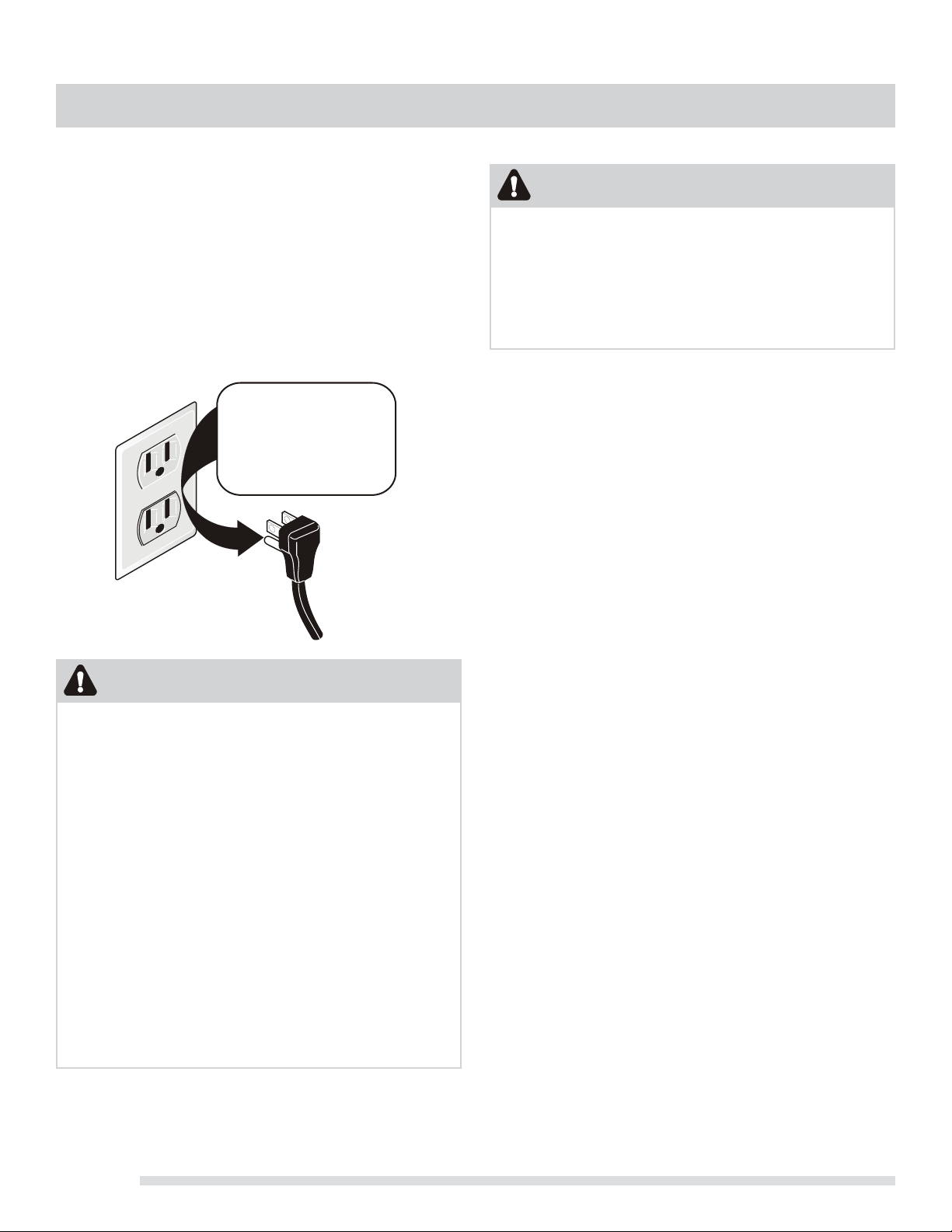
This appliance is equipped with a 3-prong grounding
plug for your protection against shock hazard and
should be plugged directly into a properly grounded
receptacle. DO NOT cut or remove the grounding
prong from this plug.
For personal safety, the range must be properly
grounded. For maximum safety, the power cord must
be plugged into an electrical outlet that is correctly
polarized and properly grounded.
If a 2-prong wall receptacle is the only available outlet,
it is the personal responsibility of the consumer to
have it replaced with a properly grounded 3-prong wall
receptacle installed by a qualied electrician.
Grounding Instructions
WARNING
See the INSTALLATION INSTRUCTIONS packaged with
this range for complete installation and grounding instructions.
If your gas range model is designed to allow for L.P.
conversion, the L.P. conversion kit may be obtained from
your local appliance dealer and should be installed by a
qualied service technician. Before installing the kit be
sure to follow the L.P. Installation Instructions carefully.
Personal injury or death from electrical shock may occur
if the range is not installed by a qualied installer or
electrician.
Any additions, changes or conversions required in order
for this appliance to satisfactorily meet the application
needs must be made by a qualied technician.
Conversion to Liqueed Petroleum Gas
WARNING
Do not under any
circumstance, cut,
remove, or bypass
the grounding prong.
Power supply cord
with 3-prong
grounding plug.
Grounding type
wall receptacle
Important Safety Notice
The California Safe Drinking Water and Toxic Enforcement
Act requires the Governor of California to publish a
list of substances known to the state to cause cancer,
birth defects or other reproductive harm, and requires
businesses to warn customers of potential exposure to
such substances.
7
BEFORE SETTING OVEN CONTROLS
Oven vent location
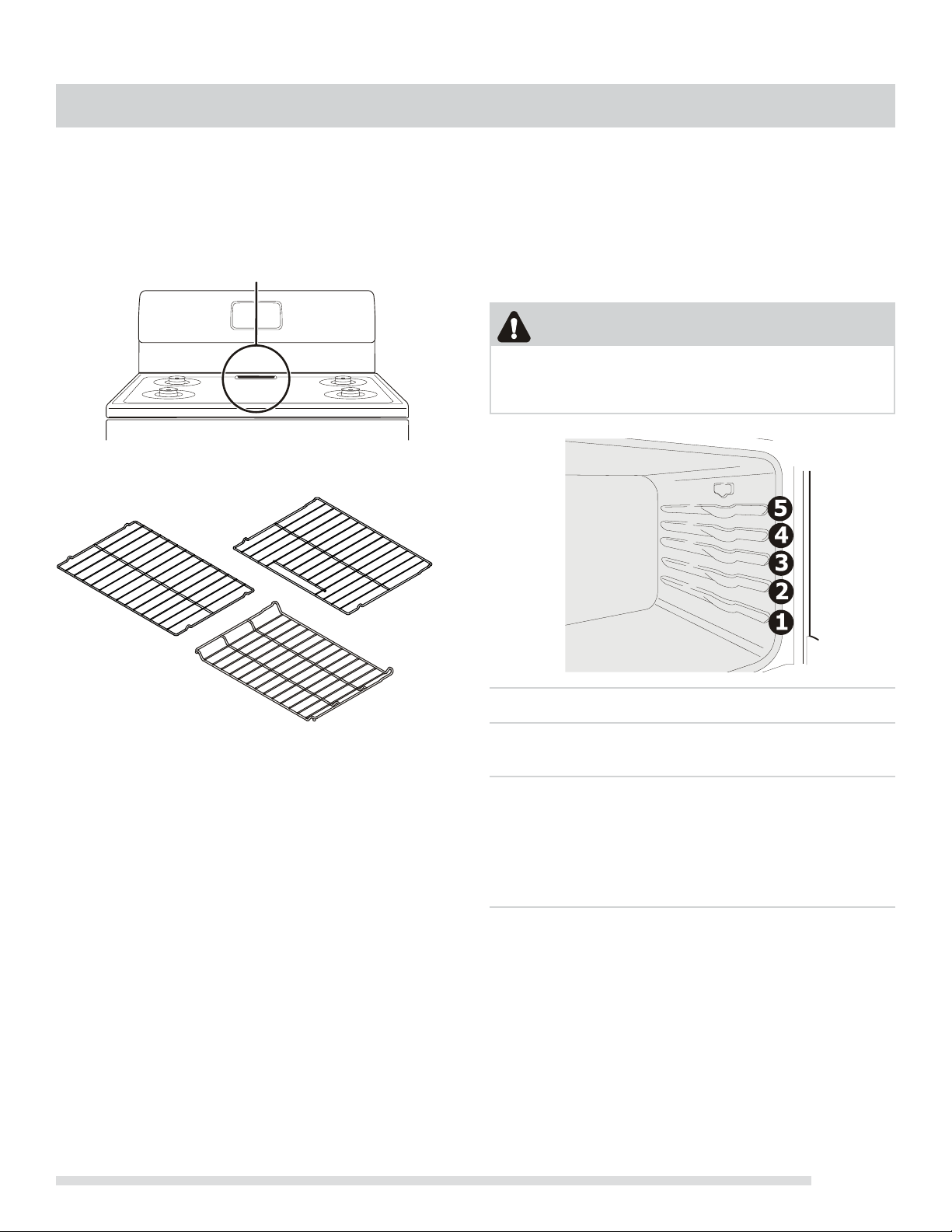
The oven vent is located at center rear of cooktop
below the control panel (See Fig. 1). When the oven is
on, warm air passes through this vent. This venting is
necessary for proper air circulation in the oven and good
baking results. Do not block the oven vent.
Air circulation in the oven
For best baking results allow 2-4” (5-10 cm) around the
cookware for proper air circulation and be sure pans and
cookware do not touch each other, the oven door, sides or
back of the oven cavity. Hot air must be able to circulate
around the pans and cookware in the oven for even heat
to reach around the food.
oven vent location
Removing, replacing & arranging racks
To remove - pull the rack forward until it stops. Lift up
front of rack and slide out.
To replace - t the rack onto the guides on the oven
walls. Tilt the front of the rack upward and slide the rack
back into place.
Arranging - always arrange the oven racks when the
oven is cool (prior to operating the oven).
Recommended rack positions by food type
Food type Position
(Fig. 2)
Broiling meats See broil
Cookies, cakes, pies, biscuits & mufns 2 or 3
Frozen pies, angel food cake, yeast, bread
and casseroles 1 or 2
Small cuts of meat or poultry 1 or 2
Turkey, roast or ham 1
CAUTION
Always use oven mitts when using the oven.
When using the appliance, oven racks and cooktop will
become very hot which can cause burns.
Fig. 2
Types of oven racks
at
oven rack
at handle
oven rack
offset
oven rack
The at oven rack or at handle oven rack (some
models) may be used for most cooking needs.
The offset oven rack (some models) is designed to place
the base of the rack about 1/2 of a rack position lower
than normal. This rack design provides several additional
possible positions between the standard positions.
Fig. 1
8
The size and type of utensil used, and the amount and
type of food being cooked will inuence the setting
needed for best cooking results.
Cookware material types
The most popular materials available are:
Aluminum - Excellent heat conductor. Some types of
food will cause it to darken (Anodized aluminum cookware
resists staining & pitting).
Copper - Excellent heat conductor but discolors easily.
Stainless - Slow heat conductor with uneven cooking
results. Is durable, easy to clean and resists staining.
Cast Iron - A slow heat conductor however will retain
heat very well. Cooks evenly once cooking temperature is
reached.
Porcelain-enamel on metal - Heating characteristics
will vary depending on base material.
Glass - Slow heat conductor.
Using proper cookware
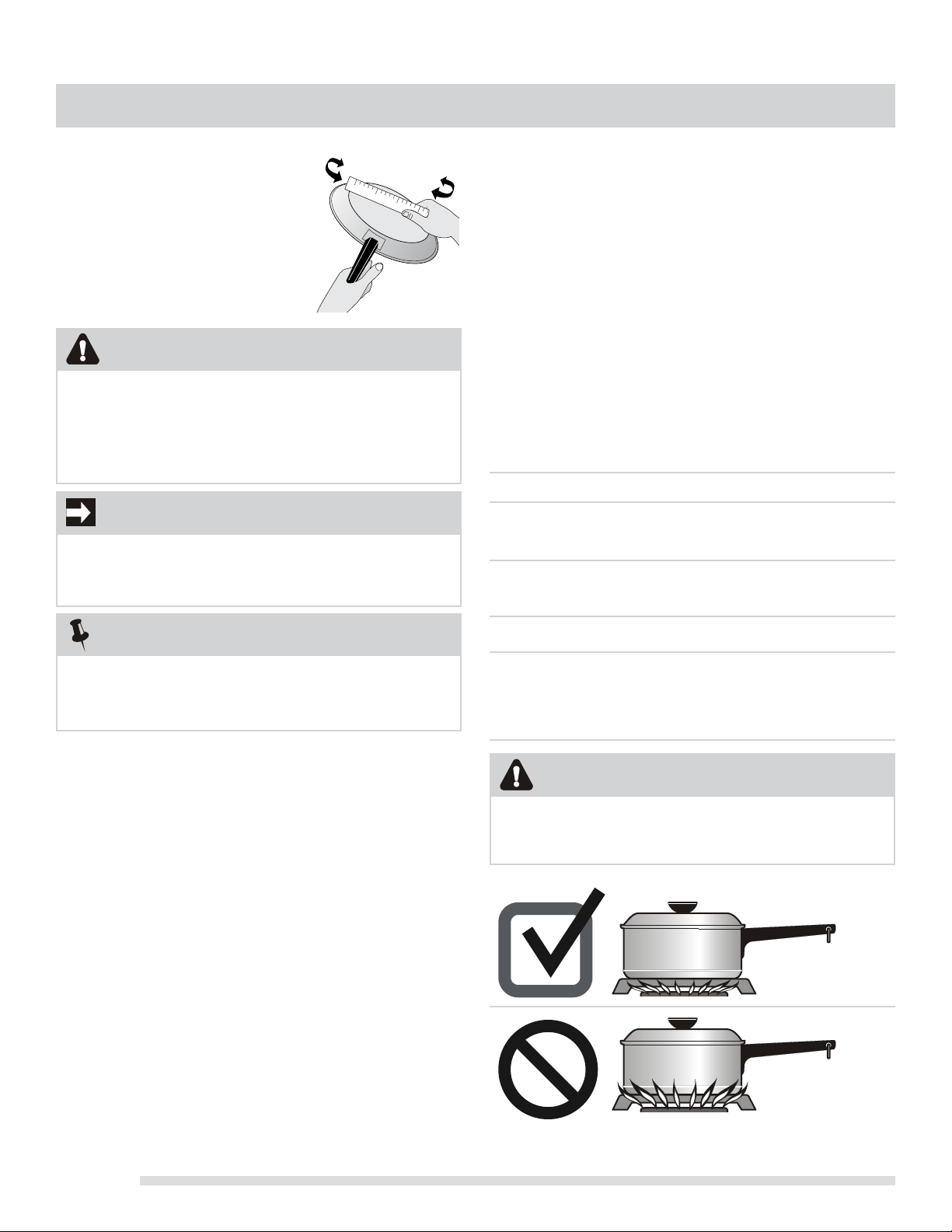
For best cooking results,
cookware should have at
bottoms that rests level on
the burner grate. Before using
cookware, check for atness
by rotating a ruler across the
bottom of the cookware (Fig. 1).
Fig. 2
BEFORE SETTING SURFACE CONTROLS
Set proper burner ame size
For most cooking; start on the highest setting and then
turn to a lower setting to complete the process. Use the
recommendations below as a guide for determining proper
ame size for various types of cooking (Fig. 2)
For deep fat frying; use a thermometer and adjust the
surface knob accordingly. If the fat is too cool, the food
will absorb the fat and be greasy. If the fat is too hot, the
food will brown so quickly that the center will be under
cooked. Do not attempt to deep fat fry too much food at
once as the food will neither brown or cook properly.
Flame size* Type of cooking
High ame Start most foods; bring water to a
boil; pan broiling.
Medium ame Maintain a slow boil; thicken sauces,
gravies; steaming.
Low ame Keep foods cooking; poach; stewing.
Never extend the ame beyond the outer edge of the
cooking utensil. A higher ame wastes energy, and
increases your risk of being burned by the ame (Fig. 3).
* These settings are based for medium-weight metal or
aluminum pans with lids. Settings may vary when using
other types of pans.
The color of the ame is the key to proper burner adjustment.
A good ame is clear, blue and hardly visible in a well-lighted
room. Each cone of ame should be steady and sharp. Adjust
or clean burner if ame is yellow-orange.
CAUTION
Correct ame
setting
Incorrect
ame setting
Fig. 3
Do not place ammable items such as plastic salt
and pepper shakers, spoon holders or plastic wrappings
on the cooktop when it is in use. These items could melt
or ignite. Potholders, towels or wooden spoons could
catch re if placed too close to the range cooktop.
CAUTION
IMPORTANT
Do not place aluminum foil, or ANY material that
can melt on the range cooktop. If these items melt
they may damage the cooktop.
Fig. 1
NOTE
9
SETTING SURFACE CONTROLS
Setting surface burners
1. Place cooking utensil on center of surface burner
grate. Make sure the utensil is centered and stable on
the grate.
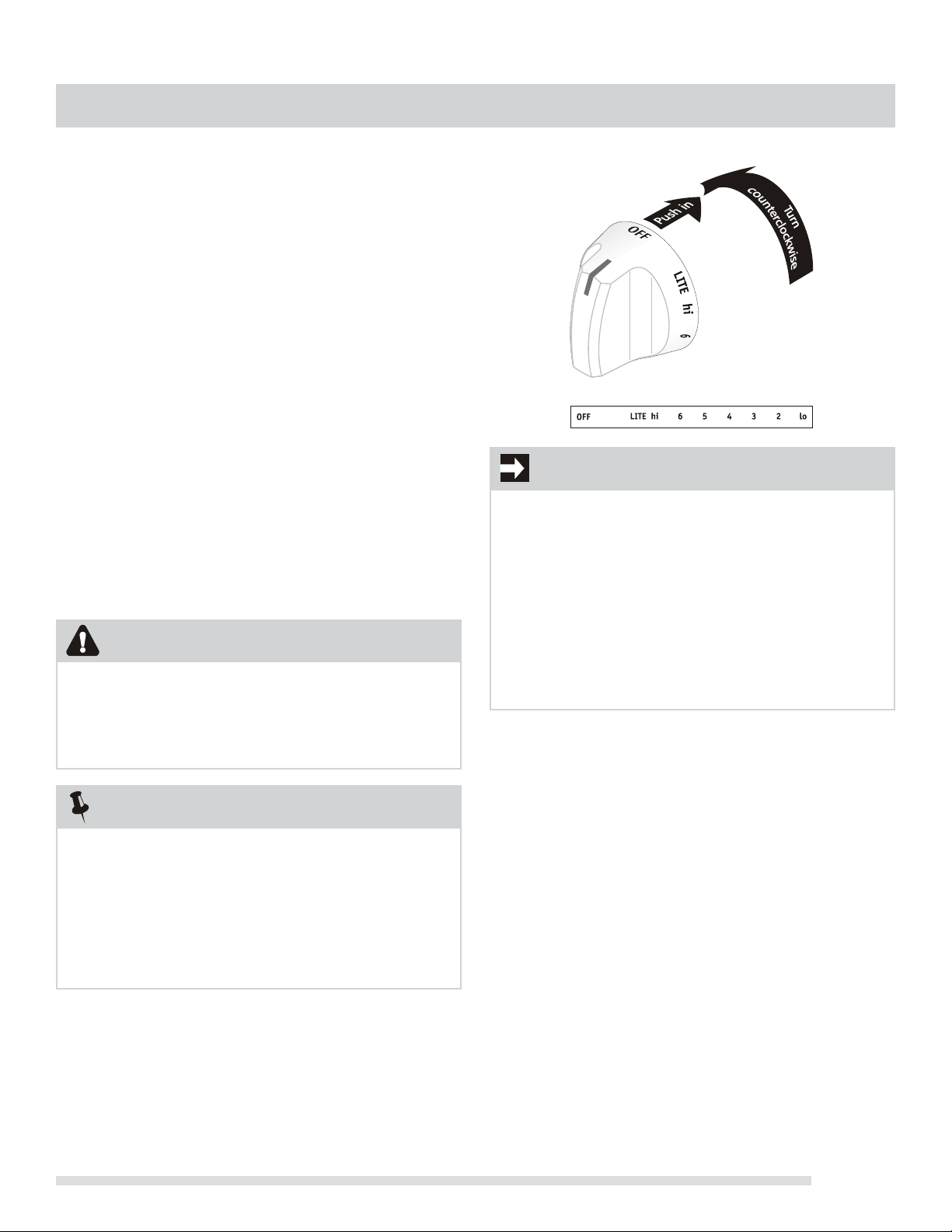
2. Push the desired surface control knob in and turn
counterclockwise out of the OFF position (Fig. 1).
3. Release the knob and rotate to the LITE position.
Visually check that the gas burner has lit.
4. Push the control knob in and turn counterclockwise
to the desired ame size. Use the control knob
markings and adjust the ame as needed.
Fig. 1
DO NOT cook with the surface control knob in the LITE
position. The electronic ignitor will continue to spark if
the control knob is left in the LITE position.
When setting any surface control knob to the LITE
position, all electronic surface ignitors will spark at the
same time. However, only the surface burner you are
setting will ignite.
NOTES
IMPORTANT
• NEVER place or straddle a cooking utensil over 2 different
surface cooking areas at the same time.
• Do not place aluminum foil, or ANY material that
can melt on the range cooktop. If these items melt
they may permanently damage the cooktop surface.
• In the event of an electrical power outage, the surface
burners can be lit manually. Use caution when lighting
surface burners manually. To light a surface burner,
hold a lit match to the burner head, then slowly turn
the surface control knob to LITE. After burner lights
push in and turn knob to desired setting.
Do not place ammable items such as plastic salt
and pepper shakers, spoon holders or plastic wrappings
on the cooktop when it is in use. These items could melt
or ignite. Potholders, towels or wooden spoons could
catch re if placed too close to the range cooktop.
CAUTION
Home Canning
Be sure to read and observe all the following points when
home canning with your appliance. Check with the USDA
(United States Department of Agriculture) website and
be sure to read all the information they have available as
well as follow their recommendations for home canning
procedures.
• Use only quality at bottom canners when home
canning. Use a straight-edge to check canner bottom.
• Use only a completely at bottom canner with no ridges
that radiate from the bottom center when home canning
using a ceramic cooktop.
• Make sure the diameter of the canner does not exceed
1 inch beyond the surface element markings or burner.
It is recommended to use smaller diameter canners on
electric coil and ceramic glass cooktops.
• Start with hot tap water to bring water to boil more
quickly.
• Use the highest heat setting when rst bringing the
water to a boil. Once boiling is achieved, reduce heat to
lowest possible setting to maintain that boil.
Setting surface controls
Always select cookware that is suitable for the amount and
type of food being prepared. Set a ame size appropriate
to the pan. Adjust burner to a setting that does not allow
ames to extend beyond the outer edge of the cooking
utensil.
When a surface control knob is turned to the LITE position,
the selected surface burner will ignite automatically from a
spark generated by the electric ignitor.
10
Changing the temperature display mode
(°F or °C)
The electronic oven control is set to display °F (Fahrenheit)
when shipped from the factory. The display may be
changed to show either Fahrenheit or Celsius oven
temperatures.
READ THE INSTRUCTIONS CAREFULLY BEFORE USING THE OVEN.
For satisfactory use of your oven, become familiar with the various pad features and functions of the oven as described below.
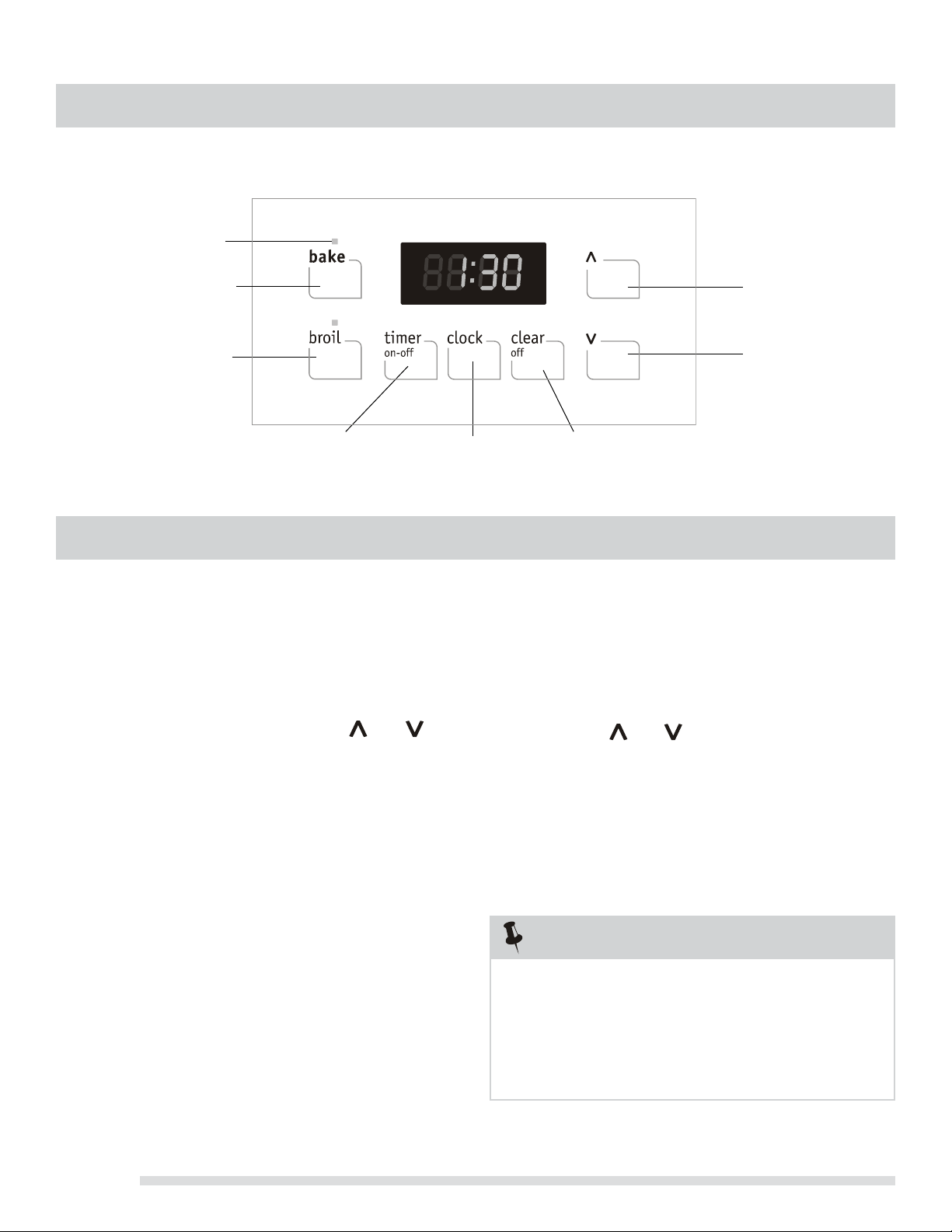
OVEN CONTROL FUNCTIONS
Up and down arrow
pads— Use with the
feature or function pads
to set oven temperature
or adjusting the clock
and minute timer.
Broil pad— Use to select the
variable broil feature.
Bake pad—Use to select the
bake feature.
Feature indicator lights—
These indicator lights show if
bake or broil is active.
Clock pad— Use to
set the time of day.
Clear off pad— Use to clear any feature previously
entered except the time of day and minute timer.
Press clear off to stop cooking.
Timer on-off pad— Use to set or cancel the minute
timer. The minute timer does not start or stop
cooking.
Setting the clock
When the appliance is rst plugged in or when the power
supply to the appliance has been interrupted, the display
will ash “12:00”. It is recommended to always set the clock
for the correct time of day before using the appliance.
To set the clock:
1. Press clock once (do not hold key pad down).
2. Within 5 seconds, press and hold the
or until
the correct time of day appears in the display.
SETTING OVEN CONTROLS
To change the temperature display mode from °F
to °C (Celsius) or from °C to °F (Fahrenheit).
1. Press and hold broil (for 6-8 seconds) until F or C
appears in the display. At this time the display will
show the current temperature display mode whether
set for F or C. Before proceeding read the notes below.
2. Press either or key pad to toggle between F
(Fahrenheit) or C (Celsius) mode choices.
3. To accept the change, wait until the oven control
provides the acceptance beep (See Notes below).
4. The display will return to the time of day with the
temperature display mode changed the next time the
oven is set for bake or broil.
NOTES
• If at any time during the process of changing the
temperature display mode you decide not to change
the mode, press the clear off key pad once before
the acceptance beep.
• The temperature display mode cannot be changed
when bake or broil is active.
11
Setting the minute timer
1. Press timer on-off.
2. Press the to increase the time in one minute
increments. Press and hold the to increase the
time in 10 minute increments. The timer can be set for
any amount of time from 1 minute to 11 hours and 59
minutes.
Note: If the pad is pressed rst, the timer will
advance to 11 hours and 59 minutes.
3. When the set time has run out, the timer will sound
a 3 second tone . 0:00 will show in the display until
timer on-off is pressed.
To change the timer while it is in use
While the timer is active and shows in the display, press
and hold the
or to increase or decrease the time
remaining.
To cancel the minute timer before the set time has
run out
Press timer on-off once.
NOTES
• The minute timer will not start or stop the cooking
process. It serves as an extra timer in the kitchen that
will beep when the set time has run out. The minute
timer can be used alone or while using any of the
other oven features.
• If another feature is active when the minute timer is
active, the minute timer will show in the display. To
view information about other active features, press the
pad for that feature.
SETTING OVEN CONTROLS
Setting bake
The oven can be programmed to bake at any temperature
from 170°F to 550°F (77°C to 287°C). The factory preset
bake temperature is 350°F (177°C).
To set bake
1. Press bake. “— — —” appears in the display.
2. Within 5 seconds, press the or . The display
will show “350°F (177°C).” By pressing and holding
the or , the temperature can then be adjusted
in 5°F increments (1°C if the control is set to display
Celsius).
3. As soon as the or pad is released, the oven
will begin preheating to the selected temperature.
When the oven reaches the desired baking
temperature, the control will beep once.
To change the oven temperature after bake has
started
1. Press bake. Visually check the bake temperature and
that it needs to be changed.
2. Press the or pad to increase or decrease the
set temperature to the desired new oven temperature.
NOTE
To cancel baking at any time, press clear off.
Dark or dull pans absorb more heat than shiny bake-
ware resulting in dark or overbrowning of foods. It may
be necessary to reduce the oven temperature or cook
time to prevent overbrowning of some foods. Dark
pans are recommended for pies. Shiny pans are recom-
mended for cakes, cookies and mufns.
IMPORTANT
12
SETTING OVEN CONTROLS
To set broil
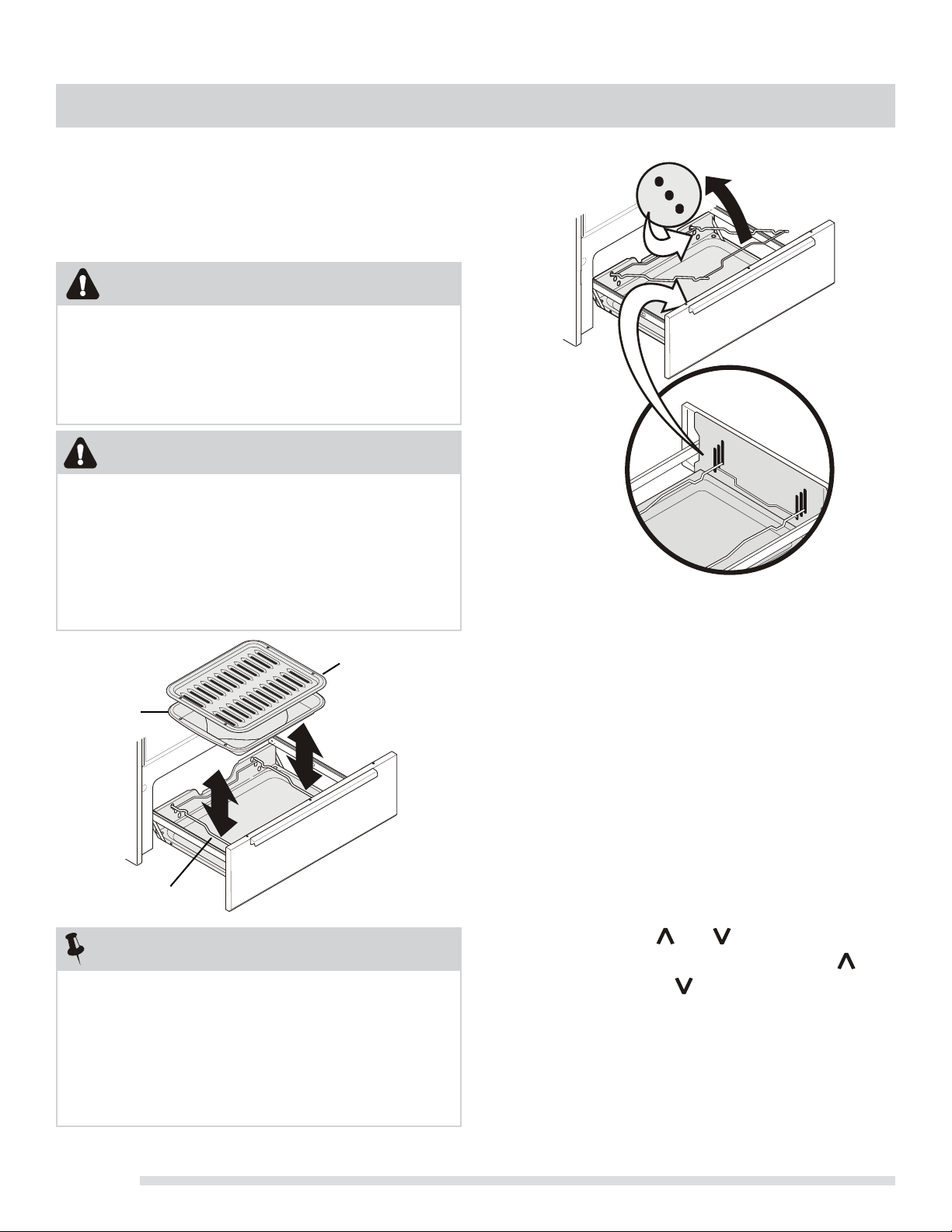
1. Slide broiler drawer out until drawer stops.
2. Remove broiler pan and insert (See Fig. 1).
3. If needed, reposition broiler rack in broiler drawer
while the range is still cool. Be sure to read broiler
rack position recommendations (See Notes).
4. If needed, change broiler rack position by tilting front
of rack up & pulling rack completely out from locating
holes in rear of broiler drawer (See Fig. 2). Reposition
back of rack in one of 3 locating holes and allow front
of rack to slide down into the corresponding slots in
front of broiler drawer (Fig. 3). Be sure rack is level
before broiling.
5. Place insert on broiler pan and place prepared food
on insert. Place broiler pan and insert with food into
broiler on drawer rack as shown (See Fig. 1). Slide
broiler drawer completely into range.
6. Press broil. “ — — “ will appear in display.
7. Press and hold the or until the desired broil
setting level appears in the display. Press the for
HI (high) broil or the for LO (low) broil. Most
foods can be broiled at the HI broil setting. Select the
LO broil setting to avoid excess browning or drying of
foods that should be broiled to the well-done stage.
8. Broil on one side until food is browned; turn and broil
on other side.
9. When nished broiling, press clear off.
Use the broil feature to cook meats that require direct
exposure to ame heat for optimum browning. Use the
broiler drawer and rack along with the broil pan and
insert when broiling. The broiler drawer offers 3 different
broil rack positions.
Setting broil
Fig. 1
Fig. 2
Broil pan insert
• Always use oven mitts when using the oven or
broiler drawer . When cooking, the oven, cooktop,
broiler drawer and racks will become very hot which
can cause burns.
• The broil pan and insert allows grease to drain and be
kept away from high heat of the broiler. DO NOT use
broil pan without insert. DO NOT cover insert with
aluminum foil; the exposed grease could ignite.
CAUTION
WARNING
• DO NOT use oven or broiler drawer for storage.
Items placed in oven or broiler drawer will catch re.
• Should an oven re occur, close the door and drawer
and turn the oven OFF. If the re continues, use a re
extinguisher. DO NOT put water or our on the re.
Flour may be explosive.
NOTES
Broiler drawer rack
3 front
slot positions
3 rear locating
hole positions
tilt up front of rack
to remove and adjust
always pick up
broil pan and insert
from sides
Broil pan
Fig. 3
• For medium doneness, position the broiler rack close
to the oven burner (upper or middle positions). For
well-done foods such as chicken, lobster tails or thick
cuts of meat, position rack further away from oven
burner (lower position).
• For optimum browning, close broiler drawer and
preheat broiler 5 minutes before adding food.
13
Adjusting oven temperature
SETTING OVEN CONTROLS
Your appliance has been factory calibrated and tested
to ensure an accurate baking temperature. For the rst
few uses, follow your recipe times and temperature
recommendations carefully. If you think the oven is
cooking too hot or too cool for your recipe times, you can
adjust the control so the oven cooks hotter or cooler than
the temperature displayed.
• If at any time during the process of adjusting the
oven temperature feature you decide not to make the
change, press the clear off key pad once before the
acceptance beep.
• The oven temperature adjustment feature can not be
modied if bake or broil is active.
• The oven temperature adjustment may be made
if your oven control has been set for °C (Celsius)
temperature display mode. In this case each
press of the or key pad will adjust in 1°C
increments upward (maximum +18°C) or downward
(maximum -18°C), depending on which arrow key
pad is pressed.
• DO NOT USE oven thermometers such as those
found in grocery stores to check the temperature
settings inside your oven. These oven thermometers
may vary as much as 20 to 40 degrees from actual
temperatures.
NOTES
To adjust oven temperature
1. Press & hold the bake key pad and release after the
display shows the factory temperature setting of 00.
If the oven temperature has been previously adjusted
from the factory setting, the latest adjusted value will
appear in the display instead.
2. You may increase the oven temperature in 5°F
increments with each press of the key pad. You
may also adjust the oven temperature downward in
5°F increments with each press of the key pad
(total adjustment range is +35°F to -35° F).
3. To accept the change, wait until the oven control
provides the acceptance beep (See Notes).
4. The oven temperature adjustment has been accepted
by the oven control and the display will return to the
time of day.
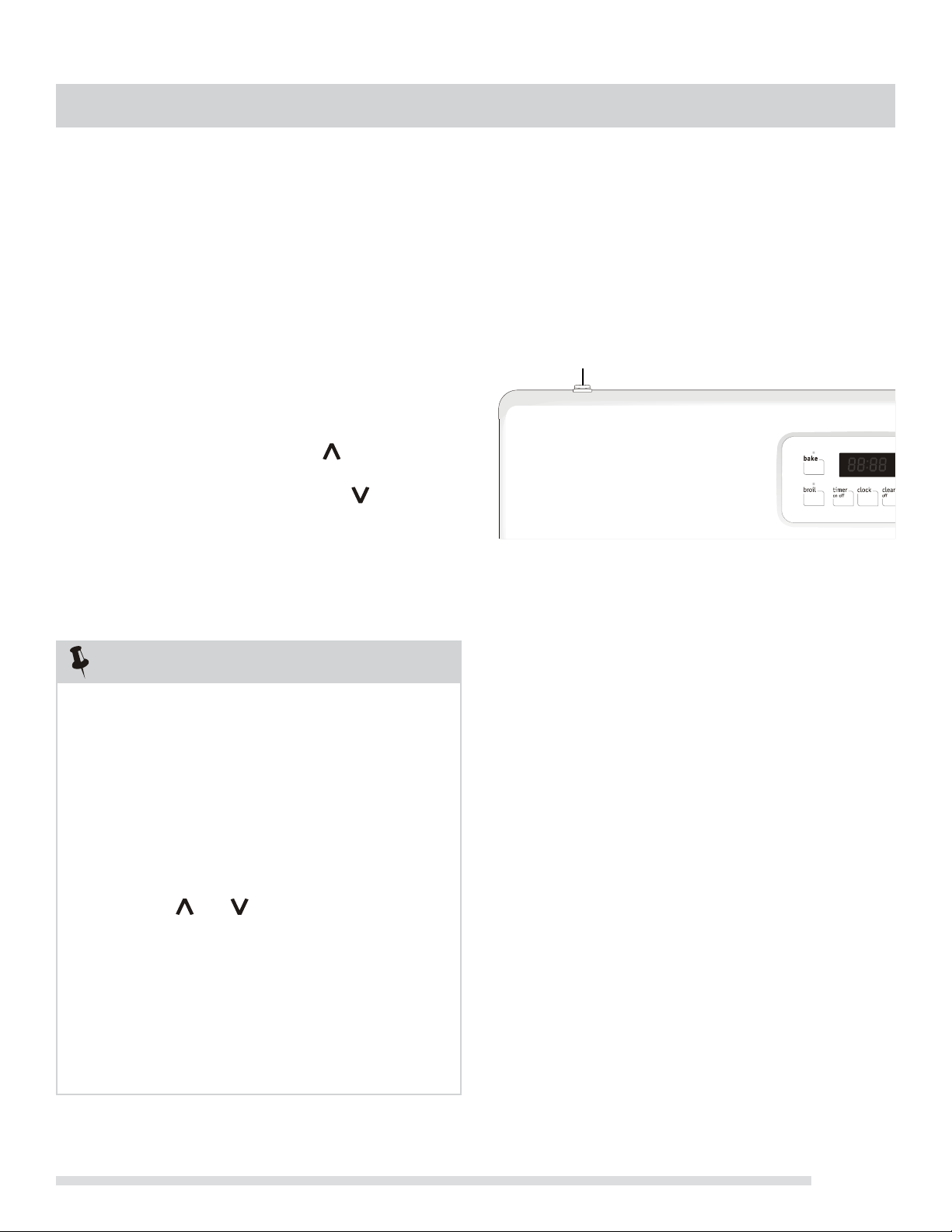
oven light switch
Operating oven light (some models)
The interior oven light will automatically turn ON when the
oven door is opened. Press the oven light switch located
on the upper left control panel to turn the interior oven
light ON and OFF whenever the oven door is closed.
The interior oven light is located at the upper left rear wall
of the oven interior. To change the interior oven light, see
“Changing the oven light” in the Care & cleaning section.

14
CARE & CLEANING
• Control panel
• Decorative trim (some models)
Surface type Recommendation
• Oven interior & door liner
• Porcelain enamel broiler pan and
broiler pan insert (some models)
For general cleaning
, use hot, soapy water and a cloth.
For more difcult soils and
built-up grease
, apply a liquid detergent directly onto the soil. Leave on soil for 30
to 60 minutes. Rinse with a damp cloth and dry. Do not use abrasive cleaners on
any of these materials; they can scratch. To remove control knobs, turn to the OFF
position; grasp rmly and pull straight off the shaft. To replace knobs after cleaning,
line up the at sides of both the knob and the shaft; then push the knob into place.
Before cleaning the control panel,
turn all controls OFF and if needed remove any
knobs from the panel. Clean using hot, soapy water and a dishcloth. Be sure to
squeeze excess water from the dishcloth before wiping the control panel;
especially when wiping around the controls area. Excess water in or around the
controls may cause damage to the appliance. When rinsing, use clean water and
a dishcloth and be sure to squeeze excess water from dishcloth before wiping the
control panel.
• Control knobs
• Painted body parts
• Painted decorative trim
• Aluminum, plastic or vinyl
trim pieces
Gentle scouring with a soapy non-abrasive scouring pad will remove most spots.
Rinse with a 1:1 solution of clear water and ammonia.
If necessary,
cover difcult
spots with an ammonia-soaked paper towel for 30 to 40 minutes. Rinse with clean
water and a damp cloth, and then scrub with a soap-lled non-abrasive scouring pad.
Rinse and wipe dry with a clean cloth. Do not allow food spills with a high sugar or
acid content (milk, tomatoes, sauerkraut, fruit juices or pie lling) to remain on the
surface; they may cause a dull spot even after cleaning.
The oven interior is porcelain coated and is safe to clean using oven cleaners
following manufacturer’s instructions. After cleaning, remove any oven cleaner or the
porcelain may become damaged during future heating. Do not spray oven cleaner
on any electrical controls or switches. Do not spray or allow oven cleaner to build up
on the oven temperature sensing bulb. Do not spray cleaner on oven door trim, door
gasket, plastic drawer glides, handles or any exterior surfaces of the range.
Clean any soils from the oven frame, the door liner outside the oven door gasket and
the small area at the front center of the oven bottom. Clean with hot, soapy water.
Rinse using clean water and a cloth.
• Stainless Steel (some models)
• Oven racks
• Oven door
Remove oven racks from oven before cleaning. Clean by using a mild, abrasive
cleaner following manufacturer’s instructions. Rinse with clean water and dry.
Use soap & water to thoroughly clean the top, sides and front of the oven door. Rinse
well. You may use a glass cleaner on the outside glass of the oven door. Do not
immerse the door in water. Do not spray or allow water or the glass cleaner
to enter the door vents. Do not use oven cleaners, cleaning powders or any harsh
abrasive cleaning materials on the outside of the oven door.
• Cooktop surface
• Surface burners
Cleaning recommendation table
Clean heavier soils with hot, soapy water and a dishcloth. Rinse with clean water
and a cloth. Do not use cleaners with high concentrations of chlorides or
chlorine. Do not use harsh scrubbing cleaners. Only use kitchen cleaners that are
especially made for cleaning stainless steel. Always be sure to wipe the cleaners off
from the surface as bluish stains may occur during heating that cannot be removed.
Do not use spray oven cleaners on the cooktop. See Cleaning the cooktop and
surface burner instructions provided in the Care & cleaning section.
15
Routinely clean the cooktop. Wipe with a clean, damp
cloth and wipe dry to avoid scratches.
Keeping the surface burner head ports clean will prevent
improper ignition and an uneven ame. See the following
sections for more instructions.
Cleaning the cooktop and surface burners
CAUTION
To clean recessed and contoured areas of cooktop
If a spill occurs on or in the recessed or contoured areas,
blot up spill with an absorbent cloth. Rinse with a clean,
damp cloth and wipe dry.
To clean burner grates
• Clean when the grates are cool.
• Use nonabrasive plastic scrubbing pad and mild abrasive
cleanser.
• Food soils containing acids may affect the nish. Clean
immediately after the grates are cool.
• Thoroughly dry grates immediately following cleaning.
• To avoid possible burns DO NOT attempt any of the
cleaning instructions provided below before turning OFF
all of the surface burners and allow them to cool.
• Any additions, changes or conversions required in order
for this appliance to satisfactorily meet the application
needs must be made by an authorized qualied Agency.
CARE & CLEANING
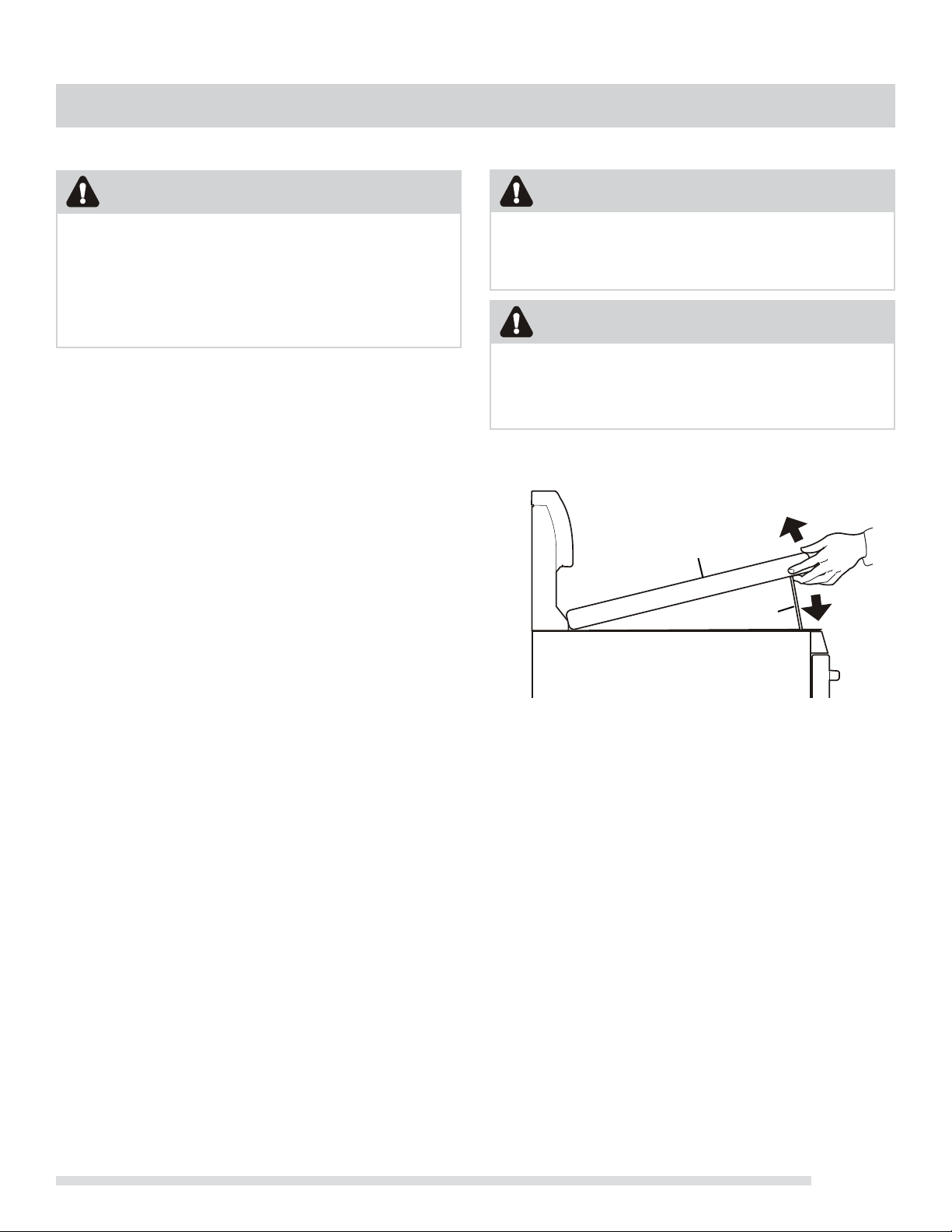
Raising and lowering the cooktop
1. Remove burner grates when cool from cooktop and
set aside.
2. Grasp the sides of the cooktop and then lift from the
front (See Fig. 1).
3. Lift the top high enough to allow the support rods
to snap into place. The lift-up rods will support the
cooktop in the raised position.
4. If necessary, clean underneath using hot, soapy water
and a clean cloth; then, dry.
5. To lower the cooktop, grasp the front corner of each
side of the top while pushing back on each rod with
the heel of your hand. This will release the notched
support. Hold the range top and gently slide the range
top down to the range.
WARNING
• DO NOT turn the burners on when the cooktop is
raised for cleaning. Be sure that the top is completely
lowered and securely in place before turning on the
surface burners.
Fig. 1
cooktop
lift-up rods
CAUTION
When lowering the lift-up range cooktop, grasp the sides
with ngertips only. Be careful not to pinch ngers. Do
not drop or bend the range cooktop when raising or
lowering. This could damage the cooktop surface.
16
CARE & CLEANING
Replacing oven light (some models)
The interior oven light bulb is located at the upper left rear
of the oven cavity.
To replace the oven light bulb
1. Turn electrical power off at the main source or unplug
the range.
2. Replace bulb with a new 40 watt appliance bulb.
3. Turn power back on again at the main source (or plug
the appliance back in).
4. The clock will then need to be reset. To reset, see
“Setting the clock” in this Use & Care Guide.
Be sure the range is unplugged and all parts are COOL
before replacing oven light. Wear a leather-faced glove
for protection against possible broken glass.
CAUTION
Cleaning the cooktop and surface burners
(cont’d)
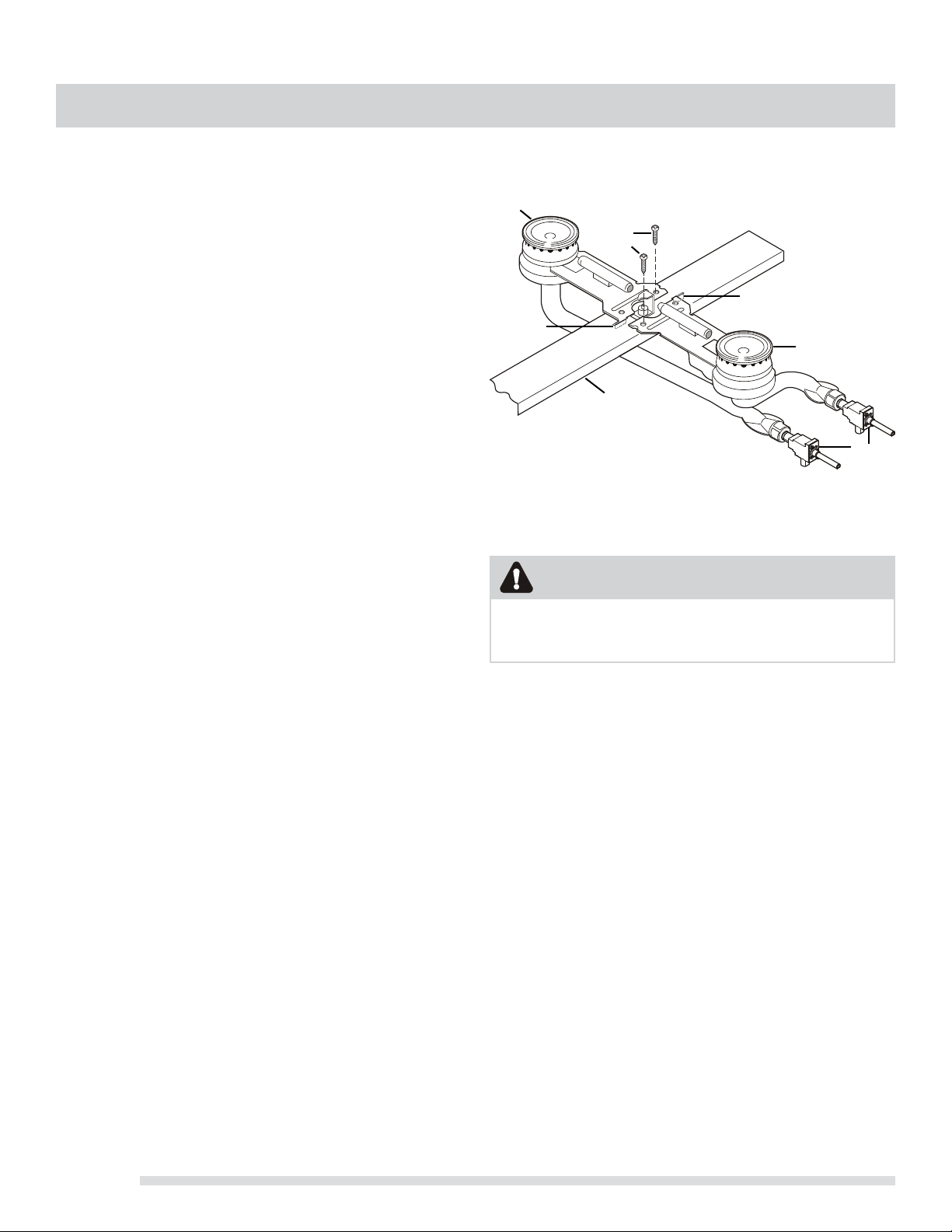
Removing and replacing surface burners
To remove burners
1. Remove shipping screws with a Phillips Head
screwdriver. See Fig. 1 for screw locations.
2. Tilt the burner at the end closest to the support bar
until the locator tab is released (front burners tilt right,
rear burners tilt left). Move the burner towards the
back of the range. This will separate it from the gas
valve at the front of the range.
To replace burners
1. Slide the burner tube over the gas valve at the front
of the range (front burners t over the right valve,
rear burners t over the left valve on each side of the
range).
2. Tilt burner so that the locating tab will slide into
the slot on the support bar. Make sure burners are
properly seated on support bar and are level.
3. Replace shipping screws.
To clean the surface burner heads
For proper gas ow it may be necessary to clean the
burner ports. Before cleaning be sure the gas burners are
turned off. First use a clean DAMP cloth to soak up any
spills. Remove any food from the burner ports using a small
nonabrasive brush like a toothbrush and afterwards wipe up
using a damp cloth. For stubborn soils located in the burner
ports, use a small gauge wire or needle to clean.
Any spill on or around the electrode must be carefully
cleaned. Take care not to hit the electrode with any thing
hard or it could be damaged.
Fig. 1
burner
support bar
shipping
screws
gas
valves
locating
tab
locating
tab
front burners
rear burners
17
CARE & CLEANING
about
10°
hinge
oven
door
• To avoid possible injury when removing or replacing
the oven door, follow the instructions below care-
fully and always hold the oven door with both hands
positioned away from the door hinge area.
• The door is heavy. For safe, temporary storage,
lay the door at with the inside of the door facing
down.
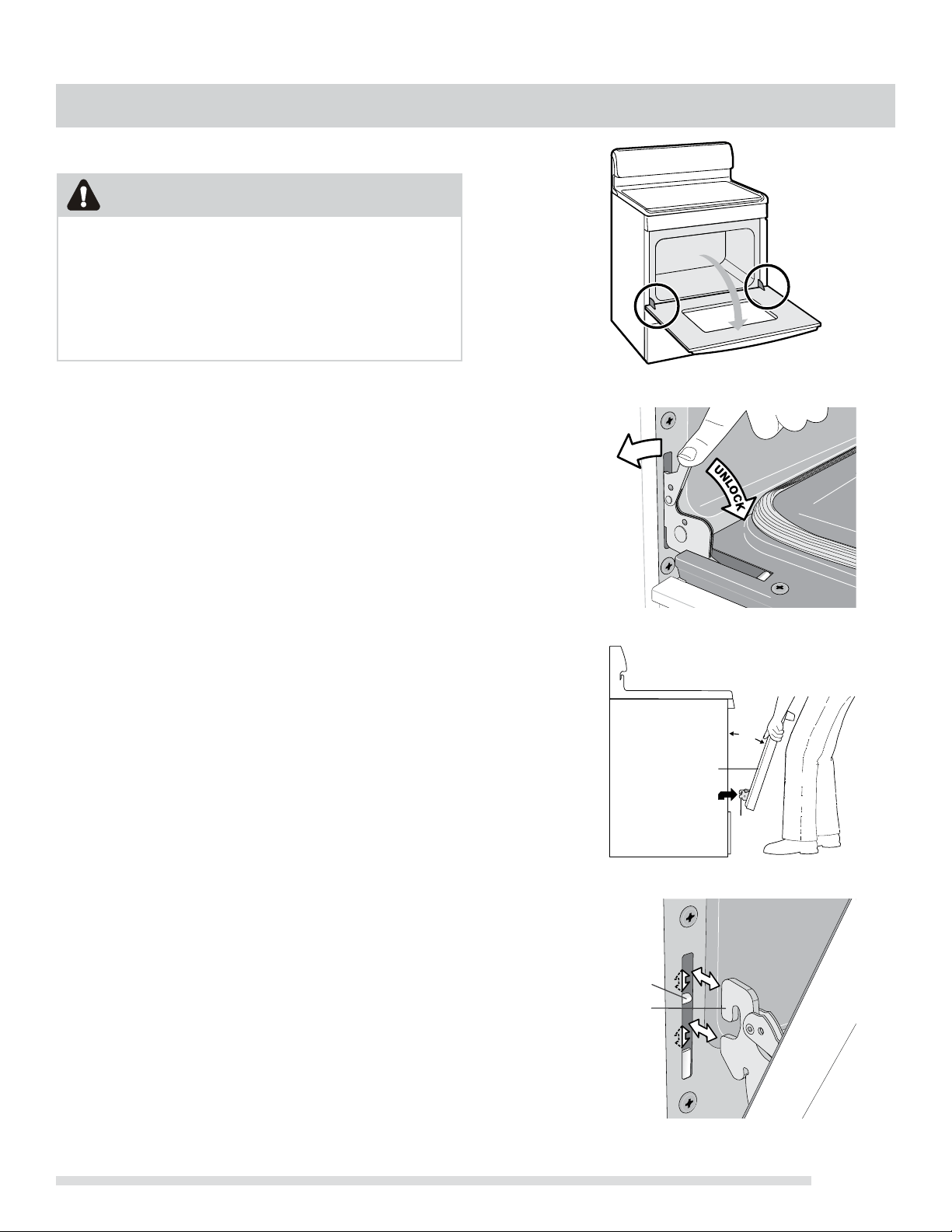
To remove oven door:
1. Open oven door completely (horizontal with oor - See
Fig. 1).
2. Pull the door hinge locks on both left and right door
hinges down from the oven frame completely towards
the oven door (See Fig. 2). A tool such as a small at-
blade screwdriver may be required.
3. Firmly grasp both sides of oven door along the door
sides (Do not use the oven door handle - See Fig. 3).
4. Close the door to the broil stop position (the oven door
will stop into this position just before fully closing).
5. With the oven door in the broil stop position, lift the
oven door hinge arms over the roller pins located on
each side of the oven frame (See Fig. 4).
To replace oven door:
1. Firmly grasp both sides of oven door along the door
sides (Do not use the oven door handle - See Fig. 3).
2. Holding the oven door at the same angle as the
removal position, seat the hook of the hinge arm over
the roller pins located on each side of the oven door
frame (See Fig. 4). The hook of the hinge arms must
be fully seated onto the roller pins.
3. Fully open the oven door (horizontal with oor - See
Fig. 1).
4. Push the door hinge locks up towards and into the
oven frame on both left and right oven door hinges
(See Fig. 2) to the locked position.
5. Close the oven door.
Special door care instructions - Most oven doors
contain glass that can break. Read the following
recommendations:
• Do not close the oven door until all the oven racks are
fully in place.
• Do not hit the glass with pots, pans, or any other
object.
• Scratching, hitting, jarring or stressing the glass may
weaken its structure causing an increased risk of
breakage at a later time.
Removing and replacing the lift-off oven door
CAUTION
Oven door
hinge
locations
Fig. 3
Fig. 1
Fig. 4
Fig. 2
roller
pin
hing
e
arm
L
O
C
K

18
BEFORE YOU CALL • Solutions to common problems
Problem Solution
Poor baking results. • Many factors affect baking results. Make sure the proper oven rack position
is used. Center food in the oven and space pans to allow air to circulate.
Allow the oven to preheat to the set temperature before placing food in the
oven. Try adjusting the recipe’s recommended temperature or baking time.
If you feel the oven is too hot or cool, see “Adjusting oven temperature”
section in this Use & Care Guide.
Entire appliance does not operate. • The time of day is not set. The time of day must rst be set in order to
operate the oven. See “Setting the clock” in the Setting Oven Controls
section.
• Make sure cord/plug is plugged correctly into outlet.
• Service wiring is not complete. Contact your dealer, installing agent or
authorized service agent.
• Electrical power outage. Check house lights to be sure. Call your local
electric company for service.
Oven portion of appliance does not operate. • Be sure the oven controls are set properly for the desired cooking
feature. See Setting Oven Controls in this manual or see “Entire
appliance does not operate” in this checklist.
• Be sure the gas regulator valve is in the “ON” position. Refer to the
Installation Instructions to for more information.
Surface burners do not ignite. • Surface control knob was not completely turned to LITE. Push in & turn
the surface control knob to LITE until burner ignites and then turn control
knob to desired ame size.
• Burner ports are clogged. With the burner OFF, use a small-gauge wire or
needle to burner head slots and ignition ports. See “Cleaning the cooktop
and surface burners” in the Care & Cleaning section for additional
cleaning instructions.
• Range power cord is disconnected from outlet (electric ignition models
only). Be sure power cord is securely plugged into the power outlet.
• Electrical power outage (electric ignition models only). Burners can be lit
manually. See section on Setting Surface Controls.
Surface burner ame only part way around
burner head.
• Burner slots or ports are clogged. With the surface burner OFF, clean
ports with a small-gauge wire or needle.
• Moisture is present after cleaning. Lightly fan the ame & allow burner to
operate until ame is full. Dry the surface burners thoroughly following
the instructions under “Cleaning the cooktop and surface burners”
provided in the Care & Cleaning section.
Surface burner ame is orange. • Dust particles in main gas line. Allow the burner to operate a few minutes
until ame turns blue. Along coastal areas, a slightly orange ame is
unavoidable due to salt air.

19
Solutions to common problems • BEFORE YOU CALL
Problem Solution
Oven smokes excessively during broiling. • Incorrect setting. Follow broil instructions in Setting Oven Controls.
• Broiler drawer is open. Be sure broiler drawer is closed.
• Meat too close to broil burner. Reposition the broiler drawer rack to
provide proper clearance between the meat & the burner.
• Meat not properly prepared. Remove excess fat from meat. Cut remaining
fatty edges to prevent curling, but do not cut into lean.
• Broiler pan and insert wrong side up and grease not draining. Always
place insert on the broiler pan with ribs up & slots down to allow grease
to drip into pan.
• Grease built up on drawer surfaces. Regular cleaning is necessary when
broiling frequently. Old grease or food spatters cause excessive smoking.
Flames inside oven or smoking from oven
vent.
• Excessive spillovers in oven. For example this will happen for pie
spillovers or large amounts of grease left on the oven bottom. Wipe up
excessive spillovers before starting oven. If ames or excessive smoke
are present see “Setting broil” in the Setting Oven Controls.
Oven control panel beeps & displays any
F code error.
• Oven control has detected a fault or error condition. Press clear off to
clear the display & stop beeping. Try the bake or broil feature again. If the
F code error repeats, remove power from appliance, wait 5 minutes and
then repower appliance and set clock for the time of day. Try the bake or
broil feature again. If the fault recurs, record fault and call for service.
Oven light does not work (some models) • Be sure the light is secure in the socket. Also see “Replacing oven light” in
the Care & Cleaning section.
Appliance is not level. • Be sure oor is level, strong & stable enough to adequately support range.
• If oor is sagging or sloping, contact a carpenter to correct the situation.
• Poor installation. Place oven rack in center of oven. Place a level on the
oven rack. Adjust leveling legs at base of appliance until the rack is level.
• Kitchen cabinet alignment may make range appear not level. Be sure
cabinets are square & have sufcient room for appliance clearance.
Cannot move appliance easily. Appliance
must be accessible for service.
• Cabinets not square or are built in too tightly. Contact builder or installer to
make appliance accessible.
• Carpet interferes with appliance. Provide sufcient space so appliance can
be lifted over carpet.

20
MAJOR APPLIANCE WARRANTY
Canada
1.800.265.8352
Electrolux Canada Corp.
5855 Terry Fox Way
Mississauga, Ontario, Canada
L5V 3E4
USA
1.800.944.9044
Electrolux Major Appliances
North America
10200 David Taylor Drive
Charlotte, NC 28262
Your appliance is covered by a one year limited warranty. For one year from your original date of
purchase, Electrolux will pay all costs for repairing or replacing any parts of this appliance that prove
to be defective in materials or workmanship when such appliance is installed, used and maintained in
accordance with the provided instructions.
Exclusions
This warranty does not cover the following:
1. Products with original serial numbers that have been removed, altered or cannot be readily determined.
2. Product that has been transferred from its original owner to another party or removed outside the USA or
Canada.
3. Rust on the interior or exterior of the unit.
4. Products purchased “as-is” are not covered by this warranty.
5. Food loss due to any refrigerator or freezer failures.
6. Products used in a commercial setting.
7. Service calls which do not involve malfunction or defects in materials or workmanship, or for appliances
not in ordinary household use or used other than in accordance with the provided instructions.
8. Service calls to correct the installation of your appliance or to instruct you how to use your appliance.
9. Expenses for making the appliance accessible for servicing, such as removal of trim, cupboards, shelves,
etc., which are not a part of the appliance when it is shipped from the factory.
10. Service calls to repair or replace appliance light bulbs, air lters, water lters, other consumables, or
knobs, handles, or other cosmetic parts.
11. Surcharges including, but not limited to, any after hour, weekend, or holiday service calls, tolls, ferry trip
charges, or mileage expense for service calls to remote areas, including the state of Alaska.
12. Damages to the nish of appliance or home incurred during installation, including but not limited to oors,
cabinets, walls, etc.
13. Damages caused by: services performed by unauthorized service companies; use of parts other than
genuine Electrolux parts or parts obtained from persons other than authorized service companies; or
external causes such as abuse, misuse, inadequate power supply, accidents, res, or acts of God.
CUSTOMER’S SOLE AND EXCLUSIVE REMEDY UNDER THIS LIMITED WARRANTY SHALL BE PRODUCT
REPAIR OR REPLACEMENT AS PROVIDED HEREIN. CLAIMS BASED ON IMPLIED WARRANTIES, INCLUDING
WARRANTIES OF MERCHANTABILITY OR FITNESS FOR A PARTICULAR PURPOSE, ARE LIMITED TO ONE YEAR
OR THE SHORTEST PERIOD ALLOWED BY LAW, BUT NOT LESS THAN ONE YEAR. ELECTROLUX SHALL NOT
BE LIABLE FOR CONSEQUENTIAL OR INCIDENTAL DAMAGES SUCH AS PROPERTY DAMAGE AND INCIDENTAL
EXPENSES RESULTING FROM ANY BREACH OF THIS WRITTEN LIMITED WARRANTY OR ANY IMPLIED
WARRANTY. SOME STATES AND PROVINCES DO NOT ALLOW THE EXCLUSION OR LIMITATION OF INCIDENTAL
OR CONSEQUENTIAL DAMAGES, OR LIMITATIONS ON THE DURATION OF IMPLIED WARRANTIES, SO THESE
LIMITATIONS OR EXCLUSIONS MAY NOT APPLY TO YOU. THIS WRITTEN WARRANTY GIVES YOU SPECIFIC
LEGAL RIGHTS. YOU MAY ALSO HAVE OTHER RIGHTS THAT VARY FROM STATE TO STATE.
Keep your receipt, delivery slip, or some other appropriate payment record to establish the warranty period
should service be required. If service is performed, it is in your best interest to obtain and keep all receipts.
Service under this warranty must be obtained by contacting Electrolux at the addresses or phone
numbers below.
DISCLAIMER OF IMPLIED WARRANTIES; LIMITATION OF REMEDIES
This warranty only applies in the USA and Canada. In the USA, your appliance is warranted by Electrolux Major Appliances
North America, a division of Electrolux Home Products, Inc. In Canada, your appliance is warranted by Electrolux Canada Corp.
Electrolux authorizes no person to change or add to any obligations under this warranty. Obligations for service and parts under
this warranty must be performed by Electrolux or an authorized service company. Product features or specications as described
or illustrated are subject to change without notice.
If You Need
Service