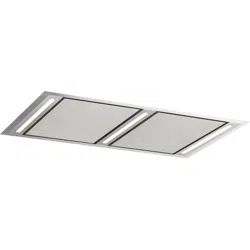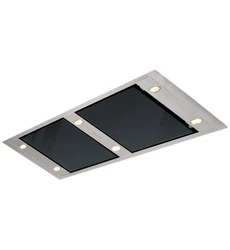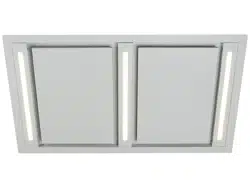
INSTRUCTION MANUAL
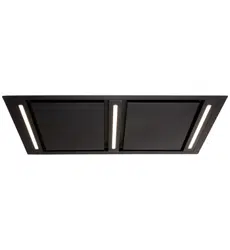
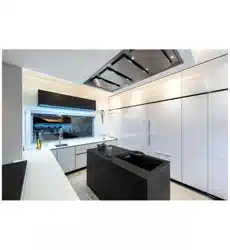
CCINARTS
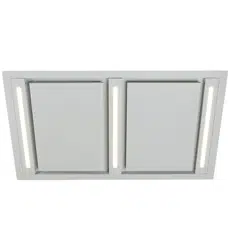
CCSURF2S
CCPARA4S
CCPARA4W
CCPARA3S
CCPARA3W
CCPARA2S
CCPARA2W
CEILING CASSETTE RANGEHOODS
(10.2021 / V3)
Installation / Operation / Maintenance


WELCOME
Thank you for purchasing this Schweigen IN
appliance.
To achieve the optimal performance from your
appliance, and to avoid the risk of accident or
damage, it is essential to read this manual before
installation and rst time use.
This guide contains important information on the
use and maintenance of the appliance, as well as
important safety notes.
Your appliance has been thoroughly checked for
safety and functionality before being packaged
and leaving the manufacturer.
Please keep this instruction manual in a safe
place so you can refer to it at any time.
IMPORTANT!
The appliance should only be
operated when you have read and
understood this manual thoroughly.
The appliance can be only used for the
purpose for which it was designed.
Any other use is improper and can
be dangerous.
Installation and maintenance of
electrical appliances must only
be carried out by qualied and
authorised professionals familiar
with Australian Appliance Industry
regulations.
Upon collection or delivery of your
appliance, any damage or defects
must be reported within 48 hours
to your retailer or Schweigen
Customer Service, in order
to recognise any claim.
The manufacturer reserves the right
to introduce product improvements,
which do not aect the operation of
the appliance.
YOUR STATE REGULATORY AUTHORITY
Dierent Australian states have varying legislative requirements for the installation of
rangehood ducting. Some will insist on ducting being vented externally (i.e. not in to the
ceiling cavity); others will not. It is imperative that you check with your state building
authority and/or private certier to conrm their position.
Page 3

Page 4
IMPORTANT SAFETY INFORMATION
Please read the instructions carefully. Only then
will you be able to operate your appliance safely
and correctly. Retain the instruction manual for
future use or for subsequent owners.
Check the appliance for damage after unpacking it.
Do not connect or install the appliance if it has been
damaged in transport.
Any damage must be reported within
48 hours.
There must be adequate ventilation in the room
when the rangehood is used at the same time as
appliances burning gas or other fuels.
The air must not be discharged into a ue that
is used for exhausting fumes from appliances
burning gas or other fuels.
Air exhaust systems must be installed in
accordance with local and federal laws.
There is a re risk if regular cleaning is not carried
out in conjunction with the instructions.
Do not ambé (ignite food while cooking) under the
rangehood. This will damage the rangehood and
will void warranty.
Do not ignite burners that give o intense
uncontrolled ames beneath the rangehood.
Flames beneath the pan must be contained at
all times and cannot exceed the width of the pan
in use.
Do not leave any packaging material (bags, corner
brackets etc.) within reach of children.
This appliance is not intended for use by person/s
(including children) with reduced physical, sensory
or mental capabilities, or lack of experience and/or
knowledge. Unless, the person is given supervision
or instruction concerning the safe usage of the
appliance by person/s responsible for their safety.
Children must be supervised to ensure that they do
not play with the appliance, it is not a toy.
Accessible parts may become hot when used with
cooking appliances.
Before performing any cleaning or maintenance,
disconnect the rangehood from the mains power,
using the respective mains or sector switch, or by
unplugging it.
Do not use the rangehood without the grease
lters.
Keep the grease lters clean and respect the
recommended cleaning frequencies.
It is forbidden to use the rangehood as an aspirator.

IMPORTANT SAFETY INFORMATION
Page 5
BEFORE INSTALLATION
We recommend this appliance be installed or
repaired by a qualied Schweigen Home
Appliances technician.
Please see our website www.schweigen.com.au
for a list of our recommended installers.
It is dangerous to modify any part of this appliance.
Modication of any kind will immediately void the
warranty.
The manufacturer declines all responsibility in case
of failure to adopt proper safety measures.
Ensure that the location in which this appliance is
installed, has good and permanent ventilation.
Please consult local laws and regulations and install
in accordance.
Please use an earthed electrical connector that
coincides with relevant local laws and regulations.
Check that the power voltage in your area
corresponds to the appliance voltage indicated on
the rating label.
This appliance must be connected to an electrical
supply that has a grounded connection.
Check that the indicated instructions and local
regulations are met and carried out by a qualied
technician, using materials that are complaint with
the applicable legislation.
Schweigen will not be responsible for any
installations executed by non-qualied technicians
that fail to heed the applicable legislation on
electrical safety.
The electrical technical data can be found inside
the rangehood, after removing the grease lters.
The exible power cables supplied are already
connected internally and emerges from the
rangehood near the air outlet tube.
Before installing the electrical connections,
you should:
• Verify that the indicated electrical data coincides
with the voltage values and frequency of
the electrical circuit in the house where the
rangehood is to be installed.
• Check that the premises has electrical protection
against short circuits and electrocution.
• Before commencing maintenance the current
must be turned o using the double-pole switch
(mains power switch). The power can only be
turned on for normal use, once the operation has
been completed.
• Ensure the supply cord is not exposed to
heat, chemicals or sharp objects. If the supply
cord is damaged, it must be replaced by the
manufacturer, service agent or a similarly
qualied person in order to avoid a hazard.

IMPORTANT SAFETY INFORMATION
Page 6
PRODUCT USE
This product is designed for household use and
should not be used for commercial applications.
After use, always ensure that all controls are in
the “OFF” position.
When frying with a gas ame, take particular care
not to allow the oil or grease in the pan to catch
re. (Flambé)
DUCTED OR RECIRCULATING?
Ducted rangehoods (or extractor rangehoods)
extract the cooking fumes from the kitchen and
expel them from the space via ducting. Good design
practice would always see a re-rated ducting
system extend to the house exterior, rather than to
the ceiling cavity. When a rangehood is ducted only
into the ceiling space, the collection of humidity
and grease can present very real health issues and
re hazards.
Recirculating (or non-ducted or ltered) rangehoods
extract cooking fumes and pass them through
lters. As the name would suggest, they recirculate
this air back into the room. Recirculating rangehoods
are not as eective as removing fumes from a
kitchen space, but they are sometimes the only
option due to budgetary or building constraints.
Your client should be made aware of the requirement
to change and clean lters on a regular basis for the
optimum eciency of air ltering.
MAINTENANCE AND SERVICE
The rangehood surface should be cleaned with soft
cloth and non-corrosive detergent. Do not leave
the rangehood wet after cleaning or use, please
keep rangehood dry.
Important: Never attempt to repair this appliance
by yourself. Always refer to a qualied
Service Technician.
Always switch o the electricity and unplug the
connection before conducting maintenance
or cleaning.
ELECTRICAL CORD
Ensure the supply cord is not exposed to heat,
chemicals or sharp objects. If the supply cord is
damaged, it must be replaced by the manufacturer,
service agent or a similarly qualied person in order
to avoid
a hazard.
Page 7
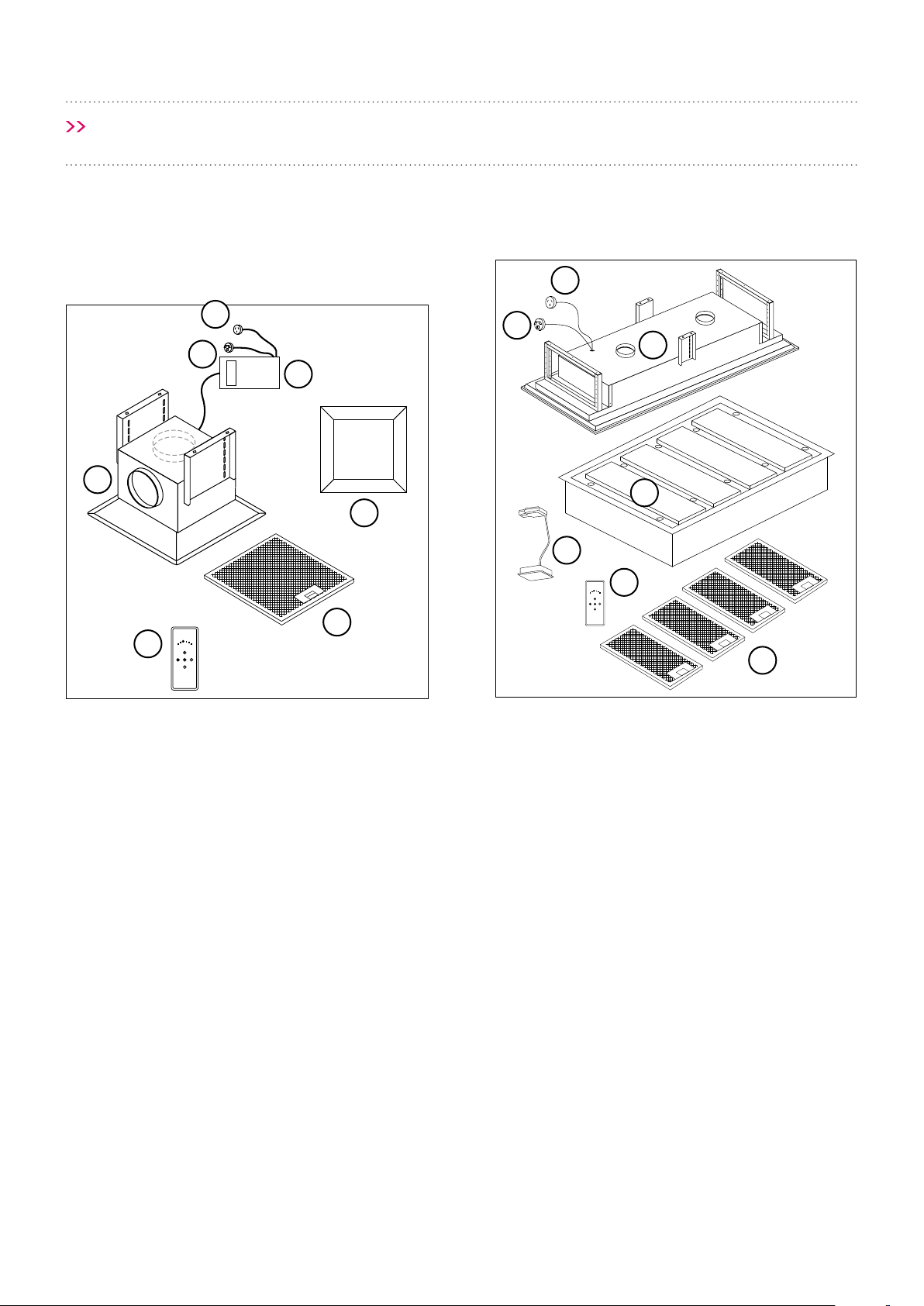
1. Connect the female plug to the Isodrive
®
motor system
2. Male Plug (Main Power 240V)
3. 150mm Outlet. Can be top or side mounted
4. Remote
5. Filter
6. Cover Panel with LED lights built-in
7. Control Module, supplied with main unit only
*IMPORTANT: The electronics MUST be accessible
for servicing once installed, failure to do so, will
result in any charges involved with accessing the
part (removal of cabinetry etc.) being forwarded
to the customer.
1. Connect the female plug to the Isodrive
®
motor system
2. Male Plug (Main Power 240V)
3. 200mm Outlet/s
4. P.A. Filter Cover Panel
5. Light
6. Remote
7. Filters
NOTE: Filter and light quantity may vary from
model to model.
*IMPORTANT: The electronics MUST be accessible
for servicing once installed, failure to do so, will
result in any charges involved with accessing the
part (removal of cabinetry etc.) being forwarded to
the customer.
DESCRIPTION
1 2 3 4
1 2 3 4
1
1
2
2
3
3
4
4
5
5
6
6
7
7
CC-PARA4S, CC-PARA4W, CC-PARA3S,
CC-PARA3W, CC-PARA2S and
CC-PARA2W
CC-INARTS and CC-SURF2S
Page 8
OPERATION
REMOTE CONTROL USAGE
Starting the rangehood for the rst time using
the remote control:
Put the safety switch ON (this switch is inside the
main rangehood). Wait about 5 seconds for the
circuit to test the memory.
1 2 3 4
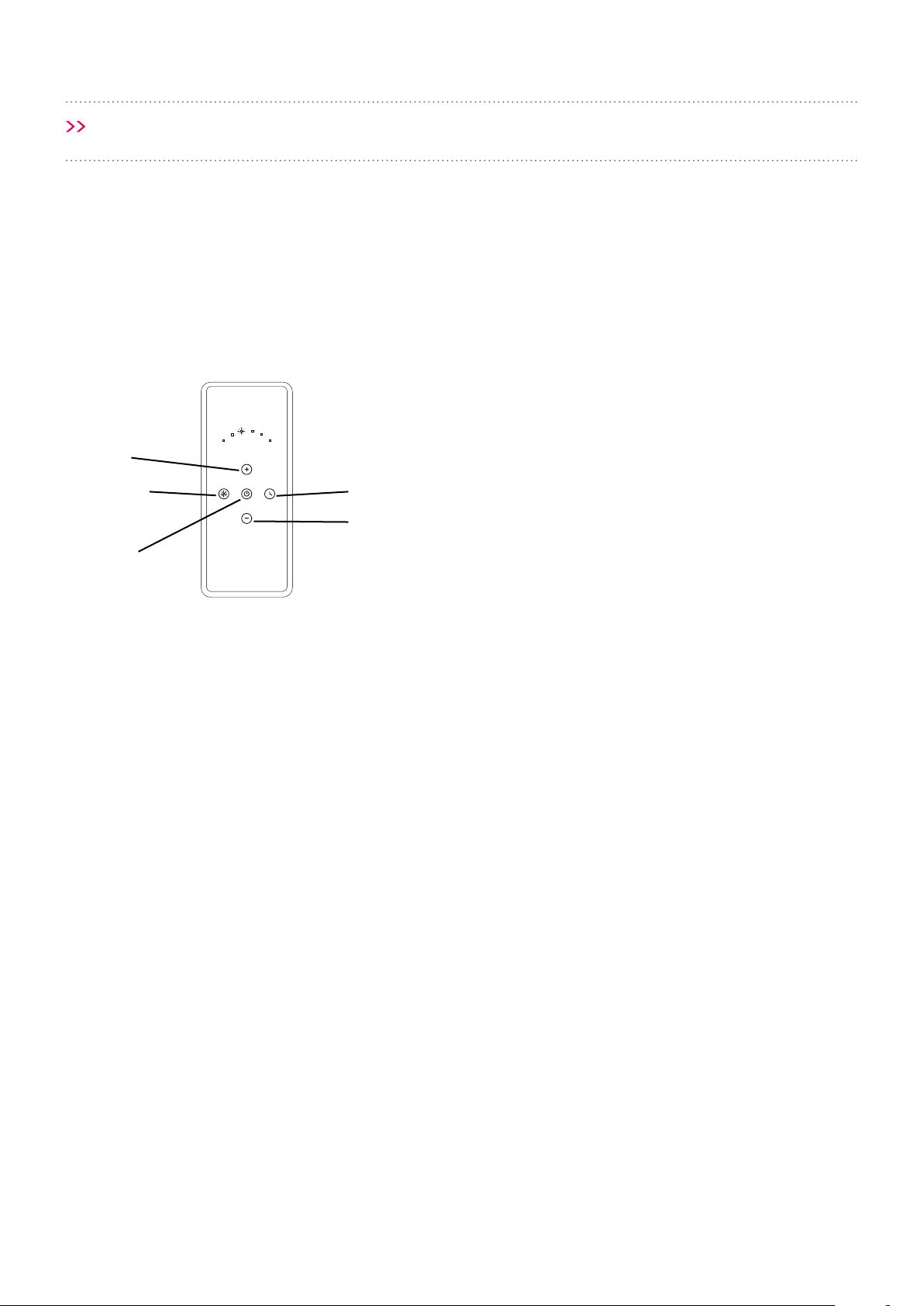
The rangehood has a 4-speed remote control
device. The buttons have the following functions
(valid for all rangehood models with remotes):
A. ON / OFF button: This button turns the
rangehood on and o. The rangehood will
always be turned on at minimum speed.
B. High-speed button: This button increases
the aspiration speed.
C. Low-speed button: This button decreases
the aspiration speed.
NOTE: When increasing and decreasing the
speed of aspiration always wait for 2 seconds
after you have changed the speed to do so
again.
D. + button: Activates the deferred stop
function (after 10 minutes the rangehood will
automatically stop).
E. – button: Turns the rangehood lighting
on or o.
If the remote control fails or the batteries
run out, disconnect the rangehood using the
safety switch inside the rangehood (which can
be accessed from one of the lters) and replace
the batteries.
NOTE: To obtain the best performance, turn on
the rangehood a few minutes prior to cooking and
leave it on for at least 10–15 minutes after you
have nished cooking
A
B
C
DE
Page 9
OPERATION
SYNCHRONISATION OF THE REMOTE
CONTROL WITH THE RANGEHOOD
If the remote control fails or the batteries
run out, disconnect the rangehood using the
safety switch inside the rangehood (which can be
accessed from one of the lters) and replace the
batteries, then synchronise the remote.
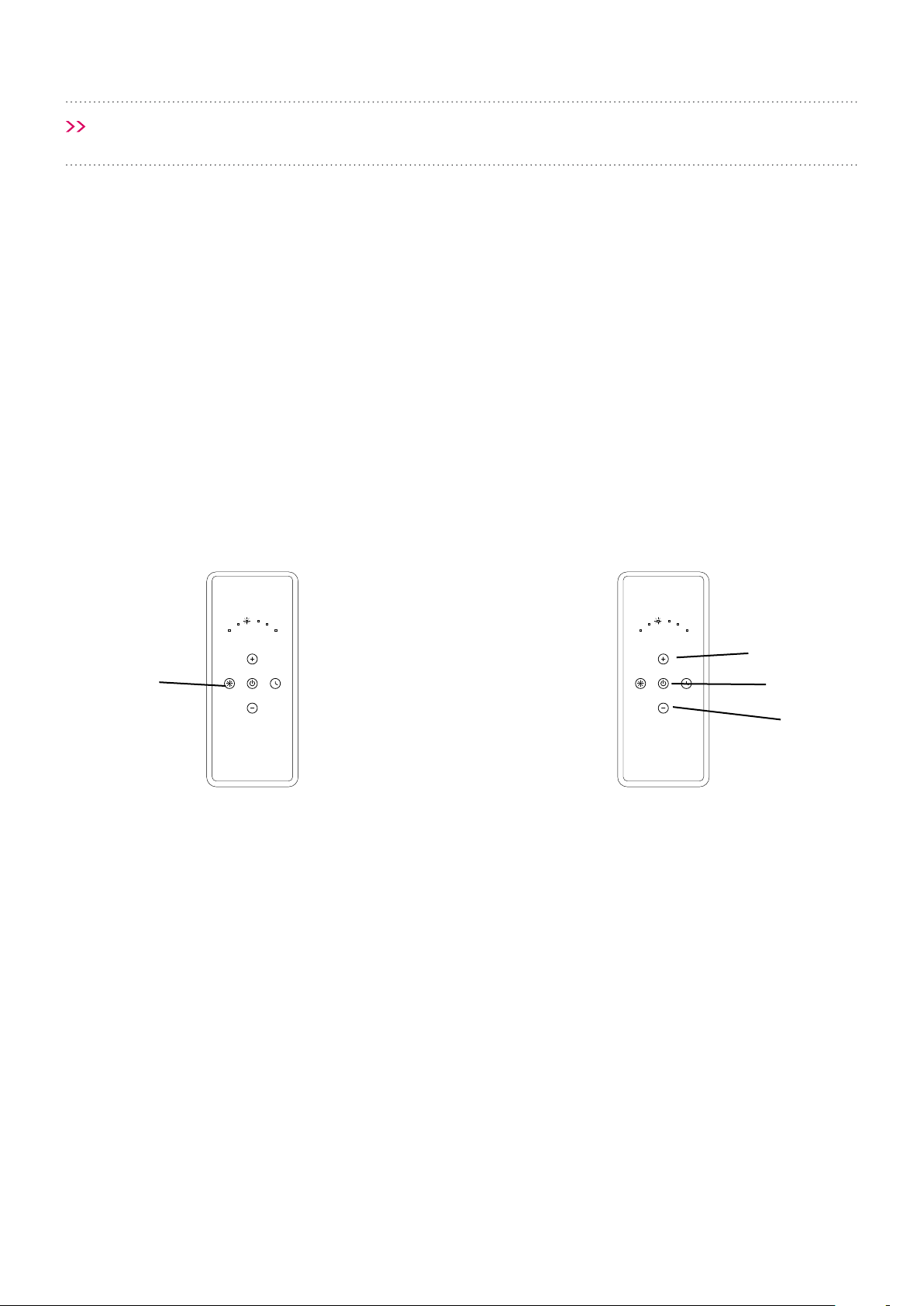
1. Switch OFF the circuit breaker.
2. Switch ON the circuit breaker.
3. Within the rst 20 seconds of switching the
circuit breaker back ON, please direct the
remote control to the rangehood and hold the
light or “E” button, until the rangehood lights
switch on.
GENERATING A NEW
TRANSMISSION CODE
In the unlikely event that the remote control
interferes with other appliances. You can assign
a new transmission code to prevent this happen.
There are 8 dierent transmission codes for you to
choose from.
4. Press and simultaneously hold buttons A, B
and C until all lights on the remote control
icker at the same time.
5. After all lights light up, press the B and C
buttons and the lights will ash 3 times to
indicate that the process has been completed.
1 2 3 41 2 3 4
A
B
C
E
Page 10
FILTERS
• For this appliance to function eectively, regular
maintenance is a must.
• The function of the lter is to absorb the grease
particles emitted during cooking.
• Blocked lters and heavy oil deposits restrict
airow and may cause the motor to overheat and
become a re hazard.
• Filters should be cleaned every 3-6 weeks or
after 40 hours of use depending on use.
• Disconnect the electrical connection before any
maintenance or cleaning processes are carried
out.
• In ceiling-mounted rangehoods, the doors or
glass must be opened before accessing the
lters.
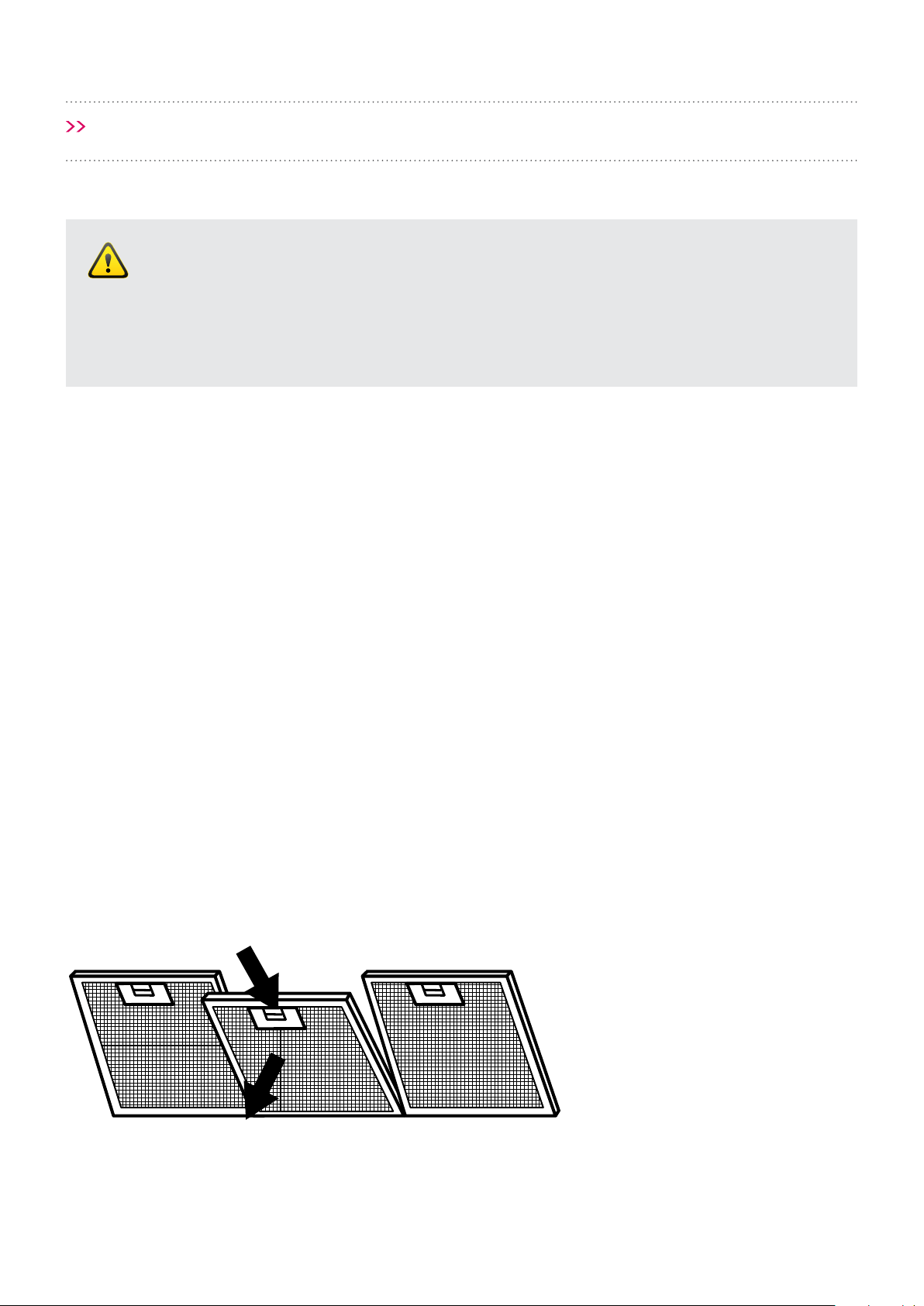
• To remove the lter, press ‘Catch A’ towards the
rear of the rangehood (removing the spring
loaded pins from the front), ease down slightly
and remove. To replace, perform the same
operation but in reverse.
• If you have an induction cooktop, please aim
to clean the lters at least every 10 days,
depending on frequency of use.
• The lters can be washed by hand or in the
dishwasher
Washing by hand - Immerse the lter in hot
water and a suitable detergent, when clean,
rinse with plenty of hot water.
Dishwasher - Put the lter in the dishwasher
and select a short program at low temperature.
NOTE: The colour of the metal mesh lters may
change after several washes. This is normal and
it is not necessary to replace the lters.
WARNING
Always switch o and disconnect power to the rangehood before cleaning.
The manufacturer is exonerated from all responsibility in the event of re
due to poor maintenance of the lters and rangehood.
Cleaning and user maintenance shall not be made by children without supervision.
Latch A
CLEANING AND MAINTENANCE
Catch A
Page 11
CLEANING AND MAINTENANCE
SURFACES
The surface of the rangehood can be cleaned with
warm soapy water and a soft sponge / cloth.
• Never use abrasive detergents, scouring pads,
steel wool or solvents on ANY part of this
appliance.
• Rinse with clean water and ensure that the
appliance is completely dry after cleaning.
• Always make sure the appliance is completely
dry after cleaning and never leave wet, this may
cause irreparable damage.
• For better results, you can use high quality
cleaning and protection products (eg. Steel
Kleen) to clean your rangehood.
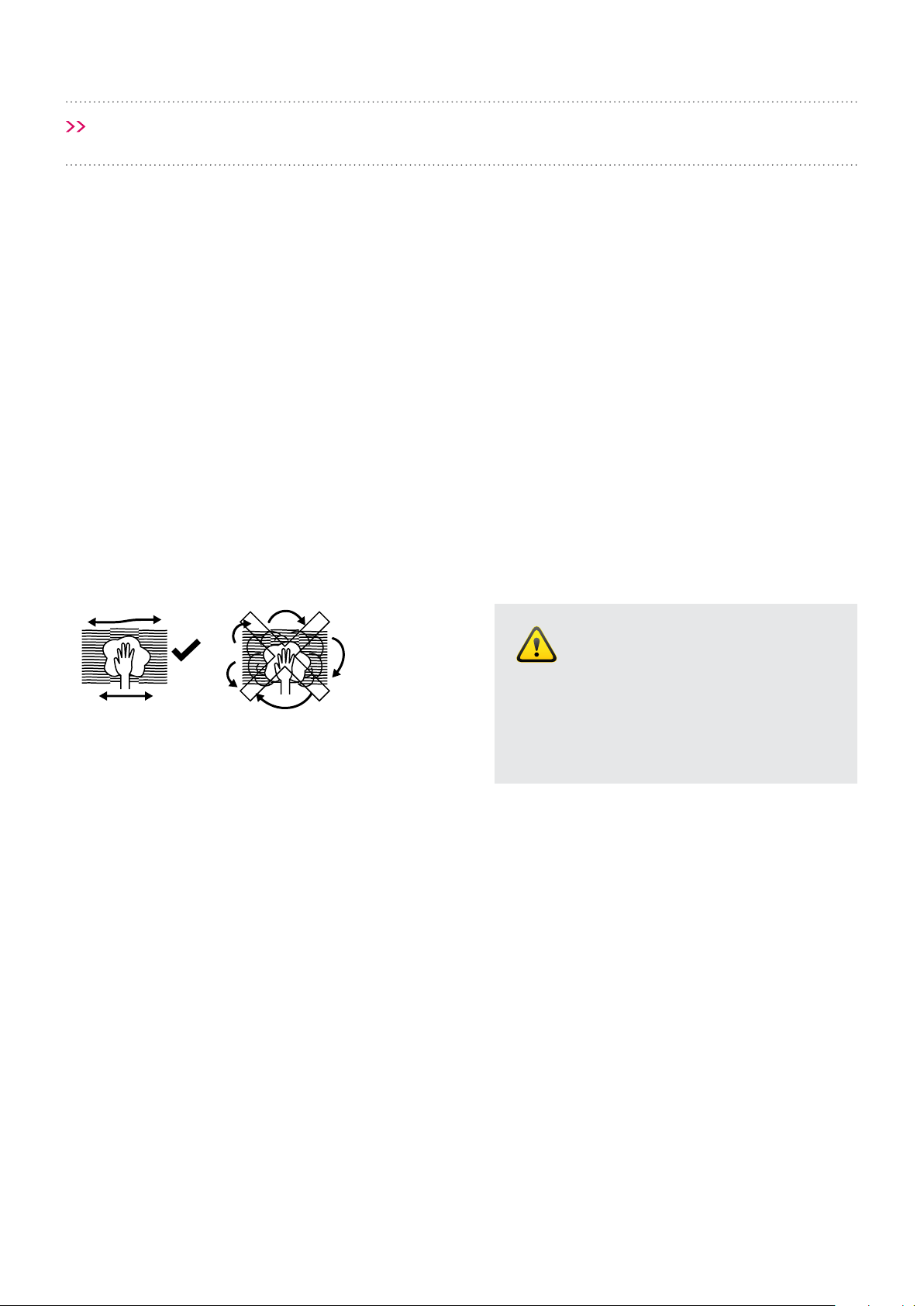
It is important to follow the direction of the surface
grain with the cloth (refer to gure below). This is
to reduce any possible marking to the appliance.
Do not pour any liquid directly on to the rangehood,
apply to a soft cloth rst.
The cloth must have no buttons, zips or fasteners
that can scratch the surface.
It is strictly forbidden to use chemical solvents,
aggressive, grainy or abrasive products,
naphtha, alcohol or similar products that could
damage the surface of the rangehood.
The manufacturer will not be held responsible
for functional or aesthetic damage caused
by cleaning with products which are not suitable
or using inadequate cleaning methods.
Cleaning the Interior
Clean the interior of the rangehood with a damp
cloth and a neutral detergent or denatured alcohol.
WARNING
Do not use denatured
alcohol on the exterior of the
rangehood. Do not clean the
electric parts or the motor with
liquids or solvents.
Page 12
CLEANING AND MAINTENANCE
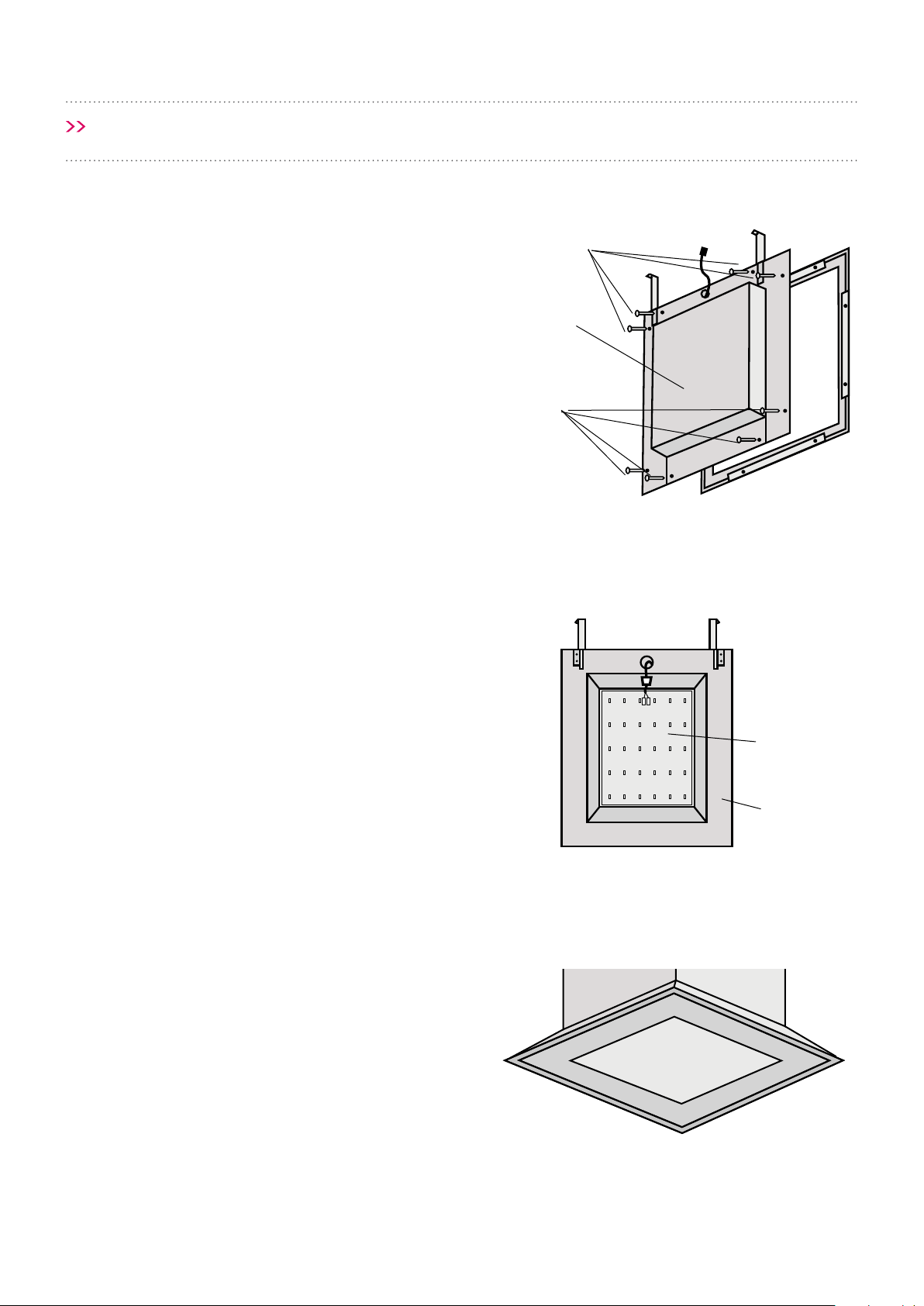
TYPE 3 (LED Plate):
Replacing the LED Plate 11W
(Mod. Modular)
NOTE: Make sure the device is disconnected from
the electrical power supply.
Step 1
Open the door of the Paradigma hood. Remove the
lter and disconnect the light connector.
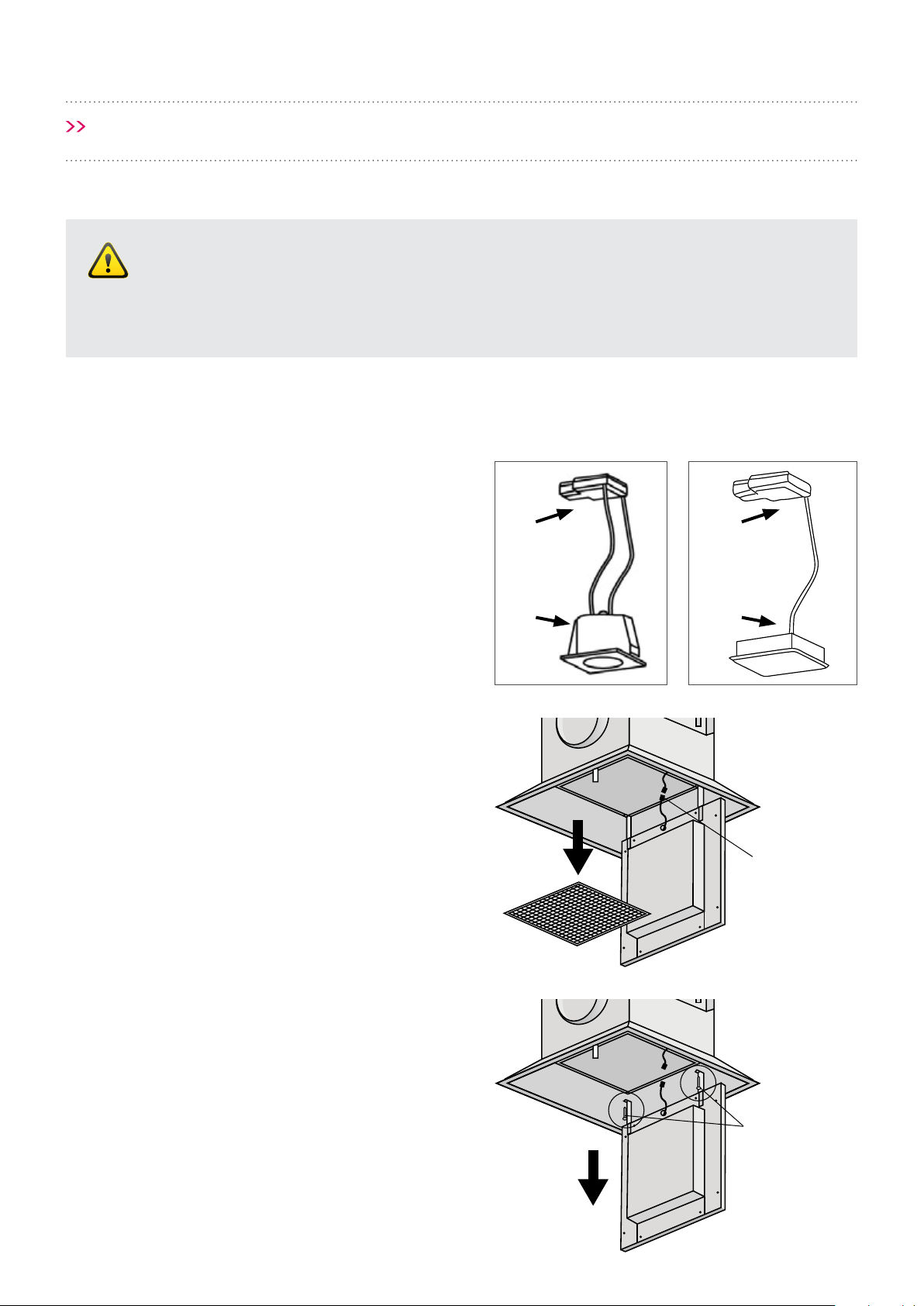
Your rangehood may have multiple light types, please refer to the pictures below for light replacement.
TYPE 1 (LED Spot) & 2 (GLED Square):
REPLACING THE LED BULB
The life span of an LED bulb is at least 10 times that
of a halogen bulb. If the globe needs to be replaced,
proceed as follows:
1. Unplug the respective connector (A).
2. Press the tabs (B) inside the rangehood.
3. Remove the LED.
4. Put in the new LED and reinstall, as above, but
in reverse order.
A A
B B
Type 1 — LED Spot Type 2 — GLED Square
Light
connector
Screws
Step 2
Remove the door by removing the screws.
WARNING
Always switch o and disconnect the power cord before replacing any light bulbs.
Failure to do so may cause serious injury. Please be aware that the light bulb will retain
heat for a short period of time after being switched o.
Page 13
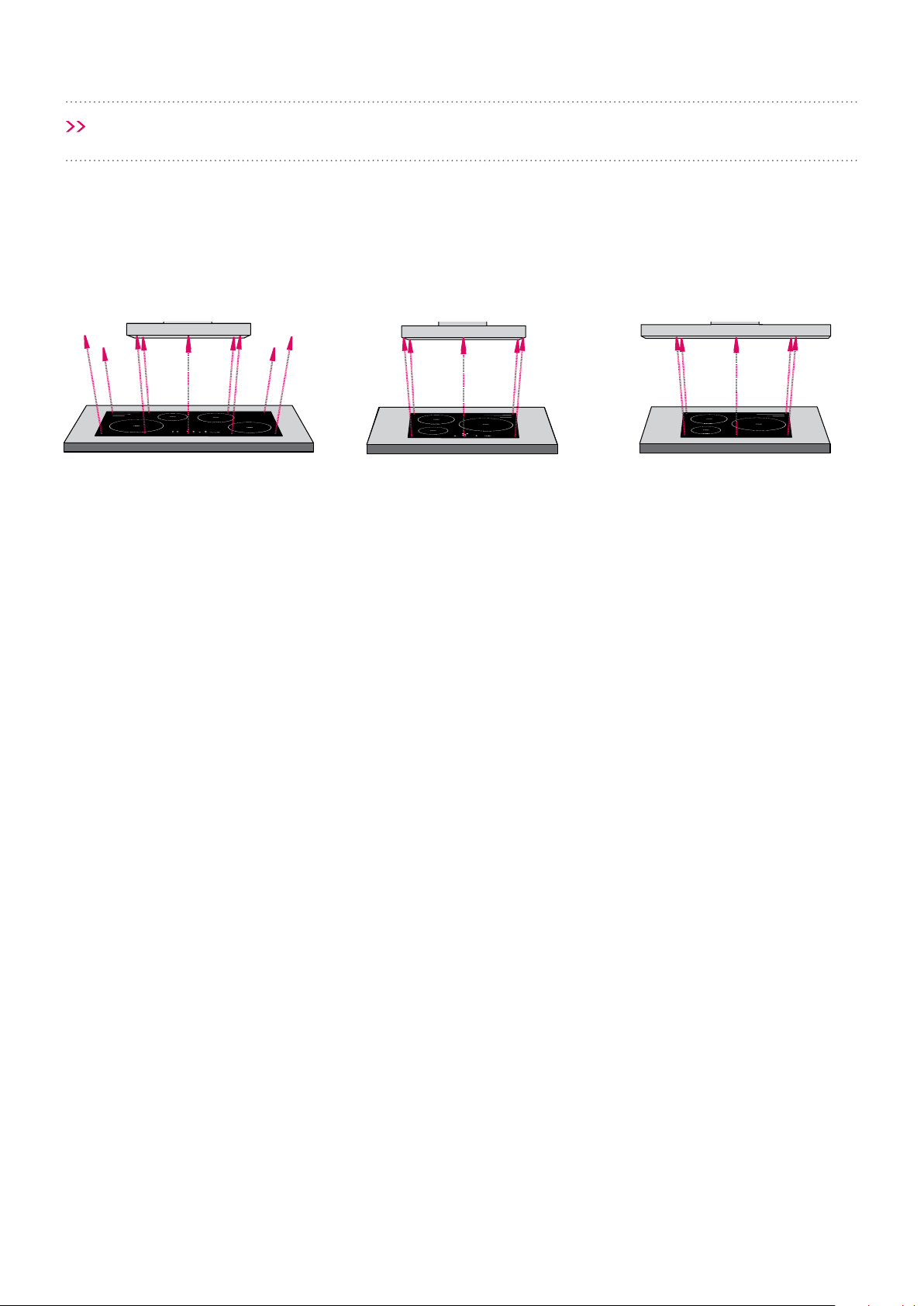
CLEANING AND MAINTENANCE
Step 3
Remove the screws from the back of the door
(the LED lights are part of the back plate).
Step 4
Replace the back plate (which include the
LED lights).
Step 5
In order to ret the door back on to the rangehood,
repeat process in reverse.
Door screws
LED light
Door screws
Back plate
Back plate
Page 14
INSTALLATION
MATCH THE RANGEHOOD SIZE TO YOUR COOKTOP
It is important to make sure the rangehood is the correct size, the larger the surface area of your rangehood
the better extraction results, see diagram below.
INADEQUATE
Rangehood smaller than
cooking zone
ADEQUATE
Rangehood same size as
cooking zone
OPTIMAL
Rangehood larger than
cooking zone
MOUNTING INSTRUCTIONS
The height and position of the rangehood in relation to the cooktop can greatly aect eciency
and extraction. After extensive testing, Schweigen recommends the following:
TYPE OF COOKTOP MINIMUM HEIGHT OPTIMAL HEIGHT MAXIMUM HEIGHT
Electric 1200mm 1500mm 1800mm
Gas 1200mm 1500mm 1800mm
Heights above 1800mm will reduce the eectiveness of the air extraction rate.

Page 15
INSTALLATION
IMPORTANT
Please check all State and Federal Laws in relation to the minimum–maximum heights,
regulations concerning the expelling of air and install your rangehood in accordance
with local laws and regulations.
MIN 1200mm
Optimal 1500mm
MAX 1800mm
900mm
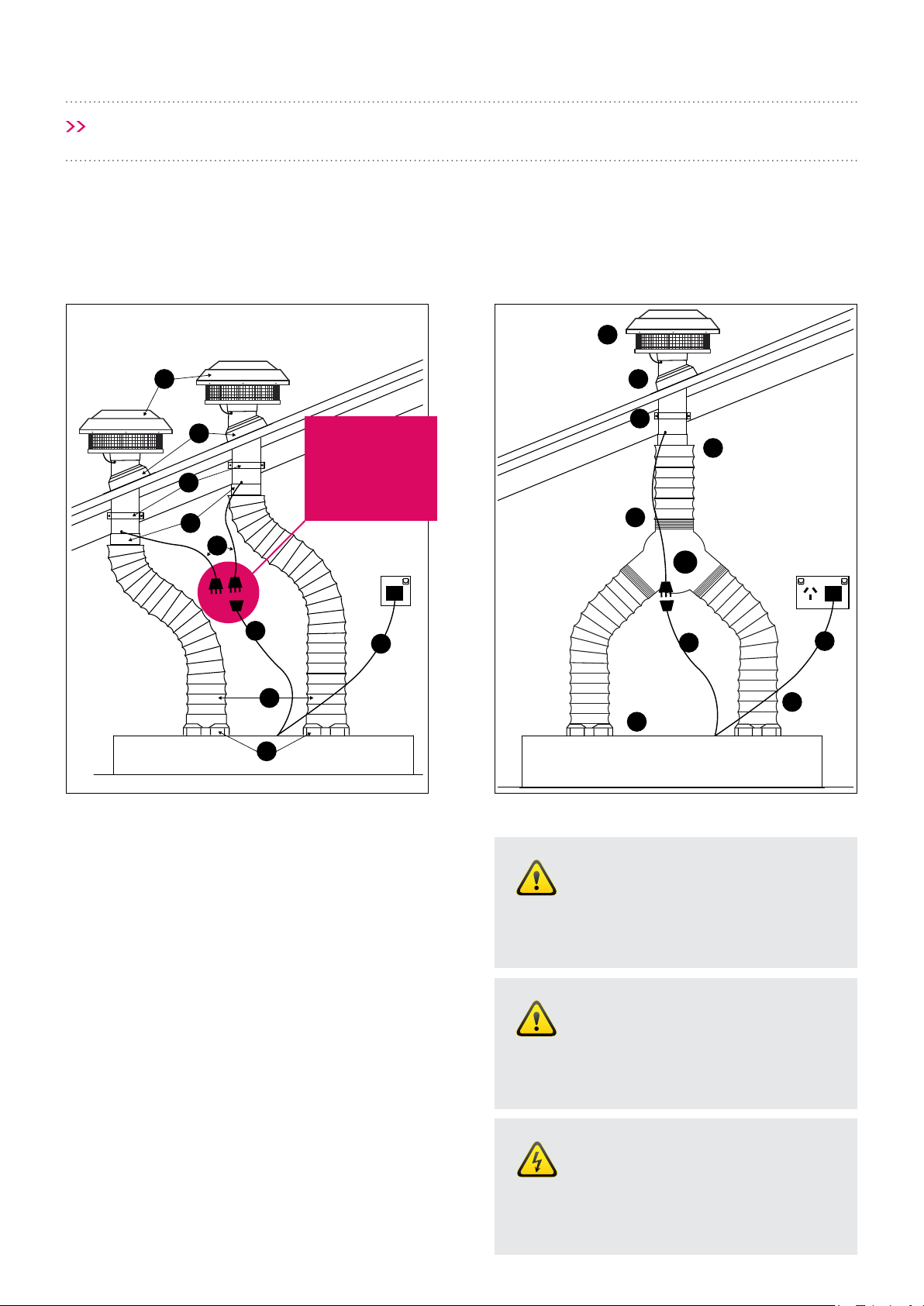
Page 16
INSTALLATION
Danger
All electrical wiring from the motor to
the rangehood should be kept inside
the roof space.
Note
* The Isodrive
®
motor system does not
include the roof seal kit, ring clamp
or the support straps.
Note
Please see Isodrive
®
installation guide
for motor installation information.
SYSTEM OVERVIEW GUIDE FOR CCSURF2S AND CCINARTS
1. Isodrive
®
Motor/s
2. Roof Seal Kit (Dektite) (Not supplied)*
3. Support Straps (Not supplied)*
4. Attach Flexi Duct to Bell-Mouth Adaptor using
ring clamp. Please DO NOT rip the ducting.
5. Isodrive
®
Motor Power Lead (Male Plug)
6. Rangehood to Isodrive
®
Motor Lead
(Female Plug)
7. Mains Power Lead (Male Plug, 10 Amp)
8. Flexi Ducting must be pulled taut.
DO NOT crush or kink the ducting.
9. Connect exi ducting to the outlet
on rangehood using ring clamp.
Please DO NOT rip the ducting.
10. Y -joint
Pictures are for illustrative purposes only, not to scale.
Refer A
2
3
4
5
6
7
8
9
1
Single Motor Installation
1
2
3
4
5
6
10
7
8
9
Twin Motor Installation
Rangehood to
Motor power
leads are to be
hard wired by
an electrician.
Page 17
INSTALLATION
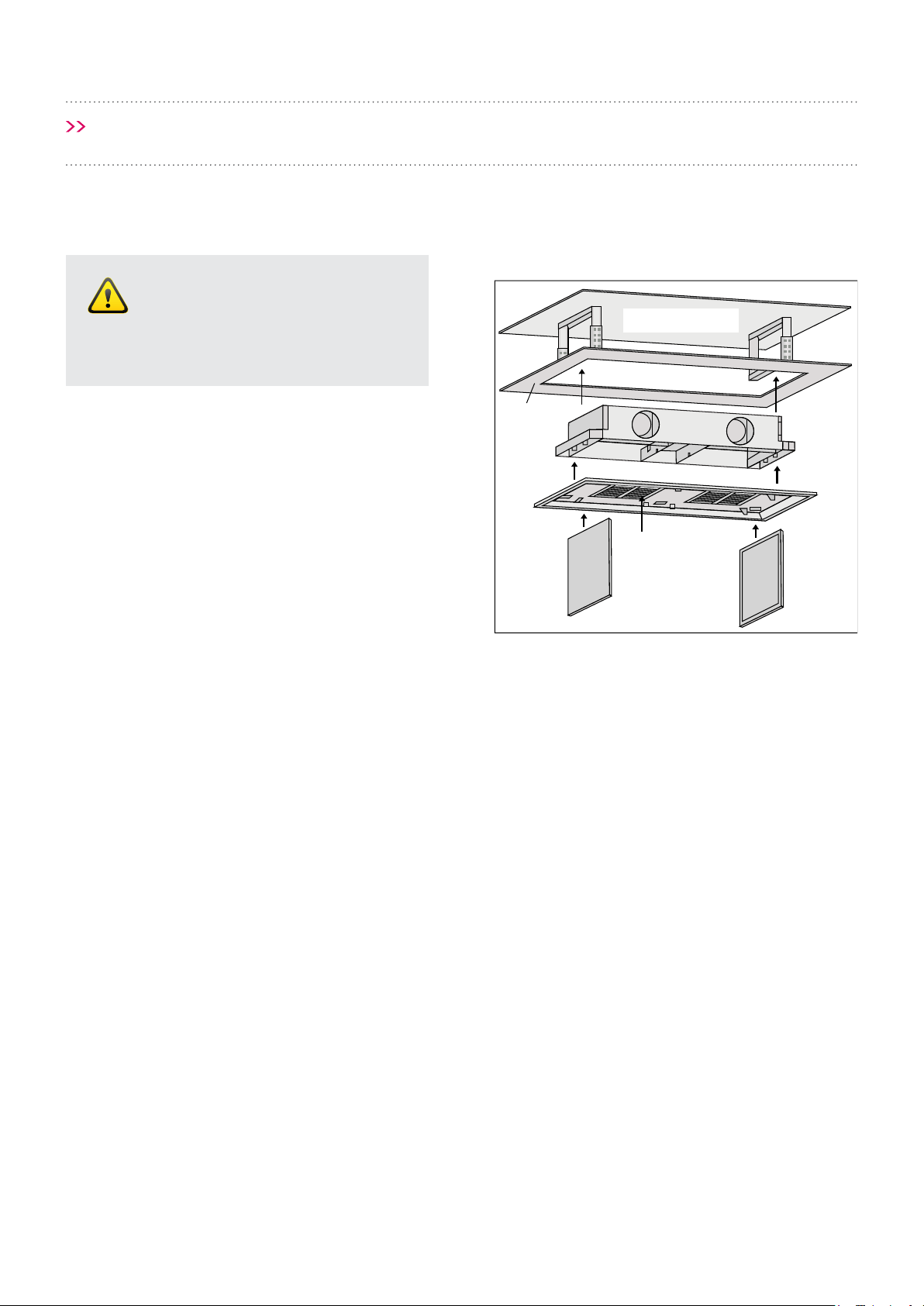
INSTALLATION GUIDE FOR CCINARTS AND CCSURF2S
Before installing the rangehood, carefully open
the doors (D), then remove the lters (E). Release
power connection from the lighting incorporated in
the holder, then remove (C) the fascia.
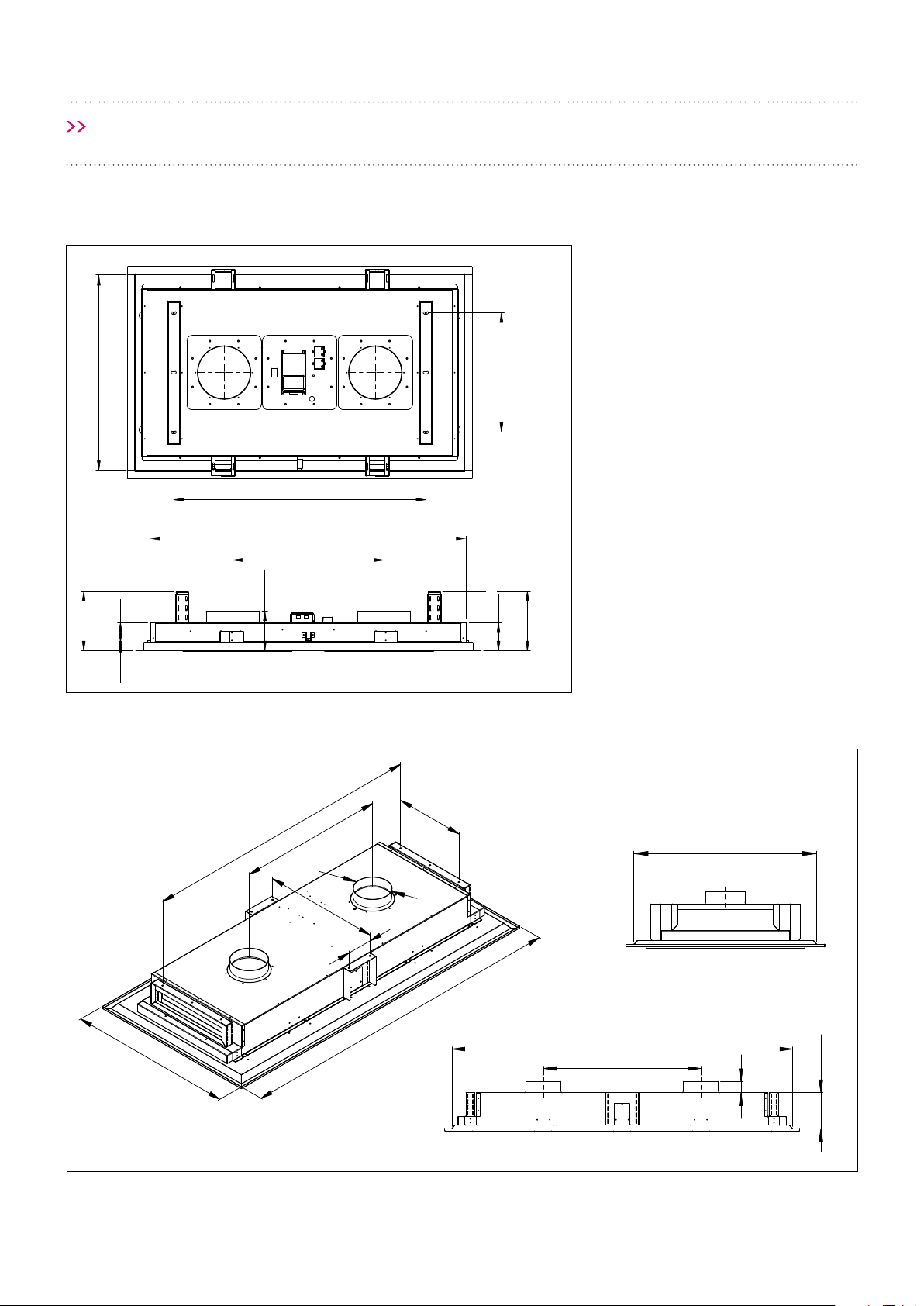
1. On the ceiling, mark the outline of the
rangehood cut out, refer to gures 1 and 2
(on next page) for dimensions.
NOTE: It is always best to use the rangehood as
a cutting guide, not the cabinet cut out diagram
as this is only a guide.
2. Fit adjustable brackets (A1) to a solid structure
and adjust the (A1) brackets to the correct
height.
3. Fit the body of the rangehood (B) to the
adjustable brackets (A1).
4. Fix fascia (C) to the body hood (B) using the
screws supplied reconnect power connection
from the lighting incorporated in the holder.
5. Fix doors or glass doors (D) to the holder hinges
(C) using the screws supplied.
6. Close doors or glass doors (D) to x the holder
magnets.
A1 A1
B
C
D
E
Overview
Solid Structure
Ceiling or
Bulkhead
Note
We recommend using washable paint
for the ceiling where the rangehood
is installed.
Page 18
125
105.1
MAX – 450
75
655
800
750
450
950
570
415
1300
1250 cutout
31.6
Min – 260
INSTALLATION
Figure 1 Cut Out Dimensions for CC-SURF2S
Figure 2 Cut Out Dimensions for CC-INARTS
Measurements in mm.
Measurements in mm.
NOTE: It is always best to use the actual rangehood ordered as a cutting guide, not the cabinet cut out diagram
as this is only a guide.
1710
2000
885
420
ø200
700
1000
Cutout: 950
Cutout: 1950
885
64
Min 210 - Max 335
150
125
105.1
MAX – 450
75
655
800
750
450
950
570
415
1300
1250 cutout
31.6
Min – 260
750
Cutout 1250
950
570
±125
7531.6
Min - 260
Max - 450
105.1
450
Page 19
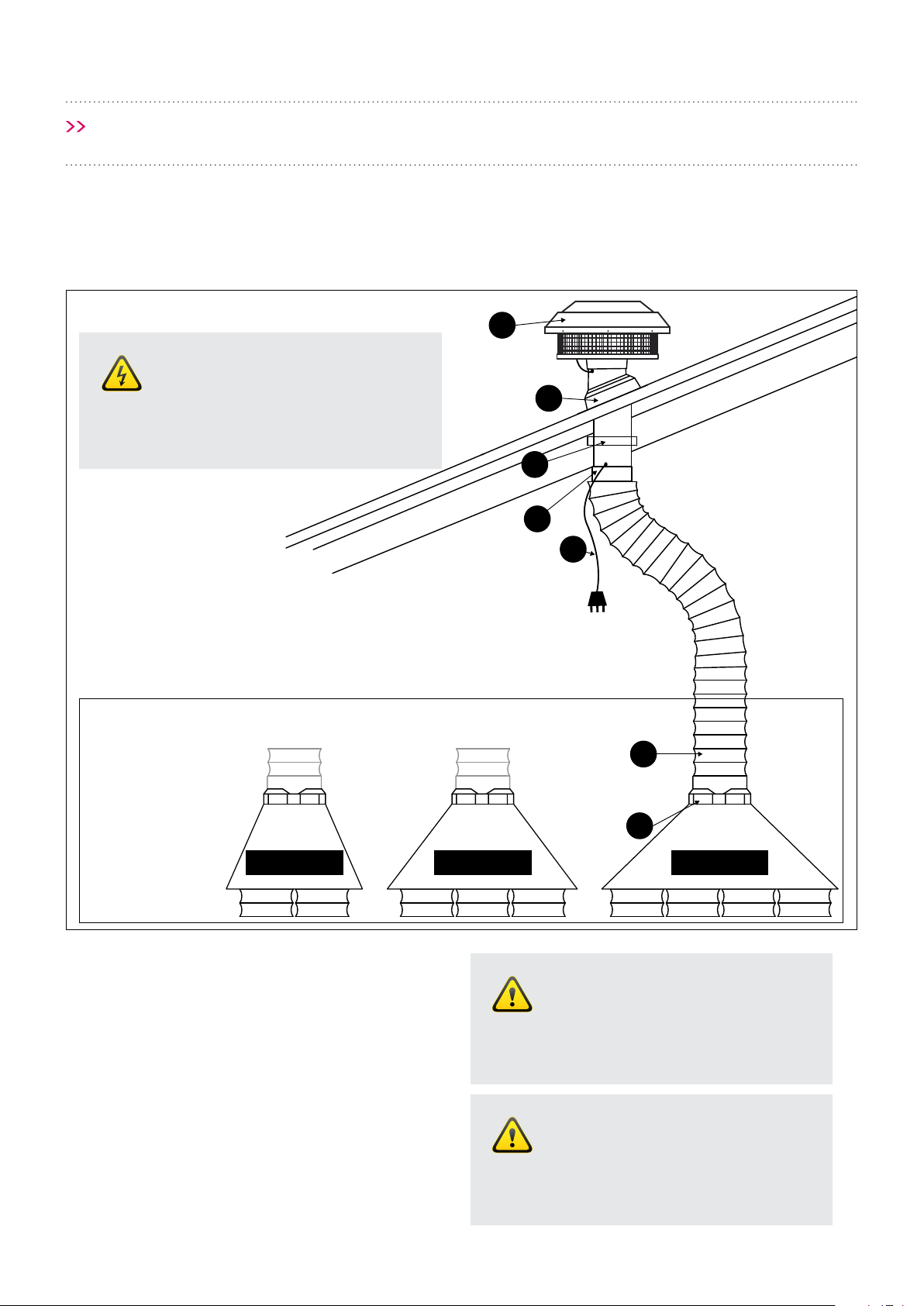
INSTALLATION
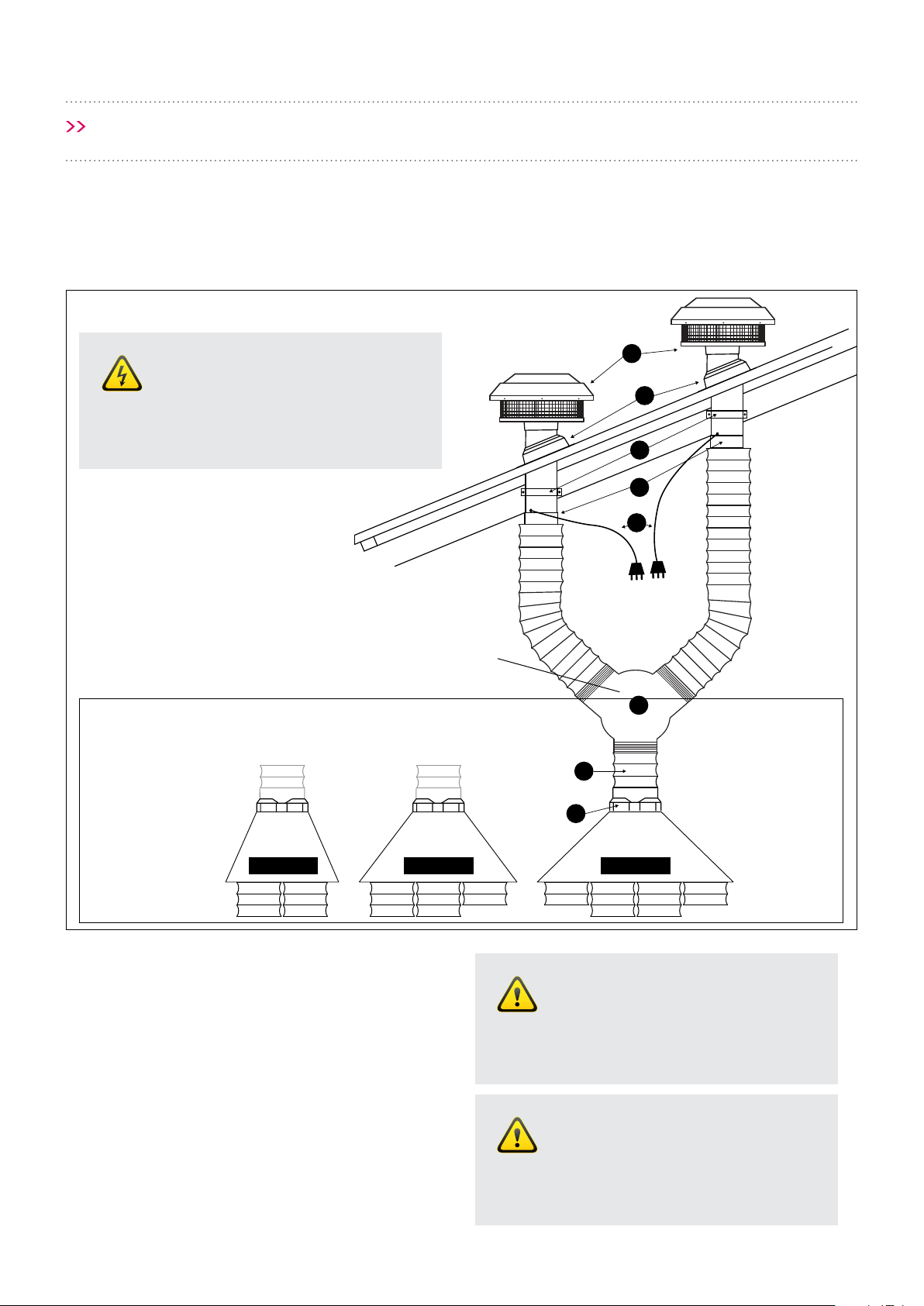
MOTOR SYSTEM OVERVIEW GUIDE FOR CCPARA4S, CCPARA4W, CCPARA3S,
CCPARA3W, CCPARA2S, CCPARA2W
1. Isodrive
®
Motor/s
2. Roof Seal Kit (Dektite)*
3. Support Straps*
4. Attach Flexi Duct to Bell-Mouth Adaptor using
ring clamp. Please DO NOT rip the ducting.
5. Isodrive
®
Motor Power Lead (Male Plug)
6. Flexi Ducting must be pulled taut.
DO NOT crush or kink the ducting.
7. Connect exi ducting to the outlet on
rangehood using cable tie or ring clamp.
Please DO NOT rip the ducting.
Pictures are for illustrative purposes only, not to scale.
2
3
4
5
6
7
1
2-Way Adaptor 3-Way Adaptor 4-Way Adaptor
Single Motor Installation
Connecting to 2, 3 or 4-Way Adaptor
Danger
All electrical wiring from the motor to
the rangehood should be kept inside
the roof space.
Note
* The Isodrive
®
motor system does not
include the roof seal kit, ring clamp
or the support straps.
Note
Please see Isodrive
®
installation guide
for motor installation information.
Page 20
INSTALLATION
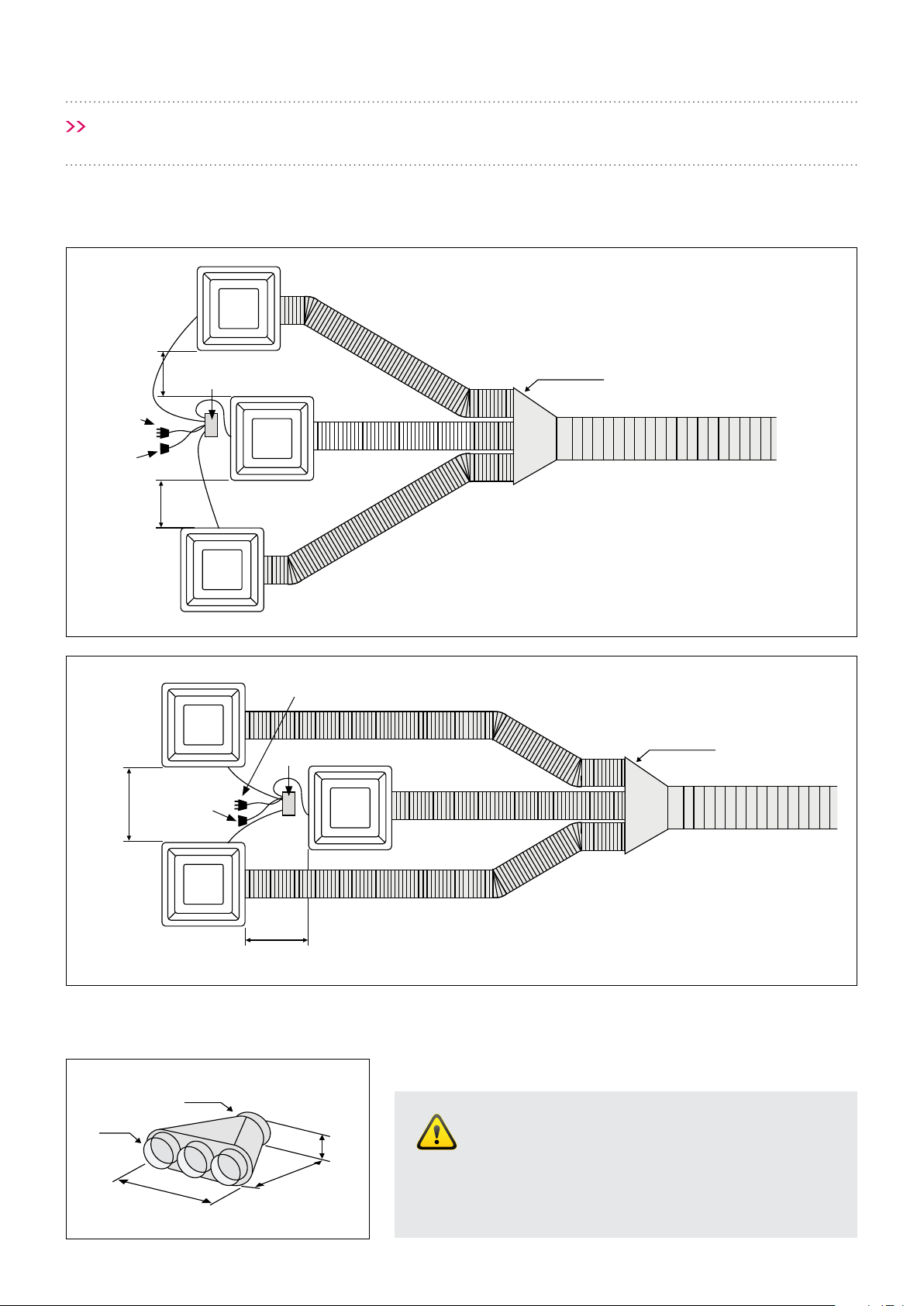
MOTOR SYSTEM OVERVIEW GUIDE FOR CCPARA4S, CCPARA4W, CCPARA3S,
CCPARA3W, CCPARA2S, CCPARA2W
1. Isodrive
®
Motor/s
2. Roof Seal Kit (Dektite)*
3. Support Straps*
4. Attach Flexi Duct to Bell-Mouth Adaptor using
ring clamp. Please DO NOT rip the ducting.
5. Isodrive
®
Motor Power Lead (Male Plug)
6. Y -joint
7. Flexi Ducting must be pulled taut.
DO NOT crush or kink the ducting.
8. Connect exi ducting to the outlet
on rangehood using ring clamp.
Please DO NOT rip the ducting.
Pictures are for illustrative purposes only, not to scale.
2
3
4
5
7
6
8
1
2-Way Adaptor 3-Way Adaptor 4-Way Adaptor
Twin Motor Installation
Connecting to 2, 3 or 4-Way Adaptor
Y joint 200 x 200 x 200
Danger
All electrical wiring from the motor to
the rangehood should be kept inside
the roof space.
Note
* The Isodrive
®
motor system does not
include the roof seal kit, ring clamp
or the support straps.
Note
Please see Isodrive
®
installation guide
for motor installation information.
Page 21
INSTALLATION
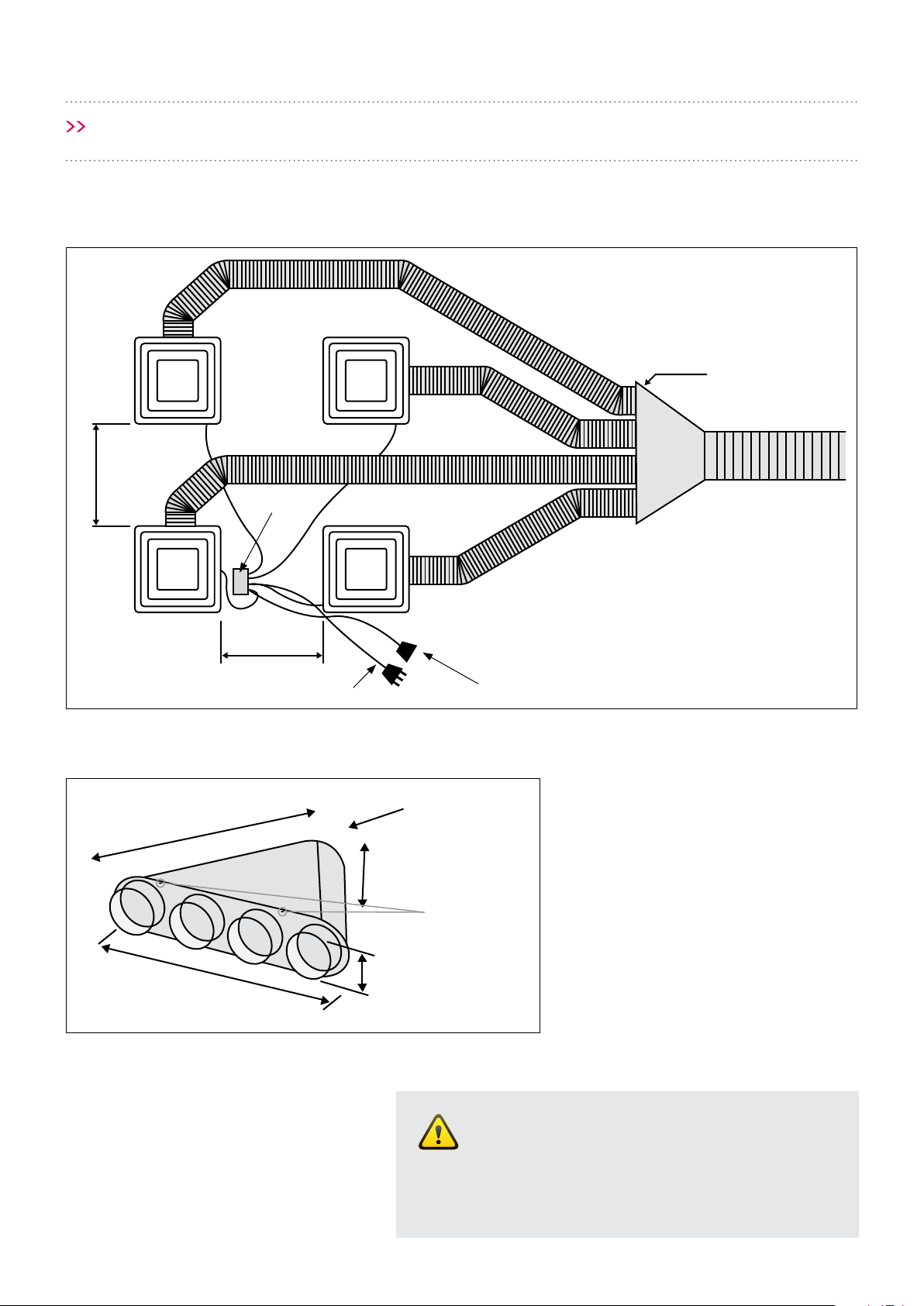
EXAMPLE INSTALLATION FOR TRIPLE MODULES
Sub
Main
Sub
3-Way Adaptor
Min 300
Max 1000
Control Module
Control Module
Mains Plug
Mains Plug
Motor Power Lead
Motor
Power Lead
Min 300
Max 1000
Main
Sub
Sub
3-Way Adaptor
Min 300
Max 1000
Min 300
Max 1000
200
150
500
420
205
3WAY ADAPTOR
Measurements in mm.
Measurements in mm.
Measurements in mm.
Important
Please take note to the minimum and maximum
spacing between each module. This is important
as it will aect the performance should they be
installed outside these parameters.
Page 22
INSTALLATION
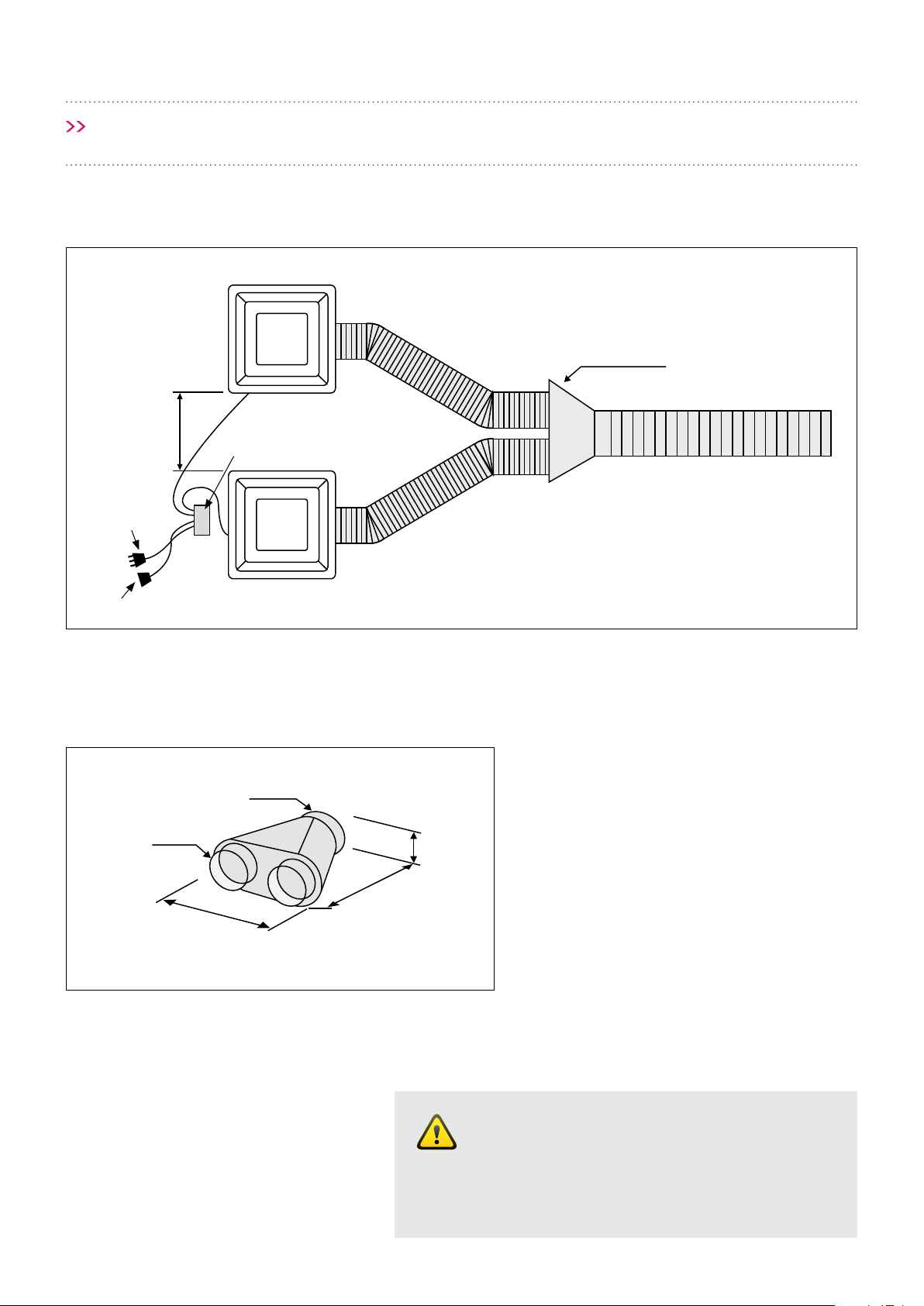
4-Way Adaptor
Mounting points
550
700
205
150
200
Sub Sub
Sub
Main
4-Way Adaptor
Control Module
Mains Plug
Motor Power Lead
Min 300 - Max 1000
Min 300 - Max 1000
Measurements in mm.
Measurements in mm.
Important
Please take note to the minimum and maximum
spacing between each module. This is important
as it will aect the performance should they be
installed outside these parameters.
EXAMPLE INSTALLATION FOR QUADRUPLE MODULES
Page 23
INSTALLATION
Sub
2-Way Adaptor
Main
Min 300
Max 1000
EXAMPLE INSTALLATION FOR TWIN MODULES
2WAY ADAPTOR
Measurements in mm.
Measurements in mm.
155
315
325
150
200
Control Module
Mains Plug
Motor Power Lead
Important
Please take note to the minimum and maximum
spacing between each module. This is important
as it will aect the performance should they be
installed outside these parameters.
Page 24
INSTALLATION
INSTALLATION GUIDE FOR CCPARA4S, CCPARA4W, CCPARA3S, CCPARA3W,
CCPARA2S, CCPARA2W MODULES
NOTE: We recommend using washable paint for the ceiling where the rangehood is installed.
Figure A
Figure B
Figure C
340mm
340mm
90mm
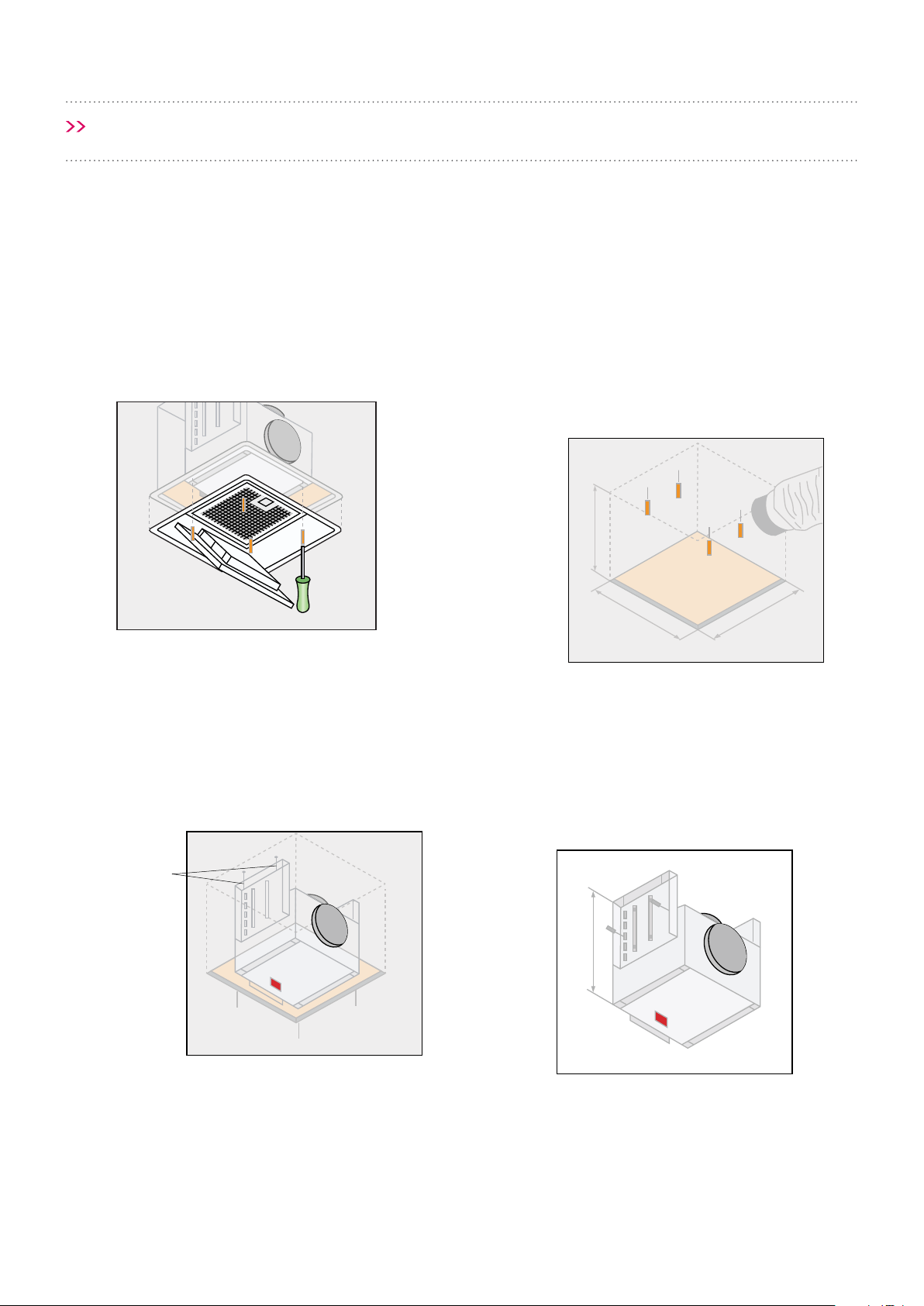
Step 1
Remove the ange and lid before installation.
Step 3
Mark and place the 4 xing points (Figure B).
Step 4
Regulate the mounting brackets (Figure C) to the
desired measurements.
Step 2
On the ceiling, draw the outline of the hole required
to house the extractor hood, see gure A for cutout
dimensions.
Fixing points
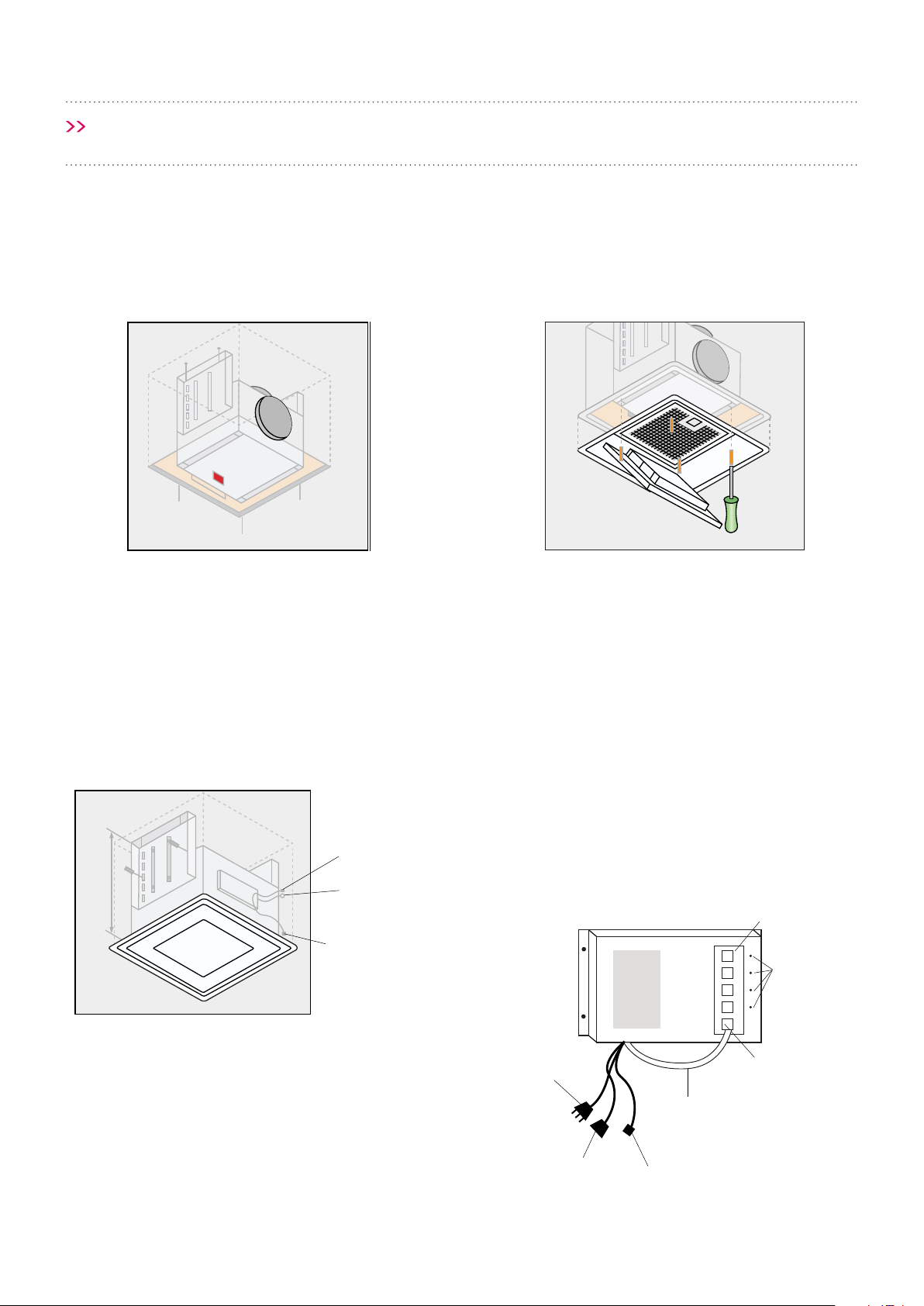
Page 25
INSTALLATION
Step 5
Place the modular into the opening of ceiling,
connect the ducting. When ducting is xed to the
modular, secure it with the xing (Figure D).
Step 6
To connect the electrical cable of the lid to the
connections box and x the lid with the screws, it
must remain joined to the body (Figure E).
Step 7
Close the lid until it remains xed with the magnets
(Figure F).
Step 8 Control Module
Connect each power plug to the control module.
Then connect mains power cable and motor cables.
Each module connects to one of the four
connectors on (A), it does not matter which order
they are connected.
Connect each earth lead from each light module to
the earth connectors.
Figure D Figure E
Figure F
Mains Power Lead
Motor Power
Lead
White Power Lead,
connects to position 1.
Position 1
Earth
connectors
A
Power plug
Earth
connector
To main isolation
switch
The main unit will have
a isloation switch lead,
plug it into control
module
Page 26
INSTALLATION
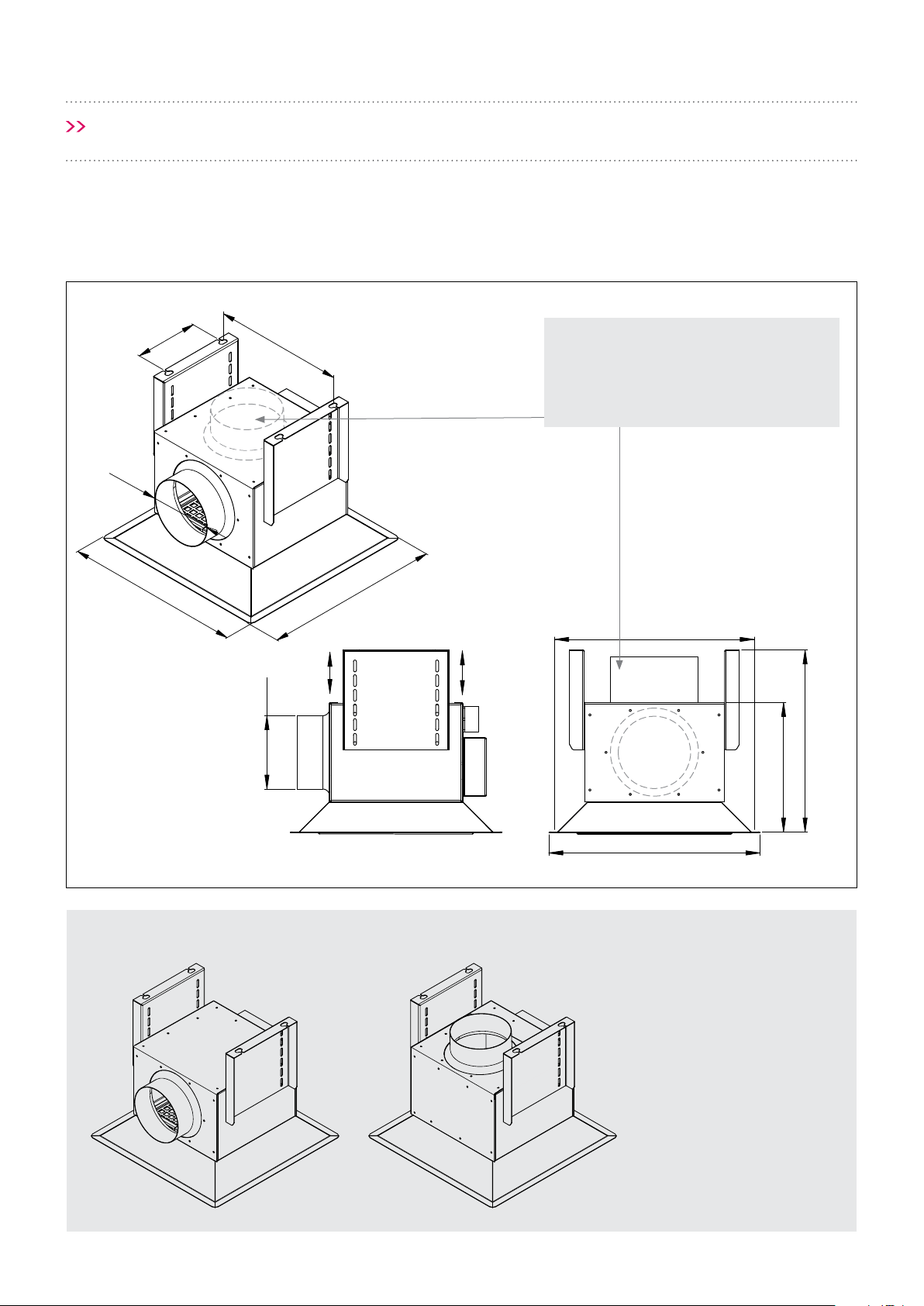
DUCT CONVERTING DIMENSIONS FOR CCPARA4S, CCPARA4W, CCPARA3S,
CCPARA3W, CCPARA2S AND CCPARA2W
DUCTING VENT POSITION
265
130
ø150
ø150
360 360
Cutout 340 x 340
310
220
Measurements in mm.
NOTE
The ducting vent can be mounted
either to the side or top of the unit.
The ducting vent is designed to
switch from being a side mount
to a top mount, depending on the
constraints of the installation.
Prior to installation, ip the vent
bracket either way and screw
into place.
SIDE MOUNT TOP MOUNT
Page 27
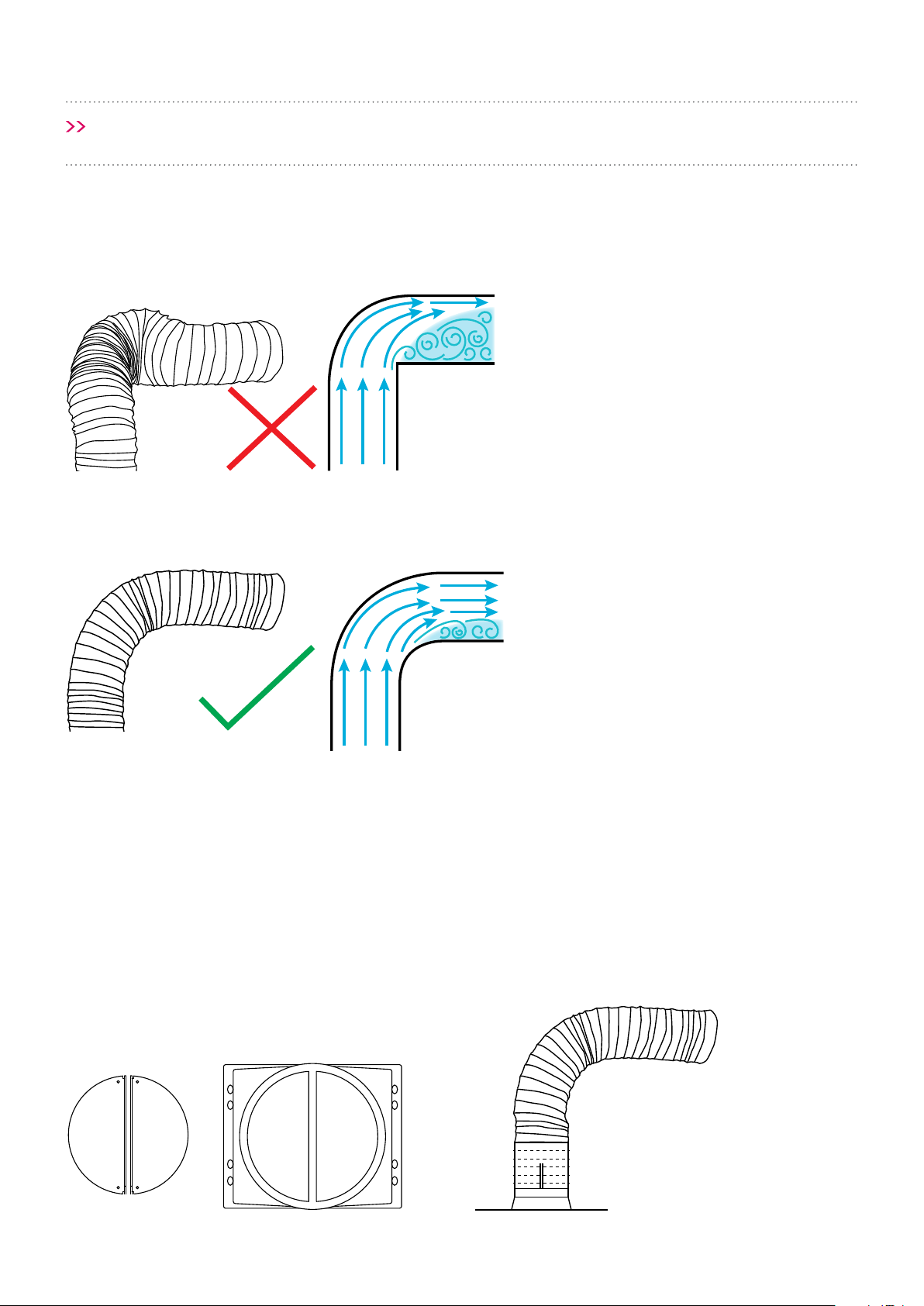
INSTALLATION
Please DO NOT crush or kink the ducting.
1. Crushed or kinked ducting creates sharp
corners that creates turbulence. This
reduces the size and eciency of the
ducting, lowers extraction and may
cause excessive noise.
BACK DRAFT FINS FOR APPLICABLE MODELS
Should your Back Draft Fins get stuck, this is not a warranty issue.
When installing Back Draft Fins, please ensure that you insert the Back Draft Fins onto the back draft base,
which are attached to the top of the motor outlet before installation.
NOTE: Please make sure when ducting is installed, that it does not impede the Back Draft Fins
from operation.
Back Draft Fins Back Draft Fins
open position
Back Draft Base
2. Sweeping curves and taut ducting reduces
resistance and turbulence. The airow
and extraction will be more ecient
and stronger.

Page 28
CONDENSATION INFORMATION
COOKING WITH INDUCTION
COOKTOPS
Cooking with an induction or similar cooktop,
may produce condensation on the rangehood.
Unlike basic electric or gas cooking, induction
cooktops heat food and liquid instantly, which in
turn, produces vapours rapidly. Because of this
faster process, the rangehood lters do not have
enough time to warm, which increases the chance
of condensation forming.
There are many variables that may contribute
to condensation forming, some of which include
but are not limited to:
• Variance in climate – geographical location.
• Position of your home & kitchen – morning/
afternoon sun.
• Distance from cooktop to the rangehood.
• Speed of food & liquid heating.
• Angle of ducting – an ‘S’ bend is preferred.
• Filter size – larger rangehood preferred,
as it will have a larger lter area.
• Quality of pots or cookware you are using –
high quality is recommended.
How to reduce the possibility
of condensation forming:
• Ensure the rangehood is installed by a qualied
professional, carefully following the installation
guide.
• Turn on the rangehood 5-10 minutes prior to
cooking, and leave on for 5-10 minutes after
cooking; this helps clear remaining vapours
from the ue.
• Start the cooking process at a low-to-medium
setting and allow time for the rangehood to
become warm.
• Clean lters regularly.
• Ensure constant airow in the cooking zone; this
helps optimise the rate of extraction.
• Follow all induction cooktop manufacturer’s
advice.
For further tips or information regarding cooking
with induction, please contact the induction
cooktop manufacturer.

Page 29
TROUBLESHOOTING
Before you contact the technical service
department, make sure that the product
is plugged in and power is supplied.
Do not take any action that will damage
the product.
Check electric connection. Voltage of the electric
network should be between 220 - 240V, rangehood
should be connected to grounded plug and turned on.
Please ensure that there is power to the rangehood
and the rangehood is switched on and the motor is
conneted to the rangehood
Check light switch. Light switch should be at on position.
Check lters. The lters should be washed regularly,
see lter cleaning.
Light s should be rmly in position.
Check outlet. Outlet should be open.
Check light s. Make sure they are not broken or faulty.
Please make sure there is no obstruction in ducting or
with the back draft ns.
Check the outlet, make sure it is not blocked and you
have the correct diameter ducting.
Check Isodrive
®
installation manual, make sure the exi
ducting is installed correctly, eg. Length of ducting
used, keep the ducting taut.
Rangehood does
not work
X X
Light does not work X X X X
Rangehood air
exaction is weak
X X X X
Rangehood does
not direct air out
(through chimney)
X X
Loud noise from
the rangehood
X X
IMPORTANT
Never attempt to repair this
appliance by yourself. Always
refer to a qualied Service
Technician.

Page 30
TROUBLESHOOTING
SERVICE
Lodging an Online Service Request
In the event that the failure is not due to the faults
mentioned in the Troubleshooting section, you
can lodge an online Service Request. To lodge
an online Service Request, visit our website
www.schweigen.com.au/service-and-warranty
and click on the link and complete the service
request form.
A service request will require the following
information:
• The purchase date
• The model number
• The rangehood model and motor type (eg.
Isodrive® 650)
• The serial number or batch number (this number
is on a sticker inside the rangehood).
• A copy of the purchase receipt (without a receipt
your service request cannot be processed).
Alternatively, you can call Customer Service:
Australia 1300 881 693
New Zealand 0800 200 510
FAULTY INSTALLATION
It is not the responsibility of Schweigen to rectify any incorrect installations. A service call out fee will be
charged for any Schweigen technician that attends a call, whereby it is established that the fault is due
to an incorrect installation or non-manufacturing fault. Should the appliance be installed in such a way
that the service agent is unable to gain access to the appliance, the person/s who own the premises
or the property where the appliance resides — will be responsible to provide access to the appliance at
their expense.
Page 31
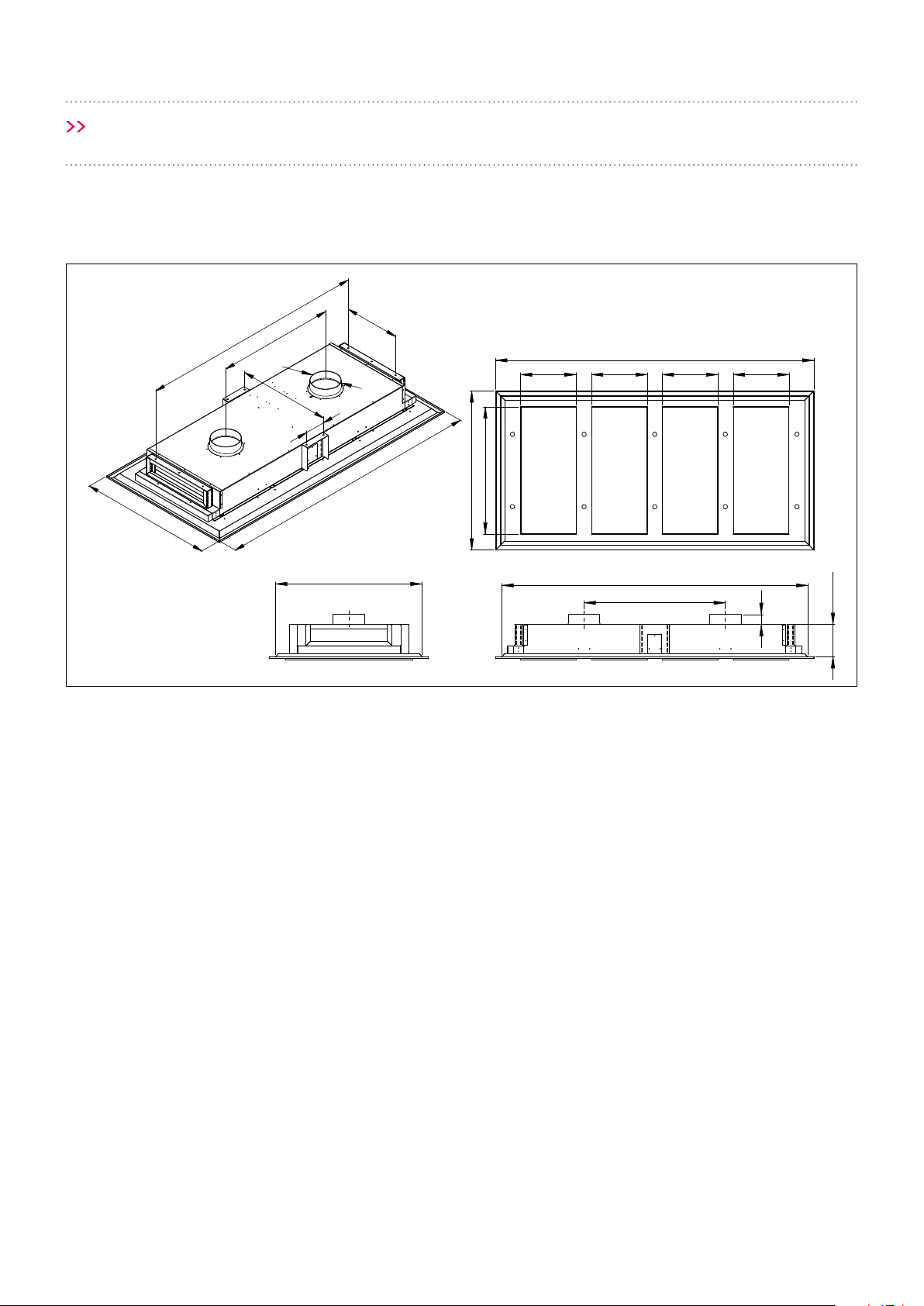
TECHNICAL SPECIFICATIONS
Model: CC-INARTS
Feeding Voltage: 220-240V 50Hz
Max Lamp Power: 10 x GLED Square 55 x 55mm
2.1W 12V 4000k
1710
2000
885
420
ø200
700
1000
Cutout: 950
2000
Cutout: 1950
885
64
Min 210 - Max 335
1000
800
350 350 350 350
150
CC-INARTS
Page 32
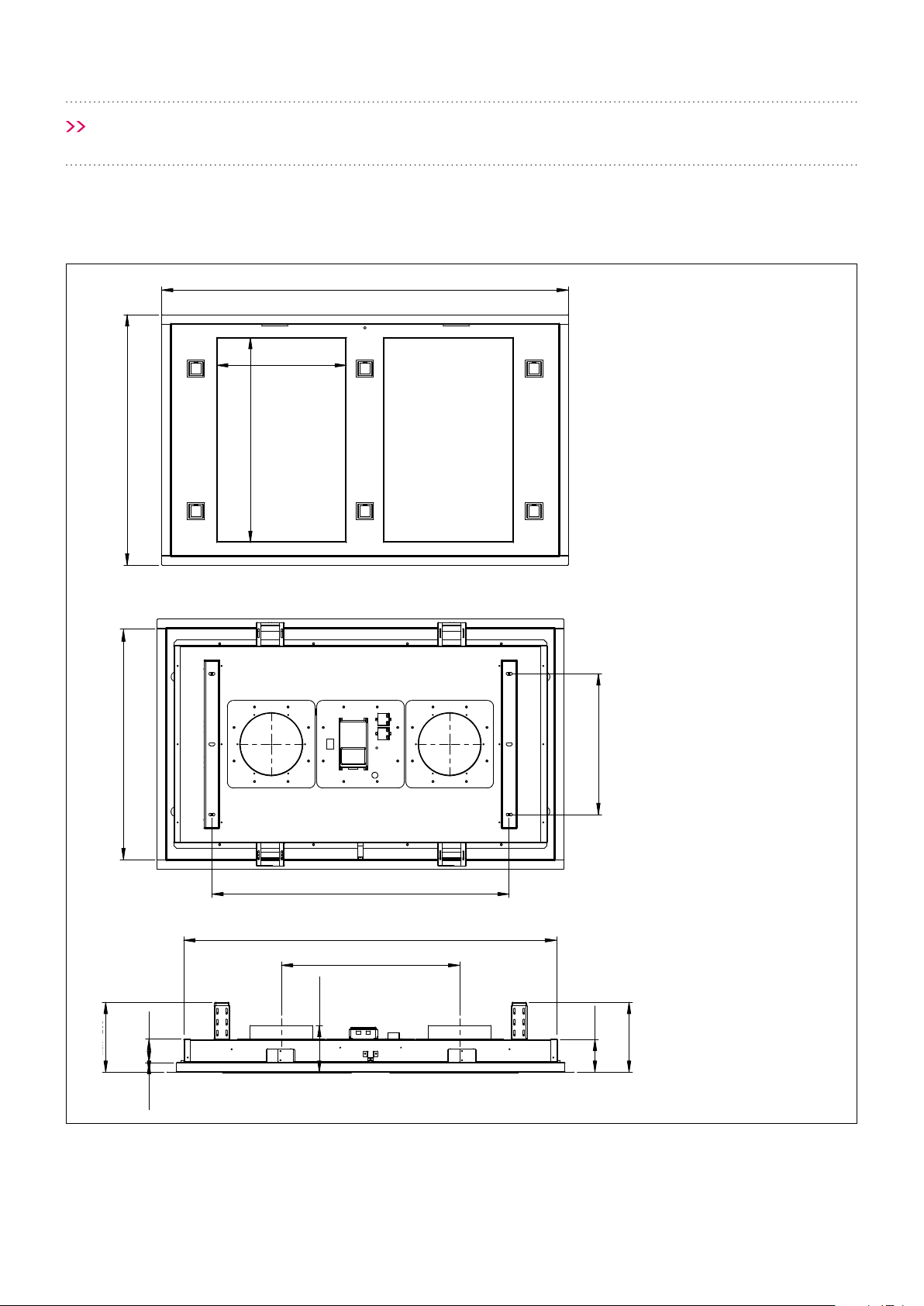
TECHNICAL SPECIFICATIONS
Model: CC-SURF2S
Feeding Voltage: 220-240V 50Hz
Max Lamp Power: 6 x GLED Square 55 x 55mm
2.1W 12V 4000k
125
105.1
MAX – 450
75
655
800
750
450
950
570
415
1300
1250 cutout
31.6
Min – 260
125
105.1
MAX – 450
75
655
800
750
450
950
570
415
1300
1250 cutout
31.6
Min – 260
125
105.1
MAX – 450
75
655
800
750
450
950
570
415
1300
1250 cutout
31.6
Min – 260
1300
800
750
Cutout 1250
655
415
950
570
±125
7531.6
Min - 260
Max - 450
105.1
450
CC-SURF2S
Page 33
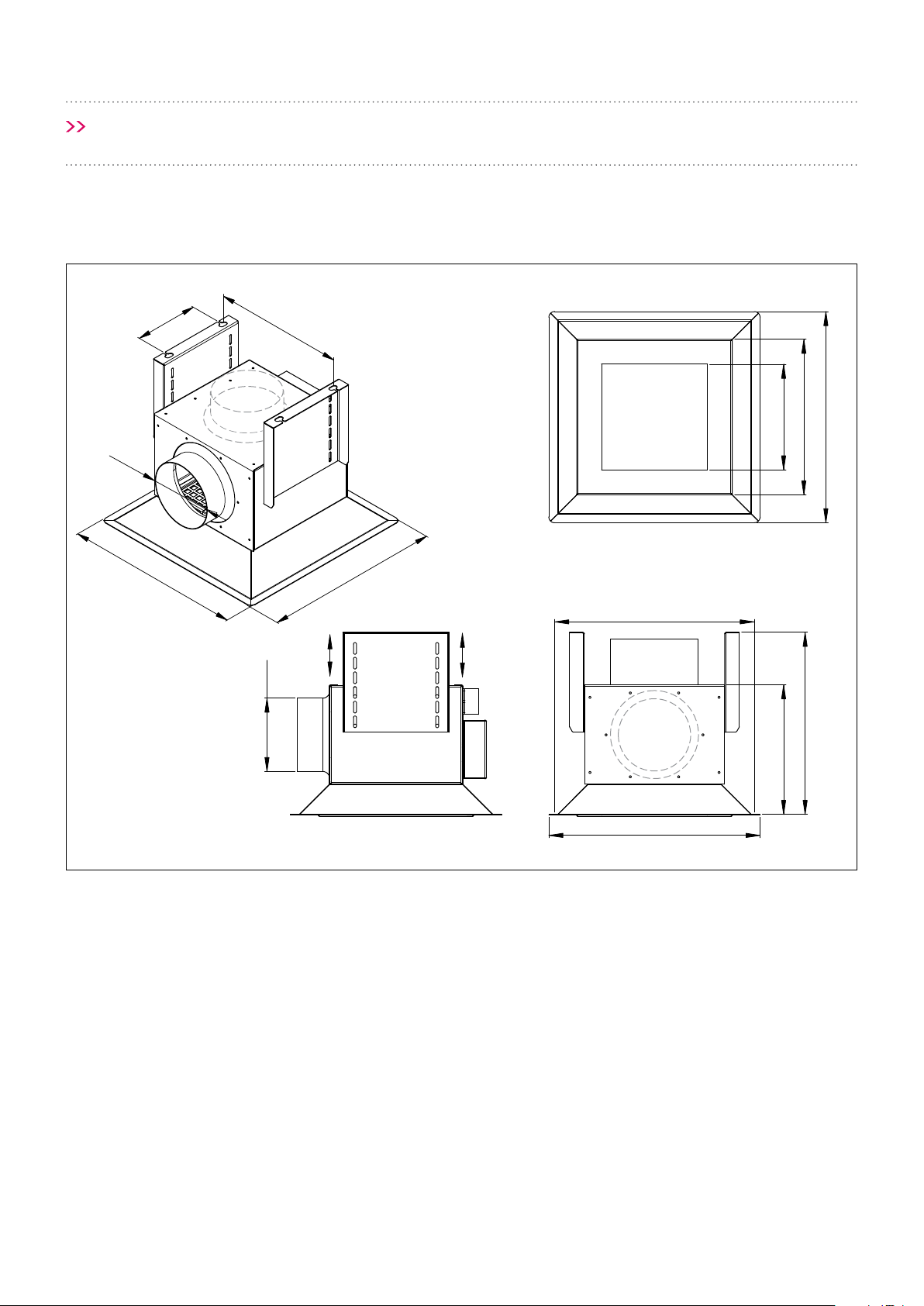
TECHNICAL SPECIFICATIONS
Model: CC-PARA4S
CC-PARA4W
CC-PARA3S
CC-PARA3W
CC-PARA2S
CC-PARA2W
Feeding Voltage: 220-240V 50Hz
Max Lamp Power: 1 x 11W 12V 4000k
(LED Plate) 170 x 170mm
265
130
ø150
ø120
360 360
Cutout 340 x 340
310
360
265
180220
135
CC-PARA4S CC-PARA4W CC-PARA3S CC-PARA3W CC-PARA2S CC-PARA2W

Page 34
DISCLAIMER
Under our policy of continuous product
development, product specications may change
without notice. Prospective purchasers should
therefore check with the retailer to ensure this
publication correctly describes the products being
oered for sale. All information supplied is to be
used for general reference purposes only and
is on the understanding that Schweigen Home
Appliances will not be liable for any loss, liability or
damage of whatever kind arising as a result of any
reliance upon such information. All pictures used in
the guide are for illustrative purposes only.
Although our information and marketing states
the term ‘Silent’ for certain models, the following
applies to various models that are sold with
certain Isodrive
®
Systems and bae lters. When a
model with the larger motored Isodrive
®
System is
operated at the higher speed/s air movement may
be heard. For example, while operating on speed
4 & 5 (For 5 speed models) the rangehood may be
audible due to the large amount of air movement
moving through the lters.
*Please make sure that the rangehood and motor
have been installed as per the corresponding
instruction guides in order for optimal performance
(the Isodrive
®
Motor Manual can be found with the
Isodrive
®
Motor, or online at schweigen.com.au).
Schweigen Home Appliances has presented this
information in good faith to all their retailers and
distributors to convey before any/all purchase/s.
Information is supplied upon the condition that the
person/s receiving the information will make their
own determination as to its suitability for their
purpose/s prior to use. In no event will Schweigen
Home Appliances be responsible for damages of
any nature whatsoever resulting from the use of,
or reliance upon, information from their website or
the products to which the information refers.
DISPOSAL OF OLD APPLIANCES
Electronic waste (or e-waste) including kitchen appliances are banned from direct disposal
to landll. E-waste contains hazardous materials, which can harm the environment and human health.
Valuable materials contained in e-waste are lost when appliances, computers and other household
electrical goods are sent to landll.
Recycle your e-waste to:
• reduce landll
• protect the air and waterways from harmful materials
• minimise consumption of raw materials to produce electronic products
• reduce greenhouse gases created in the production of new materials.
Kitchen appliances including Rangehoods and Ovens can only be disposed at approved recycling centres.
Visit www.recyclingnearyou.com.au/whitegoods for more information, or contact your local council or the
store you purchased this appliance, for a list of approved recyclers.

Page 35
NOTES
www.schweigen.com.au
© Schweigen Home Appliances Pty Ltd. 2021.
Australia
Unit 4/1-5 Lake Drive, Dingley Village, Victoria 3172
Phone: 1300 881 693
Email: sales@schweigen.com.au
New Zealand
5 Tolich Place, Henderson, Auckland 0610
Phone: 0800 200 510
Email: inf[email protected]om