ENGLISH
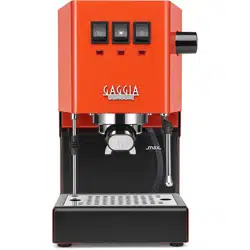
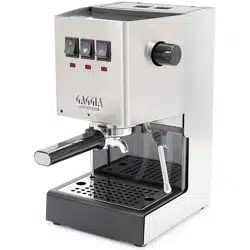
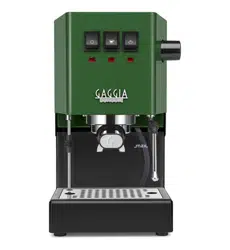
CLASSIC EVO
RI9481 (SIN035R)
Operating instructions
15
16
17
18
19
20
21
22
11
10
13
12
14
23
9
8
5
4
2
3
7
6
1
1
2
4
6
3
5
7
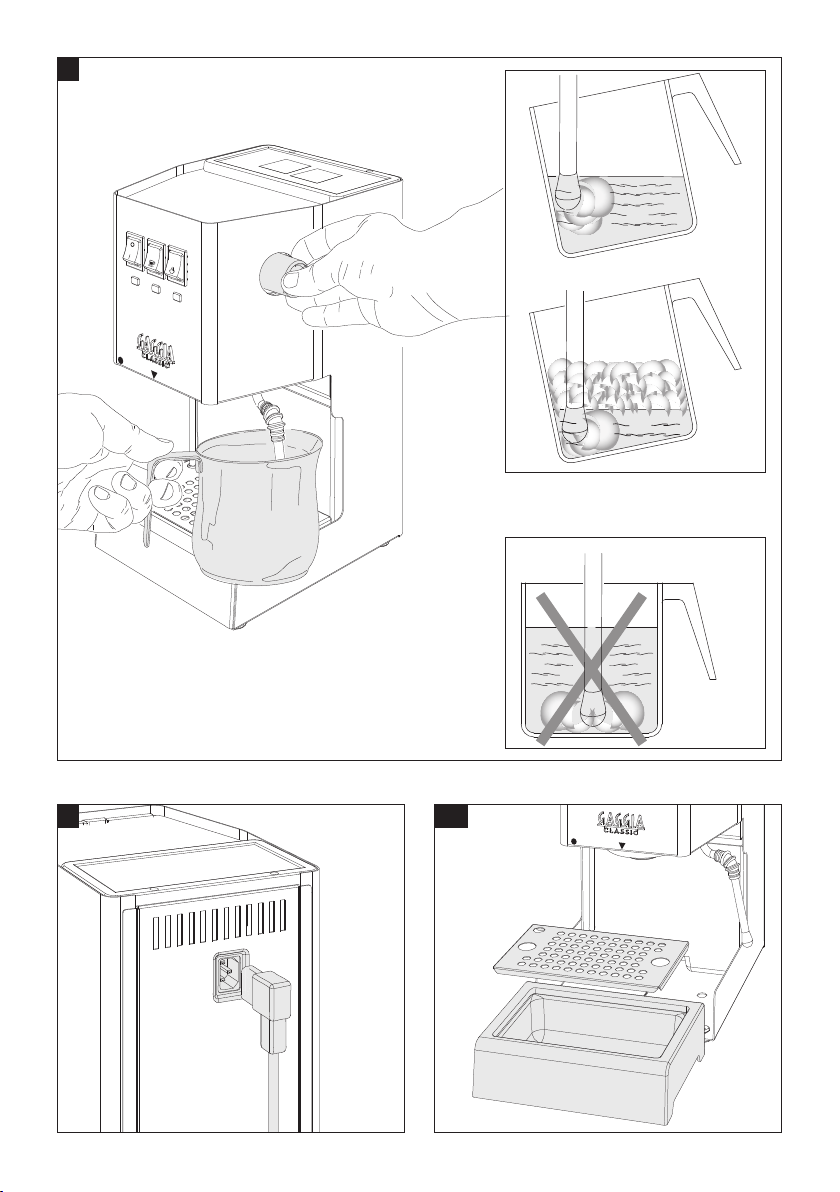
9
OK
NO
1
2
A
8
10
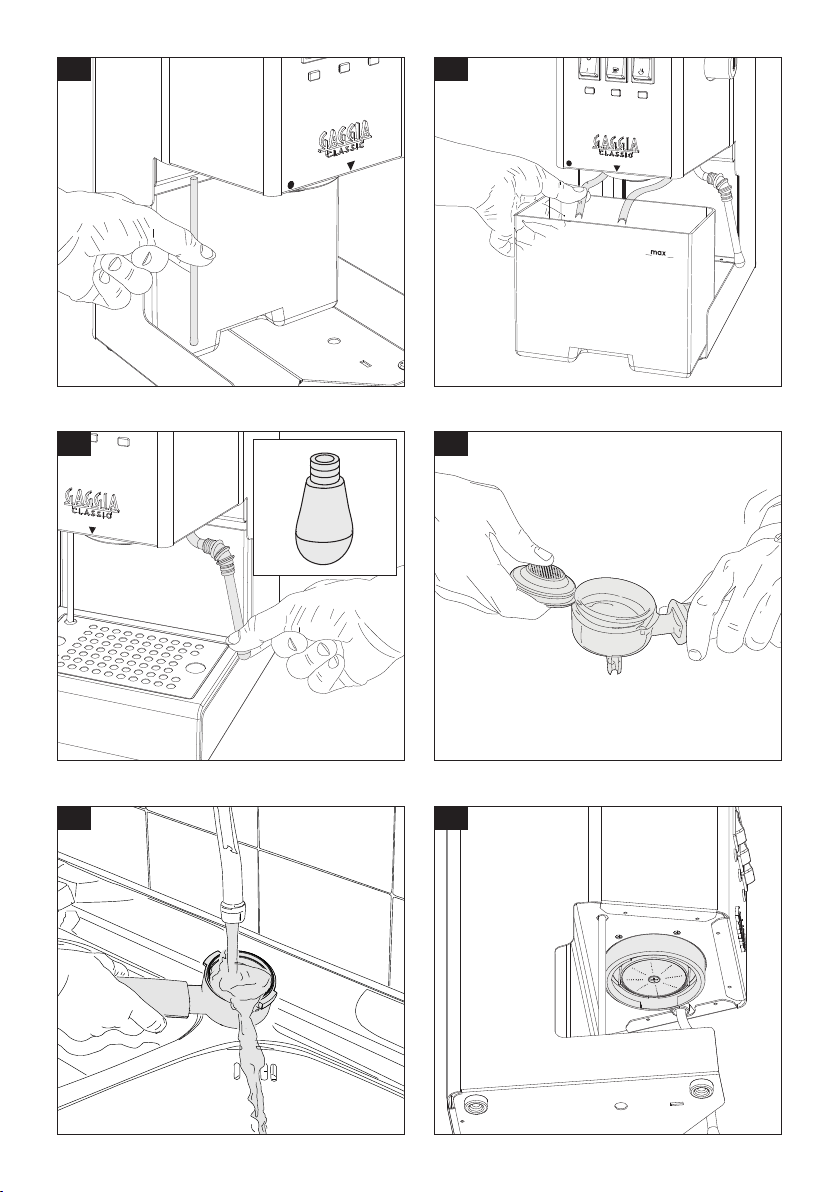
14
11
13
15
12
16

6
ENGLISH
IMPORTANT SAFEGUARDS
When using electrical appliances, basic safety precautions should
always be followed, including the following:
1.
Read all instructions.
2.
Do not touch hot surfaces. Use handles or knobs.
3.
To protect against re, electric shock and injury to persons do not
immerse cord, plugs, or appliance in water or other liquid.
4.
Close supervision is necessary when the appliance is used by or
near children.
5.
Unplug from outlet when not in use and before cleaning. Allow to
cool before putting on or taking off parts, and before cleaning the
appliance.
6.
Do not operate any appliance with a damaged cord or plug or after
the appliance malfunctions, or has been damaged in any manner.
Return appliance to the nearest authorized service facility for
examination, repair or adjustment.
7.
The use of accessory attachments not recommended by the
appliance manufacturer may result in re, electric shock or injury
to persons.
8.
Do not use outdoors.
9. Do not let cord hang over edge of table or counter, or touch hot
surfaces.
10.
Do not place on or near a hot gas or electric burner, or in a heated
oven.
11. Always attach plug to appliance rst, then plug cord into wall outlet.
To disconnect, turn any control to “off”, then remove plug from wall
outlet.
12.
Do not use appliance for other than intended use.
13.
Save these instructions.
SAVE THESE INSTRUCTIONS

7
ENGLISH
CAUTION
This appliance is for household use only. Any servicing, other than
cleaning and user maintenance, should be performed by an authorized
service center. Do not immerse machine in water. To reduce the risk of
re or electric shock, do not disassemble the machine. There are no
parts inside the machine serviceable by the user. Repair should be done
by authorized service personnel only.
1. Check voltage to be sure that the voltage indicated on the nameplate
corresponds with your voltage.
2. Never use warm or hot water to ll the water tank. Use cold water
only.
3. Keep your hands and the cord away from hot parts of the appliance
during operation.
4.
Never clean with scrubbing powders or harsh cleaners. Simply use
a soft cloth dampened with water.
5.
For optimal taste of your coffee, use puried or bottled water.
Periodic descaling is still recommended every 2-3 months.
6.
Do not use caramelized or avored coffee beans.

8
ENGLISH
INSTRUCTIONS FOR THE
POWER SUPPLY CORD
A. A short power-supply cord (or detachable power-supply cord) is to
be provided to reduce risks resulting from becoming entangled in
or tripping over a longer cord.
B.
Longer detachable power-supply cords or extension cords are
available and may used if care is exercised in their use.
C.
If a long detachable power-supply cord or extension cord is used,
1.
The marked electrical rating of the detachable power-supply cord
or extension cord should be at least as great as the electrical
rating of the appliance
2. If the appliance is of the grounded type, the extension cord should
be a grounding-type 3-wire cord, and
3.
The longer cord should be arranged so that it will not drape over
the counter top or table top where it can be pulled on by children or
tripped over.

9
ENGLISH
Congratulations on your choice!
Thanks to the new Gaggia Classic Evo machine, you will become a real home barista and rediscover the
traditional gestures of espresso professionals during each coffee break. When using Classic Coffee
machine, it is important to pay attention to every detail, just like when using a professional bar machine:
the machine must be very hot and the filter holder must always be installed to maintain a homogeneous
temperature in the brew unit. Furthermore, the coffee must be ground finely but not too much, the right
amount of ground coffee must be placed in the filter and it must be pressed with just the right intensity,
to prevent the coffee from coming out too quickly, but not too much as this would make brewing very difficult. The new
Classic Evo features a filter holder unit and a steam wand just like professional machines.
Contents
IMPORTANT SAFETY INFORMATION ...............................................................................................................................................................................................................................................................................................................10
DESCRIPTION
..................................................................................................................................................................................................................................................................................................................................................................................................................................................................................................................16
THINGS TO KNOW
..............................................................................................................................................................................................................................................................................................................................................................................................................................................................................16
INTRODUCTION
..................................................................................................................................................................................................................................................................................................................................................................................................................................................................................................17
FILTERS SUPPLIED
....................................................................................................................................................................................................................................................................................................................................................................................................................................................................17
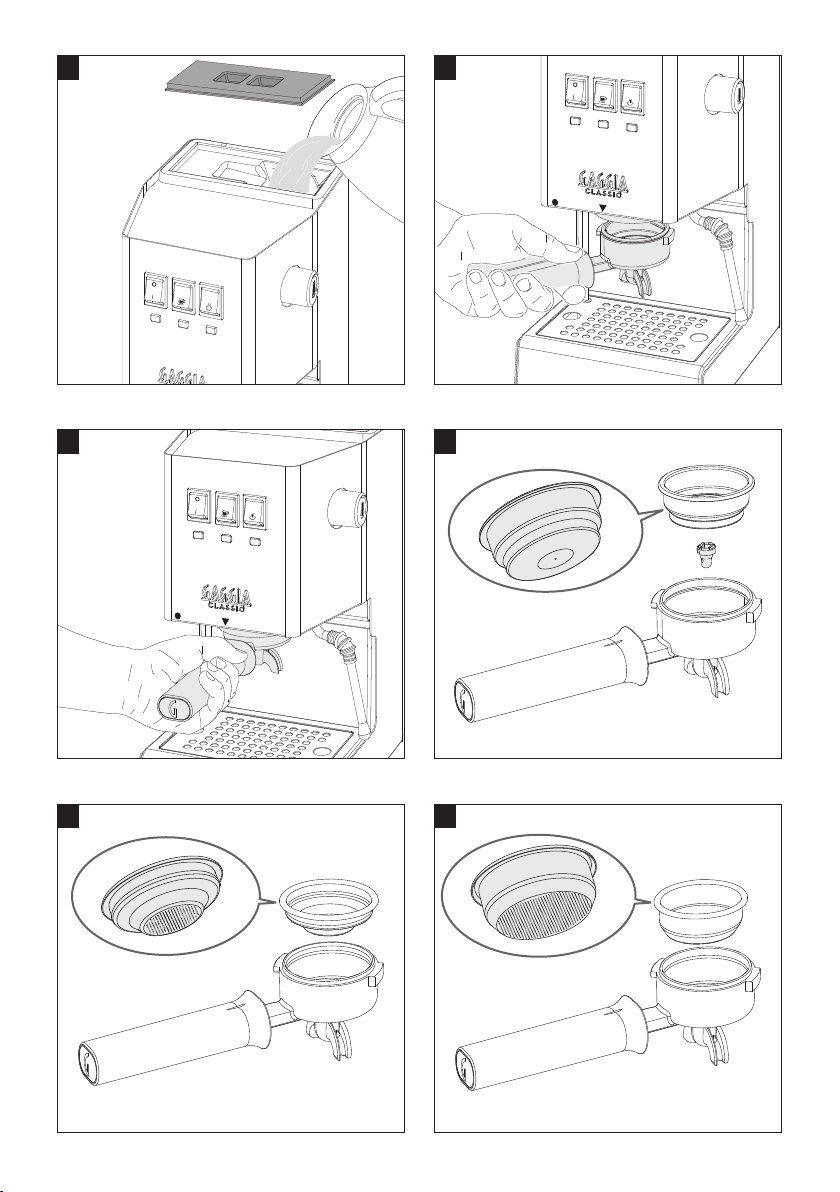
“Crema perfetta” lter for 1 or 2 cups (Fig.5) ..............................................................................................................................................................................................................................................................................................................................................17
Traditional lter for 2 cups (Fig.7)
..................................................................................................................................................................................................................................................................................................................................................................................................................17
Traditional lter for 1 cup / single-dose pod (Fig.6)
.......................................................................................................................................................................................................................................................................................................17
FIRST INSTALLATION ...................................................................................................................................................................................................................................................................................................................................................................................................................................................17
Loading the circuit ...............................................................................................................................................................................................................................................................................................................................................................................................................................................................................................................17
When using for the rst time or after a period of inactivity of more than 2 weeks
...............................................................................................................17
BREWING AN ESPRESSO USING GROUND COFFEE ..................................................................................................................................................................18
Continue preparing the espresso ...................................................................................................................................................................................................................................................................................................................................................................................................................18
BREWING AN ESPRESSO USING COFFEE PODS ................................................................................................................................................................................................19
PREPARING A CAPPUCCINO
..................................................................................................................................................................................................................................................................................................................................................................................19
DISPENSING HOT WATER
...........................................................................................................................................................................................................................................................................................................................................................................................................20
HOW TO LOWER THE BOILER TEMPERATURE
.....................................................................................................................................................................................................................20
CLEANING AND MAINTENANCE
........................................................................................................................................................................................................................................................................................................................................................21
Cleaning the steam wand ..................................................................................................................................................................................................................................................................................................................................................................................................................................................................21
Cleaning the lter holder and the lters
..............................................................................................................................................................................................................................................................................................................................................................................21
Cleaning the grill and drip tray
.....................................................................................................................................................................................................................................................................................................................................................................................................................................21
Cleaning the water tank
.............................................................................................................................................................................................................................................................................................................................................................................................................................................................................21
Cleaning the screen
....................................................................................................................................................................................................................................................................................................................................................................................................................................................................................................21
Cleaning after a long period of inactivity
........................................................................................................................................................................................................................................................................................................................................................................21
DESCALING ......................................................................................................................................................................................................................................................................................................................................................................................................................................................................................................................................21
IN CASE OF MALFUNCTION
...........................................................................................................................................................................................................................................................................................................................................................................................23

10
ENGLISH
Important safety information
This machine is equipped with safety features. Nevertheless, read and
follow the safety instructions carefully and only use the machine as
described in these instructions, to avoid accidental injury or damage
due to improper use of the machine. Keep this safety booklet for future
reference.
Warning
General
- Check if the voltage indicated on the machine
corresponds to the local mains voltage before
you connect the appliance.
- Connect the machine to an earthed wall socket.
- Do not let the power cord hang over the edge
of a table or worktop and do not let it touch hot
surfaces.
- To avoid the danger of electric shock, never
immerse the machine, mains plug or power cord
in water or any other liquid.
- Do not pour liquids on the power cord connector.
- To avoid the danger of burns, keep body parts
away from hot water jets produced by the
machine.
- Do not touch hot surfaces. Use handles and
knobs.
- Switch off the machine with the main switch
located on the back (if present) and remove the
mains plug from the wall socket:
• If a malfunction occurs.
• If you are not going to use the appliance for a
long time.
• Before you clean the machine.
- Pull at the plug, not at the power cord.

11
ENGLISH
- Do not touch the mains plug with wet hands.
- Do not use the machine if the mains plug, the
power cord or the machine itself is damaged.
- Do not make any modications to the machine or
its power cord.
- Only have repairs carried out by a service center
authorized by Gaggia to avoid a hazard.
- The machine should not be used by children
younger than 8 years old.
- This machine can be used by children aged from
8 years and above and by persons with reduced
physical, sensory or mental capabilities or lack
of experience and knowledge if they have been
given supervision or instruction concerning use of
the machine in a safe way and if they understand
the hazards involved.
- Cleaning and user maintenance shall not be
made by children unless they are older than 8 and
supervised.
- Keep the machine and its cord out of the reach of
children aged less than 8 years.
- Children should be supervised to ensure that they
do not play with the machine.
- Never insert ngers or other objects into the
coffee grinder.
- Be careful when you dispense hot water.
Dispensing may be preceded by small jets of hot
water. Wait until the end of the dispensing cycle
before you remove the hot water dispensing
spout.

12
ENGLISH
Caution
General
- This machine is intended for normal
household use only. It is not intended for use in
environments such as staff kitchens of shops,
oces, farms or other work environments.
- Always put the machine on a at and stable
surface. Keep it in upright position, also during
transport.
- Do not place the machine on a hotplate or directly
next to a hot oven, heater or similar source of
heat.
- Only put roasted coffee beans in the bean hopper.
Putting ground coffee, instant coffee, raw coffee
beans or any other substance in the coffee bean
hopper may cause damage to the machine.
- Let the machine cool down before you insert or
remove any parts. The heating surfaces may
retain residual heat after use.
- Never ll the water tank with warm, hot or
sparkling water, as this may cause damage to the
water tank and the machine.
- Never use souring pads, abrasive cleaning agents
or aggressive liquids such as petrol or acetone
to clean the machine. Simply use a soft cloth
dampened with water.
- Descale your machine regularly. The machine
indicates when descaling is needed. Not doing
this will make your appliance stop working
properly. In this case repair is not covered by your
warranty.
- Do not keep the machine at temperatures below
0°C/32°F. Water left in the heating system may
freeze and cause damage.

13
ENGLISH
- Do not leave water in the water tank when you are
not going to use the machine for a long period of
time. The water can become contaminated. Use
fresh water every time you use the machine.
- Never use any accessories or parts from
other manufacturers or that Gaggia does
not specically recommend. If you use such
accessories or parts, your warranty becomes
invalid.
- Regular cleaning and maintenance prolongs the
lifetime of your machine and ensures optimum
quality and taste of your coffee.
- The machine is exposed continuously to
moisture, coffee and scale. Therefore it is very
important to regularly clean and maintain the
machine as described in the user manual and
shown on the website. If you do not perform
these cleaning and maintenance procedures, your
machine eventually may stop working. In this
case repair is not covered by warranty.
- Do not clean the brew group in the dishwasher
and do not use washing-up liquid or a cleaning
agent to clean it. This may cause the brew group
to malfunction and may have a negative effect on
the coffee taste.
- Do not dry the brew group with a cloth to prevent
bers from collecting inside the brew group.
- Never drink the solution dispensed during the
descaling process.
- Only put preground coffee into the preground
coffee compartment. Other substances and
objects may cause severe damage to the
machine. In this case, repair is not covered by
your warranty.
14
ENGLISH
- The machine shall not be placed in a cabinet
when in use.
Machines with classic milk frother / pannarello /
steam wand
Warning
- To avoid the danger of burns, be aware that
dispensing may be preceded by small jets of hot
water.
- Never touch the classic milk frother / pannarello
/ steam wand with bare hands, as it may become
very hot. Use the appropriate protective handle
only.
Caution
- After frothing milk, quickly clean the classic milk
frother by dispensing a small quantity of hot
water into a container. Then remove the external
part of the classic milk frother and wash it with
lukewarm water.
Electromagnetic elds (EMF)
This machine complies with all applicable standards and regulations
regarding exposure to electromagnetic elds.
Recycling
- This symbol means that this product shall not be disposed of with normal
household waste (2012/19/EU).
- Follow your country’s rules for the separate collection of electrical
and electronic products. Correct disposal helps prevent negative
consequences for the environment and human health.

15
ENGLISH
Warranty and support
For service or support, contact your local dealer or an authorized service
center.
Contact details are included in the warranty booklet supplied separately or
visit www.gaggia.com or www.gaggia.it.

16
ENGLISH
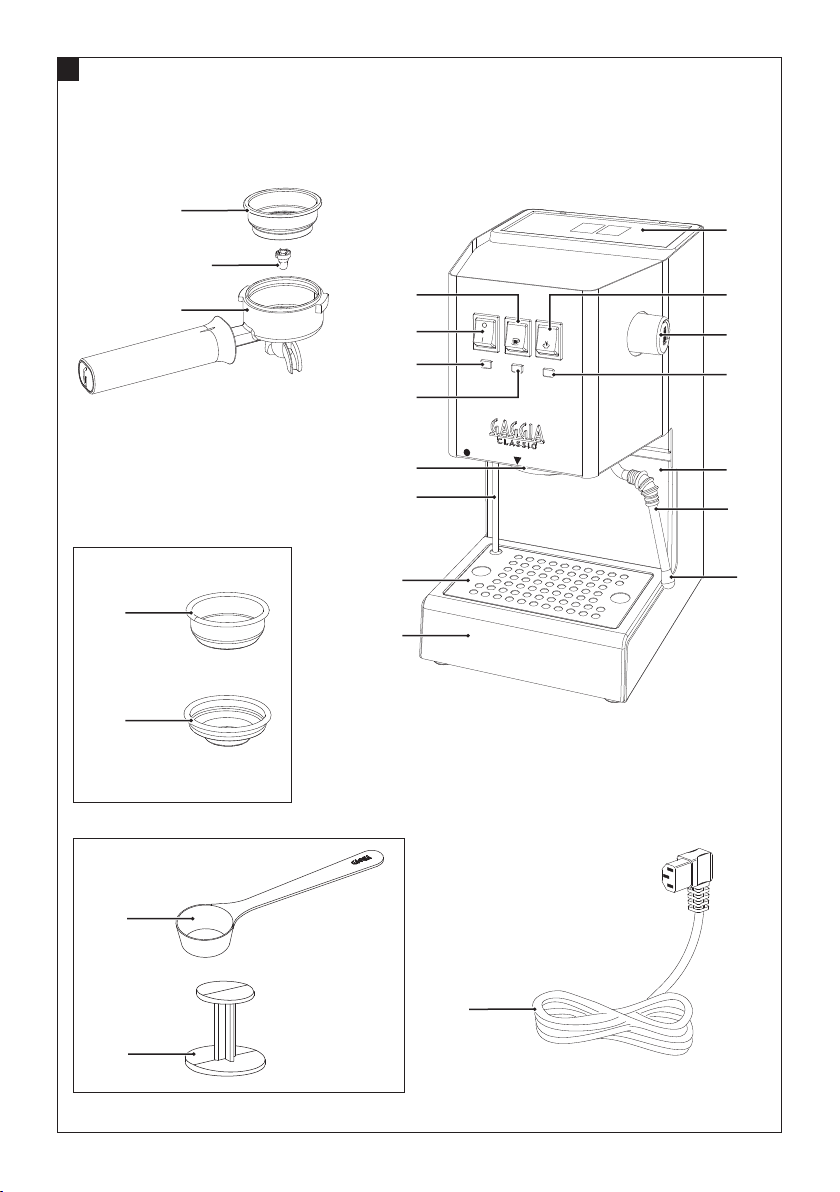
Description
OVERVIEW OF THE MACHINE
(FIG.1)
1 Brew button
2 On/off button
3 Steam button
4 Power indicator light
5 Coffee temperature light
6 Steam temperature light
7 Steam / hot water knob
8 Coffee brew unit
9 Drain pipe
10 Grill
11 Drip tray
12 Water tank lid
13 Water tank (removable)
14 Hot water/steam wand with rubber tip
15 “Crema perfetta” lter for 1 and 2 cups.
To be used only with a frothing jet device
(Fig.1-16)
16 Frothing jet device
17 Filter holder
18 Traditional lter for 2 cups
19 Traditional lter for 1 cup / pods
20 Measuring scoop
21 Tamper
22 Power cord and plug
23 Steam nozzle
Things to know
1. The taste of espresso depends on the amount
and type of coffee used.
2. The particular taste of a coffee bean depends
on several factors, but its taste and aroma
are the result of the roasting process. Coffee
beans roasted for a longer time and at higher
temperatures are darker in colour. Darker
coffee beans release more avour than lighter
ones. You will nd different coffee qualities
on the market. Each type of roasting is
characterised by a mixture of beans roasted at
a certain temperature and with a certain type
of aroma.
There are decaffeinated coffees containing
only 2% caffeine. Try different types of coffee
with your espresso machine. You will probably
discover a better aroma than the one previously
used.
3. Pump espresso machines require a finely
ground blend. Be sure to purchase the desired
blend with a grinding degree that can be used
with espresso machines. It is preferable to use
a grinder mill rather than a blade mill because
the latter releases too much coffee powder and
produces an irregularly ground blend.
4. It would be ideal to grind the coffee just before
use. Do not forget that it must be ground for
the pump espresso machine.
5. We recommend storing the coffee in an airtight
container, in a cool, dry place, away from heat
sources.
6. Real espresso can be recognised by its dark
colour, rich taste and typical "natural cream".
7. Cappuccino is a special combination of
espresso and hot frothed milk. It can be served
with a sprinkling of cinnamon, nutmeg or
cocoa.
8. Serve espresso coffee immediately after
preparing it.
9. Serve espresso in coffee cups and cappuccino
in breakfast cups.

17
ENGLISH
Introduction
Before using your machine for the rst time, please
read the safety manual provided separately very
carefully and store it for future reference.
Filters supplied
“Crema perfetta” lter for 1 or 2
cups (Fig.5)
This lter is already installed on the lter holder and
allows you to obtain an espresso with cream even
when using the machine for the rst time.
Note. This lter must be used only together with
the frothing jet device. (Fig.1-16).
Traditional lter for 2 cups
(Fig.7)
Traditional lter for 1 cup /
single-dose pod (Fig.6)
These lters are like those used in professional
bar machines and require manual skills and
experience.
Note. These lters must not be used with the
frothing jet device. (Fig.1-16).
Our advice is to start with the “crema perfetta”
lter and then, once you have acquired manual
skills and experience, move on to traditional ones
to appreciate real barista use.
First installation
1. Remove the water tank cover (Fig.2) and ll it
with cold water up to the MAX level of the tank
(Fig.1-13).
2. Insert the plug into the outlet at the back of the
machine (Fig.9) and the other end of the power
cord into a wall socket with suitable voltage.
Press the on / off button (Fig.1-2), the power
indicator light turns on(Fig.1-4).
Loading the circuit
Warning! Do not activate the brew button
without loading the circuit rst.
1. Place an empty cup under the brew unit (Fig.1-
8) without inserting the lter holder and press
the brew button (Fig.1-1).
You will hear the sound of the pump being
activated and after a few seconds the water
will start to come out of the brew unit (Fig.1-8).
2. After lling the cup (about 150cc), press the
brew button again (Fig.1-1).
Note. The pump self-primer might not work
temporarily because of an "air bubble".
If water does not come out of the brew unit (Fig.1-8),
continue as follows:
1. Place a cup under the steam wand (Fig.1-14).
2. Turn the knob (Fig.1-7) counter-clockwise to
open the steam/hot water dispensing knob.
3. Press the brew button (Fig.1-1) to activate the
pump.
4. After a few seconds, water will start coming
out of the steam wand.
Dispense about a cup of water.
5. Close the steam/hot water dispensing knob
(Fig.1-7).
6. Press the brew button again (Fig.1-1).
Note. After priming the circuit and when hot water
is dispensed from the steam wand, there might be
some water left inside. To drain it, we recommend
dispensing some steam for a few seconds.
When using for the rst time
or after a period of inactivity of
more than 2 weeks
Note. The water dispensed during this process
must be thrown away and is not suitable for food
use. If the container lls up during the cycle, stop
dispensing water and empty the container before
resuming the operation.

18
ENGLISH
1. Rinse the water tank (Fig.2) (see section
“Cleaning the Water Tank”) and ll it with fresh
drinking water.
2. Place a container under the steam wand (Fig.1-
14).
3. Open the steam/hot water knob (Fig.1-7) slowly
by turning it counter-clockwise.
4. Press the brew button (Fig.1-1) and the steam
button (Fig.1-3).
5. Dispense the whole water tank content through
the steam wand.
6. To stop dispensing, press the brew button
(Fig.1-1) and the steam button (Fig.1-3) again.
7. Close the knob (Fig.1-7) by turning it clockwise.
8. Fill the water tank with fresh drinking water
(Fig.2).
9. Insert the lter holder into the brew unit from
the bottom, aligning the reference mark on
the lter holder handle with the ( ) icon on
the front panel of the machine (Fig.3). Turn the
lter holder from left to right until it locks into
place on the ( ) icon (Fig.4).
10. Place a suitable container under the filter
holder.
11. Press the brew button (Fig.1-1) and dispense
all the water in the tank.
12. Once the water tank is empty, stop dispensing
by pressing the brew button again (Fig.1-1) and
empty out the container.
13. Remove the filter holder from the unit by
turning it from right to left and rinse it with
fresh drinking water.
14. The machine is now ready for use.
Brewing an espresso
using ground coee
The filter holder supplied features the “crema
perfetta” lter to prepare one or two coffees.
Warning! If the “crema perfetta” lter is used
without the frothing jet device, the machine will
squirt out the coffee, which may result in burns.
Note. If you prefer to use the traditional lter
(Fig.6/7), remove both the “crema perfetta” lter
(Fig.5) and the frothing jet device (Fig.1-16).
To brew the rst coffee, it is necessary to preheat
the lter holder rst (Fig.1-17):
1. Insert the lter holder (Fig.1-17) into the brew
unit (Fig.1-8) from the bottom, aligning the
reference mark on the lter holder handle with
the ( ) icon on the front panel of the machine
(Fig.3). Turn the lter holder from left to right
until it locks into place on the ( ) icon (Fig.4).
2. Place a large cup under the lter holder (Fig.1-
17) and press the brew button (Fig.1-1)
3. After the cup of water has been lled (about
150cc), press the brew button again and wait
a few minutes for the machine to reach the
correct temperature with the filter holder
inserted.
Note. Any residual water inside the lter holder
must be removed before lling the lter with
ground coffee.
Continue preparing the espresso
4. Remove the lter holder (Fig.1-17) and ll it
with ground coffee using the measuring scoop
provided with the machine (Fig.1-20).
Add one measuring scoop of coffee for each
cup.
Note. It is recommended to ask roasting
companies for nely ground coffee suitable for
use in coffee machines or to purchase it from
large retailers.
5. Press the coffee using the dedicated tamper
(Fig.1-21). The coffee must be pressed evenly
to obtain a well levelled and at surface.
6. Remove any coffee residues from the edge of
the lter holder (Fig.1-17).
7. Insert the lter holder (Fig.1-17) into the brew
unit (Fig.1-8) from the bottom, aligning the
reference mark on the lter holder handle with
the ( ) icon on the front panel of the machine
(Fig.3). Turn the lter holder from left to right
until it locks into place on the ( ) icon (Fig.4).
8. Wait until the indicator light turns on (Fig.1-5).
9. Press the brew button (Fig.1-1).

19
ENGLISH
10. When the cups are 3/4 full, press the brew
button again (Fig.1-1).
The coffee will be more or less intense
depending on the amount of water used and,
if prepared following the correct procedure, it
will have the typical hazelnut/brown coloured
"natural cream".
At the end of the dispensing, the excess water
will be eliminated from the drain pipe (g.11).
To brew another espresso, slowly and carefully
remove the lter holder, moving it to the left. Be
careful not to burn yourself with the water left
on the coffee grounds. Once the lter holder has
been removed, some water will still drip. This is
due to the water pressure in the system. Remove
the grounds from the lter and any residues from
the screen (Fig.16).
Note. Keep the clean lter holder installed on
the machine without tightening it too much, so
that the entire brew unit is always at the correct
temperature.
Brewing an espresso
using coee pods
Note. To use coffee pods, remember to only use
the traditional 1 cup lter (Fig.6).
Follow the instructions to make an espresso with
ground coffee using the single-dose pre-ground
coffee pod instead of ground coffee. Insert the
pod into the lter holder (Fig.1-17); make sure that
the paper of the pod does not stick out of the lter
holder.
Preparing a cappuccino
To prepare a traditional cappuccino, we
recommend:
- using fresh whole milk at a cold temperature,
preferably high quality. The density of the
frothed milk will depend on the milk fat content.
- using stainless steel, circular, rounded
milk jugs, narrower at the top, with a spout,
necessary to make cappuccino decorations.
The steam wand (Fig.1-14) will dispense all the
steam required to froth the milk without bringing
it to a boil.
With two or three attempts and a little effort you will
become experts in preparing cappuccino.
Before starting, it is important to slightly move
the steam wand outwards in order to insert the
jug directly under it and facilitate the movements
required to froth the milk correctly.
At this point continue as follows:
1. Prepare the espresso in a large cappuccino
cup as indicated in the paragraph "Brewing an
espresso using ground coffee".
2. Press the steam button (Fig.1-3).
3. After 15-20 seconds and when the steam
temperature indicator light (Fig.1-6) turns on.
4. Turn the steam/hot water knob slightly counter-
clockwise to eliminate any condensation from
the wand then close the knob again.
5. Place the jug, half-lled with cold milk, under
the steam wand.
6. Place the steam nozzle just below the surface
of the milk; if it has been inserted too deep,
the milk will not be frothed; if it has not been
inserted deep enough, big bubbles will be
produced and then disappear immediately.
It is important to keep the nozzle not at the
centre but close to the edge of the jug, with
an appropriate angle to produce a stronger
vortex (Fig.8-1).
7. Turn the steam dispensing knob (Fig.1-7)
counter-clockwise to let the steam come
out. During this phase there is maximum
air absorption and the milk must be frothed
almost cold.
Note. The steam pressure increases as the knob
is turned.
Note. The dispensing operation should last no
longer than 60 seconds.
Dispensing steam continuously for more than 60
seconds can empty the boiler out completely. In
this case, continue as indicated in the section
"Loading the circuit".
Note. To froth the milk correctly, the steam nozzle
(Fig.1-23) must always be in contact with the milk
and not with the froth (Fig.8-2). Therefore, as the
layer of froth increases, the jug must be slightly
raised trying to keep the nozzle in contact with
the milk, without touching the bottom of the jug
(Fig.8-A).

20
ENGLISH
8. Once the desired frothing has been achieved,
the steam nozzle must be pushed further to
heat the milk well.
Note. It is advisable to always keep a hand on the
rounded part of the jug to feel the temperature
increase of the unfrothed milk.
9. Once the desired result has been achieved,
close the steam knob, by turning it clockwise,
to stop dispensing steam and remove the jug.
Note. After frothing the milk, to make the froth
more compact, it is advisable to lightly tap the
jug on a at surface and leave it to rest for at
least 30 seconds. The milk will become more
homogeneous.
Warning! It is important to froth only the milk
you need. The remaining hot milk in the jug
should not be reused; it would damage the
quality of the froth and above all the taste of
the cappuccino. It should therefore be used in
other ways.
10. Press the steam button (Fig.1-3).
Pour the frothed milk into the coffee. Decorate
as desired with cinnamon, cocoa, nutmeg.
To prepare another coffee immediately, lower the
boiler temperature by dispensing hot water from the
coffee brew unit (Fig.1-8). Follow the instructions
in the paragraph "How to lower the temperature";
otherwise, the coffee may taste burnt.
Warning! The steam wand may be very hot
during and after use. To avoid burns, move it
only by placing your ngers on the rubber tip
tted on the steam wand.
Warning! If coffee is brewed without reducing
the temperature by dispensing water, you may
get burnt!
Dispensing hot water
1. Turn the machine on and wait a few minutes
until the correct coffee temperature indicator
light (Fig.1-5) turns on.
2. Place a cup under the professional wand.
3. Slowly turn the steam knob (Fig. 1-7) counter-
clockwise and press the brew button (Fig.1-1)
and the steam button (Fig.1-3) at the same time
to allow for hot water to be dispensed.
4. Once the desired amount of hot water has
been dispensed, stop dispensing by pressing
the brew button (Fig.1-1) and the steam button
(Fig.1-3) again and turn the steam knob
clockwise.
Note. After priming the circuit and when hot water
is dispensed from the steam wand, there might be
some water left inside. To drain it, we recommend
dispensing some steam for a few seconds.
To prepare another coffee immediately, lower
the boiler temperature by dispensing hot water
from the coffee brew unit (Fig.1-8). Follow the
instructions given in the paragraph "How to lower
the boiler temperature", otherwise the coffee may
taste burnt.
Note. The dispensing operation should last no
longer than 60 seconds.
Warning! The steam wand may be very hot
during and after use. To avoid burns, move it
only by placing your ngers on the rubber tip
tted on the steam wand.
How to lower the boiler
temperature
1. Do not insert the lter holder.
2. Place an empty cup on the grill.
3. Press the brew button (Fig.1-1) and ll the cup
with water.
4. Press the brew button again (Fig.1-1).
The machine is now ready to brew another coffee.
21
ENGLISH
Cleaning and
maintenance
Regular cleaning and maintenance keep the
machine in perfect conditions and ensure perfect
coffee avour, a constant coffee ow and excellent
milk froth for a long period of time.
Cleaning the steam wand
After each milk frothing:
1. Clean the steam wand with a damp cloth. To
clean it more thoroughly, you can unscrew the
nozzle (Fig.13) and wash it with running water.
2. Open the steam knob, allowing the steam to
escape for one or two seconds to clear the
nozzle hole (Fig.1-23).
Cleaning the lter holder and the
lters
The filters should be kept clean to guarantee
perfect results.
Warning! The filter must only be replaced
when the lter holder cup has cooled down
completely to avoid burns.
Every day, remove the lter from the lter holder as
described in (Fig.14) and wash it with warm water.
If you notice a malfunction
when brewing coffee, immerse
the lters in boiling water for 10
minutes and then rinse them
with running water.
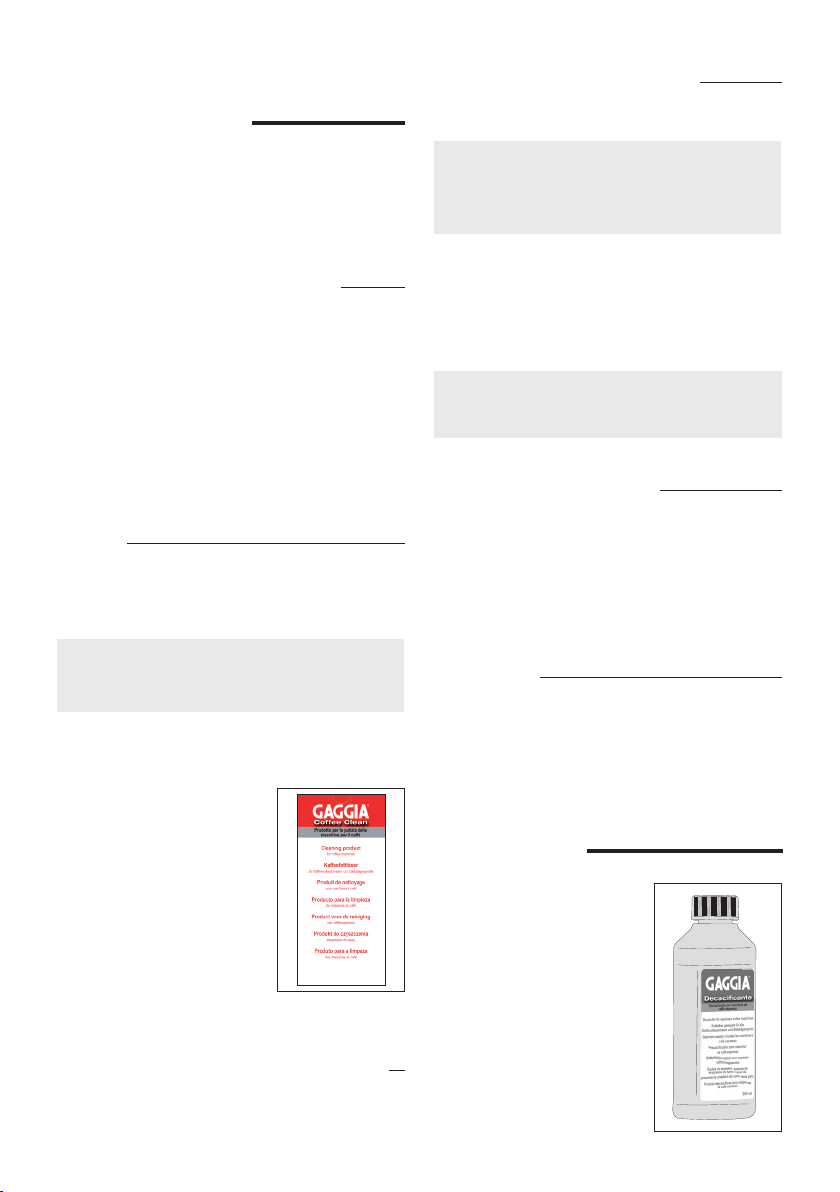
To clean the filters more
thoroughly, we recommend
using the GAGGIA cleaning
tablets specifically designed
to keep your machine in perfect
working order.
Cleaning the grill and drip tray
Remove the drip tray and the grill (Fig.1-10,11)
and wash them with water. Do not use abrasive
cleaning tools.
Cleaning the water tank
Warning! To avoid burns, the tank should
be cleaned only when the machine is turned
off. The drain hose (Fig. 11) may reach high
temperatures during operation.
Remove the water tank (Fig.1-13) and wash it with
fresh water.
To remove the water tank, rst remove the drip tray
(Fig 1-11), and then remove the drain pipe (Fig.11)
by pulling it downwards.
Note. When reinserting the tank, make sure that
the silicone tubes are inside the tank and that they
are neither twisted nor blocked (Fig.12).
Cleaning the screen
Regularly remove any residual coffee grounds from
the screen (Fig.16) using a brush and wash with hot
water following the instructions given in the section
"How to lower the temperature".
Cleaning after a long period of
inactivity
When the machine is not used for a long time (more
than two weeks), follow the instructions given in
the section "When using for the rst time or after
a period of inactivity of more than 2 weeks".
Descaling
Limescale normally builds up
with the use of the appliance.
Use the GAGGIA descaling
product only. Its formula has
been designed to ensure
better machine performance
and operation for its whole
operating life. If correctly used,
it also avoids alterations in the
brewed product. Never use
vinegar or other descaling
agents.
Descaling should be performed
every 2 months.

22
ENGLISH
Warning! Never drink the descaling solution or
any products dispensed until the cycle has been
carried out to the end.
1. Remove the lter holder from the unit by turning
it from right to left.
2. Remove and empty the water tank (see the
chapter "Cleaning the water tank").
3. Pour HALF the content of the descaling
solution into the water tank and ll it with fresh
water up to the max level.
4. Turn on the machine by pressing the on / off
button (Fig.1-2)
Dispense 2 cups of water (approximately 150
ml each) (see chapter "Hot Water Dispensing")
from the steam wand and then another two
cups of water (approximately 150 ml. each)
from the coffee brewing unit, by pressing the
coffee button (Fig.1- 1).
Turn off the machine by pressing the on / off
button (Fig.1-2).
5. Let the descaling solution take effect for
approximately 20 minutes with the machine
turned off.
6. Turn on the machine by pressing the on / off
button (Fig.1-2).
Dispense 2 cups of water (approximately
150 ml. each) from the steam wand and then
another two cups of water (approximately 150
ml. each) from the coffee brewing unit.
Turn off the machine by pressing the on / off
button (Fig.1-2) and leave it off for 3 minutes..
7. Repeat the water dispensing described in step
6, until the water tank is completely empty.
8. Rinse the water tank and fill it with fresh
drinking water. Empty the drip tray.
9. Place a container under the steam wand. Open
the steam/hot water knob (Fig.1-7) slowly by
turning it counter-clockwise.
Press the brew button (Fig.1-1) and the steam
button (Fig.1-3).
10. Dispense the whole water tank content through
the steam wand. To stop dispensing, press the
brew button (Fig.1-1) and the steam button
(Fig.1-3) again and close the knob by turning
it clockwise.
11. Fill the water tank with fresh drinking water.
Insert the lter holder (Fig.1-17) into the brew
unit (Fig.1-8) from the bottom, aligning the
reference mark on the lter holder handle with
the ( ) icon on the front panel of the machine
(Fig.3). Turn the lter holder from left to right
until it locks into place on the ( ) icon (Fig.4).
12. Place a suitable container under the filter
holder.
13. Press the coffee button (Fig.1-1) and dispense
all the water in the tank. Once the tank is empty,
stop dispensing by pressing the coffee button
again (Fig.1-1) Finally, empty the container.
14. Remove the filter holder from the unit by
turning it from right to left and rinse it with
fresh drinking water.
15. Repeat the operations from step 8 once again,
for a total of 4 tanks. The machine is now ready
to be used.
16. The descaling cycle is now complete.
17. Refill the water tank with fresh water. If
necessary, load the circuit as described in the
chapter "Loading the Circuit".
23
ENGLISH
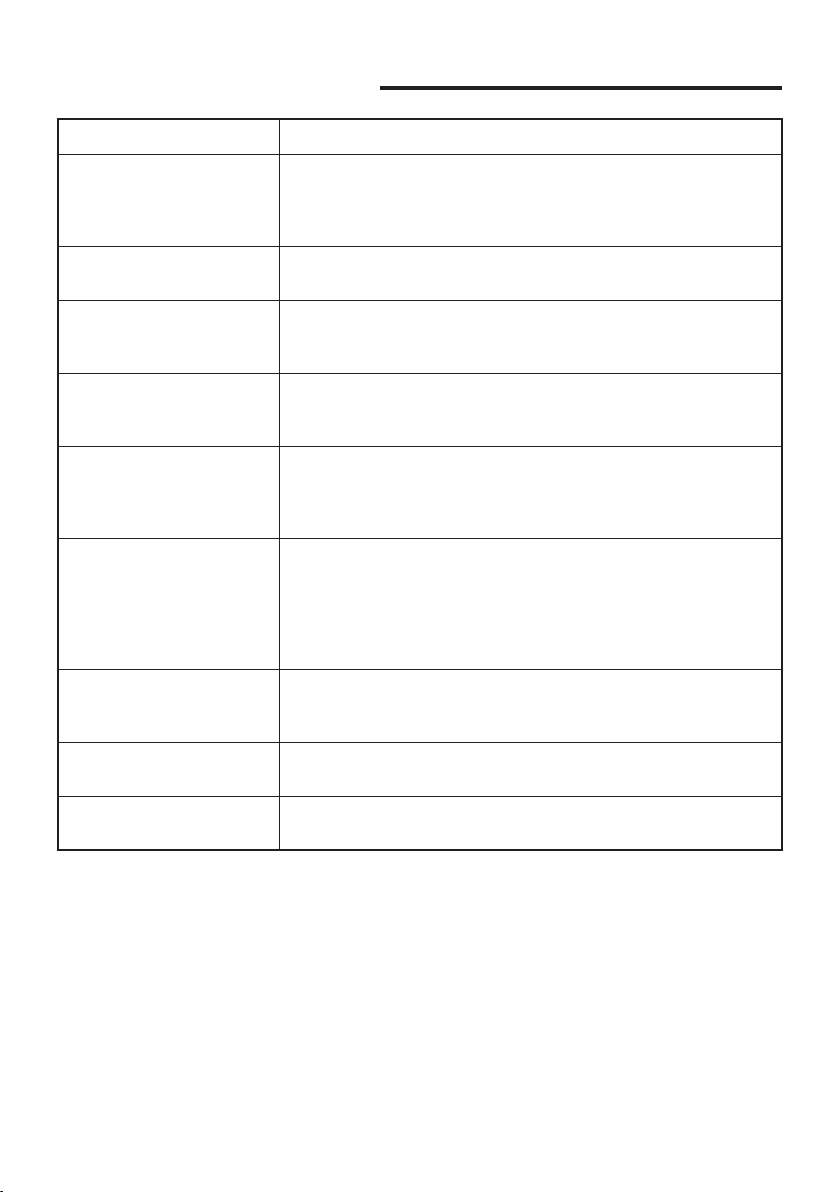
In case of malfunction
Problem: Make sure that:
No brewing.
There is water in the tank.
The lter is not clogged because the mixture is too ne or the coffee
is too pressed.
The screen is clean.
The coffee brews too fast
(less than 20 seconds).
The coffee has not been ground too coarsely.
The coffee has been pressed with the tamper.
The pump is too noisy.
There is water in the tank.
The pump has been activated (see circuit loading).
There is enough coffee.
Excessive loss of water from
the lter holder.
The lter holder has been inserted correctly (Fig.1-17).
The seal is not dirty (Fig.16).
There are no coffee residues on the edge of the lter holder.
The espresso is not creamy
enough.
The coffee has not been ground too coarsely.
The coffee has been pressed with the tamper.
The coffee is not too old or dry.
The traditional lter has been used with the frothing jet device (Fig.1-16).
The coffee is too cold.
The machine has been heated.
The coffee has not been ground too coarsely.
The coffee has been brewed in cold cups. It is recommended to always
brew coffee in
warm cups.
The lter holder has not been preheated (Only for the 1st coffee).
The milk does not froth
enough.
The steam nozzle is not clogged.
The steam nozzle has not been inserted too deep in the jug.
The milk is not too hot.
The machine squirts coffee
out from the lter holder.
The frothing jet device was installed with the “crema perfetta” lter.
The machine housing and the
drain hose are hot.
The steam button is off.

GAGGIA S.p.A.
Sede Amministrativa/Administrative Oce
Via Torretta, 240
40041 Gaggio Montano - Bologna - Italia
+39 0534 771111
www.gaggia.it www.gaggia.com
COD. - Rev.00 - 19/01/23
GAGGIA S.p.A. reserves the right to make any necessary modication.