COHTEHTS
SAI- _-TY
............................................................................ 1 _3
USE AND CARE
Your Range and Its Features ..................................... 4
To Start Things Cooking ........................................ 5, 6
Cooklop Controls ....................................................... 5
Oven Control ......................................................... 5, 14
Oven Cooking ............................................................. 7
Broiling ........................................................................ 8
Cleaning Tips ....................................................... 9, 10
Removable Range Parts ..................................... 10o13
SERVICE
Before Calling For Service ................................. 13, 14
Thermostat Adjustments ......................................... 14
WARRANTY
SEARS
Kenmore
MODELS 62421
91121
91125
USE • CARE • SAFETY
MANUAL

.... •-:_.-',." -,'.-'o-" ._..-:.,'.i'" ......_:i." ..:_._.:_:.:" ..:.::.:,:.: ..... :.:.:.:.:._i._ .
IMPORTANT INSTRUCTIONS
FOR YOUR SAFETY
SAVE THESE INSTRUCTIONS
Read all instructions before using this appliance. When using electrical
appliances, basic safety precautions should be followed, including the following:
Teach children not to play with range
knobs or any other part of the range.
Never leave children alone or unat-
tended where a range is in use.
CAUTION:
Never store things children might
want above a range.
Never let anyone climb, sit or stand
on the open door or any other part of
the range. Their weight may make
the range tip over.
Never leave the oven door open when
you are not watching the range.
WARNING:
To prevent accidental tipping of the
range from abnormal usage, Includ-
Ing excess loading of the oven door,
attach it to the wall or floor by install-
ing the anti-tip bracket supplied. If
the range is moved for cleaning, ser-
vicing or any reason, be sure anti-tip
device is re-engaged properly when
the range is replaced. Failure to take
this precaution could result In tipping
of the range and cause Injury.
NESAFO8-3
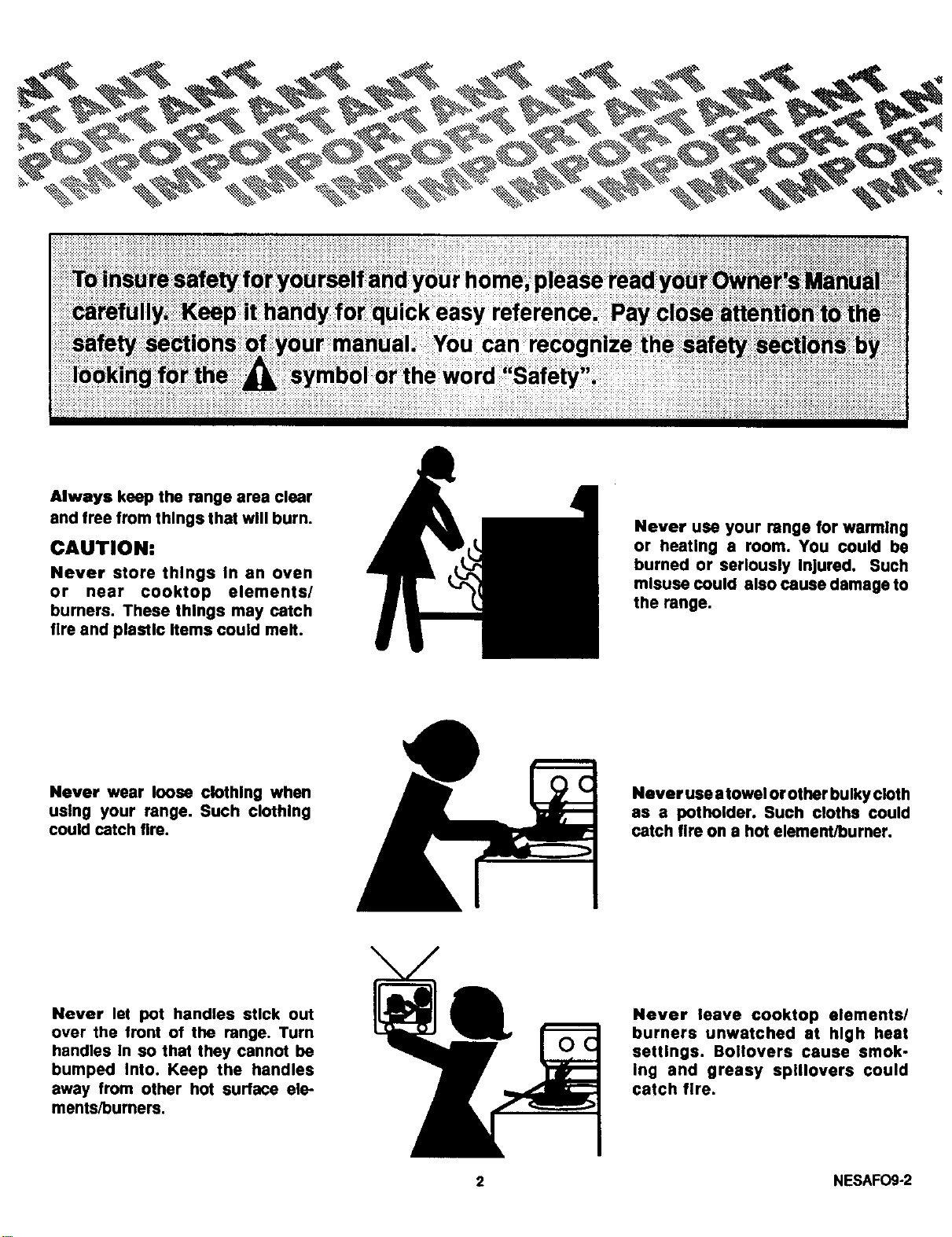
Always keep the range area clear
and free from things that will burn.
CAUTION:
Never store things In an oven
or near cooktop elements/
burners. These things may catch
fire and plaatlc Items could melt.
Never use your range for warming
or heating a room. You could be
burned or seriously Injured. Such
misuse could also cause damage to
the range.
Never wear loose clothing when
using your range. Such clothing
could catch fire.
Never use a towel or other bulky cloth
as a pothotder. Such cloths could
catch fire on a hot element/burner.
Never let pot handles stick out
over the front of the range. Turn
handles In so that they cannot be
bumped Into. Keep the handles
away from other hot surface ele-
ments/burners.
Never leave cooktop elements/
burners unwatched at high heat
settings. Bollovers cause smok-
Ing and greasy splllovers could
catch fire.
2 NESAF09-2

IMPORTANT SAFETY INSTRUCTIONS
Keep this book for later use.
Be sure your range Is Installed and grounded properly
by a qualified technician.
Cheese pots and pans with flat bottoms, large enough
to cover the entire cooktop element. This will cut down
the risk of setUng potholders or clothing on fire with an
uncovered element and waste less energy.
Always use care when touching cooktop elements,
areas near cooktop elements, oven heating elements or
Inside the oven. Heating elements could be hot enough
to bum you even Ifthey are dark In color. The oven vent
duct and oven door may also become hot during range
use.
Always change oven rack positions while oven Is cool.
After broiling, always take the broiler pan out of the
range and clean it. Leftover grease In the broiler pan
can catch on fire next time you use the pan.
Always keep canned food, and wooden or plastic uten-
sils a safe distance away from your range.
Always keep the appliance area clear and free from
things that will burn; gasoline and other flammable
vapors and liquids.
Only some kinds of glass or ceramic pans can be used
for cooktop cooking. Be sure that the pan you use will
not break when heated on the cooktop elements.
Never try to repair or replace any part of the range
unless Instructions are given In this book. All other
work should be done by a skilled technician.
Never heat unopened food containers. Pressure
buildup may make container burst and cause Injury.
Never leave Jars or cans of fat or drippings on or near
therange. Neverletgraasebullduponyourrange. You
can keep grease flrns from starting If you clean up
grease and spills after each range use.
Place oven shelves In desired position while oven Is
cool.
Always use dry potholders when removing pans from
the oven or cooktop. Moist or damp pothoiders can
cause steam burns.
Always use care when opening oven door. Let hot air
and steam out before moving food.
Always follow cleaning Instructions In this book.
Always remove the broiler pan and other utensils from
the oven before a self-clean cycle.
Always keep the range and oven clean. Food and
grease are easy to Ignite. Clean the range, oven and vent
hoods regularly.
Always keep combustible wall coverings, curtains or
drapes a safe distance away from your range.
Never use aluminum foil to line drip bowls or oven
bottoms. Improper use of foil could start a fire or cause
electrical shock.
Never block free airflow through the oven vent.
Never try to move a pan of hot fat, especially a deep fat
fryer. Walt until the fat has cooled.
Never put removable heating elements In water.
Never use the cooktop without reflector pans or drip
bowls being In place. If these pans or bowls are not
there during cooking, wiring or other range parts may be
damaged.
Never touch surface units, heating elements, or Interior
surfaces of the oven. They may be hot even though they
appear dark In color.
Clean only parts listed In manual.
Always keep dish towels, dish cloths, potholders and
other linens a safe distance away from your range.
Never clean cooktop surface when It Is hot. Some
cleaners produce noxious fumes and wet cloths could
cause steam burns if used on a hot surface.
Read and understand this information
NOW!
Be sure everyone in your home knows
what to do in case of fire.
Should you ever need it, you will not have
time for reading.
Never use water on a grease fire. it will
only spread the flames.
COOKTOP GREASE FIRE
Never pick up a flaming pan...Instead:
1. Turn off the element.
2. Smother the fire with a tighUy fitting pan lid,
baking soda or an extinguisher.
OVEN FIRE
t. Close oven door and turn controls off.
2. If fire continues, throw baking soda on the
fire.
3 NESAF46
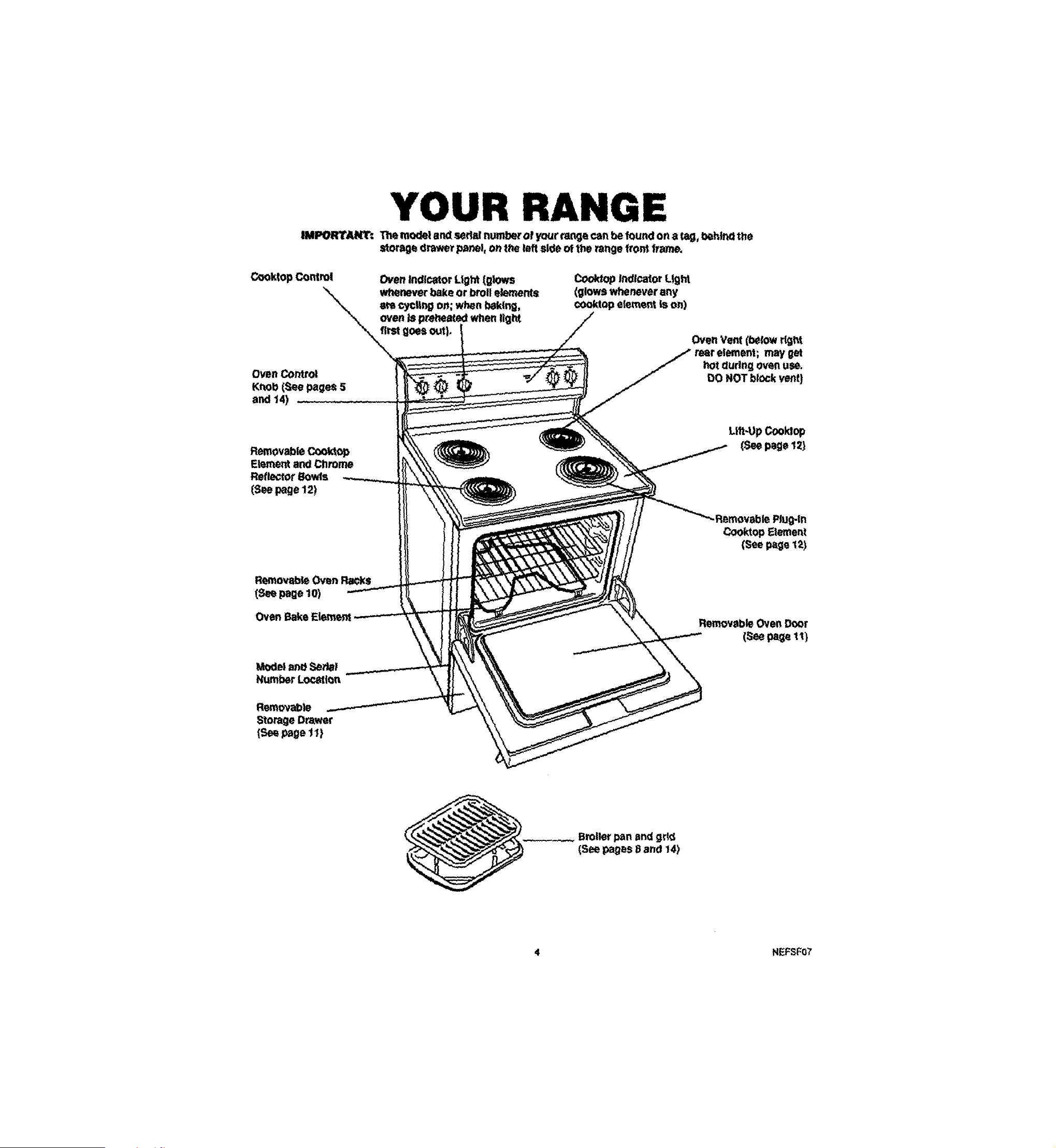
YOUR RANGE
IMPORTANT: The mode| ar'_ s_ number of ya_Jt"_gQ can he found oll a tag, behind me
m_e drawer pane_, on _e left side of the range front frame.
Cooktop Comml
Removable Cook_
Elementand Chrome
Reflector Bowls
(Seepage 12)
Cooldop Indicator Light
(glows whenever any
cooktop element is on)
Oven Vent (below right
rear element; may get
hot dudng ovenuse.
DO NOT blockveni)
RemovablePlug-In
Cooktop Element
(Seepage 12}
RemovableOven
(Seepage10)
Oven Beke Eiemsm
Removable Oven Door
(See page 11}
__ Broiler pan and grid
(See pages I_and t4}
4 NEFSF07
To
Start Things
Cooking
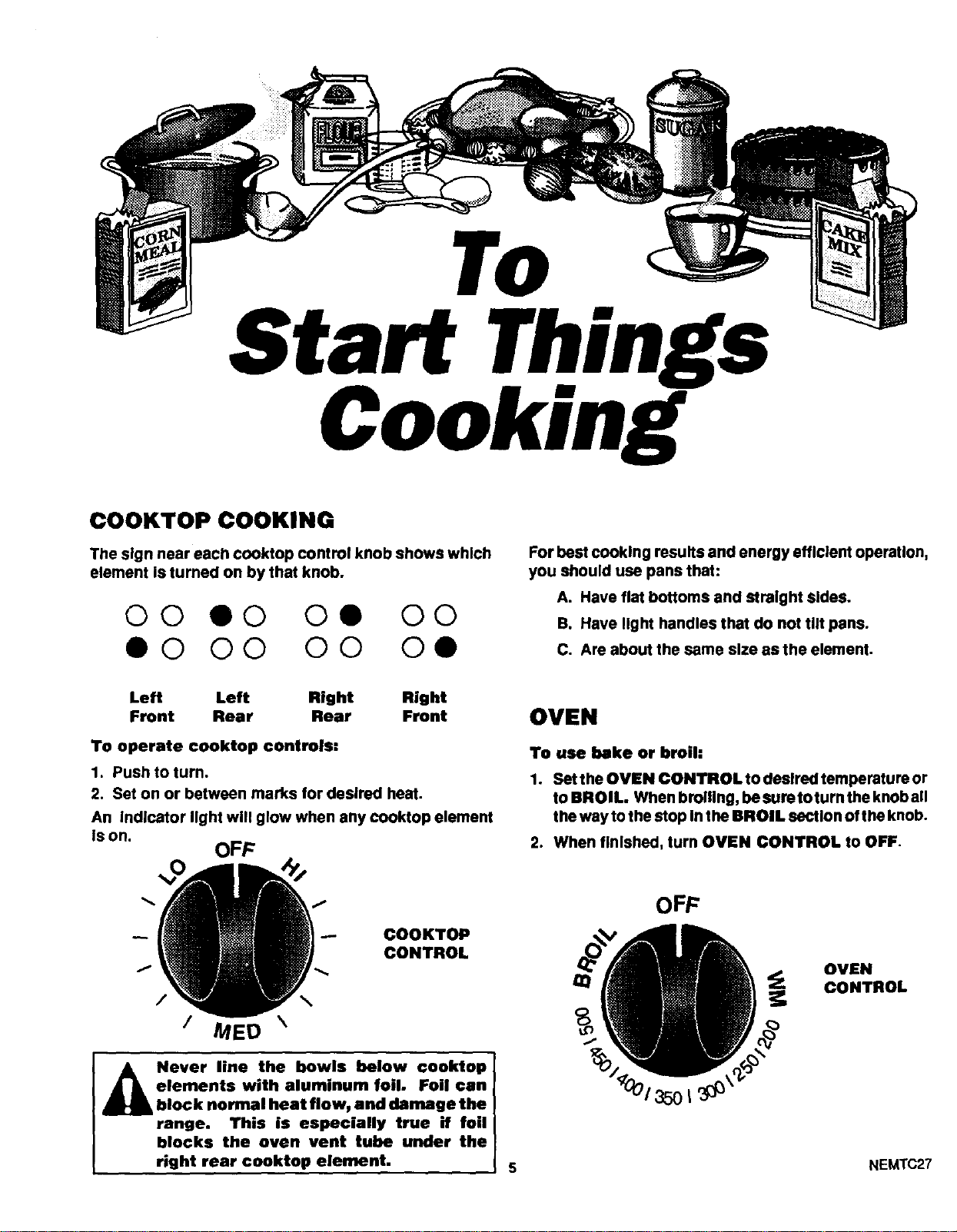
COOKTOP COOKING
The sign near each cooktop control knob shows which
element is turned on by that knob.
O0 eO Oe O0
• 0 O0 0 0 O•
For best cooking results and energy efficient operation,
you should use pans that:
A. Have flat bottoms and straight sides.
B. Have light handles that do not tilt pans.
C. Are about the same size as the element.
Left Left Right Right
Front Rear Rear Front
To operate cooktop controls:
1. Push to turn.
2. Set on or between marks for desired heat.
An Indicator light will glow when any cooktop element
Is on.
OFF
OVEN
To use bake or broil:
1. Set the OVEN CONTROL to desired temperature or
to BROIL. When broiling, besuretoturn the knob all
the way to the stop In the BROIL section of the knob.
2. When finished, turn OVEN CONTROL to OFF.
-- COOKTOP
CONTROL
/ x
/ MED \
Never line the bowls below €ooktop
elements with aluminum foil. Foil can
block normal heat flow, and damage the
range. This is especially true if foil
blocks the oven vent tube under the
right rear cooktop element.
5
OFF
OVEN
_ CONTROL
g
NEMTC27

QUESTIONS & ANSWERS
Q. May I can foods and preserves on my surface
units?
A. Yes, but only use cookware designed for canning
purposes. Check the manufacturer's Instructions
and recipes for preserving foods. Be sure canner Is
flat-bottomed and fits overthe center of your surface
unit. Since canning generates large amounts of
steam, be careful to avoid burns from steam or heat.
Canning should only be done on surface units.
Q. Can I cover my drip pans with foil?
A. No. Clean as recommended In Cleaning Guide.
Q. Can I use special cooking equipment, like an
oriental wok, on any surface units?
A. We recommend flat bottomed woks. Cookware with-
out flat surfaces Is not recommended. The life of
your surface unitcan be shortened and the range top
can be damaged from the high heat needed for this
type of cooking.
Q. Why am I not getting the heat I need from my
units even though I have the knobs on the
right setting?
A. After turning surface unit off and making sure it Is
cool, check to make sure that your plug-In units are
securely fastened Into the surface connection.
Q. Why does my cookware tilt when I place them
on the surface unit?
A. Because the surface unit or the cookware Is not flat.
Make sure that the "feet" on your surface units are
sltUng tightly In the range top Indentation and the
outer edge of the drip pan Is flat on the range surface.
Q. Why is the porcelain finish on my cookwsre
coming off?
A. If you set your surface unit higher than required for
the cookware material and leave It, the finish may
smoke, crack, pop or burn, depending on the pot or
pan. Also, a too high heat for long periods, and small
amounts of dry food, may damage the finish.
HOME CANNING TIPS
Canning should be done on cooktop only.
In surface cooking of foods other than canning, the use
of large-diameter pots (extending more than 1" beyond
edge of drip pan) Is not recommended. However, when
canning with water-bath or pressure canner, large-all-
ameter pots may be used. This Is because boiling water
temperatures (even under pressure) are not harmful to
cooktop surfaces surrounding heating unit.
HOWEVER, DO NOT USE LARGE DIAMETER
CANNERS OR OTHER LARGE DIAMETER POTS
FOR FRYING OR BOILING FOODS OTHER THAN
WATER.
Most syrup or sauce mixtures -- and all types of frying
--cook at temperatures much hlgherthan boiling water.
Such temperatures could eventually harm cooktop sur-
faces surrounding heating units.
OBSERVE FOLLOWING POINTS IN
CANNING
1. Bring water to boll on HIGH heat, then after boiling
has begun, adjust heat to lowest setting to maintain
boll (saves energy and best uses surface unit).
2. Besurecannerfltsovercenterofsurfaceunlt. Ifyour
range does not allow canner to be centered on
surface unit, use smaller-diameter pots for good
canning results.
3. Flat-bottomedcannersglvebestcannlngresults. Be
sure bottom of canner Is flat or alight Indentation fits
snugly over surface unit. Canners with flanged or
rippled bottoms (often found In enamelware) are not
recommended.
RIGHT WRONG
4.
When canning, use recipes from reputable sources.
Reliable recipes are available from the manufacturer
of your canner; manufacturers of glass jars for can-
ning, such as Ball and Kerr; and the United States
Department of Agriculture Extension Service.
5.
Remember, In following the recipes, that canning Is
a process that generates large amounts of steam. Be
careful while cennlng to prevent burns from steam or
heat.
NOTE" If your range Is being operated on low power
(voltage), canning may take longer than expected,
even though directions have been carefully fol-
lowed. The process may be Improved by:
(1) using a pressure canner, and
(2) for fastest heating of large water quantities,
begin with HOT tap water.
NEMTC06-1
OVEN COOKING
When cooking a food for the first time in your new
oven, use time given on recipes as a guide.
Your new oven has been set correctly at the factory
and Is more apt to be accurate than the oven It
replaced.
After you have used you oven for awhile, If you feel
your oven should be hotter or cooler, you can adjust
It yourself. See THERMOSTAT ADJUSTMENTS In
this manual.
Always follow recipe carefully.
Measure Ingredients properly.
Use proper pan placement.
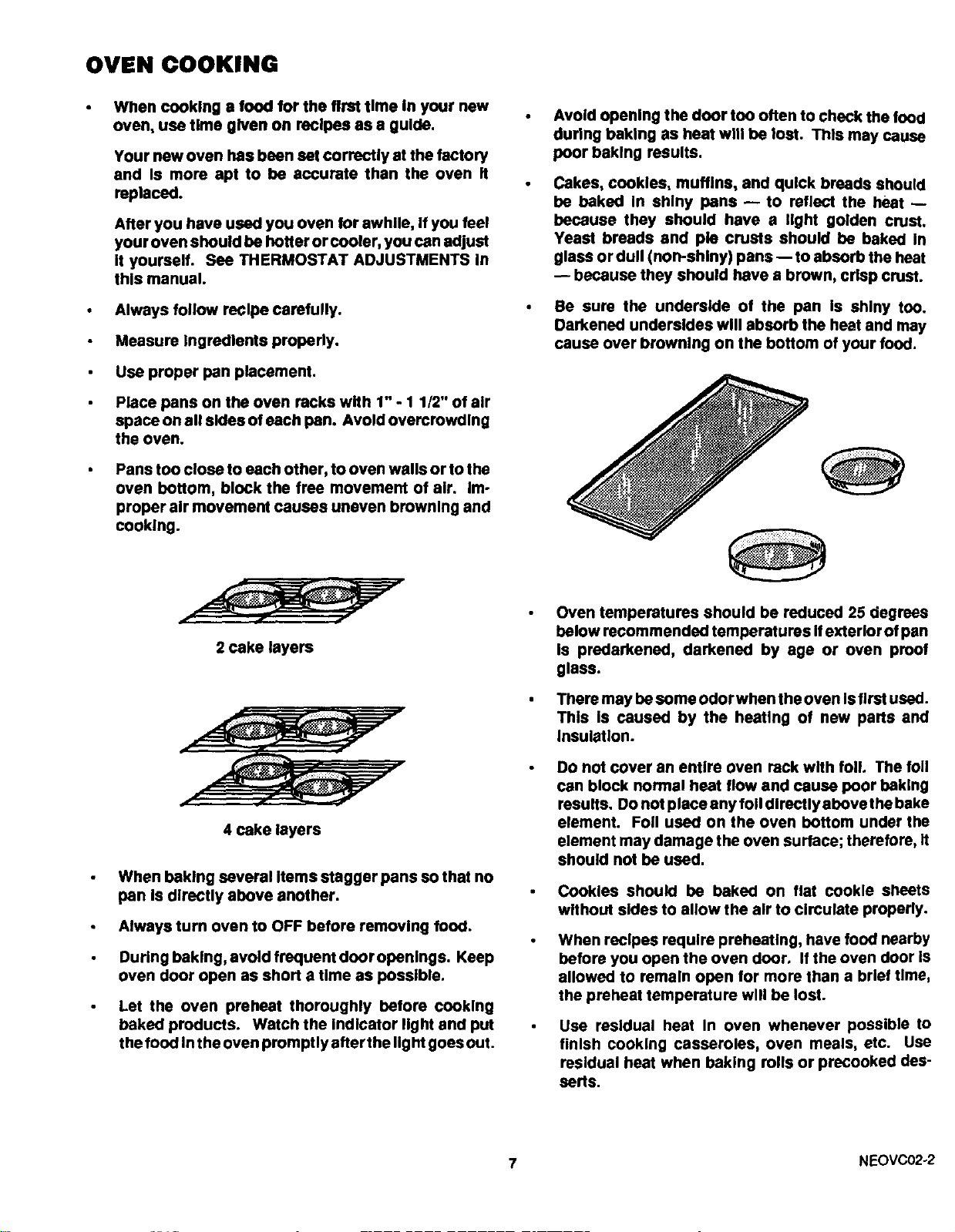
Place pans on the oven racks wIth 1" - 1 1/2" of air
space on all sides of each pan. Avoid overcrowding
the oven.
Pans too close to each other, to oven walls or to the
oven bottom, block the free movement of air. Im-
proper air movement causes uneven browning and
cooking.
2 cake layers
4 cake layers
When baking several Items stagger pans so that no
pan Is directly above another.
Always turn oven to OFF before removing food.
During baking, avoid frequent dooropenlngs. Keep
oven door open as short a time as possible.
Let the oven preheat thoroughly before cooking
baked products. Watch the indicator light and put
the food In the oven promptly afterthe IIght goes out.
Avoid opening the door too often to check the food
during baking as heat will be lost. This may cause
poor baking results.
Cakes, cookies, muffins, and quick breads should
be baked In shiny pans -- to reflect the heat
because they should have a light golden crust.
Yeast breads and pie crusts should be baked In
glass or dull (non-shiny) pans-- to absorb the heat
because they should have a brown, crisp crust.
Be sure the underside of the pan Is shiny too.
Darkened undersides will absorb the heat and may
cause over browning on the bottom of your food.
Oven temperatures should be reduced 25 degrees
below recommended temperatures ifexterior of pan
Is predarkened, darkened by age or oven proof
glass.
There may be some odorwhen the oven Isfirst used.
This is caused by the heating of new parts and
Insulation.
Do not cover an entire oven rack wIth foil. The foil
can block normal heat flow and cause poor baking
results. Do not place any foil directly above the bake
element. Foil used on the oven bottom under the
element may damage the oven surface; therefore, It
should not be used.
Cookies should be baked on flat cookie sheets
without sides to allow the air to circulate properly.
When recipes require preheating, have food nearby
before you open the oven door. If the oven door Is
allowed to remain open for more than a brief time,
the preheat temperature will be lost.
Use residual heat In oven whenever possible to
finish cooking casseroles, oven meals, etc. Use
residual heat when baking rolls or precooked des-
serts.
7 NEOVC02-2
BROILING
Broiling Is cooking by dlract heat from the broil
burner. Tender cuts of meat or marinated meat
should be selected for broiling. For best results
steaks and chops should be at least 3/4" thick.
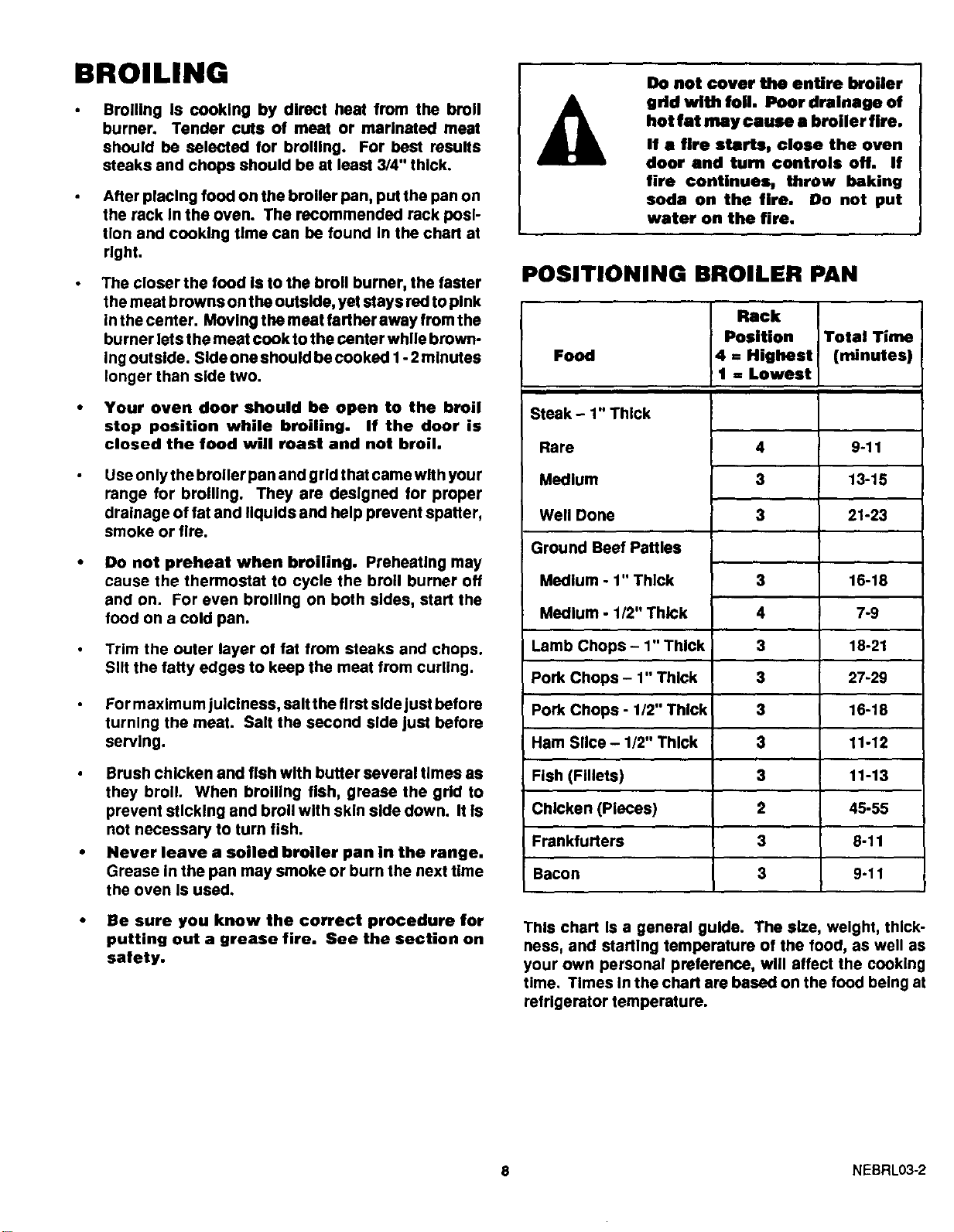
After placing food on the broiler pan, put the pan on
the rack In the oven. The recommended rack posi-
tion and cooking time can be found In the chart at
right.
The closer the food Is to the broil burner, the faster
the meat browns on the outside, yet stays red to pink
in the center. Moving the meat farther away from the
burner lets the meat cook to the center while brown-
Ing outside. Side one should be cooked 1- 2 minutes
longer than side two.
Your oven door should be open to the broil
stop position while broiling. If the door is
closed the food will roast and not broil.
Use only the broiler pan and grid that came with your
range for broiling. They are designed for proper
drainage of fat and liquids and help prevent spatter,
smoke or fire.
Do not preheat when broiling. Preheating may
cause the thermostat to cycle the broil burner off
and on. For even broiling on both sides, start the
food on a cold pan.
Trim the outer layer of fat from steaks and chops.
Slit the fatty edges to keep the meat from curling.
For maximum juiciness, salt the first side just before
turning the meat. Salt the second side just before
serving.
Brush chicken and fish with butter several times as
they broil When broiling fish, grease the grid to
prevent sticking and broil with skin side down. It Is
not necessary to turn fish.
Never leave a soiled broiler pan in the range.
Grease in the pan may smoke or burn the next time
the oven Is used.
• Be sure you know the correct procedure for
putting out a grease fire. See the section on
safety.
Do not cover the enUre broiler
grid with foil, Poor drainage of
hot fat may cause a broiler fire,
If a fire starts, close the oven
door and tam controls off. If
fire continues, throw baking
soda on the fire. Do not put
water on the fire.
POSITIONING BROILER PAN
Rack
Position Total Time
Food 4 = Highest (minutes)
I = Lowest
Steak - 1" Thick
Rare
Medium
Well Done
Ground Beef Patties
Medium - 1" Thick
Medium - 1/2" Thick
Lamb Chops - 1" Thick
Pork Chops - 1" Thick
Pork Chops - 1/2" Thick
Ham Slice - 1/2" Thick
Fish (Fillets)
Chicken (Pieces)
Frankfurters
Bacon
4 9-11
3 13-15
3 21-23
3
4
3
3
3
3
3
2
3
3
16-18
7-9
18-21
27-29
16-18
11-12
11-13
45-55
8-11
9-11
This chart Is a general guide. The size, weight, thick-
ness, and starting temperature of the food, as well as
your own personal preference, will affect the cooking
time. Times In the chart are based on the food being at
refrigerator temperature.
8 NEBRL03-2
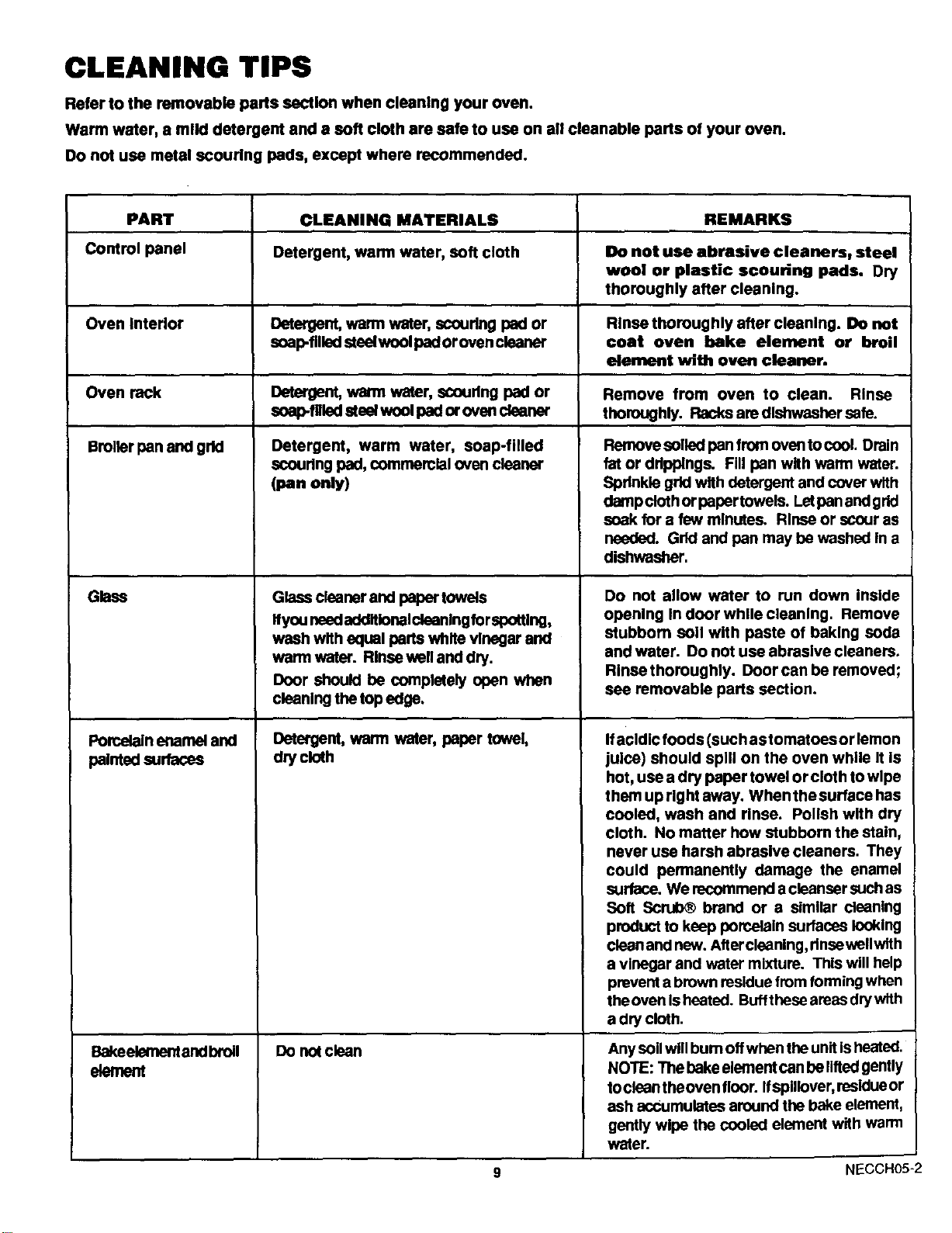
CLEANING TIPS
Refer to the removable parts section when cleaning your oven.
Warm water, a mild detergent and a soft cloth are safe to use on all cleanable parts of your oven.
Do not use metal scouring pads, except where recommended.
PART
Control panel
CLEANING MATERIALS
Detergent, warm water, soft cloth
REMARKS
Do not use abrasive cleaners, steel
wool or plastic scouring pads. Dry
thoroughly after cleaning.
Oven Interior Detergent, warm water, scouring pad or Rinse thoroughly after cleaning. Do net
scep-fllledstselwoolpadorovencleaner coat oven bake element or broil
elenTent w_th ovell cleaner,
Oven rack Detergent, warm water, scoudng pad or Remove from oven to clean. Rinse
soap-fgled steel wool pad or oven cleaner thoroughly. Racks are dishwasher safe.
Bro,er pan and orld
Glass
Detergent, warm water, soap-filled
scouring pad, commemlal oven cleaner
(pan only)
Glass cleaner and paper towels
Ifyou needaddlUonelclesnlng for spotting,
wash with equal parts white vinegar and
warm water. Rinse well and dry.
Door should be completely open when
cleaning the top edge.
Detergent, warm water, paper towel,
dry cloth
Do not clean
Porcelainenameland
paintedsurfaces
Bakeelerr_'_ and broil
element
Remove soiled pan from oven to cool. Drain
fat or drippings. Fill pan with warm water.
Sprinkle grid with detergent and cover with
damp cloth or papertowels. Letpan and grid
soak for a few minutes. Rinse or scour as
needed. Grid and pan may be washed In a
dishwasher.
,,,, I
Do not allow water to run down inside
opening In door whllecleanlng. Remove
stubborn soil with paste of baking soda
and water. Do not use abrasive cleaners.
Rinse thoroughly. Door can be removed;
see removable parts section.
Ifacidic foods (such as tomatoes orlemon
juice) should spill on the oven while It Is
hot, use a dry paper towel or cloth to wipe
them up right away. When the surface has
cooled, wash and rinse. Polish with dry
cloth. No matter how stubborn the stain,
never use harsh abrasive cleaners. They
could permanently damage the enamel
surface. We recommend a cleanser such as
Soft Scrub_ brand or a similar cleaning
product to keep porcelain surfaces looking
cleanand new. After cleaning, dnsewellwith
a vinegar and water mixture. This will help
prevent a brown residue from forming when
the oven Isheated. Buffthese areasdry with
a dry cloth.
Any sell will bum offwhen the unitisheated.
NOTE: The bake element can beliftedgently
toclean theoven floor. Ifsplllover, resldue or
ash accumulates around the bake element,
gently wipe the cooled element with warm
water.
9 NECCH05*2

CLEANING TIPS(cont.)
PART
Chrome drip bowls
Brown food stains
Blue/gOld heat
stains
CLEANING MATERIALS
Detergent and water, plastic scoudng
pads, mild abrasive cleaners, soap
filled scouring pads, ammonia
Me_ P_L_h
REMARKS
Bowls can permanently discolor if
exposed to excessive heat or If soil
is allowed to bake on.
After each use, wash, rinse and dry to
prevent difficult soils. If heavily soiled,
place an ammonla-soaked paper towel on
stains to loosen sOil, then gently scrub
with plastic scouring pad.
These stains are caused by oved_aUng,
normaEy occur over a perled of time, and
usually are permanent. To minimize:
1. Avoid excessive use of the high heat
setting. UseIttostart cooldng,tlten lower
the heat ssttlng to flnlsh cooldng.
2. U6e flat battom pans that do not extend
rnom then two Inches from the surface
e_emenL
REMOVABLE OVEN RACKS
Be careful not to scratch the oven finish when
installing or remving oven racks.
To install:
1. Set the raised back edge of the rack on a pair of rack
guides.
2. Push the rack In until you reach the bump In the rack
guide, then lift the front of the rack and push the rack
all the way In.
To remove:
t. Pull the oven rack out, then up.
Some models have one standard oven rack and one
folding oven rack.
The folding rack can be easily stored away when not In
use.
BUMP IN
RACK GUIDE
10 NECCH26

REMOVABLE OVEN DOOR
To remove:
1. Open the door to the stop position (see lituatration).
2. Grasp the door at each side and lift up and off the
hinges.
NOTE: When the door is removed and hinge arms
are at stop position, do not bump or try to move
the hinge arms. The hinges could snap back
causing an injury to the hands or damage to the
porcelain on the front of the range. Cover the
hinges with toweling or empty towel rolls while
working in the oven area.
To replace:
1. Hold the door over the hinges with the slots at the
bottom edge of the door lined up with the hinges.
The hinge arms must still be in the stop
position.
2. Slide the door down onto the hinges as far as It will
go and close the door.
STOP (BROIL) POSITION
REMOVABLE STORAGE DRAWER
This drawer gives you space for keeping
cookware and bekeware. Plastics and flammable
material should not be kept in this drawer,
Do not overload the storage drawer. If the drawer Is too
heavy, Itmay slip off the track when opened. To open the
drawer, grasp the center of the handle and pull straight
out.
To remove: Pull drawer straight out and lift over the
guide stops.
To replace: Lift over the guide stops and slide drawer
Into place.
_/_f GUIDE STOP
11 NEMNT44
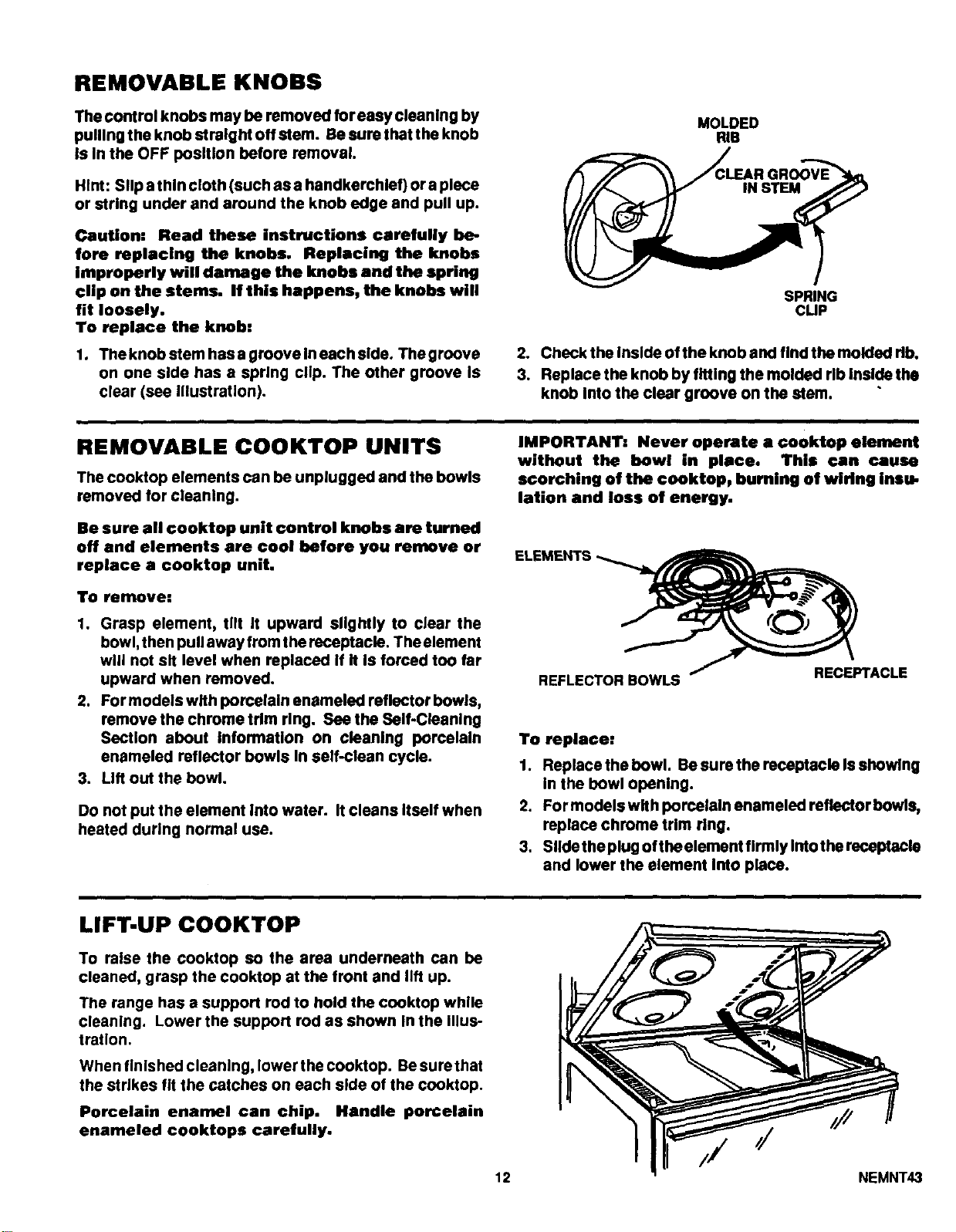
REMOVABLE KNOBS
The control knobs may be removed for easy cleaning by
pulllng the knob stralgM off stem. Be sure that the knob
Is In the OFF posltlon before removal.
Hint: Slip a thin cloth (such as a handkerchief) or a piece
or string under and around the knob edge and pull up.
CauUon: Read these instructions carefully be-
fore replacing the knobs. Replacing the knobs
Improperly will damage the knobs and the spring
€lip on the stems. If this happens, the knobs will
fit loosely.
To replace the knob:
1. The knob stem has a groove In each side. The groove
on one side has a spring clip. The other groove Is
clear (see illustration).
MOLDED
mB
SPRING
CLIP
2. Check the Inside of the knob and find the molded rib.
3. Replace the knob by fitting the molded rib Inside the
knob Into the clear groove on the stem.
REMOVABLE COOKTOP UNITS
The cooktop elements can be unplugged and the bowls
removed for cleaning.
Be sure all cooktop unit control knobs are turned
off and elements are cool before you remove or
replace a cooktop unit.
To remove:
1. Grasp element, tilt It upward slightly to clear the
bowl, then pull away from the receptacle. The element
will not sit level when replaced If It Is forced too far
upward when removed.
2. For models with porcelain enameled reflector bowls,
remove the chrome trim ring. See the Self-Cleaning
Section about Information on cleaning porcelain
enameled reflector bowls In self-clean cycle.
3. Lift out the bowl.
Do not put the element Into water. It cleans Itself when
heated during normal use.
IMPORTANT: Never operate • €ooktop element
without the bowl in place. This can cause
scorching of the cnoktop, burning of wiring insu.
lation and loss of energy.
ELEMENTS
REFLECTOR BOWLS RECEPTACLE
TO replace:
1. Replace the bowl. Be sum the receptacle Is showing
In the bowl opening.
2. For models wit h porcelain enameled reflector bowls,
replace chrome trim ring.
3. Slide the plug oftha element firmly Into the receptacle
and lower the element Into place.
LIFT-UP COOKTOP
To raise the cooktop so the area underneath can be
cleaned, grasp the cooktop at the front and lift up.
The range has a support rod to hold the cooktop while
cleaning. Lower the support rod as shown In the Illus-
tration.
When finished cleaning, lower the cooktop. Besurethat
the strikes fit the catches on each side of the cooktop.
Porcelain enamel can chip. Handle porcelain
enameled cooktops carefully.
12 NEMNT43
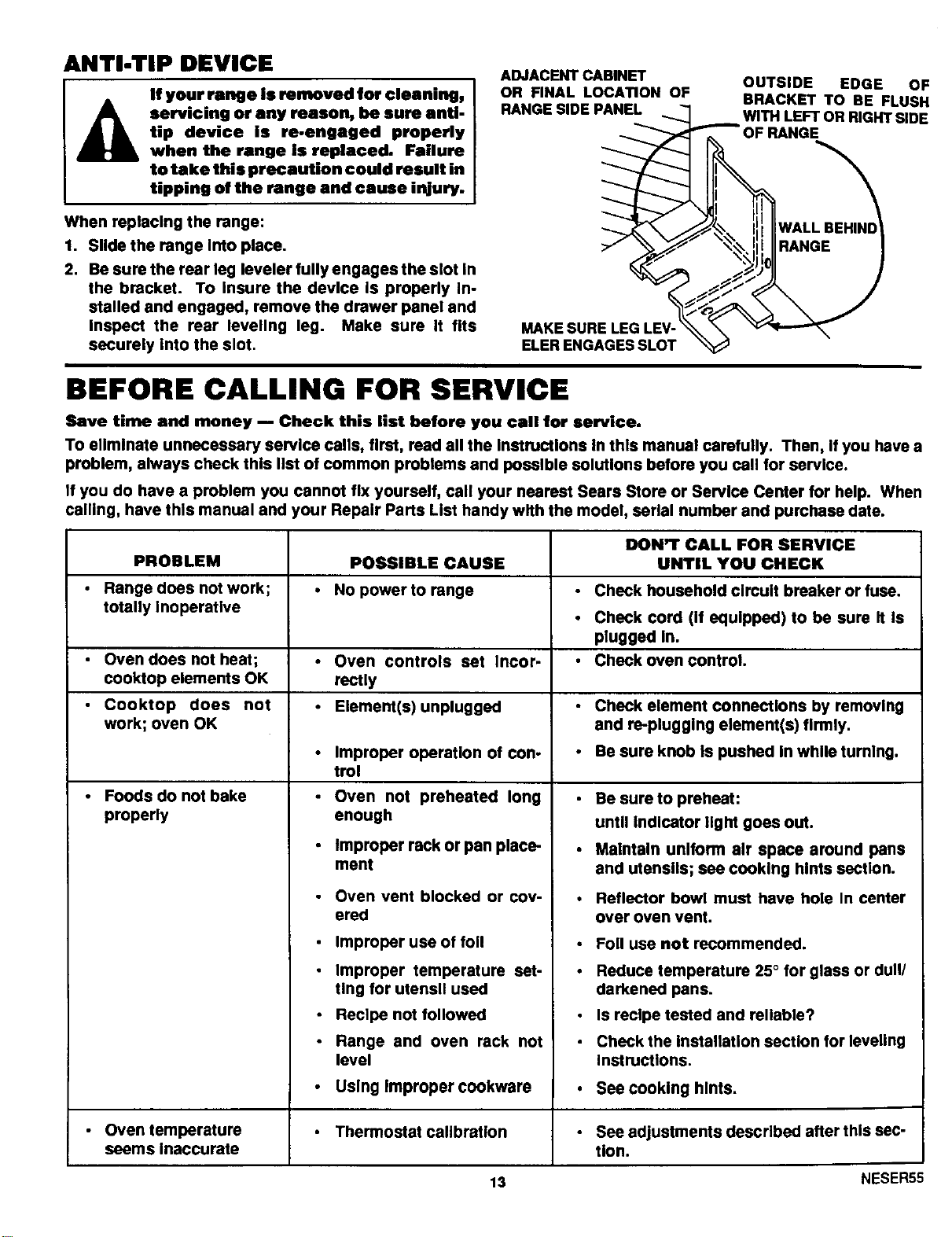
ANTI-TIP DEVICE
If your range is rentoved for cleaning,
servicing or any reason, be sure anti-
tip device is re-engaged properly
when the range is replaced• Failure
to take this precaution could result in
tipping of the range and cause injury.
When replacing the range:
1. Slide the range Into place.
2. Be sure the rear leg leveler fuIlyengagestheslot In
the bracket. TO Insure the device is properly In-
stalled and engaged, remove the drawer panel and
Inspect the rear leveling leg. Make sure It fits
securely into the slot.
ADJACENT CABINET
OR FINAL LOCATION OF
RANGE SIDE PANEL
MAKE SURE LEG LEV-
ELER ENGAGES SLOT
OUTSIDE EDGE OF
BRACKET TO BE FLUSH
WITH LEFT OR RIGHT SIDE
BEFORE CALLING FOR SERVICE
Save time and money m Check this list before you call for service.
To eliminate unnecessary service ceils, first, read all the Instructions In this manual carefully. Then, If you have a
problem, always check this list of common problems and possible soluUons before you cell for ssrvlce.
if you do have a problem you cannot fix yourself, call your nearest Sears Store or Service Center for help. When
calling, have this manual and your Repair Parts List handy with the model, serial number and purchase date.
DON'T CALL FOR SERVICE
PROBLEM POSSIBLE CAUSE UNTIL YOU CHECK
Range does not work; • No power to range Check household circuit breaker or fuse.
totally Inoperative Check cord (If equipped) to be sure it Is
plugged In.
Oven does not heat; • Oven controls set lncor- Check oven control.
cooktop elements OK rectly
Cooktop does not Element(s) unplugged Check element connections by removing
work; oven OK and re-plugging element(s)firmly,
Be sure knob Is pushed In while turning.
Foods do not bake
properly
Improper operation of con-
trol
Oven not preheated long
enough
Improper rack or pan place-
ment
Oven vent blocked or cov-
ered
Improper use of foil
Improper temperature sst-
ring for utensil used
Recipe not followed
Range and oven rack not
level
Using Improper cookware
Be sure to preheat:
until Indicator light goes out.
Maintain uniform air space around pens
and utensils; see cooking hints section.
Reflector bowl must have hole In center
over oven vent.
Foil use not recommended.
Reduce temperature 25° for glass or dull/
darkened pans.
Is recipe tested and reliable?
Check the installation section for leveling
Instructions.
See cooking hints.
Oven temperature Thermostat calibration See adjustments described after this sec-
seems Inaccurate tion.
13 NESER55

BEFORE CALLING FOR SERVICE(CONT.)
PROBLEM
• Foods do not broil
properly
Oven smokes
DON'T CALL FOR SERVICE
POSSIBLE CAUSE UNTIL YOU CHECK
• Oven door closed
• Improper rack position
• Oven preheated
Improper utensil used
• Improper broiling time
Dirty oven
Broiler pan full of grease
left In oven
Open door to broil stop position.
Check broil pan placement; see
Broiling section.
• Do not preheat when broiling.
• Use broiler pan and grid
supplied with range.
• Check broiling chart.
• Check for heavy splllover.
• Check pan and grid aftereach
use.
THERMOSTAT ADJUSTMENTS
The temperature In your new oven has been set cor-
rectly at the factory, so be sure to follow the recipe
temperatures and times the first few times you bake in
your new oven.
Ifyou think the oven should be hotter or cooler, you can
adjust It yourself. To decide how much to change the
temperature, set the oven temperature 25°F higher or
lower than the temperature In your recipe, then bake.
The results of this "test" should give you an Idea of how
much the temperature should be changed.
To adjust knob:
1. Turn OVEN CONTROL knob to OFF and remove the
knob by pulling straight off.
2. Look at the back of the knob. The arrow pointing to
the center of the bottom screw Indicates the original
factory setting.
3. Use a screwdriver to loosen the two screws about 2
turns each.
4. Hold the knob handle (A on Illustration) while turning
the disk (B on Illustration) in the desired direction to
increaseordecrease thetemperature (See Illustration for
"Standard" thermostat). As you turn, you should be
able to hear clicks and feel notches or teeth. Each
click or notch Is 15°F. You can turn up to 2 clicks or
notches in either direction.
5. When you reach the desired adjustment, retlghten
both screws.
"A" "B"
KNOB DISK
TO MAKEOVEN
COOLER
TURN DISK
TO MAKE OVEN
HOTTER_
TURN DISK-J
14 NESER51
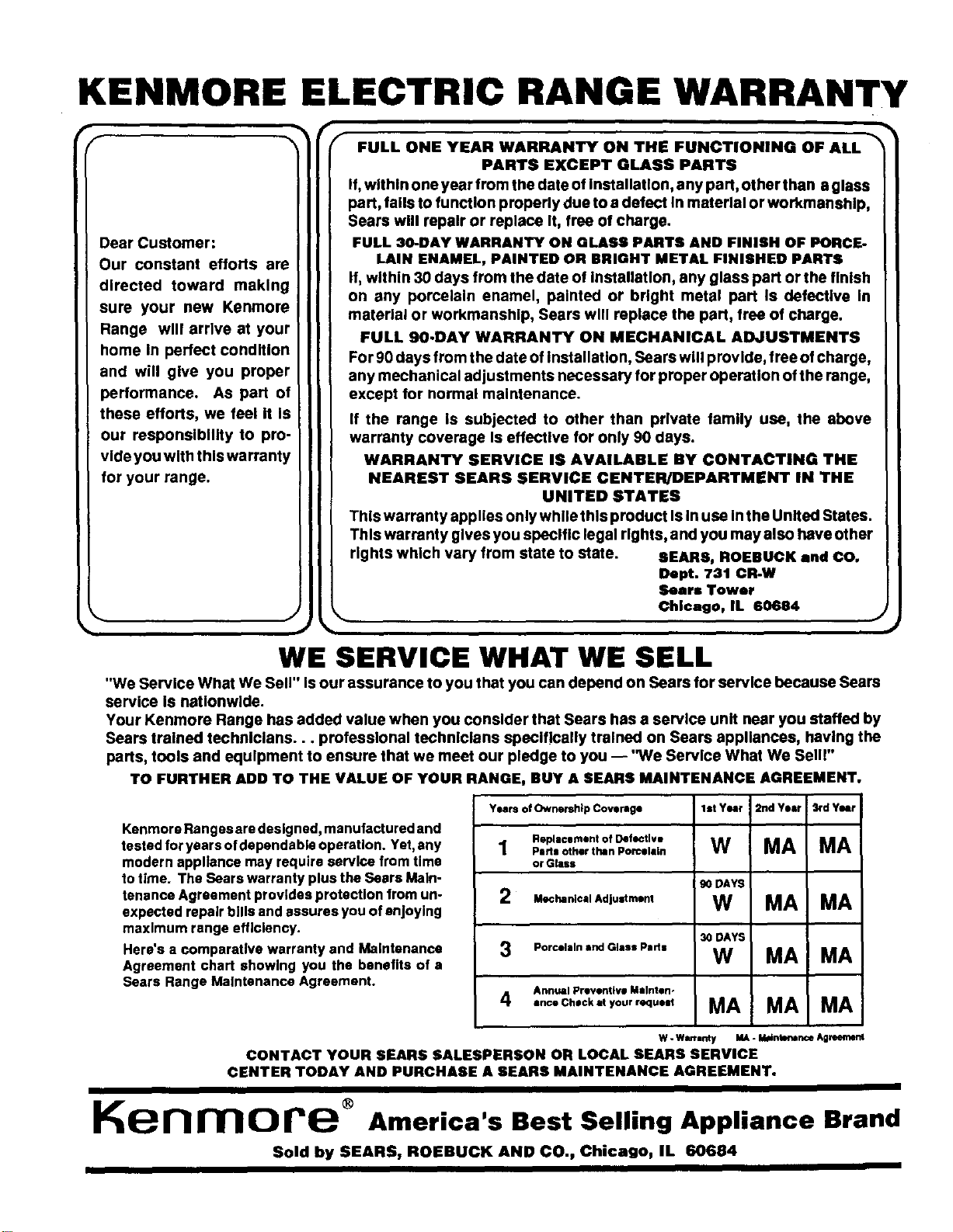
KENMORE ELECTRIC RANGE WARRANTY
Dear Customer:
Our constant efforts are
directed toward making
sure your new Kenmore
Range will arrive at your
home in perfect condition
and will give you proper
performance. As part of
these efforts, we feel it Is
our responsibility to pro-
vide you with this warranty
for your range.
/
r FULL ONE YEAR WARRANTY ON THE FUNCTIONING OF ALL _"
PARTS EXCEPT GLASS PARTS
If, within one year from the date of Installation, any part, other than a glass
part, falls to function properly due to a defect In material or workmanship,
Sears will repair or replace It, free of charge.
FULL 30-DAY WARRANTY ON GLASS PARTS AND FINISH OF PORCE-
LAIN ENAMEL, PAINTED OR BRIGHT METAL FINISHED PARTS
If, within 30 days from the date of Installation, any glass part or the finish
on any porcelain enamel, painted or bright metal part Is defecUve In
material or workmanship, Sears will replace the part, free of charge.
FULL 90.DAY WARRANTY ON MECHANICAL ADJUSTMENTS
For 90 days from the date of Installation, Sears will provide, free of charge,
any mechanical adjustments necessary for proper operation ofthe range,
except for normal maintenance
If the range is subjected to other than private family use, the above
warranty coverage Is effective for only 90 days.
WARRANTY SERVICE IS AVAILABLE BY CONTACTING THE
NEAREST SEARS SERVICE CENTER/DEPARTMENT IN THE
UNITED STATES
This warranty applies only while this product IsIn use In the United States.
This warranty gives you specific legal rights, and you may also have other
rights which vary from state to state SEARS, ROEBUCK and CO.
Dept. 731 CR-W
Seers Tower
_-_ Chicago, IL 60684 j
%, J
WE SERVICE WHAT WE SELL
"We Service What We Sell" Is our assurance to you that you can depend on Sears for service because Sears
service Is nationwide.
Your Kenmore Range has added value when you consider that Sears has a service unit near you staffed by
Sears trained technicians.., professional technicians specifically trained on Sears appliances, having the
parts, tools and equipment to ensure that we meet our pledge to you -- "We Service What We Sell!"
TO FURTHER ADD TO THE VALUE OF YOUR RANGE, BUY A SEARS MAINTENANCE AGREEMENT.
Kenmore Ranges are designed, manufactured and
tested for years of dependable operation. Yet, any
modern appliance may require service from time
to time. The Sears warranty plus the Sears Main-
tenance Agreement provides protection from un-
expected repair bills and assures you of enjoying
maximum range efficiency.
Here's a comparative warranty and Maintenance
Agreement chart showing you the benefits of a
Sears Range Maintenance Agreement.
YaarsofOwnershlpCoverage lstYear 2ndYear 3rdYear
Replacement of Defective
1 Parts oth.r than porcelain W MA MA
or Glass
90 DAYS
2 Mechanical Adjustment W MA MA
30 DAYS
3 PorcIlaln and Glass Part, W MA MA
Anntml Preventive Malnten-
4 ance Check lt your request MA MA MA
W - W_rnrd MA- fl_lntlrcmce Ag_nl
CONTACT YOUR SEARS SALESPERSON OR LOCAL SEARS SERVICE
CENTER TODAY AND PURCHASE A SEARS MAINTENANCE AGREEMENT.
Kenmore" America's Best Selling Appliance Brand
Sold by SEARS, ROEBUCK AND CO., Chicago, IL 60684