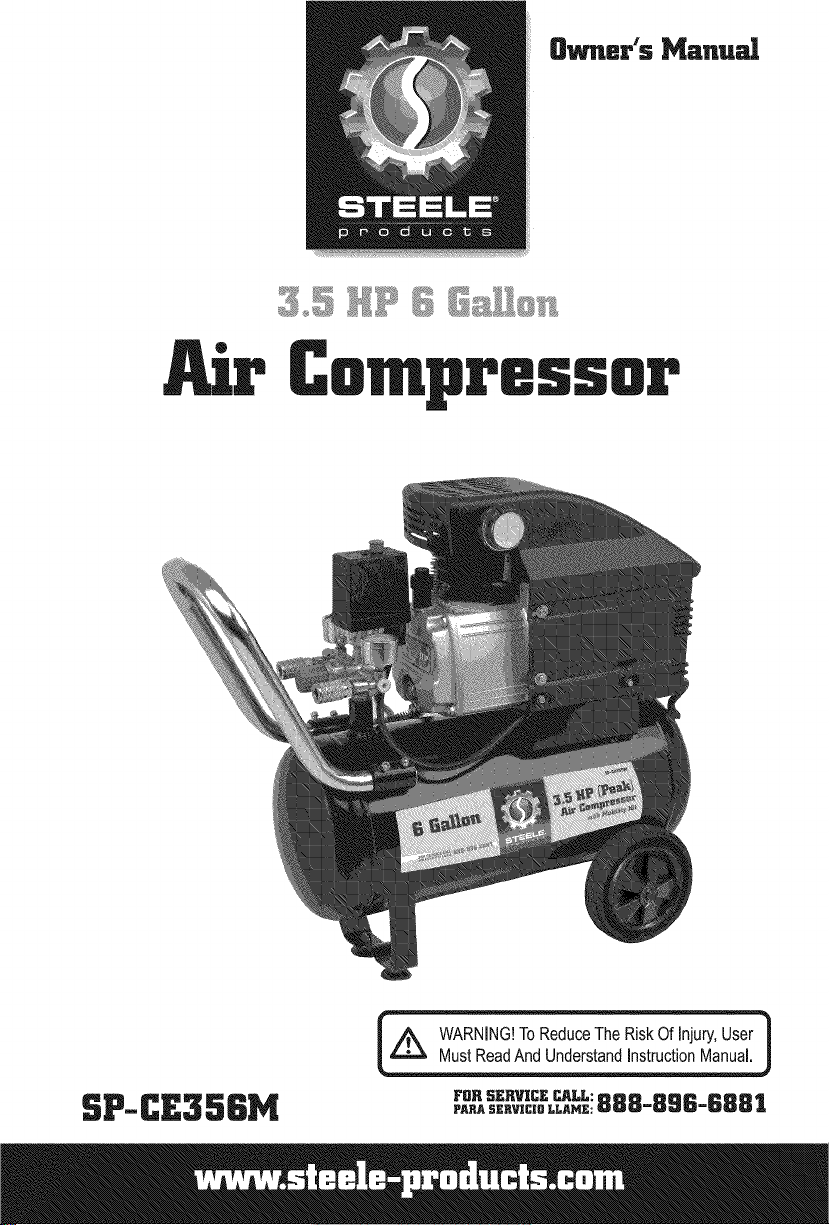
D_er's Manual
CU_lSress
SP-CSSM
FORSE_IC£ CALL:o@@ @a_ E@@q
PARA SERVlCI0 LLAME_ _LSUWmU_UmWUU &

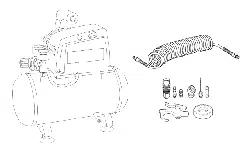
AirCompressor
Tableof Contents
Topic
Safety Guidelines - Definitions
Hazard Warnings
Air Compressor
• Precautions
• Basic Air Compressor Components
• Assembling the Compressor
• Compressor Controls
• Electrical Power Requirements
• Breaking In The Pump
• Operating Instructions
• Maintenance
• Storage
• Service
Troubleshooting
Glossary of Terms
Parts Listing
Limited Warranty
Page
4
5
15
15
16
16
18
19
21
21
23
24
24
25
29
30
32
2
Owner'sManual
WARNING!READANDUNDERSTANDALL SAFETYPRECAUTIONSIN
THISMANUALBEFOREOPERATING.FAILURETOCOMPLYWITH
INSTRUCTIONSIN THISMANUALCOULDRESULTIN PERSONAL
INJURY,PROPERTYDAMAGE,AND/OR VOIDINGOFYOUR
WARRANTY.STEELE®WILLNOTBELIABLEFORANY
DAMAGEBECAUSEOFFAILURETOFOLLOWTHESEINSTRUCTIONS.
Compressor Inspection
Prior to installation and usage, thoroughly inspect air compressor
for damage or flaws.
• Check tank, compressor, compressor motor and pump for
any signs of damage or corrosion.
• Check all screws, bolts, nuts and fasteners. Confirm that they
are secure.
• Confirm that all fittings, tank petcock and hardware are free
of paint, rust and corrosion.
• Confirm that all compressor settings are correct prior to
set-up and usage.
Air Tool Inspection
Prior to connecting to compressor and usage, thoroughly inspect
each air tool for damage or flaws.
• Check entire tool assembly for any signs of damage or
corrosion.
• Check all assembly screws, bolts, nuts and fasteners and
confirm that they are secure.
• Confirm that all fittings, bits and hardware for integrity.
• Confirm that tool settings are correct prior to connection and
usage.
3
AirCompressor
SafetyGuidelines- Definitions
This manual contains important information that you need to know and
understand in order to protect YOUR SAFETY and to PREVENT
EQUIPMENT PROBLEMS. The following symbols help you recognize this
information. Please read the manual and pay attention to these sections.
WARNING!WARNINGSINDICATEA CERTAINTYORSTRONG
POSSIBILITYOFPERSONALINJURYORDEATHIF INSTRUCTIONS
ARENOTFOLLOWED.
CAUTION: CAUTIONS INDICATE A POSSIBILITY OF
EQUIPMENT DAMAGE IF INSTRUCTIONS ARE NOT
FOLLOWED.
Note: Notes give helpful information.
A
WARNING!IMPROPEROPERATIONORMAINTENANCEOFTHIS
PRODUCTCOULDRESULTIN SERIOUSINJURYANDPROPERTY
DAMAGE.READANDUNDERSTANDALLWARNINGSANDOPERATING
INSTRUCTIONSBEFOREUSINGTHISEQUIPMENT.WHENUSINGAIR
TOOLS,BASICSAFETYPRECAUTIONSSHOULDALWAYSBE
FOLLOWEDTOREDUCETHERISKOFPERSONALINJURY.
SaveTheseImportantSafety
Instructions!
Read and understand all of these safety instructions. Be
sure to retain them for future use.
4
Owner'sManual
HazardWarnings
Dust
WARNING!SOMEDUSTCREATEDBYPOWERSANDING,SAWING,
GRINDING,DRILLING,ANDOTHERCONSTRUCTIONACTIVITIES
CONTAINSCHEMICALSKNOWNTOTHESTATEOFCALIFORNIATO
CAUSECANCER,BIRTHDEFECTSOROTHERREPRODUCTIVEHARM.
These chemicals may include (but are not limitedto) the following:
• Lead from lead-based paints
• Crystalline silica from bricks and cement and other masonry products
• Arsenic and chromium from chemically-treated lumber
Your risk from these exposures varies, depending on how often you do this
type of work. To reduce your exposure to these chemicals: work in a well
ventilated area, and work with approved safety equipment, always wear
MSHA/NIOSH approved, properly fitting face masks or respirators when
using such tools.
Always follow basic safety precautions when using air tools to reduce the
risk of personal injury.
Bursting
Rust can weaken the tank. Drain the condensed water from the tank after
each use to reduce rusting. If a leak is detected in the tank, replace the tank
immediately. Do not weld, drill or modify the air tank of this compressor.
Welding or modifications on the air compressor tank can severely impair
tank strength and cause an extremely hazardous condition. Welding or
modifying the tank in any manner will void the warranty.
Check the manufacturer's maximum pressure rating for air tools and
accessories. Compressor outlet pressure must be regulated so as to never
exceed the maximum pressure rating of the tool. Relieve all pressure
through the hose before attaching or removing accessories.
Do not adjust the pressure switch or relief valve for any reason. Doing so
voids all warranties. They have been preset at the factory for the maximum
pressure of this unit. Personal injury and/or property damage may result if
the pressure switch or the relief valve are tampered with.
Do not use plastic or pvc pipe for compressed air. Use only galvanized steel
pipe and fittings for compressed air distribution lines.
5
AirCompressor
HazardWarnings(cont'd)
Riskof EyeorHeadInjury
What could happen:
• Air powered equipment and power tools are capable
of propelling materials such as fasteners, metal chips,
saw dust, and other debris at high speed, which could
result in serious eye injury.
• Compressed air can be hazardous. The air stream
can cause injury to soft tissue areas such as eyes,
ears, etc. Particles or objects propelled by the stream
can cause injury.
• Tool attachments can become loose or break and fly
apart propelling particles at the operator and others in
the work area.
How to prevent it:
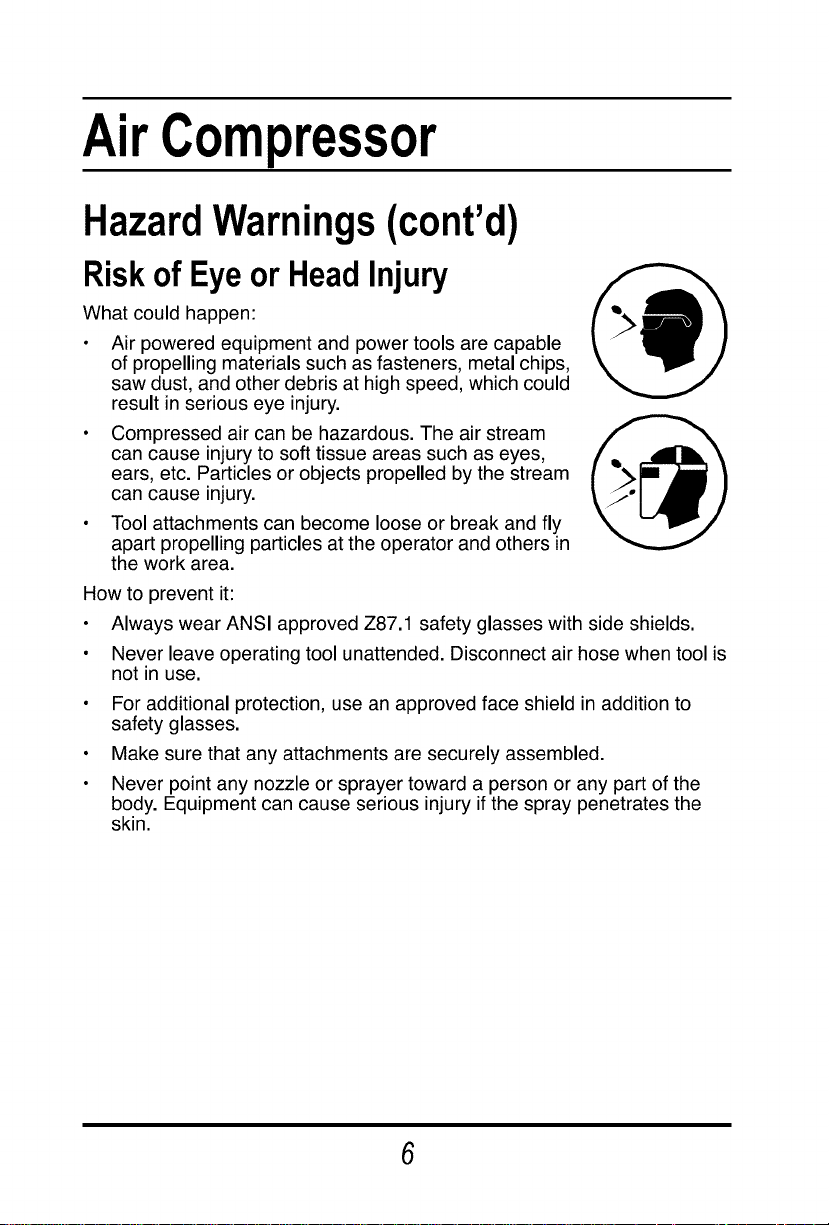
• Always wear ANSI approved Z87.1 safety glasses with side shields.
• Never leave operating tool unattended. Disconnect air hose when tool is
not in use.
For additional protection, use an approved face shield in addition to
safety glasses.
Make sure that any attachments are securely assembled.
Never point any nozzle or sprayer toward a person or any part of the
body. Equipment can cause serious injury if the spray penetrates the
skin.
6
Owner'sManual
HazardWarnings(cont'd)
Riskof FireorExplosion
What could happen:
• Abrasive toolssuch as sanders and grinders, rotating
tools such as drills, and impact tools such as nailers,
staplers, wrenches, hammers, and reciprocating saws
are capable of generating sparks which could result in
ignition of flammable materials.
• It is normal for the compressor motor and pressure
switch to produce sparks while operating. If sparks
come into contact with vapors from gasoline or other
solvents, they may ignite, causing fire or explosion.
• Exceeding the maximum pressure rating of tools or
accessories could cause an explosion resulting in
serious injury.
How to prevent it:
Never operate tools near flammable substances such as gasoline,
cleaning solvents, etc.
Work in a clean, well ventilated area free of combustible materials.
Never use oxygen, carbon dioxide or other bottled gases as a power
source for air tools.
• Use compressed air regulated to maximum pressure at or below the
rated pressure of any attachments.
• Never connect to an air source that is capable of exceeding 200 psi.
• Always verify prior to using the tool that the air source has been
adjusted to the rated air pressure range.
• Never spray flammable liquids in a confined area. Do not spray where
sparks or flame are present.
• Do not smoke while spraying.
• Keep compressor as far from spray area as possible.
AirCompressor
HazardWarnings(cont'd)
Riskof HearingLoss
What could happen:
• Long term exposure to noise produced from the
operation of air tools can lead to permanent hearing
loss.
How to prevent it:
• Always wear ANSI $3.19 hearing protection when using a compressor.
HazardRiSkto Breathing/Inhalation
What could happen:
• Abrasive tools such as grinders, sanders, and cut-off
tools generate dust and abrasive materials which can
be harmful to human lungs and respiratory system.
• Some materials such as adhesives and tar contain chemicals whose
vapors could cause serious injury with prolonged exposure.
How to prevent it:
• Always wear MSHA/NIOSH approved, properly fitting face mask or
respirator when using such tools. Read all instructions and be sure that
your respirator mask will protect you.
• Always work in a clean, dry, well ventilated area.
• Never directly inhale the compressed air produced by a compressor. It is
not suitable for breathing purposes.
• Be certain to read all labels when you are spraying paints or toxic
materials, and follow the safety instructions.
8
Owner'sManual
HazardWarnings(cont'd)
Riskof Injury
What could happen:
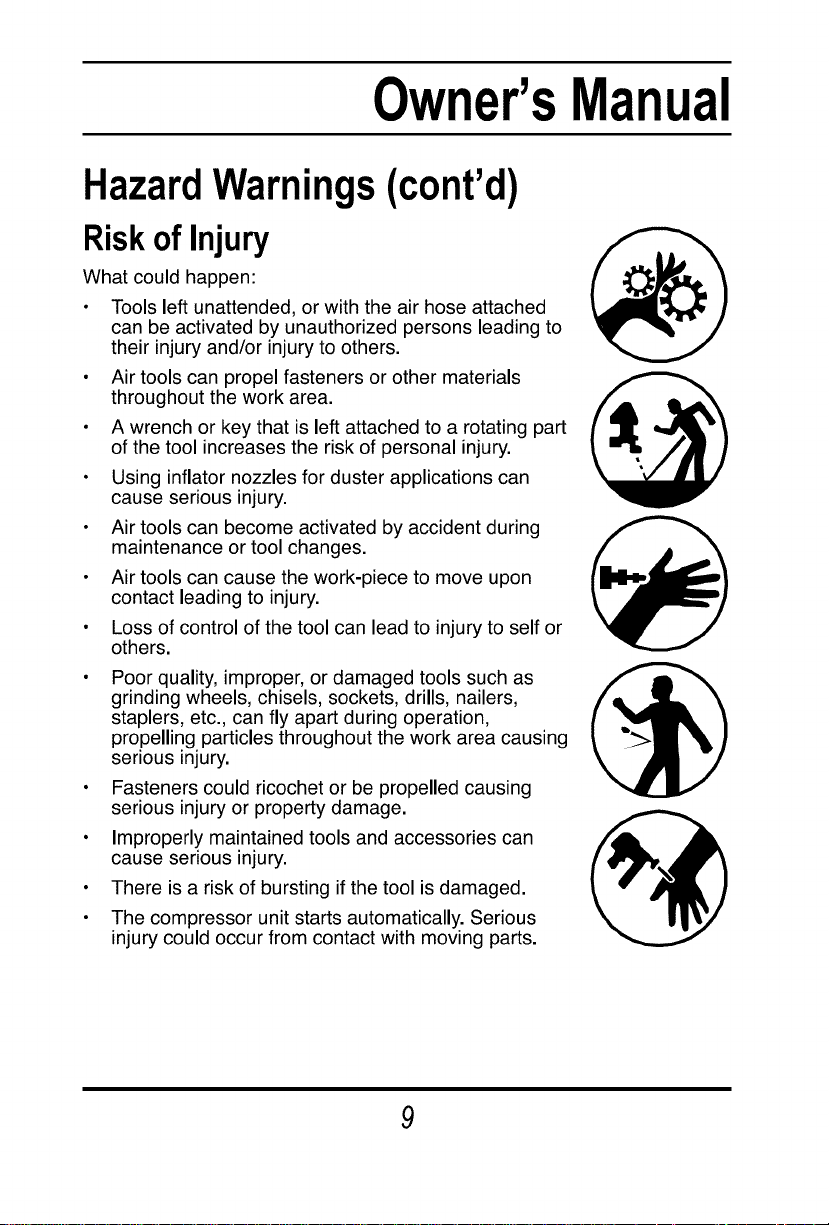
• Tools leftunattended, or withthe air hose attached
can be activated by unauthorized persons leadingto
their injuryand/or injuryto others.
• Air toolscan propelfasteners or other materials
throughoutthe work area.
• A wrench or key that is leftattached to a rotatingpart
of the tool increases the riskof personal injury.
• Using inflatornozzles for duster applicationscan
cause serious injury.
• Air tools can become activated by accident during
maintenance or tool changes.
• Air tools can cause the work-piece to move upon
contact leading to injury.
• Loss of control of the tool can lead to injury to self or
others.
Poor quality, improper, or damaged tools such as
grinding wheels, chisels, sockets, drills, nailers,
staplers, etc., can fly apart during operation,
propelling, particles throughout the work area causing
senous injury.
• Fasteners could ricochet or be propelled causing
serious injury or property damage.
• Improperly maintained tools and accessories can
cause serious injury.
There is a risk of bursting if the tool is damaged.
The compressor unit starts automatically. Serious
injury could occur from contact with moving parts.
9
AirCompressor
HazardWarnings(cont'd)
Riskof Injury(cont'd)
How to prevent it:
• Remove air hose when tool is not in use and store tool in secure location
away from reach of children and or untrained users.
• Use only parts, fasteners, and accessories recommended by the
manufacturer.
• Keep work area clean and free of clutter. Keep children and others
away from work area during operation of the tool.
• Keep work area well lit.
• Remove adjusting keys and wrenches before turning the tool on.
• DO NOT use inflator nozzles for duster applications.
• Remove air hose to lubricate or add grinding attachments, sanding
discs, drills, etc. to the tool.
• Never carry the tool by the hose.
• Avoid unintentional starting.
• Repair servicing should be done only by an authorized service
representative.
• Use clamps or other devices to prevent movement.
• Never operate tool while under the influence of drugs or alcohol.
• Don't overreach. Keep proper footing and balance of all times.
• Keep handles dry, clean and free from oil and grease.
• Stay alert. Watch what you are doing. Use common sense. Do not
operate tool when you are tired.
• Always use tool attachments rated for the speed of the power tool.
• Never use tools which have been dropped, impacted or damaged by
use.
10
Owner'sManual
HazardWarnings(cont'd)
Riskof Injury(cont'd)
• Use only impact grade sockets on an impact wrench.
• Do not apply excessive force to the tool. Let the tool perform the work.
• Never point discharge of tool at self or others.
• Do not pull trigger unless tool contact safety device is against work
surface.
• Never attempt to drive fasteners into hard surfaces such as steel,
concrete, or tile when using air tools.
• Take care to avoid driving a fastener on top of another fastener.
• Position tool carefully so that fasteners will be delivered to the proper
location.
• Use only accessories identified by the manufacturer to be used with
specific tools.
• Maintain the tool with care.
• Keep a cutting tool sharp and clean. A properly maintained tool, with
sharp cutting edges reduces the risk of binding and is easier to control.
• Check for misalignment of binding or moving parts, breakage of parts,
and any other condition that effects the tool's operation. If damaged,
have the tool serviced before using.
• Use of an accessory not intended for use with the specific tools
increases the risk of injury to persons.
• Always shut off the compressor, remove the plug from the outlet, and
bleed all pressure from the system before servicing the compressor, and
when the compressor is not in use.
• Do not operate the unit with the shroud removed.
11

AirCompressor
HazardWarnings(cont'd)
Riskof ElectricShock
What could happen:
• Using air tools to attach electrical wiring can result in
electrocution or death.
• Improper electrical connections can result in
fires,electrocution, or death.
This tool is not provided with an insulated gripping surface. Contact with
a "live" wire makes exposed metal tool parts "live", resulting in possible
electrocution or death.
• Fasteners coming in contact with hidden electrical wiring could cause
electrocution or death.
How to prevent it:
• Never attach electrical wiring with energized tools.
• Avoid body contact with grounded surfaces such as pipes, radiators,
ranges, and refrigerators. There is an increased risk of electric shock if
your body is grounded.
• Thoroughly investigate the work piece for possible hidden wiring before
performing work.
• A licensed electrician in accordance with all local and national codes
must install all wiring.
• Never use an electric air compressor outdoors when it is raining or on a
wet surface, as it may cause an electric shock.
12
Owner'sManual
HazardWarnings(cont'd)
Riskof Entanglement
What could happen:
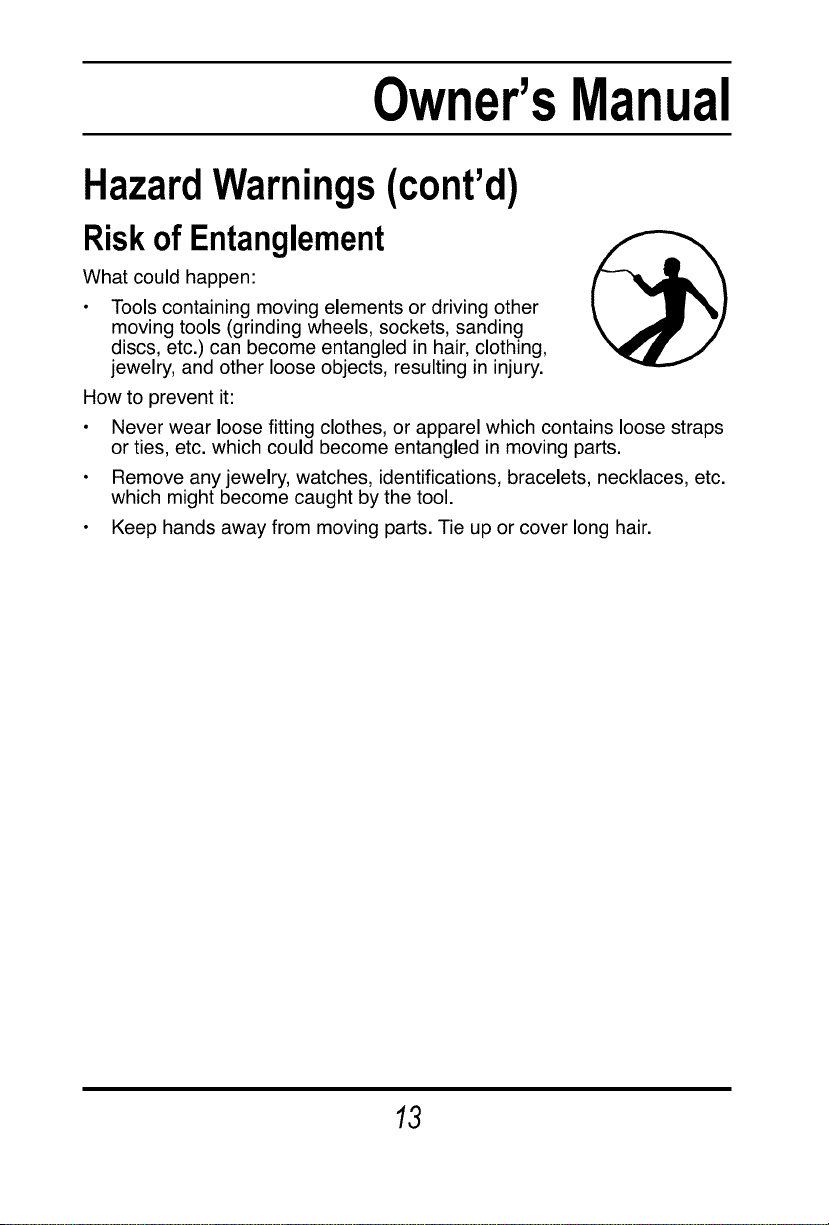
Tools containing moving elements or driving other
moving tools (grinding wheels, sockets, sanding
discs, etc.) can become entangled in hair, clothing,
jewelry, and other loose objects, resulting in injury.
How to prevent it:
• Never wear loose fitting clothes, or apparel which contains loose straps
or ties, etc. which could become entangled in moving parts.
• Remove any jewelry, watches, identifications, bracelets, necklaces, etc.
which might become caught by the tool.
Keep hands away from moving parts. Tie up or cover long hair.
13
AirCompressor
HazardWarnings(cont'd)
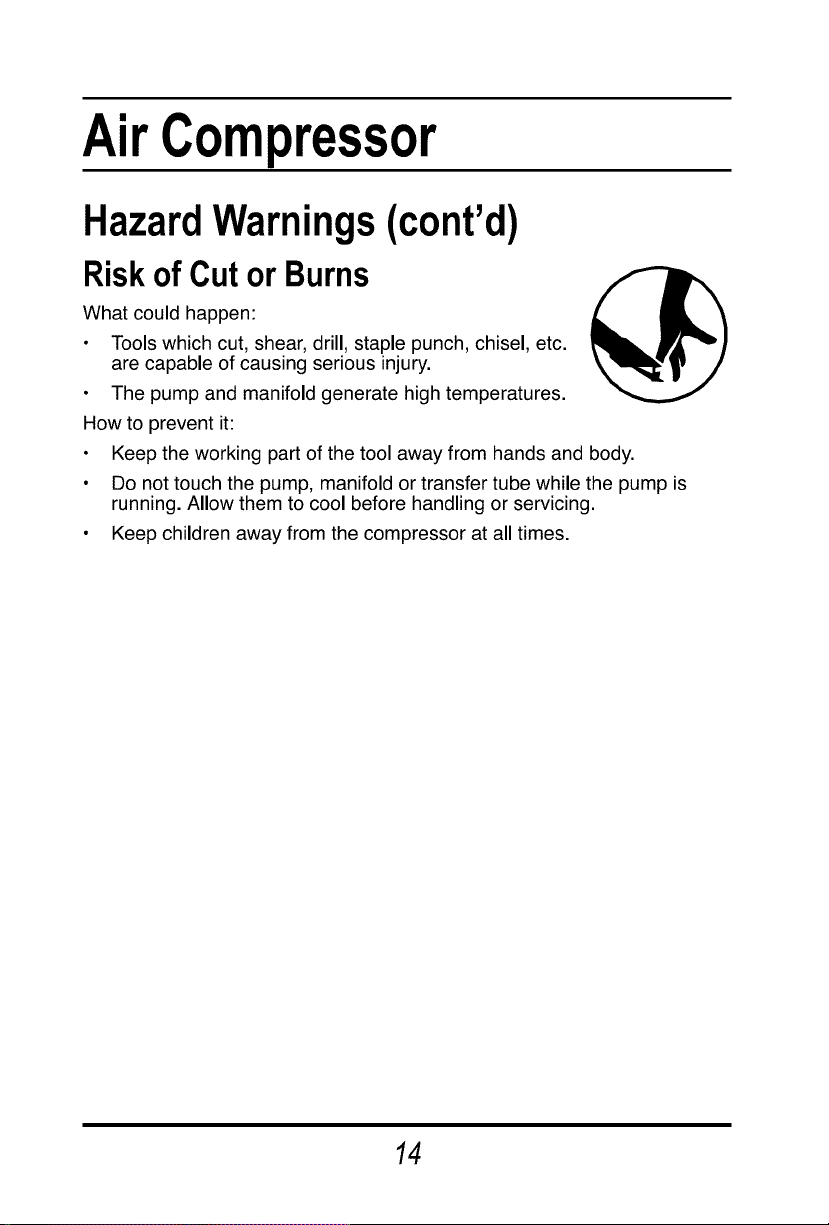
Riskof CutorBurns
What could happen:
• Tools which cut, shear, drill, staple punch, chisel, etc.
are capable of causing serious injury.
• The pump and manifold generate high temperatures.
How to prevent it:
Keep the working part of the tool away from hands and body.
• Do not touch the pump, manifold or transfer tube while the pump is
running. Allow them to cool before handling or servicing.
• Keep children away from the compressor at all times.
14
Owner'sManual
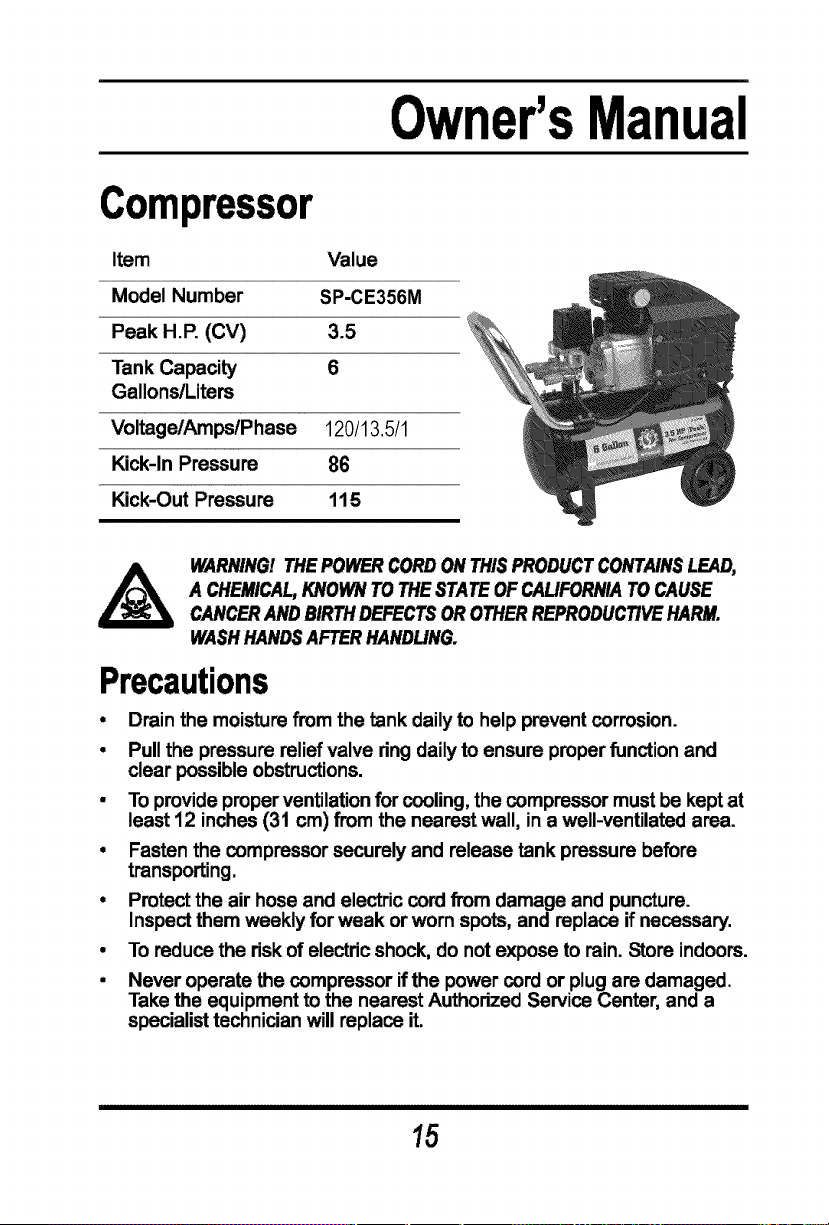
Compressor
Item Value
Model Number SP-CE356M
Peak H.P. (CV) 3.5
Tank Capacity 6
Gallons/Liters
Voltage/Amps/Phase 120/13.5/1
Kick-In Pressure 86
Kick-Out Pressure 115
WARNING!THEPOWERCORDONTHISPRODUCTCONTAINSLEAD,
A CHEMICAL,KNOR_ITOTHESTATEOFCALIFORNIATOCAUSE
CANCERANDBIRTHDEFECTSOROTHERREPRODUCTIVEHARM.
WASHHANDSAFTERHANDLING.
Precautions
• Drain the moisture from the tank daily to help prevent corrosion.
• Pullthe pressure relief valve ring dailyto ensure properfunctionand
clear possibleobstructions.
• To provideproperventilationfor cooling,the compressor mustbe kept at
least 12 inches (31 cm) from the nearest wall, in a well-ventilated area.
• Fasten the compressorsecurely and release tank pressure before
transporting.
° Protect the air hose and electriccord from damage and puncture.
Inspectthem weekly for weak or worn spots, and replace ifnecessary.
• To reducethe risk of electdc shock, do not expose to rain. Store indoors.
• Never operate the compressor ifthe power cord or plug are damaged.
Take the equipment to the nearest Authorized Service Center, and a
specialisttechnicianwill replace it.
15
Owner'sManual
Compressor(cont'd)
BasicAirCompressorComponents
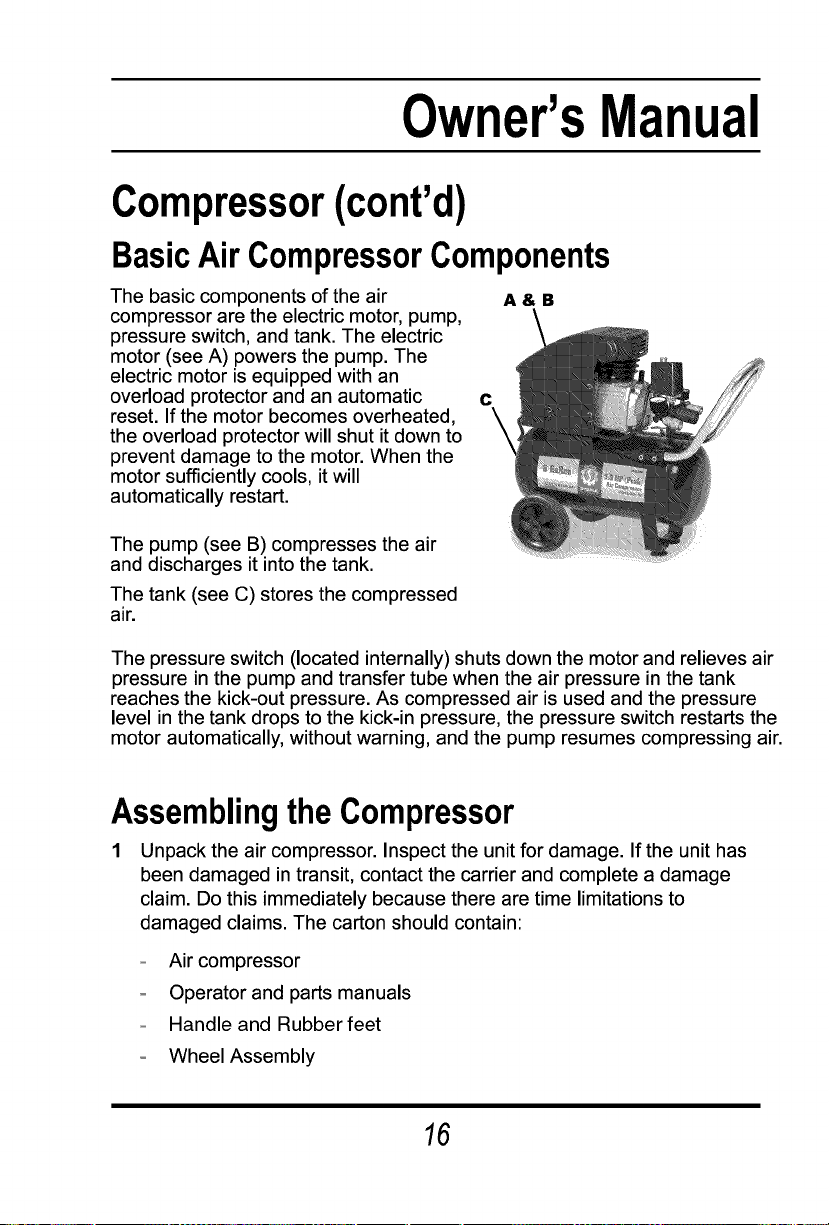
The basic components of the air A & B
compressor are the electric motor, pump, \
pressure switch, and tank. The electric
motor (see A) powers the pump. The
electric motor is equipped with an
overload protector and an automatic ¢
reset. If the motor becomes overheated,
the overload protector will shut it down to
prevent damage to the motor. When the
motor sufficiently cools, it will
automatically restart.
The pump (see B) compresses the air
and discharges it into the tank.
The tank (see C) stores the compressed
air.
The pressure switch (located internally) shuts down the motor and relieves air
pressure in the pump and transfer tube when the air pressure in the tank
reaches the kick-out pressure. As compressed air is used and the pressure
level in the tank drops to the kick-in pressure, the pressure switch restarts the
motor automatically, without warning, and the pump resumes compressing air.
AssemblingtheCompressor
1 Unpack the air compressor. Inspect the unit for damage. Ifthe unit has
been damaged in transit, contact the carrier and complete a damage
claim. Do this immediately because there are time limitations to
damaged claims. The carton should contain:
Air compressor
Operator and parts manuals
Handle and Rubber feet
Wheel Assembly
16
AirCompressor
Compressor(cont'd)
AssemblingtheCompressor(cont'd)
Tighten the handle into its position
with screws included.
Check the compressor's serial label to ensure that you have received
the model ordered, and that it has the required pressure rating for its
intended use.
3 Locate the compressor according to the following guidelines:
a
b
c
d
Position the compressor near a grounded electrical outlet (see
GROUNDING INSTRUCTIONS, above).
The compressor must be at least 12 inches (31 cm) from any wall or
obstruction, in a clean, well-ventilated area, to ensure sufficient air
flow and cooling.
In cold climates, store portable compressors in a heated building
when not in use. This will reduce problems with motor starting and
freezing of water condensation.
Remove the compressor from the shipping pallet or carton and place
it on the floor or a hard, level surface. The compressor must be level
to ensure proper drainage of the moisture in the tank.
4 Connect an air hose to the compressor hose outlet.
17
Owner'sManual
Compressor(cont'd)
CompressorControls
Power switch : This switch turns the compressor power ON and OFF.
Pressure switch : This switch turns on the compressor. It is operated
automatically when the power switch is in the ON position, it allows the
compressor to start up or shut down automatically, without warning,
depending upon air demand.
• Pressure Relieve Valve: If the pressure switch does not shut down
the motor when pressure reaches the preset level, this valve will
pop open automatically to prevent over pressurization. To operate
manually, pull the ring on the valve to relieve air pressure in the tank.
• Tank Pressure Gauge: This gauge measures the pressure level of the
air stored in the tank. It is not adjustable by the operator, and does not
indicate line pressure.
• Air Pressure Regulator : This air pressure regulator enables you to
adjust line pressure to the tool you are using.
WARNING!NEVEREXCEEDTHEMAXIMUMWORKINGPRESSUREOF
THETOOL.TURNTHEKNOBCLOCKWISETOINCREASEPRESSURE,
ANDCOUNTERCLOCKWISETODECREASEPRESSURE.
18
AirCompressor
Compressor(cont'd)
Compressor Controls (cont'd)
• Regulated pressure gauge: This gauge measures the regulated
outlet pressure.
• Regulated pressure quick connect coupler: This coupler connects
to the regulated outlet pressure. Toconnect air hose, push coupler in.
To disconnect air hose, pull the coupler collar back and separate the coupling.
ElectricalPowerRequirements
ElectricalWiring
Refer to the air compressor's serial label for the unit's voltage and
amperage requirements.
Use a dedicated circuit. For best performance and reliable starting, the air
compressor must be plugged into a dedicated circuit, as close as possible
to the fusebox or circuit breaker. The compressor will use the full capacity of
a typical 15 amp household circuit. If other devices are on the same circuit,
the compressor may fail to start. Low voltage or an overloaded circuit can
result in sluggish starting that causes the motor overload protection system
circuit breaker to trip, especially in cold conditions.
Note: A circuit breaker is recommended. If the air compressor is
connected to a circuit protected by a fuse, use dual element time
delay fuses (Buss Fusetron type "1" only).
Note: Avoid use of extension cords. If using an extension cord
is necessary, be sure to use an extension with the correct
specifications.
For optimum performance, plug the compressor power cord directly into a
grounded wall socket. Do not use an extension cord unless absolutely
necessary. Instead, use a longer air hose to reach the area where the air is
needed.
If use of an extension cord cannot be avoided, the cord should be no longer
than 100 feet and be a minimum wire size of 14 gauge (AWG).
19
Owner'sManual
Compressor(cont'd)
ElectricalPowerRequirements(cont'd)
ExtensionCord
Use the chart on the right for
the proper extension cord length.
Use only a 3-wire extension cord
that has a 3-blade grounding plug, (120Volts) 25' 50'
and a 3-slot receptacle that will ac- .......................................................................................10-12 16 ...............................
14
cept the plug of the product. Make
sure your extension cord is in good 12-14 16 12
condition. An undersized cord will 14-16 16 12
cause a drop in line voltage as well
as a loss of power and overheating. 16-18 14 12
The smaller the gauge number, the .................i8:20............................i2 ........
heavier the cord.
Amp Length of
Rating Cord in Feet
100' 150'
10 8
10
10 8
88
GroundingInstructions
This product should be grounded. In the event of an electrical short circuit,
grounding reduces the risk ofelectric shock by providing an escape wire for
the electriccurrent.
This product is equipped with a cord having a grounding wire with an
appropriate grounding plug. The plug must be plugged into an outlet that is
properly installed and grounded in accordance with all local codes and
ordinance.
WARNING!IMPROPERINSTALLATIONOFTHEGROUNDINGPLUG
CANRESULTIN ARISKOFELECTRICSHOCK.IF REPAIROR
REPLACEMENTOFTHECORDORPLUGISNECESSARY,DONOT
CONNECTTHEGROUNDINGWIRETOEITHERFLATBLADETERMINAL.
THEWIRE/NSULATIONHAV/NGAN OUTERSURFACETHATIS GREEN
WITH,ORWITHOUT,YELLOWSTR/PESIS THEGROUNDINGWIRE.
This product is for use on a nominal 110 volt circuit.An outletwith a ground-
ingplug must be used.
Make sure that the product isconnected to an outlet having the same con-
figuration as the plug. No adapter should be used with this product.
Do not alter the plug to fit into a non-grounded or 2-slot receptacle.
20
AirCompressor
Compressor(cont'd)
Breaking Inthe Pump
1 Turn the pressure switch to the OFF position.
2 Open the petcock. Turn counterclockwise.
3 Plug in the power cord.
4 Turn the power switch to the ON position. The compressor will start.
Allow the compressor to run for 15 minutes, to break in the internal
parts.
_I CAUTION: AFTER ABOUT 15 MINUTES. IF THE UNIT DOES
NOT OPERATE PROPERLY. SHUT DOWN IMMEDIATELY,
AND CONTACT PRODUCT SERVICE.
5 After about 15 minutes, turn the power switch to the OFF position.
6 Close the petcock. Turn in the clockwise direction
7 Turn the power switch to the ON position. The compressor will start
and fill the tank to the kick-out pressure and stop.
_ ote: As compressed air is used, the pressure switch will restart
the motor automatically.
_ ote: During the initial break-in cycle, there willbe a slight
electrical smell as the motor brushes seat. This is normal for
universal motors and will last for about 5 minutes.
Operating Instructions
DailyStartup
1 Turn the power switch to the OFF position.
2 Close the tank petcock. Turn in the clockwisedirection.
3 Plug in the power cord.
21
Owner'sManual
Compressor(cont'd)
OperatingInstructions(cont'd)
4
WARNING!HIGHTEMPERATURESAREGENERATEDBY THE
ELECTRICALMOTORANDTHEPUMP.TOPREVENTBURNSOR
OTHERINJURIES,DONOTTOUCHTHECOMPRESSORWHILEIT IS
RUNNING.ALLOWIT TOCOOLBEFOREHANDLINGORSERVICING.
KEEPCHILDRENAWAYFROMTHECOMPRESSORATALL TIMES.
Turn the power switch tothe ON position.
WARNING!WHENADJUSTINGFROMA HIGHERTOA LOWER
PRESSURE,TURNTHEKNOBCOUNTERCLOCKWISETOREACHTHE
DESIREDPRESSURE.DONOTEXCEEDOPERATINGPRESSUREOF
THETOOLORACCESSORYBEINGUSED.
5 Adjust the regulator to the working pressure of the tool.
Shutdown
1 Turn the power switch to the OFF position.
2 Unplug the power cord.
3 Reduce pressure in the tank through the outlet hose. You can also pull
the relief valve ring and keep it open to relieve pressure in the tank.
WARNING!ESCAPINGAIRAND MOISTURECANPROPELDEBRIS
THATMAYCAUSEEYEINJURY.WEARSAFETYGOGGLESWHEN
OPENINGPETCOCK.
4 Tip the compressor (if necessary for your model) so the petcock is at the
bottom of the tank(s). Then open the petcock to allow moisture to
drain from the tank.
22
r
pressor
Compressor(cont'd)
Naintenance
_ WARNING!TOAVOIDPERSONALiNJURY,ALWAYSSHUTOFFAND UN-
PLUGTHECOMPRESSORANDREUEVEALL NR PRESSUREFROMTHE
SYSTEMBEFOREPERFORMINGANYSERWCEONTHEAiR COMPRESSOR.
Regular maintenance will ensure trouble free operation. Your electric
powered air compressor represents high quality engineering and
construction; however, even high quality machinery requires periodic
maintenance. Inspect the items listed below on a regular basis.
Lubrication
Thisair compressorrequiresregularlubricationfor properoperation.
Note: Use air compressor off such as SAE-20 (API CG/CD heavy
duty). Under extreme winter conditions use SAE-IO weight off.
Drain and refill the compressor oil after the first 100 hours of operation.
CAUTION: Compressors are shipped without oil. A smafl amount of
oil may be present in thepump upon receipt of the air compressor.
DO NOT A TTEMPT TO OPERATE THIS AIR COMPRESSOR WITH-
OUT FIRST ADDING OIL TO THE CRANKCASE. Serious damage
can resdt from even limited operation unless filled with oil and broken
in correctly. Follow initial start-up procedures closely.
WARNING!Draintank to releaseair pressurebeforeremoving theoilfill cap
or oil drain plug, Notdoingso could result inserious damagetothecom-
pressor aswell asserious injury.
DOHOTSTARTUH|T IIRTIL YOUHAVEADDEDOIL.
Place unit on a level surface. Remove oil fill plug and slowly add
compressor oil.
Theoil should befilled
to the middle of theoil
levelwindow.
OIL LEVELWINDOW
Drain and refill the compressor oil after the first 100 hours of operation,
23
Owner'sManual
Compressor(cont'd)
Maintenance (cont'd)
Draining the Tank
Relievetheairpressurein thesystemandopenthepetcockon thebottomofthetankto
drain.
WARNING!CONDENSATIONWILLACCUMULATEIN THETANK.TO
PREVENTCORROSIONOFTHETANKFROMTHEINSIDE,THIS
MOISTUREMUSTBEDRAINEDAT THEENDOFEVERYWORKDAY.BE
SURETOWEARPROTECTIVEEYEWEAR.
Note: In cold climates, drain the tank after each use to reduce
problems with freezing of water condensation.
Checking the Relief Valve
Pull the relief valve daily to ensure that it is operating properly and to clear
the valve of any possible obstructions.
Testingfor Leaks
Check that all connections are tight. A small leak in any of the hoses or pipe
connections will substantially reduce the performance of your air compressor.
If you suspect a leak, spray a small amount of soapy water around the area
of the suspected leak with a spray bottle. If bubbles appear, repair or replace
the faulty component. Do not overtighten any connections.
Storage
Before storing the compressor for a prolonged period, use an air blow gun to
clean all dust and debris from the STORAGE compressor. Disconnect the
power cord and coil it up. Pull the pressure relief valve to release all pressure
from the tank. Drain all moisture from the tank. Cover the entire unit to protect
it from moisture and dust.
Servicing
Perform the following maintenance at the intervals indicated below:
• Operate the pressure relief valve: Daily
• Drain tank: Daily
24
AirCompressor
Troubleshooting
Note: Troubleshooting problems may have similar causes and
solutions.
Low pressure, or notenoughair,or
compressordoes notstop
• Tank petcock is open
Close petcock
• Prolonged excessive use of air
Decrease amount of air used
• Compressor not large enough
Check air requirement of accessory. If it is higher than CFM and
pressure supplied by compressor, you need a larger compressor.
Most accessories are rated at 25% of actual CFM while running
continuously.
• Restricted checkvalve
Remove and clean or replace.
• Hole in air hose
Check and replace if necessary.
• Tank leaks
Replace tank
WARNING!IMMEDIATELYREPLACETANK.DONOTATTEMPTTO
REPAIR.
Blown seals
Replace any faulty seals.
Replace worn parts and reassemble with new seals.
25
Owner'sManual
Troubleshooting(cont'd)
Excessivestartingandstopping,whilenotin
use
• Fittingsleak
Check fittings with soapy water. Tighten or reseal leaking fittings. DO
NOT OVERTIGHTEN.
Replace worn parts and reassemble with new seals.
Replace any faulty seals.
• Air leaks from regulator, or regulator does not regulate pressure
Dirty or damaged regulator internal parts.
Replace regulator or internal parts.
• Regulated pressure gauge reading drops when air accessory is being
used.
o This is normal in some applications
Compressor not large enough
If pressure drops too low, adjust regulator while accessory is used.
Check air requirement of accessory, it may be higher than CFM pres-
sure supplied by compressor. Most accessories are rated at 25% of
actual CFM while running continuously.
Circuitbreakertrips(fuseblows) toooften
• Low voltage
Consult electrician.
• Excessive wire length
Furnish adequate power. If using extension cord, try again without it.
• Restricted air passages
Contact authorized service center.
• Back pressure in pump head
Replace check valve.
Replace pressure switch bleeder valve.
26
AirCompressor
Troubleshooting(cont'd)
Overheating
• Poor ventilation
Relocate compressor to an area with cool, dry and well-circulated air.
• Dirty cooling surfaces
Clean all cooling surfaces of pump and motor thoroughly.
• Leaking valve
Replace worn parts and reassemble with new seals.
Motorstalls
• Low voltage
Furnish adequate power.
• Defective pressure switch bleeder valve
Replace pressure switch bleeder valve
Pressurereliefvalve opens
• Tank pressure exceeded normal operating pressure
Replace pressure switch
• Pressure switch stuck
Replace pressure switch
Motorwill not run
• Tank pressure exceeds preset pressure switch limit
Motor will start automatically when tank pressure drops below kick-in
pressure of pressure tank.
• Motor overload protection has tripped
Let motor cool off and overload switch will automatically reset. This
may take several minutes.
27
Owner'sManual
Troubleshooting(cont'd)
Motorwillnot run(cont'd)
• Fuse blown or circuit breaker tripped
Replace blown fuse or reset circuit breaker. Do not use fuse or circuit
breaker with higher rating than specified for your branch circuit.
Check for proper fuse; "Fusetron" type T is acceptable.
Check for low voltage and proper extension cord size.
Disconnect other applications from circuit. Operate compressor on a
dedicated circuit.
• Checkvalve stuck open
Remove and clean or replace.
• Pressure bleeder valve on pressure switch has not unloaded head
pressure
Bleed line by moving pressure switch lever to OFF position before
restarting. If bleeder valve does not open, replace bleeder valve.
• Wrong wire gauge in extension cord
Check for proper gauge and extension cord length.
• Loose electrical connections
Contact authorized service center.
• Paint spray on internal motor parts
Bring to service center for service. Do not operate compressor in the
paint spray area.
o Possible defective motor
Bring to service center for inspection and repair.
28
Owner'sManual
Glossaryof Terms
• CFM: Cubic feet per minute; a unit of measure of air flow.
• PSI: Pounds per square inch; a unit of measure of air pressure,
• Kick-in pressure: Factory set low pressure point that starts the
compressor to repressurize the tank to a higher pressure
• Kick-out pressure: Factory set high pressure point that stops the
compressor from increasing the pressure in the tank above a certain
level.
Well-ventilated: A means of providing fresh air in exchange for
dangerous exhaust or vapors.
Dedicated circuit: An electrical circuit reserved for the exclusive use of
the air compressor.
ASME (American Society of Mechanical Engineers): Indicates that
the components are manufactured, tested and inspected to the
specifications set by ASME.
CSA (Canadian Standards Association): Indicates that the products
that have this marking have been manufactured, tested and inspected to
standards that are set by CSA.
Canadian Standards Association (USA): Indicates that the products
that have this marking have been manufactured, tested and inspected
to standards that are set by CSA. These products also conform to U.L.
standard 1450.
29
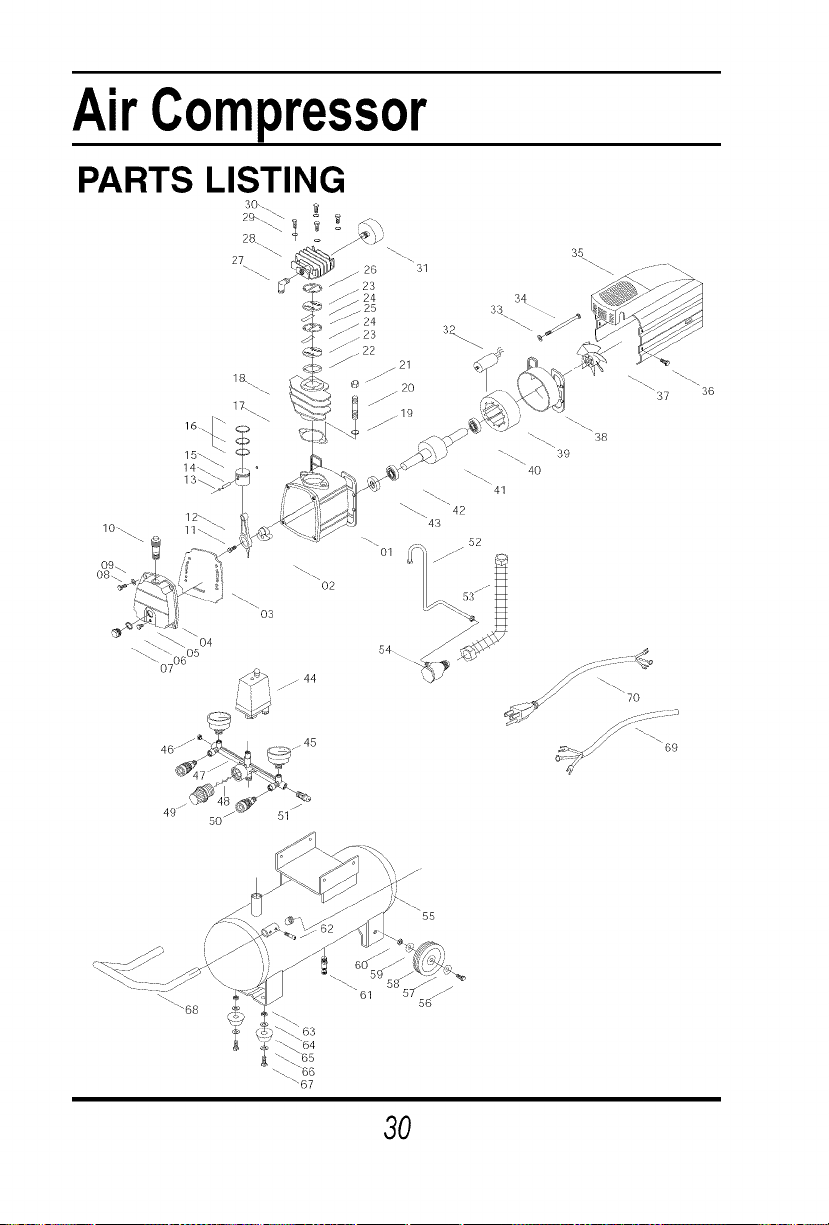
AirCompressor
PARTS LISTING
O3
01
O2
54
34
41
ss.
37 36
J
50 51
63
64
"-. 66
"67
61
30
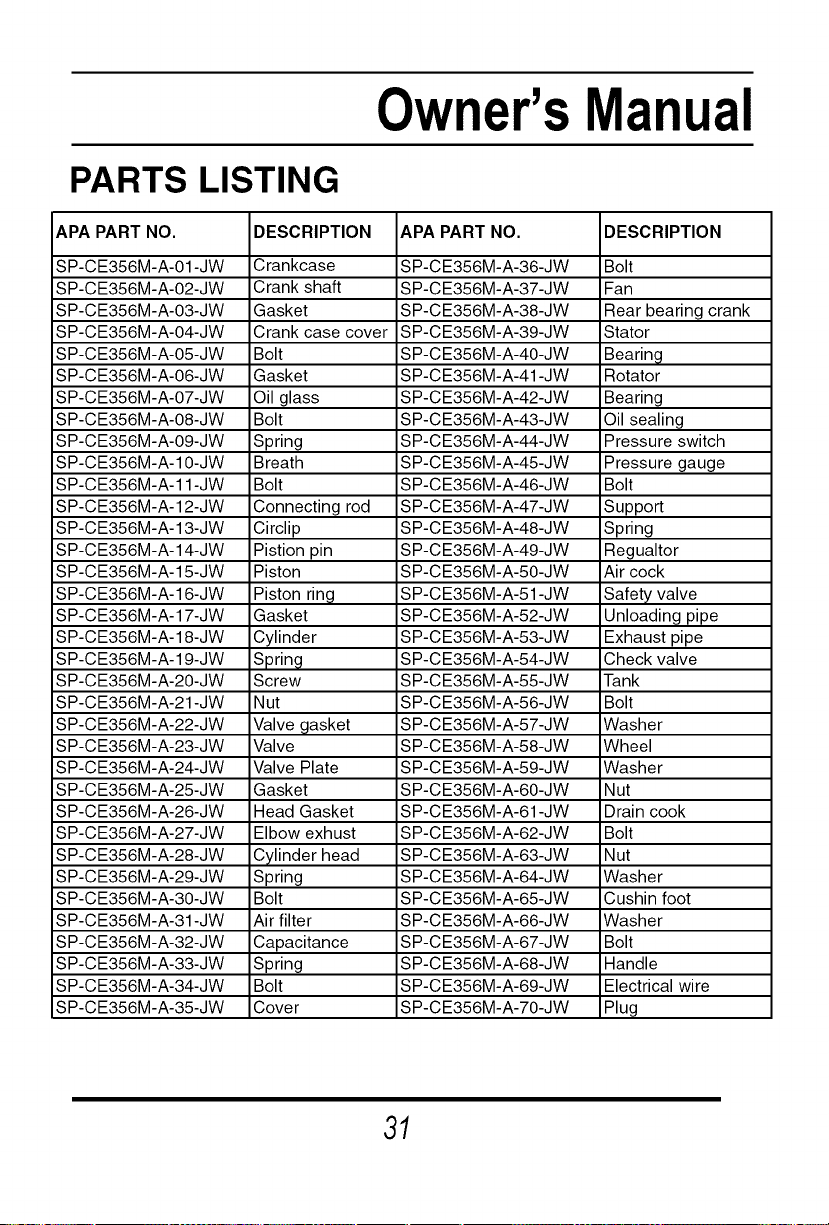
Owner'sManual
PARTS LISTING
APA PART NO.
SP-CE356M-A-01-JW
SP-CE356M-A-02-JW
SP-CE356M-A-03-JW
SP-CE356M-A-04-JW
SP-CE356M-A-05-JW
SP-CE356M-A-06-JW
SP-CE356M-A-07-JW
SP-CE356M-A-08-JW
SP-CE356M-A-09-JW
SP-CE356M-A-10-JW
SP-CE356M-A-11-JW
SP-CE356M-A-12-JW
SP-CE356M-A-13-JW
SP-CE356M-A-14-JW
SP-CE356M-A-15-JW
SP-CE356M-A-16-JW
SP-CE356M-A-17-JW
SP-CE356M-A-18-JW
SP-CE356M-A-19-JW
SP-CE356M-A-20-JW
SP-CE356M-A-21-JW
SP-CE356M-A-22-JW
SP-CE356M-A-23-JW
SP-CE356M-A-24-JW
SP-CE356M-A-25-JW
SP-CE356M-A-26-JW
SP-CE356M-A-27-JW
SP-CE356M-A-28-JW
SP-CE356M-A-29-JW
SP-CE356M-A-30-JW
SP-CE356M-A-31-JW
SP-CE356M-A-32-JW
SP-CE356M-A-33-JW
SP-CE356M-A-34-JW
SP-CE356M-A-35-JW
DESCRIPTION
Crankcase
Crank shaft
Gasket
Crank case cover
Bolt
Gasket
Oil glass
Bolt
Spring
Breath
Bolt
Connecting rod
Circlip
Pistion pin
Piston
Piston ring
Gasket
Cylinder
Spring
Screw
Nut
Valve gasket
Valve
Valve Plate
Gasket
Head Gasket
Elbow exhust
Cylinder head
Spring
Bolt
Air filter
Capacitance
Spring
Bolt
Cover
APA PART NO.
SP-CE356M-A-36-JW
SP-CE356M-A-37-JW
SP-CE356M-A-38-JW
SP-CE356M-A-39-JW
SP-CE356M-A-40-JW
SP-CE356M-A-41-JW
SP-CE356M-A-42-JW
SP-CE356M-A-43-JW
SP-CE356M-A-44-JW
SP-CE356M-A-45-JW
SP-CE356M-A-46-JW
SP-CE356M-A-47-JW
SP-CE356M-A-48-JW
SP-CE356M-A-49-JW
SP-CE356M-A-50-JW
SP-CE356M-A-51-JW
SP-CE356M-A-52-JW
SP-CE356M-A-53-JW
SP-CE356M-A-54-JW
SP-CE356M-A-55-JW
SP-CE356M-A-56-JW
SP-CE356M-A-57-JW
SP-CE356M-A-58-JW
SP-CE356M-A-59-JW
SP-CE356M-A-60-JW
SP-CE356M-A-61-JW
SP-CE356M-A-62-JW
SP-CE356M-A-63-JW
SP-CE356M-A-64-JW
SP-CE356M-A-65-JW
SP-CE356M-A-66-JW
SP-CE356M-A-67-JW
SP-CE356M-A-68-JW
SP-CE356M-A-69-JW
SP-CE356M-A-70-JW
DESCRIPTION
Bolt
Fan
Rear bearing crank
Stator
Bearing
Rotator
Bearing
Oil sealing
Pressure switch
Pressure gauge
Bolt
Support
Spring
Regualtor
Air cock
Safety valve
Unloading pipe
Exhaust pipe
Check valve
Tank
Bolt
Washer
Wheel
Washer
Nut
Drain cook
Bolt
Nut
Washer
Cushin foot
Washer
Bolt
Handle
Electrical wire
Plug
31
AirCompressor
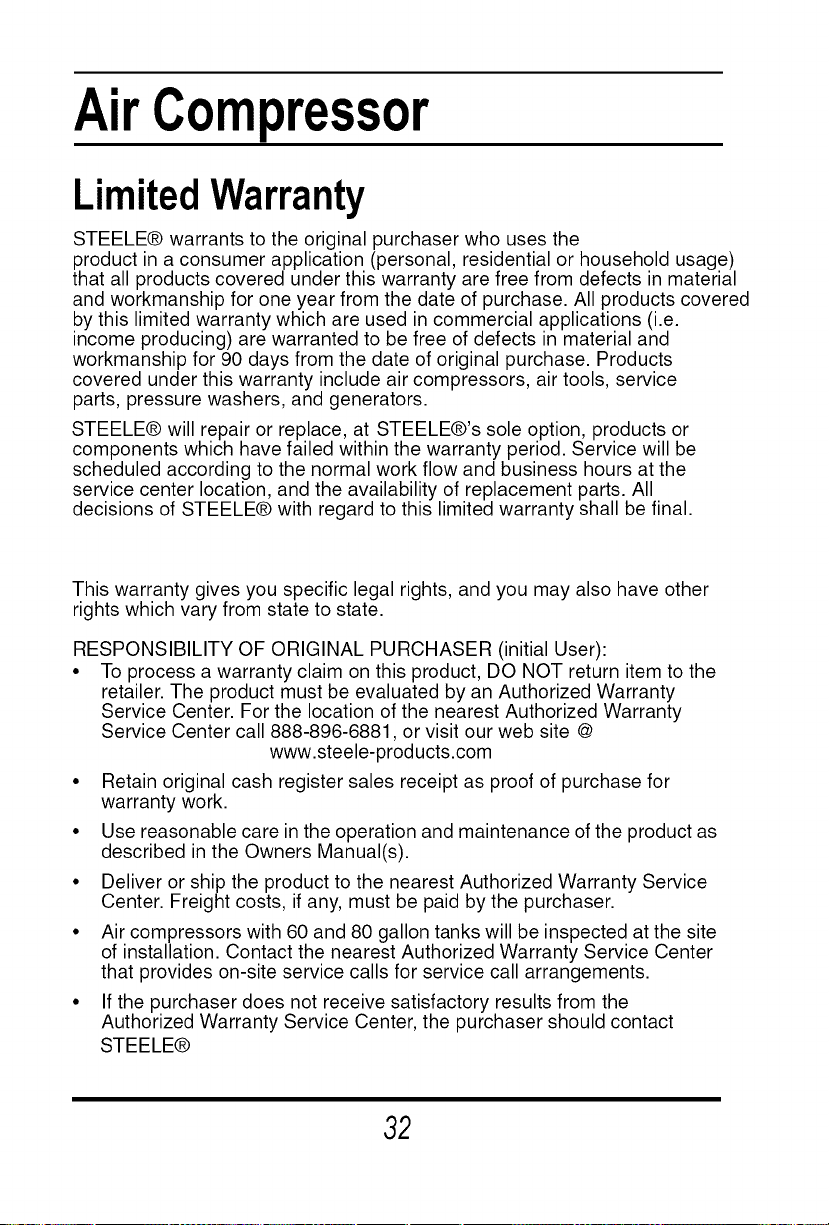
LimitedWarranty
STEELE@ warrants to the original purchaser who uses the
product in a consumer application (personal, residential or household usage)
that all products covered under this warranty are free from defects in material
and workmanship for one year from the date of purchase. All products covered
by this limited warranty which are used in commercial applications (i.e.
income producing) are warranted to be free of defects in material and
workmanship for 90 days from the date of original purchase. Products
covered under this warranty include air compressors, air tools, service
parts, pressure washers, and generators.
STEELE@ will repair or replace, at STEELE®'s sole option, products or
components which have failed within the warranty period. Service will be
scheduled according to the normal work flow and business hours at the
service center location, and the availability of replacement parts. All
decisions of STEELE® with regard to this limited warranty shall be final.
This warranty gives you specific legal rights, and you may also have other
rights which vary from state to state.
RESPONSIBILITY OF ORIGINAL PURCHASER (initial User):
• To process a warranty claim on this product, DO NOT return item to the
retailer. The product must be evaluated by an Authorized Warranty
Service Center. For the location of the nearest Authorized Warranty
Service Center call 888-896-6881, or visit our web site @
www.steele-prod ucts.com
• Retain original cash register sales receipt as proof of purchase for
warranty work.
• Use reasonable care in the operation and maintenance of the product as
described in the Owners Manual(s).
Deliver or ship the product to the nearest Authorized Warranty Service
Center. Freight costs, if any, must be paid by the purchaser.
Air compressors with 60 and 80 gallon tanks will be inspected at the site
of installation. Contact the nearest Authorized Warranty Service Center
that provides on-site service calls for service call arrangements.
If the purchaser does not receive satisfactory results from the
Authorized Warranty Service Center, the purchaser should contact
STEELE®
32
Owner'sManual
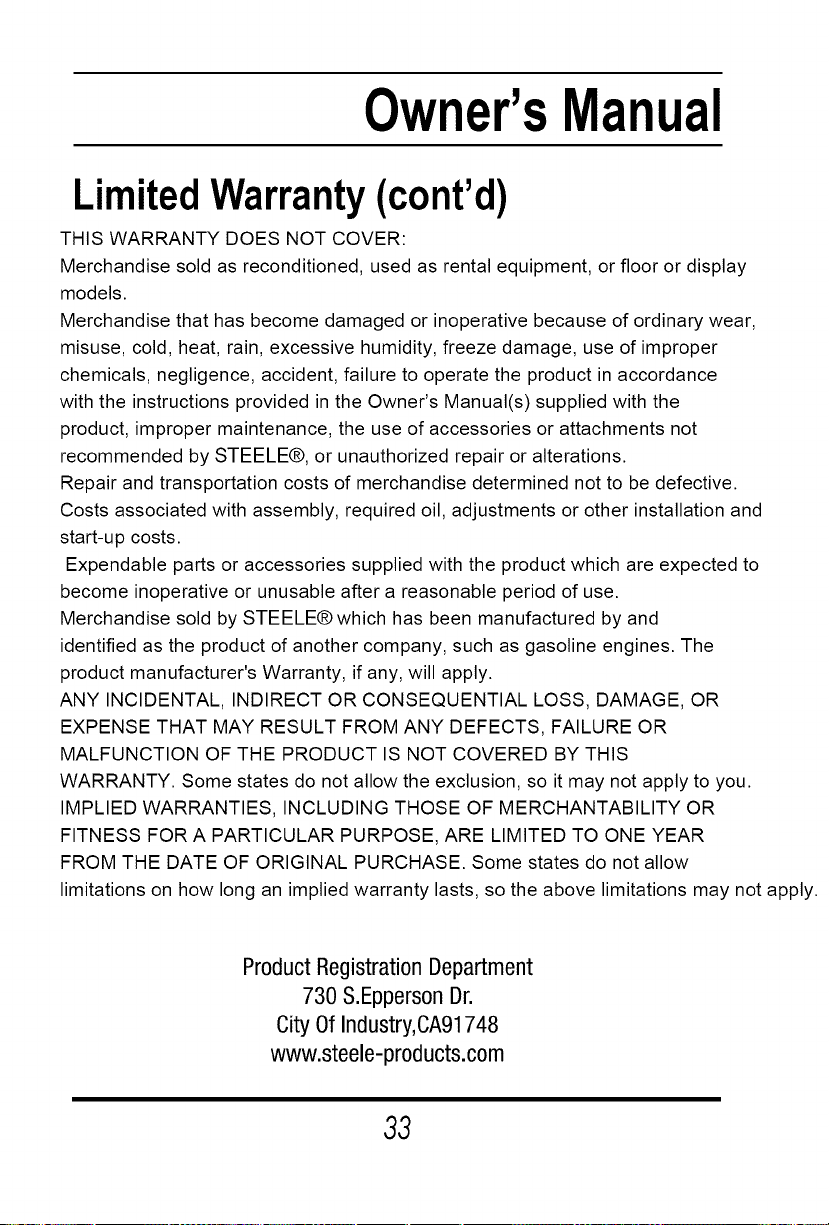
LimitedWarranty(cont'd)
THIS WARRANTY DOES NOT COVER:
Merchandise sold as reconditioned, used as rental equipment, or floor or display
models.
Merchandise that has become damaged or inoperative because of ordinary wear,
misuse, cold, heat, rain, excessive humidity, freeze damage, use of improper
chemicals, negligence, accident, failure to operate the product in accordance
with the instructions provided in the Owner's Manual(s) supplied with the
product, improper maintenance, the use of accessories or attachments not
recommended by STEELE(b, or unauthorized repair or alterations.
Repair and transportation costs of merchandise determined not to be defective.
Costs associated with assembly, required oil, adjustments or other installation and
start-up costs.
Expendable parts or accessories supplied with the product which are expected to
become inoperative or unusable after a reasonable period of use.
Merchandise sold by STEELE® which has been manufactured by and
identified as the product of another company, such as gasoline engines. The
product manufacturer's Warranty, if any, will apply.
ANY INCIDENTAL, INDIRECT OR CONSEQUENTIAL LOSS, DAMAGE, OR
EXPENSE THAT MAY RESULT FROM ANY DEFECTS, FAILURE OR
MALFUNCTION OF THE PRODUCT IS NOT COVERED BY THIS
WARRANTY. Some states do not allow the exclusion, so it may not apply to you.
IMPLIED WARRANTIES, INCLUDING THOSE OF MERCHANTABILITY OR
FITNESS FOR A PARTICULAR PURPOSE, ARE LIMITED TO ONE YEAR
FROM THE DATE OF ORIGINAL PURCHASE. Some states do not allow
limitations on how long an implied warranty lasts, so the above limitations may not apply.
Product Registration Department
730 S.EppersonDr.
CityOf Industry,CA91748
www.steele-products.com
33