Welcome .................................. 2
important Safety Instructions .. 3-5
Before Setting
Oven Controls ................. 13=14
Setting Oven Controls ......... 14
Setting Warmer Drawer Controls ...... 1 5
Cooking Jnformations ..... 16-17
Care & CWeaning .............. 18-25
Adjusting Your
Oven Temperature ................ 25
Before You Call
SoButions to
Commo.Problem,....................... 26-27
Visit the Frigidaire Web Site at:
http://www.frigidaire.com
Warranty ................ Back Cover
READ AND SAVE THESE INSTRUCTIONS 318203859 (0507} }::{ev. A
Welcome & Congratulations
Questions?
1°800°944°9044
(United States_
1°866°294°991 t
(Canada)
Phase attach sales receipt
here for future reference.
Congratulations on your purchase of a new appliance! At ElectroJux Home
Products, we are very proud of our product and are completely committed to
providing you with the best service possible, Your satisfaction is our number one
priority
We know you'll enjoy your new appliance and ThankYou for choosing our product,
We hope you consider us for future purchases,
PLEASE CAREFULLY READ AND SAVE THESE iNSTRUCTiONS
This Use & Care Manual contains general operating instructions for your appliance
and feature information for several models, Your product may not have all the
described features, The graphics shown are representative,The graphics on your
appliance may not look exactly like those shown, These instructions are not
meant to cover every possible condition and situation that may occur, Common
sense and caution must be practiced when installing, operating and maintaining
any appliance,
Ptease record your modeJ and seriaJ numbers beJow for future reference.
Model Number:
Serial Number:
Purchase Date:
Product Registration
Register Your Product
The PRODUCT REGISTRATION CARD should
be filled in completely, signed and returned to
Electrelux Home Products,
Versi6n en espaSom
Si desea ebtener una copia en espa_hol
de este Manual del Usuario, sirvase
escribir a la direcci6n que se incluye a
continuaci6n, Solicite la P/N
318203810E,
Spanish Use & Care Manual
Electrolux Home Products
P, O, Box 212378
Augusta, GA 30917
@ 2005 Ebctrolux Canada Corp.
All rights reserved
Printed in United States
Seda P ate Location
Serial Plate
Location
Storage drawer
Read aH instructions before using this appliance.
Save these instructions for future reference.
This guide contains important safety symbob and instructions. Phase pay special attention to these symbob and follow
all instructions given. Here is a brief explanation of these symboB.
This symbol Will he!p abrt YOUto s!tuations that may Cause serious bodi!y harm, deat h 0i property damage.
This Symbo I wiln henp ale rt you to s!tuati0ns that may Cause bod!!y !njury Oi Property darnagel
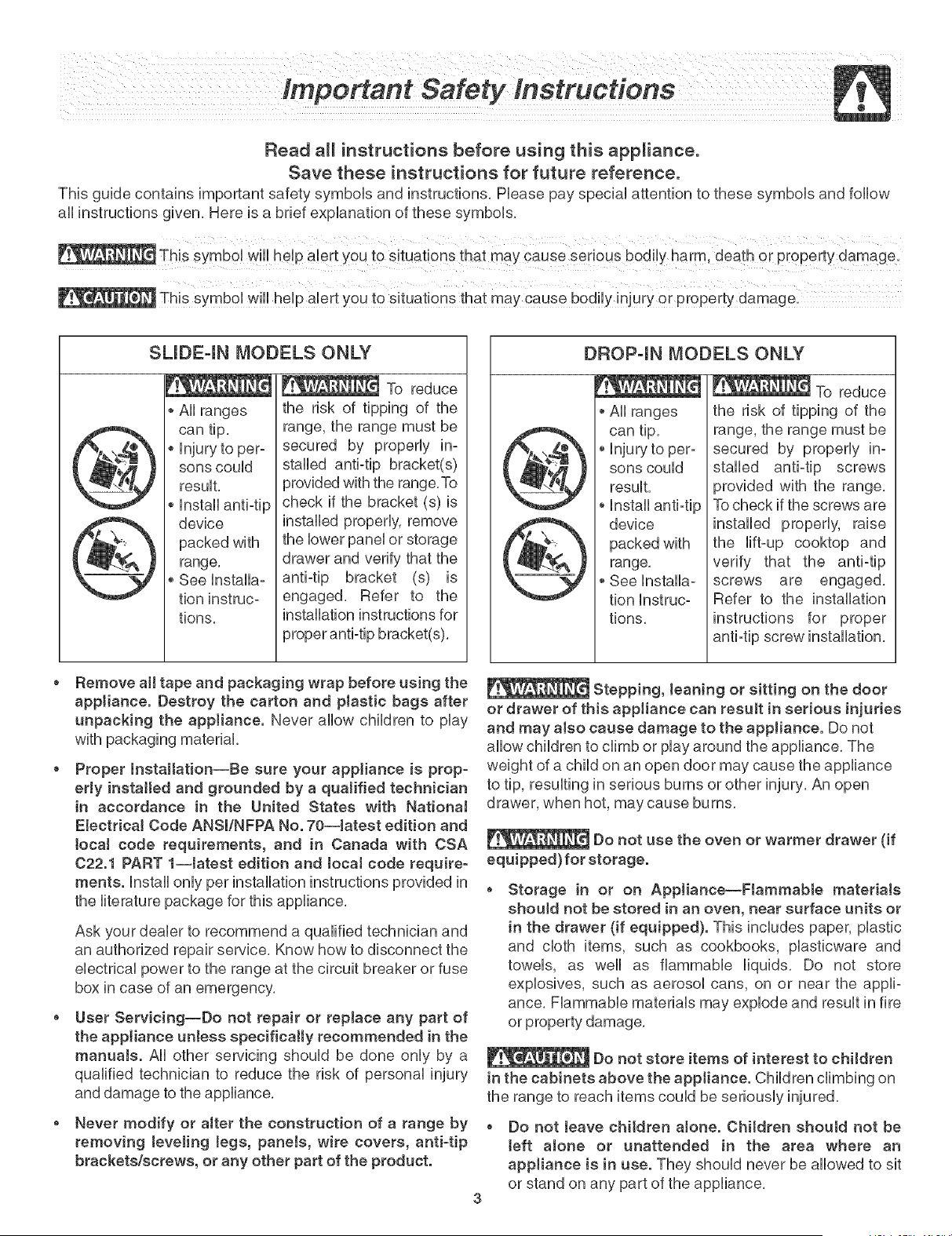
SUDE4N MODELS ONLY
o All ranges
can tip,
o injury to per-
sons could
result,
Install anti-tip
device
packed with
range,
See Installa-
tion instruc-
tions,
To reduce
the risk of tipping of the
range, the range must be
secured by properly in-
stalled anti-tip bracket(s)
provided with the range, To
check if the bracket (s) is
installed properly, remove
the lower panel or storage
drawer and verify that the
anti-tip bracket (s) is
engaged, Refer to the
installation instructions for
DROP-IN MODELS ONLY
All ranges
can tip,
injury to per-
sons could
result,
device
packed with
range,
See Installa-
tion instruc-
tions,
To reduce
the risk of tipping of the
range, the range must be
secured by properly in-
stalled anti-tip screws
)rovided with the range,
To check if the screws are
installed properly, raise
the lift-up cooktop and
verify that the anti-tip
screws are engaged,
Refer to the installation
instructions for proper
anti-tip screw installation,
Remove aH tape and packaging wrap before using the
appJiance. Destroy the carton and plastic bags after
unpacking the appliance. Never allow children to play
with packaging material.
Proper installation--Be sure your appliance is prop-
edy installed and grounded by a qualified technician
in accordance in the United States with NationaJ
Electrical Code ANSI/NFPA No. 70--latest edition and
total code requirements, and in Canada with CSA
022.1 PART l--latest edition and tocaJ code require-
ments. Install only per installation instructions provided in
the literature package for this appliance,
Ask your dealer to recommend a qualified technician and
an authorized repair service, Know how to disconnect the
electrical power to the range at the circuit breaker or fuse
box in case of an emergency,
User Servicing--Do not repair or replace any part of
the appliance unbss specifically recommended in the
manuaJs. All other servicing should be done only by a
qualified technician to reduce the risk of personal injury
and damage to the appliance,
Never modify or alter the construction of a range by
removing teveHng Jegs, paneJs, wire covers, anti-tip
brackets/screws, or any other part of the product.
Stepping, leaning or sitting on the door
or drawer of this appliance can result in serious injuries
and may also cause damage to the appliance. Do not
allow children to climb or play around the appliance, The
weight of a child on an open door may cause the appliance
to tip, resulting in serious burns or other injury, An open
drawer, when hot, may cause burns,
Do not use the oven or warmer drawer (if
equipped) for storage.
Storage in or on Appliance--Ftammabb materiaJs
should not be stored in an oven, near surface units or
in the drawer (if equipped). This includes paper, plastic
and cloth items, such as cookbooks, plasticware and
towels, as well as flammable liquids, Do not store
explosives, such as aerosol cans, on or near the appli-
ance, Flammable materials may explode and result in fire
or property damage,
Do not store items of interest to children
in the cabinets above the appliance. Children climbing on
the range to reach items could be seriously injured,
Do not Jeave children aJone. Children shoutd not be
teft aJone or unattended in the area where an
appliance is in use. They should never be allowed to sit
or stand on any part of the appliance,
DO NOTTOUCHSURFACEUNmTS,AREASNEAR
THESEUNmTS,OVENHEATmNGELEMENTSORmNTE-
RmORSURFACESOF THE OVEN OR WARMER
DRAWER(if equipped).Bothsurfaceunitsandoven
heatingeUementsmaybehoteventhoughtheyaredarkin
color,Areasnearsurfaceunitsmaybecomehotenough
tocauseburns,Duringandafteruse,donottouch,orUet
cUothingorotherflammaMemateriaUstouchtheseareas
untiltheyhavehadsufficienttimetocool Amongthese
areasarethecooktop,surfacesfacingthecooktop,the
ovenventopeningsandsurfacesneartheseopenings,
ovendoorandwindow,
WearProperAppare!--Loose-fittingor hanginggar-
mentsshould neverbe wornwhile usingtheappli-
ance.DonotUetcUothingor otherflammablematerials
contacthotsurfaces,
Neveruseyourappliancefor warmingor
heating the room.
o Do Not UseWater or Ftour on Grease Fires--Smother
the fire with a pan tid, or use baking soda, a dry
chemicaJ or foam-type extinguisher.
o When heating fat or grease, watch it closely. Fat or
grease may catch fire if allowed to become too hot,
Use Only Dry PothoJders--Moist or damp potholdere
on hot surfaces may result in burns from steam. Do
not let the petholders touch hot heating surface units or
interior oven elements, Do not use a towel or other bulky
cloth instead of a potholder,
o Do Not Heat Unopened Food Containers--Build up of
pressure may cause the container to buret and result
in injury.
o Remove the oven door from any unused appliance if
it is to be stored or discarded.
IMPORTANT--Do not attempt to operate the oven
during a power failure, if the power fails, aJways turn
the oven off. If the oven is not turned off and the power
resumes, the oven may begin to operate again, Food left
unattended could catch fire or spoil,
Electronic controllers can be damaged by
cold temperatures. When you use your appliance for the
first time, or if it has not been used for a long period of
time, make sure that it has been exposed to a tempera-
ture above 0°C/32°F for at teast 3 hours before
connecting it to the power supply.
mMPORTANT mNSTRUCTmONS FOR USmNG
YOUR COOKTOP
o Know which knob controls each surface heating unit.
Use Proper Pan Size--This appliance is equipped with
one or more surface units of different sizes, Select
utensils having flat bottoms large enough to cover the
surface unit, The use of undersized utensils will expose a
portion of the surface heating unit to direct contact and
may result in ignition of clothing, Proper relationship of
utensil to the surface unit will also improve efficiency,
Utensil HandJes ShouJd BeTumed Inward and ShouJd
Not Extend Over Adjacent Surface Units--To reduce
the risk of burns, ignition of flammable materials, and
spillage due to unintentional contact with the utensil, The
handle of the utensil should be positioned so that it is
turned inward, and does not extend over adjacent surface
unit,
o Never Leave Surface Units Unattended--Boilovers
cause smoking and greasy spillovers that may ignite, or a
pan that has boiled dry may melt,
Protective liners-- Do not use aluminum foil to line oven
bottom or any other part of the appliance, Only use
aluminum foil as recommended for baking if used as a
cover placed on the food, Any other used of protective
liners or aluminum foil may result in a risk of electric
shock or fire or a short circuit,
Glazed Cooking Utensils--Only certain types of glass,
glass/ceramic, ceramic, earthenware, or other glazed
utensils are suitable for cooktop service without breaking
due to the sudden change in temperature, Check the
manufacturer's recommendations for cooktop use,
Do Not Use Decorative Surface Element Covers, If an
element is accidentally turned on, the decorative cover
will become hot and possibly melt, Burns will occur if the
hot covers are touched, Damage may also be done to the
cooktop,
FOR GLASS COOKTOPS ONLY
o Do Not Ctean or Operate a Broken Cooktop --If
cooktop should break, cleaning solutions and spillovers
may penetrate the broken coektop and create a risk of
electric shock, Contact a qualified technician
CJean Cooktop GJass with Caution--If a wet sponge or
cloth is used to wipe spills on a hot cooking area, be
careful to avoid a steam burn, Some cleaners can
produce harmful fumes if applied to a hot surface,
o Avoidscratchingthe cooktopglass with sharpob-
jects.
mMPORTANT mNSTRUCTmONS FOR USING
YOUR OVEN
, Use Care When Opening Door or Warmer Drawer (if
equipped)--Stand to the side of the appliance when
opening the door of a hot oven, Let hot air or steam
escape before you remove or repUace food in the oven/
warmer drawer,
Keep Oven Vent Ducts Unobstructed. The oven is
vented at the front above the oven door (ceramic glass
cooktop models) or through the right rear element (coil
element models), Touching the surfaces in this area when
the oven is operating may cause severe burns, Also, do
not place plastic or heat-sensitive items on or near the
oven vent, These items could melt or ignite,
Placement of Oven/Warmer Drawer (if equipped}
Racks. AUways pUaceoven racks in desired bcation while
oven/drawer (if equipped) is cool Remove aft utensils
from the rack before removing rack, ff rack must be
moved while oven is hot, use extreme caution, Use
potholders and grasp the rack with both hands to
reposition, Do not let potholders contact the hot oven
element or interior of the oven/warmer drawer (if
equipped),
o Do not use the broiter pan without its insert. The broiler
pan and grid allow dripping fat to drain and be kept away
from the high heat of the broiler,
o Do not cover the broiler or warmer drawer (if
equipped} grid with aJuminum foit. Exposed fat and
grease could ignite,
Do not touch a hot tight buJb with a damp cloth. Doing
so could cause the bulb to break, Disconnect the
appliance or turn off the power to the appliance before
removing and replacing fight bulb,
IMPORTANT mNSTRUCTmONS FOR CLEANmNG
YOUR RANGE
o Clean the range reguJarly to keep aH parts free of
grease that could catch fire. Exhaust fan ventilation
hoods and grease filters should be kept clean, Do not
allow grease to accumulate, Greasy deposits in the fan
could catch fire, Refer to the hood manufacturer's instruc-
Cleaners/aerosols--Always follow the manufacturer's
recommended directions for use, Be aware that excess
residue from cleaners and aerosols may ignite causing
damage and/or injury,
SELF-CLEANmNG OVENS:
, CJean in the eetf-cJeaning cycte onty the parts of the
oven Hsted in this owner's guide. Before self-cbaning
the oven, remove the broiler pan and any utensils stored in
the oven,
o Do not ctean the oven door gasket. The door gasket is
essential for a good seal, Care should be taken not to rub,
damage or move the gasket,
o Oven racks. Oven racks color will change if left in the oven
during a self-cleaning cycle,
o Do not use oven cleaners. No oven cleaner or oven liner
protective coating of any kind should be used in or around
any part of the oven,
o Remove oven racks. Oven racks color will change if left in
the oven during a self-cleaning cycle,
The heaJth of some birds is extremely
sensitive to the fumes given off during the serf-clean
cycb of any range. Move birds to another welt ventilated
room.
IMPORTANT SAFETY NOTICE
The California Safe Drinking Water and Toxic Enforcement
Act requires the Governor of California to publish a list of
substances known to the state to cause cancer, birth defects
or other reproductive harm, and requires businesses to warn
customers of potential exposure to such substances.
SAVETHESE INSTRUCTmONS
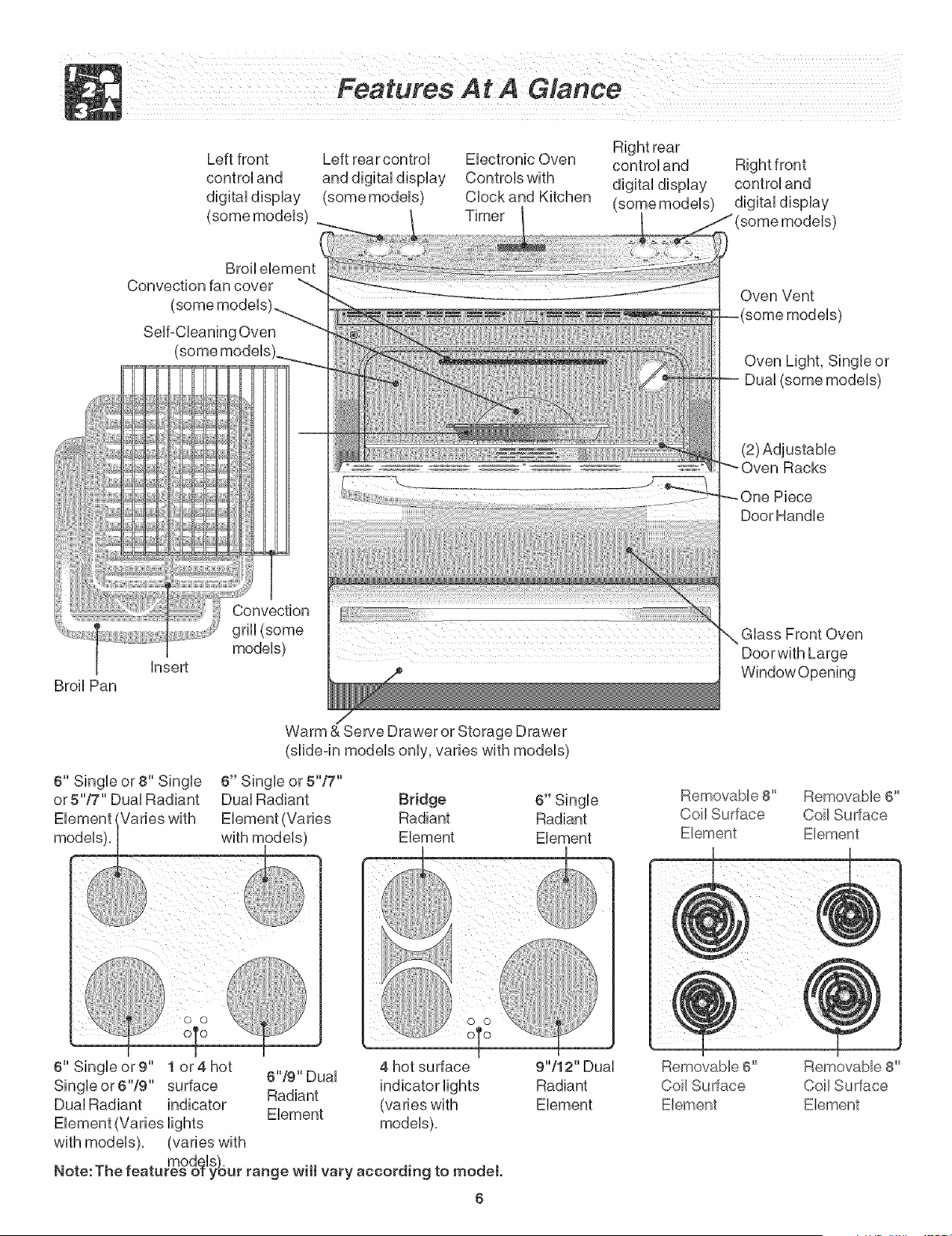
Right rear
Left front Left rear controU Ebctronb Oven controUand
controUand and digitaUdispUay ControUswith digitaUdispUay controUand
digitaUdispUay (somemodeb) Cbck and Kitchen digitaUdispUay
(some models) Timer some models)
Broil Pan
Broil element
Convection fan cover
(some models
SelfoCleaning Oven
(some models
Convection
grill (some
models)
insert
Oven Vent
some models)
Oven Light, Single or
(2) Adjustable
Oven Racks
Piece
Door Handle
Glass Front Oven
Doorwith Large
Window Opening
Warm & Serve Drawer or Storage Drawer
(slideoin models only, varies with models)
5" Single or 8" Single 5" Single or 5"/7"
or 5"/7" Dual Radiant Dual Radiant
Element i Varies with
models), with models)
I I
5"Singleorg" lor4hot
6"/9" Dual
Single or 6"/9" surface
Radiant
Dual Radiant indicator
Element
Bridge 6" Single
Radiant Radiant
Element Element
I
4 hot surface 9"/12" Dual
Radiant
(varies with Element
models),
with models), (varies with
mod is)
Note: The features _ y6ur range wilt vary according to mode1.
Removable 8" Removable 6"
Coil Surface Coil Surface
Ebment Element
Removabb 6"
Coil Surtace
Ebment
Removable 8"
Coil Sudace
Element

tVlodeIs with Coit Elements
I NOTE: AH knobs shown in this owner's Guide are typical only,
1, PUacethe pan on the surface eUement,
2, Push in and turn the surface eUement control knob to desired setting,
3, The surface signaUHghtwHUgUowwhen one or more eUementsare turned on, AUwaysturn
the eUement off before removing the pan,
Note: The size and type of utensil used, and the amount and type of food being
cooked wilt influence the setting needed for best cooking results,
Setting Type of Cooking
HU(MAX) Start most foods, bring water to a boll, pan broiling,
5(MED) Maintain a sUowboll, thicken sauces and gravies, steam
vegetables,
2-4(MED-LOW) Keep food cooking, poach, stew,
LO (MIN) Keep warm, melt, simmer,
*The suggested settings found in the chart above are based on cooking in medium
thickness aluminum pans with lids, Settings may vary when using other types of pans,
Do not place items such as saJt and pepper shakers, spoon holders or
ptastic wrappings on top of the cooktop when it is in use, These items could melt or
ignite, Potholders, towels or wood could catch fire if placed too close to the element,
OFF
4
med

Models with Ceramic Glass Cooktop
co co
co co
Model A Model B
oo
oo
oo
oo
Model C Model D
Cooktop radiant areas that heat
Your appliance may have one of these
configurations - Figure 1
_F _ OFF _
.... _ o_
Model B shown Only - Figure 2
NOTE: PUease read detailed instructions for
ceramic gUass cooktop cUeaning in the General
Care & Cteaning section and Before You Call
checklist section of this Use and Care Guide.
NOTE: Radiant elements have a limiter that
allows the element to cycle on and off, even at the
HI setting. This helps to prevent damage to the
ceramic smooth top. Cycling at the HI setting is
normal and can occur if the cookware is too small
for the radiant element or if the cookware bottom
is not flat (Refer to page 12 under Selecting
Surface Cooking Utensils).
About the Ceramic G_ass Cooktop
The ceramic cooktop has radiant surface elements located below the
surface of the glass. The design of the ceramic cooktop outlines the area
of the surface element underneath. Make sure the diameter of the pan
matches the diameter of the element outline on the cooktop (See Figure 1).
Heat is transferred up through the surface of the cooktop to the cookware.
Only flat-bottom cookware should be used. The type and size of cookware,
the number of surface elements in use and their settings, are all factors that
will affect the amount of heat that will spread to areas beyond the surface
elements. The areas surrounding the elements may become hot enough
to cause burns.
About the Radiant Surface E_ements
The element temperature rises gradually and evenly. As the temperature
rises, the element will glow red. To maintain the selected setting, the
element will cycle on and off. The heating element retains enough heat to
provide a uniform and consistent heat during the off cycle. For efficient
cooking, turn off the element several minutes before cooking is complete.
This will allow residual heat to complete the cooking process.
Locations of the Radiant Surface E_ements and Controls
Your range is equipped with radiant surface elements with different wattage
ratings. The ability to heat food quicker and in larger volumes increases as
the element wattage increases.
The radiant surface elements are located on the cooktop as follows:
Mode/A (See Figure 1):
- Two dual 5 or 7 inch radiant element at the right and left rear position;
- Two duaI 6 or 9 inch radiant element at the right and left front position;
Model B (see Figures 1 and 2) and Model C (Figure 1):
- One 6 inch radiant element at the right rear position;
- One 6 or one 8 inch radiant element at the left rear position (varies with
models);
- A dua! 6 or 9 inch radiant element at the right front position;
- A 6 or one 9 inch radiant element located at the left front position (varies
with models);
Model D (Figure 1):
- A 6 inch radiant element at the right rear position;
- A duat 6 or 9 inch radiant element at the right front position;
- Two 8 inch radiant elements located at both the left front and rear
positions.
- Between left front and rear elements is a Bridge radiant element. The
BRIDGE radiant element is controlled using the same knob that controls
the left front radiant element position.
NOTE: Due to the high intensity of heat generated by the surface
elements, the glass surface will turn green when the element will be
turned off. This phenomenon is normal and the glass will come back to
its original white color after it has completely cooled down. (White glass
cooktops only).
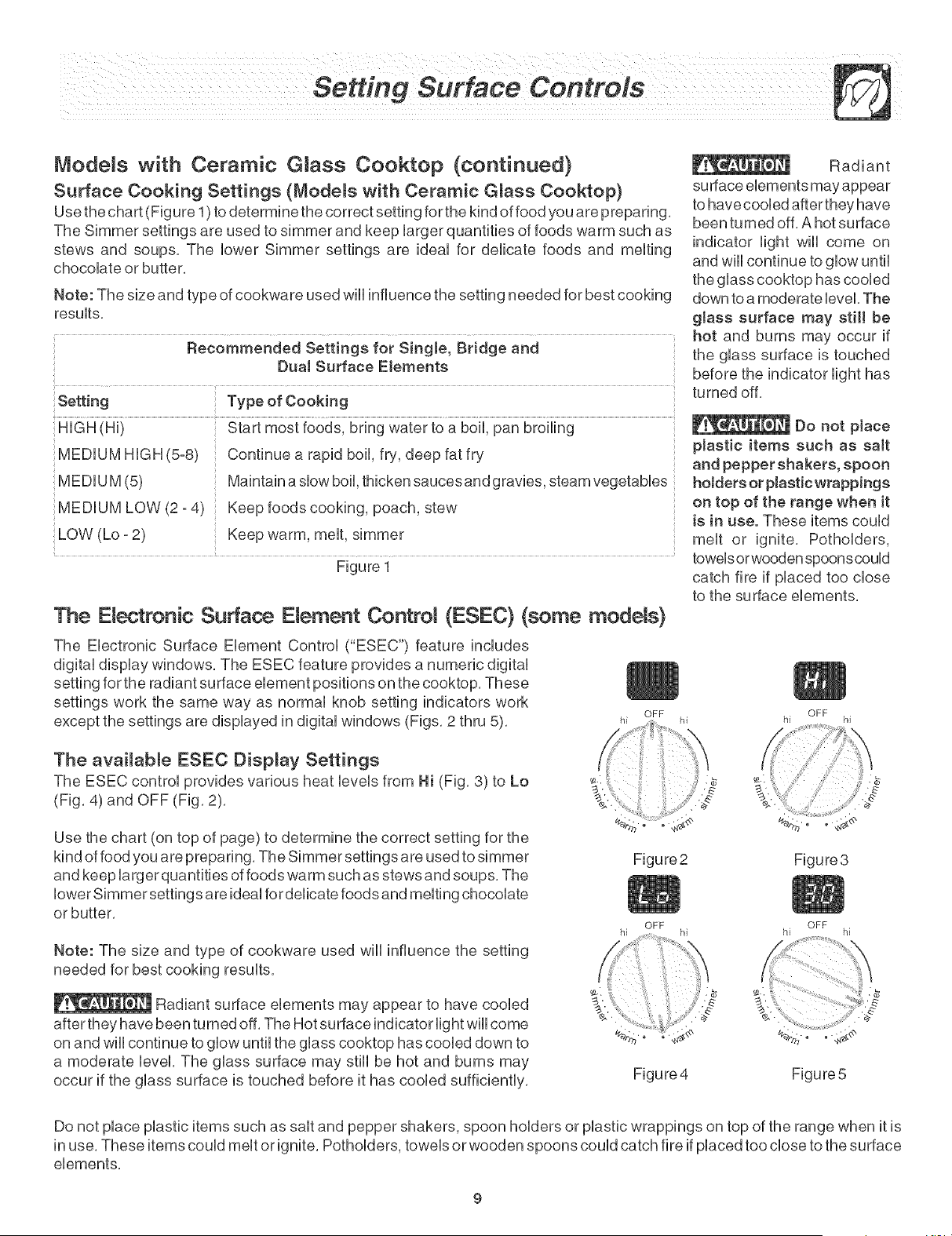
Models with Ceramic Glass Cooktop (continued)
Surface Cooking Settings (Models with Ceramic Glass Cooktop)
Use the chart (Figure 1) to determine the correct setting for the kind of food you are preparing,
The Simmer settings are used to simmer and keep Uargerquantities of foods warm such as
stews and soups, The bwer Simmer settings are ideaU for delicate foods and meUting
chocoUate or butter,
Note: The size and type of cookware used wHUinfluence the setting needed for best cooking
resuUts,
Recommended Settings for Single, Bridge and
Dual Surface EJements
Setting
HUGH(Hi_
MEDIUM HUGH/5-8/
MEDIUM _5_
MEDIUM LOW 2 -4}
LOW (Lo - 2}
Type of Cooking
Start most foods, bring water to a boil. pan broiling
Continue a rapid boi fry, deep fat fry
Maintain a slow boil. thicken sauces and g ravies, steam vegetables
Keep foods cooking, poach, stew
Keep warm, melt, simmer
Figure 1
The Electronic Surface Element Control (ESEC) (some models)
The Electronic Surface Element Control ("ESEC") feature includes
digital display windows, The ESEC feature provides a numeric digital
setting for the radiant surface element positions on the cooktop, These
settings work the same way as normal knob setting indicators work
except the settings are displayed in digital windows (Figs, 2 thru 5), hi
Radiant
surface elements may appear
to have cooled after they have
been turned off, A hot surface
indicator light will come on
and will continue to glow until
the glass cooktop has cooled
down to a moderate level, The
glass surface may still be
hot and burns may occur if
the glass surtace is touched
before the indicator light has
turned off,
Do not place
plastic items such as saJt
and pepper shakers, spoon
homers or plastic wrappings
on top of the range when it
is in use. These items could
melt or ignite, Potholders,
toweborwooden spoonscould
catch fire if placed too close
to the surface elements,
The avaimab_e ESEC Display Settings
The ESEC control provides various heat levels from Hi (Fig, 3) to Lo
(Fig, 4) and OFF (Fig, 2),
Use the chart (on top of page) to determine the correct setting for the
kind of food you are preparing, The Simmer settings are used to simmer
and keep larger quantities of foods warm such as stews and soups, The
lower Simmer settings are ideal for delicate foods and melting chocolate
or butter,
Note: The size and type of cookware used will influence the setting
needed for best cooking results,
Radiant surface elements may appear to have cooled
after they have been turned off, The Hot surface indicator light will come
on and will continue to glow until the glass cooktop has cooled down to
a moderate level, The glass surface may still be hot and burns may
occur if the glass surface is touched before it has cooled sufficiently,
Figure2 Figure3
OFF
hi hi
Do not place plastic items such as salt and pepper shakers, spoon holders or plastic wrappings on top of the range when it is
in use, These items could melt or ignite, Potholders, towels or wooden spoons could catch fire if placed too close to the surface
elements,
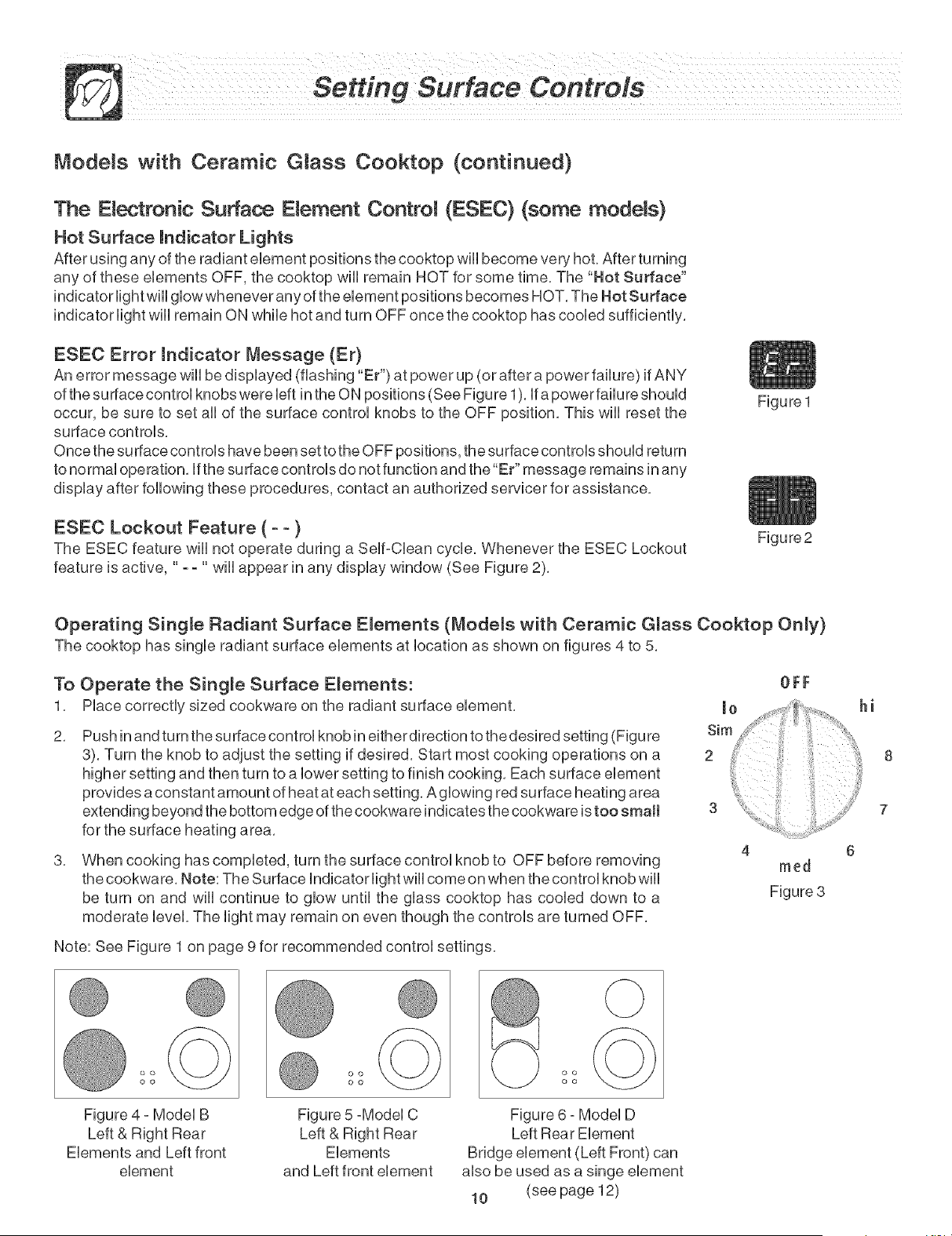
Models with Ceramic Glass Cooktop (continued)
The Electronic Surface Element Control (ESEC) (some models)
Hot Surface mndicator Lights
After using any of the radiant ebment positions the cooktop will become ve_/hot, After turning
any of these ebments OFF, the cooktop will remain HOT for some time, The "Hot Surface"
indicator light will glow whenever any of the element positions becomes HOT, The Hot Surface
indicator light will remain ON while hot and turn OFF once the cooktop has cooled sufficiently,
ESEC Error Indicator Message (Er)
An error message wiii be displayed (flashing "E¢') at power up (or after a power failure) if ANY
of the surface control knobs were left in the ON positions (See Figure 1), if a power failure should
occur, be sure to set all of the surface control knobs to the OFF position, This will reset the
surface controls,
Once the su dace controls have been set to the OFF positions, the surface controls should return
to normal operation, if the sudace controls do not function and the"Er" message remains in any
display after following these procedures, contact an authorized servicer for assistance,
ESEC Lockout Feature ( ° ° )
The ESEC feature will not operate during a Self-Clean cycle, Whenever the ESEC Lockout
feature is active, " - - " wiii appear in any display window (See Figure 2),
Figu re 1
Figure2
Operating Single Fladiant Surface E_ements (Mode_s with Ceramic G_ass Cooktop On_y)
The cooktop has single radiant surface elements at location as shown on figures 4 to 5,
To Operate the Single Surface E_ements:
1, Place correctly sized cookware on the radiant surface element,
2,
Push in and turn the su dace control knob in either direction to the desi red setting (Figu re
3), Turn the knob to adjust the setting if desired, Start most cooking operations on a
higher setting and then turn to a lower setting to finish cooking, Each surface element
provides a con stant amount of heat at each setting, A glowing red su dace heating area
extending beyond the bottom edge of the cookware indicates the cookware is too small
for the surface heating area,
3,
When cooking has completed, turn the surface control knob to OFF before removing
the cookware, Note: The Surface indicator light will come on when the control knob will
be turn on and wiii continue to glow until the glass cooktop has cooled down to a
moderate level, The light may remain on even though the controls are turned OFF,
Note: See Figure 1 on page 9 for recommended control settings,
4 6
reed
Figure 3
o o
o o
o o
o o
o o
o o
Figure 4 ° Model B
Left & Right Rear
Elements and Left front
element
Figure 5 -Model C
Left & Right Rear
Elements
and Left front element
Figure 6 - Model D
Left Rear Element
Bridge element (Left Front) can
ado be used as a singe element
10 (see page 12)
Models with Ceramic Glass Cooktop
(continued)
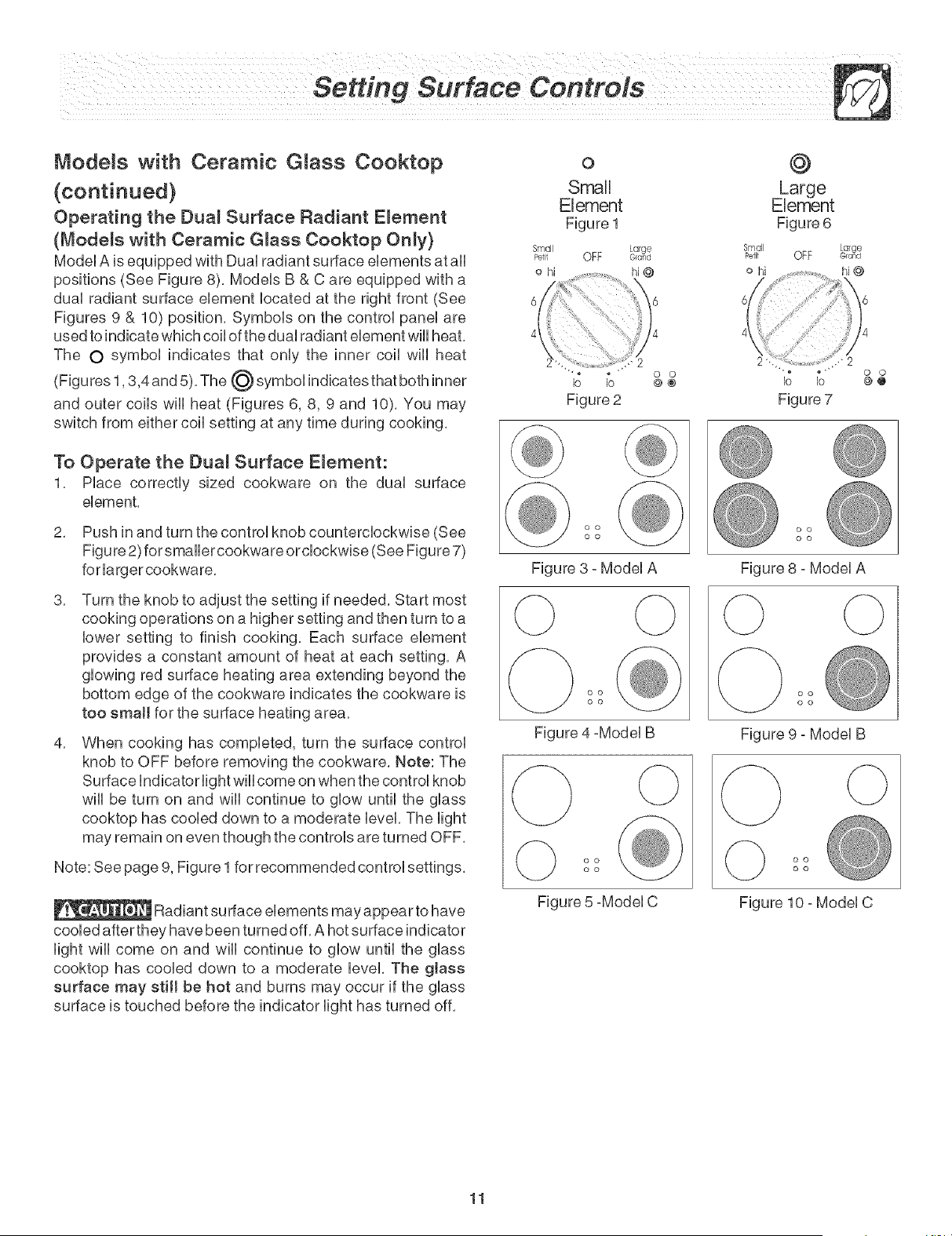
Operating the Dua_ Surface Radiant E_ement
(ModeJs with Ceramic G_ass Cooktop On_y}
Model A is equipped with DuaUradiant surface eUementsataH
positions (See Figure 8). ModeUs B & C are equipped with a
duaU radiant surface eUement Uocated at the right front (See
Figures 9 & 10) position. SymboUs on the controU paneU are
used to indicate which coil of the duaUradiant eUementwHUheat.
The 0 symboU indicates that onUy the inner coil will heat
(Figu res 1,3,4 and 5). The (_ symbol indicates that both inner
and outer coils will heat (Figures 6, 8, 9 and 10). You may
switch from either coil setting at any time during cooking.
To Operate the DuaJ Surface E_ement:
1, Place correctly sized cookware on the dual surface
element,
2. Push in and turn the control knob counterclockwise (See
Figu re2) for smaller cookware or clockwise (See Figure 7)
fodarger cookware.
3,
Turn the knob to adjust the setting if needed. Start most
cooking operations on a higher setting and then turn to a
lower setting to finish cooking. Each surface element
provides a constant amount of heat at each setting. A
glowing red surface heating area extending beyond the
bottom edge of the cookware indicates the cookware is
too small for the surface heating area.
4,
When cooking has completed, turn the surface control
knob to OFF before removing the cookware. Note: The
Surface Indicator light will come on when the control knob
will be turn on and will continue to glow until the glass
cooktop has cooled down to a moderate level. The light
may remain on even though the controls are turned OFF.
Note: See page 9, Figure 1 for recommended control settings.
cooled after they have been turned off. A hot surface indicator
light will come on and will continue to glow until the glass
cooktop has cooled down to a moderate level. The glass
surface may still be hot and burns may occur if the glass
surface is touched before the indicator light has turned off.
0
Small
Element
Figure 1
Small
Pe_i_ OFF
o hi hi @
2
o o
1o 1o @ ®
Figure 2
o o
o o
Figure 3 - Model A
) o o
o o
Figure 4 -Model B
oo@
o o
Figure 5 -Model C
@
Large
Element
Figure 6
Small
r_e_i_ OFF
o hi hi @
o o
Figure 8 - Model A
o o
o o
Figure 9 - Model B
o o
Figure 10 - Model C
11
Front
Bernent OFF
Models with Ceramic Glass Cooktop (continued)
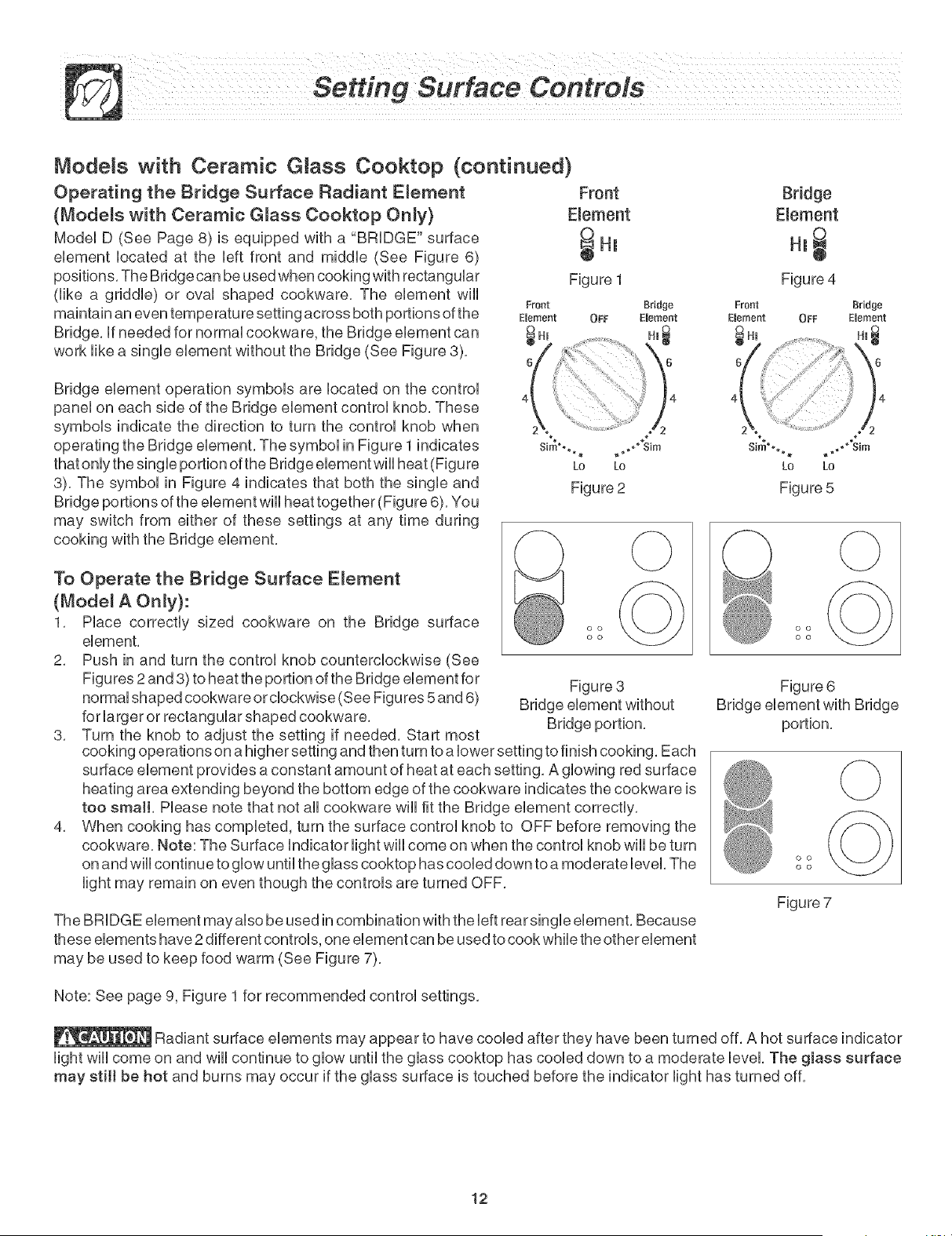
Operating the Bridge Surface Radiant Emement Front
(Models with Ceramic G_ass Cooktop On_y) Dement
Mode] D (See Page 8) is equipped with a "BRIDGE" surface 8 Hm
ebment bcated at the bft front and middb (See Figure 6)
g
positions, The Bridge car) be used when cooking with rectanguUar Figure 1
(]ike a griddUe) or ova] shaped cookware, The eUement wiU]
maintain an ever) temperature setting across both portions of the
Bridge, if needed for norma] cookware, the Bridge eUement car)
work like a single ebment without the Bridge (See Figure 3),
Bridge
Ememeet
Bridge element operation symbols are located on the control
panel on each side of the Bridge element control knob, These
symbols indicate the direction to turn the control knob when
operating the Bridge element, The symbol in Figure 1 indicates
that only the singb portion of the Bridge ebment will heat (Figure
3), The symbol in Figure 4 indicates that both the single and
Bridge portions of the element will heat together (Figure 6), You
may switch from either of these settings at any time during
cooking with the Bridge element,
Bridge
Element
Hi
Figure 4
Front Bridge
Element OFF Ememeet
4
Sim%_.,, ,,..*_*Sim
Lo Lo Lo Lo
Figure 2 Figure 5
To Operate the Bridge Surface E_ement
(IVlode_ A On_y):
1, Place correctly sized cookware on the Bridge surface
element, o o
2, Push in and turn the control knob counterclockwise (See
Figures 2 and 3) to heat the portion of the Bridge element for Figure 3
normal shaped cookware or clockwise (See Figures 5and 6)
for larger or rectangular shaped cookware,
3, Turn the knob to adjust the setting if needed, Start most
cooking operations on a higher setting and then turn to a lower setting to finish cooking, Each
surface element provides a constant amount of heat at each setting, A glowing red surface
heating area extending beyond the bottom edge of the cookware indicates the cookware is
too small, Please note that not all cookware will fit the Bridge element correctly,
4, When cooking has completed, turn the surface control knob to OFF before removing the
cookware, Note: The Surface Indicator light will come on when the control knob will be turn
on and will continue to glow until the glass cooktop has cooled down to a moderate level, The
light may remain on even though the controls are turned OFF,
The BRIDGE element may also be used in combination with the left rear single element, Because
these elements have 2 different controls, one element can be used to cook while the other element
may be used to keep food warm (See Figure 7),
o o
o o
Figure 6
Bridge element with Bridge
portion,
o o
o o
Figure 7
Note: See page 9, Figure 1 for recommended control settings,
Radiant surface elements may appear to have cooled after they have been turned off, A hot surface indicator
light will come on and will continue to glow until the glass cooktop has cooled down to a moderate level, The glass surface
may stilt be hot and burns may occur if the glass surface is touched before the indicator light has turned off,
12
Surface Cooking (Continued)
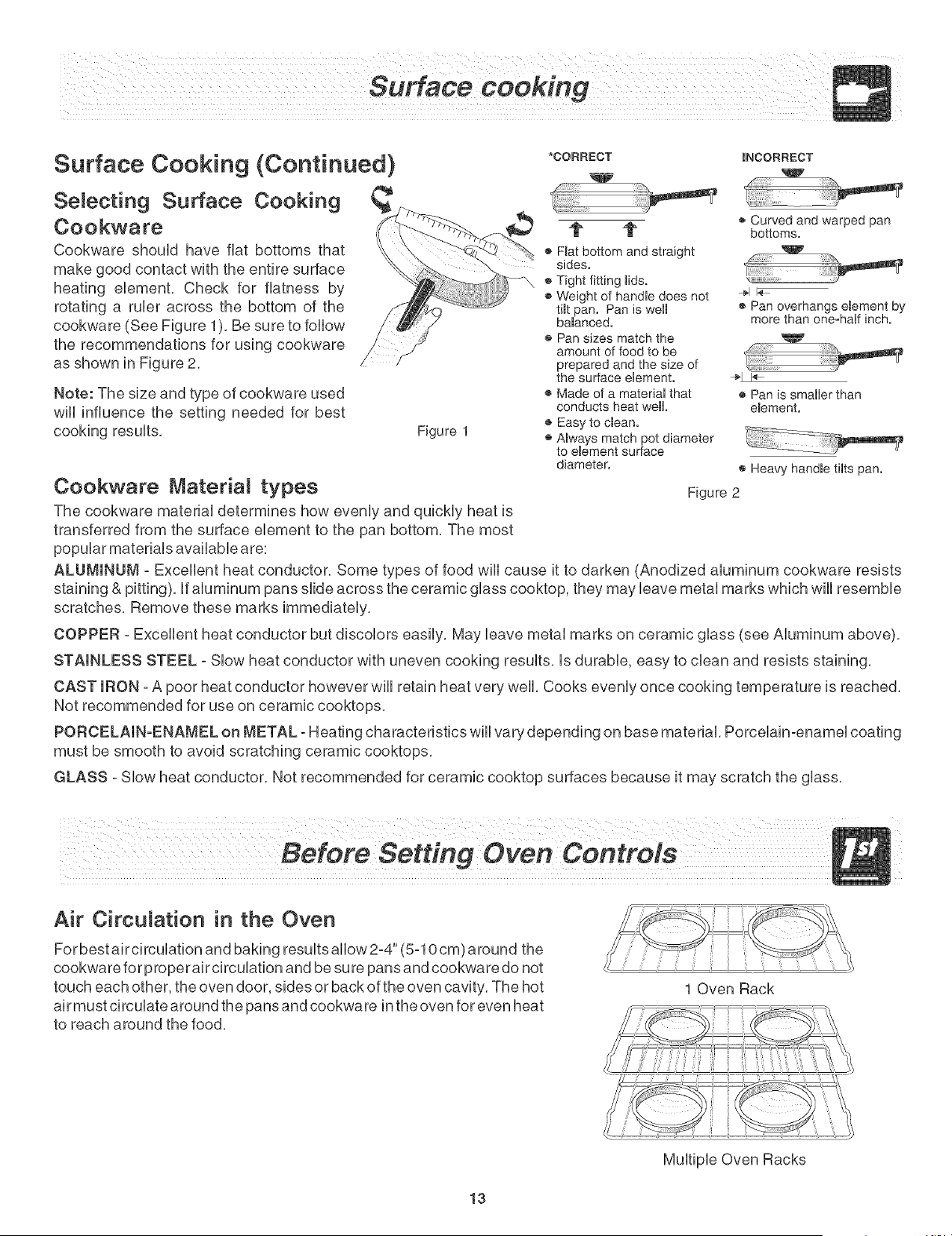
Selecting Surface Cooking
Cookware
Cookware should have fiat bottoms that
make good contact with the entire surface
heating element, Check for flatness by
rotating a ruler across the bottom of the
cookware (See Figure 1), Be sure to follow
the recommendations for using cookware
as shown in Figure 2,
Note: The size and type of cookware used
will influence the setting needed for best
cooking results, Figure 1
Cookware Material types
The cookware material determines how evenly and quickly heat is
transferred from the surface element to the pan bottom, The most
popular materials available are:
*CORRECT mNCORRECT
t
o Flat bottom and straight
sides.
® Tight fitting lids.
® Weight of handle does not
timtpan. Pan is welm
balanced.
® Pan sizes match the
amount of food to be
prepared and the size of
the surface element.
® Made of a material that
conducts heat weml.
o Easy to clean.
_, Always match pot diameter
to element surface
diameter.
,, Curved and warped pan
bottoms.
q4 IT
® Pan overhangs element by
more than one-half inch.
÷1 I_
® Pan is smaller than
element.
o Heavy handb tilts pan.
Figure 2
ALUMINUM - Excellent heat conductor, Some types of food wiii cause it to darken (Anodized aluminum cookware resists
staining & pitting), if aluminum pans slide across the ceramic glass cooktop, they may leave metal marks which will resemble
scratches, Remove these marks immediately,
COPPER - Excellent heat conductor but discolors easily, May leave metal marks on ceramic glass (see Aluminum above),
STAINLESS STEEL - Slow heat conductor with uneven cooking results, is durable, easy to clean and resists staining,
CAST IRON - A poor heat conductor however wiii retain heat very well, Cooks evenly once cooking temperature is reached,
Not recommended for use on ceramic cooktops,
PORCELAIN-ENAMEL on METAL - Heating characteristics wiii vary depending on base material, Porcelain-enamel coating
must be smooth to avoid scratching ceramic cooktops,
GLASS ° Slow heat conductor, Not recommended for ceramic cooktop surfaces because it may scratch the glass,
Air Circulation in the Oven
For best air circulation and baking results allow 2°4" (5-10 cm) around the
cookware for properaircirculation and be sure pans and cookware do not
touch each other, the oven door, sides or back of the oven cavity, The hot
air must circulate around the pans and cookware in the oven for even heat
to reach around the food,
1 Oven Rack
Multiple Oven Racks
13
Thisrangehasafan thatwilt turn "ON"and"OFF"by iteeffto keeptheebctronice cool. it may
continue to run after the range has been turned "OFF", but may aJso stop immediately and then turn "ON" after a
white.
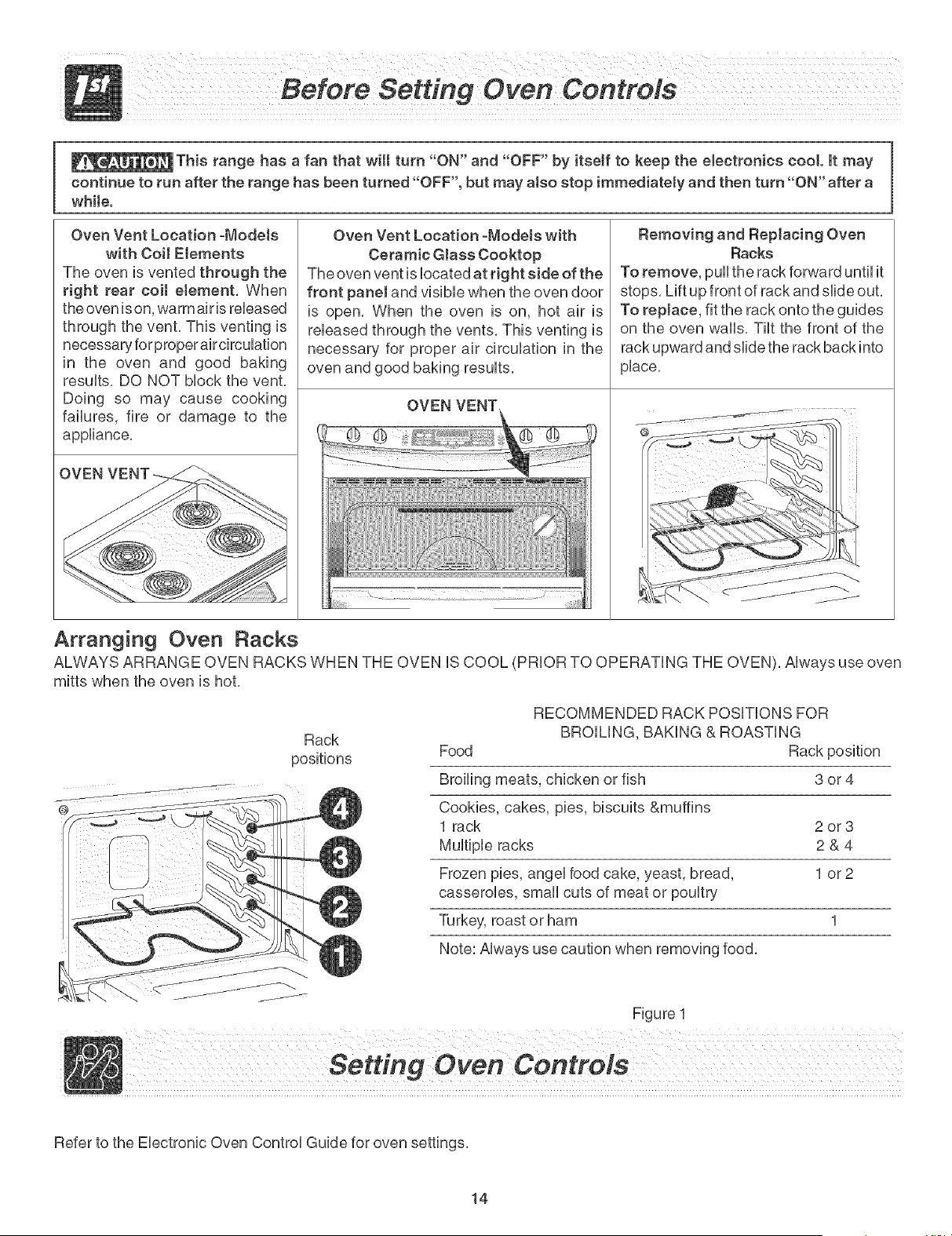
Oven Vent Location -Models
with Coil Elements
The oven is vented through the
right rear coit etement, When
the oven is on, warm airis released
through the vent, This venting is
necessary for proper aircirculation
in the oven and good baking
results, DO NOT block the vent,
Doing so may cause cooking
failures, fire or damage to the
appliance,
Oven Vent Location -Modets with
Ceramic GJass Cooktop
The oven vent is located at right side of the
front paneJ and visible when the oven door
is open, When the oven is on, hot air is
released through the vents, This venting is
necessary for proper air circulation in the
oven and good baking results,
Removing and RepJacing Oven
Racks
To remove, pull the rack forward until it
stops, Lift up front of rack and slide out,
To replace, fit the rack onto the guides
on the oven wails, Tilt the front of the
rack upward and slide the rack back into
place,
J
Arranging Oven Racks
ALWAYS ARRANGE OVEN RACKS WHEN THE OVEN iS COOL (PRIOR TO OPERATING THE OVEN), Always use oven
mitts when the oven is hot,
Rack
positions
RECOMMENDED RACK POSiTiONS FOR
BROiLiNG, BAKING & ROASTING
Food
Broiling meats, chicken or fish 3 or 4
Cookies, cakes, pies, biscuits &muffins
1 rack 2 or 3
Multiple racks 2 & 4
Frozen pies, angel food cake, yeast, bread, 1 or 2
casseroles, small cuts of meat or poultry
Turkey, roast or ham 1
Note: Always use caution when removing food,
Figure 1
Setting Oven
Refer to the Electronic Oven Control Guide for oven settings,
14
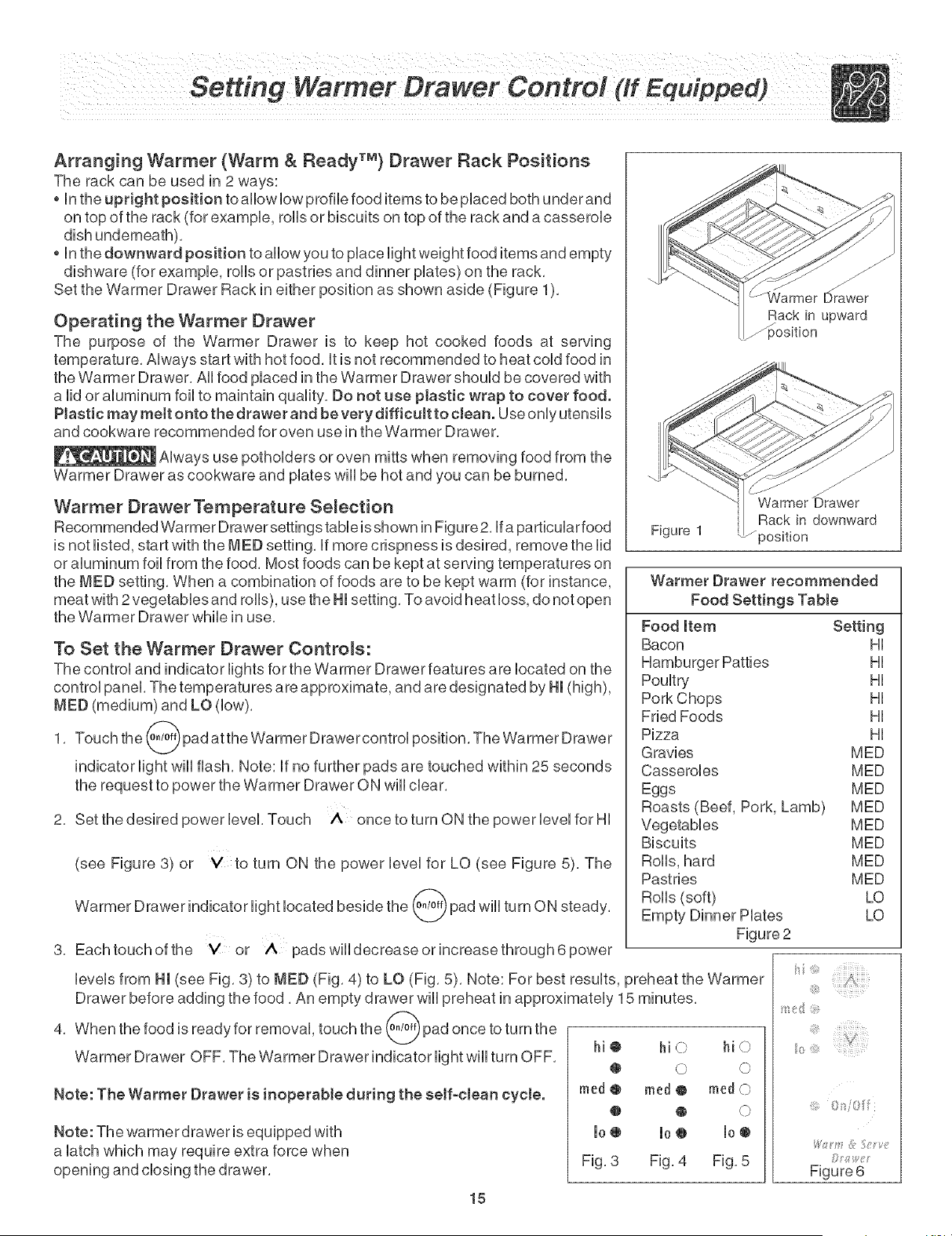
Arranging Warmer (Warm & Ready TM) Drawer Rack Positions
The rack can be used in 2 ways:
o In the upright position to allow low profile food items to be placed both under and
on top of the rack (for example, roils or biscuits on top of the rack and a casserole
o In the downward position to allow you to place light weight food items and empty
dishware (for example, roils or pastries and dinner plates) on the rack,
Set the Warmer Drawer Rack in either position as shown aside (Figure 1),
Operating the Warmer Drawer
The purpose of the Warmer Drawer is to keep hot cooked foods at serving
temperature, Always start with hot food, It is not recommended to heat cold food in
the Warmer Drawer, A[[ food placed in the Warmer Drawer should be covered with
a lid or aluminum foil to maintain quality, Do not use plastic wrap to cover food.
Plastic may melt onto the drawer and be verydifficu[t to clean. Use only utensils
and cookware recommended for oven use in the Warmer Drawer,
Always use potho[ders or oven mitts when removing food from the
Warmer Drawer as cookware and plates w[[[ be hot and you can be burned,
Warmer Drawer Temperature Selection
Recommended Warmer Drawer settings table is shown in Figure 2, Ifa particular food
is not listed, start with the MED setting, If more crispness is desired, remove the lid
or aluminum foil from the food, Most foods can be kept at serving temperatures on
the MED setting, When a combination of foods are to be kept warm (for instance,
meat with 2 vegetables and rolls), use the HI setting, To avoid heat loss, do not open
the Warmer Drawer while in use,
To Set the Warmer Drawer Controls:
The control and indicator lights for the Warmer Drawer features are located on the
control pane[, The temperatures are approximate, and are designated by HI (high),
MED (medium) and LO (low),
1, Touch the 0_/0) pad at the Warmer Drawercontro[ position, The Warmer Drawer
indicator light wi[[ flash, Note: If no further pads are touched within 25 seconds
the request to power the Warmer Drawer ON wi[[ dear,
2, Set the desired power [eveL Touch A oncetoturnONthepower[eve[forH[
(see Figure 3) or V to turn ON the power [eve[ for LO (see Figure 5), The
Warmer Drawer indicator light located beside the _ pad wl[ turn ON steady,
3, Each touch of the V or A padswi[[decreaseorincreasethrough6power
Figure 1
awer
Rack in upward
_osition
Warmer Drawer
Rack in downward
_position
Warmer Drawer recommended
Food Settings Table
Food Item Setting
Bacon HI
HI
Poultry HI
Pork Chops HI
Fried Foods HI
Pizza HI
Gravies MED
Casseroles MED
Eggs MED
Roasts (Beef, Pork, Lamb) MED
Vegetables MED
Biscuits MED
Rols, hard MED
Pastries MED
Roils (soft) LO
LO
Figure 2
levels from HI (see Fig, 3) to MED (Fig, 4) to LO (Fig, 5), Note: For best results, preheat the Warmer
Drawer before adding the food, An empty drawer wl[ preheat in approximately 15 minutes,
4, When the food is ready for removal touch the 0_/of_pad once to turn the
Warmer Drawer OFF, The Warmer Drawer indicator lght wl[ turn OFF,
hi @ hi 0 M O
@ 0 0
reed@ medo rnedO
@ @ ©
10@ lo@ [o@
Fig, 3 Fig, 4 Fig, 5
Note: The Warmer Drawer is inoperable during the self-clean cycle.
Note: The warmer drawer is equipped with
a latch which may require extra force when
opening and dosing the drawer,
i .....
:_ i TM
@ _!L!_]_ii}iii_
/'t (!<t @i!
@......
i!ii Oi)f
}
Figure 6
15
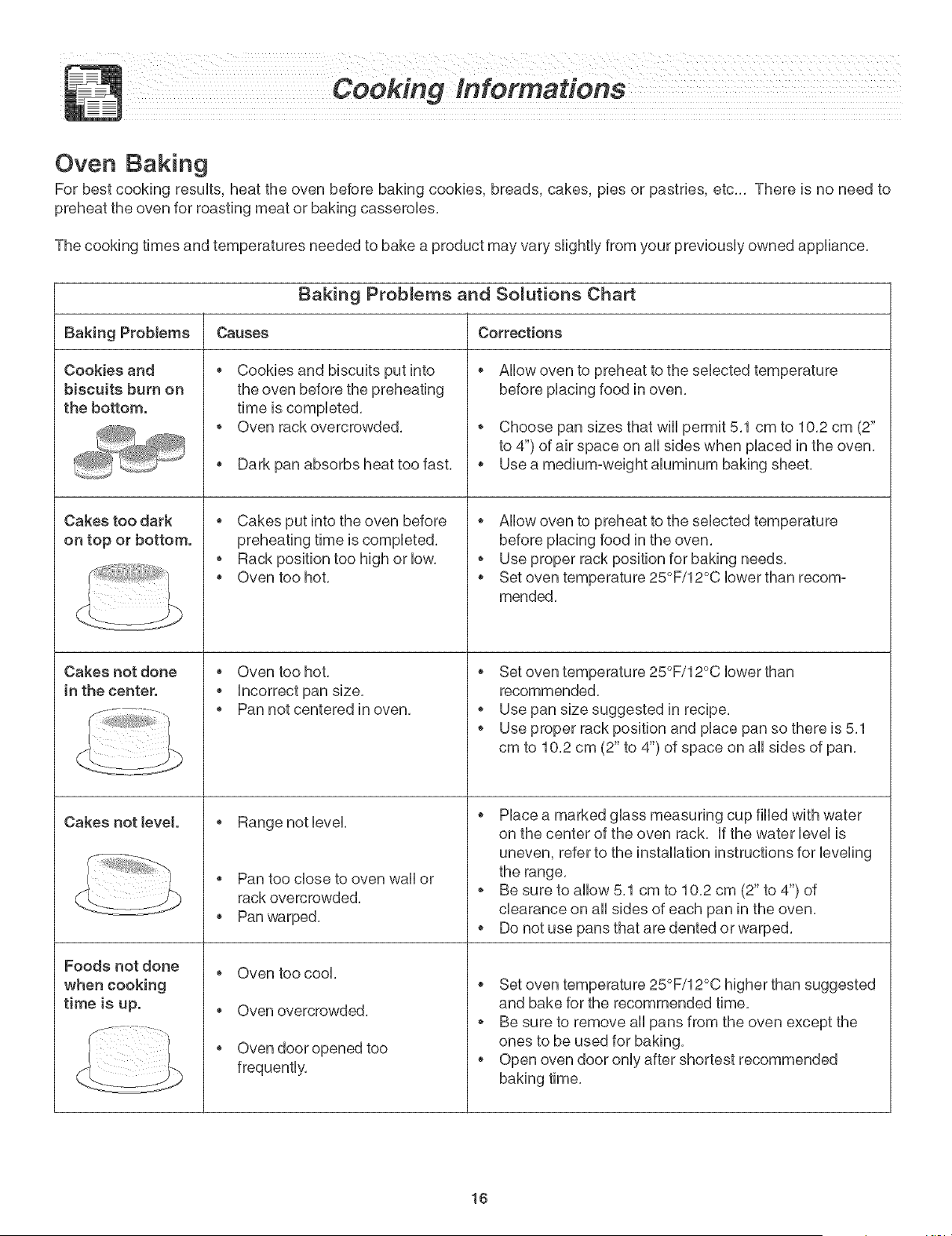
Oven Baking
For best cooking results, heat the oven before baking cookies, breads, cakes, pies or pastries, etc_, There is no need to
preheat the oven for roasting meat or baking casseroles,
The cooking times and temperatures needed to bake a product may vary slightly from your previously owned appliance,
Baking Problems and Solutions Chart
Baking Probbms Causes Corrections
Cookies and
biscuits burn on
the bottom.
Cakes too dark
on top or bottom.
Cakes not done
in the center.
Cakes not tevel.
Foods not done
when cooking
time is up.
Cookies and biscuits put into
the oven before the preheating
time is completed,
o Oven rack overcrowded,
Dark pan absorbs heat too fast,
o Cakes put into the oven before
preheating time is completed,
o Rack position too high or low,
Oven too hot,
Oven too hot,
incorrect pan size,
o Pan not centered in oven,
o Range notlevel,
Pan too close to oven wall or
Allow oven to preheat to the selected temperature
before placing food in oven,
o Choose pan sizes that will permit 5,1 cm to 10,2 cm (2"
to 4") of air space on all sides when placed in the oven,
Use a medium-weight aluminum baking sheet,
o Allow oven to preheat to the selected temperature
before placing food in the oven,
o Use proper rack position for baking needs,
Set oven temperature 25°F/12°C lower than recom-
mended,
Set oven temperature 25°F/12°C lower than
recommended,
o Use pan size suggested in recipe,
o Use proper rack position and place pan so there is 5,1
cm to 10,2 cm (2" to 4") of space on all sides of pan,
o Place a marked glass measuring cup filled with water
on the center of the oven rack, if the water level is
uneven, refer to the installation instructions for leveling
the range,
o Be sure to allow S,1 cm to lO,2 cm (2" to 4") of
rack overcrowded,
Pan warped,
o Oven toocool,
Oven overcrowded,
o Oven dooropened too
frequently,
clearance on all sides of each pan in the oven,
o Do not use pans that are dented or warped,
Set oven temperature 25°F/12°C higher than suggested
and bake for the recommended time,
o Be sure to remove all pans from the oven except the
ones to be used for baking,
Open oven door only after shortest recommended
16
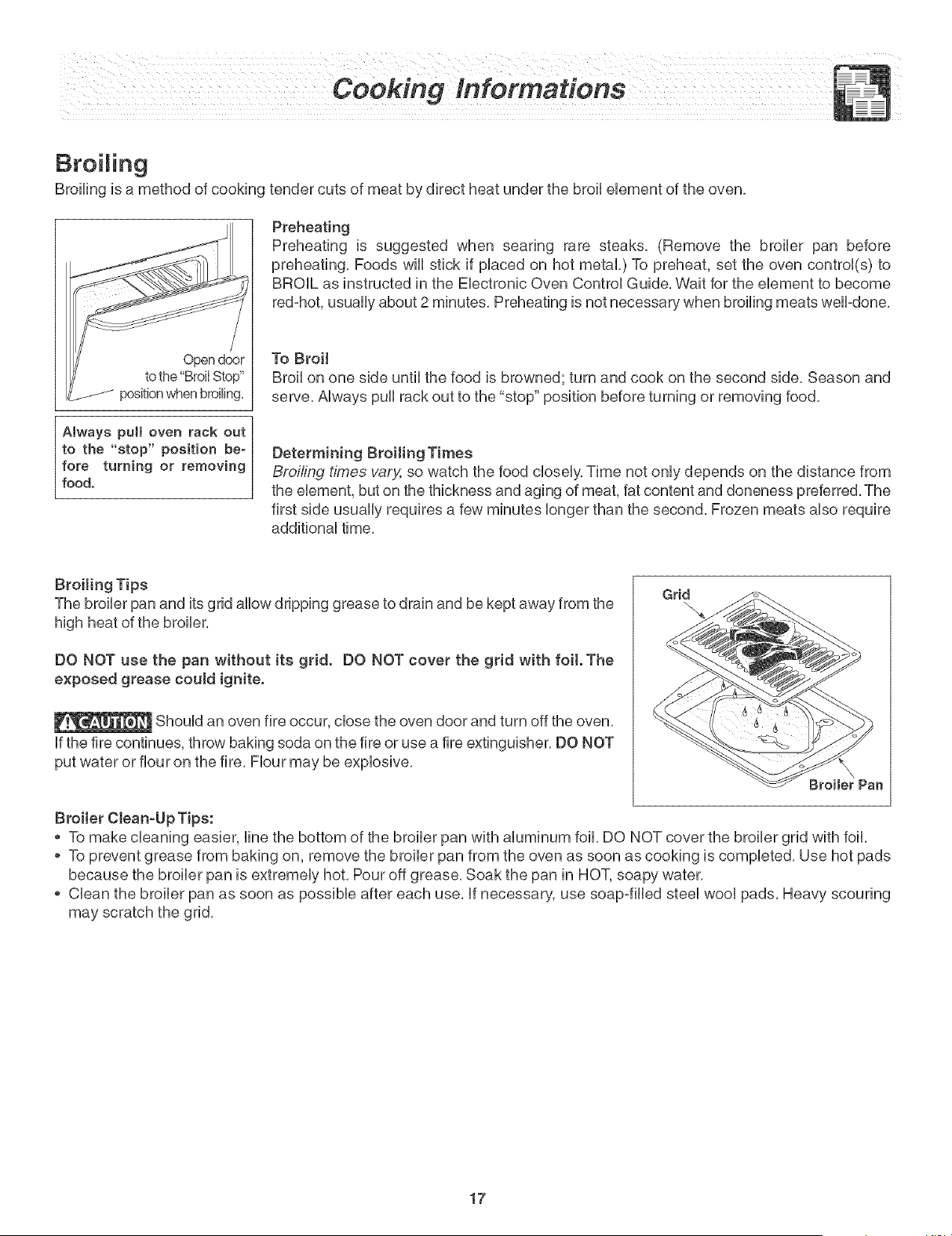
Broiling
Broiling is a method of cooking
Open door
to the "Broil Stop"
position when broiling.
Always pu_l oven rack out
to the "atop" position be-
fore turning or removing
food.
tender cuts of meat by direct heat under the broil element of the oven,
Preheating
Preheating is suggested when searing rare steaks, (Remove the broiler pan before
preheating, Foods will stick if placed on hot metal,) To preheat, set the oven control(s) to
BROIL as instructed in the Electronic Oven Control Guide, Wait for the element to become
red-hot, usually about 2 minutes, Preheating is not necessary when broiling meats well-done,
To Broil
Broil on one side until the food is browned; turn and cook on the second side, Season and
serve, Always pull rack out to the "stop" position before turning or removing food,
Determining Broiting Times
Broiling times vary so watch the food closely, Time not only depends on the distance from
the element, but on the thickness and aging of meat, fat content and doneness preferred, The
first side usually requires a few minutes longer than the second, Frozen meats also require
additional time,
Broiling Tips
The broiler pan and its grid allow dripping grease to drain and be kept away from the
high heat of the broiler,
DO NOT use the pan without its grid. DO NOT cover the grid with foil. The
exposed grease could ignite.
Should an oven fire occur, close the oven door and turn off the oven,
if the fire continues, throw baking soda on the fire or use a fire extinguisher, DO NOT
put water or flour on the fire, Flour may be explosive,
Grid
\
Broiler Pan
Broiler Chart-Up Tips:
To make cleaning easier, line the bottom of the broiler pan with aluminum foil, DO NOT cover the broiler grid with foil,
To prevent grease from baking on, remove the broiler pan from the oven as soon as cooking is completed, Use hot pads
because the broiler pan is extremely hot, Pour off grease, Soak the pan in HOT, soapy water,
Clean the broiler pan as soon as possible after each use, if necessary, use soap°filled steel wool pads, Heavy scouring
may scratch the grid,
17
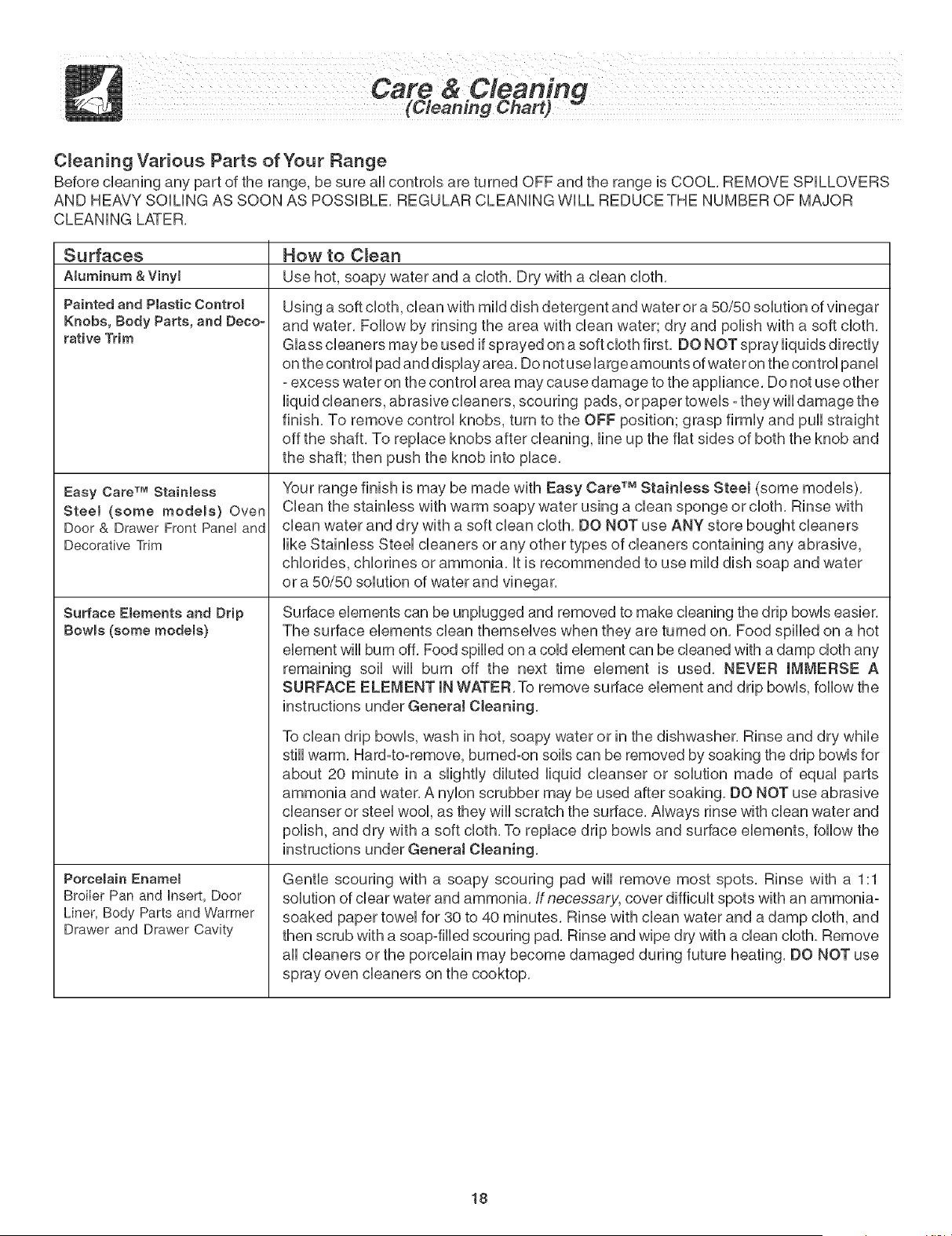
C_eaning Various Parts of Your Range
Before cbaning any part of the range, be sure aHcontroUs are turned OFF and the range is COOL, REblOVE SPULLOVERS
AND HEAVY SOUUNG AS SOON AS POSSIBLE, REGULAR CLEANING WiLL REDUCE THE NUblBER OF blAJOR
CLEANING LATER,
Surfaces How to C_ean
Amuminum& Vinyt Use hot, soapy water and a cloth, Dry with a clean cloth,
Painted and Plastic ControB
Knobs, Body Parts, and Deco-
rative Trim
Easy Care TM DtainBees
Dteel (some modems) Oven
Door & Drawer Front Panel and
Decorative Trim
Surface Elements and Drip
Bowms (some modems)
Porcemain Enamem
BroiIer Pan and Insert, Door
Liner, Body Parts and Warmer
Drawer and Drawer Cavity
Using a soft cloth, clean with mild dish detergent and water or a 50/50 solution of vinegar
and water, Follow by rinsing the area with clean water; dry and polish with a soft cloth,
Glass cleaners may be used if sprayed on a soft cloth first, DO NOT spray liquids directly
on the control pad and display area, Do not use large amounts of water on the control panel
- excess water on the control area may cause damage to the appliance, Do not use other
liquid cleaners, abrasive cleaners, scouring pads, or paper towels - they will damage the
finish, To remove control knobs, turn to the OFF position; grasp firmly and pull straight
off the shaft, To replace knobs after cleaning, line up the fiat sides of both the knob and
the shaft; then push the knob into place,
Your range finish is may be made with Easy Care TM Stainless SteeJ (some models),
Clean the stainless with warm soapy water using a clean sponge or cloth, Rinse with
clean water and dry with a soft clean cloth, DO NOT use ANY store bought cleaners
like Stainless Steel cleaners or any other types of cleaners containing any abrasive,
chlorides, chlorines or ammonia, it is recommended to use mild dish soap and water
or a 50/50 solution of water and vinegar,
Surface elements can be unplugged and removed to make cleaning the drip bowls easier,
The surface elements clean themselves when they are turned on, Food spilled on a hot
element wiii burn off, Food spilled on a cold element can be cleaned with a damp cloth any
remaining soil will burn off the next time element is used, NEVER IMMERSE A
SURFACE ELEMENT IN WATER, To remove surface element and drip bowls, follow the
instructions under Genera! Cleaning,
To clean drip bowls, wash in hot, soapy water or in the dishwasher, Rinse and dry while
still warm, Hard-to-remove, burned-on soils can be removed by soaking the drip bowls for
about 20 minute in a slightly diluted liquid cleanser or solution made of equal parts
ammonia and water, A nylon scrubber may be used after soaking, DO NOT use abrasive
cleanser or steel wool, as they will scratch the surface, Always rinse with clean water and
polish, and dry with a soft cloth, To replace drip bowls and surface elements, follow the
instructions under GeneraJ Cleaning,
Gentle scouring with a soapy scouring pad wiii remove most spots, Rinse with a 1:1
solution of clear water and ammonia, if necessary, cover difficult spots with an ammonia-
soaked paper towel for 80 to 40 minutes, Rinse with clean water and a damp cloth, and
then scrub with a soap-filled scouring pad, Rinse and wipe dry with a clean cloth, Remove
all cleaners or the porcelain may become damaged during future heating, DO NOT use
spray oven cleaners on the cooktop,
18
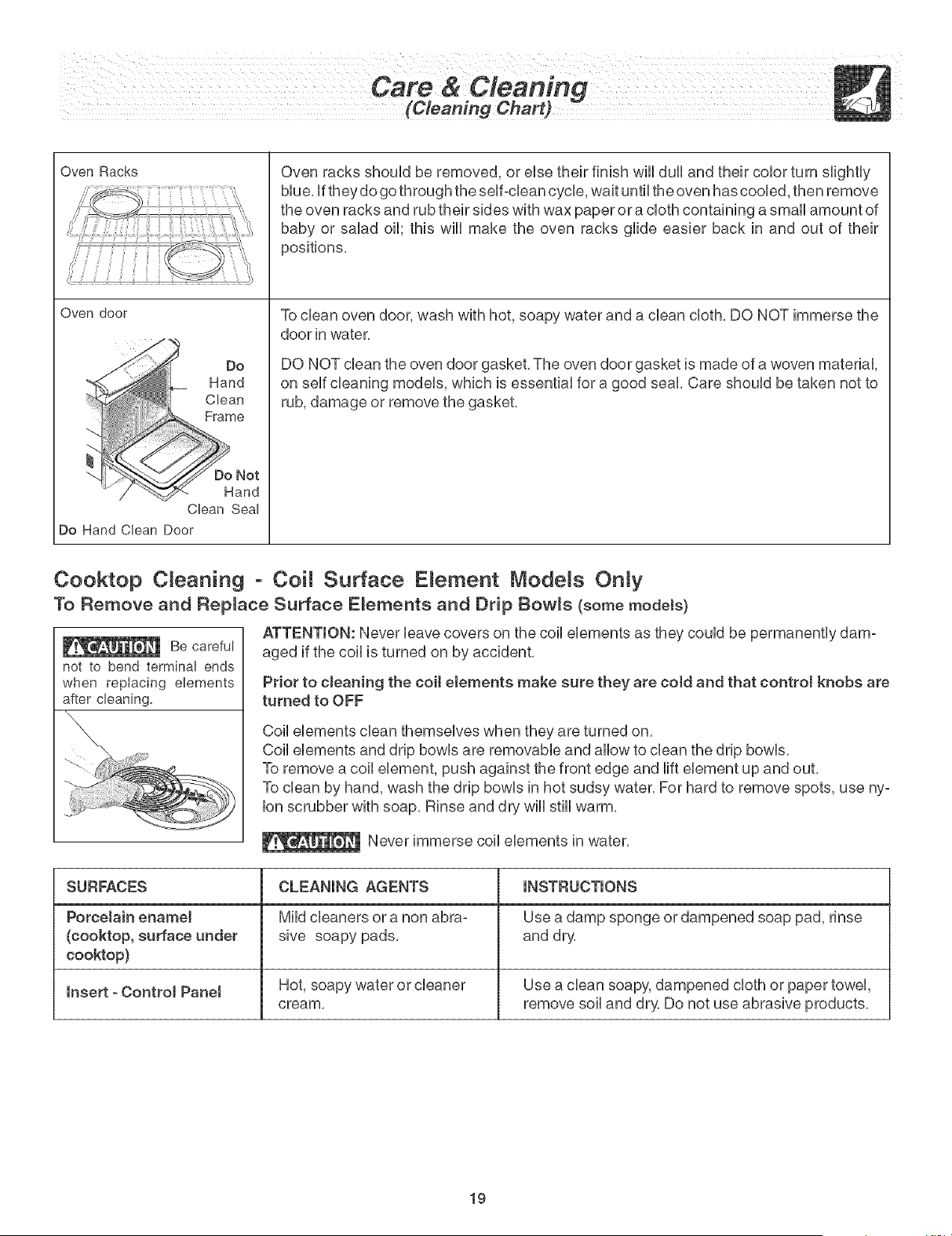
Oven Racks
Oven racks should be removed, or else their finish will dull and their color turn slightly
blue, if they do go through the self=clean cycle, wait until the oven has cooled, then remove
the oven racks and rub their sides with wax paper or a cloth containing a small amount of
baby or salad oil; this wiii make the oven racks glide easier back in and out of their
positions,
To clean oven door, wash with hot, soapy water and a clean cloth, DO NOT immerse the
door in water,
DO NOT clean the oven door gasket, The oven door gasket is made of a woven material,
on self cleaning models, which is essential for a good seal, Care should be taken not to
rub, damage or remove the gasket,
Cooktop Cteaning - Coil Surface Element Models Only
To Remove and Replace Surface E_ementa and Drip Bow_s (some models)
Be careful
not to bend terminal ends
when replacing elements
after cleaning=
Ct'
ATTENTION: Never leave covers on the coil elements as they could be permanently dam=
aged if the coil is turned on by accident,
Prior to cleaning the coit etements make sure they are cold and that control knobs are
turned to OFF
Coil elements clean themselves when they are turned on,
Coil elements and drip bowls are removable and allow to clean the drip bowls,
To remove a coil element, push against the front edge and lift element up and out,
To clean by hand, wash the drip bowls in hot sudsy water, For hard to remove spots, use ny=
ion scrubber with soap, Rinse and dry will still warm,
Never immerse coil elements in water,
SURFACES CLEANING AGENTS INSTRUCTIONS
Porcelain enamel blild cleaners or a non abra- Use a damp sponge or dampened soap pad, rinse
(cooktop, surface under sive soapy pads, and dry,
cooktop)
Insert - Control Panet Hot, soap},,water or cleaner Use a clean soapy, dampened cloth or paper towel,
cream, remove soil and dry, Do not use abrasive products,
19
Cooktop CWeaning- Coit Surface Element Models Only (Continued)
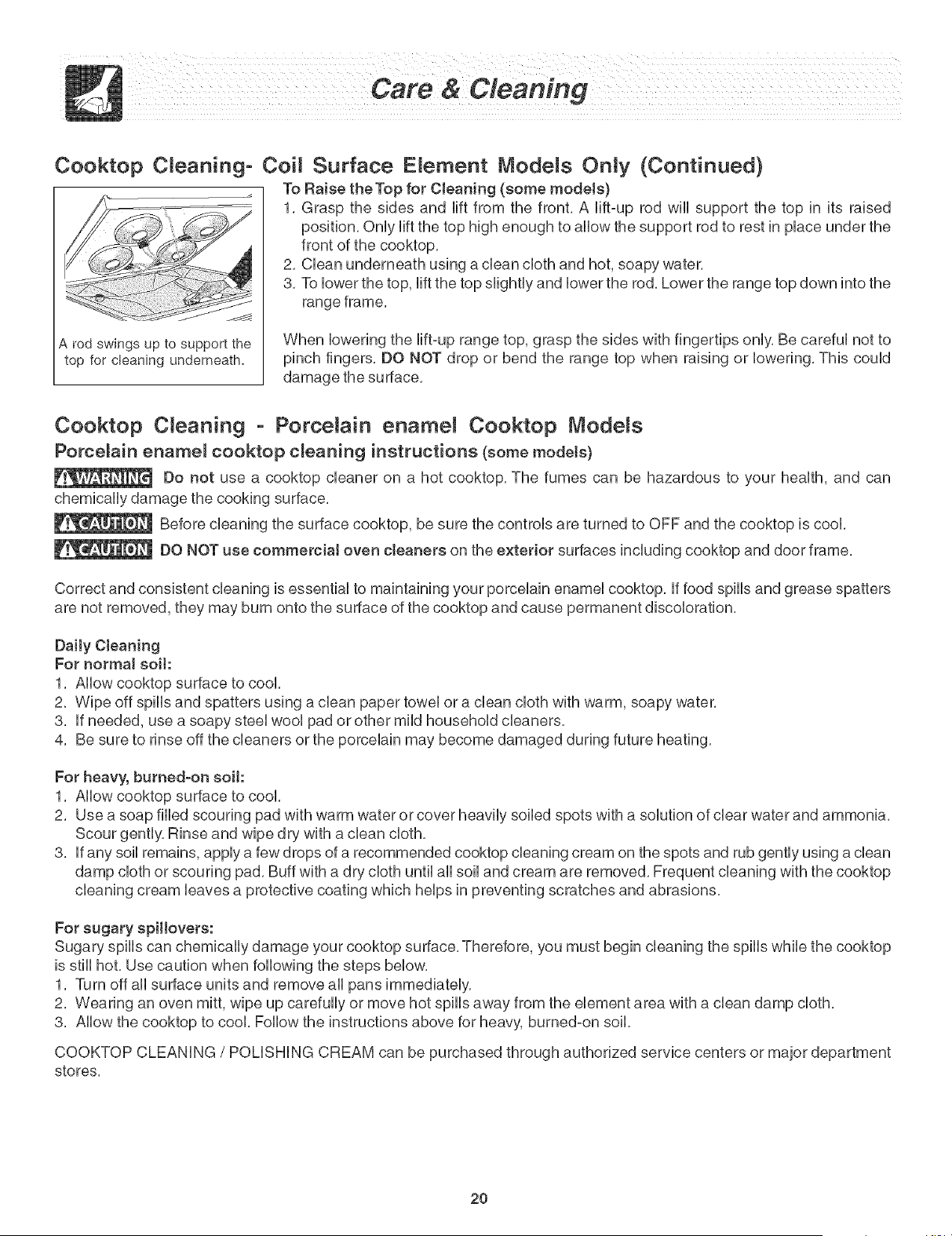
To Raise theTop for Cleaning (some modeJs)
1, Grasp the sides and lift from the front, A lift-up rod will support the top in its raised
position, Only lift the top high enough to allow the support rod to rest in place under the
front of the cooktop,
2, Clean underneath using a clean cloth and hot, soapy water,
3, To lower the top, lift the top slightly and lower the rod, Lower the range top down into the
range frame,
A rod swings up to support the
top for cleaning underneath.
When lowering the lift-up range top, grasp the sides with fingertips only, Be careful not to
pinch fingers, DO NOT drop or bend the range top when raising or lowering, This could
damage the surface,
Cooktop Cleaning - Porcelain enamel Cooktop Models
Porcelain ename_ cooktop cmeaning instructions (some modets)
Do not use a cooktop cleaner on a hot cooktop, The fumes can be hazardous to your health, and can
chemically damage the cooking surface,
Before cleaning the surface cooktop, be sure the controls are turned to OFF and the cooktop is cool,
DO NOT use commerciaJ oven cteaners on the exterior surfaces including cooktop and door frame,
Correct and consistent cleaning is essential to maintaining your porcelain enamel cooktop, if food spills and grease spatters
are not removed, they may burn onto the surface of the cooktop and cause permanent discoloration,
Dally Cleaning
For normal soit:
1, Allow cooktop surface to cool,
2, Wipe off spills and spatters using a clean paper towel or a clean cloth with warm, soapy water,
3, if needed, use a soapy steel wool pad or other mild household cleaners,
4, Be sure to rinse off the cleaners or the porcelain may become damaged during future heating,
For heavy, burned-on soil:
1, Allow cooktop surface to cool,
2, Use a soap filled scouring pad with warm water or cover heavily soiled spots with a solution of clear water and ammonia,
Scour gently, Rinse and wipe dry with a clean cloth,
3, if any soil remains, apply a few drops of a recommended cooktop cleaning cream on the spots and rub gently using a clean
damp cloth or scouring pad, Buff with a dry cloth until all soil and cream are removed, Frequent cleaning with the cooktop
cleaning cream leaves a protective coating which helps in preventing scratches and abrasions,
For sugary spiHovers:
Sugary spills can chemically damage your cooktop surface, Therefore, you must begin cleaning the spills while the cooktop
is still hot, Use caution when following the steps below,
1, Turn off all surface units and remove all pans immediately,
2, Wearing an oven mitt, wipe up carefully or move hot spills away from the element area with a clean damp cloth,
3, Allow the cooktop to cool, Follow the instructions above for heavy, burned-on soil,
COOKTOP CLEANING / POLiSHiNG CREAM can be purchased through authorized service centers or major department
stores,
20
Models with Ceramic Glass Cooktop
Ceramic Gmass Cooktop Cleaning & Maintenance
Consistent and proper cleaning iS essential to maintaining y0ur ceramic glass cooktop
Prior to using your cooktop for the first time, apply the recommended CERAMA BRYTE@ Cleaning Creme to the ceramic
surface, Clean and buff with a non abrasive cloth or pad, This will make cleaning easier when soiled from cooking, The
special cooktop cleaning cream leaves a protective finish on the glass to help prevent scratches and abrasions,
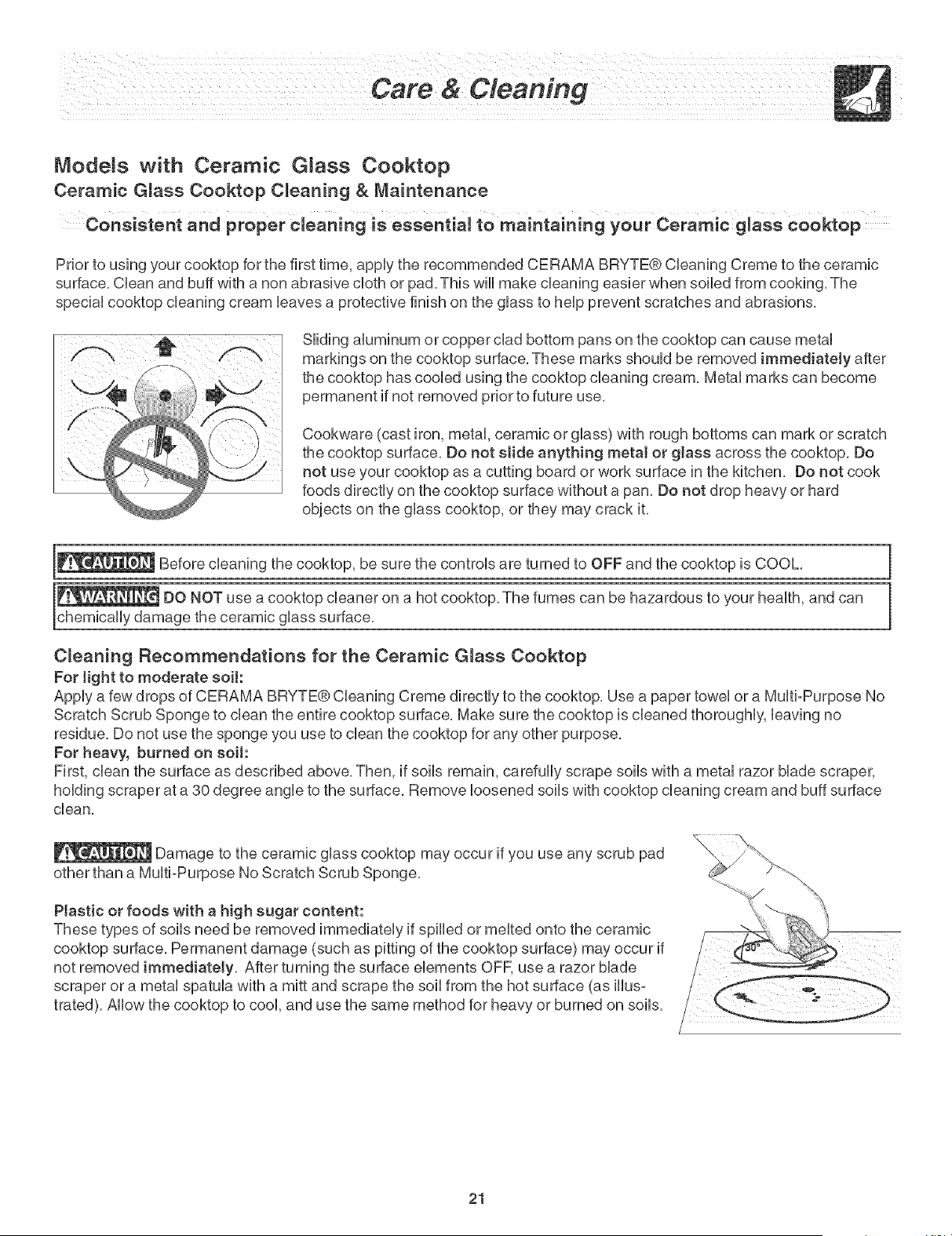
Sliding aluminum or copper clad bottom pans on the cooktop can cause metal
markings on the cooktop surface, These marks should be removed immediately after
the cooktop has cooled using the cooktop cleaning cream, Metal marks can become
permanent if not removed prior to future use,
Cookware (cast iron, metal, ceramic or glass) with rough bottoms can mark or scratch
the cooktop surface, Do not slide anything metal or gJass across the cooktop, Do
not use your cooktop as a cutting board or work surface in the kitchen, Do not cook
foods directly on the cooktop surface without a pan, Do not drop heavy or hard
objects on the glass cooktop, or they may crack it,
_ Before cleaning the cooktop, be sure the controls are turned to OFF and the cooktop is COOL,
I_ DO NOT use a cooktop cleaner on a hot cooktop, The fumes can be hazardous to your health, and can
[chemically damage the ceramic glass surface,
C_eaning Recommendations for the Ceramic G_ass Cooktop
For light to moderate soiJ:
Apply a few drops of CERAMA BRYTE@ Cleaning Creme directly to the cooktop, Use a paper towel or a Multi-Purpose No
Scratch Scrub Sponge to clean the entire cooktop sudace, Make sure the cooktop is cleaned thoroughly, leaving no
residue, Do not use the sponge you use to clean the cooktop for any other purpose,
For heavy, burned on soil:
First, clean the surface as described above, Then, if soils remain, carefully scrape soils with a metal razor blade scraper,
holding scraper at a 30 degree angle to the sudace, Remove loosened soils with cooktop cleaning cream and buff surface
clean,
Damage to the ceramic glass cooktop may occur if you use any scrub pad
other than a Multi-Purpose No Scratch Scrub Sponge,
Plastic or foods with a high sugar content:
These types of soils need be removed immediately if spilled or melted onto the ceramic
cooktop sudace, Permanent damage (such as pitting of the cooktop surface) may occur if
not removed immediately, After turning the surface elements OFR use a razor blade
scraper or a metal spatula with a mitt and scrape the soil from the hot surface (as illus°
trated), Allow the cooktop to cool, and use the same method for heavy or burned on soils,
21
Models with Ceramic Glass Cooktep (Continued)
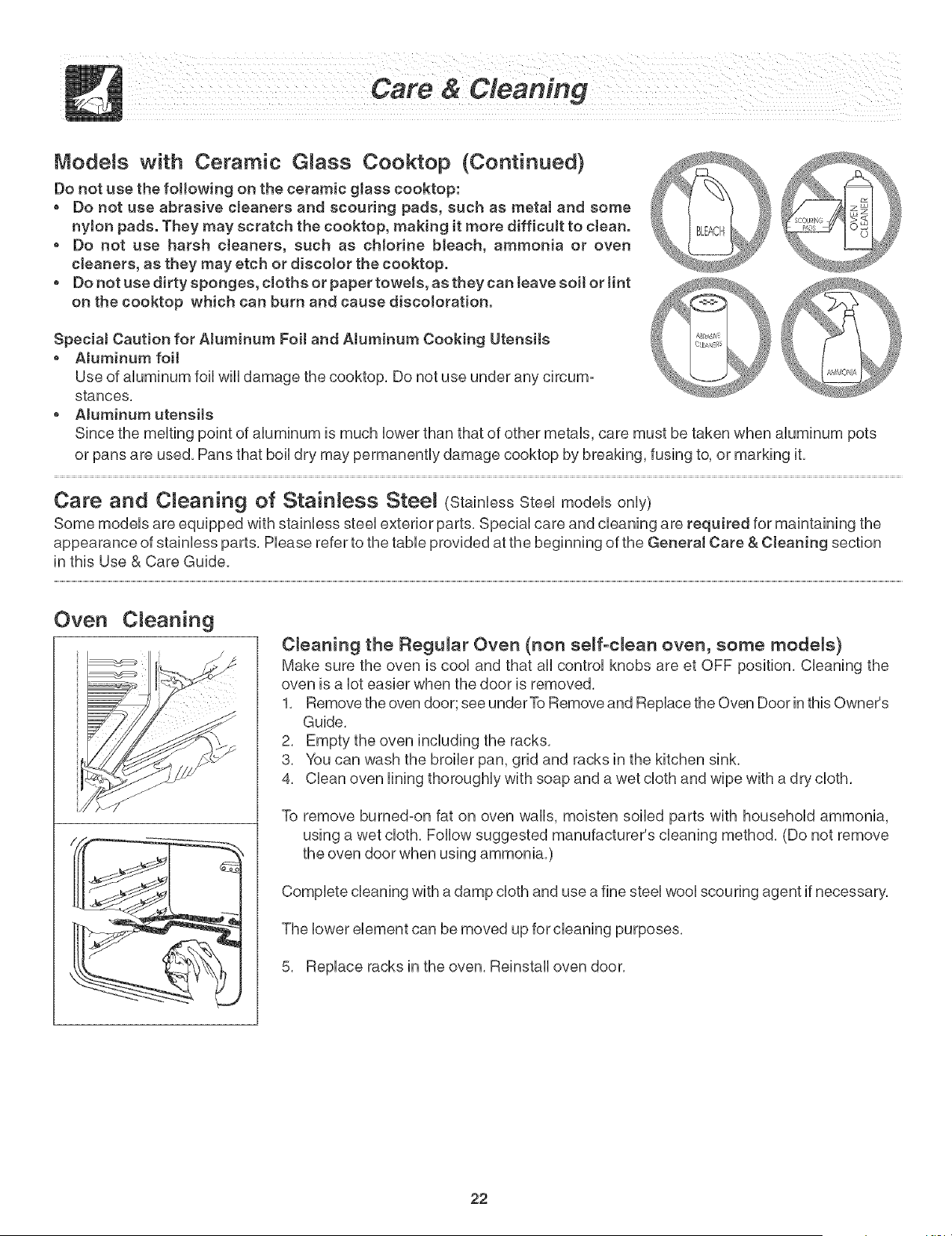
Do not use the following on the ceramic glass cooktop:
, Do not use abrasive cJeaners and scouring pads, such as metal and some
nyJon pads. They may scratch the cooktop, making it more difficuJt to ctean.
, Do not use harsh cleaners, such as cHorine bleach, ammonia or oven
cleaners, as they may etch or discolor the cooktop.
o Do not use dirty sponges, cloths or paper toweJs, as they can leave soil or tint
on the cooktop which can burn and cause discoloration.
SpeciaJ Caution for Aluminum Foit and Atuminum Cooking Utensits
o AJuminum foit
Use of aluminum foil will damage the cooktop, Do not use under any circum=
stances,
o AJuminum utensits
Since the melting point of aluminum is much lower than that of other metals, care must be taken when aluminum pots
or pans are used, Pans that boil dry may permanently damage cooktop by breaking, fusing to, or marking it,
Care and Cleaning of Stainless Steel (StainlessSteel models only)
Some models are equipped with stainless steel exterior parts, Special care and cleaning are required for maintaining the
appearance of stainless parts, Please refer to the table provided at the beginning of the General Care & Cleaning section
in this Use & Care Guide,
Oven Cleaning
Cleaning the Regular Oven (non se_f°c_ean oven, some mode_s}
Make sure the oven is cool and that all control knobs are et OFF position, Cleaning the
oven is a lot easier when the door is removed,
1, Remove the oven door; see underTo Remove and Replace the Oven Door in this Owner's
Guide,
2, Empty the oven including the racks,
3, You can wash the broiler pan, grid and racks in the kitchen sink,
4, Clean oven lining thoroughly with soap and a wet cloth and wipe with a dry cloth,
To remove burned=on fat on oven walls, moisten soiled parts with household ammonia,
using a wet cloth, Follow suggested manufacturer's cleaning method, (Do not remove
the oven door when using ammonia,)
Complete cleaning with a damp cloth and use a fine steel wool scouring agent if necessary,
The lower element can be moved up for cbaning purposes,
5, Replace racks in the oven, Reinstall oven door,
22
Oven Cleaning (Continued)
CJeaning the SeJf-CJean Oven (some modeJs)
Adhere to the following cJeaning precautions:
- AHow the oven to cooUbefore cbaning.
- Wear rubber gbves when cbaning any exterior parts of the oven manually.
During the serf-dean cycb, the outside of the wall oven can become very hot to the touch, DO NOT have
small children unattended near the appliance,
The heaUth of some birds is extremeUy sensitive to the fumes given off during the seff-cbaning cycle of any
range, Move birds to another well ventilated room,
Before cbaning any part of the oven, be sure the eUectronb oven controU is turned off or else push CANCEL
pad, Wait until the oven is cool,
DO NOT use commercial oven cleaners or oven protective coatings in or around any art of the self-cleaning oven, DO NOT
clean the oven door gasket, The gasket on the oven door is essential for a good seal, Care should be taken not to rub, damage
or move the gasket, DO NOT use any cteaning materiaJs on the gasket. Doing so could damage it. DO NOT use
aJuminum foit to line the oven bottom, This may affect cooking or foil could melt and damage the oven surface,
A self-cleaning oven cleans itself with high temperatures (well above cooking temperatures) which eliminate soil completely
or reduce it to a fin powdered ash you can which away with damp cloth,
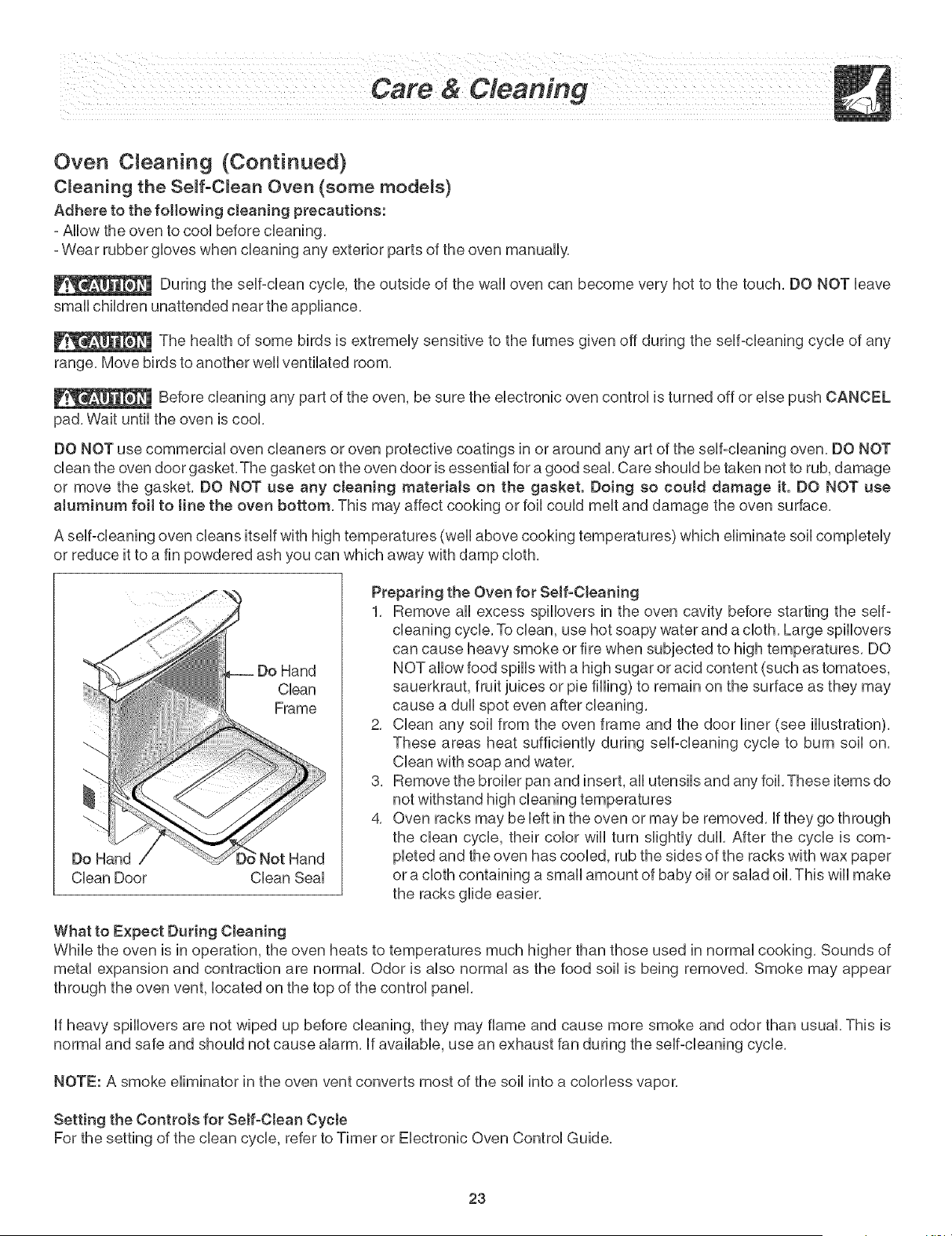
Clean
Frame
Do Hand Hand
Clean Door Clean Seal
Preparing the Oven for Self-Charting
1, Remove all excess spillovers in the oven cavity before starting the self-
cleaning cycle, To clean, use hot soapy water and a cloth, Large spillovers
can cause heavy smoke or fire when subjected to high temperatures, DO
NOT allow food spills with a high sugar or acid content (such as tomatoes,
sauerkraut, fruit juices or pie filling) to remain on the surface as they may
cause a dull spot even after cleaning,
2, Clean any soil from the oven frame and the door liner (see illustration),
These areas heat sufficiently during self-cleaning cycle to burn soil on,
Clean with soap and water,
3, Remove the broiler pan and insert, all utensils and any foil, These items do
not withstand high cleaning temperatures
4, Oven racks may be left in the oven or may be removed, if they go through
the clean cycle, their color will turn slightly dull, After the cycle is com-
pleted and the oven has cooled, rub the sides of the racks with wax paper
or a cloth containing a small amount of baby oil or salad oil, This will make
the racks glide easier,
What to Expect During Cleaning
While the oven is in operation, the oven heats to temperatures much higher than those used in normal cooking, Sounds of
metal expansion and contraction are normal, Odor is also normal as the food soil is being removed, Smoke may appear
through the oven vent, located on the top of the control panel,
if heavy spillovers are not wiped up before cleaning, they may flame and cause more smoke and odor than usual, This is
normal and safe and should not cause alarm, if available, use an exhaust fan during the self-cleaning cycle,
NOTE: A smoke eliminator in the oven vent converts most of the soil into a colorless vapor,
Setting the Controls for Serf-Clean Cycb
For the setting of the clean cycle, refer to Timer or Electronic Oven Control Guide,
23
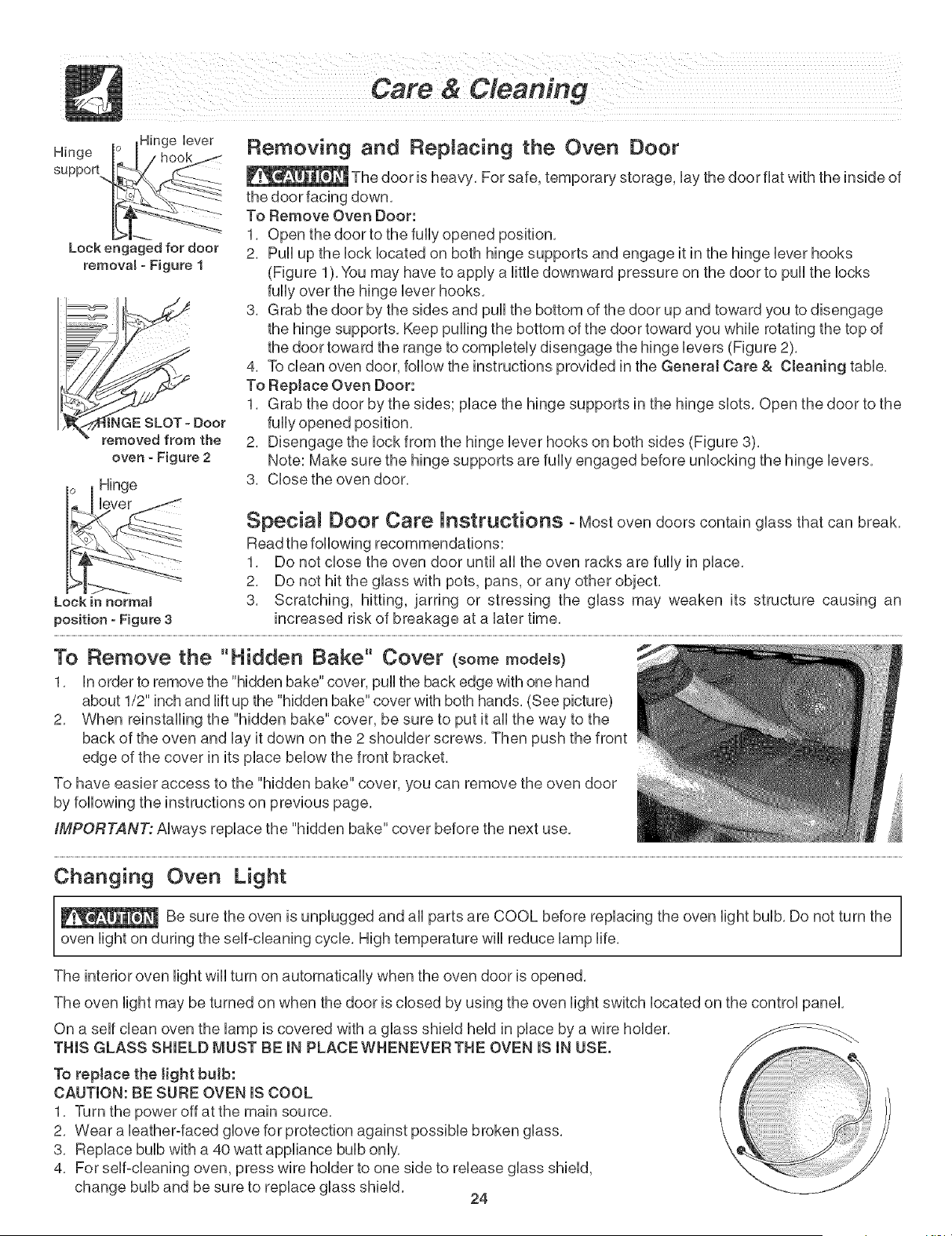
Hinge
suppod
Hinge lever
Lock engaged for door
removam - Figure 1
Door
removed from the
oven - Figure 2
Hinge
Removing and Replacing the Oven Door
The door is heavy. For safe, temporary storage, Uaythe door fiat with the inside of
the door facing down.
To Remove Oven Door:
1. Open the door to the fully opened position.
2. Pull up the UockUocatedon both hinge supports and engage it in the hinge Ueverhooks
(Figure 1). You may have to appUya HttUedownward pressure on the door to pull the Uocks
fully over the hinge Ueverhooks.
3. Grab the door by the sides and pull the bottom of the door up and toward you to disengage
the hinge supports. Keep pulling the bottom of the door toward you while rotating the top of
the door toward the range to compUeteUydisengage the hinge Uevers(Figure 2).
4. To clean oven door, follow the instructions provided in the General Care & Cteaning table.
To Replace Oven Door:
1. Grab the door by the sides; pUacethe hinge supports in the hinge slots. Open the door to the
fully opened position.
2. Disengage the lock from the hinge lever hooks on both sides (Figure 3).
Note: Make sure the hinge supports are fully engaged before unlocking the hinge levers.
3. Close the oven door.
Specia! Door Care Instructions - Most oven doors contain glass that can break.
Read the following recommendations:
1. Do not close the oven door until all the oven racks are fully in place.
2. Do not hit the glass with pots, pans, or any other object.
Lockin normam 3. Scratching, hitting, jarring or stressing the glass may weaken its structure causing an
position - Figure 3 increased risk of breakage at a later time.
To Remove the "Hidden Bake" Cover (somemodels)
1. In order to remove the "hidden bake" cover, pull the back edge with one hand
about 1/2" inch and lift up the "hidden bake" cover with both hands. (See picture)
2. When reinstalling the "hidden bake" cover, be sure to put it all the way to the
back of the oven and lay it down on the 2 shoulder screws. Then push the front
edge of the cover in its place below the front bracket.
To have easier access to the "hidden bake" cover, you can remove the oven door
by following the instructions on previous page.
IMPORTANT: Always replace the "hidden bake" cover before the next use.
Changing Oven Light
Be sure the oven is unplugged and all parts are COOL before replacing the oven light bulb. Do not turn the
oven light on during the self-cleaning cycle. High temperature will reduce lamp life.
The interior oven light will turn on automatically when the oven door is opened.
The oven light may be turned on when the door is closed by using the oven light switch located on the control panel.
On a self clean oven the lamp is covered with a glass shield held in place by a wire holder.
THIS GLASS SHIELD MUST BE IN PLACEWHENEVER THE OVEN IS IN USE,
To replace the Hght buJb:
CAUTION: BE SURE OVEN IS COOL
1. Turn the power off at the main source.
2. Wear a leather-faced glove for protection against possible broken glass.
3. Replace bulb with a 40 watt appliance bulb only.
4. For self-cleaning oven, press wire holder to one side to release glass shield,
change bulb and be sure to replace glass shield.
24
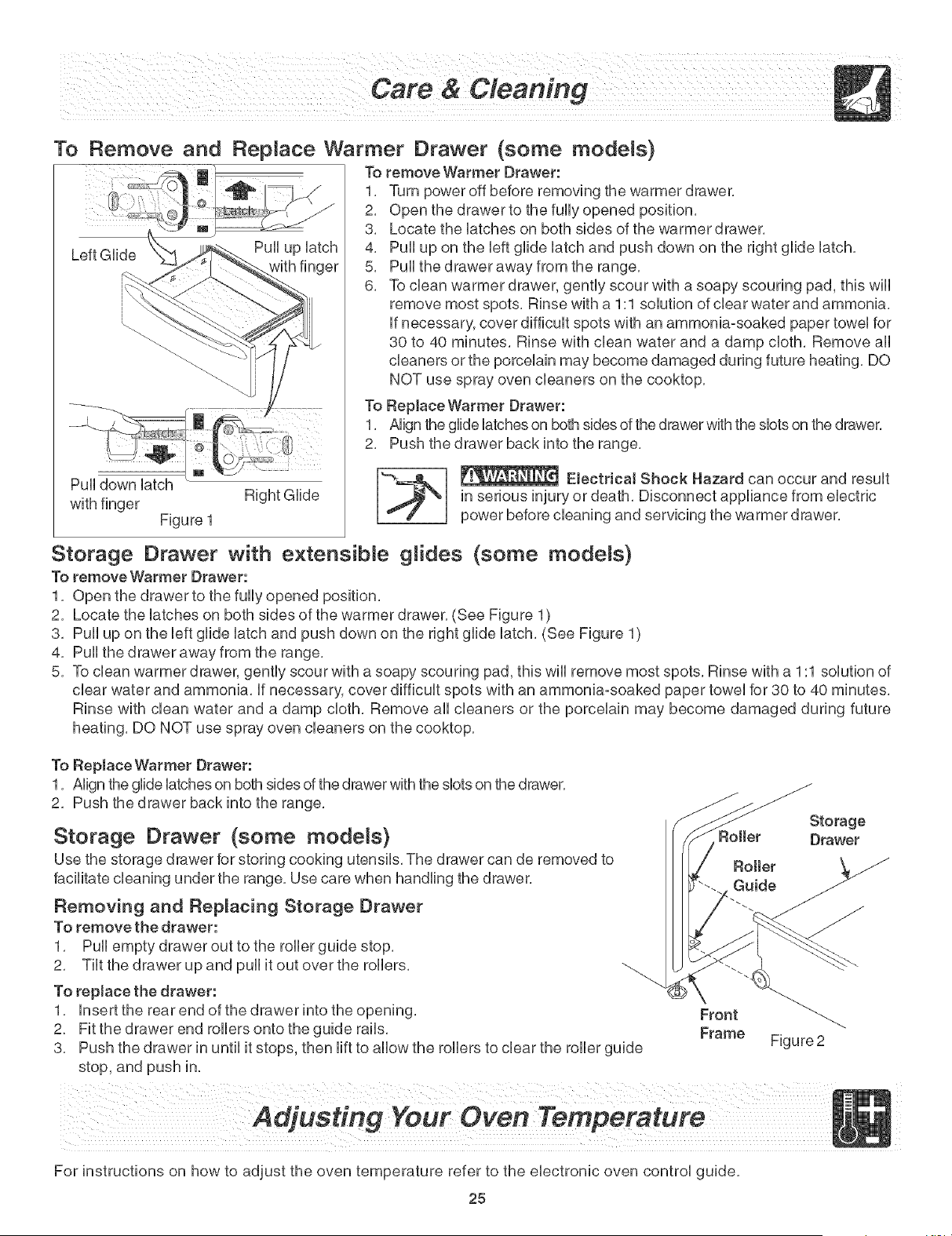
To Remove and
Left GUide
Puff down Uatch
with finger
Figure 1
Repnace Warmer Drawer (some models}
To remove Warmer Drawer:
1, Turn power off before removing the warmer drawer,
2, Open the drawer to the fufly opened position,
3, Locate the Uatcheson both sides of the warmer drawer,
Puff up Uatch 4, Puff up on the Ueftguide Uatchand push down on the right guide Uatch,
5, Puff the drawer away from the range,
6, To dean warmer drawer, gentUy scour with a soapy scouring pad, this wHU
remove most spots, Rinse with a 1:1 soUution of dear water and ammonia,
Ufnecessary, cover difficuUt spots with an ammonia-soaked paper toweUfor
30 to 40 minutes, Rinse with dean water and a damp cloth, Remove all
cleaners or the porcelain may become damaged during future heating, DO
NOT use spray oven cleaners on the cooktop,
To RepJace Warmer Drawer:
1, Afign the gfide latches on both sides of the drawer with the slots on the draweL
2, Push the drawer back into the range,
'-'_ _ EJectricaJ Shock Hazard can occur and result
Right Glide in serious injury or death, Disconnect appliance from electric
power before cleaning and servicing the warmer drawer,
Storage Drawer with e×tensible glides (some models}
To remove Warmer Drawer:
1, Open the drawer to the fully opened position,
2, Locate the latches on both sides of the warmer drawer, (See Figure 1)
3, Pull up on the left glide latch and push down on the right glide latch, (See Figure 1)
4, Pull the drawer away from the range,
5, To clean warmer drawer, gently scour with a soapy scouring pad, this will remove most spots, Rinse with a 1:1 solution of
clear water and ammonia, If necessary, cover difficult spots with an ammonia-soaked paper towel for 30 to 40 minutes,
Rinse with clean water and a damp cloth, Remove all cleaners or the porcelain may become damaged during future
heating, DO NOT use spray oven cleaners on the cooktop,
To Replace Warmer Drawer:
1, Align the glide latches on both sides of the drawer with the slots on the drawer,
2, Push the drawer back into the range,
Storage Drawer (some models}
Use the storage drawer for storing cooking utensils, The drawer can de removed to
facilitate cleaning under the range, Use care when handling the drawer,
Removing and Replacing Storage Drawer
To remove the drawer:
1, Pull empty drawer out to the roller guide stop,
2, Tilt the drawer up and pull it out over the rollers,
To repJace the drawer:
1, Insert the rear end of the drawer into the opening,
2, Fit the drawer end rollers onto the guide rails,
3,
Push the drawer in until it stops, then lift to allow the rollers to clear the roller guide
stop, and push in,
Storage
F{olter Drawer
Figure 2
For instructions on how to adjust the oven temperature refer to the electronic oven control guide,
25
Solutions to Common Problems
Before you call for service, review this list, it may save you time and expense, The list includes common occurrences that
are not the result of defective workmanship or materialsin this appliance, You will be charged for a service call while the appliance
is in warranty if the problem is not caused by defective product workmanship or materials,
Your new appliance is a carefully engineered product, Many times, what appears to be a reason to call for service requires
nothing more than a simple adjustment you can easily make in your own home or is normal operating characteristic of appliance
under certain conditions,
This list is applicable to a variety of models; some of the items will not necessarily apply to your appliance,
OCCURRENCE POSSIBLE CAUSFJSOLUTION
Range is not level,
easily, Appliance must be
accessible for service,
Entire range or oven does
not operate,
* Oven control beeps and
displays F error code
(1) Poor installation, Place oven rack in center of oven, Place a level on the oven rack,
Adjust leveling legs at base of range until the rack is level, When range is level, cooktop
may appear out of alignment if countertop is not level, (2) Weak, unstable floor, Be sure
floor is level and can adequately support range, Contact a carpenter to correct sagging or
sloping floor, (3) Kitchen cabinet misalignment may make range appear to be unlevel, Be
sure cabinets are square and have sufficient room for range clearance,
(1) Cabinets not square or are built in too tight, Contact a cabinet maker to correct the
problem, (2) Contact builder or installer to make appliance accessible, (3) Carpeting
interferes with range, Provide sufficient space so range can be lifted over carpet,
(1) Make sure cord/plug is tightly into outlet, (2) Service wiring is not complete, (3} Power
outage, Check house lights to be sure, Call your local electric company for service,
(1) This oven is equipped with a state of the art electronic oven controller, Among the many
features is a fuji time oven circuit diagnostics system, The controller constantly monitors
the internal circuitry as weii as several crucial oven circuits to insure they are aii operating
correctly, if at any time one of these systems fails, the controller will immediately stop the
current operation and beep continuously (flashing an error code of "F1, F2, F3", or"F9" in
the controller display window, (2) Electronic control has detected a fault condition, Press
STOP/CLEAR to clear the display and stop the beeping, Reprogram oven, if fault remains,
record fault number, Press STOP/CLEAR and contact authorized servicer,
Oven light does not work, (1) Replace or tighten bulb, See Changing Oven Light in this owner's Guide for instructions,
Surface unit does not heat, (1) No power to the appliance, Check steps under "Entire Range or Oven Does Not Oper-
ate" in this Before you Call checklist, (2) incorrect control setting, Make sure the correct
control is on for the surface unit to be used,
Surface units too hot or not
hot enough,
Drip bowls are pitting or
rusting,
distorted out of shape,
Scratches or abrasions on
cooktop surface,
(1) incorrect control setting, Make sure the correct control is on for the surface unit to be
used, (2} Lightweight or warped pans used, Use only fiat, evenly balanced, medium or
heavyweight cookware, Fiat pans heat better than warped pans, Cookware materials and
weight of the material affect heating, Heavy-and medium- weight pans heat evenly, Because
lightweight pans heat unevenly, foods may burn easily,
(1) Foods with acids, such as tomatoes, if allowed to stand in/on bowls will cause corro-
sion, Remove and wash drip bowls as soon as possible after spillover, (2) Normal environ-
ment, Houses along sea coast are exposed to salt air, Protect bowls as much as possible
from direct exposure to salt air,
(1) Bottom surface of cookware extends beyond surface elements and touches cooktop
surface, This can cause high enough temperatures to discolor the drip bowls, DO NOT use
cookware of this type, Pan sizes should be matched to the size of the element, Replace-
ment drip bowls may be purchased from your dealer,
(1) Coarse particles such as salt or sand between cooktop and utensils can cause
scratches, Be sure cooktop surface and bottoms of utensils are clean before usage, Small
scratches do not affect cooking and will become less visible with time, (2} Cleaning
materials not recommended for ceramic-glass cooktop have been used, See "Cooktop
Cleaning - Ceramic Glass Cooktop Models" section under General Cleaning, (3) Cookware
with rough bottom has been used, Use smooth, fiat-bottomed cookware,
26
Soiutions to Common Problems
OCCURRENCE POSSIBLE CAUSE/SOLUTION
Metalmarks,
Brown streaks or specks,
Areas of discoloration with
metallic sheen,
Poor baking results,
Fan noise during cooking
operation,
Flames inside oven or
smoking from vent,
Oven smokes excessively
Self-cleaning cycle does not
work,
(1) Sliding or scraping of metal utensils on cooktop surface, Do not slide metal utensils on
cooktop surface, Use a ceramic-glass cooktop cleaning cream to remove the marks,
"Cooktop Cleaning - Ceramic Glass Cooktop Models" section under General Cleaning,
(!) Boilovers are cooked onto surface, Use razor blade scraper to remove soil, "Cooktop
Cleaning - Ceramic Glass Cooktop Models" section under General Cleaning,
(1) Mineral deposits from water and food, Remove using a ceramic-glass cooktop cleaning
cream, Use cookware with clean, dry bottoms,
(1) Many factors affect baking results, Make sure the proper rack position is used, Center
food in the oven and space pans to allow air to circulate, Allow the oven to preheat to the
set temperature before placing food in the oven, Try adjusting the recipe's recommended
temperature or baking time, If you feel the oven is too hot or cool, see "Adjusting Oven
Temperature" in the Electronic Oven Control guide,
(1) A cooling fan may automatically turn on and off to cool internal parts, it is normal, and
the fan may continue to run even after oven is turned off,
(1} Excessive spillovers in oven, This is normal, especially for pie spillovers or large
amounts of grease on the oven bottom, Wipe up excessive spillovers before starting the
self-clean cycle, if flames or excessive smoke are present, stop the self-clean cycle and
follow the steps under "Stopping or interrupting the Self-Cleaning Cycle" in the Electronic
Oven Control guide,
(1) Control(s) not set properly, Follow instructions under"Setting Oven Controls', (2} Make
sure oven is opened to Broit Stop Position, (3) Meat too close to the element, Reposition
the rack to provide proper clearance between the meat and the element, Preheat broil
element, Preheat broil element for searing, (4} Grid on broiler pan wrong side up and grease
not draining, Always place grid on the broiler pan with ribs up and slots down to allow
grease to drip into pan, (5) Grease has built up on oven surfaces, Regular cleaning is
necessary when broiling frequently, Old grease or food spatters cause excessive smoking,
(6) Control(s) not set properly, Follow instructions under"Oven Cleaning" in the Electronic
Oven Control Guide,
Soil not completely removed
after self-cleaning cycle,
(1} Self-cleaning cycle was interrupted, Follow steps under"Stopping or interrupting the
Self-Cleaning Cycle" in the Electronic Oven Control Guide, (2) Failure to clean bottom, front
top or oven, frame or door area outside oven seal, These areas are not in the self-cleaning
area, but get hot enough to burn on residue, Clean these areas before the self-cleaning
cycle is started, Burned-on residue can be cleaned with a stiff nylon brush and water or
nylon scrubber, Be careful not to damage the oven seal,
(1) Excessive spillovers in oven, Set self-clean cycle for a longer cleaning time,
Avoid Transportation Damage to your Range
If you have to move your range into/out of your residence or when moving to a new home, it is suggested that you take
the following precautions:
1, Screw in the levelling legs under the range,
2, Remove the racks and other utensils from the oven, and from the lower drawer,
3, Use adhesive tape to firmly secure the door and the drawer to the side panels, Also attach the electric power cord in
the same manner,
4, Use a two-wheeled trolley with strap and fasten the range to it, Cover the appliance with a heavy blanket to prevent
scratches and dents,
5, Avoid pulling or pushing the control panel when moving the appliance,
27
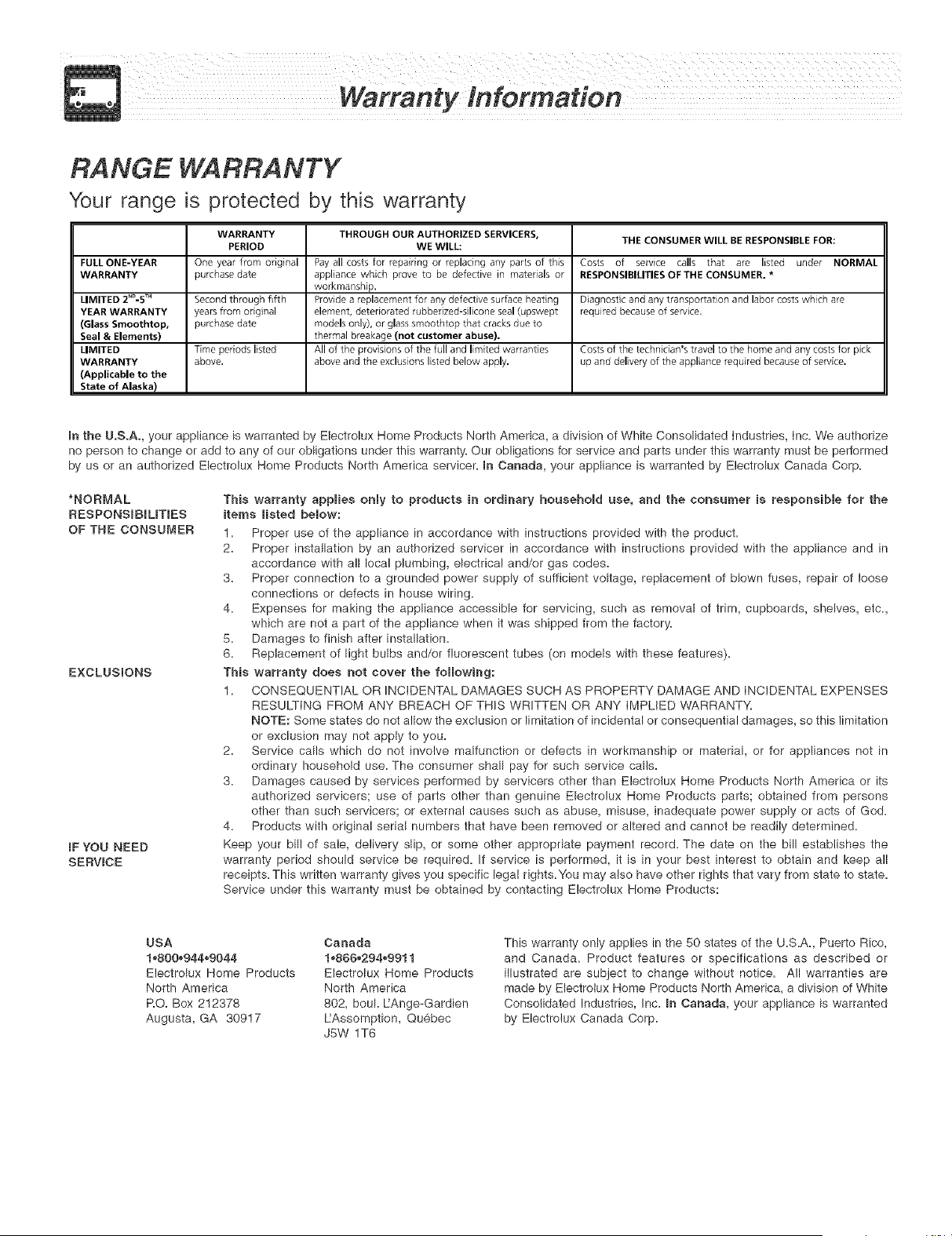
RANGE WARRANTY
Your range is protected by this warranty
WARRANTY THROUGH OUR AUTHORIZED SERVICERS, THE CONSUMER WILL BE RESPONSIBLE FOR:
PERIOD WE WILL:
FULL ONEIyEAR One year from original Pay all costs for repairing or replacing any parts of this Costs of service calls that are listed under NORMAL
WARRANTY purchase date appliance which prove to be defective in mater als or RESPONSIBILITIES OF THE CONSUMER, *
workmanship.
LIMITED 2"_15 TM Second through fifth Provide a replacement for any defective surface heating Diagnostic and any transportation and labor costs whch are
YEAR WARRANTY years from original element, deteriorated rubberized-silicone seal (upswept required because of service.
(Glass Smoothtop, purchase date models only), or glass smoothtop that cracks due to
Seal & Elements) thermal breakage (not customer abuse).
LIMITED Time periods listed All of the provisions of the full and limited warranties Costs of the technician's travel to the home and any costs for pick
WARRANTY above, above and the exclus ons listed below apply. U_) and delivery of the appliance required because of service.
(Applicable to the
State of Alaska)
In the U.S.A., your appliance is warranted by Electrolux Home Products North America, a division of White Consolidated Industries, Inc. We authorize
no person to change or add to any of our obligations under this warranty. Our obligations for service and parts under this warranty must be performed
by us or an authorized Electrolux Home Products North America servicer. In Canada, your appliance is warranted by Electrolux Canada Corp.
*NORMAL
RESPONSmBILmES
OF THE CONSUMER
EXCLUSIONS
IF YOU NEED
SERVICE
This warranty applies only to products in ordinary household use, and the consumer is responsible for the
items Hsted below:
1. Proper use of the appliance in accordance with instructions provided with the product.
2. Proper installation by an authorized servicer in accordance with instructions provided with the appliance and in
accordance with all local plumbing, electrical and/or gas codes.
3. Proper connection to a grounded power supply of sufficient voltage, replacement of blown fuses, repair of loose
connections or defects in house wiring.
4. Expenses for making the appliance accessible for servicing, such as removal of trim, cupboards, shelves, etc,
which are not a part of the appliance when it was shipped from the factory.
8. Damages to finish after installation.
8. Replacement of light bulbs and/or fluorescent tubes (on models with these features).
This warranty does not cover the following:
1. CONSEQUENTIAL OR INCIDENTAL DAMAGES SUCH AS PROPERTY DAMAGE AND INCIDENTAL EXPENSES
RESULTING FROM ANY BREACH OF THIS WRITTEN OR ANY IMPLIED WARRANTY.
NOTE: Some states do not allow the exclusion or limitation of incidental or consequential damages, so this limitation
or exclusion may not apply to you.
2. Service calls which do not involve malfunction or defects in workmanship or material, or for appliances not in
ordinary household use. The consumer shall pay for such service calls.
3. Damages caused by services performed by servicers other than Electrolux Home Products North America or its
authorized servicers; use of parts other than genuine Electrolux Home Products parts; obtained from persons
other than such servicers; or external causes such as abuse, misuse, inadequate power supply or acts of God.
4. Products with original serial numbers that have been removed or altered and cannot be readily determined.
Keep your bill of sale, delivery slip, or some other appropriate payment record. The date on the bill establishes the
warranty period should service be required. If service is performed, it is in your best interest to obtain and keep all
receipts. This written warranty gives you specific legal rights. You may also have other rights that vary from state to state.
Service under this warranty must be obtained by contacting Electrolux Home Products:
USA
1.800,944_9044
Electrolux Home Products
North America
RO. Box 212378
Augusta, GA 30917
Canada
1,888.294_9911
Electrolux Home Products
North America
802, boul. L:Ange-Gardien
L:Assomption, Quebec
JSW 1T8
This warranty only applies in the 50 states of the U.S.A., Puerto Rico,
and Canada. Product features or specifications as described or
illustrated are subject to change without notice. All warranties are
made by Electrolux Home Products North America, a division of White
Consolidated Industries, Inc. In Canada, your appliance is warranted
by Electrolux Canada Corp.