

23" Concert Acoustic Electric Ukulele
and Amplifier Kit
PUKTEAK74
4-String Ukulele with 3W Black Amplifier,
Cable, Strap, Set of Strings, Cleaning Cloth,
Celluloid Picks & Gray Bag

Please take a few moments to read through this booklet.
Tips on How to Take Care of Your Ukulele
Even if your ukelele is of high quality, like all instruments, you need to care for it. Playing it and allowing all the oils
from your ngers to get in contact with your instrument is a factor along with many others why you need to spoil
your ukulele and give it the necessary attention.
1. Keep It Clean
Clean your ukulele after each time you use it. The sweat and grease from your hands are trapping dust on the
surface of the uke, which deteriorates the condition of the wood. You can use lemon oil and a microber cleaning
cloth to get rid of all the dust and stickiness. Slip a clean rag underneath the strings to clean the board.
2. Avoid The Eect of Humidity
Keep your ukulele stored in about 50% relative humidity.
3. Restring Your Ukulele Regularly
Although this will dier from one player to the other, you need to consider how frequently you play your ukulele
and, based on that, change your strings. Signs you need to change your strings:
• Strings are tired if they can’t hold in place as much as usual, and they loosen too quickly.
• A variation in the strings or strings aren’t as smooth anymore.
• If your ukulele sounds a little dull.
4. Don’t Go too Harsh With The Pick
Learn how to strum without letting the pick touch the body of your ukulele.
www.PyleUSA.com
2

5. Use Your Capo Properly
Make sure that your clamp is wide enough while placing it to avoid rough friction with your neck, and similarly,
make sure to unclamp it then remove it, not just pull it o.
6. Use a Case
This is necessary if you want to avoid damaging your ukulele.
7. Handle Your Ukulele Properly While Playing
Pay attention not to drop the instrument.You can cause a lot of damage to your ukulele if you just keep dropping it
every now and then, from simple scratches to serious breaking.
Parts of a Ukulele
BRIDGE
SOUND HOLE
FRETS
NUT
HEADSTOCK
TUNING PEGSNECK
ELECTRONICS
BODY
www.PyleUSA.com
3

Quick Start
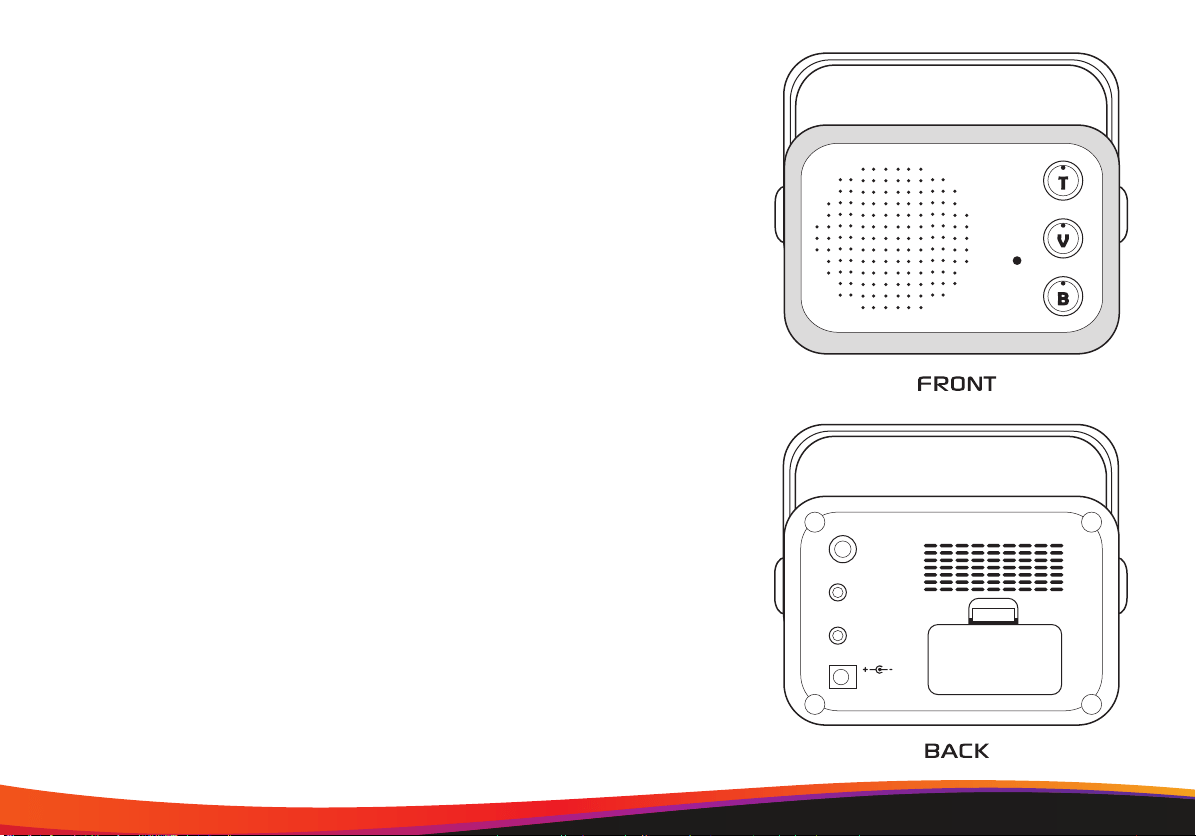
1. Set the controls: Set volume o and bass, middle and treble to center.
2. Plug in: Connect to an amplier or PA with a ¼-inch instrument cable.
The batt light will ash once quickly to indicate it has switched on.
3. Tune up: Press the tuner button. When it’s on, the tuner mutes the
output signal. Press again to exit.
4. Turn up: Raise the volume and adjust the bass, middle and treble
controls to your liking.
Controls
• Volume: For the cleanest signal, set the volume knob as high as possible, without causing distortion or feedback.
• Bass: Boost here to add depth and weight to the sound of the instrument.
• Middle: Turn the middle knob all the way left for a smooth “scooped out” tone at high volume levels.
Raise the middle knob to the right of center to add midrange “bite” to the sound.
• Treble: Boost to cut through the mix. Cut to mellow and subdue the sound.
• Tuner: Use the tuner to tune your instrument.
When the batt lamp lights steadily it is time to change the battery.
To conserve the battery, unplug the instrument and turn o the tuner when not in use.
www.PyleUSA.com
4
www.PyleUSA.com
5
How To Plug In
Before you install batteries or plug your amp into an outlet, make sure that
all volume knobs or are at zero. The Mini Amp powers ON, once you plug
or install the batteries.
Plug one end of the instrument cable into the jack on the bottom of your
ukulele until it “clicks” into place as far in as it will go. Plug the other end of
the cable into the “input” jack on your amp in the same fashion.
Turn the volume up on the amp as you strum the strings until you reach
the desired volume level.
INPUT
MP3 IN
PHONES
DC 9V
Amplier Setup
1. Turn the VOLUME on the amp all the way down.
2. Install batteries in the amplier. Alternatively, you can connect the
included AC adapter to the jack on the rear panel, then plug the adapter
into an AC outlet.
3. Plug your Ukulele into the INPUT jack at the back of the mini amp.
If you also plan to use a CD or MP3 player, or a microphone, connect
the player to the AUX IN jack or the microphone to the MIC IN jack at the
back of the mini amp.
4. Slowly raise the VOLUME to a desired level.
5. Do not block any ventilation openings.
NOTE:
Be sure to install batteries in the correct orientation.
If the battery level becomes low, noise may be generated.
Depleted batteries must be removed from the amplier immediately.

www.PyleUSA.com
6
Chord Chart
When you are just starting out with playing the
ukulele it can be quite overwhelming, especially if
it’s your rst instrument ever. There are dozens of
chords and hundreds of ways to play them that can
be found online. You can practice and play using
the most common chords.
To indicate the ngerings chords and musical
phrases in the exercises, the number the ngers of
the left hand are shown as follows.
1
2
3
4
1 - Index nger
2 - Middle nger
3 - Ring nger
4 - Little nger
3 5 7 10 12 15 17 19
A
E
C
G
A
A
A
A
A
A
E
E
E
E
E
E
C
C
C
C
C
C
C
F
F
F
F
F
F
B
B
B
B
B
B
B
D
D
D
D
D
D
D
G
G
G
G
G
G

MOST COMMON CHORDS
Song Chord Progressions
The ukulele is one of the easiest instruments to learn.
Some of the coolest songs out there are also easy songs
to play on the ukulele, even if you’re a complete
beginner. Ukulele chords and lyrics for any song can be
found by googling "SONG NAME ukulele chords".
"Don't Worry Be Happy"
C - Dm - F - C
"The Lion Sleeps Tonight"
G - C - G - D
"Happy Birthday"
D - A - D - G - D - A - D
www.PyleUSA.com
7