Emme 360
TM
All-in-One Convertible Car Seat
Your model may look dierent than one shown on cover.
Read all instructions BEFORE USING this car seat.
KEEP INSTRUCTIONS FOR FUTURE USE.
Failure to follow the warnings on the labels and in the
instruction manual can result in serious injury or death to your
child.
4358-8271E 4.19.23
• Seat Pad Set
• Removable Cup Holder(s)
• Lower Anchor Belt
• Locking Clip
• Instructions
For parts availability and
questions, call, text, or chat.
If requested color is not available,
similar color will be substituted.
Applicable tax and shipping &
handling will also be added.
Replacement Parts List
(on select models)
Send Us a Text: 1-
812-652-2525
(US and Canada Only. Carrier Fees May Apply)
Find Us Online: www.
maxicosi.com
Email Us:
Give Us a Call: 1-800-
951-4113
(Toll Free, US and Canada Only)

Emme 360
TM
All-in-One Convertible Car Seat
Your model may look dierent than one shown on cover.
Read all instructions BEFORE USING this car seat.
KEEP INSTRUCTIONS FOR FUTURE USE.
Failure to follow the warnings on the labels and in the
instruction manual can result in serious injury or death to your
child.
4358-8271E 4.19.23
• Seat Pad Set
• Removable Cup Holder(s)
• Lower Anchor Belt
• Locking Clip
• Instructions
For parts availability and
questions, call, text, or chat.
If requested color is not available,
similar color will be substituted.
Applicable tax and shipping &
handling will also be added.
Replacement Parts List
(on select models)
Send Us a Text: 1-
812-652-2525
(US and Canada Only. Carrier Fees May Apply)
Find Us Online: www.
maxicosi.com
Email Us:
Give Us a Call: 1-800-
951-4113
(Toll Free, US and Canada Only)

Your child’s safety is worth the time it will take to read
and follow these instructions.
Ready? Let’s go!
Pages 1-4 will introduce you to the parts of the car seat.
The Back Cover of this Manual has our contact information.
If at any point you would like assistance, please feel free to reach
out to us.
Welcome to the Maxi-Cosi Family!
Thank you for choosing this car seat, also known as a child
restraint!
To help you get started using your child’s new car seat, here are
the 4 main tasks you’ll need to complete.
Measure
Your Child
Adjust Car Seat to
Fit Your Child
Install Car Seat
into Your Vehicle
Secure Your Child
in Car Seat
SCAN HERE
FOR INSTALL
VIDEOS

Your child’s safety is worth the time it will take to read
and follow these instructions.
Ready? Let’s go!
Pages 1-4 will introduce you to the parts of the car seat.
The Back Cover of this Manual has our contact information.
If at any point you would like assistance, please feel free to reach
out to us.
Welcome to the Maxi-Cosi Family!
Thank you for choosing this car seat, also known as a child
restraint!
To help you get started using your child’s new car seat, here are
the 4 main tasks you’ll need to complete.
Measure
Your Child
Adjust Car Seat to
Fit Your Child
Install Car Seat
into Your Vehicle
Secure Your Child
in Car Seat
SCAN HERE
FOR INSTALL
VIDEOS

©2023 Dorel Juvenile Group, Inc. (800) 951-4113 www.maxicosi.com. Styles and colors
may vary. Les styles et les couleurs peuvent varier. Made in China from American
and imported parts (including seat pad). Fabriqué aux ÉTATS-UNIS. Distributed by (distribué
par) Dorel Juvenile Group, Inc., 2525 State St., Columbus, IN 47201-7494.
Dorel Juvenile Canada, 2233 Argentia Road, Suite 110, Mississauga, ON L5N 2X7. Importado
y Distribuido en Chile por: Comercial e Industrial Silfa S.A. - San Ignacio
0201 / Parque Industrial Portezuelo Quilicura, Santiago Chile. Fono (562) 2339 9000. En
Perú por: Comexa S.A. - Los Libertadores 455 – San Isidro, Lima – Perú. Fono
(511) 4469014. En Centro América, Caribe y Ecuador por: Best Brands Group S.A. – Av.
Balboa, Bay Mall Plaza, Planta Baja, local 9, Panamá. - Fono: (507) 300 2884.
En Colombia por: Baby Universe S.A.S. Vía 40 No. 77-29,
Barranquilla, Colombia - Fono: (575) 353 1110 Importador: DJGM,
S.A. DE C.V. Gabriel Mancera No. 1041 Col. Del Valle, Benito Juárez
C.P. 03100 México, Ciudad de México R.F.C. DJG140305GN9 Tel.
(55) 67199202
Contents
1 Getting Started
1 Parts of Car Seat
3 Accessory Use
5 Installing Base with Vehicle Belt
9 Installing Base with LATCH: Lower Anchor Belt
13 Choosing Car Seat Mode
15 Rotating & Reclining Car Seat on Base
17 Rear-Facing Section
19 Rear-Facing Child Fit
24 Forward-Facing Section
26 Forward-Facing Child Fit
31 Securing Child in Car Seat
35 Booster Seat Section
37 Storing Harness System
42 Booster Seat Use in Vehicle
46 Making Adjustments to Car Seat
46
Changing Headrest/Harness Height
47 Changing Buckle Position
49 Wash & Care
49 Removing Seat Pad Set
52 Cleaning Parts of Car Seat &
Installing Seat Pad Set
53 LATCH & Vehicle Belt Information
53 LATCH: Lower Anchor Belt
55 Vehicle Belts
59 Top Tether
60 Safety Information
60 Child Restraint Use
61 Vehicle Seating Position
62 Installation in Vehicle
63 Replacement & Expiration
64 Registration & Safety Notices
65 Aircraft Information
65 Warranty

©2023 Dorel Juvenile Group, Inc. (800) 951-4113 www.maxicosi.com. Styles and colors
may vary. Les styles et les couleurs peuvent varier. Made in China from American
and imported parts (including seat pad). Fabriqué aux ÉTATS-UNIS. Distributed by (distribué
par) Dorel Juvenile Group, Inc., 2525 State St., Columbus, IN 47201-7494.
Dorel Juvenile Canada, 2233 Argentia Road, Suite 110, Mississauga, ON L5N 2X7. Importado
y Distribuido en Chile por: Comercial e Industrial Silfa S.A. - San Ignacio
0201 / Parque Industrial Portezuelo Quilicura, Santiago Chile. Fono (562) 2339 9000. En
Perú por: Comexa S.A. - Los Libertadores 455 – San Isidro, Lima – Perú. Fono
(511) 4469014. En Centro América, Caribe y Ecuador por: Best Brands Group S.A. – Av.
Balboa, Bay Mall Plaza, Planta Baja, local 9, Panamá. - Fono: (507) 300 2884.
En Colombia por: Baby Universe S.A.S. Vía 40 No. 77-29,
Barranquilla, Colombia - Fono: (575) 353 1110 Importador: DJGM,
S.A. DE C.V. Gabriel Mancera No. 1041 Col. Del Valle, Benito Juárez
C.P. 03100 México, Ciudad de México R.F.C. DJG140305GN9 Tel.
(55) 67199202
Contents
1 Getting Started
1 Parts of Car Seat
3 Accessory Use
5 Installing Base with Vehicle Belt
9 Installing Base with LATCH: Lower Anchor Belt
13 Choosing Car Seat Mode
15 Rotating & Reclining Car Seat on Base
17 Rear-Facing Section
19 Rear-Facing Child Fit
24 Forward-Facing Section
26 Forward-Facing Child Fit
31 Securing Child in Car Seat
35 Booster Seat Section
37 Storing Harness System
42 Booster Seat Use in Vehicle
46 Making Adjustments to Car Seat
46
Changing Headrest/Harness Height
47 Changing Buckle Position
49 Wash & Care
49 Removing Seat Pad Set
52 Cleaning Parts of Car Seat &
Installing Seat Pad Set
53 LATCH & Vehicle Belt Information
53 LATCH: Lower Anchor Belt
55 Vehicle Belts
59 Top Tether
60 Safety Information
60 Child Restraint Use
61 Vehicle Seating Position
62 Installation in Vehicle
63 Replacement & Expiration
64 Registration & Safety Notices
65 Aircraft Information
65 Warranty

Adjustable
Headrest
Harness Covers
*
In and Out
Harness Holders
(on select models)
Removable Cup
Holders
*
Harness
Release Lever
Head Pillow
*
Body Pillow
*
Harness System
*See pages 3-4 for Accessory Use.
Buckle Cover
*
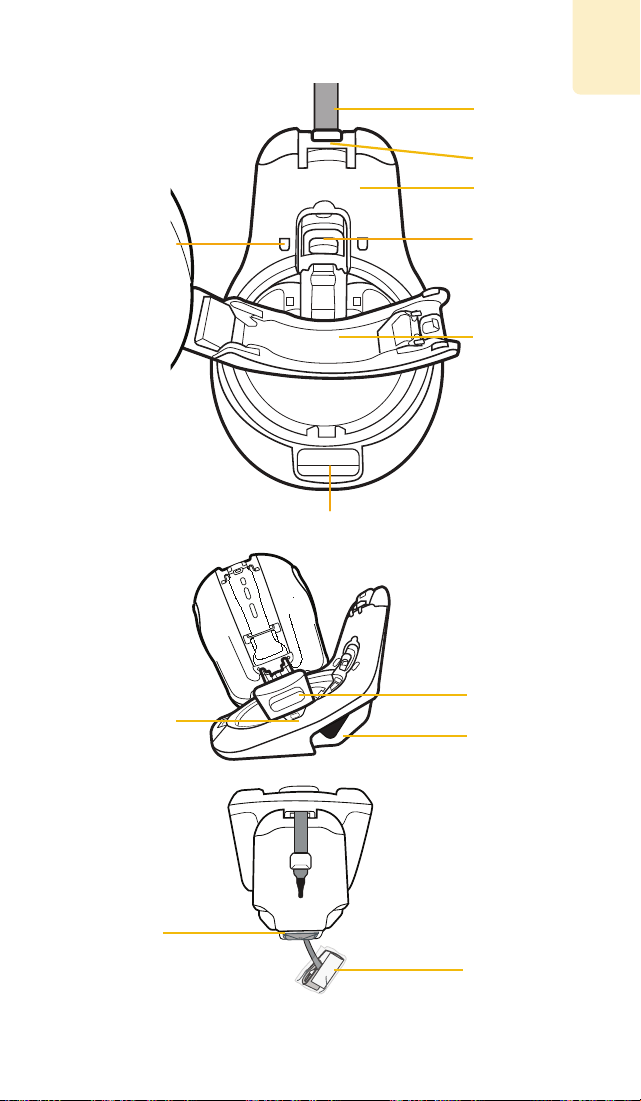
Base
Vehicle Belt &
LATCH: Lower
Anchor Belt
Path
LATCH:
Lower Anchor
Belt (inside of
pocket)
Instruction
Manual Storage
(Inside of pocket
on backside of
headrest pad)
Top Tether
Strap
Headrest/
Harness
Adjustment
Handle
1 2
Parts of Car Seat
ClipQuik
TM
Chest Clip
Buckle
Harness Straps
Your model may look dierent than one shown.
Rotation Lock
Indicator
Tether Door
Vehicle Belt
Lock Off
Rotation Handle
Vehicle Belt
Tension
Indicator
Car Seat
Cradle
Recline Handle
Car Seat Release Handle
(Underneath front of car seat)
Harness
Adjustment
Strap
Wedge Pillow
*
Toddler Pad
*
Recline
Handle
LATCH:
Lower Anchor
Belt Storage
Location
Adjustable
Headrest
Harness Covers
*
In and Out
Harness Holders
(on select models)
Removable Cup
Holders
*
Harness
Release Lever
Head Pillow
*
Body Pillow
*
Harness System
*See pages 3-4 for Accessory Use.
Buckle Cover
*
Base
Vehicle Belt &
LATCH: Lower
Anchor Belt
Path
LATCH:
Lower Anchor
Belt (inside of
pocket)
Instruction
Manual Storage
(Inside of pocket
on backside of
headrest pad)
Top Tether
Strap
Headrest/
Harness
Adjustment
Handle
1 2
Parts of Car Seat
ClipQuik
TM
Chest Clip
Buckle
Harness Straps
Your model may look dierent than one shown.
Rotation Lock
Indicator
Tether Door
Vehicle Belt
Lock Off
Rotation Handle
Vehicle Belt
Tension
Indicator
Car Seat
Cradle
Recline Handle
Car Seat Release Handle
(Underneath front of car seat)
Harness
Adjustment
Strap
Wedge Pillow
*
Toddler Pad
*
Recline
Handle
LATCH:
Lower Anchor
Belt Storage
Location

Harness Covers
(on select models)
For Use in All Modes
The harness covers help
provide comfort to your child’s
neck.
To remove, undo the harness, pull the fastening strips apart and pull
the harness covers off of the top part of the harness cover. The bottom
part is not removable.
3 4
Accessory Use
Removable Cup
Holder(s)
(on select models)
For Use in All Modes
The cup holder(s) is top-
rack dishwasher safe.
Buckle Cover
(on select models)
For Use in Rear-Facing
Mode
or Forward-Facing
Mode
To remove cup holder, twist the cup holder counterclockwise.
Pull it out of the slot in the car seat.
To remove, undo the buckle and pull the buckle cover off the
buckle.
For a larger cup, twist the cup holder
insert counterclockwise as shown.
Wedge Pillow
(on select models)
Only For Use in
Rear-Facing Mode
Toddler Pad
(on select models)
For Use in Rear-Facing
Mode or Forward-Facing
Mode up to 40 lbs
To remove wedge pillow, undo the buckle and pull it through the slot
in the pillow. Slide the pillow out from behind the harness straps.
To remove toddler pillow, undo the buckle and fasteners on pad.
Then pull it through the slot in the pillow.
Body Pillow
(on select models)
MUST Use in
Rear-Facing Mode and
Forward-Facing Mode up
to 30 lbs
To remove body pillow, slide the pillow out from behind the
harness straps.
Head Pillow
(on select models)
Only For Use in
Rear-Facing Mode
To remove head pillow, from the back of the head pillow gently pull
the fabric tabs out of from around the harness straps.

Harness Covers
(on select models)
For Use in All Modes
The harness covers help
provide comfort to your child’s
neck.
To remove, undo the harness, pull the fastening strips apart and pull
the harness covers off of the top part of the harness cover. The bottom
part is not removable.
3 4
Accessory Use
Removable Cup
Holder(s)
(on select models)
For Use in All Modes
The cup holder(s) is top-
rack dishwasher safe.
Buckle Cover
(on select models)
For Use in Rear-Facing
Mode
or Forward-Facing
Mode
To remove cup holder, twist the cup holder counterclockwise.
Pull it out of the slot in the car seat.
To remove, undo the buckle and pull the buckle cover off the
buckle.
For a larger cup, twist the cup holder
insert counterclockwise as shown.
Wedge Pillow
(on select models)
Only For Use in
Rear-Facing Mode
Toddler Pad
(on select models)
For Use in Rear-Facing
Mode or Forward-Facing
Mode up to 40 lbs
To remove wedge pillow, undo the buckle and pull it through the slot
in the pillow. Slide the pillow out from behind the harness straps.
To remove toddler pillow, undo the buckle and fasteners on pad.
Then pull it through the slot in the pillow.
Body Pillow
(on select models)
MUST Use in
Rear-Facing Mode and
Forward-Facing Mode up
to 30 lbs
To remove body pillow, slide the pillow out from behind the
harness straps.
Head Pillow
(on select models)
Only For Use in
Rear-Facing Mode
To remove head pillow, from the back of the head pillow gently pull
the fabric tabs out of from around the harness straps.

Installing Base with
Vehicle Belt
1
2
3
Place Base in Vehicle Seat
Squeeze the rotation handle and
swivel the seat to face you in
side view.
Squeeze the release handle
located on the front of the car
seat while lifting the car seat off
the base and flipping it over to
the opposite side.
Lay Top Tether Strap Over
the Vehicle Seat
You will be installing the top
tether strap in steps 7 & 8.
Review the vehicle owner’s
manual for the tether anchor
locations.
Open Belt Lock Off
Squeeze the lever to open
the belt lock off & pull it
forward.
4
Weave Vehicle Seat
Belt In and Out of
Belt Path As Shown
Buckle the vehicle belt.
Before installing the car seat in your vehicle, check if the buckle
position needs to be adjusted for your child.
See page 21 for Rear-Facing buckle positions.
See page 28 for Forward-Facing buckle positions.
Review Vehicle Owner’s Manual
Determine what kind of vehicle belts your car has and how to use
them to lock a car seat in place OR where LATCH: lower anchor
seating positions are located in your vehicle.
DO NOT use both the LATCH: lower anchor belt and vehicle belt at the same
time to install the car seat. The car seat is attached to the base via cable wires
and should NOT be removed.
When top tether anchors are available, you MUST ALWAYS attach, adjust, and
secure the tether (top anchorage) strap when installing the car seat in all modes.
DO NOT leave child restraint in Side-Facing mode while vehicle in is motion.
Even when unoccupied, this child restraint
MUST be firmly secured to the
vehicle with the lower anchor belt or with the vehicle seat belt in Rear-Facing or
Forward-Facing mode.
WARNING:
5 6
continued on next page
For LATCH Belt, go to page 9 to bypass the lock off.
For Lap Belt only, skip Step 3 and leave lock off closed.
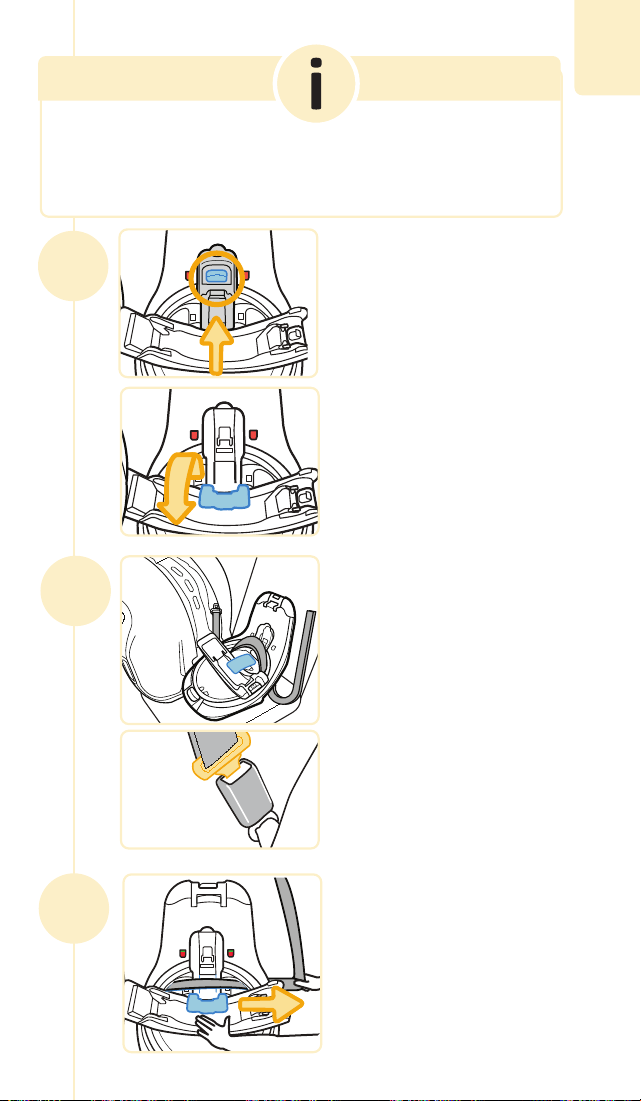
5
Tighten Belt & Gently
Remove Slack
Place your hand in the base
and firmly push the base
down and back toward the
vehicle seat. Pull the belt
parallel (in line) with the belt
path as shown.
Installing Base with
Vehicle Belt
1
2
3
Place Base in Vehicle Seat
Squeeze the rotation handle and
swivel the seat to face you in
side view.
Squeeze the release handle
located on the front of the car
seat while lifting the car seat off
the base and flipping it over to
the opposite side.
Lay Top Tether Strap Over
the Vehicle Seat
You will be installing the top
tether strap in steps 7 & 8.
Review the vehicle owner’s
manual for the tether anchor
locations.
Open Belt Lock Off
Squeeze the lever to open
the belt lock off & pull it
forward.
4
Weave Vehicle Seat
Belt In and Out of
Belt Path As Shown
Buckle the vehicle belt.
Before installing the car seat in your vehicle, check if the buckle
position needs to be adjusted for your child.
See page 21 for Rear-Facing buckle positions.
See page 28 for Forward-Facing buckle positions.
Review Vehicle Owner’s Manual
Determine what kind of vehicle belts your car has and how to use
them to lock a car seat in place OR where LATCH: lower anchor
seating positions are located in your vehicle.
DO NOT use both the LATCH: lower anchor belt and vehicle belt at the same
time to install the car seat. The car seat is attached to the base via cable wires
and should NOT be removed.
When top tether anchors are available, you MUST ALWAYS attach, adjust, and
secure the tether (top anchorage) strap when installing the car seat in all modes.
DO NOT leave child restraint in Side-Facing mode while vehicle in is motion.
Even when unoccupied, this child restraint
MUST be firmly secured to the
vehicle with the lower anchor belt or with the vehicle seat belt in Rear-Facing or
Forward-Facing mode.
WARNING:
5 6
continued on next page
For LATCH Belt, go to page 9 to bypass the lock off.
For Lap Belt only, skip Step 3 and leave lock off closed.
5
Tighten Belt & Gently
Remove Slack
Place your hand in the base
and firmly push the base
down and back toward the
vehicle seat. Pull the belt
parallel (in line) with the belt
path as shown.
87
8
7
Locate Vehicle Tether
Anchors
Locations vary by vehicle.
Review your vehicle owner’s
manual for top tether anchor
locations and how to route
the tether belt when there are
vehicle headrests.
If your car has a vehicle belt that can switch to locking mode, you
MUST use it to lock the belt.
Switching vehicle belt to locking mode: Slowly pull the shoulder
belt all the way out, then let it go back in 1-2 in. (2.5-5 cm).
As it goes back in, you will most likely hear a ratcheting sound.
Gently pull the belt to see if it has locked. You will not be able to pull
any more belt out if the lock has engaged.
FINISHED!
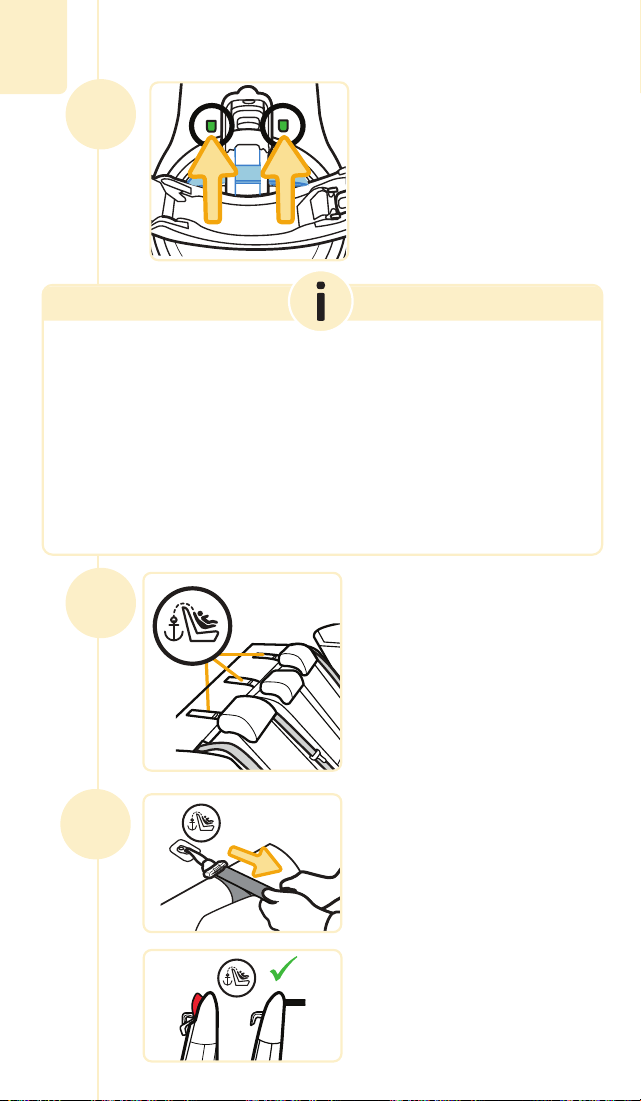
1
2
3
1. Tether Installed? If it is not installed, see steps 7 & 8.
2. Belt Tension Indicators Completely Green?
If they are not green, see steps 3-6.
3. Car Seat Cradle Side-Facing As Shown? If it is not side-facing,
squeeze the rotation handle and move it into side-facing position.
Rear-Facing Child Fit: pages 19-23.
Forward-Facing Child Fit: pages 26-30.
Booster Seat into Base Install: pages 42-45.
6
Close Belt Lock Off
Both indicators will turn
completely
green when
vehicle belt is properly
installed.
If the base moves more than 1 in. (2.5 cm) side to side at
the belt path, you can try:
• Pulling the belt tighter; OR
• Reinstalling the base; OR
• Changing to a different seating location; OR
• Switching to a different install method (LATCH: Lower
Anchor Belt).
Flip Car Seat Over
Push down on the front of
the car seat to lock into
place.
Attach and Tighten Top
Tether Strap Until Tether
Door Is Flush With Base
As Shown

87
8
7
Locate Vehicle Tether
Anchors
Locations vary by vehicle.
Review your vehicle owner’s
manual for top tether anchor
locations and how to route
the tether belt when there are
vehicle headrests.
If your car has a vehicle belt that can switch to locking mode, you
MUST use it to lock the belt.
Switching vehicle belt to locking mode: Slowly pull the shoulder
belt all the way out, then let it go back in 1-2 in. (2.5-5 cm).
As it goes back in, you will most likely hear a ratcheting sound.
Gently pull the belt to see if it has locked. You will not be able to pull
any more belt out if the lock has engaged.
FINISHED!
1
2
3
1. Tether Installed? If it is not installed, see steps 7 & 8.
2. Belt Tension Indicators Completely Green?
If they are not green, see steps 3-6.
3. Car Seat Cradle Side-Facing As Shown? If it is not side-facing,
squeeze the rotation handle and move it into side-facing position.
Rear-Facing Child Fit: pages 19-23.
Forward-Facing Child Fit: pages 26-30.
Booster Seat into Base Install: pages 42-45.
6
Close Belt Lock Off
Both indicators will turn
completely
green when
vehicle belt is properly
installed.
If the base moves more than 1 in. (2.5 cm) side to side at
the belt path, you can try:
• Pulling the belt tighter; OR
• Reinstalling the base; OR
• Changing to a different seating location; OR
• Switching to a different install method (LATCH: Lower
Anchor Belt).
Flip Car Seat Over
Push down on the front of
the car seat to lock into
place.
Attach and Tighten Top
Tether Strap Until Tether
Door Is Flush With Base
As Shown

10
9
Installing Base with
LATCH: Lower Anchor Belt
1
2
3
Place Base in Vehicle Seat
Squeeze the rotation handle
and swivel the seat to face you
in side view.
Squeeze the release handle
located on the front of the car
seat while lifting the car seat
off the base and flipping it over
to the opposite side.
Lay Top Tether Strap
Over the Vehicle Seat
You will be installing the top
tether strap in steps 6 & 7.
Review the vehicle owner’s
manual for the tether anchor
locations.
Take Lower
Anchor Belt Out of
Storage Location
4
Weave Lower Anchor Belt
In & Out of Belt Path
Then attach lower anchor
hooks to the vehicle’s lower
anchor.
Before installing the car seat in your vehicle, check to see if you need to adjust the
buckle position for your child.
See page 21 for Rear-Facing buckle positions.
See page 28 for Forward-Facing buckle positions.
If LATCH: lower anchors are not an option or if your child weighs more than 25 lb
(11 kg), in Rear-Facing Mode or 30 lb (14 kg) in Forward-Facing Mode you
MUST use the vehicle seat belt system to install the car seat.
Review Vehicle Owner’s Manual
Determine what kind of vehicle belts your car has and how to use them to lock a
car seat in place OR where LATCH: lower anchor seating positions are located in
your vehicle
.
DO NOT use both the LATCH: lower anchor belt and vehicle belt at the same
time to install the car seat. The car seat is attached to the base via cable
wires and should NOT be removed.
When top tether anchors are available, you MUST ALWAYS attach, adjust,
and secure the tether (top anchorage) strap when installing the car seat in
all modes.
DO NOT leave child restraint in Side-Facing mode while vehicle in is motion.
Even when unoccupied, this child restraint
MUST be firmly secured to the
vehicle with the lower anchor belt or with the vehicle seat belt in Rear-
Facing or Forward-Facing mode.
WARNING:
Vehicle Belt Lock Off
MUST BE Closed
BEFORE Routing Lower
Anchor Belt
continued on next page

10
9
Installing Base with
LATCH: Lower Anchor Belt
1
2
3
Place Base in Vehicle Seat
Squeeze the rotation handle
and swivel the seat to face you
in side view.
Squeeze the release handle
located on the front of the car
seat while lifting the car seat
off the base and flipping it over
to the opposite side.
Lay Top Tether Strap
Over the Vehicle Seat
You will be installing the top
tether strap in steps 6 & 7.
Review the vehicle owner’s
manual for the tether anchor
locations.
Take Lower
Anchor Belt Out of
Storage Location
4
Weave Lower Anchor Belt
In & Out of Belt Path
Then attach lower anchor
hooks to the vehicle’s lower
anchor.
Before installing the car seat in your vehicle, check to see if you need to adjust the
buckle position for your child.
See page 21 for Rear-Facing buckle positions.
See page 28 for Forward-Facing buckle positions.
If LATCH: lower anchors are not an option or if your child weighs more than 25 lb
(11 kg), in Rear-Facing Mode or 30 lb (14 kg) in Forward-Facing Mode you
MUST use the vehicle seat belt system to install the car seat.
Review Vehicle Owner’s Manual
Determine what kind of vehicle belts your car has and how to use them to lock a
car seat in place OR where LATCH: lower anchor seating positions are located in
your vehicle
.
DO NOT use both the LATCH: lower anchor belt and vehicle belt at the same
time to install the car seat. The car seat is attached to the base via cable
wires and should NOT be removed.
When top tether anchors are available, you MUST ALWAYS attach, adjust,
and secure the tether (top anchorage) strap when installing the car seat in
all modes.
DO NOT leave child restraint in Side-Facing mode while vehicle in is motion.
Even when unoccupied, this child restraint
MUST be firmly secured to the
vehicle with the lower anchor belt or with the vehicle seat belt in Rear-
Facing or Forward-Facing mode.
WARNING:
Vehicle Belt Lock Off
MUST BE Closed
BEFORE Routing Lower
Anchor Belt
continued on next page

12
Attach and Tighten
Top Tether Strap Until
Tether Door Is Flush
With Base As Shown
7
FINISHED!
1
2
3
1. Tether Installed? If it is not installed, see steps 6 & 7.
2. Belt Tension Indicators Completely Green?
If they are not green, see steps 4 & 5.
3. Car Seat Cradle Side-Facing As Shown? If it is not side-facing,
squeeze the rotation handle and it move into side-facing position.
Rear-Facing Child Fit: pages 19-23.
Forward-Facing Child Fit: pages 26-30.
Booster Seat into Base Install: pages 42-45.
6
Locate Vehicle Tether
Anchors
Locations vary by vehicle.
Review your vehicle owner’s
manual for top tether anchor
locations and how to route the
belt when there are vehicle
headrests.
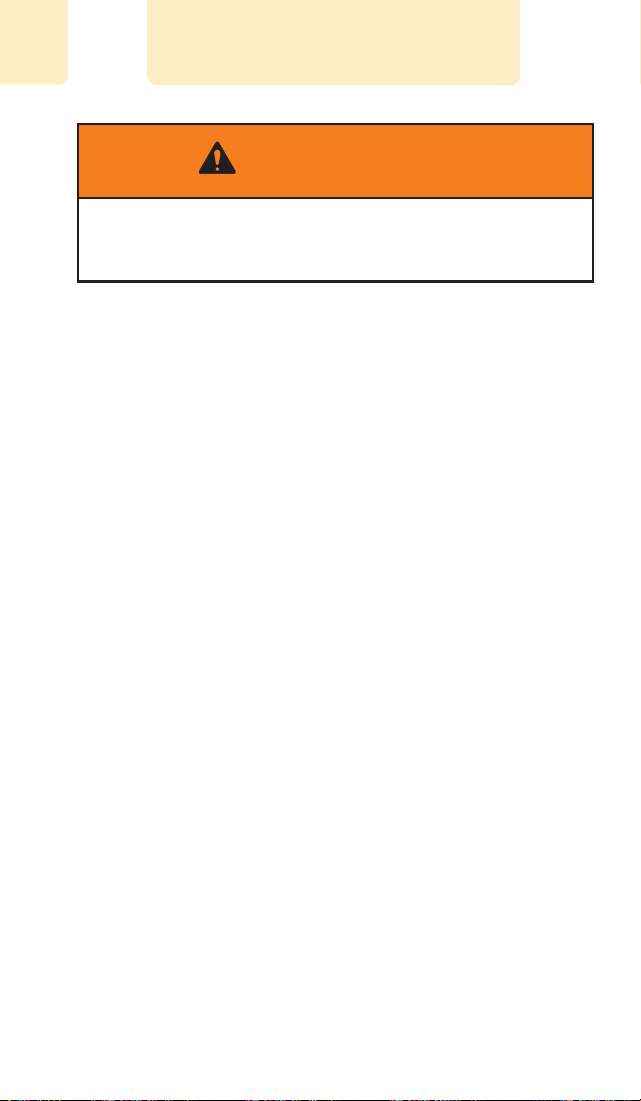
11
5
Tighten Belt & Gently
Remove Slack
Place your hand in the base
and firmly push the base down
and back toward the vehicle
seat.
Pull the belt parallel (in line)
with the belt path as shown.
Tension indicators will begin to
turn
green.
Both indicators will turn
completely green when the
LATCH is properly installed.
If the base moves more than 1 in. (2.5 cm) side to side at the
belt path, you can try:
• Pulling the belt tighter; OR
• Reinstalling the base; OR
• Changing to a different seating location; OR
• Switching to a different install method (vehicle belt).
Flip Car Seat Over
Push down on the front of
the car seat to lock into
place.

12
Attach and Tighten
Top Tether Strap Until
Tether Door Is Flush
With Base As Shown
7
FINISHED!
1
2
3
1. Tether Installed? If it is not installed, see steps 6 & 7.
2. Belt Tension Indicators Completely Green?
If they are not green, see steps 4 & 5.
3. Car Seat Cradle Side-Facing As Shown? If it is not side-facing,
squeeze the rotation handle and it move into side-facing position.
Rear-Facing Child Fit: pages 19-23.
Forward-Facing Child Fit: pages 26-30.
Booster Seat into Base Install: pages 42-45.
6
Locate Vehicle Tether
Anchors
Locations vary by vehicle.
Review your vehicle owner’s
manual for top tether anchor
locations and how to route the
belt when there are vehicle
headrests.
11
5
Tighten Belt & Gently
Remove Slack
Place your hand in the base
and firmly push the base down
and back toward the vehicle
seat.
Pull the belt parallel (in line)
with the belt path as shown.
Tension indicators will begin to
turn
green.
Both indicators will turn
completely green when the
LATCH is properly installed.
If the base moves more than 1 in. (2.5 cm) side to side at the
belt path, you can try:
• Pulling the belt tighter; OR
• Reinstalling the base; OR
• Changing to a different seating location; OR
• Switching to a different install method (vehicle belt).
Flip Car Seat Over
Push down on the front of
the car seat to lock into
place.
14
Your child’s height, weight, and age determine how the car seat
should be placed in the vehicle.
Children vary widely in body size, shape, and temperament—please
consult your doctor before switching between any modes within
the limits and fit requirements of the car seat.
State Laws
Please be certain to follow your state’s laws regarding car seat use.
American Academy of Pediatrics Recommendations
Infants and Toddlers
Should ride in a rear-facing car seat as long as possible, until they
reach the highest weight or height allowed by their car seat.
Toddlers and Preschoolers
Once they are facing forward, children should use a forward-facing car
seat with a harness for as long as possible, until they reach the height
and weight limits for their car seats.
School-Aged Children
Once they have outgrown their forward-facing car seat, children should
use a belt-positioning booster seat until the vehicle’s lap and shoulder
seat belt fits properly. This is often when they have reached at least 4
feet 9 inches in height and are 8 to 12 years old.
Older Children
All children younger than 13 years should be restrained in the rear
seats of vehicles for optimal protection.
Measure your child’s weight and height
(DO NOT guess) before choosing this car seat’s mode.
Choosing Car Seat Mode
WARNING:
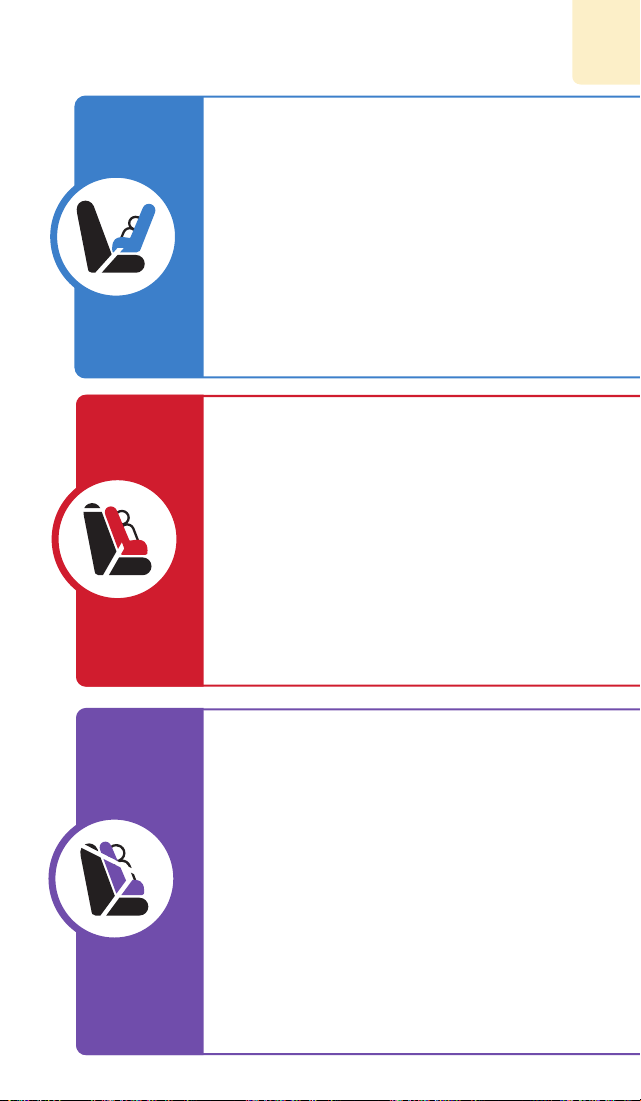
Rear-Facing Mode
5-40 lb (2.3-18 kg) and
19-40 in. (48-101.6 cm)
Rear-Facing Section
PAGE 17
Rear-Facing Child Fit
PAGE 19
Booster Seat Mode
40-100 lb (18.1-45.4 kg) and
43-52 in. (110.1-132.1 cm)
Booster Seat Section
PAGE 35
Storing Harness System
PAGE 37
Booster Seat Use in Vehicle
PAGE 42
Forward-Facing Mode
22-65 lb (10.1-29 kg) and
29-49 in. (73.6-125 cm) and
at least 1 year old
Forward-Facing Section
PAGE 24
Forward-Facing Child Fit
PAGE 26
13
14
Your child’s height, weight, and age determine how the car seat
should be placed in the vehicle.
Children vary widely in body size, shape, and temperament—please
consult your doctor before switching between any modes within
the limits and fit requirements of the car seat.
State Laws
Please be certain to follow your state’s laws regarding car seat use.
American Academy of Pediatrics Recommendations
Infants and Toddlers
Should ride in a rear-facing car seat as long as possible, until they
reach the highest weight or height allowed by their car seat.
Toddlers and Preschoolers
Once they are facing forward, children should use a forward-facing car
seat with a harness for as long as possible, until they reach the height
and weight limits for their car seats.
School-Aged Children
Once they have outgrown their forward-facing car seat, children should
use a belt-positioning booster seat until the vehicle’s lap and shoulder
seat belt fits properly. This is often when they have reached at least 4
feet 9 inches in height and are 8 to 12 years old.
Older Children
All children younger than 13 years should be restrained in the rear
seats of vehicles for optimal protection.
Measure your child’s weight and height
(DO NOT guess) before choosing this car seat’s mode.
Choosing Car Seat Mode
WARNING:
Rear-Facing Mode
5-40 lb (2.3-18 kg) and
19-40 in. (48-101.6 cm)
Rear-Facing Section
PAGE 17
Rear-Facing Child Fit
PAGE 19
Booster Seat Mode
40-100 lb (18.1-45.4 kg) and
43-52 in. (110.1-132.1 cm)
Booster Seat Section
PAGE 35
Storing Harness System
PAGE 37
Booster Seat Use in Vehicle
PAGE 42
Forward-Facing Mode
22-65 lb (10.1-29 kg) and
29-49 in. (73.6-125 cm) and
at least 1 year old
Forward-Facing Section
PAGE 24
Forward-Facing Child Fit
PAGE 26
13

For children who cannot sit up
unassisted, the Rear-Facing Level
Line on the car seat MUST be parallel
with the ground using any position.
For children who can sit up
unassisted, you may make the car
seat more upright in any position.
You must squeeze the Rotation Handle on the front of the base to
move the seat out of Rear-Facing or Forward-Facing modes.
Rotation Lock Indicator will show the locked symbol when car seat
is locked in place.
16
15
Rotating & Reclining
Car Seat on Base
Side-Facing Position
(Towards Parent)
To rotate the car seat from
Side-Facing for all modes, firmly
rotate the seat towards the back
or front of the base.
Rear-Facing Mode
Forward-Facing and Booster Seat Mode
Rotation Lock Indicator will show
the locked symbol when car seat
is locked in place.
The car seat must be fully reclined in Position 5 BEFORE rotating
it to Forward-Facing. Rotation Lock Indicator will show the locked
symbol when car seat is locked in place.
Rotation Handle
Rotation Handle
4
5
To Recline: Squeeze the recline handle and push the top of the car
seat back.
For More Upright: Squeeze the recline handle and pull the top of the
car seat forward.
Recline
Handle
There are 5 Recline positions in Rear-Facing Mode.
SIDE-FACING Position ONLY for use when:
• Placing child into car seat.
• Removing child from car seat.
WARNING:
Reclining Car Seat

For children who cannot sit up
unassisted, the Rear-Facing Level
Line on the car seat MUST be parallel
with the ground using any position.
For children who can sit up
unassisted, you may make the car
seat more upright in any position.
You must squeeze the Rotation Handle on the front of the base to
move the seat out of Rear-Facing or Forward-Facing modes.
Rotation Lock Indicator will show the locked symbol when car seat
is locked in place.
16
15
Rotating & Reclining
Car Seat on Base
Side-Facing Position
(Towards Parent)
To rotate the car seat from
Side-Facing for all modes, firmly
rotate the seat towards the back
or front of the base.
Rear-Facing Mode
Forward-Facing and Booster Seat Mode
Rotation Lock Indicator will show
the locked symbol when car seat
is locked in place.
The car seat must be fully reclined in Position 5 BEFORE rotating
it to Forward-Facing. Rotation Lock Indicator will show the locked
symbol when car seat is locked in place.
Rotation Handle
Rotation Handle
4
5
To Recline: Squeeze the recline handle and push the top of the car
seat back.
For More Upright: Squeeze the recline handle and pull the top of the
car seat forward.
Recline
Handle
There are 5 Recline positions in Rear-Facing Mode.
SIDE-FACING Position ONLY for use when:
• Placing child into car seat.
• Removing child from car seat.
WARNING:
Reclining Car Seat
1817
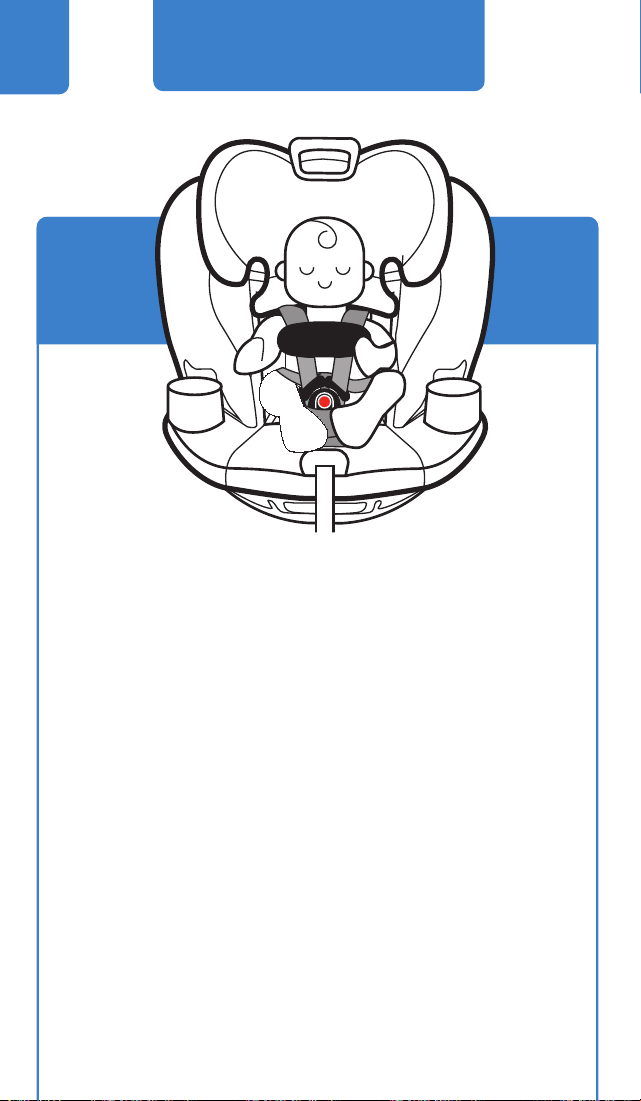
In this car seat, your child can remain Rear-Facing until they
outgrow any one of the following:
• Weight Limit: 40 lb (18 kg); OR
• Height Limit: 40 in. (101.6 cm); OR
• Rear-Facing Child Fit requirements, see pages 19-23.
Please see page 3-4 for accessory use.
Rear-Facing Section
5-40 lb (2.3-18 kg) and
19-40 in. (48-101.6 cm)
Children under 1 year of age MUST ride Rear-Facing.
NEVER install a rear-facing child restraint in
the front seat of a vehicle equipped with an
active frontal airbag.
DO NOT use the lower anchors of the child
restraint anchorage system (LATCH system) to
attach this child restraint when restraining a child weighing
more than 25 lb (11 kg).
The vehicle belt MUST be used for installation if your child
weighs more than 25 lb (11 kg).
DO NOT use the lower anchor belt along with the vehicle lap
or lap/shoulder belt.
DO NOT fasten multiple lower anchor hooks on the same
lower anchor bar in the vehicle.
Check the vehicle belt or the lower anchor belt before each
use. Use ONLY if the belt can be tightened properly and
locked securely in place.
DO NOT leave child restraint in Side-Facing mode while
vehicle in is motion.
Even when unoccupied, this child restraint
MUST be firmly
secured to the vehicle with the lower anchor belt or with the
vehicle seat belt in Rear-Facing or Forward-Facing mode.
This child restraint MUST ALWAYS face the rear of the
vehicle until the child is at least 1 year old and weighs 22 lb
(10 kg).
Do not use this chest clip with children
who have an implanted electronic
medical device.
A magnet is used to help secure the
chest clip locking mechanism together
which may interfere with the proper
function of an implanted electronic
medical device.
Parents or caregivers who have an implanted electronic
device should keep their device away from the chest
clip and consult their doctor and medical device
manufacturer for specific information before using this
chest clip.
WARNING:
IMPLANTED
ELECTRONIC
MEDICAL
DEVICES

1817
In this car seat, your child can remain Rear-Facing until they
outgrow any one of the following:
• Weight Limit: 40 lb (18 kg); OR
• Height Limit: 40 in. (101.6 cm); OR
• Rear-Facing Child Fit requirements, see pages 19-23.
Please see page 3-4 for accessory use.
Rear-Facing Section
5-40 lb (2.3-18 kg) and
19-40 in. (48-101.6 cm)
Children under 1 year of age MUST ride Rear-Facing.
NEVER install a rear-facing child restraint in
the front seat of a vehicle equipped with an
active frontal airbag.
DO NOT use the lower anchors of the child
restraint anchorage system (LATCH system) to
attach this child restraint when restraining a child weighing
more than 25 lb (11 kg).
The vehicle belt MUST be used for installation if your child
weighs more than 25 lb (11 kg).
DO NOT use the lower anchor belt along with the vehicle lap
or lap/shoulder belt.
DO NOT fasten multiple lower anchor hooks on the same
lower anchor bar in the vehicle.
Check the vehicle belt or the lower anchor belt before each
use. Use ONLY if the belt can be tightened properly and
locked securely in place.
DO NOT leave child restraint in Side-Facing mode while
vehicle in is motion.
Even when unoccupied, this child restraint
MUST be firmly
secured to the vehicle with the lower anchor belt or with the
vehicle seat belt in Rear-Facing or Forward-Facing mode.
This child restraint MUST ALWAYS face the rear of the
vehicle until the child is at least 1 year old and weighs 22 lb
(10 kg).
Do not use this chest clip with children
who have an implanted electronic
medical device.
A magnet is used to help secure the
chest clip locking mechanism together
which may interfere with the proper
function of an implanted electronic
medical device.
Parents or caregivers who have an implanted electronic
device should keep their device away from the chest
clip and consult their doctor and medical device
manufacturer for specific information before using this
chest clip.
WARNING:
IMPLANTED
ELECTRONIC
MEDICAL
DEVICES
2019
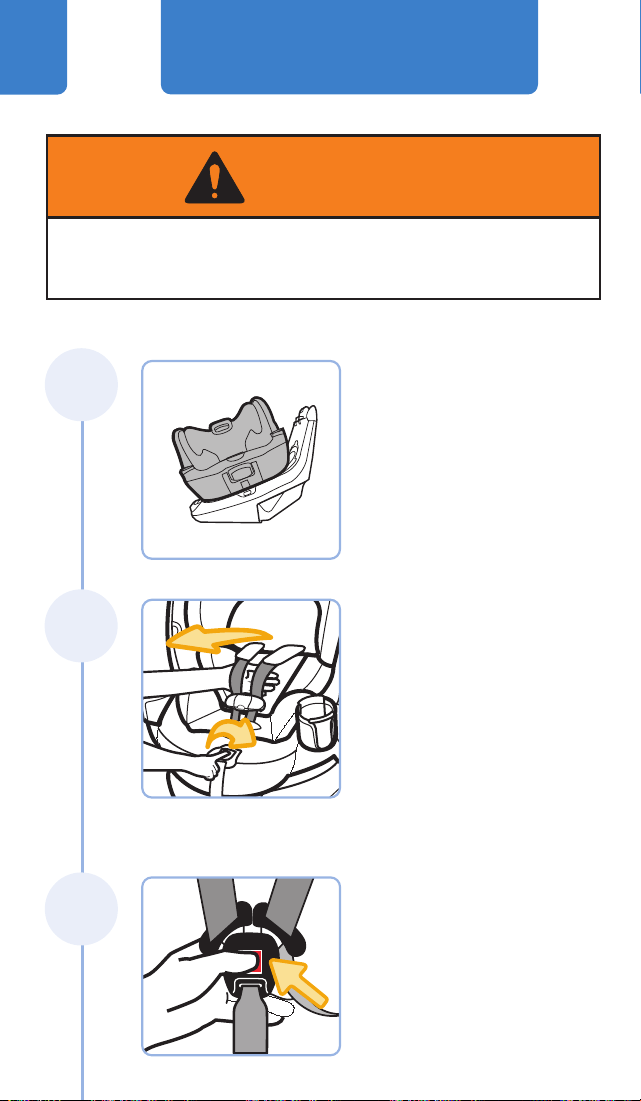
Place Child in Car Seat
On select models: You may
use the In and Out Harness
Holders to place the harness
straps out of the way.
Your child’s bottom and back
should be flat against the car
seat.
Undo Chest Clip
Hold the chest clip with
both hands and press in on
the top and bottom buttons
with your index finger and
thumb as shown.
While holding the buttons
in, pull the right (top) half of
the clip apart from the left
(bottom) half to release the
magnet and separate the
chest clip.
Fully Loosen
Harness Straps
Push down on the harness
release lever (through the
opening in the pad) while
pulling at or below the
harness covers as shown.
1
2
3
Rear-Facing
Child Fit
Rotate Car Seat in
Side-Facing Position
on Base
Squeeze the rotaion handle
and swivel the seat to face
you in side view.
5
6
Check Headrest
Position
The top of your child’s head
MUST be at least 1 in. (2.5
cm) below the top of the car
seat’s headrest.
The car seat is attached to the base via cable wires
and should NOT be removed
WARNING:
Undo Buckle
4

2019
Place Child in Car Seat
On select models: You may
use the In and Out Harness
Holders to place the harness
straps out of the way.
Your child’s bottom and back
should be flat against the car
seat.
Undo Chest Clip
Hold the chest clip with
both hands and press in on
the top and bottom buttons
with your index finger and
thumb as shown.
While holding the buttons
in, pull the right (top) half of
the clip apart from the left
(bottom) half to release the
magnet and separate the
chest clip.
Fully Loosen
Harness Straps
Push down on the harness
release lever (through the
opening in the pad) while
pulling at or below the
harness covers as shown.
1
2
3
Rear-Facing
Child Fit
Rotate Car Seat in
Side-Facing Position
on Base
Squeeze the rotaion handle
and swivel the seat to face
you in side view.
5
6
Check Headrest
Position
The top of your child’s head
MUST be at least 1 in. (2.5
cm) below the top of the car
seat’s headrest.
The car seat is attached to the base via cable wires
and should NOT be removed
WARNING:
Undo Buckle
4

21 22
continued on next page
Rotate Car Seat
Towards Rear-
Facing Position
Rotation Lock Indicator
will show the locked
symbol when car seat is
locked in place.
Check Rear-Facing Level
Line.
1
2
3
8
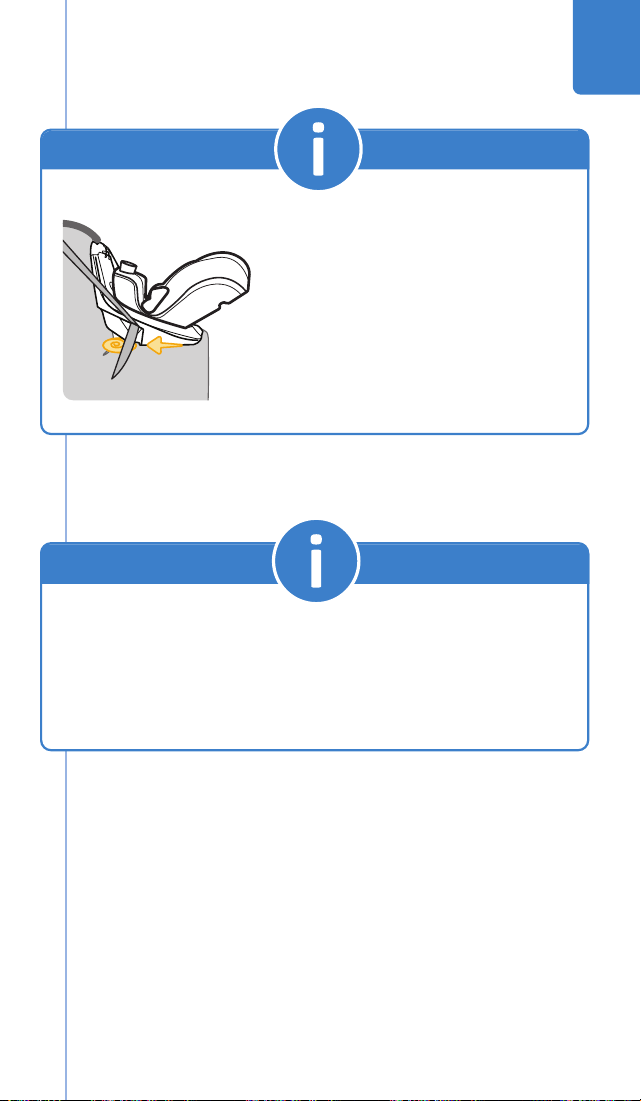
Buckle
Check Buckle Position
• Use the slot closest to
your child.
• The buckle should
not be underneath or
behind your child.
The buckle can be used in
any buckle slot.
Buckle
Strap
9
7
Check Harness
Strap Position
The harness strap MUST
be at or slightly below
the shoulders; never above.
Only if necessary, you may place a
tightly rolled towel(s) or foam pool
noodle(s) under the front of the car
seat base to help make the Rear-
Facing Level Line parallel with the
ground.
Check often to make sure padding
is still in place and the belt is tight.
To secure child in car seat, see pages 31-34.
To change the harness strap height, see page 46.
To change the buckle position, see pages 47-48.
To learn how to check harness tightness, see pages 31-34.
21 22
continued on next page
Rotate Car Seat
Towards Rear-
Facing Position
Rotation Lock Indicator
will show the locked
symbol when car seat is
locked in place.
Check Rear-Facing Level
Line.
1
2
3
8
Buckle
Check Buckle Position
• Use the slot closest to
your child.
• The buckle should
not be underneath or
behind your child.
The buckle can be used in
any buckle slot.
Buckle
Strap
9
7
Check Harness
Strap Position
The harness strap MUST
be at or slightly below
the shoulders; never above.
Only if necessary, you may place a
tightly rolled towel(s) or foam pool
noodle(s) under the front of the car
seat base to help make the Rear-
Facing Level Line parallel with the
ground.
Check often to make sure padding
is still in place and the belt is tight.
To secure child in car seat, see pages 31-34.
To change the harness strap height, see page 46.
To change the buckle position, see pages 47-48.
To learn how to check harness tightness, see pages 31-34.

continued on next page
23 24
FINISHED!
Lap Belt
+ Tether
Lap/Shoulder
Belt
+ Tether
LATCH: Lower
Anchor Belt
+ Tether
Do not install by this
method for a child
weighing more than
25 lb (11 kg).
Headrest Position: Is your child’s headrest in the correct
position? See step 6.
Harness Strap Position: Is your child’s harness strap in the
correct position? See step 7.
Buckle Position: Is your child’s buckle in the correct position?
See step 8.
Vehicle Belt Install: See page 5.
LATCH: Lower Anchor Belt Install: See Page 9.
Forward-Facing
Section
In this car seat, your child can remain harnessed
Forward-Facing until they outgrow any one of the following:
• Weight Limit: 65 lb (29 kg); OR
• Height Limit: 49 in. (125 cm); OR
• Forward-Facing Child Fit requirements, see pages 26-30.
Please see page 3-4 for accessory use.
22-65 lb (10.1-29 kg) and
29-49 in. (73.6-125 cm) and
at least 1 year old
Children MUST be at least 1 year of age to
ride
Forward-Facing.

continued on next page
23 24
FINISHED!
Lap Belt
+ Tether
Lap/Shoulder
Belt
+ Tether
LATCH: Lower
Anchor Belt
+ Tether
Do not install by this
method for a child
weighing more than
25 lb (11 kg).
Headrest Position: Is your child’s headrest in the correct
position? See step 6.
Harness Strap Position: Is your child’s harness strap in the
correct position? See step 7.
Buckle Position: Is your child’s buckle in the correct position?
See step 8.
Vehicle Belt Install: See page 5.
LATCH: Lower Anchor Belt Install: See Page 9.
Forward-Facing
Section
In this car seat, your child can remain harnessed
Forward-Facing until they outgrow any one of the following:
• Weight Limit: 65 lb (29 kg); OR
• Height Limit: 49 in. (125 cm); OR
• Forward-Facing Child Fit requirements, see pages 26-30.
Please see page 3-4 for accessory use.
22-65 lb (10.1-29 kg) and
29-49 in. (73.6-125 cm) and
at least 1 year old
Children MUST be at least 1 year of age to
ride
Forward-Facing.

25
26
continued on next page
DO NOT use the lower anchors of the child restraint anchorage
system (LATCH system) to attach this child restraint when
restraining a child weighing more than 30 lb (14 kg).
The vehicle belt MUST be used for installation if your child
weighs more than 30 lb (14 kg).
When anchors are available, you MUST ALWAYS attach, adjust,
and secure the tether (top anchorage) strap when installing the
car seat in the Forward-Facing Mode with internal harness.
DO NOT use the lower anchor belt along with the vehicle lap or
lap/shoulder belt.
DO NOT use back pillow if your child weighs more than 30 lb
(14 kg).
DO NOT use toddler pad if your child weighs more than 40 lb
(19 kg).
Check the vehicle belt or the lower anchor belt before each use.
Use ONLY if the belt can be tightened properly and locked
securely in place.
DO NOT fasten multiple lower anchor hooks on the same lower
anchor bar in the vehicle.
DO NOT leave child restraint in Side-Facing mode while vehicle
in is motion.
Even when unoccupied, this child restraint
MUST be firmly
secured to the vehicle with the lower anchor belt or with the
vehicle seat belt in Rear-Facing or Forward-Facing mode.
In this child restraint your child MUST be at least 1 year old and
weigh 22 lb (10.1 kg) before they sit forward-facing.
Do not use this chest clip with children
who have an implanted electronic
medical device.
A magnet is used to help secure the
chest clip locking mechanism together
which may interfere with the proper
function of an implanted electronic
medical device.
Parents or caregivers who have an implanted electronic
device should keep their device away from the chest clip
and consult their doctor and medical device manufacturer
for specific information before using this chest clip.
Forward-Facing
Child Fit
1
2
3
WARNING:
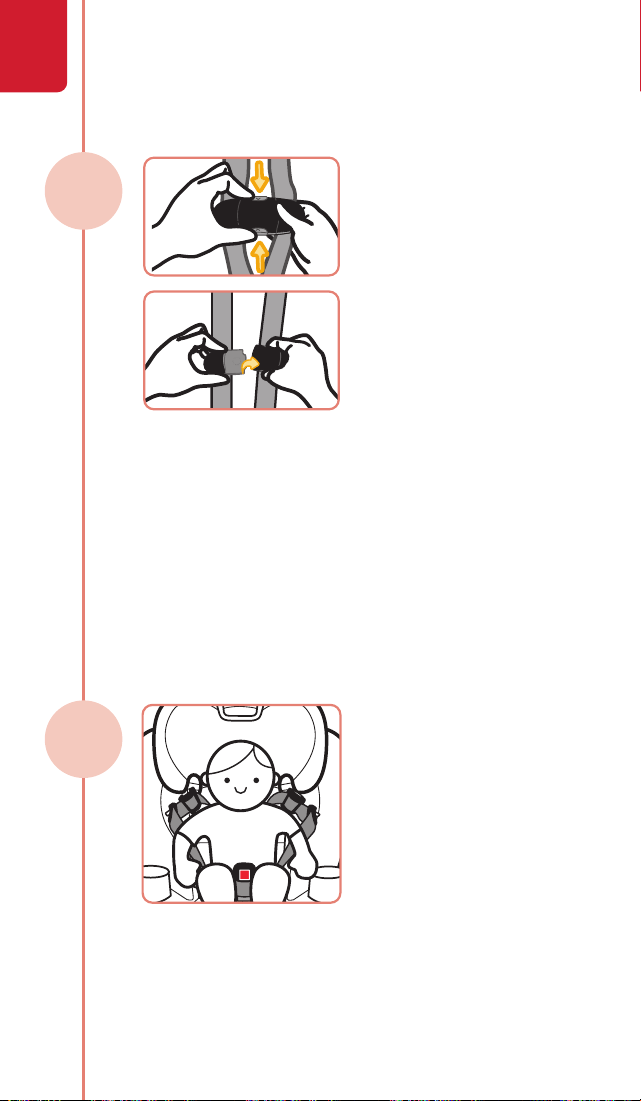
Rotate Car Seat in
Side-Facing Position
on Base
Squeeze the rotation handle
and swivel the seat to face
you in side view.
Fully Loosen
Harness Straps
Push down on the harness
release lever (through the
opening in the pad) while
pulling at or below the
harness covers as shown.
The car seat is attached to the base via cable wires
and should NOT be removed
WARNING:
Undo Buckle
IMPLANTED
ELECTRONIC
MEDICAL
DEVICES

25
26
continued on next page
DO NOT use the lower anchors of the child restraint anchorage
system (LATCH system) to attach this child restraint when
restraining a child weighing more than 30 lb (14 kg).
The vehicle belt MUST be used for installation if your child
weighs more than 30 lb (14 kg).
When anchors are available, you MUST ALWAYS attach, adjust,
and secure the tether (top anchorage) strap when installing the
car seat in the Forward-Facing Mode with internal harness.
DO NOT use the lower anchor belt along with the vehicle lap or
lap/shoulder belt.
DO NOT use back pillow if your child weighs more than 30 lb
(14 kg).
DO NOT use toddler pad if your child weighs more than 40 lb
(19 kg).
Check the vehicle belt or the lower anchor belt before each use.
Use ONLY if the belt can be tightened properly and locked
securely in place.
DO NOT fasten multiple lower anchor hooks on the same lower
anchor bar in the vehicle.
DO NOT leave child restraint in Side-Facing mode while vehicle
in is motion.
Even when unoccupied, this child restraint
MUST be firmly
secured to the vehicle with the lower anchor belt or with the
vehicle seat belt in Rear-Facing or Forward-Facing mode.
In this child restraint your child MUST be at least 1 year old and
weigh 22 lb (10.1 kg) before they sit forward-facing.
Do not use this chest clip with children
who have an implanted electronic
medical device.
A magnet is used to help secure the
chest clip locking mechanism together
which may interfere with the proper
function of an implanted electronic
medical device.
Parents or caregivers who have an implanted electronic
device should keep their device away from the chest clip
and consult their doctor and medical device manufacturer
for specific information before using this chest clip.
Forward-Facing
Child Fit
1
2
3
WARNING:
Rotate Car Seat in
Side-Facing Position
on Base
Squeeze the rotation handle
and swivel the seat to face
you in side view.
Fully Loosen
Harness Straps
Push down on the harness
release lever (through the
opening in the pad) while
pulling at or below the
harness covers as shown.
The car seat is attached to the base via cable wires
and should NOT be removed
WARNING:
Undo Buckle
IMPLANTED
ELECTRONIC
MEDICAL
DEVICES
27 28
Harness Strap
Position
The harness strap
MUST be at or
slightly above the
shoulders; never
below.
6
7
Headrest Position
The tops of your
child’s ears MUST be
below the top of the
car seat’s headrest.
4
On select models: You
may use the In and Out
Harness Holders to place
the harness straps out of
the way.
Your child’s bottom and
back should be flat against
the car seat.
Place Child in
Car Seat
Undo Chest Clip
Hold the chest clip with
both hands and press in
on the top and bottom
buttons with your index
finger and thumb as
shown.
While holding the buttons
in, pull the right (top) half
of the clip apart from
the left (bottom) half to
release the magnet and
separate the chest clip.
5
Buckle Position
• Use the slot closest to
your child.
• The buckle should
not be underneath or
behind your child.
The buckle can be used
in any buckle slot.
1
2
3
Buckle
Buckle
Strap
8
continued on next page

27 28
Harness Strap
Position
The harness strap
MUST be at or
slightly above the
shoulders; never
below.
6
7
Headrest Position
The tops of your
child’s ears MUST be
below the top of the
car seat’s headrest.
4
On select models: You
may use the In and Out
Harness Holders to place
the harness straps out of
the way.
Your child’s bottom and
back should be flat against
the car seat.
Place Child in
Car Seat
Undo Chest Clip
Hold the chest clip with
both hands and press in
on the top and bottom
buttons with your index
finger and thumb as
shown.
While holding the buttons
in, pull the right (top) half
of the clip apart from
the left (bottom) half to
release the magnet and
separate the chest clip.
5
Buckle Position
• Use the slot closest to
your child.
• The buckle should
not be underneath or
behind your child.
The buckle can be used
in any buckle slot.
1
2
3
Buckle
Buckle
Strap
8
continued on next page

29 30
continued on next page
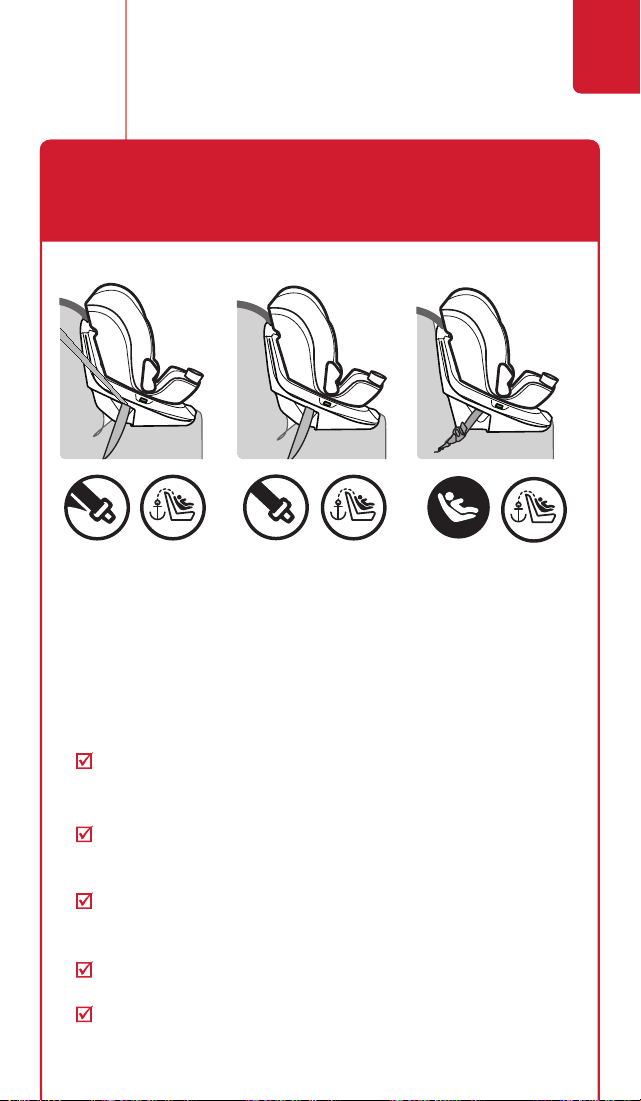
Lap Belt +
Tether
for children up to
65 lb (29 kg)
Lap/Shoulder
Belt + Tether
for children up to
65 lb (29 kg)
LATCH: Lower
Anchor Belt +
Tether
Do not install by
this method for
a child weighing
more than 30 lb
(14 kg)
Headrest Position: Is your child’s head in the correct
position? See step 6.
Harness Strap Position: Is your child’s harness strap in
the correct position? See step 7.
Buckle Position: Is your child’s buckle in the correct
position? See step 8.
Vehicle Belt Install: See page 5.
LATCH: Lower Anchor Install: See Page 9.
FINISHED!
9
Rotate Car Seat
towards to Forward-
Facing position
The car seat must be
fully reclined to rotate it
Forward-Facing.
Rotation Lock Indicator
will show the locked
symbol when car seat is
locked in place.
To secure child in car seat, see pages 31-34.
To change the harness strap height, see page 46.
To change the buckle position, see pages 47-48.
To learn how to check harness tightness, see pages 31-34.
29 30
continued on next page
Lap Belt +
Tether
for children up to
65 lb (29 kg)
Lap/Shoulder
Belt + Tether
for children up to
65 lb (29 kg)
LATCH: Lower
Anchor Belt +
Tether
Do not install by
this method for
a child weighing
more than 30 lb
(14 kg)
Headrest Position: Is your child’s head in the correct
position? See step 6.
Harness Strap Position: Is your child’s harness strap in
the correct position? See step 7.
Buckle Position: Is your child’s buckle in the correct
position? See step 8.
Vehicle Belt Install: See page 5.
LATCH: Lower Anchor Install: See Page 9.
FINISHED!
9
Rotate Car Seat
towards to Forward-
Facing position
The car seat must be
fully reclined to rotate it
Forward-Facing.
Rotation Lock Indicator
will show the locked
symbol when car seat is
locked in place.
To secure child in car seat, see pages 31-34.
To change the harness strap height, see page 46.
To change the buckle position, see pages 47-48.
To learn how to check harness tightness, see pages 31-34.

31 32
Do not use this chest clip with children
who have an implanted electronic medical
device.
A magnet is used to help secure the chest
clip locking mechanism together which
may interfere with the proper function of an
implanted electronic medical device.
Parents or caregivers who have an implanted electronic device
should keep their device away from the chest clip and consult
their doctor and medical device manufacturer for specific
information before using this chest clip.
Securing Child in
Car Seat
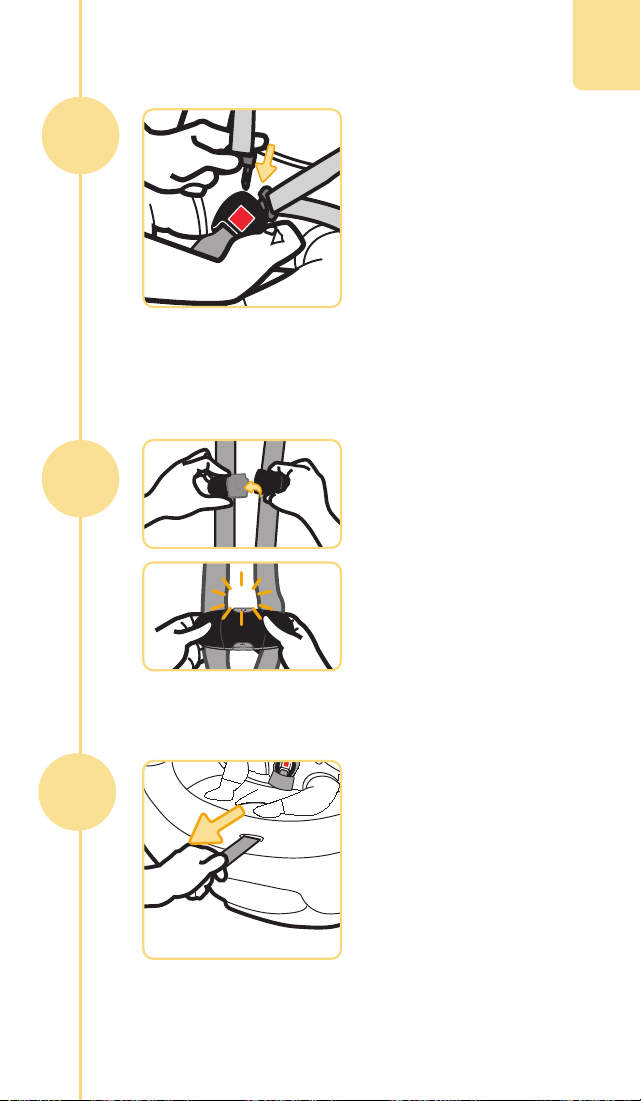
Place Child in
Car Seat
Position harness straps over
your child’s shoulders and
upper thighs. Push buckle
tongues into buckles until
you hear them “click”.
Your child’s bottom and back
should be flat against the
car seat.
Buckle Harness
Pull the harness straps up
to make sure the buckle is
locked.
Fasten Chest Clip
Lay the right (top) half of
the chest clip over the left
(bottom) half and it will
automatically snap together
and lock.
Pull gently on each half of
the chest clip together
to make sure it is locked.
click
IMPLANTED
ELECTRONIC
MEDICAL
DEVICES
WARNING:
1
2
3
Tighten Harness
Pull the harness adjustment
strap straight out to snugly
tighten the harness.
4
31 32
Do not use this chest clip with children
who have an implanted electronic medical
device.
A magnet is used to help secure the chest
clip locking mechanism together which
may interfere with the proper function of an
implanted electronic medical device.
Parents or caregivers who have an implanted electronic device
should keep their device away from the chest clip and consult
their doctor and medical device manufacturer for specific
information before using this chest clip.
Securing Child in
Car Seat
Place Child in
Car Seat
Position harness straps over
your child’s shoulders and
upper thighs. Push buckle
tongues into buckles until
you hear them “click”.
Your child’s bottom and back
should be flat against the
car seat.
Buckle Harness
Pull the harness straps up
to make sure the buckle is
locked.
Fasten Chest Clip
Lay the right (top) half of
the chest clip over the left
(bottom) half and it will
automatically snap together
and lock.
Pull gently on each half of
the chest clip together
to make sure it is locked.
click
IMPLANTED
ELECTRONIC
MEDICAL
DEVICES
WARNING:
1
2
3
Tighten Harness
Pull the harness adjustment
strap straight out to snugly
tighten the harness.
4

33 34
Position Chest Clip
Pull the harness covers
down on the child.
Place the chest clip on the
lower part on the harness
cover so that the harness
covers are between your
child and the chest clip.
Position it at mid-chest
(even with armpits) and
away from your child’s neck.
Unfasten the harness covers.
Try to pinch the harness
at the shoulders vertically
between index finger and
thumb as shown.
A snug strap should not allow any slack.
It lies in a relatively straight line without sagging.
It does not press on the child’s flesh or push the child’s body
into an unnatural position.
Check Harness
Tightness
If your fingers slip off, the harness is tight enough.
If you can pinch the harness strap, tighten more.
Fasten the harness covers.
5
6
Failure to fasten and tighten the harness system correctly
may allow the child to be ejected from the child restraint in
a crash or sudden stop causing serious injury or death.
DO NOT mistake comfort for safety. The harness system
MUST be snugly adjusted.
DO NOT put snowsuits or bulky garments
on your child when placing them in the
child restraint.
Bulky clothing can prevent the harness
straps from being tightened properly.
To Remove Child from Car
Seat:
1. Loosen Harness Strap
2. Unbuckle Harness
3. Release Chest Clip
4. Remove Child
Troubleshooting
1. If the buckle or harness
release lever sticks: DO NOT
lubricate. Check for dropped
food, sticky spilled drinks, dirt,
leaves, etc.
Clean with warm water and/
or remove the object with
tweezers. If you cannot get the
harness to adjust and remain
tight with the buckle securely
locked, DO NOT use this car
seat.
2. If your harness twists:
Straighten the harness each
time you put your child in the
car seat. Lock the buckle and
tighten the harness so it will
be ready for next use.
WARNING:
FINISHED!
Your child is now secured in the car seat.
Check your child’s fit often and make any
needed adjustments to the car seat as they
grow.
7
Rotate Car Seat
towards to desired
position
Rotation Lock Indicator
will show the locked symbol
when car seat is locked in
place.

33 34
Position Chest Clip
Pull the harness covers
down on the child.
Place the chest clip on the
lower part on the harness
cover so that the harness
covers are between your
child and the chest clip.
Position it at mid-chest
(even with armpits) and
away from your child’s neck.
Unfasten the harness covers.
Try to pinch the harness
at the shoulders vertically
between index finger and
thumb as shown.
A snug strap should not allow any slack.
It lies in a relatively straight line without sagging.
It does not press on the child’s flesh or push the child’s body
into an unnatural position.
Check Harness
Tightness
If your fingers slip off, the harness is tight enough.
If you can pinch the harness strap, tighten more.
Fasten the harness covers.
5
6
Failure to fasten and tighten the harness system correctly
may allow the child to be ejected from the child restraint in
a crash or sudden stop causing serious injury or death.
DO NOT mistake comfort for safety. The harness system
MUST be snugly adjusted.
DO NOT put snowsuits or bulky garments
on your child when placing them in the
child restraint.
Bulky clothing can prevent the harness
straps from being tightened properly.
To Remove Child from Car
Seat:
1. Loosen Harness Strap
2. Unbuckle Harness
3. Release Chest Clip
4. Remove Child
Troubleshooting
1. If the buckle or harness
release lever sticks: DO NOT
lubricate. Check for dropped
food, sticky spilled drinks, dirt,
leaves, etc.
Clean with warm water and/
or remove the object with
tweezers. If you cannot get the
harness to adjust and remain
tight with the buckle securely
locked, DO NOT use this car
seat.
2. If your harness twists:
Straighten the harness each
time you put your child in the
car seat. Lock the buckle and
tighten the harness so it will
be ready for next use.
WARNING:
FINISHED!
Your child is now secured in the car seat.
Check your child’s fit often and make any
needed adjustments to the car seat as they
grow.
7
Rotate Car Seat
towards to desired
position
Rotation Lock Indicator
will show the locked symbol
when car seat is locked in
place.

35
36
Booster Seat Section
In this car seat, your child can remain in a Booster Seat until
they outgrow any one of the following:
• Weight Limit: 100 lb (45.4 kg); OR
• Height Limit: 52 in. (132.1 cm); OR
• Booster Seat Use in Vehicle requirements, see page 42-45.
You MUST store the harness system and remove the accessories,
except the cup holder(s), when using the Booster Seat Mode.
To remove accessories, see pages 3-4.
Storing Harness System: Page 37
Booster Seat Use in Vehicle: Page 42
40-100 lb (18.1-45.4 kg) and
43-52 in. (110.1-132.1 cm)
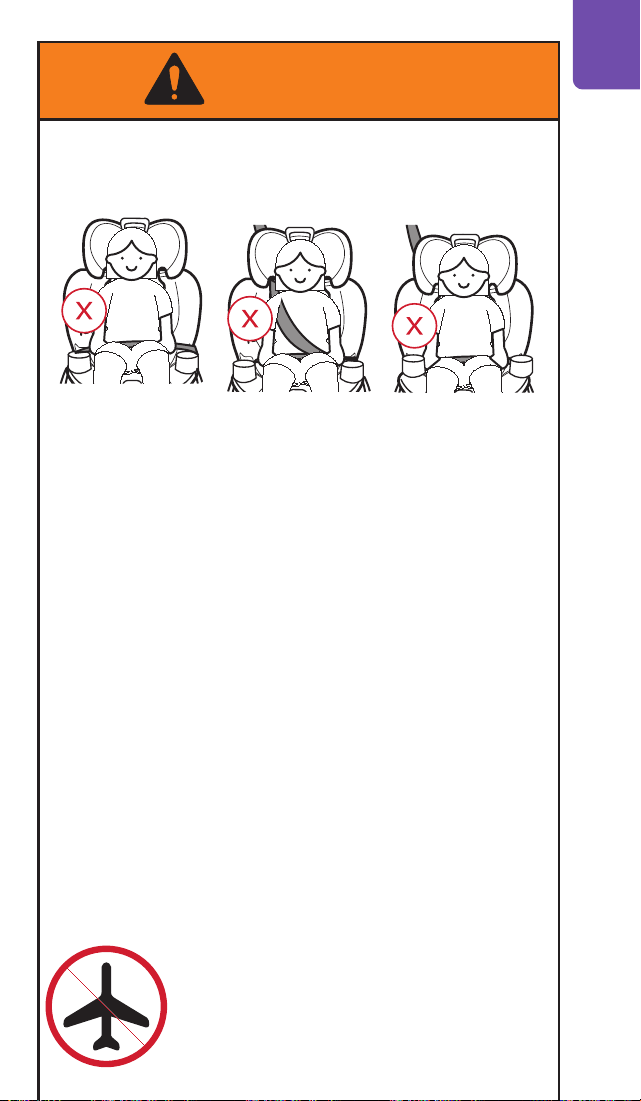
DO NOT use the harness system when using as a
booster seat.
Use ONLY the vehicle’s lap and shoulder belt system
when restraining the child in this booster seat.
DO NOT use only the lap belt when using this seat as a
booster seat.
The shoulder belt MUST always be adjusted snugly
across the child’s chest.
NEVER place shoulder belt under the child’s arms or
behind their back.
DO NOT use the lower anchor belt along with the vehicle
lap or lap/shoulder belt.
DO NOT leave child restraint in Side-Facing mode while
vehicle in is motion.
Even when unoccupied, this child restraint
MUST be
firmly secured to the vehicle with the vehicle seat belt or
Forward-Facing mode.
DO NOT use this booster seat if the tops of your child’s
ears are above the top of the booster seat’s headrest.
This restraint is NOT certified for
aircraft use when used as a booster
seat because aircraft seats do not have
shoulder belts.
WARNING:
35
36
Booster Seat Section
In this car seat, your child can remain in a Booster Seat until
they outgrow any one of the following:
• Weight Limit: 100 lb (45.4 kg); OR
• Height Limit: 52 in. (132.1 cm); OR
• Booster Seat Use in Vehicle requirements, see page 42-45.
You MUST store the harness system and remove the accessories,
except the cup holder(s), when using the Booster Seat Mode.
To remove accessories, see pages 3-4.
Storing Harness System: Page 37
Booster Seat Use in Vehicle: Page 42
40-100 lb (18.1-45.4 kg) and
43-52 in. (110.1-132.1 cm)
DO NOT use the harness system when using as a
booster seat.
Use ONLY the vehicle’s lap and shoulder belt system
when restraining the child in this booster seat.
DO NOT use only the lap belt when using this seat as a
booster seat.
The shoulder belt MUST always be adjusted snugly
across the child’s chest.
NEVER place shoulder belt under the child’s arms or
behind their back.
DO NOT use the lower anchor belt along with the vehicle
lap or lap/shoulder belt.
DO NOT leave child restraint in Side-Facing mode while
vehicle in is motion.
Even when unoccupied, this child restraint
MUST be
firmly secured to the vehicle with the vehicle seat belt or
Forward-Facing mode.
DO NOT use this booster seat if the tops of your child’s
ears are above the top of the booster seat’s headrest.
This restraint is NOT certified for
aircraft use when used as a booster
seat because aircraft seats do not have
shoulder belts.
WARNING:

37 38
1
2
3
4
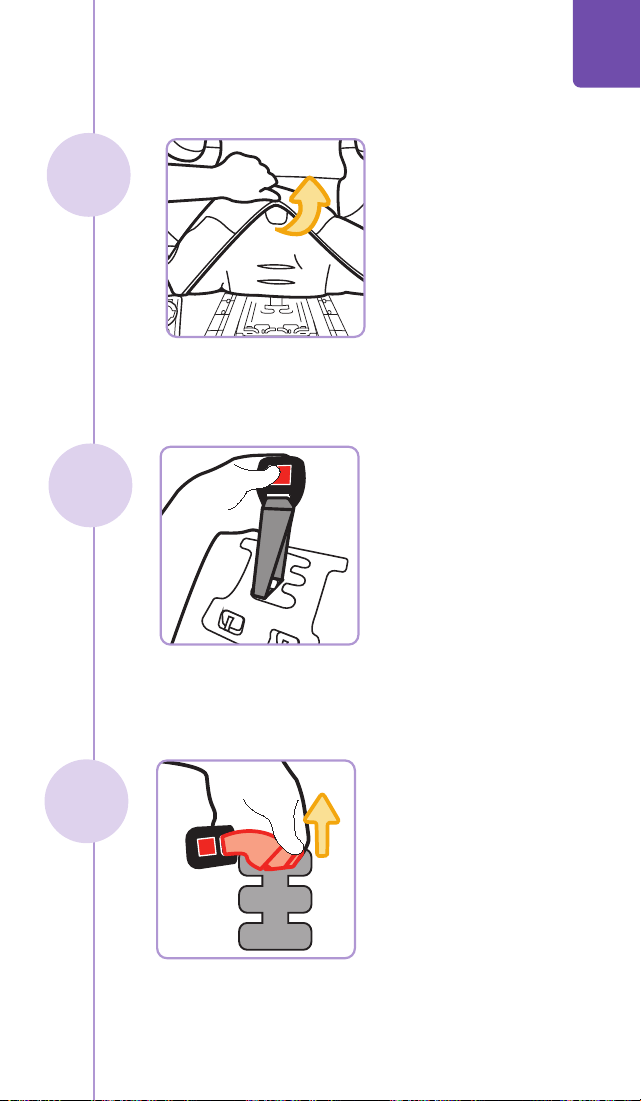
Fully Loosen
Harness Straps
Push down on the
harness release lever
(through the opening in
the pad) while pulling
at or below the harness
covers as shown.
Undo Buckle
Remove Cup
Holders
Twist the cup holder
counterclockwise.
Pull it out of the slot in
the car seat.
Lift Seat Pad from
Front of Car Seat
Storing Harness System
5
6
Pull Buckle &
Buckle Cover Out
of Car Seat
Store the buckle and
buckle cover in a safe
place for future use.
Push Buckle Strap
Down & Pull One
Side of Buckle Strap
to Center
Place part of buckle strap
into desired buckle slot.
Part of strap will still be in
the center. Push the other
side of buckle strap into
the buckle slot.
37 38
1
2
3
4
Fully Loosen
Harness Straps
Push down on the
harness release lever
(through the opening in
the pad) while pulling
at or below the harness
covers as shown.
Undo Buckle
Remove Cup
Holders
Twist the cup holder
counterclockwise.
Pull it out of the slot in
the car seat.
Lift Seat Pad from
Front of Car Seat
Storing Harness System
5
6
Pull Buckle &
Buckle Cover Out
of Car Seat
Store the buckle and
buckle cover in a safe
place for future use.
Push Buckle Strap
Down & Pull One
Side of Buckle Strap
to Center
Place part of buckle strap
into desired buckle slot.
Part of strap will still be in
the center. Push the other
side of buckle strap into
the buckle slot.

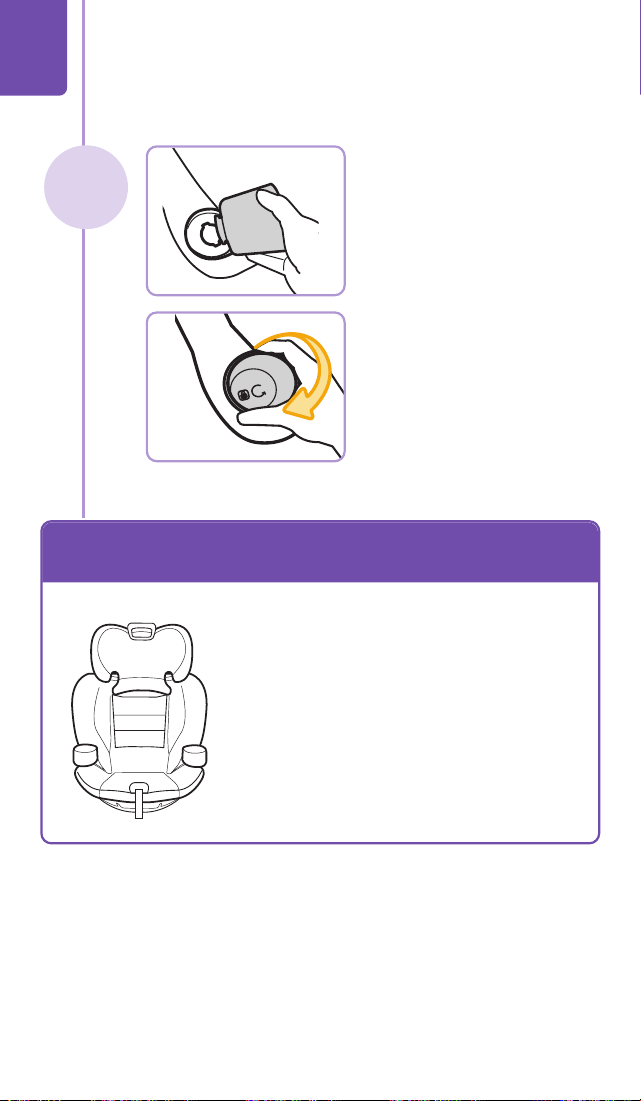
39 40
continued on next page
8
Undo Fasteners on
Headrest Pad &
Seat Pad
9
Pull Headrest Pad
Off Top of Headrest
11
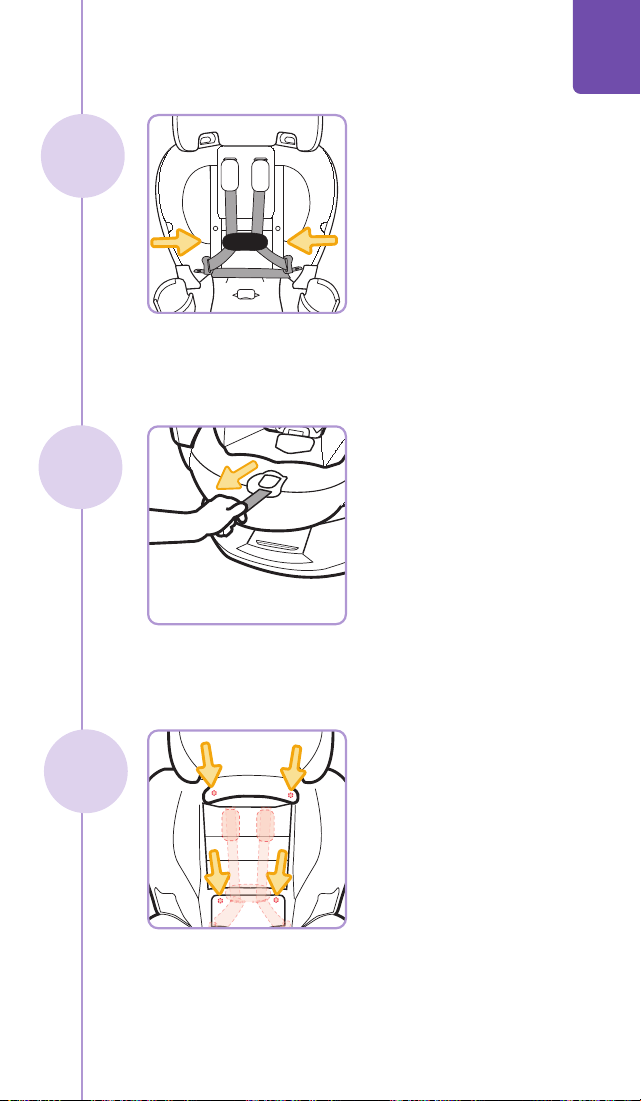
Tighten Harness
Remove any slack from
the harness system.
Wrap Headrest
Pad Around Top of
Headrest
Attach the fasteners on
the headrest pad and the
seat pad.
12
10
Place Chest Clip,
Harness Straps,
& Buckle Tongues
at the Bottom of
headrest
Adjust Headrest to
Highest Position
7
39 40
continued on next page
8
Undo Fasteners on
Headrest Pad &
Seat Pad
9
Pull Headrest Pad
Off Top of Headrest
11
Tighten Harness
Remove any slack from
the harness system.
Wrap Headrest
Pad Around Top of
Headrest
Attach the fasteners on
the headrest pad and the
seat pad.
12
10
Place Chest Clip,
Harness Straps,
& Buckle Tongues
at the Bottom of
headrest
Adjust Headrest to
Highest Position
7
41 42
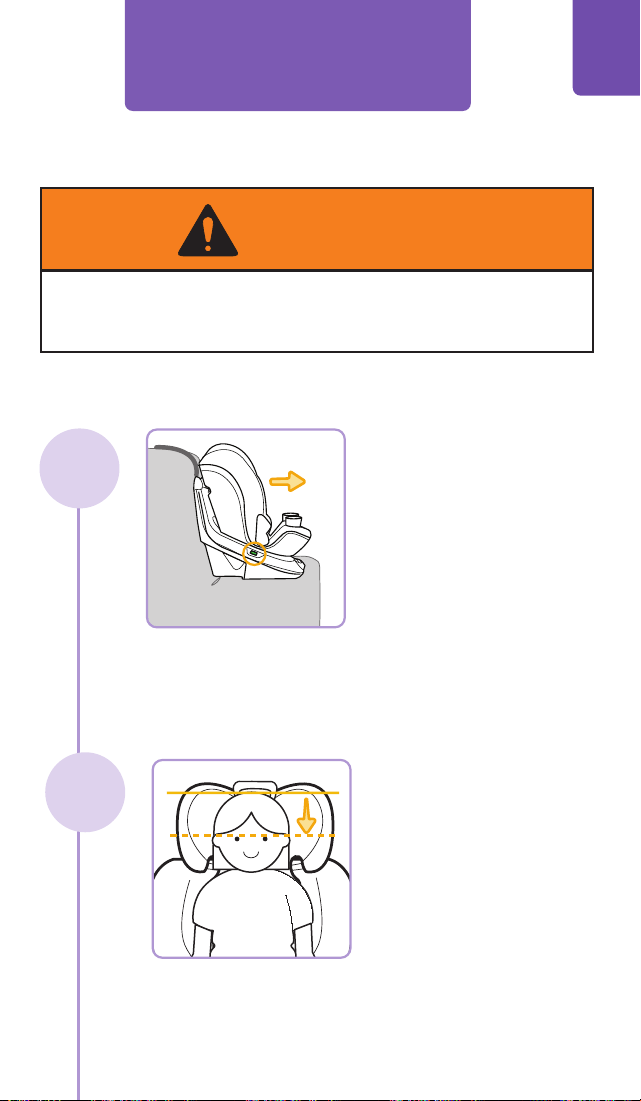
FINISHED!
The car seat has been converted to the
Booster Seat Mode.
See next page for Booster Seat Use in
Vehicle.
Replace Cupholders
Put it in of the slot in the
car seat.
Twist the cup holder
clockwise.
13
Booster Seat Use
in Vehicle
Have Child Sit in
Booster Seat
The tops of your child’s ears
should never be above the
top of the booster seat’s
headrest.
1
Rotate Booster Seat in
Forward-Facing
Position on Base
Rotation Lock Indicator
will show the locked symbol
when car seat is locked in
place.
2
The car seat is attached to the base via cable wires
and should NOT be removed
WARNING:
41 42
FINISHED!
The car seat has been converted to the
Booster Seat Mode.
See next page for Booster Seat Use in
Vehicle.
Replace Cupholders
Put it in of the slot in the
car seat.
Twist the cup holder
clockwise.
13
Booster Seat Use
in Vehicle
Have Child Sit in
Booster Seat
The tops of your child’s ears
should never be above the
top of the booster seat’s
headrest.
1
Rotate Booster Seat in
Forward-Facing
Position on Base
Rotation Lock Indicator
will show the locked symbol
when car seat is locked in
place.
2
The car seat is attached to the base via cable wires
and should NOT be removed
WARNING:
43 44
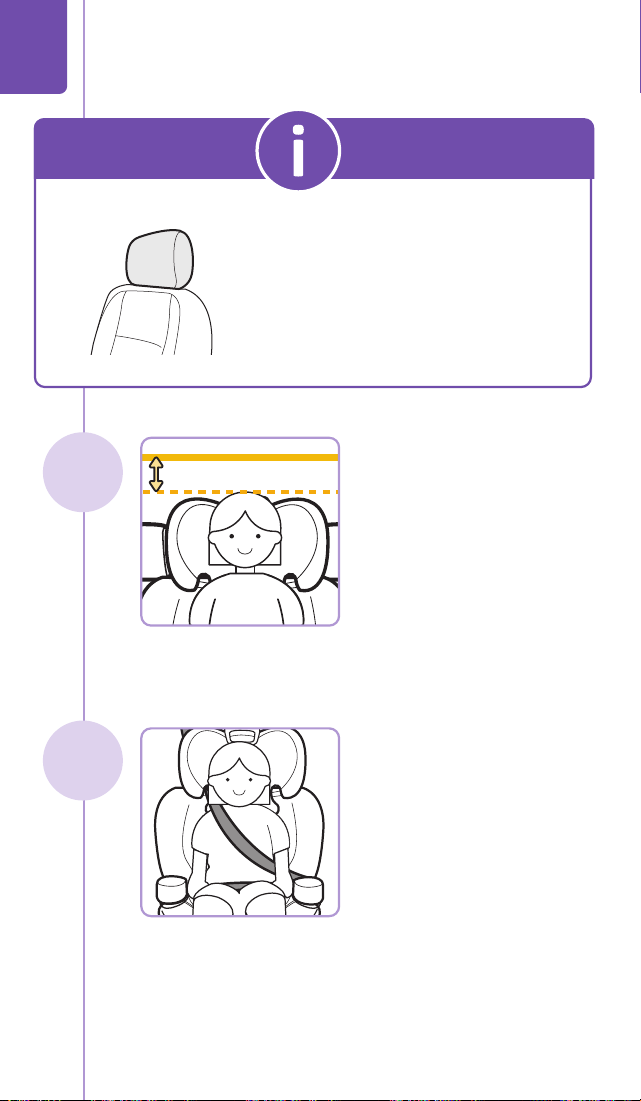
Position Lap Belt
on Child
Route ONLY the lap belt
portion of the vehicle belt
through the Booster Seat
Belt Path as shown. The lap
belt should lay snugly across
your child’s hips; not on
their stomach.
Buckle Vehicle Belt
Pull the shoulder belt up to
tighten.
5
6
3
Car Position
DO NOT use the booster seat
if your child’s head is less
than 5 in. (12.7 cm) below
the roof of the car. Consult
your vehicle manual for
proper seat belt usage.
5 in. (12.7 cm)
4
Shoulder Belt Position
The shoulder belt should lay
snugly across the center of
your child’s shoulder and
across their chest.
continued on next page
Position Shoulder
Belt on Child
Thread the shoulder
belt through the belt-
positioning guide in the
headrest.
Pull the shoulder belt up
to tighten so that it lies
snugly across the center
of your child’s shoulder
and across their chest.
7
If your vehicle has a headrest that
interferes with a flush car seat fit,
check your vehicle owner’s manual
to see if it can be removed, adjusted,
or if there are other possible seating
locations for you to install.

43 44
Position Lap Belt
on Child
Route ONLY the lap belt
portion of the vehicle belt
through the Booster Seat
Belt Path as shown. The lap
belt should lay snugly across
your child’s hips; not on
their stomach.
Buckle Vehicle Belt
Pull the shoulder belt up to
tighten.
5
6
3
Car Position
DO NOT use the booster seat
if your child’s head is less
than 5 in. (12.7 cm) below
the roof of the car. Consult
your vehicle manual for
proper seat belt usage.
5 in. (12.7 cm)
4
Shoulder Belt Position
The shoulder belt should lay
snugly across the center of
your child’s shoulder and
across their chest.
continued on next page
Position Shoulder
Belt on Child
Thread the shoulder
belt through the belt-
positioning guide in the
headrest.
Pull the shoulder belt up
to tighten so that it lies
snugly across the center
of your child’s shoulder
and across their chest.
7
If your vehicle has a headrest that
interferes with a flush car seat fit,
check your vehicle owner’s manual
to see if it can be removed, adjusted,
or if there are other possible seating
locations for you to install.

45 46
FINISHED!
Check periodically to make
sure your child has not
moved out of position and
loosened the shoulder belt.
Keep the booster seat
securely belted through
the belt-positioning
guide in Forward-Facing
position even when
unoccupied.
Fully Loosen
Harness Straps
Push down on the harness
release lever (through the
opening in the pad) while
pulling at or below the
harness covers as shown.
Adjust Headrest/
Harness Height
1. Squeeze the adjustment
handle lever up.
2. Move the headrest up or
down to the proper height for
your child.
2
For Rear-Facing Child Fit, see page 19-23.
For Forward-Facing Child Fit, see page 26-30.
To learn how to check harness tightness, see pages 31-34.
Check the harness straps often for any wear or damage.
Changing Headrest/
Harness Height
1
3. Release the handle to lock in place.
4. Make sure it is locked securely.
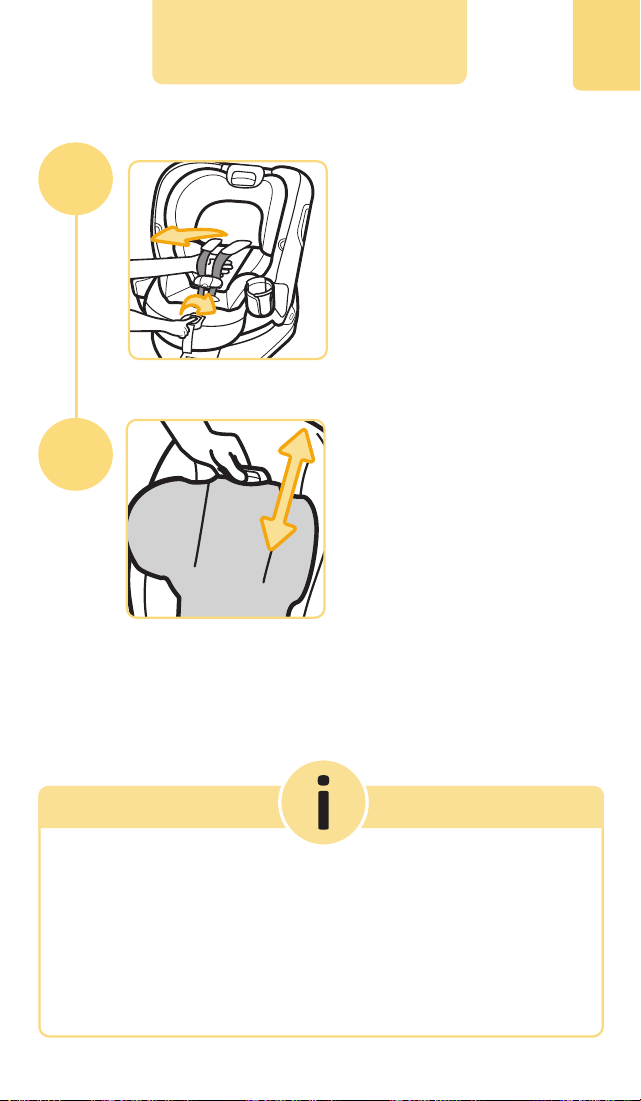
45 46
FINISHED!
Check periodically to make
sure your child has not
moved out of position and
loosened the shoulder belt.
Keep the booster seat
securely belted through
the belt-positioning
guide in Forward-Facing
position even when
unoccupied.
Fully Loosen
Harness Straps
Push down on the harness
release lever (through the
opening in the pad) while
pulling at or below the
harness covers as shown.
Adjust Headrest/
Harness Height
1. Squeeze the adjustment
handle lever up.
2. Move the headrest up or
down to the proper height for
your child.
2
For Rear-Facing Child Fit, see page 19-23.
For Forward-Facing Child Fit, see page 26-30.
To learn how to check harness tightness, see pages 31-34.
Check the harness straps often for any wear or damage.
Changing Headrest/
Harness Height
1
3. Release the handle to lock in place.
4. Make sure it is locked securely.
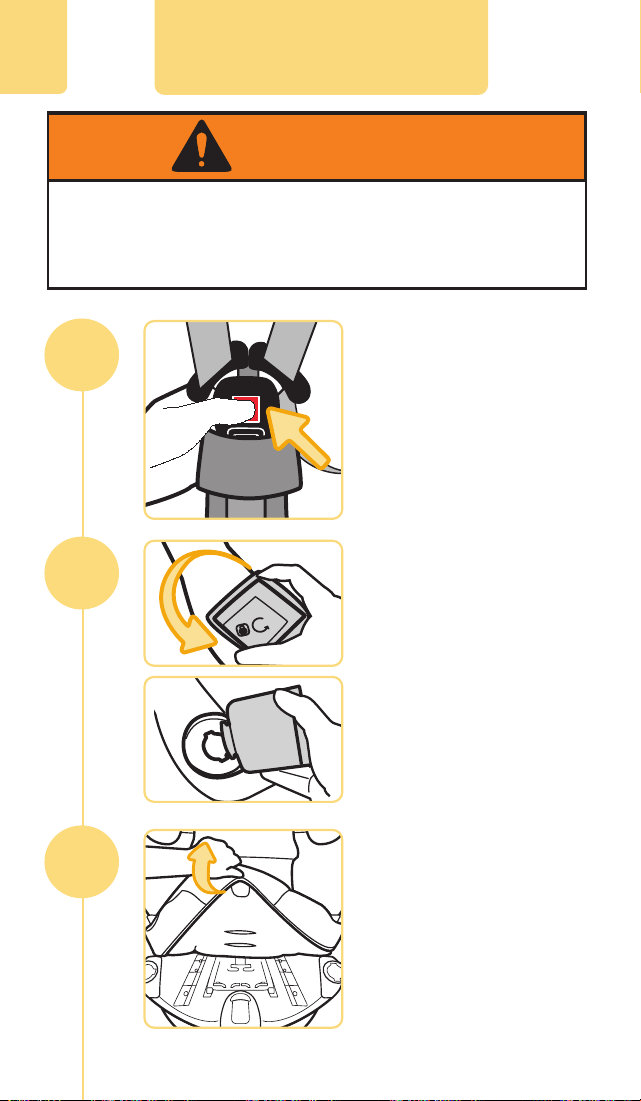
47 48
Changing Buckle Position
Undo Buckle
Remove Cup Holders
Twist the cup holder
counterclockwise.
Pull it out of the slot in the
car seat.
Lift up Seat Pad
2
3
1
WARNING:
Replace Seat Pad
Around Bottom &
Sides of Seat
Replace Buckle
Cover and Check
Buckle
Pull the buckle up to make
sure it is secured.
The buckle MUST NOT
pull out.
Push Buckle Strap
Down & Pull One
Side of Buckle Strap
to Center
Place part of buckle strap
into desired buckle slot.
Part of strap will still be in
the center. Push the other
side of buckle strap into
the buckle slot.
5
6
4
For Rear-Facing Child Fit, see page 19-23.
For Forward-Facing Child Fit, see page 26-30.
To learn how to check harness tightness, see pages 31-34.
Failure to place buckle’s metal retainer completely
through pad and child restraint can result in serious
injury or death.

47 48
Changing Buckle Position
Undo Buckle
Remove Cup Holders
Twist the cup holder
counterclockwise.
Pull it out of the slot in the
car seat.
Lift up Seat Pad
2
3
1
WARNING:
Replace Seat Pad
Around Bottom &
Sides of Seat
Replace Buckle
Cover and Check
Buckle
Pull the buckle up to make
sure it is secured.
The buckle MUST NOT
pull out.
Push Buckle Strap
Down & Pull One
Side of Buckle Strap
to Center
Place part of buckle strap
into desired buckle slot.
Part of strap will still be in
the center. Push the other
side of buckle strap into
the buckle slot.
5
6
4
For Rear-Facing Child Fit, see page 19-23.
For Forward-Facing Child Fit, see page 26-30.
To learn how to check harness tightness, see pages 31-34.
Failure to place buckle’s metal retainer completely
through pad and child restraint can result in serious
injury or death.

49 50
Adjust Headrest to
Highest Position
and On Select
Models: Undo
Fasteners on
Headrest Pad
Fully Loosen
Harness Straps
Push down on the
harness release lever
(through the opening in
the pad) while pulling
at or below the harness
straps as shown.
Removing Seat Pad Set
You do not need to remove the harness system to remove the pad
from the car seat.
DO NOT fully pull the harness strap out of the car seat. Leave it
threaded in the hip harness slots. If removed, you will not be able to
rethread it.
To remove accessories, see pages 3-4.
2
1
3
Gently Pull
Headrest Pad Off
Top of Headrest
continued on next page
Remove the Cup
Holders
Twist the cup holder
counterclockwise.
Pull it out of the slot in the
car seat.
Undo Fasteners on
Seat Pad
5
4
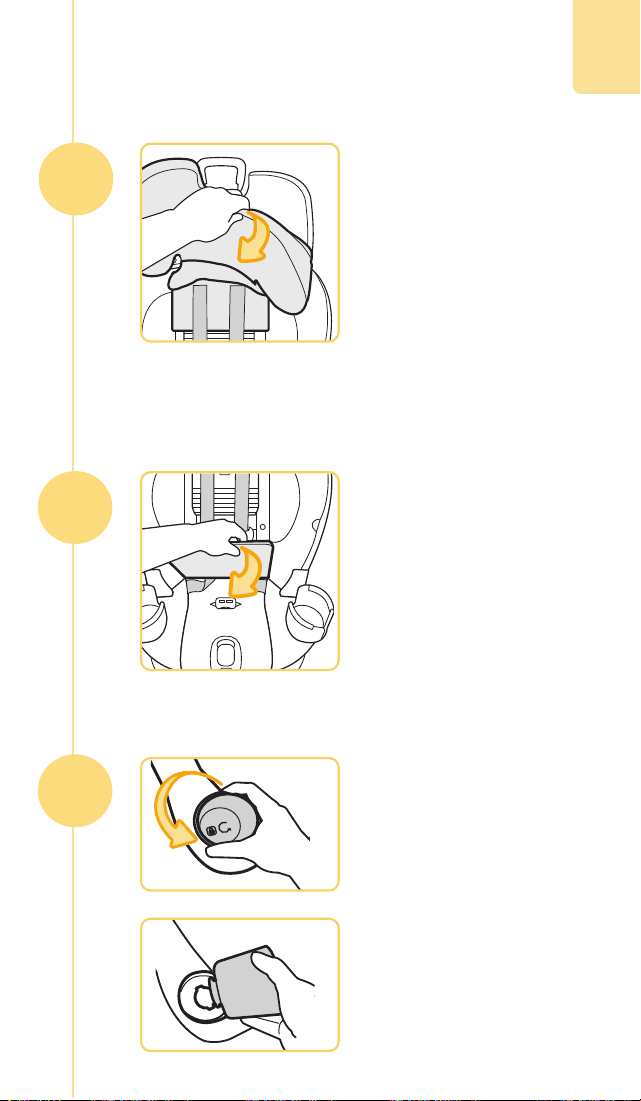
49 50
Adjust Headrest to
Highest Position
and On Select
Models: Undo
Fasteners on
Headrest Pad
Fully Loosen
Harness Straps
Push down on the
harness release lever
(through the opening in
the pad) while pulling
at or below the harness
straps as shown.
Removing Seat Pad Set
You do not need to remove the harness system to remove the pad
from the car seat.
DO NOT fully pull the harness strap out of the car seat. Leave it
threaded in the hip harness slots. If removed, you will not be able to
rethread it.
To remove accessories, see pages 3-4.
2
1
3
Gently Pull
Headrest Pad Off
Top of Headrest
continued on next page
Remove the Cup
Holders
Twist the cup holder
counterclockwise.
Pull it out of the slot in the
car seat.
Undo Fasteners on
Seat Pad
5
4

51 52
8
7
Lower Headrest
to Middle of
Car Seat
Pull Seat Pad
Around Headrest &
Off of Car Seat
Cleaning Pad & Top Harness Covers & Accessories
Top harness covers ONLY can be machine washed. MUST turn car
seat pad inside-out before machine washing. Machine wash
separately with cold water on a gentle cycle. DO NOT use bleach.
Tumble dry separately for 10-12 minutes on low heat. Remove
immediately.
Toddler Pad: Place inside pillow case. DO NOT use bleach. Tumble
dry separately for 10-12 minutes on low heat. Remove immediately.
Wedge Pillow & Body Pillow: Remove wedge from pocket on the
back of pillow before you machine wash.
Cleaning Harness Strap & Bottom Harness Cover
Check the harness straps often for any wear or damage.
Spot clean using warm sudsy water and damp cloth. Spilled food and
liquids on the car seat may result in mold or bacterial growth over
time. These spills could also attract insects or rodents.
Cleaning Buckle & Car Seat
Spot clean using warm sudsy water and damp cloth. DO NOT
submerge into water.
Installing Seat Pad Set
1. Lower Headrest to Middle of Car Seat
2. Pull Seat Pad Around Headrest
3. Pull Seat Pad around Sides & Front of Car Seat
4. Adjust Headrest to Highest Position
5. Pull Headrest Pad onto Headrest
6. On Select Models: Attach All Pad Fasteners
7. Replace Cup Holders
DO NOT use the child restraint without the seat pad or
with damaged harness straps.
Cleaning Parts of Car Seat &
Installing Seat Pad Set
WARNING:
6
Pull Seat Pad Off
Sides & Bottom of
Car Seat

51 52
8
7
Lower Headrest
to Middle of
Car Seat
Pull Seat Pad
Around Headrest &
Off of Car Seat
Cleaning Pad & Top Harness Covers & Accessories
Top harness covers ONLY can be machine washed. MUST turn car
seat pad inside-out before machine washing. Machine wash
separately with cold water on a gentle cycle. DO NOT use bleach.
Tumble dry separately for 10-12 minutes on low heat. Remove
immediately.
Toddler Pad: Place inside pillow case. DO NOT use bleach. Tumble
dry separately for 10-12 minutes on low heat. Remove immediately.
Wedge Pillow & Body Pillow: Remove wedge from pocket on the
back of pillow before you machine wash.
Cleaning Harness Strap & Bottom Harness Cover
Check the harness straps often for any wear or damage.
Spot clean using warm sudsy water and damp cloth. Spilled food and
liquids on the car seat may result in mold or bacterial growth over
time. These spills could also attract insects or rodents.
Cleaning Buckle & Car Seat
Spot clean using warm sudsy water and damp cloth. DO NOT
submerge into water.
Installing Seat Pad Set
1. Lower Headrest to Middle of Car Seat
2. Pull Seat Pad Around Headrest
3. Pull Seat Pad around Sides & Front of Car Seat
4. Adjust Headrest to Highest Position
5. Pull Headrest Pad onto Headrest
6. On Select Models: Attach All Pad Fasteners
7. Replace Cup Holders
DO NOT use the child restraint without the seat pad or
with damaged harness straps.
Cleaning Parts of Car Seat &
Installing Seat Pad Set
WARNING:
6
Pull Seat Pad Off
Sides & Bottom of
Car Seat

To Remove Lower Anchor Belt
from Vehicle’s Lower Anchor Bars
1. Remove the tension from the belt by
pushing down on the side of the base
with the adjuster.
2. Press the adjuster’s button to loosen
the belt.
3. Squeeze the spring lever on the
hooks, push the hooks back into the
vehicle seat, and rotate the hooks to
the side.
4. Pull the hooks off of the vehicle’s
lower anchor bars.
Your vehicle’s features may be considerably different
than those pictured here.
The lower anchors of LATCH (Lower Anchors and Tethers for
CHildren) is a universal system for installing car seats without using
vehicle seat belts. The LATCH: lower anchor belt can ONLY be used
in vehicles that have the lower anchor bars installed in designated
seating positions. Most vehicles manufactured after September 2002
are equipped with LATCH: lower anchor bars. Check your vehicle
owner’s manual to see which seating positions may be equipped with
LATCH: lower anchor bars.
Lower Anchor Belt
Storage Location
Lower Anchor Belt Parts
Hooks
Adjuster
To Store Lower Anchor Belt
The lower anchor belt MUST be properly
stored in its storage location when:
• using the vehicle belts to install the
base; OR
• the base is not installed in a vehicle.
Gather the lower anchor belt and place it
into the storage location as shown.
LATCH: Lower Anchor Belt
53 54
DO NOT use both the lower anchor belt and vehicle belt
at the same time.
WARNING:
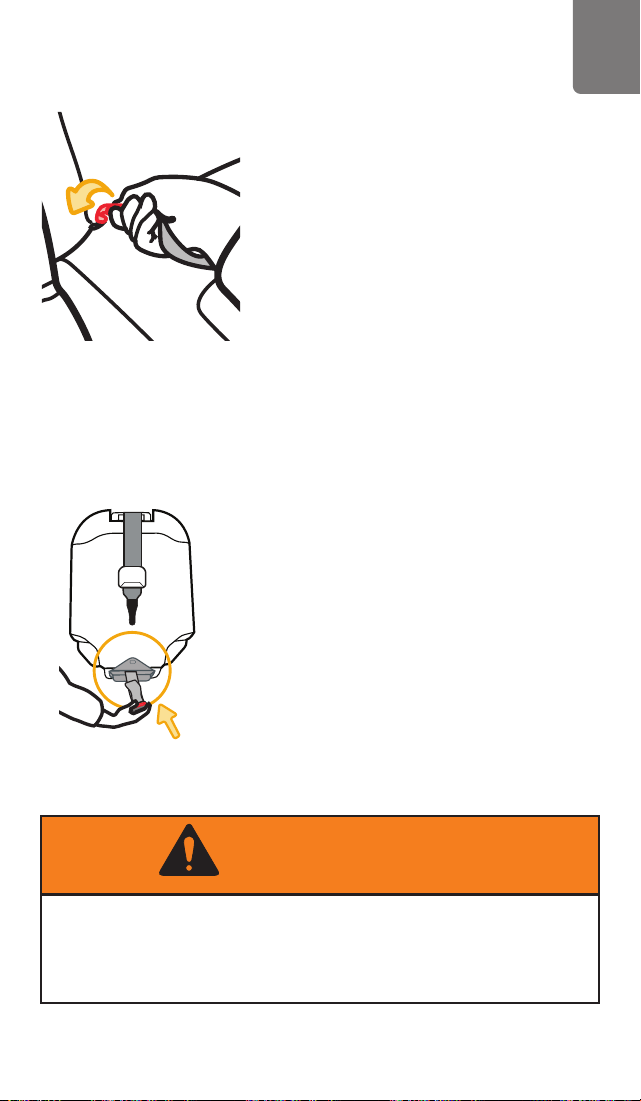
To Remove Lower Anchor Belt
from Vehicle’s Lower Anchor Bars
1. Remove the tension from the belt by
pushing down on the side of the base
with the adjuster.
2. Press the adjuster’s button to loosen
the belt.
3. Squeeze the spring lever on the
hooks, push the hooks back into the
vehicle seat, and rotate the hooks to
the side.
4. Pull the hooks off of the vehicle’s
lower anchor bars.
Your vehicle’s features may be considerably different
than those pictured here.
The lower anchors of LATCH (Lower Anchors and Tethers for
CHildren) is a universal system for installing car seats without using
vehicle seat belts. The LATCH: lower anchor belt can ONLY be used
in vehicles that have the lower anchor bars installed in designated
seating positions. Most vehicles manufactured after September 2002
are equipped with LATCH: lower anchor bars. Check your vehicle
owner’s manual to see which seating positions may be equipped with
LATCH: lower anchor bars.
Lower Anchor Belt
Storage Location
Lower Anchor Belt Parts
Hooks
Adjuster
To Store Lower Anchor Belt
The lower anchor belt MUST be properly
stored in its storage location when:
• using the vehicle belts to install the
base; OR
• the base is not installed in a vehicle.
Gather the lower anchor belt and place it
into the storage location as shown.
LATCH: Lower Anchor Belt
53 54
DO NOT use both the lower anchor belt and vehicle belt
at the same time.
WARNING:

You MUST Review
Your Vehicle
Owner’s Manual
Your vehicle owner’s
manual will let you know
which vehicle belts and
seating positions car
seats can be installed in.
1
Your vehicle’s features may be considerably different
than those pictured here.
If LATCH: lower anchors are not an option or if your child weighs
more than 25 lb (11 kg), in Rear-Facing Mode or 30 lb (14 kg) in
Forward-Facing Mode you MUST use the vehicle seat belt system to
install the car seat.
Not all vehicle belts and seating positions will work with car
seats. Please go through the following steps to understand how
to lock a car seat in Rear-Facing Mode or Forward-Facing Mode
with a vehicle belt.
The vehicle belt MUST
NOT loosen after
tightening.
This means there needs
to be a way to lock the
vehicle belt.
Check Retractor
Retractors pull seat belts
into stored positions
and lock the belt to hold
passengers in place.
Vehicle Belts
55 56
Check How This
Car Seat Will Be
Locked Into Place
continued on next page
2
The ways this can be done are:
• By using the seat belt’s retractor (see step 3); OR
• By using the seat belt’s latch plate (see step 4).
4
3
See the next page for some common types of
vehicle belt retractors that will work with this car
seat.
Lock Off
The vehicle belt retractor
MUST be locked after
closing the lock off.
Please go to the
vehicle belt with base
installation section of the
manual to see how to
properly use this feature.
Base Install with Vehicle Belt: Page 5
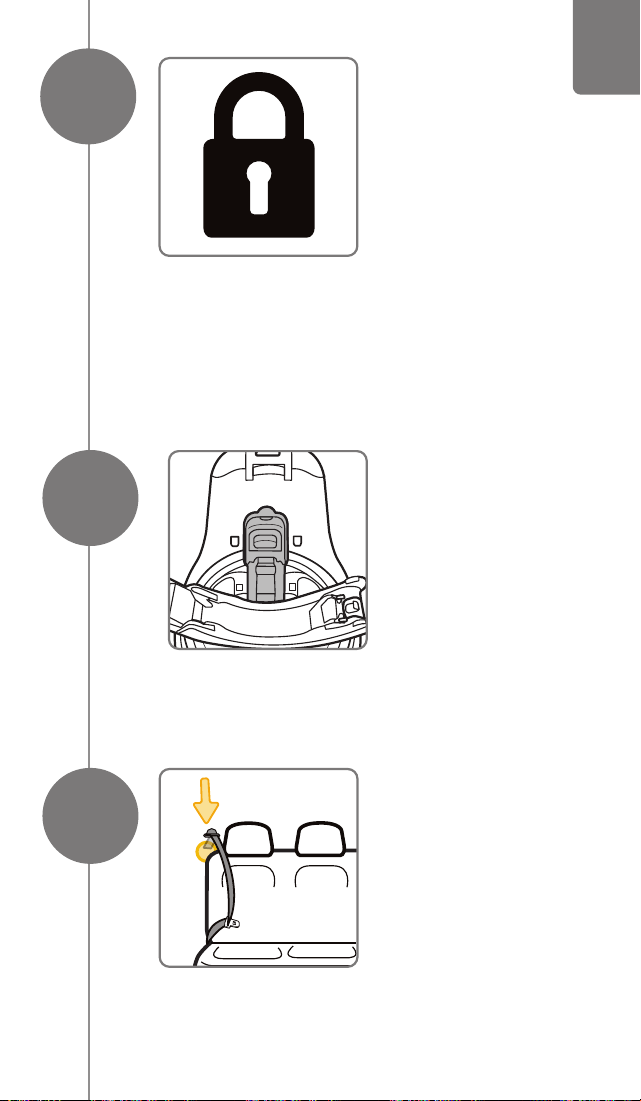
You MUST Review
Your Vehicle
Owner’s Manual
Your vehicle owner’s
manual will let you know
which vehicle belts and
seating positions car
seats can be installed in.
1
Your vehicle’s features may be considerably different
than those pictured here.
If LATCH: lower anchors are not an option or if your child weighs
more than 25 lb (11 kg), in Rear-Facing Mode or 30 lb (14 kg) in
Forward-Facing Mode you MUST use the vehicle seat belt system to
install the car seat.
Not all vehicle belts and seating positions will work with car
seats. Please go through the following steps to understand how
to lock a car seat in Rear-Facing Mode or Forward-Facing Mode
with a vehicle belt.
The vehicle belt MUST
NOT loosen after
tightening.
This means there needs
to be a way to lock the
vehicle belt.
Check Retractor
Retractors pull seat belts
into stored positions
and lock the belt to hold
passengers in place.
Vehicle Belts
55 56
Check How This
Car Seat Will Be
Locked Into Place
continued on next page
2
The ways this can be done are:
• By using the seat belt’s retractor (see step 3); OR
• By using the seat belt’s latch plate (see step 4).
4
3
See the next page for some common types of
vehicle belt retractors that will work with this car
seat.
Lock Off
The vehicle belt retractor
MUST be locked after
closing the lock off.
Please go to the
vehicle belt with base
installation section of the
manual to see how to
properly use this feature.
Base Install with Vehicle Belt: Page 5

57 58
Types of Retractors
Automatic Locking Retractor
This retractor always locks.
It will automatically lock after slowly pulling the
seat belt out at least halfway and letting the belt go
back into the retractor 1-2 in. (2.5-5 cm).
Emergency Locking Retractor
See Step 5
“Check Latch Plates”
If the retractor does not lock, it is most likely an
Emergency Locking Retractor. These retractors
only lock during a sudden stop or collision.
You will need to determine if your seat belt’s latch
plate can lock the belt. See step 5, “Check Latch
Plates”.
Switchable Retractor
(most vehicles have this type)
This retractor can be switched to a locking mode.
You MUST have the retractor in the locking
mode to use the seat belt with this car seat.
Switching to locking mode: Slowly pull the
shoulder belt all the way out, then let it go back in
1-2 in. (2.5-5 cm).
As it goes back in, you will most likely hear a
ratcheting sound.
Gently pull the belt to see if it has locked. You will
not be able to pull any more belt out if the lock has
engaged.
Check Latch Plates
Latch plates are the part of the seat belt that goes into
the buckle.
To see if the latch plate locks:
1. Buckle Vehicle Belt
2. Firmly Tug Lap Portion of Seat Belt While Pulling It Up
If the vehicle belt does not slide through the latch plate,
it’s locked.
If the latch plate slides up and down the vehicle belt, it is
a sliding latch plate.
Sliding latch plates easily slip between the lap and
shoulder portions of the belt.
Locking
Latch
Plate
Emergency
Locking
Retractor with
a Sliding Latch
Plate
Never Use the Following With
This Car Seat:
• Emergency Locking Retractor Lap Only Belt
• Inflatable Seat Belts
5

57 58
Types of Retractors
Automatic Locking Retractor
This retractor always locks.
It will automatically lock after slowly pulling the
seat belt out at least halfway and letting the belt go
back into the retractor 1-2 in. (2.5-5 cm).
Emergency Locking Retractor
See Step 5
“Check Latch Plates”
If the retractor does not lock, it is most likely an
Emergency Locking Retractor. These retractors
only lock during a sudden stop or collision.
You will need to determine if your seat belt’s latch
plate can lock the belt. See step 5, “Check Latch
Plates”.
Switchable Retractor
(most vehicles have this type)
This retractor can be switched to a locking mode.
You MUST have the retractor in the locking
mode to use the seat belt with this car seat.
Switching to locking mode: Slowly pull the
shoulder belt all the way out, then let it go back in
1-2 in. (2.5-5 cm).
As it goes back in, you will most likely hear a
ratcheting sound.
Gently pull the belt to see if it has locked. You will
not be able to pull any more belt out if the lock has
engaged.
Check Latch Plates
Latch plates are the part of the seat belt that goes into
the buckle.
To see if the latch plate locks:
1. Buckle Vehicle Belt
2. Firmly Tug Lap Portion of Seat Belt While Pulling It Up
If the vehicle belt does not slide through the latch plate,
it’s locked.
If the latch plate slides up and down the vehicle belt, it is
a sliding latch plate.
Sliding latch plates easily slip between the lap and
shoulder portions of the belt.
Locking
Latch
Plate
Emergency
Locking
Retractor with
a Sliding Latch
Plate
Never Use the Following With
This Car Seat:
• Emergency Locking Retractor Lap Only Belt
• Inflatable Seat Belts
5

Your vehicle’s features may be considerably different
than those pictured here.
When anchors are available, you MUST always attach, adjust, and
secure the tether (top anchorage) strap when installing the car seat.
Tethers improve the installation and stability of car seats and reduce the
risk of injury. Attach the tether hook to the tether anchor designated by
your vehicle manufacturer for that seating position. Check your vehicle
owner’s manual for more information. If the seating position does not
have a tether anchor, use a different seating position or see your dealer
or a qualified mechanic and have one installed.
Tighten Top Tether Strap Until Tether Door Is
Flush With Base As Shown
Top Tether
Child Restraint Use
59 60
NEVER take your child out of the child restraint while
the vehicle is moving.
NEVER leave your child unattended. Placing your
child in a hot child restraint may result in burns.
DO NOT use a child restraint with damaged or
missing parts.
DO NOT use a child restraint with cut, frayed, or
damaged harnesses.
DO NOT substitute parts or try to modify the child
restraint in any way. DO NOT lubricate buckles and
fasteners.
DO NOT use any child restraint accessory except
those approved by Dorel Juvenile Group.
NEVER allow any child to play with this child restraint;
it is not a toy.
DO NOT remove or cover up any of the warning labels
or other labels on the child restraint.
This child restraint has been certified for use in
passenger vehicles. DO NOT use in a boat, on a
motorcycle or in a cargo van or bus where there are
no seat belts or tether anchors.
Read all instructions for additional warnings.
Using this child restraint without the tether strap anchored as required
by the manufacturer would be a misuse of the child restraint and, in a
sudden stop or crash, could result in serious injury or death.
DO NOT fasten multiple tether hooks on the same tether anchor in the
vehicle.
WARNING:
WARNING:
Your vehicle’s features may be considerably different
than those pictured here.
When anchors are available, you MUST always attach, adjust, and
secure the tether (top anchorage) strap when installing the car seat.
Tethers improve the installation and stability of car seats and reduce the
risk of injury. Attach the tether hook to the tether anchor designated by
your vehicle manufacturer for that seating position. Check your vehicle
owner’s manual for more information. If the seating position does not
have a tether anchor, use a different seating position or see your dealer
or a qualified mechanic and have one installed.
Tighten Top Tether Strap Until Tether Door Is
Flush With Base As Shown
Top Tether
Child Restraint Use
59 60
NEVER take your child out of the child restraint while
the vehicle is moving.
NEVER leave your child unattended. Placing your
child in a hot child restraint may result in burns.
DO NOT use a child restraint with damaged or
missing parts.
DO NOT use a child restraint with cut, frayed, or
damaged harnesses.
DO NOT substitute parts or try to modify the child
restraint in any way. DO NOT lubricate buckles and
fasteners.
DO NOT use any child restraint accessory except
those approved by Dorel Juvenile Group.
NEVER allow any child to play with this child restraint;
it is not a toy.
DO NOT remove or cover up any of the warning labels
or other labels on the child restraint.
This child restraint has been certified for use in
passenger vehicles. DO NOT use in a boat, on a
motorcycle or in a cargo van or bus where there are
no seat belts or tether anchors.
Read all instructions for additional warnings.
Using this child restraint without the tether strap anchored as required
by the manufacturer would be a misuse of the child restraint and, in a
sudden stop or crash, could result in serious injury or death.
DO NOT fasten multiple tether hooks on the same tether anchor in the
vehicle.
WARNING:
WARNING:

NEVER place a child rear-facing in a
seating position with an active frontal air bag.
Check the vehicle owner’s manual for more
information about air bag/child restraint use.
Use the child restraint only on vehicle seats
that face forward.
DO NOT use on seats that face the sides or
rear of the vehicle.
For vehicles without a back seat, refer to your
vehicle owner’s manual.
Vehicle Seating
Position
Installation in Vehicle
61 62
Check the vehicle belt or lower anchor belt before
each use. Use only if the belt can be tightened
properly and locked securely in place.
Even when unoccupied, this child restraint MUST be
firmly secured to the vehicle with the lower anchor
belt or with the vehicle seat belt.
Even when unoccupied, this booster seat MUST be
firmly secured to the vehicle with the vehicle seat belt.
In a crash or sudden stop, an unsecured child
restraint or booster seat could injure occupants.
To avoid your child being seriously burned, take the
following precautions:
• Park in the shade or where the sun does not directly hit the
car seat.
• Cover the car seat with a sheet or blanket when not in use.
• Check for hot seat and buckles before placing child in car
seat.
To help protect your vehicle seat’s upholstery from
damage:
you may use an accessory approved by Dorel
Juvenile Group or a single layer towel underneath and behind
car seat.
WARNING:
WARNING:
Children are safer when properly
restrained in rear seating positions
than in the front seating positions.
According to accident statistics, children in rear
seating positions are statistically safer, whether you
have air bags, advanced air bags, or no air bags at all.
If you are not sure where to place the car seat in your
vehicle:
• Consult your vehicle owner’s manual; OR
• Contact Dorel Juvenile Group Consumer Care Department; OR
• Visit your local Child Passenger Inspection Station. Go to
https://www.nhtsa.gov/equipment/car-seats-and-booster-
seats to find your closest station.
NEVER place a child rear-facing in a
seating position with an active frontal air bag.
Check the vehicle owner’s manual for more
information about air bag/child restraint use.
Use the child restraint only on vehicle seats
that face forward.
DO NOT use on seats that face the sides or
rear of the vehicle.
For vehicles without a back seat, refer to your
vehicle owner’s manual.
Vehicle Seating
Position
Installation in Vehicle
61 62
Check the vehicle belt or lower anchor belt before
each use. Use only if the belt can be tightened
properly and locked securely in place.
Even when unoccupied, this child restraint MUST be
firmly secured to the vehicle with the lower anchor
belt or with the vehicle seat belt.
Even when unoccupied, this booster seat MUST be
firmly secured to the vehicle with the vehicle seat belt.
In a crash or sudden stop, an unsecured child
restraint or booster seat could injure occupants.
To avoid your child being seriously burned, take the
following precautions:
• Park in the shade or where the sun does not directly hit the
car seat.
• Cover the car seat with a sheet or blanket when not in use.
• Check for hot seat and buckles before placing child in car
seat.
To help protect your vehicle seat’s upholstery from
damage:
you may use an accessory approved by Dorel
Juvenile Group or a single layer towel underneath and behind
car seat.
WARNING:
WARNING:
Children are safer when properly
restrained in rear seating positions
than in the front seating positions.
According to accident statistics, children in rear
seating positions are statistically safer, whether you
have air bags, advanced air bags, or no air bags at all.
If you are not sure where to place the car seat in your
vehicle:
• Consult your vehicle owner’s manual; OR
• Contact Dorel Juvenile Group Consumer Care Department; OR
• Visit your local Child Passenger Inspection Station. Go to
https://www.nhtsa.gov/equipment/car-seats-and-booster-
seats to find your closest station.

Please complete the postage-paid registration card that came with
your child restraint, and send it to us.
Child restraints could be recalled for safety reasons.
You must register this restraint to be reached in a recall.
Send your name, address, e-mail address if available and the
restraint’s model number and manufacturing date to:
Dorel Juvenile Group
2525 State Street
Columbus, IN 47201
or call 1-800-
951-4113
or register online at
www.djgusa.com/registration/carseat/us.
For recall information, call the U.S. Government’s Vehicle
Safety Hotline at 1-888-327-4236 (TTY: 1-800-424-9153),
or go to www.NHTSA.gov.
DO NOT risk your child’s safety.
To keep your child as safe as possible, Dorel Juvenile Group strongly
recommends replacing the car seat even after a minor crash, even if it
was not occupied at the time.
Replacement After a Minor Crash
The National Highway Traffic Safety Administration states that for a
crash to be considered minor ALL of the following MUST be true:
• Vehicle able to drive away from the crash site; AND
• Vehicle door nearest the car seat was not damaged; AND
• No passengers were injured; AND
• Airbags did not deploy; AND
• There is no visible damage to the car seat.
If the crash your car seat was involved in meets ALL the criteria, you
may not need to replace the car seat.
If one or more of these criteria are not true or if you are uncertain of
any of your answers, replace the car seat immediately.
Replacement After a Moderate to Severe Crash
You MUST replace this car seat if it has been in a moderate
to severe car crash.
This car seat is intended to protect a child in a single crash.
During a crash, the car seat and all of its parts absorb crash energy
which can deform or weaken it. Damage is not always visible. A
damaged car seat MUST be replaced immediately.
Expiration
On the bottom of the car seat there is a date of
manufacture label as shown.
DO NOT use this car seat more than 10 years
after the date of manufacture.
Replacement & Expiration
Registration &
Safety Notices
63 64
Brand Car Seat
05/16/2015
If you don’t have the card or if your address
changes, you will find the model number,
manufacture date, and line code on the
label located on the bottom of the car seat.
Example of model number, manufacture date, and line code.

Please complete the postage-paid registration card that came with
your child restraint, and send it to us.
Child restraints could be recalled for safety reasons.
You must register this restraint to be reached in a recall.
Send your name, address, e-mail address if available and the
restraint’s model number and manufacturing date to:
Dorel Juvenile Group
2525 State Street
Columbus, IN 47201
or call 1-800-
951-4113
or register online at
www.djgusa.com/registration/carseat/us.
For recall information, call the U.S. Government’s Vehicle
Safety Hotline at 1-888-327-4236 (TTY: 1-800-424-9153),
or go to www.NHTSA.gov.
DO NOT risk your child’s safety.
To keep your child as safe as possible, Dorel Juvenile Group strongly
recommends replacing the car seat even after a minor crash, even if it
was not occupied at the time.
Replacement After a Minor Crash
The National Highway Traffic Safety Administration states that for a
crash to be considered minor ALL of the following MUST be true:
• Vehicle able to drive away from the crash site; AND
• Vehicle door nearest the car seat was not damaged; AND
• No passengers were injured; AND
• Airbags did not deploy; AND
• There is no visible damage to the car seat.
If the crash your car seat was involved in meets ALL the criteria, you
may not need to replace the car seat.
If one or more of these criteria are not true or if you are uncertain of
any of your answers, replace the car seat immediately.
Replacement After a Moderate to Severe Crash
You MUST replace this car seat if it has been in a moderate
to severe car crash.
This car seat is intended to protect a child in a single crash.
During a crash, the car seat and all of its parts absorb crash energy
which can deform or weaken it. Damage is not always visible. A
damaged car seat MUST be replaced immediately.
Expiration
On the bottom of the car seat there is a date of
manufacture label as shown.
DO NOT use this car seat more than 10 years
after the date of manufacture.
Replacement & Expiration
Registration &
Safety Notices
63 64
Brand Car Seat
05/16/2015
If you don’t have the card or if your address
changes, you will find the model number,
manufacture date, and line code on the
label located on the bottom of the car seat.
Example of model number, manufacture date, and line code.
Aircraft Information
Warranty
65 66
Dorel Juvenile Group, Inc. (DJG) warrants this product to the original
retail purchaser as follows: This product is warranted against defective
materials or workmanship for one year from the date of original
purchase.
An original receipt is required to validate your warranty.
DJG will, at its option, provide replacement parts or replace this product.
DJG reserves the right to substitute if the part or model has been
discontinued.
To make a claim under this warranty contact our Consumer Care
Department by phone at 1-800-951-4113; or text us at 1-812-652-
2525. Our hours of operation are from 8:00 a.m. to 6:00 p.m. ET
Monday through Thursday and from 8:00 a.m. to 4:30 p.m. on Friday.
Proof of purchase is required and shipping charges are the
responsibility of the consumer.
Warranty Limitations:
This warranty does not include damages which
arise from misuse or abuse of this product.
This restraint is not certified for aircraft use.
This restraint is NOT certified for aircraft
use when used as a booster seat because
aircraft seats do not have shoulder belts.
Limitation of Damages:
The warranty and remedies as set forth are
exclusive and in lieu of all others, oral or written, expressed or implied.
In no event will DJG or the dealer selling this product be liable to you for
any damages, including incidental or consequential damages, arising
out of the use or inability to use this product.
Limitation of warranties and other warranty terms and state law
rights:
Any implied warranties, including implied warranties of the
merchantability and fitness for a particular purpose, shall be limited to
the duration and terms of the express written warranty. Some states
do not allow limitations as to how long an implied warranty lasts or the
exclusion or limitation of incidental or consequential damages, so the
above limitations may not apply to you.
This warranty gives you specific legal rights, and you may have other
rights, which vary from state to state. Neither DJG nor the dealer selling
this product authorized any person to create for it any other warranty,
obligation, or liability in connection with this product.
Please note: Our product warranty only applies when purchased from
an authorized Maxi-Cosi retailer. The origin of products not purchased
through these authorized retailers is unknown and could be counterfeit.
We cannot support products from an unknown origin as we cannot
verify the handling or condition of such merchandise. We maintain a
strong network of authorized retailers to ensure you are purchasing
safe and complete products. Fulfillment by a third party does not
guarantee you are purchasing from one of these authorized retailers.
Pricing which is inconsistent with the majority of retailers is a strong
indication that the retailer is not authorized, as we have a consistent
price offering across all authorized retailers. If you are unsure of the
authorization status of a retailer you are considering purchasing from,
or have purchased from, you can check www.maxicosi.com/us-en/
shops.aspx; or call our Consumer Care Department at 1-800-951-
4113; or text us at 1-812-652-2525.

Aircraft Information
Warranty
65 66
Dorel Juvenile Group, Inc. (DJG) warrants this product to the original
retail purchaser as follows: This product is warranted against defective
materials or workmanship for one year from the date of original
purchase.
An original receipt is required to validate your warranty.
DJG will, at its option, provide replacement parts or replace this product.
DJG reserves the right to substitute if the part or model has been
discontinued.
To make a claim under this warranty contact our Consumer Care
Department by phone at 1-800-951-4113; or text us at 1-812-652-
2525. Our hours of operation are from 8:00 a.m. to 6:00 p.m. ET
Monday through Thursday and from 8:00 a.m. to 4:30 p.m. on Friday.
Proof of purchase is required and shipping charges are the
responsibility of the consumer.
Warranty Limitations:
This warranty does not include damages which
arise from misuse or abuse of this product.
This restraint is not certified for aircraft use.
This restraint is NOT certified for aircraft
use when used as a booster seat because
aircraft seats do not have shoulder belts.
Limitation of Damages:
The warranty and remedies as set forth are
exclusive and in lieu of all others, oral or written, expressed or implied.
In no event will DJG or the dealer selling this product be liable to you for
any damages, including incidental or consequential damages, arising
out of the use or inability to use this product.
Limitation of warranties and other warranty terms and state law
rights:
Any implied warranties, including implied warranties of the
merchantability and fitness for a particular purpose, shall be limited to
the duration and terms of the express written warranty. Some states
do not allow limitations as to how long an implied warranty lasts or the
exclusion or limitation of incidental or consequential damages, so the
above limitations may not apply to you.
This warranty gives you specific legal rights, and you may have other
rights, which vary from state to state. Neither DJG nor the dealer selling
this product authorized any person to create for it any other warranty,
obligation, or liability in connection with this product.
Please note: Our product warranty only applies when purchased from
an authorized Maxi-Cosi retailer. The origin of products not purchased
through these authorized retailers is unknown and could be counterfeit.
We cannot support products from an unknown origin as we cannot
verify the handling or condition of such merchandise. We maintain a
strong network of authorized retailers to ensure you are purchasing
safe and complete products. Fulfillment by a third party does not
guarantee you are purchasing from one of these authorized retailers.
Pricing which is inconsistent with the majority of retailers is a strong
indication that the retailer is not authorized, as we have a consistent
price offering across all authorized retailers. If you are unsure of the
authorization status of a retailer you are considering purchasing from,
or have purchased from, you can check www.maxicosi.com/us-en/
shops.aspx; or call our Consumer Care Department at 1-800-951-
4113; or text us at 1-812-652-2525.