
SF
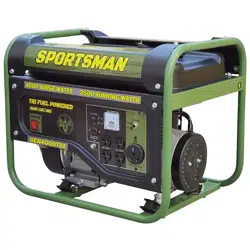
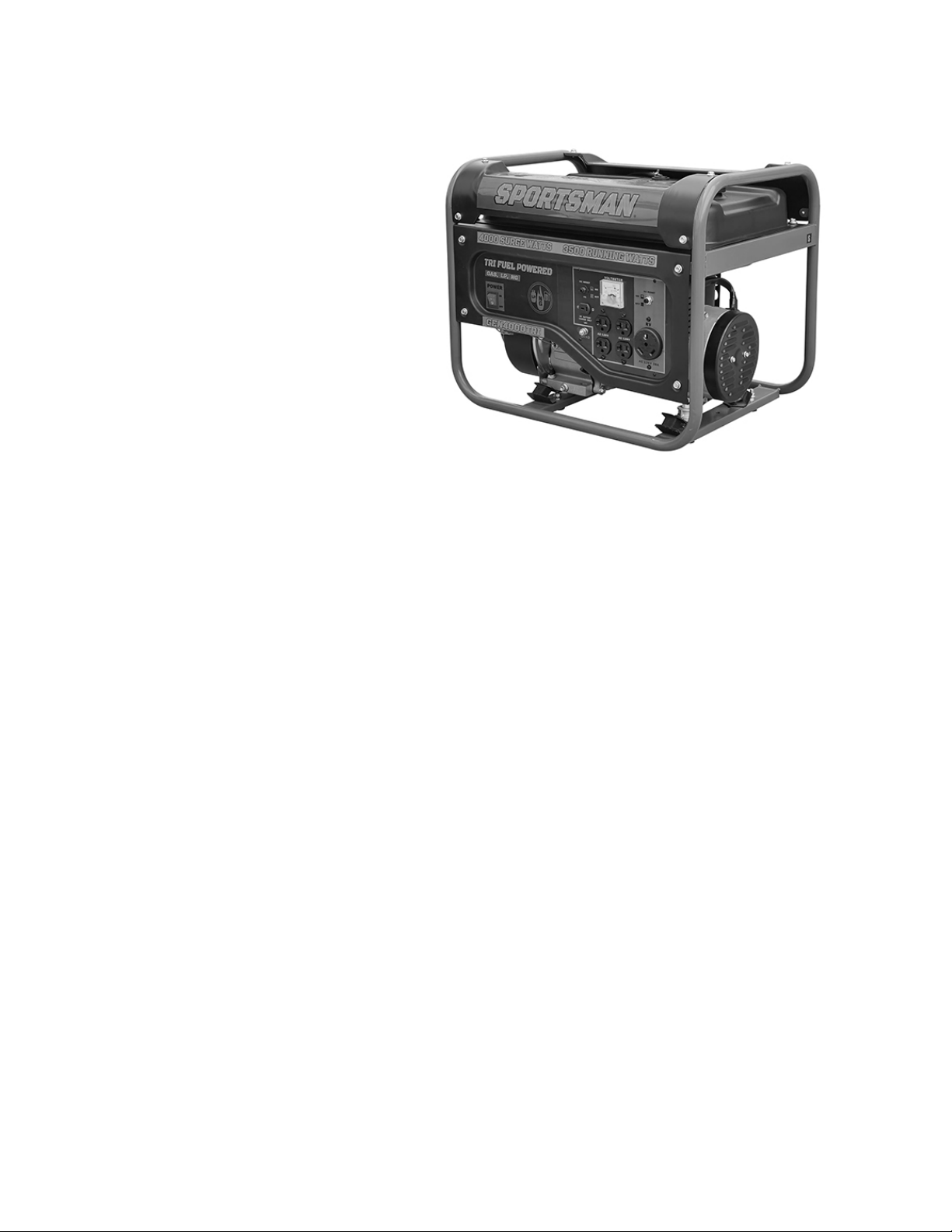
ITEM # GEN4000TRI
4000 SURGE WATTS / 3500 RUNNING WATTS
TRI FUEL: LPG LIQUID PROPANE, GASOLINE, NATURAL GAS
PORTABLE GENERATOR
INSTRUCTION MANUAL
READ ALL INSTRUCTIONS AND WARNINGS BEFORE USING THIS PRODUCT.
This manual provides important information on proper operation & maintenance. Every effort has been made to ensure the
accuracy of this manual. These instructions are not meant to cover every possible condition and situation that may occur.
We reserve the right to change this product at any time without prior notice.
HAVE QUESTIONS OR PROBLEMS? CONTACT CUSTOMER SERVICE
If you experience a problem or need parts, visit our website http://www.buffalotools.com or call customer service
at 1-866-460-9436, Monday-Friday,
8 AM - 4 PM Central Time. A copy of the sales receipt is required. IF THERE
IS ANY QUESTION ABOUT A CONDITION BEING SAFE OR UNSAFE, DO NOT OPERATE THIS PRODUCT!
FOR CONSUMER USE ONLY – NOT FOR PROFESSIONAL USE.
KEEP THIS MANUAL, SALES RECEIPT & APPLICABLE WARRANTY FOR FUTURE
REFERENCE.
ATTENTION: OIL IS NOT INCLUDED WITH THE GENERATOR
AND MUST BE ADDED BEFORE FIRST USE.
ATTENTION: THIS GENERATOR IS NOT INTENDED TO
POWER MEDICAL DEVICES OR LIFE SUPPORT APPLIANCES.
ATTENTION: FOLLOW ENGINE BREAK-IN PROCEDURE FOR
FIRST 20 HOURS OF USE.
ATTENTION: DO NOT EXCEED MAX WATTAGE CAPACITY,
OTHERWISE DAMAGE CAN OCCUR TO GENERATOR AND/OR
APPLIANCES. FOLLOW WATTAGE GUIDE TO DETERMINE
PROPER STARTING & RUNNING WATTS.
Item # GEN4000TRI 4000 Surge Watt / 3500 Running Watt Portable Tri Fuel LP Liquid Propane, Gasoline, Natural Gas Generator Manual
2
ITEM # GEN4000TRI 4000 Surge Watts / 3500 Running Watts *
This unit is a Tri Fuel (LPG or Gasoline or NG (Natural Gas Fuel) ) powered generator.
FEATURES:
• 4000 Surge Output / 3500 Running Watts (gasoline)*
• 120V Operation
• 7.0 HP Engine, 4 Stroke , 3600 RPM
• Displacement (CC): 212
• Low Oil Shut Off
• UL Listed Electrical Components
• Engine Shut Off Switch
• Power Outlets
• Spark Plug Model F7TC
• 1-12V DC Outlet
• 4-120V Outlets
• 1-120V RV Outlet
• Fuel Tank Capacity: 3.6 Gallons
• EPA Approved
• Decibel Rating < 68 db at 0% load measured at 24 feet
• Run time = 10 hrs @ 50% load Gasoline
• Run time = 12 hrs @ 50% load LPG with 20 lbs tank
• Fuel type – Unleaded Gasoline, Liquid Propane Gas (also commonly referred to as LP, LPG and Propane) Or Natural Gas (NG)
• High Altitude Use: This generator is not recommended for high altitude use above 3,000 feet.
• If you are using a generator at 3,000 feet above sea level, the generator may not function properly because of air flow getting through the carburetor.
• Propane Tank Not Included
• If you want to use a propane tank larger than 20 lbs, call Customer Service for details at 866-460-9436.
• SURGE WATTS / RUNNING WATTS MAY BE REDUCED BY 10% WHEN USING PROPANE FUEL VS USING GASOLINE.
• SURGE WATTS / RUNNING WATTS MAY BE REDUCED BY 20% WHEN USING NATURAL GAS VS USING GASOLINE.
2 YEAR LIMITED EMISSION-RELATED WARRANTY
THIS ENGINE MEETS U.S. EPA EMISSION STANDARDS UNDER 40 CFR 1054.625 .The emission-related limited warranty is valid for two (2) years.
Keep the purchase receipt and mail in the product registration card for proof of purchase. Buffalo Corp limits emission-related warranty repairs to
authorized service centers for owners located within 100 miles of an authorized service center. For owners located more than 100 miles from an
authorized service center, Buffalo Corp will, in its sole discretion, either pay for shipping costs to and from an authorized service center, provide for a
service technician to come to the owner to make the warranty repair, or pay for the repair to be made at a local non-authorized service center.
The provisions of this paragraph apply only for the contiguous states, excluding the states with high-altitude areas identified in 40 CFR part 1068,
Appendix III.
To exercise this warranty, DO NOT RETURN TO RETAILER. Instead, call Customer Service toll free at 1-866-460-9436 (email address
info@buffalotools.com) and you will be instructed on where to take the engine for warranty service. Take the generator and proof of purchase (your
receipt) to the repair facility recommended by the Customer Service Representative. The warranty does not extend to generators damaged or affected
by fuel contamination, accidents, neglect, misuse, unauthorized alterations, use in an application for which the product was not designed and any other
modifications or abuse.
1 YEAR LIMITED WARRANTY (30 Day Limited Warranty for Commercial and Rental Purpose)
Generators are warranted to be free from defects in materials and workmanship for a period of 1 YEAR from date of original purchase. Buffalo Corp. is
not liable for any indirect, incidental or consequential damages from the sale or use of this product. Any implied warranties are limited to 1 YEAR as
stated, or as otherwise stated, in this written limited warranty. Some states do not allow the exclusion or limitation of incidental or consequential
damages. Some states do not allow limitation on the length of an implied warranty. Buffalo Corp will repair or replace, at its discretion, any part that is
proven to be defective in materials or workmanship under normal use during the 1 YEAR warranty period. Warranty repairs or replacements will be
made without charge for parts or labor. Parts replaced during warranty repairs will be considered as part of the original product and will have the same
warranty period as the original product. This warranty gives you specific legal rights, and you may have other rights that vary state to state

Item # GEN4000TRI 4000 Surge Watt / 3500 Running Watt Portable Tri Fuel LP Liquid Propane, Gasoline, Natural Gas Generator Manual
3
TIPS TO POWERING YOUR GENERATOR WITH NATURAL GAS
WARNING: Before installing the fuel line, consult with your local natural gas supplier to check
codes and regulations in your area. Local codes will mandate correct routing of gaseous fuel
line piping around gardens and other landscaping to prevent any damage.
The information in this instruction is offered to assist you in providing the proper Natural Gas (NG) fuel supply for your
engine. This information is only provided to advise you of the engine requirements and the decisions you must make. In no
case should this information be interpreted to conflict with any local, state or national code. If in doubt, always follow local
codes.
WARNING: All fuel lines must be installed by a local qualified natural gas professional.
The fuel source should be as close as possible to the outdoor operating location. This will reduce the installation cost of fuel
runs. Connect the fuel supply line to the inlet on the generator using a locally approved flexible fuel line.
The pressure supplied to the generator must be 4 TO 6 OUNCES or 7 TO 11 INCHES W.C. (water column). The primary
regulator at the fuel supply must be capable of delivering the proper volume of fuel at this pressure.
Fuel Consumptions (Fuel Load)
Natural Gas 160 cu. ft./hr 160,000 BTU/HR
Have your local natural gas supplier install a protected fuel connection at the outside operating location. They should also
install a lockable fuel shut off valve at the connection point. An approved flexible fuel line must be installed between the
engine generator set and the supply line.
WARNING: The Natural Gas fuel supply line must always be shut off when the engine is not running. Failure to do
so may allow fuel to leak at the unit.
Do not use galvanized pipe in the fuel line runs. The galvanized coating will become eroded and flake off, causing possible
obstruction or damage to the regulator or fuel valve. The obstruction could cause an inoperative engine or an explosive fuel
leak.
WARNING: Be sure to always turn off the natural gas fuel supply to home before installation.
Note: All pipe sizing, construction and layout must comply with Natural Fire Protection Association NFPA 54 for natural gas
applications. Once the generator is installed, verify that the fuel pressure NEVER drops more than one (1) inch water
column from no load to full load from the starting pressure for either fuel type, and remains within the limits of the stated
specifications.
Size of pipe required for generators operating on natural gas. All pipe sizing is based on 1/2” WC pressure drop at 11” WC
setting. For pressure less than 11” WC (6 oz.) consult the gas company for proper line sizing for your flow rate.
WARNING: Do Not Run Natural Gas Line Over 200 Feet To Run Generator
Correct fuel pressure is extremely important. The most common cause for inoperative systems is an inadequate or incorrect
fuel pressure. Power and performance of the engine is in direct relation to the correctness of the fuel system.
WARNING: Natural gas is highly explosive. Even the slightest spark can ignite and cause explosion. No leakage of
fuel is permitted. Natural Gas, which is lighter than air, tends to collect in high areas.

Item # GEN4000TRI 4000 Surge Watt / 3500 Running Watt Portable Tri Fuel LP Liquid Propane, Gasoline, Natural Gas Generator Manual
4
TABLE OF CONTENTS
RECOGNIZE SAFETY SYMBOLS, WORDS AND LABELS ............................................................................................... 5
PACKAGE CONTENTS
PACKAGE CONTENTS ......................................................................................................................................... 10
COMPONENTS ..................................................................................................................................................... 11
PREPARING THE GENERATOR FOR USE .................................................................................................................... 12
Using This Generator For The First Time ............................................................................................................... 12
Step 1 – Add Oil ............................................................................................................................................ 12
Step 2 – Connect Fuel ................................................................................................................................... 13
Step 3 – Ground The Generator .................................................................................................................... 14
Subsequent Use Of This Generator ....................................................................................................................... 14
Step 1 – Verify Oil Level ................................................................................................................................ 14
Step 3 – Ground The Generator .................................................................................................................... 15
STARTING THE GENERATOR ........................................................................................................................................ 15
USING THE GENERATOR ............................................................................................................................................... 16
AC Usage ............................................................................................................................................................... 16
DC Usage ............................................................................................................................................................... 18
STOPPING THE GENERATOR ........................................................................................................................................ 18
MAINTENANCE/CARE ..................................................................................................................................................... 19
Recommended Maintenance Schedule ................................................................................................................. 19
Cleaning The Generator ......................................................................................................................................... 19
Checking The Oil Level .......................................................................................................................................... 19
Changing/Adding Oil .............................................................................................................................................. 20
Air Filter Maintenance ............................................................................................................................................ 21
Spark Plug Maintenance ........................................................................................................................................ 21
STORAGE/TRANSPORT PROCEDURES ....................................................................................................................... 22
TROUBLESHOOTING ...................................................................................................................................................... 23
SPECIFICATIONS ............................................................................................................................................................ 24
PARTS DIAGRAM ........................................................................................................................................................... 25
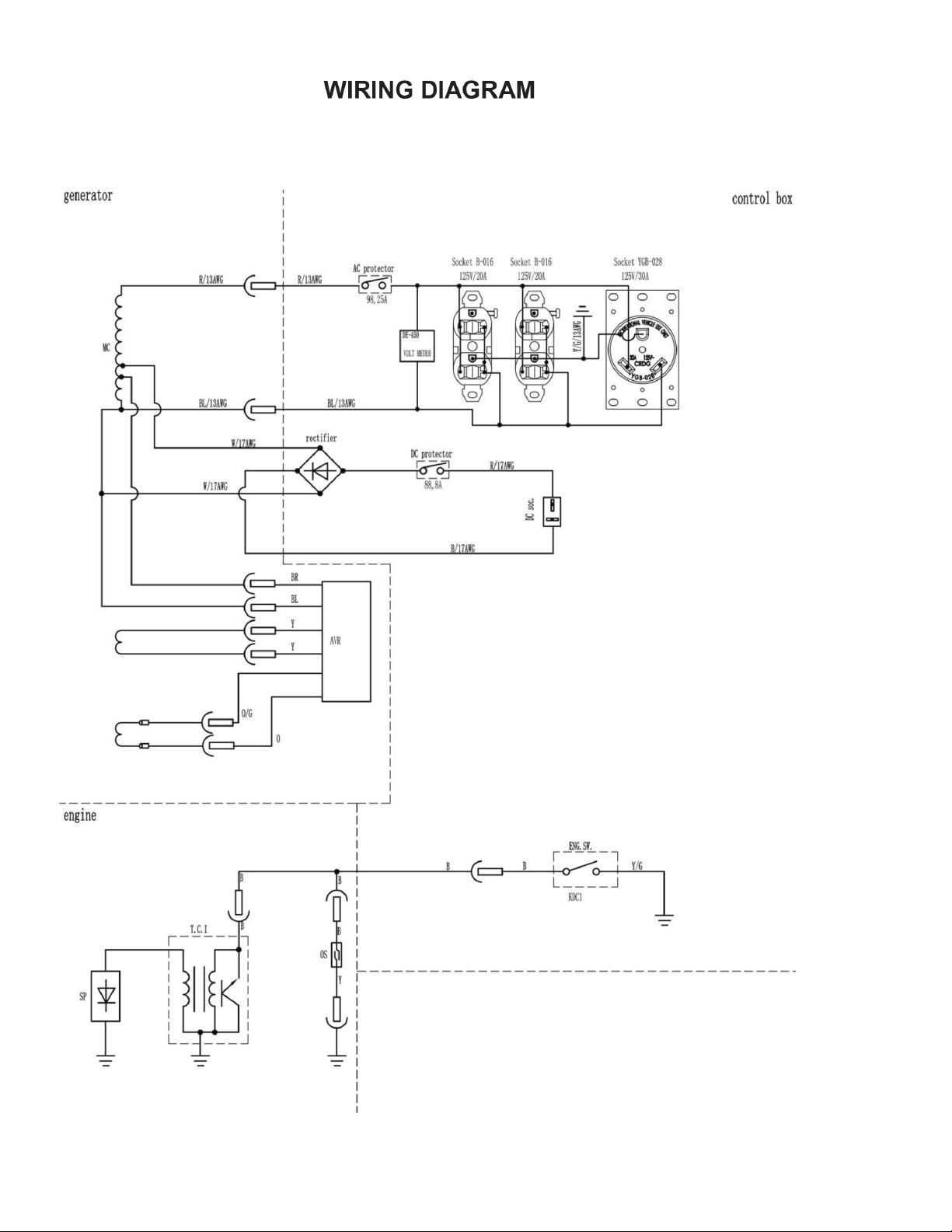
WIRING DIAGRAM ........................................................................................................................................................... 31
EMISSIONS CONTROL SYSTEM WARRANTY .............................................................................................................. 32

Item # GEN4000TRI 4000 Surge Watt / 3500 Running Watt Portable Tri Fuel LP Liquid Propane, Gasoline, Natural Gas Generator Manual
5
RECOGNIZE SAFETY SYMBOLS, WORDS AND LABELS
What You Need to Know About Safety Instructions
Warning and Important Safety Instructions appearing in this manual are not meant to cover all possible conditions and
situations that may occur. Common sense, caution and care must be exercised when operating or cleaning tools and
equipment.
Always contact your dealer, distributor, service agent or manufacturer about problems or conditions you do not understand.
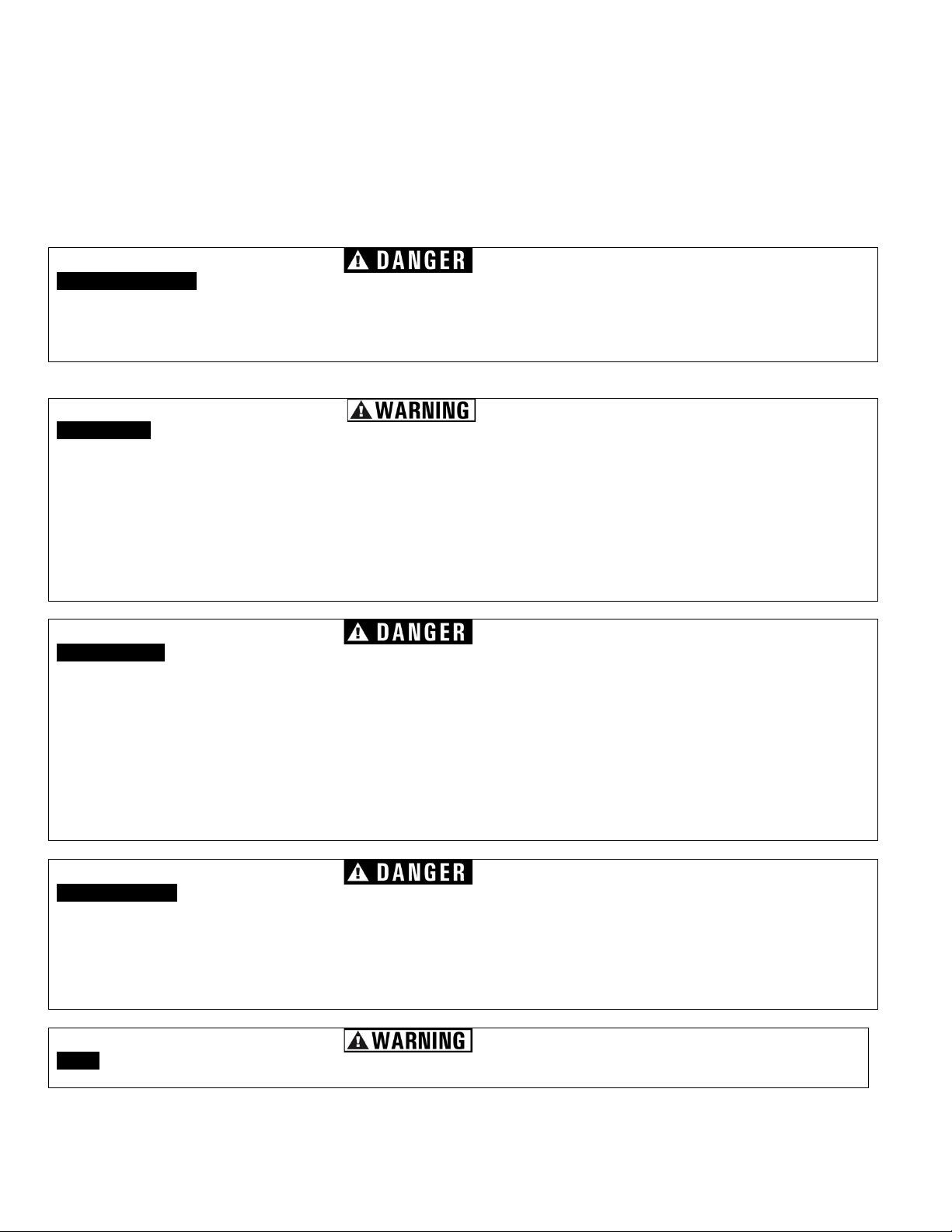
This is the safety alert symbol. It is used to alert you to potential
personal injury hazards. Obey all safety messages that follow this
symbol to avoid possible injury or death.
DANGER indicates an imminently hazardous situation
which, if not avoided, will result in death or serious injury.
WARNING indicates a potentially hazardous situation which,
if not avoided, could result in death or serious injury.
CAUTION indicates a potentially hazardous situation which,
if not avoided, may result in minor or moderate injury.
CAUTION used without the safety alert symbol indicates a
potentially hazardous situation which, if not avoided, may
result in property damage.
Legal Requirements:
Federal and/or State Occupational Safety and Health Administration (OSHA) regulations, local codes, and/or ordinances may apply to the intended use
of this generator. Consult a qualified electrician, electrical inspector, and/or the local agency having jurisdiction. Some areas require generators to be
registered with local utility companies. Additional regulations may apply if this generator will be used at a construction site.
Item # GEN4000TRI 4000 Surge Watt / 3500 Running Watt Portable Tri Fuel LP Liquid Propane, Gasoline, Natural Gas Generator Manual
6
IMPORTANT SAFETY INSTRUCTIONS
STOP!
Before using this generator and if you have any questions regarding the hazard and safety notices listed in this manual and/or on
this generator, call 1-866-460-9436, Monday - Friday, 8 AM - 4 PM Central Time.
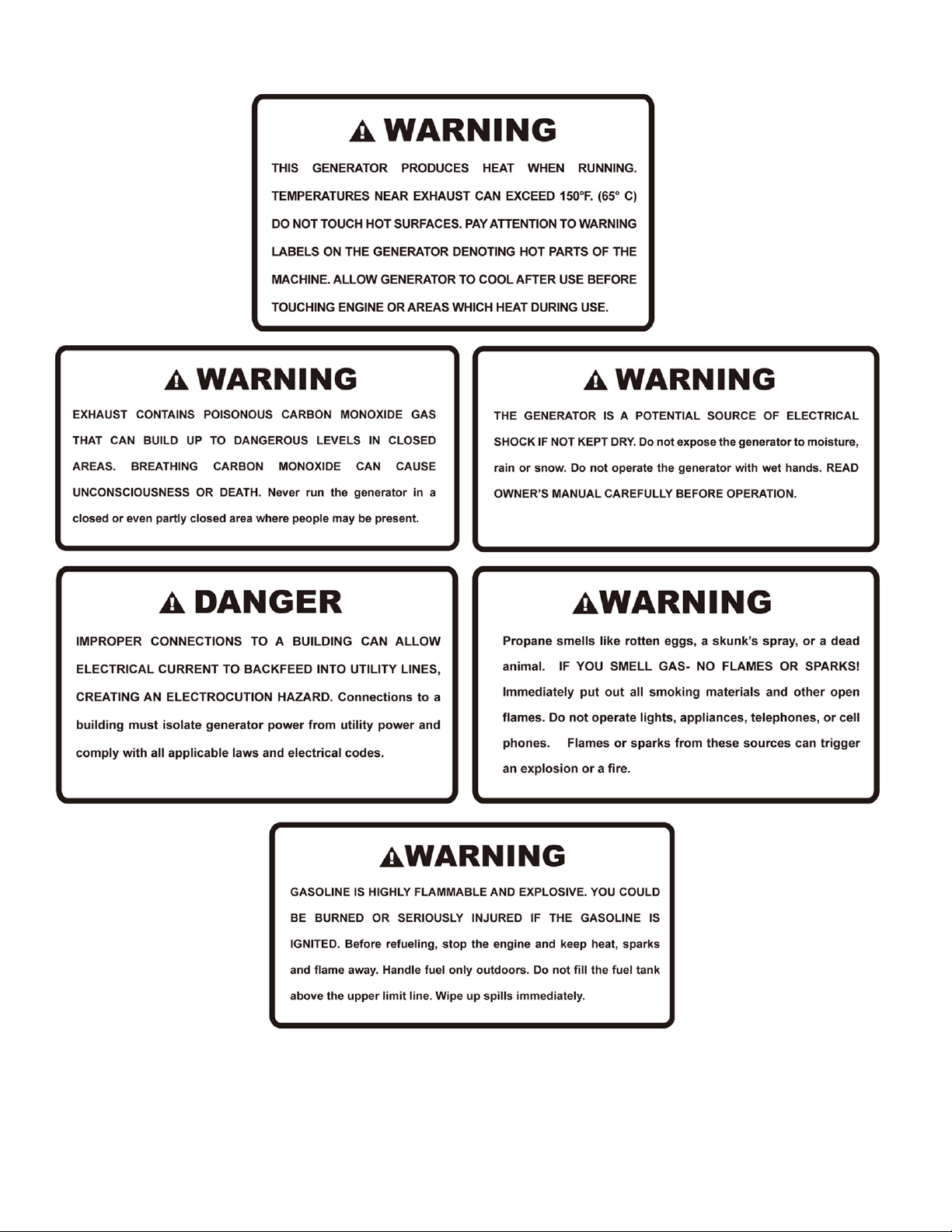
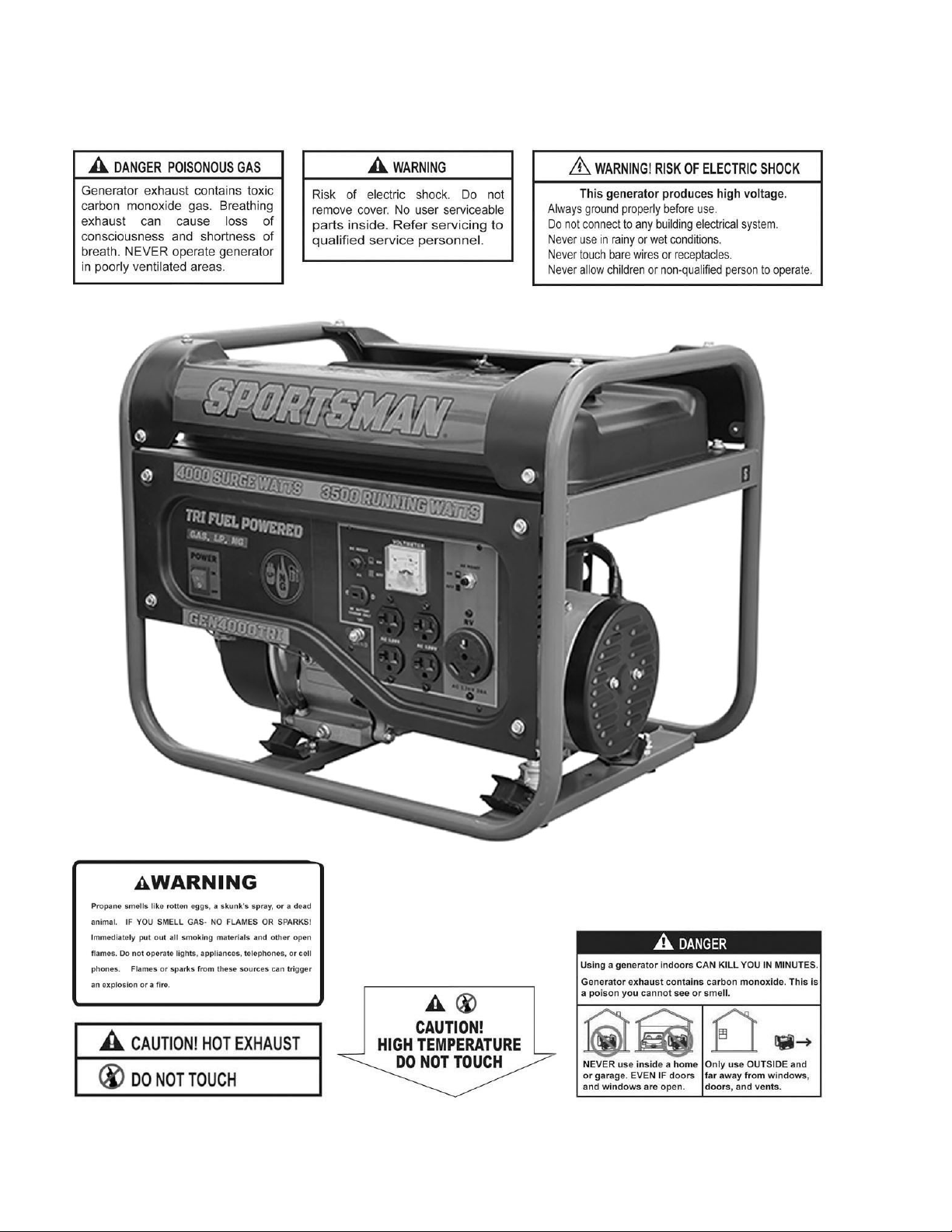
Carbon Monoxide Gas: When in operation, the exhaust from this generator contains poisonous carbon monoxide gas. Carbon
monoxide gas is both odorless and colorless AND may be present even if you do not see or smell gas. Breathing this poison gas can
lead to headaches, dizziness, drowsiness, loss of consciousness and eventually death.
• Use this generator ONLY outdoors in non-confined areas.
• Keep at least several feet of clearance on all sides to allow proper ventilation for this generator.
Propane (LPG): This generator may emit highly flammable and explosive vapors, which can cause severe burns or even death. A
nearby open flame can lead to an explosion even if not directly in contact the fuel.
• Do not operate this generator near open flame.
• Always operate this generator on a firm, level surface.
This fuel is highly flammable and explosive. Handling fuel can result in serious injury or burns.
• Before starting the generator, inspect your LPG tank valve for damage or leaks, attach only approved tanks that have been properly filled by
an approved station. DO NOT light or smoke cigarettes.
Replace the hose at the first sign of a leak or if age-cracking becomes apparent.
• Always handle propane fuel and generator outdoors.
• Before transporting, turn the fuel valve to the "off" position and disconnect the spark plug.
Powerful Voltage: This generator produces powerful voltage, which can result in electrocution.
• ALWAYS ground this generator before using it. (See “Ground the Generator” section in this manual).
• Only electrical devices should be plugged into this generator, either directly or with an extension cord. NEVER connect a building electrical
system to this generator without a qualified electrician. Doing so voids your warranty. Such connections must isolate generator power from
utility power and comply with local electrical laws and codes. Failure to comply can create a back feed into utility lines creating an electrocution
hazard, which may result in serious injury or death to utility workers. Such a back feed may cause this generator to explode, burn and create
fires when utility power is restored.
• Do not use this generator in wet conditions (rain, snow, active sprinkler system, wet hands, etc.). Always keep this generator dry and operate it
with dry hands.
• Do not touch bare wires or outlets (receptacles).
• Do not allow children or non-qualified persons to operate this generator.
High Temperatures: This generator produces heat when in operation. Temperatures near the exhaust can exceed 150 Degrees
Fahrenheit (65 Degrees Celsius).
• Do not touch hot surfaces. Observe all warning placards on this generator denoting hot surfaces.
• Allow this generator to cool for several minutes after use before touching the engine, muffler or other areas that are hot during operation and
before storing indoors.
• Hot exhaust may ignite some materials. Keep flammable materials away from this generator.
• Keep at least several feet of clearance on all sides of this generator during operation. Do not enclose this generator in any structure.
Usage: Avoid the use of extension cords if possible. If you choose to use them, be sure they are sized adequately to handle the flow of
electricity. An undersized cord can overheat, short out and cause a fire.
Item # GEN4000TRI 4000 Surge Watt / 3500 Running Watt Portable Tri Fuel LP Liquid Propane, Gasoline, Natural Gas Generator Manual
7
Usage: Misuse of this generator can damage it or shorten its life.
• Use this generator only for its intended purpose.
• Operate this generator only on a dry, level surface.
• Allow this generator to run for several minutes before connecting any electrical devices.
• Promptly turn off any malfunctioning devices and disconnect them.
• Do not operate an excessive number of electrical devices in excess of the wattage capacity of this generator.
• Do not turn on electrical devices until after they are connected to this generator.
• Turn off all connected electrical devices before stopping this generator.
Flammable liquid gas under pressure. Can form explosive mixtures with air. May cause frostbite. In Case Of Inhalation: Persons suffering from
lack of oxygen should be removed to fresh air. If victim is not breathing, administer artificial respiration. If breathing is difficult, administer
oxygen. Obtain prompt medical attention. In Case Of Eye Contact: Contact with liquid or cold vapor can cause freezing of tissue. Gently flush
eyes with lukewarm water. Obtain medical attention immediately. In Case Of Skin Contact: Contact with liquid or cold vapor can cause
frostbite. Immediately warm affected area with lukewarm water not to exceed 105°F (40°C). Fire And Explosion Hazards: Propane is easily
ignited. It is heavier than air, therefore, it may collect in low areas or travel along the ground where an ignition source may be present. Pressure
in a container can build up due to heat, and it may rupture if pressure relief devices should fail to function. Storage: Cylinders should be stored
upright with valve protection cap in place and firmly secured to prevent falling or being knocked over. Protect cylinders from physical damage;
do not drag, roll, slide or drop. Use a suitable hand truck for cylinder movement. Post "No Smoking or Open Flames" signs in the storage areas.
There should be no sources of ignition. All electrical equipment should be explosion proof in the storage and use areas. Storage areas must
meet national electric codes for class 1 hazardous areas.
Propane smells like rotten eggs, a skunk’s spray, or a dead animal. IF YOU SMELL GAS- NO FLAMES OR SPARKS! Immediately put out all
smoking materials and other open flames. Do not operate lights, appliances, telephones, or cell phones. - Flames or sparks from these
sources can trigger an explosion or a fire.
WHAT IS CARBON MONOXIDE (CO)?
You can’t taste or smell CO, but it is a very dangerous gas. High levels of CO can come from appliances that are not operating correctly, or from
a venting system or chimney that becomes blocked. CO CAN BE DEADLY! High levels of CO can make you dizzy or sick. In extreme cases,
CO can cause brain damage or death.
Symptoms of CO poisoning include: headache, dizziness, fatigue, shortness of breath,
and nausea.
IF YOU SUSPECT CO IS PRESENT, ACT IMMEDIATELY!
1. If you or a family member shows physical symptoms of CO poisoning, get everyone out of the building and call 911 or your local fire
department.
2. If it is safe to do so, open windows to allow entry of fresh air, and turn off any appliances you suspect may be releasing CO.
3. If no one has symptoms, but you suspect that CO is present, call your propane retailer or a qualified service technician to check CO levels
and your propane equipment.
Usage: Consult a physician(s) before using this generator if using a pacemaker. Electromagnetic fields in close proximity to a heart
pacemaker could cause a pacemaker to malfunction or fail. Caution is necessary when near the engine’s recoil starter.
Usage: Prolonged exposure to high noise levels can be hazardous to hearing. Always wear ANSI-approved hearing protection when
operating or working around the generator when it is running.
Item # GEN4000TRI 4000 Surge Watt / 3500 Running Watt Portable Tri Fuel LP Liquid Propane, Gasoline, Natural Gas Generator Manual
8
Item # GEN4000TRI 4000 Surge Watt / 3500 Running Watt Portable Tri Fuel LP Liquid Propane, Gasoline, Natural Gas Generator Manual
9
In addition to the previously described safety information, familiarize yourself with all safety and hazard notices on this generator.
Item # GEN4000TRI 4000 Surge Watt / 3500 Running Watt Portable Tri Fuel LP Liquid Propane, Gasoline, Natural Gas Generator Manual
10
PACKAGE CONTENTS
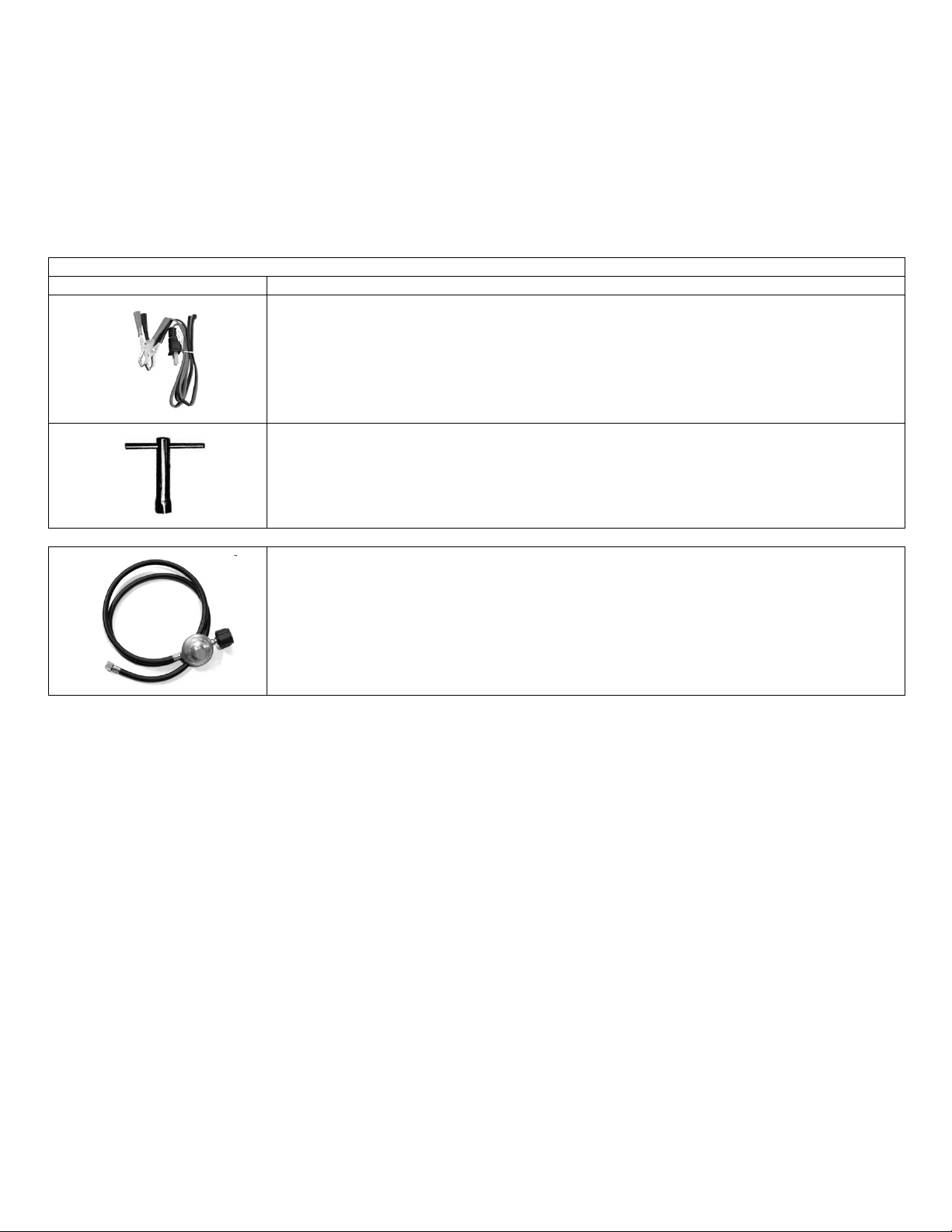
The following items are supplied with this Model GEN4000TRI Portable LP & Gasoline & NG Generator. Verify that all items are included.
STOP!
If there are missing items, call 1-866-460-9436, Monday - Friday, 8 AM - 4 PM Central Time for customer service. DO NOT RETURN THIS
GENERATOR TO THE RETAILER.
Item List:
Set of 2 DC connector wires for charging 12 Volt automotive-type batteries
Spark plug wrench
5 Ft. Regulator Hose Kit
(YOU MUST USE THIS SUPPLIED REGULATOR FOR LPG FOR SAFE OPERATION)
DO NOT USE THIS SUPPLIED REGULATOR FOR NG
Item # GEN4000TRI 4000 Surge Watt / 3500 Running Watt Portable Tri Fuel LP Liquid Propane, Gasoline, Natural Gas Generator Manual
11
GENERATOR COMPONENTS
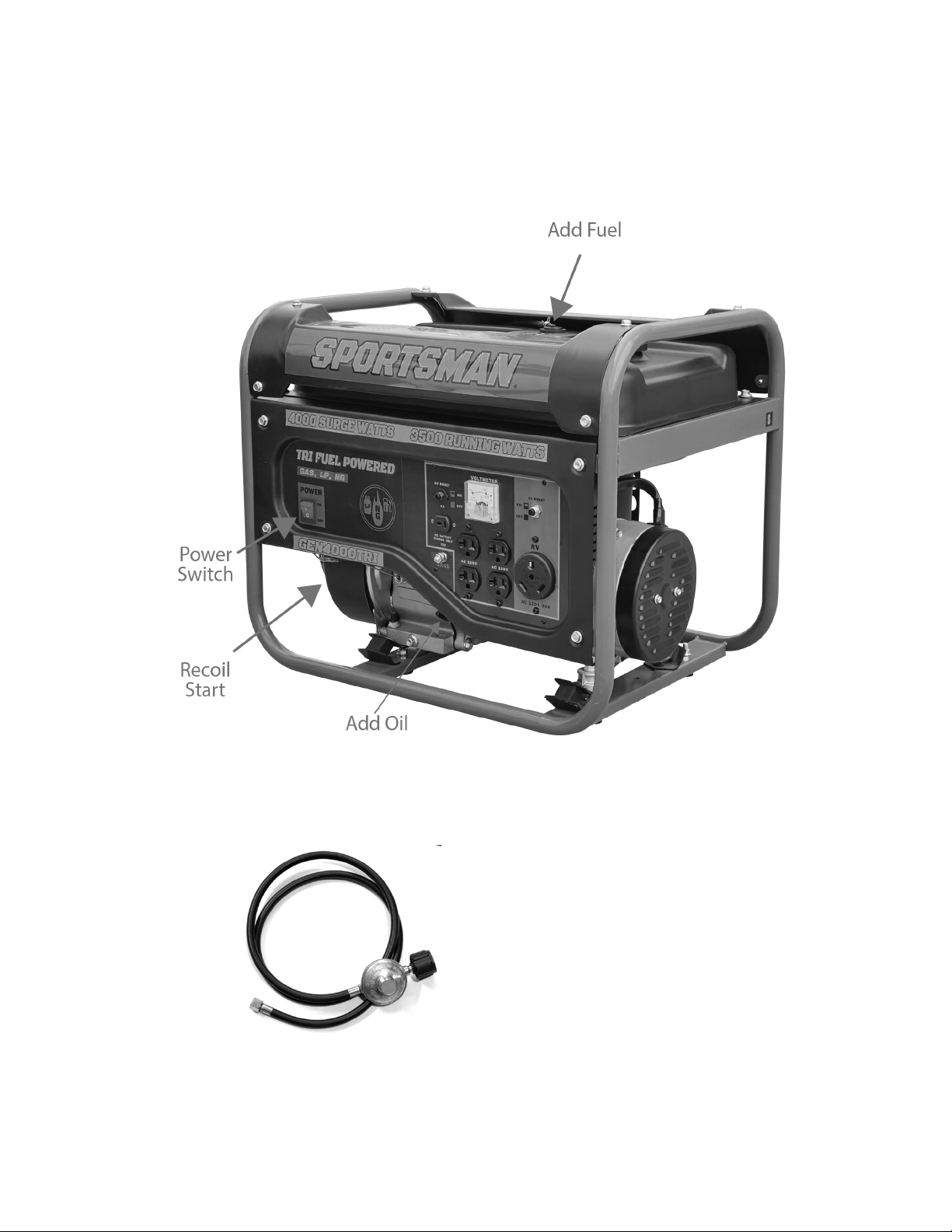
Observe the locations and functions of the various components and controls of this generator.
WARNING:
YOU MUST USE
THE SUPPLIED
REGULATOR)FOR)
LPG FOR SAFE
OPERATION
ATTENTION:
The Air-fuel Mixer is not adjustable. Tampering with the governor can damage your generator and electrical devices, and will void your warranty.
To prevent electrical shock from faulty
appliances, the generator should be grounded.
Connect a length of heavy wire between the
ground terminal and the ground source.
Consult with a qualified electrician to ensure
compliance with local electrical codes.
Item # GEN4000TRI 4000 Surge Watt / 3500 Running Watt Portable Tri Fuel LP Liquid Propane, Gasoline, Natural Gas Generator Manual
12
PREPARING THE GENERATOR FOR USE
Using this Generator for the First-Time
STOP!
The following section describes the required steps for preparing this generator for the first use. Failure to correctly perform these steps
can damage this generator and/or shorten its life. If still unsure about how to perform any of these steps after reading this section, call
1-866-460-9436 Monday - Friday, 8 AM - 4 PM Central Time for customer service.
If this generator is being used for the first time, the following few steps are required to prepare it for operation:
Step 1 - Add Oil
This generator requires engine oil to function. Engine oil is a major factor affecting engine performance and service life. When new from the
package, this generator contains no oil in the engine crankcase. The correct quantity of oil is equal to the oil capacity of the engine crankcase and is
18.5 fluid oz. Add the correct quantity of oil before operating this generator for the first time. When replenishing oil for subsequent use of this generator,
always determine that this generator has the correct quantity of oil.
Model GEN4000TRI Oil Capacity
18.5 ounces
Model GEN4000TRI Oil Type Recommended
High Detergent Motor Oil, SAE10W-30
To add oil:
1. Confirm that this generator is on a level surface.
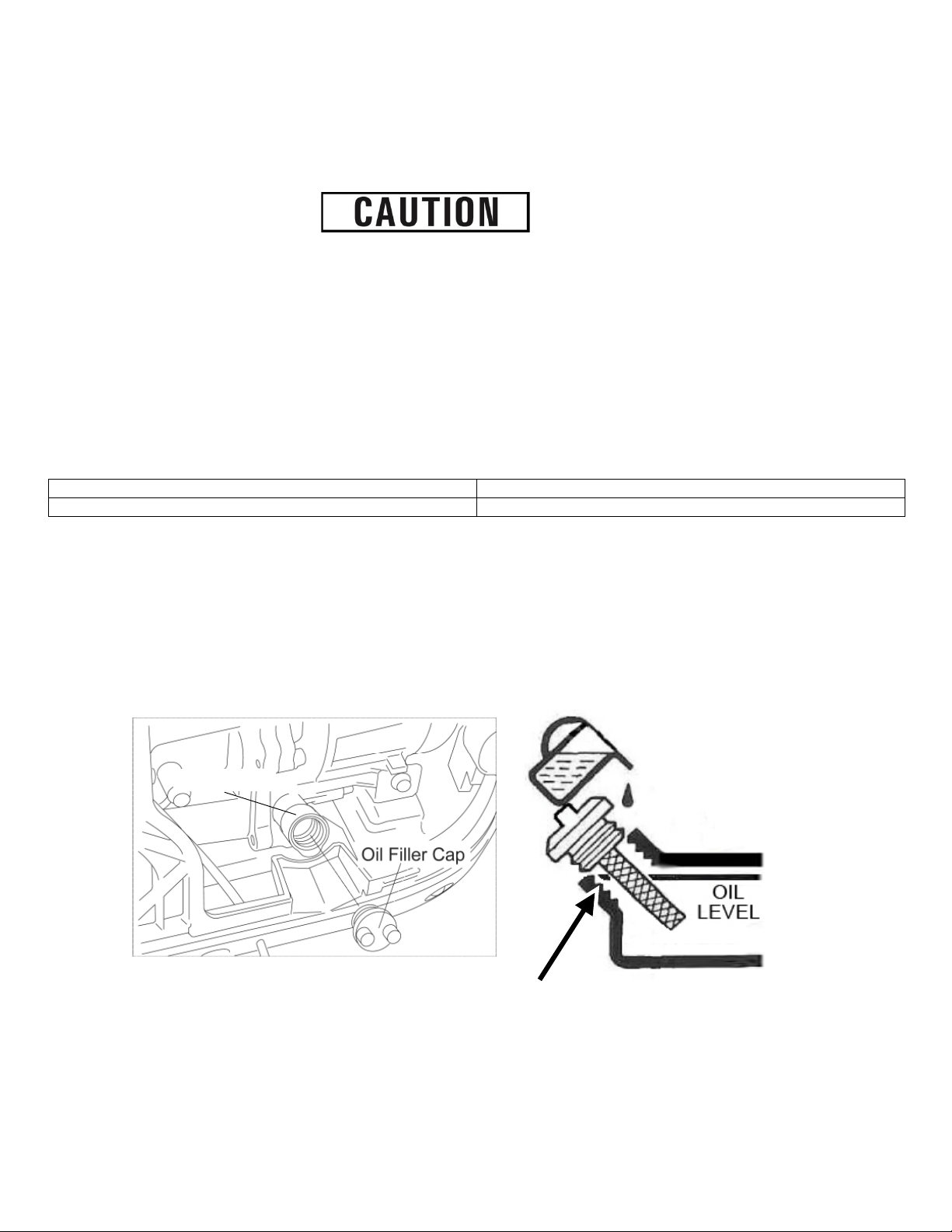
2. Unscrew the oil filler/dipstick cap from the engine as illustrated in Figure 1.
3. Using a funnel, add high detergent motor oil to fill the engine crankcase to the correct quantity. SAE10W-30 oil is recommended for general,
all-temperature use. When the engine crankcase is full, the oil level should reach all the way up to the threads as illustrated in Figure 2.
4. Replace the oil filler/dipstick cap.
Figure 1 - Unscrew the Oil Cap
Figure 2 - Add Oil To TOP Of Threads
Oil Filler
Hole
Item # GEN4000TRI 4000 Surge Watt / 3500 Running Watt Portable Tri Fuel LP Liquid Propane, Gasoline, Natural Gas Generator Manual
13
Step 2 – Connect Fuel
Sulfur, water, dust, etc. are harmful for engine. If the gas supply source (LPG & NG) contains these harmful elements, user must use filter to remove
sulfur, water etc. and clean gas. Otherwise, the engine service lifetime will be shortened.
Choose either LPG or NG or Gasoline fuel.
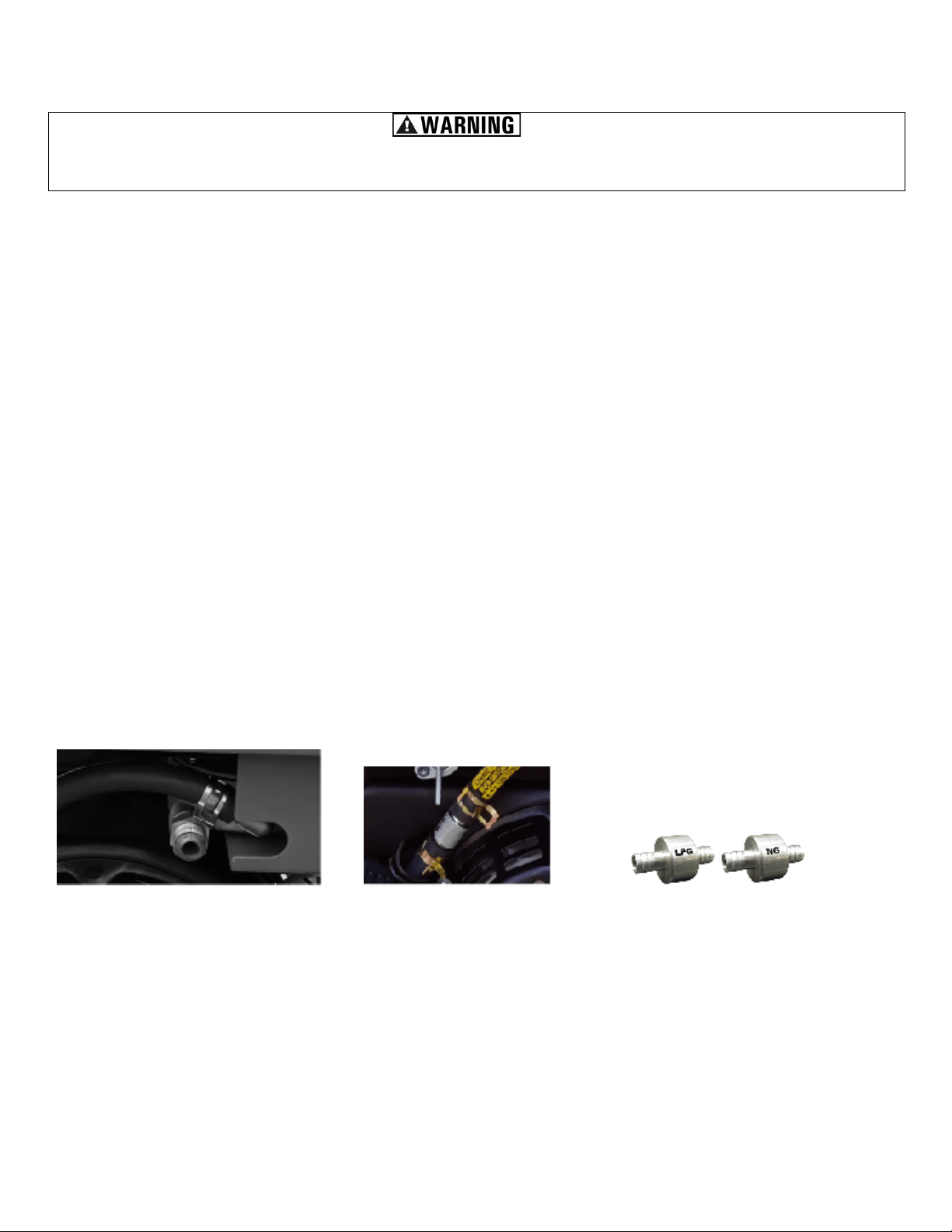
If using LPG, first connect the regulator that was included with the generator to Propane Fuel Tank, then connect the other end to the Gas Inlet. (Fig 3)
Make sure the LPG cylinder is vertical and securely positioned
If using NG, replace the LPG adapter with the NG adapter (fig 4). NOTE: Adapters are labeled with LPG and NG (fig 5).
Directly connect to the NG system with a gas hose no less than 3/8"(inside diameter), no longer than 10 ft (3 m), and to the gas inlet (fig 3).
DO NOT use the LP regulator hose for NG.
NOTE: If using LPG/NG, be sure that the carburetor is free of gasoline.
If using gasoline fuel, add Unleaded gasoline only with an octane rating of 87 or higher.
Maximum Capacity: 3.6 Gallons
Pre-Operation Check List
Step 1 Check that the gas supply source is in good condition. Check that the gas inlet connection is tightly fixed and not leaking.
Step 2 CHOKE LEVER is at CLOSED/START position. The generator may be hard to start if CHOKE LEVER is at OPEN/RUN position.
Step 3 Check that engine oil is full.
Step 4 Make sure GROUND TERMINAL is properly grounded.
Step 5 AC OUTPUT no load connected.
Disconnect all electrical loads from the generator set before starting the engine. The generator may be hard to start if a load is connected.
Step 6 DC OUTPUT no load connected.
Fig 3: gas inlet Fig 4: LPG/NG adapter Fig 5: LPG/NG adapter
Item # GEN4000TRI 4000 Surge Watt / 3500 Running Watt Portable Tri Fuel LP Liquid Propane, Gasoline, Natural Gas Generator Manual
14
Step 3 - Ground the Generator
Failure to properly ground this generator can result in electrocution.
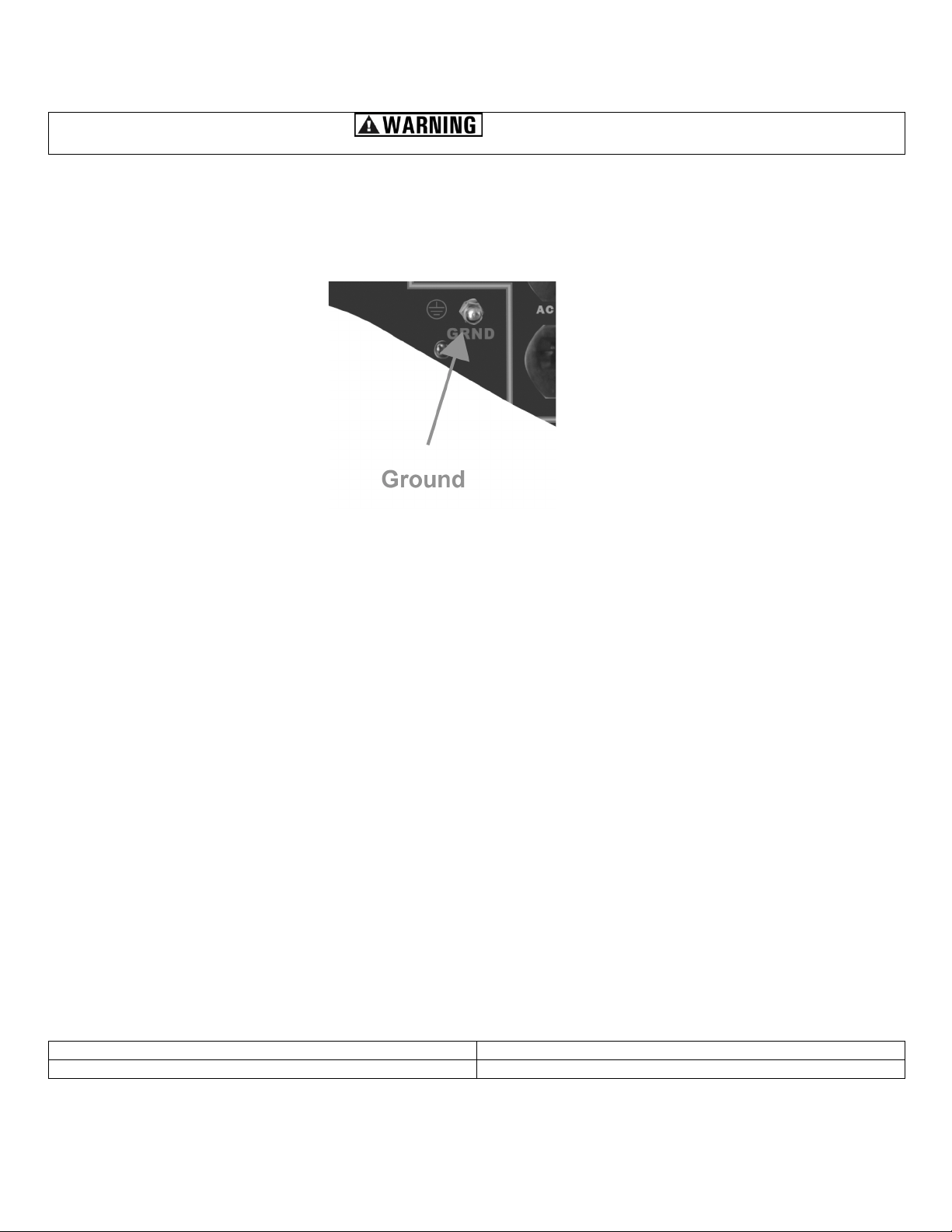
Ground this generator by tightening the grounding nut against a grounding wire as illustrated in Figure 3. A No. 12 AWG (American Wire Gauge)
stranded copper wire is generally an acceptable grounding wire. The other end of this grounding wire should be connected to a copper or brass
grounding rod that is driven into the earth.
Grounding codes can vary by location. Contact a local electrician for information on grounding regulations for your area.
Figure 6 - Attaching the Grounding Wire to this Generator
Subsequent Use of this Generator
For subsequent uses of this generator after the first use, certain steps still must be completed to prepare it for operation.
IMPORTANT: Be familiar with the procedures described in the previous section titled “Using the Generator for the First Time” of this
manual. If not, review this section now.
Step 1 - Verify Oil Level
Even though this generator is equipped with an automatic shutoff to protect it from damage due to low oil, it is important to check the oil level in the
engine crankcase before each use to ensure that there is sufficient quantity.
1. Verify that this generator is on a level surface.
2. Unscrew the oil filler/dipstick cap from the engine.
3. With a dry cloth, wipe the oil off of the dipstick that is located on the inside of the cap.
4. Fully insert the dipstick without screwing the filler/dipstick cap and then remove again. There should be oil on the dipstick. If there is no oil on the
dipstick, or oil is visible only at the very end of the dipstick, add oil until the engine crankcase is filled. (See “Changing/Adding Oil” in the
“Maintenance/Care” section of this manual).
5. Confirm that the oil filler/dipstick cap is properly screwed in place when finished verifying the oil level.
Model GEN4000TRI Oil Capacity
18.5 ounces
Model GEN4000TRI Oil Type Recommended
High Detergent Motor Oil, SAE10W-30
Item # GEN4000TRI 4000 Surge Watt / 3500 Running Watt Portable Tri Fuel LP Liquid Propane, Gasoline, Natural Gas Generator Manual
15
Step 3 - Ground the Generator
Failure to properly ground this generator can result in electrocution.
Ground this generator by tightening the grounding nut against a grounding wire as previously illustrated in Figure 3. A generally acceptable grounding
wire is a No. 12 AWG (American Wire Gauge) stranded copper wire. The other end of this grounding wire should be connected to a copper or brass
grounding rod that is driven into the earth. Grounding codes can vary by location. Contact a local electrician for information on grounding regulations for
your area.
STARTING THE GENERATOR
STOP!
Before starting this generator, confirm that all the steps in the section titled, “Preparing the Generator for Use,” of this manual have been
correctly completed. If unsure about how to perform any of these steps, call 1-866-460-9436, Monday - Friday, 8 AM - 4 PM Central Time for
customer service.
Disconnect all electrical loads from this generator before attempting to start.
Step 1 If using Propane LPG fuel, open fuel supply on the LP tank.
If using NG fuel, open fuel supply on the NG pipe.
If using gasoline, make sure unleaded gasoline fuel has been added to the tank.
Step 2 If using Propane LPG/NG fuel, turn ENGINE SWITCH to ON position, and Petcock to OFF position.
NOTE: Be sure that the carburetor is free of gasoline.
If using gasoline, turn ENGINE SWITCH to ON position and Petcock to ON position, and LPG/NG fuel system to OFF position.
Step 3 Move Choke Lever to CLOSED/START position.
Step 4 For recoil start: Pull the STARTER GRIP slowly until resistance is felt and then pull rapidly. After the engine started, return the STARTER
GRIP gently to prevent damage to the starter or housing. DO NOT allow the starter grip to snap back. Return it slowly by hand.
Step 5 Turn the CHOKE LEVER to OPEN/RUN position.
Choke Lever
The choke is used to provide an enriched fuel mixture when starting a cold engine. It can be opened and closed by operating the choke lever manually.
Push the lever toward CLOSED/START position to enrich the mixture for cold starting
Item # GEN4000TRI 4000 Surge Watt / 3500 Running Watt Portable Tri Fuel LP Liquid Propane, Gasoline, Natural Gas Generator Manual
16
USING THE GENERATOR
After the engine has been running for several minutes, electrical devices may be connected to this generator.
AC Usage
Electrical devices running on AC current may be connected according to their wattage requirements. The rated (running) and surge wattage:
Model GEN4000TRI Rated (Running) Wattage
3500 (gasoline)
Model GEN4000TRI Surge Wattage
4000 (gasoline)
The rated (running) wattage corresponds to the maximum wattage a generator can output on a continuous basis.
The surge wattage corresponds to the maximum amount of power a generator can output for a short time. Many electrical devices, such as a
refrigerator, require short bursts of extra power for starting and stopping fan motors, etc., in addition to their listed rated wattage. Motorized devices
typically require more than their rated wattage for startup. The surge wattage ability of a generator allows for this extra power requirement.
The total running wattage requirement of the electrical devices connected to a generator should not exceed the rated wattage of the generator itself. To
calculate the total wattage requirement of the electrical devices to be connected, look up the rated (running) wattage of each device and add these
numbers together to find the total wattage that all of the devices together will draw from the generator. If the total wattage of the selected devices
exceeds the rated wattage of the generator, DO NOT connect all of the devices. Select a combination of the electrical devices that will have a total
wattage less than or equal to the rated wattage for the generator, i.e., no more than 3500 watts for this generator.
This generator can run at its surge wattage capacity for only a short time. Connect electrical devices requiring a rated (running) wattage equal to or
less than the rated wattage of this generator. Never connect devices requiring a rated wattage equal to the surge wattage of a generator.
A device's rated (running) wattage should be listed somewhere on the device itself and/or in its manual. If the wattage specification for a device is not
available, the wattage can be calculated by multiplying the Voltage requirement (120 or 240) by the Amperage drawn.
Watts = Volts x Amperes
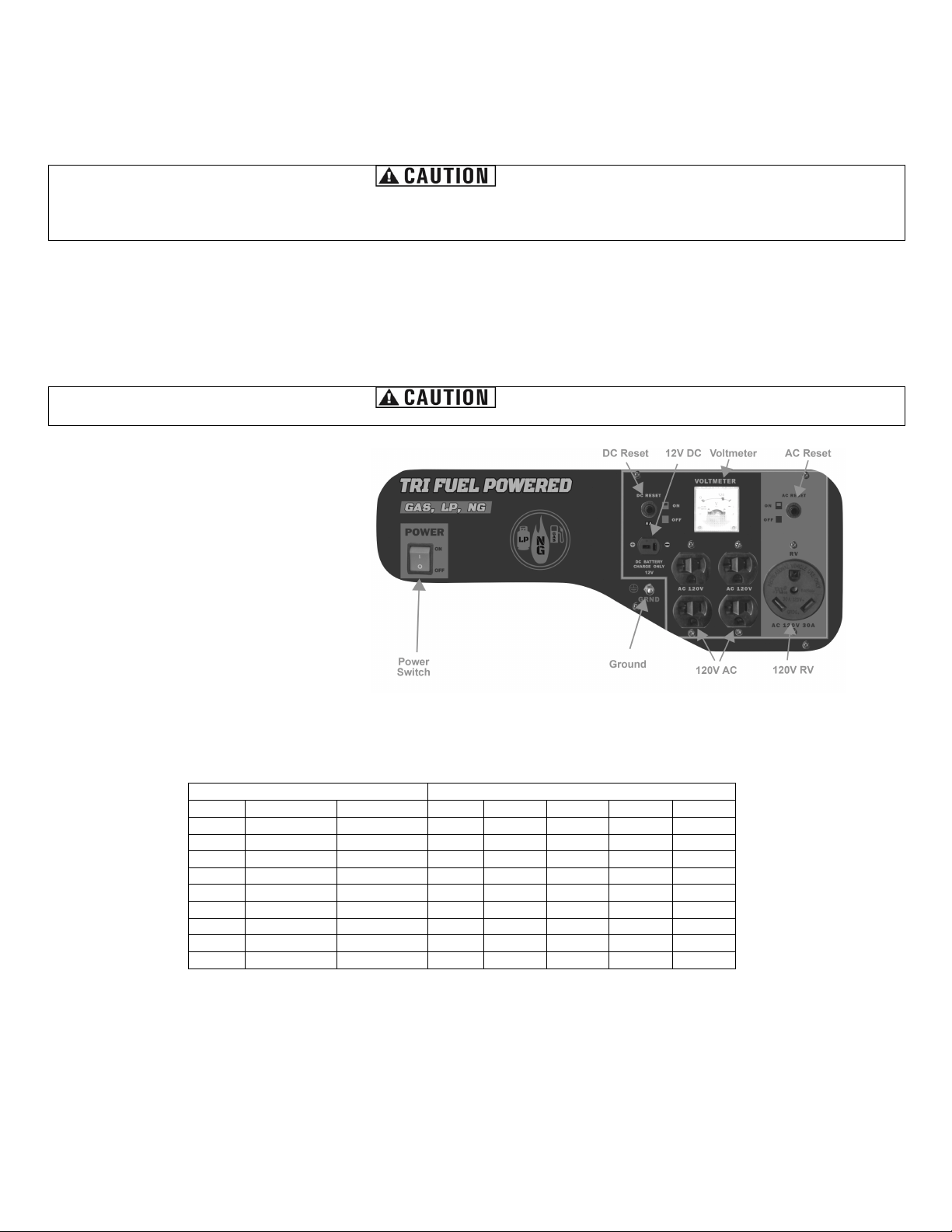
Or, the wattage required by a device can be estimated by using the following chart (see Figure 7). The chart provides only estimates and it is better to
know the exact wattage of each electrical device to be powered by this generator.
Electrical Device
Rated (Running) Watts
Additional Surge Watts
air compressor (1 HP)
1500
3000
air compressor (1 - 1/2 HP)
2500
2500
airless sprayer (1/3 HP)
600
1200
box fan
300
600
clock radio AM/FM
300
0
coffee maker
1500
0
computer w/17 inch monitor
800
0
deep freezer
500
500
electric drill (1/2 HP)
1000
1000
DVD/CD player or VCR
100
0
furnace fan blower (1/2 HP)
800
1300
garage door opener (1/2 HP)
480
520
hot plate
2500
0
light bulb (75 watt)
75
0
microwave oven (1000 watt)
1000
0
quartz halogen work light
1000
0
refrigerator/freezer (18 Cu. Ft.)
800
1600
saw - circular (7 1/4 inch)
1500
1500
saw - miter (10 inch)
1800
1800
saw - reciprocating
960
1040
security system
180
0
electric stove - single element
1500
0
sump pump
800
1200
television (27 inch color)
500
0
electric water heater (40 gallon)
4000
0
window fan
300
600
Figure 7 - Estimated wattage requirements for common electrical devices.
Item # GEN4000TRI 4000 Surge Watt / 3500 Running Watt Portable Tri Fuel LP Liquid Propane, Gasoline, Natural Gas Generator Manual
17
Connect electrical devices to this generator according to the following procedure:
1. Allow the engine to run for several minutes after it has been started.
2. Confirm that the electrical device is switched off prior to plugging it into this generator.
Connect only electrical devices that are in good working order. Faulty devices or power cords present the risk of electrical shock.
Immediately turn off and disconnect any device that commences to operate abnormally, sluggish or abruptly stops. Determine if the
problem was the device or the rated load capacity of this generator has been exceeded.
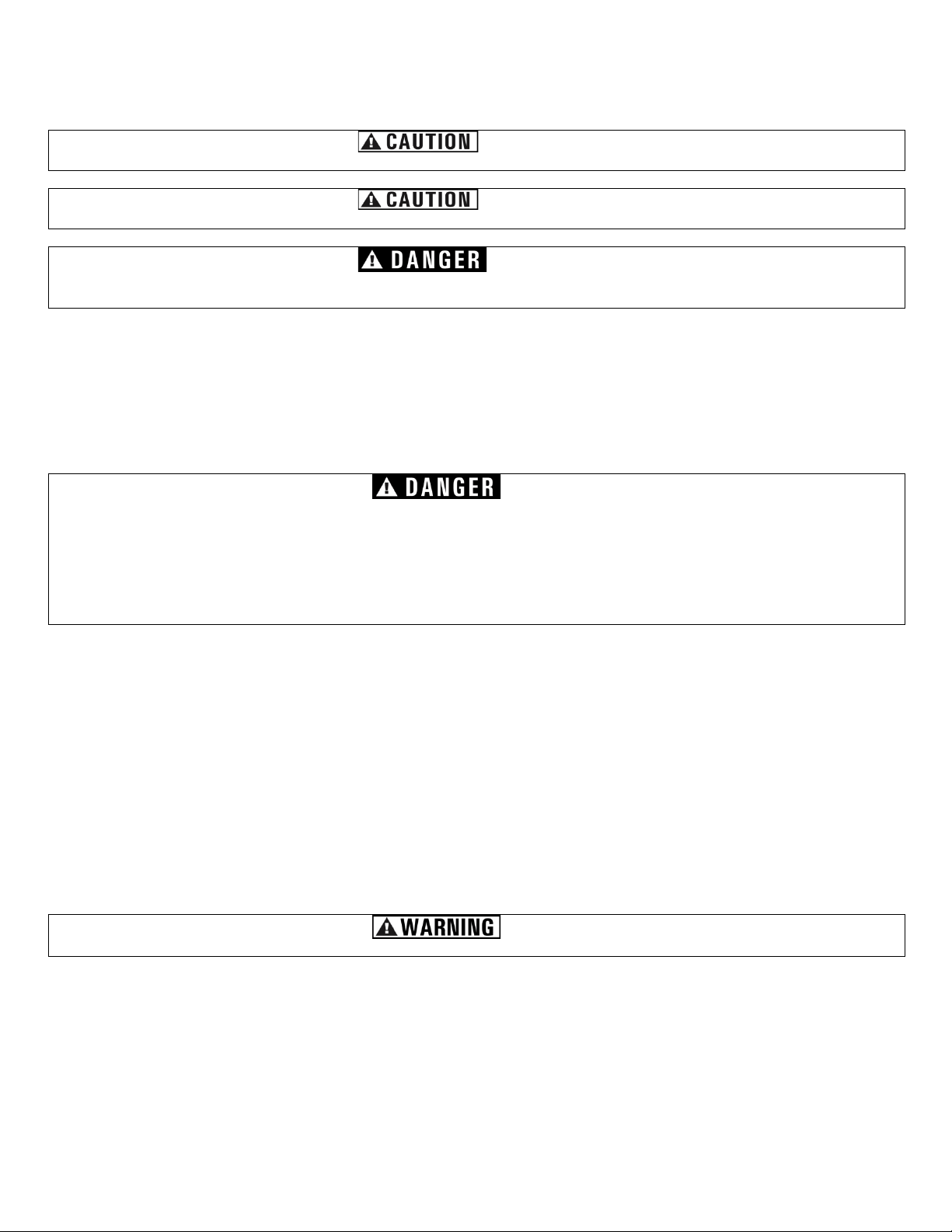
NOTE: While this generator is running, power is available from either the standard 120 Volt outlets or the 12 Volt DC outlet. Both 120 Volts and 12V
can be simultaneously drawn from this generator.
3. Turn on the connected electrical devices beginning with the device with the highest rated wattage requirement and then each additional device with
the next lower rated wattage requirement.
Do not connect 50Hz or 3-phase loads to this generator.
Figure 8 - Outlets available on this generator
SOME NOTES ABOUT POWER CORDS
Long or thin cords can require more wattage from a generator to power an electrical device. Figure 9 shows the recommended cords according to the
power requirement of the electrical device. When using cords that exceed these specifications, allow for the electrical device to have a slightly higher
rated wattage requirement.
Device Requirements
Max. Cord Length (ft) by Wire Gauge
Amps
Watts (120V)
Watts (240V)
#8 wire
#10 wire
#12 wire
#14 wire
#16 wire
2.5
300
600
NR
1000
600
375
250
5
600
1200
NR
500
300
200
125
7.5
900
1800
NR
350
200
125
100
10
1200
2400
NR
250
150
100
50
15
1800
3600
NR
150
100
65
NR
20
2400
4800
175
125
75
50
NR
25
3000
6000
150
100
60
NR
NR
30
3600
7200
125
65
NR
NR
NR
40
4800
9600
90
NR
NR
NR
NR
NR = Not Recommended.
Figure 9 - Maximum Extension Cord Lengths by Power Requirement
Item # GEN4000TRI 4000 Surge Watt / 3500 Running Watt Portable Tri Fuel LP Liquid Propane, Gasoline, Natural Gas Generator Manual
18
DC Usage
The DC outlet is only for recharging 12 Volt automotive-type batteries. Do not connect any other device to this outlet.
Use this generator only for recharging 12 Volt batteries. NEVER attempt to jumpstart a car with this generator.
Failing to use the correct procedure can cause a battery to explode, seriously injuring anyone nearby. Keep heat, sparks, flame and
smoking materials away from the battery.
To connect 12 Volt batteries to the DC outlet:
1. Connect the red charging wire to the positive terminal of the battery and the black charging wire to the negative terminal of the battery.
2. Start the generator.
3. Connect the plug end of the wire to the 12V DC outlet on this generator.
4. When disconnecting, always disconnect the wires from this generator first to avoid a spark.
Storage batteries emit highly explosive hydrogen gas when charged.
Batteries also contain acid, which can cause severe chemical burns.
• Do not allow open flames or cigarettes nearby for several minutes after charging a battery.
• Always wear protective goggles and rubber gloves when charging a battery.
• If battery acid gets on the skin, flush with water.
• If battery acid gets in the eyes, flush with water and immediately call a physician.
• If battery acid is swallowed, drink large quantities of milk and immediately call a physician.
STOPPING THE GENERATOR
To stop this generator:
1. Turn off all connected electrical devices and then unplug them.
2. Allow this generator to run for several more minutes with no electrical devices connected to help stabilize the temperature of this generator.
3. If using gasoline, turn the petcock to “off” position.
If using LPG/NG, turn the LPG/NG fuel valve to the “off” position.
4. Turn off the engine switch.
Allow this generator to cool down before touching areas that become hot during operation.
Item # GEN4000TRI 4000 Surge Watt / 3500 Running Watt Portable Tri Fuel LP Liquid Propane, Gasoline, Natural Gas Generator Manual
19
MAINTENANCE/CARE
Proper routine maintenance of this generator is essential for safe, economical, and trouble-free operation. It will help prolong the life of this generator
as well as help reduce air pollution. Perform maintenance checks and procedures according to the schedule in Figure 10.
STOP!
If you have questions about maintenance procedures described in this manual, call 1-866-460-9436 , Monday - Friday, 8 AM - 4 PM Central Time.
Never perform maintenance procedures while this generator is running. Allow this generator to cool before commencing any maintenance
procedures. Keep heat, sparks and flame away.
Improper maintenance and/or failure to correct any problems prior to operating this generator can cause a malfunction which could cause
death or serious injury. Always follow the inspection and maintenance recommendations and schedules in this manual.
Recommended Maintenance Schedule
Each Use
Every Month or
Each 20 Hrs
Every 3 Months or
Each 50 Hrs
Every 6 Months or
Each 100 Hrs
Every Year or
Each 300 Hrs
Engine Oil
Check Level
X
Replace
X (First Use)
X
Air Filter
Check
Clean
X
X
Fuel Filler
Clean
X
Spark Plug
Check/Clean
X
Clean
X
Spark Arrestor
Clean
X
Valve
Clearnace
Check/adjust
X
Figure 10 - Recommended maintenance schedule
Cleaning the Generator
Always try to use this generator in a cool dry place. If this generator becomes dirty, the exterior can be cleaned with a damp cloth, soft brush, vacuum
and/or pressurized air.
Never clean this generator with a bucket of water and/or a hose as water can get inside and cause a short circuit or corrosion.
Never use gasoline to clean parts of this generator.
Checking the Oil Level
Even though this generator is equipped with an automatic shutoff to protect it from damage due to low oil, it is important to check the oil level in the
engine crankcase before each use to ensure that there is a sufficient quantity.
To check the oil level:
1. Verify that this generator is shut down and on a level surface.
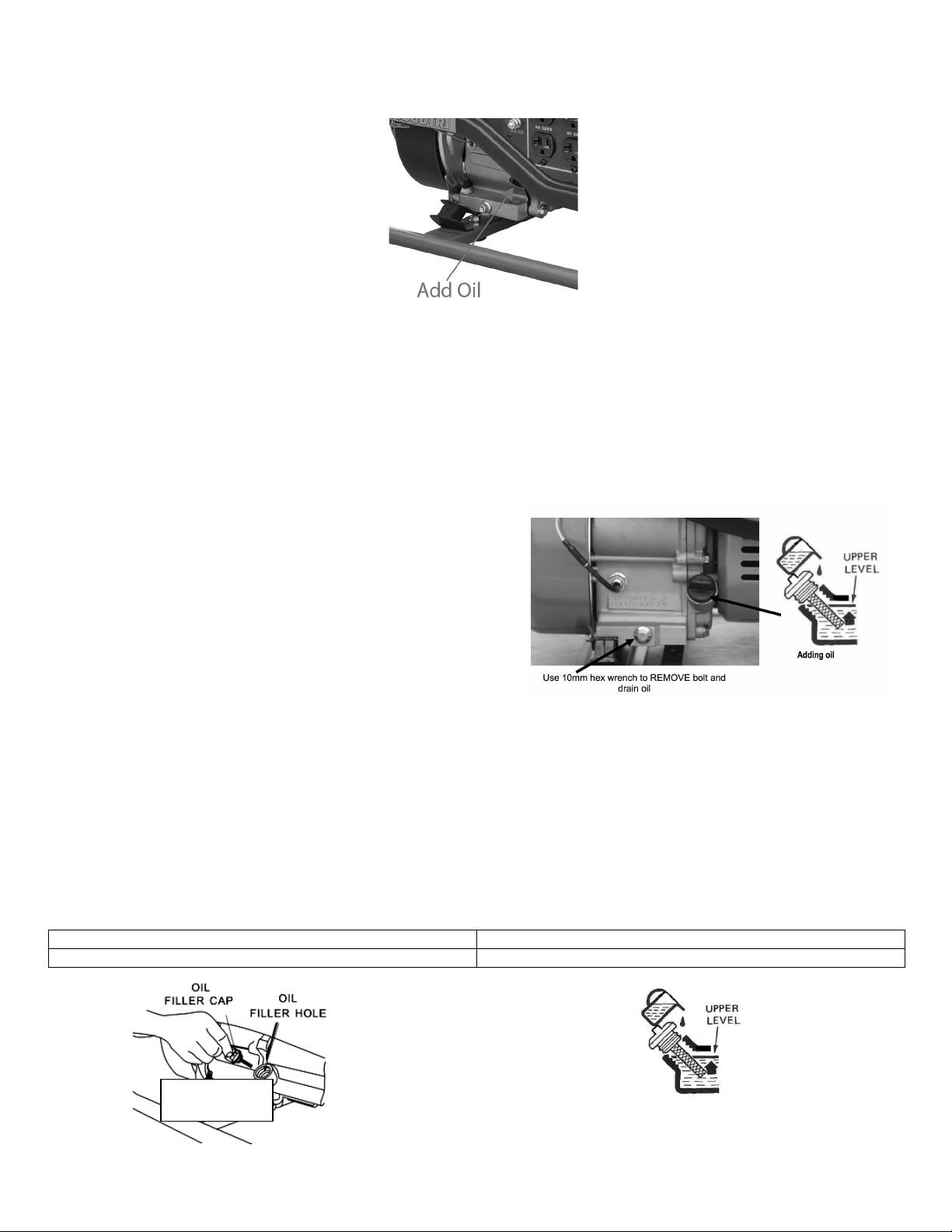
2. Unscrew the oil filler/dipstick cap from the engine as illustrated in Figure 11.
3. With a dry cloth, wipe the oil off of the dipstick that is located on the inside of the cap.
4. Insert the dipstick as if replacing the cap and then remove again. There should be oil on the dipstick. If there is no oil on the dipstick, or oil is visible
only at the very end of the dipstick, add oil until the engine crankcase is filled (see “Changing/Adding Oil” in this section of this manual).
Item # GEN4000TRI 4000 Surge Watt / 3500 Running Watt Portable Tri Fuel LP Liquid Propane, Gasoline, Natural Gas Generator Manual
20
5. Confirm that the oil filler/dipstick cap is properly in place when finished verifying the oil level.
Figure 11 - Checking the Oil
Changing/Adding Oil
The oil level in this generator should be checked before each use. When the oil level is low, add oil until the level is sufficient to operate this generator.
To drain the oil from this generator:
The oil should be changed after the first 20 hours of operation. The oil should then be changed every 6 months, or for every 50 hours of use time, or
when it has become contaminated with water and/or dirt.
Drain the oil while the engine is still warm to assure rapid and complete draining.
1. Place a bucket underneath the generator to catch oil as it drains.
2. Unscrew the oil drain plug located on the crankcase underneath
the oil filler/dipstick cap using 10 mm hex wrench. Figure12.
3. Allow all of the oil to drain from the generator.
4. Replace the oil drain plug and tighten using 10 mm hex wrench.
(Fig 12)
NOTE: Never dispose of used motor oil in the trash, down a drain or on the ground. Put oil in a sealed container and contact your local
recycling center or auto garage to arrange oil disposal.
To add oil to the engine crankcase:
1. Confirm that this generator is on a level surface.
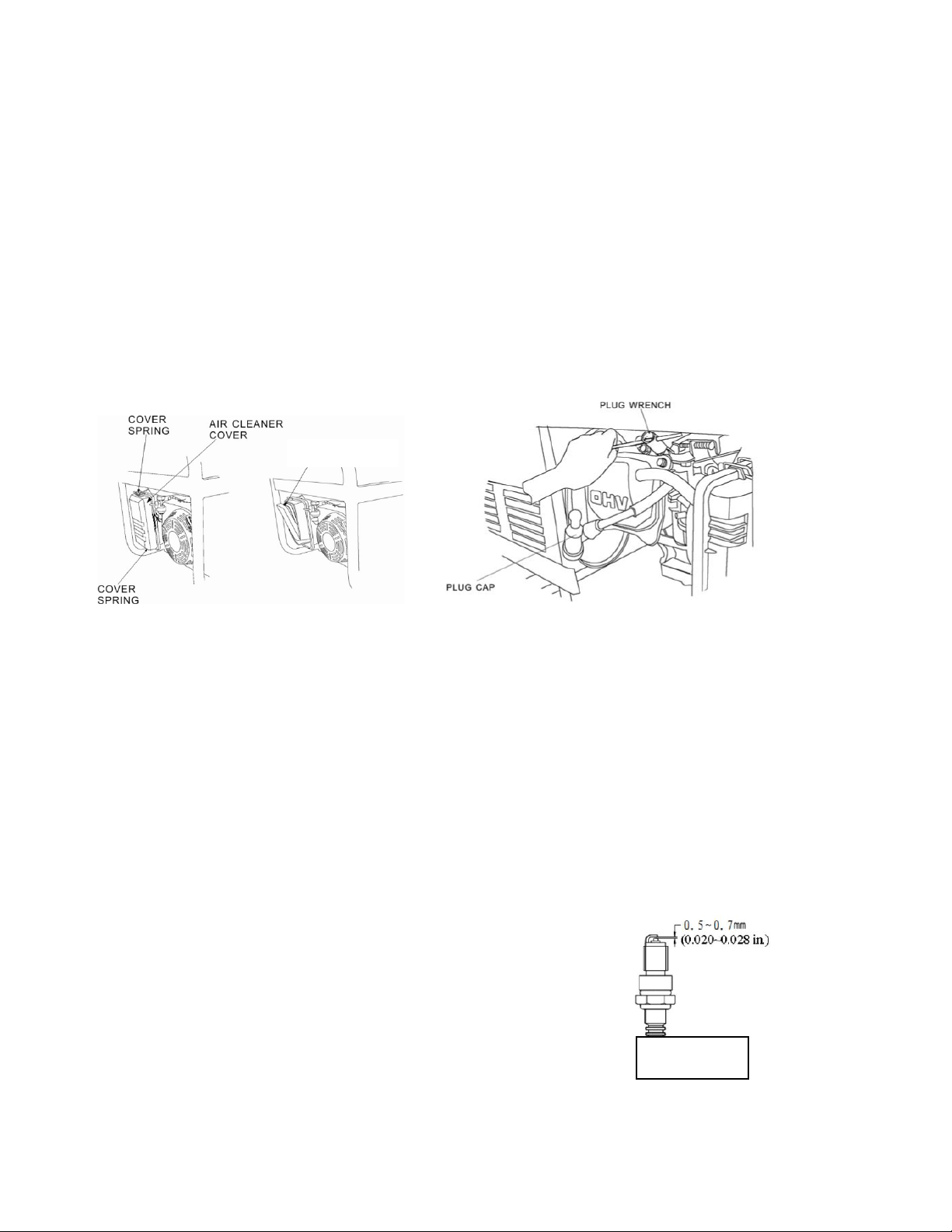
2. Unscrew the oil filler/dipstick cap from the engine as illustrated in Figure 13.
3. Using a funnel, add high detergent motor oil to fill the engine crankcase to the correct quantity. SAE10W-30 oil is recommended for general use.
When the engine crankcase is full, the oil level should reach the lower lip of the oil filling opening as shown in Figure 14.
Model GEN4000TRI Oil Capacity
18.5 ounces
Model GEN4000TRI Oil Type Recommended
High Detergent Motor Oil, SAE10W-30
Figure 14 - Adding Oil
Figure 13
Item # GEN4000TRI 4000 Surge Watt / 3500 Running Watt Portable Tri Fuel LP Liquid Propane, Gasoline, Natural Gas Generator Manual
21
Air Filter Maintenance
Occasionally verify that the air filter is free of excessive dirt. The air filter will require more frequent cleaning when operating this generator in extremely
dusty areas.
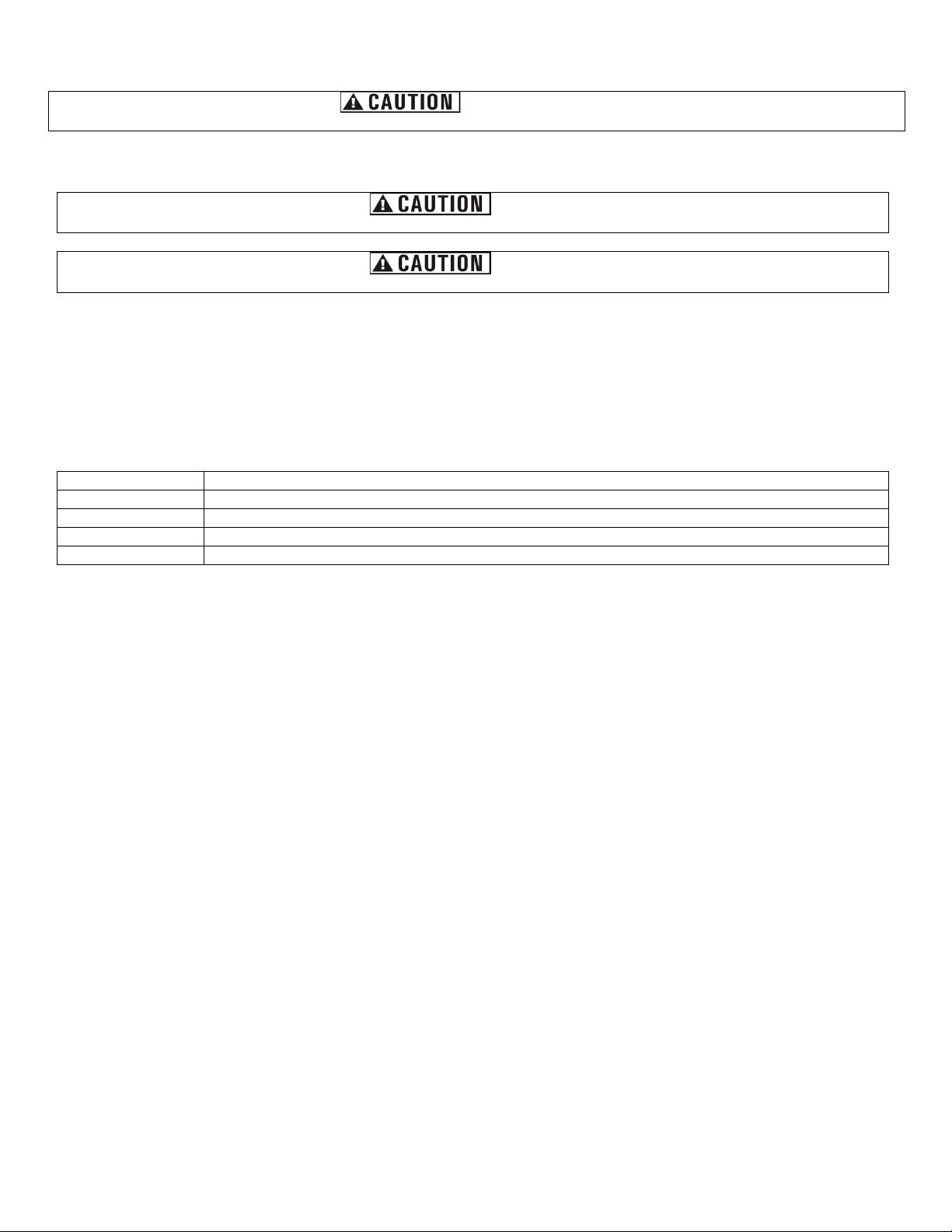
1. Unhinge the clasps at the top and bottom of the air filter cover as shown in Figure 15.
2. Remove the sponge-like elements from the casing.
3. Wipe the dirt from inside the empty air filter casing.
4. Wash the sponge-like elements in household detergent and warm water. Do not use gasoline or a flammable solvent.
5. Allow the sponge-like elements to dry thoroughly.
6. Drip several drips of engine oil onto the sponge-like elements. Squeeze out any excess oil. The engine will smoke during initial startup if too much
oil is left in the air filter.
7. Replace the sponge-like elements in the air filter casing (the fine element first) and replace the cover.
Figure 15 - Removing the Air Filter Casing. Figure 16 - Locating the Spark Plug
Spark Plug Maintenance
The spark plug is essential for proper engine operation. The spark plug should be intact, free of deposits, and properly gapped. A bad or incorrectly
installed spark plug can cause engine damage. To inspect the spark plug:
1. Remove the spark plug by pulling on the spark plug cap. Fig 16
2. Unscrew the spark plug from this generator by using the included spark plug wrench.
3. Visually inspect the spark plug. If it is cracked and/or chipped, discard and install a new spark plug. A F7RTC spark plug, such as
NGK BPR6ES is recommended.
4. Measure the spark plug electrode gap with a gauge. The gap should be 0.020-0.028in (0.5 -0.7mm). (See Figure 17.)
5. If re-using the spark plug, use a wire brush to clean any dirt from around the spark plug base and then re-gap the spark plug.
6. Screw the spark plug back into place on this generator by using the included spark plug wrench.
7. Replace the spark plug cap.
Filter
Figure 17
Item # GEN4000TRI 4000 Surge Watt / 3500 Running Watt Portable Tri Fuel LP Liquid Propane, Gasoline, Natural Gas Generator Manual
22
Never place any type of storage cover on this generator while it is still hot.
STORAGE/TRANSPORT PROCEDURES
Do not store gasoline for more than 3 months.
Never place any type of storage cover on this generator while it is still hot.
When transporting or storing this generator for extended time:
• Allow generator to fully cool before moving it. A hot engine and exhaust system can burn you and ignite some materials.
• Empty the fuel tank. (See “Emptying the Fuel Tank” in the “Maintenance/Care” section.)
• Turn the fuel valve to the “off” position.
• Disconnect the spark plug.
• Do not obstruct any ventilation openings.
• Do not drop or strike this generator while moving it.
• Store this generator in a cool dry area, free of excessive dust.
Storage Time
Recommended Storage Procedure (which will help prevent difficult starts)
Less than 1 month
No storage procedure required.
1 to 2 months
Fill with fresh gasoline and add gasoline conditioner
2 months to 1 year
Empty the fuel tank. (See “Emptying the Fuel Tank” in the “Maintenance/Care” section.)
1 year or more
Empty the fuel tank. (See “Emptying the Fuel Tank” in the “Maintenance/Care” section.) Disconnect the spark plug.
Item # GEN4000TRI 4000 Surge Watt / 3500 Running Watt Portable Tri Fuel LP Liquid Propane, Gasoline, Natural Gas Generator Manual
23
TROUBLESHOOTING
IMPORTANT: If trouble persists, call our customer help line at 1-866-460-9436, Monday - Friday, 8 AM - 4 PM Central Time.
Symptom
Cause
Solution
Engine will not start.
Fuel valve is turned to "closed."
Turn fuel valve to "open."
Choke is open.
Close the choke.
Propane Tank is out of fuel.
Replace propane fuel tank.
NG valve is not open
Turn on the NG valve
NG specifications are not correct
Consult your local natural gas technician
Spark plug is dirty.
Clean spark plug.
Generator is not on level surface.
Move generator to a level surface to prevent
triggering the low oil shutdown.
Oil is low.
Add or replace oil.
Generator runs but does not support all
connected electrical devices.
Generator is overloaded.
Reduce draw on generator to within this
generator's rated wattage by reducing number
of connected electrical devices.
Short in one of the connected devices.
Disconnect any faulty or short-circuited
electrical loads.
Air filter is dirty.
Clean or replace air filter.
Loose wiring harness connection
Turn off generator, then check wiring behind
control panel and at the end of generator for
loose connection. If wires are loose, tighten the
screws and/or nuts. Be certain the plug in
connectors are pushed together all the way.
Engine runs but there is no electrical output.
Reset button(s) is (are) "off."
Push reset button(s) to "on."
Loose wiring harness connection
Turn off generator, then check wiring behind
control panel and at the end of generator for
loose connection. If wires are loose, tighten the
screws and/or nuts. Be certain the plug in
connectors are pushed together all the way.
Bad connecting wires/cables.
Try a different extension cord.
Bad electrical device connected to generator.
Disconnect device, try connecting another
device.
Carbon Brushes are worn down
Turn off generator, then look at the brush
holder at the end of the generator to determine
if the brushers are still against the copper
bands on the end of the rotor. If they are worn
down, replace the 2 wires the same way they
came off.
AVR shorted out or burned out
Turn off the generator, then remove the 2
screws at the end of the generator. Look for the
burn spots on the back side of the AVR. If there
is burn spots, replace the AVR.
Item # GEN4000TRI 4000 Surge Watt / 3500 Running Watt Portable Tri Fuel LP Liquid Propane, Gasoline, Natural Gas Generator Manual
24
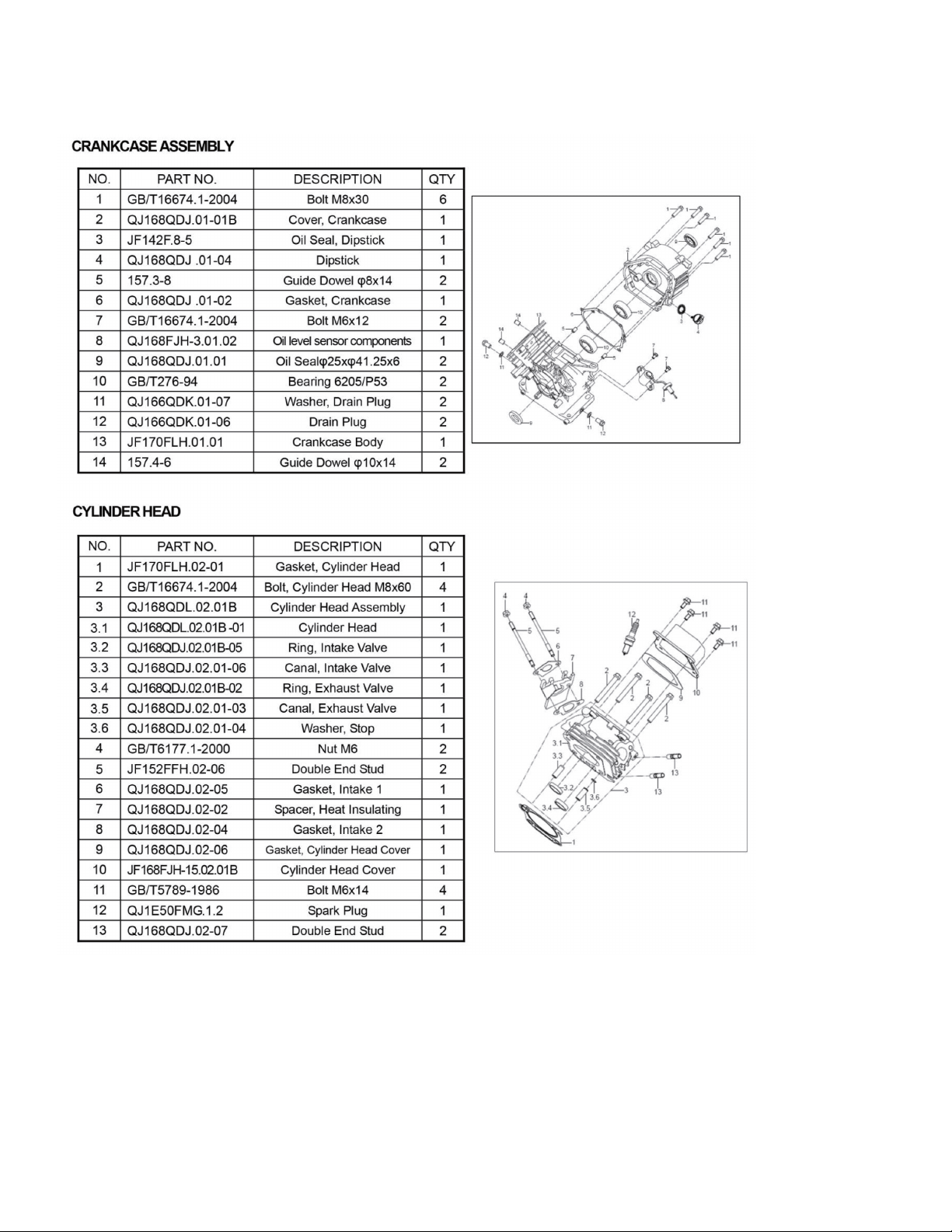
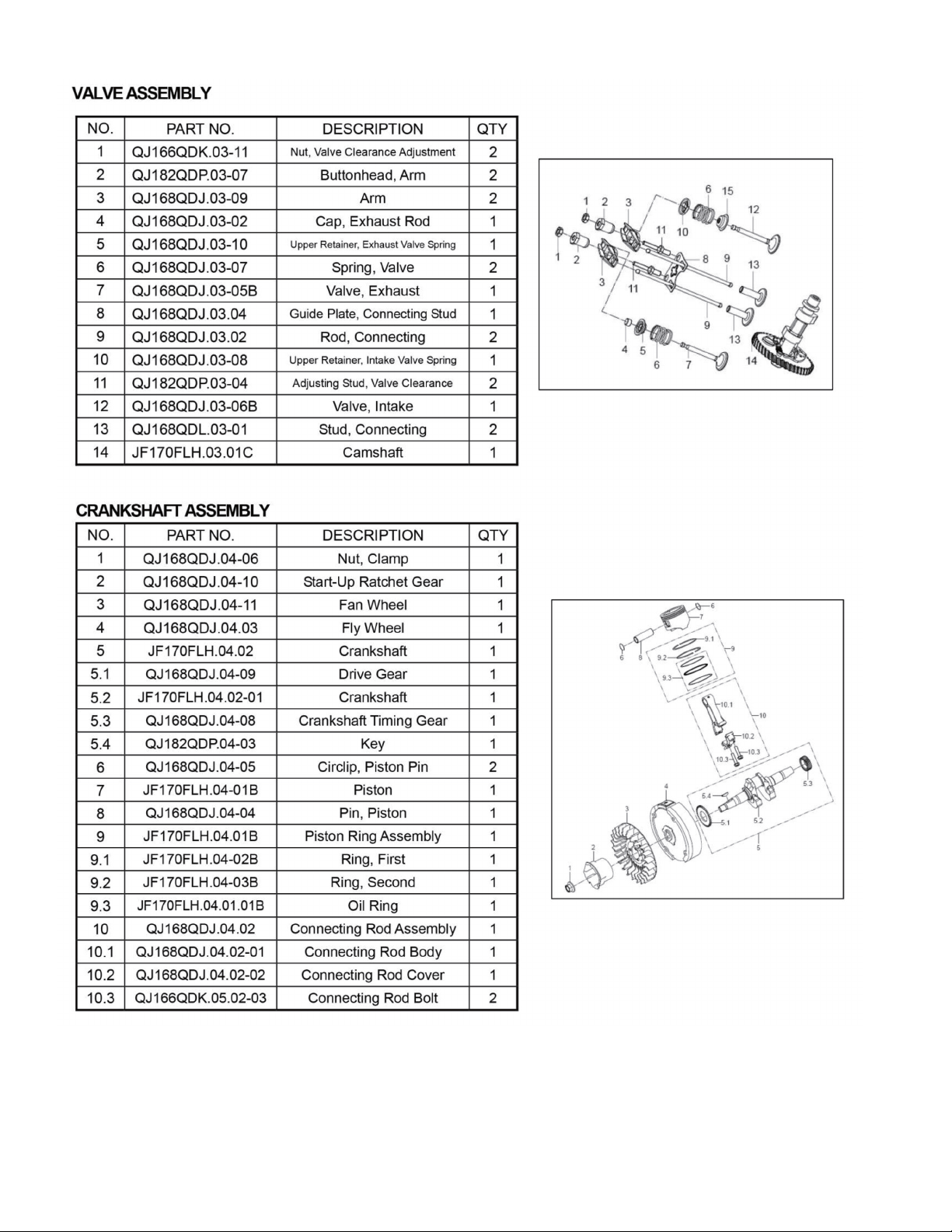
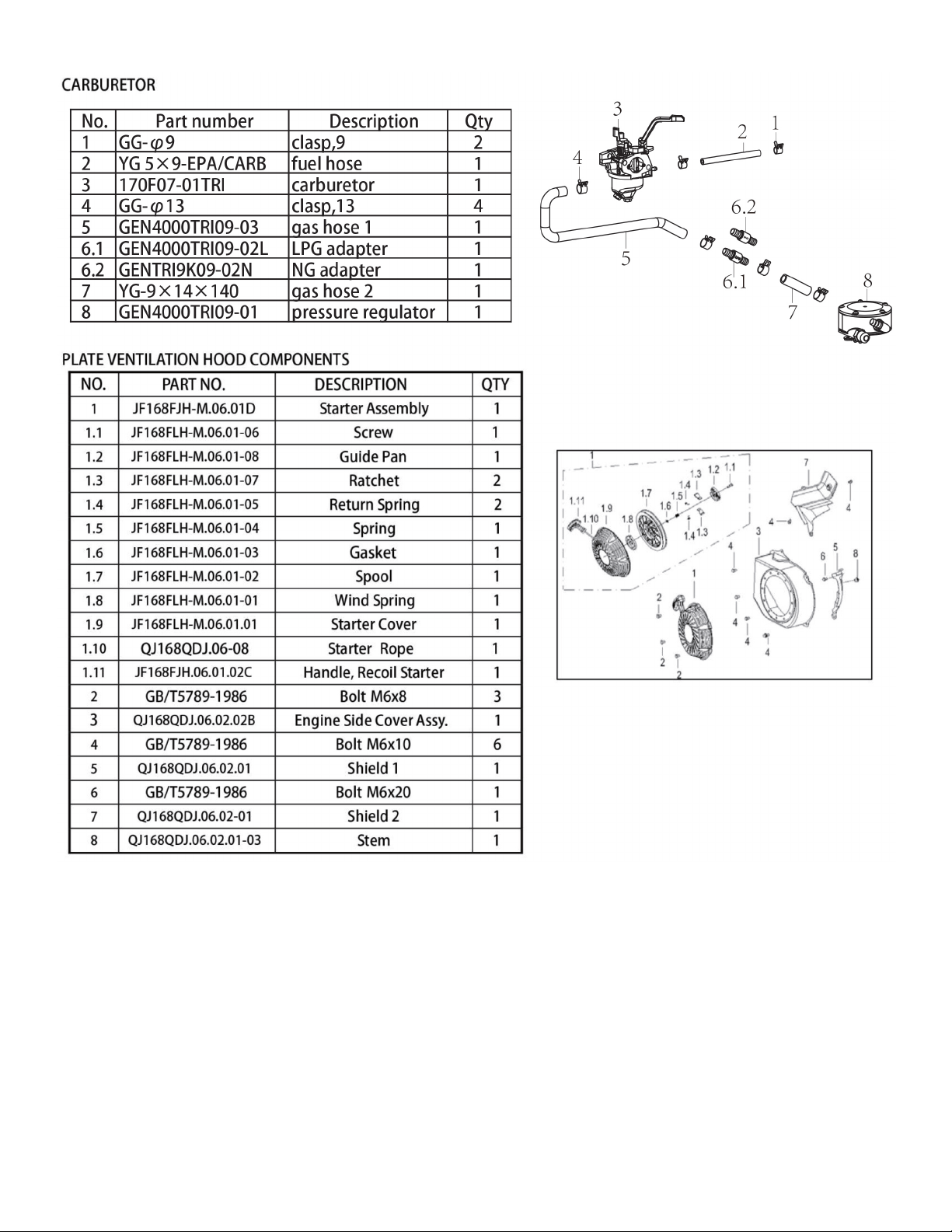
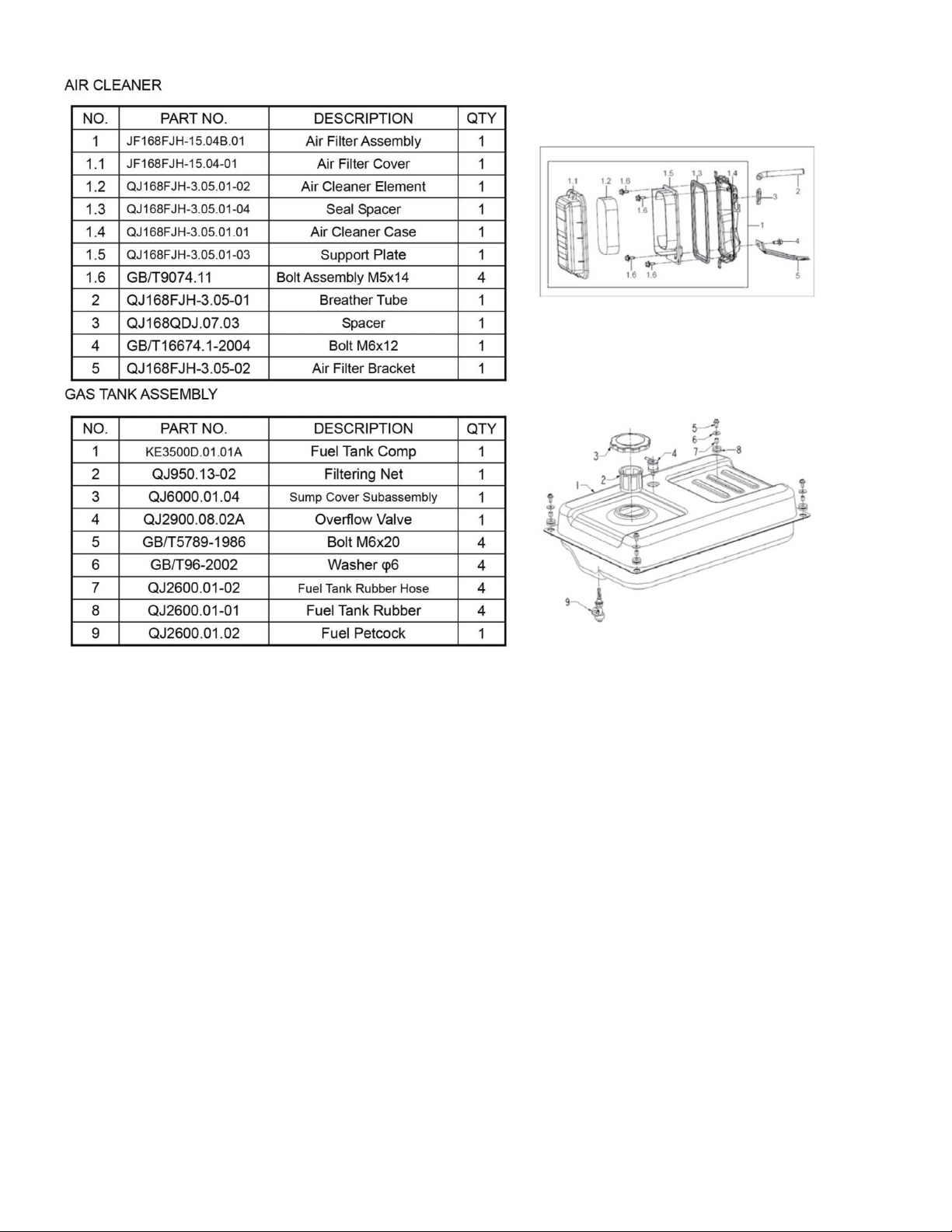
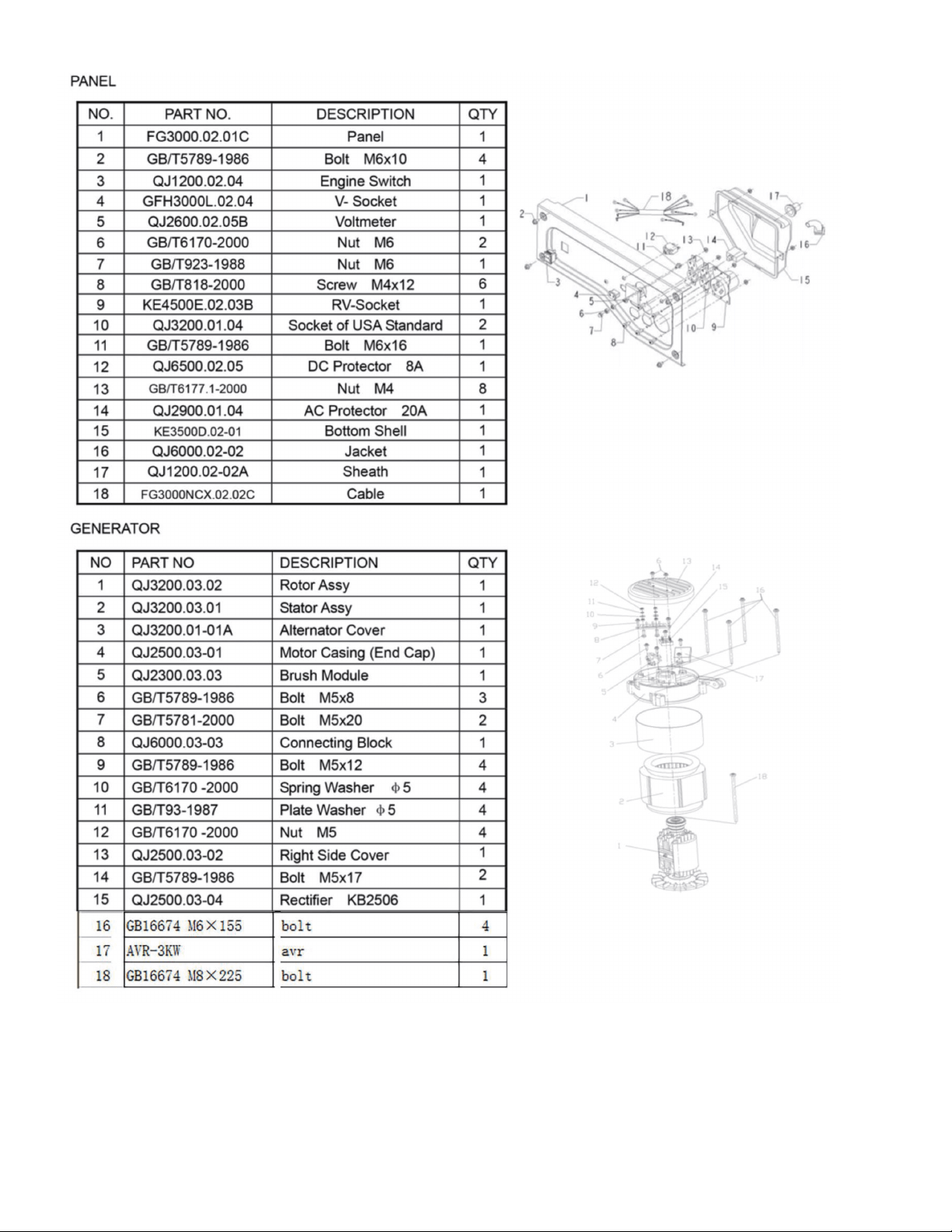
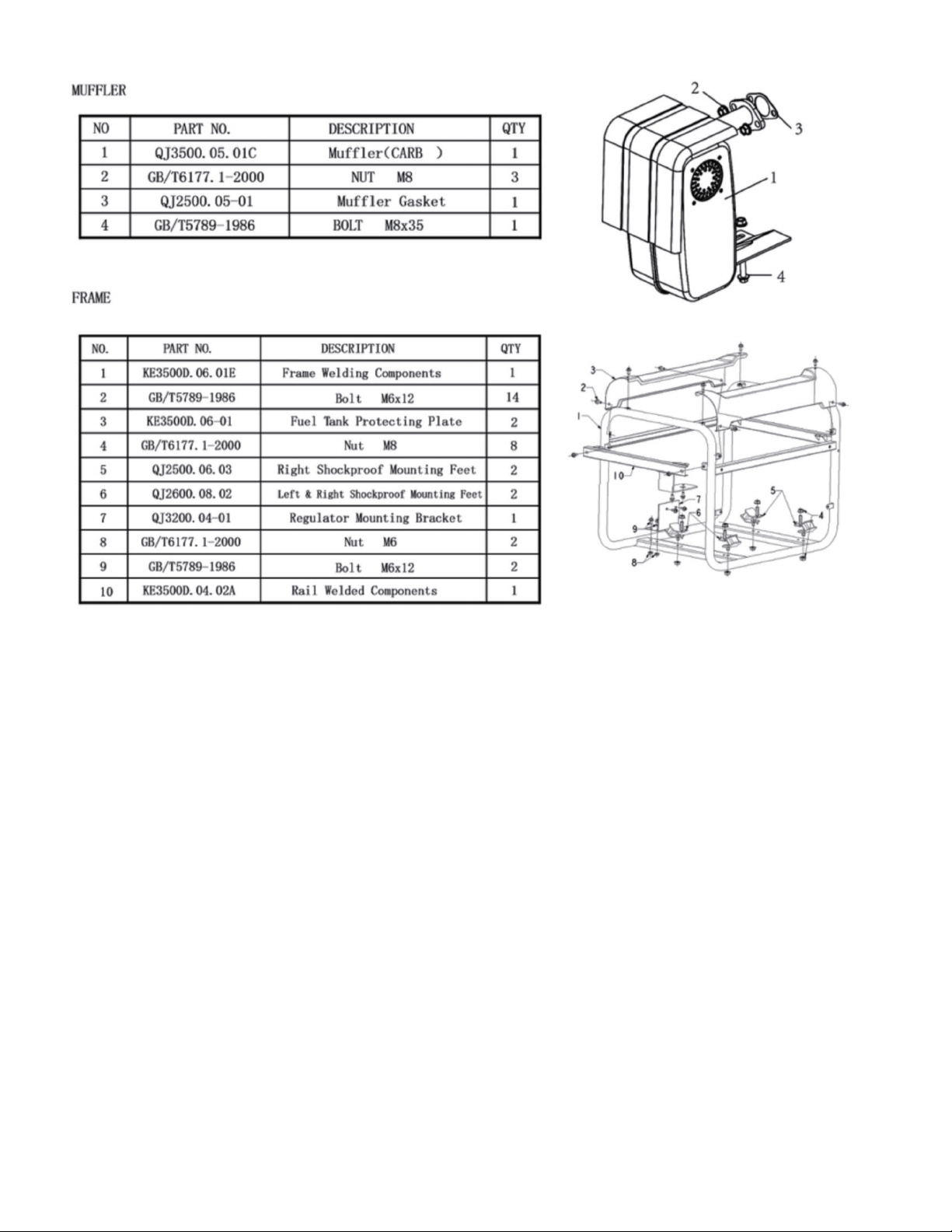
PARTS DIAGRAM
Item # GEN4000TRI 4000 Surge Watt / 3500 Running Watt Portable Tri Fuel LP Liquid Propane, Gasoline, Natural Gas Generator Manual
25
Item # GEN4000TRI 4000 Surge Watt / 3500 Running Watt Portable Tri Fuel LP Liquid Propane, Gasoline, Natural Gas Generator Manual
26
Item # GEN4000TRI 4000 Surge Watt / 3500 Running Watt Portable Tri Fuel LP Liquid Propane, Gasoline, Natural Gas Generator Manual
27
Item # GEN4000TRI 4000 Surge Watt / 3500 Running Watt Portable Tri Fuel LP Liquid Propane, Gasoline, Natural Gas Generator Manual
28
Item # GEN4000TRI 4000 Surge Watt / 3500 Running Watt Portable Tri Fuel LP Liquid Propane, Gasoline, Natural Gas Generator Manual
29
Item # GEN4000TRI 4000 Surge Watt / 3500 Running Watt Portable Tri Fuel LP Liquid Propane, Gasoline, Natural Gas Generator Manual
30

Item # GEN4000TRI 4000 Surge Watt / 3500 Running Watt Portable Tri Fuel LP Liquid Propane, Gasoline, Natural Gas Generator Manual
31
EMISSION CONTROL SYSTEM WARRANTY
BUFFALO CORPORATION
Your Warranty Rights and Obligations
The California Air Recourse Board, U.S. EPA and Buffalo Corp. are pleased to explain the Emission Control System Warranty on your 2020 model year new
outdoor power equipment engine.
California
In California, new spark-ignited small off-road equipment engines must be designed, built and equipped to meet the State’s stringent anti-smog standards.
Other States, U.S. Territories
In other areas of the United States, your engine must be designed, built and equipped to meet the U.S. EPA emission standards for spark-ignited engines at or below
19 kilowatts.
All of the United States
Buffalo Corp. must warrant the emission control system on your power equipment engine for the periods of time listed below provided there has been no abuse, neglect
or improper maintenance of your power equipment engine. Where a warrantable condition exists, Buffalo Corp. will repair your power equipment engine at no cost to
you including diagnosis, parts and labor.
Your emissions control system may include parts such as: carburetors or fuel injection system, ignition system, catalytic converters, fuel tanks, valves, filters, clamps,
connectors, and other associated components. Also, included may be hoses, belts, connectors, sensors, and other emission-related assemblies.
Manufacturer’s Warranty Coverage:
The emission control system is warranted for two years. If any emissions-related part on your engine is defective, the part will be repaired or replaced by Buffalo Corp.
Owner’s Warranty Responsibility
As the power equipment engine owner, you are responsible for the performance of the required maintenance listed in your owner’s manual. BUFFALO CORP.
recommends that you retain all receipts covering maintenance on your power equipment engine, but BUFFALO CORP. can not deny warranty solely for the lack of
receipts or for your failure to ensure the performance of all scheduled maintenance.
As the power equipment engine owner, you should however be aware that BUFFALO CORP. may deny your warranty coverage if your power equipment engine or a
part has failed due to abuse, neglect, improper maintenance or unapproved modifications.
You are responsible for presenting your power equipment engine to distribution center or service center authorized by BUFFALO CORP. as soon as the problem exists.
The warranty repairs should be completed in a reasonable amount of time, not to exceed 30 day.
If you have any questions regarding your warranty rights and responsibilities, you should contact Buffalo Corp. customer service representative at 1-866-460-9436 or
write to info@buffalotools.com
DEFECTS WARRANTY COVERAGE
Adopted by the Air Resources Board, Buffalo Corp. warrants to the ultimate purchaser and each subsequent purchaser that the small off-road engine (SORE)(1) has
been designed, built and equipped so as to conform with all applicable regulations; and (2) is free from defects in materials and workmanship that cause the failure of a
warranted part to conform with those regulations as may be applicable to the terms and conditions stated below.
(a) The warranty period begins on the date the engine is delivered to an ultimate purchaser or first placed into service. The warranty period is two years.
(b) Subject to certain conditions and exclusions as stated below, the warranty on emissions related parts is as follows:
(1) Any warranted part that is not scheduled for replacement as required maintenance in your Owner’s Manual is warranted for the warranty period stated above. If the
part fails during the period of warranty coverage, the part will be repaired or replaced by Buffalo Corp. According to Subsection (4) below. Any such part repaired or
replaced under warranty will be warranted for the remainder of the periods.
(2) Any warranted part that is scheduled only for regular inspection in your owner’s manual is warranted for the warranty period stated above. Any such part repaired or
replaced under warranty will be warranted for the remaining warranty period.
(3) Any warranted part that is scheduled for replacement as required maintenance in your owner’s manual is warranted for the period of time before the first scheduled
replacement date for that part. If the part fails before the first scheduled replacement, the part will be repaired or replaced by Buffalo Corp. According to Subsection (4)
below. Any such part repaired or replaced under warranty will be warranted for the remainder of the period prior to the first scheduled replacement point for the part.
(4) Repair or replacement of any warranted part under the warranty provisions herein must be performed at a warranty station at no charge to the owner.
(5) Notwithstanding the provisions herein, warranty services or repair will be provided at all of our distribution centers that are franchised to service the subject engines.

Item # GEN4000TRI 4000 Surge Watt / 3500 Running Watt Portable Tri Fuel LP Liquid Propane, Gasoline, Natural Gas Generator Manual
32
(6) The engine owner must not be charged for diagnostic labor that leads to the determination that a warranted part is in fact defective, provided that such diagnostic
work is performed at a warranty station.
(7) Buffalo Corp. is liable for damages to other engine components proximately caused by a failure under warranty of any warranted part.
(8) Throughout the engine warranty period stated above, Buffalo Corp. will maintain a supply of warranted part sufficient to meet the expected demand for such parts.
(9) Any replacement may be used in the performance of any warranty maintenance or repairs and must be provided without charge to the owner. Such use will not
reduce the warranty obligations of Buffalo Corp.
(10) Add-on or modified parts that are not exempted by the Air Resources Board may not be used. The use of any non-exempted add-on or modified parts by the
ultimate purchaser will be grounds for disallowing a warranty claims. Buffalo Corp. will not be liable to warrant failures of warranted parts caused by the use of a non-
exempted add-on or modified part.
(11) The manufacturer issuing the warranty shall provide any documents that describe that manufacturer’s warranty procedures or policies within five working days of
request by the Air Resources Board.
EMISSION WARRANTY PARTS LIST
(1) Fuel Metering System:
(a) Gasoline carburetor assembly and its internal components
(b) Carburetor gaskets (c) Fuel line
(d) Clamps (e) Fuel tank
(f) Fuel line fittings (g) Pressure regulator (if equipped)
(h) Mixer assembly and its internal components (if equipped)
(2) Air induction system including:
(a) Intake pipe/manifold (b) Air cleaner
(3) Ignition system including:
(a) Spark plug (b) Ignition coil
(4) Catalytic muffler assembly including:
(a) Muffler gasket (b) Exhaust manifold
(c) Catalytic converter (if available)
(5) Crankcase breather assembly including:
(a) Breather connection tube
(6) Fuel tank evaporative emissions control system including:
(a) Purge valves (b) Carbon canister
(c) Canister mounting brackets (d) Fuel cap
(e) Fuel tank
(7) Miscellaneous items used in above systems including:
(a) Switches (b) Hoses, belts connectors and assemblies
(8) Air injection system
(a) Pulse valve
202005
