®
30 in. Single and
Double Built-in Oven
IMPORTANT SAFETY INSTRUCTIONS
Carefully read the important information regarding installation, safety and
maintenance. Keep these instructions for future reference.
MAAN2303-02
Installation Instructions

1
OVEN SAFETY .................................................................................................... 1
INSTALLATION REQUIREMENTS ......................................................................... 2
Tools and Parts ...............................................................................................................2
Location Requirements .................................................................................................3
Opening Dimensions .....................................................................................................5
Electrical Requirements ................................................................................................6
INSTALLATION INSTRUCTIONS .......................................................................... 8
Step 1 - Unpack the Oven .............................................................................................8
Step 2 - Remove the Oven Door ...................................................................................9
Step 3 - Install Oven ....................................................................................................10
Step 4 - Make Electrical Connection .......................................................................... 11
Step 5 - Mount the Oven ............................................................................................. 14
Step 6 - Replace the Door ...........................................................................................14
Step 7 - Complete Installation ....................................................................................15
Table of Contents
Oven Safety
Your safety and the safety of others are very important.
We have provided many important safety messages in this manual
and on your appliance. Always read and obey all safety messages.
DANGER
WARNING
CAUTION
This is the safety alert symbol.
This symbol alerts you to potential hazards that can
kill or hurt you and others. All safety messages will
follow the safety alert symbol and either the word
“DANGER,” “WARNING” or “CAUTION.”
These words mean:
An imminently hazardous situation. You
could be killed or seriously injured if
you don’t immediately follow instructions.
A potentially hazardous situation which, if
not avoided, could result
in death or serious bodily injury.
A potentially hazardous situation which, if
not avoided, may result in moderate or
minor injury.
All safety messages will tell you what the potential hazard is, tell
you how to reduce the chance of injury, and tell you what can
happen if the instructions are not followed.

2
State of California Proposition 65 Warnings:
WARNING: This product contains one or more chemicals known to
the State of California to cause cancer.
WARNING: This product contains one or more chemicals known to
the State of California to cause birth defects or other reproductive
harm.
TOOLS AND PARTS
Gather the required tools before starting installation. Read and follow
the instructions provided with any tools listed here.
ALL INSTALLATIONS
Tools Needed:
•
Measuring Tape
•
Straightedge
•
Pencil
•
Phillips Screwdriver
•
Level
•
Wire Cutters and Wire Stripper
•
Hand or Sabre Saw
•
1" Hole Saw
•
Cordless Drill and Drill Bit
•
Safety Gloves and Goggles
•
Volt Meter (0-250VAC)
Parts Needed:
•
UL Listed Conduit Connector
•
UL Listed Wire Connectors
Parts Provided:
•
#8-14 x 1" Screws - Single Ovens (2),
Double Ovens (4)
Installation Requirements
Oven Safety
3
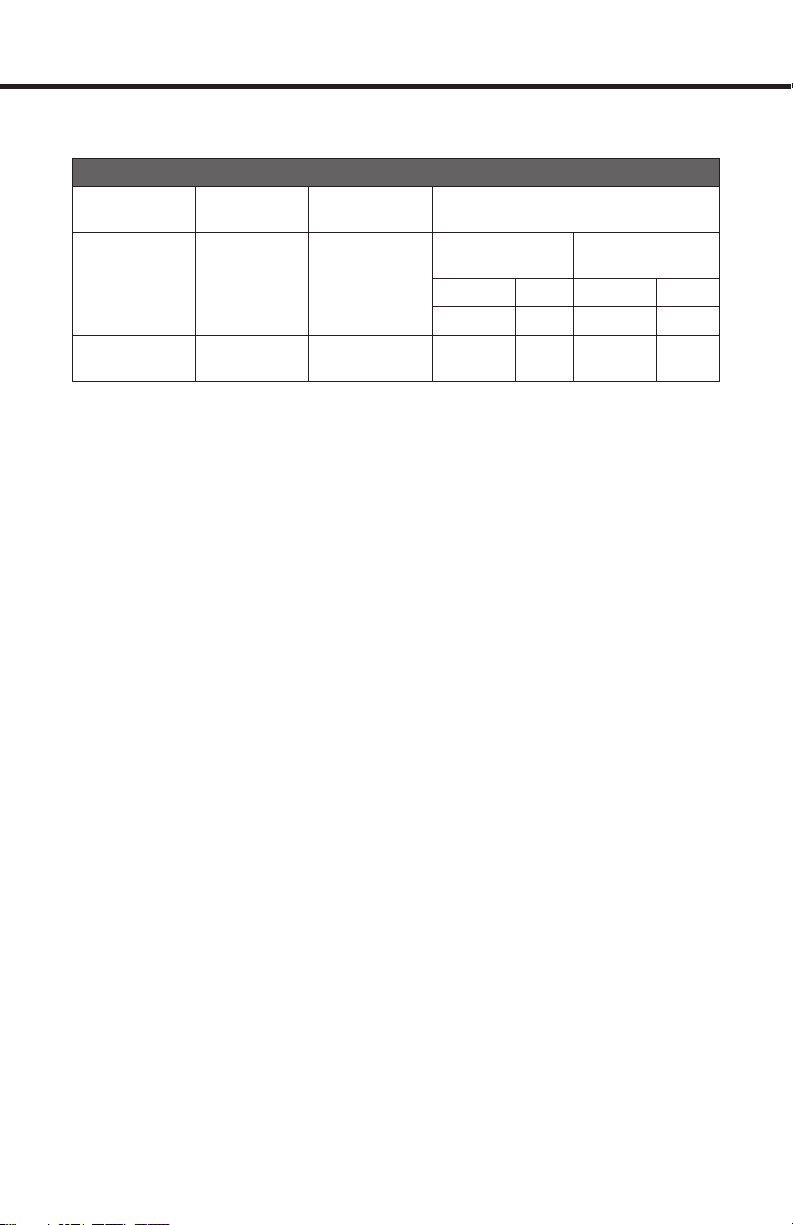
TECHNICAL DATA
OVEN DIMENSION MODEL
Electrical Ratings and
Maximum Connected Load
Single Built-in
Oven
30" (76 cm) AN-2303
@ 240 Volts
60 Hz
@ 208 Volts
60 Hz
Amperes Watts Amperes Watts
20 4800 17.3 3605
Double Built-in
Oven
30" (76 cm) AN-2304 35.4 8500 30.7 6381
LOCATION REQUIREMENTS
IMPORTANT: Observe all governing codes and ordinances.
•
Cabinet opening dimensions that are shown must be used. Given
dimensions provide minimum clearance with oven.
•
Recessed installation area must provide complete enclosure around
the recessed portion of the oven.
•
The oven support surface must be solid, level and flush with the bottom of
the cabinet cutout.
The oven support surface must be able to support the weight of:
Single Oven: 130 lbs (59 kg) plus 30 lb (14 kg) food load Double Oven:
230 lbs (105 kg) plus 60 lb (28 kg) food load
•
Grounded electrical supply is required. See “Electrical Requirements” section.
NOTE: For undercounter installation, it is recommended that the junction box
be located in the adjacent right or left cabinet.
IMPORTANT: To avoid damage to your cabinets, check with your builder or
cabinet supplier to make sure that the materials used will not discolor,
delaminate or sustain other damage. This oven has been designed in
accordance with the requirements of UL and CSA International and complies
with the maximum allowable wood cabinet temperatures of 194°F (90°C).
Installation Requirements
4
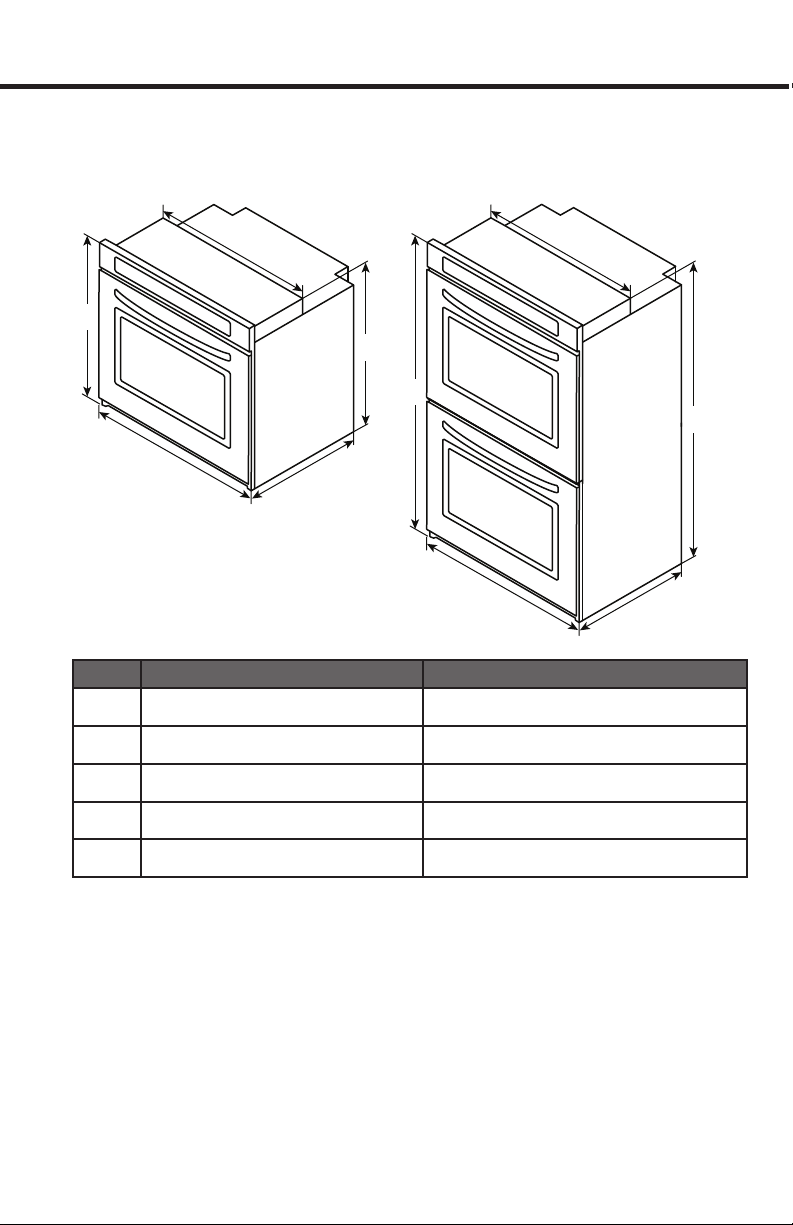
PRODUCT DIMENSIONS
Single Oven
Double Oven
b
d
e
c
a
b
d
e
c
a
Letter Single Oven Dimensions Double Oven Dimensions
a
28 7/16" (72.2 cm) Height (overall) 51 3/16" (130.0 cm) Height (overall)
b
28½" (72.4 cm) Width (recessed) 28½" (72.4 cm) Width (recessed)
c
27 3/16" (69 cm) Height (recessed) 49 15/16" (126.8 cm) Height (recessed)
d
23½" (59.7 cm) Depth (recessed) 23½" (59.7 cm) Depth (recessed)
e
297/8" (75.9 cm) Width (overall) 29 7/8" (75.9 cm) Width (overall)
Installation Requirements
5
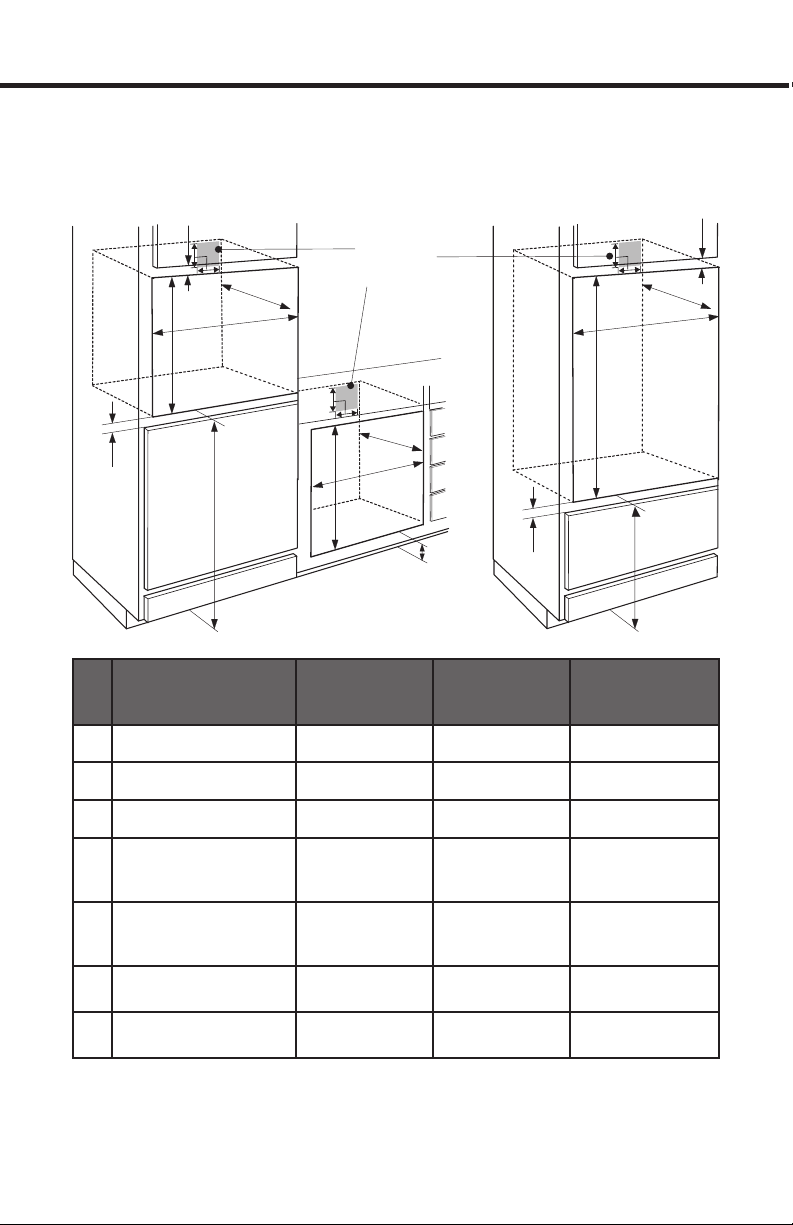
OPENING DIMENSIONS
Single Oven - Installed in Cabinet
and Installed Undercounter
Double Oven - Installed in Cabinet
Electrical Junction
Box Location
NOTE: Junction
box may be located
in adjacent cabinet
d
c
a
b
f
e
b
a
c
d
c
a
b
f
e
e
4"
4"
4"
Sinole Oven
Undercounter
w/o Cooktop
Single Oven in
Cabinet
Double Oven
in Cabinet
a
Width (cutout)
28 5/8" (72.7 cm) 28 5/8" (72.7 cm) 28 5/8" (72.7 cm)
b
Height (cutout)
271/2" (70 cm) 271/2" (70 cm) 50 1/4" (127.6 cm)
c
Depth (cutout)
24" (61.0 cm) 24" (61.0 cm) 24" (61.0 cm)
d
Top of Cutout to
Bottom of Upper
Cabinet Door
N/A 1 1/2" (3.8 cm) 1 1/2" (3.8 cm)
e
Bottom of
Cutout to Floor
(recommended)*
5¼" (13.3 cm) 32" (81.3 cm) 14 3/4" (37.5 cm)*
f
Bottom of Cutout to
Top of Cabinet Door
N/A 1 1/2" (3.8 cm) 1 1/2" (3.8 cm)
g
Overlap of oven
with sides of cutout
11/16" (1.7 cm) 11/16" (1.7 cm) 1 1/16" (1.7 cm)
* Bottom of Cutout to Floor (acceptable) 4" to 14 3/4" (10.2 cm to 37.5 cm)
Installation Requirements

6
ELECTRICAL REQUIREMENTS
If codes permit and a separate ground wire is used, it is recommended that
a qualified electrical installer determine that the ground path is adequate
and wire gauge is in accordance with local codes.
Do not use an extension cord.
In U.S.A. :
Be sure that the electrical connection and wire size are adequate and in
conformance with the National Electrical Code, ANSI/ NFPA No. 70-latest
edition and all local codes and ordinances.
A copy of the above code standards can be obtained from:
National Fire Protection Association
One Batterymarch Park
Quincy, MA 02269
In Canada:
Be sure that the electrical connection and wire size are adequate and in
conformance with CSA standard C22.1, Canadian Electrical Code, Part 1 -
latest edition, and all local codes and ordinances.
A copy of the above code standards can be obtained from:
Canadian Standards
Association 178 Rexdale Blvd.
Toronto, ON M9W 1R3
CANADA.
Installation Requirements
7
Electrical Connection
To properly install your oven, you must determine the type of electrical
connection you will be using and follow the instructions provided for it here.
•
Oven must be connected to the proper electrical voltage and frequency as
specified on the model/serial number rating plate. The model/serial number
rating plate is located under the control panel on single ovens and under the
control panel on the upper oven cavity on double ovens. All models are dual
rated, and designed to be connected to either 120/208V or 120/240V AC,
60Hz, 3-wire or 4-wire, single-phase power supply.
Style
Voltage and
Frequency
Amps Circuit Required
Single Oven
240V, 60 Hz 20.0A
25 Amp Circuit
208V, 60 Hz 17.4A
20 Amp Circuit
Double Oven
240V, 60 Hz 35.4A
40 Amp Circuit
208V, 60 Hz 30.7A
35 Amp Circuit
•
Install a suitable conduit box (not furnished). An appropriately sized, UL
conduit connector must be used to correctly attach the conduit to the
junction box.
IMPORTANT: Local Codes may vary; installation electrical connections
and grounding must comply with all applicable local codes.
Installation Requirements
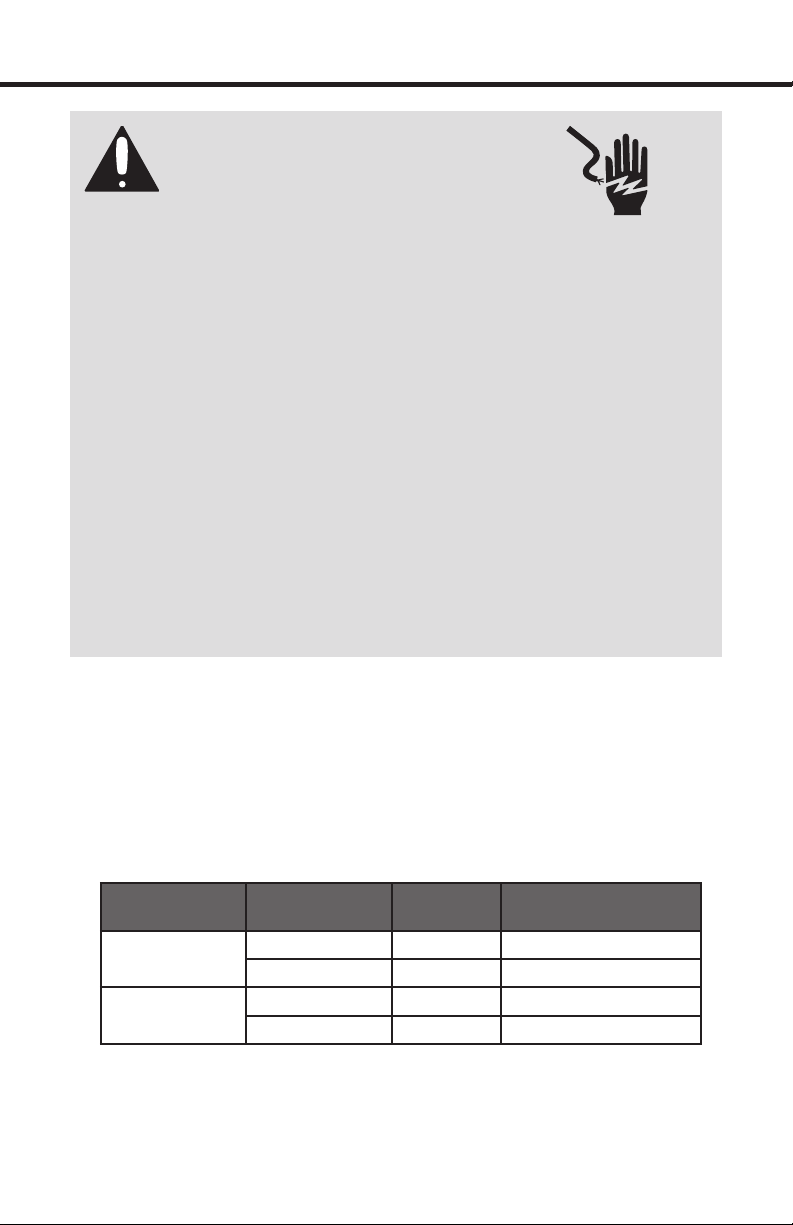
Electrical Shock Hazard
WARNING
The electrical power to the oven branch circuit must be shut off
while line connections are being made.
Do not use an extension cord with this appliance.
Electrical ground is required on this appliance. The free end of the
green wire (the ground wire) must be connected to a suitable
ground. This wire must remain grounded to the oven.
If cold water pipe is interrupted by plastic, non metallic gaskets,
union connections or other insulating materials, DO NOT use for
grounding.
DO NOT ground to a gas pipe.
DO NOT have a fuse in the NEUTRAL or GROUNDING circuit. A
fuse in the NEUTRAL or GROUNDING circuit could result in an
electrical shock.
Check with a qualified electrician if you are in doubt as to whether
the appliance is properly grounded.
Failure to do so could result in death, fire or electric shock.
8
If local codes permit grounding through the electrical supply neutral, connect
both the white neutral wire and the green ground wire from the oven to the
white neutral electrical supply wire.
•
Check with a qualified electrical installer if you are not sure the oven is
properly grounded.
•
Single Oven - When a 4-wire, single phase 120/240 volt, 60 Hz., AC only
electrical supply is available, a 25-amp maximum circuit protection is
required (or, if specified on the model/serial rating plate, when a 4-wire,
single phase 120/208 volt 60 Hz., AC only electrical supply is available, a
20-amp maximum circuit protection is required).
•
Double Oven - When a 4-wire, single phase 120/240 volt, 60 Hz., AC only
electrical supply is available, a 40-amp maximum circuit protection is
required (or, if specified on the model/serial rating plate, when a 4-wire,
single phase 120/208 volt 60 Hz., AC only electrical supply is available, a
35-amp maximum circuit protection is required).
IMPORTANT: This appliance shall be installed only by authorized persons
and in accordance with the manufacturer’s installation instructions, local
gas fitting regulations, municipal building codes, electrical wiring
regulations, local water supply regulations.
STEP 1 - UNPACK THE OVEN
1. Using two or more people, remove the oven and set it on cardboard to
avoid floor damage.
NOTE: Do not use the handle or any portion of the front frame for lifting.
2. Remove the shipping materials and tape from the oven.
3. Remove the hardware package from inside the bag containing literature.
4. Remove and set aside racks and other parts from inside the oven.
5. Move the oven on the cardboard near where it will be installed.
Installation Requirements
Installation Instructions
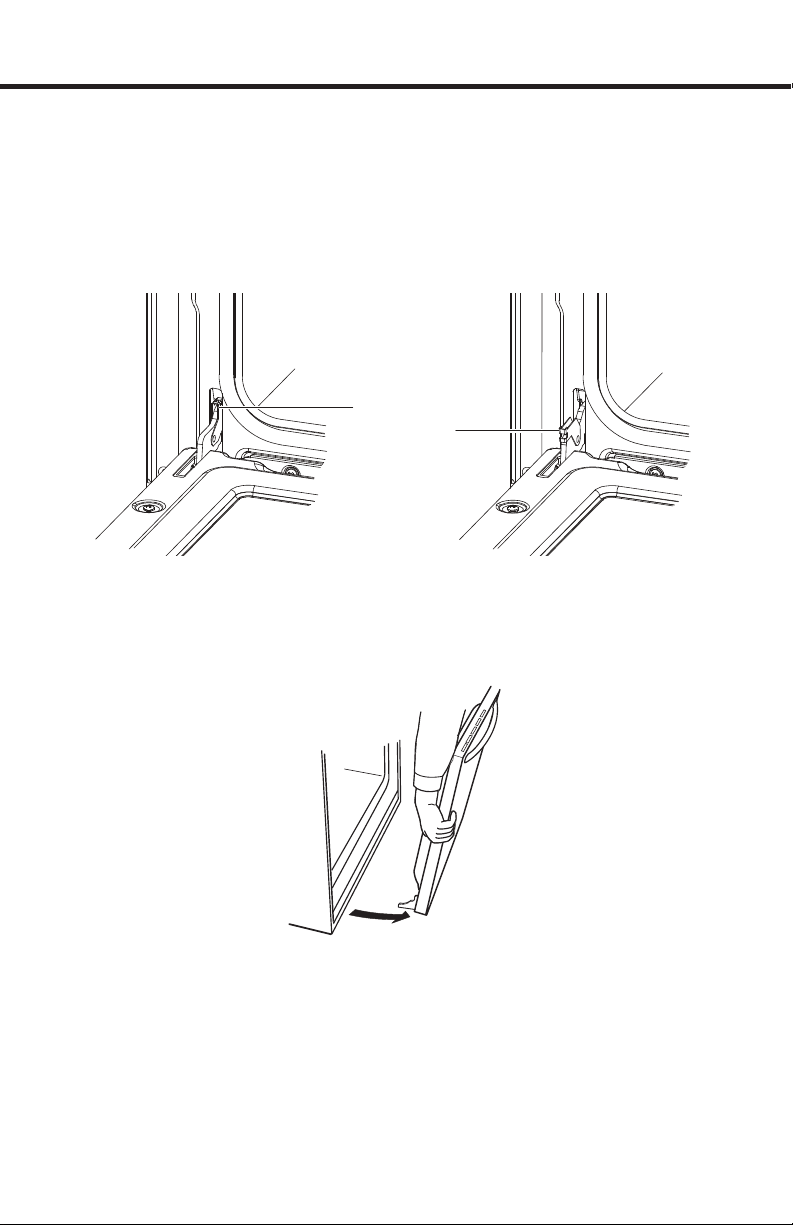
Excessive Weight Hazard
WARNING
Use two or more people to move and install oven.
Failure to do so can result in back or other injury.
9
STEP 2 - REMOVE THE OVEN DOOR
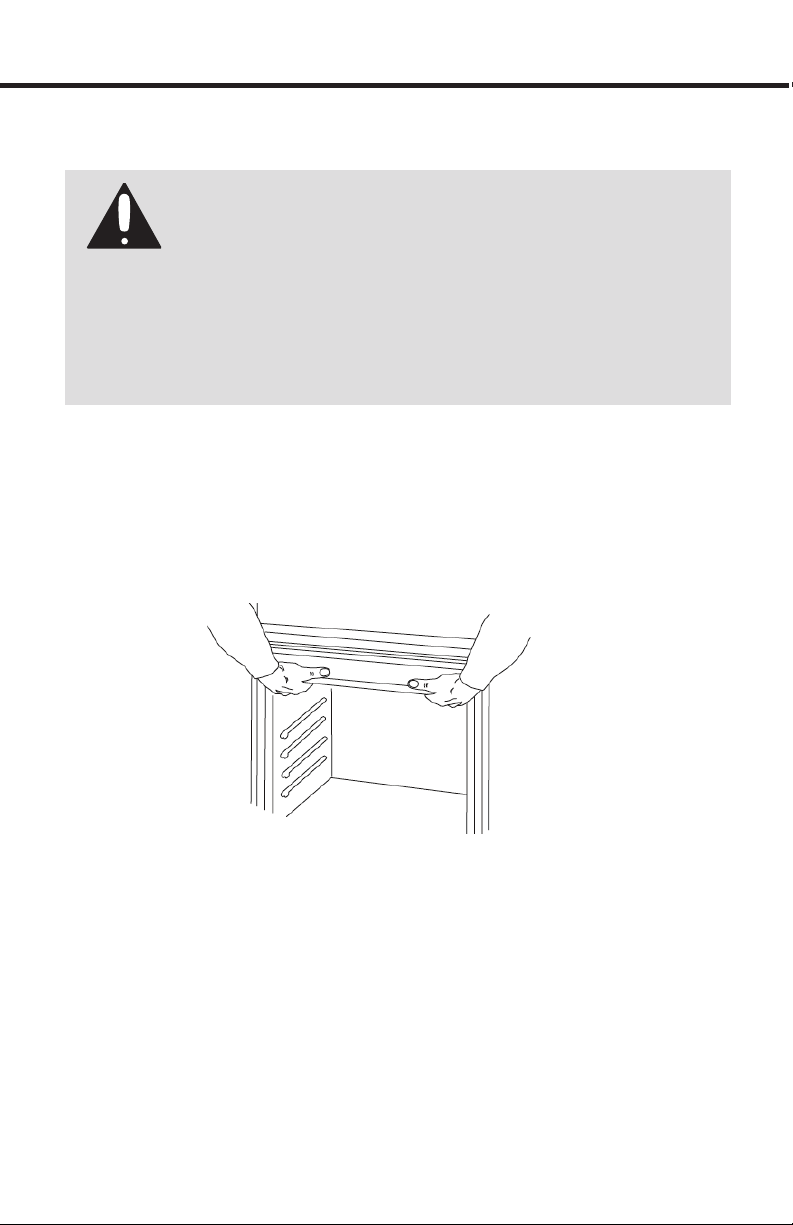
IMPORTANT: The oven door is heavy and fragile, and the door front is glass. To
avoid oven door glass breakage, use both hands,
and grasp only the sides of
the oven door to remove.
1. Open the oven door.
2. Locate the door latches in both corners of the oven door, and rotate the
latches forward to the unlocked position.
a
b
a Locked
b Unlocked
3. Grasp the edges of the oven door with both hands and push the oven door fully
closed. Lift up and pull oven door toward you to remove. Set the oven
door(s) aside on a covered work surface.
Installation Instructions
10
STEP 3 - INSTALL OVEN
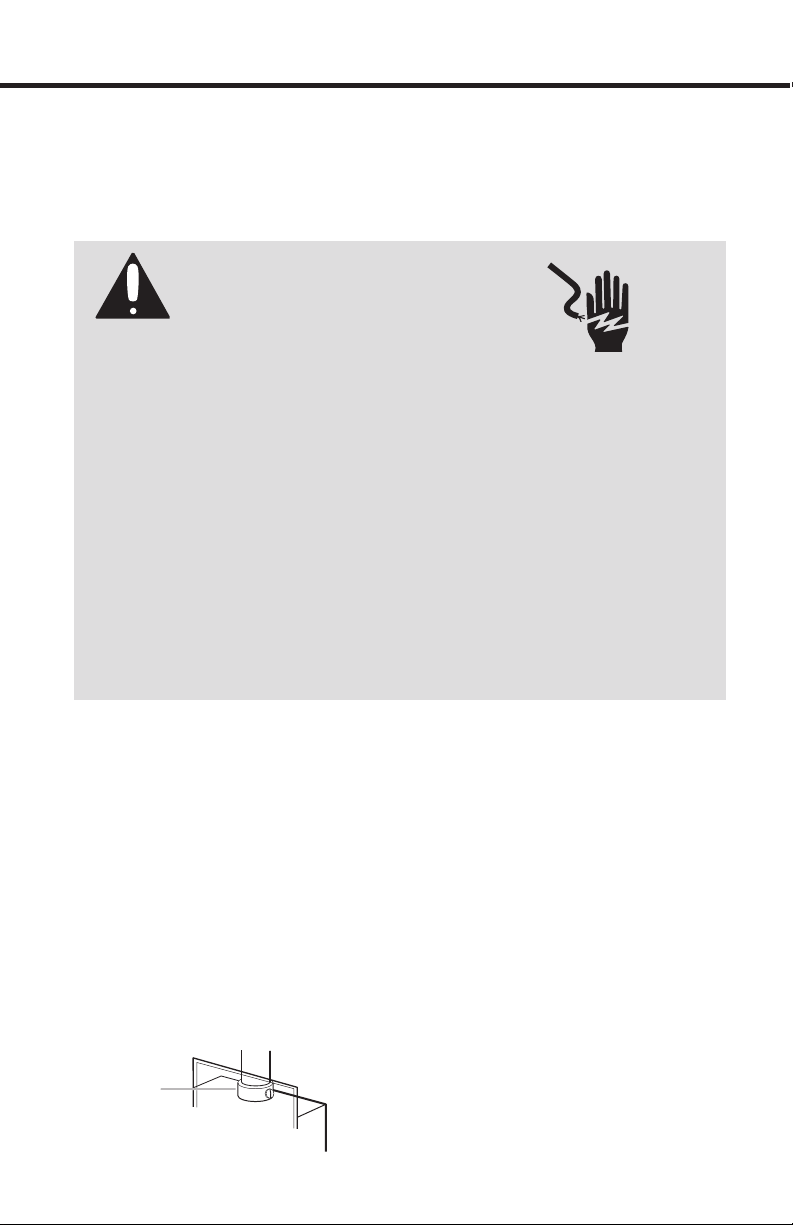
1. Using two or more people, grasp the ceiling of the oven cavity and lift the
oven onto a table or platform even with the cutout opening.
NOTE: The surface must be able to support the following weight:
•
Single Oven : 160 lb (73 kg)
•
Double Oven: 290 lb (132 kg)
2. Feed the flexible electrical supply conduit from the oven to the junction box.
Installation Instructions
Excessive Weight Hazard
WARNING
Use
tw
o or more people to move and install oven.
Failure to do so can result in back or other injury.
WARNING
Electrical Shock Hazard
11
STEP 4 - MAKE ELECTRICAL CONNECTION
To properly install your oven, you must determine the type of electrical
connection you will be using and follow the instructions provided for it here.
DIRECT WIRE
Disconnect power before servicing.
Improper connection of aluminum house wiring and copper
appliance leads can result in an electrical hazard or fire. If the home
has aluminum wiring, only use connectors designed and UL listed
for joining copper to aluminum and precisely follow the
manufacturer's recommended procedure. Aluminum-to-Copper
connections must conform with local codes.
For Single Oven, use 10 gauge copper or aluminum wire.
For Double Oven, use 8 gauge copper or aluminum wire.
Electrically ground oven.
Failure to do so can result in death, fire or electrical shock.
Be sure your appliance is properly installed and grounded by a qualified
technician. Ask your dealer to recommend a qualified technician or an
authorized repair service.
This oven is manufactured with a neutral (white) power supply wire and a
cabinet-connected green (or bare) ground wire twisted together.
After making sure that the power has been turned off, connect the flexible conduit
from the oven to the junction box using a UL listed conduit connector. The
Grounded Neutral and Ungrounded Neutral Graphics on the following pages and
the instructions provided, present the most common way of connecting ovens. Your
local codes and ordinances, of course, take precedence over these instructions.
Complete electrical connections according to local codes and ordinances.
1. Disconnect power.
2. Remove junction box cover.
3. Install a UL listed or CSA approved conduit connector to the junction box.
a
a UL or CSA Listed Conduit Connector
Installation Instructions
WARNING
Electrical Shock Hazard
12
4. Route the flexible electrical supply conduit from the oven to the junction
box through a UL listed or CSA approved conduit connector.
5. Tighten screws on conduit connector.
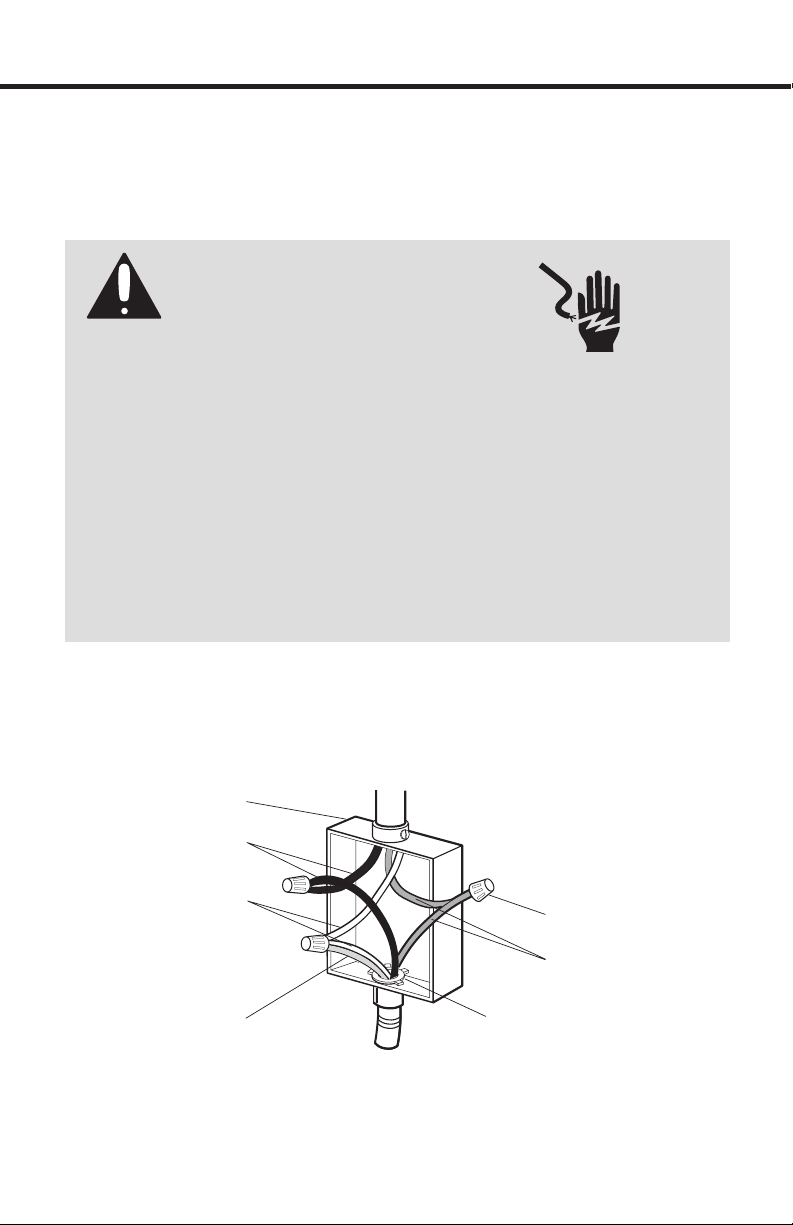
3-WIRE CONNECTION (GROUNDED NEUTRAL) - U.S.A. ONLY
Grounding through the neutral conductor is prohibited for new branch-
circuit installations (1996 NEC); mobile homes; and recreational
vehicles, or in an area where local codes prohibit grounding through
the neutral conductor. For installations where grounding through the
neutral conductor is prohibited, see the Ungrounded Neutral graphic.
Use grounding terminal or lead to ground unit.
Connect neutral terminal or lead to branch circuit neutral in
usual manner.
Failure to do so could result in death, fire or electric shock.
3-Wire Cable from Home Power Supply
IMPORTANT: Use the 3-wire cable from home power supply where local
codes permit a 3-wire connection.
1. Disconnect power.
Grounded Neutral
e
i
g
h
f
a
b
c
d
a Junction Box
b Black Wires
c Neutral (White)
Wires
d Ground (Green or
Bare) Wire
e Cable from Oven
f UL Listed Conduit
Connector
g Red Wires
h UL Listed Wire Connectors
i House Electrical Supply
Installation Instructions
13
2.
Connect the two black wires b together using a UL listed wire connector.
3.
Connect the two neutral (white) wires c and the ground (green or bare) wire d
(of the oven cable) using a UL listed wire connector.
4.
Connect the two red wires g together using a UL listed wire connector.
5. Install junction box cover.
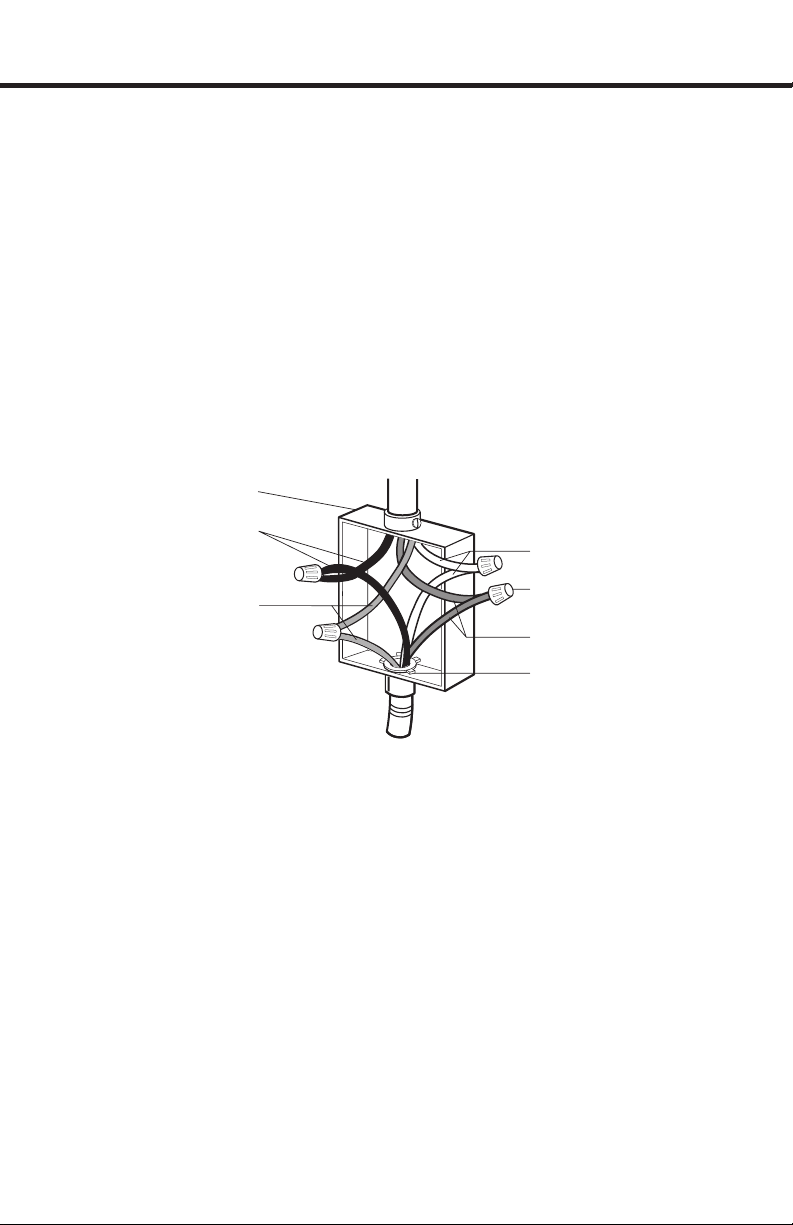
4-WIRE CONNECTION (UNGROUNDED NEUTRAL) - U.S.A. AND
CANADA
4-Wire Cable from Home Power Supply
IMPORTANT: Use the 4-wire cable from home power supply in the U.S. where
local codes do not allow grounding through neutral, New Branch circuit
installations (1996 NEC), mobile homes and recreational vehicles, new construction
and in Canada.
1. Disconnect power.
Ungrounded Neutral
i
b
c
d
g
f
e
h
a
a Junction Box
b Black Wires
c Red Wires
d Cable from Oven
e UL listed or CSA
Approved Conduit
Connector
f Ground (Green or
Bare) Wires
g UL Listed Wire
Connector
h Neutral (White) Wires
i House Electrical Supply
2.
Connect the 2 black wires b together using a UL listed wire connector.
3.
Connect the 2 red wires c together using a UL listed wire connector.
4. Untwist white wire from green (or bare) ground wire coming from the oven.
5.
Connect the 2 neutral (white) wires h together using a UL listed wire connector.
6.
Connect the ground (green or bare) wire f from the oven cable to the ground
(green or bare) wire (in the junction box) using a UL listed wire connector.
7. Install junction box cover.
Installation Instructions
14
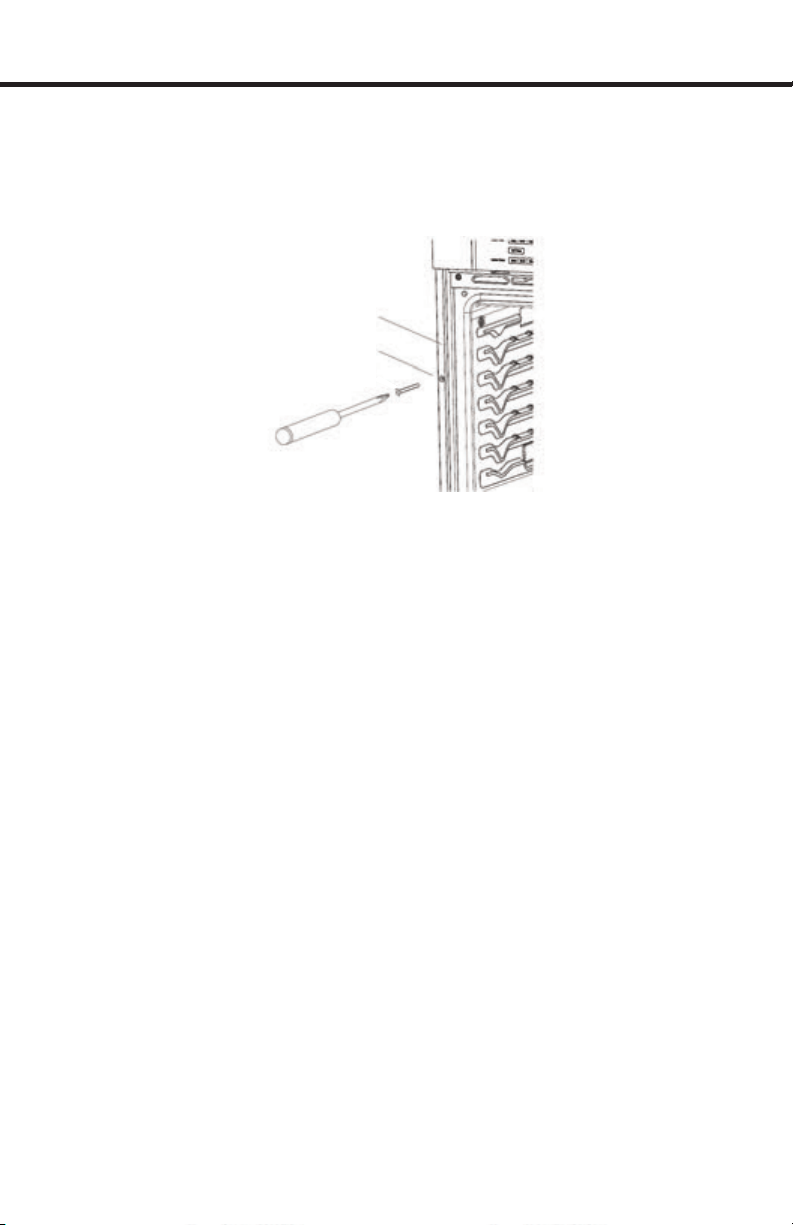
STEP 5 - MOUNT THE OVEN
1. Slide the oven completely into the cabinet until the back surface of the front
frame touches the front wall of the cabinet. Center the oven within the
cabinet cutout.
NOTE: Push against seal area of the oven front frame when pushing the
oven into the cabinet. Do not push against the outside edges.
a
b
a Mounting Frame
b Mounting Frame Hole
2. There are two holes, one on each side of the front frame that surrounds the oven
cavity. Drill 1/8" (3.18 mm) pilot holes through the holes, and into the front
wall of the cabinet.
NOTE:
The double oven has four mounting holes, two on each side.
3. Insert the # 8–14 x 1" screws (provided) through the pilot holes to
securely fasten the oven to the cabinet. Do not overtighten screws.
4. Replace the oven racks.
5. Reconnect power to the oven.
STEP 6 - REPLACE THE DOOR
IMPORTANT: The oven door is heavy and fragile, and the door front is glass. To
avoid oven
door glass breakage, use both hands, and grasp only the sides of the
oven door to remove.
1. Verify that the door hinge latches are forward, and then insert the oven
door hinges into the openings.
2. Lower the oven door to engage the hinges.
3. Press the hinge latches down to lock.
Installation Instructions
STEP 7 - COMPLETE INSTALLATION
1. Check that all parts are now installed. If there is an extra part, go back through
the steps to see which step was skipped.
2. Dispose of/recycle all packaging materials.
3. Check Operation of Oven.
•
Turn on power.
•
Press BROIL.
•
Set the temperature.
•
Press START.
15
NOTE: If oven(s) does not operate, check the following:
•
Household fuse is intact and tight; or circuit breaker has not tripped.
•
Electrical supply is connected.
•
See “Troubleshooting” section in the User Manual.
4. When oven has been on for 5 minutes, feel for heat. If you do not feel heat or
if an error message appears in the display, turn off the oven and contact a
qualified technician.
5. Press CANCEL to turn off the oven.
IMPORTANT: For oven use and cleaning, read the User Manual.
Installation Instructions
PCB BOARD
PCB BOARD
DISPLAY
Top Grill
Back Grill
Bottom Grill
1
2
Cyc
fan
Lamp
Low
Cool fan
High
Cool fan
Latch
85 The
rm
al c
ut o
ff
1
20 Ther
mal cut of
f
L1(RED)
L2(BLACK)
N(WHITE)
G(GREEN)
Probe
GND
Baffle
GND
GND
Probe
probe_down
probe_up
Baffle
TO_SWPOWER
TO_DISP
L N
B Plug
UP_ HT_C UT
DO
OR
Lat
ch1
L
a
t
ch2
GND
DOOR
Latch1
Latch2
GND
A Plug
Probe socket
A68
A67
A65
A66
A42
A10
A43
A12
A52
A53
A54
A55
M
1
M
2
M
3
M
4
down sensor up sensor
Latch_door2
Latch_door1
L1
L
2
L
2
L1
L2
L1
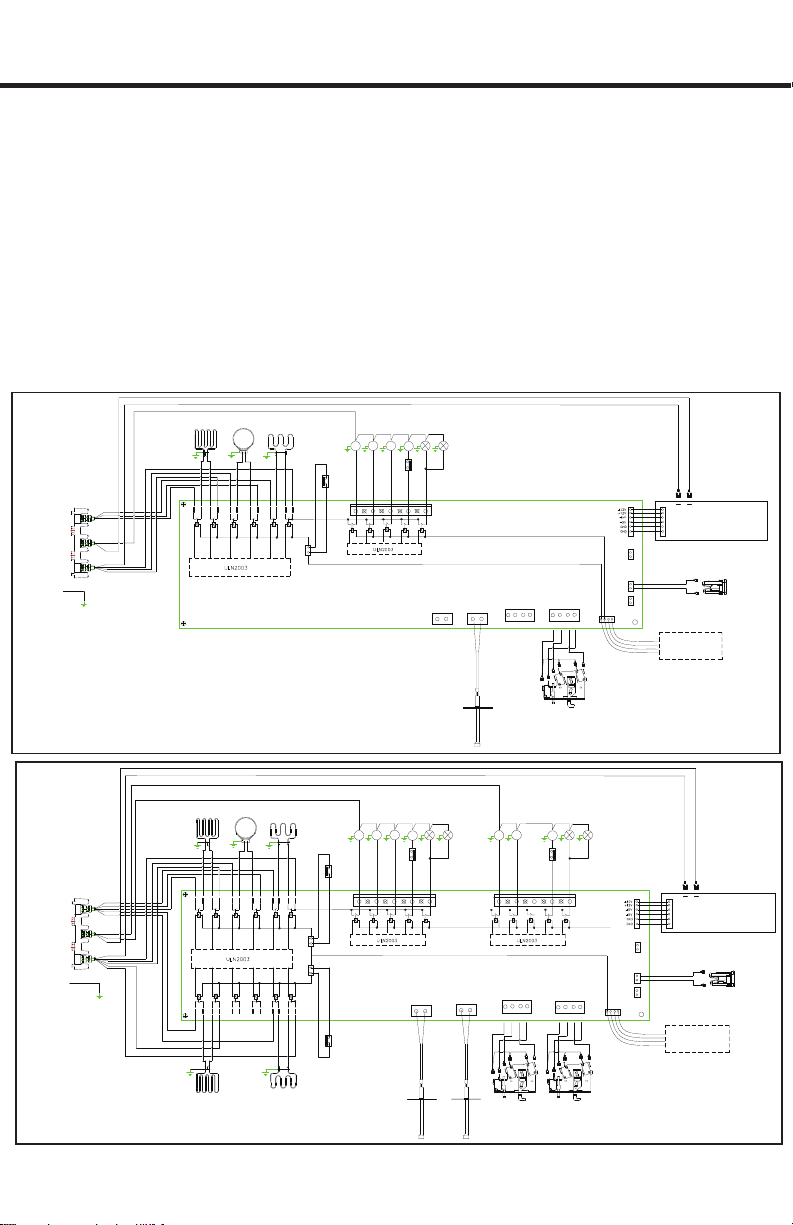
CIRCUIT DIAGRAM
PCB BOARD
PCB BOARD
DISPLAY
Top Grill
Back Grill
Bottom Grill
Top Grill
Bottom Grill
Low Cyc
High
Cool fan Cool fan fan
Latch
Lamp
Low
High
Cool fan Cool fan
Latch
Lamp
85 T herm alcutoff
120 T herm alcut off
L1(RED)
L2(BLACK)
N(WHITE)
G(GREEN)
probe_down
probe_up
Baffle
TO_SWPOWER
Latch_door2
up sensor
down sensor
L N
B Plug
UP_ HT_ CUT
DOOR
Latch
1
Latch2
GND
A Plug
Probe socket
A
68
A67
A65
A6
6
A4
2
A10
A43
A12
A52
A53
A54
A55
85 T herm alcutoff
L1
L2
L2
L1
L2
L
1
120 T herm alcut off
DOW N_H T_C UT
A64
A63
A
61
A62
A28
A45
A30
A46
A57
A5
6
A59
A58
Latch_door1
DOO
R
Latch1
Latch2
GND
M1
M
2
M
3
M4
M1
M
2
M4
Probe
GND
Baffle
GND
GND
Probe
TO_DISP
L1
L2
L2
L1
L2
L
1
Single oven
Double oven
Please register your product warranty by visiting the Ancona Home website.
Canada & USA
Phone : 1-800-350-4562
Fax : 800-350-8563
Email : [email protected]
Ancona is in association with Mr Appliance for all after sales service calls.
Please contact their service provider or visit their website:
Phone : 888-686-0778
MAAN2303-02
© 2017 Copyright of Ancona Home. All rights reserved. This material may not be reproduced,
displayed, modified or distributed.
®
30 in. Single Convection
2


1
OVEN SAFETY ............................................................................................................... 2
Warnings for Electric Installation ................................................................................... 3
PARTS AND FEATURES .............................................................................................. 6
CONTROL PANEL......................................................................................................... 7
Oven Mode Controls .................................................................................................... 7
Display ........................................................................................................................... 7
Start/Control Lockout .................................................................................................... 7
Cancel ........................................................................................................................... 8
Light .............................................................................................................................. 8
Timer ............................................................................................................................. 8
Cook Time ..................................................................................................................... 8
Start Time ..................................................................................................................... 9
Settings ........................................................................................................................ 10
Self-Clean .................................................................................................................... 12
OVEN USE .................................................................................................................... 12
21 ................................................................................................. nevO eht gnisU erofeB
General ......................................................................................................................... 12
51 ........................................................................................... lortnoC erutarepmeT nevO
Oven Modes ................................................................................................................. 16
12 .................................................................................................................... spiT ekaB
22 ................................................................................................... spiT ekaB noitcevnoC
42 ................................................................................................. spiT tsaoR noitcevnoC
62 ................................................................................................... spiT liorB noitcevnoC
62 ............................................................................................................. spiT etardyheD
82 ....................................................................................................................... spiT liorB
92 ........................................................ SISF morf senilediuG erutarepmeT ecivreS dooF
OVEN CARE ................................................................................................................. 29
92 .......................................................................................................... gninaelC lareneG
13 ............................................................................................... gninaelC-fleS citamotuA
43 ..................................................................................................... lavomeR rooD nevO
Replacing an Oven Light ..............................................................................................
35
TROUBLESHOOTING .................................................................................................. 37
73 ................................................................................................... gnitsaoR dna gnikaB
Operation .....................................................................................................................
38
CIRCUIT DIAGRAM .................................................................................................... 40
Table of Contents
2
Oven Safety
Your safety and the safety of others are very important.
We have provided many important safety messages in this manual
and on your appliance. Always read and obey all safety messages.
DANGER
WARNING
CAUTION
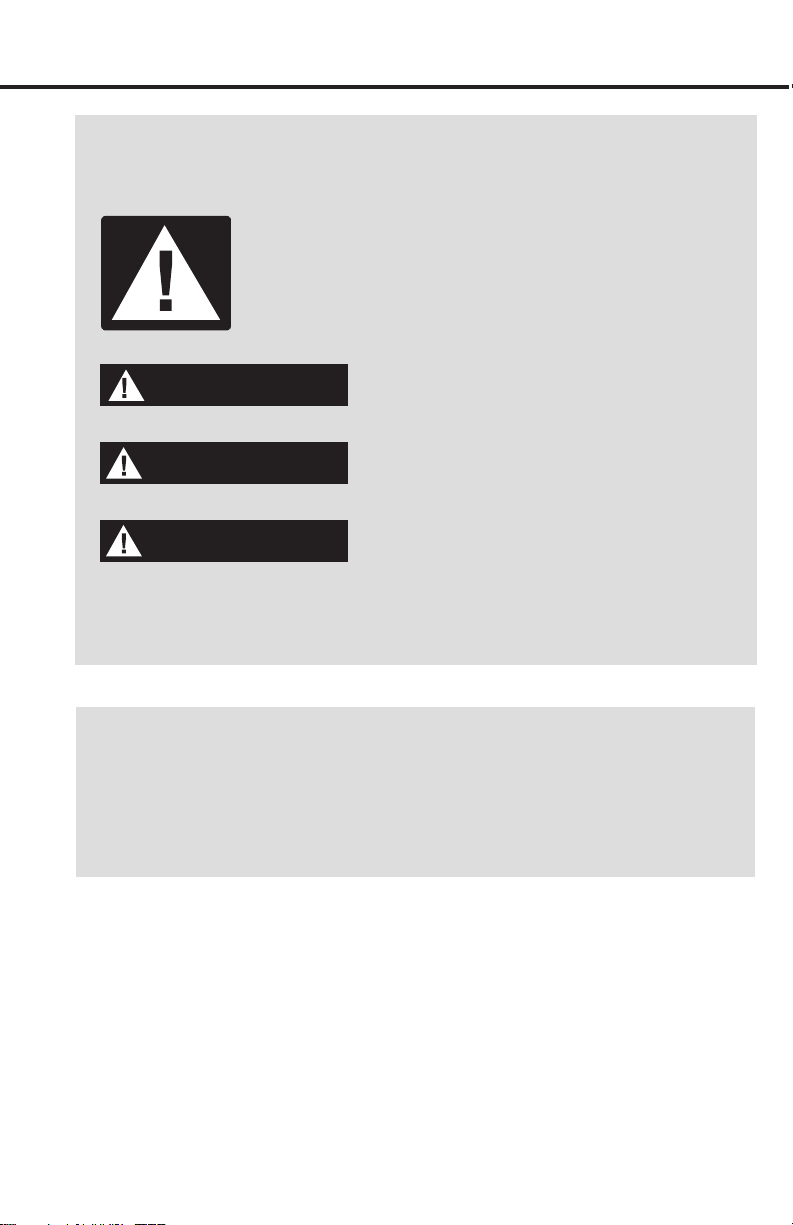
This is the safety alert symbol.
This symbol alerts you to potential hazards that can
kill or hurt you and others. All safety messages will
follow the safety alert symbol and either the word
“DANGER,” “WARNING” or “CAUTION.”
These words mean:
An imminently hazardous situation. You
could be killed or seriously injured if
you don’t immediately follow instructions.
A potentially hazardous situation which, if
not avoided, could result
in death or serious bodily injury.
A potentially hazardous situation which, if
not avoided,
may result in moderate or
minor injury.
All safety messages will tell you what the potential hazard is, tell
you how to reduce the chance of injury, and tell you what can
happen if the instructions are not followed.
State of California Proposition 65 Warnings:
WARNING: This product contains one or more chemicals known to
the State of California to cause cancer.
WARNING: This product contains one or more chemicals known to
the State of California to cause birth defects or other reproductive
harm.

3
WARNINGS FOR ELECTRIC INSTALLATION
Installation and service must be performed by a qualified installer
or service agency.
The models may be powered at 240V or 208V.
Always disconnect the power before servicing this unit.
This appliance must be properly grounded.
Failure to do so could result in death or serious injury.
IMPORTANT SAFETY
INSTRUCTIONS
WARNING: To reduce the risk of fire, electrical shock, injury to
persons, or damage when using the oven, follow basic precautions,
including the following:
Proper Installation
•
This appliance must be
properly installed and
electrically grounded by a
qualified technician. Connect
only to properly grounded
outlet. See “Grounding
Instructions” found in the
Installation Instructions.
•
This appliance should
be serviced only by a
qualified service
technician. Contact the
nearest authorized service
center for examination,
repair or adjustment.
•
Do not repair or replace
any part of the oven unless
specifically recommended.
Refer service to an
authorized servicer.
•
Do not operate this appliance
if it is not working properly
or if it has been damaged,
until an authorized servicer
has examined it.
•
Install or locate this appliance
only in accordance with the
Installation Instructions.
•
Use this oven only as intended
by the manufacturer. If
you have any questions,
contact the manufacturer.
Oven Safety
WARNING
Electrical Shock Hazard

4
IMPORTANT SAFETY
INSTRUCTIONS
•
Do not cover or block any
openings on this appliance.
•
Use this appliance only for
its intended use as described
in this manual. Do not use
corrosive chemicals, vapors,
or non-food products in this
appliance. This type of oven
is specifically designed to
heat or cook. It is not
designed for industrial or
laboratory use. The use of
corrosive chemicals in
heating or cleaning will
damage the appliance.
To reduce the risk of fire in
the oven cavity:
•
Do not store flammable
materials in or near the oven.
•
Do not use water on a
grease fire. Smother fire or
use a dry chemical or
foam-type extinguisher.
•
It is highly recommended that
a fire extinguisher be readily
available and highly visible
next to any cooking appliance.
•
Do not overcook food.
Carefully attend oven if
paper, plastic or other
combustible materials are
placed inside the oven.
•
Do not use the cavity for
storage purposes. Do not
leave paper products, cooking
utensils or food in the cavity
when not being used.
•
If materials inside the oven
should ignite, keep oven
door closed. Turn oven off
and disconnect the circuit
at the circuit breaker box.
•
Be sure the blower fan runs
whenever the oven is in
operation. If the fan does
not operate, do not use the
oven. Call an authorized
service center.
•
Never use the oven to
warm or heat a room.
Personal Safety
•
Do not allow children to use
this appliance unless closely
supervised by an adult.
Children and pets should not
be left alone or unattended in
the area where the appliance
is in use. Never allow children
to sit or stand on any part of
the oven.
•
Do not store items of
interest to children above
the oven. If children should
climb onto the appliance to
reach these items, they
could be seriously injured.
•
For personal safety, wear
proper clothing. Loose fitting
or garments with hanging
sleeves should never be worn
while using this appliance.
•
Tie long hair so that it
doesn’t hang loose.
•
Do not touch heating
elements or interior
surfaces of oven.
•
The heating elements may
be hot even though they are
dark in color. Interior
surfaces of an oven become
hot enough to cause burns.
Oven Safety

5
IMPORTANT SAFETY
INSTRUCTIONS
•
During and after use, do
not touch or let clothing or
other flammable materials
contact the heating
elements or the interior
surfaces of the oven until
they have had sufficient
time to cool.
•
The trim on the top and sides
of the oven door may
become hot enough to cause
burns.
•
Use care when opening the
door. Open the door
slightly to let hot air or
steam escape before
removing or replacing food.
•
Do not heat unopened
food containers. Build-up
of pressure may cause the
container to burst and
cause injury.
•
Always place oven racks in
desired location while oven
is cool. If a rack must be
moved while oven is hot,
do not let potholder contact
the hot heating elements.
•
Use only dry potholders.
Moist or damp potholders
on hot surfaces may result
in burns from steam. Do
not let potholder touch hot
heating elements. Do not
use a towel or other bulky
cloth.
Safety for the Self-cleaning Oven:
•
Before self-cleaning the oven,
remove the broiler pan, oven
racks (only when not made of
porcelain), other utensils and
excess soft spillage.
•
Confirm that the door locks and
will not open once both
selectors are in CLEAN position
and the door lock icon appears.
If the door does not lock, turn
the cook mode selector to OFF
and do not run Self-Clean. Call
an authorized servicer.
•
Do not clean the door gasket. It
is essential for a good seal.
Care should be taken not to
rub, damage, move or remove
the door gasket.
•
Do not use commercial oven
cleaners or oven liner protective
coatings of any kind in or around
any part of the oven.
•
Clean only oven parts listed in
this manual.
•
Other surfaces of the appliance
may become hot enough to
cause burns -among these
surfaces are for example: oven
vent openings and surfaces near
these openings, oven doors, and
windows of oven doors.
READ AND SAVE
THESE INSTRUCTIONS
Oven Safety
•
CAUTION: DO NOT LEAVE
FOOD OR COOKING UTENSILS,
ETC., IN OVEN DURING THE
PYROLYTIC SELF-CLEANING
MODE OF OPERATION
6
h
d
d
g
a b c
f e
j
l
k
m
i
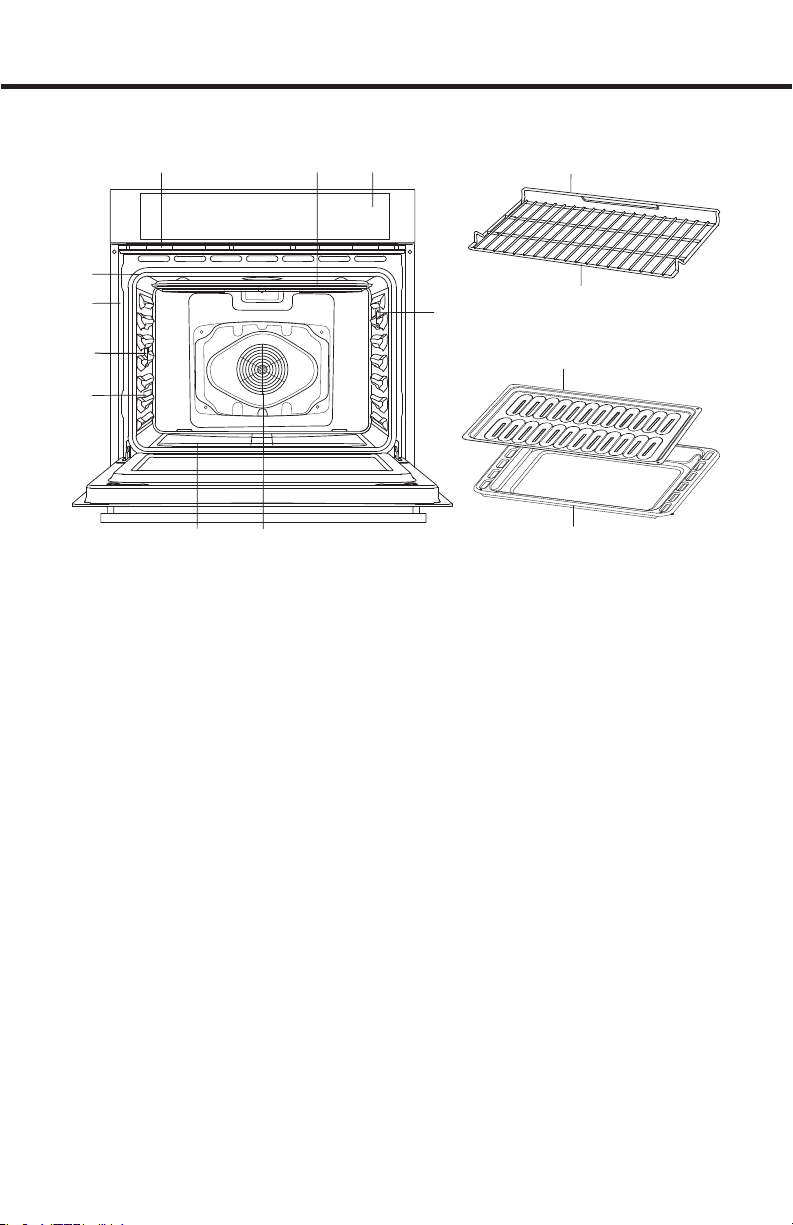
a Oven Vent
b Broil Element
c Control Panel
d Halogen Light
e Convection Fan and Element
f Bottom Element (not visible)
g Model and Serial # Plate
h Door Gasket
i Temperature Probe
j Oven Rack Back
k Oven Rack Front
l Broiler Pan Rack
m Broiler Pan
Parts and Features
7
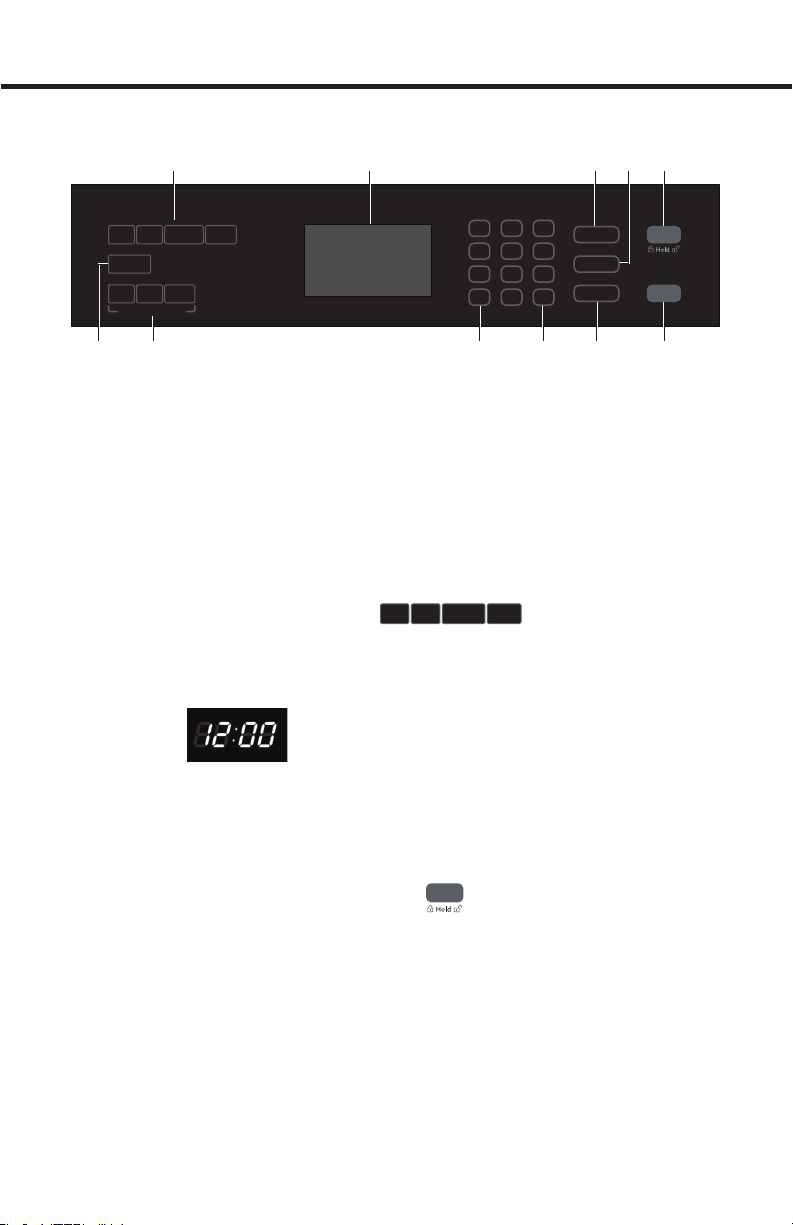
c da b e
fghijk
Convection Conversion
Cook Time
Start
Cancel
1 2 3
4 5 6
7 8
0
9
Timer Light
Settings
Bake Broil Convection
Warm/
Proof
Self Clean
Baked
Goods
Meats
Other
Foods
Start Time
a Oven Mode Controls
b Display
c Cook Time
d Start Time
e Start/Control Lock (hold 3 seconds)
f Cancel
g Settings
h Light
i Timer
j Convection Conversion
Mode Controls
k Self-Clean
OVEN MODE CONTROLS
Bake Broil Convection
Warm/
Proof
Select from Bake, Broil, Convection and Warm/Proof oven modes.
NOTE: The Warm/Proof control toggles between the two oven modes.
DISPLAY
PM
When power is first supplied to the oven or if a power failure occurs, “12:00
PM” will appear on the display.
See “Clock,” later in this section, for instructions to set the time-of-day. When
the oven is not in use, the time-of-day appears in the display.
START/CONTROL LOCKOUT
Start
START
The Start control begins any oven function. If Start is not pressed within 2
minutes after pressing a keypad the function is canceled and the time-of- day
is displayed.
Control Panel

8
CONTROL PANEL LOCKOUT
The control panel can be locked to avoid unintended use of the oven.
NOTES:
•
The control cannot be locked if the oven is in the Settings menu.
•
The current time-of-day will remain in the display when the control is locked.
To Lock Control Panel:
•
Press and hold START for 3 seconds or until “LOCKED” appears in the display.
“LOCKED” will remain lit in the display.
To Unlock Control Panel:
•
Press and hold START for 3 seconds or until “LOCKED” scrolls in the display.
CANCEL
Cancel
•
Press the Cancel button to stop any function except Timer and Control
Panel Lockout.
LIGHT
Light
The oven lights turn On automatically when the oven door is opened, and turns
Off automatically when the oven door is closed.
•
Press the Light button to turn On/Off the oven lights when the oven door is
closed.
TIMER
Timer
The Timer can be set in hours or minutes up to 11 hours and 59
minutes. To Set the Timer:
1. Press TIMER.
2. Use the number keypad to enter the length of time in hours and minutes.
3. Press TIMER to begin the countdown. If enabled, timer tone(s) will sound at the
end of countdown.
4. Press TIMER to cancel the Timer and return to the time-of-day.
NOTE: Do not press CANCEL because the oven will turn off.
COOK TIME
Cook Time
The Cook Time feature allows the oven to be set to cook for a set length of time,
and then turn off automatically.
IMPORTANT: You must select an Oven Mode before you can set a Cook Time.
Control Panel

Food Poisoning Hazard
WARNING
9
NOTES:
•
Cook Time can be set in hours or minutes up to 11 hours and 59 minutes.
•
To change the cook time during cooking, press CANCEL. Enter the new
cook time and press START.
•
At the end of the set cook time, the oven will turn off automatically, the
alert tone will sound, and “Complete” will appear in the text area.
To Set Cook Time:
1. Select cooking mode.
2. Select temperature.
3. Press COOK TIME. Enter the desired cook time by pressing the number keypad.
4. Press START. The oven will begin to preheat.
NOTE: The Cook Time format is HR:MIN, switching to MIN:SEC during the
last minute.
START TIME
Start Time
This feature allows you to set the oven to turn on at a later time.
IMPORTANT: The clock must be set to the correct time-of-day.
1. Select an Oven Mode.
2. Select temperature.
3. Set Cook Time.
4. Press START TIME.
5. Enter the desired Start Time by pressing the number keypad. “Press
START” will appear the display. If Cook Time was not set, the control will
prompt you to “Set Cook Time.”
Do not let food sit in oven more than one hour before or after
cooking. Doing so can result in food poisoning or sickness.
6. Place the food in the oven and close the oven door.
7. Press START. Start Time will begin counting down until it reaches the set
time-of-day.
NOTE: At the end of Cook Time, the oven will turn off automatically, an
alert tone will sound and “Complete” will appear in the display.
Control Panel
10
SETTINGS
Settings
The Settings control allows you to access the menu for additional functions
and features.
Press SETTINGS to show Menu Options 1 - 6. Then, press START to show
Options 7 - 9.
CLOCK
The clock can be set to display time in a 12-hour or 24-hour format. The
clock is factory preset for the 12-hour format.
To Set the Clock:
NOTE: Before setting the clock, make sure both the Oven and Timer are turned Off.
1. Press SETTINGS. The various Options will appear in the display.
2. Press 1 on the number keypad. “AM or PM” will appear in the display.
3. Press 1 to toggle between AM and PM, Press SETTINGS to confirm.
“Clock” will appear in the display.
4. Press the number keypad to enter the time-of-day.
5. Press SETTINGS to confirm; time-of-day is set.
To Change the Clock to 24-Hour Format:
1. Press SETTINGS. The various Options will appear in the display.
2. Press “5” on the number keypad. “12/24 HOUR” and “12” will appear
in the display.
3. Press “1” on the number keypad to change the 12/24 Hour setting to 24-hour.
4. Press SETTINGS to confirm. The 12/24-Hour setting has been changed.
TONES
Tones are audible signals, indicating the following:
Number of Tones
Indicates
1
Valid Press Function has
been entered
Oven is Preheated
2
Invalid Touch
Pad Press
4
End of Cycle End of Timer
To Turn On/Off Sound:
The oven sound is factory preset for On but can be changed to Off.
1. Press SETTINGS. The various Options will appear in the display.
2. Press “3” on the number keypad. “SOUND” and “ON” will appear in the display.
3. Press “1” on the number keypad. “ON/OFF” will appear in the display.
4. Press “1” on the number keypad to turn the sound Off.
5. Press SETTINGS to confirm. The sound has now been turned off.
Control Panel

11
6. Press SETTINGS, and then follow the display prompts to return the
sound setting to On.
To Adjust Sound Volume:
The oven sound is factory preset for High but can be changed to Low.
1. Press SETTINGS. The various Options will appear in the display.
2. Press “4” on the number keypad. “SOUND VOLUME” and “HIGH” will
appear in the display.
3. Press “1” on the number keypad. HIGH/LOW” will appear in the display.
4. Press “1” on the number keypad to turn the sound Low.
5. Press SETTINGS to confirm. The sound volume has now been changed.
6. Press SETTINGS, and then follow the display prompts to return the
sound volume setting to High.
DEGREES FAHRENHEIT AND CELSIUS
The temperature is factory preset to display in degrees Fahrenheit, but
can be changed to display in degrees Celsius.
To Change the Display from Degrees Fahrenheit to Degrees Celsius:
1. Press SETTINGS. The various Options will appear in the display.
2. Press “2” on the number keypad. “TEMP UNIT” and “FAHRENHEIT” will
appear in the display.
3. Press “1” on the number keypad. “DEGREE F/C” will appear in the display.
4. Press “1” on the number keypad to change the temperature unit
setting to degrees Celsius.
5. Press SETTINGS to confirm. The temperature unit has been changed.
6. Press SETTINGS, and then follow the display prompts to return to Fahrenheit.
SABBATH MODE
Sabbath mode is designed for those whose religious observances require
disabling certain oven features. By enabling Sabbath Mode, the oven will
conform to Star-K Jewish Sabbath requirements.
NOTE: The oven is factory preset with Sabbath Mode Off.
To Turn On/Off Sabbath Mode:
1. Make sure the oven is turned Off, and the meat probe is not plugged in.
NOTE: Sabbath mode cannot be set when the oven is On. The oven will
not recognize the meat probe while in Sabbath mode.
2. Press SETTINGS > Press START > Press 7, and then press 1 to (toggle
between ON / OFF).
3. Press SETTINGS again to enable Sabbath mode. The only cooking function
that works while the oven is set to Sabbath mode is Bake.
Control Panel

12
To Bake While the Oven is in Sabbath Mode:
1. Press BAKE.
2. Enter the desired oven temperature by pressing the numbered keypad.
3. After selecting Bake and a Temperature, you have the option to set a Cook Time
and Start Time before pressing START. See “Cook Time” and “Start Time.”
4. Press START. Pressing Start activates Sabbath mode.
Only the Cancel control is functional.
•
Press CANCEL to exit Sabbath mode. Press SETTINGS again to turn off Sabbath
mode and resume normal oven operation. The display will return to the
time-of-day.
NOTE: If there is a power failure while the oven is in Sabbath mode, the
oven will resume in Sabbath mode when power is restored.
SELF-CLEAN
Self Clean
Operates the Automatic Self-cleaning feature. See “Oven Care.”
BEFORE USING THE OVEN
1. Turn the Temperature Control to the highest setting.
2. Turn the Cooking Mode Selection control to a cooking mode.
3. Allow the oven to operate for 30 minutes with the door closed and no food
in the cavity.
NOTE: Any odor that may be detected during this initial use is due to the
evaporation of substances used to protect the oven during storage.
4. Turn off the oven, and allow the oven to cool.
GENERAL
IMPORTANT: Do not place anything, including dishes, foil and oven trays, on the
bottom of the oven when it is in operation to avoid damaging the enamel.
1. Place bake ware with food on one or both of the shelves provided with the oven.
2. Press the Oven Mode control for the desired oven function.
3. Use the number keypad to enter the oven temperature.
4. Press START.
PREHEATING THE OVEN
•
Preheat the oven when using the Bake, Convection Bake and Convection Roast
modes.
•
Selecting a higher temperature does not shorten the preheat time.
•
Preheating is necessary for good results when baking cakes, cookies,
pastry and breads.
Control Panel
Oven Use
13
•
Preheating will help to sear roasts and seal in meat juices.
•
Place oven racks in their proper position before preheating.
•
During preheating, the selected cooking temperature is always displayed.
•
A beep will confirm that the oven is preheated and “Preheating” will
disappear from the display.
OPERATIONAL SUGGESTIONS
•
Use the cooking charts, in this manual, as a guide.
•
Do not set pans on the open oven door.
•
Use the interior oven lights to view the food through the oven door
window rather than opening the door frequently.
TEMPERATURE PROBE
Use an oven mitt to remove temperature probe.
Do not touch broil element.
Failure to do so can result in burns.
The temperature probe monitors the internal food temperature, which is frequently
used as an indicator of doneness especially for meats and poultry, and turns off
the oven when the internal food temperature reaches the programmed
temperature. The temperature probe will work with all oven modes except for the
Warm/Proof, Sabbath and Self-Clean modes.
IMPORTANT: Always unplug and remove the temperature probe from the
oven when removing the food.
To Use the Temperature Probe:
1.
Insert the probe into the food.
NOTE: For meats, the probe tip should be inserted into the center of
the thickest part of the meat. Make sure that the probe tip is not into
the fat or touching bone.
2. Place the food into the oven. Keeping the temperature probe as far away
from a heat source as possible, plug the temperature probe into the oven
outlet. Close the oven door.
3. Select the oven mode.
4. Enter the oven temperature by pressing the numbers on the keypad.
5. Press START. The set oven temperature will appear on the display
throughout cooking.
WARNING
Burn Hazard
Oven Use

14
6. Enter the desired internal food temperature by pressing the numbers on
the keypad, and then press START.
NOTES:
•
The internal food temperature can be set between 135°F and 200°F
(57°C and 93°C).
•
When the set probe temperature is reached, the oven will turn off.
7. Press CANCEL when finished. Unplug the temperature probe and remove food
from the oven.
NOTE: The probe icon will remain lit in the display until the probe is unplugged.
UTENSILS
•
Glass baking dishes absorb heat. Reduce oven temperature 25°F (15°C) when
baking in glass.
•
Use pans that produce the desired browning. The type of finish on the pan
will help determine the amount of browning that will occur.
- Shiny, smooth metal or light non-stick / anodized pans reflect heat,
resulting in lighter, more delicate browning. Cakes and cookies require this
type of utensil.
- Dark, rough or dull pans will absorb heat resulting in a browner, crisper
crust. Use this type for pies.
•
Do not cook with the empty broiler pan in the oven, as this could affect
cooking performance. Store the broil pan outside of the oven.
HIGH ALTITUDE BAKING
When cooking at high altitude, cooking times may be extended.
OVEN RACKS
IMPORTANT: To avoid permanent damage to the porcelain finish, place
food or bakeware on an oven rack. Do not place food or bakeware directly
onto the oven door or oven bottom.
•
The oven racks can be placed in any of the six height positions with the oven.
•
Position racks before turning on the oven.
•
Make sure the oven racks are level.
•
Oven racks have a stop to keep them from being unintentionally withdrawn fully.
To Remove Oven Racks:
•
Pull rack out to the stop position, raise the front edge, and then lift out.
To Replace Oven Racks:
•
Place oven rack on the wire supports along the sides of the oven. Tilt the front
edge up slightly, and slide rack to the rear until it clears the stop position.
Lower the front and slide the rack into the oven.
Oven Use

15
COMPONENT COOLING FAN
Activates during any cooking or self-cleaning mode to cool inner components
and outer door surfaces. This air is exhausted through the vent located above
the oven door. It continues to run until components have cooled sufficiently.
The cooling fan operates at double speed (or RPM’s) in self-clean and
whenever the internal components temperature becomes high.
OVEN DOOR
To avoid oven door glass breakage:
•
Do not close the oven door if the racks are not fully inserted into the oven cavity
or if bakeware extends past the front edge of an oven rack.
•
Do not set objects on the glass surface of the oven door.
•
Do not hit glass surfaces with bakeware or other objects.
•
Do not wipe down glass surfaces until the oven has completely cooled.
OVEN VENTS
Blocking or covering the oven vents will cause poor air circulation, affecting
cooking, cleaning and cooling results.
•
Both the upper and lower oven vent(s) allow fresh air to enter the
cooling system.
•
The lower oven vent also allows hot air to be expelled from the cooling system.
OVEN CONDENSATION AND TEMPERATURE
•
It is normal for a certain amount of moisture to evaporate from the food during
any cooking process. The amount depends on the moisture content of the food.
•
The moisture may condense on any surface cooler than the inside of the
oven, such as the control panel.
•
Your new oven has an electronic temperature sensor to help maintain an
accurate temperature. Your previous oven may have had a mechanical
thermostat that drifted gradually over time to a higher temperature. It is normal
that you may need to adjust your favorite recipes when cooking in a new oven.
OVEN TEMPERATURE CONTROL
The oven provides accurate temperatures; however, it may cook faster or
slower than your previous oven, so the temperature calibration can be
adjusted. It can be adjusted in degrees Fahrenheit or Celsius.
A minus sign means the oven will be cooler by the displayed amount. The
absence of a minus sign means the oven will be warmer by the displayed amount.
Use the following chart as a guide:
ADJUSTMENT °F (ADJUSTMENT °C) COOKS FOOD
10°F (6°C) a little more
20°F (12°C) moderately more
30°F (17°C) much more
-10°F (-6°C) a little less
-20°F (-12°C) moderately less
-30°F (-17°C) much less
Oven Use
16
To Adjust Oven Temperature Calibration:
1. Press SETTINGS. The various Options will appear in the display.
2. Press number 9 on the keypad. “CALIBRATION” “PRESS 3 TO INCREASE/
PRESS 6 TO DECREASE” will scroll across the display.
3. Press number 3 on the keypad to increase or number 6 to decrease the
temperature in 5°F (3°C) increments. The adjustment can be set between
30°F (18°C) and -30°F (-18°C).
4. Press SETTINGS to save the adjustment, and then exit the
Temperature Calibration menu.
OVEN MODES
The illustrations show the heating elements and fans used for each oven mode.
NOTE: The lower element is concealed under the oven floor.
BAKE
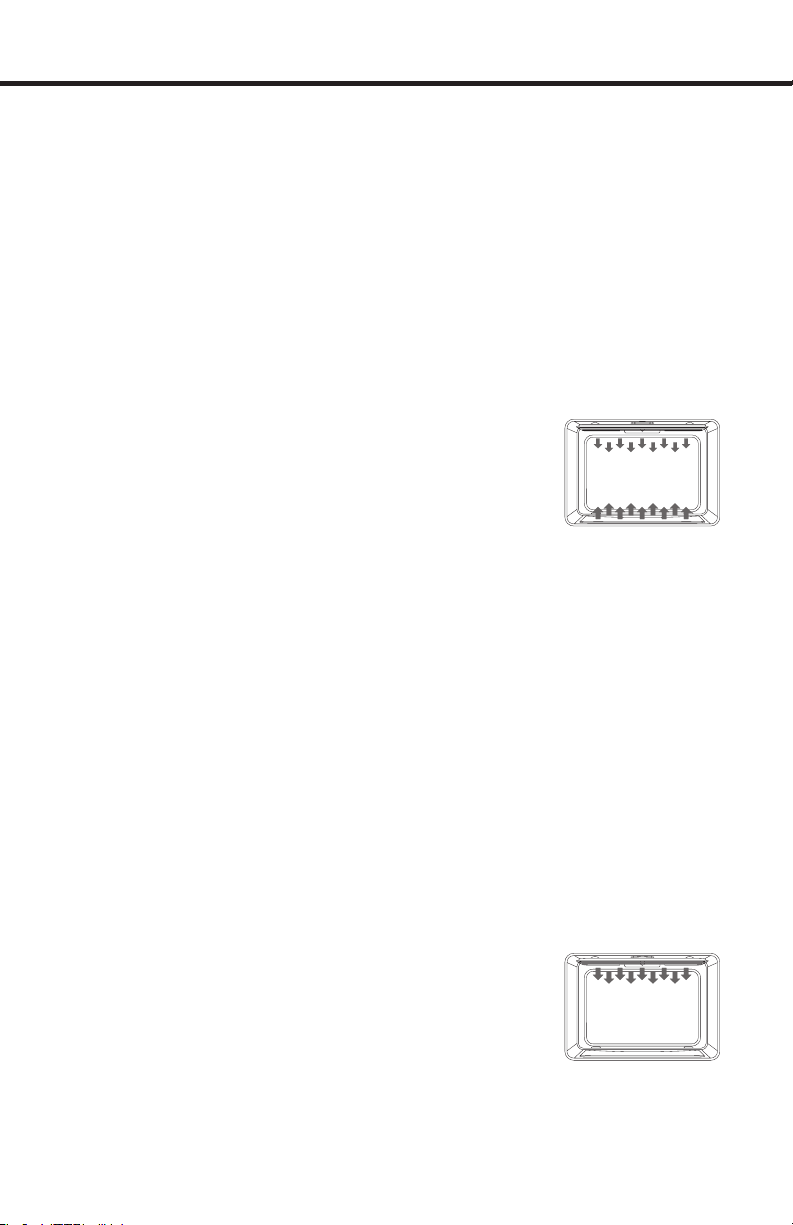
Baking is cooking with heated air. Both upper and
lower elements in the oven are used to heat the air, but
the fan is used only during preheating.
Follow the recipe or convenience food directions for baking
temperature, time and rack position. Baking time will vary
with the temperature of ingredients and the size, shape and
finish of the bakeware.
1. Press BAKE to select the bake mode. “BAKE” will appear in the display and
350°F (177°C) will be displayed. “Set temp or START” will appear in the display.
2. Press START, if you wish to cook at 350°F (177°C).
OR
Enter the desired temperature by pressing the number keypad, and then press
START. The temperature can be set from 170°F (77°C) to 500°F (260°C).
NOTES:
•
The temperature can be changed at any time during cooking. Press
CANCEL to clear the settings. Select oven mode, then enter the desired
temperature by pressing the number keypad, and then press START.
•
After selecting an Oven Mode and Temperature, you have the option to
set a Cook Time and Start Time before pressing START. See “Cook
Time” and “Start Time.”
3.
Press CANCEL when finished baking, and remove food from the oven.
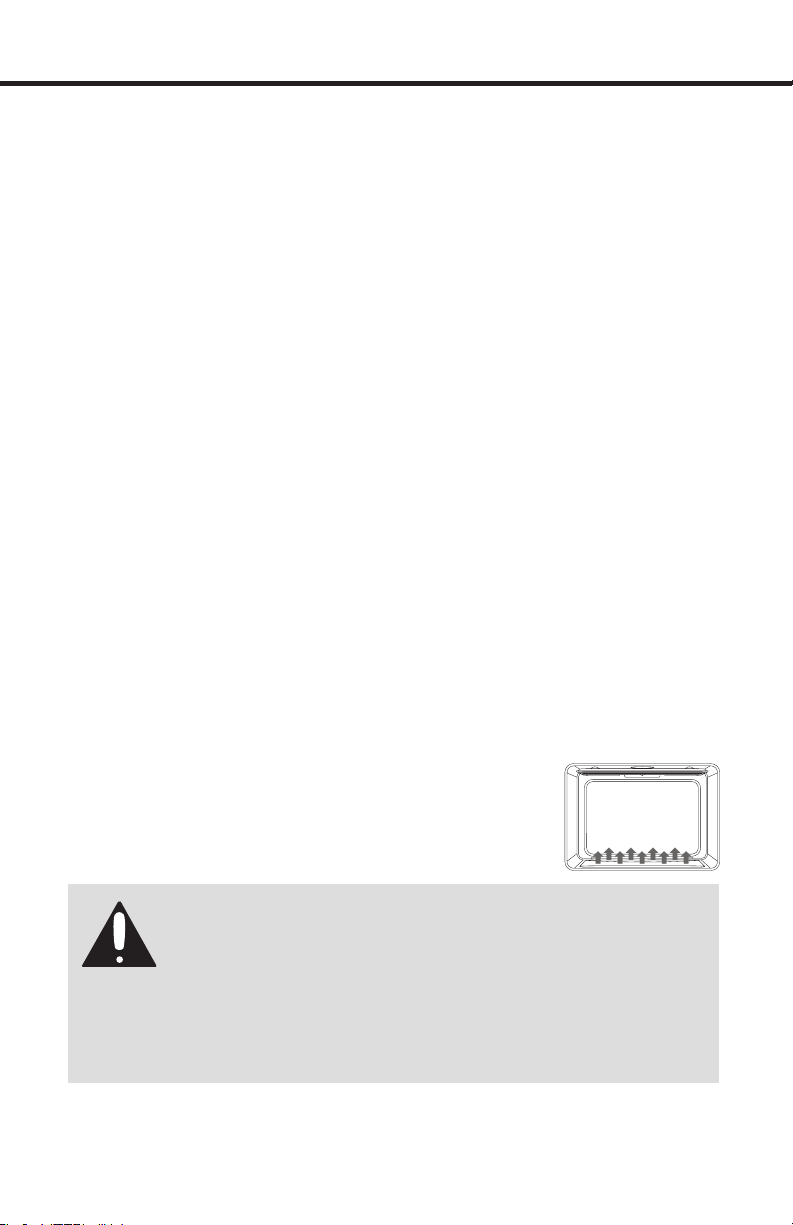
BROIL
Broiling uses direct radiant heat to cook food. The lower
the temperature, the slower the cooking. Thicker cuts
and unevenly shaped pieces of meat, fish and poultry
may cook better at lower broiling temperatures.
•
For best results, use a broiler pan and rack. It is designed to drain juices
and help avoid spatter and smoke.
•
For proper draining, do not cover the grid with foil. The bottom of the pan
may be lined with aluminum foil for easier cleaning.
Oven Use
WARNING
Food Poisoning Hazard
17
•
Trim excess fat to reduce spattering. Slit the remaining fat on the edges to
avoid curling.
•
Select HI/550°F (288°C) broil for most broiling. Select LO/450°F (232°C) broil for
low-temperature broiling of longer cooking foods such as poultry to avoid over
browning.
•
Pull out oven rack to stop position before turning or removing food. Use
tongs to turn food to avoid the loss of juices. Very thin cuts of fish, poultry or
meat may not need to be turned.
To Broil:
1. Place the food on the rack in the broiler pan and place pan in the oven. Close the
oven door.
NOTE: Preheating is not necessary.
2. Press BROIL for the desired mode. “BROIL” and “Set temp or START” will
appear in the display, and “550ºF” (288ºC) will be displayed.
3. Press START, if you wish to broil at 550°F (288°C).
OR
Enter the desired temperature by pressing the number keypad, and then press
START. The temperature can be set from 450°F (232°C) to 550°F (288°C).
4. “BROIL” will appear in the display after Start is pressed.
NOTES:
•
The broil temperature can be changed at any time during cooking. Press
CANCEL to clear the settings. Select oven mode, then enter the desired
temperature by pressing the number keypad, and then press START.
•
After selecting an Oven Mode and Temperature, you have the option to
set a Cook Time and Start Time before pressing START. See “Cook
Time” and “Start Time.”
5. Press CANCEL when finished broiling, and remove food from the oven.
WARM/PROOF
The Warm mode keeps hot, cooked foods at
serving temperature.
The Proof mode prepares dough for baking by activating
the yeast. Follow the recipe directions as a guide.
Do not let food sit in oven more than one hour before or after cooking.
Doing so can result in food poisoning or sickness.
IMPORTANT: Food must be at serving temperature before placing it in the
warmed oven. Food may be held up to 1 hour; however, breads and
casseroles may become too dry if left in the oven during the Warm function.
For best results, cover food.
Oven Use

18
Warm
1.
2.
Press WARM/PROOF. “Warm” and “Set Temp or START” and 140°F (60°C) will
be displayed.
Press START, if you want to Warm food at 140°F (60°C).
OR
Enter the desired temperature by pressing the number keypad, and then
press START. The temperature can be set from 140°F (60°C) to 210°F (99°C).
3.
“WARM” will appear in the display, once Start is pressed.
NOTE: After selecting an Oven Mode and Temperature, you have the
option to set a Cook Time and Start Time before pressing START. See
“Cook Time” and “Start Time.”
4. Place food in the oven and close the door.
5. Press CANCEL when finished, and remove food from the oven.
To Cancel Warm Feature:
•
Press CANCEL. Remove food from oven.
Proof
1.
Before proofing, place the dough in a lightly greased bowl and cover loosely with
wax paper, coated with shortening. Place on second rack from the
bottom and close the oven door.
2. Press and hold WARM/PROOF for 3 seconds. “Proof” and “Set Temp or
START,” and 100°F (38°C) will be displayed.
3.
Press START, if you want to Proof dough at 100°F (38°C).
OR
Enter the desired temperature by pressing the number keypad, and then
press START. The temperature can be set from 80°F (27°C) to 120°F (49°C)
4.
“PROOF” will appear in the display, once Start is pressed.
NOTE: After selecting an Oven Mode and Temperature, you have the
option to set a Cook Time and Start Time before pressing START. See
“Cook Time” and “Start Time.”
5.
Let the dough rise until nearly doubled in size, checking after 20-25
minutes. Proofing time may vary depending on dough type and quantity.
6. Press CANCEL when finished proofing.
7. Before second proofing, shape the dough, place it in baking pan(s) and
cover loosely with plastic wrap, coated with cooking spray. Follow the same
placement and control steps above. Before baking, remove the plastic wrap.
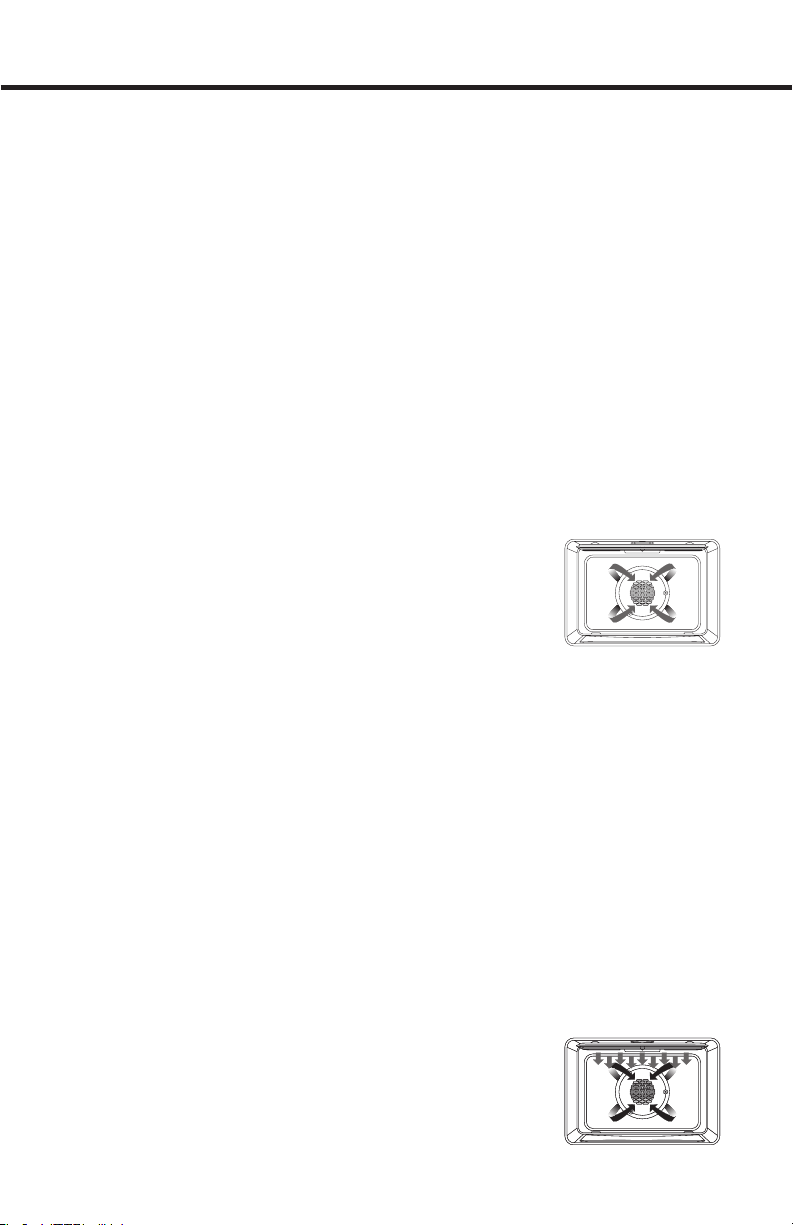
CONVECTION
During convection cooking, the fan provides hot air circulation throughout the
oven. The movement of heated air around the food can help to speed up
cooking by penetrating the cooler outer surfaces.
In Convection mode, the ring element, bake and broil elements, and the fan
operate to heat the oven cavity. If the oven door is opened during convection
cooking or preheating, the fan turns off immediately, and the element(s) will turn
off. Once the door is closed, the element(s) will turn back on.
Oven Use
19
CONVECTION FAN
The convection fan operates during any convection mode. When the oven is
operating in convection mode, the fan will turn off automatically when the
door is opened. The convection fan always runs during the preheat time.
ADVANTAGES OF CONVECTION COOKING
•
Saves time and energy.
•
Even baking, browning and crisping are achieved.
•
During roasting, juices and flavors are sealed in while the exterior is crisp.
•
Yeast breads are lighter, more evenly textured, more golden and crustier.
•
Air-leavened foods such as cream puffs, soufflés and meringues are higher
and lighter.
•
Baking on multiple racks at the same time with even results is possible.
•
Prepare whole meals at once with no flavor transfer.
•
Dehydrates herbs, fruits and vegetables.
•
Requires no specialized bake ware.
•
Convection broiling allows for extraordinary grilling with thicker cuts of food.
CONVECTION BAKE
Use Convection bake for single or multiple rack baking.
When convection baking, reduce your recipe baking
temperature by 25°F (15°C).
To Set Convection Bake:
1. Press CONVECTION once. “Convection” and “Press 1-3 To Choose” will
appear in the display.
2. Press number 1 on the keypad. “Convect Bake” and “Set Temp or
START” and 325°F (162°C) will be displayed.
3. Press START If you wish to convection bake at 325°F (162°C).
OR
Enter the desired temperature by pressing the number keypad, and then
press START. The temperature can be set from 170°F (77°C) to 500°F(260°C).
NOTE: After selecting an Oven Mode and Temperature, you have the
option to set a Cook Time and Start Time before pressing START. See
“Cook Time” and “Start Time.”
4. The oven will begin preheating once Start is pressed. A tone will sound
when the oven is at the set temperature.
5. Place the food in the oven and close the oven door when preheat is completed.
6. Press CANCEL when finished, and remove food from the oven.
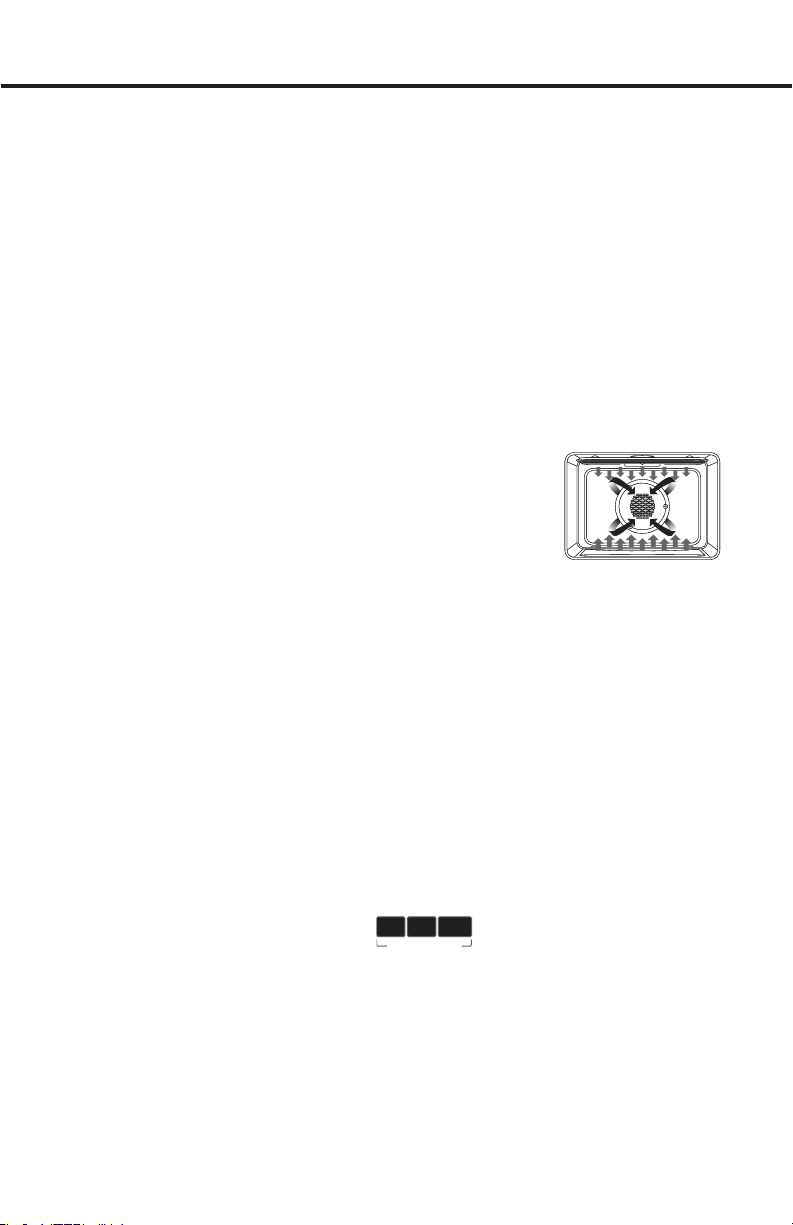
CONVECTION BROIL
When convection broiling, enter your normal broiling
temperature. The oven door must be closed when
using Convection Broil.
It is not necessary to preheat the oven for Convection Broil.
Oven Use
20
1. Place the food in the oven and close the oven door.
2. Press CONVECTION once. “Convection and “Press 1-3 To Choose”
will be displayed.
3. Press number 3 on the keypad. “Convect Broil” and “Set Temp or
Start” and 450°F (232°C) will be displayed.
4. Press START, if you wish to broil at 450°F (232°C).
OR
Enter the desired temperature by pressing the number keypad, and then press
START. The temperature can be set from 170°F (77°C) to 500°F (260°C).
NOTE: After selecting an Oven Mode and Temperature, you have the
option to set a Cook Time and Start Time before pressing START. See
“Cook Time” and “Start Time.”
5.
“Convect Broil” will be displayed, once Start is pressed.
6. Press CANCEL when finished, and remove food from the oven.
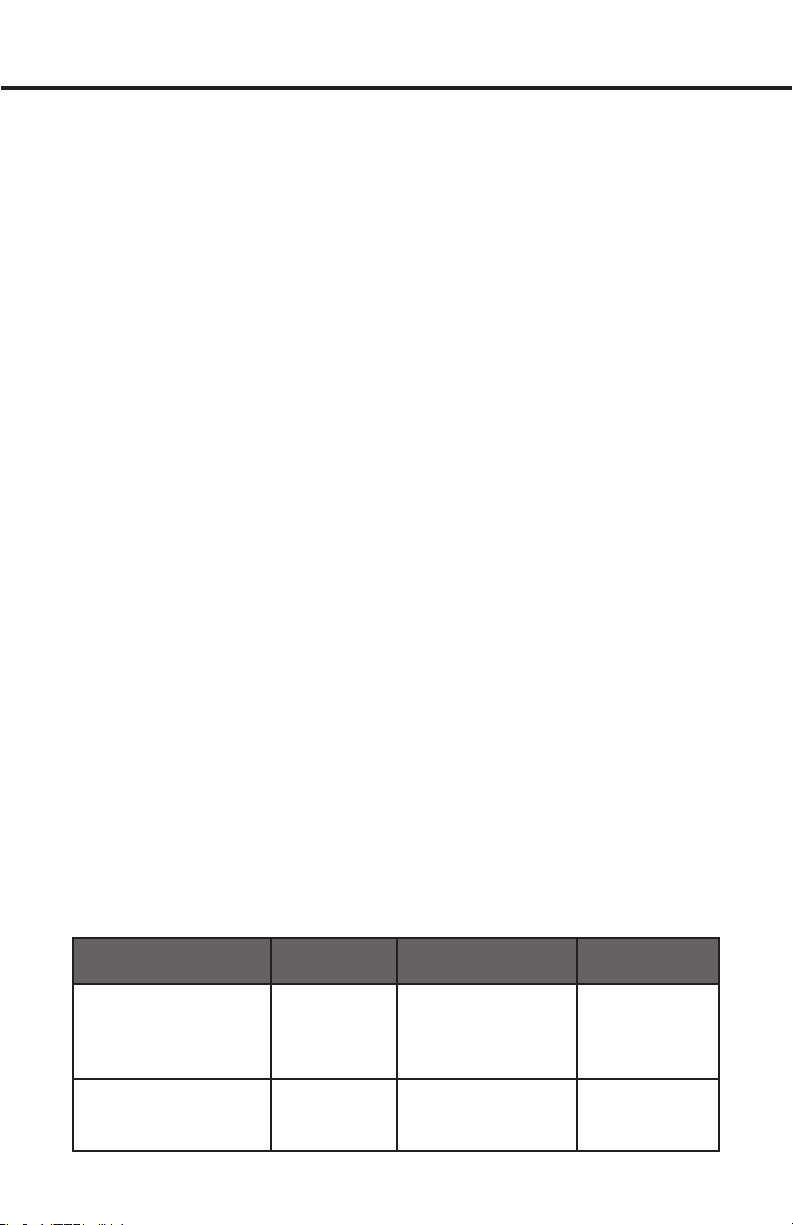
CONVECTION ROAST
When Convection roasting, enter your normal roasting
temperature. The roasting time should be 15-30% less
than in conventional cooking. It is not necessary to preheat
the oven for convection roast.
1. Place the food in the oven and close the oven door.
2. Press CONVECTION once. “Convection” and “Press 1-3 To Choose”
will be displayed.
3. Press number 2 on the keypad. “Convect Roast,” “Set Temp or
START”, and 325°F (163°C) will be displayed.
4. Press START, if you wish to convection roast at 325°F (163°C).
OR
Enter the desired temperature by pressing the number keypad, and then press
START. The temperature can be set from 170°F (77°C) to 500°F (260°C).
NOTE: After selecting an Oven Mode and Temperature, you have the
option to set a Cook Time and Start Time before pressing START. See
“Cook Time” and “Start Time.”
5. ”Convect Roast” will be displayed, once Start is pressed.
6. Press CANCEL when finished and remove food from the oven.
Convection Conversion
Baked
Goods
Meats
Other
Foods
CONVECTION CONVERSION
NOTES:
•
When using Convection Conversion, enter the normal cooking temperature and
time.
•
The temperature will decrease 25°F and the cooking time will decrease
10% automatically.
•
The oven door must be closed before setting Convection Conversion.
1. Press the Convection Conversion control (BAKED GOODS, MEATS or
OTHER FOODS) for the type of food you are cooking.
Oven Use
21
2. Press START to confirm the selection. “Set temp or START” will appear
in the display.
3. Enter your normal roasting temperature by pressing the number keypad.
4. Enter your normal Cook Time. See “Cook Time,” and then press START.
NOTE: Setting a Cook Time is required for Convection Conversion oven mode.
5. Preheating will start. Once the oven is preheated to the set temperature,
the control will beep. Place the food the in oven and close the oven door.
NOTE: It is not necessary to preheat the oven for the Convection
Conversion Meats option. Preheating can cause overcooking. If preheat is
required for the recipe, add 15 minutes to the Cook Time, and place food
in the oven at the appropriate time.
6. At the end of the set cooking time, the oven will turn off automatically. The
Alert tone will sound, and “Complete” will appear in the display.
7. Press CANCEL when finished and remove food from the oven.
BAKE TIPS
•
For best results, bake food on a single rack with at least 1" - 1½" (2.5 - 3 cm)
space between utensils and oven walls.
•
Use one rack when selecting the bake mode.
•
Check for doneness at the minimum time.
•
Use metal bake ware (with or without a non stick finish), heatproof glass,
glass-ceramic, pottery or other utensils suitable for the oven.
•
When using heatproof glass, reduce temperature by 25°F (15°C)
from recommended temperature.
•
Use baking sheets with or without sides or jelly roll pans.
•
Dark metal pans or non-stick coatings will cook faster with more browning.
Insulated bake ware will slightly lengthen the cooking time for most foods.
•
Do not use aluminum foil or disposable aluminum trays to line any part of the
oven. Foil is an excellent heat insulator and heat will be trapped beneath it.
This will alter the cooking performance and can damage the finish of the oven.
•
Avoid using the opened door as a shelf to place pans.
•
See Troubleshooting for tips for Baking and Roasting problems.
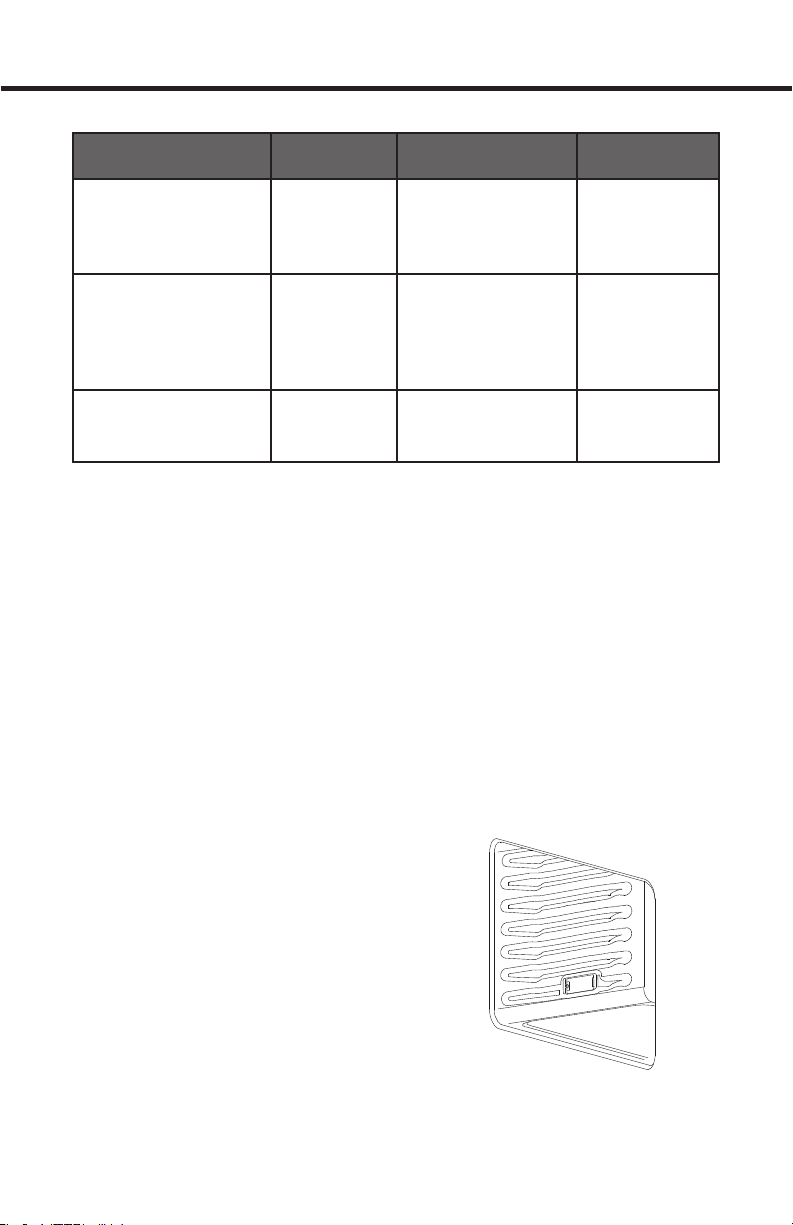
BAKE CHART
FOOD ITEM
RACK
POSITION
TEMP. °F (°C)
(PREHEATED OVEN)
TIME (MIN)
Cake
Cupcakes
Bundt Cake
Angel Food
2
1
1
350 (175)
350 (175)
350 (175)
19-22
40-45
35-39
Pie
2 crust, fresh, 9"
2 crust, frozen fruit, 9"
2
2
375-400 (190-205)
375 (190)
45-50
68-78
Oven Use
22
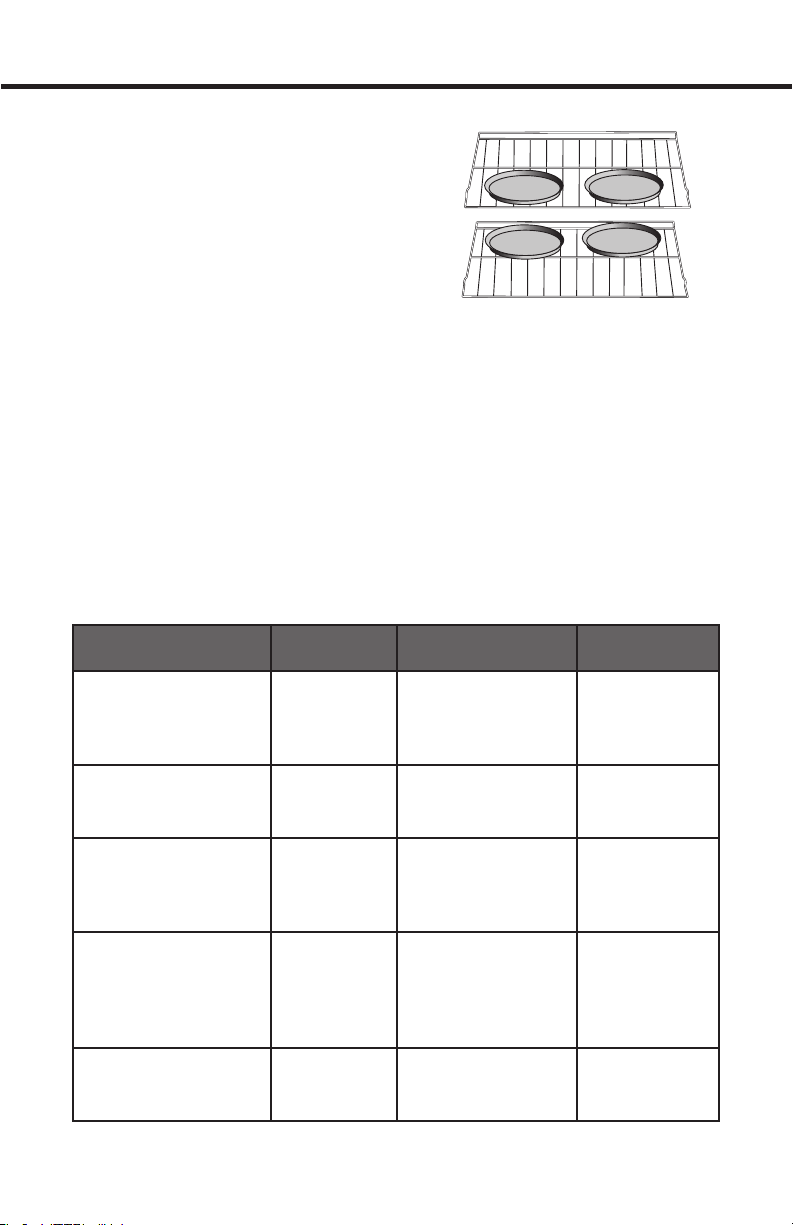
FOOD ITEM
RACK
POSITION
TEMP. °F (°C)
(PREHEATED OVEN)
TIME (MIN)
Cookies
Sugar
Chocolate Chip
Brownies
2
2
2
350-375 (175-190)
350-375 (175-190)
350 (175)
8-10
8-13
29-36
Breads
Yeast bread loaf, 9x5
Yeast rolls
Biscuits
Muffins
2
2
2
2
375 (190)
375-400 (190-205)
375-400 (190-205)
425 (220)
18-22
12-15
7-9
15-19
Pizza
Frozen
Fresh
2
2
400-450 (205-235)
475 (246)
23-26
15-18
CONVECTION BAKE TIPS
Reduce recipe baking temperatures by 25°F (15°C).
•
For best results, foods should be cooked uncovered, in low-sided pans to
take advantage of the forced air circulation. Use shiny aluminum pans for
best results unless otherwise specified.
•
Heatproof glass or ceramic can be used. Reduce temperature by another 25°F
(15°C) when using heatproof glass dishes for a total reduction of 50°F (30°C).
•
Dark metal pans may be used. Note that food may brown faster when using
dark metal bake ware.
•
The number of racks used is determined by the height of the food to be cooked.
•
Baked items, for the most part, cook extremely well in convection. Don’t try
to convert recipes such as custards, quiches, pumpkin pie , or cheesecakes,
which do not benefit from the convection-heating process. Use the regular
Bake mode for these foods.
•
Multiple rack cooking for oven meals is
done on rack positions 1, 2, 3 , 4 and
5. All six racks can be used for
cookies, biscuits and appetizers.
- 2 Rack baking: Use positions 1 and 3.
- When baking four cake layers at the same
time, stagger pans so that one pan is
not directly above another. For best
results, place cakes on front of upper
rack and back of lower rack (See
graphic at right). Allow 1" - 1 ½" (2.5 -
3 cm) air space around pans.
4
6
5
3
2
1
Oven Use
23
•
Converting your own recipe can be
easy. Choose a recipe that will work
well in convection.
•
Reduce the temperature and cooking
time if necessary. It may take some trial
and error to achieve a perfect result.
Keep track of your technique for the
next time you want to prepare the
recipe using convection.
Rack 3
Rack 1
•
See Troubleshooting for tips for Baking and Roasting problems.
FOODS RECOMMENDED FOR CONVECTION BAKE MODE:
Appetizers, Biscuits, Coffee Cakes
Cookies (2 to 4 racks), Yeast Breads
Cream Puffs, Popovers
Casseroles and One-Dish Entrées
Oven Meals (rack positions 1, 2, 3)
Air Leavened Foods (Soufflés, Meringue, Meringue-Topped Desserts, Angel
Food Cakes, Chiffon Cakes)
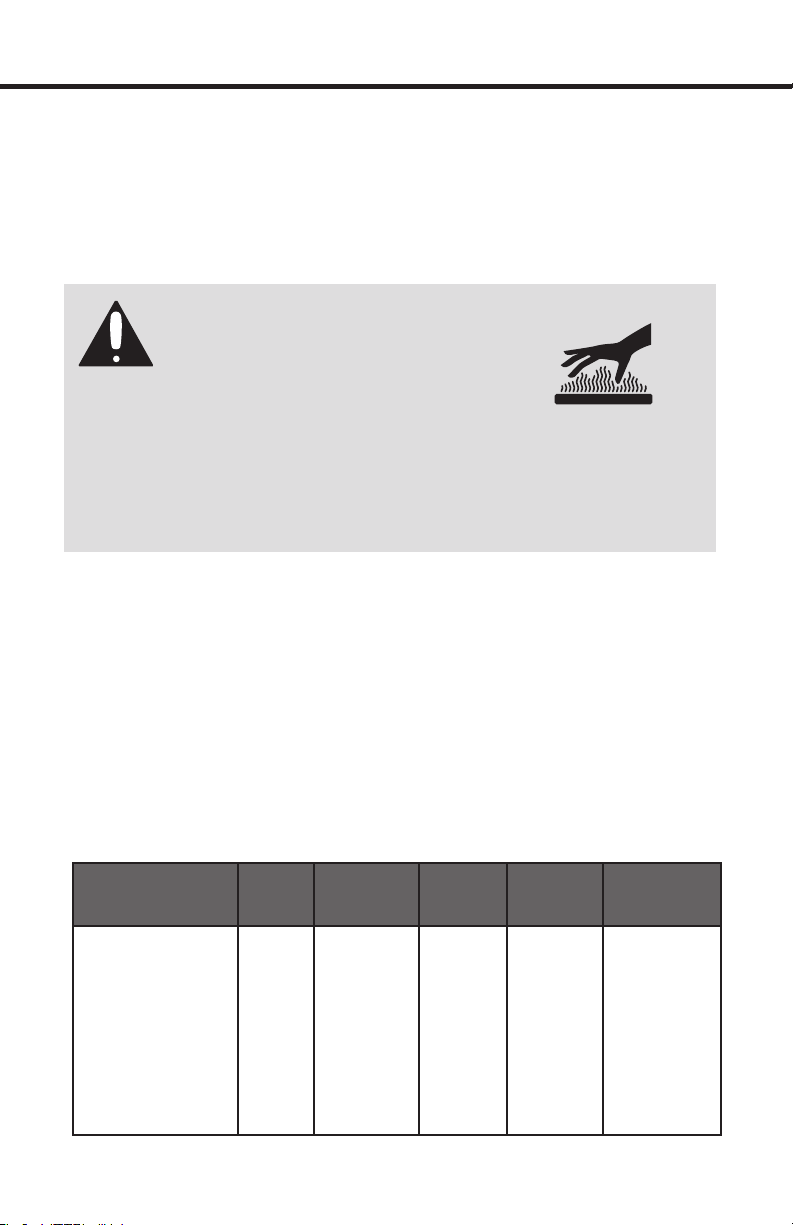
CONVECTION BAKE CHART
Reduce standard recipe temperature by 25 ºF (15 °C) for Convection
Bake. Temperatures have been reduced in this chart.
FOOD ITEM
RACK
POSITION
TEMP. °F (°C)
(PREHEATED OVEN)
TIME (MIN)
Cake
Cupcakes
Bundt Cake
Angel Food
2
1
1
325 (160)
325 (160)
325 (160)
20-22
43-50
43-47
Pie
2 crust, fresh, 9"
2 crust, frozen fruit, 9"
2
2
350-400 (175-205)
350 (175)
40-52
68-78
Cookies
Sugar
Chocolate Chip
Brownies
2
2
2
325-350 (160-175)
325-350 (160-175)
325 (160)
9-12
8-13
29-36
Breads
Yeast bread loaf, 9x5
Yeast rolls
Biscuits
Muffins
2
2
2
2
350 (175)
350-375 (175-190)
375 (190)
400 (205)
18-22
12-15
8-10
17-21
Pizza
Frozen
Fresh
2
2
375-425 (190-220)
450 (232)
23-26
15-18
Oven Use
WARNING
Burn Hazard
24
CONVECTION ROAST TIPS
•
Do not preheat for Convection Roast.
•
Roast in a low-sided, uncovered pan.
•
When roasting whole chickens or turkey, tuck wings behind back and
loosely tie legs with kitchen string.
•
Use the 2-piece broil pan for roasting uncovered.
Use an oven mitt to remove temperature probe.
Do not touch broil element.
Failure to do so can result in burns.
•
Use the probe or a meat thermometer to determine the internal doneness
on “END” temperature (see cooking chart).
•
Double-check the internal temperature of meat or poultry by inserting
meat thermometer into another position.
•
Large birds may also need to be covered with foil (and pan roasted)
during a portion of the roasting time to prevent over-browning.
•
The minimum safe temperature for stuffing in poultry is 165ºF (75ºC).
•
After removing the item from the oven, cover loosely with foil for 10
to 15 minutes before carving if necessary to increase the final
food temperature by 5° to 10°F (3° to 6° C).
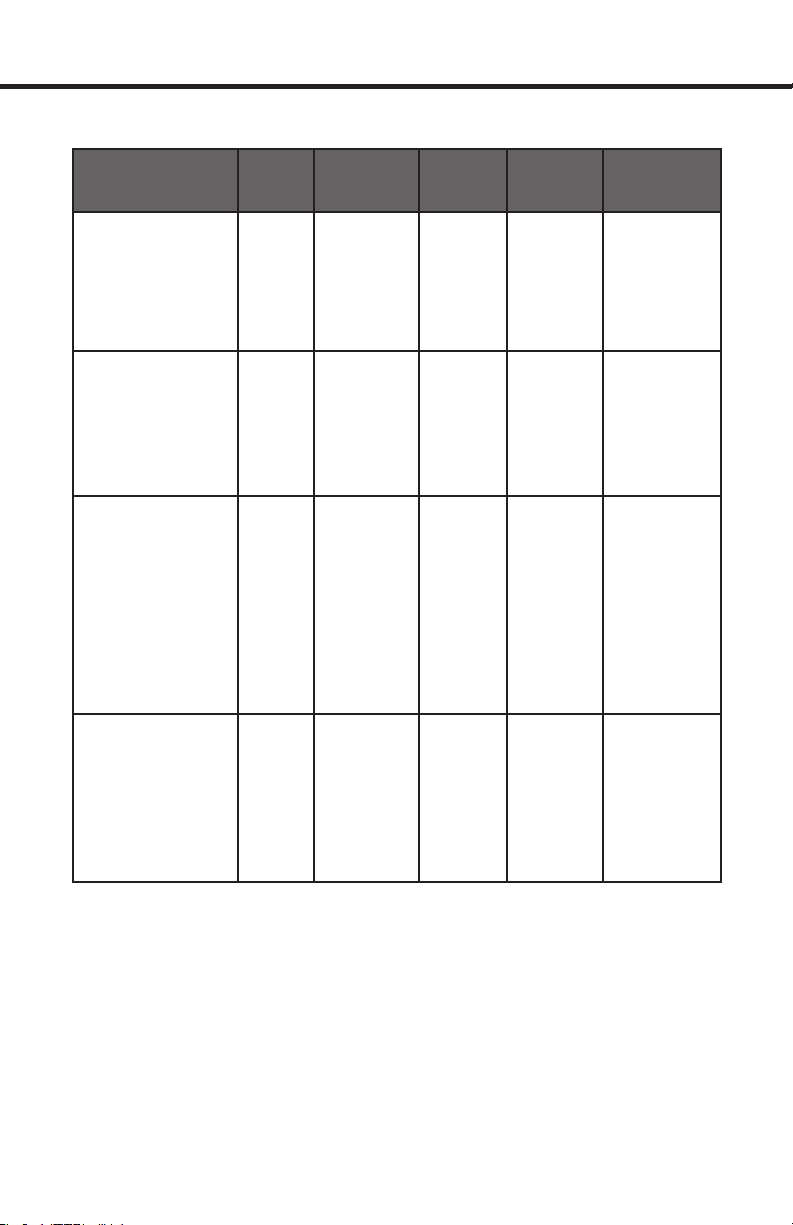
CONVECTION ROAST CHART
MEATS
WEIGHT
(lb)
OVEN TEMP.
°F (°C)
RACK
POSITION
TIME
(min. per
lb)
INTERNAL
TEMP. °F (°C)
Beef
Rib Roast 4-6 325 (160) 2 16-20
18-22
145 (63)
medium rare
160 (71)
medium
Rib Eye Roast,
(boneless)
4-6 325 (160) 2 16-20
18-22
145 (63)
medium rare
160 (71)
medium
Oven Use
25
MEATS
WEIGHT
(lb)
OVEN TEMP.
°F (°C)
RACK
POSITION
TIME
(min. per
lb)
INTERNAL
TEMP. °F (°C)
Rump, Eye, Tip,
Sirloin
(boneless)
3-6 325 (160) 2 16-20
18-22
145 (63)
medium rare
160 (71)
medium
Tenderloin Roast 2-3 400 (205) 2 15-20 145 (63)
medium rare
Pork
Loin Roast
(boneless or
bone-in)
5-8 350 (175) 2 16-20 160 (71)
medium
Shoulder 3-6 350 (175) 2 20-25 160 (71)
medium
3-4 375 (190) 2 18-21 180 (82)
12-15 325 (160) 1 10-14 180 (82)
16-20 325 (160) 1 9-11 180 (82)
21-25 325 (160) 1 6-10 180 (82)
3-8 325 (160) 1 15-20 170 (77)
Poultry
Chicken whole
Turkey, not stuffed
Turkey, not stuffed
Turkey, not stuffed
Turkey Breast
Comish Hen
1-1 ½ 350 (175) 2 45-75
total
180 (82)
Lamb
Half Leg 3-4 325 (160) 2 22-27
28-33
160 (71)
medium
170 (77) well
Whole Leg 6-8 325 (160) 1 22-27
28-33
160 (71)
medium
170 (77) well
Oven Use
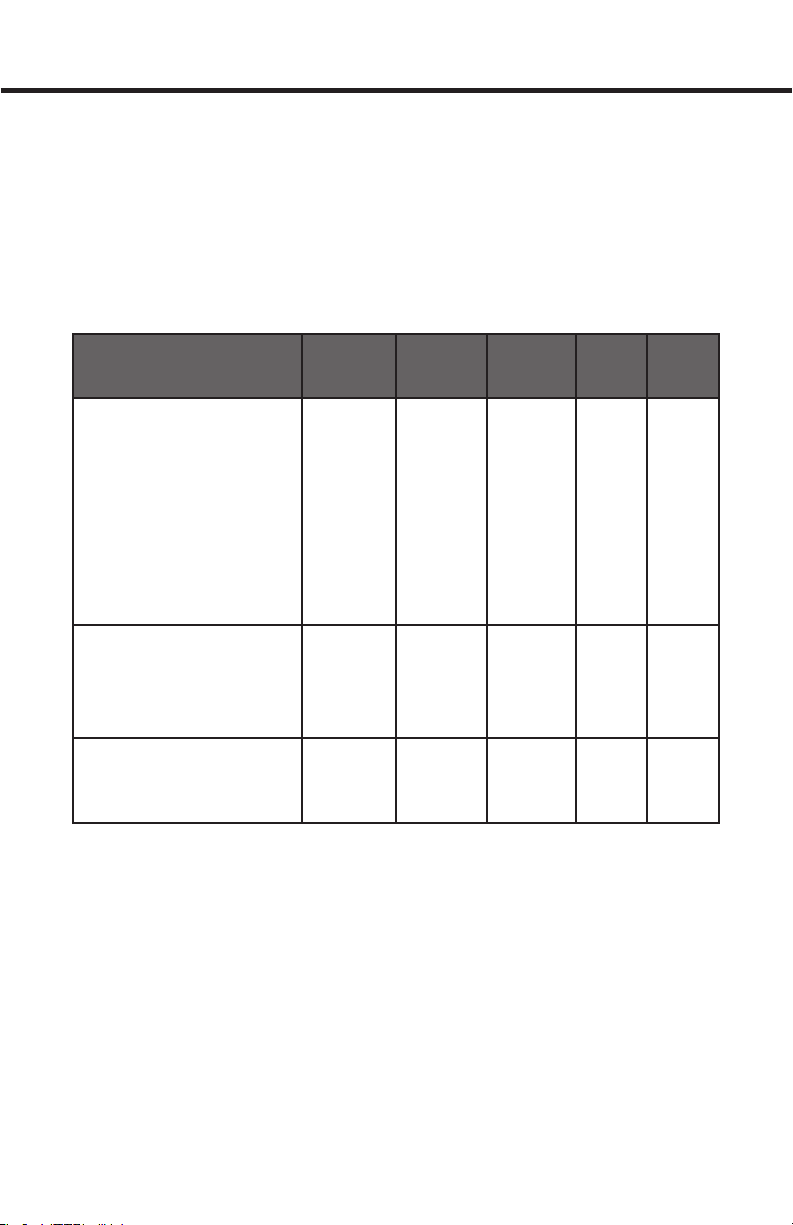
26
CONVECTION BROIL TIPS
•
Place rack in the required position needed before turning on the oven.
•
Use Convection Broil mode with the oven door closed.
•
Do not preheat oven.
•
Use the 2-piece broil pan.
•
Turn meats once halfway through the cooking time (see convection broil chart).
CONVECTION BROIL CHART
FOOD AND THICKNESS
RACK
POSITION
BROIL
SETTING
°F (°C)
INTERNAL
TEMP. °F
(°C)
TIME
SIDE 1
(MIN.)*
TIME
SIDE 2
(MIN.)*
4 450 (235) 145 (65) 9-12 8-10
4 450 (235) 160 (71) 11-13 10-12
4 450 (235) 170 (77) 18-20 16-17
4 550 (290) 160 (71) 8-11 5-7
Beef
Steak (1½" or more)
Medium rare
Medium
Well
Hamburgers (more than 1")
Medium
Well
4 550 (290) 170 (77) 11-13 8-10
4 450 (235) 180 (82) 16-18 10-13
3 450 (235) 180 (82) 25-27 15-18
Poultry
Chicken Quarters
Chicken Halves
Chicken Breasts
4 450 (235) 170 (77) 13-15 9-13
4 450 (235) 160 (71) 12-14 11-13
Pork
Pork Chops (1¼" or more)
Sausage - fresh
4 450 (235) 160 (71) 4-6 3-5
DEHYDRATE TIPS
The circulating heated air at a lower temperature slowly removes the moisture
for food preservation.
•
Oven temperature for dehydrating is between 120ºF (50ºC) to 160ºF (70ºC).
•
Multiple racks can be used simultaneously.
•
Some foods require as much as 14-15 hours of time to fully dehydrate.
•
Consult a food preservation book for specific times and the handling of
various foods.
•
This mode is suitable for a variety of fruits, vegetables, herbs and meat strips.
•
Drying screens can be purchased at specialty kitchen shops.
•
By using paper towels, some food moisture can be absorbed before
dehydrating begins (such as with sliced tomatoes or sliced peaches).
Oven Use
27
DEHYDRATE CHART
FOOD PREPARATION
APPROXIMATE
DRYING TIME*
(hrs)
TEST FOR DONENESS
Fruit
Apples Dipped in ¼ cup
lemon juice and 2
cups water, ¼ slices
11-15 Slightly pliable
Bananas Dipped in ¼ cup
lemon juice and 2
cups water, ¼ slices
11-15 Slightly pliable
Cherries Wash and towel dry.
For fresh cherries,
remove pits
10-15 Pliable,
leathery, chewy
Oranges Peels
and slices
¼ slices of
orange; orange
part of skin thinly
peeled from
oranges
Peels 2-4
Slices: 12-16
Orange peel:
dry and brittle
Orange slices:
skins are dry
and brittle, fruit
is slightly moist
Pineapple rings Towel dried Canned: 9-13
Fresh: 8-12
Soft and pliable
Strawberries Wash and towel dry.
Sliced ½" thick,
skin (outside) down
on rack
12-17 Dry, brittle
Vegetable
Peppers Wash and towel dry.
Remove membrane
of pepper,
coarsely chopped
about 1" pieces
16-20 Leathery with
no moisture
inside
Mushrooms Wash and towel dry.
Cut of stem end. Cut
into 1/8" slices
7-12 Tough and
leathery, dry
Tomatoes Wash and towel dry.
Cut this slices, 1/8"
thick, dry well
16-23 Dry, brick red color
Herbs
Oregano, sage
parsley and
thyme, and fennel
Rinse and dry
with paper towel
Dry at 120°F
(60°C) 3-5 hrs
Crisp and brittle
Basil Use basil leaves 3 to 4
inches from top. Spray
with water, shake off
moisture and pat dry
Dry at 120°F
(60°C) 3-5 hrs
Crisp and brittle
Oven Use
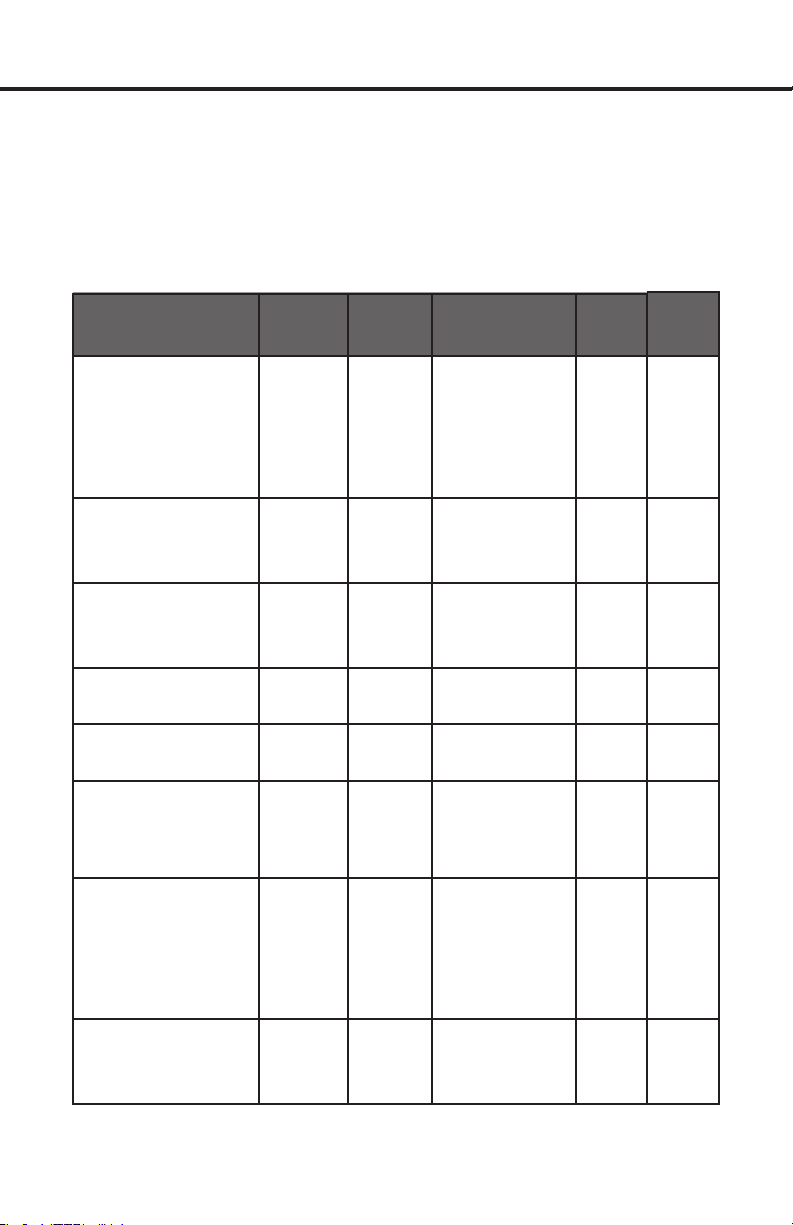
28
BROIL TIPS
•
Place rack in the required position needed before turning on the oven.
•
Use Broil mode with the oven door closed.
•
Preheat oven for 5 minutes before use.
•
Use the 2-piece broil pan.
•
Turn meats once halfway through the cooking time (see convection broil chart).
BROIL CHART
FOOD AND THICKNESS
RACK
POSITION
BROIL
SETTING
°F (°C)
INTERNAL TEMP.
°F (°C)
TIME
SIDE 1
(MIN.)*
TIME
SIDE 2
(MIN.)*
Beef
Steak (¾"-1)
Medium rare 5 5 145 (65) 5-7 4-6
Medium 5 5 160 (71) 6-8 5-7
Well 5 5 170 (77) 8-10 7-9
4 5 160 (71) 8-11 6-9
Hamburgers (¾"-1")
Medium
Well
4 5 170 (77) 10-13 8-10
4 4 170 (77) 10-12 8-10
Poultry
Breast (bone-in)
Thigh (very well done)
4 3 180 (82) 28-30 13-15
Pork
Pork Chops (1") 5 5 160 (71) 7-9 5-7
5 5 160 (71) 5-7 3-5Sausage - fresh
Ham Slice (½")
5 5 160 (71) 4-6 3-5
Seafood
Fish Filets, 1"
Buttered
4 4
Cook until
opaque &
flakes easily
with fork
10-14 Do not
turn
Lamb
Chops (1")
Medium Rare 5 5 145 (63) 5-7 4-6
Medium 5 5 160 (71) 6-8 4-6
Well 5 5 170 (77) 7-9 5-7
4 5 2-2,30
Bread
Garlic Bread, 1" slices
Garlic Bread, 1" slices
3 5 4-6
* Broiling and convection broiling times are approximate and may vary slightly
Cooking times are indicative and also depend on the thickness and the starting
temperature of the meat before cooking .
Oven Use
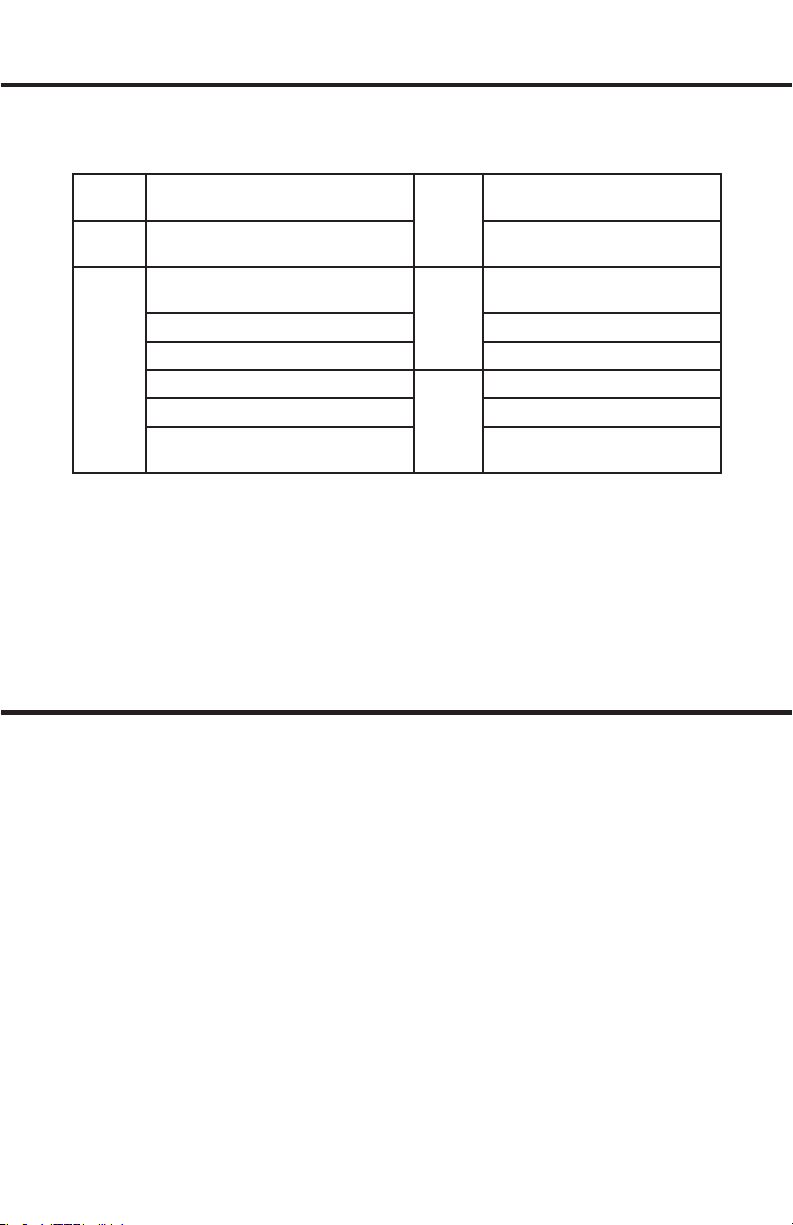
29
FOOD SERVICE TEMPERATURE GUIDELINES FROM
FSIS (USDA FOOD SAFETY & INSPECTION SERVICE)
140°F
(60°C)
Ham, precooked ( to Reheat)
165°F
(74°C)
Stuffing (cooked alone or
in bird)
145°F
(63°C)
Fresh beef, Veal, Lamb
(medium rare)
Leftovers & Casseroles
160°F
(71°C)
Ground Meat & Meat mixtures
(Beef, Pork, Veal Lamb)
170°F
(77°C)
Fresh beef, Veal, Lamb
(well done)
Fresh beef, Veal, Lamb (medium) Poultry breast
Fresh Pork (medium) Fresh Pork (well done)
Fresh Ham (raw)
180°F
(82°C)
Chicken and Turkey (Whole)
Egg Dishes Poultry (thighs and wings)
Ground Meat & Meat
mixtures (Turkey, Chicken)
Duck and Goose
NOTE: Eggs (alone, not used in a recipe) – cook until yolk & white are firm
Meat Thermometer
On models without a temperature probe, use a meat thermometer to
determine whether meat, poultry and fish are cooked to the desired degree of
doneness. The internal temperature, not appearance, should be used to
determine doneness.
GENERAL CLEANING
IMPORTANT: Before Cleaning, make sure all controls are off and the oven is
cool. Always follow the instructions printed on the label of the cleaning products.
USING THE CLEANING CHART
1. Locate the number of the part to be cleaned in the following illustration.
2. Find the part name in the chart.
•
Use the cleaning method in the left column if the oven is black or white.
•
Use the cleaning method in the right column if the oven is stainless steel.
3. Match the letter with the cleaning method on following chart.
Oven Use
Oven Care
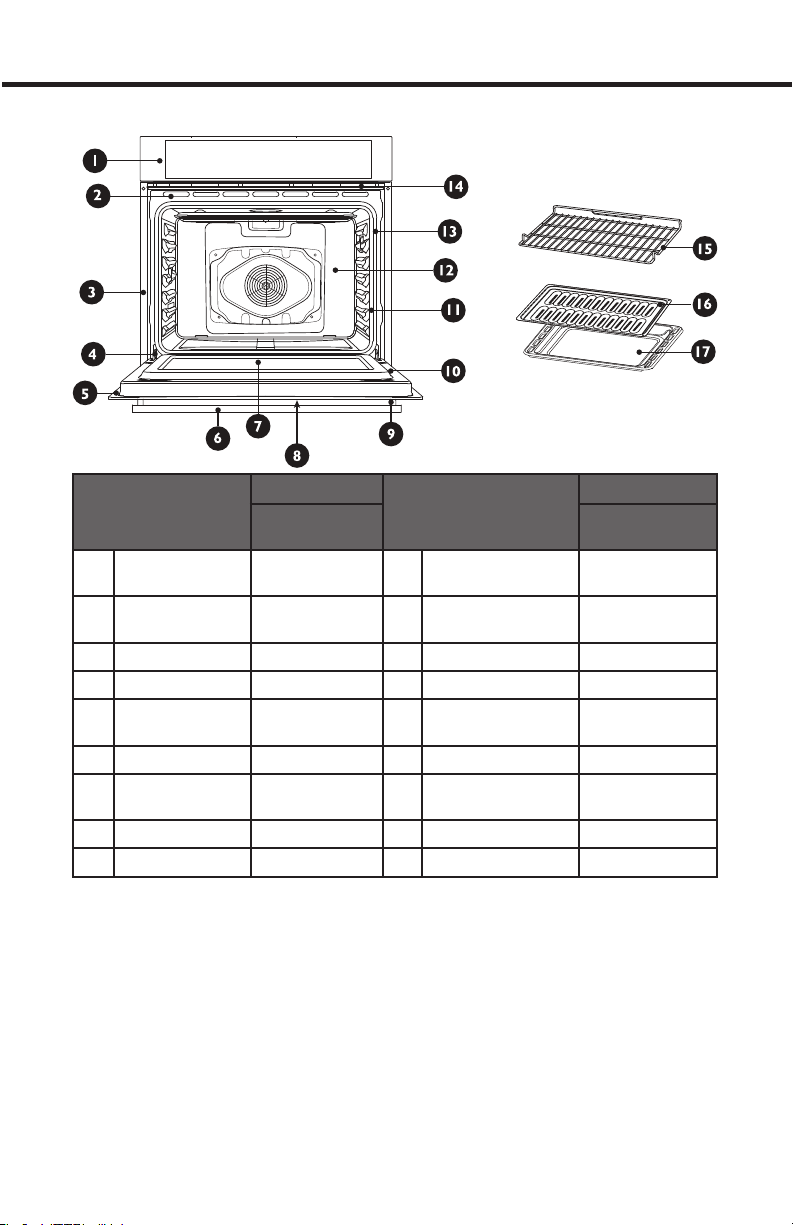
30
Part
Cleaning Method
Part
Cleaning Method
Stainless Steel
Oven
Stainless Steel
Oven
1 Control Panel C-G 10 Interior Oven
Door
E
2 Door Cooling
Vent
E 11 Oven Front Frame E
3 Side Trim D 12 Oven Cavity E
4 Bottom Trim D 13 Door Gasket B
5 Door Frame E 14 Oven Cooling
Vents
D
6 Door Handle G 15 Oven Rack A
7 Interior Door
Windows
F 16 Broiler Pan Rack E
8 Door Front C&G 17 Broiler Pan E
9 End Caps D
OVEN FINISHES / CLEANING METHODS
The entire oven can be safely cleaned with a soapy sponge, rinsed and dried. If
stubborn soil remains, follow the recommended cleaning methods below.
•
Always use the mildest cleaner that will do the job.
•
Rub metal finishes in the direction of the grain.
•
Use clean, soft cloths, sponges or paper towels.
•
Rinse thoroughly with a minimum of water so it does not drip into door slots.
•
Dry to avoid water marks.
The cleaners listed below indicate types of products to use and are not
being endorsed. Use all products according to package directions.
Oven Care
31
Part Cleaning Method
A Chrome
Plated
Wash with hot sudsy water. Rinse thoroughly and dry. Or, gently
rub with Soft Scrub
®
, Bon-Ami
®
, Comet
®
, Ajax
®
, Brillo
®
or
S.O.S.
®
pads as directed.
Easy Off
®
or Dow
®
Oven Cleaners (cold oven formula) can be
used, but may cause darkening and discoloration.
Racks may be cleaned in the oven during the Self-Cleaning
mode. However, chromed racks will lose their shiny finish and
permanently change to a metallic gray.
B Fiberglass
Knit
DO NOT HAND CLEAN GASKET.
C Glass
Spray Windex
®
or Glass Plus
®
onto a cloth first, then wipe to
clean. Use Fantastik
®
or Formula 409
®
to remove grease spatters.
D Painted Clean with hot sudsy water or apply Fantastik® or Formula
409
®
first to a clean sponge or paper towel and wipe clean.
Avoid using powdered cleansers and steel wool pads.
E Porcelain
Immediately wipe up acidic spills like fruit juice, milk and
tomatoes with a dry towel. Do not use a moistened sponge/
towel on hot porcelain. When cool, clean with hot sudsy water
or apply Bon-Ami
®
or Soft Scrub
®
to a damp sponge. Rinse and
dry. For stubborn stains, gently use Brillo
®
or S.O.S.
®
pads. It is
normal for porcelain to craze (fine lines) with age due to
exposure from heat and food soil.
F Reflective
Glass
Clean with hot sudsy water and sponge or plastic scrubber.
Rub stubborn stains with vinegar, Windex
®
, ammonia or Bon-
Ami
®
DO NOT USE HARSH ABRASIVES.
G Stainless
Always wipe or rub with grain. Clean with a soapy sponge then
rinse and dry. Or, wipe with Fantastik
®
or Formula 409
®
sprayed
onto a paper towel. Protect and polish with Stainless Steel
Magic
®
and a soft cloth. Remove water spots with a cloth
dampened with white vinegar. Use Zud
®
, Cameo
®
, Bar Keeper’s
Friend
®
or RevereWare Stainless Steel Cleaner
®
, to remove heat
discoloration.
AUTOMATIC SELF-CLEANING
Do not touch the oven during the Self-Cleaning cycle.
Keep children away from oven during Self-Cleaning cycle.
Failure to do so can result in burns.
This oven features a self-cleaning function that eliminates the need to manually
scrub the oven interior. During self-cleaning, the oven uses very high
temperatures, burning soil to a powdery ash.
Oven Care
WARNING
Burn Hazard

32
IMPORTANT: The health of some birds is extremely sensitive to the fumes given
off during the Self-Cleaning cycle. Exposure to
the fumes may result in death to
certain birds. Always move birds to another closed and well-ventilated room.
•
Keep the kitchen well ventilated during the Self-Cleaning cycle to help get
rid of heat, odors and smoke.
•
It is common to see smoke and/or an occasional flame-up during the Self-
Clean cycle, depending on the content and amount of soil remaining in the
oven. If a flame persists, turn off the oven and allow it to cool before
opening the door to wipe up the excessive food soil.
•
Do not block the oven vent(s) during the Self-Cleaning cycle. Air must be
able to move freely. See “Oven Vents.”
•
Do not clean, rub, damage or move the oven door gasket.
•
The door latch is automatically activated after selecting the Self-Clean
cycle. “AUTO LOCK” will appear in the display. This ensures that the oven
door cannot be opened while the oven interior is at clean temperatures.
•
Suggested clean times are 2 hours for light soil and between 3.0 hours
and 3.5hours for average to heavy soil.
•
Clean mode stops automatically at the end of the set cleaning time.
•
When the oven heat drops to a safe temperature, the automatic door lock
will release and the door can be opened.
•
The oven light does not operate during Clean mode.
BEFORE SELF-CLEANING
1. Remove all utensils and bakeware.
2. Remove non-porcelain oven racks. If chromed racks are left in the oven
during the self-clean cycle, they will permanently lose the shiny finish and
change to a dull dark finish. See “Oven Finishes/Cleaning Methods” for
proper care.
3. Wipe up any soft soil spills and grease with paper towels. Excess
grease will cause flames and smoke inside the oven during self-
cleaning.
4. Be sure oven interior lights are turned off and the light bulbs and lens
covers are in place.
5. Some areas of the oven such as the oven door edge, oven door window,
oven front frame and up to 1½" (2-3 cm) inside the frame do not get hot
enough during the cleaning cycle for soil to burn away and must be
cleaned by hand. BEFORE the cycle begins, clean oven interior using a
soapy sponge or plastic scrubber and a solution of detergent and hot
water. Rinse and dry all areas thoroughly.
NOTE: Do not rub the oven door gasket.
Oven Care
CAUTION: DO NOT LEAVE FOOD OR COOKING UTENSILS, ETC., IN OVEN
DURING THE PYROLYTIC SELF-CLEANING MODE OF OPERATION
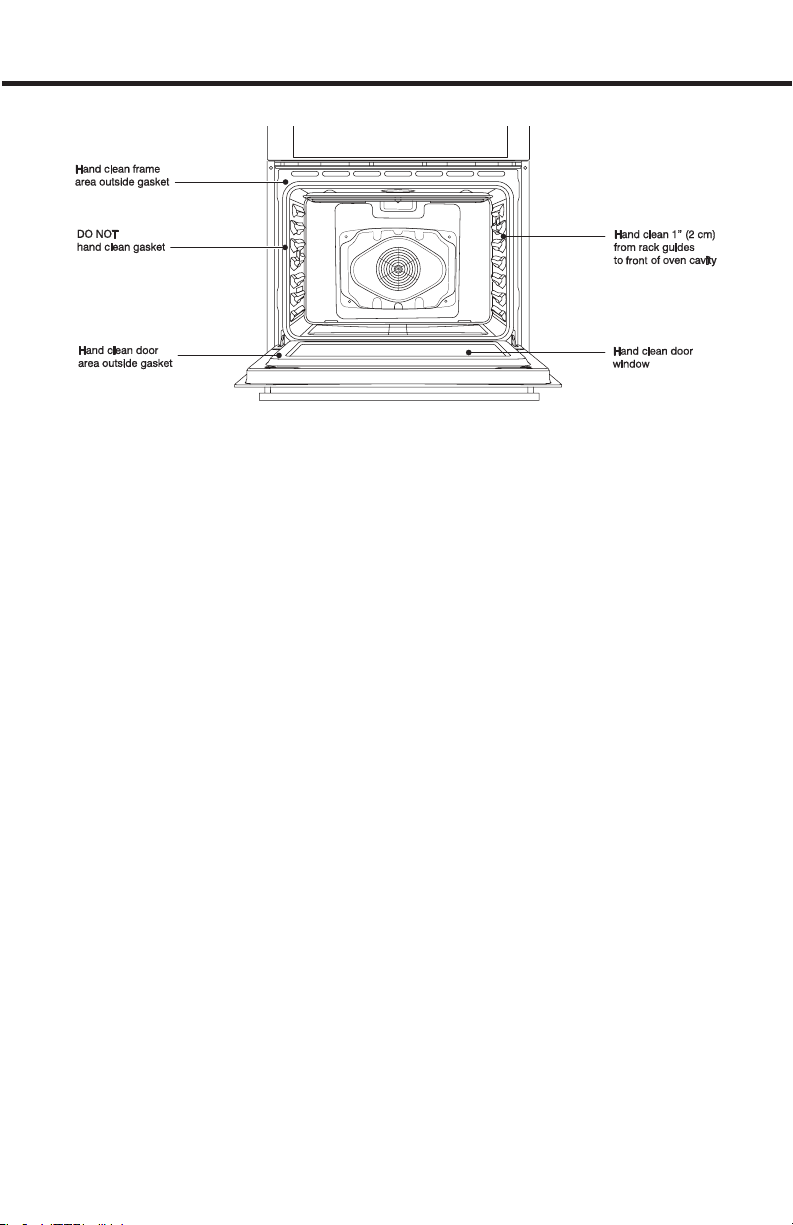
33
SELF-CLEAN CYCLE
A minimum 24-hour wait is recommended between cleaning cycles.
To Self-Clean:
1. Close the oven door.
2. Press SELF CLEAN. “REMOVE RACKS” will scroll in the selected oven
text area of the display.
3. “2:00 3:00 3:30” will appear in the display.
4. Use the number keypad to select the clean level.
5. If you want to delay the start of the self-cleaning cycle, press START
TIME, and then set a time, by pressing the number keypad.
6. Press START.
After the door is locked, “Oven is cleaning” will scroll in the selected text
area until the clean cycle is finished.
When the Self-clean Cycle Ends:
“COMPLETE” appears in the display.
7. Once the oven has completely cooled, remove ash with a damp cloth.
NOTE: To avoid breaking the glass, do not apply a cool, damp cloth to the
inner door glass before it has cooled completely.
Oven Care
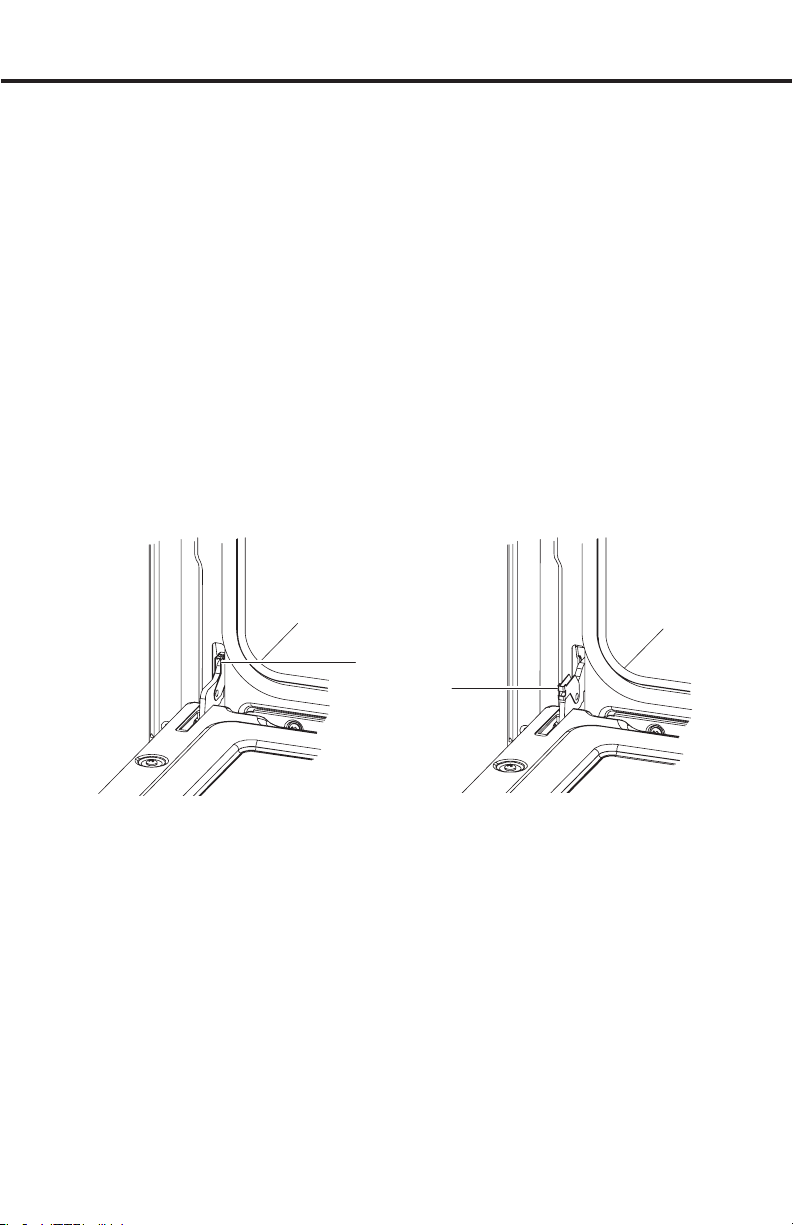
34
OVEN DOOR REMOVAL
For normal oven use, there is no need to remove the oven door. However, should
it become necessary to remove the door, follow the instructions in this section.
IMPORTANT:
•
Make sure oven is cool and that power to the oven has been turned off before
removing the door.
•
The oven door is heavy and fragile, and the door front is glass. To avoid
oven door glass breakage, use both hands, and grasp only the sides of the
oven door to remove. Do not grasp the handle.
•
Be sure both levers are securely in place before removing the door.
•
Do not force door open or closed.
To Remove the Oven Door:
1. Open the door completely.
2. Flip up the hinge latch on each side.
a
a
a Hinge Bracket
3. Holding the door firmly, close the oven door completely.
4. Grasping both sides lift up on the oven door while pushing it closed, and
then pull it away from the door frame.
5. Place the door in a protected location.
Oven Care
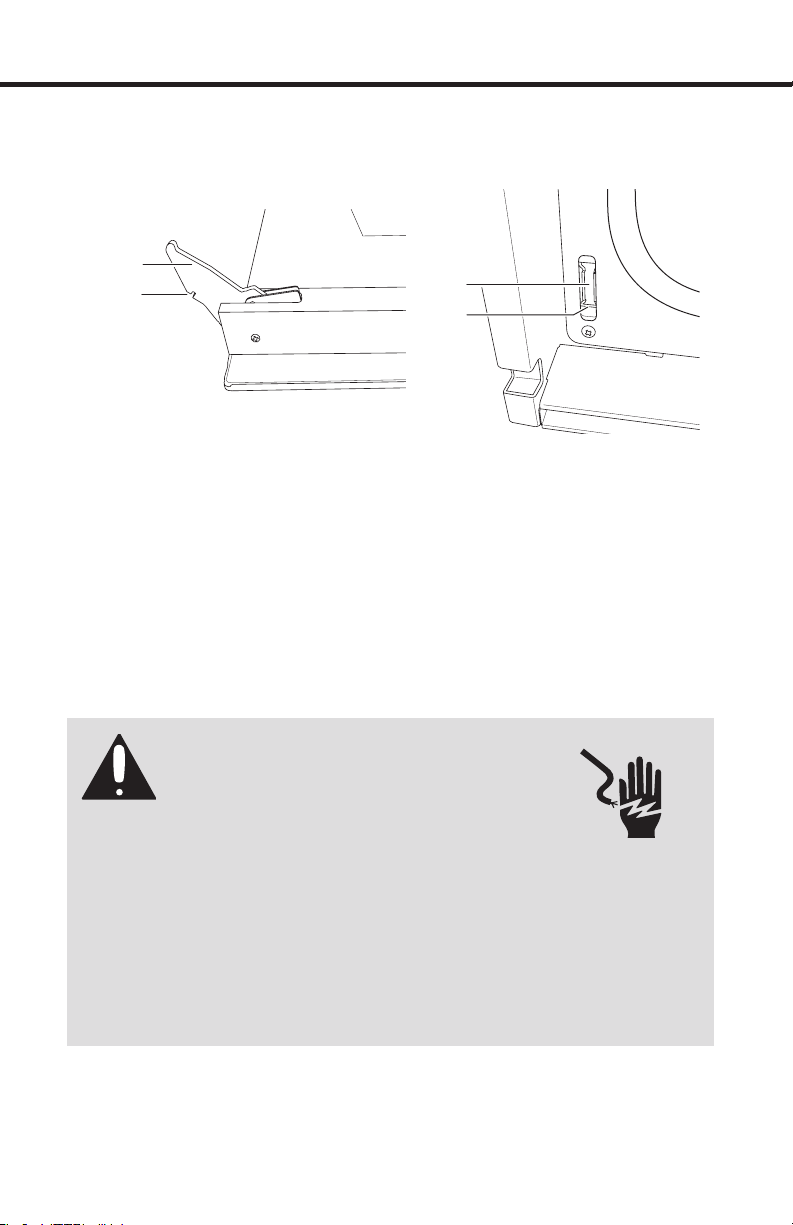
WARNING
Electrical Shock Hazard
35
To Replace the Oven Door:
1. Holding the door firmly, insert the upper arms of both hinges into the slots. The
recesses must hook on the lips.
a
b
c
d
a Upper Arm
b Recess
c Slots
d Lip
2. Open the oven door.
NOTE: You should hear a “click” sound when the door is correctly in place.
3. Move the hinge latch on each side back into the locked position.
4. Open and close the door to test that it operates freely. If it does not, repeat
the door removal and replacement process.
5. Close and open the door slowly to assure that it is correctly and securely in
place.
REPLACING AN OVEN LIGHT
Make sure the oven and lights are cool and power to the oven has
been turned off before replacing the light bulb(s).
The lenses must be in place when using the oven. The lenses
serve to protect the light bulb from breaking.
The lenses are made of glass. Handle carefully to avoid breakage.
Failure to do so could result in death, electric shock, cuts or burns.
The oven light is a standard 25 watt (G9) appliance bulb.
IMPORTANT: Before replacing the bulb, make sure the oven is cool and the
controls are turned off.
Oven Care
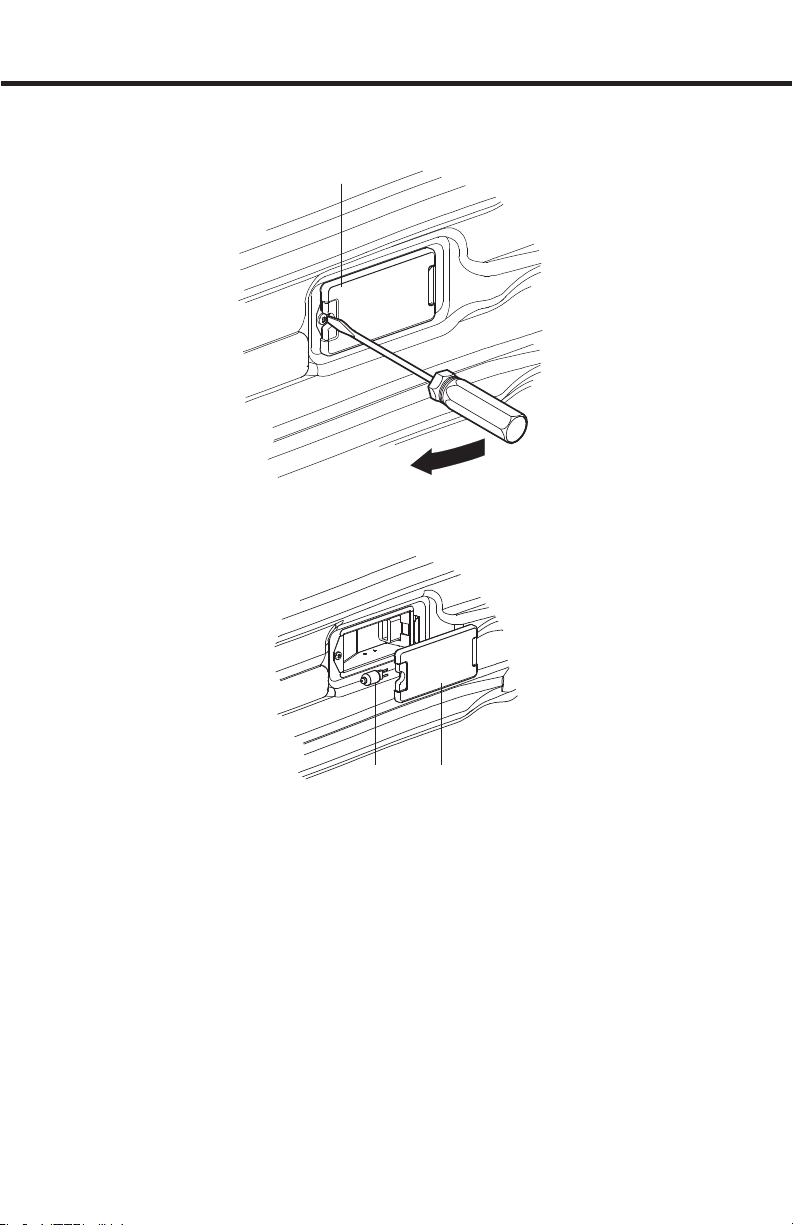
36
1. Disconnect power at the main power supply (fuse or breaker box).
2. Using a Phillips-head screwdriver, remove the screw, and then remove the cover.
a
a Light Cover
3. Remove the burned out bulb from the socket.
a b
a Light Bulb
b Light Cover
NOTE: To avoid damage or decreasing the life of the new bulb, do not touch bulb
with bare fingers. Wear cotton gloves or use a tissue when replacing the light bulb.
4. Replace the bulb, and then replace the bulb cover.
5. Reconnect power at the main power supply (fuse or breaker box).
Oven Care
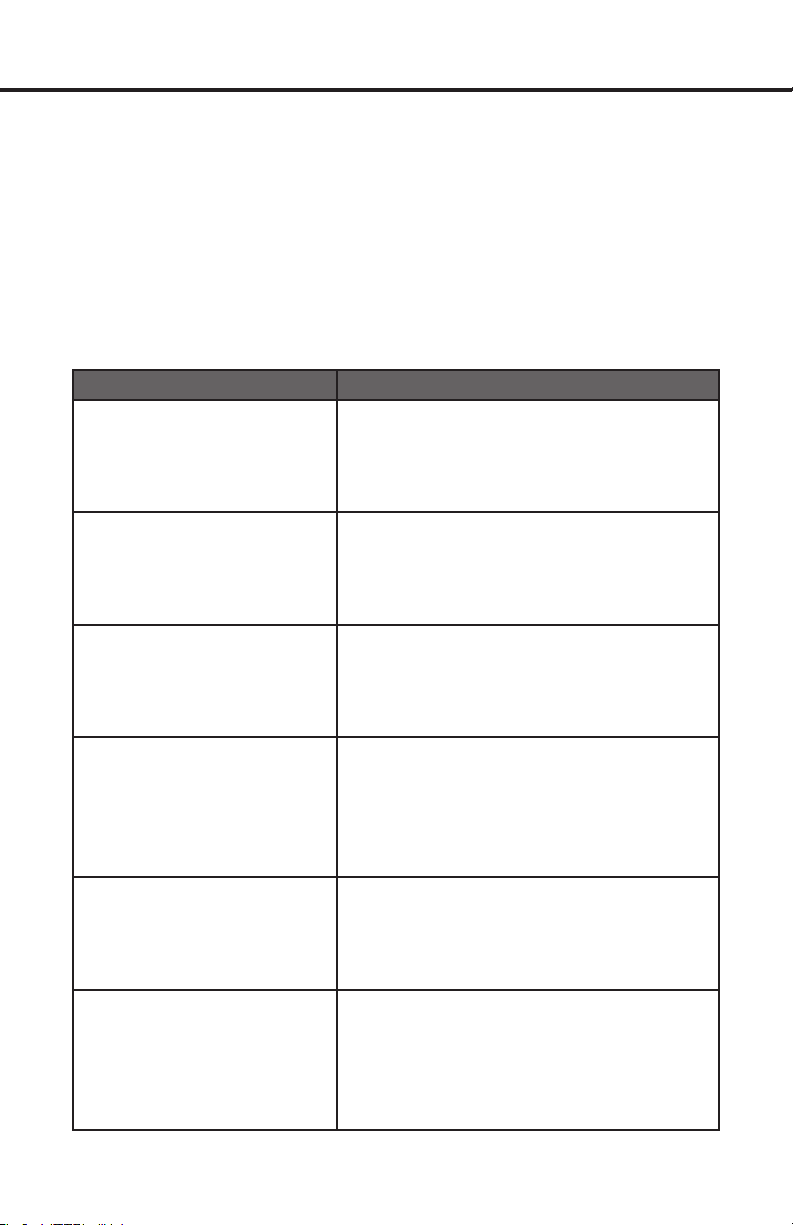
37
First try the solutions suggested here to possibly avoid the cost of a service call.
BAKING AND ROASTING
With either Bake or Convection Bake and Convection Roast poor results can
occur for many reasons other than a malfunction of the oven. Check the chart
below for causes of the most common problems. Since the size, shape and
material of baking utensils directly affect the baking results, the best solution
may be to replace old baking utensils that have darkened and warped with age
and use. Check the Baking Charts for the correct rack position and baking
time.
BAKING PROBLEM CAUSE
Food browns unevenly
•
Oven not preheated
•
Aluminum foil on oven rack or oven bottom
•
Baking utensil too large for recipe
•
Pans touching each other or oven walls
Food too brown on bottom
•
Oven not preheated
•
Using glass, dull or darkened metal pans
•
Incorrect rack position
•
Pans touching each other or oven walls
Food is dry or has
shrunk excessively
•
Oven temperature too high
•
Baking time too long
•
Oven door opened frequently
•
Pan size too large
Food is baking or roasting
too slowly
•
Oven temperature too low
•
Oven not preheated
•
Oven door opened frequently
•
Tightly sealed with aluminum foil
•
Pan size too small
Piecrusts do not brown
on bottom or crust is
soggy
•
Baking time not long enough
•
Using shiny steel pans
•
Incorrect rack position
•
Oven temperature is too low
Cakes pale, flat and may not
be done inside
•
Oven temperature too low
•
Incorrect baking time
•
Cake tested too soon
•
Oven door opened too often
•
Pan size may be too large
Troubleshooting
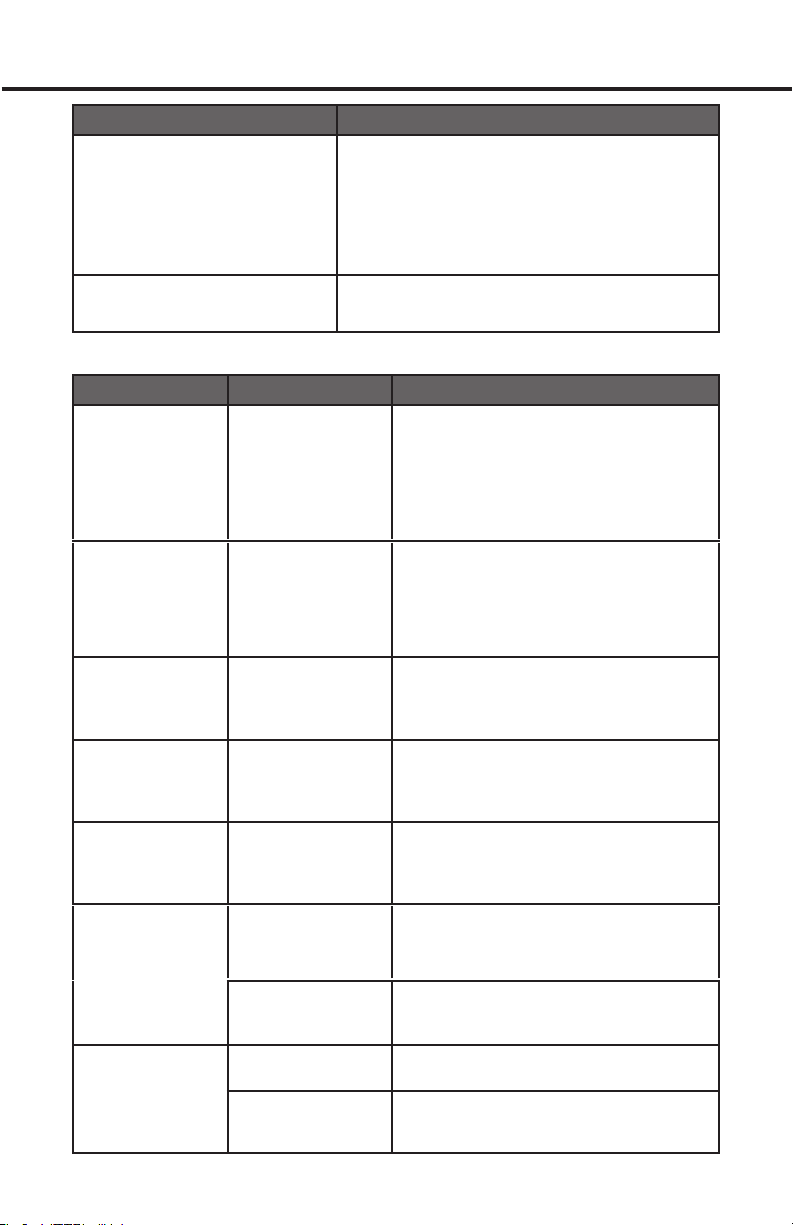
38
BAKING PROBLEM CAUSE
Cakes high in middle with
crack on top
•
Oven temperature too high
•
Baking time too long
•
Pans touching each other or oven walls
•
Incorrect rack position
•
Pan size too small
Piecrust edges too brown
•
Oven temperature too high
•
Edges of crust too thin
OPERATION
PROBLEM POSSIBLE CAUSE SOLUTION
F03 or F04
Error appears
in the display
window.
A problem with
latch
mechanism
occurred.
Turn off power at the main power
supply (fuse or breaker box), wait a
few seconds and turn it back on
again. The oven should run a latch
auto–test. If condition persists, note
the code number and call an
authorized service center.
Other F_ Error
appears in the
display
window.
Turn off power at the main power
supply (fuse or breaker box), wait a
few seconds and turn it back on
again. If condition persists, note the
code number and call an authorized
service center.
The oven
display does
not illuminate.
Turn off power at the main power
supply (fuse or breaker box). Turn
breaker back on. If condition persists,
call an authorized service center.
Cooling fan
continues to
run after oven
is turned off.
The oven
components
have not cooled
sufficiently.
The fan turns off automatically when
the electronic components have
cooled sufficiently.
Oven door is
locked and will
not release, even
after cooling.
Turn the oven off at the circuit
breaker and wait a few seconds. Turn
breaker back on. The oven should
reset itself and will be operable.
Oven is not
heating.
No power going
to the oven.
Turn on power at the main power
supply (fuse or circuit breaker box). If
condition persists, call a qualified
electrician.
Oven Mode or
Temperature
not selected.
Turn control knobs to select the
oven mode and temperature.
Oven is not
cooking evenly
Oven rack is not in
correct position.
Refer to cook charts for
recommended rack position.
Convection
Bake Mode
Always reduce recipe temperature by
25°F (15 °C) when baking with
Convention Bake mode.
Troubleshooting
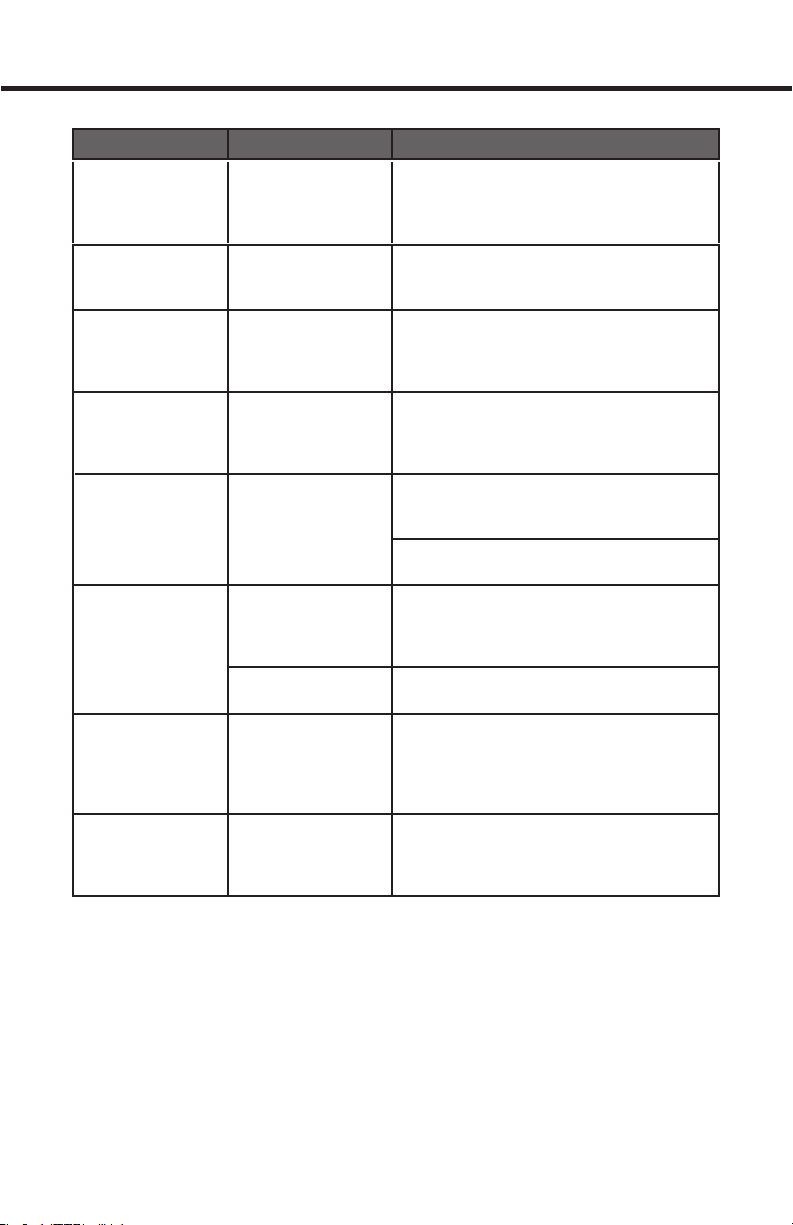
39
PROBLEM POSSIBLE CAUSE SOLUTION
Oven light is
not working
properly.
Light bulb is
loose or burned
out.
Replace or reinsert the light bulb if
loose or defective. Touching the bulb
with fingers may cause the bulb to
burn out.
Oven light
stays on.
Oven door
does not close
completely.
Check for obstruction in oven
door. Check to see if hinge is
bent or door switch is broken.
Cannot
remove lens
cover on light.
Lens cover is dirty. There may be a soil build-up around
the lens cover. Wipe lens cover area
with a clean dry towel prior to
attempting to remove the lens cover.
Oven will not
Self- Clean
properly.
Oven was still
warm when
Cleaning mode
was selected.
Allow the oven to cool before
running Self-Cleaning.
Oven is heavily
soiled.
Always wipe out loose soils or heavy
spillover before running Self-Cleaning.
See Preparing the Oven to Self-Clean.
If oven is badly soiled, set oven
for a 4-hour Self-Cleaning.
Clock and
timer are not
working
properly.
No power going
to the oven.
Turn on power at the main power
supply (fuse or circuit breaker box). If
condition persists, call an authorized
service center.
Clock or Timer
not set correctly.
See the Clock and Timer sections.
Excessive
moisture
Oven was
not properly
preheated.
When using bake mode, preheat
the oven first. Convection Bake and
Convection Roast will eliminate any
moisture in oven (one of the
advantages of convection).
Porcelain chips
Oven racks
removed
and replaced
incorrectly.
When oven racks are removed and
replaced, always tilt racks upward
and do not force them to avoid
chipping the porcelain.
Troubleshooting
FOR MORE HELP, VISIT ANCONAHOME.COM OR CALL
THE CONSUMER HELP LINE AT 1-800-350-4562.
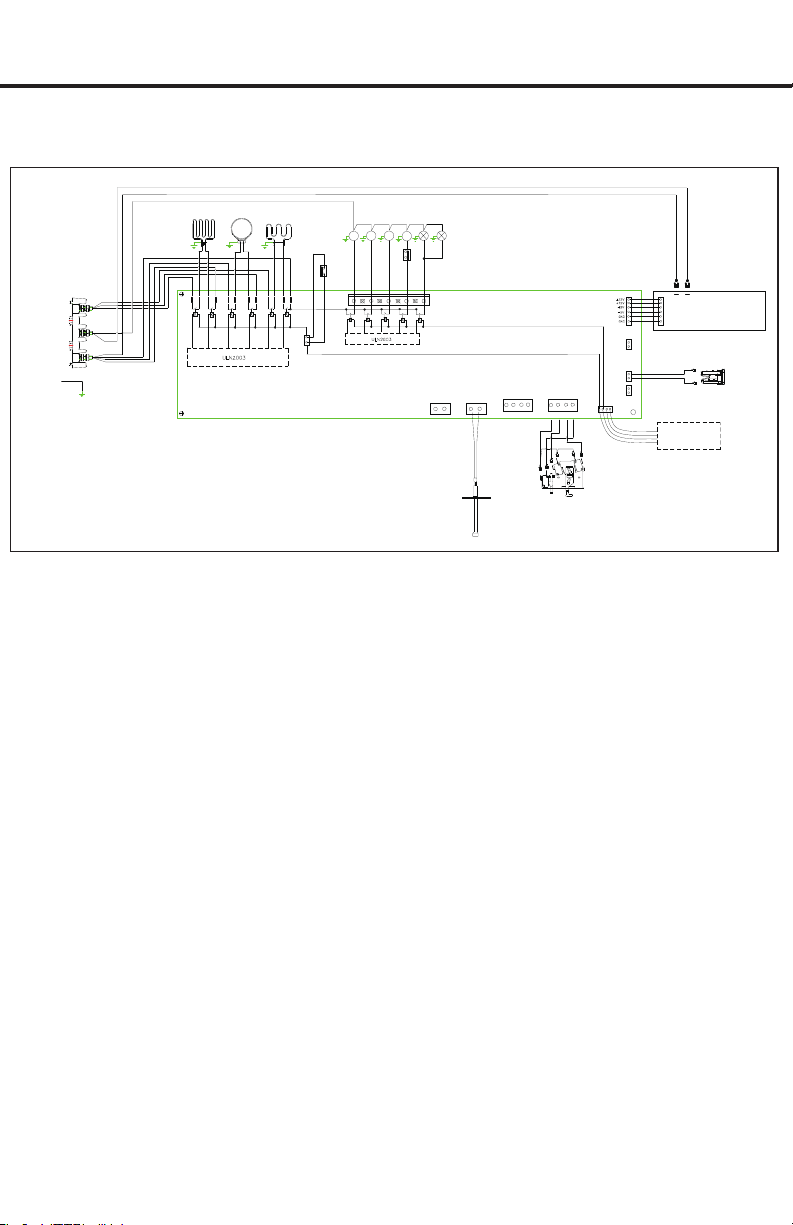
40
Circuit Diagram
PCB BOARD
PCB BOARD
DISPLAY
Top Grill
Back Grill
Bottom Grill
1
2
Cyc
fan
Lamp
Low
Cool fan
High
Cool fan
Latch
85 The
rm
al c
ut o
ff
1
20 Ther
mal cut of
f
L1(RED)
L2(BLACK)
N(WHITE)
G(GREEN)
Probe
GND
Baffle
GND
GND
Probe
probe_down
probe_up
Baffle
TO_SWPOWER
TO_DISP
L N
B Plug
UP_ HT_C UT
DO
OR
Lat
ch1
L
a
t
ch2
GND
DOOR
Latch1
Latch2
GND
A Plug
Probe socket
A68
A67
A65
A66
A42
A10
A43
A12
A52
A53
A54
A55
M
1
M
2
M
3
M
4
down sensor up sensor
Latch_door2
Latch_door1
L1
L
2
L
2
L1
L2
L1
Please register your product warranty by visiting the Ancona Home website.
Canada & USA
Phone : 1-800-350-4562
Fax : 800-350-8563
Email : [email protected]
Ancona is in association with Mr Appliance for all after sales service calls.
Please contact their service provider or visit their website:
Phone : 888-686-0778
MAAN2303-02
© 2017 Copyright of Ancona Home. All rights reserved. This material may not be reproduced,
displayed, modified or distributed.