


3
Safety and warnings 5
Safety features 7
Control panel 9
WiFi connection & remote mode 12
Wash cycles 14
Detergent and softener 16
Wash preparation 19
Getting started quickly 21
Customising a wash cycle 23
Factory reset 29
Caring for your washer 30
Before you call for service 35
Fault codes 37
Troubleshooting 38
Manufacturer’s warranty 43
Customer care 45
CONTENTS
Registration
To register your product visit our website: fisherpaykel.com/register

5
SAFETY AND WARNINGS
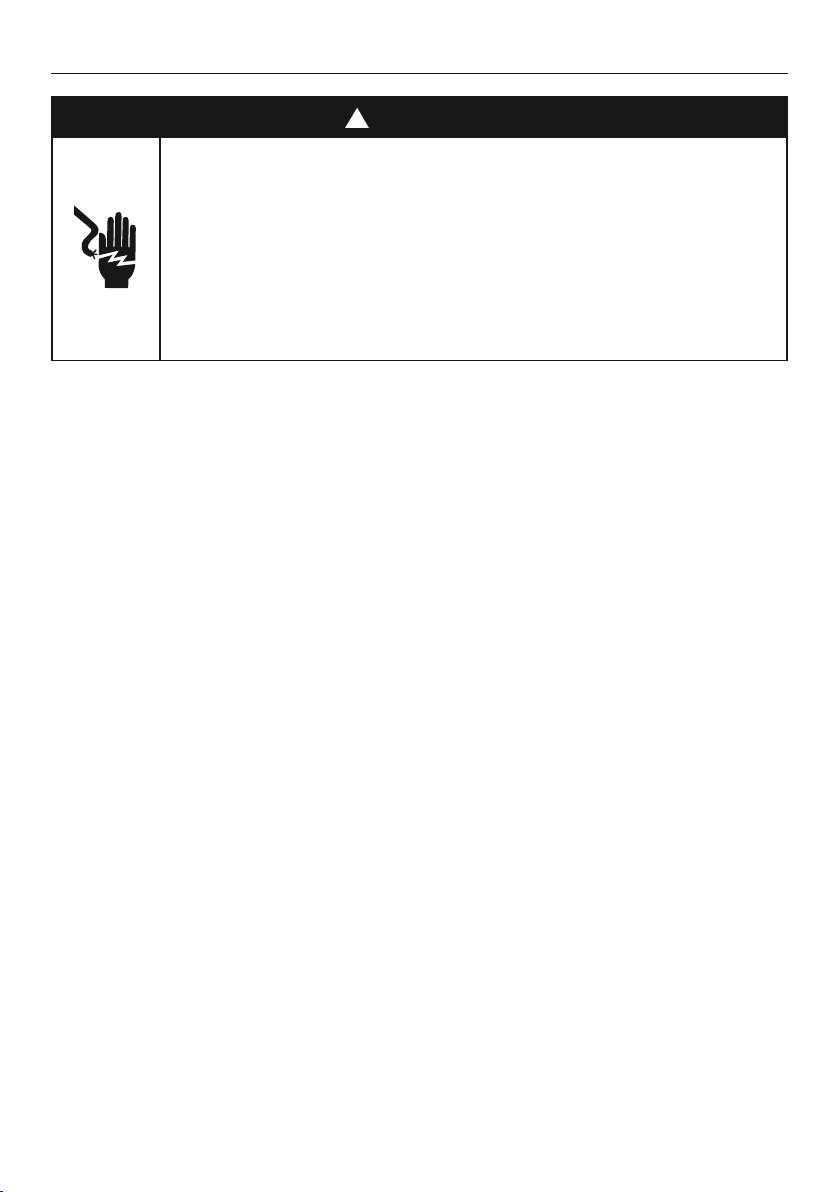
!
WARNING!
Electric Shock Hazard
Failure to follow this advice may result in
electric shock or death.
• If you are using an extension cord or a portable
electrical outlet device (eg multi-socket outlet
box), ensure that it is positioned so that it does
not come into contact with water or moisture.
READ AND SAVE THIS GUIDE
When using your clothes washer, follow basic precautions, including thefollowing:
General
z
This product has been designed for personal, family or household use. This product is
not designed for any commercial use. Any commercial use will terminate this products
manufacturer’s warranty.
z
A damaged power cord must be replaced by a Fisher & Paykel trained and supported
service technician or similarly qualified person in order to avoid a hazard. Do not use
the appliance until it has been repaired to avoid a risk of electric shock.
z
Do not operate this machine if it has been damaged during transport. Contact your
Fisher & Paykel dealer or Fisher & Paykel trained and supported service technician.
z
This clothes washer is not intended for use by persons (including children)
with reduced physical, sensory or mental capabilities, or lack of experience and
knowledge,unless they are supervised or given instructions on how to use the
washerby someone responsible for their safety.
z
Keep children away from the washer while it is in operation.
z
Supervise children to ensure they do not play with the washer or climb inside thedrum.
z
The washer should only be used for washing and rinsing of textiles where this
isindicated on the care label.
z
Do not add petrol, dry-cleaning solvents, or other flammable or explosive substances to
the wash water. These substances give off vapours that could ignite or explode.
z
Do not wash articles that have been previously cleaned in, washed in, soaked in,
or spotted with gasoline, dry-cleaning solvents, or other flammable or explosive
substances as they give off vapours that could ignite or explode.
z
The door will be locked from the start of the cycle until the cycle is complete for safety
reasons. It is possible to open the door during the cycle under certain conditions. Never
force the door open.
z
Do not touch the door during a cycle as the door can become hot.
z
When 90°C temperature is selected, the door glass will become hot. Do not touch the
glass part of the door. Keep children away from the washer.
z
Do not touch or operate the machine with wet hands or with bare-feet.
z
Do not open the detergent dispenser during the cycle as hot water may come outofit.

6
SAFETY AND WARNINGS
z
Read and follow the detergent manufacturer’s instructions carefully. Instructions on
how to use the detergent will be clearly indicated on the pack. Remember to store your
detergents out of the reach of children.
z
Do not wash an electric blanket in your washer unless the care label specifically states
it is safe to do so.
z
Do not wash curtains in this washer, as sunlight makes them brittle and they may
disintegrate during washing.
z
The only user-removable parts of the washer are the inlet hose(s), dispenser drawer
and pump filter. No other parts are designed to be removed by anyone other than a
Fisher&Paykel trained and supported service technician.
z
Do not overload your washing machine beyond its rated capacity.
MODEL CODE MAXIMUM CAPACITY* (KG)
WH1060S 10kg
WH1160S 11kg
*Capacity refers to the maximum dry weight of items the washer can wash at any one time
Disposal
z
When disposing of the washer, it is recommended that the door is removed to
avoidchildren getting trapped inside, and that the electrical cable is cut off
close to thewasher.
7
SAFETY FEATURES
Keylock
KEYLOCK can be used to lock the buttons on your washer when not in use. This will avoid
accidental button pushes. Refer to ‘Control panel’ for more information.
Add a Garment
The ADD A GARMENT button can be used to interrupt the cycle to add or remove a garment
at any time during the wash part of the cycle (provided the wash temperature selected
is lower than 60°C). Water in the washer will be drained to a level where the door can be
opened, if necessary. Refer to ‘Control panel’ for more information.
Drum light
Your washer has a drum light to help assist you when loading and unloading your washer.
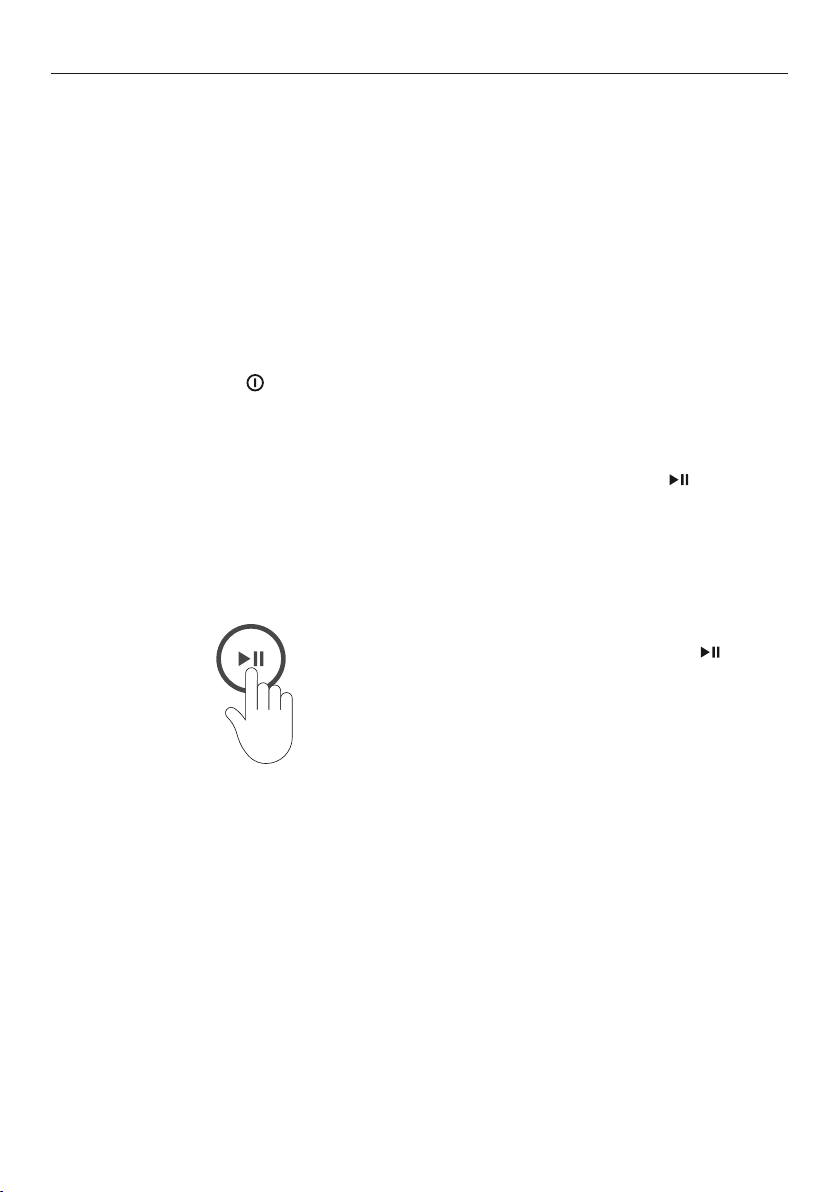
When you press
POWER , the LED light in the drum will turn on. At the end of the cycle,
the drum light will turn on again for five minutes to help facilitate unloading.
Door lock
The door of your washer will lock when in
REMOTE MODE and when you press and will
stay locked until the washer beeps at the end of the cycle, ensuring safety for you and your
family while yourwasher is operating.
To unlock the door during a cycle
You can open the door to add or remove
items during thewash by pressing
.
The door will remain locked if the
temperature insidethe washer is above 60°C
and/or the waterlevelis above the bottom
of the door seal (awarning will be displayed
inthese circumstances).
Your washer also has the following protective measures:
z
Flood protection – turns off valves and turns pump on if a flood condition is detected.
z
Out-of-balance protection – stops and redistributes the load if an unbalanced load
condition is sensed, and/or slows the spin speed to compensate.
z
Excess suds protection – pauses to allow suds to break down before continuing the cycle.
8
SAFETY FEATURES
When power is restored, your washer will resume the interrupted wash cycle. If the cycle
doesn’t resume automatically, simply press POWER to restart your washer.
Opening the door during a power failure
Do not attempt to do this if the water level inthewasher is above the bottom of thedoor.
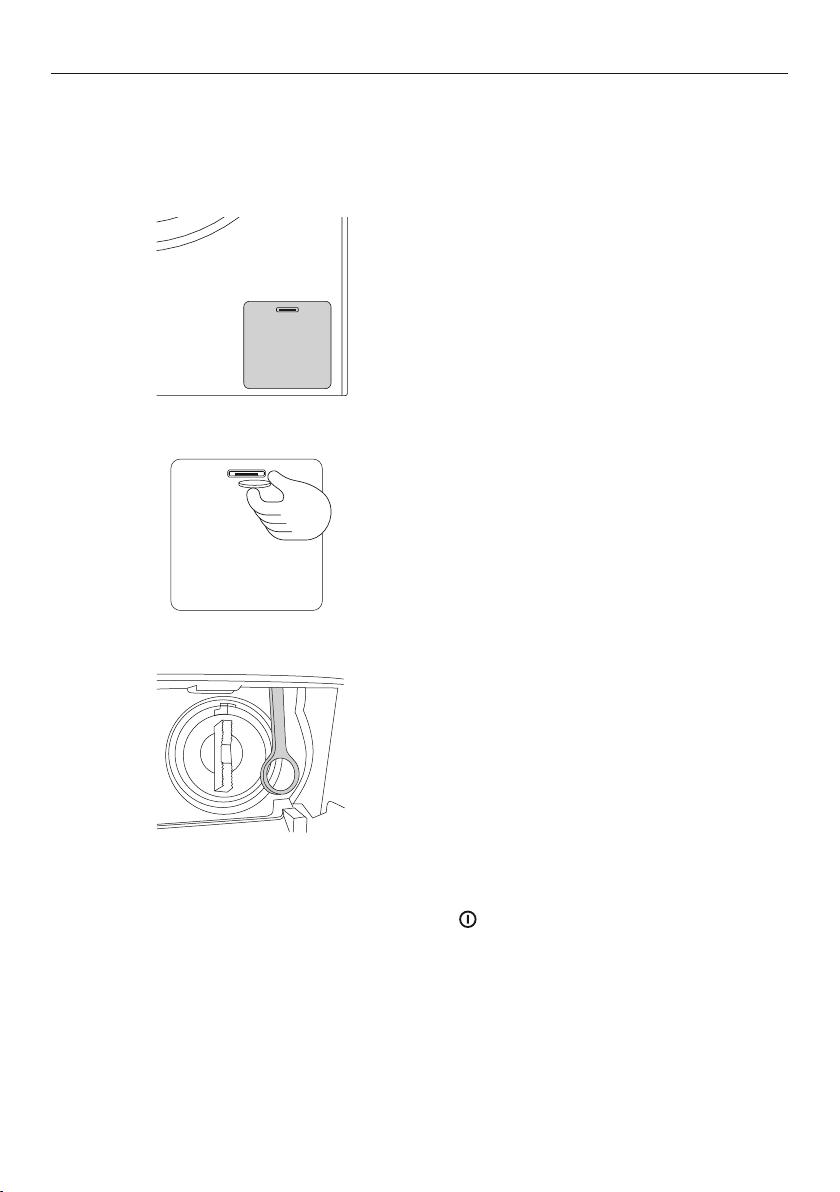
If there is a power failure during a wash cycle your washer will stop and the door will
remain locked.
Locate thepump filter cover at the bottom
right of your washer.
Place a coin or key in the slot and tilt it
upwards to lever the cover open.
Pull the door release tab down from the ring.
Use a screwdriver tip, pen or key to get a
good grip.
1
2
3
9
CONTROL PANEL
2
1 3 4 5 !3
7 86 9 !0 !1 !2
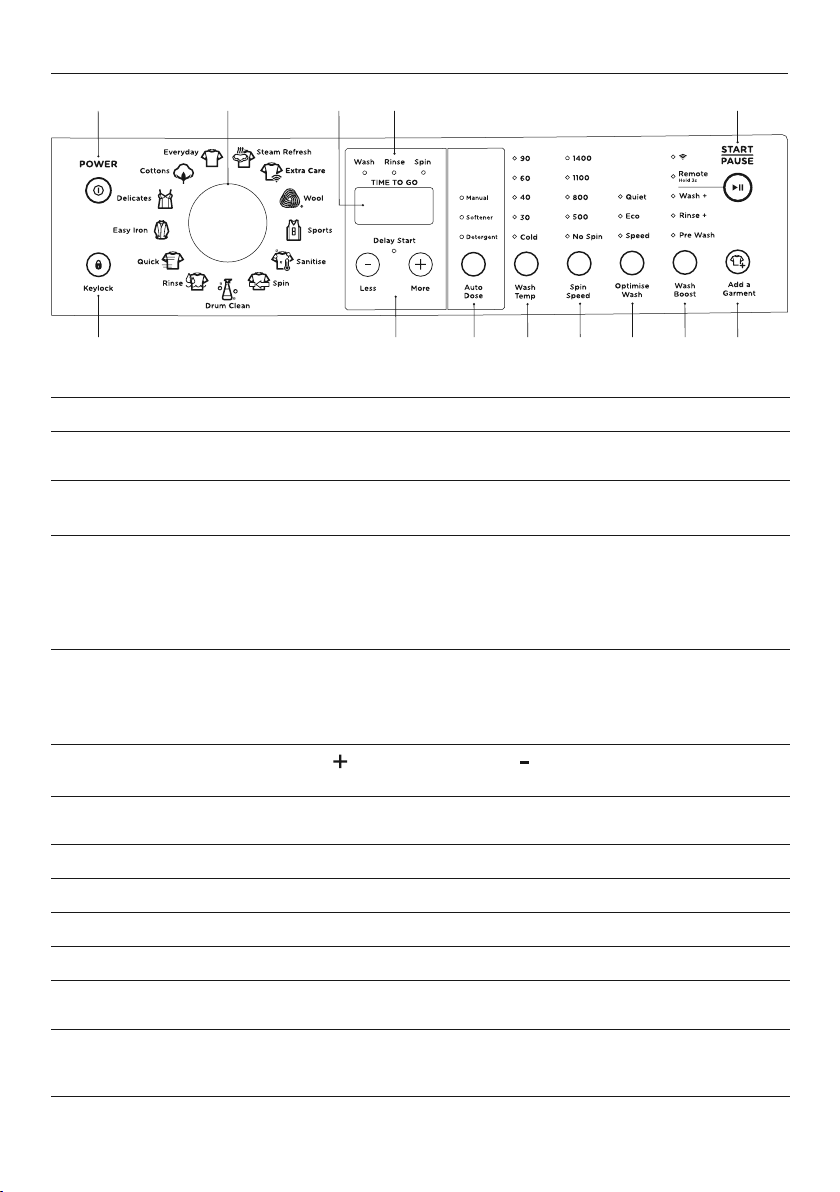
1 Power Press to turn the washer ON/OFF.
2 Keylock Press to disable all buttons on the control panel, except the
POWER button. This prevents accidental button presses.
3 SmartTouch™
Control Dial
Rotate to select your desired wash cycle.
z
Red LED illuminates to indicate the selected wash cycle.
4 Digital display
screen
Shows the following:
z
TIME TO GO – the remaining time in the cycle that is
currently running.
z
Delayed start time of wash cycle.
z
Notifications if an error is detected or a warning is necessary.
5 Progress lights Indicate the current status of the wash cycle.
z
All lights are illuminated at the start of the wash cycle.
z
The light of the current status flashes, and then turns off
oncecompleted.
6 Delay Start
Less/More
Press
MORE to increase andLESS to decrease the delay
start time.
7 Auto Dose Press to select
MANUAL or AUTO DOSE dispensing of detergent
andsoftener.
8 Wash Temp Press to increase or decrease wash water temperature.
9 Spin Speed Press to increase or decrease spin speed.
!0 Optimise Wash
Press to select
SPEED, ECO or QUIET.
!1 Wash Boost Press to select PRE WASH, RINSE+ or WASH+.
!2 Add a Garment Press to interrupt the wash part of the cycle to add or
remove items.
!3 Start/Pause Press to start or pause the selected wash cycle.
Press and hold this and
ADD A GARMENT for three seconds to enable
REMOTE (WiFi) mode.
10
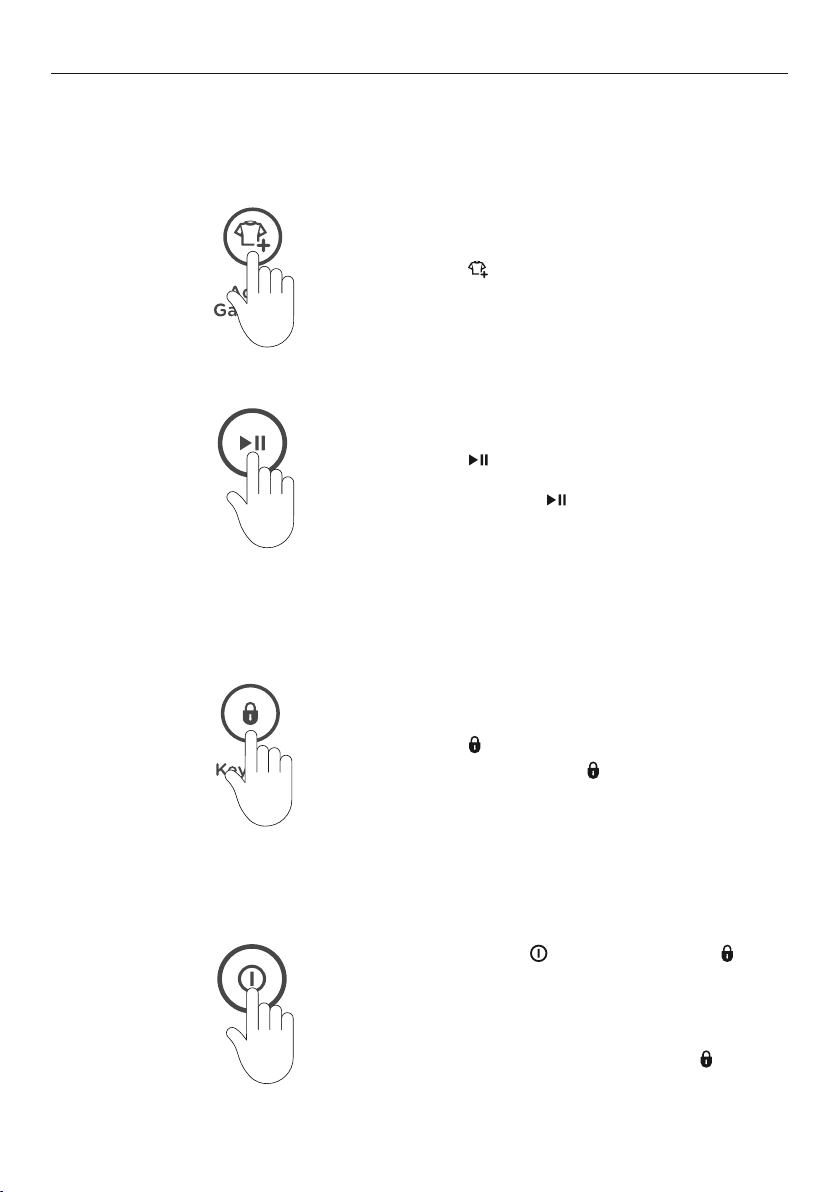
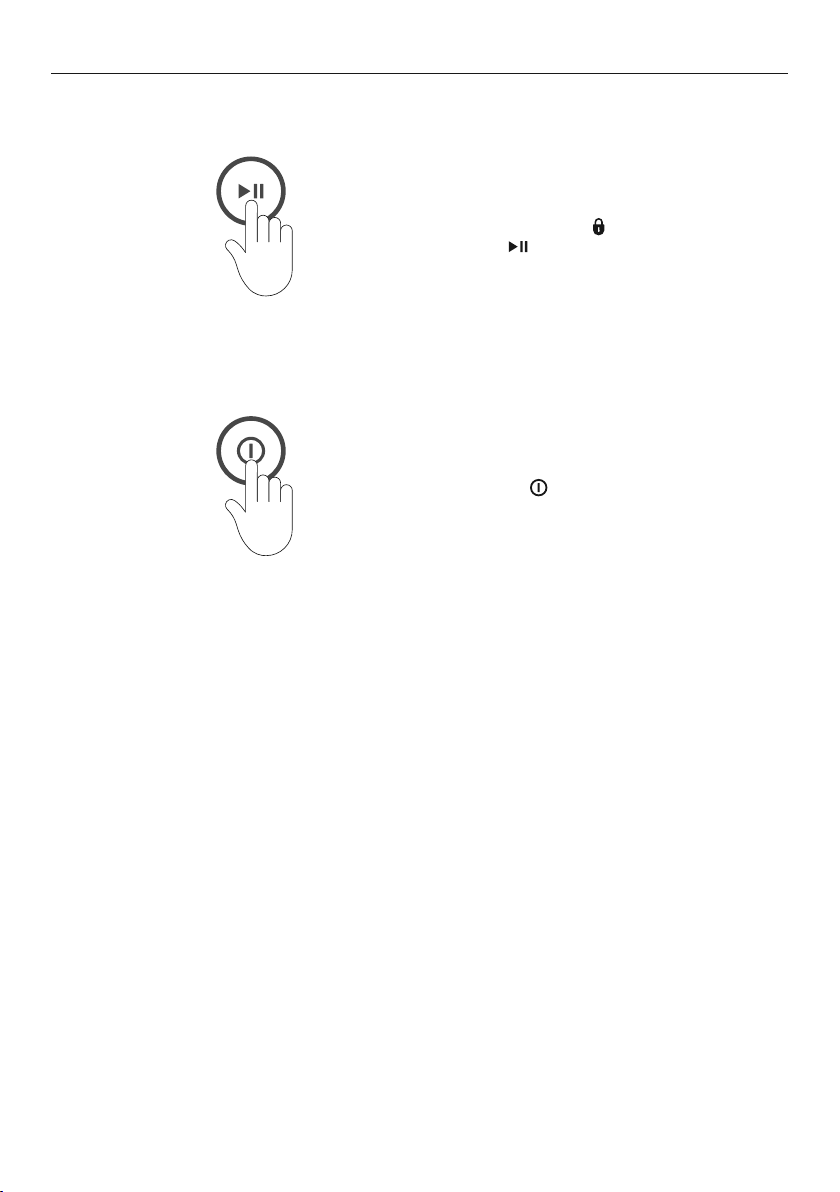
To turn your washer on if KEYLOCK is ON and the washer is powered OFF:
Keylock
To turn
KEYLOCK ON or OFF when the washer is powered on:
Add a Garment
Enables you to add or remove items during the wash stage of the cycle, under
certain conditions.
CONTROL PANEL
Press ADD A GARMENT, wait until you hear
the door unlock.
1
Press for three seconds.
When activated, the
is illuminated.
Press
and the display will flash. Open the
door and add or remove items. Close the
door and press to restart the cycle.
2
Press POWER , then press and hold
for three seconds. This will activate the
control panel. Wash cycles and options can
now be selected.
If a button is pressed while
KEYLOCK is
activated, beeps will be heard and
will flash.
11
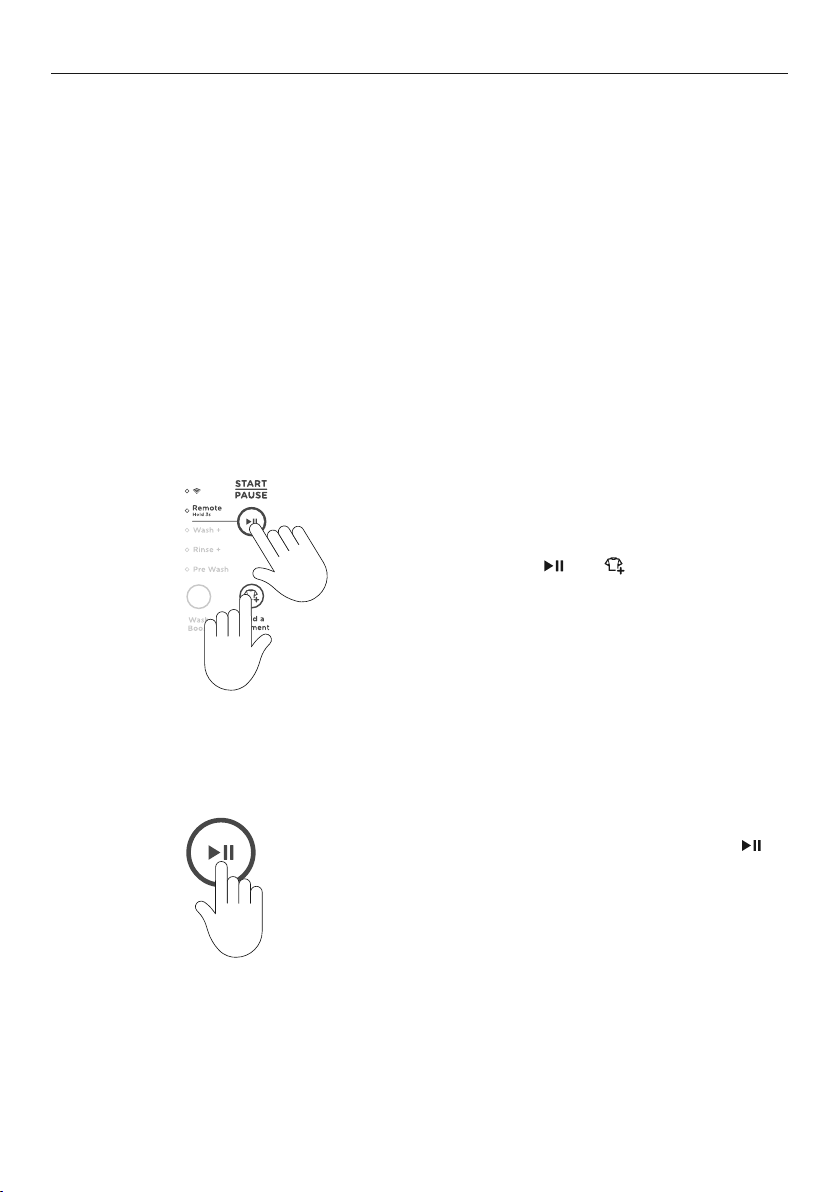
If KEYLOCK is ON and you want to pause your washer:
If
KEYLOCK is ON and you want to power OFF your washer at any time:
CONTROL PANEL
Press POWER .
To pause your washer at any time during the
cycle, press and hold for threeseconds
then press .
12
Your appliance can be connected to your home wireless network and operated remotely
using the app.
Getting started
z
Ensure your home WiFi network is turned on.
z
You will be given step by step guidance on your mobile device.
z
It may take up to 10 minutes to connect your appliance.
WIFI CONNECTION & REMOTE MODE
On your mobile device:
1 Download the app from www.fisherpaykel.com/connect
2 Register and create an account.
3 Add your appliance and set up the WiFi connection.
4 Follow the prompts in the app to complete setup.
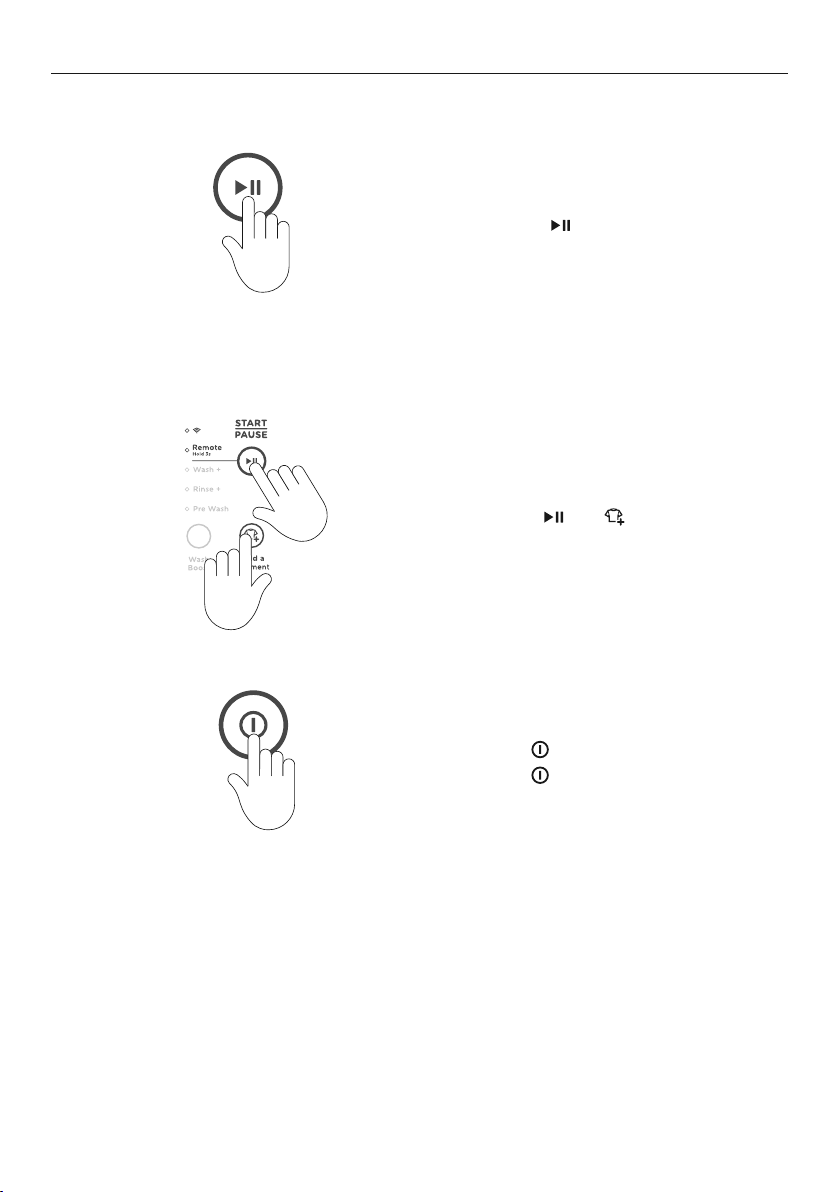
Connecting to your home WiFi
Press and hold
and
ADD A GARMENT buttons for three seconds,
this will start the setup process.
Enabling remote mode
Once setup is complete, press and hold
for three seconds.
REMOTE MODE is now enabled. Certain
functions of your washer can now be
accessed via the app.
For safety reasons, when REMOTE MODE is enabled the washer door will be locked. To open
the door disable REMOTE MODE.
13
WIFI CONNECTION & REMOTE MODE
Turning off WiFi
Press and hold
and
ADD A GARMENT buttons for three seconds.
1
2
Press POWER to turn the washer OFF.
Press POWER again to turn the washer ON.
Disabling remote mode
Press and hold
for three seconds.
Once WiFi is turned off you must reconnect to your home WiFi and enable
REMOTE MODE to
access certain functions of your washer via the app.
14
WASH CYCLES
Your washer has a number of wash cycles to suit your laundering needs. Selecting the
most appropriate cycle for each particular wash load will help ensure you get the best
wash result.
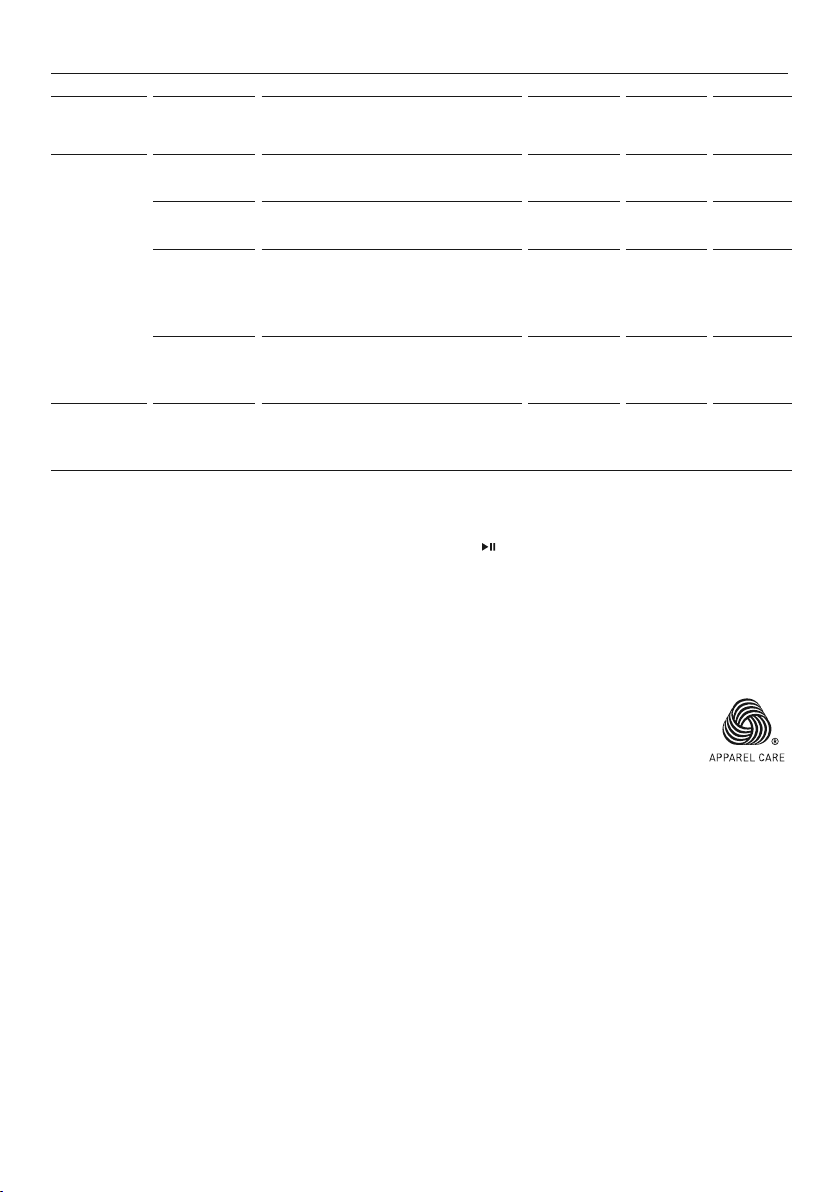
CYCLE SUB-CYCLE DESIGNED FOR
MAX.
LOAD SIZE
(kg)
WASH
TEMP
(°C)
SPIN
SPEED
(rpm)
Everyday n/a
A faster cycle designed for mixed
loads with normal soil
10/11
30
(Cold-60)
1400
(0-1400)
Cottons n/a
A cycle for normally soiled
cotton garments
10/11
40
(Cold-90)
1400
(0-1400)
Delicates n/a
A gentle wash with more
water to care for lightly soiled
delicate garments
4
30
(Cold-40)
500
(0-800)
Easy Iron n/a
A cycle for normally soiled
garments with lower spin speeds to
reduce creasing
6
30
(Cold-60)
800
(0-800)
Quick
Quick 15
A cycle for freshening up of new or
very lightly soiled garments
2
30
(Cold-40)
800
(0-1400)
Quick 30
(default)
A cycle for cleaning lightly soiled
loads quickly
6
40
(Cold-40)
1100
(0-1400)
Rinse n/a
Items that require rinsing
and spinning
10/11 Cold
1400
(0-1400)
Drum Clean n/a
An extra hot cycle designed to
clean your washer
n/a 90
1400
(1400)
Spin n/a Spinning wet items 10/11 n/a
1400
(500-
1400)
Sanitise n/a
An extra hot concentrated wash
with multiple rinses
10/11 75
1400
(0-1400)
Sports n/a
A cycle specifically designed for
washing sports garments
6
40
(Cold-40)
1100
(0-1400)
Wool n/a
An extra gentle wash action for
machine washable woollen items
that complies with Woolmark
Apparel Care criteria
4
40
(Cold-40)
800
(0-800)
15
WASH CYCLES
CYCLE SUB-CYCLE DESIGNED FOR
MAX.
LOAD SIZE
(kg)
WASH
TEMP
(°C)
SPIN
SPEED
(rpm)
Extra Care
Heavy
(default)
A longer, hotter wash for heavily
soiled durable garments
10/11
60
(Cold-90)
1400
(0-1400)
Soft Toys
A gentle wash action with a slow
spin for soft toys
3-4 toys
40
(Cold-40)
500
(0-800)
Sneakers
A gentle wash action designed to
spruce up fabric sneakers.
Add towels to cushion shoes during
the wash
1-2 pairs
40
(Cold-40)
500
(0-800)
Soak
A normal wash action with an
additional deep cleaning soak for
your mixed everyday loads
10/11
40
(Cold-60)
1400
(0-1400)
Steam
Refresh
n/a
A cycle designed to remove
creases and light odours from
up to two shirts
2 shirts n/a n/a
¹COTTONS, MANUAL, 40°C, 1400rpm with ECO selected is the recommended water and energy saving cycle for
normally soiled, everyday washing.
²The
EASY IRON cycle includes WRINKLE FREE, the washer will tumble the clothes once every 15minutes after the
cycle has finished. To remove the load during
WRINKLE FREE, press .
3To select
QUICK 15, turn the dial to QUICK and select SPEED mode under OPTIMISE WASH.
4You can select a different sub-cycle from the default within EXTRA CARE by using the app. The cycle selected will
become the default
EXTRA CARE cycle for all future cycles, this can be changed at anytime by using the app.
Woolmark Apparel Care
The wool wash cycle of this machine has been approved by The Woolmark
Company for the washing of machinewashable wool products, provided that
the products are washed according to the instructions on the garment label
and those issued by the manufacturer of these washing machines M1766.
16
Detergent
Your washer requires low-sudsing detergent to prevent oversudsing problems. Low sudsing
detergent comes in powder or liquid and is labelled front loading, low suds, high efficiency
or HE. Using top loader detergent in your front loader washer may lead to excessive suds
formation, which will lengthen the cycle time as the washer waits for the suds to dissolve.
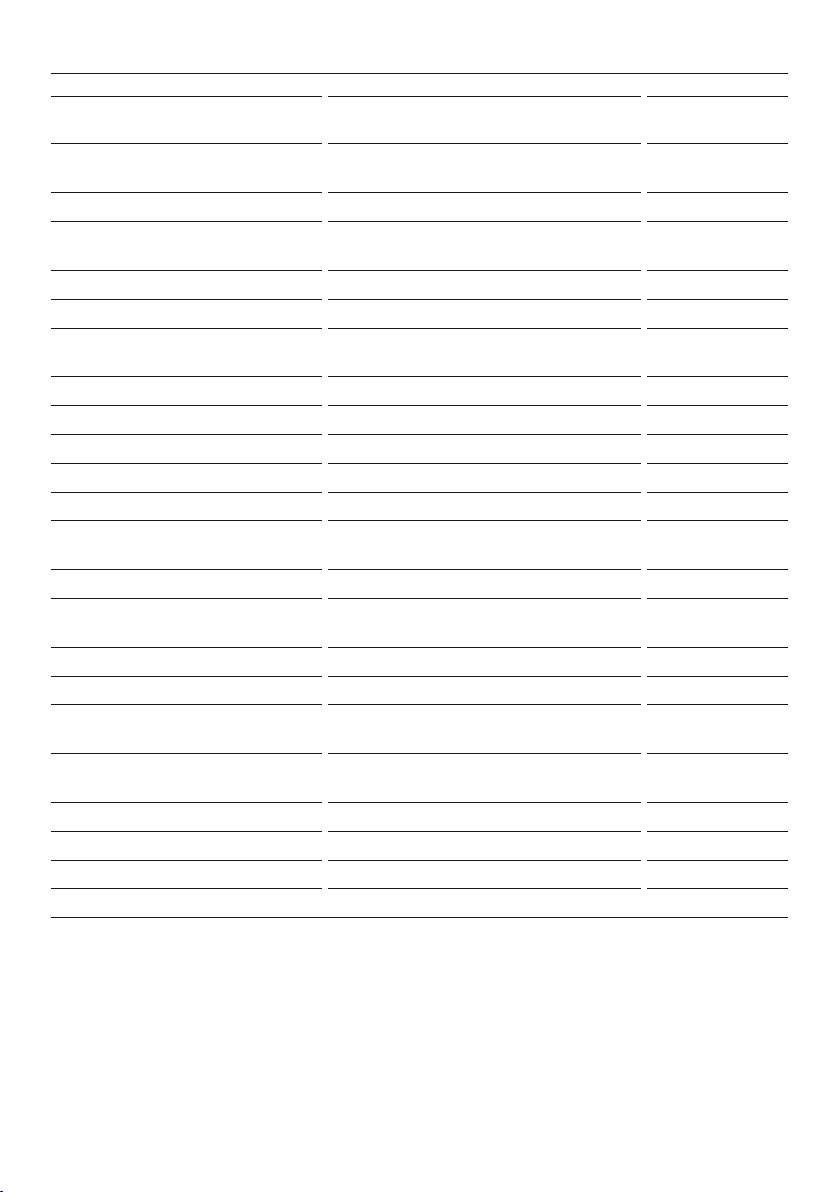
The washer has auto dosing compartments for liquid detergent and fabric softener, and
a manual dosing compartment for powder or liquid detergent. Ensure that detergent and
softener are filled correctly into their respective compartments.
Do not overfill the detergent compartment. Too much detergent could result in waterand
detergent spilling onto the floor.
Make sure that the dispenser is completely closed before starting the cycle. Donotopen it
again until the cycle is complete and the washer has stopped spinning.
AUTO DOSE LIQUID DETERGENT COMPARTMENT
Stores up to 1100ml (max) of liquid detergent
suitablefor several washes depending on load size.
AUTO DOSE FABRIC SOFTENER COMPARTMENT
Stores up to 540ml (max) of fabric softener
suitablefor several washes depending on load size.
MANUAL DOSE LIQUID/POWDER
DETERGENT COMPARTMENT
For liquid or powder detergent used for a
single wash and when PRE WASH is selected.
DETERGENT AND SOFTENER
Detergent advice
If unpleasant odours are noticeable from your washer, it is possible that not enough
detergent is being used for the soil level in your loads. Run a
DRUM CLEAN cycle and either
buy a better quality detergent or use a higher dose.
If you find foam leaking from your washer, check if you are using a low sudsing or front
loader type detergent. When using
MANUAL DOSE, check the quantity you are using against
the manufacturer’s recommended dose on the label. You may need to reduce the amount
you are using.
If using
AUTO DOSE you may need to reduce or increase the amount used. Refer to
‘Adjusting the amount of detergent or softener dispensed on Auto dose’ for details on
how to adjust the dosage.

17
Fabric softener
The washer will automatically flush the fabric softener during the rinse part of the cycle.
If you wish to use fabric softener we recommend:
z
If you fill beyond the MAX mark, the fabric softener will be dispensed into the drum
prematurely and contribute to a waxy built-up.
z
Fabric softener cannot be selected on SNEAKERS, STEAM REFRESH or the QUICK 15 cycles.
z
The amount of softener dispensed depends on load size.
Fabric softener advice
z
Clean your dispenser regularly.
z
Clean your washer regularly using the DRUM CLEAN cycle.
z
Complete wash cycles at a wash temperature of 40°C or above at regular intervals
(egevery 5thwash) as washing in cold water increases the chance of a waxy
build-up occurring.
Waxy build-up can occur within any washer when fabric softener comes in contact with
detergent. This build-up is not brought about by a fault in the washing machine. If allowed
to build up in the washer it can result in stains on clothes and an unpleasant smell in
your washer.
Auto Dose
AUTO DOSE DETERGENT is the default setting for allwashcycles (except WOOL and
DRUM CLEAN). Only liquid detergent can be used for AUTO DOSE. AUTO DOSE will
automatically dispense the right amount of liquid detergent and fabric softener (optional)
perwashcycle.
If you wish to add fabric softener, you need to select
SOFTENER using the AUTO DOSE button.
z
Auto dosing of fabric softener can be used in combination with both auto andmanual
dosing of detergent.
We do not recommend storing laundry wash products containing acetic acid, eg vinegar, in
the AUTO DOSE compartments.
If using Auto Dose
Fill the
LIQUID DETERGENT compartment up to the MAX level indicated.
Fill the
FABRIC SOFTENER compartment upto the MAX level indicated.
If softener is selected, the washer will automatically dispense the fabric softener during the
rinse part of eachcycle.
DETERGENT AND SOFTENER

18
DETERGENT AND SOFTENER
Manual Dose
Liquid or powder detergent can be used for
MANUAL DOSE.
Where a detergent for a certain fabric and/or cycle is recommended,
MANUAL DOSE is the
default setting (eg WOOL and DRUM CLEAN).
If using Manual Dose
MANUAL DOSE can dispense powder or liquid detergent for washing.
Follow the instructions stated on the detergent label as a guide when determining
thecorrect dosage of detergent suitable for your wash load.
The detergent dosage needed may vary depending on the amount of soil, size of the load
and the water quality.

19
WASH PREPARATION
Sorting
Sort items according to colour, fabric type, and soil type. Wash fine, delicate fabrics
separately from thick, heavy fabrics. Always separate coloured items from whites, especially
when they are new. Colour run could be an issue if you wash items at highertemperatures.
Some soils, like mud and blood are best washed in cold water. Oilysoils (eg some foods
and marks on shirt collars) are best washed in warm water. The care label will advise on
how the garment should be washed.
Before you load
z
Check pockets for items that could damage your clothes or get caught in the washer.
z
Close zippers, hooks and eyes, and other fastenings (ie fasten the opening of duvet/
doona covers), and remove loose bra wires. All these can damage both your washer
and your clothes.
z
Place delicate items, such as lingerie, in a mesh laundry bag before placing in the washer.
z
Pre-treat any stains, taking care not to spray pre-treaters on your washer as they can
cause damage to the plastic surfaces.
Loading
Your washer will be more efficient when washing larger loads, so try to collect enough
items to loosely fill the drum when the items are dry.
20
WASH PREPARATION
ITEMS/WASH REQUIREMENTS SUGGESTED CYCLE AND OPTIONS
SUGGESTED
TEMPERATURE
Towels
Cottons or Everyday,
1400 or 1100 rpm spin
30°C or 40°C
Sheets, pillowcases Everyday, 1400 or 1100 rpm spin 30°C or 40°C
Bulky items – doonas,
duvets, sleeping bags
Delicates, 800rpm 30°C or 40°C
Shirts, pants, other creasables Easy Iron, 800 rpm 30°C or 40°C
Woollens Wool, 500 rpm 30°C or 40°C
Delicate garments –
blouses & dresses
Delicates 30°C
Extra delicate fabrics like lace Delicates 30°C
Silk garments Delicates 30°C
Jeans Everyday or Extra Care – Heavy Cold or 30°C
Highly coloured items Everyday Cold or 30°C
Whites, cotton items Cottons, 1400 or 1100 rpm spin 40°C or 60°C
Sensitive skin orextra
rinsing requirements
Cottons, Rinse+ 40°C
Asthma/allergies Cottons, Rinse+ 60°C
Handkerchiefs, nappies,
bedding and facemasks
Sanitise 75°C
Lightly soiled items Quick – Quick 30 or 15 30°C
Muddy, sandy or linty items Everyday Cold
Unpleasant odour in the
washer drum
Drum Clean 90°C
Items made of blended fibres
(eg polyester cotton)
Everyday 40°C
Sportswear Sports 30°C or 40°C
Soft toys Extra Care – Soft Toys 40°C
Heavily soiled items Extra Care – Heavy 40°C
Sneakers Extra Care – Sneakers 40°C
21
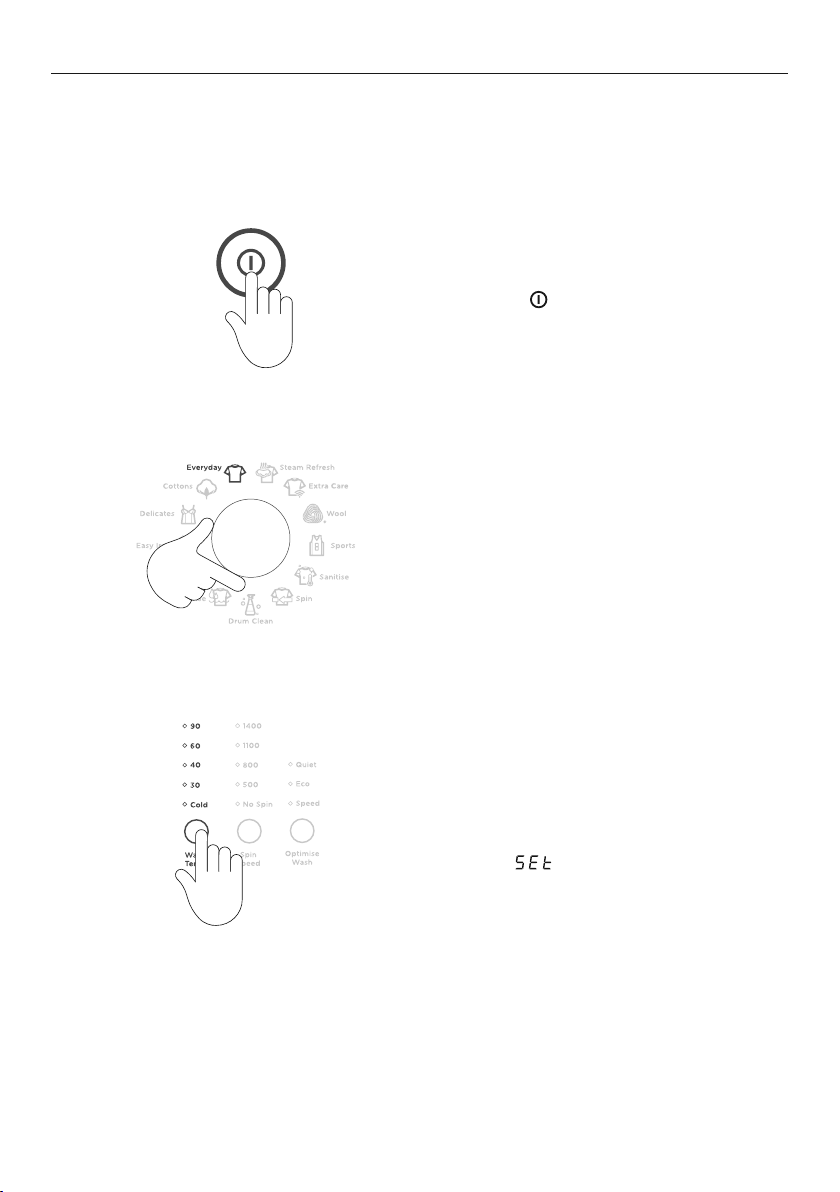
GETTING STARTED QUICKLY
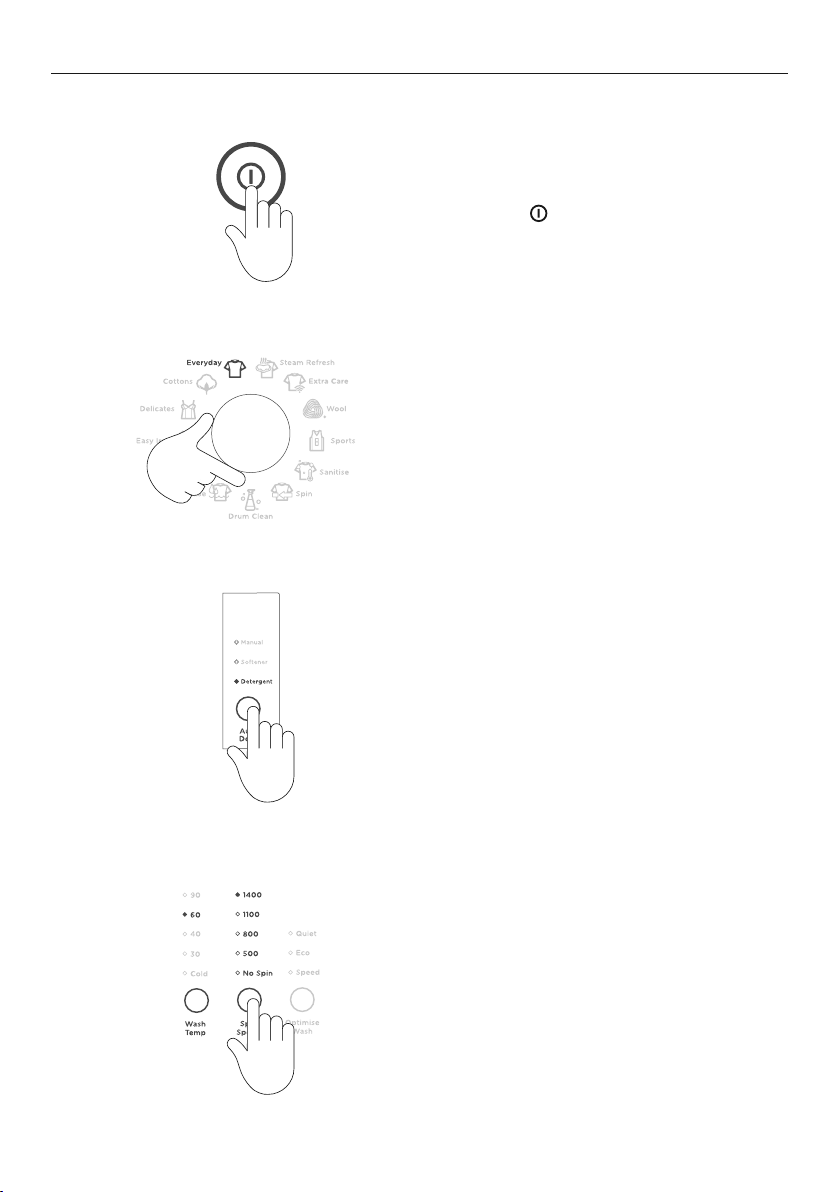
Press POWER to activate your washer.
1
2
3
Select your desired wash cycle by turning
the Control Dial. The wash cycle icons will
illuminate as you turn the dial showing which
cycle is selected, along with the default
wash cycle settings.
Customise your wash as needed by selecting
specific temperature and spin speeds.
Refer to ‘Customising a wash cycle’ for
more information.
4
Select your desired detergent/softener
dosing mode by pressing AUTO DOSE.
22
GETTING STARTED QUICKLY
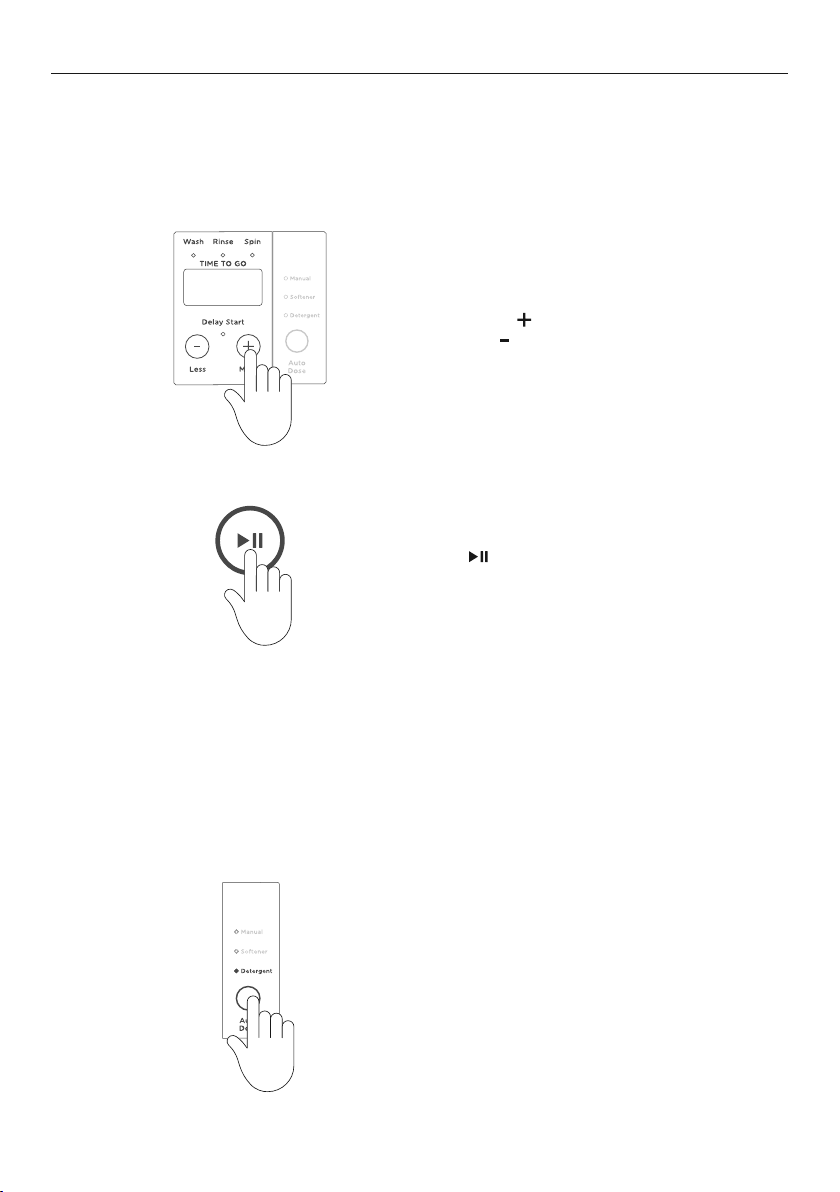
6
Press and hold for three seconds to lock
the buttons on the control panel, preventing
them from being activated accidently.
5
Press to start the cycle. The washer will
start to fill with water and select the correct
wash action for your load.
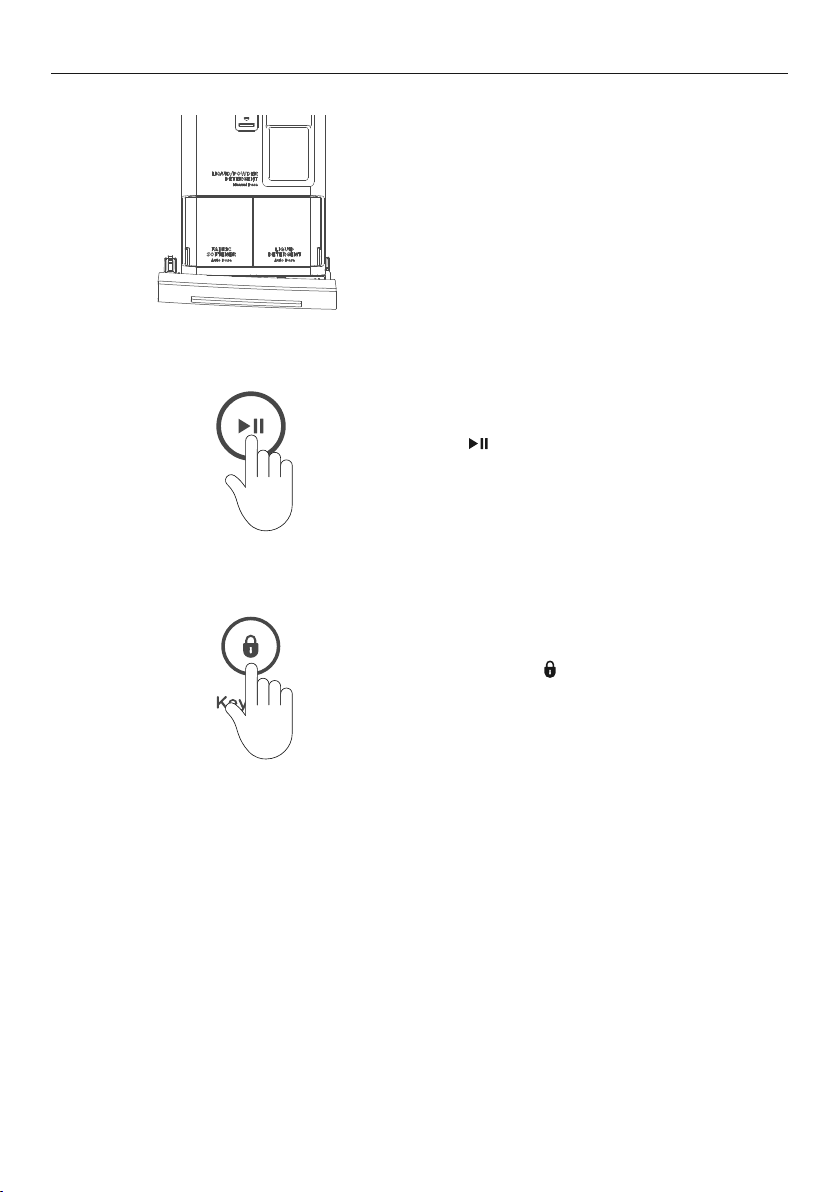
Open the detergent drawer.
Fill the liquid dispenser compartment, or if
using
MANUAL dispensing, add detergent to
the manual dispensing compartment.
Only add detergent to the
MANUAL
dispensing compartment when using
MANUAL dispensing.
7
23
CUSTOMISING A WASH CYCLE
Delay Start
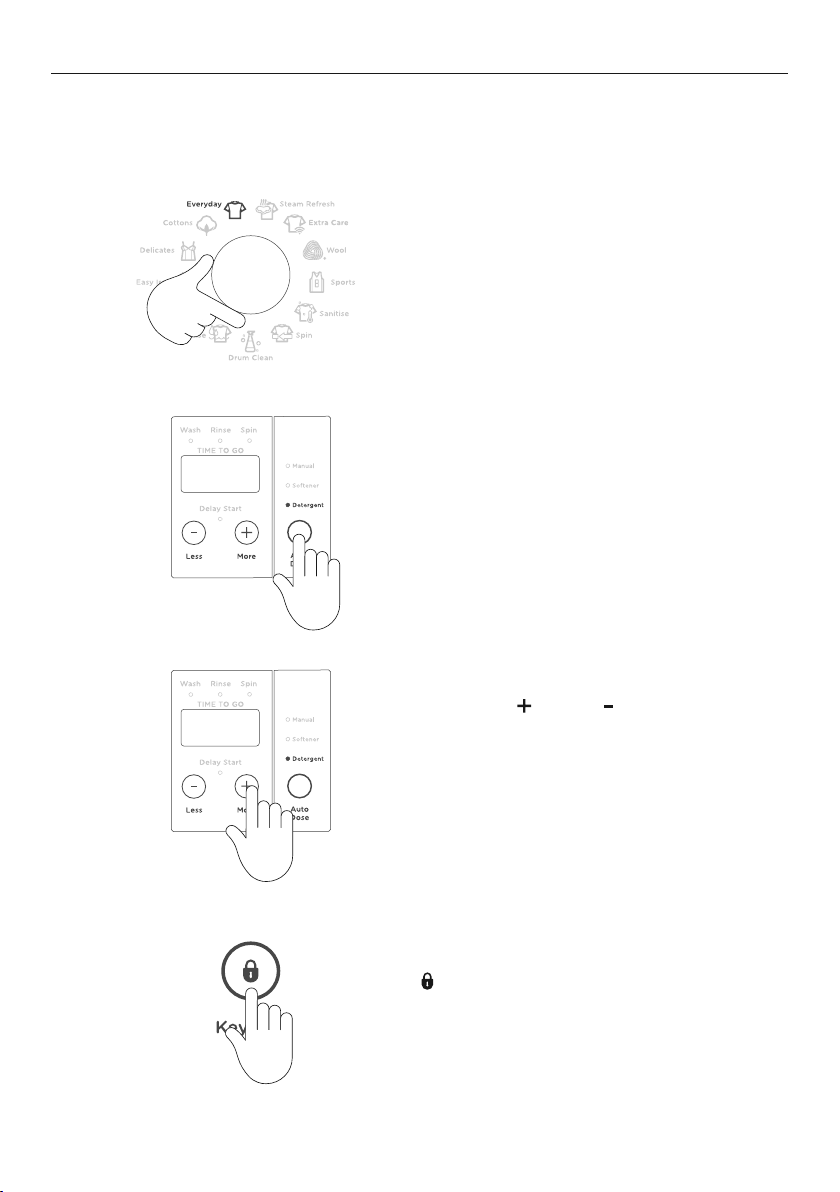
You can delay the start of the wash cycle between 15 minutes and 12hours. This can be
useful to time your washing to finish when you arrive home from work, or to start once you
have finished in the shower.
Avoid using
DELAY START for damp, non-colourfast items as this may cause dye run to occur.
Auto Dose
A red LED will illuminate to indicate which
AUTO DOSE options have been selected.
Press
AUTO DOSE to activate your
preferred option: DETERGENT,
DETERGENT
and SOFTENER, MANUAL, or
MANUAL and SOFTENER.
1
1
Press to confirm your selection and start
the countdown. The display screen will show
the time until the cycle is set to begin.
2
Press MORE to increase the delay time,
and LESS to decrease the time, or turn
DELAY START off.
24
CUSTOMISING A WASH CYCLE
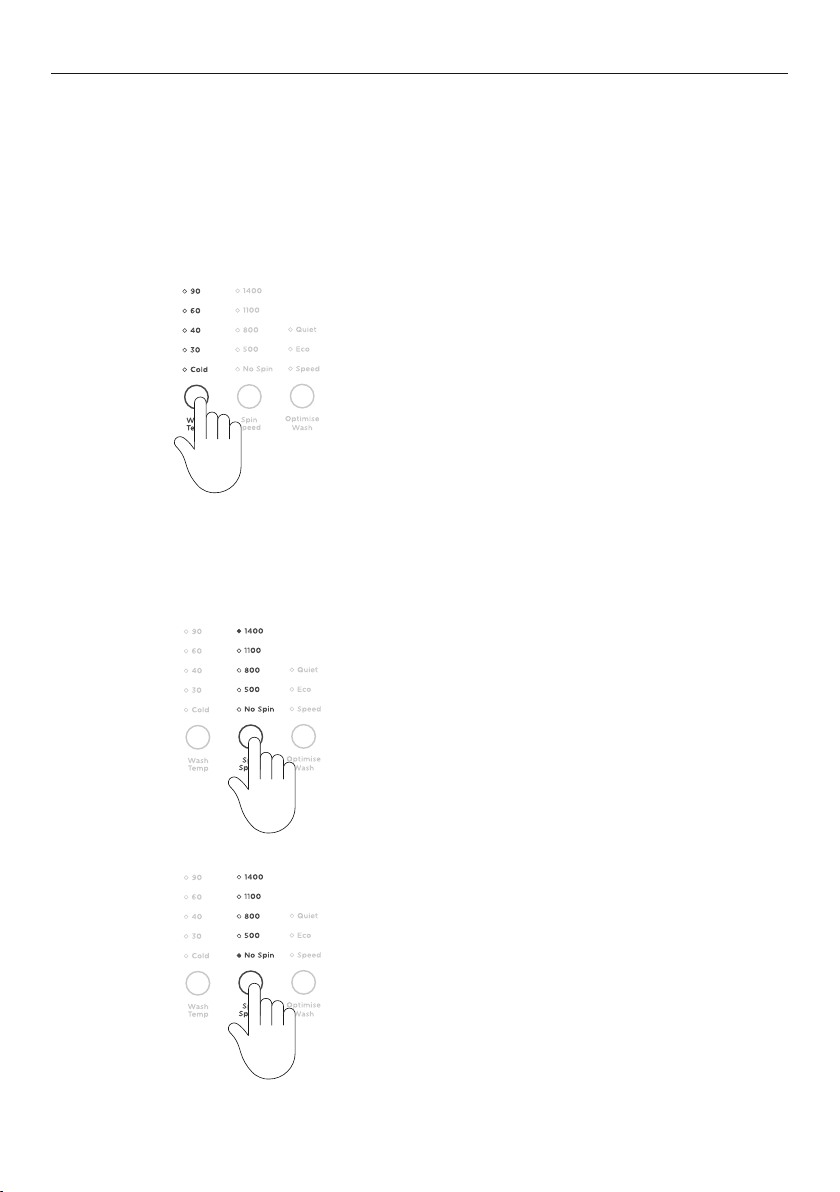
Adjusting the amount of detergent or softener dispensed on AUTO DOSE
The default amount of detergent or softener used for AUTO DOSE, for a given cycle, can be
adjusted to any of the following levels: 1, 2, 3, 4 and HI.
Press
AUTO DOSE to select DETERGENT
or SOFTENER, depending on which
requires adjustment.
Press and hold
AUTO DOSE for three seconds,
SET and then the default setting of 3 will
be displayed.
2
3
Press MORE or LESS to increase or
decrease the amount of detergent or softener
used for AUTO DOSE.
If required, press AUTO DOSE again to
adjust softener.
1
Turn the dial to select the wash cycle you
want to adjust the AUTO DOSE level for,
eg EVERYDAY.
4
Once you have completed the adjustment,
ensure the AUTO DOSE options you want
saved as the default are selected, then press
to store your adjustment for the selected
cycle. A long beep will sound to confirm that
your changes have been saved.
Refer to ‘To save a customised cycle’
for details on changing the default auto
dose option for a cycle (
AUTO DOSE,
MANUAL, SOFTENER).
25
Spin Speed
Your washer offersfive spin speeds:
500rpm, 800rpm, 1100rpm and 1400rpm,NO SPIN.
Press
SPIN SPEED to select the required spin
speed for your load.
1
2
Selecting NO SPIN will end the cycle after the
rinse, allowing you to remove items you wish
to drip dry.
The washer will complete the spins that
are within the wash and rinseportions
of the cycle; only the final spin will not
be completed.
Wash Temp
Your washer has five wash temperatures (
COLD, 30°C, 40°C, 60°C and 90°C).
Some temperatures are not available on some cycles as a safeguard for your clothes
(egtemperatures above 40°C on the
DELICATE cycle).
The washer will fill with both hot and cold water (if possible) to achieve the selected wash
temperature. If required, ie for cold supply or cold connection only, the washer will heat the
water to the selected temperature.
Press the
WASH TEMP button to increase or
decrease the wash temperature.
1
CUSTOMISING A WASH CYCLE

26
CUSTOMISING A WASH CYCLE
Optimise Wash
Your washer offers three optimise wash modes –
SPEED, ECO and QUIET – allowing you to
reduce noise, save water and energy or save time. For clothes care reasons not all options
are available on all cycles.
Speed
A special feature designed to offer a shorter cycle whilst maintaining wash performance.
This option can be selected on
EVERYDAY, COTTONS, EXTRA CARE - HEAVY and EASY IRON
cycles. A number of factors can influence the amount of time saved on a cycle, including
the load size, cycle chosen, water flow rate and load distribution during spin.
Eco
Use the
ECO option to save water and energy. Selecting ECO will reduce the wash
temperature slightly and alter the wash and rinse programming.
z
SPEED and ECO cannot be selected together.
z
ECO will not be available if PRE WASH or RINSE+ have been selected.
Quiet
Use
QUIET mode when washing at night, if your washer is installed on a wooden floor,
and/or when noise is a concern. This mode reduces the spin speed to limit the level of
noise emitted, but may increase the level of moisture remaining in the load. This mode
includes WRINKLE FREE, the washer will tumble the clothes once every 15minutes after the
cycle has finished. The cycle icon and will flash indicating WRINKLE FREE is operating, to
remove the load during WRINKLE FREE, press .
Wash Boost
Your washer offers three wash boost modes – PRE WASH, RINSE+, WASH+ – allowing you to
add an extra short wash for extra dirty loads, an extra rinse to your cycle, or an increase to
the wash time for dirty loads.
Pre Wash
Your washer will start with a short wash in cool water to remove excess soil. The washer
will drain and then fill at the selected temperature for the main wash.
PRE WASH cannot
be selected after a wash cycle has been started or if ECO has been selected. Use liquid or
powdered detergent in the MANUAL compartment. The compartment is flushed at the start
of the cycle.
Rinse+
If you have a particularly dirty load, or you have sensitive skin and wish to give your clothes
an extra rinse, select
RINSE+ from the WASH BOOST options. Your load will undergo an extra
rinse to get rid of any residual detergent or soil in the items.
RINSE+ will not be available if the ECO option has been selected.
Wash+
WASH+ allows you to increase the wash time for heavy soiled items. The increase in wash time
gives the load the right amount of tumbling to remove the soil from items that might need it.
27
CUSTOMISING A WASH CYCLE
To save a customised cycle
You can program your washer to remember the wash options you prefer for each wash
cycle. For instance, you may want to set the
EVERYDAY cycle to default to 40°C or set the
EXTRA CARE - HEAVY cycle to include WASH+ or RINSE+.
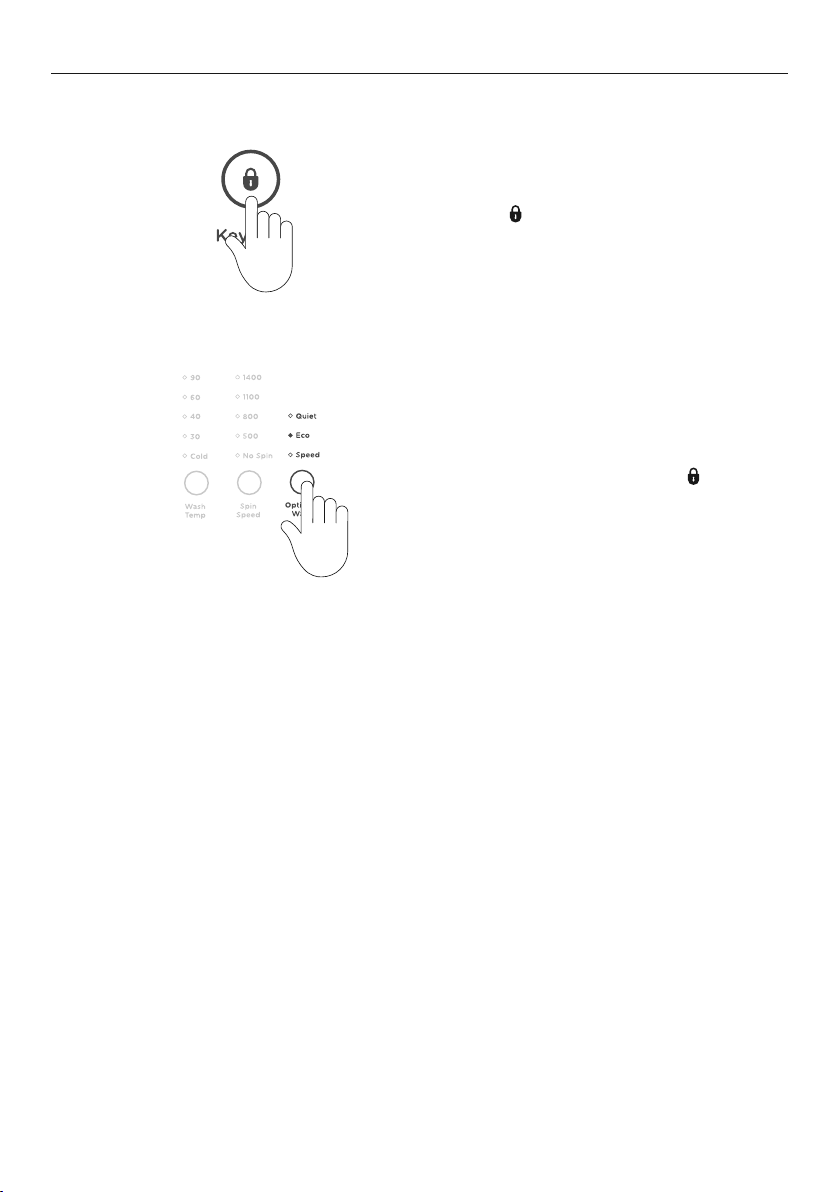
1
Press POWER to activate your washer.
2
Turn the dial to select the wash cycle you
wish to customise, eg EVERYDAY.
Press and hold the button of the option
you want to customise, eg
WASH TEMP for
threeseconds. You will hear two quick beeps
and the wash cycle icon will flash. The screen
will display .
3
28
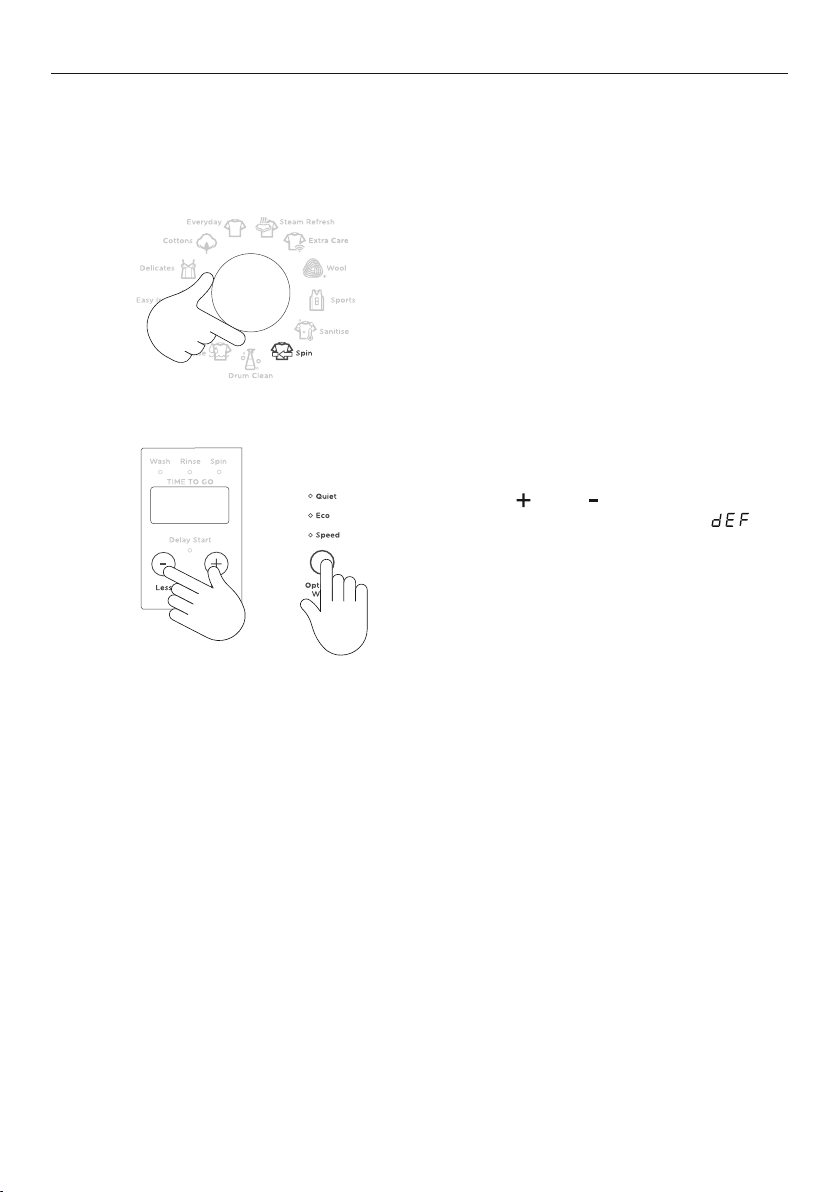
4
Continue to select any other options you wish
to customise for this cycle. Press to save
your customised cycle.
To change your customised wash cycle simply repeat these steps.
5
Select your preferred setting for the option,
then press to save. A long beep will
sound to confirm that your changes have
been saved.
CUSTOMISING A WASH CYCLE
29
FACTORY RESET
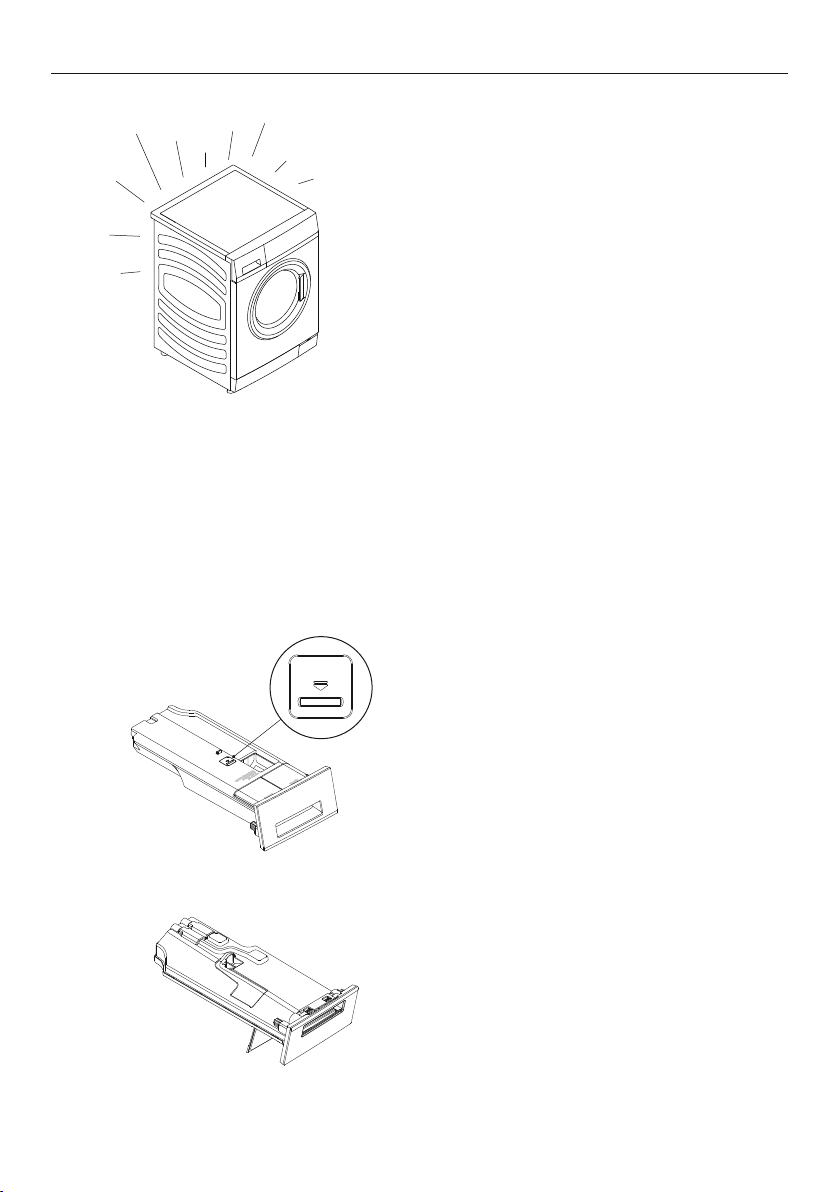
You can reset your washer to factory default settings by following the steps below.
To reset your washer to factory default settings:
1
Select the SPIN cycle.
2
Press MORE , LESS and OPTIMISE WASH
buttons together for threeseconds,
will appear on the screen and the washer
will beep.
Your washer will now be reset to factory
default settings.
+
30
CARING FOR YOUR WASHER
To remove the dispenser drawer from the
washer, pull the dispenser drawer open,
push down on the tab to the left of the
MANUAL DOSE compartment and pull the
dispenser drawer out from the washer.
Cleaning the dispenser drawer
1
2
When you have finished using your washer
z
Turn off the taps to prevent the chance of
flooding should a hose burst.
z
Unplug the washer from the power socket.
Cleaning your washer
Before you start cleaning your washer, ensure
that it is disconnected from the power (ie
unplug the washer from the power socket).
Aside from the detergent dispenser, water
hose(s), and the pump filter, no other parts
are designed to be removed from the washer
for cleaning. Do not attempt to remove any
other part of the washer.
Cleaning the control panel and outer surfaces of the washer
Use a soft damp cloth to wipe all surfaces, and wipe dry. Avoid using chemical or scouring
cleaners, as these will damage the paint and plastic surfaces of your washer.
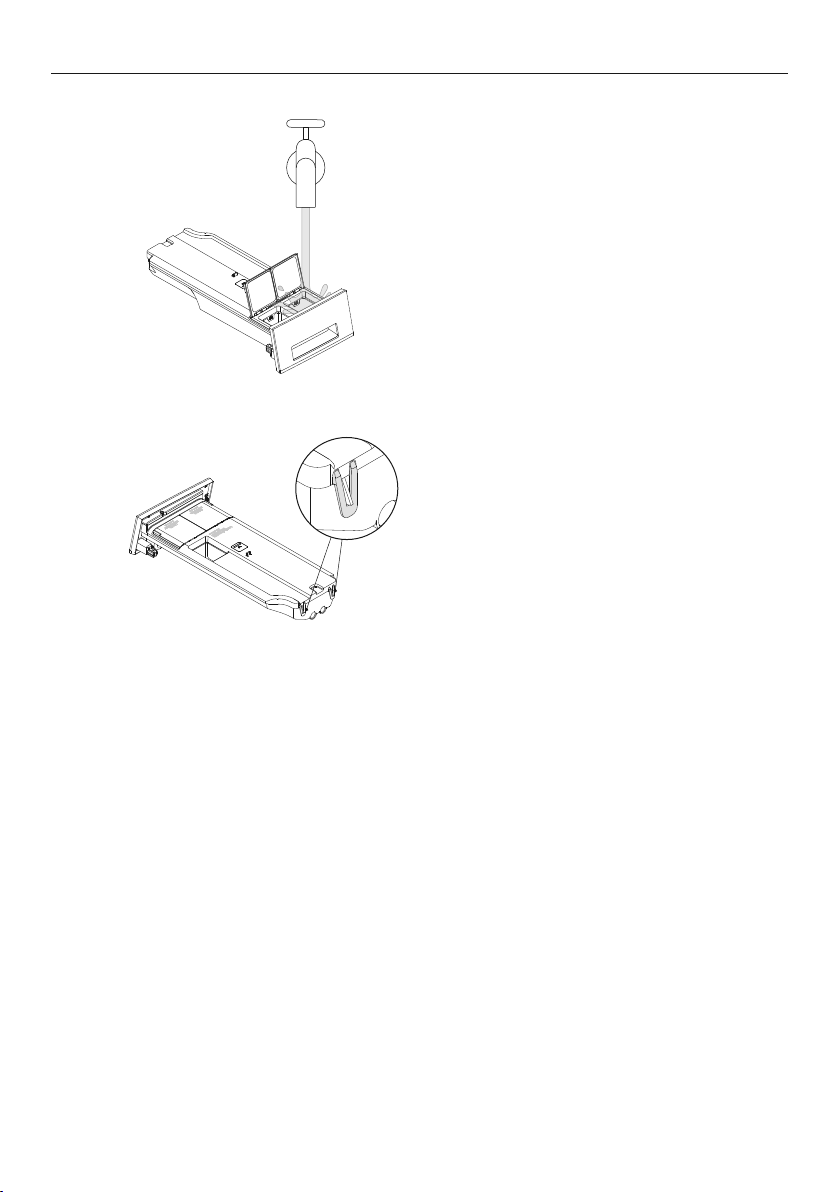
To empty the dispenser drawer, turn the
dispenser drawer upside down in the sink
and allow the leftover laundry liquid from the
AUTO DOSE compartments to drain.
31
3
CARING FOR YOUR WASHER
Toclean the dispenser drawer, fill the
compartments with warm water and shake
lightly to clear residue. Drain all water from
the compartments before re-fitting the
dispenser drawer to thewasher.
Cleaning the drum and the door
z
Use a soft damp cloth to wipe the door, cleaning any water marks or residue off it.
z
Wipe the rubber seal around the door. Remove any items or lint accumulating in the
bottom of the seal catchment and wipe out any water accumulated here. If this is not
cleaned out, unpleasant odours will develop.
z
If the drum has any residual dirt or lint stuck to it, remove this and wipe the drum clean.
Do not leave any metal objects in the drum as these may rust and cause staining.
Leave the door to your washer open when it is not in use to allow the washer to dry out,
otherwise it will develop unpleasant odours. When leaving the door open like this, it is
extremely important that children and pets are kept away from the washer so they cannot
be accidentally trapped inside it.
Cleaning the hose(s)
Each hose has a filter in it, preventing any solid contaminants in the water entering your
washing machine. Occasionally you should disconnect the water inlet hose(s) where they
connect to the tap(s), check these for any build up of dirt and wash this out.
4
To disassemble the dispenser drawer further
for cleaning, unhook the two clips at the rear
of the dispenser to remove the cover.
Ensure the dispenser drawer is correctly
reassembled before re-fitting tothe washer.
32
CARING FOR YOUR WASHER
Cleaning the inside of your washer
It is important that you regularly clean the inside of your washer using the
DRUM CLEAN
cycle. After 100cycles, a notification will popup on the display screen to remind you to
clean your washer.
If your washer starts to smell this is a sign that you should complete a
DRUM CLEAN cycle.
We recommend that you do not have any items in the washer when you run this cycle.
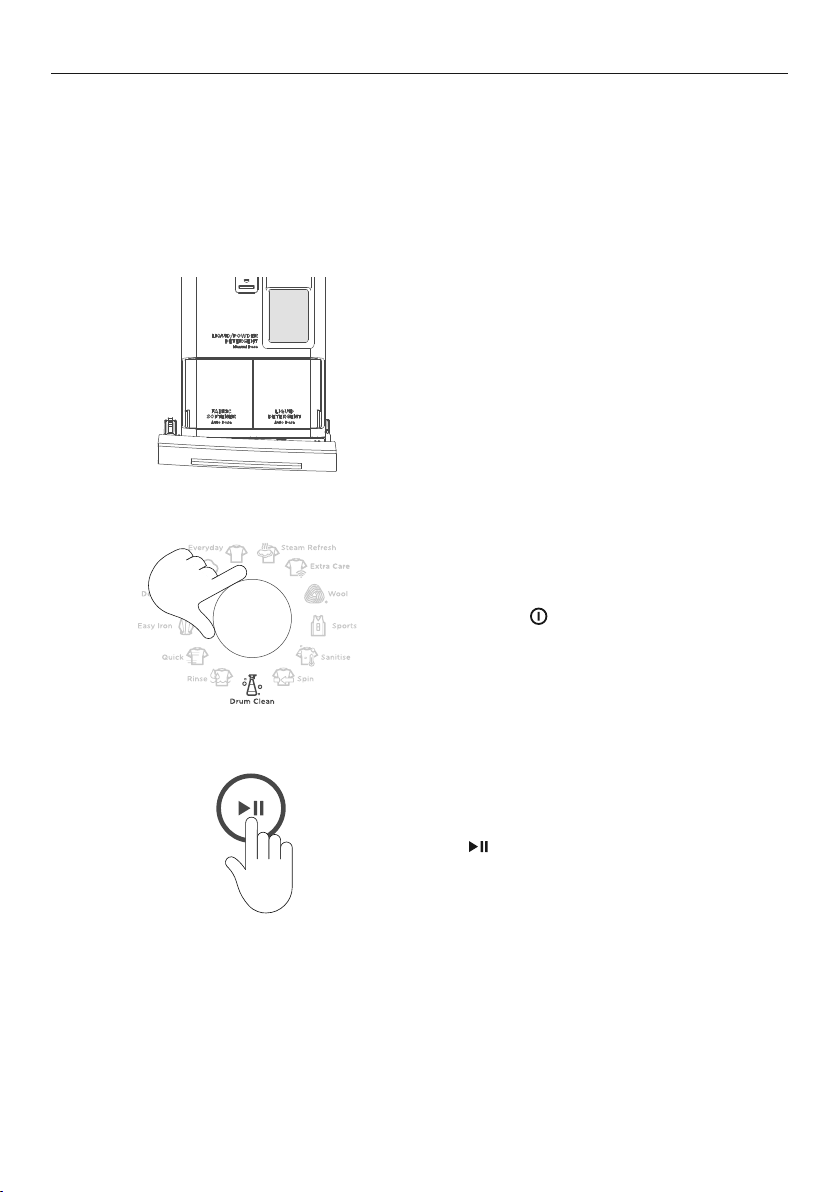
Add the washing machine cleaner
directly into the
MANUAL DOSE
DETERGENT COMPARTMENT
.
Follow the manufacturers instructions.
Press
to start the cycle.
1
2
3
Press POWER to turn your washer on
and select the DRUM CLEAN cycle.
33
Cleaning the pump filter
CARING FOR YOUR WASHER
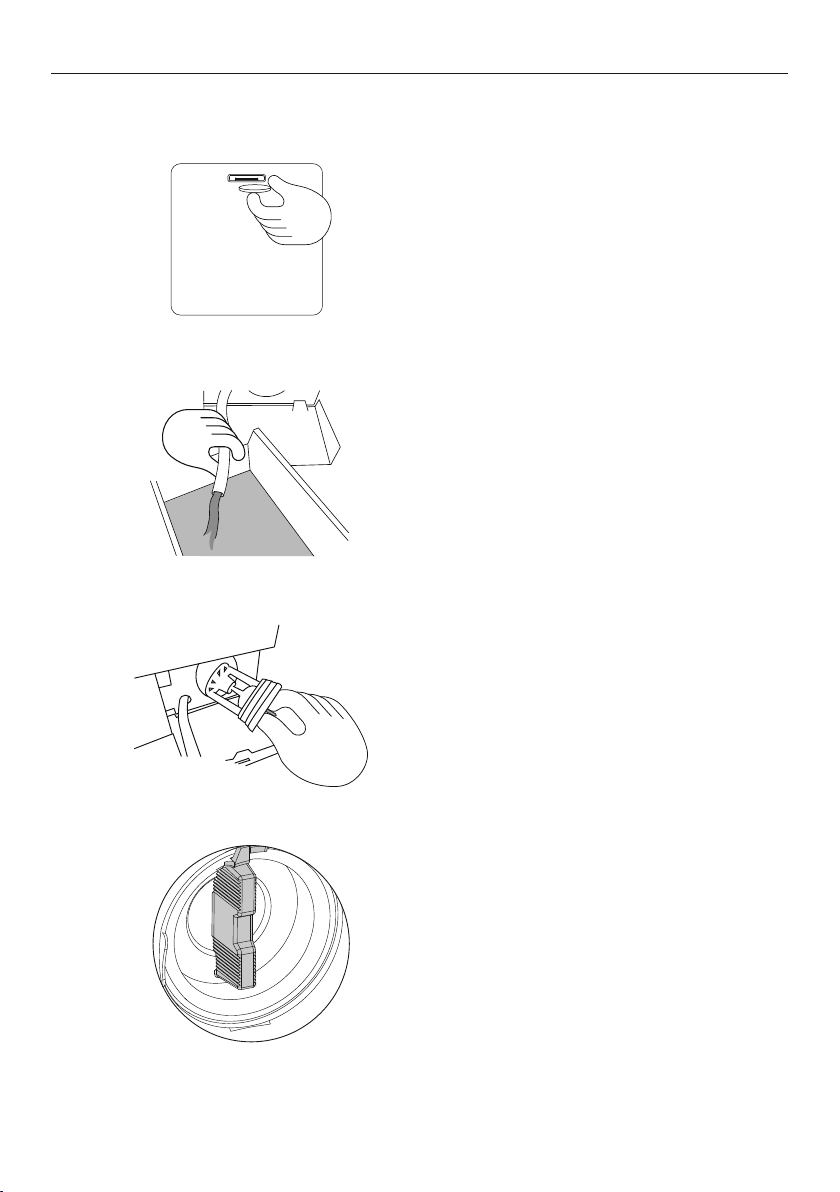
Unhook the pump outlet hose and pull it out
(approximately 150mm). Remove the plug
and allow any water (approximately 250ml)
to drain into a shallow dish.
After the draining process is complete,
replace the plug intothe hose and refit the
hose back into the housing.
Turn the power off and unplug the washer.
Use a coin to open the filter cover, place the
edge of the coin into the slot and tilt upwards
whilst levering the cover open.
2
1
Replace the filter by turning clockwise until
the turning handle stops in the vertical
position, and cannot be turned further.
Remove the filter by turning anti-clockwise.
Clean and rinseunder a tap. Check the pump
filter cavity for any further obstruction. Check
that the impellor located at the back of the
cavity moves freely.
3
4

34
CARING FOR YOUR WASHER
Products that might damage your washer
z
Concentrated bleaches, laundry pre-soakers/sanitisers, stain removers and hydrocarbon
solvents (eg petrol and paint thinners) can cause damage to the surfaces eg control
panel, and components of your washer.
z
Be careful when washing garments stained with solvents as they are flammable. DO NOT
put them in your dryer.
z
Use of dyes in your washer may cause staining of the plastic components. The dye will
not damage the washer but we suggest you thoroughly clean your washer afterwards.
We do not recommend the use of dye strippers in your washer.
z
Nappy sanitisers and bleach are very corrosive to metal surfaces. DO NOT tip the
contents of a nappy bucket into your washer. Rinse and wring items out thoroughly
before placing them in the washer.
Moving your washer
Make sure any water in the washer is drained out. This can be done by cleaning out the
pump filter, refer to ‘Cleaning the pump filter’.
Saving water, energy and the environment
Water efficient washing machines will save you money, but it is also worth thinking about
energy use, recycling water and the environment. Some options to consider are:
z
Turn the washer off at the wall when not in use.
z
Turn off the taps when not in use.
z
Select cooler wash temperatures.
z
Wash full loads rather than several smaller loads.
z
Use the ECO wash function (where available).
z
Follow instructions on the detergent packet or bottle – do not overdose.
z
Use concentrated detergent – it costs less per wash.
z
Consider re-using the washing machines grey water on the garden or for flushing your
toilet – more information can be found on government websites promoting energy
and water saving.
35
BEFORE YOU CALL FOR SERVICE
User warnings
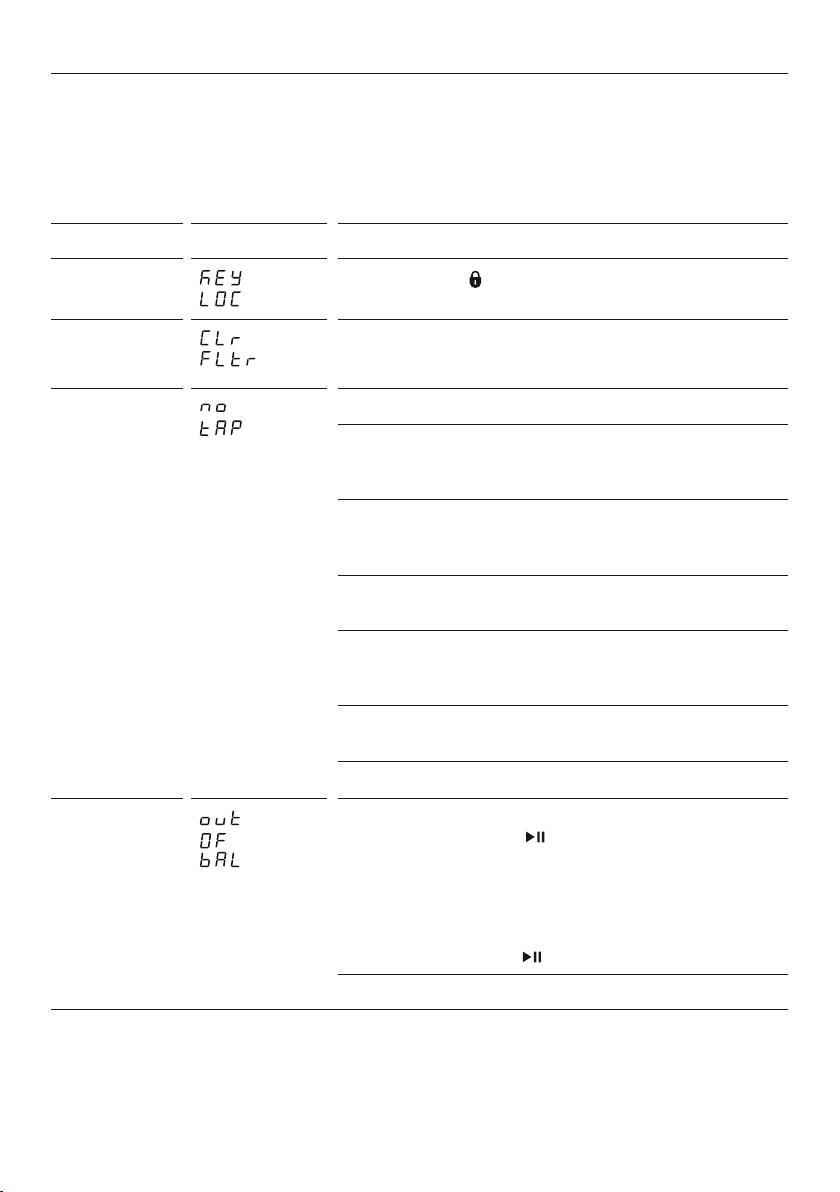
Your washer is capable of self diagnosis and may sound a series of beeps and display
anotification or warning to inform you when there is aproblem. In most cases you will be
able to address the problem the washer is alerting you to. Check this chart before you call
for service.
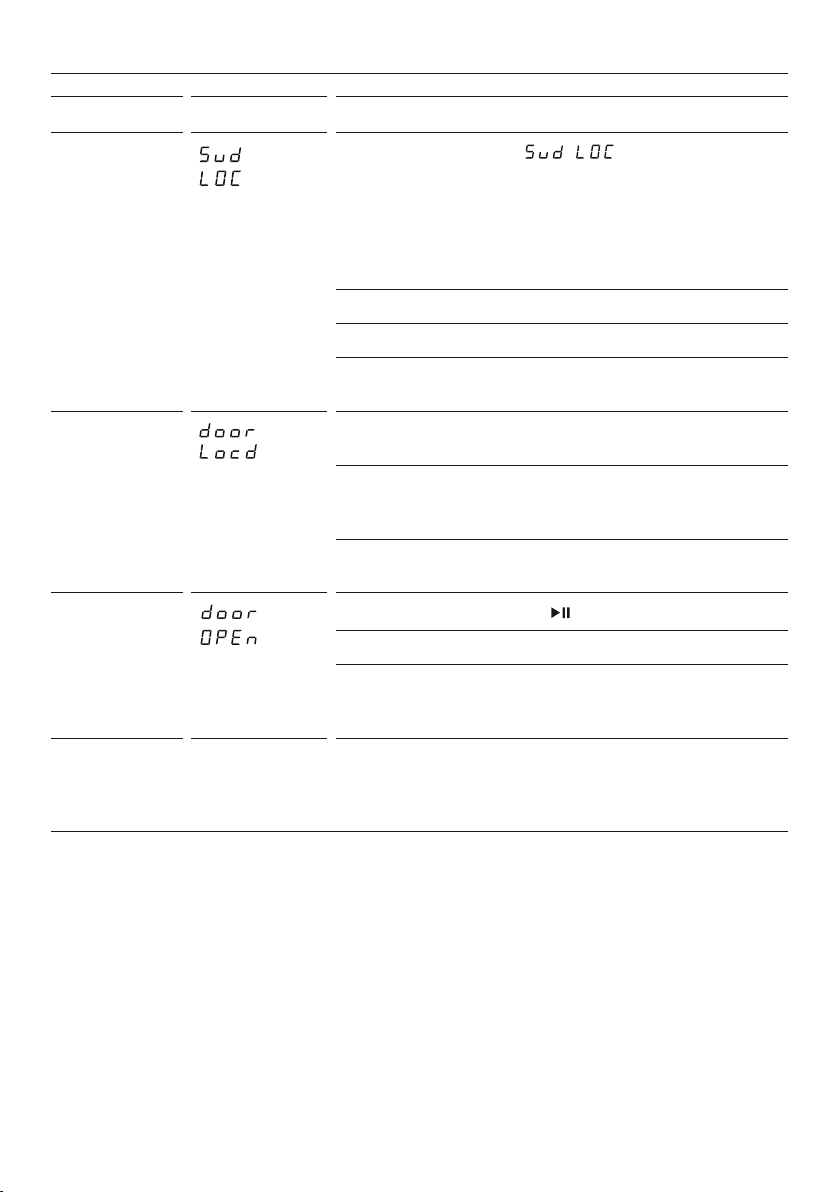
PROBLEM DISPLAYED AS WHAT TO DO
Keylock is
activated
Press and hold for threeseconds.
Pump filter
is blocked
Clean the pump filter.
The washer
is not getting
any water
Check the tap(s) have been turned on.
If there is no hot water connection the washer will
heat the water itself, but there must be a cold water
connection to the cold valve.
Check the hose connections. If the cold water
supply is connected to the hot valve and there is no
connection to the coldvalve the washer will not fill.
Check the inlet hose(s) filters are not blocked, the
hose(s) are not kinked and are attached correctly.
Check that the drain hose is not too low or pushed
into the standpipe too far. This will cause the water to
siphon out of thewasher.
Check that the cold water temperature does not
exceed the 35°Ctemperature requirement.
Check the water flow rate. It maybe too low.
The washer is
out of balance
The wash load has gone out of balance at some point
during the cycle. Press to stop the message. You
may notice the load feels wetter than usual, as the
washer has adjusted the spin speed to compensate for
the out of balance. If you want to improve the dryness
of the load, manually re-distribute the load and remove
items if necessary. Close the door, adjust the spin speed
if necessary and press to start the washer.
Check the washer is level.
36
PROBLEM DISPLAYED AS WHAT TO DO
The washer has
too many suds
Washer will stop and flash while waiting for suds
todissipate. The washer will not beep during this time.
When the suds have dissipated the washer will automatically
restart. If a suds event has occurred during a cycle the washer
will also display this warning at the end of the cycle, to alert you
that this has occurred. This may help to explain any reduction
inperformance.
Check you are using a detergent suitable for front loaders.
Check you are not overdosing the detergent.
Check the standpipe height for the drain is a minimum
of 600mm.
Door is locked
The temperature in the drum is over 60°C therefore it is not safe
to open the door. Wait until the temperature drops below 60°C.
Check the water level in the drum. If the level is above the
bottomof the door seal, the door cannot be opened. Use the
ADD A GARMENT button if you wish to add or remove items
If the drum is still moving, wait for it to stop before attempting
toopen the door.
Door is open
Close the door fully and press .
Try opening and closing the door again.
Reposition the load, make sure the load is correctly in the
drum and that protruding items are not stopping the door
from closing.
Door is open
cLos door
Close the door fully.
This warning will appear you are attempting to enter
REMOTE
MODE
and the washer door is open. The door must be closed for
REMOTE MODE to be enabled.
BEFORE YOU CALL FOR SERVICE

37
FAULT CODES
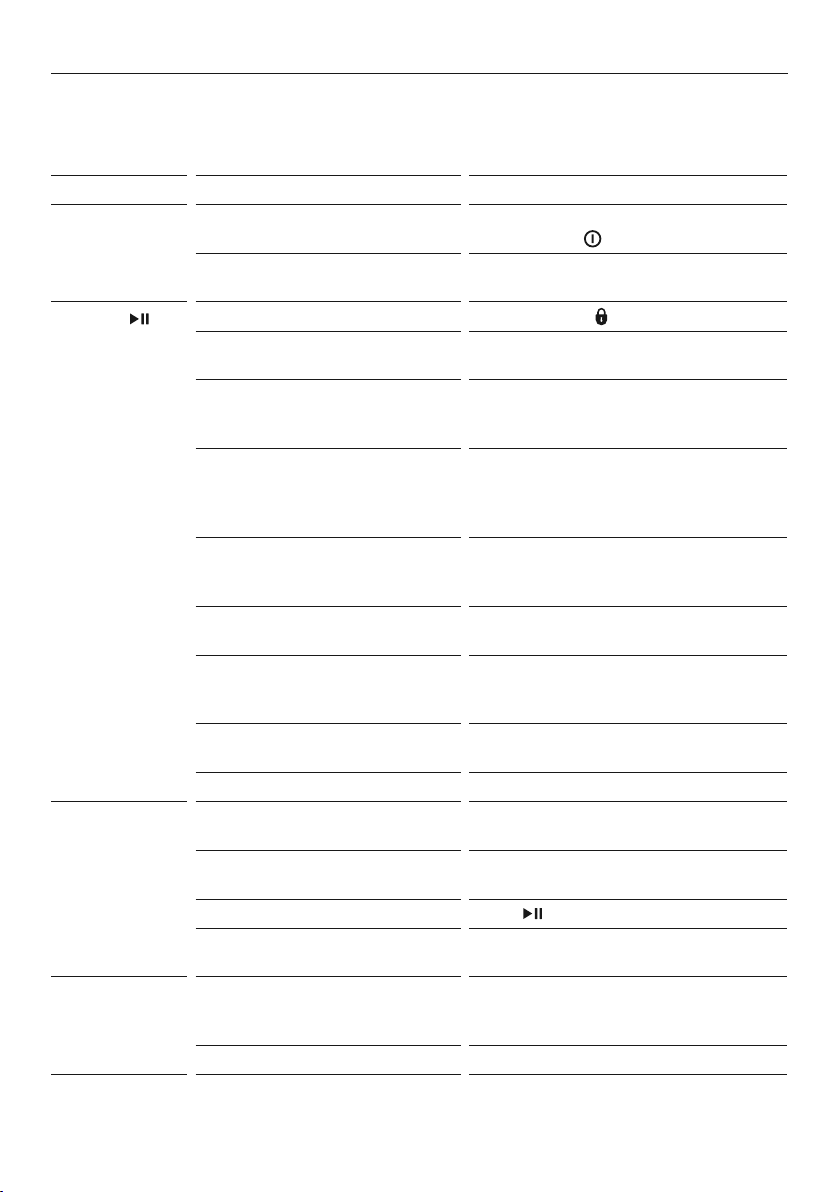
If a continuous series of beeps sounds, all the lights turn off on the control panel and a
number appears on the display, a fault has occurred. The washer automatically enters this
mode when there is a fault. The word Fault will be shown in the control panel display
followed by a number (refer to example shown here). To stop the beeps, touch any button
then perform the following steps:
1 Turn your washer off at the power point.
2 Wait oneminute and turn it back on.
3 Check your washer is correctly levelled. Refer to your installation guide.
4 Remove your wash load.
5 Perform a
RINSE cycle.
6 If the fault re-occurs repeat steps1 and 2.
7 If the washer will still not work you will be required to call a Fisher & Paykel trained and
supported service technician to arrange service, refer to ‘Customer Care’ for details.
Record the fault code number displayed and the serial number of your washer (located
above the door opening when the door is open) before calling. The fault code will
indicate to the repairer what the problem could potentially be.
If a fault code is being displayed, you can still turn your washer off by pressing
POWER .
38
TROUBLESHOOTING
The following is a list of problems you may encounter when using this appliance and some
suggestions that may help to correct the problem. If you still have problems, contact your
Fisher & Paykel trained and supported service technician.
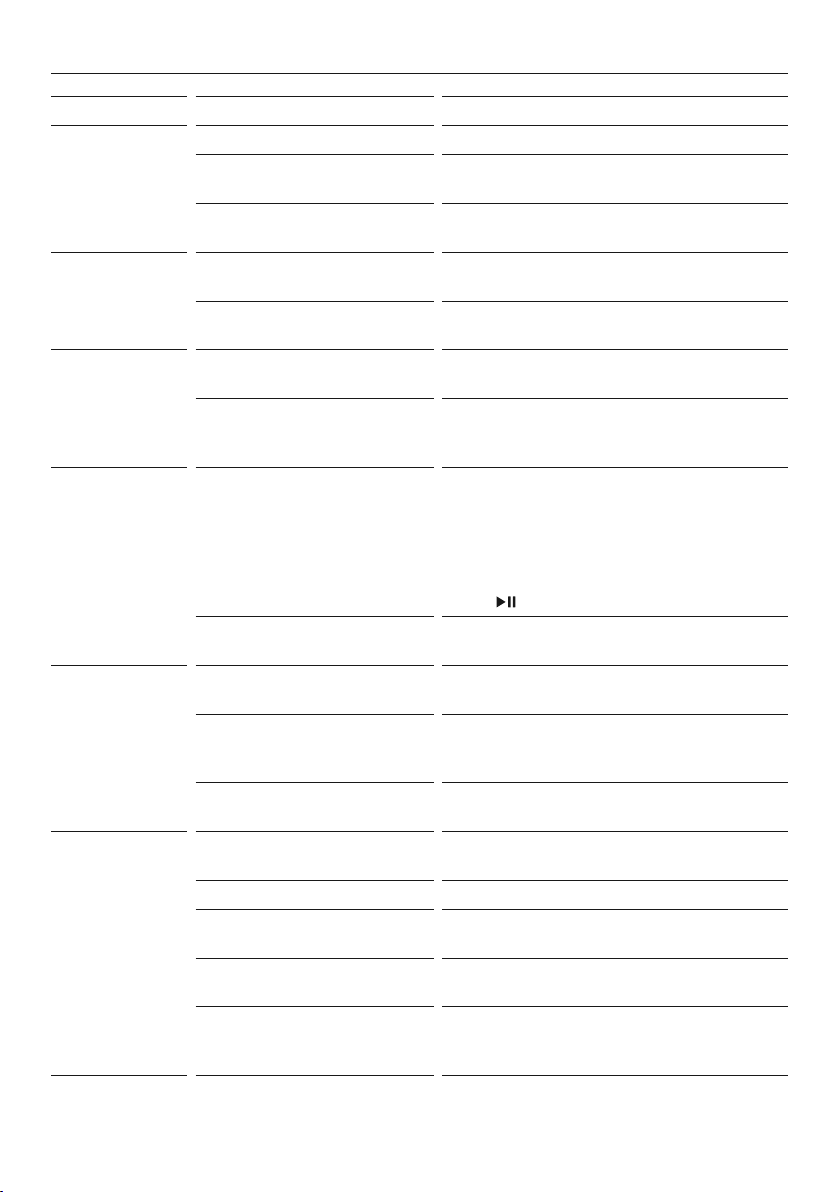
PROBLEM POSSIBLE CAUSES WHAT TO DO
Washer not
turning on
Power not switched on at
thewall.
Switch the power on at the wall.
Press
POWER .
Household power supply
notworking.
Try plugging in another
electrical appliance.
Pressing
does not start
the fill
Keylock may be activated.
Press and hold
for three seconds.
Washer door not
closed properly.
Open and reclose door.
The washer has detected afault. Check if a code is being displayed
onthe control panel, refer to
‘Fault codes’.
Hot and cold taps not
turnedon.
Check that both hot and cold taps
are turned on (if using cold inlet only
ensure inlet valve cap is installed on
the hot valve on the washer).
Hot and cold taps not
connected to the corresponding
valve on the washer.
Check the cold tap is connected to the
cold valve on the washer and the hot
tap is connected to the hot valve.
Blocked hose filters. Check the tap end of the inlet hose(s)
for blockages.
Inlet hose(s) leaking, twisted
ordamaged.
Check the inlet hose(s) for leaks or
damage. Check that the inlet hose(s)
are not twisted.
Faulty water supply. Check tap(s) that aren’t connected
to the washer are working.
Delay start maybe set. Refer to ‘Delay Start’.
Washer stops
working
mid cycle
The washer has detected afault. Refer to ‘User warnings’ or
‘Fault codes’.
Power or water failure. Check the power and/or water is
working correctly.
Washer has been paused.
Press
to continue.
Oversudsing. Washer is waiting for suds to dissolve
before continuing the cycle.
Washer drains
while filling
Drain hose too low. Ensure the height of the drain hose is
atleast 600mm from the floor level,
refer to your installation guide.
Drain hose sitting in water. Clear the drain.
39
TROUBLESHOOTING
PROBLEM POSSIBLE CAUSES WHAT TO DO
Washer is
not draining
Drain hose blocked. Clear the drain hose.
Pump filter blocked. Clear the pump filter, refer to ‘Cleaning the
pump filter’.
Drain hose higher than
1000mm above floor level.
Lower the level of the drain hose,
refer to your installation guide.
Filling
continuously
Drain hose not connected to
standpipe, tub or spigot.
Connect drain hose correctly, refer to your
installation guide.
Washer is siphoning. Ensure standpipe or tub is at least 600mm
from the floor level.
Poor rinsing Incorrect detergent used. Use low sudsing, front loader
detergent only.
Too much detergent used. Ensure the correct dose of detergent is
used for the load size and soil level refer
to ‘Detergent and softener’.
Not spinning
properly
Load has gone out
of balance.
The wash load has gone out of balance
during the spin. If you want to improve the
dryness of the load, manually re-distribute
the load and remove items if necessary.
Close the door and select
SPIN SPEED,
adjust the spin speed if necessary and
press to start the washer.
Suds build up. Check the amount of detergent used,
reduce if necessary.
Too many
soap suds
Incorrect type of
detergentused.
Use low sudsing, front loader detergent
only refer to ‘Detergent and softener’.
Too much detergent used. Ensure the correct dose of detergent
isused for the load size and soil level refer
to ‘Detergent and softener’.
Inlet water pressure/
flowrate too low.
Ensure correct inlet water pressure and
flow rate as per the installation guide.
Small puddle
of water
from under
the washer
Inlet hose(s) or drain
hose leaking.
Check inlet hose(s) and the drain hose are
correctly attached and not damaged.
Lots of suds. Suds may have leaked and then dissolved.
Dispenser compartments
blocked.
Refer to ‘Cleaning the dispenser drawer’.
Dispenser drawer not
fullyclosed.
Close dispenser drawer fully and ensure
itremains closed during the cycle.
Damage to door seal. Check seal inside door for damage.
If it sustains any damage it will need
to be replaced.
40
TROUBLESHOOTING
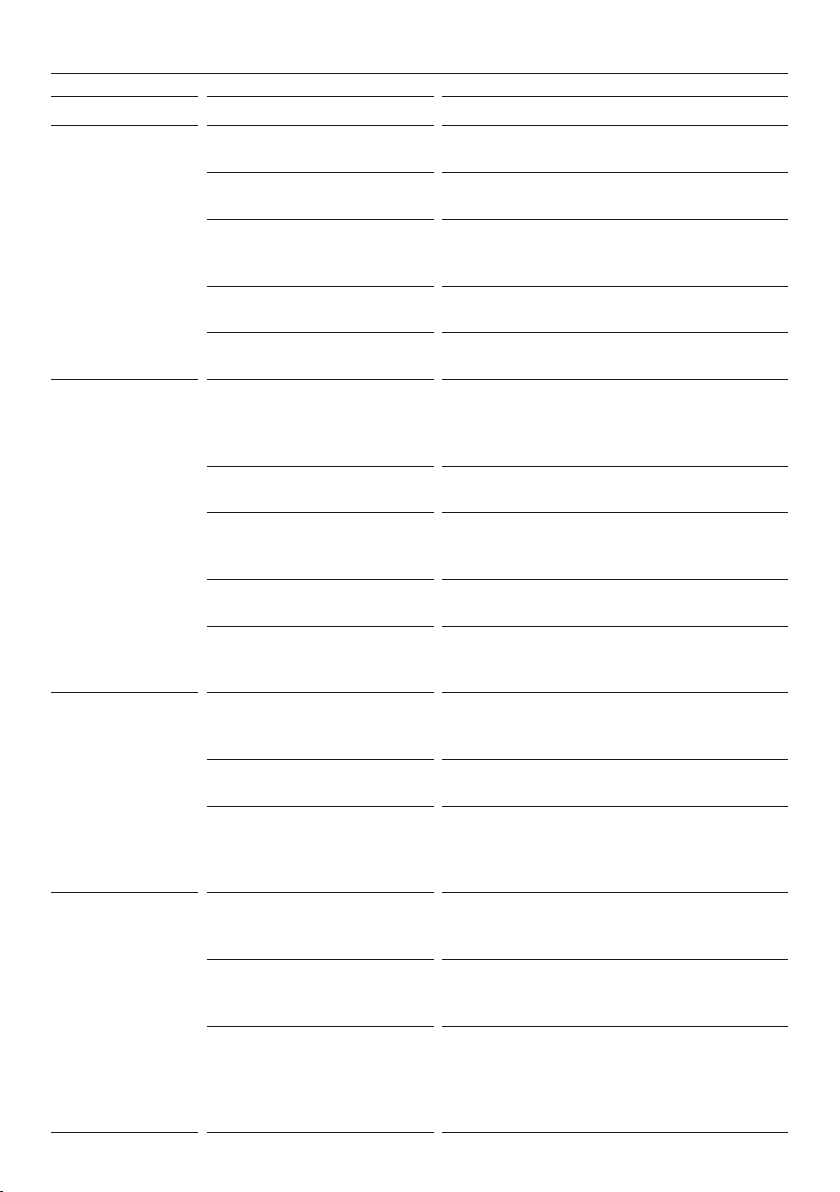
PROBLEM POSSIBLE CAUSES WHAT TO DO
Cycle time
longer than
usual /
inaccurate
adjustment of
time remaining
during cycle
Cycle time is approximate. Cycle time is influenced by a number of
factors refer to ‘Wash cycles’.
Low water pressure or
flowrate.
Ensure that inlet hose filters are
notblocked.
Out of balance or
oversudsing.
Recovery from out of balance or
oversudsing will extend cycle time refer to
‘Caring for your washer’.
Washing a large load. Be aware that it will take longer
forthewasher to fill.
Selecting various options. Be aware that some options will extend
cycle time.
Detergent or
fabric softener
remaining in
manual dose
dispenser at the
end of the cycle
Dispenser drawer not
properly closed or was
opened part way through
the cycle.
Ensure the dispenser drawer is fully closed
at the start of the cycle and remains
closed throughout the cycle.
Dirty or blocked dispenser. Clean the dispenser drawer. Refer to
‘Cleaning the detergent dispenser drawer’.
Liquid sitting at the
MAX
level at the end of the
cycle indicates a blockage.
Clean the fabric softener dispenser
compartment, refer to ‘Cleaning the
dispenser drawer’.
Dispenser over loaded
with detergent.
Clean out remaining detergent, Refer to
‘Cleaning the detergent dispenser drawer’.
Composition of the
powder detergent makes it
difficultto dispense.
Dissolve detergent with water to aid
with dispensing.
Washing very
wet at the end
of the cycle
Cycle selected
not appropriate.
Particularly short or delicate cycles have
shorter spins which can result in wetter
washing at the end of the cycle.
Incorrect spin speed for
load selected.
Select a faster spin speed.
An out of balance load
hasoccurred.
The washer compensates for the out of
balance by using a lower spin speed, to
reduce noise and potential damage to
the product.
Vibrating Transit bolts left in place. Ensure transit bolts are removed prior
touse of the washer, refer to your
installation guide.
Washer may not be level. Ensure washer is installed on an
appropriate surface and levelled correctly,
refer to your installation guide.
Load is out of balance. Wash an average sized load rather than a
smaller load or a single item. Washingone
item at a time is not recommended as it is
difficult for the washer to balance a single
item duringspin.
41
TROUBLESHOOTING
PROBLEM POSSIBLE CAUSES WHAT TO DO
Creasing Washer overloaded. Do not overload the washer.
Incorrect cycle for
loadtype.
Use the
EASY IRON, DELICATES or
STEAM REFRESH cycle for creasable items.
Spin speed too fast. Select a slower spin speed.
Wet clothes left
in washer or
laundry basket.
Laundry left sitting wet is more likely to
crease. If not removing clothes from washer
immediately at end of cycle. Do not leave wet
washing sitting in a washing basket.
Wash temperature too
hot for load type.
Select a lower wash temperature.
Check items care label for correct care.
Check the hot and cold taps are connected
to the correct valves, refer to your
installation guide.
Items not
sorted correctly.
Sort load so that items of similar weight are
washed together.
Poor soil
removal
Incorrect wash
cycle selected.
Select a wash cycle that is appropriate for the
amount of dirt, refer to ‘Wash cycles’.
Insufficient detergent. If using
MANUAL DOSE ensure the correct dose
of detergent isused for the load size and soil
level, refer to ‘Detergent and softener’. If using
AUTO DOSE refer to ‘Adjusting Auto Dose’.
Washer overloaded. Ensure the washer is not overloaded interms
of its capacity or the cycle selected, refer
to ‘Loading’.
Items require a longer
wash time.
Select
WASH+ or PRE WASH option.
Load was
particularly dirty.
Select
PRE WASH option for particularly dirty
loads, refer to ‘Customising a wash cycle’.
Items not sorted
correctly.
Wash heavily and lightly soiled
garments seperately.
Washer dirty from
previouswash.
After washing particularly dirty clothing, we
recommend putting the washer through a
RINSE cycle once the load has been removed.
This washes away any remnants of dirt that
could affect future wash performance.
Incorrect wash
temperature selected
in relation to the type
of soil.
Select a wash temperature suitable for the
type of soil, eg warm for greasy soils, cold for
muddy soils. Increasing the wash temperature
generally improves soil removal and overall
wash performance.
Ensure garments can be washed at the
increased temperature.
42
PROBLEM POSSIBLE CAUSES WHAT TO DO
Dye transfer Coloured items not washed
separately from white/
lightcoloured items.
Remember to separate whites
andcolours.
New or non-colourfast items
not washed separately.
Wash non-colourfast items separately
and select
COLD wash temperature.
Wet items have been left sitting
for too long.
Remove items from washer as soon as
the cycle is finished.
Wash temperature. Consider the wash temperature you
select for your coloured items. Lower
the temperature if you are concerned.
Black or
grey marks
on clothes
Incorrect amount of detergent. Ensure the correct dose of
detergent is used for the load size
and soil level, refer to ‘Detergent
and softener’.
Washer needs to be cleaned. Empty the washer and complete a
DRUM CLEANcycle, refer to ‘Cleaning
the drum and the door’.
Tangling Items not sorted correctly. Separate larger items from
smalleritems.
Washer loaded incorrectly. Load items loosely and individually
into the washer, ie not folded.
Incorrect cycle for load
type selected.
Use the
EASY IRON or STEAM REFRESH
cycle for items that crease easily.
Overloaded in terms of its
capacity or the cycle selected.
Refer to wash cycles for recommended
maximum load size.
Delicate items. Wash pantyhose, bras and any
otherdelicate items prone to tangling
in a mesh laundry bag.
Washer smells Not using enough detergent for
the soil level in your loads.
Run a
DRUM CLEAN cycle.
Buy a better quality detergent or use a
higher dose.
Different detergents have different
cleaning chemicals, consider alternating
detergents to help remove odour.
Wet patches on
clothes/items
Clothes are slightly damp from
the steam.
It is normal for items to be damp after
using the
STEAM REFRESH cycle, this helps
to remove the wrinkles. Remove the
items from the washer immediately at the
end of the cycle and hang up to dry.
TROUBLESHOOTING

43
For New Zealand and Australia only. You automatically receive a two-year Manufacturer’s
Warranty with the purchase of this clothes washer covering parts and labour for servicing
within the country ofpurchase.
Fisher&Paykel undertakes to:
Repair or, at its option, replace without cost to the owner either for material or labour any
part of the product, the serial number of which appears on the product, which is found to
be defective within two years of the date of purchase.
You also receive an additional eight-year parts only Manufacturer’s Warranty on your
Direct Drive motor. This additional eight-year Manufacturer’s Warranty commences on the
day following the expiry of the two-year Manufacturer’s Warranty and excludes the motor
controller and labour. Fisher&Paykel will repair (as to parts) or, at its option, replace any
Direct Drive motor (but not the motor controller) which is found to be defective within this
additional Manufacturer’s Warranty period. You will be responsible for any labour costs.
Note: These Manufacturer’s Warranties are an extra benefit and do not affect your
legalrights.
These Manufacturer’s Warranties DO NOT cover
A Service calls which are not related to any defect in the product. The cost
of a servicecallwill be charged if the problem is not found to be a product
fault. Forexample:
1 Correcting the installation, eg removal of bottom packer and transit bolts
(frontloading washers), levelling the washer, adjustment of the drain to correct
siphoning, noises, crossed, kinked or leaking inlet hose connections, turning on
water,noises caused by the waterhammer or power supplies.
2 Providing instruction on use of the product or changing the set-up of the product,
eginstruction on correct use of detergents and fabric softeners.
3 Replacing fuses in, or correcting house wiring or correcting house plumbing,
egunblockingdrains.
4 Correcting fault(s) caused by the user.
5 Noise or vibration that is considered normal, eg spin sounds, user warning beeps.
6 Correcting damage caused by pests, eg rats, cockroaches, etc.
7 Water on the floor due to incorrect loading or excessive suds.
8 Blocked pumps, removal of foreign objects/substances from the washer, including the
pump and inlet hose filters, eg bra wires, bread tags, nails, grit, scrud, etc.
9 Correcting corrosion or discolouration due to chemical attack.
B Defects caused by factors other than:
1 Normal domestic use; or
2 Use in accordance with the product’s user guide.
C Defects to the product caused by accident, neglect, misuse or ‘Act of God’.
D The cost of repairs carried out other than by a Fisher&Paykel trained and supported
service technician or the cost of correcting such repairs.
E Normal recommended maintenance as set out in the product’s user guide.
F Repairs when the appliance has been dismantled, repaired or serviced by other than
aFisher&Paykel trained and supported service technician or the selling dealer.
MANUFACTURER’S WARRANTY

44
MANUFACTURER’S WARRANTY
G Pick-up and delivery.
H Transportation or travelling costs involved in the repair when the product is
installed outside the Fisher&Paykel trained and supported service technician’s
normal servicearea.
Nothing in this Manufacturer’s Warranty is intended to, nor limits, any rights you mayhave
under law to recover the costs of inspecting or returning the goods to us.
This product has been designed for use in a normal domestic (residential) environment. This
product is not designed for any commercial use (whatsoever). Any commercial useby a
customer will affect this product’s Manufacturer’s Warranty.
Service under these Manufacturer’s Warranties must be provided by a Fisher&Paykel
trained and supported service technician. Suchservice shall be provided during normal
business hours. ThisManufacturer’s Warranty certificate should be shown when making
any claim.
For Australian customers
This Manufacturer’s Warranty is an extra benefit and does not affect your legal rights. Our
goods come with guarantees that cannot be excluded under the Australian Consumer
Law. You are entitled to a replacement or refund for a major failure and compensation for
any other reasonably foreseeable loss or damage. You are also entitled to have the goods
repaired or replaced if the goods fail to be of acceptable quality and the failure does not
amount to a major failure.
Keep this user guide in a safe place.

45
CUSTOMER CARE
Before you call for service or assistance:
Check our website, fisherpaykel.com, for ‘Product Help’ to see the latest updates, hintsand
tips, and information about your product.
We recommend that you also refer to your user guide to ensure:
1 Your product is correctly installed.
2 You are familiar with its normal operation.
3 You have read the ‘Before you call for service’, ‘Fault codes’ and ‘Troubleshooting’
attheback of the book.
If after checking these points you still need assistance or parts, you can go online to our
website and book a service with your nearest Fisher&Paykel trained and supported service
technician. Our Customer Care team is also available to offer you assistance.
In New Zealand if you need service or assistance:
Go online to our website and book a service or call the Fisher&Paykel Customer Care
Centre and talk to one of our Customer CareConsultants.
Toll Free: 0800 FP CARE or 0800 372 273
Email: customer.care@fisherpaykel.com
Website: fisherpaykel.com
Postal address: Fisher&Paykel Appliances Ltd, PO Box 58550, Botany, Auckland 2163
Fisher&Paykel has a network of Fisher&Paykel trained and supported service technicians
who can carry out any service necessary on your appliance. Visit our website and book a
service with a Fisher&Paykel trained and supported service technician in your area.
In Australia if you need service or assistance:
Go online to our website and book a service or call the Fisher&Paykel Customer Care
Centre and talk to one of our Customer CareConsultants.
Toll Free: 1300 650 590
Email: customer.care@fisherpaykel.com
Website: fisherpaykel.com
Postal address: Fisher&Paykel Appliances Australia Pty Ltd, PO Box 798,
ClevelandQLD4163
Fisher&Paykel has a network of Fisher&Paykel trained and supported service technicians
who can carry out any service necessary on your appliance.
Visit our website and book a service with a Fisher&Paykel trained and supported service
technician in your area.
If you call, write to or contact us via our website, please provide your name and address,
model number, serial number, date of purchase and a complete description of the problem.
This information is needed in order to better respond to your requestforassistance.
Product details can be found on the rear of the washing machine, and/or above the drum
opening (when the door is open).



4027C 05.21
FISHERPAYKEL.COM
© Fisher & Paykel Appliances 2021. All rights reserved.
The models shown in this guide may not be available in all markets
and are subject to change at any time.
The product specifications in this guide apply to the specific products and
models described at the date of issue. Under our policy of continuous product
improvement, these specifications may change at any time.
For current details about model and specification availability in your country,
please go to our website or contact your local Fisher&Paykel dealer.