

Contents
Safety information.......................................................................................9
Learning about the printer.........................................................................10
Thank you for choosing this printer!.......................................................................................................10
Finding information about the printer....................................................................................................10
Selecting a location for the printer..........................................................................................................11
Printer configurations.............................................................................................................................12
Understanding the printer control panel................................................................................................15
Using the standard exit bin and paper stop............................................................................................18
Additional printer setup.............................................................................20
Installing internal options........................................................................................................................20
Available internal options .................................................................................................................................20
Accessing the system board to install internal options ....................................................................................20
Installing a memory card ..................................................................................................................................21
Installing a flash memory or firmware card......................................................................................................24
Installing hardware options.....................................................................................................................25
Installing a 250‑ or 550‑sheet drawer ..............................................................................................................25
Attaching cables......................................................................................................................................27
Verifying printer setup............................................................................................................................28
Printing a menu settings page ..........................................................................................................................28
Printing a network setup page..........................................................................................................................29
Setting up the printer software...............................................................................................................29
Installing printer software ................................................................................................................................29
Updating available options in the printer driver ..............................................................................................30
Setting up wireless printing.....................................................................................................................31
Information you will need to set up the printer on a wireless network ...........................................................31
Installing the printer on a wireless network (Windows)...................................................................................31
Installing the printer on a wireless network (Macintosh).................................................................................33
Installing the printer on a wired network...............................................................................................36
Minimizing your printer's environmental impact........................................39
Saving paper and toner...........................................................................................................................39
Using recycled paper ........................................................................................................................................39
Conserving supplies ..........................................................................................................................................39
Saving energy..........................................................................................................................................40
Using Eco‑Mode................................................................................................................................................40
Reducing printer noise......................................................................................................................................40
Contents 2

Adjusting Power Saver......................................................................................................................................41
Recycling..................................................................................................................................................42
Recycling Lexmark products .............................................................................................................................42
Recycling Lexmark packaging............................................................................................................................42
Returning Lexmark cartridges for reuse or recycling........................................................................................43
Loading paper and specialty media............................................................44
Setting the paper size and type...............................................................................................................44
Configuring Universal paper settings......................................................................................................44
Loading trays...........................................................................................................................................45
Using the multipurpose feeder...............................................................................................................49
Linking and unlinking trays......................................................................................................................54
Linking trays......................................................................................................................................................54
Unlinking trays ..................................................................................................................................................54
Creating a custom name for a paper type ........................................................................................................55
Assigning a customer paper type name to a tray .............................................................................................55
Paper and specialty media guidelines.........................................................57
Paper guidelines......................................................................................................................................57
Paper characteristics.........................................................................................................................................57
Unacceptable paper..........................................................................................................................................58
Selecting paper .................................................................................................................................................58
Selecting preprinted forms and letterhead ......................................................................................................59
Using recycled paper and other office papers..................................................................................................59
Storing paper ....................................................................................................................................................59
Supported paper sizes, types, weights, and capacities...........................................................................60
Paper types and weights supported by the printer ..........................................................................................60
Paper sizes supported by the printer................................................................................................................61
Paper tray capacities.........................................................................................................................................62
Printing......................................................................................................63
Printing a document................................................................................................................................63
Printing a document .........................................................................................................................................63
Printing on specialty media.....................................................................................................................64
Tips on using letterhead ...................................................................................................................................64
Tips on using transparencies ............................................................................................................................65
Tips on using envelopes....................................................................................................................................65
Tips on using labels ...........................................................................................................................................66
Tips on using card stock....................................................................................................................................66
Printing confidential and other held jobs................................................................................................67
Holding jobs in the printer................................................................................................................................67
Printing confidential and other held jobs .........................................................................................................67
Contents 3

Printing information pages......................................................................................................................69
Printing a font sample list.................................................................................................................................69
Printing a directory list......................................................................................................................................69
Printing the print quality test pages .................................................................................................................69
Canceling a print job................................................................................................................................70
Canceling a print job from the printer control panel........................................................................................70
Canceling a print job from the computer .........................................................................................................70
Understanding printer menus....................................................................72
Menus list................................................................................................................................................72
Paper menu.............................................................................................................................................73
Default Source menu ........................................................................................................................................73
Paper Size/Type menu......................................................................................................................................73
Configure MP menu..........................................................................................................................................76
Substitute Size menu ........................................................................................................................................76
Paper Texture menu .........................................................................................................................................76
Paper Weight menu ..........................................................................................................................................78
Paper Loading menu .........................................................................................................................................79
Custom Types menu .........................................................................................................................................80
Universal Setup menu.......................................................................................................................................81
Reports menu..........................................................................................................................................82
Reports menu ...................................................................................................................................................82
Network/Ports menu...............................................................................................................................83
Active NIC menu ...............................................................................................................................................83
Standard Network or Network <x> menus .......................................................................................................83
Reports menu (under the Network/Ports menu) .............................................................................................85
Network Card menu..........................................................................................................................................85
TCP/IP menu .....................................................................................................................................................85
IPv6 menu .........................................................................................................................................................86
Wireless menu ..................................................................................................................................................87
AppleTalk menu ................................................................................................................................................88
NetWare menu .................................................................................................................................................88
LexLink menu ....................................................................................................................................................89
USB menu .........................................................................................................................................................89
Parallel menu....................................................................................................................................................91
SMTP Setup menu ............................................................................................................................................93
Security menu.........................................................................................................................................94
Miscellaneous menu.........................................................................................................................................94
Confidential Print menu....................................................................................................................................94
Security Audit Log menu...................................................................................................................................95
Set Date/Time menu.........................................................................................................................................96
Settings menu..........................................................................................................................................97
General Settings menu .....................................................................................................................................97
Contents 4

Setup menu.....................................................................................................................................................100
Finishing menu................................................................................................................................................102
Quality menu ..................................................................................................................................................103
Utilities menu..................................................................................................................................................105
XPS menu........................................................................................................................................................105
PDF menu........................................................................................................................................................106
PostScript menu..............................................................................................................................................106
PCL Emul menu ...............................................................................................................................................106
HTML menu ....................................................................................................................................................109
Image menu....................................................................................................................................................110
Maintaining the printer............................................................................111
Cleaning the exterior of the printer......................................................................................................111
Storing supplies.....................................................................................................................................111
Checking the status of supplies from a network computer..................................................................111
Ordering supplies..................................................................................................................................112
Ordering toner cartridges ...............................................................................................................................112
Ordering a photoconductor kit .......................................................................................................................113
Ordering a maintenance kit ............................................................................................................................113
Replacing supplies.................................................................................................................................113
Replacing the toner cartridge .........................................................................................................................113
Replacing the photoconductor kit ..................................................................................................................115
Moving the printer................................................................................................................................118
Moving the printer to another location..........................................................................................................118
Shipping the printer........................................................................................................................................118
Administrative support............................................................................119
Finding advanced networking and administrator information.............................................................119
Using the Embedded Web Server.........................................................................................................119
Checking the virtual display...................................................................................................................119
Checking the device status....................................................................................................................120
Viewing reports.....................................................................................................................................120
Configuring supply notifications............................................................................................................120
Modifying confidential print settings....................................................................................................120
Setting up e‑mail alerts.........................................................................................................................121
Restoring the factory default settings...................................................................................................121
Clearing jams............................................................................................123
Avoiding jams........................................................................................................................................123
Identifying jams in the paper path........................................................................................................124
Contents 5

Understanding jam messages and locations.........................................................................................124
200 paper jam.......................................................................................................................................126
201 paper jam.......................................................................................................................................128
202 paper jam.......................................................................................................................................129
231 paper jam.......................................................................................................................................130
233 paper jam.......................................................................................................................................132
234 paper jam.......................................................................................................................................132
235 paper jam.......................................................................................................................................133
24x paper jam........................................................................................................................................133
251 paper jam.......................................................................................................................................134
Troubleshooting.......................................................................................136
Understanding printer messages..........................................................................................................136
Calibrating.......................................................................................................................................................136
Cartridge Life Exceeded ..................................................................................................................................136
Change <src> to <custom type name> ...........................................................................................................136
Change <src> to <custom string>....................................................................................................................136
Change <src> to <size> ...................................................................................................................................137
Change <src> to <type> <size> .......................................................................................................................137
Close front door..............................................................................................................................................137
Load <src> with <custom type name> ............................................................................................................137
Load <src> with <custom string> ....................................................................................................................138
Load <src> with <type> <size>........................................................................................................................138
Load <src> with <size>....................................................................................................................................138
Load Manual Feeder with <custom type name> ............................................................................................138
Load Manual Feeder with <custom string> ....................................................................................................139
Load Manual Feeder with <type> <size> ........................................................................................................139
Load Manual Feeder with <size> ....................................................................................................................139
Remove paper from standard bin...................................................................................................................140
Remove paper from standard output bin.......................................................................................................140
Replace Cartridge............................................................................................................................................140
Replace PC Kit .................................................................................................................................................140
Resetting the printer.......................................................................................................................................140
Resetting without replacing may affect print quality. ....................................................................................140
Restoring Factory Defaults..............................................................................................................................140
Routine maintenance needed ........................................................................................................................140
Standard Bin Full.............................................................................................................................................141
Stopping..........................................................................................................................................................141
Submitting selection .......................................................................................................................................141
Too many failed panel logins ..........................................................................................................................141
Tray <x> disabled ............................................................................................................................................141
Tray <x> Missing .............................................................................................................................................141
Contents 6

30.yy Invalid refill, change cartridge...............................................................................................................141
31.yy Replace defective or missing cartridge .................................................................................................141
32.yy Cartridge part number unsupported by device.....................................................................................142
32 Replace unsupported cartridge .................................................................................................................142
34 Short paper ................................................................................................................................................142
35 Insufficient memory to support Resource Save feature ............................................................................142
37 Insufficient memory for Flash Memory Defragment operation ................................................................142
37 Insufficient memory to collate job.............................................................................................................143
37 Insufficient memory, some Held Jobs were deleted..................................................................................143
38 Memory full ...............................................................................................................................................143
39 Complex page, some data may not have printed ......................................................................................143
42.xy Cartridge region mismatch....................................................................................................................143
51 Defective flash detected ............................................................................................................................144
52 Not enough free space in flash memory for resources..............................................................................144
53 Unformatted flash detected ......................................................................................................................144
54 Standard network software error ..............................................................................................................144
56 Standard parallel port disabled..................................................................................................................144
56 Standard USB port disabled .......................................................................................................................144
58 Too many flash options installed ...............................................................................................................145
58 Too many trays attached ...........................................................................................................................145
80 Routine Maintenance ................................................................................................................................145
84 PC Kit life warning ......................................................................................................................................145
84 Replace PC Kit ............................................................................................................................................145
88 Cartridge low .............................................................................................................................................145
1565 Emulation error, load emulation option ................................................................................................146
Solving basic printer problems..............................................................................................................146
Printer control panel display is blank or displays only diamonds..........................................................146
Solving printing problems.....................................................................................................................146
Jobs do not print .............................................................................................................................................146
Confidential and other held jobs do not print ................................................................................................147
Multiple‑language PDFs do not print..............................................................................................................147
Job takes longer than expected to print .........................................................................................................148
Job prints from the wrong tray or on the wrong paper..................................................................................148
Incorrect characters print ...............................................................................................................................148
Tray linking does not work..............................................................................................................................148
Large jobs do not collate.................................................................................................................................149
Unexpected page breaks occur.......................................................................................................................149
Envelope seals when printing .........................................................................................................................149
Solving option problems........................................................................................................................150
Option does not operate correctly or quits after it is installed ......................................................................150
Drawers...........................................................................................................................................................150
Flash memory card .........................................................................................................................................150
Memory card ..................................................................................................................................................151
Solving paper feed problems.................................................................................................................151
Contents 7

Paper frequently jams.....................................................................................................................................151
Paper jam message remains after jam is cleared ...........................................................................................151
Page that jammed does not reprint after you clear the jam ..........................................................................152
Solving print quality problems..............................................................................................................152
Isolating print quality problems......................................................................................................................152
Blank pages.....................................................................................................................................................153
Characters have jagged or uneven edges .......................................................................................................153
Clipped images................................................................................................................................................153
Gray background.............................................................................................................................................154
Ghost images ..................................................................................................................................................154
Incorrect margins............................................................................................................................................155
Paper curl........................................................................................................................................................155
Print is too dark ..............................................................................................................................................156
Print is too light...............................................................................................................................................157
Skewed print...................................................................................................................................................158
Toner fog or background shading appears on the page .................................................................................158
Toner rubs off .................................................................................................................................................158
Toner specks ...................................................................................................................................................159
Transparency print quality is poor..................................................................................................................159
Streaked horizontal lines ................................................................................................................................159
Streaked vertical lines.....................................................................................................................................160
Solid black or white streaks appear on transparencies or paper....................................................................161
Embedded Web Server does not open.................................................................................................161
Check the network connections .....................................................................................................................161
Check the network settings ............................................................................................................................161
Contacting Customer Support...............................................................................................................162
Notices.....................................................................................................163
Product information..............................................................................................................................163
Edition notice........................................................................................................................................163
Power consumption..............................................................................................................................167
Index........................................................................................................177
Contents 8
Safety information
CAUTION—POTENTIAL INJURY: See the enclosed Safety Sheet before making any cable or electrical
connection.
Connect the power cord to a properly grounded electrical outlet that is near the product and easily accessible.
Do not place or use this product near water or wet locations.
CAUTION—POTENTIAL INJURY: This product uses a laser. Use of controls or adjustments or performance of
procedures other than those specified herein may result in hazardous radiation exposure.
This product uses a printing process that heats the print media, and the heat may cause the media to release emissions.
You must understand the section in your operating instructions that discusses the guidelines for selecting print media
to avoid the possibility of harmful emissions.
Use care when you replace a lithium battery.
CAUTION—POTENTIAL INJURY: There is a danger of explosion if a lithium battery is incorrectly replaced.
Replace it only with the same or an equivalent type of lithium battery. Do not recharge, disassemble, or
incinerate a lithium battery. Discard used batteries according to the manufacturer's instructions and local
regulations.
CAUTION—HOT SURFACE: The fuser and the inside of the printer near the fuser may be hot. To reduce the risk
of injury from a hot component, allow the surface to cool before removing paper from this area.
CAUTION—POTENTIAL INJURY: The printer weight is greater than 18 kg (40 lb) and requires two or more
trained personnel to lift it safely.
CAUTION—SHOCK HAZARD: If you are accessing the system board or installing optional hardware or memory
devices sometime after setting up the printer, then turn the printer off, and unplug the power cord from the
wall outlet before continuing. If you have any other devices attached to the printer, then turn them off as well,
and unplug any cables going into the printer.
CAUTION—SHOCK HAZARD: Make sure that all external connections (such as Ethernet and telephone system
connections) are properly installed in their marked plug-in ports.
This product is designed, tested, and approved to meet strict global safety standards with the use of specific
manufacturer's components. The safety features of some parts may not always be obvious. The manufacturer is not
responsible for the use of other replacement parts.
CAUTION—POTENTIAL INJURY: Do not cut, twist, bind, crush, or place heavy objects on the power cord. Do not
subject the power cord to abrasion or stress. Do not pinch the power cord between objects such as furniture
and walls. If any of these things happen, a risk of fire or electrical shock results. Inspect the power cord regularly
for signs of such problems. Remove the power cord from the electrical outlet before inspecting it.
Refer service or repairs, other than those described in the user documentation, to a professional service person.
CAUTION—SHOCK HAZARD: To avoid the risk of electric shock when cleaning the exterior of the printer, unplug
the power cord from the wall outlet and disconnect all cables from the printer before proceeding.
CAUTION—SHOCK HAZARD: Do not use the fax feature during a lightning storm. Do not set up this product or
make any electrical or cabling connections, such as the fax feature, power cord, or telephone, during a lightning
storm.
See the product User's Guide for additional safety information.
SAVE THESE INSTRUCTIONS.
Safety information 9

Learning about the printer
Thank you for choosing this printer!
We've worked hard to make sure it will meet your needs.
To start using your new printer right away, use the setup materials that came with the printer, and then skim the User’s
Guide to learn how to perform basic tasks. To get the most out of your printer, read the User’s Guide carefully, and
make sure you check the latest updates on our Web site.
We're committed to delivering performance and value with our printers, and we want to make sure you're satisfied. If
you do encounter any problems along the way, one of our knowledgeable support representatives will be delighted to
help you get back on track fast. And if you find something we could do better, please let us know. After all, you are the
reason we do what we do, and your suggestions help us do it better.
Finding information about the printer
What are you looking for? Find it here
Initial setup instructions:
• Connecting the printer
• Installing the printer software
Setup documentation—The setup documentation came
with the printer and is also available on the Lexmark Web
site at http://support.lexmark.com.
Additional setup and instructions for using the printer:
• Selecting and storing paper and specialty media
• Loading paper
• Performing printing depending on your printer model
• Configuring printer settings
• Viewing and printing documents and photos
• Setting up and using printer software
• Setting up and configuring the printer on a network,
depending on your printer model
• Caring for and maintaining the printer
• Troubleshooting and solving problems
User's Guide—The User's Guide is available on the
Software and Documentation CD.
For updates, check our Web site at
http://support.lexmark.com.
Help using the printer software Windows or Mac Help—Open a printer software program
or application, and then click Help.
Click
?
to view context‑sensitive information.
Notes:
• The Help installs automatically with the printer
software.
• The printer software is located in the printer
Program folder or on the desktop, depending on
your operating system.
Learning about the printer 10

What are you looking for? Find it here
The latest supplemental information, updates, and technical
support:
• Documentation
• Driver downloads
• Live chat support
• E‑mail support
• Telephone support
Lexmark Support Web site—
http://support.lexmark.com
Note: Select your region, and then select your product
to view the appropriate support site.
Support telephone numbers and hours of operation for
your region or country can be found on the Support Web
site or on the printed warranty that came with your
printer.
Record the following information (located on the store
receipt and the back of the printer), and have it ready
when you contact support so that they may serve you
faster:
• Machine Type number
• Serial number
• Date purchased
• Store where purchased
Warranty information Warranty information varies by country or region:
• In the US—See the Statement of Limited Warranty
included with this printer, or at
http://support.lexmark.com.
• Rest of the world—See the printed warranty that
came with your printer.
Selecting a location for the printer
When selecting a location for the printer, leave enough room to open trays, covers, and doors. If you plan to install any
options, leave enough room for them also. It is important to:
• Make sure airflow in the room meets the latest revision of the ASHRAE 62 standard.
• Provide a flat, sturdy, and stable surface.
• Keep the printer:
– Away from the direct airflow of air conditioners, heaters, or ventilators
– Free from direct sunlight, humidity extremes, or temperature fluctuations
– Clean, dry, and free of dust
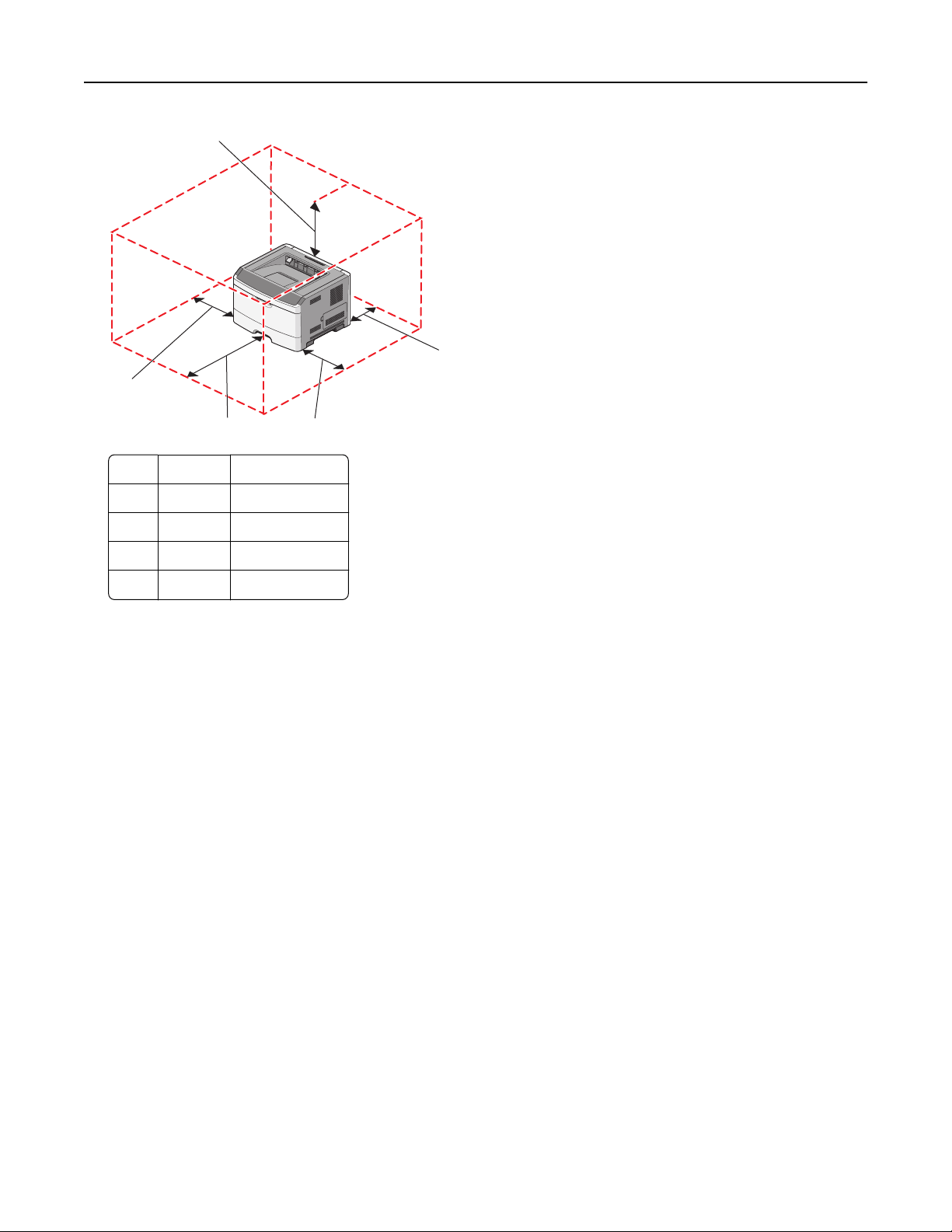
• Allow the following recommended amount of space around the printer for proper ventilation:
Learning about the printer 11
1
2
3
4
5
1 Rear 300 mm (12 in.)
2 Right side 200 mm (8 in.)
3 Front 300 mm (12 in.)
4 Left side 12.7 mm (0.5 in.)
5 Top 300 mm (12 in.)
Printer configurations
Basic model
The following illustration shows the printer front with its basic features or parts:
Learning about the printer 12
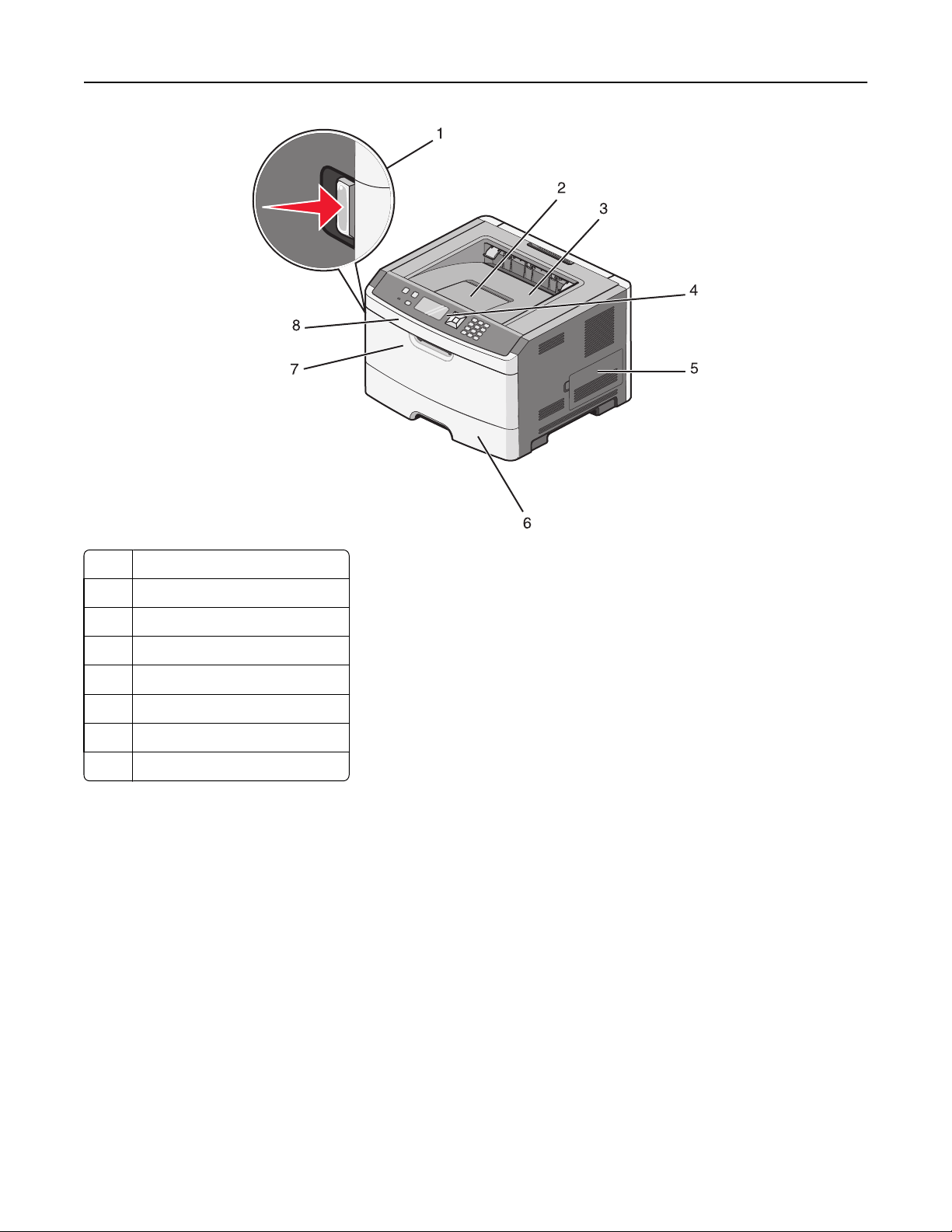
1 Front door release button
2 Paper stop
3 Standard exit bin
4 Printer control panel
5 System board door
6 Standard 250‑sheet tray (Tray 1)
7 Multipurpose feeder door
8 Front door
The following illustration shows the printer back with its basic features or parts:
Learning about the printer 13
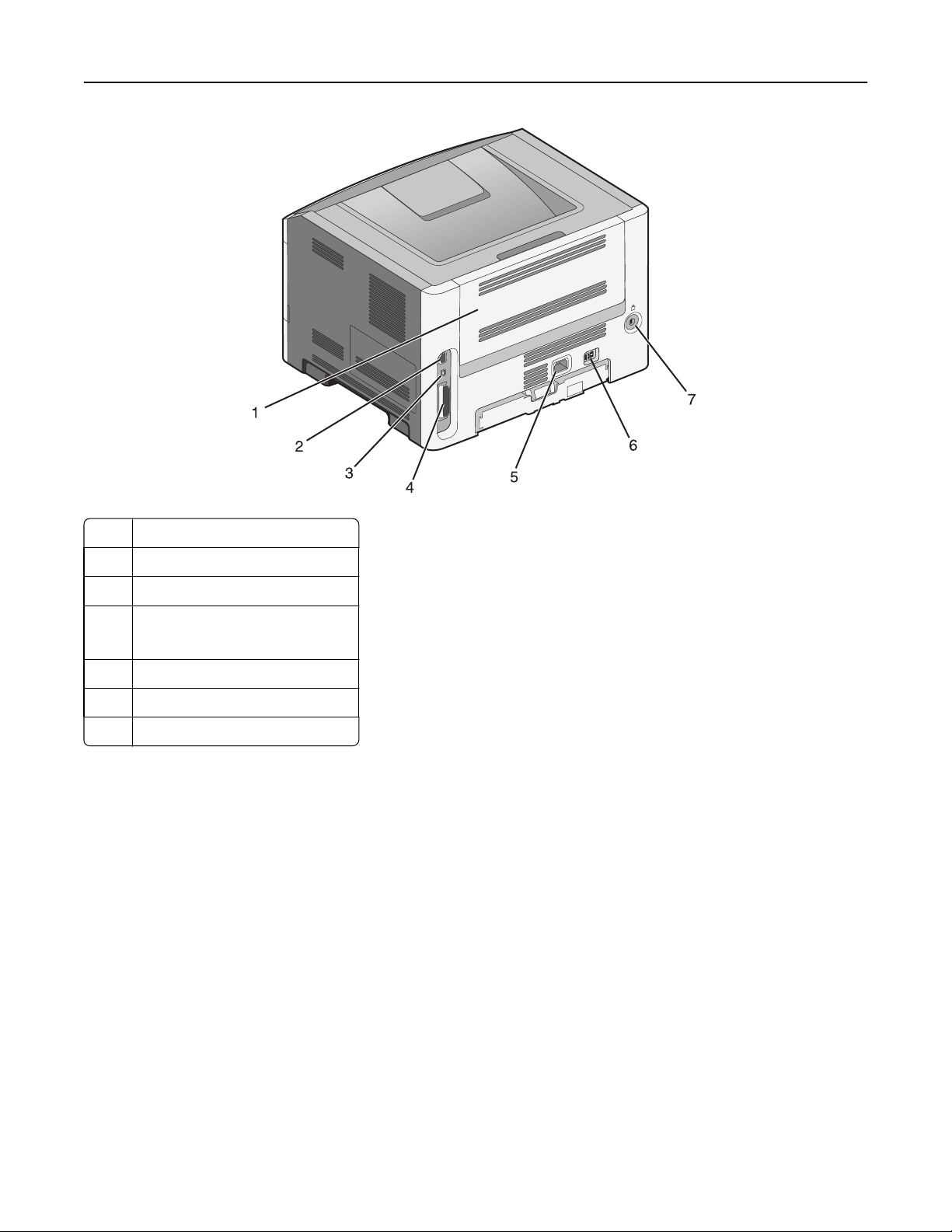
1 Rear door
2 Ethernet port
3 USB port
4 Parallel port
Note: Not available on all models.
5 Printer power cord socket
6 Power switch
7 Security slot
Learning about the printer 14
Configured models
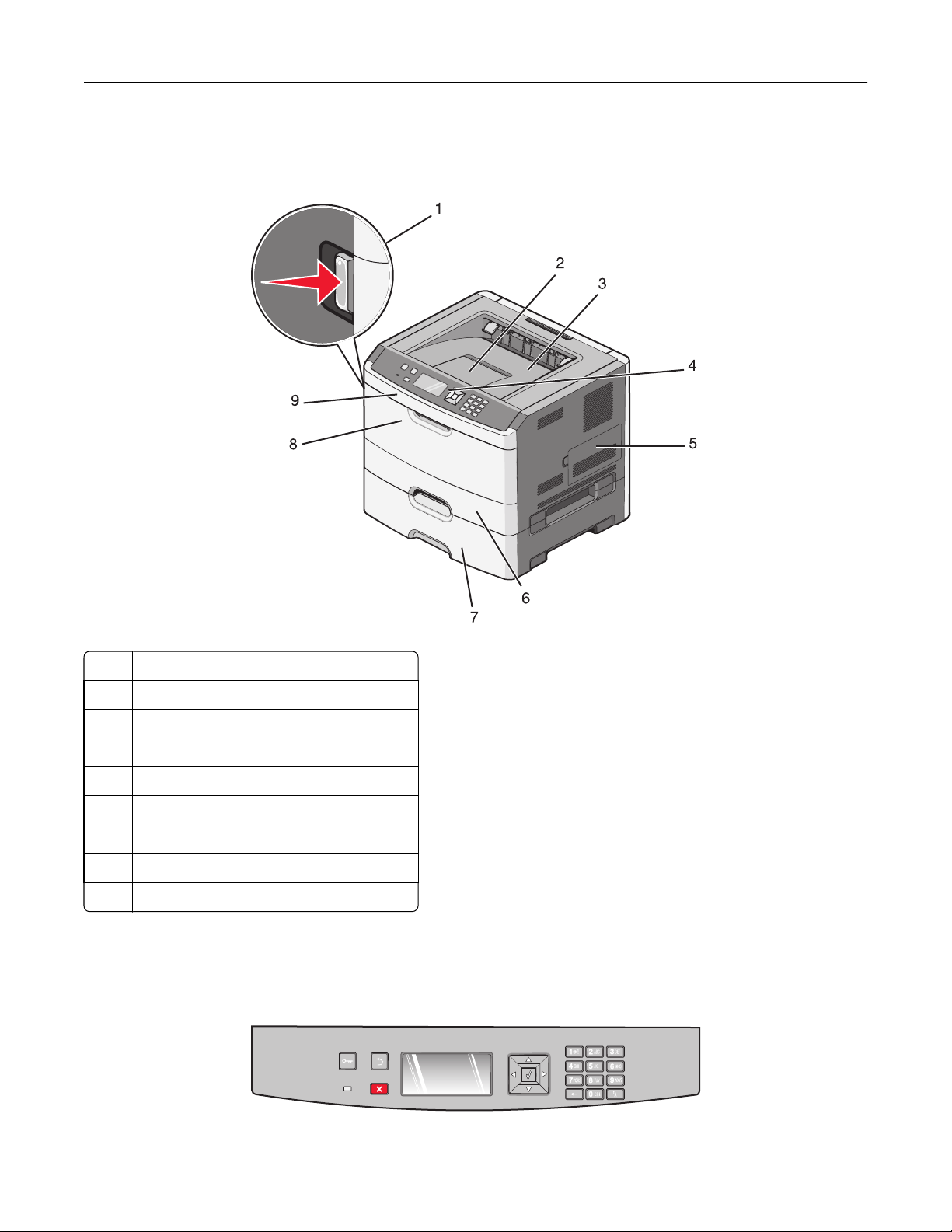
The following illustration shows the printer configured with an optional drawer:
1 Front door release button
2 Paper stop
3 Standard exit bin
4 Printer control panel
5 System board door
6 Standard 250‑sheet tray (Tray 1)
7 Optional 250‑ or 550‑sheet drawer (Tray 2)
8 Multipurpose feeder door
9 Front door
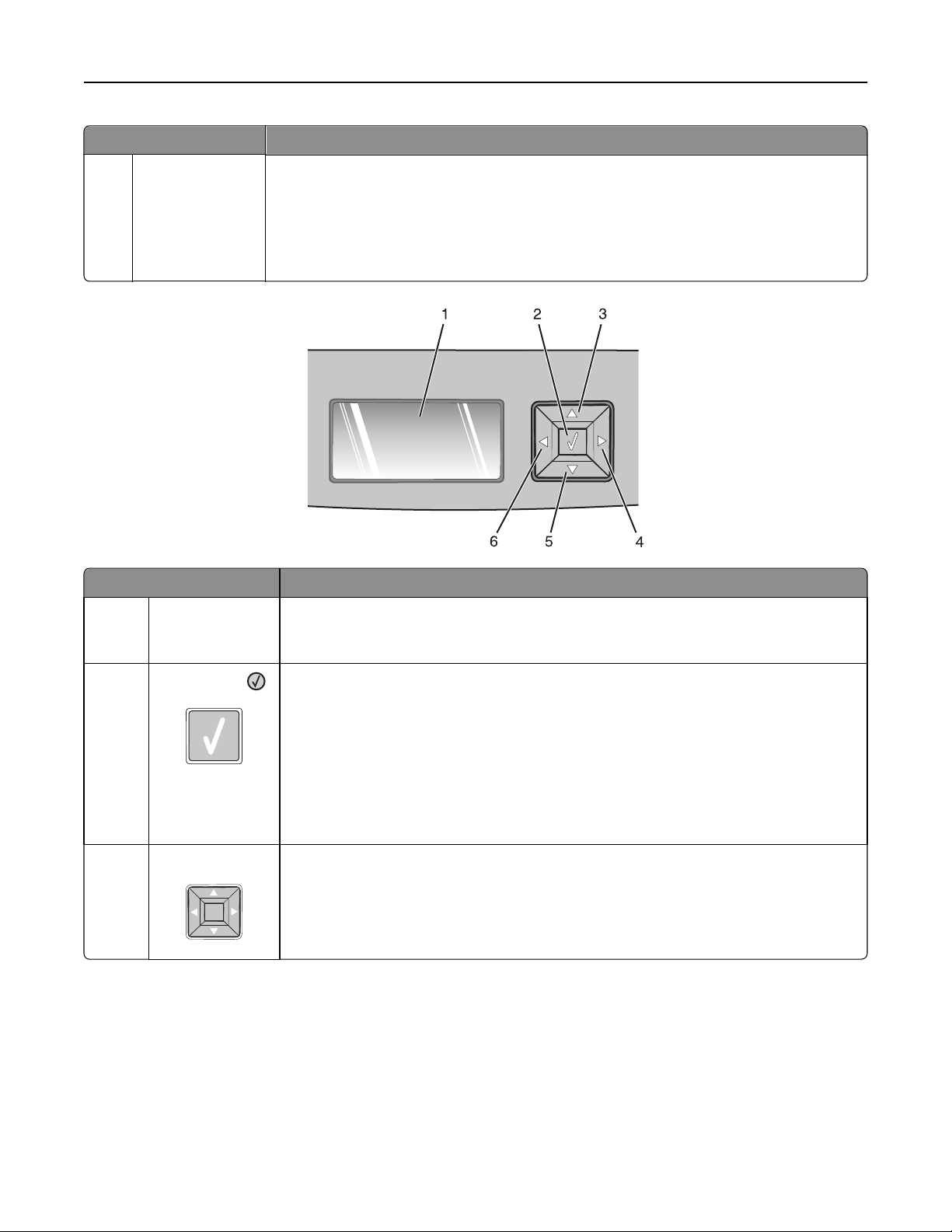
Understanding the printer control panel
The following diagram shows the printer control panel:
Learning about the printer 15

The following diagrams and tables provide more information about the printer control panel items:
Item Description
1
Menus button (
)
Opens the menus
Note: The menus are available only when the printer is in the Ready state.
2
Back button (
)
Returns the display to the previous screen
3
Stop button (
)
Stops all printer activity
When printing, pressing
causes Stopping to appear momentarily. Then the Stopped
screen appears offering a list of settings that you may select.
Learning about the printer 16
Item Description
4 Indicator light Indicates the printer status:
• Off—The power is off.
• Blinking green—The printer is warming up, processing data, or printing.
• Solid green—The printer is on, but idle.
• Solid red—Operator intervention is needed.
Item Description
1 Display Shows messages that communicate the status of the printer or that indicate possible printer
problems that must be resolved. The display is also capable of showing pictures of Show Me
instructions, which show you how to perform a task like clearing a jam.
2
Select button (
)
• Opens a menu and displays the first item in the menu (called a menu item)
• Opens a menu item and displays the available values or settings. The current user default
setting is indicated by an asterisk (*).
• Saves the displayed menu item as the new user default setting
Note: When a new setting is saved as the user default setting, it remains in effect until
new settings are saved or until factory defaults are restored. Settings chosen from a
software program can also change or override the user default settings selected from the
printer control panel.
3, 4, 5, 6 Navigation buttons
Press the up or down arrow buttons to scroll through menus, menu items, or settings (also
called values or options), or to scroll between screens and menu options.
Note: Each press of the up or down arrow buttons moves you one item in any list.
Press the right or left arrow buttons to increase or decrease a value or to scroll through text
that rolls to another screen.
Learning about the printer 17
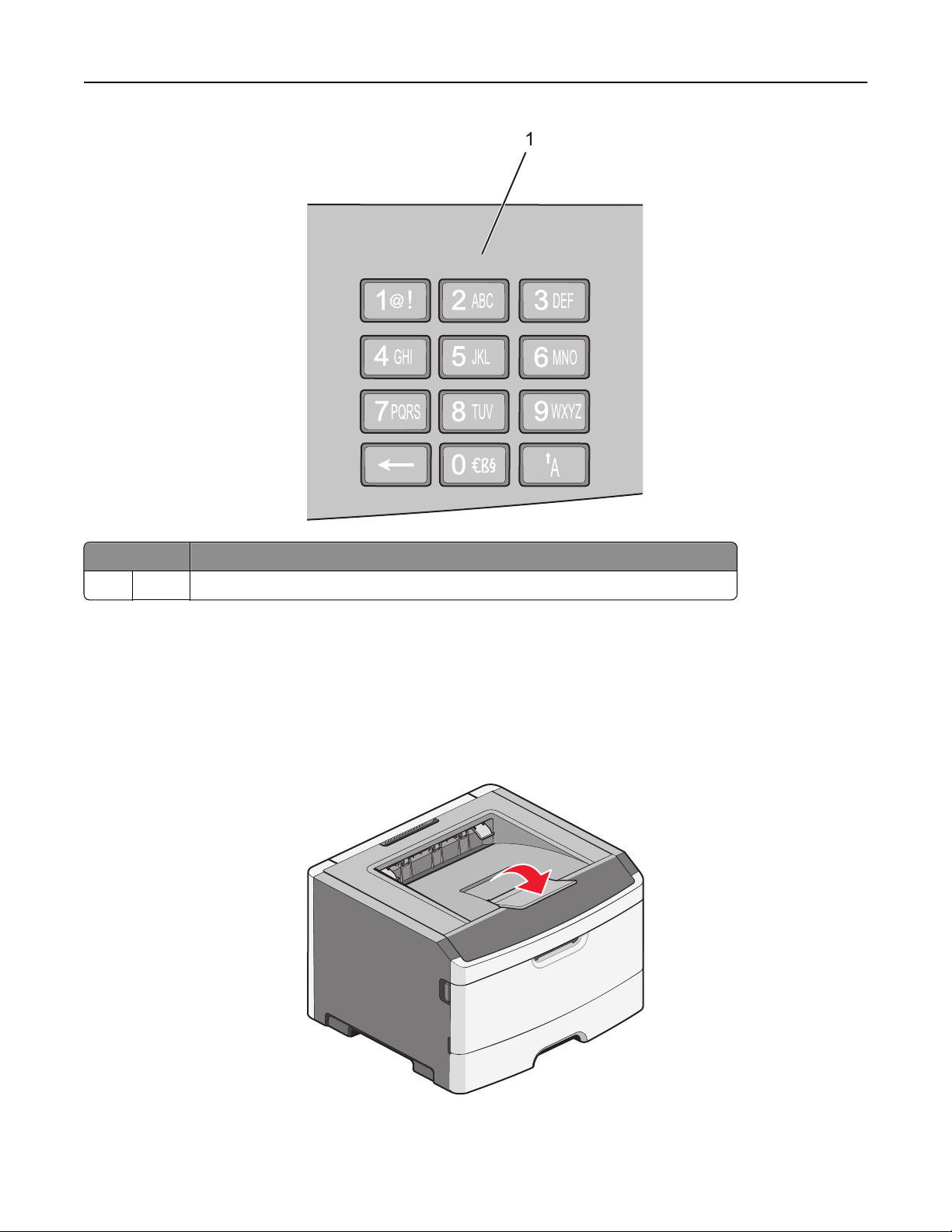
Item Description
1 Keypad Enter numbers or symbols if the display screen has a field that accepts these entries.
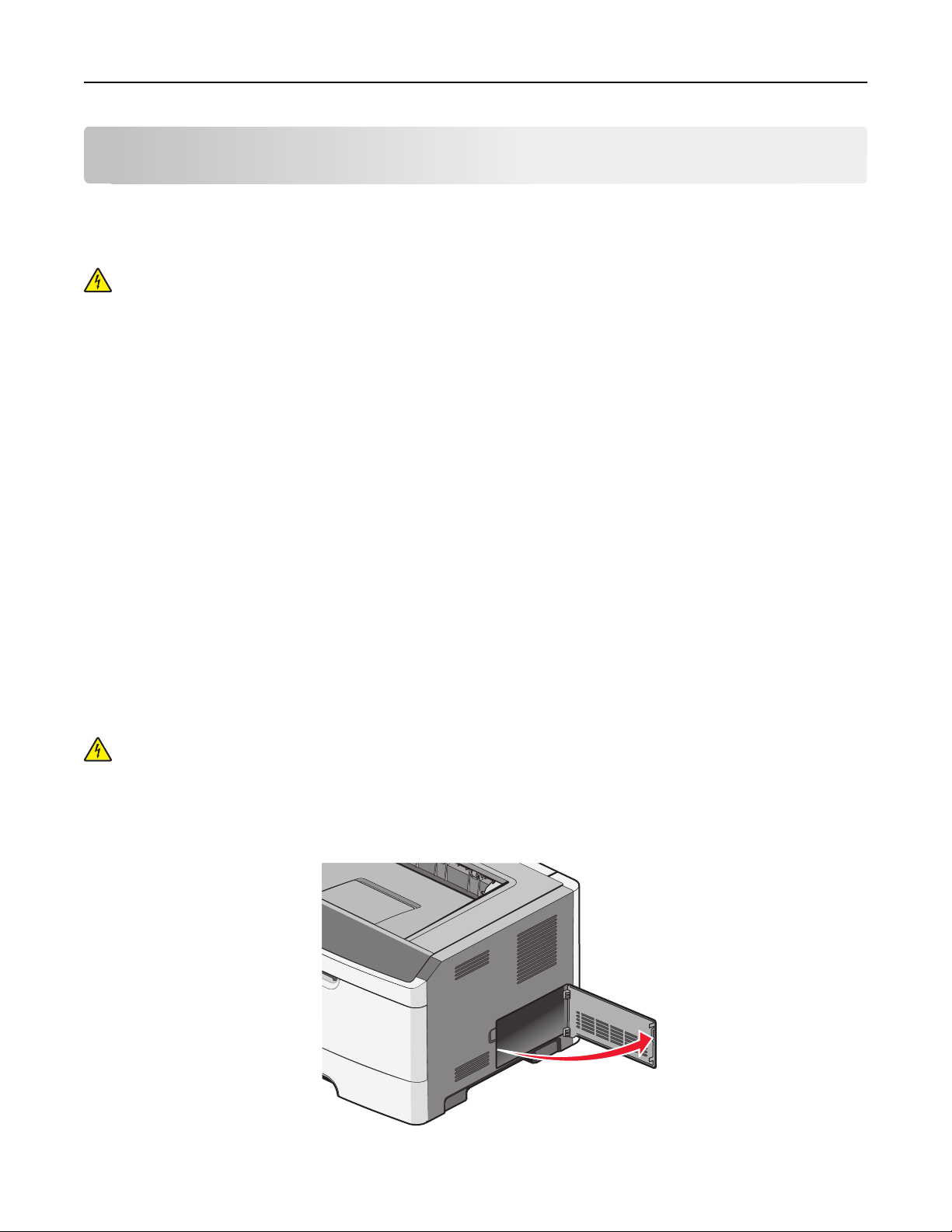
Using the standard exit bin and paper stop
The standard exit bin holds up to 150 sheets of 20 lb paper. It collects print jobs facedown. The standard exit bin includes
a paper stop that keeps paper from sliding out the front of the bin as it stacks. The paper stop also aids in neater stacking
of the paper.
To open the paper stop, pull it so it flips forward.
Learning about the printer 18

Notes:
• Do not leave the paper stop in the open position if you are printing on transparencies. Doing so may cause
creases in the transparencies.
• When moving the printer to another location, make sure the paper stop is closed.
Learning about the printer 19
Additional printer setup
Installing internal options
CAUTION—SHOCK HAZARD: If you are accessing the system board or installing optional hardware or memory
devices sometime after setting up the printer, then turn the printer off, and unplug the power cord from the
wall outlet before continuing. If you have other devices attached to the printer, then turn them off as well, and
unplug any cables going into the printer.
You can customize your printer connectivity and memory capacity by adding optional cards. The instructions in this
section explain how to install the available cards; you can also use them to locate a card for removal.
Available internal options
Memory cards
•
Printer memory
• Flash memory
• Fonts
Firmware cards
•
Forms and Barcode Card
• PrintCryption
TM
Accessing the system board to install internal options
CAUTION—SHOCK HAZARD: If you are accessing the system board or installing optional hardware or memory
devices sometime after setting up the printer, then turn the printer off, and unplug the power cord from the
wall outlet before continuing. If you have other devices attached to the printer, then turn them off as well, and
unplug any cables going into the printer.
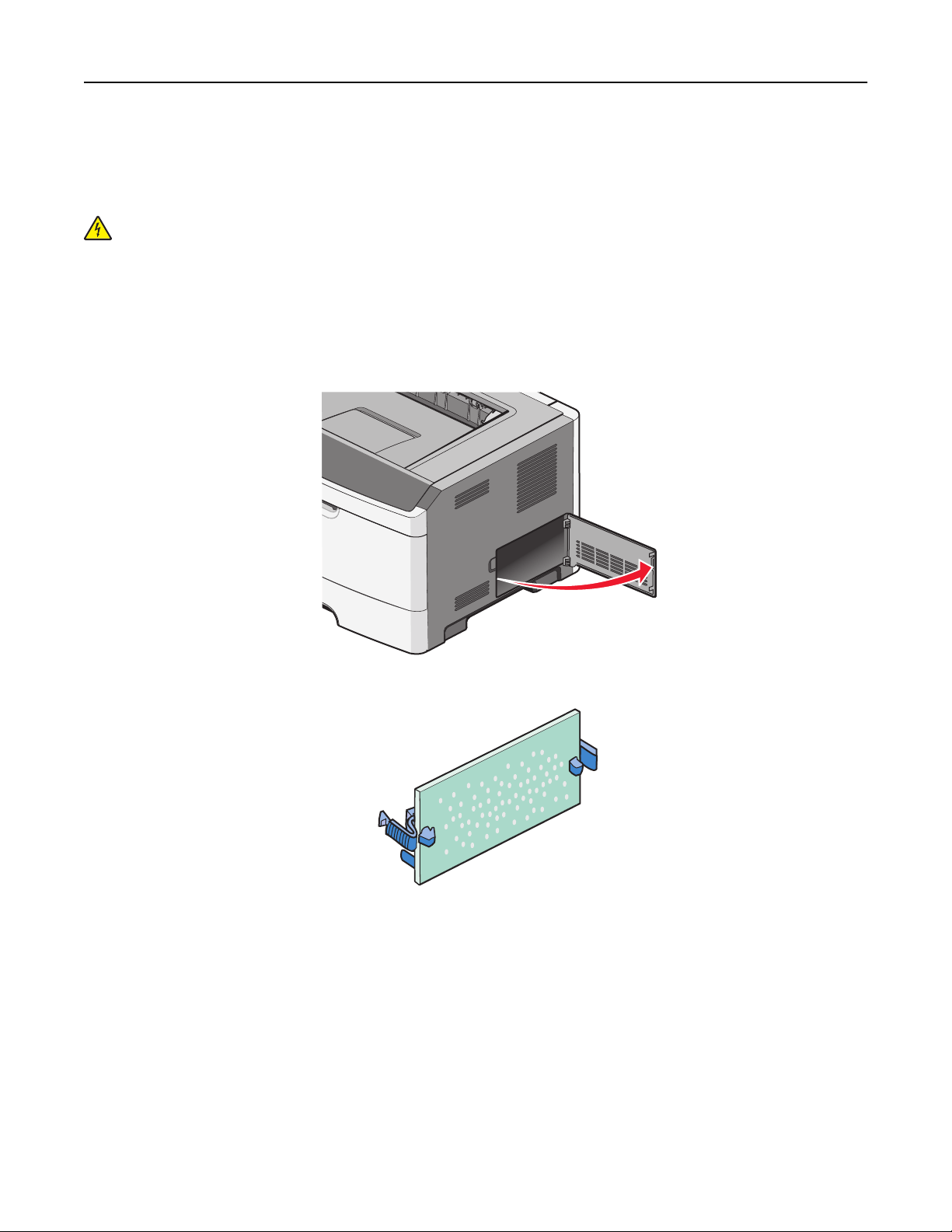
1 As you face the printer, the system board door is on the right side. Open the system board door.
Additional printer setup 20

2 Use the following illustration to locate the appropriate connector.
Warning—Potential Damage: System board electronic components are easily damaged by static electricity.
Touch something metal on the printer before touching any system board electronic components or connectors.
1 Ethernet connector
2 USB port
3 Parallel connector
Note: Not available on all models.
4 Memory card connector
5 Optional card connector
6 Optional card connector
Installing a memory card
CAUTION—SHOCK HAZARD: If you are accessing the system board or installing optional hardware or memory
devices sometime after setting up the printer, then turn the printer off, and unplug the power cord from the
wall outlet before continuing. If you have any other devices attached to the printer, then turn them off as well,
and unplug any cables going into the printer.
Warning—Potential Damage: System board electronic components are easily damaged by static electricity. Touch a
metal surface on the printer before touching any system board electronic components or connectors.
Additional printer setup 21

An optional memory card can be purchased separately and attached to the system board. To install the memory card:
1 Turn the printer off.
2 Access the system board.
3 Unpack the memory card.
Note: Avoid touching the connection points along the edge of the card.
4 Align the memory card with its connector on the system board.
5 Push open the latches on both ends of the memory connector.
Warning—Potential Damage: Memory cards are easily damaged by static electricity. Touch a grounded metal
surface before you touch a memory card.
Note: Memory cards designed for other printers may not work with your printer.
6 Push the memory card into the connector until the latches click into place.
Additional printer setup 22

It may require some force to fully seat the card.
7 Ensure that each latch fits over the notch on each end of the card.
8 Close the system board door.
9 Turn the printer back on.
10 Open the printers folder:
a Click , or click Start and then click Run.
b In the Start Search or Run box, type control printers.
c Press Enter, or click OK.
The printers folder opens.
11 Right‑click your printer icon.
12 Click Properties.
13 Click Install Options.
Note: Memory cards designed for other printers may not work with your printer.
14 Click Ask Printer.
15 Click OK.
16 Click OK, and then close the printers folder.
Additional printer setup 23
Installing a flash memory or firmware card
The system board has two connections for an optional flash memory or firmware card. Only one of each may be installed,
but the connectors are interchangeable.
CAUTION—SHOCK HAZARD: If you are accessing the system board or installing optional hardware or memory
devices sometime after setting up the printer, then turn the printer off, and unplug the power cord from the
wall outlet before continuing. If you have other devices attached to the printer, then turn them off as well, and
unplug any cables going into the printer.
Warning—Potential Damage: System board electronic components are easily damaged by static electricity. Touch
something metal on the printer before touching any system board electronic components or connectors.
1 Open the system board door.
2 Unpack the card.
Note: Avoid touching the connection points along the edge of the card.
3 Holding the card by its sides, align the card with the connector on the system board.
Additional printer setup 24
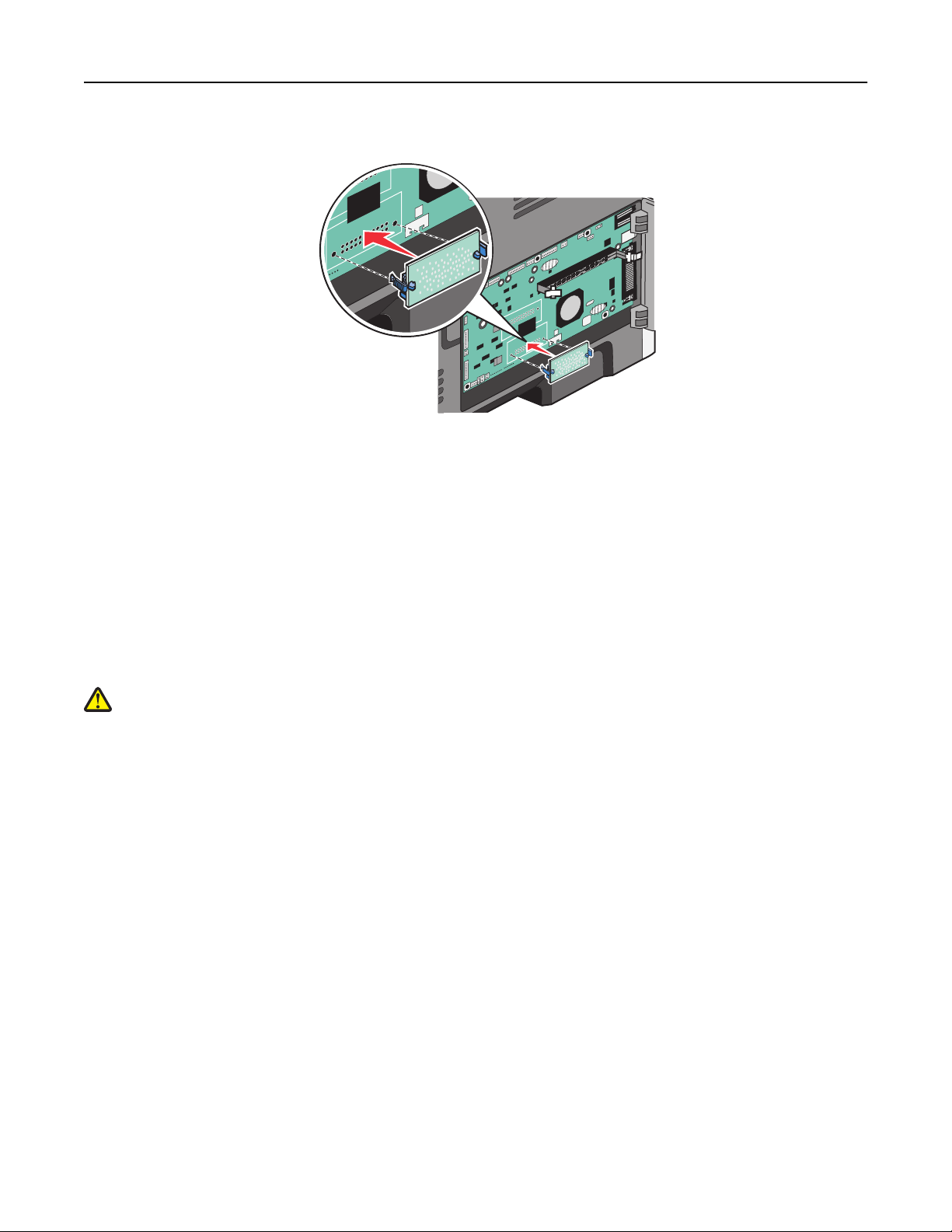
4 Push the card firmly into place.
Notes:
• The entire length of the connector on the card must touch and be flush against the system board.
• Be careful not to damage the connectors.
5 Close the system board door.
Installing hardware options
Installing a 250‑ or 550‑sheet drawer
CAUTION—POTENTIAL INJURY: The printer weight is greater than 18 kg (40 lb) and requires two or more
trained personnel to move it safely.
Additional printer setup 25
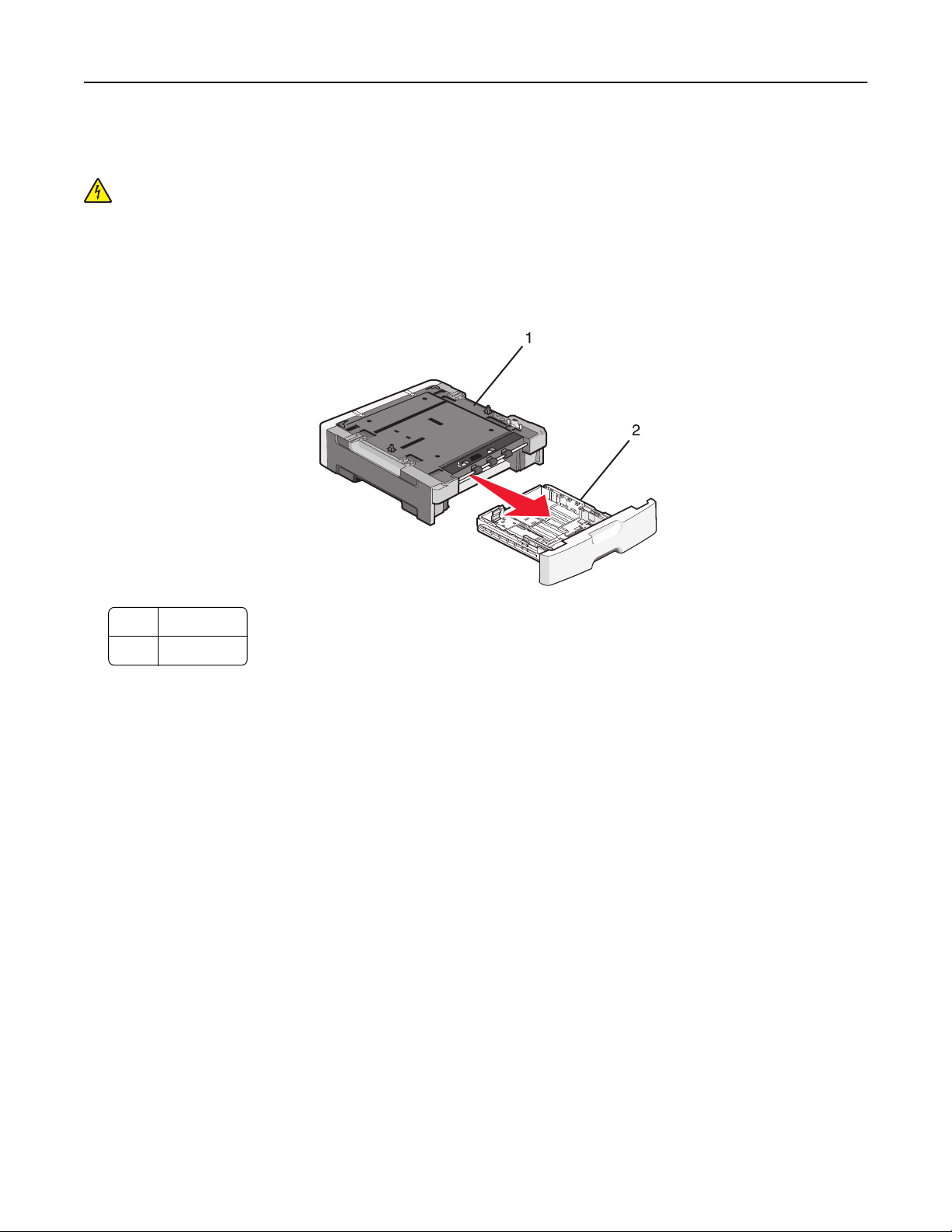
An optional drawer attaches under the printer. A drawer consists of two parts: a tray and a support unit. The printer
supports one optional drawer; you can install a 250‑ or 550‑sheet drawer.
CAUTION—SHOCK HAZARD: If you are accessing the system board or installing optional hardware or memory
devices sometime after setting up the printer, then turn the printer off, and unplug the power cord from the
wall outlet before continuing. If you have any other devices attached to the printer, then turn them off as well,
and unplug any cables going into the printer.
1 Unpack the drawer, and remove any packing material.
2 Remove the tray from the support unit.
1 Support unit
2 Tray
3 Remove any packing material and tape from inside the tray.
4 Insert the tray into the support unit.
5 Place the drawer in the location chosen for the printer.
Additional printer setup 26

6 Align the outer edges of the printer with the outer edges of the drawer, and then slowly lower the printer into place.
7 Turn the printer back on.
8 Open the printers folder:
a Click , or click Start and then click Run.
b In the Start Search or Run box, type control printers.
c Press Enter, or click OK.
The printers folder opens.
9 Right‑click the icon of your printer.
10 Click Properties.
11 Click Install Options.
12 Click Ask Printer.
13 Click OK.
14 Click OK, and then close the printers folder.
Attaching cables
1 Connect the printer to a computer or a network.
• For a local connection, use a USB or parallel cable.
• For a network connection, use an Ethernet cable.
Additional printer setup 27
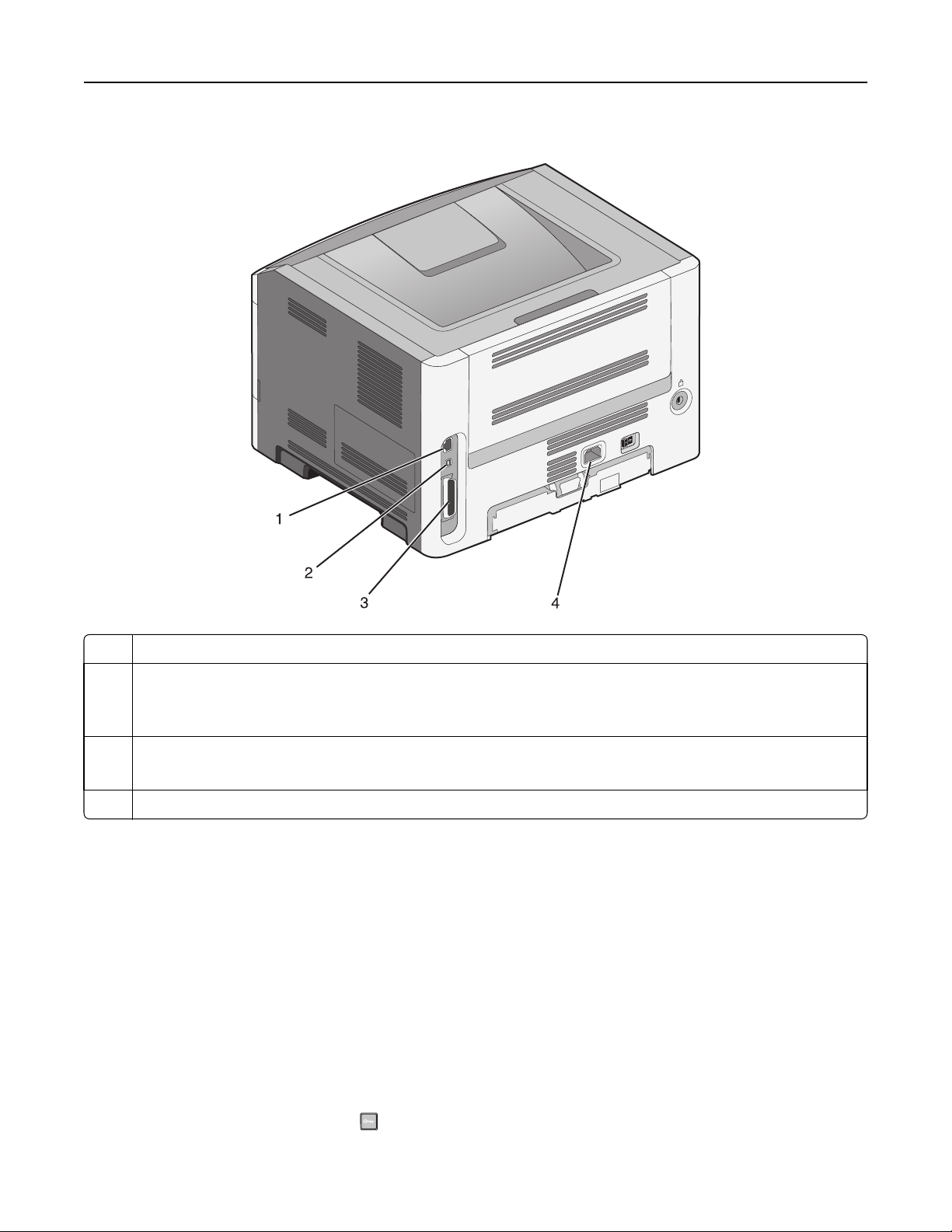
2 Connect the power cord to the printer first and then to a properly grounded wall outlet.
1 Ethernet port
2 USB port
Warning—Potential Damage: Do not touch the USB cable, any network adapter, or the printer in the area shown
while actively printing. A loss of data or a malfunction can occur.
3 Parallel port
Note: If your printer is a wireless model, the wireless antenna is attached here.
4 Power cord socket
Verifying printer setup
Printing a menu settings page
Print a menu settings page to review the current menu settings and to verify if the printer options are installed correctly.
Note: If you have not made any menu item settings changes yet, then the menu settings page lists all the factory
default settings. Once you select and save other settings from the menus, they replace the factory default settings as
user default settings. A user default setting remains in effect until you access the menu again, choose another value,
and save it.
1 Make sure the printer is on and Ready appears.
2 From the printer control panel, press .
Additional printer setup 28

3 Press the up or down arrow button until Reports appears, and then press .
4 Press the up or down arrow button until Menu Settings Page appears, and then press .
After the menu settings page prints, the printer returns to the Ready state.
Printing a network setup page
If the printer is attached to a network, then print a network setup page to verify the network connection. This page
also provides important information that aids network printing configuration.
1 Make sure the printer is on and Ready appears.
2 From the printer control panel, press .
3 Press the up or down arrow button until Reports appears, and then press .
4 Press the up or down arrow button until Network Setup Page appears, and then press .
Note: If an optional internal print server is installed, Print Network <x> Setup Page appears.
5 Check the first section on the network setup page, and confirm that Status is “Connected.”
If Status is “Not Connected,” the LAN drop may not be active, or the network cable may be malfunctioning. Consult
a system support person for a solution, and then print another network setup page.
Setting up the printer software
Installing printer software
A printer driver is software that lets the computer communicate with the printer. The printer software is typically
installed during the initial printer setup.
For Windows users
1
Close all open software programs.
2 Insert the Software and Documentation CD.
3 From the main installation dialog, click Install Printer and Software.
4 Follow the instructions on the computer screen.
For Macintosh users
1
Close all open software applications.
2 Insert the Software and Documentation CD.
3 From the Finder desktop, double-click the printer CD icon that automatically appears.
4 Double-click the Install Printer and Software icon.
5 Follow the instructions on the computer screen.
Additional printer setup 29

Using the World Wide Web
1
Go to the Lexmark Web site at www.lexmark.com.
2 From the Drivers & Downloads menu, click Driver Finder.
3 Select your printer, and then select your operating system.
4 Download the driver and install the printer software.
Updating available options in the printer driver
Once the printer software and any options are installed, it may be necessary to manually add the options in the printer
driver to make them available for print jobs.
For Windows users
1 Open the Printers folder:
a Click , or click Start and then click Run.
b In the Start Search or Run box, type control printers.
c Press Enter, or click OK.
The printer folder opens.
2 Select the printer.
3 Right‑click the printer, and then select Properties.
4 Click the Install Options tab.
5 Under Available Options, add any installed hardware options.
6 Click Apply.
For Macintosh users
In Mac OS X version 10.5 or later
1 From the Apple menu, choose System Preferences.
2 Click Print & Fax.
3 Select the printer, and then click Options & Supplies.
4 Click Driver, and then add any installed hardware options.
5 Click OK.
In Mac OS X version 10.4 and earlier
1 From the Finder desktop, choose Go > Applications.
2 Double‑click Utilities, and then double‑click Print Center or Printer Setup Utility.
3 Select the printer, and then from the Printers menu, choose Show Info.
4 From the pop‑up menu, choose Installable Options.
5 Add any installed hardware options, and then click Apply Changes.
Additional printer setup 30

Setting up wireless printing
Note: A Service Set Identifier (SSID) is a name assigned to a wireless network. Wireless Encryption Protocol (WEP)
and Wi-Fi Protected Access (WPA) are types of security used on a network.
Information you will need to set up the printer on a wireless network
Note: Do not connect the installation or network cables until prompted to do so by the setup software.
• SSID—The SSID is also referred to as the network name.
• Wireless Mode (or Network Mode)—The mode will be either infrastructure or ad hoc.
• Channel (for ad hoc networks)—The channel defaults to auto for infrastructure networks.
Some ad hoc networks will also require the auto setting. Check with your system support person if you are not sure
which channel to select.
• Security Method—There are three basic options for Security Method:
– WEP key
If your network uses more than one WEP key, enter up to four in the provided spaces. Select the key currently
in use on the network by selecting the Default WEP Transmit Key.
or
– WPA or WPA2 passphrase
WPA includes encryption as an additional layer of security. The choices are AES or TKIP. Encryption must be set
for the same type on the router and on the printer, or the printer will not be able to communicate on the
network.
– No security
If your wireless network does not use any type of security, then you will not have any security information.
Note: Using an unsecured wireless network is not recommended.
If you are installing the printer on an 802.1X network using the Advanced method, then you may need the following:
• Authentication type
• Inner authentication type
• 802.1X username and password
• Certificates
Note: For more information on configuring 802.1X security, see the Networking Guide on the Software and
Documentation CD.
Installing the printer on a wireless network (Windows)
Before you install the printer on a wireless network, make sure that:
• Your wireless network is set up and working properly.
• The computer you are using is connected to the same wireless network where you want to set up the printer.
Additional printer setup 31
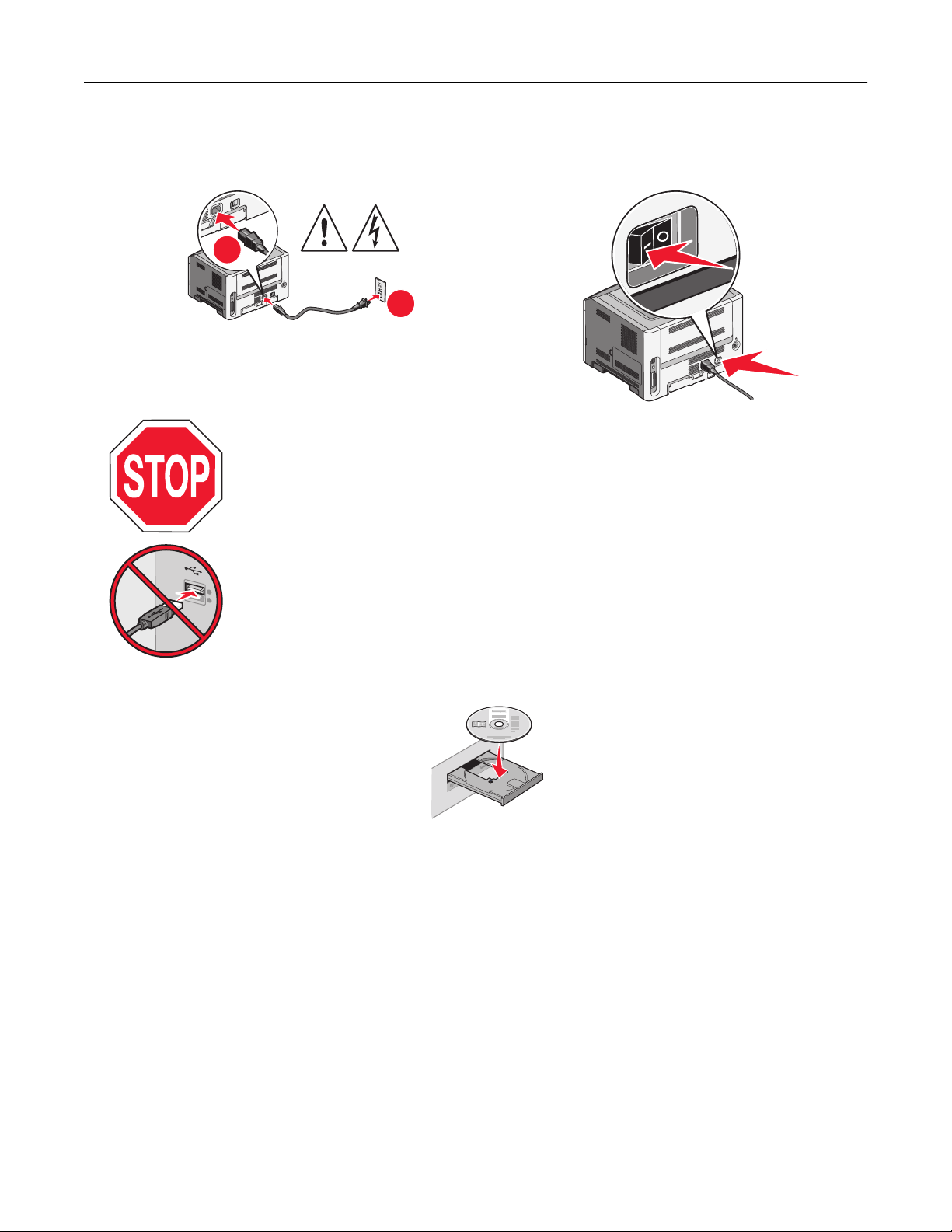
1 Connect the power cable to the printer and then to a properly grounded electrical outlet, and then turn the printer
on.
2
1
Make sure the printer and computer are fully on and ready.
Do not connect the USB cable until instructed to do so on the screen.
2 Insert the Software and Documentation CD.
3 Click Install Printer and Software.
4 Click Agree to agree to the License Agreement.
5 Click Suggested, and then click Next.
6 Click Wireless Network Attach.
Additional printer setup 32
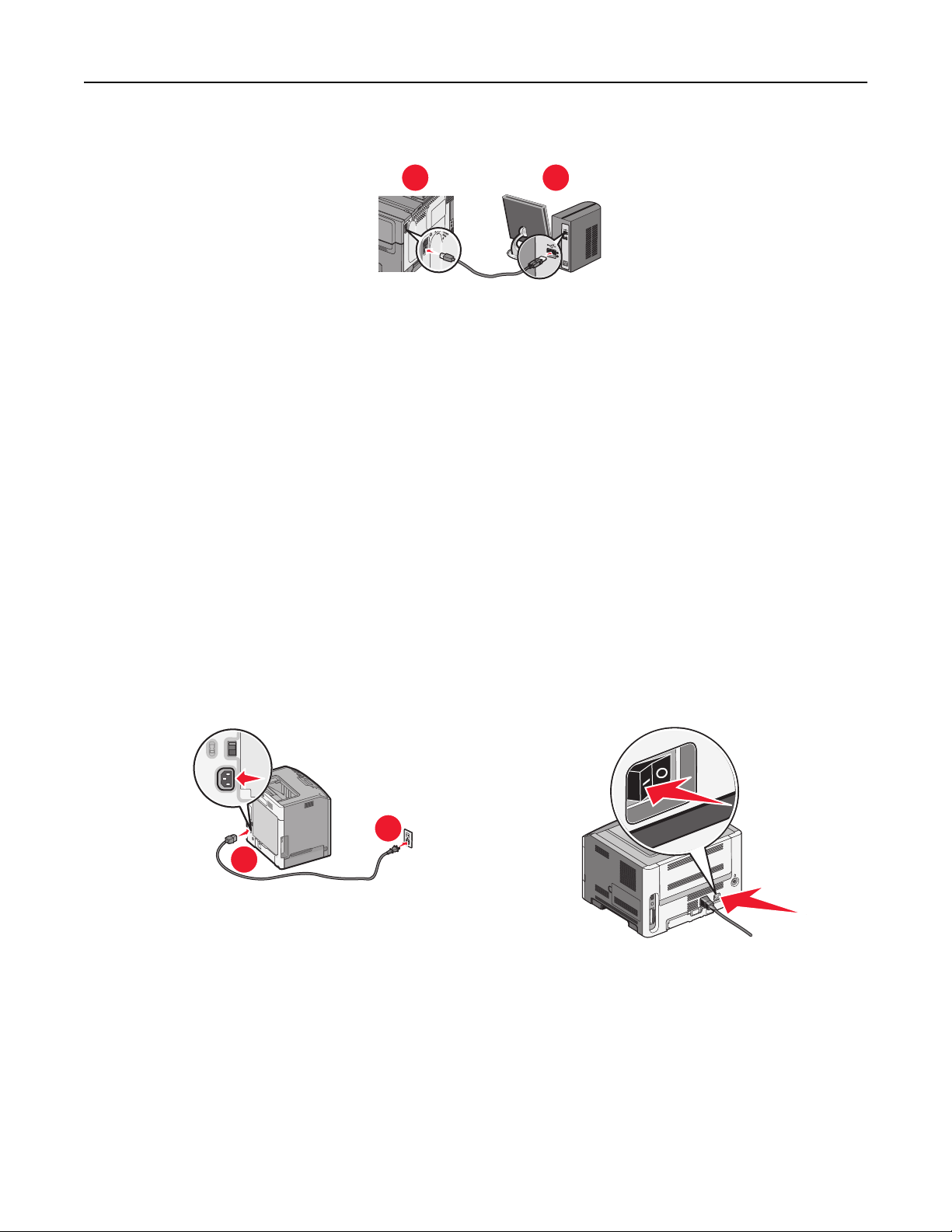
7 Temporarily connect a USB cable between the computer on the wireless network and the printer.
2
1
Note: After the printer is configured, the software will instruct you to disconnect the temporary USB cable so
you can print wirelessly.
8 Follow the instructions on the computer screen to complete the software installation.
Note: Basic is the recommended path to choose. Choose Advanced only if you want to customize your
installation.
9 To allow other computers on the wireless network to use the wireless printer, follow steps 2 through 6 and step 8
for each computer.
Installing the printer on a wireless network (Macintosh)
Prepare to configure the printer
1
Locate the printer MAC address on the sheet that shipped with the printer. Write the last six digits of the MAC
address in the space provided below:
MAC address: ___ ___ ___ ___ ___ ___
2 Connect the power cable to the printer and then to a properly grounded electrical outlet, and then turn the power
on.
1
2
Enter the printer information
1
Access the AirPort options.
In Mac OS X version 10.5 or later
a From the Apple menu, choose System Preferences.
b Click Network.
c Click AirPort.
Additional printer setup 33

In Mac OS X version 10.4 and earlier
a From the Finder desktop, choose Go > Applications.
b From the Applications folder, double‑click Internet Connect.
c From the toolbar, click AirPort.
2 From the Network pop‑up menu, select print server xxxxxx, where the x’s are the last six digits of the MAC address
located on the MAC address sheet.
3 Open the Safari browser.
4 From the Bookmarks drop-down menu, select Show.
5 Under Collections, select Bonjour or Rendezvous, and then double‑click the printer name.
Note: The application is referred to as Rendezvous in Mac OS X version 10.3, but is now called Bonjour by Apple
Computer.
6 From the main page of the Embedded Web Server, navigate to the page where the wireless settings information is
stored.
Configure the printer for wireless access
1
Type the name of your network (SSID) in the appropriate field.
2 Select Infrastructure as your Network Mode if you are using a wireless router.
3 Select the type of security you use to protect your wireless network.
4 Enter the security information necessary for the printer to join your wireless network.
5 Click Submit.
6 Open the AirPort application on your computer:
In Mac OS X version 10.5 or later
a From the Apple menu, choose System Preferences.
b Click Network.
c Click AirPort.
In Mac OS X version 10.4 and earlier
a From the Finder desktop, choose Go > Applications.
b From the Applications folder, double‑click Internet Connect.
c From the toolbar, click AirPort.
7 From the Network pop‑up menu, select your wireless network.
Configure your computer to use the printer wirelessly
To print to a network printer, each Macintosh user must install a custom PostScript Printer Description (PPD) file and
create a printer in the Print Center or Printer Setup Utility.
1 Install a PPD file on the computer:
a Insert the Software and Documentation CD in the CD or DVD drive.
b Double-click the installer package for the printer.
c From the Welcome screen, click Continue.
Additional printer setup 34

d Click Continue again after viewing the Readme file.
e Click Continue after viewing the license agreement, and then click Agree to accept the terms of the agreement.
f Select a Destination, and then click Continue.
g From the Easy Install screen, click Install.
h Type the user password, and then click OK.
All necessary software is installed on the computer.
i Click Close when installation is complete.
2 Add the printer:
a For IP printing:
In Mac OS X version 10.5 or later
1 From the Apple menu, choose System Preferences.
2 Click Print & Fax.
3 Click +.
4 Select the printer from the list.
5 Click Add.
In Mac OS X version 10.4 and earlier
1 From the Finder desktop, choose Go > Applications.
2 Double‑click the Utilities folder.
3 Locate and double‑click Printer Setup Utility or Print Center.
4 From the Printer List, choose Add.
5 Select the printer from the list.
6 Click Add.
b For AppleTalk printing:
In Mac OS X version 10.5
1 From the Apple menu, choose System Preferences.
2 Click Print & Fax.
3 Click +.
4 Click AppleTalk.
5 Select the printer from the list.
6 Click Add.
In Mac OS X version 10.4 and earlier
1 From the Finder desktop, choose Go > Applications.
2 Double‑click the Utilities folder.
3 Locate and double‑click Print Center or Printer Setup Utility.
4 From the Printer List, choose Add.
5 Choose the Default Browser tab.
6 Click More Printers.
7 From the first pop‑up menu, choose AppleTalk.
8 From the second pop‑up menu, select Local AppleTalk zone.
Additional printer setup 35

9 Select the printer from the list.
10 Click Add.
Installing the printer on a wired network
These instructions apply to Ethernet and fiber optic network connections.
Before you install the printer on a wired network, make sure that:
• You have completed the initial setup of the printer.
• The printer is connected to your network with the appropriate type of cable.
For Windows users
1 Insert the Software and Documentation CD.
Wait for the Welcome screen to appear.
If the CD does not launch after a minute, then do the following:
a Click , or click Start and then click Run.
b In the Start Search or Run box, type D:\setup.exe, where D is the letter of your CD or DVD drive.
2 Click Install Printer and Software.
3 Click Agree to agree to the License Agreement.
4 Select Suggested, and then click Next.
Note: To configure the printer using a static IP address, using IPv6, or to configure printers using scripts, select
Custom and follow the instructions on the computer screen.
5 Select Wired Network Attach, and then click Next.
6 Select the printer manufacturer from the list.
7 Select the printer model from the list, and then click Next.
8 Select the printer from the list of printers discovered on the network, and then click Finish.
Note: If your configured printer does not appear in the list of discovered printers, click Add Port and follow the
instructions on the computer screen.
9 Follow the instructions on the computer screen to complete the installation.
For Macintosh users
1 Allow the network DHCP server to assign an IP address to the printer.
2 Print the network setup page from the printer. For information on printing a network setup page, see “Printing a
network setup page” on page 29.
3 Locate the printer IP address in the TCP/IP section of the network setup page. You will need the IP address if you
are configuring access for computers on a different subnet than the printer.
4 Install the drivers and add the printer.
a Install a PPD file on the computer:
1 Insert the Software and Documentation CD in the CD or DVD drive.
2 Double-click the installer package for the printer.
Additional printer setup 36

3 From the Welcome screen, click Continue.
4 Click Continue again after viewing the Readme file.
5 Click Continue after viewing the license agreement, and then click Agree to accept the terms of the
agreement.
6 Select a Destination, and then click Continue.
7 From the Easy Install screen, click Install.
8 Type the user password, and then click OK.
All the necessary software is installed on the computer.
9 Click Restart when installation is complete.
b Add the printer:
• For IP printing:
In Mac OS X version 10.5 or later
1
From the Apple menu, choose System Preferences.
2 Click Print & Fax.
3 Click +.
4 Click IP.
5 Type the IP address of your printer in the Address field.
6 Click Add.
In Mac OS X version 10.4 and earlier
1
From the Finder desktop, choose Go > Applications.
2 Double‑click Utilities.
3 Double‑click Printer Setup Utility or Print Center.
4 From the Printer List, click Add.
5 Click IP.
6 Type the IP address of your printer in the Address field.
7 Click Add.
• For AppleTalk printing:
In Mac OS X version 10.5
1
From the Apple menu, choose System Preferences.
2 Click Print & Fax.
3 Click +.
4 Click AppleTalk.
5 Select the printer from the list.
6 Click Add.
In Mac OS X version 10.4 and earlier
1
From the Finder desktop, choose Go > Applications.
2 Double‑click Utilities.
3 Double‑click Printer Setup Utility or Print Center.
4 From the Printer List, click Add.
5 Choose the Default Browser tab.
6 Click More Printers.
Additional printer setup 37

7 From the first pop‑up menu, choose AppleTalk.
8 From the second pop‑up menu, select Local AppleTalk zone.
9 Select the printer from the list.
10 Click Add.
Note: If the printer doesn't show up in the list, you may need to add it using the IP address. Contact your
system support person for assistance.
Additional printer setup 38

Minimizing your printer's environmental impact
Lexmark is committed to environmental sustainability and is continually improving its printers to reduce their impact
on the environment. We design with the environment in mind, engineer our packaging to reduce materials, and provide
collection and recycling programs. For more information, see:
• The Notices chapter
• The Environmental Sustainability section of the Lexmark Web site at www.lexmark.com/environment
• The Lexmark recycling program at www.lexmark.com/recycle
By selecting certain printer settings or tasks, you may be able to reduce your printer's impact even further. This chapter
outlines the settings and tasks that may yield a greater environmental benefit.
Saving paper and toner
Studies show that as much as 80% of the carbon footprint of a printer is related to paper usage. You can significantly
reduce your carbon footprint by using recycled paper and the following printing suggestions, such as printing on both
sides of the paper and printing multiple pages on one side of a single sheet of paper.
For information on how you can quickly save paper and energy using one printer setting, see "Using Eco-Mode".
Using recycled paper
As an environmentally conscious company, Lexmark supports the use of recycled office paper produced specifically for
use in laser printers. For more information on recycled papers that work well with your printer, see “Using recycled
paper and other office papers” on page 59.
Conserving supplies
There are a number of ways you can reduce the amount of paper and toner you use when printing. You can:
Use both sides of the paper
If your printer model supports duplex printing, then you can control whether print appears on one or two sides of the
paper by selecting 2‑sided printing from the Print dialog or the Lexmark Toolbar.
Place multiple pages on one sheet of paper
You can print up to 16 consecutive pages of a multiple‑page document onto one side of a single sheet of paper by
selecting a setting from the Multipage printing (N‑Up) section of the Print dialog screen.
Check your first draft for accuracy
Before printing or making multiple copies of a document:
• Use the preview feature, which you can select from the Print dialog or the Lexmark Toolbar, to see what the
document will look like before you print it.
• Print one copy of the document to check its content and format for accuracy.
Minimizing your printer's environmental impact 39
Avoid paper jams
Carefully select and load paper to avoid paper jams. For more information, see “Avoiding jams” on page 123.
Saving energy
Using Eco‑Mode
Use Eco‑Mode to quickly select one or more ways to reduce your printer's environmental impact.
Note: See the table for the multiple settings that change when you select an Eco-Mode setting.
Choose To
Energy Reduce energy use, especially when the printer is idle.
• Printer engine motors do not start until a job is ready to print. You may notice a short delay before the
first page is printed.
• The printer enters Power Saver mode after one minute of inactivity.
• When the printer enters Power Saver mode, the printer control panel display light is turned off.
Paper
• Enable the automatic duplex feature (on printer models that support duplex).
• Turn off print log features.
Energy/Paper Use all the settings associated with Energy mode and Paper mode.
Off Use factory default settings for all settings associated with Eco‑Mode. This setting supports the performance
specifications for your printer.
1 Make sure that the printer is on and Ready appears.
2 From the printer control panel, press .
3 Press the up or down arrow button until Settings appears, and then press .
4 Press the up or down arrow button until General Settings appears, and then press .
5 Press the up or down arrow button until Eco‑Mode appears, and then press .
6 Press the up or down arrow button to scroll through the list of possible settings. Press at the correct setting.
Submitting Selection appears.
Reducing printer noise
Use Quiet Mode to reduce printer noise.
Note: See the table for the multiple settings that change when you select a Quiet Mode setting.
Minimizing your printer's environmental impact 40
Choose To
On (Text/Graphics)
Note: This setting is best suited for printing text and line
graphics.
Reduce printer noise.
• Print jobs are processed at one‑half the normal
processing speed.
• Printer engine motors do not start until a job is ready to
print. There is a short delay before the first page is printed.
• Fans run at reduced speed or are turned off.
• If your printer has faxing capability, fax sounds are
reduced or disabled, including those made by the fax
speaker and ringer. The fax is placed in standby mode.
• The alarm control and cartridge alarm sounds are turned
off.
• The printer ignores the Advance Start command.
Off (Image/Photo)
Note: Selecting Photo from the driver may disable Quiet
Mode and provide better print quality and full speed
printing.
Use factory default settings. This setting supports the
performance specifications for your printer.
1 Make sure that the printer is on and Ready appears.
2 From the printer control panel, press .
3 Press the up or down arrow button until Settings appears, and then press .
4 Press the up or down arrow button until General Settings appears, and then press .
5 Press the up or down arrow button until Quiet Mode appears, and then press .
6 Press the up or down arrow button to scroll through the list of possible settings. Press at the correct setting.
Submitting Selection appears.
Adjusting Power Saver
Available settings range from 1–240 minutes. The factory default setting is 30 minutes.
To increase or decrease the number of minutes before the printer enters Power Saver mode, do one of the following:
Using the Embedded Web Server
1
Type the printer IP address into the address field of your Web browser.
Note: If you do not know the IP address of the printer, then print a network setup page and locate the IP
address in the TCP/IP section.
2 Click Settings, and then click General Settings.
3 Click Timeouts.
4 In the Power Saver box, increase or decrease the number of minutes you want the printer to wait before it enters
Power Saver mode.
5 Click Submit.
Minimizing your printer's environmental impact 41

Using the printer control panel
1
Make sure the printer is on and Ready appears.
2 Press .
3 Press the up or down arrow button until Settings appears, and then press .
4 Press the up or down arrow button until General Settings appears, and then press .
5 Press the up or down arrow button until Timeouts appears, and then press .
6 Press the up or down arrow button until Power Saver appears, and then press .
7 Press the up or down arrow button to increase or decrease the number of minutes before the printer enters Power
Saver mode, and then press
.
Recycling
Lexmark provides collection programs and environmentally progressive approaches to recycling. For more information,
see:
• The Notices chapter
• The Environmental Sustainability section of the Lexmark Web site at www.lexmark.com/environment
• The Lexmark recycling program at www.lexmark.com/recycle
Recycling Lexmark products
To return Lexmark products to Lexmark for recycling:
1 Visit our Web site at www.lexmark.com/recycle.
2 Find the product type you want to recycle, and then select your country from the list.
3 Follow the instructions on the computer screen.
Recycling Lexmark packaging
Lexmark continually strives to minimize packaging. Less packaging helps to ensure that Lexmark printers are transported
in the most efficient and environmentally sensitive manner and that there is less packaging to dispose of. These
efficiencies result in fewer greenhouse emissions, energy savings, and natural resource savings.
Lexmark cartons are 100% recyclable where corrugated recycling facilities exist. Facilities may not exist in your area.
The foam used in Lexmark packaging is recyclable where foam recycling facilities exist. Facilities may not exist in your
area.
When you return a cartridge to Lexmark, you can reuse the box that the cartridge came in. Lexmark will recycle the
box.
Minimizing your printer's environmental impact 42

Returning Lexmark cartridges for reuse or recycling
The Lexmark Cartridge Collection Program diverts millions of Lexmark cartridges from landfills annually by making it
both easy and free for Lexmark customers to return used cartridges to Lexmark for reuse or recycling. One hundred
percent of the empty cartridges returned to Lexmark are either reused or demanufactured for recycling. Boxes used
to return the cartridges are also recycled.
To return Lexmark cartridges for reuse or recycling, follow the instructions that came with your printer or cartridge and
use the pre‑paid shipping label. You can also:
1 Visit our Web site at www.lexmark.com/recycle.
2 From the Toner Cartridges section, select your country from the list.
3 Follow the instructions on the computer screen.
Minimizing your printer's environmental impact 43

Loading paper and specialty media
This section explains how to load the 250- and 550-sheet trays and the multipurpose feeder. It also includes information
about paper orientation, setting the Paper Size and Paper Type, and linking and unlinking trays.
Setting the paper size and type
1 Make sure that the printer is on and Ready appears.
2 From the printer control panel, press .
3 Press the up or down arrow button until Paper Menu appears, and then press .
4 Press the up or down arrow button until Paper Size/Type appears, and then press .
5 Press the up or down arrow button until the correct tray or feeder appears, and then press .
6 Press the left or right arrow button until the correct size appears, and then press .
Paper Type appears.
7 Press the left or right arrow button until the correct type appears, and then press .
Submitting selection appears. The printer returns to the Paper Size/Type menu.
Configuring Universal paper settings
The Universal Paper Size is a user‑defined setting that lets you print on paper sizes that are not preset in the printer
menus. Set the Paper Size for the specified tray to Universal when the size you want is not available from the Paper
Size menu. Then, specify all of the following Universal size settings for your paper:
• Units of Measure (inches or millimeters)
• Portrait Height and Width
• Feed Direction
Note: The smallest supported Universal size is 76.2 x 127 mm (3 x 5 in.); the largest is 216 x 356 mm (8.5 x 14 in.).
Specify a unit of measure
1 Make sure the printer is on and Ready appears.
2 From the printer control panel, press .
Paper Menu appears.
3 Press .
4 Press the up or down arrow button until Universal Setup appears, and then press .
5 Press the up or down arrow button until Units of Measure appears, and then press .
6 Press the up or down arrow button until appears next to the correct unit of measure, and then press .
Submitting selection appears, followed by the Universal Setup menu.
7 Press and release until Ready appears.
Loading paper and specialty media 44

Specify the paper height and width
Defining a specific height and width measurement for the Universal paper size (in the portrait orientation) allows the
printer to support the size, including support for standard features such as duplex printing and printing multiple pages
on one sheet.
Note: Select Portrait Height to adjust the paper height setting or Paper Width to adjust the paper width
setting, or adjust both. Instructions to adjust both follow.
1 From the Universal Setup menu, press the up or down arrow button until Portrait Width appears, and then
press
.
2 Press the left or right arrow button until the setting you want appears, and then press .
Submitting selection appears, followed by the Universal Setup menu.
3 From the Universal Setup menu, press the up or down arrow button until Portrait Height appears, and
then press
.
4 Press the left or right arrow button until the setting you want appears, and then press .
Submitting selection appears, followed by the Universal Setup menu.
5 Press and release until Ready appears.
Specify a feed direction
Short Edge is the factory default setting for feed direction for Universal paper settings. The Feed Direction menu appears
only when both the height and width specified for the Universal paper size are set to 8.5 in (216 mm) or less. If necessary,
specify whether the short or long edge of the paper enters the printer first.
1 From the Universal Setup menu, press the up or down arrow button until Feed Direction appears, and then
press
.
2 Press the up or down arrow button until Short Edge or Long Edge appears, and then press .
3 Press and release until Ready appears.
Loading trays
1 Pull the tray completely out.
Note: Do not remove trays while a job prints or while Busy appears on the display. Doing so may cause a jam.
Loading paper and specialty media 45

2 Squeeze and slide the guides to the correct position for the paper size you are loading.
For long paper like A4 or legal, squeeze and slide the length guide backwards to accommodate the length of paper
you are loading.
Loading paper and specialty media 46
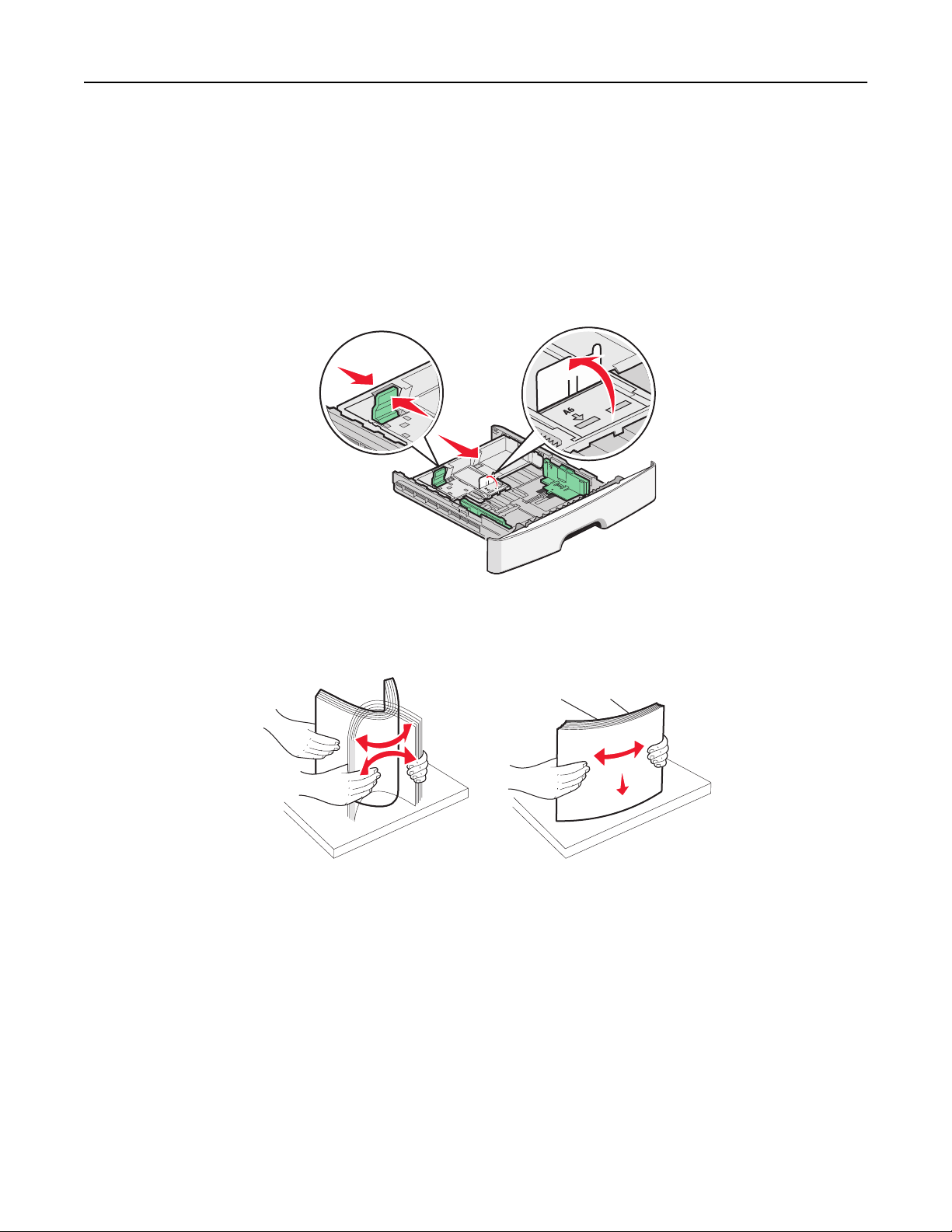
If you are loading A6‑size paper:
a Squeeze and slide the length guide toward the center of the tray to the A5 size position.
b Raise the A6 backstop.
Notes:
• Tray 1 accommodates only 150 sheets of A6‑size paper. Notice the maximum fill line on the A6 backstop
which indicates the maximum height for loading A6‑size paper. Do not try to overload the tray.
• A6‑size paper cannot be loaded in Tray 2.
Note: Use the size indicators on the bottom of the tray to help position the guide.
3 Flex a stack of paper back and forth to loosen the sheets, and then fan them. Do not fold or crease the paper.
Straighten the edges on a level surface.
4 Load the paper stack toward the back of the tray as shown with the recommended print side facedown.
Note: The maximum fill line on the width guide indicates the maximum height for loading paper. Do not load
A6‑size paper to the maximum fill line; the tray holds only 150 sheets of A6‑size paper.
Loading paper and specialty media 47
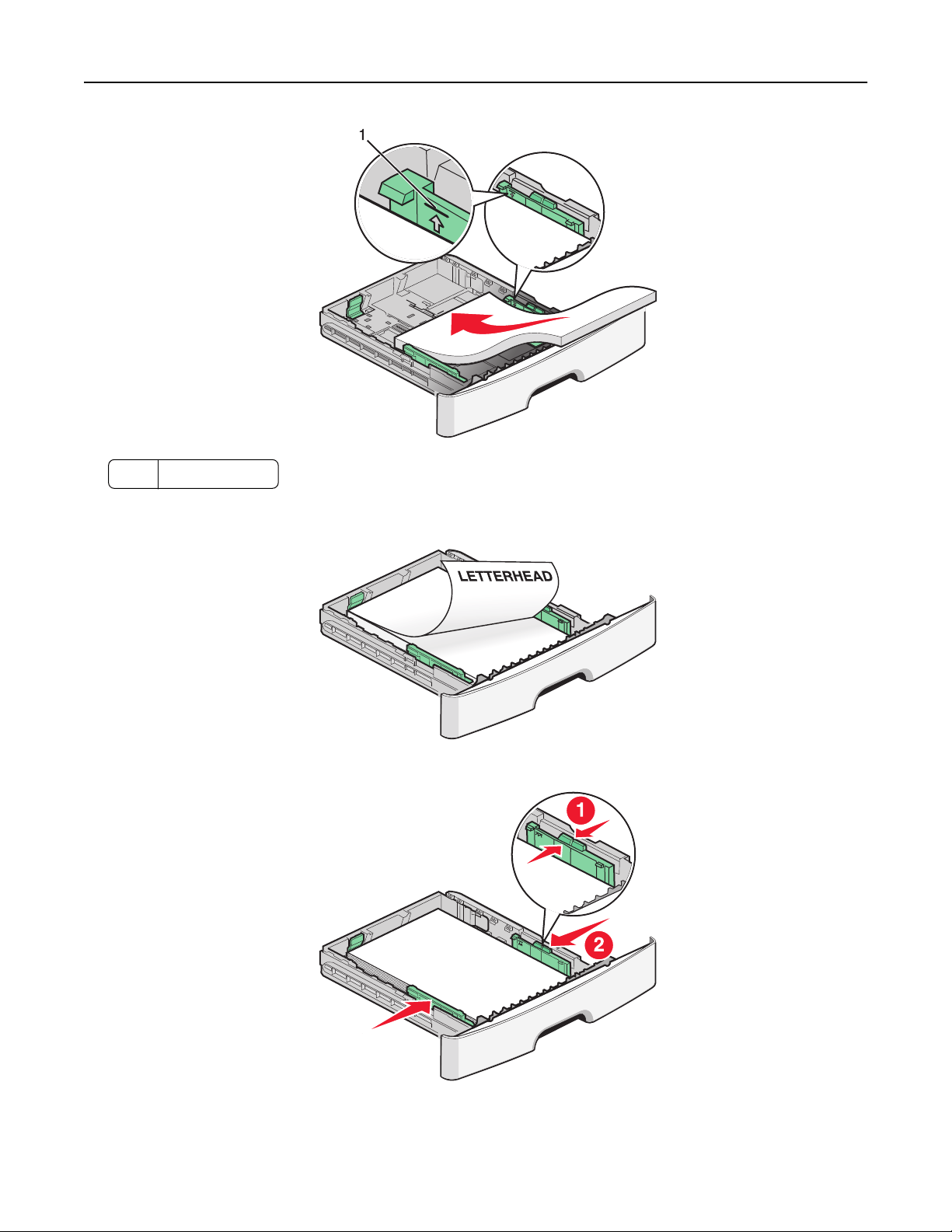
1 Maximum fill line
Load letterhead with the top edge of the sheet toward the front of the tray and the design facedown.
5 Squeeze and slide the guides to lightly touch the side of the stack.
Loading paper and specialty media 48
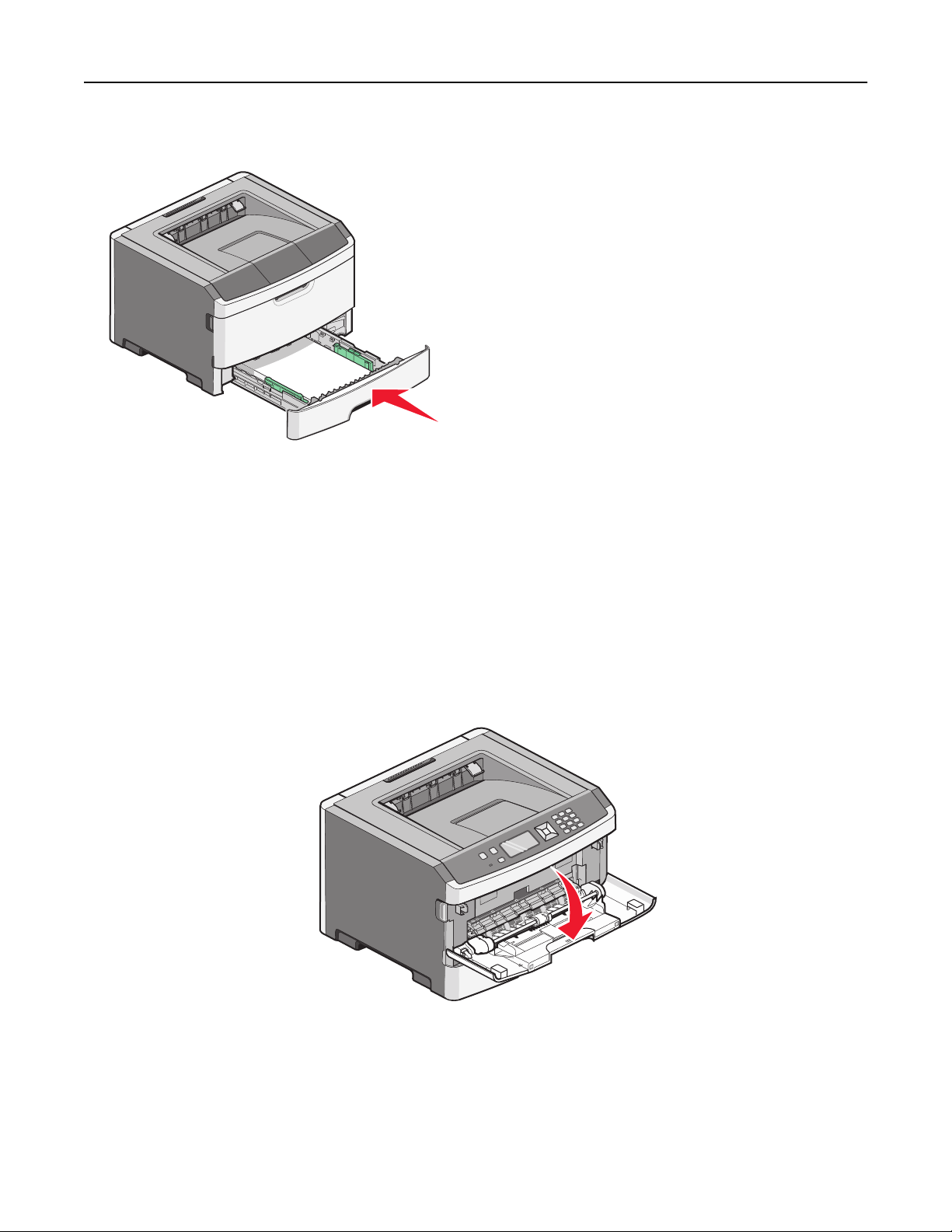
6 Insert the tray.
7 If the paper type you loaded differs from the type that was previously loaded in the tray, then change the Paper
Size/Type setting from the printer control panel Paper menu.
Using the multipurpose feeder
You may want to use the multipurpose feeder when you print on different sizes and types of papers or specialty media,
such as card stock, transparencies, paper labels, and envelopes. You may also want to use the multipurpose feeder for
single‑page print jobs on letterhead or on other specialty media you do not keep in a tray.
Opening the multipurpose feeder
1 Grasp the handle, and pull the multipurpose feeder door down.
Loading paper and specialty media 49
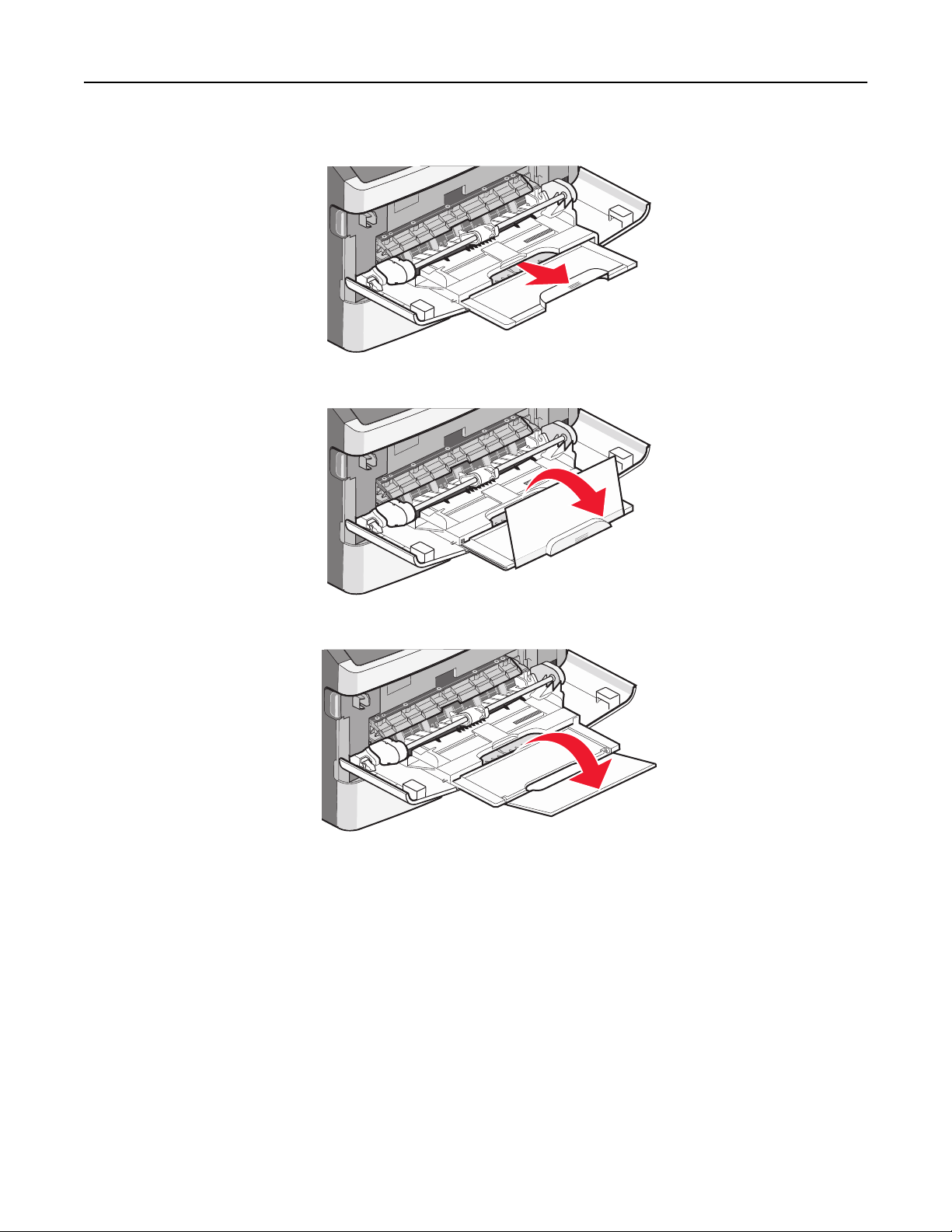
2 Grasp the raised handle, and pull the extension forward.
3 Grasp the handle, and pull the extension so it flips forward.
4 Guide the extension down gently so the multipurpose feeder is extended fully and open.
Loading paper and specialty media 50
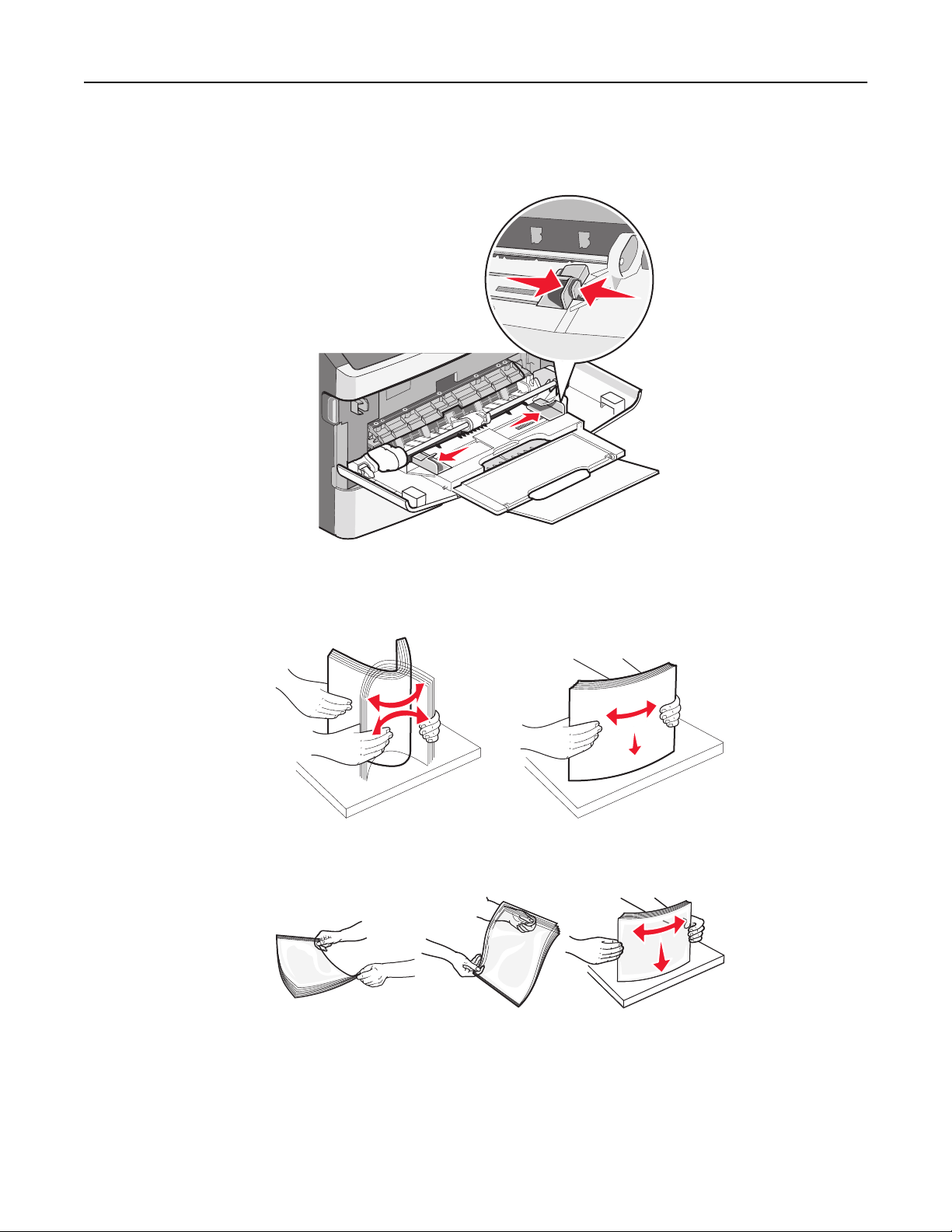
Loading the multipurpose feeder
1 Squeeze the tab located on the right width guide, and move the guides out fully.
2 Prepare the paper or specialty media for loading.
• Flex sheets of paper or paper labels back and forth to loosen them, and then fan them. Do not fold or crease
the paper or labels. Straighten the edges on a level surface.
• Hold transparencies by the edges, and then fan them. Straighten the edges on a level surface.
Note: Avoid touching the print side of the transparencies. Be careful not to scratch them.
Loading paper and specialty media 51
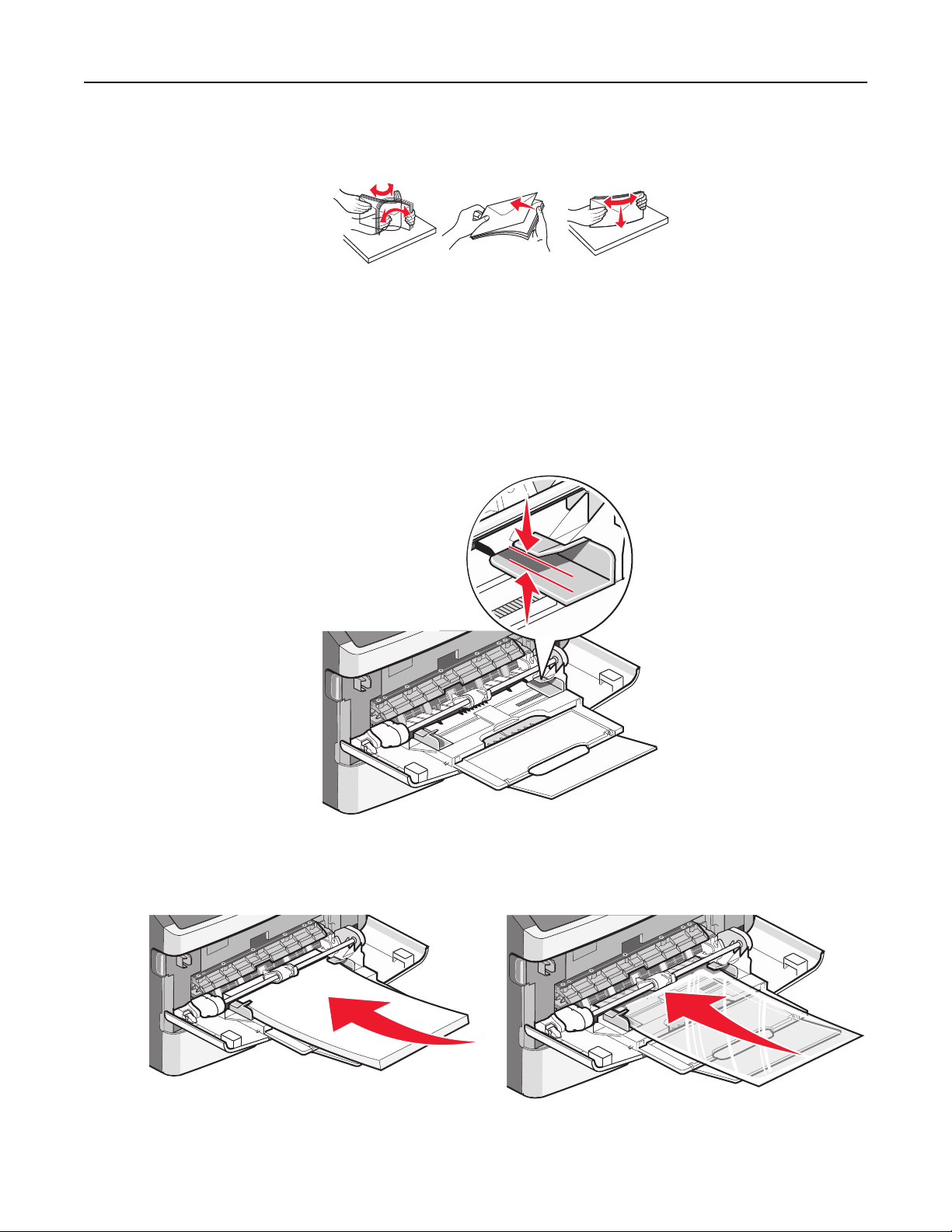
• Flex a stack of envelopes back and forth to loosen them, and then fan them. Straighten the edges on a level
surface.
Note: Fanning prevents the edges of envelopes from sticking together. It also helps them feed properly to
avoid jams. Do not fold or crease envelopes.
3 Load the paper or specialty media.
Notes:
• Do not force any paper into the multipurpose feeder. Overfilling may cause jams.
• Do not exceed the maximum stack height by forcing paper or specialty media under the stack height limiters
which are located on the guides.
• Load paper, transparencies, and card stock with the recommended print side faceup and the top edge entering
the printer first. For more information on loading transparencies, see the packaging the transparencies came
in.
Loading paper and specialty media 52
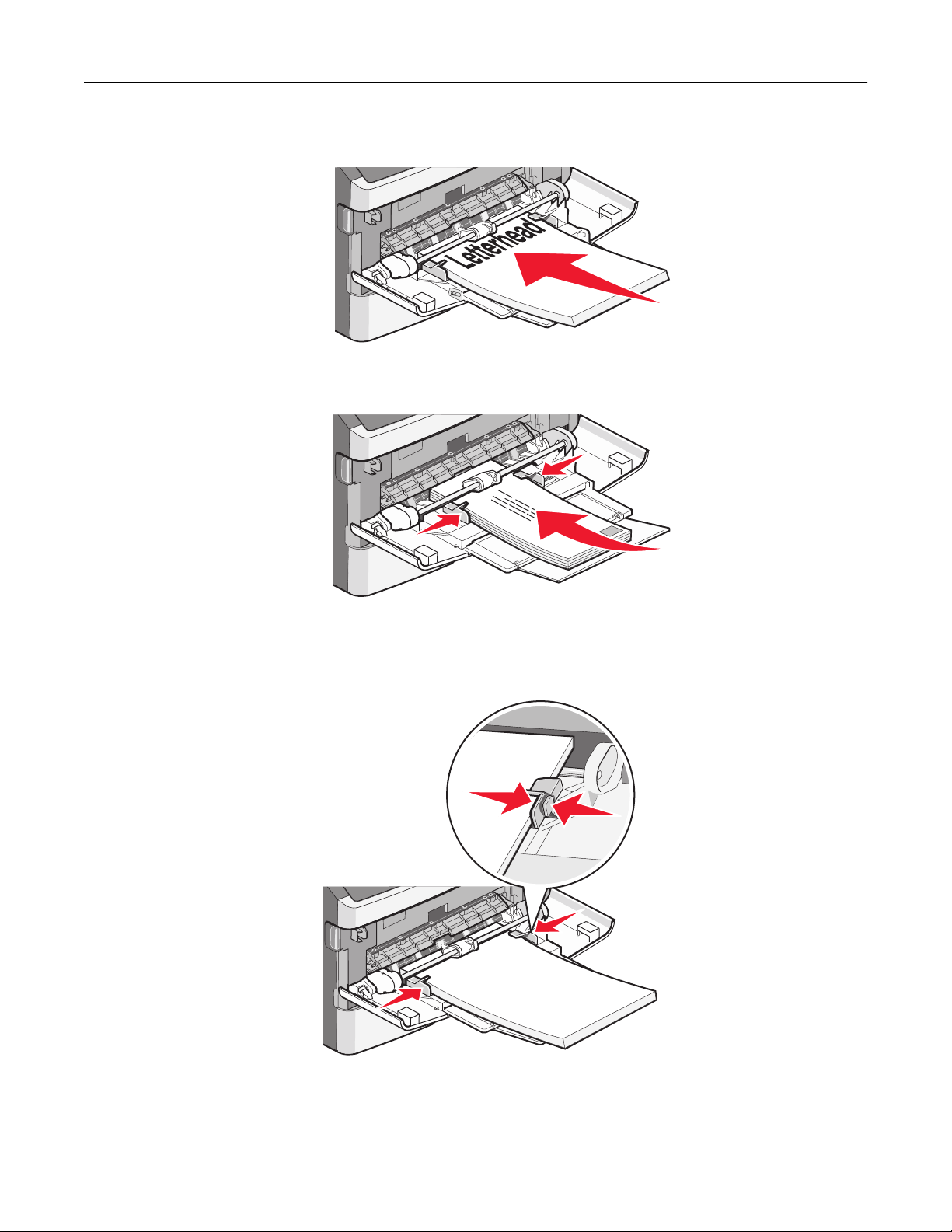
• Load letterhead with the logo faceup and the top edge entering the printer first.
• Load envelopes with the flap side down and the stamp location in the position shown. The stamp and address
are shown to illustrate the proper orientation for loading envelopes.
Warning—Potential Damage: Never use envelopes with stamps, clasps, snaps, windows, coated linings, or
self‑stick adhesives. These envelopes may severely damage the printer.
4 Squeeze the tab located on the right width guide to adjust the guides to lightly touch the sides of the stack.
Loading paper and specialty media 53
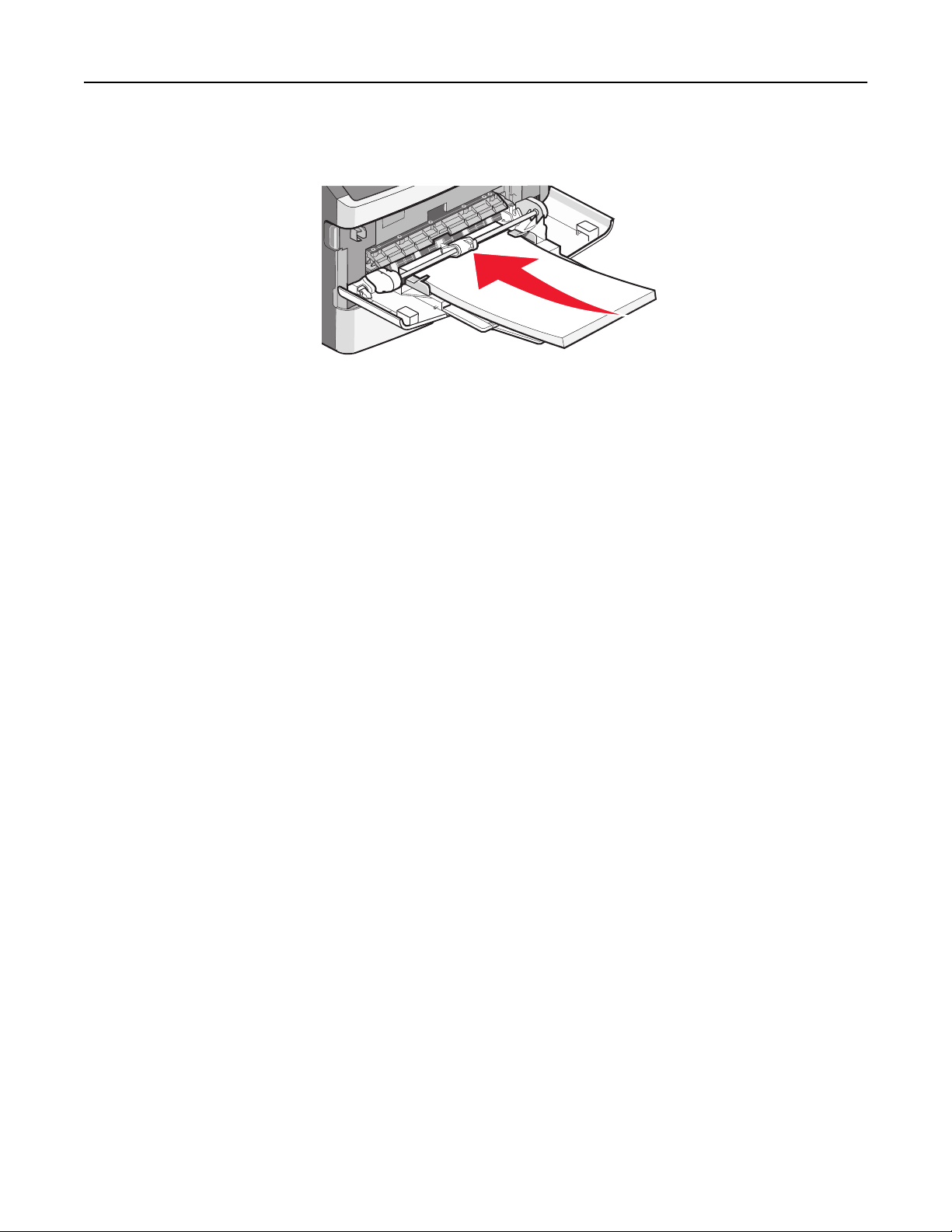
5 Slide the paper gently into the multipurpose feeder until it comes to a stop. Paper should lie flat in the multipurpose
feeder. Make sure the paper fits loosely in the multipurpose feeder and is not bent or wrinkled.
6 From the printer control panel, set the Paper Size and Paper Type.
Linking and unlinking trays
In addition to linking trays to each other, you can also link the multipurpose feeder to the trays.
Linking trays
Tray linking is useful for large print jobs or multiple copies. When one linked tray is empty, paper feeds from the next
linked tray. When the Size and Type settings are the same for any trays, the trays are automatically linked. The Size and
Type settings for all trays must be set from the Paper menu.
Unlinking trays
Unlinked trays have settings that are not the same as the settings of any other tray. To unlink a tray using the Paper
menu, change the Paper Type and Paper Size settings so that they do not match the settings of any other tray.
1 From the Paper menu, make sure the Type setting (for example, Plain Paper, letterhead, Custom Type <x>) for the
tray you want to unlink does not match the Type setting of any other tray.
If the name that best describes your paper is used by linked trays, assign a different Paper Type name to the tray,
such as Custom Type <x>, or assign your own custom name.
2 Make sure the Size setting (for example, letter, A4, statement) for the tray you want to unlink does not match the
Size setting of any other tray.
Note: Paper Size settings are not automatic; they must be set manually from the Paper menu.
Warning—Potential Damage: Do not assign a Paper Type name that does not accurately describe the type of paper
loaded in the tray. The temperature of the fuser varies according to the specified Paper Type. Paper may not be
properly processed if an inaccurate Paper Type is selected.
Loading paper and specialty media 54

Creating a custom name for a paper type
If the printer is on a network, you can use the Embedded Web Server to define a name other than Custom Type <x>
for each of the custom paper types that are loaded.
1 Type the printer IP address into the address field of your Web browser.
Note: If you do not know the IP address of the printer, print a network setup page and locate the address in the
TCP/IP section.
2 Click Settings.
3 Click Paper Menu.
4 Click Custom Name.
5 Type a name for the paper type in a Custom Name <x> box.
Note: This custom name will replace a custom type <x> name under the Custom Types and Paper Size and Type
menus.
6 Click Submit.
7 Click Custom Types.
Custom Types appears, followed by your custom name.
8 Select a Paper Type setting from the pick list next to your custom name.
9 Click Submit.
Assigning a customer paper type name to a tray
Assign a Custom Type <x> name to a tray to link or unlink it. Associate the same Custom Type <x> name to each tray
that you want to link. Only trays with the same custom names assigned will link.
1 Make sure the printer is on and Ready appears.
2 From the printer control panel, press .
3 Press the up or down arrow button until Paper Menu appears, and then press .
4 Press the up or down arrow button until Paper Size/Type appears, and then press .
5 Press the up or down arrow button until appears next to the name of the tray, and then press .
The Paper Size menu appears.
6 Press again.
The Paper Type menu appears.
7 Press the up or down arrow button until Custom Type <x> or another custom name appears, and then press
.
Submitting selection appears, followed by Paper Menu.
8 Verify that the correct Paper Type is associated with the custom name.
Note: Plain Paper is the factory default Paper Type associated with all Custom Type <x> names and user‑defined
custom names.
Loading paper and specialty media 55

a From the Paper menu, press the down arrow button until Custom Types appears, and then press .
b Press the down arrow button until appears next to the custom paper type name you selected in step 7 on
page 55, and then press
.
c Press the down arrow button until appears next to the Paper Type setting you want, and then press .
Loading paper and specialty media 56

Paper and specialty media guidelines
Paper and specialty media are paper, card stock, envelopes, paper labels, and transparencies. A number of items must
be considered concerning the selection of paper and specialty media before printing. This chapter provides information
on making selections and caring for papers and specialty media.
It is recommended that you try a limited sample of any paper or specialty media you are considering using with the
printer before purchasing large quantities.
For more information about types of paper and specialty media your printer supports, see the Card Stock & Label
Guide available on the Lexmark Web site at www.lexmark.com.
Paper guidelines
Selecting the correct paper or specialty media reduces printing problems. For the best print quality, try a sample of the
paper or specialty media before buying large quantities.
Paper characteristics
The following paper characteristics affect print quality and reliability. Consider these characteristics when evaluating
new paper stock.
Weight
The printer trays can automatically feed paper weights up to 90 g/m
2
(24 lb bond) grain long paper. The multipurpose
feeder can automatically feed paper weights up to 163 g/m
2
(43 lb bond) grain long. Paper lighter than 60 g/m
2
(16 lb)
might not be stiff enough to feed properly, causing jams. For best performance, use 75 g/m
2
(20 lb bond) grain long
paper. For paper smaller than 182 x 257 mm (7.2 x 10.1 in.), we recommend 90 g/m
2
(24 lb) or heavier paper.
Note: Duplex printing is supported only for 60–90 g/m
2
(16–24 lb bond) paper.
Curl
Curl is the tendency for paper to curl at its edges. Excessive curl can cause paper feeding problems. Curl can occur after
the paper passes through the printer, where it is exposed to high temperatures. Storing paper unwrapped in hot, humid,
cold, or dry conditions, even in the trays, can contribute to paper curling prior to printing and can cause feeding
problems.
Smoothness
Paper smoothness directly affects print quality. If paper is too rough, toner cannot fuse to it properly. If paper is too
smooth, it can cause paper feeding or print quality issues. Always use paper between 100–300 Sheffield points;
smoothness between 150–250 Sheffield points produces the best print quality.
Moisture content
The amount of moisture in paper affects both print quality and the ability of the printer to feed the paper correctly.
Leave paper in its original wrapper until it is time to use it. This limits the exposure of paper to moisture changes that
can degrade its performance.
Paper and specialty media guidelines 57

Condition paper before printing by storing it in its original wrapper in the same environment as the printer for 24 to
48 hours before printing. Extend the time several days if the storage or transportation environment is very different
from the printer environment. Thick paper may also require a longer conditioning period.
Grain direction
Grain refers to the alignment of the paper fibers in a sheet of paper. Grain is either grain long, running the length of
the paper, or grain short, running the width of the paper.
For 60–90 g/m
2
(16–24 lb bond) paper, grain long paper is recommended.
Fiber content
Most high‑quality xerographic paper is made from 100% chemically treated pulped wood. This content provides the
paper with a high degree of stability resulting in fewer paper feeding problems and better print quality. Paper containing
fibers such as cotton can negatively affect paper handling.
Unacceptable paper
The following paper types are not recommended for use with the printer:
• Chemically treated papers used to make copies without carbon paper, also known as carbonless papers, carbonless
copy paper (CCP), or no carbon required (NCR) paper
• Preprinted papers with chemicals that may contaminate the printer
• Preprinted papers that can be affected by the temperature in the printer fuser
• Preprinted papers that require a registration (the precise print location on the page) greater than ±2.3 mm (±0.9 in.),
such as optical character recognition (OCR) forms
In some cases, registration can be adjusted with a software application to successfully print on these forms.
• Coated papers (erasable bond), synthetic papers, thermal papers
• Rough‑edged, rough or heavily textured surface papers, or curled papers
• Recycled papers that fail EN12281:2002 (European)
• Paper weighing less than 60 g/m
2
(16 lb)
• Multiple‑part forms or documents
Selecting paper
Using appropriate paper prevents jams and helps ensure trouble‑free printing.
To help avoid jams and poor print quality:
• Always use new, undamaged paper.
• Before loading paper, know the recommended print side. This information is usually indicated on the package.
• Do not use paper, paper labels, or card stock that has been cut or trimmed by hand.
• Do not mix sizes, types, or weights in the same source; mixing results in jams.
• Do not use coated papers unless they are specifically designed for electrophotographic printing.
Paper and specialty media guidelines 58

Selecting preprinted forms and letterhead
Use these guidelines when selecting preprinted forms and letterhead:
• Use grain long for 60–90 g/m
2
(16–24 lb) paper.
• Use only forms and letterhead printed using an offset lithographic or engraved printing process.
• Avoid papers with rough or heavily textured surfaces.
Use papers printed with heat‑resistant inks designed for use in xerographic copiers. The ink must be able to withstand
temperatures up to 230°C (446°F) without melting or releasing hazardous emissions. Use inks that are not affected by
the resin in toner. Inks that are oxidation‑set or oil‑based generally meet these requirements; latex inks might not.
When in doubt, contact the paper supplier.
Preprinted papers such as letterhead must be able to withstand temperatures up to 230°C (446°F) without melting or
releasing hazardous emissions.
Using recycled paper and other office papers
As an environmentally conscious company, Lexmark supports the use of recycled office paper produced specifically for
use in laser (electrophotographic) printers. In 1998, Lexmark presented to the US government a study demonstrating
that recycled paper produced by major mills in the US fed as well as non-recycled paper. However, no blanket statement
can be made that all recycled paper will feed well.
Lexmark consistently tests its printers with recycled paper (20–100% post-consumer waste) and a variety of test paper
from around the world, using chamber tests for different temperature and humidity conditions. Lexmark has found no
reason to discourage the use of today's recycled office papers, but generally the following property guidelines apply
to recycled paper.
• Low moisture content (4–5%)
• Suitable smoothness (100–200 Sheffield units, or 140–350 Bendtsen units, European)
Note: Some much smoother papers (such as premium 24 lb laser papers, 50–90 Sheffield units) and much
rougher papers (such as premium cotton papers, 200–300 Sheffield units) have been engineered to work very
well in laser printers, despite surface texture. Before using these types of paper, consult your paper supplier.
• Suitable sheet-to-sheet coefficient of friction (0.4–0.6)
• Sufficient bending resistance in the direction of feed
Recycled paper, paper of lower weight (<60 g/m
2
[16 lb bond]) and/or lower caliper (<3.8 mils [0.1 mm]), and paper
that is cut grain-short for portrait (or short-edge) fed printers may have lower bending resistance than is required for
reliable paper feeding. Before using these types of paper for laser (electrophotographic) printing, consult your paper
supplier. Remember that these are general guidelines only and that paper meeting these guidelines may still cause
paper feeding problems in any laser printer (for example, if the paper curls excessively under normal printing
conditions).
Storing paper
Use these paper storage guidelines to help avoid jams and uneven print quality:
• For best results, store paper where the temperature is 21°C (70°F) and the relative humidity is 40%. Most label
manufacturers recommend printing in a temperature range of 18 to 24°C (65 to 75°F) with relative humidity between
40 and 60%.
• Store paper in cartons when possible, on a pallet or shelf, rather than on the floor.
Paper and specialty media guidelines 59
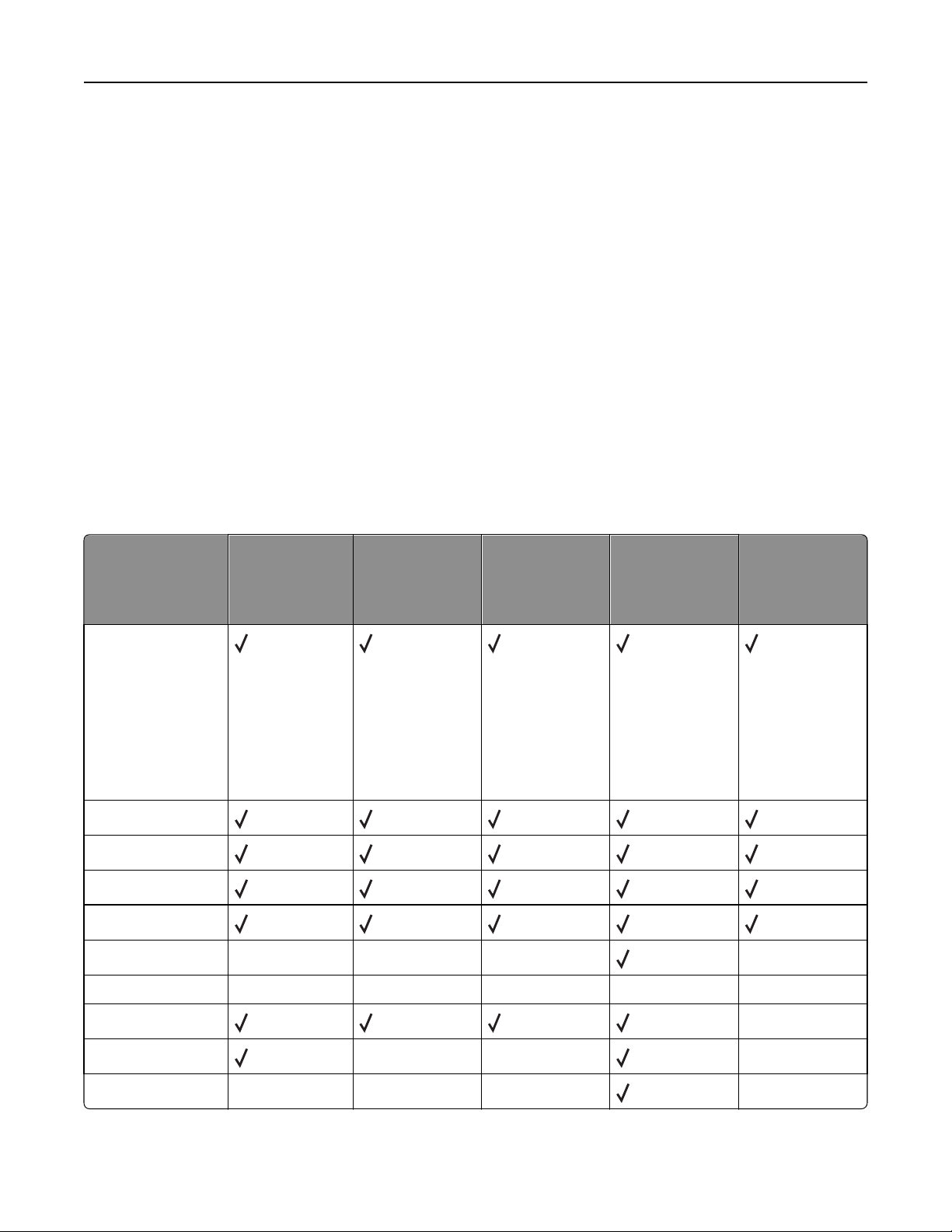
• Store individual packages on a flat surface.
• Do not store anything on top of individual paper packages.
Supported paper sizes, types, weights, and capacities
The following tables provide information on standard and optional paper sources, the types of paper they support, and
capacities.
Note: For an unlisted paper size, select the closest larger listed size.
For information on card stock and labels, see the Card Stock & Label Guide available at the Lexmark Web site at
http://support.lexmark.com.
Paper types and weights supported by the printer
The printer engine and the duplex path support 60–90 g/m
2
(16–24 lb) paper weights. The multipurpose feeder supports
60–163 g/m
2
(16–43 lb) paper weights.
Note: Optional trays are not available for some models.
Paper type Standard
250‑sheet tray
(Tray 1)
Standard or
optional
250‑sheet tray
(Tray 2)
Optional
550‑sheet tray
(Tray 2)
Multipurpose
feeder
Duplex path
Paper
• Plain
• Light
• Heavy
• Rough/Cotton
• Recycled
• Custom
Bond
Letterhead
Preprinted
Colored Paper
Card stock X X X X
Glossy paper X X X X X
Paper labels
1
X
Transparencies
XX X
Envelopes (smooth)
2
XX X X
Paper and specialty media guidelines 60
Paper type Standard
250‑sheet tray
(Tray 1)
Standard or
optional
250‑sheet tray
(Tray 2)
Optional
550‑sheet tray
(Tray 2)
Multipurpose
feeder
Duplex path
1
Single‑sided paper labels are supported for occasional use. It is recommended to print 20 or fewer pages of paper labels
a month. Vinyl, pharmacy, and dual‑sided labels are not supported.
2
Use envelopes that lie flat when individually placed on a table facedown.
Paper sizes supported by the printer
Note: Optional trays are not available for some models.
Paper size Dimensions Standard
250‑sheet tray
(Tray 1)
Standard or
optional
250‑sheet tray
(Tray 2)
Optional
550‑sheet tray
(Tray 2)
Multipurpose
feeder
Duplex
path
A4 210 x 297 mm
(8.3 x 11.7 in.)
A5 148 x 210 mm
(5.8 x 8.3 in.)
X
A6
1
105 x 148 mm
(4.1 x 5.8 in.)
XX X
Executive 184 x 267 mm
(7.3 x 10.5 in.)
X
Folio 216 x 330 mm
(8.5 x 13 in.)
JIS B5 182 x 257 mm
(7.2 x 10.1 in.)
X
Legal 216 x 356 mm
(8.5 x 14 in.)
Letter 216 x 279 mm
(8.5 x 11 in.)
Oficio (Mexico)
2
216 x 340 mm
(8.5 x 13.4 in.)
Statement 140 x 216 mm
(5.5 x 8.5 in.)
X
Universal
3
76.2 x 127 mm
(3 x 5 in.) up to
216 x 356 mm
(8.5 x 14 in.)
1
A6 is supported only for grain long papers.
2
This size setting formats the page for 216 x 356 mm (8.5 x 14 in.) unless the size is specified by the software application.
3
If a paper size you want to use is not listed, configure a Universal paper size. For more information, see “Configuring
Universal paper settings” on page 44.
Paper and specialty media guidelines 61
Paper size Dimensions Standard
250‑sheet tray
(Tray 1)
Standard or
optional
250‑sheet tray
(Tray 2)
Optional
550‑sheet tray
(Tray 2)
Multipurpose
feeder
Duplex
path
B5 Envelope 176 x 250 mm
(6.9 x 9.8 in.)
XX X
X
C5 Envelope 162 x 229 mm
(6.4 x 9 in.)
XX X
X
DL Envelope 110 x 220 mm
(4.3 x 8.7 in.)
XX X
X
7 3/4 Envelope
(Monarch)
98 x 191 mm
(3.9 x 7.5 in.)
XX X
X
9 Envelope 98 x 225 mm
(3.9 x 8.9 in.)
XX X X
10 Envelope 105 x 241 mm
(4.1 x 9.5 in.)
XX X
X
Other Envelope 216 x 356 mm
(8.5 x 14 in.)
XX X
X
1
A6 is supported only for grain long papers.
2
This size setting formats the page for 216 x 356 mm (8.5 x 14 in.) unless the size is specified by the software application.
3
If a paper size you want to use is not listed, configure a Universal paper size. For more information, see “Configuring
Universal paper settings” on page 44.
Paper tray capacities
The capacities of the trays and the multipurpose feeder are based on 75 g/m
2
(20 lb) paper.
Paper and specialty media guidelines 62

Printing
This chapter covers printing, printer reports, and job cancelation. Selection and handling of paper and specialty media
can affect how reliably documents print. For more information, see “Avoiding jams” on page 123 and “Storing paper”
on page 59.
Printing a document
Printing a document
1 Load paper into a tray or feeder.
2 From the printer control panel Paper menu, set the Paper Size/Type to match the loaded paper.
3 Send the print job:
For Windows users
a
With a document open, click File > Print.
b Click Properties, Preferences, Options, or Setup, and then adjust the settings as needed.
Note: To print on a specific size or type of paper, adjust the paper size or type settings to match the loaded
paper, or select the appropriate tray or feeder.
c Click OK, and then click OK.
For Macintosh users
a
Customize the settings as needed in the Page Setup dialog:
1 With a document open, choose File > Page Setup.
2 Choose a paper size or create a custom size to match the loaded paper.
3 Click OK.
b Customize the settings as needed in the Print dialog:
1 With a document open, choose File > Print.
If necessary, click the disclosure triangle to see more options.
2 From the Print dialog and pop‑up menus, adjust the settings as needed.
Note: To print on a specific paper type, adjust the paper type setting to match the loaded paper, or
select the appropriate tray or feeder.
3 Click Print.
Printing 63
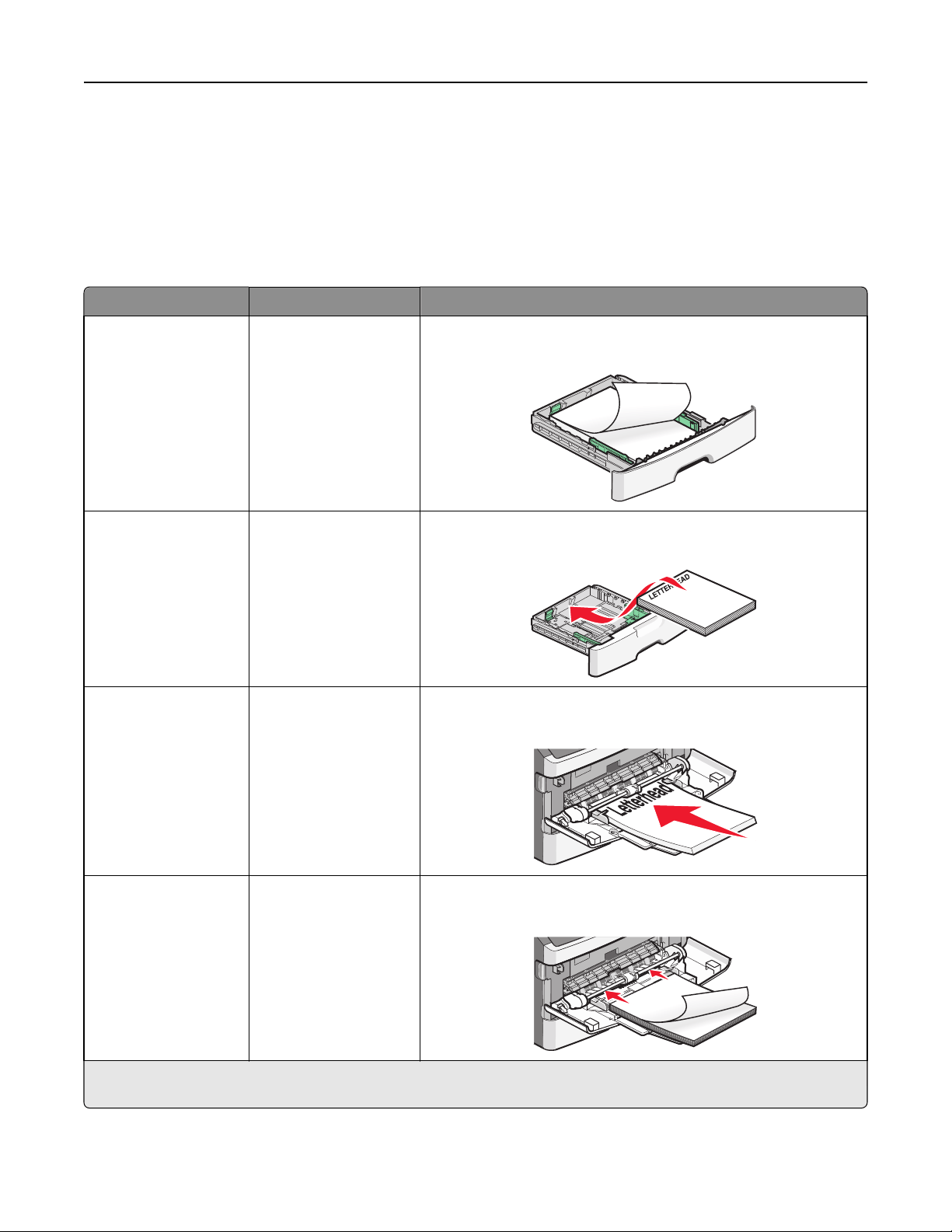
Printing on specialty media
Tips on using letterhead
Page orientation is important when printing on letterhead. Use the following table to determine which direction to
load the letterhead:
Source or process Print side Paper orientation
• Standard 250‑sheet
tray
• Optional 250‑sheet
tray
• Optional 550‑sheet
tray
Printed letterhead design
is placed facedown.
The top edge of the sheet with the logo is placed at the front of the
tray.
LETTERHEAD
Duplex (two‑sided)
printing from trays
Printed letterhead design
is placed faceup.
The top edge of the sheet with the logo is placed at the front of the
tray.
Multipurpose feeder
(simplex printing)
Preprinted letterhead
design is placed faceup.
The top edge of the sheet with the logo should enter the multipurpose
feeder first.
Multipurpose feeder
(duplex printing)
Preprinted letterhead
design is placed
facedown.
The top edge of the sheet with the logo should enter the multipurpose
feeder last.
LETTERHEAD
Note: Check with the manufacturer or vendor to determine whether the chosen preprinted letterhead is acceptable for
laser printers.
Printing 64

Tips on using transparencies
Print samples on the transparencies being considered for use before buying large quantities.
When printing on transparencies:
• Feed transparencies from the standard 250‑sheet tray or the multipurpose feeder.
• Use transparencies designed specifically for laser printers. Check with the manufacturer or vendor to ensure
transparencies are able to withstand temperatures up to 175°C (350°F) without melting, discoloring, offsetting, or
releasing hazardous emissions.
Note: Transparencies can be printed at a temperature up to 180°C (356°F) if Transparency Weight is set to
Heavy and Transparency Texture is set to Rough. Select these settings using the Embedded Web Server, or from
the printer control panel Paper menu.
• To prevent print quality problems, avoid getting fingerprints on the transparencies.
• Before loading transparencies, fan the stack to prevent sheets from sticking together.
• We recommend Lexmark part number 70X7240 for letter‑size transparencies and Lexmark part number 12A5010
for A4‑size transparencies.
Tips on using envelopes
Print samples on the envelopes being considered for use before buying large quantities.
When printing on envelopes:
• Use envelopes designed specifically for laser printers. Check with the manufacturer or vendor to ensure the
envelopes can withstand temperatures up to 210°C (410°F) without sealing, wrinkling, curling excessively, or
releasing hazardous emissions.
Note: Envelopes can be printed at a temperature up to 220°C (428°F) if Envelope Weight is set to Heavy and
Envelope Texture is set to Rough. Select these settings using the Embedded Web Server, or from the printer
control panel Paper menu.
• For the best performance, use envelopes made from 90 g/m
2
(24 lb bond) paper. Use up to 105 g/m
2
(28 lb bond)
weight for envelopes as long as the cotton content is 25% or less. All‑cotton envelopes must not exceed 90 g/m
2
(24 lb bond) weight.
• Use only new envelopes.
• To optimize performance and minimize jams, do not use envelopes that:
– Have excessive curl or twist
– Are stuck together or damaged in any way
– Have windows, holes, perforations, cutouts, or embossing
– Have metal clasps, string ties, or folding bars
– Have an interlocking design
– Have postage stamps attached
– Have any exposed adhesive when the flap is in the sealed or closed position
– Have bent corners
– Have rough, cockle, or laid finishes
• Adjust the width guides to fit the width of the envelopes.
Note: A combination of high humidity (over 60%) and the high printing temperature may wrinkle or seal envelopes.
Printing 65

Tips on using labels
Print samples on the labels being considered for use before buying large quantities.
Note: Use only paper label sheets. Vinyl, pharmacy, and dual‑sided labels are not supported.
For detailed information on label printing, characteristics, and design, see the Card Stock & Label Guide available on
the Lexmark Web site at http://support.lexmark.com.
When printing on labels:
• Use labels designed specifically for laser printers. Check with the manufacturer or vendor to verify that:
– The labels can withstand temperatures up to 210°C (410°F) without sealing, excessive curling, wrinkling, or
releasing hazardous emissions.
Note: Labels can be printed at a higher fusing temperature up to 220°C (428°F) if Label Weight is set to
Heavy. Select this setting using the Embedded Web Server, or from the printer control panel Paper menu.
– Label adhesives, face sheet (printable stock), and topcoats can withstand up to 25‑psi (172‑kPa) pressure without
delaminating, oozing around the edges, or releasing hazardous fumes.
• Do not use labels with slick backing material.
• Use full label sheets. Partial sheets may cause labels to peel off during printing, resulting in a jam. Partial sheets
also contaminate the printer and the cartridge with adhesive, and could void the printer and cartridge warranties.
• Do not use labels with exposed adhesive.
• Do not print within 1 mm (0.04 in.) of the edge of the label, of the perforations, or between die‑cuts of the label.
• Be sure adhesive backing does not reach to the sheet edge. Zone coating of the adhesive at least 1 mm (0.04 in.)
away from edges is recommended. Adhesive material contaminates the printer and could void the warranty.
• If zone coating of the adhesive is not possible, remove a 2‑mm (0.06‑in.) strip on the leading and driver edge, and
use a non‑oozing adhesive.
• Portrait orientation works best, especially when printing bar codes.
Tips on using card stock
Card stock is heavy, single‑ply specialty media. Many of its variable characteristics, such as moisture content, thickness,
and texture, can significantly impact print quality. Print samples on the card stock being considered for use before
buying large quantities.
When printing on card stock:
• Make sure the Paper Type is Card Stock.
• Select the appropriate Paper Texture setting.
• Be aware that preprinting, perforation, and creasing may significantly affect the print quality and cause jams or
other paper handling problems.
• Check with the manufacturer or vendor to ensure the card stock can withstand temperatures up to 210°C (410°F)
without releasing hazardous emissions.
• Do not use preprinted card stock manufactured with chemicals that may contaminate the printer. Preprinting
introduces semi‑liquid and volatile components into the printer.
• Use grain short card stock when possible.
Printing 66

Printing confidential and other held jobs
Holding jobs in the printer
When sending a job to the printer, you can specify that you want the printer to hold the job in memory until you start
the job from the printer control panel. All print jobs that can be initiated by the user at the printer are called held jobs.
Note: Confidential, Verify, Reserve, and Repeat print jobs may be deleted if the printer requires extra memory to
process additional held jobs.
Job type Description
Confidential When you send a Confidential print job to the printer, you must create a PIN from
the computer. The PIN must be four digits using the numbers 0–9. The job is held
in printer memory until you enter the PIN from the printer control panel and
choose to print or delete the job.
Verify When you send a Verify print job, the printer prints one copy and holds the
remaining copies in printer memory. Verify lets you examine the first copy to see
if it is satisfactory before printing the remaining copies. Once all copies are printed,
the job is automatically deleted from printer memory.
Reserve When you send a Reserve print job, the printer does not print the job immediately.
It stores the job in memory so you can print the job later. The job is held in memory
until you delete it from the Held Jobs menu.
Repeat When you send a Repeat print job, the printer prints all requested copies of the
job and stores the job in memory so you can print additional copies later. You can
print additional copies as long as the job remains stored in memory.
Other types of held jobs include:
• Profiles from various sources including Lexmark
TM
Document Solutions Suite (LDSS)
• Forms from a kiosk
• Bookmarks
• Jobs not printed, which are called parked jobs
Printing confidential and other held jobs
Note: Confidential and Verify print jobs are automatically deleted from memory after they print. Repeat and Reserve
jobs continue to be held in the printer until you choose to delete them.
For Windows Users
1
With a document open, click File > Print.
2 Click Properties, Preferences, Options, or Setup.
3 Click Other Options, and then click Print and Hold.
4 Select your job type (Confidential, Repeat, Reserve, or Verify), and then assign a user name. For a confidential job,
also enter a four‑digit PIN.
5 Click OK or Print, and then go to the printer to release the job.
Printing 67

6 From the printer control panel, press the up or down arrow button until Held jobs appears, and then press
.
7 Press the up or down arrow button until appears next to your user name, and then press .
8 Press the up or down arrow button until appears next to the job type or job name, and then press .
If you selected a job name, proceed to step 11 on page 68.
9 After selecting your job type, use the keypad to enter your PIN.
If you enter an invalid PIN, the Invalid PIN screen appears.
• To re‑enter the PIN, make sure Try again appears, and then press .
• To cancel the PIN, press the up or down arrow button until Cancel appears, and then press .
10 Press the up or down arrow button until appears next to the job you want to print, and then press .
11 Press the up or down arrow button until appears next to the number of copies you want to print, and then press
.
Note: Use the keypad to enter a number if necessary.
For Macintosh users
1
With a document open, choose File > Print.
If necessary, click the disclosure triangle to see more options.
2 From the print options or Copies & Pages pop‑up menu, choose Job Routing.
3 Select your job type (Confidential, Repeat, Reserve, or Verify), and then assign a user name. For a confidential job,
also enter a four‑digit PIN.
4 Click OK or Print, and then go to the printer to release the job.
5 From the printer control panel, press the up or down arrow button until Held jobs appears, and then press
.
6 Press the up or down arrow button until appears next to your user name, and then press .
7 Press the up or down arrow button until appears next to the job type or job name, and then press .
If you selected a job name, proceed to step 10 on page 68.
8 After selecting your job type, use the keypad to enter your PIN.
If you enter an invalid PIN, the Invalid PIN screen appears.
• To re‑enter the PIN, make sure Try again appears, and then press .
• To cancel the PIN, press the up or down arrow button until Cancel appears, and then press .
9 Press the up or down arrow button until appears next to the job you want to print, and then press .
10 Press the up or down arrow button until appears next to the number of copies you want to print, and then press
.
Note: Use the keypad to enter a number if necessary.
Printing 68

Printing information pages
For more information on printing information pages, see “Printing a menu settings page” on page 28 and “Printing a
network setup page” on page 29.
Printing a font sample list
To print samples of the fonts currently available for your printer:
1 Make sure the printer is on and Ready appears.
2 From the printer control panel, press .
3 Press the up or down arrow button until Reports appears, and then press .
4 Press the up or down arrow button until Print Fonts appears, and then press .
5 Press the up or down arrow button until appears next to PCL Fonts, PostScript Fonts, or PPDS
Fonts, and then press
.
Note: PPDS Fonts appear only if the PPDS datastream has been activated.
After the font sample list prints, Ready appears.
Printing a directory list
A directory list shows the resources stored in flash memory.
1 Make sure the printer is on and Ready appears.
2 From the printer control panel, press .
3 Press the up or down arrow button until Reports appears, and then press .
4 Press the up or down arrow button until Print Directory appears, and then press .
After the directory list prints, the printer returns to the Ready state.
Printing the print quality test pages
Print the print quality test pages to isolate print quality problems.
1 Turn the printer off.
2 Hold down and the right arrow button while turning the printer on.
3 Release the buttons when the clock appears, and wait for CONFIG MENU to appear.
4 Press the up or down arrow button until Prt Quality Pgs appears, and then press .
The print quality test pages print.
5 Press the up or down arrow button until Exit Config Menu appears, and then press .
Resetting the Printer appears briefly, followed by a clock, and then Ready appears.
Printing 69

Canceling a print job
Canceling a print job from the printer control panel
If the job is formatting or already printing, and Cancel a job appears on the first line of the display:
1 Press the up or down arrow button until Cancel appears.
A list of jobs appears.
2 Press the up or down arrow button until appears next to the job you want to cancel, and then press .
Note: Once a print job is sent, to easily cancel a job, press
. The Stopped screen appears. Press the up or down
arrow button until
Cancel a job appears, and then press .
Canceling a print job from the computer
For Windows users
1 Open the printers folder:
a Click , or click Start and then click Run.
b In the Start Search or Run box, type control printers.
c Press Enter, or click OK.
The printers folder opens.
2 Double‑click the printer icon.
3 Select the job to cancel.
4 From the keyboard, press Delete.
From the Windows taskbar:
When you send a job to print, a small printer icon appears in the right corner of the taskbar.
1 Double‑click the printer icon.
A list of print jobs appears in the printer window.
2 Select a job to cancel.
3 From the keyboard, press Delete.
For Macintosh users
In Mac OS X version 10.5 or later:
1 From the Apple menu, choose System Preferences.
2 Click Print & Fax, and then double‑click the printer icon.
3 From the printer window, select the job to cancel.
4 From the icon bar at the top of the window, click the Delete icon.
Printing 70

In Mac OS X version 10.4 and earlier:
1 From the Go menu, choose Applications.
2 Double‑click Utilities, and then double‑click Printer Setup Utility or Print Center.
3 Double‑click the printer icon.
4 From the printer window, select the job to cancel.
5 From the icon bar at the top of the window, click the Delete icon.
Printing 71

Understanding printer menus
Menus list
Paper Menu Reports Network/Ports
Default Source
Paper Size/Type
Configure MP
Substitute Size
Paper Texture
Paper Weight
Paper Loading
Custom Types
Universal Setup
Menu Settings Page
Device Statistics
Network Setup Page
Wireless Setup Page
Profiles List
Netware Setup Page
Print Fonts
Print Directory
Asset Report
Active NIC
Standard Network Menu
Standard USB Menu
Parallel Menu
SMTP Setup Menu
Security Settings
Miscellaneous
Confidential Print
Security Audit Log
Set Date/Time
General Settings
Setup Menu
Finishing Menu
Quality Menu
Utilities Menu
XPS Menu
PDF Menu
PostScript Menu
PCL Emul Menu
HTML Menu
Image Menu
Understanding printer menus 72

Paper menu
Default Source menu
Menu item Description
Default Source
Tray <x>
MP Feeder
Manual Paper
Manual Env
Sets a default paper source for all print jobs
Notes:
• From the Paper menu, Configure MP must be set to Cassette in order for
MP Feeder to appear as a menu setting.
• Tray 1 is the factory default setting.
• Only an installed paper source will appear as a menu setting.
• A paper source selected by a print job will override the Default Source
setting for the duration of the print job.
• If the same size and type of paper are in two trays and the Paper Size and
Paper Type settings match, the trays are automatically linked. When one
tray is empty, the job prints using the linked tray.
Paper Size/Type menu
Menu item Description
Tray <x> Size
A4
A5
A6
JIS B5
Executive
Folio
Legal
Letter
Oficio (Mexico)
Statement
Universal
Specifies the paper size loaded in each tray
Notes:
• Letter is the US factory default setting. A4 is the international factory
default setting.
• If the same size and type of paper are in two trays and the Paper Size
and Paper Type settings match, then the trays are automatically linked.
The multipurpose feeder may also be linked. When one tray is empty,
the job prints using paper from the linked tray.
• The A6 paper size is supported only in Tray 1 and the multipurpose
feeder.
Note: Only installed trays and feeders are listed in this menu.
Understanding printer menus 73

Menu item Description
Tray <x> Type
Plain Paper
Transparency
Recycled
Labels
Bond
Letterhead
Preprinted
Colored Paper
Light Paper
Heavy Paper
Rough/Cotton
Custom Type <x>
Specifies the type of paper loaded in each tray
Notes:
• Plain Paper is the factory default setting for Tray 1. Custom Type <x> is
the factory default setting for all other trays.
• If available, a user‑defined name will appear instead of Custom
Type <x>.
• Use this menu item to configure automatic tray linking.
Manual Paper Size
A4
A5
A6
Executive
Folio
JIS B5
Legal
Letter
Oficio (Mexico)
Statement
Universal
Specifies the size of the paper being manually loaded in the multipurpose
feeder
Note: Letter is the US factory default setting. A4 is the international factory
default setting.
Manual Paper Type
Plain Paper
Card Stock
Transparency
Recycled
Labels
Bond
Letterhead
Preprinted
Colored Paper
Light Paper
Heavy Paper
Rough/Cotton
Custom Type <x>
Specifies the type of paper being manually loaded in the multipurpose feeder
Notes:
• Plain Paper is the factory default setting.
• From the Paper menu, Configure MP must be set to Manual in order for
Manual Paper to appear as a menu item.
Note: Only installed trays and feeders are listed in this menu.
Understanding printer menus 74

Menu item Description
MP Feeder Size
A4
A5
A6
Executive
Folio
JIS B5
Legal
Letter
Oficio (Mexico)
Statement
Universal
7 3/4 Envelope
9 Envelope
10 Envelope
C5 Envelope
B5 Envelope
DL Envelope
Other Envelope
Specifies the paper size loaded in the multipurpose feeder
Notes:
• Letter is the U.S. factory default setting. A4 is the international factory
default setting.
• The menu item applies only when the multipurpose feeder (MP Feeder)
is configured for Cassette. From the Paper menu, Configure MP must be
set to Cassette.
• The multipurpose feeder does not automatically sense paper size. The
paper size value must be set.
MP Feeder Type
Plain Paper
Card Stock
Transparency
Recycled
Labels
Bond
Envelope
Rough Envelope
Letterhead
Preprinted
Colored Paper
Light Paper
Heavy Paper
Rough/Cotton
Custom Type <x>
Specifies the type of paper loaded in the multipurpose feeder
Notes:
• Plain Paper is the factory default setting.
• From the Paper menu, Configure MP must be set to Cassette in order
for MP Feeder to appear as a menu item.
Manual Env Size
7 3/4 Envelope
9 Envelope
10 Envelope
C5 Envelope
B5 Envelope
DL Envelope
Other Envelope
Specifies the size of the envelope being manually loaded in the multipurpose
feeder
Note: 10 Envelope is the US factory default setting. DL Envelope is the
international factory default setting.
Note: Only installed trays and feeders are listed in this menu.
Understanding printer menus 75
Menu item Description
Manual Env Type
Envelope
Custom Type <x>
Specifies the type of envelope being manually loaded in the multipurpose
feeder.
Note: Envelope is the factory default setting.
Note: Only installed trays and feeders are listed in this menu.
Configure MP menu
Menu item Description
Configure MP
Cassette
Manual
Determines when the printer selects paper from the multipurpose feeder
Notes:
• Cassette is the factory default setting.
• The Cassette setting configures the multipurpose feeder as an automatic
paper source.
• When Manual is selected, the multipurpose feeder can be used only for
manual feed print jobs.
Substitute Size menu
Menu item Description
Substitute Size
Off
Statement/A5
Letter/A4
All Listed
Substitutes a specified paper size if the requested paper size is not available
Notes:
• All Listed is the factory default setting. All available substitutions are
allowed.
• The Off setting indicates no size substitutions are allowed.
• Setting a substitution lets the job print without a Change Paper message
appearing.
Paper Texture menu
Menu item Description
Plain Texture
Smooth
Normal
Rough
Specifies the relative texture of the paper loaded in a specific tray
Note: Normal is the factory default setting.
Card Stock Texture
Smooth
Normal
Rough
Specifies the relative texture of the card stock loaded in a specific tray
Notes:
• Normal is the factory default setting.
• Settings appear only if card stock is supported.
Understanding printer menus 76

Menu item Description
Transparency Texture
Smooth
Normal
Rough
Specifies the relative texture of the transparencies loaded in a specific tray
Note: Normal is the factory default setting.
Recycled Texture
Smooth
Normal
Rough
Specifies the relative texture of the recycled paper loaded in a specific tray
Note: Normal is the factory default setting.
Labels Texture
Smooth
Normal
Rough
Specifies the relative texture of the labels loaded in a specific tray
Note: Normal is the factory default setting.
Bond Texture
Smooth
Normal
Rough
Specifies the relative texture of the bond paper loaded in a specific tray
Note: Rough is the factory default setting.
Envelope Texture
Smooth
Normal
Rough
Specifies the relative texture of the envelopes loaded in a specific tray
Note: Normal is the factory default setting.
Rough Envelope Texture
Rough
Specifies the relative texture of the envelopes loaded in a specific tray
Note: Rough is the factory default setting.
Letterhead Texture
Smooth
Normal
Rough
Specifies the relative texture of the letterhead paper loaded in a specific tray
Note: Normal is the factory default setting.
Preprinted Texture
Smooth
Normal
Rough
Specifies the relative texture of the preprinted paper loaded in a specific tray
Note: Normal is the factory default setting.
Colored Texture
Smooth
Normal
Rough
Specifies the relative texture of the colored paper loaded in a specific tray
Note: Normal is the factory default setting.
Light Texture
Smooth
Normal
Rough
Specifies the relative texture of the paper loaded in a specific tray
Note: Normal is the factory default setting.
Heavy Texture
Smooth
Normal
Rough
Specifies the relative texture of the paper loaded in a specific tray
Note: Normal is the factory default setting.
Understanding printer menus 77

Menu item Description
Rough/Cotton Texture
Rough
Specifies the relative texture of the paper loaded in a specific tray
Note: Rough is the factory default setting.
Custom <x> Texture
Smooth
Normal
Rough
Specifies the relative texture of the custom paper loaded in a specific tray
Notes:
• Normal is the factory default setting.
• Settings appear only if the custom type is supported.
Paper Weight menu
Menu item Description
Plain Weight
Light
Normal
Heavy
Specifies the relative weight of the paper loaded in a specific tray
Note: Normal is the factory default setting.
Card Stock Weight
Light
Normal
Heavy
Specifies the relative weight of the card stock loaded in a specific tray
Note: Normal is the factory default setting.
Transparency Weight
Light
Normal
Heavy
Specifies the relative weight of the transparencies loaded in a specific tray
Note: Normal is the factory default setting.
Recycled Weight
Light
Normal
Heavy
Specifies the relative weight of the recycled paper loaded in a specific tray
Note: Normal is the factory default setting.
Labels Weight
Light
Normal
Heavy
Specifies the relative weight of the labels loaded in a specific tray
Note: Normal is the factory default setting.
Bond Weight
Light
Normal
Heavy
Specifies the relative weight of the paper loaded in a specific tray
Note: Normal is the factory default setting.
Envelope Weight
Light
Normal
Heavy
Specifies the relative weight of the envelopes loaded in a specific tray
Note: Normal is the factory default setting.
Understanding printer menus 78
Menu item Description
Rough Envelope Weight
Light
Normal
Heavy
Specifies the relative weight of the rough envelopes loaded in a specific tray
Note: Normal is the factory default setting.
Letterhead Weight
Light
Normal
Heavy
Specifies the relative weight of the paper loaded in a specific tray
Note: Normal is the factory default setting.
Preprinted Weight
Light
Normal
Heavy
Specifies the relative weight of the paper loaded in a specific tray
Note: Normal is the factory default setting.
Colored Weight
Light
Normal
Heavy
Specifies the relative weight of the paper loaded in a specific tray
Note: Normal is the factory default setting.
Light Weight
Light
Specifies the relative weight of the paper loaded in a specific tray
Heavy Weight
Heavy
Specifies the relative weight of the paper loaded in a specific tray
Rough/Cotton Weight
Light
Normal
Heavy
Specifies the relative weight of the paper loaded in a specific tray
Note: Normal is the factory default setting.
Custom <x> Weight
Light
Normal
Heavy
Specifies the relative weight of the custom paper type loaded in a specific tray
Notes:
• Normal is the factory default setting.
• Settings appear only if the custom type is supported.
Paper Loading menu
Menu item Description
Recycled Loading
Duplex
Off
Determines whether 2‑sided printing occurs for all jobs that specify
Recycled as the paper type
Note: Off is the factory default setting.
Notes:
• Duplex sets the printer default to 2‑sided printing for every print job unless 1‑sided printing is selected from Print
Properties.
• If Duplex is selected, all print jobs are sent through the duplex unit, including 1‑sided jobs.
Understanding printer menus 79
Menu item Description
Bond Loading
Duplex
Off
Determines whether 2‑sided printing occurs for all jobs that specify
Bond as the paper type
Note: Off is the factory default setting.
Letterhead Loading
Duplex
Off
Determines whether 2‑sided printing occurs for all jobs that specify
Letterhead as the paper type
Note: Off is the factory default setting.
Preprinted Loading
Duplex
Off
Determines whether 2‑sided printing occurs for all jobs that specify
Preprinted as the paper type
Note: Off is the factory default setting.
Colored Loading
Duplex
Off
Determines whether 2‑sided printing occurs for all jobs that specify
Colored as the paper type
Note: Off is the factory default setting.
Light Loading
Duplex
Off
Determines whether 2‑sided printing occurs for all jobs that specify
Light as the paper type
Note: Off is the factory default setting.
Heavy Loading
Duplex
Off
Determines whether 2‑sided printing occurs for all jobs that specify
Heavy as the paper type
Note: Off is the factory default setting.
Custom <x> Loading
Duplex
Off
Determines whether 2‑sided printing occurs for all jobs that specify
Custom <x> as the paper type
Notes:
• Off is the factory default setting.
• Custom <x> Loading is available only if the custom type is
supported.
Notes:
• Duplex sets the printer default to 2‑sided printing for every print job unless 1‑sided printing is selected from Print
Properties.
• If Duplex is selected, all print jobs are sent through the duplex unit, including 1‑sided jobs.
Custom Types menu
Menu item Description
Custom Type <x>
Paper
Card Stock
Transparency
Labels
Envelope
Rough/Cotton
Associates a paper or specialty media type with a factory default Custom
Type <x> name or a user‑defined Custom Name created from the Embedded
Web Server or MarkVision
TM
Professional. This user‑defined name displays
instead of Custom Type <x>.
Notes:
• Paper is the factory default setting for the Custom Type.
• The custom media type must be supported by the selected tray or feeder
in order for you to print from that source.
Understanding printer menus 80

Menu item Description
Recycled
Paper
Card Stock
Transparency
Labels
Envelope
Cotton
Specifies a paper type when the Recycled setting is selected in other menus
Notes:
• Paper is the factory default setting.
• The Recycled type must be supported by the selected tray or feeder in
order for you to print from that source.
Universal Setup menu
These menu items are used to specify the height, width, and feed direction of the Universal Paper Size. The Universal
Paper Size is a user‑defined paper size. It is listed with the other paper size settings and includes similar options, such
as support for duplex printing and printing multiple pages on one sheet.
Menu item Description
Units of Measure
Inches
Millimeters
Identifies the units of measure
Notes:
• Inches is the US factory default setting.
• Millimeters is the international factory default setting.
Portrait Width
3–14.17 inches
76–360 mm
Sets the portrait width
Notes:
• If the width exceeds the maximum, then the printer uses the
maximum width allowed.
• 8.5 inches is the US factory default setting. Inches can be increased
in 0.01‑inch increments.
• 216 mm is the international factory default setting. Millimeters can
be increased in 1‑mm increments.
Portrait Height
3–14.17 inches
76–360 mm
Sets the portrait height
Notes:
• If the height exceeds the maximum, then the printer uses the
maximum height allowed.
• 14 inches is the US factory default setting. Inches can be increased in
0.01‑inch increments.
• 356 mm is the international factory default setting. Millimeters can
be increased in 1‑mm increments.
Feed Direction
Short Edge
Long Edge
Specifies the feed direction
Notes:
• Short Edge is the factory default setting.
• Long Edge appears only if the longest edge is shorter than the
maximum length supported in the tray.
Understanding printer menus 81
Reports menu
Reports menu
To print a report, use the arrow buttons to navigate to the type of report you want, and then press .
Menu item Description
Menu Settings Page Prints a report containing information about paper loaded into trays, installed
memory, the total page count, alarms, timeouts, the printer control panel
language, the TCP/IP address, the status of supplies, the status of the network
connection, and other information
Device Statistics Prints a report containing printer statistics such as supply information and details
about printed pages
Network Setup Page Prints a report containing information about the network printer settings, such
as the TCP/IP address information
Note: This menu item appears only for network printers or printers connected
to print servers.
Network <x> Setup Page Prints a report containing information about the network printer settings, such
as the TCP/IP address information
Notes:
• This menu item is available when more than one network option is
installed.
• This menu item appears only for network printers or printers connected to
print servers.
Wireless Setup Page Prints a report containing information about the wireless network printer
settings, such as the TCP/IP address information
Notes:
• This menu item is available on the wireless printer model.
• This menu item appears only for network printers or printers connected to
print servers.
Profiles List Prints a list of profiles stored in the printer
NetWare Setup Page Prints a report containing NetWare‑specific information about the network
settings
Note: This menu item appears only for printers with an internal print server
installed.
Print Fonts
PCL Fonts
PostScript Fonts
Prints a report in English of all the fonts available for the printer language currently
set in the printer
Note: A separate list is available for PCL and PostScript emulations. Each
emulation report contains print samples and information about the available
fonts for each language.
Understanding printer menus 82
Menu item Description
Print Directory Prints a list of all the resources stored on an optional flash memory card
Notes:
• Job Buffer Size must be set to 100%.
• The optional flash memory must be installed correctly and working
properly.
Asset Report Prints a report containing asset information including the printer serial number
and model name. The report contains text and UPC barcodes that can be scanned
into an asset database.
Network/Ports menu
Active NIC menu
Menu item Description
Active NIC
Auto
<list of available network cards>
Notes:
• Auto is the factory default setting.
• This menu item appears only if an optional network card is installed.
Standard Network or Network <x> menus
Menu item Description
PCL SmartSwitch
On
Off
Sets the printer to automatically switch to PCL emulation when a print job requires
it, regardless of the default printer language
Notes:
• On is the factory default setting.
• When the Off setting is used, the printer does not examine incoming data.
• When the Off setting is used, the printer uses PostScript emulation if PS
SmartSwitch is set to On. It uses the default printer language specified in the
Setup menu if PS SmartSwitch is set to Off.
PS SmartSwitch
On
Off
Sets the printer to automatically switch to PS emulation when a print job requires
it, regardless of the default printer language
Notes:
• On is the factory default setting.
• When the Off setting is used, the printer does not examine incoming data.
• When the Off setting is used, the printer uses PCL emulation if PCL
SmartSwitch is set to On. It uses the default printer language specified in the
Setup menu if PCL SmartSwitch is set to Off.
Understanding printer menus 83

Menu item Description
NPA Mode
Off
Auto
Sets the printer to perform the special processing required for bidirectional
communication following the conventions defined by the NPA protocol
Notes:
• Auto is the factory default setting.
• Changing this setting from the printer control panel and then exiting the
menus causes the printer to restart. The menu selection is updated.
Network Buffer
Auto
3K to <maximum size allowed>
Sets the size of the network input buffer
Notes:
• Auto is the factory default setting.
• The value can be changed in 1K increments.
• The maximum size allowed depends on the amount of memory in the printer,
the size of the other link buffers, and whether Resource Save is set to On or
Off.
• To increase the maximum size range for the Network Buffer, disable or
reduce the size of the parallel and USB buffers.
• Changing this setting from the printer control panel and then exiting the
menus causes the printer to restart. The menu selection is updated.
Mac Binary PS
On
Off
Auto
Sets the printer to process Macintosh binary PostScript print jobs
Notes:
• Auto is the factory default setting.
• The Off setting filters print jobs using the standard protocol.
• The On setting processes raw binary PostScript print jobs.
Std Network Setup
Reports
Network Card
TCP/IP
IPv6
Wireless
AppleTalk
NetWare
LexLink
Net <x> Setup
Reports
Network Card
TCP/IP
IPv6
Wireless
Apple Talk
NetWare
LexLink
For descriptions and settings of the network setup menus, see the following:
• “Reports menu (under the Network/Ports menu)” on page 85
• “Network Card menu” on page 85
• “TCP/IP menu” on page 85
• “IPv6 menu” on page 86
• “Wireless menu” on page 87
• “AppleTalk menu” on page 88
• “NetWare menu” on page 88
• “LexLink menu” on page 89
Note: The Wireless menu appears only when the printer is connected to a
wireless network.
Understanding printer menus 84
Reports menu (under the Network/Ports menu)
The Reports menu item is available from the Network/Ports menu:
Network/Ports > Standard Network or Network <x> > Std Network Setup or Net <x> Setup > Reports
Menu item Description
Print Setup Page
Print NetWare Setup
Page
Prints a report containing information about the current network setup
Notes:
• The Setup Page contains information about the network printer settings, such as the
TCP/IP address.
• The NetWare Setup Page menu item appears only on models that support NetWare and
shows information about NetWare settings.
Network Card menu
This menu is available from the Network/Ports menu:
Network/Ports > Network Menu > Network Setup > Network Card
Menu item Description
View Card Status
Connected
Disconnected
Lets you determine whether the Network Card is connected
View Card Speed Reflects the speed of a currently active network card
Network Address
UAA
LAA
Lets you view the network addresses
Job Timeout
0‑225 seconds
Sets the amount of time in seconds that a network print job can take before it
is canceled
Notes:
• 90 seconds is the factory default setting.
• A setting value of 0 disables the timeout.
• If a value of 1–9 is selected, the setting is saved as 10.
Banner Page
On
Off
Allows the printer to print a banner page
Note: Off is the factory default setting.
TCP/IP menu
Note: This menu is available only for network models or printers attached to print servers.
This menu is available from the Network/Ports menu:
Understanding printer menus 85
Network/Ports > Network Menu > Network Setup > TCP/IP
Menu item Description
Activate
On
Off
Activates TCP/IP
Note: On is the factory default setting.
View Hostname Lets you view the current TCP/IP hostname
Note: This can be changed only from the Embedded Web Server.
IP Address Lets you view or change the current TCP/IP Address information
Note: Manually setting the IP address sets the Enable DHCP and Enable Auto IP
settings to Off. It also sets Enable BOOTP and Enable RARP to Off on systems that
support BOOTP and RARP.
Netmask Lets you view or change the current TCP/IP Netmask information
Gateway Lets you view or change the current TCP/IP Gateway information
Enable DHCP
On
Off
Specifies the DHCP address and parameter assignment setting
Note: On is the factory default setting.
Enable RARP
On
Off
Specifies the RARP address assignment setting
Note: On is the factory default setting.
Enable BOOTP
On
Off
Specifies the BOOTP address assignment setting
Note: On is the factory default setting.
Enable Auto IP
Yes
No
Specifies the Zero Configuration Networking setting
Note: Yes is the factory default setting.
Enable FTP/TFTP
Yes
No
Enables the built-in FTP server, which allows files to be transferred to the printer
Note: Yes is the factory default setting.
Enable HTTP Server
Yes
No
Enables the built-in Web server (Embedded Web Server). When enabled, the printer
can be monitored and managed remotely using a Web browser.
Note: Yes is the factory default setting.
WINS Server Address Lets you view or change the current WINS Server Address
DNS Server Address Lets you view or change the current DNS Server Address
Enable HTTPS
Yes
No
Lets you view or change the current HTTPS setting
Note: Yes is the factory default setting.
IPv6 menu
Use the following menu items to view or set the Internet Protocol version 6 (IPv6) information.
Note: This menu is available only for network models or printers attached to print servers.
Understanding printer menus 86
This menu is available from the Network/Ports menu:
Network/Ports > Network Menu > Network Setup > IPv6
Menu item Description
Enable IPv6
On
Off
Enables IPv6 in the printer
Note: On is the factory default setting.
Auto Configuration
On
Off
Specifies whether the network adapter accepts the automatic IPv6
address configuration entries provided by a router
Note: On is the factory default setting.
View Hostname
View Address
View Router Address
Lets you view the current setting
Note: These settings can be changed only from the Embedded Web
Server.
Enable DHCPv6
On
Off
Enables DHCPv6 in the printer
Note: On is the factory default setting.
Wireless menu
Use the following menu items to view or configure the wireless internal print server settings.
Note: This menu is available only for models connected to a wireless network.
This menu is available from the Network/Ports menu:
Network/Ports > Network <x> > Net <x> Setup > Wireless
Menu item Description
Network Mode
Infrastructure
Ad hoc
Specifies the network mode
Notes:
• Infrastructure mode lets the printer access a network using an
access point.
• Ad hoc is the factory default setting. Ad hoc mode configures the
printer for wireless networking directly between it and a computer.
Compatibility
802.11n
802.11b/g
802.11b/g/n
Specifies the wireless standard for the wireless network
Choose Network
<list of available networks>
Lets you select an available network for the printer to use
View Signal Quality Lets you view the quality of the wireless connection
View Security Mode Lets you view the encryption method for the wireless connection.
“Disabled” indicates that the wireless network is not encrypted.
Understanding printer menus 87
AppleTalk menu
This menu is available from the Network/Ports menu:
Network/Ports > Network Menu > Network Setup > AppleTalk
Menu item Description
Activate
On
Off
Activates or deactivates AppleTalk support
Note: On is the factory default setting.
View Name Shows the assigned AppleTalk name
Note: The name can be changed only from the Embedded Web Server.
View Address Shows the assigned AppleTalk address
Note: The address can be changed only from the Embedded Web Server.
Set Zone
<list of zones available on the
network>
Provides a list of AppleTalk zones available on the network
Note: The default setting is the default zone for the network. If no default
zone exists, the zone marked with an * is the default setting.
NetWare menu
This menu is available from the Network/Ports menu:
Network/Ports > Network Menu > Network Setup > NetWare
Menu item Description
Activate
Yes
No
Activates or deactivates NetWare support
Note: No is the factory default setting.
View Login Name Shows the assigned NetWare login name
Note: This can be changed only from the Embedded Web Server.
Print Mode Shows the assigned NetWare print mode
Note: This can be changed only from the Embedded Web Server.
Network Number Shows the assigned NetWare network number
Note: This can be changed only from the Embedded Web Server.
Select SAP Frames
Ethernet 802.2
Ethernet 802.3
Ethernet Type II
Ethernet SNAP
Enables the Ethernet frame type setting
Notes:
• On is the factory default setting for all menu items.
• Values for each of the Ethernet frame types are On and Off.
Packet Burst
Yes
No
Reduces network traffic by allowing the transfer and acknowledgement of
multiple data packets to and from the NetWare server
Note: Yes is the factory default setting.
Understanding printer menus 88
Menu item Description
NSQ/GSQ Mode
Yes
No
Specifies the NSQ/GSQ Mode setting
Note: Yes is the factory default setting.
LexLink menu
This menu is available from the Network/Ports menu:
Network/Ports > Network Menu > Network Setup > LexLink menu
Menu item Description
Activate
On
Off
Activates or deactivates LexLink support
Note: Off is the factory default setting.
View Nickname Shows the assigned LexLink nickname
Note: The LexLink nickname can be changed only from the Embedded Web
Server.
USB menu
Menu item Description
PCL SmartSwitch
On
Off
Sets the printer to automatically switch to PCL emulation when a print job received
through a USB port requires it, regardless of the default printer language
Notes:
• On is the factory default setting.
• When the Off setting is used, the printer does not examine incoming data.
• When the Off setting is used, the printer uses PostScript emulation if the PS
Smartswitch setting is On. It uses the default printer language specified in the
Setup menu if the PS SmartSwitch setting is Off.
PS SmartSwitch
On
Off
Sets the printer to automatically switch to PS emulation when a print job received
through a USB port requires it, regardless of the default printer language
Notes:
• On is the factory default setting.
• When the Off setting is used, the printer does not examine incoming data.
• When the Off setting is used, the printer uses PCL emulation if the PCL
Smartswitch setting is On. It uses the default printer language specified in the
Setup menu if the PCL SmartSwitch setting is Off.
NPA Mode
On
Off
Auto
Sets the printer to perform the special processing required for bidirectional
communication following the conventions defined by the NPA protocol
Notes:
• Auto is the factory default setting.
• Changing this setting causes the printer to restart.
Understanding printer menus 89

Menu item Description
USB Buffer
Disabled
Auto
3K to <maximum size allowed>
Sets the size of the USB input buffer
Notes:
• Auto is the factory default setting.
• The Disabled setting turns off job buffering. Any jobs already buffered on the
disk are printed before normal processing is resumed.
• The USB buffer size value can be changed in 1K increments.
• The maximum size allowed depends on the amount of memory in the printer,
the size of the other link buffers, and whether the Resource Save setting is On
or Off.
• To increase the maximum size range for the USB Buffer, disable or reduce the
size of the parallel and network buffers.
• Changing this setting causes the printer to restart.
Mac Binary PS
On
Off
Auto
Sets the printer to process Macintosh binary PostScript print jobs
Notes:
• Auto is the factory default setting.
• The Off setting filters print jobs using the standard protocol.
• The On setting processes raw binary PostScript print jobs.
ENA Address
<xxx>.<xxx>.<xxx>.<xxx>
Sets the network address information for an external print server that is attached to
the printer using a USB cable
Note: This menu item is available only if the printer is attached to an external print
server through the USB port.
ENA Netmask
<xxx>.<xxx>.<xxx>.<xxx>
Sets the netmask information for an external print server that is attached to the printer
using a USB cable
Note: This menu item is available only if the printer is attached to an external print
server through the USB port.
ENA Gateway
<xxx>.<xxx>.<xxx>.<xxx>
Sets the gateway information for an external print server that is attached to the printer
using a USB cable
Note: This menu item is available only if the printer is attached to an external print
server through the USB port.
Understanding printer menus 90

Parallel menu
Menu item Description
PCL SmartSwitch
On
Off
Sets the printer to automatically switch to PCL emulation when a print job received
through a USB port requires it, regardless of the default printer language
Notes:
• On is the factory default setting.
• When the Off setting is used, the printer does not examine incoming data.
• When the Off setting is used, the printer uses PostScript emulation if PS
SmartSwitch is set to On. It uses the default printer language specified in the
Setup menu if PS SmartSwitch is set to Off.
• PCL SmartSwitch is shown only if the PostScript level is non‑zero.
PS SmartSwitch
On
Off
Sets the printer to automatically switch to PS emulation when a print job received
through a USB port requires it, regardless of the default printer language
Notes:
• On is the factory default setting.
• When the Off setting is used, the printer does not examine incoming data.
• When the Off setting is used, the printer uses PCL emulation if PCL
SmartSwitch is set to On. It uses the default printer language specified in the
Setup menu if PCL SmartSwitch is set to Off.
• PS SmartSwitch is shown only if the PostScript level is non‑zero.
NPA Mode
On
Off
Auto
Sets the printer to perform the special processing required for bidirectional
communication following the conventions defined by the NPA protocol
Notes:
• Auto is the factory default setting.
• Changing this setting from the printer control panel and then exiting the
menus causes the printer to restart. The menu selection is updated.
Parallel Buffer
Disabled
Auto
3K to <max size allowed>
Sets the size of the parallel input buffer
Notes:
• Auto is the factory default setting.
• The Disabled setting turns off job buffering. Any jobs already buffered on the
disk are printed before normal processing is resumed.
• The parallel buffer size setting can be changed in 1‑K increments.
• The maximum size allowed depends on the amount of memory in the printer,
the size of the other link buffers, and whether Resource Save is set to On or
Off.
• To increase the maximum size range for the Parallel Buffer, disable or reduce
the size of the USB and network buffers.
• Changing this setting from the printer control panel and then exiting the
menus causes the printer to restart. The menu selection is updated.
Understanding printer menus 91

Menu item Description
Advanced Status
Off
On
Enables bidirectional communication through the parallel port
Notes:
• On is the factory default setting.
• The Off setting disables parallel port negotiation.
Protocol
Standard
Fastbytes
Specifies the parallel port protocol
Notes:
• Fastbytes is the factory default setting. It provides compatibility with most
existing parallel ports and is the recommended setting.
• The Standard setting tries to resolve parallel port communication problems.
Honor Init
On
Off
Determines whether the printer honors printer hardware initialization requests from
the computer
Notes:
• Off is the factory default setting.
• The computer requests initialization by activating the Init signal from the
parallel port. Many personal computers activate the Init signal each time the
computer is turned on.
Parallel Mode 2
On
Off
Determines whether the parallel port data is sampled on the leading or trailing edge
of strobe
Note: On is the factory default setting.
Mac Binary PS
On
Off
Auto
Sets the printer to process Macintosh binary PostScript print jobs
Notes:
• Auto is the factory default setting.
• The Off setting filters print jobs using the standard protocol.
• The On setting processes raw binary PostScript print jobs.
Parallel with ENA
ENA Address
ENA Netmask
ENA Gateway
• ENA Address sets the network address information for an external print server
that is attached to the printer using a parallel cable
• ENA Netmask sets the netmask information for an external print server that is
attached to the printer using a parallel cable
• ENA Gateway sets the gateway information for an external print server that is
attached to the printer using a parallel cable
Note: Parallel with ENA is available only if the printer is attached to an external
print server through the parallel port.
Understanding printer menus 92

SMTP Setup menu
Use the following menu to configure the SMTP server.
Menu item Description
Primary SMTP Gateway
Primary SMTP Gateway Port
Secondary SMTP Gateway
Secondary SMTP Gateway Port
Specifies SMTP server and port information
Note: 25 is the factory default setting for each SMTP Gateway Port
menu item.
SMTP Timeout
5–30
Specifies the amount of time in seconds before the server stops trying to
send the e‑mail
Note: 30 seconds is the factory default setting.
Reply Address Specifies server information. This is a required item.
Note: The message box has a limitation of 512 characters.
Use SSL
Disabled
Negotiate
Required
Sets the printer to use SSL for increased security when connecting to the
SMTP server
Notes:
• Disabled is the factory default setting for Use SSL.
• When the Negotiate setting is used, your SMTP server determines if
SSL will be used.
SMTP Server Authentication
None
Plain (Simple)
CRAM MD5
Digest MD5
NTLM
Kerberos 5
Specifies the type of user authentication required for scan to e‑mail
privileges
Note: None is the factory default setting.
Device‑Initiated E‑mail
None
Use Device Credentials
User‑Initiated E‑mail
None
Use Device SMTP Credentials
Device Userid
Device password
Kerberos 5 Realm
NTLM Domain
Specifies server information
Notes:
• The message boxes have a limitation of 512 characters.
• None is the factory default setting for Device‑Initiated E‑mail and
User‑Initiated E‑mail.
Understanding printer menus 93

Security menu
Miscellaneous menu
Menu item Description
Login Restrictions
Login failures
Failure time frame
Lockout time
Panel Login timeout
Remote Login timeout
Limits the number and time frames of failed login attempts from the printer control
panel before all users are locked out
Notes:
• “Login failures” specifies the number of failed login attempts before users are
locked out. Settings range from 1–50. 3 attempts is the factory default setting.
• “Failure time frame” specifies the time frame during which failed login
attempts can be made before users are locked out. Settings range from 1–60
minutes. 5 minutes is the factory default setting.
• “Lockout time” specifies how long users are locked out after exceeding the
login failures limit. Settings range from 0–60 minutes. 5 minutes is the factory
default setting. 0 indicates the printer does not impose a lockout time.
• “Panel Login Timeout” specifies how long the printer remains idle on the
Home screen before automatically logging the user off. Settings range from 1–
900 seconds. 300 seconds is the factory default setting.
• “Remote Login Timeout” specifies how long the remote interface remains idle
before automatically logging the user off. Settings range from 1–120 minutes.
Confidential Print menu
Menu item Description
Max Invalid PIN
Off
2–10
Limits the number of times an invalid PIN can be entered
Notes:
• Off is the factory default setting.
• Once a limit is reached, the jobs for that user name and PIN are deleted.
Job Expiration
Off
1 hour
4 hours
24 hours
1 week
Limits the amount of time a confidential job stays in the printer before it is deleted
Note: Off is the factory default setting.
Understanding printer menus 94

Security Audit Log menu
Menu item Description
Export Log Enables an authorized user to export the security log
Notes:
• To export the log from the printer control panel, a flash drive must be
attached to the printer.
• From the Embedded Web Server, the log can be downloaded to a computer.
Delete Log
Delete now
Do not delete
Specifies whether audit reports of print jobs are deleted
Note: Delete now is the factory default setting.
Configure Log
Enable Audit
Yes
No
Enable Remote Syslog
No
Yes
Remote Syslog Facility
0–23
Severity of events to log
0–7
Specifies whether and how the audit logs of print jobs are created:
• Enable Audit determines if the printer records events in the secure audit log and
in the remote syslog.
• Enable Remote Syslog determines if the printer sends logged events to a remote
server.
• Remote Syslog Facility determines the facility value that the printer uses when
sending events to the remote syslog server.
• “Severity of events to log” specifies how critical a logged event is. With this log
activated, the printer logs each event with a severity value equal to or less than
the setting value.
0 is Emergency
1 is Alert
2 is Critical
3 is Error
4 is Warning
5 is Notice
6 is Informational
7 is Debug
Notes:
• Yes is the factory default setting for Enable Audit.
• No is the factory default setting for Enable Remote Syslog. If Enable Audit is
set to No, then no records are sent to the remote syslog even if Enable
Remote Syslog is set to Yes.
• 4 ‑ Security is the factory default setting for Remote Syslog Facility.
• 4 is the factory default setting for Severity of events to log.
Understanding printer menus 95

Set Date/Time menu
Menu item Description
View Date/Time Lets you view the current date and time settings for the printer. The format for the
date and time is: YYYY‑MM‑DD HH:MM:
YYYY is the four‑digit year
MM is a two‑digit month
DD is a two‑digit date
HH is a two‑digit hour
MM is a two‑digit minute
Set Date/Time Lets you enter the date and time
Note: Date/Time is set in YYYY-MM-DD HH:MM format.
Time Zone
<list of time zones>
Lets you select the time zone
Note: GMT is the factory default setting.
Observe DST
On
Off
Sets the printer to use the applicable Daylight Saving Time (DST) start and end times
associated with the printer Time Zone setting.
Note: On is the factory default setting.
Enable NTP
On
Off
Enables Network Time Protocol, which synchronizes the clocks of devices on a
network
Note: On is the factory default setting.
Understanding printer menus 96

Settings menu
General Settings menu
Menu item Description
Display Language
English
Francais
Deutsch
Italiano
Espanol
Dansk
Norsk
Nederlands
Svenska
Portuguese
Suomi
Russian
Polski
Magyar
Turkce
Cesky
Simplified Chinese
Traditional Chinese
Korean
Japanese
Sets the language of the text appearing on the display
Eco-Mode
Off
Energy
Energy/Paper
Paper
Minimizes the use of energy, paper, or specialty media
Notes:
• Off is the factory default setting. Off resets the printer to its
factory default settings.
• The Energy setting minimizes the power used by the printer.
Performance may be affected, but print quality is not.
• Paper minimizes the amount of paper and specialty media
needed for a print job by printing on both sides of the paper.
Performance may be affected, but print quality is not.
• Energy/Paper minimizes the use of power and of paper and
specialty media.
Quiet Mode
Off
On
Reduces the amount of noise produced by the printer
Notes:
• Off is the factory default setting.
• On configures the printer to produce as little noise as
possible.
Understanding printer menus 97

Menu item Description
Run Initial setup
Yes
No
Instructs the printer to run the setup wizard
Notes:
• Yes is the factory default setting.
• After completing the setup wizard by selecting Done at the
country or region select screen, the default setting becomes
No.
Paper Sizes
US
Metric
Sets paper sizes to use the standard US sizes, which may also be
used in other countries, or to use metric sizes
Notes:
• US is the factory default setting.
• Changing this setting also changes the Units of Measurement
setting in the Univeral Setup menu and the default size value
for each paper source (tray or feeder) in the Paper Size/Type
menu.
Alarms
Cartridge Alarm
Off
Single
Sets an alarm to sound when the printer requires operator
intervention
Notes:
• Off is the factory default setting for Cartridge Alarm. Off
means no alarm will sound. Cartridge low appears on
the display.
• Single sounds three quick beeps. 88 Cartridge is low
appears on the display.
Timeouts
Power Saver
1min–240 min
Sets the amount of time the printer waits after a job is printed before
it goes into a reduced power state
Notes:
• 30 minutes is the factory default setting.
• Lower settings conserve more energy, but may require longer
warm‑up times.
• Select the lowest setting if the printer shares an electrical
circuit with room lighting or you notice lights flickering in the
room.
• Select a high setting if the printer is in constant use. Under
most circumstances, this keeps the printer ready to print with
minimum warm‑up time.
Timeouts
Screen Timeout
15 sec–300 sec
Sets the amount of time in seconds the printer waits before
returning the printer display to a Ready state
Note: 30 seconds is the factory default setting.
Understanding printer menus 98

Menu item Description
Timeouts
Print Timeout
Disabled
1 sec–255 sec
Sets the amount of time in seconds the printer waits to receive an
end‑of‑job message before canceling the remainder of the print job
Notes:
• 90 seconds is the factory default setting.
• When the timer expires, any partially printed page still in the
printer is printed, and then the printer checks to see if any
new print jobs are waiting.
• Print Timeout is available only when using PCL or PPDS
emulation. This setting has no effect on PostScript emulation
print jobs. For more information on PPDS emulation, see the
Technical Reference available on the Lexmark Web site at
www.lexmark.com.
Timeouts
Wait Timeout
Disabled
15 sec–65535 sec
Sets the amount of time in seconds the printer waits for additional
data before canceling a print job
Notes:
• 40 seconds is the factory default setting.
• Wait Timeout is available only when the printer is using
PostScript emulation. This setting has no effect on PCL or
PPDS emulation print jobs.
Print Recovery
Auto Continue
Disabled
5 sec –255 sec
Lets the printer automatically continue printing from certain offline
situations when not resolved within the specified time period
Note: Disabled is the factory default setting.
Print Recovery
Jam Recovery
On
Off
Auto
Specifies whether the printer reprints jammed pages
Notes:
• Auto is the factory default setting. The printer reprints
jammed pages unless the memory required to hold the pages
is needed for other printer tasks.
• On sets the printer to always reprint jammed pages.
• Off sets the printer to never reprint jammed pages.
Print Recovery
Page Protect
Off
On
Lets the printer successfully print a page that may not have printed
otherwise
Notes:
• Off is the factory default setting. Off prints a partial page
when there is not enough memory to print the whole page.
• On sets the printer to process the whole page so that the
entire page prints.
Understanding printer menus 99

Menu item Description
Factory Defaults
Do Not Restore
Restore Now
Returns the printer settings to the factory default settings
Notes:
• Do Not Restore is the factory default setting. Do Not Restore
keeps the user‑defined settings.
• Restore Now returns all printer settings to the factory default
settings except Network/Ports menu settings. All downloads
stored in RAM are deleted. Downloads stored in flash
memory are not affected.
Custom Home Message
Off
IP Address
Hostname
Contact Name
Location
Zero Configuration Name
Custom Text 1
Sets a pre‑configured or customized message to appear on the
display beside Ready
Notes:
• Off is the factory default setting.
• IP address and Hostname are pre‑configured messages.
• Contact Name, Location, Zero Configuration Name, and
Custom Text 1 are messages that can be customized by a
system support person.
Setup menu
Menu item Description
Printer Language
PCL Emulation
PS Emulation
Sets the default printer language
Notes:
• PCL emulation uses a PCL interpreter for processing print
jobs. PostScript emulation uses a PS interpreter for
processing print jobs.
• PCL is the factory default printer language.
• Setting a printer language as the default does not prevent a
software program from sending print jobs that use another
printer language.
Understanding printer menus 100

Menu item Description
Print Area
Normal
Whole Page
Sets the logical and physical printable area
Notes:
• This menu does not appear if Edge to Edge is enabled in the
printer Setup menu.
• Normal is the factory default setting. When attempting to
print data in the non‑printable area defined by the Normal
setting, the printer clips the image at the boundary.
• The Whole Page setting allows the image to be moved into
the non‑printable area defined by the Normal setting, but
the printer will clip the image at the Normal setting
boundary.
• The Whole Page setting affects only pages printed using a
PCL 5e interpreter. This setting has no effect on pages
printed using the PCL XL or PostScript interpreter.
Download Target
RAM
Flash
Sets the storage location for downloads
Notes:
• RAM is the factory default setting.
• Storing downloads in flash memory places them in
permanent storage. Downloads remain in flash memory even
when the printer is turned off.
• Storing downloads in RAM is temporary.
• This menu appears only if optional flash memory is installed.
Resource Save
On
Off
Specifies how the printer handles temporary downloads, such as
fonts and macros stored in RAM, when the printer receives a job
that requires more memory than is available
Notes:
• Off is the factory default setting. Off sets the printer to retain
the downloads only until memory is needed. Downloads are
deleted in order to process print jobs.
• The On setting retains the downloads during language
changes and printer resets. If the printer runs out of
memory, 38 Memory full appears, and downloads are
not deleted.
Print All Order
Alphabetically
Newest First
Oldest First
Specifies the order in which held and confidential jobs are printed
when Print All is selected
Notes:
• Alphabetically is the factory default setting.
• Print jobs always appear in alphabetical order on the printer
control panel.
Understanding printer menus 101

Finishing menu
Menu item Description
Sides (Duplex)
2 sided
1 sided
Specifies whether duplex (2‑sided) printing is set as the default for all print jobs
Notes:
• 1 sided is the factory default setting.
• To set 2‑sided printing from the software program: for Windows users, click
File > Print, and then click Properties, Preferences, Options, or Setup; for
Macintosh users, choose File > Print, and then adjust the settings from the
Print dialog and pop‑up menus.
Duplex Binding
Long Edge
Short Edge
Defines the way duplexed pages are bound and how the printing on the back of the
page is oriented in relation to the printing on the front of the page
Notes:
• Long Edge is the factory default setting.
• Long Edge specifies that binding be placed on the left edge of portrait pages
and the top edge of landscape pages.
• Short Edge specifies that binding be placed on the top edge of portrait pages
and the left edge of landscape pages.
Copies
1–999
Specifies a default number of copies for each print job
Note: 1 is the factory default setting.
Blank Pages
Do Not Print
Print
Specifies whether blank pages are inserted in a print job
Note: Do Not Print is the factory default setting.
Collate
Off (1,1,1,2,2,2)
On (1,2,1,2,1,2)
Stacks the pages of a print job in sequence when printing multiple copies
Notes:
• Off is the factory default setting. No pages will be collated.
• The On setting stacks the print job sequentially.
• Both settings print the entire job the number of times specified by the Copies
menu setting.
Separator Sheets
None
Between Copies
Between Jobs
Between Pages
Specifies whether blank separator sheets are inserted
Notes:
• None is the factory default setting.
• Between Copies inserts a blank sheet between each copy of a print job if
Collation is set to On. If Collation is set to Off, a blank page is inserted between
each set of printed pages, such as after all page 1s and after all page 2s.
• Between Jobs inserts a blank sheet between print jobs.
• Between Pages inserts a blank sheet between each page of the print job. This
setting is useful when printing transparencies or inserting blank pages in a
document for notes.
Understanding printer menus 102

Menu item Description
Separator Source
Tray <x>
Multi‑Purpose Feeder
Specifies the paper source for separator sheets
Notes:
• Tray 1 (standard tray) is the factory default setting.
• From the Paper menu, Configure MP must be set to Cassette in order for
Multi‑Purpose Feeder to appear as a menu setting.
N‑up (pages‑side)
Off
2‑Up
3‑Up
4‑Up
6‑Up
9‑Up
12‑Up
16‑Up
Specifies that multiple‑page images be printed on one side of a sheet of paper
Notes:
• Off is the factory default setting.
• The number selected is the number of page images that will print per side.
N‑up Ordering
Horizontal
Reverse Horizontal
Reverse Vertical
Vertical
Specifies the positioning of multiple‑page images when using N‑up (pages‑sides)
Notes:
• Horizontal is the factory default setting.
• Positioning depends on the number of images and whether the images are in
portrait or landscape orientation.
Orientation
Auto
Landscape
Portrait
Specifies the orientation of a multiple‑page sheet
Notes:
• Auto is the factory default setting. The printer chooses between portrait and
landscape.
• Landscape uses Long Edge.
• Portrait uses Short Edge.
N‑up Border
None
Solid
Prints a border around each page image when using N‑up (pages‑sides)
Note: None is the factory default setting.
Quality menu
Menu item Description
Print Resolution
300 dpi
600 dpi
1200 dpi
1200 IQ
2400 IQ
Specifies the printed output resolution
Note: 600 dpi is the factory default setting.
Understanding printer menus 103

Menu item Description
Toner Darkness
1–10
Lightens or darkens the printed output
Notes:
• 8 is the factory default setting.
• Selecting a smaller number can help conserve toner.
Enhance Fine Lines
On
Off
Enables a print mode preferable for files such as architectural drawings, maps, electrical
circuit diagrams, and flow charts
Notes:
• Off is the factory default setting.
• To set Enhance Fine Lines from the software program: for Windows users, click
File > Print, and then click Properties, Preferences, Options, or Setup, and
change the settings from the Print Quality tab; for Macintosh users, choose File >
Print, and then adjust the settings from the Print dialog and pop‑up menus.
• To set Enhance Fine Lines using the Embedded Web Server, type the network
printer IP address in a browser window, and from Print Settings, click Quality
Menu.
Gray Correction
Auto
Off
Automatically adjusts the contrast enhancement applied to images
Note: Auto is the factory default setting.
Pixel Boost
Off
Fonts
Horizontally
Vertically
Both Directions
Enables more pixels to print in clusters for clarity, in order to enhance pictures
horizontally or vertically, or to enhance fonts
Note: Off is the factory default setting.
Brightness
‑6–6
Adjusts the printed output either by lightening or darkening it. You can conserve toner
by lightening the output.
Note: 0 is the factory default setting.
Contrast
0–5
Adjusts the contrast of printed objects
Note: 0 is the factory default setting.
Understanding printer menus 104

Utilities menu
Menu item Description
Format Flash
Yes
No
Formats the flash memory. Flash memory refers to the memory added by installing
an optional flash memory card in the printer.
Warning—Potential Damage: Do not turn off the printer while the flash memory is
formatting.
Notes:
• An optional flash memory card must be installed in the printer and operating
properly for this menu item to be available. The flash memory card must not
be Read/Write or Write protected or defective.
• No cancels the format request.
• Yes deletes all data stored in flash memory.
Defragment Flash
No
Yes
Prepares the flash memory to receive new data by retrieving lost storage space
Warning—Potential Damage: Do not turn off the printer while the flash memory is
defragmenting.
Notes:
• This setting appears only on non‑APA models.
• An optional flash memory card must be installed in the printer and operating
properly for this menu item to be available. The flash memory card must not
be Read/Write or Write protected or defective.
• No cancels the defragment request.
• Yes reformats the flash memory after transferring all downloads to regular
printer memory. When formatting is complete, the downloads are loaded back
into flash memory.
Hex Trace
Activate
Assists in isolating the source of a print job problem
Notes:
• When Activate is selected, all data sent to the printer is printed in
hexadecimal, and character representation and control codes are not
executed.
• To exit Hex Trace, turn the printer off or reset the printer.
Coverage Estimator
Off
On
Provides an estimate of the percentage coverage of black toner on a page. The
estimate is printed on a separator page.
Note: Off is the factory default setting.
XPS menu
Menu item Description
Print Error Pages
Off
On
Prints a page containing information on errors, including XML markup errors
Note: Off is the factory default setting.
Understanding printer menus 105

PDF menu
Menu item Description
Scale to Fit
Yes
No
Scales page content to fit the selected paper size
Note: No is the factory default setting.
Annotations
Do Not Print
Print
Prints annotations in a PDF
Note: Do Not Print is the factory default setting.
PostScript menu
Menu item Description
Print PS Error
On
Off
Prints a page containing the PostScript error
Note: Off is the factory default setting.
Font Priority
Resident
Flash
Establishes the font search order
Notes:
• Resident is the factory default setting.
• A formatted optional flash memory card must be installed in the printer
and operating properly for this menu item to be available.
• The optional flash memory card cannot be Read/Write, Write, or
password protected.
• Job Buffer Size must not be set to 100%.
PCL Emul menu
Menu item Description
Font Source
Resident
Download
Flash
All
Specifies the set of fonts available
Notes:
• Resident is the factory default setting. It shows the factory default set of
fonts downloaded into RAM.
• Download appears only if downloaded fonts exist. It shows all the fonts
downloaded into RAM.
• Flash appears only if an optional flash memory card containing fonts is
installed.
• An optional flash memory card must be properly formatted and cannot be
Read/Write, Write, or password protected.
• All shows all fonts available to any option.
Font Name
<list of fonts>
Lets you view or change the setting from a selection list
Understanding printer menus 106

Menu item Description
Symbol Set
<list of symbol sets>
Lets you view or change the setting from a selection list
PCL Emulation Settings
Point Size
1.00–1008.00
Changes the point size for scalable typographic fonts
Notes:
• 12 is the factory default setting.
• Point Size refers to the height of the characters in the font. One point
equals approximately 1/72 of an inch.
• Point sizes can be increased or decreased in 0.25‑point increments.
PCL Emulation Settings
Pitch
0.08–100
Specifies the font pitch for scalable monospaced fonts
Notes:
• 10 is the factory default setting.
• Pitch refers to the number of fixed‑space characters per inch (cpi).
• Pitch can be increased or decreased in 0.01‑cpi increments.
• For nonscalable monospaced fonts, the pitch appears on the display but
cannot be changed.
PCL Emulation Settings
Orientation
Portrait
Landscape
Specifies the orientation of text and graphics on the page
Notes:
• Portrait is the factory default setting.
• Portrait prints text and graphics parallel to the short edge of the page.
• Landscape prints text and graphics parallel to the long edge of the page.
PCL Emulation Settings
Lines per Page
1–255
Specifies the number of lines that print on each page
Notes:
• 60 is the US factory default setting. 64 is the international factory default
setting.
• The printer sets the amount of space between each line based on the Lines
per Page, Paper Size, and Orientation settings. Select the desired Paper
Size and Orientation before setting Lines per Page.
PCL Emulation Settings
A4 Width
198 mm
203 mm
Sets the printer to print on A4‑size paper
Notes:
• 198 mm is the factory default setting.
• The 203‑mm setting sets the width of the page to allow the printing of
eighty 10‑pitch characters.
PCL Emulation Settings
Auto CR after LF
On
Off
Specifies whether the printer automatically performs a carriage return (CR) after
a line feed (LF) control command
Note: Off is the factory default setting.
Understanding printer menus 107

Menu item Description
PCL Emulation Settings
Auto LF after CR
On
Off
Specifies whether the printer automatically performs a line feed (LF) after a
carriage return (CR) control command
Note: Off is the factory default setting.
Tray Renumber
Assign MP Feeder
Off
None
0–199
Assign Tray <x>
Off
None
0–199
Assign Manual Paper
Off
None
0–199
Assign Man Env
Off
None
0–199
Configures the printer to work with printer software or programs that use
different source assignments for trays, drawers, and feeders
Notes:
• Off is the factory default setting.
• None is not an available selection. It is displayed only when it is selected by
the PCL 5 interpreter.
• None ignores the Select Paper Feed command.
• 0–199 allows a custom setting to be assigned.
Tray Renumber
View Factory Def
Multipurpose feeder default = 8
Tray 1 default = 1
Tray 2 default = 4
Tray 3 default = 5
Tray 4 default = 20
Tray 5 default = 21
Envelope default = 6
Manual paper default = 2
Manual envelope default = 3
Lets you view the factory default setting assigned to each tray, drawer, or feeder
Note: The factory default settings appear even if the source is not installed.
Tray Renumber
Restore Defaults
Yes
No
Returns all tray, drawer, and feeder assignments to the factory default settings
Understanding printer menus 108
HTML menu
Menu item Description
Font Name
Albertus MT
Antique Olive
Apple Chancery
Arial MT
Avant Garde
Bodoni
Bookman
Chicago
Clarendon
Cooper Black
Copperplate
Coronet
Courier
Eurostile
Garamond
Geneva
Gill Sans
Goudy
Helvetica
Hoefler Text
Intl CG Times
Intl Courier
Intl Univers
Joanna MT
Letter Gothic
Lubalin Gothic
Marigold
MonaLisa Recut
Monaco
New CenturySbk
New York
Optima
Oxford
Palatino
StempelGaramond
Taffy
Times
TimesNewRoman
Univers
Zapf Chancery
Sets the default font for HTML documents
Note: The Times font will be used in HTML documents that do not
specify a font.
Menu item Description
Font Size
1–255 pt
Sets the default font size for HTML documents
Notes:
• 12 pt is the factory default setting.
• Font size can be increased in 1‑point increments.
Scale
1–400%
Scales the default font for HTML documents
Notes:
• 100% is the factory default setting.
• Scaling can be increased in 1% increments.
Orientation
Portrait
Landscape
Sets the page orientation for HTML documents
Note: Portrait is the factory default setting.
Margin Size
8–255 mm
Sets the page margin for HTML documents
Notes:
• 19 mm is the factory default setting.
• Margin size can be increased in 1‑mm increments.
Understanding printer menus 109

Menu item Description
Backgrounds
Do Not Print
Print
Specifies whether to print backgrounds on HTML documents
Note: Print is the factory default setting.
Image menu
Menu item Description
Auto Fit
On
Off
Selects the optimal paper size, scaling, and orientation
Notes:
• On is the factory default setting.
• The On setting overrides scaling and orientation settings for some images.
Invert
On
Off
Inverts bi‑tonal monochrome images
Notes:
• Off is the factory default setting.
• The font size can be increased in 1‑point increments.
• This setting does not apply to GIF or JPEG images.
Scaling
Anchor Top Left
Best Fit
Anchor Center
Fit Height/Width
Fit Height
Fit Width
Scales the image to fit the selected paper size
Notes:
• Best Fit is the factory default setting.
• When Auto Fit is set to On, Scaling is automatically set to Best Fit.
Orientation
Portrait
Landscape
Rev Portrait
Rev Landscape
Sets the image orientation
Note: Portrait is the factory default setting.
Understanding printer menus 110

Maintaining the printer
Periodically, certain tasks are required to maintain optimum print quality.
Cleaning the exterior of the printer
1 Make sure that the printer is turned off and unplugged from the wall outlet.
CAUTION—SHOCK HAZARD: To avoid the risk of electric shock when cleaning the exterior of the printer,
unplug the power cord from the wall outlet and disconnect all cables to the printer before proceeding.
2 Remove all paper from the printer.
3 Dampen a clean, lint‑free cloth with water.
Warning—Potential Damage: Do not use household cleaners or detergents, as they may damage the finish of
the printer.
4 Wipe only the outside of the printer.
Warning—Potential Damage: Using a damp cloth to clean the interior may cause damage to your printer.
5 Make sure all areas of the printer are dry before beginning a new print job.
Storing supplies
Choose a cool, clean storage area for the printer supplies. Store supplies right side up in their original packing until you
are ready to use them.
Do not expose supplies to:
• Direct sunlight
• Temperatures above 35°C (95°F)
• High humidity above 80%
• Salty air
• Corrosive gases
• Heavy dust
Checking the status of supplies from a network computer
Note: The computer must be connected to the same network as the printer.
1 Type the printer IP address into the address field of your Web browser.
Note: If you do not know the IP address of the printer, print a network setup page and locate the IP address in
the TCP/IP section.
2 Click Device Status. The Device Status page appears, displaying a summary of supply levels.
Maintaining the printer 111
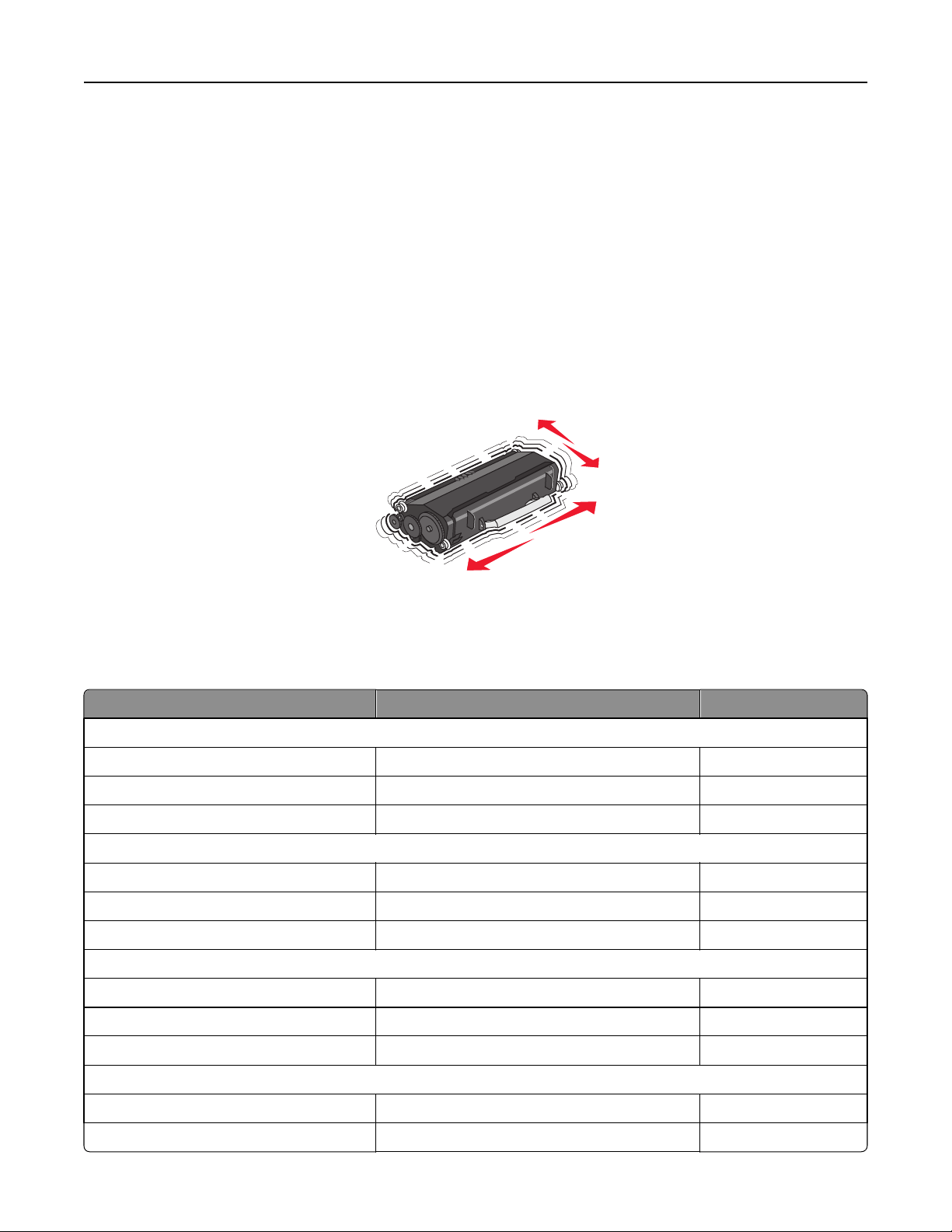
Ordering supplies
To order supplies in the U.S., contact Lexmark at 1-800-539-6275 for information about Lexmark authorized supplies
dealers in your area. In other countries or regions, visit the Lexmark Web Site at www.lexmark.com or contact the
place where you purchased the printer.
Ordering toner cartridges
When 88 Cartridge low appears or when the print becomes faded, you may be able to extend the life of the
toner cartridge:
1 Remove the toner cartridge.
2 Firmly shake the cartridge side‑to‑side and front‑to‑back several times to redistribute toner.
3 Reinsert the cartridge and continue printing.
Note: Repeat this procedure multiple times until the print remains faded, and then replace the cartridge.
Recommended toner cartridges and part numbers
Part name Lexmark Return Program Cartridge Regular cartridge
For the US and Canada
Toner cartridge E260A11A E260A21A
High Yield Toner Cartridge E360H11A E360H21A
Extra High Yield Toner Cartridge E462U11A E462U21G
For Europe, the Middle East, and Africa
Toner cartridge E260A11E E260A21E
High Yield Toner Cartridge E360H11E E360H21E
Extra High Yield Toner Cartridge E462U11E E462U21G
For the Asia Pacific Region, including Australia and New Zealand
Toner cartridge E260A11P E260A21P
High Yield Toner Cartridge E360H11P E360H21P
Extra High Yield Toner Cartridge E462U11P E462U21G
For Latin America
Toner cartridge E260A11L E260A21L
High Yield Toner Cartridge E360H11L E360H21L
Maintaining the printer 112

Part name Lexmark Return Program Cartridge Regular cartridge
Extra High Yield Toner Cartridge E462U11L E462U21G
Ordering a photoconductor kit
The printer issues a message to let you know the photoconductor kit is near its end of life. At this time, order a
photoconductor kit. You can also see the status of the photoconductor kit by printing a network setup page.
Part name Part number
Photoconductor kit E260X22G
Ordering a maintenance kit
80 Routine maintenance needed appears on the display after 120,000 pages have printed to let you know it
is time to replace printer maintenance items. Order a maintenance kit when this message first appears. The maintenance
kit contains all the items necessary to replace the fuser and transfer roller.
Notes:
• The maintenance kit may not be available in all geographies.
• Using certain types of paper or specialty media may require more frequent replacement of the maintenance kit.
See the following table for the maintenance kit part number for your printer:
Part name Part number
Maintenance kit 40X5402 (100 V)*
40X5400 (115 V)
40X5401 (230 V)
* Designed for use only in Japan
Replacing supplies
Replacing the toner cartridge
When 88 Cartridge low appears, or when you experience faded print, remove the toner cartridge. Firmly shake
it side‑to‑side and front‑to‑back several times to redistribute the toner, and then reinsert it and continue printing.
When shaking the cartridge no longer improves the print quality, replace the toner cartridge.
Note: You can check to see approximately how much toner is left in your cartridge by printing a menu settings page.
Maintaining the printer 113
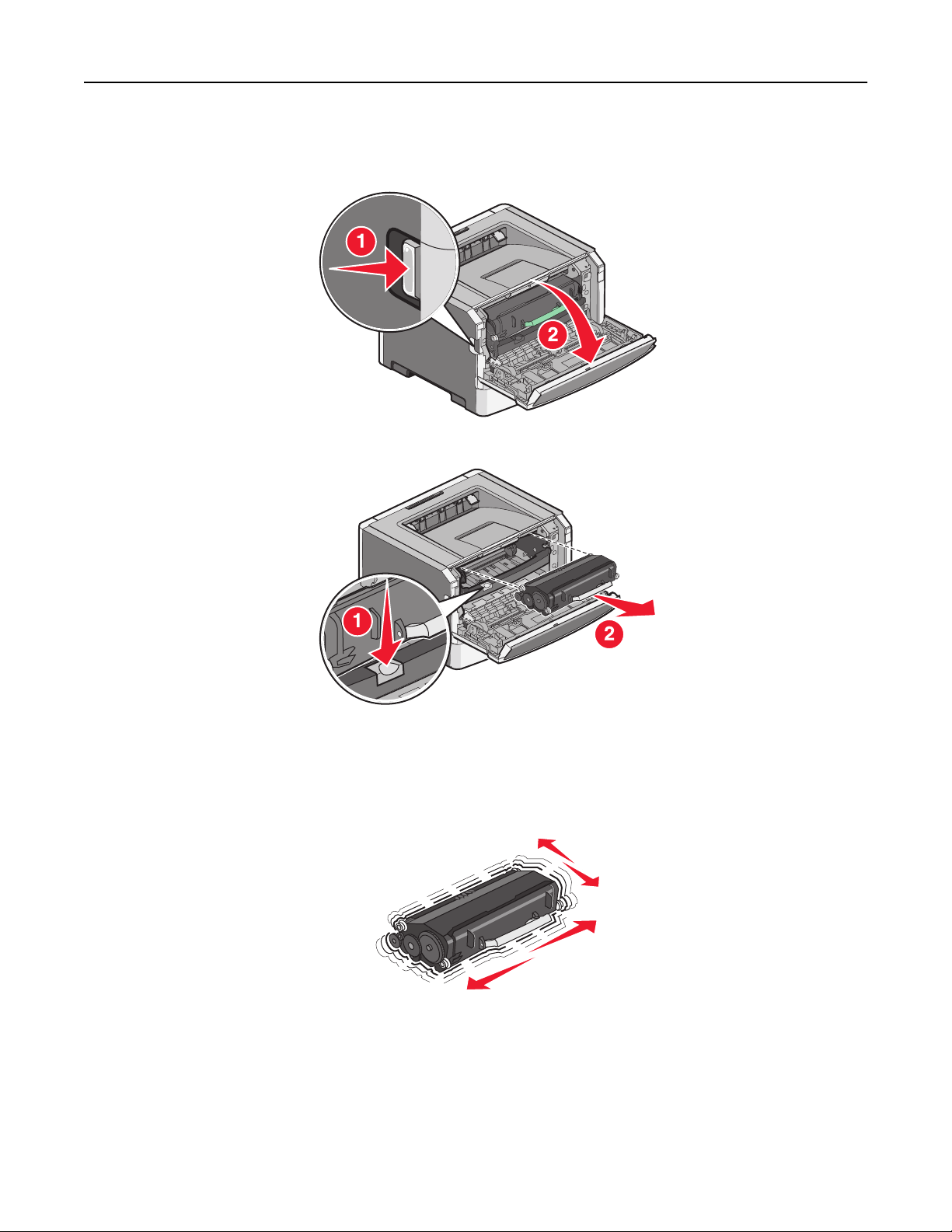
To replace the toner cartridge:
1 Open the front door by pressing the button on the left side of the printer and lowering the door.
2 Press the button on the base of the photoconductor kit, and then pull the toner cartridge out using the handle.
3 Unpack the new toner cartridge.
Warning—Potential Damage: When replacing a toner cartridge, do not leave the photoconductor kit exposed to
direct light for an extended period of time. Extended light exposure can cause print quality problems.
4 Rotate the cartridge in all directions to distribute the toner.
Maintaining the printer 114
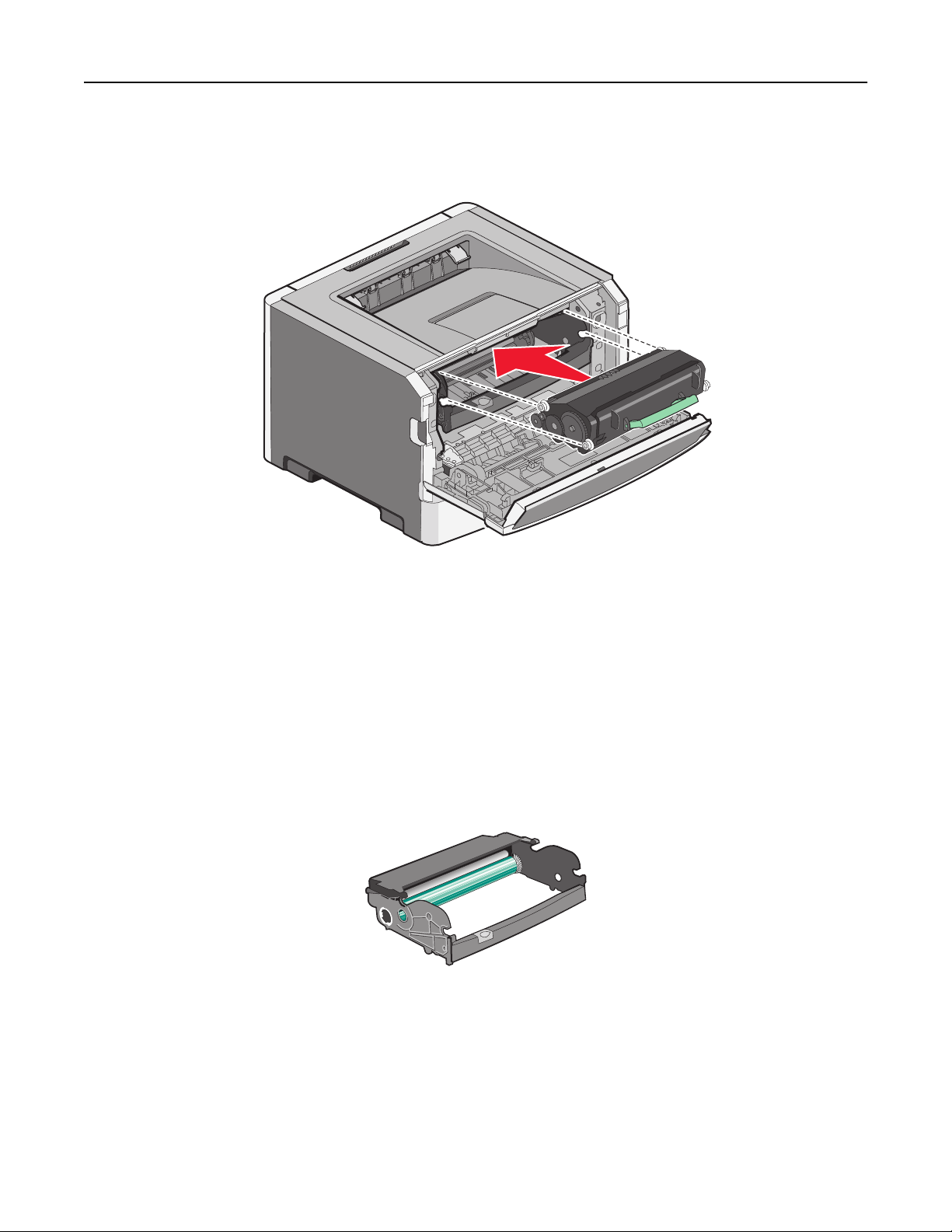
5 Install the new toner cartridge by aligning the rollers on the toner cartridge with the arrows on the tracks of the
photoconductor kit. Push the toner cartridge in as far as it will go. The cartridge clicks into place when correctly
installed.
6 Close the front door.
Replacing the photoconductor kit
The printer automatically notifies you before the photoconductor kit reaches a page maximum by showing 84 PC
Kit life warning or 84 Replace PC Kit on the display. You can also see the status of the photoconductor
kit by printing a menu settings page.
When 84 PC Kit life warning or 84 Replace PC Kit first appears, you should immediately order a new
photoconductor kit. While the printer may continue to function properly after the photoconductor kit has reached its
official end‑of‑life, print quality significantly decreases.
Note: The photoconductor kit is one item only.
1 Turn the printer off.
2 Open the front door by pressing the button on the left side of the printer and lowering the front door.
3 Pull the photoconductor kit and toner cartridge out of the printer as a unit by pulling on the toner cartridge handle.
Note: The photoconductor kit and toner cartridge form a unit.
Maintaining the printer 115
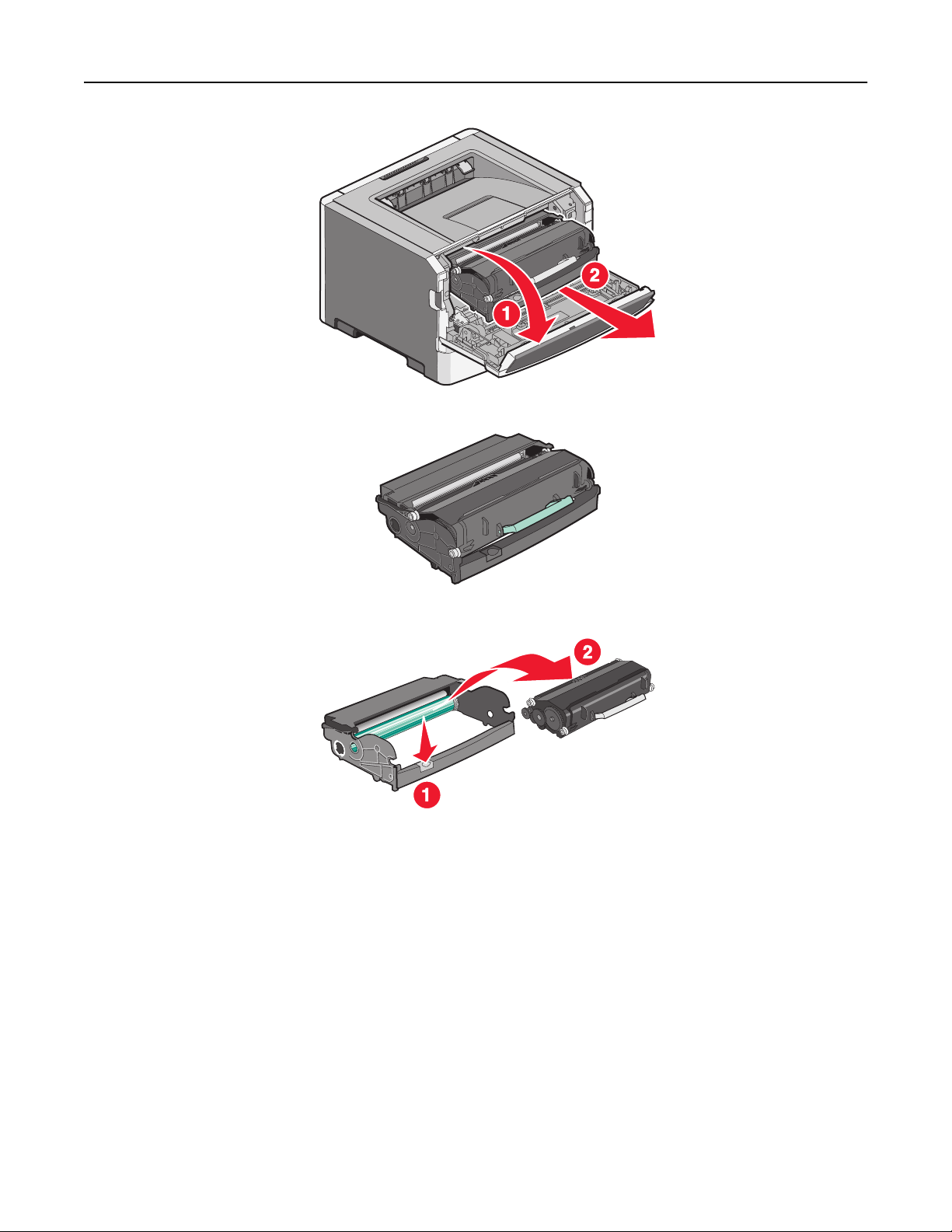
Place the unit on a flat, clean surface.
4 Press the button on the base of the photoconductor kit. Pull the toner cartridge up and out using the handle.
5 Unpack the new photoconductor kit.
Warning—Potential Damage: Be careful not to touch the photoconductor drum. Doing so may affect the print
quality of future print jobs.
Maintaining the printer 116
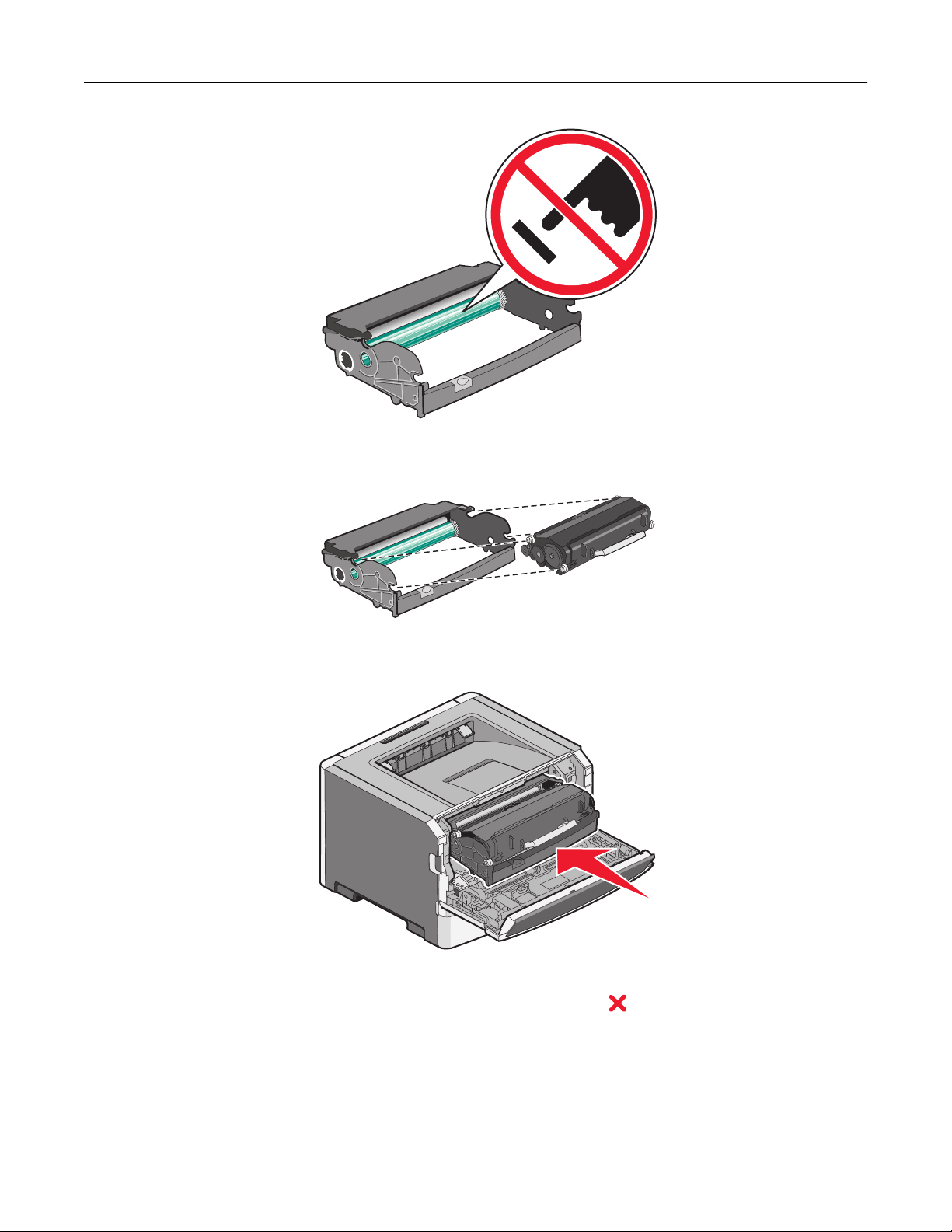
6 Insert the toner cartridge into the photoconductor kit by aligning the rollers on the toner cartridge with the tracks.
Push the toner cartridge until it clicks into place.
7 Install the unit into the printer by aligning the arrows on the guides of the unit with the arrows in the printer. Push
the unit as far as it will go.
8 After you replace the photoconductor kit, reset the photoconductor counter.
To reset the photoconductor counter, open the front door, press and hold
until Resetting PC Counter
appears. The power light blinks, and the printer beeps.
Warning—Potential Damage: Resetting the photoconductor counter without replacing the photoconductor
may damage your printer and void your warranty.
9 Close the front door.
Maintaining the printer 117

Moving the printer
Moving the printer to another location
CAUTION—POTENTIAL INJURY: The printer weight is greater than 18 kg (40 lb) and requires two or more
trained personnel to lift it safely.
CAUTION—POTENTIAL INJURY: Before moving the printer, follow these guidelines to avoid personal injury or
printer damage:
• Turn the printer off using the power switch, and then unplug the power cord from the wall outlet.
• Disconnect all cords and cables from the printer before moving it.
• Lift the printer off of the optional drawer and set it aside instead of trying to lift the drawer and printer at the same
time.
Note: Use the handholds located on both sides of the printer to lift it off the optional drawer.
The printer and options can be safely moved to another location by following these precautions:
• Any cart used to move the printer must have a surface able to support the full footprint of the printer. Any cart
used to move the options must have a surface able to support the dimensions of the options.
• Keep the printer in an upright position.
• Avoid severe jarring movements.
Shipping the printer
When shipping the printer, use the original packaging or call the place of purchase for a relocation kit.
Maintaining the printer 118

Administrative support
Finding advanced networking and administrator information
This chapter covers basic administrative support tasks. For more advanced system support tasks, see the Networking
Guide on the Software and Documentation CD and the Embedded Web Server Administrator's Guide on the Lexmark
Web site at www.lexmark.com.
Using the Embedded Web Server
If the printer is installed on a network, the Embedded Web Server is available for a range of functions including:
• Viewing a virtual display of the printer control panel
• Checking the status of the printer supplies
• Configuring printer settings
• Configuring network settings
• Viewing reports
To access the Embedded Web Server, type the printer IP address into the address field of your Web browser.
Notes:
• If you do not know the IP address of the printer, then print a network setup page and locate the IP address in
the TCP/IP section.
• For more information, see the Networking Guide on the Software and Documentation CD and the Embedded
Web Server Administrator's Guide on the Lexmark Web site at www.lexmark.com.
Checking the virtual display
When the Embedded Web Server is open, a virtual display appears in the top left corner of the screen. It works as an
actual display would work on a printer control panel, showing printer messages.
To access the Embedded Web Server, type the printer IP address into the address field of your Web browser.
Note: If you do not know the IP address of the printer, then print a network setup page and locate the IP address in
the TCP/IP section.
The virtual display appears in the top left corner of the screen.
Administrative support 119

Checking the device status
Using the Embedded Web Server, you can view paper tray settings, the level of toner in the print cartridge, the
percentage of life remaining in the maintenance kit, and capacity measurements of certain printer parts. To view the
device status:
1 Type the printer IP address in the address field of your Web browser.
Note: If you do not know the IP address of the printer, then print a network setup page and locate the IP
address in the TCP/IP section.
2 Click Device Status.
Viewing reports
You can view some reports from the Embedded Web Server. These reports are useful for assessing the status of the
printer, the network, and supplies.
To view reports from a network printer:
1 Type the printer IP address into the address field of your Web browser.
Note: If you do not know the IP address of the printer, then print a network setup page and locate the IP
address in the TCP/IP section.
2 Click Reports, and then click the type of report you want to view.
Configuring supply notifications
You can determine how you would like to be notified when supplies run low or reach their end‑of‑life.
To configure supply notifications using the Embedded Web Server:
1 Type the printer IP address into the address field of your Web browser.
Note: If you do not know the IP address of the printer, then print a network setup page and locate the IP
address in the TCP/IP section.
2 Click Settings.
3 Click Print Settings.
4 Click Supply Notifications.
5 From the drop‑down box for each supply, select among the options for notification. Explanations for each option
are provided.
6 Click Submit to save your selections.
Modifying confidential print settings
You can modify confidential print settings using the Embedded Web Server. You can set a maximum number of PIN
entry attempts. When a user exceeds a specific number of PIN entry attempts, all of the jobs for that user are deleted.
Administrative support 120

You can set an expiration time for confidential print jobs. When a user has not printed the jobs within the designated
time period, all of the jobs for that user are deleted.
Note: This functionality is available only on network printers.
To modify the confidential print settings:
1 Type the printer IP address into the address field of your Web browser.
Note: If you do not know the IP address of the printer, then print a network setup page and locate the IP
address in the TCP/IP section.
2 Click Settings.
3 Under Other Settings, click Security.
4 Click Confidential Print Setup.
Setting up e‑mail alerts
You can have the printer send you an e‑mail when the supplies are getting low or when the paper needs to be changed,
added, or unjammed.
To set up e‑mail alerts:
1 Type the printer IP address into the address field of your Web browser.
Note: If you do not know the IP address of the printer, then print a network setup page and locate the IP
address in the TCP/IP section.
2 Click Settings.
3 Under Other Settings, click E‑mail Alert Setup.
4 Select the items for notification, and type in the e‑mail addresses.
5 Click Submit.
Note: See your system support person to set up the e‑mail server.
Restoring the factory default settings
If you want to retain a list of the current menu settings for reference, then print a menu settings page before you restore
the factory default settings. For more information, see “Printing a menu settings page” on page 28.
Warning—Potential Damage: Restoring factory defaults returns most printer settings to the original factory default
setting. Exceptions include the display language, custom sizes and messages, and Network/Port menu settings. All
downloads stored in RAM are deleted. Downloads stored in flash memory or on a printer hard disk are not affected.
1 From the printer control panel, press .
2 Press the up or down arrow button until Settings appears, and then press .
3 Press the up or down arrow button until General Settings appears, and then press .
Administrative support 121

4 Press the up or down arrow button until Factory Defaults appears, and then press .
5 Press the up or down arrow button until Restore Now appears, and then press .
Restoring Factory Defaults appears.
Administrative support 122

Clearing jams
By carefully selecting paper and specialty media and loading it properly, you should be able to avoid most jams. For
more information, see “Avoiding jams” on page 123. If jams do occur, follow the steps outlined in this chapter.
Warning—Potential Damage: Never use any tool to remove a jam. Doing so could permanently damage the fuser.
To resolve jam messages, you must clear the entire paper path, and then press
to clear the message and resume
printing. The printer prints a new copy of the page that jammed if Jam Recovery is set to On or Auto; however, the
Auto setting does not guarantee the page will print.
Note: Auto is the Jam recovery factory default setting. The printer reprints jammed pages unless the memory
required to hold the pages is needed for other printer tasks.
Avoiding jams
The following hints can help you avoid jams:
• Use only recommended paper or specialty media. For more information, see “Supported paper sizes, types, weights,
and capacities” on page 60.
• Do not load too much paper. Make sure the stack height does not exceed the indicated maximum height.
• Do not load wrinkled, creased, damp, bent, or curled paper.
• Flex, fan, and straighten paper before loading it.
• Do not use paper that has been cut or trimmed by hand.
• Do not mix paper sizes, weights, or types in the same stack.
• Do not feed envelopes that:
– Have excessive curl or twist
– Have windows, holes, perforations, cutouts, or embossing
– Have metal clasps, string ties, or folding bars
– Have an interlocking design
– Have postage stamps attached
– Have any exposed adhesive when the flap is in the sealed or closed position
– Have bent corners
– Have rough, cockle, or laid finishes
– Are stuck together or damaged in any way
• Store the paper in an appropriate environment.
• Do not remove trays while the printer is printing.
• Do not load the multipurpose feeder while the printer is printing. Load the multipurpose feeder prior to printing,
or wait for a prompt to load it.
• Push all trays in firmly after loading paper.
• Make sure the guides in the trays are properly positioned and are not pressing too tightly against the paper.
• Make sure all sizes and types are set correctly in the printer control panel menu.
• Make sure all printer cables are attached correctly. For more information, see the setup documentation.
Clearing jams 123
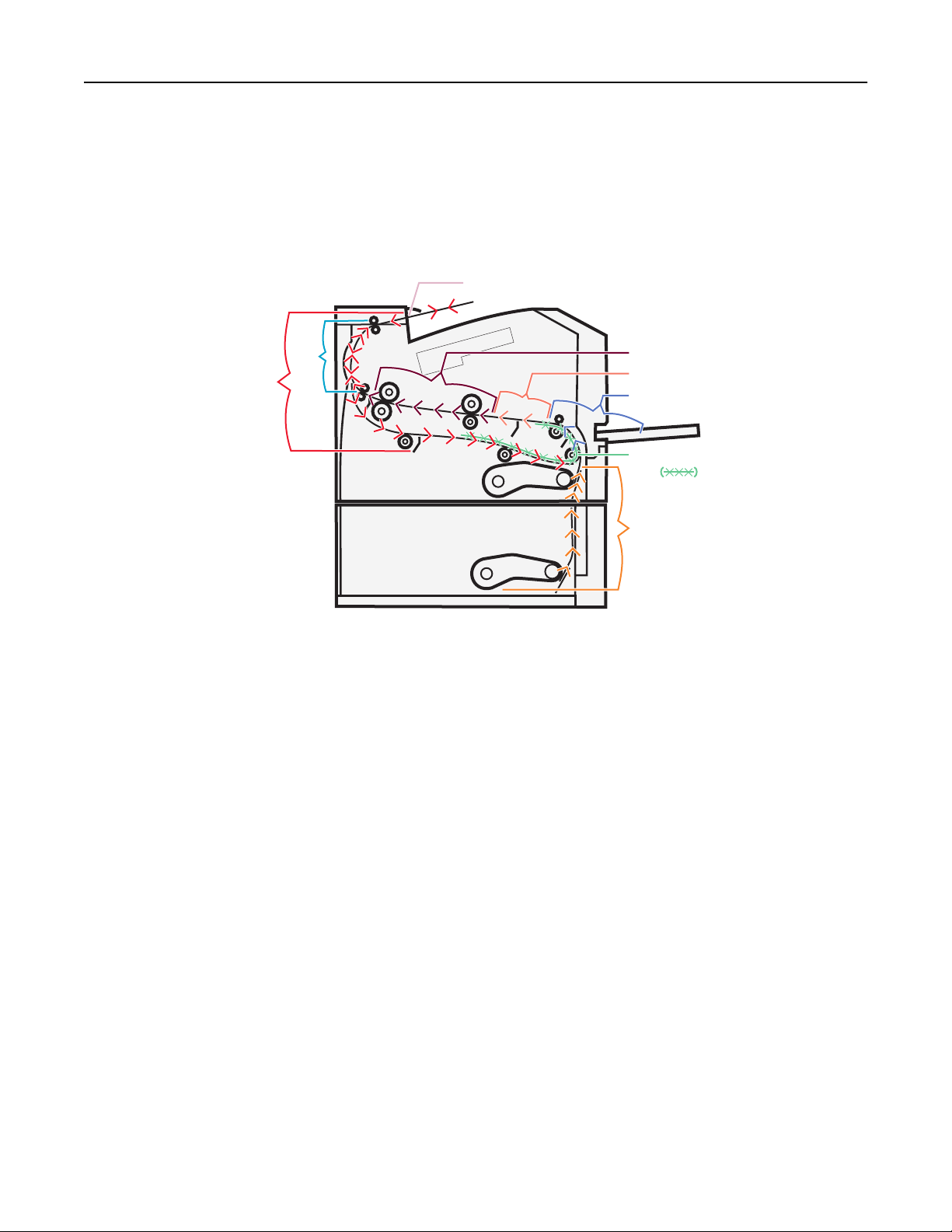
Identifying jams in the paper path
The following illustration shows the path that paper travels through the printer. The path varies depending on the input
source (tray or feeder) and depending on whether a duplex (two‑sided) print job is being sent.
When a jam occurs, a jam message appears, indicating the region of the jam or the number of jammed sheets. The
three‑digit jam prefix numbers are given in the following illustration to show where each jam occurs.
24x
233, 234,
24x
233, 234,
24x
251
200
201
235
202
231
234
231
234
Understanding jam messages and locations
Note: To resolve any message, all paper or specialty media must be cleared from the entire paper path.
Open doors and covers, and remove trays to access jam locations. The following illustration and table indicate these
locations. See “Jam message numbers and how to access each jam” on page 125 for a list of jam numbers and
instructions for how to access each jam.
Clearing jams 124

1 Standard exit bin
2 Front door
3 Multipurpose feeder door
4 Tray 1
5 Tray 2
6 Rear door
Jam message numbers and how to access each jam
Jam number To access the jam
200 Try one or more of the following:
• Remove Tray 1.
• Open the front door, and then remove the photoconductor kit.
201 Open the front door, and then remove the photoconductor kit.
202 Open the front door, and then open the rear door.
231 Open the front door, and then open the rear door.
Note: For alternative access to the jam, remove Tray 1, and then depress the lever.
233 Remove Tray 1, and then depress the lever.
Note: For alternative access to the jam, open the front door, and then open the rear door.
Clearing jams 125
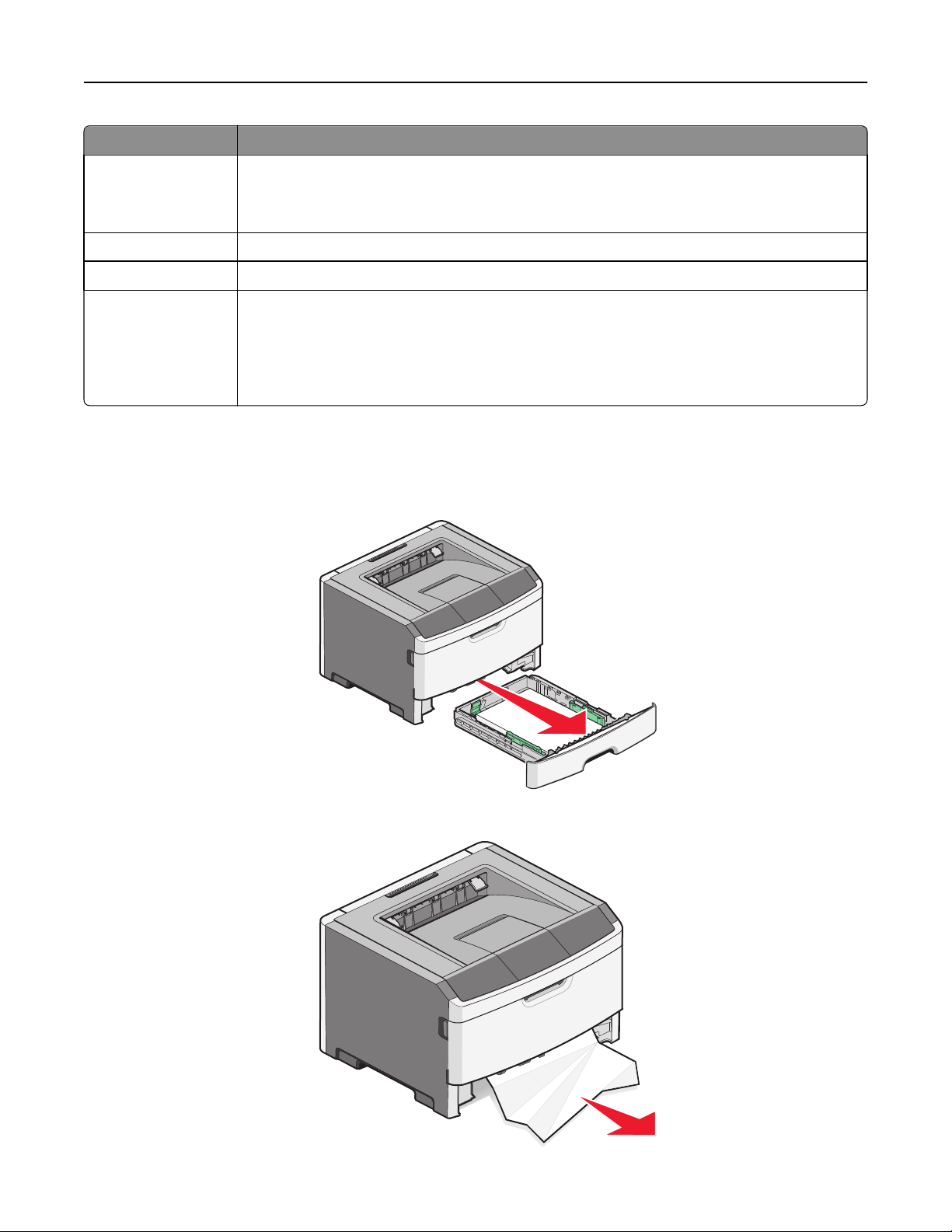
Jam number To access the jam
234 Try one or more of the following:
• Open the front door, and then open the rear door.
• Remove Tray 1, and then depress the lever.
235 Remove the jam from the standard exit bin.
24x Remove Tray 2.
251 Try one or more of the following:
• If the sheet is visible in the multipurpose feeder, gently pull it from the front of the multipurpose
feeder.
• If it is not visible, open the front door, and then remove the unit. Lift the flap at the front of the
printer, and then remove any jammed sheets.
200 paper jam
1 Remove the tray from the printer.
2 Remove the jam if you see it here.
Clearing jams 126

3 If you do not see it, open the front door, and then remove the photoconductor kit and toner cartridge (unit).
Note: When the photoconductor kit and toner cartridge are together, they are called a unit.
4 Lift the flap in front of the printer, and remove any jammed sheets.
5 Align and insert the unit.
6 Close the front door.
7 Insert the tray.
8 Press .
Clearing jams 127
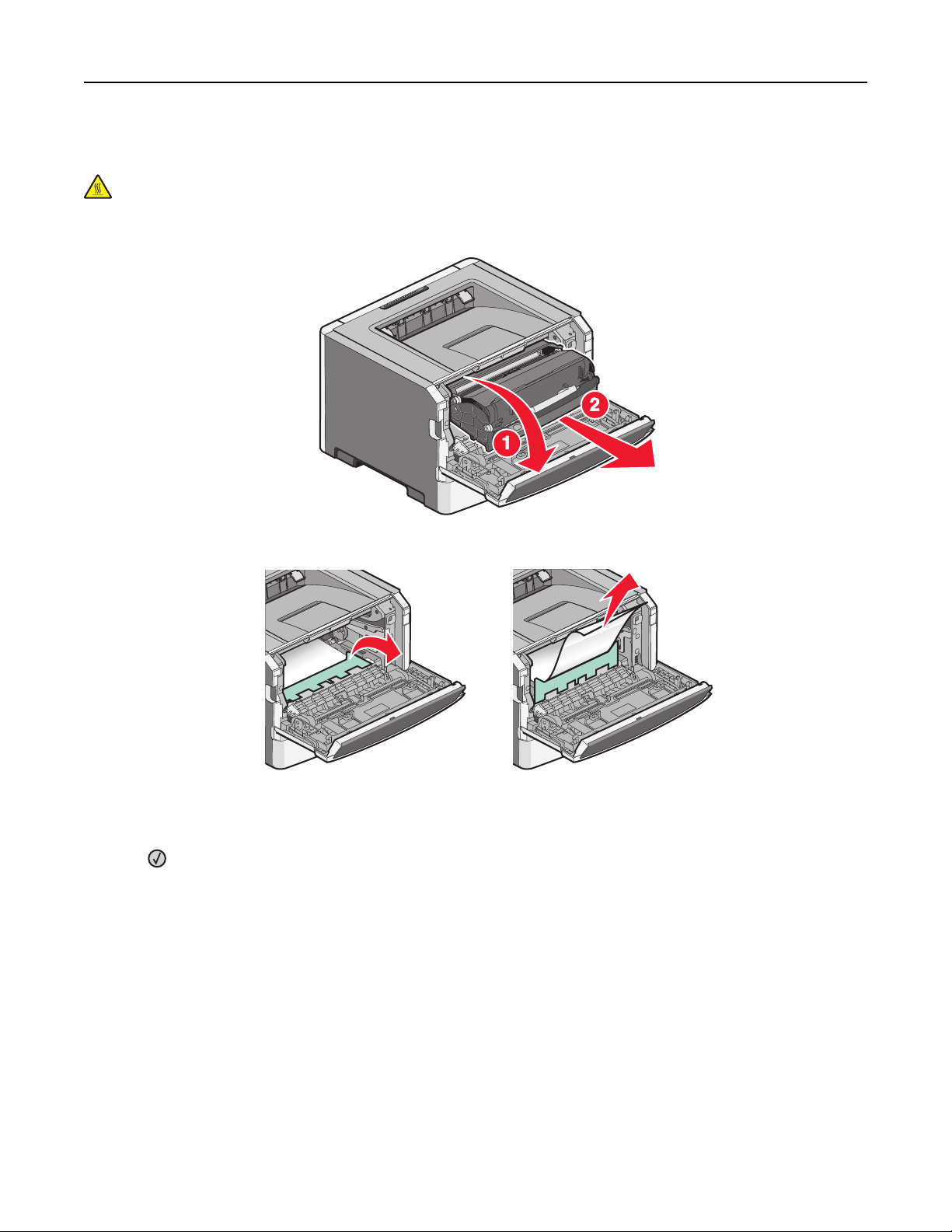
201 paper jam
CAUTION—HOT SURFACE: The fuser and the inside of the printer near the fuser may be hot. To reduce the risk
of injury from a hot component, allow the surface to cool before removing paper from this area.
1 Open the front door, and then remove the unit.
2 Lift the flap in front of the printer, and then remove any jammed sheets.
3 Align and insert the unit.
4 Close the front door.
5 Press .
Clearing jams 128
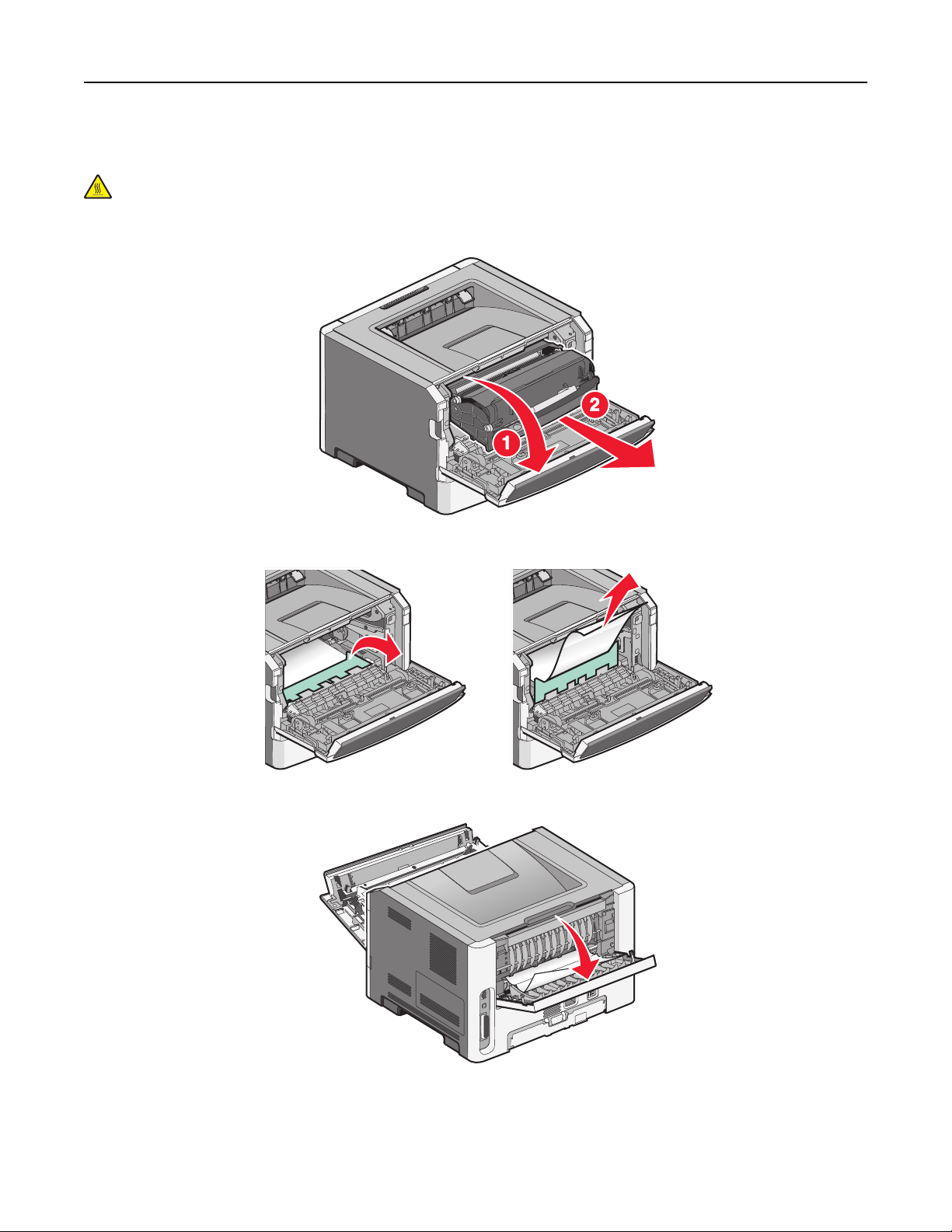
202 paper jam
CAUTION—HOT SURFACE: The fuser and the inside of the printer near the fuser may be hot. To reduce the risk
of injury from a hot component, allow the surface to cool before removing paper from this area.
1 Open the front door, and then remove the unit.
2 Lift the flap in front of the printer, and then remove any jammed sheets.
3 Open the rear door.
Clearing jams 129

4 Remove the jam.
5 Align and insert the unit.
6 Close the rear door.
7 Close the front door.
8 Press .
231 paper jam
CAUTION—HOT SURFACE: The fuser and the inside of the printer near the fuser may be hot. To reduce the risk
of injury from a hot component, allow the surface to cool before removing paper from this area.
1 Open the front door.
2 Open the rear door.
Clearing jams 130
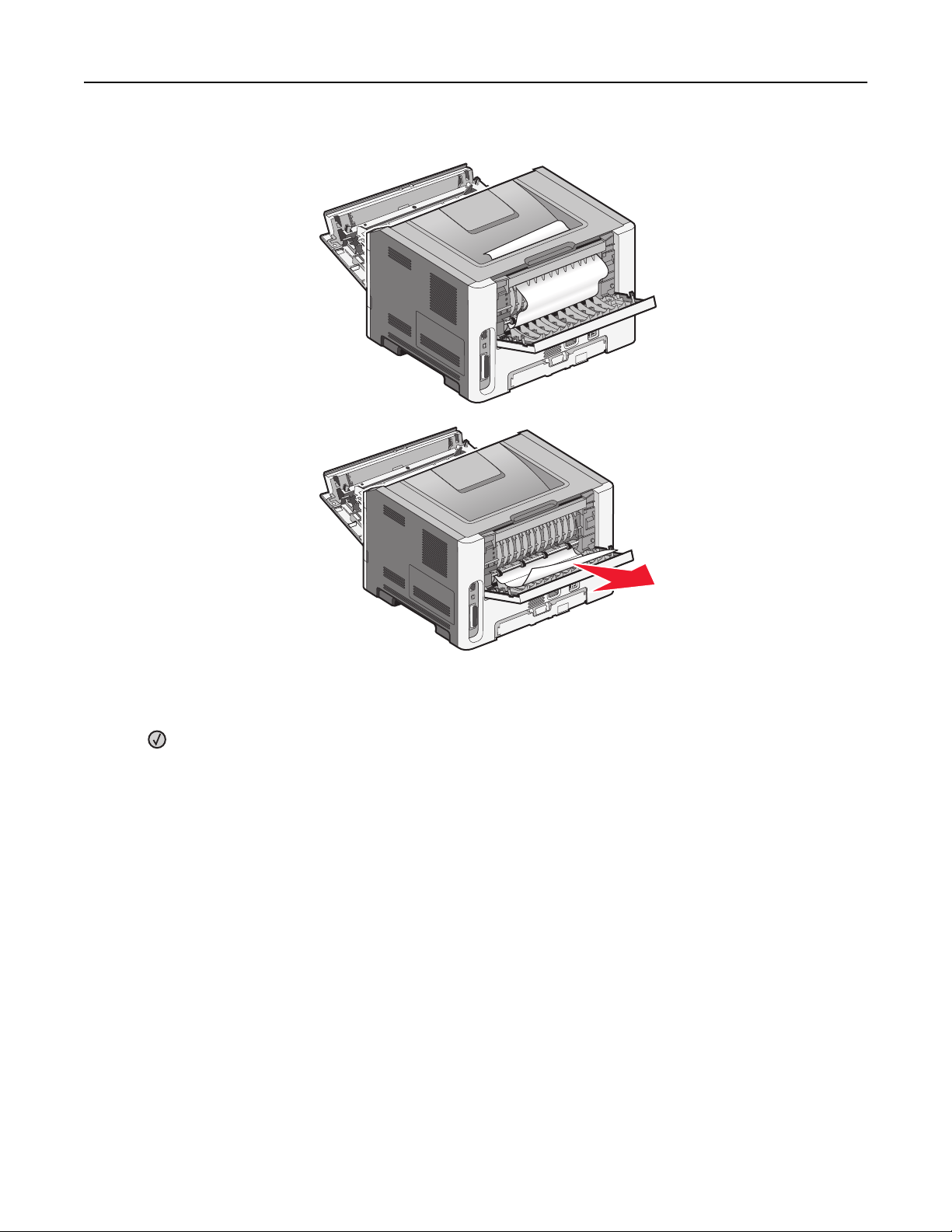
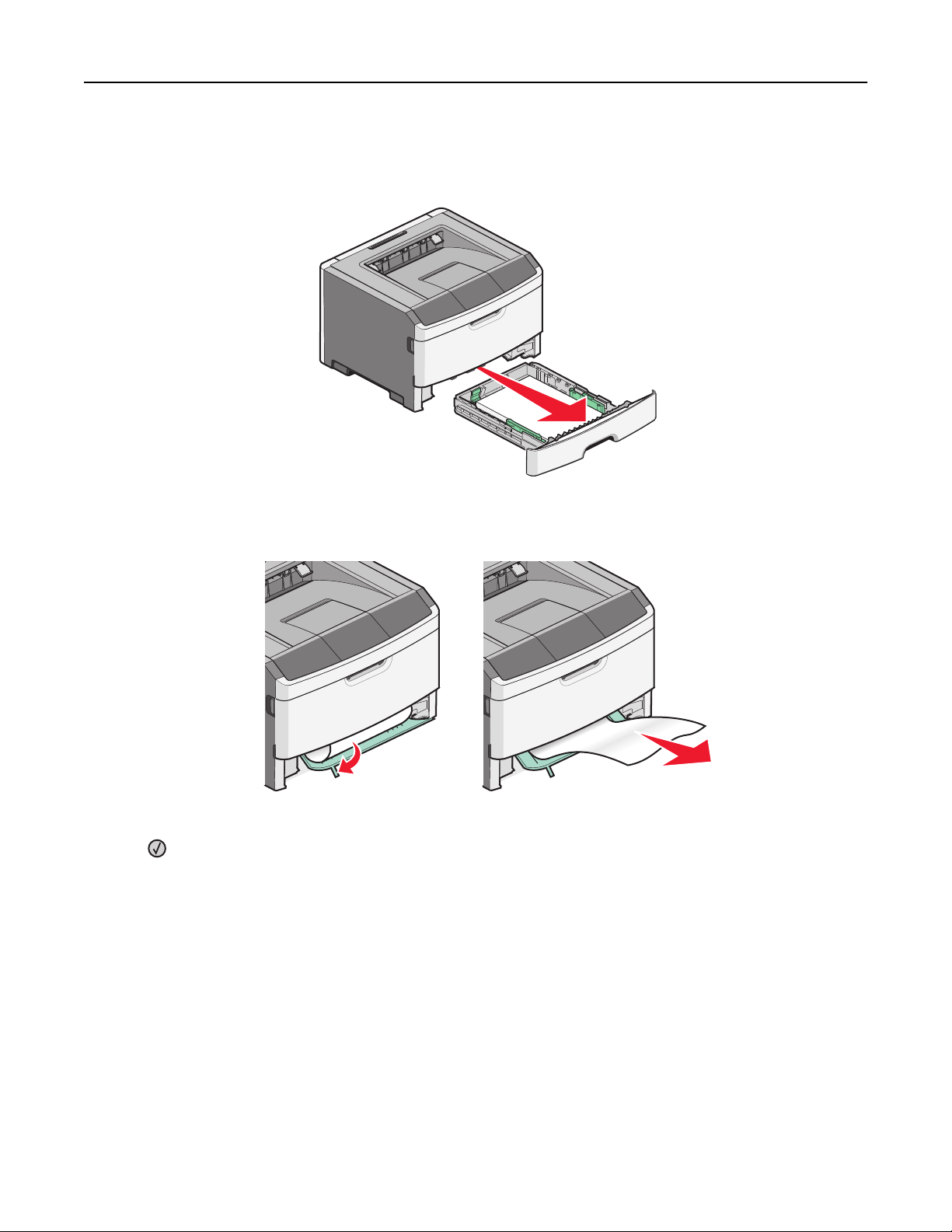
233 paper jam
1 Remove the tray from the printer.
2 Locate the lever shown. Pull the lever down to release the jam.
3 Pull the jammed sheets from the duplex area.
4 Insert the tray.
5 Press .
If this does not clear the jam, complete the steps in “231 paper jam” on page 130.
234 paper jam
A single jam or multiple jams are in the duplex area of the printer when the printer is turned on. To locate and remove
the jammed sheets, complete all the steps in:
• “231 paper jam” on page 130
• “233 paper jam” on page 132
Clearing jams 132

235 paper jam
A duplex print job was sent to the printer using a size of paper not supported for duplex printing. A sheet is jammed in
the standard exit bin.
1 To remove the jam, gently pull the jammed sheet out of the standard exit bin.
2 Press .
24x paper jam
1 Remove the optional tray from the printer.
Clearing jams 133

2 Remove the jam.
3 Insert the optional tray.
4 Press .
251 paper jam
A sheet of paper or specialty media failed to feed completely from the multipurpose feeder. Part of it may still be visible.
If it is visible, gently pull the jammed sheet from the front of the multipurpose feeder.
Clearing jams 134

If the sheet is not visible, complete the following steps:
1 Open the front door, and then remove the unit.
2 Lift the flap at the front of the printer, and then remove any jammed sheets of paper that are short lengths of paper.
3 Align and insert the unit.
4 Close the front door.
5 Press .
Clearing jams 135

Troubleshooting
Understanding printer messages
Calibrating
Wait for the message to clear.
Cartridge Life Exceeded
The toner cartridge is exhausted.
1 Remove the used toner cartridge, and then install a new one.
2 Press to clear the message.
Change <src> to <custom type name>
You can change the current paper source for the remainder of the print job. The formatted page will print on the paper
loaded in the selected tray. This may cause clipping of text or images. Try one or more of the following:
• To select the paper tray with the correct paper size or type, press the up or down arrow button until Paper
Changed, Continue appears, and then press
.
• To ignore the message and print from the tray selected for the print job, press the up or down arrow button until
Use Current <Src> appears, and then press .
• To cancel the current print job, press the up or down arrow button until Cancel job appears, and then press
.
• For more information, press the up or down arrow button until Show me or Tell me more appears, and
then press
.
Change <src> to <custom string>
You can change the current paper source for the remainder of the print job. The formatted page will print on the paper
loaded in the selected tray. This may cause clipping of text or images. Try one or more of the following:
• To select the paper tray with the correct paper size or type, press the up or down arrow button until Paper
Changed, Continue appears, and then press
.
• To ignore the message and print from the tray selected for the print job, press the up or down arrow button until
Use Current <Src> appears, and then press .
• To cancel the current print job, press the up or down arrow button until Cancel job appears, and then press
.
• For more information, press the up or down arrow button until Show me or Tell me more appears, and
then press
.
Troubleshooting 136

Change <src> to <size>
You can change the current paper source for the remainder of the print job. The formatted page will print on the paper
loaded in the selected tray. This may cause clipping of text or images. Try one or more of the following:
• To select the paper tray with the correct paper size or type, press the up or down arrow button until Paper
Changed, Continue appears, and then press
.
• To ignore the message and print from the tray selected for the print job, press the up or down arrow button until
Use Current <Src> appears, and then press .
• To cancel the current print job, press the up or down arrow button until Cancel job appears, and then press
.
• For more information, press the up or down arrow button until Show me or Tell me more appears, and
then press
.
Change <src> to <type> <size>
You can change the current paper source for the remainder of the print job. The formatted page will print on the paper
loaded in the selected tray. This may cause clipping of text or images. Try one or more of the following:
• To select the paper tray with the correct paper size or type, press the up or down arrow button until Paper
Changed, Continue appears, and then press
.
• To ignore the message and print from the tray selected for the print job, press the up or down arrow button until
Use Current <Src> appears, and then press .
• To cancel the current print job, press the up or down arrow button until Cancel job appears, and then press
.
• For more information, press the up or down arrow button until Show me or Tell me more appears, and
then press
.
Close front door
Close the front door of the printer.
Load <src> with <custom type name>
Try one or more of the following:
• Load the specified paper into the specified source to clear the message and continue printing.
• To select the paper tray with the correct paper size or type, press the up or down arrow button until Paper
Changed, Continue appears, and then press
.
• Cancel the print job. Press the up or down arrow button until Cancel job appears, and then press .
• For more information, press the up or down arrow button until Show me or Tell me more appears, and
then press
.
Troubleshooting 137

Load <src> with <custom string>
Try one or more of the following:
• Load the specified paper into the specified source to clear the message and continue printing.
• To select the paper tray with the correct paper size or type, press the up or down arrow button until Paper
Changed, Continue appears, and then press
.
• Cancel the print job. Press the up or down arrow button until Cancel job appears, and then press .
• For more information, press the up or down arrow button until Show me or Tell me more appears, and
then press
.
Load <src> with <type> <size>
Try one or more of the following:
• Load the specified paper into the specified source to clear the message and continue printing.
• To select the paper tray with the correct paper size or type, press the up or down arrow button until Paper
Changed, Continue appears, and then press
.
• Cancel the print job. Press the up or down arrow button until Cancel job appears, and then press .
• For more information, press the up or down arrow button until Show me or Tell me more appears, and
then press
.
Load <src> with <size>
Try one or more of the following:
• Load the specified paper into the specified source to clear the message and continue printing.
• To select the paper tray with the correct paper size or type, press the up or down arrow button until Paper
Changed, Continue appears, and then press
.
• Cancel the print job. Press the up or down arrow button until Cancel job appears, and then press .
• For more information, press the up or down arrow button until Show me or Tell me more appears, and
then press
.
Load Manual Feeder with <custom type name>
Try one or more of the following:
• Load the multipurpose feeder with the correct paper type and size.
• Ignore the request and print on paper that is already being used in one of the trays. Press the up or down arrow
button until
Automatically select paper appears, and then press .
If the printer finds a tray that has paper of the correct type, then it uses the paper from that tray. If the printer
cannot find a tray with the correct paper type, then it prints on the paper that is installed in the default paper
source.
• Press the up or down arrow button until Cancel job appears, and then press to cancel the print job.
• For more information, press the up or down arrow button until Show me or Tell me more appears, and
then press
.
Troubleshooting 138

Load Manual Feeder with <custom string>
Try one or more of the following:
• Load the multipurpose feeder with the correct paper type and size.
• Ignore the request and print on paper that is already being used in one of the trays. Press the up or down arrow
button until
Automatically select paper appears, and then press .
If the printer finds a tray that has paper of the correct type, then it uses the paper from that tray. If the printer
cannot find a tray with the correct paper type, then it prints on the paper that is installed in the default paper
source.
• Cancel the print job. Press the up or down arrow button until Cancel job appears, and then press .
• For more information, press the up or down arrow button until Show me or Tell me more appears, and
then press
.
Load Manual Feeder with <type> <size>
Try one or more of the following:
• Load the correct paper type and size in the multipurpose feeder.
• Ignore the request and print on paper that is already being used in one of the input sources. Press the up or down
arrow button until
Automatically select paper appears, and then press . The current job may not
print correctly.
If the printer finds a source that has paper of the correct type, then it uses the paper from that source. If the printer
cannot find a source with the correct paper type, then it prints on the paper that is installed in the default paper
source.
• Cancel the print job. Press the up or down arrow button until Cancel job appears, and then press .
• For more information, press the up or down arrow button until Show me or Tell me more appears, and
then press
.
Load Manual Feeder with <size>
Try one or more of the following:
• Load the multipurpose feeder with the correct paper size.
If there is no paper in the multipurpose feeder, then feed a sheet of paper to clear the message.
• Ignore the request and print on paper that is already being used in one of the input sources. Press the up or down
arrow button until
Automatically select paper appears, and then press .
If the printer finds a source that has paper of the correct type, then it uses the paper from that source. If the printer
cannot find a source with the correct paper type, then it prints on the paper that is installed in the default paper
source.
• Cancel the print job. Press the up or down arrow button until Cancel job appears, and then press .
• For more information, press the up or down arrow button until Show me or Tell me more appears, and
then press
.
Troubleshooting 139

Remove paper from standard bin
The standard exit bin has reached its capacity. Remove paper from the standard exit bin to clear the message and
continue printing.
Remove paper from standard output bin
Remove the stack of paper from the standard exit bin.
Replace Cartridge
The toner cartridge is exhausted.
1 Remove the used toner cartridge, and then install a new one.
2 Press to clear the message.
Replace PC Kit
This is the early warning message for the photoconductor kit. The printer continues printing unless the value for the
Cartridge Alarm is changed from the printer control panel or set to On from the Supply Notifications Web page (located
on the Embedded Web Server).
If the setting is On, then the printer stops printing. Press
to select Continue and continue printing.
When the PC Kit Life Warning appears, order a new photoconductor kit.
Resetting the printer
Wait for the message to clear.
Resetting without replacing may affect print quality.
You selected No from the “Verify PC unit replaced” screen. Wait for the message to clear.
Restoring Factory Defaults
Wait for the message to clear.
When factory default settings are restored:
• All downloaded resources in the printer memory are deleted. This includes fonts, macros, and symbol sets.
• All settings return to the factory defaults except the Display Language setting in the Setup menu and the custom
settings in the Serial <x>, Network, Infrared, LocalTalk, and USB menus.
Routine maintenance needed
The printer needs to have scheduled maintenance done. Order a maintenance kit, which contains a fuser and a transfer
roller. Then contact Customer Support, and report the message.
Troubleshooting 140

Standard Bin Full
Remove the stack of paper from the standard exit bin to clear the message.
Stopping
Wait for the message to clear.
Submitting selection
Wait for the message to clear.
Too many failed panel logins
The printer is now in a lockout mode because:
• You attempted to log in too many times with an incorrect PIN
• You attempted to log in using an incorrect password number for access to a printer feature, setting, or menu that
you do not have access to.
Note: There is a defined limit on the number of login attempts. Once the limit is reached, this message appears and
the printer enters a lockout mode. The message remains on the printer control panel, and any further attempts to
enter menus is denied until the defined time out expires. The time out duration is set by your system support
person.
Wait for the message to clear once the time out expires, and then:
• Enter the correct PIN to access any held jobs
• See your system support person if you need a password number to enter a specific printer feature, setting, or menu
that is blocked from your use without the number.
Tray <x> disabled
The specified tray is disabled from the Disable Hardware menu of the Config menu. To clear the message, enable the
specified tray through the same menu. Consult your system support person for help.
Tray <x> Missing
Insert the specified tray into the printer.
30.yy Invalid refill, change cartridge
An unsupported, refilled toner cartridge is installed. Remove the toner cartridge, and then install a new one.
31.yy Replace defective or missing cartridge
The toner cartridge is either missing or not functioning properly.
Troubleshooting 141

Try one or more of the following:
• Remove the toner cartridge, and then reinstall it.
• Remove the toner cartridge, and then install a new one.
32.yy Cartridge part number unsupported by device
Remove the toner cartridge, and then install a supported one.
32 Replace unsupported cartridge
Remove the toner cartridge, and then install a supported one.
34 Short paper
Try one or more of the following:
• Load the appropriate paper in the tray.
• Press the up or down arrow button until Continue appears, and then press to clear the message and print
the job using a different paper tray.
• Check tray length and width guides and make sure the paper is properly loaded in the tray.
• For Windows users, check the Print Properties settings to make sure the print job is requesting the correct paper
size and type.
For Macintosh users, check the Print dialog settings to make sure the print job is requesting the correct paper size
and type.
• Check that the paper size is correctly set. For example, if the MP Feeder Size is set to Universal, make sure the paper
is large enough for the data being printed.
• Cancel the current print job. Press the up or down arrow button until Cancel job appears, and then press
.
35 Insufficient memory to support Resource Save feature
The printer lacks sufficient memory to save settings. Install additional memory, or press to disable Resource Save
and continue printing.
37 Insufficient memory for Flash Memory Defragment operation
Try one or more of the following:
• Press the down arrow button until Continue appears, and then press to stop the defragment operation and
continue printing.
• Delete fonts, macros, and other data in printer memory.
• Install additional printer memory.
Troubleshooting 142

37 Insufficient memory to collate job
Try one or more of the following:
• Press the down arrow button until Continue appears, and then press to print the portion of the job already
stored and begin collating the rest of the print job.
• Cancel the current print job.
37 Insufficient memory, some Held Jobs were deleted
The printer deleted some held jobs in order to process current jobs. Press the down arrow button until Continue
appears, and then press
to clear the message.
38 Memory full
Try one or more of the following:
• Press the up or down arrow button until Continue appears, and then press to clear the message.
• Cancel the current print job. Press the up or down arrow button until Cancel job appears, and then press
.
• Install additional printer memory.
39 Complex page, some data may not have printed
Try one or more of the following:
• Press the up or down arrow button until Continue appears, and then press to clear the message and continue
printing.
• Cancel the current print job. Press the up or down arrow button until Cancel job appears, and then press
.
• Install additional printer memory.
42.xy Cartridge region mismatch
Install a toner cartridge that matches the region number of the printer. x indicates the value of the printer region. y
indicates the value of the cartridge region. x and y can have the following values:
1 US and Canada
2 EMEA (Europe, Middle East, Africa)
3Asia Pacific Region
4Latin America
9 Undefined region
Troubleshooting 143

51 Defective flash detected
• Press the up or down arrow button until Continue appears, and then press to clear the message and continue
printing.
• Cancel the current print job.
52 Not enough free space in flash memory for resources
Try one or more of the following:
• Press the up or down arrow button until Continue appears, and then press to stop the defragment operation
and continue printing.
Downloaded fonts and macros not previously stored in flash memory are deleted.
• Delete fonts, macros, and other data stored in flash memory.
• Upgrade to a larger capacity flash memory card.
53 Unformatted flash detected
Try one or more of the following:
• Press the up or down arrow button until Continue appears, and then press to stop the defragment operation
and continue printing.
• Format the flash memory. If the error message remains, the flash memory may be defective and require replacing.
54 Standard network software error
Try one or more of the following:
• Press the up or down arrow button until Continue appears, and then press to clear the message
• Turn the printer off and then back on to reset the printer.
• Upgrade (flash) the network firmware in the printer or print server.
56 Standard parallel port disabled
Try one or more of the following:
• The printer discards any data received through the parallel port. Press to clear the message and continue printing.
• Make sure the Parallel Buffer menu item is not set to Disabled.
56 Standard USB port disabled
Try one or more of the following:
• The printer discards any data received through the USB port. Press to clear the message and continue printing.
• Make sure the USB Buffer menu item is not set to Disabled.
Troubleshooting 144

58 Too many flash options installed
Try one or more of the following:
• Turn the printer off, and then remove extra flash options:
1 Turn the printer off.
2 Unplug the power cord from the wall outlet.
3 Remove the excess flash memory.
4 Connect the power cord to a properly grounded outlet.
5 Turn the printer back on.
• Press to clear the message and continue printing.
58 Too many trays attached
1 Turn the printer off.
2 Unplug the power cord from the wall outlet.
Note: Optional trays lock together when stacked. Remove stacked trays one at a time from the top down.
3 Remove the additional trays.
4 Connect the power cord to a properly grounded outlet.
5 Turn the printer back on.
80 Routine Maintenance
The printer needs to have scheduled maintenance done. Order a maintenance kit, which contains a fuser and a transfer
roller. Contact Customer Support, and report the message.
84 PC Kit life warning
The photoconductor kit is near exhaustion.
Try one or more of the following:
• Replace the photoconductor kit.
• Press the up or down arrow button until Continue appears, and then press to clear the message and continue
printing.
84 Replace PC Kit
The photoconductor kit is exhausted. Install a new photoconductor kit.
88 Cartridge low
The toner is low. Replace the toner cartridge, and then press the up or down arrow button until Continue appears,
and then press
to clear the message and continue printing.
Troubleshooting 145

1565 Emulation error, load emulation option
The printer automatically clears the message in 30 seconds and then disables the download emulator on the firmware
card.
To fix this, download the correct download emulator version from the Lexmark Web site at www.lexmark.com.
Solving basic printer problems
If there are basic printer problems, or the printer is unresponsive, make sure:
• The power cord is plugged into the printer and a properly grounded electrical outlet.
• The electrical outlet is not turned off by any switch or breaker.
• The printer is not plugged into any surge protectors, uninterrupted power supplies, or extension cords.
• Other electronic equipment plugged into the outlet is working.
• The printer is turned on. Check the printer power switch.
• The printer cable is securely attached to the printer and the host computer, print server, option, or other network
device.
• All options are properly installed.
• The printer driver settings are correct.
Once you have checked each of these possibilities, turn the printer off, wait for about 10 seconds, and then turn the
printer back on. This often fixes the problem.
Printer control panel display is blank or displays only diamonds
The printer self test failed. Turn the printer off, wait about 10 seconds, and then turn the printer back on.
If Performing Self Test and Ready do not appear, turn the printer off and contact Customer Support.
Solving printing problems
Jobs do not print
These are possible solutions. Try one or more of the following:
MAKE SURE THE PRINTER IS READY TO PRINT
Make sure Ready or Power Saver appears on the display before sending a job to print.
CHECK TO SEE IF THE STANDARD EXIT BIN IS FULL
Remove the stack of paper from the standard exit bin.
CHECK TO SEE IF THE PAPER TRAY IS EMPTY
Load paper in the tray.
Troubleshooting 146

MAKE SURE THE CORRECT PRINTER SOFTWARE IS INSTALLED
• Verify that you are using the correct printer software.
• If you are using a USB port, make sure you are running a supported operating system and using compatible printer
software.
MAKE SURE THE INTERNAL PRINT SERVER IS INSTALLED PROPERLY AND WORKING
• Make sure the internal print server is properly installed and that the printer is connected to the network. For
more information about installing a network printer, click View User's Guide and Documentation on the Software
and Documentation CD.
• Print a network setup page and check that the status shows Connected. If the status is Not Connected, check the
network cables, and then try printing the network setup page again. Contact your system support person to make
sure the network is functioning correctly.
Copies of the printer software are also available on the Lexmark Web site at www.lexmark.com.
MAKE SURE YOU ARE USING A RECOMMENDED PRINTER CABLE
For more information, visit the Lexmark Web site at www.lexmark.com.
MAKE SURE PRINTER CABLES ARE SECURELY CONNECTED
Check the cable connections to the printer and print server to make sure they are secure.
For more information, see the setup documentation that came with the printer.
Confidential and other held jobs do not print
These are possible solutions. Try one or more of the following:
PARTIAL JOB, NO JOB, OR BLANK PAGES PRINT
The print job may contain a formatting error or invalid data.
• Delete the print job, and then print it again.
• For PDF documents, recreate the PDF and then print it again.
MAKE SURE THE PRINTER HAS SUFFICIENT MEMORY
Free up additional printer memory by scrolling through the list of held jobs and deleting some of them.
Multiple‑language PDFs do not print
The documents contain unavailable fonts.
1 Open the document you want to print in Adobe Acrobat.
2 Click the printer icon.
The Print dialog appears.
Troubleshooting 147

3 Select Print as image.
4 Click OK.
Job takes longer than expected to print
These are possible solutions. Try one or more of the following:
REDUCE THE COMPLEXITY OF THE PRINT JOB
Eliminate the number and size of fonts, the number and complexity of images, and the number of pages in the job.
CHANGE THE PAGE PROTECT SETTING TO OFF
1 From the printer control panel, press .
2 Press the up or down arrow button until Settings appears, and then press .
3 Press the up or down arrow button until General Settings appears, and then press .
4 Press the up or down arrow button until Print Recovery appears, and then press .
5 Press the up or down arrow button until Page Protect appears, and then press .
6 Press the up or down arrow button until Off appears, and then press .
Job prints from the wrong tray or on the wrong paper
C
HECK THE PAPER TYPE SETTING
Make sure the Paper Type setting matches the paper loaded in the tray.
Incorrect characters print
Make sure the printer is not in Hex Trace mode. If Ready Hex appears on the display, you must exit Hex Trace mode
before you can print your job. Turn the printer off and back on to exit Hex Trace mode.
Tray linking does not work
L
OAD THE SAME SIZE AND TYPE OF PAPER IN EACH TRAY
1 Load the same size and type of paper in each tray.
2 Move the paper guides to the correct positions for the paper size loaded in each tray.
Troubleshooting 148

MAKE SURE THE PAPER SIZE AND PAPER TYPE SETTINGS ARE THE SAME FOR EACH TRAY
1 Print a menu settings page and compare the settings for each tray.
2 If necessary, adjust the settings from the Paper Size/Type menu.
Note: None of the paper sources, trays, or feeders automatically sense the paper size. You must set the size from
the Paper Size/Type menu on the printer control panel or from the Embedded Web Server.
Large jobs do not collate
These are possible solutions. Try one or more of the following:
MAKE SURE COLLATE IS SET TO ON
From Print Properties or the printer control panel Finishing menu, set Collate to On.
Note: Setting Collate to Off in the software overrides the setting in the Finishing menu.
REDUCE THE COMPLEXITY OF THE PRINT JOB
Reduce the complexity of the print job by reducing the number and size of fonts, the number and complexity of
images, and the number of pages in the job.
MAKE SURE THE PRINTER HAS ENOUGH MEMORY
Add printer memory.
Unexpected page breaks occur
Increase the Print Timeout value:
1 From the printer control panel, press .
2 Press the up or down arrow button until Settings appears, and then press .
3 Press the up or down arrow button until General Settings appears, and then press .
4 Press the up or down arrow button until Timeouts appears, and then press .
5 Press the up or down arrow button until Print Timeout appears, and then press .
6 Press the up or down arrow button until the value you want appears, and then press .
Envelope seals when printing
Due to humidity and heat, some envelopes become sealed during the printing process. If this happens, open the rear
door of the printer to allow envelopes to exit there.
Troubleshooting 149

Solving option problems
Option does not operate correctly or quits after it is installed
These are possible solutions. Try one or more of the following:
RESET THE PRINTER
Turn the printer off, wait for about 10 seconds, and then turn the printer on.
CHECK TO SEE IF THE OPTION IS CONNECTED TO THE PRINTER
1 Turn the printer off.
2 Unplug the printer from the wall outlet.
3 Check the connection between the option and the printer.
MAKE SURE THE OPTION IS INSTALLED
Print a menu settings page and check to see if the option is listed in the Installed Options list. If the option is not
listed, reinstall it.
MAKE SURE THE OPTION IS SELECTED
From the program you are using, select the option. Mac OS 9 users should make sure the printer is set up in the
Chooser.
Drawers
These are possible solutions. Try one or more of the following:
MAKE SURE THE PAPER IS LOADED CORRECTLY
1 Pull the tray completely out.
2 Check for paper jams or misfeeds.
3 Make sure the guides are aligned against the edges of the paper.
4 Insert the tray.
RESET THE PRINTER
Turn the printer off, wait about 10 seconds, and then turn the printer on.
Flash memory card
Make sure the flash memory card is securely connected to the printer system board.
Troubleshooting 150
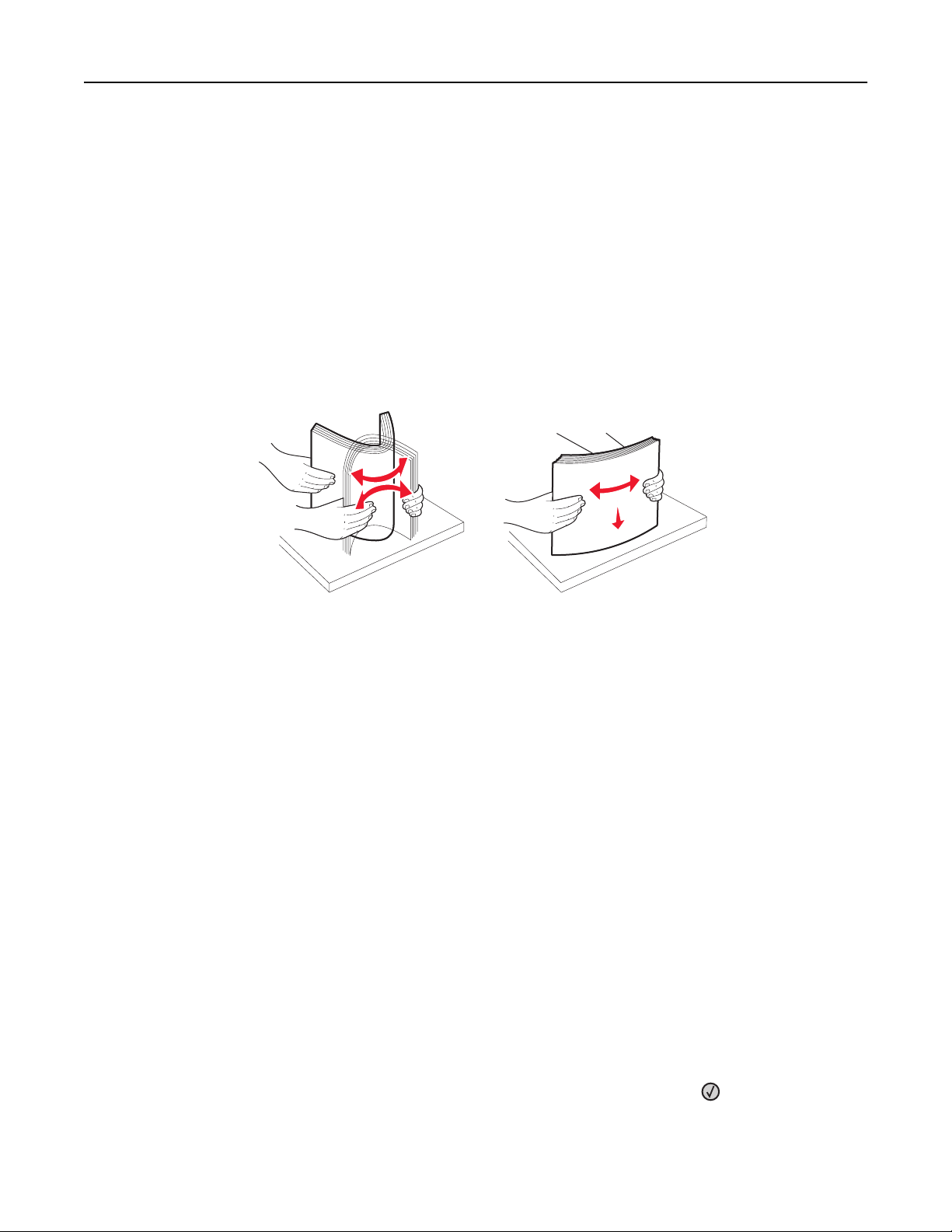
Memory card
Make sure the memory card is securely connected to the printer system board.
Solving paper feed problems
Paper frequently jams
These are possible solutions. Try one or more of the following:
FAN, FLEX, AND STRAIGHTEN THE PAPER IN THE TRAY OR FEEDER
Turn the stack of paper over, if possible, when you reload it into the tray or feeder.
CHECK THE PAPER
Use recommended paper and other specialty media. For more information, see “Paper and specialty media
guidelines” on page 57.
MAKE SURE THERE IS NOT TOO MUCH PAPER IN THE TRAY OR FEEDER
Make sure the stack of paper you load does not exceed the maximum stack height indicated in the tray or on the
multipurpose feeder.
CHECK THE GUIDES
Move the guides in the tray to the correct positions for the paper size loaded.
LOAD PAPER FROM A FRESH PACKAGE
The paper may have absorbed moisture due to high humidity. Store the paper in its original wrapper until you use
it.
Paper jam message remains after jam is cleared
The paper path is not clear. Clear jammed paper from the entire paper path, and then press .
Troubleshooting 151
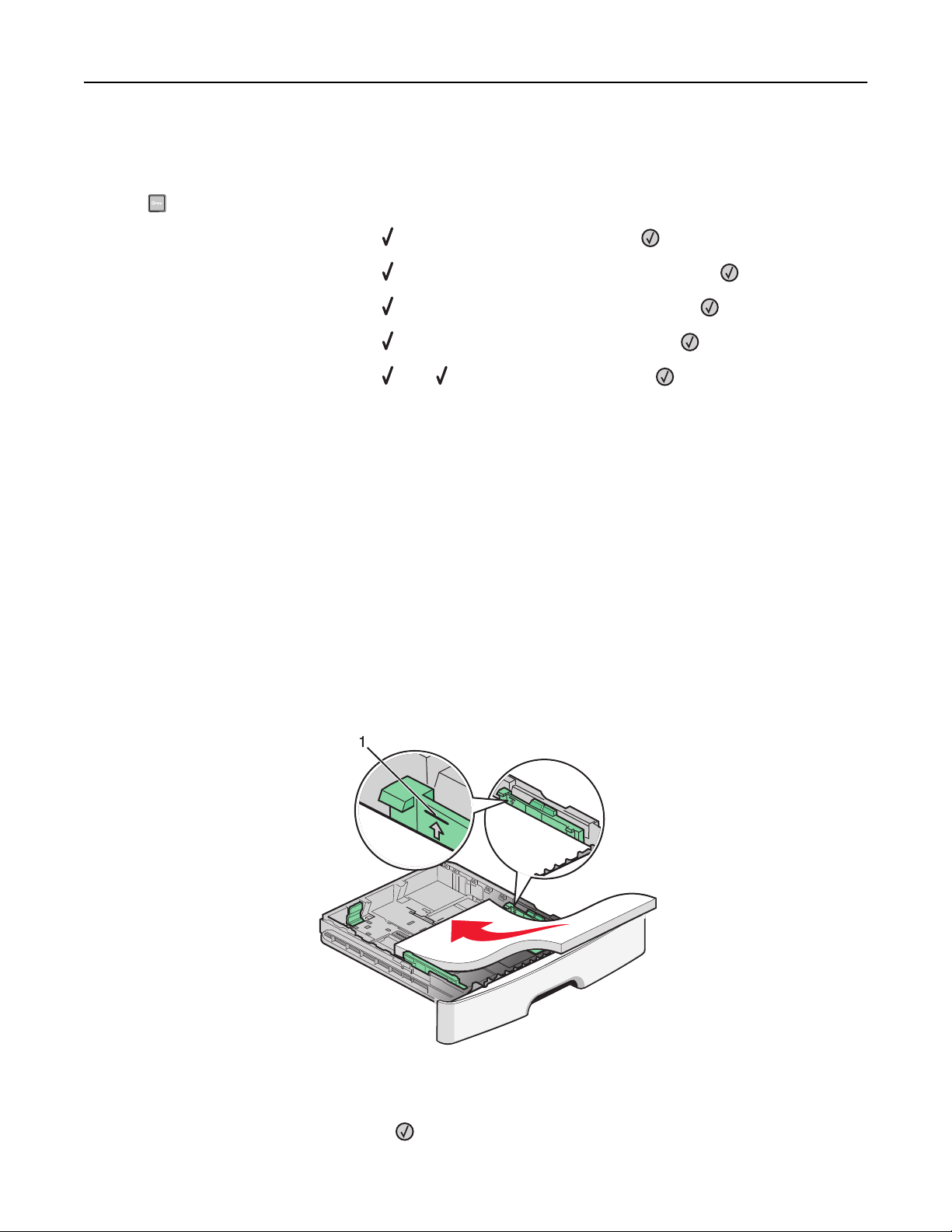
Page that jammed does not reprint after you clear the jam
Jam Recovery is set to Off. Set Jam Recovery to Auto or On:
1 Press .
2 Press the up or down arrow button until Settings appears, and then press .
3 Press the up or down arrow button until General Settings appears, and then press .
4 Press the up or down arrow button until Print Recovery appears, and then press .
5 Press the up or down arrow button until Jam Recovery appears, and then press .
6 Press the up or down arrow button until On or Auto appears, and then press .
Solving print quality problems
The information in the following topics may help you solve print quality problems. If these suggestions still do not
correct the problem, then contact Customer Support. You may have a printer part that requires adjustment or
replacement.
Isolating print quality problems
To help isolate print quality problems, print the print quality test pages, but first make sure the standard tray is loaded:
1 Turn the printer off.
2 Load letter‑ or A4‑size paper in the standard tray. Load the paper stack toward the back of the tray as shown with
the recommended print side facedown. Notice the maximum fill line on the side of the tray to guide you. Do not
overfill the tray.
Print the print quality test pages:
1 Turn the printer off.
2 From the printer control panel, hold down and the right arrow button while turning the printer on.
Troubleshooting 152
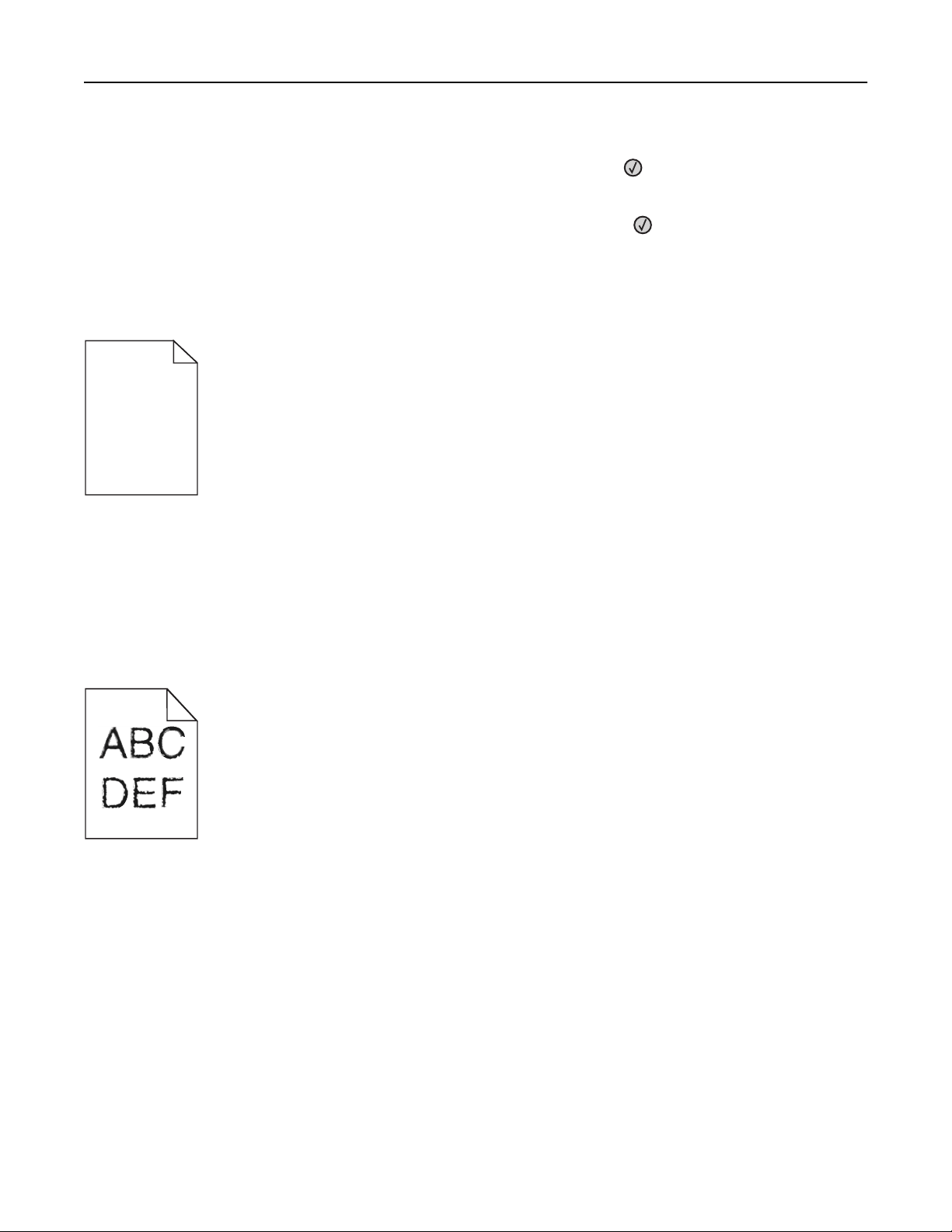
3 Release the buttons when CONFIG MENU appears.
4 Press the arrow buttons until Prt Quality Pgs appears, and then press .
The print quality test pages print.
5 Press the arrow buttons until Exit Config Menu appears, and then press .
Resetting the Printer appears briefly, and then Ready appears.
Blank pages
Try one or more of the following:
• Remove and reinstall the toner cartridge.
• Remove and reinstall the photoconductor kit.
If the printer still prints blank pages, it may need to be serviced. For more information, contact Customer Support.
Characters have jagged or uneven edges
If you are using downloaded fonts, verify that the fonts are supported by the printer, the host computer, and the
software program.
Clipped images
These are possible solutions. Try one or more of the following:
CHECK THE GUIDES
Move the width and length guides in the tray to the correct positions for the paper size loaded.
CHECK THE PAPER SIZE SETTING
Make sure the Paper Size setting matches the paper loaded in the tray.
Troubleshooting 153

Gray background
• For Windows users: From Print Properties, select a different Toner Darkness setting before sending the job to print.
• For Macintosh users: From the print options, Copies & Pages, or General pop‑up menu, choose Printer Features,
and then choose the setting needed from the Toner Darkness pop‑up menu.
• From the printer control panel Quality menu, select a different Toner Darkness setting before sending the job to
print.
Ghost images
These are possible solutions. Try one or more of the following:
THE PHOTOCONDUCTOR KIT IS DEFECTIVE
Replace the photoconductor kit.
CHECK THE PAPER TYPE SETTING
• For Windows users: From Print Properties, make sure the Paper Type setting matches the paper loaded in the
tray.
• For Macintosh users: From the Print dialog, make sure the Paper Type setting matches the paper loaded in the
tray.
• From the printer control panel Paper menu, make sure the Paper Type setting matches the paper loaded in the
tray.
Troubleshooting 154

Incorrect margins
These are possible solutions. Try one or more of the following:
CHECK THE GUIDES
Move the width and length guides in the tray to the correct positions for the paper size loaded.
CHECK THE PAPER SIZE SETTING
Make sure the Paper Size setting matches the paper loaded in the tray.
CHECK THE PAGE SIZE SETTING
Before sending the job to print, specify the correct page size in Print Properties, the Print dialog, or the software
program.
Paper curl
These are possible solutions. Try one or more of the following:
CHECK THE PAPER TYPE SETTING
• For Windows users: From Print Properties, make sure the Paper Type setting matches the paper loaded in the
tray.
• For Macintosh users: From the Print dialog, make sure the Paper Type setting matches the paper loaded in the
tray.
• From the printer control panel Paper menu, make sure the Paper Type setting matches the paper loaded in the
tray.
THE PAPER HAS ABSORBED MOISTURE DUE TO HIGH HUMIDITY
• Load paper from a fresh package.
• Store paper in its original wrapper until you use it.
Troubleshooting 155

Print is too dark
These are possible solutions. Try one or more of the following:
CHECK THE DARKNESS, BRIGHTNESS, AND CONTRAST SETTINGS
The Toner Darkness setting is too dark, the Brightness setting is too dark, or the Contrast setting is too high.
• For Windows users: From Print Properties, change these settings.
• For Macintosh users:
1 Choose File > Print.
2 Locate the drop‑down box under the Orientation pictures, and then click the down button.
3 Click Printer Features.
4 Change the settings for Toner Darkness, Brightness, and Contrast.
• From the printer control panel Quality menu, change these settings.
THE PAPER HAS ABSORBED MOISTURE DUE TO HIGH HUMIDITY
• Load paper from a fresh package.
• Store paper in its original wrapper until you use it.
CHECK THE PAPER
Avoid textured paper with rough finishes.
CHECK THE PAPER TYPE SETTING
• For Windows users: From Print Properties, make sure the Media Type setting matches the paper loaded in the
tray.
• For Macintosh users: From the Print dialog, make sure the Paper Type setting matches the paper loaded in the
tray.
• From the printer control panel Paper menu, make sure the Paper Type setting matches the paper loaded in the
tray.
THE TONER CARTRIDGE MAY BE DEFECTIVE
Replace the toner cartridge.
Troubleshooting 156

Print is too light
These are possible solutions. Try one or more of the following:
CHECK THE DARKNESS, BRIGHTNESS, AND CONTRAST SETTINGS
The Toner Darkness setting is too light, the Brightness setting is too light, or the Contrast setting is too low.
• From the printer control panel, change these settings from the Quality menu.
• For Windows users, change these settings from Print Properties.
• For Macintosh users, change these settings from the Print dialog and pop‑up menus.
THE PAPER HAS ABSORBED MOISTURE DUE TO HIGH HUMIDITY
• Load paper from a fresh package.
• Store paper in its original wrapper until you use it.
CHECK THE PAPER
Avoid textured paper with rough finishes.
CHECK THE PAPER TYPE SETTING
Make sure the paper type setting matches the paper loaded in the tray:
1 From the printer control panel, check the Paper Type setting from the Paper menu.
2 Before sending the job to print, specify the correct type setting:
• For Windows users, specify the type from Print Properties.
• For Macintosh users, specify the type from the Print dialog.
THE TONER IS LOW
When 88 Cartridge Low appears, order a new print cartridge.
THE PRINT CARTRIDGE MAY BE DEFECTIVE
Replace the print cartridge.
Troubleshooting 157

Skewed print
C
HECK THE PAPER GUIDES
Move the guides in the tray to the correct positions for the paper size loaded.
CHECK THE PAPER
Make sure you are using paper that meets the printer specifications.
Toner fog or background shading appears on the page
These are possible solutions. Try one or more of the following:
THE TONER CARTRIDGE MAY BE DEFECTIVE
Replace the toner cartridge.
THERE IS TONER IN THE PAPER PATH
Contact Customer Support.
Toner rubs off
These are possible solutions. Try one or more of the following:
CHECK THE PAPER TYPE SETTING
Make sure the Paper Type setting matches the paper loaded in the tray.
CHECK THE PAPER TEXTURE SETTING
Make sure the Paper Texture setting matches the paper loaded in the tray.
Troubleshooting 158
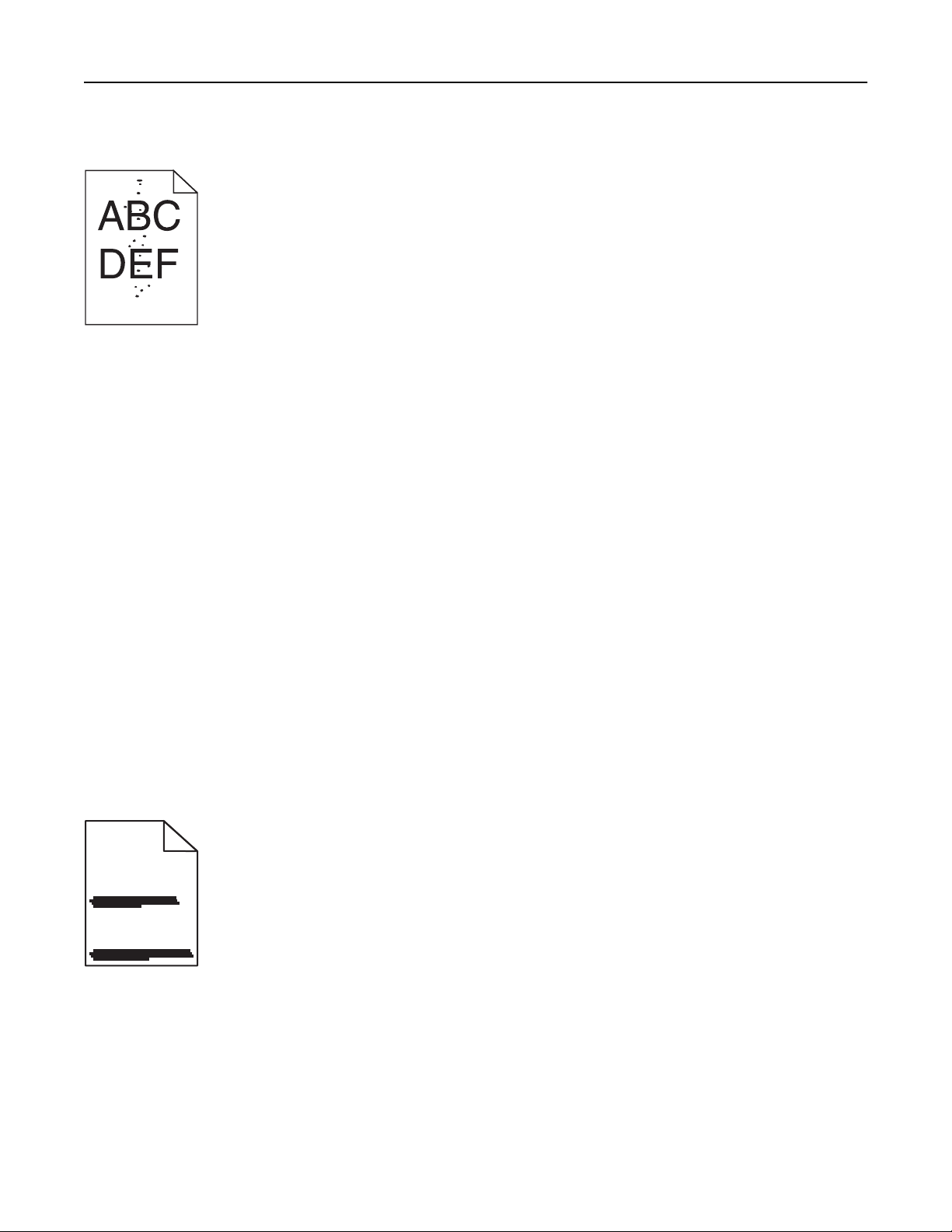
Toner specks
These are possible solutions. Try one or more of the following:
THE TONER CARTRIDGE MAY BE DEFECTIVE
Replace the toner cartridge.
THERE IS TONER IN THE PAPER PATH
Contact Customer Support.
Transparency print quality is poor
C
HECK THE TRANSPARENCIES
Use only transparencies recommended by the printer manufacturer.
CHECK THE PAPER TYPE SETTING
Load transparencies, and make sure the Paper Type setting is set to Transparency.
Streaked horizontal lines
These are possible solutions. Try one or more of the following:
THE TONER MAY SMEAR WHEN PAPER IS FED FROM A SPECIFIC SOURCE
From Print Properties, the Print dialog, or the printer control panel, select another tray or feeder to feed the paper
for the job.
Troubleshooting 159
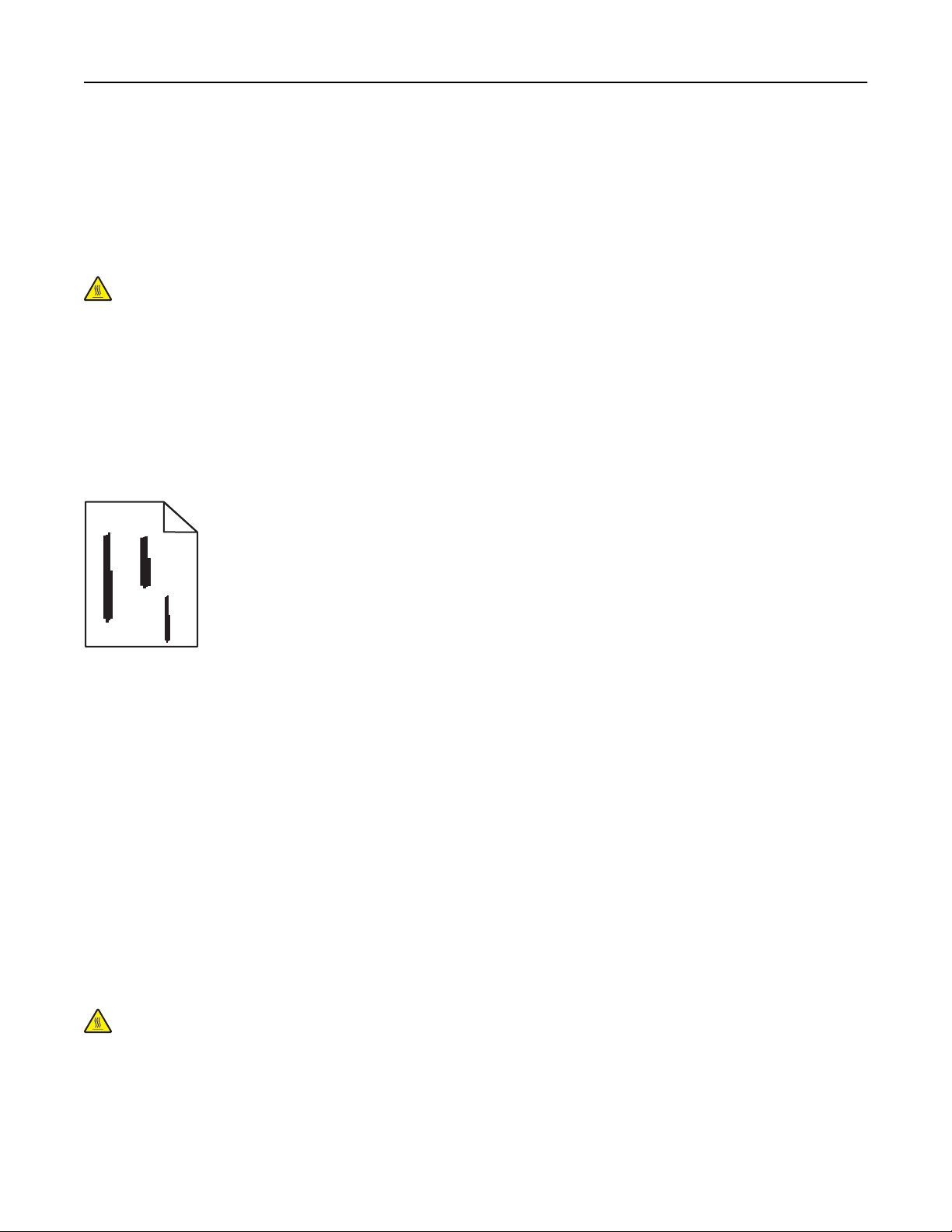
THE TONER CARTRIDGE MAY BE DEFECTIVE
Replace the toner cartridge.
MAKE SURE THE PAPER PATH IS CLEAR
Paper could be caught between the photoconductor kit and the fuser. Check the paper path around the fuser area.
CAUTION—HOT SURFACE: The fuser and the inside of the printer near the fuser may be hot. To reduce the
risk of injury from a hot component, allow the surface to cool before removing paper from this area.
Clear any paper you see.
THERE MAY BE EXCESS TONER IN THE PAPER PATH
Contact Customer Support.
Streaked vertical lines
These are possible solutions. Try one or more of the following:
THE TONER MAY SMEAR WHEN PAPER IS FED FROM A SPECIFIC SOURCE
From Print Properties, the Print dialog, or the printer control panel, select another tray or feeder to feed paper for
the job.
THE TONER CARTRIDGE IS DEFECTIVE
Replace the toner cartridge.
MAKE SURE THE PAPER PATH IS CLEAR
Paper could be caught between the photoconductor kit and the fuser. Check the paper path around the fuser area.
Warning—Potential Damage: Do not touch the photoconductor on the underside of the photoconductor kit. Use
the cartridge handle whenever you are holding the cartridge.
CAUTION—HOT SURFACE: The fuser and the inside of the printer near the fuser may be hot. To reduce the
risk of injury from a hot component, allow the surface to cool before removing paper from this area.
Clear any paper you see.
THERE MAY BE EXCESS TONER IN THE PAPER PATH
Contact Customer Support.
Troubleshooting 160

Solid black or white streaks appear on transparencies or paper
These are possible solutions. Try one or more of the following:
MAKE SURE THE FILL PATTERN IS CORRECT
If the fill pattern is incorrect, choose a different fill pattern from your software program.
CHECK THE PAPER TYPE
• Try a different type of paper.
• For transparencies, use only ones recommended by the printer manufacturer.
• Make sure the Paper Type setting matches what is loaded in the tray or feeder.
• Make sure the Paper Texture setting is correct for the type of paper or specialty media loaded in the tray or
feeder.
MAKE SURE THE TONER IS DISTRIBUTED EVENLY IN THE TONER CARTRIDGE
Remove the toner cartridge and shake it from side to side to redistribute the toner to extend the life of the cartridge,
and then reinstall it.
THE TONER CARTRIDGE MAY BE DEFECTIVE OR LOW ON TONER
Replace the used toner cartridge with a new one.
Embedded Web Server does not open
These are possible solutions. Try one or more of the following:
CHECK THE NETWORK CONNECTIONS
Make sure the printer and computer are turned on and connected to the same network.
CHECK THE NETWORK SETTINGS
Depending on the network settings, you may need to type https:// instead of http:// before the printer IP
address to access the Embedded Web Server. For more information, see your system administrator.
Troubleshooting 161

Contacting Customer Support
When you call Customer Support, describe the problem you are experiencing, the message on the display, and the
troubleshooting steps you have already taken to find a solution.
You need to know your printer model type and serial number. For more information, see the label on the inside top
front cover of the printer. The serial number is also listed on the menu settings page.
In the U.S. or Canada, call 1‑800‑539‑6275. For other countries or regions, visit the Lexmark Web site at
http://support.lexmark.com.
Troubleshooting 162

Notices
Product information
Product name:
Lexmark E460dn, Lexmark E460dw, Lexmark E462dtn
Machine type:
4513
Model(s):
630, 63W, 6EW
Edition notice
August 2011
The following paragraph does not apply to any country where such provisions are inconsistent with local law:
LEXMARK INTERNATIONAL, INC., PROVIDES THIS PUBLICATION “AS IS” WITHOUT WARRANTY OF ANY KIND, EITHER
EXPRESS OR IMPLIED, INCLUDING, BUT NOT LIMITED TO, THE IMPLIED WARRANTIES OF MERCHANTABILITY OR FITNESS
FOR A PARTICULAR PURPOSE. Some states do not allow disclaimer of express or implied warranties in certain
transactions; therefore, this statement may not apply to you.
This publication could include technical inaccuracies or typographical errors. Changes are periodically made to the
information herein; these changes will be incorporated in later editions. Improvements or changes in the products or
the programs described may be made at any time.
References in this publication to products, programs, or services do not imply that the manufacturer intends to make
these available in all countries in which it operates. Any reference to a product, program, or service is not intended to
state or imply that only that product, program, or service may be used. Any functionally equivalent product, program,
or service that does not infringe any existing intellectual property right may be used instead. Evaluation and verification
of operation in conjunction with other products, programs, or services, except those expressly designated by the
manufacturer, are the user’s responsibility.
For Lexmark technical support, visit http://support.lexmark.com.
For information on supplies and downloads, visit www.lexmark.com.
If you don't have access to the Internet, you can contact Lexmark by mail:
Lexmark International, Inc.
Bldg 004-2/CSC
740 New Circle Road NW
Lexington, KY 40550
USA
© 2010 Lexmark International, Inc.
All rights reserved.
Notices 163

UNITED STATES GOVERNMENT RIGHTS
This software and any accompanying documentation provided under this agreement are commercial computer
software and documentation developed exclusively at private expense.
Trademarks
Lexmark, Lexmark with diamond design, and MarkVision are trademarks of Lexmark International, Inc., registered in
the United States and/or other countries.
PrintCryption is a trademark of Lexmark International, Inc.
Mac and the Mac logo are trademarks of Apple Inc., registered in the U.S. and other countries.
PCL® is a registered trademark of the Hewlett-Packard Company. PCL is Hewlett-Packard Company’s designation of a
set of printer commands (language) and functions included in its printer products. This printer is intended to be
compatible with the PCL language. This means the printer recognizes PCL commands used in various application
programs, and that the printer emulates the functions corresponding to the commands.
All other trademarks are the property of their respective owners.
Federal Communications Commission (FCC) compliance information statement
This product has been tested and found to comply with the limits for a Class B digital device, pursuant to Part 15 of the
FCC Rules. Operation is subject to the following two conditions: (1) this device may not cause harmful interference,
and (2) this device must accept any interference received, including interference that may cause undesired operation.
The FCC Class B limits are designed to provide reasonable protection against harmful interference when the equipment
is operated in a residential installation. This equipment generates, uses, and can radiate radio frequency energy and,
if not installed and used in accordance with the instructions, may cause harmful interference to radio communications.
However, there is no guarantee that interference will not occur in a particular installation. If this equipment does cause
harmful interference to radio or television reception, which can be determined by turning the equipment off and on,
the user is encouraged to try to correct the interference by one or more of the following measures:
• Reorient or relocate the receiving antenna.
• Increase the separation between the equipment and receiver.
• Connect the equipment into an outlet on a circuit different from that to which the receiver is connected.
• Consult your point of purchase or service representative for additional suggestions.
The manufacturer is not responsible for radio or television interference caused by using other than recommended
cables or by unauthorized changes or modifications to this equipment. Unauthorized changes or modifications could
void the user's authority to operate this equipment.
Note: To assure compliance with FCC regulations on electromagnetic interference for a Class B computing device,
use a properly shielded and grounded cable such as Lexmark part number 1021231 for parallel attach or 1021294 for
USB attach. Use of a substitute cable not properly shielded and grounded may result in a violation of FCC
regulations.
Notices 164
Any questions regarding this compliance information statement should be directed to:
Director of Lexmark Technology & Services
Lexmark International, Inc.
740 West New Circle Road
Lexington, KY 40550
(859) 232–3000
Modular component notice
Wireless‑equipped models contain the following modular component(s):
Lexmark regulatory type/model LEX-M04-001; FCC ID:IYLLEXM04001; IC:2376A-M04001
Noise emission levels
The following measurements were made in accordance with ISO 7779 and reported in conformance with ISO 9296.
Note: Some modes may not apply to your product.
1-meter average sound pressure, dBA
Printing 53 dBA
Ready N/A
Values are subject to change. See www.lexmark.com for current values.
Waste from Electrical and Electronic Equipment (WEEE) directive
The WEEE logo signifies specific recycling programs and procedures for electronic products in countries of the European
Union. We encourage the recycling of our products. If you have further questions about recycling options, visit the
Lexmark Web site at www.lexmark.com for your local sales office phone number.
Static sensitivity notice
Notices 165
This symbol identifies static-sensitive parts. Do not touch in the areas near these symbols without first touching the
metal frame of the printer.
ENERGY STAR
Any Lexmark product bearing the ENERGY STAR emblem on the product or on a start-up screen is certified to comply
with Environmental Protection Agency (EPA) ENERGY STAR requirements as configured when shipped by Lexmark.
Temperature information
Ambient temperature 16C° – 32C° (60 F° – 90F°)
Shipping and storage temperature ‑20.0C° – 40.0C° (‑4 F° – 104F°)
Laser notice
The printer is certified in the U.S. to conform to the requirements of DHHS 21 CFR Subchapter J for Class I (1) laser
products, and elsewhere is certified as a Class I laser product conforming to the requirements of IEC 60825-1.
Class I laser products are not considered to be hazardous. The printer contains internally a Class IIIb (3b) laser that is
nominally a 7 milliwatt gallium arsenide laser operating in the wavelength of 655-675 nanometers. The laser system
and printer are designed so there is never any human access to laser radiation above a Class I level during normal
operation, user maintenance, or prescribed service condition.
Laser advisory label
A laser notice label may be affixed to this printer as shown:
Notices 166

Power consumption
Product power consumption
The following table documents the power consumption characteristics of the product.
Note: Some modes may not apply to your product.
Mode Description Power consumption
(Watts)
Printing The product is generating hard‑copy output from electronic inputs. 500
Copying The product is generating hard‑copy output from hard‑copy original documents. N/A
Scanning The product is scanning hard‑copy documents. N/A
Ready The product is waiting for a print job. 12-14
Power Saver The product is in energy‑saving mode. 11-13
Off The product is plugged into a wall outlet, but the power switch is turned off. 0
The power consumption levels listed in the previous table represent time-averaged measurements. Instantaneous
power draws may be substantially higher than the average.
Values are subject to change. See www.lexmark.com for current values.
Power Saver
This product is designed with an energy-saving mode called Power Saver. The Power Saver Mode is equivalent to the
Sleep Mode. The Power Saver Mode saves energy by lowering power consumption during extended periods of inactivity.
The Power Saver Mode is automatically engaged after this product is not used for a specified period of time, called the
Power Saver Timeout.
Factory default Power Saver Timeout for this product (in minutes): 30
By using the configuration menus, the Power Saver Timeout can be modified between 1 minute and 240 minutes.
Setting the Power Saver Timeout to a low value reduces energy consumption, but may increase the response time of
the product. Setting the Power Saver Timeout to a high value maintains a fast response, but uses more energy.
Off mode
If this product has an off mode which still consumes a small amount of power, then to completely stop product power
consumption, disconnect the power supply cord from the wall outlet.
Total energy usage
It is sometimes helpful to calculate the total product energy usage. Since power consumption claims are provided in
power units of Watts, the power consumption should be multiplied by the time the product spends in each mode in
order to calculate energy usage. The total product energy usage is the sum of each mode's energy usage.
Notices 167

Industry Canada compliance statement
This Class B digital apparatus meets all requirements of the Canadian Interference-Causing Equipment Standard
ICES-003.
Avis de conformité aux normes de l’industrie du Canada
Cet appareil numérique de classe B est conforme aux exigences de la norme canadienne relative aux équipements
pouvant causer des interférences NMB-003.
European Community (EC) directives conformity
This product is in conformity with the protection requirements of EC Council directives 2004/108/EC and 2006/95/EC
on the approximation and harmonization of the laws of the Member States relating to electromagnetic compatibility
and safety of electrical equipment designed for use within certain voltage limits.
The manufacturer of this product is: Lexmark International, Inc., 740 West New Circle Road, Lexington, KY, 40550 USA.
The authorized representative is: Lexmark International Technology Hungária Kft., 8 Lechner Ödön fasor, Millennium
Tower III, 1095 Budapest HUNGARY, A declaration of conformity to the requirements of the Directives is available upon
request from the Authorized Representative.
This product satisfies the Class B limits of EN 55022 and safety requirements of EN 60950.
Regulatory notices for wireless products
This section contains the following regulatory information pertaining to wireless products that contain transmitters,
for example, but not limited to, wireless network cards or proximity card readers.
Exposure to radio frequency radiation
The radiated output power of this device is far below the radio frequency exposure limits of the FCC and other regulatory
agencies. A minimum separation of 20 cm (8 inches) must be maintained between the antenna and any persons for
this device to satisfy the RF exposure requirements of the FCC and other regulatory agencies.
Industry Canada (Canada)
This device complies with Industry Canada specification RSS-210. Operation is subject to the following two conditions:
(1) this device may not cause interference, and (2) this device must accept any interference, including interference that
may cause undesired operation of the device.
This device has been designed to operate only with the antenna provided. Use of any other antenna is strictly prohibited
per regulations of Industry Canada.
To prevent radio interference to the licensed service, this device is intended to be operated indoors and away from
windows to provide maximum shielding. Equipment (or its transmit antenna) that is installed outdoors is subject to
licensing.
Notices 168

The installer of this radio equipment must ensure that the antenna is located or pointed such that it does not emit RF
fields in excess of Health Canada limits for the general population; consult Safety Code 6, obtainable from Health
Canada's Web site www.hc-sc.gc.ca/rpb.
The term "IC:" before the certification/registration number only signifies that the Industry Canada technical
specifications were met.
Industry Canada (Canada)
Cet appareil est conforme à la norme RSS-210 d'Industry Canada. Son fonctionnement est soumis aux deux conditions
suivantes :
(1) cet appareil ne doit pas provoquer d'interférences et (2) il doit accepter toute interférence reçue, y compris celles
risquant d'altérer son fonctionnement.
Cet appareil a été conçu pour fonctionner uniquement avec l'antenne fournie. L'utilisation de toute autre antenne est
strictement interdite par la réglementation d'Industry Canada.
En application des réglementations d'Industry Canada, l'utilisation d'une antenne de gain supérieur est strictement
interdite.
Pour empêcher toute interférence radio au service faisant l'objet d'une licence, cet appareil doit être utilisé à l'intérieur
et loin des fenêtres afin de garantir une protection optimale.
Si le matériel (ou son antenne d'émission) est installé à l'extérieur, il doit faire l'objet d'une licence.
L'installateur de cet équipement radio doit veiller à ce que l'antenne soit implantée et dirigée de manière à n'émettre
aucun champ HF dépassant les limites fixées pour l'ensemble de la population par Santé Canada. Reportez-vous au
Code de sécurité 6 que vous pouvez consulter sur le site Web de Santé Canada www.hc-sc.gc.ca/rpb.
Le terme « IC » précédant le numéro de d'accréditation/inscription signifie simplement que le produit est conforme
aux spécifications techniques d'Industry Canada.
Notice to users in the European Union
Products bearing the CE mark are in conformity with the protection requirements of EC Council directives 2004/108/EC,
2006/95/EC, and 1999/5/EC on the approximation and harmonization of the laws of the Member States relating to
electromagnetic compatibility, safety of electrical equipment designed for use within certain voltage limits and on radio
equipment and telecommunications terminal equipment.
Compliance is indicated by the CE marking.
The manufacturer of this product is: Lexmark International, Inc., 740 West New Circle Road, Lexington, KY, 40550 USA.
The authorized representative is: Lexmark International Technology Hungária Kft., 8 Lechner Ödön fasor, Millennium
Tower III, 1095 Budapest HUNGARY, A declaration of conformity to the requirements of the Directives is available upon
request from the Authorized Representative.
This product satisfies the Class B limits of EN 55022 and safety requirements of EN 60950.
Products equipped with 2.4GHz Wireless LAN option are in conformity with the protection requirements of EC Council
directives 2004/108/EC, 2006/95/EC, and 1999/5/EC on the approximation and harmonization of the laws of the
Notices 169
Member States relating to electromagnetic compatibility, safety of electrical equipment designed for use within certain
voltage limits and on radio equipment and telecommunications terminal equipment.
Compliance is indicated by the CE marking.
Operation is allowed in all EU and EFTA countries, but is restricted to indoor use only.
The manufacturer of this product is: Lexmark International, Inc., 740 West New Circle Road, Lexington, KY, 40550 USA.
The authorized representative is: Lexmark International Technology Hungária Kft., 8 Lechner Ödön fasor, Millennium
Tower III, 1095 Budapest HUNGARY, A declaration of conformity to the requirements of the Directives is available upon
request from the Authorized Representative.
Česky Společnost Lexmark International, Inc. tímto prohlašuje, že výrobek tento výrobek je ve shodě se základními
požadavky a dalšími příslušnými ustanoveními směrnice 1999/5/ES.
Dansk Lexmark International, Inc. erklærer herved, at dette produkt overholder de væsentlige krav og øvrige relevante
krav i direktiv 1999/5/EF.
Deutsch Hiermit erklärt Lexmark International, Inc., dass sich das Gerät dieses Gerät in Übereinstimmung mit den
grundlegenden Anforderungen und den übrigen einschlägigen Bestimmungen der Richtlinie 1999/5/EG
befindet.
Ελληνική ΜΕ ΤΗΝ ΠΑΡΟΥΣΑ Η LEXMARK INTERNATIONAL, INC. ΔΗΛΩΝΕΙ ΟΤΙ ΑΥΤΟ ΤΟ ΠΡΟΪΟΝ
ΣΥΜΜΟΡΦΩΝΕΤΑΙ ΠΡΟΣ ΤΙΣ ΟΥΣΙΩΔΕΙΣ ΑΠΑΙΤΗΣΕΙΣ ΚΑΙ ΤΙΣ ΛΟΙΠΕΣ ΣΧΕΤΙΚΕΣ ΔΙΑΤΑΞΕΙΣ
ΤΗΣ ΟΔΗΓΙΑΣ 1999/5/ΕΚ.
English Hereby, Lexmark International, Inc., declares that this type of equipment is in compliance with the
essential requirements and other relevant provisions of Directive 1999/5/EC.
Español Por medio de la presente, Lexmark International, Inc. declara que este producto cumple con los requisitos
esenciales y cualesquiera otras disposiciones aplicables o exigibles de la Directiva 1999/5/CE.
Eesti Käesolevaga kinnitab Lexmark International, Inc., et seade see toode vastab direktiivi 1999/5/EÜ
põhinõuetele ja nimetatud direktiivist tulenevatele muudele asjakohastele sätetele.
Suomi Lexmark International, Inc. vakuuttaa täten, että tämä tuote on direktiivin 1999/5/EY oleellisten vaatimusten
ja muiden sitä koskevien direktiivin ehtojen mukainen.
Français Par la présente, Lexmark International, Inc. déclare que l'appareil ce produit est conforme aux exigences
fondamentales et autres dispositions pertinentes de la directive 1999/5/CE.
Magyar Alulírott, Lexmark International, Inc. nyilatkozom, hogy a termék megfelel a vonatkozó alapvetõ
követelményeknek és az 1999/5/EC irányelv egyéb elõírásainak.
Íslenska Hér með lýsir Lexmark International, Inc. yfir því að þessi vara er í samræmi við grunnkröfur og aðrar
kröfur, sem gerðar eru í tilskipun 1999/5/EC.
Italiano Con la presente Lexmark International, Inc. dichiara che questo questo prodotto è conforme ai requisiti
essenziali ed alle altre disposizioni pertinenti stabilite dalla direttiva 1999/5/CE.
Latviski Ar šo Lexmark International, Inc. deklarē, ka šis izstrādājums atbilst Direktīvas 1999/5/EK būtiskajām
prasībām un citiem ar to saistītajiem noteikumiem.
Lietuvių Šiuo Lexmark International, Inc. deklaruoja, kad šis produktas atitinka esminius reikalavimus ir kitas
1999/5/EB direktyvos nuostatas.
Malti Bil-preżenti, Lexmark International, Inc., jiddikjara li dan il-prodott huwa konformi mal-ħtiġijiet
essenzjali u ma dispożizzjonijiet oħrajn relevanti li jinsabu fid-Direttiva 1999/5/KE.
Notices 170
Nederlands Hierbij verklaart Lexmark International, Inc. dat het toestel dit product in overeenstemming is met de essentiële
eisen en de andere relevante bepalingen van richtlijn 1999/5/EG.
Norsk Lexmark International, Inc. erklærer herved at dette produktet er i samsvar med de grunnleggende krav og
øvrige relevante krav i direktiv 1999/5/EF.
Polski Niniejszym Lexmark International, Inc. oświadcza, że niniejszy produkt jest zgodny z zasadniczymi
wymogami oraz pozostałymi stosownymi postanowieniami Dyrektywy 1999/5/EC.
Português A Lexmark International Inc. declara que este este produto está conforme com os requisitos essenciais e outras
disposições da Diretiva 1999/5/CE.
Slovensky Lexmark International, Inc. týmto vyhlasuje, že tento produkt spĺňa základné požiadavky a všetky
príslušné ustanovenia smernice 1999/5/ES.
Slovensko Lexmark International, Inc. izjavlja, da je ta izdelek v skladu z bistvenimi zahtevami in ostalimi
relevantnimi določili direktive 1999/5/ES.
Svenska Härmed intygar Lexmark International, Inc. att denna produkt står i överensstämmelse med de väsentliga
egenskapskrav och övriga relevanta bestämmelser som framgår av direktiv 1999/5/EG.
Statement of Limited Warranty
Lexmark E460dn, Lexmark E460dw, Lexmark E462dtn
Lexmark International, Inc., Lexington, KY
This limited warranty applies to the United States and Canada. For customers outside the U.S., refer to the country-
specific warranty information that came with your product.
This limited warranty applies to this product only if it was originally purchased for your use, and not for resale, from
Lexmark or a Lexmark Remarketer, referred to in this statement as “Remarketer.”
Limited warranty
Lexmark warrants that this product:
—Is manufactured from new parts, or new and serviceable used parts, which perform like new parts
—Is, during normal use, free from defects in material and workmanship
If this product does not function as warranted during the warranty period, contact a Remarketer or Lexmark for repair
or replacement (at Lexmark's option).
If this product is a feature or option, this statement applies only when that feature or option is used with the product
for which it was intended. To obtain warranty service, you may be required to present the feature or option with the
product.
If you transfer this product to another user, warranty service under the terms of this statement is available to that user
for the remainder of the warranty period. You should transfer proof of original purchase and this statement to that
user.
Limited warranty service
The warranty period starts on the date of original purchase as shown on the purchase receipt and ends 12 months later
provided that the warranty period for any supplies and for any maintenance items included with the printer shall end
earlier if it, or its original contents, are substantially used up, depleted, or consumed.
Notices 171

To obtain warranty service you may be required to present proof of original purchase. You may be required to deliver
your product to the Remarketer or Lexmark, or ship it prepaid and suitably packaged to a Lexmark designated location.
You are responsible for loss of, or damage to, a product in transit to the Remarketer or the Lexmark designated location.
When warranty service involves the exchange of a product or part, the item replaced becomes the property of the
Remarketer or Lexmark. The replacement may be a new or repaired item.
The replacement item assumes the remaining warranty period of the original product.
Replacement is not available to you if the product you present for exchange is defaced, altered, in need of a repair not
included in warranty service, damaged beyond repair, or if the product is not free of all legal obligations, restrictions,
liens, and encumbrances.
Before you present this product for warranty service, remove all print cartridges, programs, data, and removable storage
media (unless directed otherwise by Lexmark).
For further explanation of your warranty alternatives and the nearest Lexmark authorized servicer in your area contact
Lexmark on the World Wide Web at http://support.lexmark.com.
Remote technical support is provided for this product throughout its warranty period. For products no longer covered
by a Lexmark warranty, technical support may not be available or only be available for a fee.
Extent of limited warranty
Lexmark does not warrant uninterrupted or error-free operation of any product or the durability or longevity of prints
produced by any product.
Warranty service does not include repair of failures caused by:
—Modification or unauthorized attachments
—Accidents, misuse, abuse or use inconsistent with Lexmark user’s guides, manuals, instructions or guidance
—Unsuitable physical or operating environment
—Maintenance by anyone other than Lexmark or a Lexmark authorized servicer
—Operation of a product beyond the limit of its duty cycle
—Use of printing media outside of Lexmark specifications
—Refurbishment, repair, refilling or remanufacture by a third party of products, supplies or parts
—Products, supplies, parts, materials (such as toners and inks), software, or interfaces not furnished by Lexmark
TO THE EXTENT PERMITTED BY APPLICABLE LAW, NEITHER LEXMARK NOR ITS THIRD PARTY SUPPLIERS OR
REMARKETERS MAKE ANY OTHER WARRANTY OR CONDITION OF ANY KIND, WHETHER EXPRESS OR IMPLIED, WITH
RESPECT TO THIS PRODUCT, AND SPECIFICALLY DISCLAIM THE IMPLIED WARRANTIES OR CONDITIONS OF
MERCHANTABILITY, FITNESS FOR A PARTICULAR PURPOSE, AND SATISFACTORY QUALITY. ANY WARRANTIES THAT
MAY NOT BE DISCLAIMED UNDER APPLICABLE LAW ARE LIMITED IN DURATION TO THE WARRANTY PERIOD. NO
WARRANTIES, EXPRESS OR IMPLIED, WILL APPLY AFTER THIS PERIOD. ALL INFORMATION, SPECIFICATIONS, PRICES,
AND SERVICES ARE SUBJECT TO CHANGE AT ANY TIME WITHOUT NOTICE.
Limitation of liability
Your sole remedy under this limited warranty is set forth in this document. For any claim concerning performance or
nonperformance of Lexmark or a Remarketer for this product under this limited warranty, you may recover actual
damages up to the limit set forth in the following paragraph.
Notices 172

Lexmark's liability for actual damages from any cause whatsoever will be limited to the amount you paid for the product
that caused the damages. This limitation of liability will not apply to claims by you for bodily injury or damage to real
property or tangible personal property for which Lexmark is legally liable. IN NO EVENT WILL LEXMARK BE LIABLE FOR
ANY LOST PROFITS, LOST SAVINGS, INCIDENTAL DAMAGE, OR OTHER ECONOMIC OR CONSEQUENTIAL DAMAGES.
This is true even if you advise Lexmark or a Remarketer of the possibility of such damages. Lexmark is not liable for any
claim by you based on a third party claim.
This limitation of remedies also applies to claims against any Suppliers and Remarketers of Lexmark. Lexmark's and its
Suppliers' and Remarketers' limitations of remedies are not cumulative. Such Suppliers and Remarketers are intended
beneficiaries of this limitation.
Additional rights
Some states do not allow limitations on how long an implied warranty lasts, or do not allow the exclusion or limitation
of incidental or consequential damages, so the limitations or exclusions contained above may not apply to you.
This limited warranty gives you specific legal rights. You may also have other rights that vary from state to state.
LEXMARK SOFTWARE LIMITED WARRANTY AND LICENSE AGREEMENT
PLEASE READ CAREFULLY BEFORE USING THIS PRODUCT: BY USING THIS PRODUCT, YOU AGREE TO BE BOUND BY ALL
THE TERMS AND CONDITIONS OF THIS SOFTWARE LIMITED WARRANTY AND LICENSE AGREEMENT. IF YOU DO NOT
AGREE WITH THE TERMS OF THIS SOFTWARE LIMITED WARRANTY AND LICENSE AGREEMENT, PROMPTLY RETURN THE
PRODUCT UNUSED AND REQUEST A REFUND OF THE AMOUNT YOU PAID. IF YOU ARE INSTALLING THIS PRODUCT FOR
USE BY OTHER PARTIES, YOU AGREE TO INFORM THE USERS THAT USE OF THE PRODUCT INDICATES ACCEPTANCE OF
THESE TERMS.
LEXMARK SOFTWARE LICENSE AGREEMENT
This License Agreement (“Software License Agreement”) is a legal agreement between you (either an individual or a
single entity) and Lexmark International, Inc. (“Lexmark”) that, to the extent your Lexmark product or Software Program
is not otherwise subject to a written software license agreement between you and Lexmark or its suppliers, governs
your use of any Software Program installed on or provided by Lexmark for use in connection with your Lexmark product.
The term “Software Program” includes machine-readable instructions, audio/visual content (such as images and
recordings), and associated media, printed materials and electronic documentation, whether incorporated into,
distributed with or for use with your Lexmark product.
1 STATEMENT OF SOFTWARE LIMITED WARRANTY. Lexmark warrants that the media (e.g., diskette or compact disk)
on which the Software Program (if any) is furnished is free from defects in materials and workmanship under normal
use during the warranty period. The warranty period is ninety (90) days and commences on the date the Software
Program is delivered to the original end-user. This limited warranty applies only to Software Program media
purchased new from Lexmark or an Authorized Lexmark Reseller or Distributor. Lexmark will replace the Software
Program should it be determined that the media does not conform to this limited warranty.
2 DISCLAIMER AND LIMITATION OF WARRANTIES. EXCEPT AS PROVIDED IN THIS SOFTWARE LICENSE AGREEMENT
AND TO THE MAXIMUM EXTENT PERMITTED BY APPLICABLE LAW, LEXMARK AND ITS SUPPLIERS PROVIDE THE
SOFTWARE PROGRAM "AS IS" AND HEREBY DISCLAIM ALL OTHER WARRANTIES AND CONDITIONS, EITHER EXPRESS
OR IMPLIED, INCLUDING, BUT NOT LIMITED TO, TITLE, NON-INFRINGEMENT, MERCHANTABILITY AND FITNESS FOR
A PARTICULAR PURPOSE, AND ABSENCE OF VIRUSES, ALL WITH REGARD TO THE SOFTWARE PROGRAM. TO THE
EXTENT LEXMARK CANNOT BY LAW DISCLAIM ANY COMPONENT OF THE IMPLIED WARRANTIES OF
MERCHANTABILITY OR FITNESS FOR A PARTICULAR PURPOSE, LEXMARK LIMITS THE DURATION OF SUCH
WARRANTIES TO THE 90-DAY TERM OF THE EXPRESS SOFTWARE LIMITED WARRANTY.
Notices 173

This Agreement is to be read in conjunction with certain statutory provisions, as that may be in force from time to
time, that imply warranties or conditions or impose obligations on Lexmark that cannot be excluded or modified.
If any such provisions apply, then to the extent Lexmark is able, Lexmark hereby limits its liability for breach of those
provisions to one of the following: providing you a replacement copy of the Software Program or reimbursement
of the price paid for the Software Program.
The Software Program may include internet links to other software applications and/or internet web pages hosted
and operated by third parties unaffiliated with Lexmark. You acknowledge and agree that Lexmark is not responsible
in any way for the hosting, performance, operation, maintenance, or content of, such software applications and/or
internet web pages.
3 LIMITATION OF REMEDY. TO THE MAXIMUM EXTENT PERMITTED BY APPLICABLE LAW, ANY AND ALL LIABILITY OF
LEXMARK UNDER THIS SOFTWARE LICENSE AGREEMENT IS EXPRESSLY LIMITED TO THE GREATER OF THE PRICE PAID
FOR THE SOFTWARE PROGRAM AND FIVE U.S. DOLLARS (OR THE EQUIVALENT IN LOCAL CURRENCY). YOUR SOLE
REMEDY AGAINST LEXMARK IN ANY DISPUTE UNDER THIS SOFTWARE LICENSE AGREEMENT SHALL BE TO SEEK TO
RECOVER ONE OF THESE AMOUNTS, UPON PAYMENT OF WHICH LEXMARK SHALL BE RELEASED AND DISCHARGED
OF ALL FURTHER OBLIGATIONS AND LIABILITY TO YOU.
IN NO EVENT WILL LEXMARK, ITS SUPPLIERS, SUBSIDIARIES, OR RESELLERS BE LIABLE FOR ANY SPECIAL, INCIDENTAL,
INDIRECT, EXEMPLARY, PUNITIVE, OR CONSEQUENTIAL DAMAGES (INCLUDING BUT NOT LIMITED TO LOST PROFITS
OR REVENUES, LOST SAVINGS, INTERRUPTION OF USE OR ANY LOSS OF, INACCURACY IN, OR DAMAGE TO, DATA
OR RECORDS, FOR CLAIMS OF THIRD PARTIES, OR DAMAGE TO REAL OR TANGIBLE PROPERTY, FOR LOSS OF PRIVACY
ARISING OUT OR IN ANY WAY RELATED TO THE USE OF OR INABILITY TO USE THE SOFTWARE PROGRAM, OR
OTHERWISE IN CONNECTION WITH ANY PROVISION OF THIS SOFTWARE LICENSE AGREEMENT), REGARDLESS OF
THE NATURE OF THE CLAIM, INCLUDING BUT NOT LIMITED TO BREACH OF WARRANTY OR CONTRACT, TORT
(INCLUDING NEGLIGENCE OR STRICT LIABILITY), AND EVEN IF LEXMARK, OR ITS SUPPLIERS, AFFILIATES, OR
REMARKETERS HAVE BEEN ADVISED OF THE POSSIBILITY OF SUCH DAMAGES, OR FOR ANY CLAIM BY YOU BASED
ON A THIRD-PARTY CLAIM, EXCEPT TO THE EXTENT THIS EXCLUSION OF DAMAGES IS DETERMINED LEGALLY INVALID.
THE FOREGOING LIMITATIONS APPLY EVEN IF THE ABOVE-STATED REMEDIES FAIL OF THEIR ESSENTIAL PURPOSE.
4 U.S.A. STATE LAWS. This Software Limited Warranty gives you specific legal rights. You may also have other rights
that vary from state to state. Some states do not allow limitations on how long an implied warranty lasts or the
exclusion of limitation of incidental or consequential damages, so the above limitations may not apply to you.
5 LICENSE GRANT. Lexmark grants you the following rights provided you comply with all terms and conditions of this
License Agreement:
a Use. You may Use one (1) copy of the Software Program. The term “Use” means storing, loading, installing,
executing, or displaying the Software Program. If Lexmark has licensed the Software Program to you for
concurrent use, you must limit the number of authorized users to the number specified in your agreement with
Lexmark. You may not separate the components of the Software Program for use on more than one computer.
You agree that you will not Use the Software Program, in whole or in part, in any manner that has the effect of
overriding, modifying, eliminating, obscuring, altering or de-emphasizing the visual appearance of any
trademark, trade name, trade dress or intellectual property notice that appears on any computer display screens
normally generated by, or as a result of, the Software Program.
b Copying. You may make one (1) copy of the Software Program solely for purposes of backup, archiving, or
installation, provided the copy contains all of the original Software Program’s proprietary notices. You may not
copy the Software Program to any public or distributed network.
c Reservation of Rights. The Software Program, including all fonts, is copyrighted and owned by Lexmark
International, Inc. and/or its suppliers. Lexmark reserves all rights not expressly granted to you in this License
Agreement.
d Freeware. Notwithstanding the terms and conditions of this License Agreement, all or any portion of the
Software Program that constitutes software provided under public license by third parties (“Freeware”) is
licensed to you subject to the terms and conditions of the software license agreement accompanying such
Freeware, whether in the form of a discrete agreement, shrink-wrap license, or electronic license terms at the
Notices 174

time of download. Use of the Freeware by you shall be governed entirely by the terms and conditions of such
license.
6 TRANSFER. You may transfer the Software Program to another end-user. Any transfer must include all software
components, media, printed materials, and this License Agreement and you may not retain copies of the Software
Program or components thereof. The transfer may not be an indirect transfer, such as a consignment. Prior to the
transfer, the end-user receiving the transferred Software Program must agree to all these License Agreement terms.
Upon transfer of the Software Program, your license is automatically terminated. You may not rent, sublicense, or
assign the Software Program except to the extent provided in this License Agreement, and any attempt to do so
shall be void.
7 UPGRADES. To Use a Software Program identified as an upgrade, you must first be licensed to the original Software
Program identified by Lexmark as eligible for the upgrade. After upgrading, you may no longer use the original
Software Program that formed the basis for your upgrade eligibility.
8 LIMITATION ON REVERSE ENGINEERING. You may not alter, decrypt, reverse engineer, reverse assemble, reverse
compile or otherwise translate the Software Program, except as and to the extent expressly permitted to do so by
applicable law for the purposes of inter-operability, error correction, and security testing. If you have such statutory
rights, you will notify Lexmark in writing of any intended reverse engineering, reverse assembly, or reverse
compilation. You may not decrypt the Software Program unless necessary for the legitimate Use of the Software
Program.
9 ADDITIONAL SOFTWARE. This License Agreement applies to updates or supplements to the original Software
Program provided by Lexmark unless Lexmark provides other terms along with the update or supplement.
10 TERM. This License Agreement is effective unless terminated or rejected. You may reject or terminate this license
at any time by destroying all copies of the Software Program, together with all modifications, documentation, and
merged portions in any form, or as otherwise described herein. Lexmark may terminate your license upon notice
if you fail to comply with any of the terms of this License Agreement. Upon such termination, you agree to destroy
all copies of the Software Program together with all modifications, documentation, and merged portions in any
form.
11 TAXES. You agree that you are responsible for payment of any taxes including, without limitation, any goods and
services and personal property taxes, resulting from this Agreement or your Use of the Software Program.
12 LIMITATION ON ACTIONS. No action, regardless of form, arising out of this Agreement may be brought by either
party more than two years after the cause of action has arisen, except as provided under applicable law.
13 APPLICABLE LAW. This Agreement is governed by the laws of the Commonwealth of Kentucky, United States of
America. No choice of law rules in any jurisdiction shall apply. The UN Convention on Contracts for the International
Sale of Goods shall not apply.
14 UNITED STATES GOVERNMENT RESTRICTED RIGHTS. The Software Program has been developed entirely at private
expense. Rights of the United States Government to use the Software Program is as set forth in this Agreement and
as restricted in DFARS 252.227-7014 and in similar FAR provisions (or any equivalent agency regulation or contract
clause).
15 CONSENT TO USE OF DATA. You agree that Lexmark, its affiliates, and agents may collect and use information you
provide in relation to support services performed with respect to the Software Program and requested by you.
Lexmark agrees not to use this information in a form that personally identifies you except to the extent necessary
to provide such services.
16 EXPORT RESTRICTIONS. You may not (a) acquire, ship, transfer, or reexport, directly or indirectly, the Software
Program or any direct product therefrom, in violation of any applicable export laws or (b) permit the Software
Program to be used for any purpose prohibited by such export laws, including, without limitation, nuclear, chemical,
or biological weapons proliferation.
17 AGREEMENT TO CONTRACT ELECTRONICALLY. You and Lexmark agree to form this License Agreement
electronically. This means that when you click the “Agree” or “Yes” button on this page or use this product, you
acknowledge your agreement to these License Agreement terms and conditions and that you are doing so with the
intent to “sign” a contract with Lexmark.
Notices 175

18 CAPACITY AND AUTHORITY TO CONTRACT. You represent that you are of the legal age of majority in the place you
sign this License Agreement and, if applicable, you are duly authorized by your employer or principal to enter into
this contract.
19 ENTIRE AGREEMENT. This License Agreement (including any addendum or amendment to this License Agreement
that is included with the Software Program) is the entire agreement between you and Lexmark relating to the
Software Program. Except as otherwise provided for herein, these terms and conditions supersede all prior or
contemporaneous oral or written communications, proposals, and representations with respect to the Software
Program or any other subject matter covered by this License Agreement (except to the extent such extraneous
terms do not conflict with the terms of this License Agreement, any other written agreement signed by you and
Lexmark relating to your Use of the Software Program). To the extent any Lexmark policies or programs for support
services conflict with the terms of this License Agreement, the terms of this License Agreement shall control.
ADOBE SYSTEMS INCORPORATED NOTICE
Contains Flash®, Flash® Lite™ and/or Reader® technology by Adobe Systems Incorporated
This Product contains Adobe® Flash® player software under license from Adobe Systems Incorporated, Copyright ©
1995-2007 Adobe Macromedia Software LLC. All rights reserved. Adobe, Reader and Flash are trademarks of Adobe
Systems Incorporated.
Notices 176

Index
Numerics
1565 Emulation error, load
emulation option 146
250‑sheet drawer
installing 25
30.yy Invalid refill, change
cartridge 141
31.yy Replace defective or missing
cartridge 141
32 Replace unsupported
cartridge 142
32.yy Cartridge part number
unsupported by device 142
34 Short paper 142
35 Insufficient memory to support
Resource Save feature 142
37 Insufficient memory for Flash
Memory Defragment
operation 142
37 Insufficient memory to collate
job 143
37 Insufficient memory, some Held
Jobs were deleted 143
38 Memory full 143
39 Complex page, some data may
not have printed 143
42.xy Cartridge region
mismatch 143
51 Defective flash detected 144
52 Not enough free space in flash
memory for resources 144
53 Unformatted flash detected 144
54 Standard network software
error 144
550‑sheet drawer
installing 25
56 Standard parallel port
disabled 144
56 Standard USB port disabled 144
58 Too many flash options
installed 145
58 Too many trays attached 145
80 Routine Maintenance 145
84 PC Kit life warning 145
84 Replace PC Kit 145
88 Cartridge low 145
A
Active NIC menu 83
AppleTalk menu 88
attaching cables 27
C
cables
Ethernet 27
parallel 27
USB 27
Calibrating 136
calling Customer Support 162
canceling a job
from Macintosh 70
from the printer control panel 70
from Windows 70
card stock
loading 49
tips 66
Cartridge Life Exceeded 136
Change <src> to <custom
string> 136
Change <src> to <custom type
name> 136
Change <src> to <size> 137
Change <src> to <type> <size> 137
checking an unresponsive
printer 146
checking device status
on Embedded Web Server 120
checking virtual display
on Embedded Web Server 119
cleaning
exterior of the printer 111
Close front door 137
confidential jobs
modifying print settings 120
Confidential print jobs 67
printing from Macintosh
computer 67
printing from Windows 67
Confidential Print menu 94
configuration information
wireless network 31
configurations
printer 12
Configure MP menu 76
configuring supply notifications 120
conservation settings
Eco‑Mode 40
Quiet Mode 40
conserving supplies 39
contacting Customer Support 162
control panel, printer 15
custom paper type
assigning 55
custom paper type name
creating 55
Custom Type <x>
changing name 55
Custom Types menu 80
D
Default Source menu 73
directory list
printing 69
display troubleshooting
display is blank 146
display shows only diamonds 146
display, control panel 15
documents, printing
from Macintosh computer 63
from Windows 63
E
Eco‑Mode setting 40
Embedded Web Server 119
administrator settings 119
checking device status 120
does not open 161
modifying confidential print
settings 120
networking settings 119
setting up e‑mail alerts 121
Embedded Web Server
Administrator's Guide 119
emission notices 164, 165, 168, 169
envelope seals
when printing 149
envelopes
loading 49
tips 65
environmental settings 39
Eco‑Mode 40
Quiet Mode 40
Index 177

Ethernet networking
Macintosh 36
Windows 36
Ethernet port 27
exterior of the printer
cleaning 111
e‑mail
notice of low supply level 121
notice of paper jam 121
notice of paper needed 121
notice that different paper is
needed 121
F
factory defaults, restoring 121
FCC notices 164, 168
fiber optic
network setup 36
finding
information 10
publications 10
Web site 10
Finishing menu 102
firmware card
installing 24
flash memory card
installing 24
troubleshooting 150
font sample list
printing 69
G
General Settings menu 97
H
held jobs 67
printing from Macintosh
computer 67
printing from Windows 67
HTML menu 109
I
Image menu 110
indicator light 15
information, finding 10
installation
wireless network 31, 33
installing
options in driver 30
printer software 29
installing printer software
adding options 30
IPv6 menu 86
J
jams
accessing 124
avoiding 123
identifying 124
paper path 124
understanding messages 124
jams, avoiding
cutting paper and specialty
media 58
selecting paper and specialty
media 58
jams, clearing
200 126
201 128
202 129
231 130
233 132
234 132
235 133
24x 133
251 134
L
labels, paper
tips 66
letterhead
loading 49
tips 64
LexLink menu 89
light, indicator 15
linking trays 54
Load <src> with <custom
string> 138
Load <src> with <custom type
name> 137
Load <src> with <size> 138
Load <src> with <type> <size> 138
Load Manual Feeder with <custom
string> 139
Load Manual Feeder with <custom
type name> 138
Load Manual Feeder with
<size> 139
Load Manual Feeder with <type>
<size> 139
loading
multipurpose feeder 49
trays 45
M
Macintosh
wireless network installation 33
maintenance kit
ordering 113
memory card
installing 21
troubleshooting 151
menu settings page
printing 28
menus
Active NIC 83
AppleTalk 88
Confidential Print 94
Configure MP 76
Custom Types 80
Default Source 73
diagram of 72
Finishing 102
General Settings 97
HTML 109
Image 110
IPv6 86
LexLink 89
Miscellaneous 94
NetWare 88
Network <x> 83
Network Card 85
Paper Loading 79
Paper Size/Type 73
Paper Texture 76
Paper Weight 78
parallel 91
PCL Emul 106
PDF 106
PostScript 106
Quality 103
Reports 82, 85
Security Audit Log 95
Set Date/Time 96
Setup 100
SMTP Setup menu 93
Standard Network 83
Substitute Size 76
TCP/IP 85
Universal Setup 81
USB 89
Utilities 105
Index 178

Wireless 87
XPS 105
Miscellaneous menu 94
moving the printer 118
multipurpose feeder
loading 49
N
NetWare menu 88
Network <x> menu 83
Network Card menu 85
network setup page
printing 29
Networking Guide 119
noise
reducing 40
noise emission levels 165
notices 164, 165, 166, 167, 168,
169
O
options
250‑sheet drawer 25
550‑sheet drawer 25
firmware card 24
firmware cards 20
flash memory card 24
memory card 21
memory cards 20
ordering
maintenance kit 113
toner cartridges 112
P
paper
characteristics 57
letterhead 59
loading, multipurpose feeder 49
preprinted forms 59
recommended print side 58
recycled 39, 59
selecting 58
selecting weight 78
setting size 44
setting type 44
storing 59
unacceptable 58
Universal Paper Size 81
Universal size setting 44
paper capacities
trays 62
paper capacity
multipurpose feeder 62
paper feed troubleshooting
message remains after jam is
cleared 151
page that jammed does not
reprint 152
paper jams
avoiding 123
identifying 124
paper path 124
paper jams, clearing
200 126
201 128
202 129
231 130
233 132
234 132
235 133
24x 133
251 134
paper labels
loading 49
Paper Loading menu 79
Paper Size/Type menu 73
paper sizes
supported by the printer 61
paper stop, using 18
Paper Texture menu 76
paper types
duplex support 60
supported by printer 60
where to load 60
Paper Weight menu 78
Parallel menu 91
parallel port 27
PCL Emul menu 106
PDF menu 106
photoconductor kit
ordering 113
replacing 115
PostScript menu 106
Power Saver
adjusting 41
print job
canceling from Macintosh 70
canceling from the printer control
panel 70
canceling from Windows 70
print quality test pages
printing 69
print quality troubleshooting
blank pages 153
characters have jagged edges 153
clipped images 153
ghost images 154
gray background 154
poor transparency quality 159
print is too dark 156
print is too light 157
print quality test pages 152
skewed print 158
solid black streaks 161
solid white streaks 161
streaked horizontal lines 159
streaked vertical lines 160
toner fog or background
shading 158
toner rubs off 158
toner specks 159
print quality, poor
avoiding by selecting paper and
specialty media 58
print troubleshooting
held jobs do not print 147
incorrect characters print 148
incorrect margins 155
job prints from wrong tray 148
job prints on wrong paper 148
job takes longer than
expected 148
jobs do not print 146
Large jobs do not collate 149
multiple‑language PDFs do not
print 147
paper curl 155
paper frequently jams 151
tray linking does not work 148
unexpected page breaks
occur 149
printer
basic model 12
configurations 12
minimum clearances 11
moving 118
selecting a location 11
shipping 118
printer control panel 15
factory defaults, restoring 121
printer messages
1565 Emulation error, load
emulation option 146
Index 179

30.yy Invalid refill, change
cartridge 141
31.yy Replace defective or missing
cartridge 141
32 Replace unsupported
cartridge 142
32.yy Cartridge part number
unsupported by device 142
34 Short paper 142
35 Insufficient memory to support
Resource Save feature 142
37 Insufficient memory for Flash
Memory Defragment
operation 142
37 Insufficient memory to collate
job 143
37 Insufficient memory, some
Held Jobs were deleted 143
38 Memory full 143
39 Complex page, some data may
not have printed 143
42.xy Cartridge region
mismatch 143
51 Defective flash detected 144
52 Not enough free space in flash
memory for resources 144
53 Unformatted flash
detected 144
54 Standard network software
error 144
56 Standard parallel port
disabled 144
56 Standard USB port
disabled 144
58 Too many flash options
installed 145
58 Too many trays attached 145
80 Routine Maintenance 145
84 PC Kit life warning 145
84 Replace PC Kit 145
88 Cartridge low 145
Calibrating 136
Cartridge Life Exceeded 136
Change <src> to <custom
string> 136
Change <src> to <custom type
name> 136
Change <src> to <size> 137
Change <src> to <type>
<size> 137
Close front door 137
Load <src> with <custom
string> 138
Load <src> with <custom type
name> 137
Load <src> with <size> 138
Load <src> with <type> <size> 138
Load Manual Feeder with <custom
string> 139
Load Manual Feeder with <custom
type name> 138
Load Manual Feeder with
<size> 139
Load Manual Feeder with <type>
<size> 139
Remove paper from standard
bin 140
Remove paper from standard
output bin 140
Replace Cartridge 140
Replace PC Kit 140
Resetting the printer 140
Resetting without replacing may
affect print quality. 140
Restoring Factory Defaults 140
Routine maintenance needed 140
Standard Bin Full 141
Stopping 141
Submitting selection 141
Too many failed panel logins 141
Tray <x> disabled 141
Tray <x> Missing 141
printer options troubleshooting
drawers 150
flash memory card 150
memory card 151
option not working 150
printer problems, solving basic 146
printing
directory list 69
font sample list 69
from Macintosh computer 63
from Windows 63
installing printer software 29
menu settings page 28
network setup page 29
print quality test pages 69
printing confidential and other held
jobs
from Macintosh computer 67
from Windows 67
publications, finding 10
Q
Quality menu 103
Quiet Mode 40
R
recommended print side 58
recycled paper
using 39, 59
recycling
Lexmark packaging 42
Lexmark products 42
toner cartridges 43
WEEE statement 165
Remove paper from standard
bin 140
Remove paper from standard
output bin 140
Repeat print jobs 67
printing from Macintosh
computer 67
printing from Windows 67
Replace Cartridge 140
Replace PC Kit 140
replacing
photoconductor kit 115
toner cartridge 113
reports
viewing 120
Reports menu 82, 85
Reserve print jobs 67
printing from Macintosh
computer 67
printing from Windows 67
Resetting the printer 140
Resetting without replacing may
affect print quality. 140
Restoring Factory Defaults 140
Routine maintenance needed 140
S
safety information 9
security
modifying confidential print
settings 120
Security Audit Log menu 95
Set Date/Time menu 96
setting
paper size 44
paper type 44
TCP/IP address 85
Universal Paper Size 44
Index 180

setting up the printer
on a wired network
(Macintosh) 36
on a wired network (Windows) 36
Setup menu 100
shipping the printer 118
SMTP Setup menu 93
specialty media
recommended print side 58
selecting 58
Standard Bin Full 141
standard exit bin, using 18
Standard Network menu 83
status of supplies, checking 111
Stopping 141
storing
paper 59
supplies 111
Submitting selection 141
Substitute Size menu 76
supplies
conserving 39
status of 111
storing 111
using recycled paper 39
supplies, ordering
maintenance kit 113
photoconductor kit 113
toner cartridges 112
supply notifications
configuring 120
system board
accessing 20
T
TCP/IP menu 85
tips
card stock 66
envelopes 65
labels, paper 66
letterhead 64
transparencies 65
toner cartridge
replacing 113
toner cartridges
ordering 112
recycling 43
Too many failed panel logins 141
transparencies
loading 49
tips 65
Tray <x> disabled 141
Tray <x> Missing 141
tray linking 55
tray unlinking 55
trays
linking 54, 55
loading 45
unlinking 54, 55
troubleshooting
checking an unresponsive
printer 146
contacting Customer Support 162
solving basic printer
problems 146
troubleshooting, display
display is blank 146
display shows only diamonds 146
troubleshooting, paper feed
message remains after jam is
cleared 151
page that jammed does not
reprint 152
troubleshooting, print
envelope seals 149
held jobs do not print 147
incorrect characters print 148
incorrect margins 155
job prints from wrong tray 148
job prints on wrong paper 148
job takes longer than
expected 148
jobs do not print 146
Large jobs do not collate 149
multiple‑language PDFs do not
print 147
paper curl 155
paper frequently jams 151
tray linking does not work 148
unexpected page breaks
occur 149
troubleshooting, print quality
blank pages 153
characters have jagged edges 153
clipped images 153
ghost images 154
gray background 154
poor transparency quality 159
print is too dark 156
print is too light 157
print quality test pages 152
skewed print 158
solid black streaks 161
solid white streaks 161
streaked horizontal lines 159
streaked vertical lines 160
toner fog or background
shading 158
toner rubs off 158
toner specks 159
troubleshooting, printer options
drawers 150
flash memory card 150
memory card 151
option not working 150
U
Universal Paper Size 81
setting 44
Universal Setup menu 81
unlinking trays 54
USB menu 89
USB port 27
Utilities menu 105
V
Verify print jobs 67
printing from Macintosh
computer 67
printing from Windows 67
viewing
reports 120
virtual display
how to access 119
W
Web site
finding 10
Windows
wireless network installation 31
wired network setup
using Windows 36
wired networking
using Macintosh 36
Wireless menu 87
wireless network
configuration information 31
installation, using Macintosh 33
installation, using Windows 31
X
XPS menu 105
Index 181