Side by Side RefrigeratorsSide b
y
Side Refri
g
erators
Owner’s Manual
and Installation
Instructions
Contents
Safety Information.................3
Using the Refrigerator
Controls ........................6
Water Filter - XWFE...............7
Shelves and Bins.................8
Crispers and Pans ...............10
Doors .........................10
Automatic Icemaker..............11
Ice and Water Dispenser ..........13
Care And Cleaning
The Outside....................14
The Inside .....................14
Behind the Refrigerator ...........15
Preparing for Vacation............15
Preparing to Move ...............15
Replacing the LED Lights .........16
Installation Instructions
Preparing to Install the Refrigerator. .17
Moving the Refrigerator ...........18
Installing the Refrigerator..........22
Installing the Water Line ..........26
Troubleshooting Tips .............30
Limited Warranty.................33
Consumer Support
Water Filter Limited Warranty ......34
Performance Data Sheet ..........35
Consumer Support...............36
Models: XSS23G, XSS25G
Write the model and serial numbers here:
Model # _______________________________
Serial # _______________________________
Find these numbers on a label inside the
refrigerator compartment at the top on the right side
behind the controls.
Español
Para consultar una version
en español de este manual
de instrucciones,visite sitio
de internet crosley.com.
49-1000105 Rev. 4 04-22 GEA

49-1000105 Rev. 42
America's iconic brand, backed by America's best appliance warranty!
10 Year Limited Warranty FREE on all Crosley Appliances!
Visit Crosley.com/mycrosley to register the extended limited warranty.
APPLIANCE COMPONENT
MANUFACTURER'S
LIMITED WARRANTY
CROSLEY'S EXTENDED
LIMITED WARRANTY
Refrigerator or
Freezer
Compressor 1 Year
10 Years
Including 1 year Manufacturer's
Coverage
Top-Load Washer
Gearcase/
Transmission
1 Year
Front-Load
Washer
Motor 1 Year
Compact Washer Motor 1 Year
Washer/Dryer
Stack Unit
Motor/Heating
Element
1 Year
Dishwasher Motor 1 Year
Gas/Electric Dryer
Motor/Heating
Element
1 Year
Electric Range
Bake/Broil/Surface
Elements
1 Year
Gas Range
Ignitors and Spark
Modules
1 Year
49-1000105 Rev. 4 3
SAFETY INFORMATION
IMPORTANT SAFETY INFORMATION
READ ALL INSTRUCTIONS BEFORE USING THE APPLIANCE
CAUTION
To reduce the risk of injury when using your refrigerator, follow these basic safety precautions.
Ŷ 'RQRWFOHDQJODVVVKHOYHVRUFRYHUVZLWKZDUP
water when they are cold. Glass shelves and
covers may break if exposed to sudden temperature
changes or impact, such as bumping or dropping.
Tempered glass is designed to shatter into many
small pieces if it breaks.
Ŷ .HHSILQJHUVRXWRIWKH³SLQFKSRLQW´DUHDV
clearances between the doors and between the
doors and cabinet are necessarily small. Be careful
closing doors when children are in the area.
Ŷ 'RQRWWRXFKWKHFROGVXUIDFHVLQWKHIUHH]HU
compartment when hands are damp or wet, skin
may stick to these extremely cold surfaces.
Ŷ 'RQRWUHIUHH]HIUR]HQIRRGVZKLFKKDYHWKDZHG
completely.
Ŷ ,QUHIULJHUDWRUVZLWKDXWRPDWLFLFHPDNHUVDYRLG
contact with the moving parts of the ejector
mechanism, or with the heating element located on
the bottom of the icemaker. Do not place fingers or
hands on the automatic icemaking mechanism while
the refrigerator is plugged in.
ŶUse a sturdy glass when dispensing ice (on models with
ice dispenser
READ AND SAVE THESE INSTRUCTIONS
WARNING
To reduce the risk of fire, explosion, electric shock, or injury when using your refrigerator, follow
these basic safety precautions:
Ŷ 7KLVUHIULJHUDWRUPXVWEHSURSHUO\LQVWDOOHG
and located in accordance with the Installation
Instructions before it is used.
Ŷ 8QSOXJWKHUHIULJHUDWRUEHIRUHPDNLQJUHSDLUVRU
cleaning.
NOTE: Power to the refrigerator cannot be
disconnected by any setting on the control panel.
NOTE: Repairs must be performed by a qualified
Service Professional.
Ŷ 5HSODFHDOOSDUWVDQGSDQHOVEHIRUHRSHUDWLQJ
Ŷ 'RQRWXVHDQH[WHQVLRQFRUG
Ŷ 'RQRWVWRUHRUXVHJDVROLQHRURWKHUIODPPDEOH
vapors and liquids in the vicinity of this or any other
appliance.
Ŷ 'RQRWVWRUHH[SORVLYHVXEVWDQFHVVXFKDVDHURVRO
cans with a flammable propellant in this appliance.
Ŷ 7RSUHYHQWVXIIRFDWLRQDQGHQWUDSPHQWKD]DUGV
to children, remove the refrigerator and freezer
doors from any refrigerator before disposing of it or
discontinuing its use.
Ŷ 7RDYRLGVHULRXVLQMXU\RUGHDWKFKLOGUHQVKRXOGQRW
stand on, or play in or with the appliance.
Ŷ &KLOGUHQDQGSHUVRQVZLWKUHGXFHGSK\VLFDOVHQVRU\
or mental capabilities or lack of experience and
knowledge can use this appliance only if they are
supervised or have been given instructions on safe
use and understand the hazards involved.
Ŷ 7KLVDSSOLDQFHLVLQWHQGHGWREHXVHGLQKRXVHKROG
and similar applications such as: staff kitchen areas
LQVKRSVRIILFHVDQGRWKHUZRUNLQJHQYLURQPHQWV
IDUPKRXVHVE\FOLHQWVLQKRWHOVPRWHOVEHG
EUHDNIDVWDQGRWKHUUHVLGHQWLDOHQYLURQPHQWV
catering and similar non-retail applications.
Ŷ &RQQHFWWRSRWDEOHZDWHUVXSSO\RQO\$FROGZDWHU
supply is required for automatic icemaker operation.
The water pressure must be between 40 and 120 psi
(275-827 kilopascals).
Ŷ 'RQRWDSSO\KDUVKFOHDQHUVWRWKHUHIULJHUDWRU
Certain cleaners will damage plastic which may
cause parts such as the door or door handles to
detach unexpectedly. See the Care and Cleaning
section for detailed instructions.
INSTALLATION
WARNING
FIRE AND EXPLOSION HAZARD
.HHSIODPPDEOHPDWHULDOVDQGYDSRUVDZD\IURPUHIULJHUDWRU)DLOXUHWRGRVRFDQUHVXOWLQILUHH[SORVLRQRUGHDWK
49-1000105 Rev. 44
SAFETY INFORMATION
IMPORTANT SAFETY INFORMATION
READ ALL INSTRUCTIONS BEFORE USING THE APPLIANCE
PROPER DISPOSAL OF YOUR OLD REFRIGERATOR
Do not, under any circumstances, cut or remove the third (ground) prong from the power cord. For
personal safety, this appliance must be properly grounded.
The power cord of this appliance is equipped with a
3-prong (grounding) plug which mates with a standard
3-prong (grounding) wall outlet to minimize the
possibility of electric shock hazard from this appliance.
Have the wall outlet and circuit checked by a qualified
electrician to make sure the outlet is properly
grounded.
Where a standard 2-prong wall outlet is encountered, it
is your personal responsibility and obligation to have it
replaced with a properly grounded 3-prong wall outlet.
Do not use an adapter.
The refrigerator should always be plugged into its own
individual electrical outlet which has a voltage rating
that matches the rating plate.
A 115 Volt AC, 60 Hz, 15- or 20-amp fused, grounded
electrical supply is required. This provides the best
performance and also prevents overloading house
wiring circuits which could cause a fire hazard from
overheated wires.
Never unplug your refrigerator by pulling on the power
cord. Always grip plug firmly and pull straight out from
the outlet.
Immediately discontinue use of a damaged supply
cord. If the supply cord is damaged, it must be
replaced by a qualified service professional with an
authorized service part from the manufacturer.
When moving the refrigerator away from the wall, be
careful not to roll over or damage the power cord.
CONNECTING ELECTRICITY
WARNING
ELECTRICAL SHOCK HAZARD
Plug into a grounded 3-prong outlet
Do not remove the ground prong
Do not use an adapter
Do not use an extension cord.
Failure to follow these instructions can result in death, fire, or electrical shock.
WARNING
SUFFOCATION AND ENTRAPMENT HAZARD
Failure to follow these disposal instructions can result in death or serious injury
IMPORTANT: Child entrapment and suffocation
are not problems of the past. Junked or abandoned
refrigerators are still dangerous even if they will sit
IRU³MXVWDIHZGD\V´,I\RXDUHJHWWLQJULGRI\RXUROG
refrigerator, please follow the instructions below to help
prevent accidents.
Before You Throw Away Your Old Appliance
Ŷ7DNHRIIWKHUHIULJHUDWRUDQGIUHH]HUGRRUV
Ŷ Leave the shelves in place so that children may not
easily climb inside.
REFRIGERANT AND FOAM DISPOSAL:
Dispose of or recycle your appliance in accordance with Federal and Local Regulations. Flammable refrigerant
and insulation material used requires special disposal procedures. Contact your local authorities for the
environmentally safe disposal or recycling of your refrigerator.
READ AND SAVE THESE INSTRUCTIONS
49-1000105 Rev. 4 5
IMPORTANT SAFETY INFORMATION
READ ALL INSTRUCTIONS BEFORE USING THE APPLIANCE
SAFETY INFORMATION
READ AND SAVE THESE INSTRUCTIONS
Check the rating label for refrigerant type. If R600a, follow the warning instructions below.
WARNING
FIRE OR EXPLOSION HAZARD Flammable Refrigerant
This appliance contains isobutane refrigerant,
also known as R600a, a natural gas with high
environmental compatibility. However, it is also
combustible. Adhere to the warnings below to
reduce the risk of injury or property damage.
1. When handling, installing and operating the
appliance, care should be taken to avoid damage to
the refrigerant tubing.
2. Service shall only be performed by authorized
service personnel. Use only manufacturer-authorized
service parts.
3. Dispose of refrigerator in accordance with the
Federal and Local Regulations. The flammable
refrigerant and insulation material used in this
product require special disposal procedures. Contact
your local authorities for the environmentally safe
disposal of your refrigerator.
4. .HHSYHQWLODWLRQRSHQLQJVLQWKHDSSOLDQFH
enclosures or in the built-in structure clear of
obstruction.
5. To remove frost, scrape with a plastic or wood
spatula or scraper. Do not use an ice pick or a metal
or sharp-edged instrument as it may puncture the
freezer liner and then the flammable refrigerant
tubing behind it.
6. Do not use electrical appliances inside the food
storage compartment of the appliance.
7. Do not use any electrical device to defrost your
freezer.
49-1000105 Rev. 46
Controls
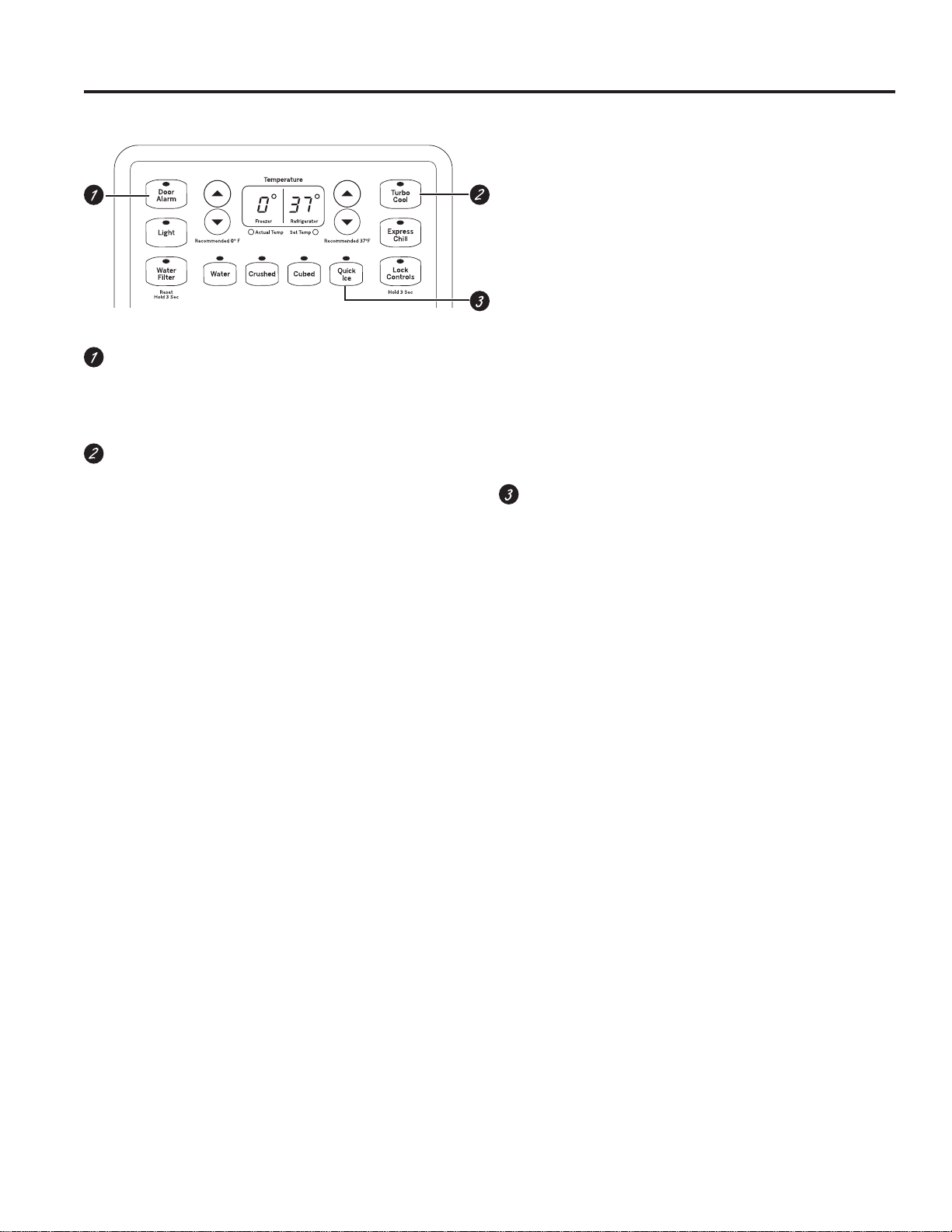
Not all features are on all models. Your controls may be similar to the following:
The temperature controls are preset in the factory at 37°F
(2.8°C) for the refrigerator compartment and 0°F (-17.8°C) for
the freezer compartment. Allow 24 hours for the temperature
to stabilize to the preset recommended settings.
The temperature controls can display both the SET
temperature as well as the actual temperature in the
refrigerator and freezer. The actual temperature may vary
slightly from the SET temperature based on usage and
operating environment.
Door Alarm (on some models)
To set the alarm, press this pad until the indicator
light comes on. This alarm will sound if either door is
open for more than 3 minutes. The light goes out and
the beeping stops when you close the door.
TurboCool
TM
(on some models)
TurboCool ™ rapidly cools the refrigerator
compartment in order to more quickly cool foods. Use
TurboCool ™ when adding a large amount of food
to the refrigerator compartment, putting away foods
after they have been sitting out at room temperature
or when putting away warm leftovers. It can also be
used if the refrigerator has been without power for an
extended period.
NOTES: The refrigerator temperature cannot be
changed during TurboCool™.
The freezer temperature is not affected during
TurboCool™.
When opening the refrigerator door during
TurboCool™, the fans will continue to run if they
have cycled on.
Quick Ice (on some models)
When you need ice in a hurry, press this pad to
speed up ice production. This will increase ice
production for the following 48 hours or until you
press the pad again.
USING THE REFRIGERATOR: Controls
49-1000105 Rev. 4 7
Water Filter Cartridge - XWFE (On some models.)
WARNING
To reduce the risk associated with choking, do not allow children under 3 years of age
to have access to small parts during the installation of this product. The disposable filter cartridge should be
replaced every 6 months at the rated capacity, or sooner if a noticeable reduction in flow rate occurs.
For the maximum benefit of your filtration system, Crosley recommends the use of GE Appliances-branded filters
only. Using GE Appliances-branded filters in Crosley refrigerators provides optimal performance and reliability. GE
Appliances filters meet rigorous industry standards for safety and quality that are important for products that are
filtering your water. Crosley has not qualified non-GE Appliances-branded filters for use in Crosley refrigerators and
there is no assurance that non-GE Appliances-branded filters meet Crosley standards for quality, performance and
reliability.
If you have questions, or to order additional filter cartridges, visit our website at gewaterfilters.com or call GE
Appliances Parts and Accessories, 877.959.8688.
USING THE REFRIGERATOR: Water Filter Cartridge - XWFE
Water Filter Cartridge
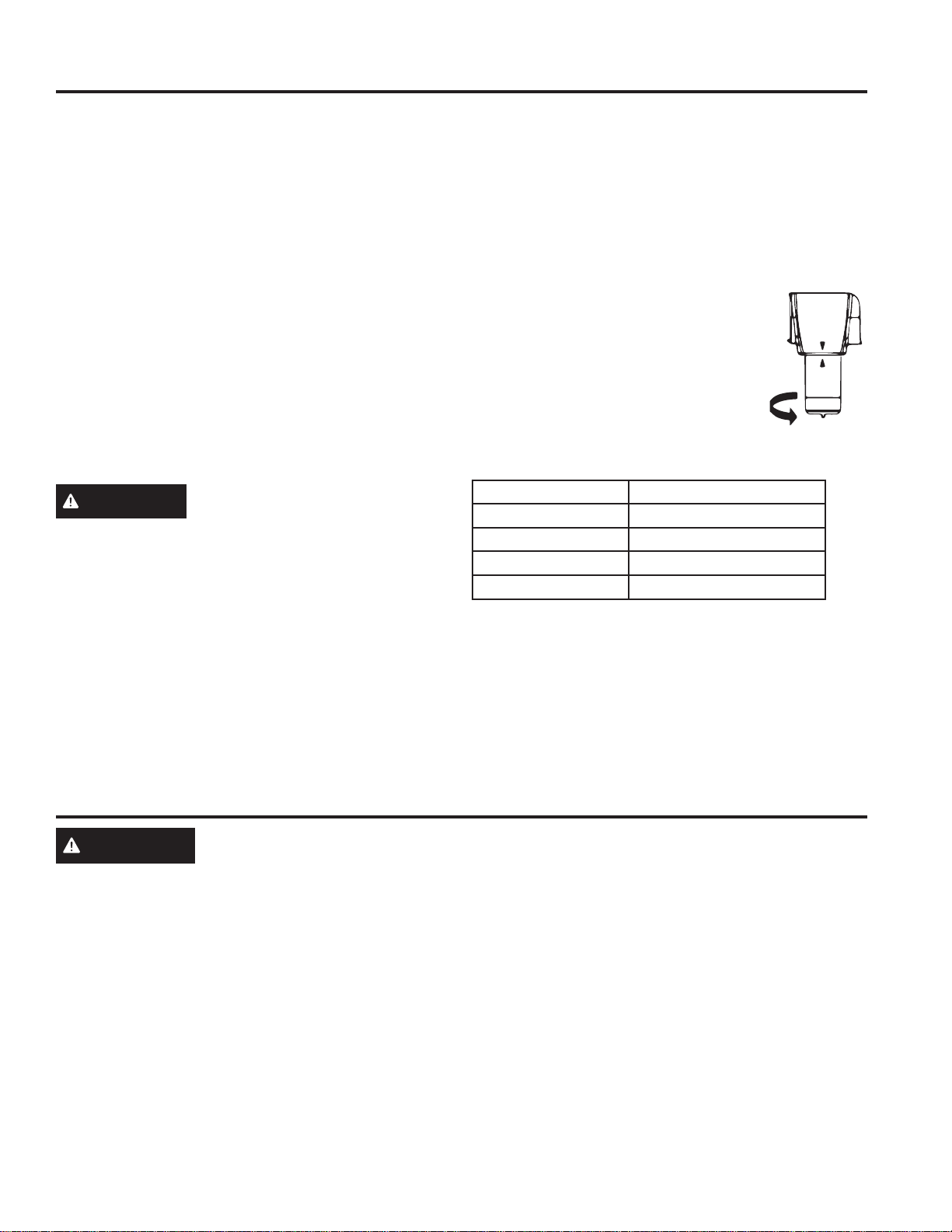
The water filter cartridge holder is located in the back
upper-right corner of the refrigerator compartment.
When to Replace the Filter
If there is a replacement indicator light for the water filter
cartridge on the dispenser, a red light will start blinking to
tell you that you need to replace the filter soon. For
models that don’t have the indicator light, the filter
cartridge should be replaced every six months, or earlier
if the flow of water to the dispenser or icemaker
decreases.
Removing the Filter
If you are replacing the filter, first remove the previous
one by gently grasping the filter and slowly turning it to
the left, about a ¼ turn. The filter should automatically
release itself when you have rotated it far enough to the
left. A small amount of water may drip down.
CAUTION
If air has been trapped in the system,
the filter cartridge may be ejected as it is removed. Use
caution when removing.
Filter Bypass Plug
To reduce the risk of property damage due to water
leakage, you MUST use the filter bypass plug when a
replacement filter cartridge is not available. Some models
do not come equipped with the filter bypass plug. To
obtain a free bypass plug, call 800-GECARES. In
Canada, call 800.561.3344. The dispenser and icemaker
will not operate without either the filter or bypass plug
installed. The bypass plug is installed in the same way as
a filter cartridge.
Installing the Filter Cartridge in a Side by
Side Refrigerator
1. Line up the arrow on the filter with the arrow on the
filter cartridge holder. Gently push the top of the new
filter up inside the holder.
2. Slowly turn the filter to the right until it stops. DO
NOT OVERTIGHTEN. As you turn the filter, it will
automatically raise itself into position. The filter will
move about a ¼ turn or 90 degrees.
3. Run water from the dispenser for 2 gallons (7.6 liters)
or approximately 5 minutes to clear
the system. Water may spurt out and
air bubbles may be visible during this
process.
4. Press and hold the WATER FILTER
pad (only on select models) on the
dispenser for three seconds.
Service Flow 0.5 gpm (1.89 lpm)
Water Supply Potable Water
Water Pressure 25-120 psi (172-827 kPa)
Water Temperature 33°F-100°F (0.6°C-38°C)
Capacity 170 gallons (643.5 liters)
Sign-up for TEXT REMINDERS by texting REPLACE to
70543.
Application Guidelines/Water Supply
49-1000105 Rev. 48
Not all features are on all models.
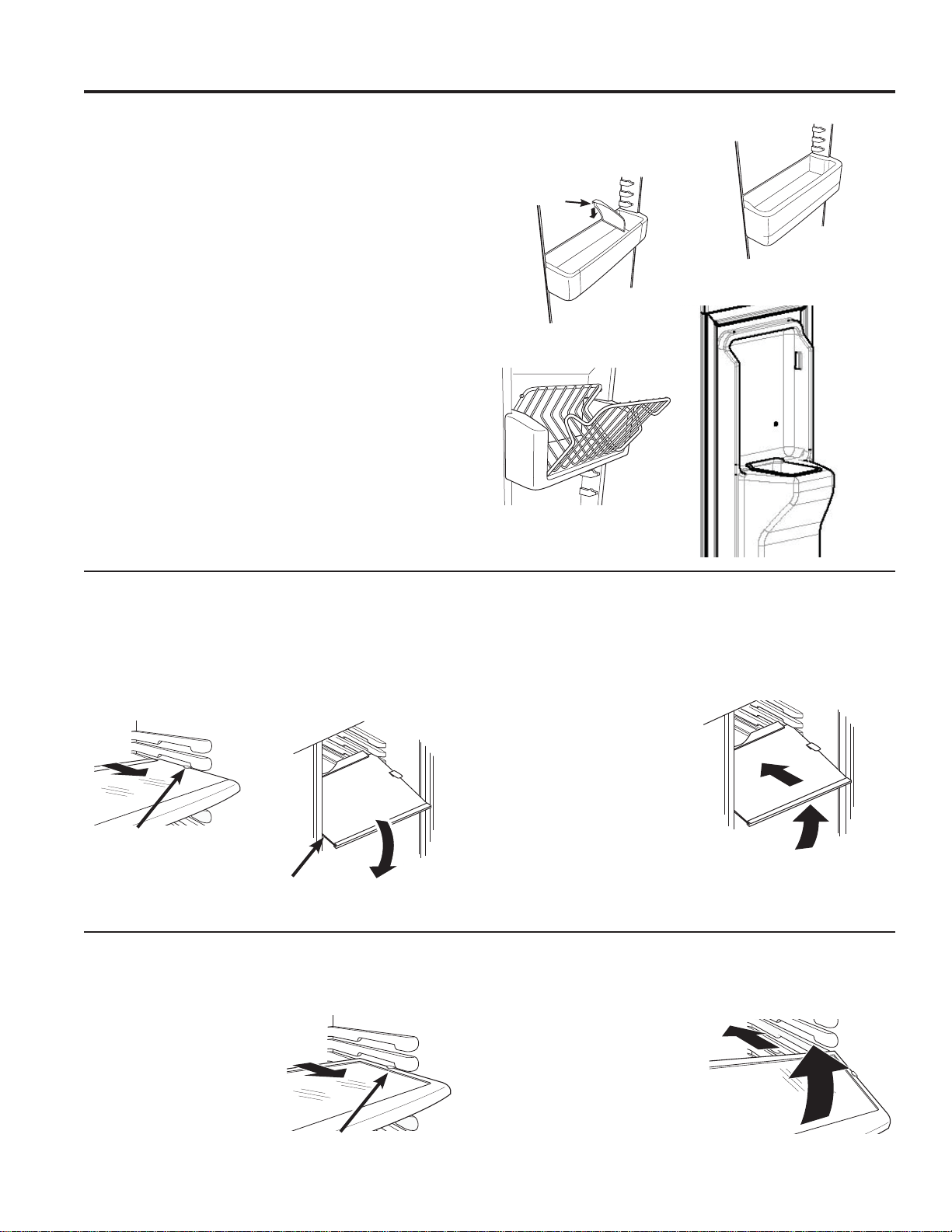
Refrigerator Door Bins and Freezer Door Tilt-Out Bins
Large Bins
The larger refrigerator door bins and freezer tilt-out door
bins are adjustable.
To remove: Lift the front of the bin straight up, then lift
up and out.
To replace or relocate: Engage the back side of the bin
in the molded supports of the door. Then push down on
the front of the bin. Bin will lock in place.
Small Bins
To remove: Lift the front of the bin straight up then out.
To replace: Position the bin above the rectangular
molded supports on the door. Then slide the bin down
onto the support to lock it in place.
The snugger helps prevent tipping, spilling or sliding of
small items stored on the door shelf. Place a finger on
either side of the snugger near the rear and move it back
and forth to fit your needs.
NOTE: Be careful when placing items in the top bin. Make
sure that items do not block or fall into the ice chute.
Shelves and Bins
Refrigerator bin
Freezer tilt-out bin
Snugger
Freezer bin
Ice Chute
Edge-to-Edge Shelf
To remove: With door opened at an angle greater than
90°, slide the shelf out until it reaches the stop tab. Press
down on the tab and slide the shelf out until it reaches
the shelf’s back trim. While keeping the left side of the
shelf in contact with the cabinet, pull the shelf down and
forward toward the left to remove.
To replace or relocate: With door opened at an angle
greater than 90°, align the shelf’s back trim against the
VKHOIVXSSRUW.HHSLQJWKHOHIWVLGHDJDLQVWWKHFDELQHW
slowly lift and gently push the shelf back into place.
Reposition the shelf past the stop tabs. Make sure you
push the shelves all the way back in before you close
the door.
Slide-Out Spillproof Shelf
The slide-out spillproof shelf allows you to reach items
stored behind others. The special edges are designed
to help prevent spills from
dripping to lower shelves.
To remove: Slide the shelf
out until it reaches the stop,
then press down on the tab
and slide the shelf straight
out.
To replace or relocate: Line the shelf up with the supports
and slide it into place. The shelf can be repositioned when
the door is at 90° or more. To
reposition the shelf, slide the
shelf past the stops and angle
downward. Slide shelf down
to the desired position, line up
with the supports and slide into
place.
Make sure you push the shelves all the way back in before
you close the door.
Press tab and pull shelf
forward to remove
USING THE REFRIGERATOR: Shelves and Bins
Press tab and pull shelf
forward
With left side stays against
the cabinet as you pull down
and to the left to remove
49-1000105 Rev. 4 9
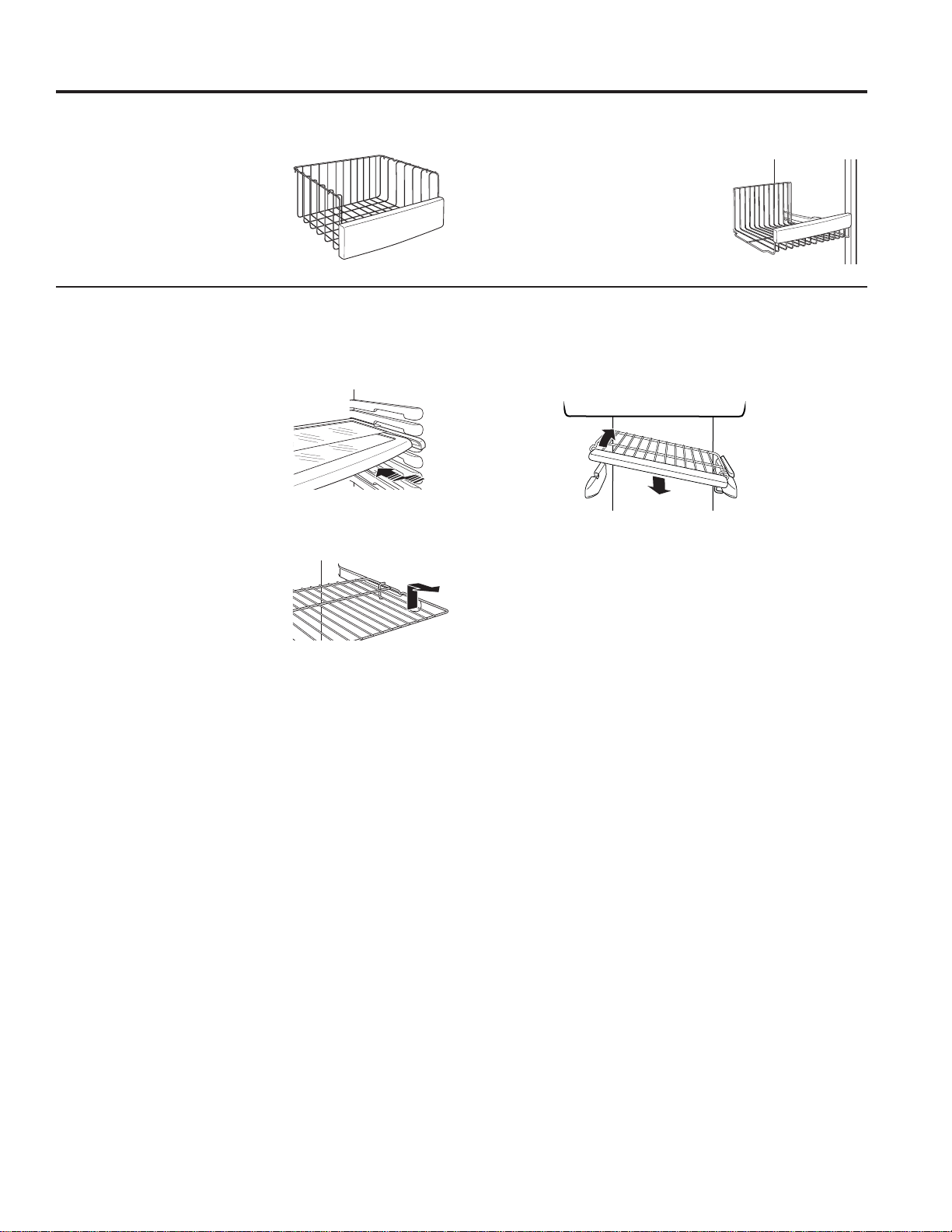
Freezer Baskets (on some models)
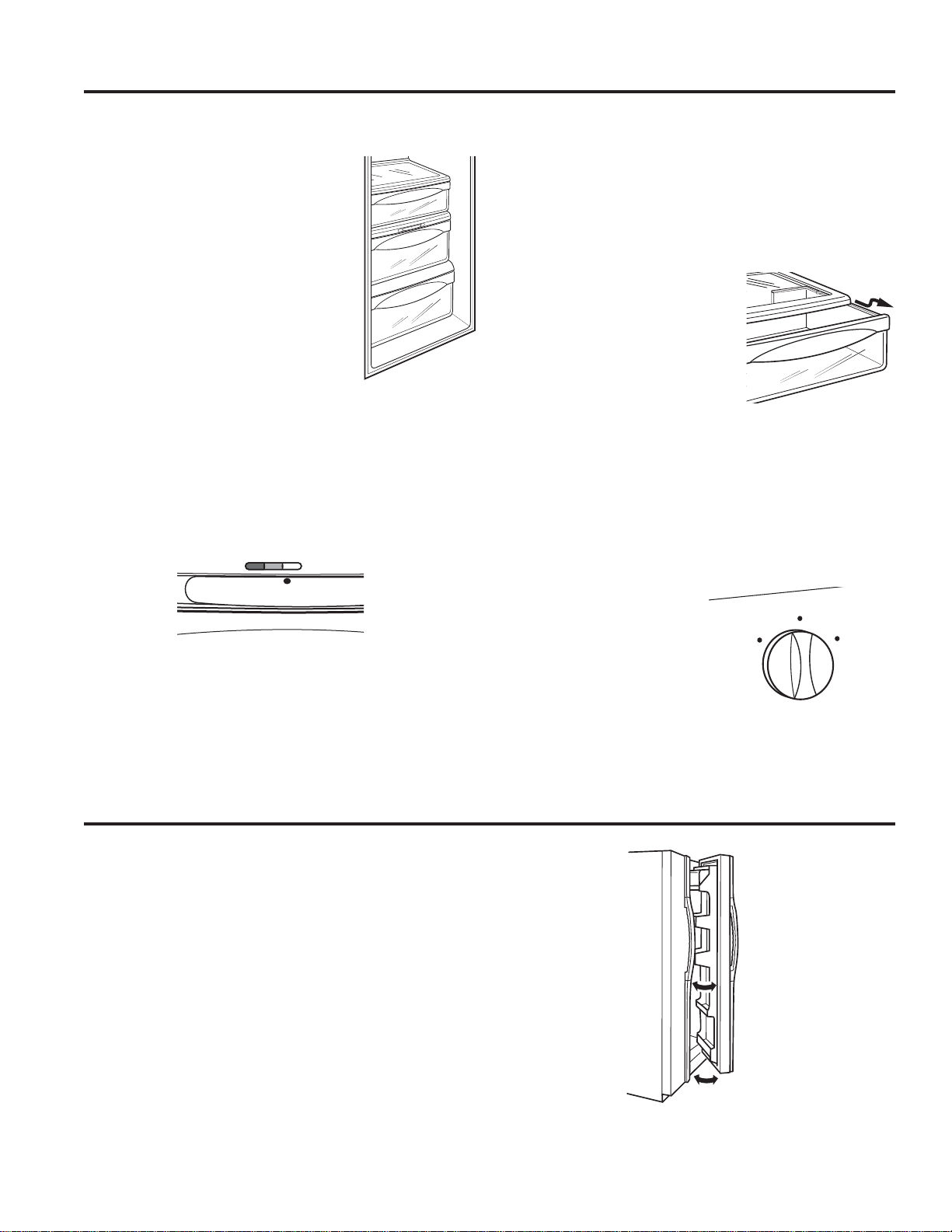
To remove, slide out to the stop position, lift the front
past the stop position, and slide
out.
Make sure you push the baskets
all the way back in before you
close the door.
Freezer Baskets (on some models)
To remove, push the basket all the way to the back of
the freezer. Lift up until the back
pins are disengaged. Lift the entire
basket up and pull out.
Make sure you push the baskets all
the way back in before you close the
door.
USING THE REFRIGERATOR: Shelves and Bins
Not all features are on all models.
QuickSpace™ Shelf (on some models)
This shelf splits in half and slides under itself for storage
of tall items on the shelf below.
This shelf can be removed and
replaced or relocated just like
Slide-Out Spillproof Shelves.
On some models, this shelf
can not be used in the lowest
position.
Slide-Out Freezer Shelves
To remove, slide out to the stop
position, lift the front past the stop
position, and slide out from rib.
Make sure you push the shelves
all the way back in before you
close the door.
Fixed Freezer Shelves
To remove, lift the shelf up at the left side and then
bring the shelf out.
NOTE FOR DISPENSER MODELS: In order to take full
advantage of the tilt-out ice bin (on some models), only
store items on the shelf below the ice bin that are no
taller than the lowest point on the bin.
Shelves and Bins
49-1000105 Rev. 410
Refrigerator Doors (on some models)
The refrigerator doors may feel different than the ones
you are used to. The special door opening/closing
feature makes sure the doors close all the way and are
securely sealed.
When opening and closing the door you will notice a stop
position. If the door is opened past this stop point, the
door will remain open to allow you to load and unload
food more easily. When the door is only partially open, it
will automatically close.
The resistance you feel at the stop position will be
reduced as the door is loaded with food.
Doors
When the door is only partially open,
it will automatically close.
Beyond this stop the door will stay open.
USING THE REFRIGERATOR: Crispers and Pans/Doors
Not all features are on all models.
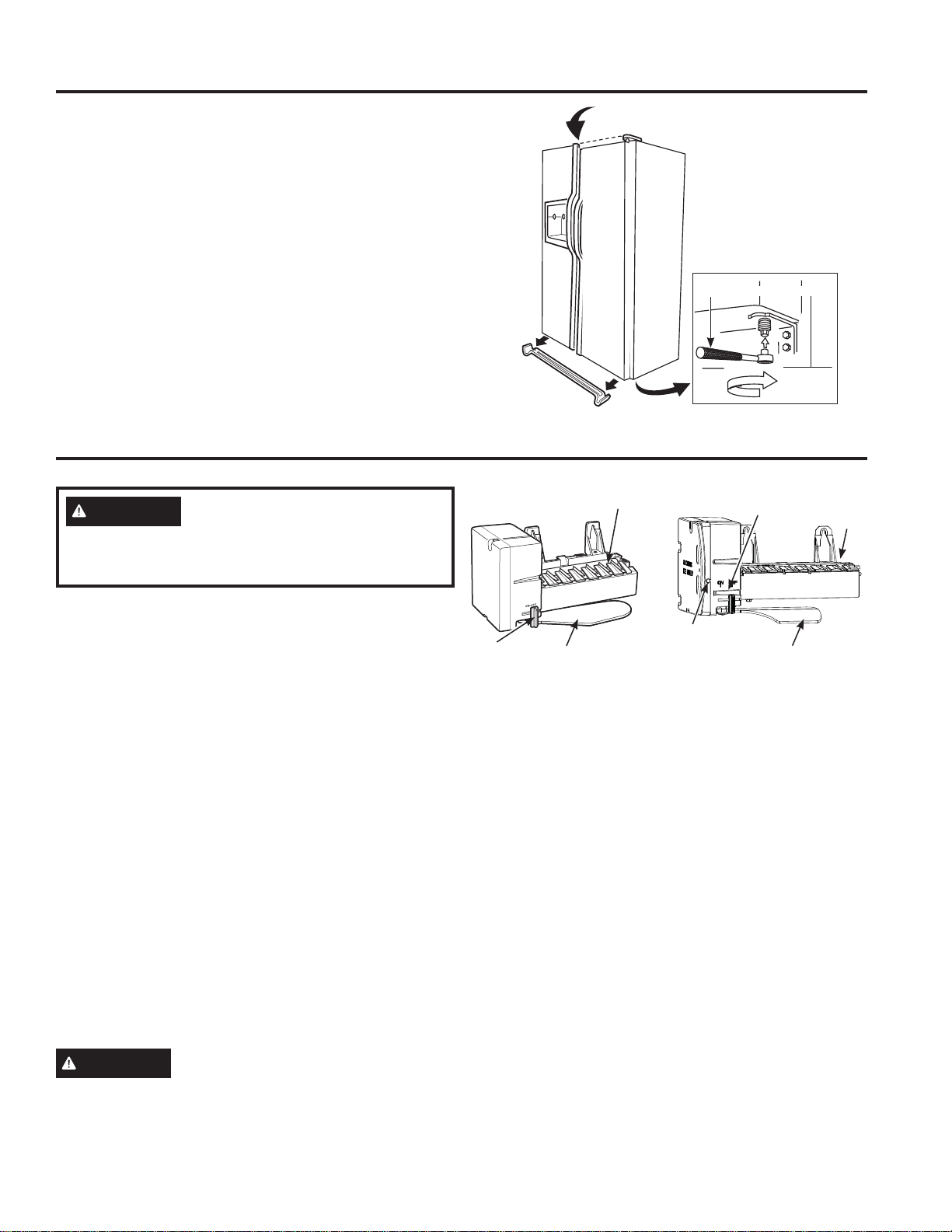
Fruit and Vegetable Crispers
Excess water that may accumulate in
the bottom of the drawers should be
wiped dry.
On some models, the bottom drawer
has full extension slides that allow full
access to the drawer.
Adjustable Humidity Crispers
Slide the control all the way to the HI setting to provide
high humidity recommended for most vegetables.
Slide the control all the way to the LO setting to provide
lower humidity levels recommended for most fruits.
Crisper Removal
Crispers can easily be removed by pulling the drawer
straight out and lifting the drawer up and over the stop
location.
If the door prevents you from taking out the drawers,
first try to remove the door bins. If this does not offer
enough clearance, the refrigerator
will need to be rolled forward until
the door opens enough to slide the
drawers out. In some cases, when
you roll the refrigerator out, you
will need to move the refrigerator
to the left or right as you roll it out.
Convertible Deli Pan (on some models)
The convertible deli pan has its own cold air duct to
allow a stream of cold air from the freezer compartment
or refrigerator compartment to flow to the pan.
The variable temperature control regulates the air flow
IURPWKH&OLPDWH.HHSHU
Set the control to the coldest setting to store fresh
meats.
Set the control to cold to
convert the panto normal
refrigerator temperature
and provide extra vegetable
storage space. The cold air
duct is turned off. Variable
settings between these
extremes can be selected.
Crispers and Pans
HI
LO
C
O
L
D
C
O
L
D
E
S
T
49-1000105 Rev. 4 11
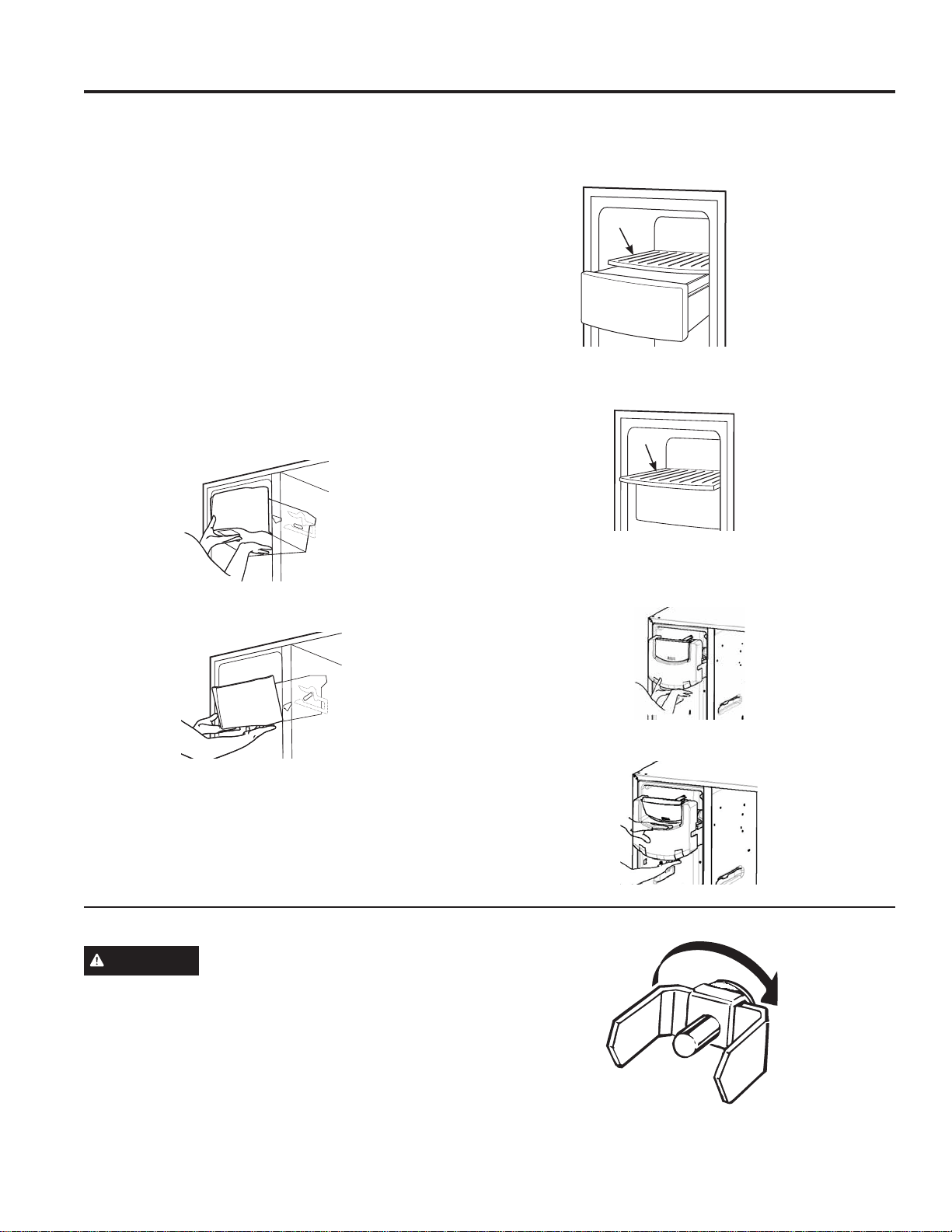
Door Alignment
If doors are uneven, adjust the refrigerator door.
To remove the base grille, open the doors, remove the
screw at each end of the base grille and then pull the
grille straight out.
8VLQJD´VRFNHWZUHQFKWXUQWKHGRRUDGMXVWLQJ
VFUHZWRWKHULJKWWRUDLVHWKHGRRUWRWKHOHIWWR
lower it. (A nylon plug, imbedded in the threads of the
pin, prevents the pin from turning unless a wrench is
used.)
2. After one or two turns of the wrench, open and close
the refrigerator door and check the alignment at the
top of the doors.
Doors
USING THE REFRIGERATOR: Doors/Automatic Icemaker
´6RFNHW:UHQFK
Raise
Not all features are on all models.
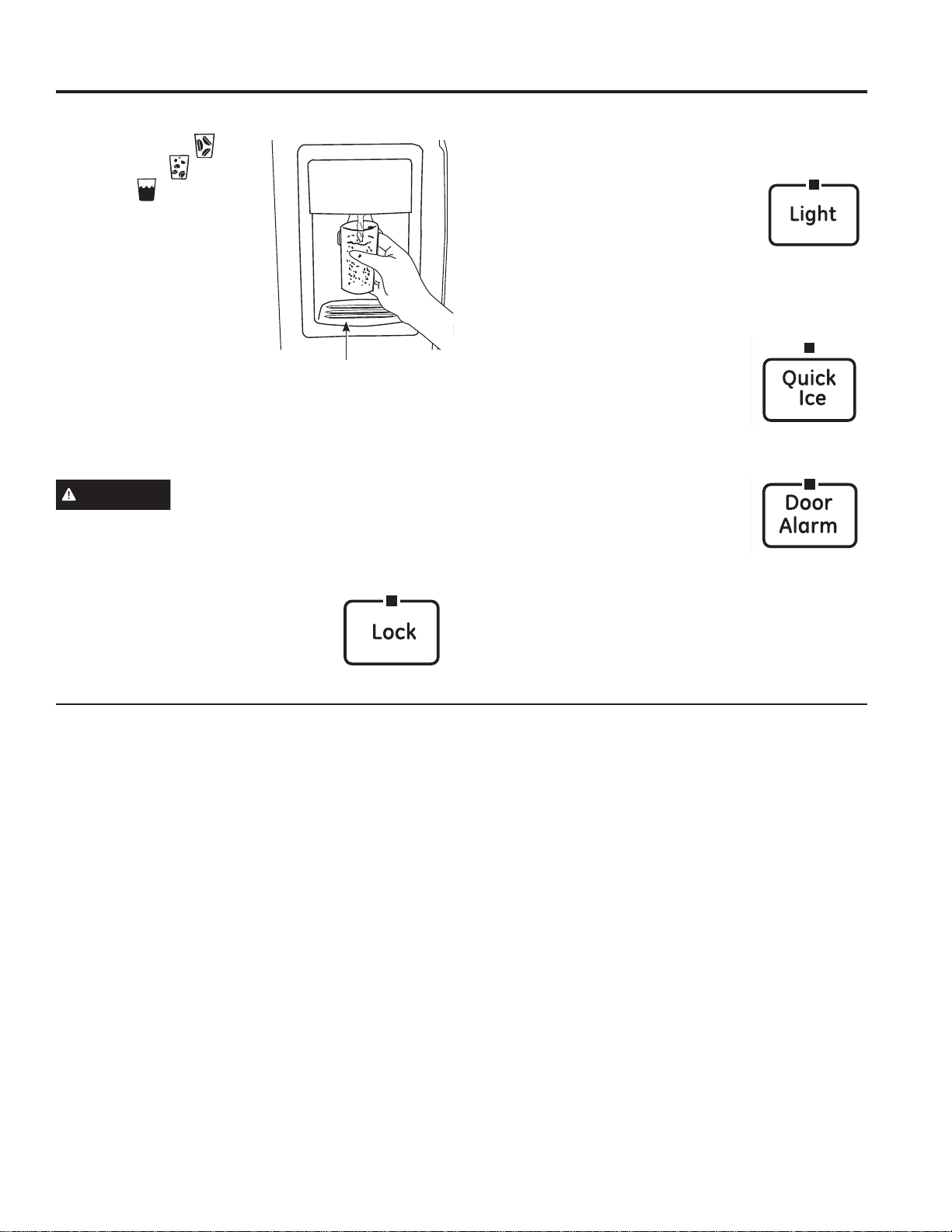
Automatic Icemaker
The icemaker will produce seven cubes per cycle—
approximately 100–130 cubes in a 24-hour period,
depending on freezer compartment temperature, room
temperature, number of door openings and other use
conditions.
If the refrigerator is operated before the water connection
is made to the icemaker, set the power switch in the OFF
position.
When the refrigerator has been connected to the water
supply, set the power switch to the ON position.
The icemaker will fill with water when it cools to 15°F
(–10°C). A newly installed refrigerator may take 12 to 24
hours to begin making ice cubes.
You will hear a buzzing sound each time the icemaker fills
with water.
Throw away the first few batches of ice to allow the water
line to clear.
Be sure nothing interferes with the sweep of the feeler arm.
When the bin fills to the level of the feeler arm, the
icemaker will stop producing ice. It is normal for several
cubes to be joined together.
CAUTION
Avoid contact with the moving parts of
the ejector mechanism, or with the heating element
(located on the bottom of the ice maker) that releases the
cubes. Do not place fingers or hands on the automatic ice
making mechanism while the refrigerator is plugged in.
If ice is not used frequently, old ice cubes will become
cloudy, taste stale and shrink.
Special note about dispenser models:
Ŷ6RPHPRGHOVKDYHDWLOWRXWLFHELQ7KHELQFDQEH
tilted out as shown in the illustrations, and it will hold
itself up while you take ice out or turn the icemaker
power switch on and off. Be sure to put the bin back in
place before closing the door.
ŶTo restore your ice level from an empty bucket
stage, the following steps are recommended:
1. 12 hours after the first batch of ice has fallen into the
bin, dispense 3 to 4 cubes.
2. After an additional 6 hours, dispense 3 to 4 cubes
again.
These steps will restore your ice level in the shortest
amount of time.
NOTE:
In homes with lower than average water pressure, you
may hear the icemaker cycle multiple times when making
one batch of ice.
Automatic Icemaker
Icemaker
Feeler Arm
Power
Switch
(on some models)
(on some models)
Icemaker
Feeler Arm
Switch
Green
Power Light
WARNING
Connect to potable water supply
only.
A cold water supply is required for automatic icemaker
operation. The water pressure must be between 40
and 120 psi (275-827 kilopascals).
49-1000105 Rev. 412
Accessing Ice and Reaching the Power Switch on Dispenser Models
There are two types of ice storage bins on dispenser
models. One has a shelf above the bin, the other does
not.
Special note for models with tilt-out ice bin:
Ŷ7KHVHPRGHOVKDYHDWLOWRXWLFHELQ7KHELQFDQEH
tilted out as shown in the illustrations, and it will hold
itself up while you take ice out or turn the icemaker
power switch on and off. Be sure to put the bin back in
place before closing the door.
NOTE: In order to take full advantage of the tilt-out ice
bin, only store items on the shelf below the ice bin that
are no taller than the lowest point on the bin.
Models with tilt out ice bin
To access ice and reach the icemaker power switch:
1. Lift the bin, then pull it forward until the bin stops.
2. Lower the bin to access ice or reach the power switch.
Models with a shelf above the ice bin
To access ice, pull the bin forward.
To reach the power switch, pull the shelf straight out.
Always be sure to replace the shelf.
On some models, to access ice or reach the power
switch:
1. Pull the bin forward until the bin stops.
2. Lower the bin to access ice or reach the power switch.
Removing Ice Bin (dispenser models)
CAUTION
The ice bin is heavy when full.
Set the power switch to the OFF position before
removing the bin.
When replacing the bin, be sure to press it firmly into
place. If it does not go all the way back, remove it and
rotate the drive mechanism 1/4 turn. Then push the bin
back again.
Automatic Icemaker
USING THE REFRIGERATOR: Automatic Icemaker
Shelf
Ice Bin
Shelf
Rotate
Drive
Mechanism
Dispenser Models only
49-1000105 Rev. 4 13
USING THE REFRIGERATOR: Ice and Water Dispenser
Using the Dispenser
Select CUBED ICE ,
CRUSHED ICE
or WATER .
Press the glass gently against
the top of the dispenser
cradle.
The spill shelf is not self-
draining. To reduce water
spotting, the shelf and its grille
should be cleaned regularly.
If no water is dispensed
when the refrigerator is first
installed, there may be air in the water line system.
Press the dispenser arm for at least two minutes to
remove trapped air from the water line and to fill the
water system. To flush out impurities in the water line,
throw away the first six glassfuls of water.
CAUTION
Laceration Hazard
Ŷ1HYHUSXWILQJHUVRUDQ\RWKHUREMHFWLQWRLFHFUXVKHU
discharge opening. Doing so can result in contacting
the ice crushing blades and lead to serious injury or
amputation
Ŷ8VHDVWXUG\JODVVZKHQGLVSHQVLQJ
ice. A delicate glass may break and
result in personal injury.
Locking the Dispenser
3UHVVWKH/2&.SDGIRUVHFRQGVWR
lock the dispenser and control panel. To
unlock, press and hold the pad again for
3 seconds.
Dispenser Light
This pad turns the light in the dispenser on and off.
The light also comes on when the dispenser cradle is
pressed. For models with a bulb, if the light burns out,
it should be replaced with a 6 watt
12V maximum bulb. For LED models,
contact Factory Service.
Quick Ice (on some models)
When you need ice in a hurry, press
this pad to speed up ice production. This will increase
ice production for the following 48
hours or until you press the pad again.
Door Alarm (on some models)
To set the alarm, press this pad until
the indicator light comes on. This
alarm will sound if either door is open for more than
3 minutes. The light goes out and the beeping stops
when you close the door.
Ice and Water Dispenser (on some models.)
Important Facts About Your Dispenser
Ŷ Do not add ice from trays or bags to the storage
drawer. It may not crush or dispense well.
Ŷ Avoid overfilling glass with ice and use of narrow
glasses. Backed-up ice can jam the chute or cause
the door in the chute to freeze shut. If ice is blocking
the chute, poke it through with a wooden spoon.
Ŷ Beverages and foods should not be quick-chilled
in the ice storage drawer. Cans, bottles or food
packages in the storage drawer may cause the
icemaker or auger to jam.
Ŷ To keep dispensed ice from missing the glass, put
the glass close to, but not touching, the dispenser
opening.
Ŷ Some crushed ice may be dispensed even though
you selected CUBED ICE. This happens occasionally
when a few cubes accidentally get directed to the
crusher.
Ŷ After crushed ice is dispensed, some water may drip
from the chute.
Ŷ Sometimes a small mound of snow will form on the
door in the ice chute. This condition is normal and
usually occurs when you have dispensed crushed ice
repeatedly. The snow will eventually evaporate.
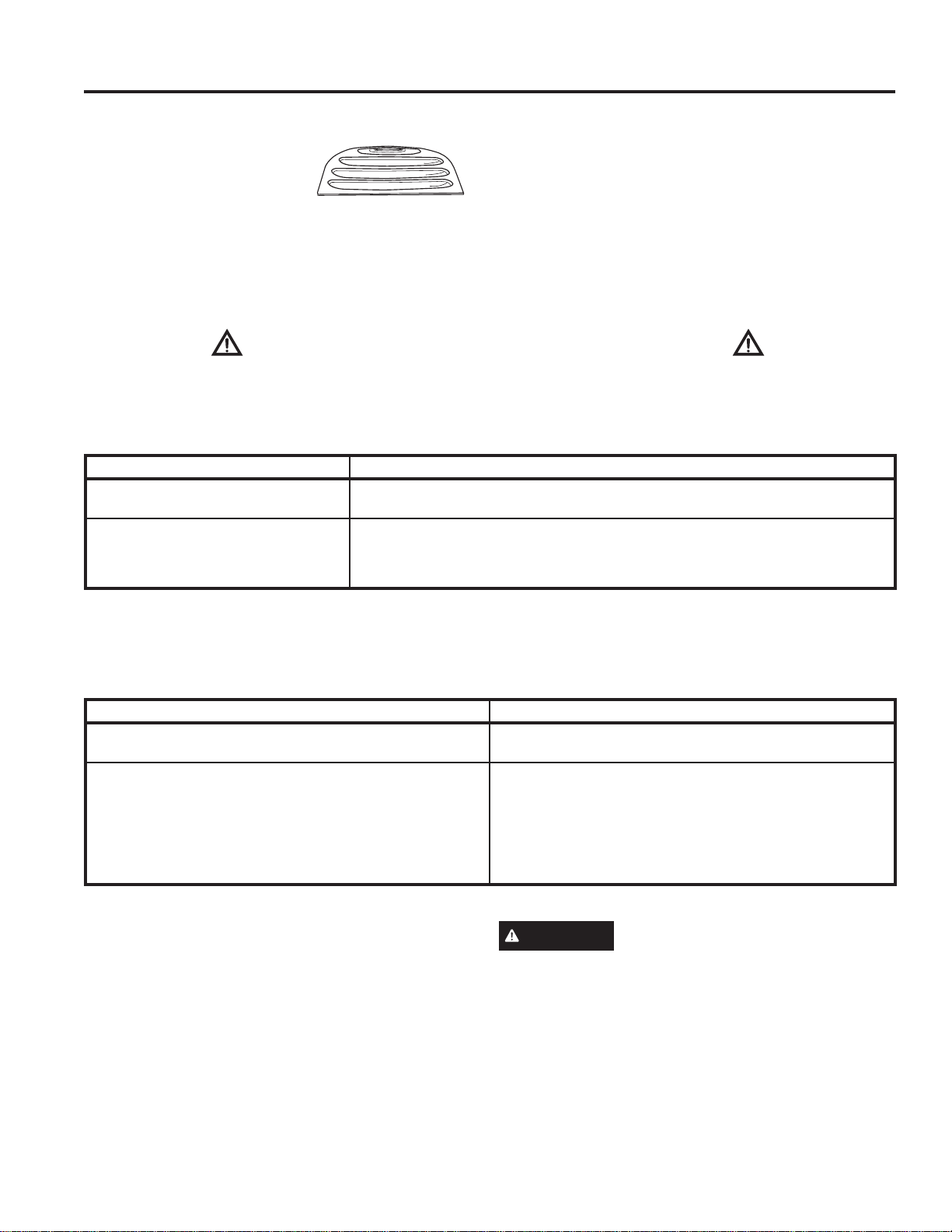
Spill Shelf
49-1000105 Rev. 414
Care and Cleaning
Cleaning the Outside
The dispenser drip area, (on
some models) beneath the
grille, should be wiped dry.
Water left in this area may
leave deposits. Remove the
deposits by adding undiluted vinegar to the well. Soak
until the deposits disappear or become loose enough to
rinse away.
The dispenser cradle (on some models). Before
cleaning, lock the dispenser by pressing and holding the
LOCK pad for 3 seconds. Clean with warm water and
baking soda solution—about a tablespoon (15 ml) of
baking soda to a quart (1 l) of water. Rinse thoroughly
and wipe dry.
CARE AND CLEANING
Cleaning the Inside
To help prevent odors, leave an open box of baking
soda in the refrigerator and freezer compartments.
Unplug the refrigerator before cleaning. If this is not
practical, wring excess moisture out of sponge or cloth
when cleaning around switches, lights or controls.
Use warm water and baking soda solution— about a
tablespoon (15 ml) of baking soda to a quart (1 liter) of
water. This both cleans and neutralizes odors. Rinse and
wipe dry.
Use of any cleaning solution other than that which
is recommended, especially those that contain
petroleum distillates, can crack or damage the
interior of the refrigerator.
CAUTION
Do not clean glass shelves or covers
with warm water when they are cold. Glass shelves and
covers may break if exposed to sudden temperature
changes or impact such as bumping or dropping.
Tempered glass is designed to shatter into many small
pieces if it breaks.
Do not wash any plastic refrigerator parts in the
dishwasher.
The chill/thaw tray is dishwasher safe.
DO USE DO NOT USE
Soft, clean cloth or sponge Abrasive cloths, scrubbing sponges (with or without
soap), scouring or steel wool pads
Mild detergent mixed with warm water
$SSURYHGVWDLQOHVVVWHHOFOHDQHUV9LVLWWKH*(
Appliances parts store for approved stainless steel
cleaners: GEApplianceparts.com or call 877.959.8688
&OHDQHUVZLWKR[DOLFDFLGVXFKDV%DU.HHSHUV)ULHQG6RIW
Cleanser™ can be used to remove surface rust, tarnish
and small blemishes on stainless steel surfaces only.
Abrasive powders or sprays
Window Sprays or Ammonia
Citrus or plant oil-based cleaners
Acidic or vinegar-based cleaners
Oven cleaners
Cleaners containing acetone (propanone)
Any cleaner with WARNING about plastic contact
NOTE: DO NOT allow stainless steel cleaner to come in contact with any plastic parts such as trim pieces, handle
hardware and liners. If unintentional contact of cleaners with plastic parts does occur, clean plastic part with a
sponge and mild detergent mixed with warm water.
STAINLESS STEEL - Outside surfaces, door handles, and trim
DO USE DO NOT USE
Soft, clean cloth or sponge
Microfiber cloth
Abrasive cloths, paper towels, scrubbing sponges (with or without soap),
scouring or steel wool pads
Mild detergent mixed with warm
water
Abrasive powders, liquids, or sprays
Window sprays, ammonia, or bleach
Citrus or plant oil-based cleaners
Acidic or vinegar-based cleaners
Oven cleaners
Alkaline cleaners
Stainless steel cleaners
DO NOT use Stainless Steel cleaners on the door surfaces.
IMPORTANT: The use of incorrect products may damage the outer finish of Fingerprint Resistant Stainless and
Black Stainless models. Please follow these instructions and use only the appropriate items below to clean your
appliance surfaces.
Ɣ&OHDQLQWHULRUH[WHULRUVXUIDFHVZLWKZDUPZDWHUPLOGVRDSRUGHWHUJHQWDQGDVRIWRUPLFURILEHUFORWKWRDYRLGGDPDJH
Ɣ:LSHWKHDSSOLDQFHVXUIDFHGU\ZLWKDVRIWFOHDQFORWKRUPLFURILEHUWRZHOWRDYRLGVWUHDNLQJRUZDWHUVSRWWLQJ
FINGERPRINT RESISTANT STAINLESS STEEL*, PAINTED - Outside surfaces,
door handles, and trim
(DVLO\ZLSHDZD\VPXGJHVDQG¿QJHUSULQWV

49-1000105 Rev. 4 15
Cleaning the Inside
To help prevent odors, leave an open box of baking
soda in the refrigerator and freezer compartments.
Unplug the refrigerator before cleaning. If this is not
practical, wring excess moisture out of sponge or cloth
when cleaning around switches, lights or controls.
Use warm water and baking soda solution— about a
tablespoon (15 ml) of baking soda to a quart (1 liter) of
water. This both cleans and neutralizes odors. Rinse and
wipe dry.
Use of any cleaning solution other than that which
is recommended, especially those that contain
petroleum distillates, can crack or damage the
interior of the refrigerator.
CAUTION
Do not clean glass shelves or covers
with warm water when they are cold. Glass shelves and
covers may break if exposed to sudden temperature
changes or impact such as bumping or dropping.
Tempered glass is designed to shatter into many small
pieces if it breaks.
Do not wash any plastic refrigerator parts in the
dishwasher.
The chill/thaw tray is dishwasher safe.
Behind the Refrigerator
Be careful when moving the refrigerator away from
the wall. All types of floor coverings can be damaged,
particularly cushioned coverings and those with
embossed surfaces.
Pull the refrigerator straight out and return it to position
by pushing it straight in. Moving the refrigerator in a side
direction may result in damage to the floor covering or
refrigerator.
When pushing the refrigerator back, make sure you
don’t roll over the power cord or icemaker supply line (on
some models).
CARE AND CLEANING
Care and Cleaning
Preparing for Vacation
For long vacations or absences, remove food and
unplug the refrigerator. Clean the interior with a baking
soda solution of one tablespoon (15 ml) of baking soda
to one quart (1 liter) of water. Leave the doors open.
Set the icemaker power switch to the OFF position and
shut off the water supply to the refrigerator.
If the temperature can drop below freezing, have a
qualified servicer drain the water supply system (on
some models) to prevent serious property damage due
to flooding.
Preparing to Move
Secure all loose items such as shelves and drawers by
taping them securely in place to prevent damage.
When using a hand truck to move the refrigerator, do not
rest the front or back of the refrigerator against the hand
truck. This could damage the refrigerator. Handle only
from the sides of the refrigerator.
Be sure the refrigerator stays in an upright position
during moving.
49-1000105 Rev. 416
Care and Cleaning
Replacing the lights on models with LED lighting (on some models)
Setting the controls to OFF does not remove power to
the light circuit. Not all features are on all models.
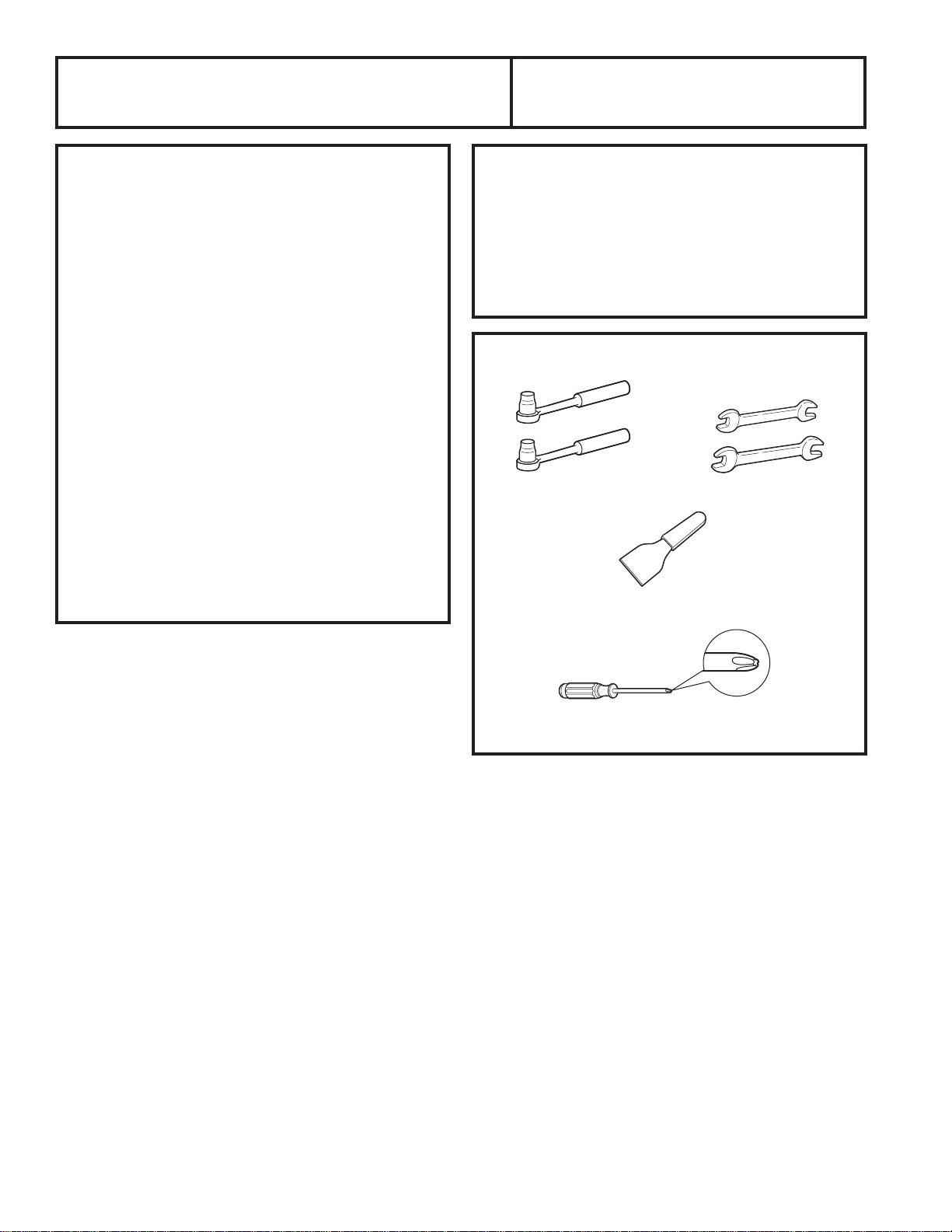
Refrigerator Compartment
There is an LED lighting display in the top and sides of
the refrigerator compartment and in the rear and side of
the freezer compartment on some models.
If this assembly needs to be replaced, call GE
Appliances Service at 1.800.432.2737 in the United
States or 1.800.561.3344 in Canada.
CARE AND CLEANING
LED
Lighting
Display
49-1000105 Rev. 4 17
INSTALLATION INSTRUCTIONS
Installation Instructions
Refrigerator Models
XSS23G, XSS25G
BEFORE YOU BEGIN
Read these instructions completely and
carefully.
•
IMPORTANT — Save these instructions
for local inspector’s use
•
IMPORTANT — Observe all governing
codes and ordinances.
• Note to Installer – Be sure to leave these
instructions with the Consumer.
• Note to Consumer –.HHSWKHVHLQVWUXFWLRQVIRU
future reference.
• Skill level – Installation of this appliance requires
basic mechanical skills.
• Completion time – Refrigerator Installation
30 minutes
Water Line Installation
30 minutes
• Proper installation is the responsibility of the
installer.
• Product failure due to improper installation is not
covered under the Warranty.
If the refrigerator has already been installed, remove
the base grille (see Step 2 in Moving the Refrigerator),
then skip to Step 5 in Installing the Refrigerator.
PREPARATION
WATER SUPPLY TO THE ICEMAKER
(on some models)
If the refrigerator has an icemaker, it will have to be
connected to a cold water line. A water supply kit is
available at extra cost from your dealer, by visiting our
Website at GEAppliances.com, or from Parts and
Accessories, 877.959.8688.
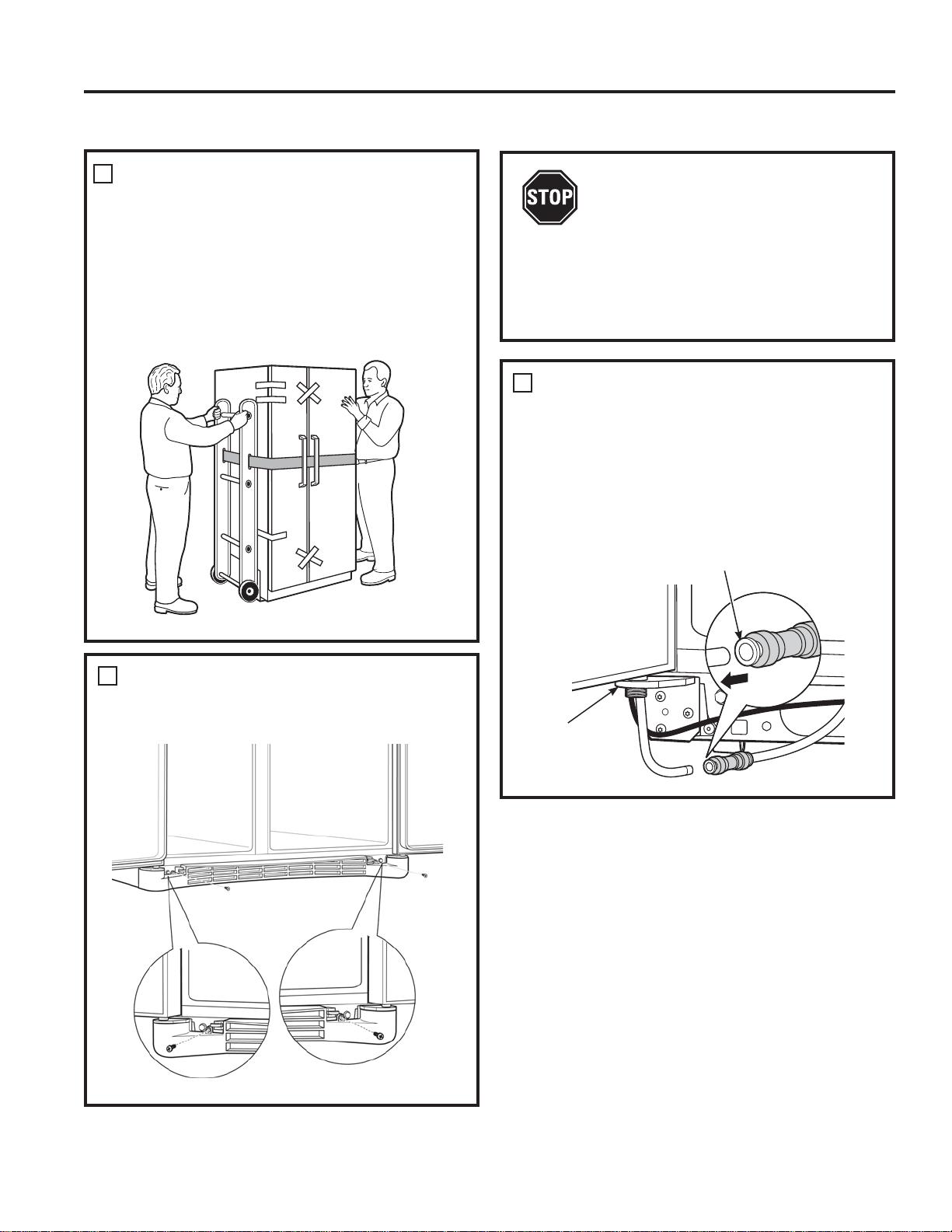
TOOLS YOU WILL NEED
Phillips Head Screwdriver
´DQG´6RFNHW ´DQG´:UHQFK
3ODVWLF3XWW\.QLIH
49-1000105 Rev. 418
Installation Instructions
INSTALLATION INSTRUCTIONS
MOVING THE REFRIGERATOR
LOADING THE REFRIGERATOR
ONTO A HAND TRUCK
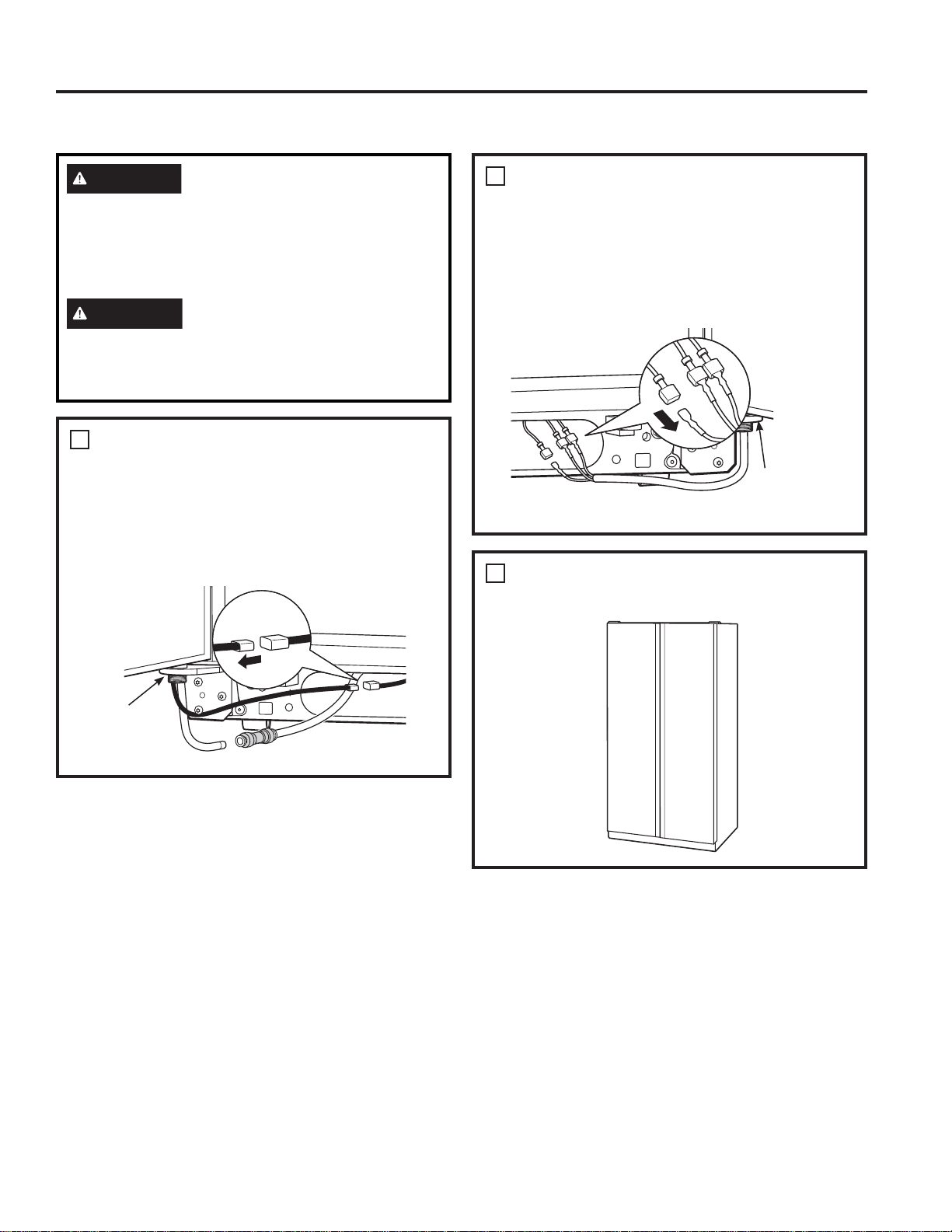
Leave all tape and door pads on doors until
the refrigerator is in its final location.
To move the refrigerator, use a padded
hand truck. Center the refrigerator on the
hand truck and secure the strap around the
refrigerator.
DO NOT OVERTIGHTEN THE STRAP.
1
REMOVE THE BASE GRILLE
Remove the grille by removing the two
Phillips head screws.
2
If the refrigerator must go through any
HQWUDQFHWKDWLVOHVVWKDQ´ZLGHWKH
doors must be removed. Proceed to
Step 3.
DO NOT remove the handles.
,IDOOHQWUDQFHVDUHPRUHWKDQ´ZLGH
skip to Installing the Refrigerator.
DISCONNECT THE WATER
COUPLING (on some models)
If the refrigerator has a water dispenser,
there is a water line from the cabinet into the
bottom hinge on the freezer door that must be
disconnected.
To disconnect, push in on the white collar of the
coupling and pull out the tubing.
White collar
Bottom
freezer
hinge
3
49-1000105 Rev. 4 19
INSTALLATION INSTRUCTIONS
Installation Instructions
MOVING THE REFRIGERATOR (Cont.)
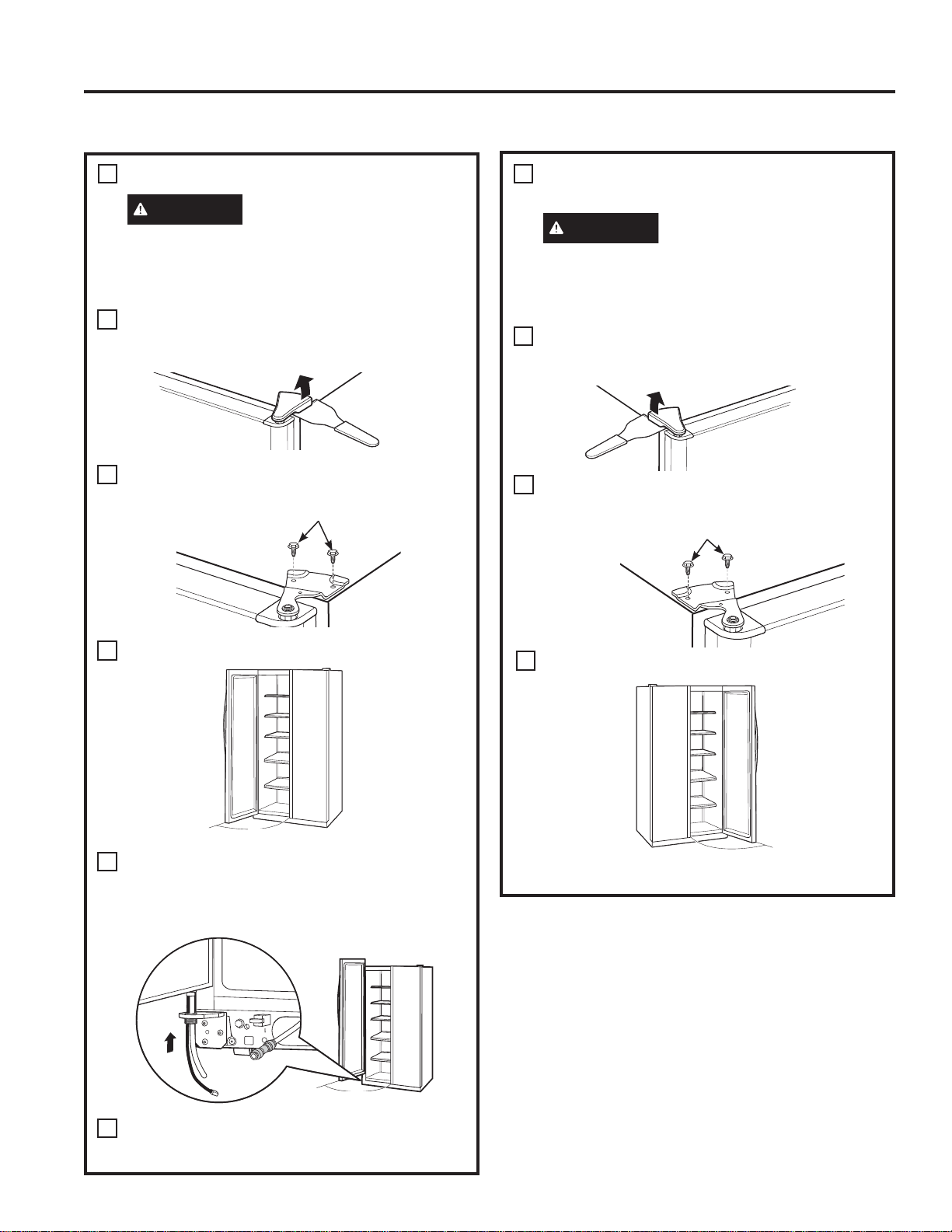
CAUTION
Lifting Hazard.
Single person lift can cause injury. Use assistance
when handling, moving or lifting the refrigerator
doors.
NOTE: When moving door, to prevent damage to
door and electronics carefully place the door in a
proper location.
WARNING
To reduce the risk of electric shock
or injury during installation, you must first unplug the
refrigerator before proceeding. Failure to follow these
instructions can result in electrical shock.
DISCONNECT THE POWER
COUPLING (on some models)
If the refrigerator has a water dispenser,
there is a power line (harness) from the cabinet
into the bottom hinge on the freezer door that
must be disconnected.
To disconnect, pull apart at the coupling.
4
Bottom
freezer
hinge
DISCONNECT THE ELECTRICAL
CONNECTORS (on some models)
If the refrigerator has a refreshment center,
there are electrical connectors (harnesses)
from the cabinet into the bottom hinge on the
refrigerator door that must be disconnected.
To disconnect, pull apart each connector.
5
Bottom
refrigerator
hinge
CLOSE THE FREEZER AND
REFRIGERATOR DOORS
6
49-1000105 Rev. 420
Installation Instructions
INSTALLATION INSTRUCTIONS
MOVING THE REFRIGERATOR (Cont.)
D
E
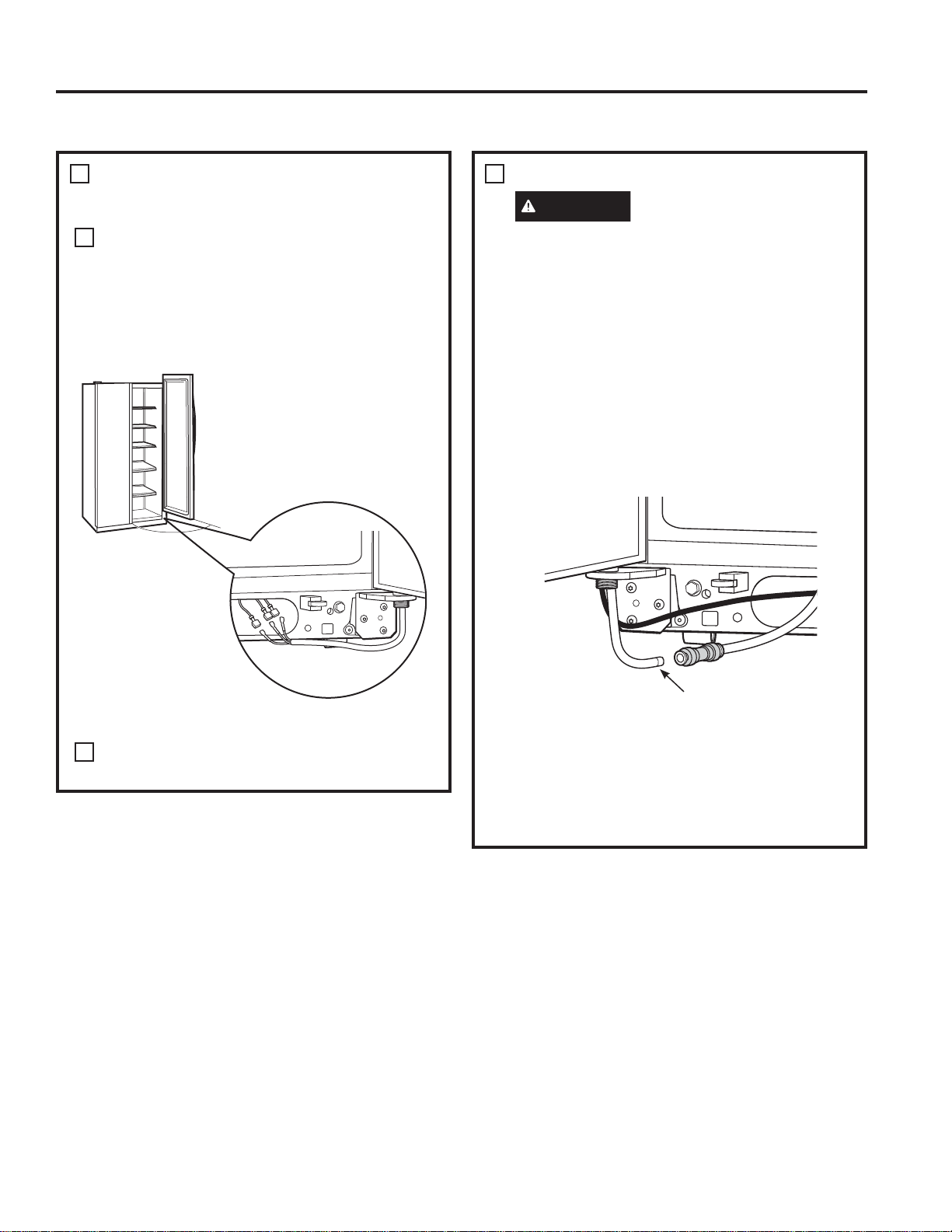
REMOVE THE REFRIGERATOR
DOOR
WARNING
Follow all steps for removing
and reinstalling the door. Failure to follow these
instructions, leaving off parts, or overtightening
screws, can lead to the door falling off and result
in injury and property damage.
Remove the refrigerator door top hinge cover (if
equipped) by either squeezing it and pulling it
up or by prying it off with a plastic putty knife.
5HPRYHWKHWZR´KH[KHDGVFUHZVWKHQ
lift the hinge straight up to free the hinge pin.
Open the refrigerator door to 90.°
8
A
B
C
REMOVE THE FREEZER DOOR
WARNING
Follow all steps for removing
and reinstalling the door. Failure to follow these
instructions, leaving off parts, or overtightening
screws, can lead to the door falling off and result
in injury and property damage.
Remove the freezer door top hinge cover (if
equipped) by either squeezing it and pulling it
up or by prying it off with a plastic putty knife.
5HPRYHWKHWZR´KH[KHDGVFUHZVWKHQ
lift the hinge straight up to free the hinge pin.
Open the freezer door to 90.°
As one person slowly lifts the freezer door up
and off the bottom hinge, the second person
should carefully guide the water line and power
line (harness) through the bottom hinge.
Set the door on a non-scratching surface with
the inside up.
7
A
C
B
´+H[+HDG
90°
90°
´+H[+HDG
90°
49-1000105 Rev. 4 21
INSTALLATION INSTRUCTIONS
Installation Instructions
MOVING THE REFRIGERATOR (Cont.)
REMOVE THE REFRIGERATOR
DOOR (Cont.)
Lift the refrigerator door up and off the bottom
hinge.
If the refrigerator has a refreshment center, one
person should slowly lift the door up and off the
bottom hinge and the second person should
carefully guide the electrical lines (harnesses)
through the bottom hinge.
Set the door on a non-scratching surface with
the inside up.
8
90°
Refreshment Center Models only
D
E
REPLACING THE DOORS
WARNING
Follow all steps for removing
and reinstalling the door. Failure to follow these
instructions, leaving off parts, or overtightening
screws, can lead to the door falling off and result
in injury and property damage.
To replace the doors, simply reverse steps 3
through 8.
However, please note the following:
• When lowering the doors onto the bottom
hinges, make sure the second person carefully
guides the tube and harnesses through the
holes in the hinges.
• When connecting the water line, make sure
you insert the tubing all the way to the mark.
• Do not pinch the tubing and harnesses when
placing the doors on the bottom hinges.
• When connecting the power line and the
electrical lines (refreshment center models
only), be sure that the connectors are seated
together fully.
9
Mark
49-1000105 Rev. 422
Installation Instructions
INSTALLATION INSTRUCTIONS
INSTALLING THE REFRIGERATOR
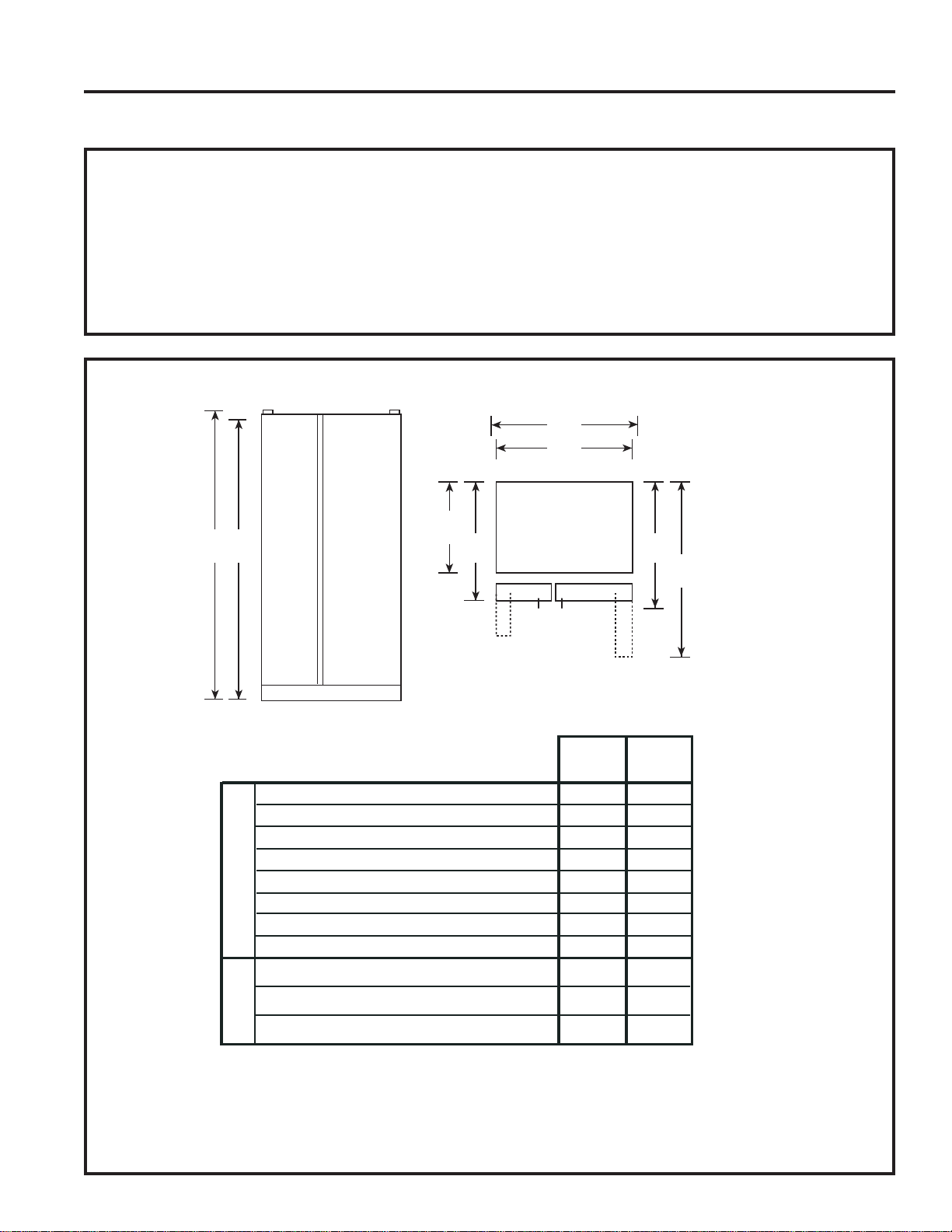
DIMENSIONS AND SPECIFICATIONS
REFRIGERATOR LOCATION
• Do not install the refrigerator where the
temperature will go below 60°F (16°C) because
it will not run often enough to maintain proper
temperatures.
• Do not install the refrigerator where the
temperature will go above 100°F (37°C) because it
will not perform properly.
• Do not install the refrigerator in a location exposed to
water (rain, etc.) or direct sunlight.
• Install it on a floor strong enough to support it fully
loaded.
If installed against a wall, allow clearance of 14-3/16" on
freezer side to remove bin.
Clearance required to remove refrigerator full-size pan without
disassembling is 18-15/16".
Allow additional space for any necessary leveling adjustments.
A
G
D
C
F
B
E
H
Height to top of hinge (in.)
XSS23
Models
A
Height to top of case (in.) B
Case depth without door (in.) C
Case depth less door handle (in.) D
Case depth with door handle (in.) E
'HSWKZLWKUHIULJHUDWRUGRRURSHQÛLQ F
Width (in.) G
:LGWKZLWKGRRURSHQÛZLWKGRRUKDQGOHLQH
Each side (in.)
Top (in.)
Back (in.)
AIR
CLEARANCES
OVERALL
DIMENSIONS
69-1/2
69
28-1/2
32-3/4
35-1/4
50-1/2
32-3/4
38-1/4
1/8
1
2
XSS25
Models
69-1/2
69
28-1/2
32-3/4
35-1/4
50-1/2
35-3/4
43-1/2
1/8
1
2
49-1000105 Rev. 4 23
INSTALLATION INSTRUCTIONS
Installation Instructions
INSTALLING THE REFRIGERATOR (Cont.)
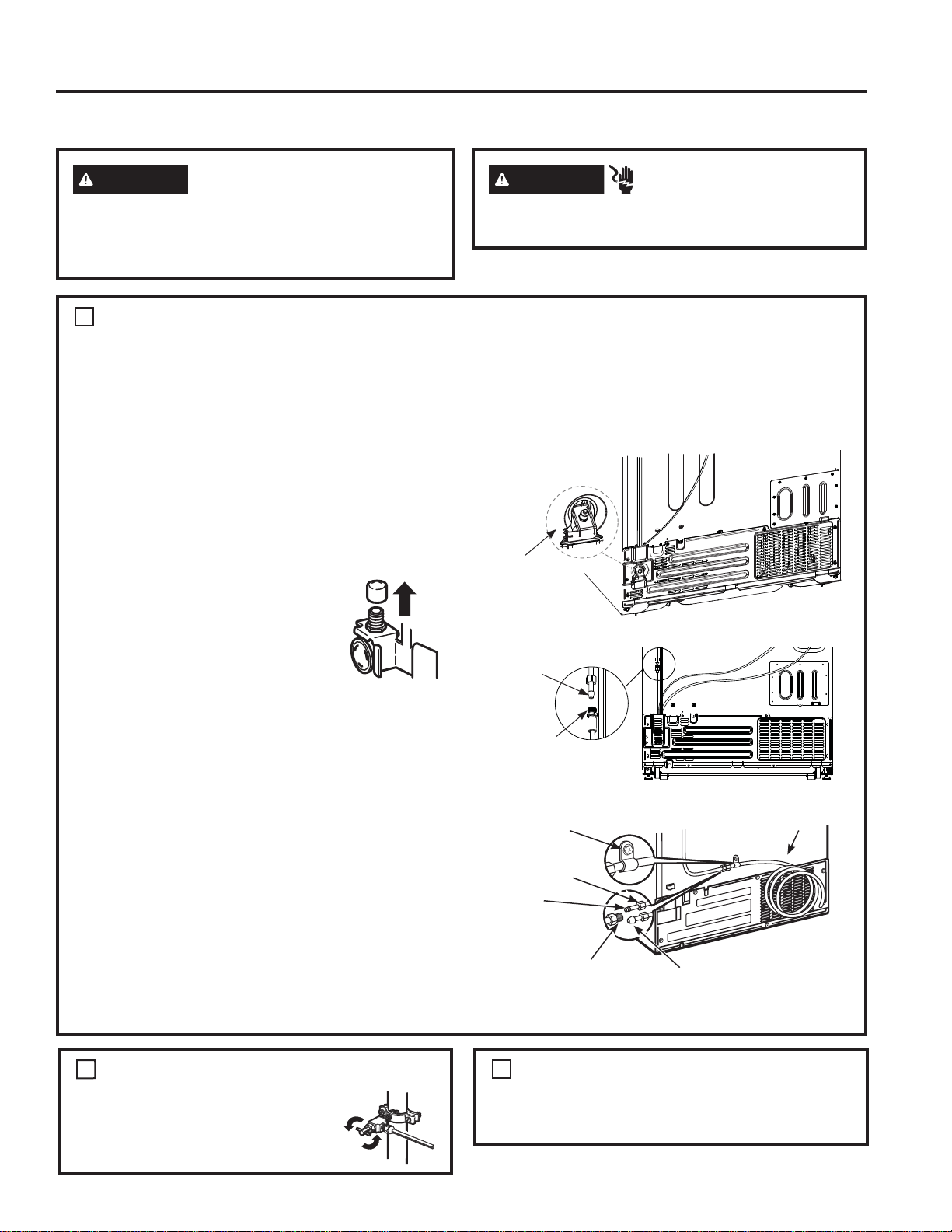
1
CONNECT THE TUBING TO THE REFRIGERATOR
(icemaker and dispenser models)
NOTES:
• Before making the connection to the refrigerator, be
sure the refrigerator power cord is not plugged into
the wall outlet.
• Before connecting the water line to the house, purge
the house line for at least 2 minutes.
• Some models have the refrigerator connection at
the water valve (Configuration 1). Other models
have the refrigerator connection at the end of tubing
located outside the compressor compartment access
cover (Configuration 2 & 3).
• On Configuration 1 Models, the
refrigeration connection is at the
water valve, remove the plastic
flexible cap, as shown here.
Water supply connection.
If you are using copper tubing, place a
compression nut and ferrule (sleeve) onto the end of
the tubing coming from the house cold water supply.
If you are using Universal water line tubing, the
nuts are already assembled to the tubing.
Refrigerator Connection.
If you are using copper tubing, insert the end of
the tubing into the refrigerator connection, at the
back of the refrigerator, as far as possible. While
holding the tubing, tighten the fitting.
If you are using Universal water line tubing,
insert the molded end of the tubing into the
refrigerator connection, at the back of the
refrigerator, and tighten the compression nut until it
is hand tight. Then tighten one additional turn with a
wrench. Overtightening may cause leaks.
Refrigerator Connection Using the Tubing Clamp
Fasten the tubing into the clamp provided to hold it
in position. You may need to pry open the clamp.
One of the Configurations below will look like the
connection on your refrigerator.
Universal
Water Line
Tubing
Refrigerator
Connection
&RQ¿JXUDWLRQ
´7XELQJ
Tubing Clamp
´
Compression Nut
Ferrule
(sleeve)
Universal Water Line Tubing
Refrigerator
Connection
&RQ¿JXUDWLRQ
&RQ¿JXUDWLRQ
Refrigerator
Connection
WARNING
Connect to potable water supply only.
A cold water supply is required for automatic
icemaker operation. The water pressure must be
between 40 and 120 psi (275-827 kilopascals).
WARNING
ELECTRIC SHOCK HAZARD
Attach tubing clamp using existing hole only. DO
NOT drill into the refrigerator.
2
TURN ON THE WATER SUPPLY
Turn the water on at the shutoff
valve (house water supply) and
check for any leaks.
3
PLUG IN THE REFRIGERATOR
Arrange the coil of tubing so that it does not vibrate
against the back of the refrigerator or against the
wall. Push the refrigerator back to the wall.
49-1000105 Rev. 424
Installation Instructions
INSTALLATION INSTRUCTIONS
INSTALLING THE REFRIGERATOR (Cont.)
PUT THE REFRIGERATOR IN
PLACE
Move the refrigerator to its final location.
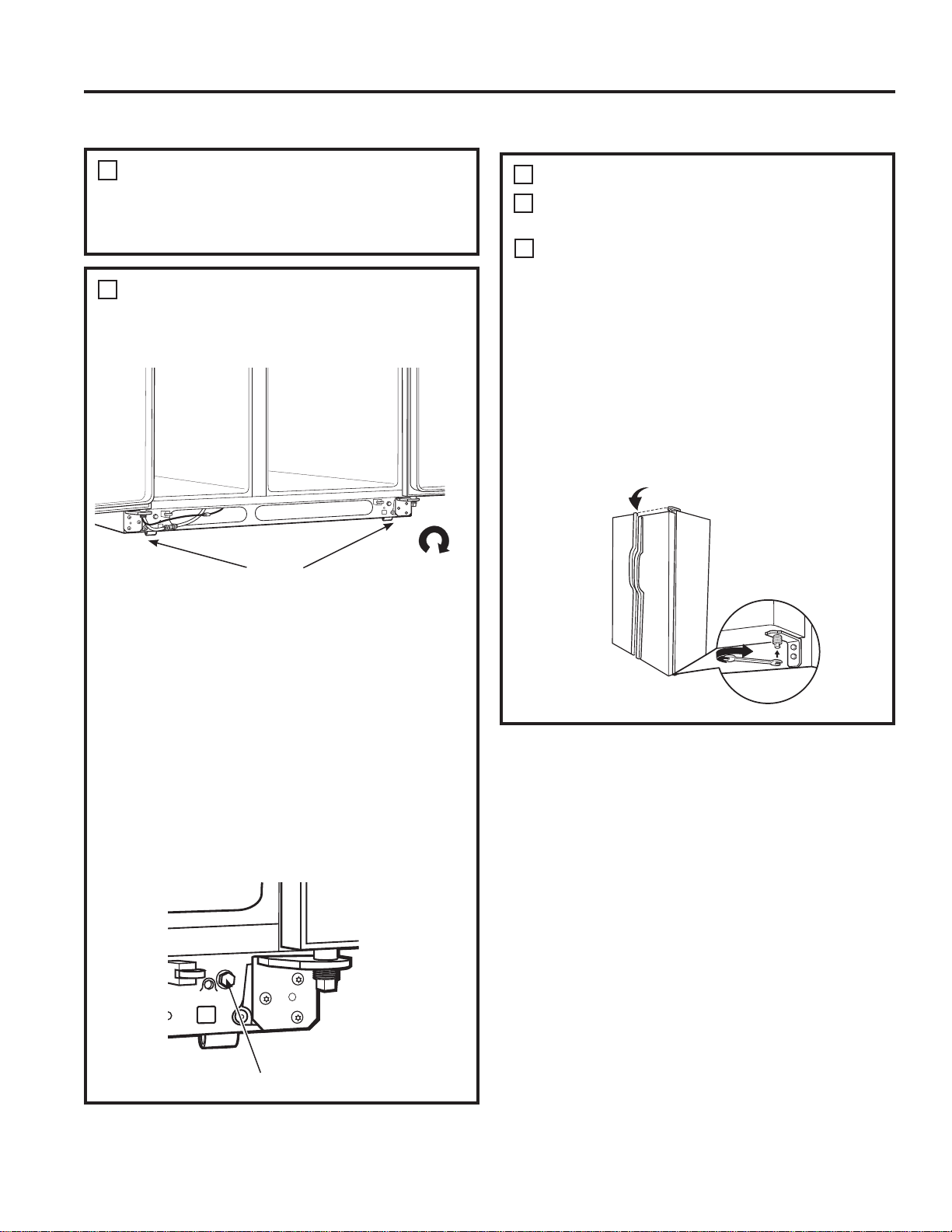
LEVEL THE REFRIGERATOR
The refrigerator can be leveled by adjusting the
rollers located near the bottom hinges.
Rollers have three purposes:
• Rollers adjust so the door closes easily when
opened about halfway. (Raise the front about
´>PP@IURPWKHIORRU
• Rollers adjust so the refrigerator is firmly
positioned on the floor and does not wobble.
• Rollers allow you to move the refrigerator
away from the wall for cleaning.
To adjust the rollers on 23’ (33” wide),
25’ models:
• Turn the roller adjusting screws clockwise
to raise the refrigerator, counterclockwise to
ORZHULW8VHD´KH[VRFNHWRUZUHQFKRU
an adjustable wrench.
4
5
Rollers
Raise
Roller adjusting screw
LEVEL THE DOORS
Adjust the refrigerator door to make the doors
even at the top.
To align:
8VLQJD´ZUHQFKWXUQWKHGRRUDGMXVWLQJ
screw to the right to raise the door, to the left to
lower it.
NOTE:
A nylon plug, imbedded in the threads of the
pin, prevents the pin from turning unless a
wrench is used.
After one or two turns of the wrench, open
and close the refrigerator door and check the
alignment at the top of the doors.
6
A
B
Doors should be even at top
Raise
´ZUHQFK
49-1000105 Rev. 4 25
INSTALLATION INSTRUCTIONS
Installation Instructions
INSTALLING THE REFRIGERATOR (Cont.)
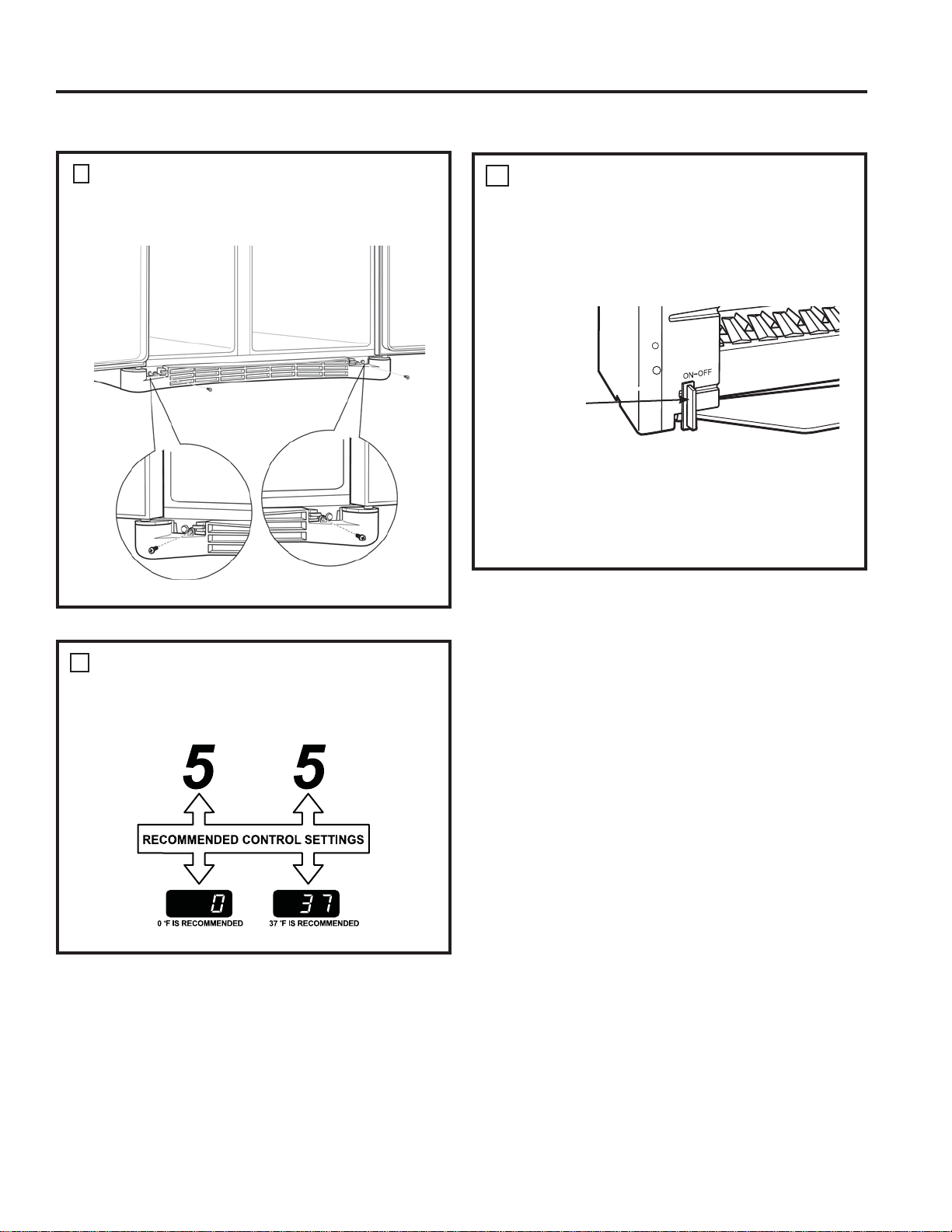
REPLACE THE BASE GRILLE
Replace the grille by installing the two Phillips
head screws.
7
SET THE CONTROLS
Set the controls to the recommended
setting.
8
START THE ICEMAKER
Set the icemaker power switch to the I (on)
position. The icemaker will not begin to operate
until it reaches its operating temperature of 15°F
(–9°C) or below. It will then begin operation
automatically. It will take 2–3 days to fill the ice
bin.
NOTE:
In lower water pressure conditions, the water
valve may turn on up to 3 times to deliver
enough water to the icemaker.
9
Power
switch
49-1000105 Rev. 426
Installation Instructions
INSTALLATION INSTRUCTIONS
INSTALLING THE WATER LINE (icemaker & dispenser models)
BEFORE YOU BEGIN
If the water supply to the refrigerator is from
a Reverse Osmosis Water Filtration System
AND the refrigerator also has a water filter, use
the refrigerator’s filter bypass plug. Using the
refrigerator’s water filtration cartridge in conjunction
with the RO filter can result in hollow ice cubes and
slower water flow from the water dispenser.
This water line installation is not warranted by
the refrigerator or icemaker manufacturer. Follow
these instructions carefully to minimize the risk of
expensive water damage.
Water hammer (water banging in the pipes) in
house plumbing can cause damage to refrigerator
parts and lead to water leakage or flooding. Call a
qualified plumber to correct water hammer before
installing the water supply line to the refrigerator.
To prevent burns and product damage, do not hook
up the water line to the hot water line.
If you use your refrigerator before connecting the
water line, make sure the icemaker power switch is
in the OFF position.
Do not install the icemaker tubing in areas where
temperatures fall below freezing.
When using any electrical device (such as a power
drill) during installation, be sure the device is double
insulated or grounded in a manner to prevent the
hazard of electric shock, or is battery powered.
All installations must be in accordance with local
plumbing code requirements.
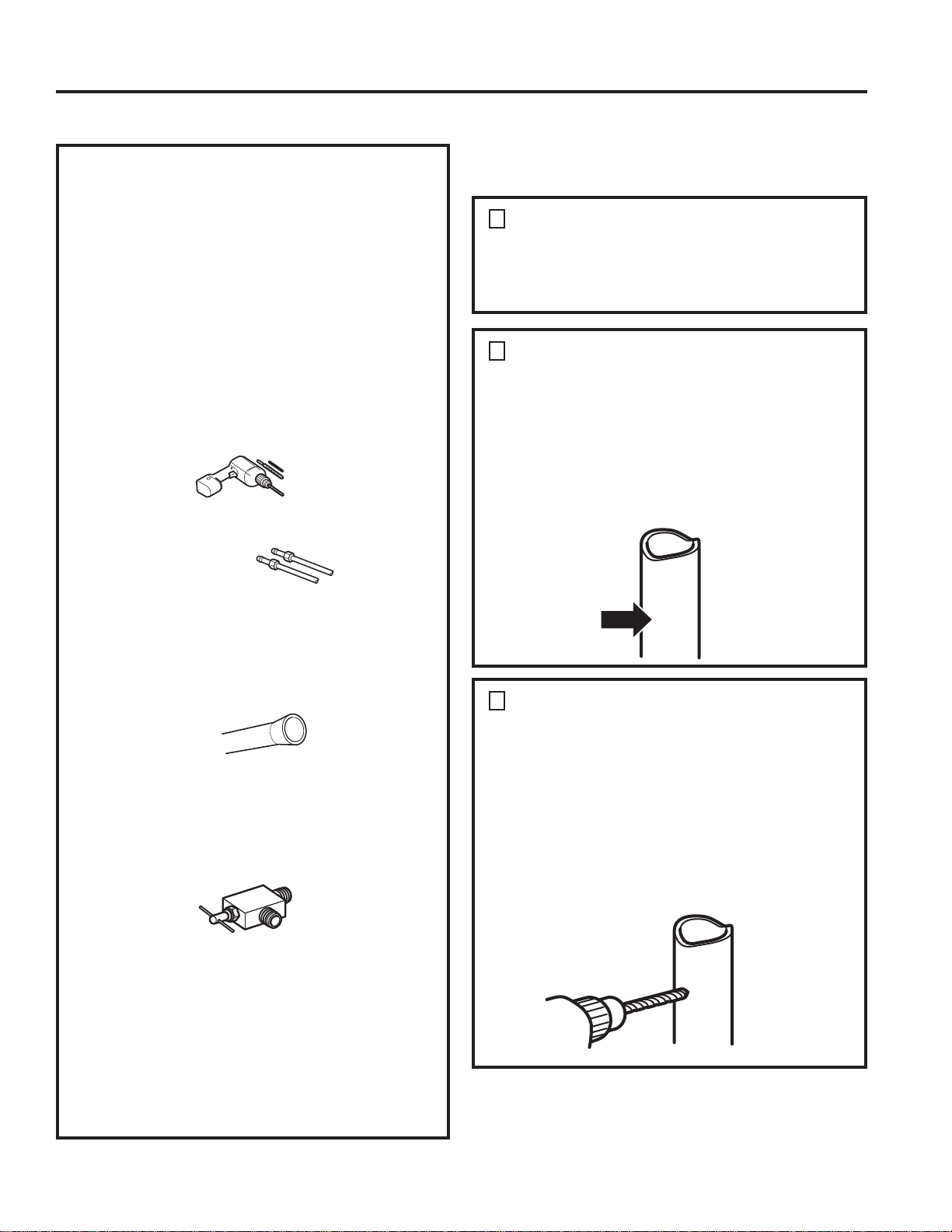
WHAT YOU WILL NEED
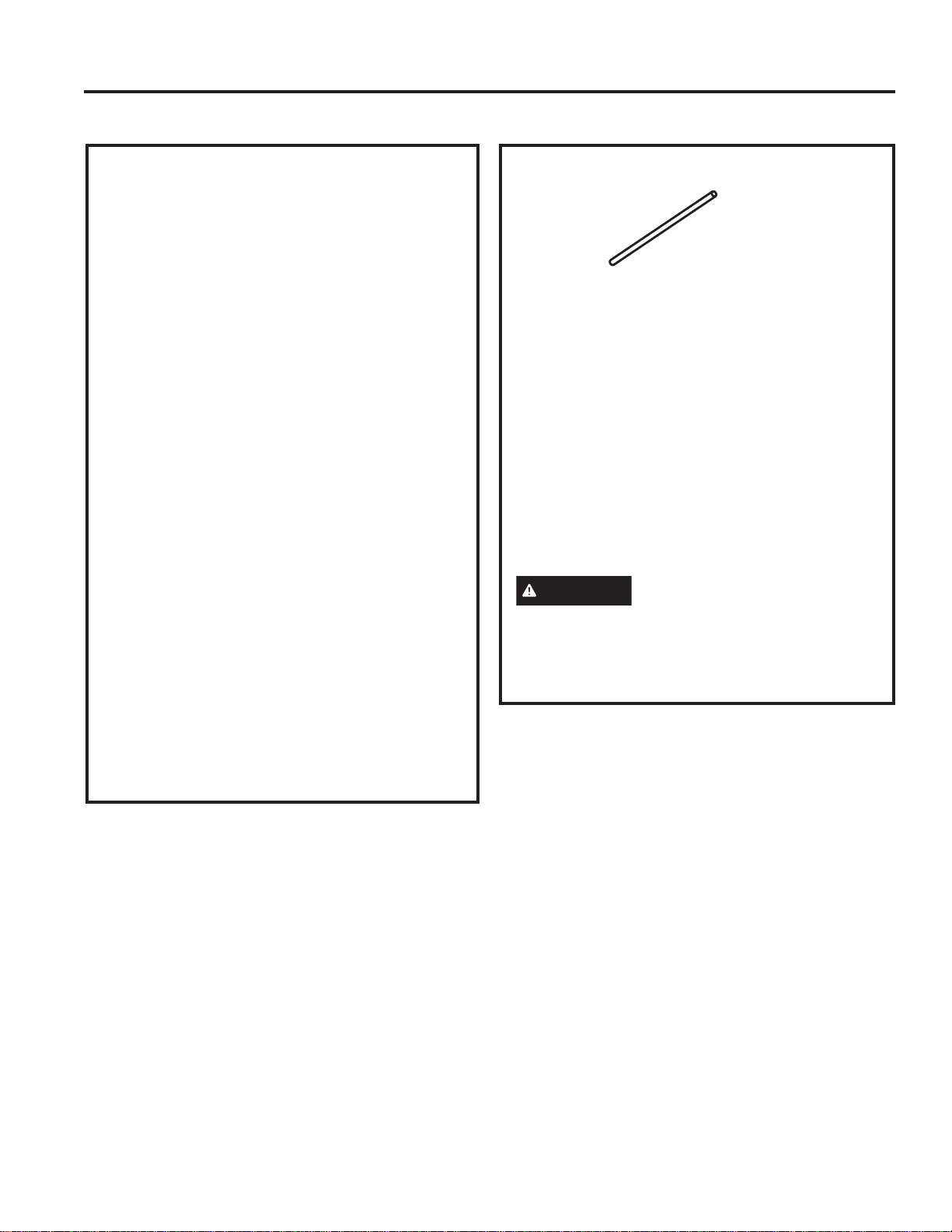
• Copper or Universal Water Line Refrigerator
7XELQJNLW´RXWHUGLDPHWHUWRFRQQHFWWKH
refrigerator to the water supply. If using copper, be
sure both ends of the tubing are cut square.
To determine how much tubing you need: measure
the distance from the water valve on the back of the
refrigerator to the water supply pipe. Be sure there
is sufficient extra tubing to allow the refrigerator to
move out from the wall after installation.
8QLYHUVDO:DWHU/LQH5HIULJHUDWRU7XELQJ.LWVDUH
available in the following lengths:
6’ (1.8 m) – WX08X10006
15’ (4.6 m) – WX08X10015
25’ (7.6 m) – WX08X10025
WARNING
Connect to potable water supply only.
A cold water supply is required for automatic
icemaker operation. The water pressure must be
between 40 and 120 psi (275-827 kilopascals).
49-1000105 Rev. 4 27
INSTALLATION INSTRUCTIONS
Installation Instructions
INSTALLING THE WATER LINE (Cont.)
WHAT YOU WILL NEED (Cont.)
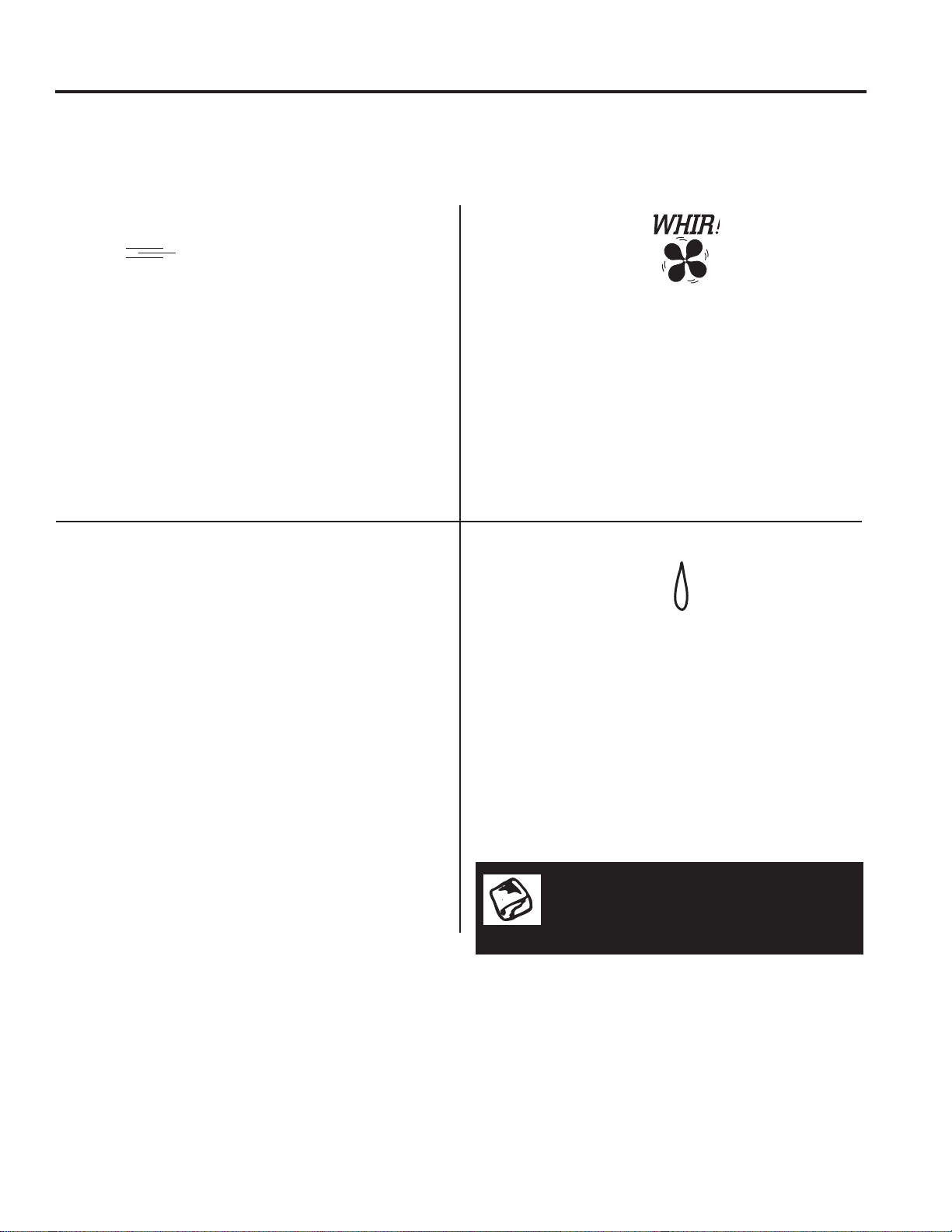
NOTE: The only GE Appliances, a Haier company,
approved plastic tubing is that supplied in Universal
Water Line Refrigerator Tubing kits. Do not use
any other plastic water supply line because the
line is under pressure at all times. Certain types of
plastic will crack or rupture with age and cause water
damage to your home.
• A GE Appliances water supply kit (containing
tubing, shutoff valve and fittings listed below) is
available at extra cost from your dealer or from
Parts and Accessories, 877.959.8688.
• A cold water supply. The water pressure must be
between 20 and 120 p.s.i. (138-827 kPa).
• Power drill.
• 1/2” or adjustable wrench.
• Straight and Phillips blade screwdriver.
• Two 1/4” outer diameter compression nuts and
2 ferrules (sleeves)—to connect the copper tubing
to the shutoff valve and the refrigerator water valve.
OR
• If you are using a Universal Water Line Refrigerator
Tubing kit, the necessary fittings are preassembled
to the tubing.
• If your existing copper water line has a flared fitting
at the end, you will need an adapter (available at
plumbing supply stores) to connect the water line to
the refrigerator OR you can cut off the flared fitting
with a tube cutter and then use a compression
fitting. Do not cut formed end from Universal Water
Line Refrigerator tubing.
• Shutoff valve to connect to the cold water line.
The shutoff valve should have a water inlet
ZLWKDPLQLPXPLQVLGHGLDPHWHURI´DWWKH
point of connection to the COLD WATER LINE.
Saddle-type shutoff valves are included in many
water supply kits. Before purchasing, make sure
a saddle-type valve complies with your local
plumbing codes.
SHUT OFF THE MAIN WATER
SUPPLY
Turn on the nearest faucet long enough to clear
the line of water.
CHOOSE THE VALVE
LOCATION
Choose a location for the valve that is easily
accessible. It is best to connect into the side of
a vertical water pipe. When it is necessary to
connect into a horizontal water pipe, make the
connection to the top or side, rather than at the
bottom, to avoid drawing off any sediment from
the water pipe.
DRILL THE HOLE FOR THE
VALVE
'ULOOD´KROHLQWKHZDWHUSLSHHYHQLIXVLQJ
a self-piercing valve), using a sharp bit. Remove
any burrs resulting from drilling the hole in the
pipe.
Take care not to allow water to drain into the
drill.
)DLOXUHWRGULOOD´KROHPD\UHVXOWLQUHGXFHG
ice production or smaller cubes.
1
2
3
Install the shutoff valve on the nearest frequently used
drinking water line.

49-1000105 Rev. 428
FASTEN THE SHUTOFF VALVE
Fasten the shutoff valve to the cold water pipe
with the pipe clamp.
NOTE: Commonwealth of Massachusetts
Plumbing Codes 248CMR shall be adhered to.
Saddle valves are illegal and use is not permitted
in Massachusetts. Consult with your licensed
plumber.
TIGHTEN THE PIPE CLAMP
Tighten the clamp screws until the sealing
washer begins to swell.
NOTE: Do not overtighten or you may crush the
tubing..
ROUTE THE TUBING
Route the tubing between the cold water line and
the refrigerator.
Route the tubing through a hole drilled in the wall
or floor (behind the refrigerator or adjacent base
cabinet) as close to the wall as possible.
NOTE: Be sure there is sufficient extra tubing to
allow the refrigerator to move out from the wall
after installation.
FLUSH OUT THE TUBING
Turn the main water supply on and flush out the
tubing until the water is clear.
Shut the water off at the water valve after about
one quart (1 liter) of water has been flushed
through the tubing.
To complete the installation of the refrigerator, go
back to Step 1 in Installing the Refrigerator.
CONNECT THE TUBING TO THE
VALVE
Place the compression nut and ferrule (sleeve)
for copper tubing onto the end of the tubing and
connect it to the shutoff valve.
Make sure the tubing is fully inserted into the
valve. Tighten the compression nut securely.
For plastic tubing from a Universal Water
Line Refrigerator Tubing kit, insert the molded
end of the tubing into the shutoff valve and
tighten compression nut until it is hand tight,
then tighten one additional turn with a wrench.
Overtightening may cause leaks.
NOTE: Commonwealth of Massachusetts
Plumbing Codes 248CMR shall be adhered
to. Saddle valves are illegal and use is not
permitted in Massachusetts. Consult with your
licensed plumber.
4
5
6
8
7
Installation Instructions
INSTALLING THE WATER LINE (Cont.)
INSTALLATION INSTRUCTIONS
Pipe Clamp
Vertical Cold Water Pipe
Saddle-Type
Shutoff Valve
Washer
Inlet End
Pipe Clamp
Clamp
Screw
Saddle-Type
Shutoff Valve
Compression Nut
Packing Nut
Outlet Valve
Ferrule (sleeve)
SmartConnect
™
Tubing
49-1000105 Rev. 4 29
TROUBLESHOOTING TIPS: Normal Operating Conditions
Newer refrigerators sound different from older refrigerators.
Modern refrigerators have more features and use newer technology.
HUMMM...
WHOOSH...
Ŷ The new high efficiency compressor may run faster
and longer than your old refrigerator and you may
hear a high-pitched hum or pulsating sound while it
is operating.
Ŷ Sometimes the refrigerator runs for an extended
period, especially when the doors are opened
frequently. This means that the Frost Guard™
feature is working to prevent freezer burn and
improve food preservation.
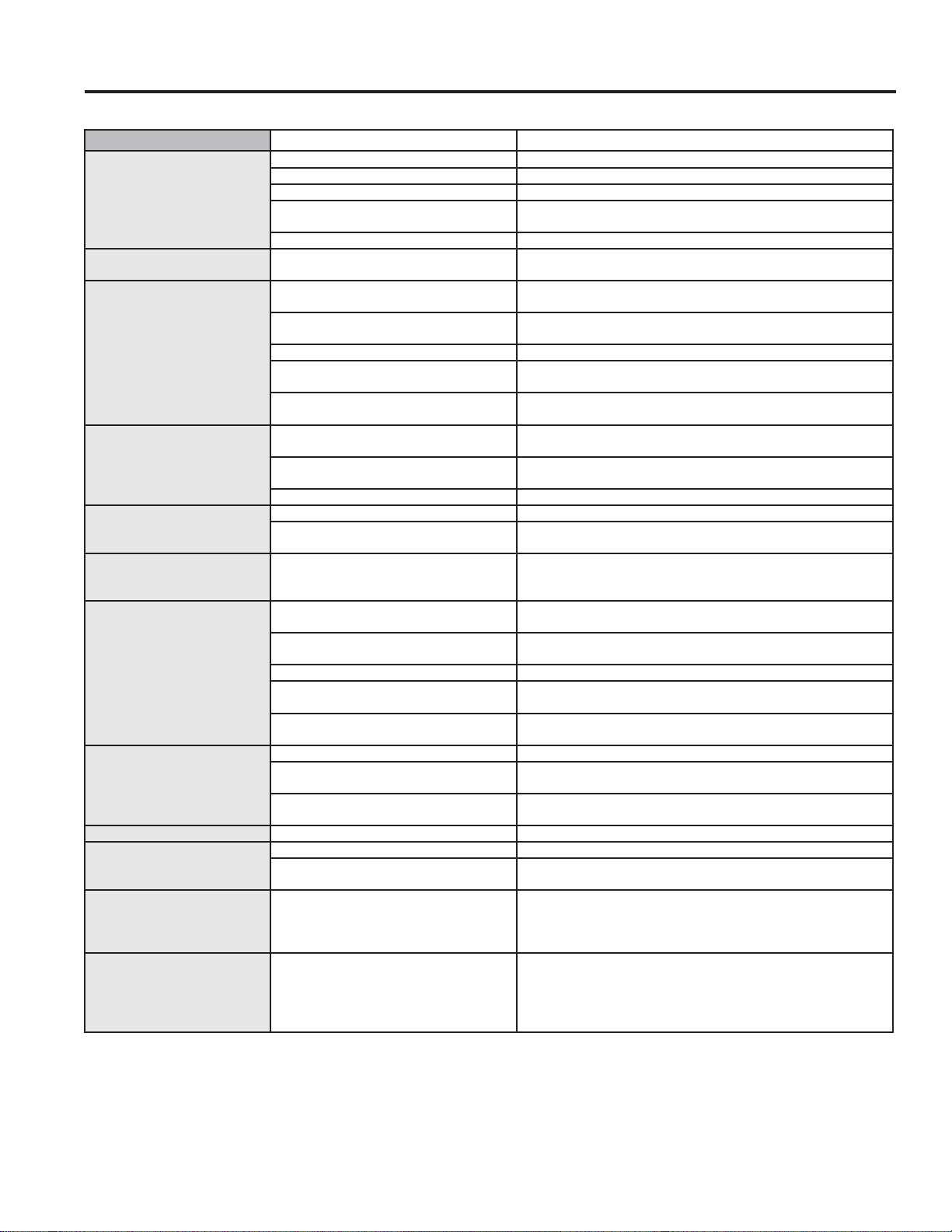
Ŷ <RXPD\KHDUDZKRRVKLQJVRXQGZKHQWKHGRRUV
close. This is due to pressure equalizing within the
refrigerator.
Ŷ
You may hear the fans spinning at high speeds.
This happens when the refrigerator is first plugged
in, when the doors are opened frequently or when
a large amount of food is added to the refrigerator
or freezer compartments. The fans are helping to
maintain the correct temperatures.
Ŷ If either door is open for over 3 minutes, you may
hear the fans come on in order to cool the light
bulbs.
Ŷ
The fans change speeds in order to provide optimal
cooling and energy savings.
CLICKS, POPS,
CRACKS and SNAPS
Ŷ You may hear cracking or popping sounds when
the refrigerator is first plugged in. This happens as
the refrigerator cools to the correct temperature.
Ŷ Electronic dampers click open and closed to
provide optimal cooling and energy savings.
Ŷ The compressor may cause a clicking or chirping
sound when attempting to restart (this could take
up to 5 minutes).
Ŷ The electronic control board may cause a clicking
sound when relays activate to control refrigerator
components.
Ŷ Expansion and contraction of cooling coils during
and after defrost can cause a cracking or popping
sound.
Ŷ On models with an icemaker, after an icemaking
cycle, you may hear the ice cubes dropping into
the ice bucket.
WATER SOUNDS
Ŷ The flow of refrigerant through the cooling coils may
make a gurgling noise like boiling water.
Ŷ Water dropping on the defrost heater can cause
a sizzling, popping or buzzing sound during the
defrost cycle.
Ŷ A water dripping noise may occur during the defrost
cycle as ice melts from the evaporator and flows
into the drain pan.
Ŷ Closing the door may cause a gurgling sound due to
pressure equalization.
Do you hear what I hear? These conditions are normal.
Normal Operating Conditions
For additional information on normal
icemaker and dispenser operating sounds,
see the About the automatic icemaker and
About the ice and water dispenser sections.
49-1000105 Rev. 430
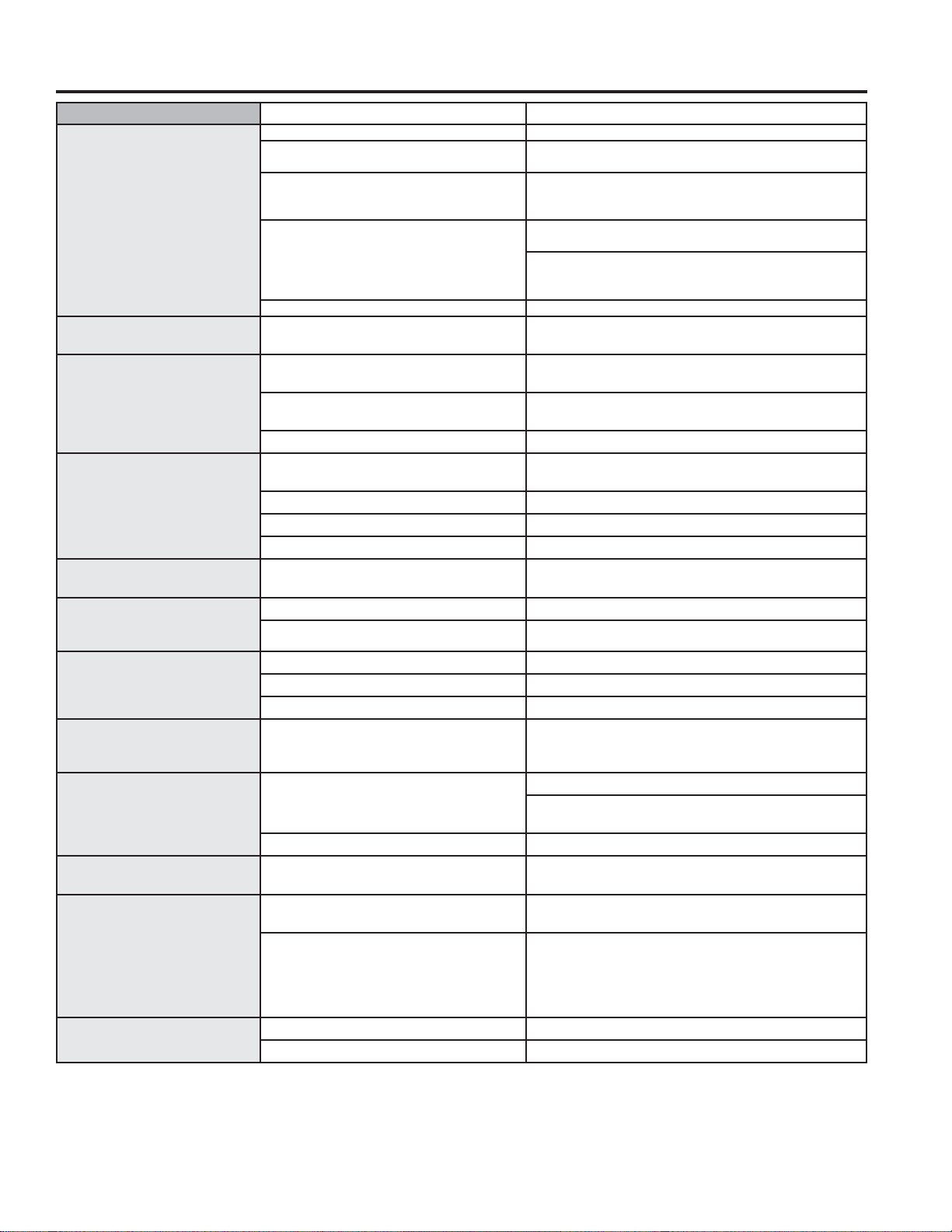
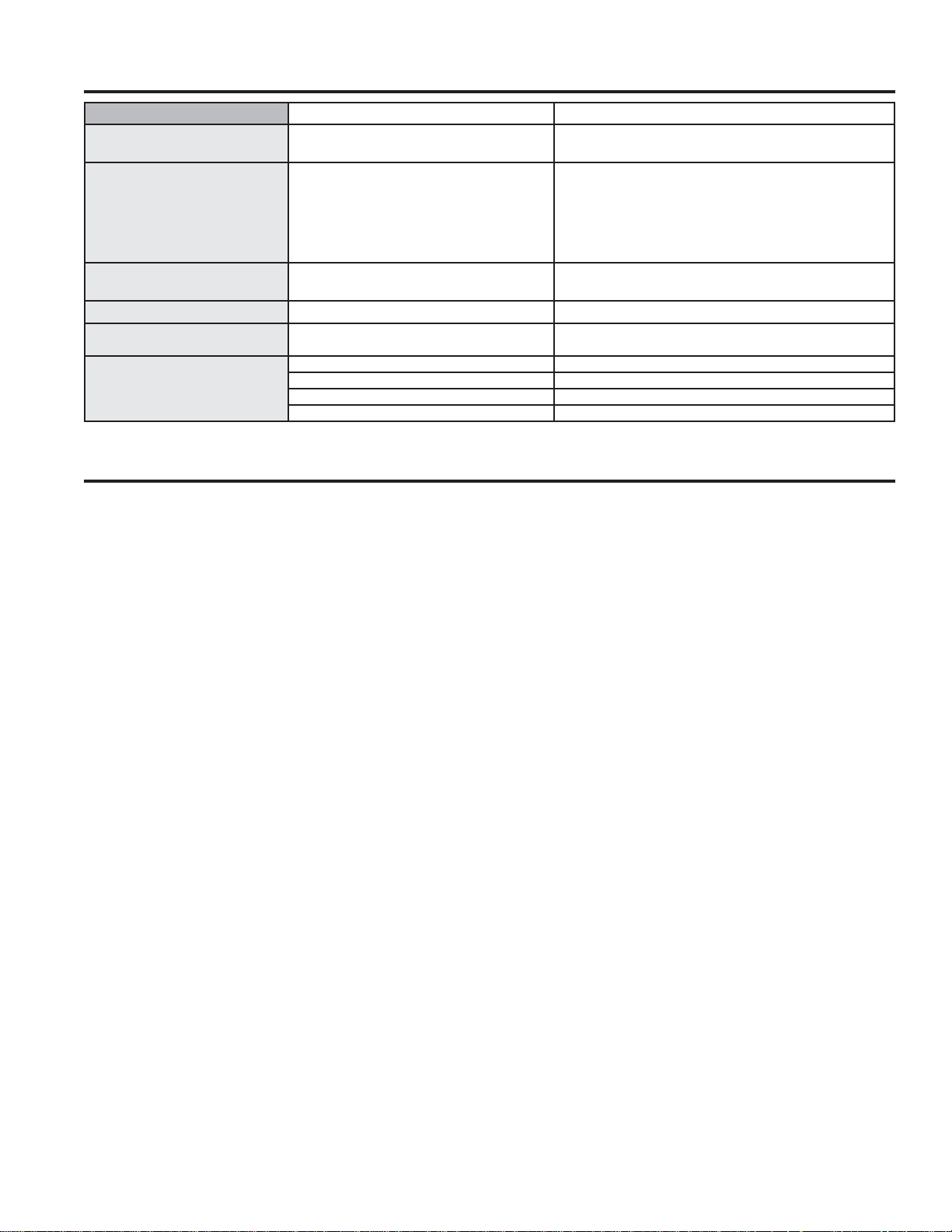
Problem Possible Causes What To Do
Refrigerator does not operate Refrigerator in defrost cycle. Wait about 30 minutes for defrost cycle to end.
Freezer control in 0 (off) position. Move the freezer control to a lower temperature setting.
Refrigerator is unplugged. Push the plug completely into the outlet.
The fuse is blown/circuit breaker is
tripped.
Replace fuse or reset the breaker.
Refrigerator is in showroom mode. Unplug the refrigerator and plug it back in.
Vibration or rattling (slight
vibration is normal)
Rollers need adjusting. See Rollers.
Motor operates for long
periods or cycles on and
off frequently. (Modern
refrigerators with more
storage space and a larger
freezer require more operating
time. They start and stop
often to maintain even
temperatures.)
Normal when refrigerator is first
plugged in.
Wait 24 hours for the refrigerator to completely cool down.
Often occurs when large amounts of
food are placed in refrigerator.
This is normal.
Door left open. Check to see if package is holding door open.
Hot weather or frequent door
openings.
This is normal.
Temperature controls set at the
coldest setting.
See Controls.
Refrigerator or freezer
compartment too warm
Temperature control not set cold
enough.
See Controls.
Warm weather or frequent door
openings.
Set the temperature control one step colder. See Controls.
Door left open. Check to see if package is holding door open.
Frost or ice crystals on frozen
food (frost within package is
normal)
Door left open. Check to see if package is holding door open.
Too frequent or too long door
openings.
Divider between refrigerator
and freezer compartments
feels warm
Automatic energy saver system
circulates warm liquid around front
edge of freezer compartment.
This helps prevent condensation on the outside.
Automatic icemaker does not
work
Icemaker power switch is in the OFF
position.
Slide the power switch to the ON position.
Water supply turned off or not
connected.
See Installing the water line.
Freezer compartment too warm. Wait 24 hours for the refrigerator to completely cool down.
Piled up cubes in the storage bin
cause icemaker to shut off.
Level cubes by hand.
Ice cubes stuck in icemaker. Turn off the icemaker, remove cubes and turn the icemaker
back on.
Ice cubes have odor/taste Ice storage bin needs cleaning. Empty and wash bin. Discard old cubes.
Food transmitting odor/taste to ice
cubes.
Wrap foods well.
Interior of refrigerator needs
cleaning.
See Care and cleaning.
Small or hollow cubes Water filter clogged. Replace filter cartridge with new cartridge or with plug.
Slow ice cube freezing Door left open. Check to see if package is holding door open.
Temperature control not set cold
enough.
See Controls.
)UHTXHQW³EX]]LQJVRXQG´ Icemaker power switch is in the 1
(on) position, but the water supply
to the refrigerator has not been
connected.
6HWWKHSRZHUVZLWFKWRWKHRIISRVLWLRQ.HHSLQJLWLQWKH
(on) position will damage the water valve.
Red / Orange glow in the
freezer section, steam coming
from vents. Popping/ hissing
sound coming from the
freezer area.
This is normal operation for glass
defrost heater models. The heater
is clearing out frost from your
refrigerator evaporator for optimum
operation.
Do not touch the vent area or unplug the refrigerator. It is
normal operation and the heater will turn off once the frost has
been cleared.
Troubleshooting Tips... Before you call for service
Save time and money! Review the charts on the following pages first and you may not need to call for service.
TROUBLESHOOTING TIPS
49-1000105 Rev. 4 31
TROUBLESHOOTING TIPS
Problem Possible Causes What To Do
Cube dispenser does not work
(on some models)
Icemaker or water supply turned off. Turn on icemaker or water supply.
Ice cubes are frozen to icemaker feeler
arm.
Remove cubes.
An item is blocking or has fallen into
the ice chute inside the top bin of the
freezer.
Remove any item that might be blocking, or has fallen
into the chute.
Irregular ice clumps in storage
container.
Break up with fingertip pressure and discard remaining
clumps.
Freezer may be too warm. Adjust the freezer control to
a colder setting, one position at a time, until clumps do
not form.
Dispenser is /2&.('. Press and hold the Lock pad for 3 seconds.
Water has poor taste/odor (on
some models)
Water dispenser has not been used for
a long time.
Dispense water until all water in system is replenished.
Water in first glass is warm (on
some models)
Normal when refrigerator is first
installed
Wait 24 hours for the refrigerator to completely cool
down.
Water dispenser has not been used for
a long time.
Dispense water until all water in system is replenished.
Water system has been drained. Allow several hours for replenished supply to chill.
Water dispenser does not work
(on some models)
Water supply line turned off or not
connected.
See Installing the water line.
Water filter clogged. Replace filter cartridge or remove filter and install plug.
Air may be trapped in the water system. Press the dispenser arm for at least two minutes.
Dispenser is /2&.('. Press and hold the Lock pad for 3 seconds.
Water spurting from
dispenser
Newly-installed filter cartridge. Run water from the dispenser for 3 minutes (about 1
1
/2
gallons).
Water is not dispensed (on
some models) but icemaker is
working
Water in reservoir is frozen. Call for service.
Refrigerator control setting is too cold. Set to a warmer setting.
No water or ice cube production Supply line or shutoff valve is clogged. Call a plumber.
Water filter clogged. Replace filter cartridge or remove filter and install plug.
Dispenser is /2&.('. Press and hold the Lock pad for 3 seconds.
CUBED ICE was selected but
CRUSHED ICE was dispensed
(on some models)
Last setting was CRUSHED ICE. A few cubes were left in the crusher from the previous
setting. This is normal.
Refrigerator has odor Foods transmitting odor to
refrigerator.
Foods with strong odors should be tightly wrapped.
.HHSDQRSHQER[RIEDNLQJVRGDLQWKHUHIULJHUDWRU
replace every three months.
Interior needs cleaning. See Care and cleaning.
Moisture forms on outside of
refrigerator
Not unusual during periods of high
humidity.
Wipe surface dry.
Moisture collects inside (in
humid weather, air carries
moisture into refrigerator when
doors are opened)
Too frequent or too long door
openings.
This is normal fo rthe beverage center.
Due to the higher himidity in the
refrigerator, you may on occasion
experience fog or small amounts
of moisture in the refrigerator
compartment
This is normal for the beverage center loads and
environmental conditions change with a paper towel if
desired.
Interior light does not work No power at outlet. Replace fuse or reset the breaker.
For LED lights Call Service.
Troubleshooting Tips... Before you call for service
49-1000105 Rev. 432
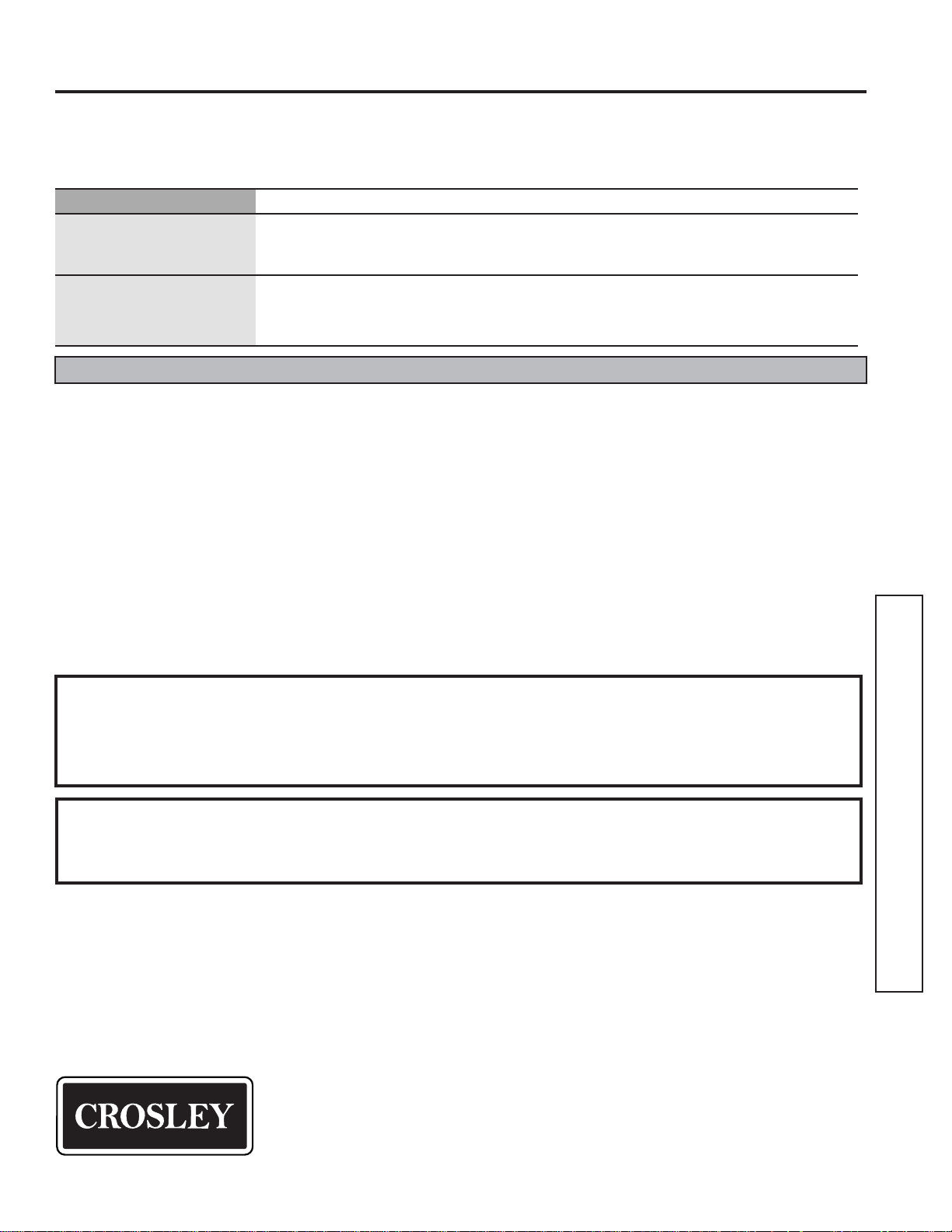
Problem Possible Causes What To Do
Water on kitchen floor or on
bottom of freezer
Cubes jammed in chute. Poke ice through with a wooden spoon.
Hot air from bottom of
refrigerator
Normal air flow cooling motor. In the
refrigeration process, it is normal that
heat be expelled in the area under the
refrigerator. Some floor coverings are
sensitive and will discolor at these
normal and safe temperatures.
Refrigerator never shuts off but
WKHWHPSHUDWXUHVDUH2.
Adaptive defrost keeps compressor
running during door openings.
This is normal. The refrigerator will cycle off after the
door remains closed for 2 hours.
Refrigerator is beeping Door is open. Close door.
Door not closing properly Door gasket on hinge side sticking or
folding over.
Apply petroleum jelly on face of gasket
Actual temperature not equal to
Set temperature
Unit just plugged in. Allow 24 hours for system to stabilize
Door open for too long Allow 24 hours for system to stabilize
Warm food added to refrigerator Allow 24 hours for system to stabilize
Defrost cycle is in process Allow 24 hours for system to stabilize
Troubleshooting Tips... Before you call for service
TROUBLESHOOTING TIPS
Appliance Communication (on some models)
REGULATORY INFORMATION
FCC/IC Compliance Statement:
This device complies with Part 15 of the FCC Rules. This device contains license-exempt transmitter(s)/receiver(s)
that comply with Innovation, Science and Economic Development, Canada’s license-exempt RSS(s). Operation is
subject to the following two conditions:
1. This device may not cause harmful interference.
2. This device must accept any interference received, including interference that may cause undesired operation.
This equipment has been tested and found to comply with the limits for a Class B digital device, pursuant to Part
15 of the FCC Rules. These limits are designed to provide reasonable protection against harmful interference in a
residential installation. This equipment generates, uses and can radiate radio frequency energy and, if not installed
and used in accordance with the instructions, may cause harmful interference to radio communications. However,
there is no guarantee that interference will not occur in a particular installation. If this equipment does cause harmful
interference to radio or television reception, which can be determined by turning the equipment off and on, the user
is encouraged to try to correct the interference by one or more of the following measures:
• Reorient or relocate the receiving antenna.
• Increase the separation between the equipment and receiver.
• Connect the equipment into an outlet on a circuit different from that to which the receiver is connected.
• Consult the dealer or an experienced radio/television technician for help.
Labelling: Changes or modifications to this unit not expressly approved by the manufacturer could void the user’s
authority to operate the equipment.
ConnectPlus module only (or similar communication module)
RF Exposure - This device is only authorized for use in a mobile application. At least 20 cm of separation distance
between the ConnectPlus device and the user’s body must be maintained at all times.
49-1000105 Rev. 4 33
Ŷ Service trips to your home to teach you how to use
the product.
Ŷ,PSURSHULQVWDOODWLRQGHOLYHU\RUPDLQWHQDQFH
Ŷ)DLOXUHRIWKHSURGXFWLILWLVDEXVHGPLVXVHGRU
used for other than the intended purpose or used
commercially.
Ŷ/RVVRIIRRGGXHWRVSRLODJH
Ŷ5HSODFHPHQWRIKRXVHIXVHVRUUHVHWWLQJRIFLUFXLW
breakers.
Ŷ'DPDJHWRILQLVKVXFKDVVXUIDFHUXVWWDUQLVKRU
small blemishes not reported within 48 hours of
delivery.
Ŷ5HSODFHPHQWRIWKHZDWHUILOWHUFDUWULGJHLI
included, due to water pressure that is outside
the specified operating range or due to excessive
sediment in the water supply.
Ŷ5HSODFHPHQWRIWKHOLJKWEXOEVLILQFOXGHGRU
water filter cartridge, if included, other than as
noted above.
Ŷ'DPDJHWRWKHSURGXFWFDXVHGE\DFFLGHQWILUH
floods or acts of God.
Ŷ,QFLGHQWDORUFRQVHTXHQWLDOGDPDJHFDXVHGE\
possible defects with this appliance.
Ŷ3URGXFWQRWDFFHVVLEOHWRSURYLGHUHTXLUHGVHUYLFH
Ŷ'DPDJHFDXVHGE\DQRQ*($SSOLDQFHV%UDQG
water filter.
This warranty will not cover:
For the Period of: GE Appliances Will Replace
One Year
From the date of the original
purchase
Any part of the refrigerator which fails due to a defect in materials or workmanship.
During the limited one-year warranty, GE Appliances will also provide, free of
charge, all labor and related service to replace the defective part.
Thirty Days
(Water filter, if included)
From the original purchase
date of the refrigerator
Any part of the water filter cartridge which fails due to a defect in materials or
workmanship. During this limited thirty-day warranty, GE Appliances will also
provide, free of charge, a replacement water filter cartridge.
Crosley.com
Your appliance is covered by a limited warranty, as listed below, by GE Appliances. All warranty service is provided by
our GE Appliances Factory Service Centers, or an authorized service technician. To schedule service, call Crosley at
800.544.4780. Please have your serial number and your model number available when calling for service.
Crosley
®
Corporation Refrigerator Limited Warranty
EXCLUSION OF IMPLIED WARRANTIES
Your sole and exclusive remedy is product repair as provided in this Limited Warranty. Any implied warranties,
including the implied warranties of merchantability or fitness for a particular purpose, are limited to one year or the
shortest period allowed by law.
This limited warranty is extended to the original purchaser and any succeeding owner for products purchased for
home use within the USA. If the product is located in an area where service by a GE Appliances Authorized Servicer
is not available, you may be responsible for a trip charge or you may be required to bring the product to an Authorized
GE Appliances Service location for service. In Alaska, the limited warranty excludes the cost of shipping or service
calls to your home.
Some states do not allow the exclusion or limitation of incidental or consequential damages. This limited warranty
gives you specific legal rights, and you may also have other rights which vary from state to state. To know what your
legal rights are, consult your local or state consumer affairs office or your state’s Attorney General.
Warrantor: GE Appliances, a Haier company
Louisville, KY 40225
Crosley
®
Extended Warranty
In addition to the warranty shown above, ask your dealer or visit us at Crosley.com/warranty regarding the
Crosley 10-Year Extended Limited Warranty that comes to you at no extra charge. This warranty will cover
your product after the initial manufacturer’s warranty expires up through 10 years. Please contact Crosley at
Crosley.com or call Crosley at 800.356.5268 for specific details.
Staple your receipt here. Proof of the original purchase
date is needed to obtain service under the warranty.
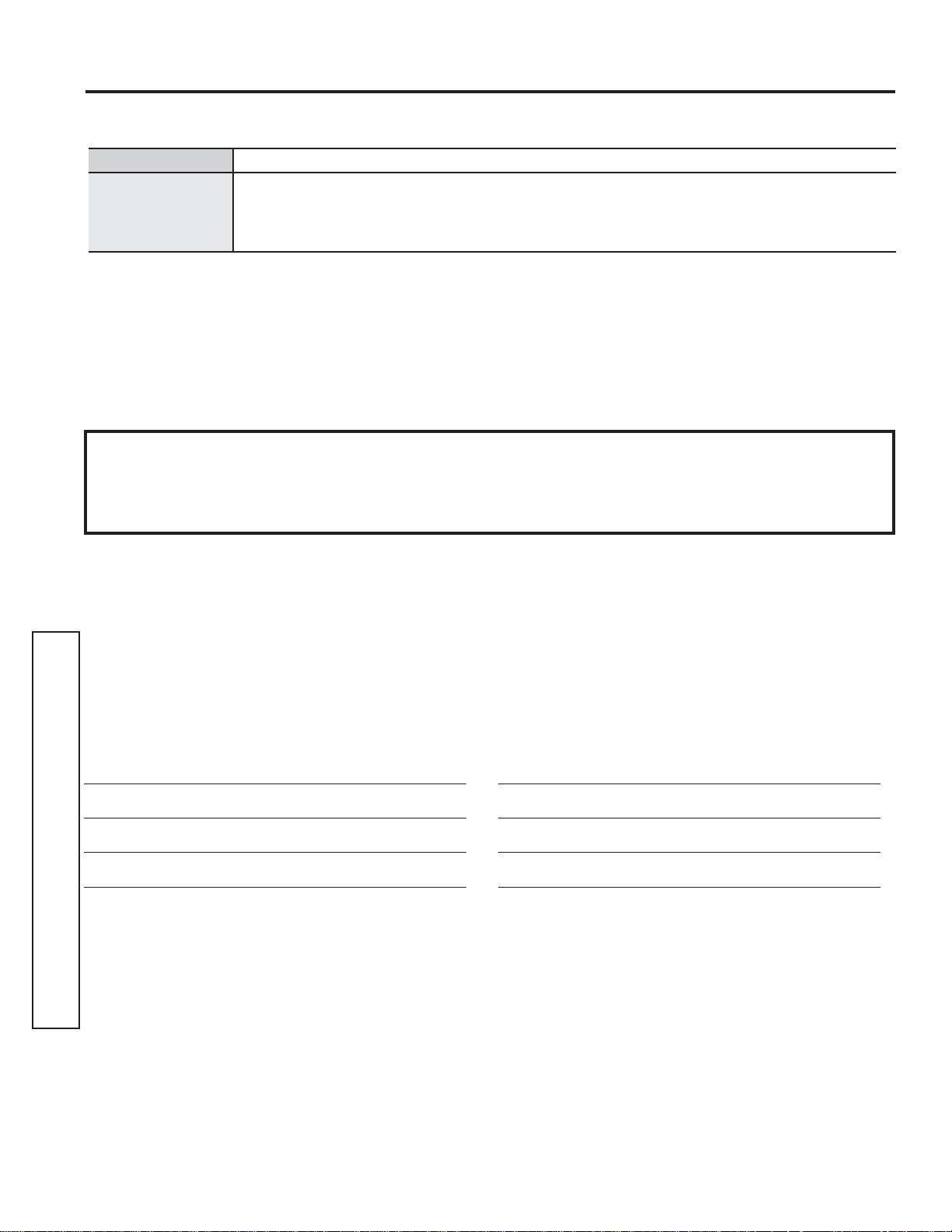
49-1000105 Rev. 434
Staple your receipt here. Proof of the original purchase
date is needed to obtain service under the warranty.
LIMITED WARRANTY
* If your GE Appliances part fails because of a manufacturing defect within thirty days from the date of original purchase for use, we will give you
a new or, at our option, a rebuilt part without charge. Return the defective part to the parts supplier from whom it was purchased together with a
FRS\RIWKH³SURRIRISXUFKDVH´IRUWKHSDUW,IWKHSDUWLVGHIHFWLYHDQGVKRZVQRVLJQVRIDEXVHLWZLOOEHH[FKDQJHG7KHZDUUDQW\GRHVQRW
cover the failure of parts which are damaged while in your possession, are abused, or have been installed improperly. It does not cover the cost
of returning the part to the supplier from whom it was purchased nor does it cover the cost of labor to remove or install it to diagnose the fault. It
does not cover parts used in products in commercial use except in the case of air conditioning equipment. In no event shall GE Appliances be
liable for consequential damages.
Warrantor: GE Appliances, a Haier company
Louisville, KY 40225
Seller:
Name
Address
City State Zip
Signature Date
Buyer:
Name
Address
City State Zip
Signature Date
What GE Appliances will not cover:
Ŷ Service trips to your home to teach you how to use the product.
Ŷ Improper installation.
Ŷ Failure of the product if it is abused, misused, used for other than the intended purpose or used commercially.
Ŷ Replacement of house fuses or resetting of circuit breakers.
Ŷ Damage to the product caused by accident, fire, floods, or acts of God.
Ŷ Incidental or consequential damage caused by possible defects with this appliance.
XWFE Water Filter Cartridge Limited Warranty
This limited warranty is extended to the original purchaser and any succeeding owner for products purchased for
home use within the USA. In Alaska, the limited warranty excludes the cost of shipping or service calls to your home.
Some states do not allow the exclusion or limitation of incidental or consequential damages. This limited warranty
gives you specific legal rights, and you may also have other rights which vary from state to state. To know what your
legal rights are, consult your local or state consumer affairs office or your state’s Attorney General.
For Purchases Made In Iowa: This form must be signed and dated by the buyer and seller prior to the
consummation of this sale.
This form should be retained on file by the seller for a minimum of two years.
For the period of GE Appliances will replace
Thirty Days
From the date
of the original
purchase
Any part of the water filter cartridge which fails due to a defect in materials
or workmanship during this limited thirty-day warranty.*
Contact us at geapplianceparts.com, or call 800.GE.CARES.
EXCLUSION OF IMPLIED WARRANTIES
Your sole and exclusive remedy is part exchange as provided in this Limited Warranty. Any implied warranties,
including the implied warranties of merchantability or fitness for a particular purpose, are limited to six months or
the shortest period allowed by law.
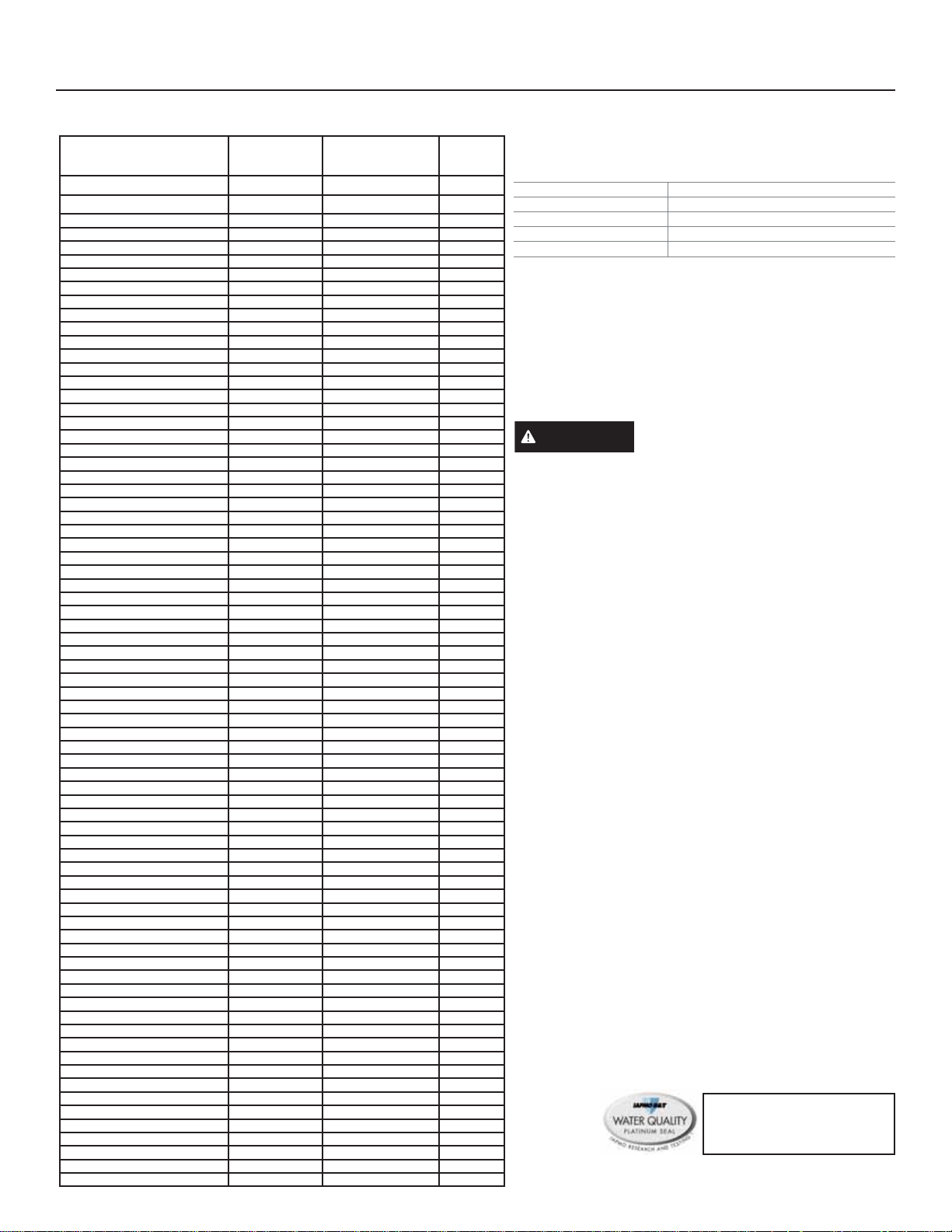
49-1000105 Rev. 4 35
Performance Data Sheet
Model: GE Appliances XWFE
Ŷ6\VWHPFHUWLILHGE\,$30257DJDLQVW16)$16,6WDQGDUGVDQG3IRUWKHUHGXFWLRQRIFODLPVVSHFLILHGRQWKHSHUIRUPDQFHGDWDVKHHWDQG
at iapmort.org.
Ŷ$FWXDOSHUIRUPDQFHPD\YDU\ZLWKORFDOZDWHUFRQGLWLRQV
It is essential that the manufacturer’s recommended installation,
maintenance and filter replacement requirements be carried out for the
product to perform as advertised. See Installation Manual for Warranty
information.
Application Guidelines/Water Supply Parameters
Service Flow 0.5 gpm (1.89 lpm)
Water Supply Potable Water
Water Pressure 25-120 psi (172-827 kPa)
Water Temperature 33°F-100°F (0.6°C-38°C)
Capacity 170 gallons (643.5 liters)
Substance Tested for Reduction
Influent challenge
concentration
(mg/L)
Maximum permissible
product water
concentration (mg/L)
Avg %
Reduction
Chlorine Taste and Odor 2.0 mg/L +/- 10% N/A > 99
Chloramine Taste and Odor 3.0 mg/L +/- 10% 0.5 > 99
Particulate, Class I At least 10,000/mL N/A 91.4
Cysts 50,000/L N/A > 99.99
Lead 0.15 0.01 98.85
Mercury 0.006 0.002 96.95
Asbestos 107 to 108 fibers/ L N/A > 99
Toxaphene 0.015 +/- 10% 0.003 86.95
VOC (Chloroform surrogate chemical) 0.300 0.015 > 99
Alachlor 0.050 0.001 > 98
Atrazine 0.100 0.003 > 97
Benzene 0.081 0.001 > 99
Carbofuran 0.190 0.001 > 99
carbon tetrachloride 0.078 0.0018 98
chlorobenzene 0.077 0.001 > 99
chloropicrin 0.015 0.0002 99
2,4-D 0.110 0.0017 98
dibromochloropropane (DBCP) 0.052 0.00002 > 99
o-Dichlorobenzene 0.08 0.001 > 99
p-Dichlorobenzene 0.040 0.001 > 98
1,2-dichloroethane 0.088 0.0048 95
1,1-dichloroethylene 0.083 0.001 > 99
cis-1,2-dichloroethylene 0.170 0.0005 > 99
trans-1,2-dichloroethylene 0.086 0.001 > 99
1,2-dichloropropane 0.080 0.001 > 99
cis-1,3-dichloropropylene 0.079 0.001 > 99
dinoseb 0.170 0.0002 99
Endrin 0.053 0.00059 99
Ethylbenzene 0.088 0.001 > 99
ethylene dibromide (EDB) 0.044 0.00002 > 99
bromochloroacetonitrile 0.022 0.0005 98
dibromoacetonitrile 0.024 0.0006 98
dichloroacetonitrile 0.0096 0.0002 98
trichloroacetonitrile 0.015 0.0003 98
1,1-dichloro-2-propanone 0.0072 0.0001 99
1,1,1-trichloro-2-propanone 0.0082 0.0003 96
heptachlor (H-34, Heptox) 0.025 0.00001 > 99
heptachlor epoxide 0.0107 0.0002 98
hexachlorobutadiene 0.044 0.001 > 98
hexachlorocyclopentadiene 0.060 0.000002 > 99
Lindane 0.055 0.00001 > 99
methoxychlor 0.050 0.0001 > 99
pentachlorophenol 0.096 0.001 > 99
simazine 0.120 0.004 > 97
Styrene 0.150 0.0005 > 99
1,1,2,2-tetrachloroethane 0.081 0.001 > 99
Tetrachloroethylene 0.081 0.001 > 99
Toluene 0.078 0.001 > 99
2,4,5-TP (silvex) 0.270 0.0016 99
tribromoacetic acid 0.042 0.001 > 98
1,2,4-Trichlorobenzene 0.160 0.0005 > 99
1,1,1-trichloroethane 0.084 0.0046 95
1,1,2-trichloroethane 0.150 0.0005 > 99
trichloroethylene 0.180 0.0010 > 99
bromoform 0.300 0.015 95
bromodichloromethane 0.300 0.015 95
chlorodibromomethane 0.300 0.015 95
xylenes 0.070 0.001 > 99
Meprobamate 400 +/- 20% 60 > 99
Atenolol 200 +/- 20% 30 > 99
Carbamazepine 1400 +/- 20% 200 > 99
DEET 1400 +/- 20% 200 > 99
Metolachlor 1400 +/- 20% 200 > 99
Trimethoprim 140 +/- 20% 20 > 99
Linuron 140 +/- 20% 20 > 99
TCEP 5000 +/- 20% 700 > 99
TCPP 5000 +/- 20% 700 > 99
Phenytoin 200 +/- 20% 30 > 99
Ibuprofen 400 +/- 20% 60 > 99
Naproxen 140 +/- 20% 20 > 99
Estrone 140 +/- 20% 20 > 99
Bisphenol A 2000 +/- 20% 300 > 99
Nonyl phenol 1400 +/- 20% 200 > 99
PFOA/PFOS 1.5 mg/L +/- 10% 0.07 99.25
NOTE: While the testing was performed under standard
laboratory conditions, actual performance may vary.
Replacement Cartridge: XWFE. For estimated costs of
replacement elements please call 1.877.959.8688 or visit our
website at gewaterfilters.com.
WARNING
To reduce the risk associated with
ingestion of contaminants:
• Do not use with water that is microbiologically unsafe
or of unknown quality without adequate disinfection
before and after the system. Systems certified for cyst
reduction may be used on disinfected water that may contain
filterable cysts.
NOTICE
To reduce the risk of water leakage or flooding, and to
ensure optimal filter performance:
• Read and follow use instructions before installation and
use of this system.
• Installation and use MUST comply with all state and local
plumbing codes.
• Do not install if water pressure exceeds 120 psi (827
kPa). If your water pressure exceeds 80 psi (552 kPa), you
must install a pressure-limiting valve. Contact a plumbing
professional if you are uncertain how to check your water
pressure.
• Do not install where water hammer conditions may occur.
If water hammer conditions exist you must install a water
hammer arrester. Contact a plumbing professional if you are
uncertain how to check for this condition.
• Do not install on hot water supply lines. The maximum
operating water temperature of this filter system is 100º F
(38º C).
• Protect filter from freezing. Drain filter when temperatures
drop below 33ºF (0.6ºC).
• Change the disposable filter cartridge every six months or
sooner if you observe a noticeable reduction in water flow
rate.
• Failure to replace the disposable filter cartridge at
recommended intervals may lead to reduced filter
performance and cracks in the filter housing, causing water
leakage or flooding.
• This System has been tested according to NSF/ANSI 42,
53, 401 and P473 for the reduction of the substances listed
below. The concentration of the indicated substances in
water entering the system was reduced to a concentration
less than or equal to the permissible limit for water leaving
the system, as specified in NSF/ANSI 42, 53, 401 and P473.
XWFE System is certified by IAPMO
R&T against NSF/ANSI Standards 42,
53, 401, and P473 for the reduction of
claims specified on the performance
data sheet and at iapmort.org.
49-1000105 Rev. 436
Printed in United States
Consumer Support
CONSUMER SUPPORT
Crosley Website
Have a question or need assistance with your appliance? Try the Crosley Website 24 hours a day, any day of the year at
Crosley.com. You can also shop for more great Crosley products on our website.
Register Your Appliance
Register your new appliance on-line at your convenience at crosley.com/mycrosley. Timely product registration will allow for
enhanced communication and prompt service under the terms of your warranty, should the need arise. You may also mail in the
pre-printed registration card included in the packing material.
Schedule Service
Crosley repair service is only one step away from your door. Call 800.544.4780 during normal business hours to schedule service.
CROSLEYCARE
®
10 Year Limited Warranty
When you buy a Crosley appliance, you receive one of the best warranties available in the appliance industry. For more
information, visit Crosley.com/warranty. Visit Crosley.com/mycrosley to register the extended limited warranty.
Parts and Accessories
Individuals qualified to service their own appliances can have parts or accessories sent directly to their homes (VISA, MasterCard
and Discover cards are accepted). Order on-line today 24 hours every day. Visit GEApplianceparts.com or by phone at
877.959.8688 during normal business hours.
Instructions contained in this manual cover procedures to be performed by any user. Other servicing generally should
be referred to qualified service personnel. Caution must be exercised, since improper servicing may cause unsafe
operation.
Modelos: XSS23G, XSS25G
Contenido
Información de Seguridad ..........3
Uso del Refrigerador
Controles .......................6
El filtro de agua - XWFE ...........7
Entrepaños y recipientes ...........8
Cajones y recipientes.............10
Puertas........................10
Máquina de hielo automática.......11
El dispensador de agua y de hielo . .13
Cuidado y Limpieza
Limpiar el exterior ...............14
Limpiar el interior ................14
Atrás del refrigerador.............15
Preparación para vacaciones ......15
En caso de mudanza.............15
Iluminación LED.................16
Instrucciones para la Instalación
Preparación para instalar
el refrigerador..................17
Cómo mover el refrigerador........18
Cómo instalar el refrigerador .......22
Cómo instalar la línea de agua .....26
Solución de Problemas............29
Garantía Limitada ................32
Soporte al Consumidor
Garantía Limitada Filtro de Agua . . .33
Hoja de datos de funcionamiento . . .34
Soporte al Consumidor ...........36
49-1000105 Rev. 4 04-22 GEA
Refrigeradores de dos puertas
Escriba los números de modelo y de serie aquí:
Número de modelo : ____________________
Número de serie:_______________________
Usted los verá en una etiqueta en el interior
del compartimiento de refrigerador en la parte
superior en el lado derecho.
Español
Manual del
Propietario
e Instrucciones
de Instalación
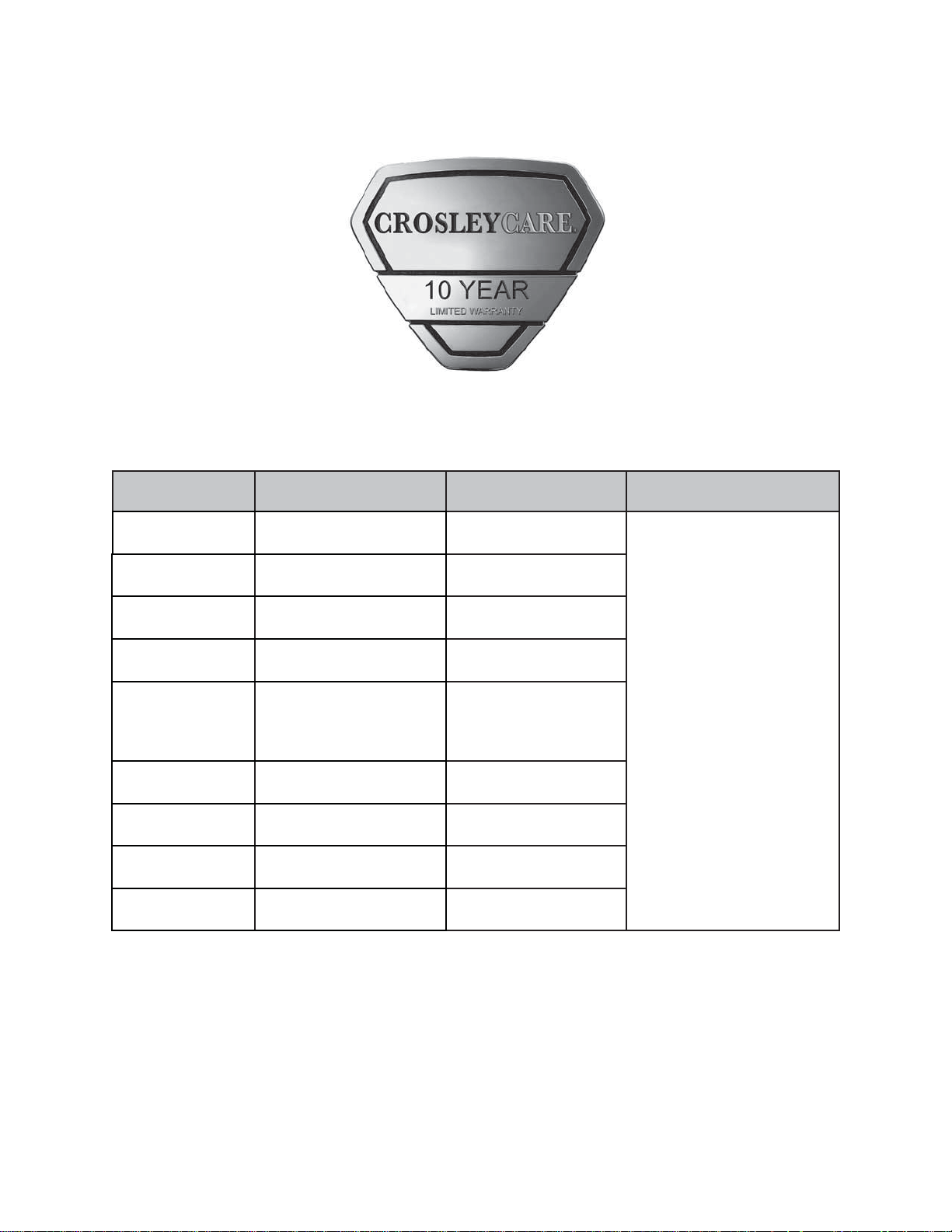
2 49-1000105 Rev. 4
¡La icónica marca estadounidense apoyada por la mejor garantía de electrodomésticos estadounidense!
¡Garantía Limitada por 10 Años GRATUITA en todos los Electrodomésticos Crosley!
Visite Crosley.com/mycrosley y registre la garantía limitada extendida.
ELECTRODO-
MÉSTICO
COMPONENTE
GARANTÍA LIMITADA
DEL FABRICANTE
GARANTÍA LIMITADA
EXTENDIDA DE CROSLEY
Refrigerador o
Congelador
Compresor 1 Año
10 años
Incluyendo Cobertura del
Fabricante por 1 Año
Lavadora de
Carga Superior
Caja de engranajes/
Transmisión
1 Año
Lavadora de
Carga Frontal
Motor 1 Año
Lavadora
Compacta
Motor 1 Año
Unidad de
Almacenamiento
de Lavadora/
Secadora
Motor/Elemento de
Calefacción
1 Año
Lavavajillas Motor 1 Año
Secadora a Gas/
Eléctrica
Motor/Elemento de
Calefacción
1 Año
Estufa Eléctrica
Elementos para Hornear/
Asar/ de la Superficie
1 Año
Estufa de Gas
Modulos de encendido
y de chispa
1 Año
349-1000105 Rev. 4
PRECAUCIÓN
A fin de reducir el riesgo de lesiones al usar el refrigerador, siga estas precauciones
básicas.
Ŷ 1ROLPSLHHVWDQWHVGHYLGULRQLWDSDVFRQDJXDFDOLHQWH
cuando estén fríos. Los estantes de vidrio y las tapas
se pueden romper si son expuestos a cambios de
temperatura repentinos o impactos, tales como golpes o
caídas. El vidrio templado está diseñado para destruirse
en pequeñas piezas en caso de rotura.
Ŷ 0DQWHQJDORVGHGRVIXHUDGHORVHVSDFLRVGH³ULHVJRGH
lesión”; los espacios entre las puertas y entre las puertas
y el gabinete son necesariamente pequeños. Tenga
el cuidado de cerrar las puertas cuando los niños se
encuentren en el área.
Ŷ 1RWRTXHODVVXSHUILFLHVIUtDVGHOFRPSDUWLPLHQWRGHO
congelador cuando las manos estén húmedas o mojadas,
ya que la piel se podrá adherir a estas superficies
extremadamente frías.
Ŷ 1RYXHOYDDFRQJHODUFRPLGDVTXHKD\DQHVWDGR
totalmente congeladas en forma previa.
Ŷ 6LVXUHIULJHUDGRUWLHQHXQGLVSRVLWLYRDXWRPiWLFRSDUD
hacer hielo, evite el contacto con las partes móviles del
mecanismo de expulsión, o con el elemento calefactor
localizado en la parte inferior del dispositivo para hacer
hielo. No ponga los dedos ni las manos en el mecanismo
automático para hacer hielo mientras el refrigerador esté
conectado
Ŷ 8VHXQYDVRUREXVWRDOGLVSHQVDUKLHORHQPRGHORVFRQ
dispensador de hielo).
INFORMACIÓN DE SEGURIDAD
LEA Y GUARDE ESTAS INSTRUCCIONES
INFORMACIÓN IMPORTANTE DE SEGURIDAD
LEA TODAS LAS INSTRUCCIONES ANTES DE USAR
INSTALACIÓN
ADVERTENCIA
A fin de reducir el riesgo de incendio, explosión, descargas eléctricas o lesiones al usar su
refrigerador, siga estas precauciones básicas de seguridad:
Ŷ (VWHUHIULJHUDGRUVHGHEHUiLQVWDODU\XELFDU
adecuadamente de acuerdo con las Instrucciones de
Instalación antes de ser usado.
Ŷ 'HVHQFKXIHHOUHIULJHUDGRUDQWHVGHKDFHUUHSDUDFLRQHVR
hacer una limpieza.
Nota: La corriente que va al refrigerador no puede ser
desconectada por ninguna configuración del panel de
control.
Nota: Las reparaciones deberán ser realizadas por un
Profesional del Servicio Técnico calificado.
Ŷ 5HHPSODFHWRGDVODVSLH]DV\SDQHOHVDQWHVGHOXVR
Ŷ 1RXVHH[WHQVLRQHVHOpFWULFDVSDUDFRQHFWDUVXDSDUDWR
Ŷ 1RJXDUGHQLXVHJDVROLQDXRWURVYDSRUHV\OtTXLGRV
inflamables cerca de este ni de otro electrodoméstico.
Ŷ 1RJXDUGHVXVWDQFLDVH[SORVLYDVWDOHVFRPRODWDV
de aerosoles con propelentes inflamables en este
electrodoméstico.
Ŷ $ILQGHHYLWDUULHVJRVGHTXHORVQLxRVTXHGHQDWUDSDGRV
y sufran asfixia, retire las puertas del refrigerador y del
congelador de cualquier refrigerador antes de deshacerse
o dejar de usar el mismo.
Ŷ /RVQLxRV\ODVSHUVRQDVFRQFDSDFLGDGItVLFD
sensorial o mental reducida o con falta de experiencia y
conocimiento podrán usar este electrodoméstico sólo si
son supervisados o les fueron dadas instrucciones sobre
un uso seguro y entienden los riesgos involucrados.
Ŷ (VWHHOHFWURGRPpVWLFRIXHGLVHxDGRSDUDXVRKRJDUHxR\
para aplicaciones similares tales como: áreas de personal
de cocina en tiendas, oficinas y otros espacios laborales;
casas de campo; por clientes en hoteles, moteles,
hostales y otros espacios residenciales, servicio de
comidas.
Ŷ 5HDOLFHODFRQH[LyQDXQVXPLQLVWURGHDJXDSRWDEOH
únicamente. Se requiere un suministro de agua fría para
el funcionamiento de la máquina de hielos automática. La
SUHVLyQGHODJXDGHEHUiHVWDUHQWUH\SVL
kilopascales).
Ŷ 1RDSOLTXHOLPSLDGRUHViVSHURVVREUHHOUHIULJHUDGRU
Ciertos limpiadores dañarán el plástico, lo cual podrá
hacer que ciertas piezas tales como la puerta o las
manijas de las puertas se separen de forma inesperada.
Para acceder a instrucciones detalladas, lea la sección de
Cuidado y Limpieza.
ADVERTENCIA
RIESGO DE INCENDIO O EXPLOSIÓN
Mantenga cualquier material y vapores inflamables alejados del refrigerador. Si no se cumple con esto se podrá producir una
explosión, incendio o la muerte.
4 49-1000105 Rev. 4
INFORMACIÓN DE SEGURIDAD
INFORMACIÓN IMPORTANTE DE SEGURIDAD
LEA TODAS LAS INSTRUCCIONES ANTES DE USAR
LEA Y GUARDE ESTAS INSTRUCCIONES
CONEXIÓN DE LA ELECTRICIDAD
Nunca, bajo ninguna circunstancia, corte o elimine el tercer cable (tierra) del cable de corriente. Para su seguridad
personal, este electrodoméstico debe estar adecuadamente conectado a tierra.
El cable de corriente de este electrodoméstico contiene un
HQFKXIHGHFDEOHVFRQH[LyQDWLHUUDTXHVHFRQHFWDDXQ
WRPDFRUULHQWHGHSDUHGHVWiQGDUGHFDEOHVFRQH[LyQD
tierra) para minimizar la posibilidad de riesgos de descargas
eléctricas por parte del mismo.
Contrate a un electricista calificado para que controle el
tomacorriente y el circuito eléctrico, a fin de asegurar que el
enchufe esté correctamente conectado a tierra.
En caso de contar con un tomacorriente de pared de 2
cables, es su responsabilidad y obligación reemplazarlo
por un tomacorriente de pared de 3 cables correctamente
conectado a tierra. No use un adaptador.
El refrigerador debería estar siempre conectado a un enchufe
específico con un índice de voltaje equivalente al que figura
en su etiqueta de características técnicas.
Se requiere un suministro eléctrico con fusible y conexión
a tierra de 115 voltios de CA, 60 Hz, 15 o 20 amperes.
Esto garantiza el mejor funcionamiento y además previene
la sobrecarga de los circuitos del hogar, lo cual podría
ocasionar riesgos de incendio debido al recalentamiento de
cables.
Nunca desenchufe el refrigerador tirando del cable de
corriente. Siempre tome su enchufe firmemente y empuje el
mismo hacia afuera para retirarlo.
Repare o reemplace de inmediato todos los cables de
corriente pelados o con cualquier tipo de daño. No use
un cable con cortaduras o abrasión sobre su extensión o
extremos.
Al alejar el refrigerador de la pared, se deberá tener cuidado
de que no ruede sobre ni dañe el cable de corriente.
ADVERTENCIA
RIESGO DE DESCARGA ELÉCTRICA
Enchufe en un tomacorriente con conexión a tierra de 3 cables.
No elimine el cable de conexión a tierra.
No use un adaptador.
No use extensión eléctrica.
Si no se siguen estas instrucciones se podrá producir a muerte, incendios o descargas eléctricas.
ADVERTENCIA
PELIGRO DE ATRAPADOS Y ASFIXIA
El incumplimiento de estas instrucciones de eliminación puede causar la muerte o lesiones graves.
IMPORTANTE: Que un niño quede atrapado o que sufra
una asfixia no son problemas del pasado. Los refrigeradores
antiguos o abandonados aún son peligrosos, incluso aunque
VHFRQVHUYHQSRU³VyORXQRVSRFRVGtDV´6LVHGHVKDUiGHVX
antiguo refrigerador, siga las siguientes instrucciones a fin de
evitar accidentes.
Antes de Descartar su Antiguo Aparato:
Ŷ Retire las puertas del refrigerador y del congelador.
Ŷ Deje los estantes en su lugar de modo que los niños no
puedan trepar dentro con facilidad.
DESCARTE DE REFRIGERANTES Y GOMAESPUMAS:
Descarte o recicle su electrodoméstico de acuerdo con las Regulaciones Federales y Locales. El refrigerante inflamable y
el material aislante inflamable usados requieren procedimientos de descarte especiales. Comuníquese con las autoridades
locales para descartar o reciclar su electrodoméstico de forma ambientalmente segura.
549-1000105 Rev. 4
INFORMACIÓN IMPORTANTE DE SEGURIDAD
LEA TODAS LAS INSTRUCCIONES ANTES DE USAR
LEA Y GUARDE ESTAS INSTRUCCIONES
INFORMACIÓN DE SEGURIDAD
ADVERTENCIA
RIESGO DE INCENDIO O EXPLOSIÓN Refrigerantes Inflamables
Este electrodoméstico cuenta con refrigerante isobutano,
también conocido como R600a, un gas natural con alto
nivel de compatibilidad medioambiental. Sin embargo,
también es combustible. Siga las advertencias que
figuran a continuación, a fin de reducir el riesgo de
lesiones o daños sobre la propiedad.
1. Al mover, instalar y operar el electrodoméstico, se deberá
tener cuidado de no dañar la tubería del refrigerante.
2. El servicio técnico sólo debe ser realizado por personal
autorizado del servicio. Use sólo piezas del servicio
autorizadas por el fabricante
3. Descarte el electrodoméstico de acuerdo con las
Regulaciones Federales y Locales.
El refrigerante
inflamable y el material aislante inflamable usados en este
producto requieren procedimientos de descarte especiales.
Comuníquese con las autoridades locales para descartar
su refrigerador de forma ambientalmente segura.
4. Mantenga las aberturas de ventilación en el espacio
de protección del electrodoméstico o en la estructura
incorporada libres de obstrucción.
5. A fin de eliminar la escarcha, raspe con una espátula o
raspador de plástico o madera.
No use un pico de hielo
o un instrumento de metal con forma puntiaguda, ya que
esto podrá perforar el revestimiento del freezer y luego la
tubería refrigerante inflamable detrás de éste.
6. No use dispositivos eléctricos dentro del compartimiento
de almacenamiento de comida del electrodoméstico.
7. No use ningún dispositivo eléctrico para descongelar su
refrigerador.
Marque el tipo de refrigerador en la etiqueta de especificaciones técnicas. Si es el R600a,
cumpla con las instrucciones descriptas en la siguiente advertencia.
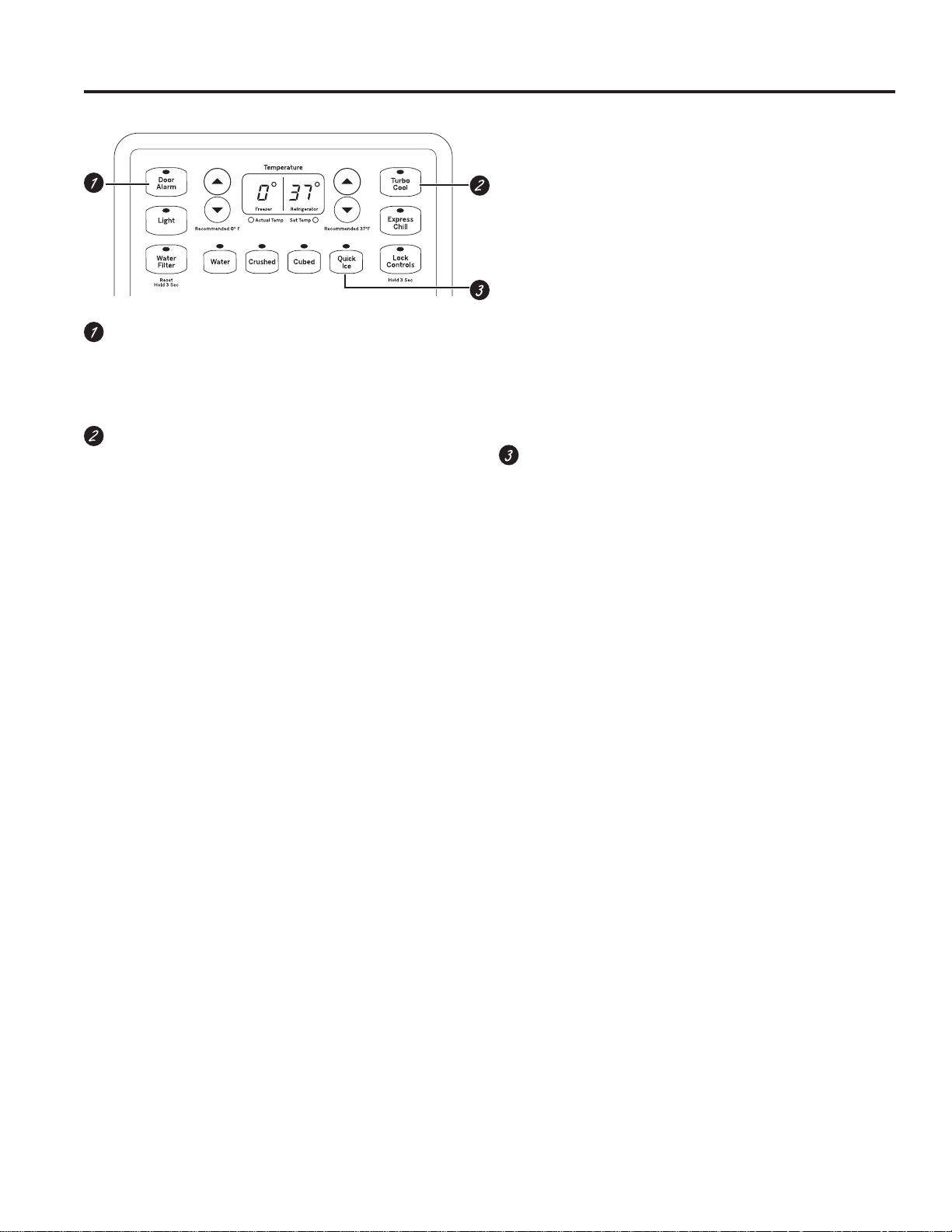
6 49-1000105 Rev. 4
Controles
Los controles de temperatura fueron configurados
SUHYLDPHQWHHQODIiEULFDHQ)&SDUDHO
FRPSDUWLPLHQWRGHOUHIULJHUDGRU\HQ)&SDUDHO
compartimiento del congelador. Espere 24 horas hasta que la
temperatura se estabilice en los ajustes de preconfiguración
recomendados.
Es posible que los controles de temperatura muestren la
WHPSHUDWXUDHQ6(7$MXVWDGD\ODWHPSHUDWXUDUHDOHQHO
refrigerador y en el congelador. La temperatura real puede
variar levemente en relación a la temperatura en SET
$MXVWDGDHQEDVHDOXVR\DODPELHQWHGRQGHVHXVD
Alarma de la Puerta HQDOJXQRVPRGHORV
Para configurar la alarma, presione esta tecla hasta que
la luz indicadora se encienda. Esta alarma sonará si una
de las puertas permanece abierta por más de 3 minutos.
La luz se apaga y el pitido se detiene cuando se cierra la
puerta.
TurboCool
TM
HQDOJXQRVPRGHORV
El TurboCool
TM
rápidamente enfría el compartimiento del
refrigerador, a fin de enfriar las comidas de forma más
rápida. Use el TurboCoolTM al agregar una gran cantidad
de comida al compartimiento del refrigerador, guardando
las comidas que estuvieron a temperatura ambiente o al
guardar restos de comida caliente. También se puede
usar si el refrigerador estuvo sin corriente por un período
prolongado.
NOTAS: La temperatura del refrigerador no podrá ser
modificada durante el uso de TurboCool™.
La temperatura del congelador no se ve afectada durante
el uso de TurboCool
TM
.
Al abrir la puerta del refrigerador durante el uso de
TurboCool
TM
, los ventiladores continuarán funcionando si
estuvieron activados.
Quick Ice (Hielo Rápido) HQDOJXQRVPRGHORV
Cuando necesite hielo de forma rápida, presione esta tecla
para acelerar la producción de hielo. Esto incrementará
la producción de hielo durante las siguientes 48 horas o
hasta que presione la tecla nuevamente.
USO DEL REFRIGERADOR: Controles
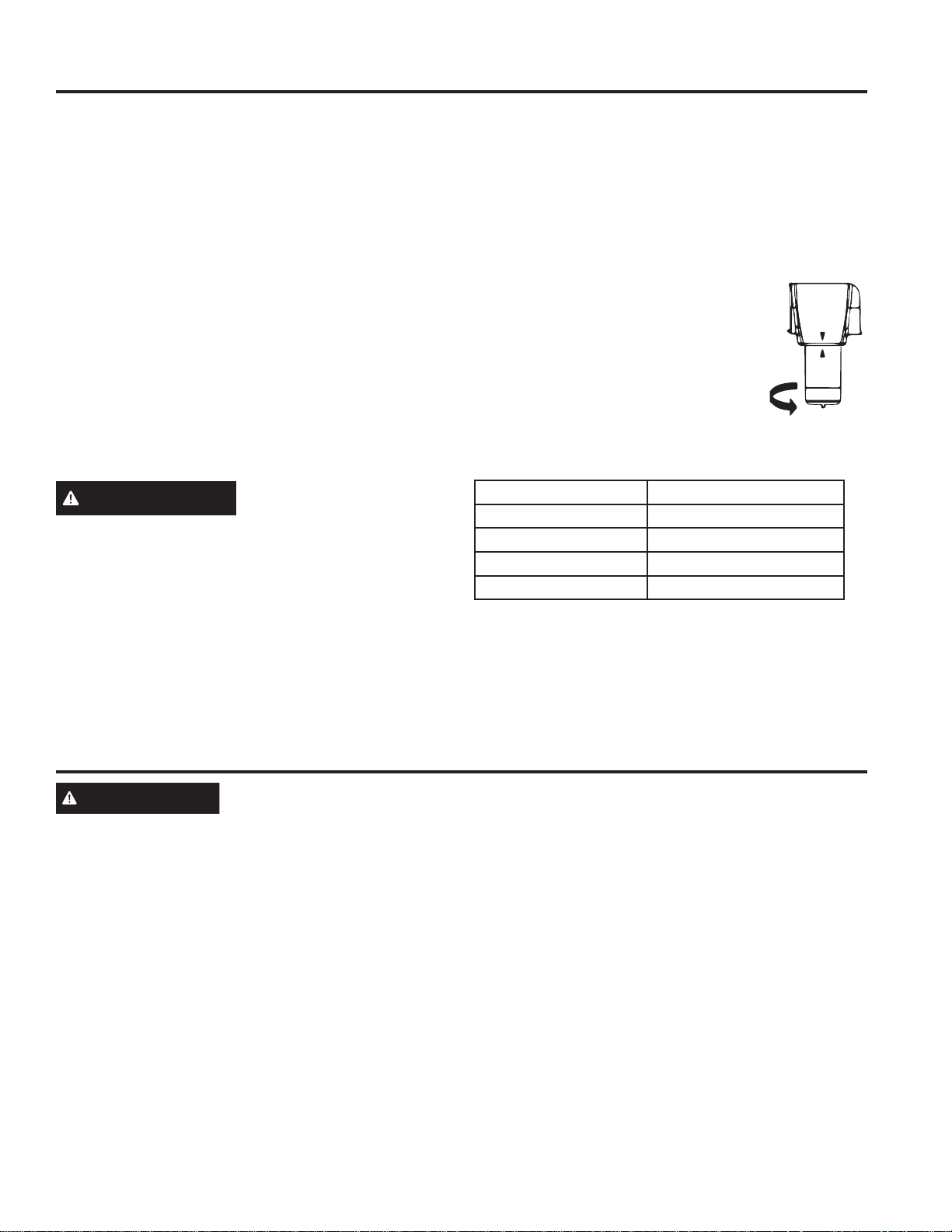
749-1000105 Rev. 4
Acerca del cartucho del filtro de agua XWFE
HQDOJXQRVPRGHORV
USO DEL REFRIGERADOR
:
Acerca del cartucho del filtro de agua XWFE
ADVERTENCIA
A fin de reducir el riesgo asociado con asfixia, no permita que los niños menores de 3 años
tengan acceso a las partes pequeñas durante la instalación de este producto. El cartucho del filtro descartable deberá
ser reemplazado cada 6 meses luego de agotar su capacidad, o antes si se produce una reducción notoria en el caudal.
Para obtener el máximo beneficio de su sistema de filtrado, Crosley recomienda el uso de los filtros de la marca GE Appliances
únicamente. El uso de filtros de la marca GE Appliances en refrigeradores Crosley brinda un óptimo funcionamiento y
confiabilidad. Los filtros de GE Appliances cumplen con rigurosos estándares NSF de la industria sobre seguridad y calidad, que
son importantes para los productos que están filtrando su agua. Crosley no posee filtros de la marca GE Appliances que no estén
calificados para su uso en refrigeradores Crosley y no existe seguridad de que los filtros que no son de la marca GE Appliances
cumplan con los estándares de Crosley en relación a calidad, funcionamiento y confiabilidad.
Ante cualquier consulta, o para ordenar cartuchos de filtros adicionales, visite nuestro sitio Web en gewaterfilters.com,
o llame a GE Appliances Parts and Accessories (Piezas y Accesorios de GE Appliances), al 877.959.8688.
Cartucho del filtro de agua
El cartucho del filtro de agua está ubicado en el extremo
superior trasero derecho del compartimiento del refrigerador.
Cuándo Reemplazar el Filtro
Si existe una luz indicadora de reemplazo del cartucho del
filtro de agua en el dispensador, una luz roja del filtro
comenzará a parpadear a fin de indicar que es necesario
reemplazar el filtro pronto. En los modelos que no cuentan con
una luz indicadora, el cartucho del filtro deberá ser
reemplazado cada seis meses, o antes si se observa una
reducción en el flujo de agua hacia el dispensador o la
máquina de hielos.
Retiro del Filtro
Si reemplazará el filtro, primero retire el anterior tomando el
mismo de forma suave y lentamente girándolo hacia la
izquierda, dando aproximadamente ¼ de giro. El filtro deberá
liberarse de forma automática cuando lo haya rotado lo
suficiente hacia la izquierda. Es posible que gotee una
pequeña cantidad de agua.
PRECAUCIÓN
Si quedó aire atrapado en el
sistema, es posible que el cartucho sea eyectado en el
momento en que se retire. Tenga cuidado al retirar el mismo.
7DSyQGHE\SDVVGHO¿OWUR
A fin de reducir el riesgo de daños sobre la propiedad debido a
pérdidas de agua, usted DEBERÁ usar el tapón del bypass del
filtro cuando no se disponga de un reemplazo del cartucho del
filtro. Algunos modelos no vienen equipados con el tapón del
filtro del bypass. A fin de obtener un tapón del filtro del bypass,
comuníquese al 800-GECARES. En Canadá, comuníquese al
800.561.3344. El dispensador y la máquina de hielos no
funcionarán si el filtro o el tapón del bypass del filtro no están
instalados. El tapón del bypass se instala del mismo modo que
un cartucho del filtro.
Instalación del Cartucho del Filtro en un
Refrigerador de Dos Puertas
1. Alinee la flecha del filtro con la flecha del sostén del cartucho
del filtro. De forma suave, empuje la parte superior del nuevo
filtro hacia arriba dentro del sostén.
2. Lentamente, gire el filtro hacia la derecha hasta que se
detenga. NO LO AJUSTE EN EXCESO. Mientras gira
el filtro, el mismo se elevará automáticamente hasta su
posición. El filtro girará aproximadamente ¼” o 90 grados.
3. Deje correr una cantidad de agua desde
HOGLVSHQVDGRUGHJDORQHVOLWURVR
durante aproximadamente 5 minutos para
limpiar el sistema. Es posible que el agua
salga a chorros o se podrán visualizar
burbujas de agua durante el proceso.
4. Mantenga presionada la tecla WATER
),/7(5)LOWURGH$JXDVyORHQPRGHORV
específicos) sobre el dispensador durante
tres segundos.
Flujo del Servicio JSPOSP
Suministro de Agua Agua Potable
Presión del Agua SVLN3D
Temperatura del agua ))&&
Capacidad JDORQHVOLWURV
Regístrese para RECORDATORIOS DE TEXTO,
enviados REPLACE (Reemplazar) por mensaje
de texto al 70543.
Pautas de Aplicación/ Suministro de Agua
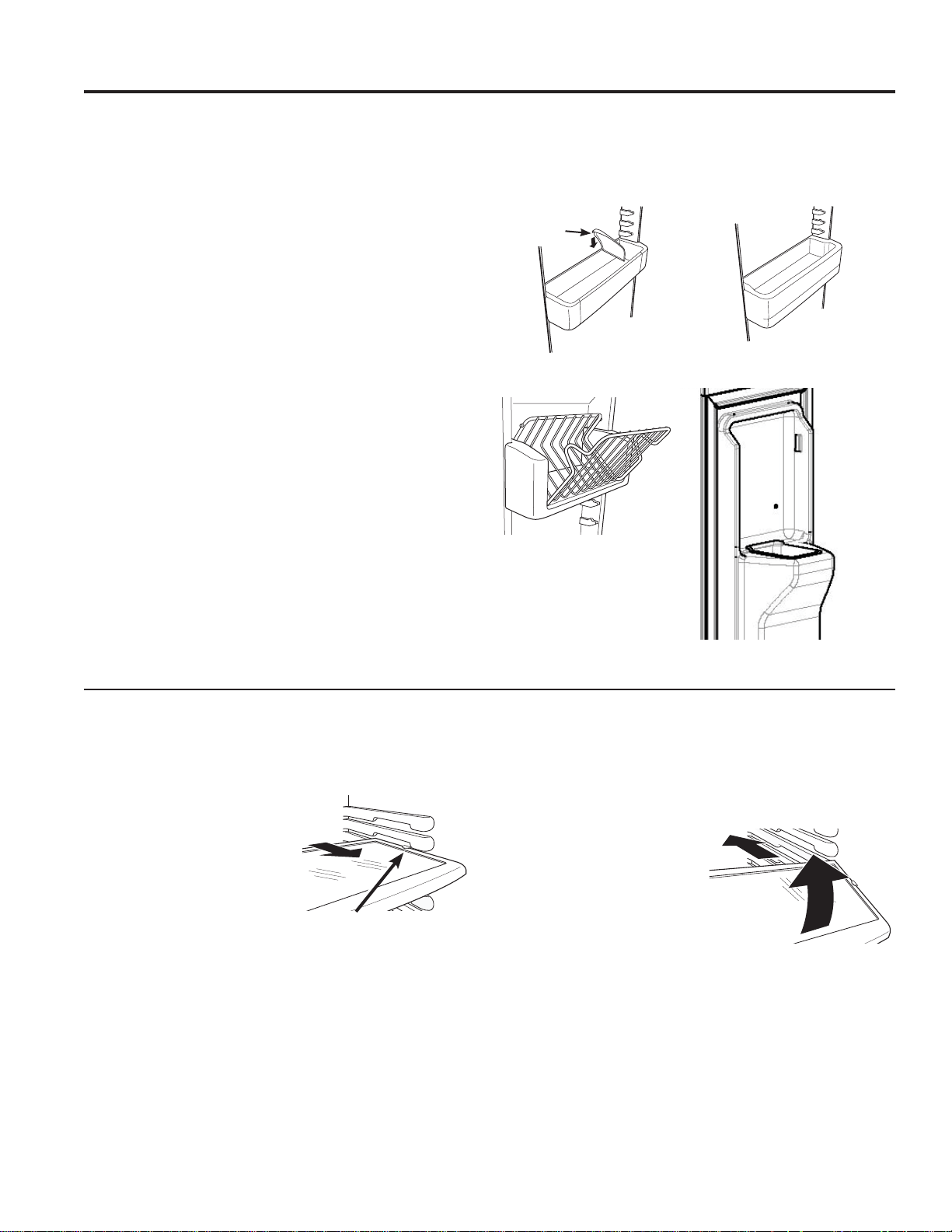
8 49-1000105 Rev. 4
No todos los modelos tienen todas las características.
Estantes de la Puerta del Refrigerador y Estantes Inclinables de la Puerta del
Congelador
Recipientes grandes
Los recipientes de la puerta del refrigerador y los recipientes
inclinables de la puerta del congelador más grandes son
ajustables.
Para extraerlos: Levante la parte frontal del recipiente hacia
arriba, luego levántelo y sáquelo.
Para reemplazarlos o reubicarlos: Ajuste la parte trasera
del recipiente en los soportes moldeados de la puerta. Luego
presione hacia abajo en la parte frontal del recipiente. El
recipiente se ajustará en su sitio.
Recipientes pequeños
Para extraerlos: Levante la parte frontal del recipiente hacia
arriba, luego sáquelo.
Para reemplazarlos: Sitúe el recipiente por encima de los
soportes moldeados rectangulares en la puerta. Luego deslice
el recipiente hacia abajo hacia el soporte para que se ajuste en
su lugar.
La tapa deslizante ayuda a prevenir que un golpecito haga
derramarse algo o que las cosas pequeñas guardadas en el
interior del entrepaño de la puerta se caigan o resbalen. Ponga
un dedo en cada lado de la tapa deslizante hacia la parte
trasera y muévala hacia delante y hacia atrás para que se
ajuste a sus necesidades.
NOTA: Tenga cuidado cuando reemplace artículos en el
recipiente superior. Cerciórese de que ningún artículo bloquee
o caiga en el vertedero de hielo.
Entrepaños y recipientes
Recipiente del refrigerador
Recipiente inclinable del
congelador
Tapa
deslizante
Recipiente de congelador
Vertedero
de Hielo
Entrepaño deslizable a prueba de derramamientos
El entrepaño deslizable permite alcanzar artículos guardados
atrás de otros. Los bordes especiales están diseñados para
ayudar a prevenir derramamientos o
goteos a los entrepaños que se encuentran más abajo.
Para sacarlos:
Deslice el entrepaño hacia fuera
hasta que llegue al punto donde
se atore, luego apriete la lengüeta
hacia abajo y deslice el entrepaño
directamente hacia fuera.
Para reemplazarlos o reubicarlos: Sitúe el entrepaño a la
altura de las guías y deslícelo hacia su lugar. El entrepaño
SXHGHVHUUHXELFDGRFXDQGRODSXHUWDHVWpDÛRPiV3DUD
reubicar el entrepaño, deslice el entrepaño más allá de los
topes e inclinelo hacia abajo. Deslice el entrepaño hacia abajo
hasta llegar a la posición deseada, colóquelo en línea con los
soportes y deslícelo en su lugar.
Asegúrese de haber empujado
los entrepaños hasta el fondo
antes de cerrar la puerta.
Presione la tecla y empuje la
repisa hacia adelante para
retirar la misma.
USO DEL REFRIGERADOR: Entrepaños y recipientes
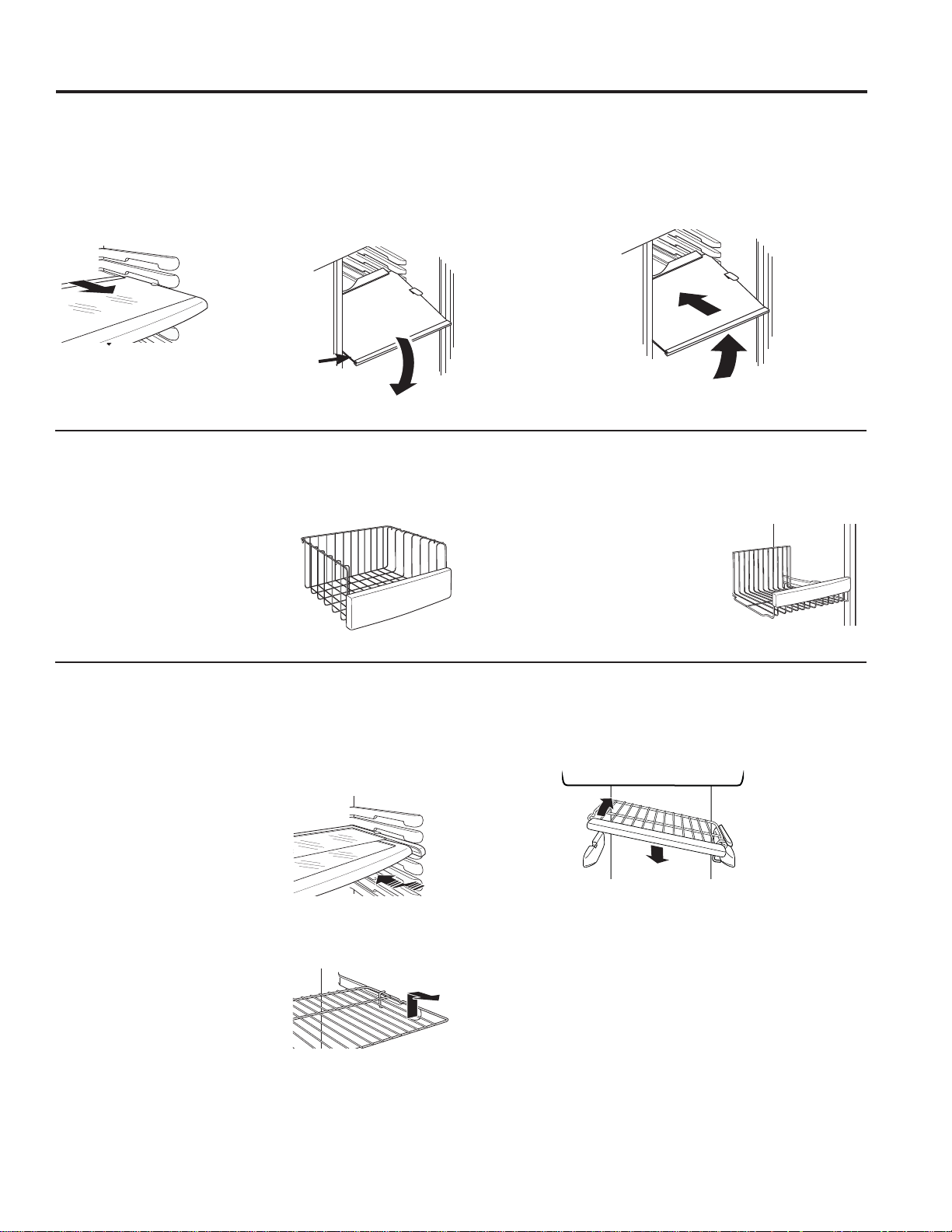
949-1000105 Rev. 4
Canastas del Congelador (en algunos
modelos)
Para remover, deslícelo hasta la posición tope, levante el
frente más allá de la posición de tope, y deslícelo hacia afuera.
Asegúrese de haber empujado las
cestas hasta el fondo antes de cerrar
la puerta.
Canastas del Congelador( en algunos
modelos)
Para remover, empuje la canasta totalmente hacia la parte
posterior del congelador. Levante hasta que los pasadores
posteriores sean desenganchados.
Levante la canasta completa hacia
arriba y hacia afuera.
Asegúrese de haber empujado las
cestas hasta el fondo antes de cerrar la
puerta.
USO DEL REFRIGERADOR: Entrepaños y recipientes
No todos los modelos tienen todas las características.
Entrepaño QuickSpace™ HQDOJXQRVPRGHORV
Este entrepaño se divide en dos y la mitad se desliza debajo
de sí mismo para guardar artículos muy altos ubicados en el
entrepaño que se encuentra más abajo.
Este entrepaño se puede sacar y
cambiar y también puede reubicarse
igual que los entrepaños deslizables
a prueba de derramamientos.
En algunos modelos, este entrepaño
no puede usarse en la posición más
baja.
Entrepaños deslizables del congelador
Para remover, deslícelo hasta
la posición tope, levante el frente
más allá de la posición de tope, y
deslícelo hacia afuera.
Asegúrese de haber empujado los
entrepaños hasta el fondo antes de
cerrar la puerta.
Entrepaños fijos del congelador
Para remover, deslice el entrepaño hacia arriba en el lado
izquierdo y entonces extráigalo del alojamiento.
NOTA PARA LOS MODELOS CON DISPENSADORES:
Para aprovechar al máximo la inclinación para sacar el hielo
del cubo, solamente almacene artículos en entrepaño debajo
del cubo de hielo que no sean más altos que el punto inferior
en el cubo.
Entrepaños y recipientes
Repisa de Extremo a Extremo
Para retirar: Con la puerta abierta en un ángulo superior
a 90°, deslice el estante hacia afuera hasta que llegue a la
lengüeta de detención. Presione la lengüeta hacia abajo y
deslice el estante hacia afuera hasta que alcance el borde
trasero de la misma. Mientras mantiene el lado izquierdo del
estante en contacto con el gabinete, empuje el mismo hacia
abajo y adelante sobre el lado izquierdo para retirar el mismo.
Para reemplazar o reubicar: : Con la puerta abierta en un
ángulo superior a 90°, alinee el borde trasero del estante
contra su soporte. Manteniendo el lado izquierdo contra el
gabinete, lentamente levante y levemente empuje el estante
hasta su posición. Reposicione el estante más allá de las
lengüetas de detención. Asegúrese de empujar los estantes
hacia adentro hasta su tope antes de cerrar la puerta.
Presione la lengüeta y
empuje el estante hacia
adelante
Sobre el lado
izquierdo
permanece
contra
el gabinete a
medida que
empuja hacia
abajo y hacia
la izquierda
para retirar el
mismo
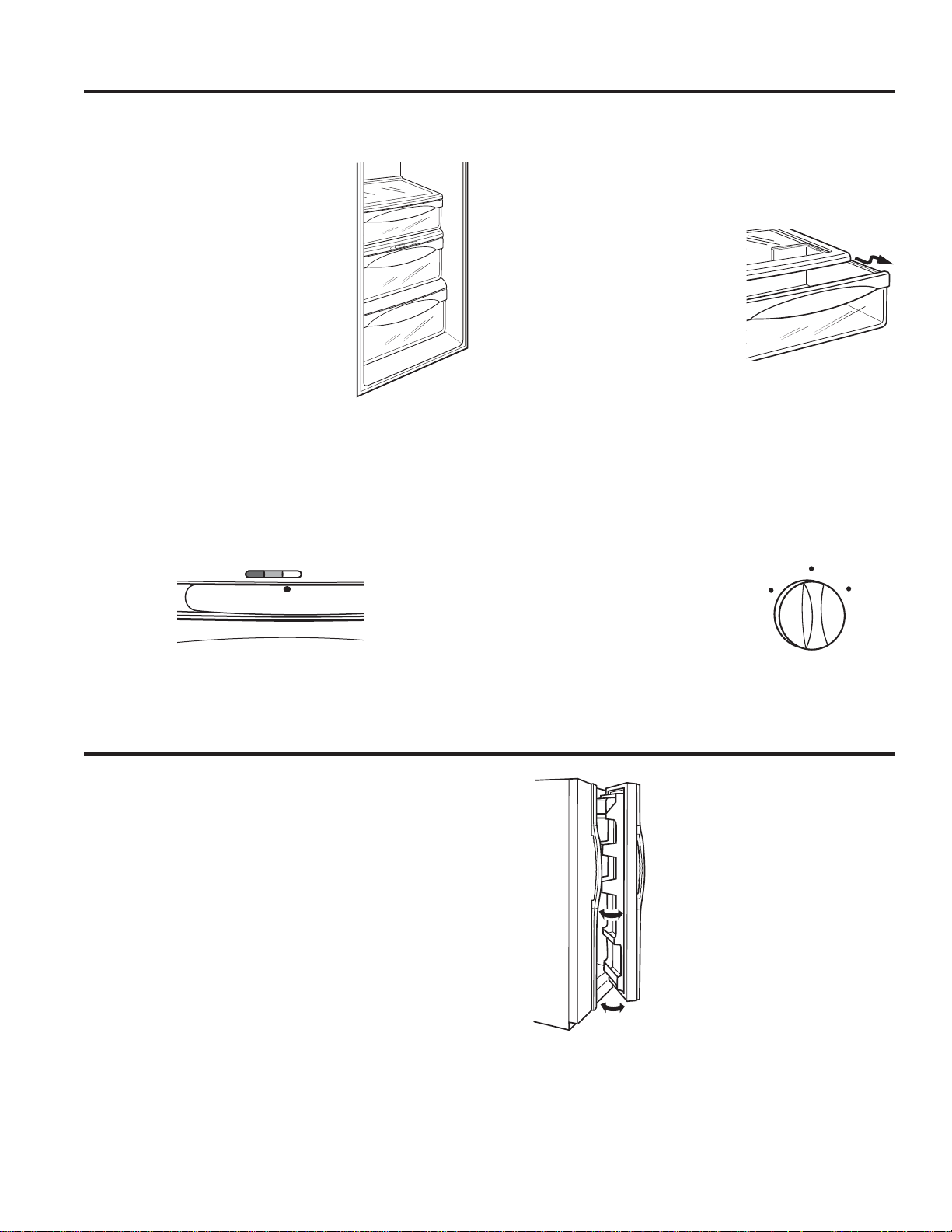
10 49-1000105 Rev. 4
Puertas del refrigerador HQDOJXQRVPRGHORV
Es posible que Ud. note una diferencia entre el manejo de las
puertas de su antiguo y nuevo refrigerador. La característica
especial de abertura y cierre de las puertas asegura que estas
cierren por completo y permanezcan selladas firmemente.
Al abrir y cerrar la puerta, usted observará una posición de
detención. Si la puerta es abierta más allá de este punto,
la misma permanecerá abierta, permitiéndole introducir o
retirar comida con mayor facilidad. La puerta se cerrará
automáticamente sólo cuando está parcialmente abierta.
La resistencia que Ud. puede notar en la posición de tope es
menor a medida que la puerta es cargada con alimentos.
Puertas
La puerta se cerrará
automáticamente sólo cuando
está parcialmente abierta.
Más allá de la posición de
tope la puerta permanecerá
abierta.
OPERACIÓN DEL REFRIGERADOR: Cajones y recipientes/Puertas
No todas las funciones corresponden a todos los modelos.
Cajones de Frutas y Verduras
El exceso de agua que se puede acumular
en la parte inferior de los cajones se
deberá limpiar.
En algunos modelos,el cajón inferior
se puede deslizar hasta alcanzar una
extensión completa que permite un acceso
completo al cajón.
Cajones de Humedad Ajustables
'HVOLFHHOFRQWUROKDVWDODFRQILJXUDFLyQ+,$OWRDILQGH
brindar el alto nivel de humedad recomendado para la mayoría
de las verduras.
'HVOLFHHOFRQWUROKDVWDODFRQILJXUDFLyQ/2%DMRDILQ
de brindar el bajo nivel de humedad recomendado para la
mayoría de las frutas.
Cómo Retirar el Cajón
El cajón se puede retirar fácilmente, empujando hacia afuera y
levantando el mismo en la ubicación de detención.
Si la puerta le impide retirar los cajones, primero intente
retirar los estantes de la puerta. Si esto no ofrece el espacio
suficiente, el refrigerador se deberá
girar hacia adelante hasta que la
puerta se abra lo suficiente como para
deslizar los cajones hacia afuera. En
algunos casos, al girar el refrigerador
hacia afuera, es posible que necesite
mover el mismo hacia la izquierda o la
derecha mientras lo hace girar.
Recipiente de Embutidos Convertible
HQDOJXQRVPRGHORV
El recipiente de embutidos convertible cuenta con su propio
conducto de aire frío, a fin de permitir que una corriente de aire
frío del compartimiento del congelador o del compartimiento
del refrigerador fluya hasta el recipiente.
El control de temperatura variable regula el flujo de aire de la
IXQFLyQ&OLPDWH.HHSHU&RQVHUYDFLyQGHO&OLPD
Ajuste el control en la configuración más fría para guardar
carnes frescas.
Configure el control en frío para
convertir el recipiente a temperatura
normal del refrigerador y proveer
espacio adicional para verduras.
El conducto de aire frío está
apagado. Se pueden seleccionar
configuraciones variables entre estos extremos.
Cajones y recipientes
HI
LO
C
O
L
D
C
O
L
D
E
S
T
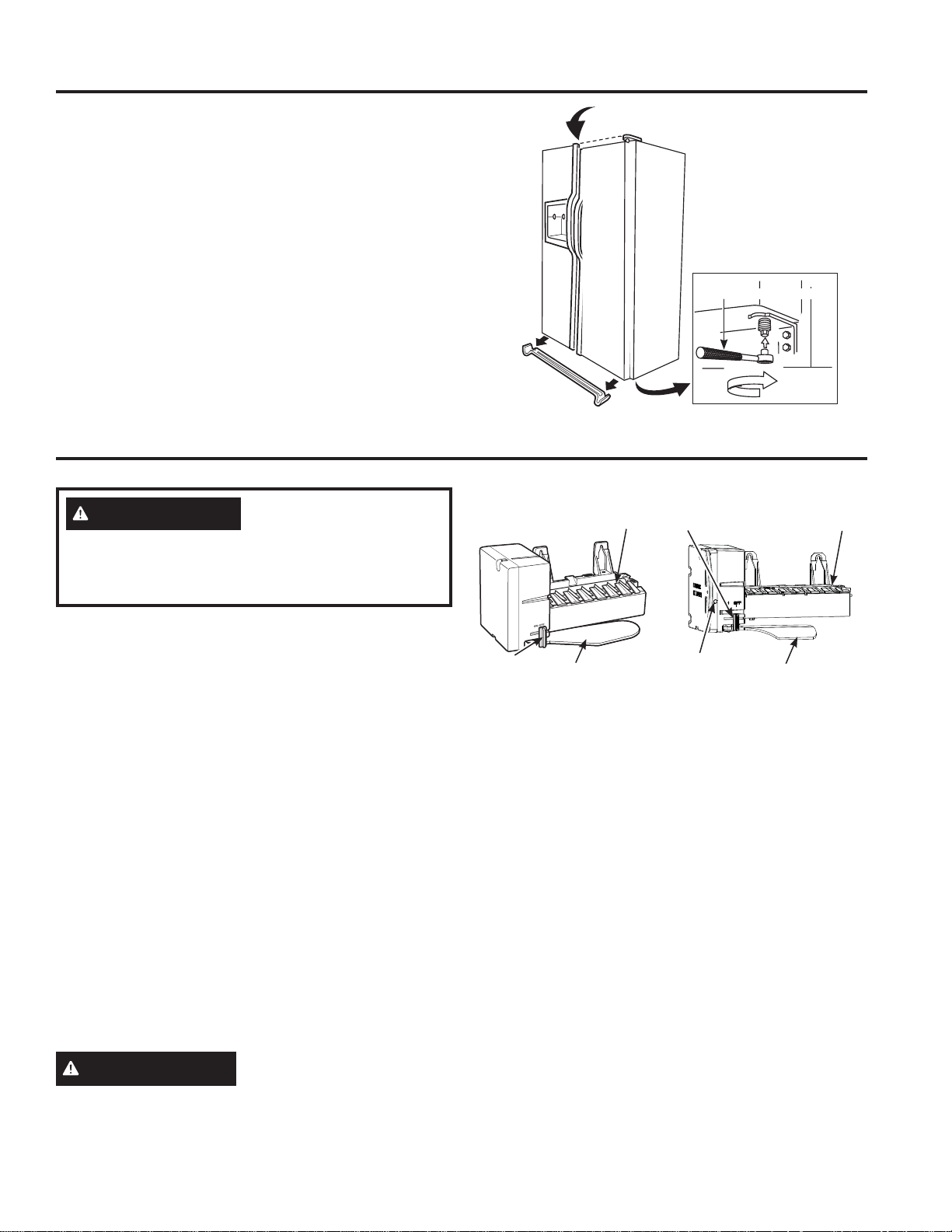
1149-1000105 Rev. 4
Alineación de las puertas
Si las puertas no están niveladas, ajuste la puerta de alimentos
frescos.
Para quitar la parrilla de la base, abra las puertas, saque los
tornillos de cada lado de la parrilla
y jale de la misma.
1. Usando una llave de cubo de 7/16”, gire el tornillo de ajuste
de la puerta hacia la derecha para elevar la puerta; gírelo
KDFLDODL]TXLHUGDSDUDKDFHUODGHVFHQGHU8QWDSyQGH
nylon, incrustado en la rosca de la clavija, evita que esta
última gire a menos que se utilice una llave de ajuste.)
2. Después de una o dos vueltas con la llave, abra y cierre
la puerta de los alimentos frescos y luego controle la
alineación superior de las puertas.
OPERACIÓN DEL REFRIGERADOR: Puertas/Máquina de hielo automática
No todos los modelos tienen todas las características.
Máquina para hacer hielo automática
La máquina de hielo producirá siete cubos por ciclo-
aproximadamente entre 100 y 130 cubos en un período de 24
horas, dependiendo de la temperatura del compartimento del
congelador, la temperatura ambiente, el número de aperturas
de puertas y otras condiciones de uso.
Si el refrigerador se usa antes de realizar la conexión del agua
a la máquina de hielo, coloque el interruptor en la posición
2))$SDJDGR
Cuando el refrigerador haya sido conectado al suministro de
DJXDSRQJDHOLQWHUUXSWRUHQODSRVLFLyQ21HQFHQGLGR
La máquina de hacer hielo se llenará de agua cuando se enfríe
D)&8QUHIULJHUDGRUUHFLpQLQVWDODGRSXHGH
necesitar entre 12 y 24 horas para empezar a fabricar hielo.
Usted escuchará un zumbido cada vez que la máquina de
hielo se llena de agua.
Deseche las primeras tandas de hielo para permitir que la línea
de agua se limpie.
Asegúrese de que nada interfiera con el movimiento del brazo
interruptor de energía.
Cuando el contenedor se llene al nivel del brazo de llenado,
la máquina de hielo dejará de producir hielo. Es normal que
varios cubos queden unidos entre sí.
PRECAUCIÓN
Evite el contacto con las partes
en movimiento del mecanismo expulsor o con el elemento
GHFDOHIDFFLyQXELFDGRHQODSDUWHLQIHULRUGHODPiTXLQD
de hielos) que libera los cubos. No coloque los dedos ni las
manos en el mecanismo de la máquina de hielos automática
mientras el refrigerador esté enchufado.
Si el hielo no se usa con frecuencia, los cubos de hielo viejos
se opacan, adquieren un sabor rancio y se contraen.
Nota especial sobre los modelos con dispensador
Ŷ$OJXQRVPRGHORVFXHQWDQFRQXQUHFLSLHQWHGHKLHORFRQ
inclinación hacia afuera. Este último puede ser inclinado
como se muestra en las ilustraciones, y se mantendrá en su
posición mientras usted retira hielo o al encender y apagar el
interruptor. Asegúrese de volver a colocar el recipiente en su
posición antes de cerrar la puerta.
ŶPara restaurar el nivel de hielo a partir de un vacío, los
pasos que se recomiendan son los siguientes:
1. 12 horas después de la primera tanda de hielo que ha
caído en el depósito, dispensa de 3 a 4 cubos.
2. Después de un adicional de 6 horas, dispensa de 3 a 4
cubos de nuevo.
Con estos pasos se restaurará el nivel de hielo en el menor
tiempo posible.
NOTA:
En los hogares con un nivel de presión inferior a lo normal,
es posible que escuche el ciclo de máquina de la hielo varias
veces para producir un lote de hielo.
Puertas
Máquina de hielo automática
Máquina
de hielos
Interruptor
de energía
Interruptor de
alimentación
HQDOJXQRVPRGHORV
HQDOJXQRVPRGHORV
Máquina
de hielos
Brazo
Interruptor
Luz Verde
de Energía
Llave de cubo de 7/16”
Levantar
ADVERTENCIA
Realice la conexión a un
suministro de agua potable únicamente. Se requiere un
suministro de agua fría para el funcionamiento de la
máquina de hielos automática. La presión del agua deberá
HVWDUHQWUH\SVLNLORSDVFDOHV
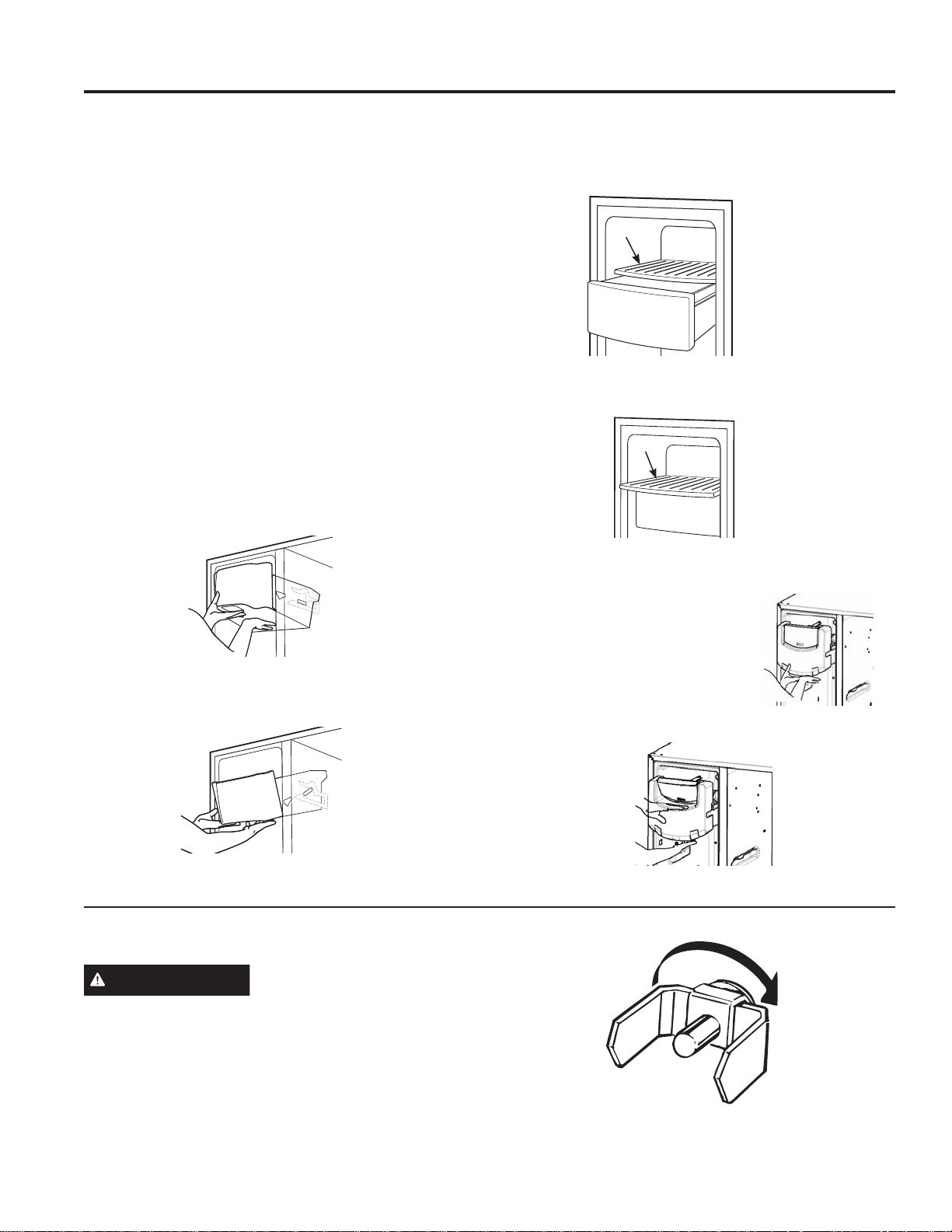
12 49-1000105 Rev. 4
Acceso al Hielo y Acceso al Interruptor en los Modelos con Dispensador
Hay dos tipos de estanterías de almacenamiento de hielo
en los modelos con dispensador. Uno tiene un estante
encima de el depósito, el otro no.
Nota especial para los modelos con depósito de hielo de
inclinación de salida:
Ŷ(VWRVPRGHORVFXHQWDFRQXQUHFLSLHQWHGHKLHORFRQ
inclinación hacia afuera. El recipiente podrá ser inclinado
hacia afuera como se muestra en las ilustraciones y se
mantendrá sostenido mientras usted retira hielo o enciende
y apaga el interruptor de la máquina de hielo. Asegúrese de
volver a colocar el recipiente en su posición antes de cerrar
la puerta.
NOTA: Con el fin de aprovechar al máximo el depósito de
hielo con inclinación hacia afuera, sólo guarde ítems en la
repiza que se encuentra debajo del recipiente de hielo cuya
altura no sea superior al punto más bajo del recipiente.
Modelos con recipiente con inclinación hacia afuera
Para acceder al hielo y llegar al interruptor de la máquina de
hielos :
1. Levante el recipiente, y luego tire hacia adelante hasta que
se detenga.
2. Baje la bandeja de acceso a los cubos de hielo o para
alcanzar el interruptor de encendido.
Los modelos con un estante encima del cubo de hielo
Para tener acceso al hielo, tire del cubo de hielo hacia
adelante.
Para alcanzar el interruptor de alimentación, tire del estante en
línea recta. Siempre asegúrese de reubicar estante.
En algunos modelos, para acceder a los cubos de hielo o
para alcanzar el interruptor de encendido:
1. Tire de la bandeja hasta que el cubo
se detenga.
2. Baje la bandeja de acceso a los cubos de hielo o alcanzar
el interruptor.
Retiro del Recipiente de Hielo PRGHORVGH
dispensadores)
PRECAUCIÓN
El depósito de cubos de hielos
es pesado cuando está lleno.
&RORTXHHOLQWHUUXSWRUHQODSRVLFLyQ2))DSDJDGRDQWHVGH
remover el depósito de hielos.
Cuando reubique el depósito de hielos, cerciórese de
presionarlo firmemente en su lugar. Si no entra hasta el
máximo, remuévalo y rote el mecanismo de accionamiento con
una vuelta de 1/4. Entonces empuje el depósito de hielos hacia
atrás otra vez.
Máquina de hielo automática
Estante
Cubo de hielo
Rote
Mecanismo de
accionamiento
Modelos con dispensador solamente
Estante
Cubo de hielo
OPERACIÓN DEL REFRIGERADOR: Máquina de hielo automática
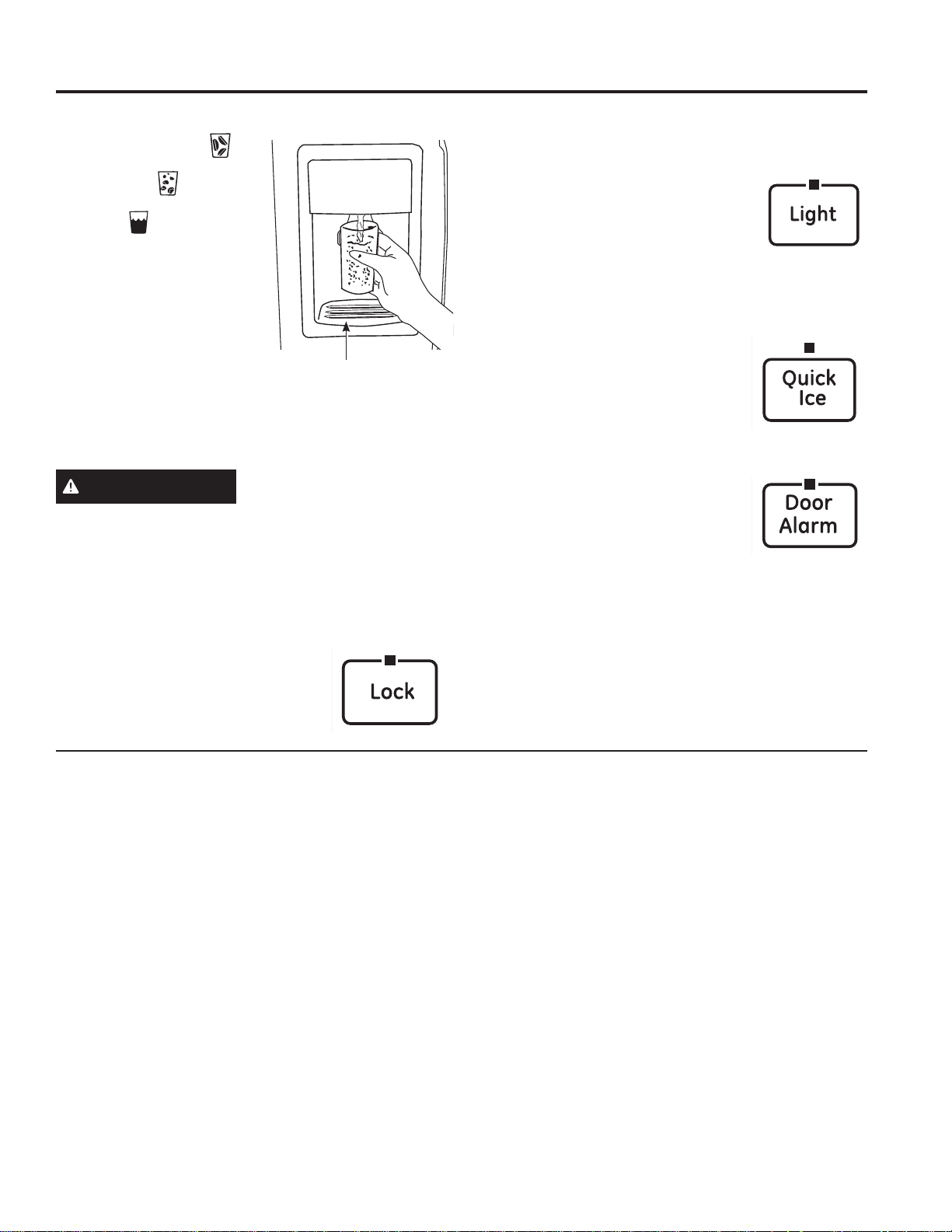
1349-1000105 Rev. 4
OPERACIÓN DEL REFRIGERADOR: El dispensador de agua y de hielo
Para usar el dispensador
Seleccione CUBED ICE
FXERVGHKLHOR
CRUSHED ICE
KLHORWULWXUDGR
or WATER
DJXD
Presione el vaso suavemente
contra el brazo del dispensador.
El recogedor no se vacía solo.
Para evitar las manchas de
agua, el recogedor y la parrilla se
deberán limpiar regularmente.
Si no hay flujo de agua cuando
el refrigerador se instala por
primera vez, hay posibilidad de aire en el sistema de la línea
de agua. Oprima el brazo del dispensador durante al menos
dos minutos para eliminar el aire atrapado de la línea de agua
y llenar el sistema. Para eliminar las impurezas de la línea de
agua, deseche los primeros seis vasos de agua.
PRECAUCIÓN
Riesgo de Laceración
ŶNunca coloque los dedos o cualquier otro objeto en la
abertura de descarga de la trituradora de hielo. Hacer esto
puede resultar en el contacto entre los filos de la trituradora
de hielo y ocasionar lesiones graves o una amputación.
ŶUse un vaso resistente al dispensar hielo. Un vaso frágil se
podría romper y ocasionar lesiones personales.
Para bloquear el dispensador
3UHVLRQHODWHFOD/2&.EORTXHRGXUDQWH
3 segundos para cerrar el dispensador y
el panel de control. Para desbloquearlo,
presione la misma tecla durante 3
segundos nuevamente.
Dispenser Light (Luz del dispensador)
Esta tecla enciende y apaga la luz del
dispensador. La luz también se enciende al
presionar el brazo del dispensador. Si esta
luz se funde debería reemplazarse con una
bombilla de un máximo de 6 vatios 12V.
Quick Ice (Hielo rápido) HQ
algunos modelos)
Cuando necesite hielo rápidamente, presione esta tecla
para acelerar la producción de hielo. Esto
incrementará la producción de hielo durante
las próximas 48 horas o hasta que vuelva a
presionar la tecla.
Door Alarm (Alarma de
puerta)HQDOJXQRVPRGHORV
Para ajustar la alarma, presione esta tecla hasta que la luz
indicadora se encienda. Esta alarma sonará
si cualquiera de la puerta estuviera abierta
por más de 3 minutos. La luz y el sonido
cesan automáticamente al cerrarse la
puerta.
El dispensador de agua y de hielo HQDOJXQRVPRGHORV
Datos importantes de su dispensador
Ŷ 1RDJUHJXHKLHORGHFKDURODVRGHEROVDVHQHOUHFLSLHQWH
Podría provocar que no salga bien o que no se triture
adecuadamente.
Ŷ (YLWHORVYDVRVGHPDVLDGROOHQRVGHKLHOR\HOXVRGHYDVRV
estrechos o demasiado altos. El hielo amontonado podría
obstruir el orificio o hacer que se congele la puerta del
orifico de manera que no se pueda abrir. Si hubiera hielo
bloqueándolo, desprenda con una cuchara de madera.
Ŷ /DVEHELGDV\ORVDOLPHQWRVQRVHGHEHUiQHQIULDU
rápidamente en el recipiente del hielo. Las latas, botellas
o paquetes de comida en el recipiente de hielos podrían
causar la obstrucción del dispositivo para hacer hielo o del
recipiente.
Ŷ 3DUDHYLWDUTXHHOKLHORGLVSHQVDGRFDLJDIXHUDGHOYDVR
ponga el vaso cerca, pero sin tocar, la apertura del
dispensador.
Ŷ 8QSRFRGHKLHORWULWXUDGRSRGUtDGLVSHQVDUVHDXQTXHKDEtD
VHOHFFLRQDGR&8%(',&(FXERVGHKLHOR(VWRVXFHGH
en ocasiones cuando algunos cubos se canalizan en el
triturador.
Ŷ 'HVSXpVGHXVDUKLHORWULWXUDGRXQSRFRGHDJXDSXHGH
gotear del vertedero.
Ŷ $YHFHVVHIRUPDUiXQSHTXHxRPRQWyQGHQLHYHHQOD
salida del hielo situada en la puerta. Esto es normal y, por
regla general, sucede cuando ha dispensado hielo picado
repetidamente. La nieve se evaporará por sí misma.
Estante Antiderrame
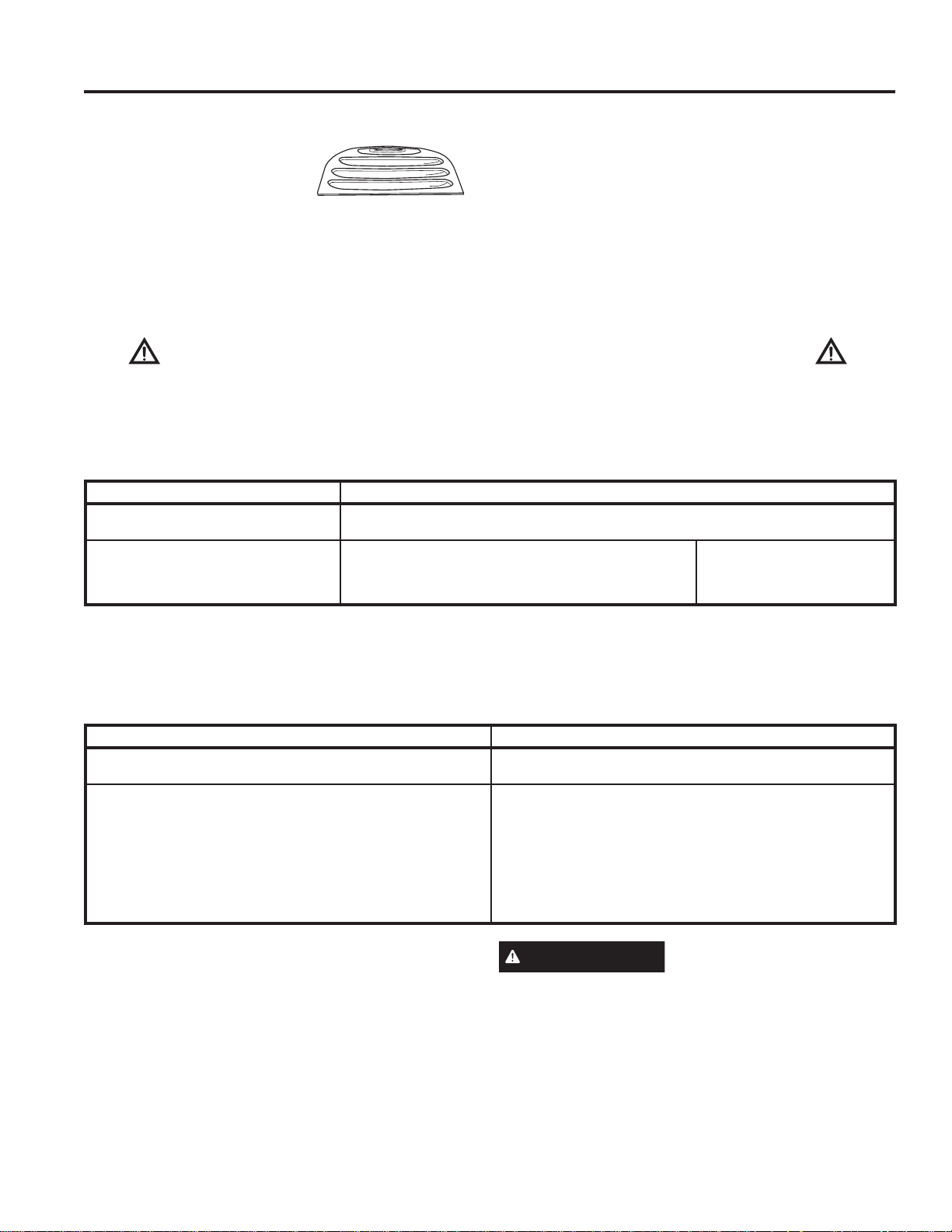
14 49-1000105 Rev. 4
Cuidado y limpieza
Limpiar el exterior
El area de la cavidad del
dispensador, por debajo de la
parrilla, se debe mantener limpio
y seco. El agua que se queda en
cavidad puede dejar depósitos.
Quite los depósitos agregando vinagre sin diluir en la cavidad.
Remoje hasta que desaparezcan los depósitos o hasta que se
desprendan lo suficiente para quitarlos.
El brazo del dispensador. Antes de limpiar, oprima y
GHWHQJDODWHFOD/2&.%ORTXHRGXUDQWHVHJXQGRV6H
limpia con una solución de agua tibia y bicarbonato de sodio–
DSUR[LPDGDPHQWHXQDFXFKDUDGDPOGHELFDUERQDWR
GHVRGLRSRUFDGDFXDUWROLWURGHDJXD(QMXDJXH
completamente con agua y seque.
CUIDADO Y LIMPIEZA
Limpiar el interior
Para evitar olores, deje una caja abierta de bicarbonato de sodio
en los compartimientos del refrigerador y del congelador.
Desconecte el refrigerador antes de limpiarlo. Si no fuera
posible, exprima el exceso de humedad de la esponja o del paño
cuando se limpie alrededor de botones, bombillas o controles.
Use agua caliente y una solución de bicarbonato de sodio–
DSUR[LPDGDPHQWHXQDFXFKDUDGDPOGHELFDUERQDWRGH
VRGLRSRUFDGDFXDUWROLWURGHDJXD(VWDVROXFLyQOLPSLD\
neutraliza olores. Enjuague y seque.
El uso de cualquier solución de limpieza que no sea
la recomendada, especialmente aquella que contienen
destilados del petróleo, pueden agrietar o dañar el interior
del refrigerador.
PRECAUCIÓN
No limpie estantes de vidrio ni
tapas con agua caliente cuando estén fríos. Los estantes
de vidrio y las tapas se pueden romper si son expuestos a
cambios de temperatura repentinos o impactos tales como
sacudones o caídas. El vidrio templado está diseñado para
destruirse en pequeñas piezas en caso de rotura.
No lave ninguna parte plástica del refrigerador en la lavadora
de platos.
La bandeja de Enfriar/Descongelar se puede lavar en el
lavaplatos.
USE NO USE
Telas suaves y limpias o esponjas
Tela de microfibra
Telas abrasivas, toallas de papel, esponjas de fregar FRQRVLQMDEyQ, almohadillas de
estropajo o de lana de acero
Detergente suave mezclado con agua
caliente
Polvos, líquidos, o rociadores abrasivos
Rociadores de ventana, moníaco, o blanqueador
Limpiadores a base de cítrico o aceite vegetal
Limpiadores ácidos o a base de vinagre
Limpiadores de horno
Limpiadores alcalinos
Limpiador de acero inoxidable
ACERO INOXIDABLE - Instrucciones para la Limpieza de Superficies Exteriores, Manijas
de Puertas y Bordes
ACERO INOXIDABLE RESISTENTE A MARCAS TÁCTILES*, PINTADO - Instrucciones para
la Limpieza de Superficies Exteriores, Manijas de Puertas y Bordes
USE NO USE
Telas suaves y limpias o esponjas Telas abrasivas, esponjas de fregar, almohadillas de estropajo
o de lana de acero
Detergente suave mezclado con agua caliente
Limpiadores de acero inoxidable aprobados. Visite la tienda
de piezas de GE Appliances para acceder a limpiares de
acero inoxidable aprobados: GEApplianceparts.com o
comuníquese al 877.959.8688
Los limpiadores con ácido oxálico tales como Bar Keepers
Friend Soft Cleanser™ podrán ser usados para eliminar el
óxido, deslustres y pequeñas manchas de las superficies de
acero inoxidable únicamente.
Polvos o rociadores abrasivos
Rociadores de Ventana o Amoníaco
Limpiadores a base de cítrico o aceite vegetal
Limpiadores ácidos o a base de vinagre
Limpiadores de horno
/LPSLDGRUHVTXHFRQWHQJDQDFHWRQDSURSDQRQD
Cualquier limpiador con ADVERTENCIAS sobre el contacto
con el plástico
NOTA: NO permita que el limpiador de acero inoxidable entre en contacto con cualquier parte plástica tal como partes de bordes,
materiales de manijas y cobertores. Si se produce un contacto no intencional de los limpiadores con las partes plásticas, limpie
estas últimas con una esponja y un detergente suave mezclado con agua caliente.
NO use limpiadores para Acero Inoxidable sobre las superficies de las puertas.
IMPORTANTE: El uso de productos inadecuados podrá dañar el acabado exterior de los modelos de Acero Inoxidable
Resistente a Marcas Dactilares y de Acero Inoxidable Negro. Por favor, siga estas instrucciones y use sólo los siguientes ítems
adecuados para limpiar las superficies de su electrodoméstico.
Ɣ/LPSLHODVVXSHUILFLHVLQWHULRUH[WHULRUFRQDJXDFDOLHQWHMDEyQVXDYHRGHWHUJHQWH\FRQXQDWHODGHPLFURILEUDSDUDHYLWDUGDxRV
Ɣ6HTXHODVXSHUILFLHGHOHOHFWURGRPpVWLFRFRQXQDWHODVXDYH\OLPSLDRFRQXQDWRDOODGHPLFURILEUDDILQGHHYLWDUPDQFKDVR
marcas de gotas de agua.
*Elimine fácilmente manchas y huellas dactilares.
1549-1000105 Rev. 4
Limpiar el interior
Para evitar olores, deje una caja abierta de bicarbonato de
sodio en los compartimientos del refrigerador y del congelador.
Desconecte el refrigerador antes de limpiarlo. Si no fuera
posible, exprima el exceso de humedad de la esponja o del
paño cuando se limpie alrededor de botones, bombillas o
controles.
Use agua caliente y una solución de bicarbonato de sodio–
DSUR[LPDGDPHQWHXQDFXFKDUDGDPOGHELFDUERQDWRGH
VRGLRSRUFDGDFXDUWROLWURGHDJXD(VWDVROXFLyQOLPSLD\
neutraliza olores. Enjuague y seque.
El uso de cualquier solución de limpieza que no sea
la recomendada, especialmente aquella que contienen
destilados del petróleo, pueden agrietar o dañar el interior
del refrigerador.
PRECAUCIÓN
No limpie estantes de vidrio ni tapas
con agua caliente cuando estén fríos. Los estantes de vidrio
y las tapas se pueden romper si son expuestos a cambios de
temperatura repentinos o impactos tales como golpes o caídas.
El vidrio templado está diseñado para destruirse en pequeñas
piezas en caso de rotura.
No lave ninguna parte plástica del refrigerador en el
lavavajillas.
La bandeja para refrigerador/ descongelar es de uso seguro en
el lavavajillas.
Atrás del refrigerador
Se deberá tener cuidado al retirar el refrigerador de la pared.
Todos los tipos de recubrimiento de pisos se pueden dañar,
sobre todo los recubrimientos acojinados y los que tienen
superficies repujadas.
Jale el refrigerador en forma recta y empuje nuevamente para
devolverlo a su posición. Mover el refrigerador en dirección
lateral puede causar daños al recubrimiento del piso o al
refrigerador.
Al empujar el refrigerador a su lugar, asegúrese de no pasar
sobre el cable eléctrico ni sobre la línea de alimentación del
GLVSRVLWLYRSDUDKDFHUKLHORVHQDOJXQRVPRGHORV
CUIDADO Y LIMPIEZA
Cuidado y limpieza
Preparación para vacaciones
En el caso de vacaciones o ausencias prolongadas, retire
los alimentos y desenchufe el refrigerador. Limpie el interior
FRQVROXFLyQGHELFDUERQDWRGHXQDFXFKDUDGDPOGH
ELFDUERQDWRSRUXQFXDUWROLWURGHDJXD'HMHDELHUWDVODV
puertas.
Coloque el interruptor de alimentación eléctrica del dispositivo
DXWRPiWLFRSDUDKDFHUKLHORHQODSRVLFLyQ2))DSDJDGR\
cierre el suministro de agua al refrigerador.
Si la temperatura pudiera llegar por debajo del punto de
congelación, haga que una persona calificada drene el sistema
GHOVXPLQLVWURGHDJXDHQDOJXQRVPRGHORVSDUDHYLWDUGDxRV
a la propiedad causados por inundación.
En caso de mudanza
Asegure todos los elementos sueltos como entrepaños y
recipientes pegándolos con cinta adhesiva en su lugar para
evitar daños.
Al usar una carretilla para mover el refrigerador, no haga
descansar la parte frontal o trasera del refrigerador contra
la carretilla. Esto podría dañar el refrigerador. Manéjelo sólo
desde los laterales del refrigerador.
Asegúrese de que el refrigerador se coloque en posición
vertical durante la mudanza.
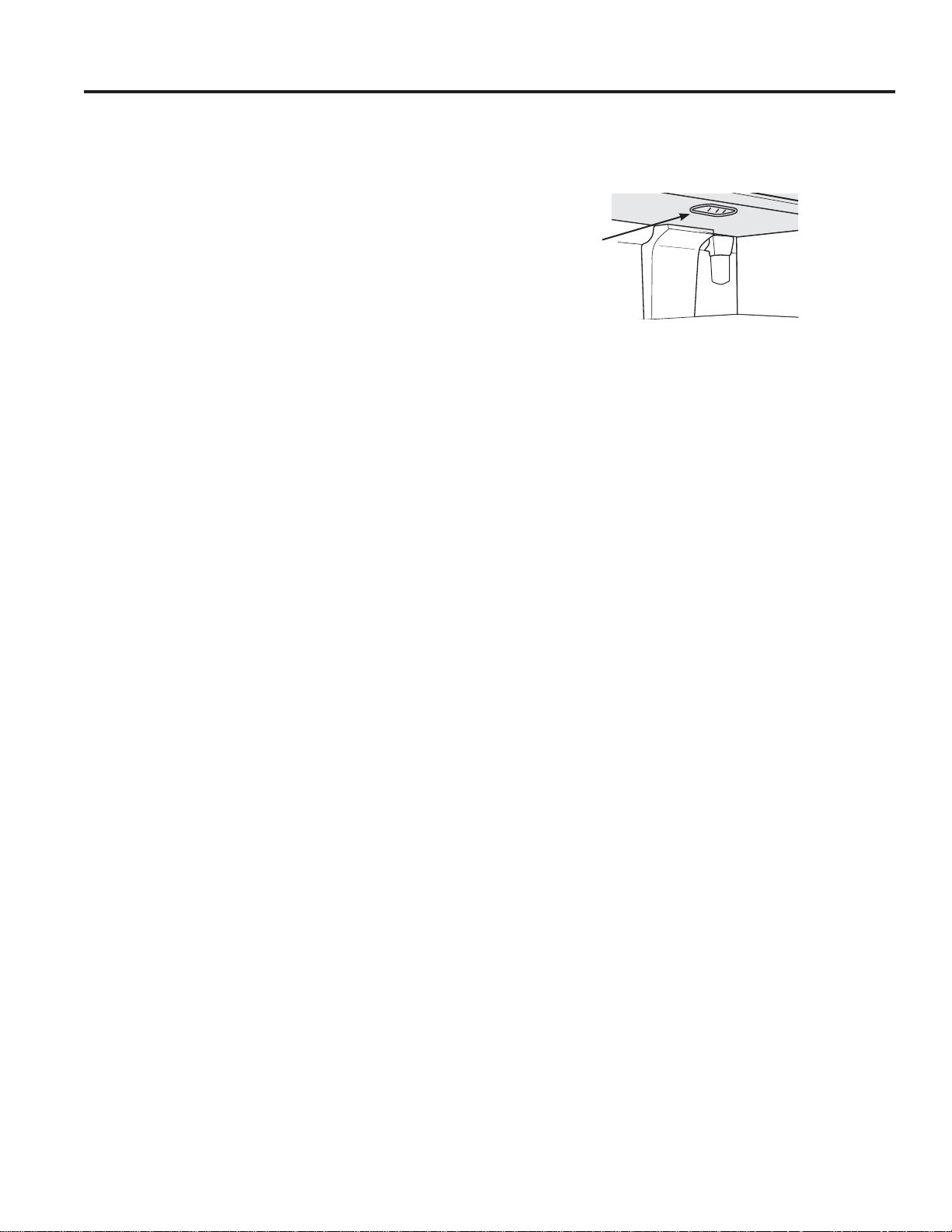
16 49-1000105 Rev. 4
Cuidado y limpieza
Sustitución de las luces en los modelos con iluminación LED HQDOJXQRVPRGHORV
Colocar el control en OFFDSDJDGRQRTXLWDODFRUULHQWHGHO
circuito de la luz. No todas las características están presentes
en todos los modelos.
Compartimiento del refrigerador
Hay un pantalla de luces LED en la parte superior y los lados
del compartimiento del refrigerador y en la parte trasera
y laterales del compartimiento del congelador en algunos
modelos.
Si este ensamble necesita ser reemplazado, llame al servicio
de GE Appliances en el 1.800.432.2737 en los Estados
Unidos.
CUIDADO Y LIMPIEZA
Pantalla
con Luz
LED
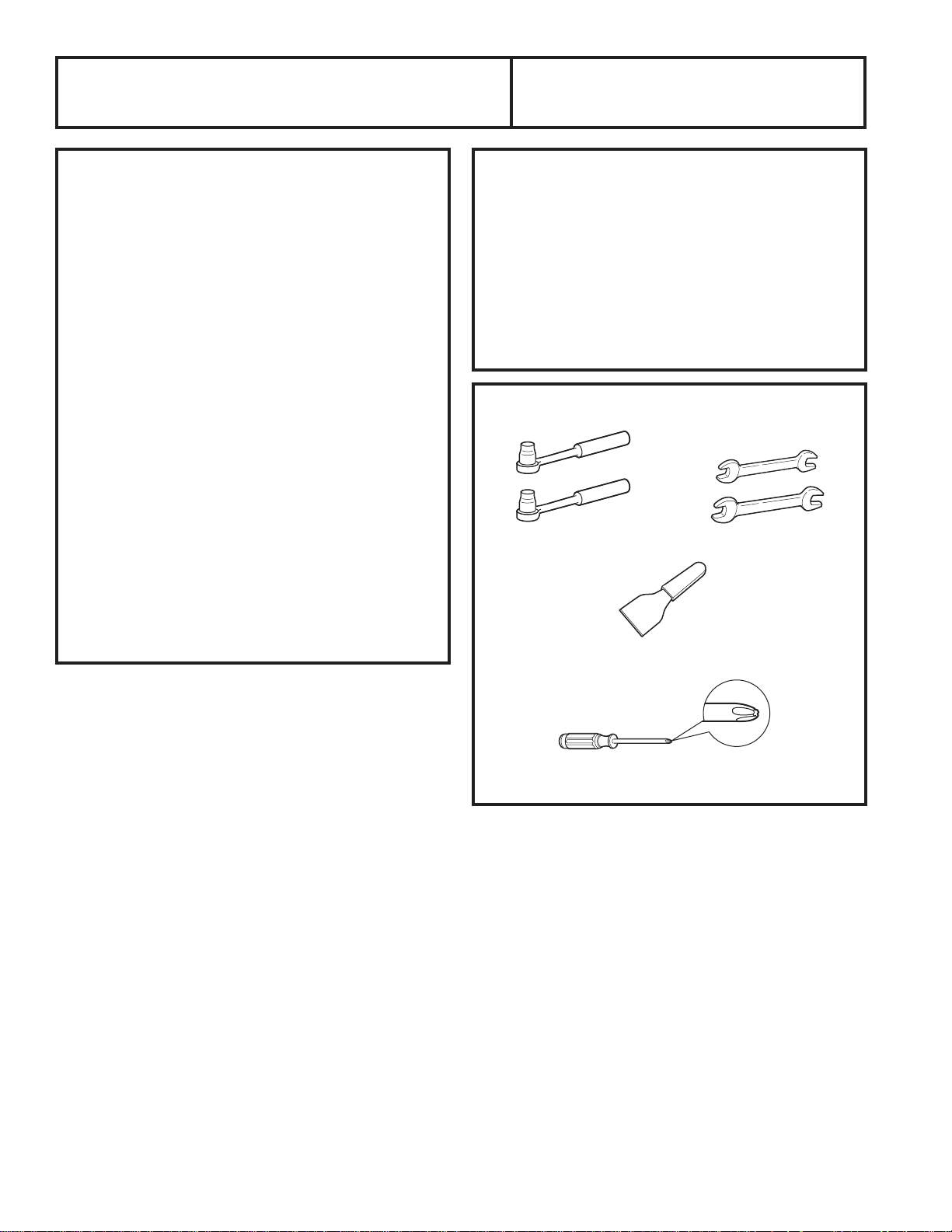
1749-1000105 Rev. 4
INSTRUCCIONES PARA LA INSTALACIÓN
Instrucciones para la Instalación
Modelos de Refrigerador
XSS23G, XSS25G
ANTES DE COMENZAR
Lea estas instrucciones completamente y
cuidadosamente..
•
IMPORTANTE — Conserve estas
instrucciones para uso del inspector local.
•
IMPORTANTE — Cumpla con todos los
códigos y ordenanzas gubernamentales.
• Nota para el Instalador – Asegúrese de que el
Comprador conserve estas instrucciones.
• Nota para el Comprador – Conserve estas
instrucciones para referencia futura.
• Nivel de habilidad – La instalación de este
electrodoméstico requiere un nivel básico de habilidades
mecánicas.
• Tiempo de Instalación – Instalación del Refrigerador
30 minutos
– Instalación del Suministro de
Agua 30 minutos
• La correcta instalación del producto es responsabilidad
del instalador.
• Si se producen fallas en el producto debido a una
instalación inadecuada la Garantía no cubrirá las
mismas.
Si el refrigerador ya fue instalado, retire la parrilla de la
EDVHFRQVXOWHHO3DVRHQ&yPR0RYHUHO5HIULJHUDGRU
luego consulte el Paso 5 en Cómo Instalar el Refrigerador.
PREPARACIÓN
SUMINISTRO DE AGUA PARA LA
MÁQUINA DE HACER HIELO
(en
algunos modelos)
Si el refrigerador cuenta con una máquina de hacer hielo,
deberá ser conectada al suministro de agua fría. Un kit
GHVXPLQLVWURGHDJXDTXHFRQWHQJDWXEHUtDYiOYXODGH
cierre, uniones e instrucciones) está disponible por un costo
adicional a nivel minorista, visitando nuestro sitio web en
GEAppliances.com RHQ3LH]DV\$FFHVRULRV3DUWVDQG
Accessories), 877.959.8688.
HERRAMIENTAS NECESARIAS
Destornillador con Cabeza Phillips
Cubos de 3/8” y 5/16” Llaves de 1/2” y 7/16”
Espátula de Plástico
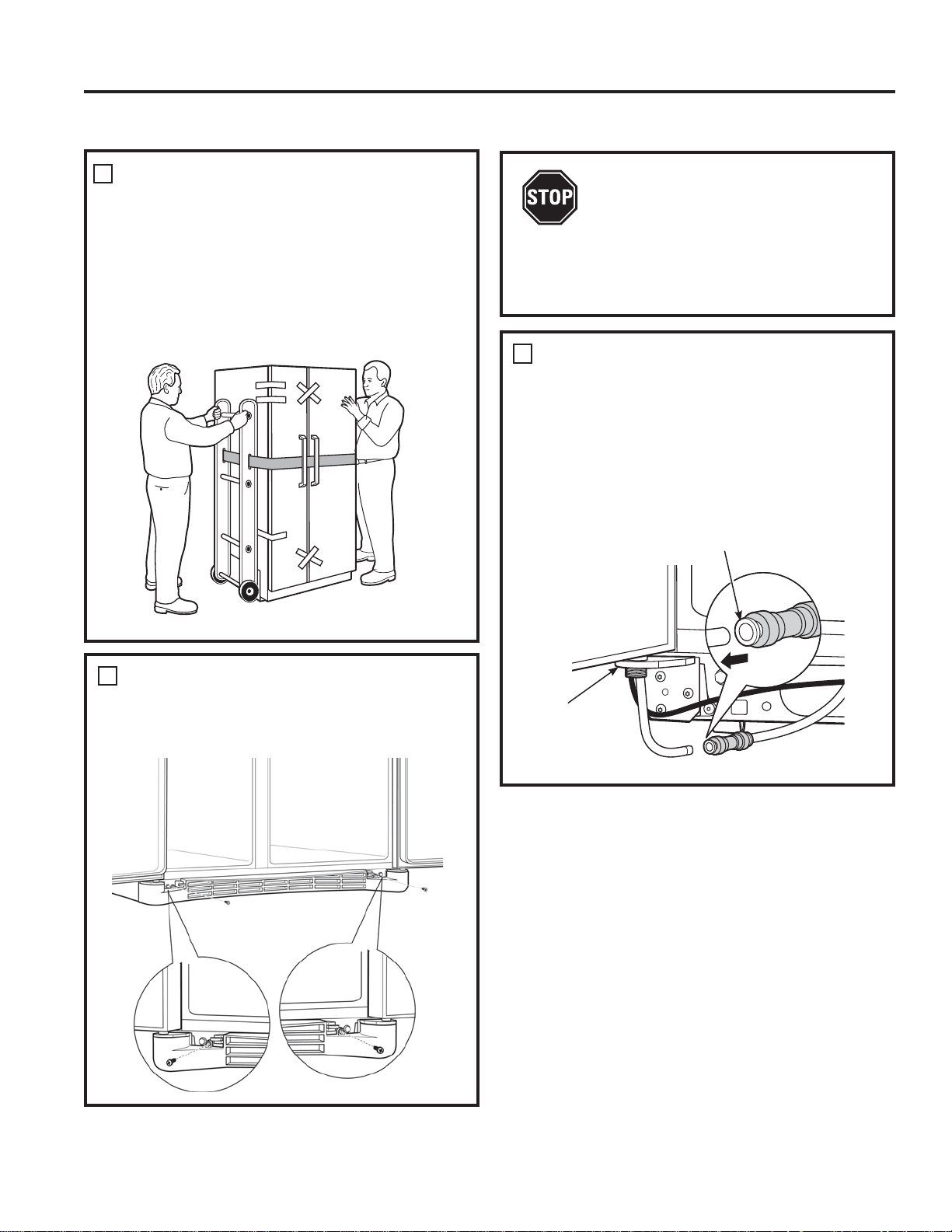
18 49-1000105 Rev. 4
Instrucciones para la instalación
INSTRUCCIONES PARA LA INSTALACIÓN
CÓMO MOVER EL REFRIGERADOR
CÓMO CARGAR EL
REFRIGERADOR EN UNA
CARRETILLA DE MANO
Deje toda la cinta adhesiva y las almohadillas hasta
que el refrigerador llegue a su destino final.
Para mover el refrigerador use una carretilla de
mano con almohadillas. Coloque el refrigerador en
el centro de la carretilla y asegúrelo con un cinturón
de seguridad alrededor del refrigerador. NO LA
APRIETE DEMASIADO.
1
REMUEVA LA BASE DE LA
PARRILLA
Remueva la parrilla removiendo los dos tornillos
de cabeza Phillips.
2
Si el refrigerador debe pasar por alguna
entrada menor de 38” de ancho, entonces las
puertas pueden ser removidas. Proceda al
paso 3.
NO REMUEVA las manijas.
Si todas las entradas son más anchas de 38”
pase a Cómo instalar el refrigerador.
DESCONECTE EL
ACOPLAMIENTO DE AGUA
HQDOJXQRVPRGHORV
Si el refrigerador tiene un dispensador de agua, eso
significa que hay una línea de agua que viene desde
el gabinete hacia la bisagra del fondo de la puerta
del congelador que debe ser desconectada.
Para desconectarla, empuje hacia adentro sobre el
collarín blanco del acoplamiento y entonces extraiga
la tubería.
Collarín blanco
Bisagra
inferior del
congelador
3
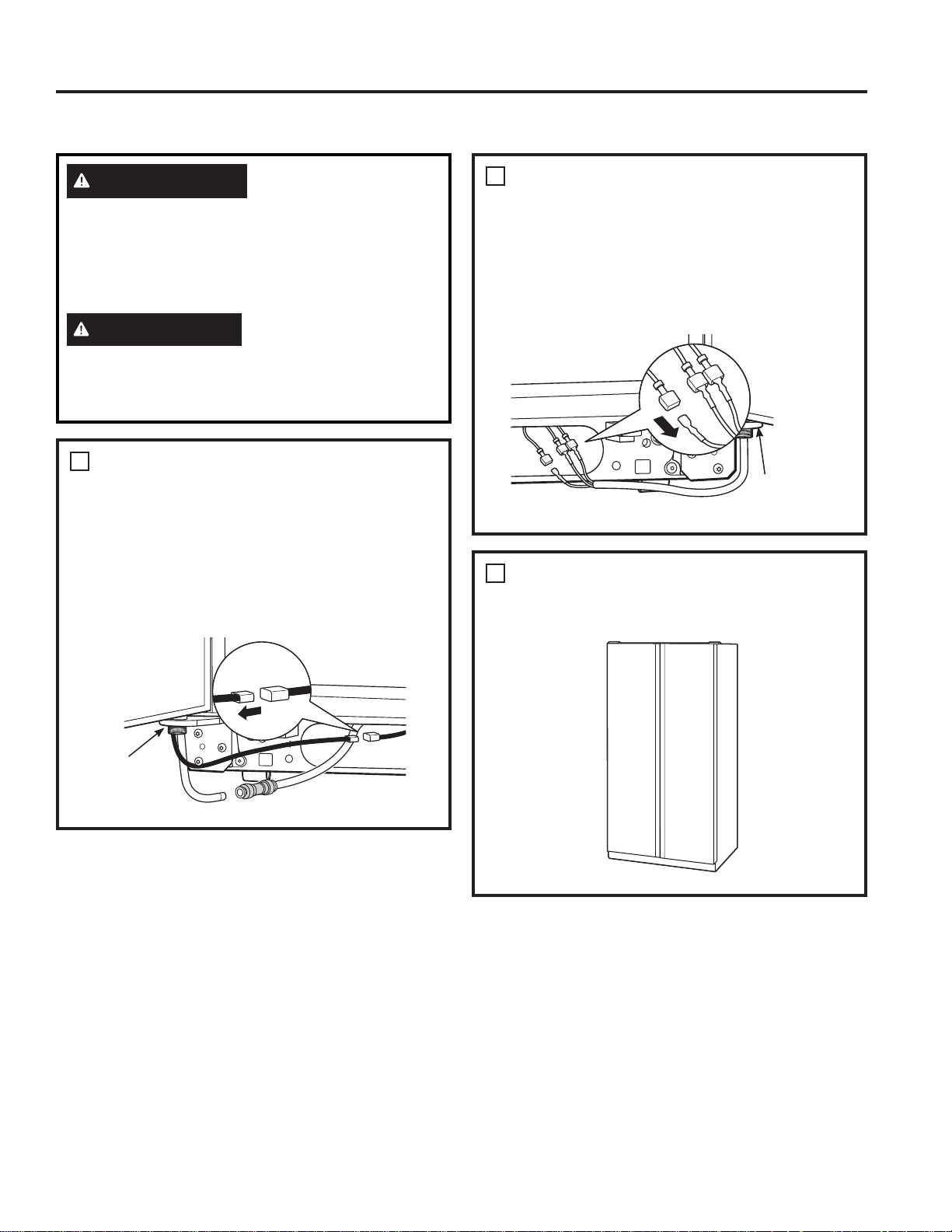
1949-1000105 Rev. 4
INSTRUCCIONES PARA LA INSTALACIÓN
Instrucciones para la instalación
CÓMO MOVER EL REFRIGERADOR&RQW
PRECAUCIÓN
Riesgo al levantar la
puerta. Si es levantada por una sola persona, podrían
ocasionarse lesiones. Solicite ayuda al sostener, mover o
levantar las puertas del refrigerador.
NOTA: Al retirar la puerta, a fin de evitar daños sobre la
misma y la parte electrónica, coloque con cuidado la puerta
en una ubicación adecuada.
ADVERTENCIA
A fin de reducir el riesgo de descarga eléctrica o lesión
durante la instalación, primero deberá desenchufar el
refrigerador antes de proceder. Si no se siguen estas
instrucciones, se podrá producir una descarga eléctrica.
DESCONECTE EL
ACOPLAMIENTO ENERGÉTICO
HQDOJXQRVPRGHORV
Si el refrigerador cuenta con un dispensador de
agua, entonces hay una línea de suministro eléctrico
DUQpVGHVGHHOJDELQHWHKDVWDODELVDJUDLQIHULRU
de la puerta del congelador, la cual deberá ser
desconectada.
Para desconectar, separe el acoplador.
4
Bisagra
inferior del
refrigerador
DESCONECTE LOS
CONECTADORES ELÉCTRICOS
HQDOJXQRVPRGHORV
Si el refrigerador tiene un centro para refrescar,
HQWRQFHVKD\FRQHFWDGRUHVHOpFWULFRVDUQpVHVTXH
van desde el gabinete hasta la bisagra del fondo del
refrigerador, que deben ser desconectados.
Para desconectar, separe cada conectador.
5
Bisagra
inferior del
refrigerador
CIERRE LAS PUERTAS
DEL CONGELADOR Y DEL
REFRIGERADOR
6
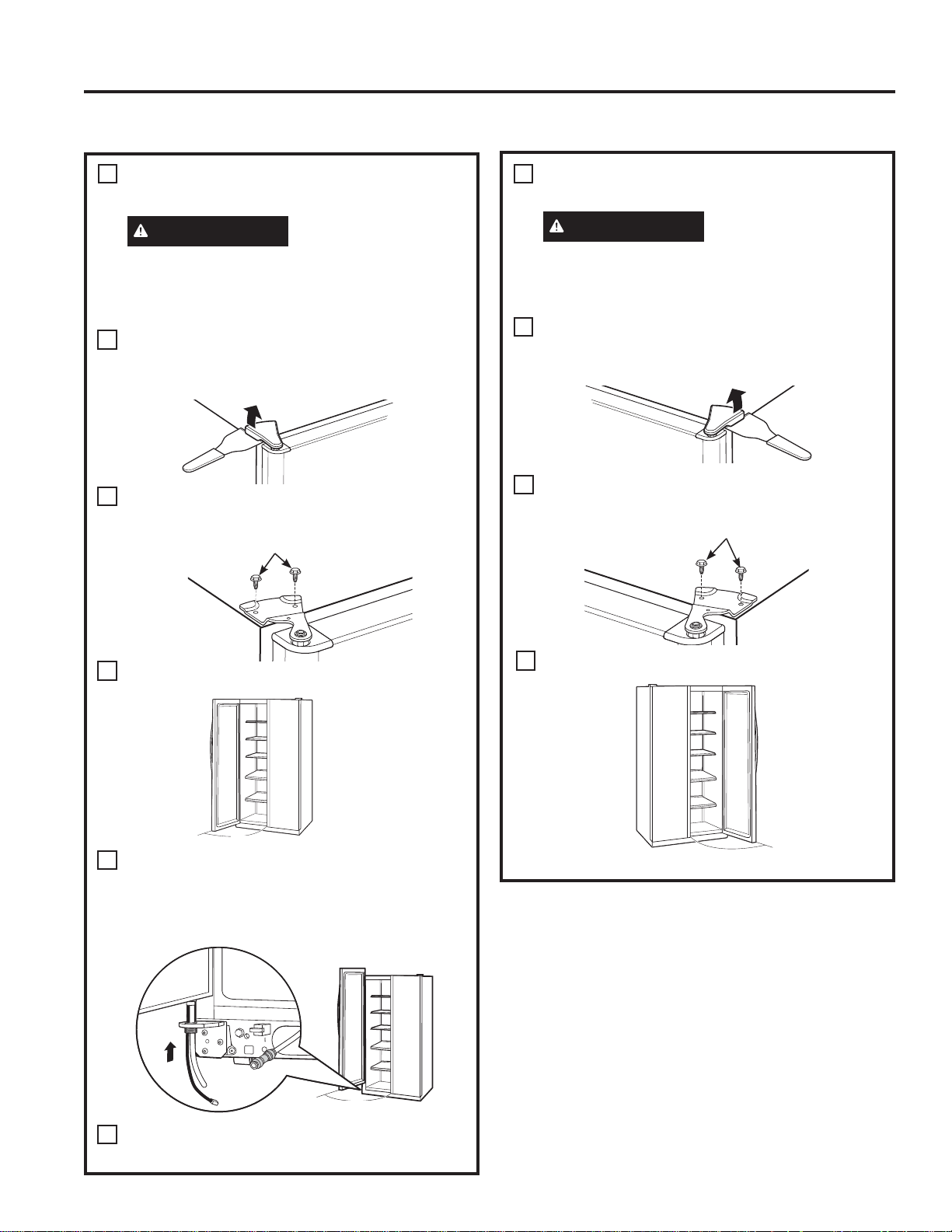
20 49-1000105 Rev. 4
Instrucciones para la instalación
INSTRUCCIONES PARA LA INSTALACIÓN
CÓMO MOVER EL REFRIGERADOR&RQW
D
E
REMUEVA LA PUERTA DEL
REFRIGERADOR
ADVERTENCIA
Siga todos los pasos para
retirar y volver a instalar la puerta. Si no se siguen
estas instrucciones, dejando piezas sin uso o ajustando
tornillos en exceso, esto podrá hacer que la puerta se
caiga y producir lesiones y daños sobre la propiedad.
Remueva la cubierta de la bisagra de la puerta
del refrigerador apretándola y levantándola o
levantándola por uno de sus costados con una
espatula plástica.
Remueva los dos tornillos de cabeza hexagonal de
5/16”, entonces levante la bisagra hacia arriba para
liberarla del pasador de la bisagra.
Abra la puerta del refrigerador a 90.°
8
A
B
C
REMUEVA LA PUERTA DEL
CONGELADOR
ADVERTENCIA
Siga todos los pasos
para retirar y volver a instalar la puerta. Si no se
siguen estas instrucciones, dejando piezas sin uso o
ajustando tornillos en exceso, esto podrá hacer que la
puerta se caiga y producir lesiones y daños sobre la
propiedad.
Remueva la cubierta de la bisagra de la puerta del
congelador apretándola y levantándola o simplemente
levantándola por uno de sus costados con una
espatula plástica.
Remueva los dos tornillos de cabeza hexagonal de
5/16,” entonces levante la bisagra hacia arriba para
liberarla del pasador de la bisagra.
Abra la puerta del congelador a 90°.
Mientras una persona levanta lentamente la puerta
del congelador y la libera de la bisagra del fondo, una
segunda persona debe, con cuidado, guiar la línea
GHDJXD\ODOtQHDHQHUJpWLFDDUQHVDWUDYpVGHOD
bisagra inferior.
Coloque la puerta en una superficie donde no se ralle
con la parte interna hacia arriba.
7
A
C
B
Cabeza hexagonal de 5/16”
90°
90°
Cabeza hexagonal de 5/16”
90°
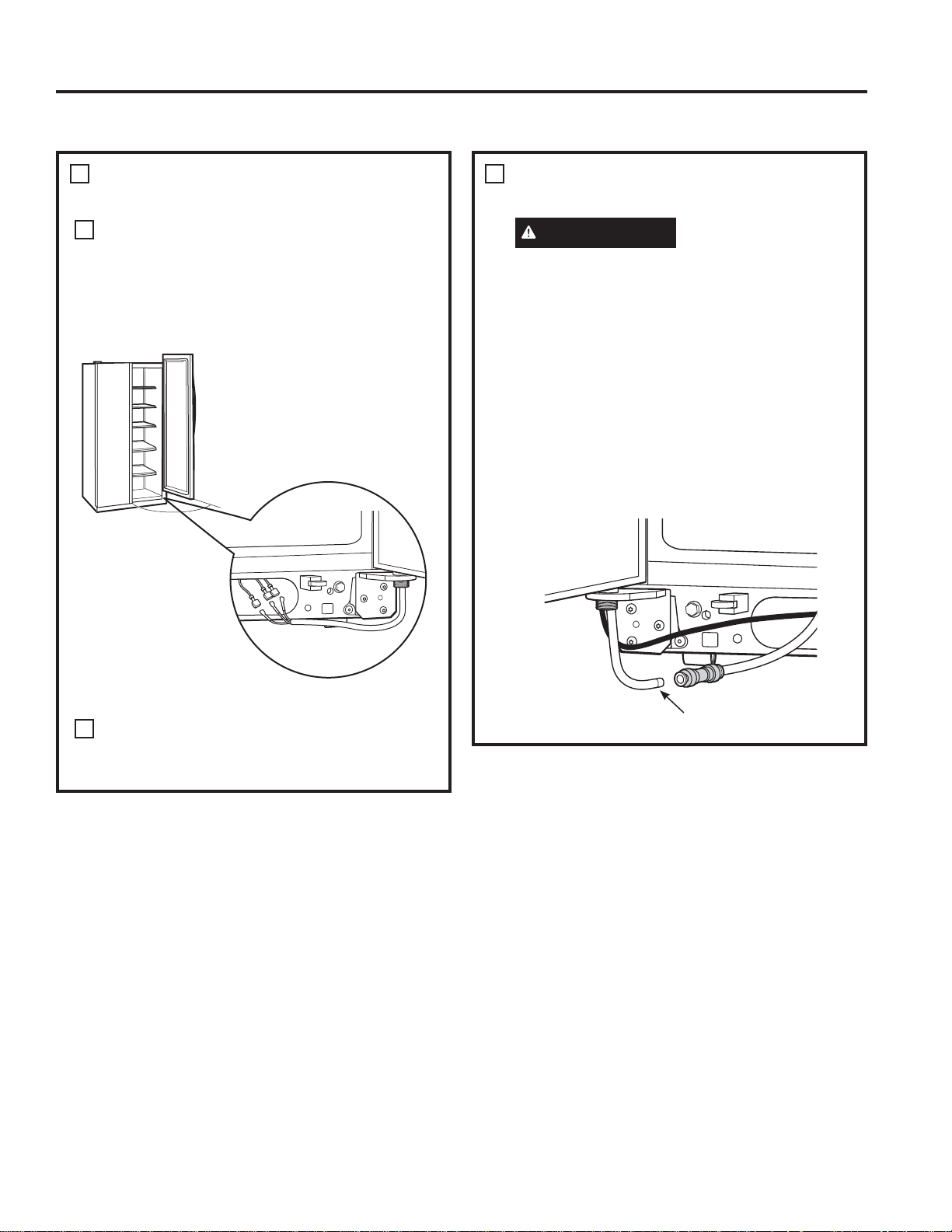
2149-1000105 Rev. 4
INSTRUCCIONES PARA LA INSTALACIÓN
Instrucciones para la instalación
CÓMO MOVER EL REFRIGERADOR&RQW
REMUEVA LA PUERTA DEL
REFRIGERADOR&RQW
Levante la puerta del refrigerador y libérela de la
bisagra inferior.
SI el refrigerador cuenta con un centro espacioso,
una persona deberá levantar lentamente la puerta
hacia arriba y afuera de la bisagra inferior y otra
persona deberá guiar cuidadosamente los cableados
HOpFWULFRVDUQHVHVDWUDYpVGHODELVDJUDLQIHULRU
Coloque la puerta en una superficie donde no se
ralle con la parte interna hacia arriba.
8
90°
Modelos con Centro para Refrescar solamente
D
E
CÓMO REEMPLAZAR LAS
PUERTAS
ADVERTENCIA
Siga todos los pasos para
retirar y volver a instalar la puerta. Si no se siguen
estas instrucciones, dejando piezas sin uso o ajustando
tornillos en exceso, esto podrá hacer que la puerta se
caiga y producir lesiones y daños sobre la propiedad.
Para reemplazar las puertas, simplemente invierta
los pasos del 3 al 8.
Sin embargo, note lo siguiente:
• Cuando se encuentre bajando las puertas hacia
la bisagra inferior, cerciórese de que una segunda
persona guíe, con mucho cuidado, la tubería y el
arnes a través de los agujeros de las bisagras.
• Cuando se encuentre conectando la línea de agua,
cerciórese de insertar la tubería hasta el máximo
indicado por la marca.
9
Marca
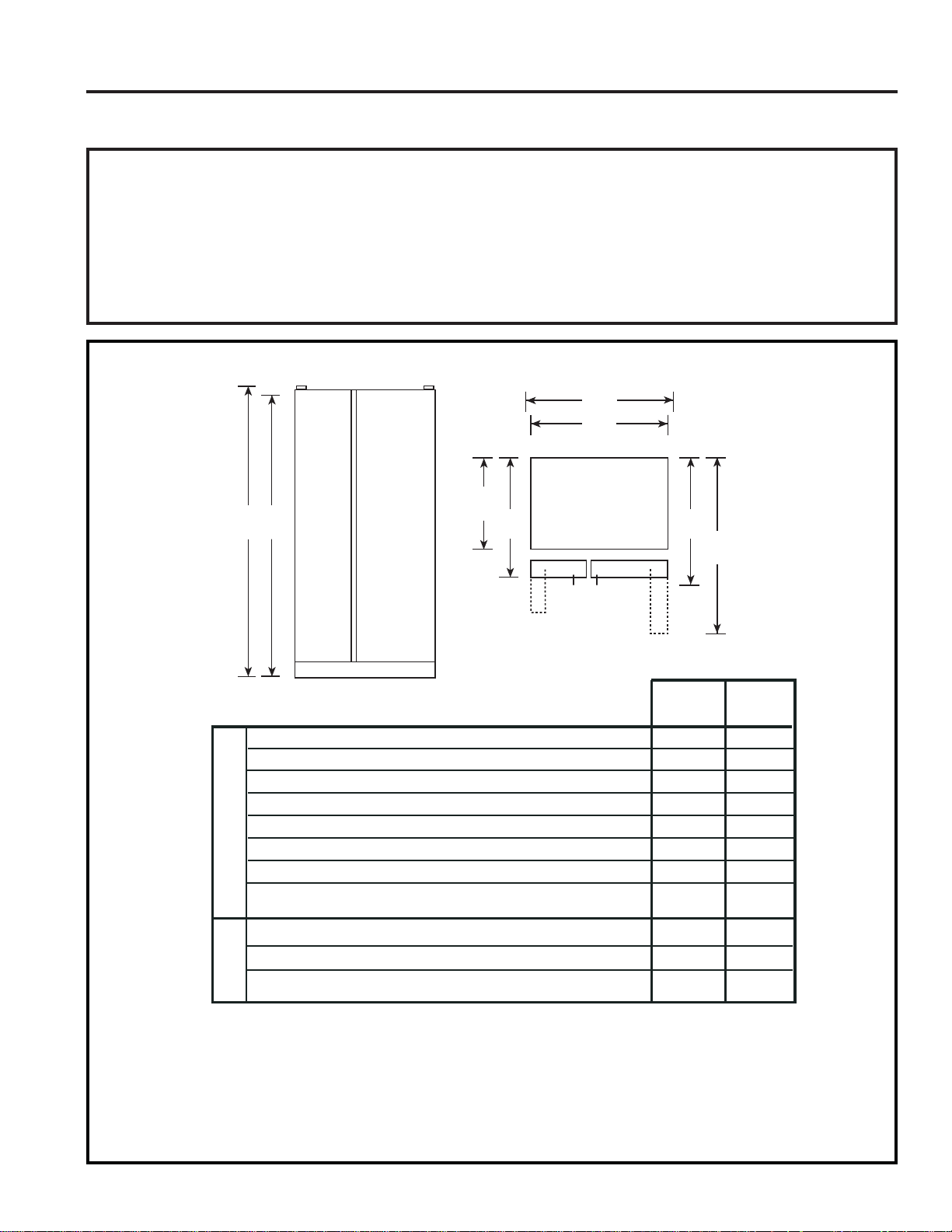
22 49-1000105 Rev. 4
CÓMO INSTALAR EL REFRIGERADOR
DIMENSIONES Y ESPECIFICACIONES
LOCALIZACIÓN DEL REFRIGERADOR
• No coloque el refrigerador donde la temperatura
HVWpSRUGHEDMRGH)&SRUTXHQRRSHUDUi
con la suficiente frecuencia como para mantener las
temperaturas apropiadas.
• No instale el refrigerador donde la temperatura esté
SRUHQFLPDGH)&SRUTXHQRIXQFLRQDUi
apropiadamente.
• No instale el refrigerador en una ubicación expuesta al
DJXDOOXYLDHWFRHQFRQWDFWRGLUHFWRFRQODOX]VRODU
• Instálelo en un piso suficientemente resistente como
para soportar todo su peso.
Instrucciones para la instalación
INSTRUCCIONES PARA LA INSTALACIÓN
Si se instala contra una pared, deje un espacio de 14 3/16" del lado
del freezer para retirar el recipiente.
El espacio requerido para retirar la bandeja del refriderador
de tamaño completo sin realizar el desensamble es de 18 15/16”.
Deje espacio adicional para poder realizar cualquier ajuste
de nivelación necesario.
A
G
D
C
F
B
E
H
Altura hasta la parte superior de la bisagra (pulg.) A
XSS23
Modelos
Altura hasta la parte superior del gabinete (pulg.) B
Profundidad del gabinete sin puertas (pulg.) C
Profundidad del refrigerador sin las jaladeras de puertas (pulg.) D
Profundidad del refrigerador con las jaladeras de puertas (pulg.) E
Profundidad del refrigerador con la puerta abierta a 90° (pulg.) F
Ancho del refrigerador (pulg.) G
Ancho del refrigerador con las puertas abiertas 90Û y con jaladeras
de las puertas (in.) H
A cada lado (pulg.)
Parte superior (pulg.)
Parte Trasera (pulg.)
ESPACIOS
DE AIRE
DIMENSIONES
TOTALES
69-1/2
69
28-1/2
32-3/4
35-1/4
50-1/2
32-3/4
38-1/4
1/8
1
2
XSS25
Models
69-1/2
69
28-1/2
32-3/4
35-1/4
50-1/2
35-3/4
43-1/2
1/8
1
2
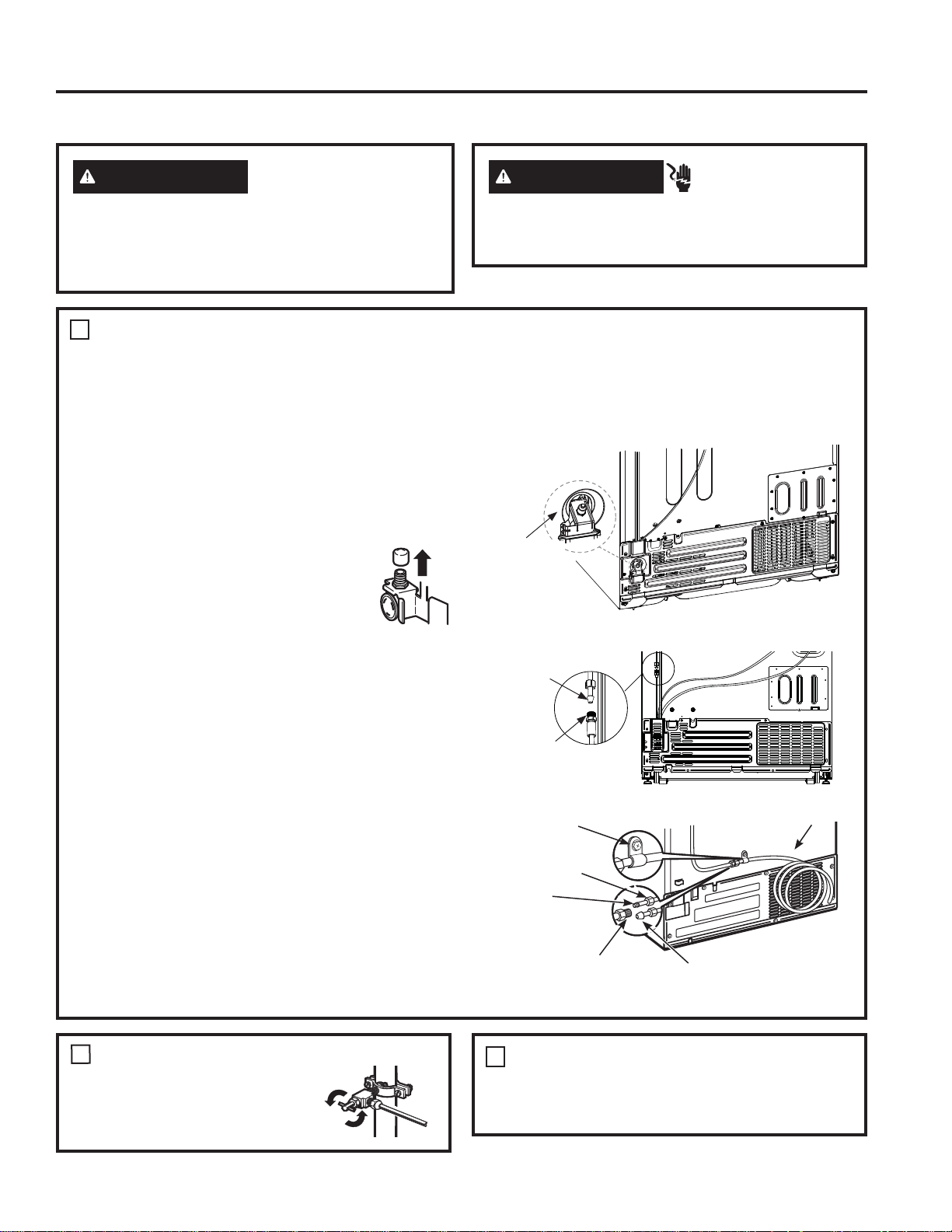
2349-1000105 Rev. 4
INSTRUCCIONES PARA LA INSTALACIÓN
CÓMO INSTALAR EL REFRIGERADOR &RQW
Instrucciones para la instalación
CONECTE LA TUBERÍA AL REFRIGERADOR
(en los modelos con máquina de hielos y dispensador)
NOTAS:
• Antes de hacer la conexión al refrigerador, asegúrese
de que el cable de corriente del refrigerador no esté
conectado en el tomacorriente de la pared.
• Antes de conectar la tubería de agua al hogar, purgue la
tubería del hogar durante por lo menos 2 minutos.
• Algunos modelos poseen la conexión del refrigerador en la
válvula de agua (Configuración 1). Otros modelos cuentan
con la conexión del refrigerador al final de la tubería
ubicada fuera de la tapa de acceso del compartimiento del
compresor (Configuraciones 2 y 3).
• En los Modelos con la Configuración 1, la
conexión de la refrigeración se encuentra en
la válvula de agua; retire la tapa de plástico
flexible, como se muestra aquí.
Conexión del suministro de agua
Si usará una tubería de cobre, coloque una tuerca de
FRPSUHVLyQ\XQDDEUD]DGHUDGHUHIXHU]RPDQJDHQHO
extremo de la tubería proveniente del suministro de agua
fría del hogar.
Si usará una tubería de agua Universal, las tuercas ya
estarán ensambladas a la tubería.
Conexión del Refrigerador
Si usará tuberías de cobre, inserte el extremo de
la tubería en la conexión del refrigerador, en la parte
trasera del refrigerador, lo más lejos posible. Al sostener
la tubería, ajuste la unión.
Si usará una tubería de agua Universal , inserte el
extremo moldeado de la tubería en la conexión del
refrigerador, en la parte trasera del refrigerador, y ajuste
la tuerca de compresión hasta que quede ajustada
manualmente. Luego realice un ajuste adicional con
un giro de llave. Un ajuste excesivo podrá ocasionar
pérdidas.
Conexión del Refrigerador Usando la Abrazadera de
la Tubería
Ajuste la tubería en la abrazadera provista para sostener
la misma en la posición correcta. Será necesario que
abra la abrazadera haciendo palanca.
Una de las configuraciones a continuación se parecerá a
la conexión de su refrigerador.
1
ACTIVE LA CONEXIÓN DE AGUA
Haga pasar la corriente de agua en
ODYiOYXODGHFLHUUHHOVXPLQLVWURGH
agua de la casa) e inspeccione en
busca de fugas.
2
CONECTE EL REFRIGERADOR
Arregle el rollo de tubería para que no vibre contra
la parte posterior del refrigerador o contra la pared.
Empuje el refrigerador contra la pared.
3
Tubería de 1/4”
Abrazadera
de la tubería
Tuerca de compresión
de 1/4”
Férula
PDQJD
Tubería de Entrada de Agua Universal
Conexión del
refrigerador
Tubería de
Entrada de Agua
Universal
Refrigerator
Connection
&RQ¿JXUDFLyQ
&RQ¿JXUDFLyQ
&RQ¿JXUDFLyQ
Refrigerator
Connection
ADVERTENCIA
Realice la conexión a un
suministro de agua potable únicamente.
Se requiere un suministro de agua fría para el
funcionamiento de la máquina de hielos automática. La
SUHVLyQGHODJXDGHEHUiHVWDUHQWUH\SVL
kilopascales).
ADVERTENCIA
PELIGRO DE
DESCARGA ELÉCTRICA
Adhiera la abrazadera de la tubería usando el agujero
existente únicamente. NO perfore el refrigerador.
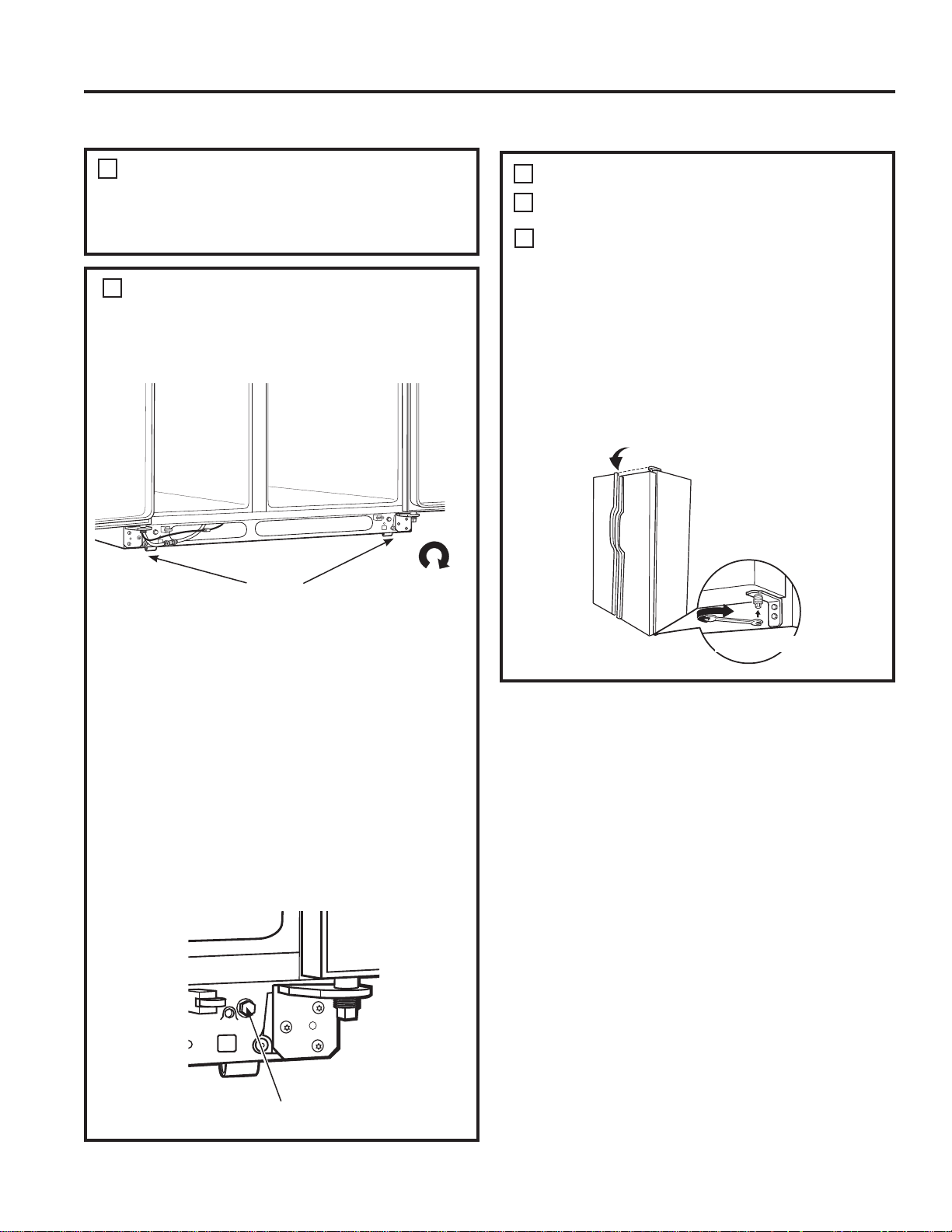
24 49-1000105 Rev. 4
4
COLOQUE EL REFRIGERADOR
EN SU LUGAR
Mueva el refrigerador a su destino final.
5
CÓMO NIVELAR EL
REFRIGERADOR
El refrigerador puede nivelarse ajustando los rodillos
localizados cerca de las bisagras inferiores.
Los rodillos tienen tres propósitos:
• Los rodillos se ajustan para que la puerta cierre con
IDFLOLGDGFXDQGRHVWpPHGLRDELHUWD/HYDQWHHO
frente aproximadamente 5/8” [16 mm] del piso.)
• Los rodillos se ajustan para que el refrigerador esté
colocado firmemente en el piso y no tambalee.
• Los rodillos se ajustan para que el refrigerador
pueda ser alejado de la pared en momentos de
limpieza.
Para ajustar las rueditas en los
modelos de 23’, 25’:
• Gire los tornillos de ajuste del rodillo en sentido de
las manecillas del reloj para levantar el refrigerador,
y en contra de las manecillas del reloj para bajarlo.
Use una llave o un cubo de cabeza hexagonal de
3/8” o una llave ajustable.
Rodillos
Levante
Tornillo de ajuste del rodillo
NIVELES LAS PUERTAS
Ajuste la puerta del refrigerador para que las puertas
estén niveladas en la parte superior.
Para linear:
Usando una llave de 7/16”, gire el tornillo ajustable
de la puerta hacia la derecha para levantar la puerta,
y a la izquierda para bajarla.
NOTA:
Un tapón de nilón, empotrado en las roscas del
pasador, evita que el pasador gire a no ser que se
use una llave.
Después de una o dos vueltas de la llave, abra y
cierre la puerta del refrigerador y cerciórese de que
están alineadas en la parte superior.
6
A
B
Las puertas deben estar
alineadas en la parte superior
Levantar
Llave de 7/16”
CÓMO INSTALAR EL REFRIGERADOR (Cont.)
Instrucciones para la instalación
INSTRUCCIONES PARA LA INSTALACIÓN
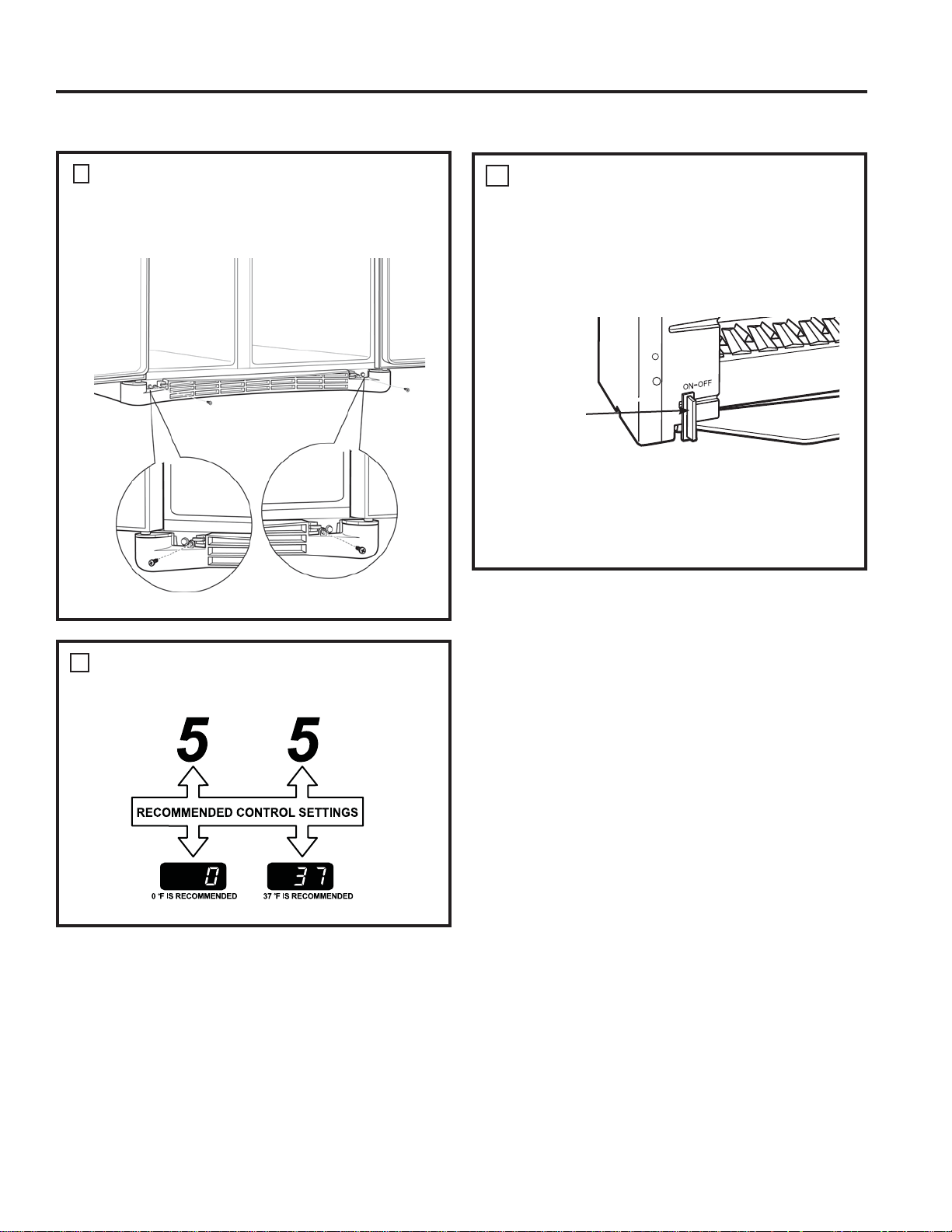
2549-1000105 Rev. 4
INSTRUCCIONES PARA LA INSTALACIÓN
REEMPLACE LA PARRILLA
DE LA BASE
Reemplace la parrilla de la base instalando los dos
tornillos de cabeza Phillips.
7
AJUSTE LOS CONTROLES
Ajuste los controles donde se recomienda.
8
INICIE LA MÁQUINA DE HIELOS
Fije el interruptor de la máquina de hielos en la
SRVLFLyQ21HQFHQGLGR/DPiTXLQDGHKLHORV
no empezará a operar hasta que alcance su
WHPSHUDWXUDGHRSHUDFLyQGH)±&RPHQRU
Luego, empezará a operar automáticamente. Será
necesario de 2 a 3 días para que se llene el cubo de
hielo.
NOTA:
En condiciones de menor presión de agua, la valvula
de agua válvula puede encenderse hasta 3 veces
para suministrar suficiente agua para la máquina de
hielo.
9
Interruptor
CÓMO INSTALAR EL REFRIGERADOR &RQW
Instrucciones para la instalación
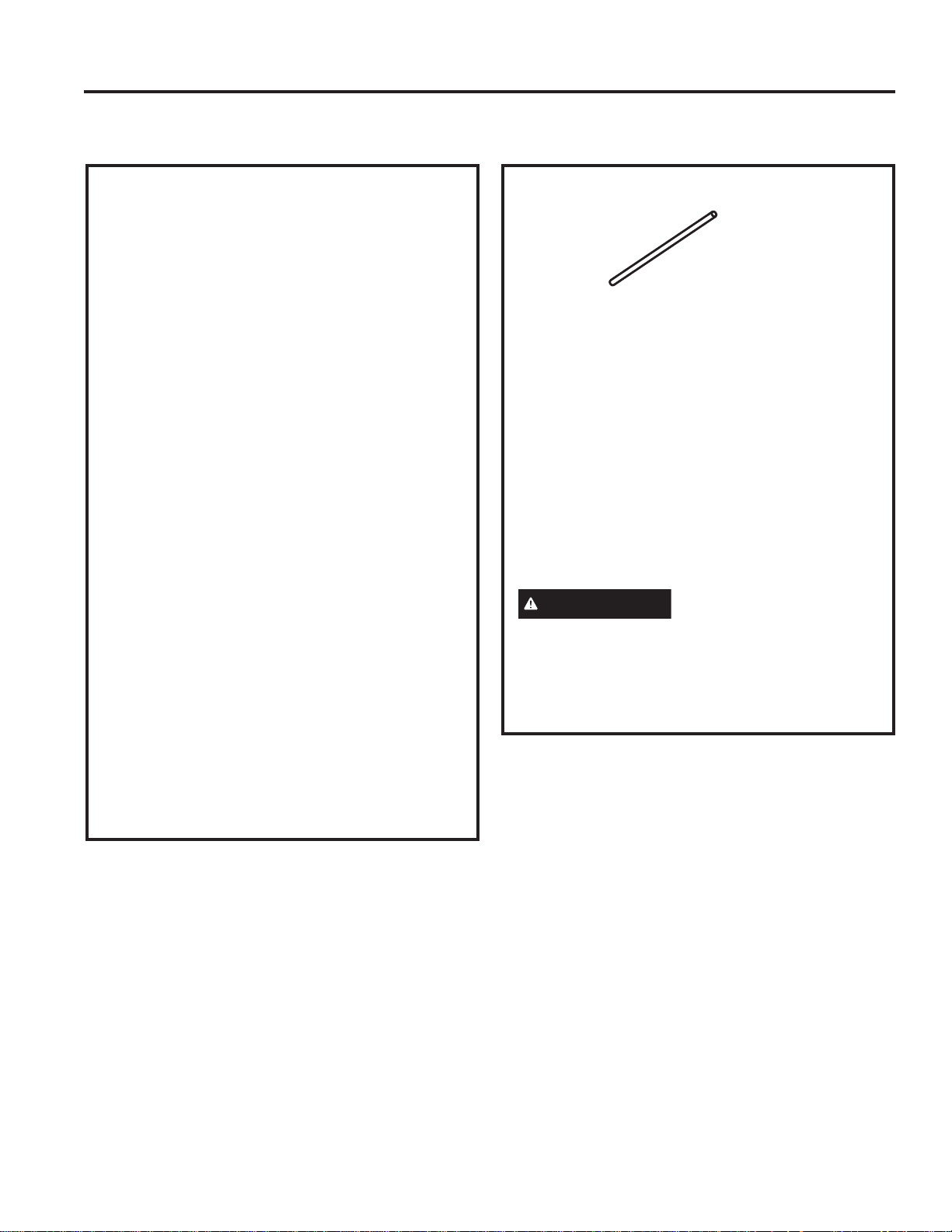
26 49-1000105 Rev. 4
CÓMO INSTALAR LA LÍNEA DE AGUA
HQPRGHORVFRQPiTXLQDGHKLHORV\GLVSHQVDGRU
ANTES DE COMENZAR
Si el suministro de agua del refrigerador es de un Sistema
de Filtración de Osmosis inversa y el refrigerador también
tiene un filtro de agua, use el tapón de derivación del filtro.
Usar el cartucho de filtración de agua del refrigerador
además del filtro RO podría resultar en la formación de
cubos de hielo huecos y en un flujo de agua más lento a
partir del dispensador de agua.
Esta instalación de la línea de agua no está garantizada
por el fabricante del refrigerador o de la máquina de
hielos. Siga estas instrucciones cuidadosamente para
minimizar el riesgo de daños causados por el agua que
puedan ser costosos.
*ROSHGHDULHWHDJXDJROSHDQGRHQODVWXEHUtDVHQ
la plomería de la casa podría dañar las partes del
refrigerador y traer consigo fugas de agua e inundación.
Llame a un plomero calificado para que corrija este
problema de golpe de ariete antes de instalar la línea de
suministro de agua hacia el refrigerador.
Para evitar quemaduras y daños al producto, no conecte
la línea de agua fría con la línea de agua caliente.
Si usted usa su refrigerador antes de conectar la línea de
agua, cerciórese de que el interruptor de la máquina de
KLHORVHVWiHQODSRVLFLyQ2))DSDJDGR
No instale la tubería de la máquina de hielos en áreas
donde la temperatura baja por debajo de la temperatura
de congelamiento.
&XDQGRXVHFXDOTXLHUGLVSRVLWLYRHOpFWULFRFRPR
una taladradora, por ejemplo), durante la instalación,
cerciórese de que tal dispositivo esté aislado doblemente
o conectado a tierra de forma tal que se evite el peligro de
electrocución, u operado por batería.
Todas las instalaciones deben ser hechas de acuerdo con
los códigos y requisitos locales e plomería.
LO QUE USTED NECESITARÁ
• Kit de Tubería de Agua para Refrigerador de Cobre
o Universal de ¼” de diámetro externo para conectar
el refrigerador al suministro de agua. Si usará cobre,
asegúrese de que ambos extremos de la tubería hayan
sido cortados de forma recta.
Para determinar cuánta tubería necesitará: mida la
distancia desde la válvula de agua hasta la parte posterior
del refrigerador hasta el tubo de suministro de agua.
Cerciórese de que existe suficiente tubería adicional para
permitir el movimiento a partir de la pared.
Los Kits de Tuberías de Agua para Refrigerador
Universales están disponibles en las siguientes longitudes:
¶P ±:;;
¶P ±:;;
¶P ±:;;
ADVERTENCIA
Realice la conexión a un suministro de agua potable
únicamente.
Se requiere un suministro de agua fría para el
funcionamiento de la máquina de hielos automática.
La presión del agua deberá estar entre 40 y 120 psi
NLORSDVFDOHV
Instrucciones para la instalación
INSTRUCCIONES PARA LA INSTALACIÓN
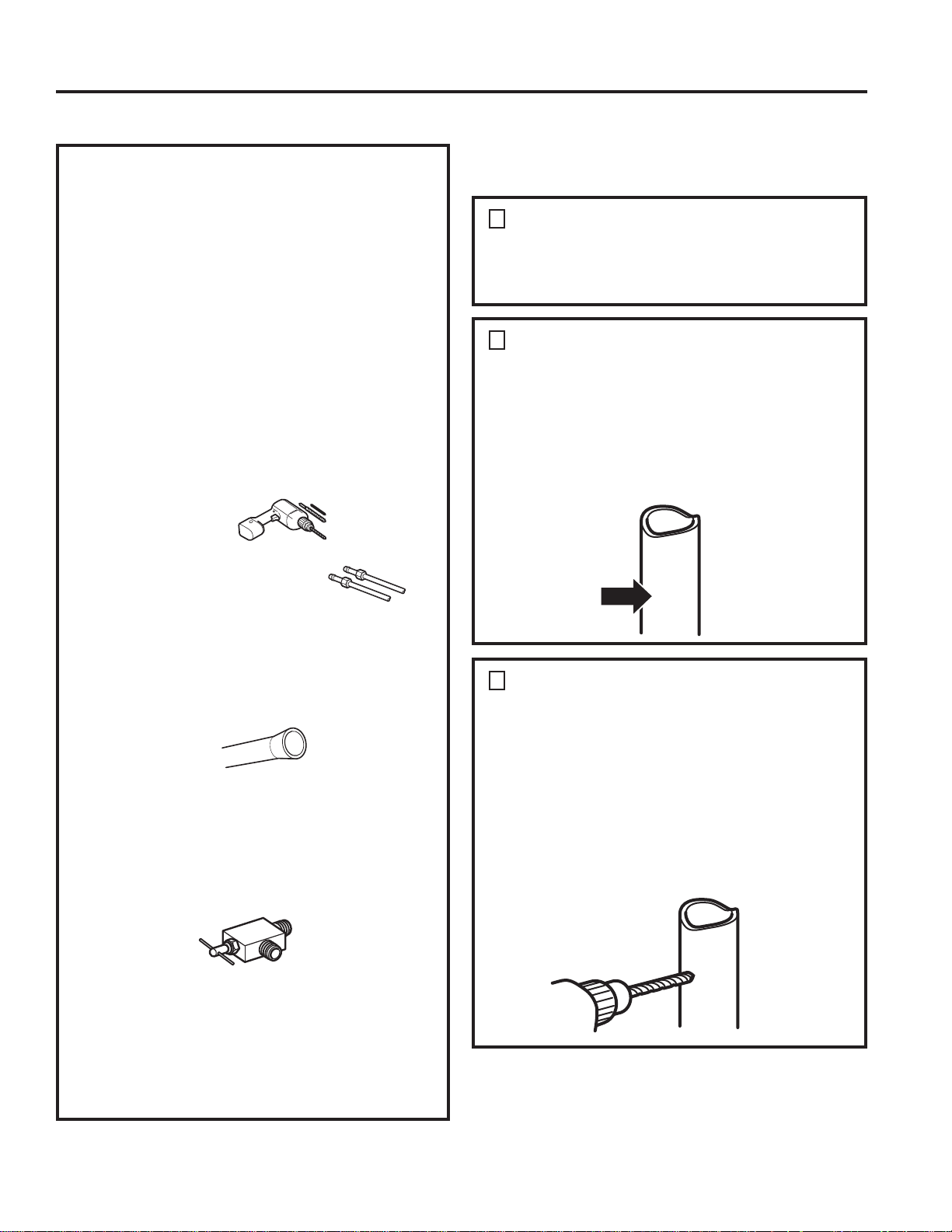
2749-1000105 Rev. 4
INSTRUCCIONES PARA LA INSTALACIÓN
CÓMO INSTALAR LA LÍNEA DE AGUA &RQW
LO QUE USTED NECESITARÁ
&RQW
NOTA: La única tubería plástica de GE Appliances
aprobada es aquella provista con los Kits de Tuberías de
Agua Universales para Refrigerador. No use ninguna otra
tubería plástica para el suministro porque la línea estará
bajo presión en todo momento. Ciertos tipos de tuberías
plásticas se romperán y al pasar el tiempo desarrollarán
grietas y el agua podría causar daños a la casa.
• Un kit de suministro de agua de GE Appliances
HOFXDOFRQVWDGHXQDWXEHUtDYiOYXODGHFLHUUH\
accesorios, los cuales figuran a continuación) está
disponsible por un costo adicional a través de su
vendedor minorista o a través de Piezas de Accesorios,
llamando al 877.959.8688
• Un suministro de agua caliente. La presión del agua
GHEHVHUGHHQWUH\SVL\N3D
• Taladradora eléctrica
• Llave ajustable o llave de 1/2”.
• Destornilladores planos y Phillips.
• Dos tuercas de compresión de diámetro externo
de 1/4” y 2 casquillos—para conectar la tubería de
cobre a la válvula de cierre y a la válvula de agua del
refrigerador.
O
• Si se encuentra usando un Kit de Tuberías de
Agua Universales para Refrigerador, los accesorios
necesarios están preensamblados con la tubería.
• Si su línea de agua de cobre existente es ensanchada
en el extremo, usted necesitará un adaptador
GLVSRQLEOHHQODVWLHQGDVGHSORPHUtDRFRQHFWH
la línea de agua con el refrigerador O usted puede
cortar la parte ensanchada del extremo del tubo con
un cortador de tubos y entonces usar un accesorio de
compresión. No corte un extremo formado por Kit de
Tuberías de Agua Universales para Refrigerador.r.
• Válvula de cierre para conectar la línea de agua fría.
La válvula de cierre debe tener una entrada de agua
con un diámetro interno mínimo de 5/32” en el punto
de conexión a la LÍNEA DE AGUA FRÍA. Válvulas de
cierre tipo corona están incluidas en muchos kits de
suministro de agua. Antes de comprar, cerciórese de
que la válvula tipo corona cumple con los códigos de
plomería de su localidad.
CIERRE EL SUMINISTRO DE
AGUA PRINCIPAL
Abra el grifo más cercano lo suficiente como para
aclarar la línea de agua.
ESCOJA LA LOCALIZACIÓN
DE LA VÁLVULA
Escoja una localización para la válvula de fácil
acceso. Es mejor conectarla a un costado de una
tubería vertical. Cuando sea necesario conectarlo en
una línea horizontal, cerciórese de que la conexión
sea hecha en la parte superior o en el lado, en vez
del fondo, para evitar la acumulación de sedimentos
de la línea de agua.
TALADRE UN AGUJERO PARA
LA VÁLVULA
Taladre un agujero de 1/4” en la tubería
GHDJXDDXQVLHVWiXVDQGRXQDYiOYXOD
autoperforadora), usando una broca filosa. Remueva
cualquier rebaba que haya resultado del taladrado del
agujero en la tubería.
Tenga cuidado de no permitir que el agua drene
hacia el agujero.
No hacer un agujero de 1/4” podría resultar en una
producción de agua reducida o en cubos de hielo
menores.
1
2
3
Instale la válvula de cierre en la línea de agua de tomar más
cercana.
Instrucciones para la instalación
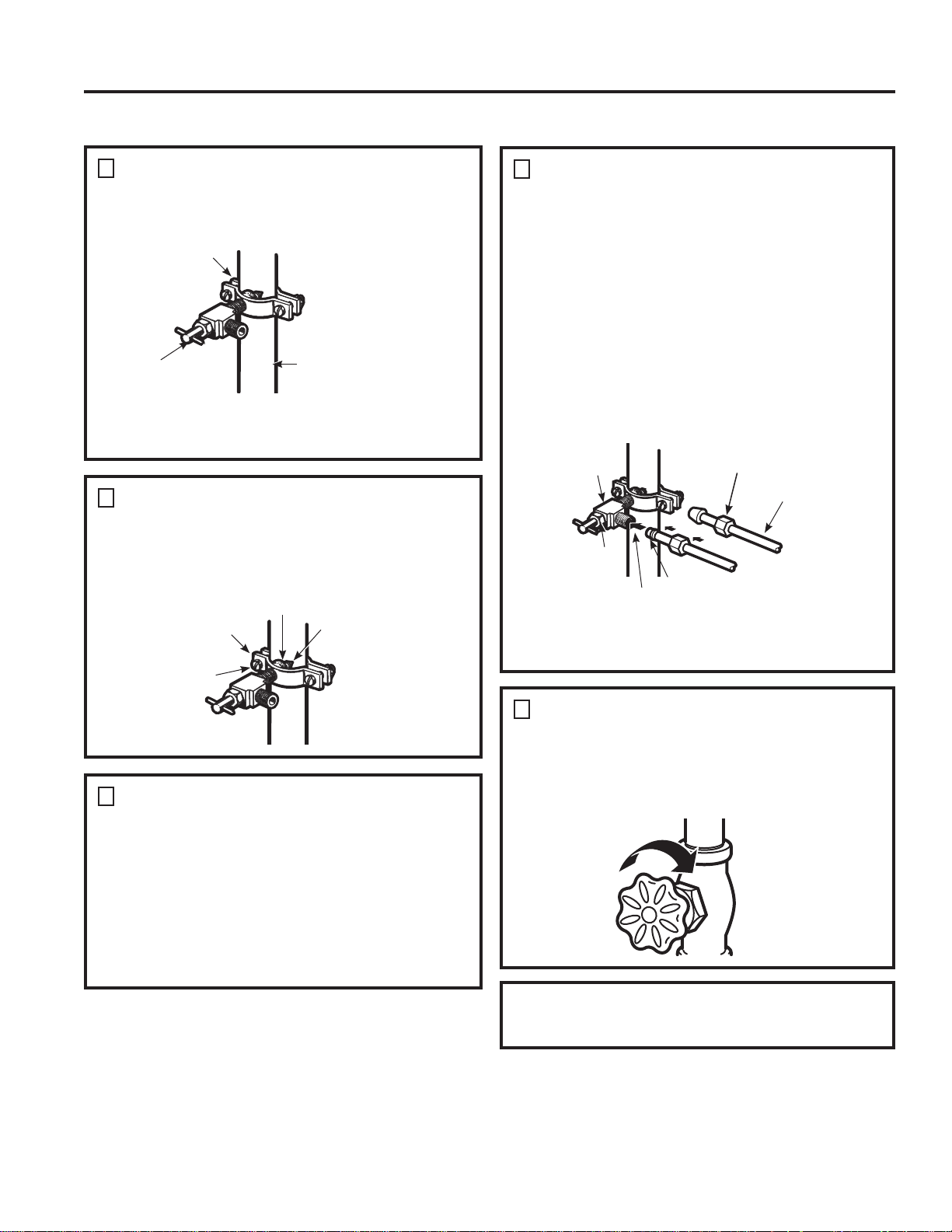
28 49-1000105 Rev. 4
APRIETE LA VÁLVULA DE
CIERRE
Apriete la válvula de cierre a la tubería de agua fría
con una abrazadera de tubo.
NOTA: Las válvulas de montura son ilegales y su uso
no está permitido en Massachusetts. Consulte a un
plomero profesional.
APRIETE LA ABRAZADERA DE
TUBO
Apriete los tornillos de la abrazadera hasta que la
arandela de sello comience a ensancharse.
NOTA: No la apriete demasiado o podría romper la
tubería.
CÓMO ORIENTAR LA TUBERÍA
Oriente la tubería entre la línea de agua fría y el
refrigerador.
Oriente la tubería a través de un agujero taladrado
HQODSDUHGRQHQHOSLVRGHWUiVGHOUHIULJHUDGRURHQ
la base de una gabinete adyacente) tan cercano a la
pared como sea posible.
NOTA: Cerciórese de que existe suficiente tubería
adicional para permitir que el refrigerador se mueva
de la pared después de la instalación.
PURGUE LA TUBERÍA
Abra el suministro principal de agua y purgue la tubería
hasta que el agua esté totalmente limpia.
Cierre el suministro de agua de la válvula de agua cuando
DSUR[LPDGDPHQWHXQFXDUWRGHJDORQOLWURKD\DVDOLGRD
través de la tubería durante purgue.
Para completar la instalación del refrigerador, regrese al
Paso 1 en Cómo instalar el refrigerador.
CÓMO CONECTAR LA TUBERÍA
A LA VÁLVULA
Coloque la tuerca de compresión y el casquillo
para tubería de cobre en el extremo de la tubería y
conéctela con la válvula cierre.
Cerciórese de que la tubería está insertada
completamente en la válvula. Apriete la tuerca de
compresión con seguridad.
Para tuberías plásticas de un Kits de Tuberías
de Agua Universales para Refrigerador, inserte el
extremo moldeado de la tubería en una válvula de
cierre y apriete la tuerca de compresión hasta que
quede apretada a mano, entonces apriétela una
vuelta adicional con la llave. Si la aprieta demasiado,
causará fugas.
NOTA: Las válvulas de montura son ilegales y su uso
no está permitido en Massachusetts. Consulte a un
plomero profesional.
4
5
6
8
7
CÓMO INSTALAR LA LÍNEA DE AGUA &RQW
Abrazadera
de tubo
Tubería de agua fría vertical
Válvula de cierre
tipo corona
Arandela
Extremo de
entrada
Abrazadera
de la tubería
Tornillo de
la abrazadera
Válvula de cierre
tipo corona
Tuerca de compresión
Tuerca
de cruz
Válvula
de salida
&DVTXLOORPDQJD
Tubería SmartConnect™
Instrucciones para la instalación
INSTRUCCIONES PARA LA INSTALACIÓN
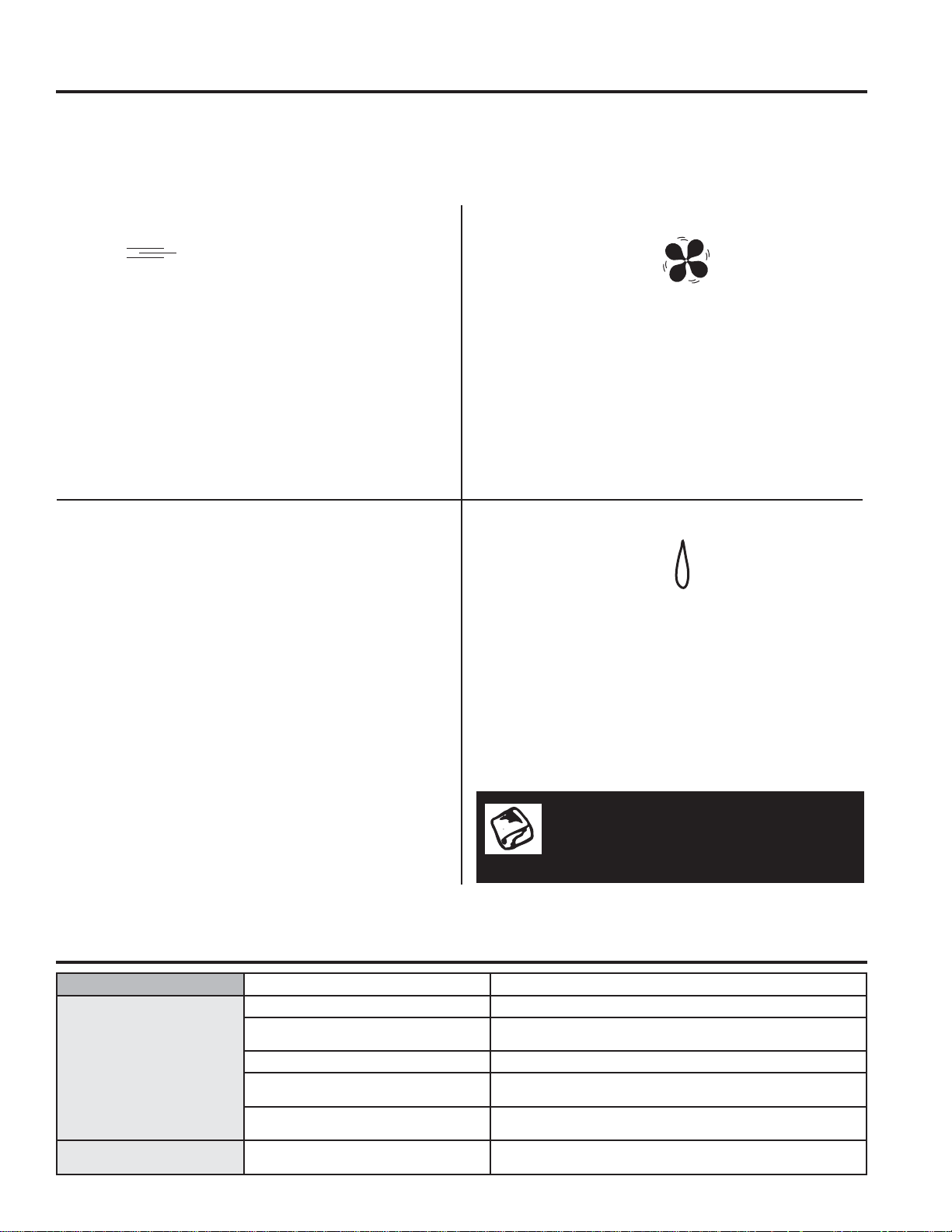
2949-1000105 Rev. 4
CONSEJOS PARA LA SOLUCIÓN DE PROBLEMAS: Sonidos normales de operación
Los refrigeradores más nuevos producen sonidos diferentes a los modelos más antiguos.
Los refrigeradores modernos tienen más funciones y usan tecnología más reciente.
HUMMM...
WHOOSH...
Ŷ (OQXHYRFRPSUHVRUGHDOWDHILFLHQFLDSXHGHIXQFLRQDU
más rápido y durar más que el de su refrigerador anterior
y puede escuchar un zumbido de tono alto o un sonido
pulsante mientras opera.
Ŷ $YHFHVHOUHIULJHUDGRUIXQFLRQDSRUXQSHUtRGR
prolongado, especialmente cuando las puertas se
abren continuamente. Esto significa que la función
Frost Guard™ está en operación para impedir que el
congelador se queme y mejorar la preservación
de los alimentos.
Ŷ 3XHGHHVFXFKDUXQVRQLGRGHVRSOLGRFXDQGRODV
puertas se cierran. Esto se debe a que la presión se está
estabilizando dentro del refrigerador.
Ŷ 3XHGHHVFXFKDUORVYHQWLODGRUHVPRYLpQGRVHD
gran velocidad. Esto pasa cuando el refrigerador se
conecta por primera vez, cuando las puertas se abren
frecuentemente o cuando se guarda gran cantidad de
alimentos en el refrigerador o en los compartimientos del
congelador. Los ventiladores están ayudando a mantener
las temperaturas correctas.
Ŷ 6LFXDOTXLHUDGHODVSXHUWDVSHUPDQHFHDELHUWDSRUPiV
de 3 minutos, puede escuchar los ventiladores para
enfriar los focos de luz.
Ŷ /RVYHQWLODGRUHVFDPELDQODYHORFLGDGSDUDVXPLQLVWUDU
enfriamiento óptimo y ahorrar energía.
CHASQUIDOS, ESTALLIDOS,
CRUJIDO, GORGOREOS
Ŷ 3XHGHHVFXFKDUVRQLGRVFRPRGHFUXMLGRRHVWDOOLGRV
cuando el refrigerador se conecta por primera vez. Esto
pasa a medida que el refrigerador se enfría hasta la
temperatura correcta.
Ŷ /RVUHJXODGRUHVHOHFWUyQLFRVVHDEUHQ\VHFLHUUDQSDUD
ofrecer un enfriamiento óptimo y ahorrar energía.
Ŷ (OFRPSUHVRUSXHGHFDXVDUXQFKDVTXLGRRXQJRUJRUHR
FXDQGRLQWHQWDYROYHUDDUUDQFDUHVWRSXHGHWRPDUKDVWD
5 minutos).
Ŷ (OWDEOHURGHFRQWUROHOHFWUyQLFRSRGUiJHQHUDUXQ
sonido de chasquido cuando se activa el relevador para
controlar los componentes del refrigerador.
Ŷ ([SDQVLyQ\FRQWUDFFLyQGHODVERELQDVGXUDQWHR
después del ciclo de descongelación puede causar
sonidos como de crujido o estallidos.
Ŷ (QPRGHORVFRQGLVSRVLWLYRGHKLHORGHVSXpVGH
completar un ciclo de hacer hielo, se pueden escuchar
los cubos de hielo cuando caen a la bandeja de hielos.
SONIDOS DE AGUA
Ŷ (OIOXLGRGHOUHIULJHUDQWHDWUDYpVGHODVERELQDVSXHGH
producir un sonido de borboteo como de agua hirviendo.
Ŷ (ODJXDTXHFDHHQHOFDOHQWDGRUGHGHVFRQJHODFLyQ
puede causar un chisporroteo, estallido o zumbido
durante el ciclo de descongelación.
Ŷ 8QUXLGRGHDJXDFD\HQGRVHSXHGHHVFXFKDUGXUDQWHHO
ciclo de descongelación a medida que el hielo se derrite
del evaporador y fluye hacia la bandeja de drenaje.
Ŷ (OFLHUUHGHODVSXHUWDVSXHGHSURGXFLUXQVRQLGRGH
gorgoteo debido a la estabilización de la presión.
¿Usted escucha lo que yo escucho? Estos sonidos son
Sonidos normales de operación
Para información adicional acerca de los sonidos
de operación de los dispositivos de hielo o de
los dispensadores, ver las secciones Acerca del
dispositivo automático para hacer hielo y Acerca
del dispensador de hielo y agua.
¡WHIR!
Problema Causas Posibles Qué hacer
El refrigerador no funciona Refrigerador en ciclo de descongelar. Espere 30 minutos hasta que la descongelación se termine.
Controles de temperatura en posición
OFF (apagado).
Mueva los controles de temperatura hasta un ajuste inferior de
temperatura.
El refrigerador esté desconectado. Empuje la clavija completamente en el enchufe.
Fusible fundido/ interruptor de
circuito roto.
Reemplace el fusible o reajuste el interruptor.
El refrigerador está en la condición de
exhibición.
Desconecte el refrigerador y conéctelo otra vez.
9LEUDFLRQHVRVDFXGLGDVXQD
vibración ligera es normal)
Los rodillos requieren un ajuste. Vea Rodillos.
Consejos para la Solución de Problemas... Antes de solicitar el servicio técnico
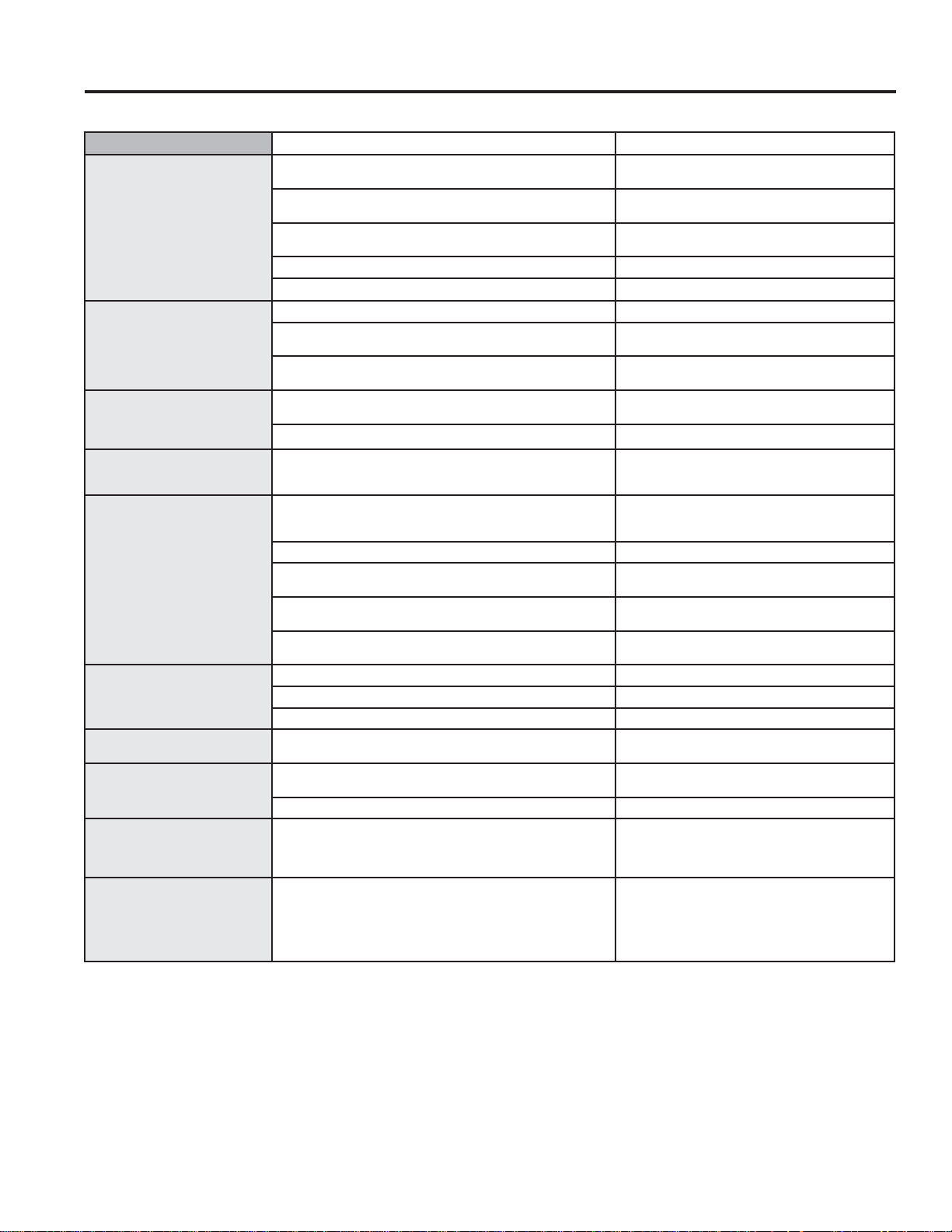
30 49-1000105 Rev. 4
Problema Causas Posibles Qué hacer
El motor opera durante
períodos prolongados o
se arranca y se para con
IUHFXHQFLD5HIULJHUDGRUHV
modernos con más espacio
de almacenamiento y un
congelador más grande
requieren más tiempo de
operación. Arrancan y paran
para mantener temperaturas
uniformes.)
Es normal cuando el refrigerador es recién instalado
en su casa.
Espere 24 horas para que el refrigerador se
enfríe completamente.
Ocurre cuando hay largas cantidades de alimentos en
el refrigerador.
Eso es normal.
Se dejó abierta la puerta. Revise si un paquete mantiene la puerta
abierta.
Clima caluroso o aperturas frecuentes de la puerta. Eso es normal.
Controles de temperatura ajustados al punto más frío. Vea Los controles.
Compartimiento de refrigerador
o congelador demasiado cálido
El control de temperatura no se fijó bastante frío. Vea Los controles.
Clima caluroso o aperturas frecuentes de la puerta. Fije el control de temperatura un paso más frío.
Vea Los controles.
Se dejó abierta la puerta. Revise si hay un paquete que mantiene la
puerta abierta.
Escarcha o cristales de hielo
en alimentos congelados
HVFDUFKDHQSDTXHWHHV
normal)
Se dejó abierta la puerta. Revise si hay un paquete que mantiene la
puerta abierta.
La puerta se abre con frecuencia o por mucho tiempo.
El divisor entre el
compartimiento de refrigerador
y el congelador se siente tibio
Ahorro automático de energía circula líquido tibio en la
frente del congelador.
Eso ayuda prevenir la condensación en el
exterior.
Dispositivo automático para
hacer hielo no funciona
El interruptor de alimentación eléctrica del dispositivo
automático para hacer hielo está en la posición OFF
(apagado).
Coloque el interruptor de alimentación eléctrica
HQODSRVLFLyQ21HQFHQGLGR
El agua está cerrada o no está conectada. Vea Instalar la línea de agua.
El compartimiento del congelador es muy cálido. Espere 24 horas para que se enfríe el
refrigerador.
Cubos apilados en el recipiente apaga el dispositivo
para hacer hielo.
Nivele los cubos con la mano.
Cubos de hielo atorados en dispositivo para hacer
hielo.
Apague el dispositivo de hielo, retire los cubos
y vuelva a poner el dispositivo en marcha.
Los cubos tienen mal olor/
sabor
El recipiente para los cubos necesita limpieza. Vacíe y limpie el recipiente. Deseche los cubos.
Alimentos transmitiendo olor/sabor a los cubos. Envuelva bien los alimentos.
El interior del refrigerador requiere limpieza. Vea Cuidado y limpieza.
Cubos pequeños o huecos Filtro de agua tapado. Reemplace el cartucho del filtro con uno nuevo
o con el tapón.
Formación lenta del hielo Se dejó abierta la puerta. Revise si hay un paquete que mantiene la
puerta abierta.
El control de temperatura no es bastante frío. Vea Los controles.
)UHFXHQWHVRQLGRGH³PXUPXOOR´ El interruptor de corriente del dispositivo para hacer
hielo está en la posición ON (encendido) pero no se
ha conectado la tubería de suministro de agua hacia el
refrigerador.
Deslice el interruptor de corriente a la posición
O (apagado). Mantenerlo en la posición I
(encendido) dañará la válvula del agua.
Brillo rojo / naranja en la
secciරn del congelador, vapor
provenlente de las rejillas de
ventilaciරn, sonido de estallido,
silbido proveniente del área del
congelador
Esta es una operacion normal para los modelos con
calentador de descongeiacion de vidrio. El calenatador
elimina la escarcha del evaporador de su refrigerador
para un funcionamiento රptimo.
No toque el área de ventilacion ni desconecte
el refrigeredor. Es una operacion normal de
trabajo del calentador, este se apagara una vez
que se haya eliminado la escarcha.
¡Ahorre tiempo y dinero! Primero revise los cuadros que aparecen en las siguientes páginas y es posible que no necesite solicitar
reparaciones.
Consejos para la Solución de Problemas... Antes de solicitar el servicio técnico
CONSEJOS PARA LA SOLUCIÓN DE PROBLEMAS

3149-1000105 Rev. 4
CONSEJOS PARA LA SOLUCIÓN DE PROBLEMAS
Problema Causas Posibles Qué hacer
El dispensador de hielo no
IXQFLRQDHQDOJXQRVPRGHORV
Dispositivo de hielo apagado o el agua está
apagado.
Enciende el dispositivo de hielo o el agua.
Los cubos están pegados al brazo detector. Remueve los cubos.
Un artículo está bloqueando o se ha caído
dentro del vertedor de hielo dentro de la
sección del congelador de la puerta superior.
Remueva cualquier artículo que pueda estar
bloqueando, o que se haya caído dentro del
vertedor.
Bloques irregulares de hielo en el recipiente. Rómpalos con los dedos y deseche los cubos
restantes.
El congelador puede ser muy caliente. Ajuste el
control a una posición más fría paso por paso hasta
que no se formen bloques.
El dispensador está BLOQUEADO (LOCKED). 3UHVLRQHODWHFOD/2&.EORTXHR\PDQWpQJDOD
presionada durante tres segundos.
El agua tiene un sabor/olor malo
HQDOJXQRVPRGHORV
El dispensador de agua no se uso por mucho
tiempo
Dispense el agua hasta que todo el sistema del
agua se llene de nuevo.
El agua en el primer vaso está
WLELDHQDOJXQRVPRGHORV
Eso es normal con un refrigerador recién
instalado.
Espere 24 horas para que se enfríe el refrigerador.
El dispensador de agua no se uso por mucho
tiempo.
Dispense el agua hasta que todo el sistema del
agua se llene de nuevo.
El sistema de agua se ha desaguado. Espere algunas horas para que se enfríe el agua.
El dispensador de agua no
IXQFLRQDHQDOJXQRVPRGHORV
Suministro de agua apagado o no conectado. Vea Instalar la línea de agua.
Filtro de agua tapado. Reemplace el cartucho del filtro o retire el filtro y
instale el tapón.
Aire atrapado en el sistema del agua. Presione el brazo del dispensador por un par de
minutos.
El dispensador está BLOQUEADO (LOCKED). 3UHVLRQHODWHFOD/2&.EORTXHR\PDQWpQJDOD
presionada durante tres segundos.
El agua chorrea del dispensador Cartucho del filtro recién instalado. Deje correr el agua desde el dipensador por 3
PLQXWRVDSUR[
1
»2 galones [6 litros]).
No sale agua pero el dispositivo
HQDOJXQRVPRGHORVSDUDKDFHU
hielo funciona
El agua en el depósito está congelada. Llame para servicio.
El control de temperatura demasiado frío. Fije el control de temperatura hasta mas cálido.
No sale agua y el dispositivo para
hacer hielo no funciona
Está tapada la línea de agua o la llave de paso. Llame a un plomero.
Filtro de agua tapado. Reemplace el cartucho del filtro o remueve el filtro y
instale el tapón.
El dispensador está BLOQUEADO (LOCKED) 3UHVLRQHODWHFOD/2&.EORTXHR\PDQWpQJDOD
presionada durante tres segundos.
Se seleccionó CUBED ICE
+,(/2(1&8%26SHURVH
GLVSHQVy&586+(',&(+LHOR
SLFDGRHQDOJXQRVPRGHORV
La última selección fue CRUSHED ICE (HIELO
PICADO).
Se quedaron unos cuantos cubos en el triturador de
la selección anterior. Esto es normal.
El refrigerador huele Alimentos transmitiendo olores al refrigerador. Alimentos con olores fuertes deben estar tapados.
Guarde una caja de bicarbonato de sodio en el
refrigerador; cámbiela cada tres meses.
El interior requiere limpieza. Vea Cuidado y limpieza.
Humedad en el exterior del
refrigerador
Normal en períodos con alto grado de
humedad.
Seque la superficie.
+XPHGDGHQHOLQWHULRUHQFOLPD
húmedo el aire lleva la humedad
al interior del refrigerador cuando
se abren las puertas)
Se abre la puerta con frecuencia o por mucho
tiempo.
Esto es normal para el centro de bebidas.
Debido al alto nivel de humedad en el refrigerador,
es posible que ocasionalmente se empañe o que
se produzcan pequeñas cantidades de humedad
en el compartimiento del refrigerador.
Esto es normal para las cargas centrales de bebidas
y las condiciones ambientales se pueden cambiar con
una toalla de papel si lo desea.
No funciona la luz interior No hay corriente en el contacto. Reemplace el fusible o reajuste el interruptor.
Para luces LED. Llame al servicio técnico.
Consejos para la Solución de Problemas... Antes de solicitar el servicio técnico
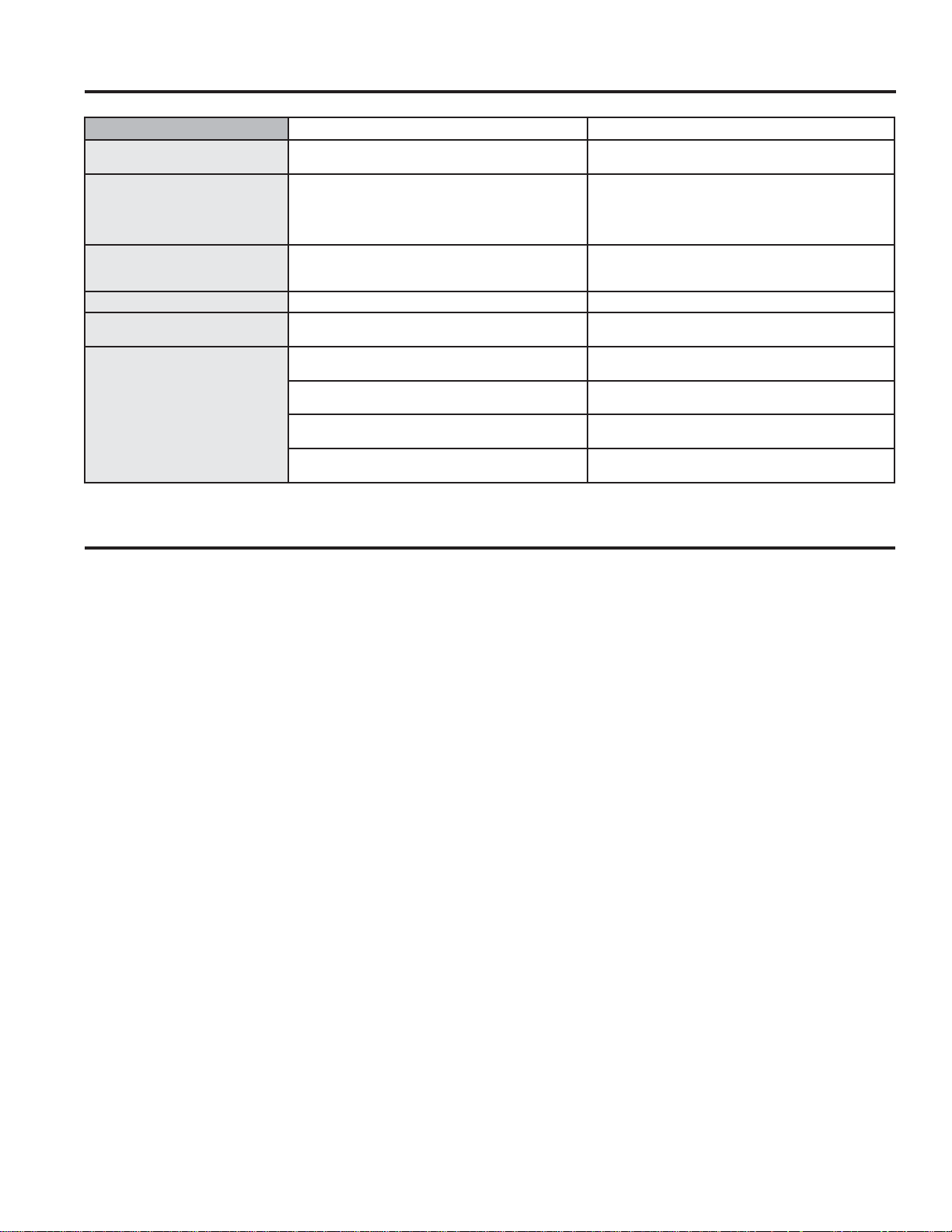
32 49-1000105 Rev. 4
Consejos para la Solución de Problemas... Antes de solicitar el servicio técnico
CONSEJOS PARA LA SOLUCIÓN DE PROBLEMAS
Problema Causas Posibles Qué hacer
Agua en el piso de la cocina o en
el fondo del congelador
Cubos atrapados en el orificio. Empuje los cubos en el vertedero con una cuchara
de madera.
Aire caliente a la base del
refrigerador
El aire fluye para enfriar el motor. En el proceso
de refrigeración es normal que salga calor de la
base del refrigerador. Algunos recubrimientos
de piso estan sensitivos y se descoloran a
estas temperaturas normales y seguras.
El refrigerador nunca se apaga
pero las temperaturas están bien
El sistema de congelación mantiene al
compresor funcionando durante la puerta está
siendo abierta.
Esto es normal. El refrigerador se apagará si la
puerta permanece cerrada por 2 horas.
El refrigerador está pitando La puerta está abierta. Cierre la puerta.
La puerta no se cierre
correctamente
El sello de la puerta en el lado de la bisagra
está pegado o doblado
Aplique parafina en la superficie frontal de la junta..
La temperatura real no es igual a
la temperatura establecida
La unidad recientemente se conectó. Permita que transcurran 24 horas para que el
sistema se estabilice.
La puerta permacene abierta por mucho tiempo. Permita que transcurran 24 horas para que el
sistema se estabilice.
Se introdujo comida tibia al refrigerador. Permita que transcurran 24 horas para que el
sistema se estabilice.
El ciclo de descongelamiento está en proceso. Permita que transcurran 24 horas para que el
sistema se estabilice.
Comunicación del Electrodoméstico HQDOJXQRVPRGHORV
INFORMACIÓN REGULATORIA
Declaración de Cumplimiento con FCC/IC:
Este dispositivo cumple con la Parte 15 de la Normativa de la FCC. (VWHGLVSRVLWLYRFXHQWDFRQXQWUDQVPLVRUHVUHFHSWRUHV
H[HQWRVGHOLFHQFLDTXHFXPSOHQFRQOD,QQRYDFLyQ&LHQFLD\'HVDUUROOR(FRQyPLFRH[HQWRGHOLFHQFLDHQ&DQDGi566V Su
funcionamiento está sujeto a las dos condiciones siguientes:
1. Este dispositivo no podrá causar interferencias perjudiciales.
2. Este dispositivo debe aceptar cualquier interferencia recibida, incluidas las interferencias que puedan provocar un
funcionamiento no deseado.
Este equipo fue probado y cumple con los límites establecidos para un dispositivo digital de clase B, según la parte 15 de la
Normativa de la FCC. Este producto fue probado y cumple con los límites establecidos para un dispositivo digital de Clase
B, según la parte 15 de la Normativa de la FCC. Este equipo genera, usa y puede emitir energía de radiofrecuencia y, si no
se instala y utiliza de acuerdo con las instrucciones, puede ocasionar interferencias perjudiciales sobre las comunicaciones
radiales. Sin embargo, no se garantiza que no se presenten interferencias en una instalación en particular. Si el equipo provoca
interferencias perjudiciales para la recepción de radio o televisión, lo que puede comprobar encendiendo y apagando el equipo,
se aconseja al usuario que intente corregir la interferencia a través de una de las siguientes medidas:
• Reoriente o reubique la antena receptora.
• Aumente la separación entre el equipo y el receptor.
• Conecte el equipo a un tomacorriente de un circuito diferente al tomacorriente al cual se encuentra conectado el receptor.
• Para solicitar ayuda, consulte al proveedor minorista o a un técnico experimentado de radio/ TV.
Etiqueta: Las modificaciones sobre esta unidad no aprobadas expresamente por parte del fabricante podrían anular la autoridad
del usuario para utilizar el equipo.
Sólo el módulo ConnectPlus RXQPyGXORGHFRPXQLFDFLyQVLPLODU
Exposición a RF – Sólo se autoriza el uso de este dispositivo a través de una aplicación móvil. Se deberá mantener en todo
momento una distancia de separación mínima de 20 cm. entre el dispositivo ConnectPlus y el cuerpo del usuario.
3349-1000105 Rev. 4
GARANTÍA LIMITADA
Por el Período de: GE Appliances Reemplazará
Un Año
Desde la fecha de la
compra original
Cualquier parte del refrigerador que falle debido a defectos en los materiales o en la fabricación.
Durante esta garantía limitada de un año, GE Appliances también proporcionará, sin costo
alguno, toda la mano de obra y el servicio relacionado para reemplazar partes defectuosas.
Treinta Días
)LOWURGH$JXDVLHVWi
incluido) Desde la fecha
de la compra original del
refrigerador
Cualquier parte del cartucho del filtro de Agua que falle debido a un defecto en los materiales o la
fabricación. Durante la garantía limitada por treinta días, GE Appliances también le brindará, sin costo,
el reemplazo de un cartucho del filtro de agua.
Ŷ9LDMHVGHVHUYLFLRDVXKRJDUSDUDHQVHxDUOHFyPRXVDU
el producto.
Ŷ,QVWDODFLyQRHQWUHJDLQDSURSLDGDRPDQWHQLPLHQWR
impropio.
Ŷ)DOODVGHOSURGXFWRVLKD\DEXVRPDOXVRRXVRSDUD
otros propósitos que los propuestos, o uso para fines
comerciales.
Ŷ3pUGLGDGHDOLPHQWRVSRUDYHUtDV
Ŷ5HHPSOD]RGHIXVLEOHVGHVXKRJDURUHDMXVWHGH
interruptores de circuito.
Ŷ'DxRVVREUHHODFDEDGRWDOHVFRPRy[LGRVREUH
la superficie, deslustres o manchas pequeñas no
informadas dentro de las 48 horas luego de la entrega.
Ŷ5HHPSOD]RGHOFDUWXFKRGHOILOWURGHDJXDVLLQFOXLGR
debido a presión de agua afuera de las limites de
operación especificados o sedimento excesivo en el
suministro de agua.
Ŷ5HHPSOD]RGHODVERPELOODVVLLQFOXLGDVRGHOFDUWXFKR
de filtro de agua, si incluido, diferente a como se
especifica anteriormente.
Ŷ'DxRDOSURGXFWRFDXVDGRSRUDFFLGHQWHIXHJR
inundaciones o actos de Dios.
Ŷ'DxRVFRQVHFXHQWHVRLQFLGHQWDOHVFDXVDGRVSRU
posibles defectos de este producto.
Ŷ3URGXFWRQRDFFHVLEOHSDUDIDFLOLWDUHOVHUYLFLR
requerido.
Ŷ/RVGDxRVFDXVDGRVSRUXQILOWURGHDJXD0DUFDQR*(
Appliances.
Esta garantía no cubre:
Crosley.com
Su electrodoméstico está cubierto por una garantía limitada, como figura a continuación, de GE Appliances. Todo
el servicio de garantía es provisto por nuestros Centros de Servicio de Fabricación de Electrodomésticos GE
Appliances, o por un técnico autorizado del servicio técnico. Para programar el servicio técnico, comuníquese con
Crosley al 800.544.4780. Cuando llame para solicitar el servicio técnico, tenga los números de serie y modelo
disponibles.
Garantía limitada del refrigerador de Crosley
®
Corporation
EXCLUSIÓN DE GARANTÍAS IMPLÍCITAS
Su única y exclusiva alternativa es la reparación del producto, como se indica en la Garantía Limitada. Las
garantías implícitas, incluyendo garantías implícitas de comerciabilidad o conveniencia sobre un propósito
particular, se limitan a un año o al período más corto permitido por la ley.
Esta garantía se extiende al comprador original y a cualquier dueño subsiguiente de productos comprados para uso hogareño
dentro de EE.UU. Si el producto está en un área donde no se encuentra disponible un Proveedor Autorizado del Servicio Técnico
de GE Appliances, usted será responsable por el costo de un viaje o se podrá requerir que traiga el producto a una ubicación del
Servicio Técnico de GE Appliances Autorizado para recibir el servicio. En Alaska, la garantía excluye el costo de envío o llamadas
del servicio a su hogar.
Algunos estados no permiten la exclusión o limitación de daños fortuitos o consecuentes. Esta garantía le da derechos legales
específicos y es posible que tenga otros derechos legales que varían entre un estado y otro. Para conocer cuáles son sus
derechos legales, consulte a la oficina de asuntos del consumidor local o estatal o al Fiscal de su estado.
Garante: GE Appliances, a Haier company
Louisville, KY 40225
Garantía Extendida de Crosley
®
Además de la garantía que figura más arriba, solicítele a su vendedor minorista o en Crosley.com/warranty la
Garantía Limitada Extendida por 10 Años de Crosley, la cual es provista sin costo adicional. Esta garantía
cubrirá su producto cuando la garantía inicial del fabricante caduque luego de 10 años. Para conocer detalles
específicos, por favor comuníquese con Crosley a través de Crosley.com o llame a Crosley al 800.356.5268.
Abroche su recibo aquí. Para acceder al servicio técnico de acuerdo con la ga-
rantía deberá contar con la prueba de la fecha original de compra.
34 49-1000105 Rev. 4
GARANTÍA LIMITADA
Abroche su recibo aquí. Para acceder al servicio técnico de acuerdo con la
garantía deberá contar con la prueba de la fecha original de compra.
* Si su pieza de GE Appliances falla debido a un defecto en la fabricación dentro de los treinta días desde la fecha de compra original, le
entregaremos una pieza nueva o, a su elección, una pieza reconstruida sin cargo. Devuelva la pieza defectuosa al proveedor de piezas a quien
OHUHDOL]yODFRPSUDMXQWRFRQXQDFRSLDGHOD³SUXHEDGHFRPSUD´GHODSLH]D6LODSLH]DHVGHIHFWXRVD\QRPXHVWUDVLJQRVGHDEXVRVHUi
cambiada. La garantía no cubre la falla de las piezas que están dañadas mientras están en su posesión, si son abusadas, o si fueron instaladas
de forma incorrecta. No cubre el costo de regresar la pieza al proveedor a quien le realizó la compra ni cubre el costo del trabajo para retirar o
instalar la misma a fin de diagnosticar la falla. No cubre las piezas usadas en productos de uso comercial, excepto en el caso de equipos
acondicionadores de aire. En ningún caso GE Appliances será responsable por daños consecue ntes.
Garante: GE Appliances, a Haier company
Louisville, KY 40225
Vendedor:
Nombre
Domicilio
Ciudad Estado Código
Postal
Firma Date
Comprador:
Nombre
Domicilio
Ciudad Estado Código
Postal
Firma Fecha
Qué No Está Cubierto:
• Viajes del técnico del servicio a su hogar para enseñarle sobre cómo usar el producto.
• Instalación inadecuada.
• Fallas del producto en caso de abuso, mal uso, o uso para propósitos diferentes a l original o uso comercial
• Reemplazo de fusibles de la casa o reinicio de disyuntores.
• Reemplazo del cartucho del filtro de agua debido a la presión del agua que está fuera del rango de funcionamiento específico o
debido a exceso de sedimentos en el suministro de agua.
• Daños ocasionados sobre el producto por accidente, incendio, inundaciones o catástrofes naturales.
• D años consecuentes o incidentales causados por posibles defectos de este producto.
Garantía Limitada del Cartucho del Filtro de Agua XWFE
Esta garantía se extiende al comprador original y a cualquier dueño subsiguiente de productos adquiridos para uso hogareño
dentro de EE.UU. En Alaska, la garantía excluye el costo de envío o llamadas al servicio técnico desde su hogar.
Algunos estados no permiten la exclusión o limitación de daños fortuitos o consecuentes. Esta garantía le da derechos legales
específicos y es posible que tenga otros derechos legales que varían entre un estado y otro. Para conocer cuáles son sus
derechos legales, consulte a la oficina de asuntos del consumidor local o estatal o al Fiscal de su estado.
Para Adquisiciones Realizadas en Iowa: Este formulario debe poseer la firma y fecha del comprador y del vendedor
antes de la consumación de esta venta.
Este formulario debería ser retenido por el vendedor en un archivo durante un mínimo de dos años.
Por el Período de: Reemplazaremos, Sin Costo:
Treinta Días Desde
la fecha de compra
original.
Cualquier parte del cartucho del filtro de agua que falle debido a un defecto en los materiales
o la fabricación durante esta garantía limitada de treinta días.*
Comuníquese con nosotros en geapplianceparts.com, o llame al 800.GE.CARES.
EXCLUSIÓN DE GARANTÍAS IMPLÍCITAS:
Su única y exclusiva alternativa es el cambio de la pieza, como se indica en esta Garantía Limitada. Las garantías implícitas,
incluyendo garantías implícitas de comerciabilidad o conveniencia sobre un propósito particular, se limitan a seis meses o al
período más corto permitido por la ley.
3549-1000105 Rev. 4
Ficha Técnica de Funcionamiento
del Modelo: GE Appliances XWFE
Ŷ6LVWHPDFHUWLILFDGRSRU,$30257FRQWUDORV(VWiQGDUHV\3GH16)$16,SDUDODUHGXFFLyQGHGHPDQGDVHVSHFLILFDGDVHQODILFKD
técnica de rendimiento y en iapmort.org.
Ŷ(OUHQGLPLHQWRUHDOSRGUiYDULDUHQUHODFLyQDODVFRQGLFLRQHVORFDOHVGHODJXD
Es esencial que se cumpla con los requisitos de instalación,
mantenimiento y reemplazo de filtros recomendados por el fabrican
te, a fin de que el producto funcione de acuerdo a como fue
promocionado. Para acceder a información sobre la Garantía, consulte
el Manual de Instalación.
Pautas de Aplicación/ Parámetros de Suministro de Agua
Flujo de Servicio JSPOSP
Suministro de Agua Agua Potable
Presión del Agua SVLN3D
Temperatura del agua ))&&
Capacidad JDORQHVOLWURV
Nota: Observe que aunque la evaluación se realizó de
acuerdo con condiciones estándares de laboratorio, el
desempeño puede variar Reemplazo del Cartucho: XWFE.
Para conocer costos estimados de elementos de reemplazo,
comuníquese al 1.877.959.8688 o visite nuestro sitio Web en
geapplianceparts.com.
ADVERTENCIA
A fin de reducir el riesgo asociado
con la ingestión de contaminantes:
• No se deben usar con agua que no sea
microbiológicamente segura o de calidad desconocida sin
una desinfección adecuada, antes o después, del sistema.
Los sistemas certificados para la reducción de quistes se
podrían usar en aguas desinfectadas que puedan contener
quistes filtrables.
AVISO
A fin de reducir el riesgo de pérdidas de agua o inundación,
y para asegurar un rendimiento óptimo del filtro:
• Lea y siga las Instrucciones de uso antes de la instalación y
uso de este sistema.
• La instalación y uso DEBERÁN cumplir con todos los
códigos estatales y locales de plomería.
• No se deberá instalar si la presión del agua supera los 120
SVLN3D6LODSUHVLyQGHODJXDHVVXSHULRUDORVSVL
N3DGHEHUiLQVWDODUXQDYiOYXODOLPLWDGRUDGHSUHVLyQ
Si no está seguro sobre cómo controlar la presión del agua,
comuníquese con un plomero profesional.
• No instale cuando se puedan producir condiciones de golpe
de ariete. Si existen condiciones de golpe de arieted,e berá
instalar un suspensor de golpes de ariete.
• Si no está seguro sobre cómo controlar esta condición,
comuníquese con un plomero profesional.
• No instale en líneas de suministro de agua caliente. La
temperatura máxima de funcionamiento del agua para este
VLVWHPDGHILOWURHVGH)&
• Proteja el filtro de heladas. Drene el filtro cuando las
WHPSHUDWXUDVVHDQLQIHULRUHVD)&
• Cambie el cartucho del filtro descartable cada seis meses o
antes, si observa una reducción notoria en el promedio del
flujo de agua.
• Si no se reemplaza el cartucho del filtro descartable en
intervalos recome-nda os, se podrá producir un rendimiento
inferior del filtro y quebraduras en el espacio de colocación
del filtro, ocasionando pérdidas de agua o inundación.
• Este sistema fue evaluado de acuerdo con NSF/ANSI 42,
53, 401 y P473 para la reducción de las sustancias que
figuran a continuación. La concentración de las sustancias
indicadas en agua que ingresa al sistema fue reducida a
una concentración inferior o igual al límite permitido de agua
que deja el sistema, de acuerdo con lo especificado en
NSF/ANSI 42, 53, 401 y P473.
Sistema XWFE certificado por IAPMO
R&T contra los Estándares 42, 53, 401 y
P473 de NSF/ANSI para la reducción de
demandas especificadas en la ficha técnica
de rendimiento en iapmort.org.
Sustancia Evaluada
para la Reducción
Concentración del
peligro de intrusión
PJ/
Concentración de
aguas máximas
permitidas sobre el
SURGXFWRPJ/
%
Promedio
de
Reducción
Gusto y Olor a Cloro 2.0 mg/L +/- 10% N/A > 99
Gusto y Olor a Cloramina 3.0 mg/L +/- 10% 0.5 > 99
Partícula, Clase I Por lo menos 10,000
partículas/mL
N/A 91.4
Partícula, Clase I 50,000/L N/A > 99.99
Plomo 0.15 0.01 98.85
Mercurio 0.006 0.002 96.95
Mercurio 107 to 108 fibras/ L N/A > 99
Toxafeno 0.015 +/- 10% 0.003 86.95
92&TXtPLFRVXVWLWXWRGHOFORURIRUPR 0.300 0.015 > 99
Alacloro 0.050 0.001 > 98
Atrazina 0.100 0.003 > 97
Benceno 0.081 0.001 > 99
Carbofurano 0.190 0.001 > 99
Tetracloruro de carbono 0.078 0.0018 98
Clorobenceno 0.077 0.001 > 99
Cloropincrina 0.015 0.0002 99
2,4-D 0.110 0.0017 98
'LEURPRFORURSURSDQR'%&3 0.052 0.00002 > 99
o-Diclorobenceno 0.08 0.001 > 99
P-Diclorobenceno 0.040 0.001 > 98
1,2-dicloroetano 0.088 0.0048 95
1,2-dicloroetano 0.083 0.001 > 99
Cis-1,2-dicloroetileno 0.170 0.0005 > 99
Trans-1,2-dicloroetileno 0.086 0.001 > 99
1,2-dicloropropano 0.080 0.001 > 99
cis-1,3-dicloropropileno 0.079 0.001 > 99
Dinoseb 0.170 0.0002 99
Endrina 0.053 0.00059 99
Etilbenceno 0.088 0.001 > 99
'LEURPXURGHHWLOHQR('% 0.044 0.00002 > 99
Bromocloroacetonitrilo 0.022 0.0005 98
Dibromoacetonitrilo 0.024 0.0006 98
dichloroacetonitrile 0.0096 0.0002 98
Dicloroacetonitrilo 0.015 0.0003 98
1,2-dicloro-2-propanona 0.0072 0.0001 99
1,1,1-trichloro-2-propanona 0.0082 0.0003 96
+HSWDFORUR++HSWR[ 0.025 0.00001 > 99
Epóxido de heptacloro 0.0107 0.0002 98
Hexaclorociclopentadieno 0.044 0.001 > 98
Hexaclorociclopentadieno 0.060 0.000002 > 99
Lindano 0.055 0.00001 > 99
Metoxicloro 0.050 0.0001 > 99
Pentaclorofenol 0.096 0.001 > 99
Simazina 0.120 0.004 > 97
Tetracloroetileno 0.150 0.0005 > 99
1,1,2,2-Tetracloroetileno 0.081 0.001 > 99
Tetracloroetileno 0.081 0.001 > 99
Tolueno 0.078 0.001 > 99
73VLOYH[ 0.270 0.0016 99
Ácido tribromoacético 0.042 0.001 > 98
1,2,4-Triclorobenceno 0.160 0.0005 > 99
1,1,1-tricloroetano 0.084 0.0046 95
1,1,2-tricloroetano 0.150 0.0005 > 99
Tricloroetileno 0.180 0.0010 > 99
Bromoformo 0.300 0.015 95
Bromodiclorometano 0.300 0.015 95
clorodibromometano 0.300 0.015 95
Xileno 0.070 0.001 > 99
Meprobamato 400 +/- 20% 60 > 99
Atenolol 200 +/- 20% 30 > 99
carbamazepina 1400 +/- 20% 200 > 99
DEET 1400 +/- 20% 200 > 99
Metolacloro 1400 +/- 20% 200 > 99
Trimetoprima 140 +/- 20% 20 > 99
Linuron 140 +/- 20% 20 > 99
TCEP 5000 +/- 20% 700 > 99
TCPP 5000 +/- 20% 700 > 99
Fenitoína 200 +/- 20% 30 > 99
Naproxeno 400 +/- 20% 60 > 99
Naproxeno 140 +/- 20% 20 > 99
Estrona 140 +/- 20% 20 > 99
Bisfenol A 2000 +/- 20% 300 > 99
Nonyl phenol 1400 +/- 20% 200 > 99
PFOA/PFOS 1.5 mg/L +/- 10% 0.07 99.25
36 49-1000105 Rev. 4
Impreso en los Estados Unidos
Soporte para el Consumidor
SOPORTE PARA EL CONSUMIDOR
Crosley Website
¿Desea realizar una consulta o necesita ayuda con su electrodoméstico? Visite el sitio Web de Crosly durante las 24 horas,
cualquier día del año en Crosley.com. Usted también puede comprar otros grandes productos de Crosley en nuestro sitio Web.
Registre su Electrodoméstico
¡Registre su electrodoméstico nuevo a través de Internet, según su convenienciaen crosley.com/mycrosley. Un registro puntual
de su producto permitirá una mejor comunicación y un servicio más puntual de acuerdo con los términos de su garantía, en caso
de surgir la necesidad. También puede enviar una carta en la tarjeta de inscripción preimpresa que se incluye con el material
embalado.
Servicio Programado
El servicio de reparación de Crosley está a sólo un paso de su puerta. Para programar el servicio técnico, comuníquese al
800.544.4780 durante el horario de atención comercial.
Garantía Limitada de 10 Años de CROSLEYCARE
®
Cuando compre un electrodoméstico Crosley, recibirá una de las mejores garantías disponibles en la industria de
electrodomésticos. Para más información, visite Crosley.com/warranty. Visite Crosley.com/mycrosley y registre la garantía
limitada extendida.
Piezas y Accesorios
Aquellos individuos calificados para realizar el servicio técnico de sus propios electrodomésticos podrán solicitar el envío de
SLH]DVRDFFHVRULRVGLUHFWDPHQWHDVXVKRJDUHVVHDFHSWDQODVWDUMHWDV9,6$0DVWHU&DUG\'LVFRYHU2UGHQHKR\DWUDYpVGH
Internet durante las 24 horas, todos los días. Visita GEApplianceparts.com o de forma telefónica al 877.959.8688 durante el
horario de atención comercial.
Las instrucciones que figuran en este manual cubren los procedimientos que serán realizados por cualquier usuario.
Otros servicios técnicos generalmente deben ser derivados a personal calificado del servicio. Se deberá tener cuidado,
ya que una reparación indebida podrá hacer que el funcionamiento no sea seguro.

