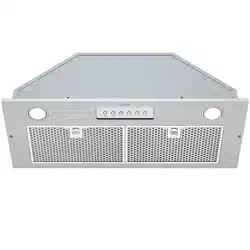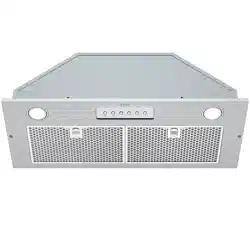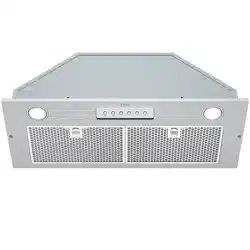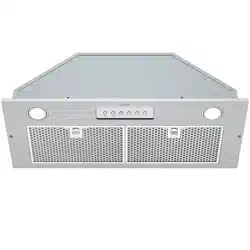
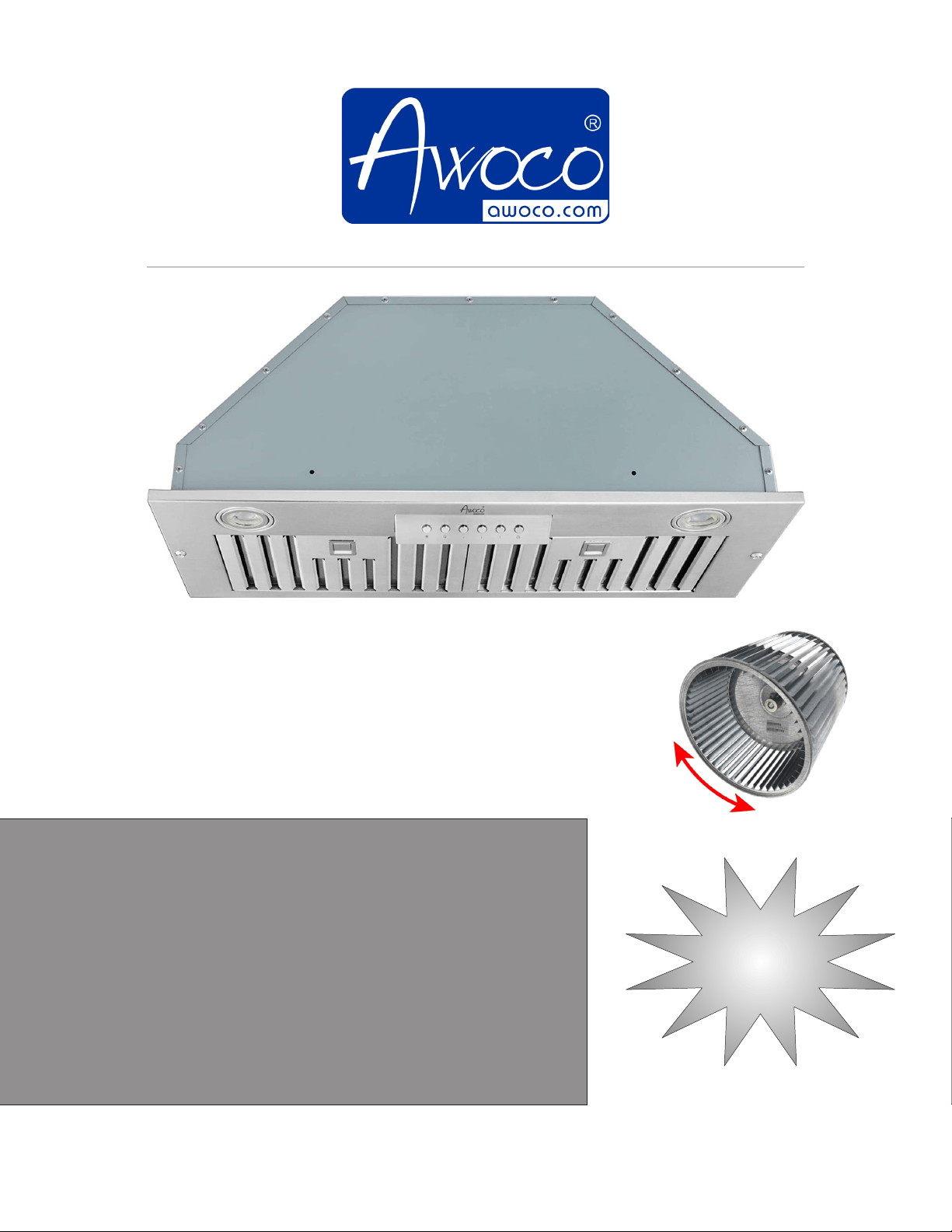
Range Hood
OWNER'S MANUAL
Built-In with Blower Series
RH-BQ, RH-BQ-M Models
Test Run
Before
Installation
Ver. RH-BQ-2021B
Important!
Make sure to manually spin the fan wheel to check if it's running without
any obstacles before the test run.
If the fan wheel is unbalanced or in contact with the casing, refer to Page
11 for how to re-seat the fan wheel.

HOW TO TEST RUN
Steps To Test Run Before Installation
IMPORTANT!
Wear gloves to protect against sharp edges.
PLEASE FOLLOW THESE INSTRUCTIONS TO TEST THE
RANGE HOOD BEFORE INSTALLATION FOR ANY DEFECTS
OR SHIPPING DAMAGE:
1. Remove the range hood and accessories from the
package carefully.
2. Place the range hood on a flat stable surface,
remove the baffle filter and check for any dents or
damages on the range hood body.
3. Remove the loosen parts if there's any.
4. Plug the range hood into a 120V AC power source.
Press any of the speed buttons to turn it on.
5. Check each speed variation and pay attention to
the noise level to make sure there isn't any unusual
noise besides it coming from the wind blowing.
Press the Light Button to check the lights.
6. Verify all functions, as instructed in Page 11, are
working properly.
7. Refer to Range Hood Troubleshooting in Page 13 for
general issues and solutions.
Note
The protective films on the body were removed to complete
the brush finished polishment on the surface.
The Baffle Filters might be covered by protective films that
can be removed with the following steps:
• Soak the Baffle Filters into hot waters or use
heated air from a hair dryer to soften the films.
• Peel off the films from the corner.
Please read all instructions carefully before proceeding
further to prevent the risk of fire, electric shock, personal
injury or damage to the range hood. This manual
provides a general insight on the installation and may
not include solutions for all possible issues that may
occur.
In case of this manual destroyed or lost, please visit
https://www.awoco.com and download a digital version.
Installation Overview
1. Unpack the range hood and check for any physical
damage on the body.
2. Test run the range hood and check if all functions
are working properly. Refer to Page 11 for
functionalities.
DO NOT
install the range hood if it's defective. Contact
the seller immediately.
3. If all is fine, install the range hood as instructed in
this manual. Refer to Page 7.
4. Test run the range hood again when the installation
is finished. Refer to Page 13 for troubleshooting.
Possible Tools Needed:
• Marker / Pencil;
• Jig Saw or Reciprocating Saw;
• Screwdrivers or Power Drill;
• Level;
• Measuring Tape;
• Knife:
• Duct / Foil Tape;
• Screws.
2 PEOPLE ARE REQUIRED FOR THE INSTALLATION.

3
Table of Contents
Important Safety Instructions 4
Installation Preparations 5
Venting Requirements 5
Venting System Setup 5
Electrical Requirement 6
Installation 7
Installing the Range Hood 7
Electrical Connection 7
Installing the Baffle Filters 8
Optional Ductless Configuration 8
Completing the Installation 8
Dimensions 9
Range Hood Use 11
Range Hood Control Panel 11
Range Hood Care 12
Clean the Exterior Surfaces 12
Clean or Replace the Baffle Filters 12
Replace the LED Lamps 12
Range Hood Troubleshooting 13
Warranty 15

4
IMPORTANT SAFETY INSTRUCTIONS
TO REDUCE THE RISK OF FIRE, ELECTRIC SHOCK OR
PERSONAL INJURY, PLEASE READ THE FOLLOWING
CAREFULLY BEFORE ATTEMPTING TO ASSEMBLE,
INSTALL, OPERATE OR MAINTAIN THE RANGE HOOD:
• Always disconnect, lock and tag the power source
before installing or servicing the range hood. Failure
to do so may result in fire, shock or serious injury.
• Installation and eletrical wiring must be done
by qualified technician(s) in accordance with all
applicable codes and standards, including fire-rated
construction.
• When cutting or drilling into walls or ceilings, please
be careful not to damage any eletrical wirings and
other hidden utilities.
• Verify and ensure the rated voltage and frequency
of the range hood is in compliance with the nearby
power source.
• Always unplug the range hood from the power
source before cleaning it.
• Use the range hood only as directed in this manual.
Do not use it to vent hazardous or explosive
materials or vapors.
• Clean the baffle filters regularly to prevent it become
blocked or clogged. Good air flow is essential for the
range hood to work propoerly.
• Do not install, repair or replace any parts of the
range hood unless you are instructed to do so by
the manufacturer.
• Do not tamper with or modify the PCB.
• This range hood model requires a duct to vent the
air outside. Do not vent the air into spaces within
walls, ceiliings, attics, crawl spaces or garages.
TO REDUCE THE RISK OF A RANGE TOP GREASE FIRE:
• Never leave surface units unattended at high
settings. Boilovers cause smoking and greasy
spillovers that may ignite. Heat oils slowly on low or
medium settings.
• Always turn the hood ON when cooking at high
heat or when flambeing food (i.e. Crepes Suzette,
Cherries Jubilee, Peppercorn Beef Flambé).
• Clean ventilating fans frequently. Grease should not
be allowed to accumulate on the fan or filter.
• Use proper pan sizes. Always use cookware
appropriate for the size of the surface element.
TO REDUCE THE RISK OF INJURY TO PERSONS IN THE
EVENT OF A RANGE TOP GREASE FIRE:
• SMOTHER FLAMES with a close-fitting lid, cookie
sheet or metal tray, then turn off the burner. BE
CAREFUL TO PREVENT BURNS. If the flames do not
go out immediately, EVACUATE AND CALL THE FIRE
DEPARTMENT.
• NEVER PICK UP A FLAMING PAN - you may be
burned.
• DO NOT USE WATER, including wet dish cloths or
towels - a violent steam explosion may result.
• Use a fire extinguisher ONLY if:
• You have a Class ABC extinguisher, and you
already know how to operate it.
• The fire is small and contained in the area
where it started.
• The fire department is being called.
• You can fight the fire with your back to an exit.
TO REDUCE THE RISK OF PERSONAL INJURY IN THE
EVENT OF A GAS LEAK:
• Extinguish any open flame.
• DO NOT turn on the lights or any type of appliance.
• Open all doors and windows to disperse the gas.
If you still smell the gas, call the gas company, fire
department, or 911 immediately.
Read and Save These Instructions

5
Venting Requirements
DO
• Have the venting system go vertically from the
range hood to the roof if possible.
• Have 24"-30" distance between the cooktop and
the range hood. 27" is recommended.
• Use uniformed duct of 6" round duct or 3-1/4 x 10”
rectangular duct or larger.
• Use metal vent only. Rigid metal vent is
recommended. Semi-rigid aluminum vent is also
acceptable for easy connection.
• Make sure there is a minimum of 24" of straight
vent between the elbows if more than 1 elbow is
used.
• Use minimal numbers of elbows and the
shortest route for the venting system for a better
performance.
• Use silver tap or duct tap to seal all joints in the
venting system.
• Use caulking silicone to seal exterior wall or roof
opening around the cap.
• Always keep the duct clean to ensure proper airflow.
DO NOT
• End the venting system in an enclosed area indoors.
• Use plastic vent.
• Use no more than three 90° elbows.
• Install 2 elbows together.
• Install the range hood outside of the recommended
height.
• Reduce the duct size below the recommended size.
Venting System Setup:
• This Range Hood is 6” top venting through the roof
or wall.
Top Venting Roof Exhaust Top Venting Wall Exhaust
Roof Cap
Range Hood
Wood Hood
Stove Top
Side
Wall
Cap
Range Hood
Wood Hood
Stove Top
INSTALLATION PREPARATIONS

6
INSTALLATION PREPARATIONS
IMPORTANT!
• If long duct run is needed, increase the duct size
from 6" to 7" or 8" to 9".
• If a reducer is needed, use a long reducer instead of
a pancake reducer and install it as far away from the
range hood as possible. Reducing the duct size will
restrict and decrease the speed of the airflow and
hense lower the range hood's performance.
• If transitions or turns are needed, install them as far
away from the range hood as possible and keep the
distance between the 2 as far apart as possible.
• The minimum mounting height should be no less
than 24" and the maximum mounting height should
be no more than 30".
• Also refer to the owner's manual of the stove
top for the height clearance requirement and the
recommended mounting height above the range.
Note
• It is important to install the range hood at the proper
mounting height. Hoods mounted too low could result
in heat damage and fire hazard while hoods mounted
too high will be out of reach and hense reduce its
performance and efficiency.
Minimum Duct Size:
• Round: 6" minimum.
• Rectangular: 3-1/4" x 10" minimum.
IMPORTANT!
Observe all governing codes and ordinances.
It is the customer's responsibility:
• To contact a qualified electrical installer;
• To ensure that the electrical installation is in
compliance with applicable codes and standards.
Electrical Requirements:
• A 120V, 60Hz., AC only, 15A fused electrical circuit is
required.
• Wire sizes and connections must conform with the
power rating of the range hood and all applicable
codes and standards.
• DO NOT have a fuse in the neutral or ground circuit.
• The 3-prong outlet should be grounded. If the
power cord plug is not used, the power cord’s green
wire should be connected to ground. Check with
a qualified electrician if you are not sure that the
range hood is properly grounded.
• DO NOT ground to a gas pipe.
• The range hood must be connected with copper
wire/plug only.
• The range hood should be connected directly to the
fused disconnect box (or circuit breaker) through
flexible armored or non-metallic sheathed copper
cable. ETL listed strain relief must be provided at
each end of the power supply cable.

7
INSTALLATION
Installing the Range Hood
Note
• If the wood hood is enclosed at the bottom, make a cutout on the board so that the Range Hood can fit into the wood
hood.
Guide the duct into the Wood Hood. Temporarily secure the top of the duct to the ceiling opening or wall opening.
CAUTION
• Make sure the Hood Unit is securely mounted before releasing.
• Route and connect the Duct to the Roof or Wall Cap. Refer to Page 5 for the most efficient routing requirements.
• Use foil tape or duct tape to seal all connections.
Electrical Connection
• This range hood comes with a power cord with a 3-prong plug. Connect the power cord to a designated grounded
standard 110V outlet.
Figure 1
Figure 2
Figure 3
The following steps requires 2 or more people:
• Unpack the Range Hood and place it on a sturdy flat surface
with the Baffle Filters facing the ceiling.
• Remove the Baffle Filters and the Screws on both sides.
(
Figure 1
)
• Flip the stainless steel Panel open on the longest side, locate
and disconnect the Wires for the LED Lamps and the Control
Panel. (
Figure 2
)
• Remove the Panel and put it in a safe location.
• Connect the duct to the vent opening on the Range Hood.
If the duct size isn't the same as the vent opening, use an
adapter between the duct and the vent opening.
• While lifting the Range Hood to fit into the wood hood, retract
the Duct into the attic carefully.
• Insert and tighten all screws into the pre-drilled holes on the
Hood body until it is securely mounted to the wood hood.
(
Figure 3
)
• Release the Range Hood.
• Re-connect the wires for the LED Lamps and the Control
Panel.
• Put the Panel back and tighten all screws.
Disconnect
the Wires
LED Lamp Control Panel

8
INSTALLATION
WARNING
Electrical Shock Hazard
Disconnect power before servicing
• In case of a direct connection to the house wiring is preferred, do the following:
• Disconnect the power.
• Cut off the plug from the power cord.
• Connect the wires from the power cord to the wires from the house wiring using UL listed wire connectors.
• Store the excess wires in the wiring box.
• Reconnect the power.
Installing the Baffle Filters
• Peel off the protective film from the baffle filters if there's any:
• Soak the Baffle Filters into hot waters or use heated air from a hair dryer to soften the films.
• Peel off the films from the corner.
• Align the baffle filters with the Hood Unit and install them from left to right.
Note
Optional Aluminum Mesh Filters are available for purchase.
Optional Ductless Configuration
• Remove the grease filters from the bottom of the hood.
• Remove the Fan Wheel Grille or the old Charcoal Filter from the Blower.
• Position the Charcoal Filter onto the side of the Blower, aligning the
mounting screws, turn until it locks. Re-install the grease filters.
(
Figure 4
and
Figure 5
)
Note
• For ductless installation, make sure there are vent openings on the top of the
wood hood in order to circulate the air in the kitchen.
• Charcoal Filters must be replaced after 120 hours of use (or approximately
every 2 to 3 months based on the average of 1 to 2 hours of daily cooking
time.).
Completing the Installation
Turn power ON in the control panel. Check all lights and fan operations.
Figure 5
Figure 4

9
INSTALLATION
RH-BQ-30
10-3/8''
6''
4''
2-1/2''
10-1/4''
11-3/8''
26''
27-3/4''
11-3/4''
RH-BQ-36
10-3/8''
6''
4''
2-1/2''
10-1/4''
11-3/4''
33-7/8''
35-3/8''
11-3/4''
RH-BQ Dimensions
Wood Hood Cut-Out Size:
26-1/8" x 10-3/8"
Wood Hood Cut-Out Size:
34" x 10-3/8"

10
INSTALLATION
RH-BQ-M30
10-3/8''
6''
4''
2-1/2''
13-3/8''
14-1/2''
26''
27-3/4''
11-3/4''
RH-BQ-M36
10-3/8''
6''
4''
2-1/2''
13-3/8''
14-1/2''
33-7/8''
35-3/8''
11-3/4''
RH-BQ-M Dimensions
Wood Hood Cut-Out Size:
26-1/8" x 13-1/2"
Wood Hood Cut-Out Size:
34" x 13-1/2"

11
Range Hood Control Panel
• Lamps/Light
• Press the
Light
button once and the lamps will
turn on at maximum brightness.
• When the lamps are on, Press and Hold the
Light
button to reduce the brightness. Release
the
Light
button when the desired brightness is
reached.
• Press the
Light
button again and the lamps will
turn off.
• The lamps can be turned off manually, or
automatically with the
Delayed Auto Shut Off
Function
.
• Speed Control
• There are 4 speed modes you can choose from:
Quiet, Low Speed, Medium Speed and High
Speed.
Button Mode
Q
Quiet - Generate less noise,
perfect for light cookings.
L Low Speed
M Medium Speed
H High Speed
Note
• Pressing any of the speed buttons will turn
on the range hood and set it to the speed the
button designates.
• The last selected speed will be memorized
and resumed the next time the range hood is
turned on by pressing the power button.
• Power
• Pressing the
Power button
can also
turn on
and resume
the Range Hood to
the speed the
last time used
.
• After cooking, press the Power button
once
will activate the
Delayed Auto Shutoff
function
.
• Quickly press the Power button twice
will
shut off
the range hood
immediately
.
3-Minute Delayed Auto Shut Off Function
• When the
range hood is running
at any
speed,
press the Power button once
will
activate the Delayed Auto Shut Off function
.
The countdown timer will start and the range
hood will be shut off automatically in 3
minutes.
• While the Delayed Auto Shut Off function is
activated, press the Power button again and
the range hood will be shut off immediately.
WARNING
Read all instrutions and warnings in the Range Hood
User Manual before using the hood.
• DO NOT use the hood when there are no
safety grills and filters.
• NEVER dispose cigarette ashes, ignitable
substances, or any foreign objects into
blowers.
• NEVER leave the cooking appliances
unattended. When frying, the oil in the pan
can easily overheat and catch on fire. The
risk of self-combustion is higher when the
oil has been used several times.
• NEVER cook on “open” flames under the
range hood. Check deep-fryers during use:
Superheated oil may be flammable.
RANGE HOOD USE

12
Cleaning
WARNING
• To reduce the risk of electrical shock, DO NOT clean
the hood while it's operating.
• Never put your hands into the area housing the fan
when the fan is operating.
Cleaning the Exterior Surfaces:
IMPORTANT
To avoid damage to the exterior surfaces:
• DO NOT use corrosive or abrasive detergent.
• DO NOT use steel wool, scoring pad or steel
brushes. Use a paper towel or soft cloth or
nonabrasive sponge instead.
• DO NOT use salt solutions, disinfectants, bleaches
or cleaning compound that contains harmful
chemicals.
Cleaning Method:
• Noncorrosive or nonabrasive liquid detergent soap
or all-purpose liquid cleanser.
• Wipe the surfaces with a damp paper towel or soft
cloth or nonabrasive sponge.
• Rinse with clean water.
• Wip dry with dry towel or cloth.
Note
• The nonabrasive stainless steel polisher can be
applied when done cleaning to retain the stainless
luster and grain.
• Always follow the instrunction of the polisher.
Cleaning the Stainless Steel Baffle Filters:
• Pull the spring release handle and remove the filter
by pulling it down.
• Wash the filter in the top rack of the dishwasher or
with warm soapy solution manually.
• Let the filters dry thoroughly.
• Make sure the spring release handle is toward the
front, align and insert the filter.
• Pull the spring release handle and push the filter
into position.
• Release the handle.
• Repeat the steps for the remaining filters.
Replacing the Filters:
• Replace the baffle filters immediately should they
become worn out due to aging or prolonged usage.
Replacing the LED Lamps:
WARNING
Electrical Shock Hazard
Disconnect power before servicing
Wear gloves to protect against sharp edges
• This range hood uses 12V, 3W LED.
• Unplug the range hood, or turn off the breaker.
• Remove the Baffle Filters and the Screws on both
sides.
• Flip the stainless steel Panel open on the longest
side, locate and disconnect the Wires for the broken
LED Lamp.
• Press from the inside to release the broken LED
Lamp.
• Align and put the new Lamp back into position.
• Press the edge of the new Lamp until it touches the
bottom of the Hood Unit.
• Connect the wires to the new Lamp.
• Put the Baffle Filter back into place.
• Plug in the range hood, or turn on the breaker.
• Check if the new Lamp is working properly.
RANGE HOOD CARE
Disconnect
the Wires
LED Lamp Control Panel

13
Before Calling for Service
Issue Possible Cause / Solution
The range hood doesn't turn on
• Check if the range hood is plugged in. Make sure that all
power is turned ON, the fuse isn't blown and all electrical
wirings are properly connected.
The range hood turns on but the
LED light doesn't
• Replace the defective LED assembly. Refer to Range Hood
Care section for instructions.
• If the circuit board isn't outputing 12V DC when the LED
light button is pressed, please contact us for a circuit board
replacement.
The range hood vibrates when
the blower is on
• Check and tighten the mounting screws to secure the hood
to the cabinet or wall properly.
• Follow the instructions in "How to adjust and replace the fan
wheel" section in Page 14 to adjust the fan wheel.
• If the fan wheel is unbalanced, please contact us for a fan
wheel assembly replacement.
The blower or fan seems weak
• Check that the duct size used is as required 6” or 8" per
blower unit's vent size and does not have sections with
smaller sizes between the hood and the Roof/Wall Cap
.
Range hood WILL NOT function efficiently with insufficient
duct size. For example: 7” duct over 6” top vent and not
sealed properly.
• Check if the duct is clogged or the damper (half-circular
flapper) is not installed correctly or opening properly. A tight
mesh on a side wall cap might also cause restriction to the
air flow.
The lights work but the blower is
not spinning at all or is rattling
• The blower might be jammed or scraping the bottom due to
shipping damage.
• Follow the instructions in "How to adjust and replace the fan
wheel" section in Page 14 to adjust the fan wheel.
• If the fan wheel is unbalanced, please contact us for a fan
wheel assembly replacement.
The hood is not venting out
properly
• Make sure the distance between the stove top and the
bottom of the hood is within recommended 24” and 30” in
distance. *Due to different ceiling height configurations, the
recommended height may not be applicable.
• Reduce the number of elbows and length of duct work.
Check if all joints are properly connected, taped and sealed.
• Make sure the power is on high speed for heavy cooking.
RANGE HOOD TROUBLESHOOTING

14
Issue: The hood is making squeaking noise when it's
running.
Possible Cause: The blower fan wheel is offset to 1 side
and touching the casing or unbalanced.
Solution:
How to adjust and replace the fan wheel
• Disconnect the main power.
• Remove the entire hood from its mounting location.
• Remove the duct and expose the blower fan wheel.
Follow these instructions to re-seat the fan wheel:
• Slowly rotate the fan wheel to check which part of
it is in contact with or too close to the casing.
• Rotate the fan wheel so that the blade with two
small cuts is facing you. (
Figure 4
)
• Use a long screwdriver to slightly release the fixing
screw.
DO NOT remove the screw completely. It's very
difficult to put it back in.
• Adjust the fan wheel left or right to the center of
the casing.
• Tighten the fixing screw and plug in the hood to
the main power.
• Run the hood in different speeds to check if the
issue is fixed.
Follow these instructions to replace the fan wheel
with a new one:
• Remove all 4 screws holding the blower casing.
(
Figure 5
)
• Take out the blower unit.
• Remove all 3 screws and the side grille. (
Figure 6
)
• Rotate the fan wheel and remove the fixing screw.
• Take out the old fan wheel.
• Align and put the new fan wheel into the casing.
• Put the fixing screw back and slightly tighten it.
• Adjust the fan wheel position so that it is balance
and not in contact with the casing.
• Tighten the fixing screw.
• Install the side grille.
• Put the blower unit back into the hood and tighten
all 4 screws.
• Connect to the main power and run the hood in
different speeds to check if the new fan wheel is
working properly.
RANGE HOOD TROUBLESHOOTING
Figure 4 Fixing Screw
Figure 5
Figure 6

15
This product is warranted for a limited period of
ONE
YEAR Parts Warranty, begins from the date of
purchase.
This limited warranty is applied to the original retail
purchaser and valid only for products purchased for
home use.
• If you bought a Refurbished product at discounted
price, please contact the seller directly for warranty.
• If you bought the extended warranty from a 3rd party
company, please contact that 3rd party company
directly.
In the event of the product fail to work properly due to
a defect in manufacturing materials or workmanship
under normal home use, during the warranty period
mentioned above, subject to the conditions and
limitations set forth below, we will, at our options,
either repair or replace any part of our products
proven defective by reason of improper materials or
workmanship:
• Proof of original retail purchase is required to
receive warranty service within the limited warranty
period.
• Replacement parts or products will be provided by
us on an exchange basis, and will be either new or
reconditioned.
This Limited Warranty Does Not Cover:
• Consumable parts such as light bulbs and filters
(stainless steel, aluminum or charcoal).
• Damage due to natural wear, improper maintenance,
or use of corrosive and abrasive cleaning products.
• Chips, dents or cracks on the product caused by
improper handling.
• Damage caused by accidents, lightning, fire, floods,
or natural disaster.
• Damage of product caused by unauthorized
modification or alteration, or if it is used for other
than the intended purpose, or any water leakage
where the unit was not installed properly.
• Damage of product caused by incorrect electrical
wiring, commercial or industrial use, or use of any
cleaning products not recommended in this manual.
• Damage of product due to product misuse, abuse,
improper installation, unauthorized repair or
maintenance.
* Awoco is not responsible for any labor costs associated
with removing, servicing, installing, or determining the
source of problems with our products from third-party
service providers.
To Receive Warranty Service:
• Contact the seller or distributor from which you
purchase the product. Please confirm the terms of
your dealer’s policies or distributor’s policies prior to
contacting. Or contact us directly.
• Provide the product identification information, such
as model number and lot number, proof of original
purchase and date of purchase.
• Describe the issue you are experiencing in detail.
• For general part issues, we will send out
replacement parts, free of charge.
• For products that are defective beyond your
ability to repair on your own, send it back to us.
Once we identify the issue, you will be given
an option to either repair it or exchange it for
a new or reconditioned product of the same
model or a similar model if the same model is
out of stock or discontinued.
R E T U R N S
Damaged Returns
• You must report the damage directly to us within 14
days.
• Send photos or videos showing the damage via email.
We need this before we can approve your damage claim.
• Once your claim is approved, we will provide a return
shipping label to return the damaged unit.
.• A new replacement hood will be sent to you after the
damaged hood has been picked up by the carrier and is
in transit returning to us .
* Please Note this free return process only applies to 48
contiguous United States.
* Regular shipping rates will be applied to Hawaii, Alaska,
WARRANTY

16
Guam, Puerto Rico, Canada, and other locations.
Undamaged Returns
• Contact Customer Support within 30 days with your
intent and reason for refund.
• You will be responsible for all returned shipping
costs. We can help arrange for a pickup if requested.
Product Support and Additional Information:
If you need assistance using your product or you would
like to start the warranty service:
• Contact us at 1-888-412-3428, between 11 AM
and 5 PM, Monday - Friday, Pacific Time.
Or
• Contact us at www.awoco.com/pages/contact-us.
WARRANTY

Website: www.awoco.com Customer Support: 1-888-412-3428