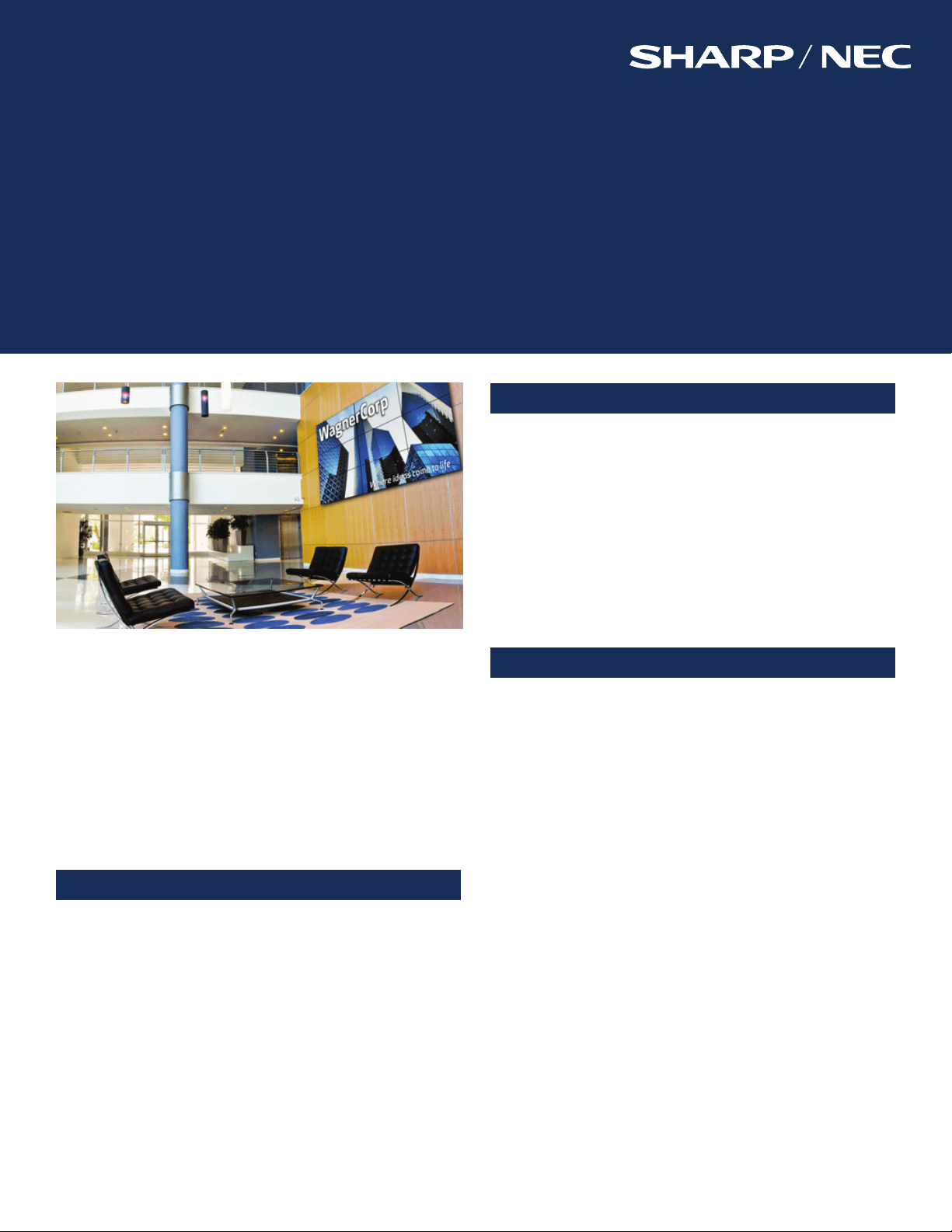
Over the past decade, video walls have become an increasingly popular digital signage choice.
That’s because they’re particularly effective at engaging people and delivering messages
efficiently. They offer larger, higher resolution images than a single display, and they can be built
to almost any configuration to fit a specific space or purpose.
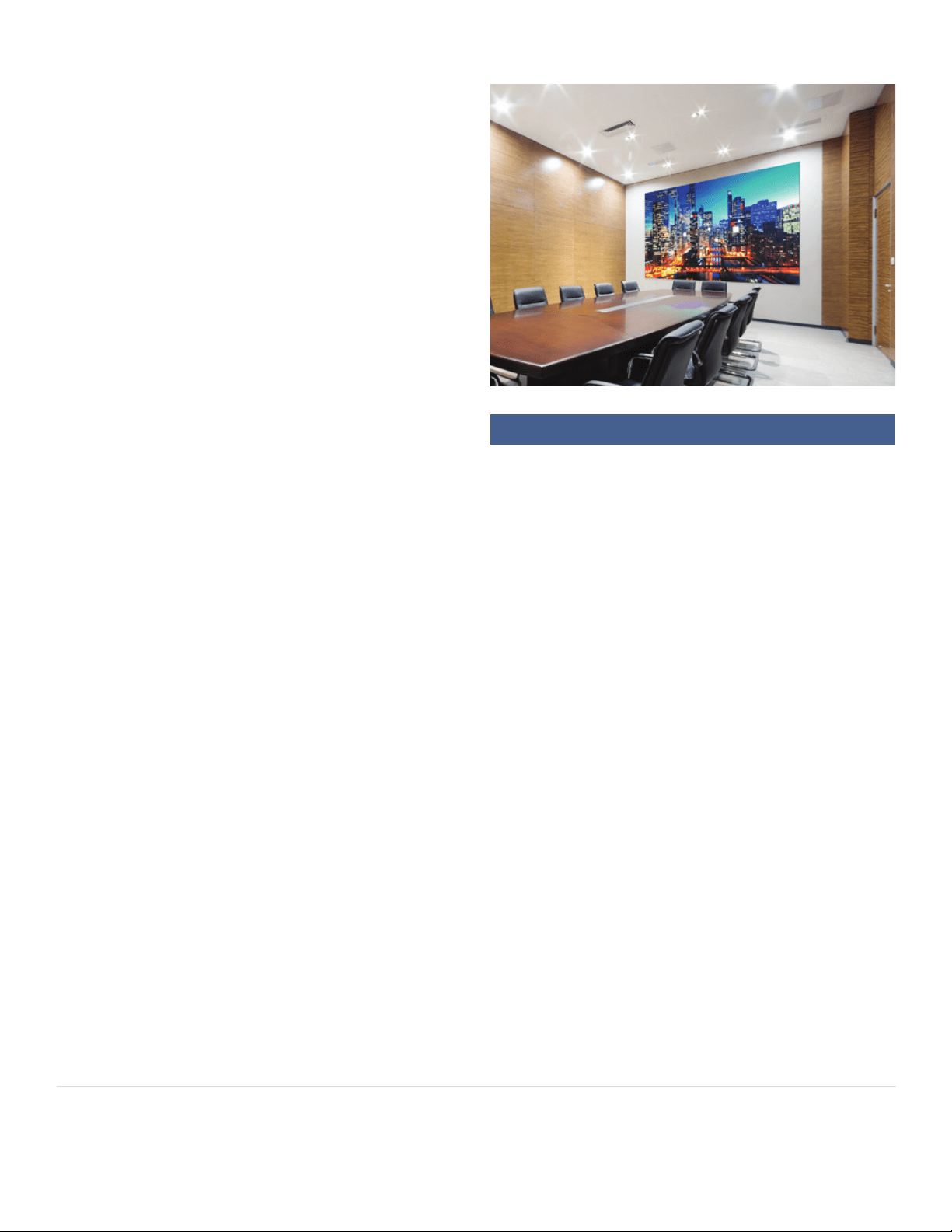
Video walls have found homes in many different types of settings, including corporate offices,
retail stores, transportation hubs and sports venues, as well as command and control facilities.
When deciding which type of video wall installation is appropriate for your customers’ needs, a
basic decision is determining which of the two basic types of technologies — LCD or dvLED — is
best for the specific application. LCD and dvLED displays have very different features and benefits.
Liquid Crystal Displays
Liquid crystal display (LCD) panels are manufactured by inserting a layer of liquid crystal — a
substance that is part solid and part liquid — between two sheets of glass. When electricity is
applied to this layer, the crystals shift to create an image. Because the crystals do not produce their
own light, some type of backlighting is needed to display the image. Ironically, LEDs are the most
popular source of backlighting for LCD panels.
LCD panels are bright and provide high-resolution images at a modest cost. They also have
slim depths and are energy efficient. One major disadvantage of an LCD panel, however, is
that it requires a bezel. LCDs have been a popular choice for video walls, but when the panels
are connected to create a video wall, those bezels are visible and break up the overall image.
Although bezel widths continue to narrow, LCD bezels remain a visual distraction for video wall
installations.
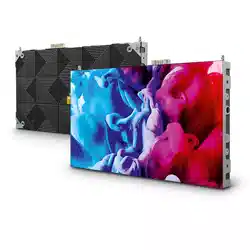
Direct View LED
A light emitting diode (LED) is a tiny semiconductor that converts electricity into visible light. In
an LED panel, each color pixel has one red, one blue and one green LED. The combination of these
three colors enables the LED to create trillions of colors. In an LED panel, each LED produces light
itself, unlike an LCD panel, in which the backlight passes through the liquid crystal layer. That’s
where the name “direct view” LED (dvLED) originates.
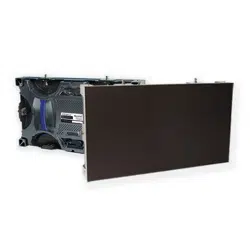
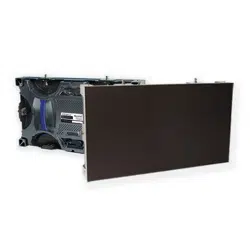
LED panels have many advantages, including high brightness, superior contrast and viewing
angles, long life, energy efficiency and suitability for both indoor and outdoor applications. LED
panels are the ideal solution for video walls because they don’t have bezels. That means there are
no seams in the middle of the wall to distract viewers.
Choosing the Right Panel
LCD panels have traditionally been the popular choice for video walls, particularly for indoor
applications, and dvLEDs have been the go-to choice for outdoor installations. But due to
advances in LED technology, dvLEDs are now challenging the dominance of LCDs for indoor uses.
Selecting the best video wall solution for a specific indoor installation can be challenging. Here
are some considerations to keep in mind:
• Pixel pitch: Measured in millimeters, Pixel pitch is the distance between the center of
an LED pixel and the center of an adjacent pixel. A screen with a smaller pixel pitch has
more pixels overall and provide higher resolution images than a screen with a larger pixel
pitch. In general, a large screen that will be viewed from afar can have a relatively high
pixel pitch, but a screen that will be viewed from close up should have a small pixel pitch.
•
• Image quality: Look for sharp images and a solution that provides factory color-calibration.
• Brightness: Although more of a concern for outdoor installations, brightness
should still be considered for indoor video walls. Take into account the
ambient lighting conditions of an interior environment to ensure that the
video wall will have sufficient brightness to provide excellent viewability.
• Contrast: A high-efficiency LED chip will ensure deep contract, and black mask will boost
the contrast ratio.
Choosing the Right Indoor
Video Wall Installation
Whitepaper
The Big Picture
Because of recent advances in dvLED technologies, customers considering an indoor video wall
installation now have options beyond the traditional choice of LCD solutions. To steer them in
the right direction, it’s important to decide whether an LCD or dvLED solution is the best choice
for their specific needs. That decision depends on a wide range of factors, and by matching client
needs with the benefits of the technologies that are available, a cost-effective, long-term signage
solution can be discovered.
For additional information about Sharp NEC Display Solutions of America products,
call (866) NEC-MORE, or visit the website at www.sharpnecdisplays.us.
Follow us on our social media channels: Facebook, YouTube, Instagram, Twitter and LinkedIn.
Choosing the Right Indoor Video Wall Installation
• Power consumption: With the proper content and brightness settings, dvLED panels
can be more energy efficient than LCD panels, saving money and the environment.
Compare power consumption specs to determine the differences between models.
• Heat dissipation: Because LED emit heat as well as light, heat dissipation can be a concern
for dvLED panels. Consult with manufacturers or suppliers to better understand how each
solution manages heat dissipation and what requirements are needed for your application.
• Build quality: Indoor video walls should be robust enough to hold up to installation
and exposure to environmental conditions and minor bumps. Look for strong,
lightweight panels with alignment features enabling precise placement. It’s also
very important to use mounting structures specifically designed for each panel
design and to ensure the display provider supplies the structure with the display.
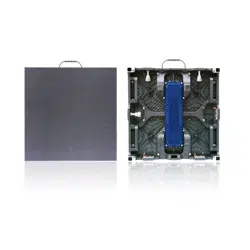
• Front and rear service access: For easier installation and lower-cost
maintenance, make sure video wall panels have front and rear access.
• Cost: LCD panels are less expensive than LED panels, but the gap is narrowing.
Pixel pitch is the primary contributor to a higher cost in an LED display, so it’s
important to work with your solution provider to ensure that the installation’s pixel
pitch matches your client’s budget, image quality expectations and content type.
• Long life: LED panels have very lengthy longevity ratings. For example, models
rated at 80,000 hours of use will provide more than 13 years of service. When
choosing the best video wall panel, ensure that the display solution can be color
calibrated. You may have seen LED displays with square sections that are brighter
or darker than other portions of the display. This is usually due to repairs using new
LED panels to replace older panels. Having the ability to calibrate the display will
prove to be essential in the later years of the LED’s lifespan. That’s because calibration
enables the colors and brightness of each pixel to be closely matched to the others in
the entire display, eliminating those darker and lighter square section.Ultimately,
calibration will make the video wall look like new and enable your content to shine.
• Turnkey solution: For many customers, choosing a video wall installation that is a
complete, end-to-end solution that includes hardware and services will be an ideal fit.
©2021 Sharp NEC Display Solutions of America, Inc. | All rights reserved.
All other brand or product names are trademarks or registered trademarks of their respective holders.
Sharp NEC Display Solutions of America
www.sharpnecdisplays.us