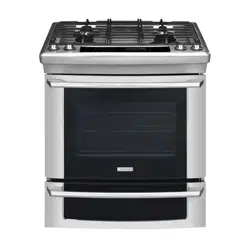

Electrolux
oor_o0
EN GAS RANGF USF AND CARE GUIDE
iiiiiiiiiiiiiiiiiiiiiiiiiiiiiiiiiiiiiiiiiiiiiiiiiiiiiiiiiiiiiiiiiiiiiiiiiiiiiiiiiiiiiiiiiiiiiiiiiiiiiiiiiiiiiiiiiiiiiii_i!iiiiiiiiiiiiiiiiiiiiiiiiiiiiiiiiiii_
iiiiiiiiiiiiiiiiiiiiiiiiiiiiiiiiiiiiiiiiiiiiiiiiiiiiiiiiiiiiiiiiiiiiiiiiiiiiiiiiiiiiiiiiiiiiiiiiiiiiiiiiiiiiiiiiiiiiiiiiiiiii_i!iiiiiiiiiiiiiiiiiiiiiiiiiiiiiiiiiiiiiiiiiiii_
Fin
ing Information
Table of contents
Finding information .............................................. 2
important Safety instructions .......................... 3=6
Features ............................................................. 7=8
Oven Cooking ................................................. 9-10
Surface Cooking ................................................. 11
Before Setting Surface Controls ....................... 12
Setting Surface Controls ................................... 13
Getting Started .................................................... 14
Setting Oven Controls .................................. 15=29
• Preheat .......................................................... 15
• Bake ............................................................... 16
• Cook time ....................................................... 17
• Delay start .................................................... 18
• Convection bake ............................................ 19
• Convection convert ........................................ 20
• Convection roast ............................................ 21
• Broil .......................................................... 22-23
• Keep warm ..................................................... 24
• Cakes breads ................................................. 24
• Probe cook ............................................... 25-26
• Slow cook ....................................................... 27
• My favorite ..................................................... 28
• Sabbath mode ................................................ 29
Setting the Warmer Drawer ......................... 30-31
Setting Your Preferences ............................. 32-33
• Setting clock ................................................... 32
• Setting 12 or 24 hour mode ........................... 32
Changing between °F or °C ........................... 32
User preference offset .................................... 32
Setting 12hr energy saving mode .................. 33
Setting audio mode ........................................ 33
Factory default reset ...................................... 33
Setting Self=Clean Cycle .............................. 34-35
Care & Cleaning ............................................ 36-41
• Cleaning recommendations ........................... 36
• Special door care instructions ........................ 37
• Changing oven lights ..................................... 37
• Removing and replacing the oven door ... 38-39
• Cleaning cooktop, burner grates, caps and
heads ....................................................... 39-40
• Removing and replacing the drawer .............. 41
Solutions to Common Problems ................. 42-44
Notes .............................................................. 45=46
Warranty .............................................................. 47
Please read & save this guide
Thank you for choosing Electrolux, the new
premium brand in home appliances. This Use &
Care Guide is part of our commitment to customer
satisfaction and product quality throughout the
service life of your new appliance.
We view your purchase as the beginning of a
relationship. To ensure our ability to continue
serving you, please use this page to record
important product information.
Keep a record for quick
reference
Purchase date
Electrolux model number
Electrolux serial number
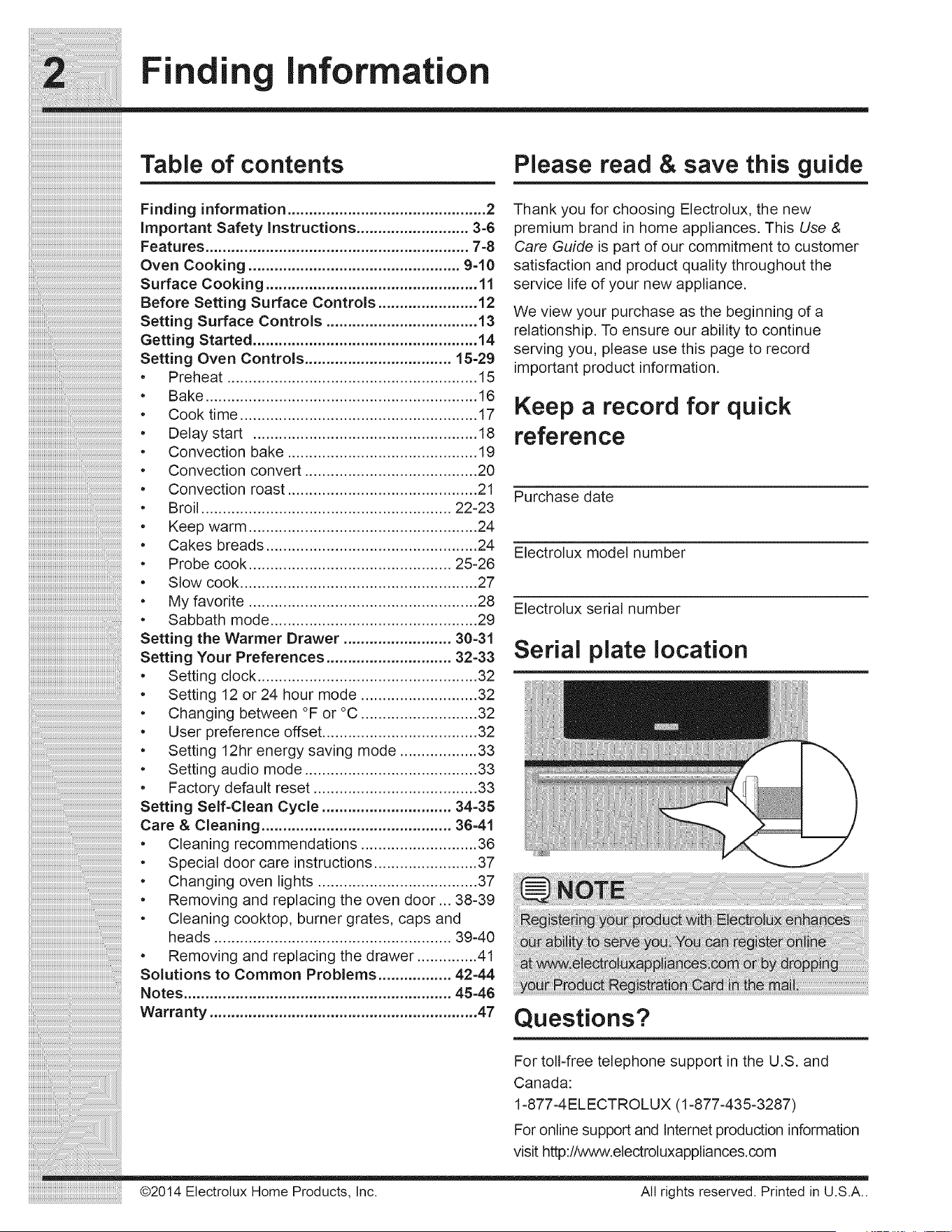
Serial plate location
Questions?
For toll-free telephone support in the U.S. and
Canada:
1-877-4ELECTROLUX (1-877-435-3287)
For online support and Internet production information
visit http://www.electroluxappliances.com
@2014 Etectrolux Home Products, Inc. All rights reserved. Printed in U.S.A..
important Safety instructions ......3
Wh at yo u nee d to k now a bou t s afet y inst r uctio n s iiiiiiiiiiiiiiiiiiiiiiiiiiiiiiiiiiiiiiiiiiiiiiiiiiiiiiiiiiiiiiiiiiiiiiiiiiiiiiii
Warning and Important Instructions appearing in this guide are not meant to cover all possible conditions iiiiiiiiiiiiiiiiiiiiiiiiiiiiiiiiiiiiiiiiiiiiiiiiiiiiiiiiiiiiiiiiiiiiiiiiiiiiiiii
and situations that may occur. Common sense, caution and care must be exercised when installing, iiiiiiiiiiiiiiiiiiiiiiiiiiiiiiiiiiiiiiiiiiiiiiiiiiiiiiiiiiiiiiiiiiiiiiiiiiiiiiii
maintainingoroperatingamicrowave, iiiiiiiiiiiiiiiiiiiiiiiiiiiiiiiiiiiiiiiiiiiiiiiiiiiiiiiiiiiiiiiiiiiiiiiiiiiiiiii
ALWAYS contact your dealer, distributor, service agent or manufacturer about problems or conditions iiiiiiiiiiiiiiiiiiiiiiiiiiiiiiiiiiiiiiiiiiiiiiiiiiiiiiiiiiiiiiiiiiiiiiiiiiiiiiii
you do notunderstand, iiiiiiiiiiiiiiiiiiiiiiiiiiiiiiiiiiiiiiiiiiiiiiiiiiiiiiiiiiiiiiiiiiiiiiiiiiiiiiii
Recognize Safety Symbols, Words, Labels
requirements. Install only per installation
instructions provided in the literature package for
this range.
Ask your dealer to recommend a qualified
technician and an authorized repair service.
Know how to disconnect the electrical power to
the range at the circuit breaker or fuse box in
case of an emergency.
Remove all tape and packaging wrap before
using the appliance. Destroy the carton and
plastic bags after unpacking the appliance. Never
allow children to play with packaging material.
Proper Installation-Be sure your appliance
is properly installed and grounded by a
qualified technician in accordance in United
States with the National Fuel Gas Code
ANSI Z223.1 latest edition, and National
Electrical Code ANSI/NFPA No. 70 latest
edition, and local code requirements, and in
Canada with Canadian Standards CAN/CGA
B149.1, and CAN/CGA B149.2 and Canadian
Electrical Code, CSA O22.1 part 1, and local
iiiiiiiiiiiiiiiiiiiiiiiiiiiiiiiiiiiiiiiiiiiiiiiiiiiiiiiiiiiiiiiiiiiiiiiiiiiiiii
important Safety instructions
User ServicingmDo not repair or replace
any part of the appliance unless specifically
recommended in the manuals. All other
servicing should be done only by a qualified
technician to reduce the risk of personal injury
and damage to the appliance.
Never modify or alter the construction of
a range by removing leveling legs, panels,
wire covers, anti-tip brackets/screws, or any
other part of the product.
DO NOT TOUCH SURFACE BURNERS,
AREAS NEAR THESE BURNERS, OVEN
HEATING ELEMENTS OR iNTERiOR
SURFACES OF THE OVEN OR WARMER
DRAWER (if equipped). Both surface burners
and oven heating elements may be hot even
though surface burner flames are not visible
or oven elements are dark in color. Areas near
surface burners may become hot enough
to cause burns. During and after use, do
not touch, or let clothing or other flammable
materials touch these areas until they have had
sufficient time to cool. Among these areas are
the cooktop, surfaces facing the cooktop, the
oven vent openings and surfaces near these
openings, oven door and window.
iiiiiiiiiiiiiiiiiiiiiiiiiiiiiiiiiiiiiiiiiiiiiiiiiiiiiiiiiiiiiiiiiiiiiiiiii
Storage in or on AppliancemFlammable
materials should not be stored in an oven,
near surface units or in the drawer (if
equipped). This includes paper, plastic and
cloth items, such as cookbooks, plasticware
and towels, as well as flammable liquids. Do not
store explosives, such as aerosol cans, on or
near the appliance. Flammable materials may
explode and result in fire or property damage.
Do not leave children alone. Children should
not be left alone or unattended in the area
where an appliance is in use. They should
never be allowed to sit or stand on any part of
the appliance.
* Wear ProperApparel_Loose-fitting or
hanging garments should never be worn
while using the appliance. Do not let clothing
or other flammable materials contact hot
surfaces.
* Do Not Use Water or Flour on Grease
Fires_Smother the fire with a pan lid, or use
baking soda, a dry chemical or foam-type
extinguisher.
* When heating fat or grease, watch it closely.
Fat or grease may catch fire if allowed to
become too hot.
* Use Only Dry Potholders_Moist or damp
potholders on hot surfaces may result in
burns from steam. Do not let the potholders
touch hot heating surface units or interior oven
elements. Do not use a towel or other bulky
cloth instead of a potholder.
* Do Not Heat Unopened Food Containers_
Build up of pressure may cause the
container to burst and result in injury.
* Remove the oven door from any unused
appliance if it is to be stored or discarded.
* IMPORTANTmDo not attempt to operate the
oven during a power failure. If the power
fails, always turn the oven off. If the oven
is not turned off and the power resumes, the
oven may begin to operate again. Food left
unattended could catch fire or spoil.
important Safety instructions
* Utensil Handles Should Be Turned Inward
and Should Not Extend Over Adjacent
Surface Burners--To reduce the risk of burns,
ignition of flammable materials, and spillage
due to unintentional contact with the utensil.
The handle of the utensil should be positioned
IMPORTANT INSTRUCTIONS
FOR USING YOUR COOKTOP
Know which knob controls each surface
burner. Place a pan of food on the burner before
turning it on, and turn the burner off before
removing the pan.
Always turn the knob to the full LITE position
when igniting top burners. Visually check that
burner has lit. Then adjust the flame so it does
not extend beyond the edge of the utensil.
Use Proper Pan Size--This appliance is
equipped with one or more surface burners
of different sizes. Select utensils having flat
bottoms large enough to cover the surface
burner. The use of undersized utensils will
expose a portion of the surface heating unit
to direct contact and may result in ignition of
clothing. Proper relationship of utensil to the
surface unit will also improve efficiency.
so that it is turned inward, and does not extend
over adjacent surface burners.
* Never Leave Surface Burners Unattended--
Boilovers cause smoking and greasy spillovers
that may ignite, or a pan that has boiled dry may
melt.
* Protective liners--Do not use aluminum
foil to line oven bottom or any other part of
the appliance. Only use aluminum foil as
recommended for baking if used as a cover
placed on the food. Any other used of protective
liners or aluminum foil may result in a risk of
electric shock or fire or a short circuit.
* Glazed Cooking Utensils--Only certain types
of glass, glass/ceramic, ceramic, earthenware,
or other glazed utensils are suitable for
cooktop service without breaking due to the
sudden change in temperature. Check the
manufacturer's recommendations for cooktop
use.
Air curtain or other overhead range hoods,
which operate by blowing a downward air
flow on to a range, shall not be used in
conjunction with gas ranges other than when
the hood and range have been designed,
tested and listed by an independent test
laboratory for use in combination with each
other.
Do not use Searing Grill on the cooktop.
The searing grill is not designed for use on the
cooktop. Doing so may result in a fire.
Do Not Use Decorative Surface burner
Covers. If a burner is accidentally turned on,
the decorative cover will become hot and
possibly melt. Burns will occur if the hot covers
are touched. Damage may also be done to the
cooktop or burners because the covers may
cause overheating. Air will be blocked from the
burner and cause combustion problems.
iiiiiiiiii_iiiiiiiiiiiiiiiiiiiiiiiiiiiiiiiiiiiiiiiiiiiiiiiiiiiiiiiiiiiiiiiiiiiiii
iiiiiiiiiiiiiii_iiiiiiiiiiiiiiiiiiiiiiiiiiiiiiiiiiiiiiiiiiiiiiiiiiiiiiiiiiiiiiii
iiiiiiiiiiiiiiiiii_iiiiiiiiiiiiiiiiiiiiiiiiiiiiiiiiiiiiiiiiiiiiiiiiiiiiiiiiiiiiii
iiiiiiiiiiiiiiiiiiiiiiiiii_iiiiiiiiiiiiiiiiiiiiiiiiiiiiiiiiiiiiiiiiiiiiiiiiiiiiii_
iiiiiiiiiiiiiiiiiiiiiiiiiiiiiiiiiiiiiiiiiiiiiiiiiiiiiiiiiiiiiiiiiiiiiiiiiiiiiiiiiii
important Safety instructions
iMPORTANT INSTRUCTIONS
FOR USING YOUR OVEN
• Use Care When Opening Door or Drawer--
Stand to the side of the appliance when opening
the door of a hot oven. Let hot air or steam
escape before you remove or replace food in
the oven/warmer drawer.
Keep Oven Vent Ducts Unobstructed. The
oven is vented at the front above the oven door
or through the rear of cooktop. Touching the
surfaces in this area when the oven is operating
may cause severe burns. Also, do not place
plastic or heat-sensitive items on or near the
oven vent. These items could melt or ignite.
• Placement of Oven/Warmer Drawer (if
equipped) Racks. Always place oven racks in
desired location while oven/drawer (if equipped)
is cool. Remove all utensils from the rack
before removing rack. If rack must be moved
while oven is hot, use extreme caution. Use
potholders and grasp the rack with both hands
to reposition. Do not let potholders contact the
hot oven element or interior of the oven/warmer
drawer (if equipped).
• Do not use a broiler pan without its insert.
The broiler pan and grid allow dripping fat to
drain and be kept away from the high heat of the
broiler.
• Do not cover your broiler or warmer drawer
(if equipped) grid with aluminum foil.
Exposed fat and grease could ignite.
Do not touch a hot light bulb with a damp
cloth. Doing so could cause the bulb to break.
Disconnect the appliance or turn off the power
to the appliance before removing and replacing
light bulb.
IMPORTANT INSTRUCTIONS
FOR CLEANING YOUR
RANGE
• Clean the range regularly to keep all parts
free of grease that could catch fire. Exhaust
fan ventilation hoods and grease filters
should be kept clean. Do not allow grease to
accumulate. Greasy deposits in the fan could
catch fire. Refer to the hood manufacturer's
instructions for cleaning.
• Cleaners/aerosols--Always follow the
manufacturer's recommended directions for use.
Be aware that excess residue from cleaners
and aerosols may ignite causing damage and/or
injury.
SELF-CLEANING OVENS
• Clean in the self-cleaning cycle only the
parts of the oven listed in this owner's guide.
Before self-cleaning the oven, remove all utensils
stored in the oven.
, Do not clean the oven door gasket. The door
gasket is essential for a good seal. Care should
be taken not to rub, damage or move the gasket.
, Do not use oven cleaners. No oven cleaner or
oven liner protective coating of any kind should
be used in or around any part of the oven.
• Remove oven racks. Oven racks will be
damaged if left in the oven during a self-cleaning
cycle.
_i_i_i_i_i_i_i_i_i_i_i_i_i_i_i_i_i_i_i_i_i_i_i_i_i_i_i_i_i_i_i_i_i_i_i_i_i_i_i_i_i_i_i_i_i_i_i_i_i_i_i_i_i_i_i_i__!__________________________________________
iiiiiiiiiiiiiiiiiiiiiiiiiiiiiiiiiiiiiiiiiiiiiiiiiiiiiiiiiiiiiiiiiiiiiiiiiiiiiiiiiiiiiiiiiiiiiiiiiiiiiiiiiiiiiiiiiiiiiii_i!iiiiiiiiiiiiiiiiiiiiiiiiiiiiiiiiiiiiiiiiiiiiiiiiiiiii_
iiiiiiiiiiiiiiiiiiiiiiiiiiiiiiiiiiiiiiiiiiiiiiiiiiiiiiiiiiiiiiiiiiiiiiiiiiiiiiiiiiiiiiiiiiiiiiiiiiiiiiiiiiiiiiiiiiiiiiiiiiiii_i!iiiiiiiiiiiiiiiiiiiiiiiiiiiiiiiiiiiiiiiiiiii_
Important safety notice
The California Safe Drinking Water and Toxic
Enforcement Act requires the Governor of
California to publish a list of substances known to
the state to cause cancer, birth defects or other
reproductive harm, and requires businesses to
warn customers of potential exposure to such
substances.
SAVE T ESE INST UCTIO
FUT E EFE CES
FO
Features
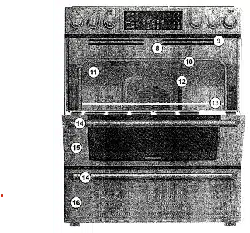
Range features
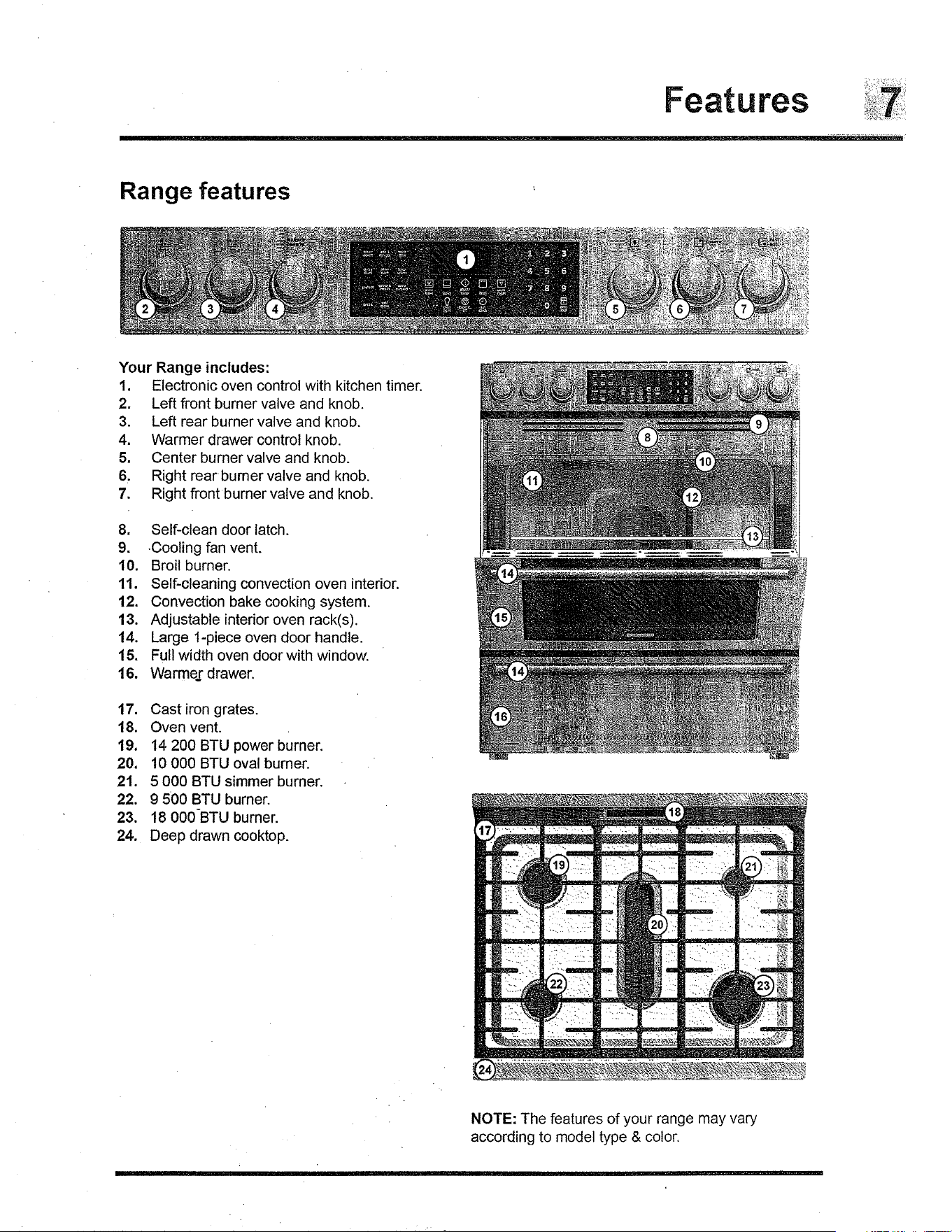
Your Range includes:
1. Electronic oven control with kitchen timer.
2. Left front burner valve and knob.
3. Left rear burner valve and knob.
4. Warmer drawer control knob.
5. Center burner valve and knob.
6. Right rear bumer valve and knob.
7. Right front burner valve and knob.
=
9.
10.
11.
12.
13.
14.
15.
16.
Self-clean door latch.
,Cooling fan vent.
Broil burner.
Self-cleaning convection oven interior.
Convection bake cooking system.
Adjustable interior oven rack(s).
Large 1-piece oven door handle.
Full width oven door with window.
Warmer drawer.
17. Cast irongrates.
18. Oven vent.
19. 14 200 BTU power burner.
20. 10 000 BTU oval burner.
21. 5 000 BTU simmer burner.
22, 9 500 BTU burner.
23. 18 000-BTU burner.
24. Deep drawn cooktop.
NOTE: The features of your range may vary
according to model type & color,
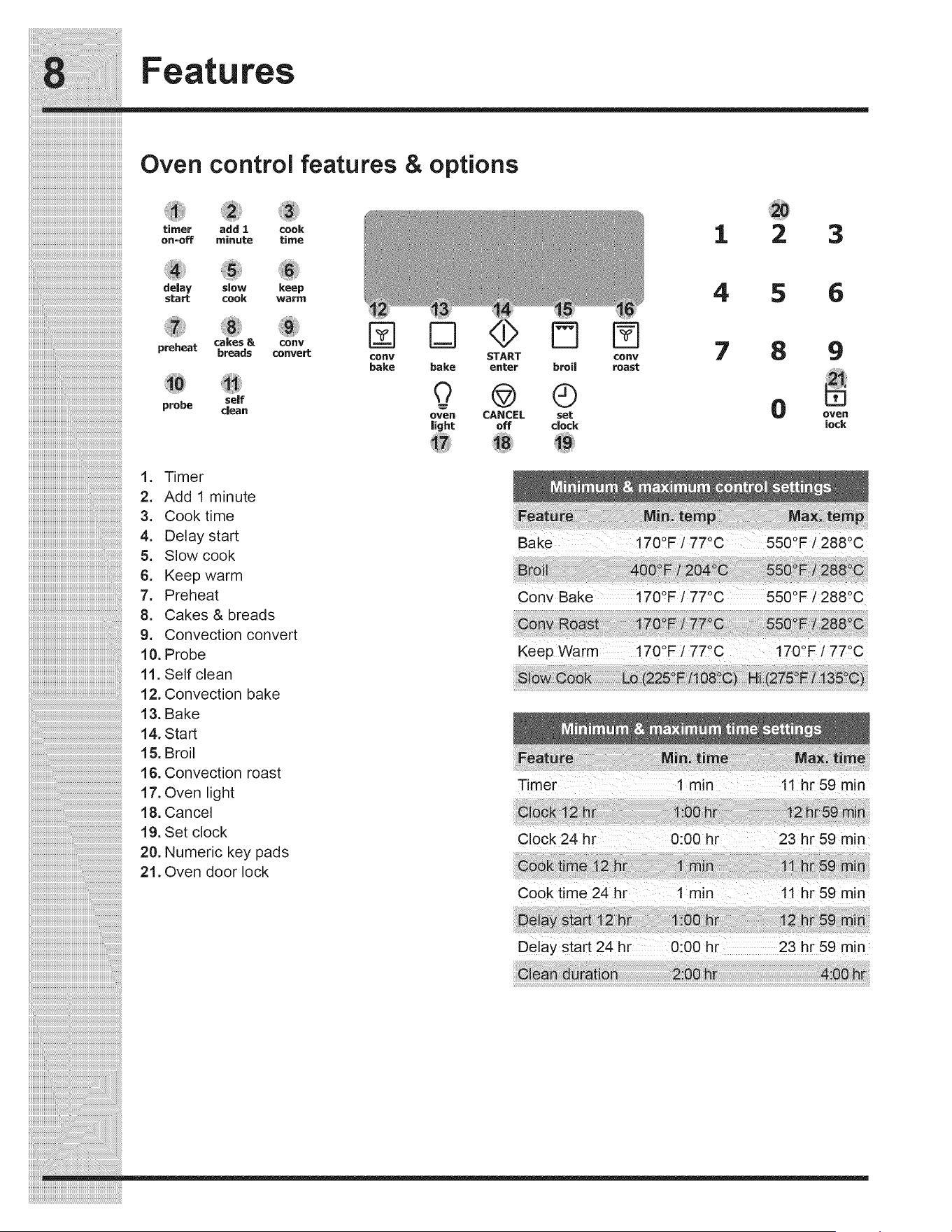
Features
delay slow keep
start cook warm
preheat Cakes & conv _
breads convert conv
bake bake
se_f 0
probe dean
oven
|ight
START
enter
@
CANCEL
off
broil
®
set
clock
1 2 3
4 5 6
7 8 9
COnY
roast
0
oven
lock
1. Timer
2. Add 1 minute
3. Cook time
4. Delay start
5. Slow cook
6. Keep warm
7. Preheat
8. Cakes & breads
9. Convection convert
10. Probe
11. Self clean
12. Convection bake
13. Bake
14. Start
15. Broil
16. Convection roast
17. Oven light
18. Cancel
19. Set clock
20. Numeric key pads
21. Oven door lock
Bake 170°F/77QC 550°F / 288°C
ConY Bake 170°F i77°C 550°F/288°0
Keep Warm t700F / 77°C 170°F/77°C
Timer 1 min 1i hr 59 min
Clock 24 hr 0i00 hr 23 hr 59 min
COok time 24 hr 1 rain 11 hr 59 rain
_i_i_i_i_i_i_i_i_i_i_i_i_i_i_i_i_i_i_i_i_i_i_i_i_i_i_i_i_i_i_i_i_i_i_i_i_i_i_i_i_i_i_i_i_i_i_i_i_i_i_i_i_i_i_i_i__!__________________________________________
iiiiiiiiiiiiiiiiiiiiiiiiiiiiiiiiiiiiiiiiiiiiiiiiiiiiiiiiiiiiiiiiiiiiiiiiiiiiiiiiiiiiiiiiiiiiiiiiiiiiiiii@i!iiiiiiiiiiiiiiiiiiiiiiiiiiiiiiiiiiiiiiiiiiiiiiiiiiiii_
Delay start24 hr 0:00 hr 23 hr 59 min
Oven Cooking
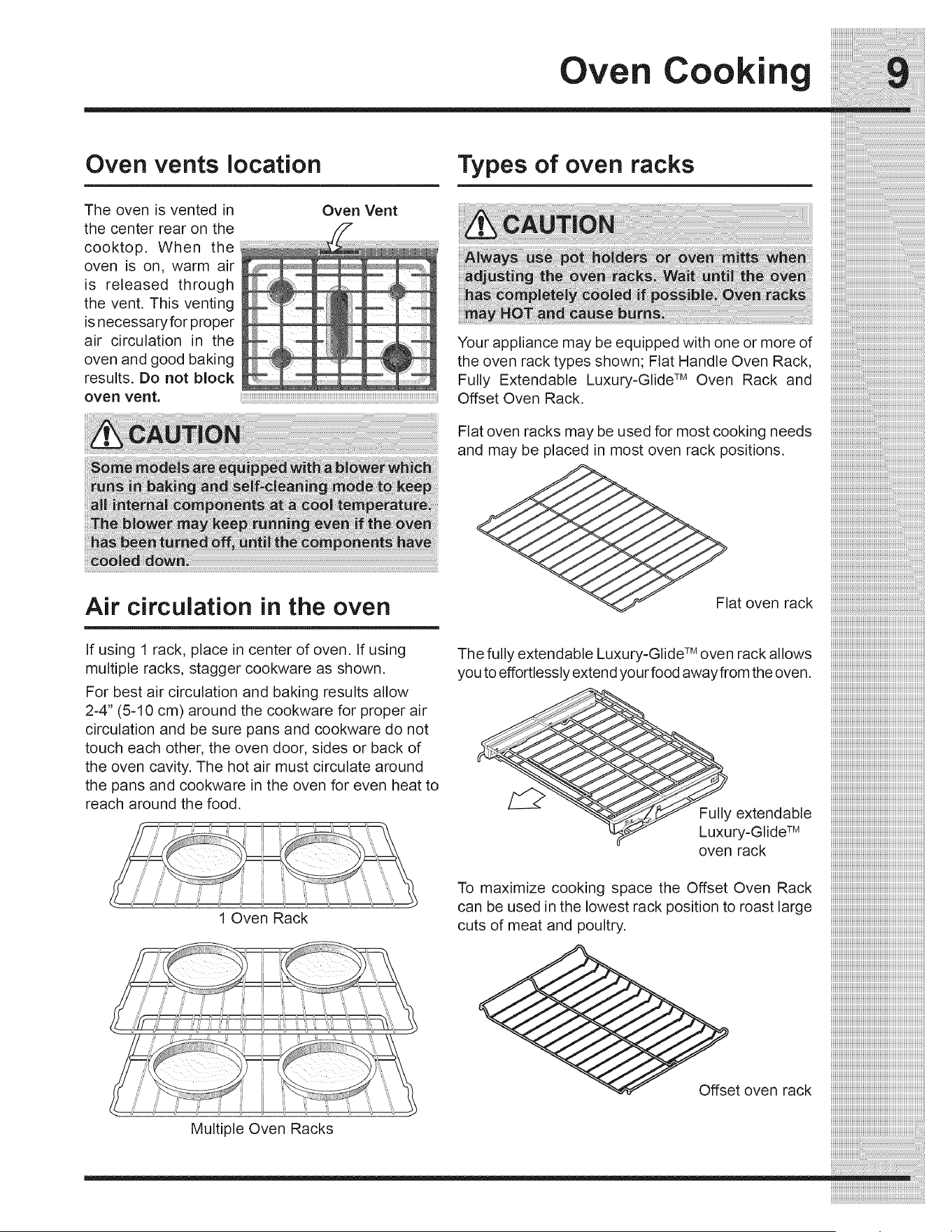
Oven vents location
The oven is vented in
the center rear on the
cooktop. When the
oven is on, warm air
is released through
the vent. This venting
is necessary for proper
air circulation in the
oven and good baking
results. Do not block
oven vent.
Oven Vent
Air circulation in the oven
If using 1 rack, place in center of oven. If using
multiple racks, stagger cookware as shown.
For best air circulation and baking results allow
2-4" (5-10 cm) around the cookware for proper air
circulation and be sure pans and cookware do not
touch each other, the oven door, sides or back of
the oven cavity. The hot air must circulate around
the pans and cookware in the oven for even heat to
reach around the food.
1 Oven Rack
Multiple Oven Racks
Types of oven racks
Your appliance may be equipped with one or more of
the oven rack types shown; Flat Handle Oven Rack,
Fully Extendable Luxury-Glide TM Oven Rack and
Offset Oven Rack.
Flat oven racks may be used for most cooking needs
and may be placed in most oven rack positions.
_ _atovenrack
The fully extendable Luxury-Glide TMoven rack allows
you to effortlessly extend your food away from the oven.
extendable
Luxury-Glide TM
oven rack
To maximize cooking space the Offset Oven Rack
can be used in the lowest rack position to roast large
cuts of meat and poultry.
Offset oven rack
iiiiiiiiiiiiiiiiiiiiiiiiiiiiiiiiiiiiiiiiiiiiiiiiiiiiiiiiiiiiiiiiiiiiiiiiiiiiiiiiiii
iiiiiiiiiiiiiiiiiiiiiiiiiiiiiiiiiiiiiiiiiiiiiiiiiiiiiiiiiiiiiiiiiiiiiiiiiiiiiiiiiii
iiiiiiiiiiiiiiiiiiiiiiiiiiiiiiiiiiiiiiiiiiiiiiiiiiiiiiiiiiiiiiiiiiiiiiiiiiiiiiiiiii
iiiiiiiiiiiiiiiiiiiiiiiiiiiiiiiiiiiiiiiiiiiiiiiiiiiiiiiiiiiiiiiiiiiiiiiiiiiiiiiiiii
iiiiiiiiiiiiiiiiiiiiiiiiiiiiiiiiiiiiiiiiiiiiiiiiiiiiiiiiiiiiiiiiiiiiiiiiiiiiiiiiiii
iiiiiiiiiiiiiiiiiiiiiiiiiiiiiiiiiiiiiiiiiiiiiiiiiiiiiiiiiiiiiiiiiiiiiiiiiiiiiiiiiii
iiiiiiiiiiiiiiiiiiiiiiiiiiiiiiiiiiiiiiiiiiiiiiiiiiiiiiiiiiiiiiiiiiiiiiiiiiiiiiiiiii
iiiiiiiiiiiiiiiiiiiiiiiiiiiiiiiiiiiiiiiiiiiiiiiiiiiiiiiiiiiiiiiiiiiiiiiiiiiiiiiiiii
iiiiiiiiiiiiiiiiiiiiiiiiiiiiiiiiiiiiiiiiiiiiiiiiiiiiiiiiiiiiiiiiiiiiiiiiiiiiiiiiiii
iiiiiiiiiiiiiiiiiiiiiiiiiiiiiiiiiiiiiiiiiiiiiiiiiiiiiiiiiiiiiiiiiiiiiiiiiiiiiiiiiii
iiiiiiiiiiiiiiiiiiiiiiiiiiiiiiiiiiiiiiiiiiiiiiiiiiiiiiiiiiiiiiiiiiiiiiiiiiiiiiiiiii
iiiiiiiiiiiiiiiiiiiiiiiiiiiiiiiiiiiiiiiiiiiiiiiiiiiiiiiiiiiiiiiiiiiiiiiiiiiiiiiiiii
:::::::::::::::::::::::::::::::::::::::::::::::::::::::::::::::::::::::::::::::::::
iiiiiiiiiiiiiiiiiiiiiiiiiiiiiiiiiiiiiiiiiiiiiiiiiiiiiiiiiiiiiiiiiiiiiiiiiiiiiiiiiii
Oven Cooki
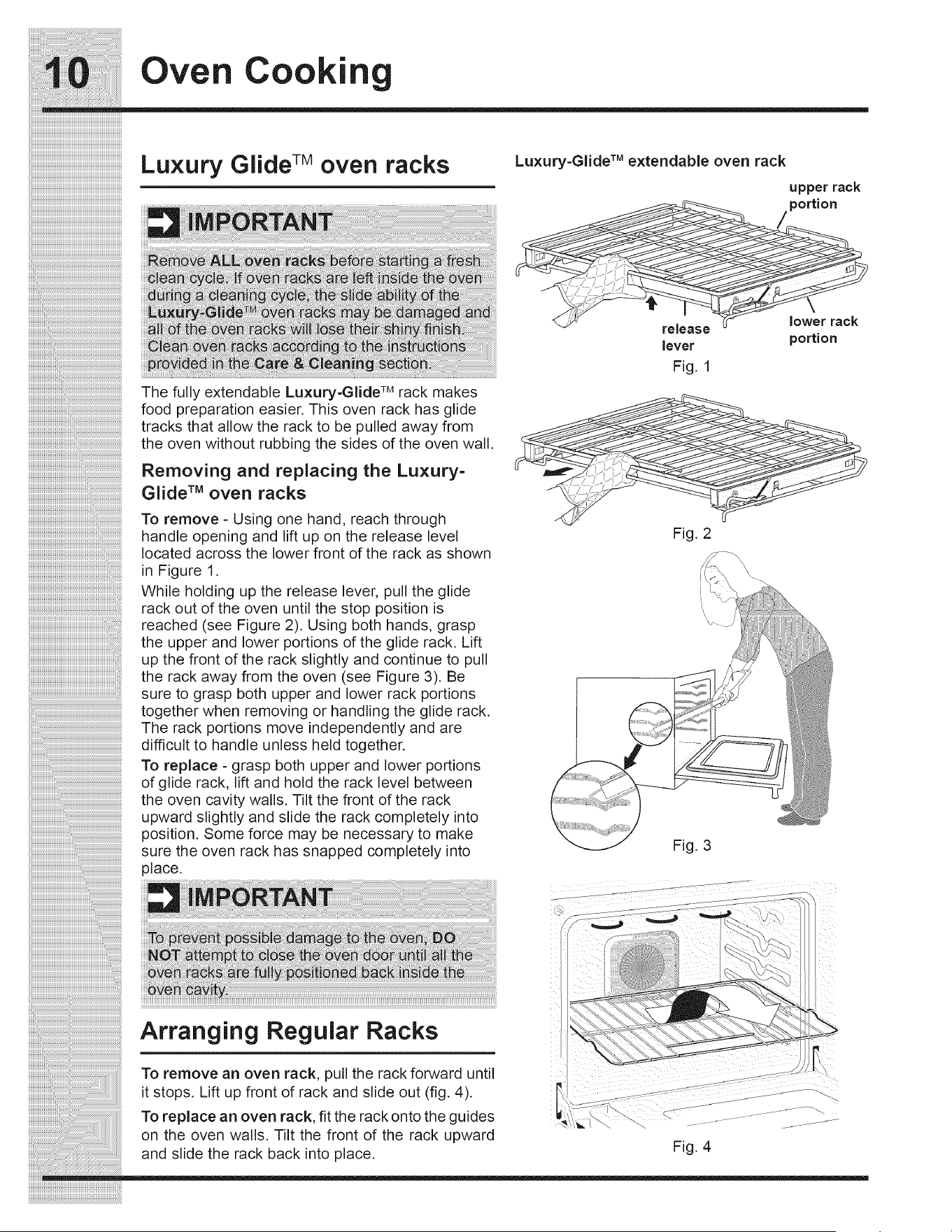
Luxury Glide TM oven racks
Luxury=Glide TM extendable oven rack
upper rack
The fully extendable Luxury-Glide TM rack makes
food preparation easier. This oven rack has glide
tracks that allow the rack to be pulled away from
the oven without rubbing the sides of the oven wall.
Removing and replacing the Luxury=
Glide TM oven racks
To remove - Using one hand, reach through
handle opening and lift up on the release level
located across the lower front of the rack as shown
in Figure 1.
While holding up the release lever, pull the glide
rack out of the oven until the stop position is
reached (see Figure 2). Using both hands, grasp
the upper and lower portions of the glide rack. Lift
up the front of the rack slightly and continue to pull
the rack away from the oven (see Figure 3). Be
sure to grasp both upper and lower rack portions
together when removing or handling the glide rack.
The rack portions move independently and are
difficult to handle unless held together.
To replace - grasp both upper and lower portions
of glide rack, lift and hold the rack level between
the oven cavity walls. Tilt the front of the rack
upward slightly and slide the rack completely into
position. Some force may be necessary to make
sure the oven rack has snapped completely into
place.
Arranging Regular Racks
lower rack
release
lever portion
Fig. 1
Fig. 2
Fig. 3
To remove an oven rack, pull the rack forward until
it stops. Lift up front of rack and slide out (fig. 4).
To replace an oven rack, fit the rack onto the guides
on the oven walls. Tilt the front of the rack upward
and slide the rack back into place,
Fig. 4
Surface Cooking
iiiiiiiiiiiiiiiiiiiiiiiiiiiiiiiiiiiiiiiiiiiiiiiiiiiiiiiiiiiiiiiiiiiiiiiiiiiiiiii_
iiiiiiiiiiiiiiiiiiiiiiiiiiiiiiiiiiiiiiiiiiiiiiiiiiiiiiiiiiiiiiiiiiiiiiiiiiiiiiii_
iiiiiiiiiiiiiiiiiiiiiiiiiiiiiiiiiiiiiiiiiiiiiiiiiiiiiiiiiiiiiiiiiiiiiiiiiiiiiiii_
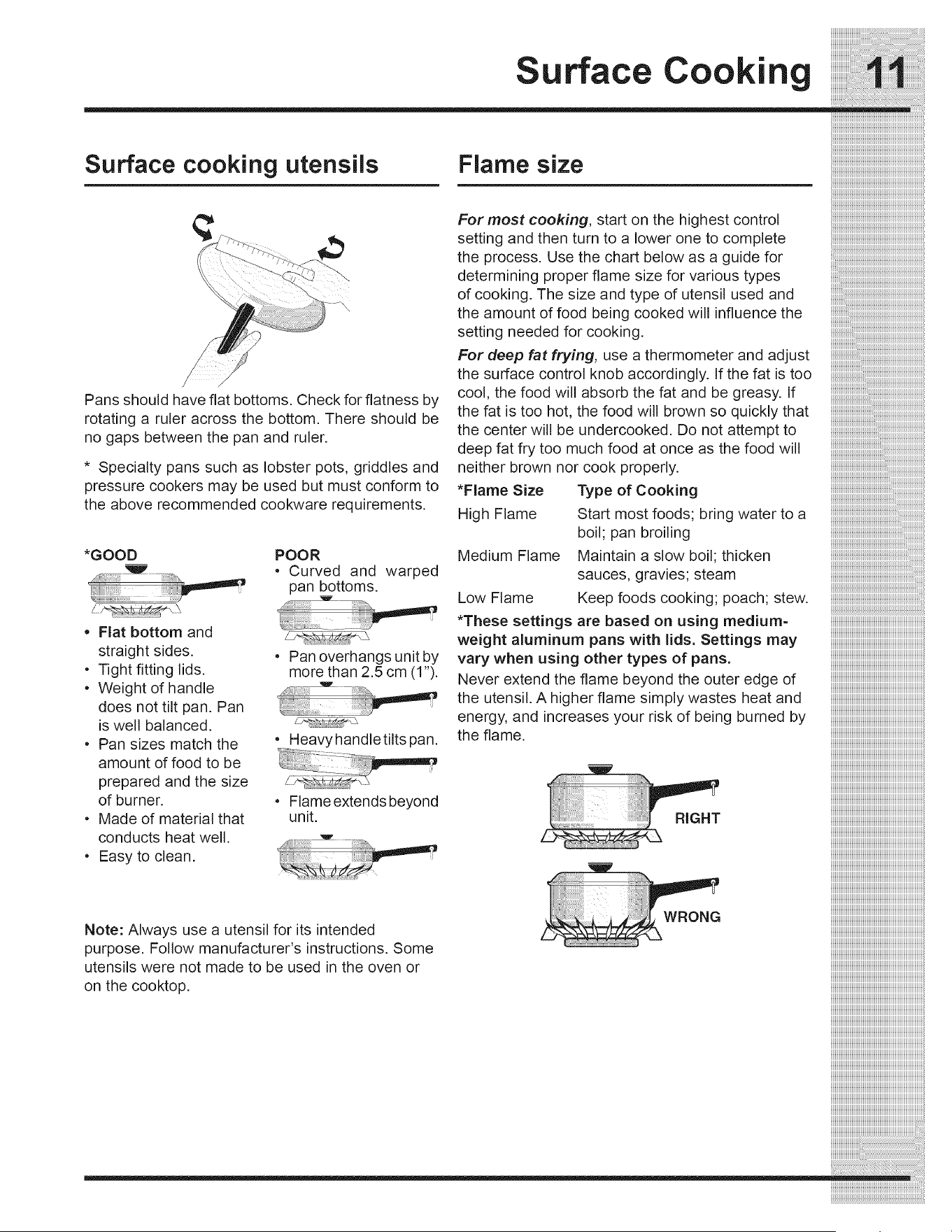
Surface cooking utensils Flame size iiiiiiiiiiiiiiiiiiiiiiiiiiiiiiiiiiiiiiiiiiiiiiiiiiiiiiiiiiiiiiiiiiiiiiiiiiiiiiii;;
Formostcooking, startonthe highestcontrol iiiiiiiiiiiiiiiiiiiiiiiiiiiiiiiiiiiiiiiiiiiiiiiiiiiiiiiiiiiiiiiiiiiiiiiiiiiiiiii!:;
setting and then turn to a Iowerone to complete iiiiiiiiiiiiiiiiiiiiiiiiiiiiiiiiiiiiiiiiiiiiiiiiiiiiiiiiiiiiiiiiiiiiiiiiiiiiiiii::
the process. Use the chart below as a guide for _!JJJJJJJJJJJJJJJJJJJJJJJJJJJJJJJJJJJJJJJJJJJJJJJJJJJJJJJJJJJJJJJJJJJJJJJJJJJJJ
Pans should have flat bottoms. Check for flatness by
rotating a ruler across the bottom. There should be
no gaps between the pan and ruler.
* Specialty pans such as lobster pots, griddles and
pressure cookers may be used but must conform to
the above recommended cookware requirements.
*GOOD
o Flat bottom and
straight sides.
• Tight fitting lids.
• Weight of handle
does not tilt pan. Pan
is well balanced.
• Pan sizes match the
amount of food to be
prepared and the size
of burner.
• Made of material that
conducts heat well.
• Easy to clean.
POOR
• Curved and warped
pan bottoms.
I
• Pan overhangs unit by
more than 2.5 cm (1 ").
• Heavyhandletilts pan.
• Flame extends beyond
unit.
Note: Always use a utensil for its intended
purpose. Follow manufacturer's instructions. Some
utensils were not made to be used in the oven or
on the cooktop.
determining proper flame size for various types
of cooking. The size and type of utensil used and
the amount of food being cooked will influence the
setting needed for cooking.
For deep fat frying, use a thermometer and adjust
the surface control knob accordingly. If the fat is too
cool, the food will absorb the fat and be greasy. If
the fat is too hot, the food will brown so quickly that
the center will be undercooked. Do not attempt to
deep fat fry too much food at once as the food will
neither brown nor cook properly.
*Flame Size Type of Cooking
High Flame Start most foods; bring water to a
boil; pan broiling
Medium Flame Maintain a slow boil; thicken
sauces, gravies; steam
Low Flame Keep foods cooking; poach; stew.
*These settings are based on using medium-
weight aluminum pans with lids. Settings may
vary when using other types of pans.
Never extend the flame beyond the outer edge of
the utensil. A higher flame simply wastes heat and
energy, and increases your risk of being burned by
the flame.
w
iiiU_1:i_i_i_i_i_i_i_i_i_i_i_i_i_i_i_i_i_i_i_i_i_i_i_i_i_i_i_i_i_i_i_i_i_i_i_i_i_i_i_i_i_i_i_i_i_i_i_i_i_i_i_i_i_i_i_i_i_i_i_i_i_i_i_i_i_i_i_i_i_i_i_i_i_i_i_i
Before Settin urface Controls
iiiiiiiiiiiiiiiiiiiiiiiiiiiiiiiiiiiiiiiiiiiiiiiiiiiiiiiiiiiiiiiiiiiiiiiiiiiiiii
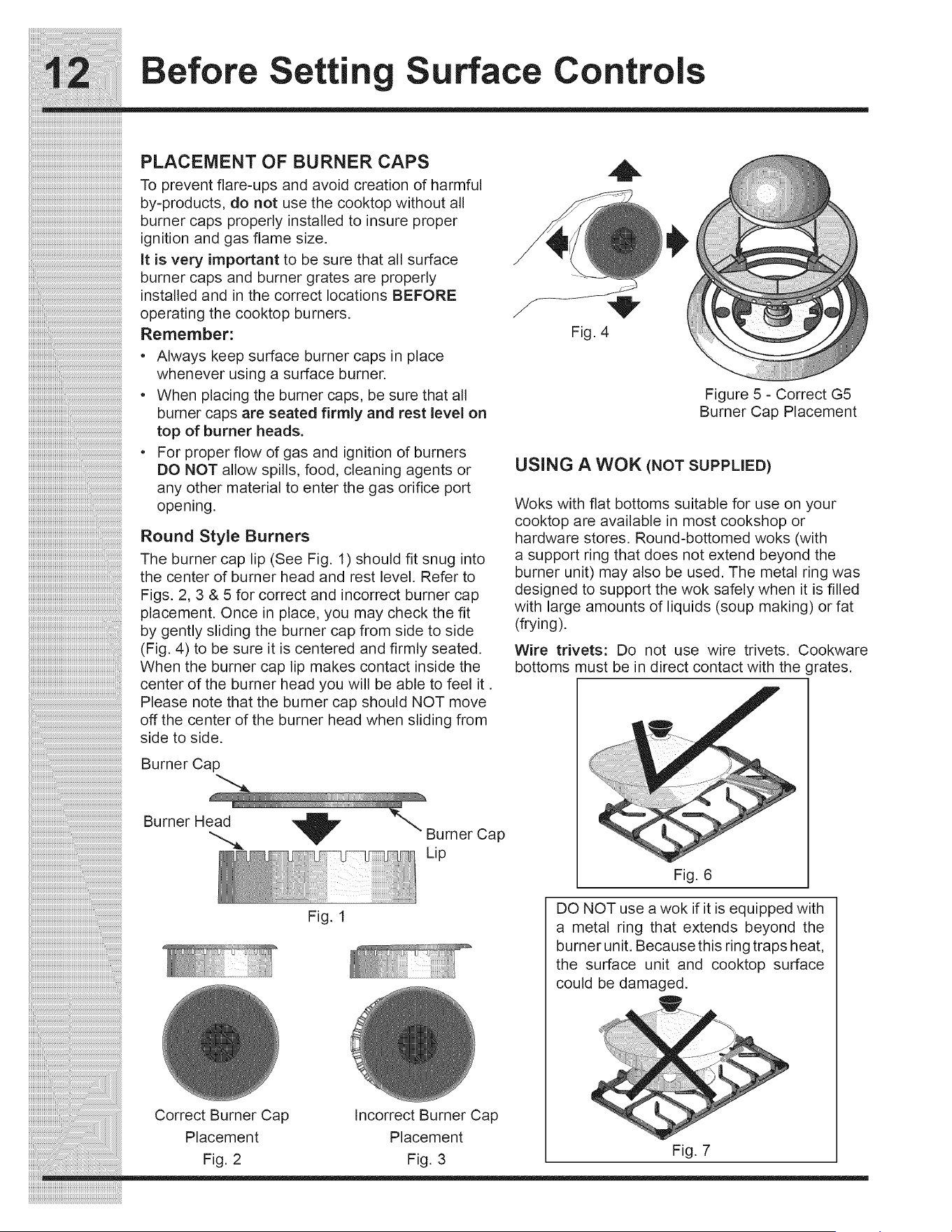
PLACEMENT OF BURNER CAPS
To prevent flare-ups and avoid creation of harmful
by=products, do not use the cooktop without all
burner caps properly installed to insure proper
ignition and gas flame size.
It is very important to be sure that all surface
burner caps and burner grates are properly
installed and in the correct locations BEFORE
operating the cooktop burners.
Remember:
• Always keep surface burner caps in place
whenever using a surface burner.
• When placing the burner caps, be sure that all
burner caps are seated firmly and rest level on
top of burner heads.
• For proper flow of gas and ignition of burners
DO NOT allow spills, food, cleaning agents or
any other material to enter the gas orifice port
opening.
Round Style Burners
The burner cap lip (See Fig. 1) should fit snug into
the center of burner head and rest level. Refer to
Figs. 2, 3 & 5 for correct and incorrect burner cap
placement. Once in place, you may check the fit
by gently sliding the burner cap from side to side
(Fig. 4) to be sure it is centered and firmly seated.
When the burner cap lip makes contact inside the
center of the burner head you will be able to feel it.
Please note that the burner cap should NOT move
off the center of the burner head when sliding from
side to side.
Burner Cap
Burner He_ ,_ _" Burner Cap
Lip
_i_i_i_i_i_i_i_i_i_i_i_i_i_i_i_i_i_i_i_i_i_i_i_i_i_i_i_i_i_i_i_i_i_i_i_i_i_i_i_i_i_i_i_i_i_i_i_i_i_i_i_i_i_i_i_i__!__________________________________________
iiiiiiiiiiiiiiiiiiiiiiiiiiiiiiiiiiiiiiiiiiiiiiiiiiiiiiiiiiiiiiiiiiiiiiiiiiiiiiiiiiiiiiiiiiiiiiiiiiiiiiiiiiiiiiiiiiiiiii_i!iiiiiiiiiiiiiiiiiiiiiiiiiiiiiiiiiiiiiiiiiiiiiiiiiiiii_
Fig. 1
Correct Burner Cap Incorrect Burner Cap
Placement Placement
Fig. 2 Fig. 3
Fig. 4
Figure 5 - Correct G5
Burner Cap Placement
USING A WOK (NOT SUPPLIED)
Woks with flat bottoms suitable for use on your
cooktop are available in most cookshop or
hardware stores. Round-bottomed woks (with
a support ring that does not extend beyond the
burner unit) may also be used. The metal ring was
designed to support the wok safely when it is filled
with large amounts of liquids (soup making) or fat
(frying).
Wire trivets: Do not use wire trivets. Cookware
bottoms must be in direct contact with the grates.
Fig. 6
DO NOT use a wok if it is equipped with
a metal ring that extends beyond the
burner unit. Because this ring traps heat,
the surface unit and cooktop surface
could be damaged.
Fig. 7
Setti ur ace Controls
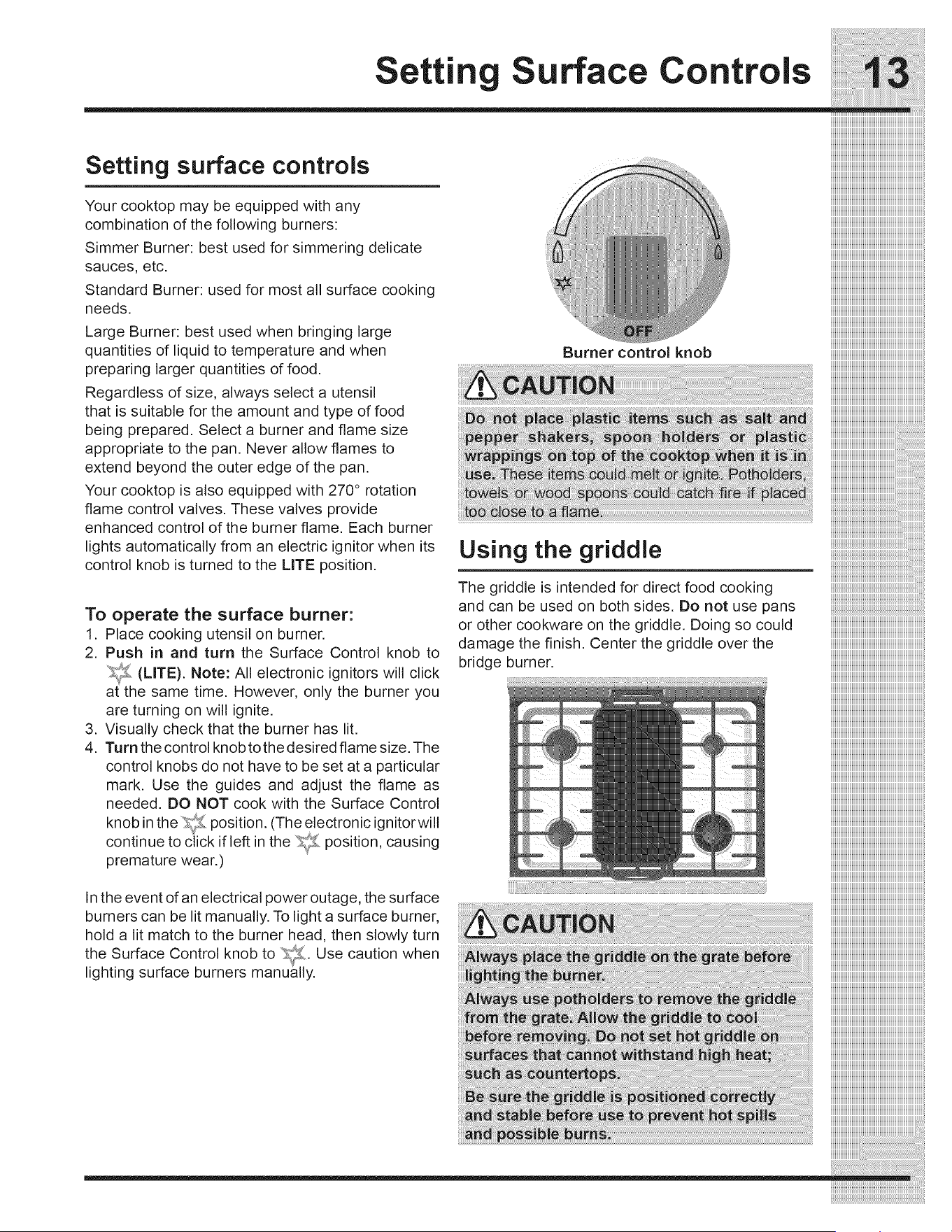
Setting surface controls
Your cooktop may be equipped with any
combination of the following burners:
Simmer Burner: best used for simmering delicate
sauces, etc.
Standard Burner: used for most all surface cooking
needs.
Large Burner: best used when bringing large
quantities of liquid to temperature and when
preparing larger quantities of food.
Regardless of size, always select a utensil
that is suitable for the amount and type of food
being prepared. Select a burner and flame size
appropriate to the pan. Never allow flames to
extend beyond the outer edge of the pan.
Your cooktop is also equipped with 270 ° rotation
flame control valves. These valves provide
enhanced control of the burner flame. Each burner
lights automatically from an electric ignitor when its
control knob is turned to the LITE position.
To operate the surface burner:
1. Place cooking utensil on burner.
2. Push in and turn the Surface Control knob to
,,_v_,(LITE). Note: All electronic ignitors will click
at the same time. However, only the burner you
are turning on will ignite.
3. Visually check that the burner has lit.
4. Turn the control knob to the desired flame size. The
control knobs do not have to be set at a particular
mark. Use the guides and adjust the flame as
needed. DO NOT cook with the Surface Control
,o,_d
knob in the _ position. (The electronic ignitorwill
continue to click if left in the ;_,i_:_,position, causing
premature wear.)
In the event of an electrical power outage, the surface
burners can be lit manually. To light a surface burner,
hold a lit match to the burner head, then slowly turn
the Surface Control knob to _. Use caution when
lighting surface burners manually.
Burner control knob
Using the griddle
The griddle is intended for direct food cooking
and can be used on both sides. Do not use pans
or other cookware on the griddle. Doing so could
damage the finish. Center the griddle over the
bridge burner.
i!i!i!i! i!!i!ii
Started
Setting Clock at Power Up
You will be prompted to enter the time of day in the
event of a power failure or when you first provide
electric power to your appliance.
When your appliance is first powered up, 12:00
will flash in the display.
Press CLOCK Q. Enter the time of day using
the numeric key pads and press START to set.
If an invalid time of day is entered, the control will
triple beep. Re-enter a valid time of day and press
START. If CANCEL is pressed your clock will start
with the time set for 12:00.
Preheat Temperature Display
Once a cooking feature has been started, the
control will display the actual oven temperature
while preheating. Once the oven reaches the oven
set temperature, only the oven set temperature will
be displayed.
The preheat temperature display is available with
the following cooking modes:
• Bake
• Convection Bake
• Cakes & Breads
The minimum temperature displayed is 100°F/38°C.
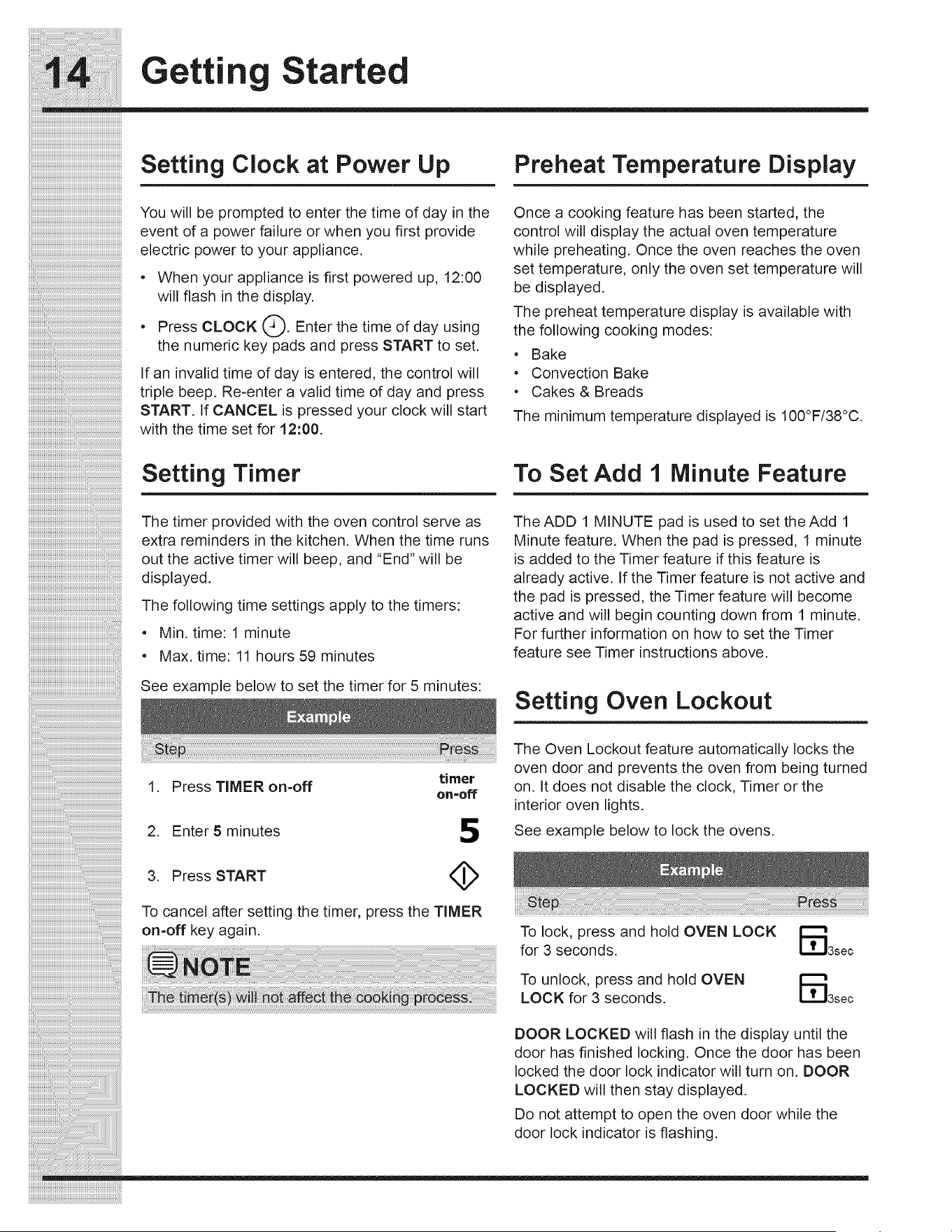
Setting Timer
To Set Add 1 Minute Feature
The timer provided with the oven control serve as
extra reminders in the kitchen. When the time runs
out the active timer will beep, and "End" will be
displayed.
The following time settings apply to the timers:
• Min. time: 1 minute
• Max. time: 11 hours 59 minutes
See example below to set the timer for 5 minutes:
The ADD 1 MINUTE pad is used to set the Add 1
Minute feature. When the pad is pressed, 1 minute
is added to the Timer feature if this feature is
already active. If the Timer feature is not active and
the pad is pressed, the Timer feature will become
active and will begin counting down from 1 minute.
For further information on how to set the Timer
feature see Timer instructions above.
Setting Oven Lockout
timer
1. Press TIMER on=off
on-off
2. Enter5 minutes 5
3. Press START
To cancel after setting the timer, press the TIMER
on=off key again.
The Oven Lockout feature automatically locks the
oven door and prevents the oven from being turned
on. It does not disable the clock, Timer or the
interior oven lights.
See example below to lock the ovens.
To lock, press and hold OVEN LOCK
for 3 seconds.
To unlock, press and hold OVEN
LOCK for 3 seconds.
3sec
1_3sec
DOOR LOCKED will flash in the display until the
door has finished locking. Once the door has been
locked the door lock indicator will turn on. DOOR
LOCKED will then stay displayed.
Do not attempt to open the oven door while the
door lock indicator is flashing.
Settin Oven Controls
p
reheat
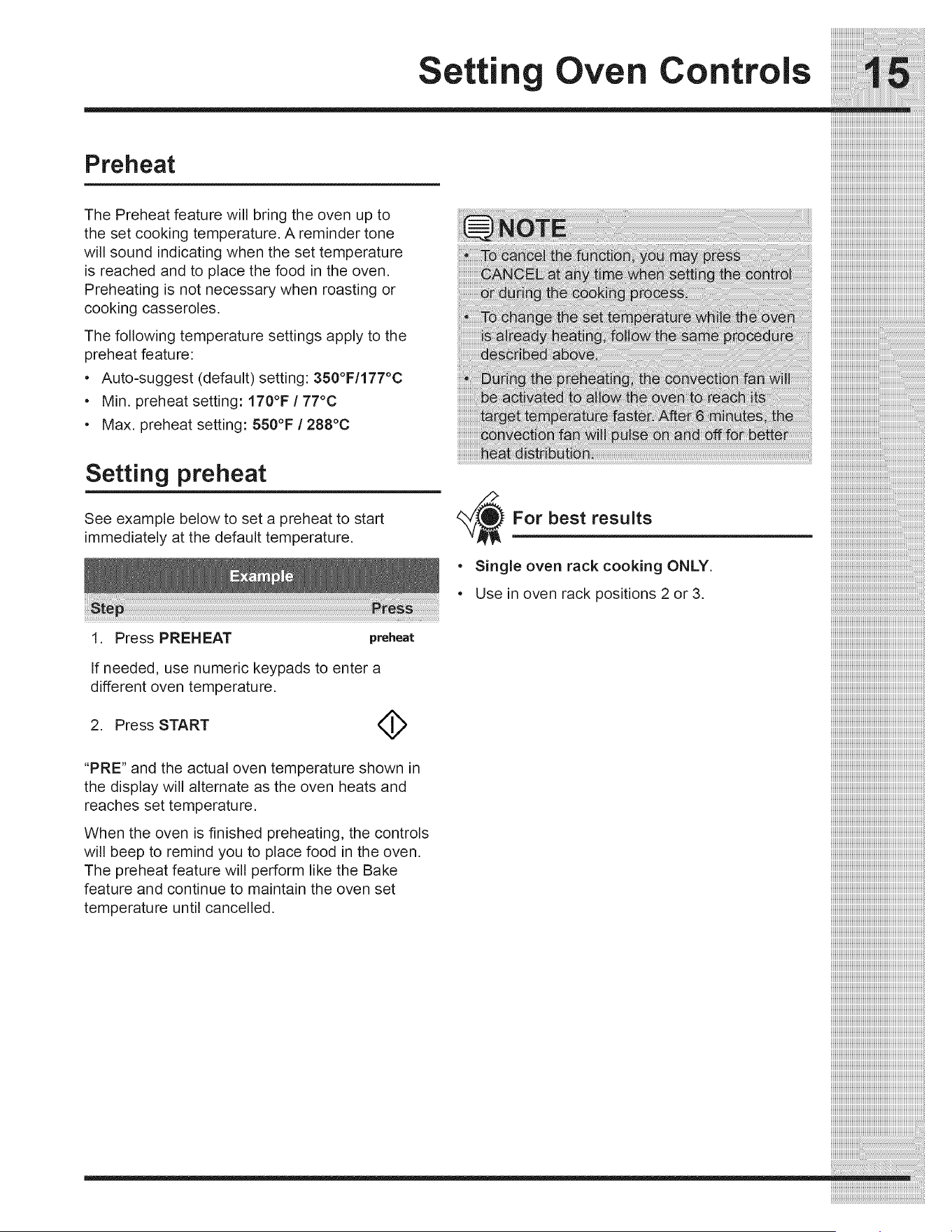
The Preheat feature will bring the oven up to
the set cooking temperature, A reminder tone
will sound indicating when the set temperature
is reached and to place the food in the oven,
Preheating is not necessary when roasting or
cooking casseroles.
The following temperature settings apply to the
preheat feature:
• Auto-suggest (default) setting: 380°F/177°O
• Min. preheat setting: 17001= / 77°C
• Max. preheat setting: 580°F / 288°0
Setting preheat
See example below to set a preheat to start
immediately at the default temperature.
iiiiiiiiiiiiiiiiiiiiiiiiiiiiiiiiiiiiiiiiiiiiiiiiiiiiiiiiiiiiiiiiiiiiiiiiiiiiiiiiiiiiiiiiiiiiiiii_?_:_:_:_:_:_:_:_:_:_:_:_:_:_:_:_:_:_:_:_:_:_:_:_:_:_:_:_:_i_i
For best results
• Single oven rack cooking ONLY.
• Use in oven rack positions 2 or 3.
1. Press PREHEAT
preheat
If needed, use numeric keypads to enter a
different oven temperature.
2. Press START (_
"PRE" and the actual oven temperature shown in
the display will alternate as the oven heats and
reaches set temperature.
When the oven is finished preheating, the controls
will beep to remind you to place food in the oven.
The preheat feature will perform like the Bake
feature and continue to maintain the oven set
temperature until cancelled.
Settin Oven Controls
Bake
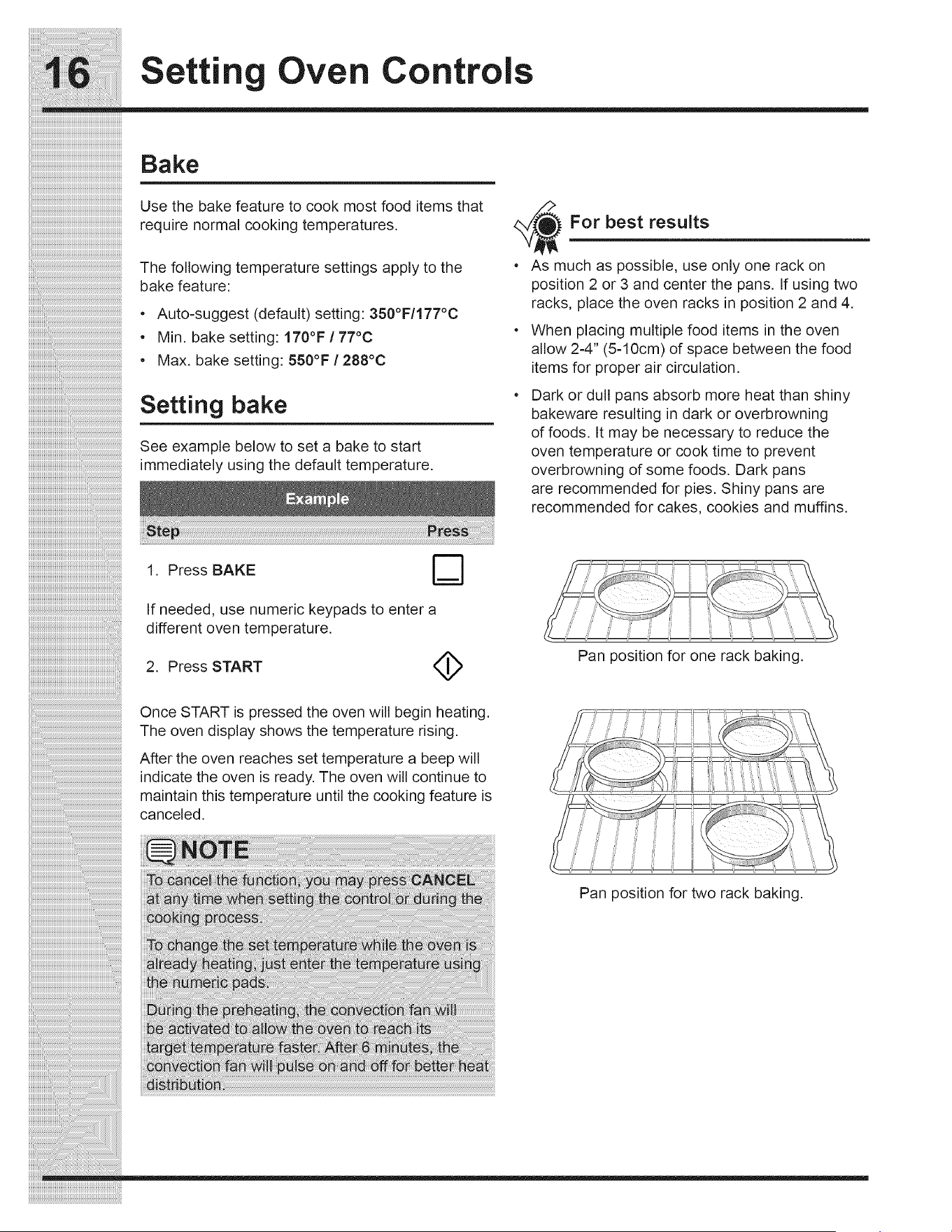
Use the bake feature to cook most food items that
require normal cooking temperatures.
The following temperature settings apply to the
bake feature:
Auto-suggest (default) setting: 350°!:/177°C
Min. bake setting: 170°1= / 77°C
Max. bake setting: 580°F / 288°0
Setting bake
See example below to set a bake to start
immediately using the default temperature.
For best results
• As much as possible, use only one rack on
position 2 or 3 and center the pans. If using two
racks, place the oven racks in position 2 and 4.
• When placing multiple food items in the oven
allow 2-4" (5-10cm) of space between the food
items for proper air circulation.
Dark or dull pans absorb more heat than shiny
bakeware resulting in dark or overbrowning
of foods. It may be necessary to reduce the
oven temperature or cook time to prevent
overbrowning of some foods. Dark pans
are recommended for pies. Shiny pans are
recommended for cakes, cookies and muffins.
1. Press BAKE
If needed, use numeric keypads to enter a
different oven temperature.
2. Press START <_
Once START is pressed the oven will begin heating.
The oven display shows the temperature rising.
After the oven reaches set temperature a beep will
indicate the oven is ready, The oven will continue to
maintain this temperature until the cooking feature is
canceled,
Pan position for one rack baking.
Pan position for two rack baking.
Settin Oven Controls
Cook Time
Adding a cook duration when baking is beneficial
when a recipe requires a specific temperature and
period of time to cook. Following the recipe cook
time helps insure the best possible results.
Cook time may be set with the following features:
• Preheat
• Bake
• Broil
•Conv Bake
• Conv Roast
• Slow Cook
• Keep Warm
• Cake & Breads
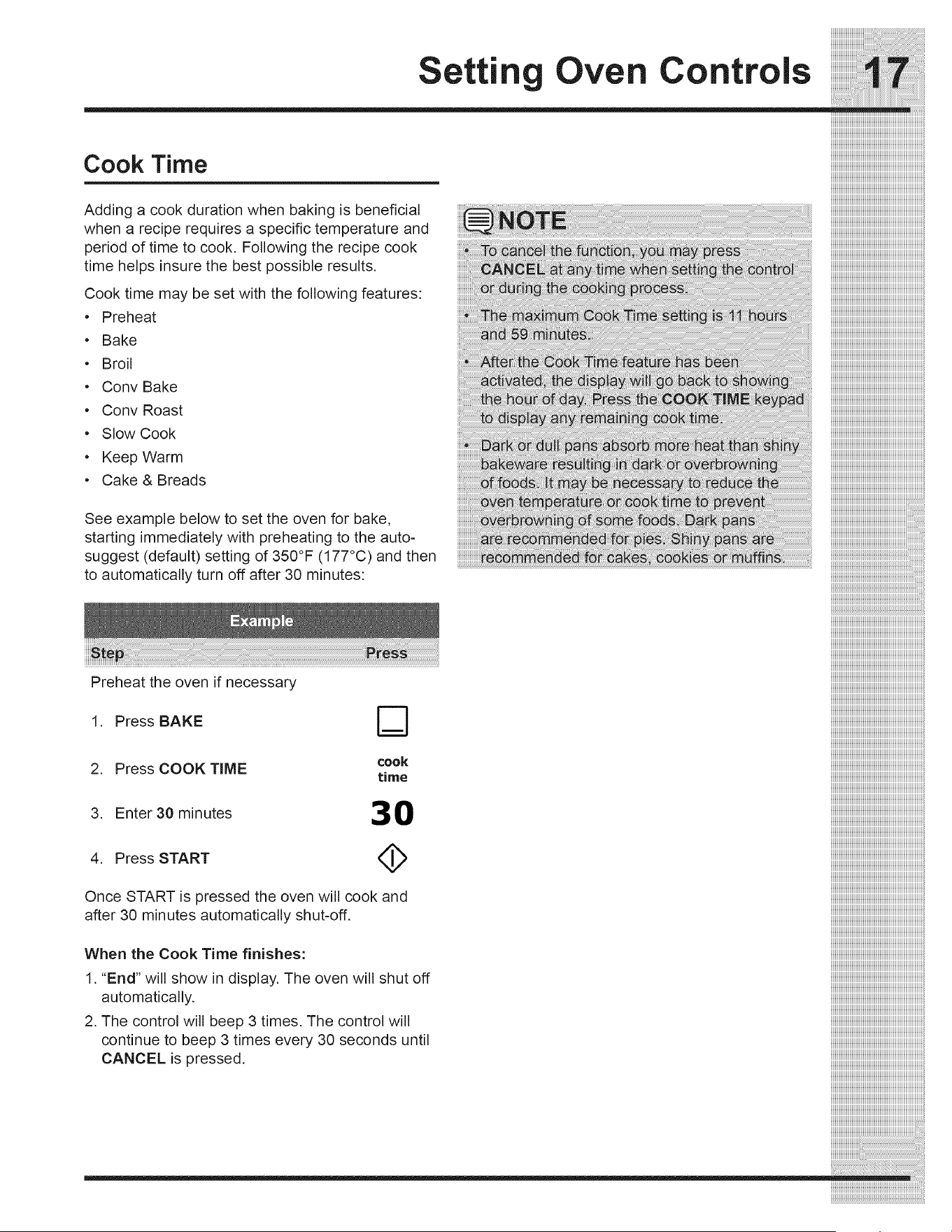
See example below to set the oven for bake,
starting immediately with preheating to the auto-
suggest (default) setting of 350°F (177°C) and then
to automatically turn off after 30 minutes:
Preheat the oven if necessary
1. Press BAKE
2. Press COOK TiME cook
time
3. Enter 30 minutes 30
4. Press START
Once START is pressed the oven will cook and
after 30 minutes automatically shut-off.
When the Cook Time finishes:
1. "End" will show in display. The oven will shut off
automatically,
2. The control will beep 3 times, The control will
continue to beep 3 times every 30 seconds until
CANCEL is pressed.
Settin Oven Controls
iiiiiiiiiiiiiiiiiiiiiiiiiiiiiiiiiiiiiiiiiiiiiiiiiiiiiiiiiiiiiiiiiiiiiiiiiiiiiii
Delay Start (with cook time)
Adding a cook duration along with a specific start
time gives the same benefits as the cook time
option in addition to controlling exactly when the
cooking process will begin and end.
Delay start may be set with the following features:
• Bake
• Broil
Conv Bake
• Conv Roast
• Slow Cook
• Self Clean
• Cake & Breads
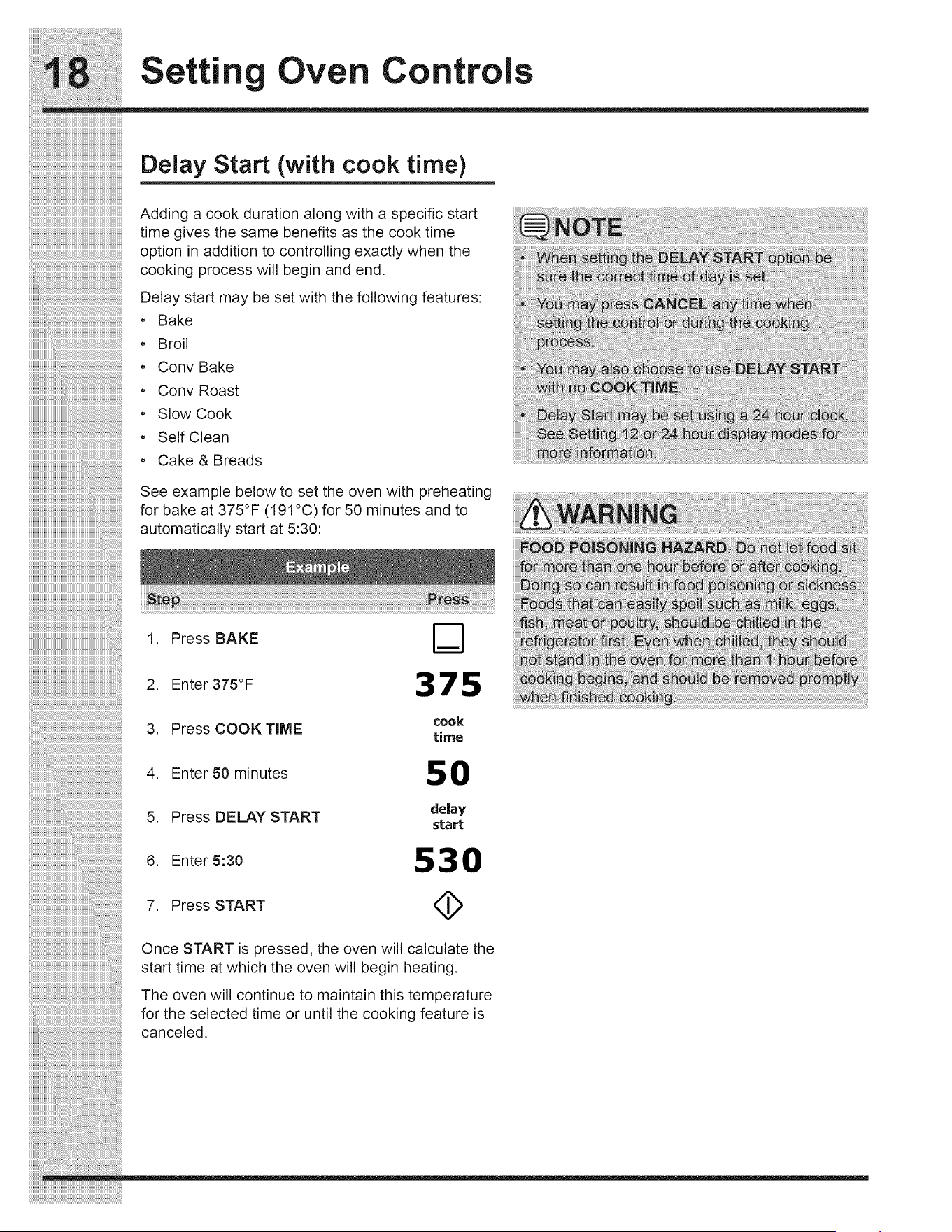
See example below to set the oven with preheating
for bake at 375°F (191°C) for 50 minutes and to
automatically start at 5:30:
Press BAKE r_
Enter 375°F 375
3. Press COOK TiME cook
time
4. Enter 50 minutes 50
5. Press DELAY START delay
start
6. Enter 5:30 530
7. Press START <_
Once START is pressed, the oven will calculate the
start time at which the oven will begin heating.
The oven will continue to maintain this temperature
for the selected time or until the cooking feature is
canceled.
iiiiiiiiiiiiiiiiiiiiiiiiiiiiiiiiiiiiiiiiiiii;_i!_:_i!;i:;_:i!i_i_i_i_i_i_i_ii%i_i!i!i%_i_
Settin Oven Controls ......
Convection Bake The following temperature settings apply to the iiiiiiiiiiiiiiiiiiiiiiiiiiiiiiiiiiiiiiiiiiiiiiiiiiiiiiiiiiiiiiiiiiiiiiiiiiiiiiii
convbakefeature: iiiiiiiiiiiiiiiiiiiiiiiiiiiiiiiiiiiiiiiiiiiiiiiiiiiiiiiiiiiiiiiiiiiiiiiiiiiiiiii
Convection Bake uses a fan to circulate the oven • Auto-suggest (default) setting: 350°F/177°C
heat evenly and continuously. The improved heat
distribution allows for even cooking with excellent
results. Multiple rack cooking may slightly increase
cook times for some foods, but the overall result is
time saved.
The Conv Bake feature should ONLY be used
when your recipe instructions have been written for
use with convection baking.
• Min. bake setting : 170°F / 77°C
• Max. bake setting: 550°F / 288°C
See the example below to set conv bake, starting
immediately with the auto-suggest (default) setting
of 350°F (176°C):
If your recipe instructions are for normal baking
and you wish to use convection bake, follow the
Convection Convert option instructions. The
convection convert option will automatically adjust
the oven temperature so that convection baking
may provide the best possible result
I":__':'1
1. Press CONV BAKE _L_
if needed, use numeric keypads to enter a
different oven temperature.
Conv bake may be set with the following options:
•Conv Convert
• Cook Time and/or Delay Start
Benefits of convection bake:
• Superior multiple oven rack performance.
• Some foods cook up 25 to 30% faster, saving
time and energy.
• No special pans or bakeware required.
For best results
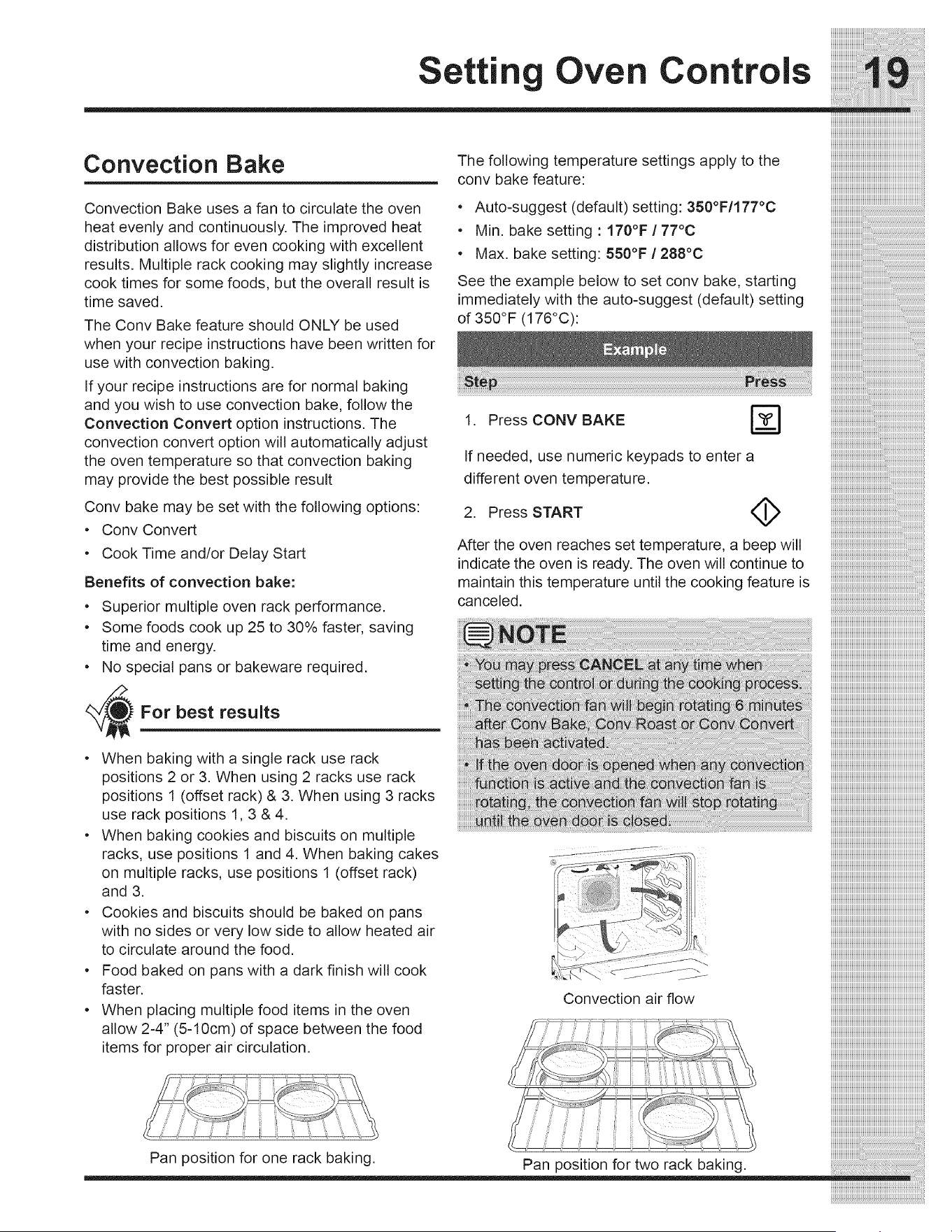
• When baking with a single rack use rack
positions 2 or 3. When using 2 racks use rack
positions 1 (offset rack) & 3. When using 3 racks
use rack positions 1, 3 & 4.
• When baking cookies and biscuits on multiple
racks, use positions 1 and 4. When baking cakes
on multiple racks, use positions 1 (offset rack)
and 3.
• Cookies and biscuits should be baked on pans
with no sides or very low side to allow heated air
to circulate around the food.
• Food baked on pans with a dark finish will cook
faster.
• When placing multiple food items in the oven
allow 2-4" (5-10cm) of space between the food
items for proper air circulation.
Pan position for one rack baking.
2. Press START <_
After the oven reaches set temperature, a beep will
indicate the oven is ready. The oven will continue to
maintain this temperature until the cooking feature is
canceled.
Settin Oven Controls
Convection Convert
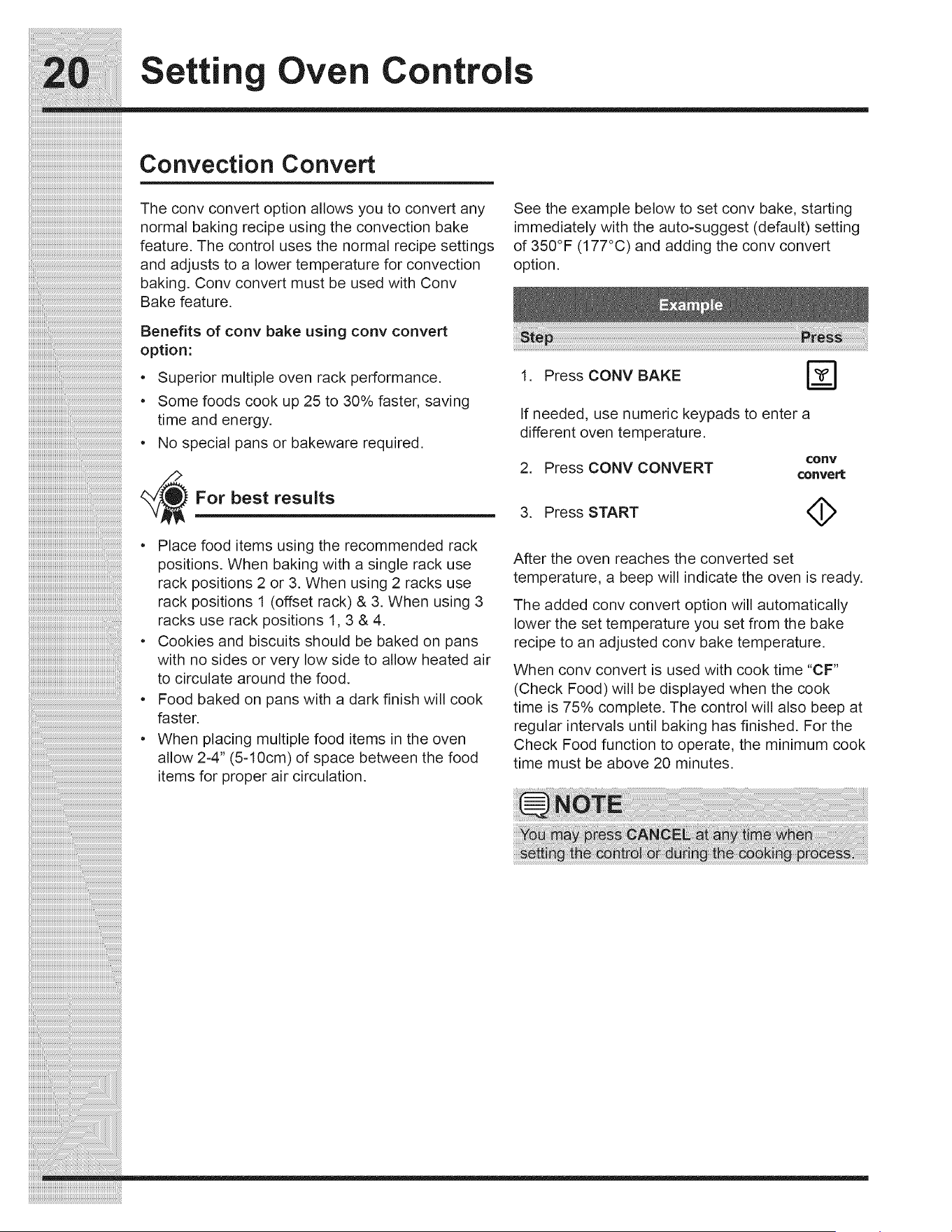
The conv convert option allows you to convert any
normal baking recipe using the convection bake
feature, The control uses the normal recipe settings
and adjusts to a lower temperature for convection
baking, Conv convert must be used with Conv
Bake feature.
Benefits of conv bake using conv convert
option:
• Superior multiple oven rack performance.
• Some foods cook up 25 to 30% faster, saving
time and energy.
• No special pans or bakeware required.
For best results
• Place food items using the recommended rack
positions. When baking with a single rack use
rack positions 2 or 3. When using 2 racks use
rack positions 1 (offset rack) & 3. When using 3
racks use rack positions 1, 3 & 4.
• Cookies and biscuits should be baked on pans
with no sides or very low side to allow heated air
to circulate around the food.
• Food baked on pans with a dark finish will cook
faster.
When placing multiple food items in the oven
allow 2-4" (5-10cm) of space between the food
items for proper air circulation.
See the example below to set conv bake, starting
immediately with the auto-suggest (default) setting
of 350°F (177°C) and adding the conv convert
option.
r-2":-i
1. Press CONV BAKE _L_
if needed, use numeric keypads to enter a
different oven temperature.
conv
2. Press CONV CONVERT convert
3. Press START
After the oven reaches the converted set
temperature, a beep will indicate the oven is ready.
The added conv convert option will automatically
lower the set temperature you set from the bake
recipe to an adjusted conv bake temperature,
When conv convert is used with cook time "CF"
(Check Food) will be displayed when the cook
time is 75% complete. The control will also beep at
regular intervals until baking has finished. For the
Check Food function to operate, the minimum cook
time must be above 20 minutes.
_i_i_i_i_i_i_i_i_i_i_i_i_i_i_i_i_i_i_i_i_i_i_i_i_i_i_i_i_i_i_i_i_i_i_i_i_i_i_i_i_i_i_i_i_i_i_i_i_i_i_i_i_i_i_i_i__!__________________________________________
iiiiiiiiiiiiiiiiiiiiiiiiiiiiiiiiiiiiiiiiiiiiiiiiiiiiiiiiiiiiiiiiiiiiiiiiiiiiiiiiiiiiiiiiiiiiiiiiiiiiiiiiiiiiiiiiiiiiiii_i!iiiiiiiiiiiiiiiiiiiiiiiiiiiiiiiiiiiiiiiiiiiiiiiiiiiii_
iiiiiiiiiiiiiiiiiiiiiiiiiiiiiiiiiiiiiiiiiiiiiiiiiiiiiiiiiiiiiiiiiiiiiiiiiiiiiiiiiiiiiiiiiiiiiiiiiiiiiiiiiiiiiiiiiiiiiiiiiiiii_i!iiiiiiiiiiiiiiiiiiiiiiiiiiiiiiiiiiiiiiiiiiii_
Settin Oven Controls ......, i;iiiii
Convection Roast See example below to set convection roast to start iiiiiiiiiiiiiiiiiiiiiiiiiiiiiiiiiiiiiiiiiiiiiiiiiiiiiiiiiiiiiiiiiiiiiiiiiiiiiiii
immediately with the auto-suggest (default)setting: iiiiiiiiiiiiiiiiiiiiiiiiiiiiiiiiiiiiiiiiiiiiiiiiiiiiiiiiiiiiiiiiiiiiiiiiiiiiiiii
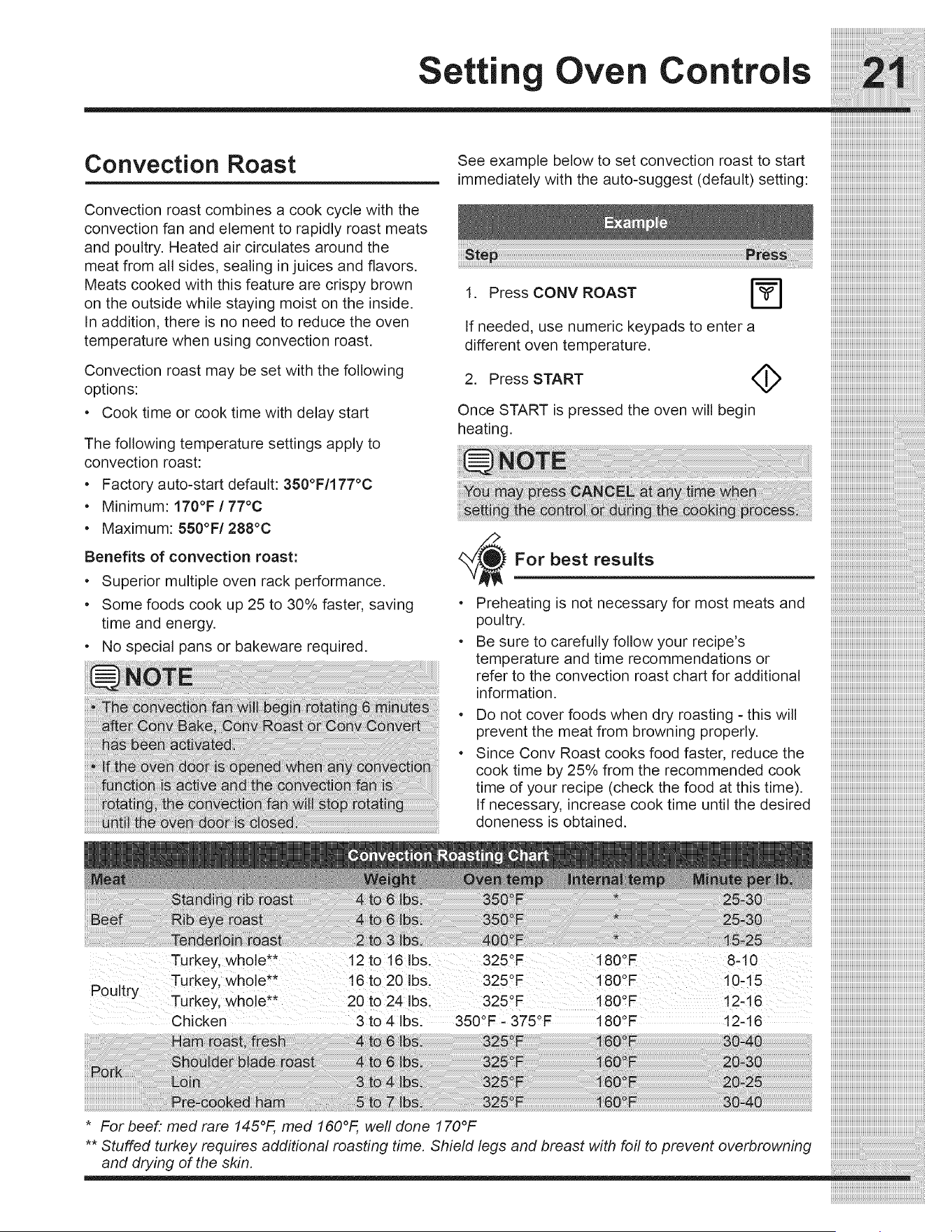
Convection roast combines a cook cycle with the
convection fan and element to rapidly roast meats
and poultry. Heated air circulates around the
meat from all sides, sealing in juices and flavors.
Meats cooked with this feature are crispy brown
on the outside while staying moist on the inside.
In addition, there is no need to reduce the oven
temperature when using convection roast.
Convection roast may be set with the following
options:
• Cook time or cook time with delay start
The following temperature settings apply to
convection roast:
• Factory auto-start default: 350°F/177°O
• Minimum: 170°F/77°C
• Maximum: 550°F/288°C
Benefits of convection roast:
• Superior multiple oven rack performance.
• Some foods cook up 25 to 30% faster, saving
time and energy.
• No special pans or bakeware required.
1. Press CONV ROAST L__
if needed, use numeric keypads to enter a
different oven temperature.
2. Press START
Once START is pressed the oven will begin
heating.
For best results
• Preheating is not necessary for most meats and
poultry.
• Be sure to carefully follow your recipe's
temperature and time recommendations or
refer to the convection roast chart for additional
information.
• Do not cover foods when dry roasting - this will
prevent the meat from browning properly.
• Since Conv Roast cooks food faster, reduce the
cook time by 25% from the recommended cook
time of your recipe (check the food at this time).
If necessary, increase cook time until the desired
doneness is obtained.
Turkey, whole** 12 to 16 Ibs. 325QF 180OF 8-10
-ru[key Whole** t6 t0 20 Ibsl 325°F 180°F 10,15
C°u!!FY Turkey:Whole** 20 to24 Ibs 180iF 12:i6
Chicken 3t0 4 350°F- 375°F 180°F 12-16
* For beeh med rare 145°F, med 160°F, well done 170°F
** Stuffed turkey requires additional roasting time. Shield legs and breast with foil to prevent overbrowning
and drying of the skin.
iiiiiiiiiiiiiiiiiiiiiiiiiiiiiiiiiiiiiiiiiiiiiiiiiiiiiiiiiiiiiiiiiiiiiiiiiiiiiii
Settin Oven Controls
Broil
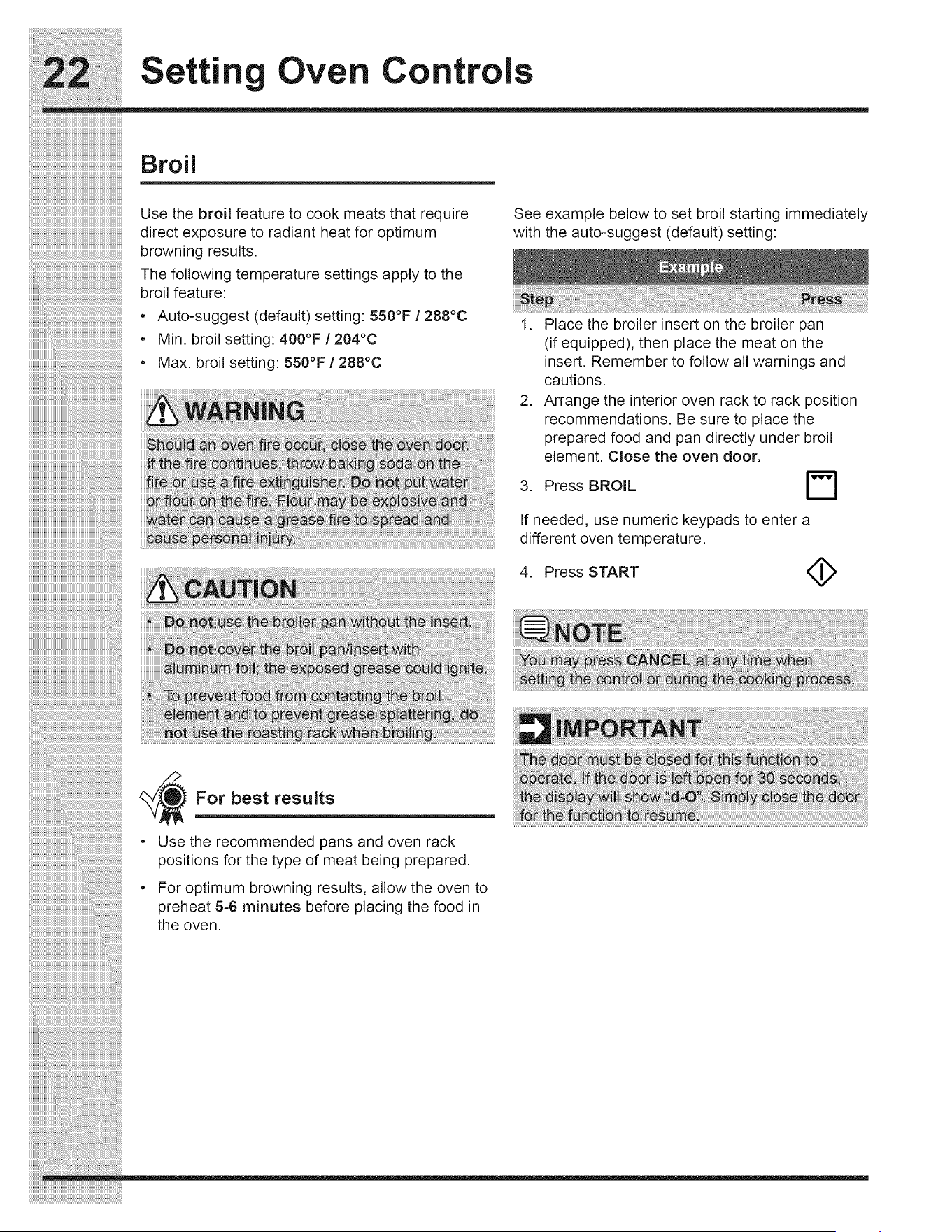
Use the broil feature to cook meats that require
direct exposure to radiant heat for optimum
browning results.
The following temperature settings apply to the
broil feature:
Auto-suggest (default) setting: 550°F / 288°C
Min. broil setting: 400°F ! 204°C
Max. broil setting: 550°F / 288°C
See example below to set broil starting immediately
with the auto=suggest (default) setting:
1. Place the broiler insert on the broiler pan
(if equipped), then place the meat on the
insert. Remember to follow all warnings and
cautions.
2. Arrange the interior oven rack to rack position
recommendations. Be sure to place the
prepared food and pan directly under broil
element. Close the oven door.
3. Press BROIL
i i
If needed, use numeric keypads to enter a
different oven temperature.
4. Press START
iiiiiiiiiiiiiiiiiiiiiiiiiiiiiiiiiiiiiiiiiiiiiiiiiiiiiiiiiiiiiiiiiiiiiiiiiiiiiiiiiiiiiiiiiiiiiiiiiiiiiiiiiiiiiiiiii_iiiiiiiiiiiiiiiiiiiiiiiiiiiiiiiiiiiiiiiii
_i_i_i_i_i_i_i_i_i_i_i_i_i_i_i_i_i_i_i_i_i_i_i_i_i_i_i_i_i_i_i_i_i_i_i_i_i_i_i_i_i_i_i_i_i_i_i_i_i_i_i_i_i_i_i_i_i_i_i_i_!_#_
iiiiiiiiiiiiiiiiiiiiiiiiiiiiiiiiiiiiiiiiiiiiiiiiiiiiiiiiiiiiiiiiiiiiiiiiiiiiiiiiiiiiiiiiiiiiiiiiiiiiiiiiiiiiiiiiiiiiiiiiiiiii_i!iiiiiiiiiiiiiiiiiiiiiiiiiiiiiiiiiiiiiiiiiiii_
For best results
• Use the recommended pans and oven rack
positions for the type of meat being prepared.
• For optimum browning results, allow the oven to
preheat 5-6 minutes before placing the food in
the oven.
Settin Oven Controls
Broil
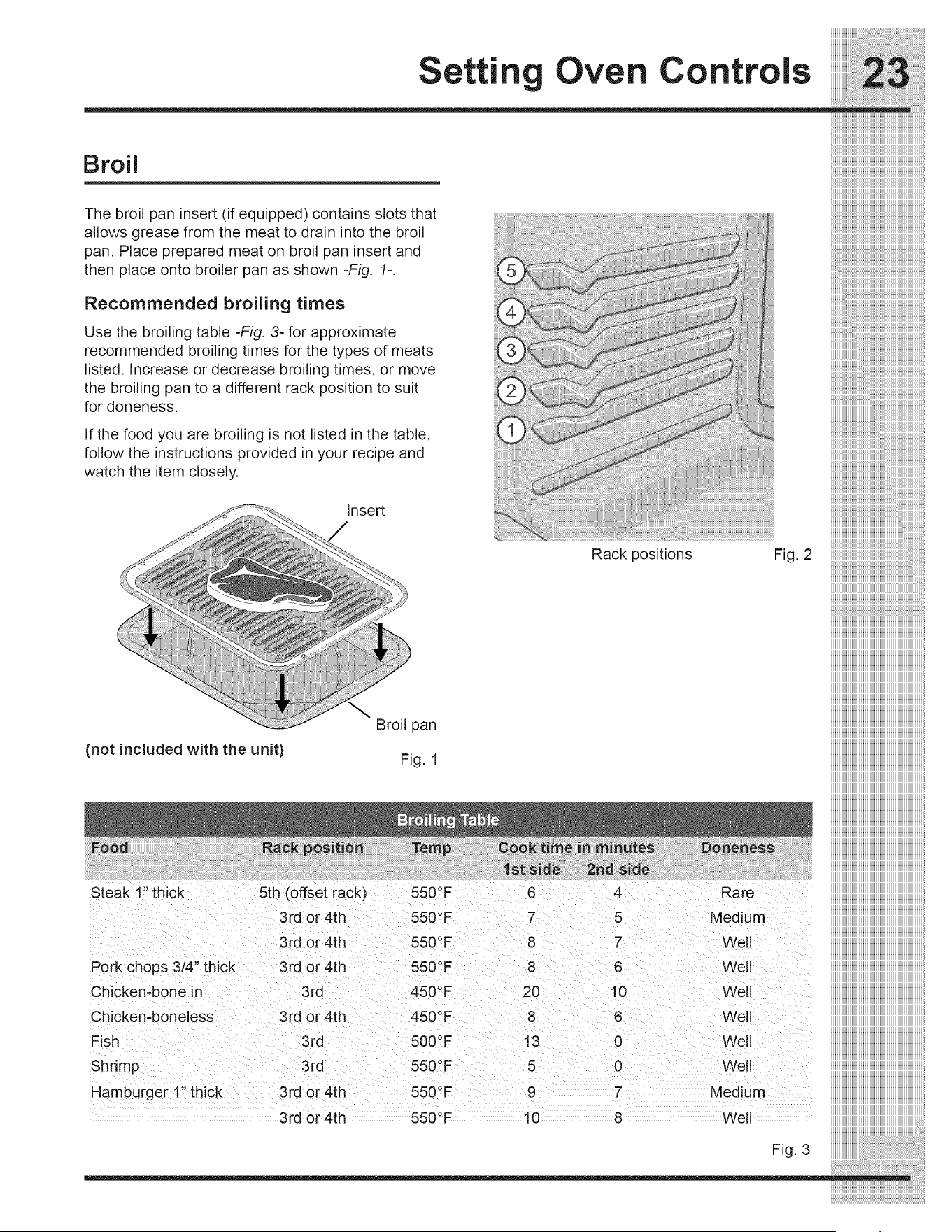
The broil pan insert (if equipped) contains slots that
allows grease from the meat to drain into the broil
pan. Place prepared meat on broil pan insert and
then place onto broiler pan as shown -Fig. 1-.
Recommended broiling times
Use the broiling table -Fig. 3- for approximate
recommended broiling times for the types of meats
listed. Increase or decrease broiling times, or move
the broiling pan to a different rack position to suit
for doneness.
If the food you are broiling is not listed in the table,
follow the instructions provided in your recipe and
watch the item closely.
Insert
Rack positions
___________i:i_i_i_i_i_i_i_i_i_i_i_i_i_i_i_i_i_i_i_i_i_i_i_i_i_i_i_i_i_i_i_i_i_i_i_i_i_i_i_i_i_i_i_i_i_i_i_i_i_i_i_i_i_i_i_i_i_i_i_i_i_i_i_i_i_i_i_i_i_i_i
_:_iiiiiiiiiiiiiiiiiiiiiiiiiiiiiiiiiiiiiiiiiiiiiiiiiiiiiiiiiiiiiiiiiiiiiiiiiiiiiiiiiiiiiiiiiiiiiiiiiiiiiiiiiii_
Fig. 2
(not included with the unit)
Broil pan
Steak 1" thick 5th (offset rack)
3rd or 4th
3rd or 4th
Pork chops 3/4" thick 3rd or 4th
Chicken-bone in 3rd
Chicken-boneless 3rd or 4th
Fish 3rd
Shrimp 3rd
Hamburger 1" thick 3rd or 4th
3rd or 4th
Fig. 1
550°F 6 4 Rare
550°F 7 5 Medium
550°F 8 7 Well
550°F 8 6 Well
450°F 20 10 Well
450°F 8 6 Well
500°F 13 0 Well
550°F 5 0 Well
550°F 9 7 Medium
550°F 10 8 Well
Fig. 3
Settin Oven Controls
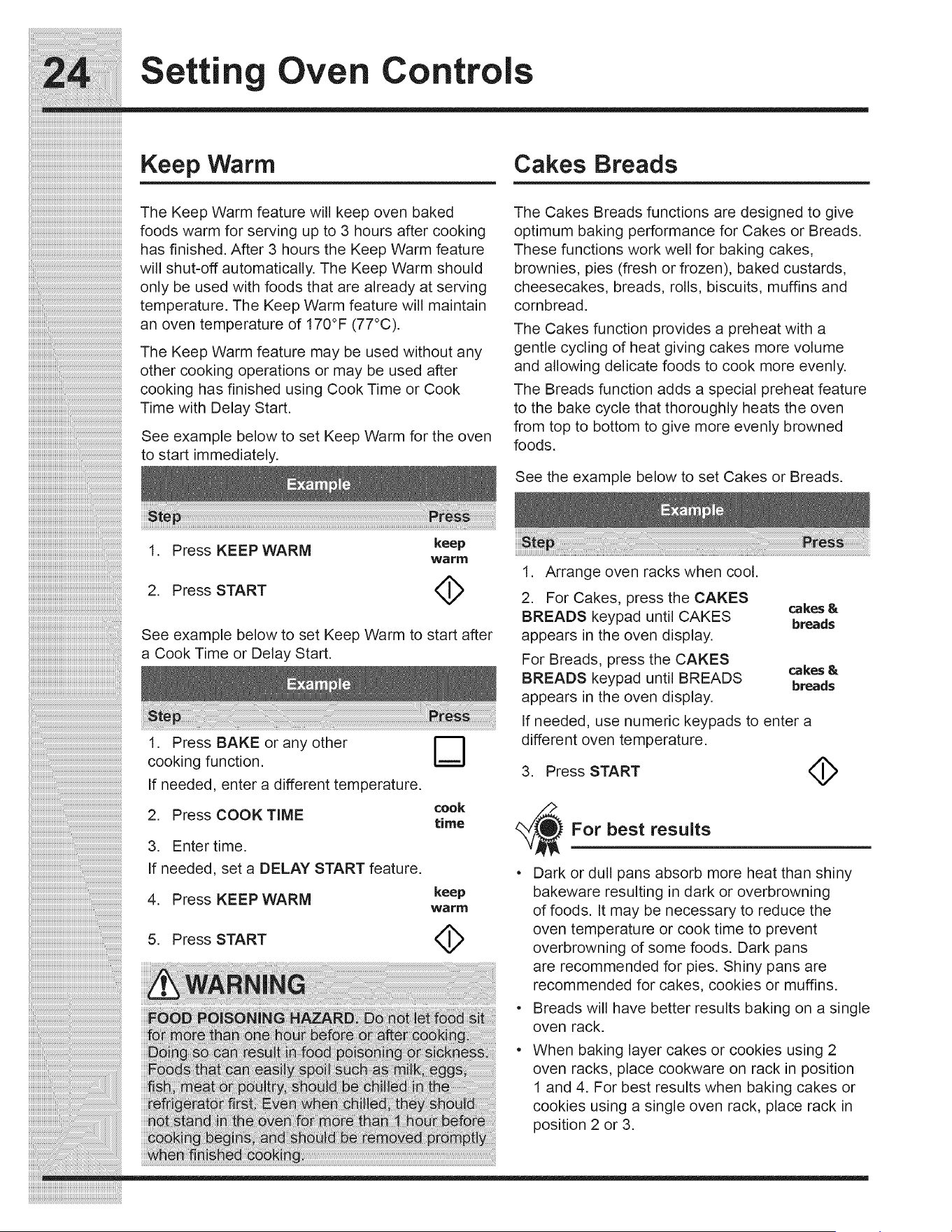
Keep Warm
The Keep Warm feature will keep oven baked
foods warm for serving up to 3 hours after cooking
has finished. After 3 hours the Keep Warm feature
will shut-off automatically. The Keep Warm should
only be used with foods that are already at serving
temperature. The Keep Warm feature will maintain
an oven temperature of 170°F (77°C).
The Keep Warm feature may be used without any
other cooking operations or may be used after
cooking has finished using Cook Time or Cook
Time with Delay Start.
See example below to set Keep Warm for the oven
to start immediately.
Cakes Breads
The Cakes Breads functions are designed to give
optimum baking performance for Cakes or Breads.
These functions work well for baking cakes,
brownies, pies (fresh or frozen), baked custards,
cheesecakes, breads, rolls, biscuits, muffins and
cornbread.
The Cakes function provides a preheat with a
gentle cycling of heat giving cakes more volume
and allowing delicate foods to cook more evenly.
The Breads function adds a special preheat feature
to the bake cycle that thoroughly heats the oven
from top to bottom to give more evenly browned
foods.
See the example below to set Cakes or Breads.
1. Press KEEP WARM keep
warn1
2. Press START
See example below to set Keep Warm to start after
a Cook Time or Delay Start.
1. Press BAKE or any other
cooking function.
If needed, enter a different temperature.
2. Press COOKTIME
3. Enter time.
If needed, set a DELAY START feature.
4. Press KEEP WARM
5. Press START
cook
time
keep
warm
1. Arrange oven racks when cool.
2. For Cakes, press the CAKES
cakes&
BREADS keypad until CAKES
breads
appears in the oven display.
For Breads, press the CAKES
cakes&
BREADS keypad until BREADS
breads
appears in the oven display.
If needed, use numeric keypads to enter a
different oven temperature.
3. Press START
For best results
• Dark or dull pans absorb more heat than shiny
bakeware resulting in dark or overbrowning
of foods. It may be necessary to reduce the
oven temperature or cook time to prevent
overbrowning of some foods. Dark pans
are recommended for pies. Shiny pans are
recommended for cakes, cookies or muffins.
• Breads will have better results baking on a single
oven rack.
When baking layer cakes or cookies using 2
oven racks, place cookware on rack in position
1 and 4. For best results when baking cakes or
cookies using a single oven rack, place rack in
position 2 or 3.
Settin Oven Controls
probe
When cooking meat such as roasts, hams or
poultry you can use the probe to check the internal
temperature without any guesswork. For some
foods, especially poultry and roasts, testing the
internal temperature is the most effective way of
insuring that your food has been properly cooked. '..................................................................................
Your oven will automatically change from cooking
to keep warm once the probe has reached the set
temperature,
The following temperature settings apply to the
probe function:
• Default: 170°F / 77°0
• Minimum: 140°F / 60°C
• Maximum: 210°F/99°C
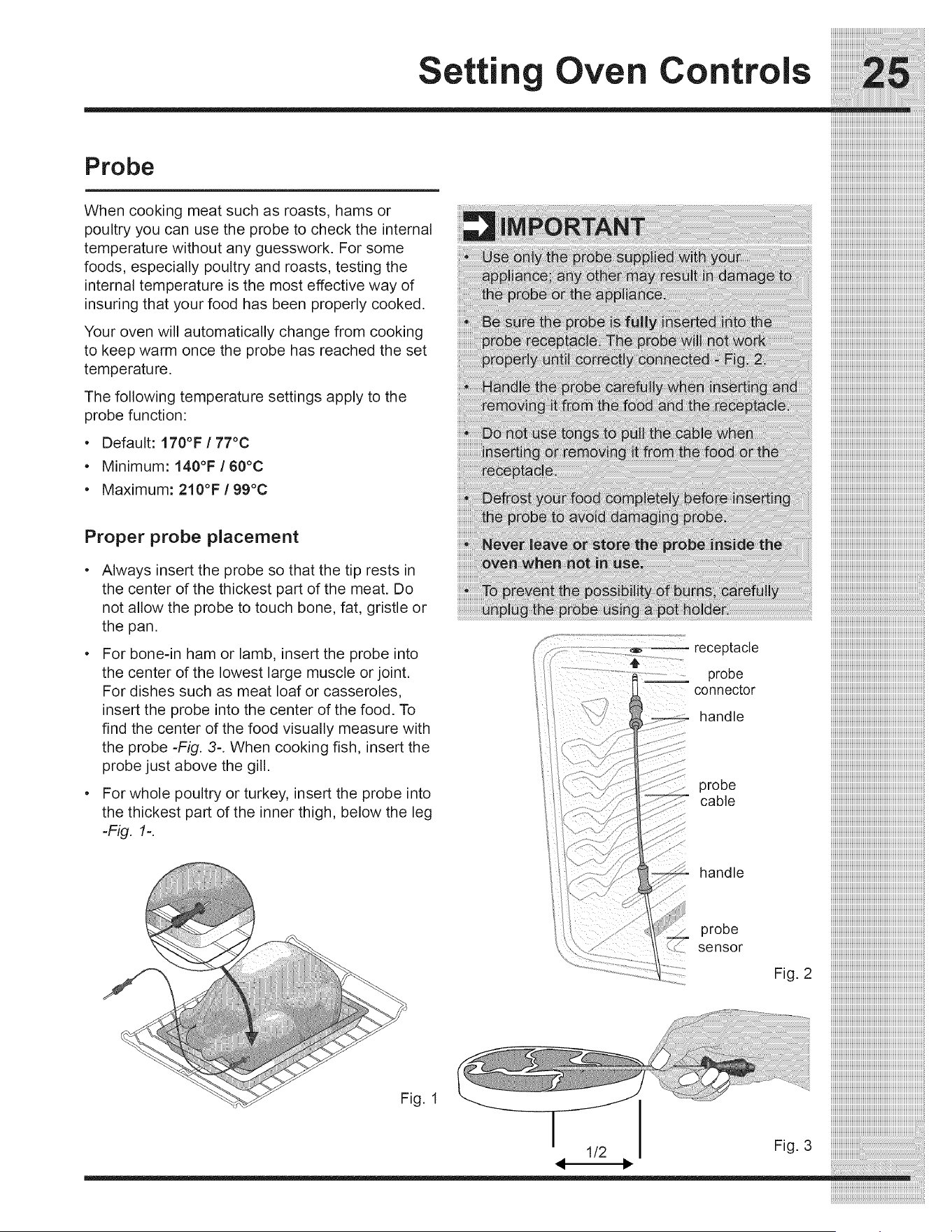
Proper probe placement
Always insert the probe so that the tip rests in
the center of the thickest part of the meat. Do
not allow the probe to touch bone, fat, gristle or
the pan.
For bone-in ham or lamb, insert the probe into
the center of the lowest large muscle or joint.
For dishes such as meat loaf or casseroles,
insert the probe into the center of the food. To
find the center of the food visually measure with
the probe -Fig. 3-. When cooking fish, insert the
probe just above the gill.
For whole poultry or turkey, insert the probe into
the thickest part of the inner thigh, below the leg
-Fig. 1-.
receptacle
probe
connector
handle
probe
cable
handle
probe
sensor
Fig. 2
Fig. 1
1/2 _ I
iv
Fig. 3
Settin Oven Controls
Probe
See the example below to set the probe.
iiiiiiiiiiiiiiiiiiiiiiiiiiiiiiiiiiiiiiiiiiiiiiiiiiiiiiiii
_iiiiiiiiiiiiiiiiiiiiiiiiiiiiiiiiiiiiiiiiiiiiiiiiiiiiiiiiii
_iiiiiiiiiiiiiiiiiiiiiiiiiiiiiiiiiiiiiiiiiiiiiiiiiiiiiiiiiiiii
1. Prepare the food and properly insert the
temperature probe into the food. DO NOT
preheat or start cooking before properly
inserting the meat probe. The probe should be
inserted into the food and receptacle while the
oven is still cool.
2. Place the prepared food on the desired oven
rack position and slide into the oven.
3. Plug the meat probe into the probe receptacle
located on the left front oven cavity top (See
Fig. 2 on previous page for location of probe
receptacle).
4. The oven control detects if the meat probe is
correctly plugged in to receptacle and when
recognized will illuminate the probe icon in the
oven control display.
Set the oven control for Bake, Conv Bake
or Conv Roast and the desired oven
temperature. You may use the meat probe
with some other baking features, but the meat
probe cannot be set with Broil or Self Clean.
To set the target temperature press PROBE
keypad once then enter the desired target
internal temperature using the numeric key
pads (default setting is 170°F/77°C)1 -. Press
START to accept the meat probe target tem-
perature. Close the oven door.
7. During the cooking process the actual meat
probe temperature will display by default. To
view the target temperature press the PROBE
keypad once. After 25 seconds the display will
show the actual meat probe temperature. If
the target temperature needs to be changed
during the cooking process, press the PROBE
keypad once and use the numeric keypads
to adjust the target temperature. Press the
START key to accept any change.
8. The oven control will provide 3 beeps when
the internal target temperature is reached. By
default the oven will automatically change to a
Keep Warm setting. The Keep Warm function
will maintain the oven temperature at 170°F
(77°C). Instructions for changing how the
oven reacts after reaching the internal target
temperature may be found later in this section.
Press CANCEL to cancel cooking at any time.
See the following instructions for changing how
the oven reacts after reaching the internal target
temperature.
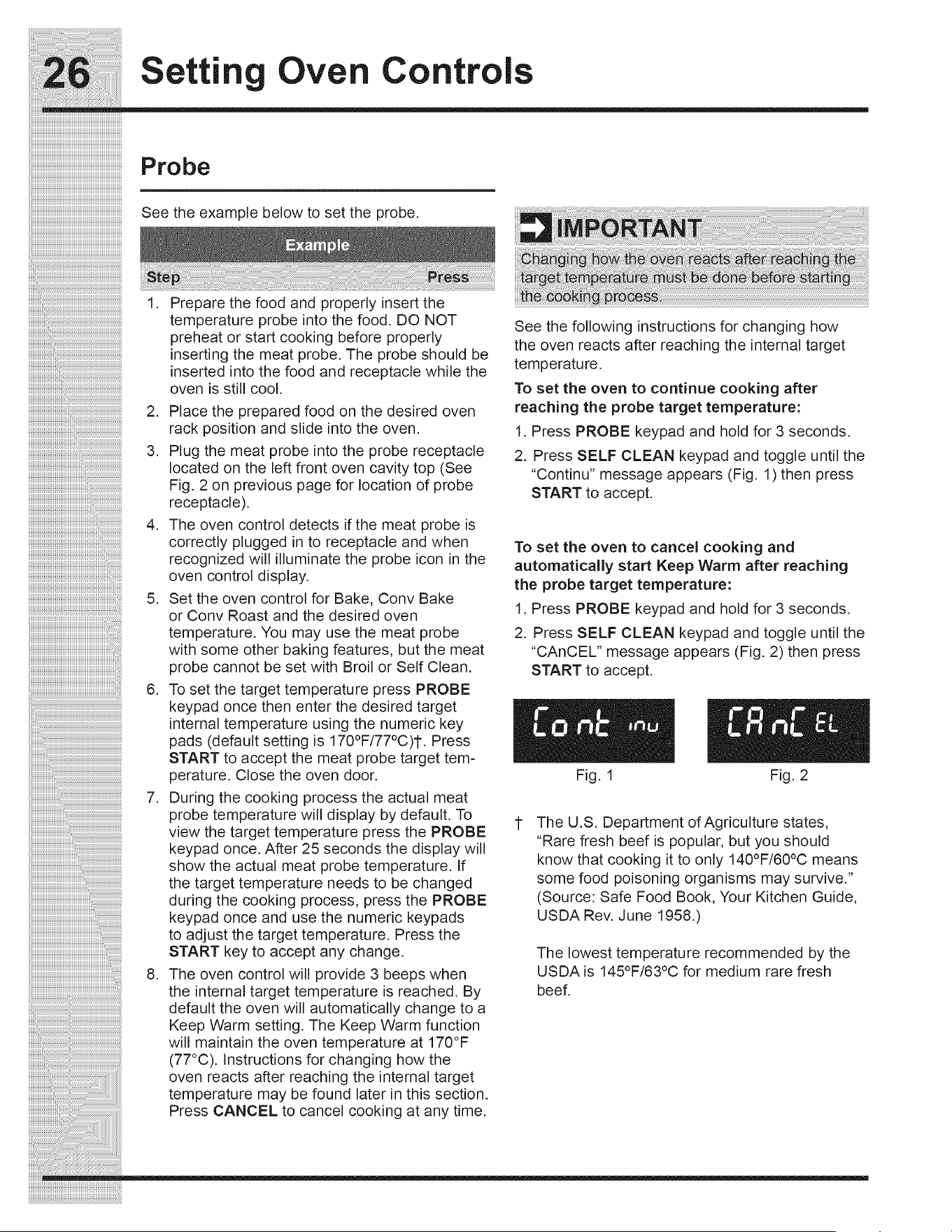
To set the oven to continue cooking after
reaching the probe target temperature:
1. Press PROBE keypad and hold for 3 seconds.
2. Press SELF CLEAN keypad and toggle until the
"Continu" message appears (Fig. 1) then press
START to accept.
To set the oven to cancel cooking and
automatically start Keep Warm after reaching
the probe target temperature:
1. Press PROBE keypad and hold for 3 seconds.
2. Press SELF CLEAN keypad and toggle until the
"CANCEL" message appears (Fig. 2) then press
START to accept.
Fig. 1 Fig. 2
The U.S. Department of Agriculture states,
"Rare fresh beef is popular, but you should
know that cooking it to only 140°F/60°C means
some food poisoning organisms may survive."
(Source: Safe Food Book, Your Kitchen Guide,
USDA Rev. June 1958.)
The lowest temperature recommended by the
USDA is 145°F/63°C for medium rare fresh
beef.
Slow Cook
The slow cook feature may be used to cook foods
more slowly at lower oven temperatures. The
cooking results will be like that of a Slow Cooker or
Crock-Pot. This feature is ideal for roasting beef,
pork & poultry. Slow cooking meats may result in
the exterior of meats becoming dark but not burnt;
this is normal.
Slow cook may be set with the following options:
• Cook time
• Cook time with delay start
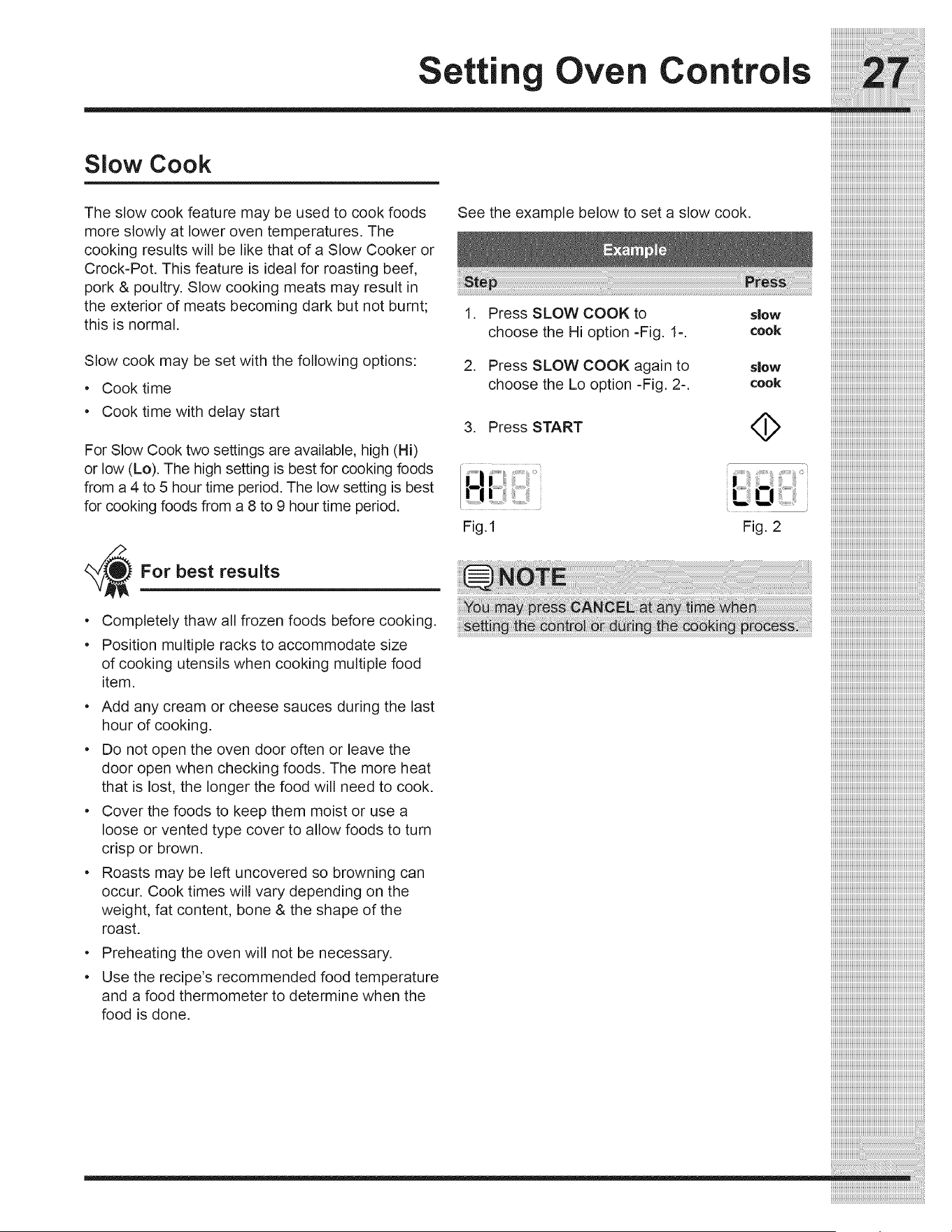
For Slow Cook two settings are available, high (Hi)
or low (Lo). The high setting is best for cooking foods
from a 4 to 5 hour time period. The low setting is best
for cooking foods from a 8 to 9 hour time period.
?_For best results
e
e
Completely thaw all frozen foods before cooking.
Position multiple racks to accommodate size
of cooking utensils when cooking multiple food
item.
• Add any cream or cheese sauces during the last
hour of cooking.
• Do not open the oven door often or leave the
door open when checking foods. The more heat
that is lost, the longer the food will need to cook.
• Cover the foods to keep them moist or use a
loose or vented type cover to allow foods to turn
crisp or brown.
• Roasts may be left uncovered so browning can
occur. Cook times will vary depending on the
weight, fat content, bone & the shape of the
roast.
e
e
Preheating the oven will not be necessary.
Use the recipe's recommended food temperature
and a food thermometer to determine when the
food is done.
Seetheexamplebelowtosetaslowcook.l__l_ iiiiiiiiiiiiiiiiiiiiiiiiiiiiiiiiiiiiiiiiiiiiiiiiiiiiiiiiiiiiiiiiiiiiiiiiiiiiiiiiiiiii
............................................... iiiiiiiiiiiiiiiiiiiiiiiiiiiiiiiiiiiiiiiiiiiiiiiiiiiiiiiiiiiiiiiiiiiiiiiiiiiiiiiiiii
1. Press SLOW COOKto slow iiiiiiiiiiiiiiiiiiiiiiiiiiiiiiiiiiiiiiiiiiiiiiiiiiiiiiiiiiiiiiiiiiiiiiiiiiiiiiiiiii
choosetheHioption-Fig. 1-. cook iiiiiiiiiiiiiiiiiiiiiiiiiiiiiiiiiiiiiiiiiiiiiiiiiiiiiiiiiiiiiiiiiiiiiiiiiiiiiiiiiii
2. Press SLOWCOOKagainto slow iiiiiiiiiiiiiiiiiiiiiiiiiiiiiiiiiiiiiiiiiiiiiiiiiiiiiiiiiiiiiiiiiiiiiiiiiiiiiiiiiii
choosethe Looption -Fig. 2-. cook iiiiiiiiiiiiiiiiiiiiiiiiiiiiiiiiiiiiiiiiiiiiiiiiiiiiiiiiiiiiiiiiiiiiiiiiiiiiiiiiiii
3. PressSTART iiiiiiiiiiiiiiiiiiiiiiiiiiiiiiiiiiiiiiiiiiiiiiiiiiiiiiiiiiiiiiiiiiiiiiiiiiiiiiiiiii
Fig.1 Fig. 2 iiiiiiiiiiiiiiiiiiiiiiiiiiiiiiiiiiiiiiiiiiiiiiiiiiiiiiiiiiiiiiiiiiiiiiiiiiiiiiiiiii
CCCCCCCCCCCCCCCII ......
iiiiiiiiiiiiiiiiiiiiiiiiiiiiiiiiiiiiiiiiiiiiiiiiiiiiiiiiiiiiiiiiiiiiiiiiiiiii
iiiiiiiiiiiiiiiiiiiiiiiiiiiiiiiiiiiiiiiiiiiiiiiiiiiiiiiiiiiiiiiiiiiiiiiiiiiii
ii!i!i!i!i!i!i!i!i!i!i!i!i!i!i!i!i!i!i!i!i!i!i!i!i!i!i!i!i!i!i!i!i!i!i!i!i!i!i!i!i!i!i!i!i!i!i!i!i!i!i!i!i!i!i!i!i!i!i!i!i!i!i!i!i!i!i!i!i!i!i!i!i!i!i!i!i!i!i!i.....
iiiiiiiiiiiiiiiiiiiiiiiiiiiiiiiiiiiiiiiiiiiiiiiiiiiiiiiiiiiiiiiiiiiiiiiiiiiiiiiiiii
Settin Oven Controls
iiiiiiiiiiiiiiiiiiiiiiiiiiiiiiiiiiiiiiiiiiiiiiiiiiiiiiiiiiiiiiiiiiiiiiiiiiiiiii
iiiiiiiiiiiiiiiiiiiiiiiiiiiiiiiiiiiiiiiiiiiiiiiiiiiiiiiiiiiiiiiiiiiiiiiiiiiiiii
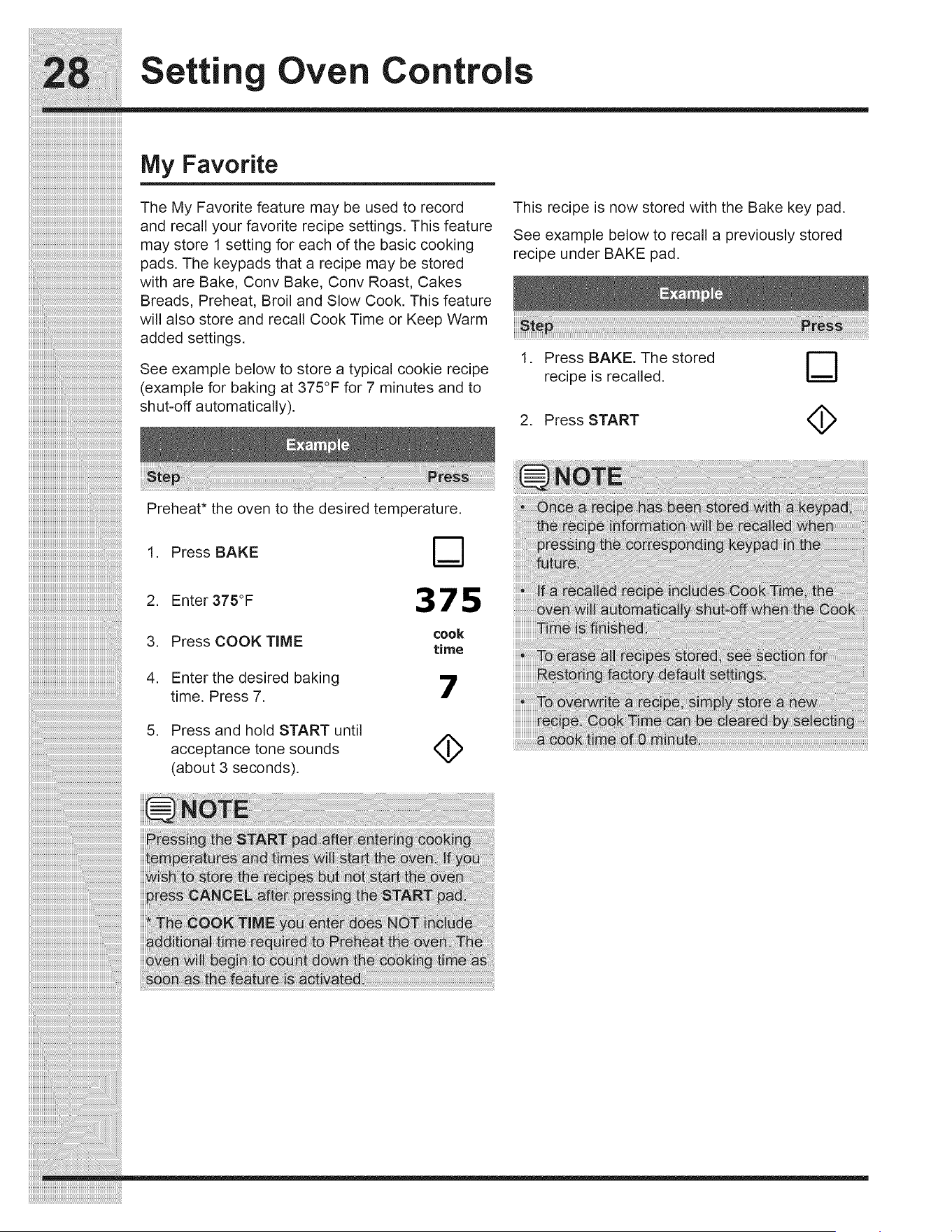
My Favorite
The My Favorite feature may be used to record
and recall your favorite recipe settings. This feature
may store 1 setting for each of the basic cooking
pads. The keypads that a recipe may be stored
with are Bake, Conv Bake, Conv Roast, Cakes
Breads, Preheat, Broil and Slow Cook. This feature
will also store and recall Cook Time or Keep Warm
added settings.
See example below to store a typical cookie recipe
(example for baking at 375°F for 7 minutes and to
shut=off automatically).
This recipe is now stored with the Bake key pad.
See example below to recall a previously stored
recipe under BAKE pad.
, Press BAKE. The stored
recipe is recalled.
2. Press START <_
Preheat* the oven to the desired temperature.
1. Press BAKE
2. Enter 375°F 375
.
cook
Press COOK TIME
time
Enter the desired baking
time. Press 7.
,8'
Press and hold START until
acceptance tone sounds
(about 3 seconds).
4>
Settin Oven Controls
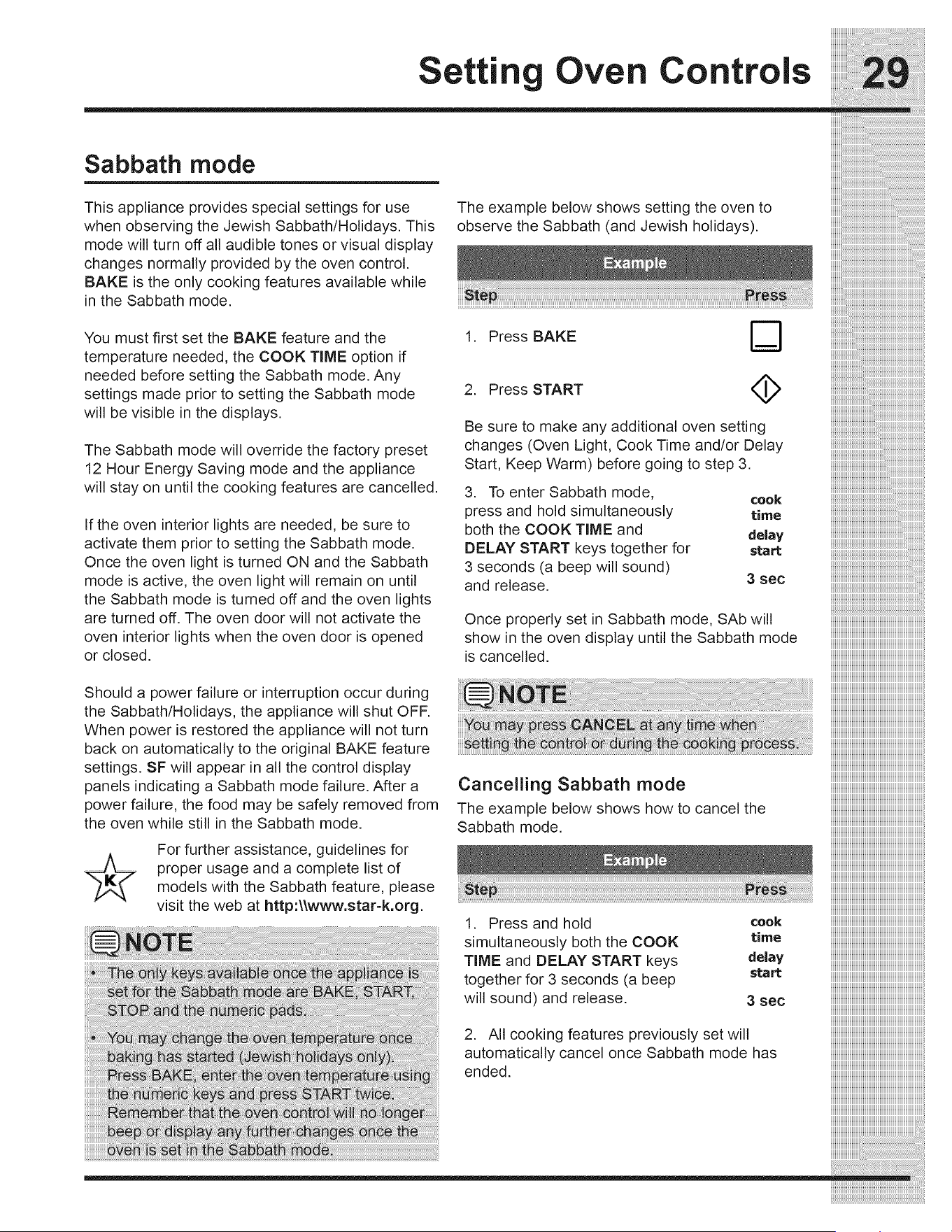
Sabbath mode
This appliance provides special settings for use
when observing the Jewish Sabbath/Holidays. This
mode will turn off all audible tones or visual display
changes normally provided by the oven control.
BAKE is the only cooking features available while
in the Sabbath mode.
You must first set the BAKE feature and the
temperature needed, the COOK TIME option if
needed before setting the Sabbath mode. Any
settings made prior to setting the Sabbath mode
will be visible in the displays.
The Sabbath mode will override the factory preset
12 Hour Energy Saving mode and the appliance
will stay on until the cooking features are cancelled.
If the oven interior lights are needed, be sure to
activate them prior to setting the Sabbath mode.
Once the oven light is turned ON and the Sabbath
mode is active, the oven light will remain on until
the Sabbath mode is turned off and the oven lights
are turned off. The oven door will not activate the
oven interior lights when the oven door is opened
or closed.
Should a power failure or interruption occur during
the Sabbath/Holidays, the appliance will shut OFF.
When power is restored the appliance will not turn
back on automatically to the original BAKE feature
settings. SF will appear in all the control display
panels indicating a Sabbath mode failure. After a
power failure, the food may be safely removed from
the oven while still in the Sabbath mode.
For further assistance, guidelines for
proper usage and a complete list of
models with the Sabbath feature, please
visit the web at http:\\www.star-k.org.
The example below shows setting the oven to
observe the Sabbath (and Jewish holidays).
1. Press BAKE
2. Press START <_
Be sure to make any additional oven setting
changes (Oven Light, Cook Time and/or Delay
Start, Keep Warm) before going to step 3.
3. To enter Sabbath mode, cook
press and hold simultaneously time
both the COOK TIME and delay
DELAY START keys together for start
3 seconds (a beep will sound)
and release, 3 sec
Once properly set in Sabbath mode, SAb will
show in the oven display until the Sabbath mode
is cancelled.
Cancelling Sabbath mode
The example below shows how to cancel the
Sabbath mode.
1. Press and hold
simultaneously both the COOK
TIME and DELAY START keys
together for 3 seconds (a beep
will sound) and release.
cook
time
delay
start
3 sec
2. All cooking features previously set will
automatically cancel once Sabbath mode has
ended.
IIIIIIIIIIIIIIIIIIIIIIIIIIIIIIIIIIIIIIIIIIIIIIIIIIIIIIIIIIIIIIIIIIIIIIIIIIIIIIIIIII
Settin the
rmer rawer
iiiiiiiiiiiiiiiiiiiiiiiiiiiiiiiiiiiiiiiiiiiiiiiiiiiiiiiiiiiiiiiiiiiiiiiiiiiiiii
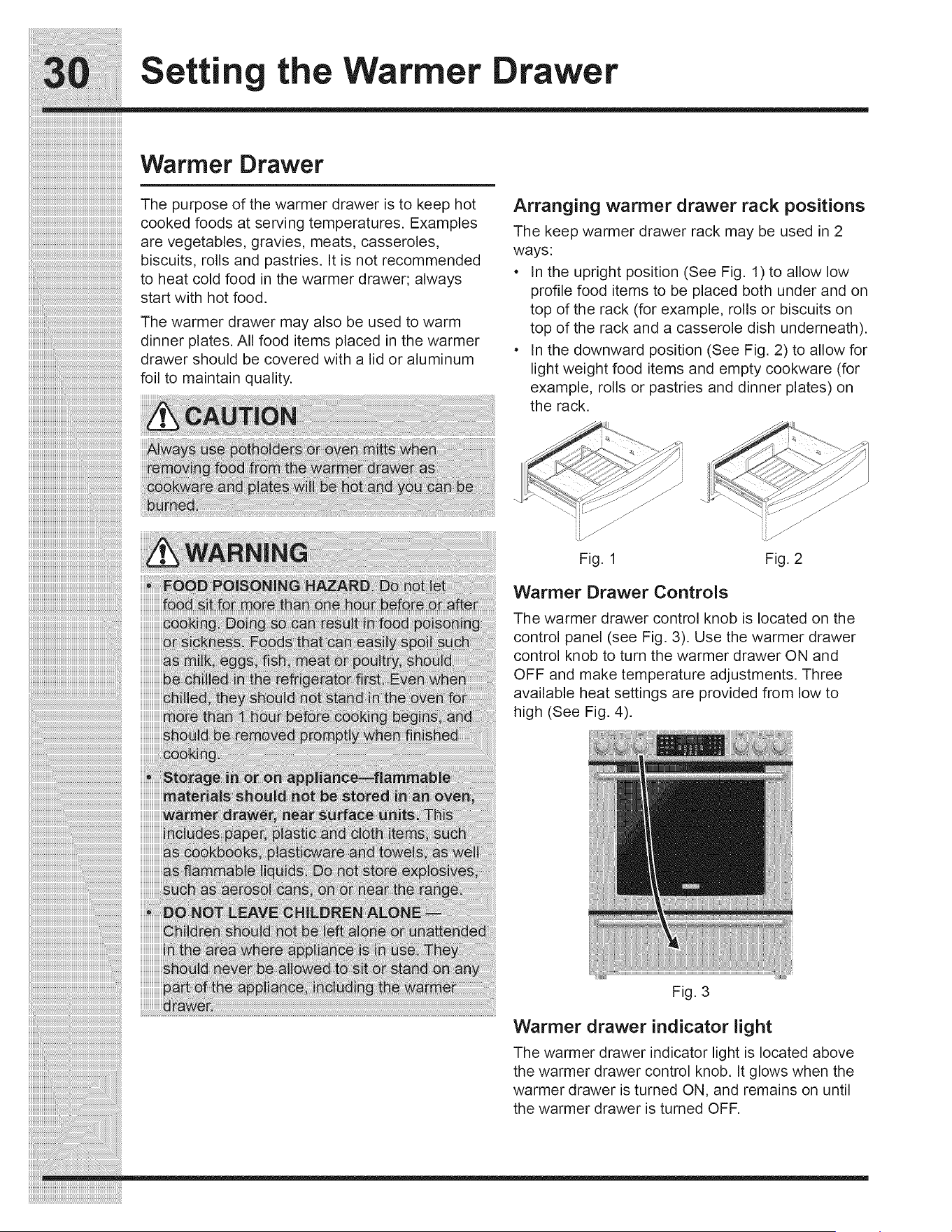
Warmer Drawer
The purpose of the warmer drawer is to keep hot
cooked foods at serving temperatures. Examples
are vegetables, gravies, meats, casseroles,
biscuits, rolls and pastries. It is not recommended
to heat cold food in the warmer drawer; always
start with hot food.
The warmer drawer may also be used to warm
dinner plates. All food items placed in the warmer
drawer should be covered with a lid or aluminum
foil to maintain quality.
Arranging warmer drawer rack positions
The keep warmer drawer rack may be used in 2
ways:
• In the upright position (See Fig. 1) to allow low
profile food items to be placed both under and on
top of the rack (for example, rolls or biscuits on
top of the rack and a casserole dish underneath).
• In the downward position (See Fig. 2) to allow for
light weight food items and empty cookware (for
example, rolls or pastries and dinner plates) on
the rack.
Fig. 1 Fig. 2
Warmer Drawer Controls
The warmer drawer control knob is located on the
control panel (see Fig. 3). Use the warmer drawer
control knob to turn the warmer drawer ON and
OFF and make temperature adjustments. Three
available heat settings are provided from low to
high (See Fig. 4).
Fig. 3
Warmer drawer indicator light
The warmer drawer indicator light is located above
the warmer drawer control knob. It glows when the
warmer drawer is turned ON, and remains on until
the warmer drawer is turned OFF.
Settin the
rmer rawer
Warmer Drawer (ton't)
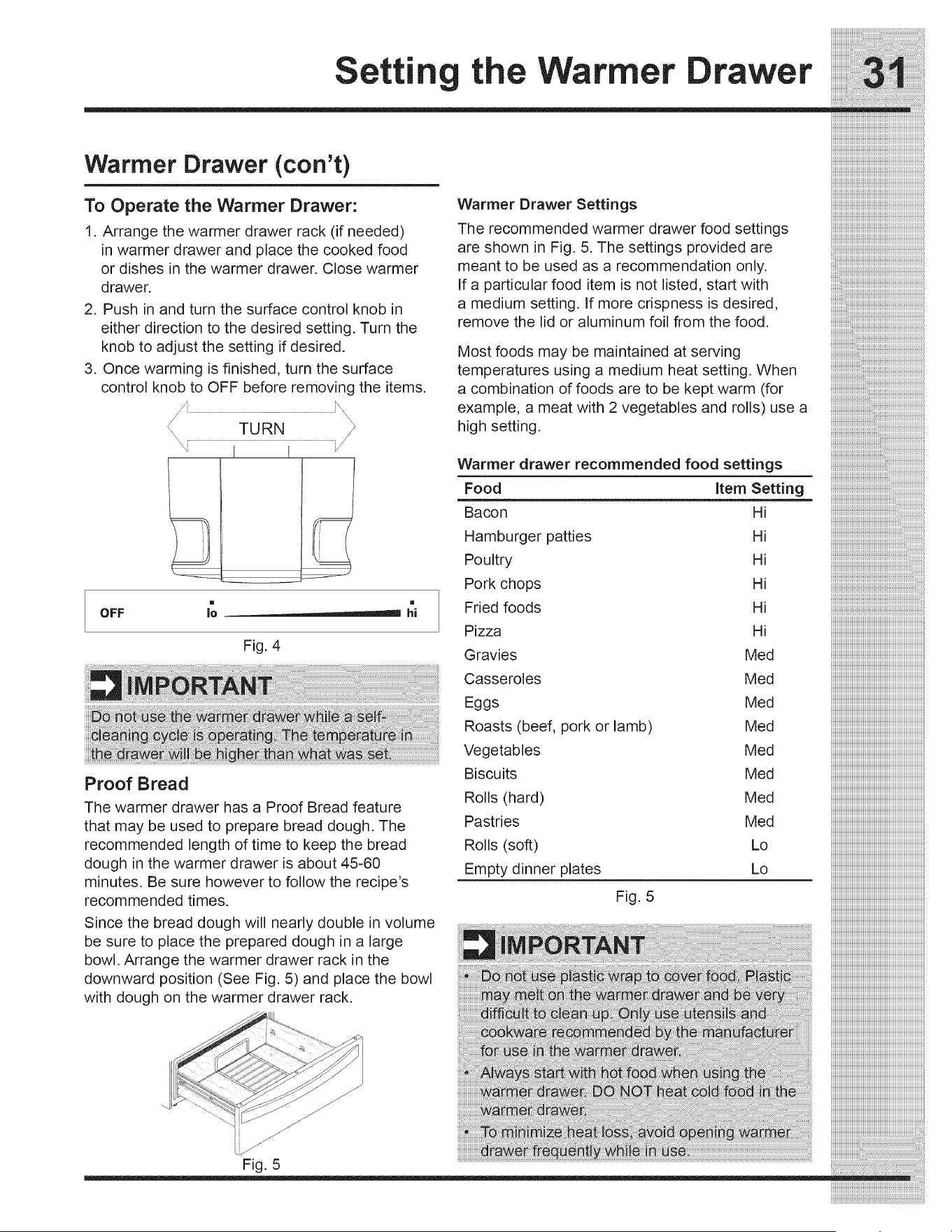
To Operate the Warmer Drawer: Warmer Drawer Settings
1. Arrange the warmer drawer rack (if needed) The recommended warmer drawer food settings
in warmer drawer and place the cooked food
or dishes in the warmer drawer. Close warmer
drawer.
2. Push in and turn the surface control knob in
either direction to the desired setting. Turn the
knob to adjust the setting if desired.
3. Once warming is finished, turn the surface
control knob to OFF before removing the items.
<, TURN
OFF
! []
Io ..... hi
Fig. 4
Proof Bread
The warmer drawer has a Proof Bread feature
that may be used to prepare bread dough. The
recommended length of time to keep the bread
dough in the warmer drawer is about 45=60
minutes. Be sure however to follow the recipe's
recommended times.
Since the bread dough will nearly double in volume
be sure to place the prepared dough in a large
bowl. Arrange the warmer drawer rack in the
downward position (See Fig. 5) and place the bowl
with dough on the warmer drawer rack.
Fig. 5
are shown in Fig. 5. The settings provided are
meant to be used as a recommendation only.
If a particular food item is not listed, start with
a medium setting. If more crispness is desired,
remove the lid or aluminum foil from the food.
iiiiiiiiiiiiiiiiiiiiiiiiiiiiiiiiiiiiiiiiiiiiiiiiiiiiiiiiiiiiiiiiiiiiiiiiiiiiiiii__
________________________________________________________________________________
__ ,_
__
iiiiiiiiiiiiiiiiiiiiiiiiiiiiiiiiiiiiiiiiiiiiiiiiiiiiiiiiiiiiiiiiiiiiiiiiiiiiiiii_
iiiiiiiiiiiiiiiiiiiiiiiiiiiiiiiiiiiiiiiiiiiiiiiiiiiiiiiiiiiiiiiiiiiiiiiiiiiiiiii__
________________________________________________________________________________
__ ,_
__
iiiiiiiiiiiiiiiiiiiiiiiiiiiiiiiiiiiiiiiiiiiiiiiiiiiiiiiiiiiiiiiiiiiiiiiiiiiiiiii_
iiiiiiiiiiiiiiiiiiiiiiiiiiiiiiiiiiiiiiiiiiiiiiiiiiiiiiiiiiiiiiiiiiiiiiiiiiiiiiii__
________________________________________________________________________________
__ ,_
__
iiiiiiiiiiiiiiiiiiiiiiiiiiiiiiiiiiiiiiiiiiiiiiiiiiiiiiiiiiiiiiiiiiiiiiiiiiiiiiii_
___________i:i_i_i_i_i_i_i_i_i_i_i_i_i_i_i_i_i_i_i_i_i_i_i_i_i_i_i_i_i_i_i_i_i_i_i_i_i_i_i_i_i_i_i_i_i_i_i_i_i_i_i_i_i_i_i_i_i_i_i_i_i_i_i_i_i_i_i_i_i_i_i
Most foods may be maintained at serving
temperatures using a medium heat setting. When
a combination of foods are to be kept warm (for
example, a meat with 2 vegetables and rolls) use a
high setting.
Warmer drawer recommended food settings
Food Item Setting
Bacon Hi
Hamburger patties Hi
Poultry Hi
Pork chops Hi
Fried foods Hi
Pizza Hi
Gravies Med
Casseroles Med
Eggs Med
Roasts (beef, pork or lamb) Med
Vegetables Med
Biscuits Med
Rolls (hard) Med
Pastries Med
Rolls (soft) Lo
Empty dinner plates Lo
Fig. 5

Settin Your Preferences
_i_i_i_i_i_i_i_i_i_i_i_i_i_i_i_i_i_i_i_i_i_i_i_i_i_i_i_i_i_i_i_i_i_i_i_i_i_i_i_i_i_i_i_i_i_i_i_i_i_i_i_i_i_i_i_i__!__________________________________________
iiiiiiiiiiiiiiiiiiiiiiiiiiiiiiiiiiiiiiiiiiiiiiiiiiiiiiiiiiiiiiiiiiiiiiiiiiiiiiiiiiiiiiiiiiiiiiiiiiiiiiiiiiiiiiiiiiiiiii_i!iiiiiiiiiiiiiiiiiiiiiiiiiiiiiiiiiiiiiiiiiiiiiiiiiiiii_
iiiiiiiiiiiiiiiiiiiiiiiiiiiiiiiiiiiiiiiiiiiiiiiiiiiiiiiiiiiiiiiiiiiiiiiiiiiiiiiiiiiiiiiiiiiiiiiiiiiiiiiiiiiiiiiiiiiiiiiiiiiii_i!iiiiiiiiiiiiiiiiiiiiiiiiiiiiiiiiiiiiiiiiiiii_
Setting clock
See the example below to set the clock to 1:30.
1. Press SET CLOCK.
2. Enter 1:30 to advance to 1:30.
3. Press START to accept or
press CANCEL to reject.
®
130
Setting 12 or 24 hour mode
The clock display mode allows you to choose
between 12 and 24 hour mode. The factory preset
clock display mode is 12 hour.
See the example below to change the default
mode to 24 hour.
,
,
,
Press and hold SET CLOCK
for 3 seconds until "12Hr dAy" Q
or "24Hr dAy" appear in the 3 sec
display.
Press SELF CLEAN to switch
self
between the 12 and 24 hour
clean
mode.
Press START to accept or
press CANCEL to reject.
4>
Changing between °F or °C
Your control has the ability to display and set
Fahrenheit or Celsius temperatures. The factory
preset temperature display is Fahrenheit.
See the example below to change the default
temperature display to Celsius.
,
,
Press and hold BROIL for 3
seconds until F or C appear in
I I
the display. 3 sec
Press SELF CLEAN to switch self
between the F and C mode. clean
3. Press START to accept or z/_
press CANCEL to reject.
V
Adjusting oven temperature
User preference offset
Your appliance has been factory calibrated and
tested to ensure an accurate baking temperature.
For the first few uses, follow your recipe times and
temperature recommendations carefully.
If you feel your oven is too hot or too cool from your
baking experience, the oven temperature may be
adjusted to your liking. The temperature may be
increased up to +35°F (+19°C) or decreased down
to =35°F (-19°C) from normal.
See the example below to increase the
temperature.
,
,
,
Press and hold BAKE for 3
seconds until UPO appear in
the display.
3 sec
Enter the desired temperature change using
the number pads. SELF CLEAN can be
pressed to lower the temperature.
Press START to accept or
press CANCEL to reject.
4>
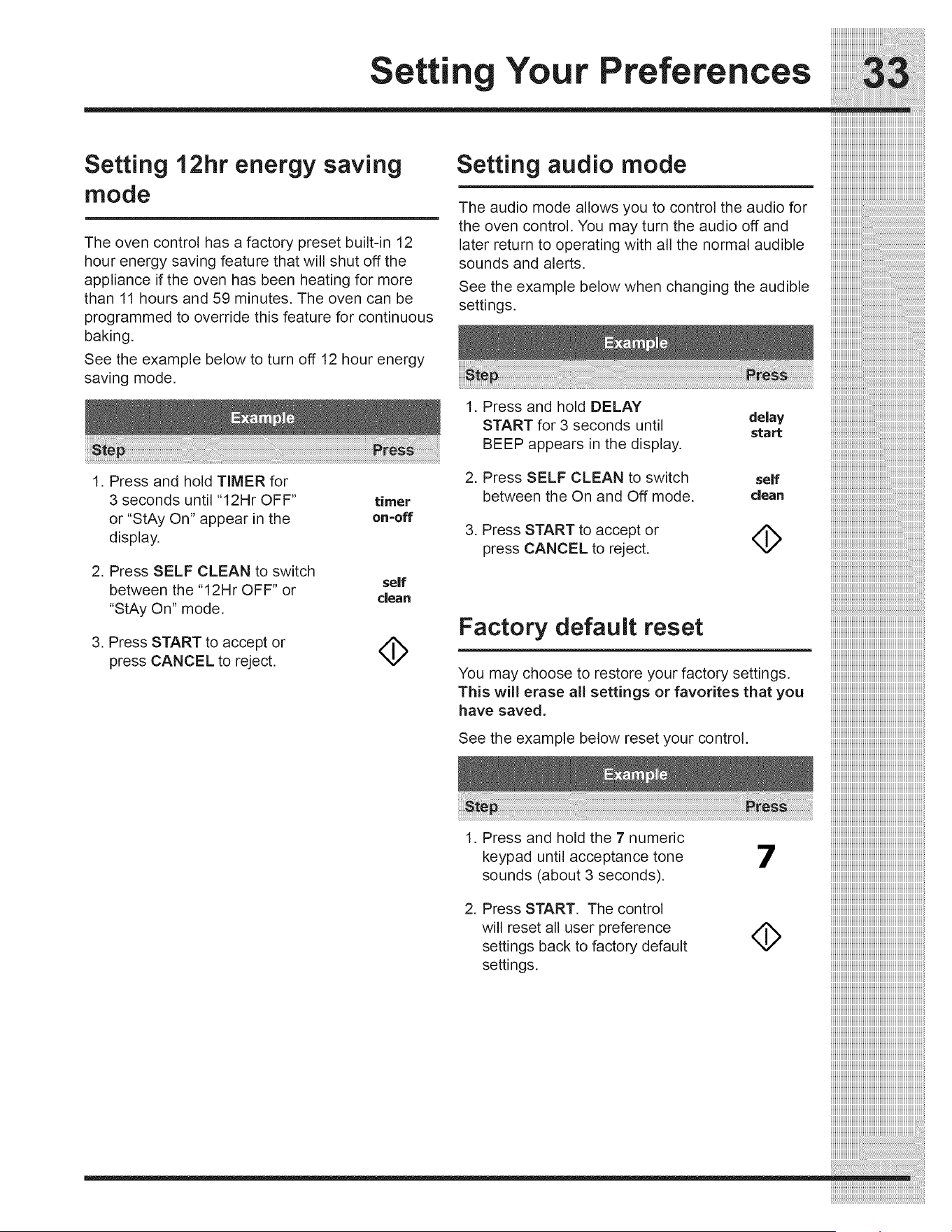
Setting 12hr energy saving
mode
The oven control has a factory preset built=in 12
hour energy saving feature that will shut off the
appliance if the oven has been heating for more
than 11 hours and 59 minutes, The oven can be
programmed to override this feature for continuous
baking.
See the example below to turn off 12 hour energy
saving mode.
1. Press and hold TIMER for
3 seconds until "12Hr OFF"
or "StAy On" appear in the
display,
2. Press SELF CLEAN to switch
between the "12Hr OFF" or
"StAy On" mode.
3. Press START to accept or
press CANCEL to reject.
timer
on=off
self
clean
Setting audio mode
The audio mode allows you to control the audio for
the oven control. You may turn the audio off and
later return to operating with all the normal audible
sounds and alerts.
See the example below when changing the audible
settings.
,
,
Press and hold DELAY
START for 3 seconds until
BEEP appears in the display.
delay
start
Press SELF CLEAN to switch self
between the On and Off mode. clean
3. Press START to accept or z'_
press CANCEL to reject.
V
Factory default reset
You may choose to restore your factory settings.
This will erase all settings or favorites that you
have saved.
See the example below reset your control.
Press and hold the 7 numeric
keypad until acceptance tone
sounds (about 3 seconds).
Press START. The control
will reset all user preference
settings back to factory default
settings,
7
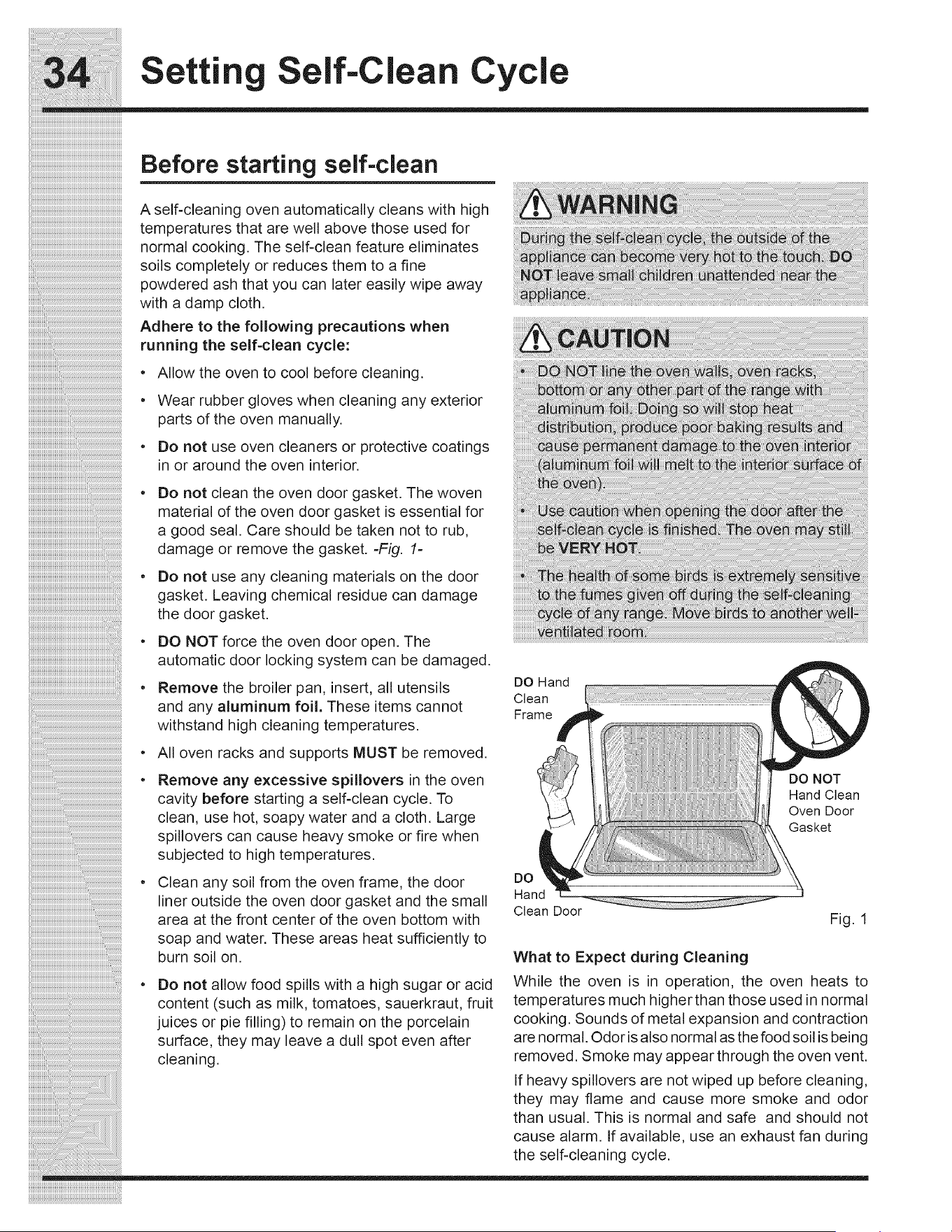
Settin
Self-Clean Cycle
Before starting self-clean
A self-cleaning oven automatically cleans with high
temperatures that are well above those used for
normal cooking. The self-clean feature eliminates
soils completely or reduces them to a fine
powdered ash that you can later easily wipe away
with a damp cloth.
Adhere to the following precautions when
running the self=clean cycle:
Allow the oven to cool before cleaning.
• Wear rubber gloves when cleaning any exterior
parts of the oven manually.
• Do not use oven cleaners or protective coatings
in or around the oven interior.
Do not clean the oven door gasket. The woven
material of the oven door gasket is essential for
a good seal. Care should be taken not to rub,
damage or remove the gasket. -Fig. 1=
Do not use any cleaning materials on the door
gasket. Leaving chemical residue can damage
the door gasket.
DO NOT force the oven door open. The
automatic door locking system can be damaged.
Remove the broiler pan, insert, all utensils
and any aluminum foil. These items cannot
withstand high cleaning temperatures.
All oven racks and supports MUST be removed.
Remove any excessive spillovers in the oven
cavity before starting a self-clean cycle. To
clean, use hot, soapy water and a cloth. Large
spillovers can cause heavy smoke or fire when
subjected to high temperatures.
Clean any soil from the oven frame, the door
liner outside the oven door gasket and the small
area at the front center of the oven bottom with
soap and water. These areas heat sufficiently to
burn soil on.
Do not allow food spills with a high sugar or acid
content (such as milk, tomatoes, sauerkraut, fruit
juices or pie filling) to remain on the porcelain
surface, they may leave a dull spot even after
cleaning.
DO Hand
Clean
Frame
DO NOT
Hand Clean
Oven Door
Gasket
DO
Hand
Clean Door
Fig. 1
What to Expect during Cleaning
While the oven is in operation, the oven heats to
temperatures much higher than those used in normal
cooking. Sounds of metal expansion and contraction
are normal. Odor is also normal as the food soil is being
removed. Smoke may appear through the oven vent.
If heavy spillovers are not wiped up before cleaning,
they may flame and cause more smoke and odor
than usual. This is normal and safe and should not
cause alarm. If available, use an exhaust fan during
the self-cleaning cycle.
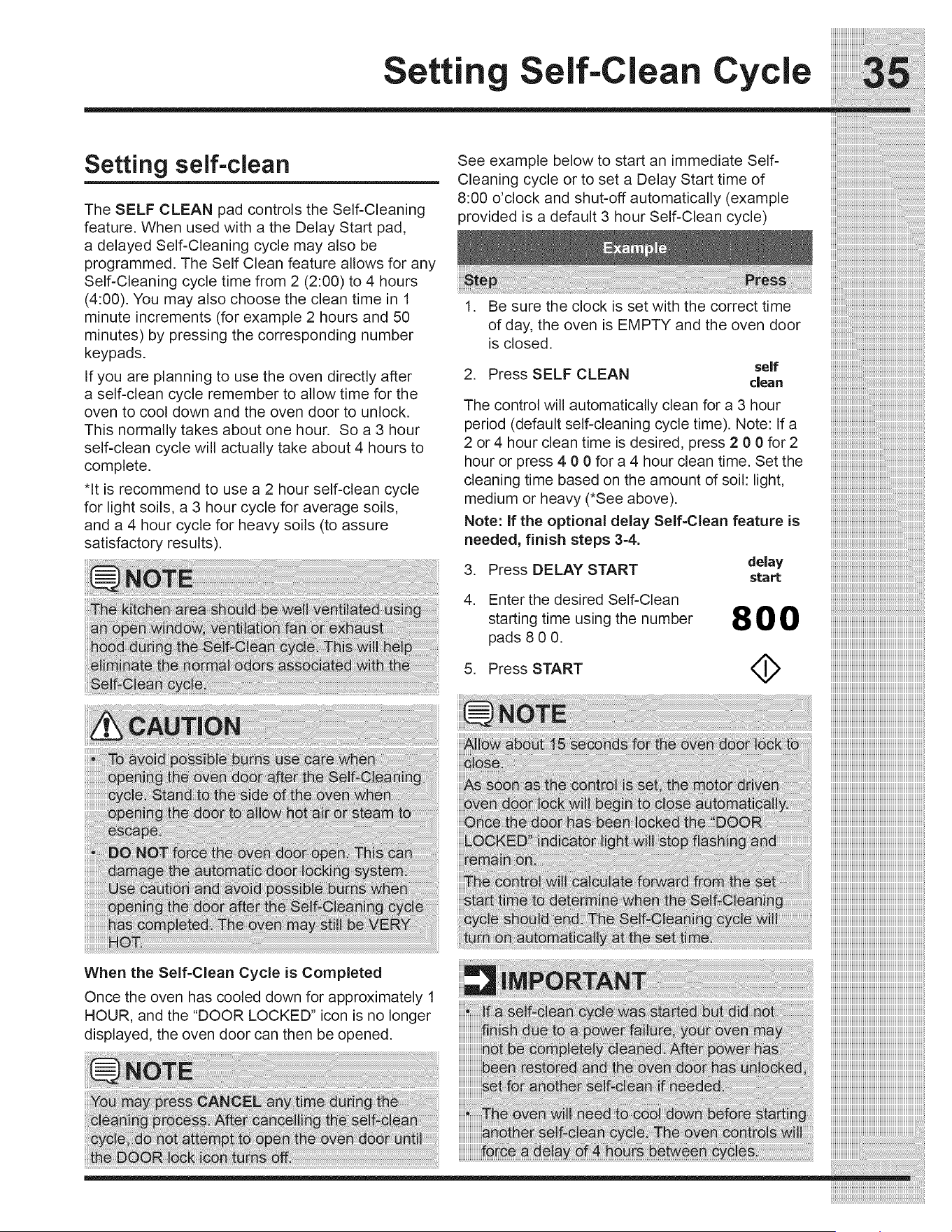
Settin
Self-Clean Cycle
Setting self-clean
The SELF CLEAN pad controls the Self-Cleaning
feature. When used with a the Delay Start pad,
a delayed Self-Cleaning cycle may also be
programmed. The Self Clean feature allows for any
Self=Cleaning cycle time from 2 (2:00) to 4 hours
(4:00). You may also choose the clean time in 1
minute increments (for example 2 hours and 50
minutes) by pressing the corresponding number
keypads.
If you are planning to use the oven directly after
a self=clean cycle remember to allow time for the
oven to cool down and the oven door to unlock.
This normally takes about one hour. So a 3 hour
self-clean cycle will actually take about 4 hours to
complete.
*It is recommend to use a 2 hour self=clean cycle
for light soils, a 3 hour cycle for average soils,
and a 4 hour cycle for heavy soils (to assure
satisfactory results).
See example below to start an immediate Self-
Cleaning cycle or to set a Delay Start time of
8:00 o'clock and shut-off automatically (example
provided is a default 3 hour Self-Clean cycle)
1. Be sure the clock is set with the correct time
of day, the oven is EMPTY and the oven door
is closed.
2. Press SELF CLEAN self
dean
The control will automatically clean for a 3 hour
period (default self-cleaning cycle time). Note: If a
2 or 4 hour clean time is desired, press 2 0 0 for 2
hour or press 4 0 0 for a 4 hour clean time. Set the
cleaning time based on the amount of soil: light,
medium or heavy (*See above).
Note: If the optional delay Self-Clean feature is
needed, finish steps 3-4.
3. Press DELAY START delay
start
, Enter the desired Self-Clean
starting time using the number
pads 8 0 0.
5. Press START
800
4>
_:_iiiiiiiiiiiiiiiiiiiiiiiiiiiiiiiiiiiiiiiiiiiiiiiiiiiiiiiiiiiiiiiiiiiiiiiiiiiiiiiiiiiiiiiiiiiiiiiiiiiiiiiiiii_
When the Self-Clean Cycle is Completed
Once the oven has cooled down for approximately 1
HOUR, and the "DOOR LOCKED" icon is no longer
displayed, the oven door can then be opened.
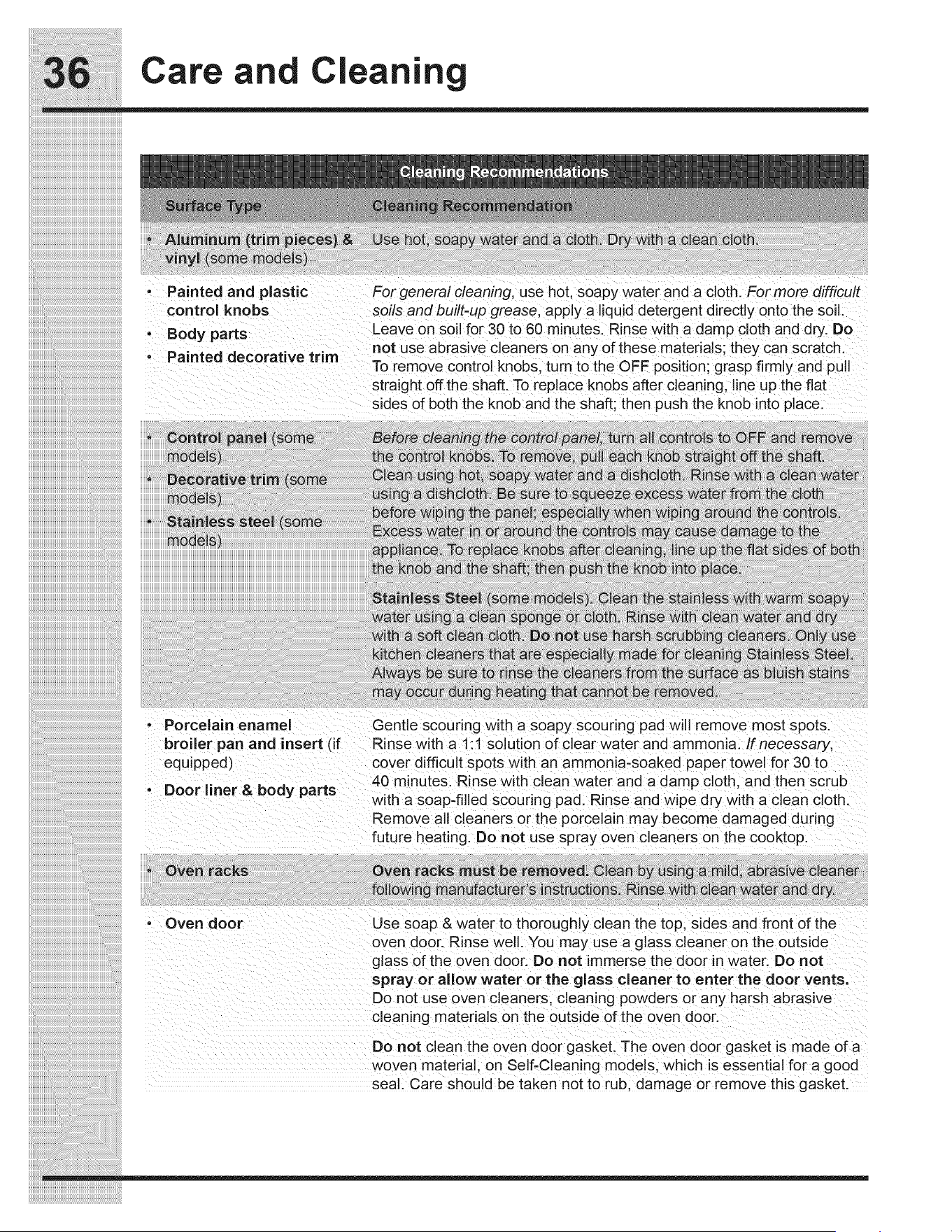
Care an Cleani
' Painted and plastic For generaic!eaning, use hot, soapY water and a €lOthl For more difficUlt
control knobs soilsand built-up grease, apply a liquid detergent directly onto the s0il:
arts LeaVe on so for30 to60 m nutes Rnsewth a damp coth and dry Do
YP
2 : : . , :: , : not use abrasive cleaners on any of these materials they can scratch.
P'alntea aecoratlve trim
To remove control knobs, turn to the OFF pos!t_on; grasp firmly and pull
Straight off the shaft. To replace knobs after cleaning; line Up the flat
sides of both the knob and the shaft; then push the kn0b into place:
, Porcelain enamel Gent ¢ " pysc0unng pad will remove most sPots:
broiler pan and insert (if Rinse with a1:1 so ution of clear water and ammonia: If necessary,
equipped) cover difficult spots with an ammonia:soaked paper towel for 30 to
:: .. : : : 40 minutes: Rinse with clean water and a damp cloth, and then scrub
uoor liner & Docly parts
with a soap.fil ed scouring pad: Rinse and wipe dry with a clean cloth.
cleaners 0r ttle p0rcelain may bec0me damaged during
future heating: Do not use spray oven cleaners on the cooktop:
• oven door Use s0ap &water t0thor0Ughly cleanthe top, s!des and fr0nt 0fthe
oven d00r. Rinse Well!You may use a glass Cleaner on the outs
glass Of the 0yen dooi: Do not immerse the door in Water;Do not
spray or allow water orthe glass cleaner to enter the door ventsl
Do not use 0Yen Cieaner% cieaning powders 0F any harsh abrasive
Cleaning materials on the OutSide of the oven do0r:
Do not ciean the oven d00r gaskeL The oven d0or gasket is made of a
woven material; on Self-Cleaning m0delsl which is essential for a good
sea!i Care should be taken not to rub, damage Or remove this gasket,
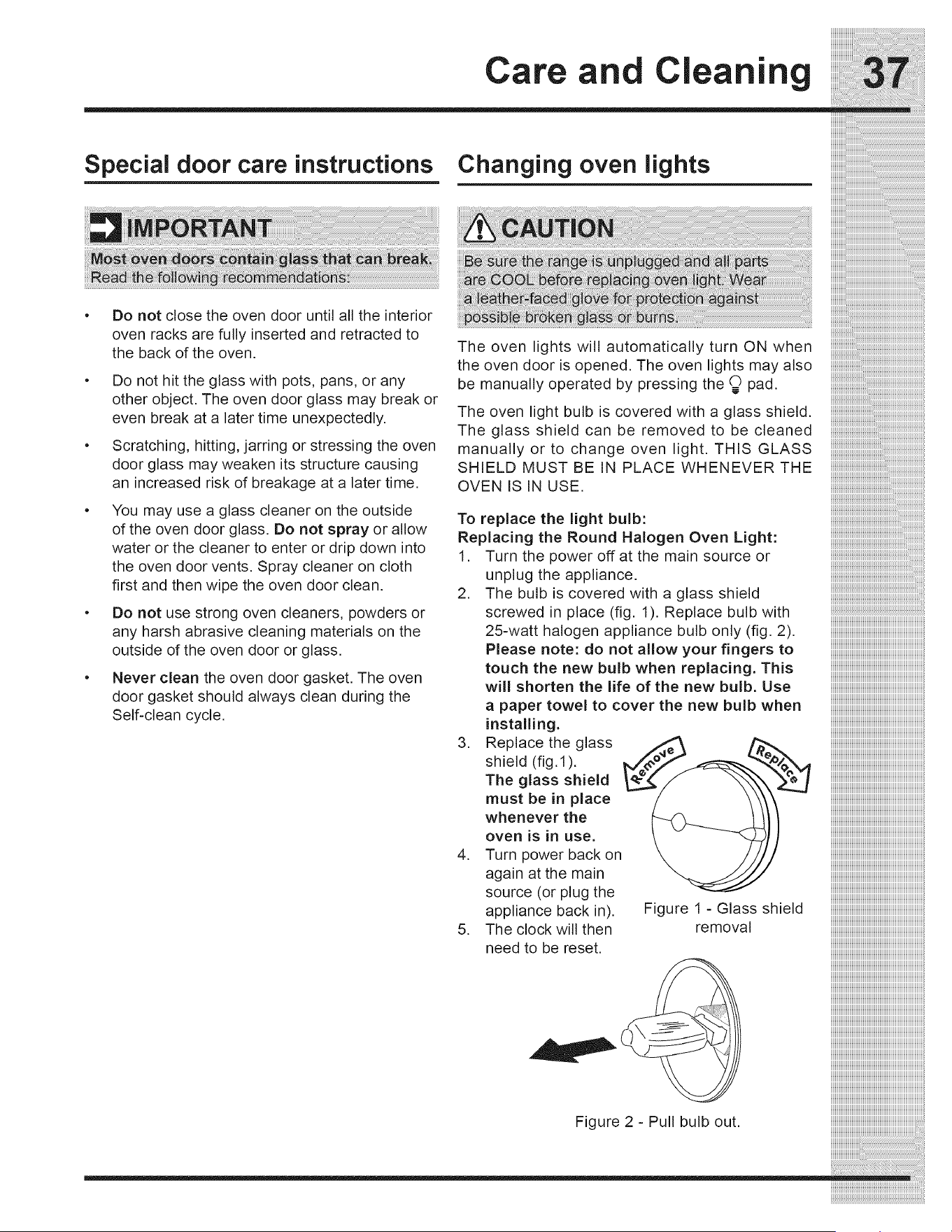
Care and Cleaning
Special door care instructions Changing oven lights
Do not close the oven door until all the interior
oven racks are fully inserted and retracted to
the back of the oven.
Do not hit the glass with pots, pans, or any
other object. The oven door glass may break or
even break at a later time unexpectedly.
Scratching, hitting, jarring or stressing the oven
door glass may weaken its structure causing
an increased risk of breakage at a later time.
You may use a glass cleaner on the outside
of the oven door glass. Do not spray or allow
water or the cleaner to enter or drip down into
the oven door vents. Spray cleaner on cloth
first and then wipe the oven door clean.
Do not use strong oven cleaners, powders or
any harsh abrasive cleaning materials on the
outside of the oven door or glass.
Never clean the oven door gasket. The oven
door gasket should always clean during the
Self-clean cycle.
The oven lights will automatically turn ON when
the oven door is opened. The oven lights may also
be manually operated by pressing the @ pad.
The oven light bulb is covered with a glass shield.
The glass shield can be removed to be cleaned
manually or to change oven light. THIS GLASS
SHIELD MUST BE IN PLACE WHENEVER THE
OVEN IS IN USE.
To replace the light bulb:
Replacing the Round Halogen Oven Light:
1. Turn the power off at the main source or
.
.
.
.
unplug the appliance.
The bulb is covered with a glass shield
screwed in place (fig. 1). Replace bulb with
25-watt halogen appliance bulb only (fig. 2).
Please note: do not allow your fingers to
touch the new bulb when replacing. This
will shorten the life of the new bulb. Use
a paper towel to cover the new bulb when
installing.
Replace the glass
shield (fig.1).
The glass shield
must be in place
whenever the
oven is in use.
Turn power back on
again at the main
source (or plug the
appliance back in). Figure 1 - Glass shield
The clock will then removal
need to be reset.
Figure 2 - Pull bulb out.
iiiiiiiiiiiiiiiiiiiiiiiiiiiiiiiiiiiiiiiiiiiiiiiiiiiiiiiiiiiiiiiiiiiiiiiiiiiiiiiii
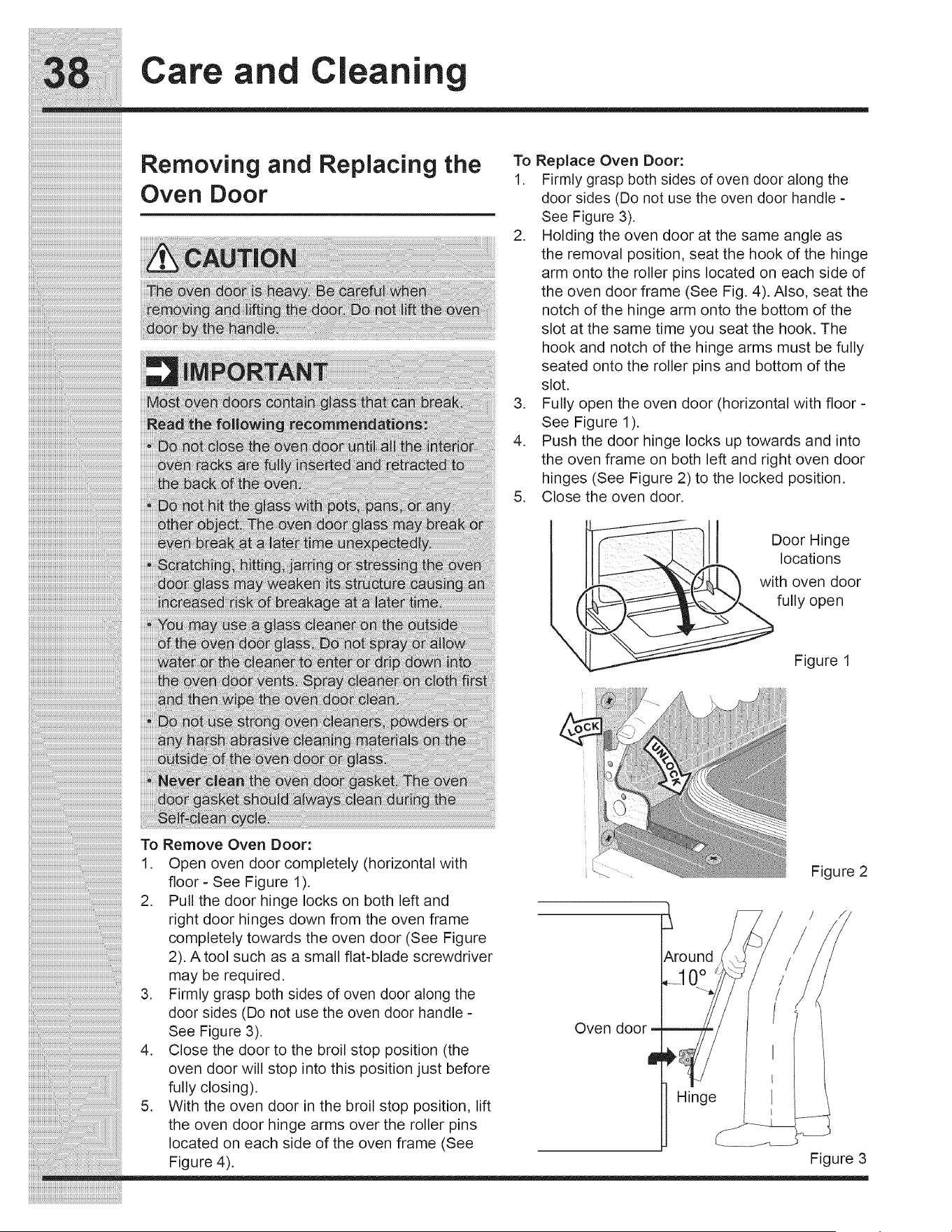
Care an Cleani
Removing and Replacing the
Oven Door
To Replace Oven Door:
1. Firmly grasp both sides of oven door along the
door sides (Do not use the oven door handle -
See Figure 3).
2. Holding the oven door at the same angle as
the removal position, seat the hook of the hinge
arm onto the roller pins located on each side of
the oven door frame (See Fig. 4). Also, seat the
notch of the hinge arm onto the bottom of the
slot at the same time you seat the hook. The
hook and notch of the hinge arms must be fully
seated onto the roller pins and bottom of the
slot.
3. Fully open the oven door (horizontal with floor -
See Figure 1).
4. Push the door hinge locks up towards and into
the oven frame on both left and right oven door
hinges (See Figure 2) to the locked position.
5. Close the oven door.
\
Door Hinge
locations
with oven door
fully open
Figure 1
_i_i_i_i_i_i_i_i_i_i_i_i_i_i_i_i_i_i_i_i_i_i_i_i_i_i_i_i_i_i_i_i_i_i_i_i_i_i_i_i_i_i_i_i_i_i_i_i_i_i_i_i_i_i_i_i__!__________________________________________
iiiiiiiiiiiiiiiiiiiiiiiiiiiiiiiiiiiiiiiiiiiiiiiiiiiiiiiiiiiiiiiiiiiiiiiiiiiiiiiiiiiiiiiiiiiiiiiiiiiiiiiiiiiiiiiiiiiiiii_i!iiiiiiiiiiiiiiiiiiiiiiiiiiiiiiiiiiiiiiiiiiiiiiiiiiiii_
iiiiiiiiiiiiiiiiiiiiiiiiiiiiiiiiiiiiiiiiiiiiiiiiiiiiiiiiiiiiiiiiiiiiiiiiiiiiiiiiiiiiiiiiiiiiiiiiiiiiiiiiiiiiiiiiiiiiiiiiiiiii_i!iiiiiiiiiiiiiiiiiiiiiiiiiiiiiiiiiiiiiiiiiiii_
To Remove Oven Door:
1. Open oven door completely (horizontal with
floor = See Figure 1).
2. Pull the door hinge locks on both left and
right door hinges down from the oven frame
completely towards the oven door (See Figure
2). A tool such as a small flat-blade screwdriver
may be required.
3. Firmly grasp both sides of oven door along the
door sides (Do not use the oven door handle -
See Figure 3).
4. Close the door to the broil stop position (the
oven door will stop into this position just before
fully closing).
5. With the oven door in the broil stop position, lift
the oven door hinge arms over the roller pins
located on each side of the oven frame (See
Figure 4).
Oven door
Figure 2
Figure 3
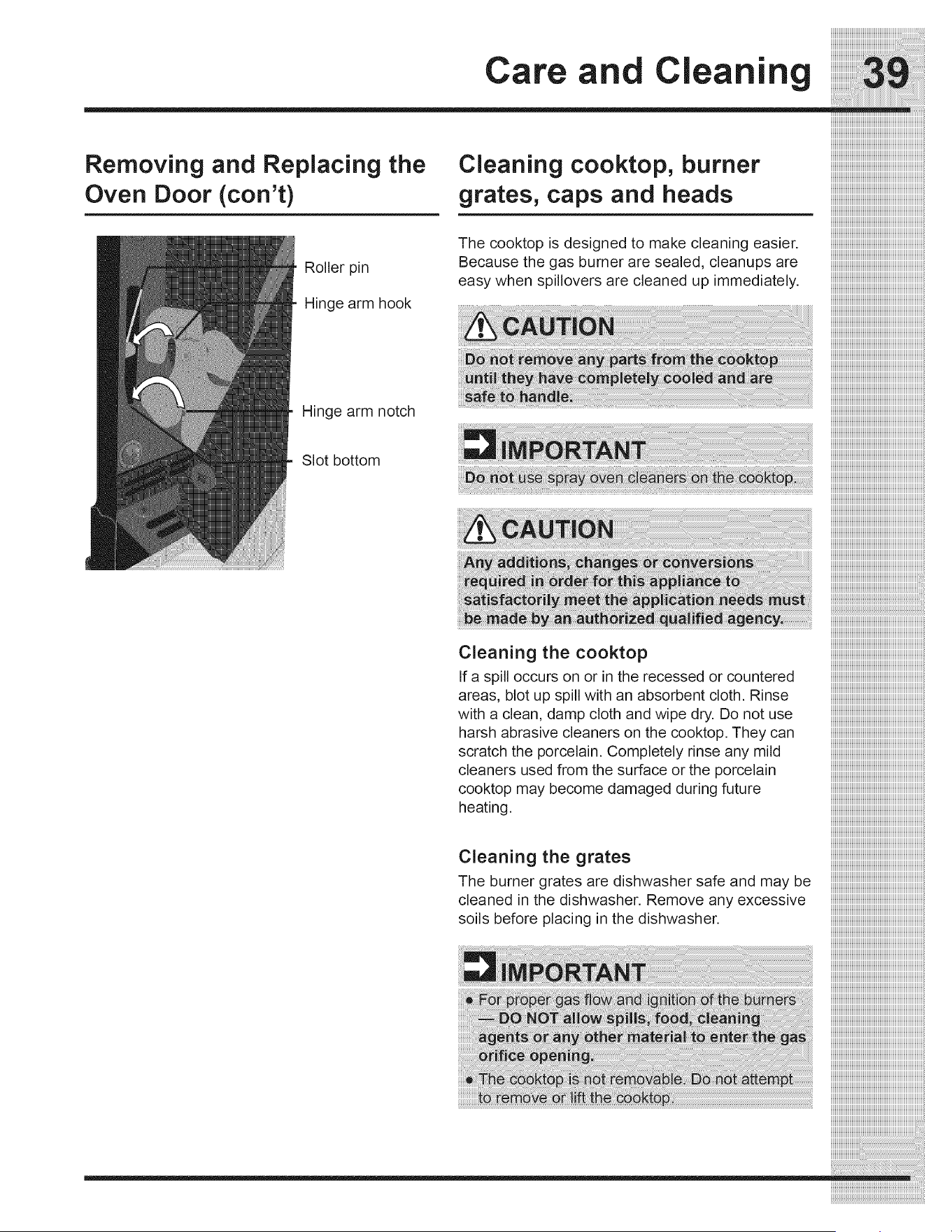
Care and Cleaning
Removing and Replacing the
Oven Door (con't)
Cleaning cooktop, burner
grates, caps and heads
Roller pin
Hinge arm hook
The cooktop is designed to make cleaning easier.
Because the gas burner are sealed, cleanups are
easy when spillovers are cleaned up immediately.
Hinge arm notch
Slot bottom
IIIIIIIIIIIIIIIIIIIIIIIIIIIIIIIIIIIIIIIIIIIIIIIIIIIIIIIIIIIIIIIIIIIIIIIIIIIIIIIIIII
Cleaning the cooktop
If a spill occurs on or in the recessed or countered
areas, blot up spill with an absorbent cloth. Rinse
with a clean, damp cloth and wipe dry. Do not use
harsh abrasive cleaners on the cooktop. They can
scratch the porcelain. Completely rinse any mild
cleaners used from the surface or the porcelain
cooktop may become damaged during future
heating.
Cleaning the grates
The burner grates are dishwasher safe and may be
cleaned in the dishwasher. Remove any excessive
soils before placing in the dishwasher.
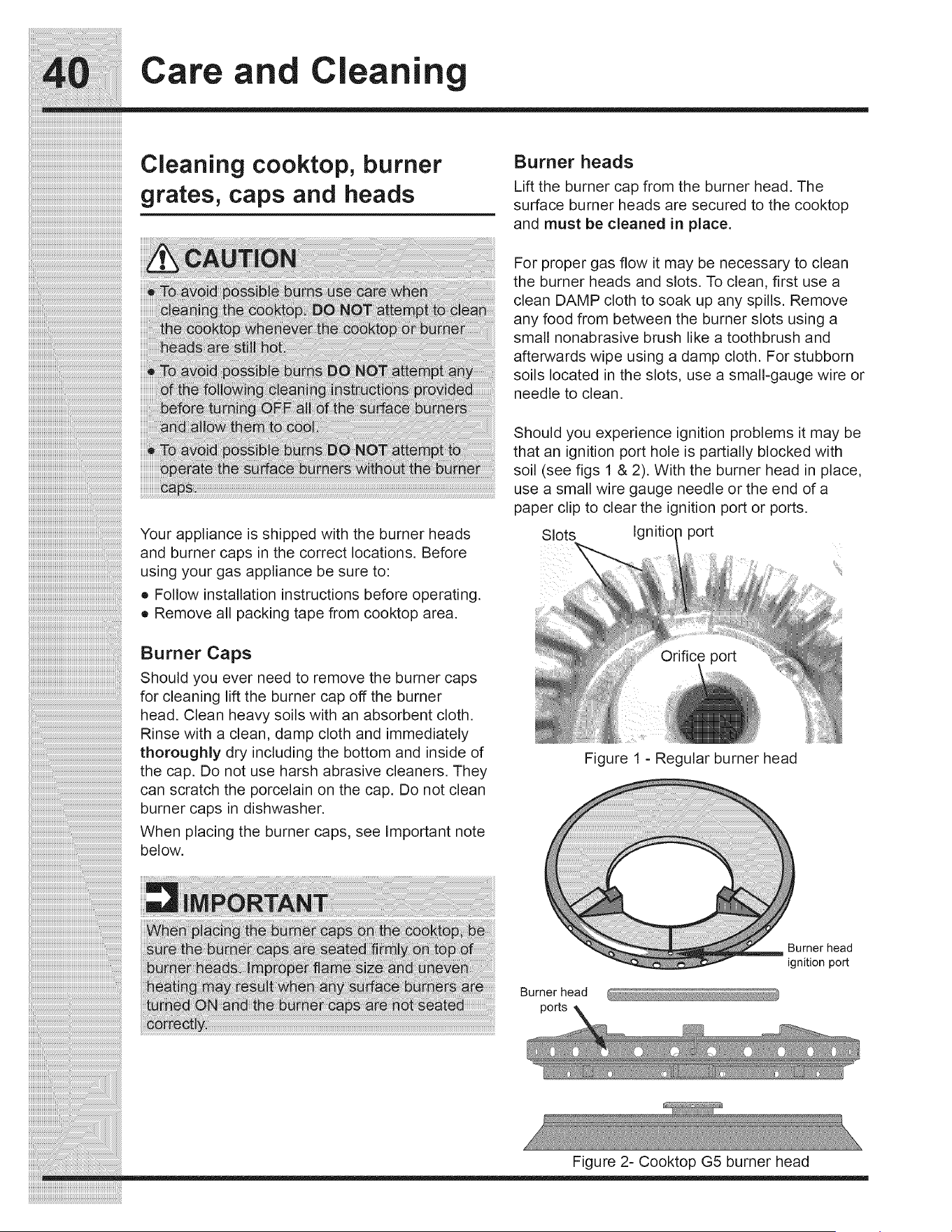
Care an Cleani
Cleaning cooktop, burner
grates, caps and heads
Your appliance is shipped with the burner heads
and burner caps in the correct locations. Before
using your gas appliance be sure to:
o Follow installation instructions before operating.
Remove all packing tape from cooktop area.
Burner Caps
Should you ever need to remove the burner caps
for cleaning lift the burner cap off the burner
head. Clean heavy soils with an absorbent cloth.
Rinse with a clean, damp cloth and immediately
thoroughly dry including the bottom and inside of
the cap. Do not use harsh abrasive cleaners. They
can scratch the porcelain on the cap. Do not clean
burner caps in dishwasher.
When placing the burner caps, see Important note
below.
Burner heads
Lift the burner cap from the burner head. The
surface burner heads are secured to the cooktop
and must be cleaned in place.
For proper gas flow it may be necessary to clean
the burner heads and slots. To clean, first use a
clean DAMP cloth to soak up any spills. Remove
any food from between the burner slots using a
small nonabrasive brush like a toothbrush and
afterwards wipe using a damp cloth. For stubborn
soils located in the slots, use a small-gauge wire or
needle to clean.
Should you experience ignition problems it may be
that an ignition port hole is partially blocked with
soil (see figs 1 & 2). With the burner head in place,
use a small wire gauge needle or the end of a
paper clip to clear the ignition port or ports.
Slots Ignitio port
Figure 1 - Regular burner head
Burner head
ports
Burner head
ignition port
Figure 2- Cooktop G5 burner head
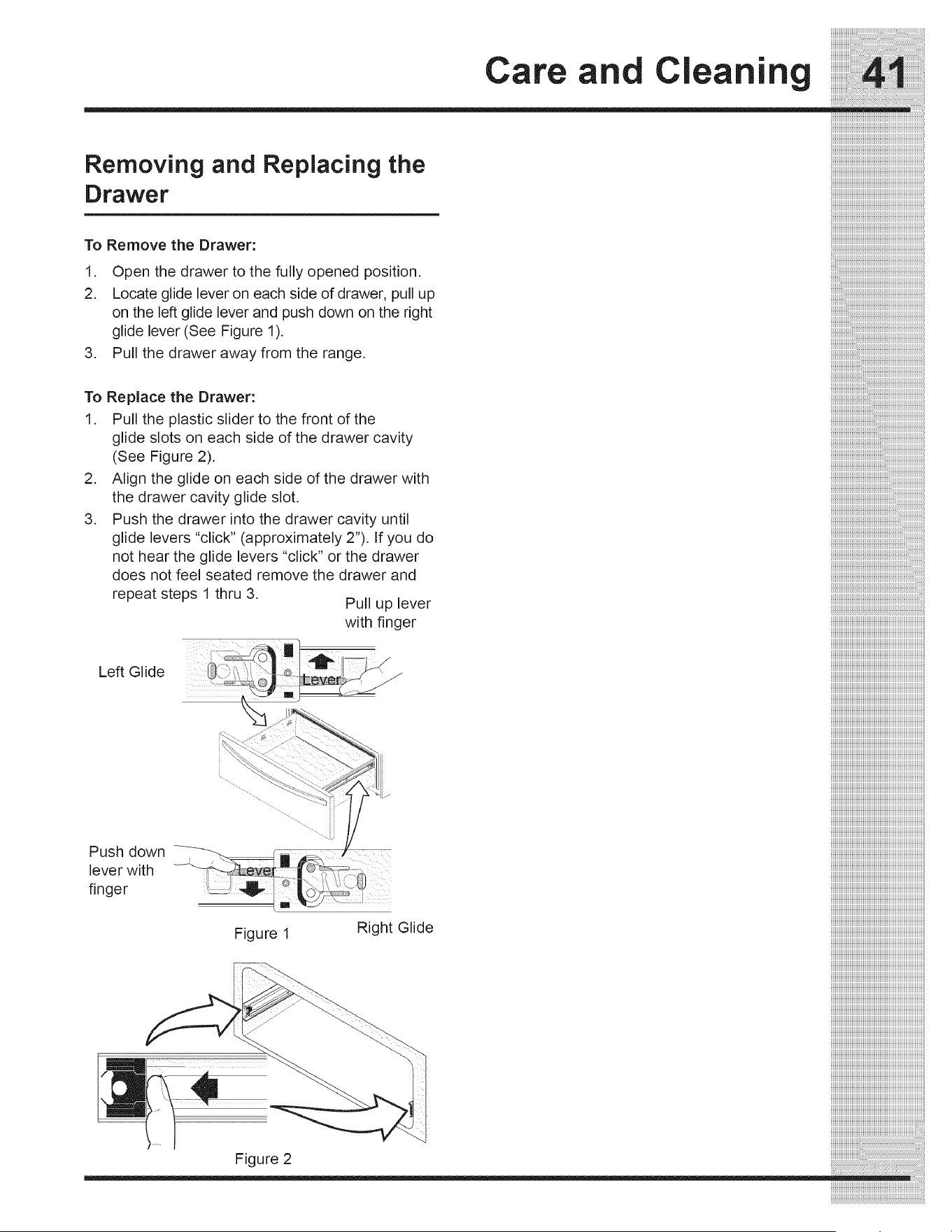
Care and Cleaning
Removing and Replacing the
Drawer
To Remove the Drawer:
1. Open the drawer to the fully opened position.
2. Locate glide lever on each side of drawer, pull up
on the left glide lever and push down on the right
glide lever (See Figure 1).
3. Pull the drawer away from the range.
___________i:i_i_i_i_i_i_i_i_i_i_i_i_i_i_i_i_i_i_i_i_i_i_i_i_i_i_i_i_i_i_i_i_i_i_i_i_i_i_i_i_i_i_i_i_i_i_i_i_i_i_i_i_i_i_i_i_i_i_i_i_i_i_i_i_i_i_i_i_i_i_i
_:_iiiiiiiiiiiiiiiiiiiiiiiiiiiiiiiiiiiiiiiiiiiiiiiiiiiiiiiiiiiiiiiiiiiiiiiiiiiiiiiiiiiiiiiiiiiiiiiiiiiiiiiiiii_
To Replace the Drawer:
1. Pull the plastic slider to the front of the
glide slots on each side of the drawer cavity
(See Figure 2).
2. Align the glide on each side of the drawer with
the drawer cavity glide slot.
3. Push the drawer into the drawer cavity until
glide levers "click" (approximately 2"). If you do
not hear the glide levers "click" or the drawer
does not feel seated remove the drawer and
repeat steps 1 thru 3.
Pull up lever
with finger
Left Glide
Push down
lever with
finger
Figure 1
Right Glide
Figure 2
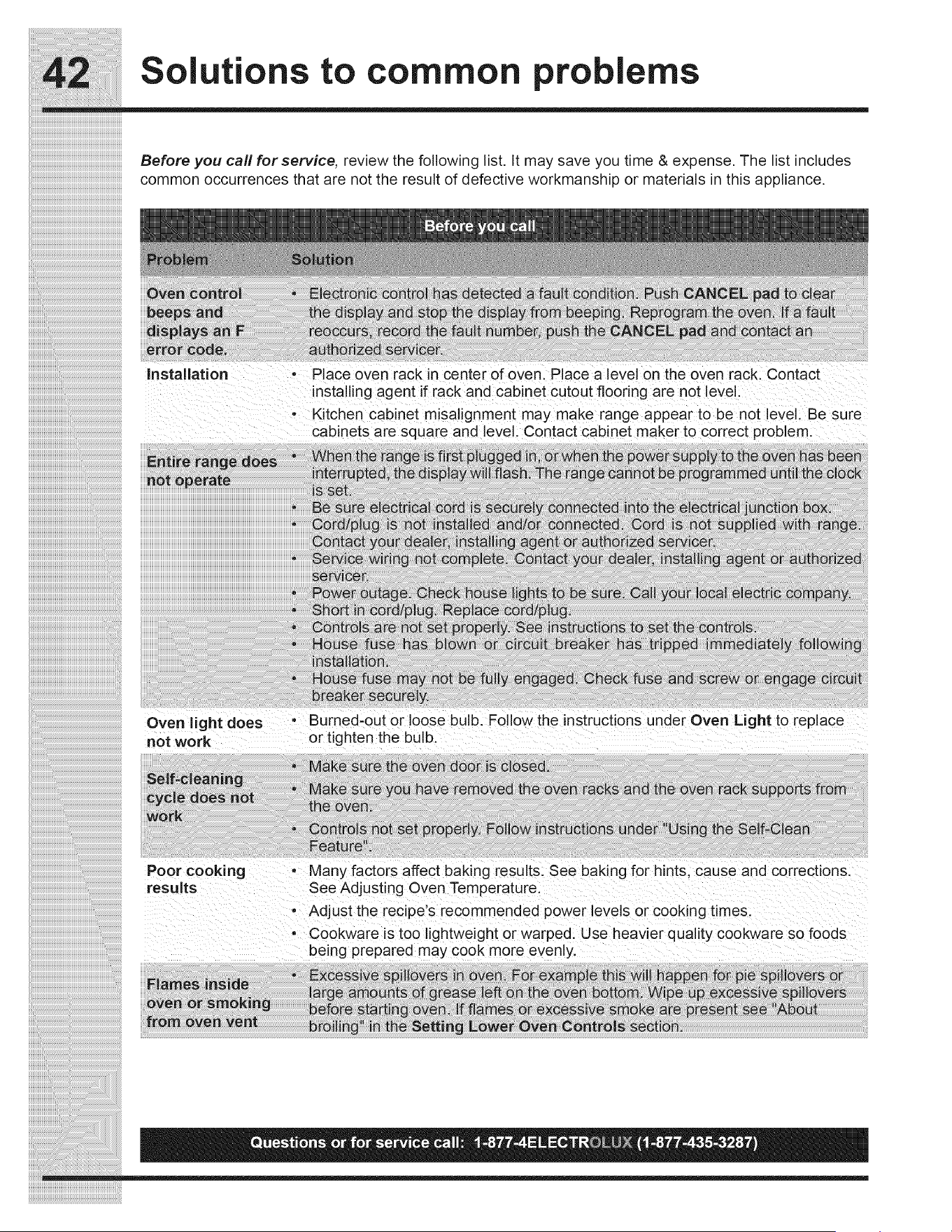
Solutions to common pro
ms
iiiiiiiiiiiiiiiiiiiiiiiiiiiiiiiiiiiiiiiiiiiiiiiiiiiiiiiiiiiiiiiiiiiiiiiiiiiiiii
Before you call for service, review the following list. It may save you time & expense. The list includes
common occurrences that are not the result of defective workmanship or materials in this appliance.
Installation - Place oven rack in Center of oven. Place a level 0n the oVen rack:Contact
insta!ling agent if rack and Cab net cutout flooring are n0t level!
-Kitchen cabinet misa! gnment may make range appear to be not level; Be sure
cabinets are square and leve!i Contact cabinet maker to correct problem:
oven light does" Burned:out or loose bulb: Fo!IOWthe instructions under OVen Light to replace
network .... or tighten the bulb_
i
iiliiii ii!i!! ii iiii! iiiiiii! il i iii i! ii !iii i ii iii !ii i i !! i iii i i ii i!! iii !!i i ill iliiliiiiliii i
rPe°s°ur_°king Ctnb._ekimpgrretu;_iSee baking for hintSl CaUse and corrections !
Adjust the recipe,s recommended Power levels or cooking times
' COokware is too ightweight or warpe& use heaVier quality cookware so foOdS
being prepared may cook more evenly,
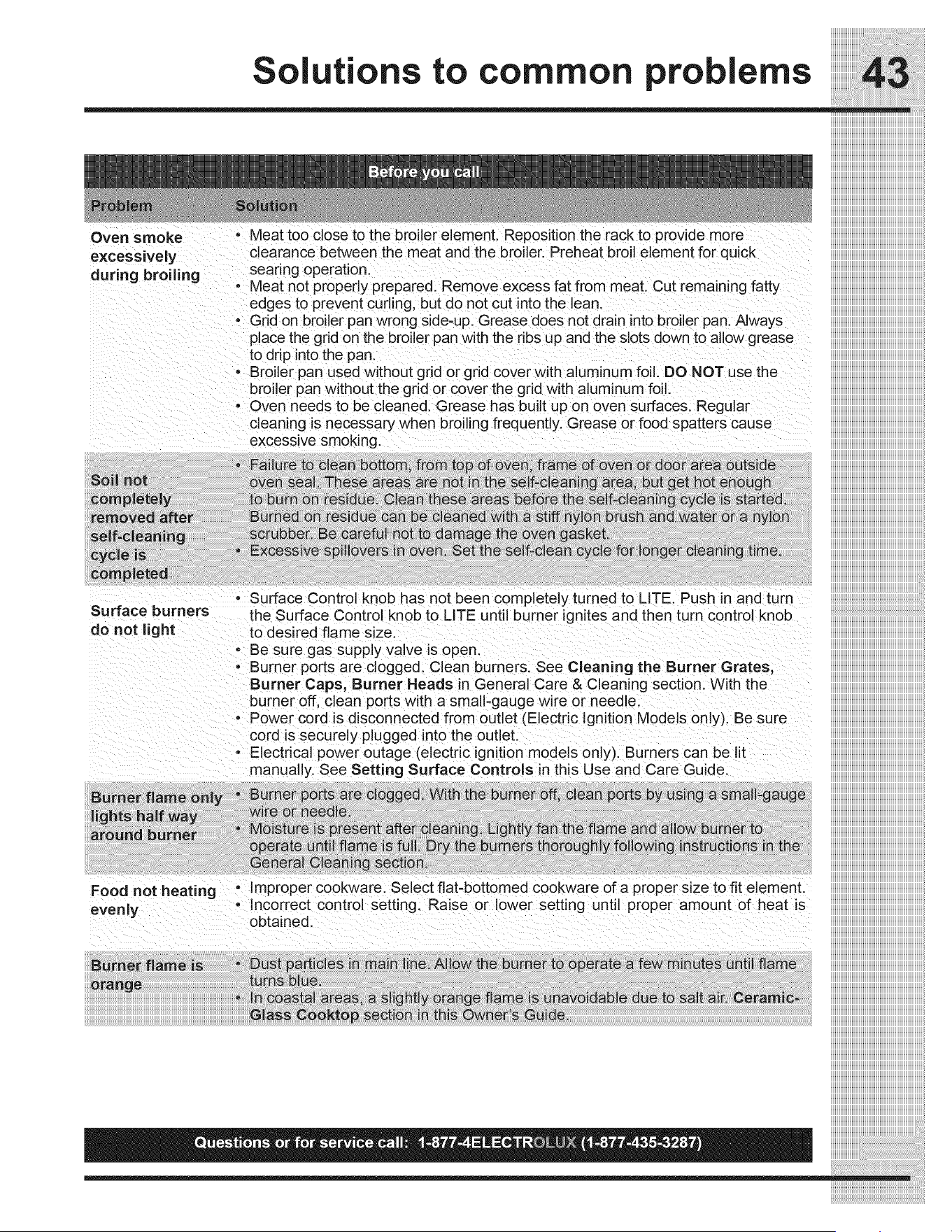
cordissecurelypluggedint0theoutlet:
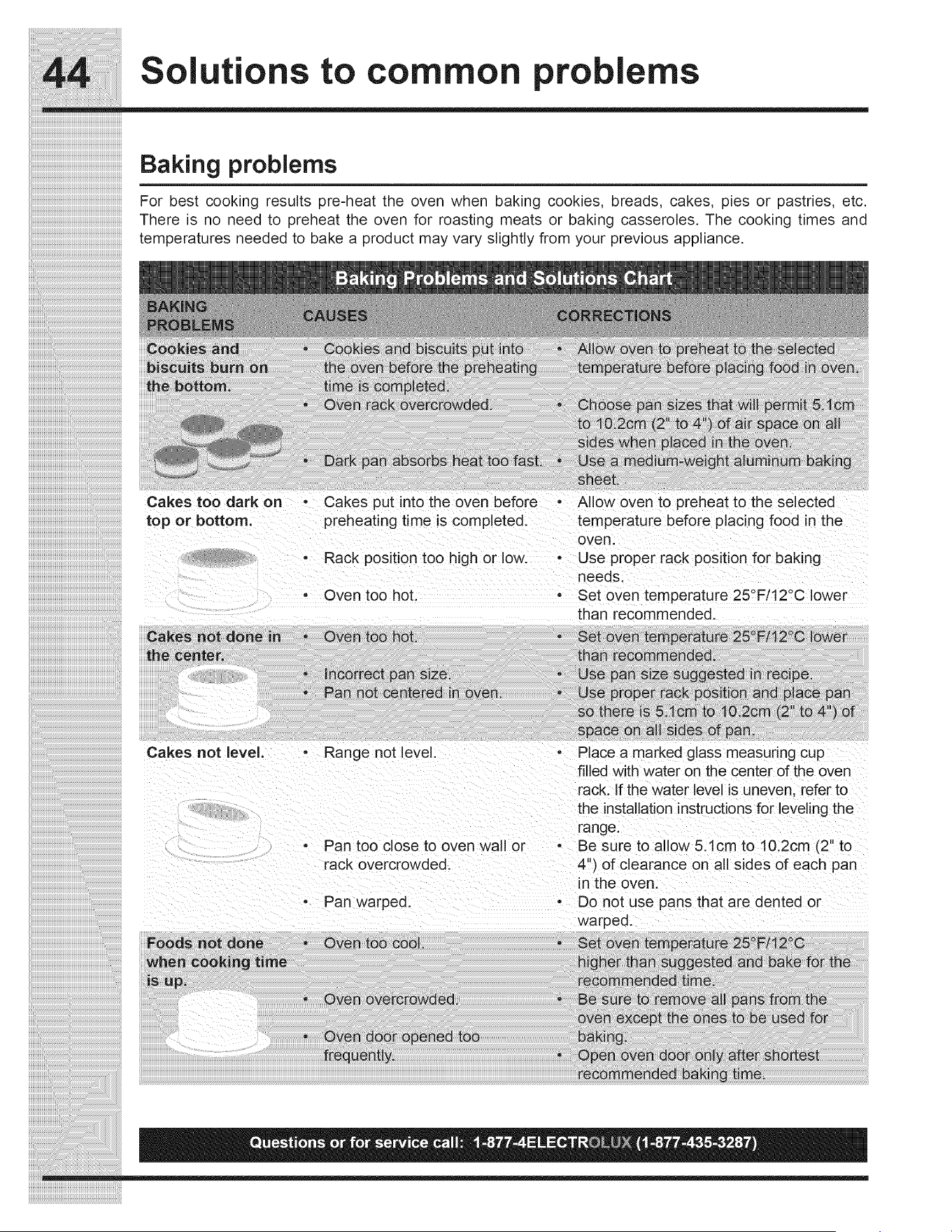
Solutions to common pro
ms
iiiiiiiiiiiiiiiiiiiiiiiiiiiiiiiiiiiiiiiiiiiiiiiiiiiiiiiiiiiiiiiiiiiiiiiiiiiiiii
For best cooking results pre-heat the oven when baking cookies, breads, cakes, pies or pastries, etc.
There is no need to preheat the oven for roasting meats or baking casseroles. The cooking times and
temperatures needed to bake a product mayvary slightlyfrom your previous appliance.
than recommended.
Cakes not level. • Range not level.
• Pan warped.
• Pan too close to oven wall or
rack overcrowded.
• Place a marked glass measuring cup
filled with water on the center of the oven
rack. If the water level is uneven, refer to
the installationinstructionsfor leveling the
range.
• Be sure to allow 5.1cm to 10.2cm (2" to
4") of clearance on all sides of each pan
in the oven.
• Do not use pans that are dented or
warped.

Notes
i_i_i_i_i_i_iiiiiiiiiiiiiiiiiiiiiiiiiiiiiiiiiiiiiiiiiiiiiiiiiiiiiiiiiiiiiiiiiiiiiiiiiiiiiiiiiiiiiiiiiiiiiiiiiiiiiiiiiiiiiiiiiiiiiiiiiiiiiiiiiiiiiiiiiiiiiiiiiiiiiiiii
_i_i_i_i_i_i_i_i_i_i_i_i_i_i_i_i_i_i_i_i_i_i_i_i_i_i_i_i_i_i_i_i_i_i_i_i_i_i_i_i_i_i_i_i_i_i_i_i_i_i_i_i_i_i_i_i_i_i_i_i_i_i_i_i_i_i_i_i_i_i_i_i

ores
_i_i_i_i_i_i_i_i_i_i_i_i_i_i_i_i_i_i_i_i_i_i_i_i_i_i_i_i_i_i_i_i_i_i_i_i_i_i_i_i_i_i_i_i_i_i_i_i_i_i_i_i_i_i_i_i__!__________________________________________
iiiiiiiiiiiiiiiiiiiiiiiiiiiiiiiiiiiiiiiiiiiiiiiiiiiiiiiiiiiiiiiiiiiiiiiiiiiiiiiiiiiiiiiiiiiiiiiiiiiiiiiiiiiiiiiiiiiiiii_i!iiiiiiiiiiiiiiiiiiiiiiiiiiiiiiiiiiiiiiiiiiiiiiiiiiiii_
iiiiiiiiiiiiiiiiiiiiiiiiiiiiiiiiiiiiiiiiiiiiiiiiiiiiiiiiiiiiiiiiiiiiiiiiiiiiiiiiiiiiiiiiiiiiiiiiiiiiiiiiiiiiiiiiiiiiiiiiiiiii_i!iiiiiiiiiiiiiiiiiiiiiiiiiiiiiiiiiiiiiiiiiiii_
arranty
::::::::::::::::::::::::::::::::::::::::::::::::::::::::::::::::::::::::::::::::
Your appliance is covered by a one year limited warranty. For one year from your original date of purchase, Electrolux will iiiiiiiiiiiiiiiiiiiiiiiiiiiiiiiiiiiiiiiiiiiiiiiiiiiiiiiiiiiiiiiiiiiiiiiiiiiiiiii
repairorreplaceanypartsofthisappliancethatproveto bedefectivein materialsorworkmanshipwhen suchappliance is iiiiiiiiiiiiiiiiiiiiiiiiiiiiiiiiiiiiiiiiiiiiiiiiiiiiiiiiiiiiiiiiiiiiiiiiiiiiiiii::
installed, used, and maintained in accordance with the provided instructions. In addition, the glass cooktop or radiant surface iiiiiiiiiiiiiiiiiiiiiiiiiiiiiiiiiiiiiiiiiiiiiiiiiiiiiiiiiiiiiiiiiiiiiiiiiiiiiiii
element of your appliance (excluding built-in and free-standing range appliances)is covered by a two through five year iiiiiiiiiiiiiiiiiiiiiiiiiiiiiiiiiiiiiiiiiiiiiiiiiiiiiiiiiiiiiiiiiiiiiiiiiiiiiiii:
limited warranty. During the 2nd through 5th years from your original date of purchase, Electrolux will provide a replacement iiiiiiiiiiiiiiiiiiiiiiiiiiiiiiiiiiiiiiiiiiiiiiiiiiiiiiiiiiiiiiiiiiiiiiiiiiiiiiii:
glassc__kt_p_rradiantsurfacee_ementf_ry_urappliancewhichhaspr_vent_bedefectiveinmaterials_rw_rkmanship
when such appliance is installed, used, and maintained in accordance with the provided instructions.
Exclusions
This warranty does not cover the following:
1. Products with original serial numbers that have been removed, altered or cannot be readily determined.
2. Product that has been transferred from its original owner to another party or removed outside the USA or Canada.
3. Rust on the interior or exterior of the unit.
4. Products purchased "as-is" are not covered by this warranty.
5. Products used in a commercial setting.
6. Service calls which do not involve malfunction or defects in materials or workmanship, or for appliances not in
ordinary household use or used other than in accordance with the provided instructions.
7. Service calls to correct the installation of your appliance or to instruct you how to use your appliance.
8. Expenses for making the appliance accessible for servicing, such as removal of trim, cupboards, shelves, etc.,
which are not a part of the appliance when it is shipped from the factory.
9. Service calls to repair or replace appliance light bulbs, air filters, water filters, other consumables, or knobs,
handles, or other cosmetic parts.
10. Labor or in-home service costs during the additional limited warranty periods beyond the first year from your
original date of purchase.
11. Pickup and delivery costs; your appliance is designed to be repaired in the home.
12. Surcharges including, but not limited to, any after hour, weekend, or holiday service calls, tolls, ferry trip charges,
or mileage expense for service calls to remote areas, including the state of Alaska.
13. Damages to the finish of appliance or home incurred during transportation or installation, including but not limited
to floors, cabinets, walls, etc.
14. Damages caused by: services performed by unauthorized service companies; use of parts other than genuine
Electrolux parts or parts obtained from persons other than authorized service companies; or external causes such
as abuse, misuse, inadequate power supply, accidents, fires, or acts of God.
DISCLAIMER OF IMPLIED WARRANTIES; LIMITATION OF REMEDIES
CUSTOMER'S SOLE AND EXCLUSIVE REMEDY UNDER THIS LIMITED WARRANTY SHALL BE REPAIR OR
REPLACEMENT AS PROVIDED HEREIN. CLAIMS BASED ON IMPLIED WARRANTIES, INCLUDING WARRANTIES
OF MERCHANTABILITY OR FITNESS FOR A PARTICULAR PURPOSE, ARE LIMITED TO ONE YEAR OR THE
SHORTEST PERIOD ALLOWED BY LAW, BUT NOT LESS THAN ONE YEAR. ELECTROLUX SHALL NOT BE LIABLE
FOR CONSEQUENTIAL OR INCIDENTAL DAMAGES SUCH AS PROPERTY DAMAGE AND INCIDENTAL EXPENSES
RESULTING FROM ANY BREACH OF THIS WRITTEN LIMITED WARRANTY OR ANY IMPLIED WARRANTY. SOME
STATES AND PROVINCES DO NOTALLOW THE EXCLUSION OR LIMITATION OF INCIDENTAL OR CONSEQUENTIAL
DAMAGES, OR LIMITATIONS ON THE DURATION OF IMPLIED WARRANTIES, SO THESE LIMITATIONS OR
EXCLUSIONS MAY NOTAPPLY TO YOU. THIS WRITTEN WARRANTY GIVES YOU SPECIFIC LEGAL RIGHTS. YOU
MAY ALSO HAVE OTHER RIGHTS THAT VARY FROM STATE TO STATE.
___________i:i_i_i_i_i_i_i_i_i_i_i_i_i_i_i_i_i_i_i_i_i_i_i_i_i_i_i_i_i_i_i_i_i_i_i_i_i_i_i_i_i_i_i_i_i_i_i_i_i_i_i_i_i_i_i_i_i_i_i_i_i_i_i_i_i_i_i_i_i_i_i
_:_iiiiiiiiiiiiiiiiiiiiiiiiiiiiiiiiiiiiiiiiiiiiiiiiiiiiiiiiiiiiiiiiiiiiiiiiiiiiiiiiiiiiiiiiiiiiiiiiiiiiiiiiiii_
If You Need Service
Keep your receipt, delivery slip, or some other appropriate payment record to establish the warranty period should service
be required. If service is performed, it is in your best interest to obtain and keep all receipts. Service under this warranty
must be obtained by contacting Electrolux at the addresses or phone numbers below.
This warranty only applies in the USA, Puerto Rico and Canada. In the USA and Puerto Rico, your appliance is warranted
by Electrolux Major Appliances North America, a division of Electrolux Home Products, Inc. In Canada, your appliance
is warranted by Electrolux Canada Corp. Electrolux authorizes no person to change or add to any obligations under this
warranty. Obligations for service and parts under this warranty must be performed by Electrolux or an authorized service
company. Product features or specifications as described or illustrated are subject to change without notice.
USA
1.800.944.9044
Etectrolux Home Products, Inc.,
10200 David Taylor Drive
Charlotte, NC 28262
Canada
1-800-265-8352
Etectrolux Canada Corp.
5855 Terry Fox Way
Mississauga, Ontario, Canada L5V 3E4