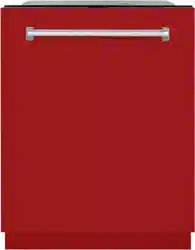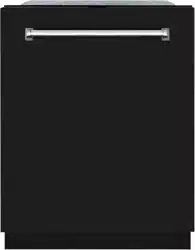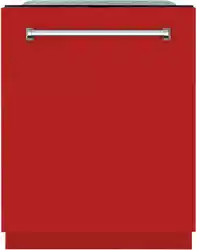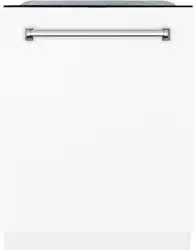

M
ONUMENT
D
ISHWASHER
Installation Guide
and Users Manual

REGISTERING YOUR PRODUCT
Please register your ZLINE appliance. Begin the simple registration
process by scanning the QR code.
By registering your appliance, you will have easy and accurate
access to:
• Technical Support
• Warranty Service
• Tracking your support inquiries
WARNING: This product can expose you to chemicals including nickel, which is known to the
State of California to cause cancer. For more information, go to www.P65Warnings.ca.gov.
SCAN ME

ZLINE Kitchen and Bath provides Attainable Luxury, where the kitchen and bath of your
dreams is never out of reach. Through our unique designs and unparalleled quality, we’re
dedicated to providing you an elevated experience in the heart of your home. With an
endless selection of features and finishes, our inspiration is your reality.
ZLINE is fueled by a passion for innovation; A relentless pursuit of bringing the highest
end luxury designs and professional features into everyone’s homes. Because we
continually strive to improve our products, we may change specifications and designs
without prior notice.

COVERAGE
ZLINE Kitchen and Bath dishwasher parts will be warrantied for one year from the
original purchase date for the original purchaser of the product.
TERMS
This warranty applies only to the original purchaser of the product installed for
normal residential use. This is defined as a single-family, residential dwelling in a
non-commercial setting. Commercial settings include but are not limited to: schools,
churches, hotels, restaurants, vacation rentals such as Airbnb, day care centers,
private clubs, fire stations, common areas in multi-family dwellings, nursing homes,
food service locations, and institutional food service locations such as hospitals or
correction facilities. This warranty is non-transferable and will not be extended based
on the date of installation. The warranty applies only to products installed in the
continental United States and the District of Columbia. Warranty shall not apply and
ZLINE Kitchen and Bath is not responsible for damage resulting from negligence,
improper maintenance, misuse, abuse, alteration of or tampering with the appliance,
accident, natural disaster, improper electric supply, unauthorized service or repair,
improper installation, or installation not in accordance with the instructions contained
in the manual or the local codes.
WHAT IS NOT COVERED
1. Installation or start-up damages or problems caused by improper installation or
use.
2. Damage related to unauthorized service or unauthorized parts.
3. Installation in any commercial or non-residential application.
4. Aesthetic damage, scratches, or natural wear caused by normal use.
5. Second-hand, open box products, or products purchased from an unauthorized
retailer.
WARRANTY

GENERAL SAFETY INSTRUCTIONS 1
BEFORE INSTALLATION 3
INSTALLATION 12
OPERATIONAL SAFETY INSTRUCTIONS 34
OPERATION 37
MAINTENANCE AND CLEANING 51
TROUBLESHOOTING 56
TABLE OF CONTENTS
1
CAUTION
CAUTION
RISK OF ELECTRIC SHOCK
DO NOT OPEN
CAUTION
This symbol indicates that dangerous voltage constituting a risk of
electric shock is present within your refrigerator.
This symbol indicates that there are important operating and
maintenance instructions in the literature accompanying your
refrigerator.
WARNING
BEFORE YOU BEGIN
Read these instructions completely and carefully.
IMPORTANT
• Observe all governing codes and ordinances.
• Note to Installer – Be sure to leave these instructions for the consumer’s and local
inspector’s use.
• Note to Consumer – Keep these instructions with your User Guide for future
reference.
• Skill Level – Installation of this dishwasher requires basic mechanical and
electrical skills. Proper installation is the responsibility of the installer. Product
failure due to improper installation is not covered under the appliance warranty.
• Completion Time – One to three hours. New installations require more time than
replacement installations.
IMPORTANT
• The dishwasher MUST be installed to allow for future removal from the enclosure
if service is required.
• If you received a damaged dishwasher, you should immediately call customer
service.
IMPORTANT SAFETY INSTRUCTIONS
General Safety
2
General Safety
FOR YOUR SAFETY
Read and observe all CAUTIONS and WARNINGS shown throughout these
instructions. While performing installations described in this booklet, gloves and
safety glasses or goggles should be worn.
WARNING
This dishwasher comes with a heating element to heat the water. To avoid the risk of a
serious burn, don’t touch the heating element when the dishwasher is on.
WARNING
To reduce the risk of electrical shock, fire, or injury to persons, the
installer must ensure that the dishwasher is completely enclosed at
the time of installation.
IMPORTANT SAFETY INSTRUCTIONS
SPECIFICATIONS
Dimensions
(W x D x H)
• Unit with decorated door and handle: 23.9 x 26.5 x 33.7 in.
• Unit without decorated door and handle: 23.9 x 24 x 33.7 in.
3
If you have an installation problem, contact your dealer or installer. You are
responsible for providing adequate electrical, exhausting, and other connecting
facilities.
PREPARING TO INSTALL YOUR DISHWASHER
BEFORE INSTALLATION
Tools Needed
PARTS SUPPLIED
• Screws A - #8, 3/4”, Flat Head sheet
Metal Screw (4)
• Screws B - #8, 1/2”, Flat Head Sheet
Metal Screw (8)
• Screws C - #6, 7/8”, Flat Head Sheet
Metal Screw (2)
• Screws D - #6, 1 3/4”, Flat Head
Sheet Metal Screw (4)
• Top mounting clips (2)
• Hose clamp
• Drain hose
• Brackets (2)
• Top Hook Mounting Seats (2)
TOOLS NEEDED
• Phillips screwdriver
• 1/4” and 5/16” nut driver
• Level
• Flashlight
• Gloves
• Bucket
• Adjustable wrench
• Carpenters square
• Measuring tape
• Safety glasses
MATERIALS NEEDED (KIT PURCHASE SEPARATELY)
• 90° Elbow, ferrule and compression nut. (3/8” NPT external thread on one end. Other
end sized to fit water supply line
• Teflon thread seal tape
• Three wire nuts (UL listed) (two included in kit)
Not included in kit
• Hand shut-off valve
• Waste tee for house plumbing (if applicable)
• Screw-type hose clamps
• Coupler for extending drain line (if applicable)
• Air gap (if required)
PACKAGE CONTENTS
• Dishwasher
• Hose
• Installation Kits
• User Guide
• Installation Guide
4
ENCLOSURE REQUIREMENTS
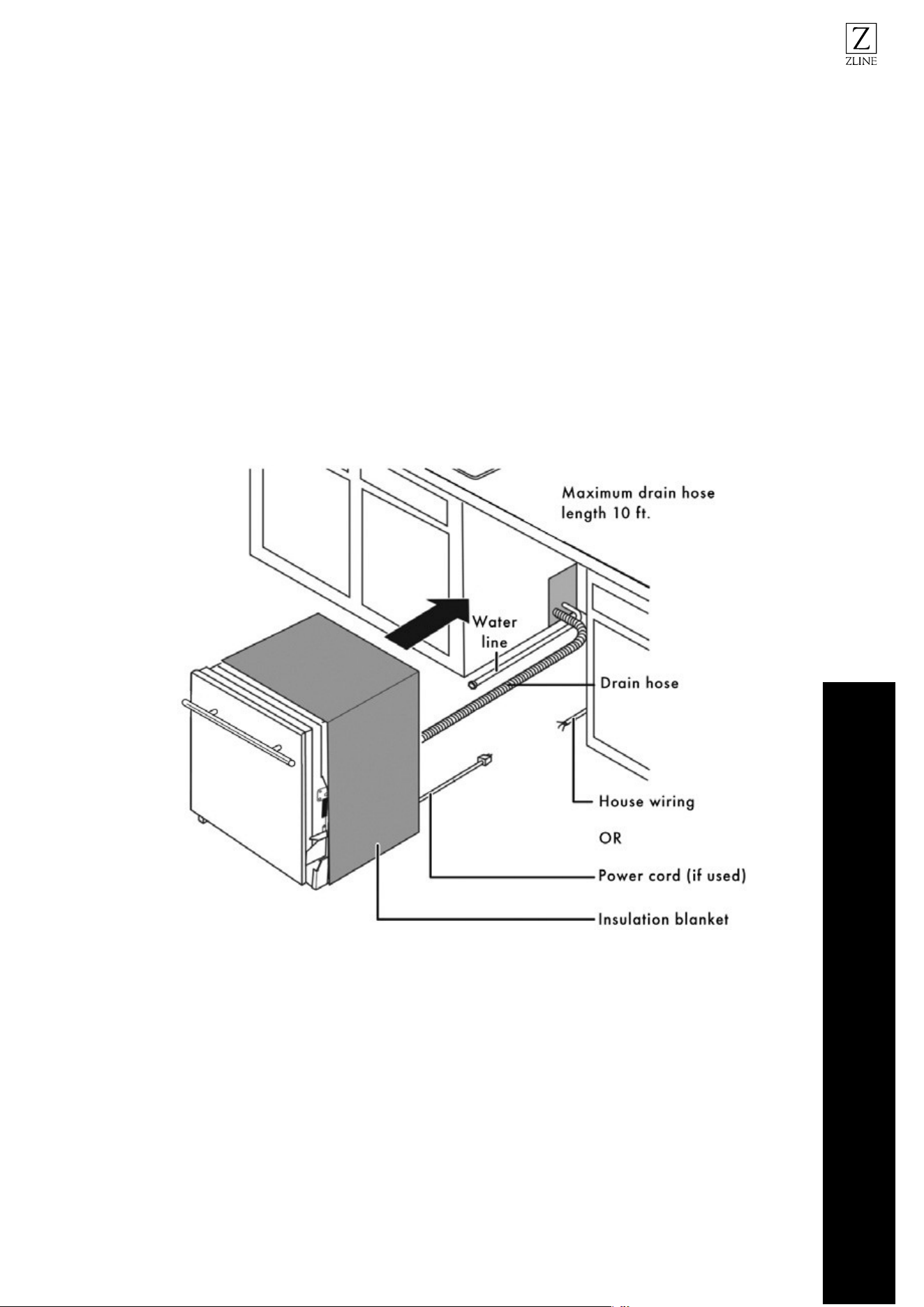
• The dishwasher must be installed so that the drain hose is no more than 10 ft. in
length, for proper drainage.
• This dishwasher is designed to be enclosed on the top and on both sides by a
standard residential kitchen cabinet unit.
• The installation enclosure must be clean and free of any obstructions.
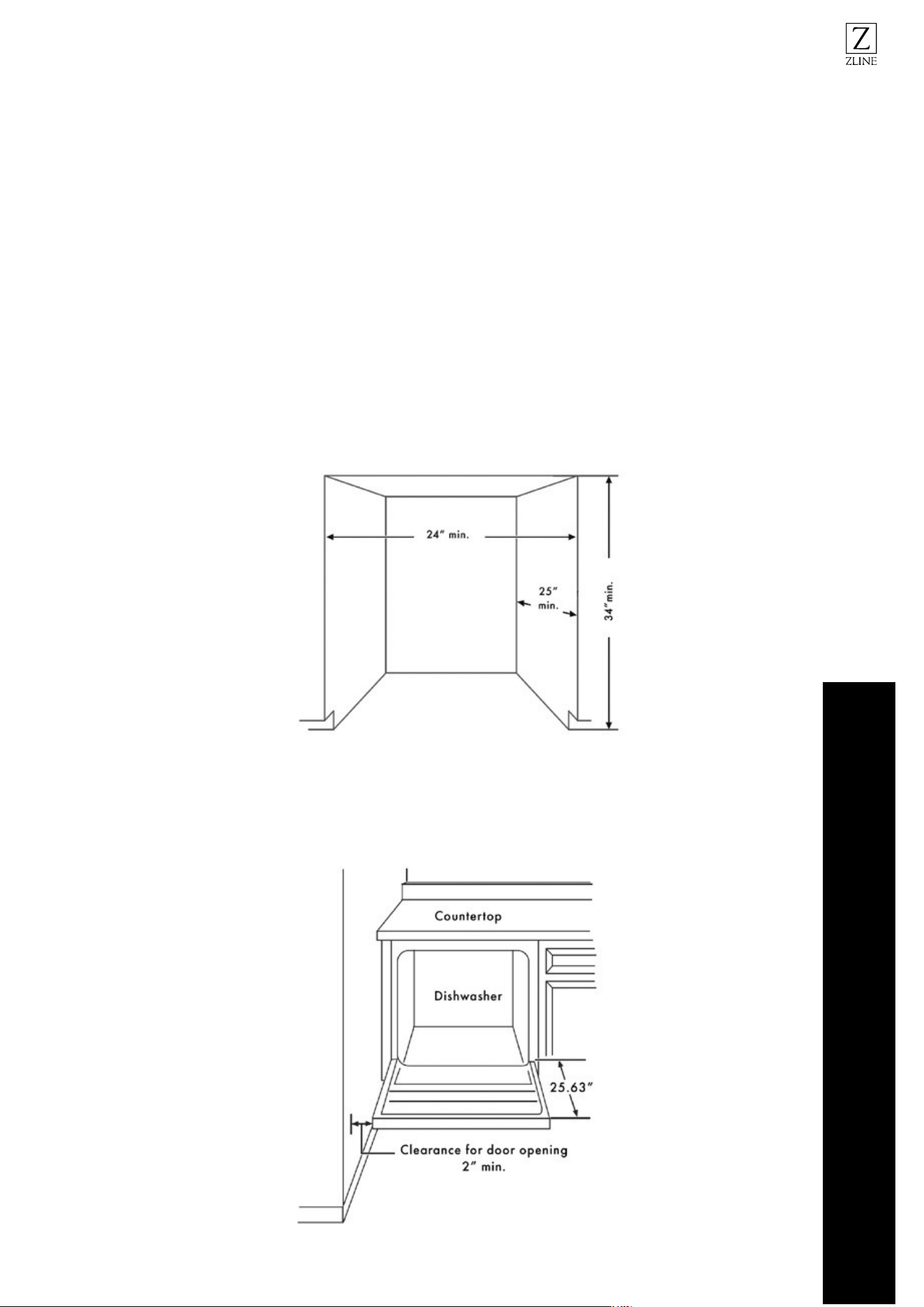
• The enclosure must be at least 24 in. wide, 25 in. deep, and 34 in. high.
• For the front door of the dishwasher to be flush with the front edge of the counter
top, the counter top must be 25 in. deep.
BEFORE INSTALLATION
Enclosure Dimensions
If installing into a corner, allow 2 in. min. clearance between dishwasher and
adjacent cabinet, wall, or other appliances. Allow 25.63 in. min. clearance from the
front of the dishwasher for opening the door.

5
DRAIN REQUIREMENTS
• Follow all local codes and ordinances.
• Do not exceed 10 ft. of drain hose.
• Do not connect the drain lines from other devices to the dishwasher drain hose.
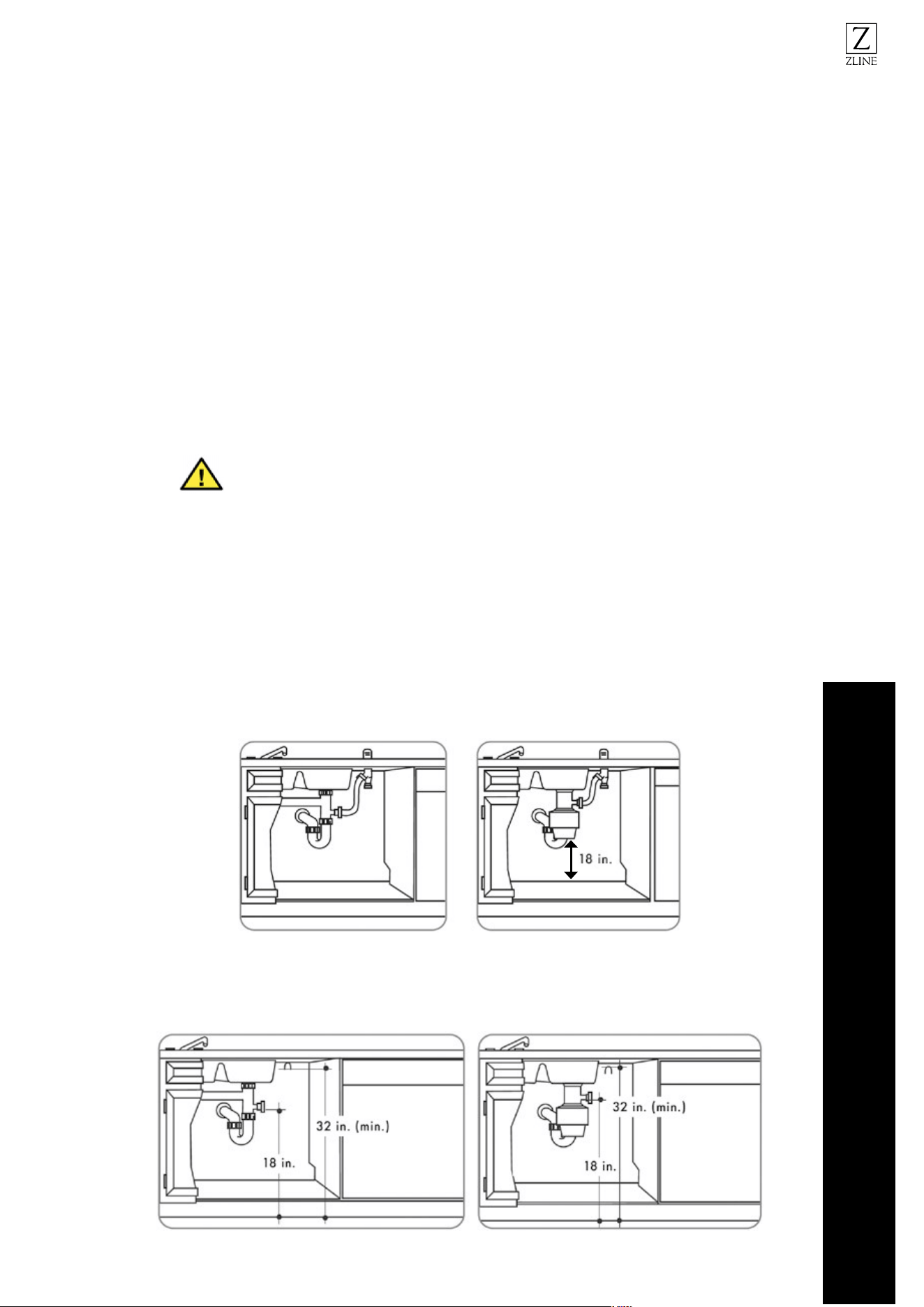
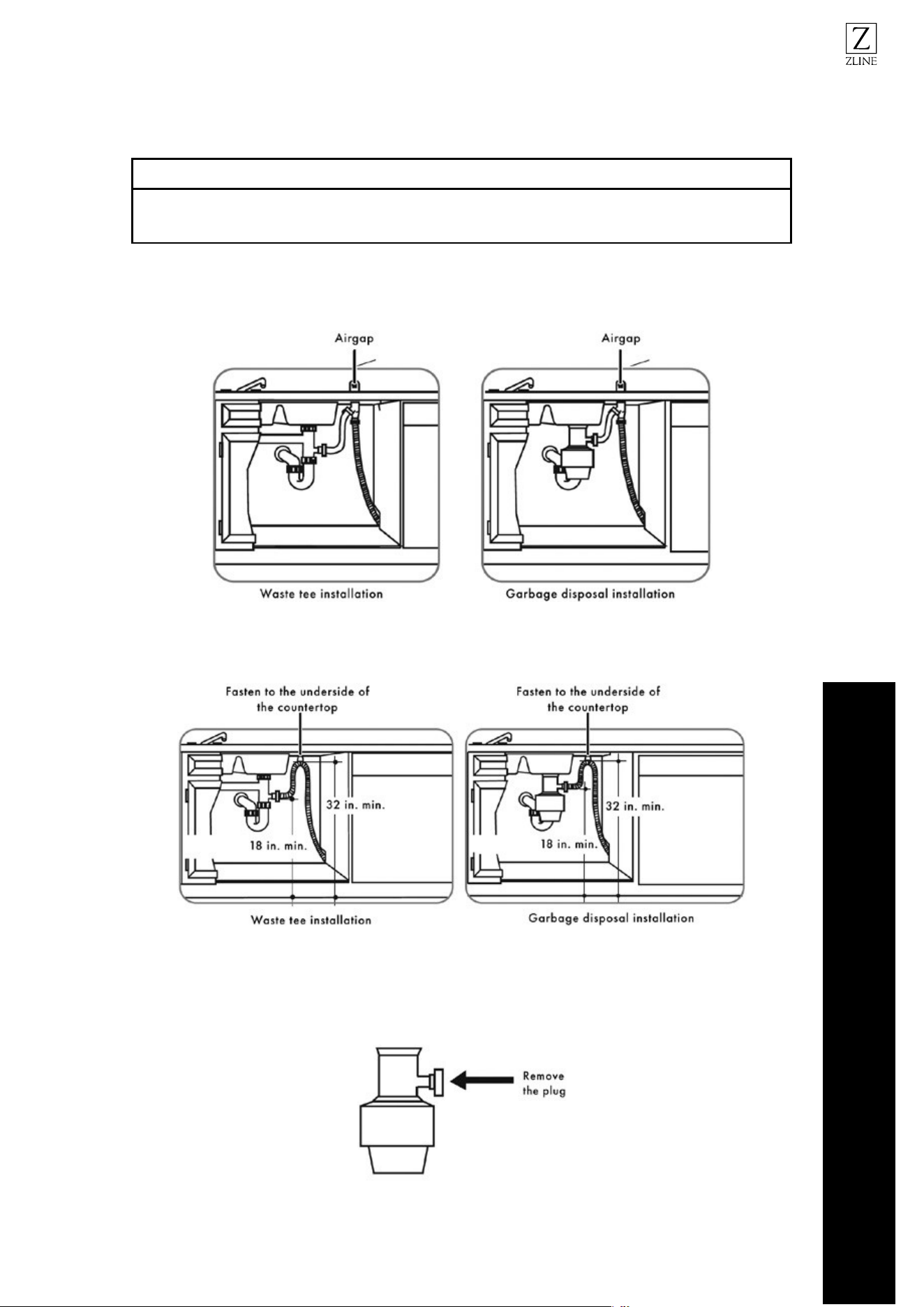
• The dishwasher must be connected to a waste line with an air gap (not provided)
or a 32 in. high (min.) drain loop, depending on local codes and ordinances, to
prevent back flow into the dishwasher.
• An air gap must be used if the waste tee or garbage disposal connection is less
than 18 in. above the floor, to prevent siphoning.
BEFORE INSTALLATION
Drain Requirements
6
DRAIN PREPARATION
The type of drain installation required depends on the answers to the following questions:
• Do local codes or ordinances require an air gap?
• Will the waste tee or garbage disposal connection be less than 18 in.
above the floor?
• Will installation have a drain loop less than 32 in. above the floor?
If the answer to ANY of these questions is YES, Method 1 MUST be used. Otherwise,
either Method 1 or Method 2 may be used.
Install the waste tee or garbage disposal connection and air gap according to
manufacturer’s instructions.
An air gap MUST BE USED if the drain hose is connected to a waste
tee or garbage disposal lower than 18 in. above the floor.
Failure to provide the proper drain connection height with an air
gap or 32 in. (min.) high drain loop will result in improper draining
of the dishwasher.
WARNING
BEFORE INSTALLATION
Drain Preparation
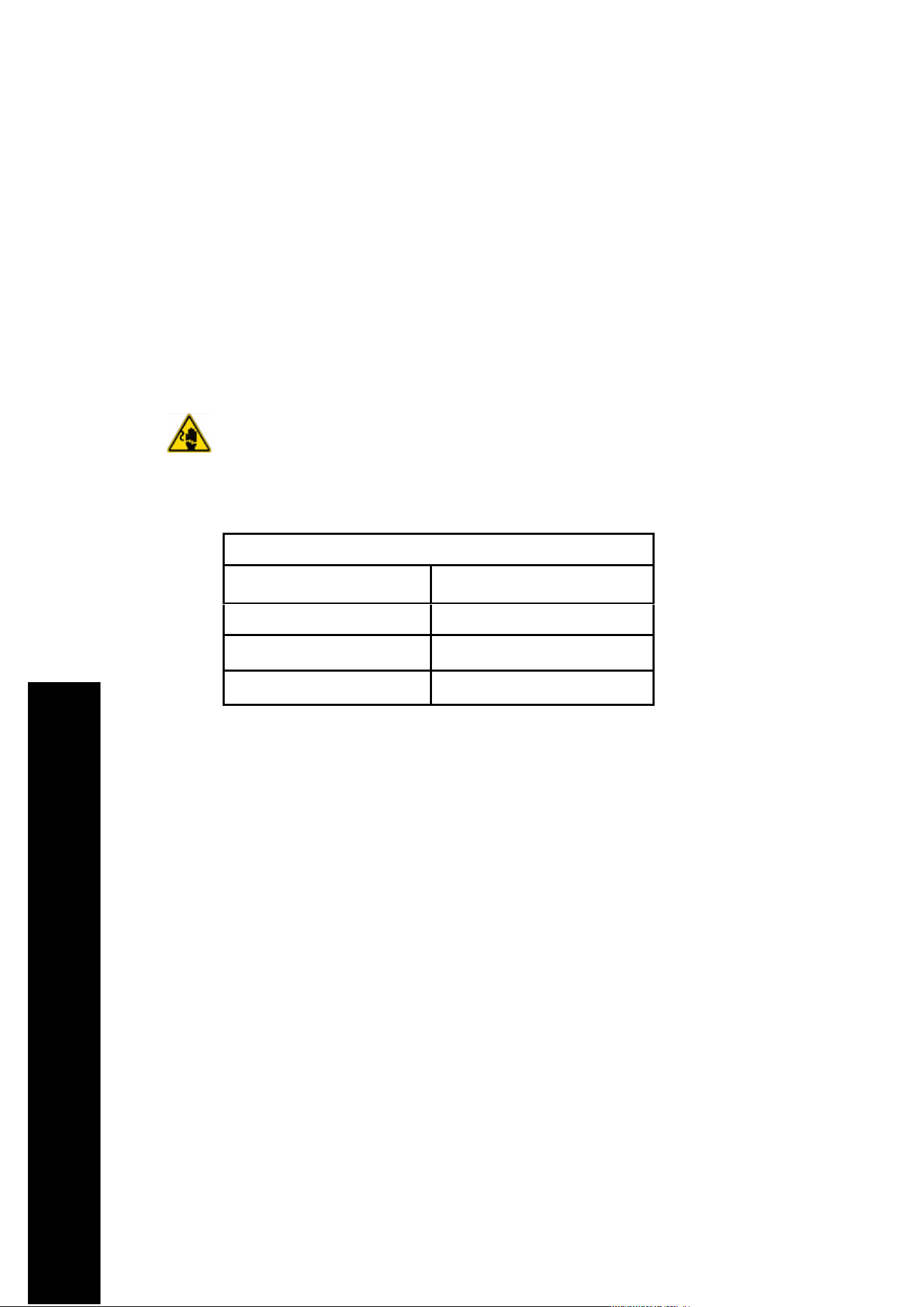
Method 1 - Air gap with a waste tee or garbage disposal connection
Method 2 - High drain with a waste tee or garbage disposal connection
You must provide a method to attach the drain hose to the underside of the countertop.
7
BEFORE INSTALLATION
Electrical Requirements
ELECTRICAL REQUIREMENTS
• This appliance must be supplied with 120V, 60 Hz, and it must be connected to
its own, properly grounded branch circuit that is protected by a 15 or 20 ampere
circuit breaker or time delay fuse.
• Wiring must be two wire with ground.
• If the electrical supply does not meet the above requirements, call a licensed
electrician before proceeding.
WARNING
Remove the house fuse or open the circuit breaker before beginning
the installation. Do not use an extension cord or adapter plug with
this appliance.
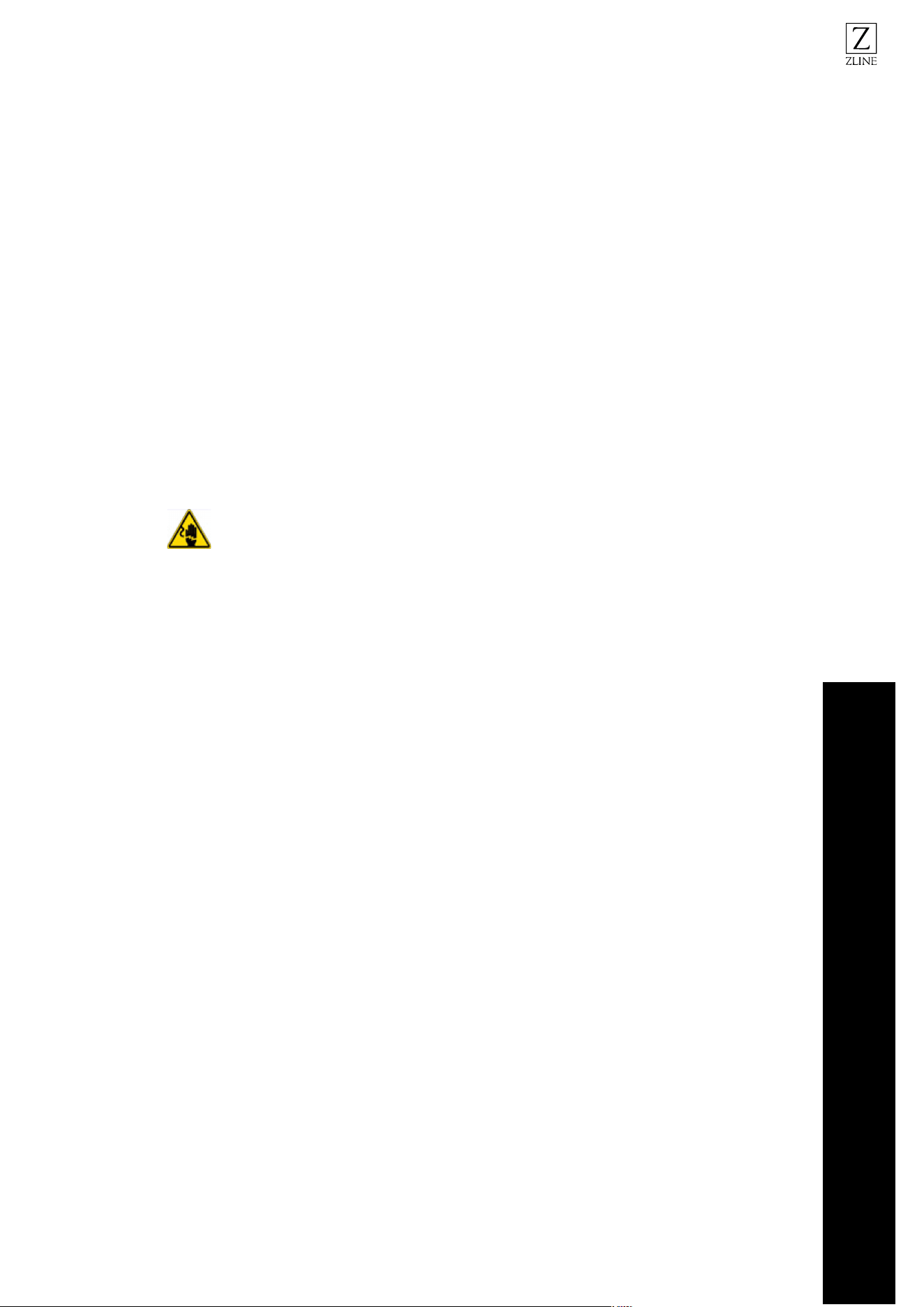
SPECIFICATIONS
Power requirements 120 V~60 Hz
Current 8.4 A
Water pressure Between 20 and 120 psi
Noise (dB) 45 dB
8
GROUNDING INSTRUCTIONS
Grounding Instructions – Cable Direct
This appliance must be connected to a grounded metal, permanent wiring system, or
an equipment grounding conductor must be run with the circuit conductors and be
connected to the equipment grounding terminal or lead on the appliance.
Grounding Instructions – Power Cord Models
This appliance must be grounded. In the event of a malfunction or breakdown,
grounding will reduce the risk of electrical shock by providing a path of least
resistance for electric current. The plug must be plugged into an appropriate outlet
that is installed and grounded in accordance with local codes and ordinances.
Direct Wire Method
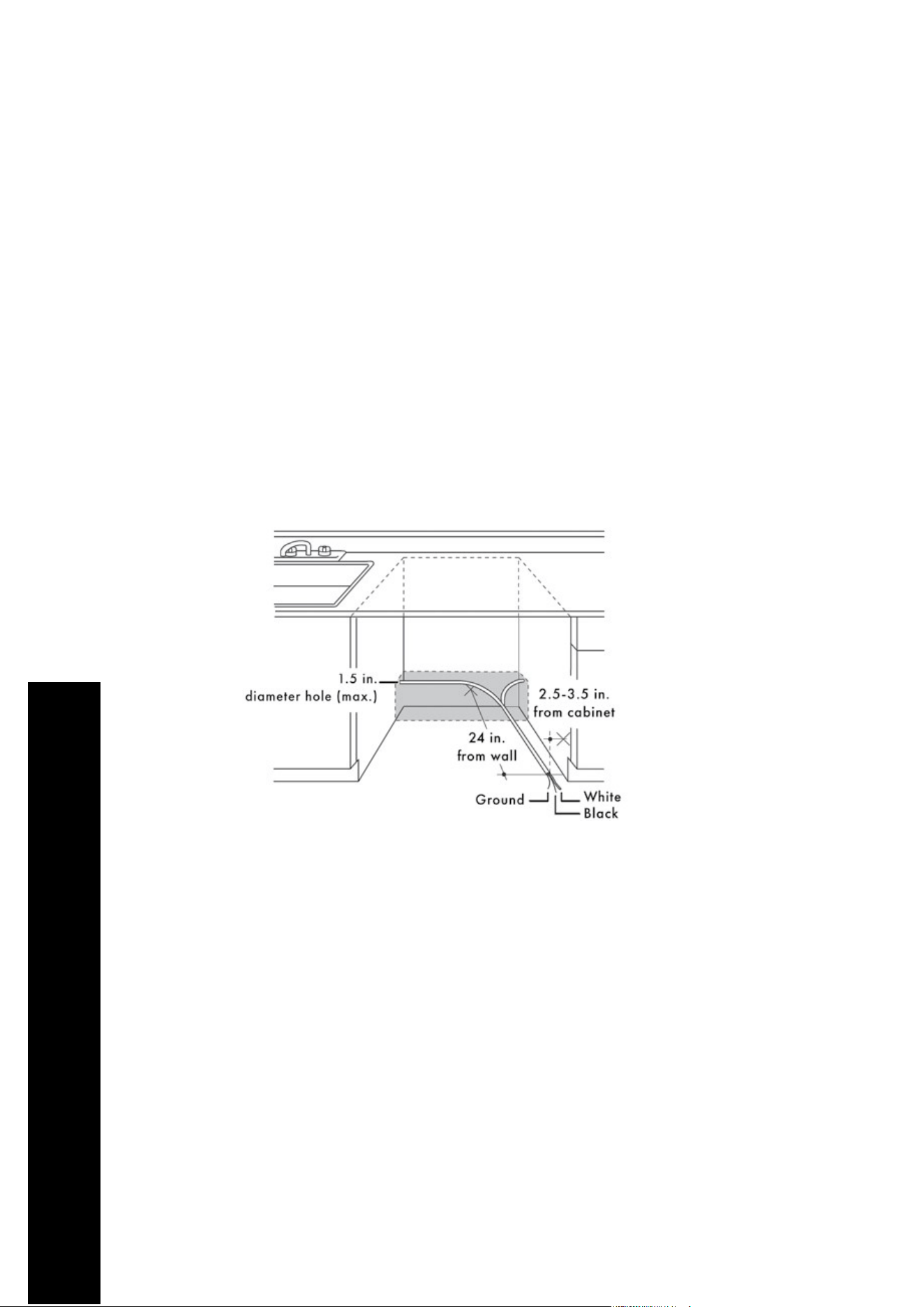
• The cable must be routed as shown in “Cabinet Preparation and Wire Routing”
on page 9, and extend a minimum of 24 in. from the rear wall.
• Use flexible, armored, or nonmetallic sheathed, copper wire with grounding
wire that meets the wiring requirements for your home and local codes and
ordinances.
• Use a UL Listed/CSA Approved strain relief.
Power Cord Method
• Install a 3-prong grounding type receptacle. The wall outlet can be installed in a
cabinet or on a wall adjacent to the undercounter space in which the dishwasher
is to be installed.
• Use power cord kit (part number 5304504505) under Smart Choice brand
marked with Dishwasher Install Kit With Power Cord, available for purchase
from an authorized store. The power cord and connections must comply with
local codes and ordinances.
• The recommended power cord length is 54 in. min. and 64 in. max.
BEFORE INSTALLATION
Electrical Requirements
WARNING
The improper connection of the equipment grounding conductor can
result in a risk of electric shock. Check with a qualified electrician
or service representative if you are in doubt that the appliance is
properly grounded.
9
BEFORE INSTALLATION
Electrical Requirements
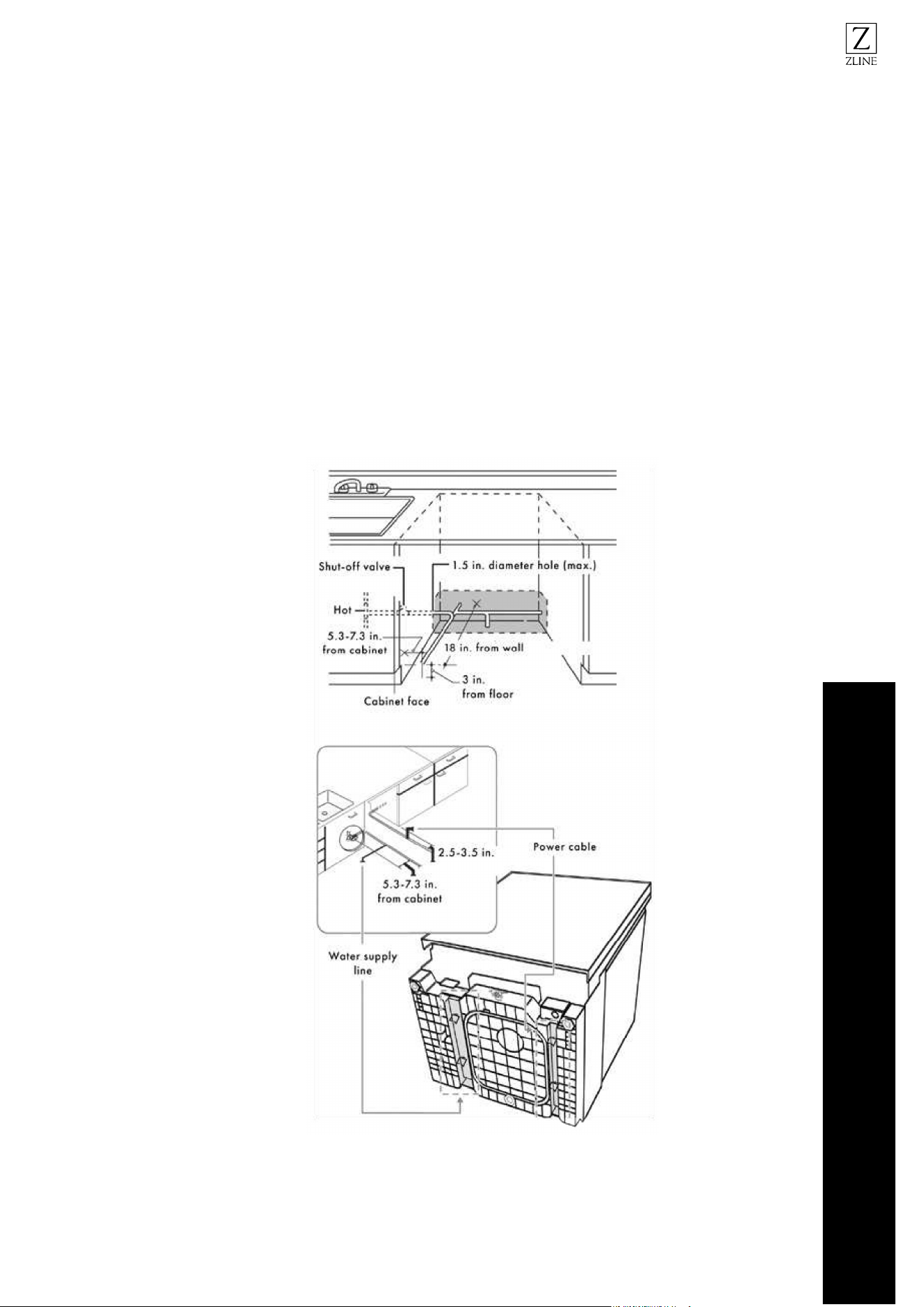
CABINET PREPARATION AND WIRE ROUTING
• The wiring may enter the opening from either side, the rear, or the floor within the
shaded area.
• The electrical connection is on the front right of the dishwasher.
• Drill a 1.5 in. maximum diameter hole to run the electrical cable through the wall
of the cabinet.
• The hole must be free of sharp edges. If the cabinet wall is metal, the hole edge
must be covered with a bushing or rubber grommet.
• Cable direct connections may pass through the same hole as the drain hose and
hot water line, but power cords with plugs must pass through a separate hole.
10
BEFORE INSTALLATION
Water Connection
PREPARING THE HOT WATER LINE
• The water connection is on the left side of dishwasher.
• The hot water line may enter the opening from either side, the rear, or the floor
within the shaded area.
• The hot water line may pass through the same hole as the electrical and drain
hose. Or, you can drill an additional 1.5 in. maximum diameter hole for the hot
water line.
• If a power cord with a plug is used, the hot water line may not pass through the
same hole as the power cord.

11
CONNECTING THE WATER LINE TO THE WATER SUPPLY
1. Turn off the water supply.
2. Install a hand shut-off valve in an accessible location, such as under the sink. This
is optional, but strongly recommended, and may be required by local codes.
3. Install the hot water inlet line, using at least 3/8” tubing. Route the line as shown
in the figure above and extend it forward at least 18 in. from the rear wall of the
enclosure.
4. Adjust the water heater to a temperature of 120° F to 150° F.
5. Flush the water line to clean out any debris.
BEFORE INSTALLATION
Water Connection
Note: The hot water pressure must be between 20 and 120 psi
(138 and 827 kPa).
12
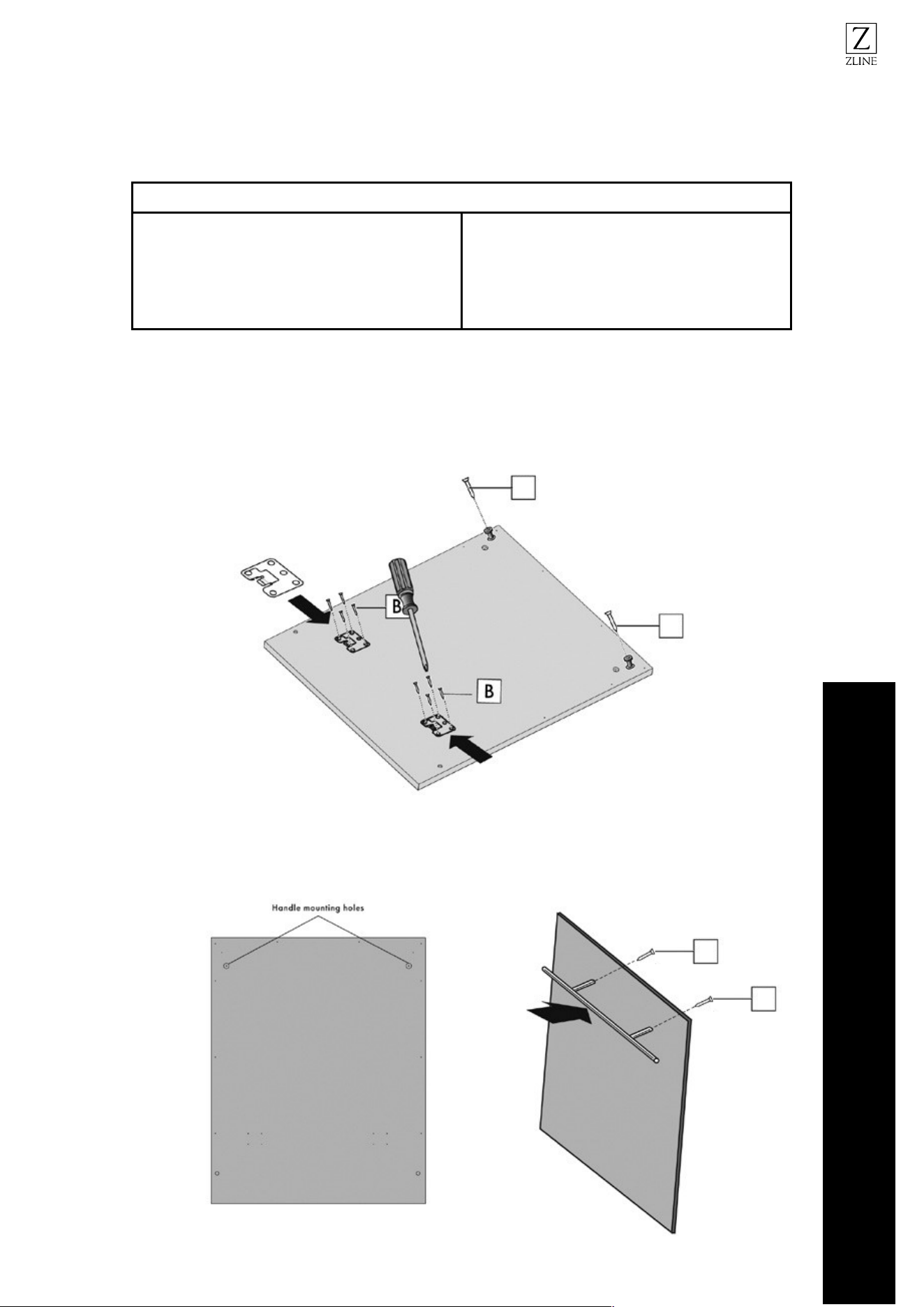
STEP 1: INSTALL THE DECORATION DOOR TO THE OUTER DOOR OF THE
DISHWASHER
1. Install the hook and brackets on the decoration door.
2. Install the handle to the outer door.
Panel Installation
INSTALLATION
YOU’LL NEED
• Phillips screwdriver
• 1/4” and 5/16” nut driver
• Screws B - ST4 X 14 (8)
• Screws C - ST3.5 X 25 (2)
• Screws D - ST3.5 X 45 (4)
• Brackets (2)
• Top Hook Mounting Seats (2)
• Screws E - 5mm x 80 pitch, Metric
Screw (2)
C
C
E
E
13
INSTALLATION
Panel Installation
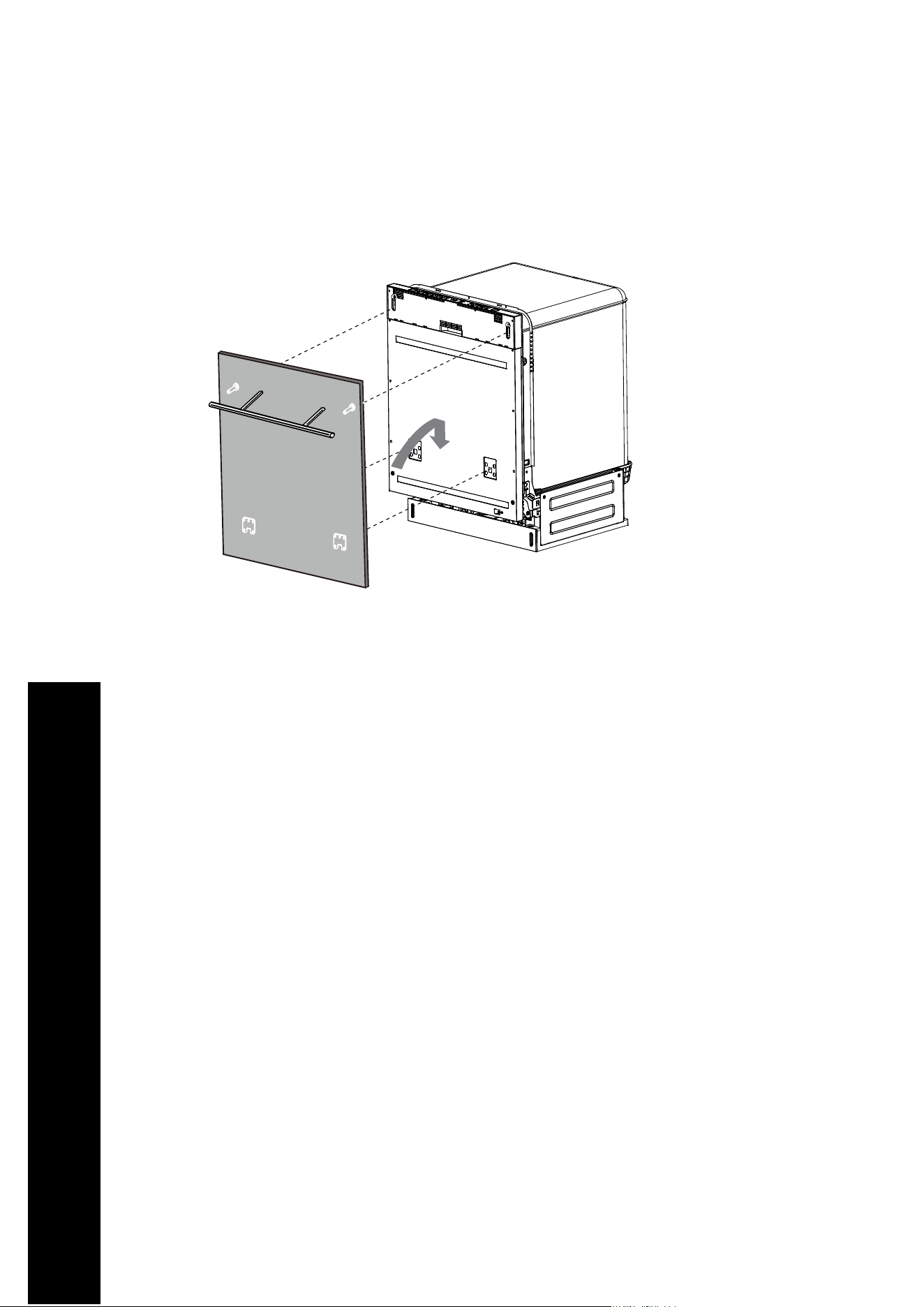
3. Put the hook into the slot of the outer door for the positioning.
14
Panel Installation
INSTALLATION
4. Fix the decoration door onto the outer door by screws.
D
15
Door Balance
STEP 2: CHECK THE DOOR BALANCE
CAUTION
Opening the door of your dishwasher before it is installed will cause
it to tip forward. Do not open the door until you are ready to install
your dishwasher.
If it is necessary to open the door, hold the top of the dishwasher
securely with one hand and hold the door with the other hand.
1. Hold the top of the dishwasher firmly.
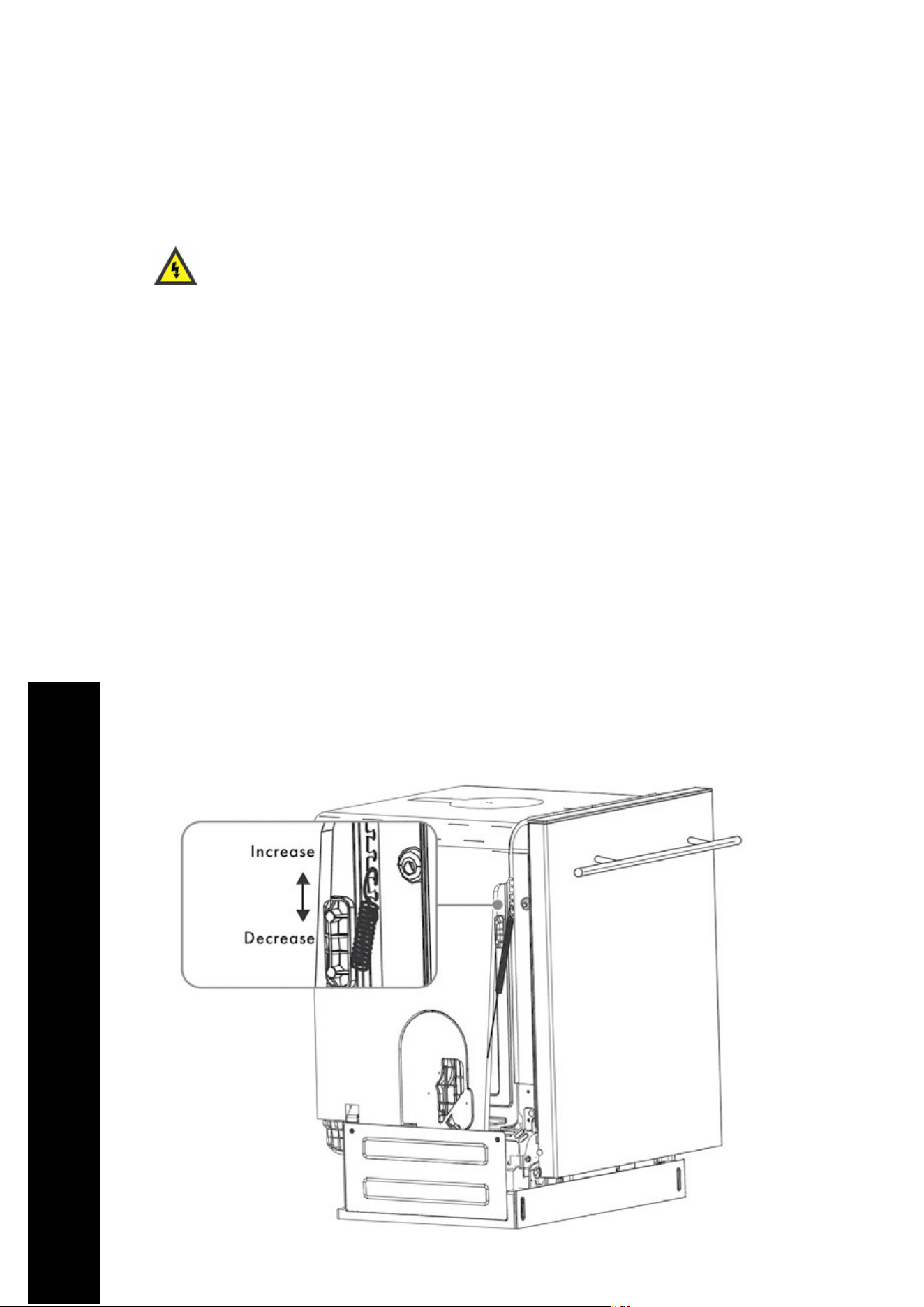
2. Open the door slowly, then release it. If the door drops, increase the spring
tension. If the door closes, decrease the spring tension.
3. Continue moving the spring pin until the door is balanced. Adjust both springs to
the same tension.
Note: If you choose the wood decoration door (about 8 lbs), you can
choose the fifth groove from the top groove. If you choose the metal
decoration door (about 17 lbs), you need fix the springs to the third
groove in the same method.
INSTALLATION
16
Adjusting the Legs
INSTALLATION
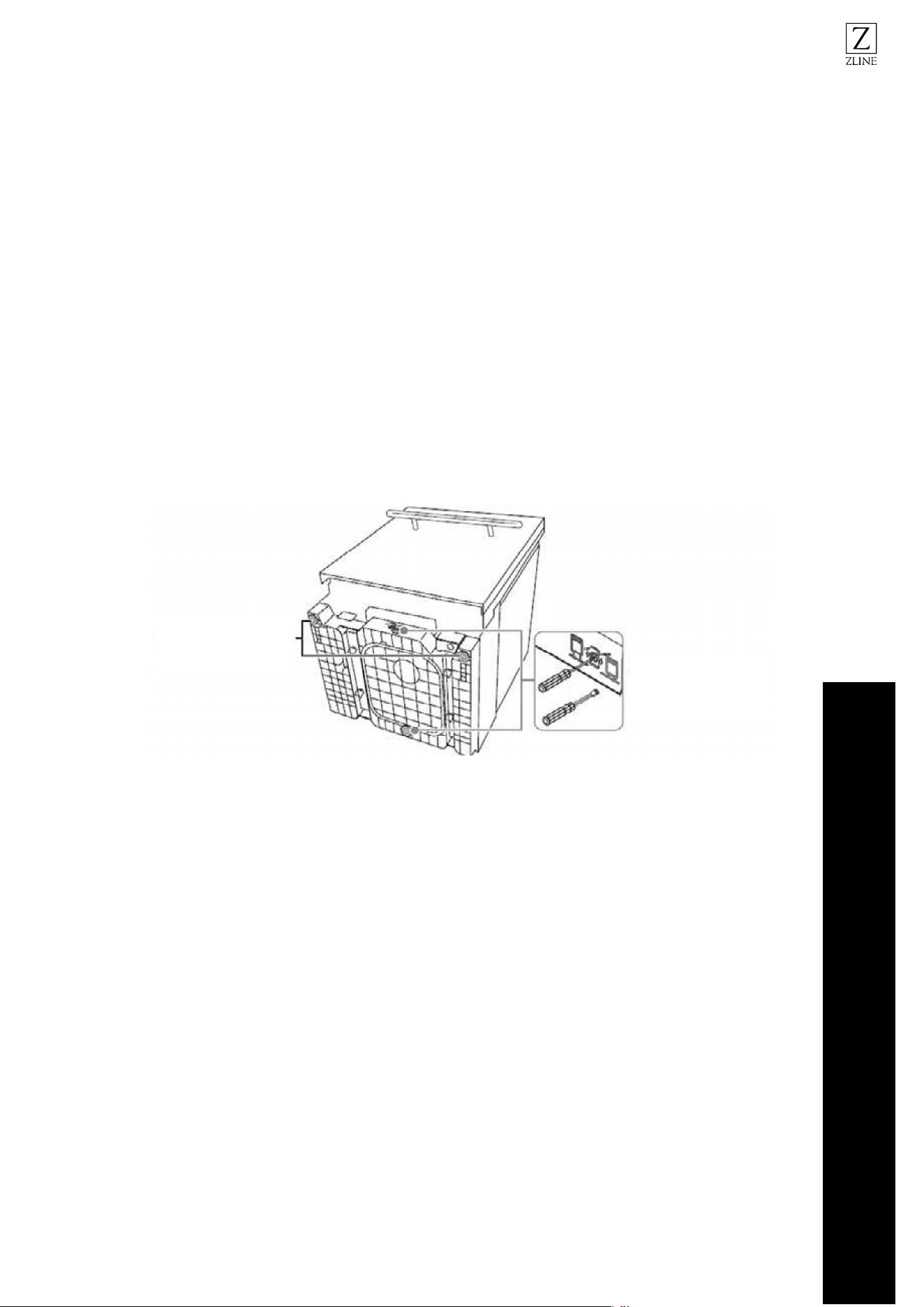
STEP 3: ADJUST THE LEVELING LEGS
1. Move the dishwasher close to the installation location and lay it on its back.
2. Measure the installation height and the dishwasher height.
3. Extend the leveling legs out from the dishwasher base .25 in. less than the
installation height.
Note: Make sure that the leveling feet are tightened all the way or
removed if trying to tilt the dishwasher.
Adjust to 0.25” less
than the installation
height
Adjust to 0.25” less
than the installation
height
or

17
Remove the kick plate
INSTALLATION
STEP 4: REMOVE THE KICK PLATE
1. Remove the two kick plate screws with a Phillips screwdriver, then remove the
kick plate.
STEP 5: INSTALL TO POWER
Turn off the electricity to the dishwasher’s electrical circuit.
Make sure that the electrical power is turned off at the source.
WARNING
If your house wiring is not 2-wire with a ground, a ground must be
provided by the installer.
If your house wiring is aluminum, be sure to use cUL/UL Listed anti-
oxidant compound and aluminum-to-copper connectors.
YOU’LL NEED
• Adjustable wrench
• Philips screwdriver
• Power cord
• Phillips screwdriver
• Strain relief (for electrical connection)
• Three wire nuts (UL listed)
18
Electrical Connection
INSTALLATION
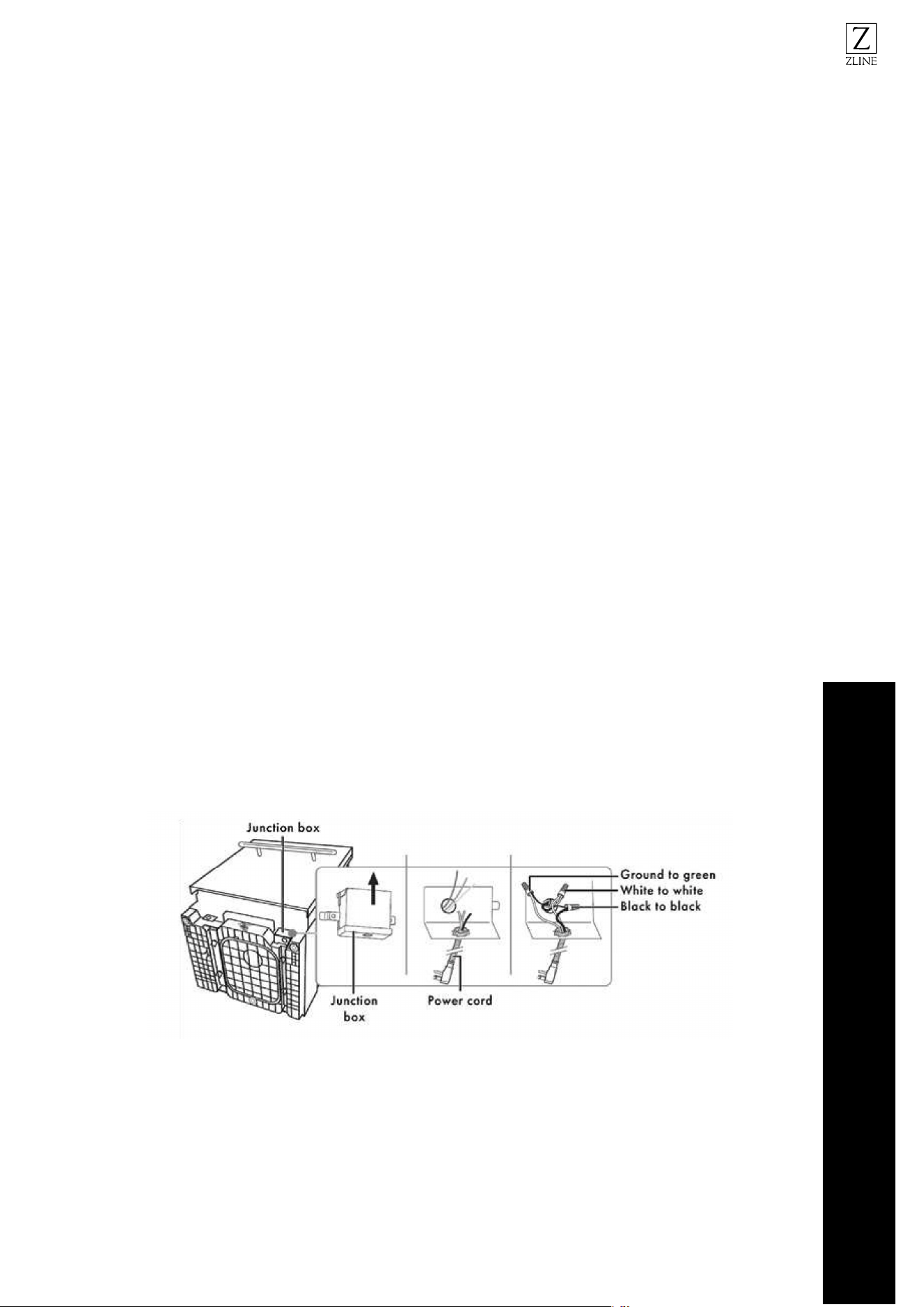
Power cord
1. Remove the junction box cover on the front right of the dishwasher.
2. Make sure that the junction box’s electrical wires are pulled inside of the junction
box.
3. Remove the lock nut from the strain relief, then push the strain relief into the round
opening of the junction box.
4. Install the lock nut on the strain relief from inside the junction box.
5. Insert the ends of the power cord’s electrical wires into the junction box through
the strain relief.
6. Connect the incoming white (or ribbed) wire to the dishwasher’s white wire, the
black (or smooth) wire to the dishwasher’s black wire, and the ground wire to the
dishwasher’s green wire. Use cUL/UL listed wire nuts of the appropriate size.
7. Tighten the strain relief screws and lock nut to stabilize the power cord’s electrical
wires, then make sure that all of the connections are secure.
8. Replace the junction box cover on the right front of the dishwasher. Be sure that
the wires are not pinched under the cover.
Note: If you have trouble replacing the junction box cover, loosen the
screws on the strain relief.
19
Water Supply
INSTALLATION
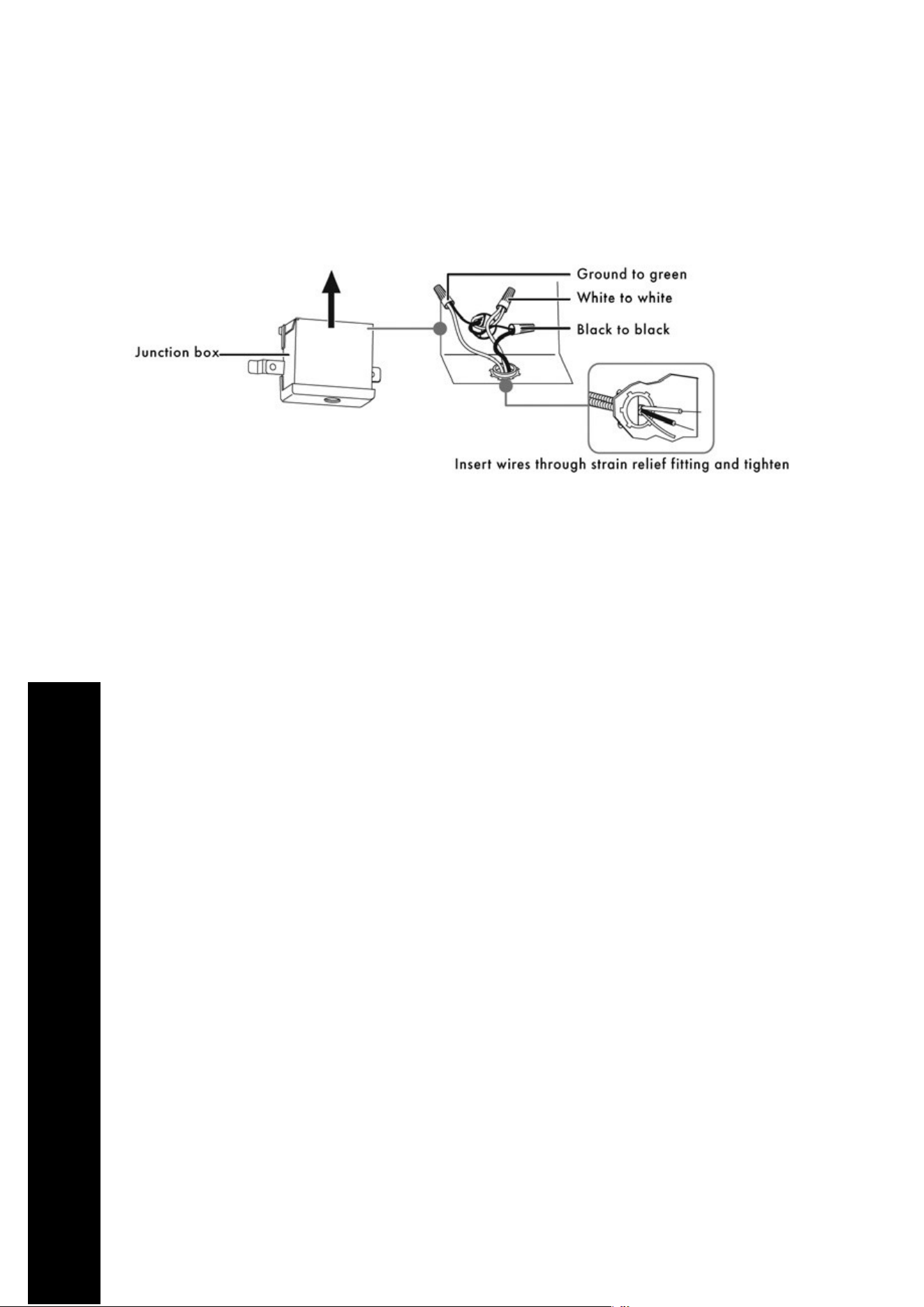
Direct wiring
1. Remove the junction box cover from the power supply junction box on the wall.
2. Locate the three dishwasher wires, (white, black, and green) with stripped ends,
then insert the dishwasher wires through the small hole in the junction box.
3. Secure the house wiring to the bottom of the junction box with a strain relief
fitting.
4. Use wire nuts to connect incoming ground to green, white to white, and black to
black.
5. Replace the junction box cover. Make sure that no wires are pinched under the
cover.
20
Water Supply
INSTALLATION
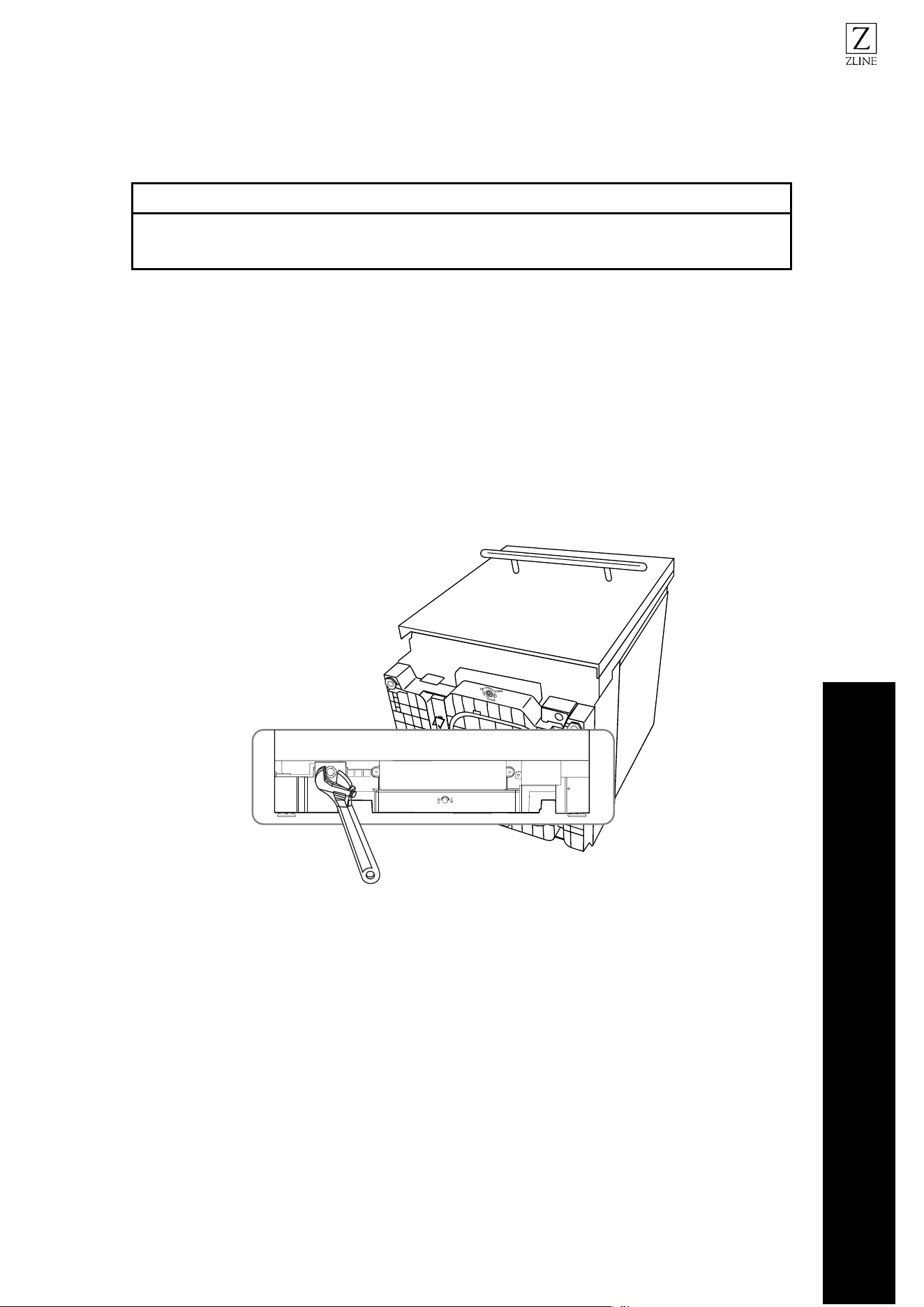
STEP 6: INSTALL THE 90° WATER SUPPLY ELBOW
1. Wrap the male thread of the 90° elbow with Teflon thread seal tape twice.
Do not use plumber’s putty.
2. Install the 90° elbow onto the water valve. Do not overtighten the 90° elbow.
The water valve bracket could bend or the water valve fitting could break.
3. Position the end of the elbow to face the floor when the dishwasher is upright.
YOU’LL NEED
• Adjustable wrench
• 90
°
elbow
• Teflon thread seal tape
21
Drain Hose Installation
INSTALLATION
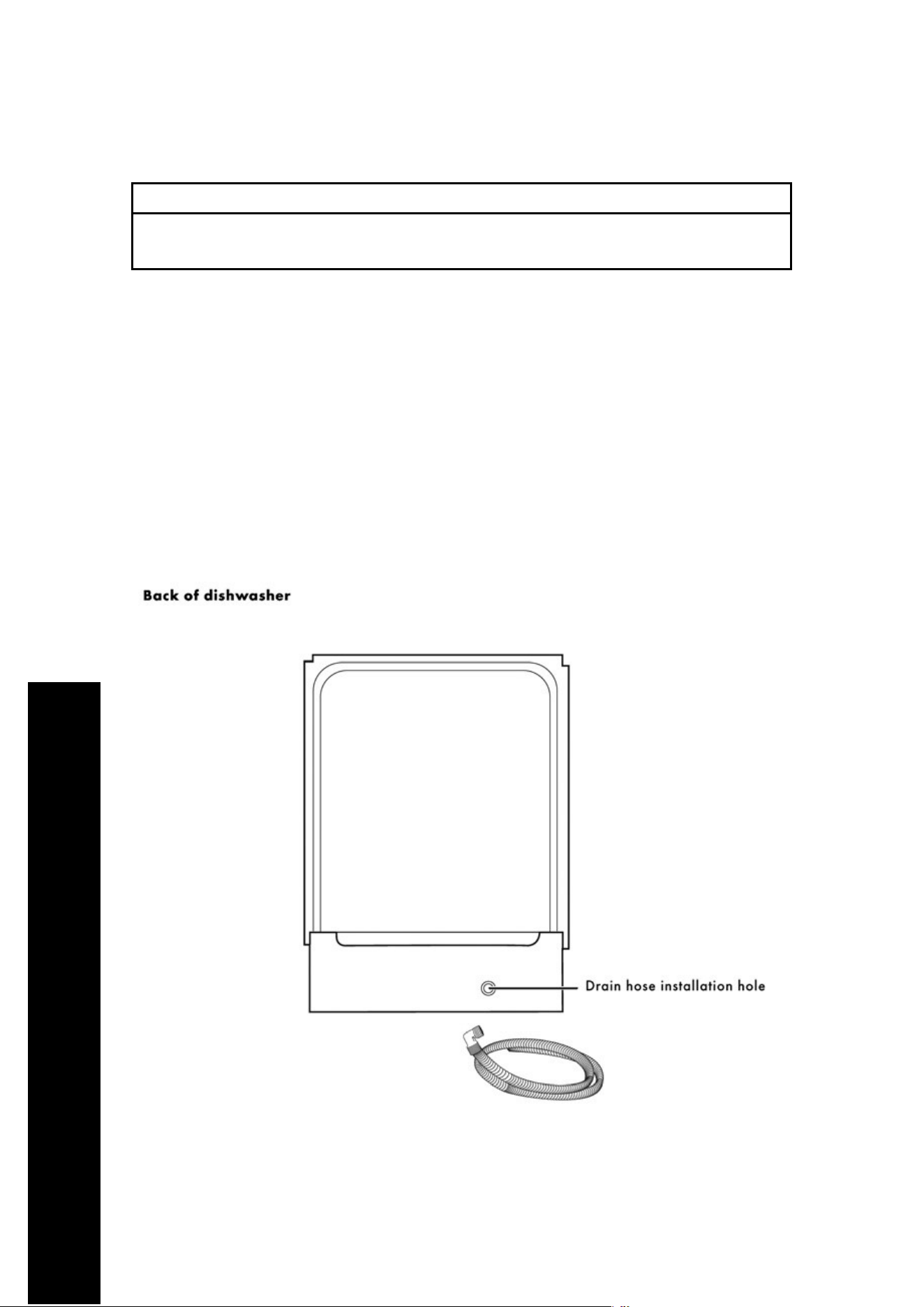
STEP 7: INSTALL THE DRAIN HOSE
1. Make sure that the leveling feet are loosened before standing the dishwasher
upright. They may be tight from shipping/packaging.
2. Turn the dishwasher upright.
3. Slide a screw-type hose clamp onto the right-angled end of the drain hose.
4. Install the drain hose to the dishwasher drain outlet on the back of the
dishwasher, then tighten the screw-type hose clamp.
YOU’LL NEED
• Phillips screwdriver
• Screw-type hose clamps
• Drain hose
22
Level the Dishwasher
INSTALLATION
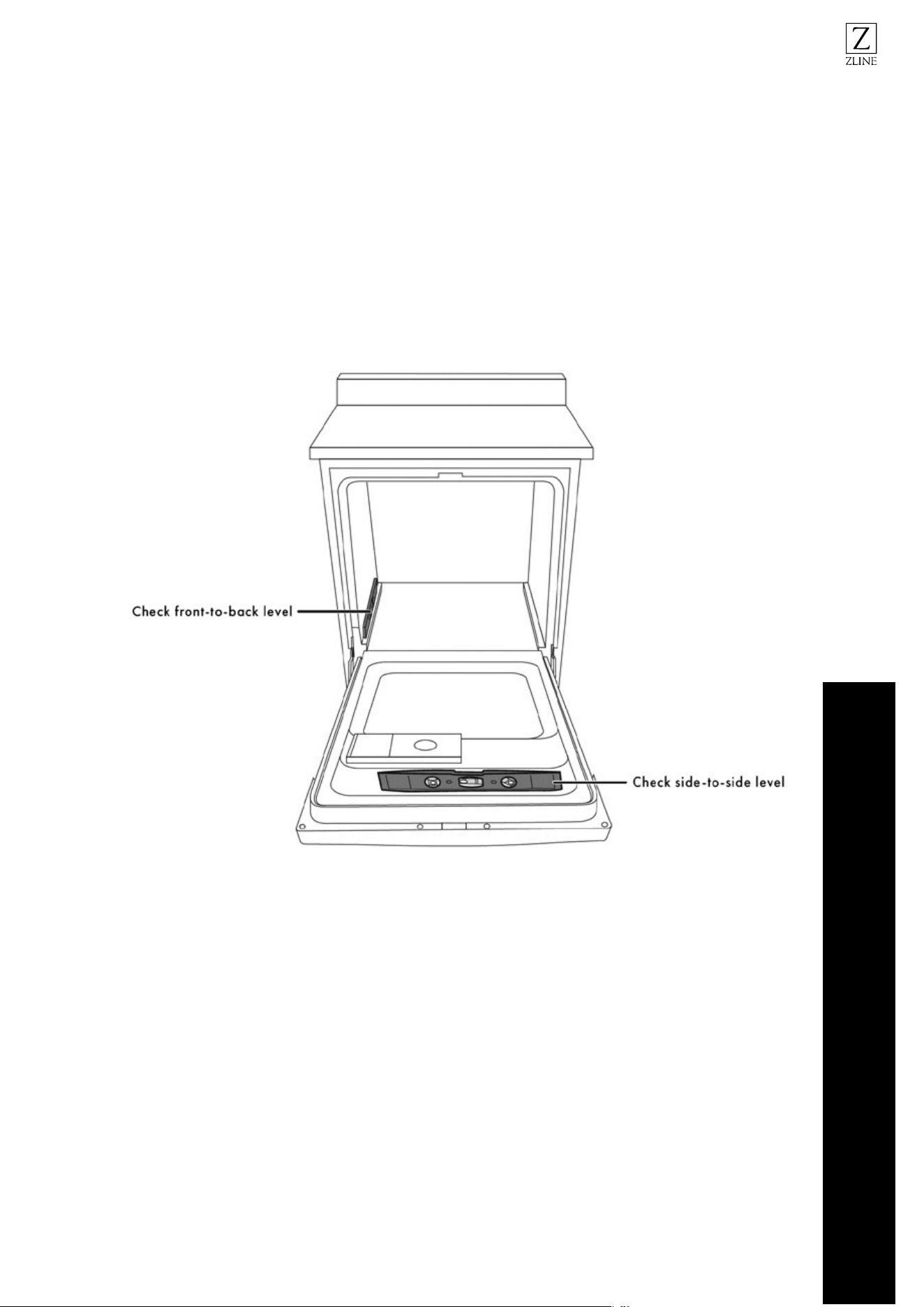
STEP 8: LEVEL THE DISHWASHER
Important: The dishwasher must be level for proper dish rack operation
and wash performance.
1. Open the door, then place a level on the door and on the rack track inside the
tub to make sure that the dishwasher is level.
2. Level the dishwasher by adjusting the three leveling legs individually.
Note: You may need to pull your dishwasher out of the cabinet if major
adjustments to the leveling legs are required.
Tip: Pull the lower rack out about halfway. Make sure that the rack
does not roll forward or back into the dishwasher. If the rack or rolls in
either direction, you must level the dishwasher again.
23
INSTALLATION INSTRUCTIONS
Level the Dishwasher
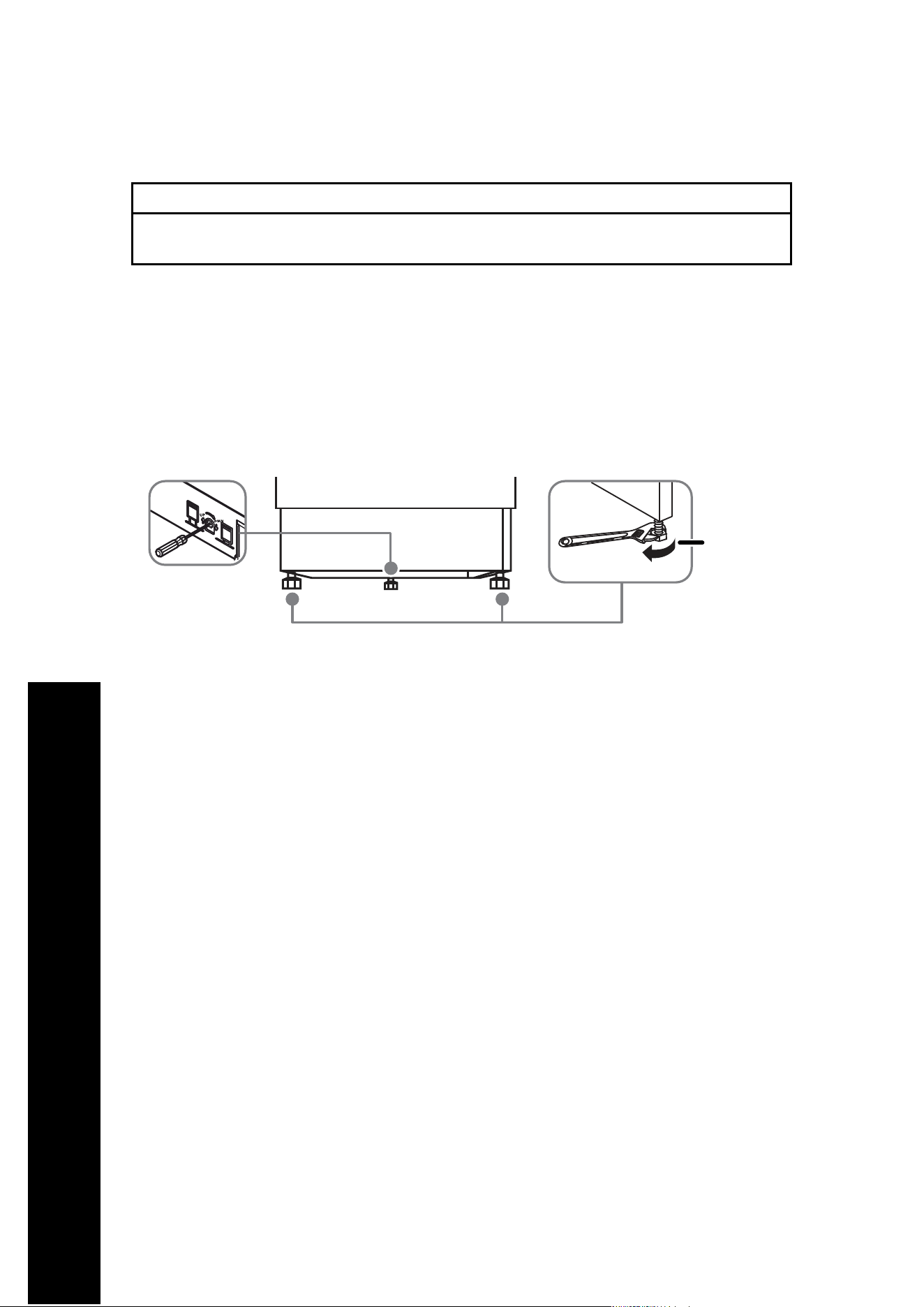
3. If the door hits the tub, the dishwasher is not installed correctly. Adjust the leveling
legs to align the door to the tub.
Note: Keep the dishwasher level.
YOU’LL NEED
• Adjustable wrench
• Philips screwdriver
• Level
Turn the legs
to adjust the
level
24
Drain Hose Installation
INSTALLATION
STEP 9: INSERTING THE DRAIN HOSE THROUGH THE CABINET
• Insert the drain hose into the hole in the cabinet wall. If a power cord is used,
guide the end through a separate hole.
Tip: Position the water line and house wiring on the floor to avoid
interfering with the base of the dishwasher.
25
INSTALLATION INSTRUCTIONS
Dishwasher Position
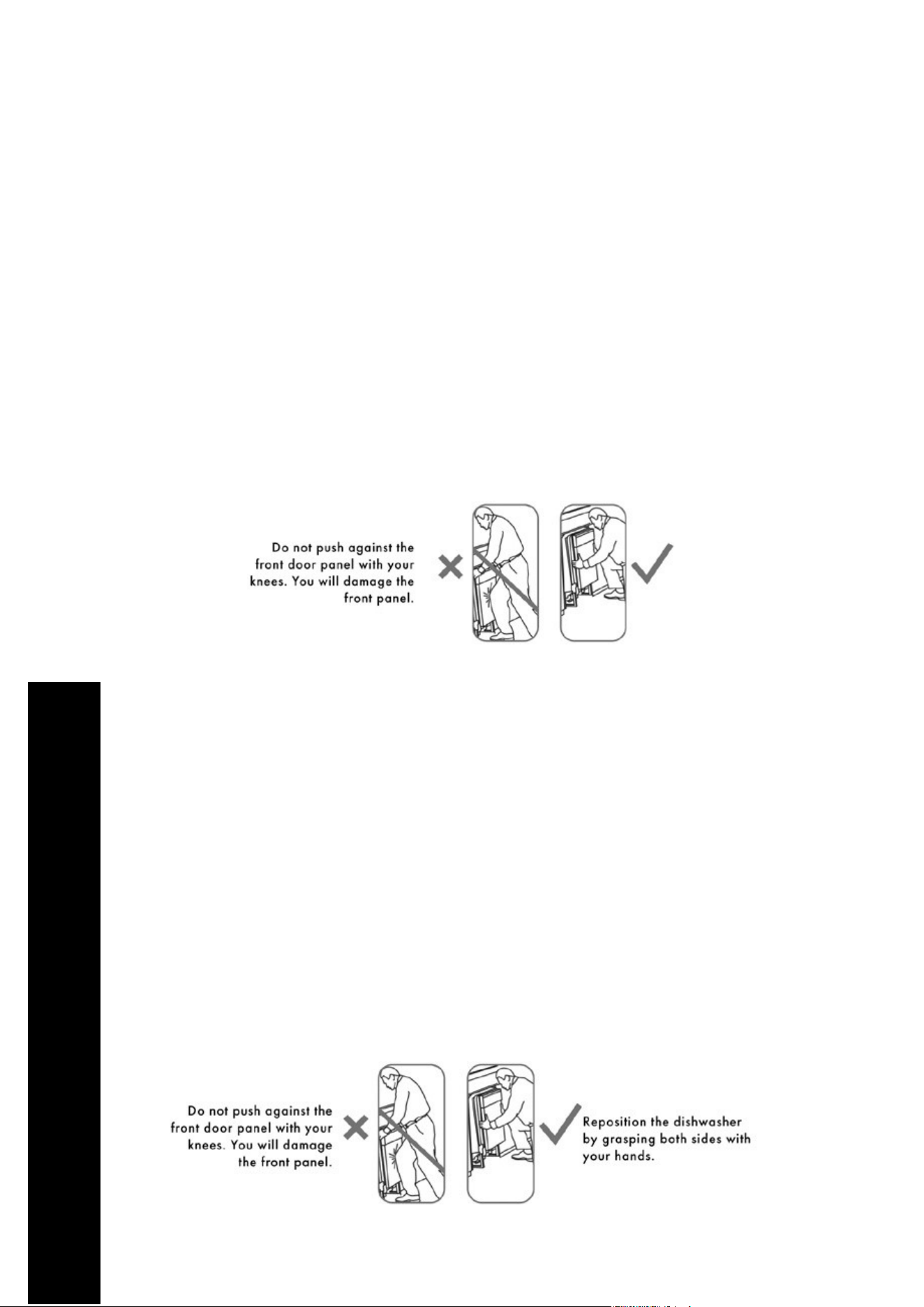
STEP 10: SLIDE THE DISHWASHER PARTIALLY INTO THE CABINET
Caution: Do not push against the front panel with your knees. Damage
will occur.
1. Position the dishwasher in front of the opening, then slide the dishwasher into the
opening a few inches at a time.
2. Pull the drain hose through the opening under the sink as you proceed. Stop
when the dishwasher is a few inches in front of the adjacent cabinetry.
3. Make sure that the drain hose is not kinked under the dishwasher and that there
is no interference with the water line, wiring, or any other component.
STEP 11: POSITION THE DISHWASHER UNDER THE COUNTERTOP
1. Make sure that the wires are secure under the dishwasher and not pinched or in
contact with door springs or other dishwasher components.
2. Push the dishwasher into the cabinet. The front corners of the dishwasher door
should be flush with the cabinet doors. Be careful not to dent the front panel with
your knees or damage the countertop or cabinets with dishwasher parts.
Tip: Check tub insulation blanket, if equipped. It should be positioned
so it is not bunched up or interfering with door springs.
Check by opening and closing the door.
Note: You will not have access to the back leveling legs once the
dishwasher is put in place.
26
INSTALLATION INSTRUCTIONS
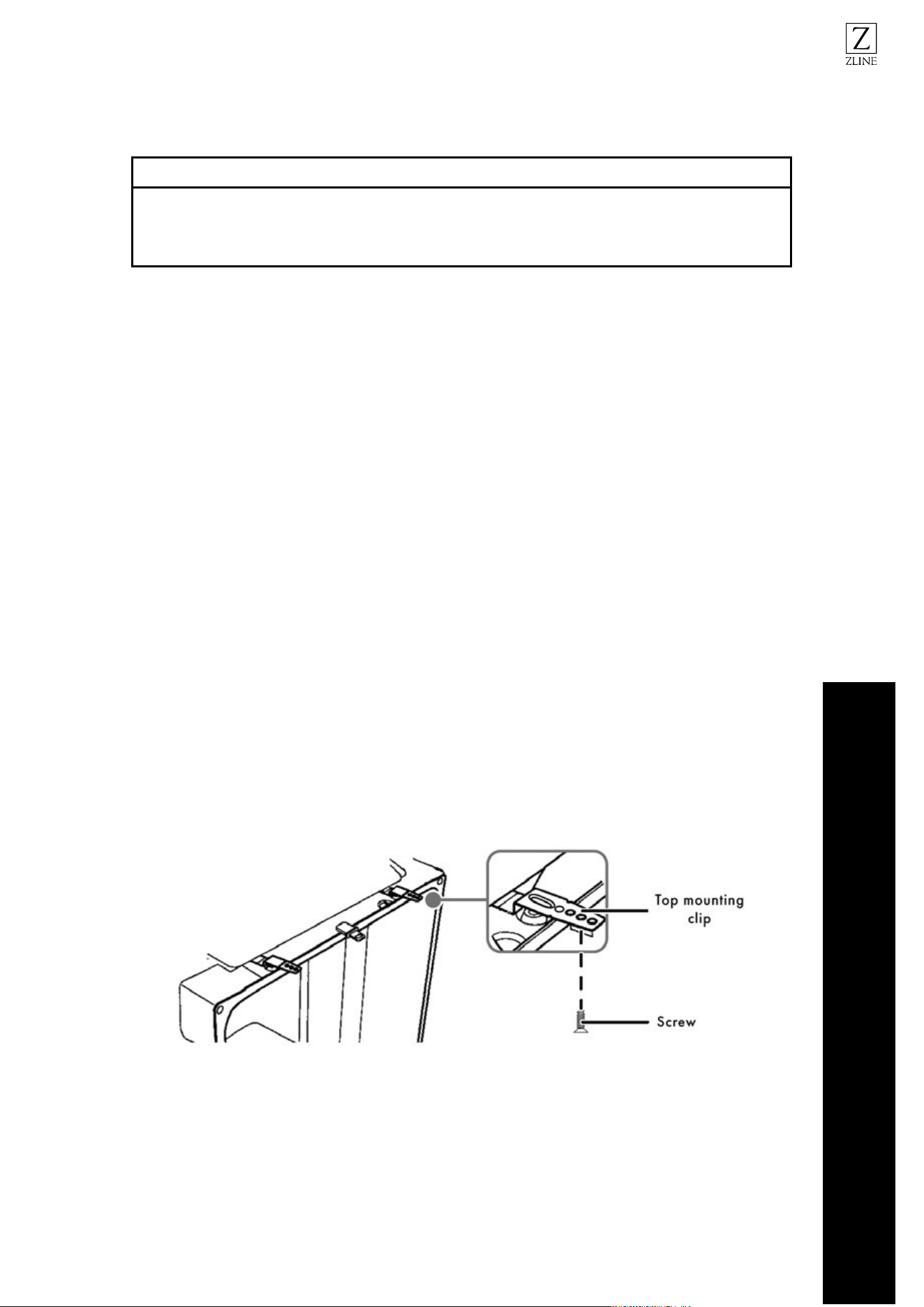
STEP 12: SECURING THE DISHWASHER TO THE COUNTERTOP
• For countertops made of wood or materials that won’t be damaged by drilling,
use Method 1.
• For countertops made of granite, marble, or other materials that could be
damaged by drilling, use Method 2.
• If the gap between the control panel and the cabinet is less than 0.4 in.,
use Method 2.
Method 1
1. Insert the long top mounting clips into the slot.
2. Bend the brackets to secure them to the dishwasher tub.
3. Secure the dishwasher to the countertop through the holes in the brackets, using
the screws provided.
Important: Drive the screws straight and flush. Protruding screw heads
will scratch the top of the control panel and interfere with the door
closing.
YOU’LL NEED
• Phillips screwdriver
• Screws A ST4 x 20 (2)
(two for each method)
• Top mounting clips (2)
Securing the Dishwasher
27
Securing the Dishwasher
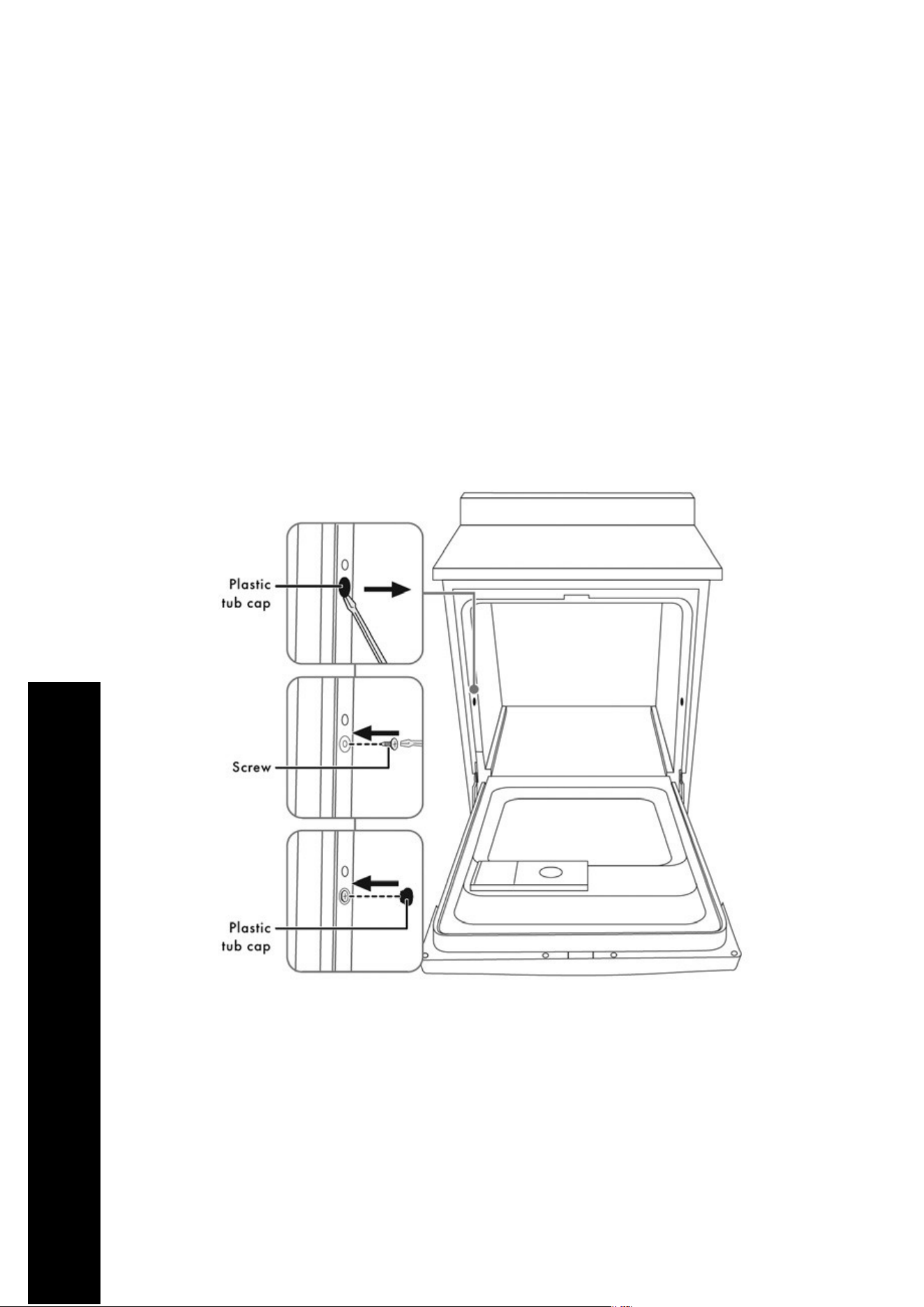
Method 2
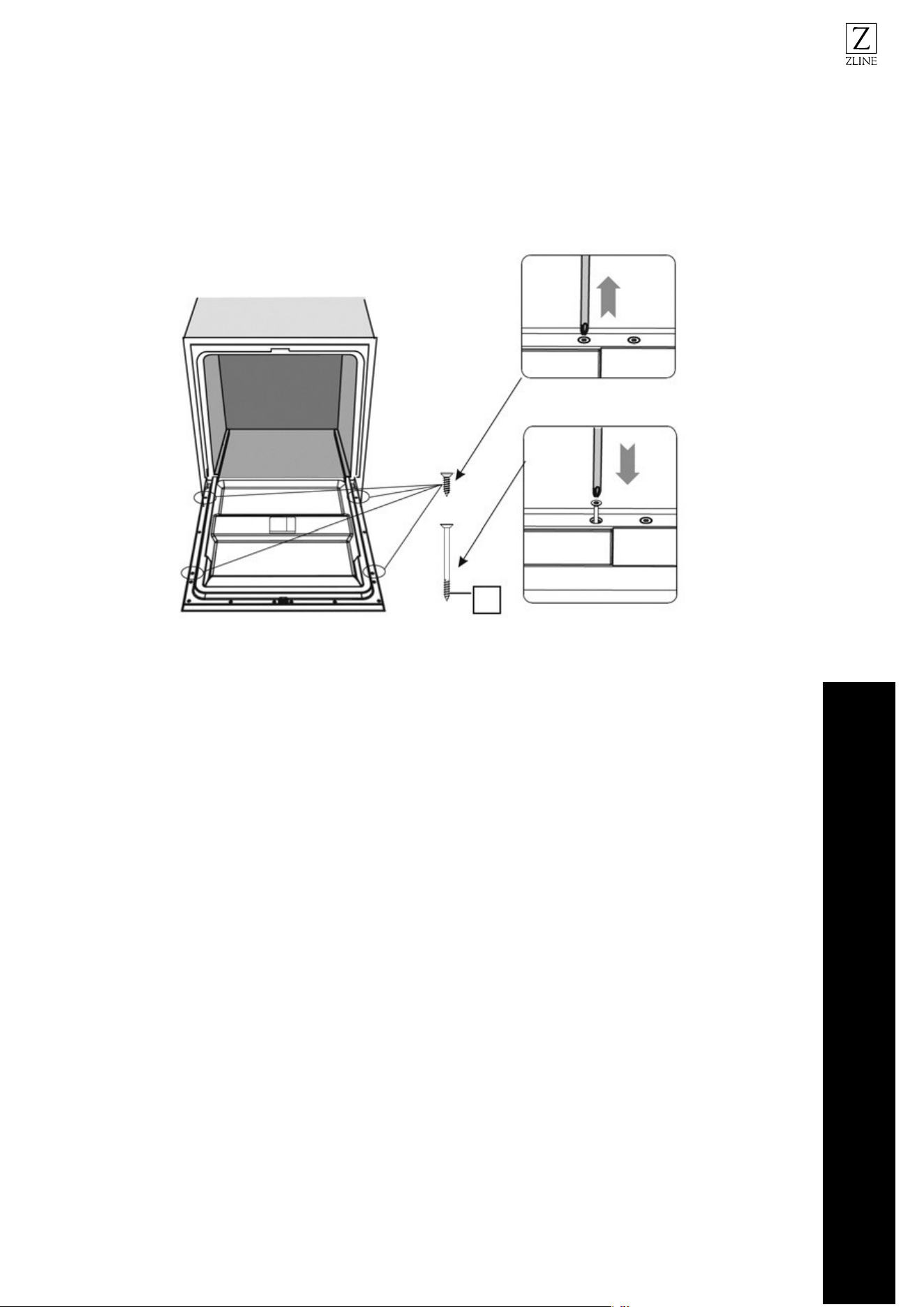
1. Remove the plastic tub caps from the inside of the dishwasher tub.
2. Drive a wood screw through the hole in the side of the dishwasher into the
cabinet frame.
3. Reinsert the plastic tub caps.
Important: Drive the screws straight and flush. If the screws are too
tight, the sides will bow. Do not over tighten. Protruding screw heads
will scratch the side if the dishwasher. This method is for attaching the
dishwasher to the side of the cabinet and it should be done when the
countertop is made of granite or other breakable materials.
INSTALLATION INSTRUCTIONS
28
Connecting the Water Supply Line
INSTALLATION INSTRUCTIONS
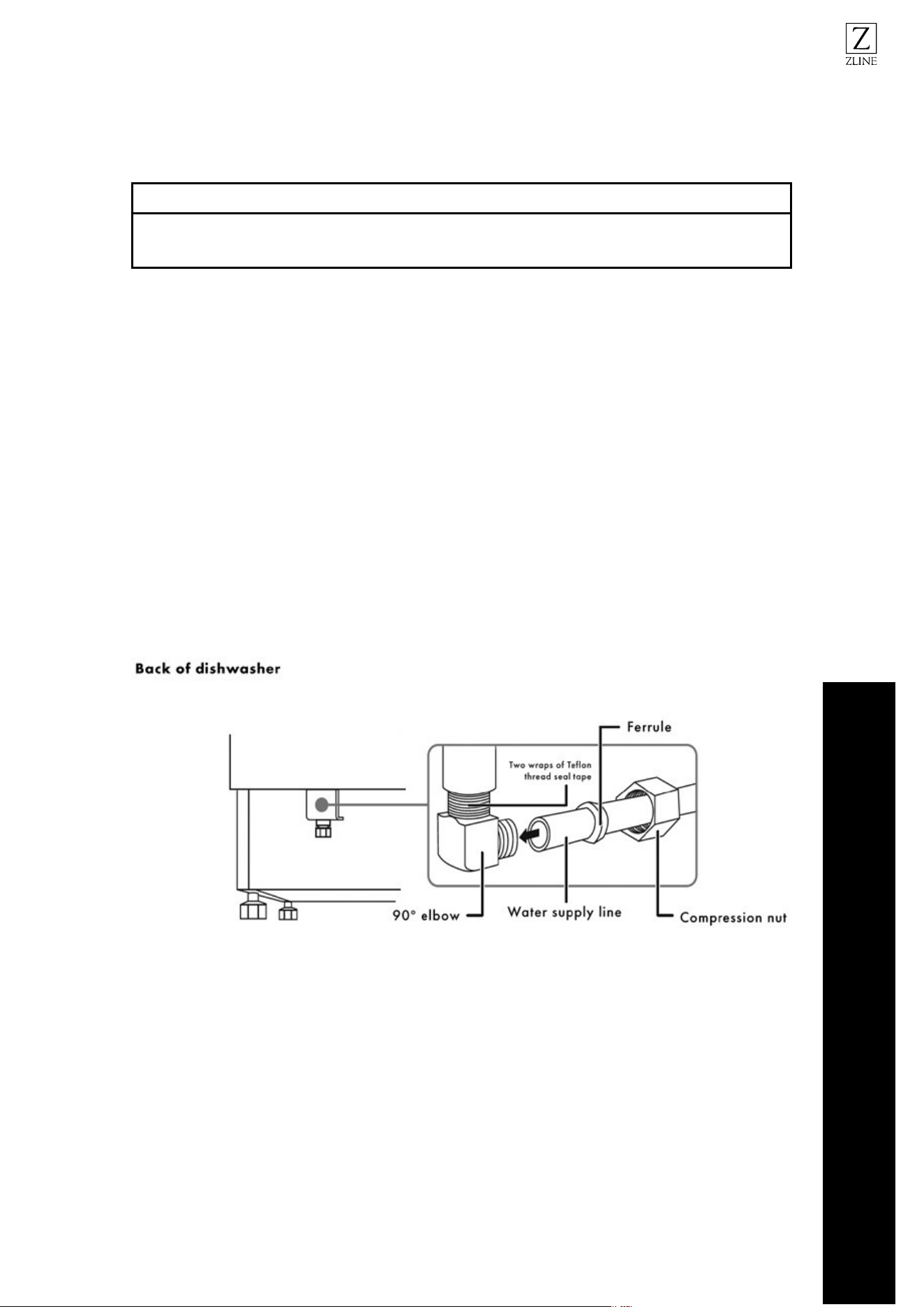
STEP 13: CONNECTING THE WATER SUPPLY LINE
1. Make sure that you wrapped the 90° elbow with Teflon thread seal tape twice.
2. Slide the compression nut, then the ferrule over the end of the water supply line.
Note: If you use braided stainless steel, you do not need a ferrule or
compression nut.
3. Insert the water supply line into the 90° elbow.
4. Slide the ferrule against the 90° elbow and secure it with the compression nut.
Important: Make sure that the door spring does not rub or contact the
water supply line or drain hose. Test by opening and closing the door.
Reroute the lines if interference occurs.
YOU’LL NEED
• Adjustable wrench
• Hot water line kit
• Teflon thread seal tape
29
Connecting the Drain Hose
INSTALLATION
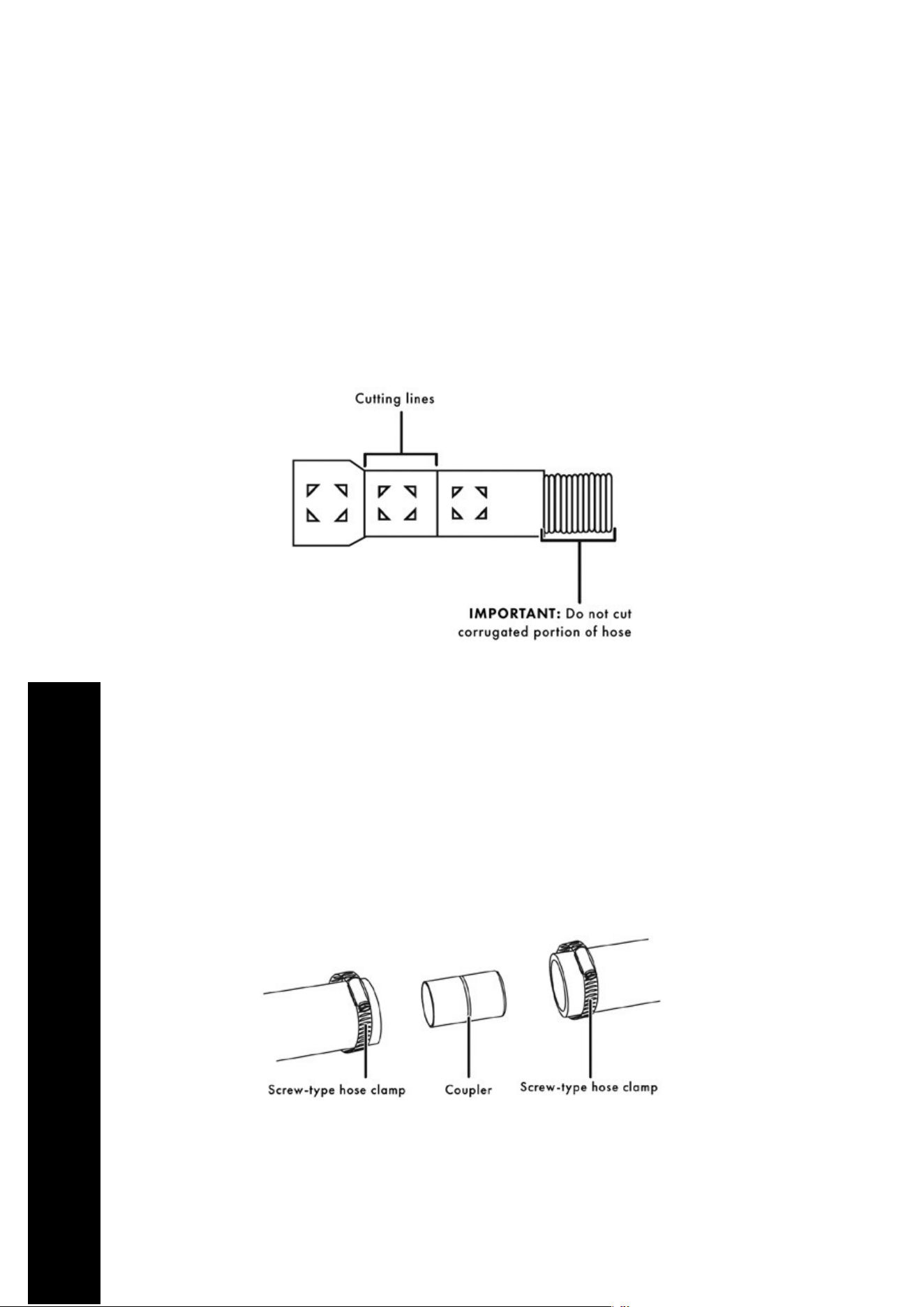
STEP 14: CONNECTING THE DRAIN HOSE
Important: Follow all local codes and ordinances.
1. Cut on the marked line as required for your installation. The drain hose’s molded
end will fit 5/8” or 1” diameter connections on the air gap, waste tee, or
garbage disposal.
2. If a longer drain hose is required, you can add up to 42” of length, for a total of
10 ft. to the factory installed hose. Use 5/8” or 7/8” inside diameter hose and
a coupler to connect the two hose ends. Secure the connection with screw-type
hose clamps.
3. Secure the drain hose to the air gap, waste tee, or garbage disposal with a
screw-type clamp, using the appropriate method below. See “Drain Preparation”
on page 6, if you do not know which method to use.
Important: For proper drain operation, the total drain hose length must
not exceed 10 ft.
30
Connecting the Drain Hose
INSTALLATION
Method 1 - Air gap to a waste tee or garbage disposal.
Method 2 - High drain loop to a waste tee or garbage disposal.
4. If connecting the drain line to a garbage disposal, make sure that the drain plug
has been removed. Your dishwasher will not drain if the plug is left in place.
YOU’LL NEED
• Phillips screwdriver
• Screw-type hose clamps
• Coupler for extending drain line
(if applicable)

31
Pre-Test Check
INSTALLATION
STEP 15: PERFORMING A PRETEST CHECK
Review this list after installing your dishwasher to avoid problems or charges for a
service call not covered by your warranty.
• Make sure that power is turned OFF.
• Make sure all foam and paper packaging is removed.
• Locate the User Guide in the literature package.
• Read the User Guide for operating instructions.
• Check the door opening and closing. If the door does not open and close freely,
or tends to fall open, check the spring adjustments. See “Step 2: Check the door
balance” on page 15.
• Make sure that the wiring is secure under the dishwasher and not pinched or
in contact with door springs or other components. See “Step 11: Position the
dishwasher under the countertop” on page 25.
• Check the door alignment with the tub. If the door hits the tub, level the
dishwasher. See “Step 8: Level the dishwasher” on page 22.
• Check the door alignment with the cabinet. If the door hits the cabinet, reposition
or relevel the dishwasher. See “Step 8: Level the dishwasher” on page 22.
• Pull the lower rack out about half way. Make sure that it does not roll back or
forward on the door. If the rack moves, adjust the leveling legs. See “Step 8:
Level the dishwasher” on page 22.
• Make sure that water supply and drain lines are not kinked or in contact with
other components. Any contact with the motor or dishwasher frame could cause
a noise. “See Step 10: Slide the dishwasher partially into the cabinet” on page
25.
• Turn on the sink hot water faucet and verify the water temperature. Incoming
water temperature must be between 120°F and 150°F. A minimum of 120°F
temperature is required for best wash performance. See “Preparing the hot water
line” on page 10.
• Add a half gallon of water to the bottom of the dishwasher to lubricate the pump
seal.
• Turn on the water supply. Check for leaks. Tighten connections if needed.
• Remove any protective film (if present) from the control panel and door.

32
STEP16: WET TESTING THE DISHWASHER
1. Turn on the power supply (or plug the power cord into the outlet.)
2. Select rinse cycle on dishwasher (refer to the User Guide for instructions).
3. Press START/CANCEL and close door.
4. Make sure that water enters the dishwasher. If water does not enter the
dishwasher, check to be sure that water and power are turned on.
5. Check for leaks under the dishwasher. If a leak is found, turn the power supply
off, then tighten connections. Restore power after the leak is corrected. Then
repeat test, starting at step 1.
6. Check for leaks around the door. A leak around the door could be caused by
door rubbing or hitting against adjacent cabinetry. Reposition the dishwasher
if necessary. See “Step 11: Position the Dishwasher Under the Countertop”on
page 25.
7. When the dishwasher is draining, check the drain lines for leaks. If leaks are
found, turn power off power supply and correct plumbing as necessary.
8. Restore the power after corrections are made. See “Step 13: Connecting the
Water Supply Line” on page 28.
9. Run the dishwasher through another fill and drain cycle. Check for leaks and
correct if required.
10. Open the dishwasher door and make sure that most of the water has drained.
If not, check that the disposer plug has been removed and/or the air gap is not
restricted. See “Step 14: Connecting the Drain Hose” on page 29. Also check
the drain line for kinking.*
*When checking for water, there should be no standing water in the bottom of the
tub, but there will be water in the sump system underneath the filter. This is normal and
is to keep the seals and system from drying out and causing leaks. The water that is
left in the sump is clean water that has not been used to clean dishes.
Pre-Test Check
INSTALLATION
33
Replacing the Toe Kick
INSTALLATION
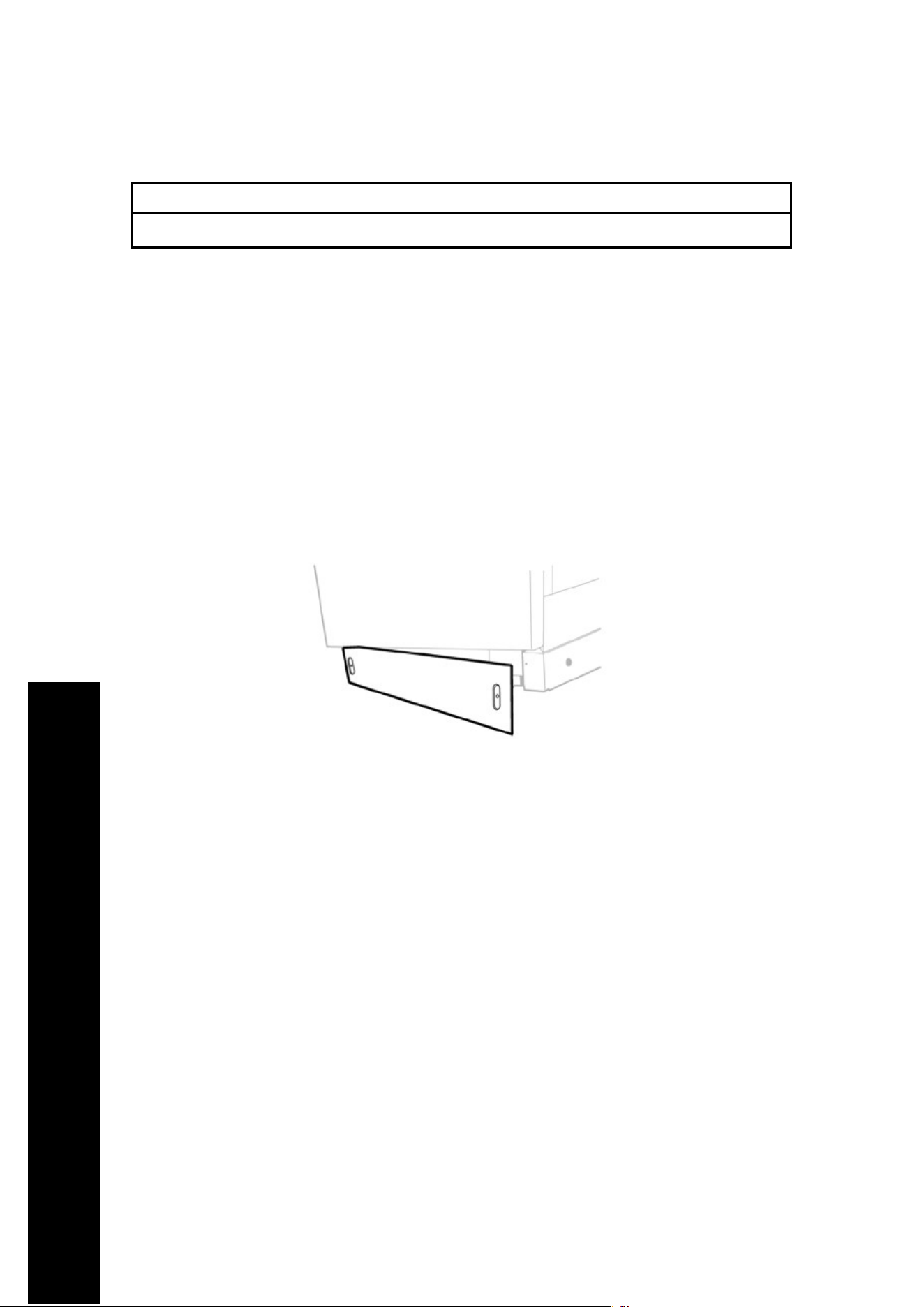
STEP 17: REPLACING THE KICK PLATE
• Place the kick plate against the legs of the dishwasher. The slots should align with
the kick plate bracket screw holes. Allow the kick plate to touch the floor. Install
the kick plate screws.
Note: Make sure that you install the kick plate in the correct direction.
The kick plate should be aligned correctly with the junction box.
The kick plate can also be installed with magnets.
YOU’LL NEED
• Phillips screwdriver
34
CAUTION
CAUTION
RISK OF ELECTRIC SHOCK
DO NOT OPEN
CAUTION
This symbol indicates that dangerous voltage constituting a risk of
electric shock is present within your dishwasher.
This symbol indicates that there are important operating and maintenance
instructions in the literature accompanying your dishwasher.
WARNING
WARNING
When using your dishwasher, follow basic safety precautions, including the following:
BEFORE YOU BEGIN
Read these instructions completely and carefully.
1. Read these instructions.
2. Keep these instructions.
3. Heed all warnings.
4. Follow all instructions.
5. Clean only with a damp cloth.
6. Do not block any ventilation openings. Install in accordance with the
manufacturer’s instructions.
7. Make sure that the available AC power matches the voltage requirements of this
appliance.
8. Refer all servicing to qualified service personnel. Servicing is required when the
appliance has been damaged in any way or it does not operate normally.
1. WARNING-DANGER Never allow children to play with, operate, or crawl
inside the dishwasher.
2. Turn off the dishwasher before carrying out user maintenance on it.
3. If a component part is damaged, it must be replaced by the manufacturer, its
service agent, or similar qualified persons in order to avoid a hazard.
4. This appliance is intended to be used in household and similar environments.
IMPORTANT SAFETY INSTRUCTIONS
General Safety
Electric Shock Hazard
Failure to follow these instructions can result in electric shock, fire, or death.
WARNING

35
IMPORTANT SAFETY INSTRUCTIONS
BASIC PRECAUTIONS BEFORE USE:
• Read all instructions before using the dishwasher.
• The manual does not cover every possible condition and situation that may occur.
• Use the dishwasher only for intended function as described in this manual.
• To ensure the longevity of the dishwasher’s optimal wash performance, we
recommend rinsing off any large pieces of food from your dishes prior to placing
it in the unit for a wash cycle.
• When loading items to be washed:
• Load sharp items and knives so that they are not likely to damage the door
seal and tub.
• Load sharp items and knives with the handles up to reduce the risk of cut-type
injury.
• Do not wash plastic items unless they are marked dishwasher safe or the equivalent,
if not marked, check with manufacture for recommendation, items that are not
dishwasher safe may melt and create a potential fire hazard.
• If the dishwasher drains in to a garbage disposal, make sure disposal is completely
empty before running dishwasher.
• Do not tamper with the controls.
• Do not operate your dishwasher unless all enclosure panels are properly in place.
• Do not touch the heating element during or immediately after use, especially if the
sanitize option has been selected.
• Do not let children abuse, sit, or stand on door or racks of the dishwasher.
• Under certain conditions, hydrogen gas may be produced in a hot water system
that has not been used for two weeks or more. HYDROGEN GAS IS EXPLOSIVE.
• If the hot water system has not been used for a period of time, before using it
again, let the water flow for several minutes. This will release any accumulated
hydrogen gas. Hydrogen gas is flammable. Do not smoke or use an open flame
during this time.
• Do not store or use combustible materials, gasoline or other flammable vapors
and liquids in the vicinity of this or any other appliance.
• Use only detergents or rinse agents recommended for use in a dishwasher and
keep them out of the reach of children.
• Keep young children and infants away from dishwasher when it is operating.
General Safety

36
General Safety
IMPORTANT SAFETY INSTRUCTIONS
• Do not use the dishwasher if it has a damaged power line or plug, and do not plug
the dishwasher into a damaged outlet, failure to observe these instructions may
result in electrical shock.
• Remove the door to the washing compartment when removing an old dishwasher
from service or discarding it.
• To reduce the risk of injury, do not allow children to play in or on a dishwasher.
SAVE THESE INSTRUCTIONS

37
OPERATION
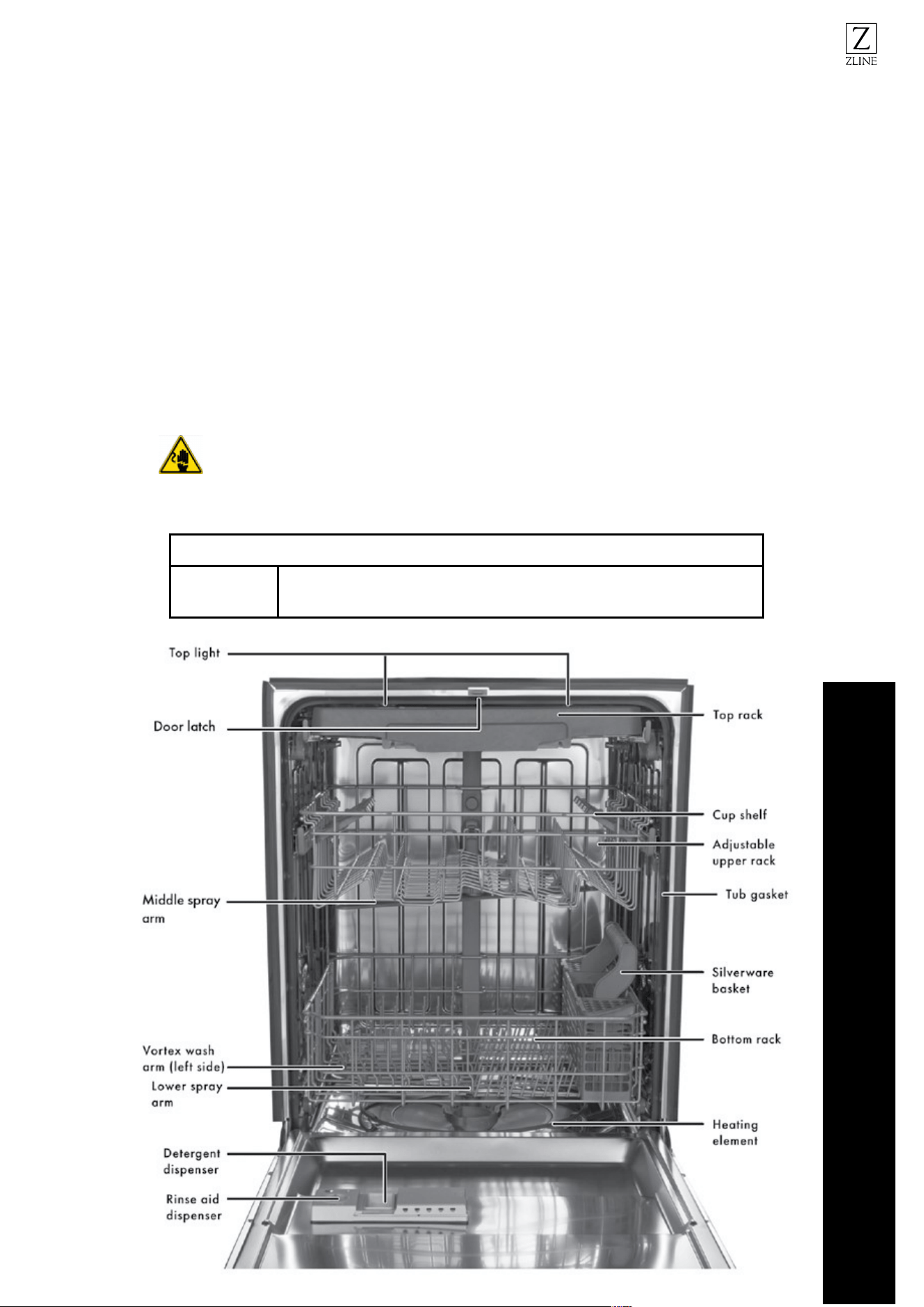
Dishwasher Features
1. Water supply temperature should be between 120° F and 150° F.
2. Dispose of the discarded appliance and packing material properly.
3. The dishwasher must be grounded or it can result in a risk of electric shock.
4. If there is any damage to the dishwasher, please contact customer service at
614-777-5004. Do to attempt to repair or replace any part by yourself. For
information on installing and setting up your dishwasher, refer to the Installation
Guide provided.
BEFORE USING YOUR DISHWASHER
1. Remove the interior packing.
2. Clean the interior surface with lukewarm water using a soft cloth.
FINDING A SUITABLE LOCATION
• This dishwasher is designed to be built-in.
• The dishwasher door must be able to swing fully open.
PROVIDING A PROPER POWER SUPPLY
Check your local power source. This dishwasher requires a 120V, 60Hz power
supply.
Refer to the Installation Guide for additional information.
HOW YOUR DISHWASHER CLEANS
The dishwasher fills with water, covering the filter area at the bottom. Water is then
pumped through the various filter and spray arms, spraying a mixture of hot water
and detergent against the soiled surfaces of your dishes and silverware. Soil particles
are separated and go down the drain as the dirty water is drained and replaced with
clean water. The number of water fills is determined by the cycle selected.
WASH CYCLE SELECTIONS
Cycle times are approximate and will vary with options selected. Hot water is
necessary to activate dishwasher detergent and melt fatty food soils. An automatic
sensor checks the incoming water temperature and, if it is not hot enough, the timer
will be delayed to allow for the water to heat for the main wash of all cycles. This
happens even when hi-temp wash is selected, so that higher temperature will be
available to handle heavier soil loads.
38
OPERATION
Filter System
FILTER SYSTEM
Your dishwasher has a multiple filter system which includes four separate filter
meshes. It separates dirty water and clean water into different chambers. The multiple
filter system helps your dishwasher to get better performance with less water and less
energy.
SMART WASH SYSTEM
Your dishwasher has a smart wash system under the normal wash program which
selects the wash cycle based on how large and how soiled the load, permitting your
dishwasher to clean more efficiently every time. When a partial load of lightly soiled
dishes is placed in the unit, a short wash cycle is automatically selected. When a full
load of heavily soiled dishes is placed in the unit, a heavy wash cycle is automatically
selected.
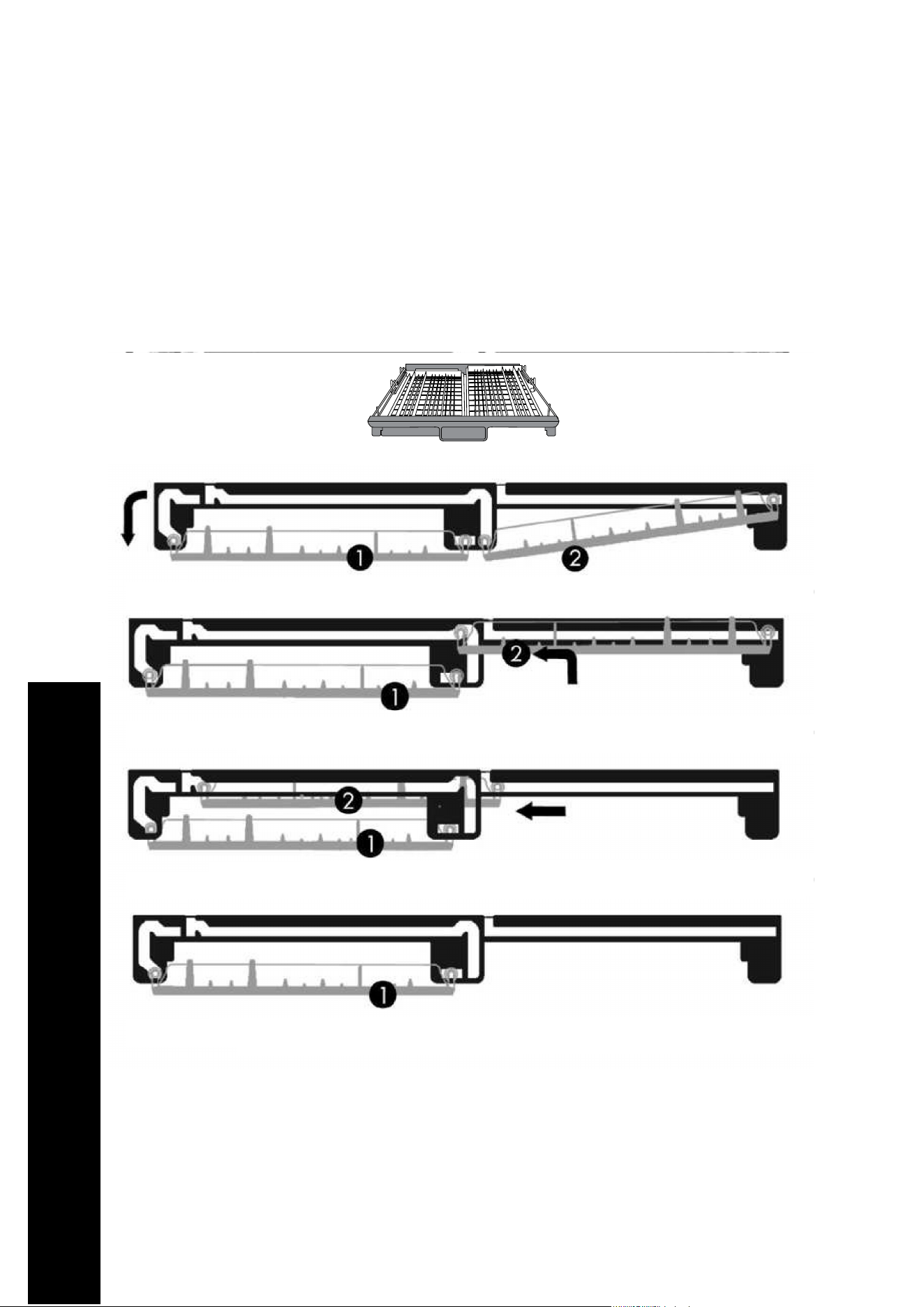
ADJUSTABLE UPPER RACK
The upper rack of your dishwasher can be raised or lowered to accommodate loading
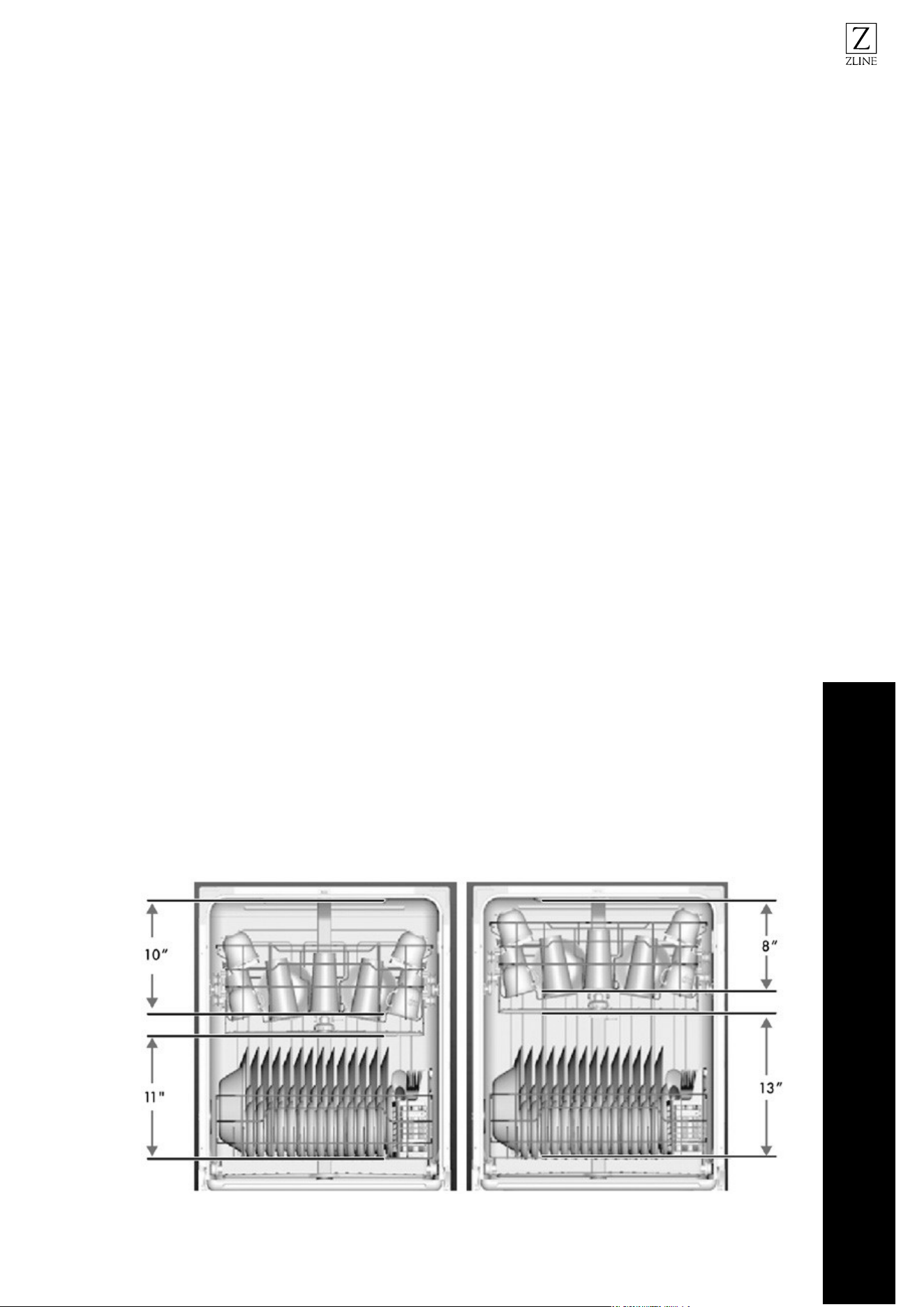
dishes of varying heights in either rack. After removing the 3rd rack, the upper rack
clearance height can be adjusted from 8” to 10”. The lower rack clearance height
can be adjusted from 11” to 13”. See “Adjusting the Upper Rack” on page 43.
39
OPERATION
USING THE CONTROL PANEL
Your dishwasher’s control panel is located on the top edge of the door. The door must
be open to make settings and operate the dishwasher.
POWER On/Off - 3sec - Hold this button down for three seconds to turn the power
on or off.
CYCLES
Select a cycle based on the type of dishes to be washed and the level of soil on the
dishes. Cycle times are approximate and will vary with options selected. The timer
will be delayed to allow for the water to heat for the main wash of all cycles if the
sensor detects the water is not hot enough. Below is water use and cycle times under
standard conditions.
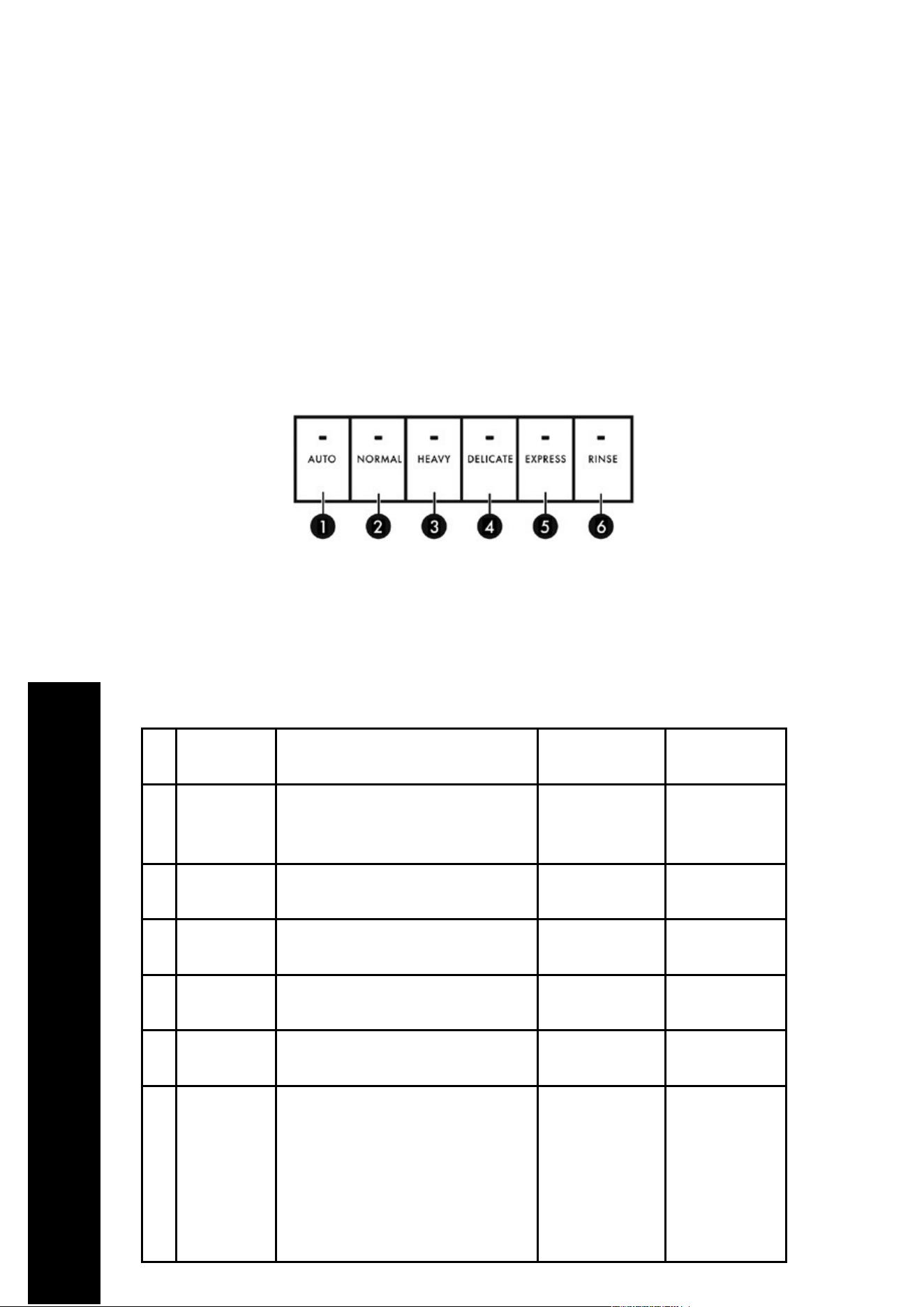
Control Panel
# CYCLE DESCRIPTION WATER USE
CYCLE TIME
(MINUTES)
1 AUTO Auto sensing wash, lightly, or
heavily soiled crockery, with or
with out dried-on food.
3.0 - 5.9 gal. 100 - 133
2 NORMAL Use for regularly soiled dinner
dishes or silverware.
3.0 - 5.9 gal. 102 - 120
3 HEAVY Use for hard-to-clean, heavily
soiled dishes, pots, and pans.
6.9 gal. 138
4 DELICATE Use for lightly soiled crockery
and glass.
5.9 gal. 114
5 EXPRESS Use for lightly soiled and pre-
rinsed dishes and silverware.
4.0 gal. 60
6 RINSE Use for pre-rinsing dishes or
glasses. This is only a rinse that
keeps food from drying on
your dishes and reduces odor
buildup in your dishwasher until
you are ready to wash a full
load. Do not use detergent.
2.0 gal. 20
40
OPERATION
Control Panel
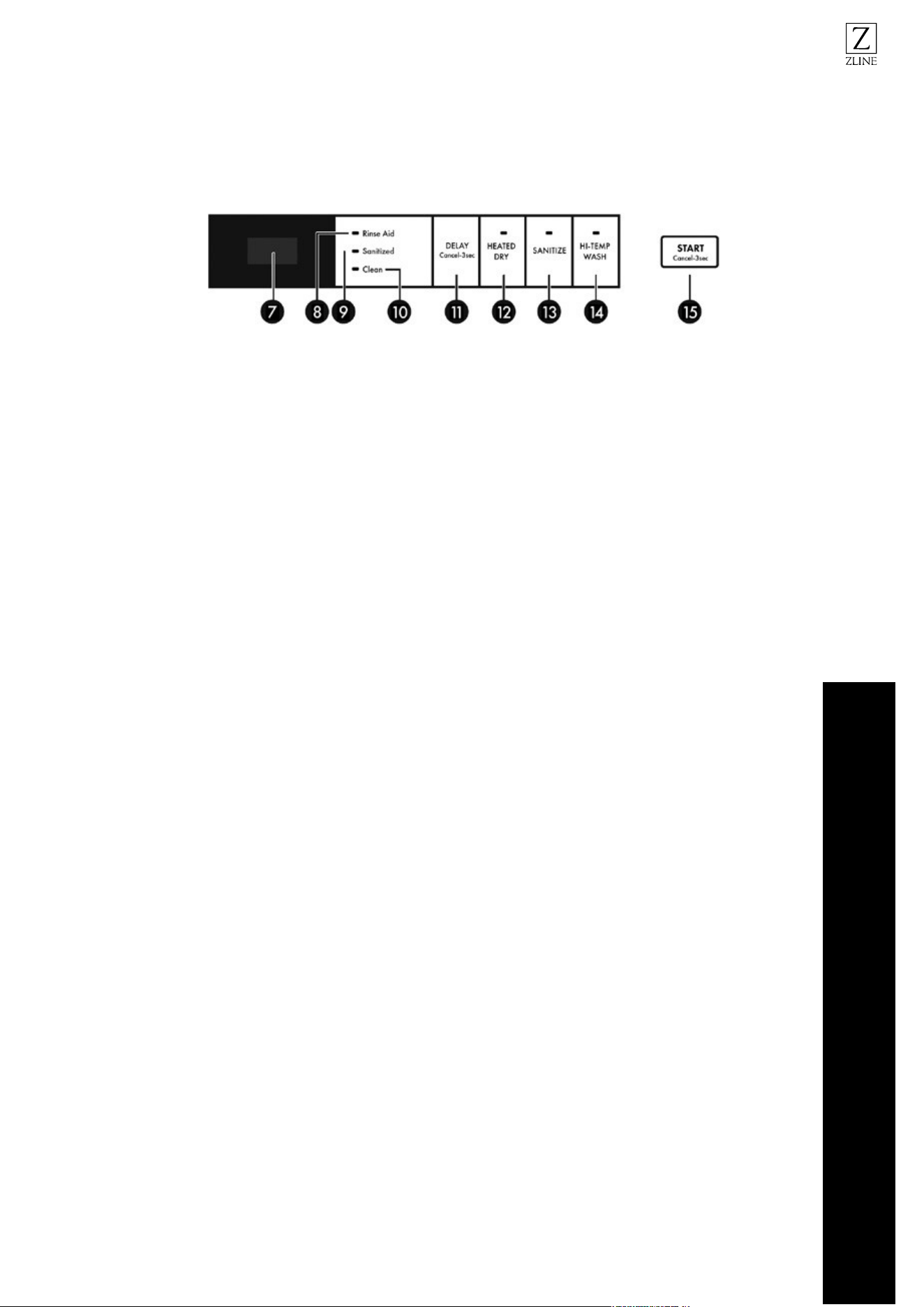
CONTROLS AND INDICATORS
Options can add enhancements to the cycle selected.
7. DISPLAY - Shows the remaining hours and minutes of the current cycle, delay
hours remaining, and error codes (see “Error Codes” on page 56).
8. Rinse Aid - Turns on when you need to add rinse aid.
9. Sanitized - Turns on when a sanitized cycle is finished. Turns off after 30
seconds, when the door is opened.
10. Clean - Turns on after a cycle finished. Turns off after 30 seconds when the
door is opened.
11. DELAY - Press repeatedly to delay the start of the selected wash cycle until the
delay time you want is shown on the display. “H” will show. This is not an error
code. You can select from one to 24 hours delay. After you select the delay
time you want, press START/CANCEL once, then close the door within four
seconds. The delay begins to count down. If you open the door while delay is
running, press the START/CANCEL, then close the door within four seconds to
begin the cycle from that point. To cancel the delay and begin the cycle before
the delay period is complete, open the door, then press and hold DELAY for
three seconds.
OPTIONS
12. HEATED DRY - Use to heat-dry your dishes. This function is not available for
rinse only cycle.
13. SANITIZE - Use to sanitize your dishes and glassware. Maintains the water
temperature at158° F max., and is available with the AUTO, NORMAL, and
HEAVY cycles.
Note:
• Certified residential dishwashers are not intended for licensed food establishments.
• The sanitize cycle is NSF certified.
41
OPERATION
Control Panel
14. HI TEMP WASH - Use to maintain the water temperature at140° F max. This
option is available with the AUTO, NORMAL, and HEAVY cycles.
15. START/CANCEL - Press to start the dishwasher after you have selected a
cycle and function (if desired). Close the door. The cycle indicator begins to
blink and the function indicator turns on. If you don’t close the door within four
seconds of pressing START/CANCEL, the dishwasher pauses. Press START/
CANCEL again to continue with the cycle. To cancel a running cycle, open the
door, then press and hold START/CANCEL for three seconds. The dishwasher
will return to standby status. To load more dishes or pause the dishwasher
while it’s already running, open the door. A safety mechanism stops the cycle.
You can add more dishes before the main wash cycle has started. To determine this,
check the detergent dispenser in the door. If the detergent dispenser is still closed,
you can add more dishes. If it is open, you can add dishes to the dishwasher if the
dish quantity is small. If the quantity is large, restart the cycle.
BASIC OPERATION
1. Load the dishwasher (See “Preparing and Loading Dishes” on page 42).
2. Add detergent (See “Filling the Detergent Dispenser” on page 48).
3. Add rinse aid, if needed (See “Filling the Rinse Aid Dispenser” on page 49).
4. Select the cycle you want (See the “Basic Operation” on page 41). The
indicator will light when the selection is made.
5. Select the function you want. The indicator will light when the selection is made.
6. To start, press START/CANCEL on the control pad.
7. Close the door within four seconds and the wash cycle will begin.
CAUTION
To avoid injury open the door slowly and carefully. There is a
possibility of hot steam from inside the dishwasher.
42
OPERATION
Preparing Dishes
PREPARING AND LOADING DISHES
Preparing dishes for washing
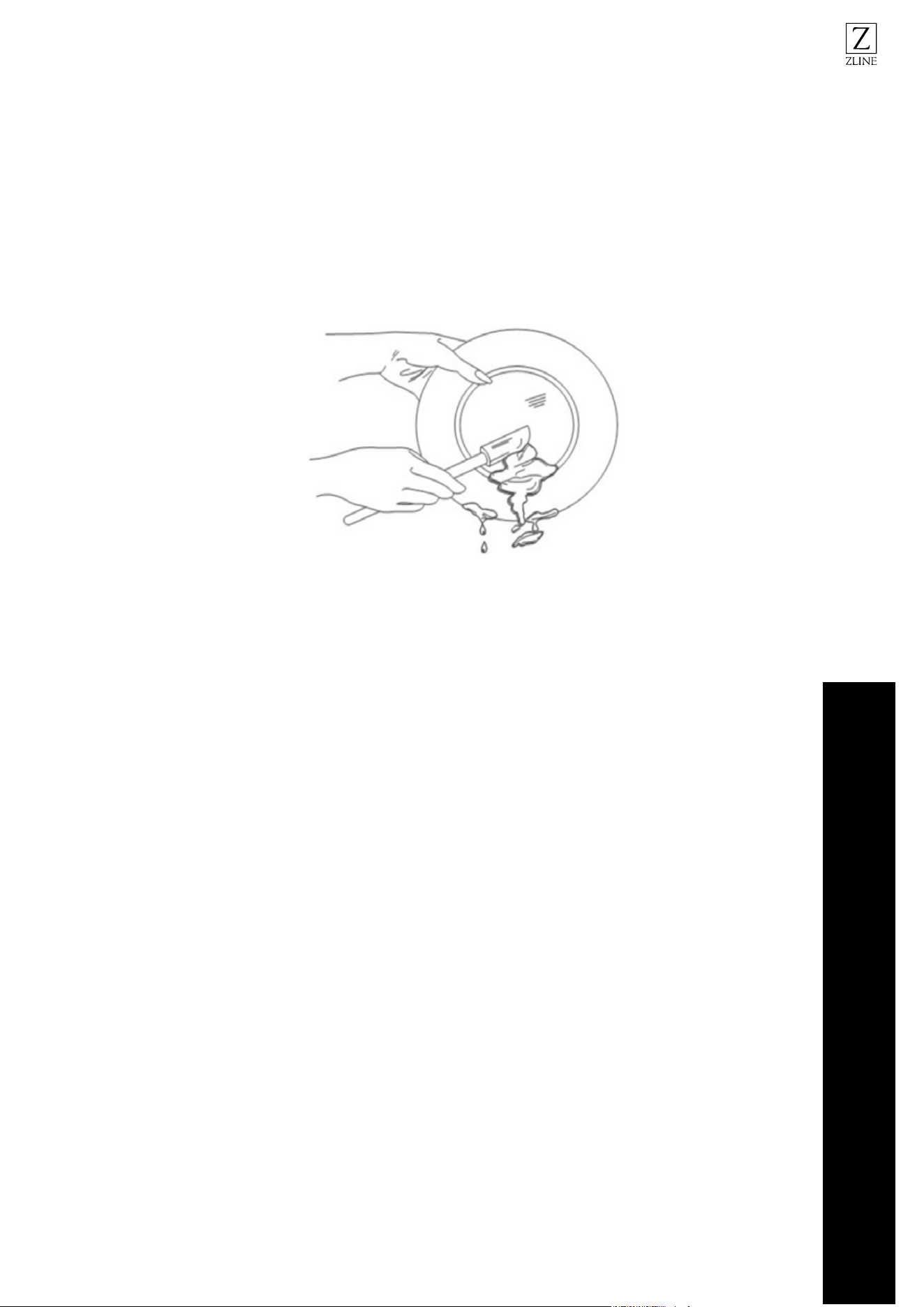
• Scrape away large pieces of food, bones, pits, toothpicks, and similar items. The
continuous filtered wash system will remove the remaining food particles.
• Burned-on foods should be loosened before loading.
• Empty liquids from glasses and cups.
• Foods such as mustard, mayonnaise, vinegar, lemon juice, and tomato-based
products may cause discoloration of stainless steel and plastics if allowed to sit
for a long period of time. Unless the dishwasher is to be operated at once, it is
best to rinse off these types of foods.
• If the dishwasher drains into a garbage disposal, be sure the disposal is
completely empty before starting dishwasher.
43
Lef
t and right racks aligned
Left rack is lower position and right rack angled
Left rack adjusted to lower position and right rack to upper position
Left rack adjusted to lower position and right rack moved to the left
Left rack adjusted to lower position and right rack removed
OPERATION
ADJUSTING THE UPPER RACK
This dishwasher has a convenient top rack for silverware, cutlery, and small items.
This rack can be adjusted to accommodate varying loads, as shown below.
Left rack adjusted to lower position and right rack to upper position
Left rack in lower position and right rack angled
Left rack adjusted to lower position and right rack moved to the left
Left rack adjusted to lower position and right rack removed
Loading the Dishwasher
44
OPERATION
Rack Adjustment Procedure
ADJUSTING THE UPPER RACK
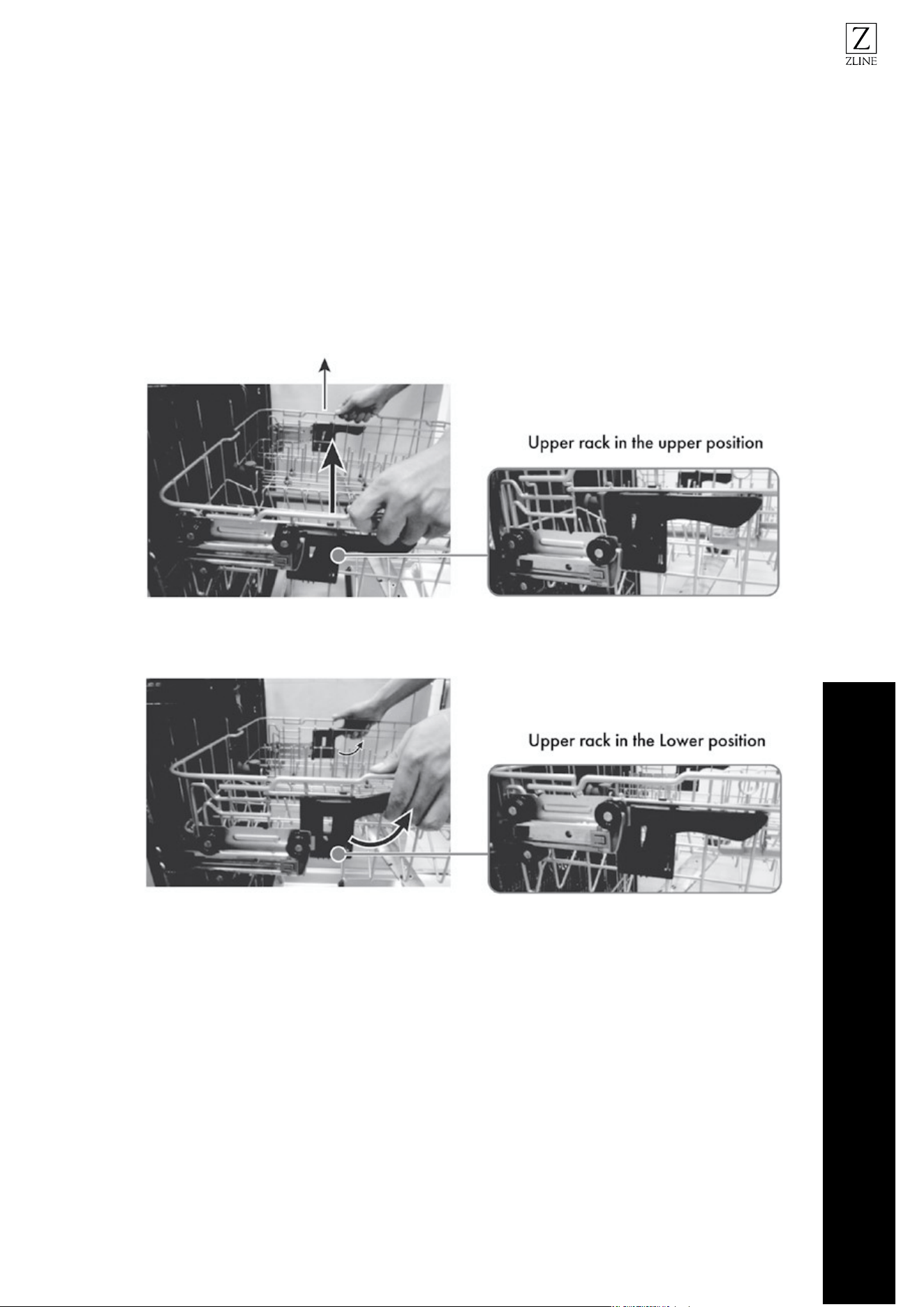
The height of the upper rack can be adjusted to accommodate loading taller dishes
in either rack.
1. Lift the rack to move it to the upper position.
2. Press the handle to move it to the lower position.
LOADING THE UPPER RACK
The upper rack is designed for cups, glasses, small plates, bowls, and plastic items
marked dishwasher-safe. For best results, place the items with the soiled surface
facing down or toward the center. Tilt them slightly for better drainage.
Note:
Make sure the loaded dishes do not interfere with the rotation of the
middle spray arm, which is located just below the upper rack. You can
check this by rotating the middle spray arm by hand.
45
OPERATION
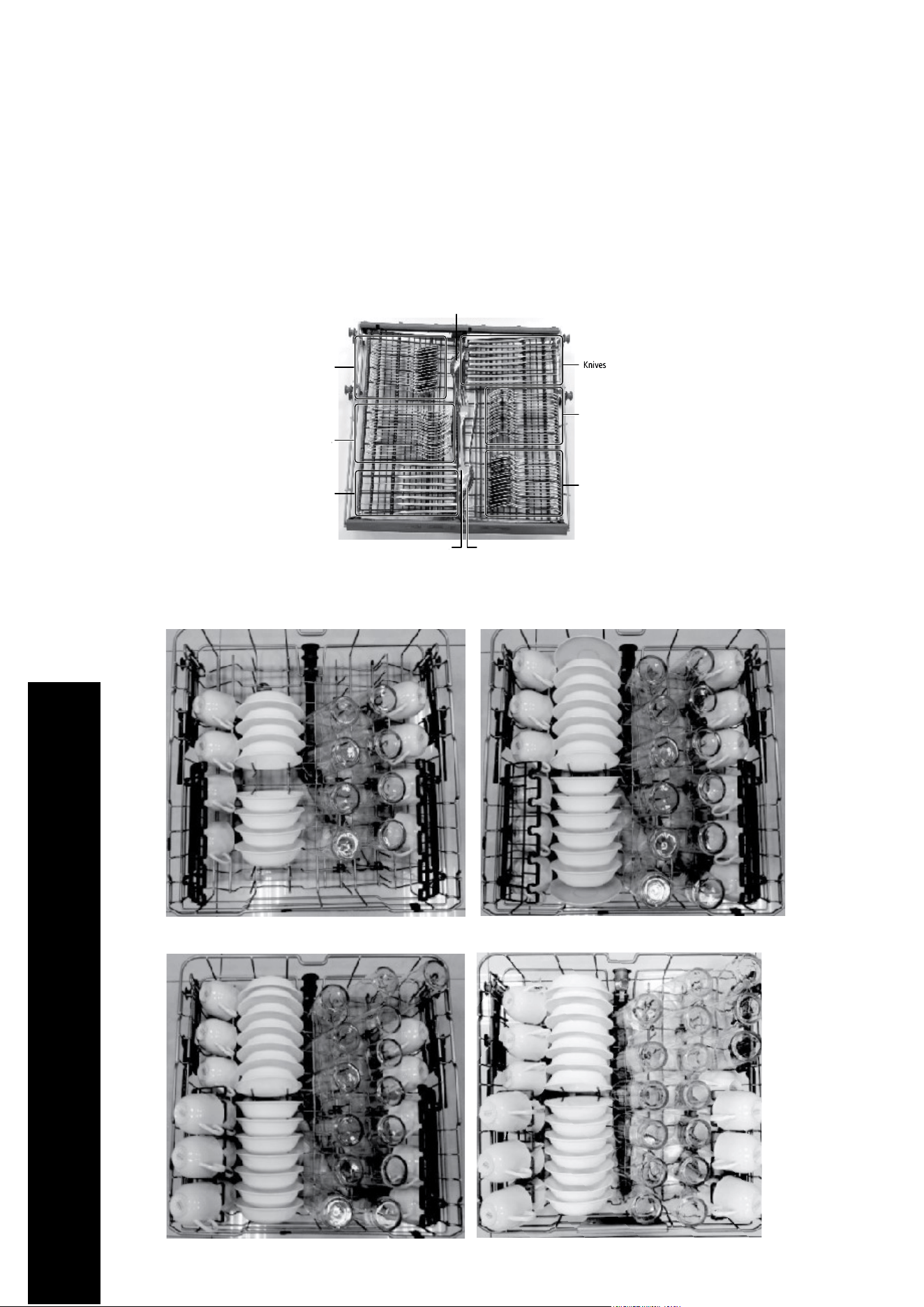
LOADING THE TOP RACK
You can place the items in the top rack randomly or in an orderly fashion. The image
below shows how to load the top rack for 16 place settings:
Loading suggestions are shown below.
8 place settings
14 place settings
12 place settings
16 place settings
Loading the Dishwasher
Large forks
Small
spoons
Forks
Knives
Small forks
Large spoons
Large spoons
Spoons
46
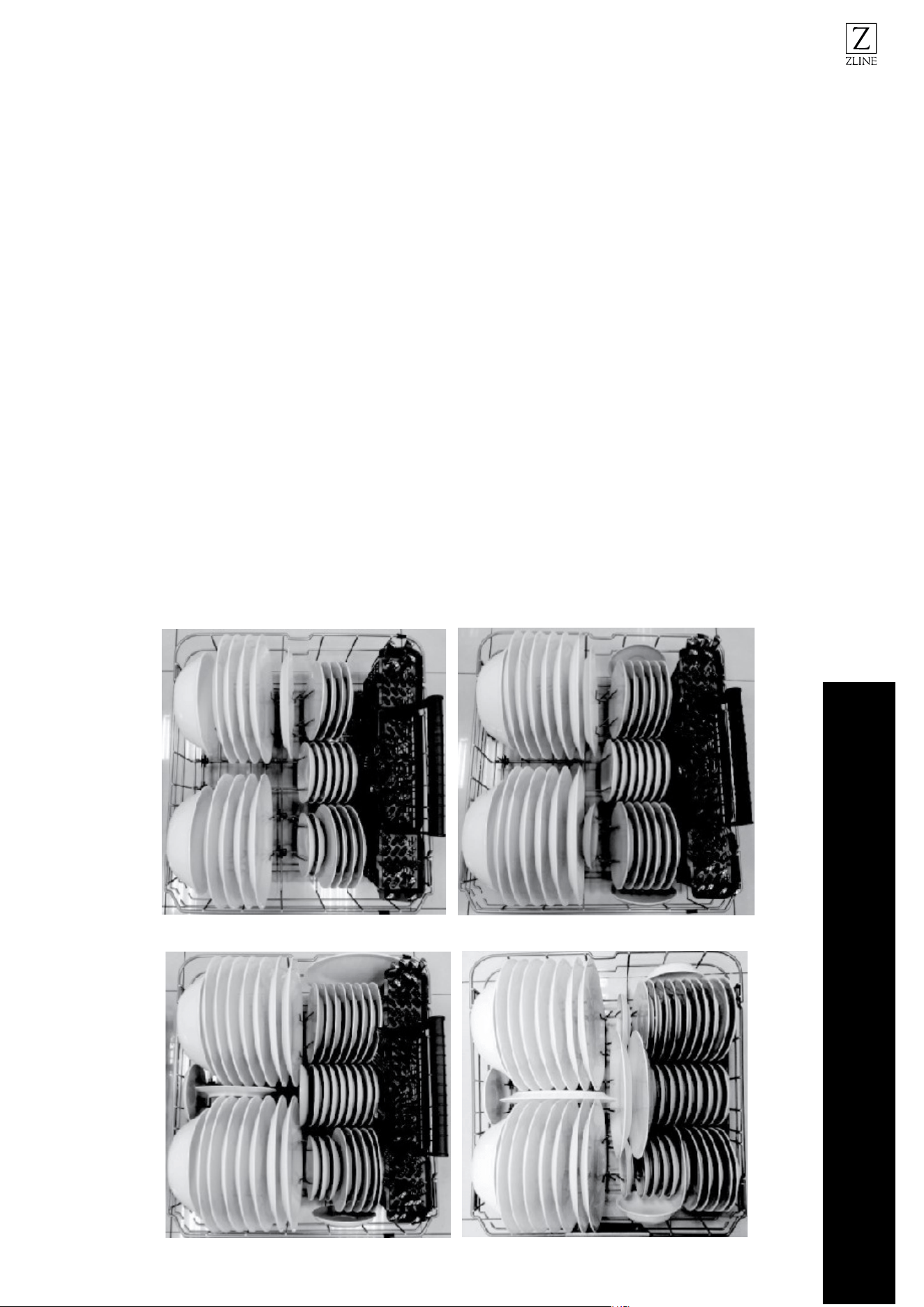
LOADING THE BOTTOM RACK
The bottom rack is designed to accommodate plates, bowls, saucers, and cookware.
The adjustable rack lets you load items up to 13 inches high. Large items should be
placed along the edge, with the inside faces down, so they do not interfere with the
middle or lower spray arms or prevent the detergent dispenser from opening.
The fold-down tines on the bottom rack are provided to support extra large and
hard-to-f it items. The tines may be left up for normal use or folded down for more
flexible loading of larger items.
Loading suggestions are shown below:
8 place settings
14 place settings 16 place settings
OPERATION
Loading the Dishwasher
12 place settings
47
OPERATION
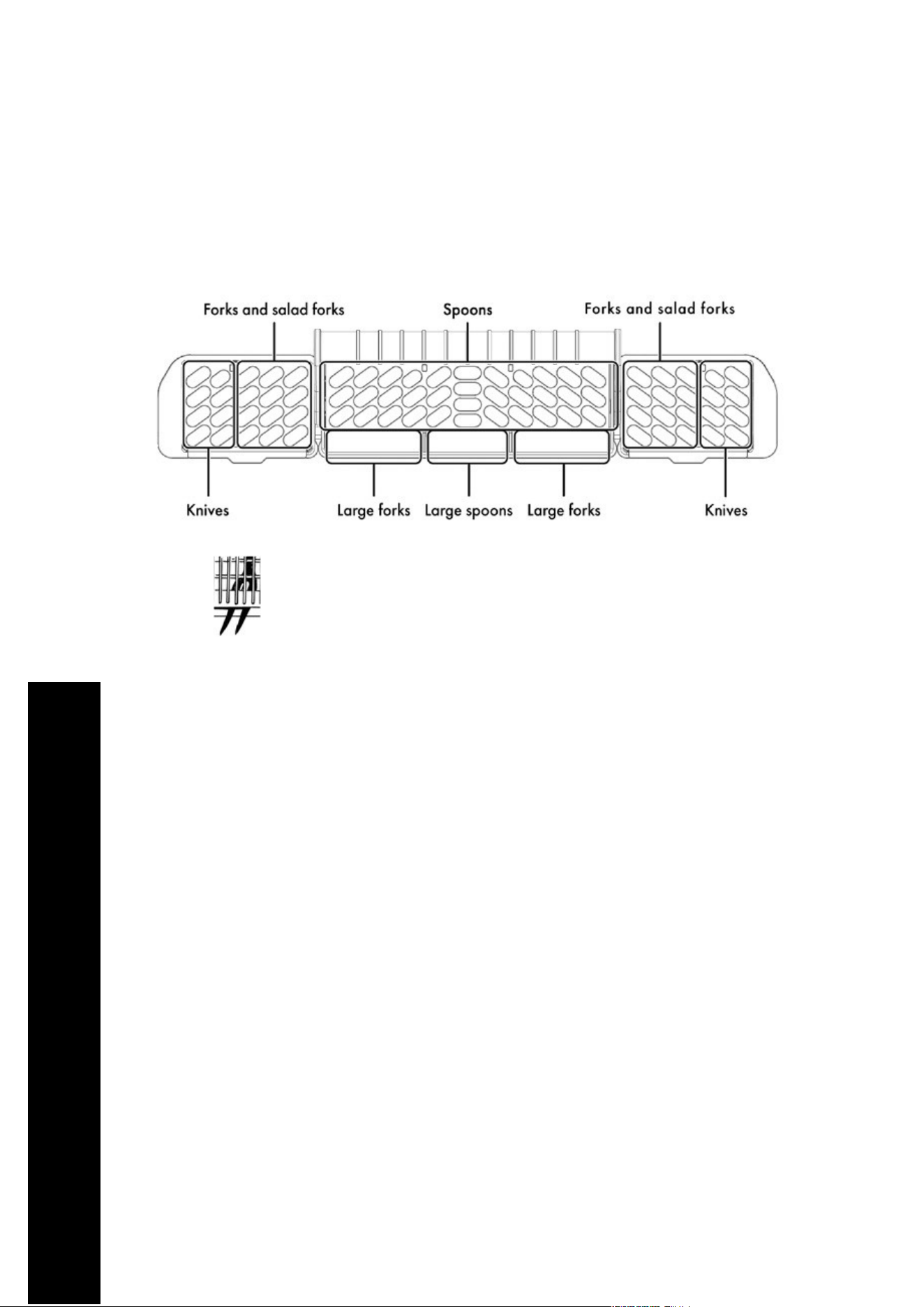
LOADING THE SILVERWARE BASKET
The silverware basket is divided into three separate sections, which can be placed in
either the upper or lower racks.
Caution:
Make sure that nothing protrudes through the bottom
of the silverware basket to block the lower spray arm.
ADDING A DISH
The silverware basket is divided into three separate sections, which can be placed in
either the upper or lower racks.
Before adding dishes, refer to “Preparing and Loading Dishes” on page 42 for
instructions on loading more dishes. Also see information on START/CANCEL in the
“Controls and Indicators” section on page 40. To add or remove items after the wash
cycle starts:
1. Open the door slightly and wait a few seconds until wash action stops before
completely opening.
2. Add the item.
3. Press START/CANCEL on the control pad and close the door within four
seconds. The cycle automatically resumes.
Caution:
TO AVOID BURN INJURY: Open the door slowly and wait until the spray
arms and wash action stop. Hot water may splash out of dishwasher.
Failure to do so may result in injury.
Loading the Dishwasher
48
OPERATION
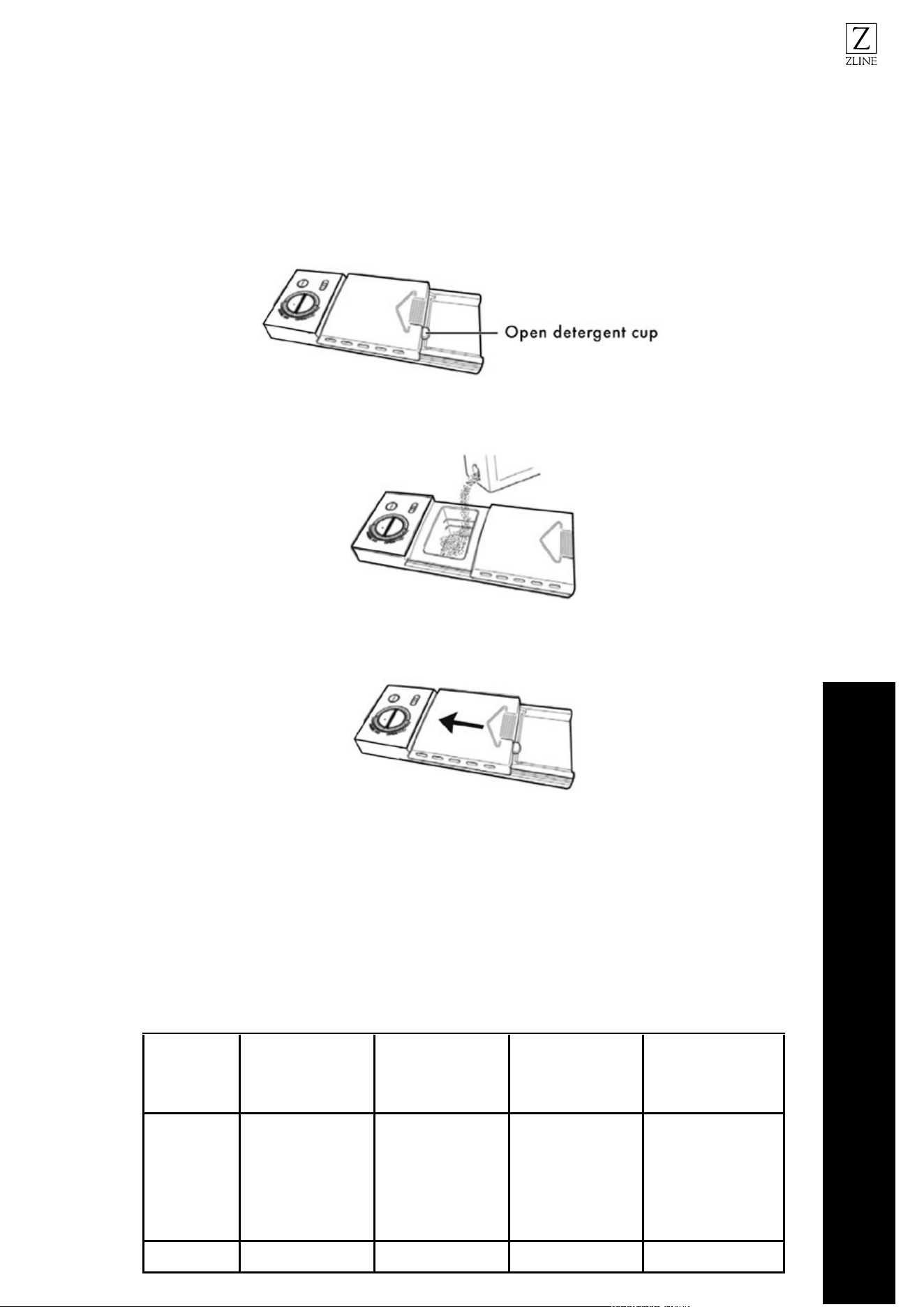
FILLING THE DETERGENT DISPENSER
1. Push the detergent dispenser cover latch downwards to open the detergent cup.
2. Add detergent (dry powder, liquid, or packets) to the cup.
3. Close the detergent dispenser cover.
The amount of detergent required depends on the cycle selected and the soil level
on the dishes. Refer to the following table for the recommended amount. Loading
suggestions are shown below:
Note: Pods are not designed for this dispenser. They should be thrown into the bottom
of the tub.
CYCLE
SOFT WATER
(03 GRAINS)
MEDIUM
HARD WATER
(48 GRAINS)
HARD
WATER (912
GRAINS)
VERY HARD
WATER (OVER
12 GRAINS)
AUTO
NORMAL
HEAVY
DELICATE
EXPRESS
2 tsp. (main
wash cup
1/4 full)
5 tsp. (main
wash cup fill
to line above
regular)
8 tsp. (main
wash cup
completely full)
Main wash cup
completely full
(water softener
recommended)
RINSE No detergent No detergent No detergent No detergent
Filling the Detergent Dispenser
49
OPERATION
FILLING THE RINSE AID DISPENSER
Your dishwasher is designed to use a liquid rinse aid. The use of rinse aid greatly
improves drying performance after the final rinse. Do not use a solid or bar-type
rinse aid. Under normal conditions, the rinse aid will last approximately one month.
Try to keep the dispenser full, but do not over fill it.
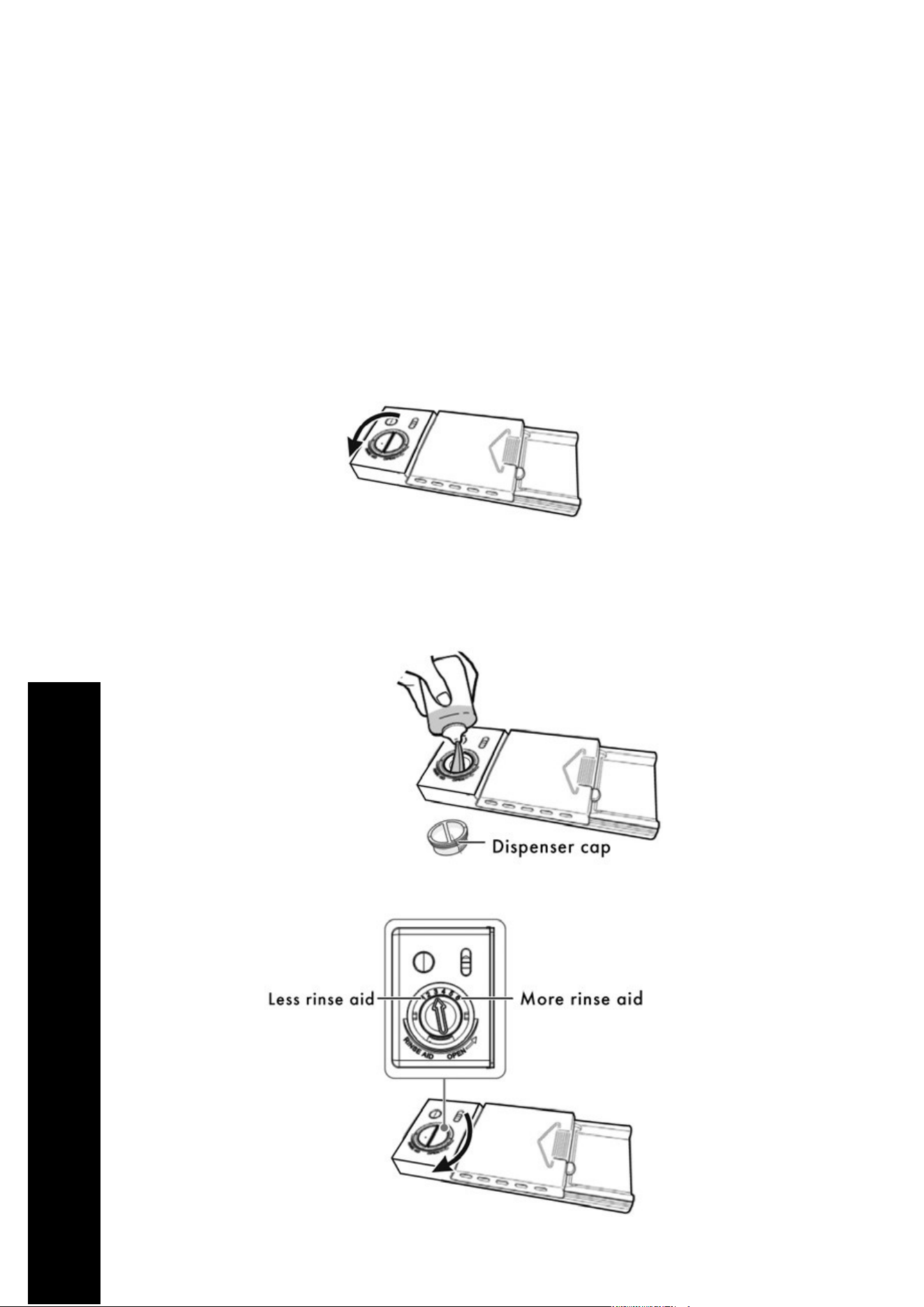
1. Turn rinse aid dispenser cap 1/4 turn counterclockwise and lift it out.
2. Add rinse aid until liquid touches the indicated fill level. Do not overfill since
this can cause over sudsing. Wipe up any spills with a damp cloth. The
dispenser holds enough for 35 to 140 washes, depending on the dial setting.
3. Replace the cap and turn it 1/4 turn clockwise.
Filling the Rinse Aid Dispenser

50
OPERATION
USING RINSE AID
Rinse aid greatly improves drying and reduces water spots and filming. Without rinse
aid, your dishes and dishwasher interior will have excessive moisture. In addition, the
heated dry option will not perform as well without rinse aid. The rinse aid dispenser,
located next to the detergent cup, automatically releases a measured amount of
rinse aid during the last rinse. If spotting and poor drying is a problem, increase the
amount of rinse aid dispensed by rotating the dial to a higher number. The dial is
located under the dispenser cap.
If the rinse aid is low, the rinse aid light turns on at the beginning and end of the cycle
indicating that it is time to refill. Refer to “Filling the Rinse Aid Dispenser” on page 49.
WATER TEMPERATURE
Hot water is required for optimum dishwashing and drying results. Water entering the
dishwasher should be at least 120° F to achieve satisfactory results.
To check water temperature entering dishwasher:
1. Turn on the hot water faucet near the dishwasher and let it run for several minutes.
2. Hold a thermometer (a candy or meat thermometer will work) in the water
stream to check the temperature. If temperature is below 120° F, have a
qualified person raise the hot water heater thermostat setting.
HEAT DRY FUNCTION
The heat dry function, when used with a rinse aid, enhances drying performance. If
you do not choose the heat dry function, items in your load that will not be completely
dry at the end of the cycle.
WATER PRESSURE
For optimum performance, the hot water supply line for your dishwasher must provide
water pressure of at least 20 psi and not more than 120 psi. You may experience low
water pressure during high-demand periods, such as when laundry or showers are in
use while you are washing the dishes. To eliminate this problem, wait until hot water
demand is reduced before starting the dishwasher.
Important:
To make sure that the water entering the dishwasher is hot, run hot water from the
nearest hot water faucet to clear cool water from the pipe before starting the cycle.
Filling the Rinse Aid Dispenser
51
MAINTENANCE AND CLEANING
FACTORS AFFECTING PERFORMANCE
CLEANING THE STAINLESS STEEL PANEL
Clean the stainless steel door and handle regularly with a soft cloth and standard
household cleaner to remove the debris.
CLEANING THE CONTROL PANEL
Clean the control panel gently with a soft, lightly dampened cloth.
CLEANING THE STAINLESS STEEL INNER DOOR AND TUB
The tub is made of stainless steel. It will not rust or corrode, even if the dishwasher
should be scratched or dented. Clean the spots on the steel inner door and tub with
a damp non-abrasive cloth.
CLEANING THE FILTERS
The filters are designed to collect debris and need to be cleaned monthly to maximize
wash performance.
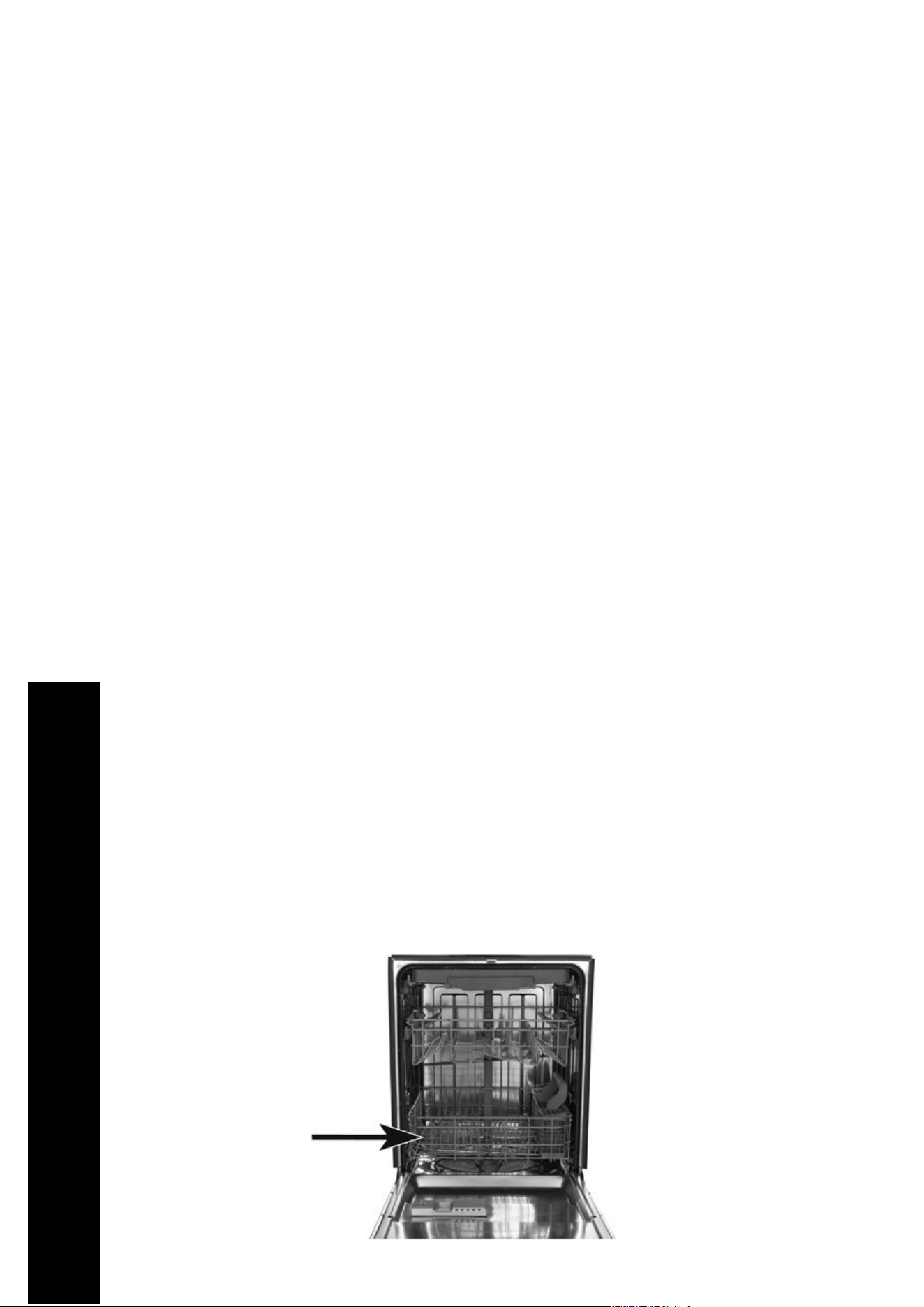
1. Remove the bottom rack.
Caution:
TO AVOID BURN INJURY: Allow the heating element to cool before
attempting to clean the interior of your dishwasher.
Caution:
Do not use appliance wax, polish, bleach or products containing chlorine
to clean the stainless steel door.
Cleaning and Maintenance
52
MAINTENANCE AND CLEANING
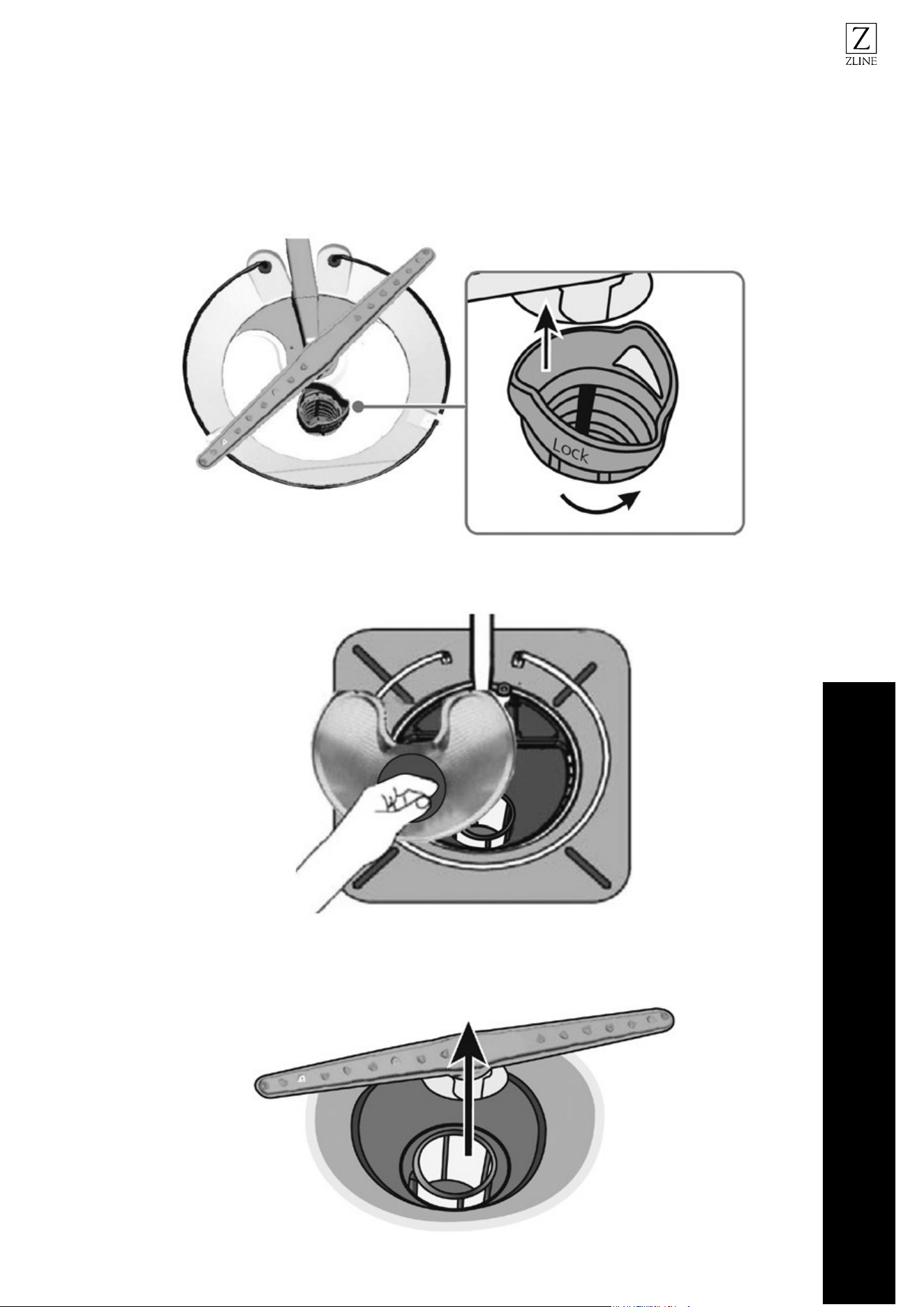
2. Rotate the cylinder filter, then lift it out.
3. Lift the fine filter from the bottom of the tub.
4. Take out the fabric filter.
Cleaning and Maintenance
53
MAINTENANCE AND CLEANING
Cleaning and Maintenance
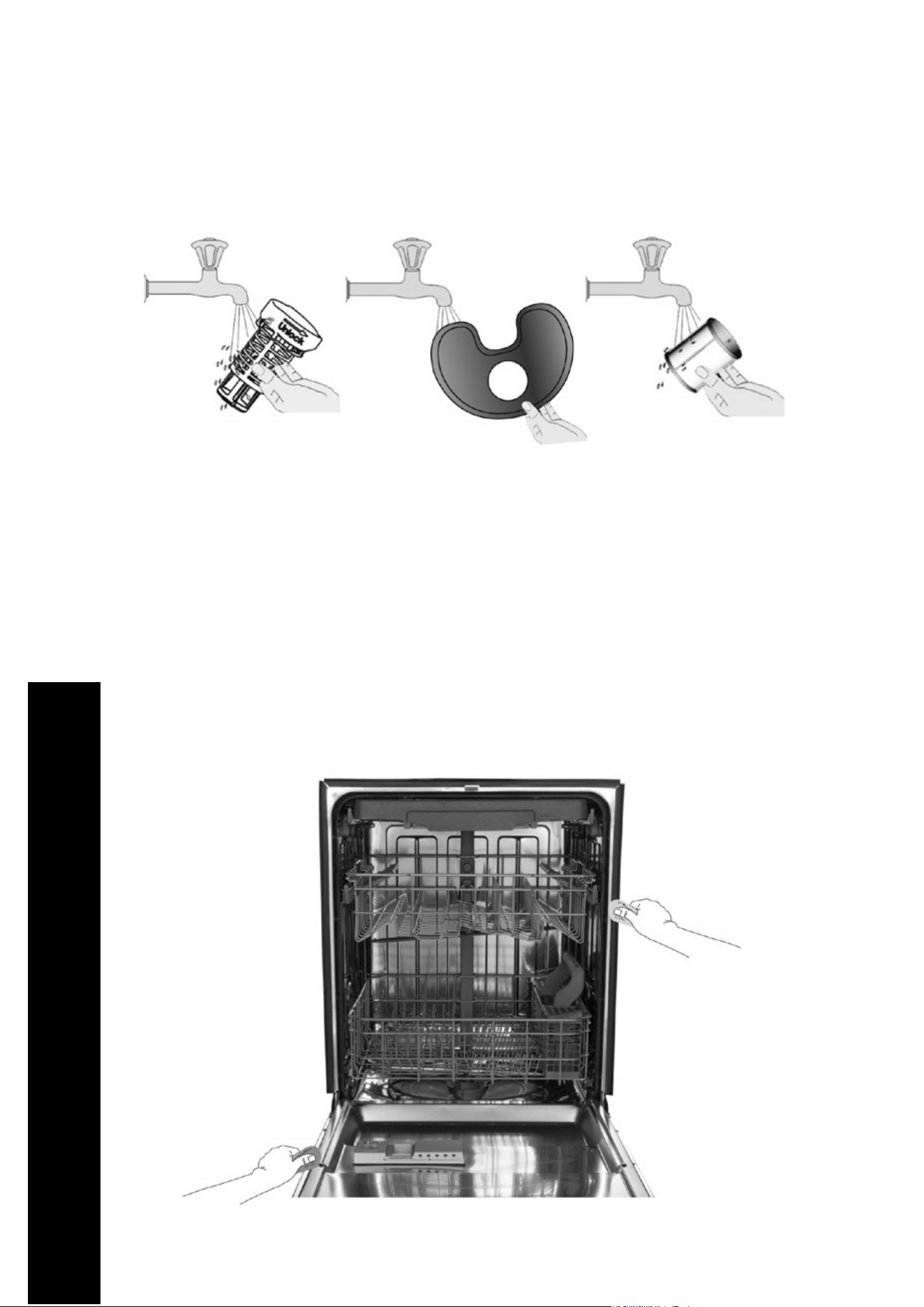
5. Flush the filters by holding them under running water.
6. Replace the fabric filter.
7. Replace the fine filter.
8. Replace the cylinder filter.
9. Replace the bottom rack.
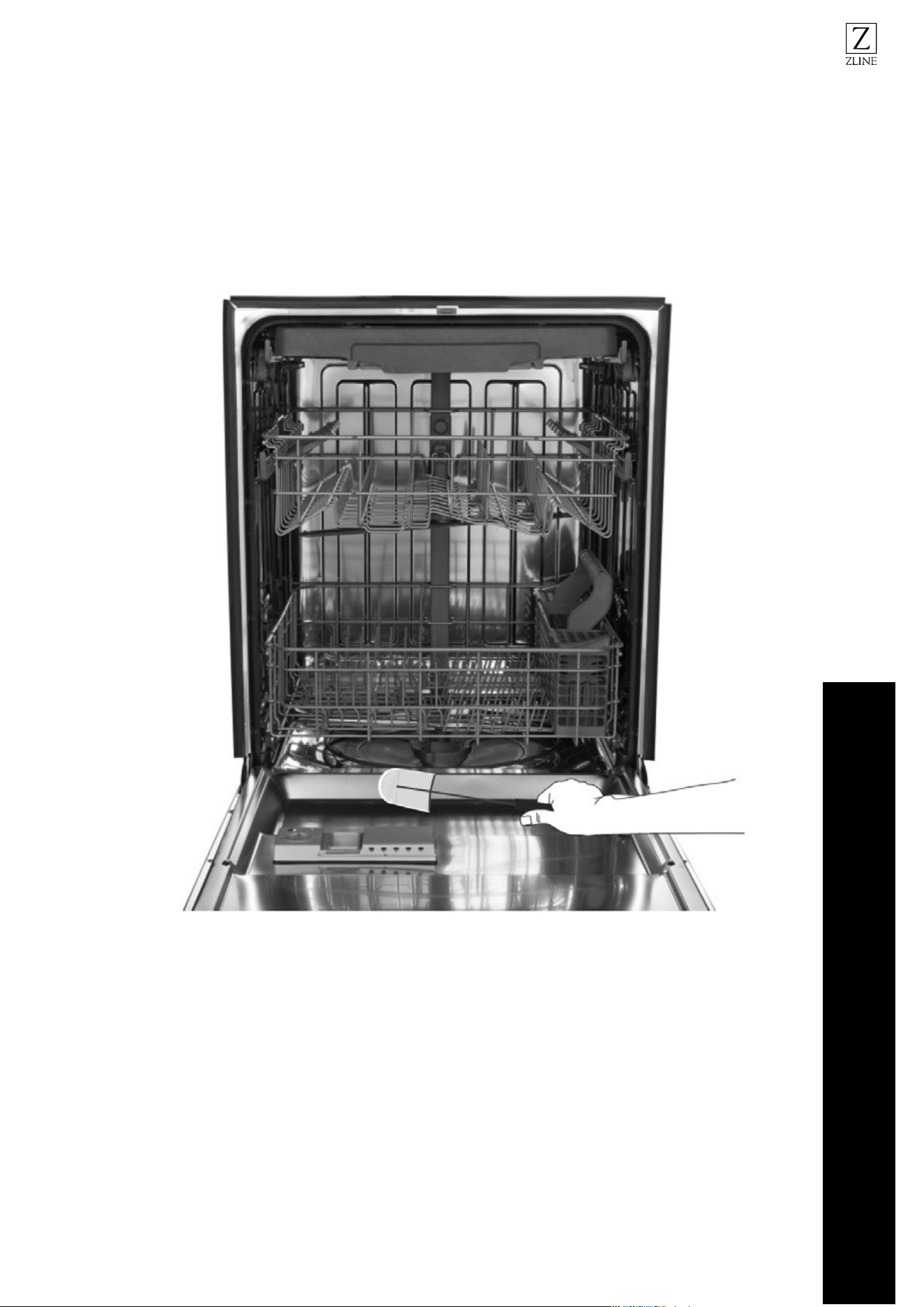
CLEANING THE DOOR AND TUB GASKETS
Clean the door gasket with a damp cloth to remove food particles regularly.
54
MAINTENANCE AND CLEANING
Cleaning and Maintenance
The inside of the dishwasher is self-cleaning under normal use. If needed, the tub
gasket can be cleaned with a damp cloth. Use a brush to clean the opening in the
end of the gasket.
CLEANING THE AIR GAP
If there is an air gap installed with your dishwasher, make sure it is clean so the
dishwasher will drain properly. Air gap is not part of your dishwasher. Before you
clean the air gap, turn off the dishwasher, then remove the plastic air gap cover and
clean with a toothpick.

55
MAINTENANCE AND CLEANING
Cleaning and Maintenance
Your dishwasher should be protected from freezing if you plan to leave it for
extended periods in an unheated place. Have a qualified person do the following:
To disconnect service:
1. Turn off the electrical power to the dishwasher at the supply source by moving
fuses or tripping circuit breaker.
2. Turn off the water supply.
3. Place a pan under the inlet valve, then disconnect water line from the inlet valve
and drain it into a pan.
4. Disconnect drain line from pump and drain the water into a pan.
To restore service:
1. Reconnect the water, drain, and electrical power.
2. Turn on water and electrical power supply.
3. Fill the detergent cup and the rinse aid cup and run the dishwasher through a
heated-wash cycle.
4. Check all connections to make sure they do not leak.
56
TROUBLESHOOTING
Troubleshooting
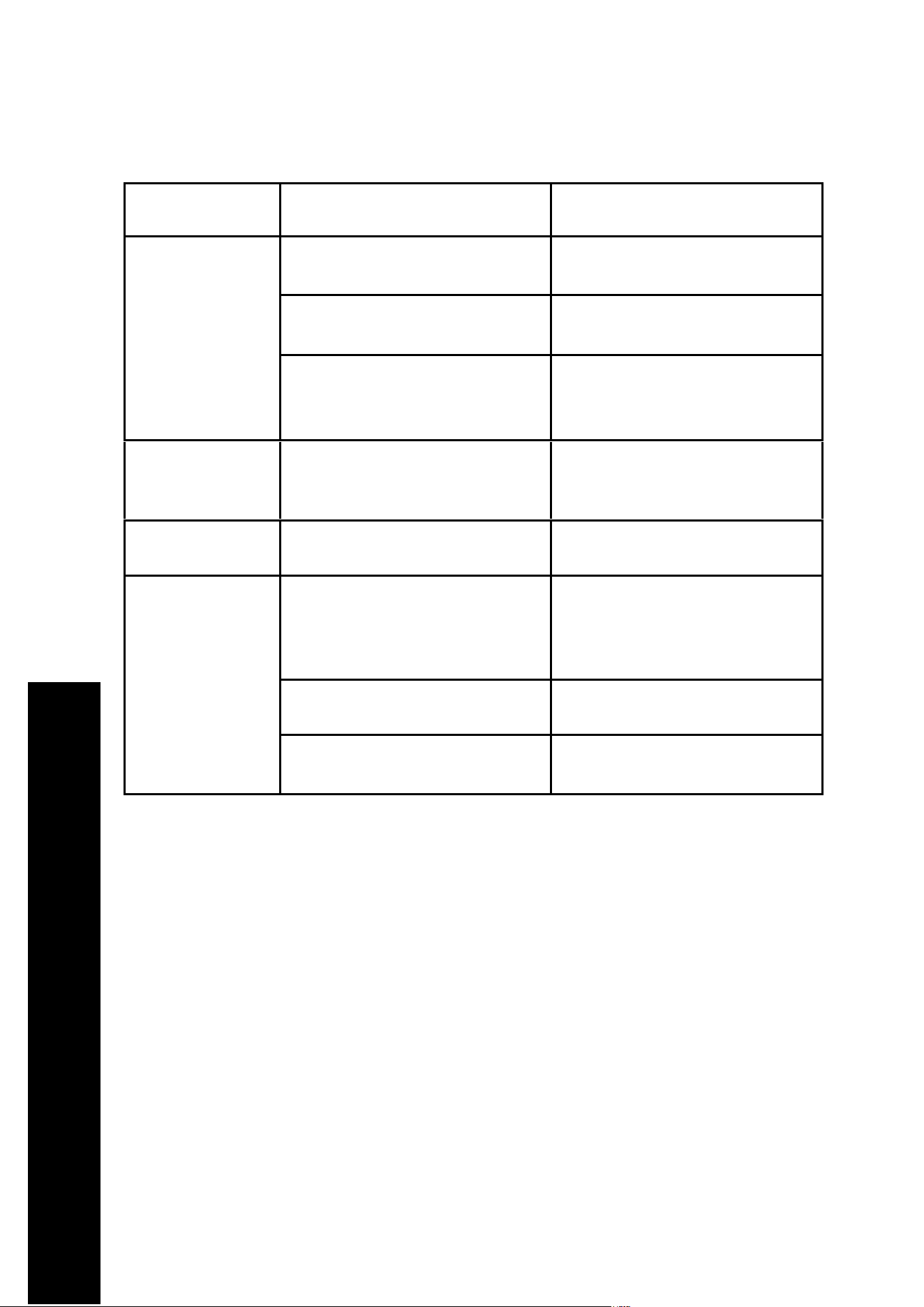
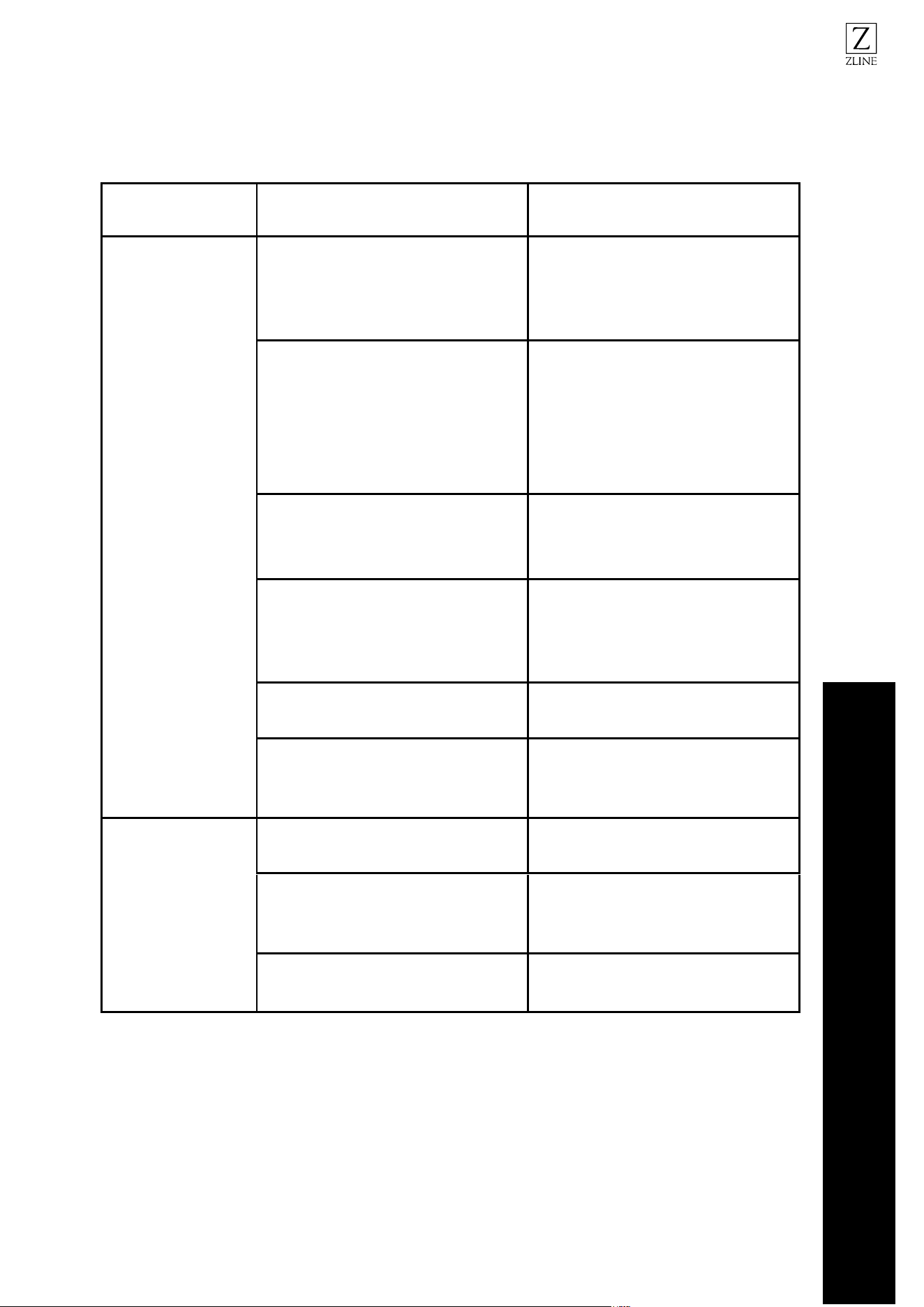
Refer to this table to correct minor issues before calling for service.
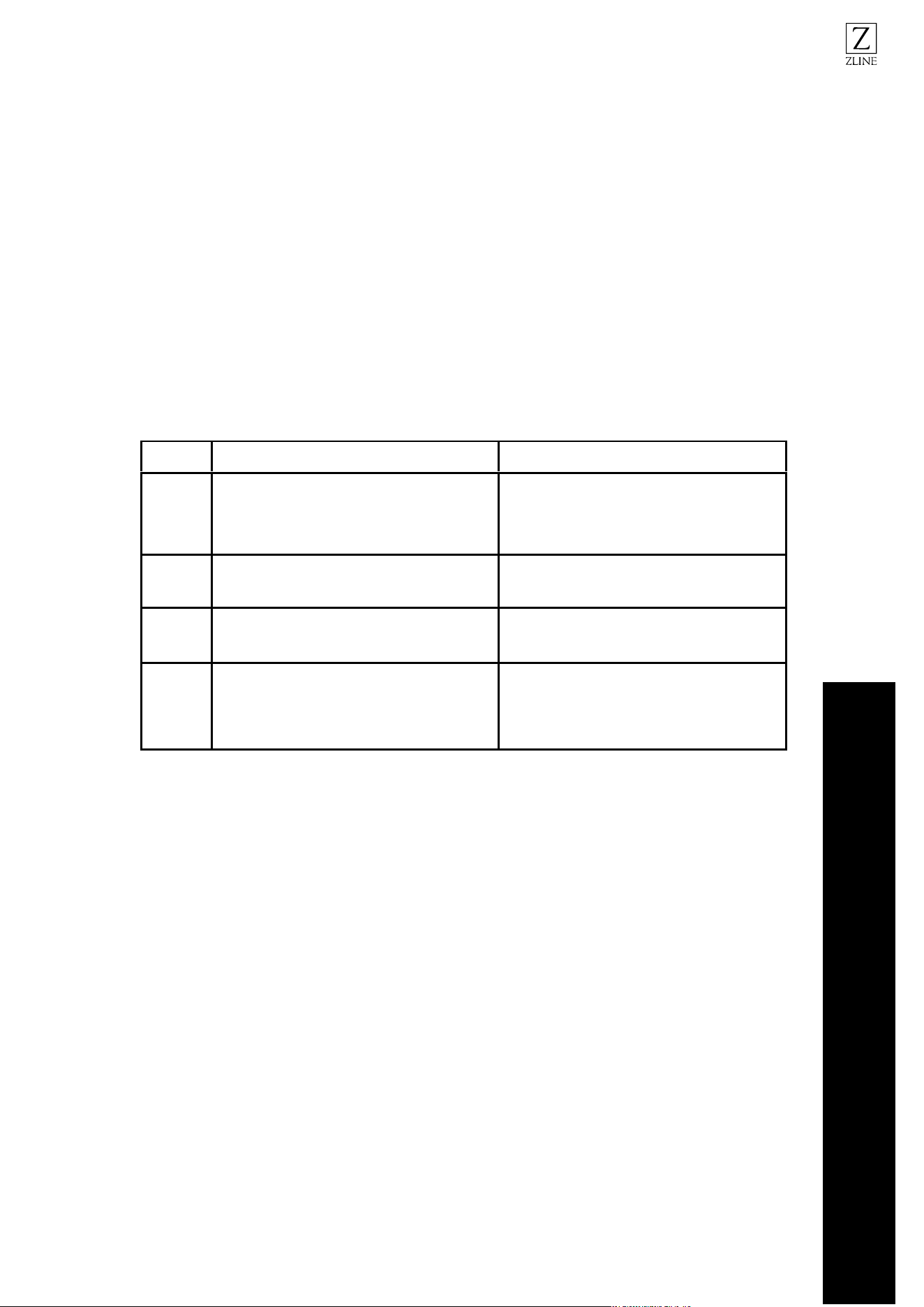
ERROR CODES
If there is an air gap installed with your dishwasher, make sure it is clean so the
dishwasher will drain properly. Air gap is not part of your dishwasher. Before you
clean the air gap, turn off the dishwasher, then remove the plastic air gap cover and
clean with a toothpick.
Caution:
• If an overflow occurs, turn off the main water supply before calling for
service.
• If there is water in the base pan because of an overfill or small leak,
the water should be removed before restarting the dishwasher.
CODE MEANING POSSIBLE CAUSE
E1 Slow fill time/fill time has
exceeded time alloted
• Faucet is not opened
• Water intake is restricted
• Water pressure is too low
E4 Overflow A leak in the dishwasher
E8 The orientation of the distributary
valve not working.
The wire is not connected correctly,
or the distributary valve is broken.
E9 A button has been touched
for more than 30 seconds (by
anything, including water).
Anything (including water)
touching a button.
57
PROBLEM POSSIBLE CAUSE POSSIBLE SOLUTION
The dishwasher
won’t start
The door may not be closed
properly.
Make sure that the door is
closed and latched.
The power is off or not
connected.
Make sure that the power is
connected and turned on.
The delay start option is selected. Refer to the “Delay” section
under “Controls and indicators”
on page 40.
The dishwasher
beeps at the end
of the cycle
This is normal and indicates
that the wash cycle is complete.
The rinse aid light
is on
The rinse aid level is low. Add rinse aid.
The dishwasher
runs too long
The dishwasher is connected to a
cold water supply.
Make sure that the dishwasher is
connected to a hot water supply.
If not, change the water supply
to a hot water source.
The cycle time varies, depending
on the soil level of the dishes.
When heavy soil is detected, the
wash times will be longer.
Depends on the option selected. Some options will add time to
the cycle.
TROUBLESHOOTING
Troubleshooting
58
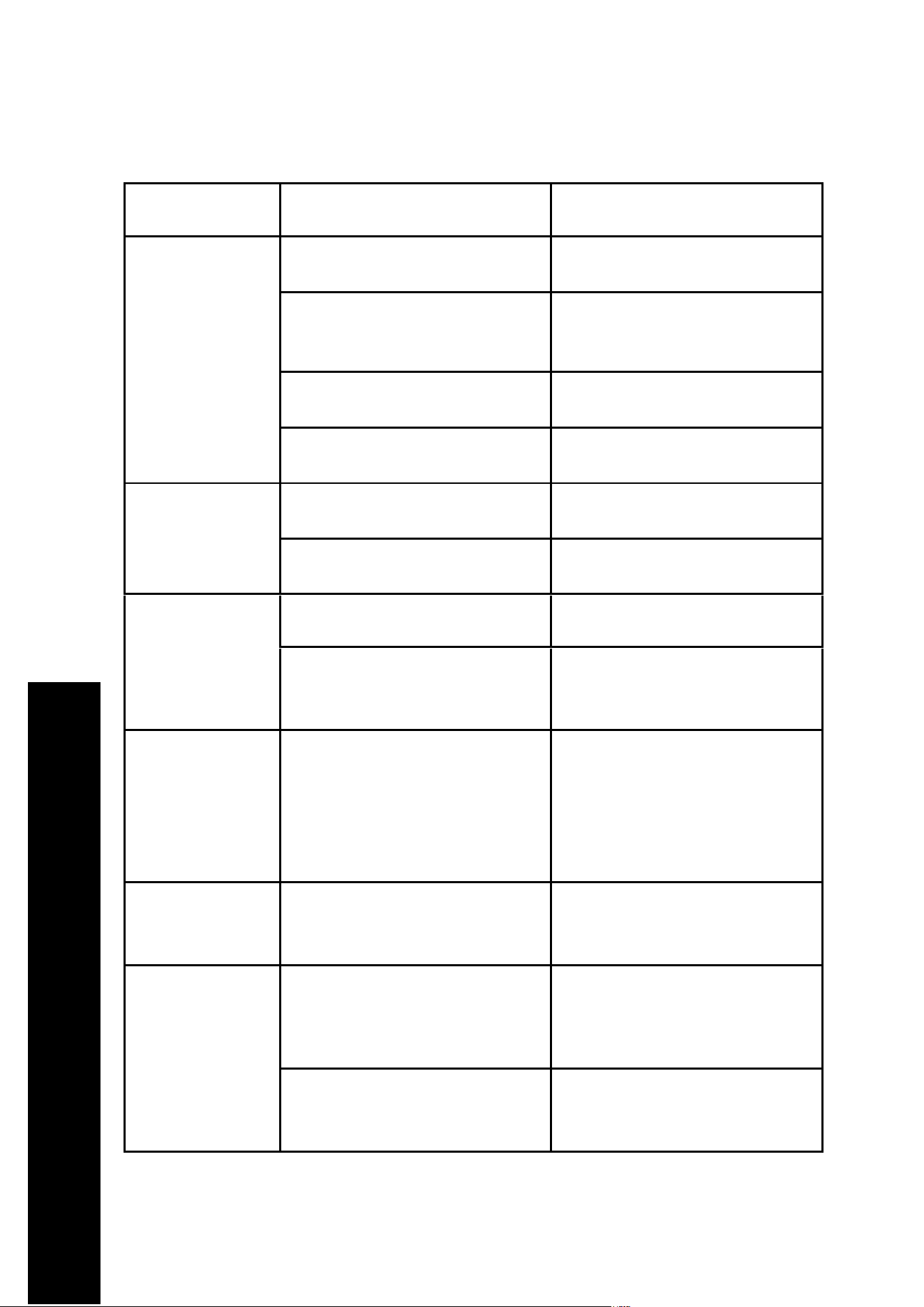
PROBLEM POSSIBLE CAUSE POSSIBLE SOLUTION
The dishes are not
clean enough
The water pressure is too low. Make sure that the water
pressure is above 20 psi. Use
your dishwasher when water
demand is low.
The inlet water temperature is
too low.
Make sure that the dishwasher is
connected to a hot water supply.
If not, change the water supply
to a hot water source. Use your
dishwasher when hot water
demand is low.
Dishes are too close together. Reload the dishwasher as shown
in “Preparing and Loading
Dishes” on page 42.
Improper use of detergent. Add detergent depending on
the water hardness and washing
cycle you choose. Use fresh
detergent.
The selected cycle is not suitable
for the soil level on the dishes.
Choose a different cycle with a
longer washing time.
The spray arms are blocked. Make sure that the spray arms
are not blocked and are free to
rotate.
The dishes are not
drying enough
The rinse aid dispenser is empty
or the setting is too low.
Fill the rinse aid dispenser.
Increase the rinse aid setting.
Dishes are loaded improperly. Reload the dishwasher as shown
in “Preparing and Loading
Dishes” on page 42.
The cycle you chose did not
include drying.
Choose a cycle with drying.
TROUBLESHOOTING
Troubleshooting
59
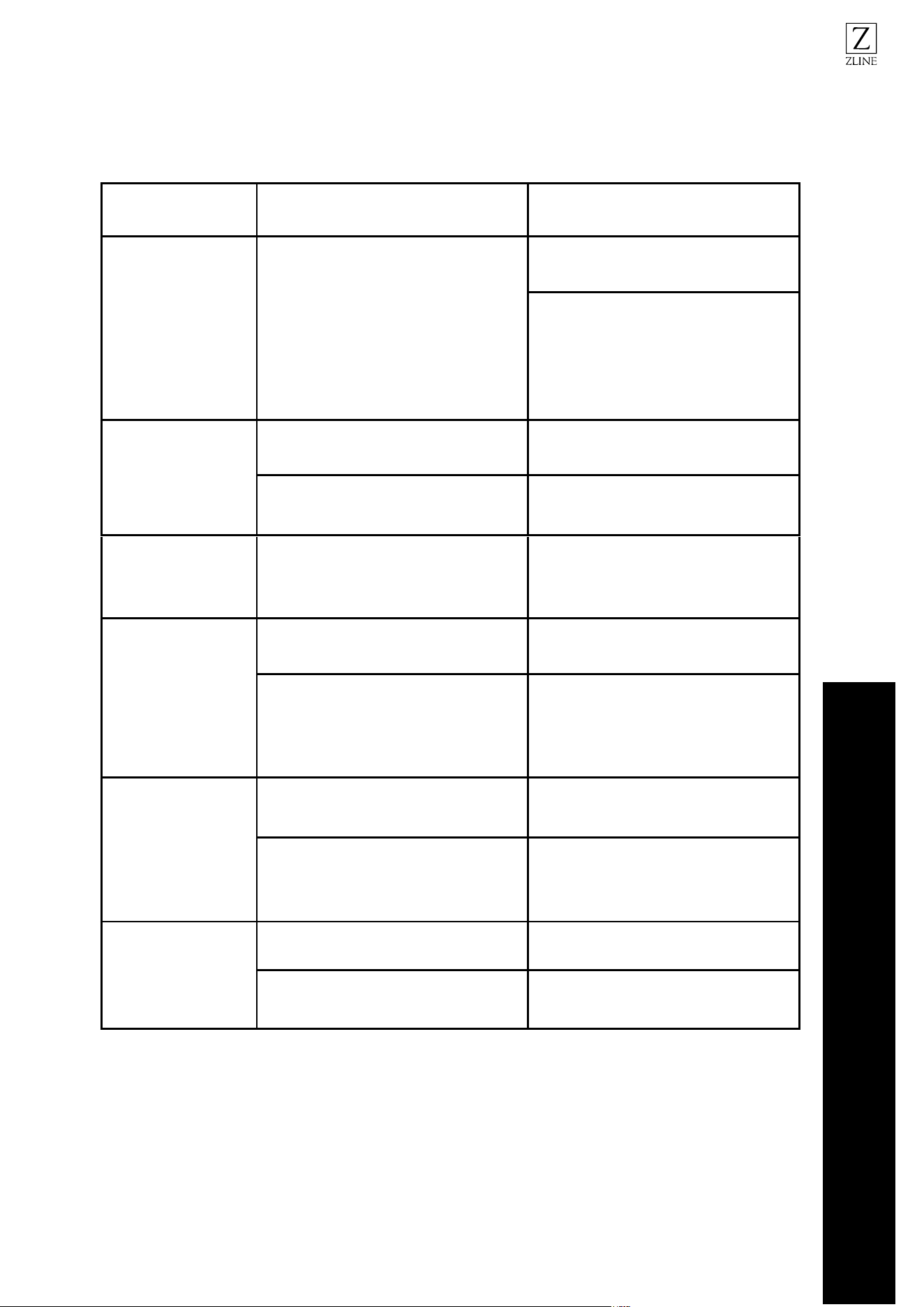
PROBLEM POSSIBLE CAUSE POSSIBLE SOLUTION
Spots and filming
on dishes
Water hardness is too high. For extremely hard water, install
a water softener.
Dishes are loaded improperly. Reload the dishwasher as shown
in “Preparing and Loading
Dishes” on page 42.
Old or damp rinse aid power is
used.
Use fresh, liquid rinse aid.
The rinse aid dispenser is empty
or the setting is too low.
Fill the rinse aid dispenser.
Increase the rinse aid setting.
Etching Using too much detergent. Use less detergent if you have
soft water.
The inlet water temperature
exceeds 150° F.
Lower the inlet water
temperature.
Detergent left in
dispenser cup
Detergent may be too old. Use fresh detergent.
The spray arm is blocked. When you load the dishes, make
sure that the spray arms are not
blocked.
The detergent
dispenser will not
close
Improper operation of the
detergent cover.
Add detergent and rinse aid
only as indicated in this manual.
See “Filling the Detergent
Dispenser” on page 48 and
“Filling the Rinse Aid Dispenser”
on page 49.
Water remains in
the dishwasher.
The previous cycle has not
finished or has been interrupted.
Make sure that the current cycle
is finished.
The dishwasher
does not drain
properly.
The drain is clogged. Check the air gap (if so
equipped). Make sure that
the disposer is empty (if so
connected).
The drain hose is kinked. Make sure that the drain hose
is not kinked and is properly
connected.
TROUBLESHOOTING
Troubleshooting
60
PROBLEM POSSIBLE CAUSE POSSIBLE SOLUTION
Suds in the tub Using improper detergent. or
pod style cleaners.
Make sure to use only automatic
dishwasher detergent.
The dispenser is not designed
for the use of pods. To use pods,
throw them into the bottom of
the tub and it will release the
detergent like normal.
The dishwasher
leaks
Excessive suds caused by using
improper detergent.
Make sure to use only automatic
dishwasher detergent.
The dishwasher is not level. Level the dishwasher (refer to the
Installation Manual).
There are black
or gray marks on
the dishes
Aluminum utensils have rubbed
against the dishes.
Make sure that the water inlet
temperature is not less than
120° F.
The interior of the
tub is stained
Coffee or tea stains. Use a spot cleaner to remove the
stains.
Reddish stain. Some tomato products may
cause this. Use of the rinse only
cycle right after loading will help
this.
Noises Detergent cup opening/drain
pump.
This is normal.
A hard object has entered the
wash module. When the object
is ground up the noise will stop.
If the noise continues after
the cycle is complete, call for
service.
The dishwasher
won’t fill (the
dishwasher will
beep)
The water valve is turned off. Turn on the water valve.
The door may not be closed
completely.
Make sure that the door is
closed and latched.
TROUBLESHOOTING
Troubleshooting