
© 2023 CASIO COMPUTER CO., LTD.
MA2302-A
User’s Guide
Watch
3557 EN
Congratulations upon your selection of this CASIO watch.
To ensure that this watch provides you with the years of service for which it is
designed, carefully read and follow the instructions in this manual, especially the
information under “Operating Precautions” and “User Maintenance”.
Note that CASIO COMPUTER CO., LTD. assumes no responsibility for any damage
or loss suffered by you or any third party arising through the use of your watch or
its malfunction.
EN-1
About This Manual
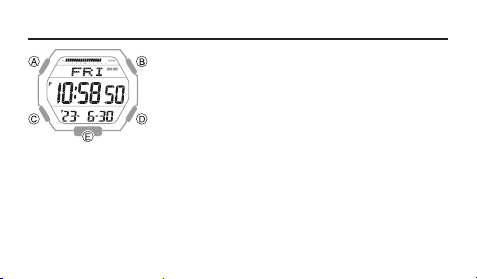
• Button operations are indicated using the letters shown
in the illustration.
• Each section of this manual provides you with the
information you need to perform operations in each
mode.
EN-2
Contents
About This Manual. . . . . . . . . . . . . . . . . . . . . . . . . . . . . . . . . . . . . . . . . . . . . . . . EN-1
Watch Features .................................................. EN-6
General Guide ................................................... EN-7
Indicators .....................................................EN-7
Graphic Display Area .............................................EN-9
Configuring Time and Date Settings ................................ EN-11
Setting the Time/Date ...........................................EN-11
Switching Between 12-hour and 24-hour Timekeeping ..................EN-13
Selecting a Mode ................................................ EN-14

EN-3
Pedometer ..................................................... EN-17
Counting Steps ................................................EN-17
Displaying the Step Count ........................................EN-20
Displaying the Step Count Log ....................................EN-25
Specifying a Daily Step Target .....................................EN-28
Causes of Incorrect Step Count ...................................EN-29
Stopwatch ..................................................... EN-30
Split Times and Lap Times .......................................EN-31
Measuring Elapsed Time .........................................EN-33
Measuring a Split or Lap Time .....................................EN-35
Swapping the Display Positions of the Split Time and Lap Time ...........EN-37
Displaying the Current Time During Stopwatch Measurement .............EN-38
Viewing Measured Time Data .....................................EN-39

EN-4
Timer .......................................................... EN-44
Setting the Timer Start Time ......................................EN-44
Using the Timer ................................................EN-46
Stopping the Timer Beeper .......................................EN-46
Dual Time ...................................................... EN-47
Configuring Dual Time Settings ....................................EN-47
Swapping Your Current Location Time and Dual Time ...................EN-48
Alarms and Hourly Time Signal .................................... EN-50
Configuring Alarm Settings .......................................EN-50
Enabling/Disabling an Alarm or the Hourly Time Signal ..................EN-53
Stopping an Alarm .............................................EN-54
Determining an Alarm’s On/Off Status ...............................EN-55

EN-5
Illumination Light ................................................ EN-56
Illuminating the Face Manually .....................................EN-56
Specifying the Illumination Duration .................................EN-57
Battery Replacement ............................................ EN-59
Other Settings .................................................. EN-60
Enabling the Button Operation Tone ................................EN-60
Specifications .................................................. EN-62
Troubleshooting ................................................ EN-66
Operating Precautions ........................................... EN-69
User Maintenance ............................................... EN-80
EN-6
Watch Features
◆
Pedometer
◆
Stopwatch
◆
Timer
◆
Dual Time
◆
Alarm
EN-7
General Guide
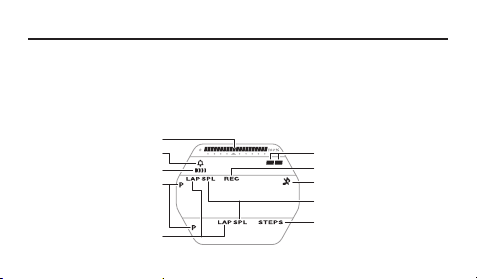
This section provides an overview of your watch.
Note
• The illustrations included in this User’s Guide have been created to facilitate
explanation. An illustration may differ somewhat from the item it represents.
Indicators
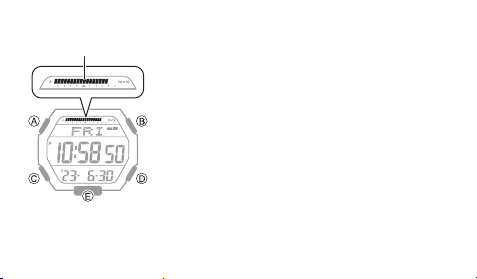
11
6622
77
33
88
44
99
55
00
EN-8
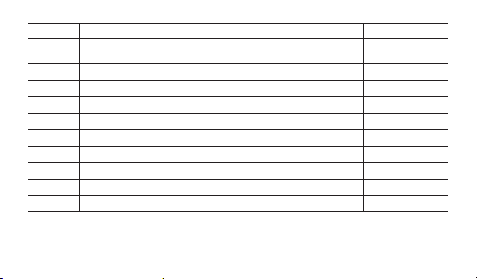
Number Description See
11
Graphic display area operation is linked with operations in
each watch mode.
EN-9
22
Displayed while the hourly time signal is enabled. EN-53
33
Displayed while an alarm is turned on. EN-50
44
Appears when the displayed time is a p.m. time. EN-13
55
Displayed while a lap time is displayed. EN-35
66
Indicate whether or not the step count is being incremented. EN-19
77
Displayed while the watch is in the Recall Mode. EN-39
88
Displayed while the button operation tone is disabled. EN-60
99
Displayed while a split time is displayed. EN-35
00
Displayed while the step count is displayed. EN-20
EN-9
Graphic Display Area
Graphic display area operation is linked with operations in
each watch mode.
• The graphic display area is blank in the Recall Mode and
the Alarm Mode.
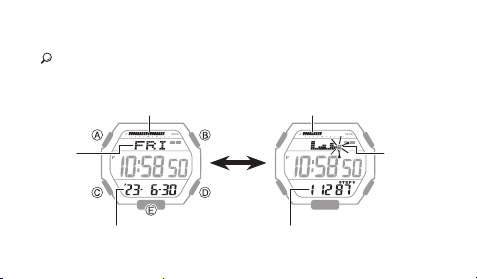
Timekeeping Mode
While a step count is displayed, the graphic display area
shows your progress towards your daily step target. For
other types of display, it changes with the count of the
current time’s seconds.
Graphic display area

EN-10
Stopwatch Mode
The graphic display area changes with the count of the stopwatch elapsed time
seconds.
Timer Mode
The graphic display area is synchronized with the timer countdown seconds.
Dual Time
The graphic display area is synchronized with the Dual Time seconds.
EN-11
Configuring Time and Date Settings
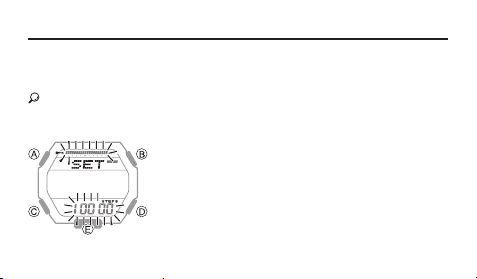
The time and date can be adjusted with the procedure below.
● Getting Ready
Enter the Timekeeping Mode.
Selecting a Mode…EN-14
Setting the Time/Date
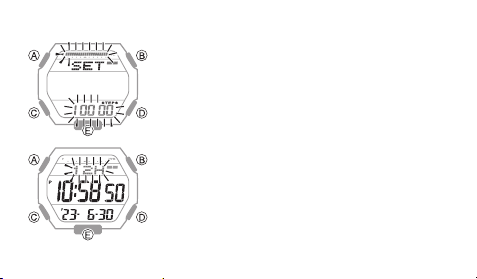
1. Hold down A for at least two seconds. Release the
button when [SET] stops flashing.
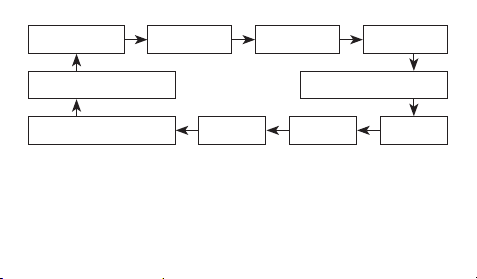
2. Keep pressing C until the setting you want to change
is flashing.
• Each press of C moves the flashing to the next
setting in the sequence shown below.
EN-12
Daily step target
Operation tone enable/
disable
Illumination duration
Second
Day
Hour
Month
Minute
Year
12/24-hour timekeeping
C C C
CCC
C C
CC
3. Configure the date and time settings.
• To reset the seconds to 00: Press D. 1 is added to the minutes when the
current count is between 30 and 59 seconds.
• To change other settings: Use D and E.
4. Repeat steps 2 through 3 to configure date and time settings.
5. Press A to exit the setting screen.
EN-13
Switching Between 12-hour and 24-hour Timekeeping
1. Hold down A for at least two seconds. Release the
button when [SET] stops flashing.
2. Press C four times until the current setting ([12H] or
[24H]) is flashing on the display.
3. Press D to toggle the setting between [12H] (12-hour
timekeeping) and [24H] (24-hour timekeeping).
4. Press A to exit the setting screen.
Note
• While 12-hour timekeeping is selected, [P] will be
displayed for p.m. times.

EN-14
Selecting a Mode
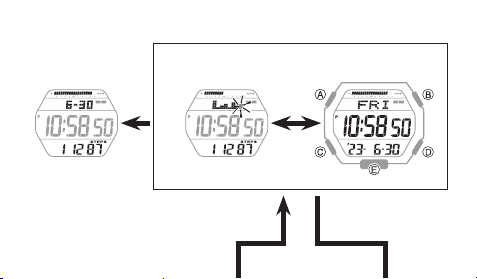
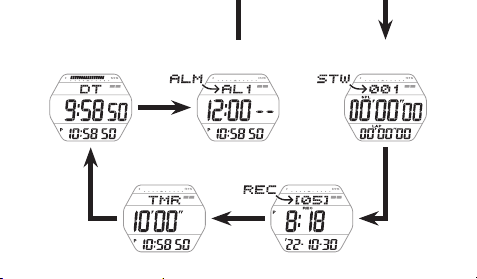
Press C to cycle between modes.
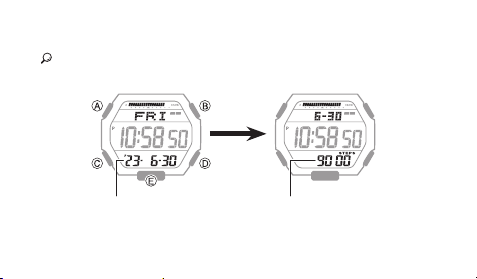
• Each press of E in the Timekeeping Mode toggles the display between the date
and time, and the step count.
• In the Timekeeping Mode, pressing D displays the step count log.
• In any mode, hold down C for at least two seconds to enter the Timekeeping
Mode.
EN-15
Timekeeping Mode
E
Step count display Date and time displayStep count log
D
C
EN-16
C
Recall Mode
Stopwatch Mode
Timer Mode
Dual Time Mode Alarm Mode
C
CC
C
EN-17
Pedometer
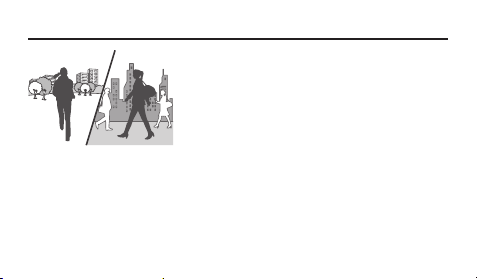
You can use the pedometer to keep track of your
step count while walking, engaging in your normal
daily activities, etc.
Counting Steps
If you are wearing the watch correctly, the pedometer
will count your steps as you walk or engage in your
normal daily activities.
Important!
• Since this watch’s pedometer is a wrist-worn
device, it may detect non-step movements
and count them as steps. Also, abnormal arm
movements while walking may cause a miss count
of steps.
EN-18
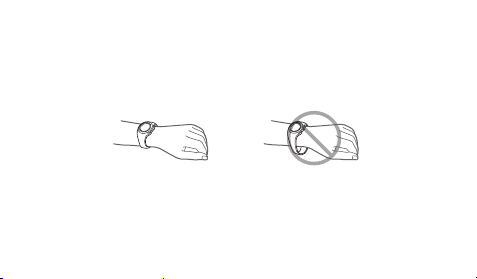
● Getting Ready
To enable the most accurate step count, wear the watch with the face on the outside
of your wrist and tighten the band securely. A loose band may make it impossible to
obtain a correct step count.
YES NO
EN-19
● Counting Steps
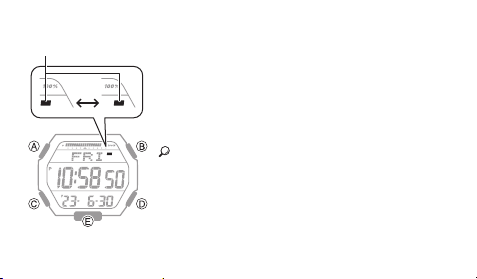
The pedometer will start counting your steps when you
start walking. The step indicators show whether or not the
step count is being incremented.
Alternating at one-second intervals: Walking (step count
being incremented)
Both displayed: Not walking (step count not being
incremented)
● To check the step count
Displaying the Step Count…EN-20
Step indicators
EN-21
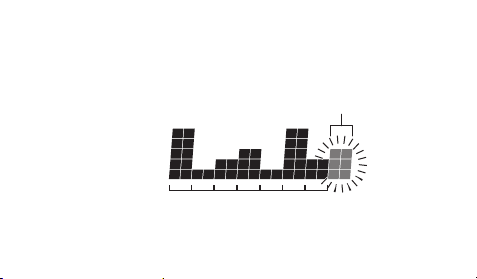
● Interpreting the Step Count Graph
The Step Count Graph shows the number of steps (up to 1,000) you have taken each
hour. This lets you easily check your walking pace over the past 7 or 8 hours.
• The Step Count Graph is not displayed while the step count is zero.
• Graph contents are normally updated at the top of each hour.
Hour
Step count
1001-
751-1000
501- 750
251- 500
1- 250
7 6 5 4 3 2 1
Current
EN-22
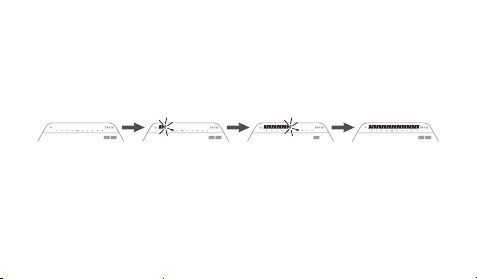
● Checking Your Progress to Your Daily Step Target
The graphic display area shows your current progress toward achieving a daily step
target specified by you.
Example: Daily target of 10,000 steps
0 steps 1,000 steps 5,000 steps
10,000 steps
(goal attained)

EN-23
Note
• The step count can show a value up to 999,999 steps. If the step count exceeds
999,999, the maximum value (999,999) remains on the display.
• The step count is not displayed during the first 10 seconds of a walk in order to
avoid miscounting of non-walking movements. After you have been walking for
about 10 seconds, the count appears, including the steps you took during the
previous 10 seconds.
• The step count is reset to zero at midnight each day.
• To save power, step counting stops automatically if you take off the watch (no
detectable watch movement) and you do not perform any operation for two or
three minutes.
• Graph contents are normally updated at the top of each hour, and when any one of
the events below occurs.
− When accelerometer operation is stopped to save power
− When counting is not possible due to accelerometer error or insufficient power
EN-26
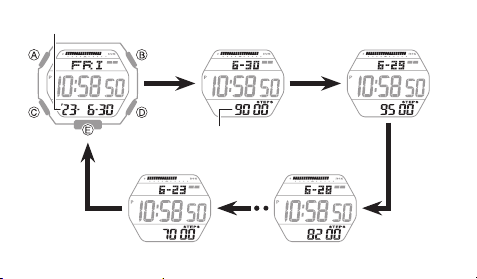
7 days ago
Today 1 day ago
2 days ago
Step count
D
D
D
D
D
Year, month, day

EN-27
Note
• The step count log shows step counts for the past seven days.
• If you do not perform any operation for about five seconds after the step count
log screen is displayed, the watch will return to the Timekeeping Mode screen
automatically.
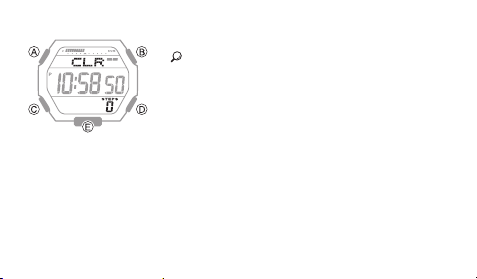
Resetting the Step Count Log
1. Enter the Timekeeping Mode.
Selecting a Mode…EN-14
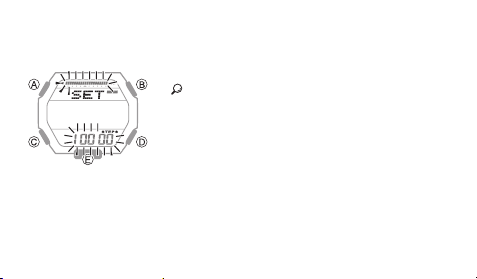
2. Hold down D and E at the same time for at least five seconds. Release the
buttons when [CLR] and [ALL] stop flashing.
This resets the step count log.
EN-28
Specifying a Daily Step Target
You can specify a daily step goal within the range of 1,000 to 50,000, in units of
1,000 steps.
1. Enter the Timekeeping Mode.
Selecting a Mode…EN-14
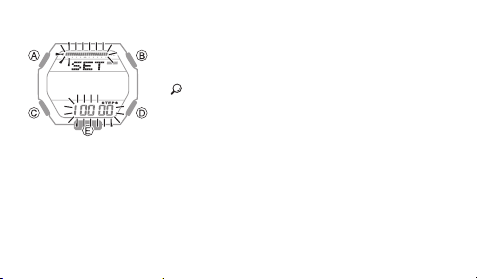
2. Hold down A for at least two seconds. Release the
button when [SET] stops flashing.
This causes the current daily step target to flash.
3. Use D and E to change the daily step target setting.
4. Press A to exit the setting screen.

EN-29
Causes of Incorrect Step Count
Any of the conditions below may make proper counting impossible.
• Walking while wearing slippers, sandals, or other footwear that encourages a
shuffling gait
• Walking on tile, carpeting, snow, or other surfaces that cause a shuffling gait
• Irregular walking (in a crowded location, in a line where walking stops and starts at
short intervals, etc.)
• Extremely slow walking or extremely fast running
• Pushing a shopping cart or baby stroller
• In a location where there is a lot of vibration, or riding on a bicycle or in a vehicle
• Frequent movement of the hand or arm (clapping, fanning movement, etc.)
• Walking while holding hands, walking with a cane or stick, or engaging in any other
movement in which your hand and leg movements are not coordinated with each
other
• Normal daily non-walking activities (cleaning, etc.)
• Wearing the watch on your dominant hand
• Walking for 10 seconds or less
EN-30
Stopwatch
The stopwatch measures elapsed time in 1/100-second units for the first hour, and in
1-second units after that for up to 24 hours.
In addition to normal elapsed time measurements, the stopwatch also lets you take
split time and lap time readings.
Note
• Up to 200 split time and lap time records can be stored in watch memory.
Performing a lap or split time operation while there are already 200 records in
memory will cause the oldest record to be deleted automatically to make room for
the new one.
• You can use the Recall Mode to view the latest measurement data.
Viewing Lap/Split Records…EN-39
● Getting Ready
Enter the Stopwatch Mode.
Selecting a Mode…EN-14
EN-31
Split Times and Lap Times
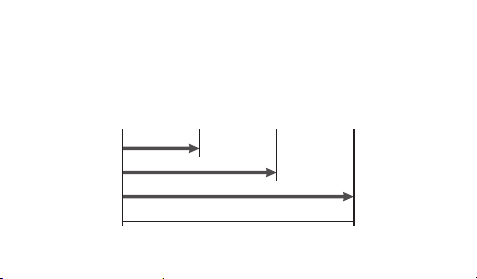
● Split time
A split time is the time elapsed from the start of an event, up to any point along the
course of the event.
Start
D
Split 1
Split 2
Split 3
E E D
Goal
EN-32
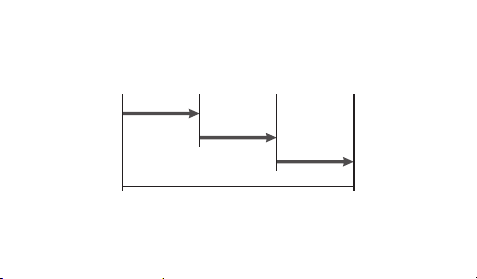
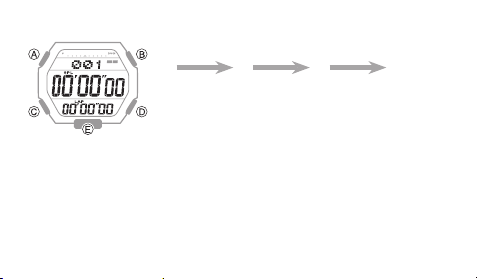
● Lap time
A lap time shows the time elapsed during a specific lap around a track, etc.
Start
D
Lap 1
Lap 2
Lap 3
E E D
Goal
EN-33
Measuring Elapsed Time
1. Use the operations below to measure elapsed time.
D
D D D
Start Stop Resume Stop
2. Press E to reset the elapsed time to all zeros.
● Interpreting Indicated Stopwatch Values
Elapsed time is shown in 1/100-second units for the first hour of an elapsed time
measurement session. After the first hour, elapsed time is shown in one-second
units.
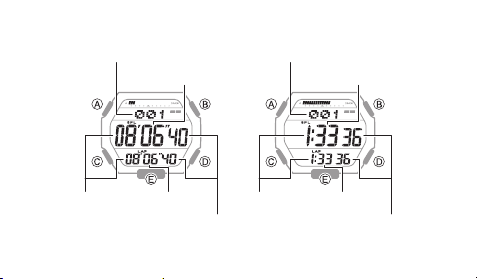
EN-34
First hour After first hour
Minutes HoursSeconds Minutes
1/100 seconds Seconds
Stopwatch number Stopwatch number
Seconds Minutes

EN-35
Measuring a Split or Lap Time
1. Select the information you want to display.
Swapping the Display Positions of the Split Time and Lap Time…EN-37
2. Use the operations below to measure elapsed time.
• Each press of E displays the time elapsed from the start of the event up to
that point (split time) and the elapsed time for a specific segment of the event
(lap time).
D
E D
Start Split/lap Stop
3. Press E to reset the stopwatch to all zeros.
● Interpreting Indicated Stopwatch Values
Split times and lap times are both displayed at the same time. Lap and split
times are displayed in 1/100-second units during the first hour of an elapsed time
measurement session. After that they are displayed in 1-second units.
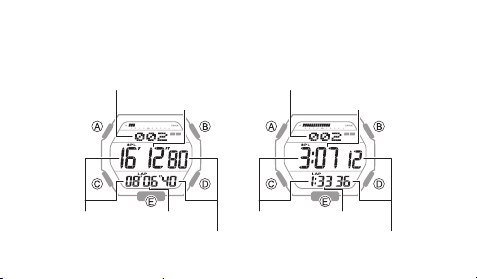
EN-36
[SPL]: Split time
[LAP]: Lap time
First hour After first hour
Minutes HoursSeconds Minutes
1/100 seconds Seconds
Stopwatch number Stopwatch number
Seconds Minutes
EN-37
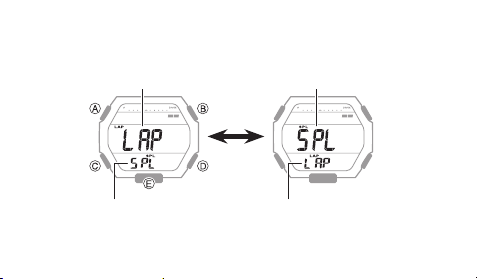
Swapping the Display Positions of the Split Time and Lap Time
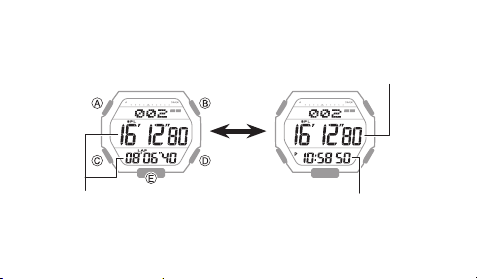
While the stopwatch is reset to all zeros, hold down E for at least two seconds to
swap the lap and split time display locations.
Split time
Lap time
E
Lap time
Split time
EN-38
Displaying the Current Time During Stopwatch Measurement
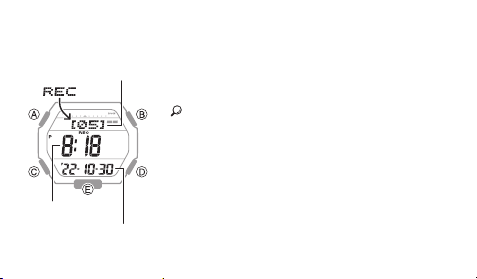
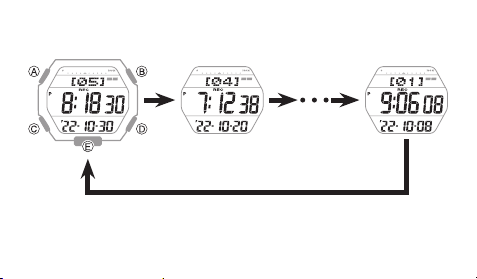
Pressing A displays the current timekeeping time in the lower display. Pressing A
again returns to the normal stopwatch display.
Current time
Measurement
A
Measurement
EN-40
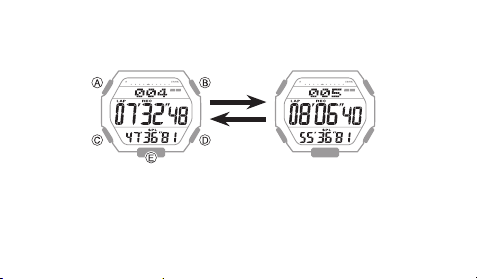
2. Press A to cycle through record numbers.
• Each time you press A, the next older record number appears.
A
A A A
EN-41
3. Use D and E to display the measurement value you want.
[LAP]: Lap time
[SPL]: Split time
D
E
Note
• A record of the measured data is created and assigned a number for each
measurement operation (from start to stop).
EN-42
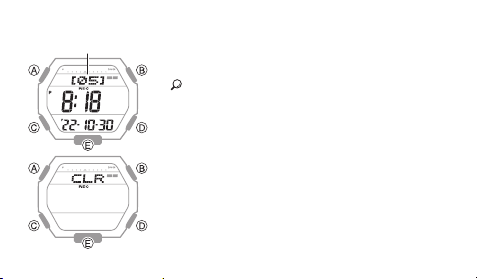
Deleting a Particular Lap/Split Record
Use the procedure below to delete a selected lap/split
record.
1. Enter the Recall Mode.
Selecting a Mode…EN-14
2. Press A to display the number of the lap/split record
you want to delete.
• Each press of A advances to the next lap/split
record number.
3. Hold down D and E at the same time for at least
two seconds. Release the buttons when [CLR] stops
flashing.
This deletes the displayed lap/split record.
Note
• You cannot delete a lap/split record while a stopwatch
elapsed time measurement operation is in progress.
Record number
EN-43
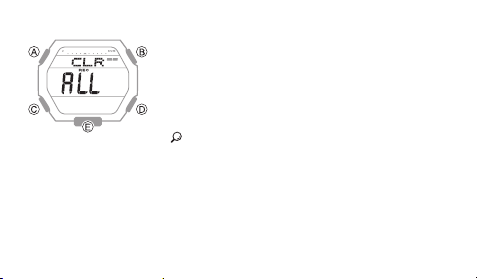
Deleting All Records
You can use the procedure below to clear all lap/split
records in watch memory.
Important!
• This operation cannot be performed while a stopwatch
elapsed time measurement operation is in progress.
1. Enter the Recall Mode.
Selecting a Mode…EN-14
2. Hold down D and E at the same time for at least five
seconds. Release the button when [CLR ALL] stops
flashing.
[CLR] flashes and then stops flashing to indicate that
the displayed lap/split record was deleted. Keeping the
buttons depressed will cause [ALL] to flash and then stop
flashing to indicate that all lap/split records have been
deleted.
EN-44
Timer
The timer counts down from a start time specified by you. The watch beeps for
10seconds when the end of the countdown is reached.
• The beeper is muted in the cases described below.
− When battery power is low.
● Getting Ready
Enter the Timer Mode.
Selecting a Mode…EN-14
Setting the Timer Start Time
The start time can be set in 1-second units up to 60 minutes.
• If a timer countdown operation is in progress, reset the timer to its current start
time before performing this operation.
Using the Timer…EN-46
EN-45
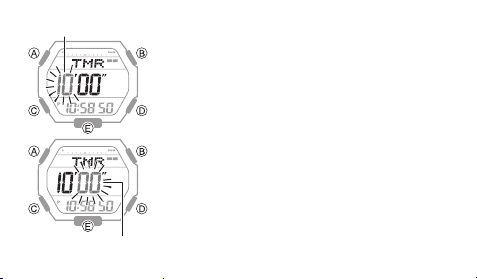
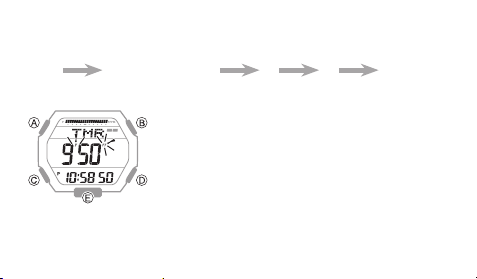
1. Hold down A for at least two seconds.
This causes the minutes digits of the current timer start
time to flash.
2. Use D and E to change the timer minutes setting.
3. Press C.
This causes the seconds digits to flash.
4. Use D and E to change the timer seconds setting.
5. Press A to exit the setting screen.
Note
• Setting a time of 0 minutes 00 seconds specifies a
countdown start time of 60 minutes.
Minutes
Seconds
EN-46
Using the Timer
A typical operation is shown below.
D
(Measurement
operation starts.)
D D
End
(Time up)
Start Pause Resume
• The watch beeps for 10 seconds when the end of the
countdown is reached.
• To stop a countdown operation, first pause it and then
press E. This will reset the timer to its start time.
Stopping the Timer Beeper
Pressing any button while the timer beeper is sounding stops it.
EN-47
Dual Time
Dual Time lets you set the current time in another time zone in addition your current
location time.
● Getting Ready
Enter the Dual Time Mode.
Selecting a Mode…EN-14
Configuring Dual Time Settings
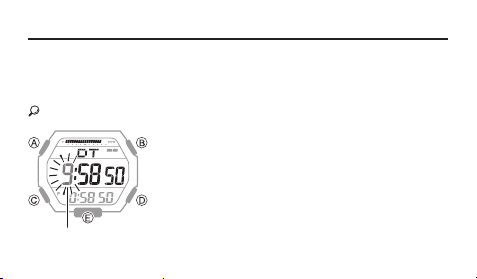
1. Hold down A for at least two seconds. Release the
button when the hour digits of the Dual Time in the
upper display start to flash.
2. Use D and E to change the hour setting.
Hour
EN-48
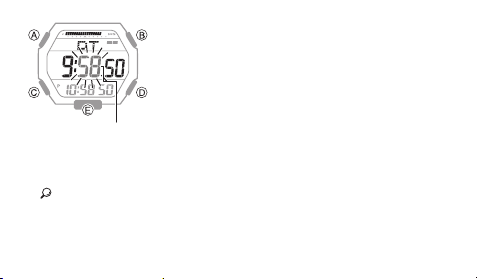
3. Press C.
This causes the minute digits of the Dual Time to flash.
4. Use D and E to change the minute setting.
• You can change the setting in 15-minute increments.
5. Press A to exit the setting screen.
Swapping Your Current Location Time and Dual Time
1. Enter the Dual Time Mode.
Selecting a Mode…EN-14
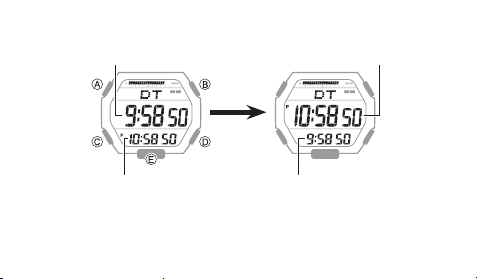
2. Hold down E for at least two seconds.
This swaps your current location time and Dual Time.
Minute
EN-49
Current location time
Dual Time
Before swapping
Current location time
After swapping
Dual Time
E
Note
• This function comes in handy when you need to move to another time zone.
EN-50
Alarms and Hourly Time Signal
The watch will beep when an alarm time is reached. You can set up to five different
alarms. The hourly time signal causes the watch to beep every hour on the hour.
● Getting Ready
Enter the Alarm Mode.
Selecting a Mode…EN-14
Configuring Alarm Settings
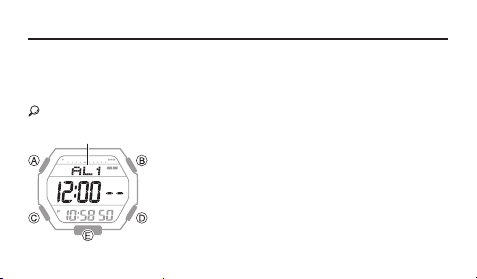
1. Press D to scroll through alarm numbers ([AL1]
to [AL5]) until the number of the alarm you want to
configure is displayed.
Alarm number
EN-51
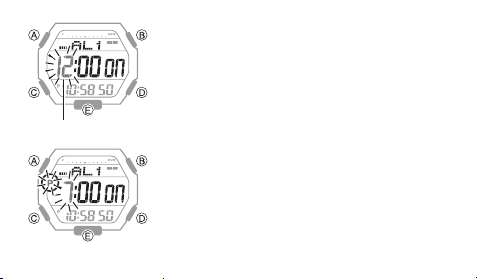
2. Hold down A for at least two seconds. Release the
button when the hour digits start to flash.
3. Use D and E to change the hour setting.
• If you are using 12-hour timekeeping, [P] indicates
p.m.
Hours
EN-52
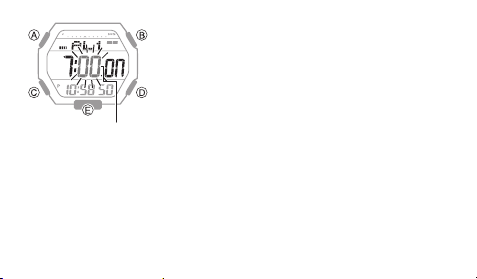
4. Press C.
This causes the minute digits to flash.
5. Use D and E to change the minute setting.
6. Press A to exit the setting screen.
Note
• A beeper will sound for 10 seconds to let you know
when the alarm time is reached.
Minutes
EN-53
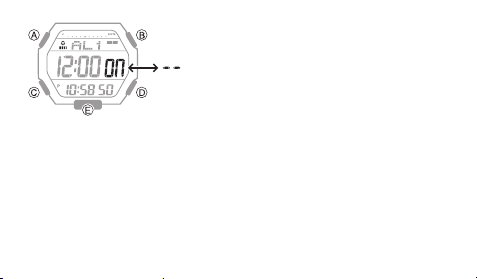
Enabling/Disabling an Alarm or the Hourly Time Signal
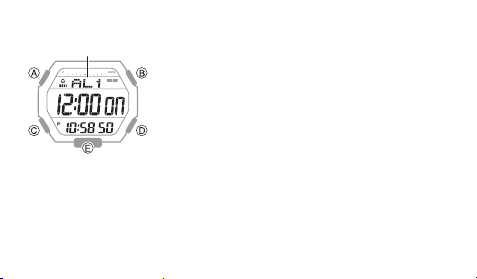
1. Press D to scroll through alarm numbers ([AL1] to
[AL5]) and the hourly time signal ([SIG]) screens until
the one you want to configure is displayed.
Alarm or hourly time signal
EN-54
2. Press E to toggle the displayed alarm or the
hourly time signal between on and off.
[On]: On
[
–
–]: Off
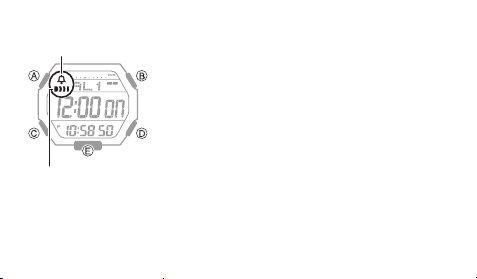
Stopping an Alarm
Pressing any button while the beeper is sounding stops it.
EN-55
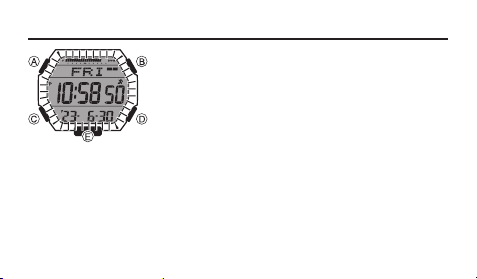
Determining an Alarm’s On/Off Status
Turning on an alarm or the hourly time signal causes the
corresponding indicator to appear on the display. The
alarm on indicator is displayed when one or more alarm
is turned on.
Alarm
Hourly time signal
EN-56
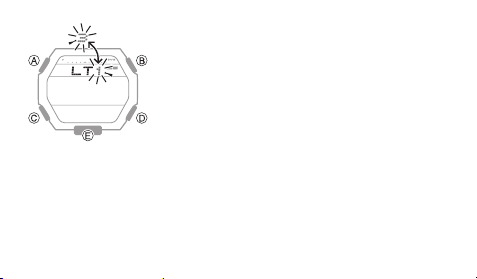
Illumination Light
The watch has an LED light that you can turn on for
reading in the dark.
Illuminating the Face Manually
Pressing B turns on illumination.
• The LED light will turn off automatically if the alarm starts
to sound.
EN-58
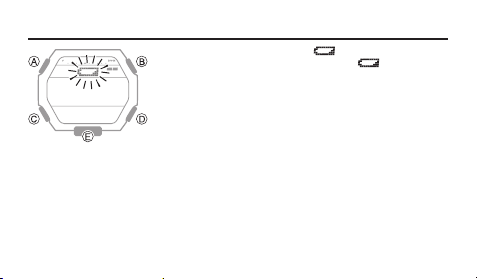
4. Press D to toggle between the two illumination
duration settings.
[1]: 1.5-second illumination
[3]: 3-second illumination
5. Press A to exit the setting screen.
EN-59
Battery Replacement
When battery power goes low, will start to flash and
some functions will become disabled. If
continues to
flash, replace the battery.

EN-60
Other Settings
● Getting Ready
Enter the Timekeeping Mode.
Selecting a Mode…EN-14
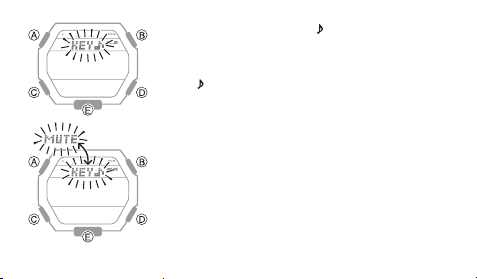
Enabling the Button Operation Tone
Use the procedure below to enable or disable the tone that sounds when you press
a button.
•
is displayed while the button operation tone is disabled.
1. Hold down A for at least two seconds. Release the
button when [SET] stops flashing.
EN-61
2. Press C eight times so [KEY ] or [MUTE] is flashing
on the display.
3. Press D to toggle the button operation tone between
enabled and disabled.
[KEY
]: Operation tone enabled.
[MUTE]: Operation tone disabled.
4. Press A to exit the setting screen.
EN-62
Specifications
Accuracy at normal temperature: ±30 seconds per month average
Timekeeping: Hour, minute, second, year, month, day, day of the week, a.m./p.m.
(P)/24-hour timekeeping, full auto calendar (2000 to 2099)
Pedometer:
Step count measurement using a 3-axis accelerometer
Step count display range: 0 to 999,999 steps
Step indicator
Step count graph
Step count log
Step count reset
Auto zero-reset at midnight each day
Manual reset

EN-63
Daily step goal setting
Step count setting unit: 1,000 steps
Step count setting range: 1,000 to 50,000 steps
Step count accuracy
±3% (According to vibration testing)
Power Saving
Stopwatch, Lap/Split Record Recall:
Measuring unit
1/100 seconds (first hour); 1 second (after first hour)
Measuring range: 23 hours 59 minutes 59 seconds
Measurement Functions:
Normal elapsed time; cumulative time; lap/split times;
200-record lap/split memory

EN-64
Timer:
Measuring unit: 1 second
Measuring range: 60 minutes
Time setting unit: 1 second
Time setting range: 1 second to 60 minutes
Time up beeper: 10 seconds
Dual Time:
Hour, minute, second
Home Time swapping
Alarm:
Time alarms
Number of alarms: 5
Setting units: Hours, minutes
Alarm tone duration: 10 seconds
Hourly time signal: Beep every hour on the hour

EN-65
Other:
LED light (afterglow, selectable illumination duration (approximately 1.5 seconds or
3 seconds)); operation tone on/off; low battery alert
Power Supply:
CR1620 x 1
Battery life: Approximately 2 years
Conditions
Alarm: Once (10 seconds)/day
Illumination: Once (1.5 seconds)/day
Step counting: 12 hours/day
Specifications are subject to change without notice.

EN-66
Troubleshooting
Pedometer
¶■ Displayed step count is not correct.
While the watch is on your wrist, the pedometer may detect non-step movements
and count them as steps.
Pedometer…EN-17
Also, step count problems can also be caused by how the watch is being worn and
abnormal arm movement while walking.
Counting Steps…EN-17
¶■ The step count does not increase.
The step count is not displayed at the beginning of a walk in order to avoid
miscounting of non-walking movements.
It appears only after you have continued walking for about 10 seconds, with the
number of steps you took during the first 10 seconds included in to the total.
EN-67
¶■ [ERR] appears when using the pedometer.
[ERR] (error) appearing on the display indicates malfunction of the sensor or internal
circuitry, making sensor readings impossible. If the message does not disappear
after about three minutes or if it keeps appearing, it may indicate sensor malfunction.
Alarm
¶■ The alarm does not sound.
Is the alarm setting turned on? If it isn’t, turn it on so it will sound.
Enabling/Disabling an Alarm or the Hourly Time Signal…EN-53
Indicators
¶■ I don’t know what mode the watch is in.
You can determine the current mode by checking the watch display. Use C to
navigate between modes.
Selecting a Mode…EN-14
EN-68
Battery
¶■
is flashing on the digital display.
This indicates that battery power is getting low.
Battery Replacement…EN-59
¶■ “R” is flashing on the digital display.
This happens when battery power is low or after the light or some other function is
turned on repeatedly over a short amount of time, which temporarily runs down the
battery. All functions other than timekeeping are disabled while R is flashing on the
display.
If R remains on the display or if it keeps appearing, it may indicate that the battery
needs to be replaced.
Request battery replacement by your original retailer or authorized CASIO service
center.
EN-69
Operating Precautions
Water Resistance
• The information below applies to watches with WATER RESIST or WATER
RESISTANT marked on the back cover.
Water
Resistance
Under Daily
Use
Enhanced Water Resistance Under
Daily Use
5
Atmospheres
10
Atmospheres
20
Atmospheres
Marking
On watch front or on
back cover
No
BAR mark
5BAR 10BAR 20BAR
Example of
Daily Use
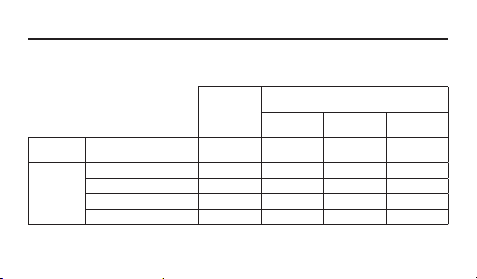
Hand washing, rain Yes Yes Yes Yes
Water-related work, swimming
No Yes Yes Yes
Windsurfing No No Yes Yes
Skin diving No No Yes Yes
•
Do not use your watch for scuba diving or other types of diving that requires air tanks.
OPUM-H

EN-70
• Watches that do not have WATER RESIST or WATER RESISTANT marked on
the back cover are not protected against the effects of sweat. Avoid using such
a watch under conditions where it will be exposed to large amounts of sweat or
moisture, or to direct splashing with water.
• Even if a watch is water resistant, note the usage precautions described below.
Such types of use reduce water resistance performance and can cause fogging of
the glass.
− Do not operate the crown or buttons while your watch is submersed in water or
wet.
− Avoid wearing your watch while in the bath.
− Do not wear your watch while in a heated swimming pool, sauna, or any other
high temperature/high humidity environment.
− Do not wear your watch while washing your hands or face, while doing
housework, or while performing any other task that involves soaps or detergents.
• After submersion in seawater, use plain water to rinse all salt and dirt from your
watch.
• To maintain water resistance, have the gaskets of your watch replaced periodically
(about once every two or three years).

EN-71
• A trained technician will inspect your watch for proper water resistance whenever
you have its battery replaced. Battery replacement requires the use of special tools.
Always request battery replacement from your original retailer or from an authorized
CASIO service center.
• Some water-resistant watches come with fashionable leather bands. Avoid
swimming, washing, or any other activity that causes direct exposure of a leather
band to water.
• The inside surface of the watch glass may fog when the watch is exposed to a
sudden drop in temperature. No problem is indicated if the fogging clears up
relatively quickly. Sudden and extreme temperature changes (such as coming into
an air conditioned room in the summer and standing close to an air conditioner
outlet, or leaving a heated room in the winter and allowing your watch to come into
contact with snow) can cause it to take longer for glass fogging to clear up. If glass
fogging does not clear up or if you notice moisture inside of the glass, immediately
stop using your watch and take it to your original retailer or to an authorized CASIO
service center.
• Your water-resistant watch has been tested in accordance with International
Organization for Standardization regulations.

EN-72
Band
• Tightening the band too tightly can cause you to sweat and make it difficult for air
to pass under the band, which can lead to skin irritation. Do not fasten the band too
tightly. There should be enough room between the band and your wrist so you can
insert your finger.
• Deterioration, rust, and other conditions can cause the band to break or come off
of your watch, which in turn can cause band pins to fly out of position or to fall out.
This creates the risk of your watch falling from your wrist and becoming lost, and
also creates the risk of personal injury. Always take good care of your band and
keep it clean.
• Immediately stop using a band if you even notice any of the following: loss of band
flexibility, band cracks, band discoloration, band looseness, band connecting
pin flying or falling out, or any other abnormality. Take your watch to your original
retailer or to a CASIO service center for inspection and repair (for which you will be
charged) or to have the band replaced (for which you will be charged).

EN-73
Temperature
• Never leave your watch on the dashboard of a car, near a heater, or in any other
location that is subject to very high temperatures. Do not leave your watch where
it will be exposed to very low temperatures. Temperature extremes can cause your
watch to lose or gain time, to stop, or otherwise malfunction.
• Leaving your watch in an area hotter than +60°C (140°F) for long periods can lead
to problems with its LCD. The LCD may become difficult to read at temperatures
lower than 0°C (32°F) and greater than +40°C (104°F).
Impact
• Your watch is designed to withstand impact incurred during normal daily use and
during light activity such as playing catch, tennis, etc. Dropping your watch or
otherwise subjecting it to strong impact, however, can lead to malfunction. Note
that watches with shock-resistant designs (G-SHOCK, BABY-G, G-MS) can be
worn while operating a chain saw or engaging in other activities that generate
strong vibration, or while engaging in strenuous sports activities (motocross, etc.)

EN-74
Magnetism
• Though a digital watch normally is not affected by magnetism, very strong
magnetism (from medical equipment, etc.) should be avoided because it can cause
malfunction and damage to electronic components.
Electrostatic Charge
• Exposure to very strong electrostatic charge can cause your watch to display
the wrong time. Very strong electrostatic charge even can damage electronic
components.
• Electrostatic charge can cause the display to go blank momentarily or cause a
rainbow effect on the display.
Chemicals
• Do not allow your watch to come into contact with thinner, gasoline, solvents,
oils, or fats, or with any cleaners, adhesives, paints, medicines, or cosmetics that
contain such ingredients. Doing so can cause discoloration of or damage to the
resin case, resin band, leather, and other parts.

EN-75
Storage
• If you do not plan to use your watch for a long time, thoroughly wipe it free of all
dirt, sweat, and moisture, and store it in a cool, dry place.
Resin Components
• Allowing your watch to remain in contact with other items or storing it together with
other items for long periods while it is wet can cause color on resin components
to transfer to the other items, or the color of the other items to transfer to the resin
components of your watch. Be sure to dry off your watch thoroughly before storing
it and make sure it is not in contact with other items.
• Leaving your watch where it is exposed to direct sunlight (ultraviolet rays) for long
periods or failure to clean dirt from your watch for long periods can cause it to
become discolored.
• Friction caused by certain conditions (strong external force, sustained rubbing,
impact, etc.) can cause discoloration of painted components.
• If there are printed figures on the band, strong rubbing of the printed area can
cause discoloration.

EN-76
• Leaving your watch wet for long periods can cause fluorescent color to fade. Wipe
the watch dry as soon as possible after it becomes wet.
• Semi-transparent resin parts can become discolored due to sweat and dirt, and if
exposed to high temperatures and humidity for long periods.
• Daily use and long-term storage of your watch can lead to deterioration, breaking,
or bending of resin components. The extent of such damage depends on usage
conditions and storage conditions.
Leather Band
• Allowing your watch to remain in contact with other items or storing it together with
other items for long periods while it is wet can cause the color of the leather band
to transfer to the other items or the color of the other items to transfer to the leather
band. Be sure to dry off your watch thoroughly with a soft cloth before storing it
and make sure it is not in contact with other items.

EN-77
• Leaving a leather band where it is exposed to direct sunlight (ultraviolet rays) for
long periods or failure to clean dirt from a leather band for long periods can cause
it to become discolored.
CAUTION: Exposing a leather band to rubbing or dirt can cause color transfer and
discoloration.
Metal Components
• Failure to clean dirt from metal components can lead to formation of rust, even if
components are stainless steel or plated. If metal components exposed to sweat or
water, wipe thoroughly with a soft, absorbent cloth and then place the watch in a
well-ventilated location to dry.
• Use a soft toothbrush or similar tool to scrub the metal with a weak solution of
water and a mild neutral detergent, or with soapy water. Next, rinse with water
to remove all remaining detergent and then wipe dry with a soft absorbent cloth.
When washing metal components, wrap the watch case with kitchen plastic wrap
so it does not come into contact with the detergent or soap.

EN-78
Bacteria and Odor Resistant Band
• The bacteria and odor resistant band protects against odor generated by the
formation of bacteria from sweat, which ensures comfort and hygiene. In order
to ensure maximum bacteria and odor resistance, keep the band clean. Use an
absorbent soft cloth to thoroughly wipe the band clean of dirt, sweat, and moisture.
A bacteria and odor resistant band suppresses the formation of organisms and
bacteria. It does not protect against rash due to allergic reaction, etc.
Liquid Crystal Display
• Display figures may be difficult to read when viewed from an angle.
Watch with Data Memory
• Allowing the battery to go dead, replacing the battery, or having your watch
repaired can cause all data in watch memory to be lost. Note that CASIO
COMPUTER CO., LTD. assumes no responsibility for any damages or losses
caused by data lost due to malfunction or repair of your watch, replacement of the
battery, etc. Be sure to keep separate written copies of all important data.

EN-79
Watch Sensors
• A watch sensor is a precision instrument. Never try to take it apart. Never try to
insert any objects into the openings of a sensor, and take care to ensure that dirt,
dust, or other foreign matter does not get into it. After using your watch where it
has been immersed in saltwater, rinse it thoroughly with fresh water.
EN-80
User Maintenance
Caring for Your Watch
Remember that you wear your watch next to your skin, just like a piece of clothing.
To ensure your watch performs at the level for which it is designed, keep it clean by
frequently wiping with a soft cloth to keep your watch and band free of dirt, sweat,
water and other foreign matter.
• Whenever your watch is exposed to sea water or mud, rinse it off with clean fresh
water.
• For a metal band or a resin band with metal parts, use a soft toothbrush or similar
tool to scrub the band with a weak solution of water and a mild neutral detergent,
or with soapy water. Next, rinse with water to remove all remaining detergent and
then wipe dry with a soft absorbent cloth. When washing the band, wrap the watch
case with kitchen plastic wrap so it does not come into contact with the detergent
or soap.

EN-81
• For a resin band, wash with water and then wipe dry with a soft cloth. Note that
sometimes a smudge like pattern may appear on the surface of a resin band. This
will not have any effect on your skin or clothing. Wipe with a cloth to remove the
smudge pattern.
• Clean water and sweat from a leather band by wiping with a soft cloth.
• Not operating a watch crown, buttons, or rotary bezel could lead to later problems
with their operation. Periodically rotate the crown and rotary bezel, and press
buttons to maintain proper operation.
Dangers of Poor Watch Care
Rust
• Though the metal steel used for your watch is highly rust-resistant, rust can form if
your watch is not cleaned after it becomes dirty.
− Dirt on your watch can make it impossible for oxygen to come into contact with
the metal, which can lead to breakdown of the oxidization layer on the metal
surface and the formation of rust.

EN-82
• Rust can cause sharp areas on metal components and can cause band pins to fly
out of position or to fall out. If you ever notice any abnormality immediately stop
using your watch and take it to your original retailer or to an authorized CASIO
service center.
• Even if the surface of the metal appears clean, sweat and rust in crevasses can
soil the sleeves of clothing, cause skin irritation, and even interfere with watch
performance.
Premature Wear
• Leaving sweat or water on a resin band or bezel, or storing your watch an area
subject to high moisture can lead to premature wear, cuts, and breaks.
Skin Irritation
• Individuals with sensitive skin or in poor physical condition may experience skin
irritation when wearing a watch. Such individuals should keep their leather band
or resin band particularly clean. Should you ever experience a rash or other skin
irritation, immediately remove your watch and contact a skin care professional.

EN-83
Battery Replacement
• Leave battery replacement up to your original retailer or authorized CASIO service
center.
• Have the battery replaced only with the type specified in the User’s Guide. Use of a
different battery type can cause malfunction.
• When replacing the battery, also request a check for proper water resistance.
• Ornamental resin components may become worn, cracked, or bent over
time when subjected to normal daily use. Note that if cracking or any other
abnormality indicating possible damage is noticed in a watch submitted for battery
replacement, your watch will be returned with an explanation of the abnormality,
without the requested servicing being performed.
Initial Battery
• The battery that comes loaded in your watch when you purchase it is used for
function and performance testing at the factory.
• The test battery may go dead quicker than the normally rated battery life as noted
in the User’s Guide. Note that you will be charged for replacement of this battery,
even if replacement is required within your watch’s warranty period.

EN-84
Low Battery Power
• Low battery power is indicated by large timekeeping error, by dim display contents,
or by a blank display.
• Operation while battery power is low can result in malfunction. Replace the battery
as soon as possible.

CASIO COMPUTER CO., LTD.
6-2, Hon-machi 1-chome
Shibuya-ku, Tokyo 151-8543, Japan