ZHEJIANG DAHUA VISION TECHNOLOGY CO., LTD. V2.3.4
Network Video Recorder
User's Manual
Foreword
General
This user’s manual (hereinafter referred to be "the Manual") introduces the installation, functions
and operations of the Network Video Recorder (NVR) devices (hereinafter referred to be "the
Device"). Read carefully before using the Device, and keep the manual safe for future reference.
Safety Instructions
The following signal words might appear in the manual.
Signal Words Meaning
Indicates a high potential hazard which, if not avoided, will result
in death or serious injury.
Indicates a medium or low potential hazard which, if not avoided,
could result in slight or moderate injury.
Indicates a potential risk which, if not avoided, could result in
property damage, data loss, reductions in performance, or
unpredictable results.
Provides methods to help you solve a problem or save you time.
Provides additional information as a supplement to the text.
Revision History
Version Revision Content Release Time
V2.3.4
●
Added PPE detection.
●
Added some models.
August 2023
V2.3.3
●
Added smart object detection.
●
Added smart sound detection.
●
Added AcuPick function.
●
Added EPTZ linkage.
●
Updated live view control bar.
●
Updated modifying channel name.
●
Updated playback.
●
Updated port settings.
●
Added registration ID.
June 2023
V2.3.2 Added 14 models. April 2023
V2.3.1 Added 8 models. February 2023
User's Manual
I

Version Revision Content Release Time
V2.3.0
●
Added NVR608H-32-XI/NVR608H-64-XI/
NVR608H-128-XI/NVR608RH-32-XI/
NVR608RH-64-XI/NVR608RH-128-XI.
●
Added smart tracking and sub screen
mirroring.
August 2022
V2.2.0 Added AI SSA and Quick Pick. June 2022
V2.1.0 Updated cluster service. April 2022
V2.0.0
●
Added intelligent diagnosis.
●
Added report query.
●
Added resetting password through DMSS
app.
●
Added LLDP.
●
Updated several gures of the local page.
March 2022
V1.4.0
Added NVR11HS-W-S2-CE and NVR11HS-W-
S2-FCC.
January 2022
V1.3.0
●
Added some models.
●
Updated the web login page.
●
Added privacy masking.
●
Added AI codec.
November 2021
V1.2.0
Added NVR44-4KS2/I, NVR44-16P-4KS2/I,
NVR48-4KS2/I, and NVR48-16P-4KS2/I.
June 2021
V1.1.0
Combined AI and non-AI models and deleted
discontinued models.
May 2021
V1.0.10 Added several models. April 2021
V1.0.9 Added 6 models. February 2021
V1.0.8 Added 5 models. January 2021
V1.0.7
●
Added 2 models.
●
Added "5.11.7 Cellular Network".
August 2020
V1.0.6
●
Added picture search, picture search
playback, disk health monitoring, and
exporting and importing face database.
●
Updated AI search, human detection,
conguration of face recognition, and
display settings.
May 2020
V1.0.5
Added split tracking, main-sub tracking,
analytics list, conguring video quality
analytics, iSCSI, and cluster service.
May 2020
V1.0.4
●
Added 16 models.
●
Added PoE status, switch, and display.
April 2020
V1.0.3
●
New GUI baseline, replaces all pages.
●
Added AI functions.
July 2019
V1.0.2 Updated the description of rear panel. May 2019
User's Manual
II

Version Revision Content Release Time
V1.0.1
●
Added NVR 5216-16P-I and NVR5216-8P-I.
Updated relevant info.
●
Updated icons on the rear panel.
●
Added video metadata function and non-
motor vehicle detection function.
September 2018
Privacy Protection Notice
As the device user or data controller, you might collect the personal data of others such as their
face, ngerprints, and license plate number. You need to be in compliance with your local privacy
protection laws and regulations to protect the legitimate rights and interests of other people by
implementing measures which include but are not limited: Providing clear and visible identication
to inform people of the existence of the surveillance area and provide required contact information.
About the Manual
●
The manual is for reference only. If there is inconsistency between the manual and the actual
product,
●
We are not liable for any loss caused by the operations that do not comply with the manual.
●
The manual would be updated according to the latest laws and regulations of related regions.
For detailed information, see the paper manual, CD-ROM, QR code or our ocial website. If
there is inconsistency between paper manual and the electronic version, the electronic version
shall prevail.
●
All the designs and software are subject to change without prior written notice. The product
updates might cause some dierences between the actual product and the manual. Please
contact the customer service for the latest program and supplementary documentation.
●
There still might be deviation in technical data, functions and operations description, or errors in
print. If there is any doubt or dispute, please see our nal explanation.
●
Upgrade the reader software or try other mainstream reader software if the manual (in PDF
format) cannot be opened.
●
All trademarks, registered trademarks and the company names in the manual are the properties
of their respective owners.
●
Please visit our website, contact the supplier or customer service if there is any problem
occurred when using the device.
●
If there is any uncertainty or controversy, please see our nal explanation.
User's Manual
III

Important Safeguards and Warnings
This section introduces content covering the proper handling of the Device, hazard prevention, and
prevention of property damage. Read carefully before using the Device, and comply with the
guidelines when using it.
Transportation Requirements
Transport the Device under allowed humidity and temperature conditions.
Storage Requirements
Store the Device under allowed humidity and temperature conditions.
Operation Requirements
●
Do not place the Device in a place exposed to sunlight or near heat sources.
●
Keep the Device away from dampness, dust, and soot.
●
Install the Device on a stable surface to prevent it from falling.
●
Do not drop or splash liquid onto the Device, and make sure that there is no object lled with
liquid on the Device to prevent liquid from owing into it.
●
Put the Device in a well-ventilated place, and do not block its ventilation.
●
Operate the Device within the rated range of power input and output.
●
Do not disassemble the Device.
●
Use the Device under allowed humidity and temperature conditions.
Installation Requirements
●
Do not connect the power adapter to the device while the adapter is powered on.
●
Strictly comply with the local electric safety code and standards. Make sure the ambient voltage
is stable and meets the power supply requirements of the device.
●
Do not expose the battery to environments with extremely low air pressure, or extremely high
or low temperatures. Also, it is strictly prohibited to throw the battery into a re or furnace, and
to cut or put mechanical pressure on the battery. This is to avoid the risk of re and explosion.
●
Use the standard power adapter or cabinet power supply. We will assume no responsibility for
any injuries or damages caused by the use of a nonstandard power adapter.
User's Manual
IV

●
Do not place the Device in a place exposed to sunlight or near heat sources.
●
Keep the Device away from dampness, dust, and soot.
●
Put the Device in a well-ventilated place, and do not block its ventilation.
●
Install the Device on a stable surface to prevent it from falling.
●
The power supply must conform to the requirements of ES1 in IEC 62368-1 standard and be no
higher than PS2. Please note that the power supply requirements are subject to the device label.
●
The device is a class I electrical appliance. Make sure that the power supply of the Device is
connected to a power socket with protective earthing.
●
Use power cords that conform to your local requirements, and are rated specications.
●
Before connecting the power supply, make sure the input voltage matches the power
requirements of the Device.
●
When installing the Device, make sure that the power plug and appliance coupler can be easily
reached to cut o power.
●
Install the Device near a power socket for emergency disconnect.
●
It is prohibited for non-professionals and unauthorized personnel to open the Device casing.
User's Manual
V

Table of Contents
Foreword.............................................................................................................................................................. I
Important Safeguards and Warnings.............................................................................................................. IV
1 Introduction..................................................................................................................................................... 1
1.1 Overview........................................................................................................................................................................................1
1.2 Features..........................................................................................................................................................................................1
2 Front Panel and Rear Panel.............................................................................................................................4
2.1 Front Panel....................................................................................................................................................................................4
2.1.1 NVR41-4KS2/NVR41-P-4KS2/NVR41-8P-4KS2/NVR41-4KS2/L/NVR41-P-4KS2/L/
NVR41-8P-4KS2/L/NVR21-4KS2/NVR21-P-4KS2/NVR21-8P-4KS2/NVR21-S3/NVR21-P-S3/
NVR21-8P-S3/NVR41-EI/NVR41-P-EI/NVR41-8P-EI Series...................................................................................... 4
2.1.2 NVR11HS-S3H/NVR11HS-P-S3H/NVR11HS-8P-S3H/NVR41HS-4KS2/NVR41HS-P-4KS2/
NVR41HS-8P-4KS2/NVR41HS-4KS2/L/NVR41HS-P-4KS2/L/NVR41HS-8P-4KS2/L/NVR21HS-4KS2/
NVR21HS-P-4KS2/NVR21HS-8P-4KS2/NVR21HS-S3/NVR21HS-P-S3/NVR21HS-8P-S3................................5
2.1.3 NVR52-4KS2/NVR52-8P-4KS2/NVR52-16P-4KS2/NVR42-4KS2/NVR42-P-4KS2/
NVR42-8P-4KS2/NVR42-16P-4KS2/NVR42-4KS2/L/NVR42-P-4KS2/L/NVR42-8P-4KS2/L/
NVR42-16P-4KS2/L/NVR5224-24P-4KS2/NVR54-4KS2/NVR54-16P-4KS2/NVR44-4KS2/
NVR44-16P-4KS2/NVR44-4KS2/L/NVR44-16P-4KS2/L/NVR5424-24P-4KS2/NVR58-4KS2/
NVR58-16P-4KS2/NVR48-4KS2/NVR48-16P-4KS2/NVR48-4KS2/L/NVR48-16P-4KS2/L/
NVR22-4KS2/NVR22-P-4KS2/NVR22-8P-4KS2/NVR52-8P-4KS2E/NVR52-16P-4KS2E/
NVR54-16P-4KS2E/NVR58-16P-4KS2E.......................................................................................................................... 6
2.1.4 NVR21-W-4KS2 Series................................................................................................................................................... 7
2.1.5 NVR21HS-W-4KS2/NVR11HS-W-S2-CE/NVR11HS-W-S2-FCC Series............................................................ 8
2.1.6 NVR21-I/NVR21-I2/NVR21-P-I/NVR21-P-I2/NVR21-8P-I/NVR21-8P-I2 Series............................................ 9
2.1.7 NVR22-I/NVR22-I2/NVR22-P-I/NVR22-P-I2/NVR22-8P-I/NVR22-8P-I2/NVR22-16P-I/
NVR22-16P-I2/NVR52-EI/NVR52-8P-EI/NVR52-16P-EI/NVR41HS-EI/NVR42-EI/NVR41HS-P-EI/
NVR42-P-EI/NVR41HS-8P-EI/NVR42-8P-EI/NVR42-16P-EI/NVR44-EI/NVR44-16P-EI.................................. 10
2.1.8 NVR21HS-I/NVR21HS-I2/NVR21HS-P-I/NVR21HS-P-I2/NVR21HS-8P-I/NVR21HS-8P-I2/
NVR44-4KS2/I/NVR44-16P-4KS2/I Series................................................................................................................... 12
2.1.9 NVR48-I/NVR58-I/NVR58-I/L Series........................................................................................................................12
2.1.10 NVR42-I/NVR44-I/NVR54-I/NVR54-I/L/NVR52-I/NVR52-I/L Series............................................................13
2.1.11 NVR48-4KS2/I/NVR48-16P-4KS2/I/NVR54-EI/NVR54-16P-EI/NVR58-EI/NVR58-16P-EI/
NVR48-EI/NVR48-16P-EI...................................................................................................................................................14
2.1.12 NVR608-32-4KS2 Series...........................................................................................................................................15
2.1.13 NVR608-64-4KS2/NVR608-128-4KS2/NVR608H-XI/NVR608RH-XI Series.............................................. 15
2.1.14 NVR616-4KS2/NVR616-XI/NVR50-EI Series...................................................................................................... 16
2.1.15 NVR624-XI Series.................................................................................................................................................... 19
2.2 Rear Panel....................................................................................................................................................................................20
2.2.1 NVR21-4KS2/NVR21-P-4KS2/NVR21-8P-4KS2/NVR41-EI/NVR41-8P-EI/NVR41-P-EI Series................20
2.2.2 NVR11HS-S3H/NVR11HS-P-S3H/NVR11HS-8P-S3H/NVR21HS-4KS2/NVR21HS-P-4KS2/
NVR21HS-8P-4KS2/NVR41HS-4KS2/NVR41HS-P-4KS2/NVR41HS-8P-4KS2/NVR41HS-4KS2/L/
User's Manual
VI

NVR41HS-P-4KS2/L/NVR41HS-8P-4KS2/L/NVR21HS-S3/NVR21HS-P-S3/NVR21HS-8P-S3/
NVR41HS-EI/NVR41HS-P-EI/NVR41HS-8P-EI............................................................................................................ 22
2.2.3 NVR22-4KS2/NVR22-P-4KS2/NVR22-8P-4KS2 Series.......................................................................................24
2.2.4 NVR52-4KS2/NVR52-8P-4KS2/NVR52-16P-4KS2/NVR52-24P-4KS2/NVR52-8P-4KS2E/
NVR52-16P-4KS2E/NVR52-EI/NVR52-8P-EI/NVR52-16P-EI/NVR42-16P-EI.....................................................26
2.2.5 NVR54-4KS2/NVR58-4KS2/NVR54-16P-4KS2/NVR58-16P-4KS2/NVR54-24P-4KS2/
NVR58-16P-4KS2E..............................................................................................................................................................29
2.2.6 NVR41-4KS2/NVR41-P-4KS2/NVR41-8P-4KS2/NVR41-4KS2/L/NVR41-P-4KS2/L/
NVR41-8P-4KS2/L/NVR21-S3/NVR21-P-S3/NVR21-8P-S3....................................................................................32
2.2.7 NVR42-4KS2/NVR42-P-4KS2/NVR42-8P-4KS2/NVR42-16P-4KS2/NVR42-4KS2/L/NVR42-
P-4KS2/L/NVR42-8P-4KS2/L/NVR42-16P-4KS2/L/NVR42-EI/NVR42-P-EI/NVR42-8P-EI Series................33
2.2.8 NVR44-4KS2/NVR44-16P-4KS2/NVR44-4KS2/L/NVR44-16P-4KS2/L/NVR44-4KS2/I/
NVR44-16P-4KS2/I/NVR48-EI/NVR44-EI/NVR48-16P-EI/NVR44-16P-EI Series..............................................35
2.2.9 NVR48-4KS2/NVR48-16P-4KS2/NVR48-4KS2/L/NVR48-16P-4KS2/L/NVR48-4KS2/I/
NVR48-16P-4KS2/I Series.................................................................................................................................................38
2.2.10 NVR21-W-4KS2 Series.............................................................................................................................................. 40
2.2.11 NVR21HS-W-4KS2......................................................................................................................................................42
2.2.12 NVR21-I/NVR21-I2 Series........................................................................................................................................ 43
2.2.13 NVR22-I/NVR22-I2 Series........................................................................................................................................ 44
2.2.14 NVR21-P-I/NVR21-P-I2 Series................................................................................................................................ 45
2.2.15 NVR22-P-I/NVR22-P-I2 Series................................................................................................................................ 46
2.2.16 NVR21-8P-I/NVR21-8P-I2 Series........................................................................................................................... 48
2.2.17 NVR22-8P-I/NVR22-8P-I2 Series........................................................................................................................... 49
2.2.18 NVR22-16P-I/NVR22-8P-I2 Series.........................................................................................................................50
2.2.19 NVR21HS-I/NVR21HS-I2 Series............................................................................................................................. 52
2.2.20 NVR21HS-P-I/NVR21HS-P-I2 Series..................................................................................................................... 53
2.2.21 NVR21HS-8P-I/NVR21HS-8P-I2 Series................................................................................................................ 54
2.2.22 NVR4208-8P-I Series.................................................................................................................................................55
2.2.23 NVR4216-I Series........................................................................................................................................................56
2.2.24 NVR58-I/NVR58-I/L/NVR48-I Series..................................................................................................................... 57
2.2.25 NVR54-I/NVR54-I/L/NVR44-I Series..................................................................................................................... 59
2.2.26 NVR52-16P-I/NVR52-16P-I/L/NVR52-8P-I/NVR52-8P-I/L/NVR42-16P-I Series......................................61
2.2.27 NVR608-4KS2/NVR608H-XI/NVR608RH-XI Series...........................................................................................64
2.2.28 NVR616-4KS2/NVR616-XI Series.......................................................................................................................... 65
2.2.29 NVR624-XI Series....................................................................................................................................................... 68
2.2.30 NVR11HS-W-S2-CE/NVR11HS-W-S2-FCC Series ............................................................................................ 69
2.2.31 NVR54-EI/NVR54-16P-EI/NVR58-EI/NVR58-16P-EI Series............................................................................70
2.2.32 NVR50-EI Series.......................................................................................................................................................... 73
2.3 Alarm Connection....................................................................................................................................................................73
2.3.1 Alarm Port.......................................................................................................................................................................73
2.3.2 Alarm Input Port...........................................................................................................................................................74
2.3.3 Alarm Output Port.......................................................................................................................................................76
User's Manual
VII

2.3.4 Alarm Relay Specications....................................................................................................................................... 77
2.4 Two-way Talk............................................................................................................................................................................. 77
2.4.1 Device-end to PC-end................................................................................................................................................77
2.4.2 PC-end to the Device-end........................................................................................................................................ 78
3 Device Installation.........................................................................................................................................79
3.1 Device Installation Diagram................................................................................................................................................. 79
3.2 Checking Unpacked NVR.......................................................................................................................................................80
3.3 HDD Installation........................................................................................................................................................................80
3.3.1 NVR41-4KS2/NVR41-P-4KS2/NVR41-8P-4KS2/NVR41-4KS2/L/NVR41-P-4KS2/L/
NVR41-8P-4KS2/L/NVR21-4KS2/NVR21-P-4KS2/NVR21-8P-4KS2/NVR21-W-4KS2/NVR21-I/
NVR21-I2/NVR21-P-I/NVR21-P-I2/NVR21-8P-I/NVR21-8P-I2/NVR21-S3/NVR21-P-S3/NVR21-8P-
S3/NVR41-EI/NVR41-P-EI/NVR41-8P-EI...................................................................................................................... 80
3.3.2 NVR41HS-4KS2/NVR41HS-P-4KS2/NVR41HS-8P-4KS2/NVR41HS-4KS2/L/NVR41HS-P-4KS2/L/
NVR41HS-8P-4KS2/L/NVR21HS-4KS2/NVR21HS-P-4KS2/NVR21HS-8P-4KS2/NVR21HS-W-4KS2/
NVR11HS-S3H/NVR11HS-P-S3H/NVR11HS-8P-S3H/NVR21HS-I/NVR21HS-I2/NVR21HS-P-I/
NVR21HS-P-I2/NVR21HS-8P-I/NVR21HS-8P-I2/NVR21HS-S3/NVR21HS-P-S3/NVR21HS-8P-S3/
NVR11HS-W-S2-CE/NVR11HS-W-S2-FCC/NVR41HS-EI/NVR41HS-P-EI/NVR41HS-8P-EI2.........................83
3.3.3 NVR22-8P-S2/NVR42-4KS2/NVR42-P-4KS2/NVR42-8P-4KS2/NVR42-16P-4KS2/
NVR42-4KS2/L/NVR42-P-4KS2/L/NVR42-8P-4KS2/L/NVR42-16P-4KS2/L/NVR52-4KS2/
NVR52-8P-4KS2/NVR52-16P-4KS2/ NVR52-24P-4KS2/NVR22-4KS2/NVR22-P-4KS2/
NVR22-8P-4KS2/NVR52-8P-4KS2E/NVR22-I/NVR22-I2/NVR22-P-I/NVR22-P-I2/NVR22-8P-I/
NVR22-8P-I2/NVR22-16P-I/NVR22-16P-I2/NVR42-I/NVR42-8P-I/NVR42-16P-I/NVR52-16P-I/
NVR52-16P-I/L/NVR52-8P-I/NVR52-8P-I/L/NVR42-EI/NVR42-P-EI/NVR42-8P-EI/NVR42-16P-EI.............85
3.3.4 NVR54-4KS2/NVR54-16P-4KS2/NVR44-4KS2/NVR44-16P-4KS2/NVR44-4KS2/L/
NVR44-16P-4KS2/L/NVR54-24P-4KS2/NVR54-16P-4KS2E/NVR58-I/NVR58-I/L/NVR54-I/NVR54-
I/L/NVR52-I/NVR52-I/L/NVR42-I/NVR42-8P-I/NVR44-I/NVR48-I/NVR608-32-4KS2/NVR44-4KS2/I/
NVR44-16P-4KS2/I/NVR48-4KS2/I/NVR48-16P-4KS2/I/NVR48-EI/NVR48-16P-EI/NVR44-EI/
NVR44-16P-EI.......................................................................................................................................................................89
3.3.5 NVR608-64-4KS2/NVR608-128-4KS2/NVR608H-32-XI/NVR608H-64-XI/NVR608H-128-XI Series... 93
3.3.6 NVR616-4KS2 Series....................................................................................................................................................95
3.4 CD-ROM Installation................................................................................................................................................................97
3.5 Connection Sample...............................................................................................................................................................101
3.5.1 NVR41-4KS2/NVR41-P-4KS2/NVR41-8P-4KS2/NVR41-4KS2/L/NVR41-P-4KS2/L/
NVR41-8P-4KS2/L/NVR21-4KS2/NVR21-P-4KS2/NVR21-8P-4KS2/NVR21-I/NVR21-I2/NVR21-P-I/
NVR21-P-I2/NVR21-8P-I/NVR21-8P-I2/NVR21-S3/NVR21-P-S3/NVR21-8P-S3/NVR41-EI/NVR41-P-
EI/NVR41-8P-EI................................................................................................................................................................. 101
3.5.2 NVR21-W-4KS2/NVR21HS-W-4KS22...................................................................................................................103
3.5.3 NVR11HS-S3H/NVR11HS-P-S3H/NVR11HS-8P-S3H/NVR41HS-4KS2/NVR41HS-P-4KS2/
NVR41HS-8P-4KS2/NVR41HS-4KS2/L/NVR41HS-P-4KS2/L/NVR41HS-8P-4KS2/L/NVR21HS-4KS2/
NVR21HS-P-4KS2/NVR21HS-8P-4KS2/NVR21HS-I/NVR21HS-I2/NVR21HS-P-I/NVR21HS-P-I2/
NVR21HS-8P-I/NVR21HS-8P-I2/NVR21HS-S3/NVR21HS-P-S3/NVR21HS-8P-S3/NVR41HS-EI/
NVR41HS-P-EI/NVR41HS-8P-EI................................................................................................................................... 103
3.5.4 NVR22-4KS2/NVR22-P-4KS2/NVR22-8P-4KS2/NVR22-I/NVR22-I2/NVR22-P-I/NVR22-P-I2/
NVR22-8P-I/NVR22-8P-I2/NVR22-16P-I/NVR22-16P-I2 Series......................................................................... 105
3.5.5 NVR52-4KS2/NVR52-8P-4KS2/NVR52-16P-4KS2/NVR52-24P-4KS2/NVR52-8P-4KS2E/
NVR52-16P-4KS2E Series.............................................................................................................................................. 106
User's Manual
VIII

3.5.6 NVR42-4KS2/NVR42-P-4KS2/NVR42-8P-4KS2/NVR42-16P-4KS2/NVR42-4KS2/L/NVR42-
P-4KS2/L/NVR42-8P-4KS2/L/NVR42-16P-4KS2/L/NVR42-EI/NVR42-P-EI/NVR42-8P-EI/
NVR42-16P-EI.................................................................................................................................................................... 106
3.5.7 NVR54-4KS2/NVR54-16P-4KS2/NVR58-4KS2/NVR58-16P-4KS2/NVR54-24P-4KS2/
NVR54-16P-4KS2E/NVR58-16P-4KS2E Series.........................................................................................................108
3.5.8 NVR44-4KS2/NVR44-16P-4KS2/NVR44-4KS2/L/NVR44-16P-4KS2/L/NVR44-4KS2/I/
NVR44-16P-4KS2/I/NVR44-EI/NVR44-16P-EI Series.............................................................................................109
3.5.9 NVR48-4KS2/NVR48-16P-4KS2/NVR48-4KS2/L/NVR48-16P-4KS2/L/NVR48-4KS2/I/
NVR48-16P-4KS2/I/NVR48-EI/NVR48-16P-EI Series.............................................................................................110
3.5.10 NVR58-I/NVR58-I/L/NVR48-I Series...................................................................................................................111
3.5.11 NVR54-I/NVR54-I/L/NVR44-I................................................................................................................................111
3.5.12 NVR52-16P-I/NVR52-16P-I/L/NVR52-8P-I/NVR52-8P-I/L/NVR42-8P-I/NVR42-16P-I Series...........112
3.5.13 NVR4216-I Series..................................................................................................................................................... 112
3.5.14 NVR608-4KS2/NVR608H-XI/NVR608RH-XI Series........................................................................................112
3.5.15 NVR616-4KS2 Series...............................................................................................................................................113
4 Starting the Device......................................................................................................................................114
5 Local Operations..........................................................................................................................................115
5.1 Initialization............................................................................................................................................................................. 115
5.2 Startup Wizard........................................................................................................................................................................ 117
5.3 Login...........................................................................................................................................................................................122
5.4 Main Menu............................................................................................................................................................................... 124
5.5 Quick Operation Bar..............................................................................................................................................................126
5.6 Live View................................................................................................................................................................................... 128
5.6.1 Live Page...................................................................................................................................................................... 128
5.6.2 Navigation bar............................................................................................................................................................128
5.6.3 Live View Control Bar...............................................................................................................................................129
5.6.4 Shortcut Menu............................................................................................................................................................141
5.6.5 AI Live View Mode.....................................................................................................................................................144
5.6.6 Split Tracking.............................................................................................................................................................. 146
5.6.7 PTZ..................................................................................................................................................................................148
5.6.8 Wireless Pairing..........................................................................................................................................................158
5.6.9 Sequence......................................................................................................................................................................159
5.6.10 Fisheye........................................................................................................................................................................161
5.6.11 Temperature Monitoring..................................................................................................................................... 164
5.6.12 Shortcut Menu to Add Camera..........................................................................................................................165
5.6.13 Smart Tracking.........................................................................................................................................................166
5.7 Camera.......................................................................................................................................................................................166
5.7.1 Initializing Remote Devices................................................................................................................................... 166
5.7.2 Adding Remote Devices......................................................................................................................................... 171
5.7.3 Changing IP Address of Remote Device........................................................................................................... 176
5.7.4 Conguring Image Settings.................................................................................................................................. 177
User's Manual
IX

5.7.5 Conguring Overlay Settings................................................................................................................................179
5.7.6 Conguring Encoding Settings............................................................................................................................181
5.7.7 Modifying Channel Name...................................................................................................................................... 185
5.7.8 Checking the PoE Status.........................................................................................................................................185
5.7.9 Updating Remote Devices..................................................................................................................................... 186
5.7.10 Viewing Remote Device Information.............................................................................................................. 187
5.8 Recording Management..................................................................................................................................................... 189
5.8.1 Recording Schedule................................................................................................................................................. 189
5.8.2 Search and Playback................................................................................................................................................ 196
5.8.3 Recording Information............................................................................................................................................214
5.9 AI..................................................................................................................................................................................................215
5.9.1 Overview...................................................................................................................................................................... 215
5.9.2 Smart Plan....................................................................................................................................................................216
5.9.3 Face Detection........................................................................................................................................................... 219
5.9.4 Face & Body Detection............................................................................................................................................222
5.9.5 Face Recognition.......................................................................................................................................................223
5.9.6 IVS................................................................................................................................................................................... 236
5.9.7 Stereo Analysis...........................................................................................................................................................261
5.9.8 Video Metadata..........................................................................................................................................................268
5.9.9 ANPR.............................................................................................................................................................................. 276
5.9.10 Crowd Distribution.................................................................................................................................................279
5.9.11 People Counting..................................................................................................................................................... 281
5.9.12 Heat Map....................................................................................................................................................................285
5.9.13 SMD..............................................................................................................................................................................288
5.9.14 Vehicle Density........................................................................................................................................................ 291
5.9.15 Main-sub Tracking..................................................................................................................................................293
5.9.16 Video Quality Analytics.........................................................................................................................................295
5.9.17 Entries Frequency...................................................................................................................................................298
5.9.18 Smart Object Detection........................................................................................................................................299
5.9.19 Smart Sound Detection........................................................................................................................................301
5.9.20 PPE Detection...........................................................................................................................................................302
5.10 Alarm Settings...................................................................................................................................................................... 306
5.10.1 Alarm Information..................................................................................................................................................306
5.10.2 Alarm Status..............................................................................................................................................................307
5.10.3 Alarm Input............................................................................................................................................................... 308
5.10.4 Alarm Output........................................................................................................................................................... 309
5.10.5 Video Detection.......................................................................................................................................................310
5.10.6 Audio Detection......................................................................................................................................................316
5.10.7 Thermal Alarm......................................................................................................................................................... 316
5.10.8 Exception...................................................................................................................................................................317
User's Manual
X

5.10.9 Disarming.................................................................................................................................................................. 318
5.11 Network.................................................................................................................................................................................. 320
5.11.1 TCP/IP..........................................................................................................................................................................320
5.11.2 Routing Table...........................................................................................................................................................324
5.11.3 Port...............................................................................................................................................................................324
5.11.4 External Wi-Fi........................................................................................................................................................... 326
5.11.5 Wi-Fi AP...................................................................................................................................................................... 327
5.11.6 3G/4G.......................................................................................................................................................................... 330
5.11.7 Cellular Network......................................................................................................................................................331
5.11.8 Repeater.....................................................................................................................................................................333
5.11.9 PPPoE.......................................................................................................................................................................... 335
5.11.10 DDNS.........................................................................................................................................................................336
5.11.11 UPnP..........................................................................................................................................................................337
5.11.12 Email..........................................................................................................................................................................339
5.11.13 SNMP.........................................................................................................................................................................341
5.11.14 Multicast.................................................................................................................................................................. 343
5.11.15 Alarm Center..........................................................................................................................................................344
5.11.16 Register.................................................................................................................................................................... 345
5.11.17 Switch.......................................................................................................................................................................346
5.11.18 P2P.............................................................................................................................................................................348
5.12 Storage....................................................................................................................................................................................349
5.12.1 Basic.............................................................................................................................................................................349
5.12.2 Disk Manager............................................................................................................................................................350
5.12.3 RAID.............................................................................................................................................................................352
5.12.4 Disk Group.................................................................................................................................................................355
5.12.5 Disk Quota.................................................................................................................................................................356
5.12.6 Disk Check................................................................................................................................................................. 357
5.12.7 Record Estimate.......................................................................................................................................................361
5.12.8 FTP................................................................................................................................................................................364
5.12.9 iSCSI............................................................................................................................................................................. 366
5.13 Account ..................................................................................................................................................................................367
5.13.1 Group.......................................................................................................................................................................... 367
5.13.2 User..............................................................................................................................................................................369
5.13.3 Resetting Password................................................................................................................................................372
5.13.4 ONVIF User................................................................................................................................................................ 377
5.14 Security................................................................................................................................................................................... 379
5.14.1 Security Status......................................................................................................................................................... 379
5.14.2 System Service.........................................................................................................................................................380
5.14.3 Attack Defense.........................................................................................................................................................384
5.14.4 CA Certicate............................................................................................................................................................387
User's Manual
XI

5.14.5 Audio/Video Encryption.......................................................................................................................................390
5.14.6 Security Warning.....................................................................................................................................................392
5.15 System.....................................................................................................................................................................................393
5.15.1 General Settings......................................................................................................................................................393
5.15.2 Serial Port...................................................................................................................................................................398
5.16 Output and Display.............................................................................................................................................................399
5.16.1 Display........................................................................................................................................................................ 399
5.16.2 Tour..............................................................................................................................................................................401
5.16.3 Custom Layout.........................................................................................................................................................402
5.17 POS........................................................................................................................................................................................... 404
5.17.1 Settings.......................................................................................................................................................................404
5.17.2 Search..........................................................................................................................................................................408
5.18 Audio........................................................................................................................................................................................408
5.18.1 File Management....................................................................................................................................................409
5.18.2 Audio Play..................................................................................................................................................................410
5.18.3 Broadcast................................................................................................................................................................... 411
5.19 Operation and Maintenance...........................................................................................................................................413
5.19.1 Log............................................................................................................................................................................... 413
5.19.2 System........................................................................................................................................................................ 414
5.19.3 Network......................................................................................................................................................................417
5.19.4 Maintenance and Management........................................................................................................................420
5.20 USB Device Auto Pop-up..................................................................................................................................................427
5.21 Shutdown...............................................................................................................................................................................428
6 Web Operation.............................................................................................................................................432
6.1 Network Connection............................................................................................................................................................ 432
6.2 Web Login................................................................................................................................................................................ 432
6.3 Web Main Menu..................................................................................................................................................................... 433
6.4 Cluster Service.........................................................................................................................................................................435
6.4.1 Conguring Cluster IP..............................................................................................................................................435
6.4.2 Main Device.................................................................................................................................................................436
6.4.3 Sub Device...................................................................................................................................................................437
6.4.4 Transferring Videos...................................................................................................................................................437
6.4.5 Conguring Cluster Control.................................................................................................................................. 437
6.4.6 Cluster Log...................................................................................................................................................................438
7 Glossary........................................................................................................................................................440
8 FAQ............................................................................................................................................................... 441
Appendix 1 HDD Capacity Calculation........................................................................................................445
Appendix 2 Mouse Operation......................................................................................................................446
Appendix 3 Remote Control.........................................................................................................................447
User's Manual
XII


1 Introduction
1.1 Overview
The NVR is a high performance network video recorder. This product supports local live view,
multiple-window display, recorded le local storage, remote control and mouse shortcut menu
operation, and remote management and control function.
This product supports center storage, front-end storage and client-end storage. The monitor zone
in the front-end can be set in anywhere. Working with other front-end devices such as IPC, NVS, this
series product can establish a strong surveillance network through the CMS. In the network system,
there is only one network cable from the monitor center to the monitor zone in the whole network.
There is no audio/video cable from the monitor center to the monitor zone. The whole project is
featured by simple connection, low-cost, low maintenance work.
This NVR can be widely used in areas such as public security, water conservancy, transportation and
education.
1.2 Features
AI Functions
AI functions are available on select models and vary with models.
●
Face detection. The system can detect the faces are on the video image.
●
Face recognition. The system can compare the detected faces with the images in the face
database in real time.
●
Human body detection. The system activates alarm actions once human body is detected.
●
People counting. The system can eectively count the number of people and ow direction.
●
Heat map. The system can monitor the active objects in a specic area.
●
Automatic number plate recognition (ANPR). The system can eectively monitor the passing
vehicles.
Smart Playback
This function is available on select models.
●
IVS playback. It can screen out and replay the records meeting the set rules.
●
Face detection playback. It can screen out and replay the records with human faces.
●
Face recognition playback. It can compare the face information in the video with the
information in the database and replay the corresponding records.
●
ANPR playback. It can screen out the record with a specic car plate number or all the records
with car plate numbers.
●
Human body detection playback. It can screen out and replay the records with specic human
bodies.
●
Smart search. It includes smart functions such as searching by attribute and searching by image
to enable users to get target records quickly.
User's Manual
1

Cloud Upgrade
For the NVR connected to the Internet, it supports application online upgrade.
Real-Time Surveillance
●
VGA, HDMI port. Connect to monitor to realize real-time surveillance. Some series support
TV/VGA/HDMI output at the same time.
●
Shortcut menu for preview.
●
Support multiple popular PTZ decoder control protocols. Support preset, tour and pattern.
Playback
●
Support independent real-time recording for each channel. At the same time it supports
functions such as smart search, forward play, network monitor, record search and download.
●
Support various playback modes: slow play, fast play, backward play and frame-by-frame play.
●
Support time title overlay so that you can view the event accurate occurred time.
●
Support specied zone enlargement.
User Management
Users can be added to user groups for management. Each group has a set of permissions that can
be individually edited.
Storage
●
With corresponding settings (such as alarm settings and schedule settings), you can back up
related audio/video data in the network video recorder.
●
You can take records via the web and the record les are saved on the PC in which the client
locates.
Alarm
●
Respond to external alarm simultaneously (within 200 ms). Based on user’s pre-dened relay
settings, the system can process the alarm input correctly and sends user screen or voice
prompts (supporting pre-recorded audio).
●
Support settings of the central alarm server, so that the system can automatically notify users of
the alarm information. Alarm input can be derived from various connected peripheral devices.
●
Alert you of alarm information via email.
Network Surveillance
●
Send audio/video data compressed by IPC or NVS to client-ends through the network, and then
the data will be decompressed and displayed.
●
Support max 128 connections at the same time.
●
Transmit audio/video data by protocols such as HTTP, TCP, UDP, MULTICAST and RTP/RTCP.
●
Transmit some alarm data or alarm info by SNMP.
●
Support web access in WAN/LAN.
User's Manual
2

Window Split
Adopt video compression and digital processing to display several windows in one monitor.
Support 1/4/8/9/16/25/36 window split in preview and 1/4/9/16 window split in playback.
Record
Support regular record, motion record, alarm record and smart record. Save the recorded les in the
HDD, USB device, client-end PC or network storage server and you can search or playback the saved
les at the local-end or via the Web/USB devices.
Backup
Support network backup and USB record backup. You can back up the record les in devices such
as network storage server, peripheral USB 2.0 device and burner.
Network Management
●
Supervise NVR conguration and control power via Ethernet.
●
Support web management.
Peripheral Equipment Management
●
Support peripheral device control and you can freely set the control protocol and connection
port.
●
Support transparent data transmission such as RS-232 and RS-485.
Auxiliary
●
Support switch between NTSC and PAL.
●
Support real-time display of system resources information and running status.
●
Support log record.
●
Local GUI output. Shortcut menu operation with the mouse.
●
IR control function (for some series only). Shortcut menu operation with remote control.
●
Support to play the video/audio les from remote IPC or NVS.
User's Manual
3
2 Front Panel and Rear Panel
The following front panel and rear panel gures are for reference only.
2.1 Front Panel
2.1.1 NVR41-4KS2/NVR41-P-4KS2/NVR41-8P-4KS2/
NVR41-4KS2/L/NVR41-P-4KS2/L/NVR41-8P-4KS2/L/
NVR21-4KS2/NVR21-P-4KS2/NVR21-8P-4KS2/NVR21-S3/
NVR21-P-S3/NVR21-8P-S3/NVR41-EI/NVR41-P-EI/NVR41-8P-
EI Series
The gure is for reference only.
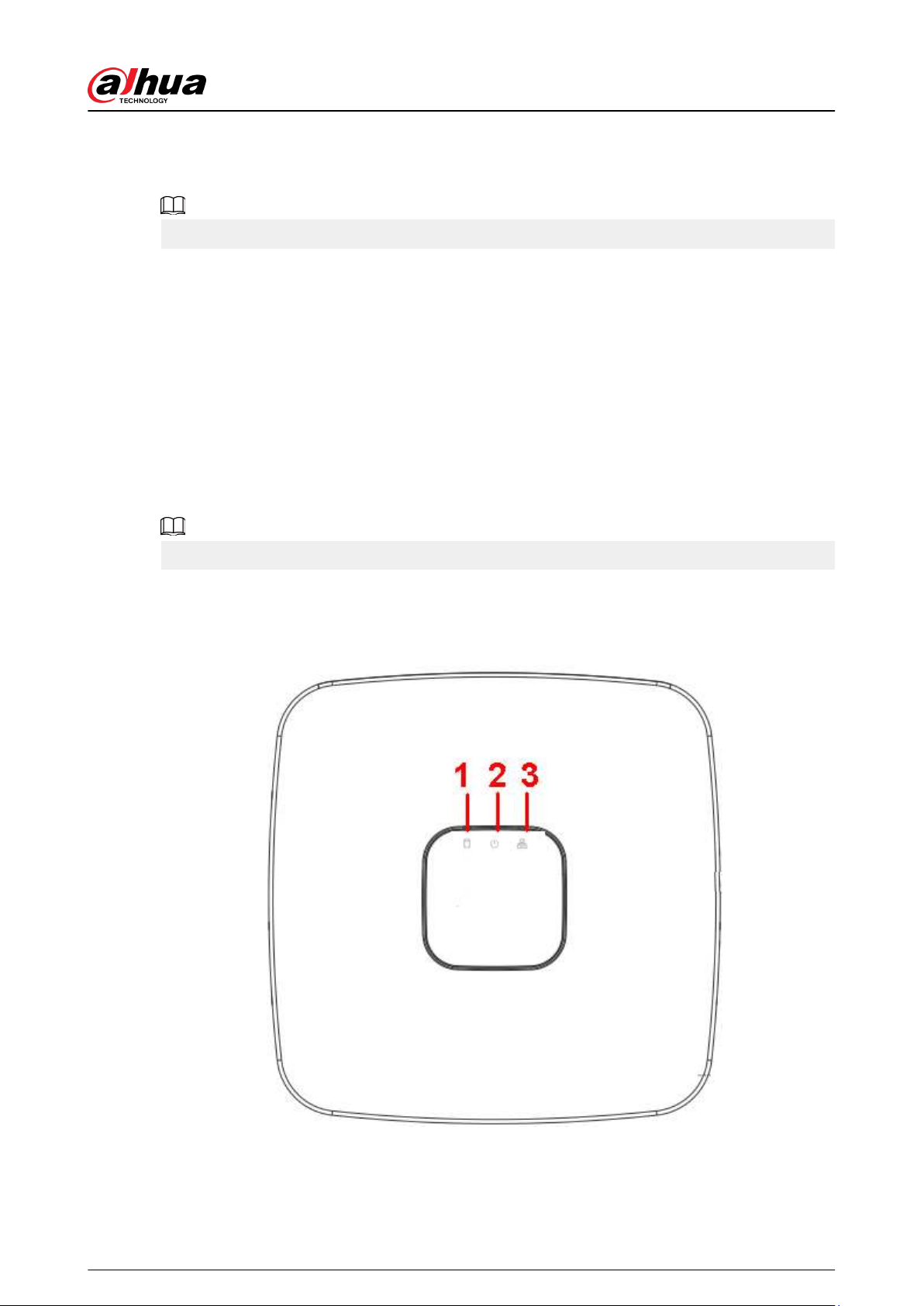
The NVR41-4KS2/NVR41-4KS2/L/NVR41-P-4KS2/NVR41-P-4KS2/L/NVR21-4KS2/NVR21-P-4KS2/
NVR21-S3/NVR21-P-S3/NVR41-EI/NVR41-P-EI front panel is shown as below.
Figure 2-1 Front panel
The NVR41-8P-4KS2/NVR41-8P-4KS2/L/NVR21-8P-4KS2/NVR21-8P-S3/NVR41-8P-EI front panel is
shown as below.
User's Manual
4
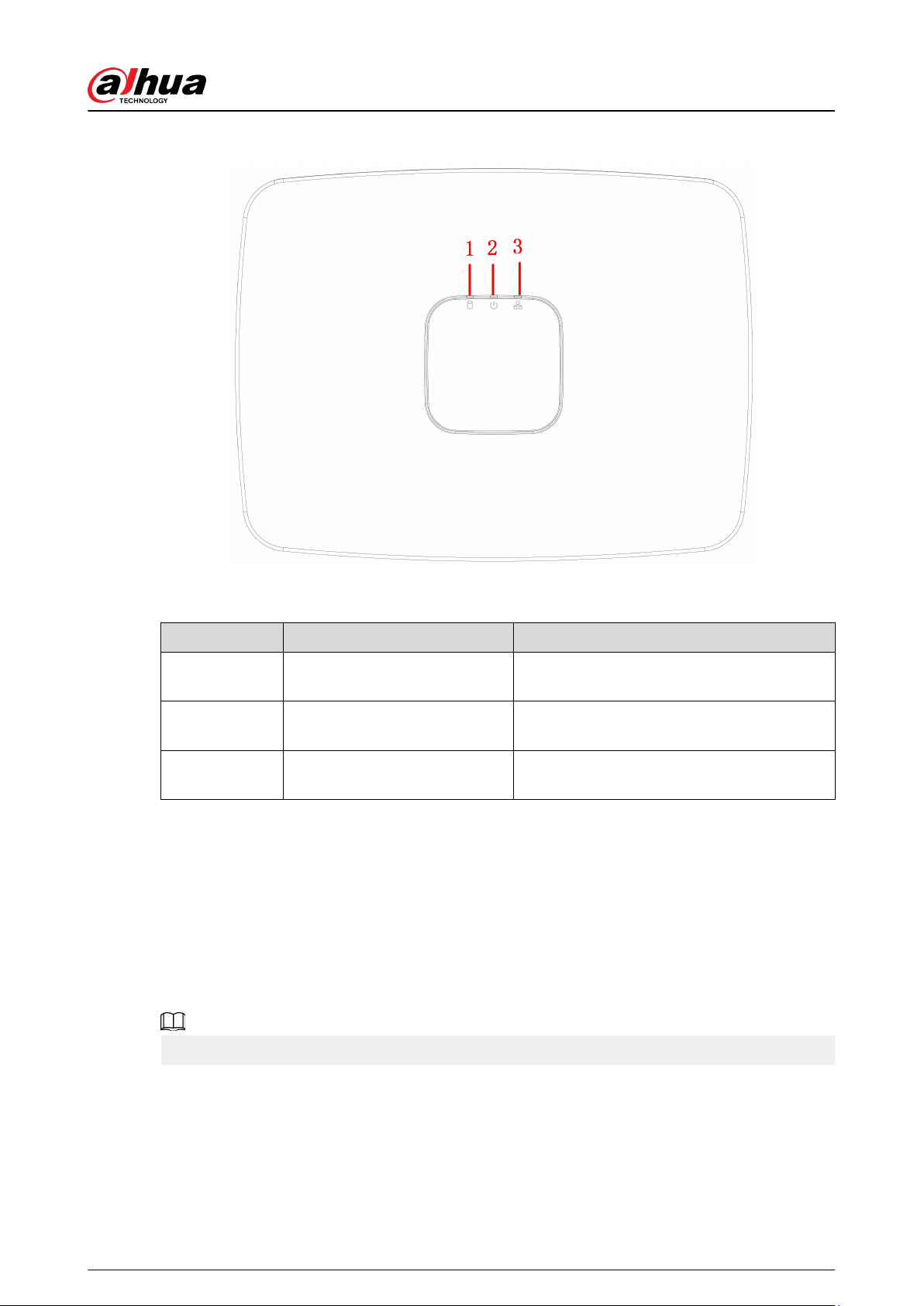
Figure 2-2 Front panel
Table 2-1 Icons
No. Name Function
1 HDD status indicator light
The red light becomes on when HDD is
abnormal.
2 Power indicator light
The red light becomes on when the power
connection is normal.
3 Network status indicator light
The red light becomes on when the network
connection is abnormal.
2.1.2 NVR11HS-S3H/NVR11HS-P-S3H/NVR11HS-8P-S3H/
NVR41HS-4KS2/NVR41HS-P-4KS2/NVR41HS-8P-4KS2/
NVR41HS-4KS2/L/NVR41HS-P-4KS2/L/NVR41HS-8P-4KS2/L/
NVR21HS-4KS2/NVR21HS-P-4KS2/NVR21HS-8P-4KS2/
NVR21HS-S3/NVR21HS-P-S3/NVR21HS-8P-S3
The gure is for reference only.
User's Manual
5
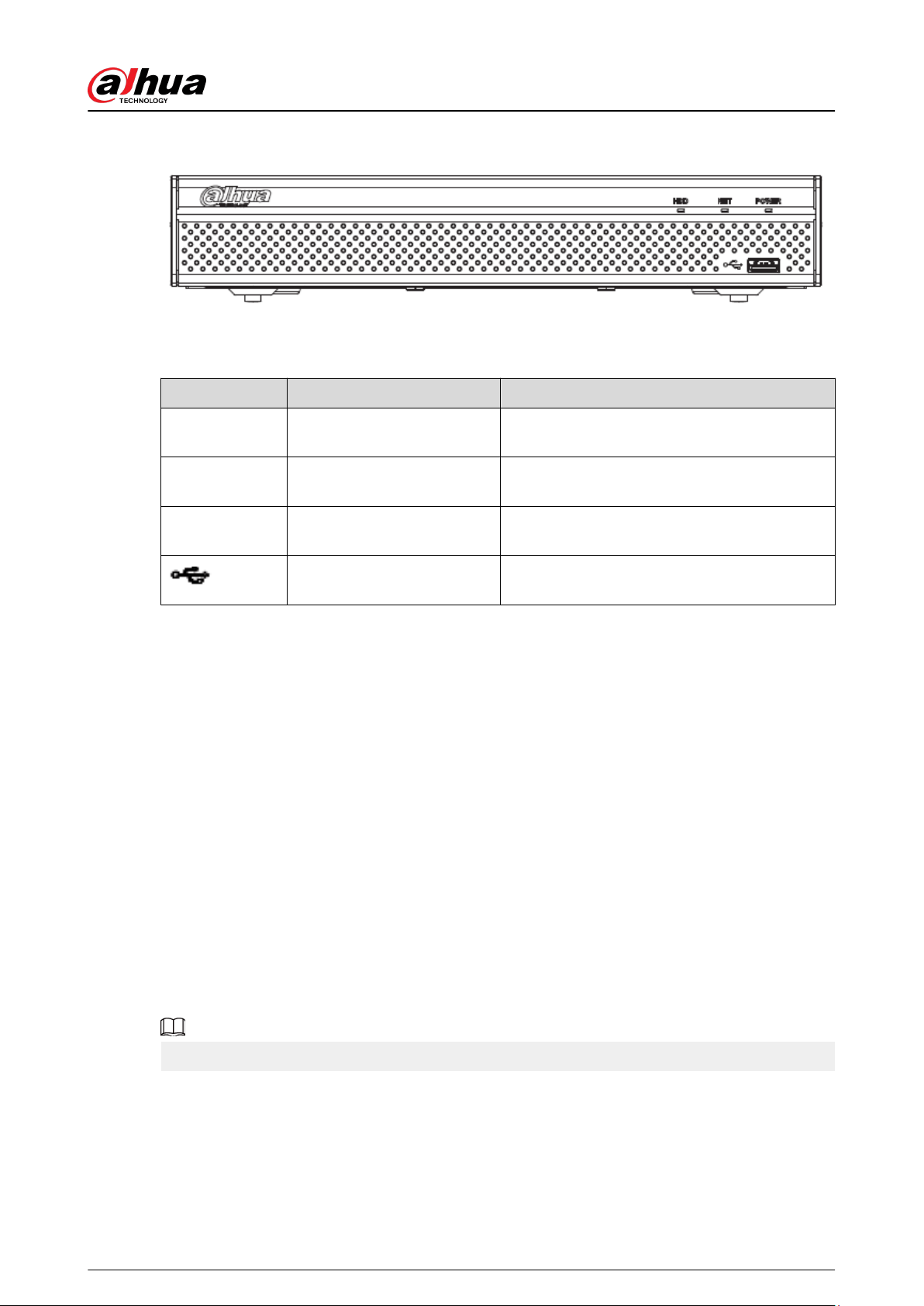
Figure 2-3 Front panel
Table 2-2 Icons
Icon Name Function
HDD HDD status indicator light
The blue light is on when the HDD is
malfunction.
NET Network status indicator light
The blue light is on when the network
connection is abnormal.
POWER Power status indicator light
The blue light is on when the power connection
is OK.
USB port
Connect to peripheral USB storage device,
mouse and more.
2.1.3 NVR52-4KS2/NVR52-8P-4KS2/NVR52-16P-4KS2/
NVR42-4KS2/NVR42-P-4KS2/NVR42-8P-4KS2/
NVR42-16P-4KS2/NVR42-4KS2/L/NVR42-P-4KS2/L/
NVR42-8P-4KS2/L/NVR42-16P-4KS2/L/NVR5224-24P-4KS2/
NVR54-4KS2/NVR54-16P-4KS2/NVR44-4KS2/
NVR44-16P-4KS2/NVR44-4KS2/L/NVR44-16P-4KS2/L/
NVR5424-24P-4KS2/NVR58-4KS2/NVR58-16P-4KS2/
NVR48-4KS2/NVR48-16P-4KS2/NVR48-4KS2/L/
NVR48-16P-4KS2/L/NVR22-4KS2/NVR22-P-4KS2/
NVR22-8P-4KS2/NVR52-8P-4KS2E/NVR52-16P-4KS2E/
NVR54-16P-4KS2E/NVR58-16P-4KS2E
The gures are for reference only.
The NVR52-4KS2/NVR52-8P-4KS2/NVR52-16P-4KS2/NVR42-4KS2/NVR42-P-4KS2/NVR42-8P-4KS2/
NVR42-16P-4KS2/NVR42-4KS2/L/NVR42-P-4KS2/L/NVR42-8P-4KS2/L/NVR42-16P-4KS2/
LNVR5224-24P-4KS2/NVR22-4KS2/NVR22-P-4KS2/NVR22-8P-4KS2/NVR52-8P-4KS2E/
NVR52-16P-4KS2E series front panel is shown as below.
User's Manual
6
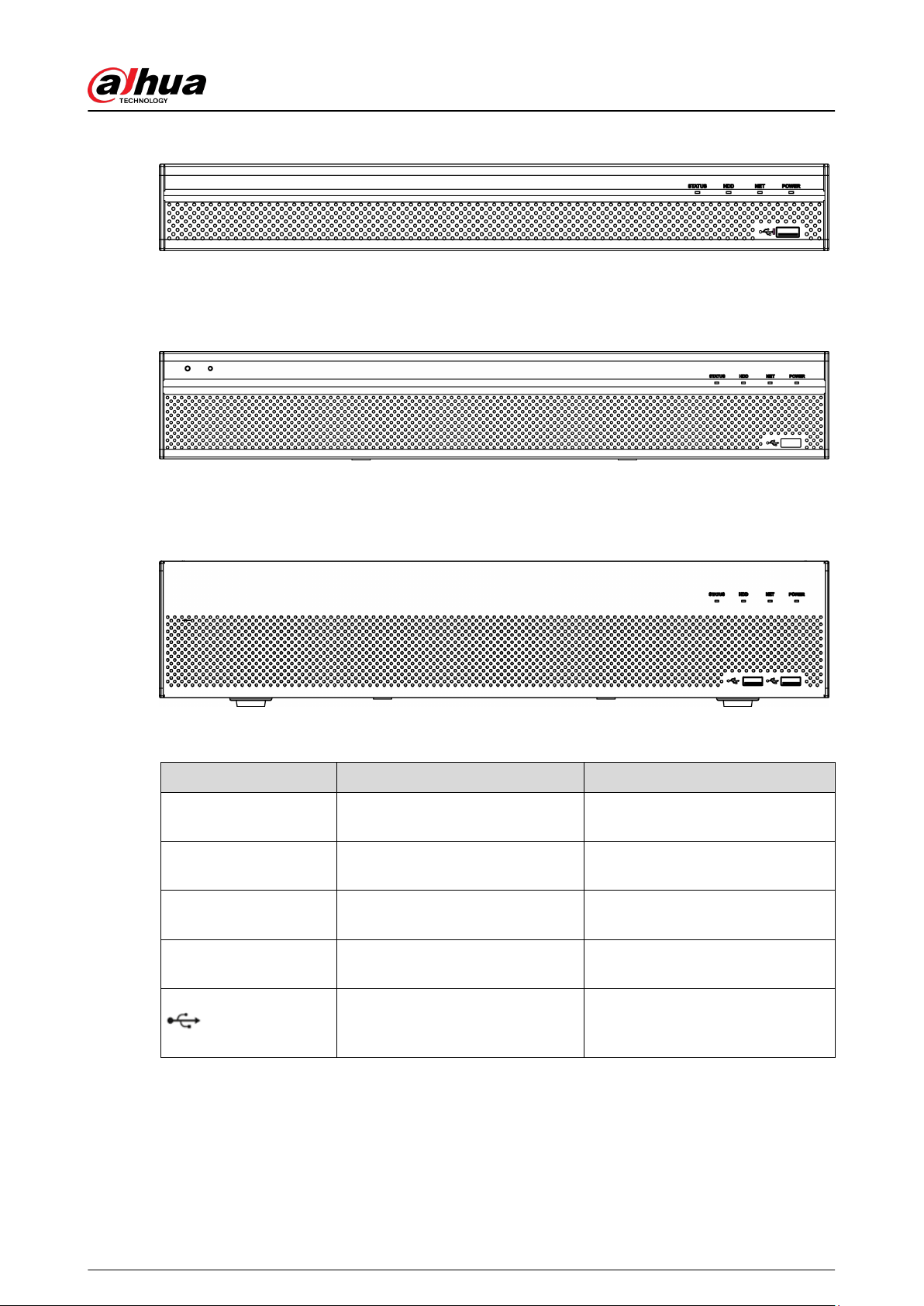
Figure 2-4 Front panel
The NVR54-4KS2/NVR54-16P-4KS2/NVR44-4KS2/NVR44-16P-4KS2/NVR44-4KS2/L/
NVR44-16P-4KS2/L/NVR54-24P-4KS2/NVR54-16P-4KS2E series front panel is shown as below.
Figure 2-5 Front panel
The NVR58-4KS2/NVR58-16P-4KS2/NVR48-4KS2/NVR48-16P-4KS2/NVR48-4KS2/L/
NVR48-16P-4KS2/L/NVR58-16P-4KS2E series front panel is shown as below
Figure 2-6 Front panel
Table 2-3 Icons
Icon Name Function
STATUS Status indicator light
The blue light is on when the
Device is working properly.
HDD HDD status indicator light
The blue light is on when the HDD
malfunctions.
NET Network status indicator light
The blue light is on when the
network connection is abnormal.
POWER Power status indicator light
The blue light is on when the
power connection is normal.
USB 2.0 port
Connect to peripheral USB 2.0
storage device, mouse, burner and
more.
2.1.4 NVR21-W-4KS2 Series
The front panel is shown as below.
User's Manual
7
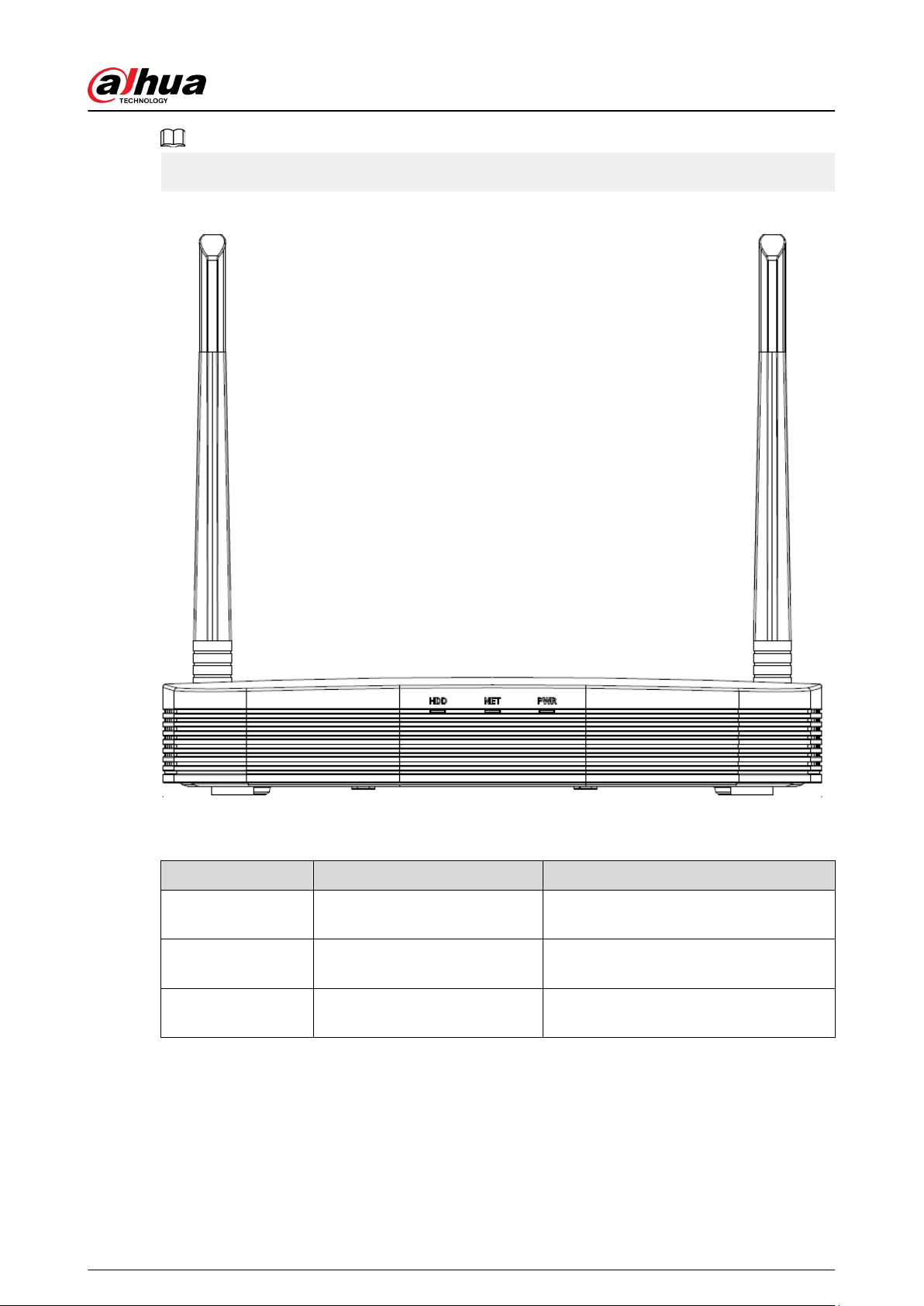
The gure is for reference only.
Figure 2-7 Front panel
Table 2-4 Icons
Icon Name Function
HDD HDD status indicator light
The blue light is on when the HDD
malfunctions.
NET Network status indicator light
The blue light is on when the network
connection is abnormal.
PWR Power status indicator light
The blue light is on when the power
connection is normal.
2.1.5 NVR21HS-W-4KS2/NVR11HS-W-S2-CE/NVR11HS-W-
S2-FCC Series
The front panel is shown as below.
User's Manual
8
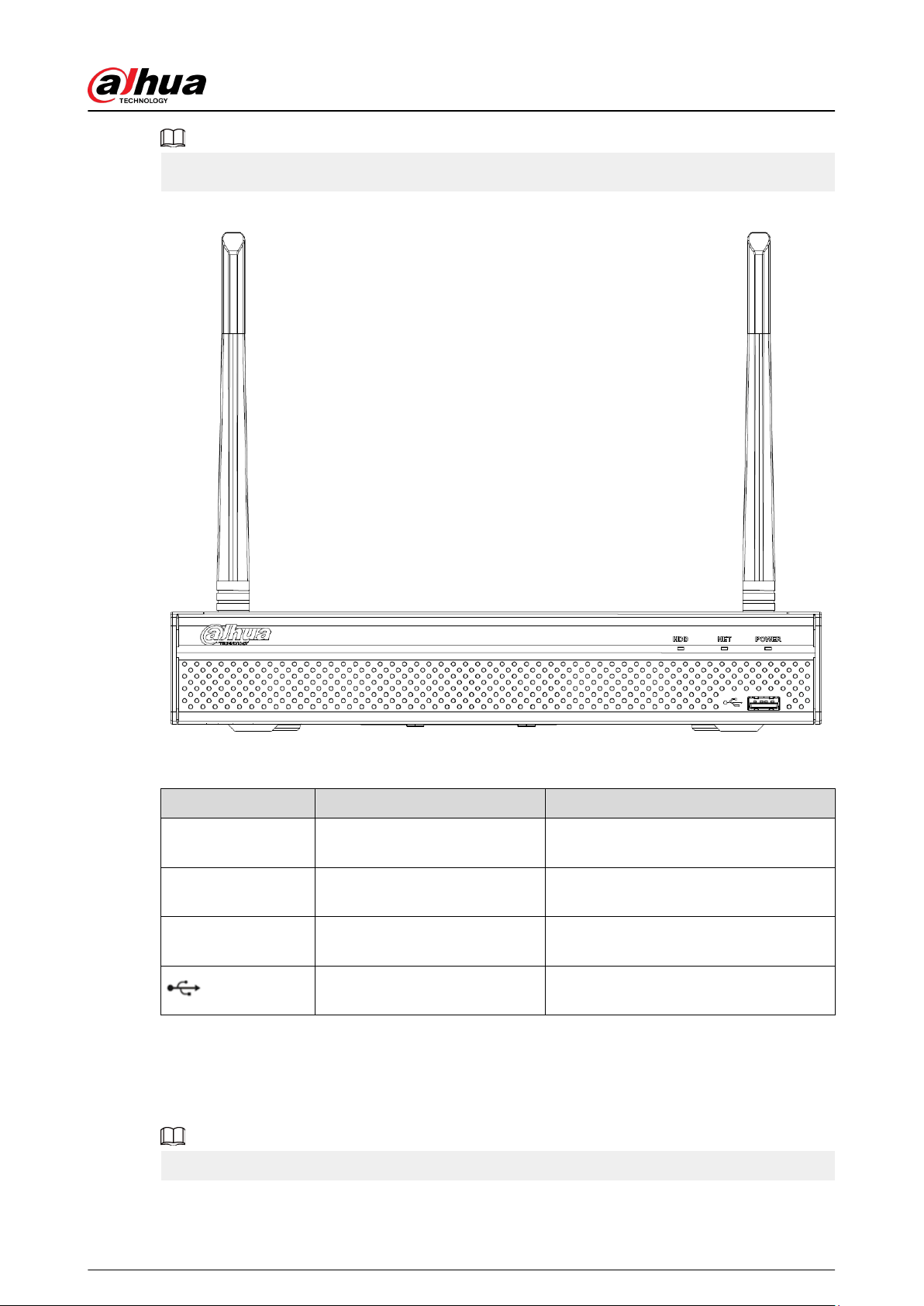
The gure is for reference only.
Figure 2-8 Front panel
Table 2-5 Icons
Icon Name Function
HDD HDD status indicator light
The blue light is on when the HDD is
malfunction.
NET Network status indicator light
The blue light is on when the network
connection is abnormal.
POWER Power status indicator light
The blue light is on when the power
connection is normal.
USB 2.0 port
Connect to peripheral USB storage
device, mouse and more.
2.1.6 NVR21-I/NVR21-I2/NVR21-P-I/NVR21-P-I2/NVR21-8P-
I/NVR21-8P-I2 Series
The gure is for reference only.
The NVR21-I/NVR21-I2 front panel is shown as below.
User's Manual
9
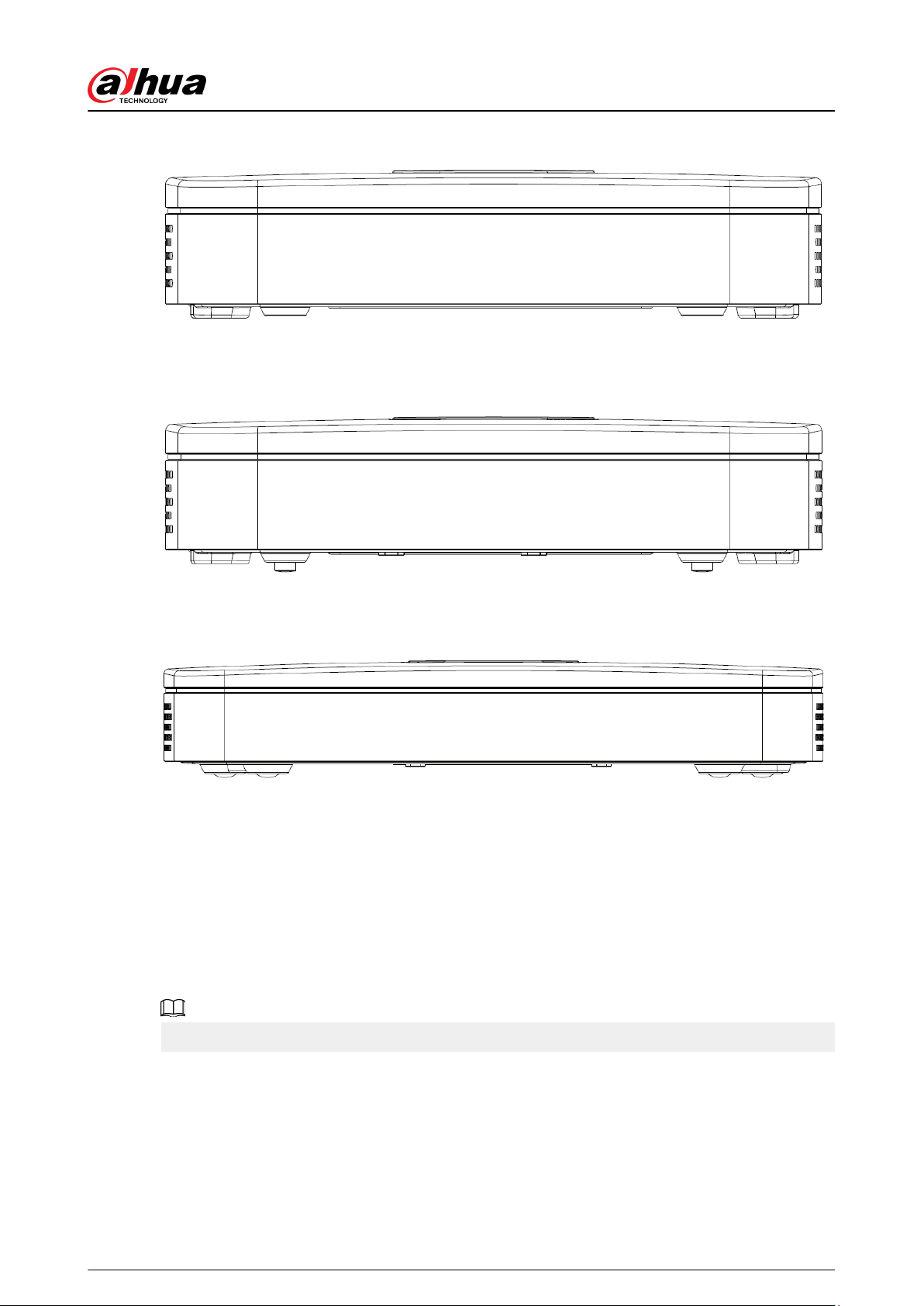
Figure 2-9 Front panel
The NVR21-P-I/NVR21-P-I2 front panel is shown as below.
Figure 2-10 Front panel
The NVR21-8P-I/NVR21-8P-I2 front panel is shown as below.
Figure 2-11 Front panel
2.1.7 NVR22-I/NVR22-I2/NVR22-P-I/NVR22-P-I2/NVR22-8P-
I/NVR22-8P-I2/NVR22-16P-I/NVR22-16P-I2/NVR52-EI/
NVR52-8P-EI/NVR52-16P-EI/NVR41HS-EI/NVR42-EI/
NVR41HS-P-EI/NVR42-P-EI/NVR41HS-8P-EI/NVR42-8P-EI/
NVR42-16P-EI/NVR44-EI/NVR44-16P-EI
The gure is for reference only.
The NVR22-I/NVR22-I2 front panel is shown as below.
User's Manual
10
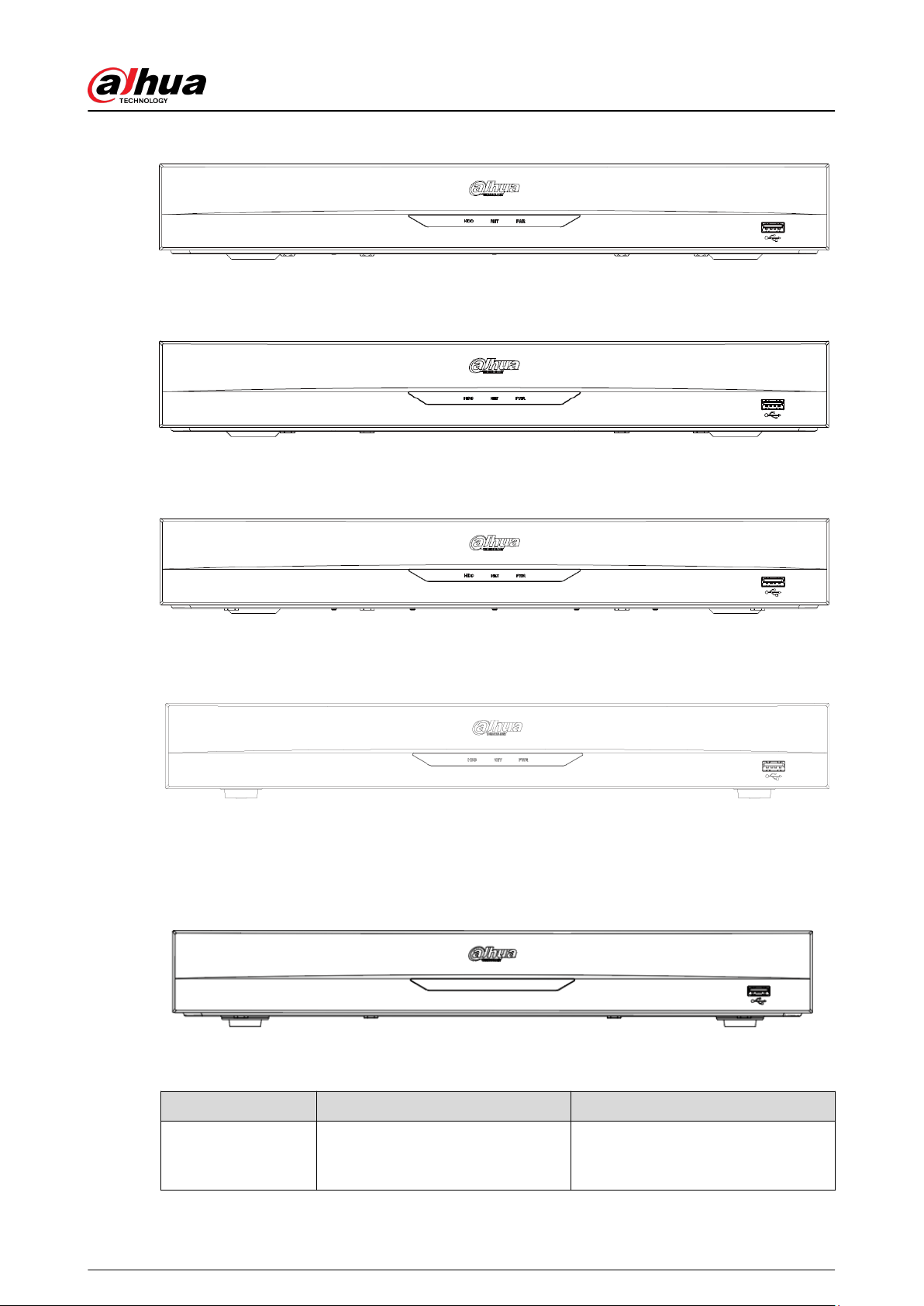
Figure 2-12 Front panel
The NVR22-P-I/NVR22-P-I2 front panel is shown as below.
Figure 2-13 Front panel
The NVR22-8P-I/NVR22-8P-I2 front panel is shown as below.
Figure 2-14 Front panel
The NVR22-16P-I/NVR22-16P-I2 front panel is shown as below.
Figure 2-15 Front panel
The NVR52-EI/NVR52-8P-EI/NVR52-16P-EI/NVR54-EI/NVR54-16P-EI/NVR41HS-EI/NVR42-EI/NVR41HS-
P-EI/NVR42-P-EI/NVR41HS-8P-EI/NVR42-8P-EI/NVR42-16P-EI/NVR44-EI/NVR44-16P-EI front panel is
shown as below.
Figure 2-16 Front panel
Table 2-6 Icons
Icon Name Function
HDD
HDD status indicator
light
The blue light is on when the HDD
malfunctions.
User's Manual
11
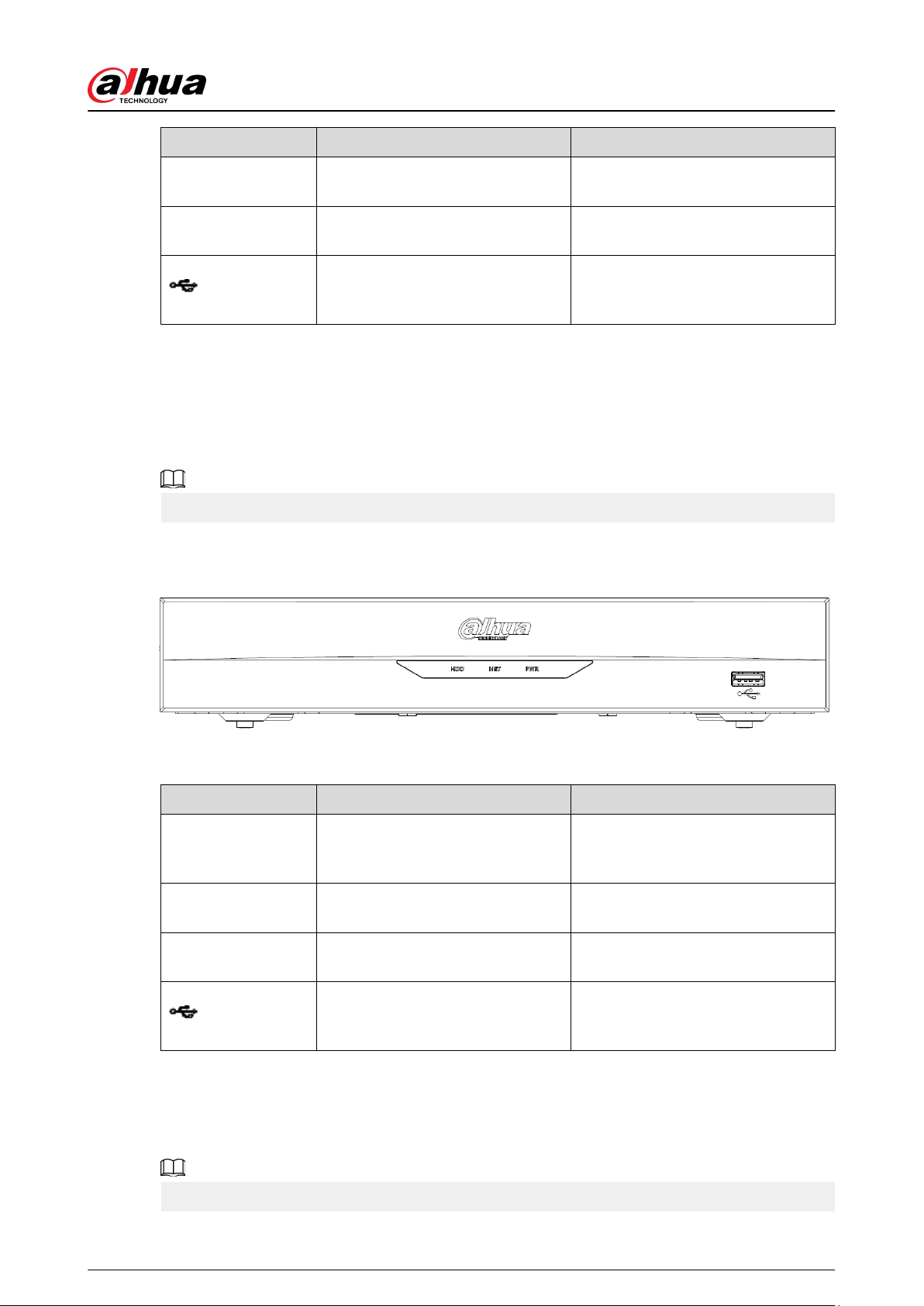
Icon Name Function
NET Network status indicator light
The blue light is on when the
network connection is abnormal.
PWR Power status indicator light
The blue light is on when the power
connection is OK.
USB 2.0 port
Connect to peripheral USB 2.0
storage device, mouse, burner and
more.
2.1.8 NVR21HS-I/NVR21HS-I2/NVR21HS-P-I/NVR21HS-P-I2/
NVR21HS-8P-I/NVR21HS-8P-I2/NVR44-4KS2/I/
NVR44-16P-4KS2/I Series
The gure is for reference only.
The front panel is shown as below.
Figure 2-17 Front panel
Table 2-7 Icons
Icon Name Function
HDD
HDD status indicator
light
The blue light is on when the HDD
malfunctions.
NET Network status indicator light
The blue light is on when the
network connection is abnormal.
PWR Power status indicator light
The blue light is on when the power
connection is OK.
USB 2.0 port
Connect to peripheral USB 2.0
storage device, mouse, burner and
more.
2.1.9 NVR48-I/NVR58-I/NVR58-I/L Series
The section takes NVR4832-I/NVR5864-I/NVR5864-I/L/NVR5832-I/NVR5832-I/L series as examples.
The gure is for reference only.
User's Manual
12
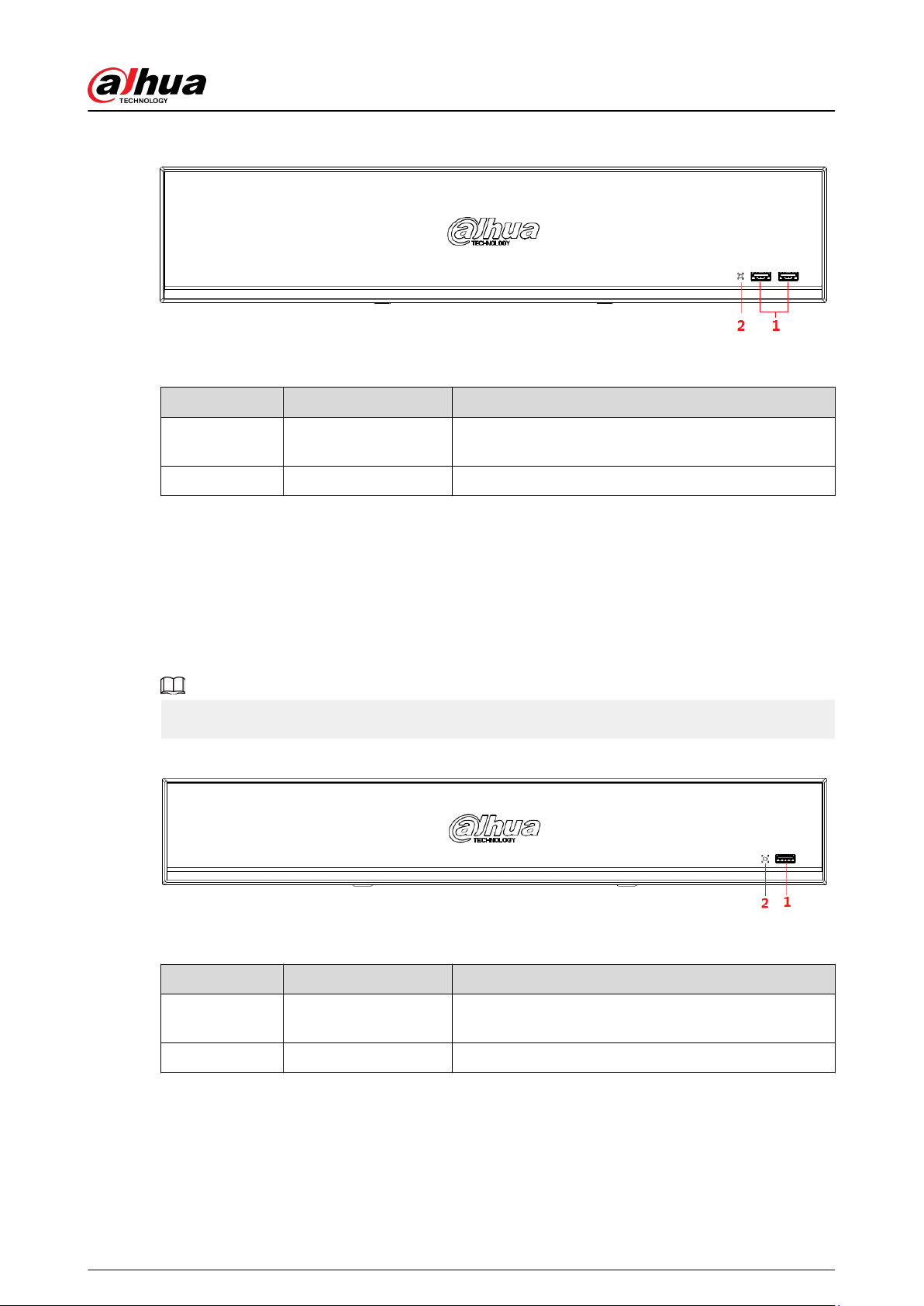
Figure 2-18 Front panel
Table 2-8 Icons
No. Port Name Function
1 USB port
Connects to the external devices such as keyboard,
mouse, and USB storage device.
2 IR indicator Receives signals from the remote control.
2.1.10 NVR42-I/NVR44-I/NVR54-I/NVR54-I/L/NVR52-I/
NVR52-I/L Series
The section uses NVR4208-8P-I/NVR4216-I/NVR4216-16P-I/NVR4416-16P-I/NVR4432-I/
NVR5432-16P-I/NVR5432-16P-I/L/ NVR5216-16P-I/NVR5216-16P-I/L/NVR5216-8P-I/NVR5216-8P-I/L
series as examples.
The gure is for reference only.
Figure 2-19 Front panel
Table 2-9 Icons
No. Port Name Function
1 USB port
Connects to the external devices such as keyboard,
mouse, and USB storage device.
2 IR indicator Receives signals from the remote control.
User's Manual
13
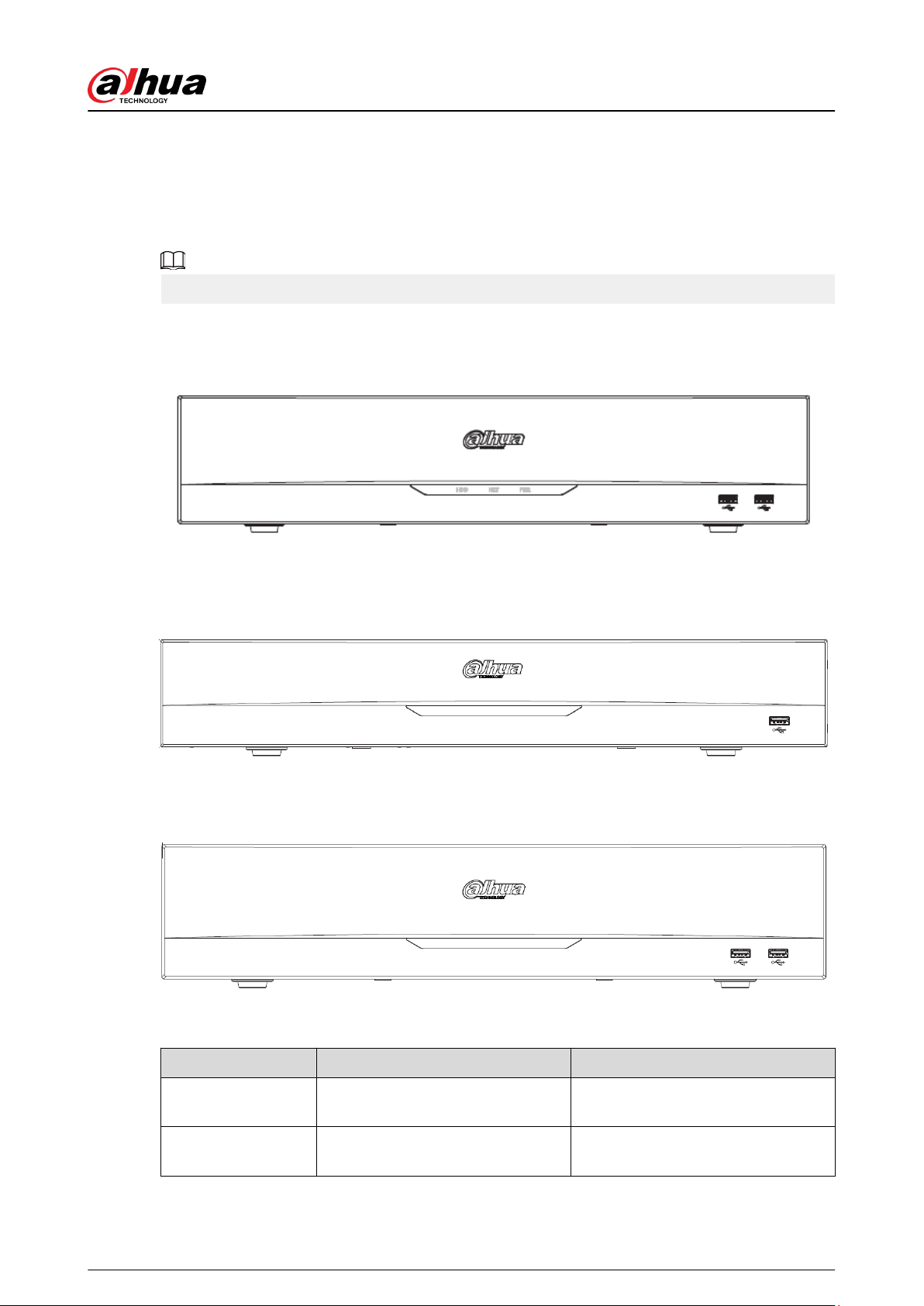
2.1.11 NVR48-4KS2/I/NVR48-16P-4KS2/I/NVR54-EI/
NVR54-16P-EI/NVR58-EI/NVR58-16P-EI/NVR48-EI/
NVR48-16P-EI
The gures are for reference only.
The NVR48-4KS2/I/NVR48-16P-4KS2/I series front panel is shown as below.
Figure 2-20 Front panel
The NVR54-EI / NVR54-16P-EI front panel is shown as below.
Figure 2-21 Front panel
The NVR58-EI/NVR58-16P-EI/NVR48-EI/NVR48-16P-EI front panel is shown as below.
Figure 2-22 Front panel
Table 2-10 Icons
Icon Name Function
HDD HDD status indicator light
The blue light is on when the HDD
malfunctions.
NET Network status indicator light
The blue light is on when the
network connection is abnormal.
User's Manual
14
Icon Name Function
PWR Power status indicator light
The blue light is on when the power
connection is normal.
USB 2.0 port
Connect to peripheral USB 2.0
storage device, mouse, burner and
more.
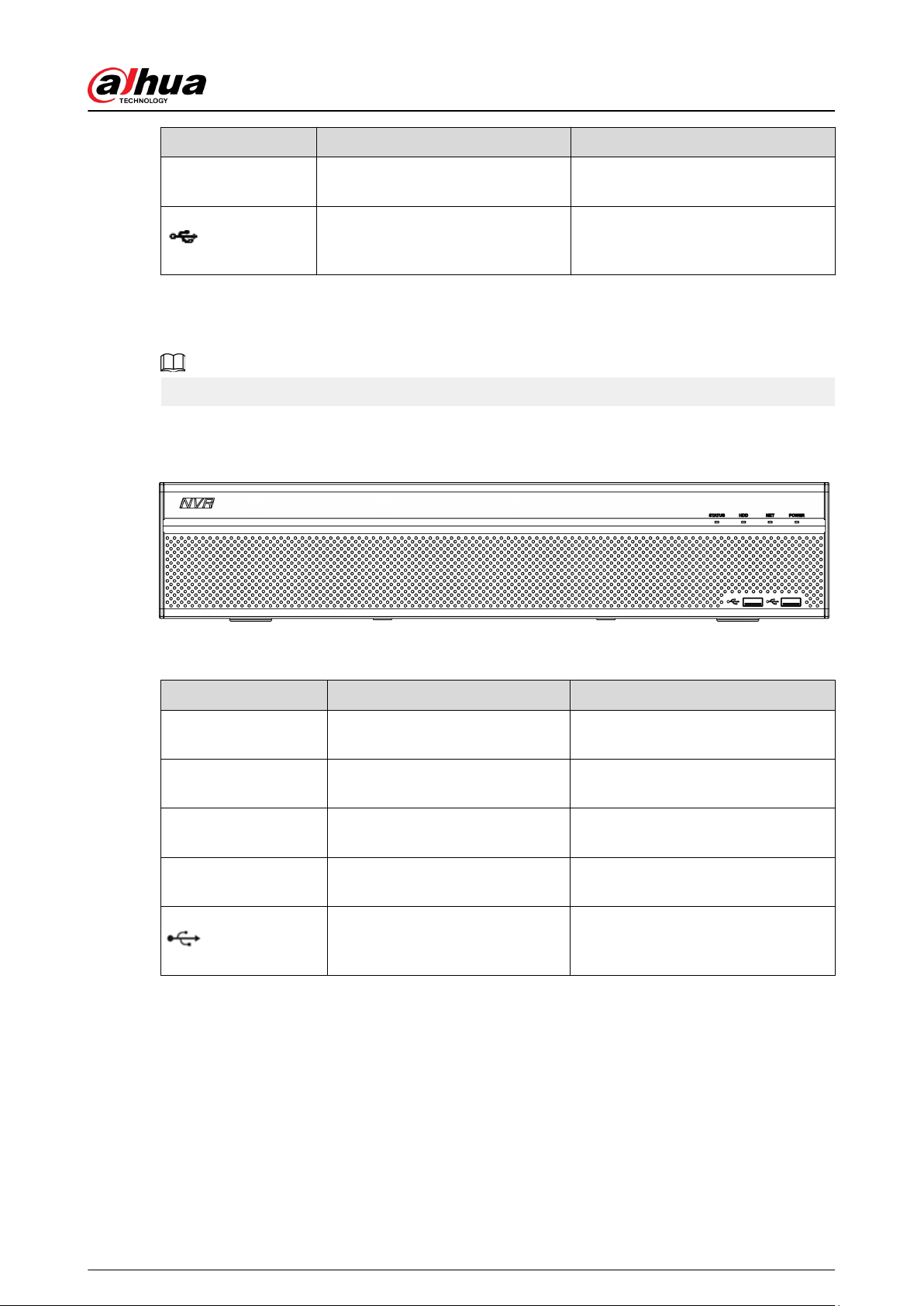
2.1.12 NVR608-32-4KS2 Series
The following gures are for reference only.
The NVR608-32-4KS2 front panel is shown as below.
Figure 2-23 Front panel
Table 2-11 Icons description
Icon Name Function
STATUS Status indicator light
The blue light is on when the device
is working properly.
HDD HDD status indicator light
The blue light is on when the HDD
malfunctions.
NET Network status indicator light
The blue light is on when the
network connection is abnormal.
POWER Power status indicator light
The blue light is on when the power
connection is normal.
USB 2.0 port
Connect to peripheral USB 2.0
storage device, mouse, burner and
more.
2.1.13 NVR608-64-4KS2/NVR608-128-4KS2/NVR608H-XI/
NVR608RH-XI Series
The NVR608-64-4KS2/NVR608-128-4KS2/NVR608H-32-XI/NVR608H-64-XI/NVR608H-128-XI/
NVR608RH-32-XI/NVR608RH-64-XI/NVR608RH-128-XI front panel is shown as below.
User's Manual
15
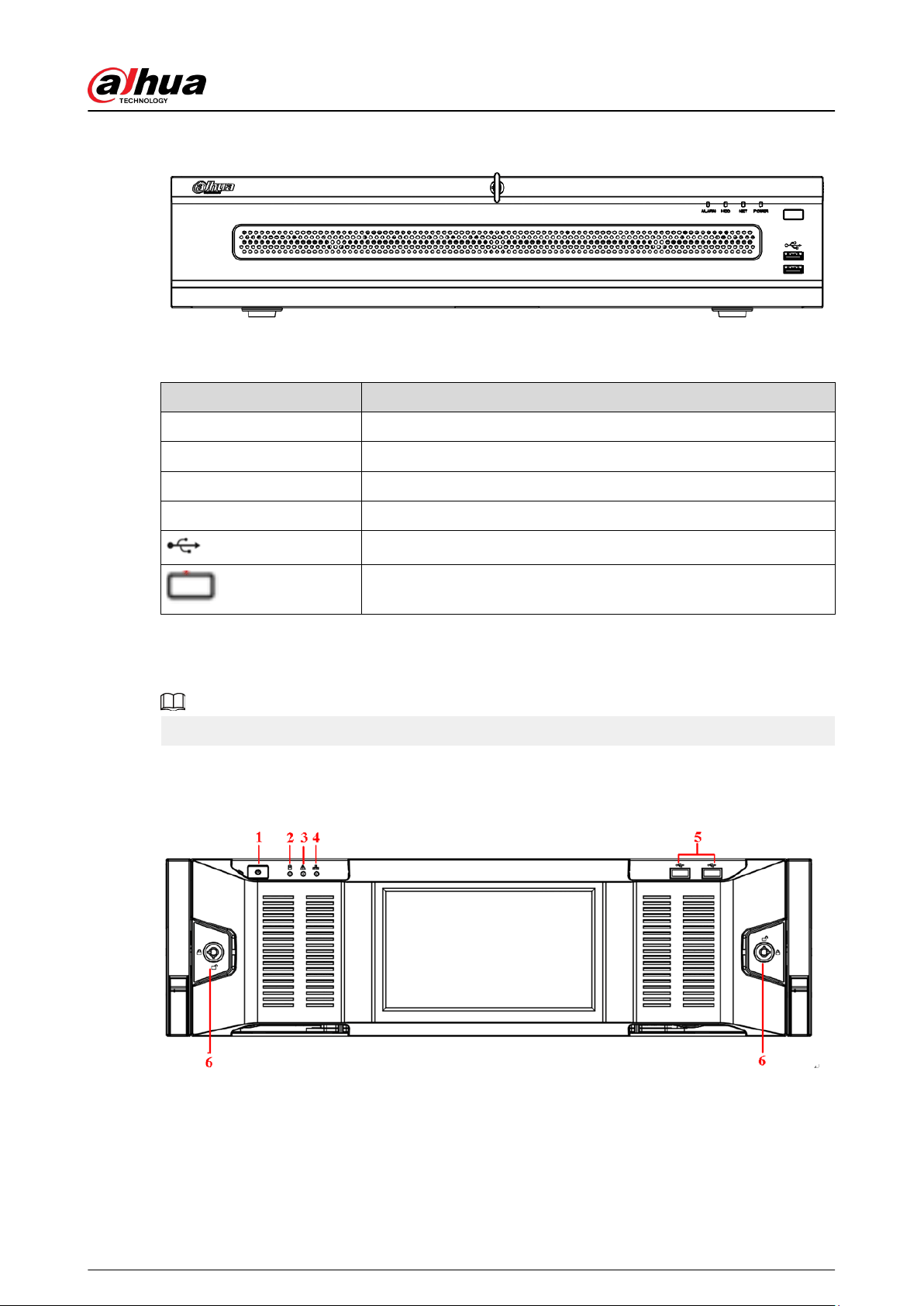
Figure 2-24 Front panel
Table 2-12 Front panel description
Icon Name
ALARM Alarm indicator light
HDD HDD status indicator light
NET Network status indicator light
POWER Power status indicator light
USB 2.0 port
Power on-o button
2.1.14 NVR616-4KS2/NVR616-XI/NVR50-EI Series
The following gures are for reference only.
For the product of LCD, the front panel of NVR616-4KS2/NVR616-XI series is shown as below.
Figure 2-25 Front panel
User's Manual
16
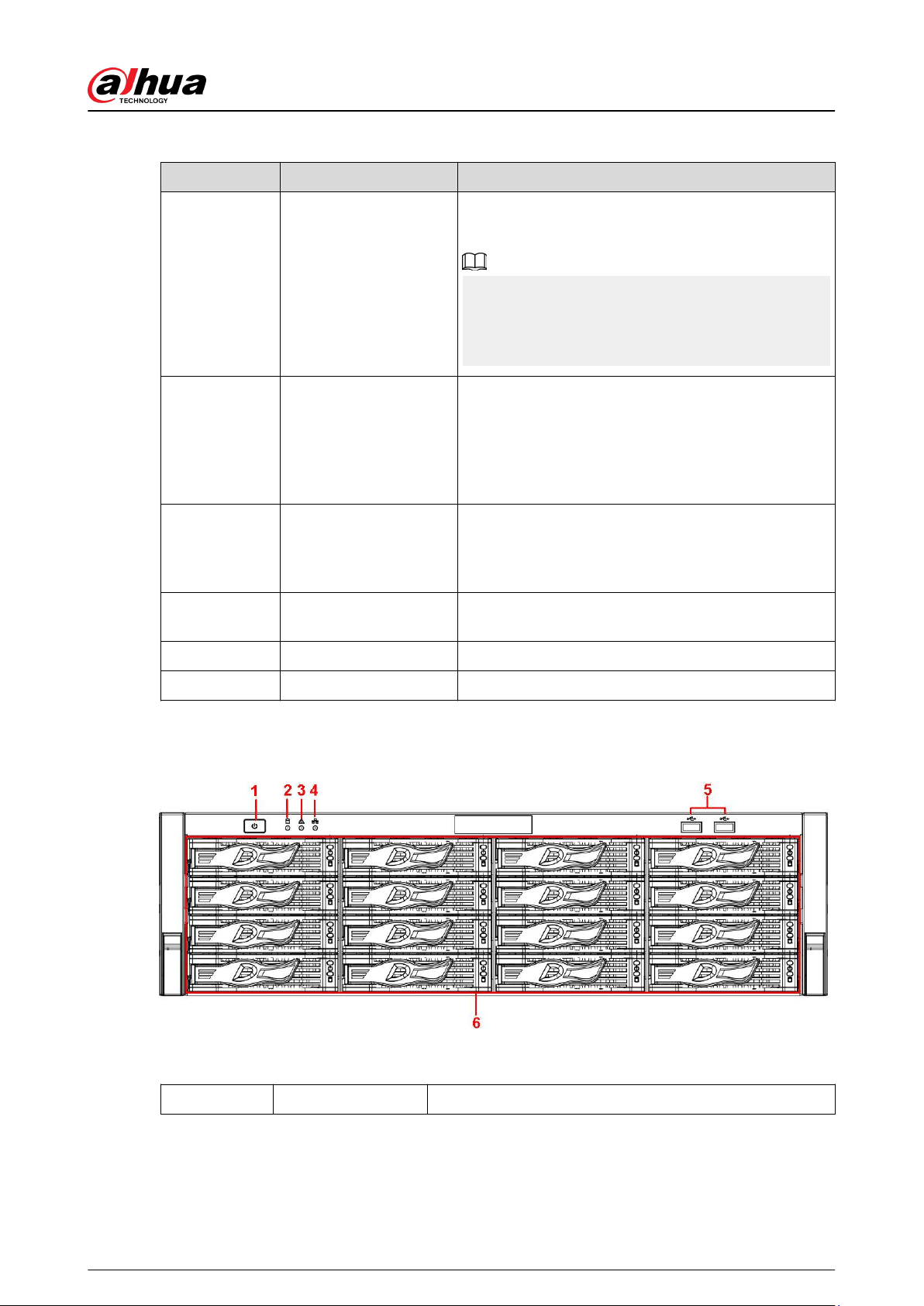
Table 2-13 Icons
No. Name Function
1 Power button
Press it once to turn on the device.
Press it for a long time to turn o the device.
●
We do not recommend you turn o the device in
this way.
●
Press power button for a long time or pull out the
power cable might result in device auto restart.
2
System HDD indicator
light
The blue light becomes on after system booted up
properly.
In the system HDD, there are device important
conguration le, factory default conguration le,
and device initial boot up data.
3 Alarm indicator light
The alarm indicator light becomes on once an alarm
occurred. It becomes on via the software detection.
The indicator light becomes on when there is a local
alarm.
4 Network indicator light
The blue network indicator light is on after you
connected the device to the network.
5 USB port —
6 Front panel lock —
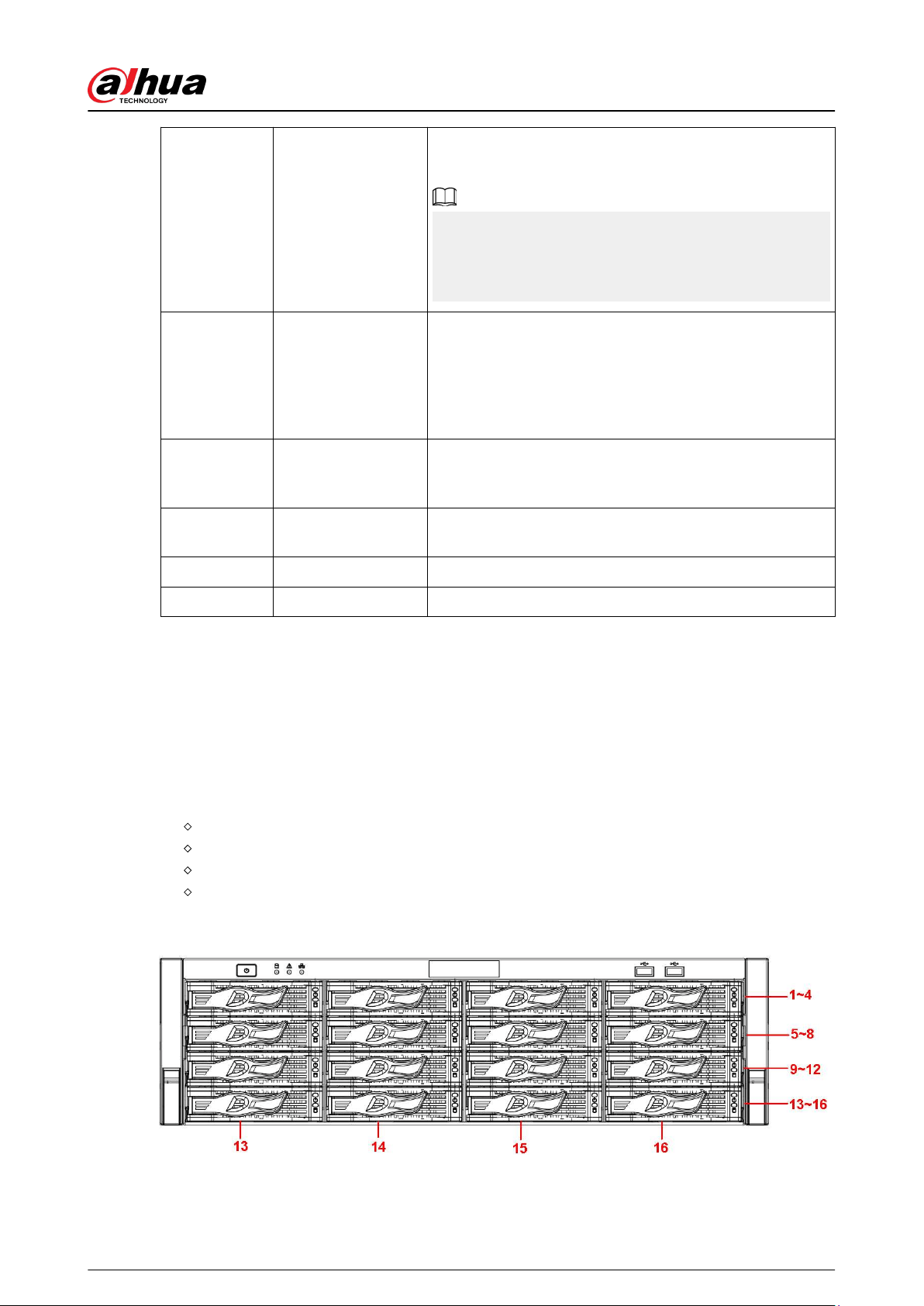
For general NVR616-4KS2/NVR616-XI/NVR50-EI series, the front panel is shown as below.
Figure 2-26 Front panel
Table 2-14 Icons
No. Name Function
User's Manual
17
1 Power button
Press it once to turn on the device.
Press it for a long time to turn o the device.
●
We do not recommend you turn o the device in this
way.
●
Press power button for a long time or pull out the
power cable might result in device auto restart.
2
System HDD
Indicator light
The blue light becomes on after system booted up
properly.
In the system HDD, there are device important
conguration le, factory default conguration le, device
initial boot up data.
3 Alarm indicator light
The alarm indicator light becomes on once an alarm
occurred. It becomes on via the software detection. The
indicator light becomes on when there is a local alarm.
4
Network indicator
light
The blue network indicator light is on after you connected
the device to the network.
5 USB port —
6 16 HDD slot —
After you remove the front panel, you can see there are 16 HDDs. From the left to the right and
from the top to the bottom, it ranges from 1-4, 5-8, 9-12, 13-16.
You can see there are two indicator lights on the HDD bracket.
●
The power indicator light is at the top. The light is yellow after you connected the device to the
power.
●
The read-write indicator light is at the bottom. The blue light ashes when system is reading or
writing the data. In addition to ashing blue light, read-write operation lights of some models of
devices further include the following states. Please refer to the actual device.
Stead red: HDD failure (HDD error).
Flash red: HDD is in a RAID rebuild state.
Red intermittent ashing twice: HDD is in a predicted fault state (including a HDD warning).
Blue and red ashing alternately: HDD is in a positioned state.
Figure 2-27 Front panel
User's Manual
18
2.1.15 NVR624-XI Series
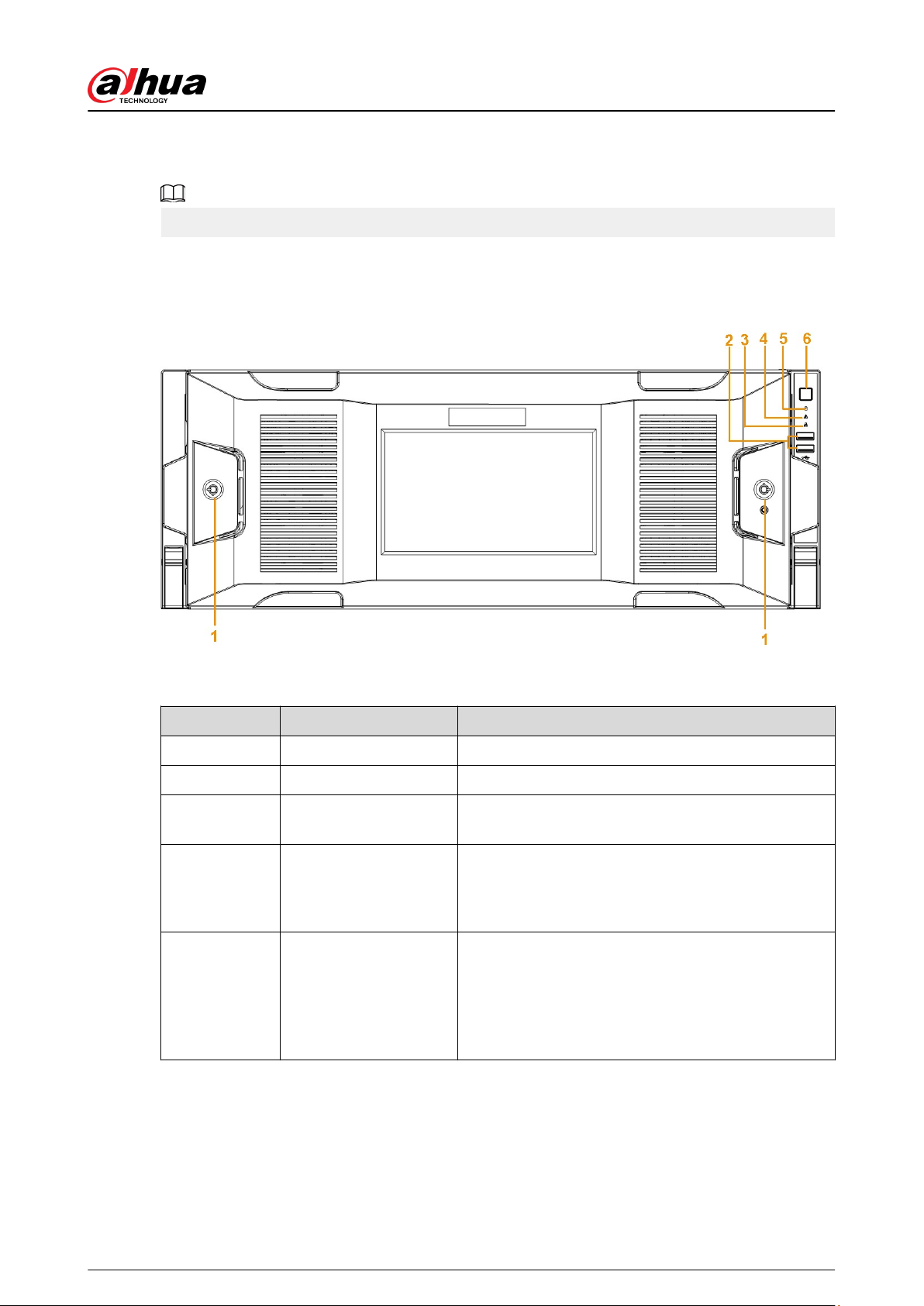
The following gures are for reference only.
The front panel of NVR624-XI series is shown as follows.
Figure 2-28 Front panel
Table 2-15 Icons
No. Name Function
1 Front panel lock —
2 USB port —
3 Network indicator light
The blue network indicator light is on after you
connected the device to the network.
4 Alarm indicator light
The alarm indicator light becomes on once an alarm
occurred. It becomes on via the software detection.
The indicator light becomes on when there is a local
alarm.
5
System HDD indicator
light
The blue light becomes on after system booted up
properly.
In the system HDD, there are device important
conguration le, factory default conguration le,
and device initial boot up data.
User's Manual
19
No. Name Function
6 Power button
Press it once to turn on the device.
Press it for a long time to turn o the device.
●
We do not recommend you turn o the device in
this way.
●
Press power button for a long time or pull out the
power cable might result in device auto restart.
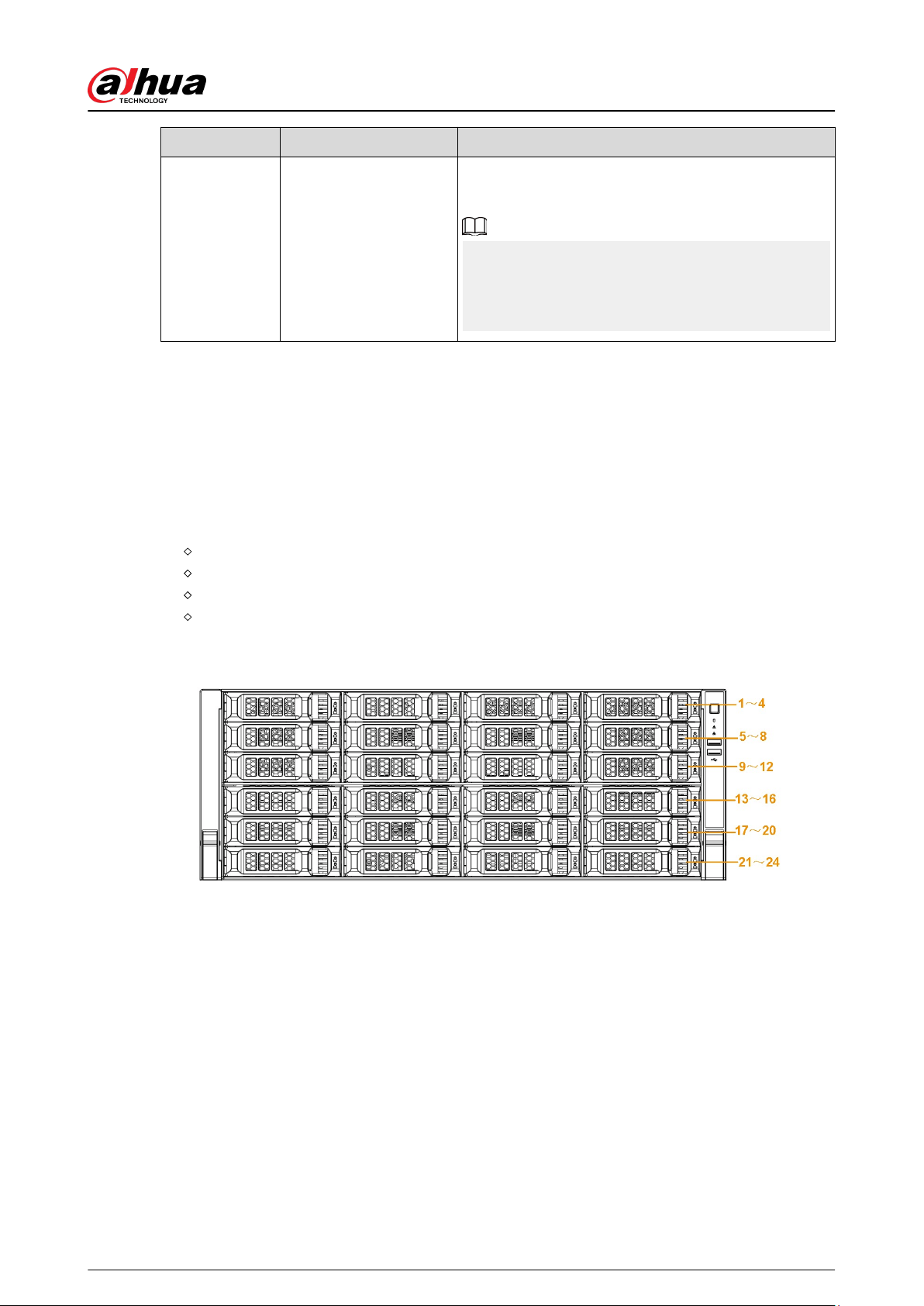
You can see there are 24 HDDs. From the left to the right and from the top to the bottom, it ranges
from 1-4, 5-8, 9-12, 13-16, 17-20, 21-24.
You can see there are two indicator lights on the HDD bracket.
●
The power indicator light is at the top. The light is yellow after you connected the device to the
power.
●
The read-write indicator light is at the bottom. The blue light ashes when system is reading or
writing the data. In addition to ashing blue light, read-write operation lights of some models of
devices further include the following states. Please refer to the actual device.
Stead red: HDD failure (HDD error).
Flash red: HDD is in a RAID rebuild state.
Red intermittent ashing twice: HDD is in a predicted fault state (including a HDD warning).
Blue and red ashing alternately: HDD is in a positioned state.
Figure 2-29 Front panel
2.2 Rear Panel
2.2.1 NVR21-4KS2/NVR21-P-4KS2/NVR21-8P-4KS2/NVR41-
EI/NVR41-8P-EI/NVR41-P-EI Series
The NVR21-4KS2/NVR41-EI is shown as below.
User's Manual
20
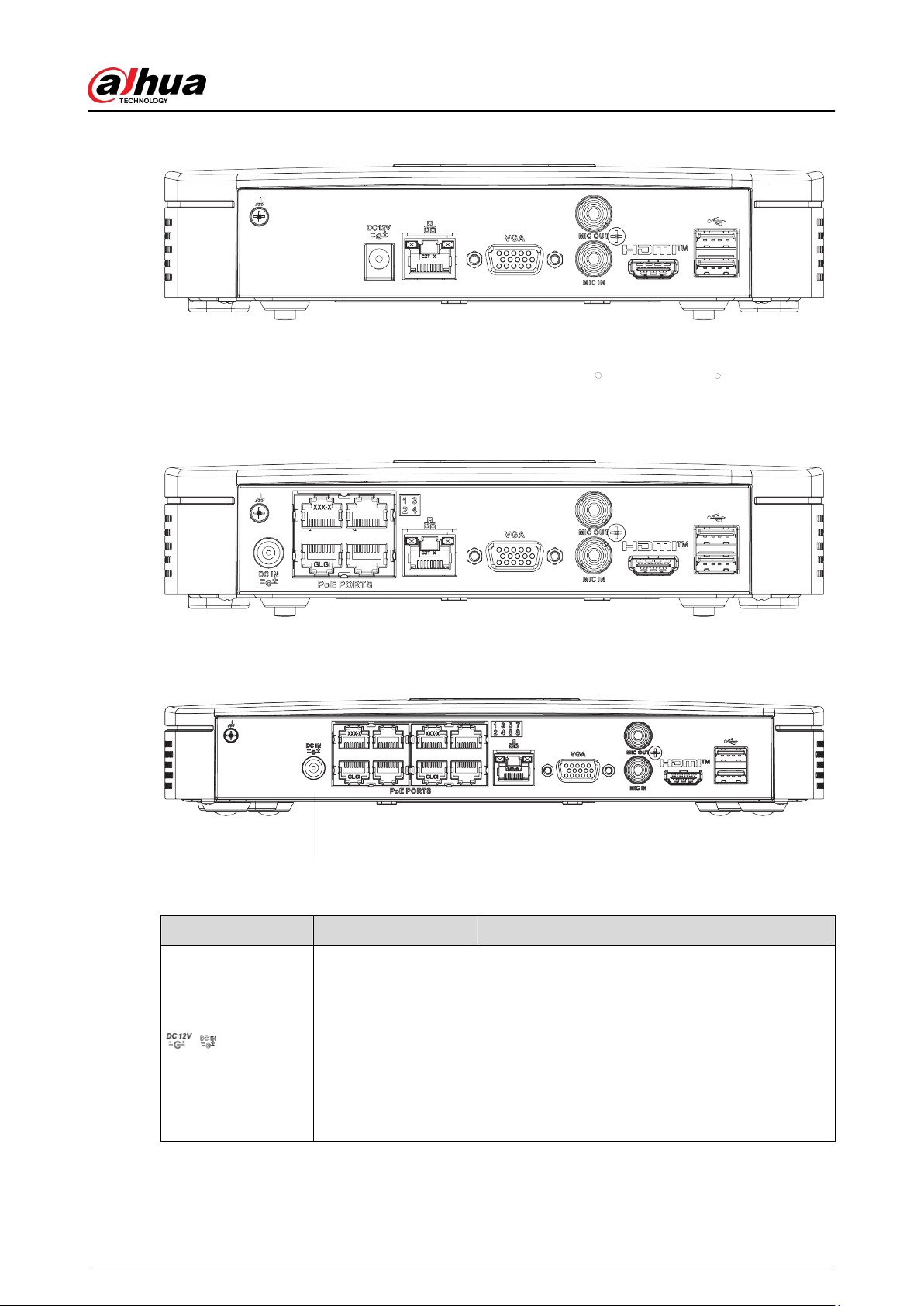
Figure 2-30 Rear panel
The NVR41-P-EI/NVR21-P-4KS2 is shown as below.
Figure 2-31 Rear panel
The NVR21-8P-4KS2/NVR41-8P-EI is shown as below.
Figure 2-32 Rear panel
Table 2-16 Ports
Port Name Connection Function
/
Power input port
Power socket.
●
For NVR21-S2/21-4KS2/NVR41-EI, input 12
VDC/2 A.
●
For NVR21-P-S2/21-P-4KS2, input 48 VDC/1.25
A.
●
For NVR21-8P-S2/21-8P-4KS2, input 48 VDC/2 A.
●
For NVR41-P-EI series, input 53 VDC/1.226 A.
●
For NVR41-8P-EI series, input 53 VDC/1.81 A.
User's Manual
21
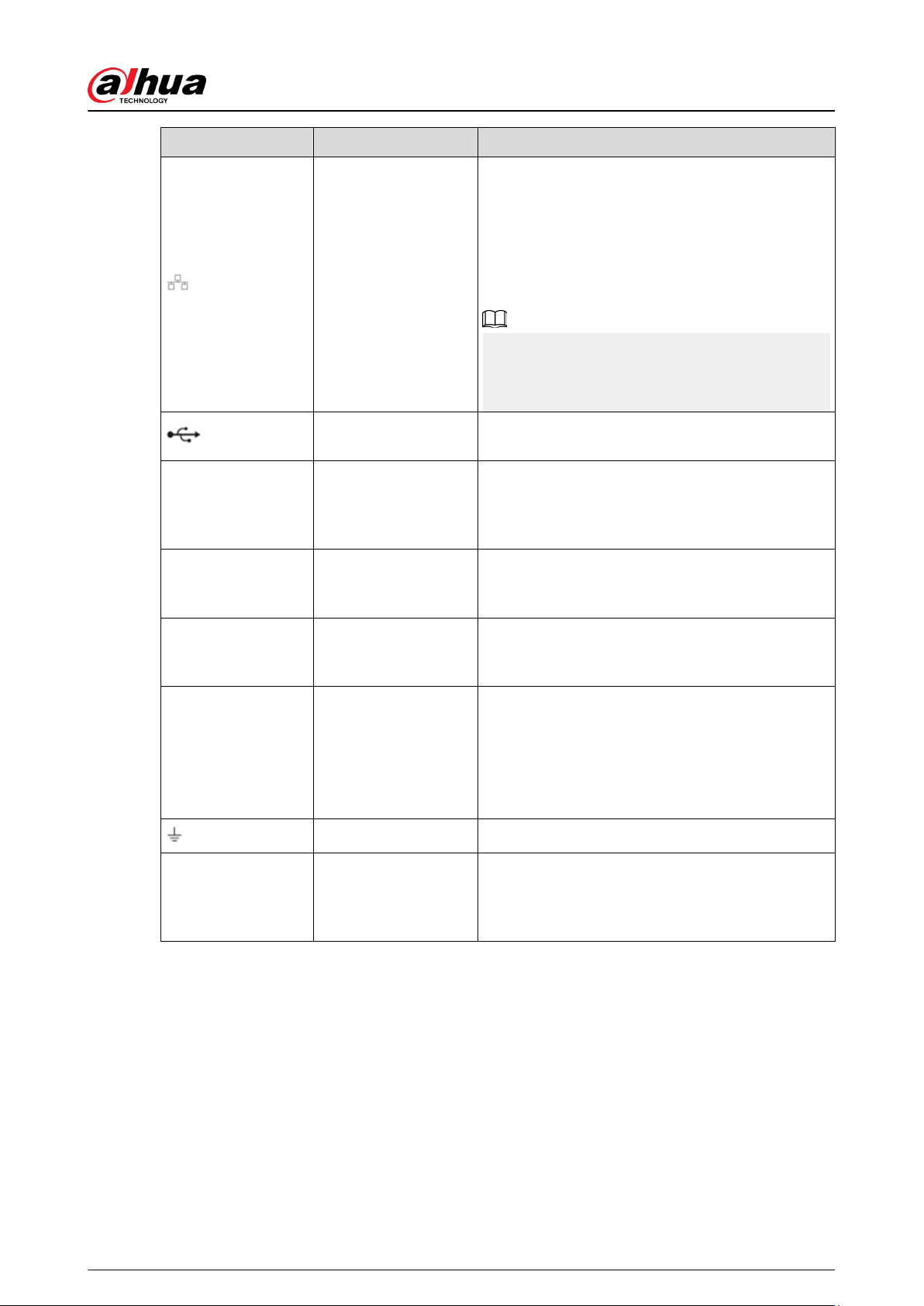
Port Name Connection Function
Network port
10/100/1000 Mbps self-adaptive Ethernet port.
Connect to the network cable.
●
NVR41-EI series supports 10/100 Mbps or
10/100/1000 Mbps.
●
NVR41-P-EI series supports 10/100 Mbps.
●
NVR41-8P-EI series supports 10/100/1000 Mbps.
The parameters might be dierent according to
the models. Please refer to actual device for
detailed information.
USB port
USB port. Connect to mouse, USB storage device
and more.
HDMI
High Denition Media
Page
High denition audio and video signal output port.
It transmits uncompressed high denition video
and multiple-channel data to the HDMI port of the
display device. HDMI version is 1.4.
VGA VGA video output port
VGA video output port. Output analog video
signal. It can connect to the monitor to view
analog video.
MIC IN Audio input port
Bidirectional talk input port. It is to receive the
analog audio signal output from the devices such
as microphone, pickup.
MIC OUT Audio output port
Audio output port. It is to output the analog audio
signal to the devices such as the sound box.
●
Bidirectional talk output.
●
Audio output on 1-window video monitor.
●
Audio output on 1-window video playback.
GND Ground end.
PoE PORTS PoE port
Built-in switch. Support PoE function.
For PoE series product, you can use this port to
provide power to the network camera.
2.2.2 NVR11HS-S3H/NVR11HS-P-S3H/NVR11HS-8P-S3H/
NVR21HS-4KS2/NVR21HS-P-4KS2/NVR21HS-8P-4KS2/
NVR41HS-4KS2/NVR41HS-P-4KS2/NVR41HS-8P-4KS2/
NVR41HS-4KS2/L/NVR41HS-P-4KS2/L/NVR41HS-8P-4KS2/L/
User's Manual
22
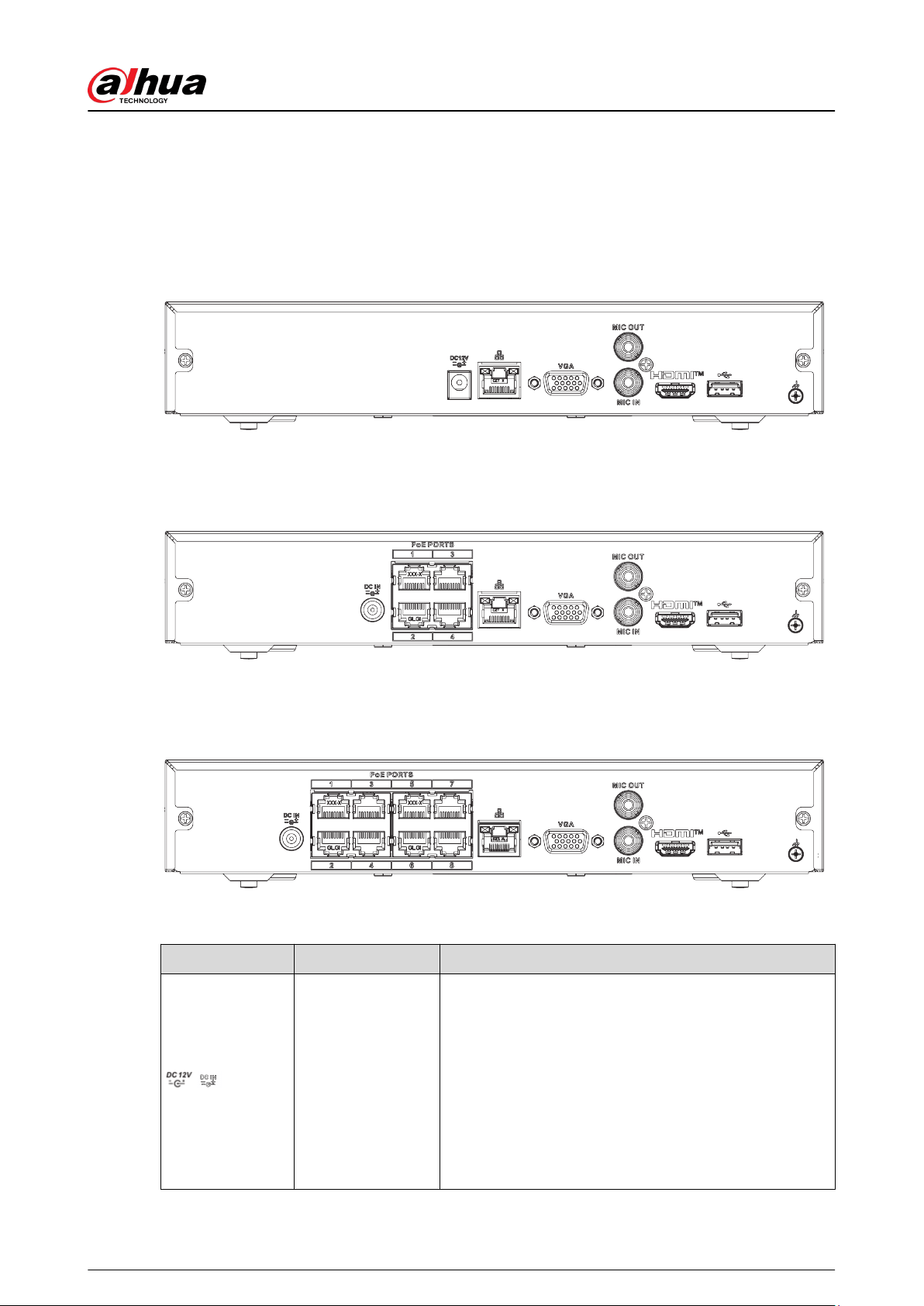
NVR21HS-S3/NVR21HS-P-S3/NVR21HS-8P-S3/NVR41HS-EI/
NVR41HS-P-EI/NVR41HS-8P-EI
The NVR11HS-S3H/NVR21HS-4KS2/NVR41HS-4KS2/NVR41HS-4KS2/L/NVR21HS-S3/NVR41HS-EI
series rear panel is shown as below.
Figure 2-33 Rear panel
The NVR11HS-P-S3H/NVR21HS-P-4KS2/NVR41HS-P-4KS2/NVR41HS-P-4KS2/L/NVR21HS-P-S3/
NVR41HS-P-EI series rear panel is shown as below.
Figure 2-34 Rear panel
The NVR11HS-8P-S3H/NVR21HS-8P-4KS2/NVR41HS-8P-4KS2/NVR41HS-8P-4KS2/L/NVR21HS-8P-S3/
NVR41HS-8P-EI series rear panel is shown as below.
Figure 2-35 Rear panel
Table 2-17 Ports
Port Name Connection Function
/
Power input port
Power socket.
●
For NVR11HS-P-S3H/NVR21HS-4KS2/NVR41HS-4KS2/
NVR41HS-EI series, input 12 VDC/2 A.
●
For NVR11HS-P-S3H/NVR21HS-P-4KS2/
NVR41HS-4KS2 series, input 48 VDC/1.25 A.
●
For NVR11HS-8P-4KS2/NVR21HS-8P-4KS2/
NVR41HS-4KS2 series, input 48 VDC/2 A.
●
For NVR41HS-P-EI series, input 53 VDC/1.226 A.
●
For NVR41HS-8P-EI series, input 53 VDC/1.81 A.
User's Manual
23
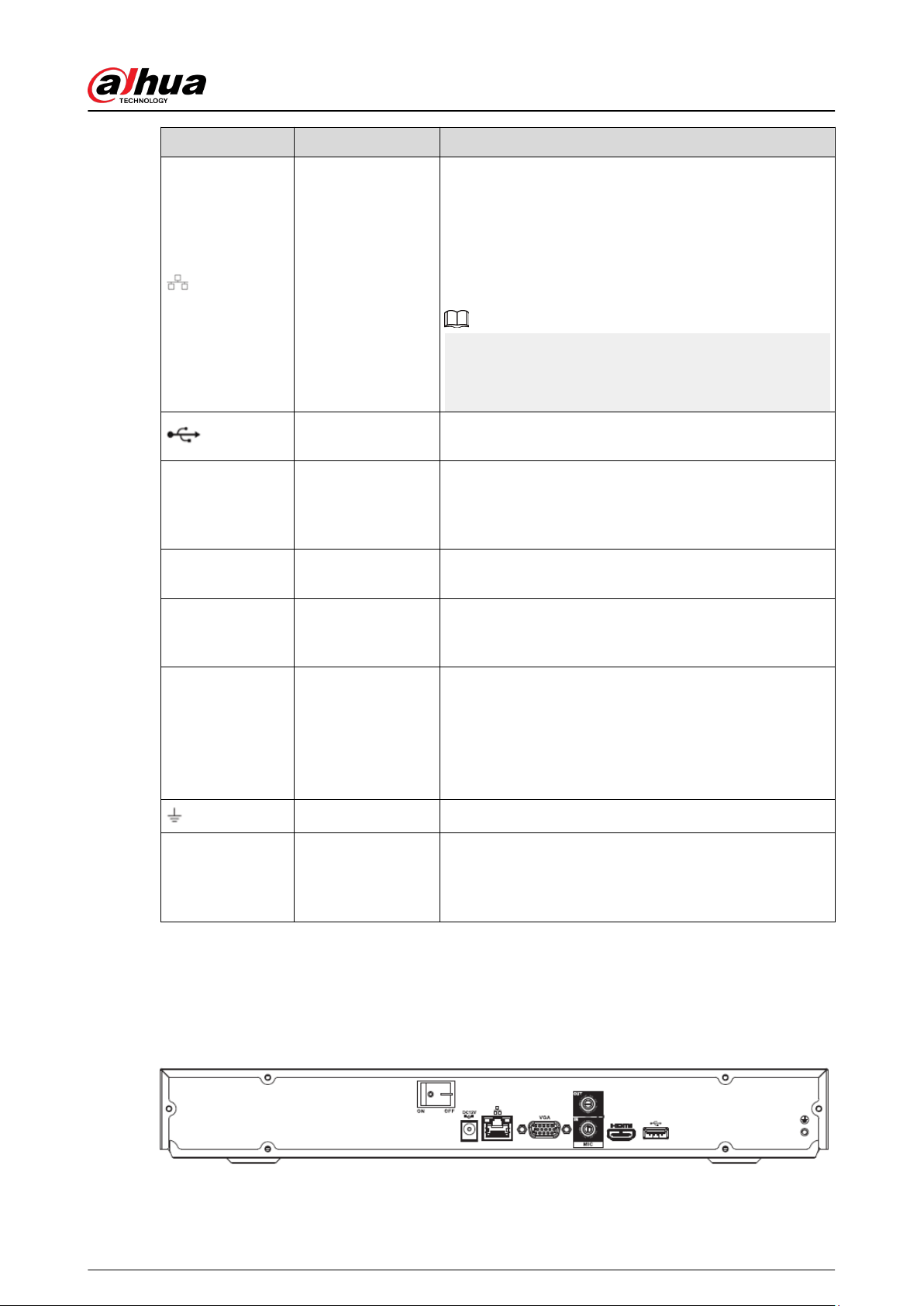
Port Name Connection Function
Network port
10/100/1000 Mbps self-adaptive Ethernet port. Connect
to the network cable.
●
NVR41HS-EI series supports 10/100 Mbps or
10/100/1000 Mbps.
●
NVR41HS-P-EI series supports 10/100 Mbps.
●
NVR41HS-8P-EI series supports 10/100/1000 Mbps.
The parameters might be dierent according to the
models. Please refer to actual device for detailed
information.
USB port
USB port. Connect to mouse, USB storage device and
more.
HDMI
High Denition
Media Page
High denition audio and video signal output port. It
transmits uncompressed high denition video and
multiple-channel data to the HDMI port of the display
device. HDMI version is 1.4.
VGA
VGA video output
port
VGA video output port. Output analog video signal. It
can connect to the monitor to view analog video.
MIC IN Audio input port
Bidirectional talk input port. It is to receive the analog
audio signal output from the devices such as
microphone, pickup.
MIC OUT Audio output port
Audio output port. It is to output the analog audio signal
to the devices such as the sound box.
●
Bidirectional talk output.
●
Audio output on 1-window video monitor.
●
Audio output on 1-window video playback.
GND Ground end.
PoE PORTS PoE port
Built-in switch. Support PoE function.
For PoE series product, you can use this port to provide
power to the network camera.
2.2.3 NVR22-4KS2/NVR22-P-4KS2/NVR22-8P-4KS2 Series
The NVR22-4KS2 series rear panel is shown as below.
Figure 2-36 Rear panel
The NVR22-P-4KS2 series rear panel is shown as below.
User's Manual
24
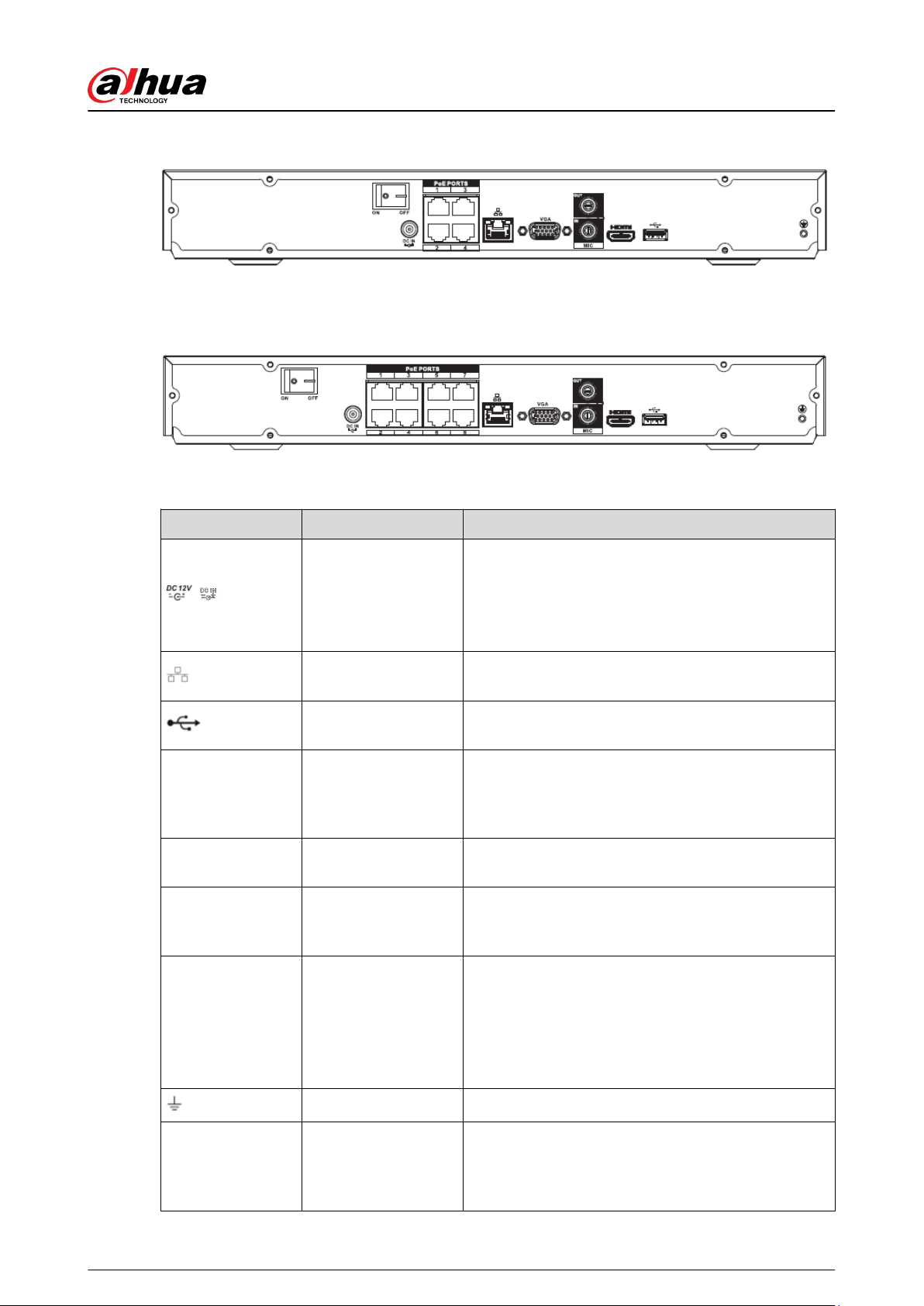
Figure 2-37 Rear panel
The NVR22-8P-4KS2 series rear panel is shown as below.
Figure 2-38 Rear panel
Table 2-18 Rear panel description
Port Name Connection Function
/
Power input port
Power socket.
●
For NVR22-4KS2general series, input 12 VDC/4 A.
●
For NVR22-P-4KS2 series, input 48 VDC/1.5 A.
●
For NVR22-8P-4KS2 series, input 53 VDC 120 W.
Network port
10/100 Mbps self-adaptive Ethernet port. Connect to
the network cable.
USB port
USB port. Connect to mouse, USB storage device and
more.
HDMI
High Denition Media
Page
High denition audio and video signal output port. It
transmits uncompressed high denition video and
multiple-channel data to the HDMI port of the
display device. HDMI version is 1.4.
VGA
VGA video output
port
VGA video output port. Output analog video signal. It
can connect to the monitor to view analog video.
MIC IN Audio input port
Bidirectional talk input port. It is to receive the analog
audio signal output from the devices such as
microphone, pickup.
MIC OUT Audio output port
Audio output port. It is to output the analog audio
signal to the devices such as the sound box.
●
Bidirectional talk output.
●
Audio output on 1-window video monitor.
●
Audio output on 1-window video playback.
GND Ground end.
PoE PORTS PoE port
Built-in switch. Support PoE function.
For PoE series product, you can use this port to
provide power to the network camera.
User's Manual
25
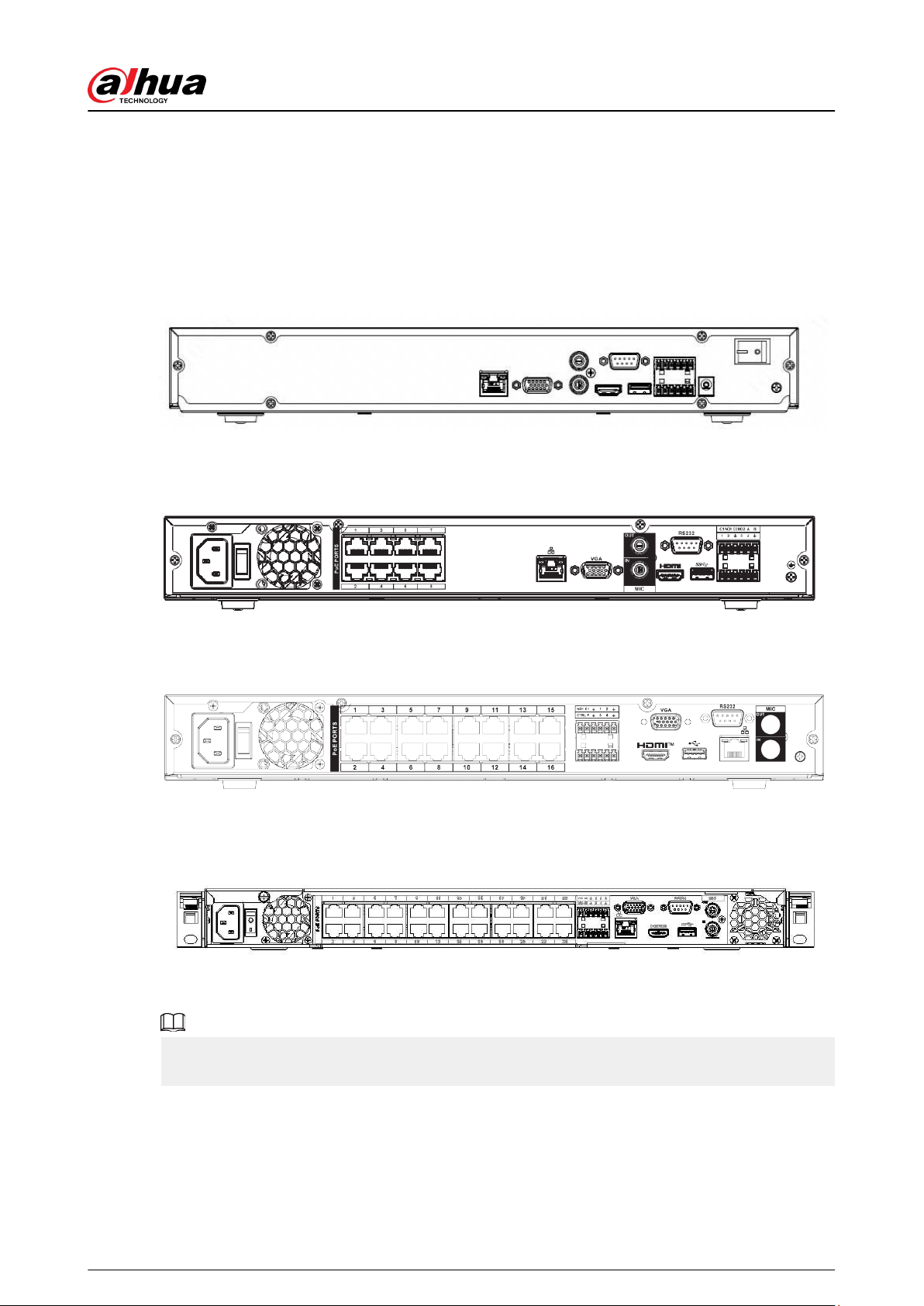
2.2.4 NVR52-4KS2/NVR52-8P-4KS2/NVR52-16P-4KS2/
NVR52-24P-4KS2/NVR52-8P-4KS2E/NVR52-16P-4KS2E/
NVR52-EI/NVR52-8P-EI/NVR52-16P-EI/NVR42-16P-EI
The NVR52-4KS2 series rear panel is shown as below.
Figure 2-39 Rear panel
The NVR52-8P-4KS2 series rear panel is shown as below.
Figure 2-40 Rear panel
The NVR52-16P-4KS2/NVR42-16P-EI series rear panel is shown as below.
Figure 2-41 Rear panel
The NVR52-24P-4KS2 series rear panel is shown as below.
Figure 2-42 Rear panel
The NVR52-8P-4KS2E/52-16P-4KS2E series rear panel is shown as below.
The following gure takes NVR52-16P-4KS2E series as an example. NVR52-8P-4KS2E has 8 ePoE
ports only.
User's Manual
26
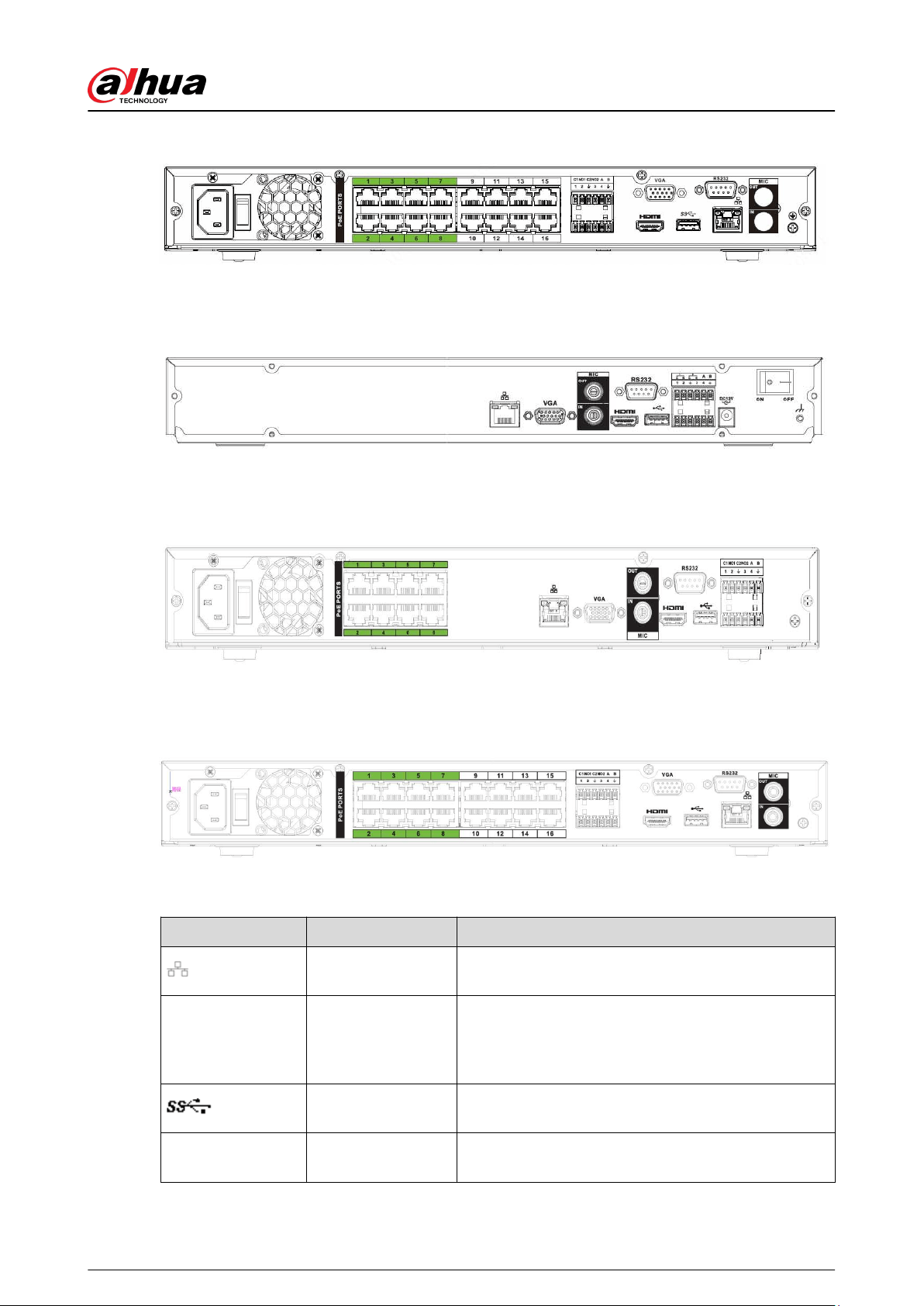
Figure 2-43 Rear panel
The NVR52-EI series rear panel is shown as below.
Figure 2-44 Rear panel
The NVR52-8P-EI series rear panel is shown as below.
Figure 2-45 Rear panel
The NVR52-16P-EI series rear panel is shown as below.
Figure 2-46 Rear panel
Table 2-19 Ports
Icon Port Name Function
Network port
10/100/1000 Mbps self-adaptive Ethernet port.
Connect to the network cable.
HDMI
High Denition
Media Page
High denition audio and video signal output port. It
transmits uncompressed high denition video and
multiple-channel data to the HDMI port of the display
device. HDMI version is 1.4.
USB port
Connect to mouse, USB storage device, USB burner
and more.
RS-232 RS-232 debug COM
It is for general COM debug to congure IP address or
transfer transparent COM data.
User's Manual
27
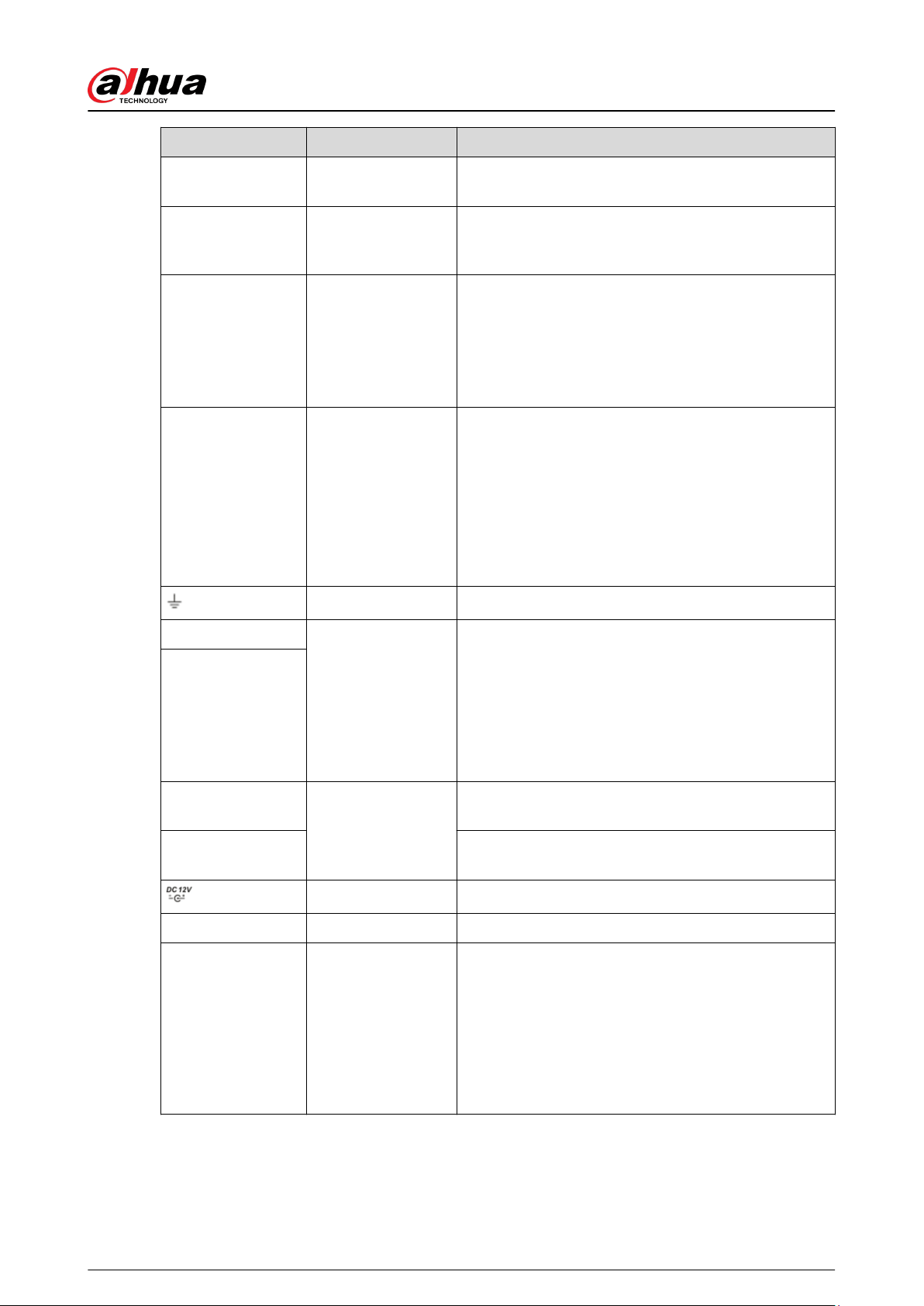
Icon Port Name Function
VGA
VGA video output
port
VGA video output port. Output analog video signal. It
can connect to the monitor to view analog video.
MIC IN Audio input port
Bidirectional talk input port. It is to receive the analog
audio signal output from the devices such as
microphone, pickup.
MIC OUT Audio output port
Audio output port. It is to output the analog audio
signal to the devices such as the sound box.
●
Bidirectional talk output.
●
Audio output on 1-window video monitor.
●
Audio output on 1-window video playback.
1–8
Alarm input port 1–
8
●
There are two groups. The rst group is from port 1
to port 4; the second group is from port 5 to port 8.
They are to receive the signal from the external
alarm source. There are two types; NO (normal
open)/NC (normal close).
●
When your alarm input device is using external
power, please make sure the device and the NVR
have the same ground.
GND Alarm input ground port.
NO1–NO3
Alarm output port
1–3
●
3 groups of alarm output ports. (Group 1: port
NO1–C1; Group 2: port NO2–C2; Group 3: port
NO3–C3). Output alarm signal to the alarm device.
Please make sure there is power to the external
alarm device.
●
NO: Normal open alarm output port.
●
C: Alarm output public end.
C1–C3
A
RS-485
communication
port
RS485_A port. It is the cable A. You can connect to the
control devices such as speed dome PTZ.
B
RS485_B. It is the cable B. You can connect to the
control devices such as speed dome PTZ.
Power input port Input 12 VDC/4 A.
Power switch — Power on/o button.
PoE PORTS —
Built-in Switch. Support PoE or ePoE function.
●
For ePoE series product, port 1 to port 8 are the
ePoE ports. ePoE port supports 300 meters@100
Mbps, 800 meters@10 Mbps. Port 9 to port 16 are
general PoE ports.
●
The 8 PoE series product supports total 130 W.
●
The 16 PoE series product supports total 130 W.
User's Manual
28
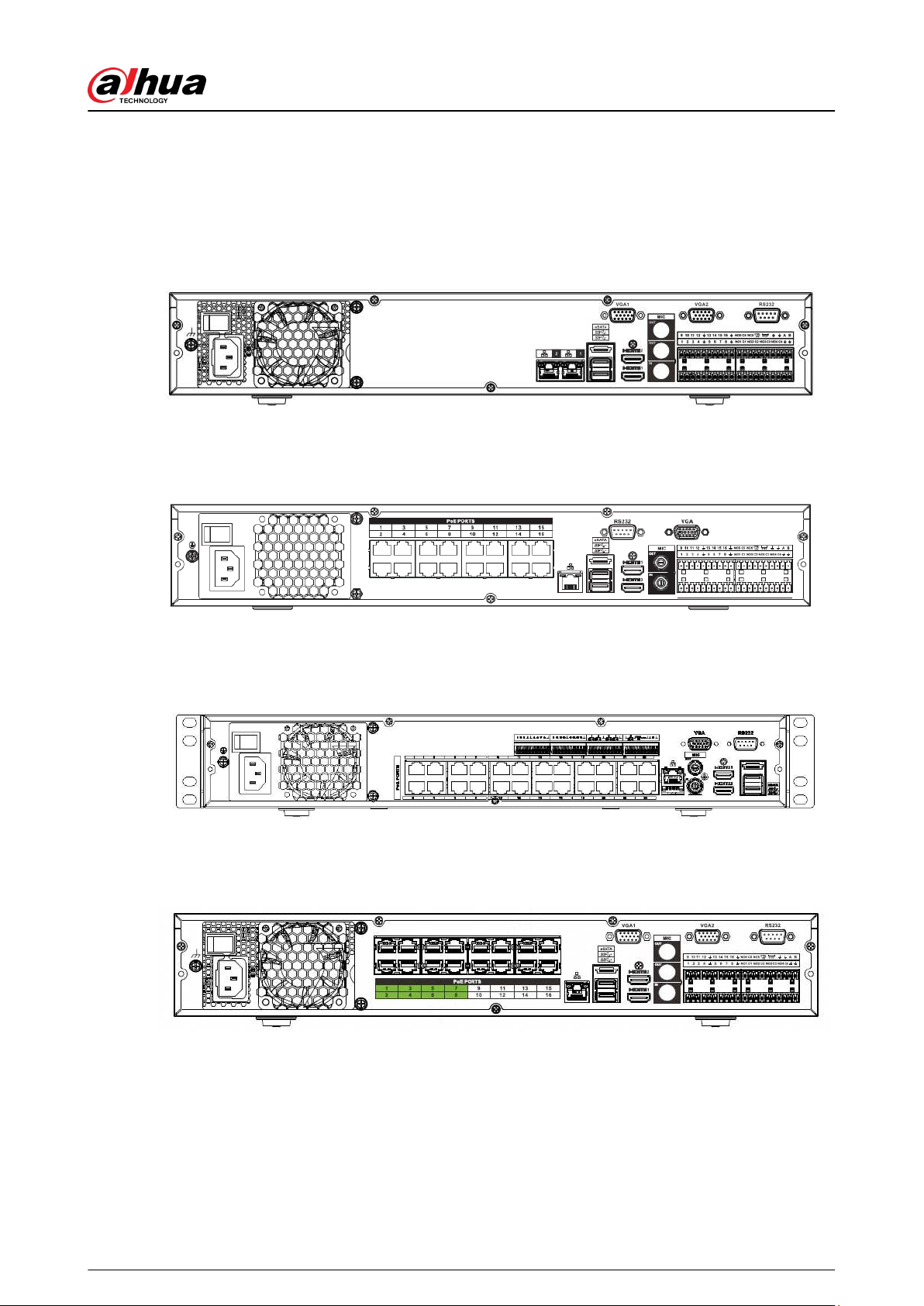
2.2.5 NVR54-4KS2/NVR58-4KS2/NVR54-16P-4KS2/
NVR58-16P-4KS2/NVR54-24P-4KS2/NVR58-16P-4KS2E
The NVR54-4KS2/NVR58-4KS2 series rear panel is shown as below.
Figure 2-47 Rear panel
The NVR54-16P-4KS2/NVR58-16P-4KS2 series rear panel is shown as below.
Figure 2-48 Rear panel
The NVR54-24P-4KS2 series rear panel is shown as below.
Figure 2-49 Rear panel
The NVR54-16P-4KS2E series rear panel is shown as below.
Figure 2-50 Rear panel
The NVR58-16P-4KS2E series rear panel is shown as below.
User's Manual
29
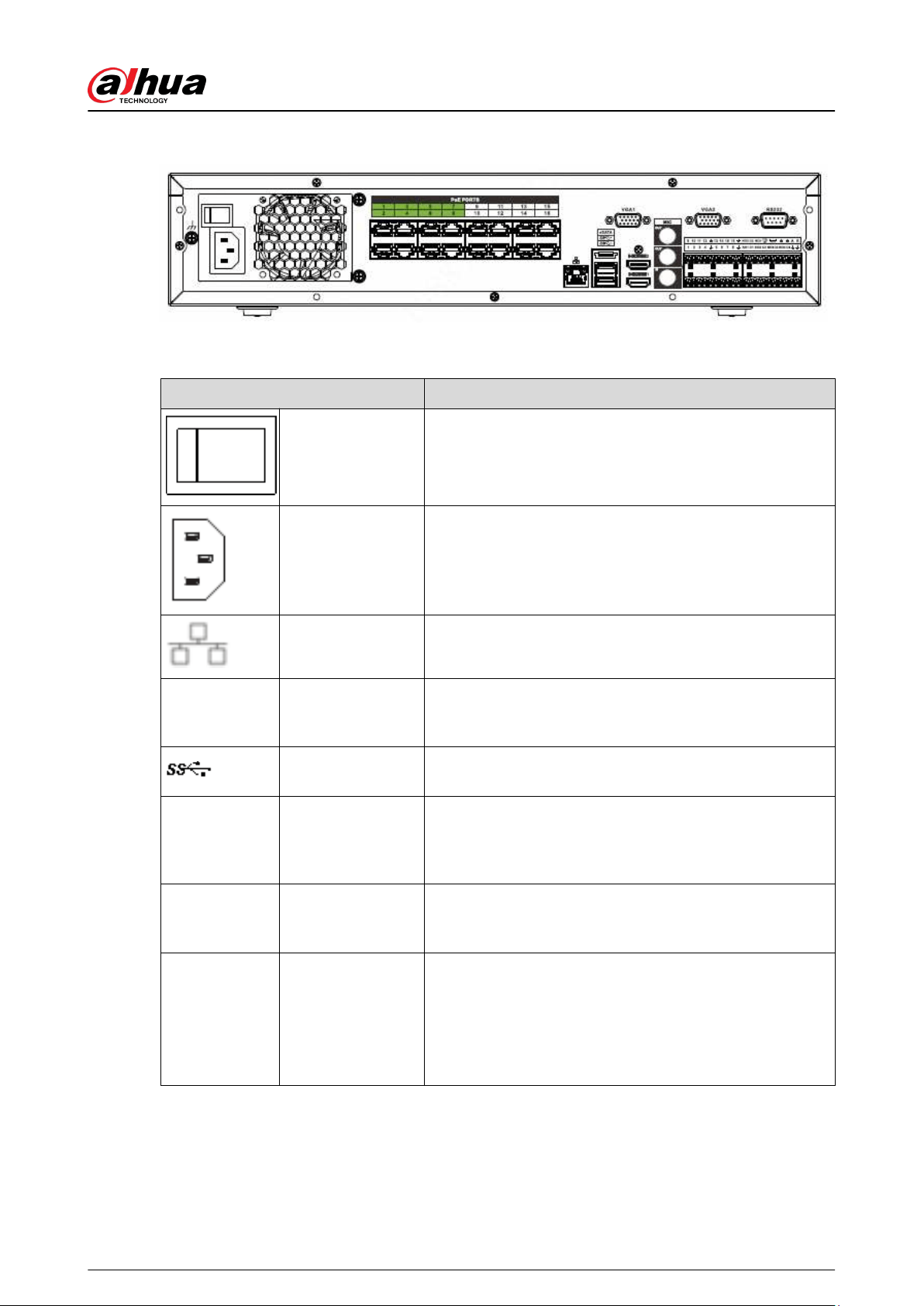
Figure 2-51 Rear panel
Table 2-20 Rear panel description
Name Function
Power switch Power on-o button.
Power input port Input 100–240 VAC.
Network port
10/100/1000 Mbps self-adaptive Ethernet port. Connect to
the network cable.
eSATA eSATA port
External SATA port. It can connect to the device of the
SATA port. Please jump the HDD when there is peripheral
connected HDD.
USB port
USB port. Connect to mouse, USB storage device, USB
burner and more.
HDMI
High Denition
Media Page
High denition audio and video signal output port. It
transmits uncompressed high denition video and
multiple-channel data to the HDMI port of the display
device. HDMI version is 1.4b.
MIC IN Audio input port
Bidirectional talk input port. It is to receive the analog
audio signal output from the devices such as microphone,
pickup.
MIC OUT Audio output port
Audio output port. It is to output the analog audio signal
to the devices such as the sound box.
●
Bidirectional talk output.
●
Audio output on 1-window video monitor.
●
Audio output on 1-window video playback.
User's Manual
30
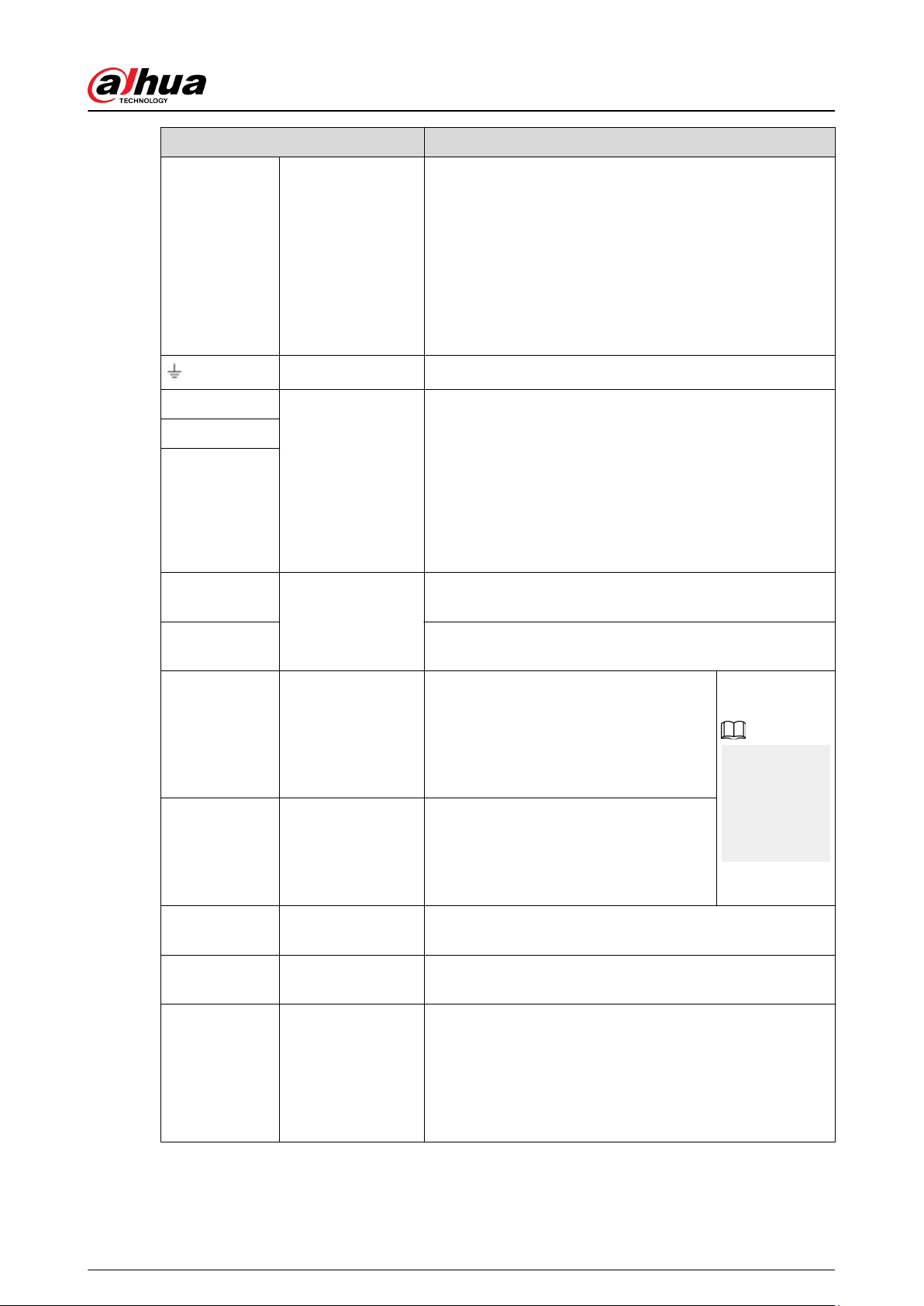
Name Function
1–16
Alarm input port 1–
16
●
There are four groups. The rst group is from port 1 to
port 4, the second group is from port 5 to port 8, the
third group is from 9 to 12, and the fourth group is from
13 to 16. They are to receive the signal from the
external alarm source. There are two types; NO (normal
open)/NC (normal close).
●
When your alarm input device is using external power,
please make sure the device and the NVR have the
same ground.
Ground Alarm input ground end.
NO1–NO5
Alarm output port
1–5
●
5 groups of alarm output ports. (Group 1: port NO1–C1,
Group 2:port NO2–C2, Group 3: port NO3–C3, Group 4:
port NO4–C4, Group 5: port NO5, C5, NC5). Output
alarm signal to the alarm device. Please make sure there
is power to the external alarm device.
●
NO: Normal open alarm output port.
●
C: Alarm output public end.
●
NC: Normal close alarm output port.
C1–C5
NC5
A
RS-485
communication
port
RS485_A port. It is the cable A. You can connect to the
control devices such as speed dome PTZ.
B
RS485_B. It is the cable B. You can connect to the control
devices such as speed dome PTZ.
CTRL (CTRL 12
V)
—
Controller 12 V power output. It is to
control the on-o alarm relay output. It
can be used to control the device alarm
output. At the same time, it can also be
used as the power input source of some
devices such as the alarm detector.
The two ports
serve as
another group
of alarm output
ports.
P (+12 V) —
+12 V power output port. It can provide
the power to some peripheral devices
such as the camera or the alarm device.
Please note the supplying power shall be
below 1 A.
RS-232 RS-232 debug COM
It is for general COM debug to congure IP address or
transfer transparent COM data.
VGA
VGA video output
port
VGA video output port. Output analog video signal. It can
connect to the monitor to view analog video.
PoE PORTS —
Built-in Switch. Support PoE or ePoE function.
For ePoE series product, port 1 to port 8 are the ePoE ports.
ePoE port supports 300 meters@100 Mbps, 800 meters@10
Mbps. Port 9 to port 16 are general PoE ports.
The 16 PoE series supports total 150 W.
User's Manual
31
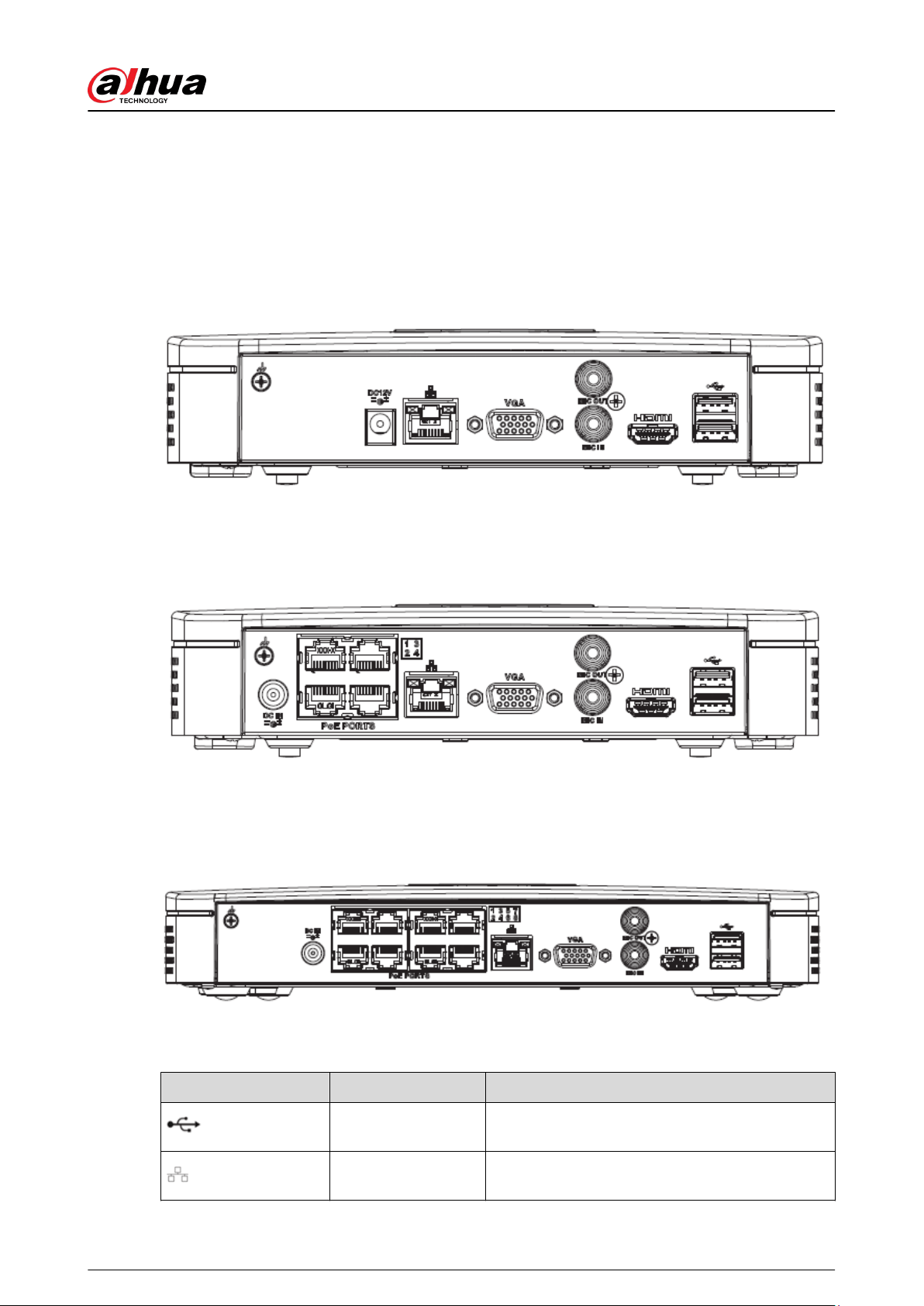
2.2.6 NVR41-4KS2/NVR41-P-4KS2/NVR41-8P-4KS2/
NVR41-4KS2/L/NVR41-P-4KS2/L/NVR41-8P-4KS2/L/NVR21-
S3/NVR21-P-S3/NVR21-8P-S3
The NVR41-4KS2/NVR41-4KS2/L/NVR21-S3 series rear panel is shown as below.
Figure 2-52 Rear panel
The NVR41-P-4KS2/NVR41-P-4KS2/L series rear panel is shown as below.
Figure 2-53 Rear panel
The NVR41-8P-4KS2/NVR41-8P-4KS2/L series rear panel is shown as below.
Figure 2-54
Table 2-21 Ports
Port Name Connection Function
USB port
USB port. Connect to mouse, USB storage device,
USB burner and more.
Network port
10/100 Mbps self-adaptive Ethernet port. Connect
to the network cable.
User's Manual
32
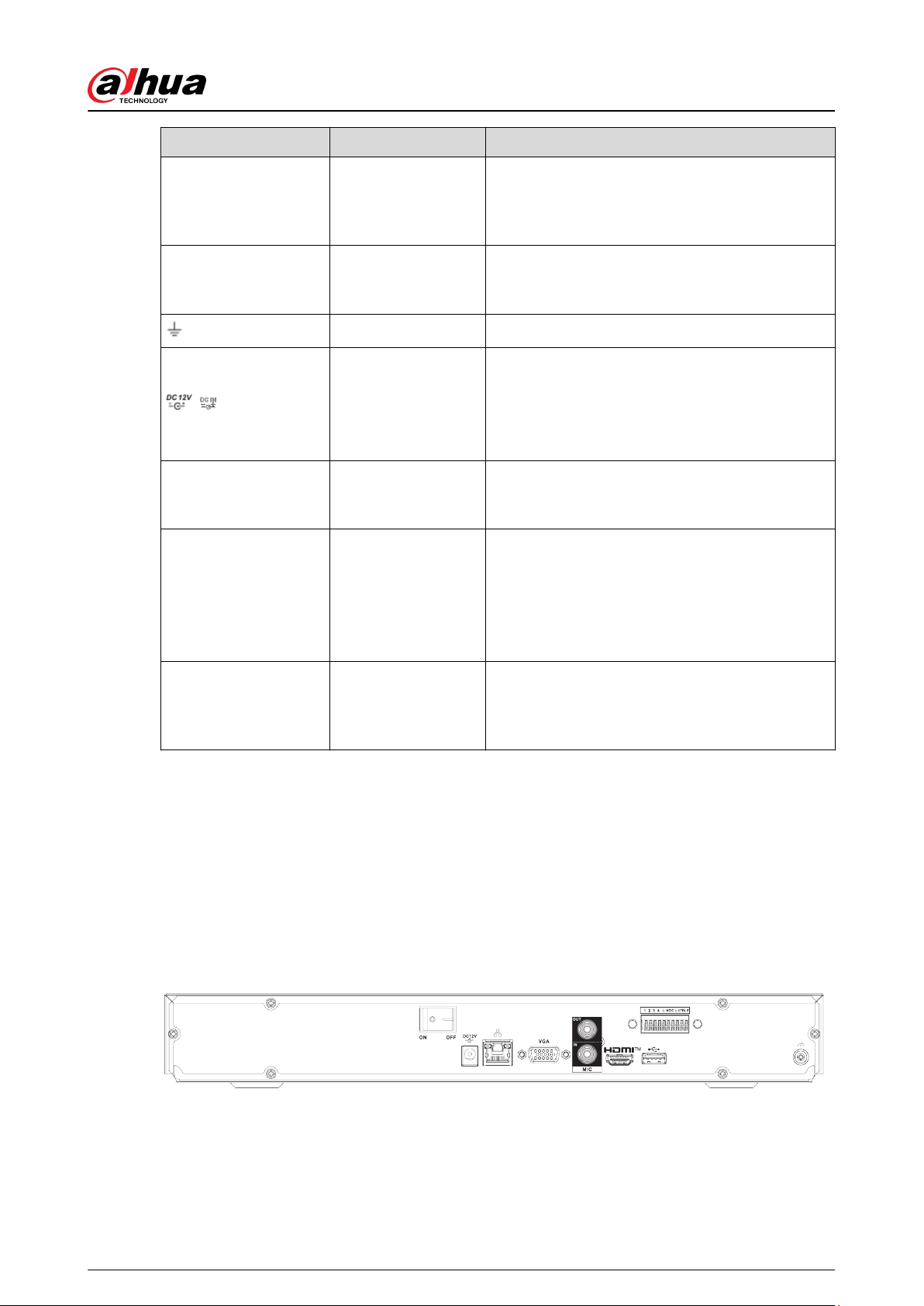
Port Name Connection Function
HDMI
High Denition
Media Page
High denition audio and video signal output
port. It transmits uncompressed high denition
video and multiple-channel data to the HDMI port
of the display device. HDMI version is 1.4.
VGA
VGA video output
port
VGA video output port. Output analog video
signal. It can connect to the monitor to view
analog video.
GND Ground end.
/
Power input port
Power socket.
●
For NVR41-4KS2: 12 VDC/2 A power.
●
For NVR41-P-4KS2: 48 VDC/72 W power.
●
For NVR41-8P-4KS2: 48 VDC/96 W power.
MIC IN Audio input port
Bidirectional talk input port. It is to receive the
analog audio signal output from the devices such
as microphone, pickup.
MIC OUT Audio output port
Audio output port. It is to output the analog
audio signal to the devices such as the sound box.
●
Bidirectional talk output.
●
Audio output on 1-window video monitor.
●
Audio output on 1-window video playback.
PoE PORTS PoE port
Built-in switch. Support PoE function.
For PoE series product, you can use this port to
provide power to the network camera.
2.2.7 NVR42-4KS2/NVR42-P-4KS2/NVR42-8P-4KS2/
NVR42-16P-4KS2/NVR42-4KS2/L/NVR42-P-4KS2/L/
NVR42-8P-4KS2/L/NVR42-16P-4KS2/L/NVR42-EI/NVR42-P-
EI/NVR42-8P-EI Series
The NVR42-4KS2/NVR42-4KS2/L/NVR42-EI series rear panel is shown as below.
Figure 2-55 Rear panel
The NVR42-P-4KS2/NVR42-P-4KS2/L/NVR42-P-EI series rear panel is shown as below.
User's Manual
33
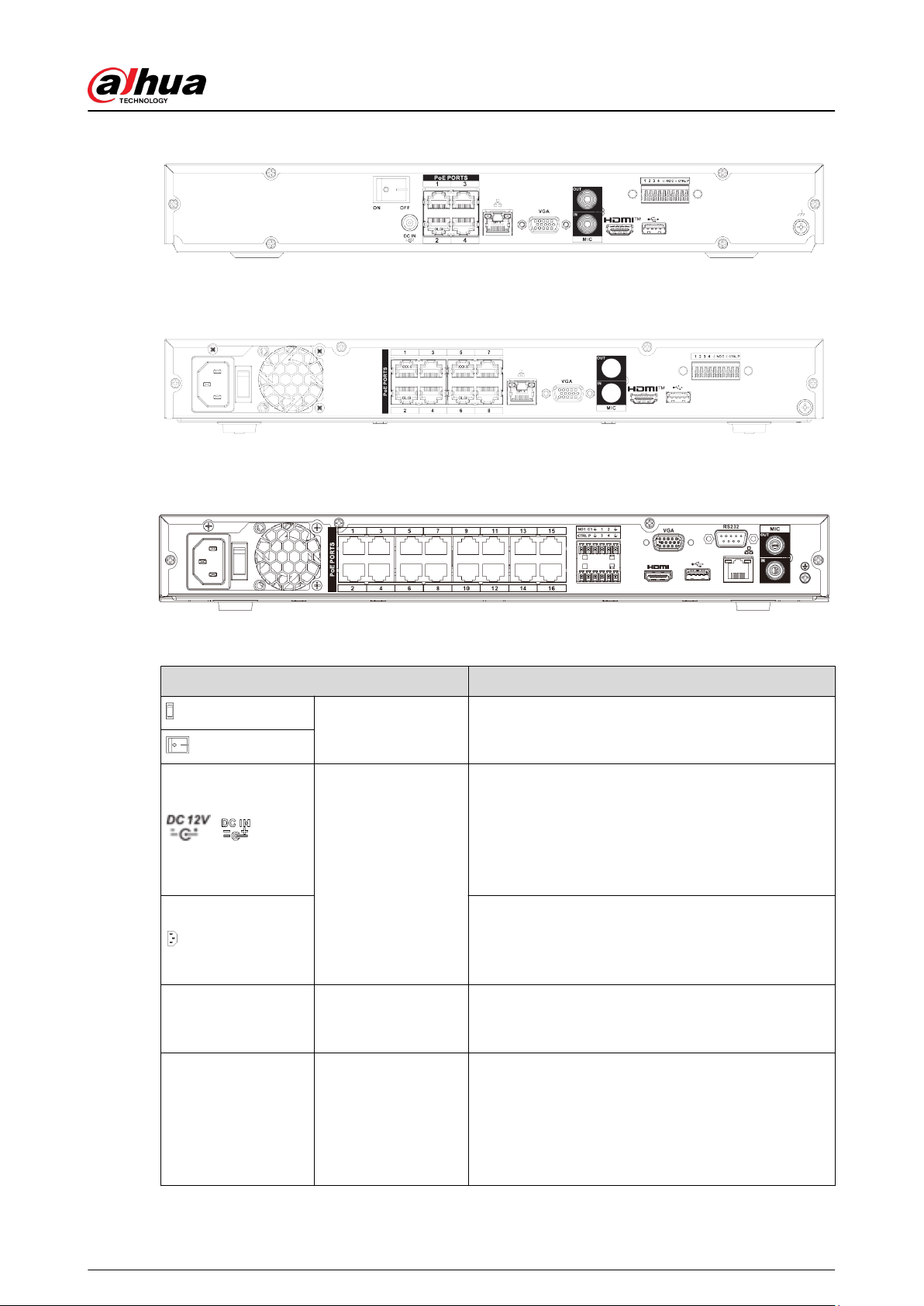
Figure 2-56 Rear panel
The NVR42-8P-4KS2/NVR42-8P-4KS2/L/NVR42-8P-EI series rear panel is shown as below.
Figure 2-57 Rear panel
The NVR42-16P-4KS2/NVR42-16P-4KS2/L series rear panel is shown as below.
Figure 2-58 Rear panel
Table 2-22 Rear panel description
Name Function
Power switch Power on/o button.
/
Power input port
Power socket.
●
For NVR42-4KS2/NVR42-EI series, input 12 VDC/4
A.
●
For NVR42-P-4KS2 series, input 48 VDC/96 W.
●
For NVR42-P-EI series, input 53 VDC/1.81 A.
Input 90~264-12 VAC 5 A/52 V 2.5 A-190 W.
For NVR42-8P-4KS2/NVR42-16P-4KS2/NVR42-8P-EI
series product only.
MIC IN Audio input port
Bidirectional talk input port. It is to receive the
analog audio signal output from the devices such as
microphone, pickup.
MIC OUT Audio output port
Audio output port. It is to output the analog audio
signal to the devices such as the sound box.
●
Bidirectional talk output.
●
Audio output on 1-window video monitor.
●
Audio output on 1-window video playback.
User's Manual
34
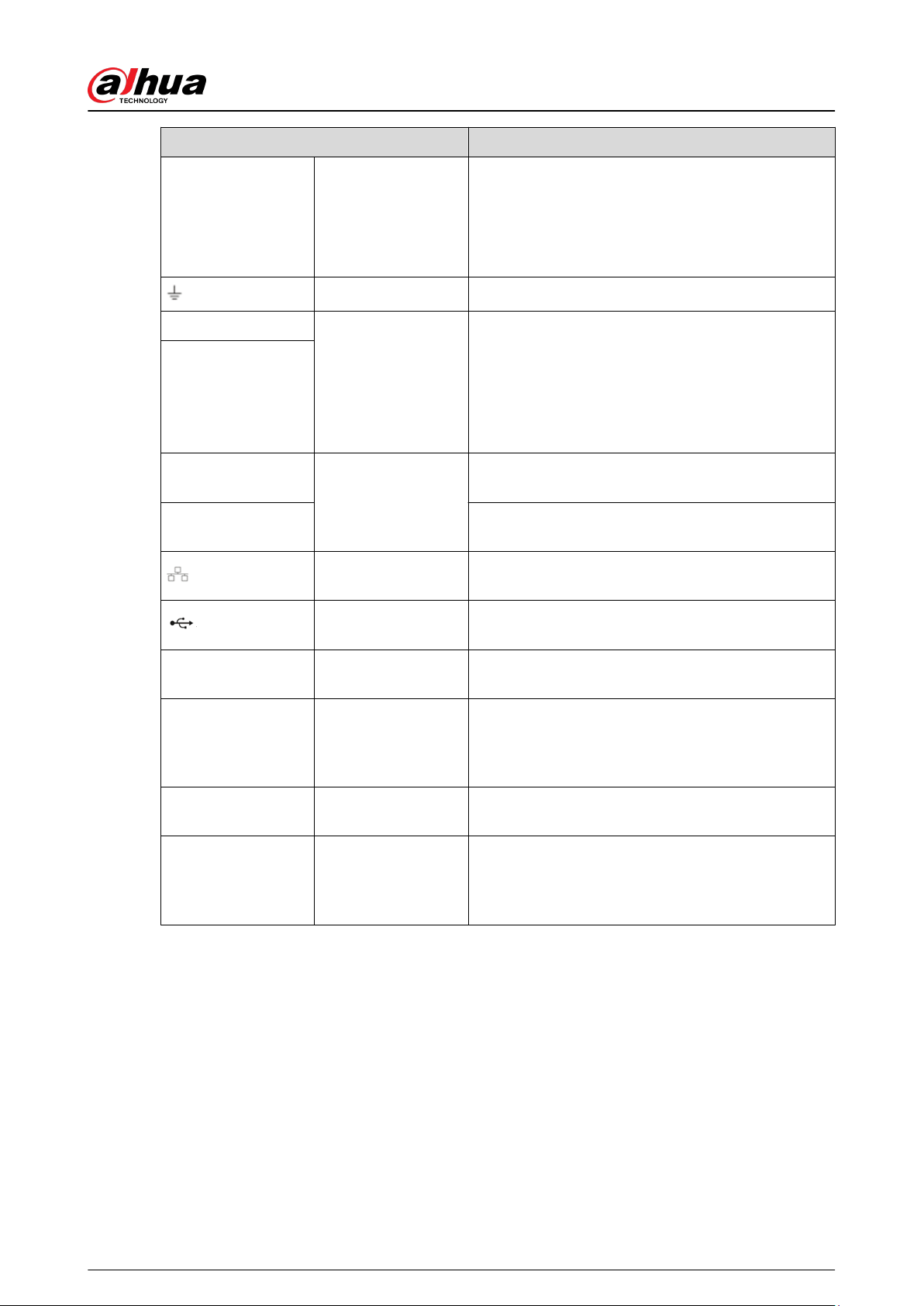
Name Function
1–4 Alarm input port 1–4
●
There are two types; NO (normal open)/NC
(normal close).
●
When your alarm input device is using external
power, please make sure the device and the NVR
have the same ground.
GND Alarm input ground port.
N1, N2
Alarm output port
1–2
●
2 groups of alarm output ports. (Group 1: port
NO1–C1,Group 2: port NO2–C2).Output alarm
signal to the alarm device. Please make sure
there is power to the external alarm device.
●
NO: Normal open alarm output port.
●
C:Alarm output public end.
C1, C2
A
RS-485
communication port
RS485_A port. It is the cable A. You can connect to
the control devices such as speed dome PTZ.
B
RS485_B. It is the cable B. You can connect to the
control devices such as speed dome PTZ.
Network port
10/100/1000 Mbps self-adaptive Ethernet port.
Connect to the network cable.
USB port
USB port. Connect to mouse, USB storage device,
USB burner and more.
RS-232 RS-232 debug COM
It is for general COM debug to congure IP address
or transfer transparent COM data.
HDMI
High Denition
Media Page
High denition audio and video signal output port.
It transmits uncompressed high denition video and
multiple-channel data to the HDMI port of the
display device. HDMI version is 1.4.
VGA
VGA video output
port
VGA video output port. Output analog video signal.
It can connect to the monitor to view analog video.
PoE PORTS /
Built-in Switch. Support PoE.
For PoE series product, you can use this port to
provide power to the network camera.
2.2.8 NVR44-4KS2/NVR44-16P-4KS2/NVR44-4KS2/L/
NVR44-16P-4KS2/L/NVR44-4KS2/I/NVR44-16P-4KS2/I/
NVR48-EI/NVR44-EI/NVR48-16P-EI/NVR44-16P-EI Series
The NVR44-4KS2/NVR44-4KS2/L/NVR44-4KS2/I/NVR48-EI/NVR44-EI series rear panel is shown as
below.
User's Manual
35
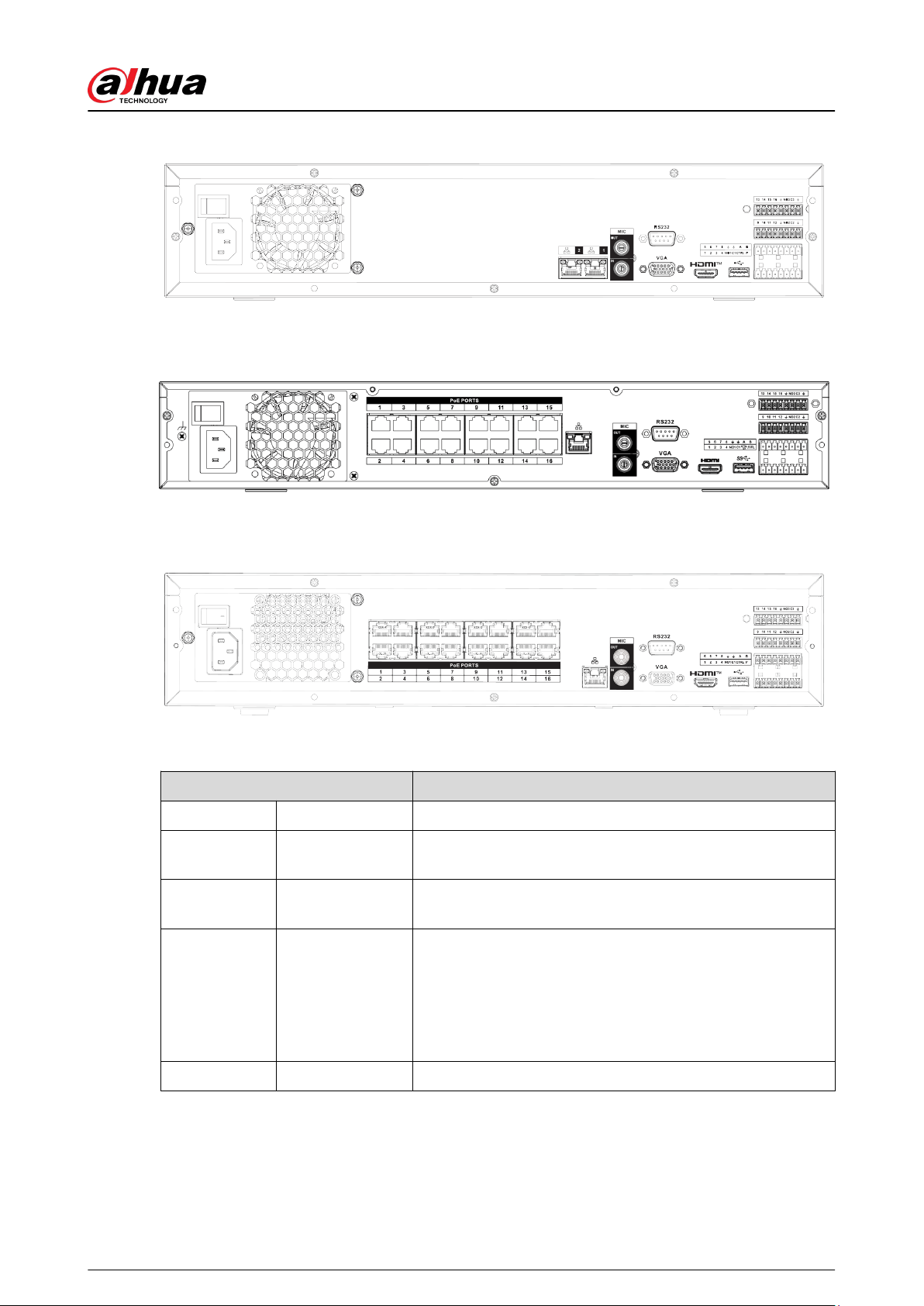
Figure 2-59 Rear panel
The NVR44-16P-4KS2/NVR44-16P-4KS2/L/NVR44-16P-4KS2/I series rear panel is shown as below.
Figure 2-60 Rear panel
The NVR48-16P-EI/NVR44-16P-EI series rear panel is shown as below.
Figure 2-61 Rear panel
Table 2-23 Ports
Name Function
Power switch — Power on-o button.
Power input
port
— 90~264-12 VAC 12.5 A/-53 V 2.83 A.
MIC IN Audio input port
Bidirectional talk input port. It is to receive the analog audio
signal output from the devices such as microphone, pickup.
MIC OUT Audio output port
Audio output port. It is to output the analog audio signal to
the devices such as the sound box.
●
Bidirectional talk output.
●
Audio output on 1-window video monitor.
●
Audio output on 1-window video playback.
VIDEO OUT Video output port CVBS output.
User's Manual
36
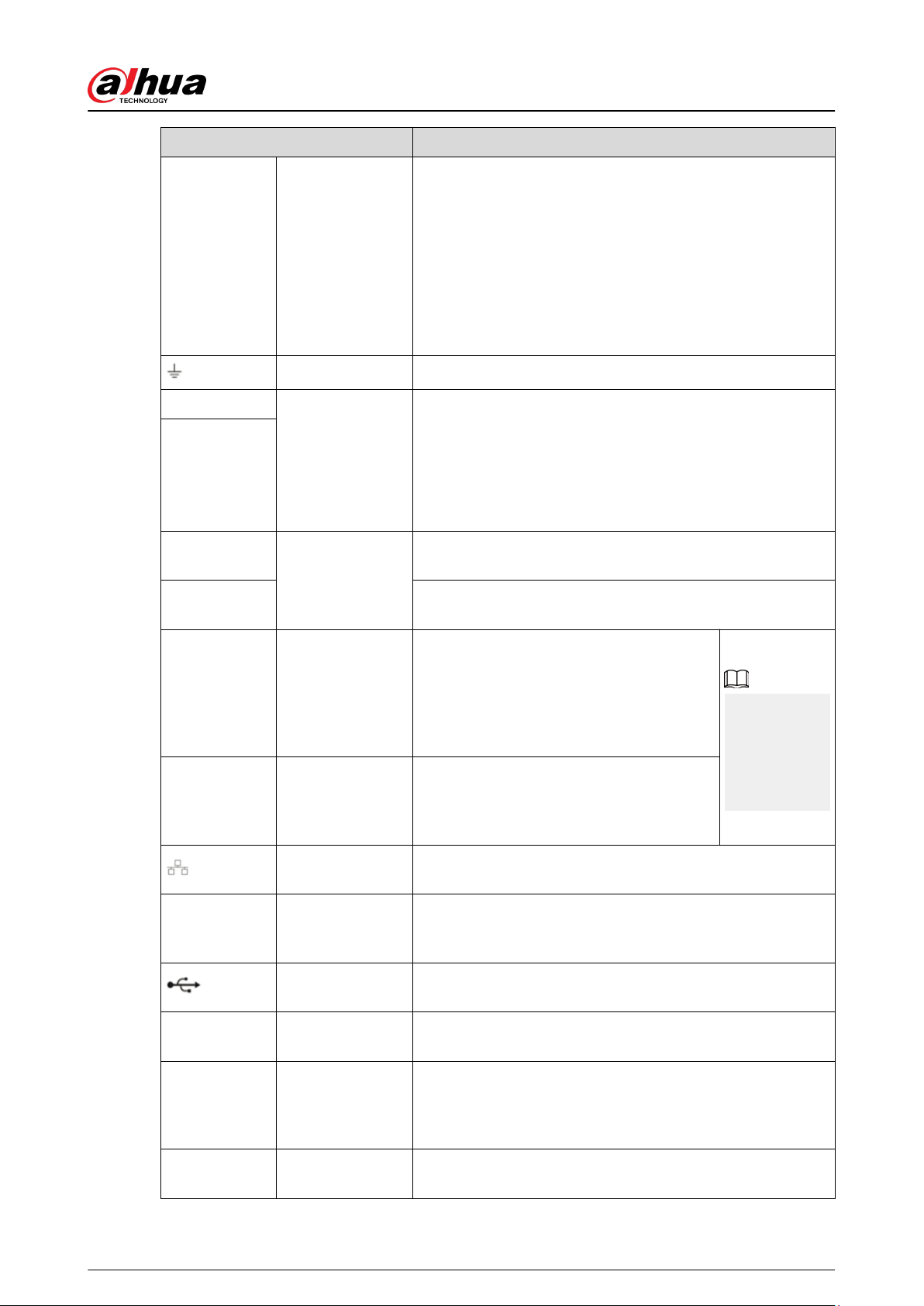
Name Function
1–16
Alarm input port
1–16
●
There are four groups. The rst group is from port 1 to
port 4, the second group is from port 5 to port 8, the third
group is from 9 to 12, and the fourth group is from 13 to
16. They are to receive the signal from the external alarm
source. There are two types; NO (normal open)/NC
(normal close).
●
When your alarm input device is using external power,
please make sure the device and the NVR have the same
ground.
Video output port CVBS output.
NO1–NO3
Alarm output port
1–3
●
3 groups of alarm output ports. (Group 1: port NO1–C1;
Group 2: port NO2–C2; Group 3: port NO3–C3). Output
alarm signal to the alarm device. Please make sure there
is power to the external alarm device.
●
NO: Normal open alarm output port.
●
C: Alarm output public end.
C1–C3
A
RS-485
communication
port
RS485_A port. It is the cable A. You can connect to the
control devices such as speed dome PTZ.
B
RS485_B. It is the cable B. You can connect to the control
devices such as speed dome PTZ.
CTRL (CTRL 12
V)
—
Controller 12 V power output. It is to
control the on-o alarm relay output. It can
be used to control the device alarm output.
At the same time, it can also be used as the
power input source of some devices such
as the alarm detector.
The two ports
serve as
another group
of alarm
output ports.
P (+12 V) —
+12 V power output port. It can provide the
power to some peripheral devices such as
the camera or the alarm device. Please note
the supplying power shall be below 1 A.
Network port
10/100/1000 Mbps self-adaptive Ethernet port. Connect to
the network cable.
eSATA eSATA port
External SATA port. It can connect to the device of the SATA
port. Please jump the HDD when there is peripheral
connected HDD.
USB 2.0 port
USB 2.0 port. Connect to mouse, USB storage device, USB
burner and more.
RS-232
RS-232 debug
COM
It is for general COM debug to congure IP address or
transfer transparent COM data.
HDMI
High Denition
Media Page
High denition audio and video signal output port. It
transmits uncompressed high denition video and multiple-
channel data to the HDMI port of the display device. HDMI
version is 1.3.
VGA
VGA video output
port
VGA video output port. Output analog video signal. It can
connect to the monitor to view analog video.
User's Manual
37
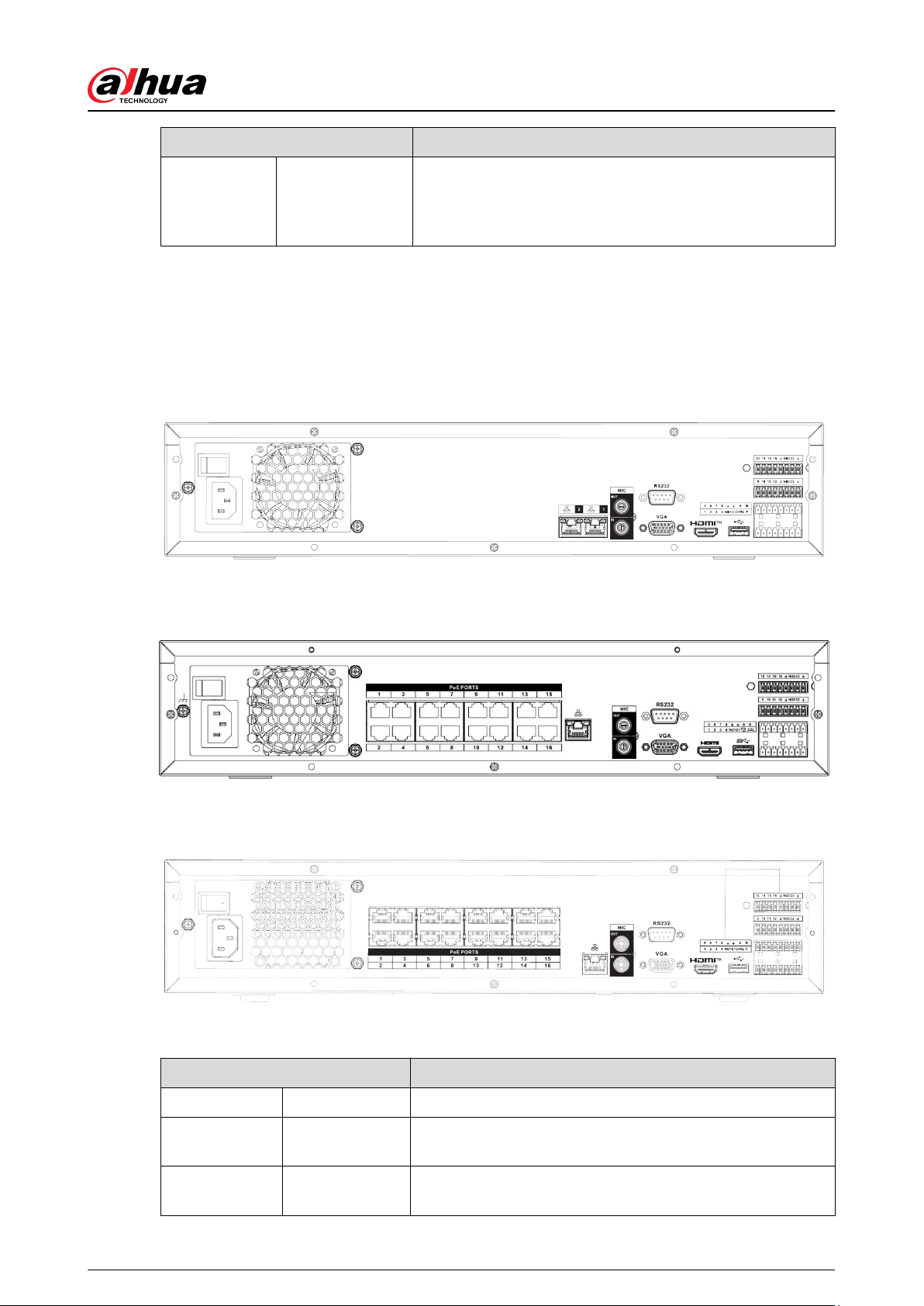
Name Function
PoE PORTS PoE port
Built-in Switch. Support PoE.
For PoE series product, you can use this port to provide
power to the network camera.
2.2.9 NVR48-4KS2/NVR48-16P-4KS2/NVR48-4KS2/L/
NVR48-16P-4KS2/L/NVR48-4KS2/I/NVR48-16P-4KS2/I Series
The NVR48-4KS2/NVR48-4KS2/L/NVR48-4KS2/I series rear panel is shown as below.
Figure 2-62 Rear panel
The NVR48-16P-4KS2/NVR48-16P-4KS2/L/NVR48-16P-4KS2/I series rear panel is shown as below.
Figure 2-63 Rear panel
The NVR48-16P-EI series rear panel is shown as below.
Figure 2-64 Rear panel
Table 2-24 Ports
Name Function
Power switch — Power on-o button.
Power input
port
— 90~264-12 VAC 12.5 A/-53 V 2.83 A.
MIC IN Audio input port
Bidirectional talk input port. It is to receive the analog audio
signal output from the devices such as microphone, pickup.
User's Manual
38
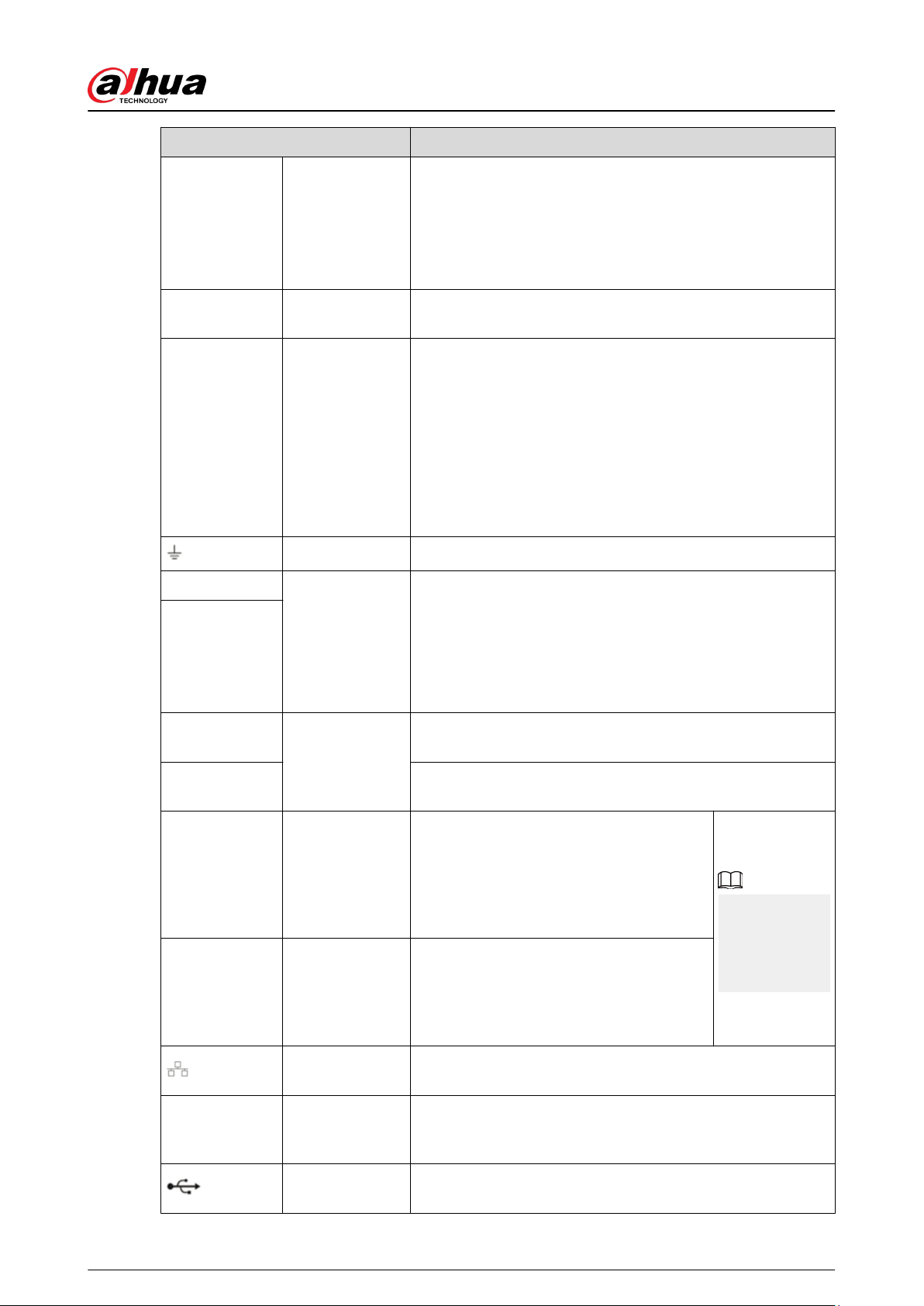
Name Function
MIC OUT
Audio output
port
Audio output port. It is to output the analog audio signal to
the devices such as the sound box.
●
Bidirectional talk output.
●
Audio output on 1-window video monitor.
●
Audio output on 1-window video playback.
VIEDEO OUT
Video output
port
CVBS output.
1–16
Alarm input port
1–16
●
There are four groups. The rst group is from port 1 to
port 4, the second group is from port 5 to port 8, the third
group is from 9 to 12, and the fourth group is from 13 to
16. They are to receive the signal from the external alarm
source. There are two types; NO (normal open)/NC
(normal close).
●
When your alarm input device is using external power,
please make sure the device and the NVR have the same
ground.
GND Alarm input ground port.
NO1–NO3
Alarm output
port 1–3
●
3 groups of alarm output ports. (Group 1: port NO1–C1;
Group 2: port NO2–C2; Group 3: port NO3–C3). Output
alarm signal to the alarm device. Please make sure there is
power to the external alarm device.
●
NO: Normal open alarm output port.
●
C: Alarm output public end.
C1–C3
A
RS-485
communication
port
RS485_A port. It is the cable A. You can connect to the
control devices such as speed dome PTZ.
B
RS485_B. It is the cable B. You can connect to the control
devices such as speed dome PTZ.
CTRL (CTRL 12
V)
—
Controller 12 V power output. It is to
control the on-o alarm relay output. It can
be used to control the device alarm
output. At the same time, it can also be
used as the power input source of some
devices such as the alarm detector.
The two ports
serve as another
group of alarm
output ports.
P (+12 V) —
+12 V power output port. It can provide
the power to some peripheral devices such
as the camera or the alarm device. Please
note the supplying power shall be below 1
A.
Network port
One 10/100/1000 Mbps self-adaptive Ethernet port. Connect
to the network cable.
eSATA eSATA port
External SATA port. It can connect to the device of the SATA
port. Please jump the HDD when there is peripheral
connected HDD.
USB port
USB port. Connect to mouse, USB storage device, USB burner
and more.
User's Manual
39
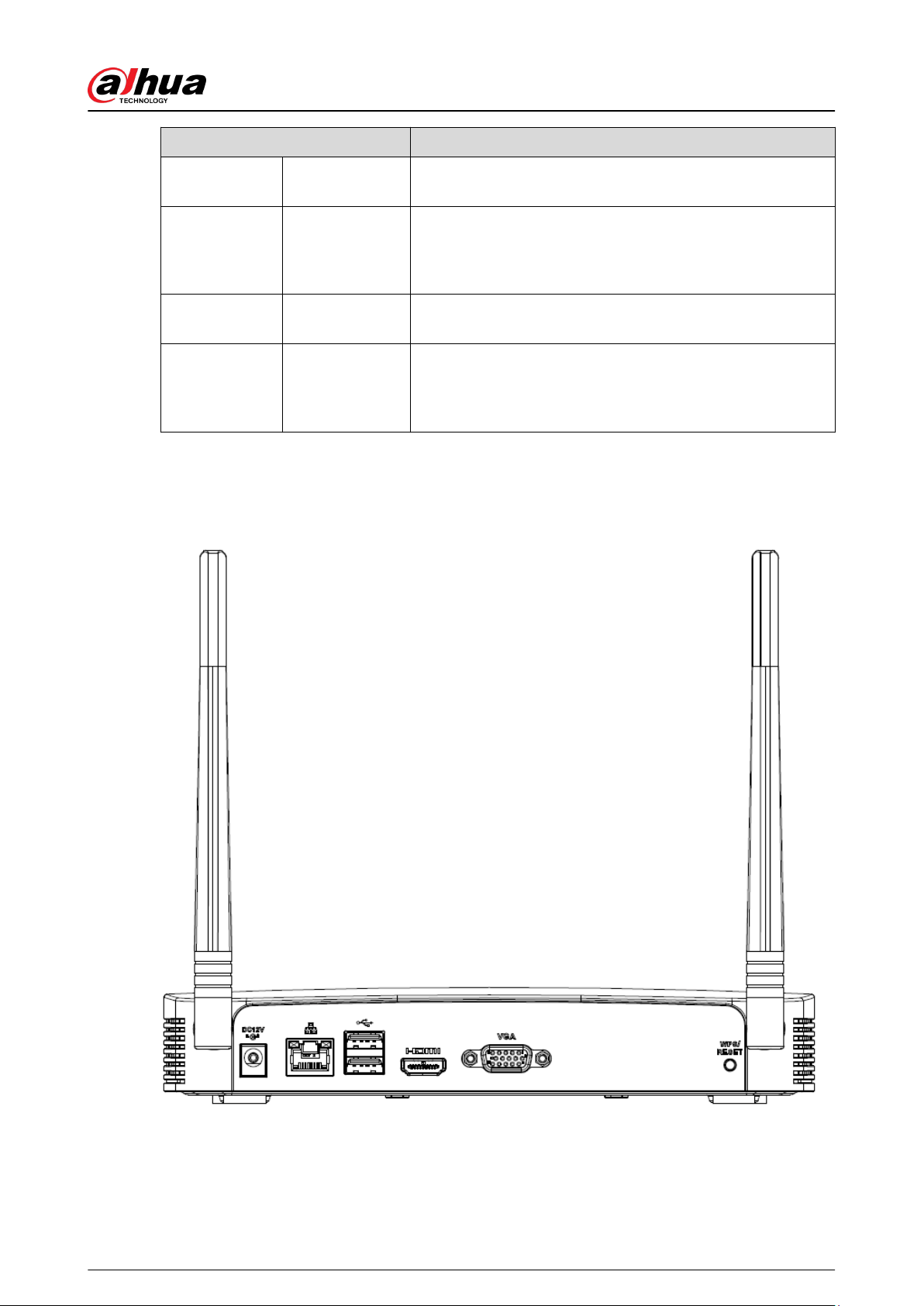
Name Function
RS-232
RS-232 debug
COM
It is for general COM debug to congure IP address or
transfer transparent COM data.
HDMI
High Denition
Media Page
High denition audio and video signal output port. It
transmits uncompressed high denition video and multiple-
channel data to the HDMI port of the display device. HDMI
version is 1.4.
VGA
VGA video
output port
VGA video output port. Output analog video signal. It can
connect to the monitor to view analog video.
PoE PORTS PoE port
Built-in Switch. Support PoE.
For PoE series product, you can use this port to provide
power to the network camera.
2.2.10 NVR21-W-4KS2 Series
Figure 2-65 Rear panel
User's Manual
40
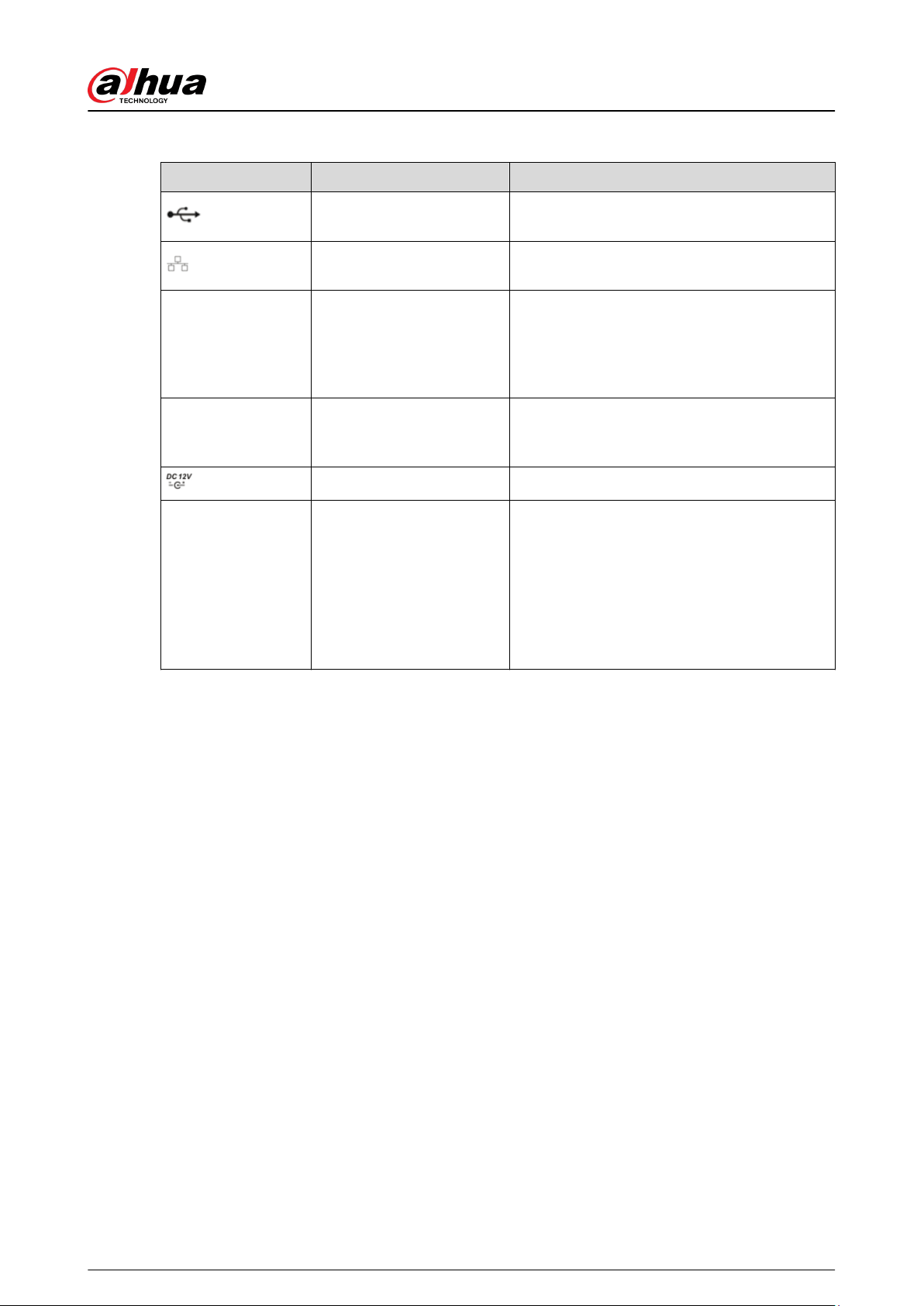
Table 2-25 Ports
Port Name Connection Function
USB 2.0 port
USB 2.0 port. Connect to mouse, USB storage
device, USB burner and more.
Network port
10/100 Mbps self-adaptive Ethernet port.
Connect to the network cable.
HDMI High Denition Media Page
High denition audio and video signal output
port. It transmits uncompressed high
denition video and multiple-channel data to
the HDMI port of the display device. HDMI
version is 1.4.
VGA VGA video output port
VGA video output port. Output analog video
signal. It can connect to the monitor to view
analog video.
Power input port Input 12 VDC/2 A.
WPS/RESET Reset/WPS function
Device Wi-Fi reset and WPS function button:
●
Hold down this button for 5 seconds and
above to restore Wi-Fi AP to defaults.
●
Press this button for less than 2 seconds,
and then press the WPS button of Wi-Fi
IPC, the device and Wi-Fi IPC can be
connected.
User's Manual
41
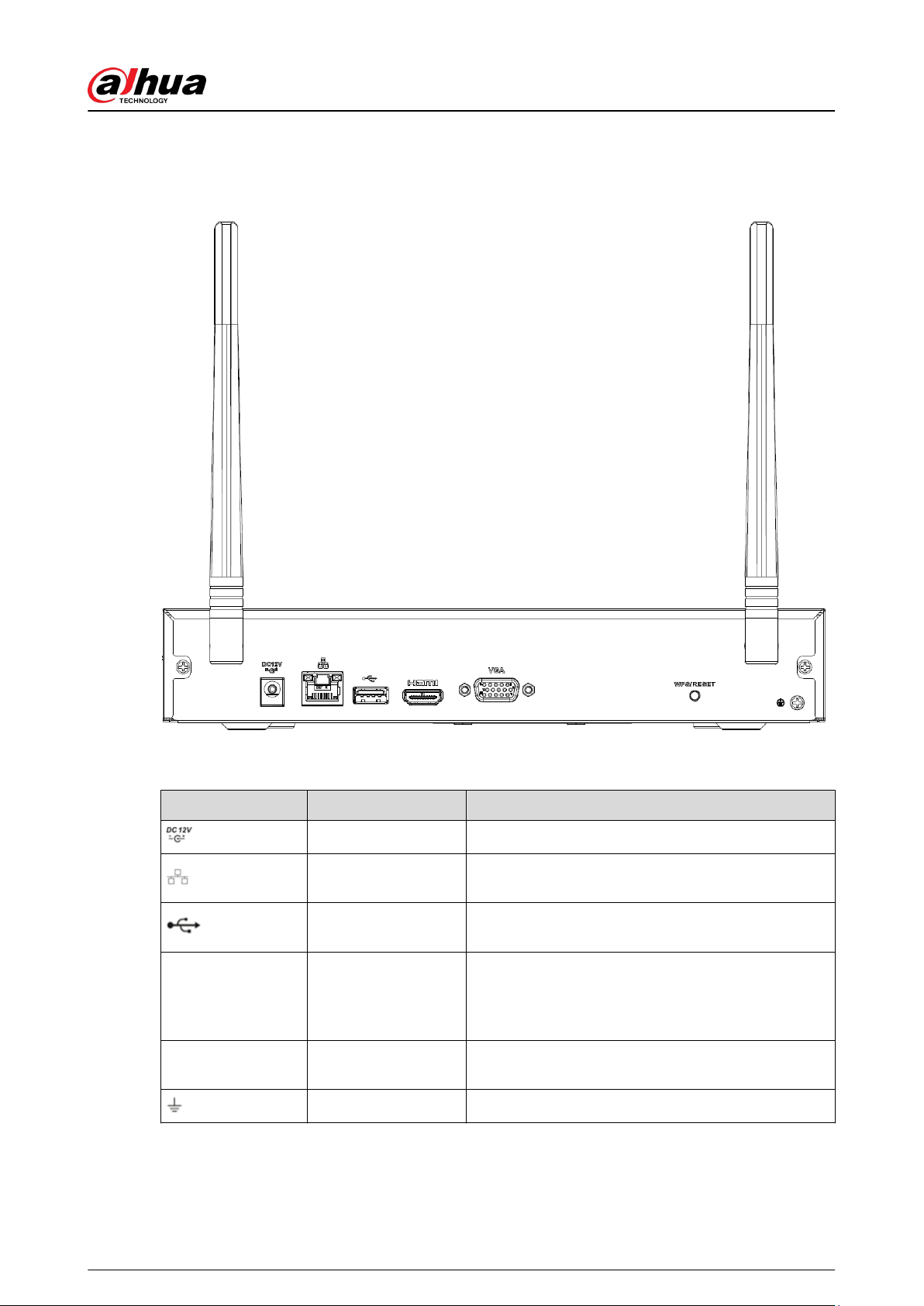
2.2.11 NVR21HS-W-4KS2
Figure 2-66 Rear panel
Table 2-26 Ports
Icon Name Function
Power input socket Power socket. Input 12 VDC/2 A.
Network port
10/100 Mbps self-adaptive Ethernet port. Connect to
the network cable.
USB 2.0 port
USB 2.0 port. Connect to mouse, USB storage device,
and more.
HDMI
High Denition Media
Page
High denition audio and video signal output port. It
transmits uncompressed high denition video and
multiple-channel data to the HDMI port of the
display device. HDMI version is 1.4.
VGA
VGA video output
port
VGA video output port. Output analog video signal.
It can connect to the monitor to view analog video.
GND Ground end.
User's Manual
42
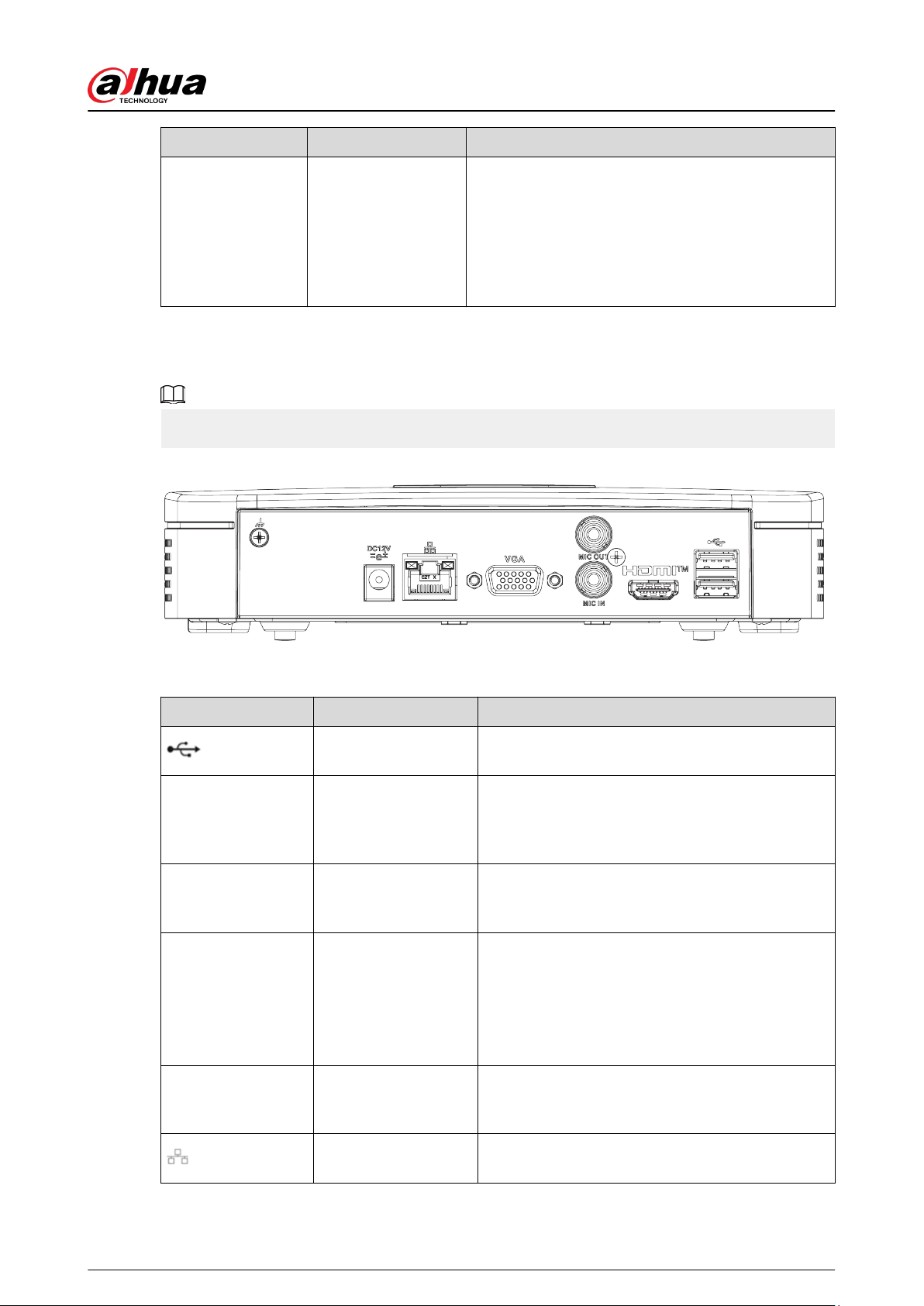
Icon Name Function
WPS/RESET Reset/WPS function
Device Wi-Fi reset and WPS function button:
●
Hold down this button for 5 seconds and above
to restore Wi-Fi AP to defaults.
●
Press this button for less than 2 seconds, and
then press the WPS button of Wi-Fi IPC, the
device and Wi-Fi IPC can be connected.
2.2.12 NVR21-I/NVR21-I2 Series
The gure is for reference only.
Figure 2-67 Rear panel
Table 2-27 Ports
Port Name Connection Function
USB port
USB port. Connect to mouse, USB storage device
and more.
HDMI
High Denition Media
Page
High denition audio and video signal output port.
It transmits uncompressed high denition video
and multiple-channel data to the HDMI port of the
display device. HDMI version is 1.4.
MIC IN Audio input port
Bidirectional talk input port. It is to receive the
analog audio signal output from the devices such
as microphone, pickup.
MIC OUT Audio output port
Audio output port. It is to output the analog audio
signal to the devices such as the sound box.
●
Bidirectional talk output.
●
Audio output on 1-window video monitor.
●
Audio output on 1-window video playback.
VGA VGA video output port
VGA video output port. Output analog video
signal. It can connect to the monitor to view
analog video.
Network port
10/100 Mbps self-adaptive Ethernet port. Connect
to the network cable.
User's Manual
43
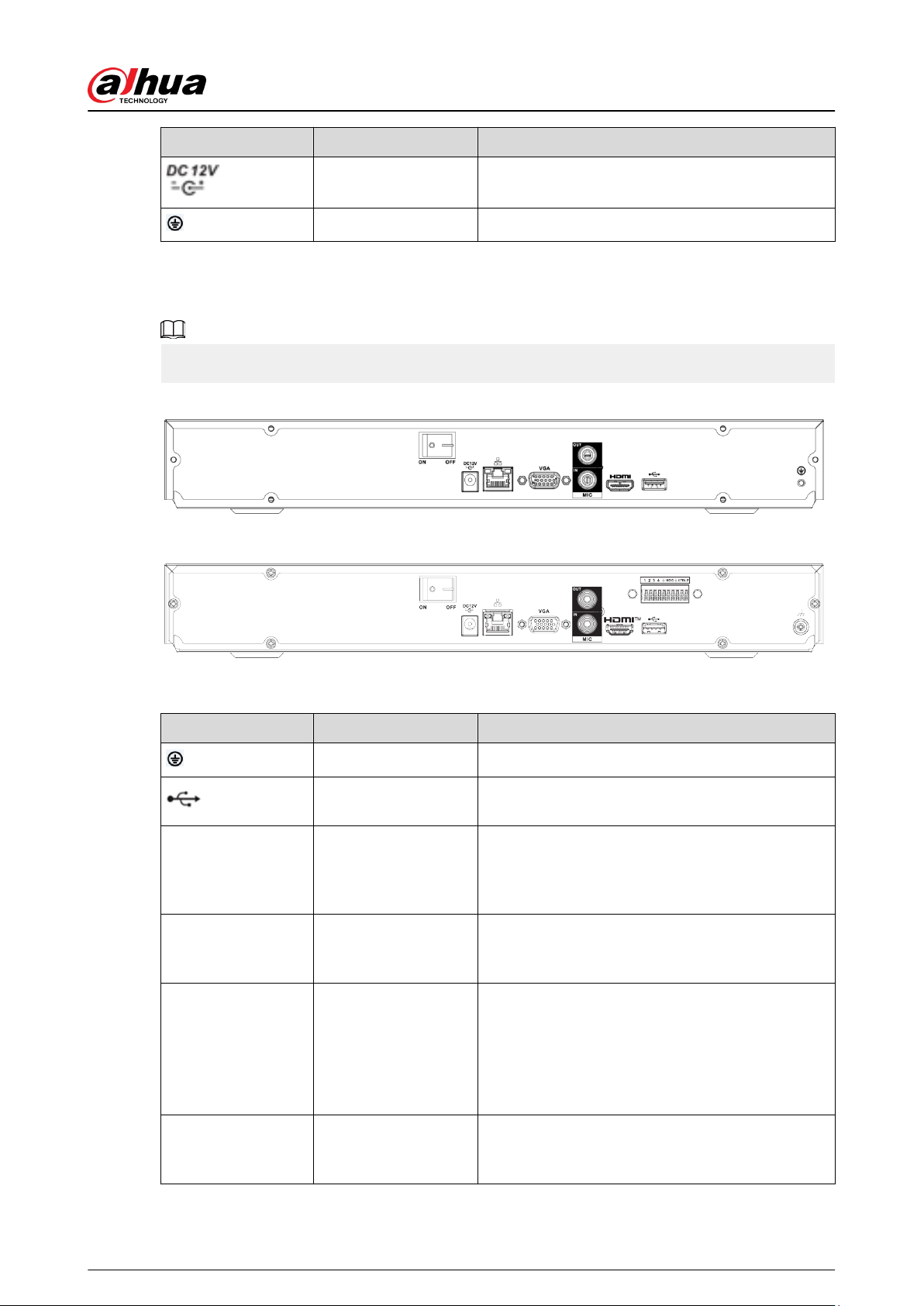
Port Name Connection Function
Power input port Power socket.
GND Ground end.
2.2.13 NVR22-I/NVR22-I2 Series
The gure is for reference only.
Figure 2-68 Rear panel
Figure 2-69 Rear panel
Table 2-28 Ports
Port Name Connection Function
GND Ground end.
USB port
USB port. Connect to mouse, USB storage device
and more.
HDMI
High Denition Media
Page
High denition audio and video signal output port.
It transmits uncompressed high denition video
and multiple-channel data to the HDMI port of the
display device. HDMI version is 1.4.
MIC IN Audio input port
Bidirectional talk input port. It is to receive the
analog audio signal output from the devices such
as microphone, pickup.
MIC OUT Audio output port
Audio output port. It is to output the analog audio
signal to the devices such as the sound box.
●
Bidirectional talk output.
●
Audio output on 1-window video monitor.
●
Audio output on 1-window video playback.
VGA VGA video output port
VGA video output port. Output analog video
signal. It can connect to the monitor to view
analog video.
User's Manual
44
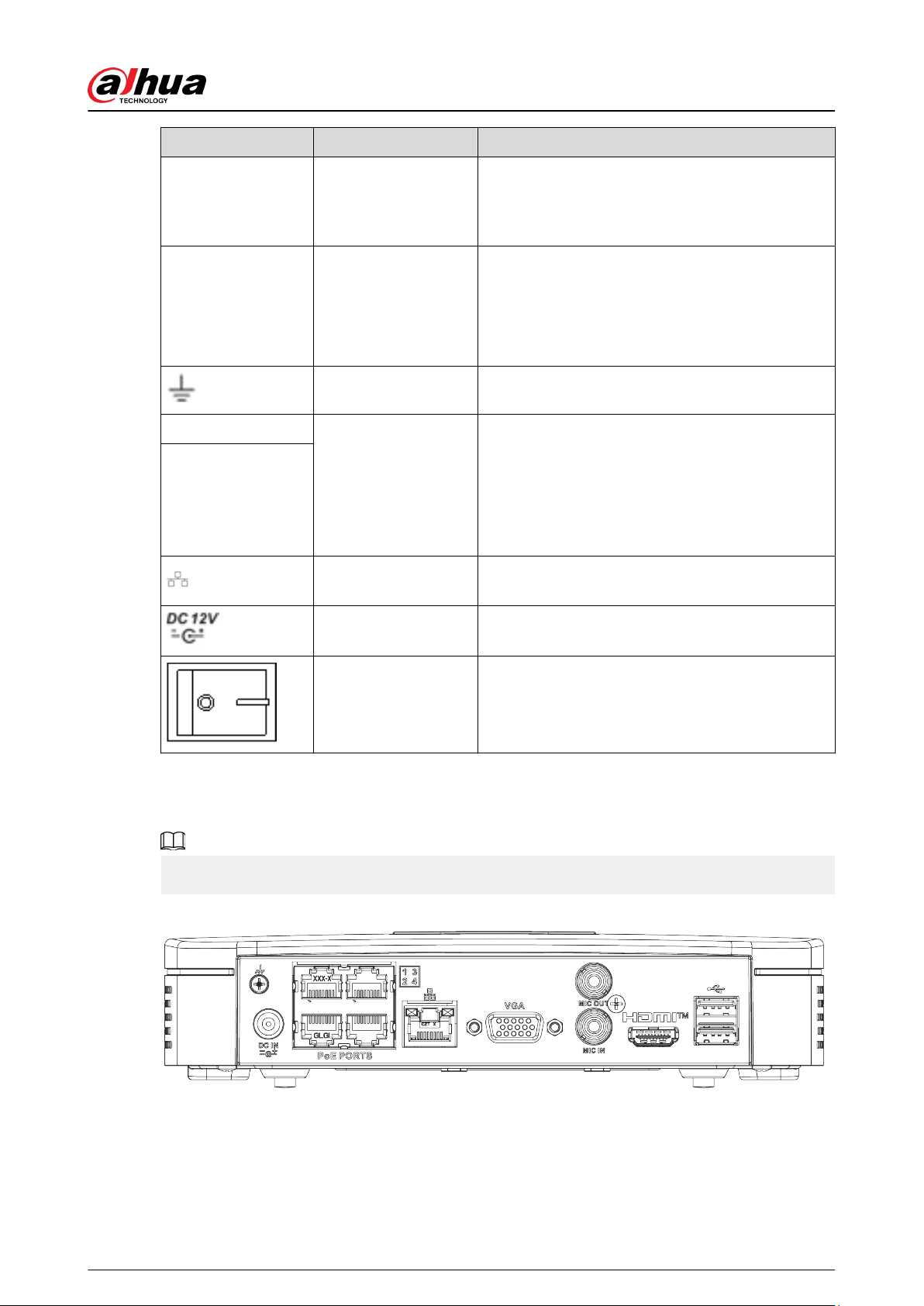
Port Name Connection Function
PoE PORTS PoE port
Built-in switch. Support PoE function.
For PoE series product, you can use this port to
provide power to the network camera.
1–4 Alarm input port 1–4
●
There are two types; NO (normal open)/NC
(normal close).
●
When your alarm input device is using external
power, please make sure the device and the
NVR have the same ground.
GND Alarm input ground port.
N1, N2
Alarm output port 1–2
●
2 groups of alarm output ports. (Group 1: port
NO1–C1,Group 2: port NO2–C2).Output alarm
signal to the alarm device. Please make sure
there is power to the external alarm device.
●
NO: Normal open alarm output port.
●
C: Alarm output public end.
C1, C2
Network port
10/100 Mbps self-adaptive Ethernet port. Connect
to the network cable.
Power input port Power socket.
Power switch Power on/o button.
2.2.14 NVR21-P-I/NVR21-P-I2 Series
The gure is for reference only.
Figure 2-70 Rear panel
User's Manual
45
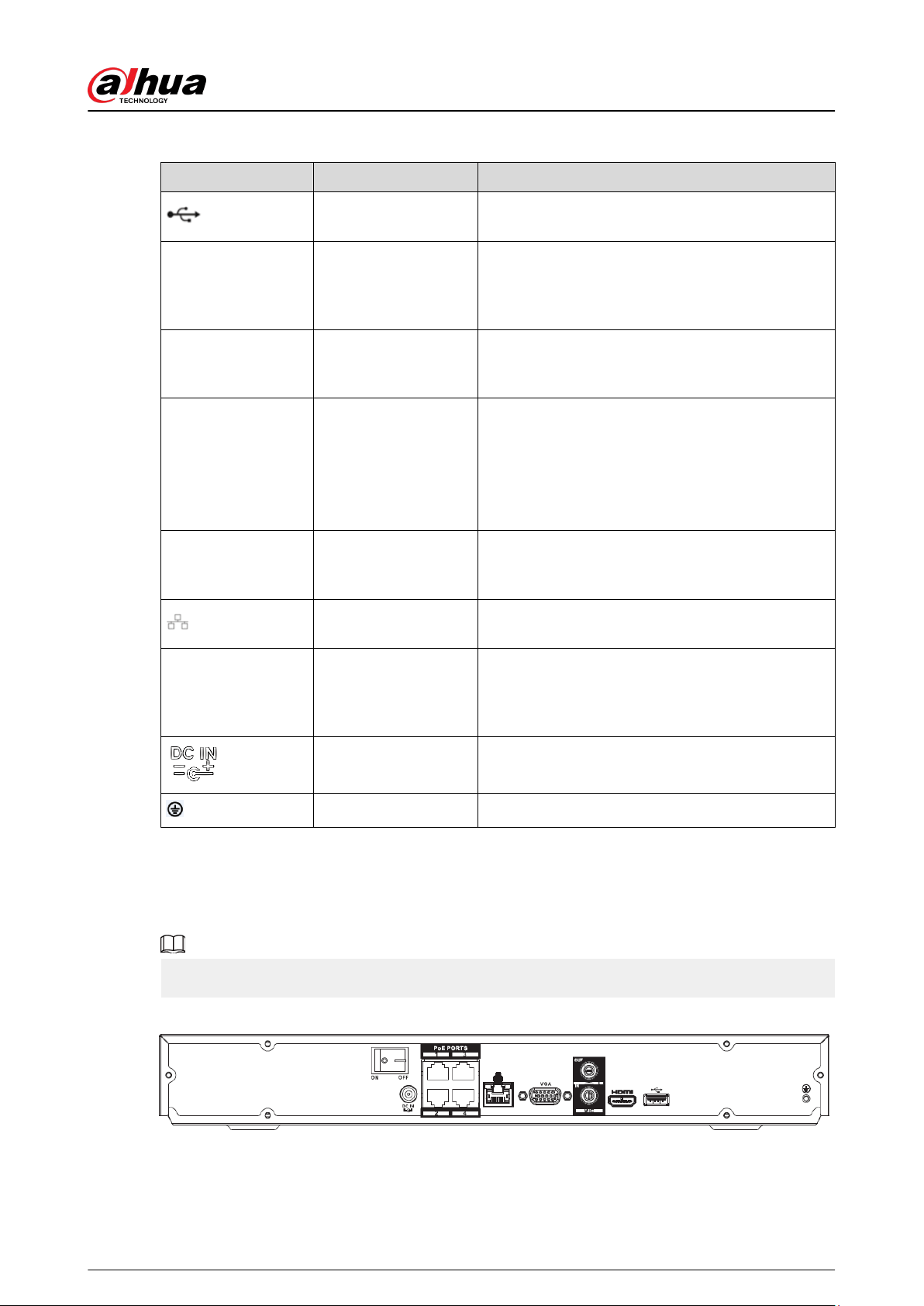
Table 2-29 Ports
Port Name Connection Function
USB port
USB port. Connect to mouse, USB storage device
and more.
HDMI
High Denition Media
Page
High denition audio and video signal output port.
It transmits uncompressed high denition video
and multiple-channel data to the HDMI port of the
display device. HDMI version is 1.4.
MIC IN Audio input port
Bidirectional talk input port. It is to receive the
analog audio signal output from the devices such
as microphone, pickup.
MIC OUT Audio output port
Audio output port. It is to output the analog audio
signal to the devices such as the sound box.
●
Bidirectional talk output.
●
Audio output on 1-window video monitor.
●
Audio output on 1-window video playback.
VGA VGA video output port
VGA video output port. Output analog video
signal. It can connect to the monitor to view
analog video.
Network port
10/100 Mbps self-adaptive Ethernet port. Connect
to the network cable.
PoE PORTS PoE port
Built-in switch. Support PoE function.
For PoE series product, you can use this port to
provide power to the network camera.
Power input port Power socket.
GND Ground end.
2.2.15 NVR22-P-I/NVR22-P-I2 Series
The rear panel is shown as below.
The gure is for reference only.
Figure 2-71 Rear panel
User's Manual
46
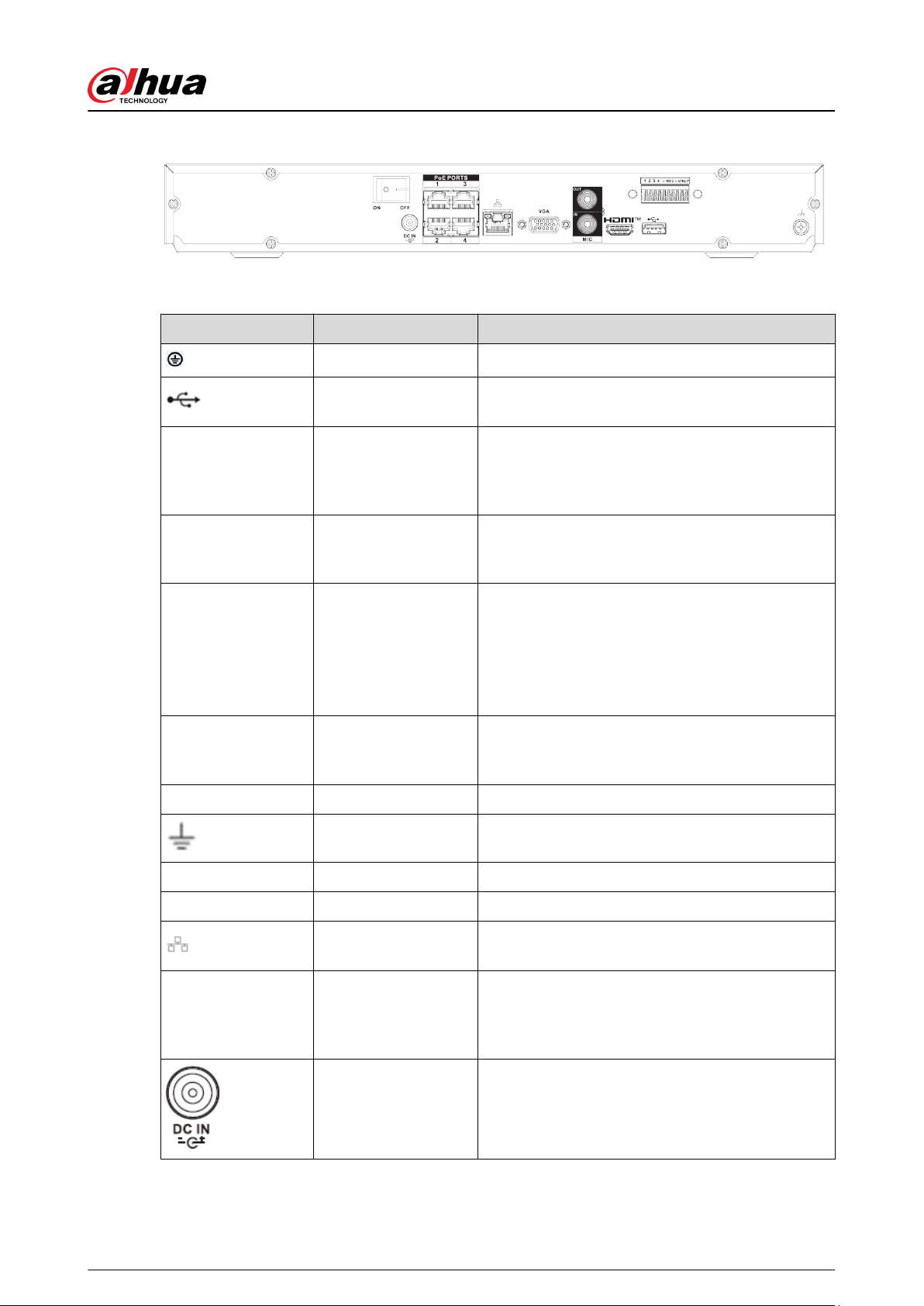
Figure 2-72 Rear panel
Table 2-30 Ports
Port Name Connection Function
GND Ground end.
USB port
USB port. Connect to mouse, USB storage device
and more.
HDMI
High Denition Media
Page
High denition audio and video signal output port.
It transmits uncompressed high denition video
and multiple-channel data to the HDMI port of the
display device. HDMI version is 1.4.
MIC IN Audio input port
Bidirectional talk input port. It is to receive the
analog audio signal output from the devices such
as microphone, pickup.
MIC OUT Audio output port
Audio output port. It is to output the analog audio
signal to the devices such as the sound box.
●
Bidirectional talk output.
●
Audio output on 1-window video monitor.
●
Audio output on 1-window video playback.
VGA VGA video output port
VGA video output port. Output analog video
signal. It can connect to the monitor to view
analog video.
1–4 — —
— —
N1, N2 — —
C1, C2 — —
Network port
10/100 Mbps self-adaptive Ethernet port. Connect
to the network cable.
PoE PORTS PoE port
Built-in switch. Support PoE function.
For PoE series product, you can use this port to
provide power to the network camera.
Power input port Power socket.
User's Manual
47
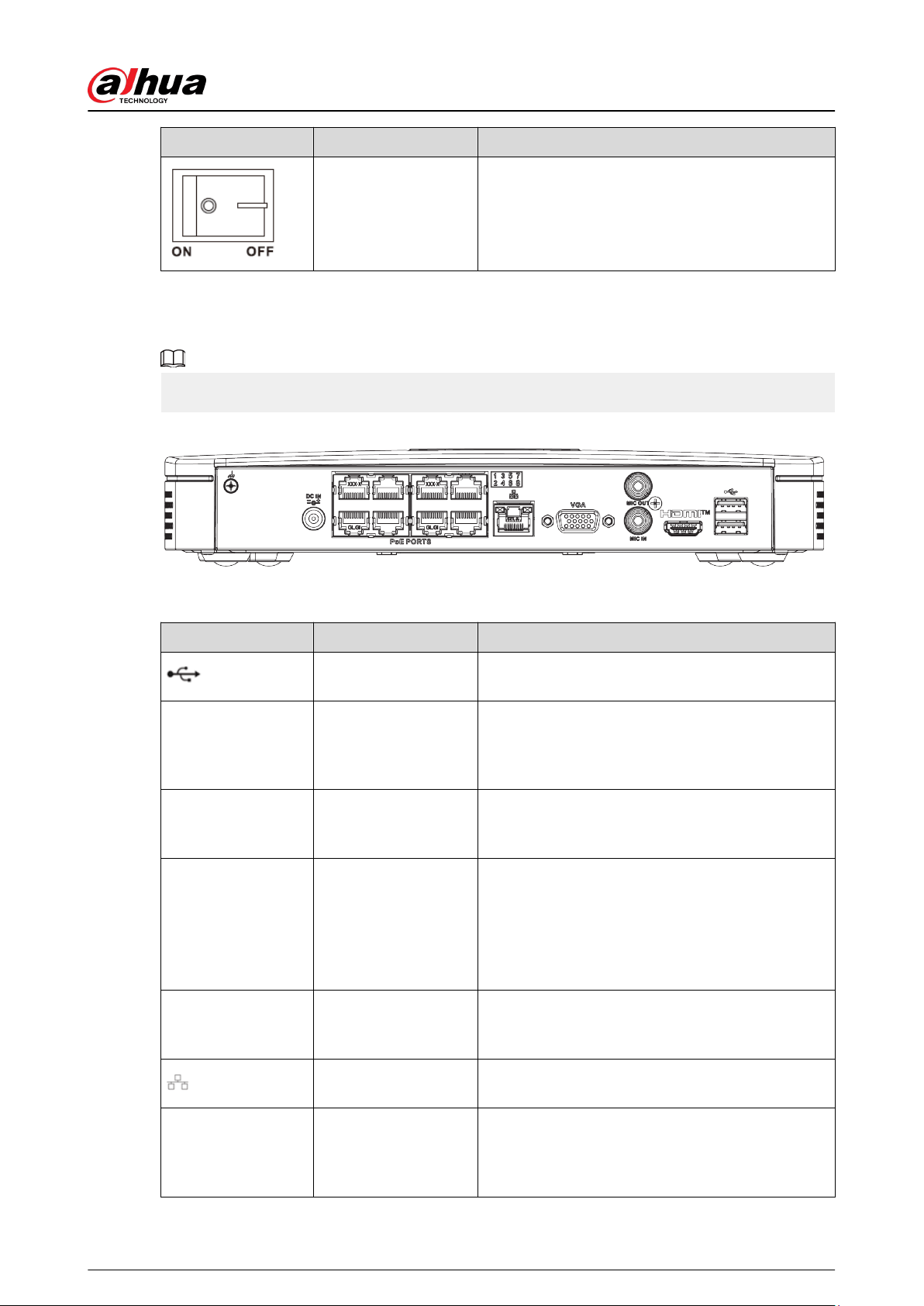
Port Name Connection Function
Power switch Power on/o button.
2.2.16 NVR21-8P-I/NVR21-8P-I2 Series
The gure is for reference only.
Figure 2-73 Rear panel
Table 2-31 Ports
Port Name Connection Function
USB port
USB port. Connect to mouse, USB storage device
and more.
HDMI
High Denition Media
Page
High denition audio and video signal output port.
It transmits uncompressed high denition video
and multiple-channel data to the HDMI port of the
display device. HDMI version is 1.4.
MIC IN Audio input port
Bidirectional talk input port. It is to receive the
analog audio signal output from the devices such
as microphone, pickup.
MIC OUT Audio output port
Audio output port. It is to output the analog audio
signal to the devices such as the sound box.
●
Bidirectional talk output.
●
Audio output on 1-window video monitor.
●
Audio output on 1-window video playback.
VGA VGA video output port
VGA video output port. Output analog video
signal. It can connect to the monitor to view
analog video.
Network port
10/100 Mbps self-adaptive Ethernet port. Connect
to the network cable.
PoE PORTS PoE port
Built-in switch. Support PoE function.
For PoE series product, you can use this port to
provide power to the network camera.
User's Manual
48
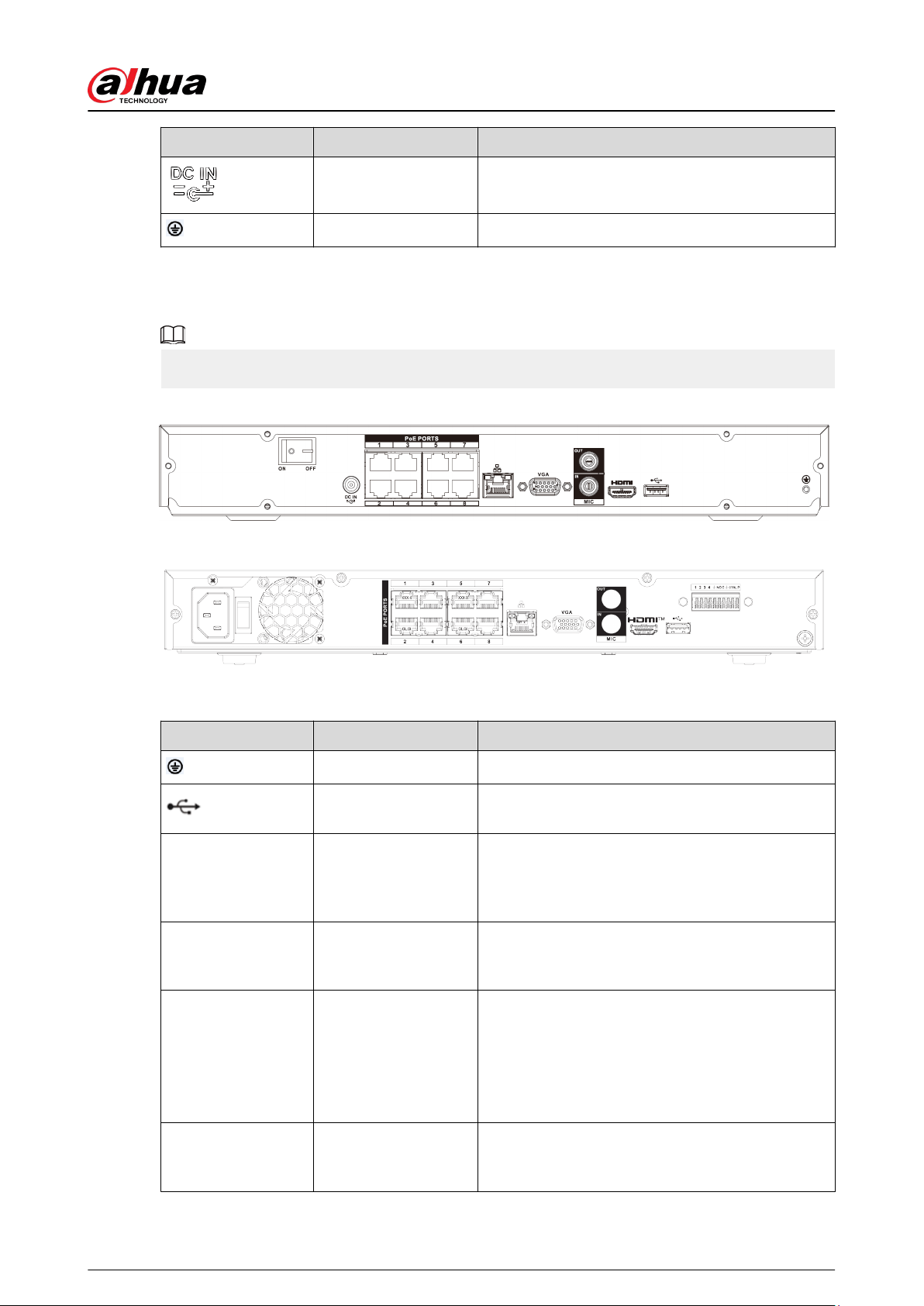
Port Name Connection Function
Power input port Power socket.
GND Ground end.
2.2.17 NVR22-8P-I/NVR22-8P-I2 Series
The gure is for reference only.
Figure 2-74 Rear panel
Figure 2-75 Rear panel
Table 2-32 Ports
Port Name Connection Function
GND Ground end.
USB port
USB port. Connect to mouse, USB storage device
and more.
HDMI
High Denition Media
Page
High denition audio and video signal output port.
It transmits uncompressed high denition video
and multiple-channel data to the HDMI port of the
display device. HDMI version is 1.4.
MIC IN Audio input port
Bidirectional talk input port. It is to receive the
analog audio signal output from the devices such
as microphone, pickup.
MIC OUT Audio output port
Audio output port. It is to output the analog audio
signal to the devices such as the sound box.
●
Bidirectional talk output.
●
Audio output on 1-window video monitor.
●
Audio output on 1-window video playback.
VGA VGA video output port
VGA video output port. Output analog video
signal. It can connect to the monitor to view
analog video.
User's Manual
49
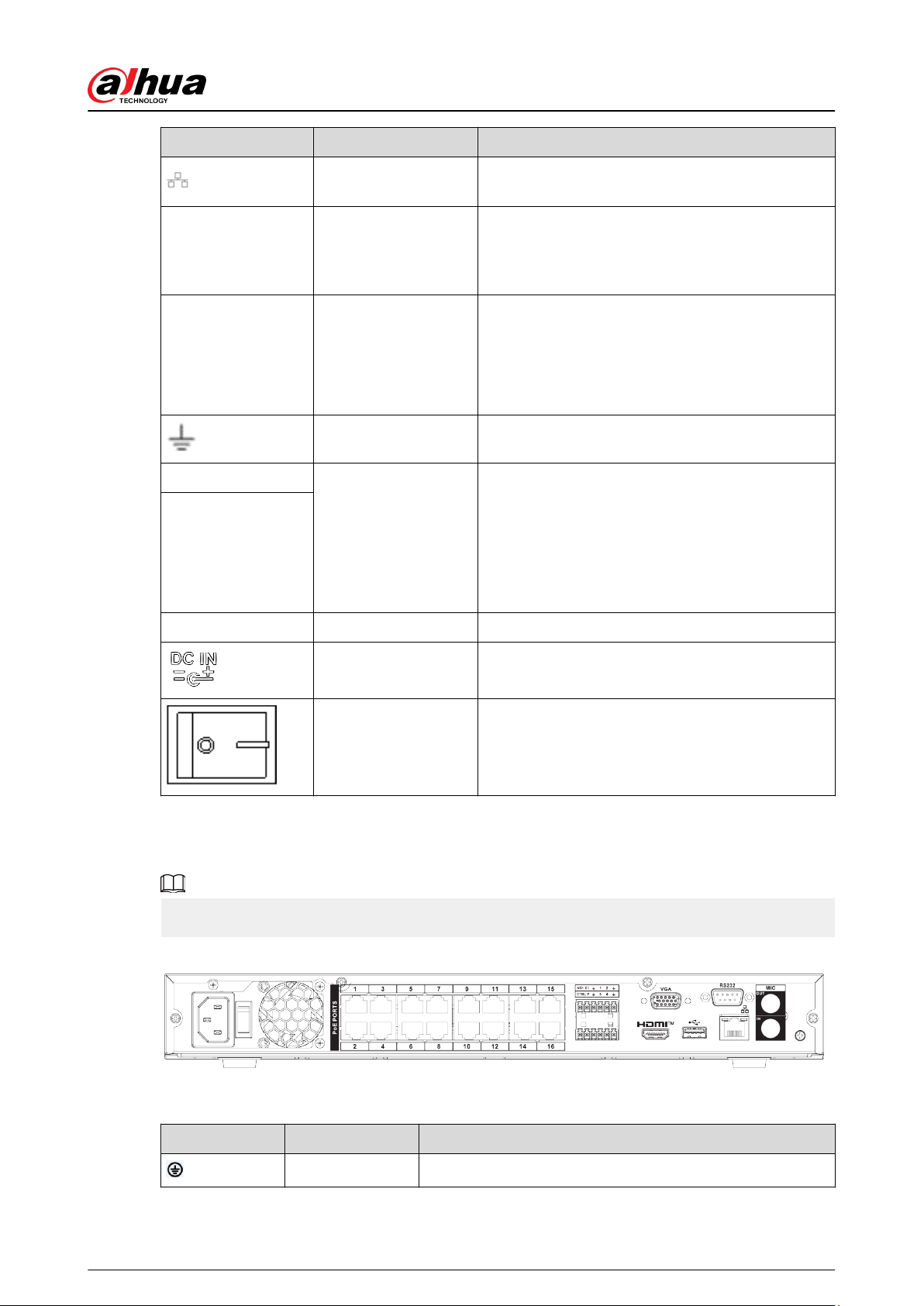
Port Name Connection Function
Network port
10/100 Mbps self-adaptive Ethernet port. Connect
to the network cable.
PoE PORTS PoE port
Built-in switch. Support PoE function.
For PoE series product, you can use this port to
provide power to the network camera.
1–4 Alarm input port 1–4
●
There are two types; NO (normal open)/NC
(normal close).
●
When your alarm input device is using external
power, please make sure the device and the
NVR have the same ground.
GND Alarm input ground port.
N1, N2
Alarm output port 1–2
●
2 groups of alarm output ports. (Group 1: port
NO1–C1, Group 2: port NO2–C2).Output alarm
signal to the alarm device. Please make sure
there is power to the external alarm device.
●
NO: Normal open alarm output port.
●
C: Alarm output public end.
C1, C2
Power input port — 90~264-12 VAC 12.5 A/-53 V 2.83 A
Power input port Power socket.
Power switch Power on/o button.
2.2.18 NVR22-16P-I/NVR22-8P-I2 Series
The gure is for reference only.
Figure 2-76 Rear panel
Table 2-33 Ports
Port Name Connection Function
GND Ground end.
User's Manual
50
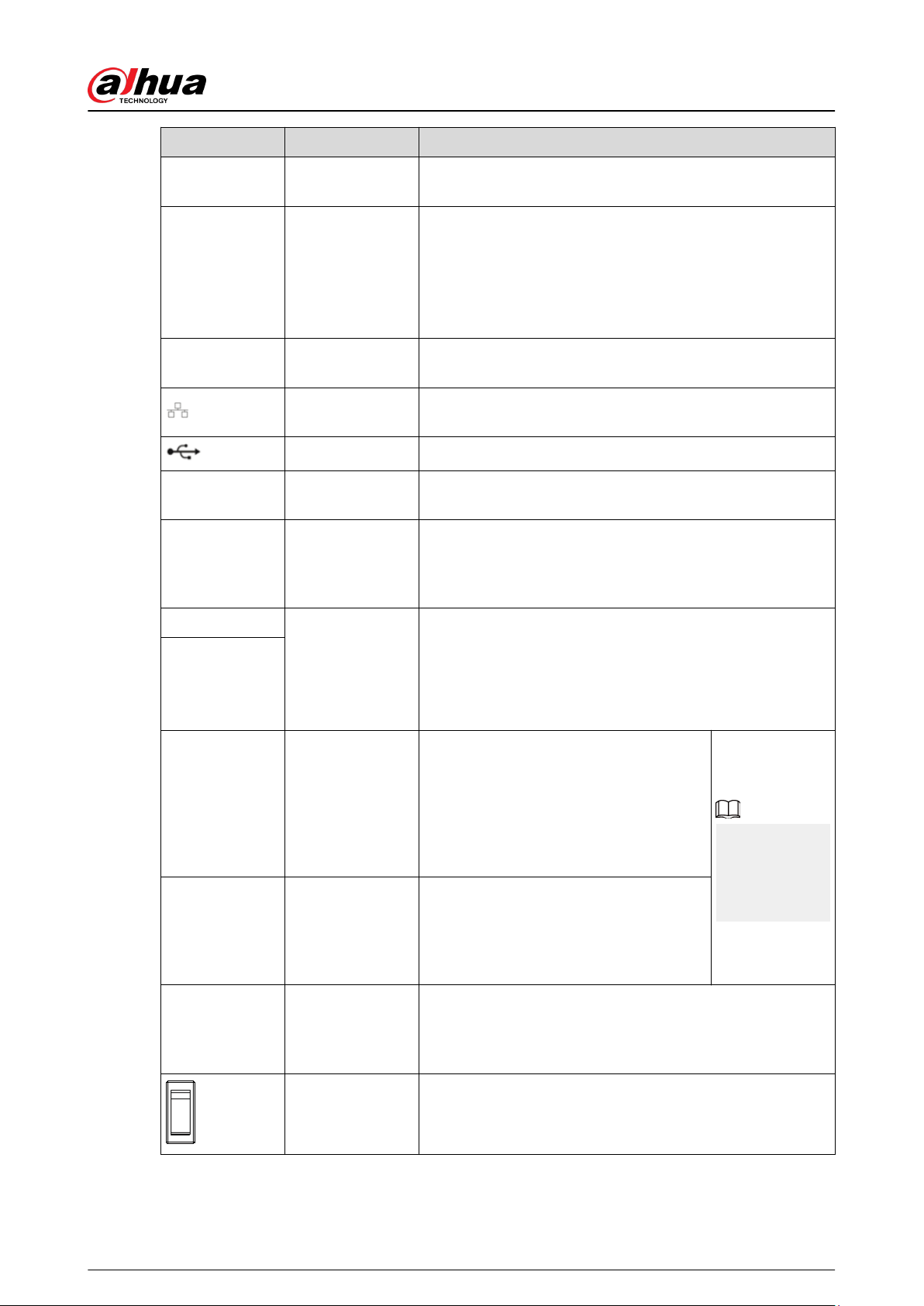
Port Name Connection Function
MIC IN Audio input port
Bidirectional talk input port. It is to receive the analog audio
signal output from the devices such as microphone, pickup.
MIC OUT Audio output port
Audio output port. It is to output the analog audio signal to
the devices such as the sound box.
●
Bidirectional talk output.
●
Audio output on 1-window video monitor.
●
Audio output on 1-window video playback.
RS-232
RS-232 debug
COM
It is for general COM debug to congure IP address or
transfer transparent COM data.
Network port
10/100 Mbps self-adaptive Ethernet port. Connect to the
network cable.
USB port USB port. Connect to mouse, USB storage device and more.
VGA
VGA video output
port
VGA video output port. Output analog video signal. It can
connect to the monitor to view analog video.
HDMI
High Denition
Media Page
High denition audio and video signal output port. It
transmits uncompressed high denition video and
multiple-channel data to the HDMI port of the display
device. HDMI version is 1.4.
NO1
Alarm output port
●
1 group of alarm output ports (port NO1–C1). Output
alarm signal to the alarm device. Please make sure there
is power to the external alarm device.
●
NO: Normal open alarm output port.
●
C: Alarm output public end.
C1
CTRL —
Controllable power supply output.
Control the output of the on-o button
alarm relay. It controls the alarm device
with the presence or absence of voltage.
It can also be used as power input for
some alarm devices such as alarm
detectors.
The two ports
serve as another
group of alarm
output ports.
P —
Power output port. It can provide power
to some peripheral devices such as
camera and alarm device. Make sure the
power supply of peripheral device shall
be below 1 A.
PoE PORTS PoE port
Built-in switch. Support PoE function.
For PoE series product, you can use this port to provide
power to the network camera.
Power switch Power on/o button.
User's Manual
51
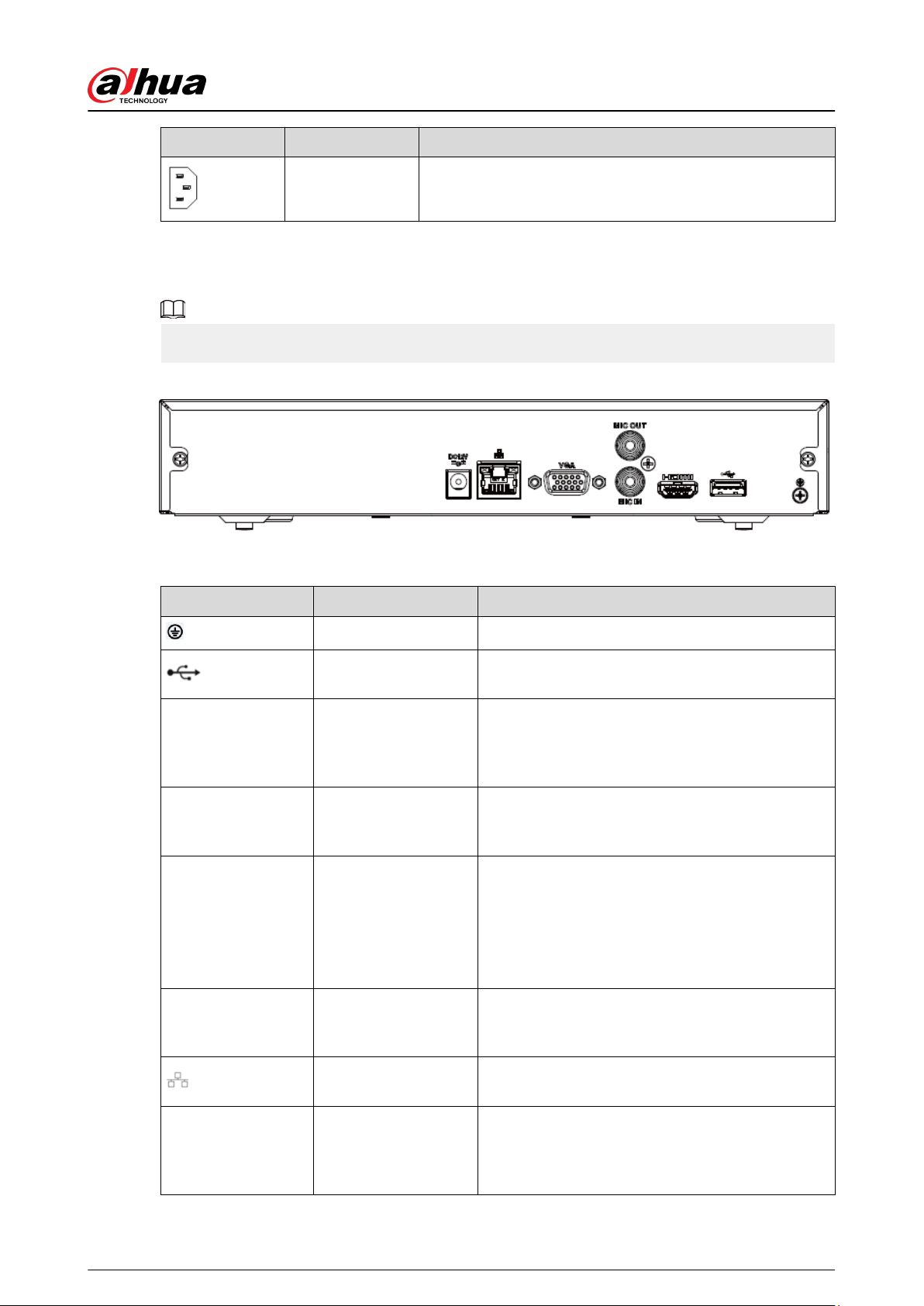
Port Name Connection Function
Power input port Power socket.
2.2.19 NVR21HS-I/NVR21HS-I2 Series
The gure is for reference only.
Figure 2-77 Rear panel
Table 2-34 Rear panel description
Port Name Connection Function
GND Ground end.
USB port
USB port. Connect to mouse, USB storage device
and more.
HDMI
High Denition Media
Page
High denition audio and video signal output port.
It transmits uncompressed high denition video
and multiple-channel data to the HDMI port of the
display device. HDMI version is 1.4.
MIC IN Audio input port
Bidirectional talk input port. It is to receive the
analog audio signal output from the devices such
as microphone, pickup.
MIC OUT Audio output port
Audio output port. It is to output the analog audio
signal to the devices such as the sound box.
●
Bidirectional talk output.
●
Audio output on 1-window video monitor.
●
Audio output on 1-window video playback.
VGA VGA video output port
VGA video output port. Output analog video
signal. It can connect to the monitor to view
analog video.
Network port
10/100 Mbps self-adaptive Ethernet port. Connect
to the network cable.
PoE PORTS PoE port
Built-in switch. Support PoE function.
For PoE series product, you can use this port to
provide power to the network camera.
User's Manual
52
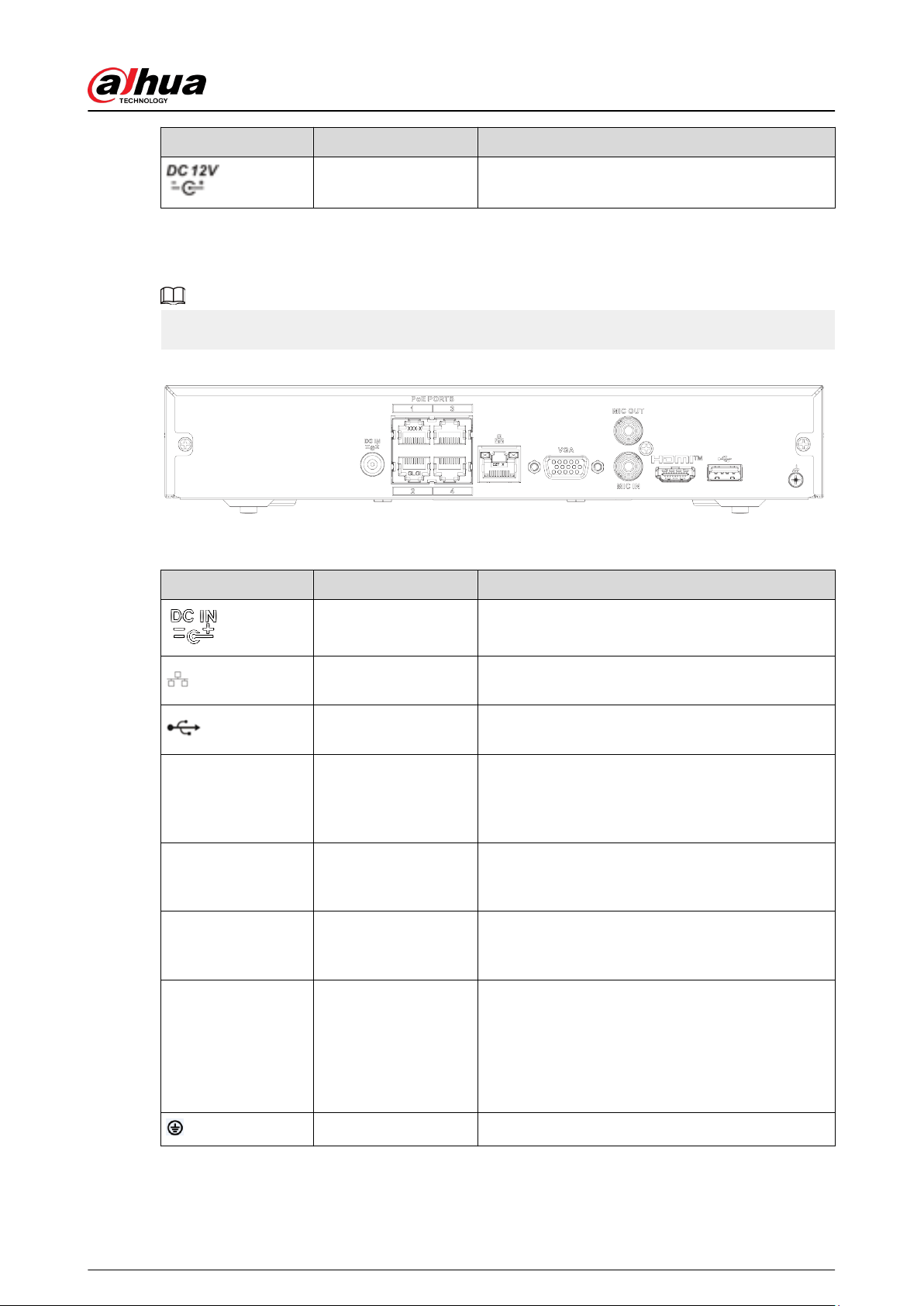
Port Name Connection Function
Power input port Power socket.
2.2.20 NVR21HS-P-I/NVR21HS-P-I2 Series
The gure is for reference only.
Figure 2-78 Rear panel
Table 2-35 Ports
Port Name Connection Function
Power input port Power socket.
Network port
10/100 Mbps self-adaptive Ethernet port. Connect
to the network cable.
USB port
USB port. Connect to mouse, USB storage device
and more.
HDMI
High Denition Media
Page
High denition audio and video signal output port.
It transmits uncompressed high denition video
and multiple-channel data to the HDMI port of the
display device. HDMI version is 1.4.
VGA VGA video output port
VGA video output port. Output analog video
signal. It can connect to the monitor to view
analog video.
MIC IN Audio input port
Bidirectional talk input port. It is to receive the
analog audio signal output from the devices such
as microphone, pickup.
MIC OUT Audio output port
Audio output port. It is to output the analog audio
signal to the devices such as the sound box.
●
Bidirectional talk output.
●
Audio output on 1-window video monitor.
●
Audio output on 1-window video playback.
GND Ground end.
User's Manual
53
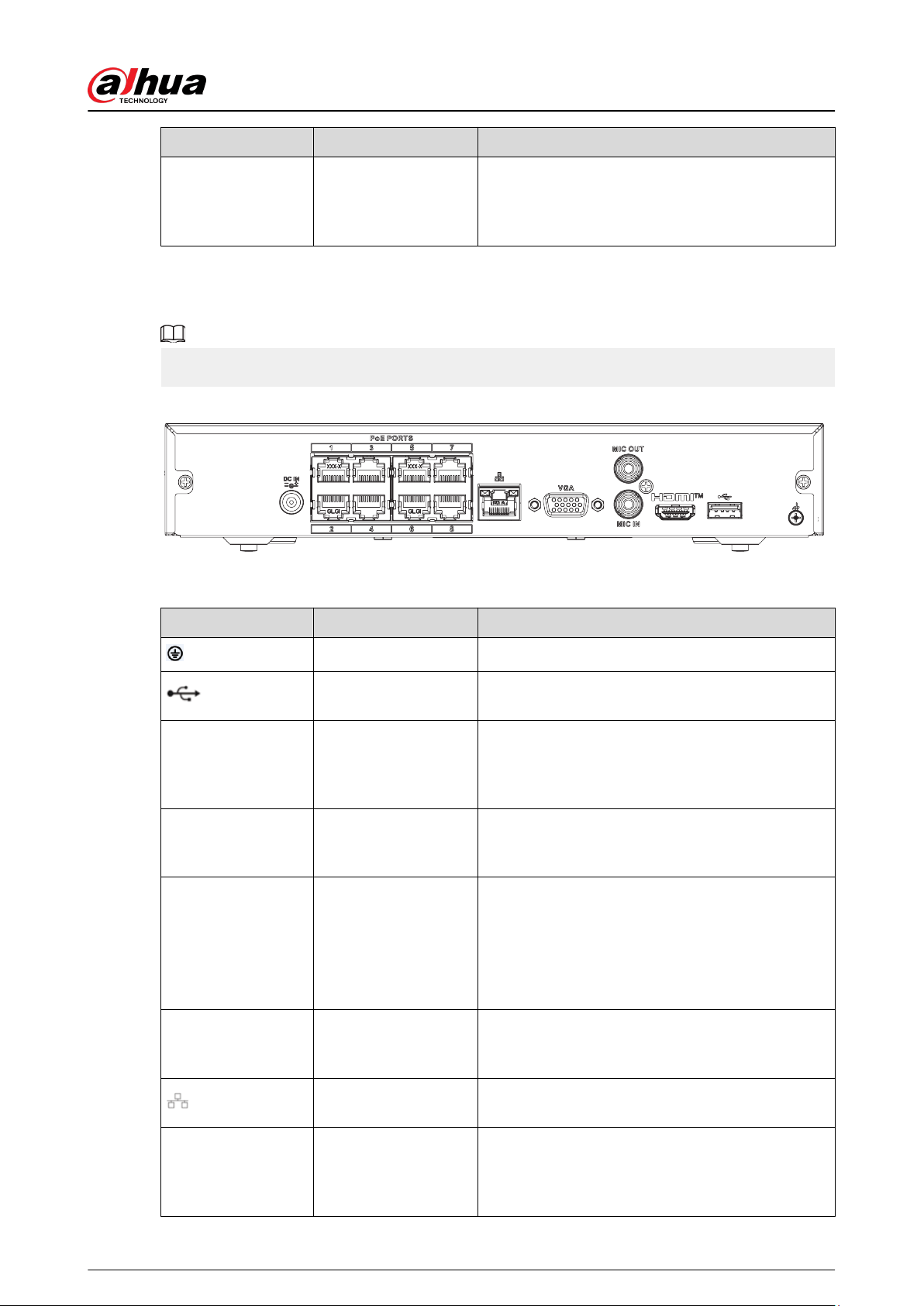
Port Name Connection Function
PoE PORTS PoE port
Built-in switch. Support PoE function.
For PoE series product, you can use this port to
provide power to the network camera.
2.2.21 NVR21HS-8P-I/NVR21HS-8P-I2 Series
The gure is for reference only.
Figure 2-79 Rear panel
Table 2-36 Ports
Port Name Connection Function
GND Ground end.
USB port
USB port. Connect to mouse, USB storage device
and more.
HDMI
High Denition Media
Page
High denition audio and video signal output port.
It transmits uncompressed high denition video
and multiple-channel data to the HDMI port of the
display device. HDMI version is 1.4.
MIC IN Audio input port
Bidirectional talk input port. It is to receive the
analog audio signal output from the devices such
as microphone, pickup.
MIC OUT Audio output port
Audio output port. It is to output the analog audio
signal to the devices such as the sound box.
●
Bidirectional talk output.
●
Audio output on 1-window video monitor.
●
Audio output on 1-window video playback.
VGA VGA video output port
VGA video output port. Output analog video
signal. It can connect to the monitor to view
analog video.
Network port
10/100 Mbps self-adaptive Ethernet port. Connect
to the network cable.
PoE PORTS PoE port
Built-in switch. Support PoE function.
For PoE series product, you can use this port to
provide power to the network camera.
User's Manual
54
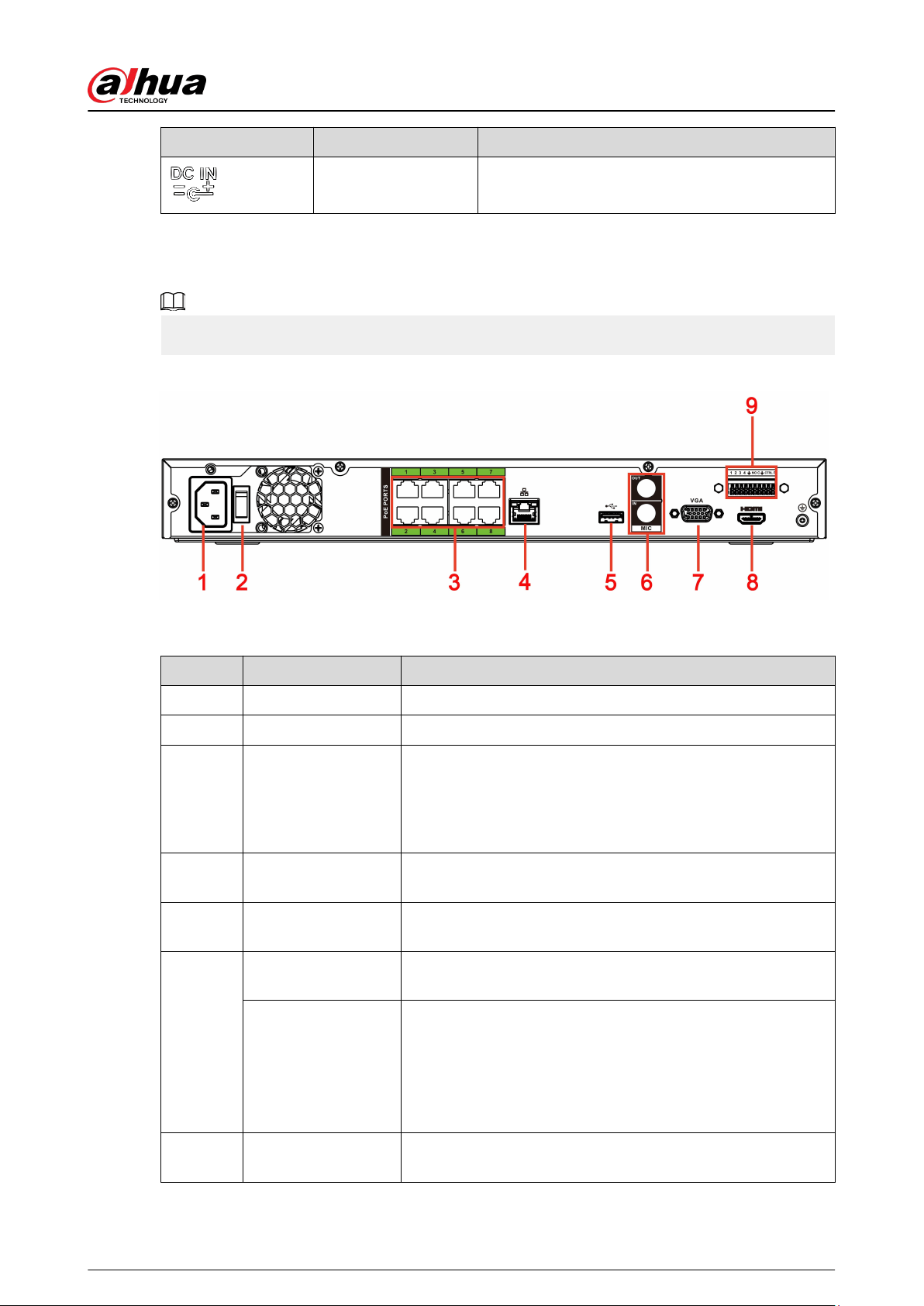
Port Name Connection Function
Power input port Power socket.
2.2.22 NVR4208-8P-I Series
These gures are for reference only.
Figure 2-80 Rear panel
Table 2-37 Ports
No. Port Name Function
1 Power input port Input power of 100-240 V and 50-60 Hz.
2 Power button Turns on/o the NVR.
3 PoE port
Built-in switch. It can provide power for IPC.
8 PoE ports: 1-8 are ePoE ports (support 300m @ 100M. 800m
@ 10M). The device supports 48 V, 100 W total power output
under 55 °C, and 48 V, 130 W total power output under 45 °C.
4 Network port
10/100/1000 Mbps self-adaptive Ethernet port. Connect to the
network cable.
5 USB port
USB 3.0 port. Connect to devices such as mouse, USB storage
device and USB burner.
6
MIC IN
Bidirectional talk input port. It is to receive analog audio signal
from devices such as microphone, sound pickup.
MIC OUT
Audio output port. It is to output analog audio signal to
devices such as sound box.
●
Bidirectional talk output.
●
Audio output on 1-window video monitor.
●
Audio output on 1-window video playback.
7 VGA port
VGA video output port. Output analog video signal. It can
connect to the monitor to view analog video.
User's Manual
55
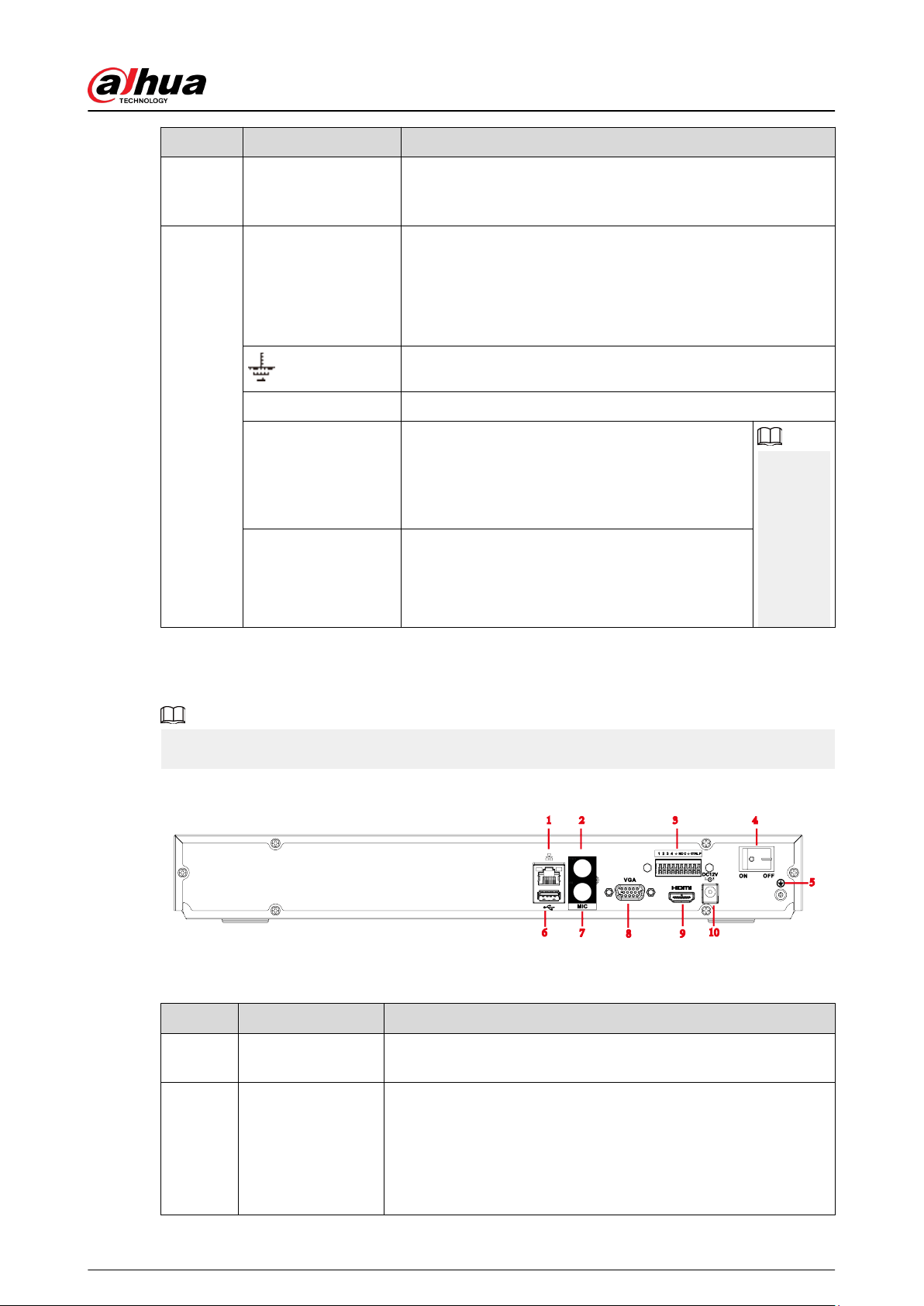
No. Port Name Function
8 HDMI port
High denition audio and video signal output port. It
transmits uncompressed high denition video and multiple-
channel audio data to displays with HDMI port.
9
Alarm input port (1-4)
●
They receive signals from external alarm source. Alarm
input includes two types; NO (normal open) and NC
(normal close).
●
When your alarm input device is using external power,
make sure the device and the NVR have the same GND.
GND. Alarm input ground port.
NO C One NO activation output group. (On-o button).
CTRL
Controllable power supply output. Control the
output of the on-o button alarm relay. It controls
the alarm device with the presence or absence of
voltage. It can also be used as power input for
some alarm devices such as alarm detectors.
The two
ports
serve as
another
group of
alarm
output
ports.
P
Power output port. It can provide power to some
peripheral devices such as camera and alarm
device. Make sure the power supply of peripheral
device shall be below 1 A.
2.2.23 NVR4216-I Series
The gure is for reference only.
Figure 2-81 Rear panel
Table 2-38 Ports
No. Port Name Function
1 Network port
10/100/1000 Mbps self-adaptive Ethernet port. Connect to the
network cable.
2 MIC OUT
Audio output port. It is to output analog audio signal to devices
such as sound box.
●
Bidirectional talk output.
●
Audio output on 1-window video monitor.
●
Audio output on 1-window video playback.
User's Manual
56
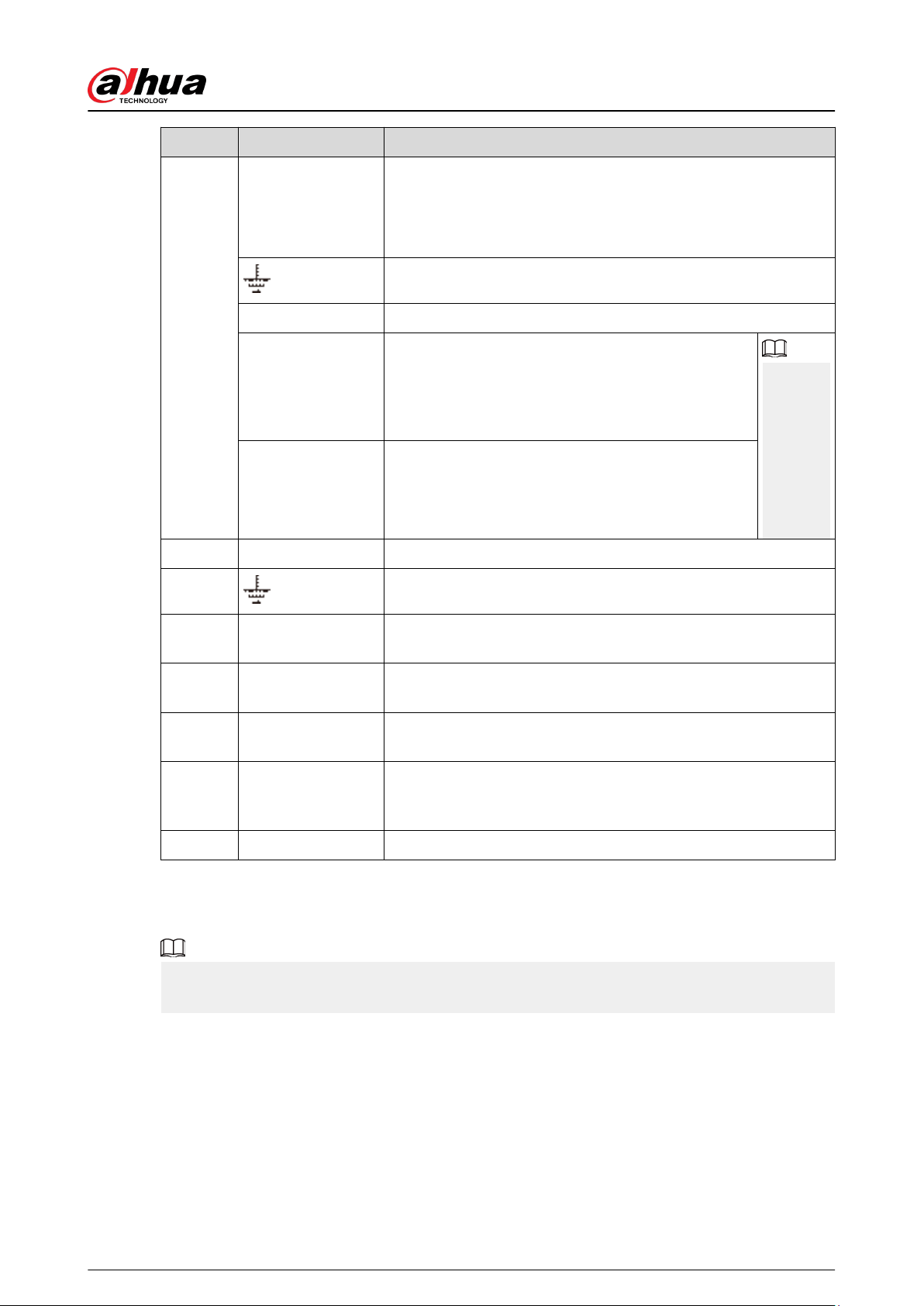
No. Port Name Function
3
Alarm input port
(1-4)
●
They receive signals from external alarm source. Alarm input
includes two types; NO (normal open) and NC (normal close).
●
When your alarm input device is using external power, make
sure the device and the NVR have the same GND.
GND. Alarm input ground port.
NO C One NO activation output group. (On-o button).
CTRL
Controllable power supply output. Control the
output of the on-o button alarm relay. It controls
the alarm device with the presence or absence of
voltage. It can also be used as power input for some
alarm devices such as alarm detectors.
The two
ports
serve as
another
group of
alarm
output
ports.
P
Power output port. It can provide power to some
peripheral devices such as camera and alarm device.
Make sure the power supply of peripheral device
shall be below 1 A.
4 Power button Turns on/o the NVR.
5
GND.
6 USB port
USB 3.0 port. Connect to devices such as mouse, USB storage
device and USB burner.
7 MIC IN
Bidirectional talk input port. It is to receive analog audio signal
from devices such as microphone, sound pickup.
8 VGA port
VGA video output port. Output analog video signal. It can
connect to the monitor to view analog video.
9 HDMI port
High denition audio and video signal output port. It transmits
uncompressed high denition video and multiple-channel audio
data to displays with HDMI port.
10 Power input port Input power of 100-240 V and 50-60 Hz.
2.2.24 NVR58-I/NVR58-I/L/NVR48-I Series
●
The gure takes NVR58-I/NVR58-I/L/NVR4832-I series as examples.
●
The gure is for reference only.
User's Manual
57
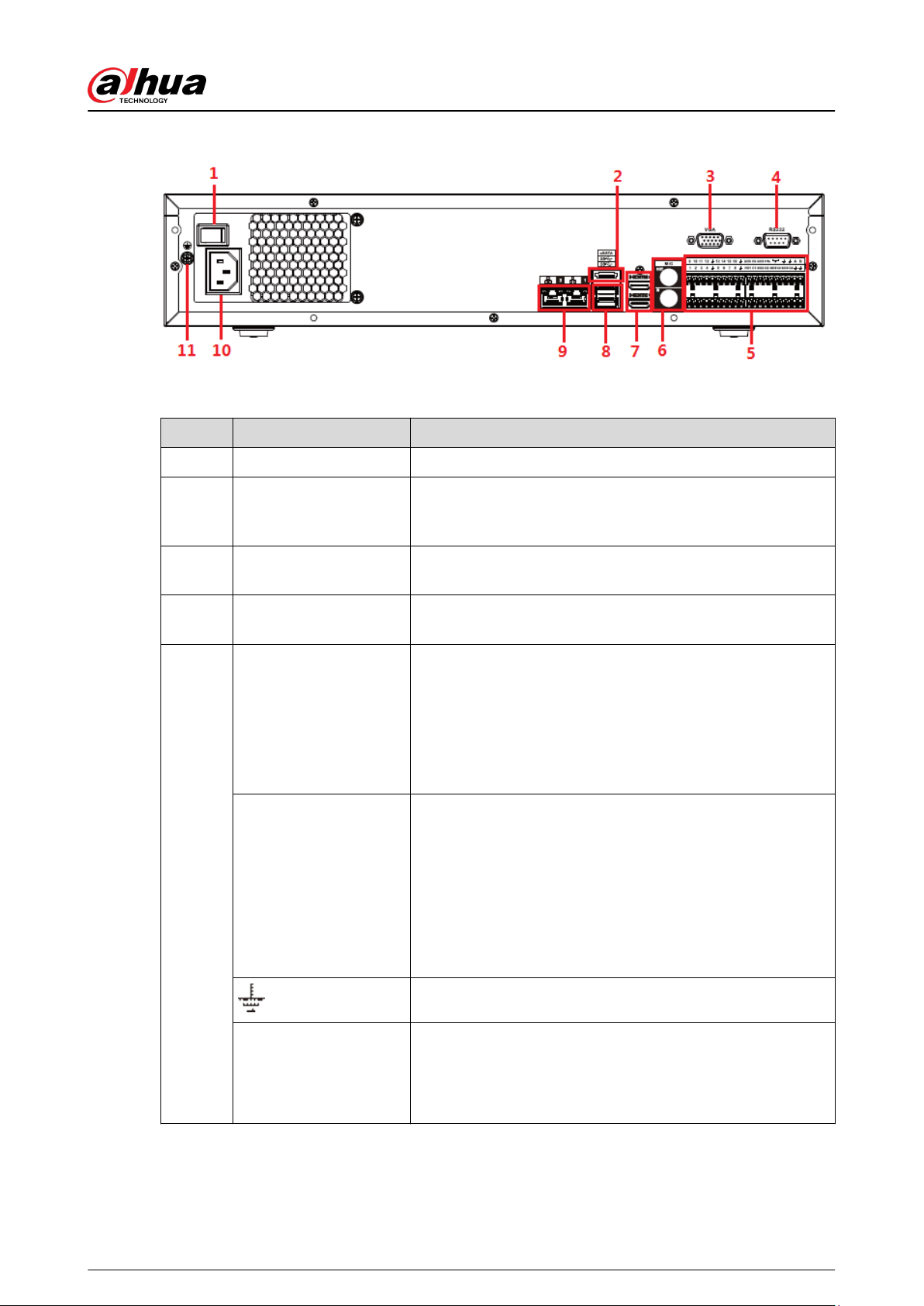
Figure 2-82 Rear panel
Table 2-39 Ports
No. Port Name Function
1 Power button Turns on/o the NVR.
2 eSATA port
External SATA port. It can connect device with SATA port.
You need to jump the HDD when there is peripherally
connected HDD.
3 VGA port
VGA video output port. Output analog video signal. It can
connect to the monitor to view analog video.
4 RS-232 port
It is for general COM debugging to congure IP address and
transfer transparent COM data.
5
Alarm input port (1-16)
●
There are four groups: 1-4, 5-8, 9-12 and 13-16.
They receive signals from external alarm source. Alarm
input includes two types; NO (normal open) and NC
(normal close).
●
When your alarm input device is using external power,
make sure the device and the NVR have the same GND.
Alarm output port (NO1-
NO5, C1-C5, NC5)
●
Five groups of alarm output ports (Group 1: NO1-C1,
Group 2: NO2-C2, Group 3: NO3-C3, Group 4: NO4-C4,
Group 5: NO5, C5, NC5). Output alarm signal to the
external alarm device. Make sure power supply is
available for the external alarm device.
●
NO: Normal open alarm output port.
●
C: Alarm output public end.
●
NC: Normal close alarm output port.
GND. Alarm input ground port.
RS-485 port (A, B)
●
RS485_A port. Control cable A of the 485 device. It
connects external devices such as speed dome and PTZ.
●
RS485_B port. Control cable B of the 485 device. It
connects external devices such as speed dome and PTZ.
User's Manual
58
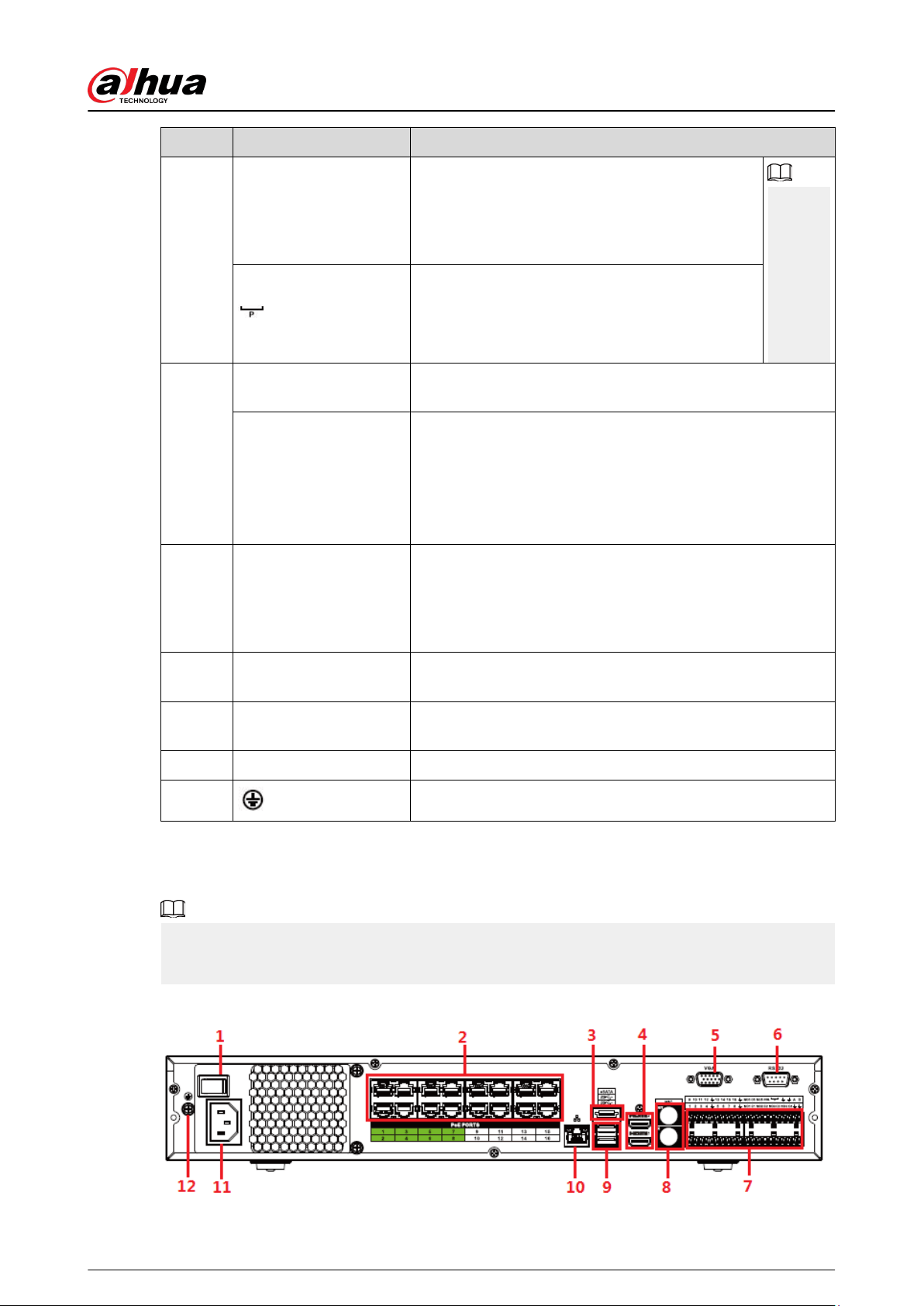
No. Port Name Function
CTRL
Controllable 12 V power output. It is to control the
on-o alarm relay output. It can be used to control
the device alarm output. At the same time, it can
also be used as the power input source of some
devices such as alarm detector.
The two
ports
serve as
another
group of
alarm
output
ports.
+12 V power output port. It can provide power to
some peripheral devices such as camera and
alarm device. Make sure the power supply of
peripheral device shall be below 1 A.
6
MIC IN
Bidirectional talk input port. It is to receive analog audio
signal from devices such as microphone, sound pickup.
MIC OUT
Audio output port. It is to output analog audio signal to
devices such as sound box.
●
Bidirectional talk output.
●
Audio output on 1-window video monitor.
●
Audio output on 1-window video playback.
7 HDMI port
High denition audio and video signal output port. It
transmits uncompressed high denition video and multiple-
channel audio data to displays with HDMI port. The two
HDMI ports support 2-channel high denition HDMI output
of dierent sources.
8 USB port
USB 3.0 port. Connect to devices such as mouse, USB storage
device and USB burner.
9 Network port
10/100/1000 Mbps self-adaptive Ethernet port. Connect to
the network cable.
10 Power input port Input power of 100-240 V and 50-60 Hz.
11
GND.
2.2.25 NVR54-I/NVR54-I/L/NVR44-I Series
●
The following gure takes NVR5432-16P-I and NVR5432-16P-I/L series as examples.
●
The gure is for reference only.
Figure 2-83 Rear panel
User's Manual
59
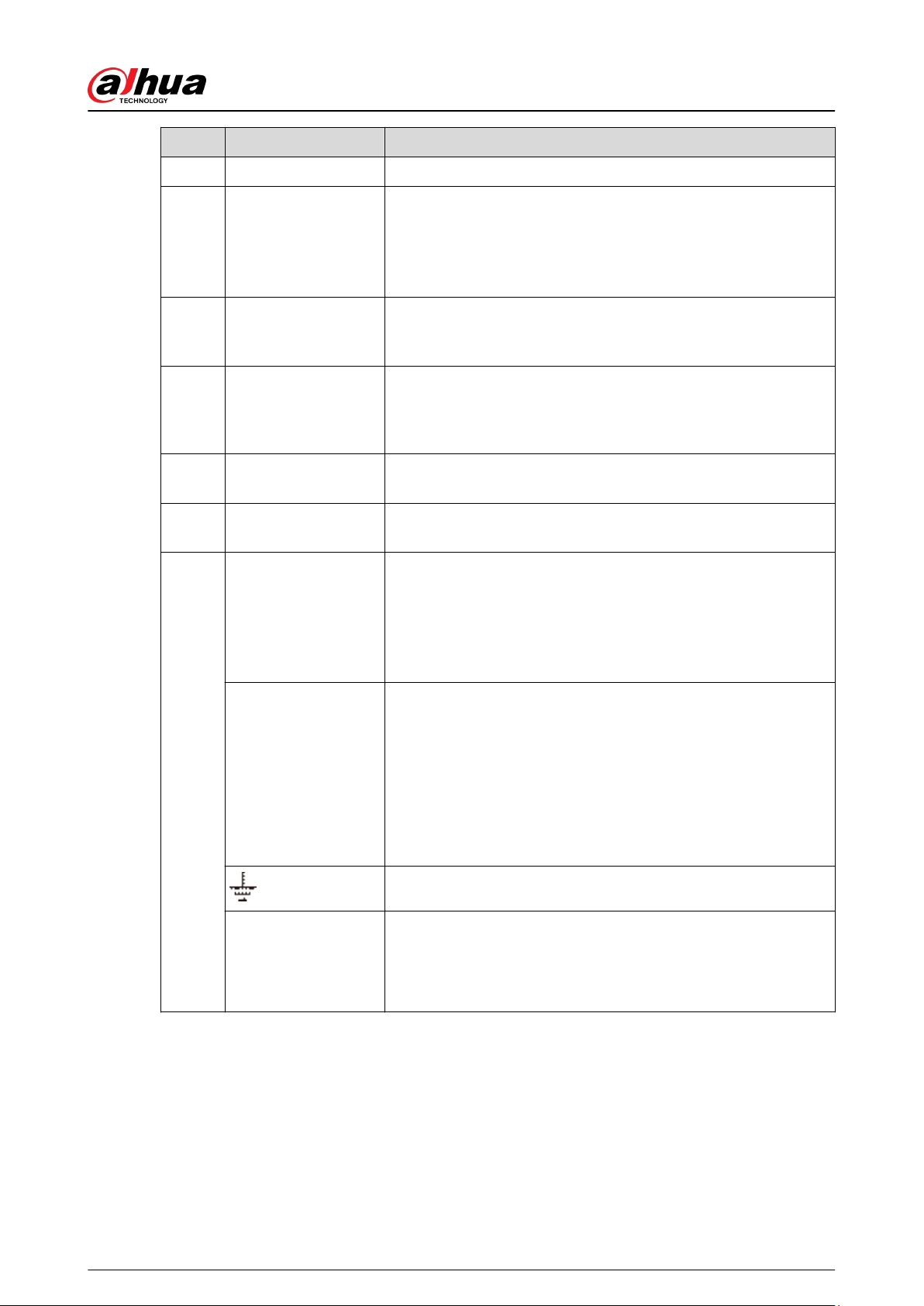
No. Port Name Function
1 Power button Turns on/o the NVR.
2 PoE port
Built-in switch. It can provide power for IPC.
●
16 PoE ports: 1-8 are ePoE ports (support 300m @ 100M.
800m @ 10M). 9-16 are regular PoE ports.
●
Device with 16 PoEs supports 150 W total power.
3 eSATA port
External SATA port. It can connect device with SATA port. You
need to jump the HDD when there is peripherally connected
HDD.
4 HDMI port
High denition audio and video signal output port. It transmits
uncompressed high denition video and multiple-channel audio
data to displays with HDMI port. The two HDMI ports support 2-
channel high denition HDMI output of dierent sources.
5 VGA port
VGA video output port. Output analog video signal. It can
connect to the monitor to view analog video.
6 RS-232 port
It is for general COM debugging to congure IP address and
transfer transparent COM data.
7
Alarm input port
(1-16)
●
There are four groups: 1-4, 5-8, 9-12 and 13-16.
They receive signals from external alarm source. Alarm input
includes two types; NO (normal open) and NC (normal close).
●
When your alarm input device is using external power, make
sure the device and the NVR have the same GND.
Alarm output port
(NO1-NO5, C1-C5,
NC5)
●
Five groups of alarm output ports (Group 1: NO1-C1, Group 2:
NO2-C2, Group 3: NO3-C3, Group 4: NO4-C4, Group 5: NO5,
C5, NC5). Output alarm signal to the external alarm device.
Make sure power supply is available for the external alarm
device.
●
NO: Normal open alarm output port.
●
C: Alarm output public end.
●
NC: Normal close alarm output port.
GND. Alarm input ground port.
RS-485 port (A, B)
●
RS485_A port. Control cable A of the 485 device. It connects
external devices such as speed dome and PTZ.
●
RS485_B port. Control cable B of the 485 device. It connects
external devices such as speed dome and PTZ.
User's Manual
60
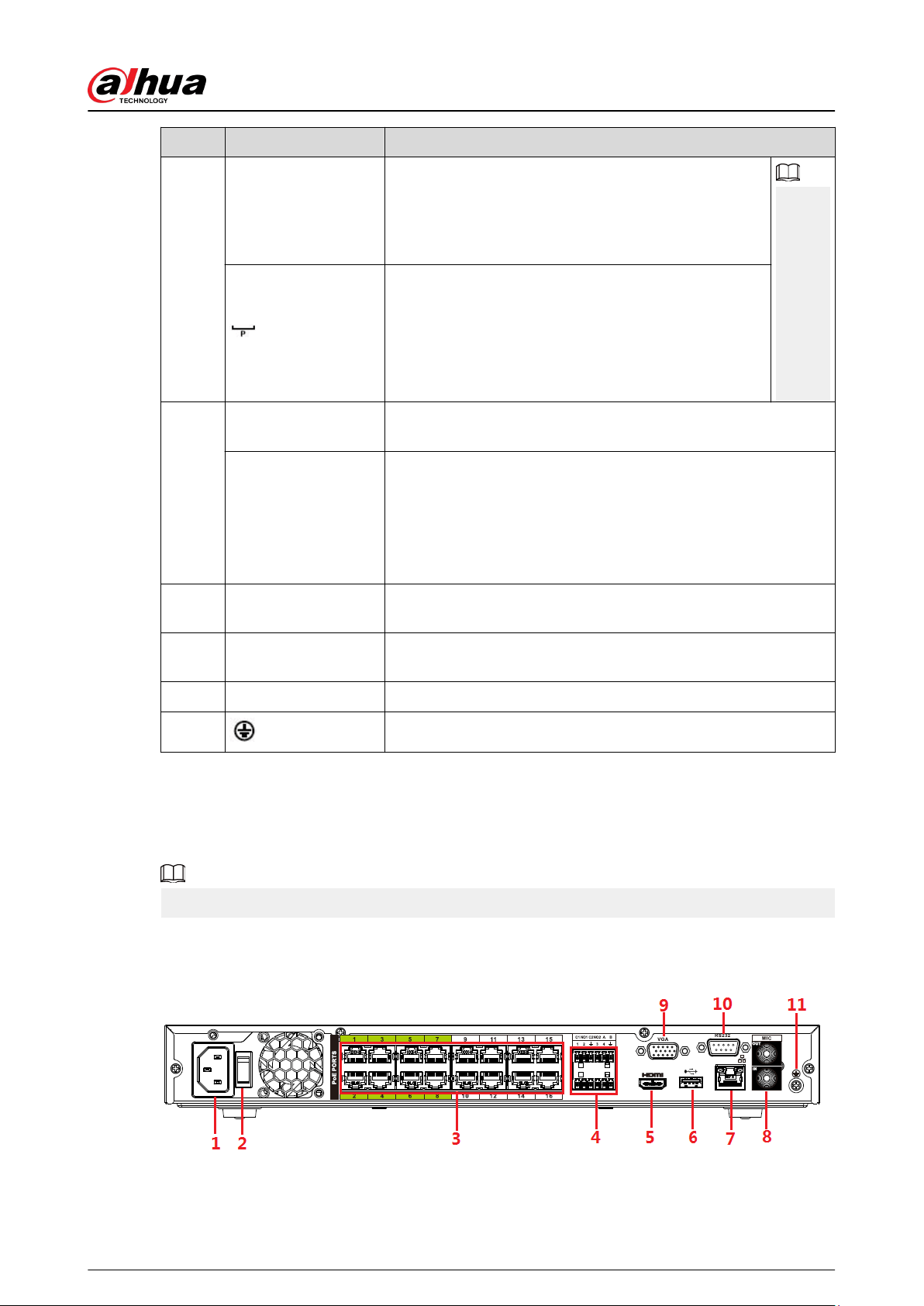
No. Port Name Function
CTRL
Controllable 12 V power output. It is to control the on-
o alarm relay output. It can be used to control the
device alarm output. At the same time, it can also be
used as the power input source of some devices such
as alarm detector.
The
two
ports
serve as
another
group
of
alarm
output
ports.
+12 V power output port. It can provide power to some
peripheral devices such as camera and alarm device.
Make sure the power supply of peripheral device shall
be below 1 A.
8
MIC IN
Bidirectional talk input port. It is to receive analog audio signal
from devices such as microphone, sound pickup.
MIC OUT
Audio output port. It is to output analog audio signal to devices
such as sound box.
●
Bidirectional talk output.
●
Audio output on 1-window video monitor.
●
Audio output on 1-window video playback.
9 USB port
USB 3.0 port. Connect to devices such as mouse, USB storage
device and USB burner.
10 Network port
10/100/1000 Mbps self-adaptive Ethernet port. Connect to the
network cable.
11 Power input port Input power of 100-240 V and 50-60 Hz.
12
GND.
2.2.26 NVR52-16P-I/NVR52-16P-I/L/NVR52-8P-I/NVR52-8P-
I/L/NVR42-16P-I Series
These gures are for reference only.
The NVR52-16P-I/NVR52-16P-I/L series rear panel is shown as below.
Figure 2-84 Rear panel
The NVR52-8P-I/NVR52-8P-I/L series rear panel is shown as below.
User's Manual
61
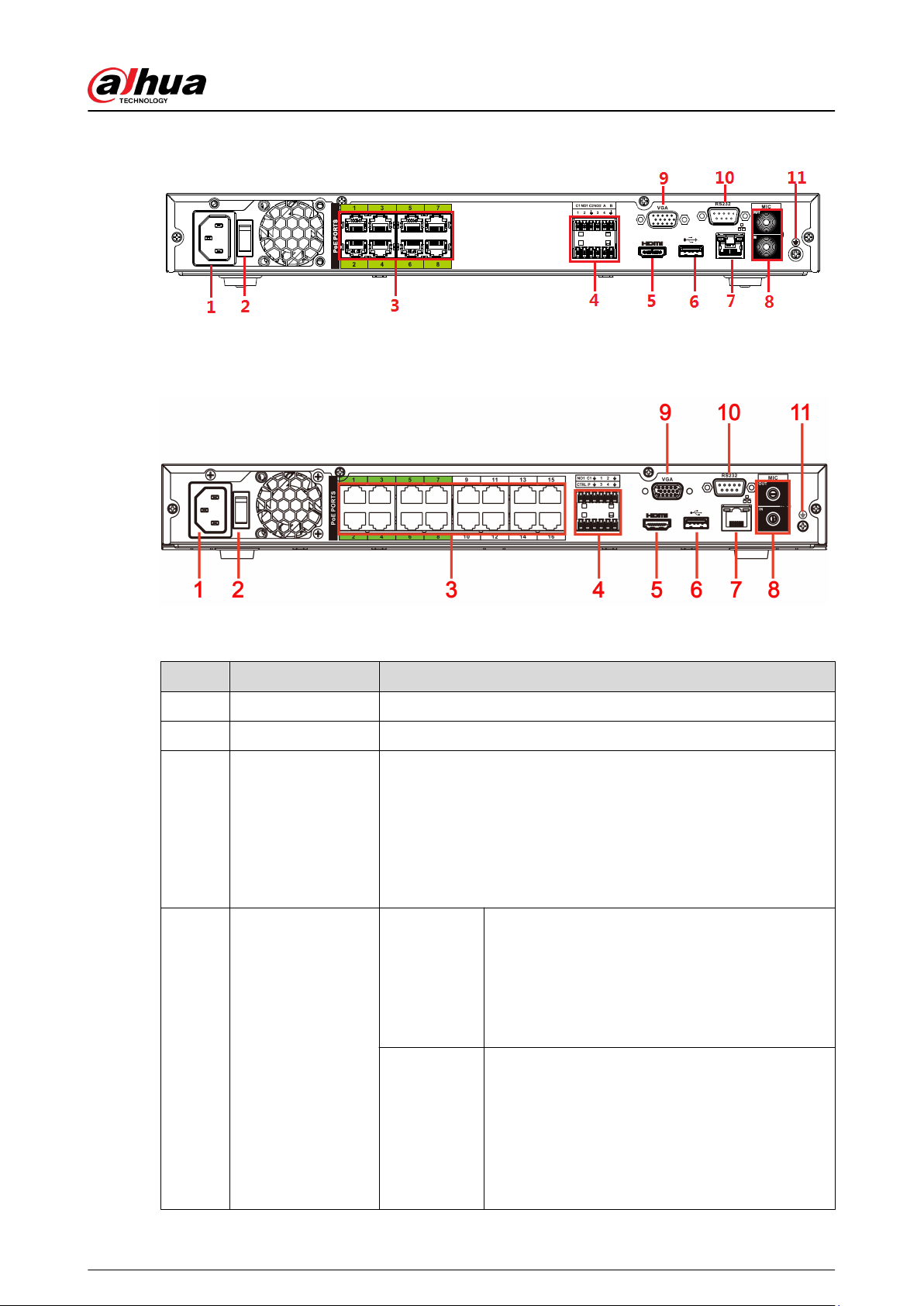
Figure 2-85 Rear panel
The NVR4216-16P-I series rear panel is shown as below.
Figure 2-86 Rear panel
Table 2-40 Rear panel description
No. Port Name Function
1 Power input port Input power of 100-240 V and 50-60 Hz.
2 Power button Turns on/o the NVR.
3 PoE port
Built-in switch. It can provide power for IPC.
16 PoE ports: 1-8 are ePoE ports (support 300m @ 100M. 800m @
10M). 9-16 are regular PoE ports. The device supports 150 W total
power.
8 PoE ports: 1-8 are ePoE ports (support 300m @ 100M. 800m @
10M). The device supports 48 V, 120 W total power.
4
Alarm input/output
of NVR52-16P-I/
NVR52-16P-I/L and
NVR52-8P-I/
NVR52-8P-I/L
Alarm input
port (1-4)
●
They receive signals from external alarm
source. Alarm input includes two types; NO
(normal open) and NC (normal close).
●
When your alarm input device is using external
power, make sure the device and the NVR have
the same GND.
Alarm output
port (NO1-
NO2, C1-C2)
●
Two groups of alarm output ports (Group 1:
NO1-C1, Group 2: NO2-C2). Output alarm
signal to the external alarm device. Make sure
power supply is available for the external alarm
device.
●
NO: Normal open alarm output port.
●
C: Alarm output public end.
User's Manual
62
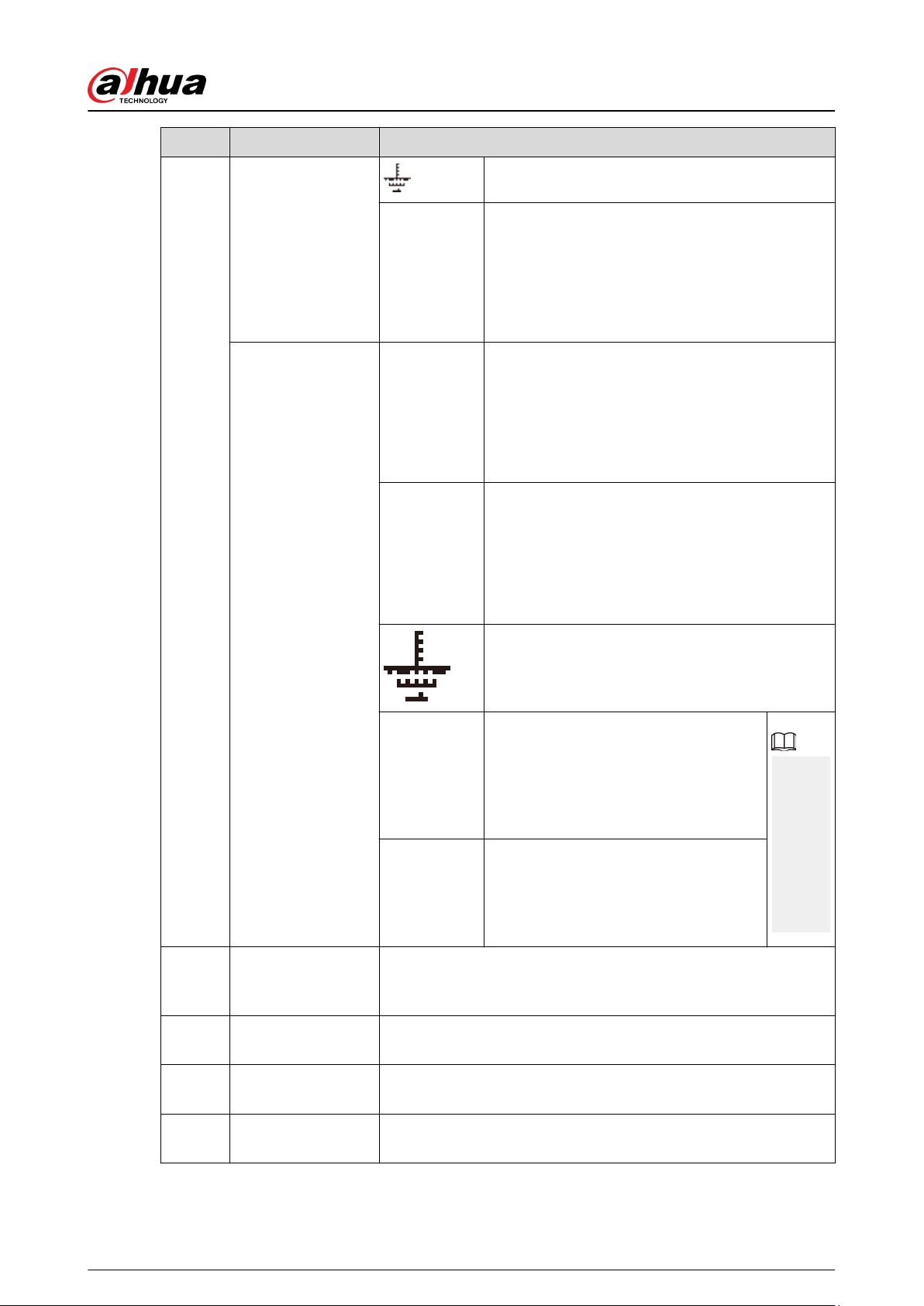
No. Port Name Function
GND. Alarm input ground port.
RS-485 port
(A, B)
●
RS485_A port. Control cable A of the 485
device. It connects external devices such as
speed dome and PTZ.
●
RS485_B port. Control cable B of the 485
device. It connects external devices such as
speed dome and PTZ.
Alarm input/output
of NVR4216-16P-I
Alarm input
port (1-4)
●
They receive signals from external alarm
source. Alarm input includes two types; NO
(normal open) and NC (normal close).
●
When your alarm input device is using external
power, make sure the device and the NVR have
the same GND.
Alarm output
port (NO1,
C1)
●
One group of alarm output ports (Group 1:
NO1-C1). Output alarm signal to the external
alarm device. Make sure power supply is
available for the external alarm device.
●
NO: Normal open alarm output port.
●
C: Alarm output public end.
GND. Alarm input ground port.
CTRL
Controllable 12 V power output. It is to
control the on-o alarm relay output. It
can be used to control the device alarm
output. At the same time, it can also be
used as the power input source of some
devices such as alarm detector.
The two
ports
serve as
another
group
of alarm
output
ports.
P
+12 V power output port. It can provide
power to some peripheral devices such
as camera and alarm device. Make sure
the power supply of peripheral device
shall be below 1 A.
5 HDMI port
High denition audio and video signal output port. It transmits
uncompressed high denition video and multiple-channel audio
data to displays with HDMI port.
6 USB port
USB 3.0 port. Connect to devices such as mouse, USB storage
device and USB burner.
7 Network port
10/100/1000 Mbps self-adaptive Ethernet port. Connect to the
network cable.
8 MIC IN
Bidirectional talk input port. It is to receive analog audio signal
from devices such as microphone, sound pickup.
User's Manual
63
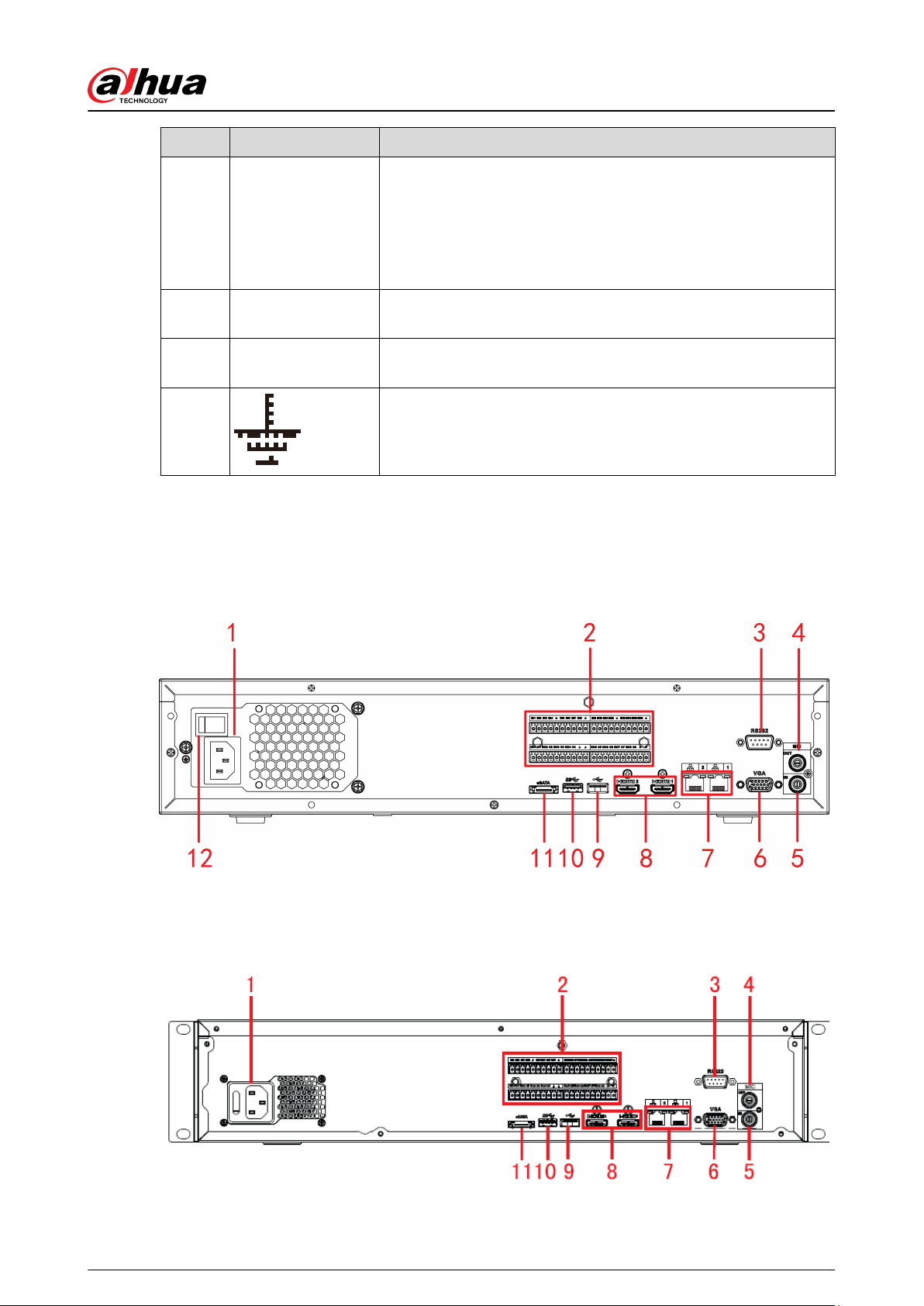
No. Port Name Function
MIC OUT
Audio output port. It is to output analog audio signal to devices
such as sound box.
●
Bidirectional talk output.
●
Audio output on 1-window video monitor.
●
Audio output on 1-window video playback.
9 VGA port
VGA video output port. Output analog video signal. It can
connect to the monitor to view analog video.
10 RS-232 port
It is for general COM debugging to congure IP address and
transfer transparent COM data.
11
GND.
2.2.27 NVR608-4KS2/NVR608H-XI/NVR608RH-XI Series
The NVR608-32-4KS2 series rear panel is shown as below.
Figure 2-87 Rear panel (1)
The NVR608-64-4KS2/NVR608-128-4KS2/NVR608H-32-XI/NVR608H-64-XI/NVR608H-128-XI series
rear panel is shown as below.
Figure 2-88 Rear panel (2)
User's Manual
64
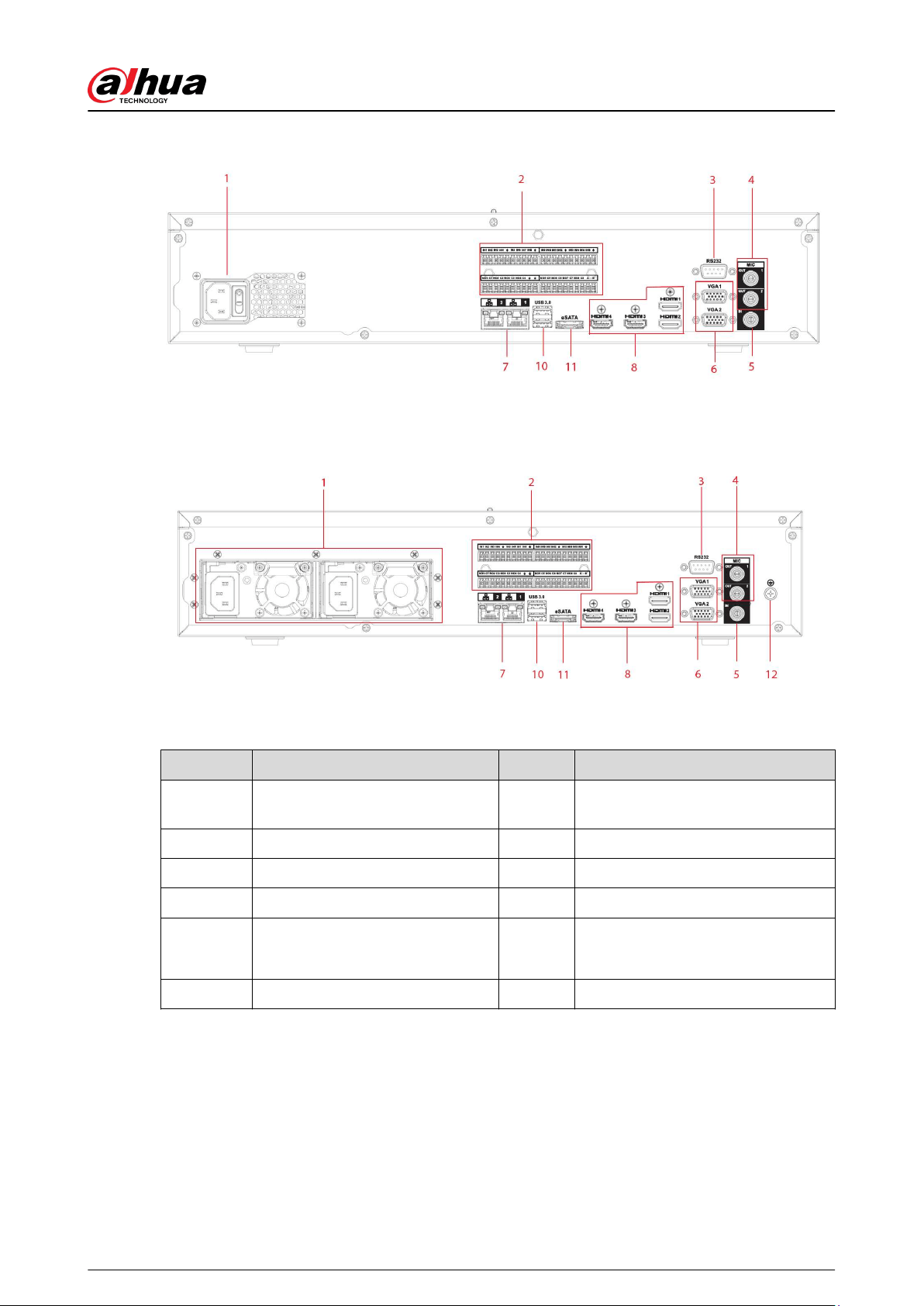
Figure 2-89 Rear panel (3)
The NVR608RH-32-XI/NVR608RH-64-XI/NVR608RH-128-XI front panel is shown as below.
Figure 2-90 Rear panel (4)
Table 2-41 Ports description
No. Function No. Function
1 Power socket. 2
Alarm input/alarm output/RS-485
port
3 RS-232 port 4 Audio output
5 Audio input 6 VGA port
7 Network port 8 HDMI port
9
●
NVR608-4K: USB 2.0 port
●
NVR608-4KS2: USB 3.0 port
10 USB 3.0 port
11 eSATA port 12 Ground
2.2.28 NVR616-4KS2/NVR616-XI Series
The general series rear panel of NVR616-4KS2 series is shown as below.
User's Manual
65
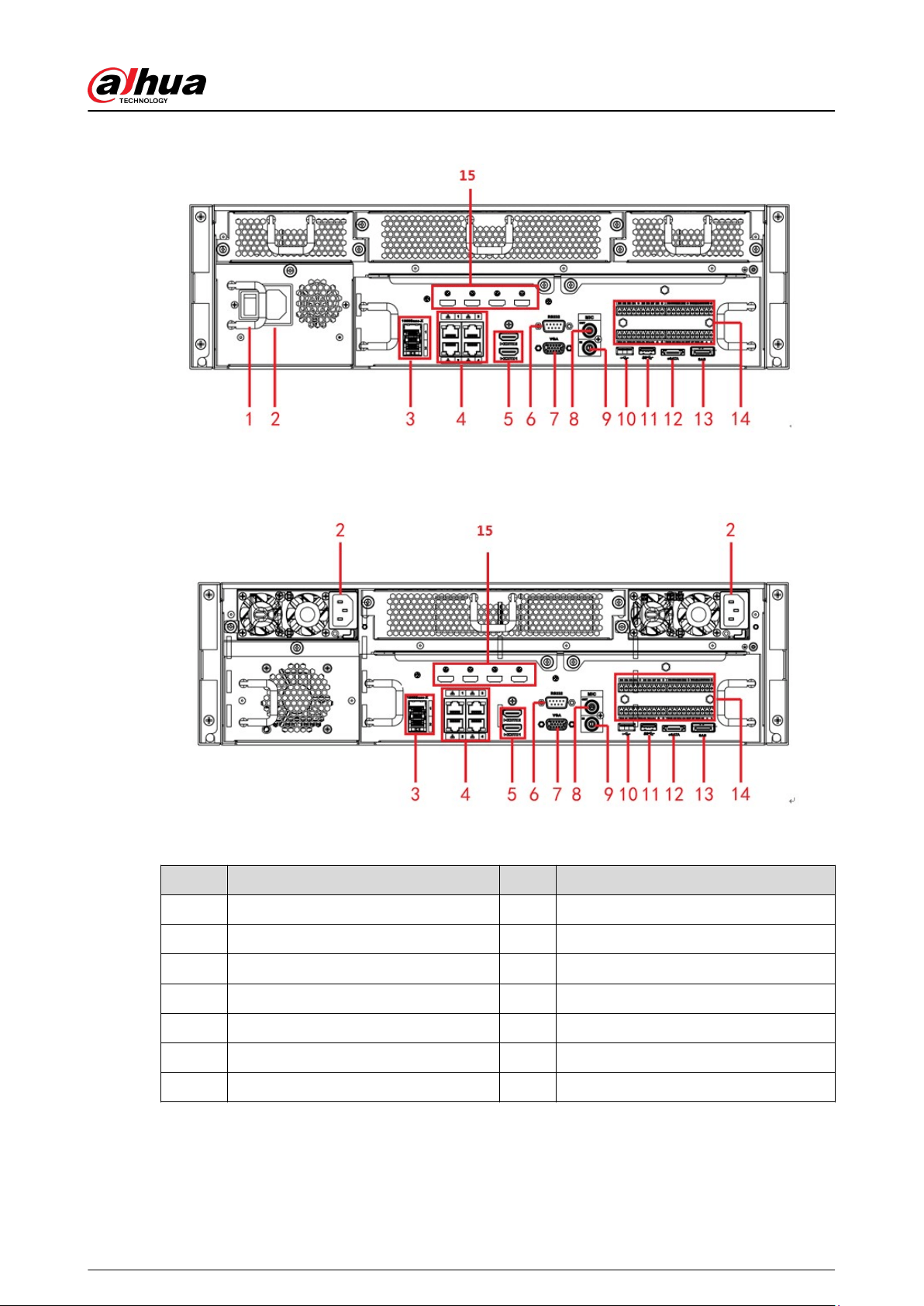
Figure 2-91 Rear panel
The redundant power series rear panel of NVR616-4KS2 series is shown as below.
Figure 2-92 Rear panel
Table 2-42 Ports
No. Name No. Name
1 Power on-o button 2 Power socket
3 1000M ber port 4 Network port
5 HDMI port 6 RS-232 port
7 Video VGA output 8 Audio output
9 Audio input 10 USB 3.0 port
11 USB 3.0 port 12 eSATA port
13 SAS extension port 14 Alarm input/output/RS-485 port
User's Manual
66
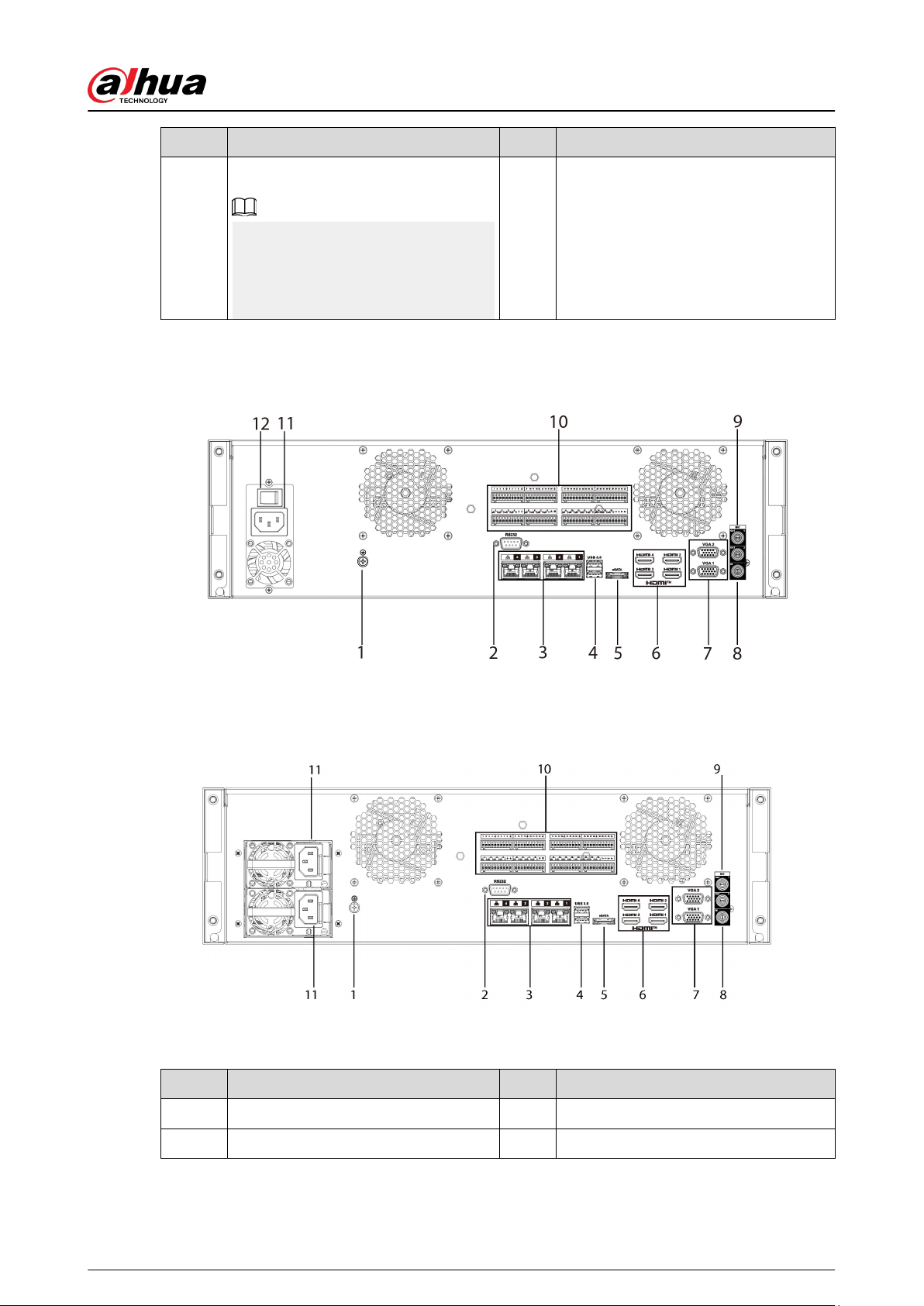
No. Name No. Name
15
HDMI port
High-denition decoding card is not
installed in standard hardware
conguration, you can purchase as
needed.
— —
The general series rear panel of NVR616-XI series is shown as below.
Figure 2-93 Rear panel
The redundant power series rear panel of NVR616-XI series is shown as below.
Figure 2-94 Rear panel
Table 2-43 Ports
No. Name No. Name
1 Ground 2 RS-232 Port
3 Network Port 4 USB Port
User's Manual
67
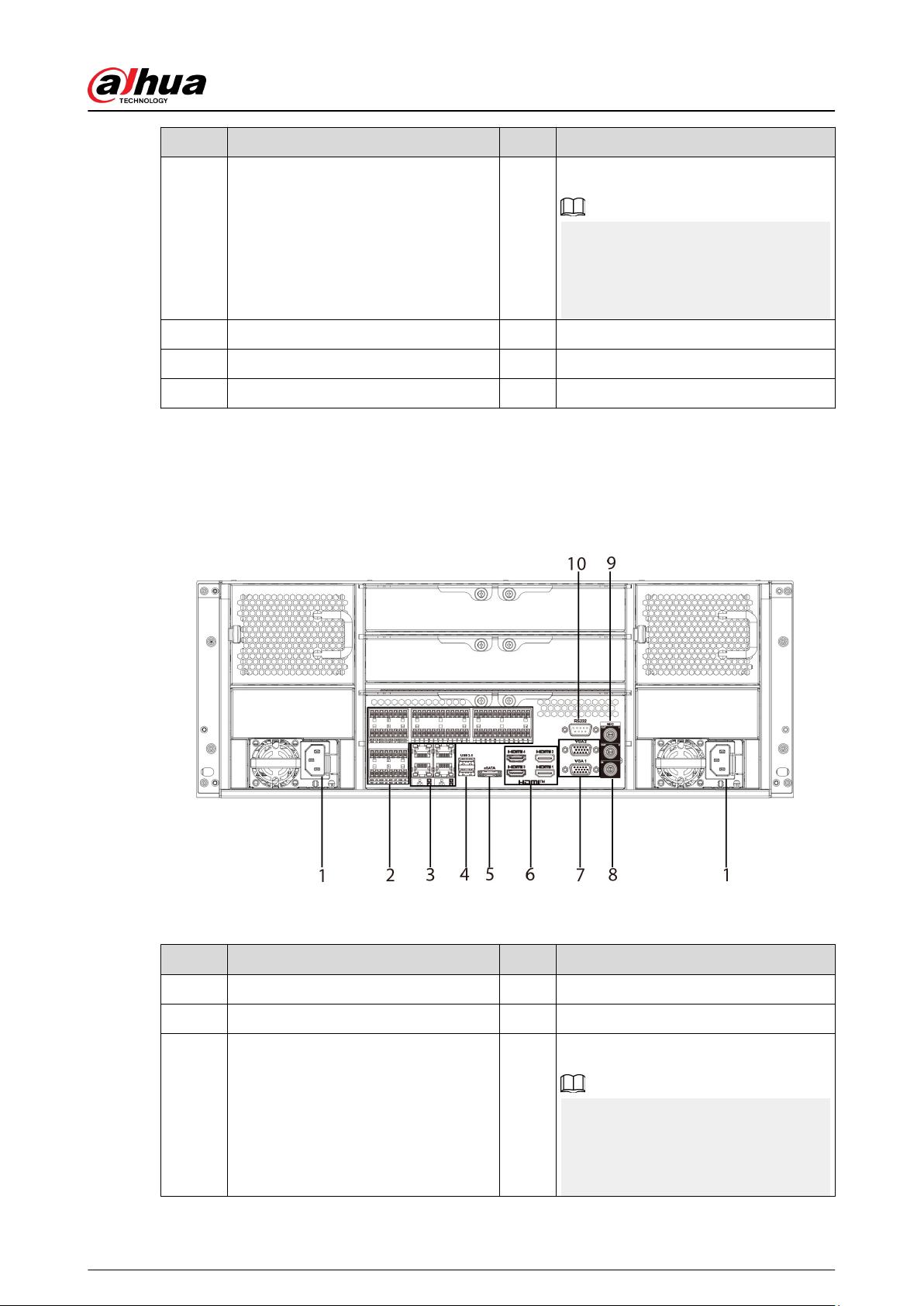
No. Name No. Name
5 eSATA Port 6
HDMI Port
High-denition decoding card is not
installed in standard hardware
conguration, you can purchase as
needed.
7 VGA Port 8 AUDIO IN, RCA Connector
9 AUDIO OUT, RCA Connector 10 Alarm In/Out
11 Power Input 12 Power Switch
2.2.29 NVR624-XI Series
The redundant power series rear panel of NVR624-XI series is shown as below.
Figure 2-95 Rear panel
Table 2-44 Ports
No. Name No. Name
1 Power Input 2 Alarm In/Out
3 Network Port 4 USB Port
5 eSATA Port 6
HDMI Port
High-denition decoding card is not
installed in standard hardware
conguration, you can purchase as
needed.
User's Manual
68
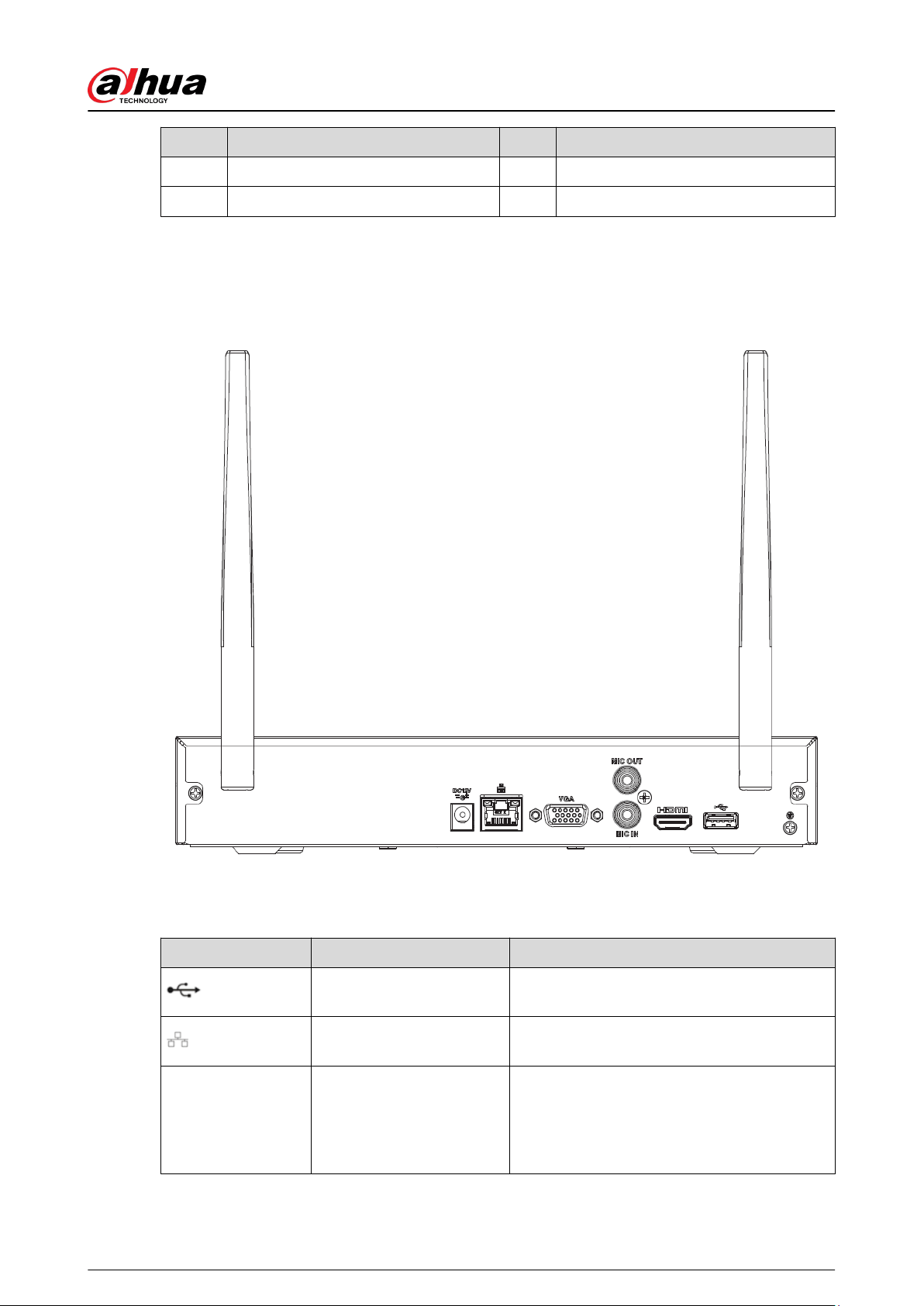
No. Name No. Name
7 VGA Port 8 AUDIO IN, RCA Connector
9 AUDIO OUT, RCA Connector 10 RS-232 Port
2.2.30 NVR11HS-W-S2-CE/NVR11HS-W-S2-FCC Series
Figure 2-96 Rear panel
Table 2-45 Ports
Icon Name Function
USB 2.0 port
USB 2.0 port. Connect to mouse, USB storage
device, USB burner and more.
Network port
10/100 Mbps self-adaptive Ethernet port.
Connect to the network cable.
HDMI High Denition Media Page
High denition audio and video signal output
port. It transmits uncompressed high
denition video and multiple-channel data to
the HDMI port of the display device. HDMI
version is 1.4.
User's Manual
69
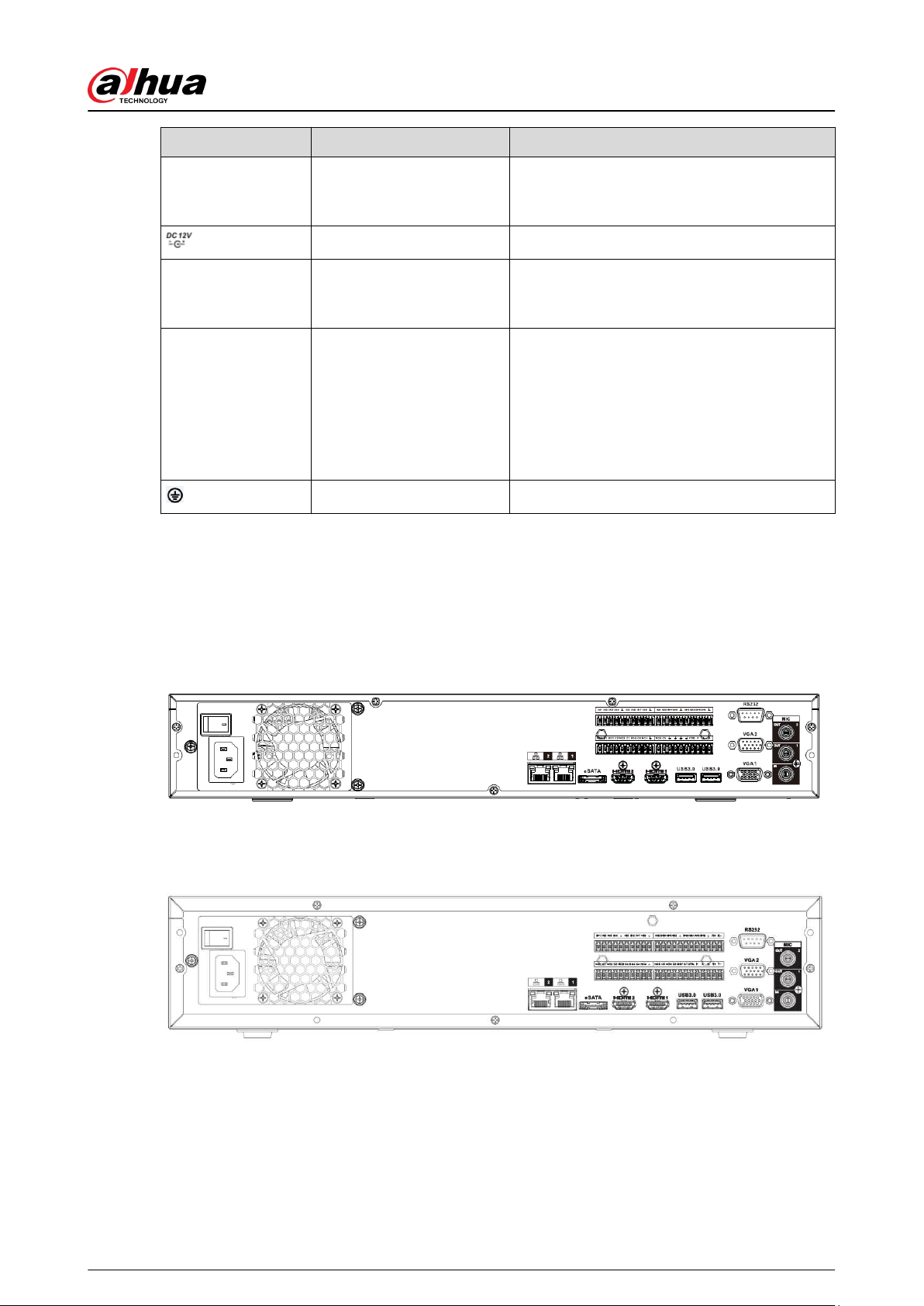
Icon Name Function
VGA VGA video output port
VGA video output port. Output analog video
signal. It can connect to the monitor to view
analog video.
Power input port Input 12 VDC/2 A.
MIC IN Audio input port
Bidirectional talk input port. It is to receive the
analog audio signal output from the devices
such as microphone, pickup.
MIC OUT Audio output port
Audio output port. It is to output the analog
audio signal to the devices such as the sound
box.
●
Bidirectional talk output.
●
Audio output on 1-window video monitor.
●
Audio output on 1-window video playback.
GND Ground end.
2.2.31 NVR54-EI/NVR54-16P-EI/NVR58-EI/NVR58-16P-EI
Series
The NVR54-EI series rear panel is shown as below.
Figure 2-97 Rear panel
The NVR58-EI series rear panel is shown as below.
Figure 2-98 Rear panel
The NVR54-16P-EI series rear panel is shown as below.
User's Manual
70
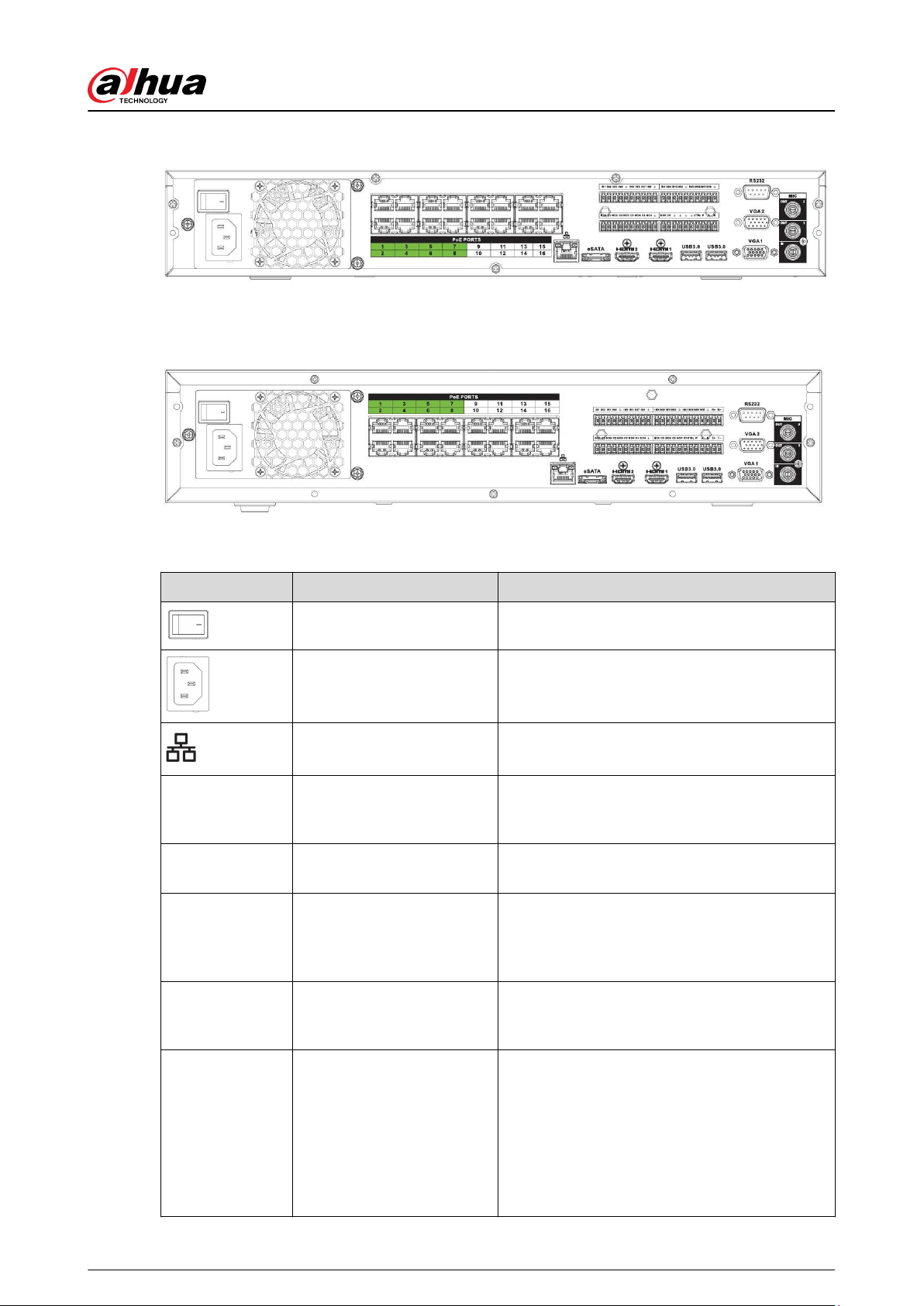
Figure 2-99 Rear panel
The NVR58-16P-EI series rear panel is shown as below.
Figure 2-100 Rear panel
Table 2-46 Rear panel description
Icon Name Function
Power switch Power on-o button
Power input port Input 100–240 VAC.
Network port
10/100/1000 Mbps self-adaptive Ethernet port.
Connect to the network cable.
eSATA eSATA port
External SATA port. It can connect to the device
of the SATA port. Please jump the HDD when
there is peripheral connected HDD.
USB 3.0 USB port
USB port. Connect to mouse, USB storage
device, USB burner and more.
HDMI High Denition Media Page
High denition audio and video signal output
port. It transmits uncompressed high denition
video and multiple-channel data to the HDMI
port of the display device. HDMI version is 1.4b.
MIC IN Audio input port
Bidirectional talk input port. It is to receive the
analog audio signal output from the devices
such as microphone, pickup.
MIC OUT Audio output port
Audio output port. It is to output the analog
audio signal to the devices such as the sound
box.
● Bidirectional talk output.
● Audio output on 1-window video monitor.
● Audio output on 1-window video playback.
User's Manual
71
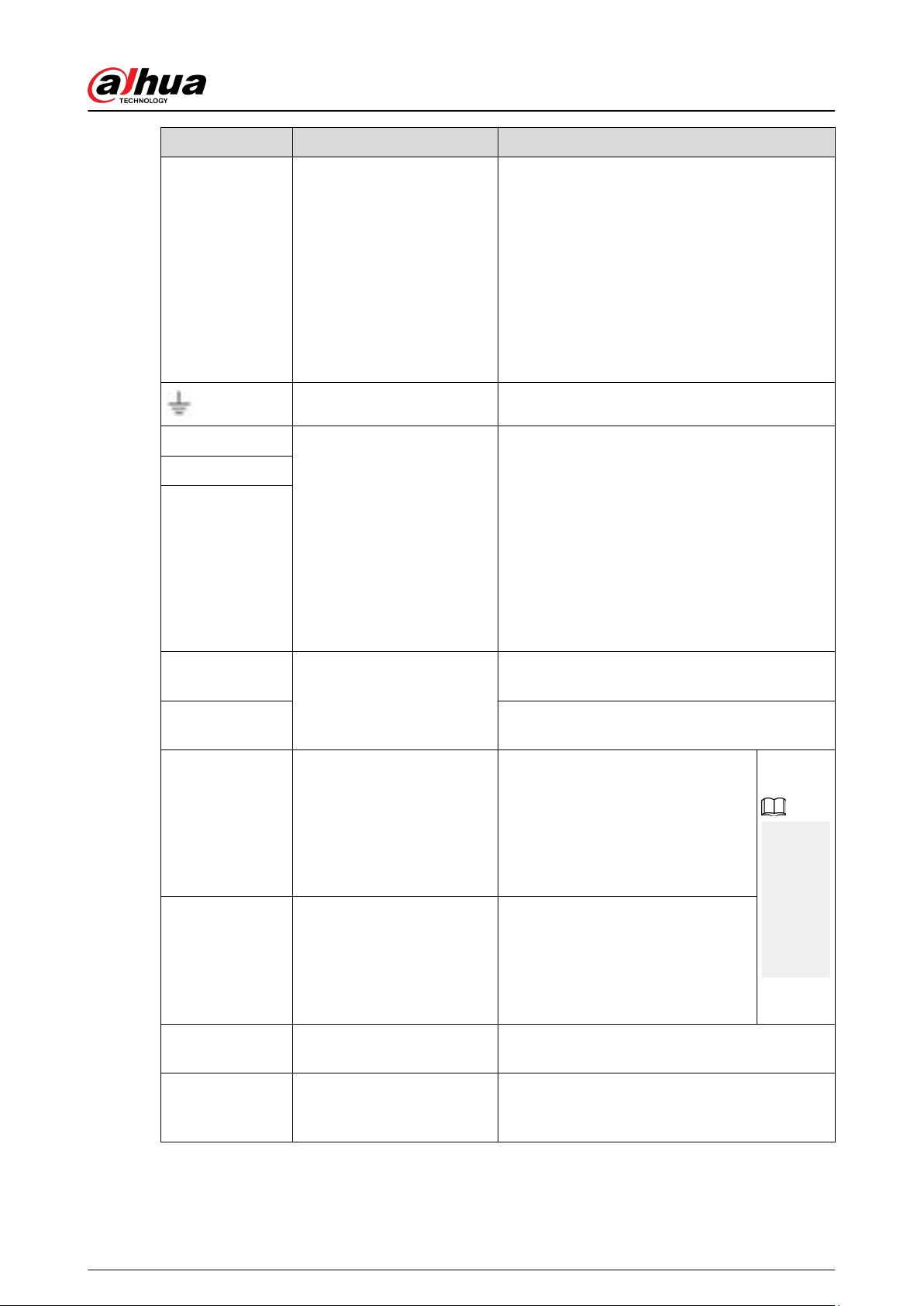
Icon Name Function
1–16 Alarm input port 1–16
● There are four groups. The rst group is from
port 1 to port 4, the second group is from port 5
to port 8, the third group is from 9 to 12, and
the fourth group is from 13 to 16. They are to
receive the signal from the external alarm
source. There are two types; NO (normal
open)/NC (normal close).
● When your alarm input device is using
external power, please make sure the device
and the NVR have the same ground.
Ground Alarm input ground end.
NO1–NO5
Alarm output port 1–5
● 5 groups of alarm output ports. (Group 1:
port NO1–C1, Group 2:port NO2–C2, Group 3:
port NO3–C3, Group 4: port NO4–C4, Group 5:
port NO5, C5, NC5). Output alarm signal to the
alarm device. Please make sure there is power
to the external alarm device.
● NO: Normal open alarm output port.
● C: Alarm output public end.
● NC: Normal close alarm output port.
C1–C5
NC5
A
RS-485 communication port
RS485_A port. It is the cable A. You can connect
to the control devices such as speed dome PTZ.
B
RS485_B. It is the cable B. You can connect to
the control devices such as speed dome PTZ.
CTRL (CTRL 12 V) —
Controller 12 V power output. It is to
control the on-o alarm relay
output. It can be used to control the
device alarm output. At the same
time, it can also be used as the
power input source of some devices
such as the alarm detector.
The two
ports
serve as
another
group of
alarm
output
ports.
P (+12 V) —
+12 V power output port. It can
provide the power to some
peripheral devices such as the
camera or the alarm device. Please
note the supplying power shall be
below 1 A.
RS-232 RS-232 debug COM
It is for general COM debug to congure IP
address or transfer transparent COM data.
VGA VGA video output port
VGA video output port. Output analog video
signal. It can connect to the monitor to view
analog video.
User's Manual
72
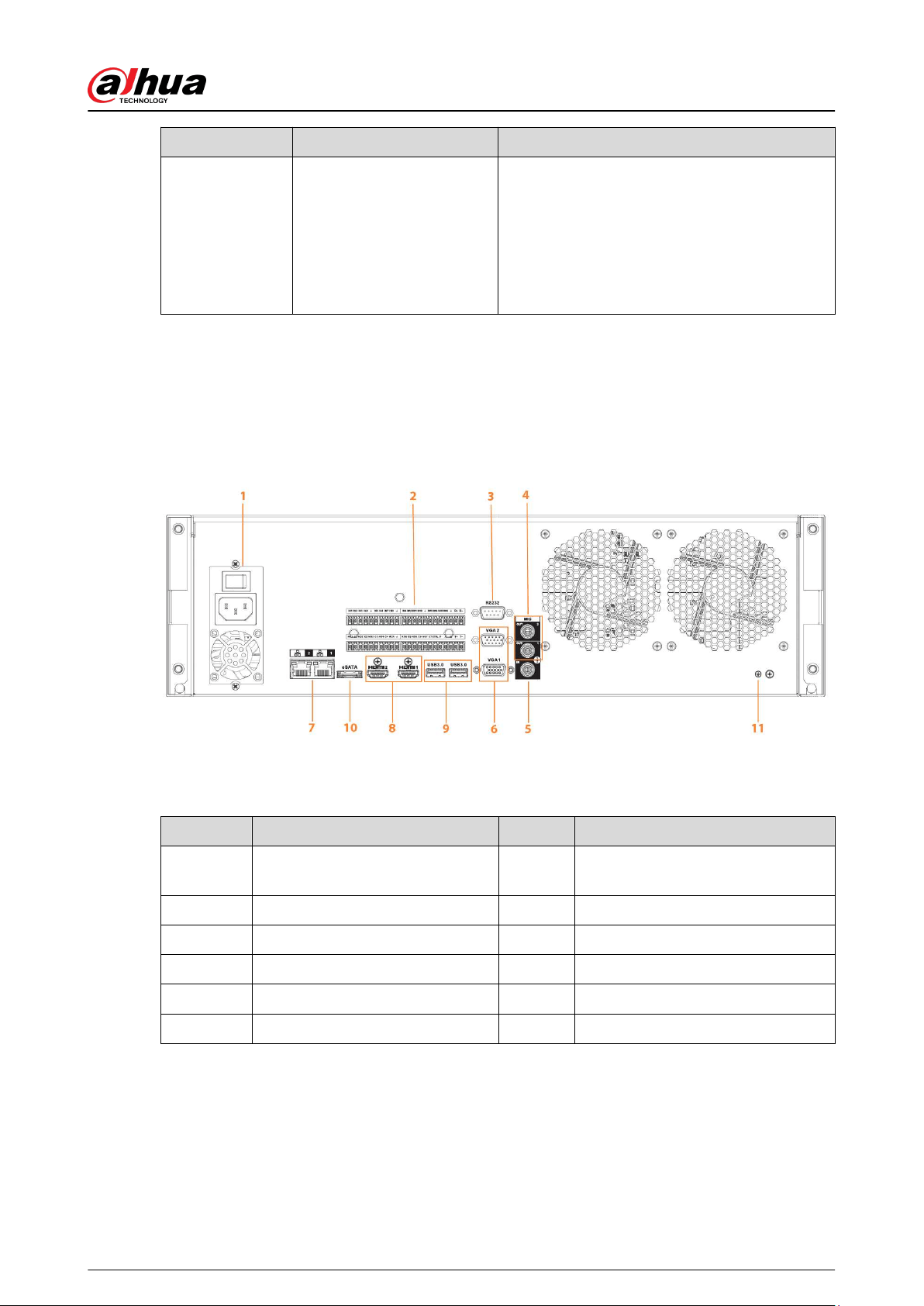
Icon Name Function
PoE PORTS —
Built-in Switch. Support PoE or ePoE function.
For ePoE series product, port 1 to port 8 are the
ePoE ports. ePoE port supports 300
meters@100Mbps, 800 meters@10Mbps. Port 9
to port 16 are general PoE ports.
The 16 PoE series supports total 150W.
2.2.32 NVR50-EI Series
The NVR50-EI series rear panel is shown as below.
Figure 2-101 Rear panel
Table 2-47 Ports description
No. Function No. Function
1 Power socket. 2
Alarm input/alarm output/RS-485
port
3 RS-232 port 4 Audio output
5 Audio input 6 VGA port
7 Network port 8 HDMI port
9 USB 3.0 port 10 eSATA port
12 Ground — —
2.3 Alarm Connection
2.3.1 Alarm Port
The alarm port is shown as below. The following gure is for reference only.
User's Manual
73
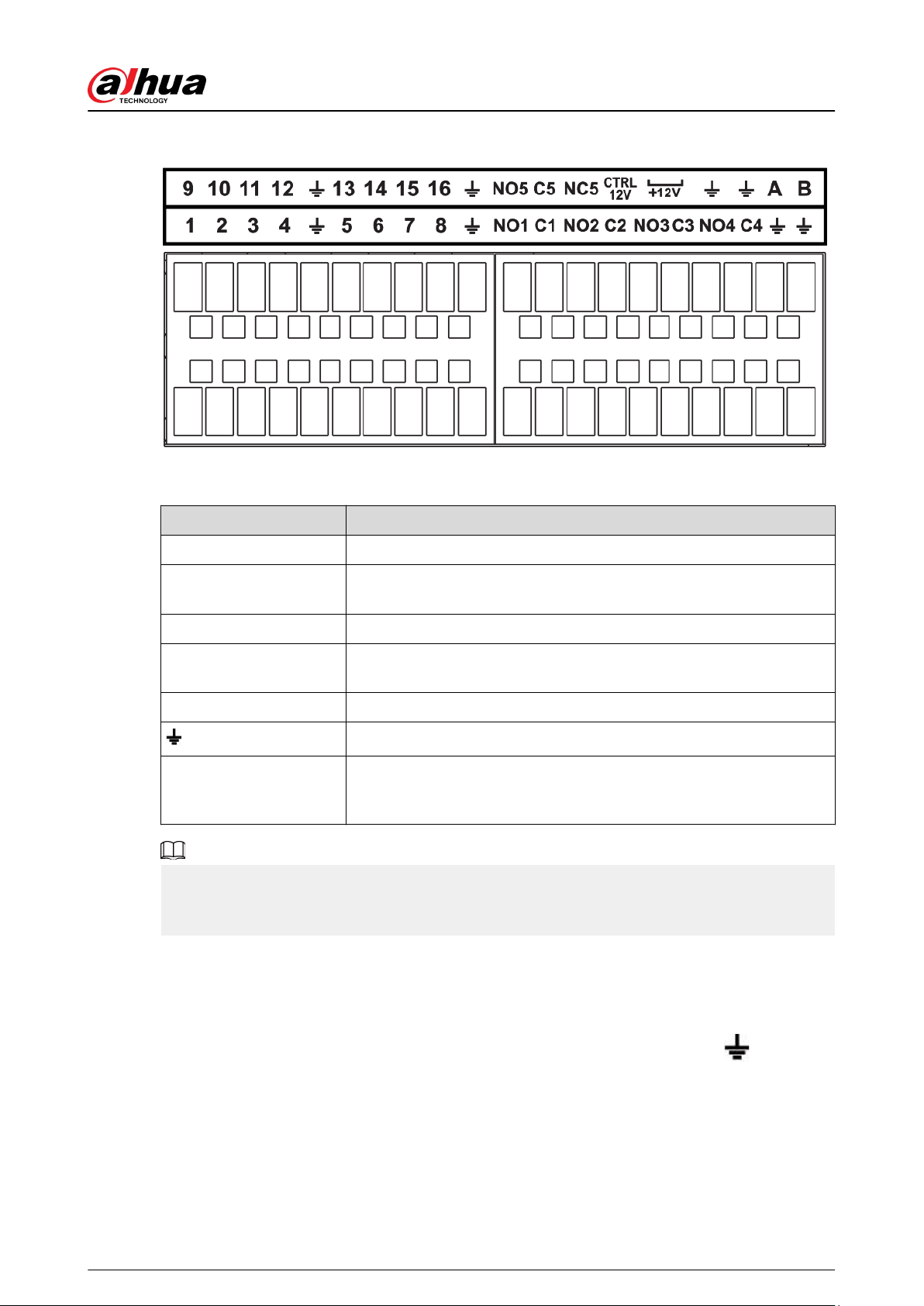
Figure 2-102 Alarm port
Table 2-48 Alarm port description
Icon Function
1–16 ALARM1–ALARM16. The alarm becomes activated in the low level.
NO1 C1, NO2 C2, NO3 C3,
NO4 C4
Four NO activation output groups. (On-o button).
NO5 C5 NC5 One NO/NC activation output group. (On-o button).
CTRL (CTRL 12 V)
Control power output. Disable power output when alarm is canceled.
Current is 500 mA.
P (+12 V) Rated current output. Current is 500 mA.
GND.
A/B
485 communication port. They are used to control devices such as
PTZ. Please parallel connect 120 TΩ between A/B cables if there are
too many PTZ decoders.
●
Dierent models support dierent alarm input ports. Please see the specications sheet for
detailed information.
●
Slight dierence might be found on the alarm port layout.
2.3.2 Alarm Input Port
Connect the positive end (+) of the alarm input device to the alarm input port (ALARM IN 1–16) of
the NVR. Connect the negative end (-) of the alarm input device to the ground end (
) of the NVR.
User's Manual
74
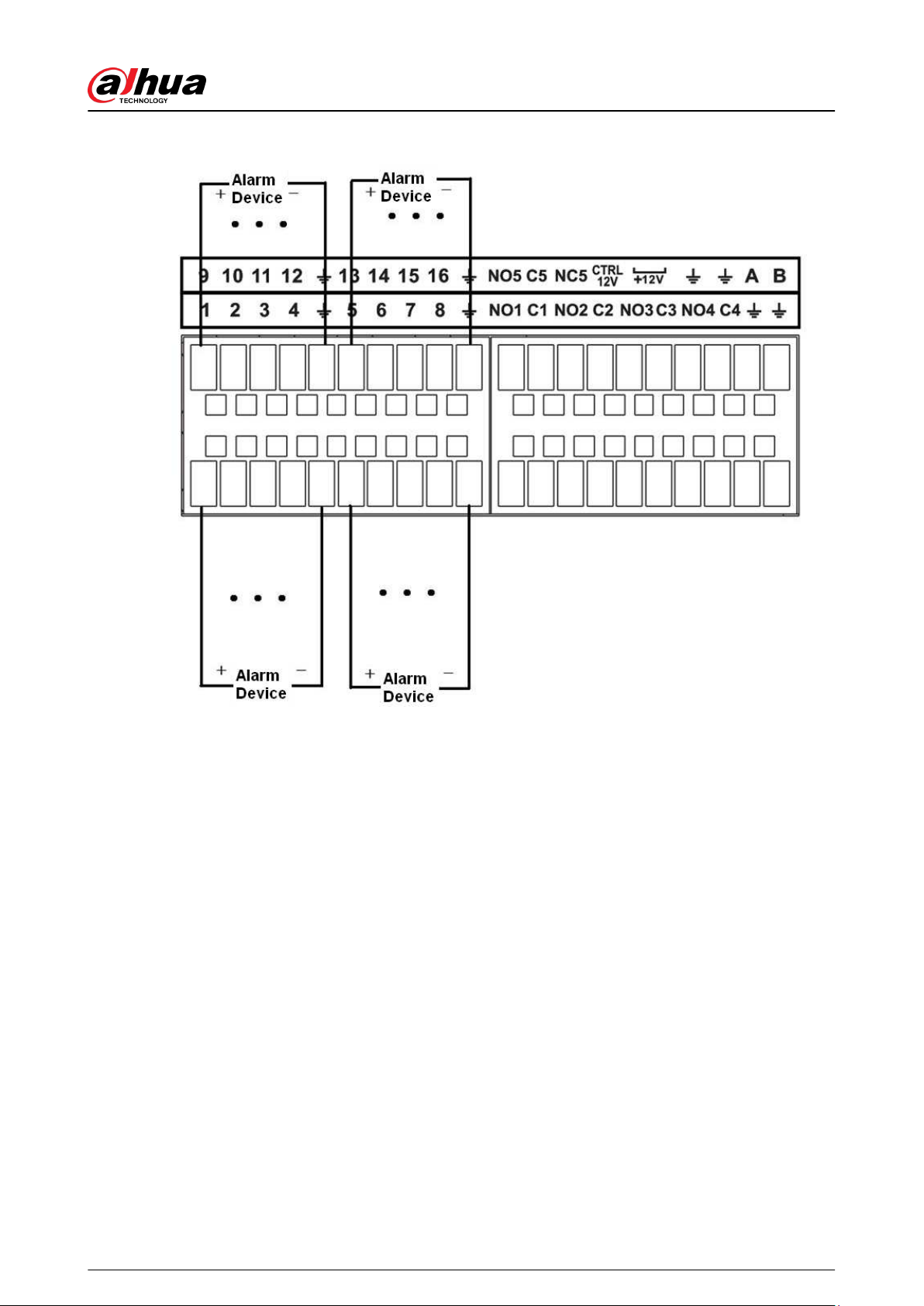
Figure 2-103 Alarm input port (1)
User's Manual
75
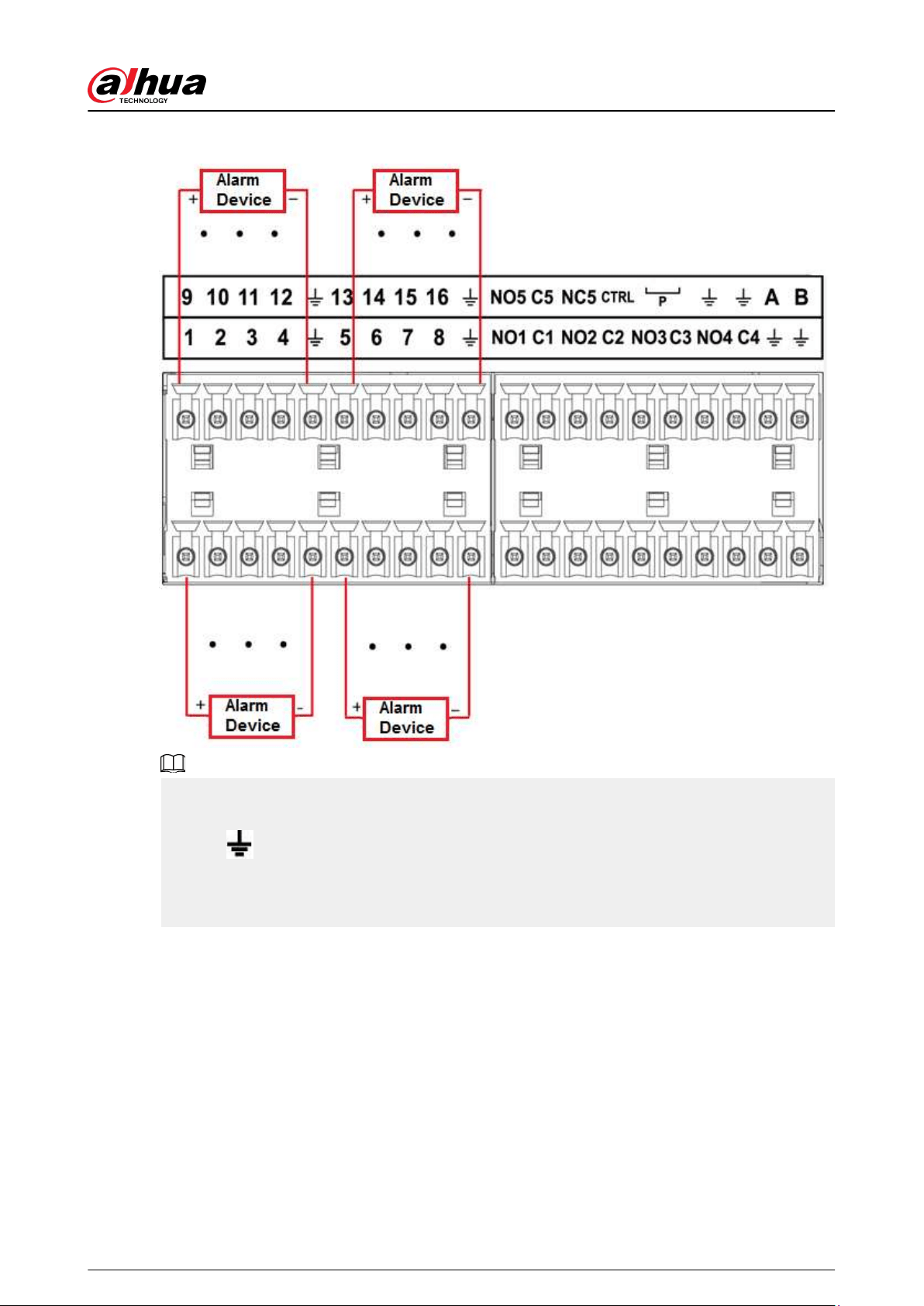
Figure 2-104 Alarm input port (2)
●
There are two alarm input types: NO/NC.
●
When connect the ground port of the alarm device to the NVR, you can use any of the GND
ports (
).
●
Connect the NC port of the alarm device to the alarm input port (ALARM) of the NVR.
●
When there is peripheral power supplying for the alarm device, please make sure it is earthed
with the NVR.
2.3.3 Alarm Output Port
●
There is peripheral power supplying for the external alarm device.
●
In case overload might result in NVR damage, please see the following relay specications for
detailed information.
●
A/B cable of the RS-485 is for the A/B cable connection of the speed PTZ.
User's Manual
76
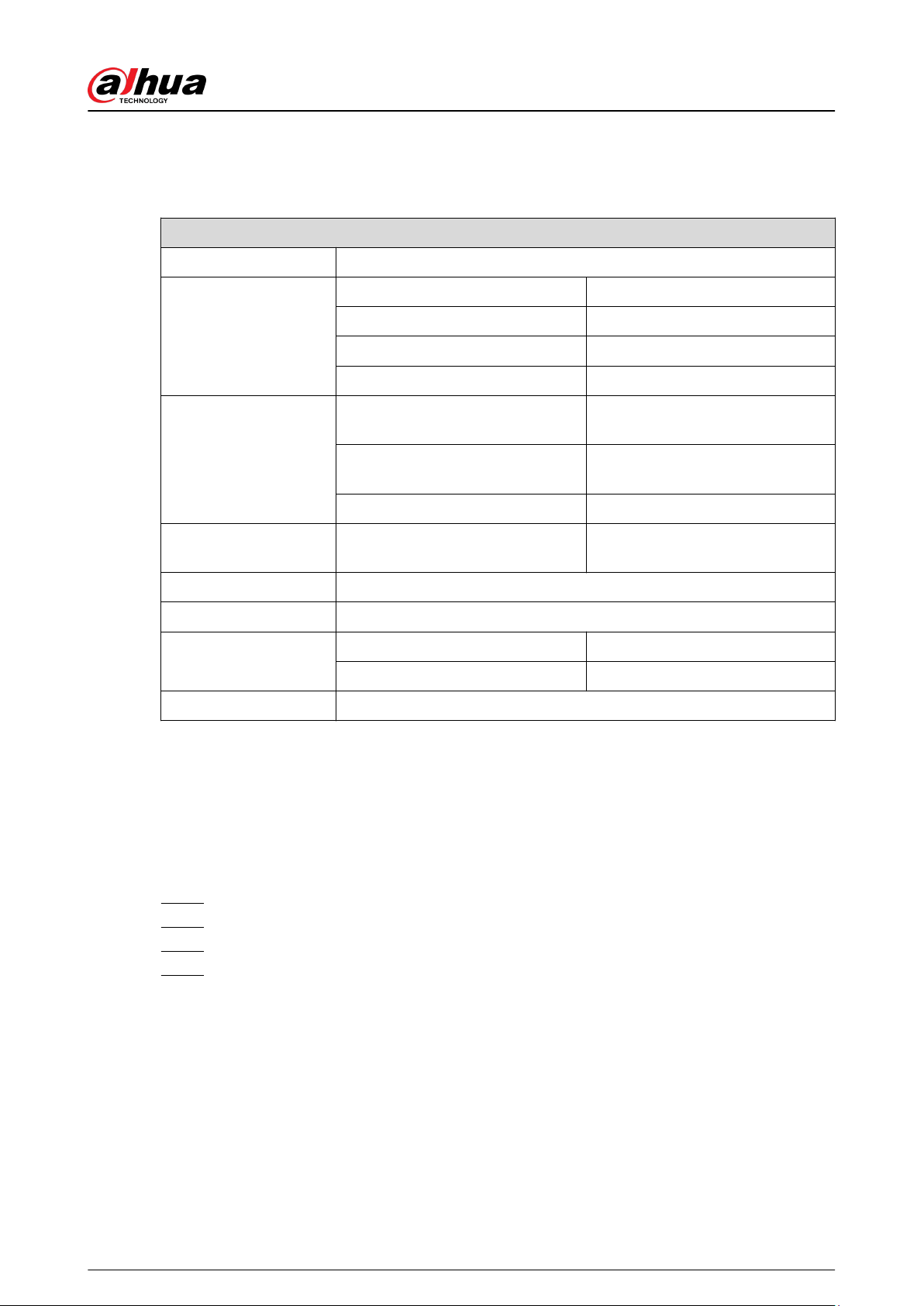
2.3.4 Alarm Relay Specications
Table 2-49 Alarm relay specications
Model: JRC-27F
Material of the touch Silver
Rating (Resistance
Load)
Rated switch capacity 30 VDC 2 A, 125 VAC 1 A
Maximum switch power 125 VAC, 160 W
Maximum switch voltage 250 VAC, 220 VDC
Maximum switch currency 1 A
Insulation
Between touches with same
polarity
1000 VAC 1 minute
Between touches with dierent
polarity
1000 VAC 1 minute
Between touch and winding 1000 VAC 1 minute
Surge voltage
Between touches with same
polarity
1500 V (10×160 μs)
Length of open time 3 ms max
Length of close time 3 ms max
Longevity
Mechanical 50 × 106 MIN (3 Hz)
Electrical 200 × 103 MIN (0.5 Hz)
Temperature -40 °C to +70 °C
2.4 Two-way Talk
2.4.1 Device-end to PC-end
Procedure
Step 1 Connect the speaker or the pickup to the rst audio input port on the device rear panel.
Step 2 Connect the earphone or the sound box to the audio output port in the PC.
Step 3 Log in to the web and then enable the corresponding channel real-time monitor.
Step 4 Enable two-way talk.
User's Manual
77
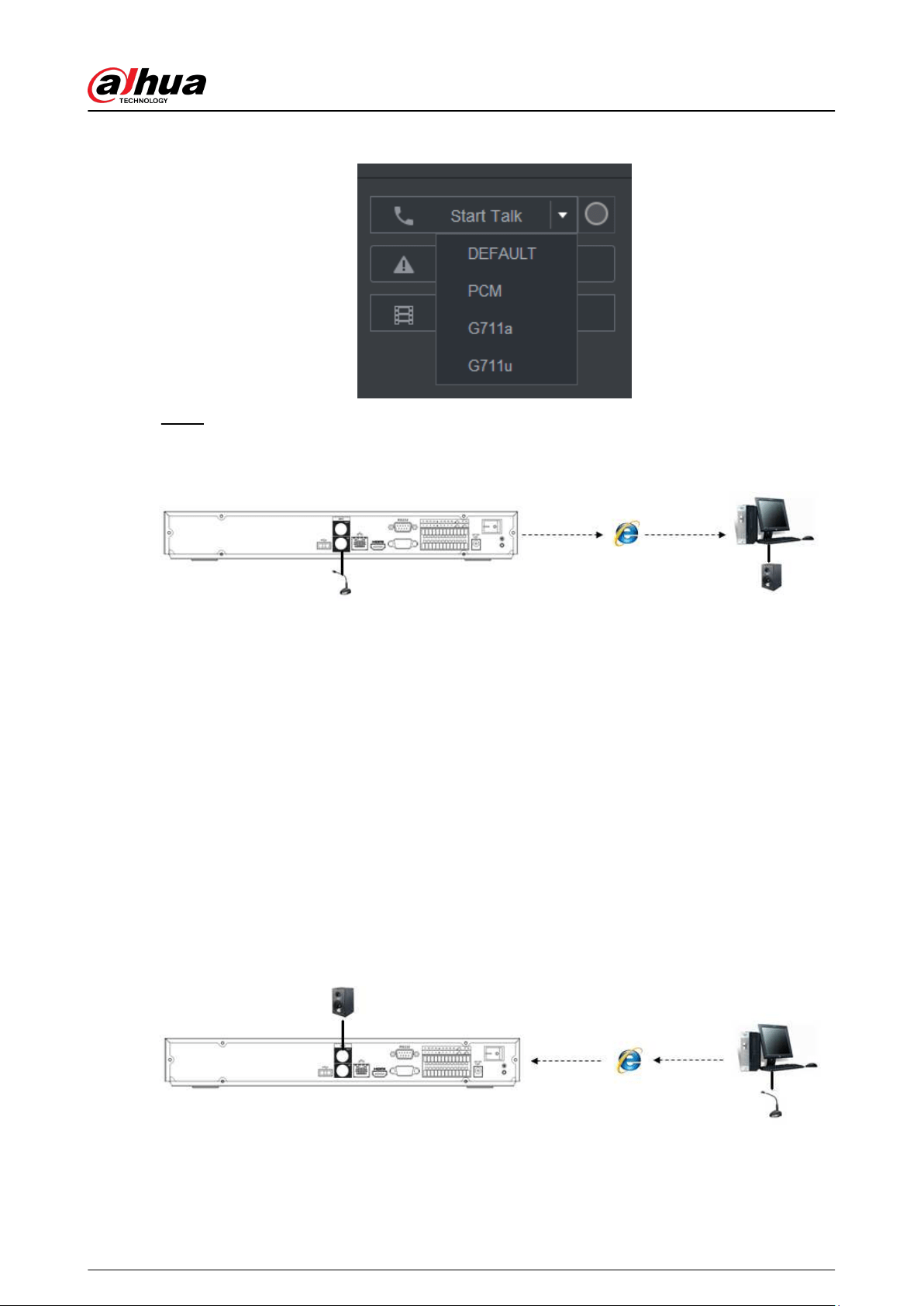
Figure 2-105 Enable two-way talk
Step 5 At the device end, speak by the speaker or the pickup, and then you can get the audio
from the earphone or sound box at the PC end.
Figure 2-106 Device to PC
2.4.2 PC-end to the Device-end
Device Connection
1. Connect the speaker or the pickup to the audio output port in the PC.
2. Connect the earphone or the sound box to the rst audio input port in the device rear panel.
3. Log in to the web and then enable the corresponding channel real-time monitor.
4. Enable bidirectional talk. See Figure 2-105 .
Listening Operation
At the PC-end, speak by the speaker or the pickup, and then you can get the audio from the
earphone or sound box at the device-end.
Figure 2-107 PC to device
User's Manual
78
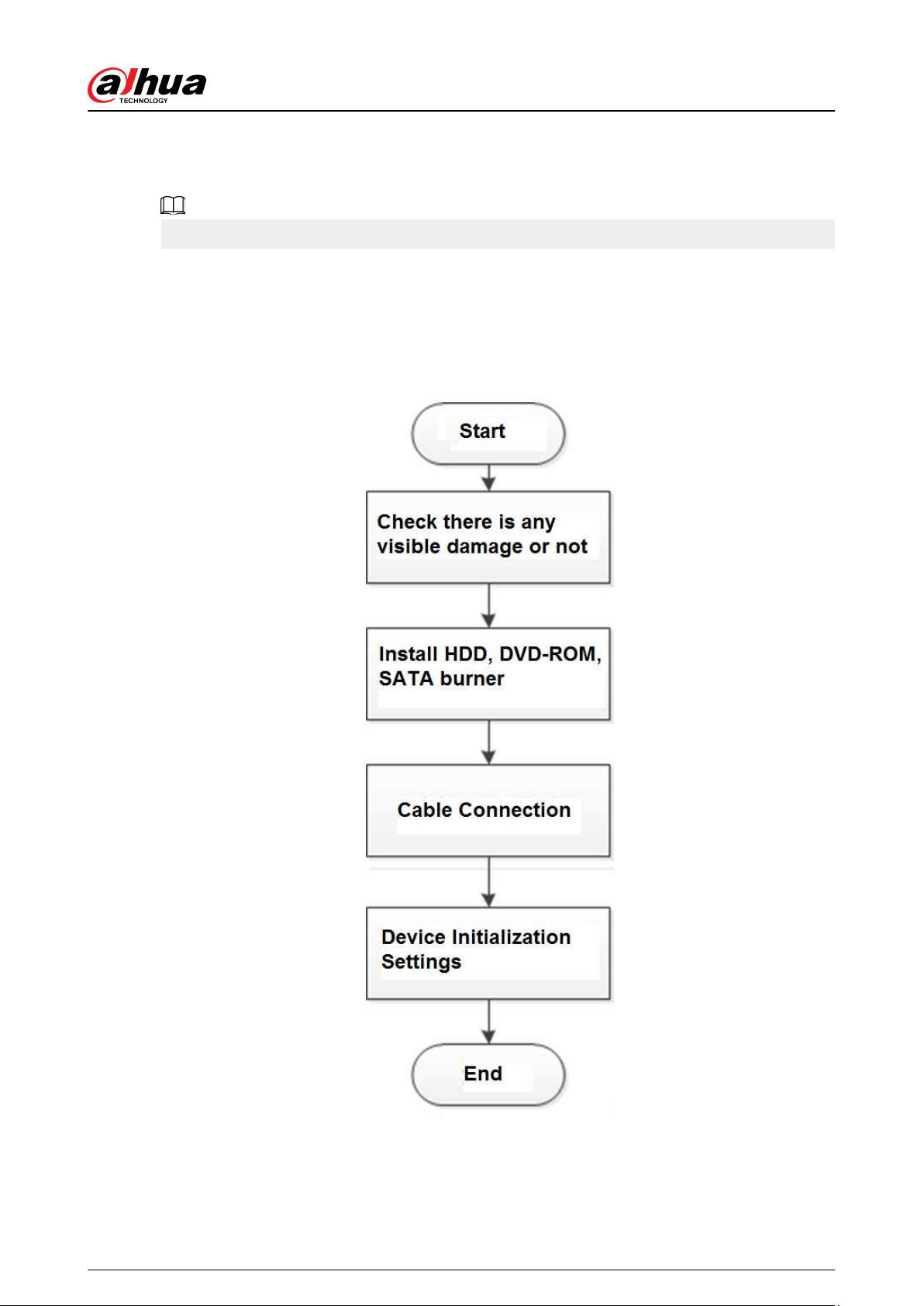
3 Device Installation
All the installation and operations here should conform to your local electric safety rules.
3.1 Device Installation Diagram
Please see the following diagram to install the NVR.
Figure 3-0 Installation owchart
User's Manual
79
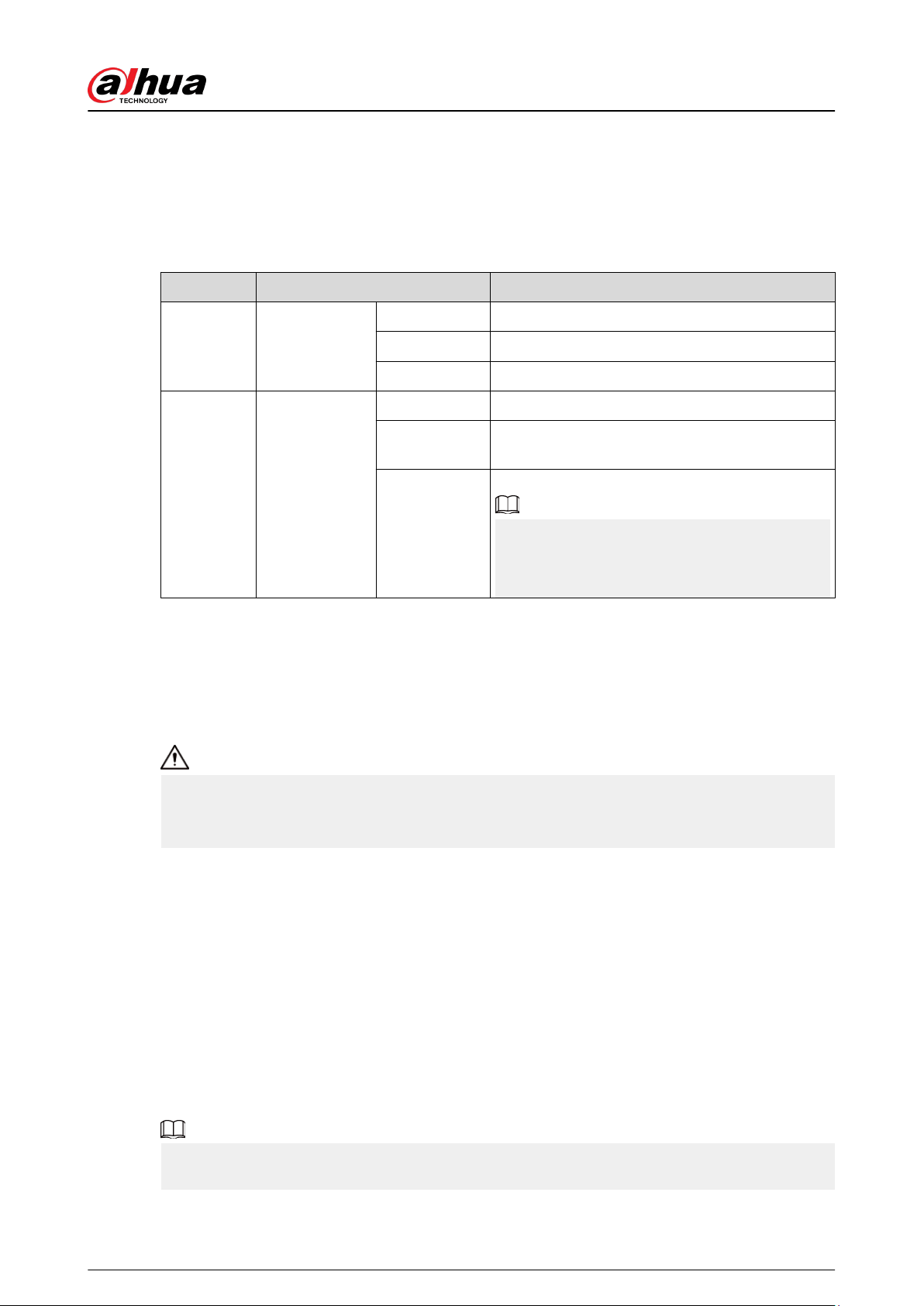
3.2 Checking Unpacked NVR
When you receive the NVR, check against the following checklist. If any of the items are missing or
damaged, contact the local retailer or after-sales service immediately.
Table 3-1 Checklist
Sequence Item Description
1
Overall
packaging
Appearance No obvious damage.
Package Not distorted or broken.
Accessories Nothing missing.
2 The Device
Appearance No obvious damage.
Model
The model description is consistent with the
contract.
Label
Not torn up.
Keep the label well. You need to provide the
serial number on the label when calling the after-
sales service.
3.3 HDD Installation
For the rst time installation, make sure whether the HDD has been installed or not. We
recommend to use HDD of enterprise level or surveillance level. It is not recommended to use PC
HDD.
●
Shut o the power before you replace the HDD.
●
Use the dedicated SATA HDD for monitoring recommended by the HDD manufacturer.
●
You can see the Appendix for HDD space information and recommended HDD brand.
3.3.1 NVR41-4KS2/NVR41-P-4KS2/NVR41-8P-4KS2/
NVR41-4KS2/L/NVR41-P-4KS2/L/NVR41-8P-4KS2/L/
NVR21-4KS2/NVR21-P-4KS2/NVR21-8P-4KS2/NVR21-
W-4KS2/NVR21-I/NVR21-I2/NVR21-P-I/NVR21-P-I2/
NVR21-8P-I/NVR21-8P-I2/NVR21-S3/NVR21-P-S3/NVR21-8P-
S3/NVR41-EI/NVR41-P-EI/NVR41-8P-EI
Background Information
Connect cable and then secure the HDD on the NVR if it is not convenient to connect the HDD data
cable and power cable at rst.
User's Manual
80
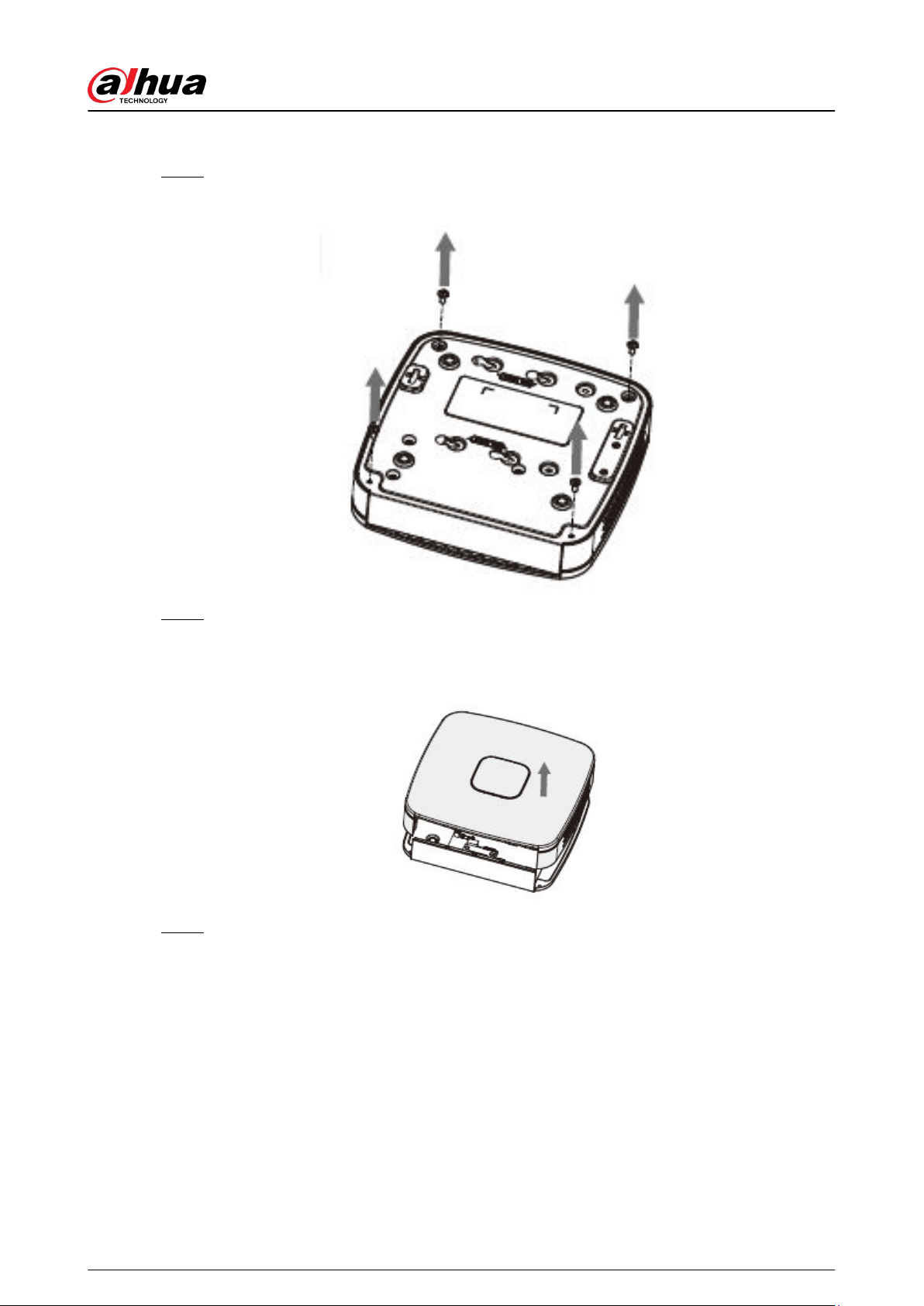
Procedure
Step 1 Loosen the screws of the bottom of the chassis.
Figure 3-1 Lossen screws
Step 2 Place the HDD in accordance with the four holes in the bottom.
Figure 3-2 Align HDD
Step 3 Turn the device upside down and then secure the screws rmly.
User's Manual
81
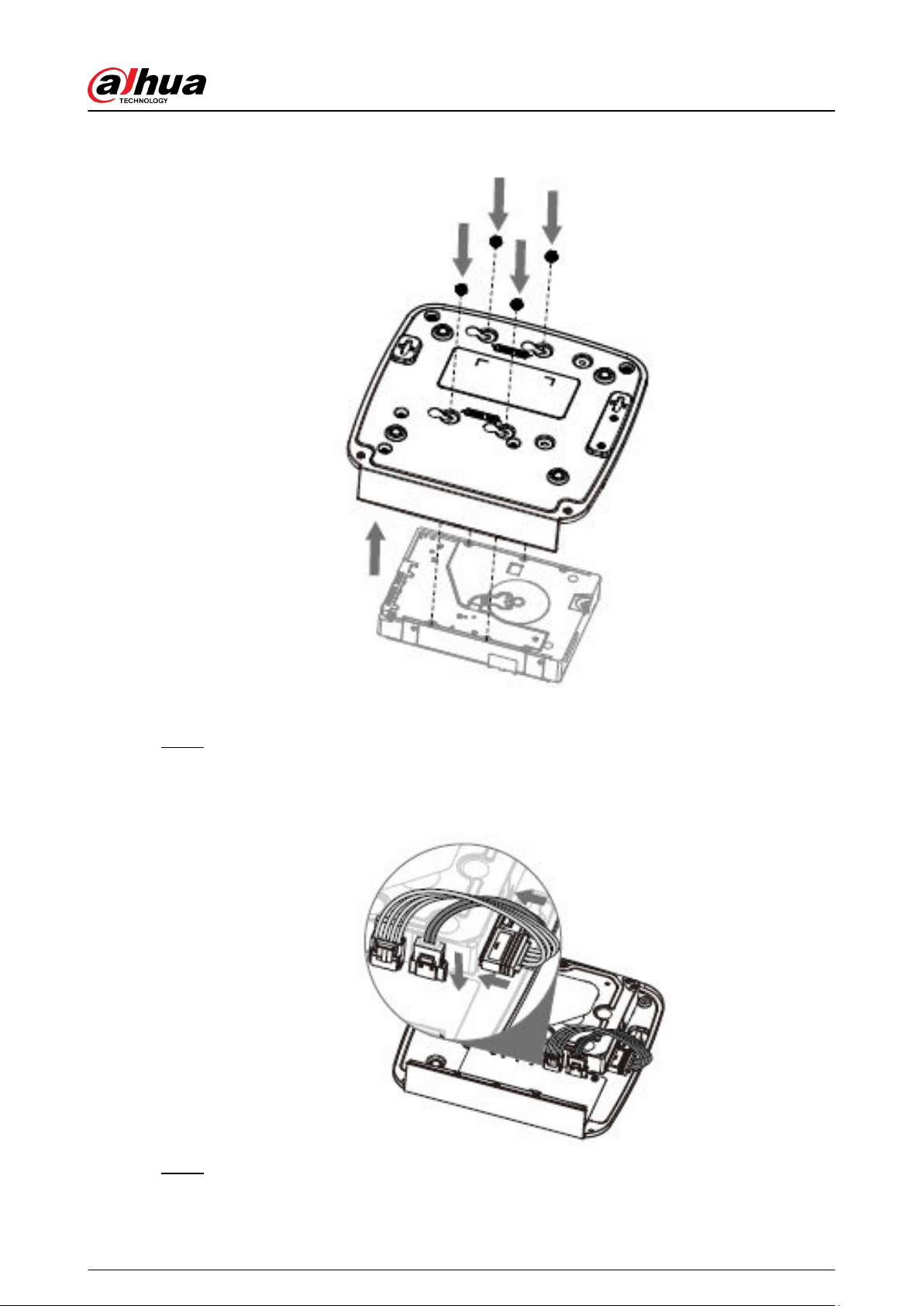
Figure 3-3 Secure screws
Step 4 Connect the HDD cable and power cable to the HDD and the mainboard respectively.
Figure 3-4 Connect cables
Step 5 Put the cover back and then x the screws of the rear panel. The installation is complete.
User's Manual
82
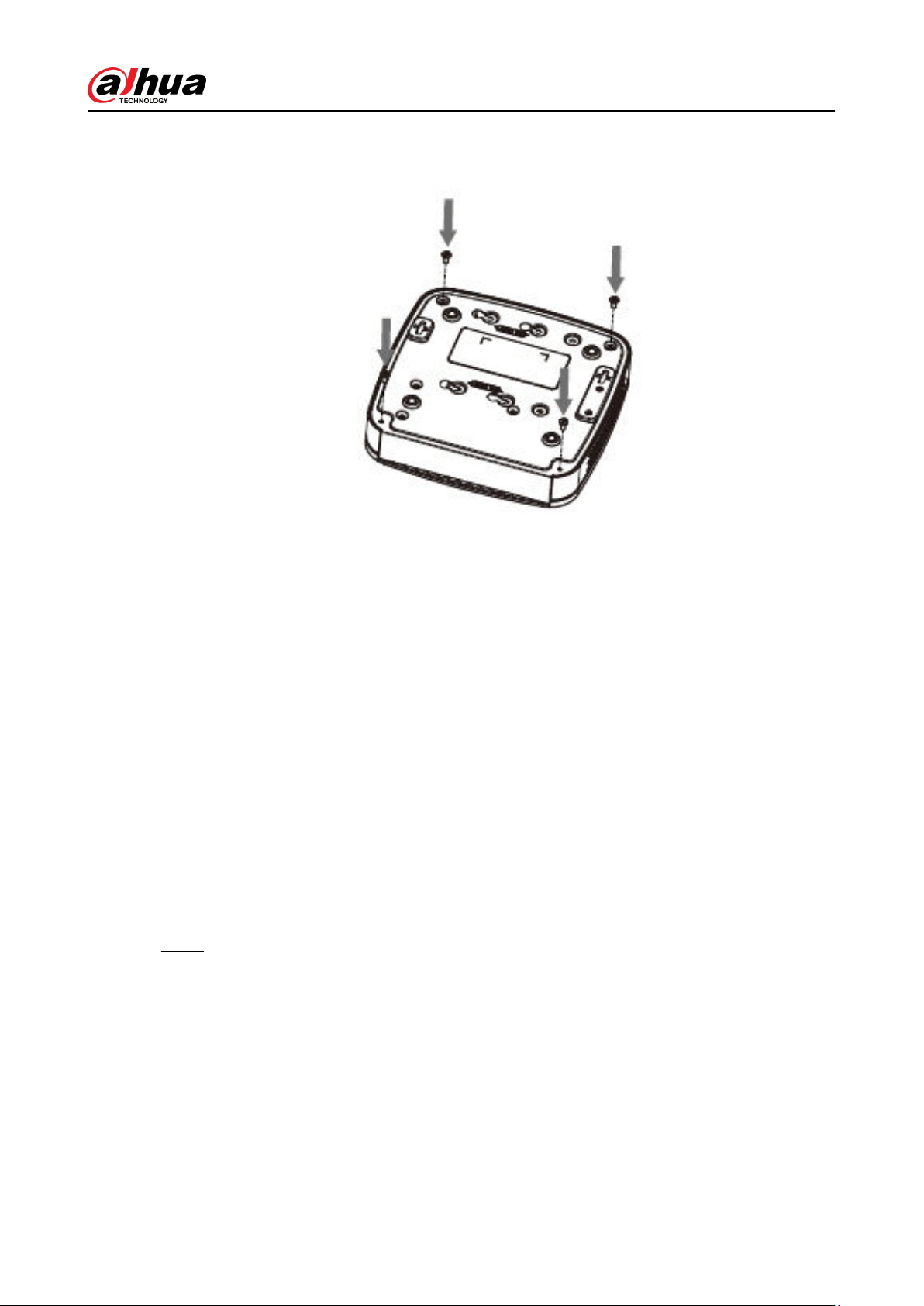
Figure 3-5 Put back the cover
3.3.2 NVR41HS-4KS2/NVR41HS-P-4KS2/NVR41HS-8P-4KS2/
NVR41HS-4KS2/L/NVR41HS-P-4KS2/L/NVR41HS-8P-4KS2/L/
NVR21HS-4KS2/NVR21HS-P-4KS2/NVR21HS-8P-4KS2/
NVR21HS-W-4KS2/NVR11HS-S3H/NVR11HS-P-S3H/
NVR11HS-8P-S3H/NVR21HS-I/NVR21HS-I2/NVR21HS-P-I/
NVR21HS-P-I2/NVR21HS-8P-I/NVR21HS-8P-I2/NVR21HS-S3/
NVR21HS-P-S3/NVR21HS-8P-S3/NVR11HS-W-S2-CE/
NVR11HS-W-S2-FCC/NVR41HS-EI/NVR41HS-P-EI/
NVR41HS-8P-EI2
Procedure
Step 1 Loosen the screws of the upper cover and side panel.
User's Manual
83
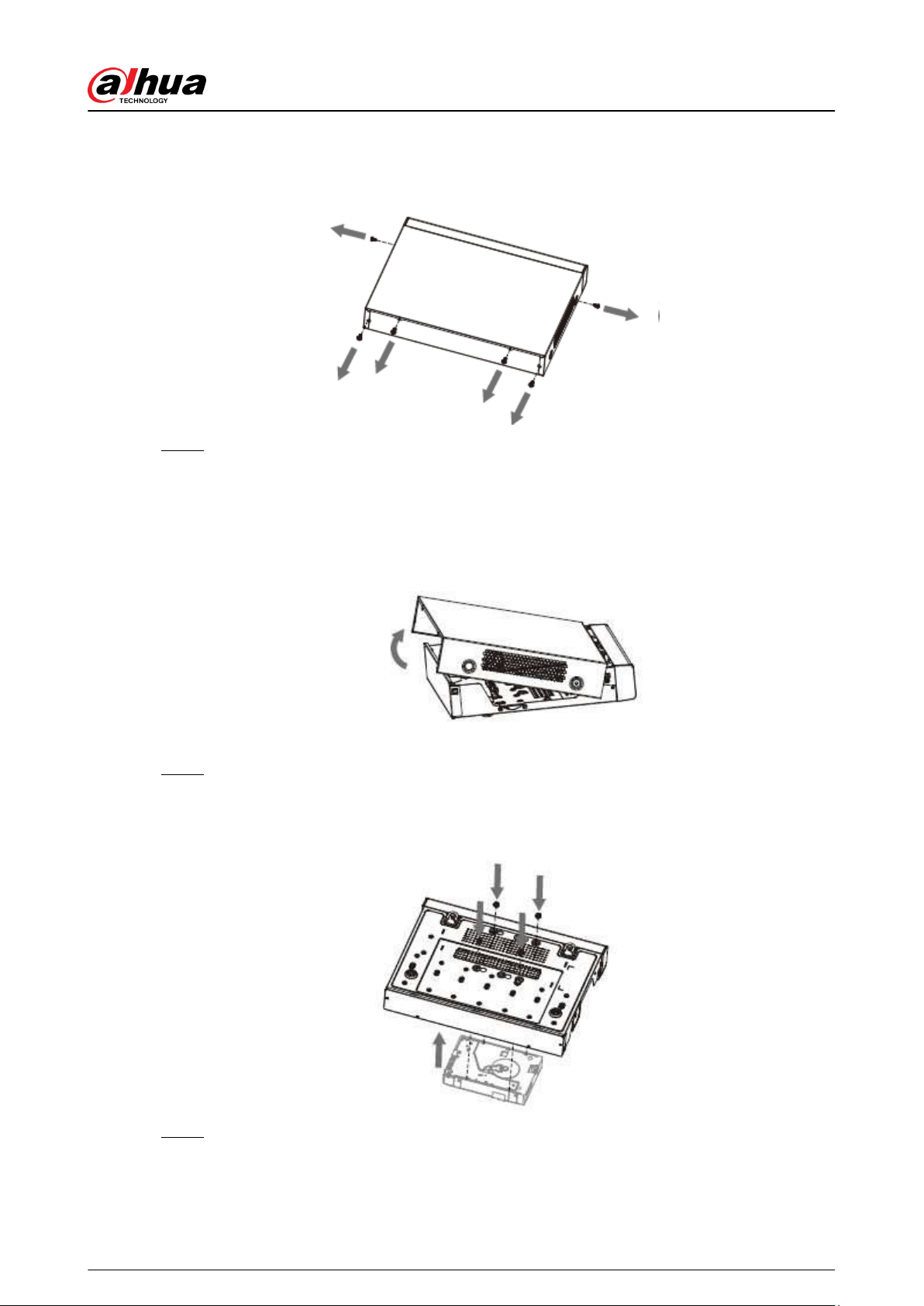
Figure 3-6 Loosen screws
Step 2 Remove the cover in the direction of the arrow as shown in the gure below.
Figure 3-7 Remove cover
Step 3 Turn over the device, and align the HDD to the four holes of bottom panel, and then x
the HDD with screws.
Figure 3-8 Align HDD
Step 4 Connect HDD to the device using data cable and power cable.
User's Manual
84
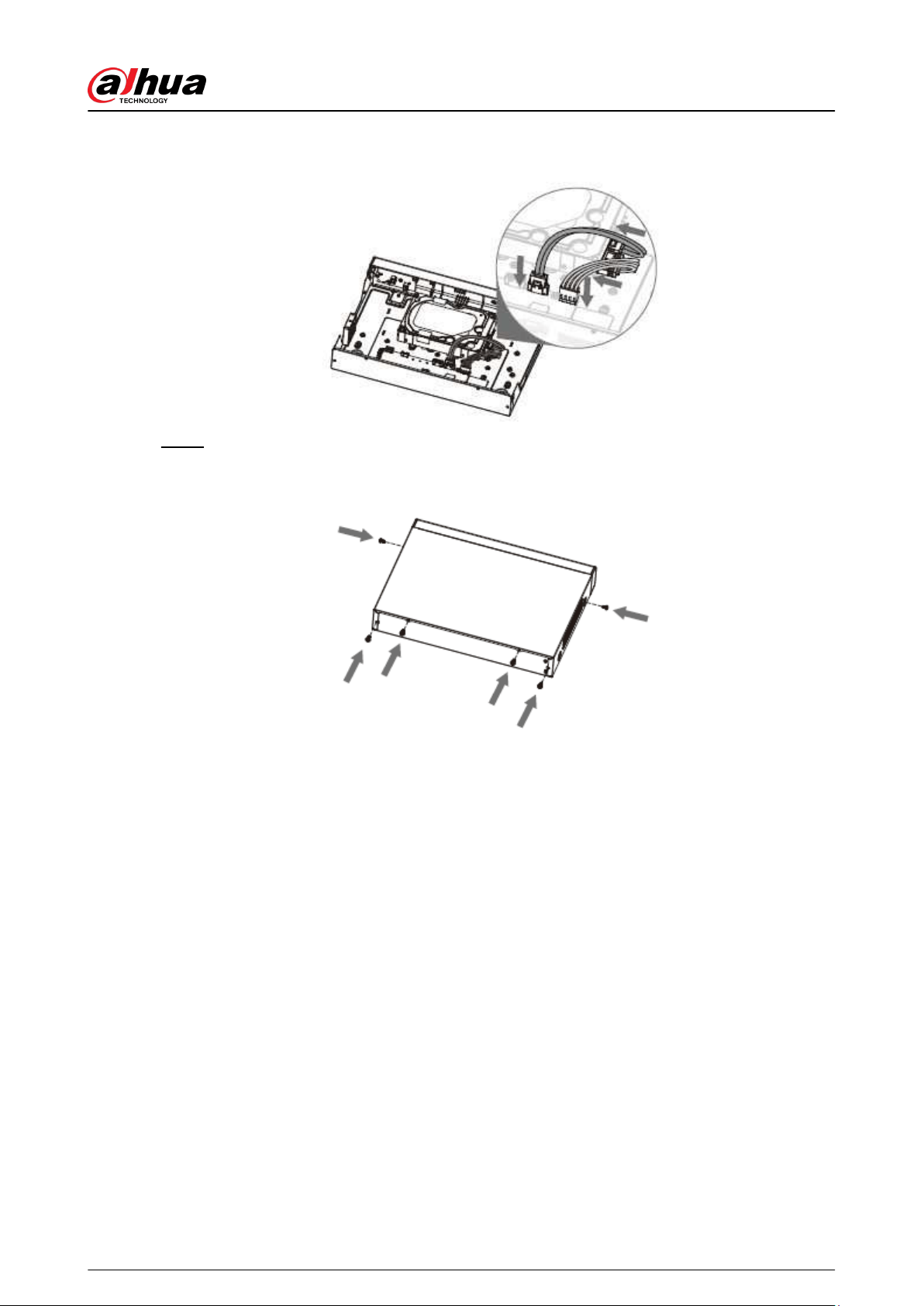
Figure 3-9 Connect cables
Step 5 Put the cover in accordance with the clip and then x the screws on the rear panel and
side panel.
Figure 3-10 Put cover back
3.3.3 NVR22-8P-S2/NVR42-4KS2/NVR42-P-4KS2/
NVR42-8P-4KS2/NVR42-16P-4KS2/NVR42-4KS2/L/NVR42-
P-4KS2/L/NVR42-8P-4KS2/L/NVR42-16P-4KS2/L/
NVR52-4KS2/NVR52-8P-4KS2/NVR52-16P-4KS2/
NVR52-24P-4KS2/NVR22-4KS2/NVR22-P-4KS2/
NVR22-8P-4KS2/NVR52-8P-4KS2E/NVR22-I/NVR22-I2/
NVR22-P-I/NVR22-P-I2/NVR22-8P-I/NVR22-8P-I2/
NVR22-16P-I/NVR22-16P-I2/NVR42-I/NVR42-8P-I/
NVR42-16P-I/NVR52-16P-I/NVR52-16P-I/L/NVR52-8P-I/
User's Manual
85
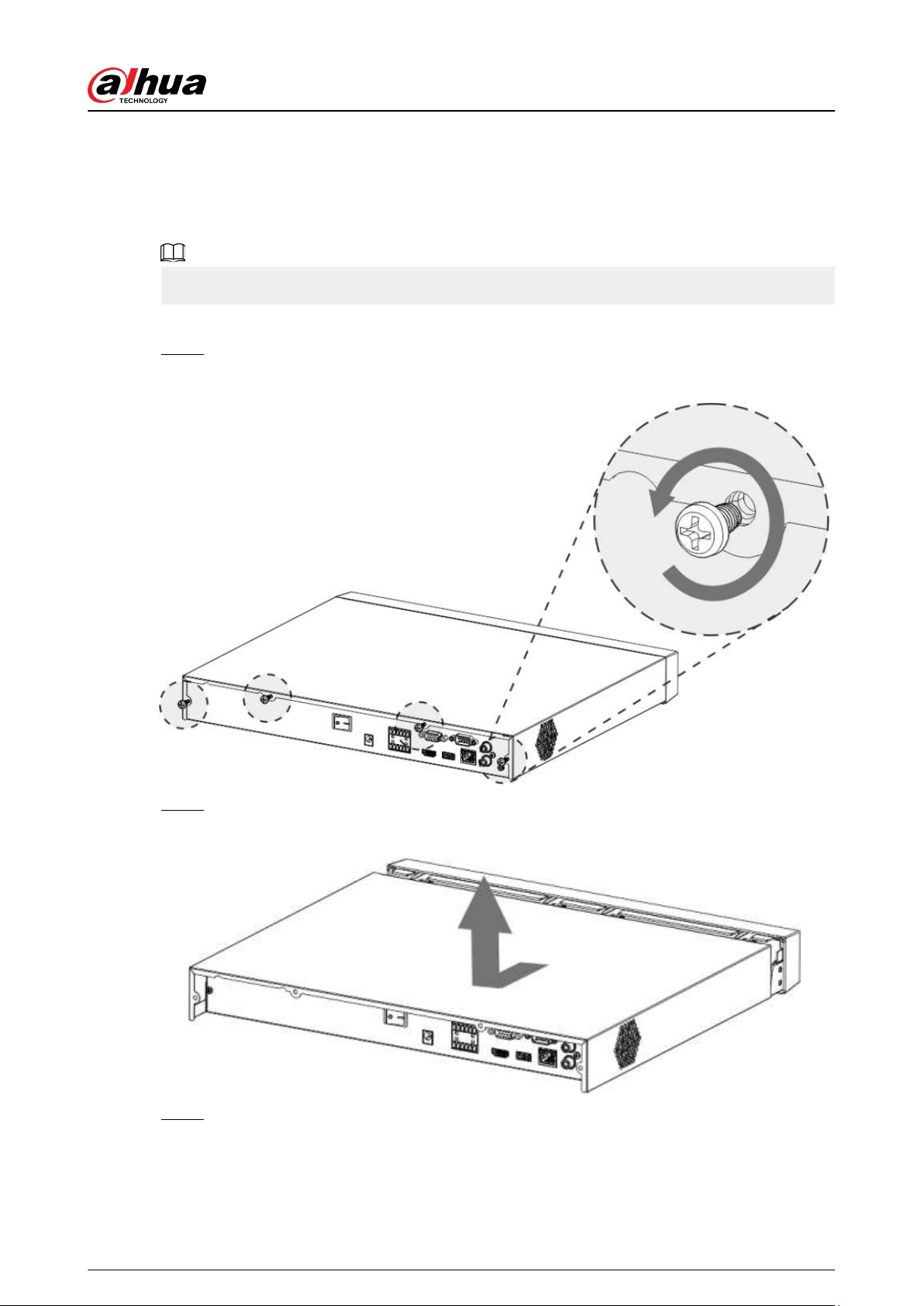
NVR52-8P-I/L/NVR42-EI/NVR42-P-EI/NVR42-8P-EI/
NVR42-16P-EI
Background Information
Dierent models have dierent numbers of HDDs.
Procedure
Step 1 Remove the four xing screws on the rear panel.
Figure 3-11 Remove screws
Step 2 Remove the case cover along the direction shown in the following arrow.
Figure 3-12 Remove cover
Step 3 Match the four holes on the baseboard to place the HDD.
User's Manual
86
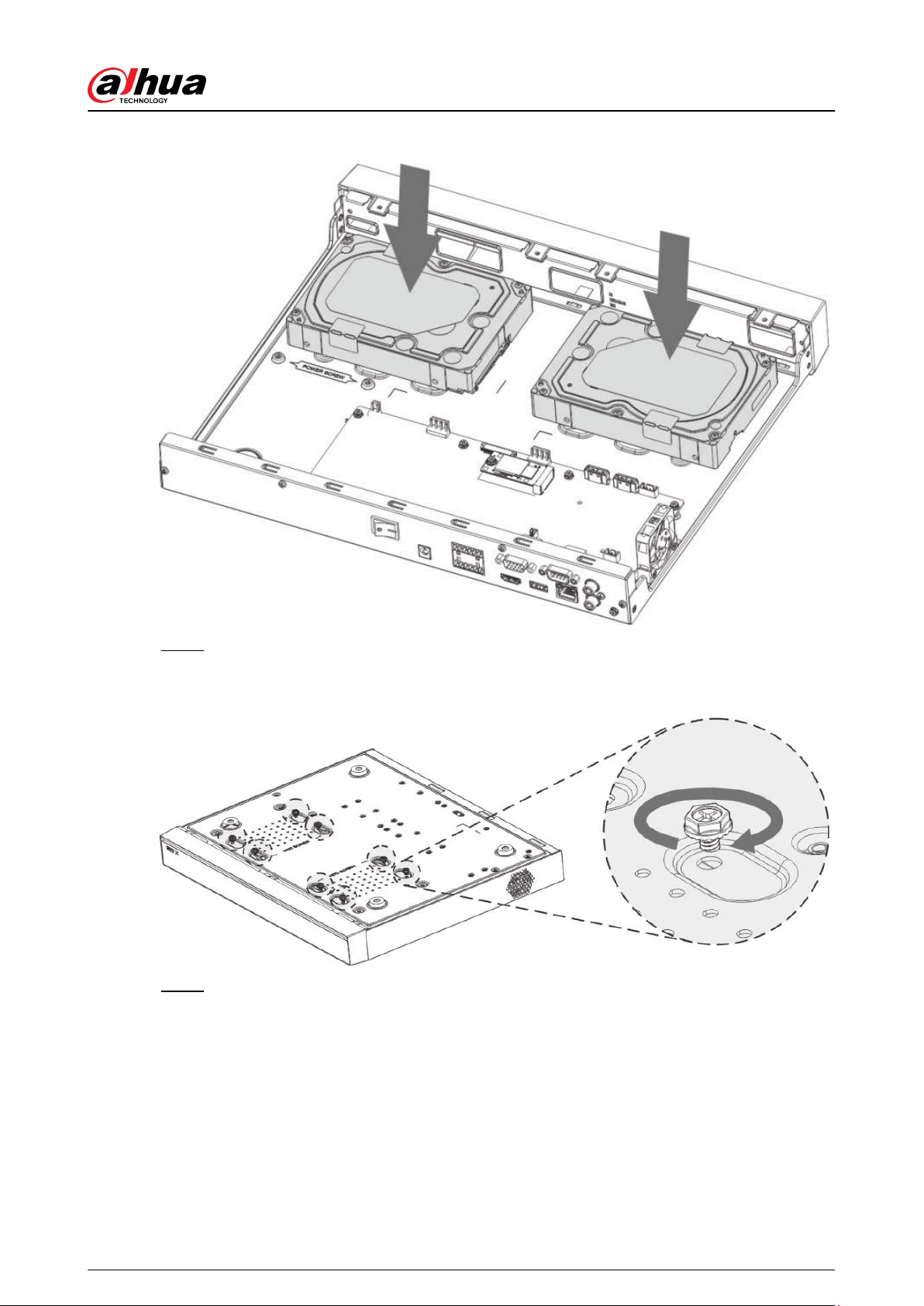
Figure 3-13 Align HDD
Step 4 Turn the device upside down, match the screws with the holes on the HDD and then
fasten them. The HDD is xed to the baseboard.
Figure 3-14 Fasten screws
Step 5 Connect the HDD data cable and power cable to the device.
User's Manual
87
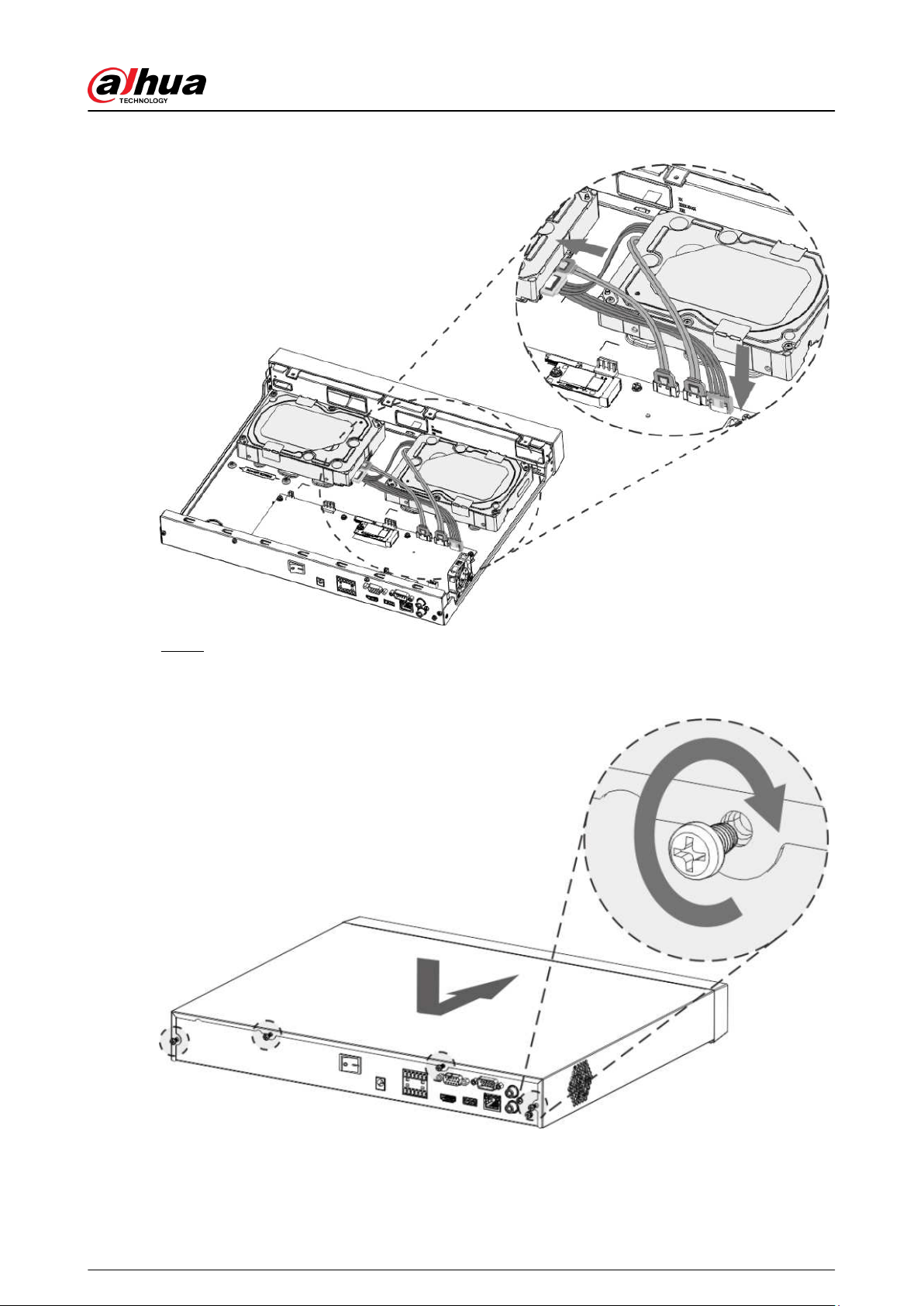
Figure 3-15 Connect cables
Step 6 Put back the cover and fasten the four screws on the rear panel to complete the
installation.
Figure 3-16 Put back cover
User's Manual
88
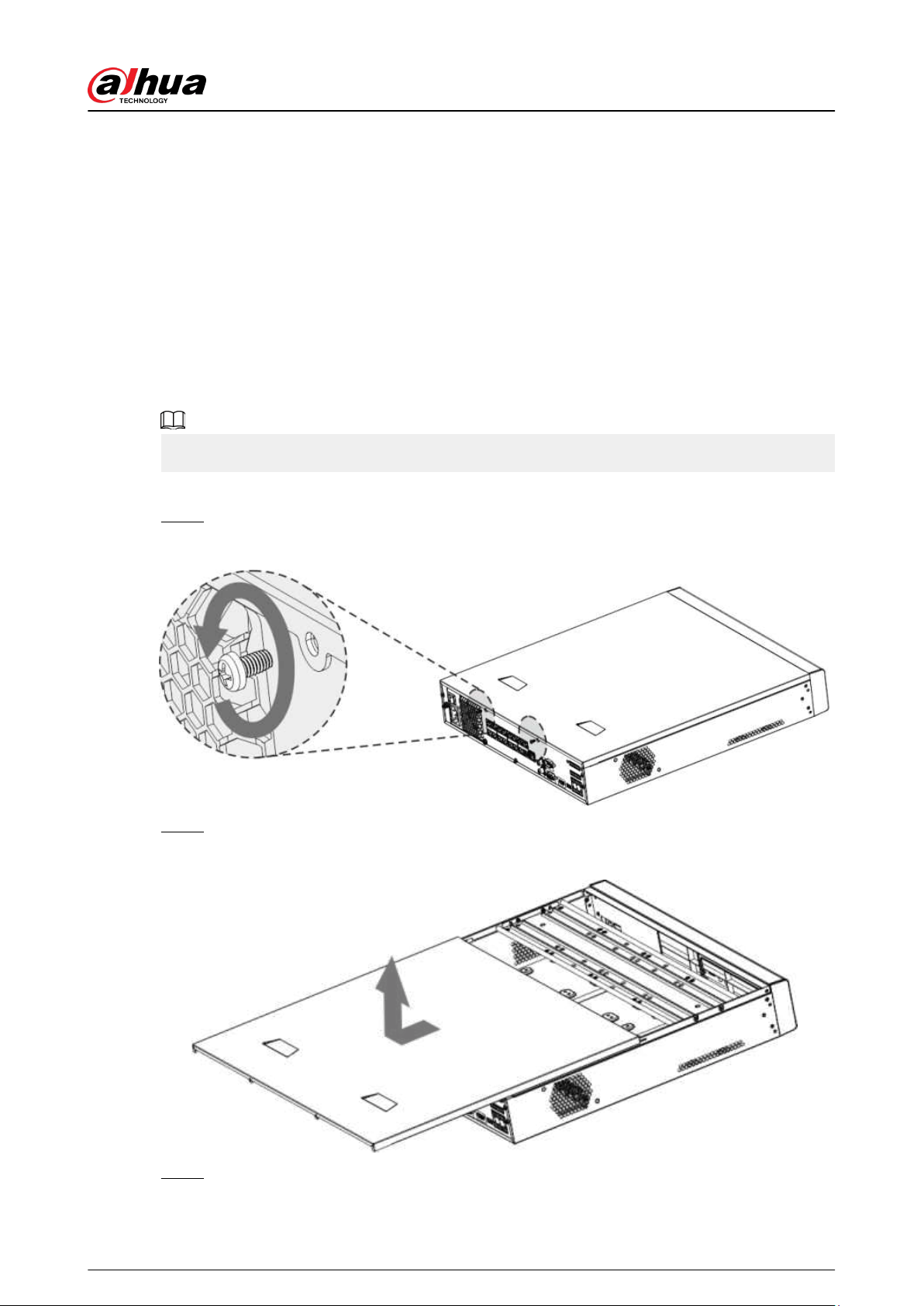
3.3.4 NVR54-4KS2/NVR54-16P-4KS2/NVR44-4KS2/
NVR44-16P-4KS2/NVR44-4KS2/L/NVR44-16P-4KS2/L/
NVR54-24P-4KS2/NVR54-16P-4KS2E/NVR58-I/NVR58-I/L/
NVR54-I/NVR54-I/L/NVR52-I/NVR52-I/L/NVR42-I/NVR42-8P-
I/NVR44-I/NVR48-I/NVR608-32-4KS2/NVR44-4KS2/I/
NVR44-16P-4KS2/I/NVR48-4KS2/I/NVR48-16P-4KS2/I/
NVR48-EI/NVR48-16P-EI/NVR44-EI/NVR44-16P-EI
Background Information
Dierent models have dierent number of HDDs.
Procedure
Step 1 Remove the xing screws on the rear panel of the device.
Figure 3-17 Remove screws
Step 2 Remove the case cover along the direction shown in the following arrow.
Figure 3-18 Remove cover
Step 3 Remove the screws on the sides of HDD bracket to take out the bracket.
●
1.5U device has one HDD bracket. For the way to remove the bracket, see Figure 3-19
User's Manual
89
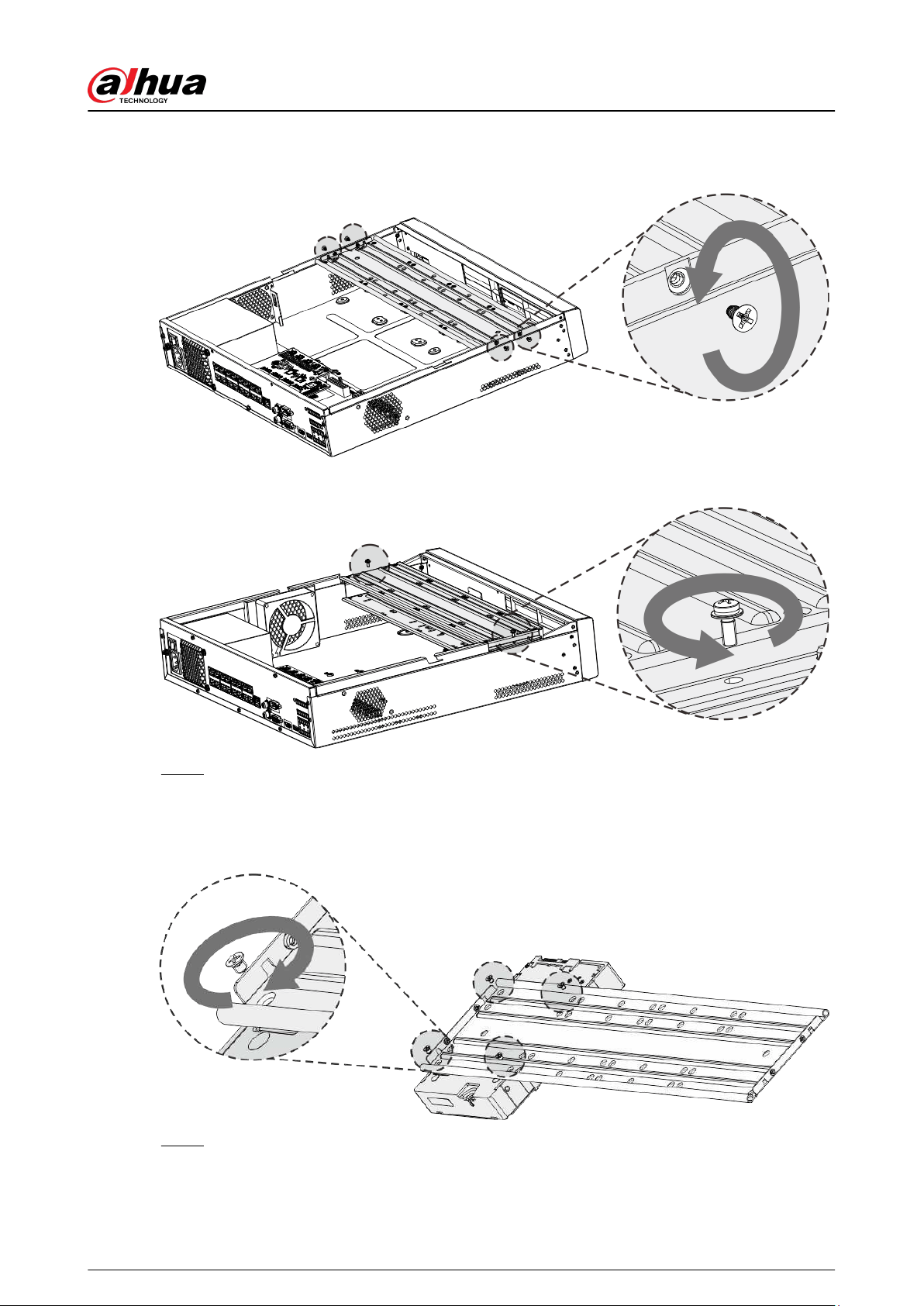
●
2U device has two HDD brackets. For the way to remove the brackets, see Figure 3-20 .
Figure 3-19 Remove screws (1.5U)
Figure 3-20 Remove screws (2U)
Step 4 Match the four screw holes on the HDD with the four holes on the bracket and then
fasten the screws.
The HDD is xed to the bracket.
Figure 3-21 Fasten screws
Step 5 see Step 4 to install other HDDs.
User's Manual
90
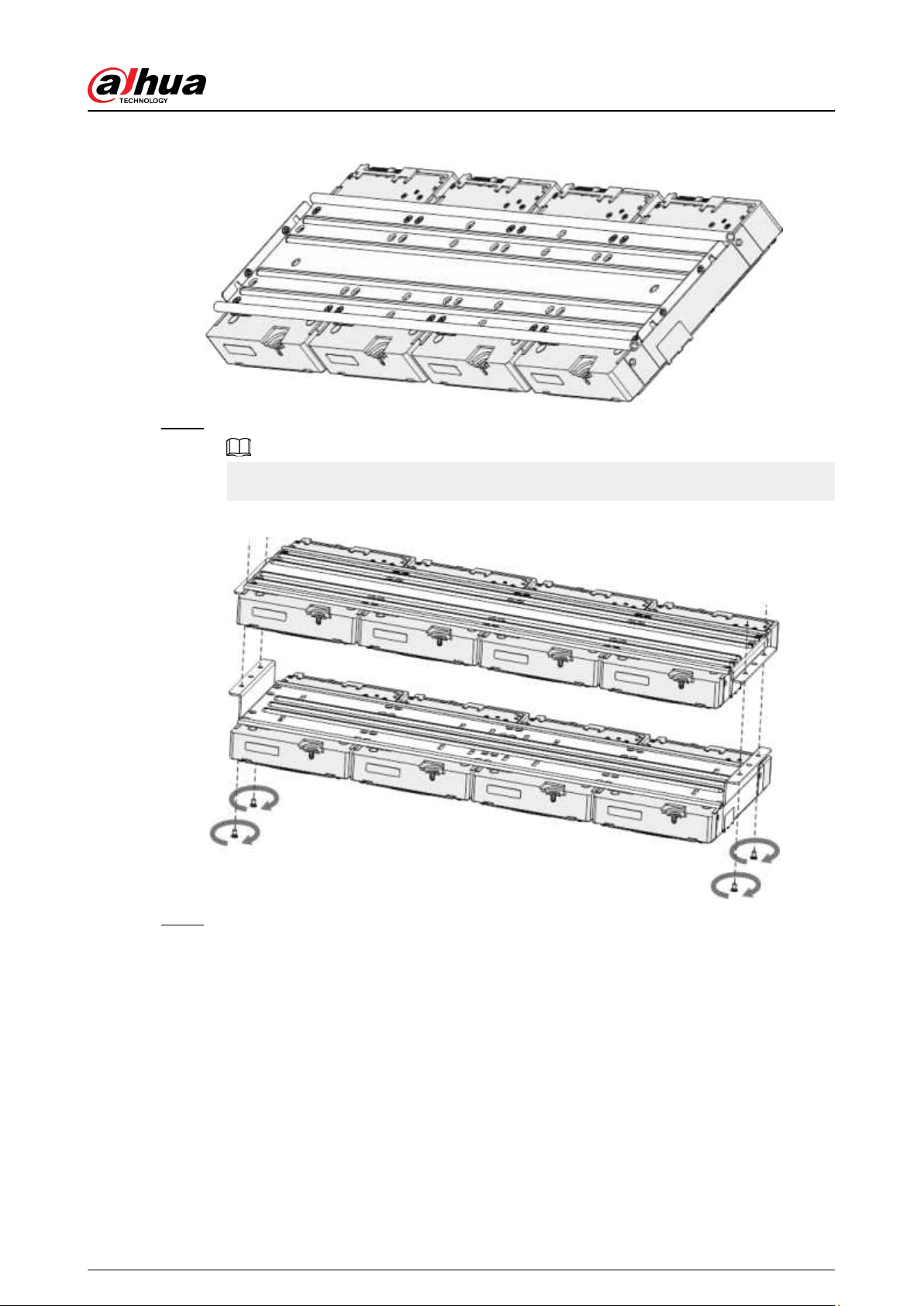
Figure 3-22 Install more HDDs
Step 6 Lock the two HDD brackets.
This step is required for 2U devices only.
Figure 3-23 Lock brackets
Step 7 Place the bracket to the device and then fasten the screws on the sides of the bracket.
User's Manual
91
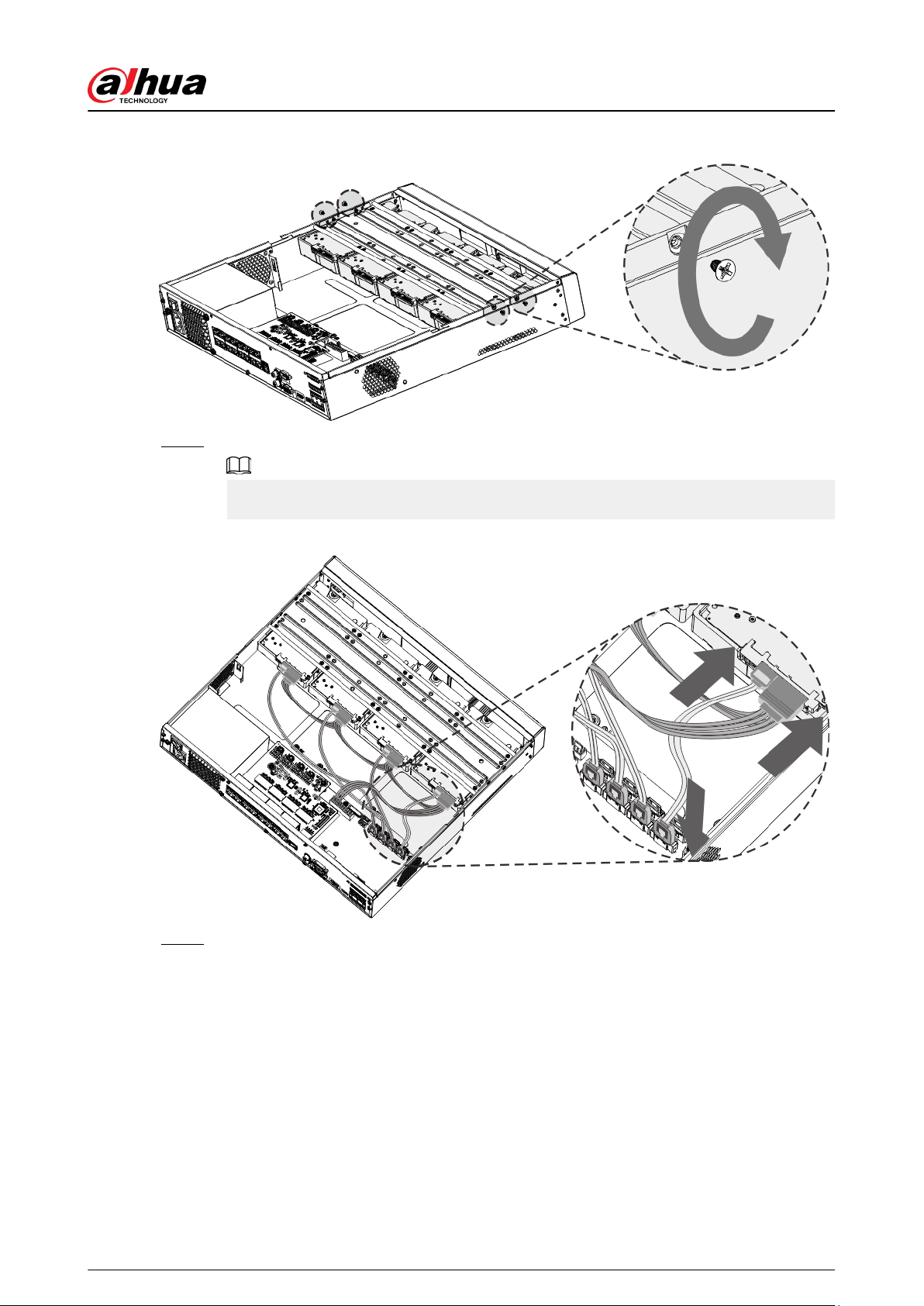
Figure 3-24 Fasten screws
Step 8 Connect the HDD data cable and power cable to the device.
The following gure is for reference only.
Figure 3-25 Connect cables
Step 9 Put back the cover and fasten the screws on the rear panel to complete the installation.
User's Manual
92
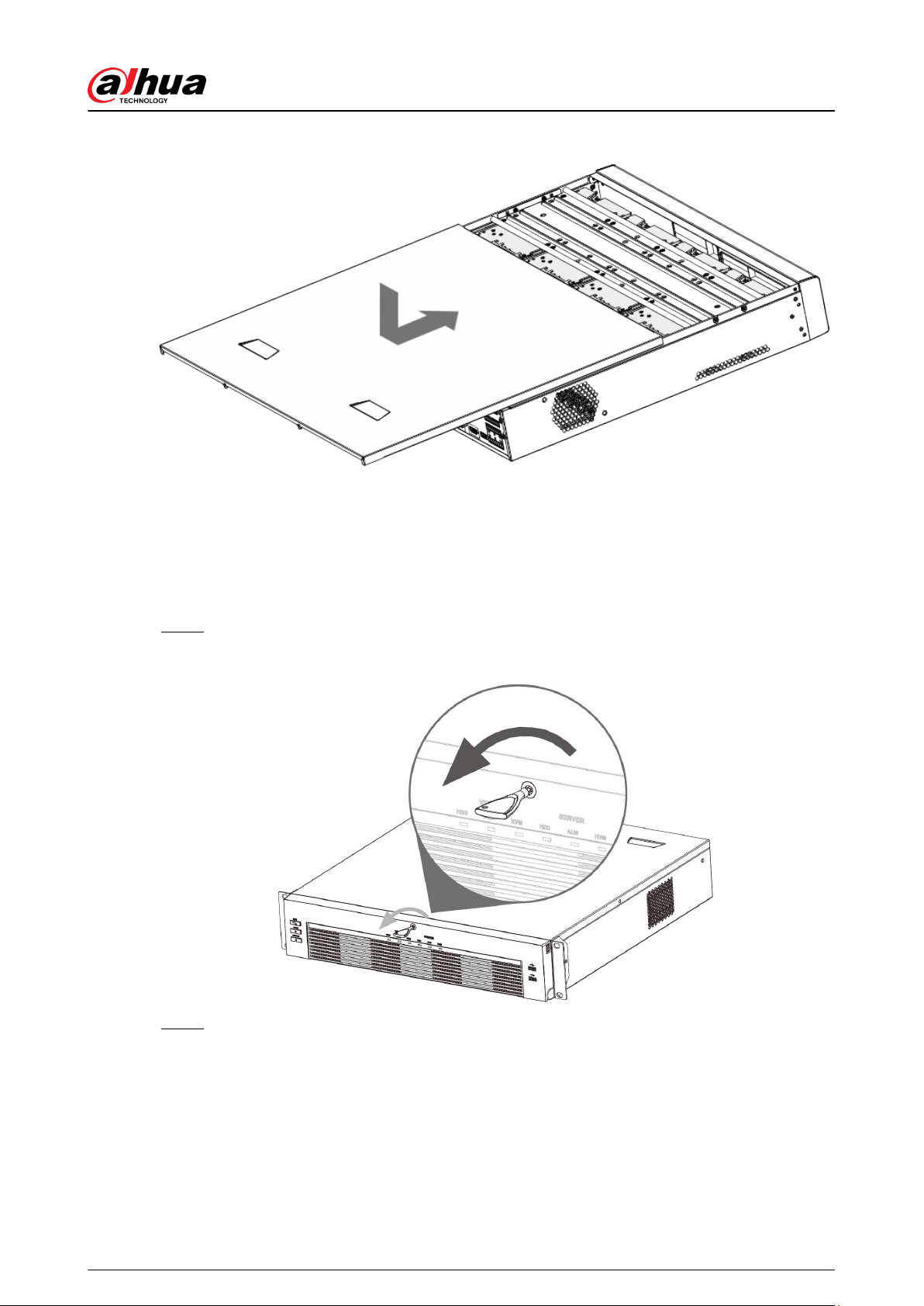
Figure 3-26 Fasten screws
3.3.5 NVR608-64-4KS2/NVR608-128-4KS2/NVR608H-32-XI/
NVR608H-64-XI/NVR608H-128-XI Series
Procedure
Step 1 Unlock the lock on the front panel.
Figure 3-27 Unlock front panel
Step 2 Press the button on the 2 sides to open the front panel.
User's Manual
93
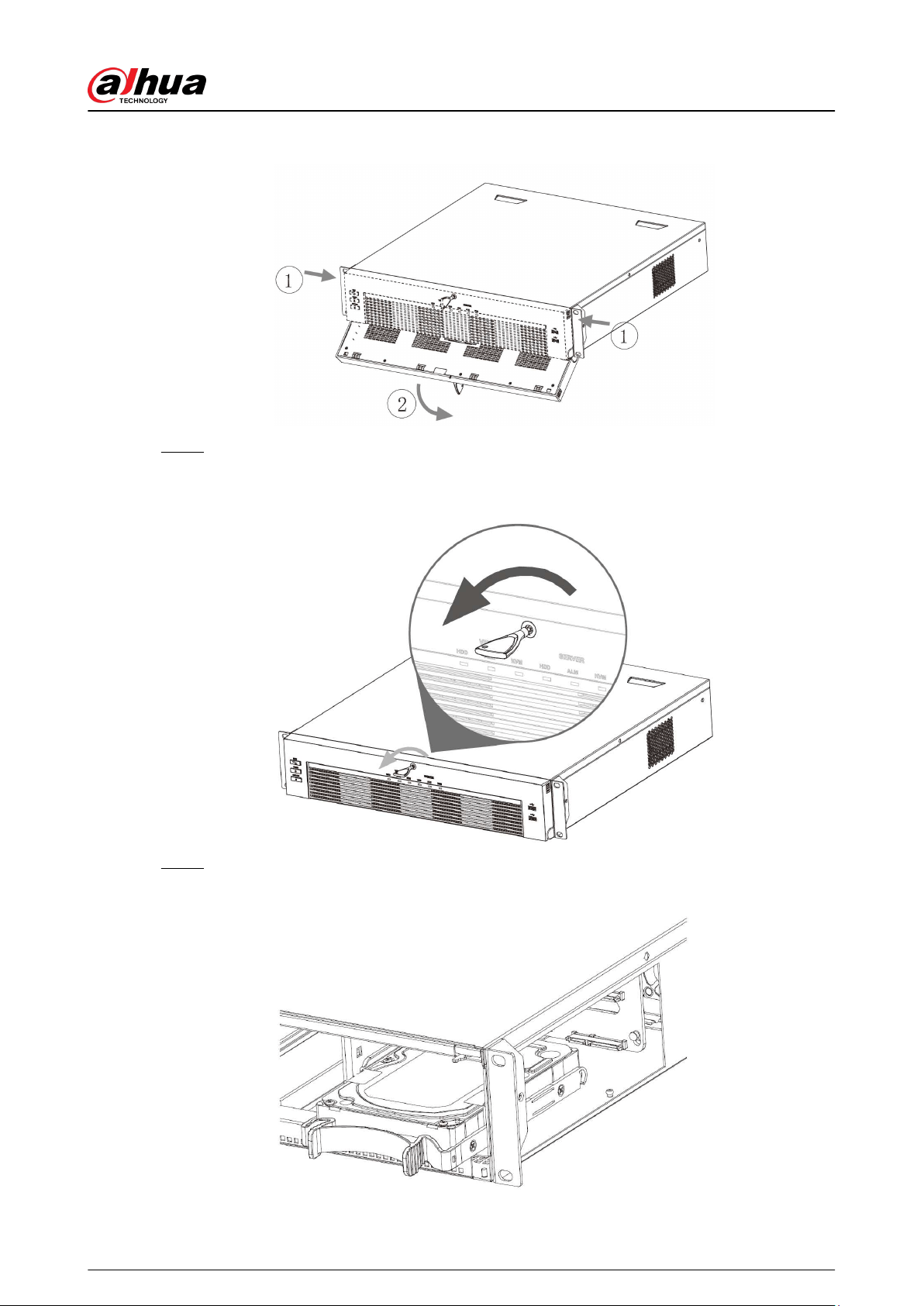
Figure 3-28 Open front panel
Step 3 Match the 4 screw holes on the HDD with the 4 holes on the bracket and then fasten the
screws.
Figure 3-29 Fasten HDD
Step 4 Push the HDD box into the device.
Figure 3-30 Unlock front panel
User's Manual
94
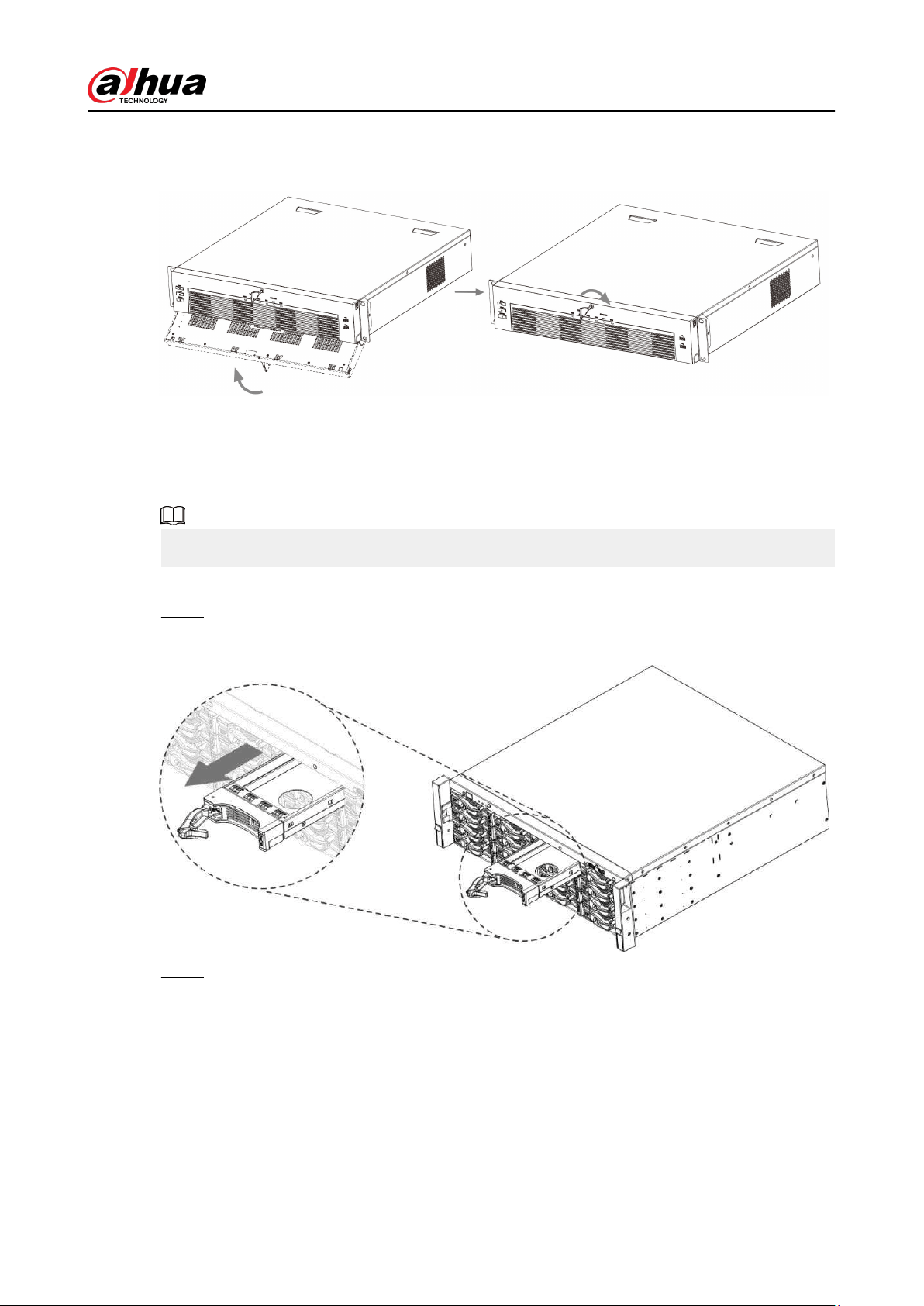
Step 5 Close the front panel and then tighten the lock on the front panel.
Figure 3-31 Lock front panel
3.3.6 NVR616-4KS2 Series
Background Information
The following gures are for reference only.
Procedure
Step 1 Press the red button on the HDD box, open the handle and then pull out the HDD box.
Figure 3-32 Take out HDD box
Step 2 Put the HDD into the HDD box along the direction shown in the following arrow.
User's Manual
95
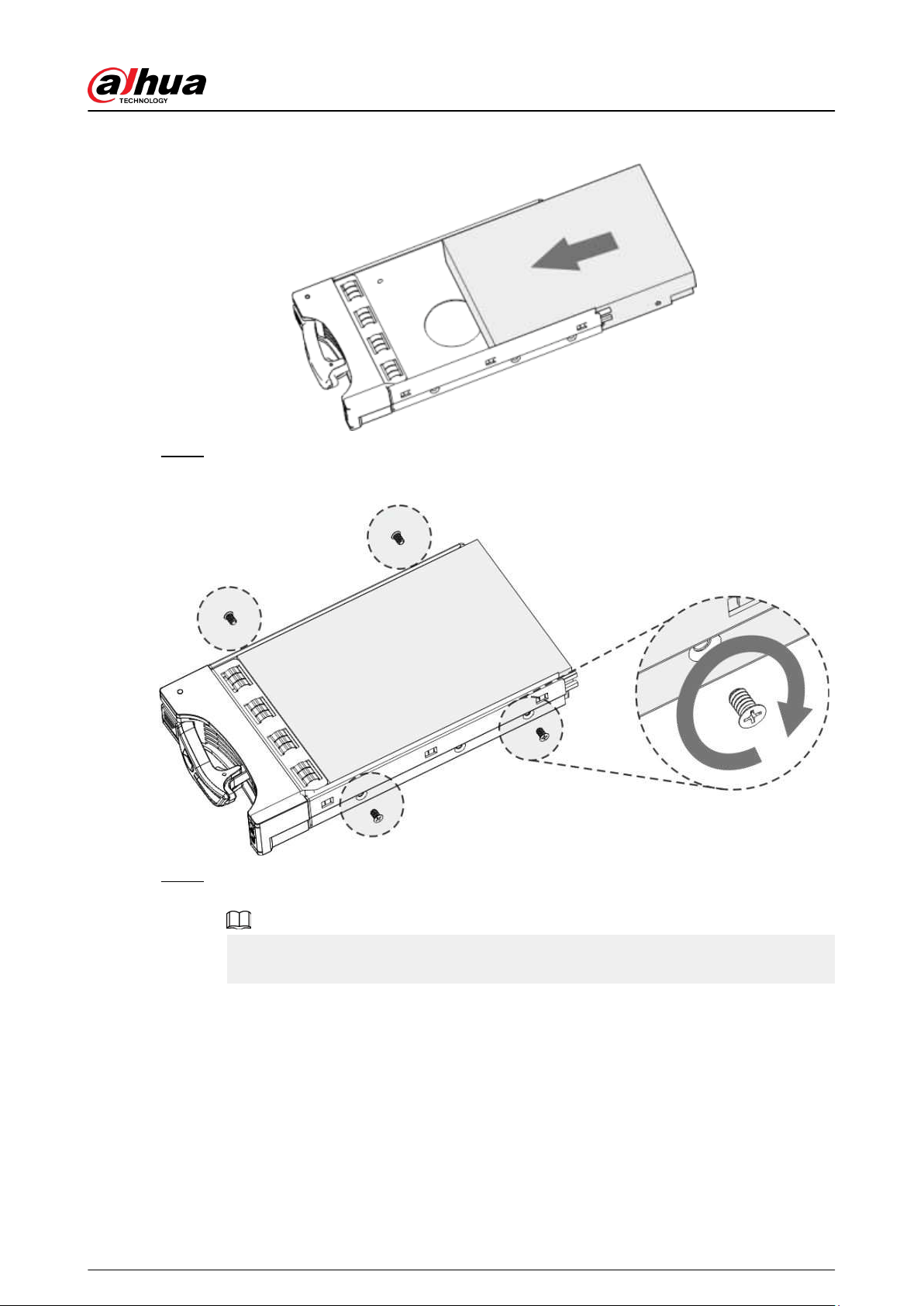
Figure 3-33 Put HDD into box
Step 3 Fasten the screws on the sides of the HDD box.
Figure 3-34 Fasten screws
Step 4 Insert the HDD box into the HDD slot, press it to the bottom, and then close the box
handle.
If you have not pushed the HDD box to the bottom, do not close the handle to avoid any
damage to the HDD slot
User's Manual
96
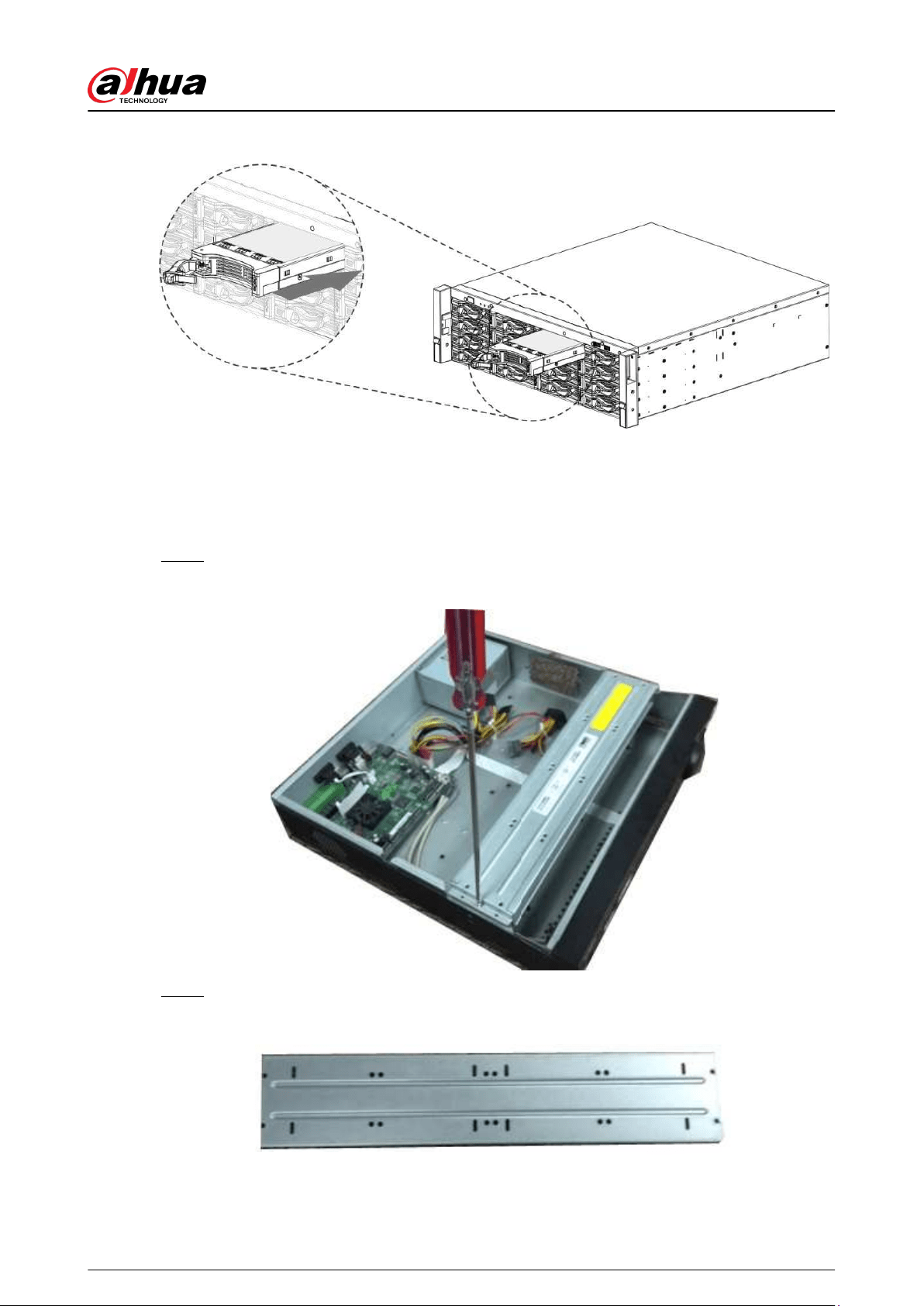
Figure 3-35 Close the handle
3.4 CD-ROM Installation
Procedure
Step 1 Open the top cover and then remove the HDD bracket.
Figure 3-36 Open the top cover
Step 2 Take o the bottom of the HDD bracket and CD-ROM bracket.
Figure 3-37 Take out HDD bracket
User's Manual
97
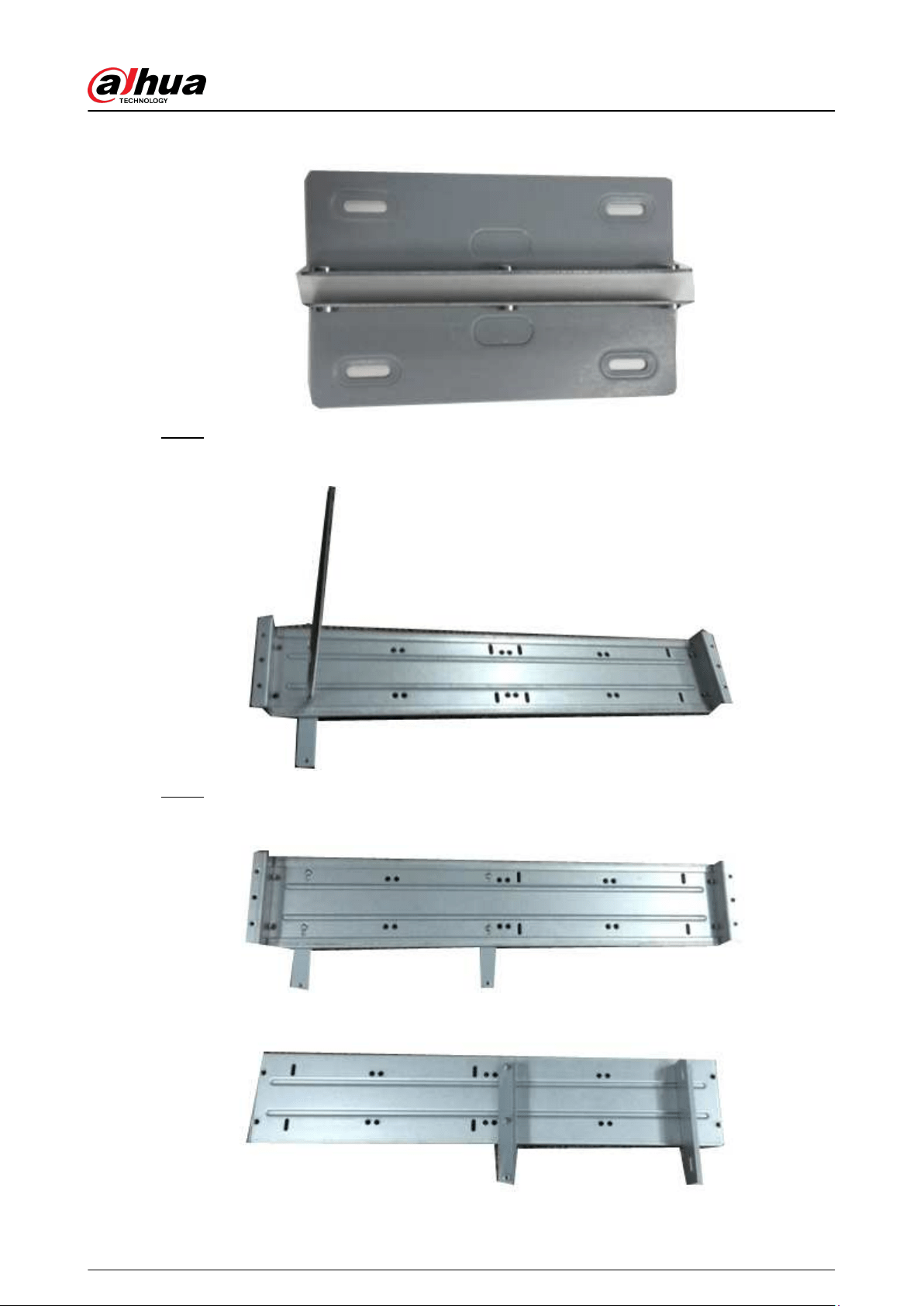
Figure 3-38 Take out CD-ROM bracket
Step 3 Fix the CD-ROM bracket at the HDD bracket.
Figure 3-39 Fix bracket
Step 4 Install a pair of the CD-ROM bracket. Please make sure that the reverse side is secure too.
Figure 3-40 Install bracket
Figure 3-41 Install bracket (reverse side)
User's Manual
98
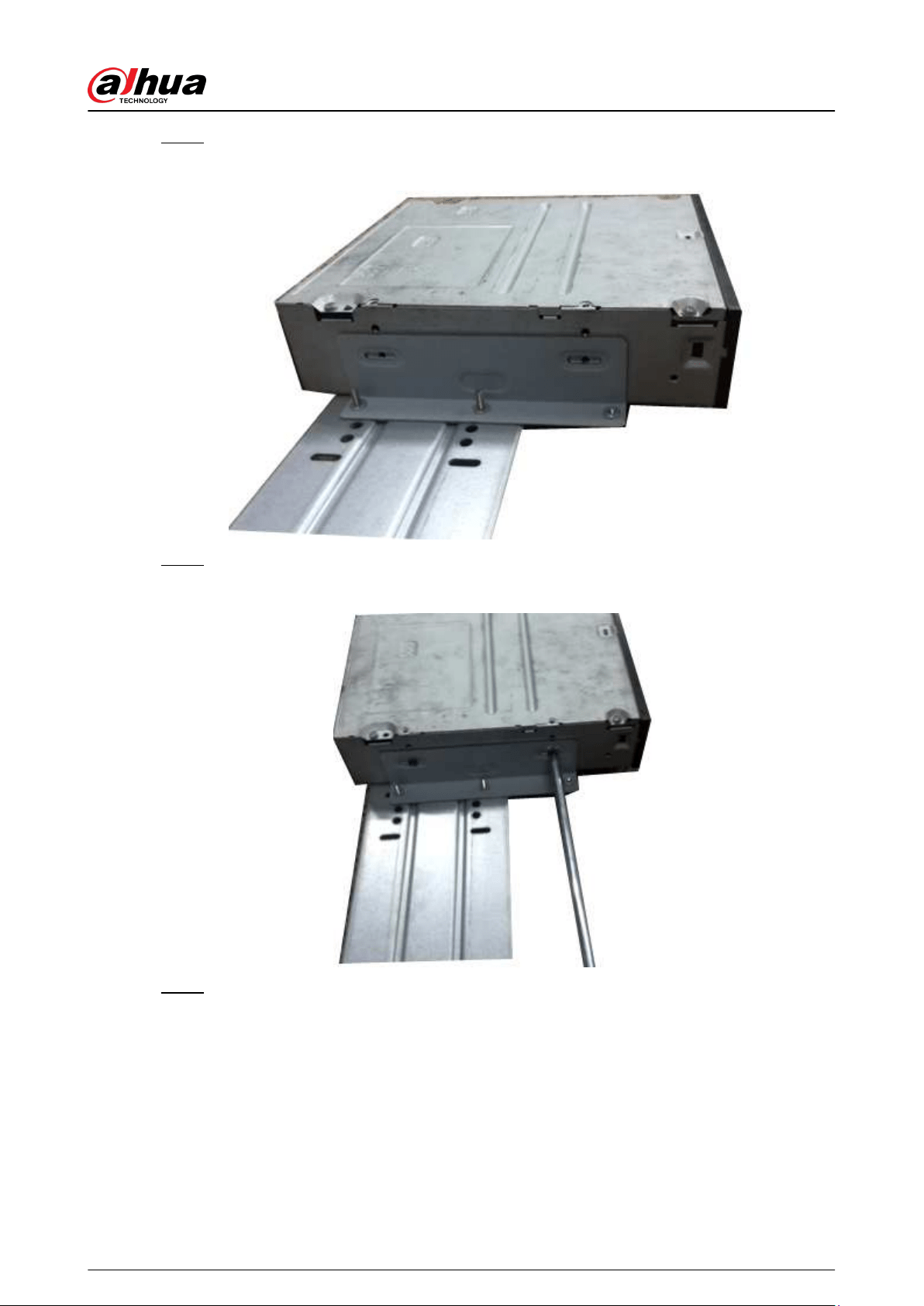
Step 5 Install SATA burner. Line up the SATA burner to the hole positions.
Figure 3-42 Install SATA burner
Step 6 Use screw driver to x the screws.
Figure 3-43 Fasten screws
Step 7 Put the bracket back. Please adjust the CD-ROM to the proper position so that the button
of the front panel is directly facing the pop-up button of the CD-ROM.
User's Manual
99
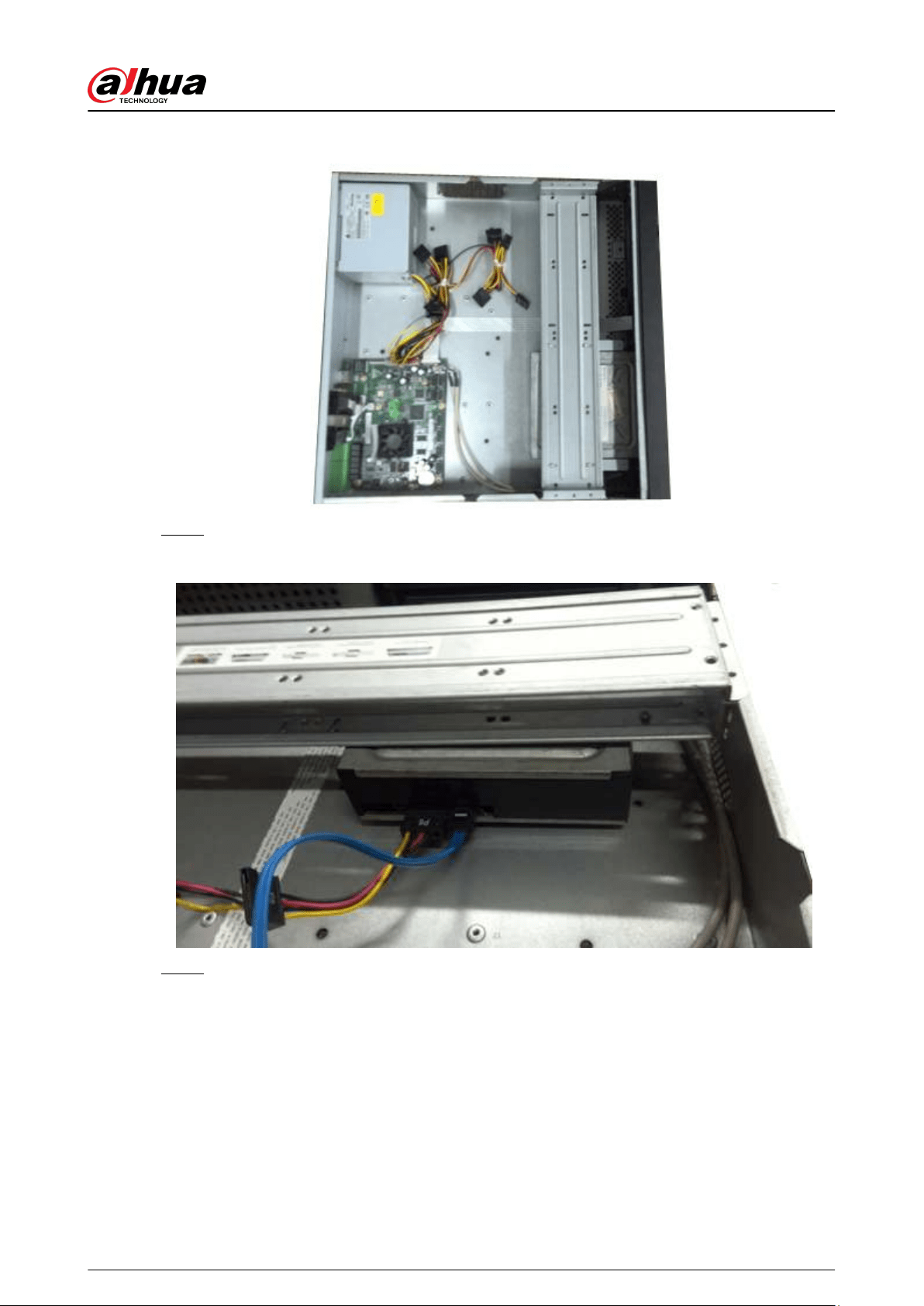
Figure 3-44 Put bracket back
Step 8 Connect the SATA cable and power wire.
Figure 3-45 Connect cables
Step 9 Secure the HDD bracket and put the top cover back.
User's Manual
100
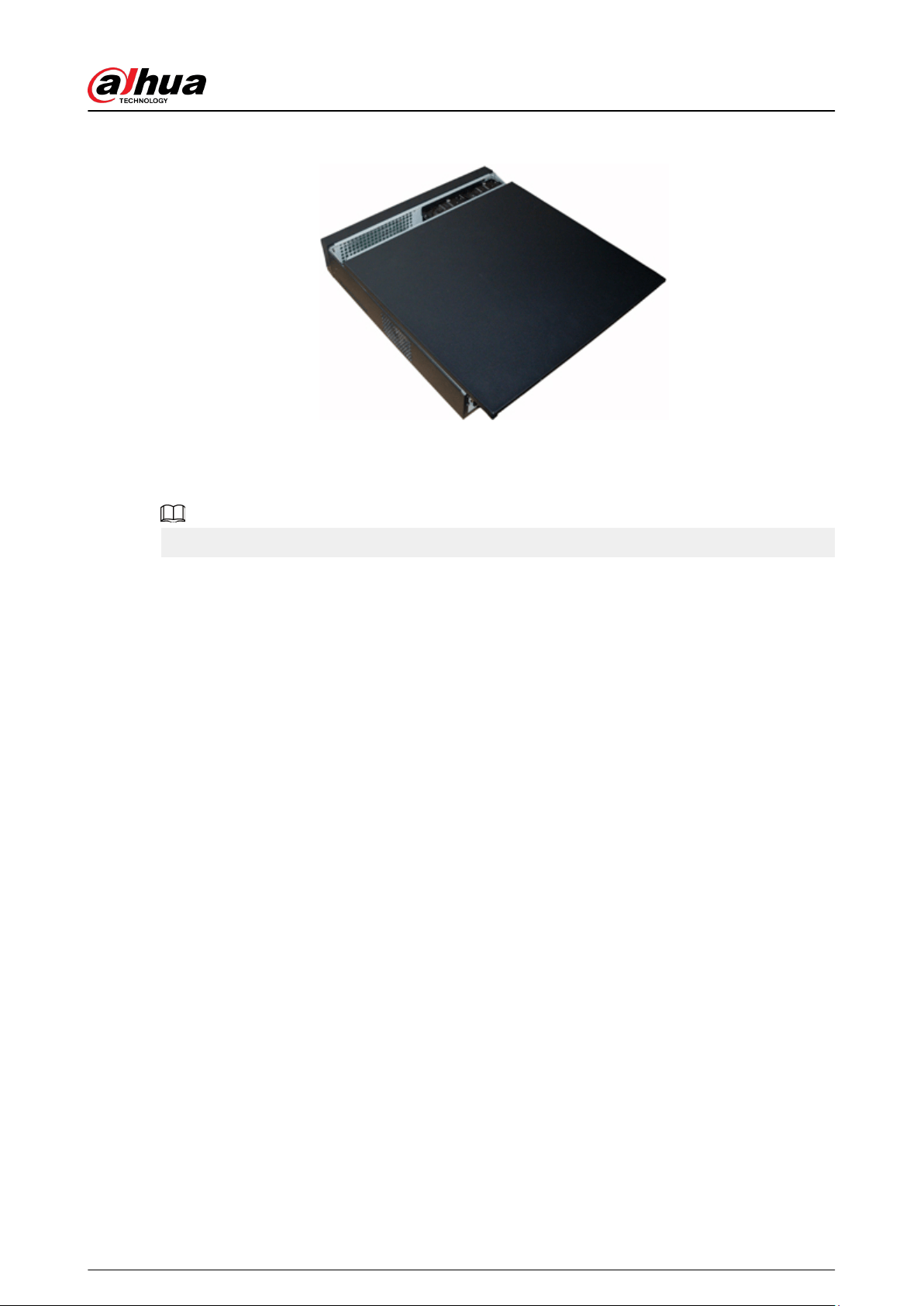
Figure 3-46 Put cover back
3.5 Connection Sample
The following gures are for reference only and might dier from the actual product.
3.5.1 NVR41-4KS2/NVR41-P-4KS2/NVR41-8P-4KS2/
NVR41-4KS2/L/NVR41-P-4KS2/L/NVR41-8P-4KS2/L/
NVR21-4KS2/NVR21-P-4KS2/NVR21-8P-4KS2/NVR21-I/
NVR21-I2/NVR21-P-I/NVR21-P-I2/NVR21-8P-I/NVR21-8P-I2/
User's Manual
101
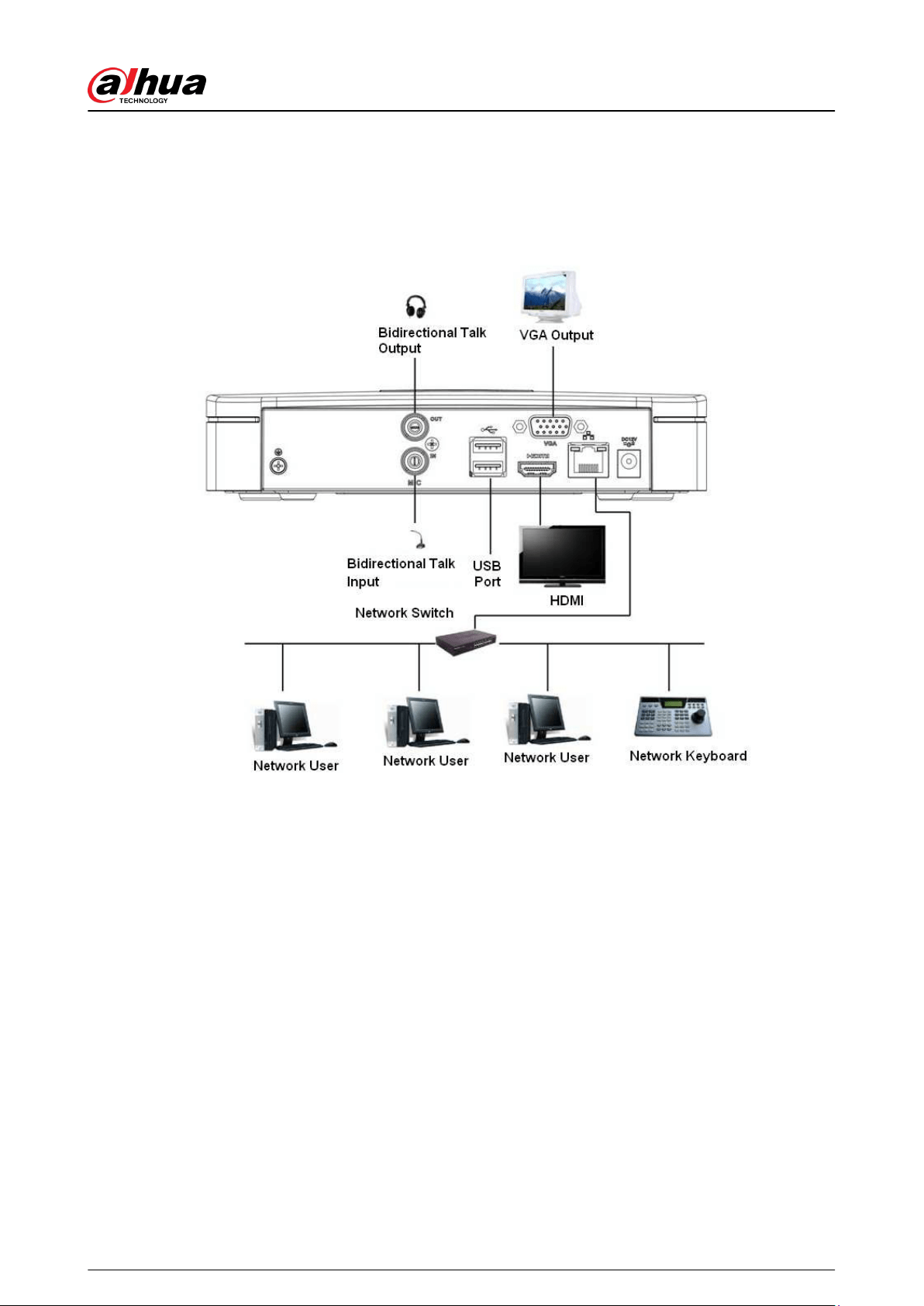
NVR21-S3/NVR21-P-S3/NVR21-8P-S3/NVR41-EI/NVR41-P-EI/
NVR41-8P-EI
Figure 3-47 Typical connection
User's Manual
102
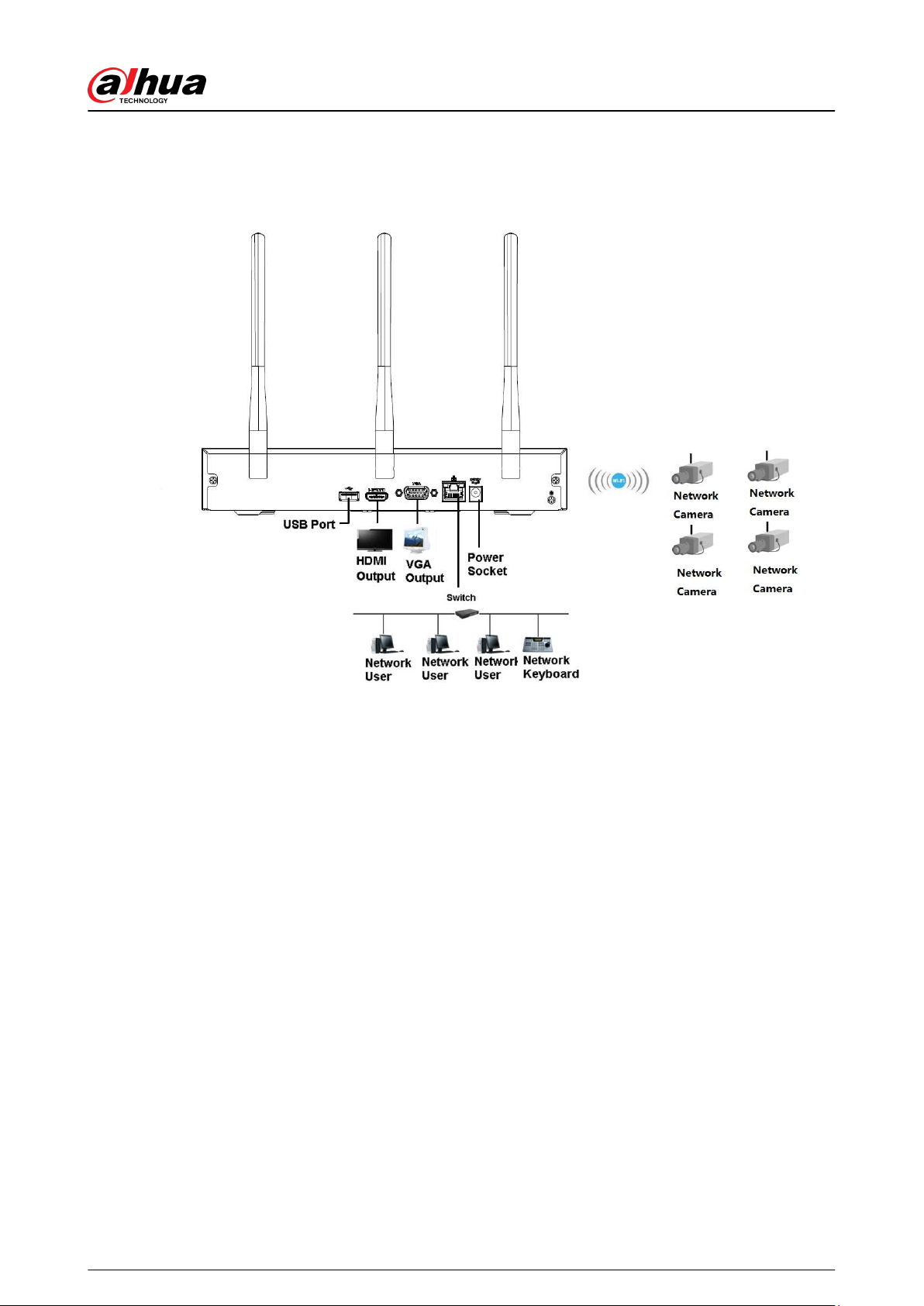
3.5.2 NVR21-W-4KS2/NVR21HS-W-4KS22
Figure 3-48 Typical connection
3.5.3 NVR11HS-S3H/NVR11HS-P-S3H/NVR11HS-8P-S3H/
NVR41HS-4KS2/NVR41HS-P-4KS2/NVR41HS-8P-4KS2/
NVR41HS-4KS2/L/NVR41HS-P-4KS2/L/NVR41HS-8P-4KS2/L/
NVR21HS-4KS2/NVR21HS-P-4KS2/NVR21HS-8P-4KS2/
NVR21HS-I/NVR21HS-I2/NVR21HS-P-I/NVR21HS-P-I2/
NVR21HS-8P-I/NVR21HS-8P-I2/NVR21HS-S3/NVR21HS-P-
User's Manual
103
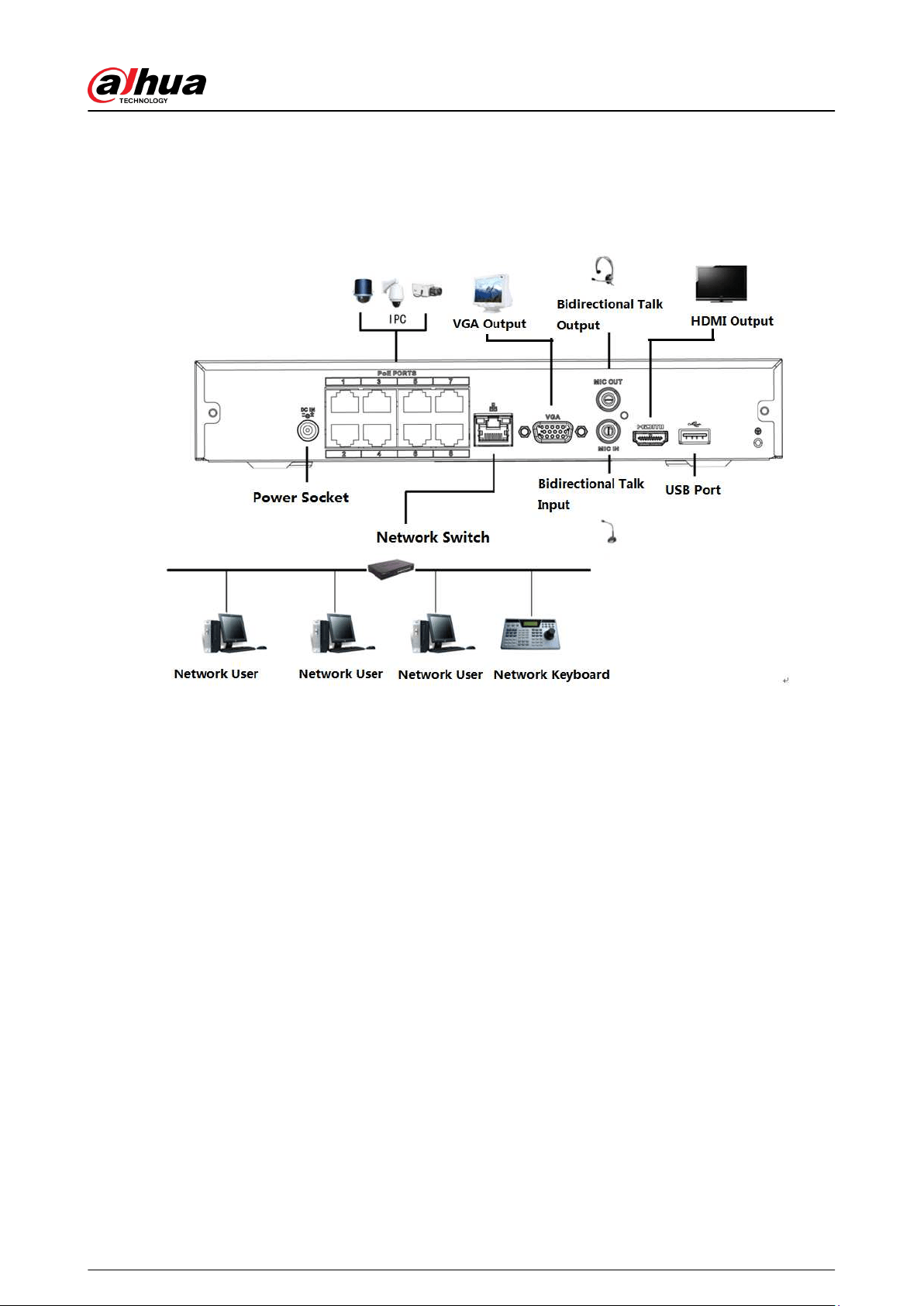
S3/NVR21HS-8P-S3/NVR41HS-EI/NVR41HS-P-EI/
NVR41HS-8P-EI
Figure 3-49 Typical connection
User's Manual
104
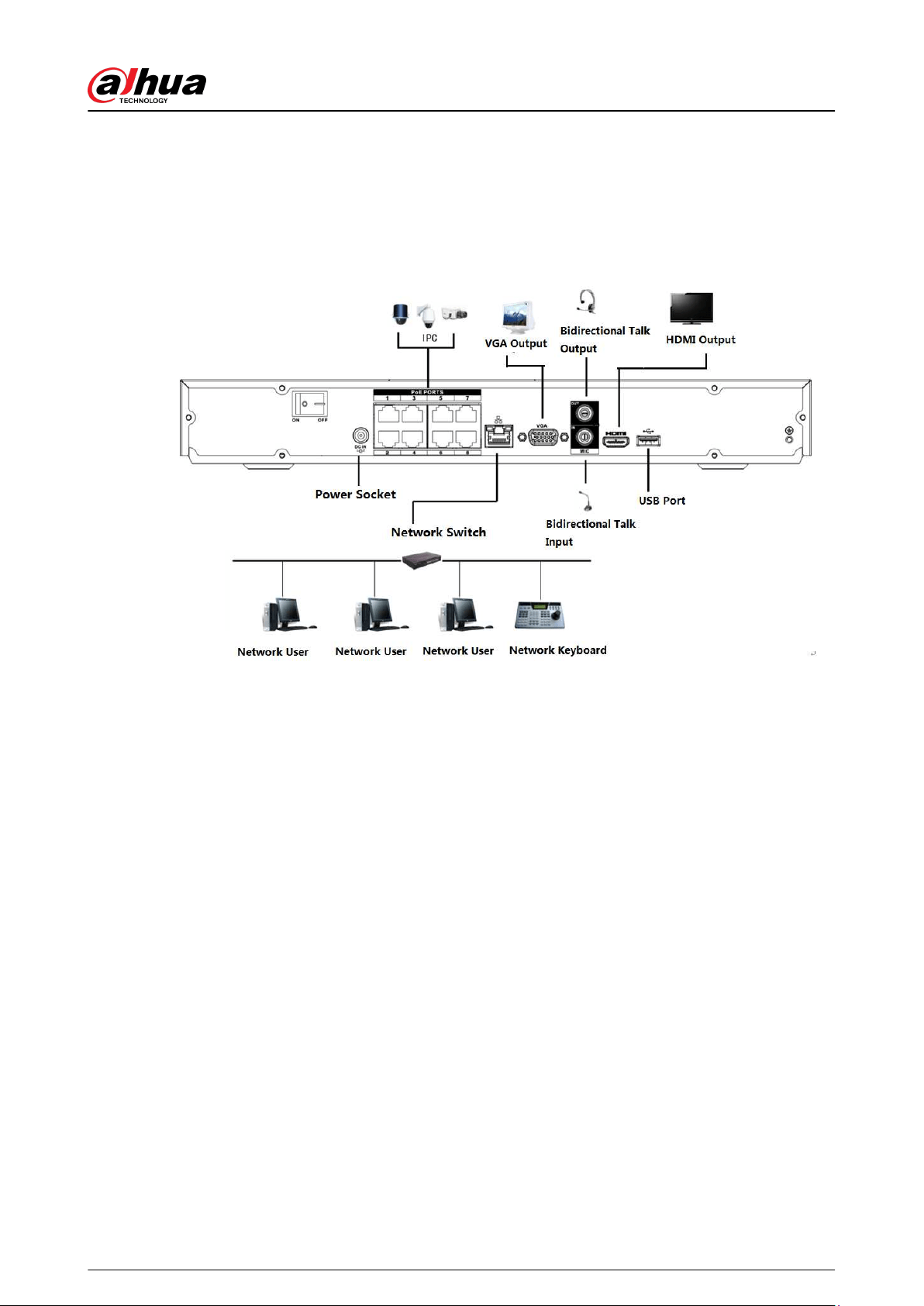
3.5.4 NVR22-4KS2/NVR22-P-4KS2/NVR22-8P-4KS2/NVR22-I/
NVR22-I2/NVR22-P-I/NVR22-P-I2/NVR22-8P-I/NVR22-8P-I2/
NVR22-16P-I/NVR22-16P-I2 Series
Figure 3-50 Typical connection
User's Manual
105
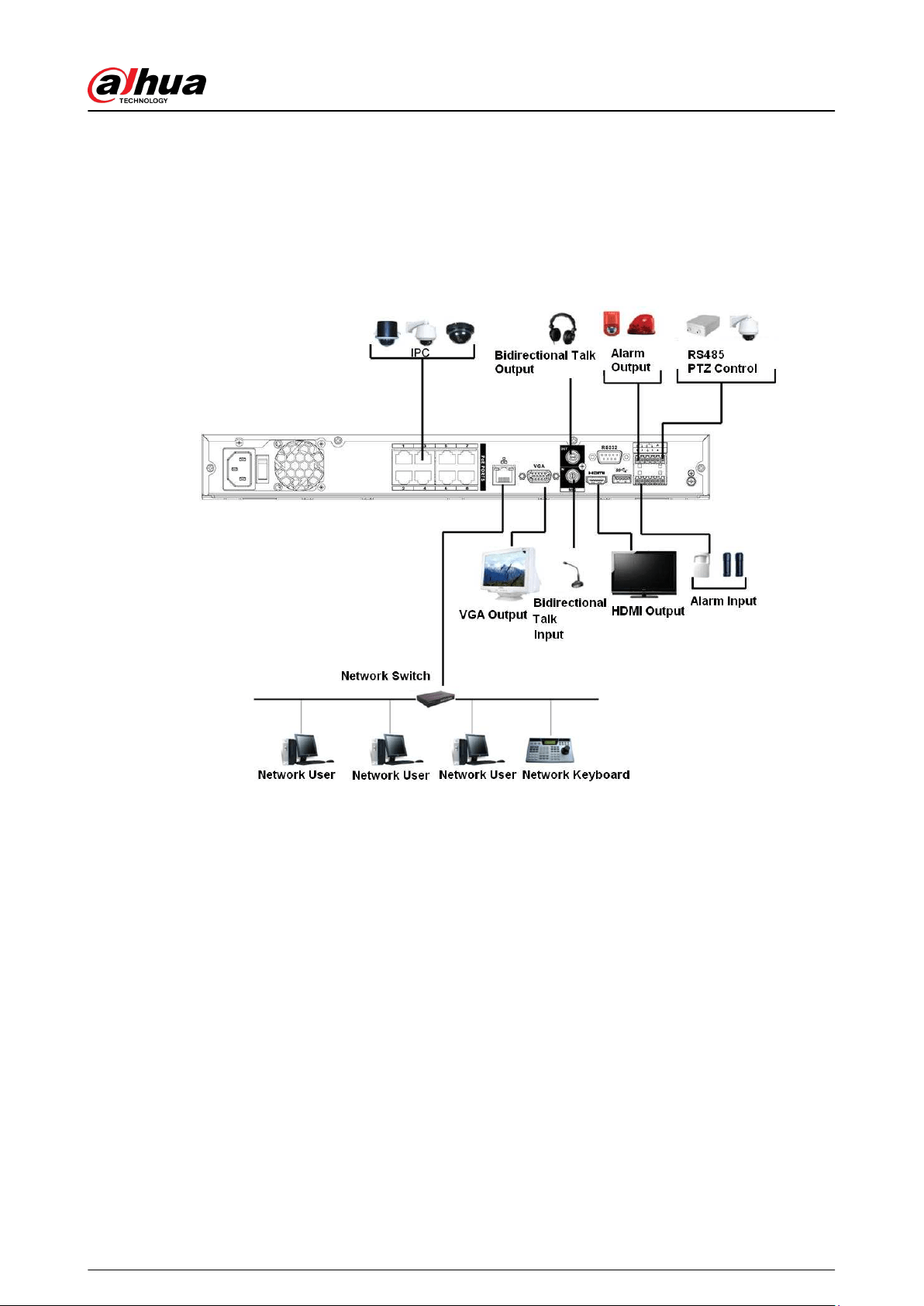
3.5.5 NVR52-4KS2/NVR52-8P-4KS2/NVR52-16P-4KS2/
NVR52-24P-4KS2/NVR52-8P-4KS2E/NVR52-16P-4KS2E
Series
Figure 3-51 Typical connection
3.5.6 NVR42-4KS2/NVR42-P-4KS2/NVR42-8P-4KS2/
NVR42-16P-4KS2/NVR42-4KS2/L/NVR42-P-4KS2/L/
User's Manual
106
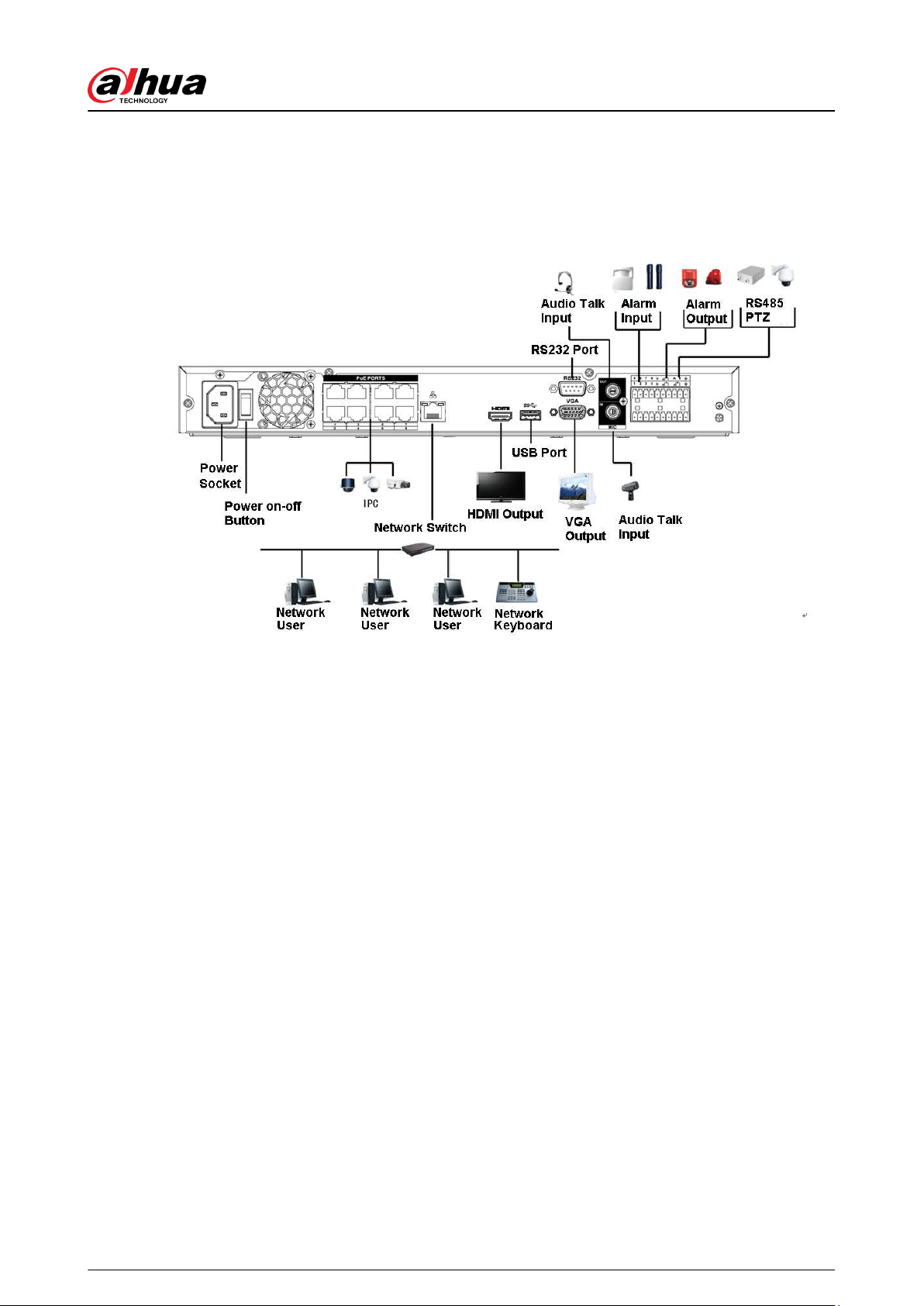
NVR42-8P-4KS2/L/NVR42-16P-4KS2/L/NVR42-EI/NVR42-P-
EI/NVR42-8P-EI/NVR42-16P-EI
Figure 3-52 Typical connection
User's Manual
107
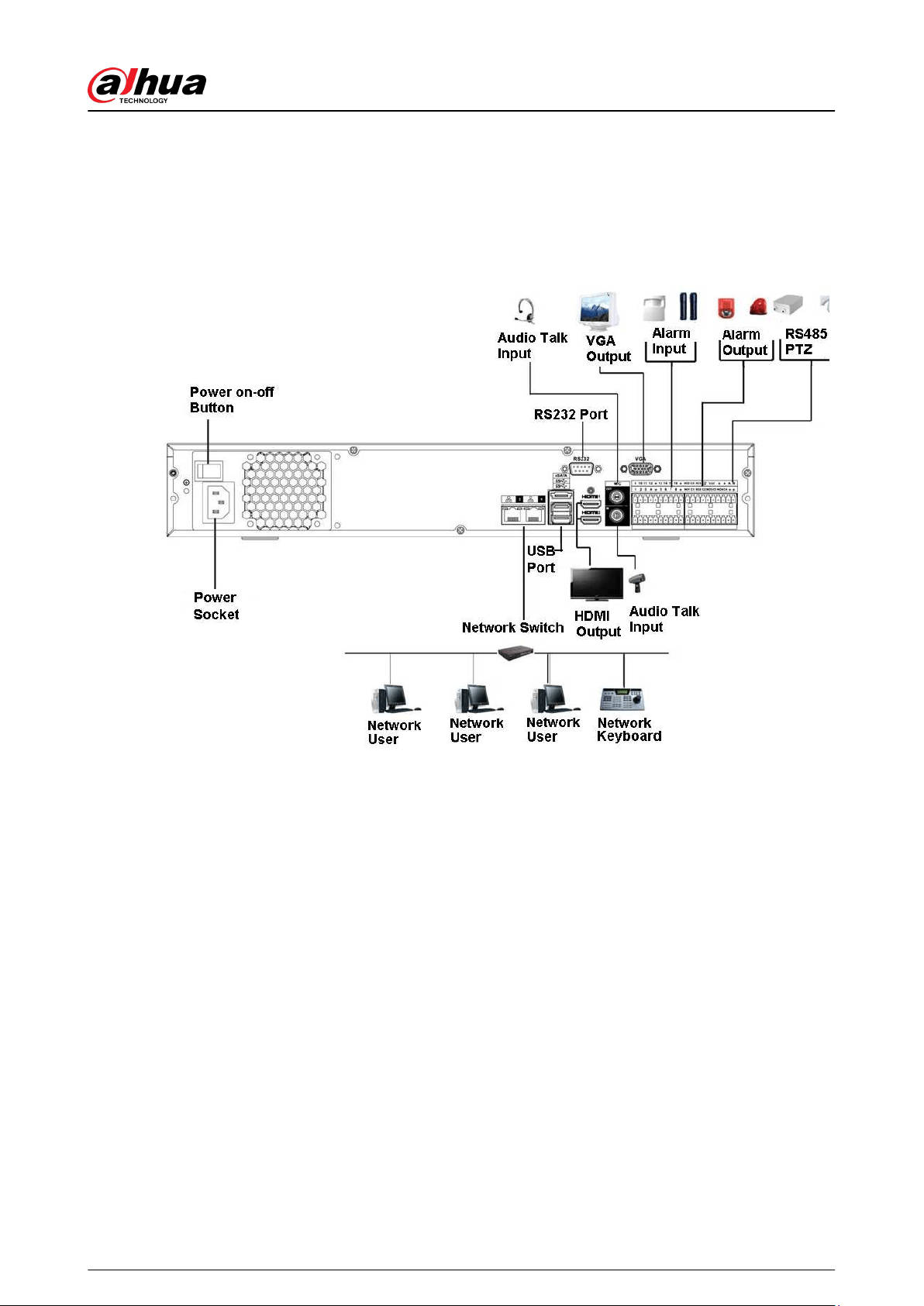
3.5.7 NVR54-4KS2/NVR54-16P-4KS2/NVR58-4KS2/
NVR58-16P-4KS2/NVR54-24P-4KS2/NVR54-16P-4KS2E/
NVR58-16P-4KS2E Series
Figure 3-53 Typical connection
User's Manual
108
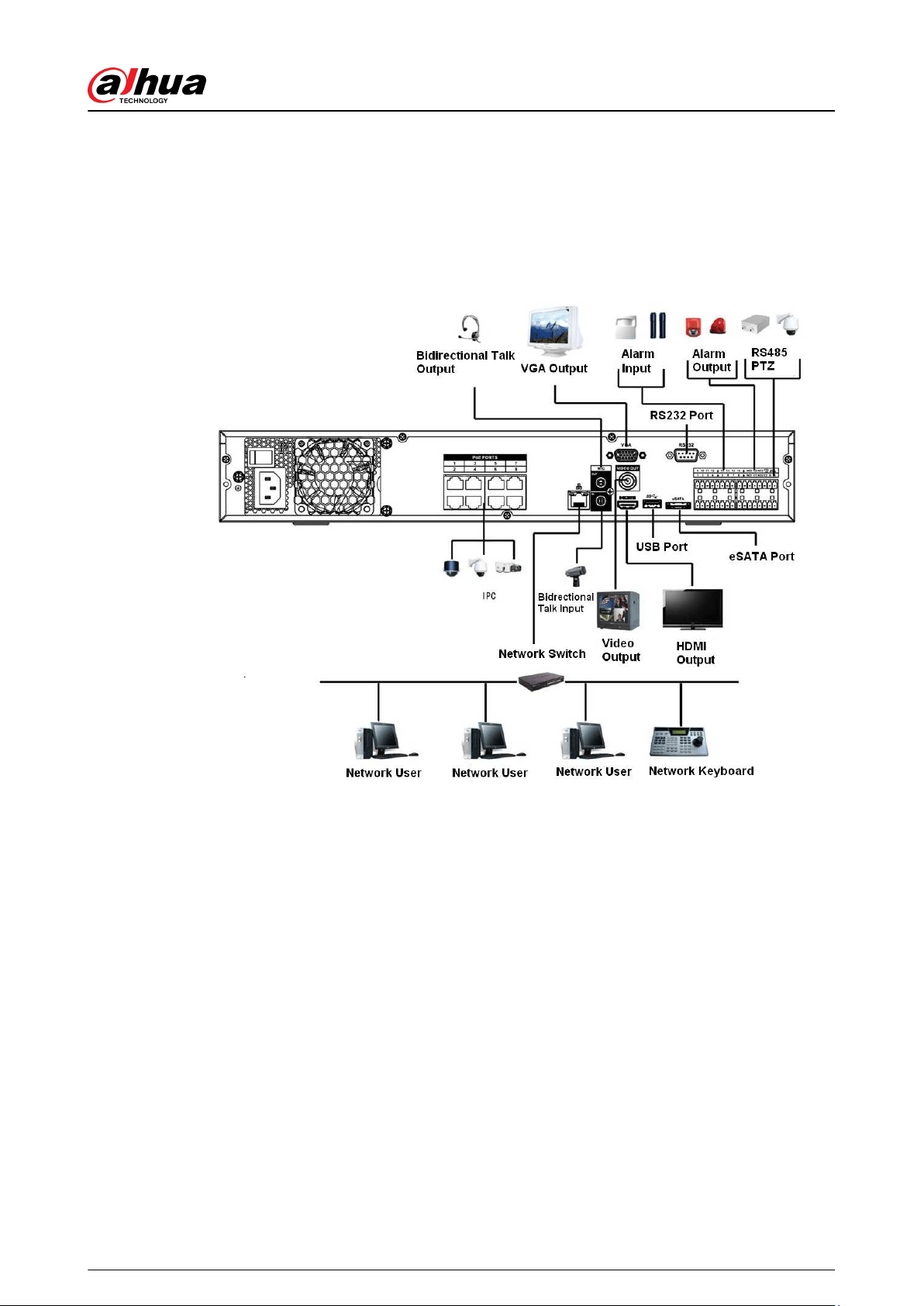
3.5.8 NVR44-4KS2/NVR44-16P-4KS2/NVR44-4KS2/L/
NVR44-16P-4KS2/L/NVR44-4KS2/I/NVR44-16P-4KS2/I/
NVR44-EI/NVR44-16P-EI Series
Figure 3-54 Typical connection
User's Manual
109
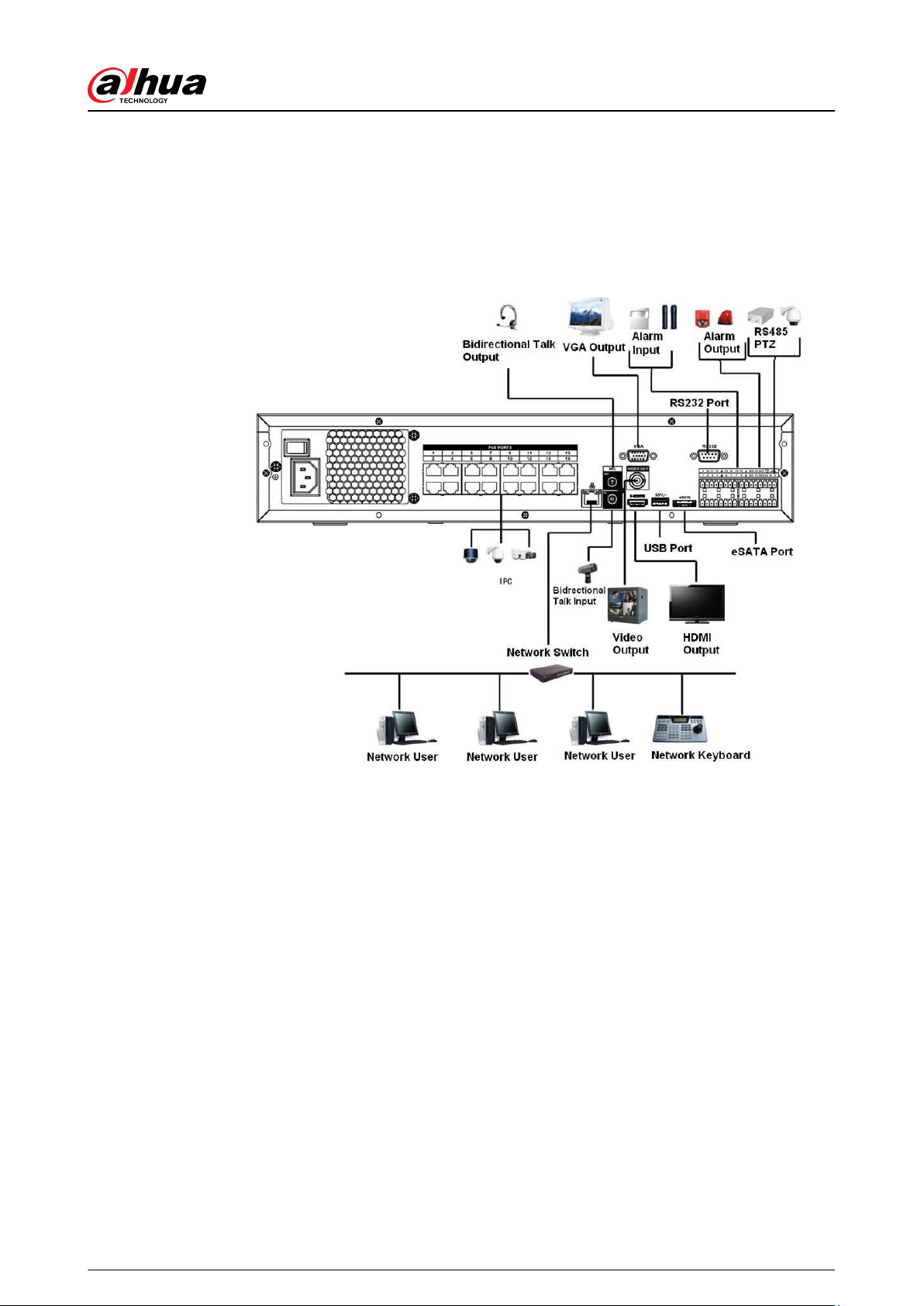
3.5.9 NVR48-4KS2/NVR48-16P-4KS2/NVR48-4KS2/L/
NVR48-16P-4KS2/L/NVR48-4KS2/I/NVR48-16P-4KS2/I/
NVR48-EI/NVR48-16P-EI Series
Figure 3-55 Typical connection
User's Manual
110
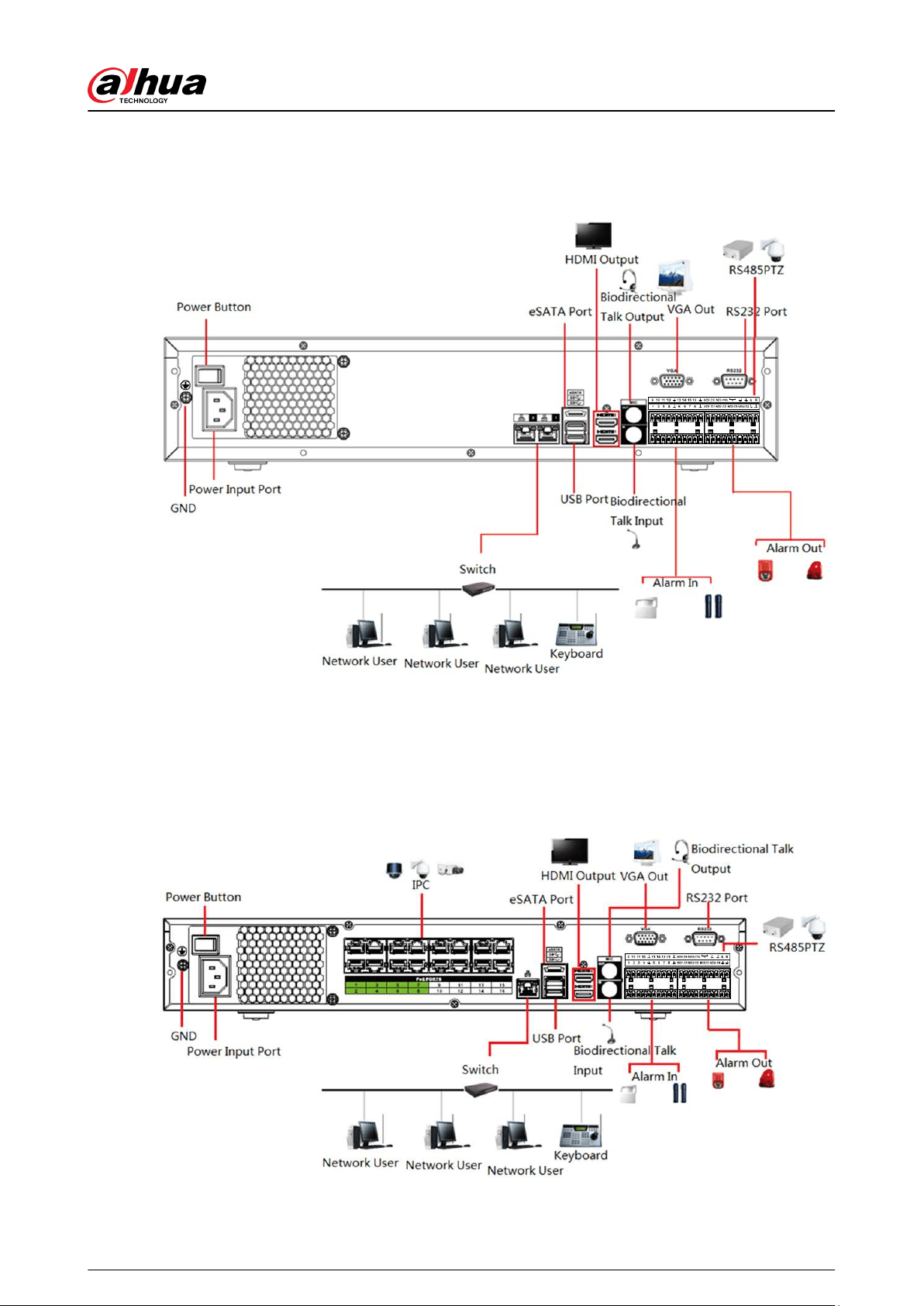
3.5.10 NVR58-I/NVR58-I/L/NVR48-I Series
Figure 3-56 Typical connection
3.5.11 NVR54-I/NVR54-I/L/NVR44-I
Figure 3-57 Typical connection
User's Manual
111
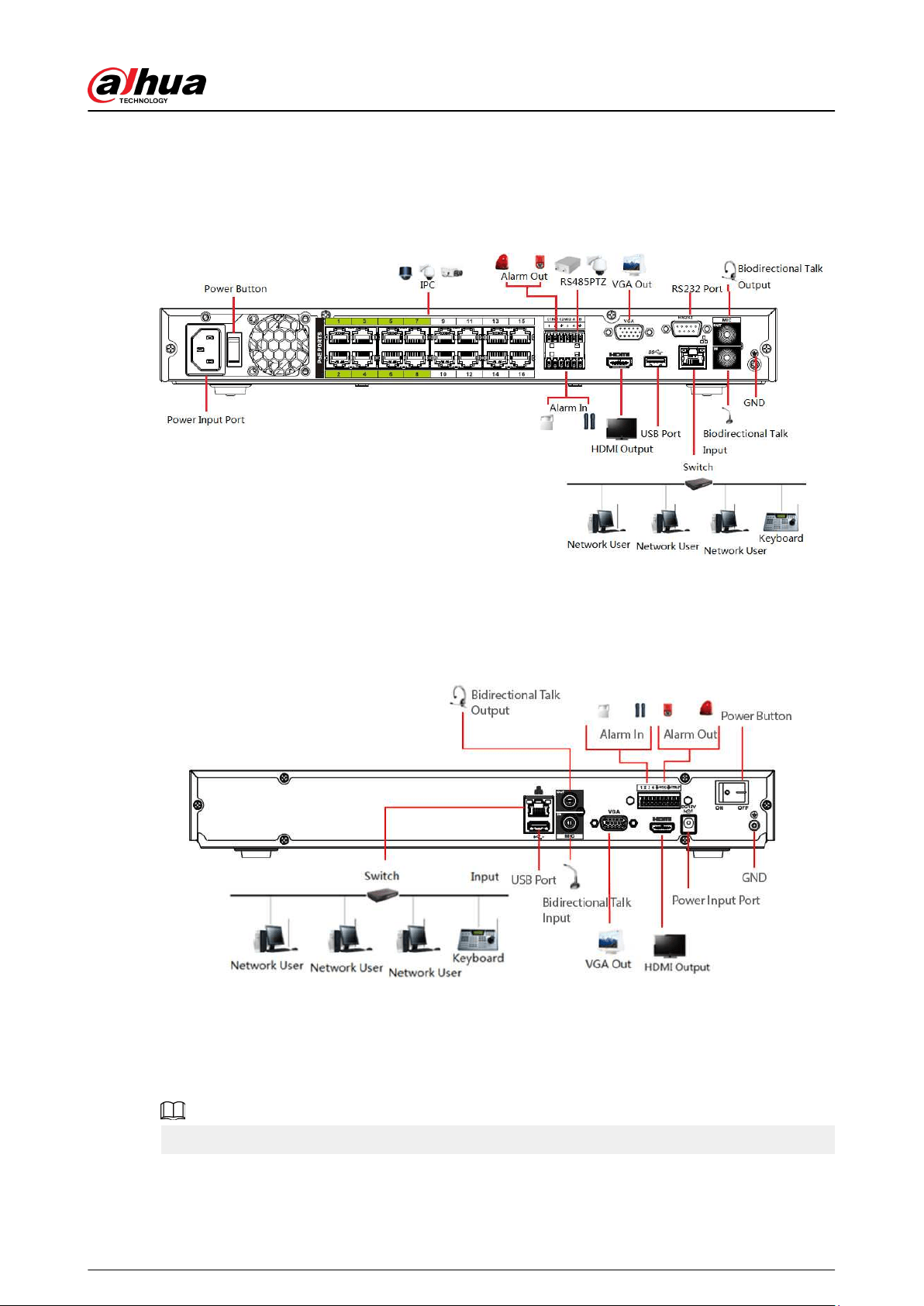
3.5.12 NVR52-16P-I/NVR52-16P-I/L/NVR52-8P-I/NVR52-8P-
I/L/NVR42-8P-I/NVR42-16P-I Series
Figure 3-58 Typical connection
3.5.13 NVR4216-I Series
Figure 3-59 Typical connection
3.5.14 NVR608-4KS2/NVR608H-XI/NVR608RH-XI Series
The following gure is for reference only and might dier from the actual product.
User's Manual
112
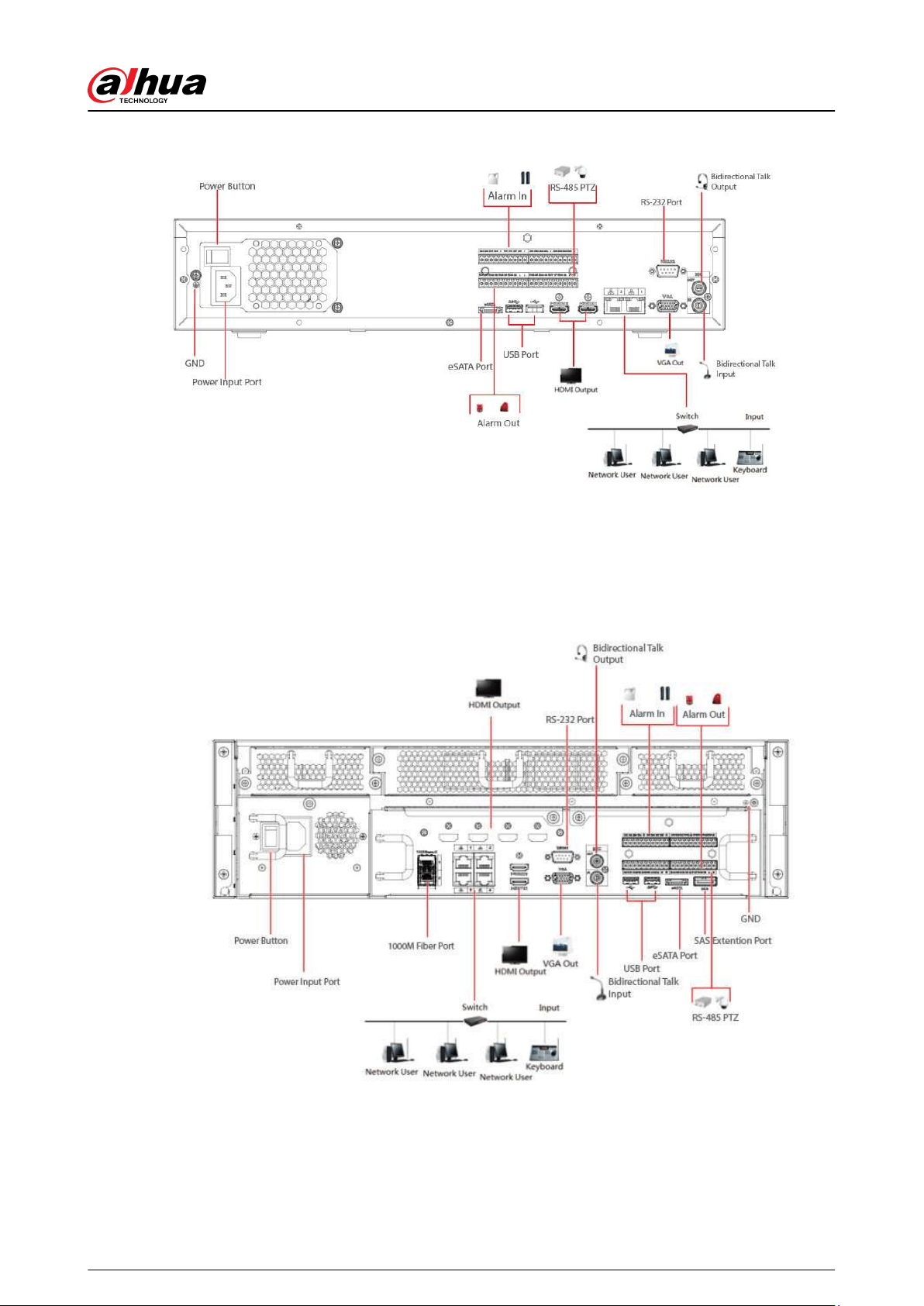
Figure 3-60 Typical connection
3.5.15 NVR616-4KS2 Series
Figure 3-61 Typical connection
User's Manual
113
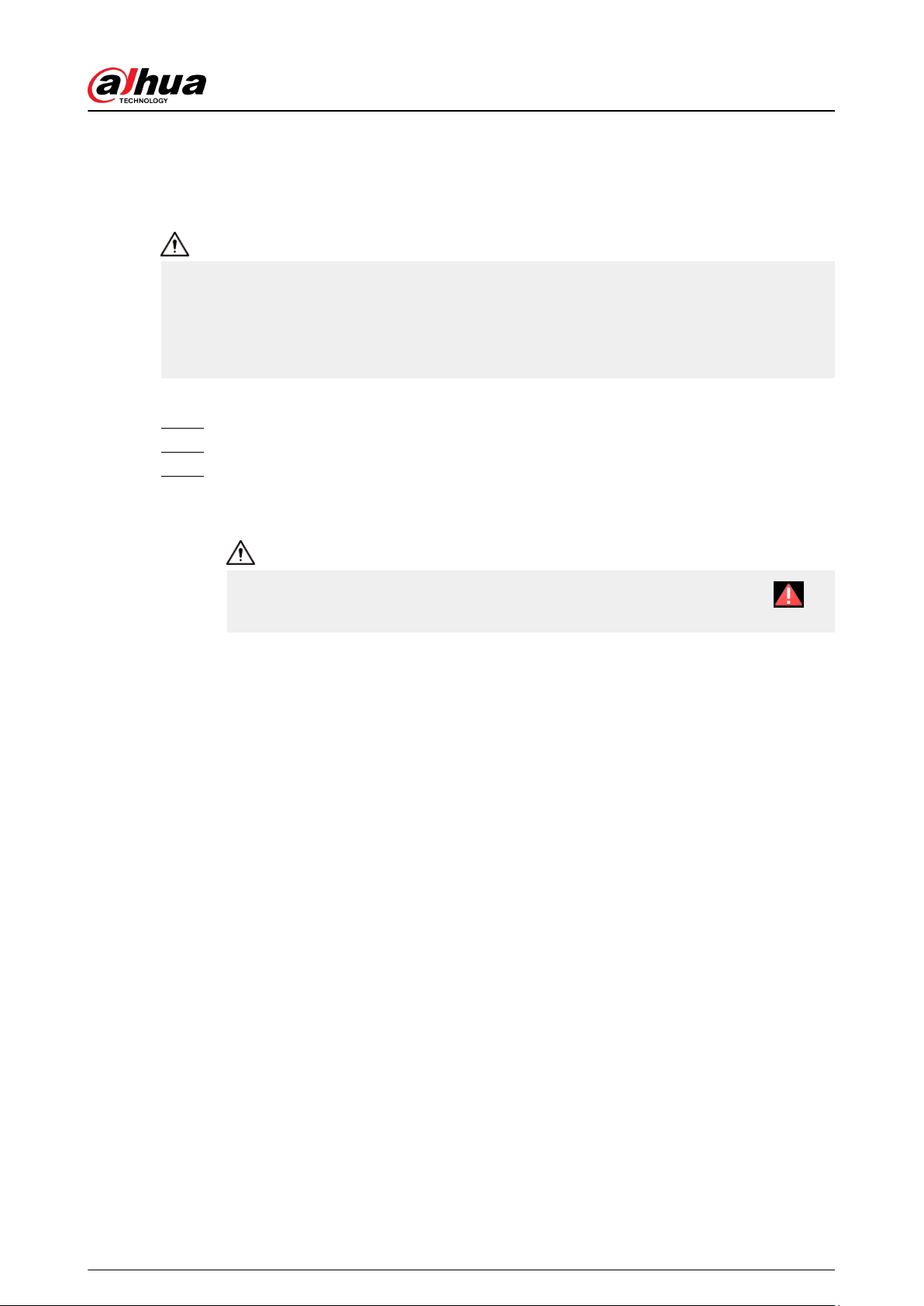
4 Starting the Device
Background Information
●
For device security, connect the NVR to the power adapter rst and then connect the device to
the power socket.
●
The rated input voltage matches the device power button. Make sure the power wire
connection is OK. Then press the power button.
●
Always use the stable current, if necessary UPS is a best alternative measure.
Procedure
Step 1 Connect the device to the monitor and then connect a mouse.
Step 2 Connect power cable.
Step 3 Press the power button on the front panel or turn on the power switch on the rear panel
to start up the device.
After the device starts, the system is in multiple-channel display mode by default.
The Device will verify license during starting up. If the verication failed, the icon is
displayed on the screen. Contact the technical support.
User's Manual
114
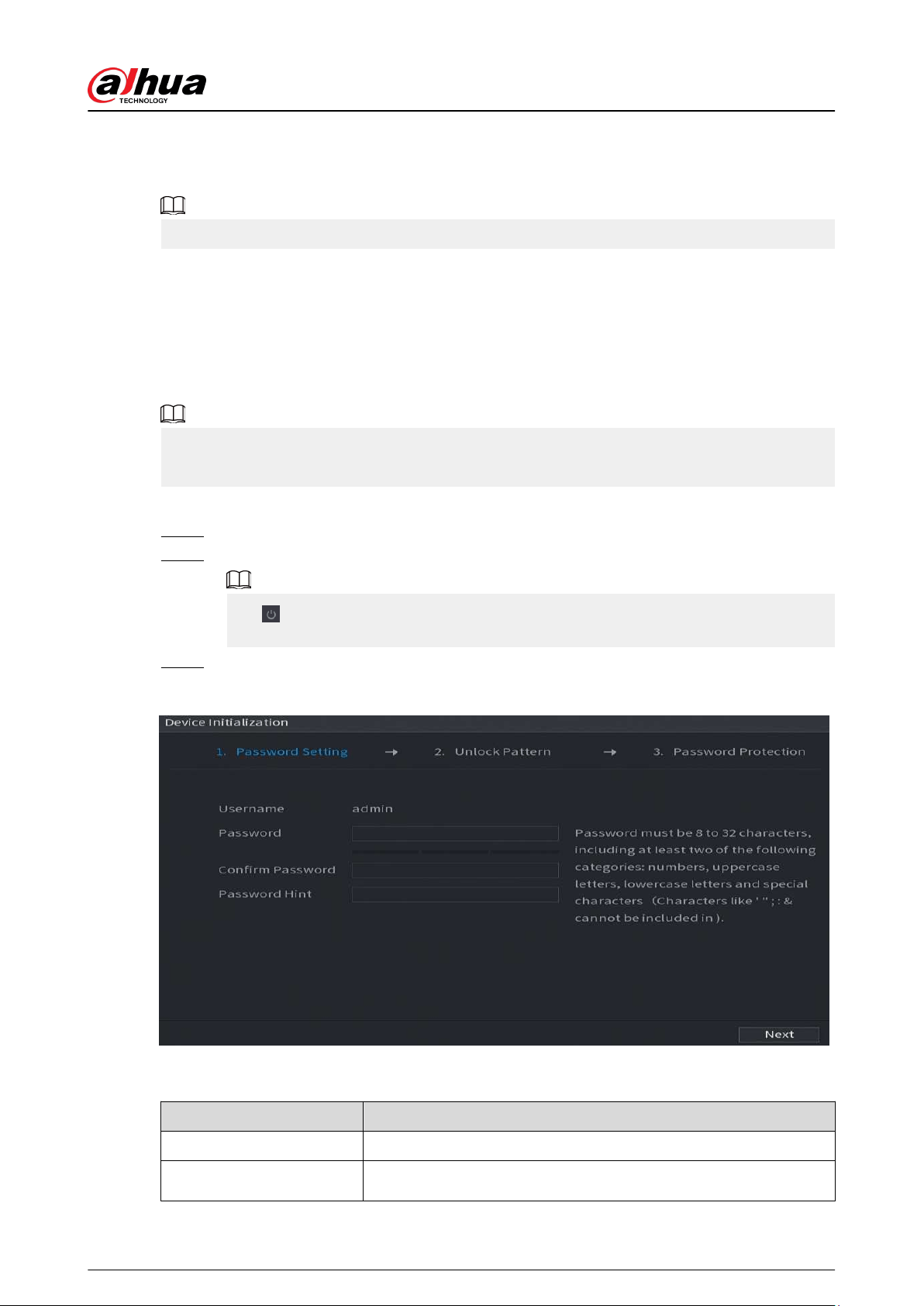
5 Local Operations
The following gures are for reference only. Slight dierence might be found on the actual page.
5.1 Initialization
Background Information
●
For rst-time use, set a login password for the admin account (default user).
●
We recommend setting password protection so that you can reset password in case you forgot.
●
For your device safety, keep your login password well, and change the password regularly.
●
The IP address of the Device is 192.168.1.108 by default.
Procedure
Step 1 Start the NVR.
Step 2 Set region, time zone, and time according to the actual situation, and then click Next.
Click to shut down the device. The system integrator or the user can shut down the
Device directly after setting the time zone.
Step 3 Set the login password for the admin account and then click Next.
Figure 5-0 Set password
Table 5-1 Password parameters
Parameter Description
User By default, the user is admin.
Password Enter the password for admin and then conrm the password.
User's Manual
115
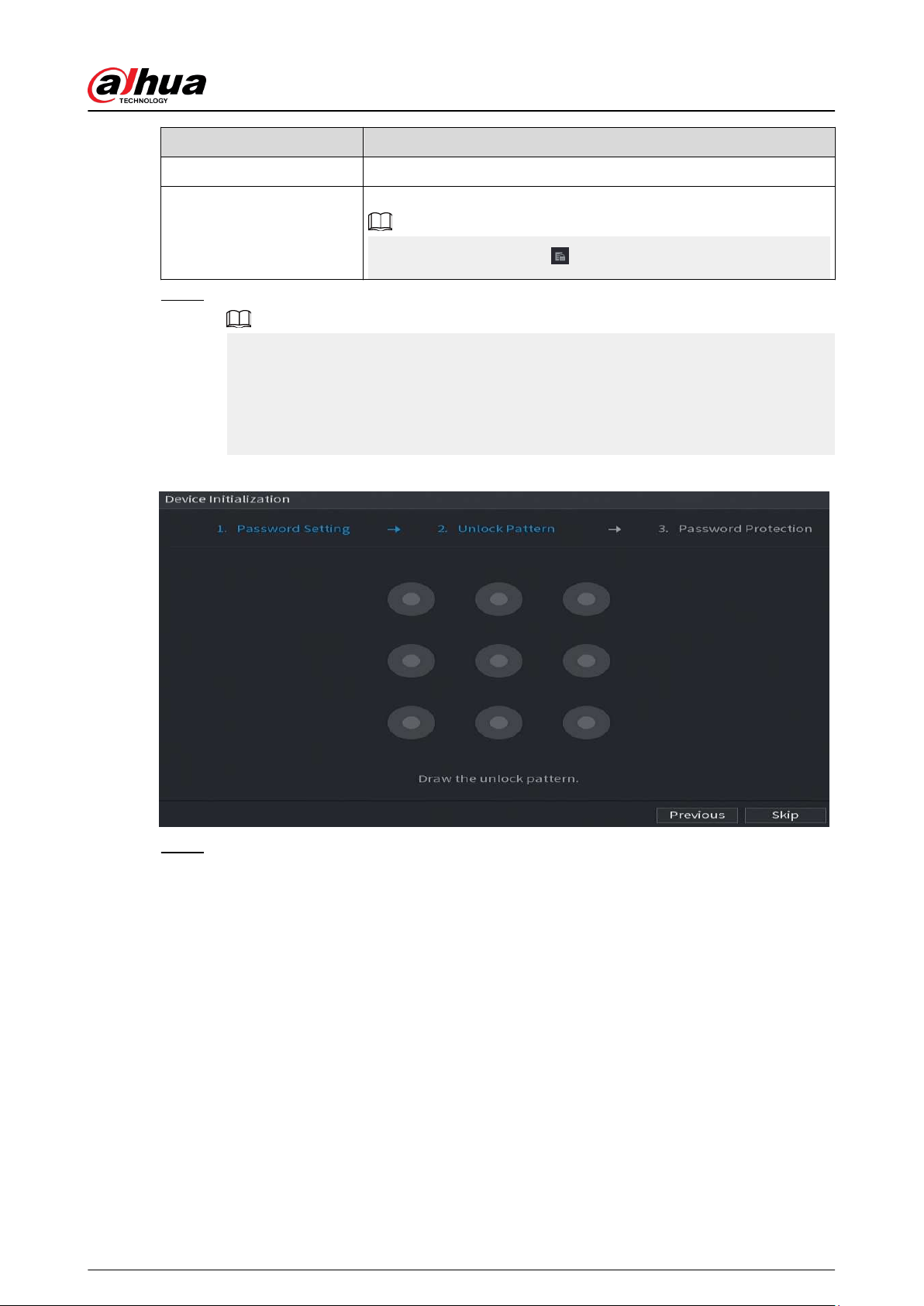
Parameter Description
Conrm Password
Password Hint
Enter the information that can remind you of the password.
On the login window, click to display the password hint.
Step 4 Set unlock pattern.
●
The pattern that you want to set must cross at least four points.
●
If you do not want to congure the unlock pattern, click Skip.
●
Once you have congured the unlock pattern, the system will require the unlock
pattern as the default login method. If you did not congure the unlock pattern, you
need to enter password for login.
Figure 5-1 Draw unlock pattern
Step 5 Set password protection.
●
After conguration, if you forgot the password for admin user, you can reset the
password through the linked email address or security questions. For details on
resetting the password, see "5.13.3 Resetting Password".
●
If you do not need password protection, disable Reserved Email and Security
Question.
User's Manual
116
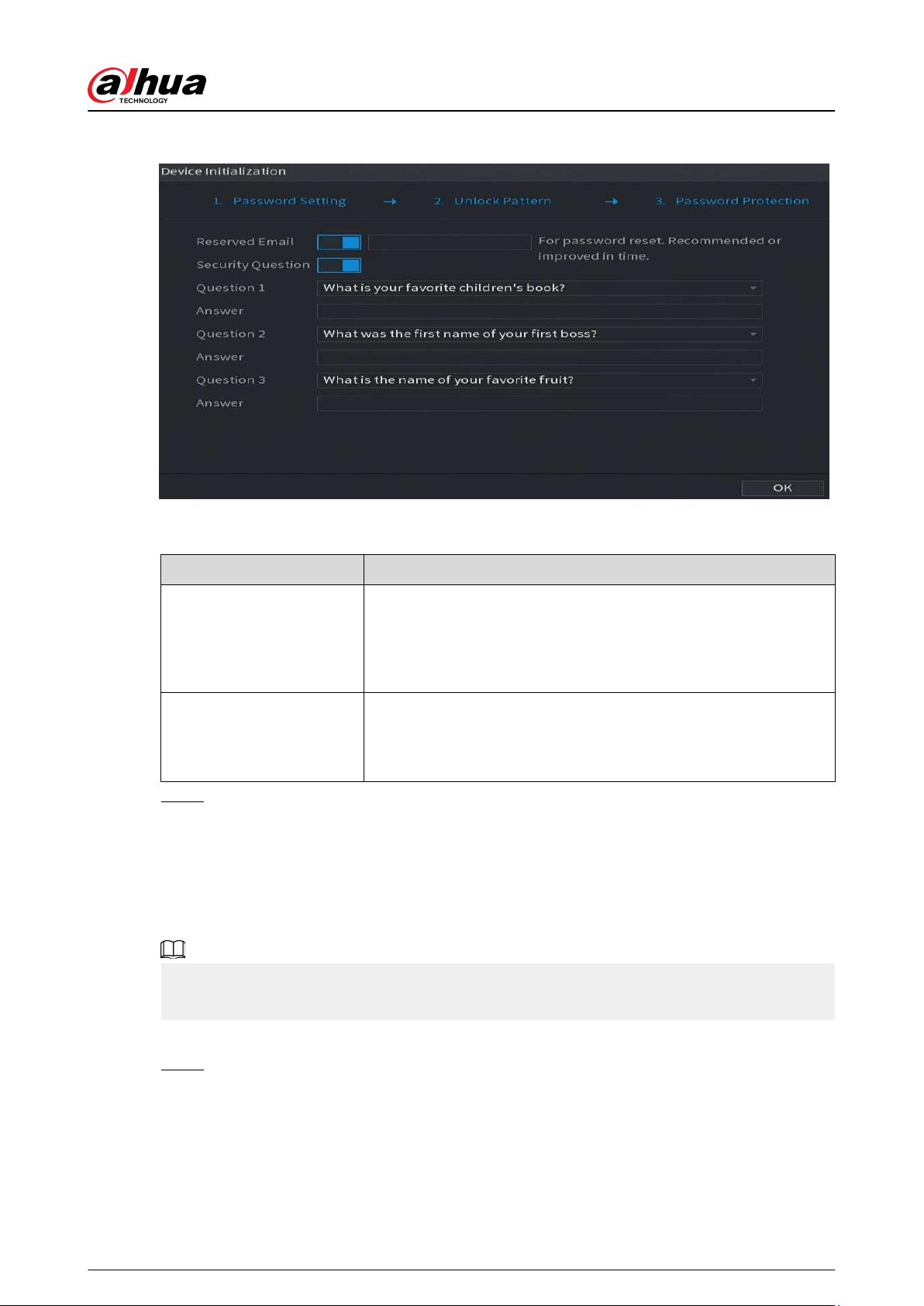
Figure 5-2 Set password protection
Table 5-2 Security question parameters
Password Protection Mode Description
Email Address
Enter the linked email address.
Enter an email address for password reset. If you forgot the
password, enter the security code that you will get from this linked
email address to reset the password of admin.
Security Questions
Congure the security questions and answers.
If you forgot the password, you can reset the password after
entering the answers to the questions.
Step 6 Click Save.
5.2 Startup Wizard
Background Information
After initialization, the system goes to Startup Wizard. You can quickly congure your device.
Startup Wizard is displayed only when you log in to the Device for the rst time or have restored
the Device to factory settings.
Procedure
Step 1 Select Auto Check for Updates, and then click Next.
If you select the Auto Check for Updates checkbox, the system will notify you
automatically when updates are available.
User's Manual
117
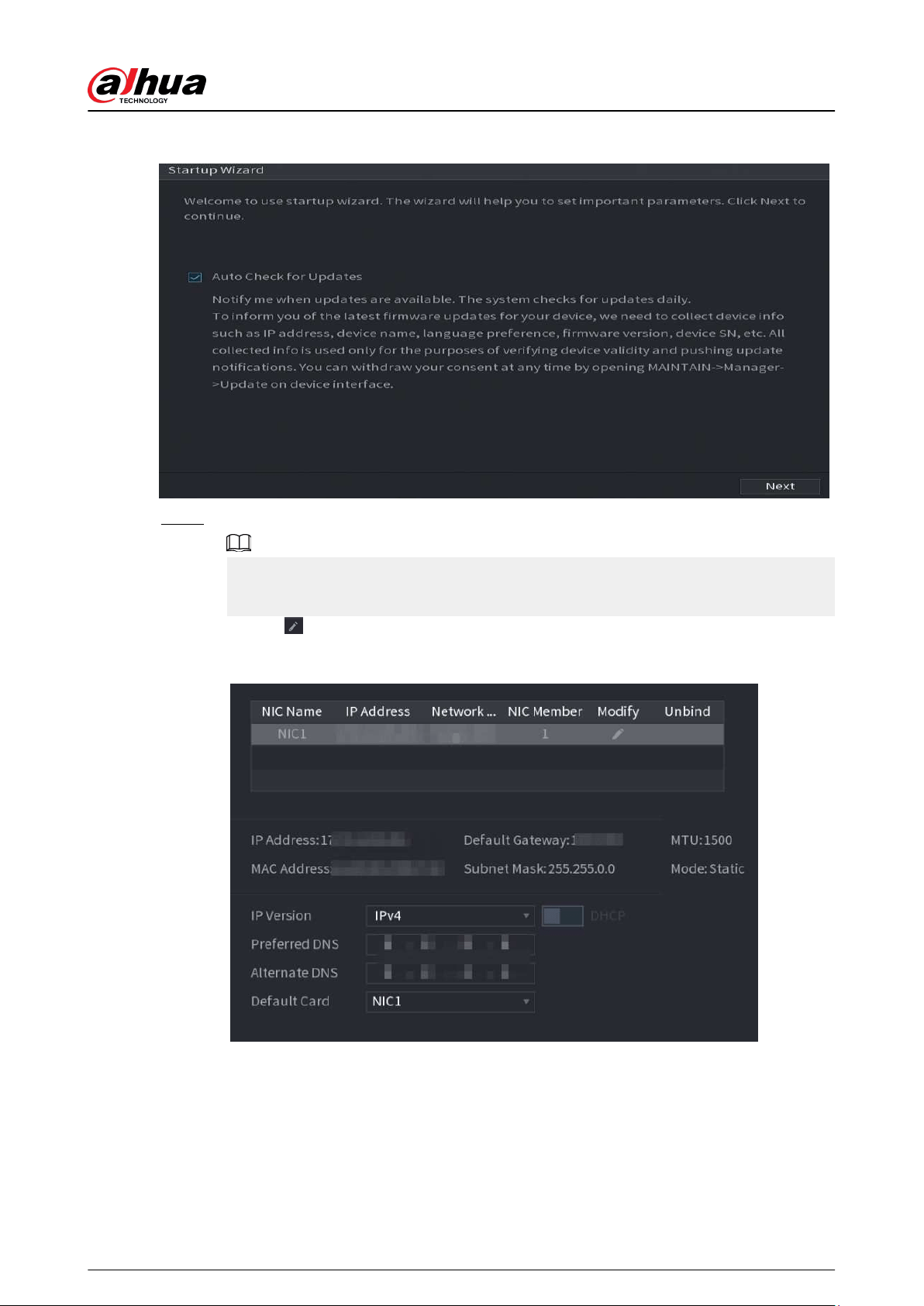
Figure 5-3 Startup wizard
Step 2 Congure IP address, and then click Next.
The number of network adapters might vary with models. Congure the IP address of the
network adapter according to the actual connection situation.
1. Click
.
Figure 5-4 Edit network adapter
2. Congure parameters.
User's Manual
118
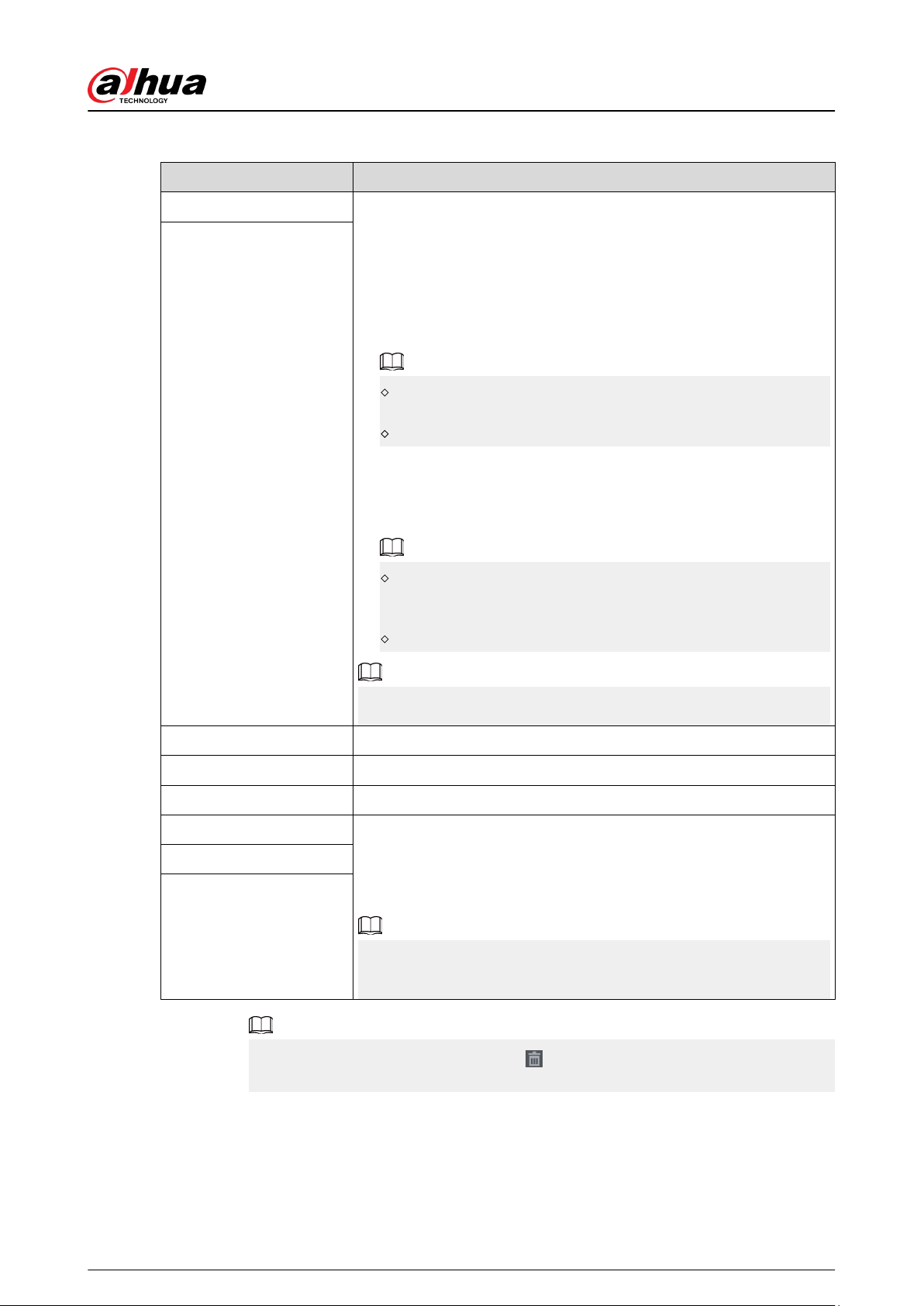
Table 5-3 Network parameters
Parameter Description
Network Mode
●
Single NIC: Two network adapters work separately. If one of the
two network adapters is disconnected, the system network status
is regarded as oine.
●
Fault Tolerance: Two network adapters share one IP address.
Normally only one network adapter is working. When this adapter
fails, the other network adapter will start working automatically to
ensure the network connection.
When you test the network status, the network is regarded as
oine only when both network adapters are disconnected.
The two network adapters are used under the same LAN.
●
Load Balance: Two network adapters share one IP address. The
two adapters work at the same time to share the network load
averagely. If one of them fails, the other can continue working
normally.
When testing the network status, the network is regarded as
oine only when both of the two network adapters are
disconnected.
The two network adapters are used under the same LAN.
The Device with single Ethernet port does not support this function.
Default Ethernet Port
IP Version Select IPv4 or IPv6. Both versions are supported for access.
DHCP Enable the system to automatically obtain a dynamic IP address.
MAC Address Displays the MAC address of the Device.
IP Address
●
Enter the IP address and then congure the corresponding subnet
mask and default gateway.
●
After conguration, click Test to check whether there is conict in
IP address.
IP address and default gateway must be on the same network
segment.
Subnet Mask
Default Gateway
To unbind NIC, on the TCP/IP page, click . The unbinding will take eect after the
Device restarts.
3. On the TCP/IP page, congure DNS server. This step should be performed when you
enable the domain name service.
You can get DNS server address or manually enter it.
●
Automatically get DNS server address: When there is a DHCP server in the network,
you can enable DHCP, and then the Device gets a dynamic IP address.
User's Manual
119
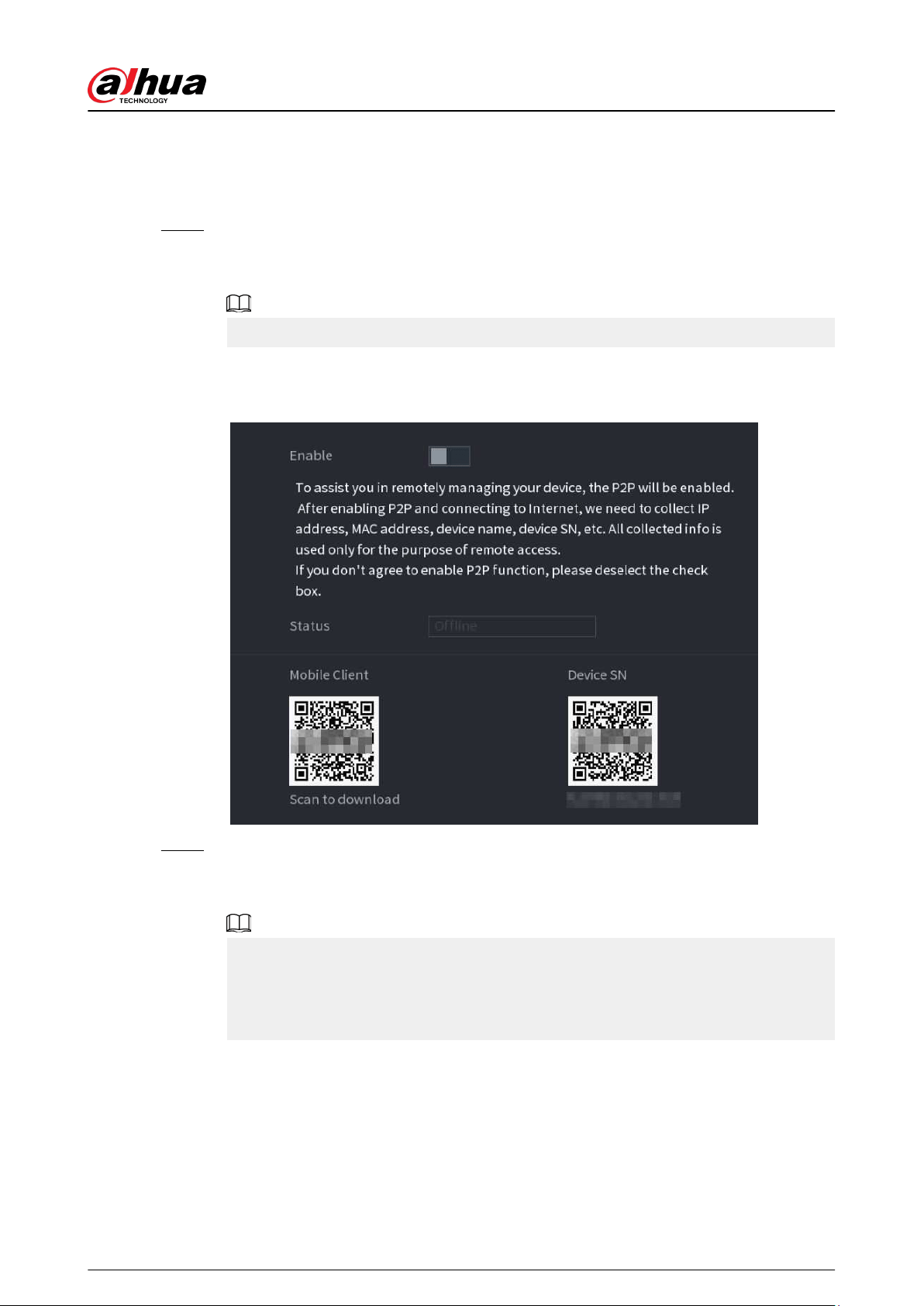
●
Enter DNS server address: Select IP Version, and then congure the preferred DNS
server and alternate DNS server.
4. On the Default Card drop-down list, select the default NIC.
5. Click Next.
Step 3 Enable P2P, and then click Next.
Scan the QR code on the actual page to download the app. Register an account and then
you can add the Device to the app.
Before using the P2P function, make sure that the NVR has connected to the WAN.
The Status becomes Online after you successfully congure P2P.
Figure 5-5 P2P
Step 4 Add cameras according to the actual situation.
After adding cameras, you can view the video images transmitted from the cameras, and
change camera conguration.
●
The number of cameras that can be added to the NVR varies with models.
●
The system supports adding camera through searching, manual add and batch add.
This section uses adding by searching as an example.
●
Initialize the camera before adding to the Device.
1. Click Search Device.
The devices found are displayed at the upper pane, excluding devices already added.
User's Manual
120
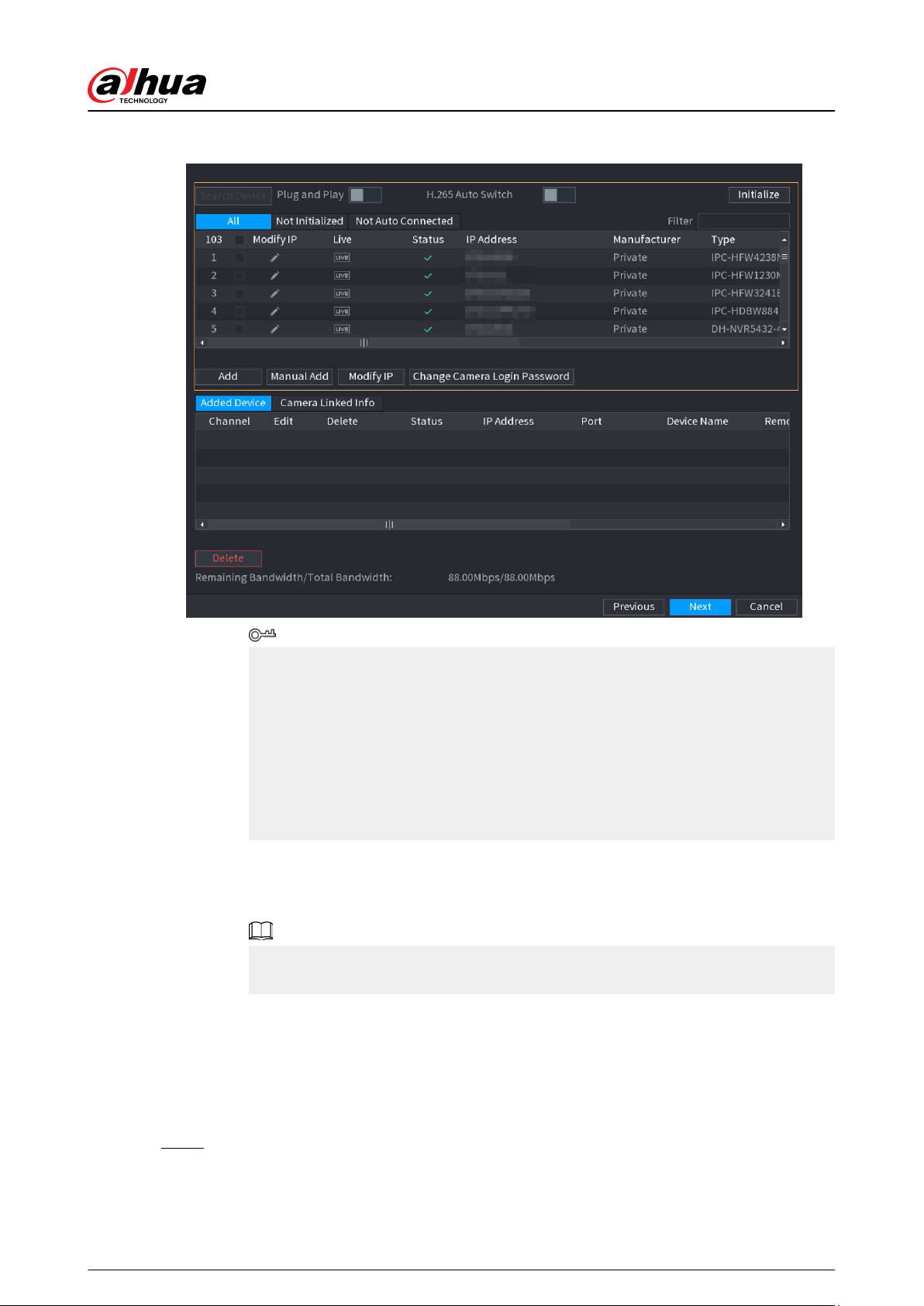
Figure 5-6 Search device
●
To view the live image of a camera, click LIVE and then enter the username and
password. You can only view live images of cameras accessed through private
protocol.
●
To lter the remote devices, select device name from the Filter drop-down list.
●
To lter out the uninitialized devices, click the Not Initialized tab, and then you
can initialize the devices remotely.
●
To view all remote devices added through plug and play, click the Not Auto
Connected tab. You can remove devices added through plug and play, and they
can be automatically added again after plug and play is enabled.
2. (Optional) Enable Plug and Play.
When Plug and Play is enabled, the Device automatically adds cameras on the same
LAN.
For uninitialized cameras, the Device automatically initializes them before adding
them.
3. Enable H.265 Auto Switch
When H.265 Auto Switch is enabled, the video compression standard of added
remote devices is switched to H.265 automatically.
4. Double-click a camera, or select a camera and then click Add to register it to the
Added Device list.
5. Click Next.
Step 5 Manage HDD. You can view HDD name, physical position, health status, capacity, and
more.
User's Manual
121
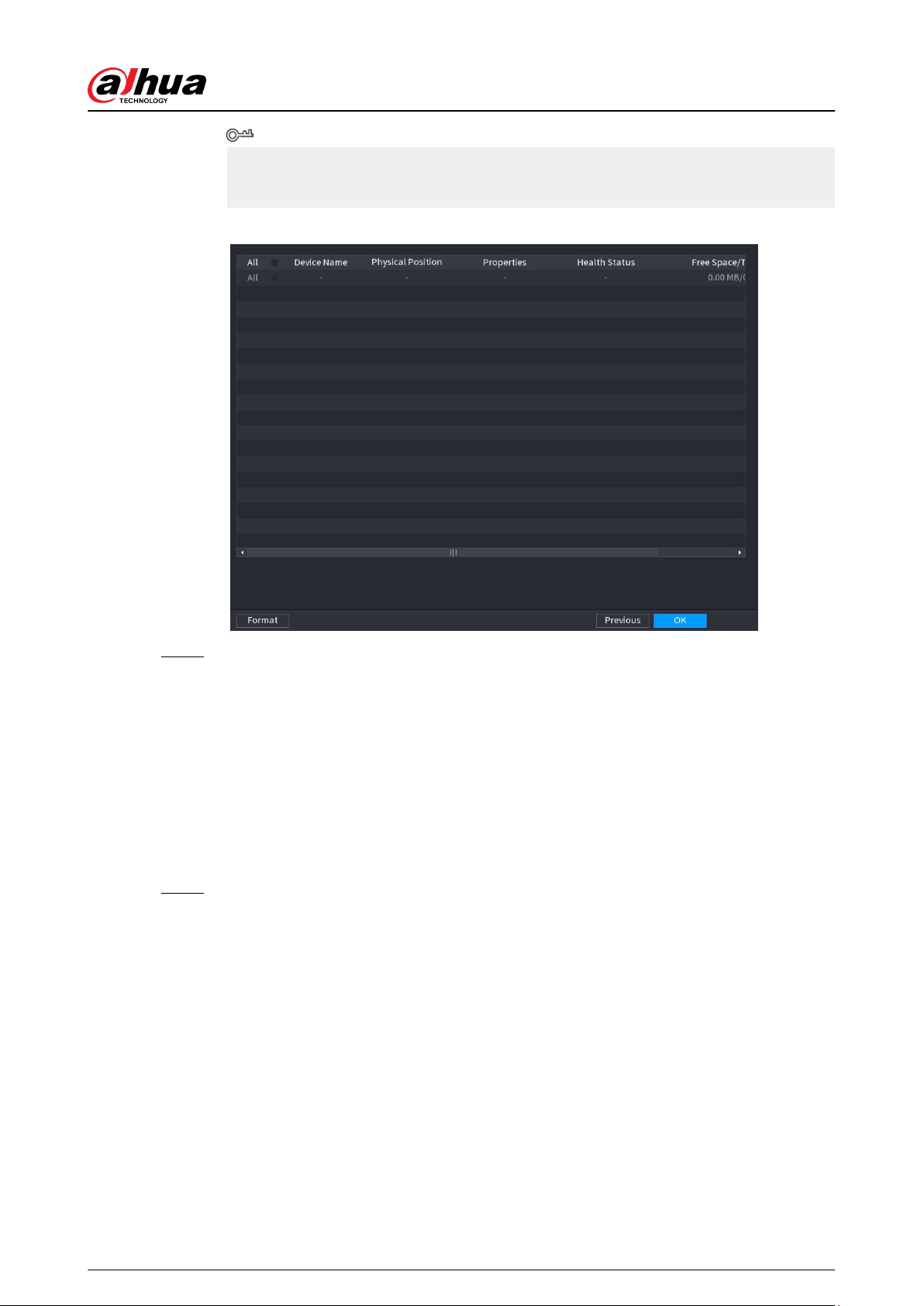
●
To congure read/write property, select an option from the Properties drop-down list.
●
To format an HDD, select the HDD, and then click Format.
Figure 5-7 Manage HDD
Step 6 Click OK.
When the Device prompts whether to restart, click OK. The congurations through
startup wizard take eect after the Device restarts.
5.3 Login
Background Information
Log in to the Device to perform local operations.
Procedure
Step 1 Right-click the live page, and then click the shortcut menu.
●
If you have congured unlock pattern, the unlock pattern login window is displayed.
Click Forgot Pattern to switch to password login.
●
If you did not congure unlock pattern, the password login window is displayed.
User's Manual
122
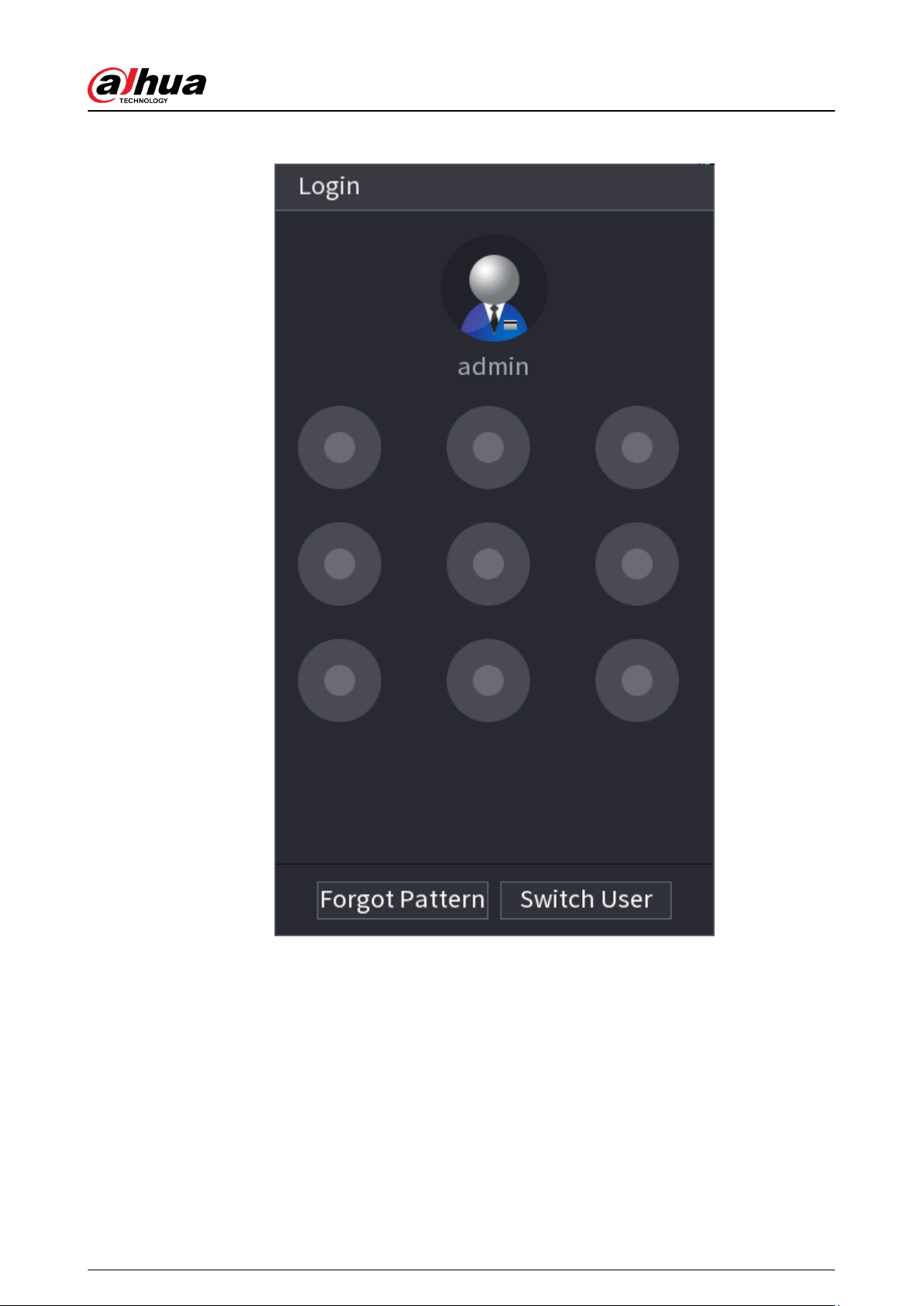
Figure 5-8 Unlock pattern login
User's Manual
123
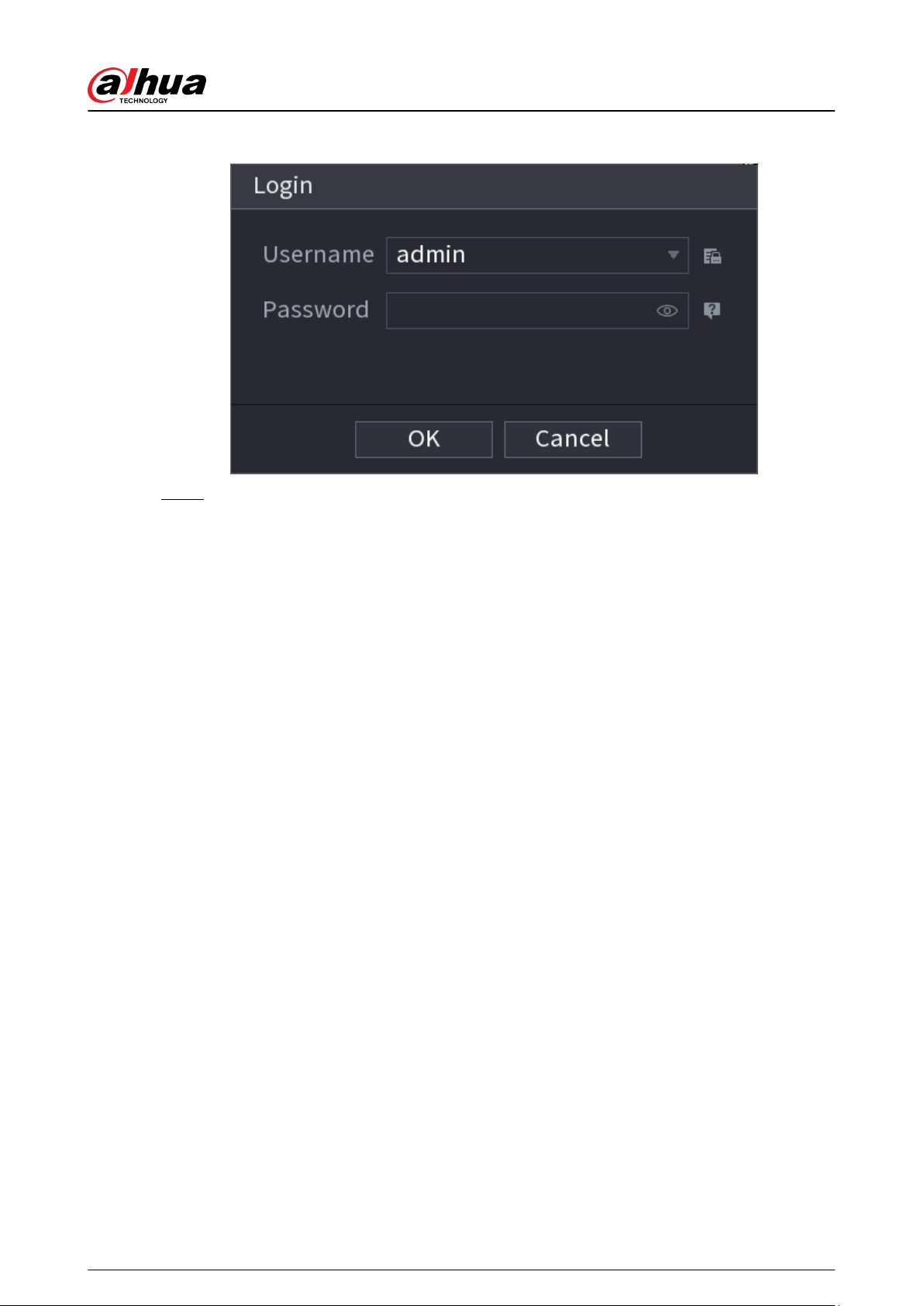
Figure 5-9 Password login
Step 2 Draw unlock pattern, or enter password and then click OK.
5.4 Main Menu
After login, right-click the live page, and then click Main Menu.
User's Manual
124
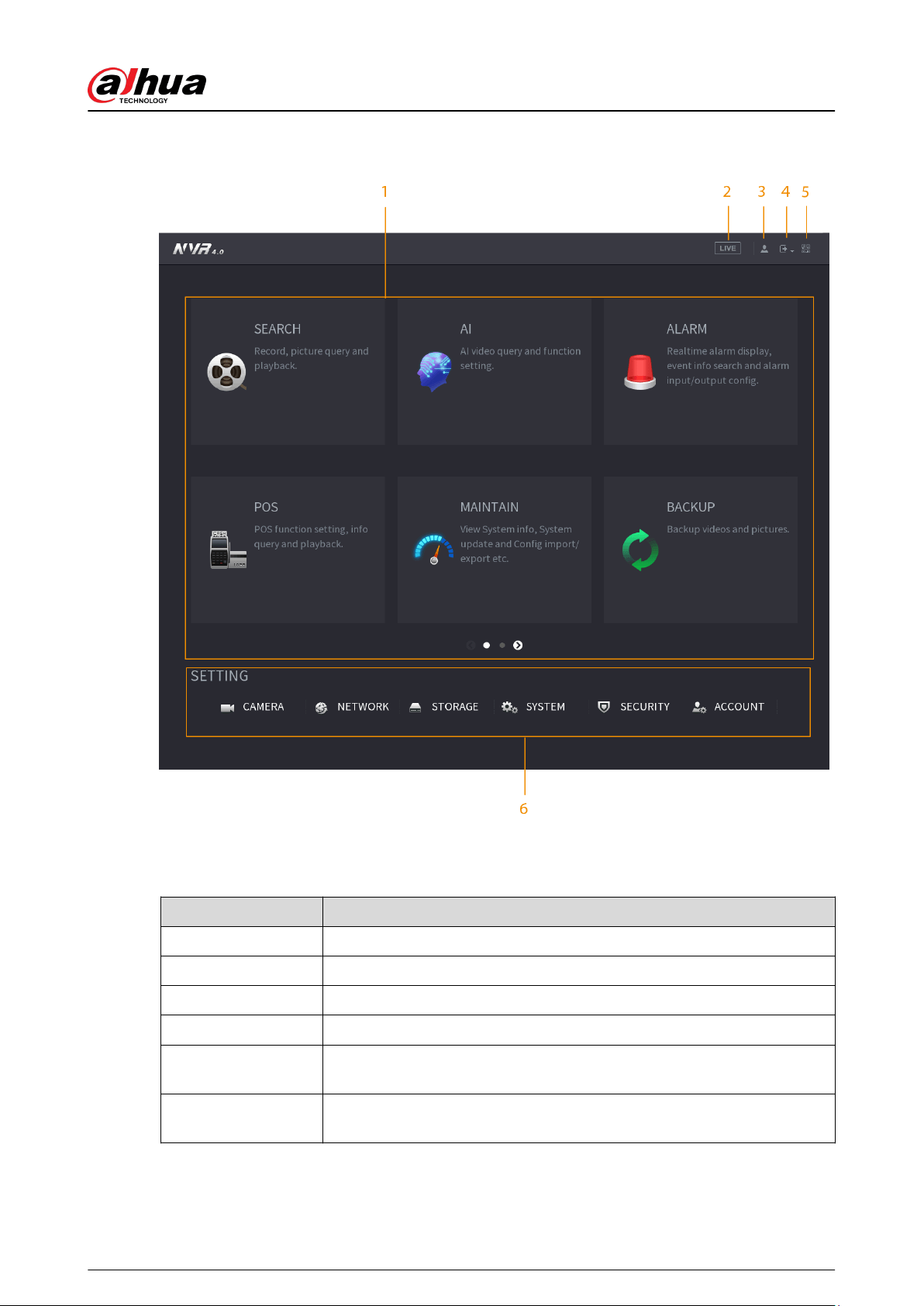
Figure 5-10 Main menu
Table 5-4 Main menu description
No. Description
1 Click each tile to open the corresponding conguration page.
2 Go back to live view.
3 Point to the icon to view the current username.
4 Log out of, restart, or shut down the Device.
5
Click the icon to get the QR codes of mobile client and device SN. You can
add the Device to the mobile client for remote management.
6
Congure the settings of camera, network, storage, system, security and
account.
User's Manual
125
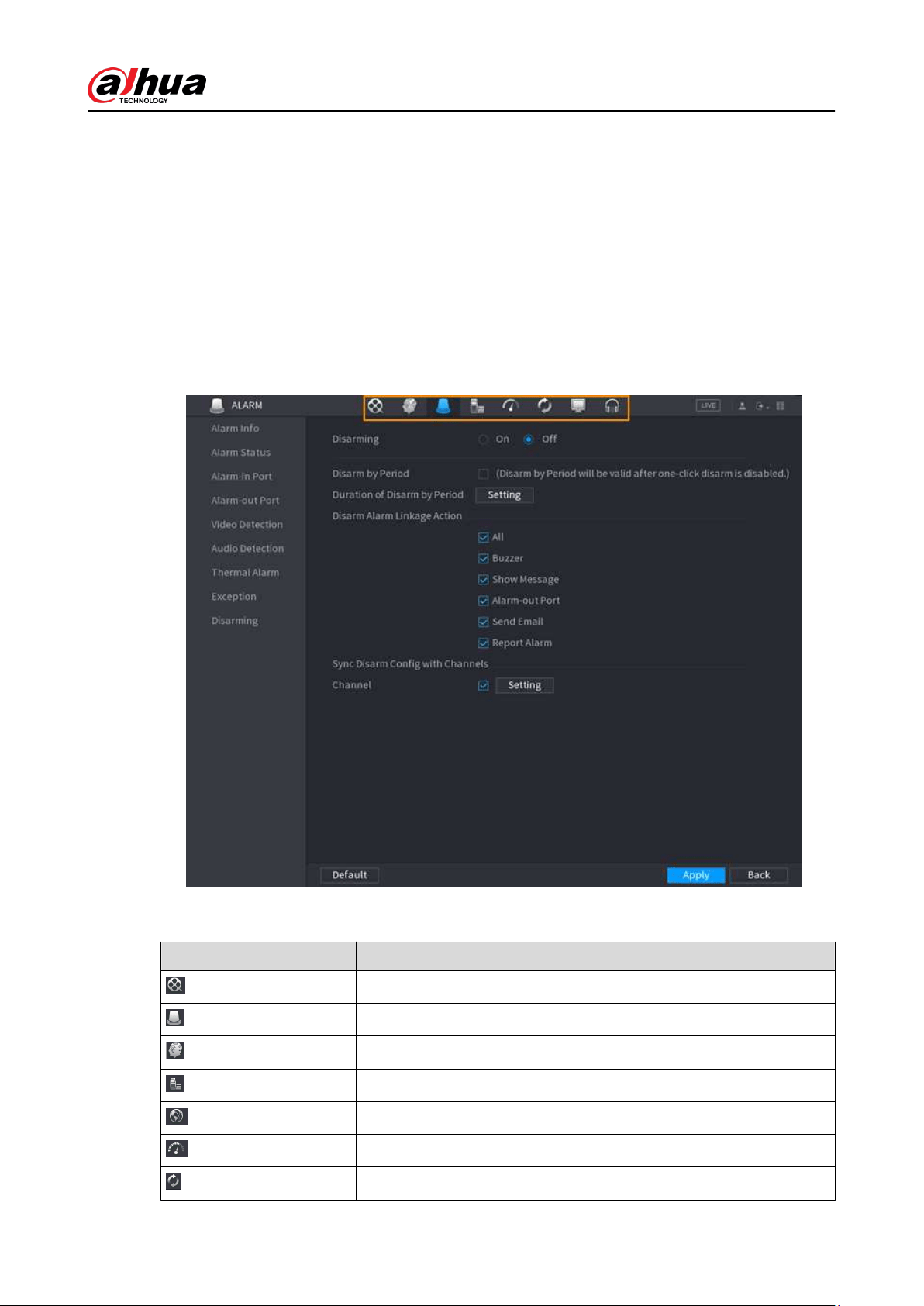
5.5 Quick Operation Bar
You can click the icons on the main menu to go to the corresponding conguration page. After
that, you can go to other function tiles or setting item through the quick operation bar.
This section uses ALARM and CAMERA as examples to show how to quickly access other modules.
Shortcut Icons on Function Titles
Click ALARM to go to the ALARM page.
Figure 5-11 Quick operation bar (1)
Table 5-5 Quick operation bar description (1)
Icon Description
Go to the SEARCH page.
Go to the ALARM page.
Go to the AI page.
Go to the POS page.
Go to NETWORK page.
Go to the MAINTAIN page.
Go to the BACKUP page.
User's Manual
126
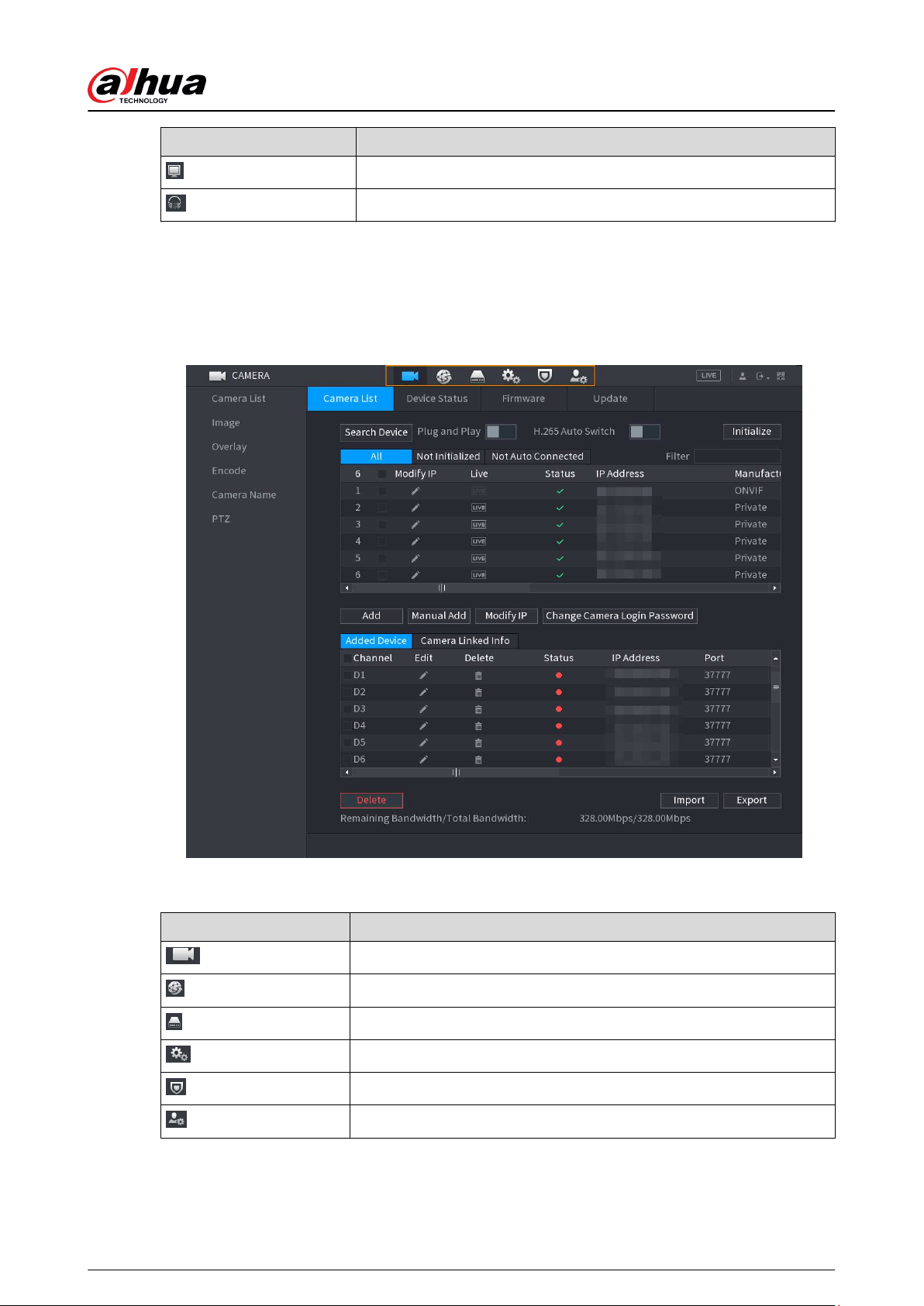
Icon Description
Go to the DISPLAY page.
Go to the AUDIO page.
Shortcut Icons on Setting Menu
Click CAMERA to go to the CAMERA page.
Figure 5-12 Quick operation bar (2)
Table 5-6 Quick operation bar description (2)
Icon Description
Go to the CAMERA page.
Go to the NETWORK page.
Go to the STORAGE page.
Go to the SYSTEM page.
Go to the SECURITY page.
Go to the ACCOUNT page.
User's Manual
127
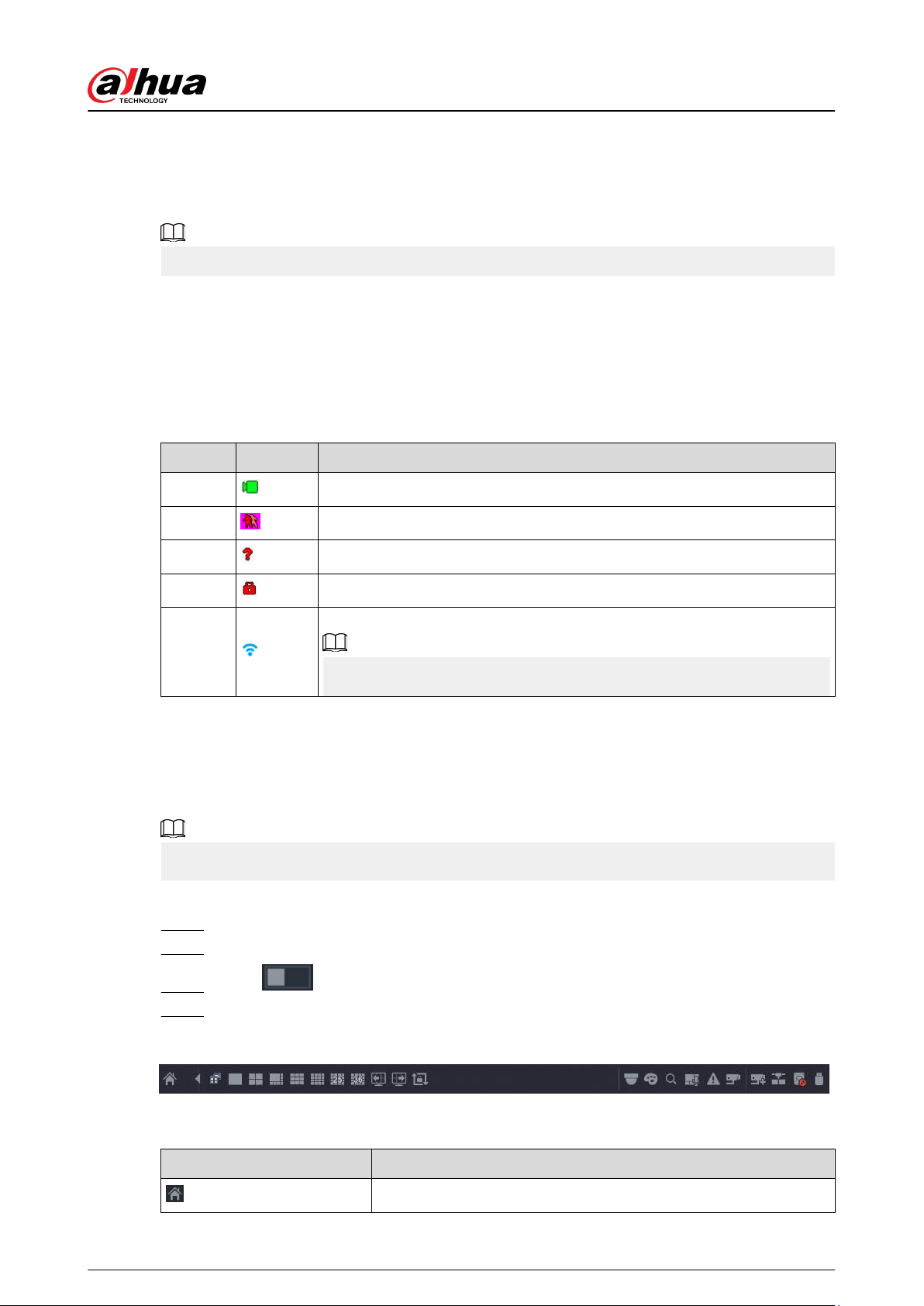
5.6 Live View
After you logged in, the system goes to multiple-channel live view mode by default. You can view
the live video of each channel.
The number of window splits might vary depending on the model you are using.
5.6.1 Live Page
On the live view page, you can view the live video of each channel. The corresponding channel
displays date, time, and channel name after you overlay the corresponding information.
Table 5-7 Icon description
No. Icon Description
1
The current channel is recording.
2
Motion detection alarm occurs.
3
Video loss alarm occurs.
4
The current channel is in monitor lock status.
5
The Device connects to the network camera remotely.
This function is available on select models.
5.6.2 Navigation bar
Background Information
You can quickly perform operations through the icons on the navigation bar.
The navigation bar might vary with models.
Procedure
Step 1 After login, right-click the live page, and then select Main Menu.
Step 2 Select System > General > Basic.
Step 3 Click to enable navigation bar.
Step 4 On the live page, click any position and then the navigation appears at the bottom.
Figure 5-13 Navigation bar
Table 5-8 Navigation bar description
Icon Function
Open Main Menu.
User's Manual
128
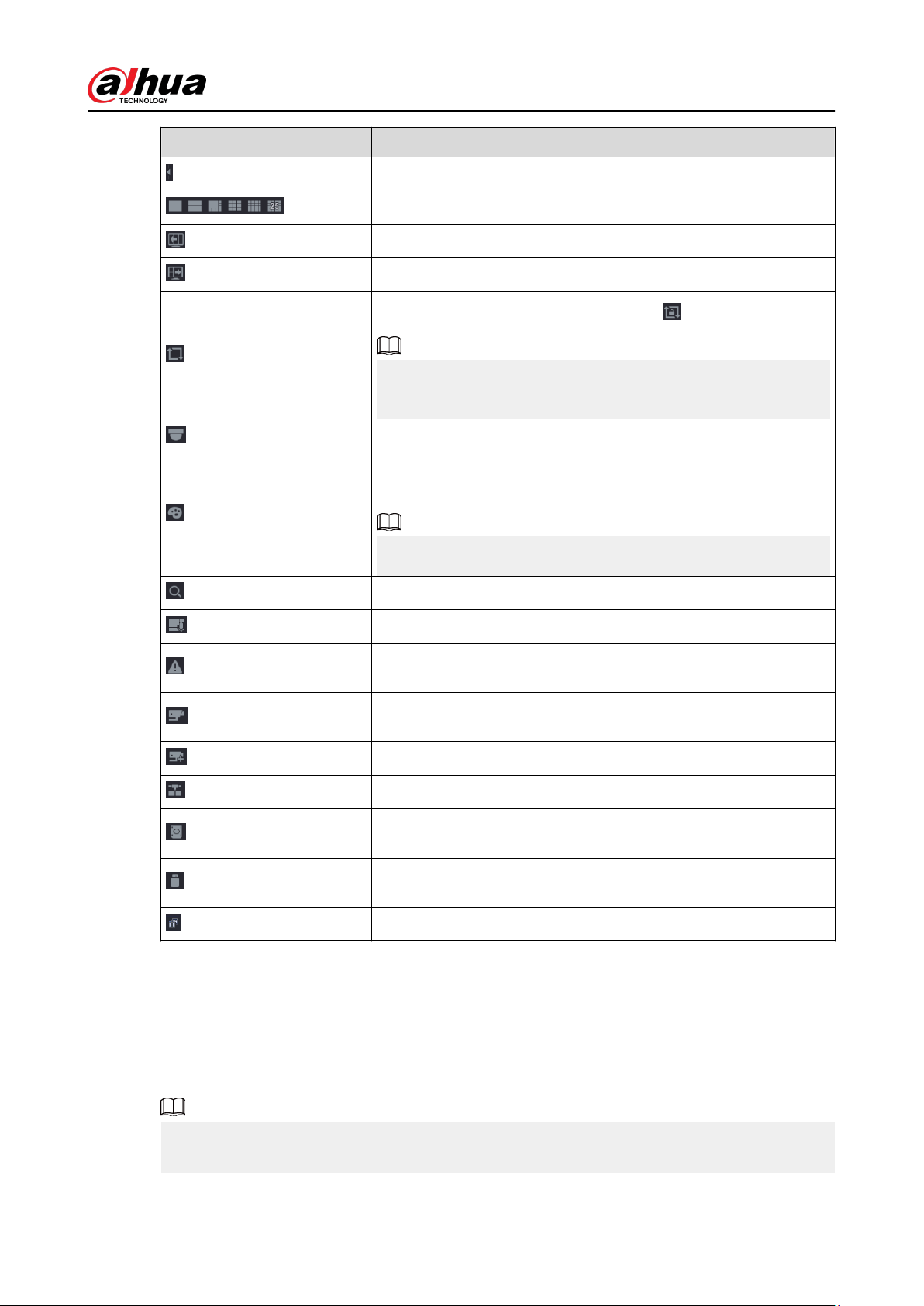
Icon Function
Expand or condense the navigation bar.
Select view layout.
Go to the previous screen.
Go to the next screen.
Enable tour function. The icon switches to .
If you close the tour or the triggered tour operation has canceled,
the Device restores the previous preview video.
Open the PTZ control panel. For details, see "5.6.7.2 PTZ Control".
Congure image settings. For details, see "5.7.4 Conguring Image
Settings".
This function is supported only in single-channel layout.
Search for records. For detail, see "5.8.2.1 Search Page".
Open the Voice Broadcast page. For detail, see "5.18.3 Broadcast".
Open the Alarm Status page to view the device alarm status. For
details, see "5.10.2 Alarm Status".
Open the Channel Info page to display the information of each
channel.
Open the Add Camera page.
Open the NETWORK page. For details, see "5.19.3 Network".
Open the Disk Manager page. For details, see "5.12.2 Disk
Manager".
Open the USB Management page. You can view USB information,
back up les, and update the system.
Switch to the sub screen.
5.6.3 Live View Control Bar
Point to the top center of the video of current channel; and then the live view control bar appears.
If your mouse stays in this area for more than 6 seconds and has no operation, the control bar
automatically hides.
●
Disable the navigation bar before using this function.
●
The live view control bar is dierent depending on the model.
User's Manual
129
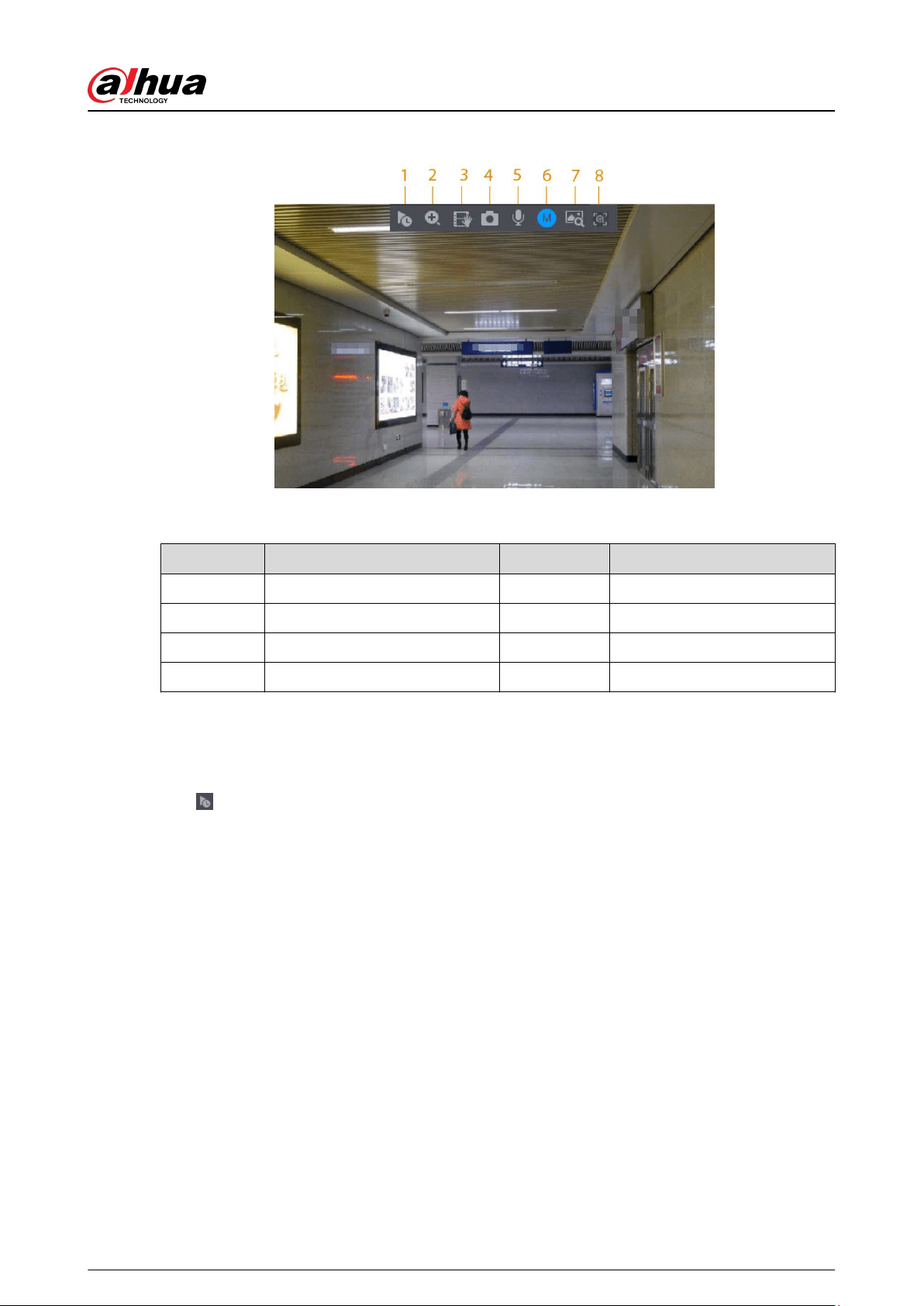
Figure 5-14 Live view control bar
Table 5-9 Live view control bar description
No. Name No. Name
1 Instant playback. 5 Two-way talk.
2 Digital zoom. 6 Stream switch.
3 Instant backup. 7 Picture search.
4 Manual snapshot. 8 Quick pick/AcuPick.
5.6.3.1 Instant Playback
You can play back the previous 5-60 minutes record of current channel.
Click
for instant playback.
User's Manual
130
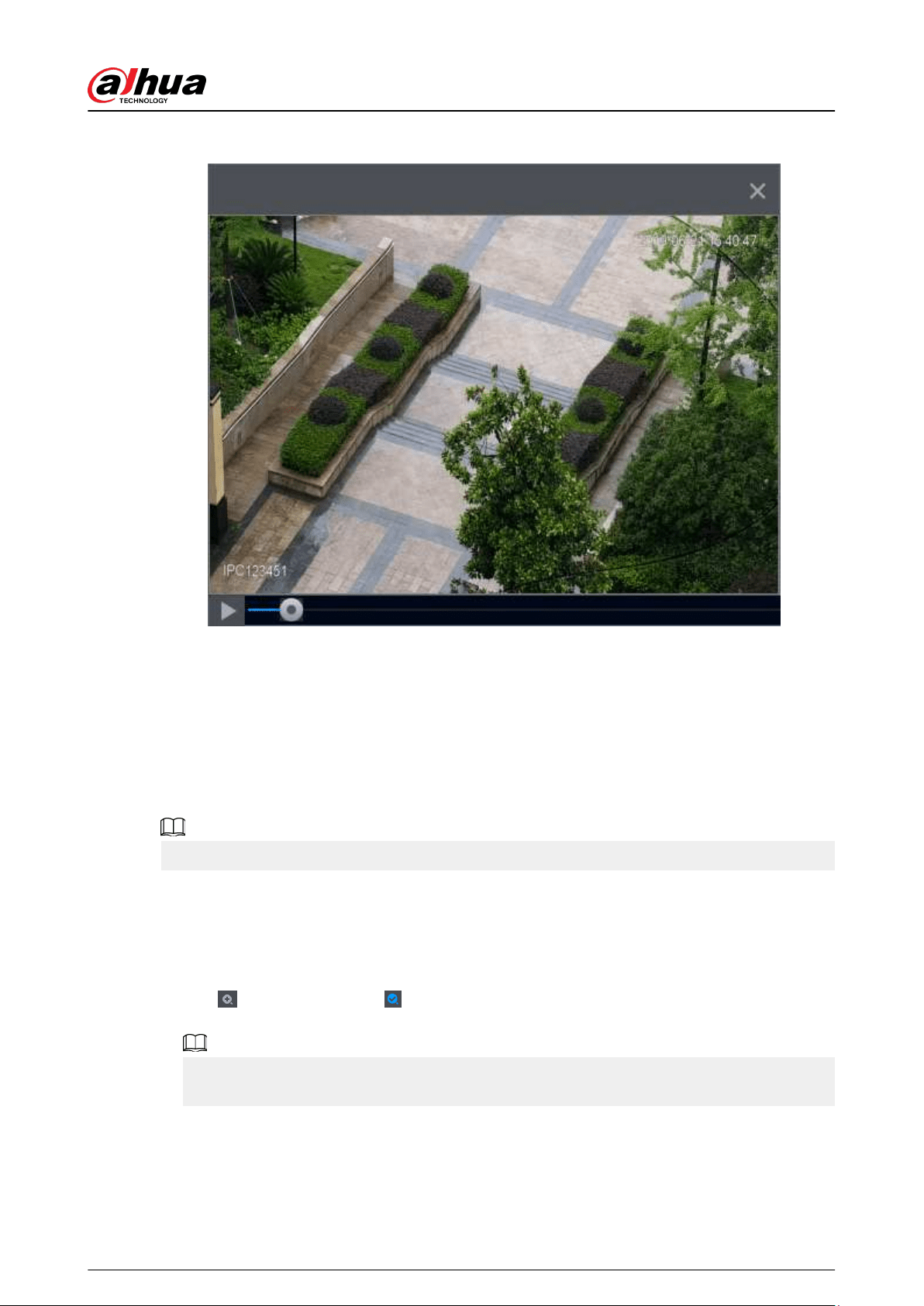
Figure 5-15 Instant playback
●
Move the slider to choose the time you want to start playing.
●
You can start, pause and close playback.
●
The information such as channel name and recording status icon are shielded during instant
playback and will not display until you exit playback.
●
During playback, screen split layout switch is not allowed.
●
Tour has high higher priority than the instant playback. The instant playback function is not
available when tour function is in process and the live view control bar automatically hides
either. The function becomes available again after tour ends.
Go to the Main Menu > SYSTEM > General > Basic to set instant playback time.
5.6.3.2 Digital Zoom
You can zoom in a specied zone of the current channel to view details. They system supports
multi-channel zoom. You can use the digital zoom in the following two ways:
●
Click
. The icon switches to . Select an area. The area is enlarged after you release the
mouse button.
For some models, when the image is enlarged in this way, the selected area is zoomed
proportionally according to the window.
●
Point to the center that you want to enlarge, and then scroll the mouse to enlarge the area.
When the image is in the enlarged status, you can drag the image toward any direction to view the
other enlarged areas. Right-click to cancel zoom and go back to the original video image.
User's Manual
131
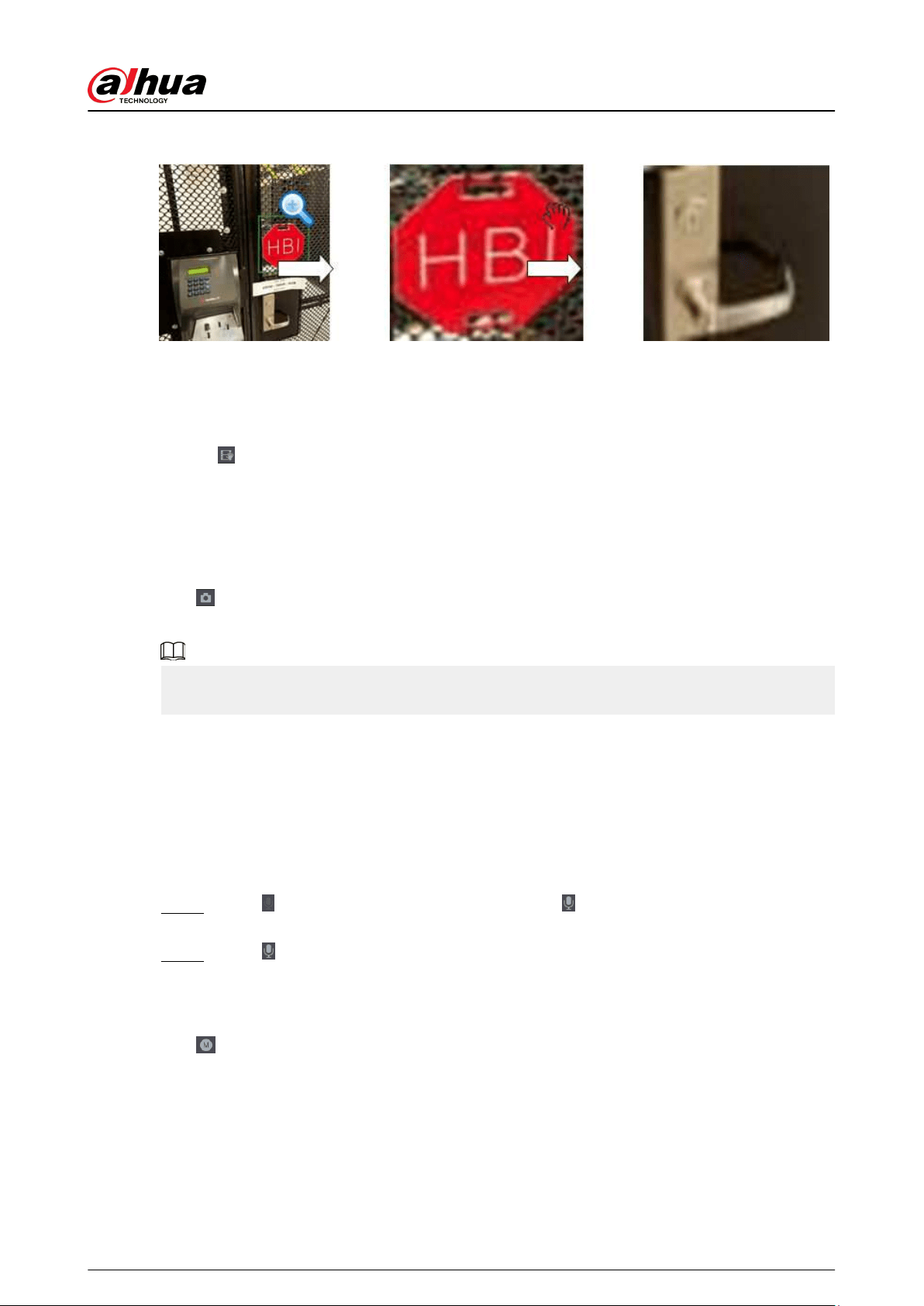
Figure 5-16 Zoom
5.6.3.3 Instant Backup
You can record the video of any channel and save the clip to a USB storage device.
Clicking
to start the recording. To stop recording, click this icon again. The clip is automatically
saved to the connected USB storage device.
5.6.3.4 Manual Snapshot
You can take one to ve snapshots of the video and save to a USB storage device.
Click
to take snapshots. The snapshots are automatically saved to the connected USB storage
device. You can view the snapshots on your PC.
To change the quantity of snapshots, select Main Menu > CAMERA > Encode > Snapshot, in the
Manual Snapshot list, select the snapshot quantity.
5.6.3.5 Two-way Talk
Background Information
You can perform the voice interaction between the NVR and the remote device to improve
eciency of emergency.
Procedure
Step 1 Click to start two-way talk. The icon changes to . The rest two-way talk buttons of
digital channel become dimmed.
Step 2 Click again to cancel two-way talk.
5.6.3.6 Stream Switch
Click
to switch the bit stream type of the main stream and sub stream according to current
network bandwidth.
●
M: Main stream: Its bit streams are big and denition is high. It occupies large network
bandwidth suitable for video wall surveillance, storage and more.
●
S: Sub stream: Its denition is low but occupies small network bandwidth. It is suitable for
general surveillance, remote connection and more. Some models support two sub streams (S1,
S2).
User's Manual
132
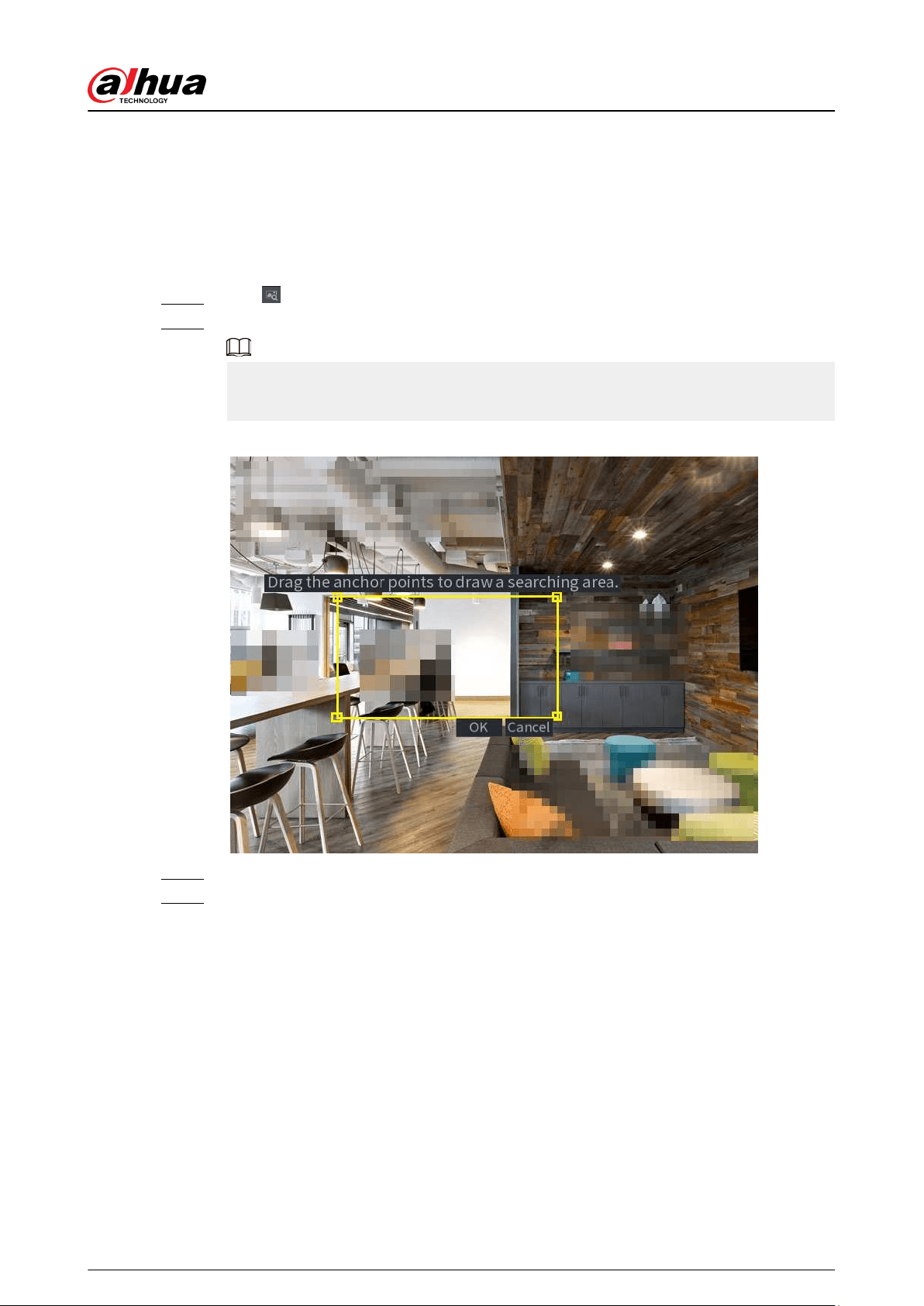
5.6.3.7 Picture Search
Background Information
Select the image of target person on the live view page and then search by image for all the related
videos with the target person.
Procedure
Step 1 Click . The live image is frozen.
Step 2 Draw a search range according to the on-screen prompt, and then click OK.
You can adjust the searching area. Make sure that there are less than 30 faces in the
selected range.
Figure 5-17 Draw a searching range
Step 3 Select the target face that you want to search for. You can select maximum 8 target faces.
Step 4 Click Search. The search results are displayed.
User's Manual
133
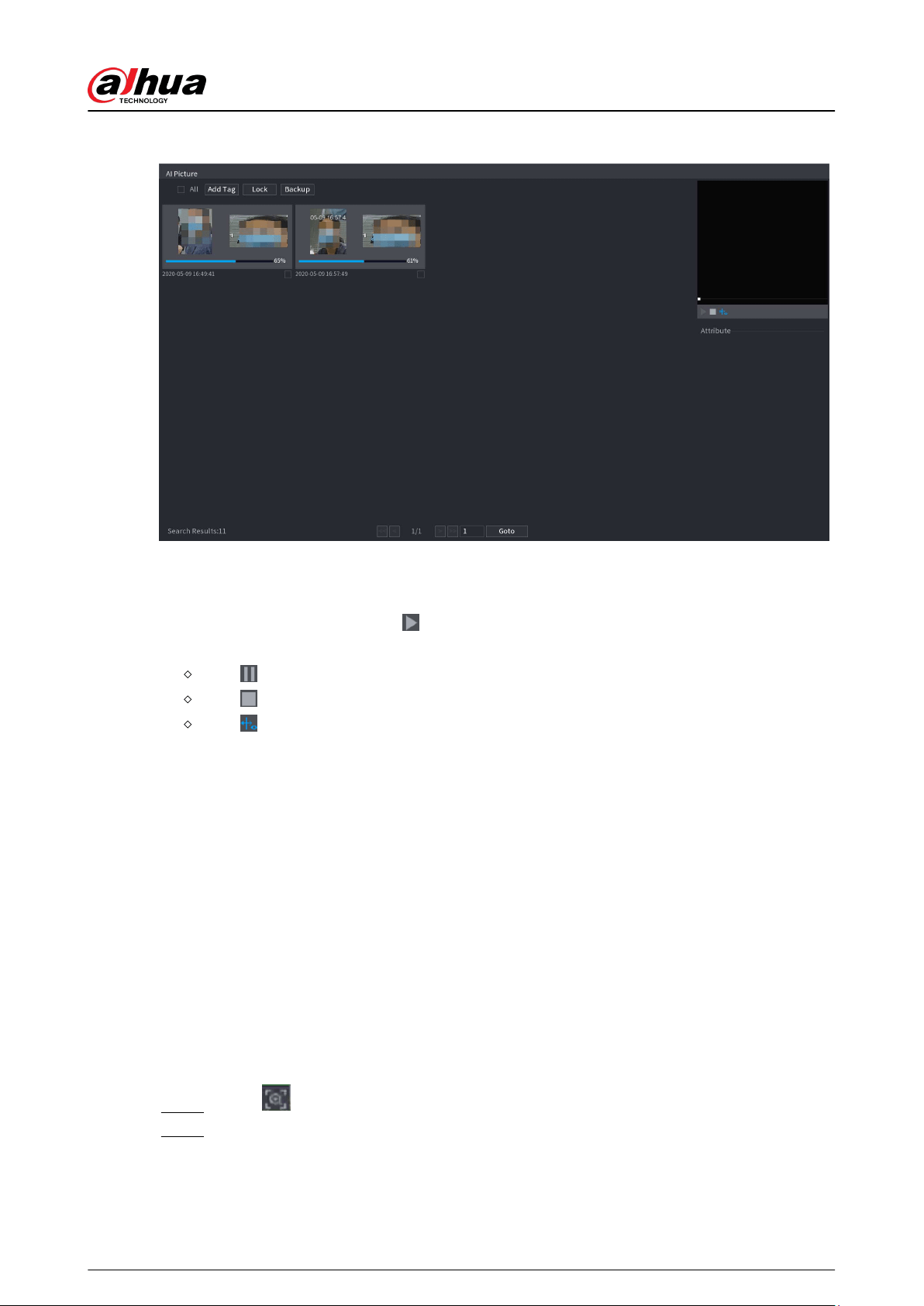
Figure 5-18 Picture search results
Related Operations
●
Play video.
Select the picture and then click
to play back the video within 10 seconds before and after
the snapshot. During playback, you can
Click to pause.
Click to stop.
Click to display or hide the intelligent rules.
●
Add tag.
Select the picture and then click Add Tag to add a tag to the recorded video to nd the target
recorded video more fast.
●
Lock recorded video.
If you want to keep the recorded video permanently, select the picture, and then click Lock. The
locked video cannot be overwritten and deleted.
●
Back up recorded video or picture.
Select the picture, and then click Backup. You can set save path, backup type, and le type, and
then export to the external storage device.
5.6.3.8 Quick Pick
When connected with select IPC cameras, Quick Pick technology becomes available, allowing
human and vehicle targets to be easily searched for and picked out.
Procedure
Step 1 Click to freeze the live page.
Step 2 Drag the anchor points to draw a searching area.
User's Manual
134
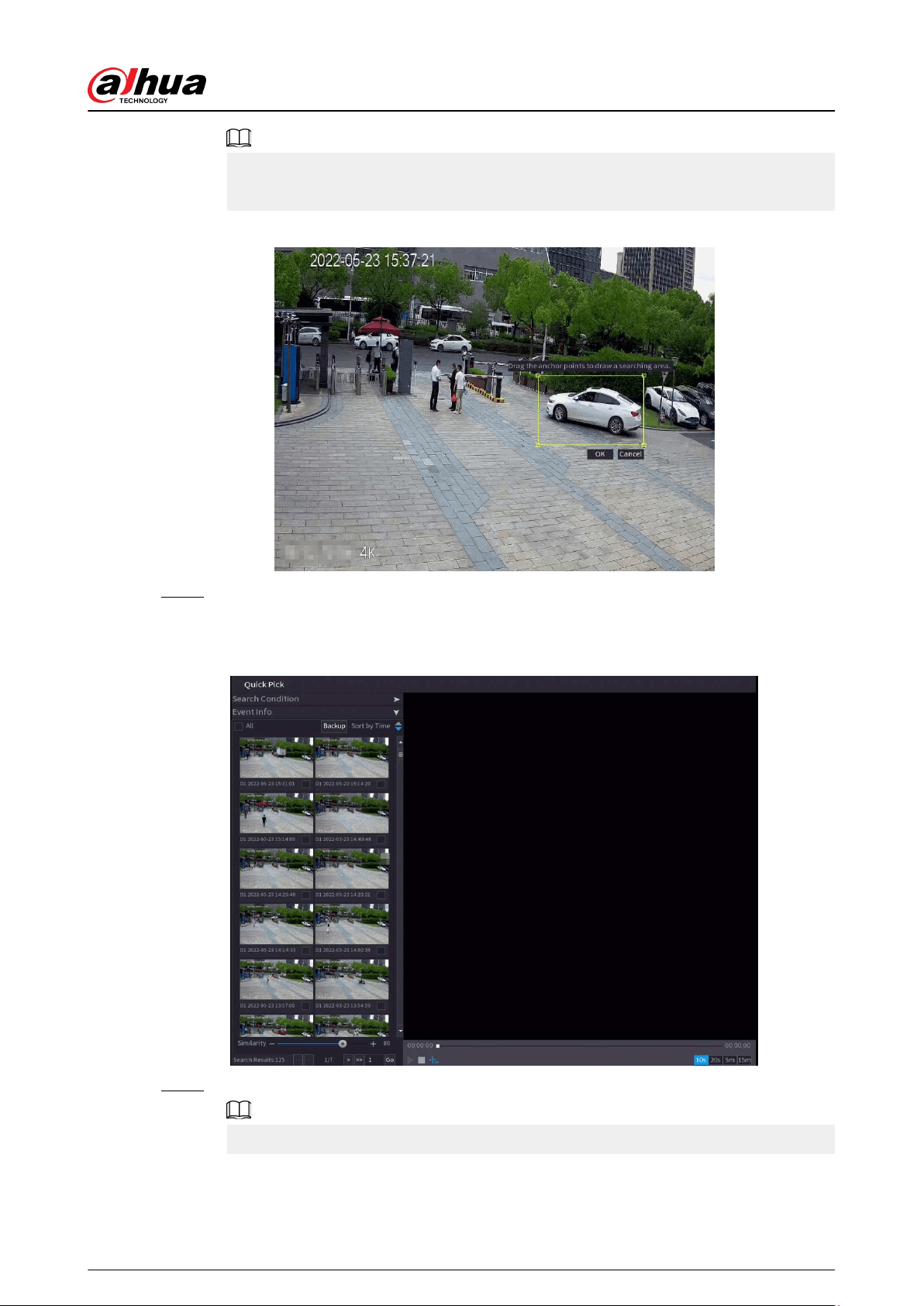
You can adjust the searching area. Make sure that there are less than 30 targets in the
selected area.
Figure 5-19 Quick pick
Step 3 Click OK.
The search results are displayed.
Figure 5-20 Search results
Step 4 (Optional) Click Search Condition , change the search conditions, and then click Search.
You can only select up to 8 targets for search.
User's Manual
135
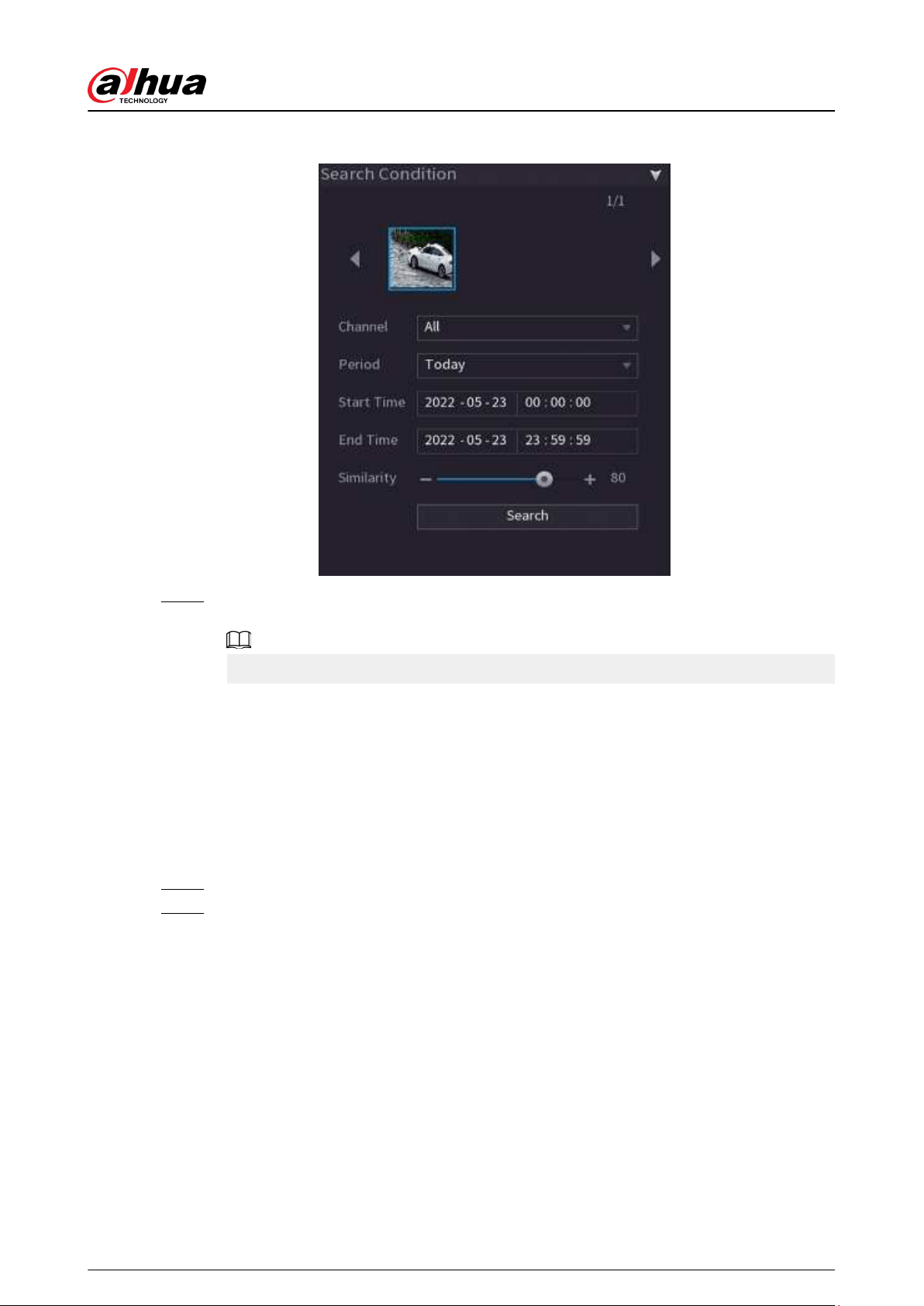
Figure 5-21 Search conditions
Step 5 Hover over a search result to view the basic information including channel, start time, end
time and target type. Double-click a result to play the video.
You can select one or more search results and then click Backup to back up the results.
5.6.3.9 AcuPick
Search the human bodies and motor vehicles in the live videos.
Prerequisites
The channel supports AcuPick, and the function has been enabled.
Procedure
Step 1 Select a channel to play the live image.
Step 2 Point to the top center of the video of current channel, and then the live view control bar
appears.
User's Manual
136
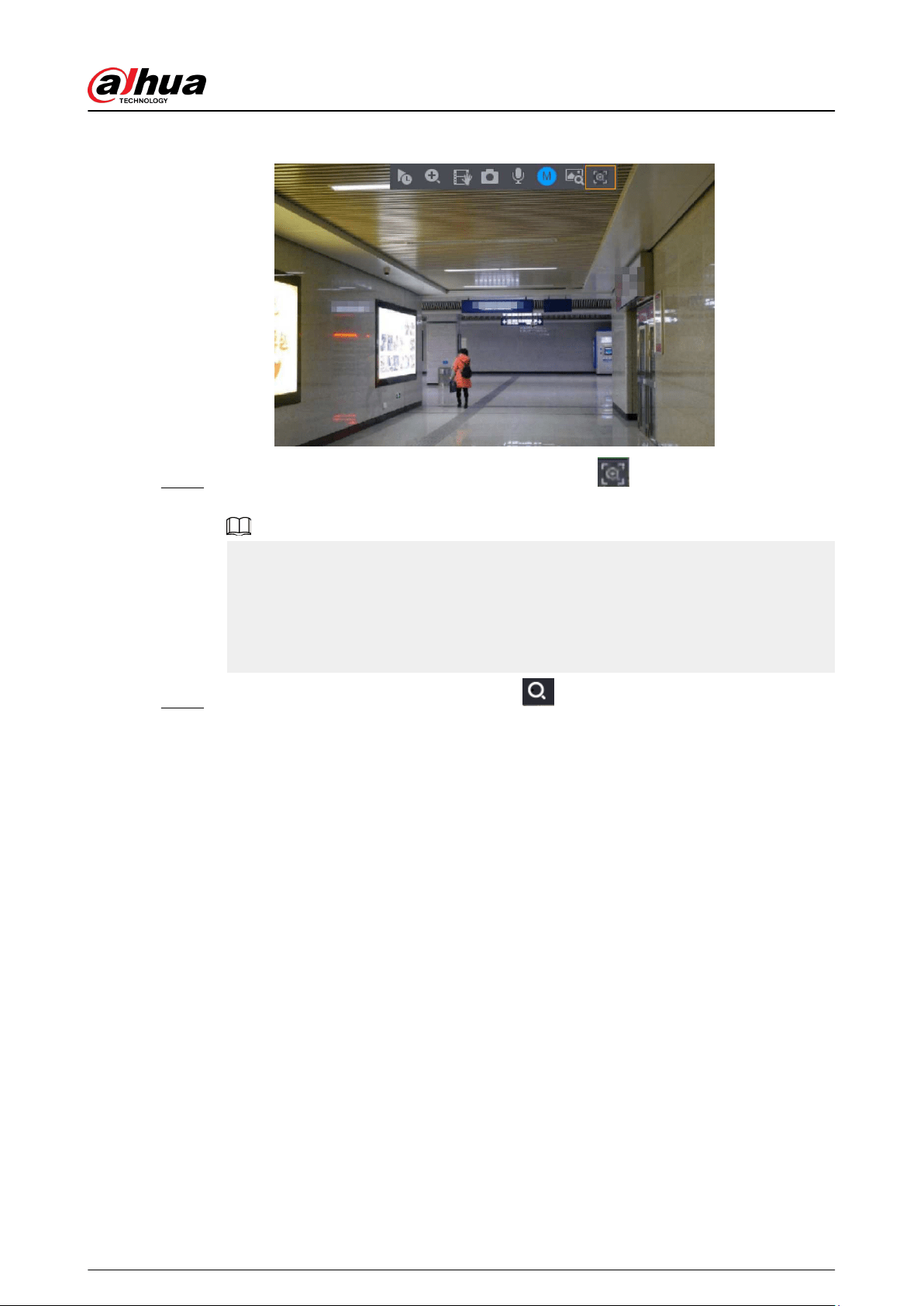
Figure 5-22 Live view control bar
Step 3 When you want to search the target in the image, click to freeze the live page. The
image automatically shows the targets.
●
This function is for one-channel live view mode. In multiple-channel live view mode,
double-click a channel to switch to one-channel live view mode.
●
Supports human detection (blue detection box) and motor vehicle detection (yellow
detection box).
●
If you select AI Mode as Live Mode, when you enable AcuPick function, only the
latest 5 records on the right side of the live page will be displayed.
Step 4 Point to the target you want, and then click to check the details.
User's Manual
137
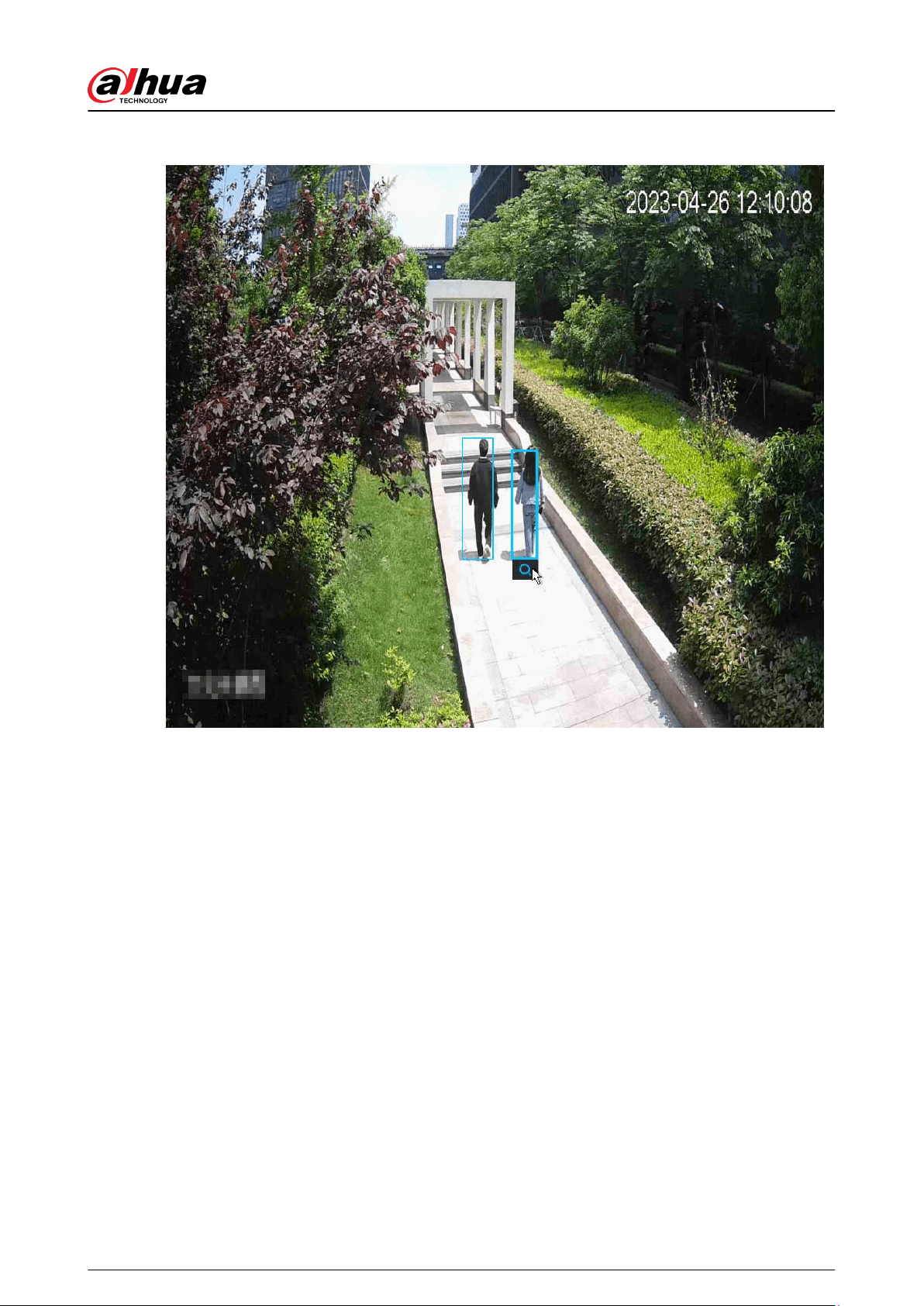
Figure 5-23 AcuPick (human detection)
User's Manual
138
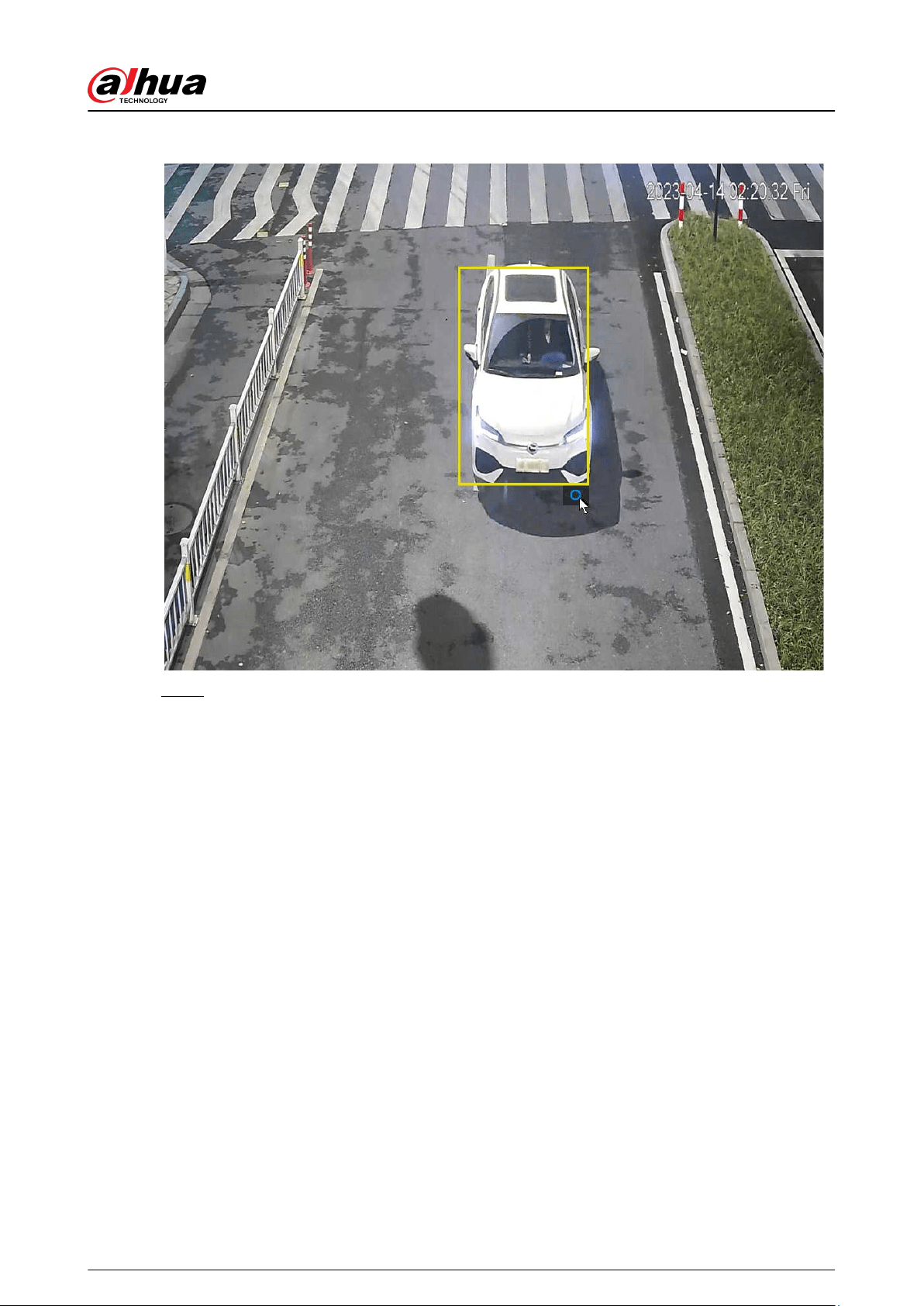
Figure 5-24 AcuPick (motor vehicle detection)
Step 5 Congure the search conditions as needed.
User's Manual
139
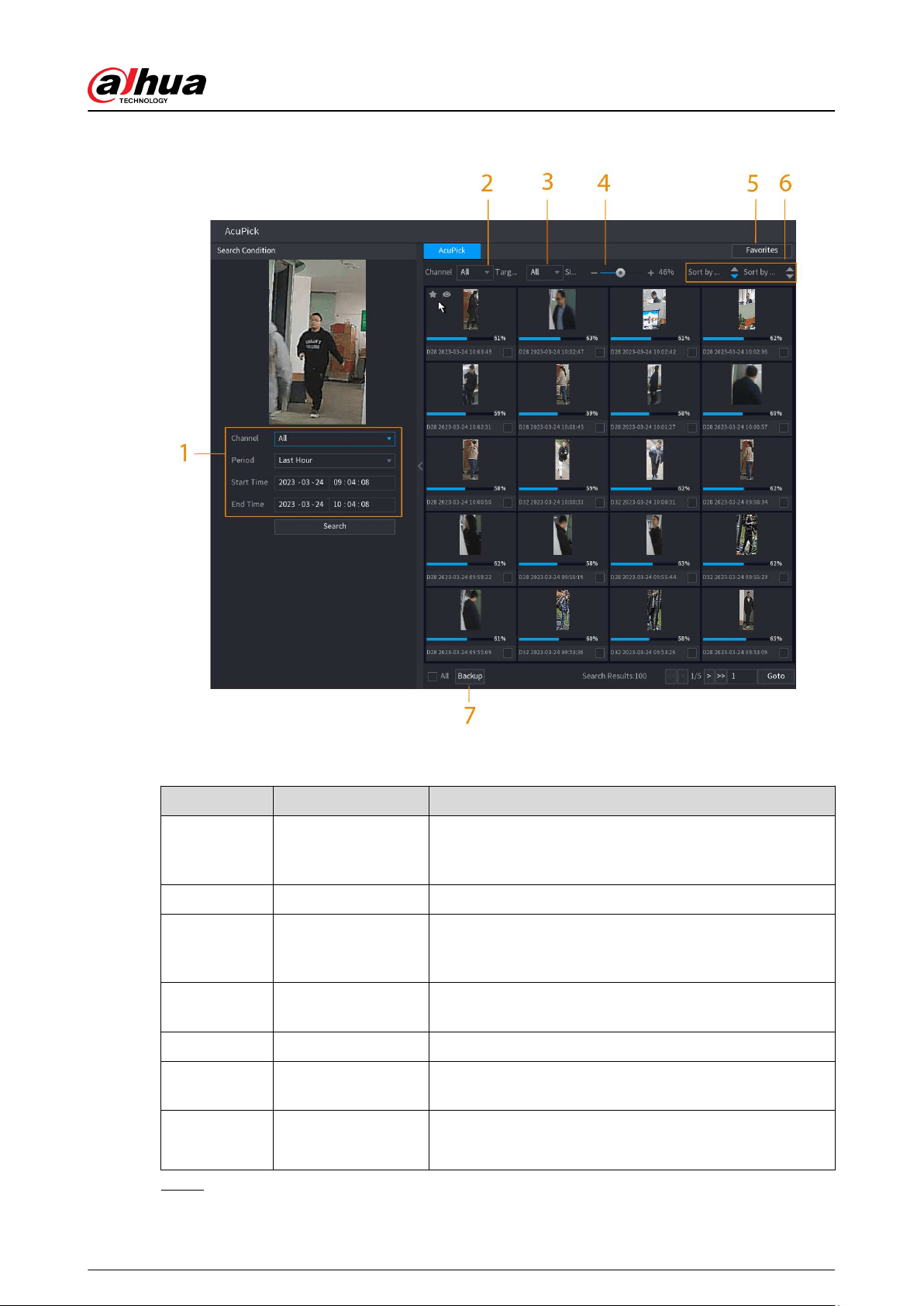
Figure 5-25 Search conditions and results
Table 5-10 Descriptions of search conditions and results
No. Name Description
1 Search Condition
Congure the channel and period. When choose Custom,
you can set the start time and end time as needed. Up to 7
days can be set.
2 Channel Displays the channels with search result.
3 Target Filter
Select from All , Favorite Items and Hidden Items. When
you select the target items, the device will only search in
this item.
4 Similarity
Congure the search similarity according to the actual
conditions. The recommended value is 80% or above.
5 Favorites The system only search the target in favorites.
6
Sort by Time/ Sort by
Similarity
Reorder the search results by time or similarity.
7 Backup
You can select one or more search results, and then click
Backup to back up the results.
Step 6 Select a result and double click it to check the video.
User's Manual
140
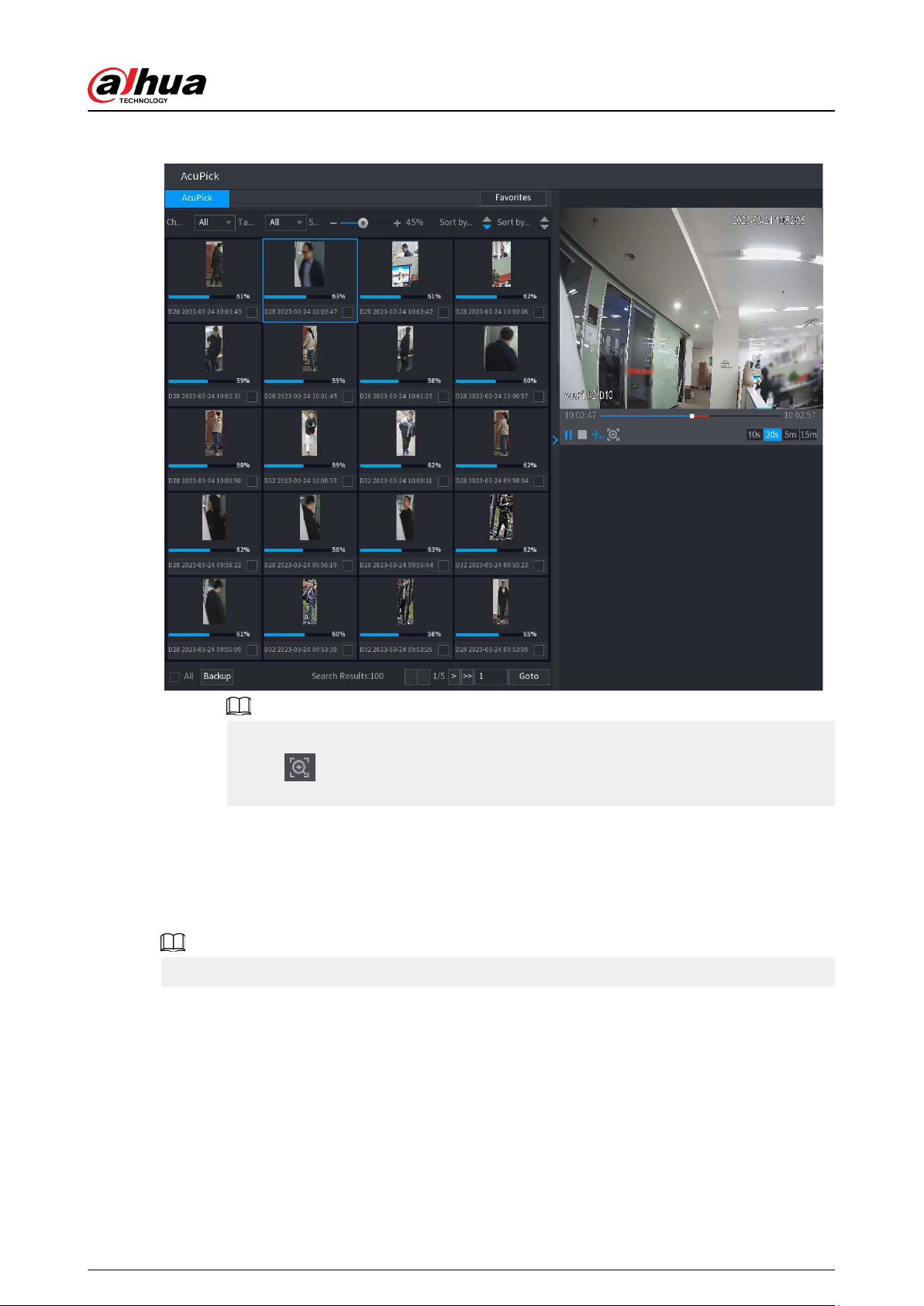
Figure 5-26 Check the search video
●
Under 4K resolution, the video does not support full screen play on this page.
●
Click
, you can enable the AcuPick function again, freeze the image and search for
the new target.
5.6.4 Shortcut Menu
Right-click the live view page to bring up the shortcut menu. You can go to main menu, play back
videos or images, congure view split, and congure the settings of PTZ, image, and more.
The shortcut menu is dierent for dierent models.
User's Manual
141
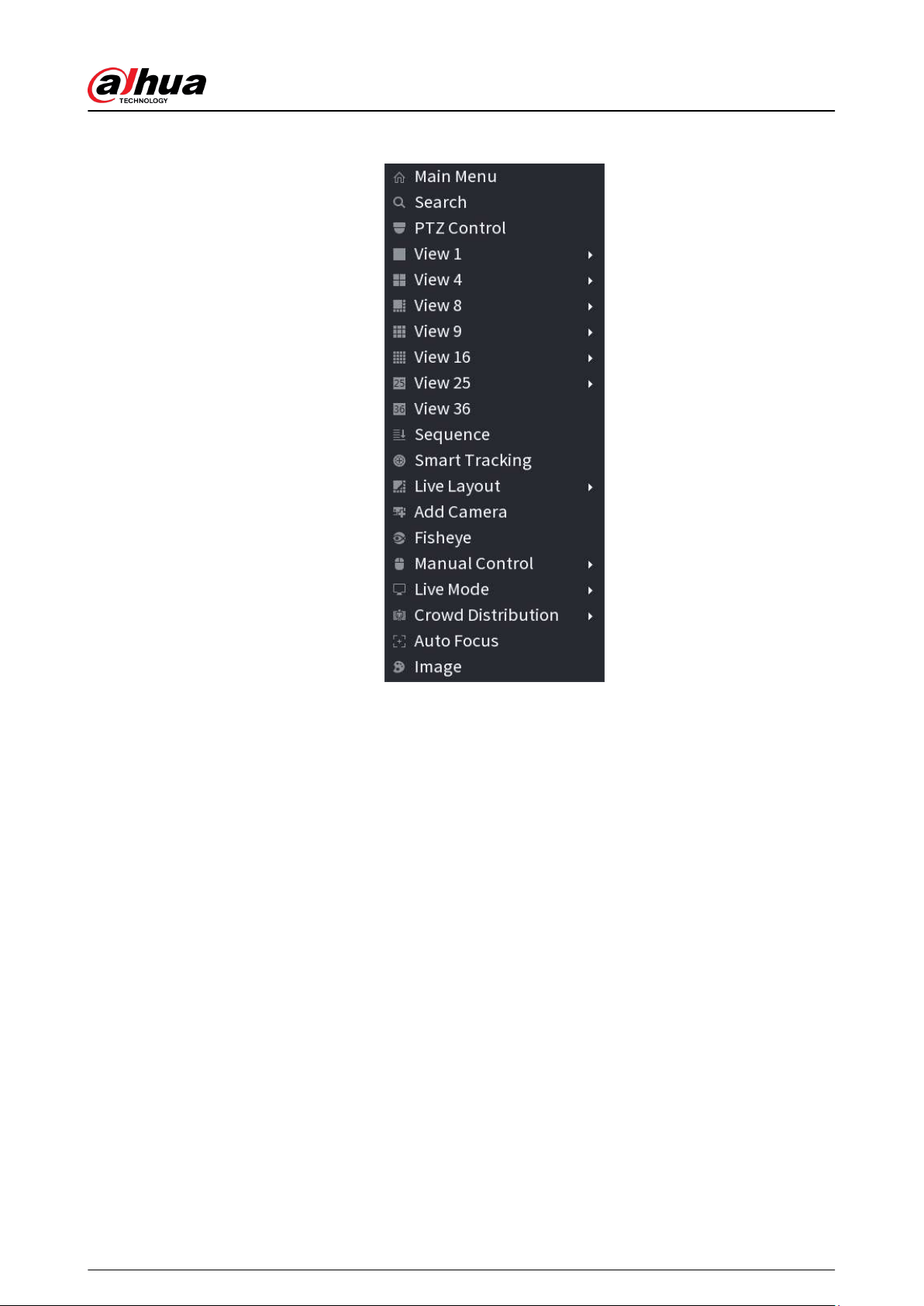
Figure 5-27 Shortcut menu (1)
User's Manual
142
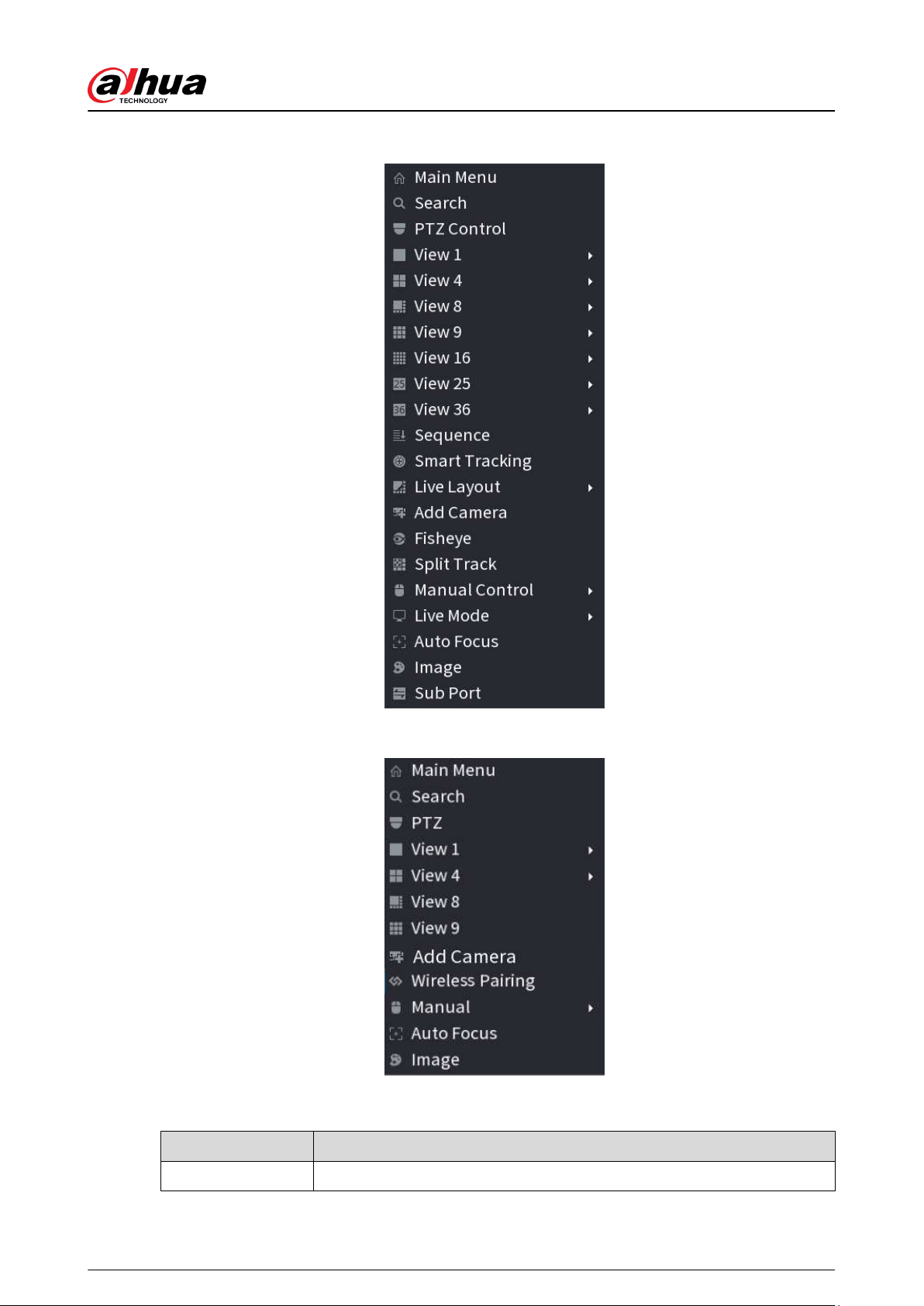
Figure 5-28 Shortcut menu (2)
Figure 5-29 Shortcut menu (3)
Table 5-11 Shortcut menu description
Function Description
Main Menu Go to main menu.
User's Manual
143
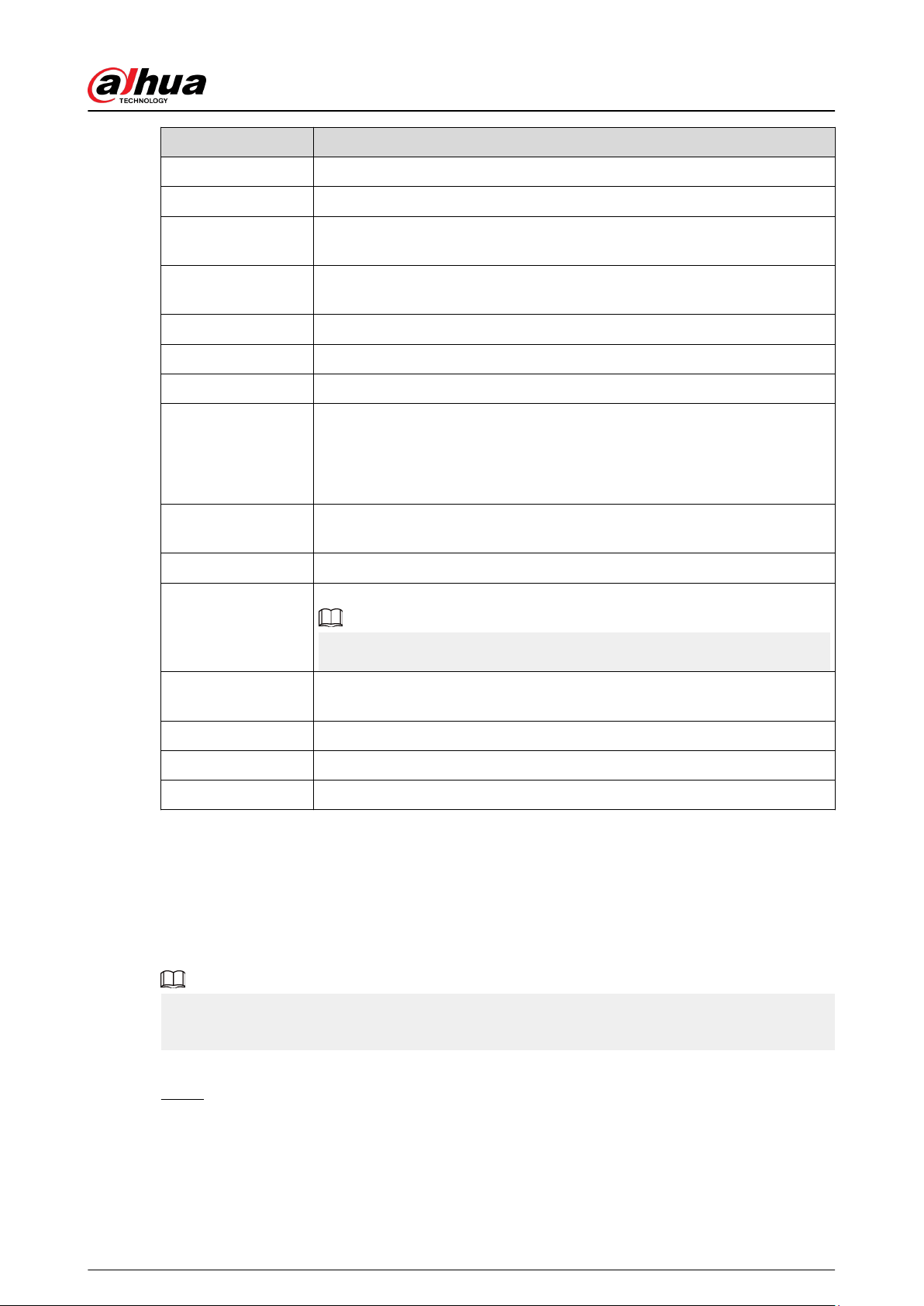
Function Description
Search Search and play back videos or images.
PTZ Control Open the PTZ control panel. For details, see "5.6.7 PTZ".
View
1/4/8/9/16/25/36
Congure the live view screen as a single-channel layout or multi-channel
layout.
Sequence
Set customized screen split mode and channels. For details, see "5.6.9
Sequence".
Add Camera Add cameras to the Device.
Wireless Pairing Quickly add IPCs. For details, see "5.6.8 Wireless Pairing".
Split Track Split the screen of a certain channel. For details, see "5.6.6 Split Tracking".
Manual Control
●
Record Mode : You can congure the recording mode as Auto or
Manual, or stop the recording. You can also enable or disable snapshot
function
●
Alarm Mode : You can congure alarm output settings.
Live Mode
Select General or AI Mode. In the AI mode, the information of detected
face, human or vehicles are displayed on the right side of the live page.
Crowd Distribution Select On or Close to enable or disable crowd distribution function.
Auto Focus
Click to realize auto focus function.
Make sure the connected camera supports this function.
Image
Click to modify the camera image parameters. For details, see "5.7.4
Conguring Image Settings".
Sub Screen Click Sub Screen to switch to the current monitor to the sub screen.
Smart Tracking Enable smart tracking to track targets manually or automatically.
Mirror Sub Screen Displays the image of the sub screen on the main screen.
5.6.5 AI Live View Mode
Background Information
When you select AI mode, the system displays information of human face, personnel, vehicle and
non-motor vehicle on the right side of the live page, and it supports to play back records and
display feature attributes.
You need to enable face detection, body detection, vehicle detection and non-motor vehicle
detection to support this function. For details, see "5.9.8.2 Conguring Video Metadata".
Procedure
Step 1 Right-click the live page, and then set AI Mode as Live Mode.
User's Manual
144
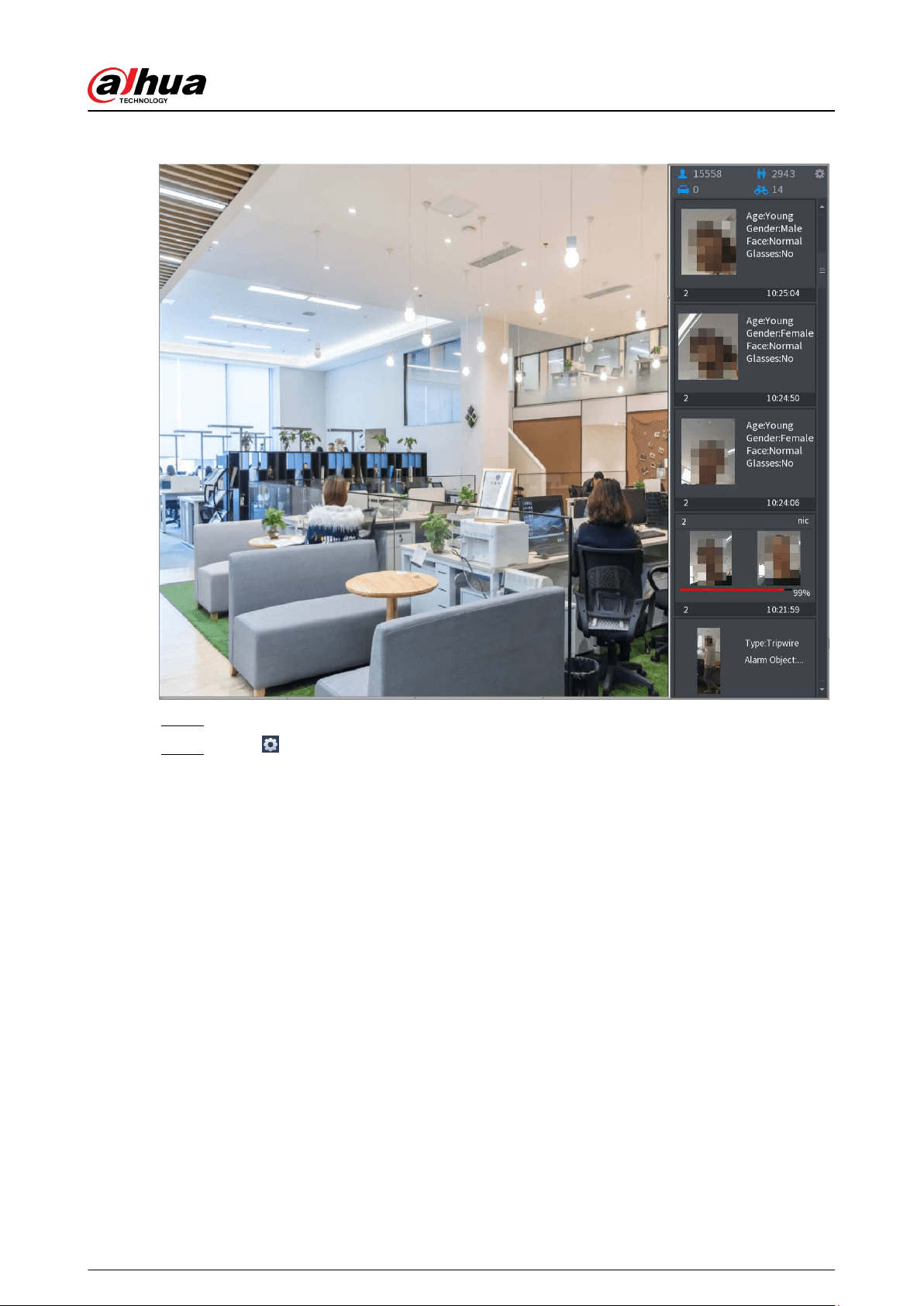
Figure 5-30 AI live view
Step 2 (Optional) Double-click the image on the right to play the corresponding video.
Step 3 Click , and then select the face attributes that you want to display. You can select up to
four attributes.
User's Manual
145
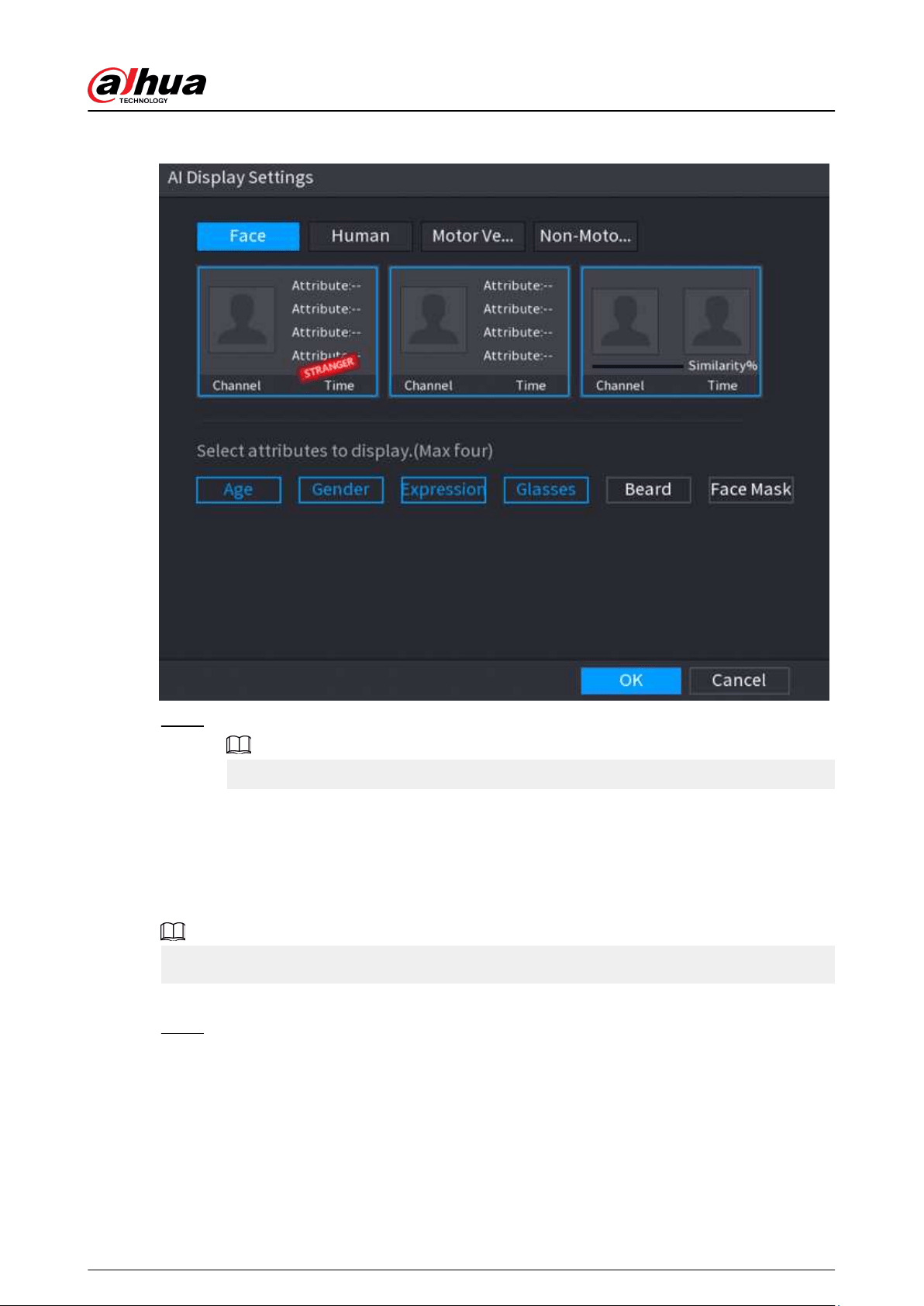
Figure 5-31 Face vehicle properties
Step 4 Click OK.
The system can display four attributes at most.
5.6.6 Split Tracking
You can track window split for a certain channel.
Background Information
This function is for select models only.
Procedure
Step 1 Right-click the live page, and then select Split Track.
User's Manual
146
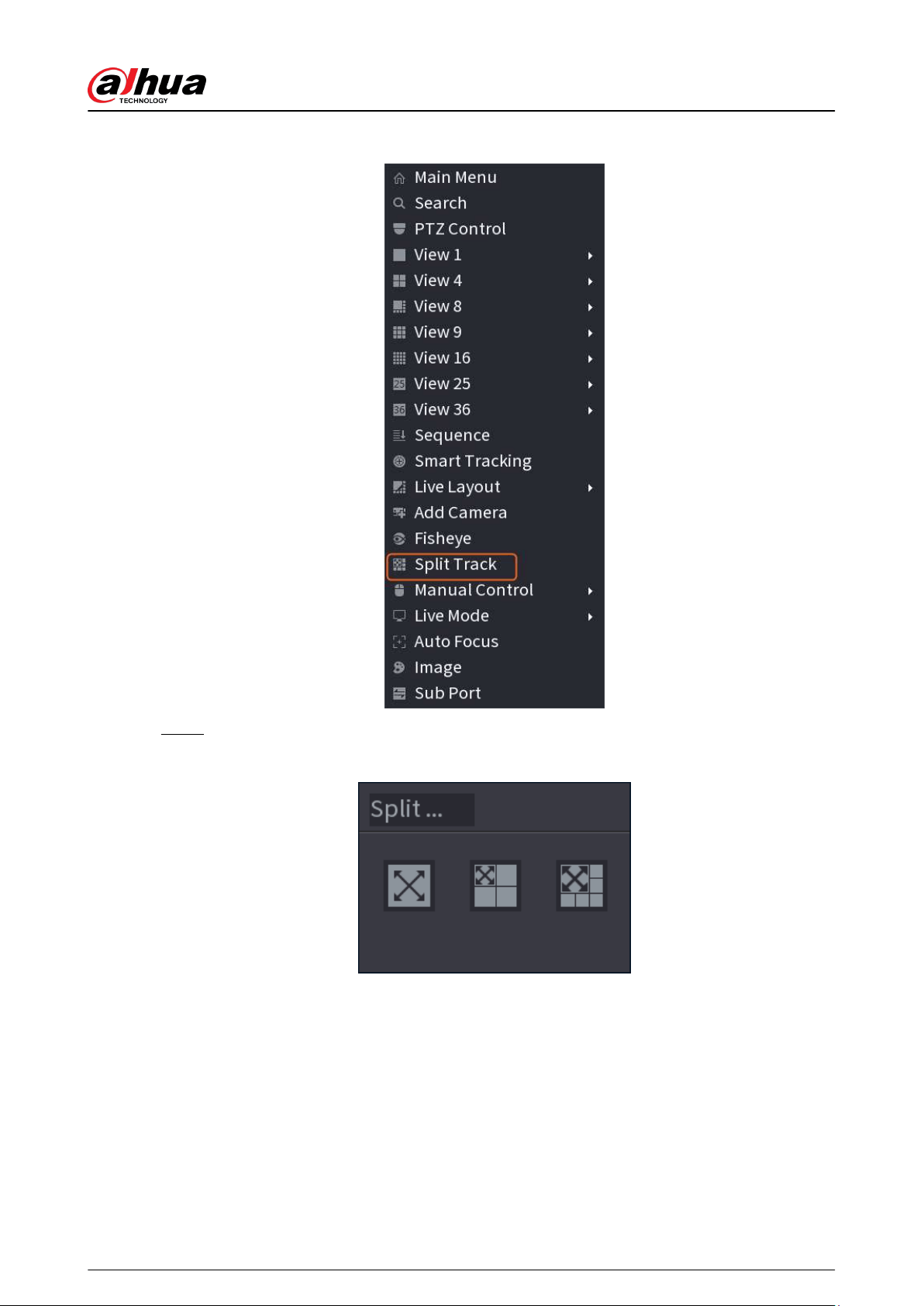
Figure 5-32 Split track
Step 2 Select a split mode.
Figure 5-33 Split mode
Split mode includes full screen, 1 main screen + 3 split screens and 1 main screen + 5 split
screens.
●
You can move the rectangles with color to adjust the videos displayed on split screens.
●
You can scroll the mouse in split screens to zoom in or out the video.
User's Manual
147
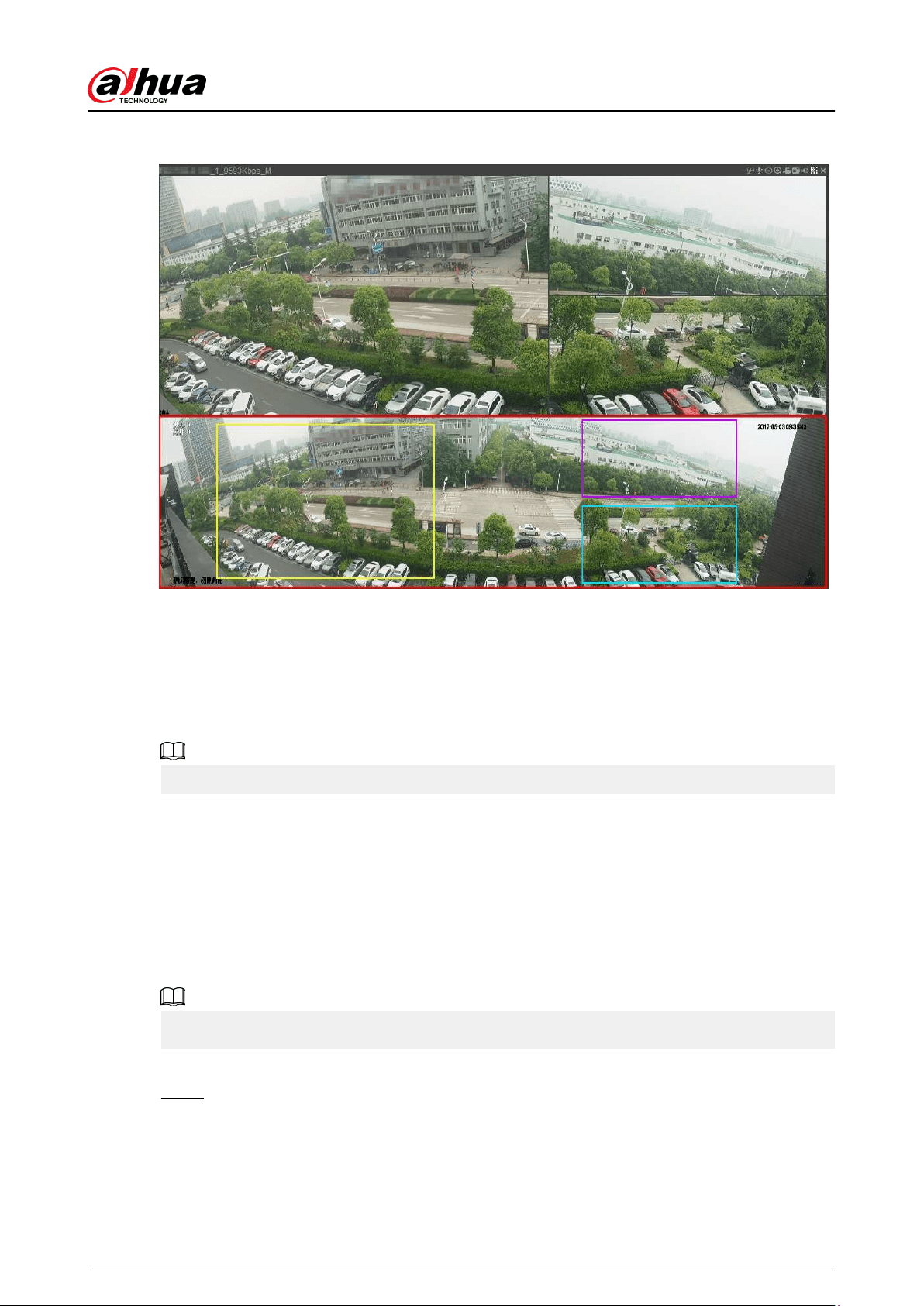
Figure 5-34 Split display
5.6.7 PTZ
PTZ is a mechanical platform that carries a camera and a protective cover and performs overall
control remotely. A PTZ can move in both horizontal and vertical direction to provide all-around
view to the camera.
Before you control the PTZ, make sure the PTZ decoder and the NVR network connection is OK.
5.6.7.1 PTZ Settings
Background Information
You can set dierent PTZ parameters for local type and remote type. Before you use local PTZ, make
sure you have set PTZ protocol; otherwise you cannot control the local PTZ.
●
Local: The PTZ device connects to the NVR through the cable.
●
Remote: The PTZ device connects to the NVR through the network.
This function is available on select models.
Procedure
Step 1 Select Main menu > Camera > PTZ.
User's Manual
148
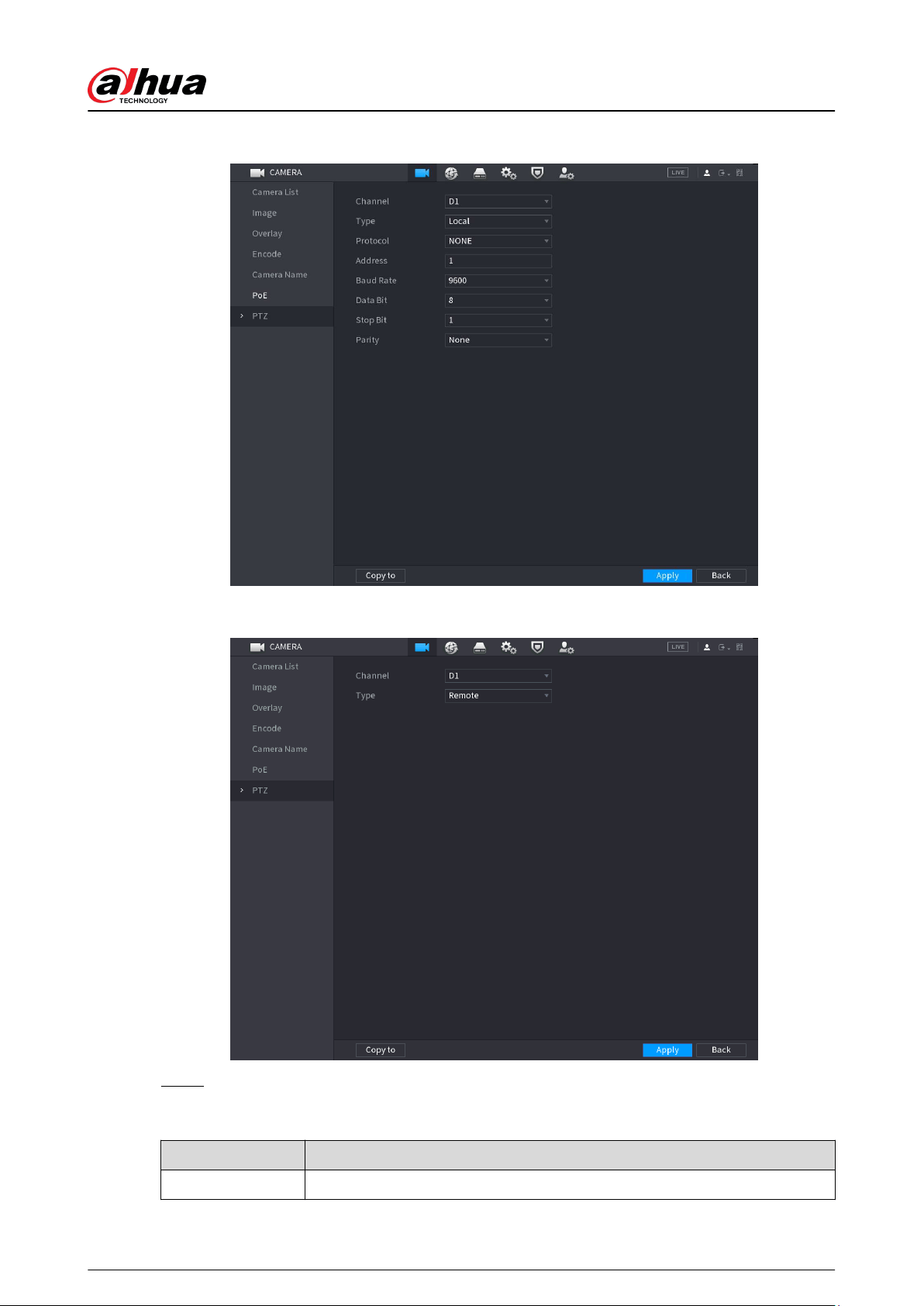
Figure 5-35 PTZ (local)
Figure 5-36 PTZ (remote)
Step 2 Congure parameters.
Table 5-12 PTZ parameters
Parameter Description
Channel Select the channel that you want to connect the PTZ camera to.
User's Manual
149
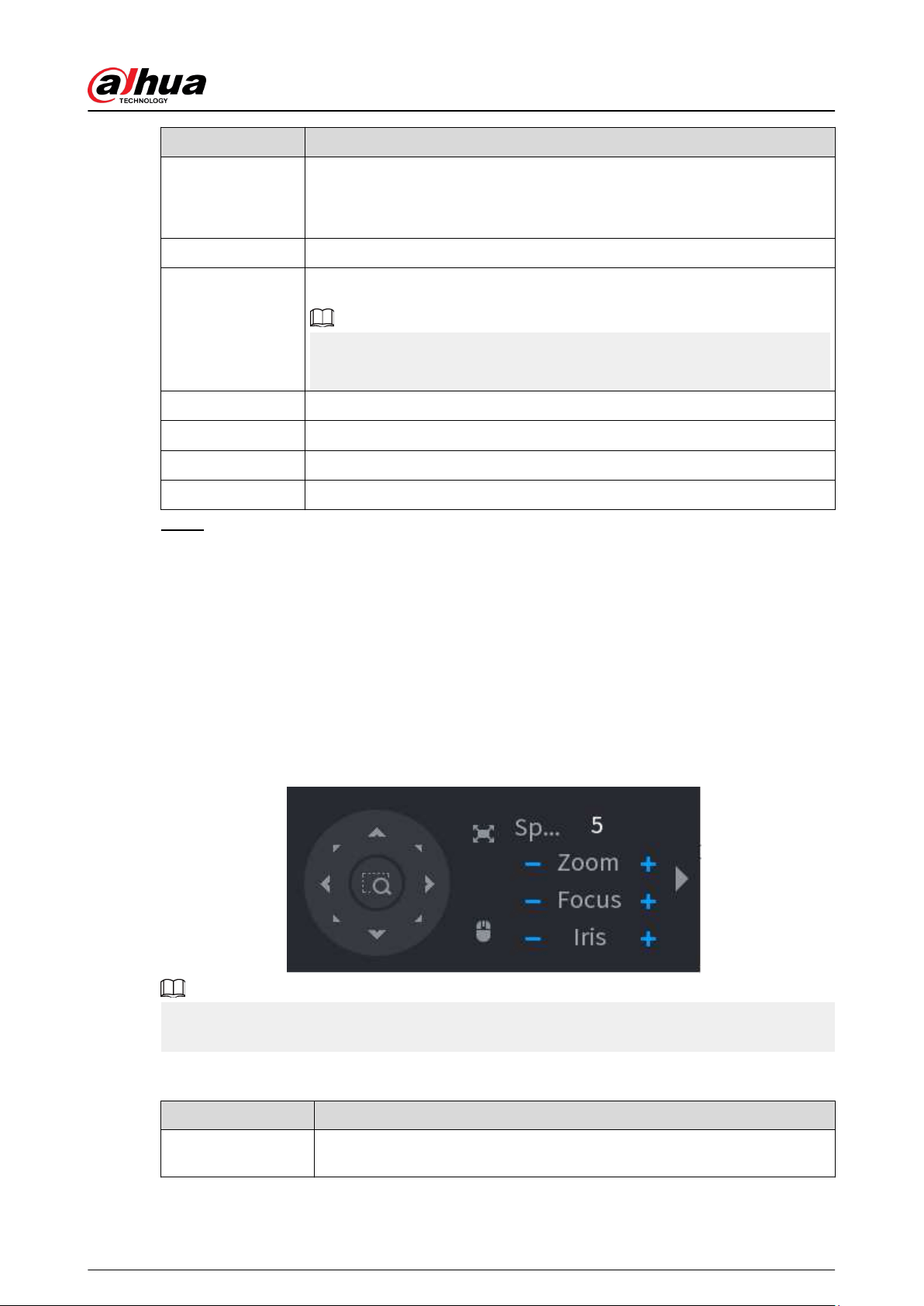
Parameter Description
Type
●
Local: Connect through RS-485 port.
●
Remote: Connect through network by adding IP address of PTZ camera
to the Device.
Protocol Select the protocol for the PTZ camera such as PELCOD.
Address
Enter the address for PTZ camera. The default is 1.
The entered address must be the same with the address congured on the
PTZ camera; otherwise the system cannot control PTZ camera.
Baud rate Select the baud rate for the PTZ camera. The default is 9600.
Data Bit The default value is 8.
Stop Bit The default value is 1.
Parity The default value is None.
Step 3 Click Apply.
5.6.7.2 PTZ Control
You can use the PTZ control panel to perform the operations such as directing camera in eight
directions, adjusting zoom, focus and iris settings, and quick positioning.
Basic PTZ Control Panel
Right-click the live page, and then select PTZ Control.
Figure 5-37 Basic PTZ control panel
●
The gray button means system does not support current function.
●
For some model, the PTZ function is available only in one-window mode.
Table 5-13 PTZ control parameters
Parameter Description
Speed
Controls the movement speed. The bigger the value, the faster the
movement.
User's Manual
150
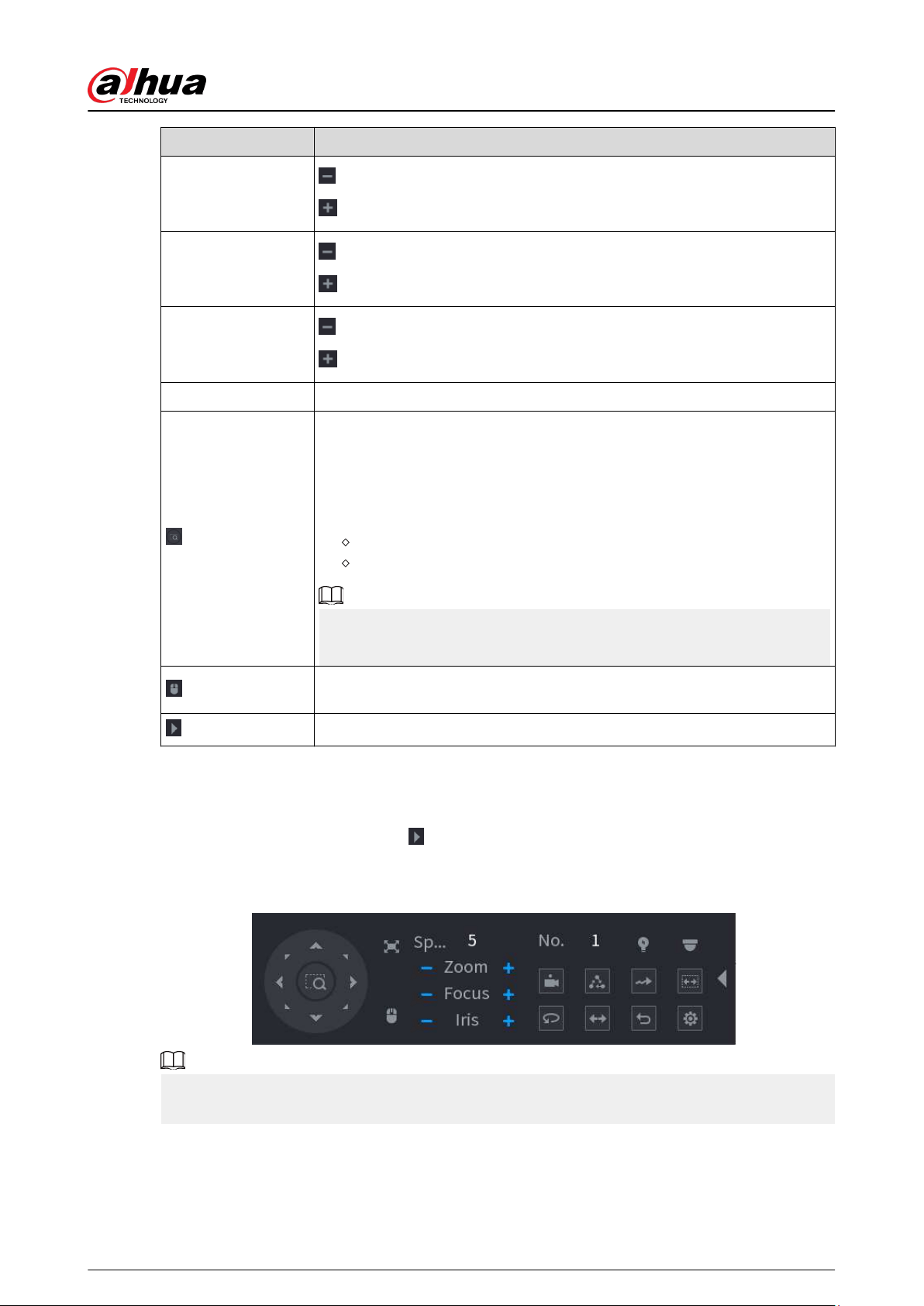
Parameter Description
Zoom
: Zoom out.
: Zoom in.
Focus
: Focus far.
: Focus near.
Iris
: Image darker.
: Image brighter.
PTZ movement Supports eight directions.
Fast positioning button.
●
Positioning: Click the icon, and the click any point on the live page. The
PTZ will turn to this point and locate this point in the center.
●
Zooming: Click the icon, and then drag to draw a square on the view.
The square supports zooming.
Drag upward to zoom out, and drag downward to zoom in.
The smaller the square, the larger the zoom eect.
This function is available on select models, and can only be controlled
through mouse operations.
Click the icon, and then you can control the four directions (left, right, up,
and down) of PTZ movement through mouse operation.
Open the expanded PTZ control panel.
Expanded PTZ Control Panel
On the basic PTZ control panel, click
to open the expanded PTZ control panel to nd more
options. See Figure 5-38 .
Figure 5-38 Expanded PTZ control bar
●
The functions with buttons in gray are not supported by the system.
●
Right-click once to return to the page of PTZ basic control panel.
User's Manual
151
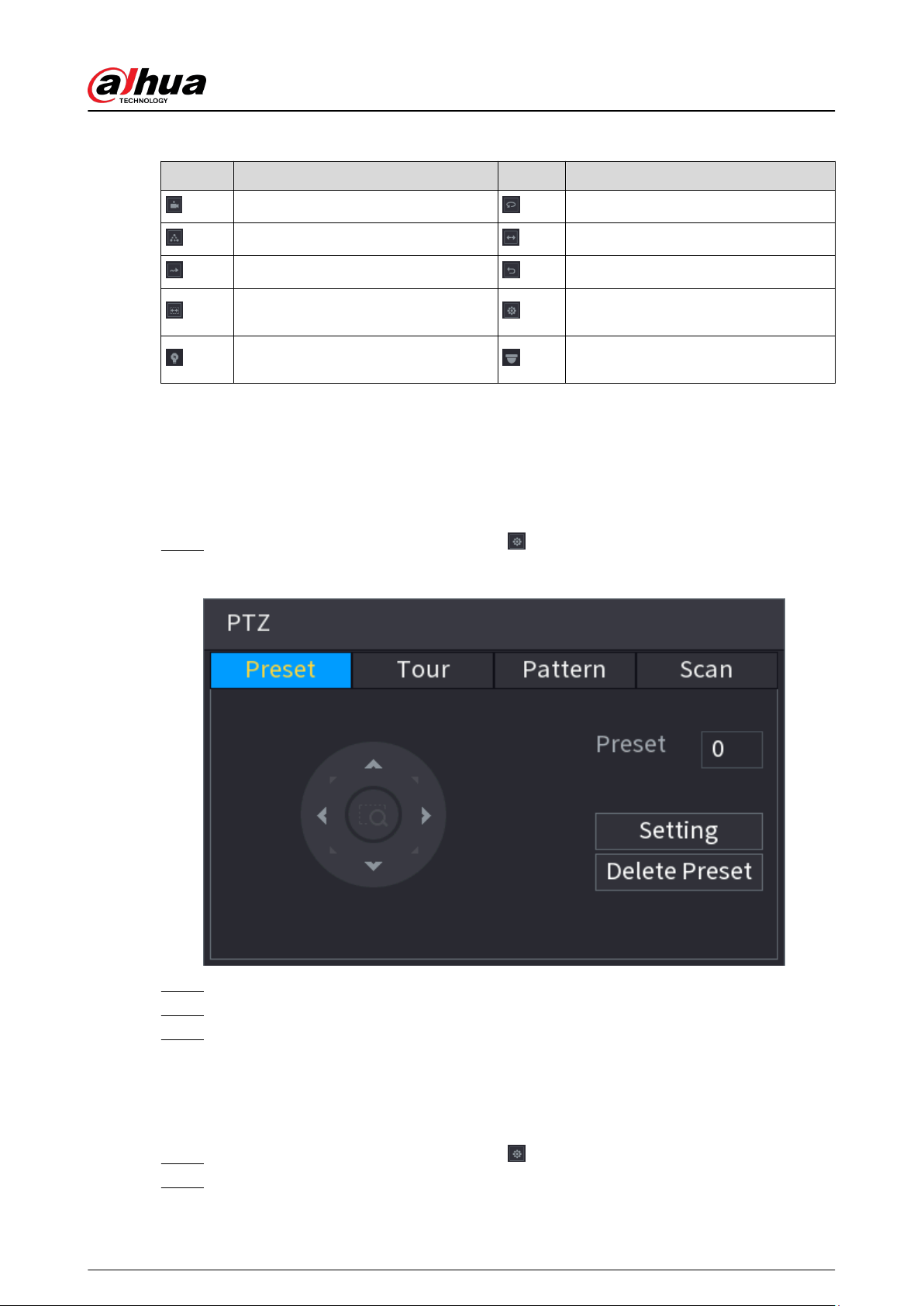
Table 5-14 PTZ functions
Icon Function Icon Function
Preset Pan
Tour Flip
Pattern Reset
Scan
Click the AUX Cong icon to open
the PTZ functions settings page.
AUX Switch
Click the Enter Menu icon to open
the PTZ Menu page.
5.6.7.3 Conguring PTZ Functions
5.6.7.3.1 Conguring Presets
Procedure
Step 1 On the expanded PTZ control panel, click .
Figure 5-39 Preset
Step 2 Click the direction arrows to the required position.
Step 3 In the Preset box, enter the value to represent the required position.
Step 4 Click Setting to complete the preset settings.
5.6.7.3.2 Conguring Tours
Procedure
Step 1 On the expanded PTZ control panel, click .
Step 2 Click the Tour tab.
User's Manual
152
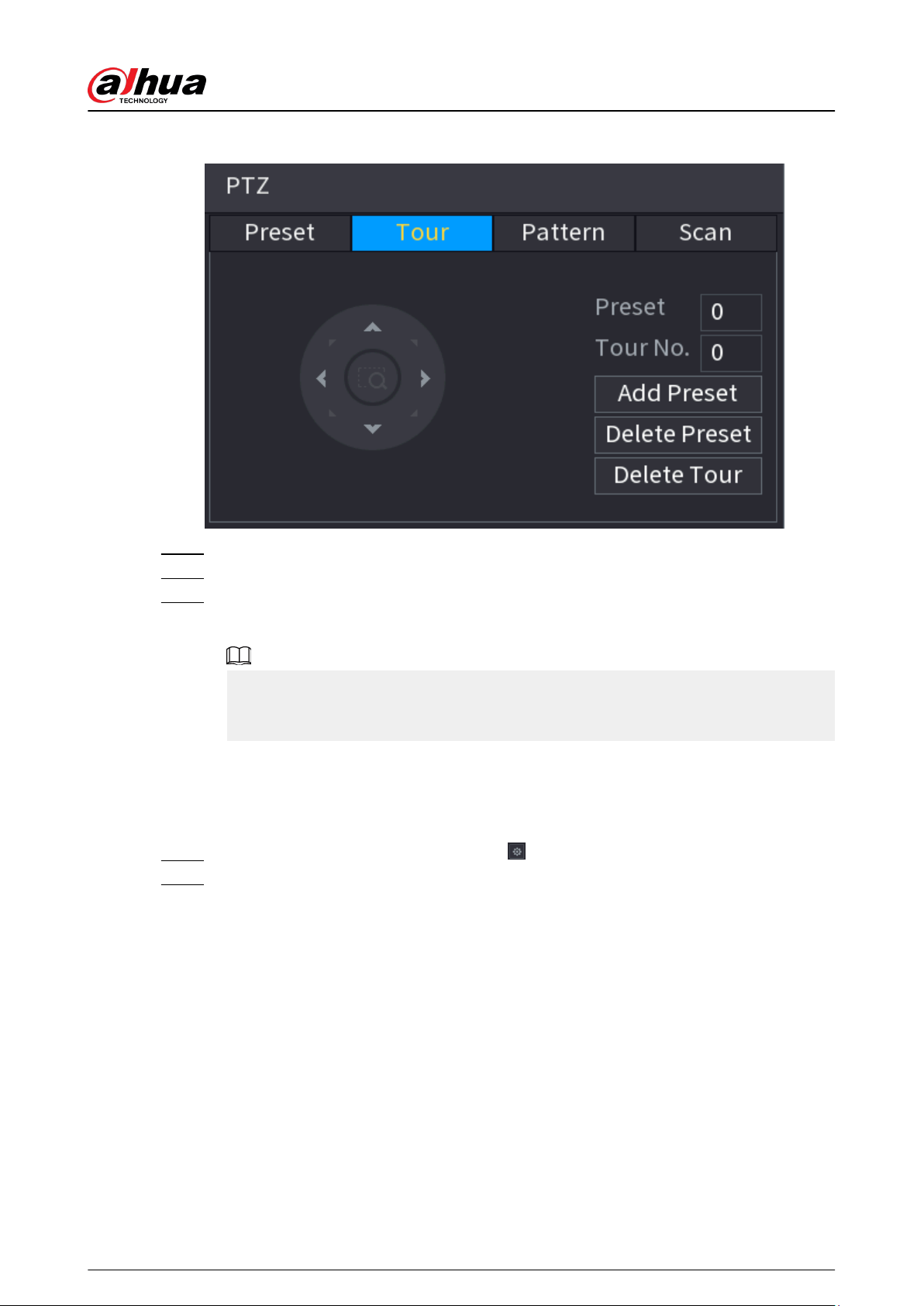
Figure 5-40 Tour
Step 3 In the Tour No. box, enter the value for the tour route.
Step 4 In the Preset box, enter the preset value.
Step 5 Click Add Preset.
A preset will be added for this tour.
●
You can repeat adding more presets.
●
Click Delete Preset to delete the preset for this tour. This operation can be repeated
to delete more presets. Some protocols do not support deleting.
5.6.7.3.3 Conguring Patterns
Procedure
Step 1 On the expanded PTZ control panel, click .
Step 2 Click the Pattern tab.
User's Manual
153
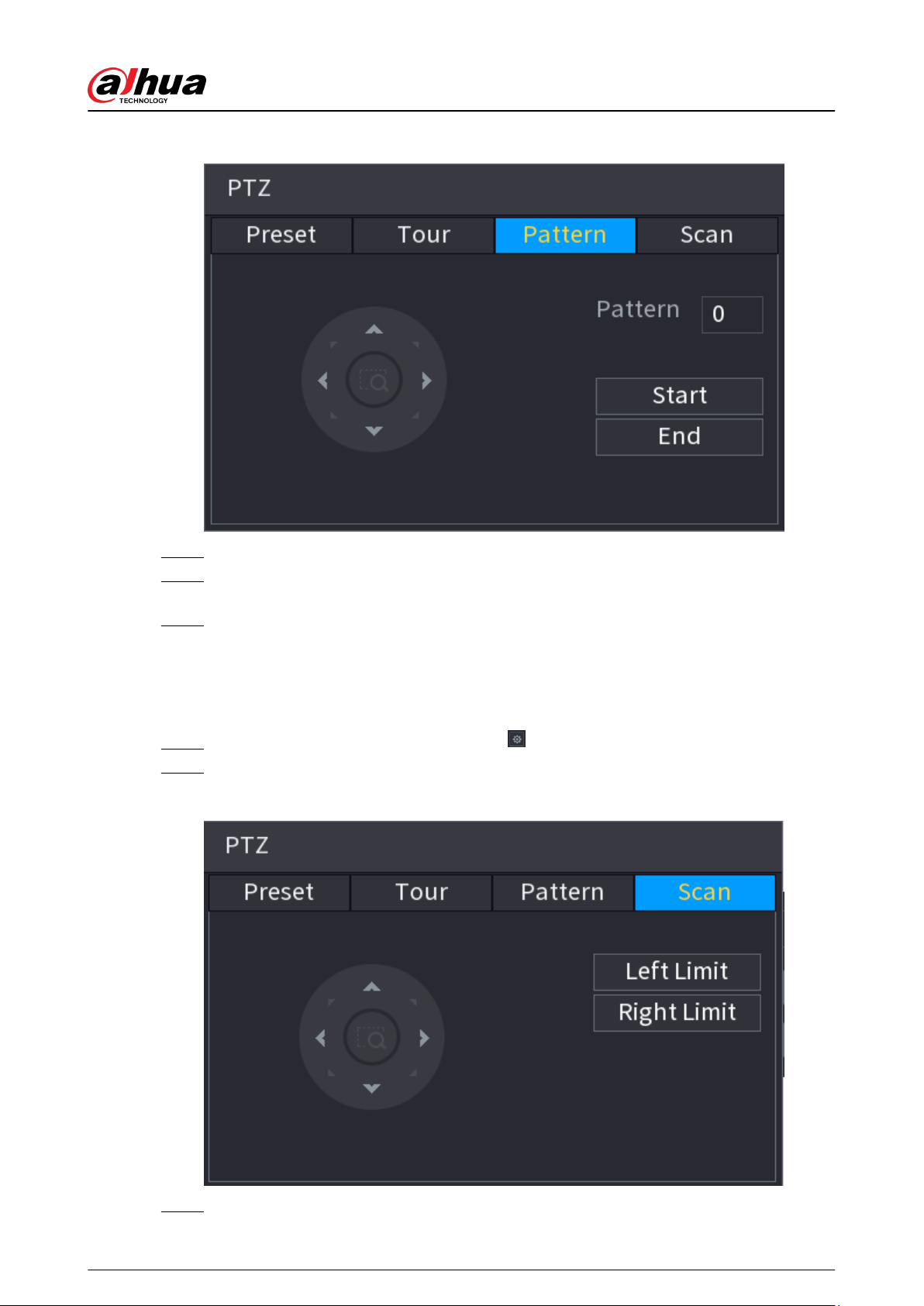
Figure 5-41 Pattern
Step 3 In the Pattern box, enter the value for pattern.
Step 4 Click Start to perform the directions operations. You can also go to the PTZ Control Panel
to perform the operations of adjusting zoom, focus, iris, and directions.
Step 5 On the PTZ window, click End to complete the settings.
5.6.7.3.4 Conguring AutoScan
Procedure
Step 1 On the expanded PTZ control panel, click .
Step 2 Click the Scan tab.
Figure 5-42 Scan
Step 3 Click the direction arrows to position the left and right limits.
User's Manual
154
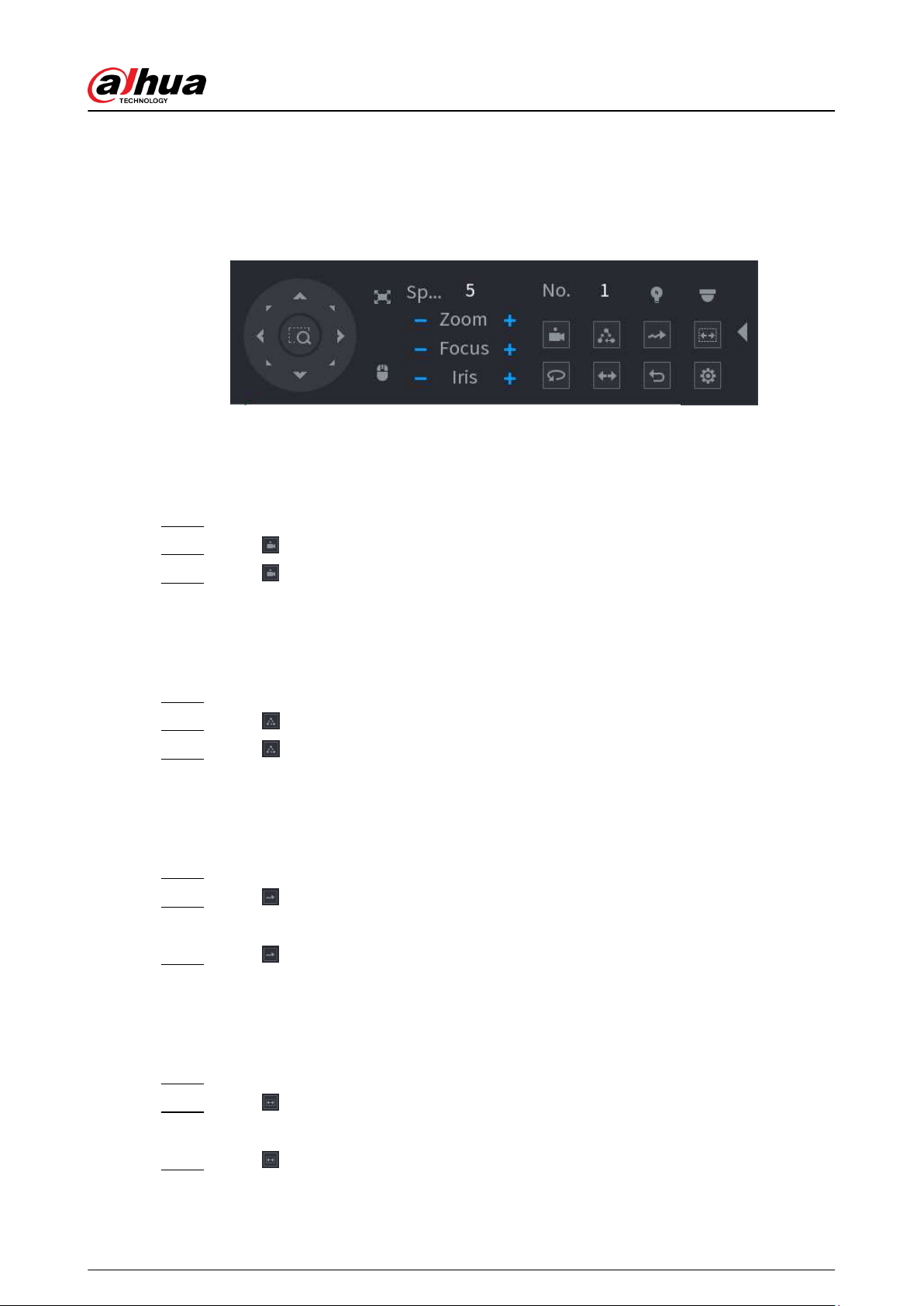
5.6.7.4 Using PTZ Functions
After you have congured the PTZ settings, you can use the PTZ functions from the expanded PTZ
control panel.
Figure 5-43 Expanded PTZ control panel
5.6.7.4.1 Presets
Procedure
Step 1 On the expanded PTZ control panel, in the No. box, enter the value of the preset.
Step 2 Click to call the preset.
Step 3 Click again to stop calling the preset.
5.6.7.4.2 Tours
Procedure
Step 1 On the expanded PTZ control panel, in the No. box, enter the value of the tour.
Step 2 Click to call the tour.
Step 3 Click again to stop calling the tour.
5.6.7.4.3 Patterns
Procedure
Step 1 On the expanded PTZ control panel, in the No. box, enter the value of the pattern.
Step 2 Click to call the pattern.
The PTZ camera moves according to the congured pattern repeatedly.
Step 3 Click again to stop calling the pattern.
5.6.7.4.4 AutoScan
Procedure
Step 1 On the expanded PTZ control panel, in the No. box, enter the value of the border.
Step 2 Click .
The PTZ camera performs scanning according to the congured borders.
Step 3 Click again to stop auto scanning.
User's Manual
155
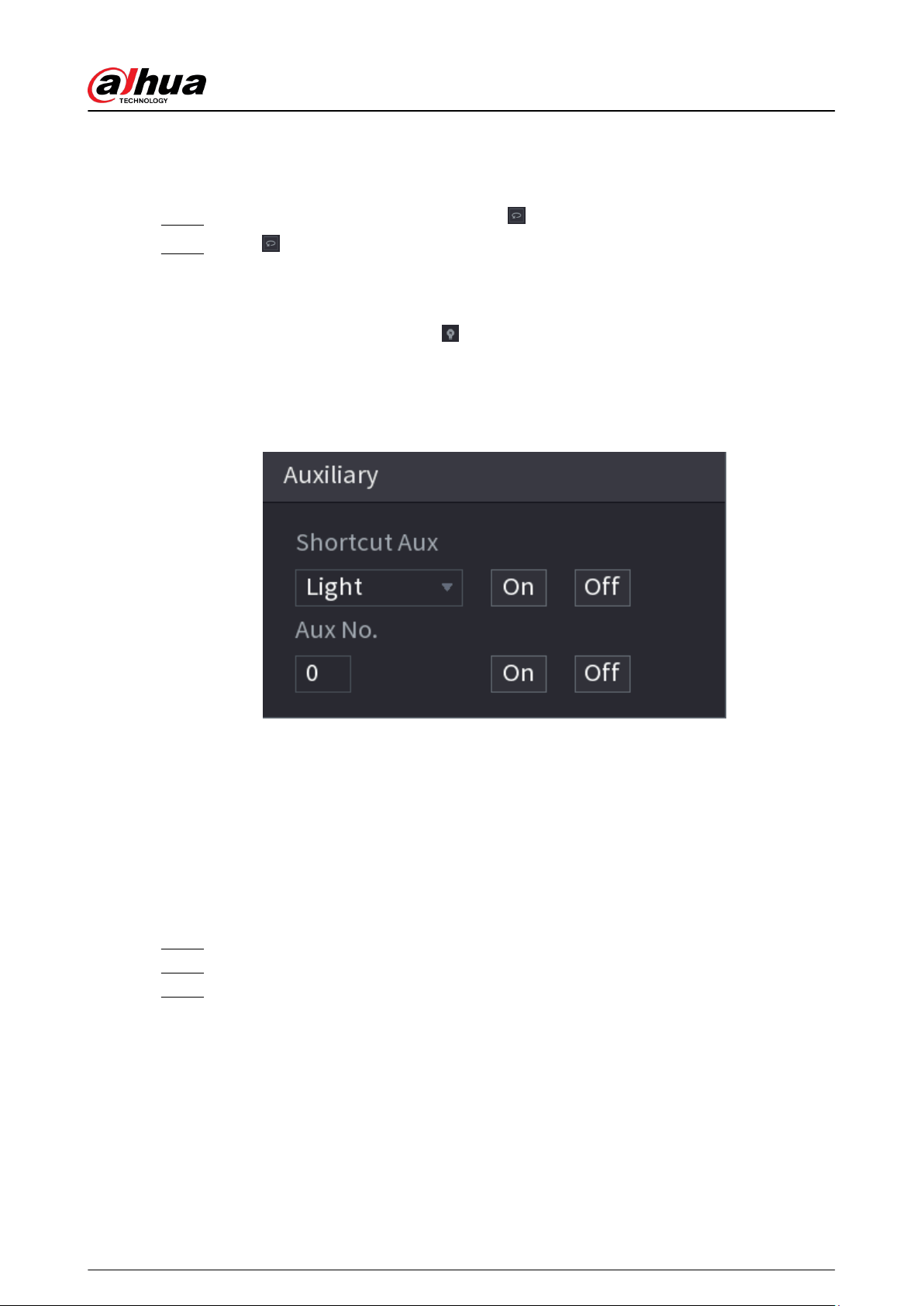
5.6.7.4.5 Calling AutoPan
Procedure
Step 1 On the expanded PTZ control panel, click to start moving in horizontal direction.
Step 2 Click again to stop moving.
5.6.7.4.6 Auxiliary Button
On the expanded PTZ control panel, click
.
In the Shortcut Aux list, select the option that corresponds to the applied protocol.
In the Aux No. box, enter the number that corresponds to the AUX switch on the decoder.
Figure 5-44 Auxiliary
5.6.7.5 EPTZ
5.6.7.5.1 Conguring EPTZ Linkage
This function can simultaneously zoom in and track multiple humans and vehicles that trigger
alarms. It provides rich details and a panoramic view at the same time.
Procedure
Step 1 Right-click the live page, and then select Main Munu.
Step 2 Select CAMERA > EPTZ Linkage.
Step 3 Congure the parameters.
User's Manual
156
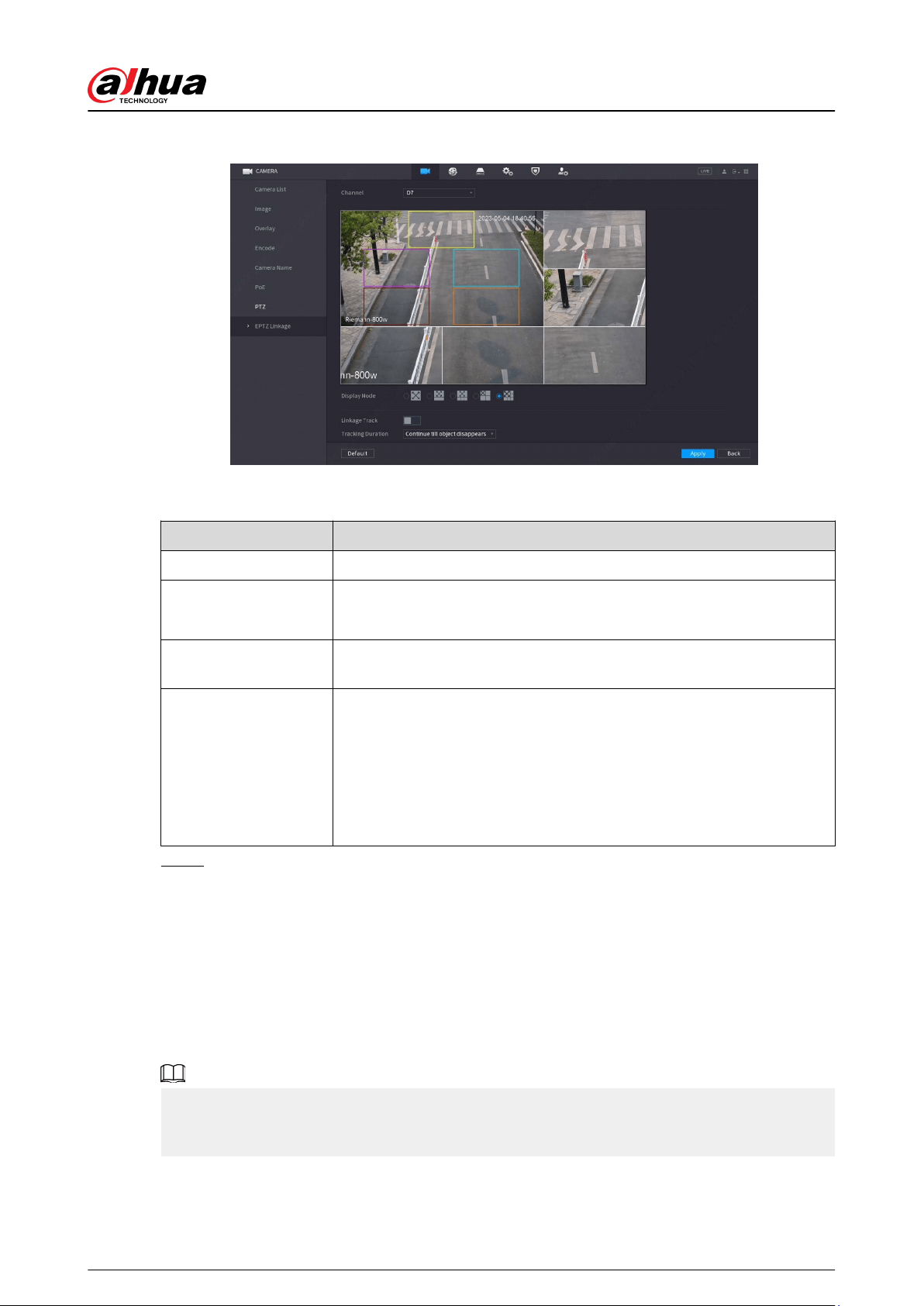
Figure 5-45 EPTZ linkage
Table 5-15 Parameters description
Parameter Description
Channel Select the linkage channel.
Display Mode
Select the number of tracked channels. Full screen, 1+1, 1+3 and 1+5
modes are available, and full screen is selected by default.
Linkage Track
After Linkage Track is enabled, intelligent events will be tracked. It is
disabled by default.
Tracking Duration
You can select Continue till object disappears or Custom from the
Tracking Duration dropdown list. Custom range is 5–300 seconds.
For example, if we set the custom range from 30 s to 60 s:
After tracking target A for 30 s, if a new target B appears, the device will
start tracking target B. If no new target appears during the tracking of
target A, the device will stop tracking A after 60 s.
Step 4 Click Apply.
5.6.7.5.2 EPTZ Live View
Check the EPTZ linkage in the live page.
Right-click the live page, and then select EPTZ. Enable EPTZ, and then you can view local EPTZ live
videos.
According to the EPTZ conguration of the corresponding channel, you can see split image and
tracking display eects.
When switching to splitting, live view layout or channel order, the device automatically exits the
EPTZ live view mode. When switching to main menu or playbac page, the device exits that page,
and then returns to EPTZ live view mode.
User's Manual
157
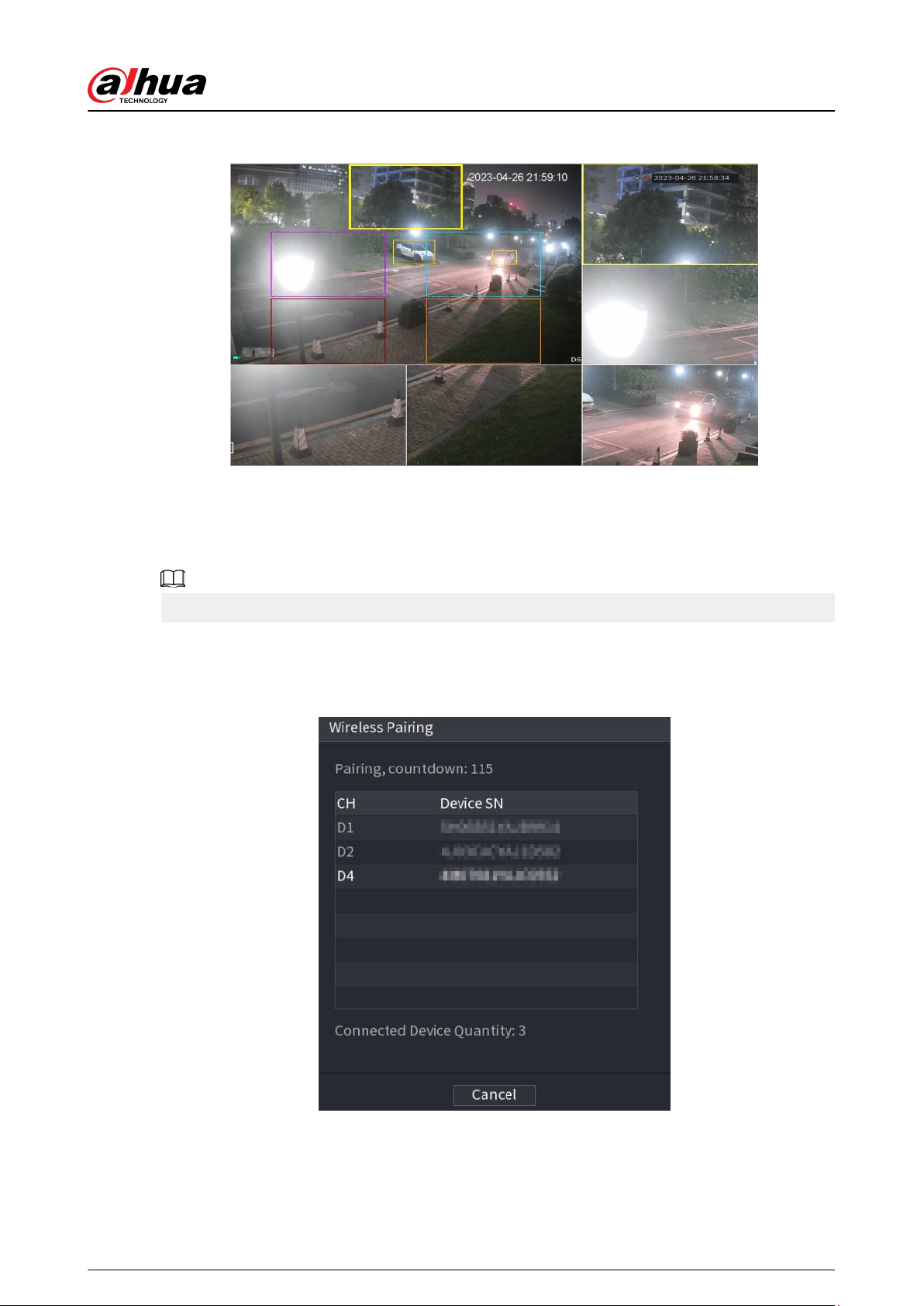
Figure 5-46 EPTZ live view
5.6.8 Wireless Pairing
You can use the wireless pairing to quickly add IPCs to the NVR.
Make sure that the IPC and NVR are on the same network segment.
Right-click the live page, and then select Wireless Pairing. The system starts a 120-second pairing
countdown. You can see the video of the paired IPC after pairing is successful.
Figure 5-47 Wireless pairing
User's Manual
158
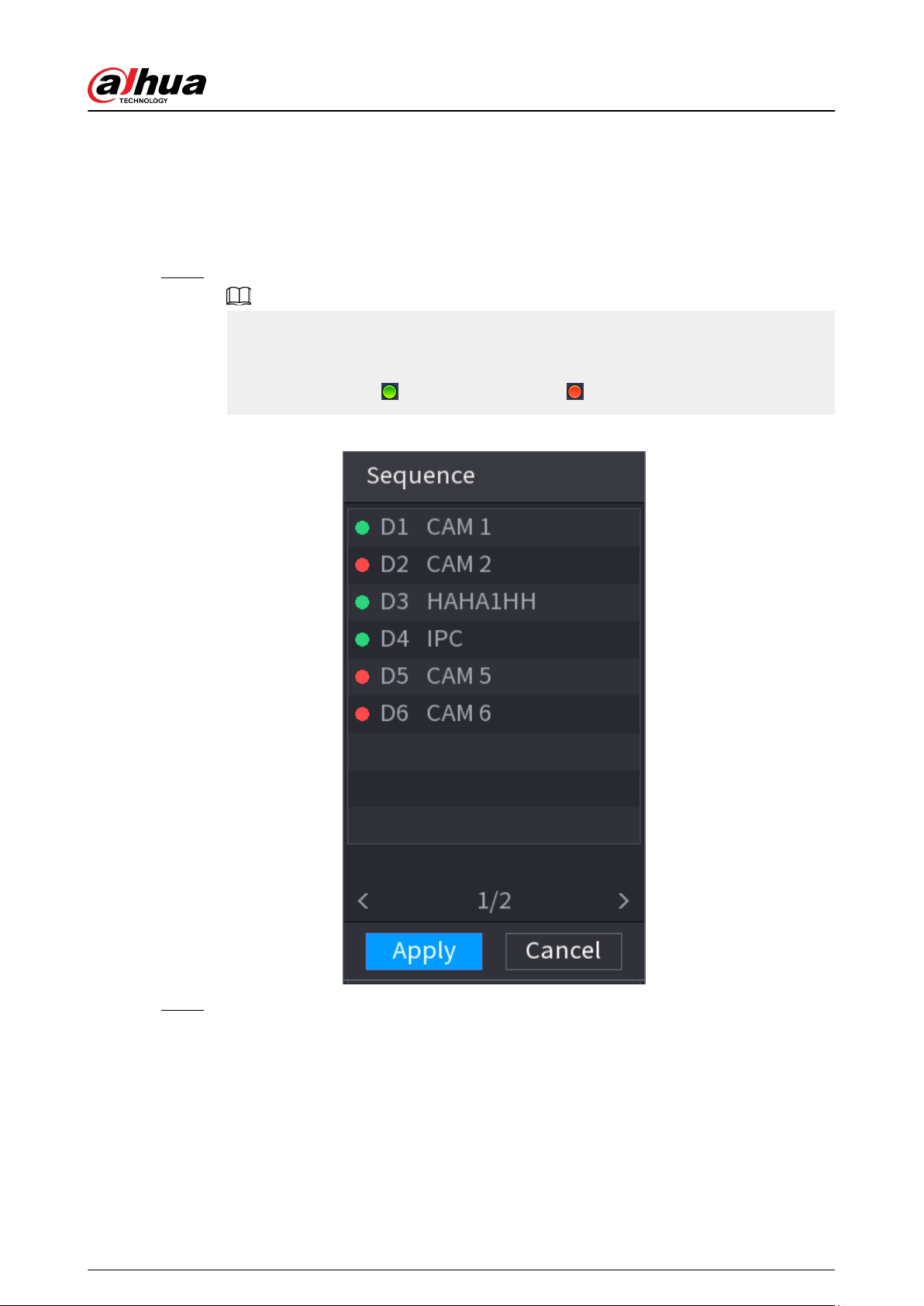
5.6.9 Sequence
Background Information
You can congure the sequence of the channels displayed on the live page.
Procedure
Step 1 Right-click the live page, and then select Sequence.
●
After you select Sequence, the system automatically switches to the max split amount
mode.
●
The channel list on the Sequence panel displays the added camera channel number
and channel name.
means camera is online. means camera is oine.
Figure 5-48 Sequence
Step 2 On the Sequence panel, drag the channel to the desired window, or drag on the live
window to switch the position.
Check the channel number at the right bottom corner to view the current channel
sequence.
User's Manual
159
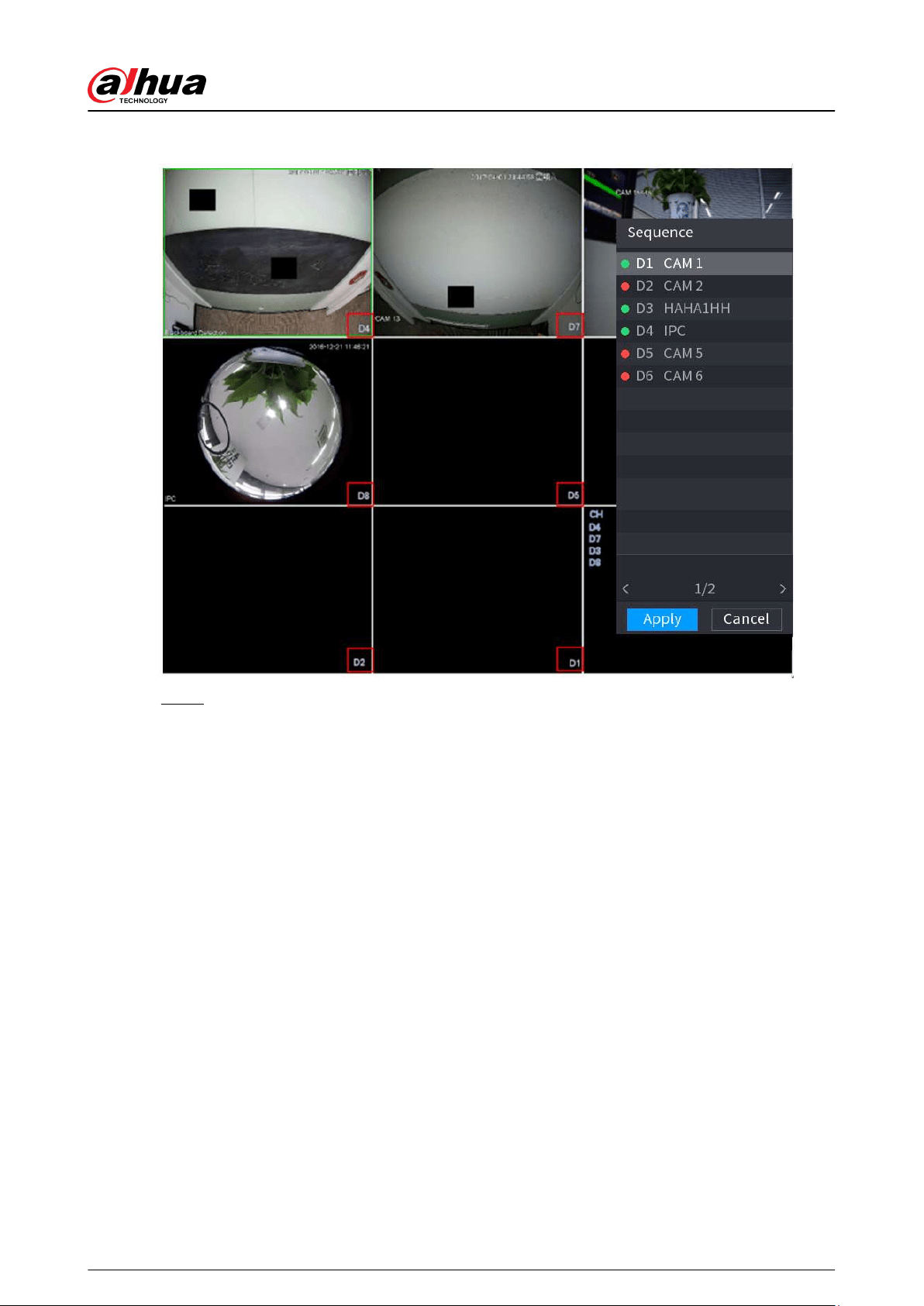
Figure 5-49 Channel number
Step 3 Click Apply.
After you change the channel sequence, click Cancel or right-click the live view page, the
system prompts you whether to save the sequence change.
●
Click OK to save current settings.
●
Click No to exit without saving the settings.
User's Manual
160
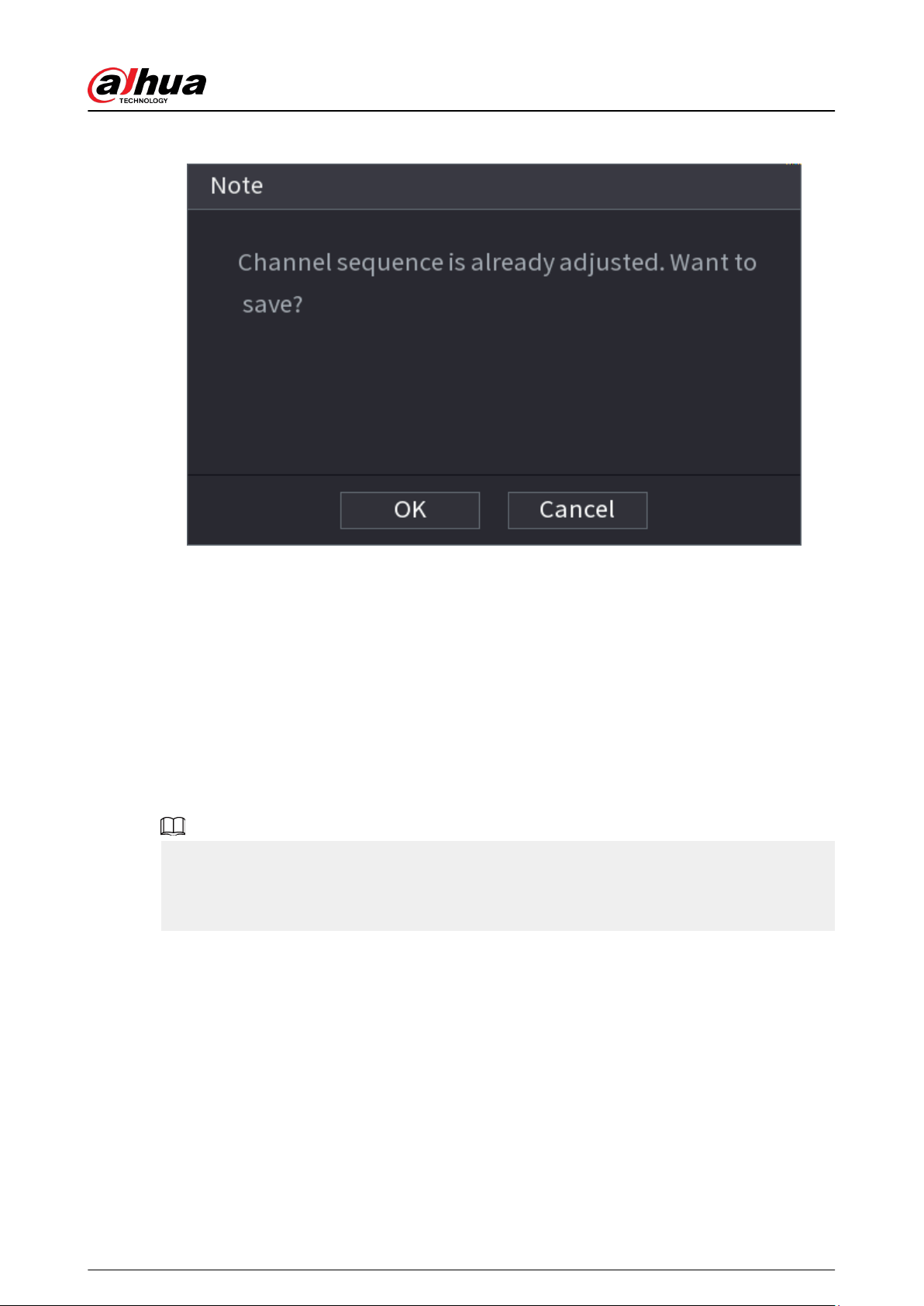
Figure 5-50 Note for saving sequence
5.6.10 Fisheye
This function is for some models only.
5.6.10.1 Fisheye De-warp on Live View Page
The sheye camera (panoramic camera) has wide video of angle but its video is seriously distorted.
The de-warp function can present the proper and vivid video suitable for human eyes.
On the live page, right-click the sheye channel, and then select Fisheye. You can set sheye
installation mode and display mode.
●
For the non-sh eye channel, the system prompts you it is not a sheye channel and does not
support de-warp function.
●
If system resources are insucient, the system prompts you the de-warp function is not
available.
User's Manual
161
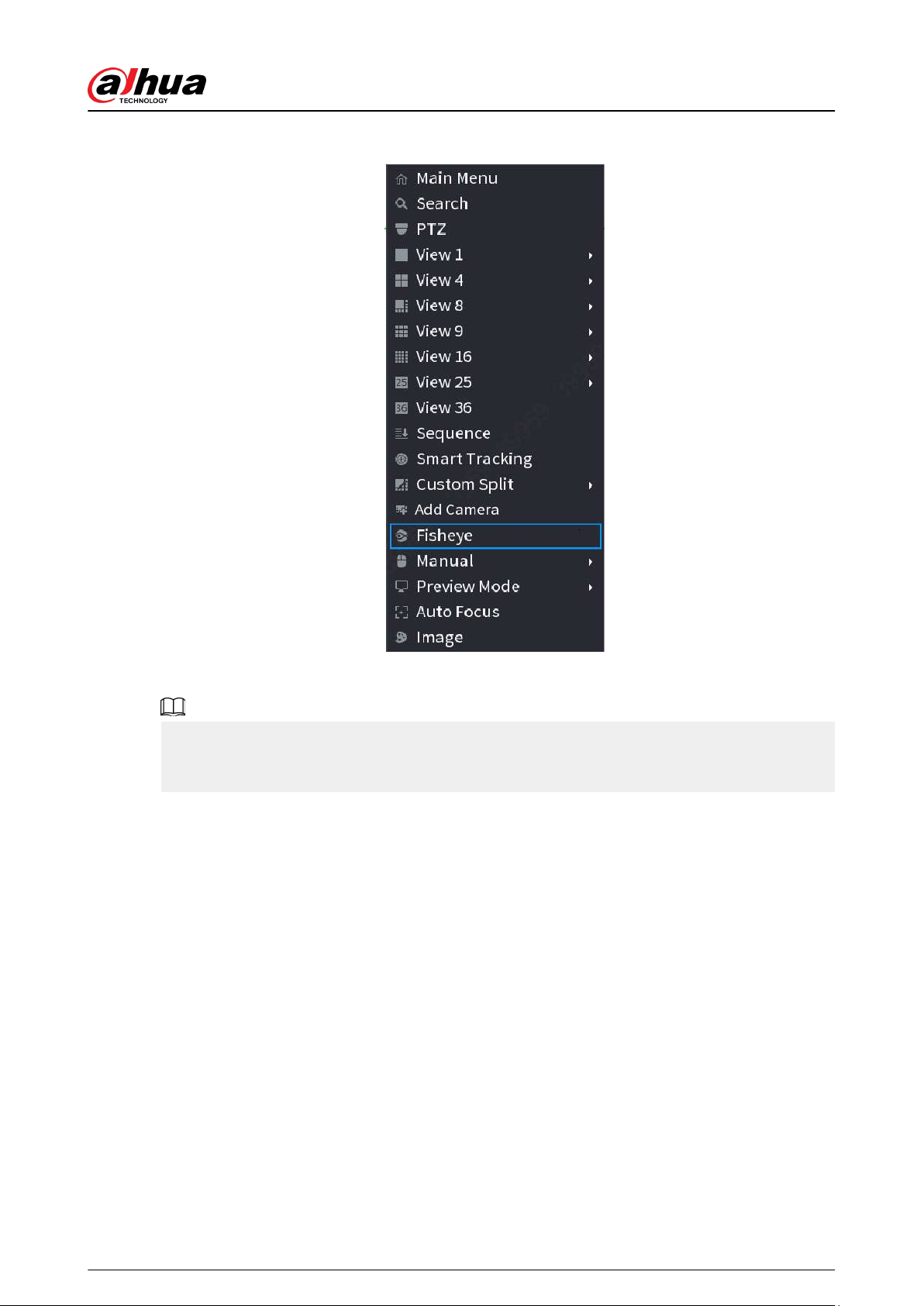
Figure 5-51 Fisheye
There are three installation modes: ceiling mount, wall mount, and ground mount.
●
The dierent installations modes have dierent de-warp modes.
●
Some models support de-warp of 180° sheye camera. 180° sheye camera supports de-warp in
wall mount mode only.
User's Manual
162
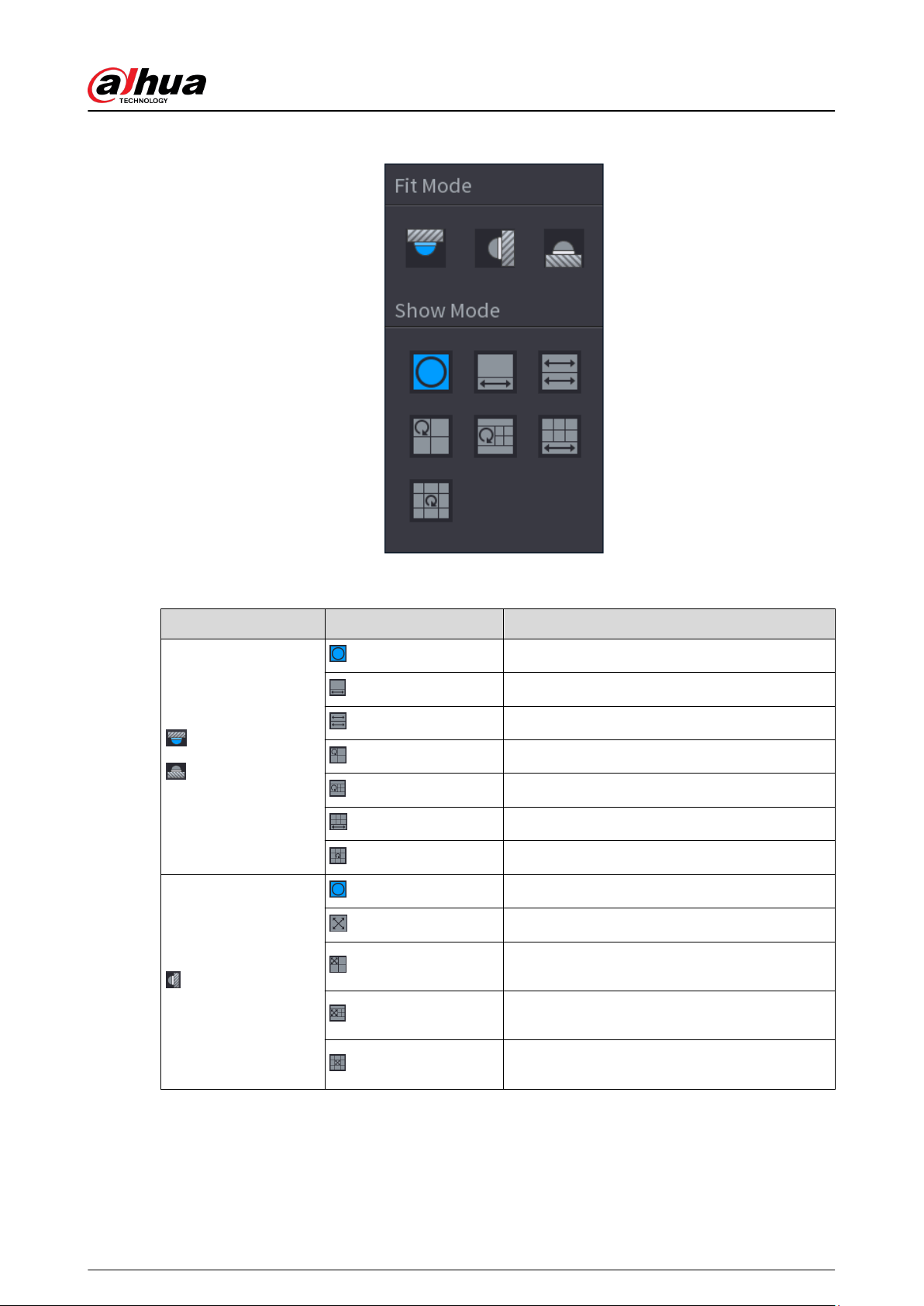
Figure 5-52 Fisheye settings
Table 5-16 Installation mode
Installation mode Icon Description
(Ceiling mount)
(Ground mount)
360° panorama original view
1 de-warp window+1 panorama stretching
2 panorama stretching views
1 360° panorama view+3 de-warp windows
1 360°panorama view+4 de-warp windows
4 de-warp windows+1 panorama stretching
1 360° panorama view+8 de-warp windows
(Wall mount)
360°panorama original view
Panorama stretching
1 panorama unfolding view+3 de-warp
windows
1 panorama unfolding view +4 de warp
windows
1 panorama unfolding view +8 de warp
windows
User's Manual
163
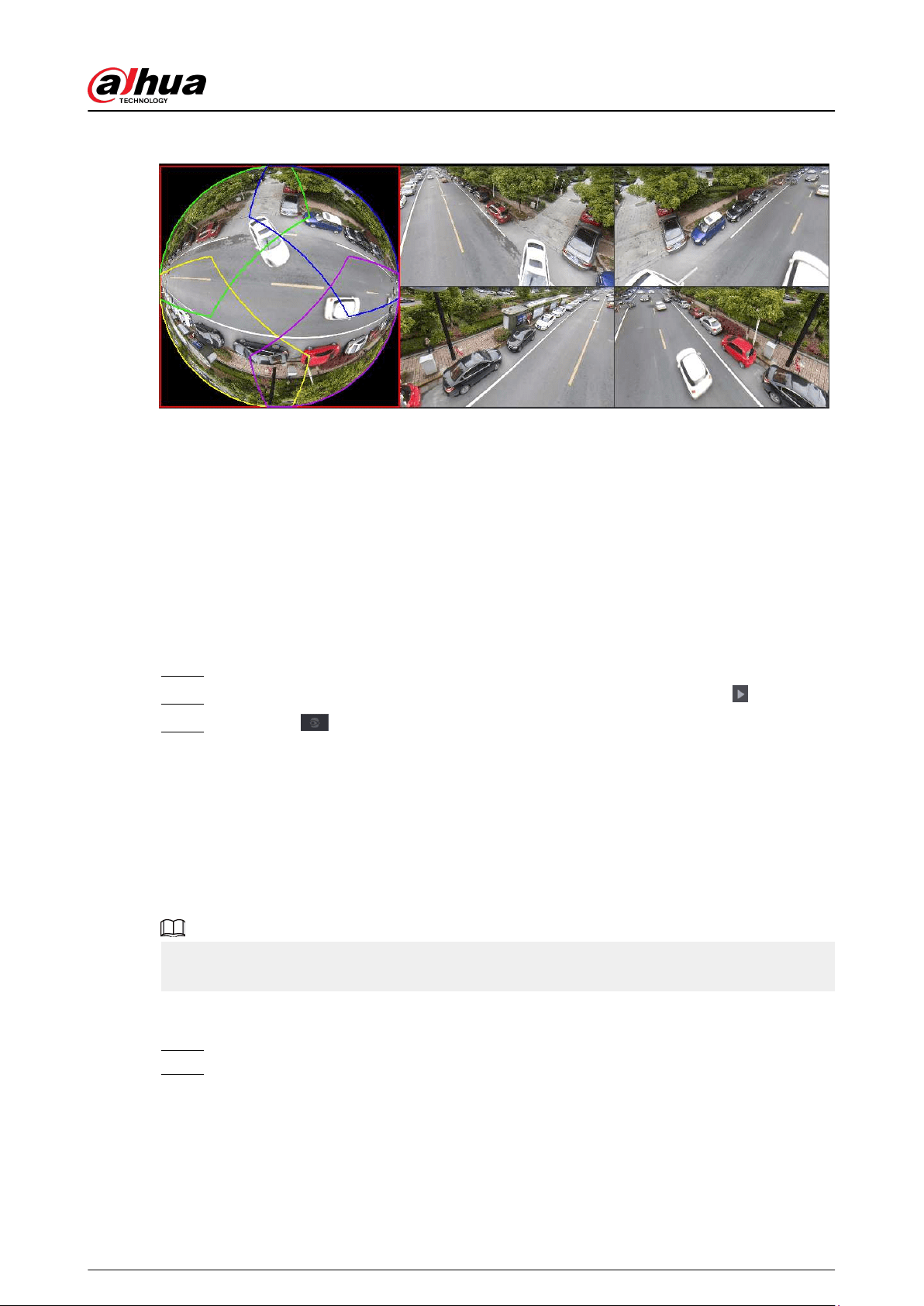
Figure 5-53 De-warp
You can adjust the color pane on the left pane or use your mouse to change the position of the
small images on the right pane to realize sh eye de-warp.
Operation: Use mouse to zoom in, zoom out, move, and rotate the image (Not for wall mount
mode.)
5.6.10.2 Fisheye De-warp During Playback
Background Information
When playing back the sheye record le, you can use de-warp function to adjust video.
Procedure
Step 1 On the main menu, click BACKUP.
Step 2 Select 1-window playback mode and corresponding sh eye channel, click to play.
Step 3 Right-click , and then you can go to the de-warp playback page. For detailed
information, see Figure 5-53 .
5.6.11 Temperature Monitoring
Background Information
When NVR connects to the camera that supports temperature detection, the system can display
instant temperature.
●
This function might collect the human temperature in the surveillance video.
●
This function is available on select models.
Procedure
Step 1 Go to Main Menu > DISPLAY > Display to enable the temperature test function.
Step 2 On the live page, click any position on the thermal channel video. The temperature at the
position is displayed.
User's Manual
164
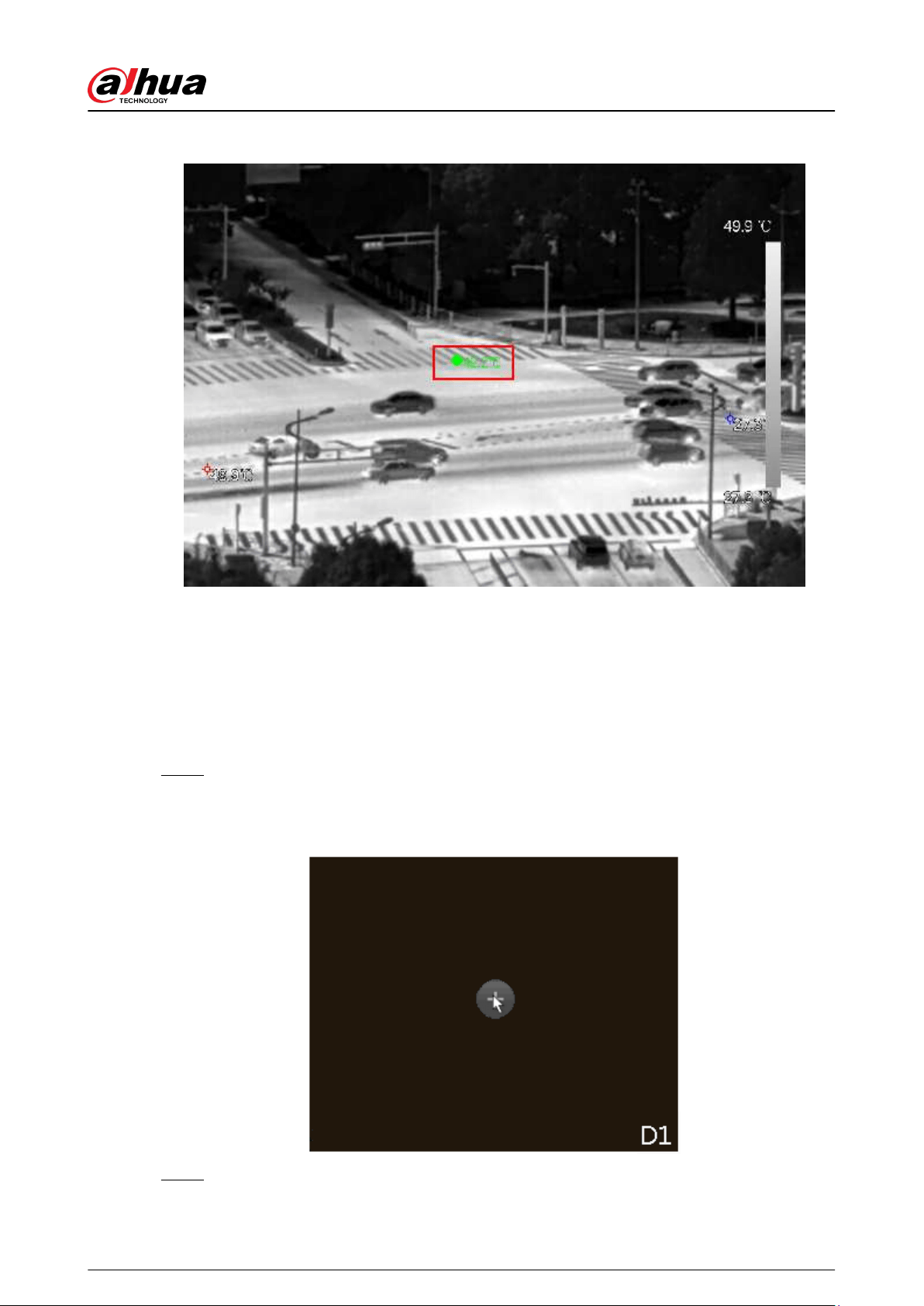
Figure 5-54 Temperature display
5.6.12 Shortcut Menu to Add Camera
Background Information
You can add cameras on the live page.
Procedure
Step 1 On the live page, point to a channel window.
There is an icon + on the channel window.
Figure 5-55 Add icon
Step 2 Click "+", and then congure the parameters to add the remote device. For details, see
"5.7.2 Adding Remote Devices".
User's Manual
165
5.6.13 Smart Tracking
Track targets manually or automatically. This function is only available on the multi-sensor
panoramic camera + PTZ camera.
Background Information
Make sure that the linked tracking function has been enabled.
Procedure
Step 1 Right-click the live video, and then select Smart Tracking.
Step 2 Select the tracking method.
●
Manual positioning: Click a spot or select a zone on the bullet camera video, and then
the PTZ camera will automatically rotates there and zoom in.
●
Manual tracking: Click or select a target on the bullet camera video, and then the PTZ
camera automatically rotates and tracks it.
●
Automatic tracking: The tracking action is automatically triggered by tripwire or
intrusion alarms according to the pre-dened rules.
5.7 Camera
5.7.1 Initializing Remote Devices
Background Information
You can change the login password and IP address of a remote device when you initialize it.
●
When you connect a camera to the NVR via PoE port, NVR automatically initializes the camera.
The camera adopts NVR current password and email information by default.
●
When you connect a camera to the NVR via PoE port after NVR is upgraded to the new version,
the NVR might fail to initialize the camera. You need to initialize the camera manually.
Procedure
Step 1 Log in to the local system of the Device.
Step 2 Right-click the live page and then select Main Menu > CAMERA > Camera List >
Camera List.
Step 3 Click Uninitialized , and then click Search Device.
The Device displays cameras to be initialized.
Step 4 Select a camera to be initialized and then click Initialize.
User's Manual
166
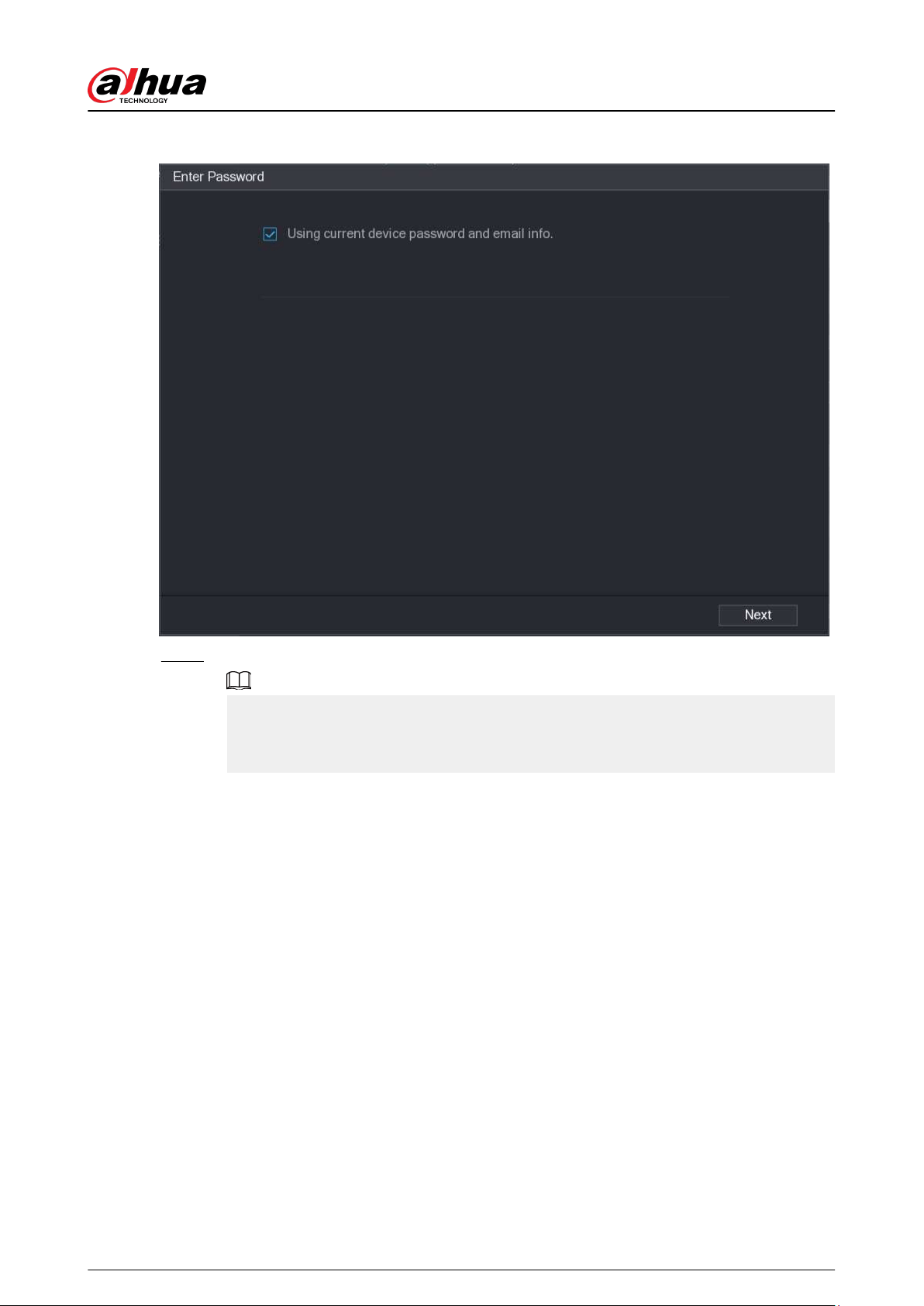
Figure 5-56 Enter password
Step 5 Set password and email information for the remote device.
If you select Using current device password and email info, the remote device
automatically uses NVR admin account information (login password and email). You can
skip this step.
1. Cancel the selection of Using current device password and email info.
User's Manual
167
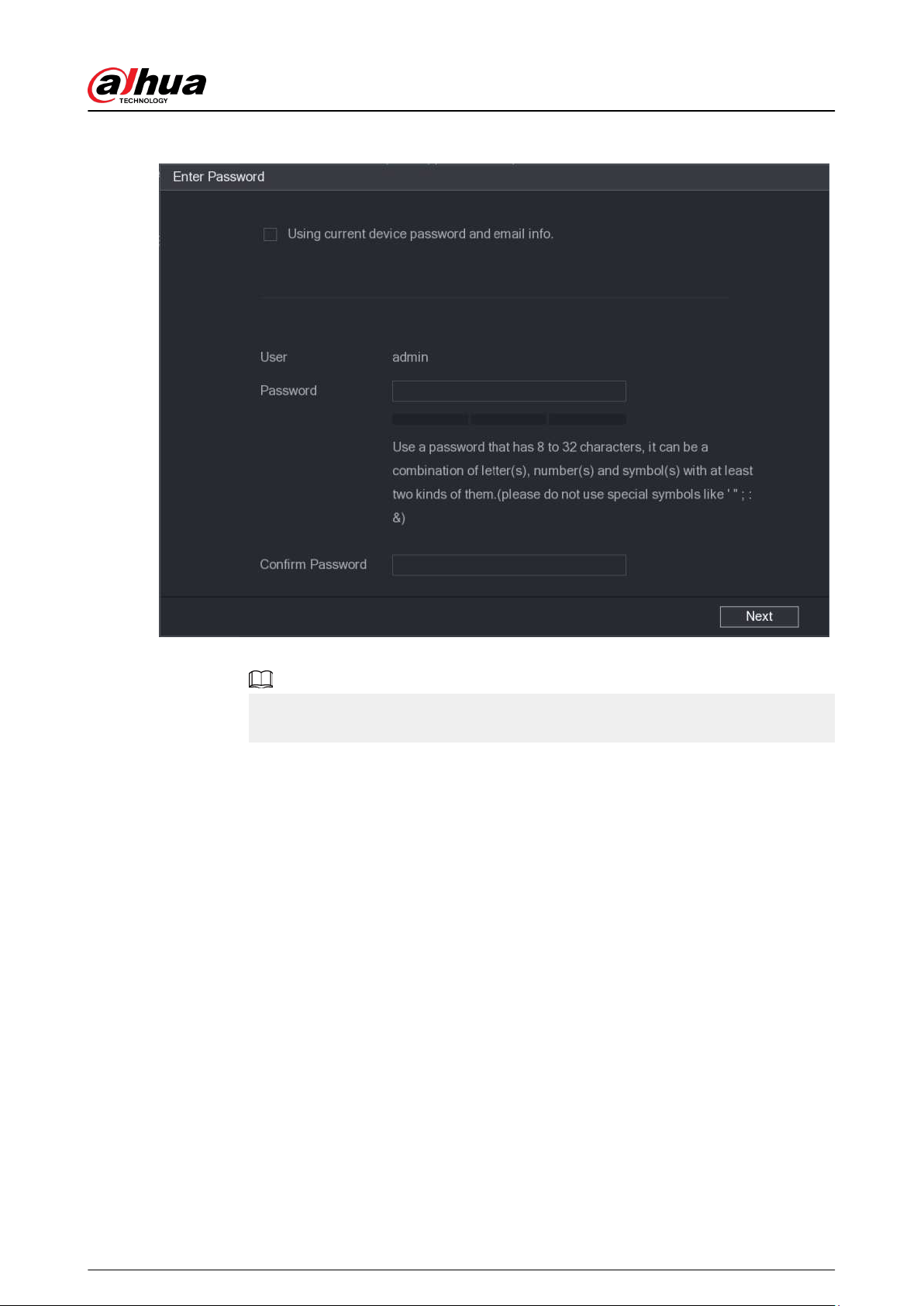
Figure 5-57 Password
2. Enter the password and then conrm it.
For your device security, we recommend you create a strong password according to
the password strength indication and change your password regularly.
3. Click Next.
User's Manual
168
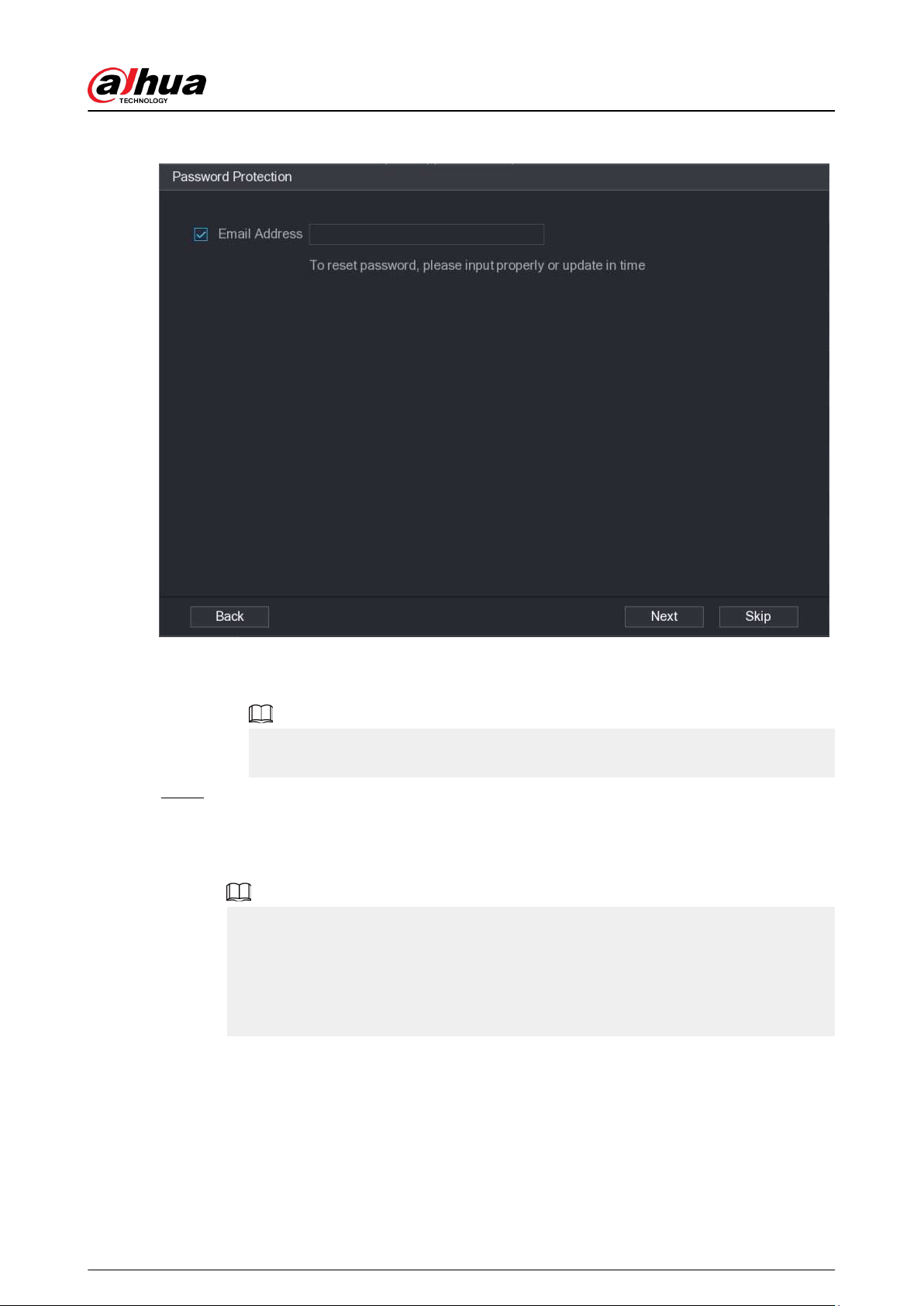
Figure 5-58 Password protection
4. Enter your email address, and then click Next.
The email address is used to receive the security code for password resetting.
If you do not want to enter email information, cancel the selection of the checkbox
and then click Next or Skip.
Step 6 Set camera IP address.
●
DHCP : There is no need to enter IP address, subnet mask, and default gateway. Device
automatically allocates the IP address to the camera.
●
Static : You need to enter IP address, subnet mask, and default gateway.
●
When you are changing IP addresses of several devices at the same time, enter
incremental value. The system can add the fourth decimal digit of the IP address one
by one to automatically allocate the IP addresses.
●
If an IP conict occurs when you change static IP address, the system will notify you of
the issue. If you change IP addresses in batches, the system automatically skips the
conicted IP and begins the allocation according to the incremental value.
User's Manual
169
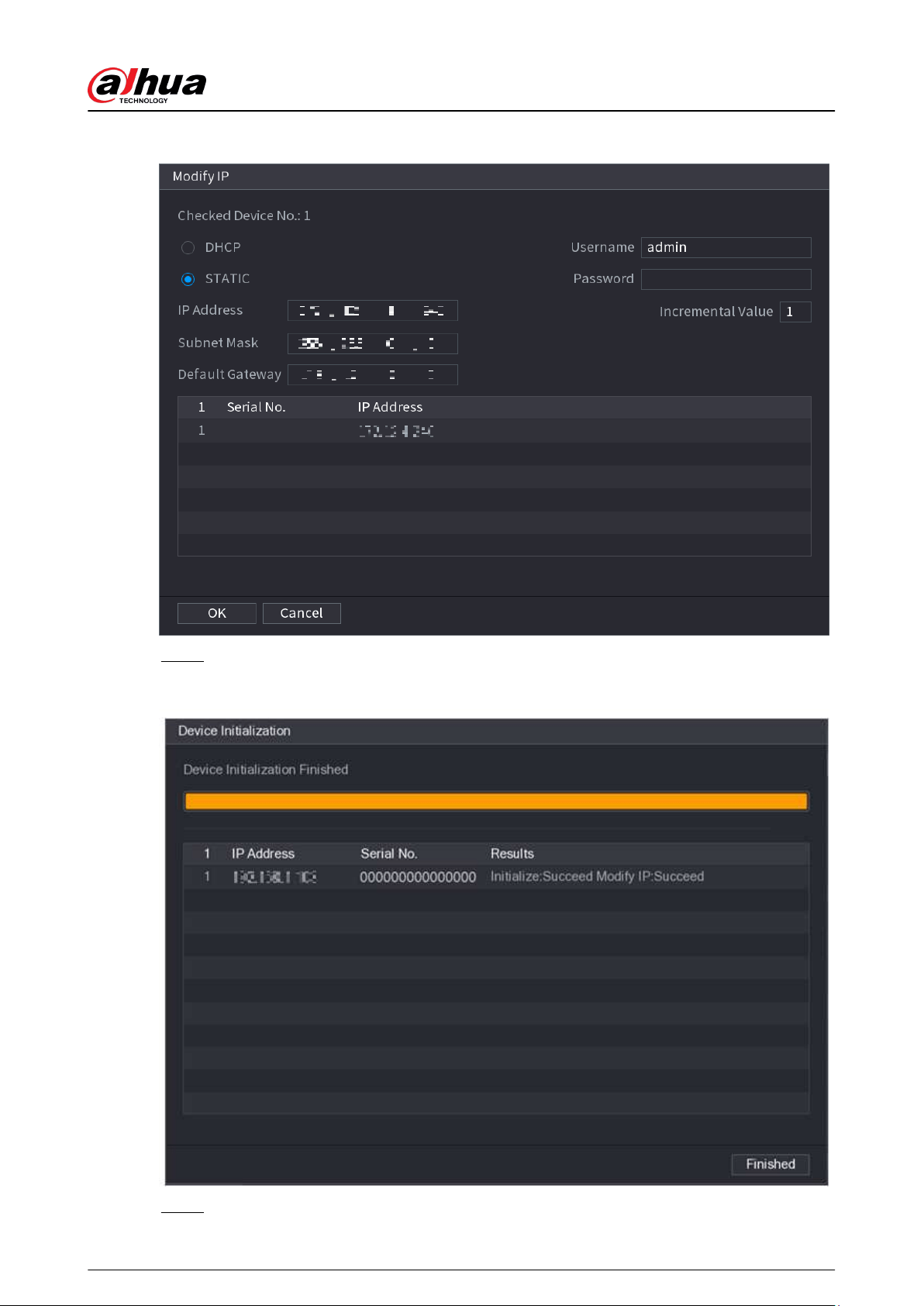
Figure 5-59 Modify IP
Step 7 Click Next.
Figure 5-60 Device initialization
Step 8 Click Finished.
User's Manual
170
5.7.2 Adding Remote Devices
Add remote devices to the NVR to receive, store, and manage the video streams of the remote
device.
Before adding the remote devices, make sure that the devices have been initialized.
5.7.2.1 Adding Cameras from Search
Background Information
Search for the remote devices that are on the same network with the NVR, and then add the remote
devices from the search results.
We recommend this method when you do not know the specic IP address of the remote device.
Procedure
Step 1 Select Main Menu > CAMERA > Camera List > Camera List.
Step 2 Click Search Device.
The remote devices found are displayed at the upper pane. Devices already added are not
included in the searched results.
User's Manual
171
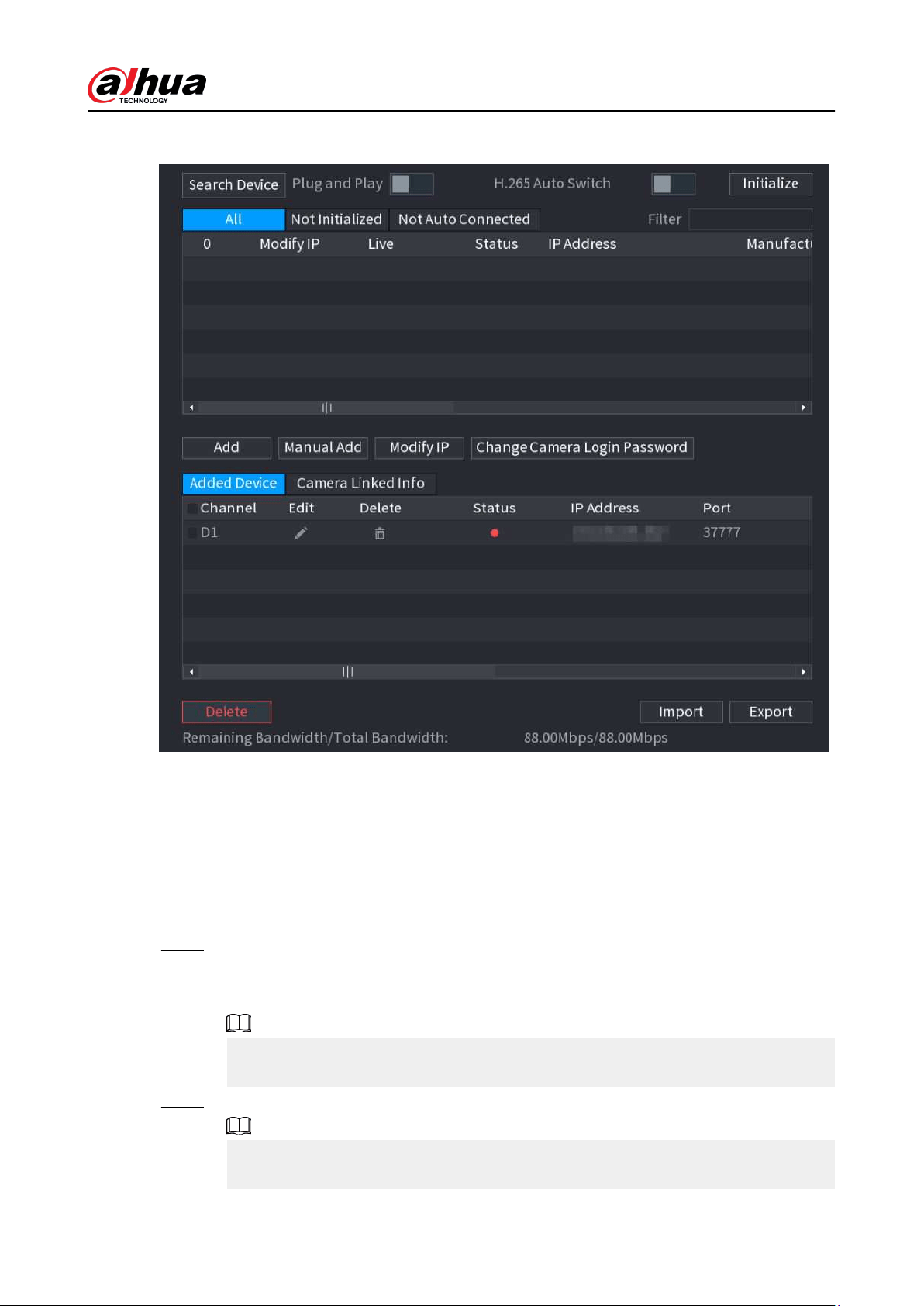
Figure 5-61 Search device
●
For cameras accessed through private protocol, you can click LIVE and then enter the
username and password to play live video.
●
To lter the remote devices, you can enter all or part of device name in the Filter box.
●
To lter out the uninitialized devices, click the Not Initialized tab, and then you can
initialize the devices. For details, see "5.7.1 Initializing Remote Devices".
●
To view all remote devices added through plug and play, you can click the Not Auto
Connected tab. You can remove devices added through plug and play, and they can
be automatically added again after plug and play is enabled.
Step 3 (Optional) Enable Plug and Play.
When Plug and Play is enabled, the NVR automatically adds remote devices on the same
subnet.
For uninitialized remote devices, the NVR automatically initializes them before adding
them.
Step 4 (Optional) Enable H.265 Auto Switch.
When H.265 Auto Switch is enabled, the video compression standard of added remote
devices is switched to H.265 automatically.
User's Manual
172

Step 5 Double-click a remote device, or select a remote device and then click Add to register it
to the Added Device list.
Related Operations
●
Change camera login password.
Select an added camera, and then click Change Camera Login Password to change the
password.
●
Edit camera information.
On the Added Device list, click
to change the IP address, username, password and other
information.
●
Import and export cameras.
You can export the information of the connected cameras and import camera information to the
system to add cameras in batches. For details, see "5.7.2.3 Importing Cameras".
●
View linked information.
If the remote device has multiple channels, you can click the Camera Linked Info to view linked
information of the remote device.
●
Delete cameras.
Delete one by one.
Click
to delete the corresponding camera.
Delete in batches.
Select one or more cameras, and then click Delete.
5.7.2.2 Adding Cameras Manually
Background Information
Congure the IP address, username, password and other information of the remote device
manually to add to the NVR.
We recommend this method when you want to add only a few remote devices and know their IP
addresses, usernames and passwords.
Procedure
Step 1 Select Main Menu > CAMERA > Camera List > Camera List.
Step 2 (Optional) Enable H.265 Auto Switch.
When H.265 Auto Switch is enabled, the video compression standard of added remote
devices is switched to H.265 automatically.
Step 3 Click Manual Add.
User's Manual
173
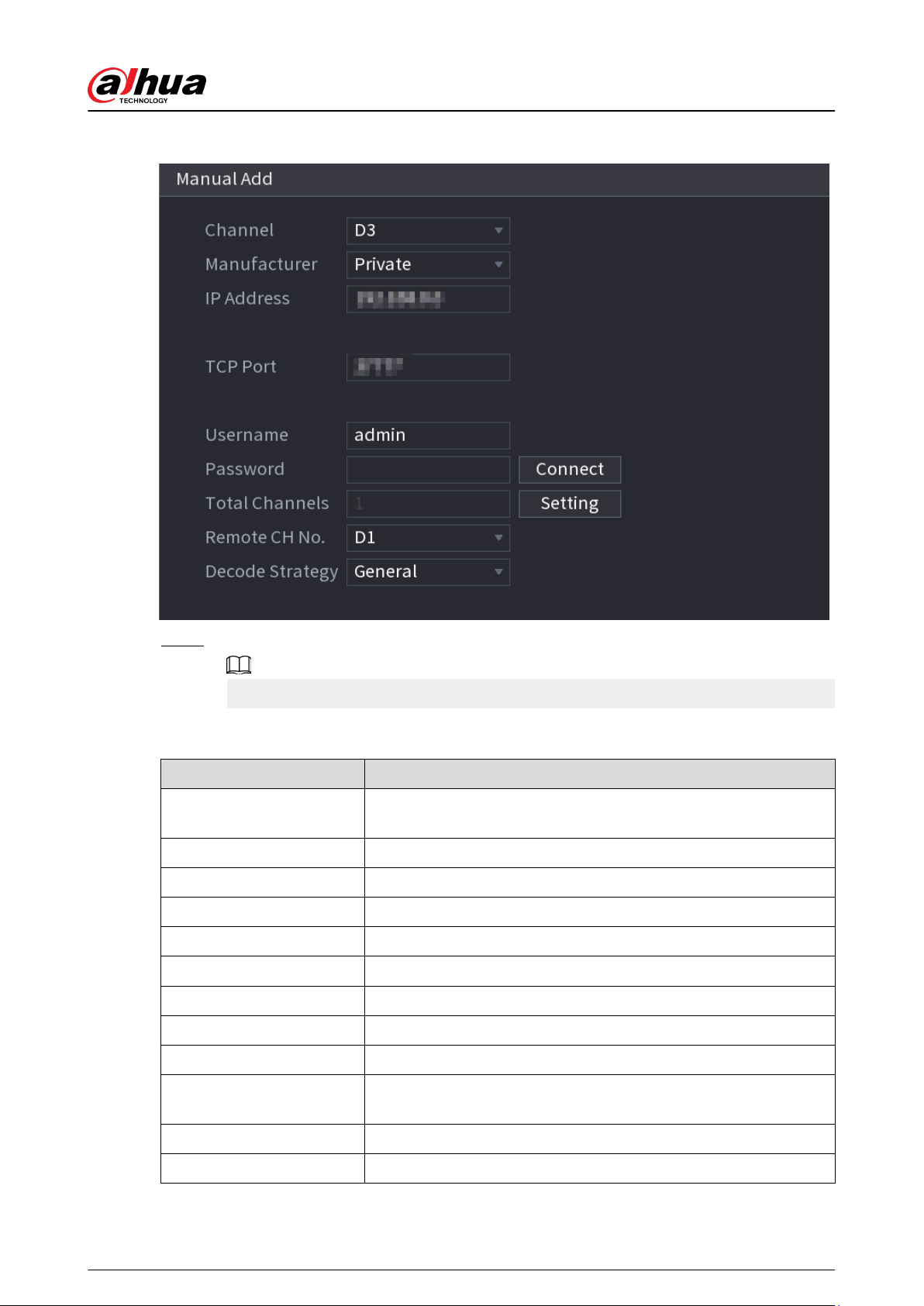
Figure 5-62 Manual add
Step 4 Congure the parameters.
The parameters might vary depending on the manufacturer that you select.
Table 5-17 Remote channel parameters
Parameter Description
Channel
Select the channel that you want use on the Device to connect the
remote device.
Manufacturer Select the manufacturer of the remote device.
Registration ID Enter the registration ID of the remote device.
IP Address Enter the IP address of the remote device.
RTSP Port Enter the RTSP port number. The default value is 554.
HTTP Port Enter the HTTP port number. The default value is 80.
TCP Port The default value is 37777. You can enter the value as needed.
Username Enter the username of the remote device.
Password Enter the password of the user for the remote device.
Total Channels
Click Connect to get the total number of channels of the remote
device.
Remote CH No. Enter the remote channel number of the remote device.
Decode Strategy Select Default , Realtime, or Fluent.
User's Manual
174
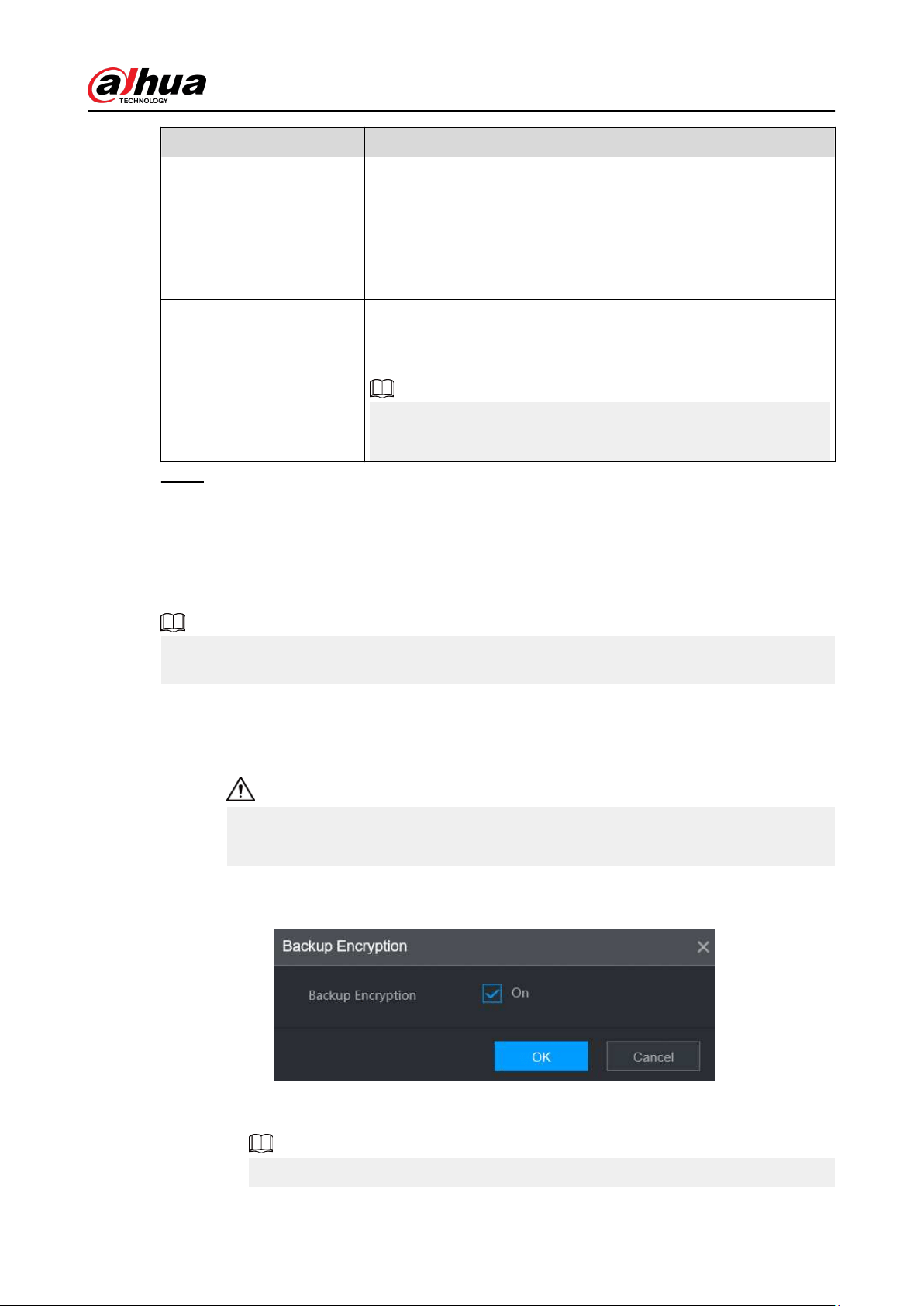
Parameter Description
Protocol Type
●
If the remote device is added through private protocol, the
default type is TCP.
●
If the remote device is added through ONVIF protocol, the
system supports Auto , TCP, UDP, or MULTICAST.
●
If the remote device is added through other manufacturers, the
system supports TCP and UDP.
Encryption
If the remote device is added through ONVIF protocol, select the
Encrypt checkbox and then the system will provide encryption
protection to the data being transmitted.
To use this function, make sure that the HTTPS function is enabled
for the remote IP camera.
Step 5 Click OK.
5.7.2.3 Importing Cameras
Background Information
You can import remote devices in batches.
We recommend this method when you want to add lots of remote devices whose IP addresses,
usernames and passwords are not the same.
Procedure
Step 1 Select Main Menu > CAMERA > Camera List > Camera List.
Step 2 Export the template.
The exported template includes the information of the added remote device. Pay
attention to your data security.
1. Click Export.
Figure 5-63 Backup encryption
2. Cancel the selection of the On checkbox to disable backup encryption, and then click
OK.
●
If Backup Encryption is enabled, the le format is .backup.
User's Manual
175

●
If Backup Encryption is disabled, the le format is .csv. Keep unencrypted les
well to avoid data leakage.
3. Select the storage path and then click Save.
●
The template le is named RemoteCong_20220222191255.csv. 20220222191255
represents the export time.
●
The template includes the IP address or registration ID, port, remote channel No.,
manufacturer, username, password and other information.
Step 3 Fill in the template and then save the le.
Do not change the le extension of the template. Otherwise, the template cannot be
imported.
Step 4 Click Import, select the template le and then open it.
The remote devices in the template are added to the NVR. If the remote device in the
template has been added, the system will prompt you whether to replace the existing
one on the device list.
●
If you select Yes, the system deletes the existing one and import the device again.
●
If you select No, the system retains the existing one and add the device to another
unoccupied channel.
5.7.3 Changing IP Address of Remote Device
The procedures to change the IP addresses of connected and unconnected cameras are dierent.
You can change the IP address only when the camera is online.
5.7.3.1 Changing IP Address of Connected Remote Device
Procedure
Step 1 Select Main Menu > CAMERA > Camera List > Camera List.
Step 2 On the Added Device list, double-click a remote device or click .
Step 3 Change the IP address.
Step 4 Click OK.
5.7.3.2 Changing IP Address of Unconnected Cameras
Procedure
Step 1 Select Main Menu > CAMERA > Camera List > Camera List.
Step 2 Click Search Device.
The remote devices found are displayed at the upper pane.
Step 3 Click , or select one or more remote devices and then click Modify IP.
When changing the IP addresses of multiple remote devices at the same time, make sure
that they share the same username and password.
User's Manual
176
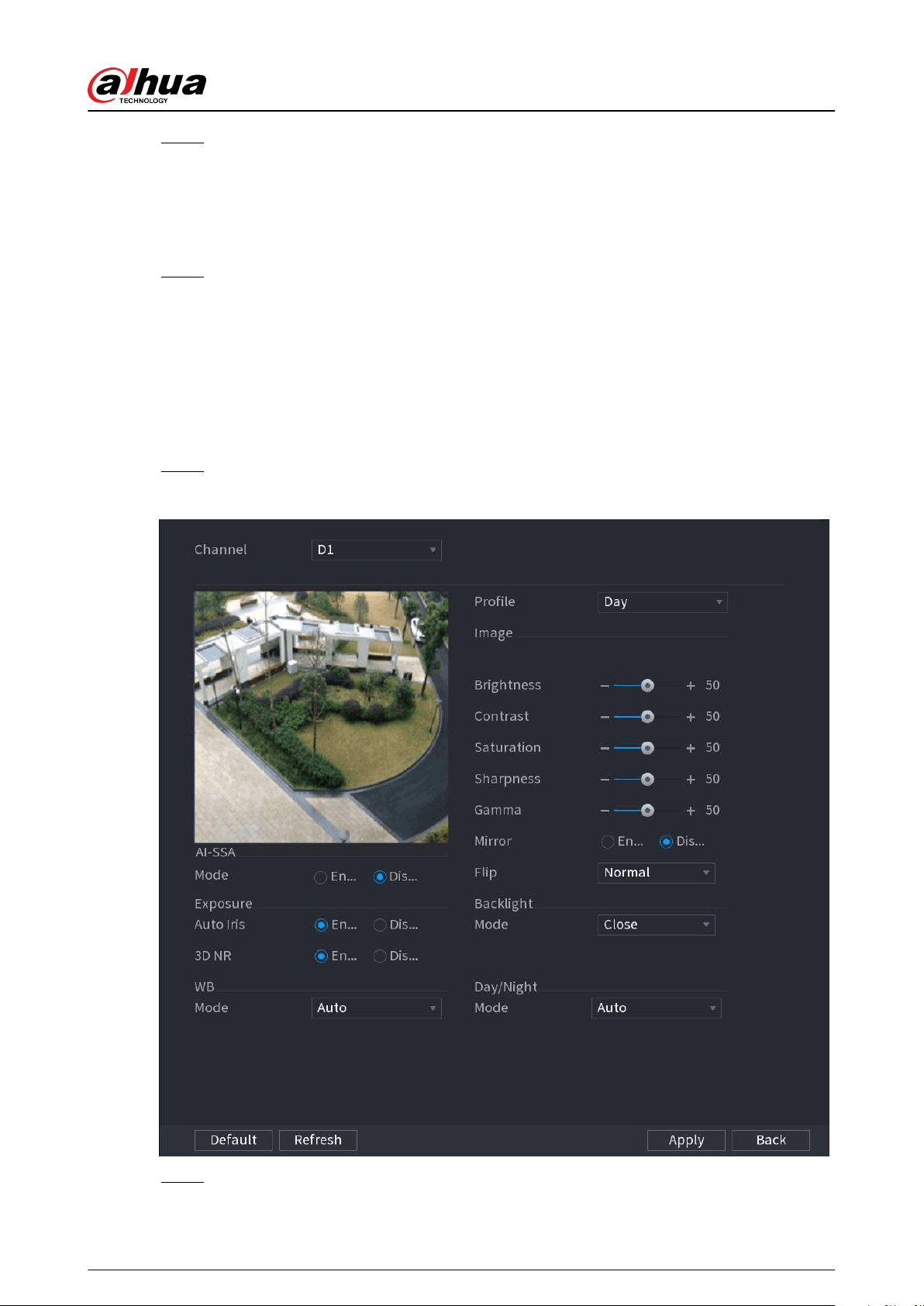
Step 4 Enter username and password of the remote device, and then congure the IP address.
●
DHCP : The remote device gets a dynamic IP address automatically.
●
Static : You need to enter static IP address, subnet mask, and default gateway. When
changing IP addresses of multiple remote devices at the same time. enter the
incremental value so that the system can add the fourth decimal digit of the IP address
one by one according to the incremental value.
Step 5 Click OK.
5.7.4 Conguring Image Settings
Background Information
You can set network camera parameters according to dierent environments to get the best video
eect.
Procedure
Step 1 Select Main Menu > CAMERA > Image.
Figure 5-64 Image
Step 2 Select a channel and then congure parameters.
User's Manual
177
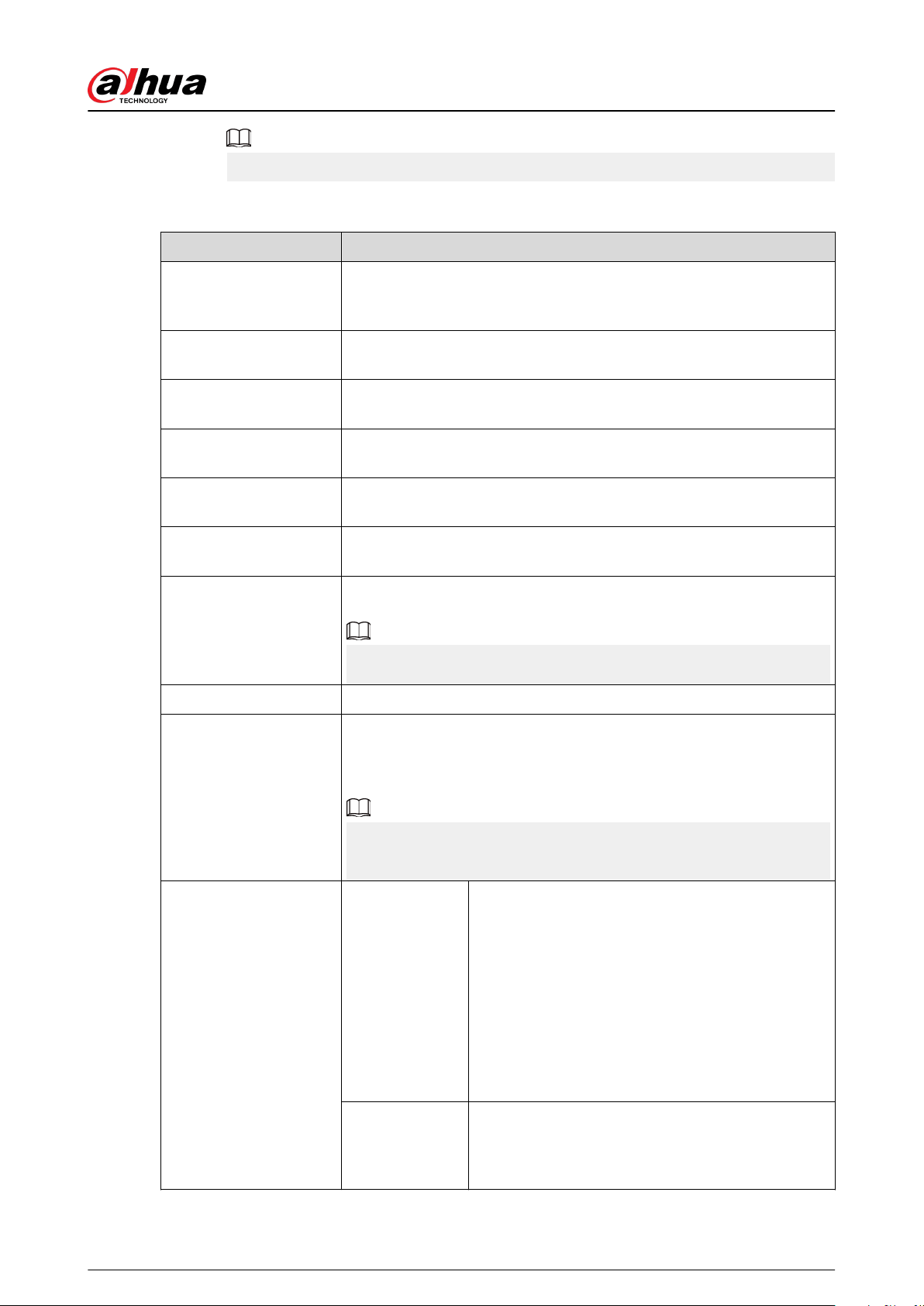
The parameters might vary depending on the camera model.
Table 5-18 Image parameters
Parameter Description
Prole
There are three conguration les. The system has congured the
corresponding parameters for each le. You can select according to
your actual situation.
Brightness
Adjust the image brightness. The bigger the value is, the brighter the
image will become.
Contrast
Adjust the image contrast. The bigger the value is, the more obvious
the contrast between the light area and dark area will become.
Saturation
Adjust the color shades. The bigger the value, the lighter the color will
become.
Sharpness
Adjust the sharpness of image edge. The bigger the value is, the more
obvious the image edge is.
Gamma
Adjust image brightness and enhance the image dynamic display
range. The bigger the value is, the brighter the video is.
Mirror
Switch the left and right sides of the video image. It is disabled by
default.
This function is available on select models.
Flip Set video display direction. It includes normal, 180°, 90°, and 270°.
AI SSA
After you enable AI SSA (AI Scene Self-adaptation), the camera can
detect environmental conditions, such as rain, fog, backlight, low light
and icker, to adjust the parameters of the image to suit the conditions,
ensuring that clear images are always produced.
When AI SSA is enabled, some image parameters such as exposure and
backlight mode will become unavailable.
Exposure
Auto Iris
●
This function is available when the camera is
equipped with the auto iris lens.
●
After you enable auto iris function, the iris can
automatically zoom in and zoom out according
to the brightness of the environment and the
image brightness changes accordingly.
●
If you disable the auto iris function, the iris is at
the biggest value. The iris does not automatically
zoom in or zoom out according to the brightness
of the environment.
3D NR
This function specially applies to the image whose
frame rate is congured as 2 at least. It reduces the
noise by using the information between two frames.
The bigger the value is, the better the eect.
User's Manual
178
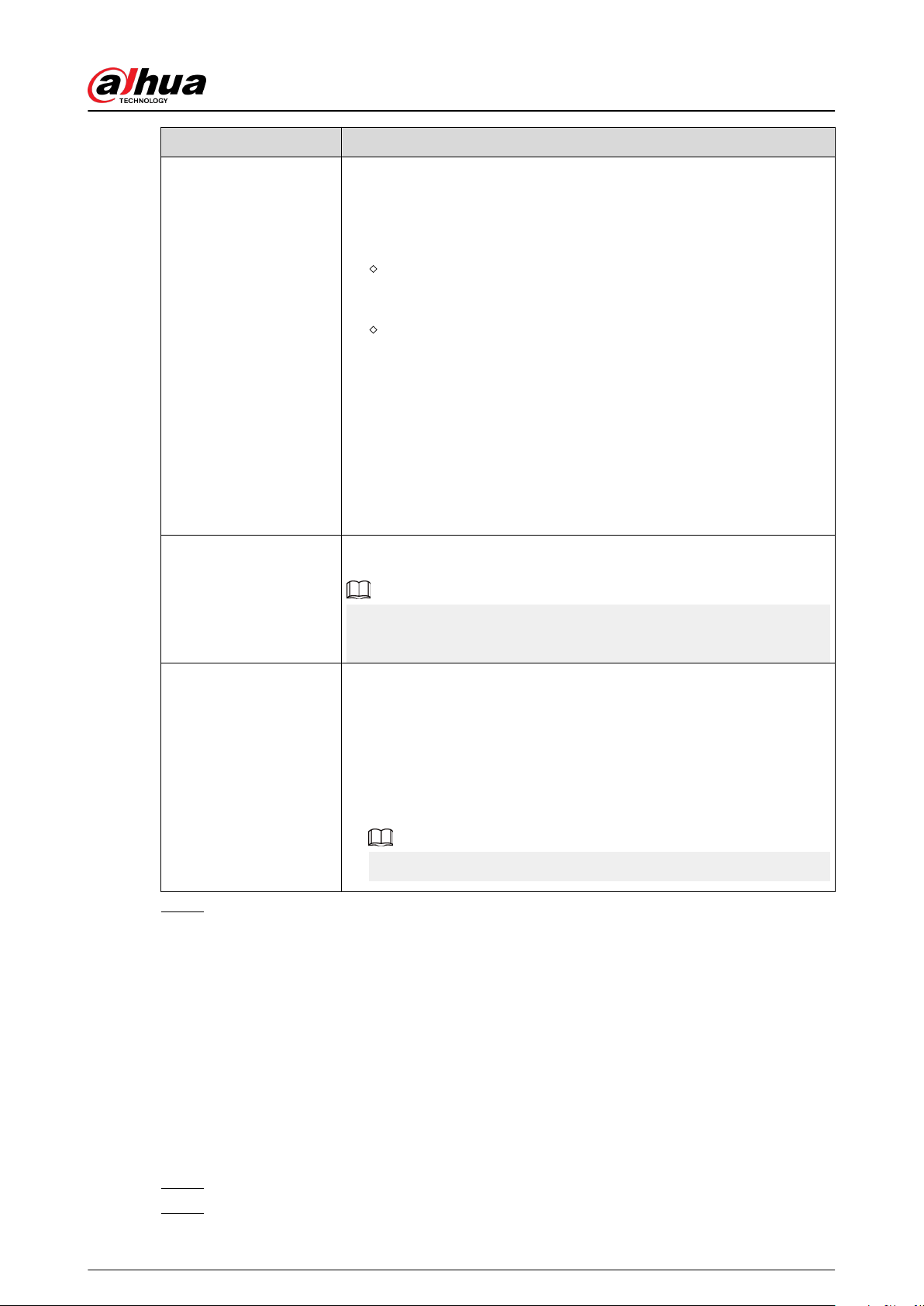
Parameter Description
Backlight Mode
You can set camera backlight mode.
●
SSA: In the backlight environment, the system can automatically
adjust image brightness to clearly display the object.
●
BLC:
Default: The device performs automatic exposures according to
the environment situation to make the darkest area of the video
clear.
Customize: After you select the specied zone, the system can
expose the specic zone so that the zone can reach the proper
brightness.
●
WDR: In backlight environment, the system lowers the high bright
section and enhances the brightness of the low bright section, so
that you can view these two sections clearly at the same time.
●
HLC: In the backlight environment, the system lowers the
brightness of the brightest section, reduces the area of the halo and
lowers the brightness of the whole video.
●
Close: Disable the BLC function.
WB Mode
You can set camera white balance mode. The system adjusts the
overall image hue to make the image color display precisely as it is.
Dierent cameras support dierent white balance modes, such as auto,
manual, natural light, and outdoor.
Day/Night Mode
Congure the color and black & white mode of the image. This
parameter is not aected by the conguration les.
●
Color : The camera outputs color image only.
●
Auto : The camera outputs color images or black and white images
according to ambient brightness
●
B/W : The camera outputs black and white image only.
●
Sensor : Use this mode when there is peripheral IR light connected.
The Sensor mode is available on select non-IR models.
Step 3 Click Apply.
5.7.5 Conguring Overlay Settings
You can set parameters for overlay and private masking.
5.7.5.1 Overlay
Background Information
You can add the information of time and channel in the live view page.
Procedure
Step 1 Select Main Menu > CAMERA > Overlay > Overlay.
Step 2 Select a channel and then congure parameters.
User's Manual
179
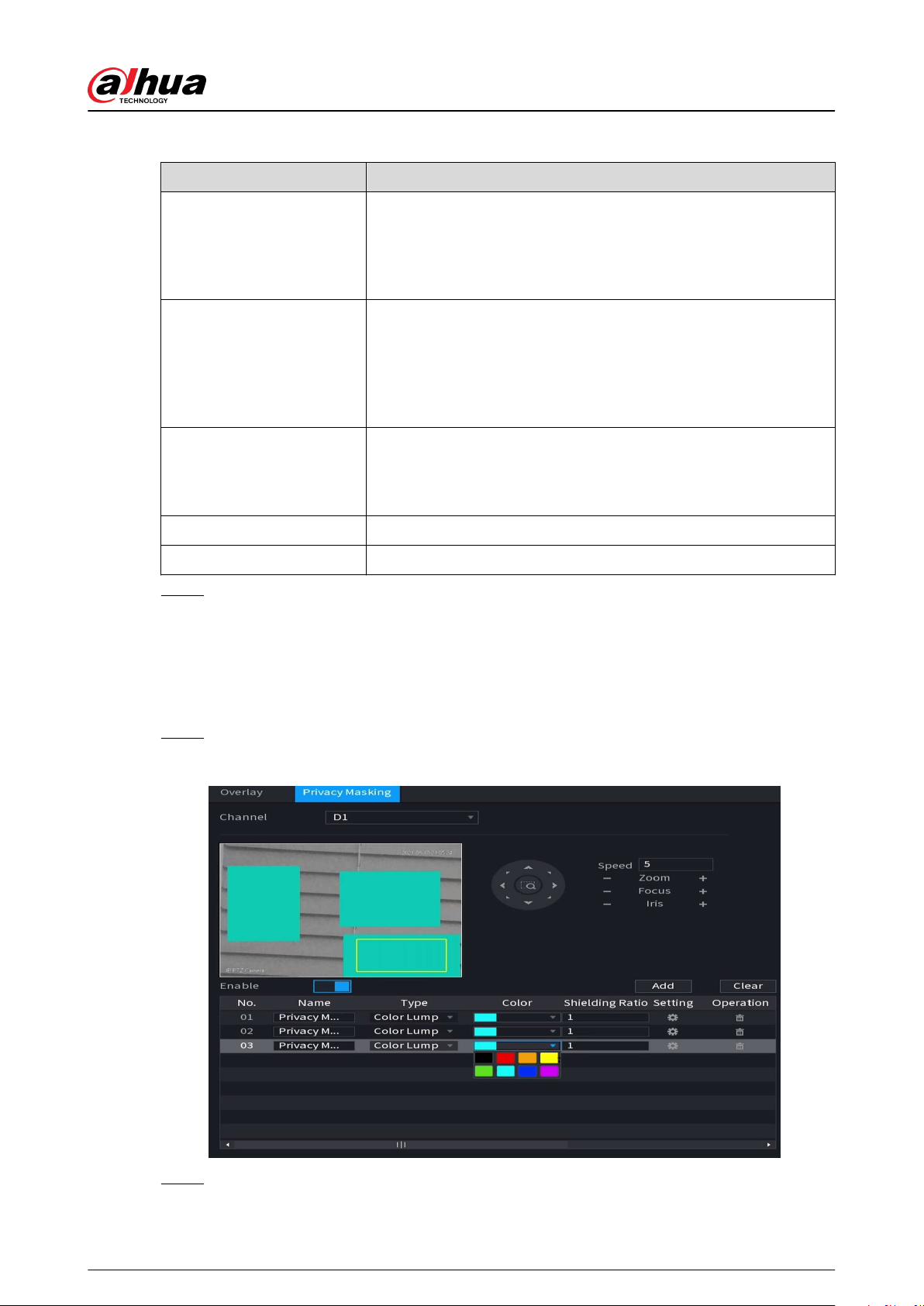
Table 5-19 Video overlay parameters
Parameter Description
Time Title
Display the time tile on the video image in live view and playback.
a. Select Time Title.
b. Drag the time title to a desired place.
c. Click Apply.
Channel Title
Display the channel tile on the video image in live view and
playback.
a. Select Channel Title and then edit the channel title.
b. Drag the channel title to a desired place.
c. Click Apply.
Custom Title
You can customize title to be overlaid on the video image.
Click Setting to set the information such as font size, title content
and text alignment, and then click OK.
Default Restore the overlay settings to default conguration.
Copy to Copy the overlay settings to other channels.
Step 3 Click Apply.
5.7.5.2 Privacy Masking
You can mask certain areas of the video image for privacy protection.
Procedure
Step 1 Select Main Menu > CAMERA > Overlay > Privacy Masking.
Figure 5-65 Privacy masking
Step 2 Select a channel.
User's Manual
180
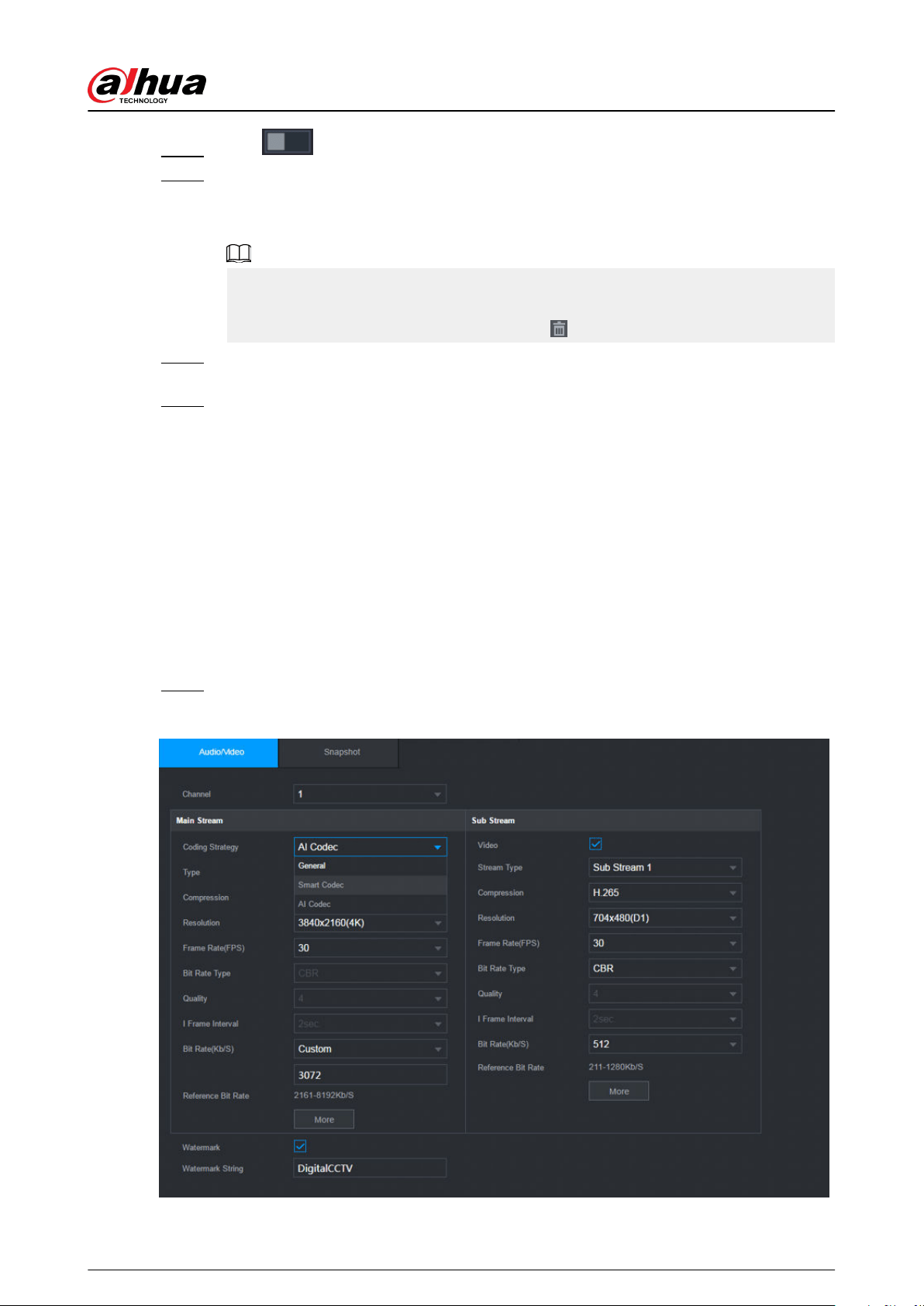
Step 3 Click to enable privacy masking.
Step 4 Click Add, select the masking type and color, and then draw mosaic or color blocks in the
image as needed.
A masking block appears on the video image.
●
The number of masking blocks that you can add might dier depending on the
camera. You can add up to 24 masking blocks.
●
Click Clear to delete all masking areas. Click
to delete a masking area.
Step 5 Drag the masking block to a desired position and then congure the type, color and other
parameters.
Step 6 Click Apply.
5.7.6 Conguring Encoding Settings
You can set video bit stream and image parameters.
5.7.6.1 Conguring Audio and Video Encoding Settings
Background Information
You can set audio and video encoding parameters such as bit stream type, compression, and
resolution.
Procedure
Step 1 Select Main Menu > CAMERA > Encode > Audio/Video.
Figure 5-66 Audio/video
User's Manual
181
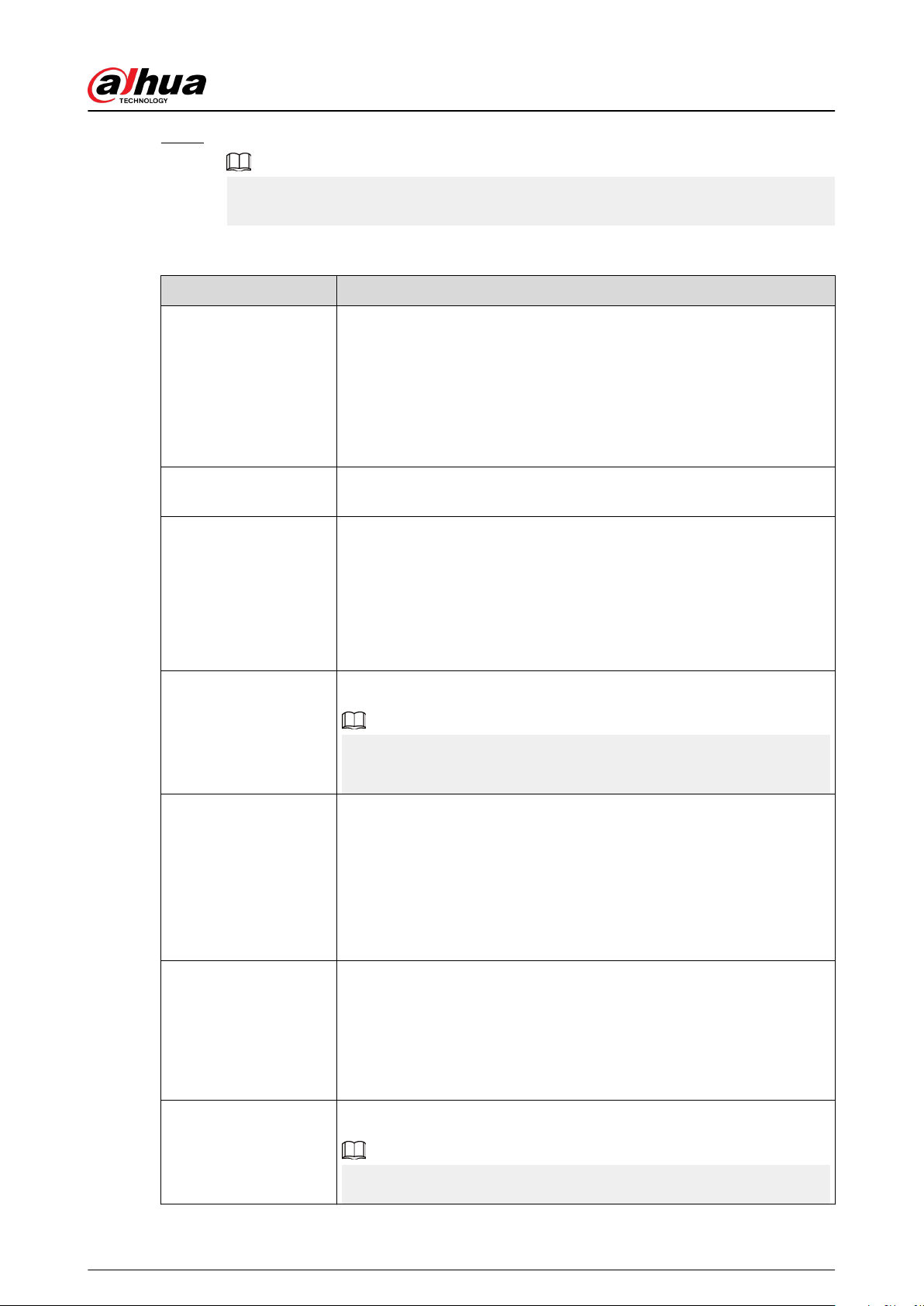
Step 2 Select a channel and then congure parameters.
The parameters for main stream and sub stream are dierent. Some models support three
streams: main stream, sub stream 1, sub stream 2.
Table 5-20 Audio/video parameters
Parameter Description
Coding Strategy
●
General : Use general coding strategy.
●
Smart Codec : Enable the smart codec function. This function can
reduce the video bit stream for non-important recorded video to
maximize the storage space.
●
AI Codec : Enable the AI codec function. This function can reduce
the camera code stream, network transmission pressure, and hard
drive storage space without aecting the image quality.
Type
Select the recording type for main stream from General , Motion
(motion detection), or Alarm.
Compression
Select the encoding mode.
●
H.265: Main prole encoding. This setting is recommended.
●
H.264H: High prole encoding. Low bit stream with high denition.
●
H.264: Main prole encoding.
●
H.264B: Baseline prole encoding. This mode requires higher bit
stream compared with other modes for the same denition.
Resolution
Select resolution for the video.
The maximum video resolution might be dierent depending on your
device model.
Frame Rate (FPS)
Congure the frames per second for the video. The higher the value is,
the clearer and smoother the image will become. Frame rate changes
along with the resolution.
Generally, in PAL format, you can select the value from 1 through 25; in
NTSC format, you can select the value from 1 through 30. However, the
actual range of frame rate that you can select depends on the capability
of the Device.
Bit Rate Type
●
CBR (constant bit rate): The bit rate changes slightly around the
dened value. We recommended selecting CBR when there might
be only small changes in the monitoring environment.
●
VBR (variable bit rate): The bit rate changes with monitoring scenes.
Select variable stream when there might be big changes in the
monitoring environment.
Quality
The bigger the value is, the better the image will become.
This parameter is available if you select VBR as Bit Rate Type.
User's Manual
182
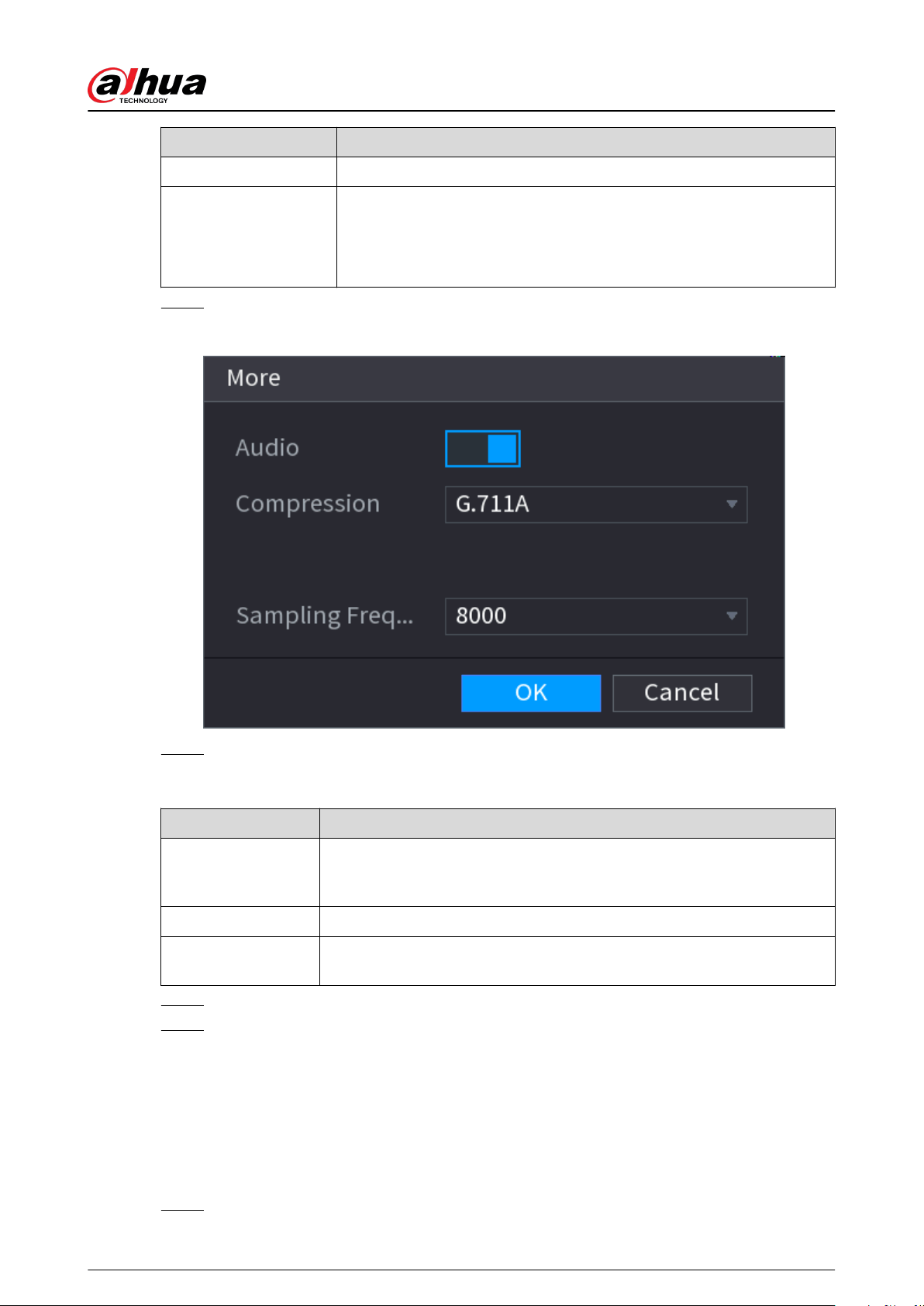
Parameter Description
I Frame Interval The interval between two reference frames.
Bit Rate (Kb/S)
●
Main stream: The higher the value, the better the image quality.
●
Sub stream: For constant stream, the bit rate changes near the
dened value; for variable stream, the bit rate changes along with
the image but the maximum value still stays near the dened value.
Step 3 Click More.
Figure 5-67 More settings
Step 4 Congure audio compression parameters.
Table 5-21 Audio compression parameters
Parameter Description
Audio
This function is enabled by default for main stream. You need to manually
enable it for sub stream. Once this function is enabled, the recorded video
le is composite audio and video stream.
Compression Select an audio compression format.
Sampling Frequency
Set how many times per second a sound is sampled. The bigger the value,
the more natural the sound.
Step 5 Click OK.
Step 6 Click Apply.
5.7.6.2 Snapshot
Background Information
You can set snapshot mode, image size, quality and interval.
Procedure
Step 1 Select Main Menu > CAMERA > Encode > Snapshot.
User's Manual
183
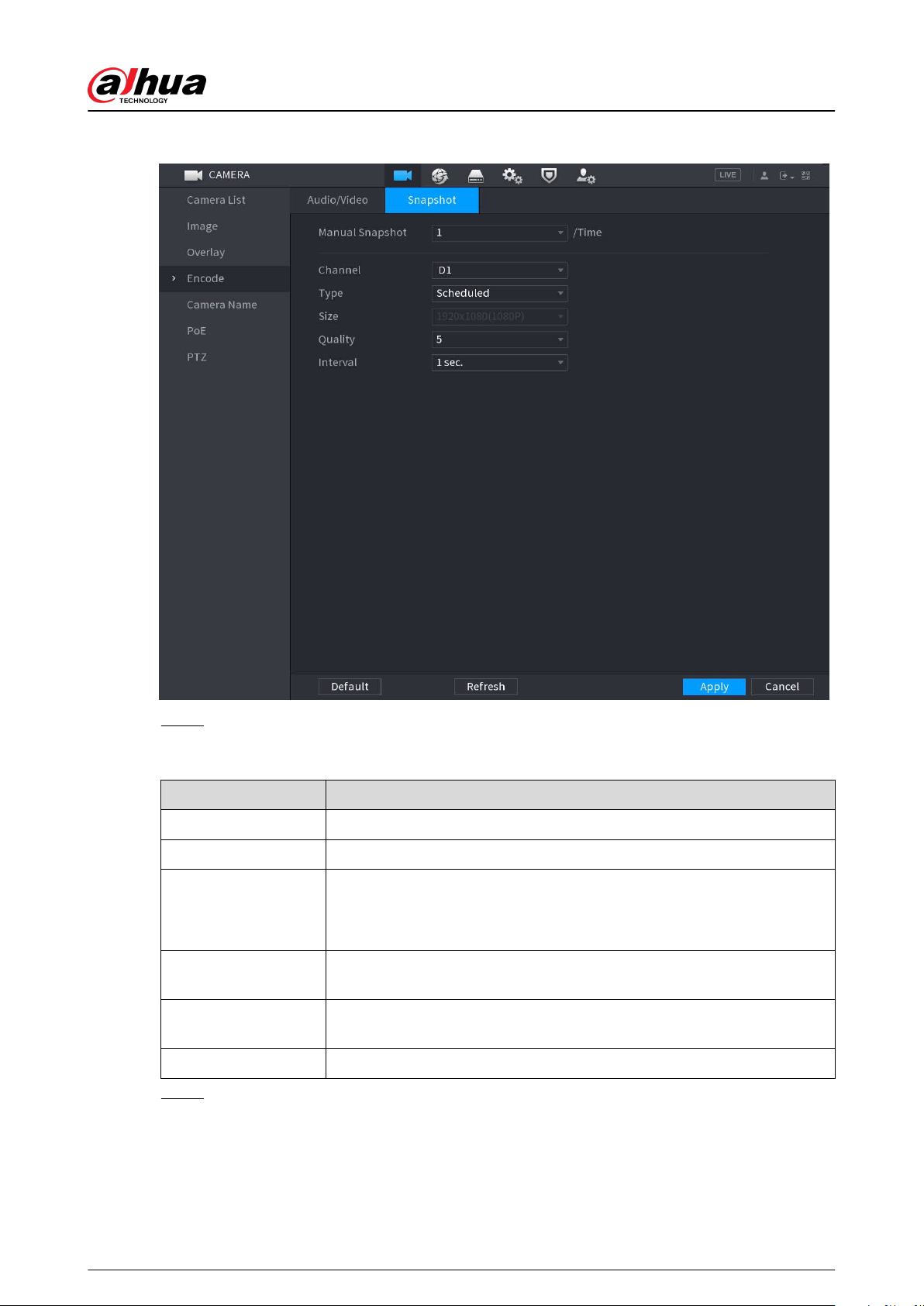
Figure 5-68 Snapshot
Step 2 Congure parameters.
Table 5-22 Snapshot parameters
Parameter Description
Manual Snapshot Select the number of snapshots that you want to take each time.
Channel Select the channel that you want to congure the settings for.
Type
●
Scheduled : The snapshot is taken during the scheduled period.
●
Event : The snapshot is taken for motion detection, video loss, local
alarms and other events.
Size
The size is determined by the resolution of the main stream or sub stream
of the channel.
Quality
Congure the image quality. The higher the level is, the better the image
will become. Level 6 represents the best quality.
Interval Select or customize how frequently snapshots are to be taken.
Step 3 Click Apply.
User's Manual
184
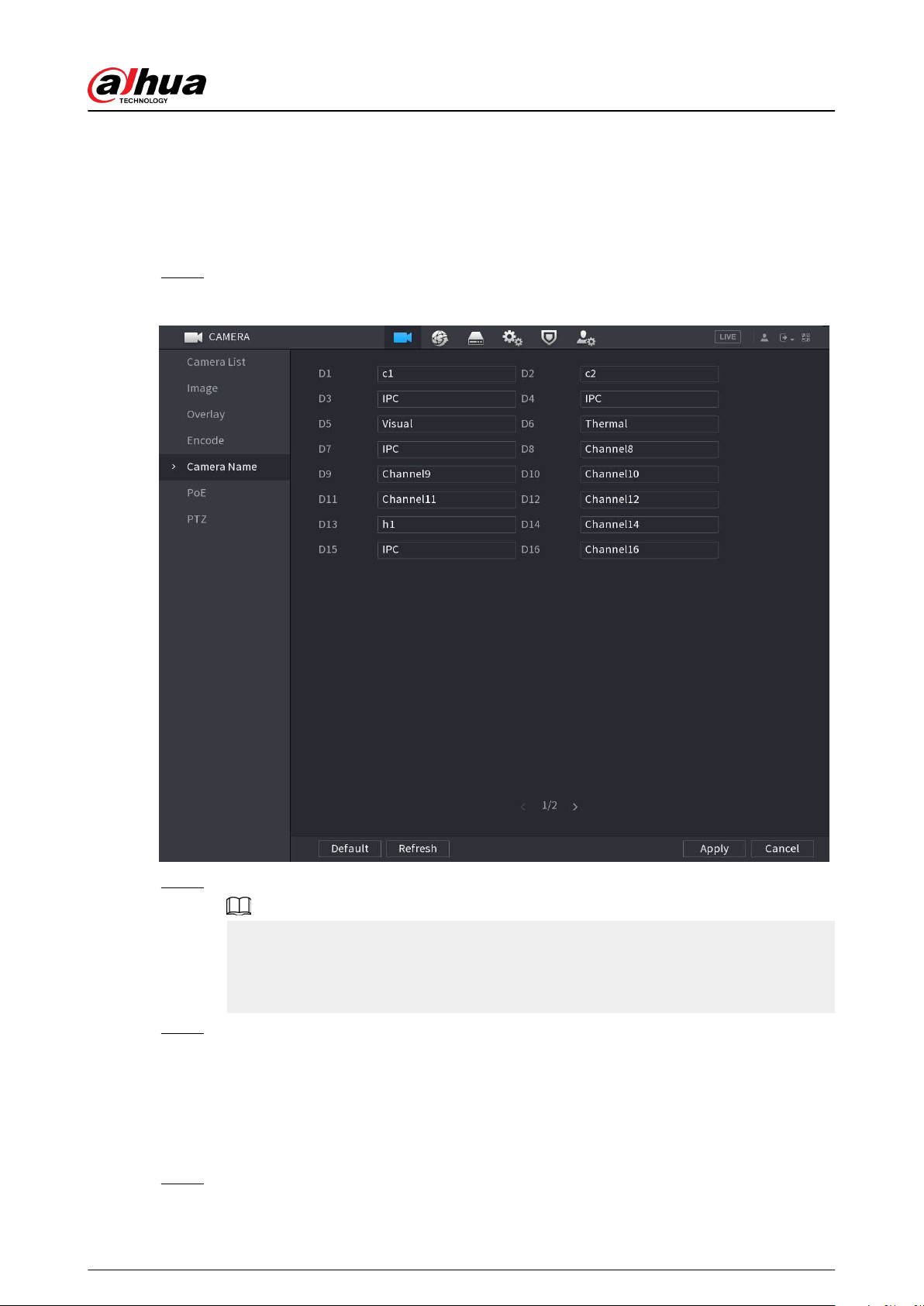
5.7.7 Modifying Channel Name
Background Information
You can customize channel name.
Procedure
Step 1 Select Main Menu > CAMERA > Camera Name.
Figure 5-69 Camera name
Step 2 Modify a channel name.
●
You can only change the name of the camera connected via the private protocol.
●
You can enter up to 63 English characters for a channel name.
●
When the system is in Chinese or English, the content in the text input box (excluding
password input box) can be copied and pasted.
Step 3 Click Apply.
5.7.8 Checking the PoE Status
You can check the status of PoE ports and set enhancement mode for each PoE port.
Procedure
Step 1 Select Main Menu > CAMERA > PoE.
User's Manual
185
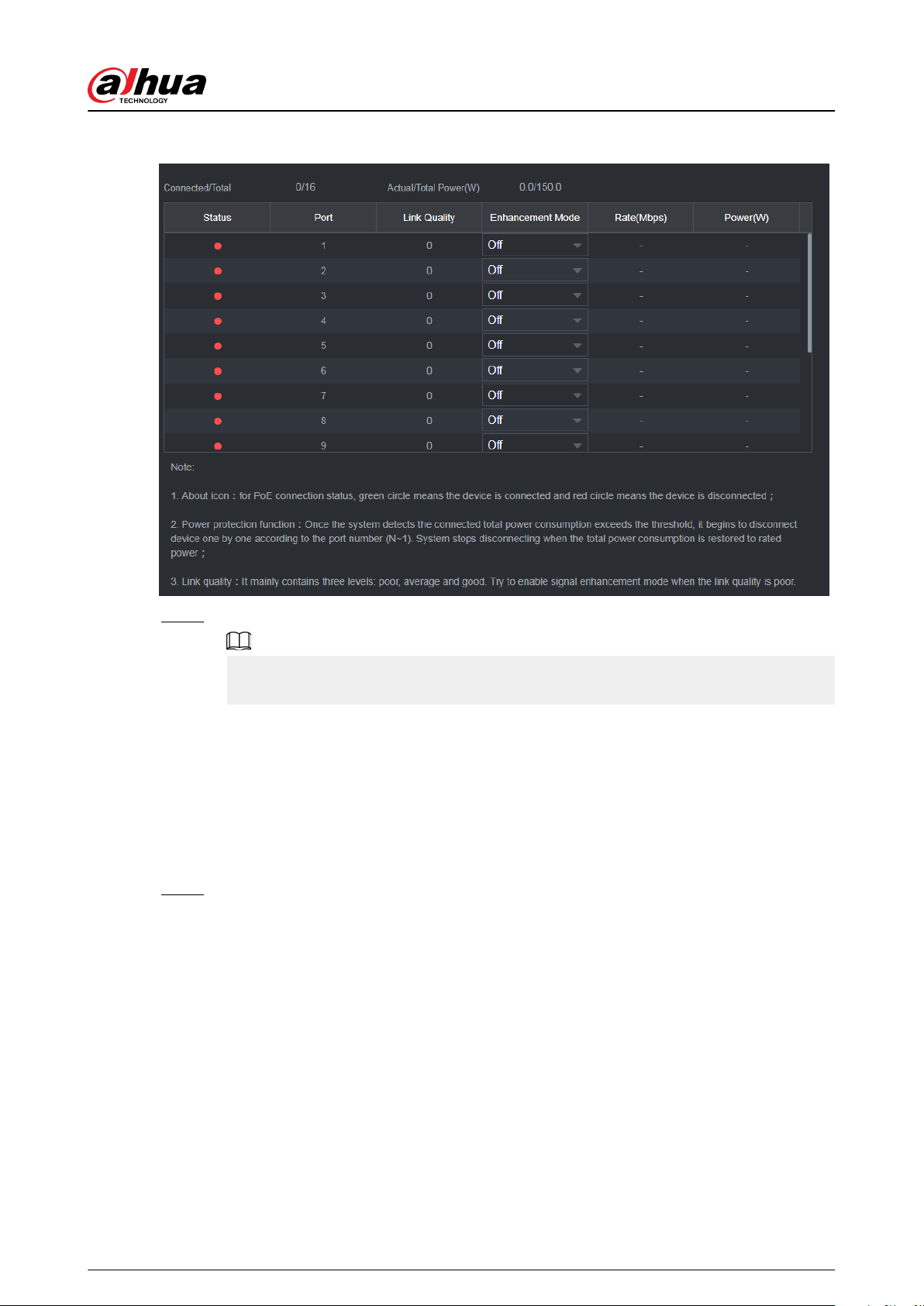
Figure 5-70 PoE
Step 2 (Optional) Set Enhancement Mode to On or O.
When enhancement mode is enabled, the transmission distance of the PoE port will be
extended.
5.7.9 Updating Remote Devices
Background Information
You can update the rmware of the connected network camera through online update or le
update.
Procedure
Step 1 Select Main Menu > CAMERA > Camera List > Update.
User's Manual
186
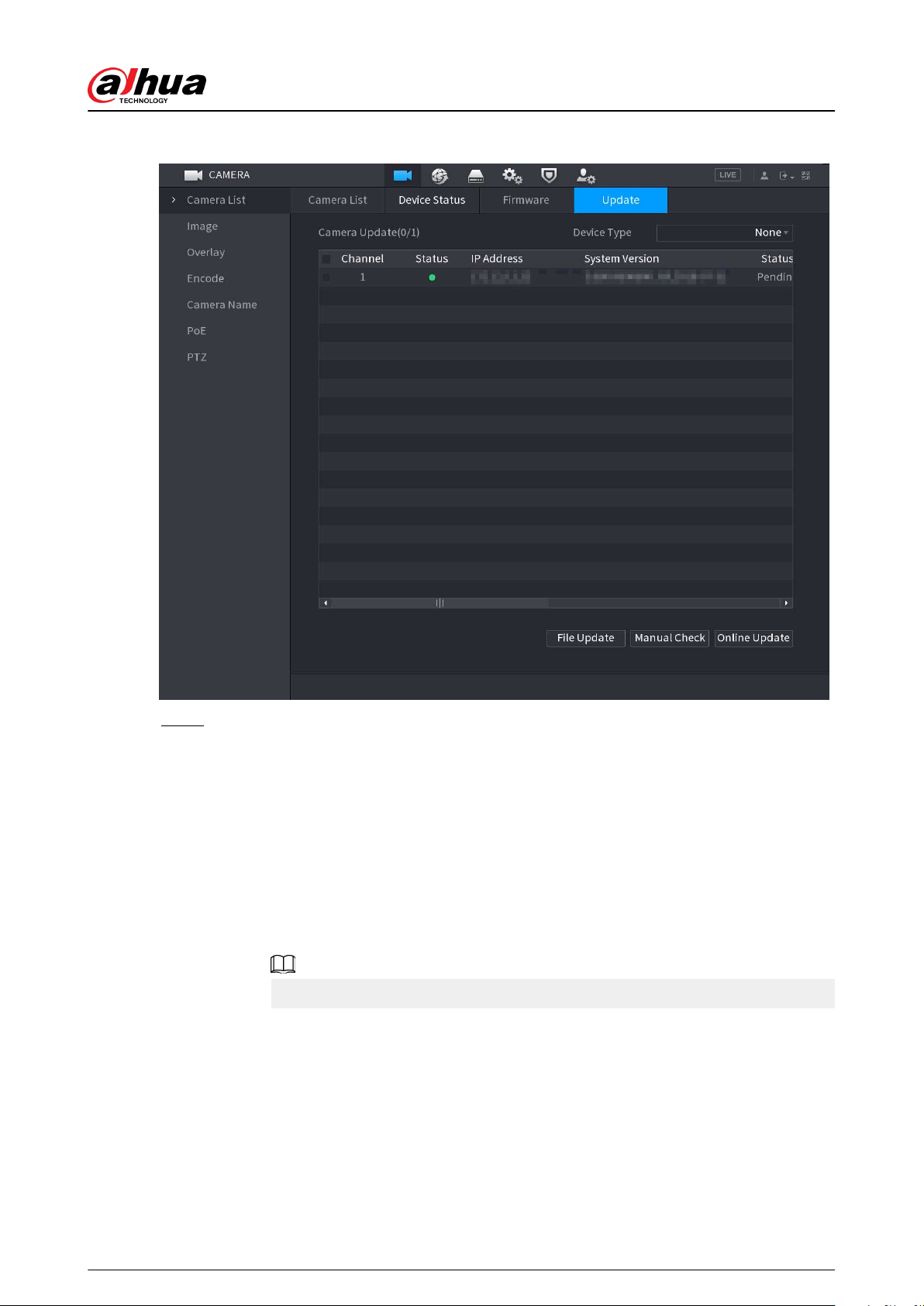
Figure 5-71 Update
Step 2 Update the rmware of the connected remote device.
●
Online update.
a. Select a remote device and then click Manual Check.
The system checks for available updates.
b. Select a remote device that has an update available for it, and then click Online
Update.
●
File update.
a. Select a channel and then click File Update.
b. Select an update le.
c. Click OK.
If there are too many remote devices, you can lter them on the Device Type list.
5.7.10 Viewing Remote Device Information
5.7.10.1 Device Status
You can view the connection and alarm status of the corresponding channel.
Select Main Menu > CAMERA > Camera List > Device Status.
User's Manual
187
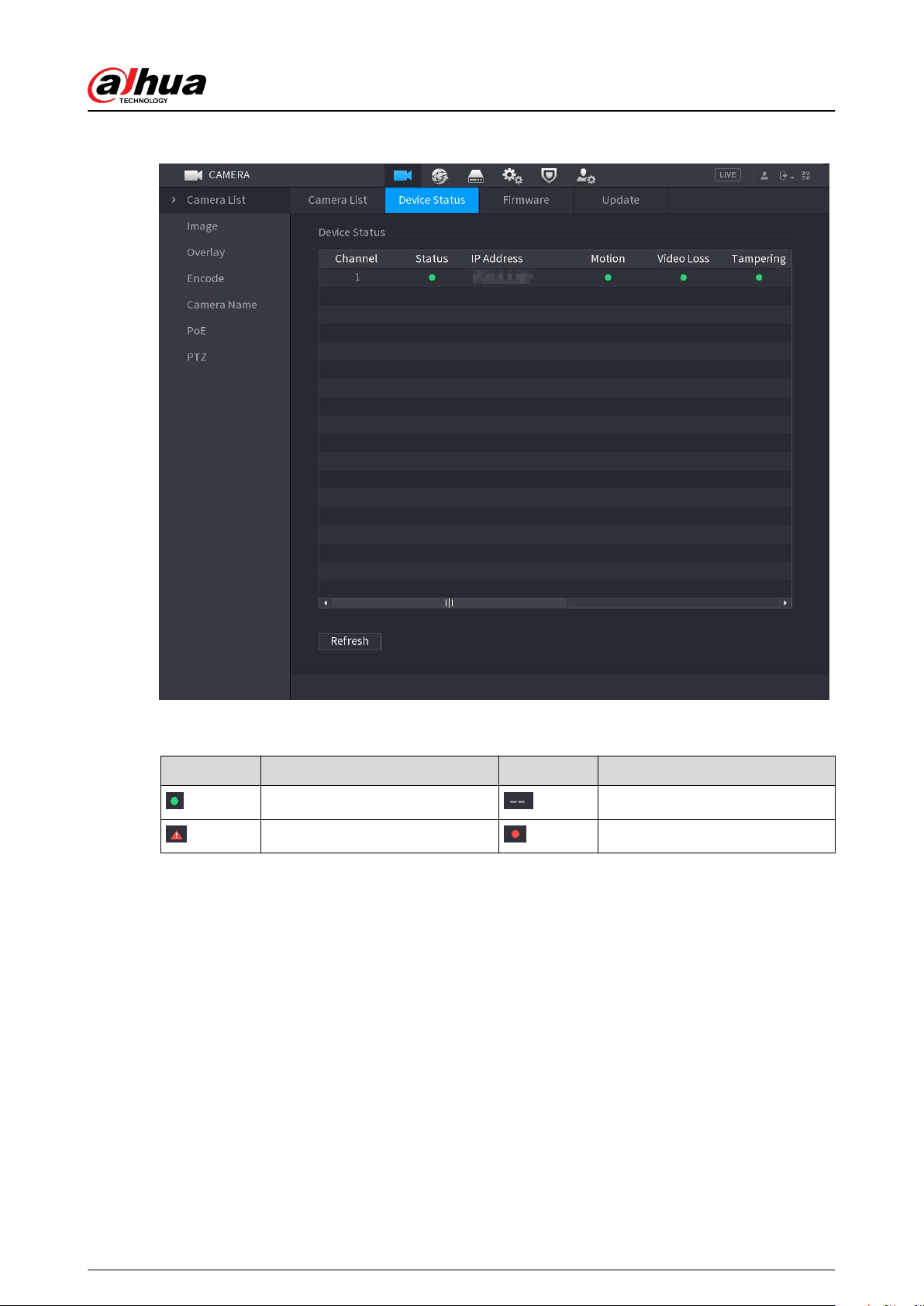
Figure 5-72 Device status
Table 5-23 Parameters of device status
Icon Description Icon Description
IPC works properly. IPC is not supported.
Alarm. Video loss.
5.7.10.2 Firmware
You can view the IP address, manufacturer, type, and system version of the connected remote
device.
Select Main Menu > CAMERA > Camera List > Firmware.
User's Manual
188
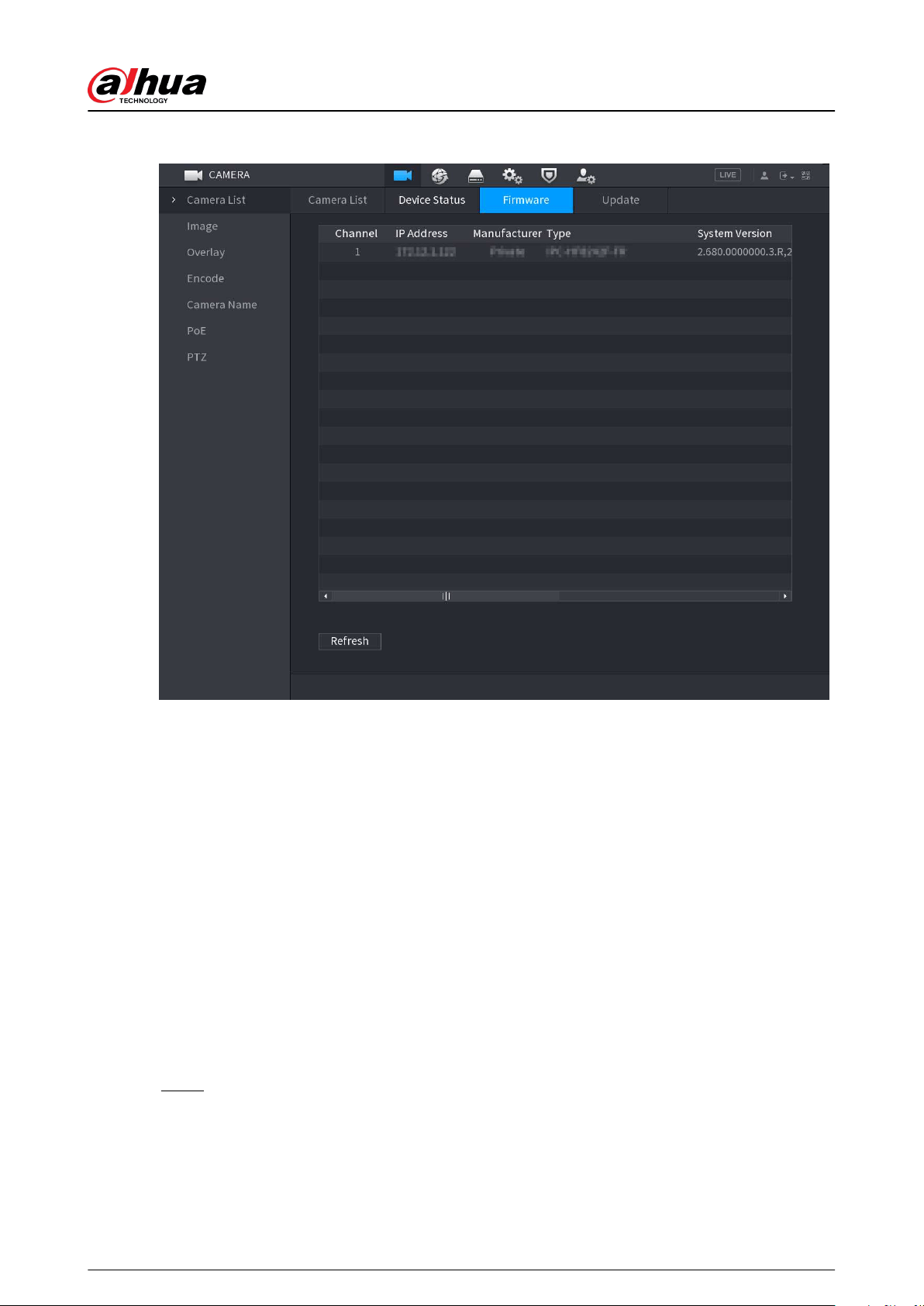
Figure 5-73 Firmware
5.8 Recording Management
5.8.1 Recording Schedule
After you set the recording schedule for videos and snapshots, the Device can automatically record
videos and snapshots at the scheduled time.
5.8.1.1 Conguring Video Recording Schedule
Background Information
After you set the schedule for videos, the Device will record videos according to the period you set.
For example, if the alarm recording period is from 6:00–18:00 on Monday, the Device will make a
recording on Mondays from 6:00-18:00.
Procedure
Step 1 Right-click the live page, and then select Main Menu > STORAGE > Schedule > Record.
User's Manual
189
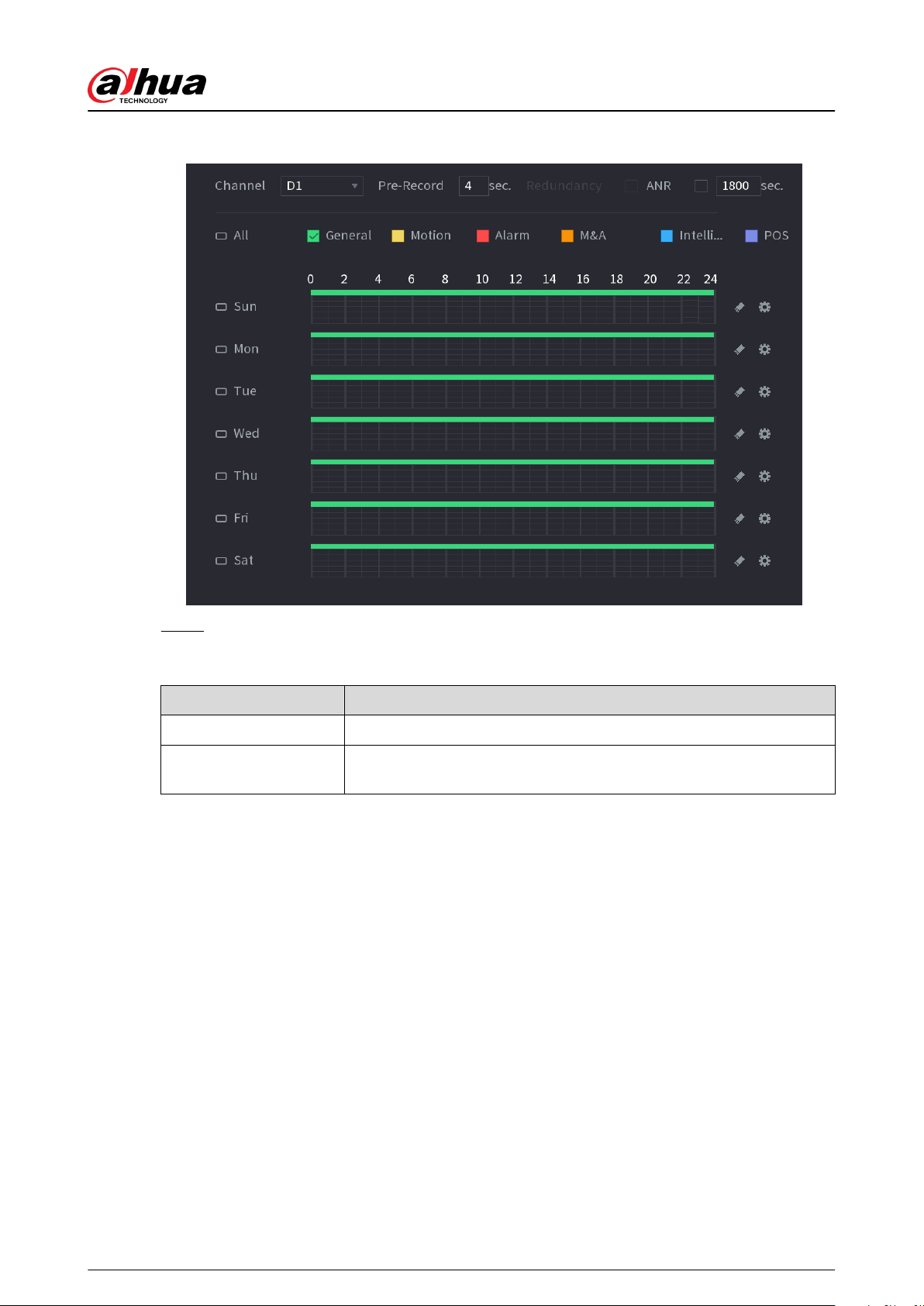
Figure 5-74 Video schedule
Step 2 Congure the parameters.
Table 5-24 Video schedule parameters
Parameter Description
Channel Select a channel to record a video.
Pre-record
Enter the amount of time that you want the pre-recording to last. A
recording will be made prior to the event.
User's Manual
190
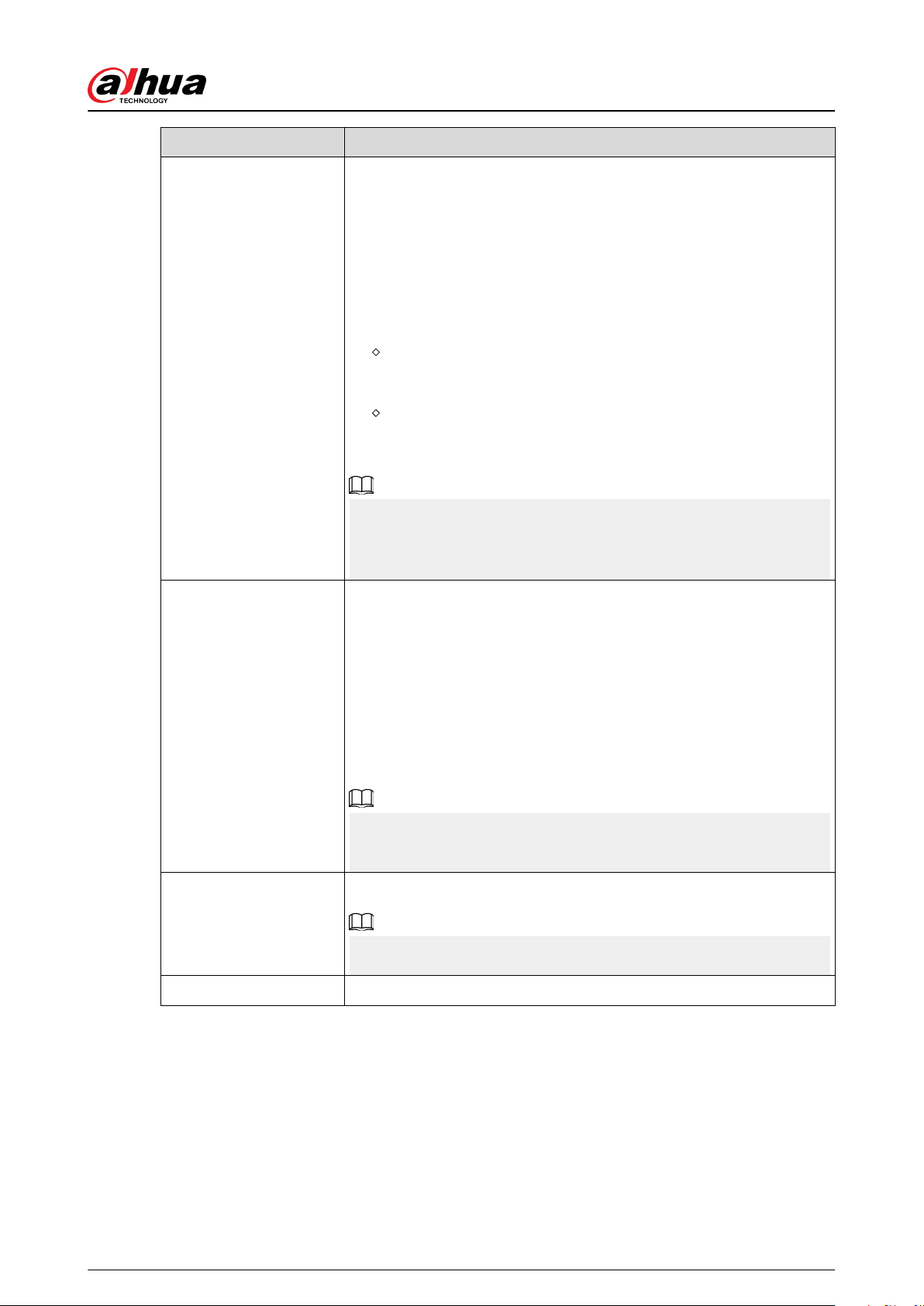
Parameter Description
Redundancy
If there are several HDDs installed to the Device, you can set one of the
HDDs as the redundant HDD to save the recorded les into dierent
HDDs. If one of the HDDs becomes damaged, you can nd the backup
on the other HDD.
●
Select Main Menu > STORAGE > Disk Manager, and then set a
HDD as redundant HDD.
●
Select Main Menu > STORAGE > Schedule > Record, and then
select the Redundancy checkbox.
If the selected channel is not recording, the redundancy
function will take eect the next time that you record, whether
or not you select the checkbox.
If the selected channel is recording, the current recorded les
will be packed, and then start recording according to the new
schedule.
●
This function is for some models only.
●
The redundant HDD only backs up the recorded videos but not
snapshots.
ANR
You can set the ANR (auto network resume) function.
●
The IPC continues recording once the NVR and IPC connection fails.
After the network becomes normal, the NVR can download
recording les while it is disconnected from the IPC. This is to help
protect against data loss from the current IPD channel that is
connected.
●
Set the maximum recording upload period. If the oine period is
longer than the period you set, IPC will only upload the recording
le during the specied period.
Make sure that SD card is installed and the recording function is
enabled on the IPC.
Period
Set a period during which the congured recording setting is active.
The system only activates the alarm in the dened period.
Copy to Click Copy to to copy the settings to other channels.
User's Manual
191
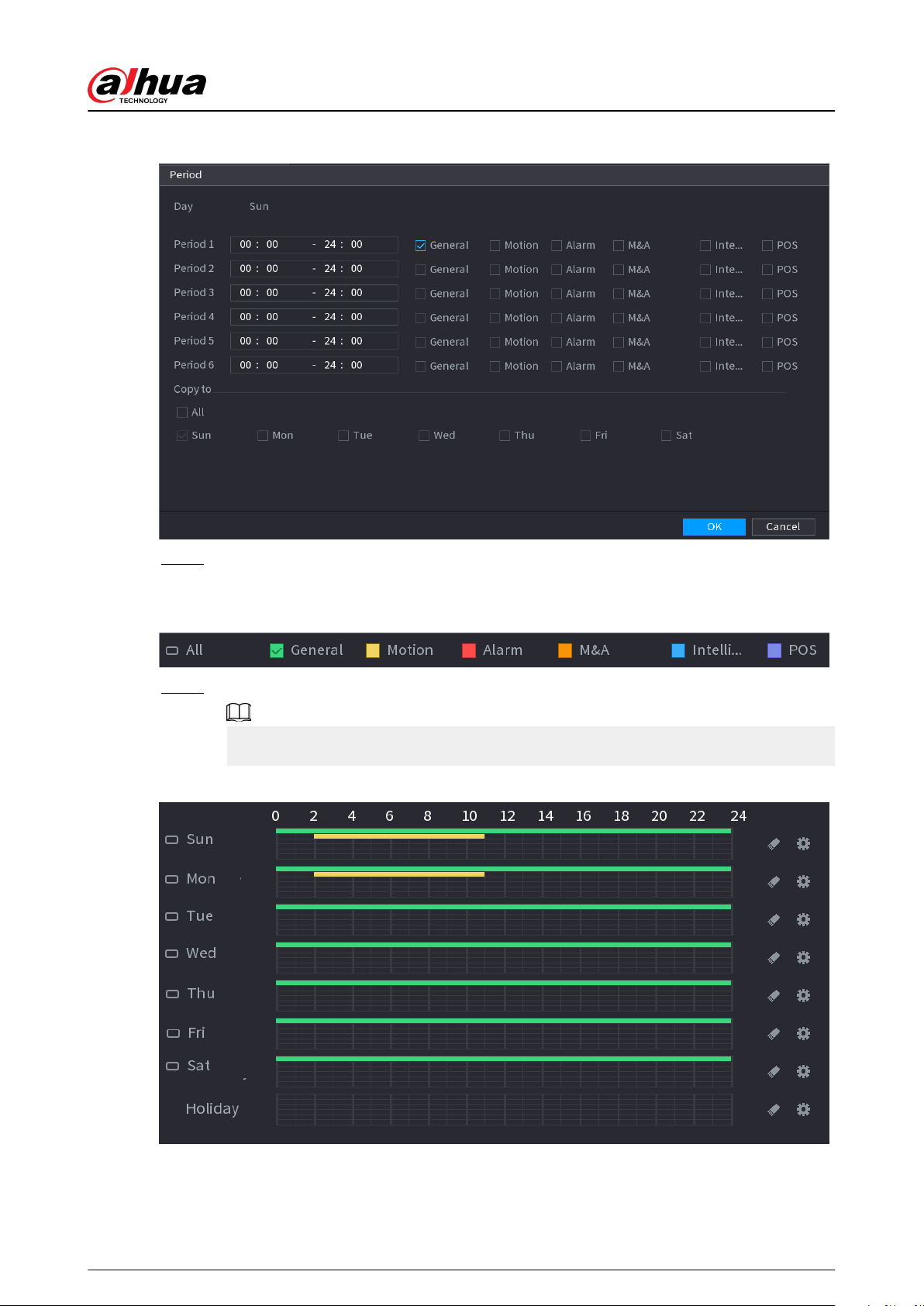
Figure 5-75 Period
Step 3 Set one or more recording types from General , Motion (motion detection), Alarm, M&A
(motion detection and alarm), Intelligent and Alarm.
Figure 5-76 Recording type
Step 4 Set recording period.
If you have added a holiday, you can set the recording period for the holiday.
Figure 5-77 Set record period
●
Dene the period by drawing.
a. Select a corresponding date to set.
User's Manual
192
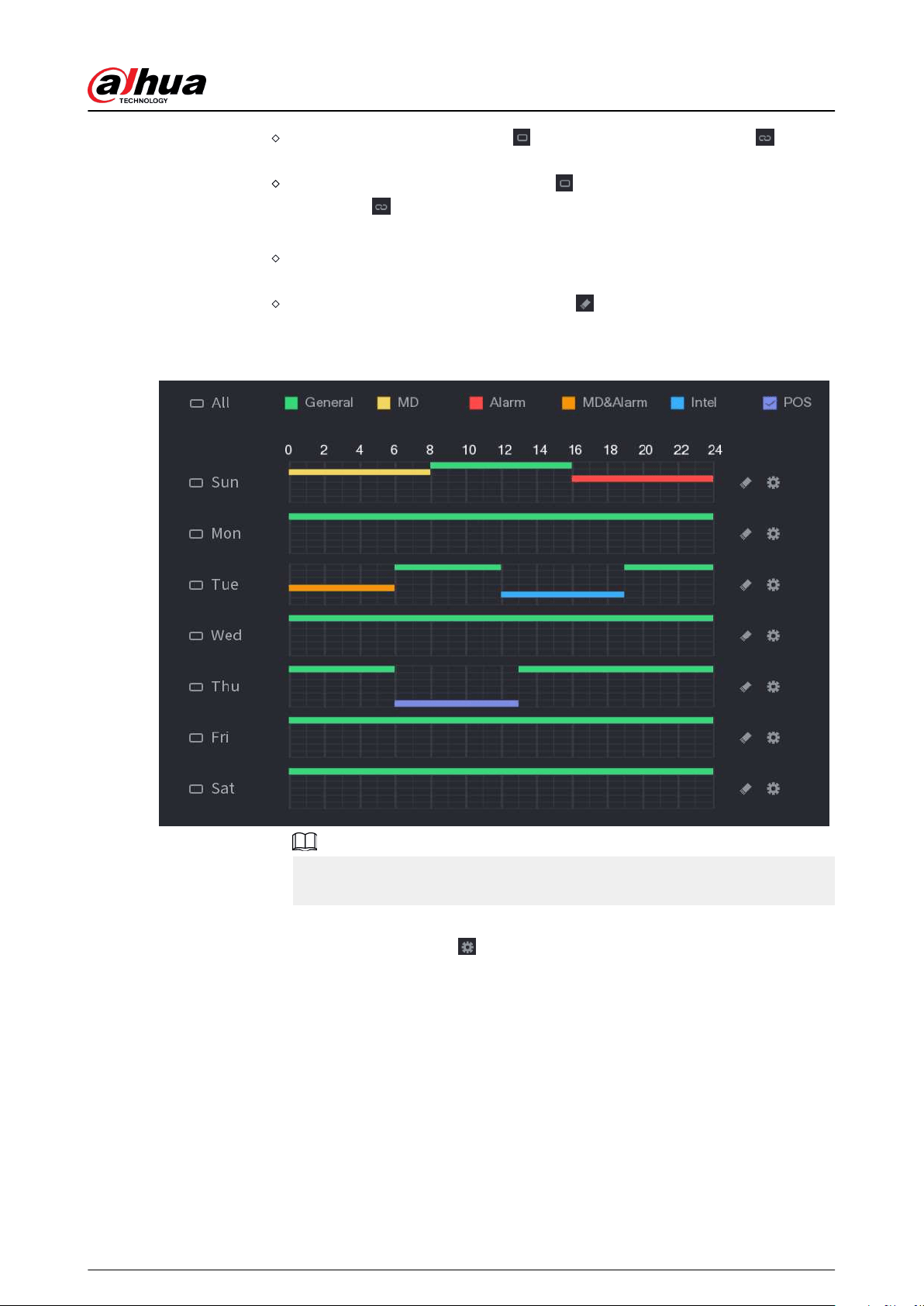
Dene for the whole week: Click next to All. All the icon switch to . You can
dene the period for all the days simultaneously.
Dene for several days of a week: Click before each day one by one. The icon
switches to
. You can dene the period for the selected days simultaneously.
b. On the timeline, drag to dene a period.
Once the time period overlaps, the recording priority is: M&A > Alarm > POS >
Intelligent > Motion > General.
Select a recording type and then click the of the corresponding date to clear
the corresponding period.
Figure 5-78 Set period by drawing
The MD record and alarm record function are both null if you enabled the
function of MD&Alarm.
●
Dene the period by editing.
a. Select a date and then click
.
User's Manual
193
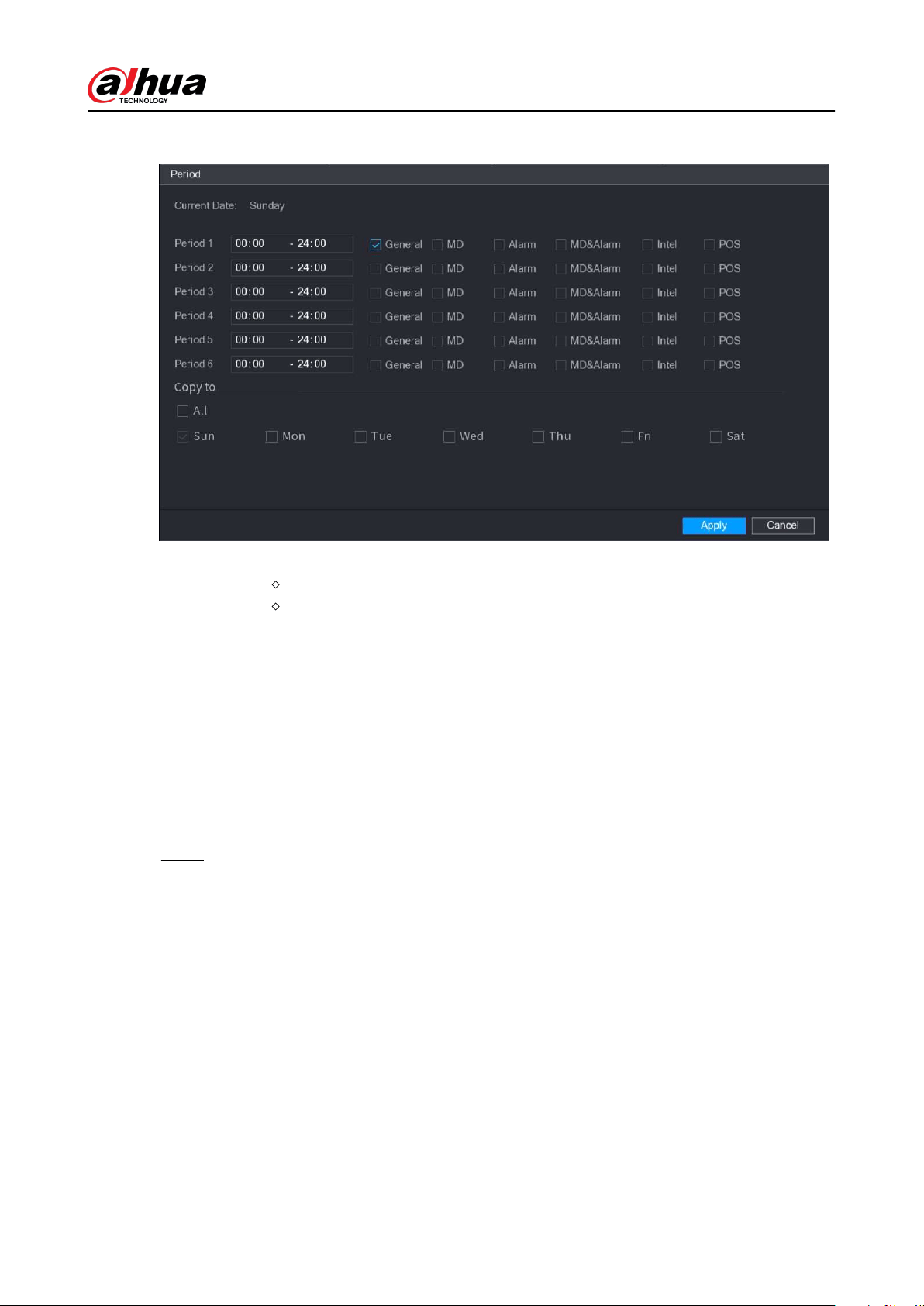
Figure 5-79 Set period by editing
b. Set the recording type for each period.
There are six periods for you to set for each day.
Under Copy to, select All to apply the settings to all the days of the week, or
select specic days that you want to apply the settings to.
c. Click Apply.
Step 5 Click Apply to complete the settings.
5.8.1.2 Conguring Snapshot Schedule
Background Information
Congure recording schedule for snapshots.
Procedure
Step 1 Right-click the live page, and then select Main Menu > STORAGE > Schedule >
Snapshot.
User's Manual
194
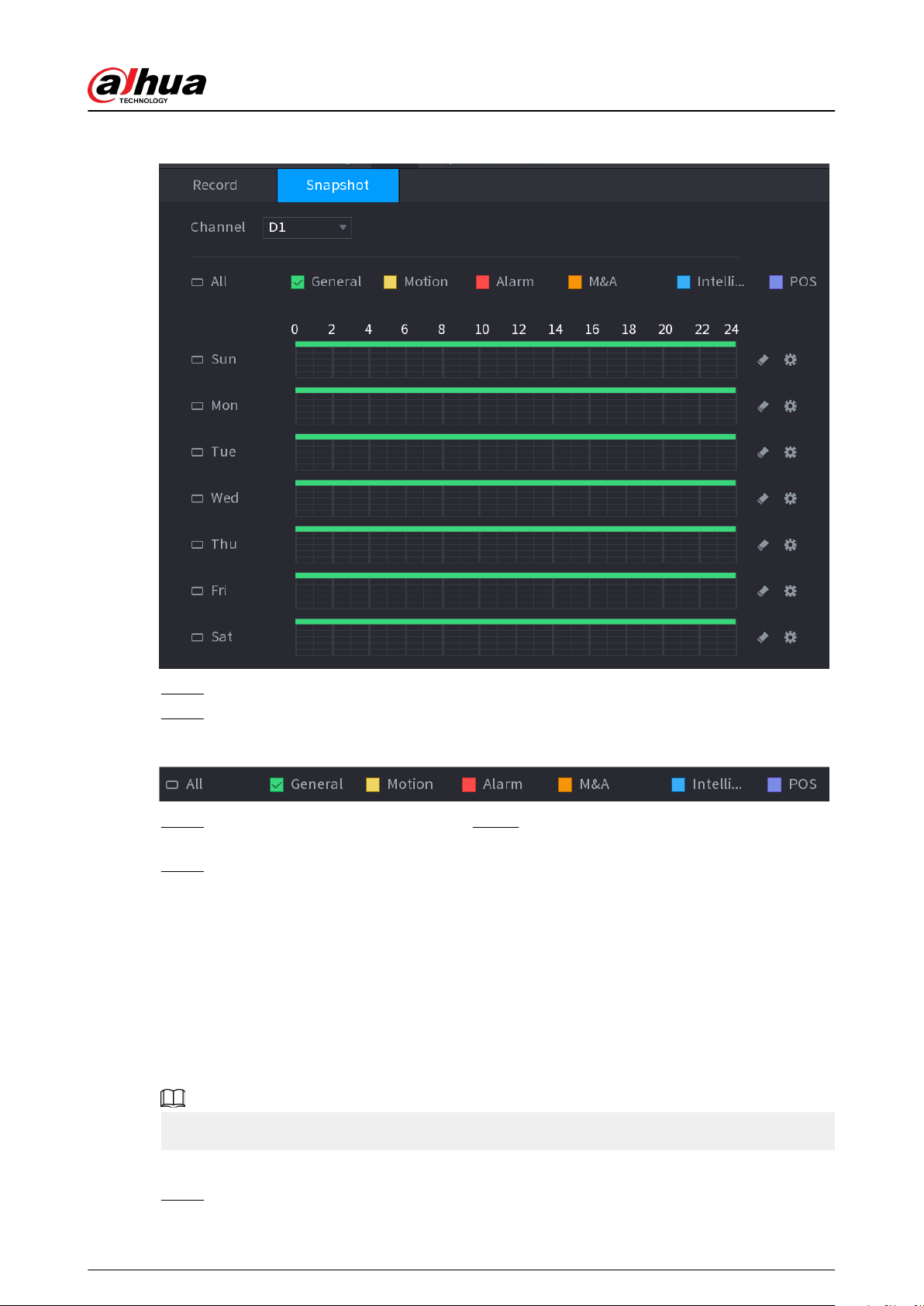
Figure 5-80 Snapshot
Step 2 Select a channel to set schedule snapshot.
Step 3 Set a recording type.
Figure 5-81 Recording type
Step 4 Set snapshot period. For details, see Step 4 in "5.8.1.1 Conguring Video Recording
Schedule".
Step 5 Click Apply.
5.8.1.3 Conguring Recording Mode
Background Information
After you set schedule record or schedule snapshot, you need to enable the auto record and
snapshot function so that the system can automatically record or take snapshot.
●
Auto: The system automatically records the videos and snapshots according to the dened
schedule.
●
Manual: The system records general les for the entire day.
You need to have storage authorities to use the Manual recording mode.
Procedure
Step 1 Right-click the live page, and then select Main Menu > STORAGE > Record.
User's Manual
195
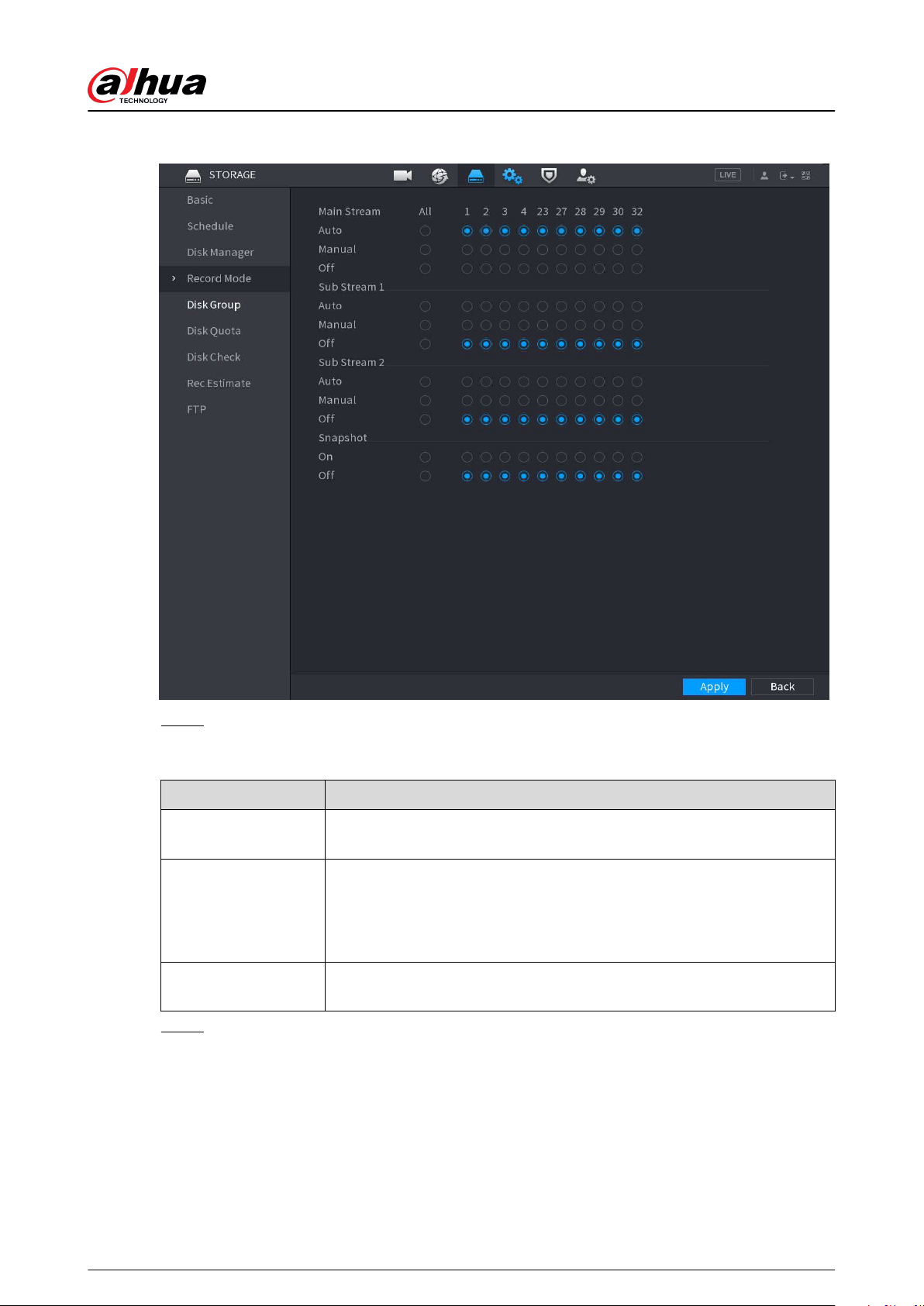
Figure 5-82 Recording mode
Step 2 Congure parameters.
Table 5-25 Recording mode parameters
Parameter Description
Channel
Displays all the connected channels. You can select a single channel or
select All.
Recording status
●
Auto: Automatically make recordings according to the schedule.
●
Manual: Makes a general recording within 24 hours for the selected
channel.
●
O: Do not record.
Snapshot status
Enable or disable the scheduled snapshot for the corresponding
channels.
Step 3 Click Apply.
5.8.2 Search and Playback
5.8.2.1 Search Page
You can search for and play back the recorded les on the NVR.
User's Manual
196
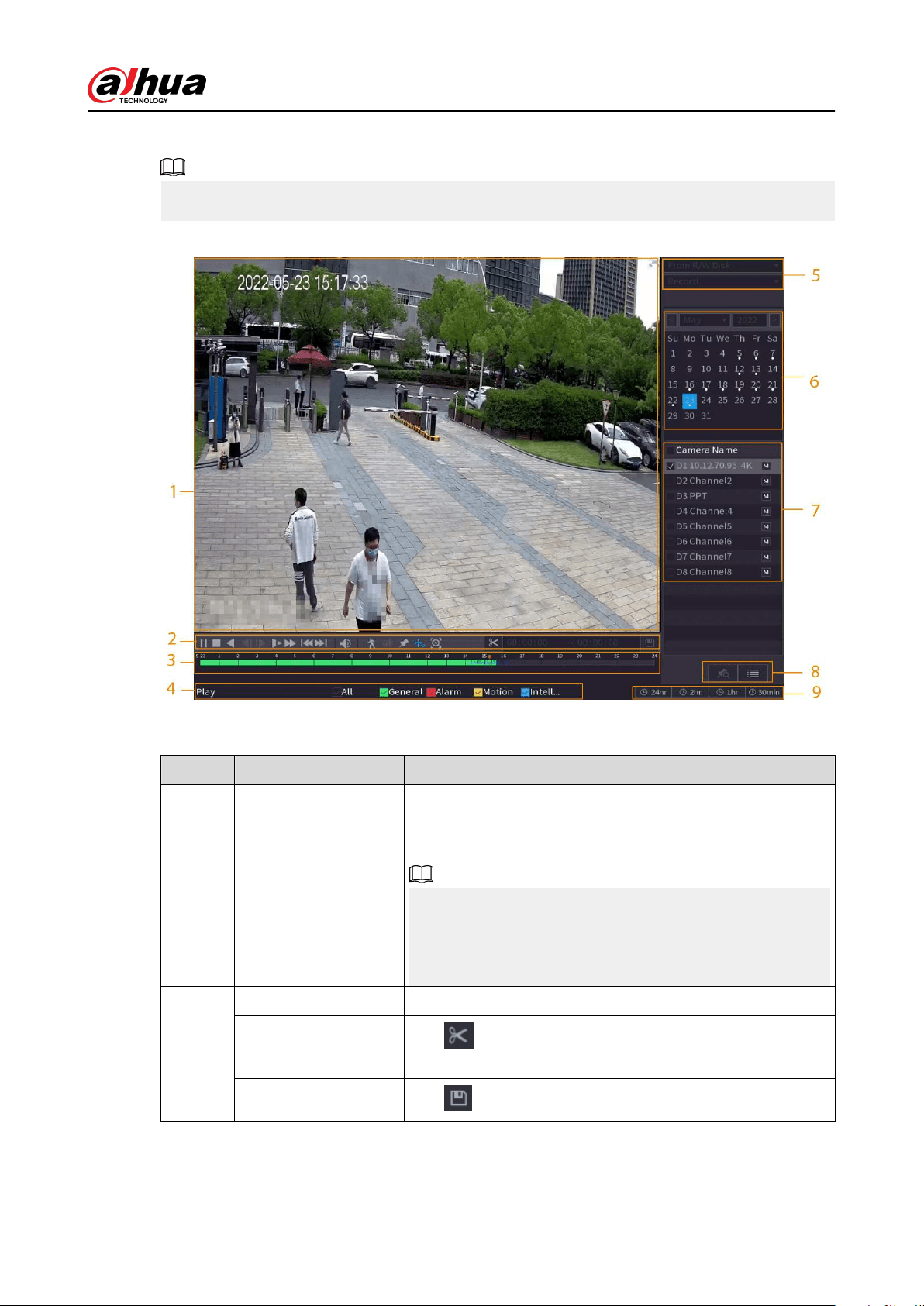
Select Main Menu > SEARCH, or right-click on the live view page and then select Search.
The following gure is for reference only.
Figure 5-83 Search
Table 5-26 Search page description
No. Function Description
1 Display window
Display the searched recorded video or picture. The system
supports playing in single-channel, 4-channel, 9-channel, and
16-channel simultaneously.
When playing back in the single-channel mode, hold down
the left mouse button to select the area that you want to
enlarge. The area is enlarged after the left mouse button is
released. To exit the enlarged status, right-click the image.
2
Playback controls bar Playback control buttons.
Clip
Click to clip the recording le and then save the footage.
See "5.8.2.5 Clipping Videos" for details.
Backup
Click
to back up recordings.
User's Manual
197
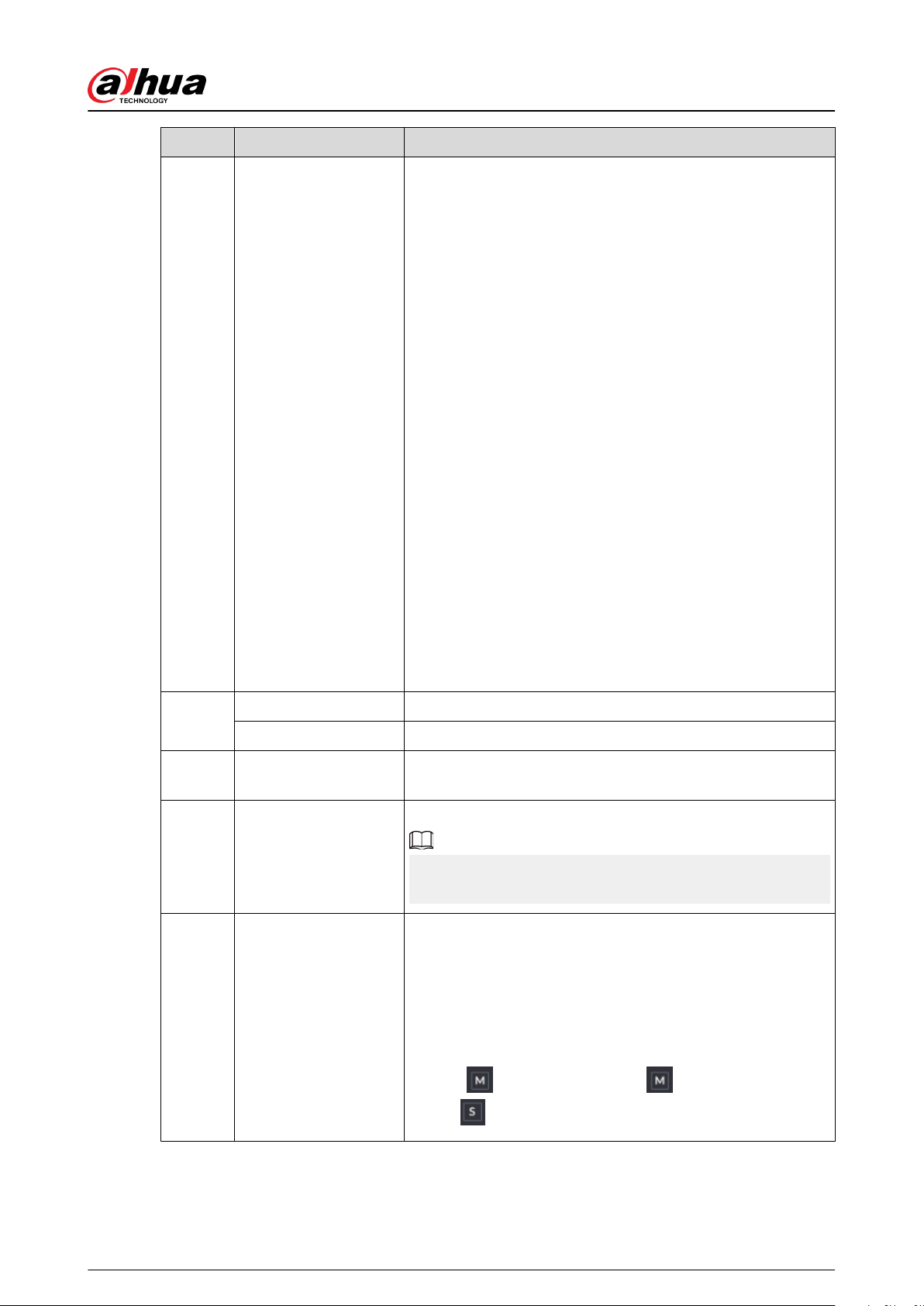
No. Function Description
3 Time bar
Display the type and time period of the current recorded
video.
●
In the 4-channel layout, 4 time bars are displayed. In other
view layouts, only 1 time bar is displayed.
●
Click the colored area to start playback from a certain time.
●
When you are conguring the settings, rotate the wheel
button on the time bar to zoom in from 0. When a
playback is being played, rotate the wheel button on the
time bar, the time bar will zoom into the time point where
the playback is located.
●
Time bar colors: Green for general type; red for external
alarm; yellow for motion detection; blue for intelligent
events; purple for POS events.
●
Click and hold the time bar, and the mouse pointer
changes to a hand icon, and then you can drag to view the
playback of the target time.
●
You can drag the vertical orange line on the time bar to
rapidly view the playback in iframe format.
●
When playing back a video in one channel mode, point to
the time bar for 0.1 seconds, and then you can view 4
pictures before and after the selected time, and the
thumbnail picture of the selected time.
●
For some models, when you click the blank area in the
time bar, the system automatically jumps to the next time
point where there is a recorded video located.
4
Play status Includes 2 playback status: Play and Stop.
Record type Select the checkbox to dene the recording type to search for.
5 Search type
Select the content to play back: Record , Picture, and
Subperiod.
6 Calendar
Click the date that you want to search for.
The dates with recordings or snapshots have a small solid
circle under the date.
7
View layout and
channel selection
●
In the Camera Name list, select one or more channels that
you want to play back.
●
The window split is decided by how you select the
channels. For example, if you select 1 channel, the
playback is displayed in the single-channel view. If you
select two to four channels, the playback is displayed in
the four-channel view. The maximum is eight channels.
●
Click
to switch the streams. indicates main stream,
and indicates sub stream.
User's Manual
198
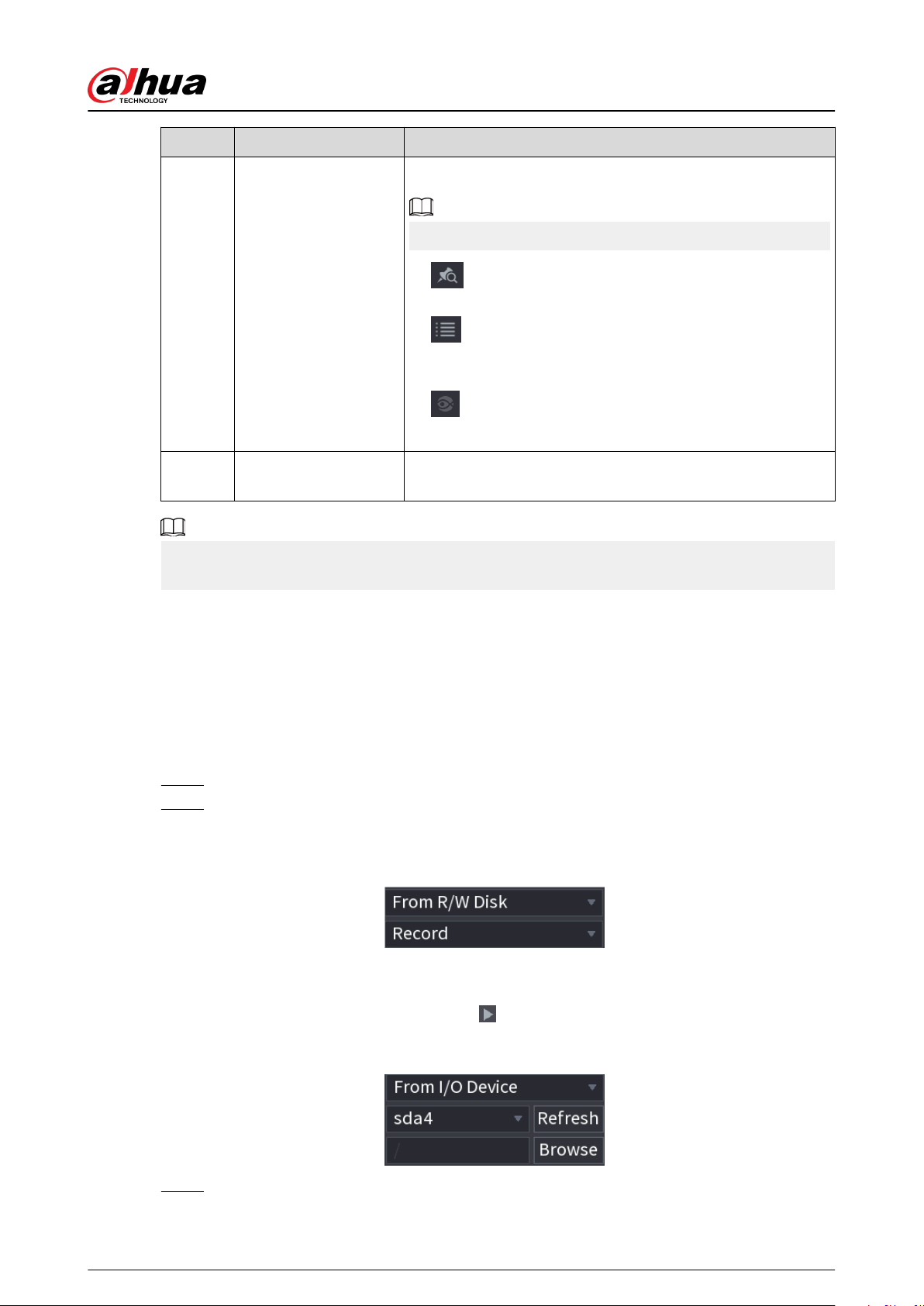
No. Function Description
8 List display
This area includes Tag List and File List.
The icons displayed might vary with models.
●
: Click Tag List to view the marked recorded video
list. Double-click the le to start playing.
●
: Click File List to view the les that were found. You
can lock and unlock the les. See"5.8.2.7 File List" for
detailed information.
●
: sheye dewarp. See "5.6.10.2 Fisheye De-warp During
Playback " for detailed information.
9 Time bar unit
You can select 24 hr, 2 hr, 1 hr, or 30 min as the unit of time
bar.
All the operations for playback might vary with hardware versions. Some functions are available on
select models.
5.8.2.2 Playback
Background Information
You can search for and play back videos, images or video clips. The operations are similar. This
section uses video playback as an example.
Procedure
Step 1 Select Main Menu > Search, or right-click the live page and then select Search.
Step 2 Select From R/W Disk or From I/O Device.
●
From R/W Disk: Search for recorded les on the HDD of the Device.
Figure 5-84 Search from R/W disk
●
From I/O Device: Search for recorded les from external storage device.
Click Browse, select the storage path of the recorded video le that you want to play.
Double-click the video le or click
to start playing.
Figure 5-85 Search from I/O device
Step 3 Select Record as the search type.
User's Manual
199
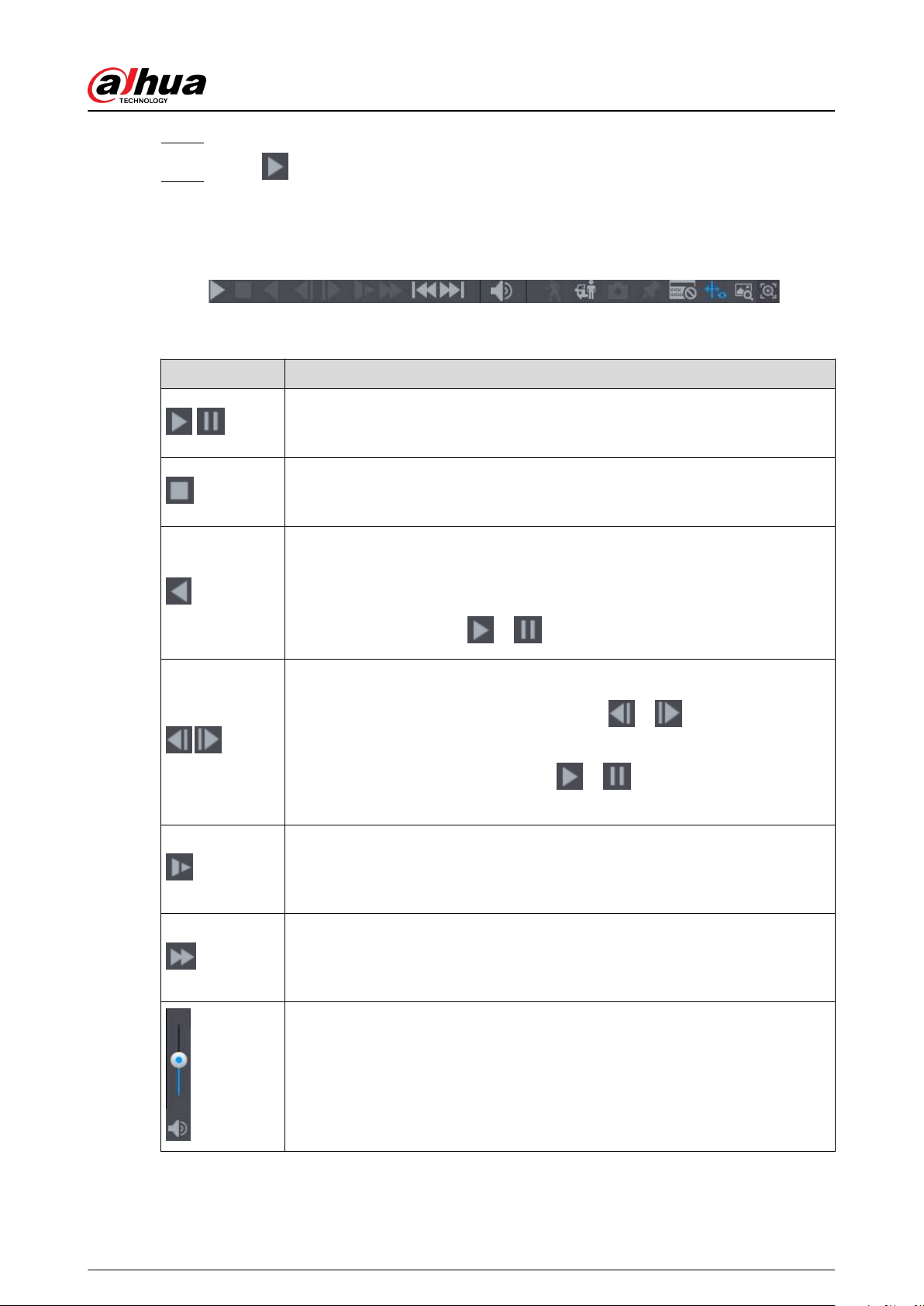
Step 4 Select the date, and channel.
Step 5 Click or any position on the time bar.
The system starts playback. You can use the playback controls to control the playback
process.
Figure 5-86 Playback control
Table 5-27 Playback control description
Icon Function
/
Play/Pause
In slow play mode, click it to switch between play/pause.
Stop
When playing back, click to stop current playback process.
Rewind
In normal play mode, left-click the button, the le begins to rewind. Click it
again to pause it.
While it is rewinding, click
or to restore normal play.
,
Display previous frame/next frame.
When you pause the normal playback le, click
or to play back frame
by frame.
In frame by frame playback mode, click
or to resume normal playback
mode.
Slow play
In playback mode, click it to use various slow play modes such as slow play 1,
slow play 2, and more.
Fast forward
In playback mode, click to realize various fast play modes such as fast play 1,fast
play 2 and more.
Adjust the volume of the playback.
User's Manual
200
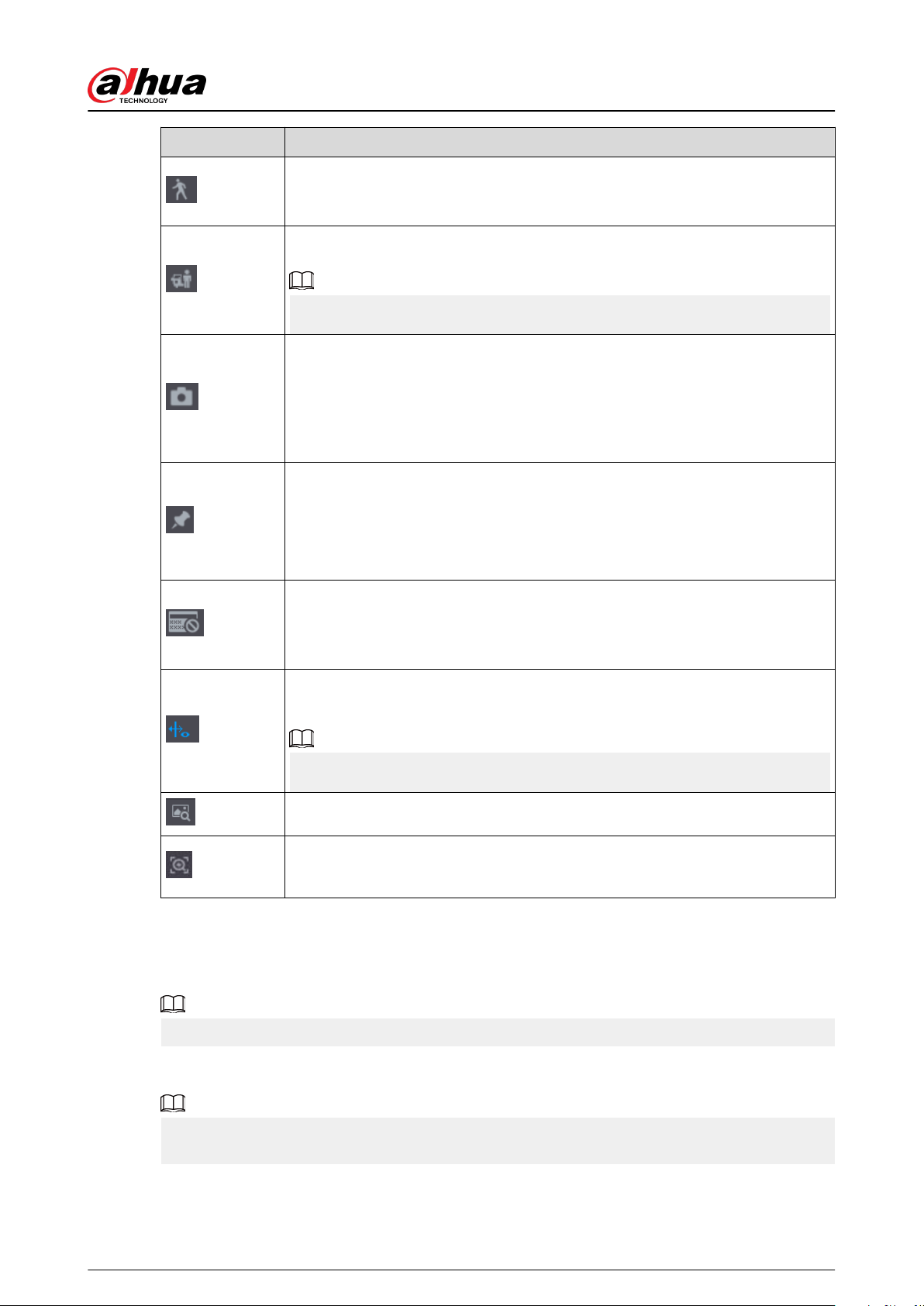
Icon Function
Smart search.
See "5.8.2.3 Smart Search Playback" for detailed information.
Smart motion detection. You can click the icon to select a human or motor
vehicle, and the system plays detected videos of the person or motor vehicle.
Human and motor vehicle can be selected at the same time.
Click the snapshot button in the full-screen mode to take one snapshot.
System supports custom snap picture saved path. Connect the peripheral
device rst, click snap button on the full-screen mode, you can select or create a
path. Click Start button, the snapshot picture can be saved to the specied
path.
Mark button.
This function is available on select models. Make sure there is a mark button in
the playback control pane.
See "5.8.2.8 Tag Playback" for detailed information.
Display and hide POS information.
In 1-channel playback mode, you can click it to display/hide POS information on
the video.
In 1-channel playback mode, click it to enable or disable display IVS rule
information on the video.
This function is for some series only.
Picture search. For details, see "5.6.3.7 Picture Search".
●
Quick pick. For details, see "5.6.3.8 Quick Pick".
●
AcuPick. Fordetails, see "5.8.2.4 AcuPick".
5.8.2.3 Smart Search Playback
Background Information
This function is for some models only.
During the playback process, the system can analyze the motion detection zone in the scene and
give the analysis result.
Make sure that motion detection has been enabled in Main Menu > ALARM > Video Detection >
Motion Detection.
User's Manual
201
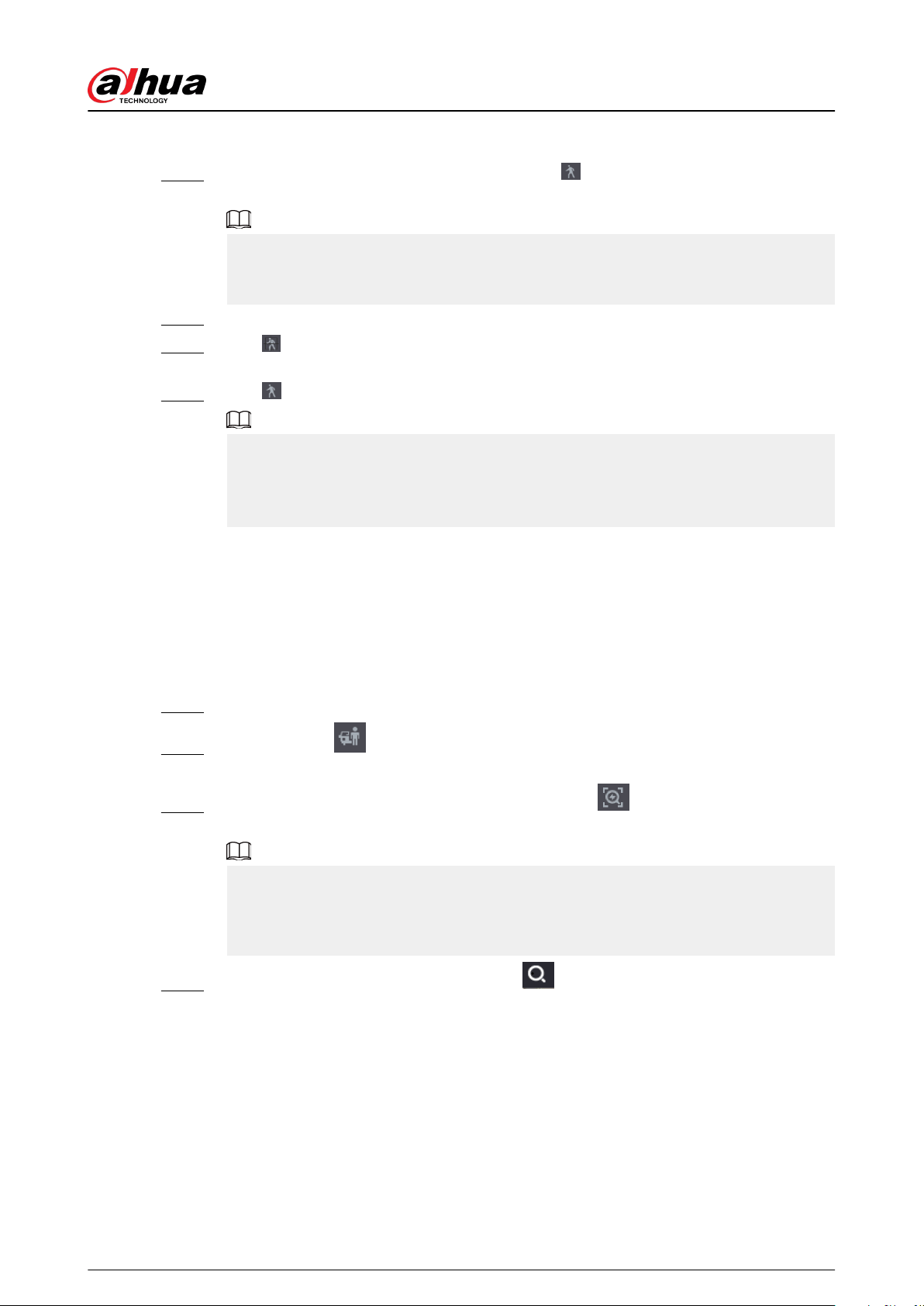
Procedure
Step 1 Select a channel to playback video and then click . You can view the grids on the
playback video.
●
This function is for one-channel playback mode.
●
In multiple-channel playback mode, double-click a channel to switch to one-channel
playback mode.
Step 2 Select smart search zones (22*18(PAL), 22*15(NTSC)).
Step 3 Click to go to smart search and playback. The system is going to play back all motion
detection record footage.
Step 4 Click again to stop smart search.
●
The motion detection region cannot be the full screen zone.
●
The motion detection region adopts the current whole play pane by default.
●
The time bar unit switch, rewinding, frame by frame are not available when the system
is playing a motion detection le.
5.8.2.4 AcuPick
5.8.2.4.1 Common Search
Procedure
Step 1 Select Main Menu > SEARCH, or right-click on the live view page and then select Search.
Step 2 (Optional) Click to select the displayed results. You can choose Human and Motor
Vehicle.
Step 3 When you want to search the target in the image, click to freeze the page. The image
automatically shows the targets.
●
This function is for one-channel playback mode. In multiple-channel playback mode,
double-click a channel to switch to one-channel playback mode.
●
Supports human detection (blue detection box) and motor vehicle detection (yellow
detection box).
Step 4 Point to the target you want, and then click to check the details.
User's Manual
202
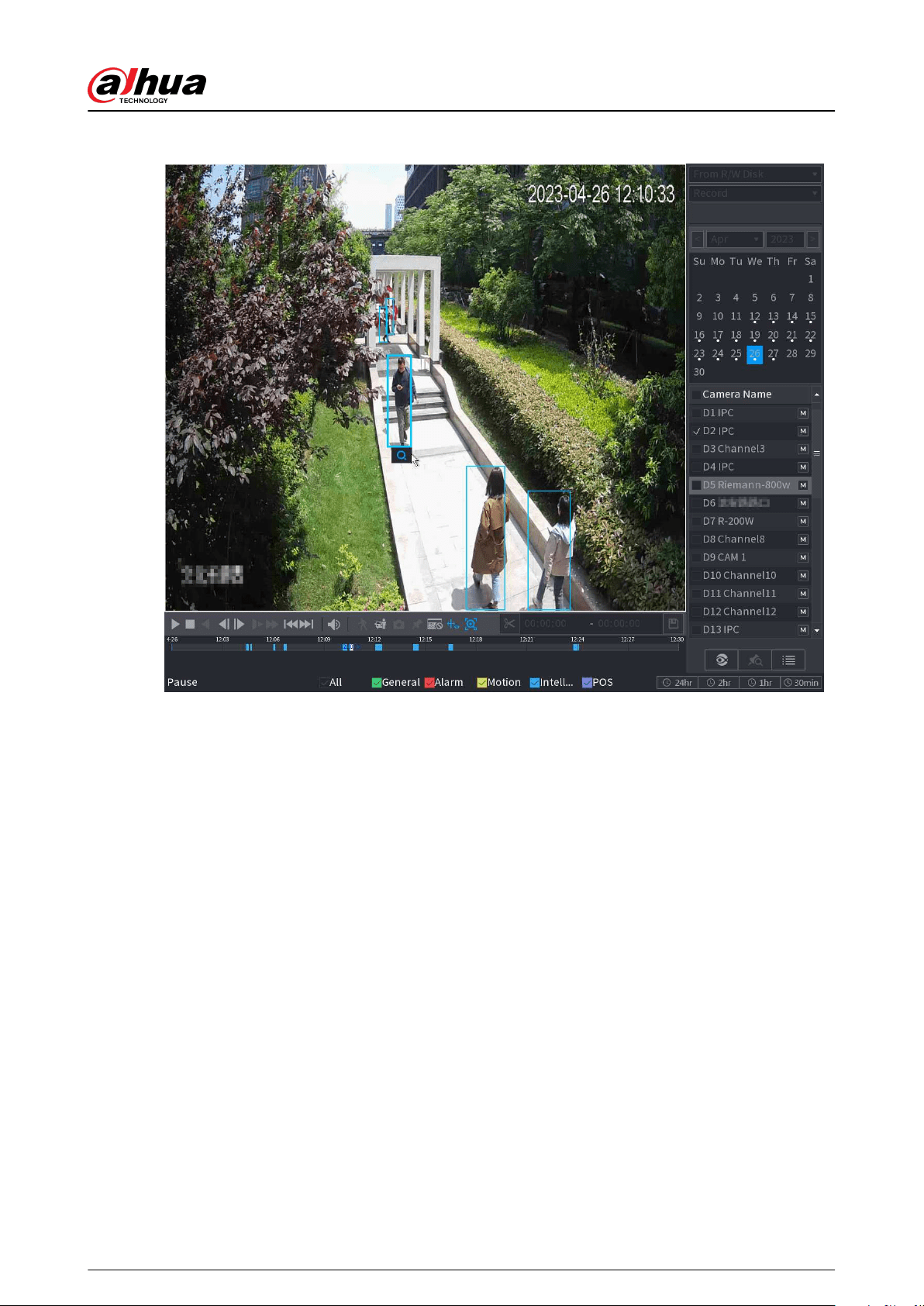
Figure 5-87 AcuPick (human detection)
User's Manual
203
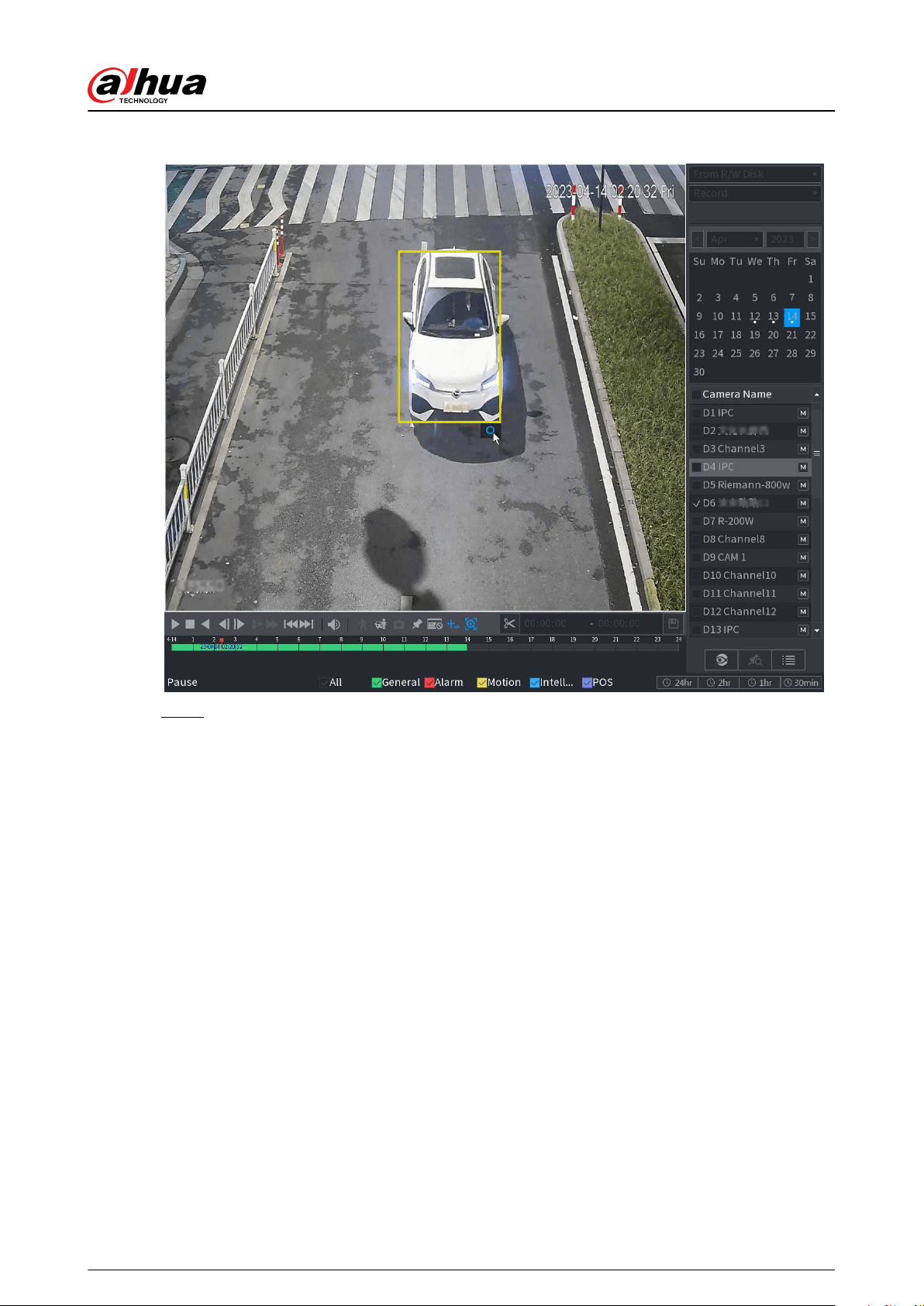
Figure 5-88 AcuPick (motor vehicle detection)
Step 5 Congure the search conditions as needed.
User's Manual
204
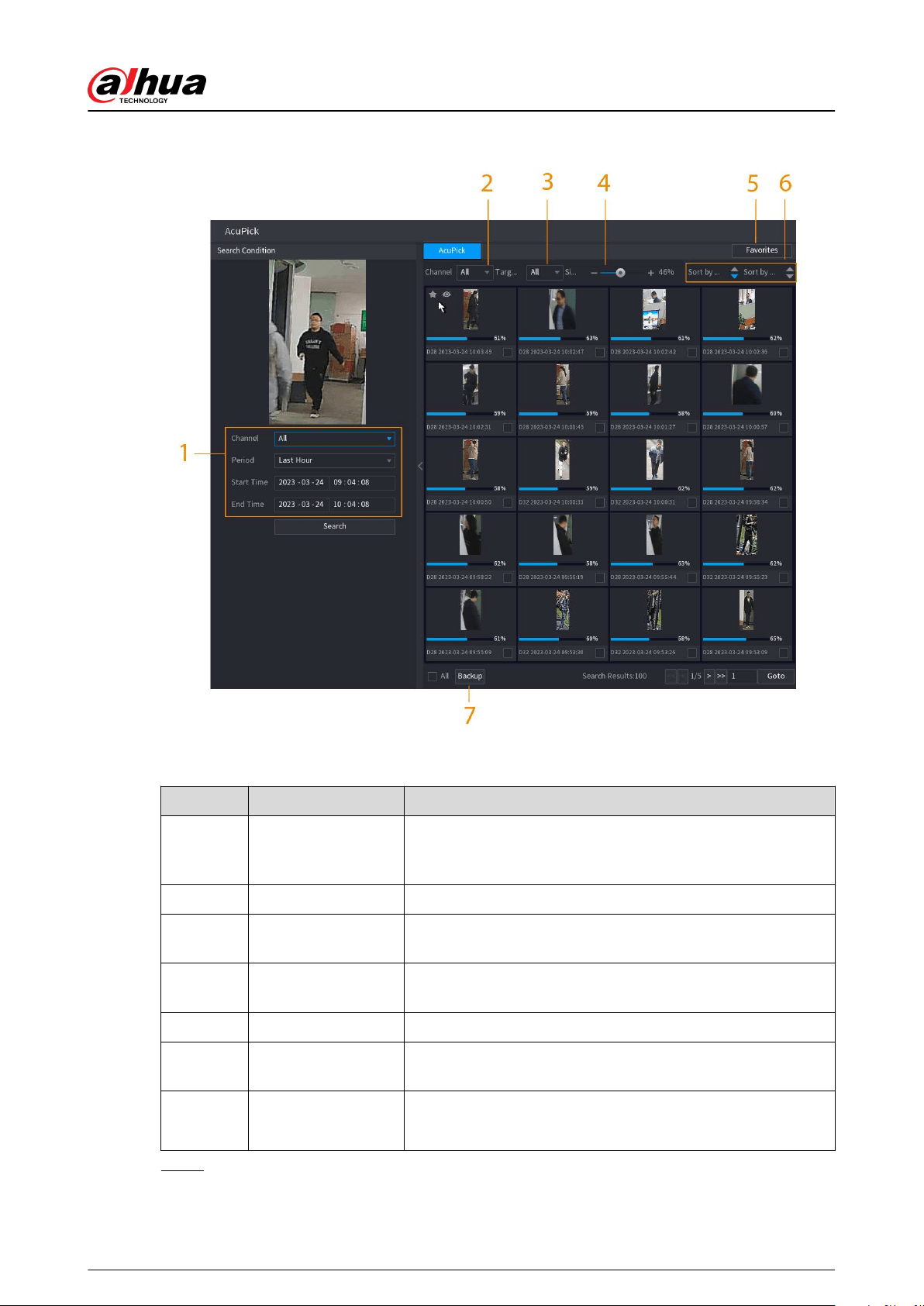
Figure 5-89 Search conditions and results
Table 5-28 Descriptions of search conditions and results
No. Name Description
1 Search Condition
Congure the channel and period. When choose Custom, you
can set the start time and end time as needed. Up to 7 days
can be set.
2 Channel Displays the channels with search result.
3 Target Filter
Select from All , Favorite Items and Hidden Items. When you
select the target items, the device will only search in this item.
4 Similarity
Congure the search similarity according to the actual
conditions. The recommended value is 80% or above.
5 Favorites The system only search the target in favorites.
6
Sort by Time/ Sort by
Similarity
Reorder the search results by time or similarity.
7 Backup
You can select one or more search results, and then click
Backup to back up the results.
Step 6 Select a result, and then double click it to check the video.
User's Manual
205
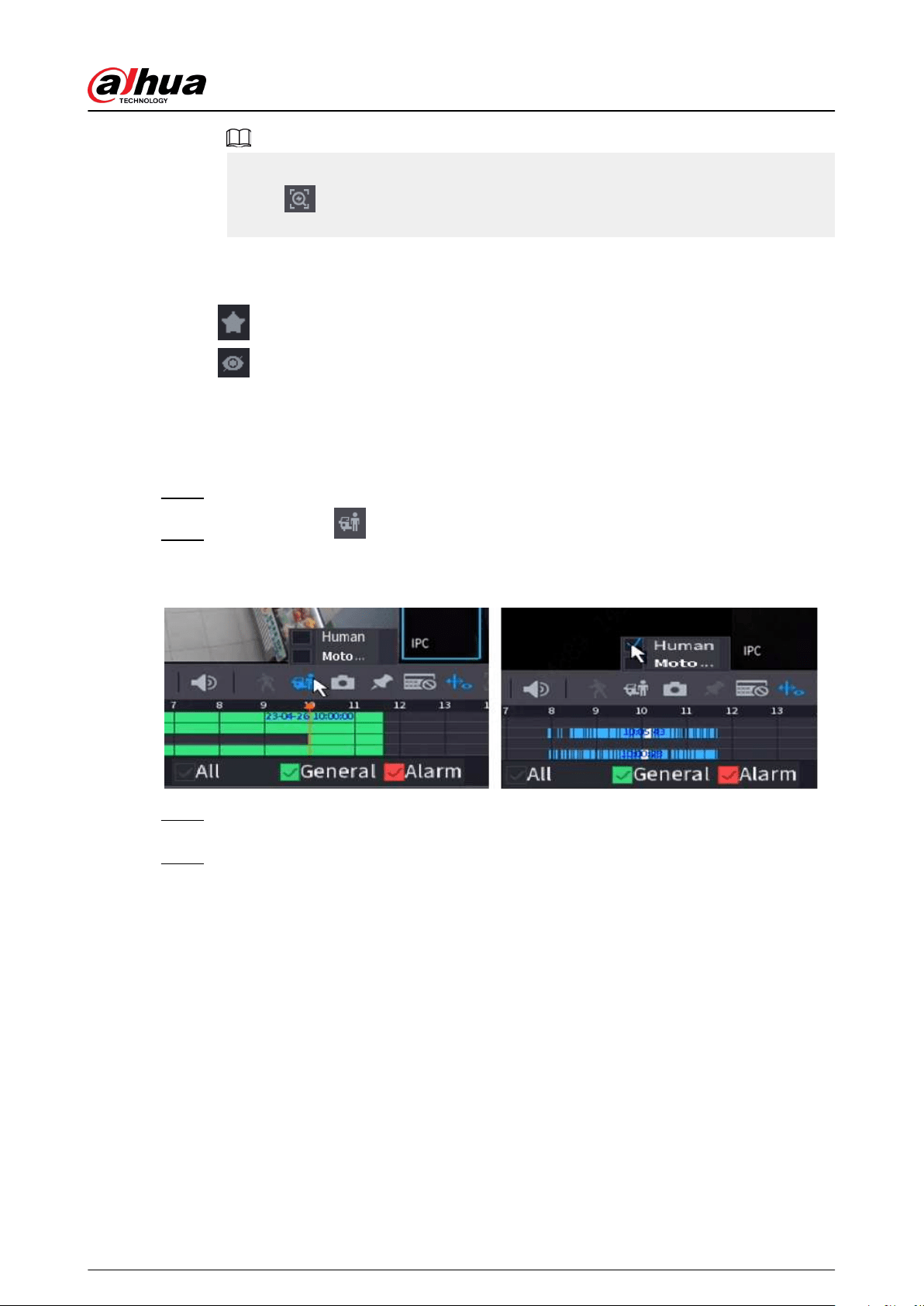
●
Under 4K resolution, the video does not support full screen play on this page.
●
Click
, you can enable the AcuPick function again, freeze the image and search for
the new target.
Related Operations
Hover over a search result, and then you can:
●
Click
, add the result into the favorite items. Up to 1,000 items can be added into favorites.
●
Click
, add the result into the hidden items.
5.8.2.4.2 Custom Search
Procedure
Step 1 Select Main Menu > SEARCH, or right-click on the live view page and then select Search.
Step 2 (Optional) Click to select the displayed results. You can choose Human and Motor
Vehicle.
Figure 5-90 Select the result
Step 3 In multiple-channel playback mode, double-click a channel to switch to one-channel
playback mode.
Step 4 Drag the mouse to draw a searching area in the image, and then the NVR will
automatically show search results of the selected area in the time bar (orange).
User's Manual
206
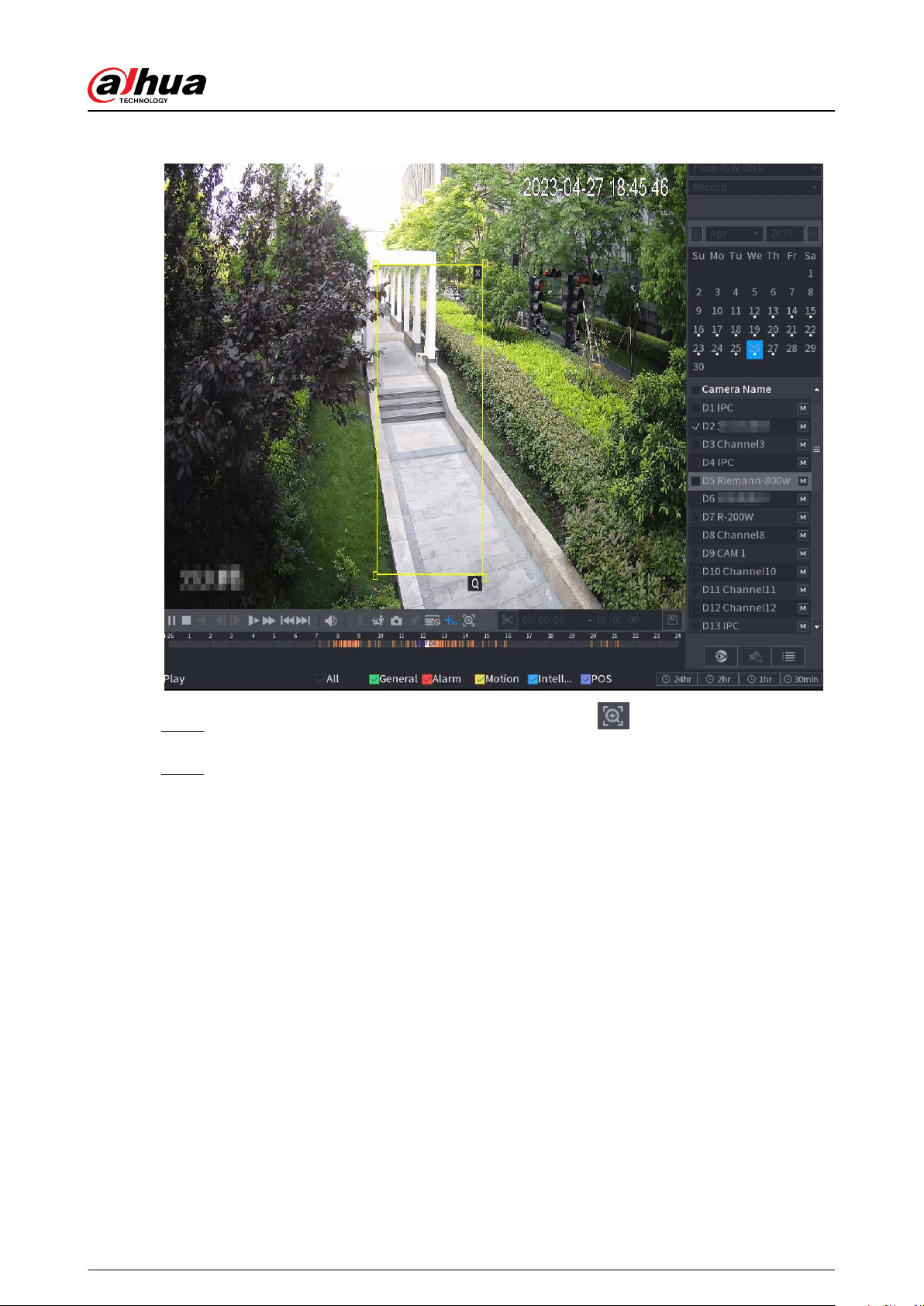
Figure 5-91 Custom search 1
Step 5 When you want to search the target in the image, click to freeze the page. The image
automatically shows the targets.
Step 6 Point to the time bar, the NVR displays the thumbnails in recent times.
User's Manual
207
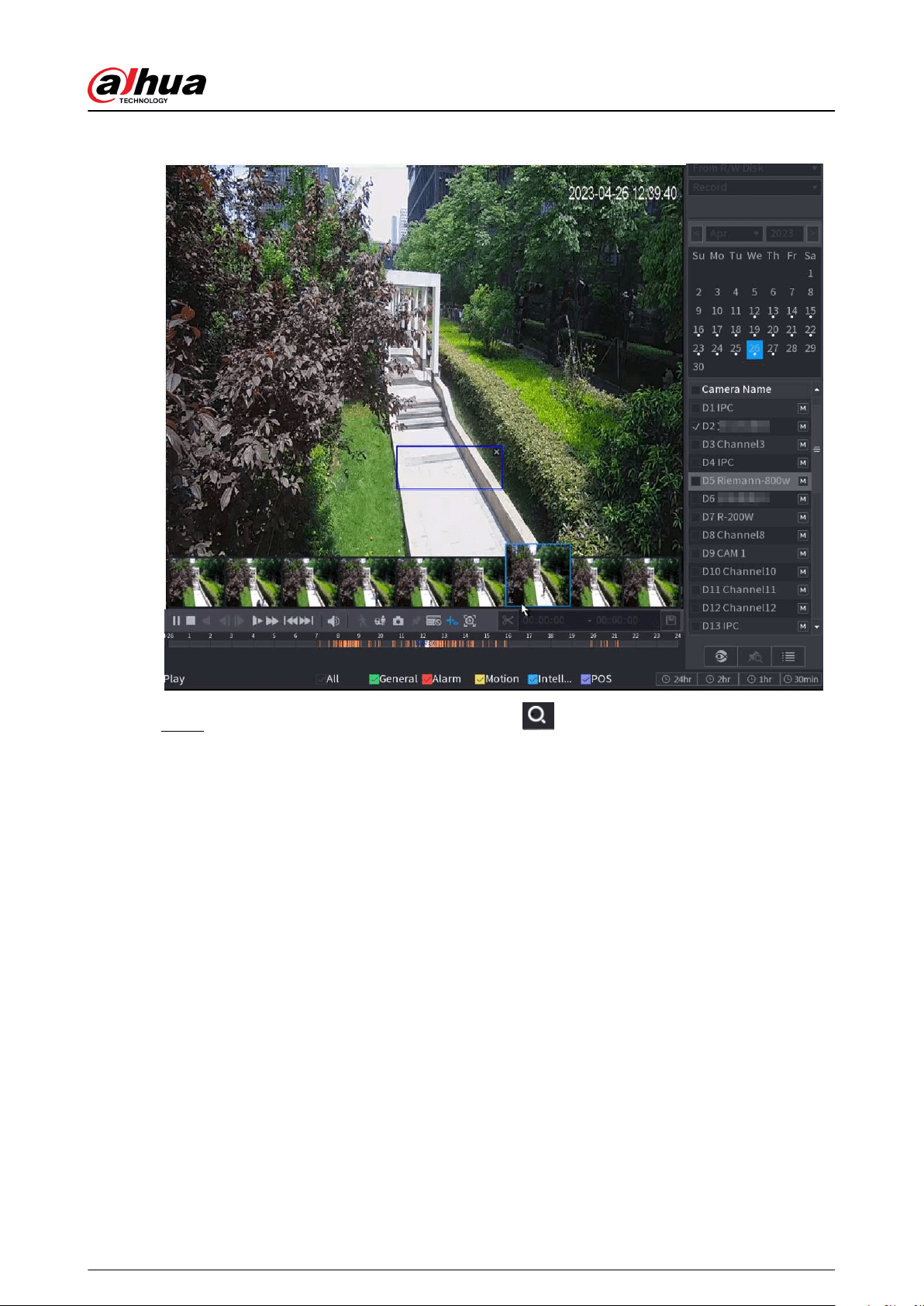
Figure 5-92 Thumbnails
Step 7 Point to the target you want, and then click to check the details.
User's Manual
208
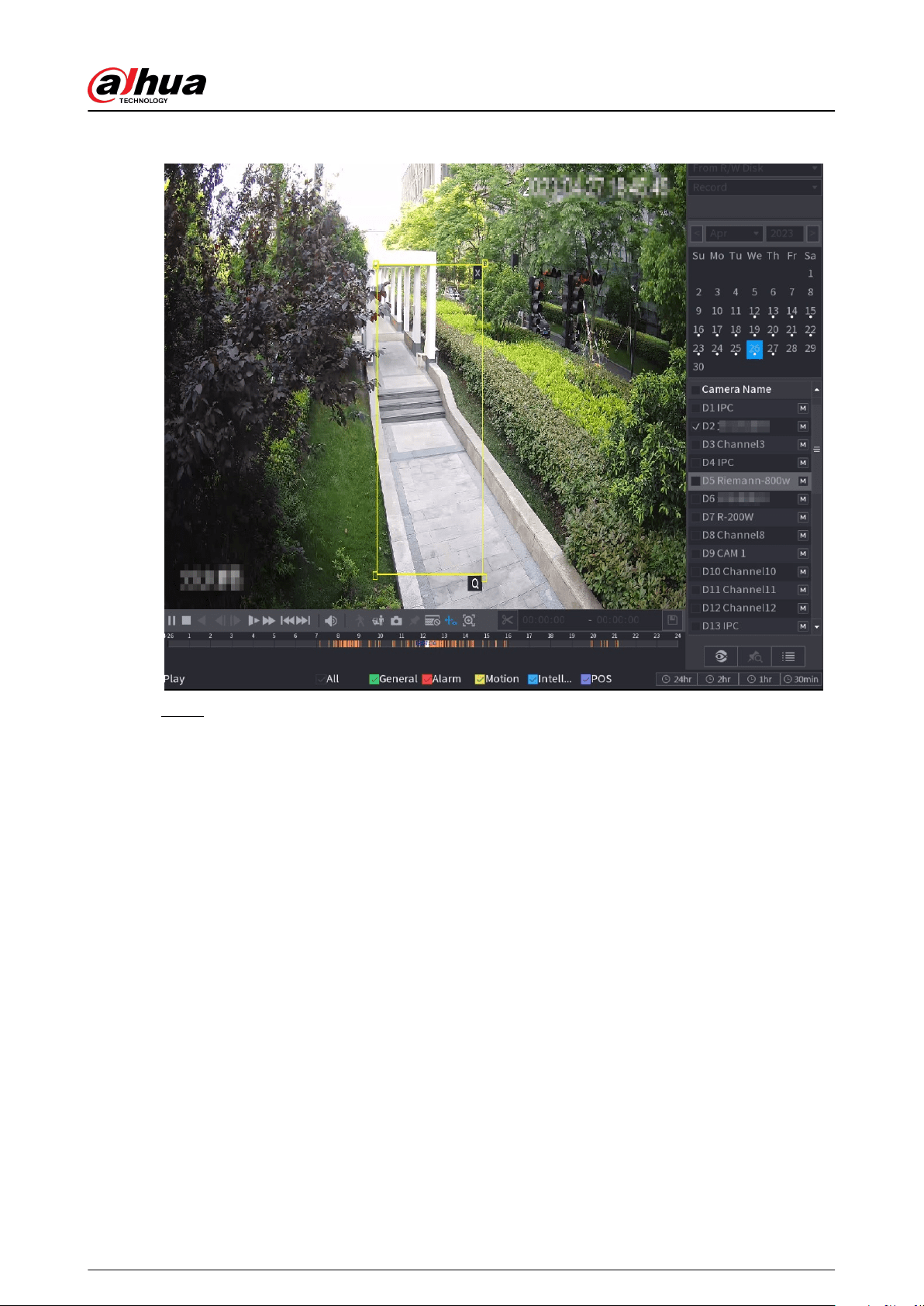
Figure 5-93 Custom search 2
Step 8 Congure the search conditions as needed.
User's Manual
209
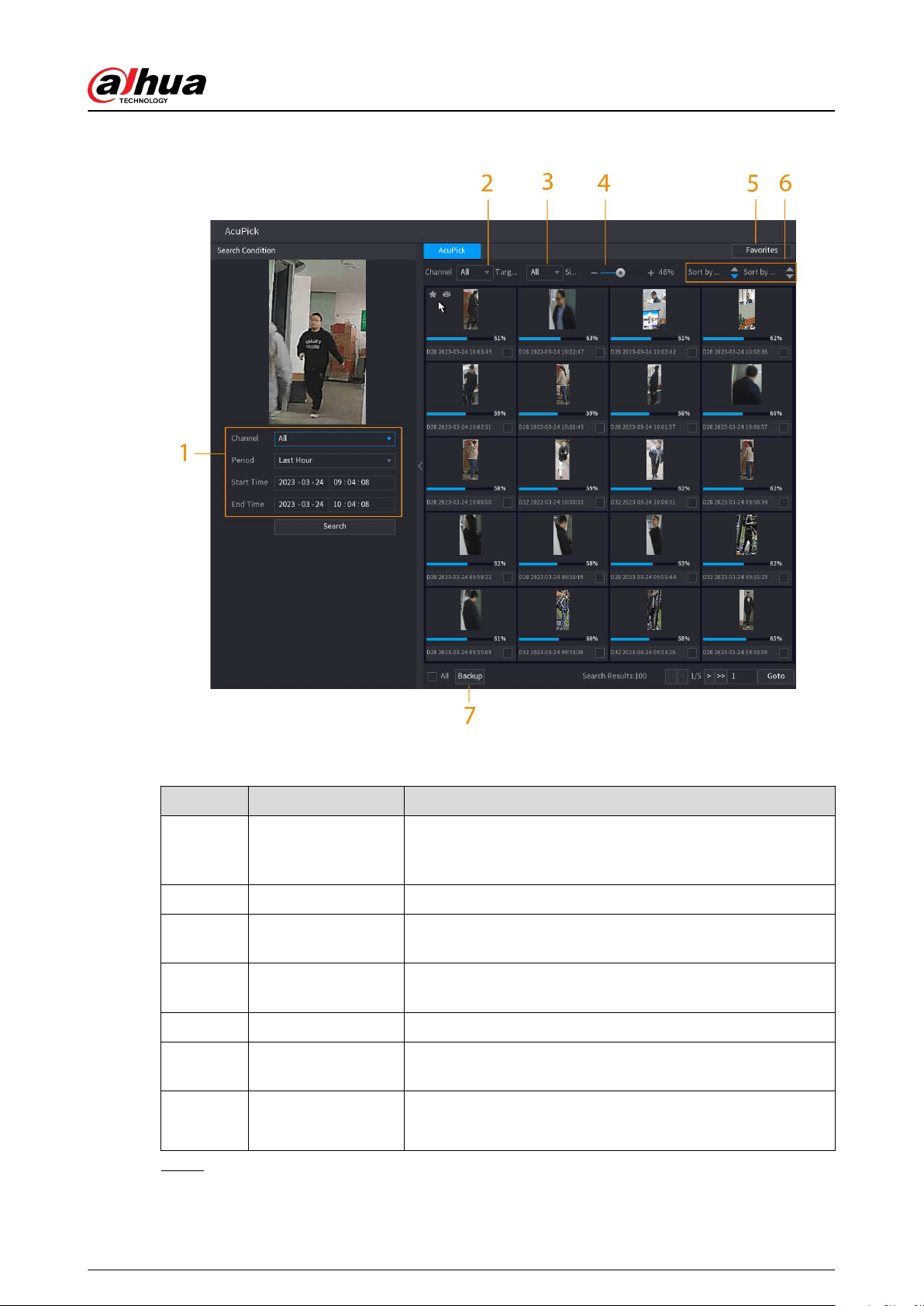
Figure 5-94 Search conditions and results
Table 5-29 Descriptions of search conditions and results
No. Name Description
1 Search Condition
Congure the channel and period. When choose Custom, you
can set the start time and end time as needed. Up to 7 days
can be set.
2 Channel Displays the channels with search result.
3 Target Filter
Select from All , Favorite Items and Hidden Items. When you
select the target items, the device will only search in this item.
4 Similarity
Congure the search similarity according to the actual
conditions. The recommended value is 80% or above.
5 Favorites The system only search the target in favorites.
6
Sort by Time/ Sort by
Similarity
Reorder the search results by time or similarity.
7 Backup
You can select one or more search results, and then click
Backup to back up the results.
Step 9 Select a result, and then double click it to check the video.
User's Manual
210
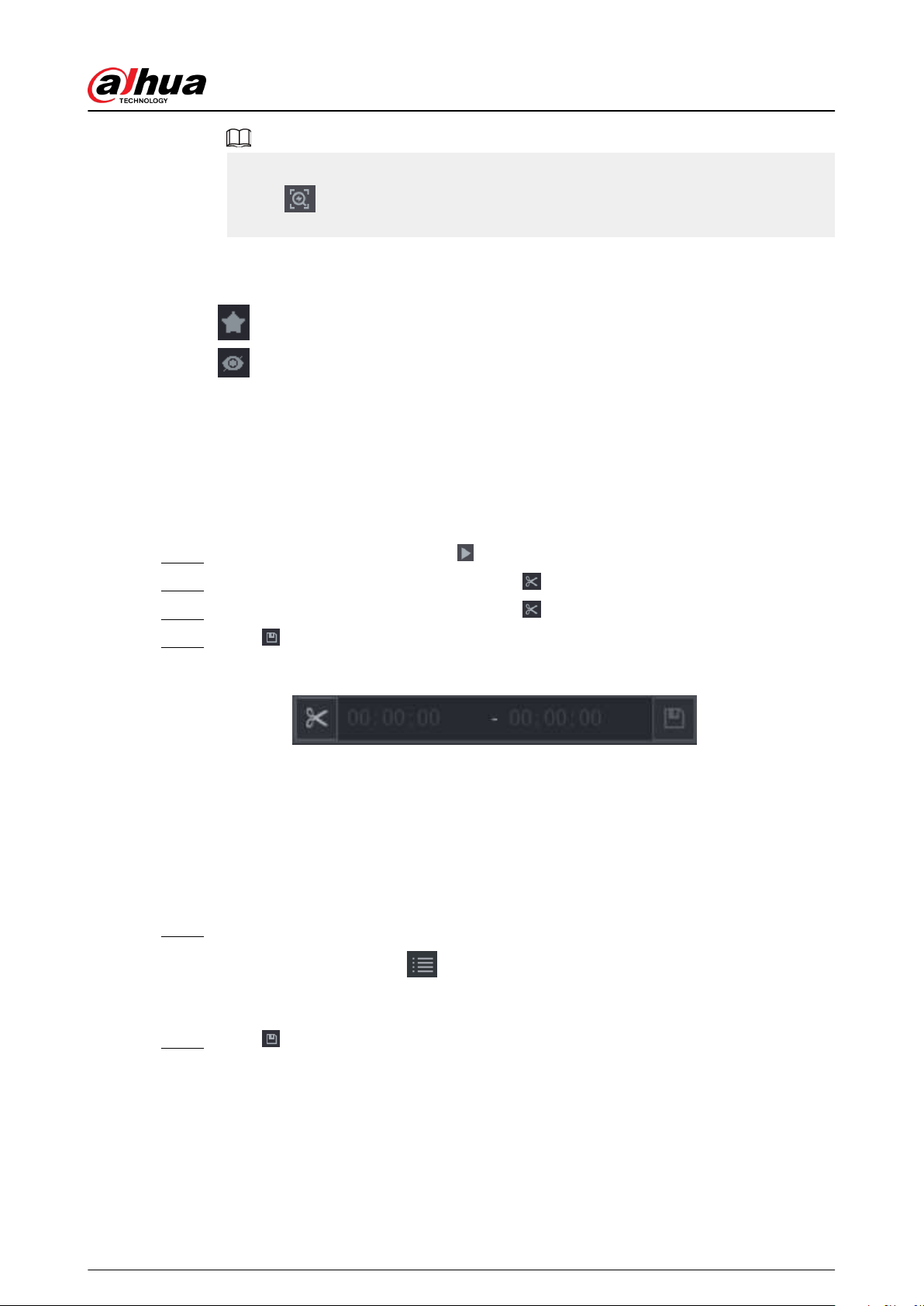
●
Under 4K resolution, the video does not support full screen play on this page.
●
Click
, you can enable the AcuPick function again, freeze the image and search for
the new target.
Related Operations
Hover over a search result, and then you can:
●
Click
, add the result into the favorite items. Up to 1,000 items can be added into favorites.
●
Click
, add the result into the hidden items.
5.8.2.5 Clipping Videos
Background Information
You can clip some footage from recorded videos to a new le and then save to the USB device.
Procedure
Step 1 Select a record rst and then click to play back.
Step 2 Select a time on the time bar and then click to start clip.
Step 3 Select a time on the time bar and then click to stop clip.
Step 4 Click , the system pops up dialogue box to save the clip le.
Figure 5-95 Clip
5.8.2.6 Backing Up
Background Information
You can back up recorded videos, images, or video clips to a USB storage device.
Procedure
Step 1 Select the les that you want to back up.
●
Videos or images. Click
at the lower-right corner of the search page, and then on
the le list, select the les for backup.
●
Video clips. See "5.8.2.5 Clipping Videos".
Step 2 Click .
User's Manual
211
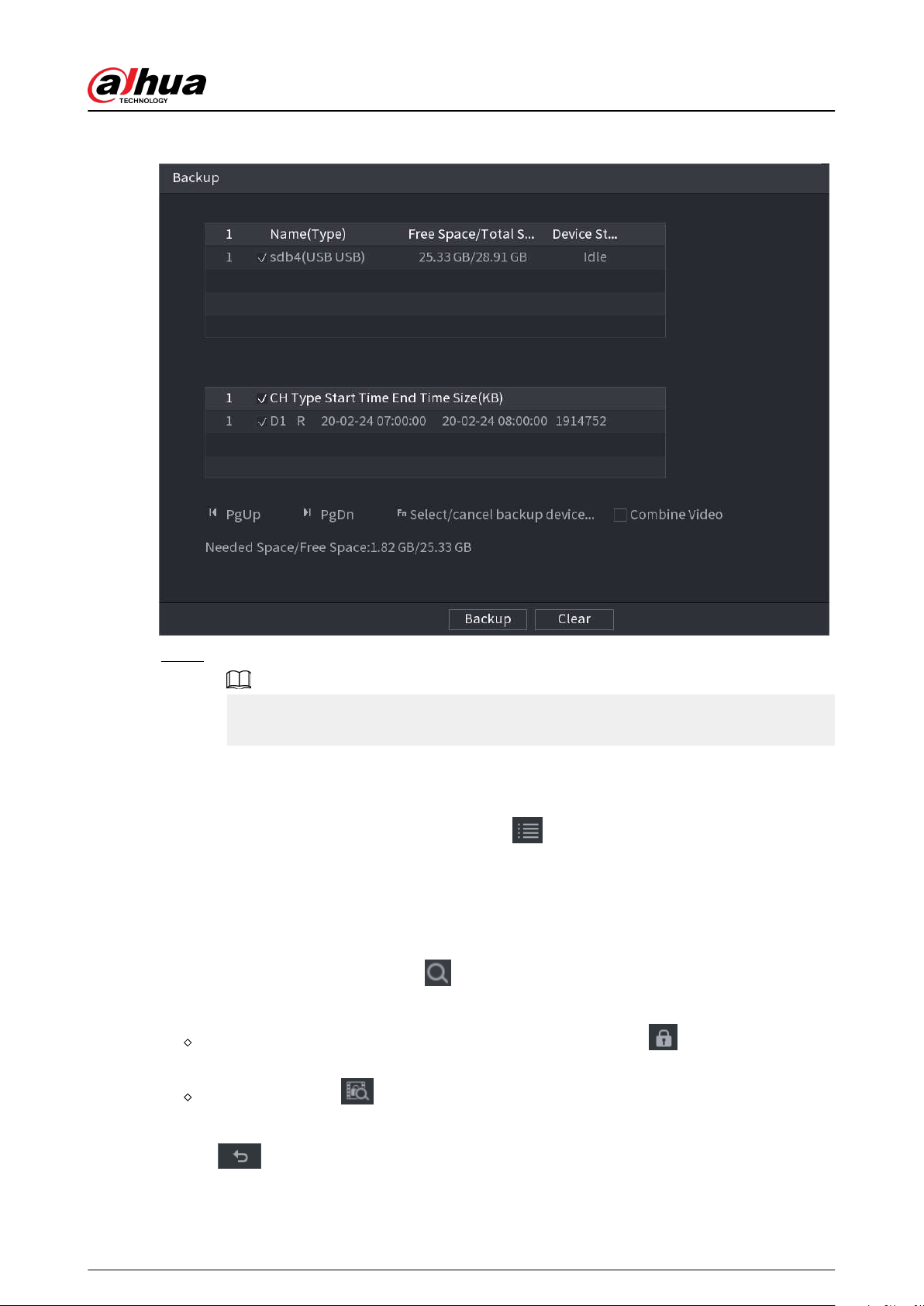
Figure 5-96 Backup
Step 3 Select the storage device, and then click Backup.
●
You can cancel the selection of the les that you do not want to back up.
●
Select Combine Video to merge several videos into one.
5.8.2.7 File List
On the search page, select a channel, and then click
to view the le list. On the le list, you can
manage the les of the selected channel.
●
Play.
Double-click a le to play.
●
Search.
Select a specic time and then click
.
●
Lock or unlock les.
To lock les, on the le list, select one or more les, and then click . The locked les will
not be overwritten.
To unlock les, click . and then select one or more les and then click Unlock.
●
Go back to the previous page.
Click
to return to the page with calendar.
User's Manual
212
5.8.2.8 Tag Playback
When you are playing back a video, you can add a tag to mark an important point in time on the
video. After playback, you can use time or the tag keywords to search for the corresponding video
and then play.
Adding Tag
When the system is playing back, click
, and then congure the tag name.
Playing back Tag
During single-channel playback, click
, and then on the tag list, double-click a le to play back.
To search for tagged videos by time, select the tag time and then click .
Playing before Tagged Time
You can choose to play back from the previous N seconds of the tag time.
The system can play back previous N seconds before the tagged time if there is a video at that
point. Otherwise, the system plays back as much as there is.
Managing Tags
On the tag list, click
.
User's Manual
213
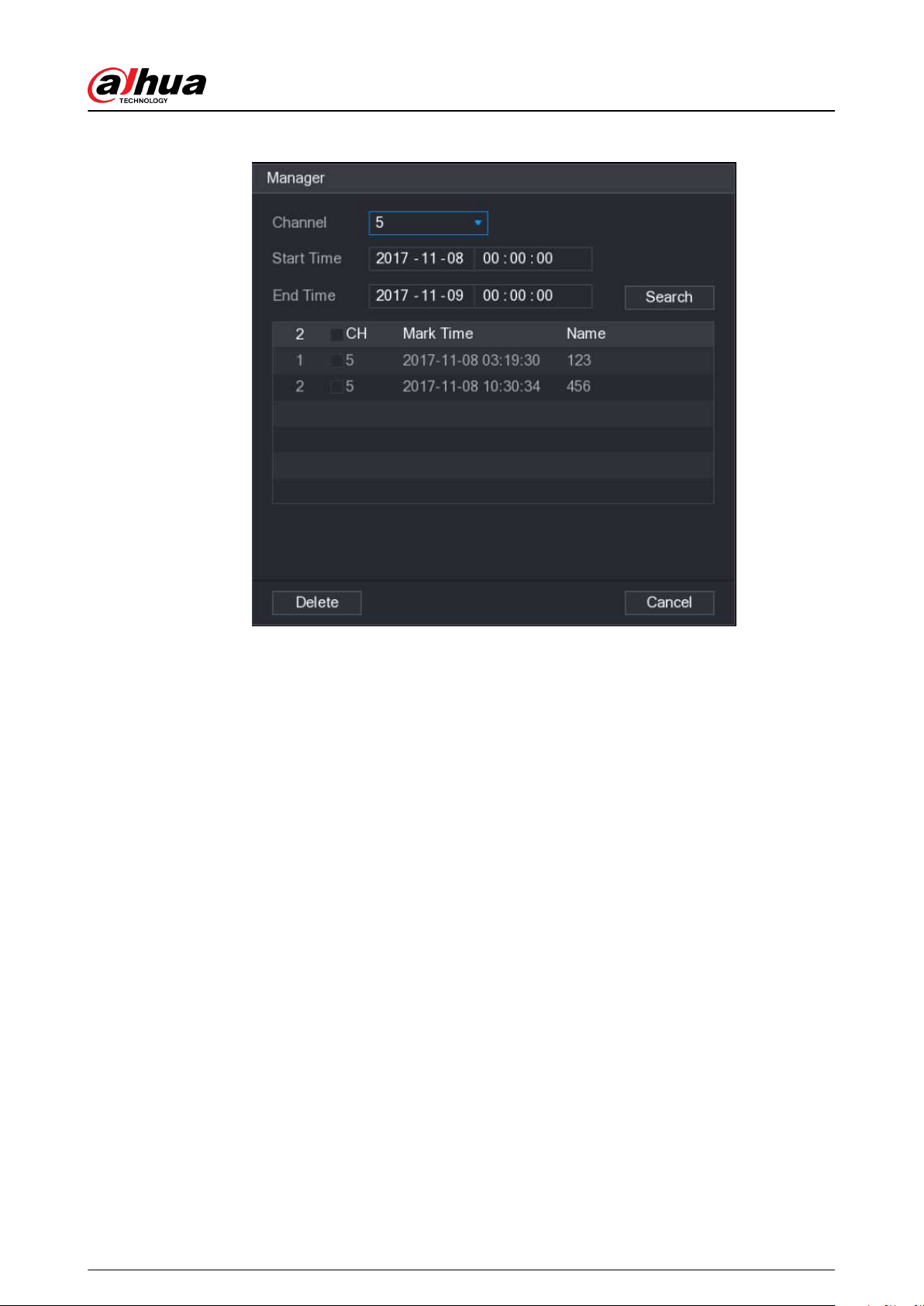
Figure 5-97 Tag management
●
To search for the tagged video, select channel number, start time and end time, and then click
Search.
●
To change the tag name, double-click a tagged video, and then enter the new name.
●
To delete tags, select one or more tagged videos, and then click Delete.
5.8.3 Recording Information
Select Main Menu > MAINTAIN > System Info to view the recording information.
User's Manual
214
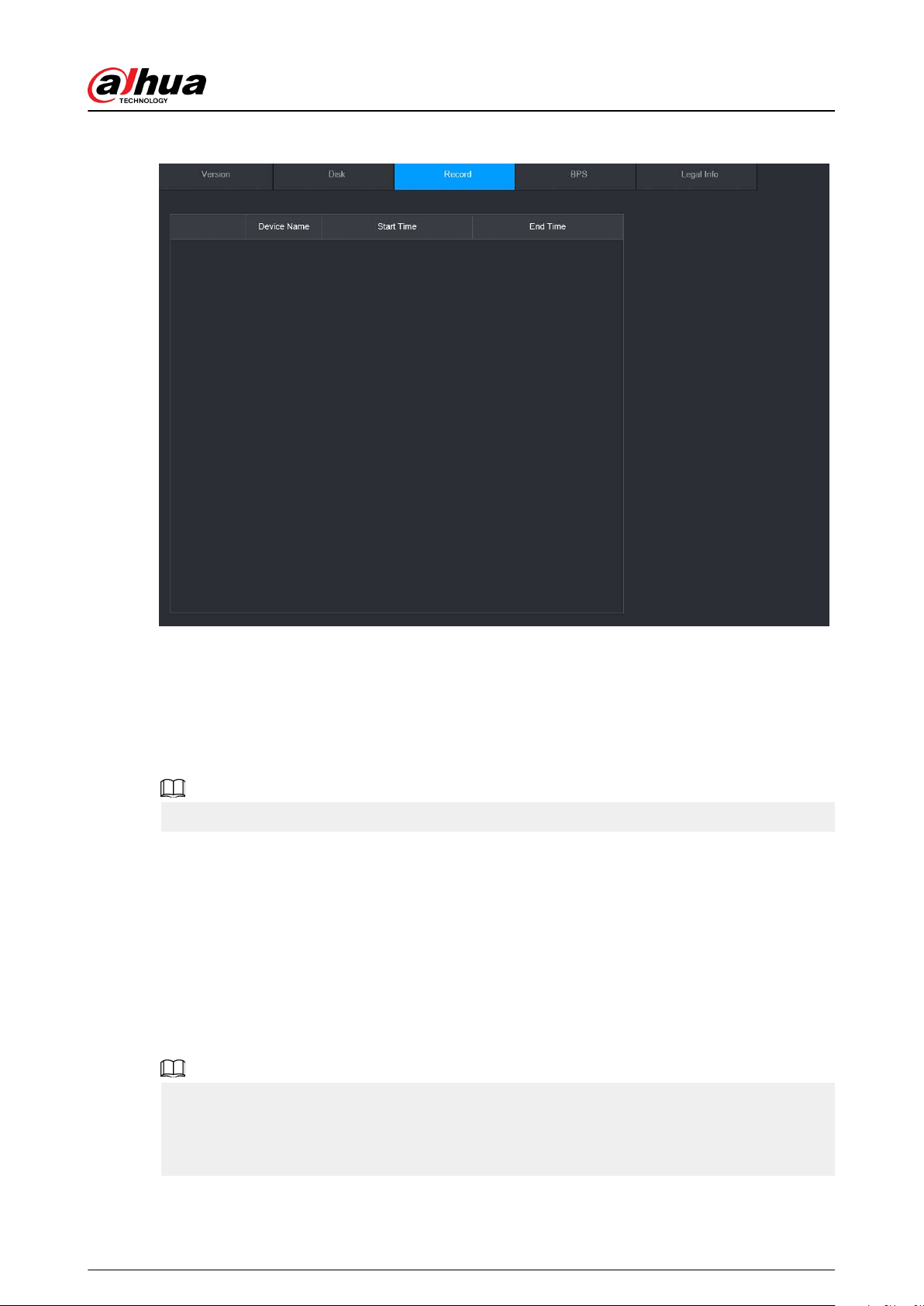
Figure 5-98 Recording information
5.9 AI
AI detection is to process and analyze the image and extract the key information, and then
compare the key information with the preset detection rule. An alarm is triggered when the
detected behavior matches the detection rule.
The following gures are for reference only and might dier from the actual situation.
5.9.1 Overview
AI detection falls into AI by camera and AI by recorder.
●
AI by camera: Some cameras themselves support AI detection. The cameras perform AI
detection and send the detection results to the NVR for display. When using AI by camera, make
sure to connect the Device to the cameras that support the corresponding AI detection
functions.
●
AI by recorder: The cameras send videos to NVR for detection, analysis and result display.
●
Some models support AI by camera only.
●
The AI functions might vary with models.
●
Dierent AI functions might conict with each other. You cannot enable two conicting AI
functions for the same channel.
User's Manual
215
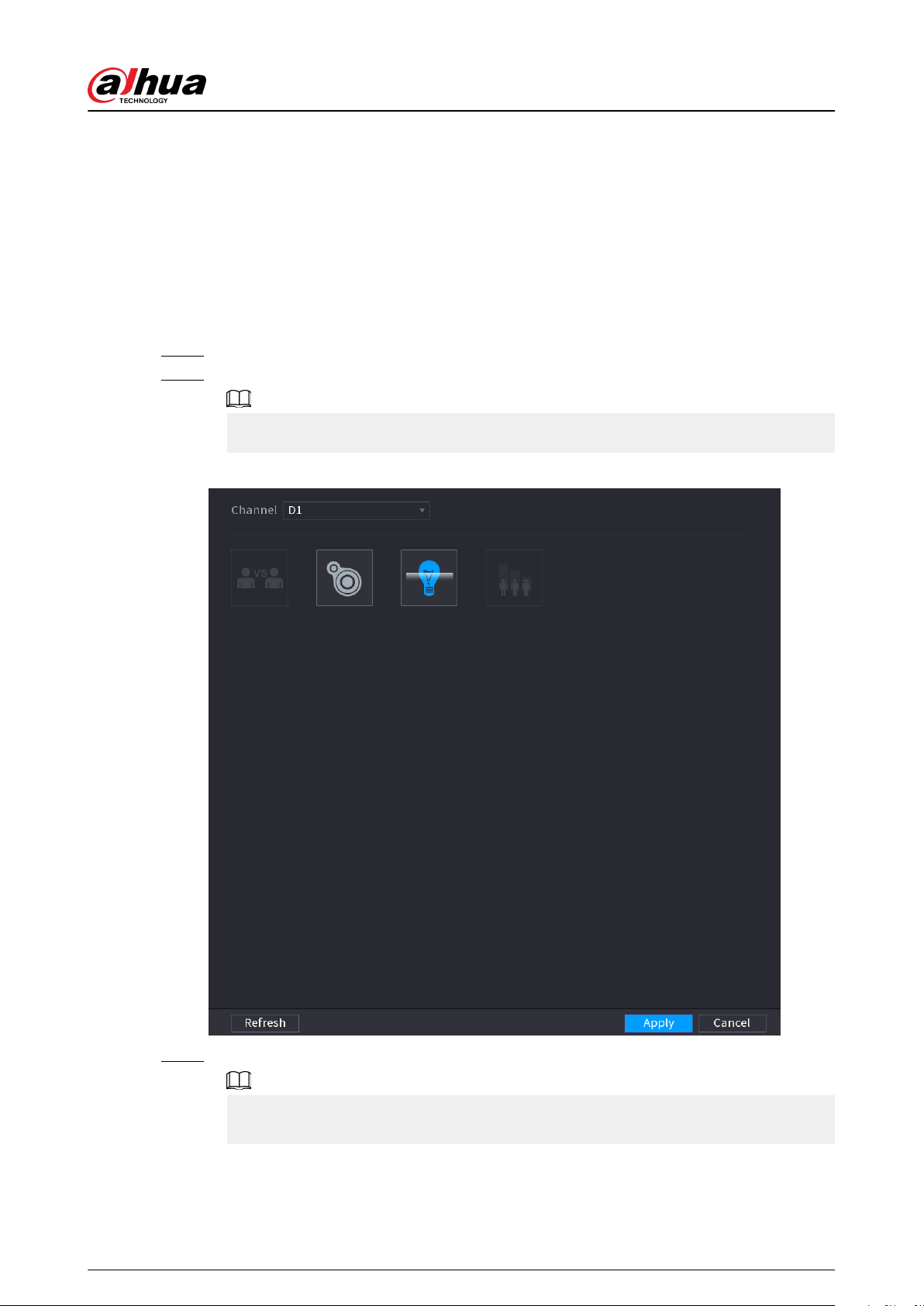
5.9.2 Smart Plan
5.9.2.1 Conguring Smart Plan
Background Information
To use AI by camera for face detection, face recognition and other detection functions, you need to
enable the corresponding smart plan rst.
Procedure
Step 1 Select Main Menu > AI > Parameters > Smart Plan.
Step 2 Select a channel.
The page might dier depending on which smart plans that the remote device supports.
Figure 5-99 Smart plan
Step 3 Click the icon that represents the smart plan to enable it. The icon becomes highlighted.
If the channel is connected to a PTZ camera, you can set smart plans separately for each
preset point.
User's Manual
216
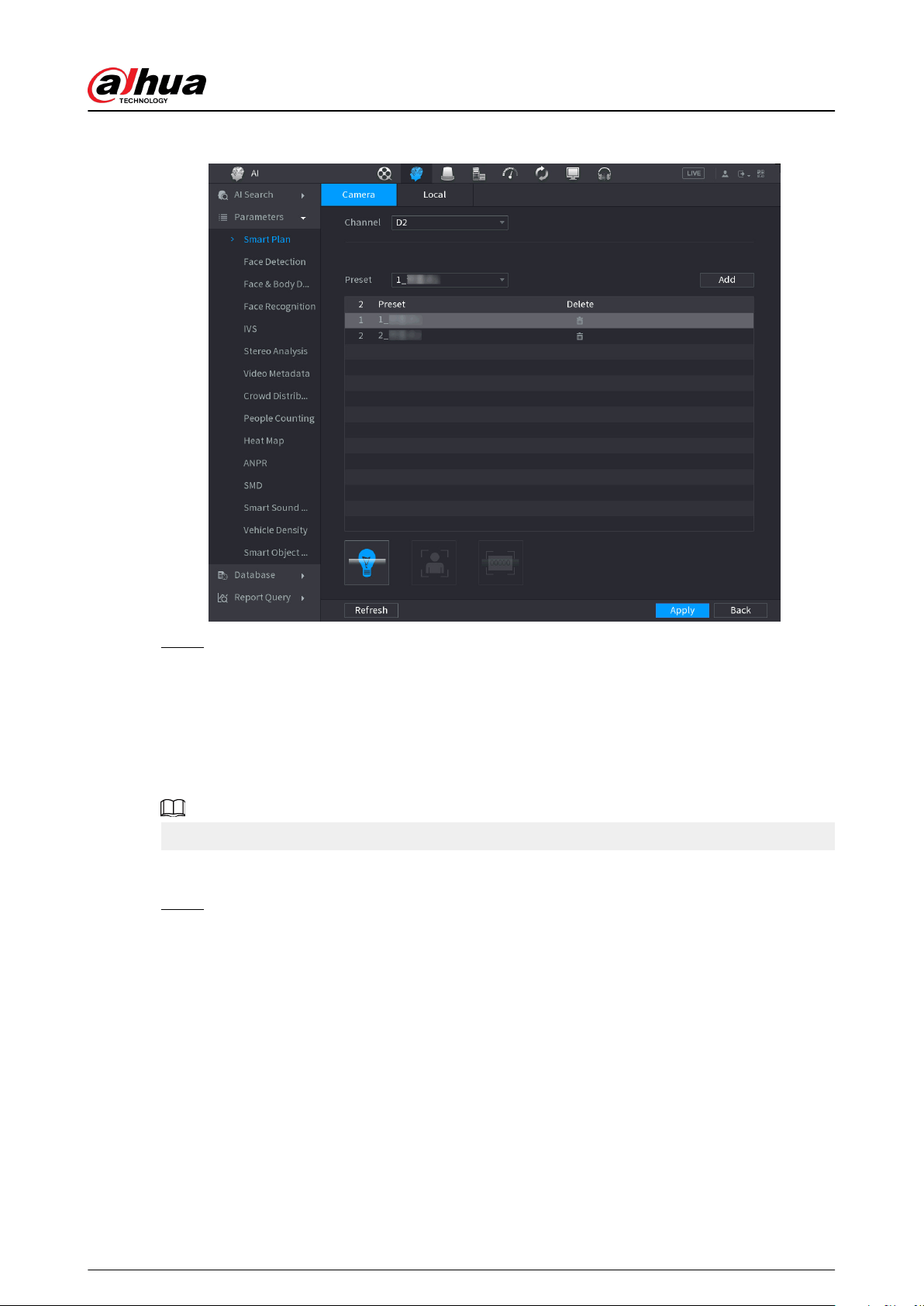
Figure 5-100 Smart plan (PTZ)
Step 4 Click Apply.
5.9.2.2 Conguring AcuPick Mode
Use cameras and NVRs with intelligent analysis capability to achieve accurate and quick search
about human bodies and motor vehicles.
Background Information
Make sure both the camera and NVR support AcuPick function.
Procedure
Step 1 Select Main Menu > AI > Parameters > Smart Plan > Camera.
a. Select the channel.
AcuPick is enabled by default.
User's Manual
217
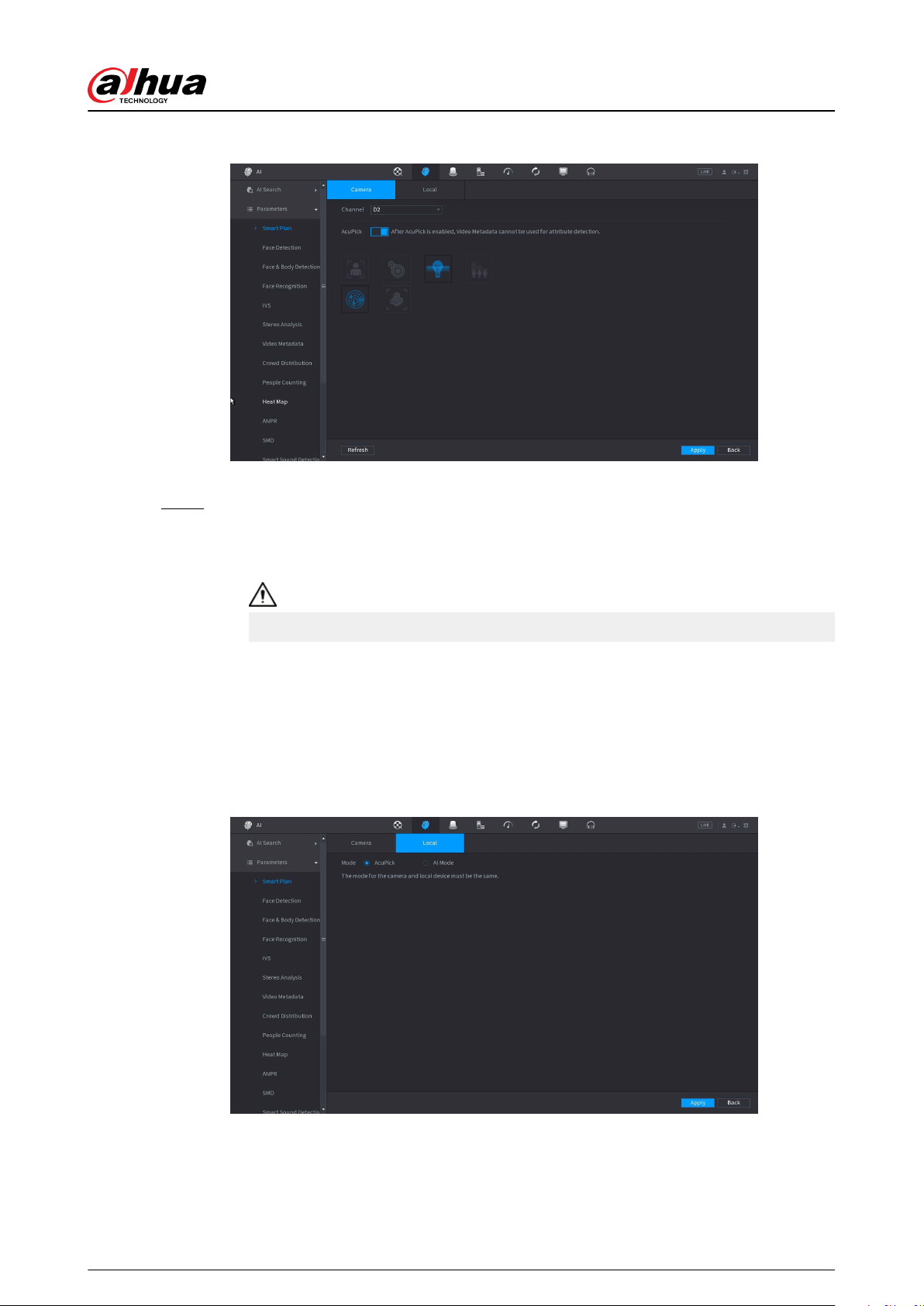
Figure 5-101 Camera
b. Click Apply.
Step 2 Select Main Menu > AI > Parameters > Smart Plan > Local.
a. Select the mode.
AcuPick is enabled by default.
After changing the mode, the NVR will automatically restart.
●
When AcuPick is enabled, the auxiliary screen cannot display images in 4K
resolution. AI by Recorder including face detection, face recognition, perimeter
protection and SMD cannot be enabled, and sheye dewarping is not supported.
●
When AI Mode is enabled, AcuPick of devices is not supported. AI by Recorder
including face detection, face recognition, perimeter protection and SMD can be
enabled, and sheye dewarping is supported.
Figure 5-102 Local
b. Click Apply.
User's Manual
218
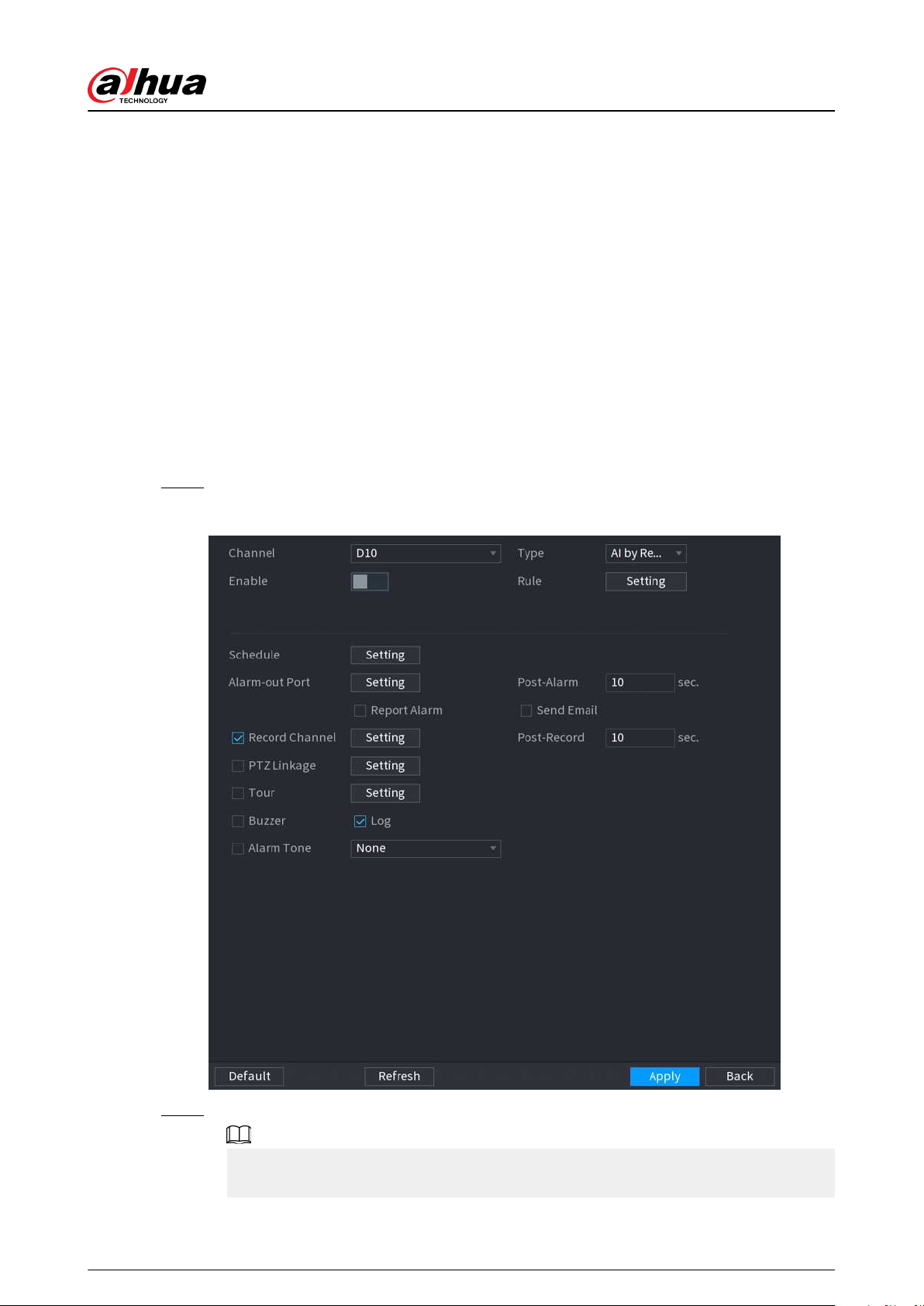
5.9.3 Face Detection
The Device can detect faces on the video image.
5.9.3.1 Enabling Smart Plan
To use AI by camera, you need to enable the smart plan rst. For details, see "5.9.2 Smart Plan".
5.9.3.2 Conguring Face Detection
Background Information
Congure alarm rules for face detection.
Procedure
Step 1 Select Main Menu > AI > Parameters > Face Detection.
Figure 5-103 Face detection
Step 2 Select a channel, and then select AI by Reorder or AI by Camera as Type.
When AI by Camera is selected, you can enable Face Enhancement to improve face
detection eciency.
User's Manual
219
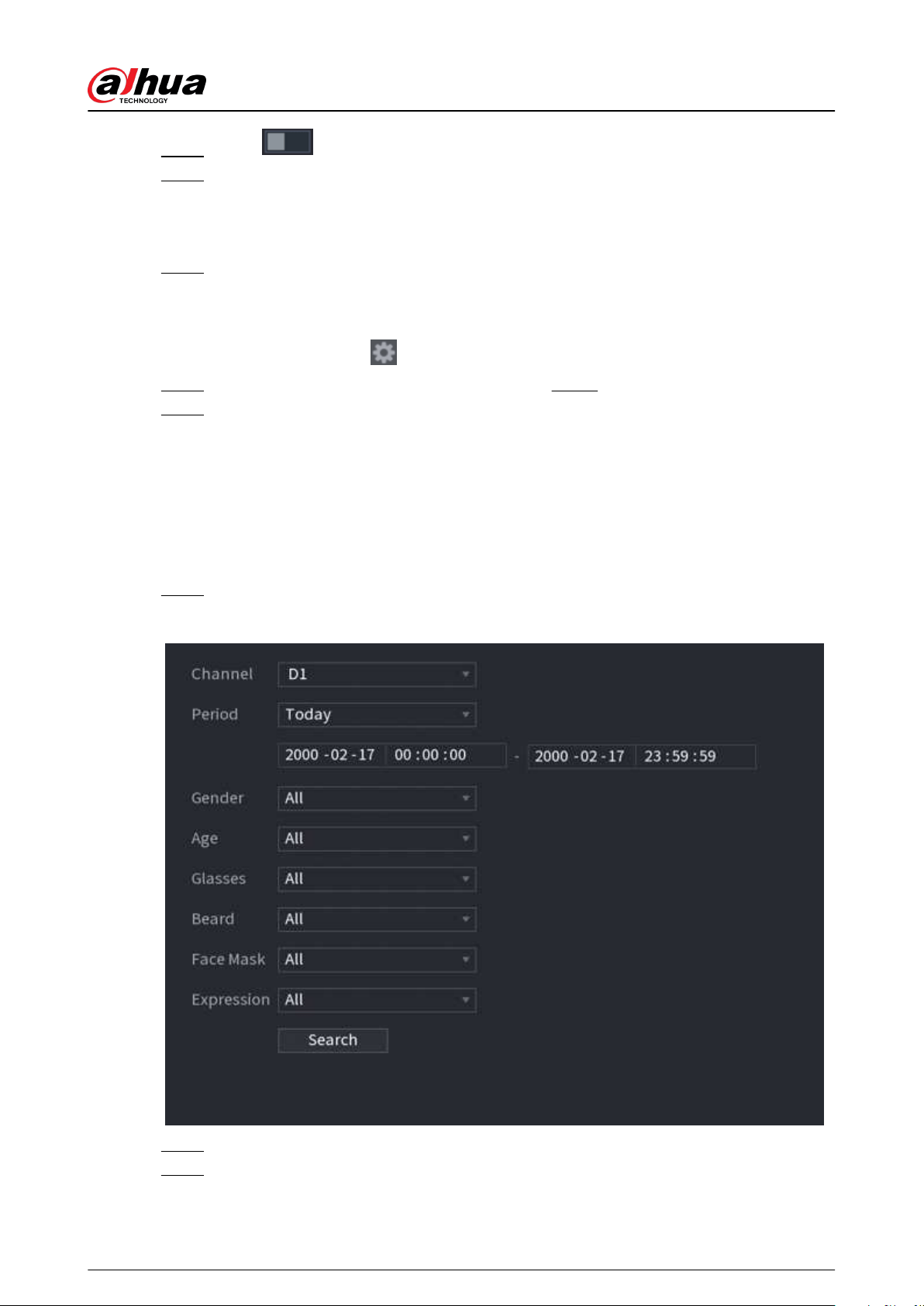
Step 3 Click to enable face detection.
Step 4 Click Setting next to Rule to draw areas to lter the target.
You can congure two target lters (maximum size and minimum size). The system
triggers an alarm when the size of detected target is between the maximum size and the
minimum size.
Step 5 Click Setting next to Schedule to congure the arming period.
The system triggers corresponding alarm actions only during the arming period.
●
On the time line, drag to set the period.
●
You can also click
to set the period.
Step 6 Congure alarm linkage actions. For details, see Step 7 .
Step 7 Click Apply.
5.9.3.3 AI Search (Face Detection)
Background Information
You can search for the detected faces and play back related recordings.
Procedure
Step 1 Select Main Menu > AI > AI Search > Face Detection.
Figure 5-104 Face search
Step 2 Select the channel, enter the start time and end time, and select the attributes.
Step 3 Click Search.
The results are displayed.
User's Manual
220
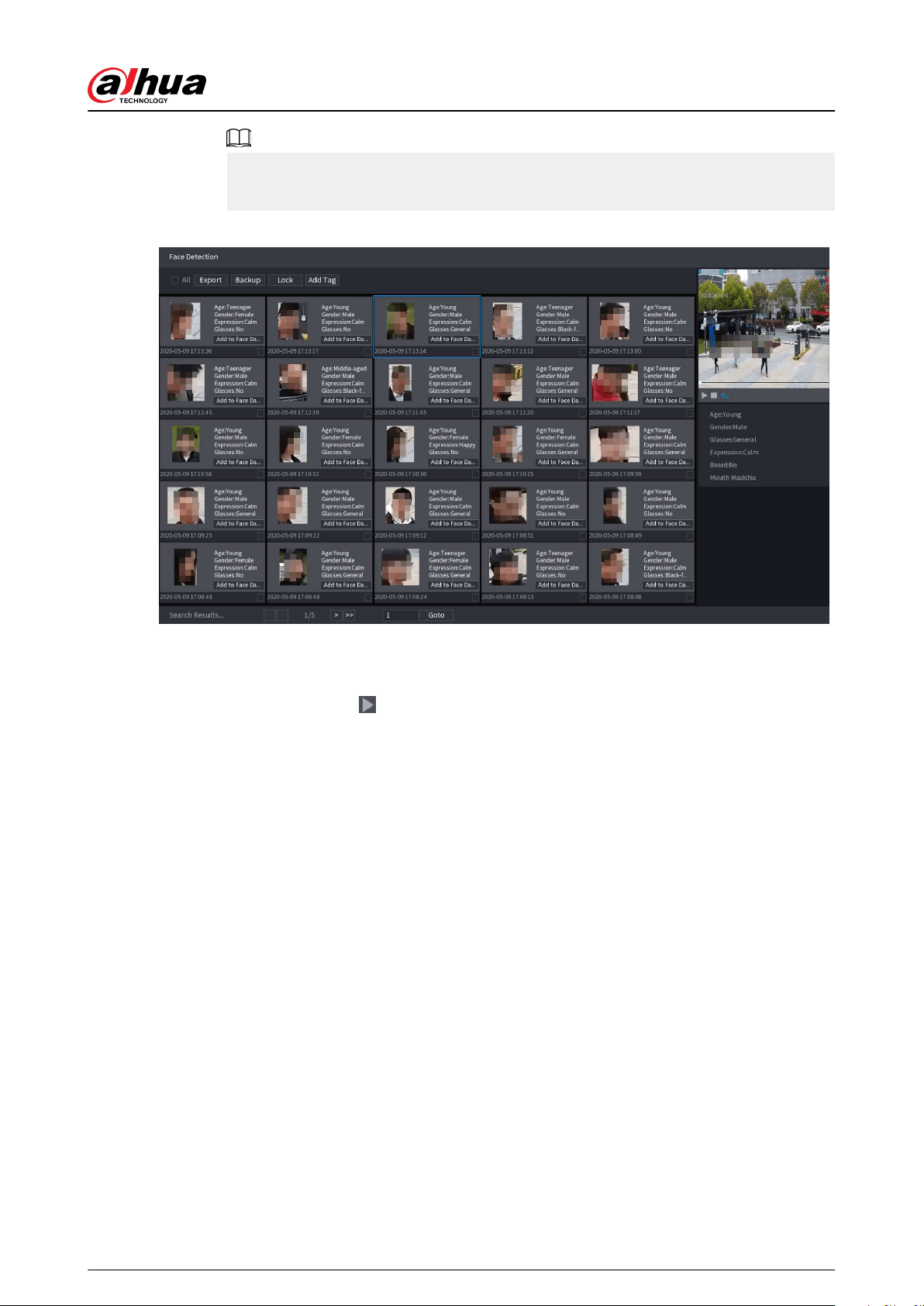
For privacy reason, the human faces in the image are intentionally blurred. The actual
image is clear.
Figure 5-105 Search results
Related Operations
●
Play related video.
Click a face and then click
. The system plays back the video around the snapshot time.
●
Export.
Click Export to export results in Excel format.
●
Back up.
Select one or more images, click Backup , select the storage path and le type, and then click
Start to back up the selected les to an external storage device.
●
Lock.
Select one or more images and then click Lock. The locked les will not be overwritten.
●
Add tags.
Select one or more images and then click Add Tag.
●
Add to face database.
Click Add to Face Database, enter corresponding information, and then add the image to the
face database.
User's Manual
221
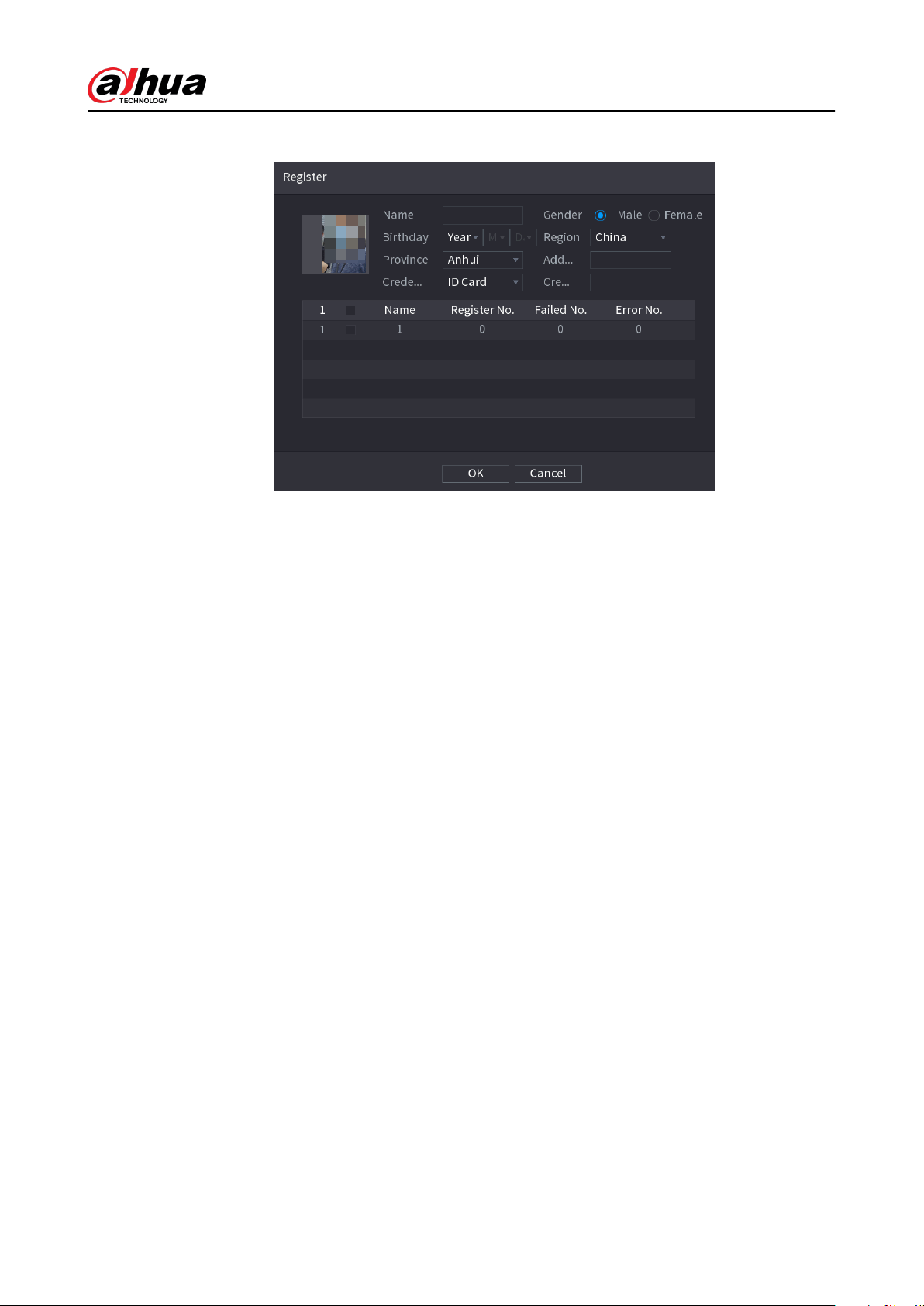
Figure 5-106 Add face image to database
5.9.4 Face & Body Detection
After enabling face & body detection, you can view the face and body snapshots and related
attributes on the live page.
5.9.4.1 Enabling Smart Plan
To use AI by camera, you need to enable the smart plan rst. For details, see "5.9.2 Smart Plan".
5.9.4.2 Conguring Face & Body Detection
Background Information
Congure alarm rules for face and body detection.
Procedure
Step 1 Select Main Menu > AI > Parameters > Face Detection.
User's Manual
222
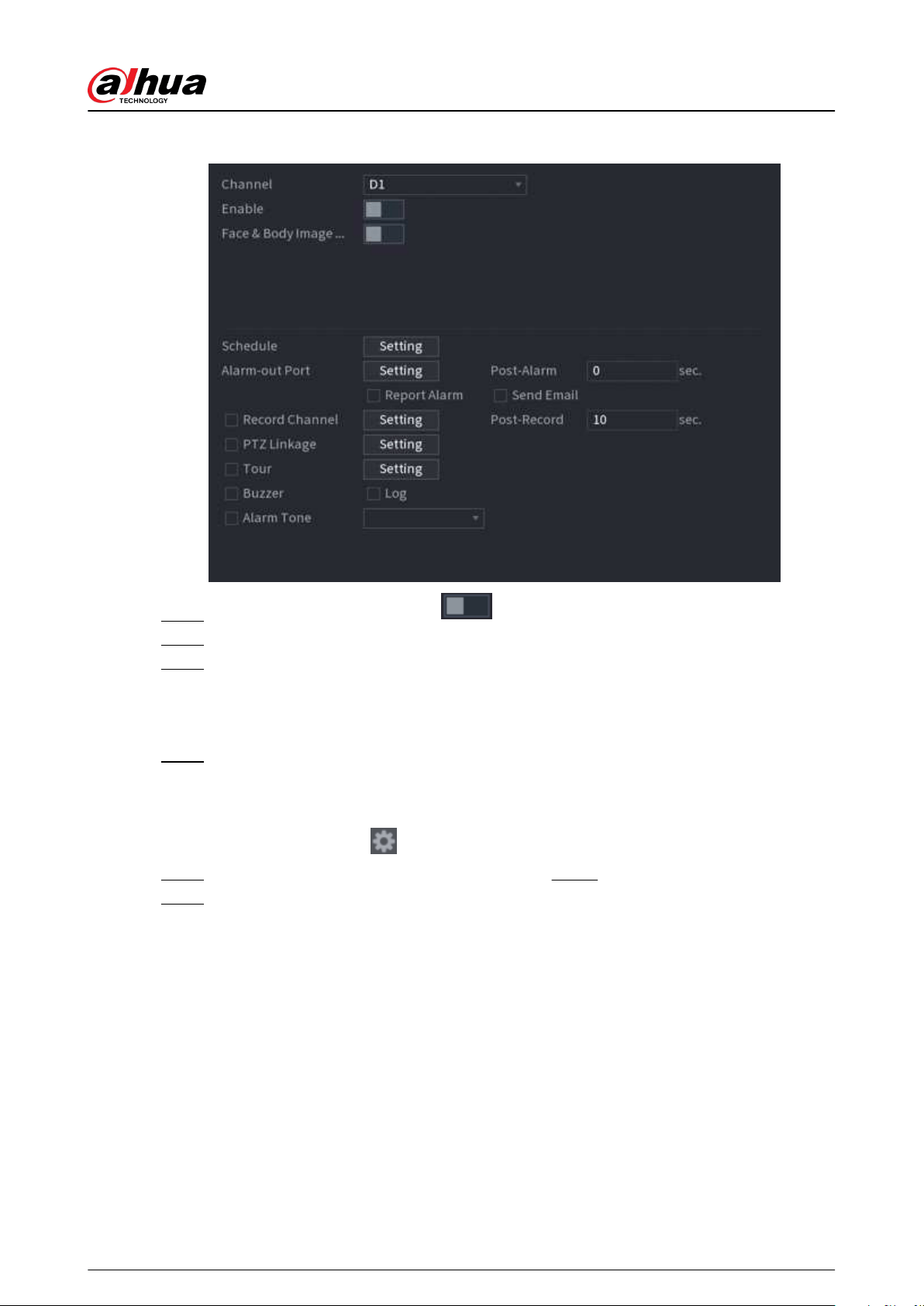
Figure 5-107 Face and body detection
Step 2 Select a channel, and then click to enable the function.
Step 3 Enable Face & Body Image Enhancement to improve detection eciency.
Step 4 Congure target lters.
You can congure two target lters (maximum size and minimum size). The system
triggers an alarm when the size of detected target is between the maximum size and the
minimum size.
Step 5 Click Setting next to Schedule to congure the arming period.
The system triggers corresponding alarm actions only during the arming period.
●
On the time line, drag to set the period.
●
You can also click
to set the period.
Step 6 Congure alarm linkage actions. For details, see Step 7 .
Step 7 Click Apply.
5.9.4.3 AI Search (Face & Body Detection)
To search for face detection results, see "5.9.3.3 AI Search (Face Detection)". To search for body
detection results, see "5.9.8.3.1 Human Detection".
5.9.5 Face Recognition
The system compares the detected faces with the faces in the database to judge whether the
detected face belongs to the database. When the similarity reaches the dened threshold, an alarm
is triggered.
User's Manual
223
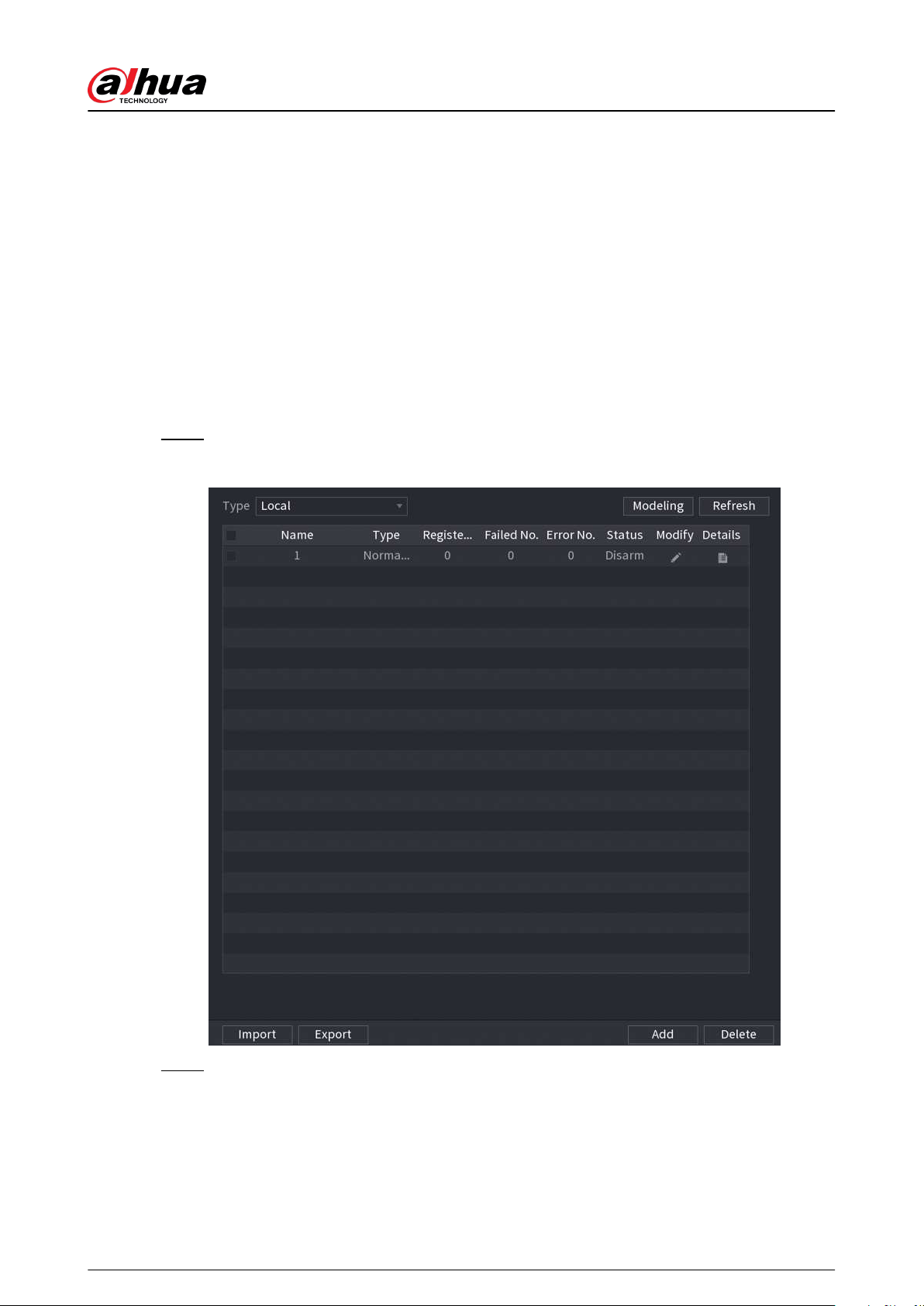
5.9.5.1 Enabling Smart Plan
To use AI by camera, you need to enable the smart plan rst. For details, see "5.9.2 Smart Plan".
5.9.5.2 Creating Face Database
Create face databases to manage face images for face recognition.
5.9.5.2.1 Creating Local Face Databases
You can create face databases on the Device to manage face images for face recognition by Device.
Procedure
Step 1 Select Main Menu > AI > Database > Face Database Cong.
Figure 5-108 Face database conguration
Step 2 Select Local as Type, and then click Add.
User's Manual
224
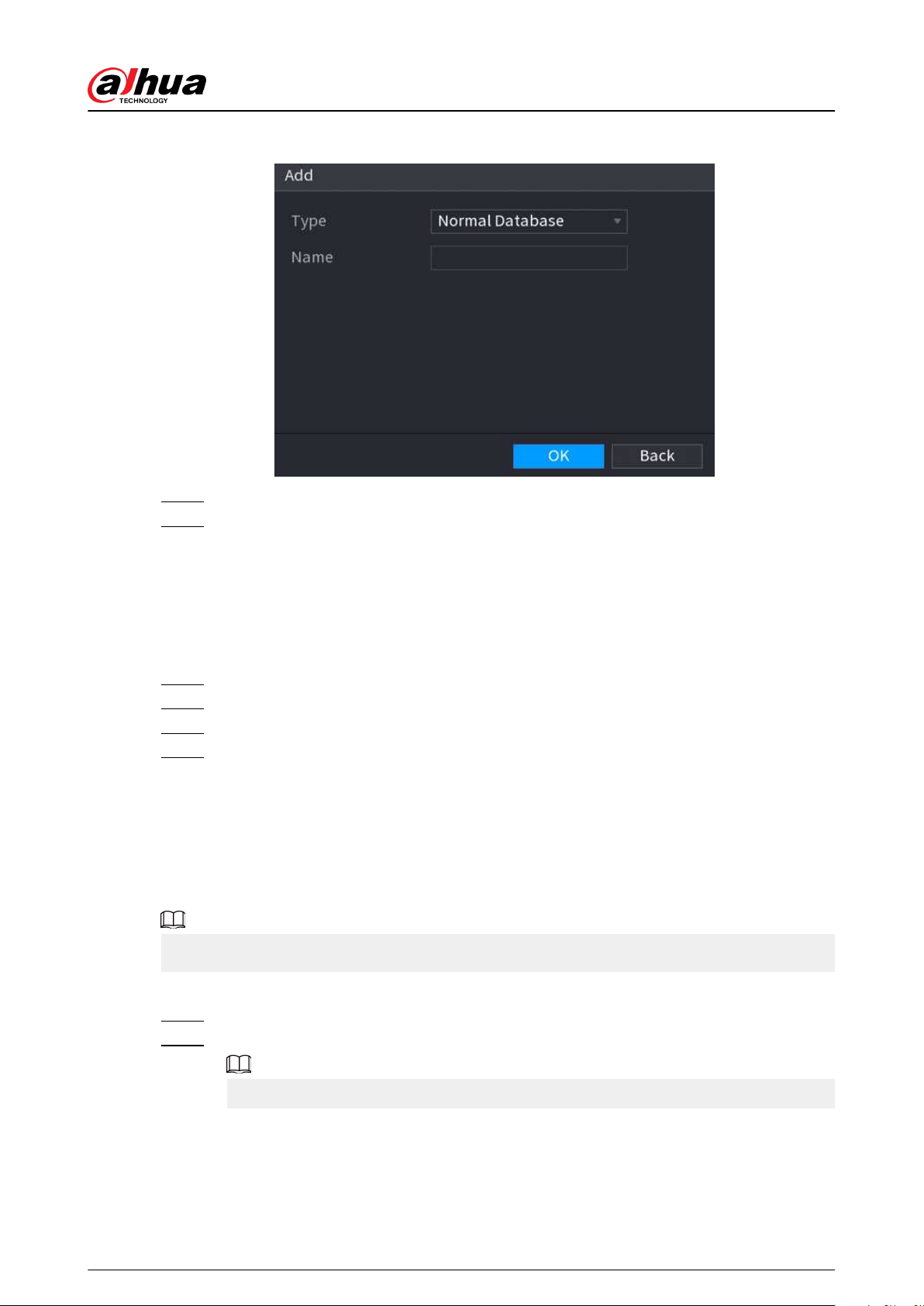
Figure 5-109 Add database
Step 3 Select Normal Database from the Type list, and then enter database name.
Step 4 Click OK.
5.9.5.2.2 Creating Remote Face Databases
The Device can get face databases from the remote devices, and also allows creating face databases
for remote devices. The remote device face database is suitable for face recognition by Camera.
Procedure
Step 1 Select Main Menu > AI > Database > Face Database Cong.
Step 2 Select Remote as Type, select a channel and then click Add.
Step 3 Enter database name.
Step 4 Click OK.
5.9.5.2.3 Creating the Passerby Database
Background Information
If you use the passerby database for alarm linkage, when the detected face is not in the face
database, the system automatically captures the face image, and then save it to the passerby
database.
This function is available on select models.
Procedure
Step 1 Select Main Menu > Database > Face Database Cong.
Step 2 Select Local as Type, and then click Add.
You can create only one passerby database.
User's Manual
225
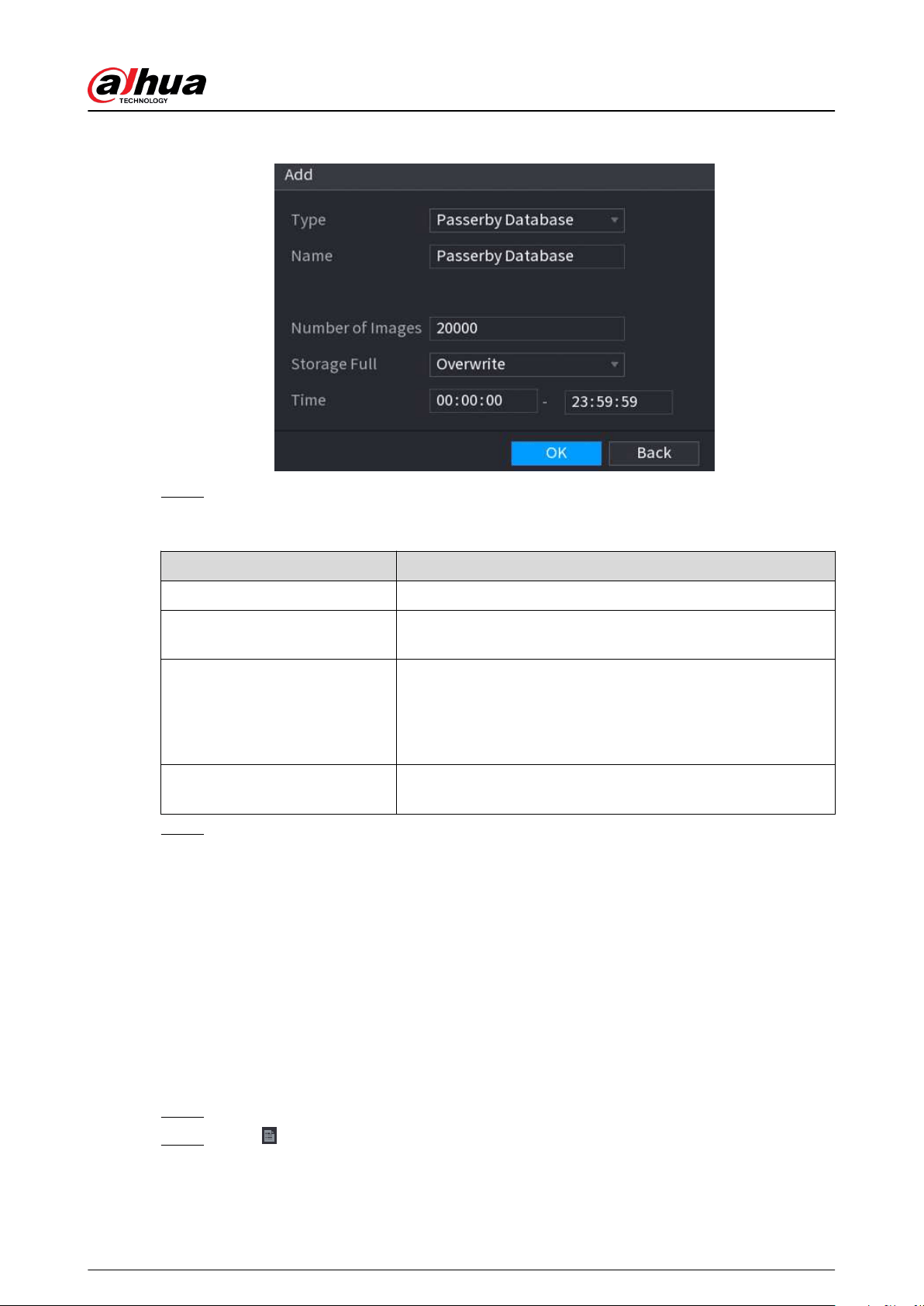
Figure 5-110 Add database
Step 3 Select Passerby Database from the Type list, and then congure other parameters.
Table 5-30 Passerby database parameters
Parameter Description
Name Enter a name for the passerby database.
Number of Images
Congure the number of images that the database can
contain.
Storage Full
Select the storage strategy when space is full.
●
Stop: No more images can be added.
●
Overwrite: The newest images overwrite the oldest images.
Back up the old images as necessary.
Time
Set the period in which the system removes duplicate face
images from the database.
Step 4 Click OK.
5.9.5.3 Adding Images to Face Database
You can add face images to the existing databases one by one or in batches.
5.9.5.3.1 Adding Face Images One by One
Background Information
You can add one face image to the database. It is for the scenario that the registered human face
picture amount is small.
Procedure
Step 1 Select Main Menu > AI > Database > Face Database Cong.
Step 2 Click of the database that you want to congure.
User's Manual
226
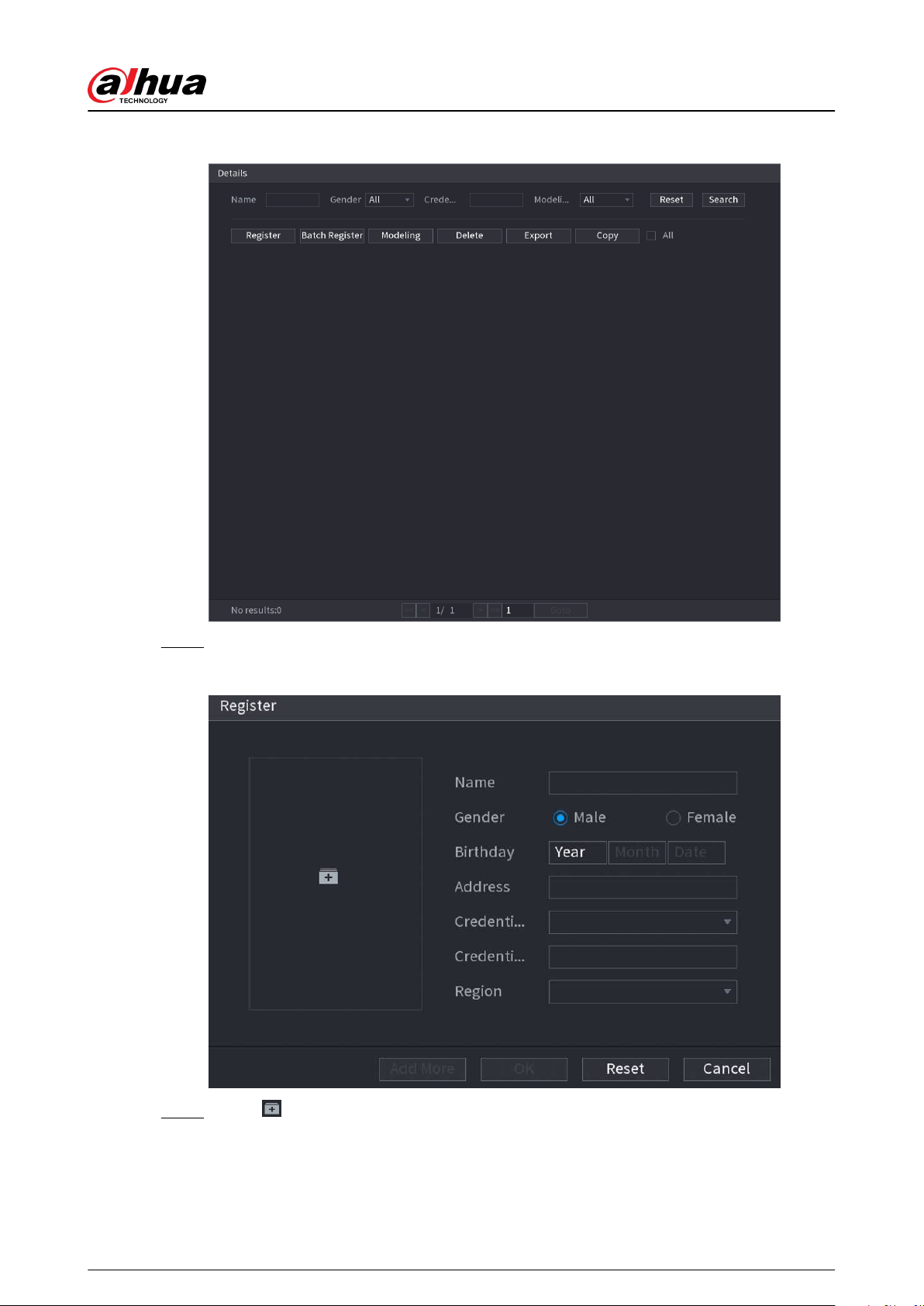
Figure 5-111 Databases details
Step 3 Click Register.
Figure 5-112 Register
Step 4 Click to add a face image.
User's Manual
227
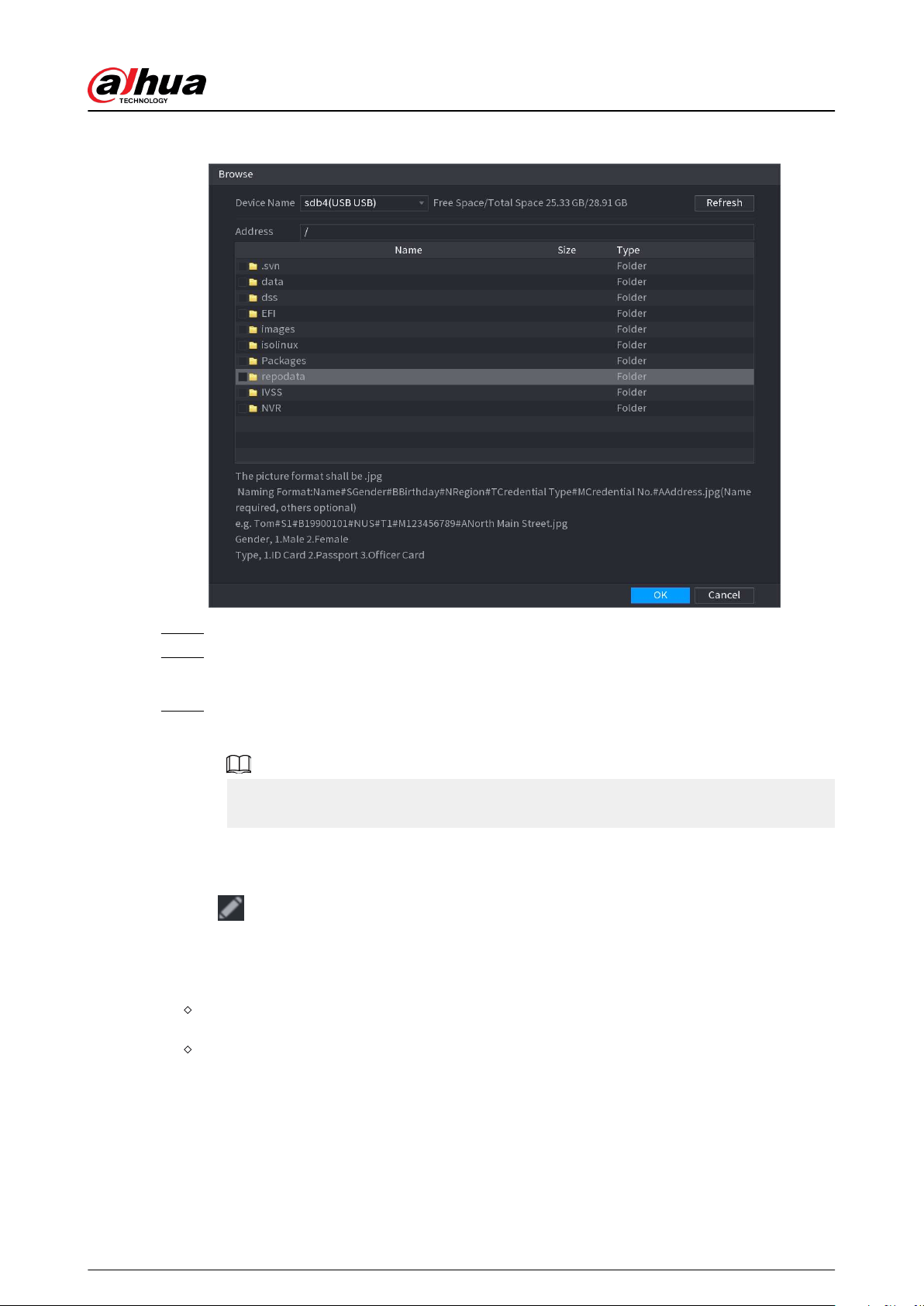
Figure 5-113 Browse
Step 5 Select a face image and then enter the registration information.
Step 6 Click OK.
The system prompts the registration is successful.
Step 7 On the Details page, click Search.
The system prompts modeling is successful.
If the system prompts modeling is in process, wait a while and then click Search again. If
modeling failed, the registered face image cannot be used for face recognition.
Related Operations
●
Edit registration information.
Click
to modify the registration information.
●
Model face images.
The face images are modeled automatically after added to face database. You can also model
face images manually.
On the Database Cong page, select a database, and then click Modeling to model all the
face images in the database.
On the Details page, select one or more face images, and then click Modeling to model the
selected images.
●
Export face images.
Select one or more face images, and then click Export.
●
Delete face images.
Select one or more face images, and then click Delete.
User's Manual
228
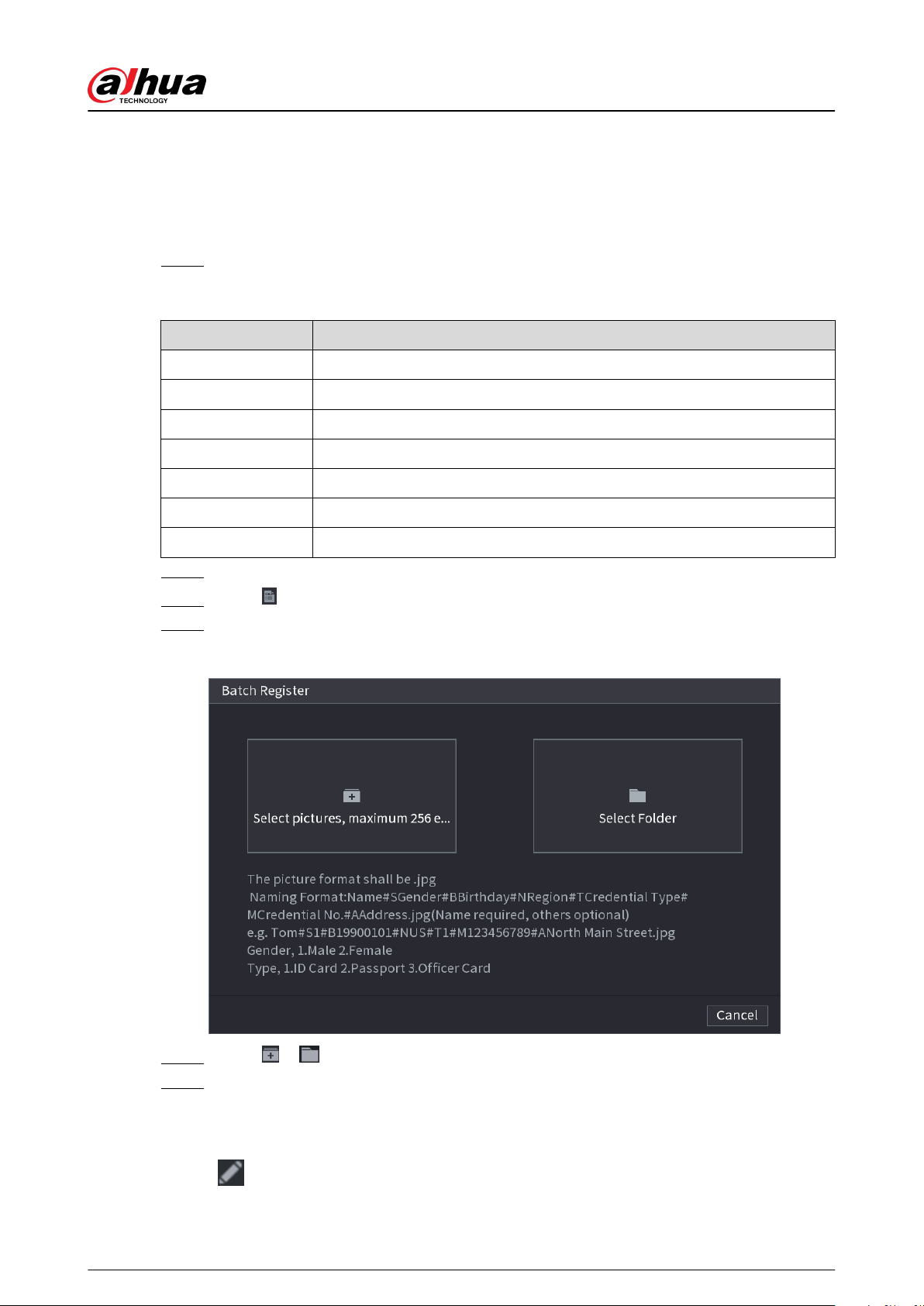
5.9.5.3.2 Adding Face Images in Batches
Background Information
The system supports batch add if you want to import several human face images at the same time.
Procedure
Step 1 Give a name to the face picture by referring to the following table.
Table 5-31 Naming rule
Naming format Description
Name Enter the name.
Gender Enter 1 or 2. 1 represents male, and 2 represents female.
Birthday Enter numbers in the format of yyyy-mm-dd.
Region Enter the abbreviation of region. For example, CN for China.
Credential Type 1 represents ID card; 2 represents passport; 3 represents ocer card.
Credential No. Enter the credential number.
Address Enter the address.
Step 2 Select Main Menu > AI > Database > Face Database Cong.
Step 3 Click of the database that you want to congure.
Step 4 Click Batch Register.
Figure 5-114 Batch register
Step 5 Click or to import face images.
Step 6 Click OK.
Related Operations
●
Edit registration information.
Click
to modify the registration information.
●
Model face images.
User's Manual
229
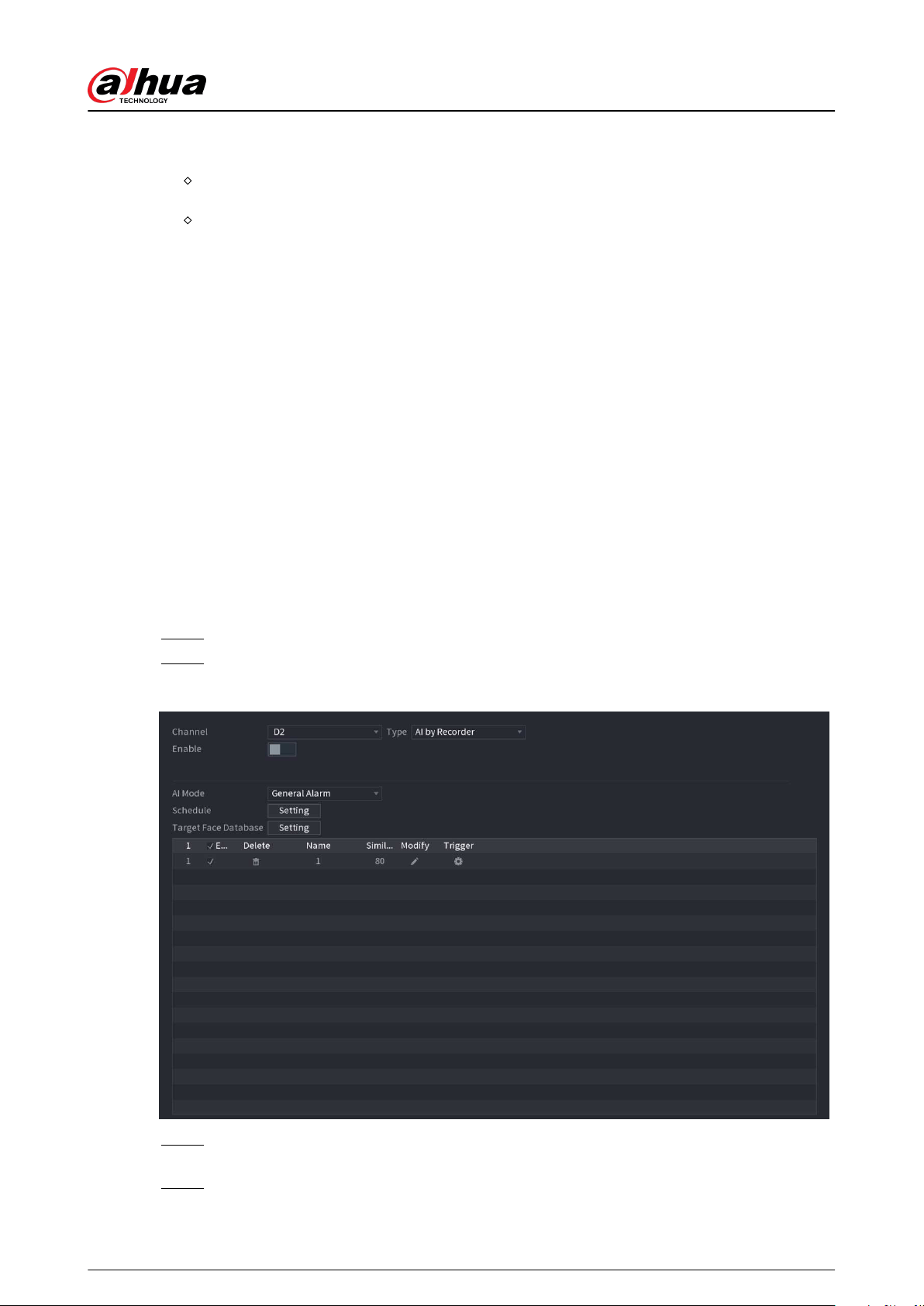
The face images are modeled automatically after added to face database. You can also model
face images manually.
On the Database Cong page, select a database, and then click Modeling to model all the
face images in the database.
On the Details page, select one or more face images, and then click Modeling to model the
selected images.
●
Export face images.
Select one or more face images, and then click Export.
●
Delete face images.
Select one or more face images, and then click Delete.
5.9.5.4 Conguring Face Recognition
Background Information
Congure alarm rules for face recognition.
5.9.5.4.1 Conguring AI by Recorder
Prerequisites
Make sure the face detection function is enabled at corresponding channel.
Procedure
Step 1 Select Main Menu > AI > Parameters > Face Recognition.
Step 2 Select the channel, enable the function, and select AI by Recorder in the Type list.
Figure 5-115 AI by recorder
Step 3 Click Setting next to Schedule to congure arming periods. The corresponding alarm
actions are linked by the alarm events triggered during armed period.
Step 4 Arm target face database.
User's Manual
230
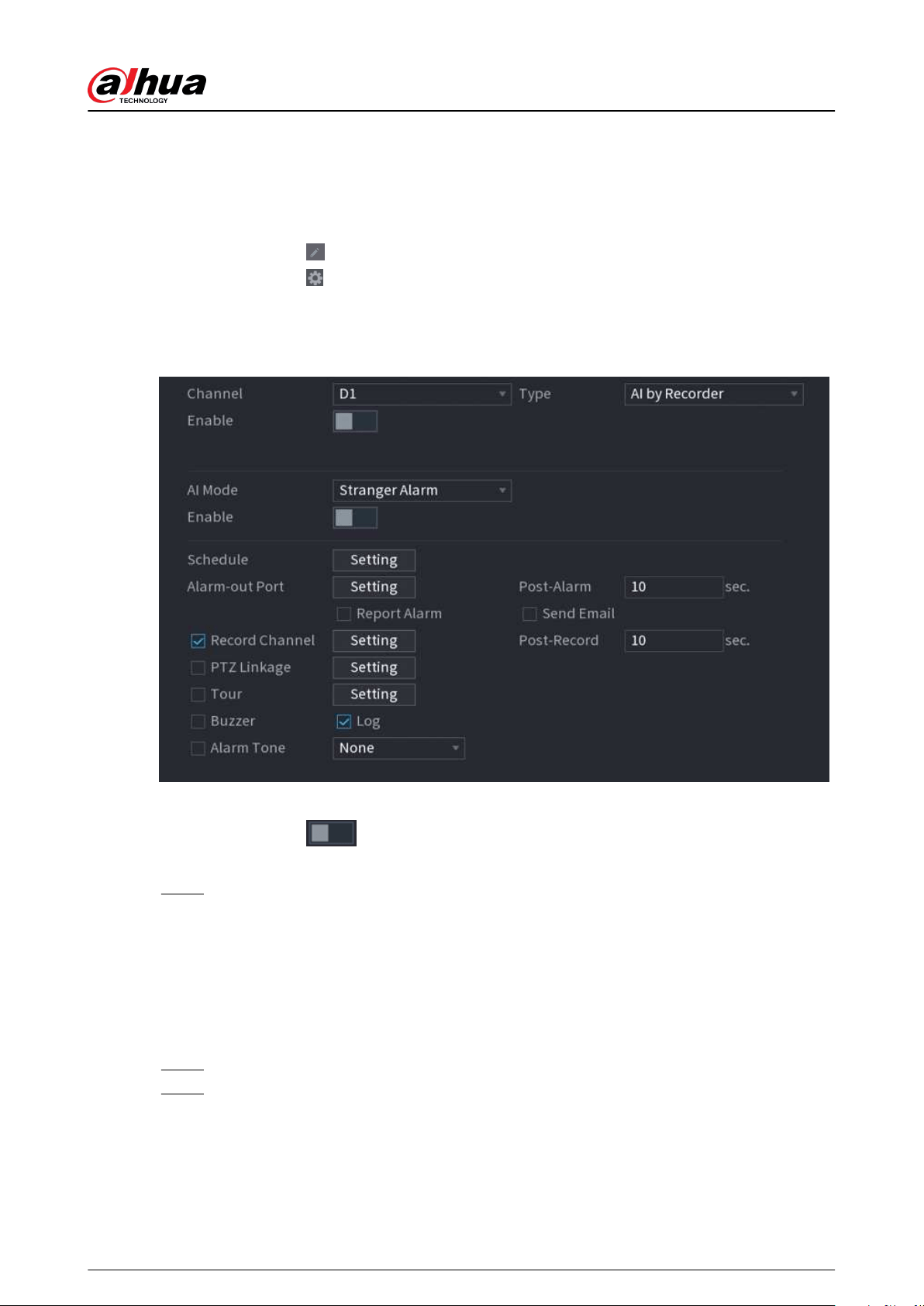
●
General Alarm : The alarm is triggered when the similarity of detected faces reaches
the dened value.
a. Select General Alarm in AI Mode.
b. Click Setting next to Target Face Database.
c. Select the face database that you want to arm, and then click OK.
d. Click
to modify similarity.
e. Click
to congure alarm linkages.
●
Stranger Alarm : The alarm is triggered when the similarity of detected faces does not
reach the dened value.
Figure 5-116 Stranger alarm (AI by recorder)
a. Select Stranger Alarm in AI Mode.
b. Click enable the function.
c. Congure the alarm linkage actions. For details on alarm linkage, see Table 5-47 .
Step 5 Click Apply.
5.9.5.4.2 Conguring AI by Camera
Prerequisites
Make sure the connected camera supports face recognition.
Procedure
Step 1 Select Main Menu > AI > Parameters > Face Recognition.
Step 2 Select the channel, enable the function, and select AI by Camera in the Type list.
User's Manual
231
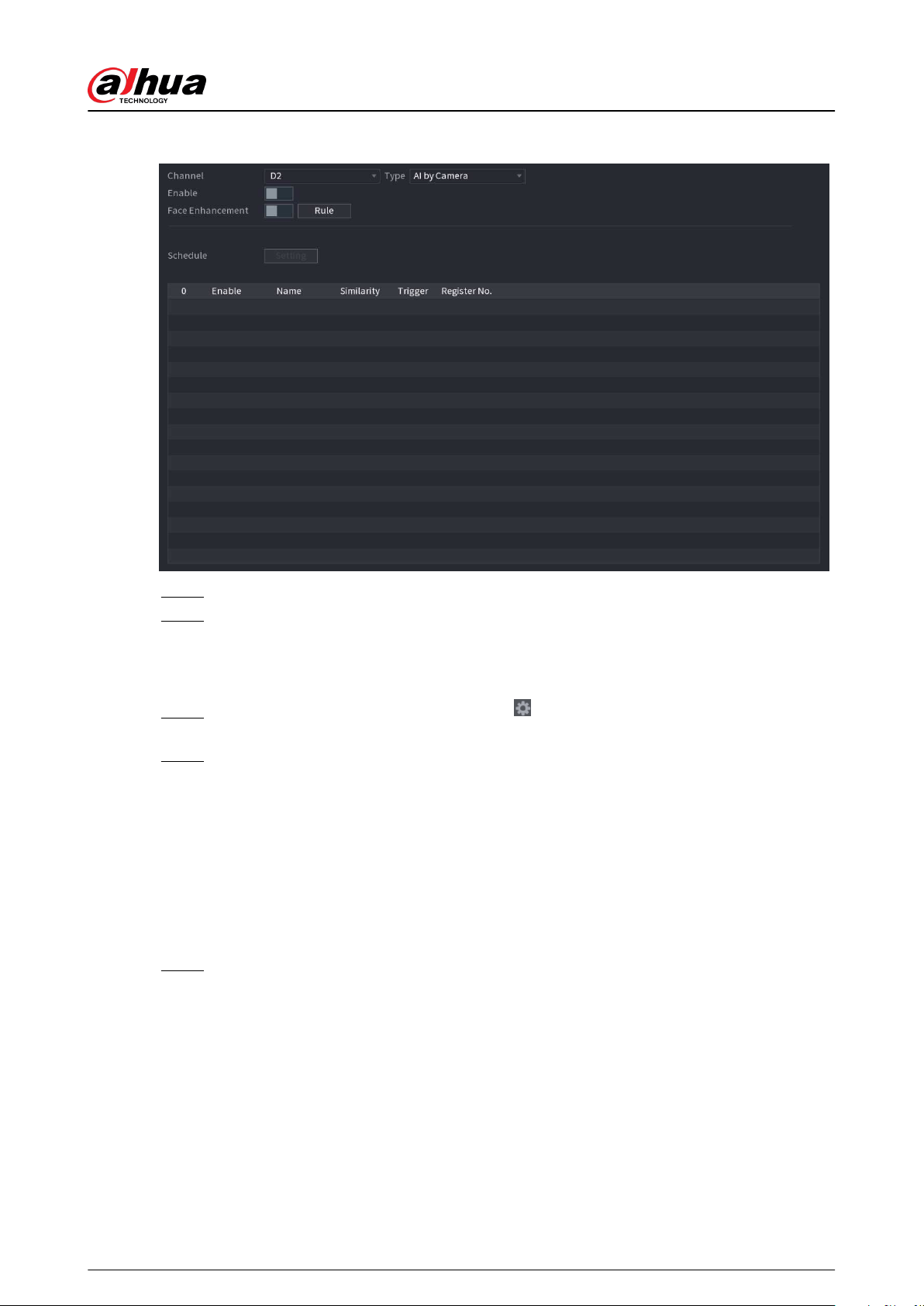
Figure 5-117 AI by camera
Step 3 Enable Face Enhancement to make the faces displayed more clear.
Step 4 Click Rule to draw areas to lter the target.
You can congure two target lters (maximum size and minimum size). When the target
is smaller than the minimum size or larger than the maximum size, no alarms will be
activated.
Step 5 Select target face database, and then click to congure alarm linkage. For details on
alarm linkage, see Table 5-47 .
Step 6 Click Apply.
5.9.5.5 AI Search (Face Recognition)
You can search for the face recognition results by attributes or by image.
5.9.5.5.1 Search by Attributes
Procedure
Step 1 Select Main Menu > AI > AI Search > Face Recognition > Search by Attributes.
User's Manual
232
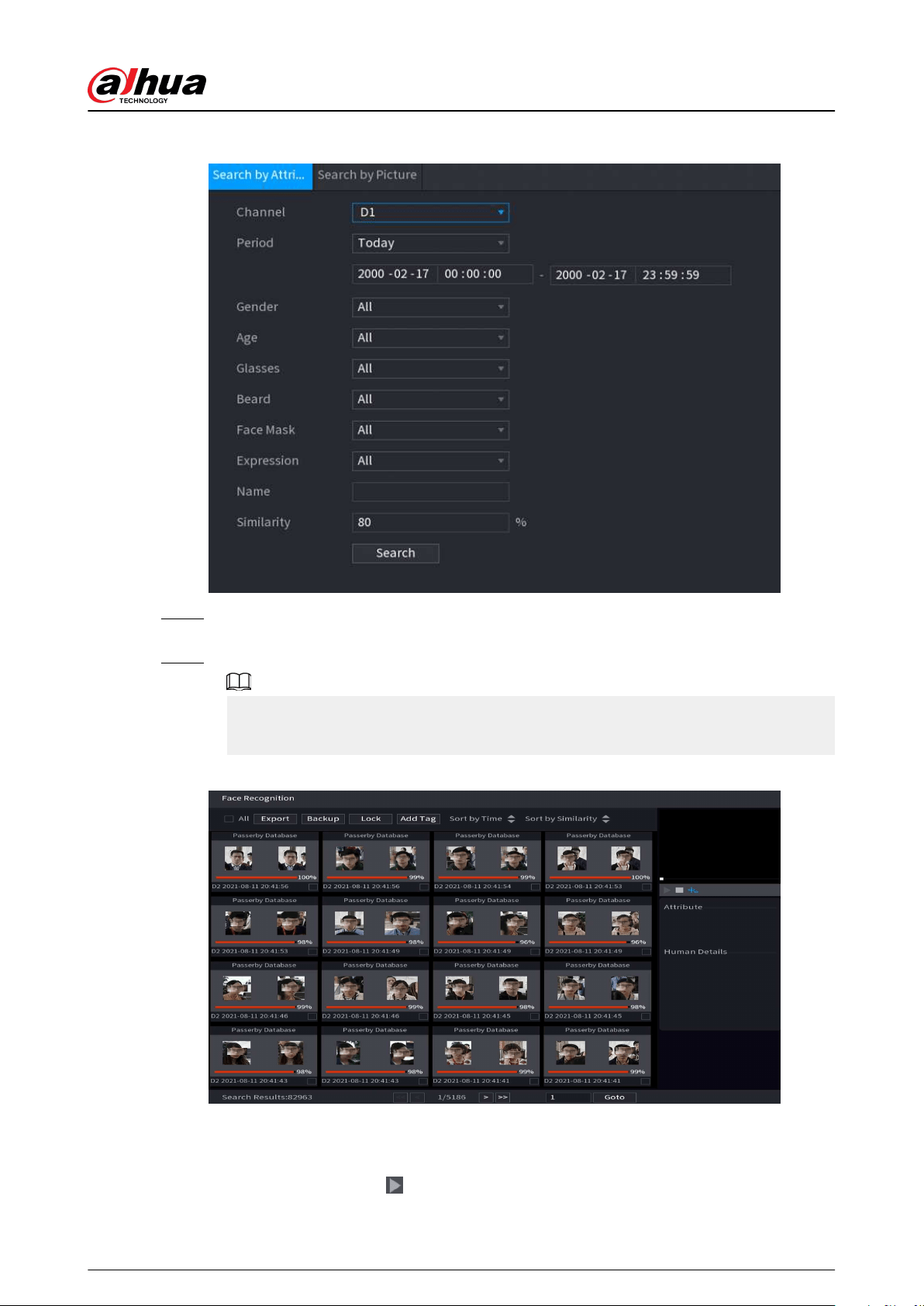
Figure 5-118 Search by attributes
Step 2 Select the channel and set the parameters including start time, end time, gender, age,
glasses, beard, mask, name and similarity.
Step 3 Click Search.
The faces in the image are intentionally blurred for privacy protection. The actual images
are clear.
Figure 5-119 Search results
Related Operations
●
Play back video.
Click an image, and then click
to play back the related video.
User's Manual
233
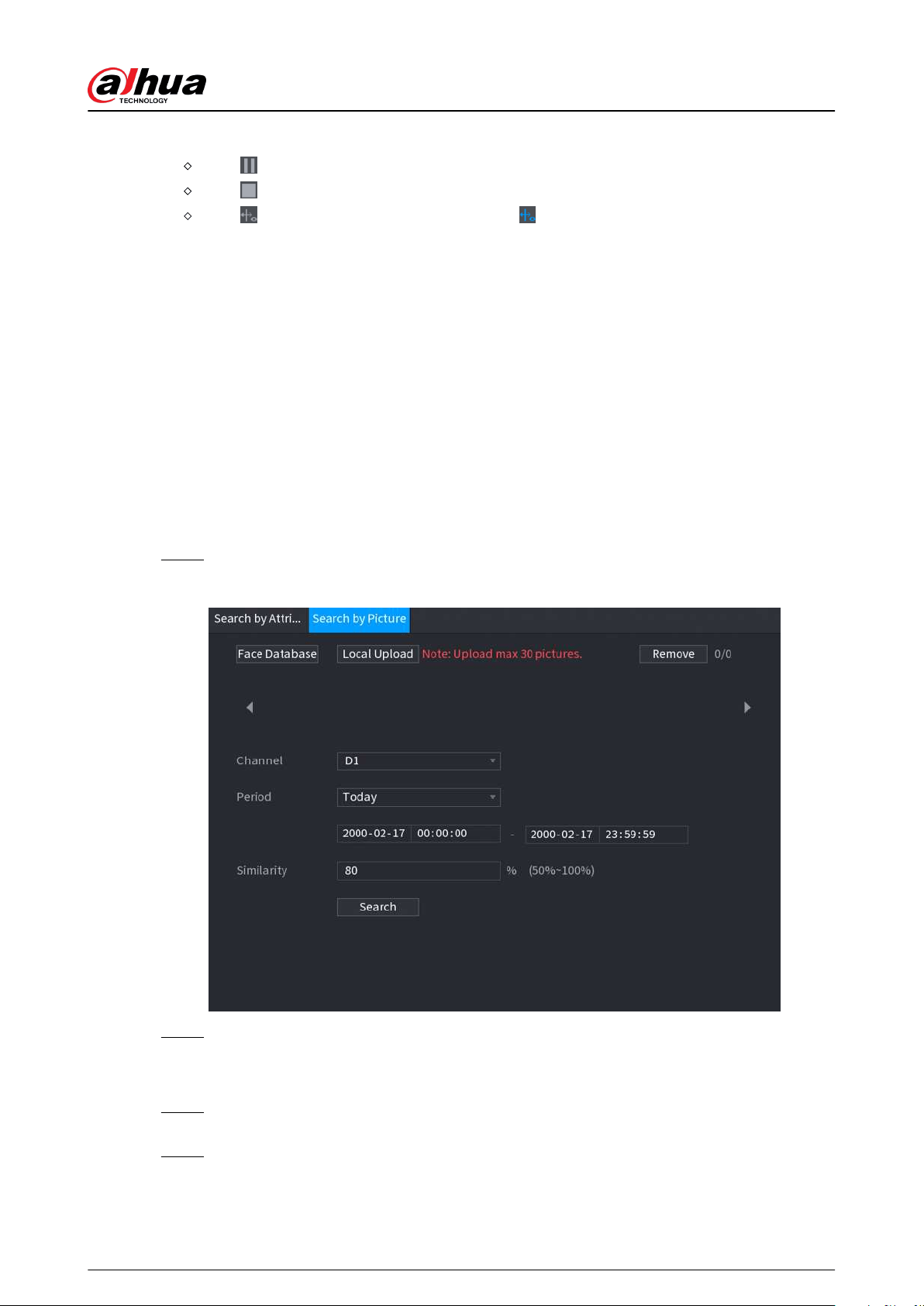
During playback, you can:
Click to pause.
Click to stop.
Click to display AI rule. The icon changes to .
●
Add tags.
Select one or more images, and then click Add Tag.
●
Lock.
Select one or more images, and then click Lock. The locked les will not be overwritten.
●
Export.
Select one or more images, and then click Export to export selected search results in excel.
●
Back up.
Select one or more images, click Backup , select the storage path and le type, and then click
Start to export les to external storage device.
5.9.5.5.2 Search by Image
Procedure
Step 1 Select Main Menu > AI > AI Search > Face Recognition > Search by Picture.
Figure 5-120 Search by image
Step 2 Upload face images.
●
Face Database : Upload face images from database.
●
Local Upload : Upload face images from external storage device.
Step 3 Select the image used to search and then set the parameters including channel, start
time, end time, gender, age, glasses, beard, mask, and similarity.
Step 4 Click Search.
The search results are displayed.
User's Manual
234
Related Operations
●
Play back video.
Click an image, and then click
to play back the related video.
During playback, you can:
Click to pause.
Click to stop.
Click to display AI rule. The icon changes to .
●
Add tags.
Select one or more images, and then click Add Tag.
●
Lock.
Select one or more images, and then click Lock. The locked les will not be overwritten.
●
Export.
Select one or more images, and then click Export to export selected search results in excel.
●
Back up.
Select one or more images, click Backup , select the storage path and le type, and then click
Start to export les to external storage device.
5.9.5.5.3 Report Query
Background Information
You can search for and export face statistics.
●
The statistics might be overwritten when the storage space runs out. Back up in time.
●
When you restore the Device to factory settings, all the data except data in the external storage
device will be cleared. You can clear the data in the external storage device through formatting
or other methods.
Procedure
Step 1 Select Main Menu > AI > Report Query > Face Statistics.
User's Manual
235
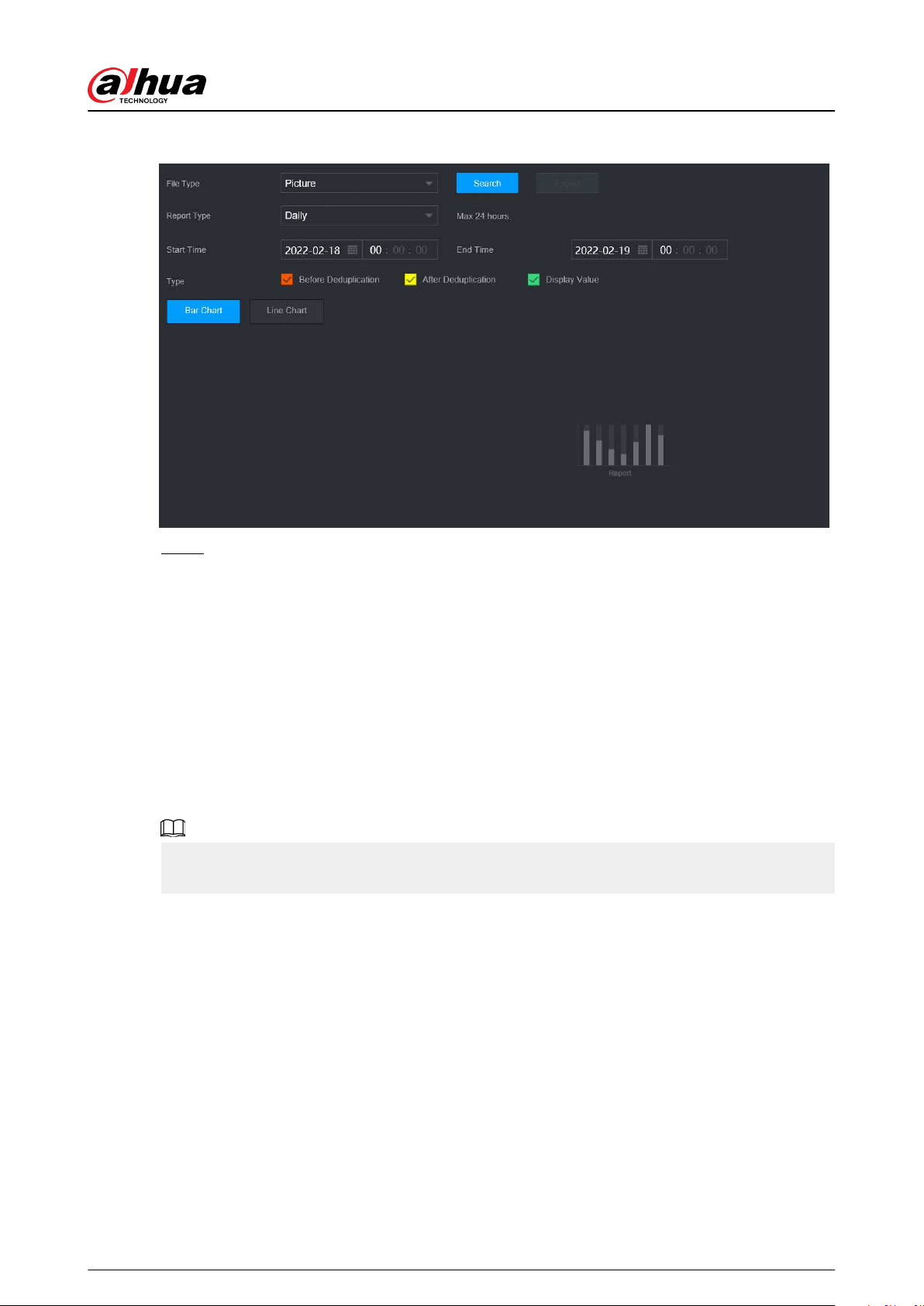
Figure 5-121 Face statistics
Step 2 Select the report type, start time and end time, and then click Search.
Related Operations
●
Switch chart type.
Click Bart Chart or Line Chart to switch the chart type.
●
Export.
Select le type, and then click Export to export the report in picture or csv format.
5.9.6 IVS
The IVS function processes and analyzes the images to extract the key information to match the
specied rules. When the detected behaviors match the rules, the system activates alarms.
●
This function is available on select models.
●
IVS and face detection cannot be enabled at the same time.
5.9.6.1 Enabling Smart Plan
To use AI by camera, you need to enable the smart plan rst. For details, see "5.9.2 Smart Plan".
5.9.6.2 Conguring IVS
User's Manual
236
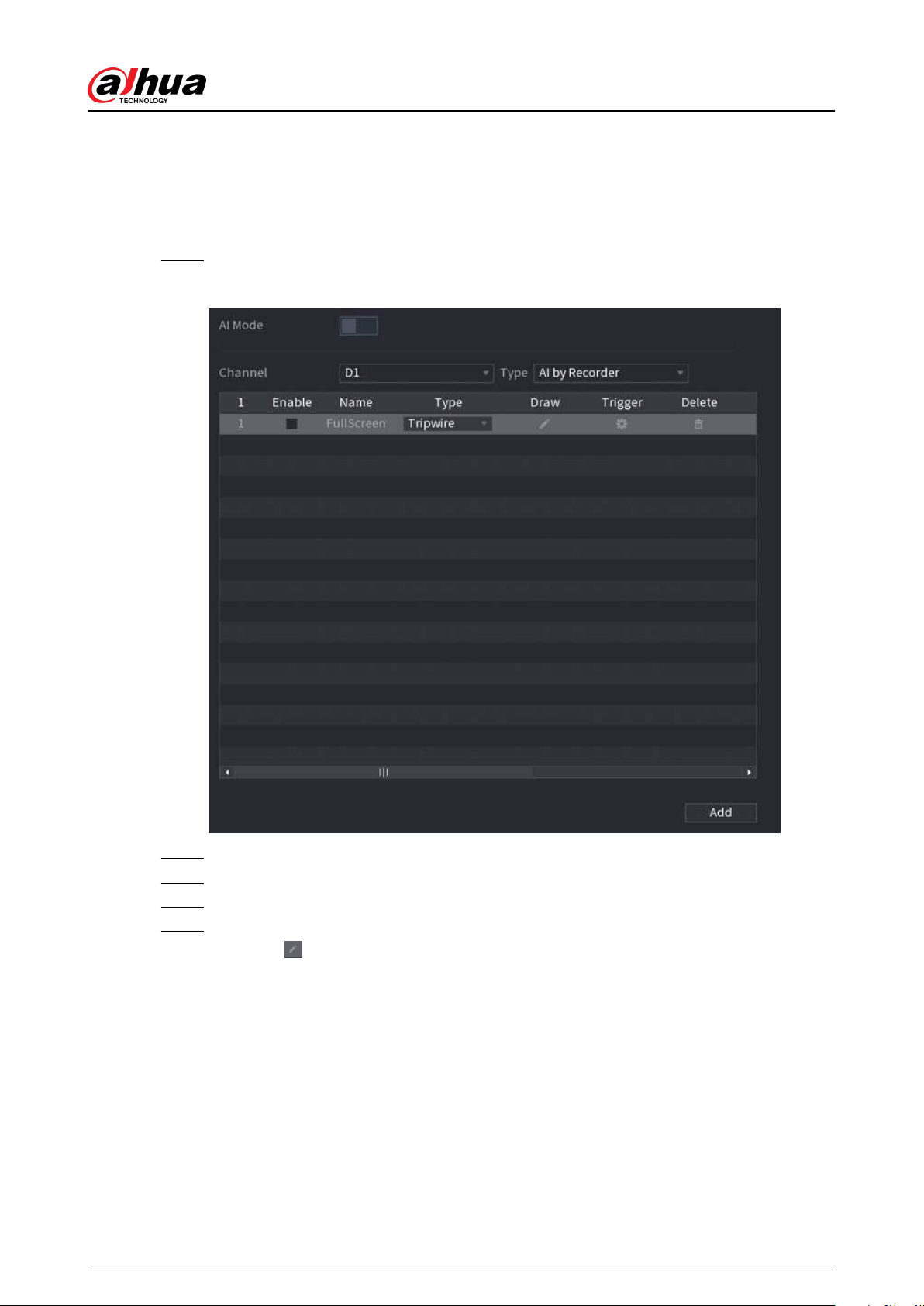
5.9.6.2.1 Tripwire
When the detection target crosses the warning line along the set direction, the system performs an
alarm linkage action.
Procedure
Step 1 Select Main Menu > AI > Parameters > IVS.
Figure 5-122 IVS
Step 2 Select the channel and AI type.
Step 3 Click Add to add a rule.
Step 4 On the Type list, select Tripwire.
Step 5 Draw the detection rule.
1. Click
to draw a straight line or a curve on the surveillance video image. Right-click
the image to stop drawing.
User's Manual
237
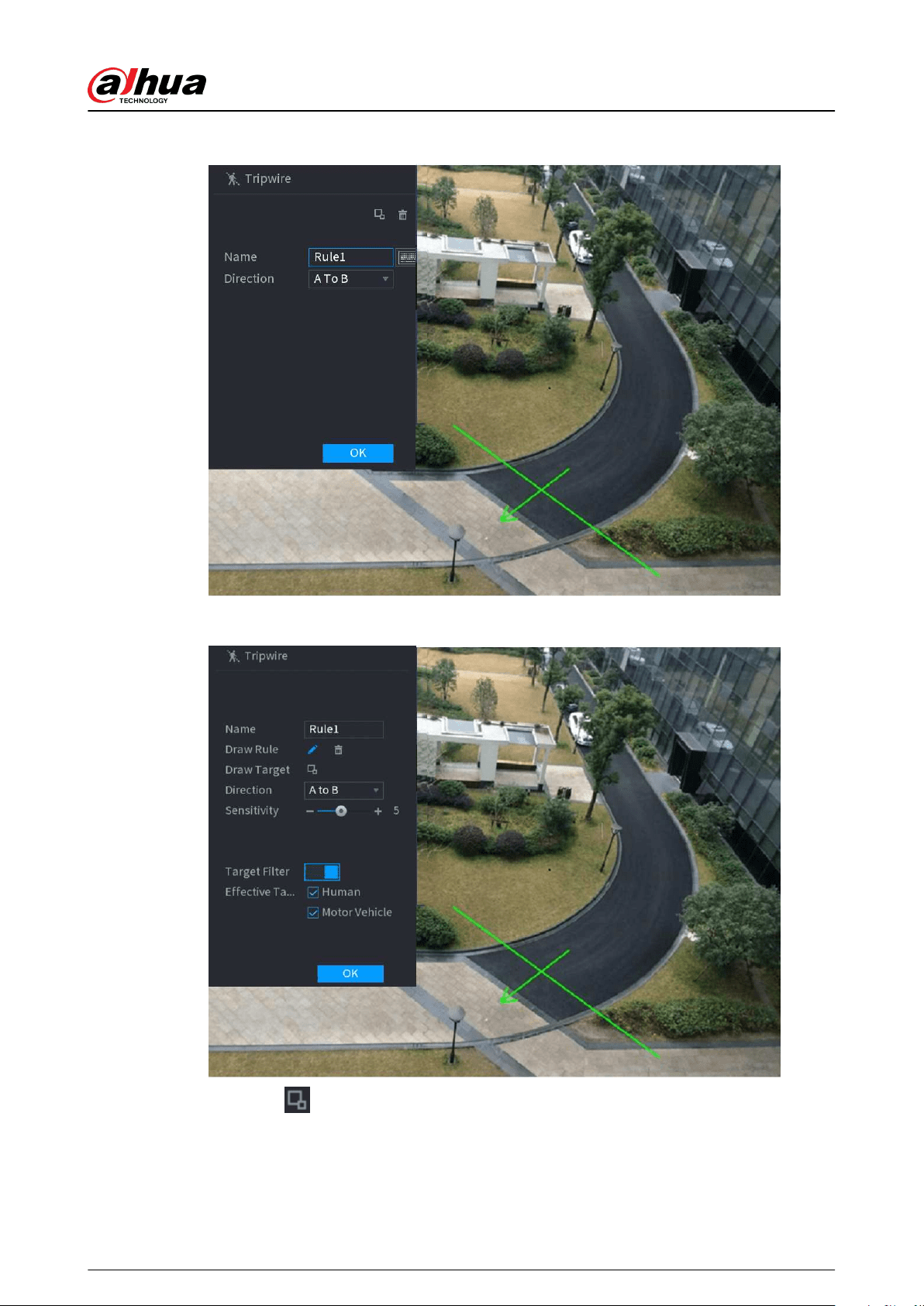
Figure 5-123 Tripwire (AI by camera)
Figure 5-124 Tripwire (AI by recorder)
2.
Click
to draw the minimum size or maximum size to lter the target.
The system triggers an alarm only when the size of detected target is between the
maximum size and the minimum size.
3. Congure the parameters.
User's Manual
238
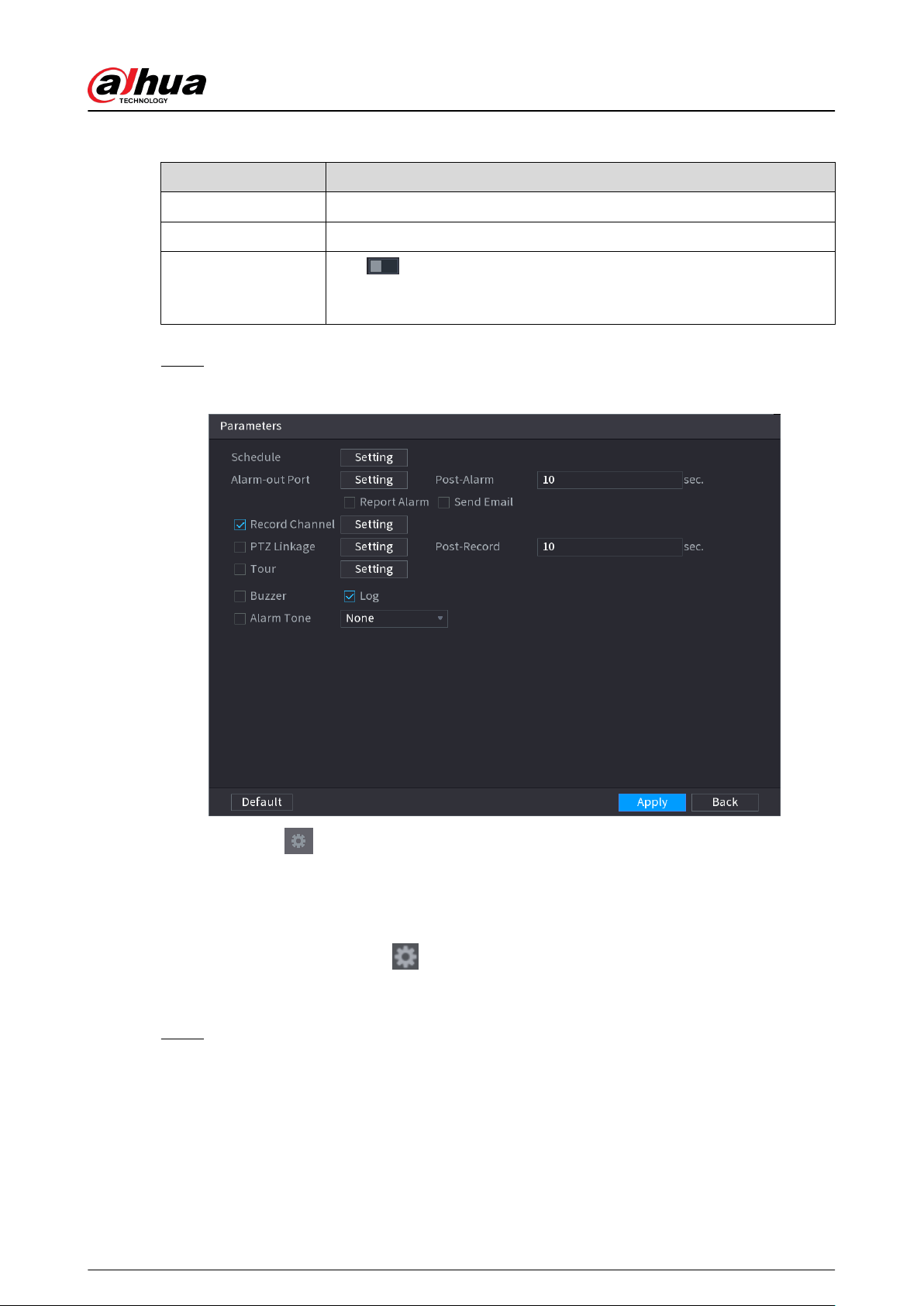
Table 5-32 Tripwire parameters
Parameter Description
Name Customize the rule name.
Direction Set the tripwire direction, including A→B, B→A and A↔B.
Target Filter
Click
and then select eective target. With Human and Motor
Vehicle selected by default, the system automatically identies the
person and motor vehicle appeared within the monitoring range.
4. Click OK.
Step 6 Congure alarm schedule and linkage.
Figure 5-125 Schedule and alarm linkage
1. Click .
2. Click Setting next to Schedule to congure the alarm period.
The system performs linkage actions only for alarms during the arming period.
●
On the time line, drag to set the period.
●
You can also click
to set the period.
3. Congure alarm linkage. For details, see Table 5-47 .
4. Click Apply.
Step 7 Select the Enable checkbox and then click Apply.
5.9.6.2.2 Intrusion
Background Information
When the detection target passes the edge of the monitoring area, and enters, leaves or traverses
the monitoring area, the system performs an alarm linkage action.
User's Manual
239
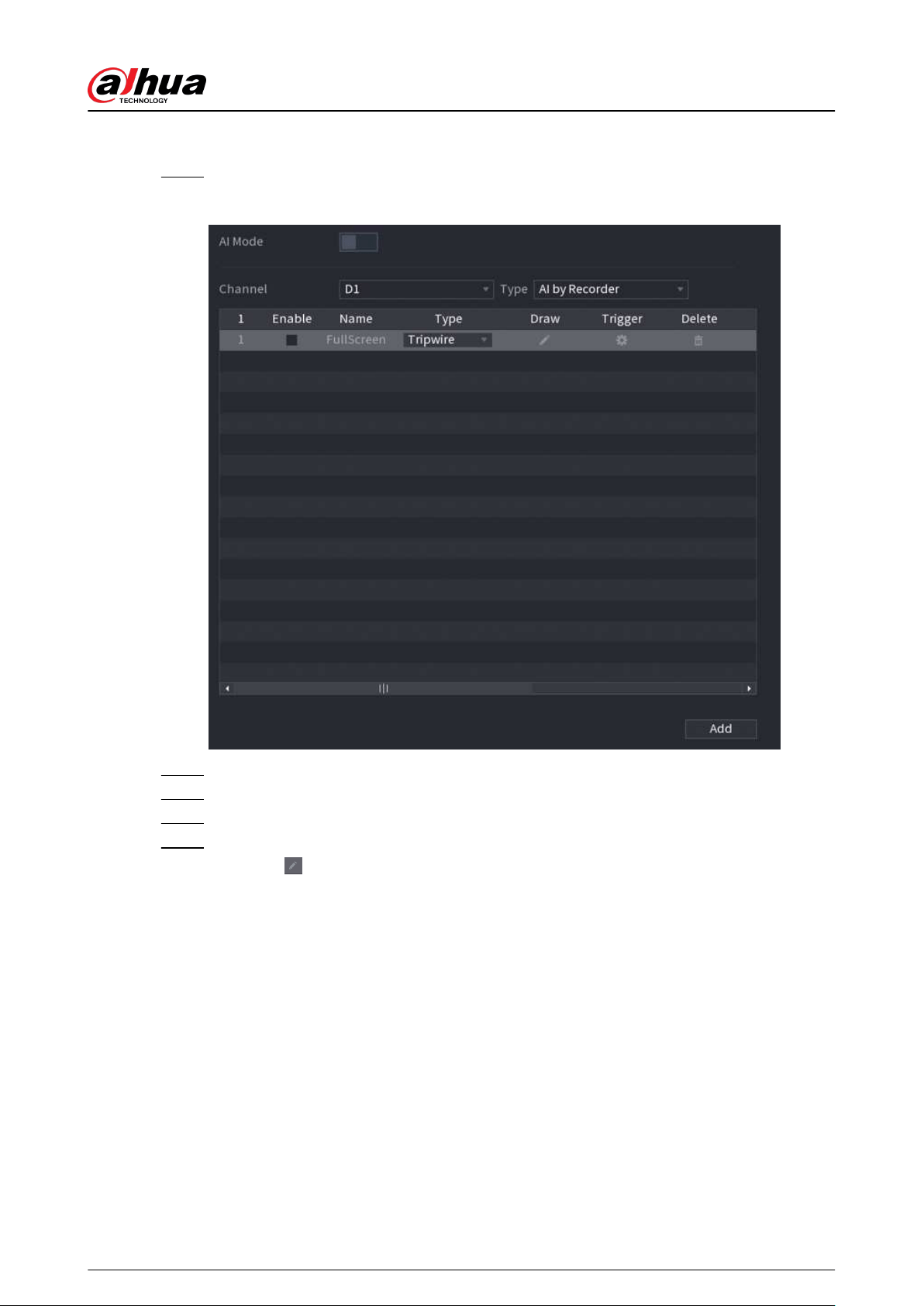
Procedure
Step 1 Select Main Menu > AI > Parameters > IVS.
Figure 5-126 IVS
Step 2 Select the channel and AI type.
Step 3 Click Add to add a rule.
Step 4 On the Type list, select Intrusion.
Step 5 Draw the detection rule.
1. Click
to draw the rule on the surveillance video image. Right-click the image to stop
drawing.
User's Manual
240
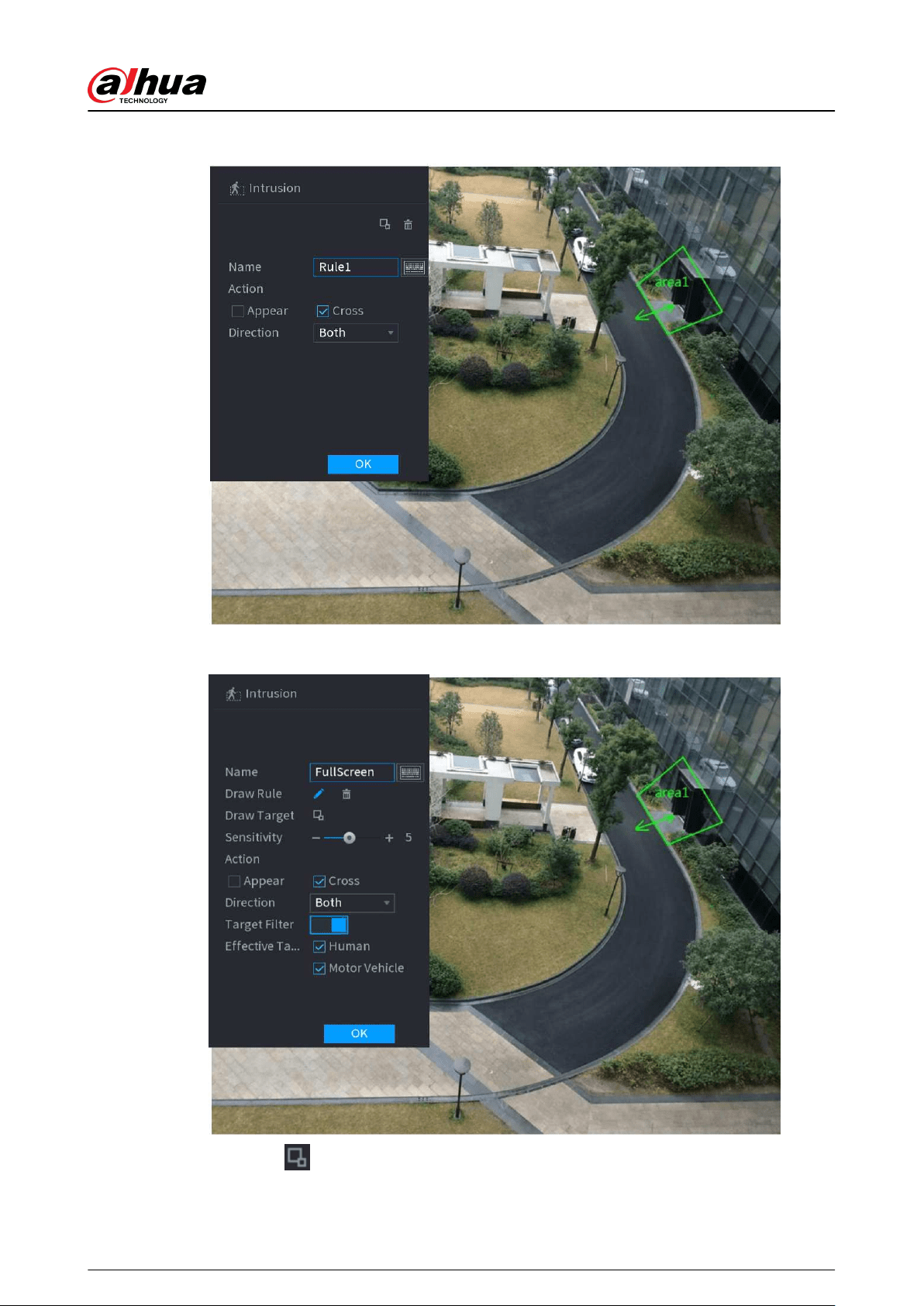
Figure 5-127 Intrusion (AI by camera)
Figure 5-128 Intrusion (AI by recorder)
2.
Click
to draw the minimum size or maximum size to lter the target.
User's Manual
241
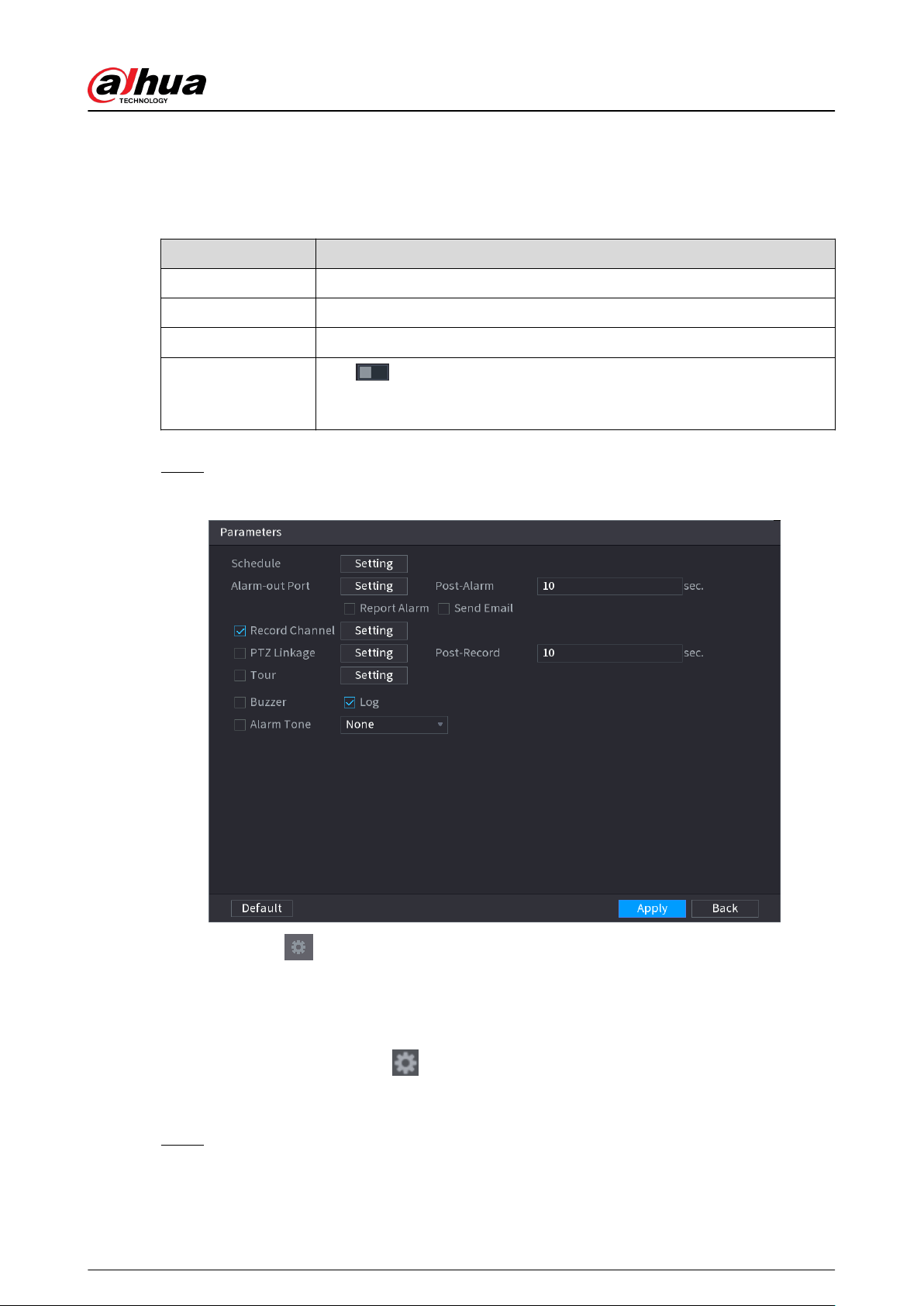
The system triggers an alarm only when the size of detected target is between the
maximum size and the minimum size.
3. Congure the parameters.
Table 5-33 Intrusion parameters
Parameter Description
Name Customize the rule name.
Action Set the intrusion action, including appear and crossing area.
Direction Set the direction to cross the area, including enter, exit and both.
Target Filter
Click
and then select eective target. With Human and Motor
Vehicle selected by default, the system automatically identies the person
and motor vehicle appeared within the monitoring range.
4. Click OK.
Step 6 Congure alarm schedule and linkage.
Figure 5-129 Schedule and alarm linkage
1. Click .
2. Click Setting next to Schedule to congure the alarm period.
The system performs linkage actions only for alarms during the arming period.
●
On the time line, drag to set the period.
●
You can also click
to set the period.
3. Congure alarm linkage. For details, see Table 5-47 .
4. Click Apply.
Step 7 Select Enable checkbox and then click Apply.
User's Manual
242
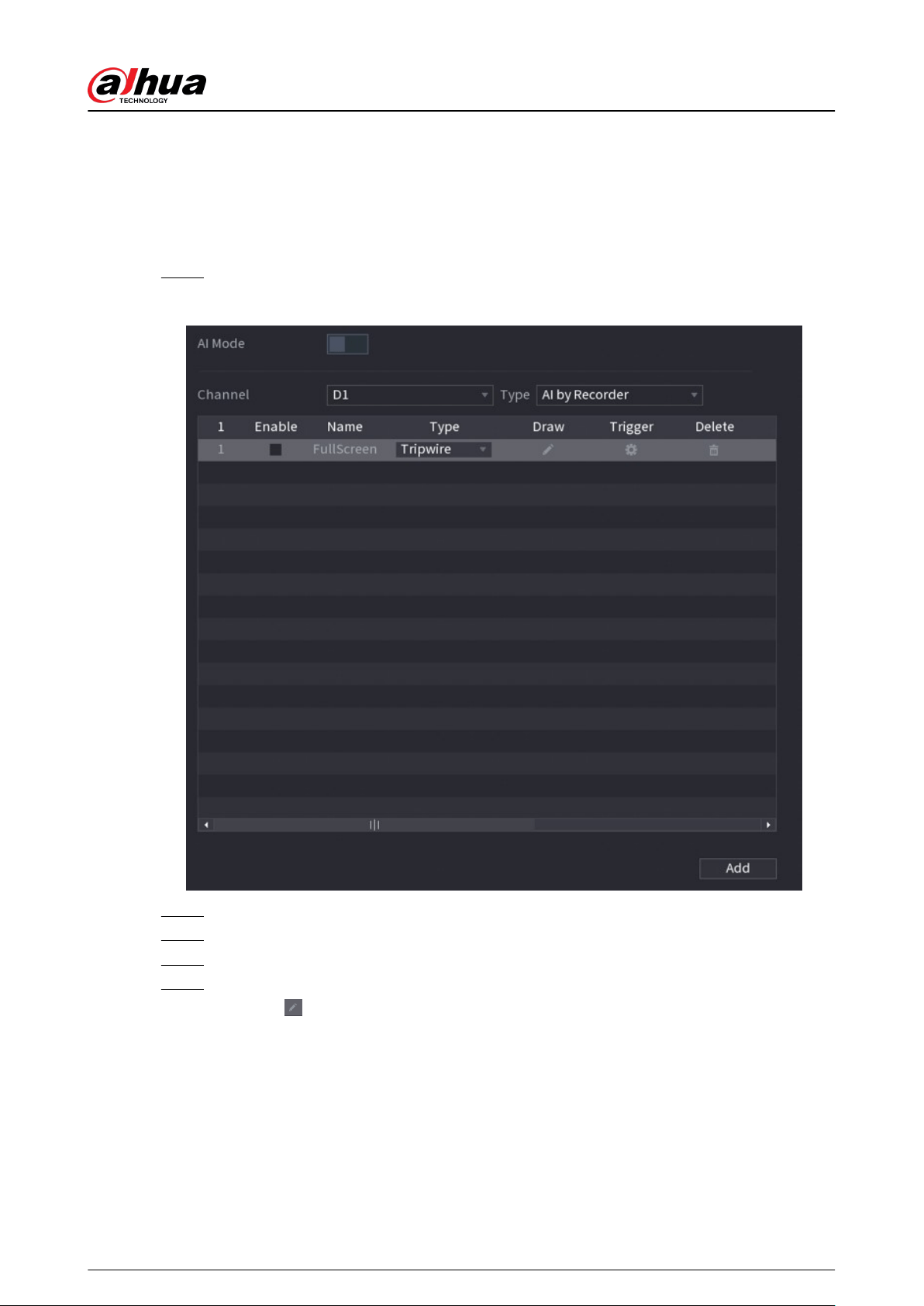
5.9.6.2.3 Abandoned Object Detection
Background Information
The system generates an alarm when there is an abandoned object in the specied zone.
Procedure
Step 1 Select Main Menu > AI > Parameters > IVS.
Figure 5-130 IVS
Step 2 Select channel and AI type.
Step 3 Click Add to add a rule.
Step 4 On the Type list, select Abandoned Object.
Step 5 Draw the detection rule.
1. Click
to draw a rectangle on the surveillance video image. Right-click the image to
stop drawing.
User's Manual
243
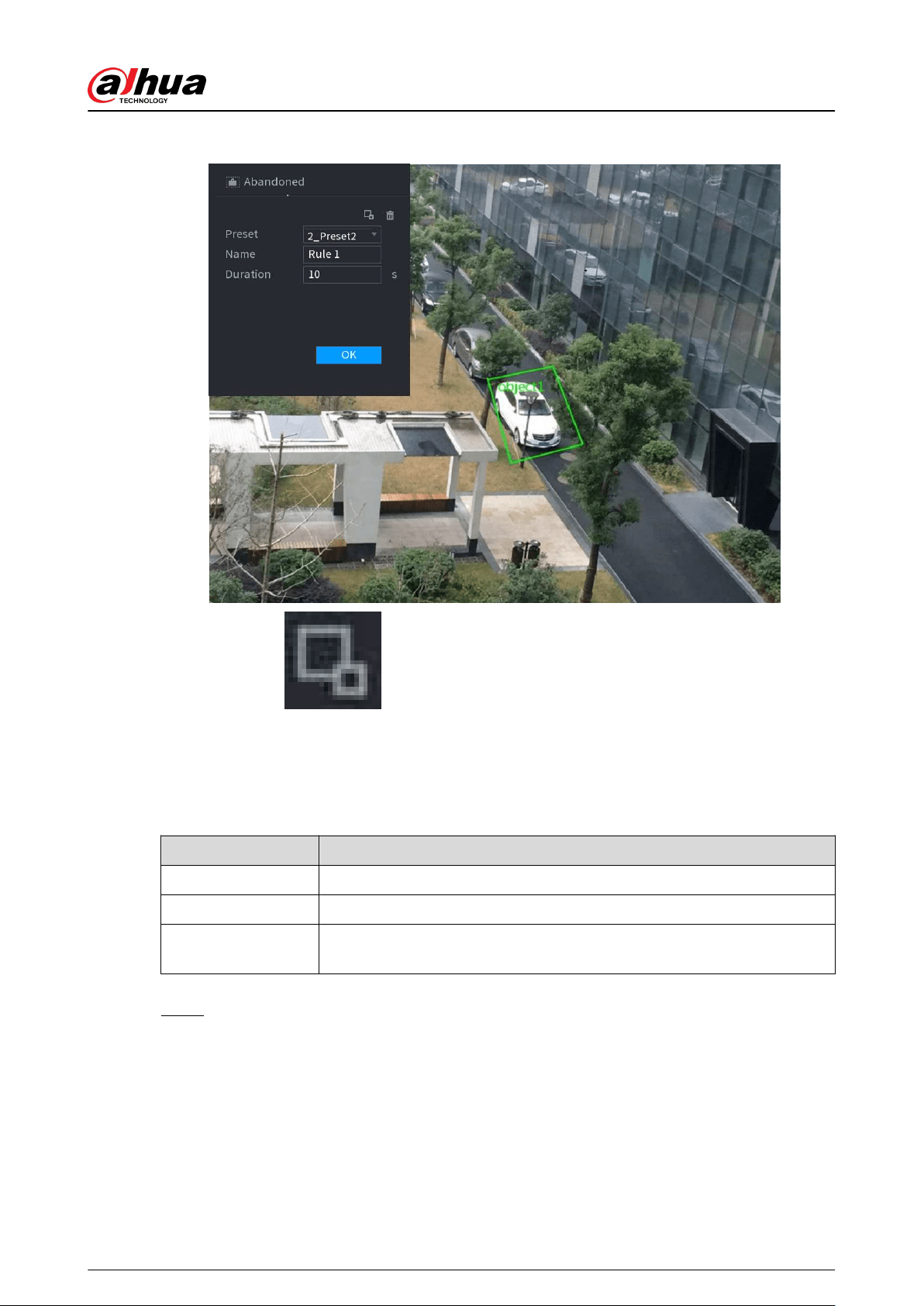
Figure 5-131 Abandoned object rule
2. Click to draw the minimum size or maximum size to lter the target.
The system triggers an alarm only when the size of detected target is between the
maximum size and the minimum size.
3. Congure parameters.
Table 5-34 Parameters of abandoned object detection
Parameter Description
Preset Select a preset you want to use IVS.
Name Customize the rule name.
Duration
The system generates an alarm once the object is in the zone for the
dened period.
4. Click OK.
Step 6 Congure alarm schedule and linkage.
User's Manual
244
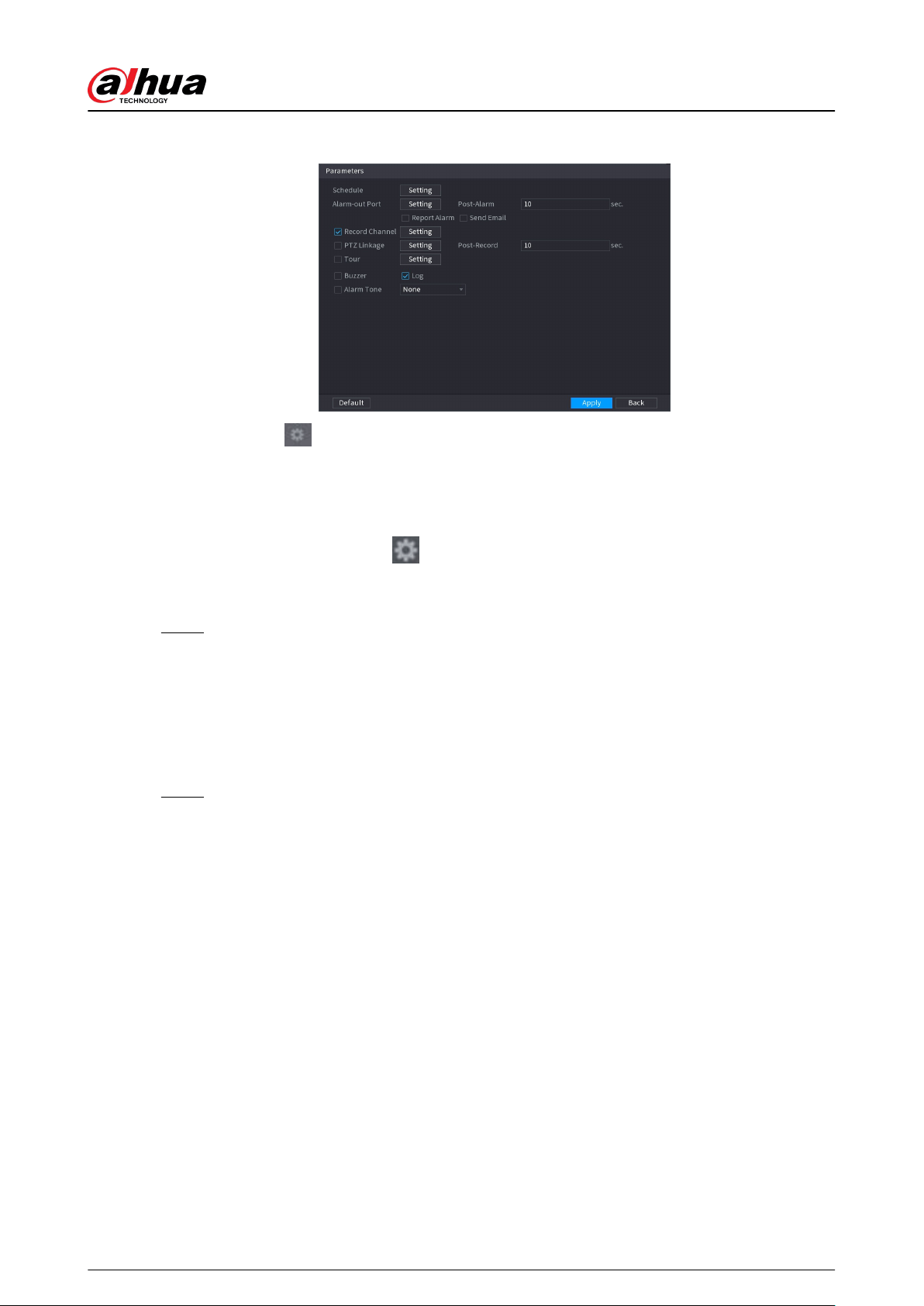
Figure 5-132 Schedule and alarm linkage
1. Click .
2. Click Setting next to Schedule to congure the alarm period.
The system performs linkage actions only for alarms during the arming period.
●
On the time line, drag to set the period.
●
You can also click
to set the period.
3. Congure alarm linkage. For details, see Table 5-47 .
4. Click Apply.
Step 7 Select Enable checkbox and then click Apply.
5.9.6.2.4 Fast Moving
Background Information
You can detect the fast moving object in the specied zone.
Procedure
Step 1 Select Main Menu > AI > Parameters > IVS.
User's Manual
245
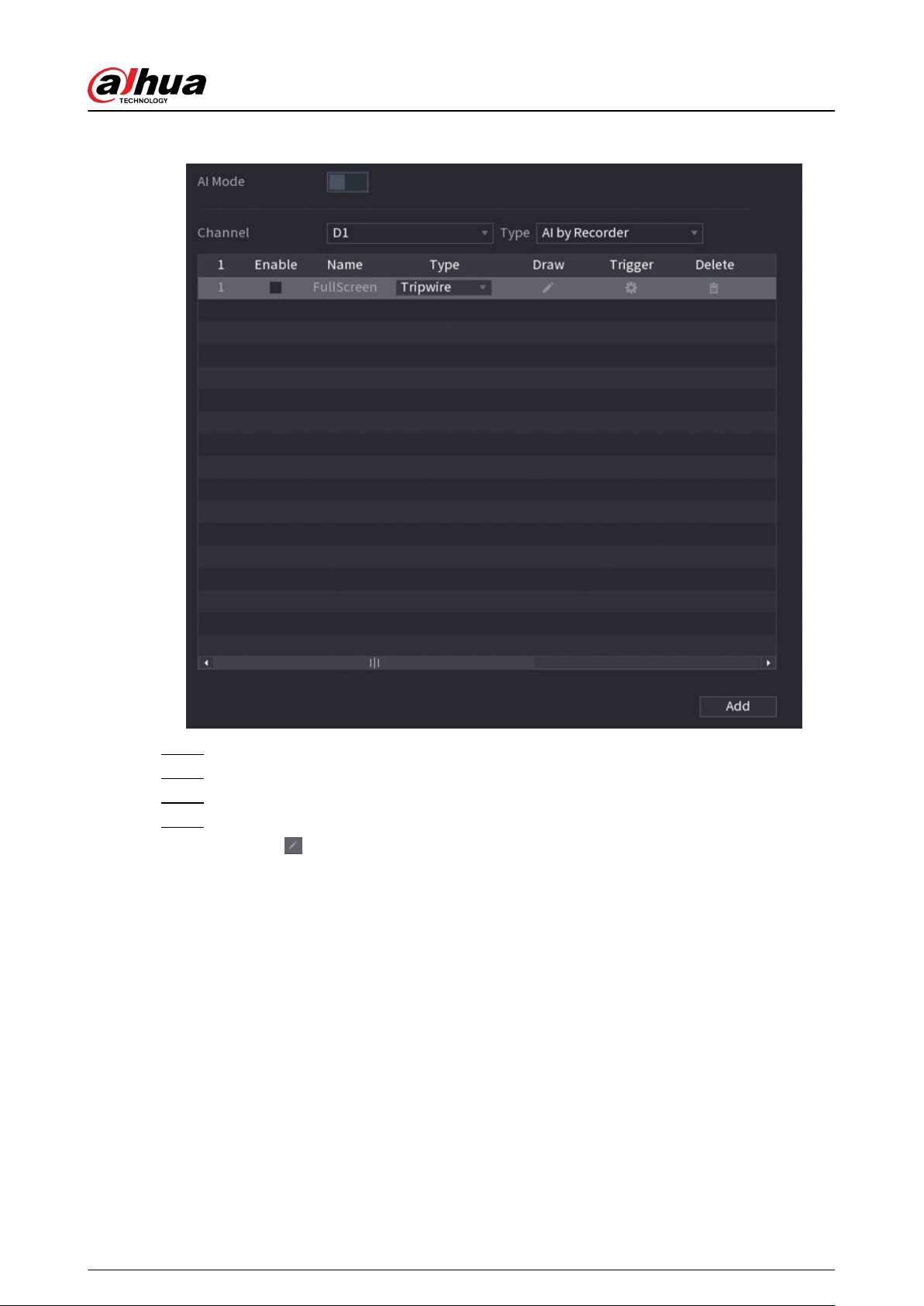
Figure 5-133 IVS
Step 2 Select channel and AI type.
Step 3 Click Add to add a rule.
Step 4 On the Type list, select Fast Moving.
Step 5 Draw the detection rule.
1. Click
to draw a rectangle on the surveillance video image. Right-click the image to
stop drawing.
User's Manual
246
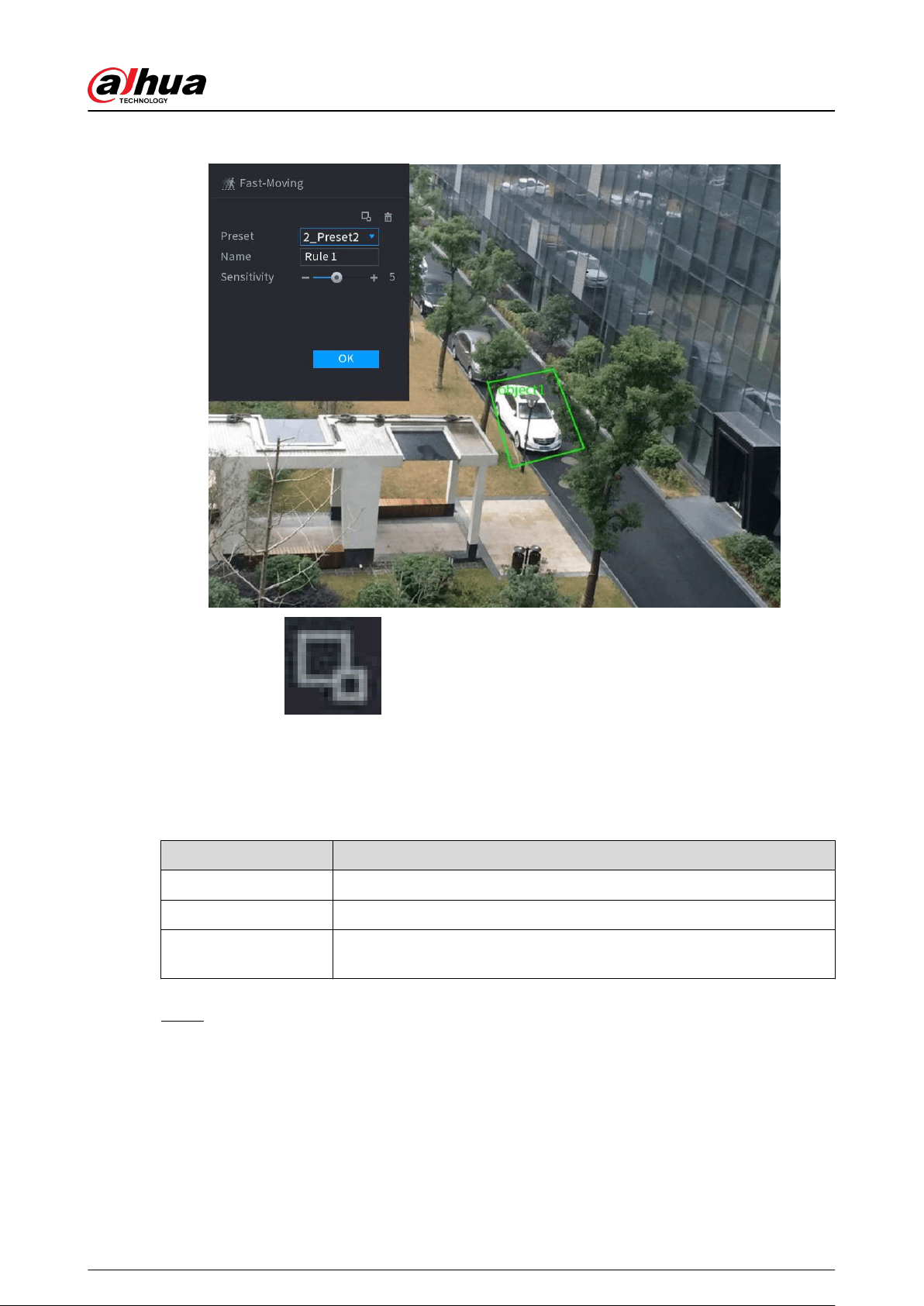
Figure 5-134 Fast moving
2. Click to draw the minimum size or maximum size to lter the target.
The system triggers an alarm only when the size of detected target is between the
maximum size and the minimum size.
3. Congure parameters.
Table 5-35 Fast moving parameters
Parameter Description
Preset Select a preset you want to use IVS.
Name Customize the rule name.
Sensitivity
You can set alarm sensitivity. The higher the value, the easier to detect a
fast moving object but meanwhile the higher false alarm rate.
4. Click OK.
Step 6 Congure alarm schedule and linkage.
User's Manual
247
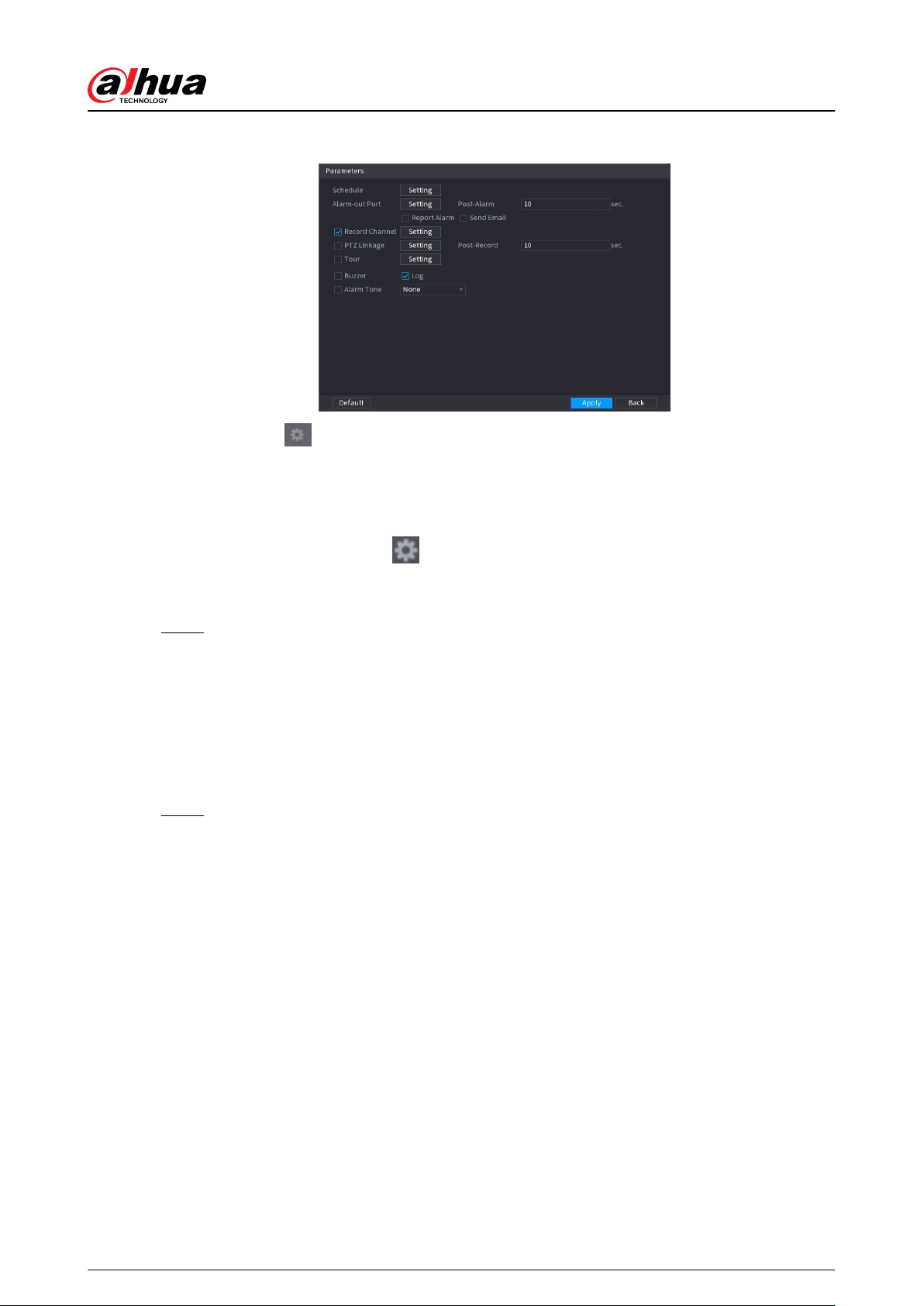
Figure 5-135 Schedule and alarm linkage
1. Click .
2. Click Setting next to Schedule to congure the alarm period.
The system performs linkage actions only for alarms during the arming period.
●
On the time line, drag to set the period.
●
You can also click
to set the period.
3. Congure alarm linkage. For details, see Table 5-47 .
4. Click Apply.
Step 7 Select Enable checkbox and then click Apply.
5.9.6.2.5 Parking
Background Information
When the detection target stays in the monitoring area longer than the set duration, the system
performs alarm linkage action.
Procedure
Step 1 Select Main Menu > AI > Parameters > IVS.
User's Manual
248
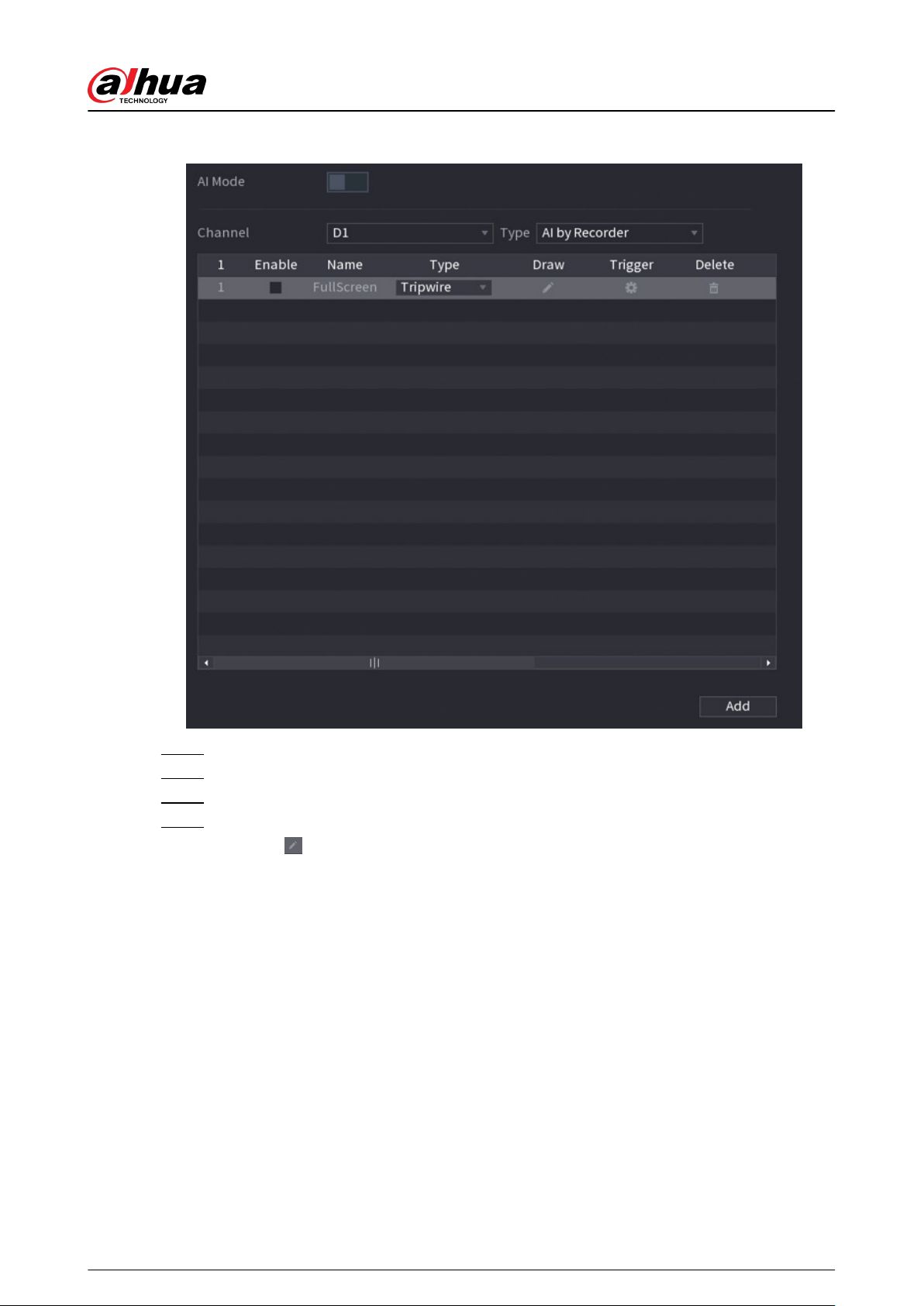
Figure 5-136 IVS
Step 2 Select channel and AI type.
Step 3 Click Add to add a rule.
Step 4 On the Type list, select Parking.
Step 5 Draw the detection rule.
1. Click
to draw a rectangle on the surveillance video image. Right-click the image to
stop drawing.
User's Manual
249
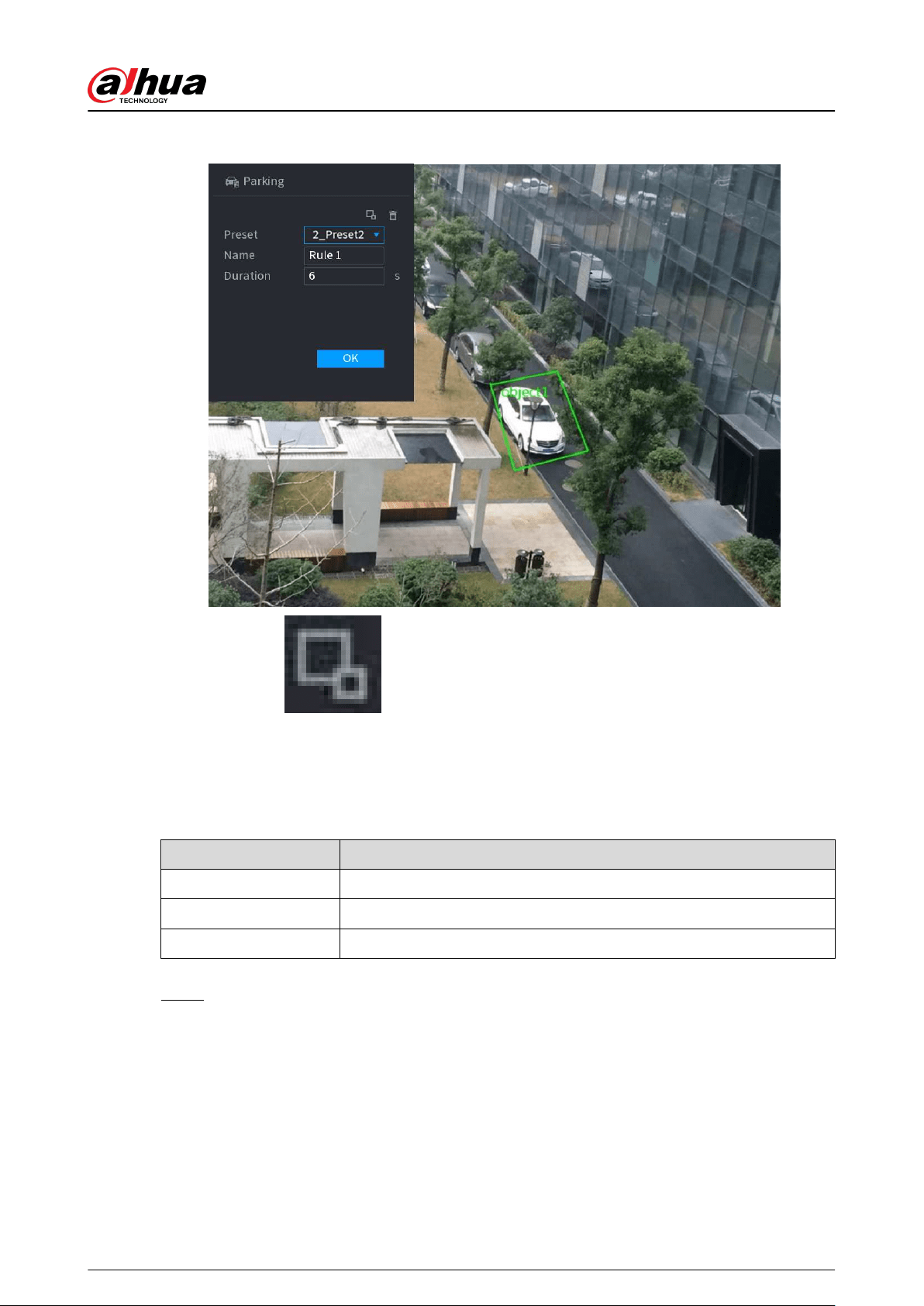
Figure 5-137 Parking
2. Click to draw the minimum size or maximum size to lter the target.
The system triggers an alarm only when the size of detected target is between the
maximum size and the minimum size.
3. Congure parameters.
Table 5-36 Parking parameters
Parameter Description
Preset Set the preset point for IVS detection.
Name Customize the rule name.
Duration Set how long the object stays until the alarm is triggered.
4. Click OK.
Step 6 Congure alarm schedule and linkage.
User's Manual
250
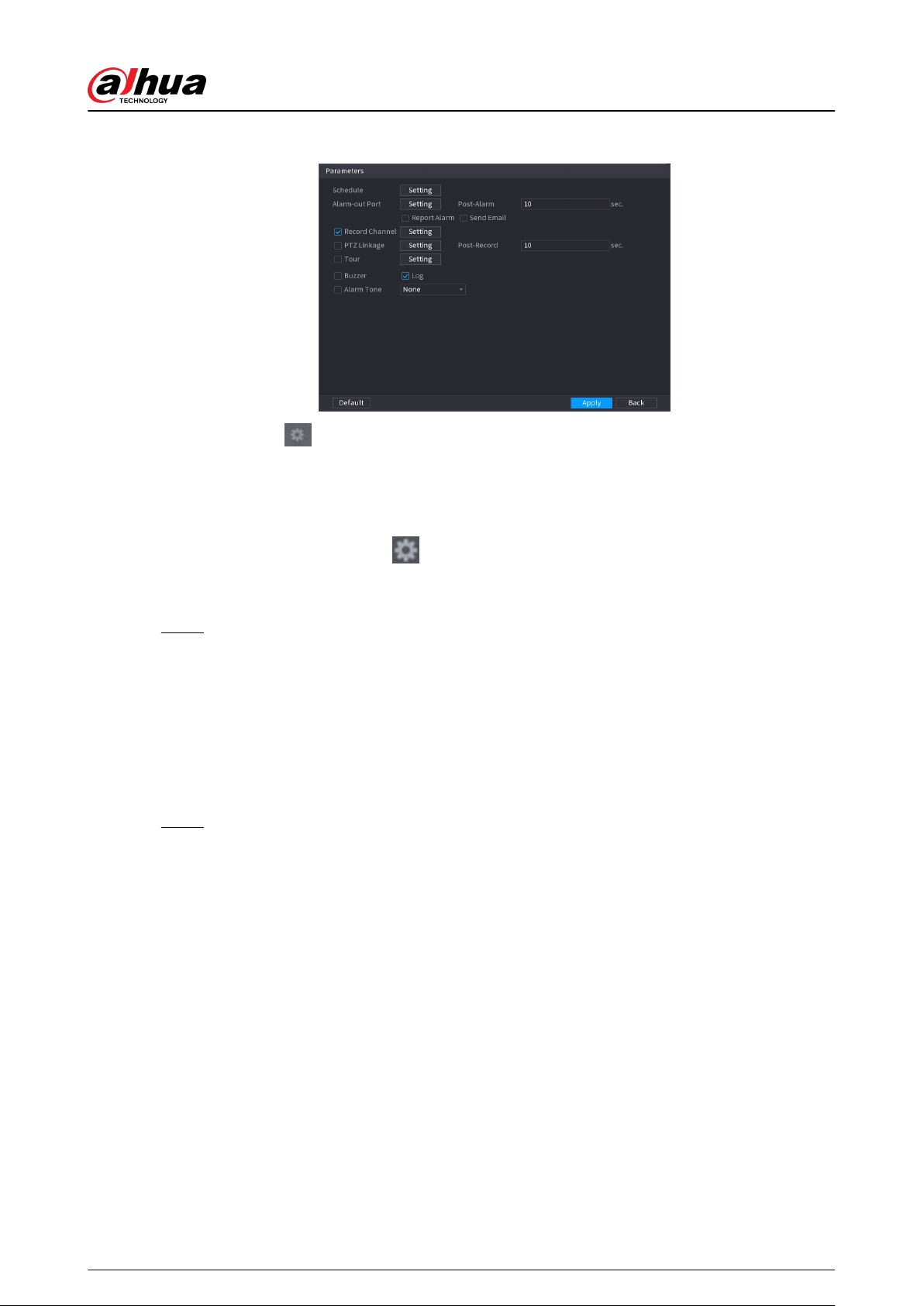
Figure 5-138 Schedule and alarm linkage
1. Click .
2. Click Setting next to Schedule to congure the alarm period.
The system performs linkage actions only for alarms during the arming period.
●
On the time line, drag to set the period.
●
You can also click
to set the period.
3. Congure alarm linkage. For details, see Table 5-47 .
4. Click Apply.
Step 7 Select Enable checkbox and then click Apply.
5.9.6.2.6 Crowd Gathering
Background Information
The system generates an alarm once people are gathering in the specied zone longer than the
dened duration.
Procedure
Step 1 Select Main Menu > AI > Parameters > IVS.
User's Manual
251
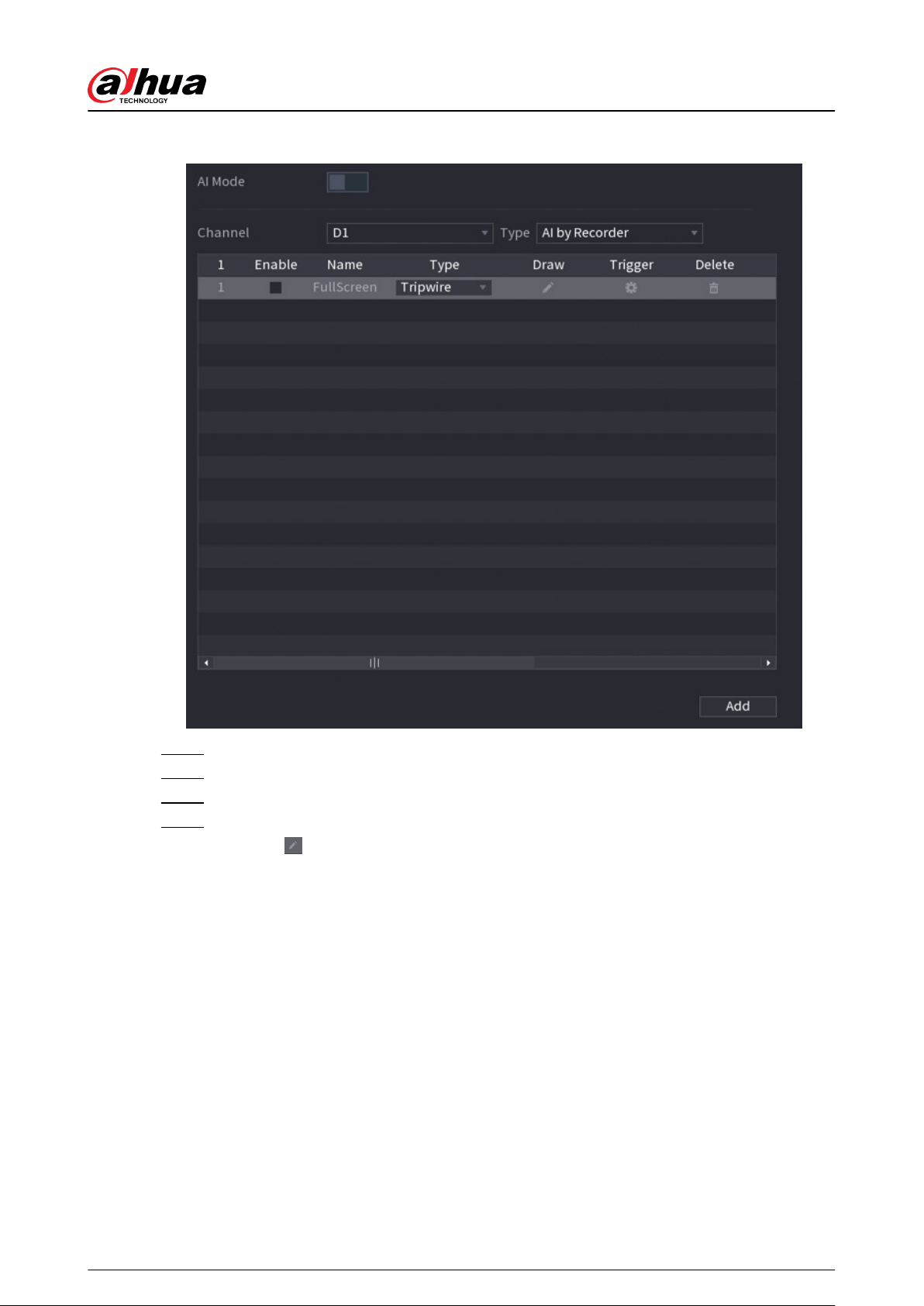
Figure 5-139 IVS
Step 2 Select channel and AI type.
Step 3 Click Add to add a rule.
Step 4 On the Type list, select Crowd Gathering Estimation.
Step 5 Draw the detection rule.
1. Click
to draw a rectangle on the surveillance video image. Right-click the image to
stop drawing.
User's Manual
252
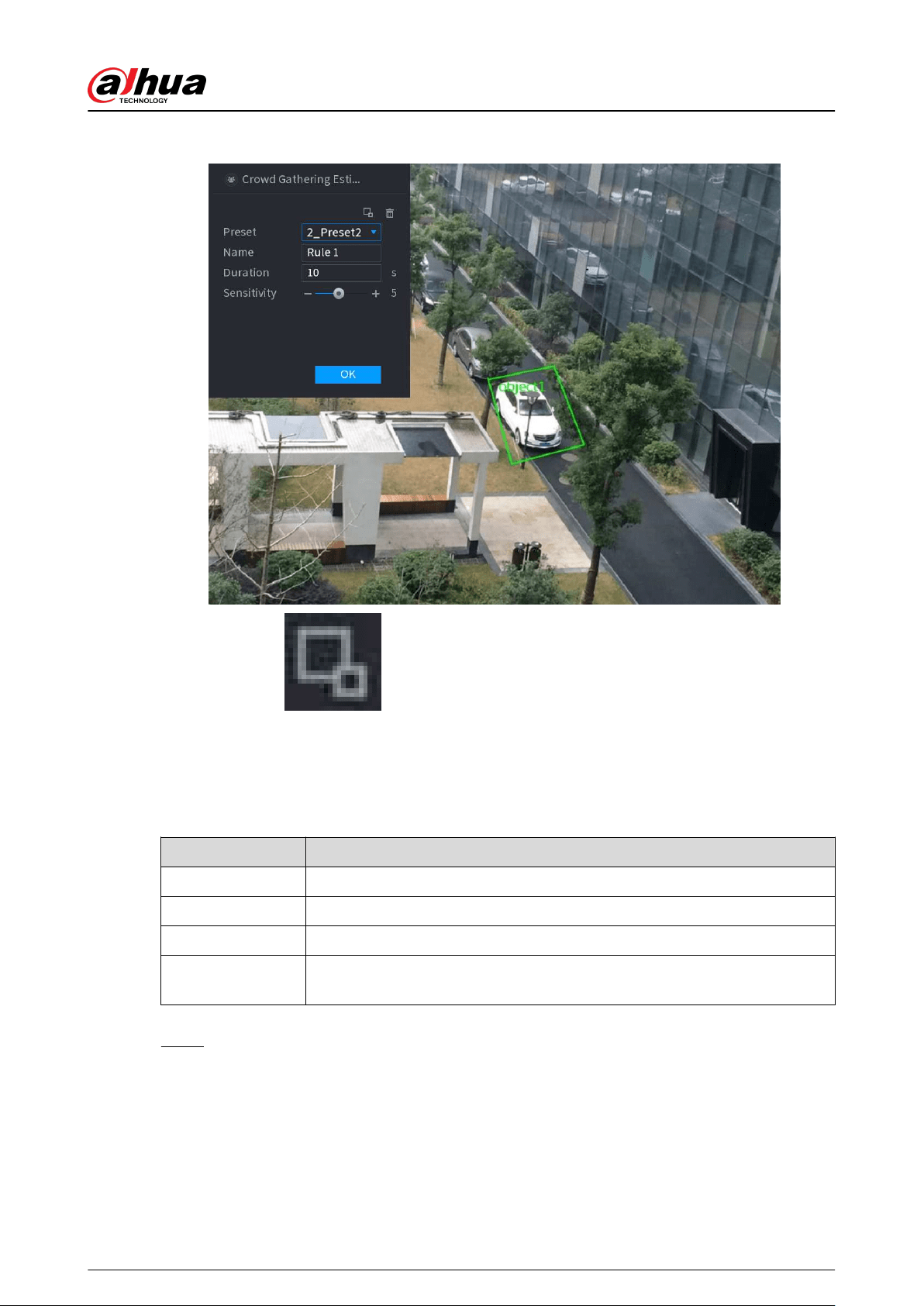
Figure 5-140 Crowd gathering
2. Click to draw the minimum size or maximum size to lter the target.
The system triggers an alarm only when the size of detected target is between the
maximum size and the minimum size.
3. Set parameters.
Table 5-37 Crowd gathering parameters
Parameter Description
Preset Select a preset you want to use IVS.
Name Customize the rule name.
Duration Set how long the object stays until the alarm is triggered.
Sensitivity
You can set alarm sensitivity. The higher the value, the easier to detect
crowd gathering but meanwhile the higher false alarm rate.
4. Click OK.
Step 6 Congure alarm schedule and linkage.
User's Manual
253
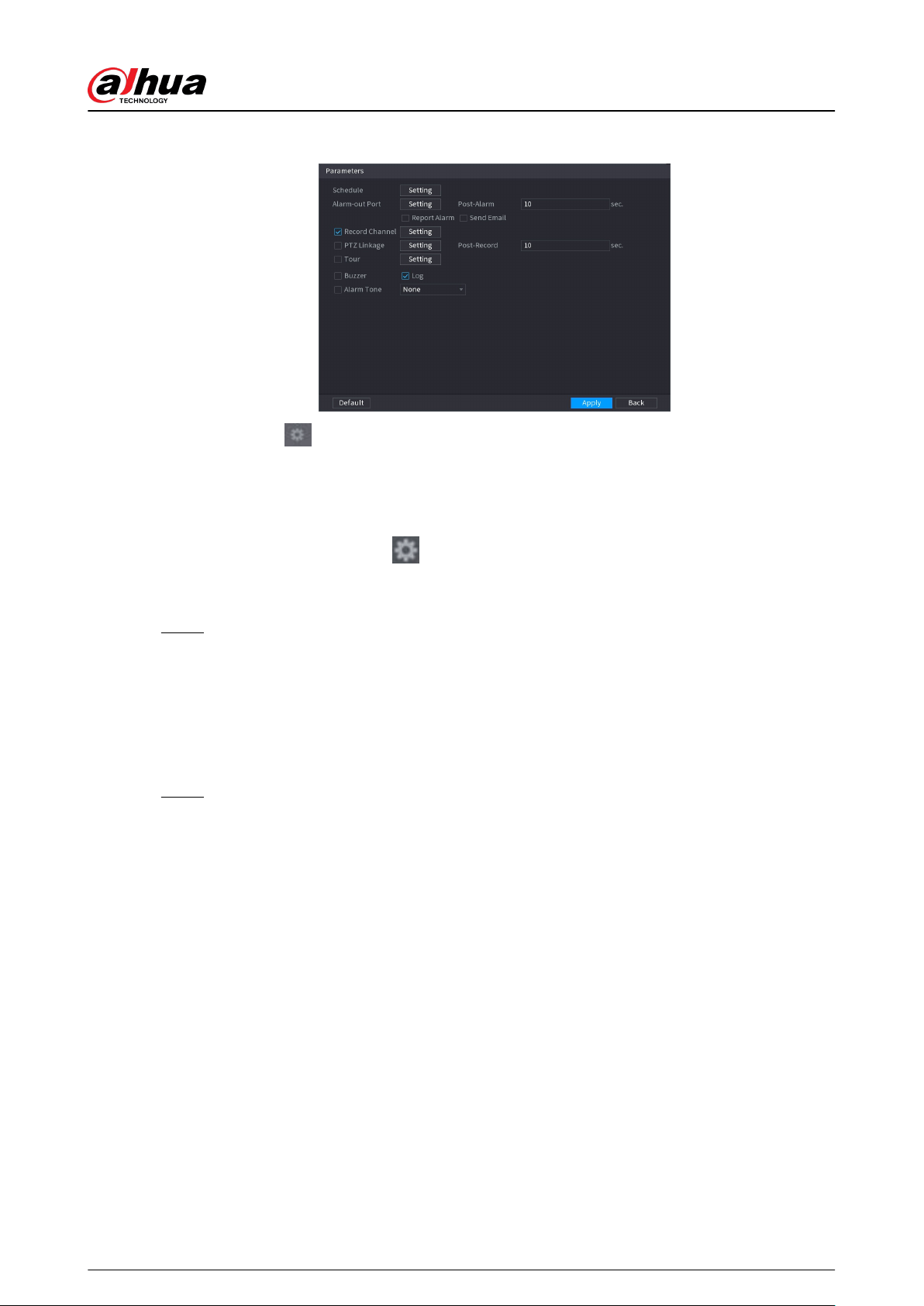
Figure 5-141 Schedule and alarm linkage
1. Click .
2. Click Setting next to Schedule to congure the alarm period.
The system performs linkage actions only for alarms during the arming period.
●
On the time line, drag to set the period.
●
You can also click
to set the period.
3. Congure alarm linkage. For details, see Table 5-47 .
4. Click Apply.
Step 7 Select Enable checkbox and then click Apply.
5.9.6.2.7 Missing Object Detection
Background Information
The system generates an alarm when there is missing object in the specied zone.
Procedure
Step 1 Select Main Menu > AI > Parameters > IVS.
User's Manual
254
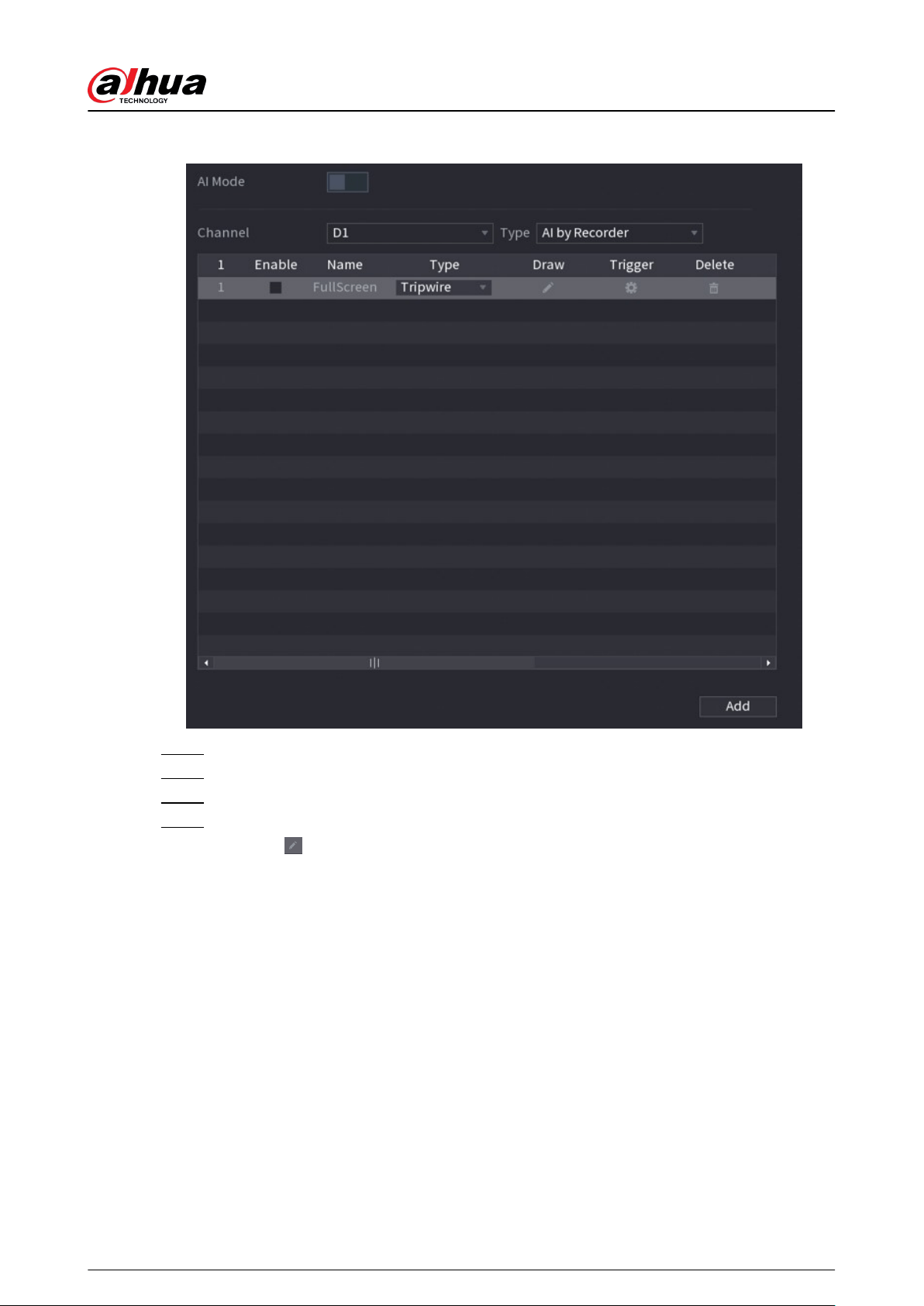
Figure 5-142 IVS
Step 2 Select channel and AI type.
Step 3 Click Add to add a rule.
Step 4 On the Type list, select Missing.
Step 5 Draw the detection rule.
1. Click
to draw a rectangle on the surveillance video image. Right-click the image to
stop drawing.
User's Manual
255
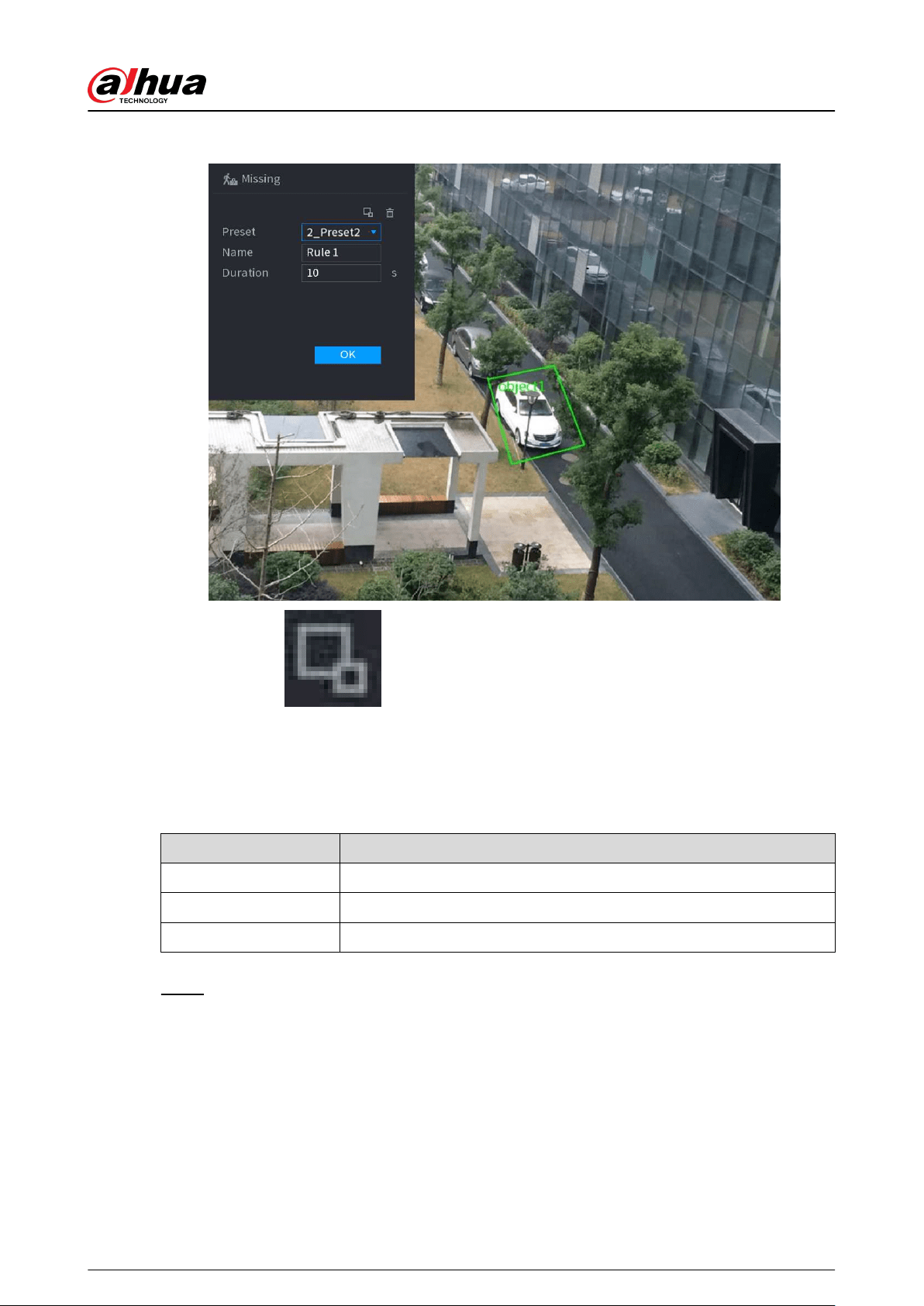
Figure 5-143 Missing object
2. Click to draw the minimum size or maximum size to lter the target.
The system triggers an alarm only when the size of detected target is between the
maximum size and the minimum size.
3. Congure parameters.
Table 5-38 Parameters of missing object detection
Parameter Description
Preset Set the preset point for IVS detection according to the actual needs.
Name Customize the rule name.
Duration Set how long the object stays until the alarm is triggered.
4. Click OK.
Step 6 Congure alarm schedule and linkage.
User's Manual
256
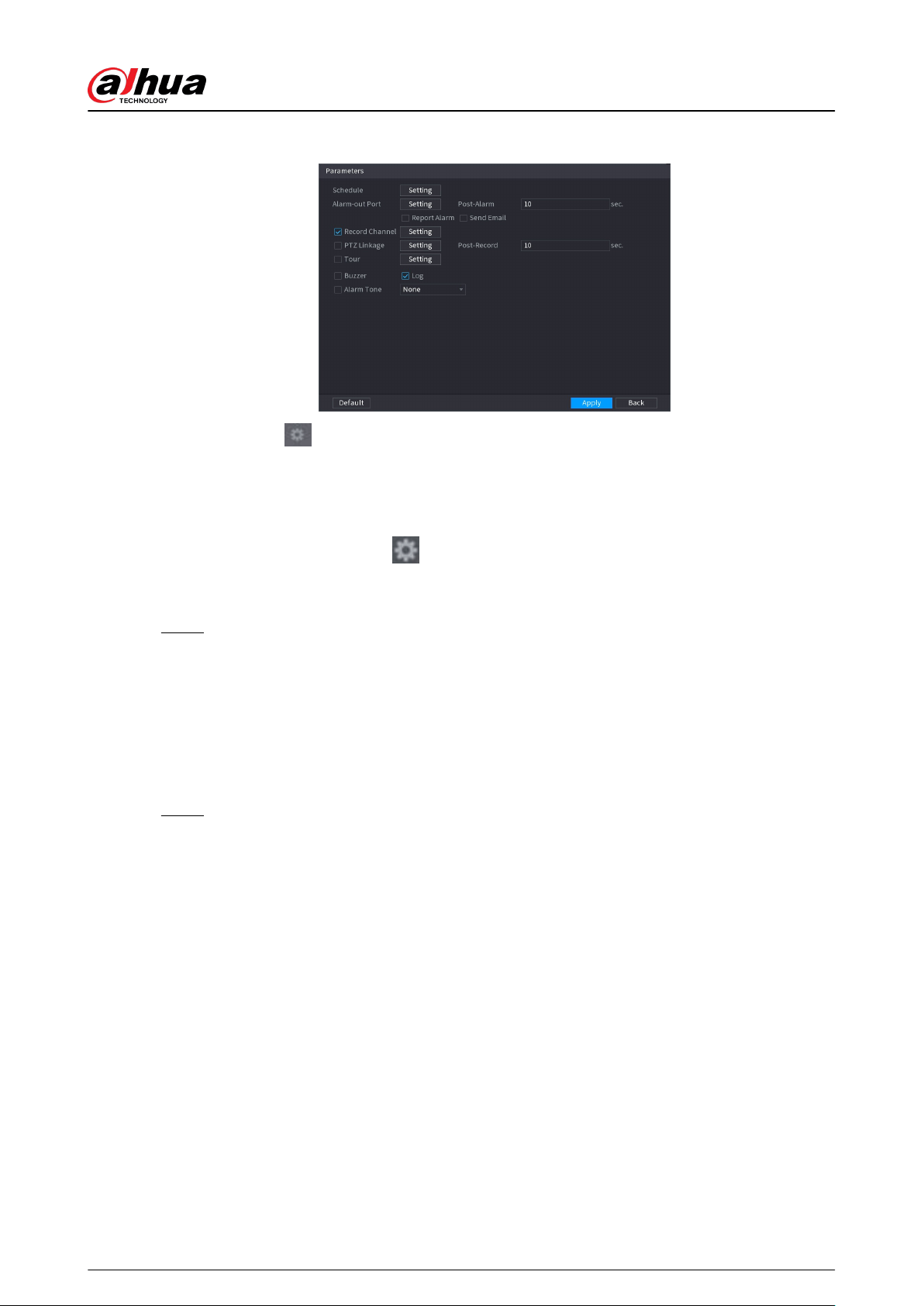
Figure 5-144 Schedule and alarm linkage
1. Click .
2. Click Setting next to Schedule to congure the alarm period.
The system performs linkage actions only for alarms during the arming period.
●
On the time line, drag to set the period.
●
You can also click
to set the period.
3. Congure alarm linkage. For details, see Table 5-47 .
4. Click Apply.
Step 7 Select Enable checkbox and then click Apply.
5.9.6.2.8 Loitering Detection
Background Information
The system generates an alarm once the object is staying in the specied zone longer than the
dened duration.
Procedure
Step 1 Select Main Menu > AI > Parameters > IVS.
User's Manual
257
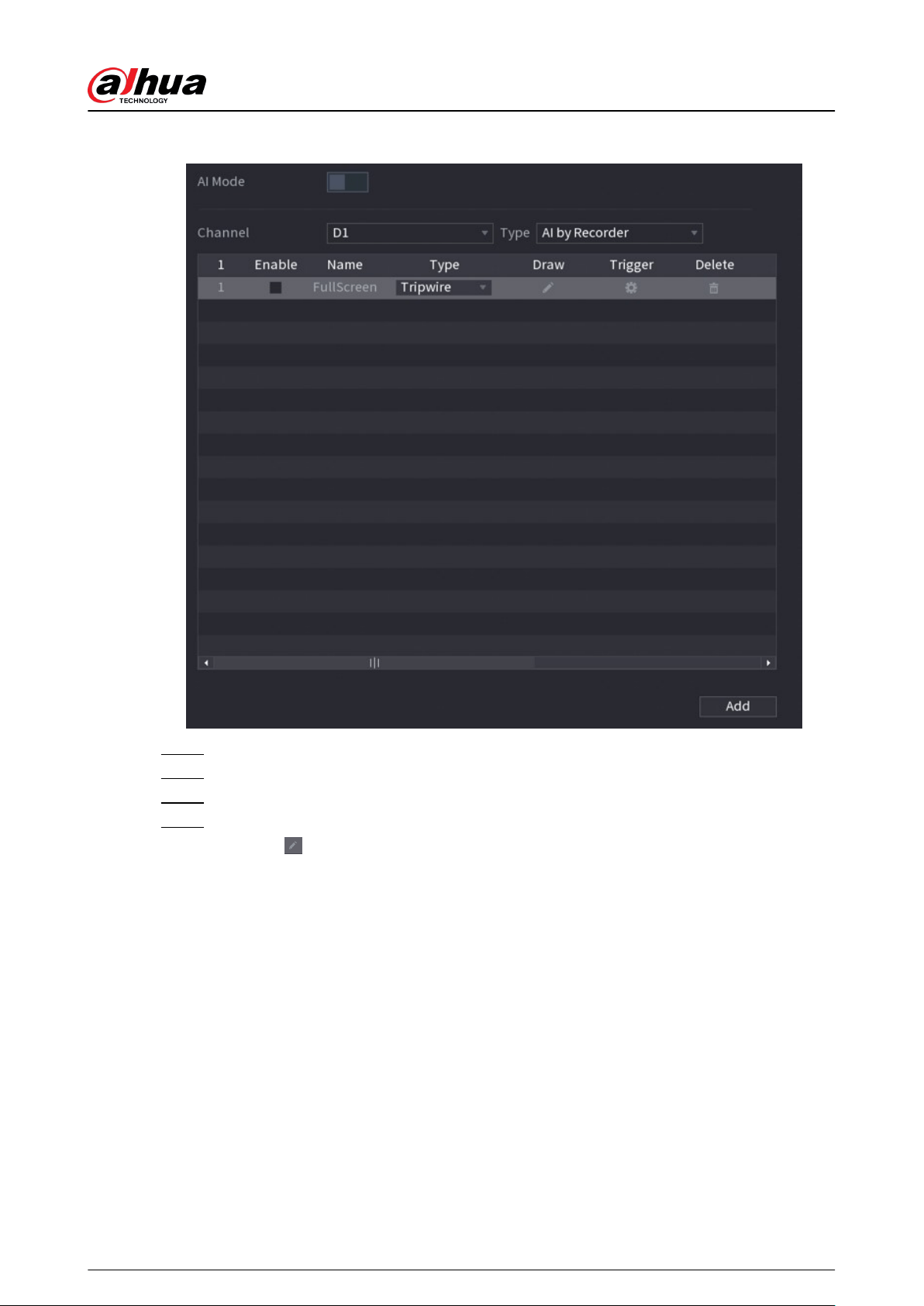
Figure 5-145 IVS
Step 2 Select channel and AI type.
Step 3 Click Add to add a rule.
Step 4 On the Type list, select Loitering Detection.
Step 5 Draw the detection rule.
1. Click
to draw a rectangle on the surveillance video image. Right-click the image to
stop drawing.
User's Manual
258
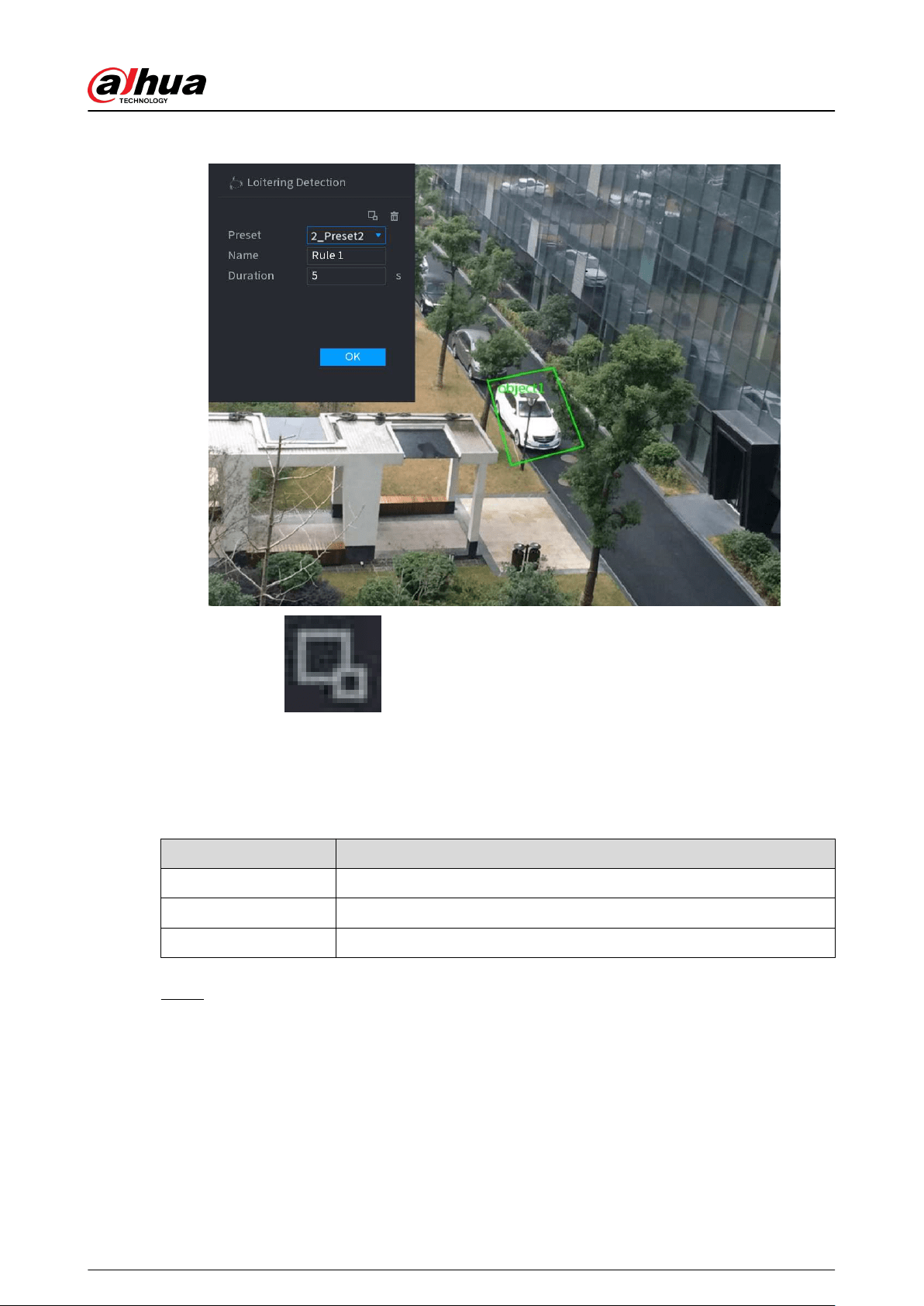
Figure 5-146 Loitering detection
2. Click to draw the minimum size or maximum size to lter the target.
The system triggers an alarm only when the size of detected target is between the
maximum size and the minimum size.
3. Congure parameters.
Table 5-39 Loitering detection parameters
Parameter Description
Preset Set the preset point for IVS detection.
Name Customize the rule name.
Duration Set how long the object stays until the alarm is triggered.
4. Click OK.
Step 6 Congure alarm schedule and linkage.
User's Manual
259
Figure 5-147 Schedule and alarm linkage
1. Click .
2. Click Setting next to Schedule to congure the alarm period.
The system performs linkage actions only for alarms during the arming period.
●
On the time line, drag to set the period.
●
You can also click
to set the period.
3. Congure alarm linkage. For details, see Table 5-47 .
4. Click Apply.
Step 7 Select Enable checkbox and then click Apply.
5.9.6.3 AI Search (IVS)
Background Information
You can search for IVS detection results.
Procedure
Step 1 Select Main Menu > AI > AI Search > IVS.
Figure 5-148 IVS search
User's Manual
260
Step 2 Select a channel, start time, end time, event type, and then click Search.
The search results are displayed.
Related Operations
●
Play back video.
Click an image, and then click
to play back the related video.
During playback, you can:
Click to pause.
Click to stop.
Click to display AI rule. The icon changes to .
●
Add tags.
Select one or more images, and then click Add Tag.
●
Lock.
Select one or more images, and then click Lock. The locked les will not be overwritten.
●
Export.
Select one or more images, and then click Export to export selected search results in excel.
●
Back up.
Select one or more images, click Backup , select the storage path and le type, and then click
Start to export les to external storage device.
5.9.7 Stereo Analysis
By drawing and setting the rules of stereo behavior analysis, the system will perform alarm linkage
actions when the video matches the detection rule. Types of events include: people approach
detection, fall detection, violence detection, people No. exception detection and people stay
detection.
●
This function requires access to a camera that supports stereo behavior analysis.
●
Stereo analysis and IVS are mutually exclusive and cannot be enabled at the same time.
5.9.7.1 Enabling Smart Plan
To use AI by camera, you need to enable the smart plan rst. For details, see "5.9.2 Smart Plan".
5.9.7.2 Conguring Stereo Analysis
5.9.7.2.1 People Approach Detection
When two people stay in the same detection area longer than the dened duration or when the
distance between two people is larger or smaller than the dened threshold, an alarm will be
triggered.
Procedure
Step 1 Select Main Menu > AI > Parameters > Stereo Analysis.
Step 2 Select a channel and then click Add.
User's Manual
261
Step 3 Select Enable and then set Type to People Approach Detection.
Step 4 Draw detection rule.
1. Click
, and then draw a detection area on the video image. Right-click the image to
stop drawing.
2. Congure parameters.
Table 5-40 Parameters of people approach detection
Parameter Description
Name Customize the rule name.
Sensitivity Set alarm sensitivity.
Duration
Set how long two people stay in the same detection area until an alarm
is triggered.
Repeat Alarm Time
Set repeat alarm time. If the alarm-triggering event continues, an alarm
will be triggered again when repeat alarm time passed.
Interval Threshold
When the distance between people in the area is greater than or less
than the dened threshold, an alarm will be triggered.
3. Click OK.
Step 5 Congure alarm schedule and linkage.
Figure 5-149 Schedule and alarm linkage
1. Click .
2. Click Setting next to Schedule to congure the alarm period.
The system performs linkage actions only for alarms during the arming period.
●
On the time line, drag to set the period.
●
You can also click
to set the period.
3. Congure alarm linkage. For details, see Table 5-47 .
4. Click Apply.
Step 6 Click Apply.
User's Manual
262
5.9.7.2.2 Fall Detection
When someone falls from a height in the detection area and the duration of the action is greater
than the dened threshold, an alarm will be triggered.
Procedure
Step 1 Select Main Menu > AI > Parameters > Stereo Analysis.
Step 2 Select a channel and then click Add.
Step 3 Select Enable and then set Type to Fall Detection.
Step 4 Draw detection rule.
1. Click
, and then draw a detection area on the video image. Right-click the image to
stop drawing.
2. Congure parameters.
Table 5-41 Parameters of fall detection
Parameter Description
Name Customize the rule name.
Sensitivity Set alarm sensitivity.
Duration Set the minimum time of triggering an alarm when people fall.
Repeat Alarm Time
Set repeat alarm time. If the alarm-triggering event continues, an alarm
will be triggered again when repeat alarm time passed.
3. Click OK.
Step 5 Congure alarm schedule and linkage.
Figure 5-150 Schedule and alarm linkage
1. Click .
2. Click Setting next to Schedule to congure the alarm period.
The system performs linkage actions only for alarms during the arming period.
●
On the time line, drag to set the period.
●
You can also click
to set the period.
3. Congure alarm linkage. For details, see Table 5-47 .
4. Click Apply.
Step 6 Click Apply.
User's Manual
263
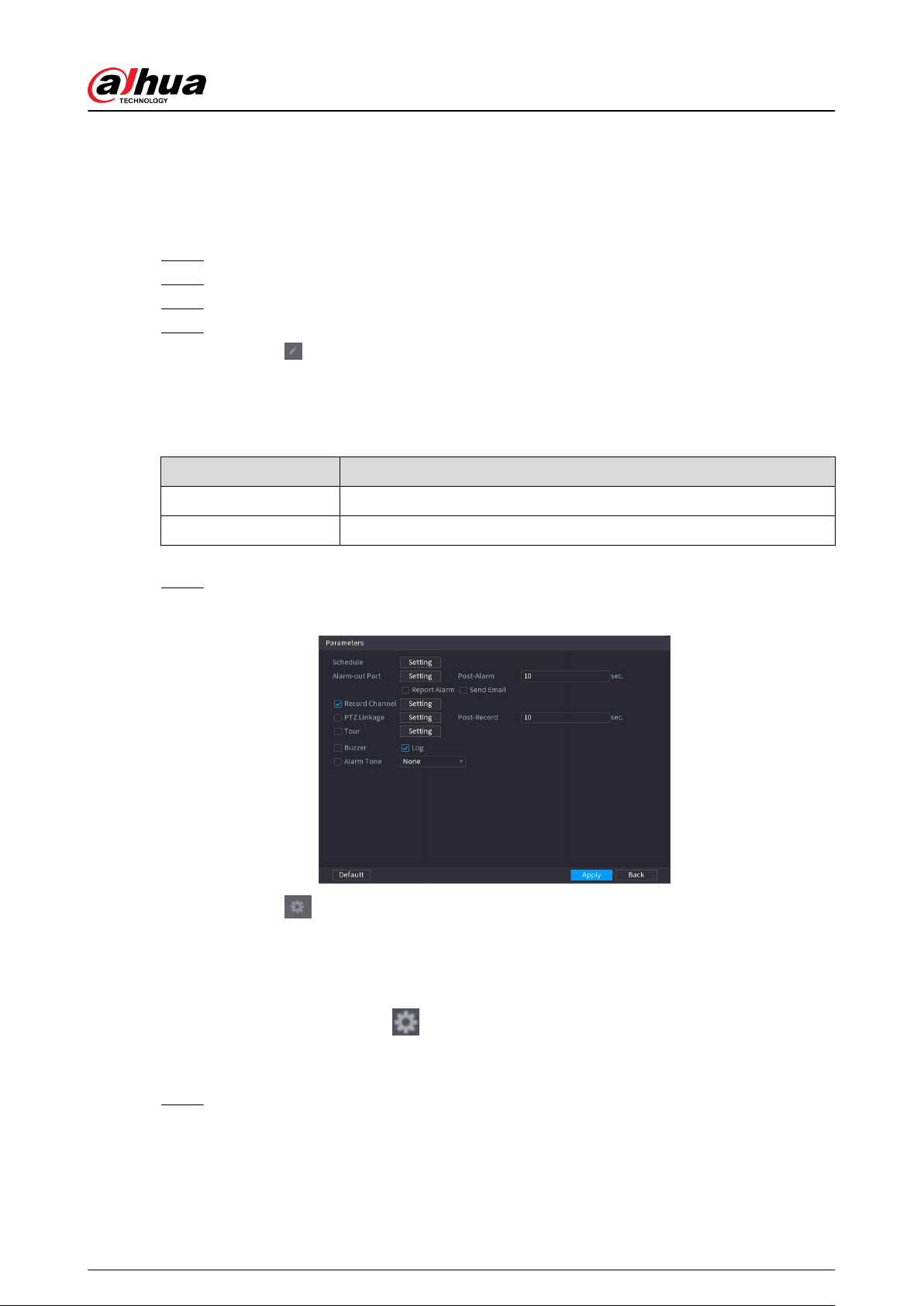
5.9.7.2.3 Violence Detection
When the target in the detection region has large body movements such as smashing and ghting,
an alarm will be triggered.
Procedure
Step 1 Select Main Menu > AI > Parameters > Stereo Analysis.
Step 2 Select a channel and then click Add.
Step 3 Select Enable and then set Type to Violence Detection.
Step 4 Draw detection rule.
1. Click
, and then draw a detection area on the video image. Right-click the image to
stop drawing.
2. Congure parameters.
Table 5-42 Parameters of violence detection
Parameter Description
Name Customize the rule name.
Sensitivity Set alarm sensitivity.
3. Click OK.
Step 5 Congure alarm schedule and linkage.
Figure 5-151 Schedule and alarm linkage
1. Click .
2. Click Setting next to Schedule to congure the alarm period.
The system performs linkage actions only for alarms during the arming period.
●
On the time line, drag to set the period.
●
You can also click
to set the period.
3. Congure alarm linkage. For details, see Table 5-47 .
4. Click Apply.
Step 6 Click Apply.
User's Manual
264
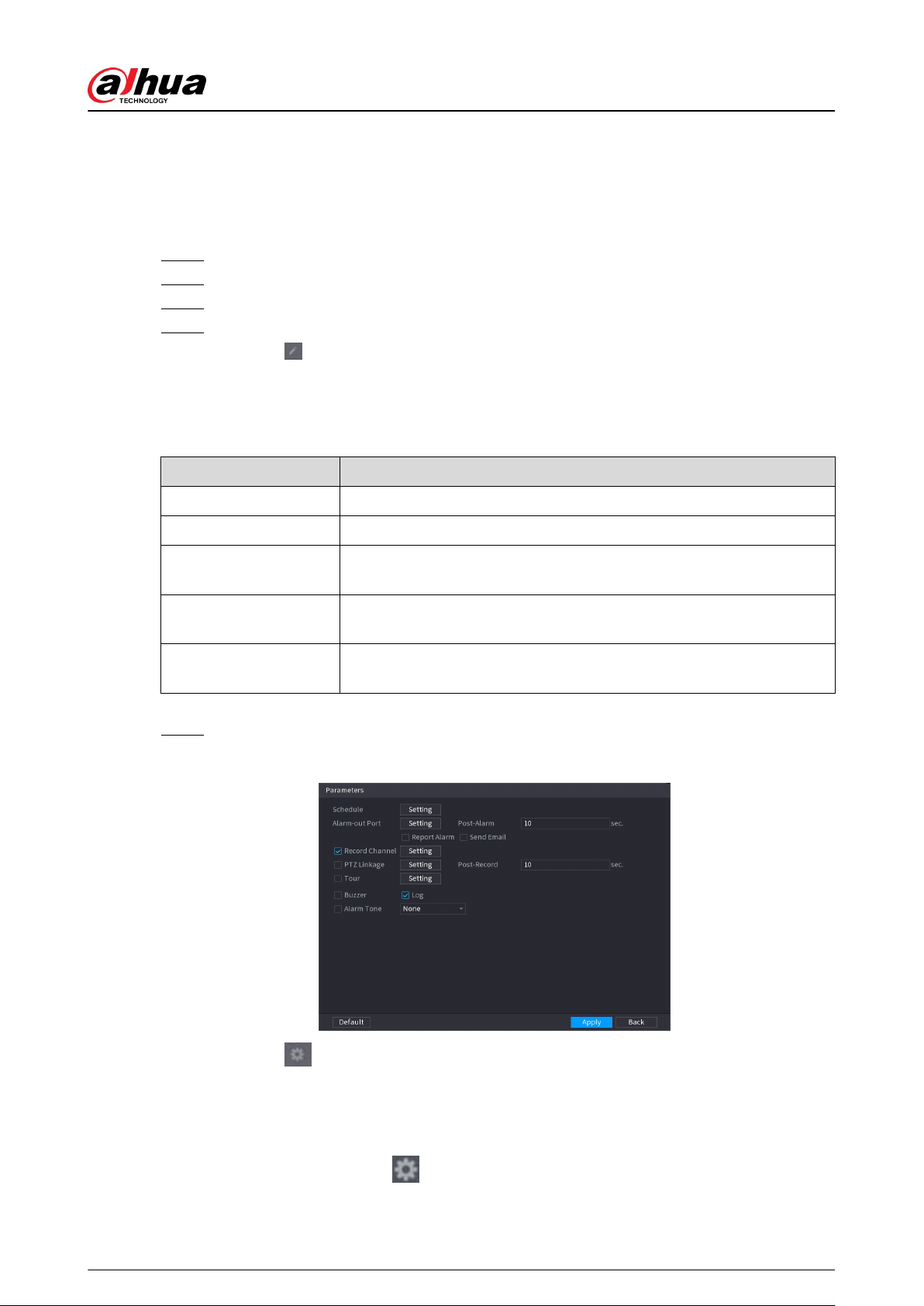
5.9.7.2.4 People No. Exception Detection
When the system detects an abnormal number of people in the same detection area, an alarm will
be triggered.
Procedure
Step 1 Select Main Menu > AI > Parameters > Stereo Analysis.
Step 2 Select a channel and then click Add.
Step 3 Select Enable and then set Type to People No. Exception Detection.
Step 4 Draw detection rule.
1. Click
, and then draw a detection area on the video image. Right-click the image to
stop drawing.
2. Congure parameters.
Table 5-43 Parameters of people No. exception detection
Parameter Description
Name Customize the rule name.
Sensitivity Set alarm sensitivity.
Duration
Set the minimum time to trigger an alarm after the system detects an
abnormal number of people.
Repeat Alarm Time
Set repeat alarm time. If the alarm-triggering event continues, an alarm
will be triggered again when repeat alarm time passed.
Alarm People No.
When the number of people in the area is greater than, equal to, or less
than the dened threshold, an alarm will be triggered.
3. Click OK.
Step 5 Congure alarm schedule and linkage.
Figure 5-152 Schedule and alarm linkage
1. Click .
2. Click Setting next to Schedule to congure the alarm period.
The system performs linkage actions only for alarms during the arming period.
●
On the time line, drag to set the period.
●
You can also click
to set the period.
3. Congure alarm linkage. For details, see Table 5-47 .
User's Manual
265
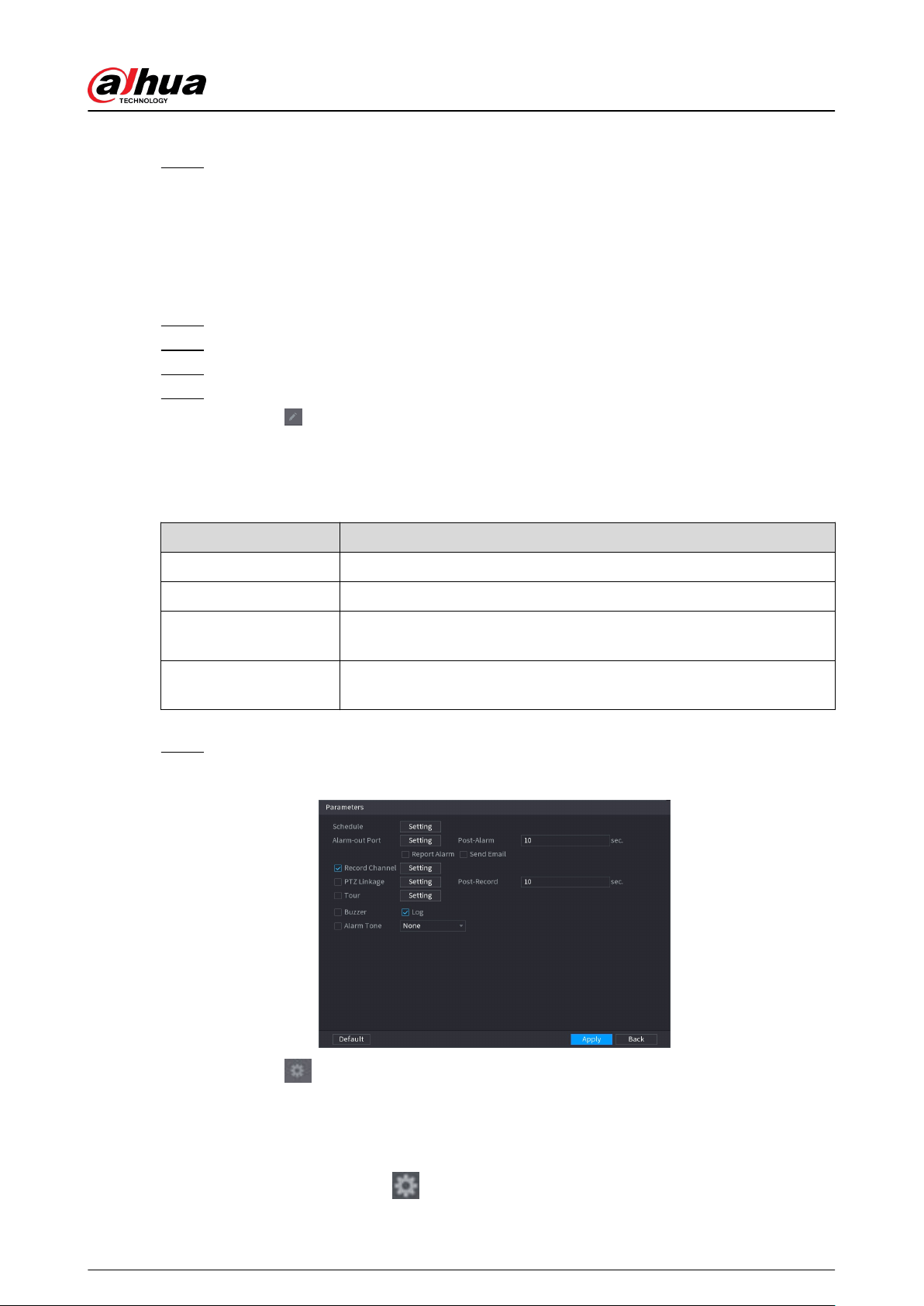
4. Click Apply.
Step 6 Click Apply.
5.9.7.2.5 People Stay Detection
When the target stays in the detection area longer than the dened duration, an alarm will be
triggered.
Procedure
Step 1 Select Main Menu > AI > Parameters > Stereo Analysis.
Step 2 Select a channel and then click Add.
Step 3 Select Enable and then set Type to People Stay Detection.
Step 4 Draw detection rule.
1. Click
, and then draw a detection area on the video image. Right-click the image to
stop drawing.
2. Congure parameters.
Table 5-44 Parameters of people stay detection
Parameter Description
Name Customize the rule name.
Sensitivity Set alarm sensitivity.
Duration
Set low long people stay in the detection area until an alarm is
triggered.
Repeat Alarm Time
Set repeat alarm time. If the alarm-triggering event continues, an alarm
will be triggered again when repeat alarm time passed.
3. Click OK.
Step 5 Congure alarm schedule and linkage.
Figure 5-153 Schedule and alarm linkage
1. Click .
2. Click Setting next to Schedule to congure the alarm period.
The system performs linkage actions only for alarms during the arming period.
●
On the time line, drag to set the period.
●
You can also click
to set the period.
User's Manual
266
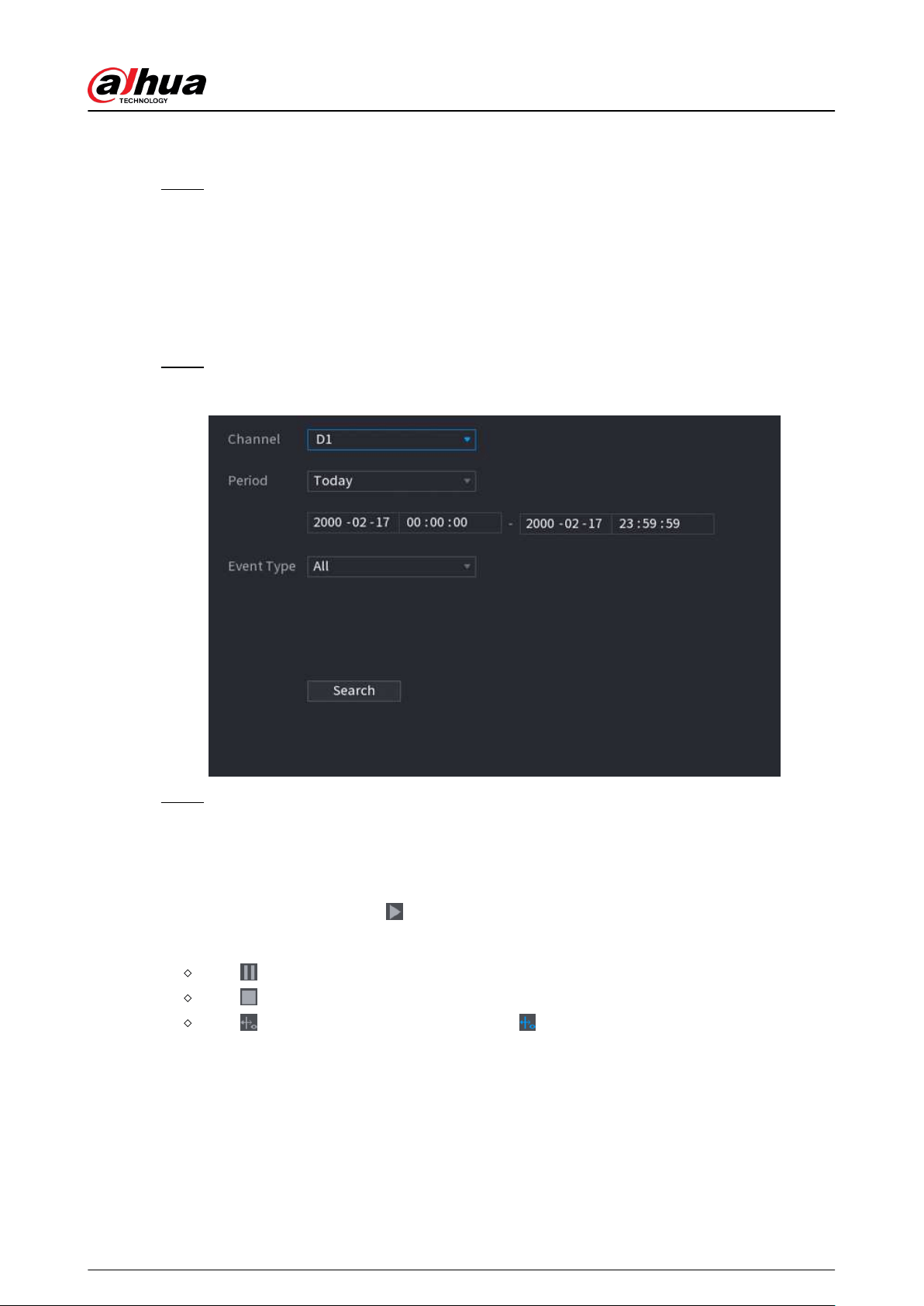
3. Congure alarm linkage. For details, see Table 5-47 .
4. Click Apply.
Step 6 Click Apply.
5.9.7.3 AI Search (Stereo Analysis)
Background Information
You can search for detection results of stereo analysis.
Procedure
Step 1 Select Main Menu > AI > AI Search > Stereo Analysis.
Figure 5-154 Stereo analysis search
Step 2 Select a channel, start time, end time, event type, and then click Search.
The search results are displayed.
Related Operations
●
Play back video.
Click an image, and then click
to play back the related video.
During playback, you can:
Click to pause.
Click to stop.
Click to display AI rule. The icon changes to .
●
Add tags.
Select one or more images, and then click Add Tag.
●
Lock.
Select one or more images, and then click Lock. The locked les will not be overwritten.
●
Export.
Select one or more images, and then click Export to export selected search results in excel.
●
Back up.
User's Manual
267

Select one or more images, click Backup , select the storage path and le type, and then click
Start to export les to external storage device.
5.9.8 Video Metadata
The system analyzes real-time video stream to detect the existence of human, motor vehicle, and
non-motor vehicle. Once a target is detected, an alarm is triggered.
5.9.8.1 Enabling Smart Plan
To use AI by camera, you need to enable the smart plan rst. For details, see "5.9.2 Smart Plan".
5.9.8.2 Conguring Video Metadata
When a metadata alarm is triggered, the system links the corresponding camera to record videos
and logs and take snapshots. Other alarm linkage actions are not supported for video metadata.
Procedure
Step 1 Select Main Menu > AI > Parameters > Video Metadata.
User's Manual
268
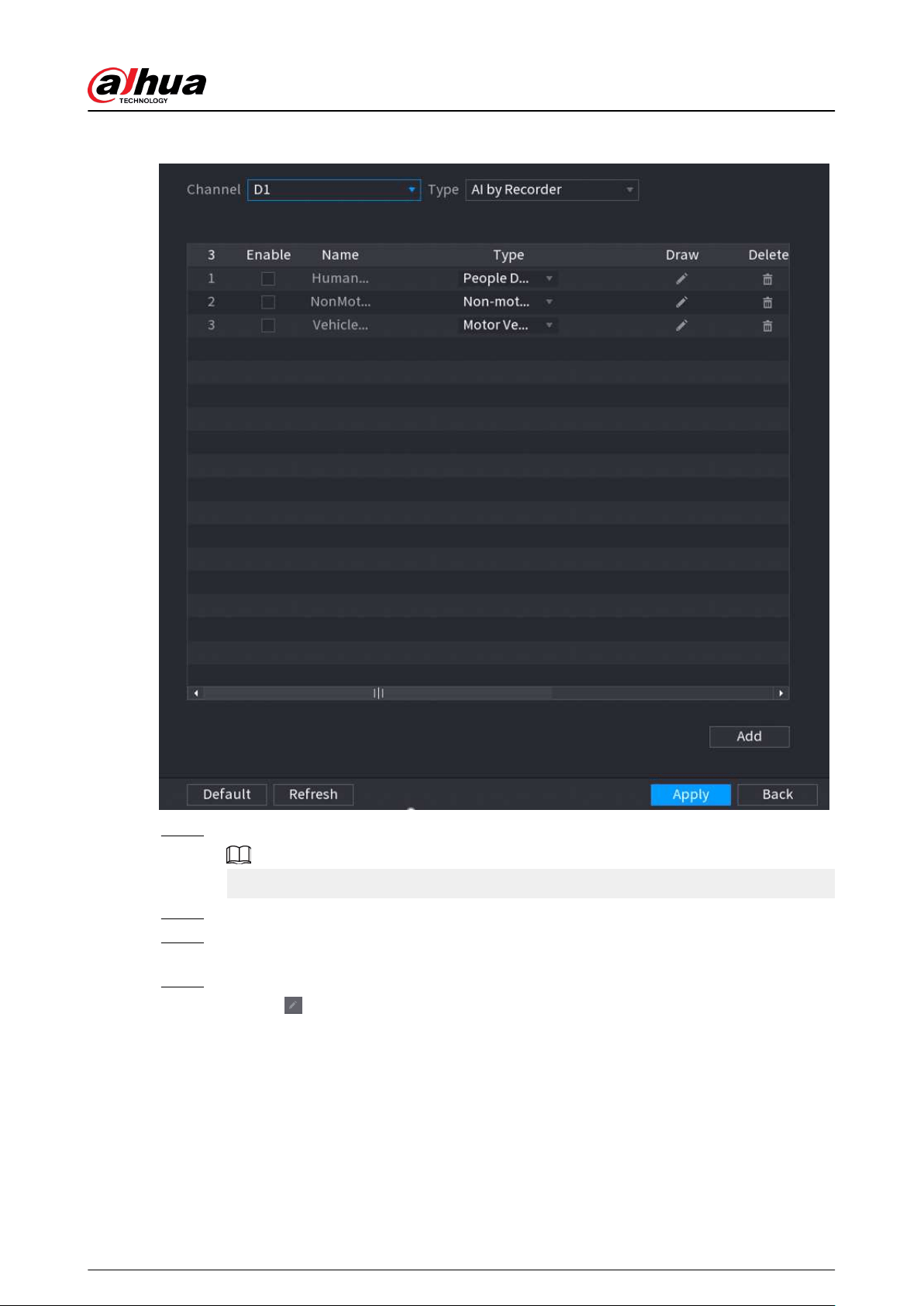
Figure 5-155 Video metadata
Step 2 Select a channel and AI type.
AI by Recorder is available on select models.
Step 3 Click Add to add a rule.
Step 4 Select Enable and then set Type to People Detection, Non-motor Vehicle Detection or
Motor Vehicle Detection.
Step 5 Draw detection rule.
1. Click
, and then draw a detection area on the video image. Right-click the image to
stop drawing.
User's Manual
269
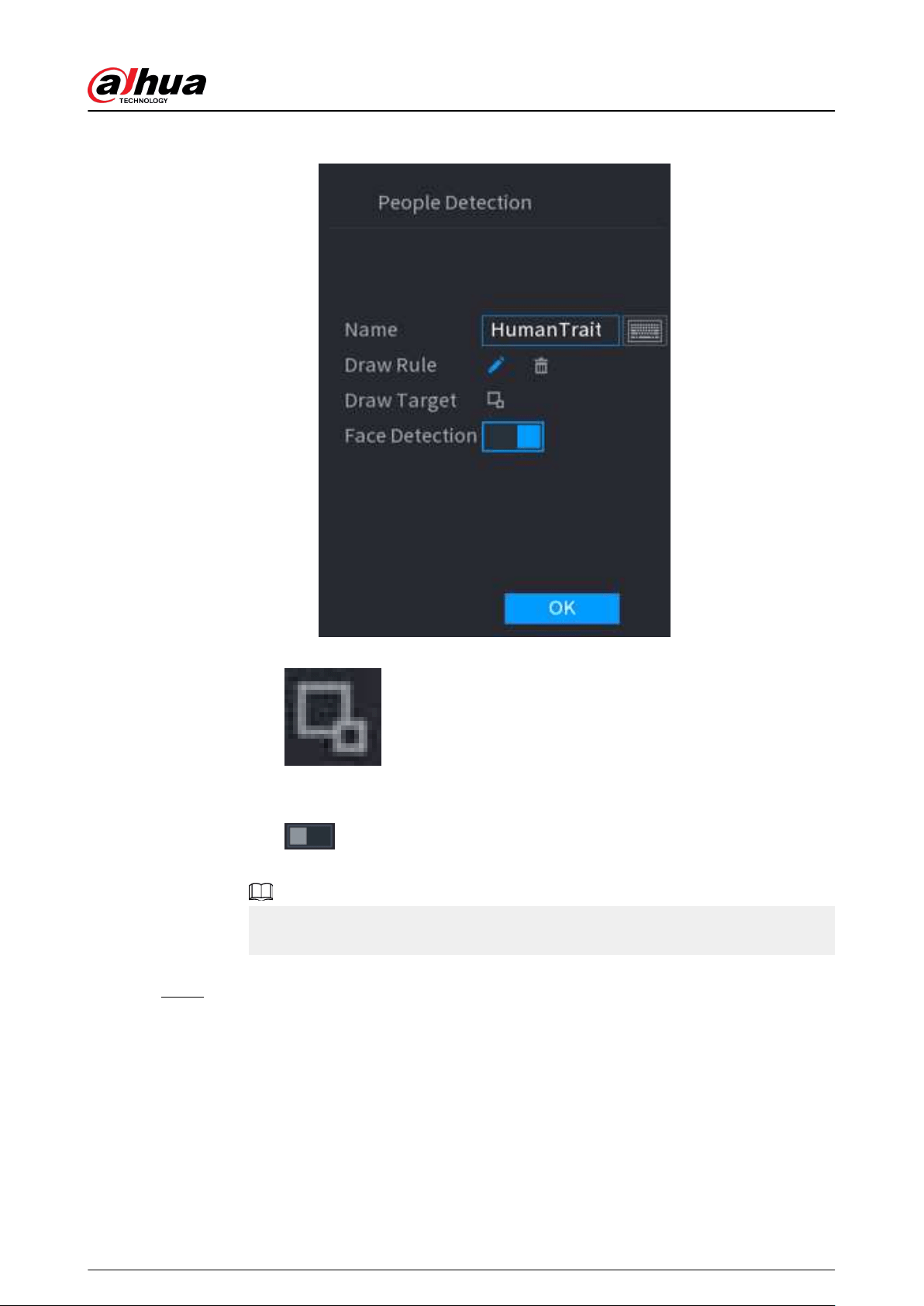
Figure 5-156 People detection
2. Enter the rule name.
3. Click
to draw the minimum size or maximum size to lter the target.
The system triggers an alarm only when the size of detected target is between the
maximum size and the minimum size.
4. Click to enable face detection.
5. Select A to B , B to A, or Both as direction for tripwire counting.
Tripwire counting is available when AI by Camera is used and the camera supports this
function.
6. Click OK.
Step 6 Click Apply.
5.9.8.3 AI Search (Video Metadata)
You can search for the video metadata detection results and play back related videos.
User's Manual
270
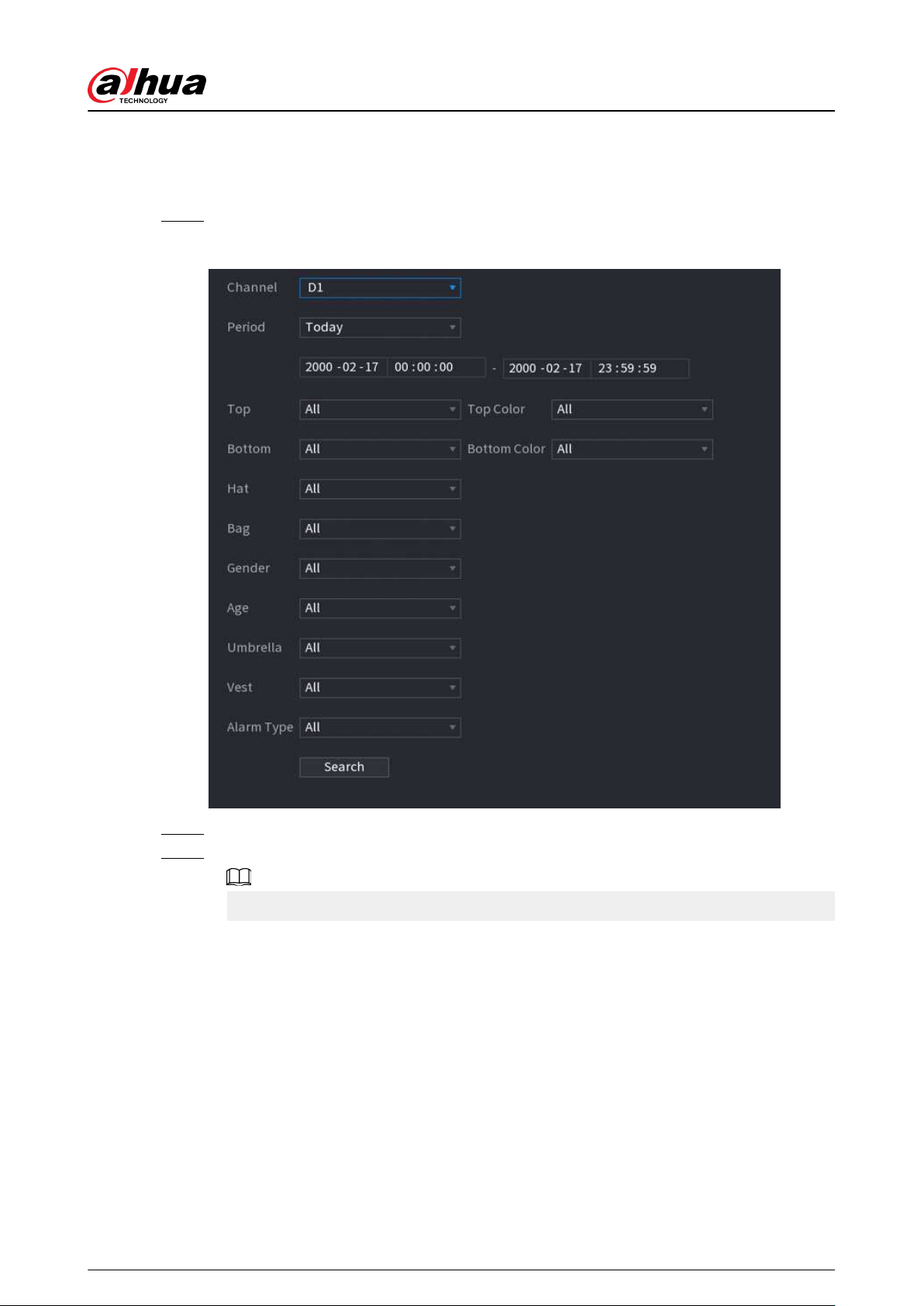
5.9.8.3.1 Human Detection
Procedure
Step 1 Select Main Menu > AI > AI Search > Human Detection.
Figure 5-157 Human detection
Step 2 Select a channel, start time, end time, and set corresponding parameters.
Step 3 Click Search.
For privacy protection, the faces are intentionally blurred.
User's Manual
271
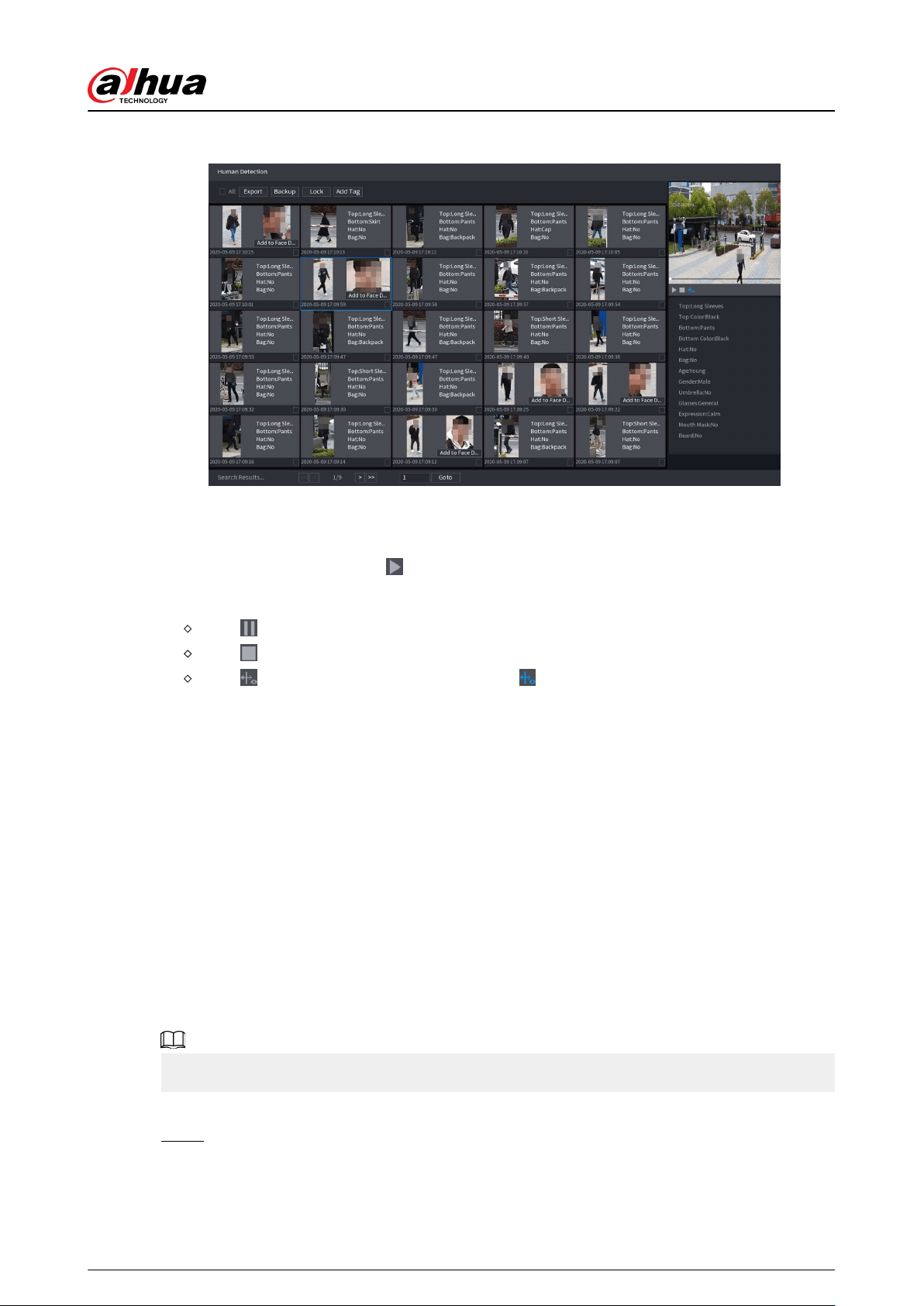
Figure 5-158 Search results
Related Operations
●
Play back video.
Click an image, and then click
to play back the related video.
During playback, you can:
Click to pause.
Click to stop.
Click to display AI rule. The icon changes to .
●
Add tags.
Select one or more images, and then click Add Tag.
●
Lock.
Select one or more images, and then click Lock. The locked les will not be overwritten.
●
Export.
Select one or more images, and then click Export to export selected search results in excel.
●
Back up.
Select one or more images, click Backup , select the storage path and le type, and then click
Start to export les to external storage device.
5.9.8.3.2 Motor Vehicle Detection
Background Information
You can search for motor vehicle detection results according to the vehicle parameters.
This function is available on select models.
Procedure
Step 1 Select Main Menu > AI > AI Search > Motor Vehicle Detection.
User's Manual
272
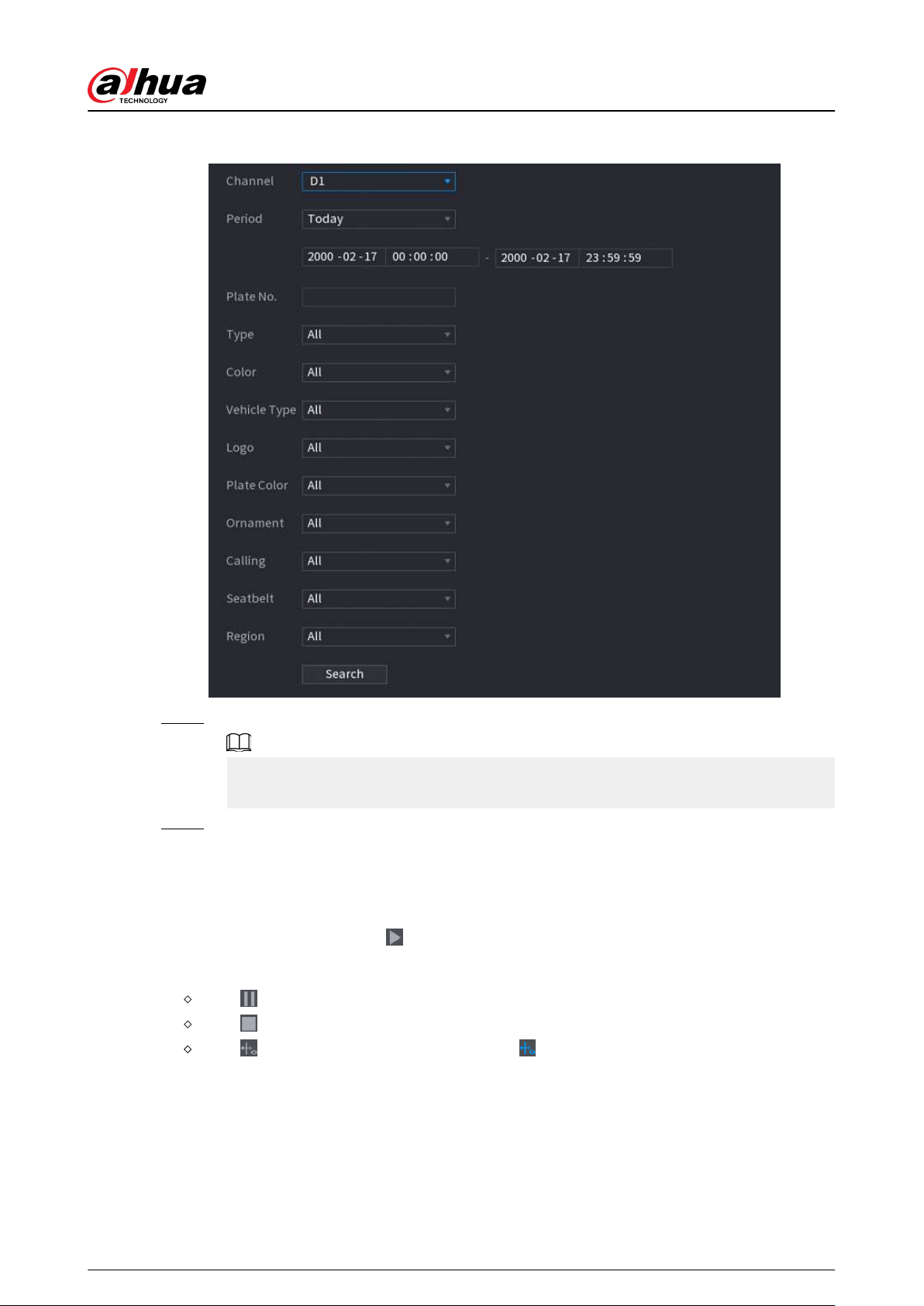
Figure 5-159 Motor vehicle detection
Step 2 Select a channel and then set parameters.
●
The system supports fuzzy search of plate numbers.
●
The system searches all plate numbers by default if you have not set a plate number.
Step 3 Click Search.
The search results are displayed.
Related Operations
●
Play back video.
Click an image, and then click
to play back the related video.
During playback, you can:
Click to pause.
Click to stop.
Click to display AI rule. The icon changes to .
●
Add tags.
Select one or more images, and then click Add Tag.
●
Lock.
Select one or more images, and then click Lock. The locked les will not be overwritten.
●
Export.
Select one or more images, and then click Export to export selected search results in excel.
User's Manual
273
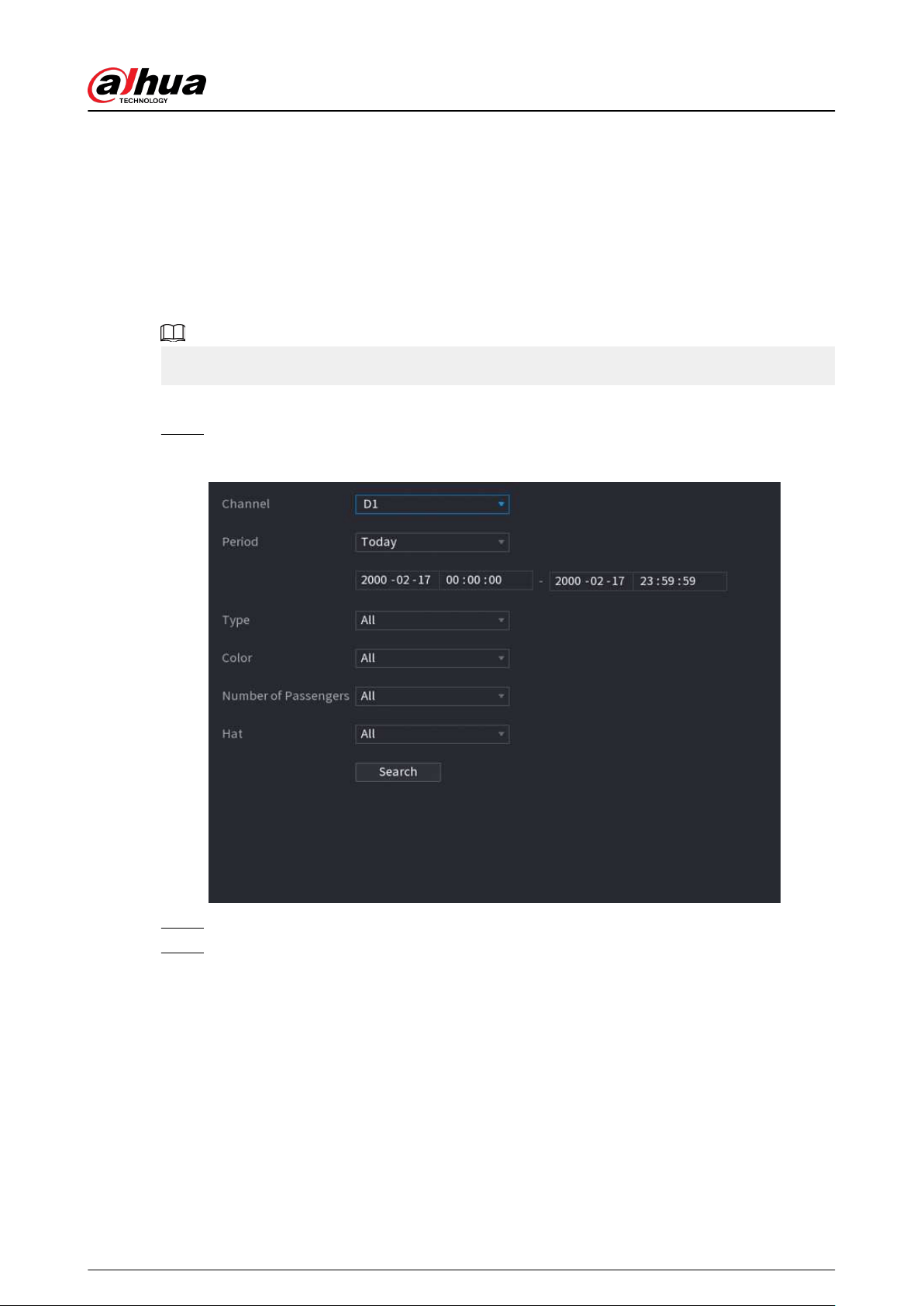
●
Back up.
Select one or more images, click Backup , select the storage path and le type, and then click
Start to export les to external storage device.
5.9.8.3.3 Non-motor Vehicle Detection
Background Information
You can search for non-motor vehicle detection results according to the non-motor vehicle
parameters.
This function is available on select models.
Procedure
Step 1 Select Main Menu > AI > AI Search > Non-Motor Vehicle Detection .
Figure 5-160 Non-motor vehicle detection
Step 2 Select a channel and then set parameters.
Step 3 Click Search.
User's Manual
274
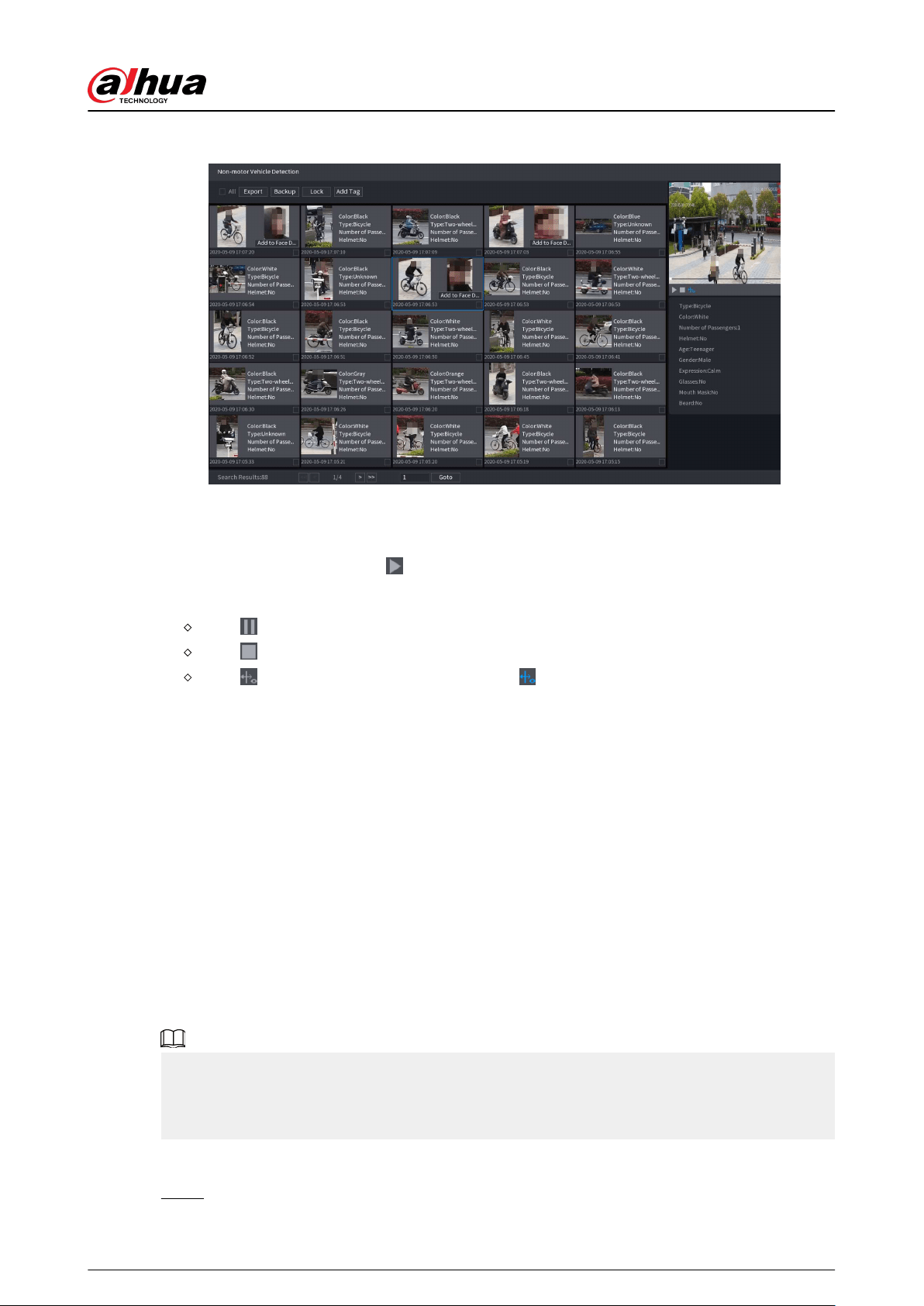
Figure 5-161 Search results
Related Operations
●
Play back video.
Click an image, and then click
to play back the related video.
During playback, you can:
Click to pause.
Click to stop.
Click to display AI rule. The icon changes to .
●
Add tags.
Select one or more images, and then click Add Tag.
●
Lock.
Select one or more images, and then click Lock. The locked les will not be overwritten.
●
Export.
Select one or more images, and then click Export to export selected search results in excel.
●
Back up.
Select one or more images, click Backup , select the storage path and le type, and then click
Start to export les to external storage device.
5.9.8.3.4 Report Query
Background Information
You can search for and export video metadata statistics.
●
The statistics might be overwritten when the storage space runs out. Back up in time.
●
When you restore the Device to factory settings, all the data except data in the external storage
device will be cleared. You can clear the data in the external storage device through formatting
or other methods.
Procedure
Step 1 Select Main Menu > AI > Report Query > Video Metadata.
User's Manual
275
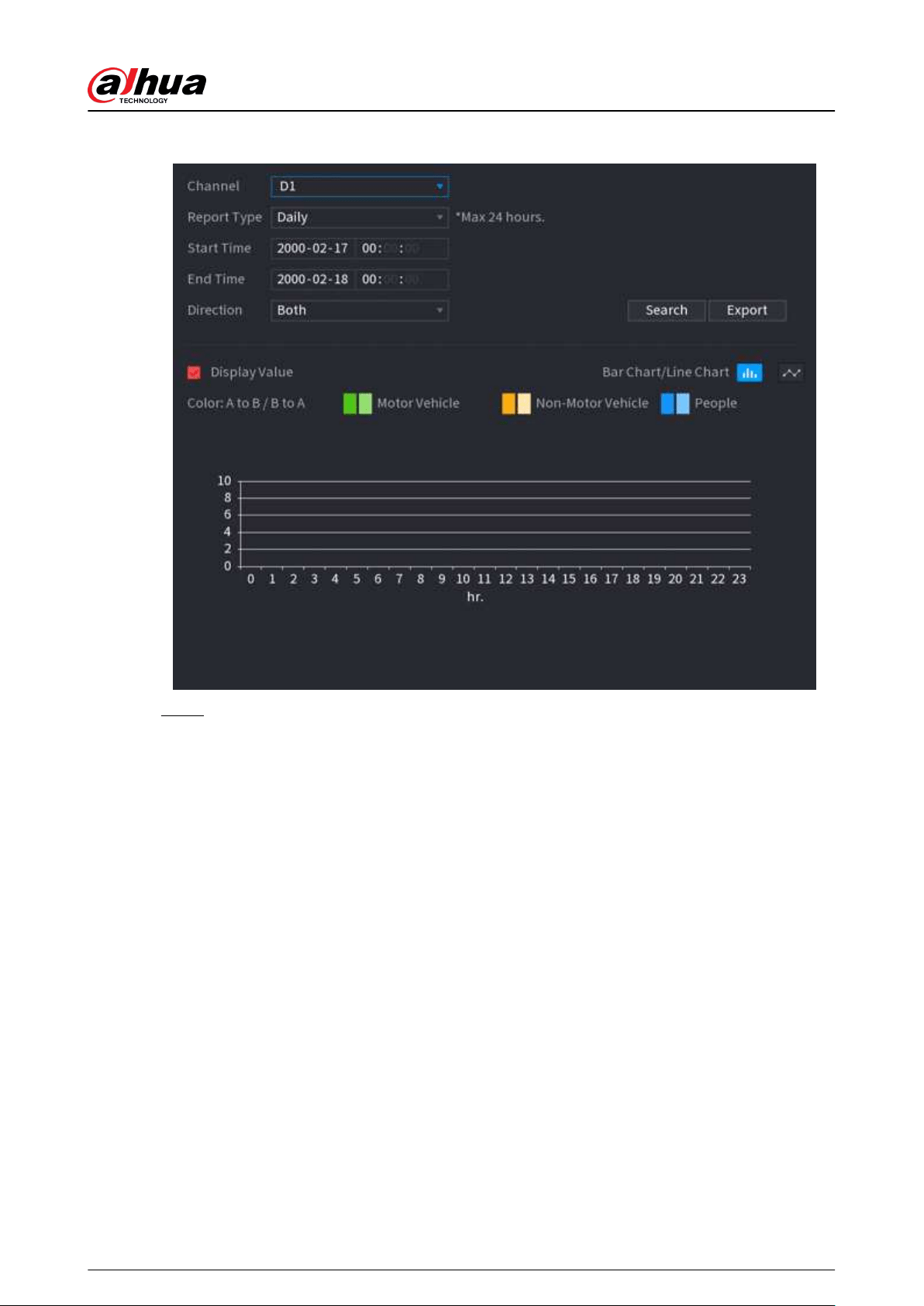
Figure 5-162 Metadata statistics
Step 2 Select channel, report type, start time and end time, direction and then click Search.
Related Operations
●
Switch chart type.
Click Bart Chart or Line Chart to switch the chart type.
●
Export.
Select le type, and then click Export to export the report in picture or csv format.
5.9.9 ANPR
The system extracts the plate number on the surveillance video and then compare it with the
specied plate information. When a match is detected, the system triggers an alarm.
5.9.9.1 Adding Vehicle Blocklist and Allowlist
Background Information
To facilitate vehicle management, you can add the plate numbers to the blocklist or allowlist. The
system can compare the detected plate information with the plate on the blocklist and allowlist
and then trigger the corresponding alarm linkage.
●
With the blocklist and allowlist enabled, on the live page, the plate on the blocklist is displayed
as red on the plate list and the plate on the allowlist is displayed as green. For the plate not on
the blocklist or allowlist, the color is white.
User's Manual
276
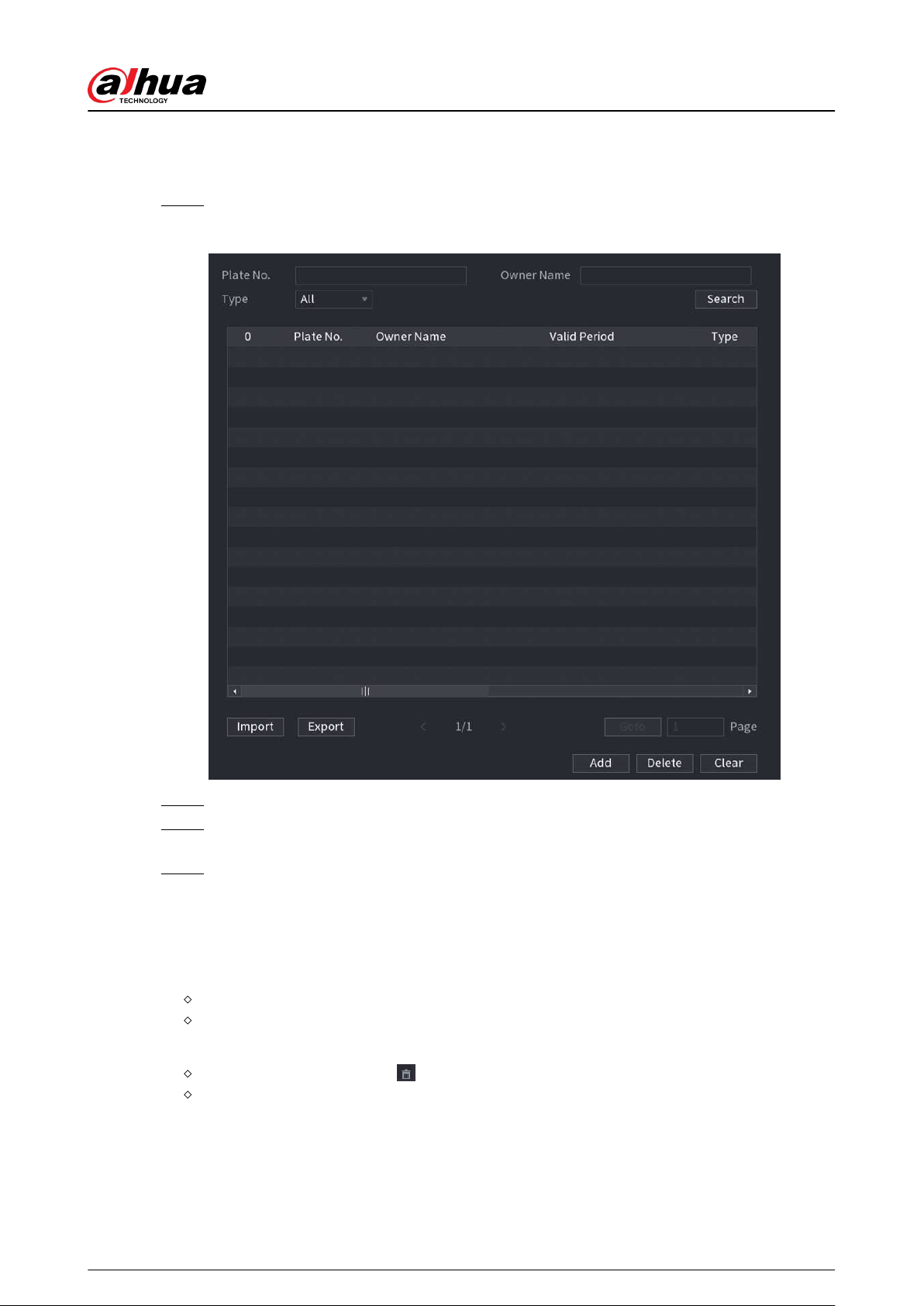
●
The added blocklist and allowlist will be synchronized to the connected ITC camera.
Procedure
Step 1 Select Main Menu > AI > Database > Vehicle Blocklist/Allowlist.
Figure 5-163 Vehicle blocklist/allowlist
Step 2 Click Add.
Step 3 Set plate information such as plate number, car owner name, select Block List or Allow
List, and then set validity period.
Step 4 Click OK.
Related Operations
●
Search.
Enter keywords for Plate No. and Owner Name, select type and then click Search.
●
Import and export plate information.
Import: Click Import , select the corresponding le, and then click Browse to import the le.
Export: Click Export , select the le storage path and then click Save.
●
Delete plate information.
Delete one by one: Click the of the corresponding plate number.
Delete in batches: Select the plate numbers and then click Delete.
User's Manual
277
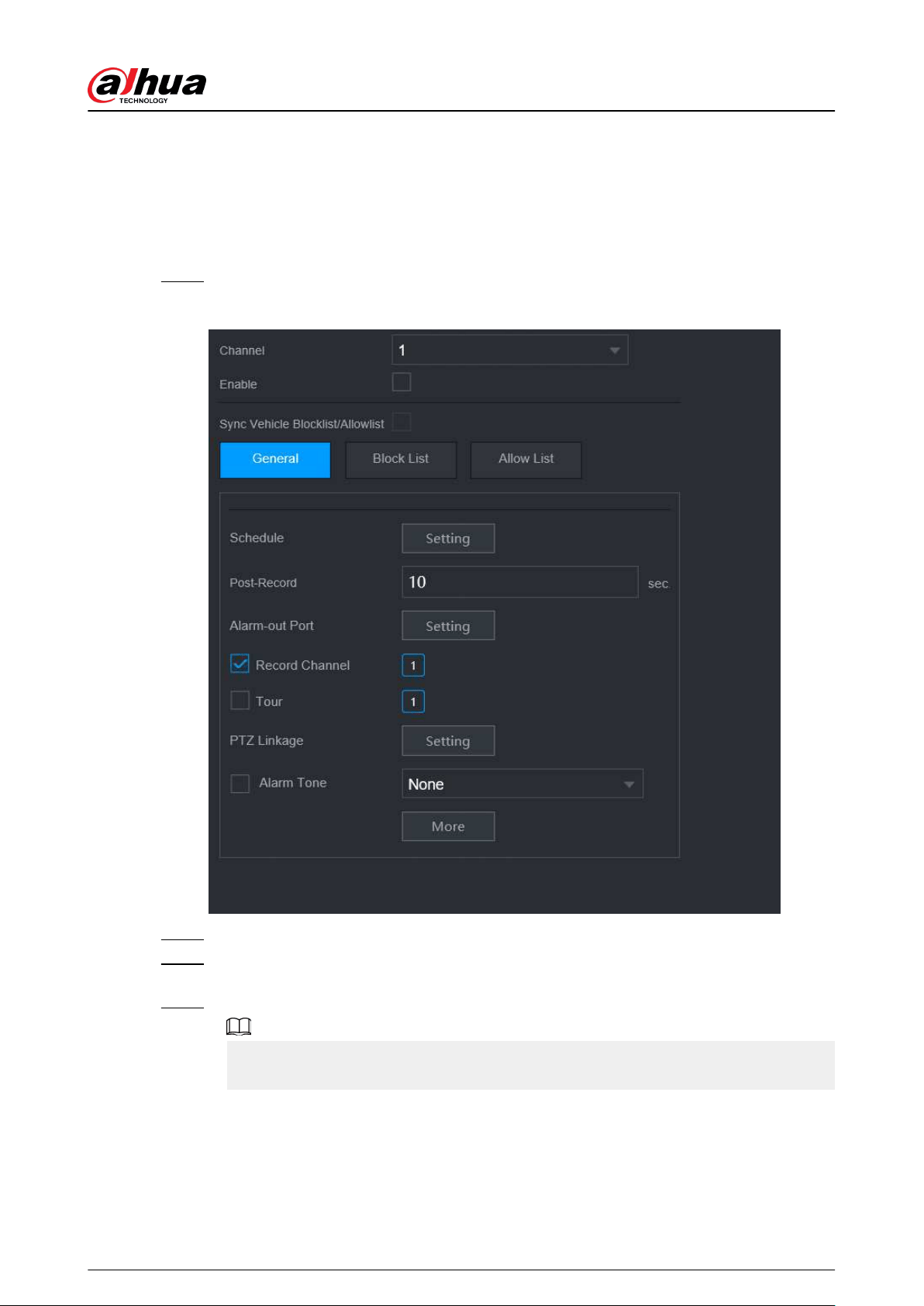
5.9.9.2 Conguring ANPR
Background Information
Congure the ANPR alarm rules.
Procedure
Step 1 Select Main Menu > AI > Parameters > ANPR.
Figure 5-164 ANPR
Step 2 Select a channel and then select the Enable checkbox to enable ANPR.
Step 3 (Optional) Enable Sync Vehicle Blocklist/Allowlist to synchronize the blocklist and
allowlist on the NVR to the connected camera.
Step 4 Click General (default), Blocklist or Allowlist tab.
Before enabling the blocklist alarm or allowlist alarm, you need to add the corresponding
plate information.
●
General : The system triggers an alarm when it detects any plate number.
●
Block List : The system triggers an alarm when it detects plate number on the
blocklist.
●
Allow List : The system triggers an alarm when it detects plate number on the
allowlist.
User's Manual
278

Step 5 Click Setting next to Schedule to congure the arming period.
The system triggers corresponding alarm actions only during the arming period.
●
On the time line, drag to set the period.
●
You can also click
to set the period.
Step 6 Congure alarm linkage actions. For details, see Step 7 .
Step 7 Click Apply.
5.9.9.3 AI Search (ANPR)
You can search for the ANPR detection results. For details, see "5.9.8.3.2 Motor Vehicle Detection".
5.9.10 Crowd Distribution
The system detects the crowd distribution. When the crowd density exceeds the dened threshold,
an alarm is triggered.
5.9.10.1 Enabling Smart Plan
To use AI by camera, you need to enable the smart plan rst. For details, see "5.9.2 Smart Plan".
5.9.10.2 Conguring Crowd Distribution
Congure the alarm rules of crowd distribution detection.
Prerequisites
Make sure that the connected camera supports the crowd distribution function.
Background Information
Procedure
Step 1 Select Main Menu > AI > Parameters > Crowd Distribution.
User's Manual
279
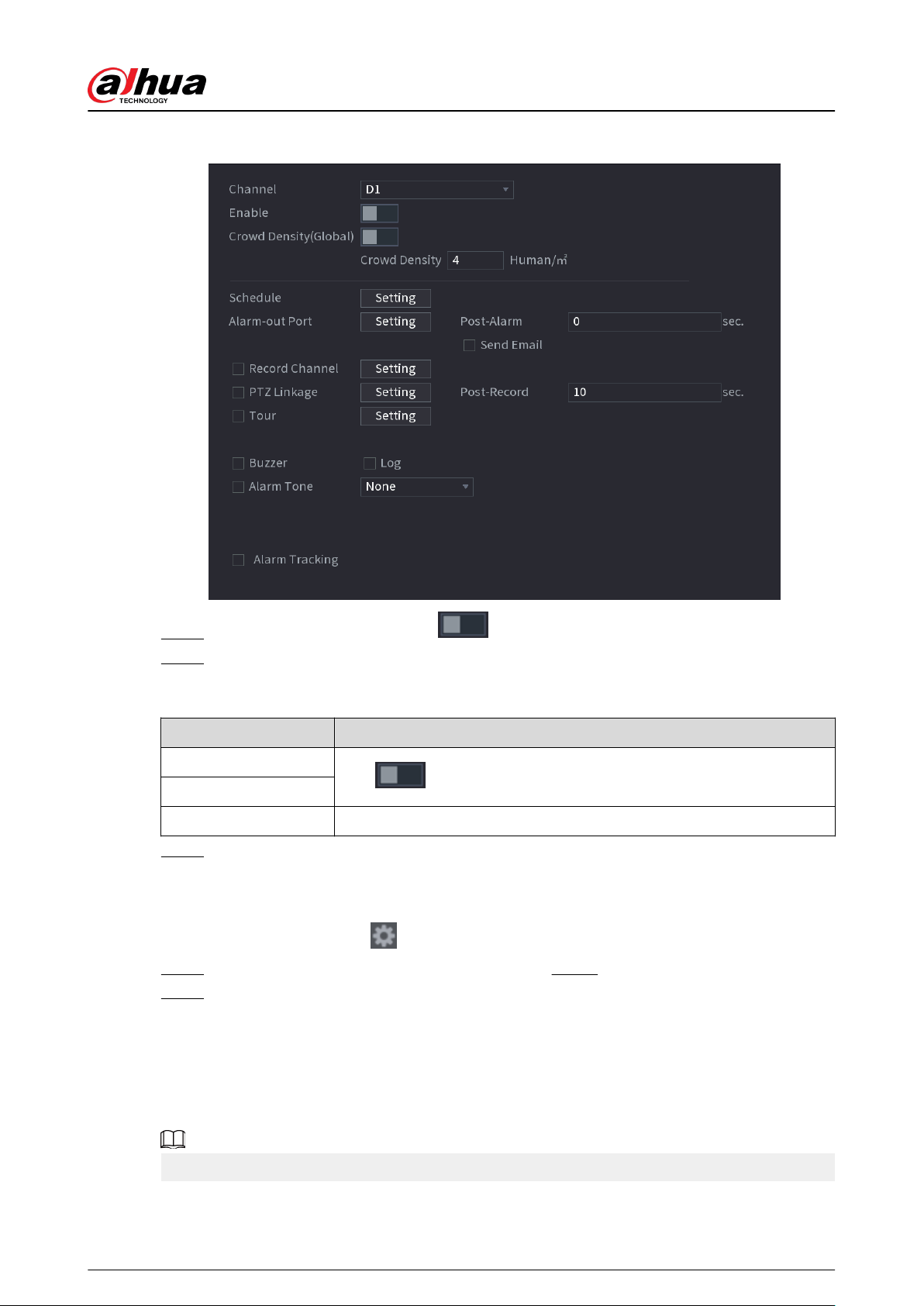
Figure 5-165 Crowd distribution
Step 2 Select a channel and then click next to Enable.
Step 3 Congure parameters.
Table 5-45 Crowd distribution parameters
Parameter Description
Crowd Density (Global)
Click
and then congure the density threshold.
Crowd Density
Alarm Tracking After an alarm occurs, the system tracks the target automatically.
Step 4 Click Setting next to Schedule to congure the arming period.
The system triggers corresponding alarm actions only during the arming period.
●
On the time line, drag to set the period.
●
You can also click
to set the period.
Step 5 Congure alarm linkage actions. For details, see Step 7 .
Step 6 Click Apply.
5.9.10.3 Report Query
Background Information
You can search for and export video metadata statistics.
●
The statistics might be overwritten when the storage space runs out. Back up in time.
User's Manual
280

●
When you restore the Device to factory settings, all the data except data in the external storage
device will be cleared. You can clear the data in the external storage device through formatting
or other methods.
Procedure
Step 1 Select Main Menu > AI > Report Query > Crowd Density.
Step 2 Select the channel, report type, start time and end time, and then click Search.
Related Operations
●
Switch chart type.
Click Bart Chart or Line Chart to switch the chart type.
●
Export.
Select the le type, and then click Export to export the report in picture or csv format.
5.9.11 People Counting
The system can calculate the number of entry or exit people in the detection zone. An alarm is
triggered when the number has exceeded the threshold.
Make sure that the connected camera supports people counting.
5.9.11.1 Enabling Smart Plan
To use AI by camera, you need to enable the smart plan rst. For details, see "5.9.2 Smart Plan".
5.9.11.2 Conguring People Counting
Background Information
The system counts the number of people in and out of the detection area. When the number of
entry, exit or staying people exceeds the threshold, an alarm is triggered.
Procedure
Step 1 Select Main Menu > AI > Parameters > People Counting > People Counting.
User's Manual
281
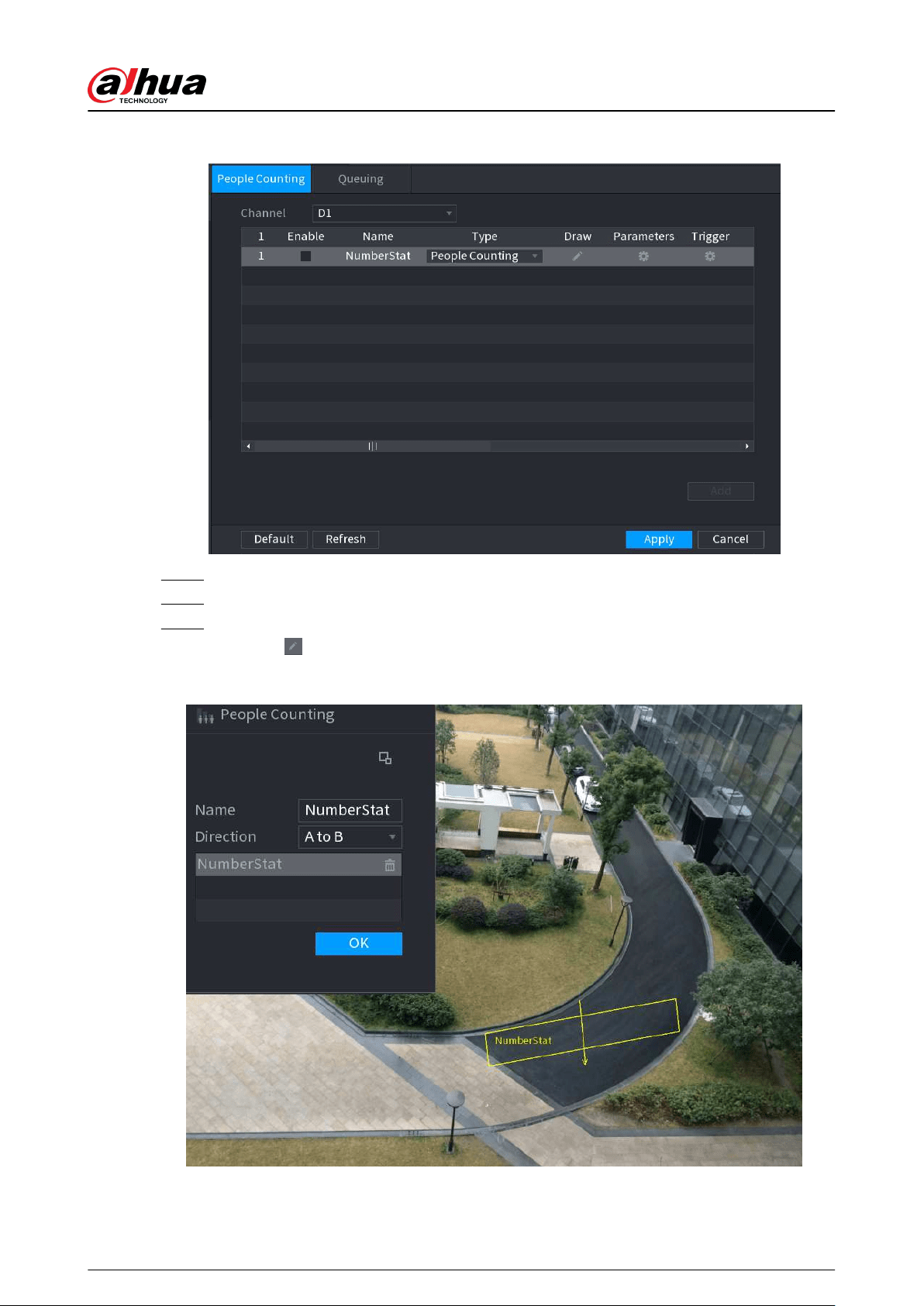
Figure 5-166 People counting
Step 2 Select a channel and then click Add.
Step 3 Select the Enable checkbox and then set Type to People Counting.
Step 4 Draw people counting rule.
1. Click
to draw people counting rule. Right-click the image to stop drawing.
Figure 5-167 People counting rule
2. Customize the rule name and then select direction.
3. Click OK.
User's Manual
282
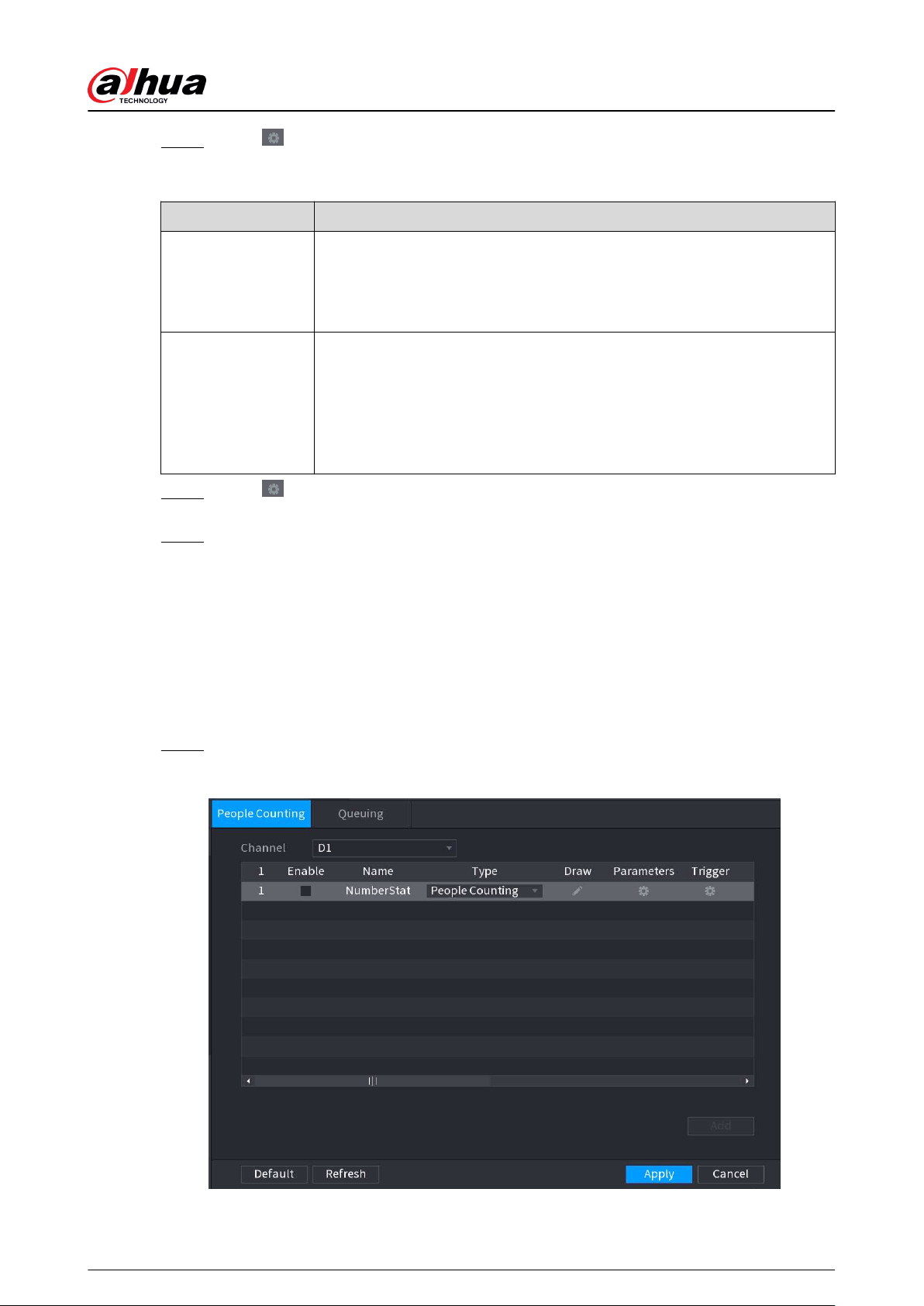
Step 5 Click under Parameters and then congure the parameters.
Table 5-46 People counting parameters
Parameter Description
OSD
●
Select Enter No., and then the number of people entering the detection
zone will be displayed on the live page.
●
Select Exit No., and then the number of people leaving the detection
zone will be displayed on the live page.
Setting
●
Enter No. : An alarm is triggered when the number of people entering
the detection zone exceeds the dened threshold.
●
Exit No. : An alarm is triggered when the number of people leaving the
detection zone exceeds the dened threshold.
●
Stay No. : An alarm is triggered when the number of people staying the
detection zone exceeds the dened threshold.
Step 6 Click under Trigger to congure alarm schedule and linkage. For details on alarm
linkage, see Table 5-47 .
Step 7 Click Apply.
5.9.11.3 Conguring In Area No.
Background Information
When the number of people in the detection area is larger or lower than the dened threshold, or
when the staying period exceeds the dened duration, an alarm is triggered.
Procedure
Step 1 Select Main Menu > AI > Parameters > People Counting > People Counting.
Figure 5-168 People counting
User's Manual
283
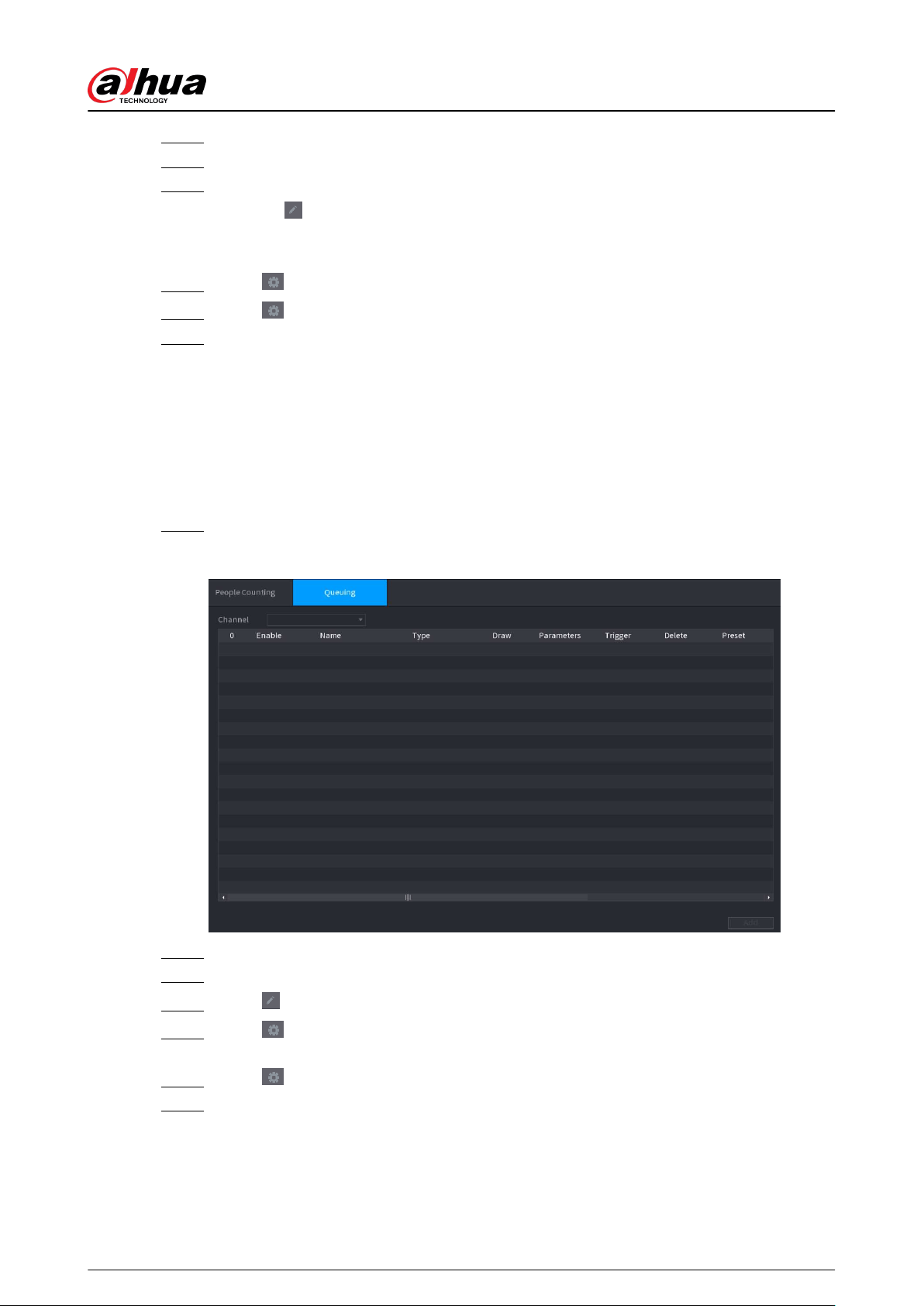
Step 2 Select a channel and then click Add.
Step 3 Select the Enable checkbox and then set Type to In Area No.
Step 4 Draw people counting rule.
1. Click
to draw a rule. Right-click the image to stop drawing.
2. Congure the parameters.
3. Click OK.
Step 5 Click and then enable in-area people number alarm and stay alarm.
Step 6 Click under Trigger to congure the alarm schedule and linkage
Step 7 Click Apply.
5.9.11.4 Queuing
Background Information
After conguring queuing alarm, the system can realize the corresponding linkage actions once the
number of people in the queue or the waiting time has triggered an alarm.
Procedure
Step 1 Select Main Menu > AI > Parameters > People Counting > Queuing.
Figure 5-169 Queuing
Step 2 Select a channel, and then click Add.
Step 3 Select the Enable checkbox.
Step 4 Click to draw queuing rule and area.
Step 5 Click under Parameters , and then enable Queue People No. Alarm or Queue Time
Alarm.
Step 6 Click under Trigger to congure alarm schedule and linkage.
Step 7 Click Apply.
User's Manual
284
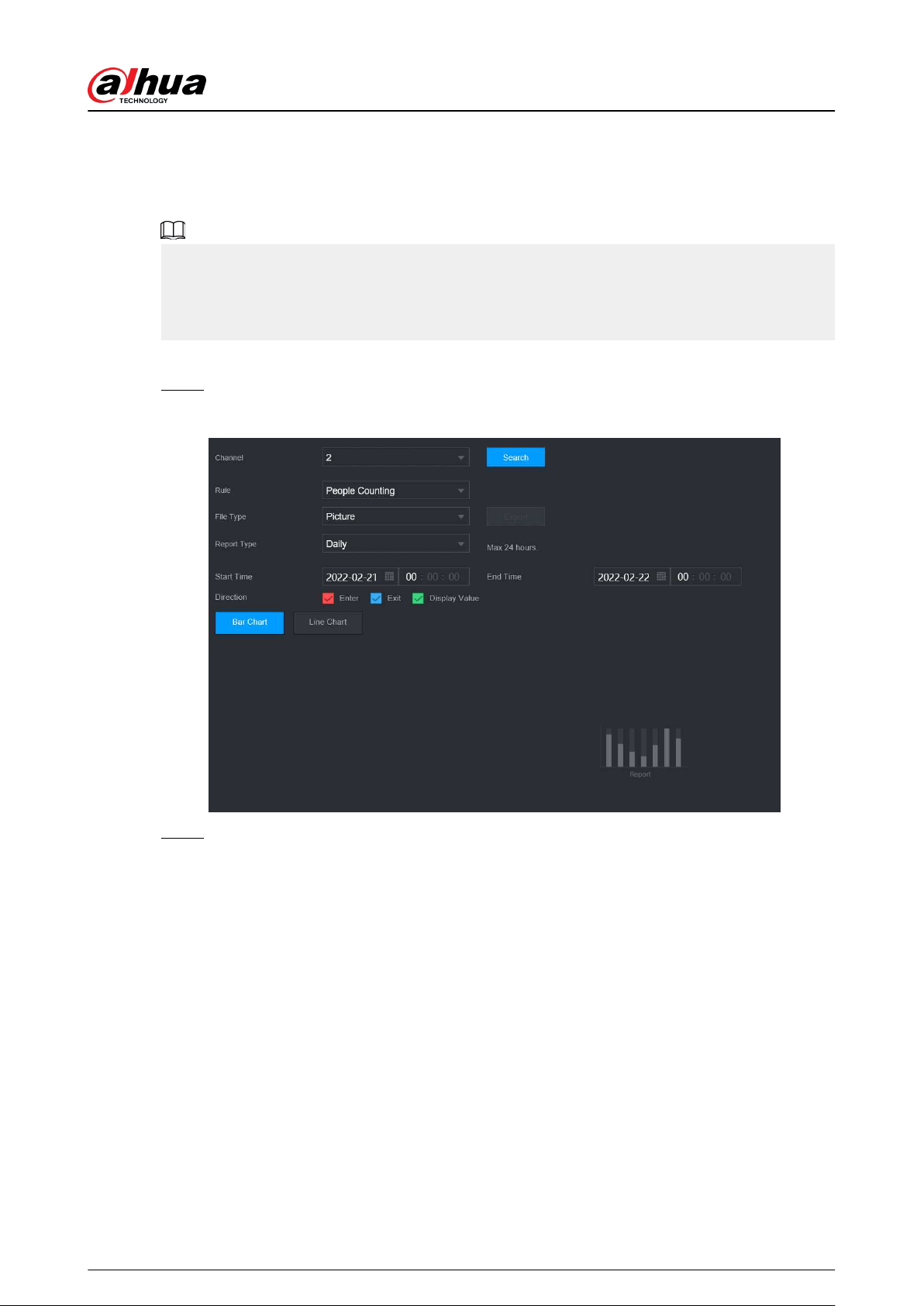
5.9.11.5 Report Query
Background Information
You can search for and export the people counting statistics.
●
The statistics might be overwritten when the storage space runs out. Back up in time.
●
When you restore the Device to factory settings, all the data except data in the external storage
device will be cleared. You can clear the data in the external storage device through formatting
or other methods.
Procedure
Step 1 Select Main Menu > AI > Report Query > People Counting.
Figure 5-170 People counting
Step 2 Select channel, rule, report type, start and end time, and direction, and then click Search.
Related Operations
●
Switch chart type.
Click Bart Chart or Line Chart to switch the chart type.
●
Export.
Select le type, and then click Export to export the report in picture or csv format.
5.9.12 Heat Map
The Device can monitor the distribution of active objects in the detection zone during a period of
time, and use dierent colors to display the objects on the heat map.
5.9.12.1 Enabling Smart Plan
To use AI by camera, you need to enable the smart plan rst. For details, see "5.9.2 Smart Plan".
User's Manual
285
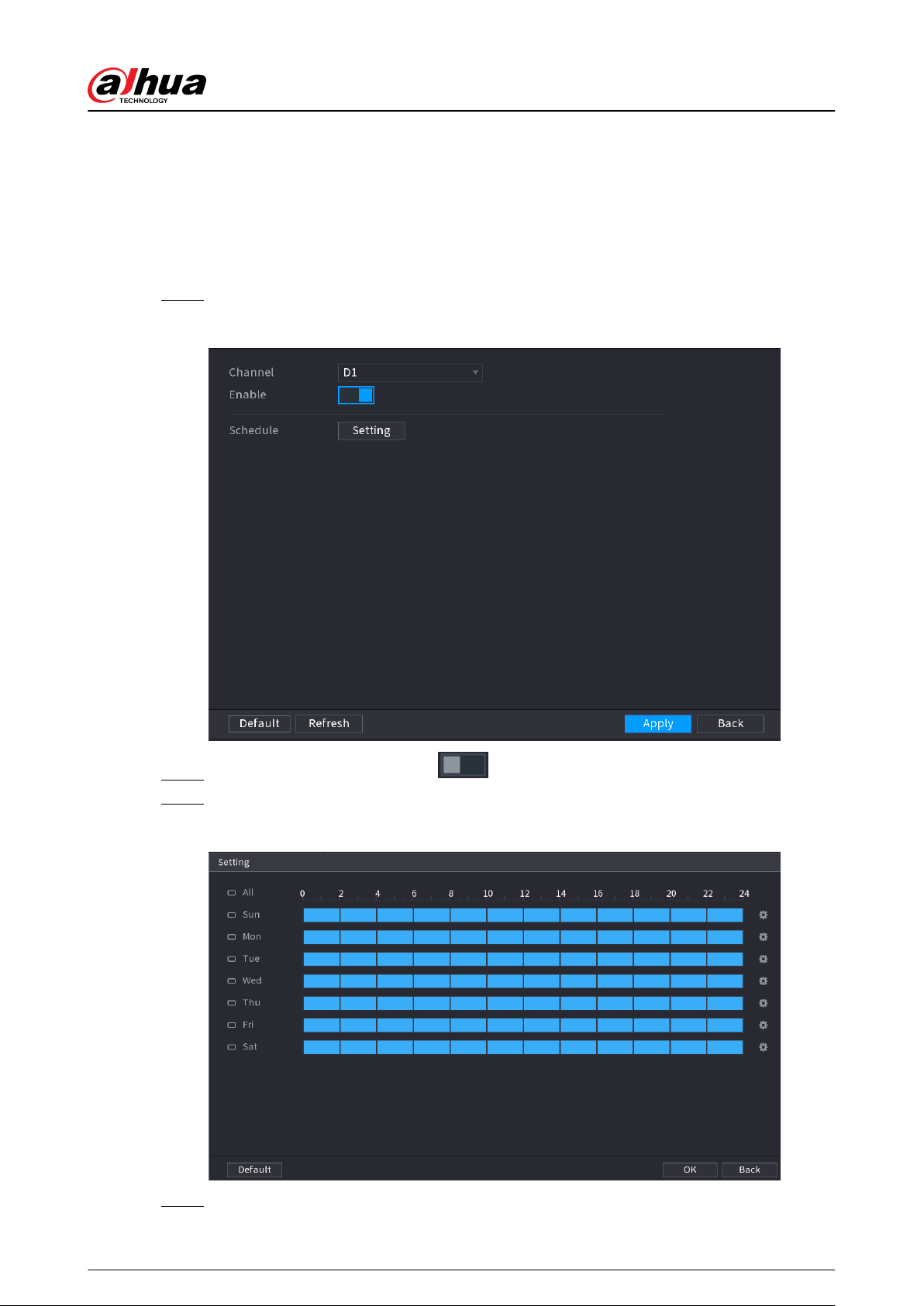
5.9.12.2 Conguring Heat map
Background Information
Heat map technology can monitor the active objects distribution status on the specied zone
during a period of time, and use dierent colors to display on the heat map.
Procedure
Step 1 Select Main Menu > AI > Parameters > Heat Map.
Figure 5-171 Heat map
Step 2 Select a channel and then click to enable the function.
Step 3 Click Setting to congure the alarm schedule.
Figure 5-172 Schedule
Step 4 Click Apply.
User's Manual
286
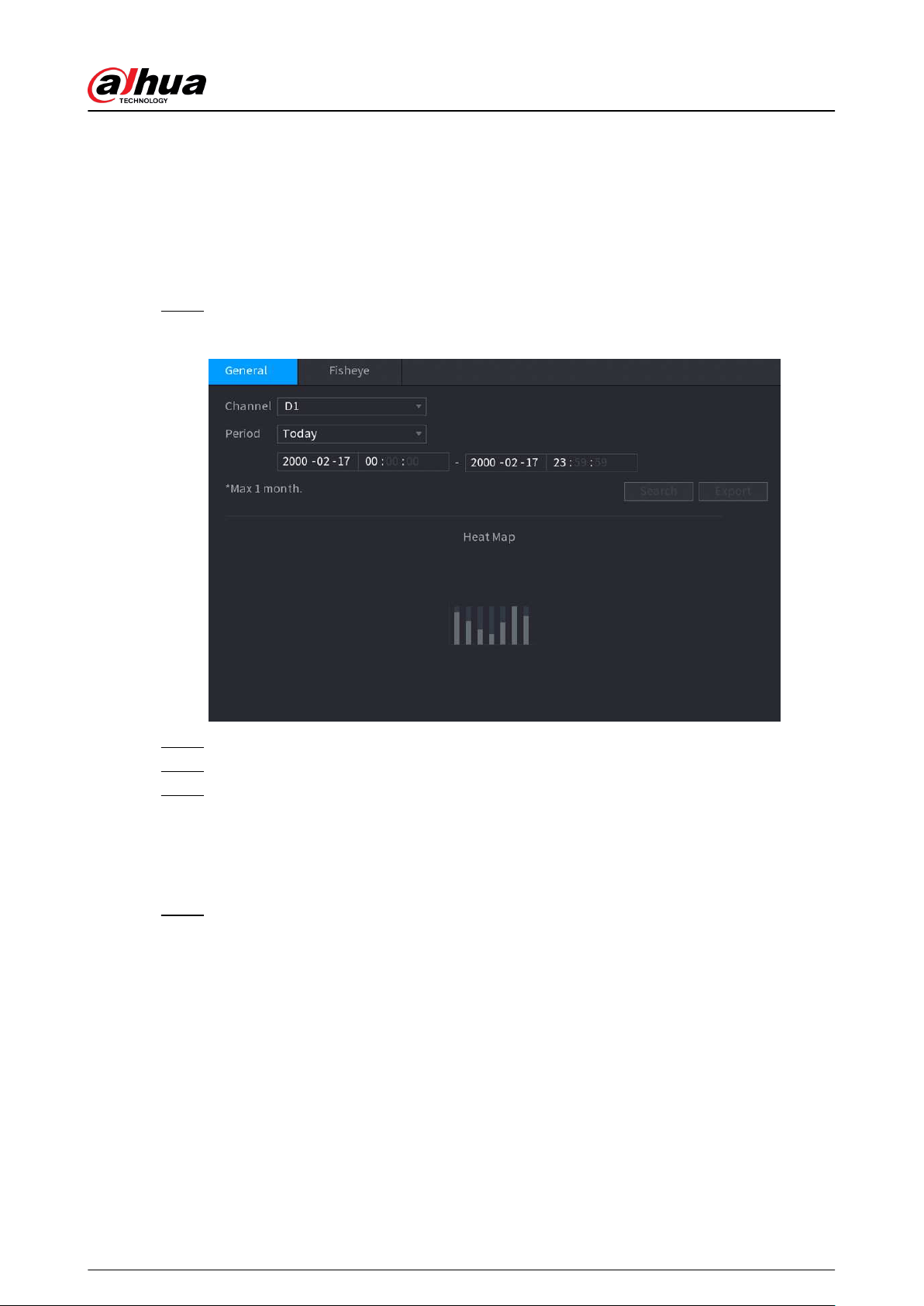
5.9.12.3 Report Query
You can search for and export the heat map report of general and sheye cameras.
5.9.12.3.1 General
Procedure
Step 1 Select Main Menu > AI > Report Query > Heat Map > General.
Figure 5-173 General
Step 2 Select the channel, start time, and end time.
Step 3 Click Search.
Step 4 Click Export to export the heat map.
5.9.12.3.2 Fisheye
Procedure
Step 1 Select Main Menu > AI > Report Query > Heat Map > Fisheye.
User's Manual
287
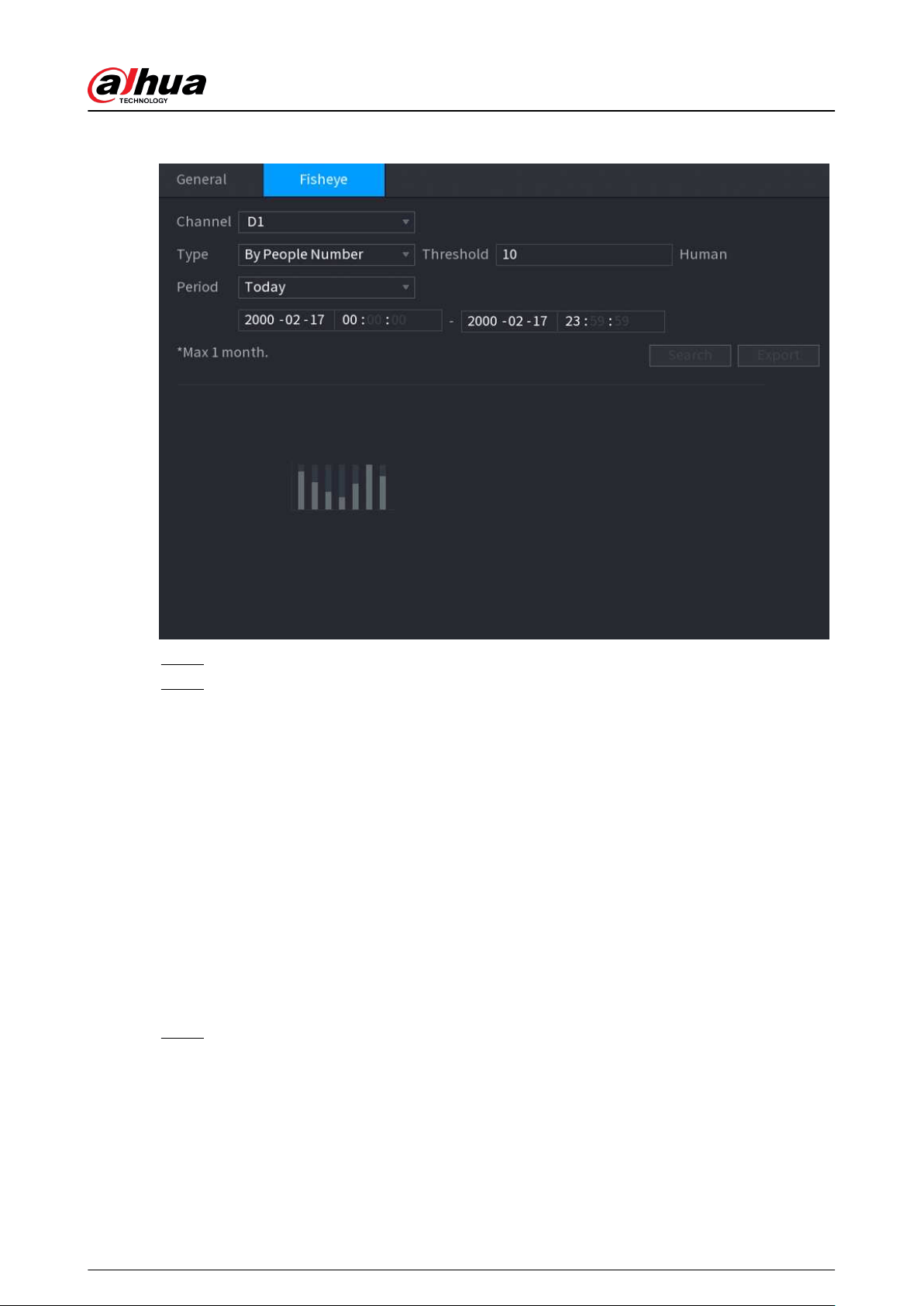
Figure 5-174 Fisheye
Step 2 Set channel, type and period, and then click Search.
Step 3 Click Export to export the heat map.
5.9.13 SMD
You can use SMD (Smart Motion Detection) to detect humans and vehicles in the video, and store
the detection results in structured storage for fast retrieval.
5.9.13.1 Enabling Smart Plan
To use AI by camera, you need to enable the smart plan rst. For details, see "5.9.2 Smart Plan".
5.9.13.2 Conguring SMD
Procedure
Step 1 Select Main Menu > AI > Parameters > SMD.
User's Manual
288
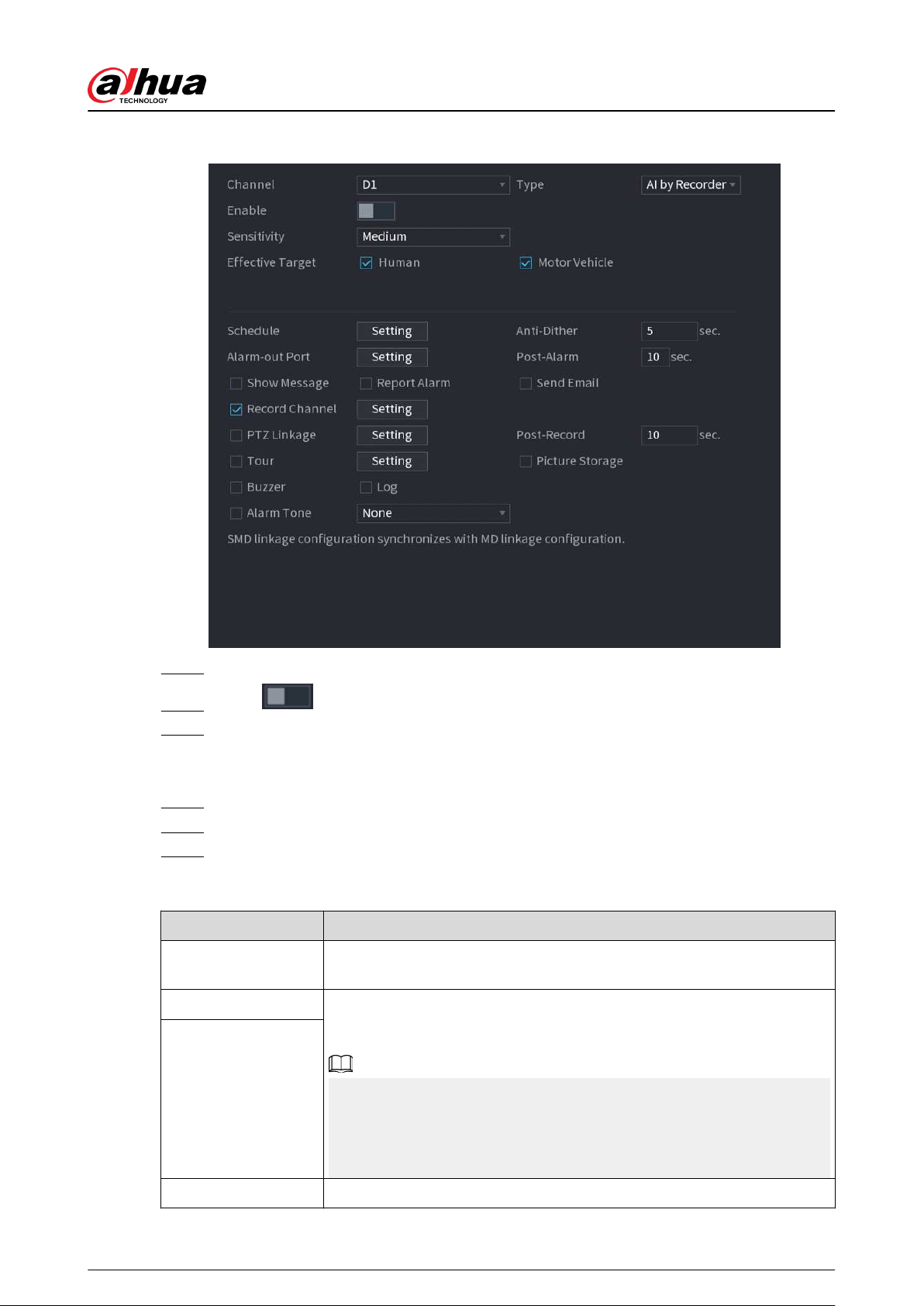
Figure 5-175 SMD
Step 2 Select a channel and AI type.
Step 3 Click to enable the function.
Step 4 Congure the sensitivity.
The higher the value, the easier it is to trigger an alarm. But meanwhile, the false alarm
might occur. The default value is recommended.
Step 5 Select eective target from Human and Motor Vehicle.
Step 6 Click Setting next to schedule to congure the alarm period.
Step 7 Congure alarm linkage.
Table 5-47 Alarm linkage parameters
Parameter Description
Anti-Dither
The system records only one motion detection event within the dened
period.
Alarm-out Port When an alarm occurs, the NVR links the alarm output device to generate
an alarm. The alarm lasts a period of time depending on the dened value
for Post-Alarm.
●
Make sure that the alarm devices are connected to the alarm output
port of NVR.
●
In Main Menu > ALARM > Alarm-out Port, set the mode to Auto so
that the system can link the alarm output device to generate an alarm.
Post-Alarm
Show Message Enable on-screen prompt when an alarm occurs.
User's Manual
289
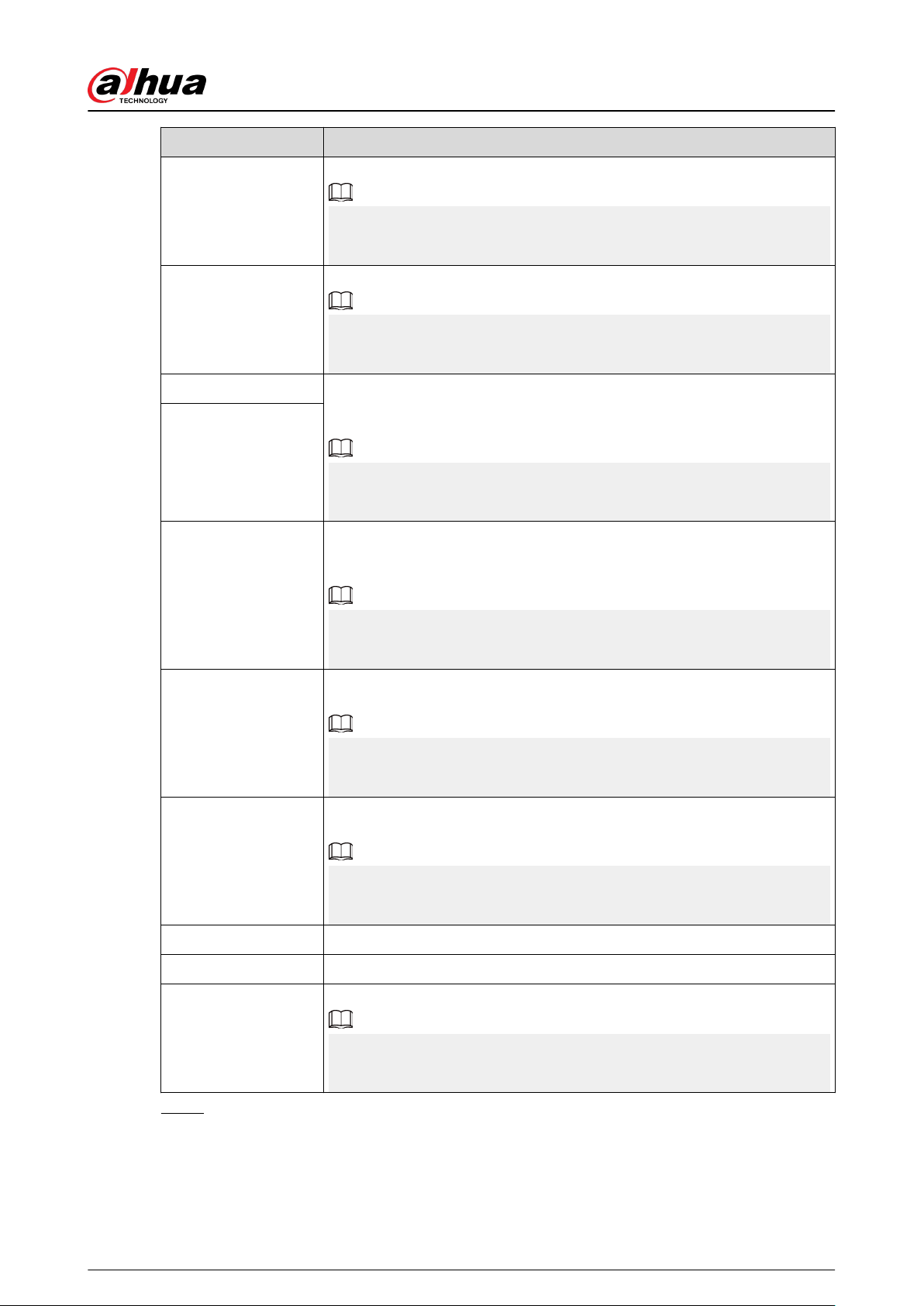
Parameter Description
Report Alarm
Enable the system to report the alarm to the alarm center.
Make sure that alarm center has been congured in Main Menu >
NETWORK > Alarm Center.
Send Email
Enable the system to send an email to notify you when an alarm occurs.
Make sure that the email settings have been congured in Main Menu >
NETWORK > Email.
Record Channel When an alarm occurs, the system activates recording of the selected
channel. After the alarm ends, the recording continues for a period of
time depending on the dened value for Post-Record.
Make sure that intelligent recording schedule and auto recording have
been congured. For details, see "5.8.1 Recording Schedule".
Post-Record
PTZ Linkage
When an alarm occurs, the NVR associates the channel to perform the
corresponding PTZ action. For example, rotate the PTZ to the preset
point.
Make sure that PTZ actions have been congured. For details, see "5.6.7
PTZ".
Tour
When an alarm occurs, the local page of the NVR displays the image of the
selected channels in turn.
Make sure that the time interval and mode for tour have been congured
in Main Menu > DISPLAY > Tour Setting.
Picture Storage
When an alarm occurs, the system takes a snapshot of the channel and
stores the snapshot on the Device.
Make sure that snapshot schedule and snapshot mode have been
congured. For details, see "5.8.1 Recording Schedule".
Buzzer The system activates the buzzer when an alarm occurs.
Log When an alarm occurs, the system records the event in the logs.
Alarm Tone
When an alarm occurs, the system plays the selected audio le.
Make sure that the audio les have been uploaded to the system. For
details, see "5.18.1 File Management".
Step 8 Click Apply.
User's Manual
290

5.9.13.3 AI Search (SMD)
You can search for and play back videos that triggered SMD alarms.
Procedure
Step 1 Select Main Menu > AI > AI Search > SMD.
Step 2 Select channel, type, start time and end time, and then click Search.
●
Click
to play back the video.
●
Select a video and click Export to export video le to a USB ash drive.
5.9.14 Vehicle Density
You can congure the rules for trac congestion and parking upper limit, , and view the counting
data on the live page.
●
Trac congestion: The system counts the vehicles in the detection area. When the counted
vehicle number and the continuous congestion time exceed the congured values, an alarm is
triggered and the system performs an alarm linkage.
●
Parking upper limit: The system counts the vehicles in the detection area. When the counted
vehicle number exceeds the congured value, an alarm triggered and the system performs an
alarm linkage.
5.9.14.1 Enabling Smart Plan
To use AI by camera, you need to enable the smart plan rst. For details, see "5.9.2 Smart Plan".
5.9.14.2 Conguring Vehicle Density
Procedure
Step 1 Select Main Menu > AI > Parameters > Vehicle Density.
User's Manual
291
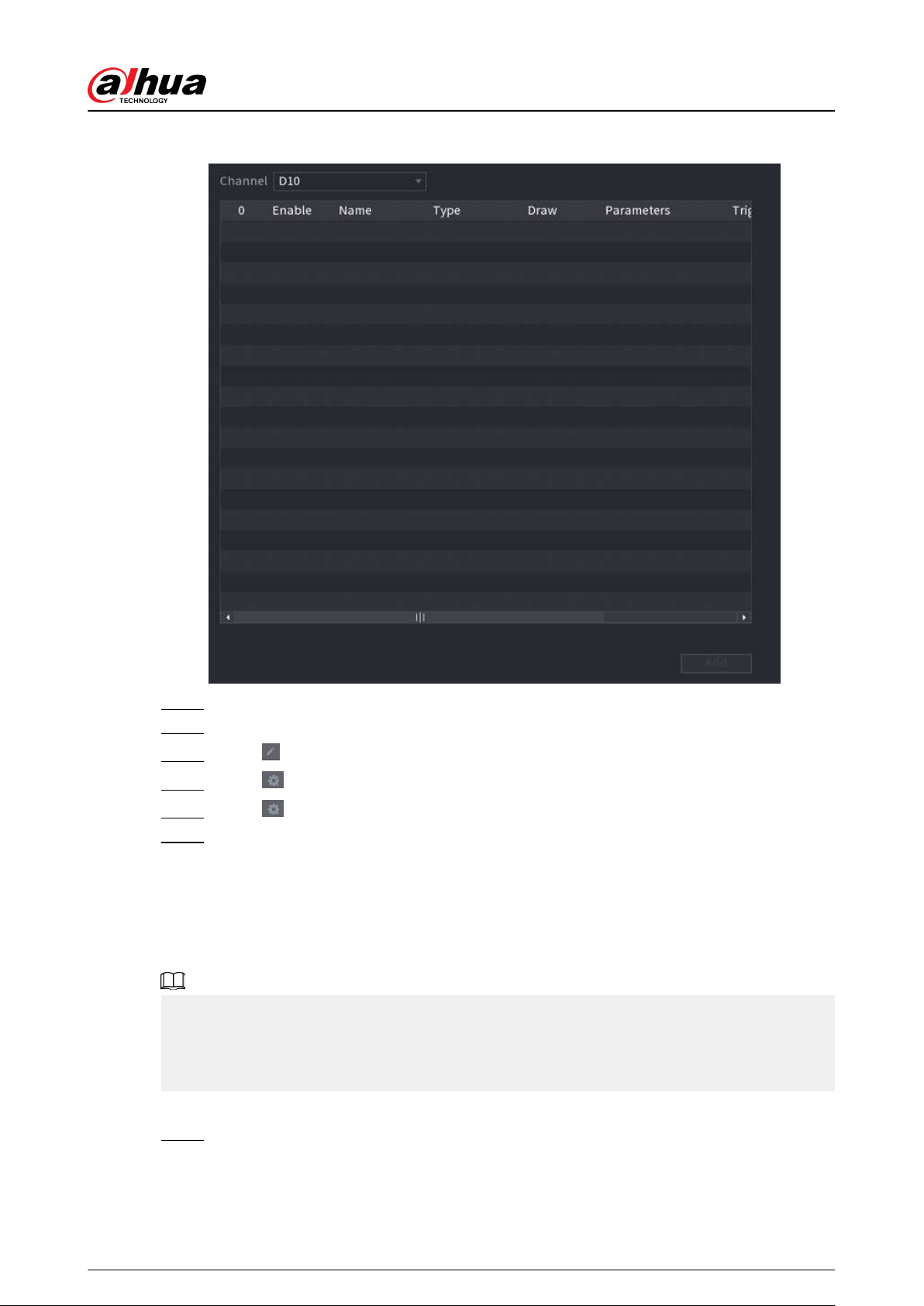
Figure 5-176 Vehicle density
Step 2 Select a channel and then click Add.
Step 3 Select the Enable checkbox and then select a detection type.
Step 4 Click to draw the detection rule.
Step 5 Click under Parameters and then congure the parameters.
Step 6 Click under Trigger to congure alarm schedule and linkage.
Step 7 Click Apply.
5.9.14.3 Report Query
Background Information
You can search for and export statistics on vehicle density.
●
The statistics might be overwritten when the storage space runs out. Back up in time.
●
When you restore the Device to factory settings, all the data except data in the external storage
device will be cleared. You can clear the data in the external storage device through formatting
or other methods.
Procedure
Step 1 Select Main Menu > AI > Report Query > Vehicle Density.
User's Manual
292
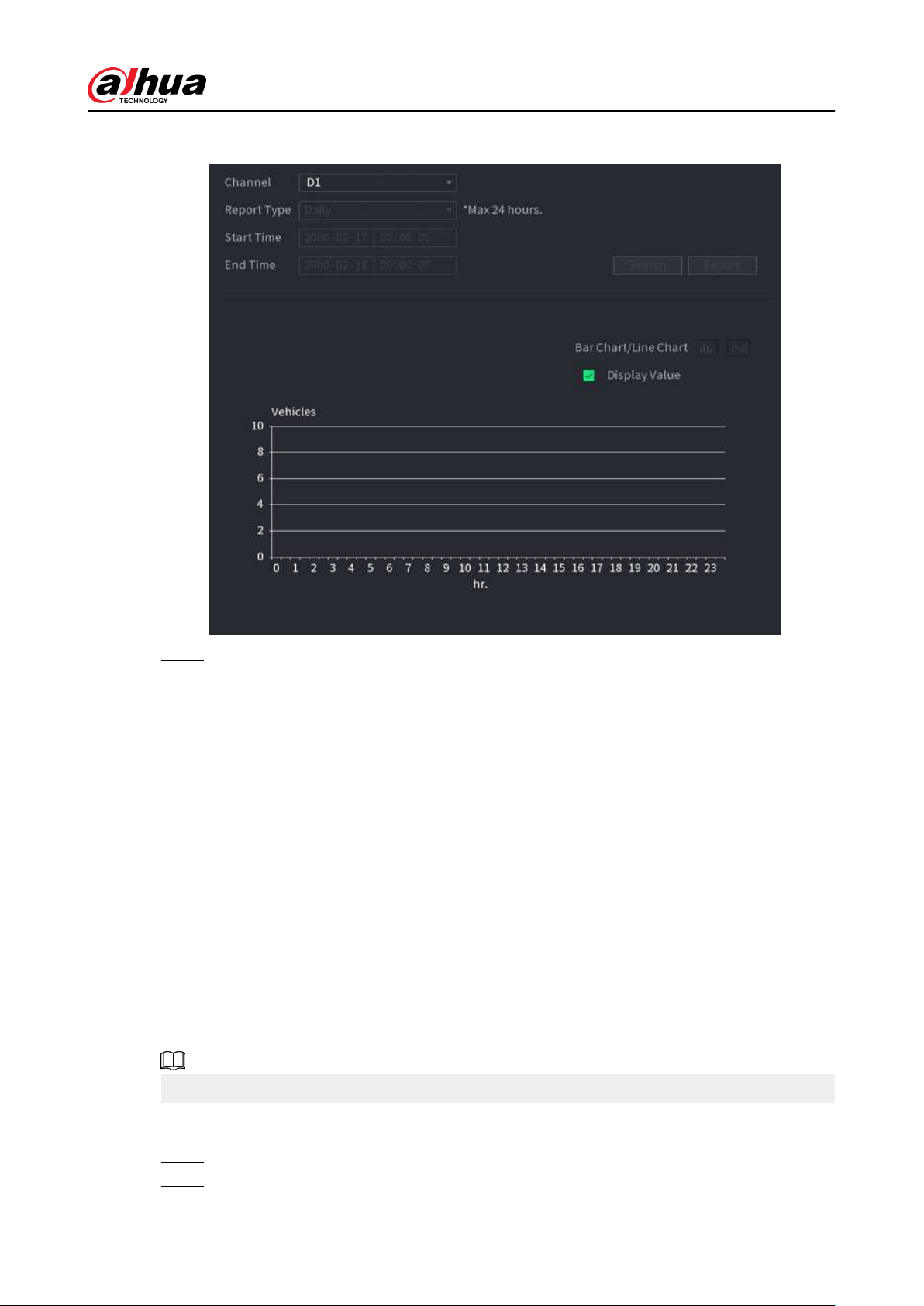
Figure 5-177 Vehicle density
Step 2 Select channel, report type, start and end time, and then click Search.
Related Operations
●
Switch chart type.
Click Bart Chart or Line Chart to switch the chart type.
●
Export.
Select le type, and then click Export to export the report in picture or csv format.
5.9.15 Main-sub Tracking
Main-sub tracking refers to sheye camera and speed dome linkage system. The sheye camera
serves as the main camera and captures panoramic videos. The speed dome serves as the sub
camera and captures details of the video.
Prerequisites
●
The monitoring areas of sheye camera and speed dome are the same area.
●
Fisheye camera and speed dome are added through private protocol.
Background Information
This function is available on select models.
Procedure
Step 1 Select Main Menu > AI > Parameters > Main-Sub Tracking.
Step 2 Add monitoring area.
1. Click Add.
User's Manual
293
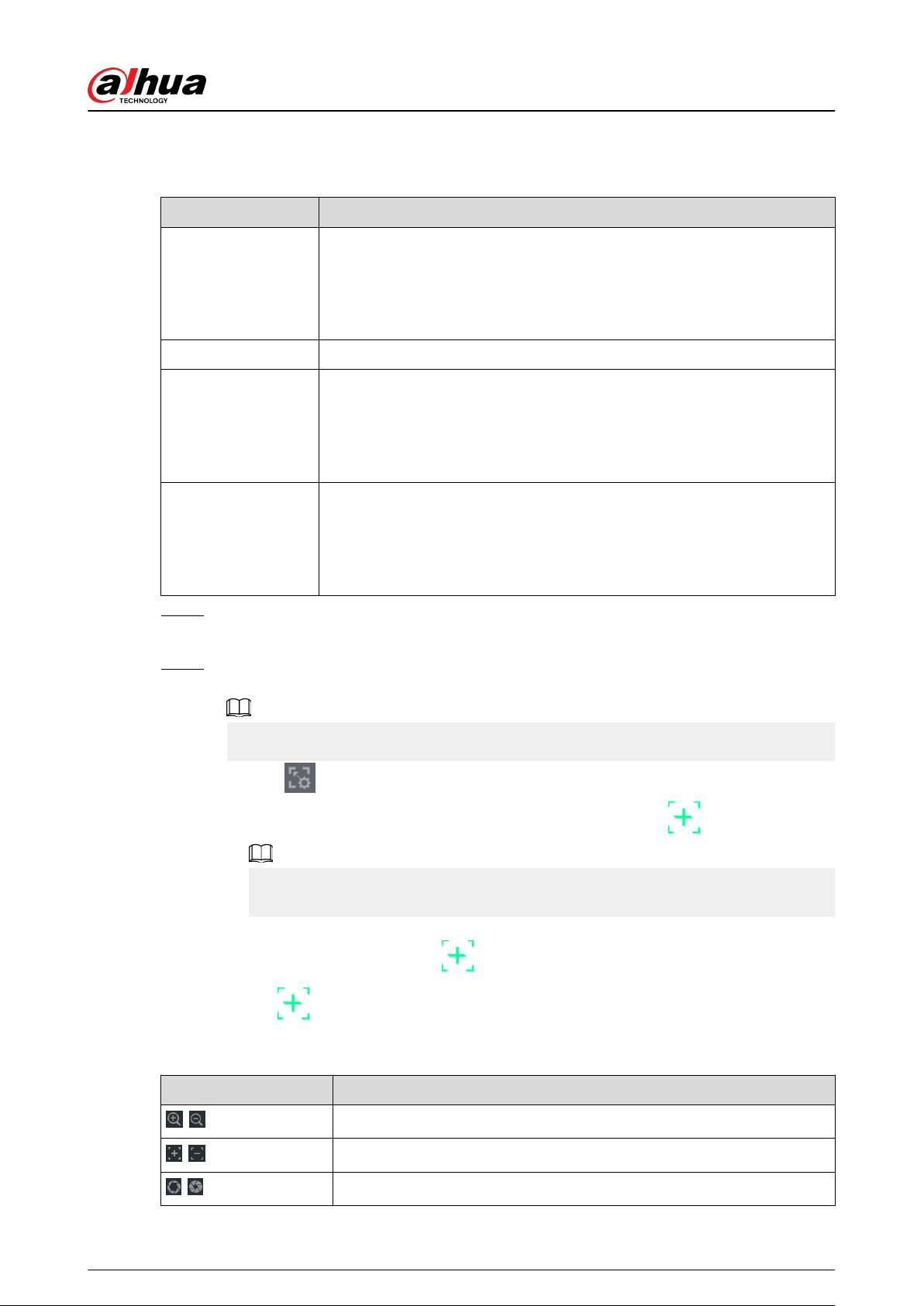
2. Congure parameters.
Table 5-48 Main-sub tracking parameters
Parameter Description
Type
Select a type according to the number of sheye and PTZ cameras:
●
1 Fisheye + 1 PTZ.
●
1 Fisheye + 2 PTZ.
●
1 Fisheye + 3 PTZ.
Scene Name Customize the scene name.
Main Camera
Select a sheye camera.
i. Click Select in Main Camera line.
ii. Select a sheye camera.
iii. Click Apply.
Sub Camera
Select speed domes as needed.
i. Click Select in Sub Camera line.
ii. Select speed domes.
iii. Click Apply.
Step 3 Click Apply.
The monitoring area is successfully added.
Step 4 Congure calibration points to set the binding relationship of sheye camera and speed
dome.
Set a distant place as the rst calibration point to improve accuracy.
1. Click
or double-click the target scene.
2. Click the target place on the video of sheye camera, or move
to the target place.
The video at upper-left corner is the sheye camera screen, and the video at upper-
right corner is the speed dome screen.
3. Adjust position through the icons below the speed dome screen to make the center of
speed dome identical to the
of sheye camera.
The
on the speed dome screen is the center of speed dome.
Table 5-49 Icon description
Icon Description
,
Zoom in and zoom out.
,
Adjust resolution.
,
Adjust height.
User's Manual
294
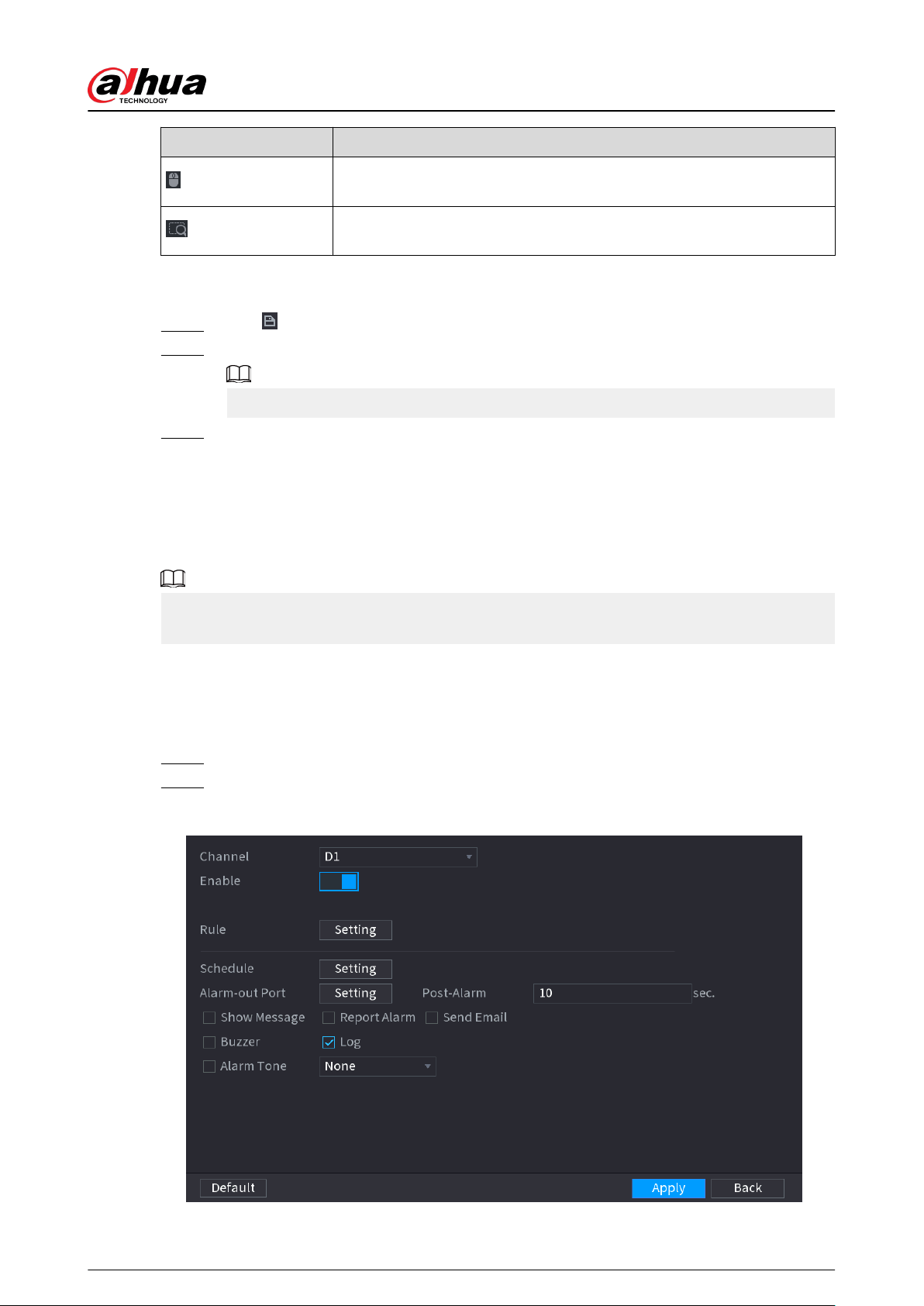
Icon Description
Electronic mouse. You can use this icon to move the mouse to control
PTZ direction.
Quick positioning key. Click this icon to select a place, and the screen will
be focused and centered on the selected place.
4. Click Add.
The calibration point will be displayed on the list at lower-right corner.
Step 5 Click to save the newly added calibration point.
Step 6 Repeat Step 2 to Step 5 to add more calibration points.
Set 3–8 calibration points for a speed dome.
Step 7 Click Apply.
5.9.16 Video Quality Analytics
When conditions such as blurry, overexposure, or the color changes appear on the screen, the
system triggers the alarm.
●
This function takes eect only when the remote IPC supports video quality analytics.
●
This function is available on select models.
5.9.16.1 Conguring Video Quality Analytics
Procedure
Step 1 Select Main Menu > AI > Parameters > Video Quality Analytics.
Step 2 Select a channel and click Enable.
Figure 5-178 Video quality analytics
User's Manual
295
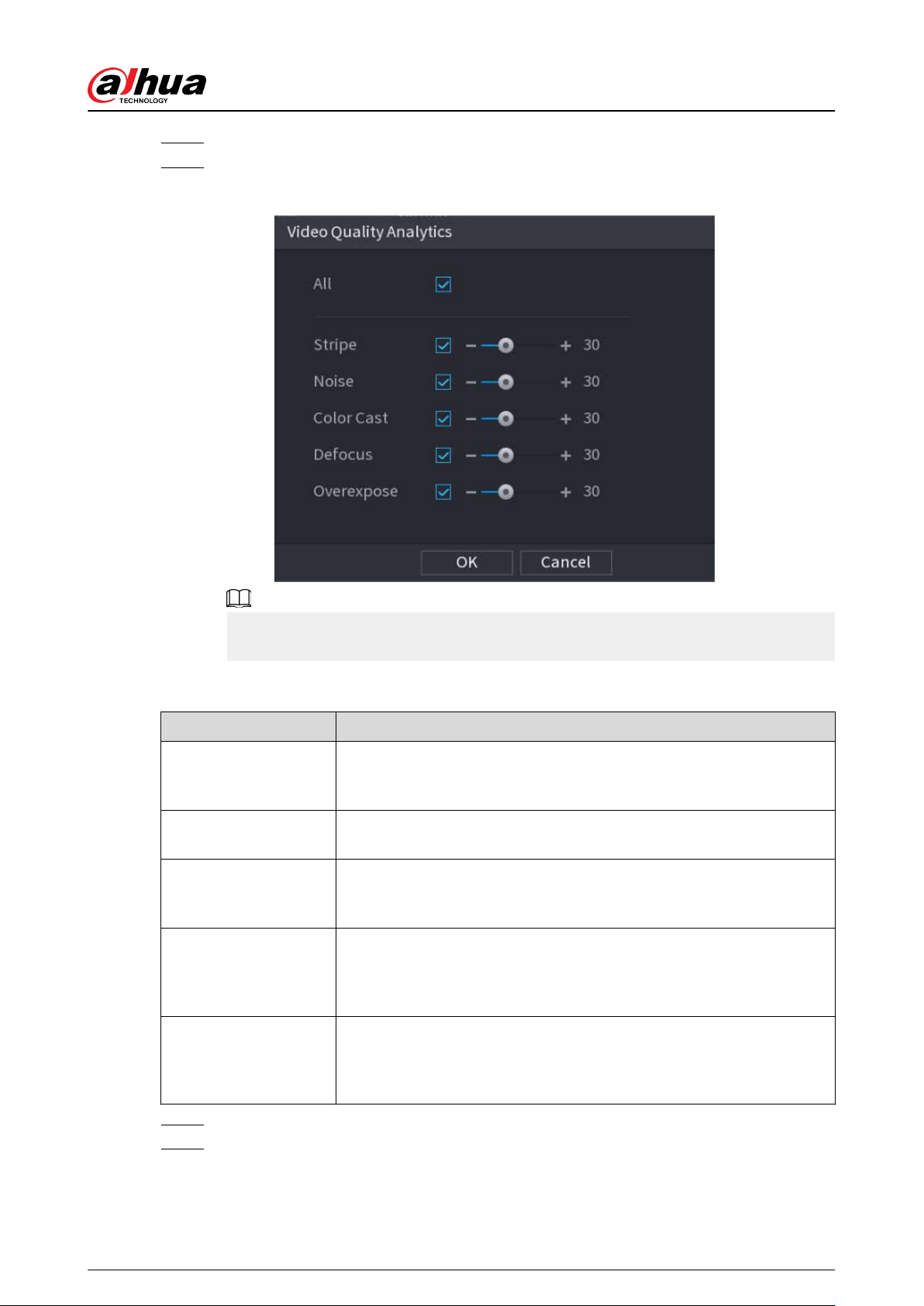
Step 3 Click Setting next to Rule.
Step 4 Select items and set thresholds as needed.
Figure 5-179 Video quality analytics settings
The value range of threshold is 0–100, and the default value is 30. When the value
exceeds the set threshold, an alarm will be triggered.
Table 5-50 Video quality analytics parameters
Parameter Description
Stripe
Stripes refer to the striped interferences in the video which might be
due to device aging or signal interference. The stripe might be
horizontal, vertical, or oblique.
Noise
Video noise refers to the distortion of optical system or the degradation
of image quality caused by hardware equipment during transmission.
Color Cast
An image in the video is generally a colorful image that contains color
information, such as RGB. When these three components appear at
some unusual scale in an image, the image is biased.
Defocus
An image with high resolution contains more details, but image blur is a
common problem of image quality decrease which is caused by many
factors in the process of image acquisition, transmission and processing,
and is dened as virtual focus in video diagnosis.
Overexpose
The brightness of the image refers to the intensity of the image pixels.
Black is the darkest and white is the brightest. Black is represented by 0
and white is represented by 255. When the brightness value exceeds
the threshold, the image is over exposed.
Step 5 Click OK.
Step 6 Click Setting next to Schedule to congure the arming period.
The system triggers corresponding alarm actions only during the arming period.
●
On the time line, drag to set the period.
User's Manual
296
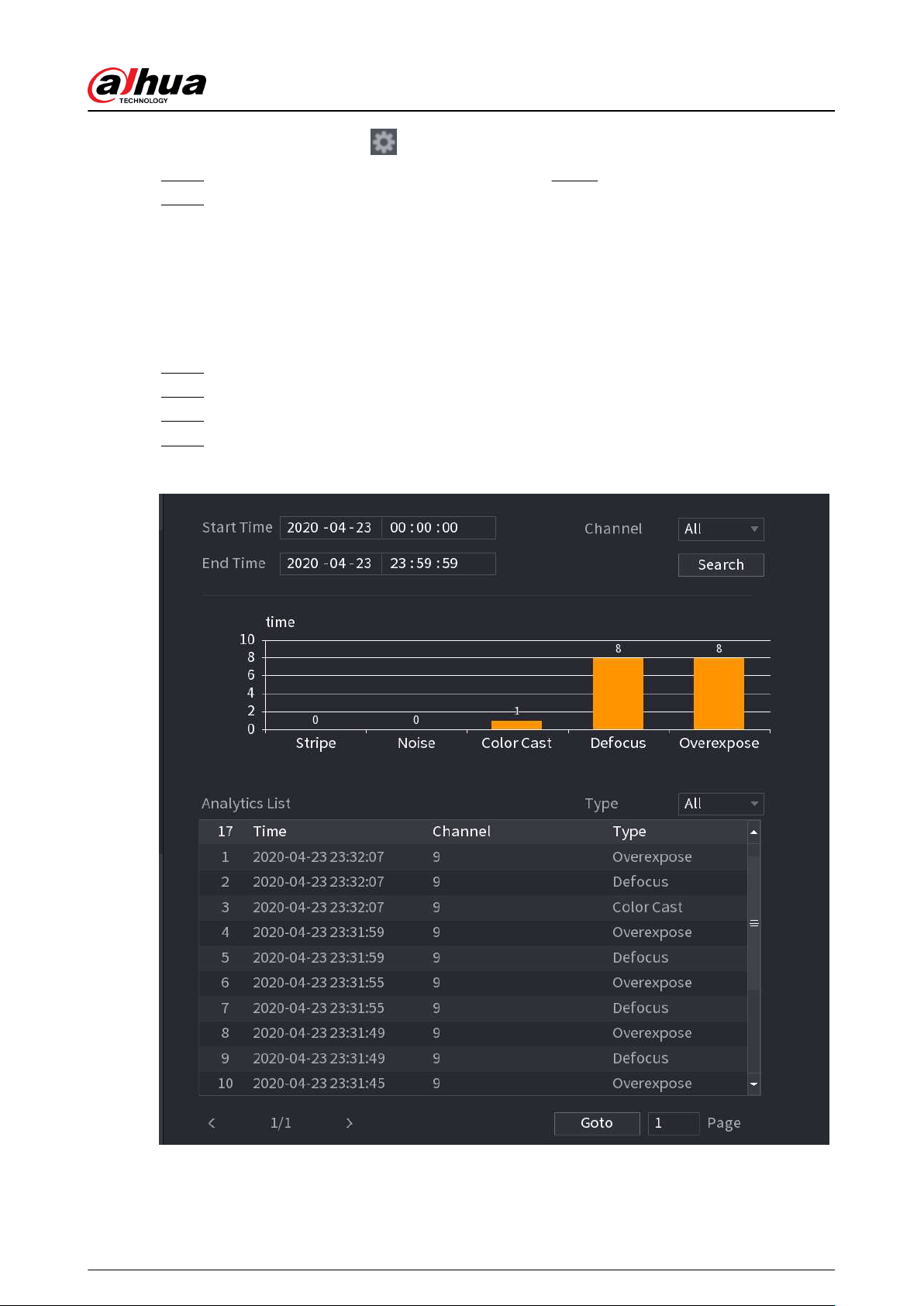
●
You can also click
to set the period.
Step 7 Congure alarm linkage actions. For details, see Step 7 .
Step 8 Click Apply.
5.9.16.2 Analytics List
Background Information
Search for the results of video quality analytics.
Procedure
Step 1 Select Main Menu > AI > AI Search > Analytics List.
Step 2 Select the start time and end time.
Step 3 Select one or more channels.
Step 4 Click Search.
Figure 5-180 Analytics list
User's Manual
297
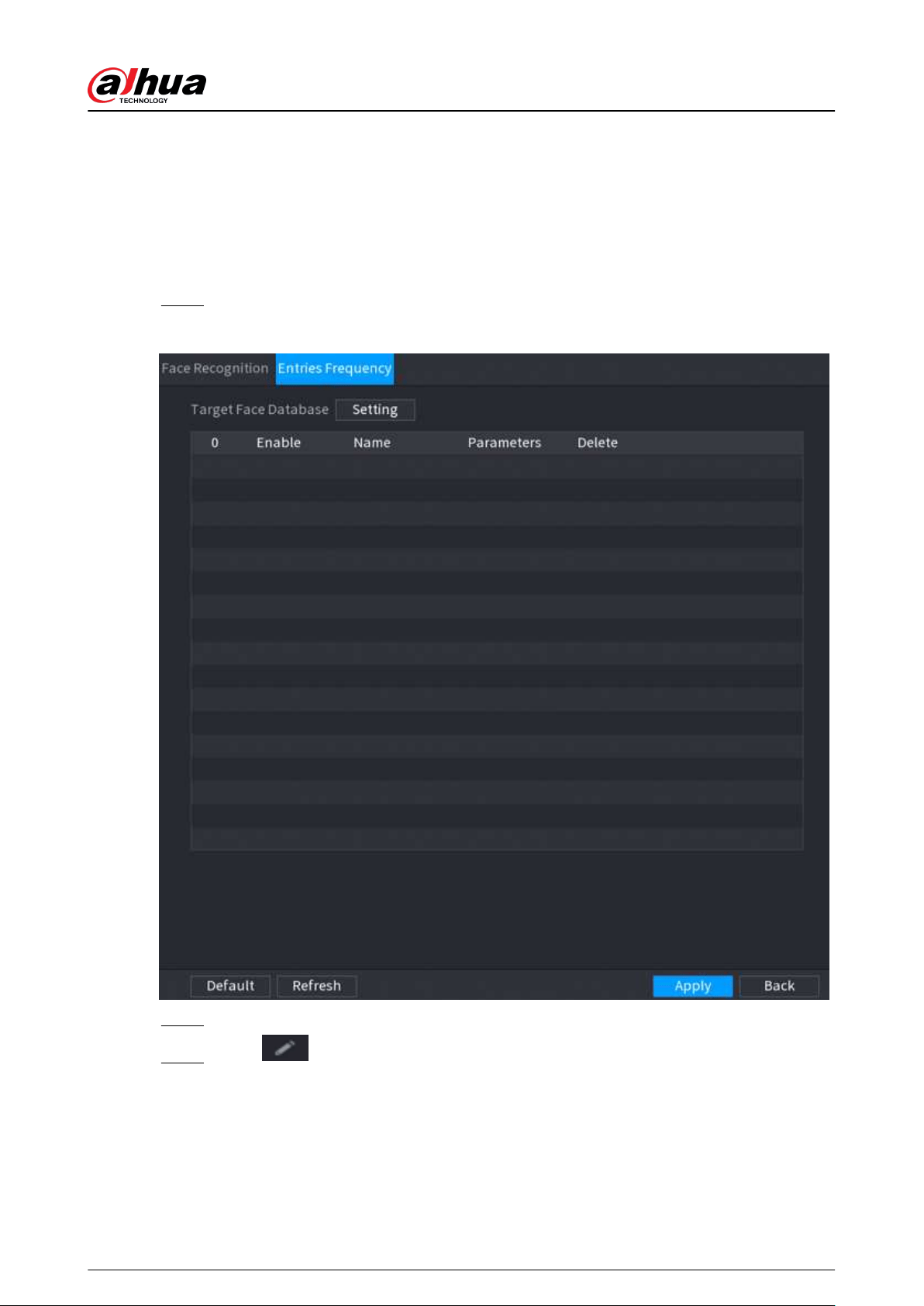
5.9.17 Entries Frequency
Background Information
After setting entries frequency, when the entries detected of a person reach or exceed the
threshold, an alarm is triggered.
Procedure
Step 1 Select Main Menu > AI > Parameters > Face Recognition > Entries Frequency.
Figure 5-181 Entries frequency
Step 2 Click Setting to select a database and then click OK.
Step 3 Click and then congure the parameters.
User's Manual
298
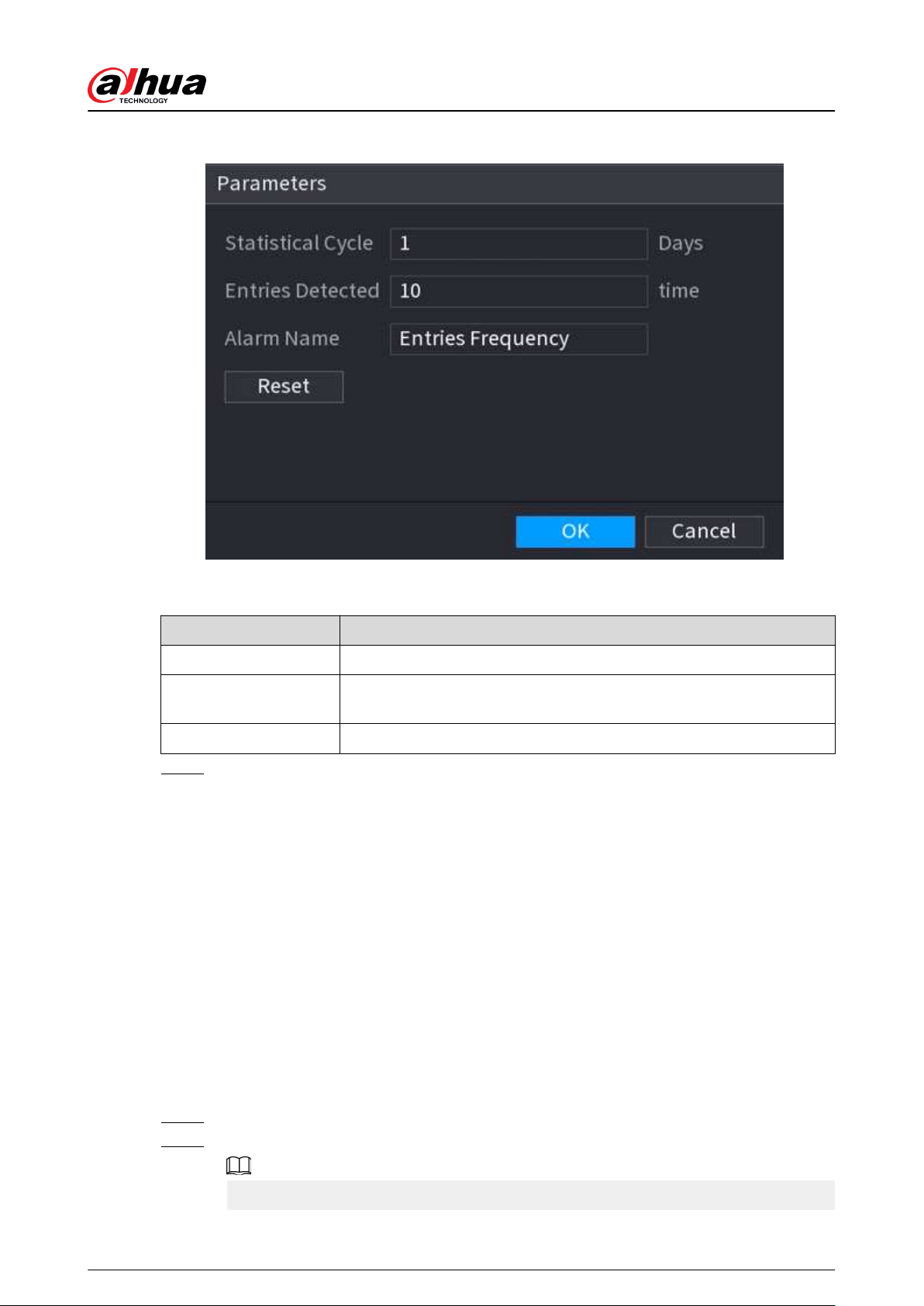
Figure 5-182 Congure entries frequency
Table 5-51 Entries frequency parameters
Parameter Description
Statistical Cycle Set the cycle for counting the entries frequency.
Entries Detected
Set the threshold of entries frequency. When the entries detected
reaches or exceeds the threshold, an alarm is triggered.
Alarm Name The name is Entries Frequency by default. You can change the name.
Step 4 Click Apply.
5.9.18 Smart Object Detection
You can congure rules and set parameters. When someone is taking or placing an item in the
monitoring area, an alarm is triggered.
5.9.18.1 Conguring Smart Plan
To use the smart detection function, you need to enable the smart plan rst. For details, see "5.9.2
Smart Plan".
5.9.18.2 Conguring Object Detection
Procedure
Step 1 Select AI > Parameters > Smart Object Detection.
Step 2 Select channel and type, and then click Apply.
The target type includes luggage, bag, box, and non-motor vehicle.
User's Manual
299
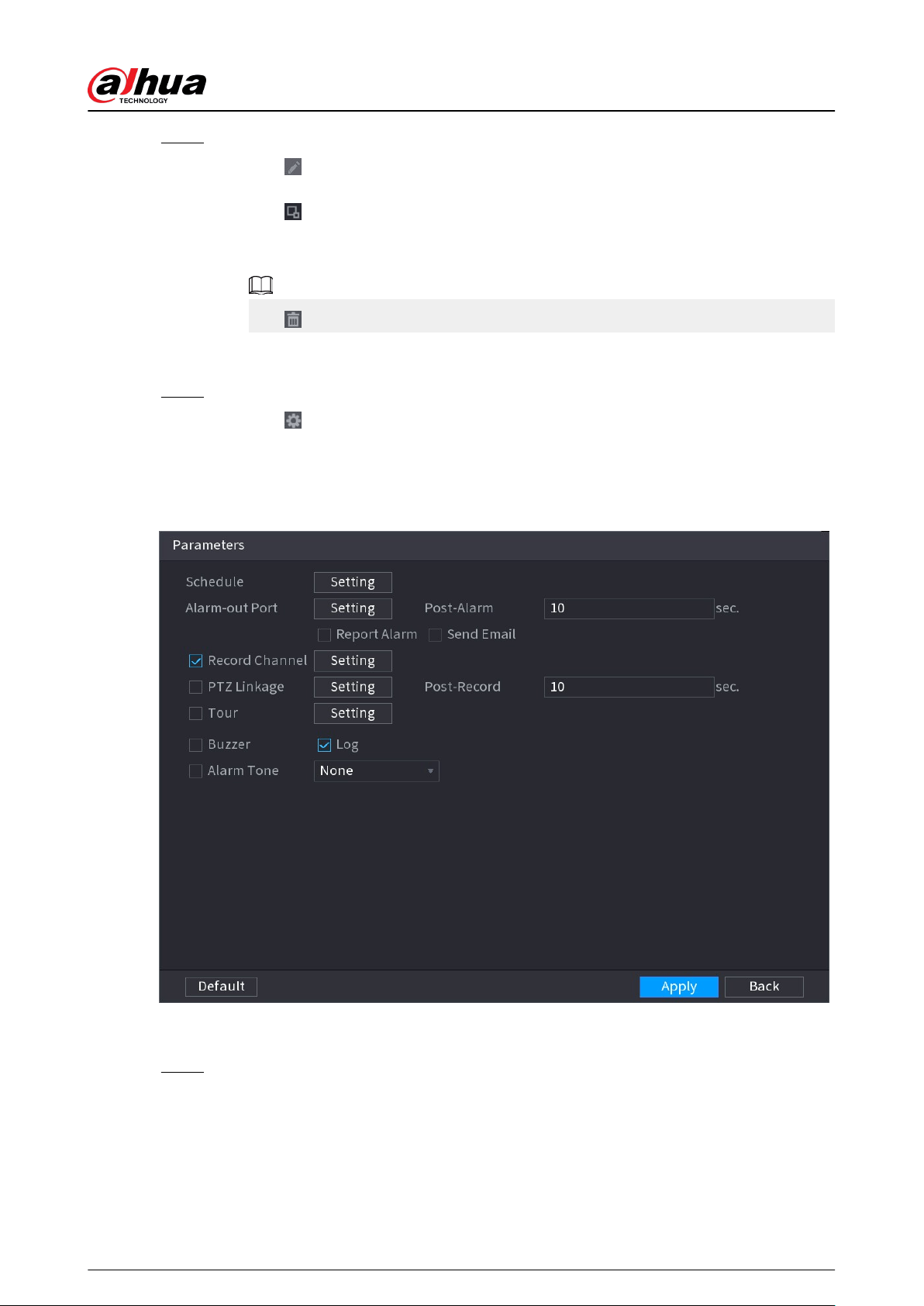
Step 3 Draw the detection rule.
a. Click
to draw a rectangle on the surveillance video image. Right-click the image to
stop drawing.
b. Click
to draw the minimum size or maximum size to lter the target.
The system triggers an alarm only when the size of detected target is between the
maximum size and the minimum size.
Click to delete the drawn size.
c. Congure the rule name and duration.
d. Click OK.
Step 4 Congure alarm schedule and linkage.
a. Click
.
b. Click Setting next to Schedule to congure the alarm period.
The system performs linkage actions only for alarms during the arming period.
Figure 5-183 Schedule and alarm linkage
c. Congure alarm linkage. For details, see Table 5-47 .
d. Click Apply.
Step 5 Click Apply.
User's Manual
300

5.9.18.3 Searching for Smart Object Detection
Query the detection result within a specied time period, and play back the related video.
Procedure
Step 1 Select AI > AI Search > Smart Object Detection.
Step 2 Select the channel, period, event type, and target, and then click Search.
Related Operations
●
Play back video.
Click an image, and then click
to play back the related video.
Click to pause.
Click to stop.
Click to display AI rule. The icon changes to .
●
Add tags.
Select one or more images, and then click Add Tag.
●
Lock.
Select one or more images, and then click Lock. The locked les will not be overwritten.
●
Export.
Select one or more images, and then click Export to export selected search results in excel.
●
Backup.
Select one or more images, click Backup , select the storage path and le type, and then click
Start to export les to external storage device.
5.9.19 Smart Sound Detection
When the detected sound matches the alarm rules, an alarm is triggered.
5.9.19.1 Conguring Smart Sound Detection
Set sound parameters.
Background Information
The front-end camera can detect the sound.
Procedure
Step 1 Select AI > Parameters > Smart Sound Detection.
User's Manual
301
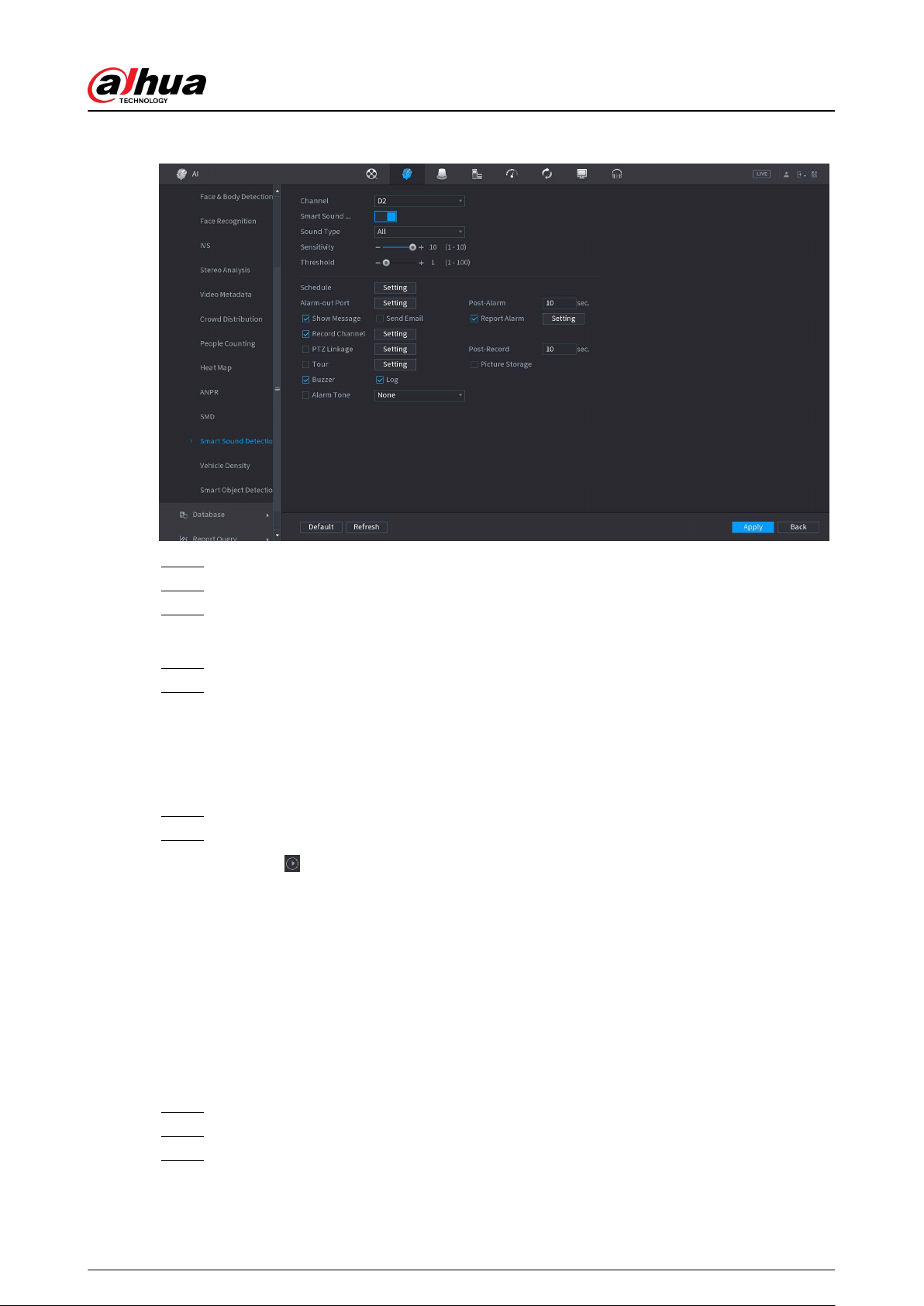
Figure 5-184 Conguring smart sound detection
Step 2 Select channel, and then enable Smart Sound.
Step 3 Select sound type, sensitivity, and threshold as needed.
Step 4 Click Setting next to Schedule to congure the arming period.
The system triggers corresponding alarm actions only during the arming period.
Step 5 Congure alarm linkage. For details, see Table 5-47 .
Step 6 Click Apply.
5.9.19.2 Searching for Smart Sound Detection
Procedure
Step 1 Select AI > AI Search > Smart Sound Detection.
Step 2 Select channel, sound type, and period, and then click Search.
●
Click
to play back the video.
●
Click Backup to back up the video.
5.9.20 PPE Detection
Detects whether the person is wearing the workwear, hat, gloves, shoe covers and the like.
Prerequisites
The front-end camera has AI function for PPE detection.
Procedure
Step 1 Select AI > Parameters > PPE Detection.
Step 2 Select channel, click Add, and then add a PPE detection rule.
Step 3 Click Enable.
User's Manual
302
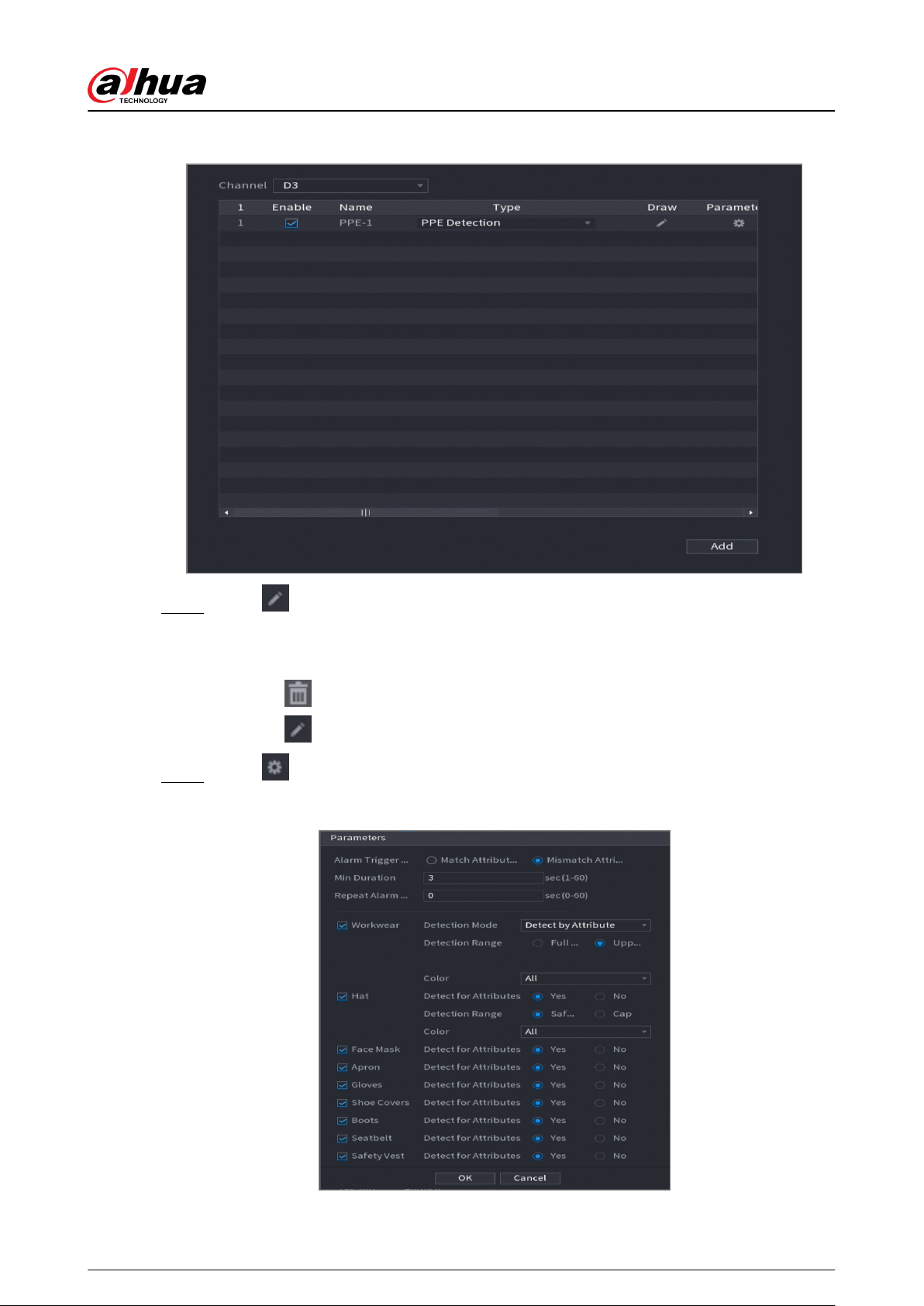
Figure 5-185 PPE detection
Step 4 Click to draw a detection zone on the live page.
After drawing the rule, supports the following operations.
●
Modify the name of the rule.
●
Click
to delete the drawn rule.
●
Click
to redraw the rule.
Step 5 Click under Parameters , set parameters, and then click OK.
Figure 5-186 Parameters (Detect by attributes)
User's Manual
303
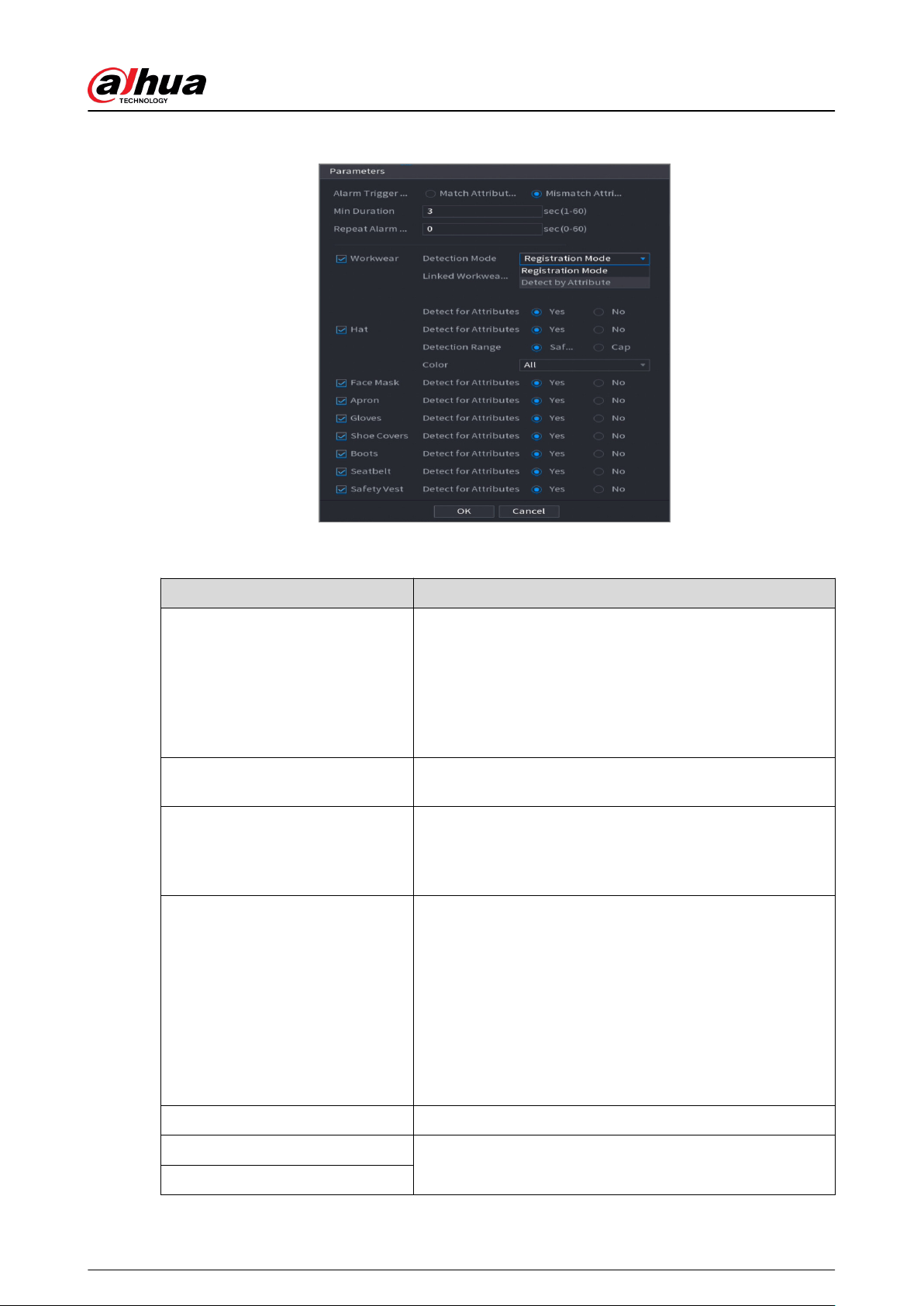
Figure 5-187 Parameters (Registration mode)
Table 5-52 Parameters description
Parameter Description
Alarm Trigger Condition
Receive an alarm event according to the set rule and display
it on the live page.
●
Match attributes alarm: When the detected workwear
matches the set attributes, an alarm is triggered.
●
Mismatch attributes alarm: When the detected workear
does not match the set attributes, an alarm is triggered.
Min Duration
Set the minimum time for the person wearing the workwear
to appear in the detection area until an alarm is triggered.
Repeat Alarm Time
Set the repeat alarm time.
If the alarm state persists, when reaching the repeat alarm
time, the alarm is triggered again.
Workwear
Select Detection Mode.
●
Detect by attribute: You need to set the detection range.
●
Registration mode: You need to link the workwear
database that has been set for the front-end camera.
Receive an alarm event based on the linked workwear
database and display it.
a. Click Settings next to Linked Workwear Database.
b. Select workwear database1 , and then click OK.
Hat Select Detect for Attributes , Detection Range, and Color.
Face Mask
Select Detect for Attributes.
Apron
User's Manual
304
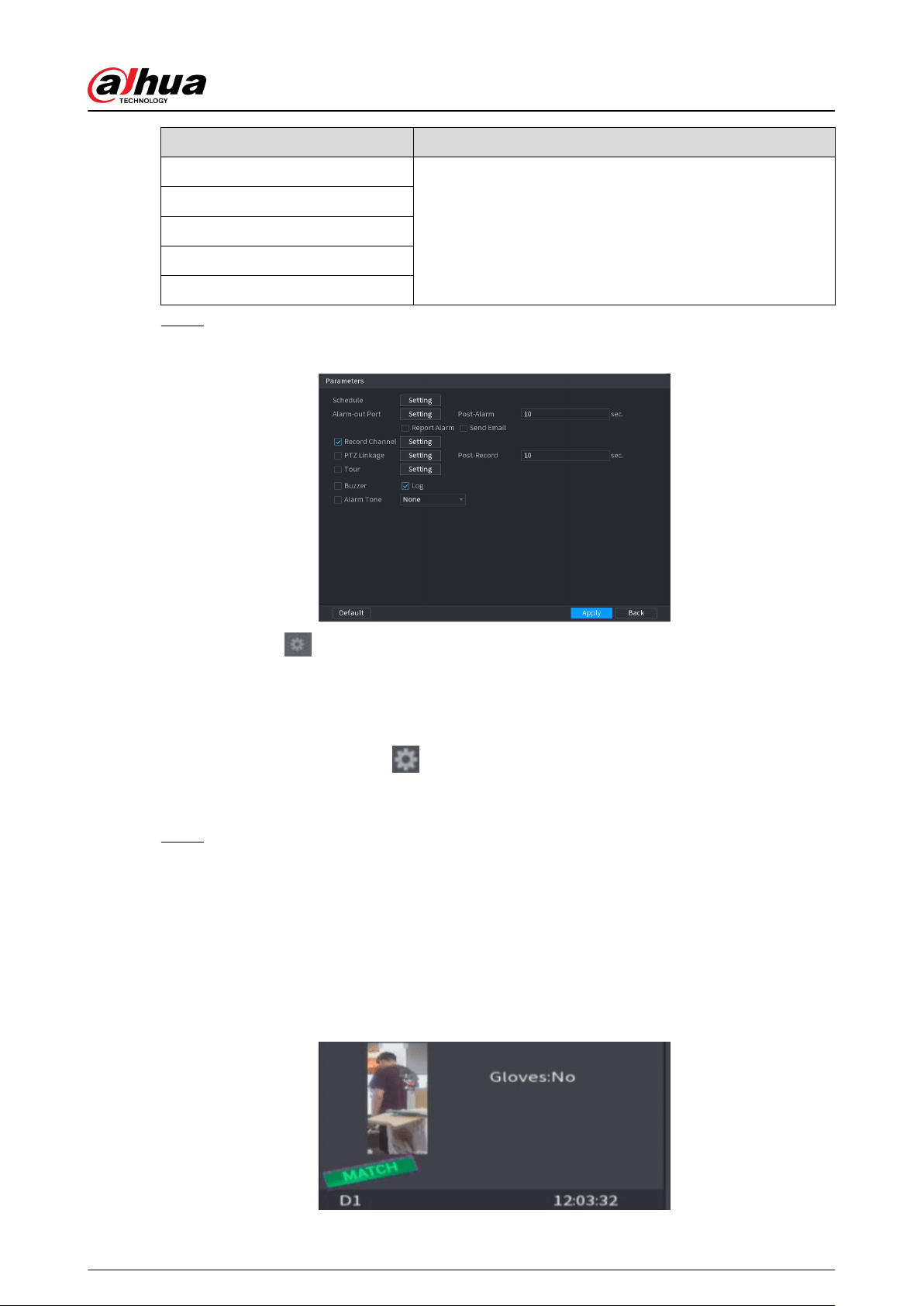
Parameter Description
Gloves
Shoe Covers
Boots
Seatbelt
Safety Vest
Step 6 Congure alarm schedule and linkage.
Figure 5-188 Schedule and alarm linkage
1. Click
.
2. Click Setting next to Schedule to congure the alarm period.
The system performs linkage actions only for alarms during the arming period.
●
On the time line, drag to set the period.
●
You can also click
to set the period.
3. Congure alarm linkage. For details, see Table 5-47 .
4. Click Apply.
Step 7 Click Apply.
Related Operations
View alarm images on the page of Live.
●
Match attributes alarm.
For example, when setting parameters for the PPE detection, select Gloves > Detect for
Attributes > No, a match attributes alarm is triggered when it is detected that a person is not
wearing a mask.
Figure 5-189 Match attributes alarm
User's Manual
305
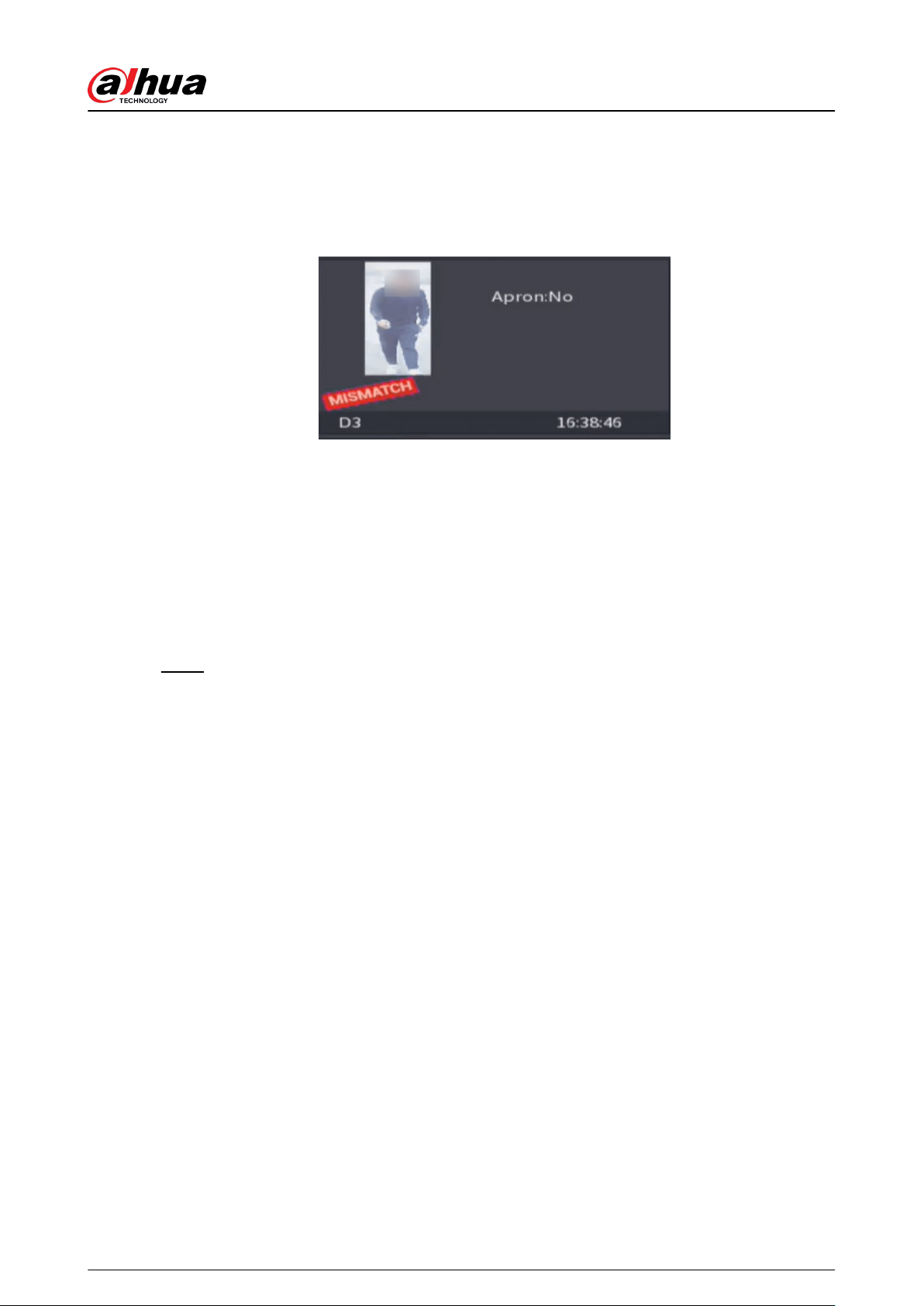
●
Mismatch attributes alarm.
For example, when setting parameters for the PPE detection, select Apron > Detect for
Attributes > Yes, a mismatch attributes alarm is triggered when it is detected that a person is
not wearing an apron.
Figure 5-190 Match attributes alarm
5.10 Alarm Settings
5.10.1 Alarm Information
Background Information
You can search for, view and back up the alarm information.
Procedure
Step 1 Select Main Menu > ALARM > Alarm Info.
User's Manual
306
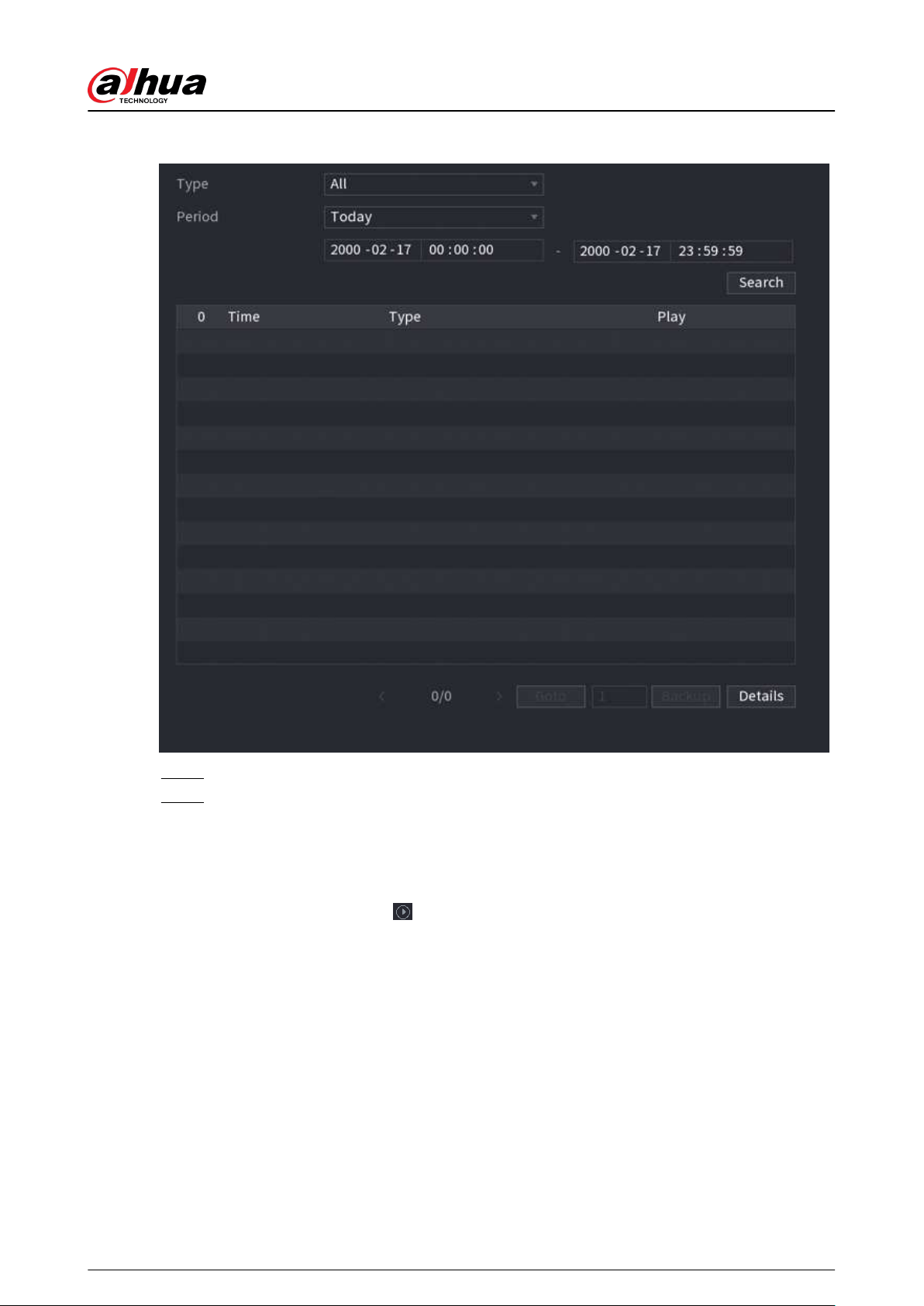
Figure 5-191 Alarm information
Step 2 Select the event type, and then set the search period.
Step 3 Click Search.
The search results are displayed.
Related Operations
●
Play back alarm videos.
Select an alarm event log, click
to play the recorded video of alarm event.
●
Back up.
Select an alarm event log and then click Backup to back up it to peripheral USB device.
●
View alarm details.
Double-click a log or click Details to view the detailed information of the event.
5.10.2 Alarm Status
You can view NVR alarm event, and remote channel alarm event.
Select Main Menu > ALARM > Alarm Status.
User's Manual
307
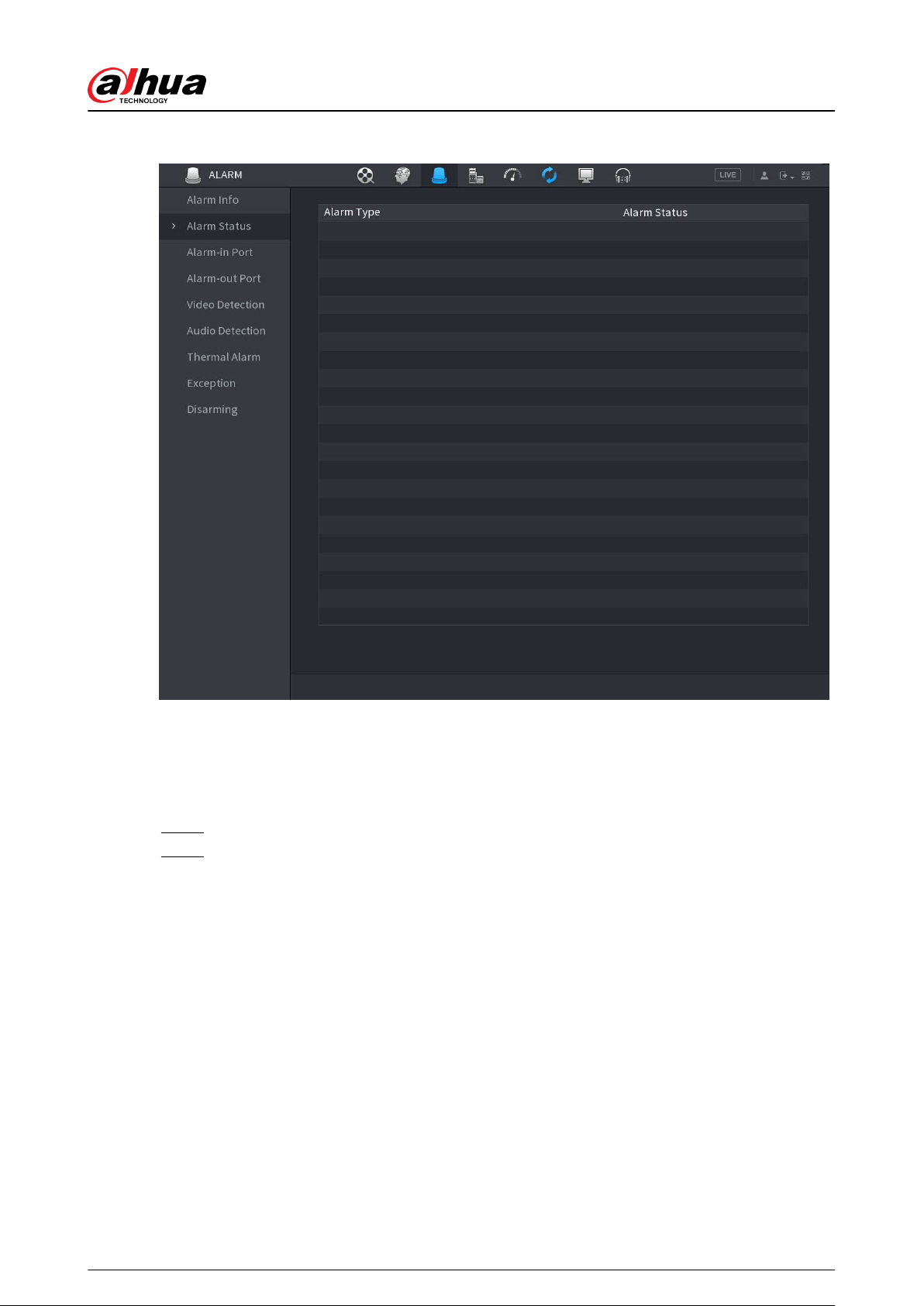
Figure 5-192 Alarm status
5.10.3 Alarm Input
Procedure
Step 1 Select Main menu > ALARM > Alarm-in Port.
Step 2 Click each tab to congure alarm input settings.
●
Local alarm: After connect the alarm device to the NVR alarm input port, the system
performs alarm linkage actions when there is an alarm signal from the alarm input port
to the NVR.
●
Alarm box: You can connect the alarm box to the RS-485 port of the Device. When the
alarm is detected by the alarm box, the alarm information will be uploaded to the
Device, and then the Device performs alarm linkage actions.
●
Network alarm: NVR performs alarm linkage actions when it receives the alarm signal
via the network transmission.
●
IPC external alarm: When the peripheral device connected to the camera has triggered
an alarm, the camera uploads the alarm signal to the NVR via the network
transmission. The system performs the corresponding alarm linkage actions.
●
IPC oine alarm: When the network connection between the NVR and the network
camera is o, the system performs alarm linkage actions.
User's Manual
308
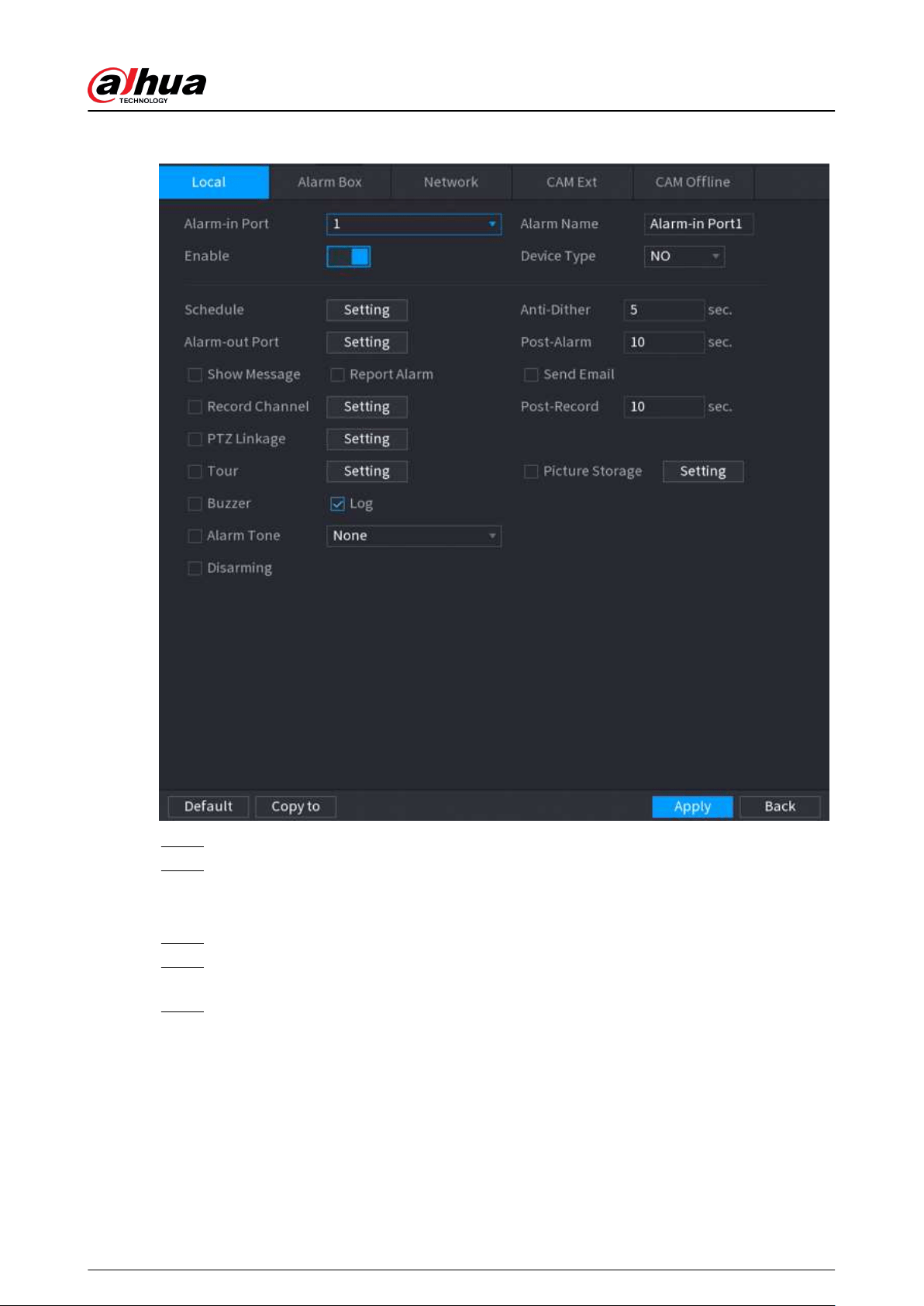
Figure 5-193 Local alarm
Step 3 Click Setting next to Schedule to congure the alarm schedule.
Step 4 Congure the anti-dither period.
If multiple alarms occur during the anti-dither period, the system only record the event
once.
Step 5 Congure alarm linkage. For details, see Table 5-47 .
Step 6 Enable Disarming so that you can connect a switch to the alarm input port for disarming
control.
Step 7 Click Apply.
5.10.4 Alarm Output
Background Information
You can set proper alarm output mode to auto, manual or o. After you connect the alarm device
to the alarm output port of NVR, and set the mode to auto, the system performs alarm linkage
actions when an alarm occurs.
●
Auto: Once an alarm event occurs, the system generates an alarm.
User's Manual
309
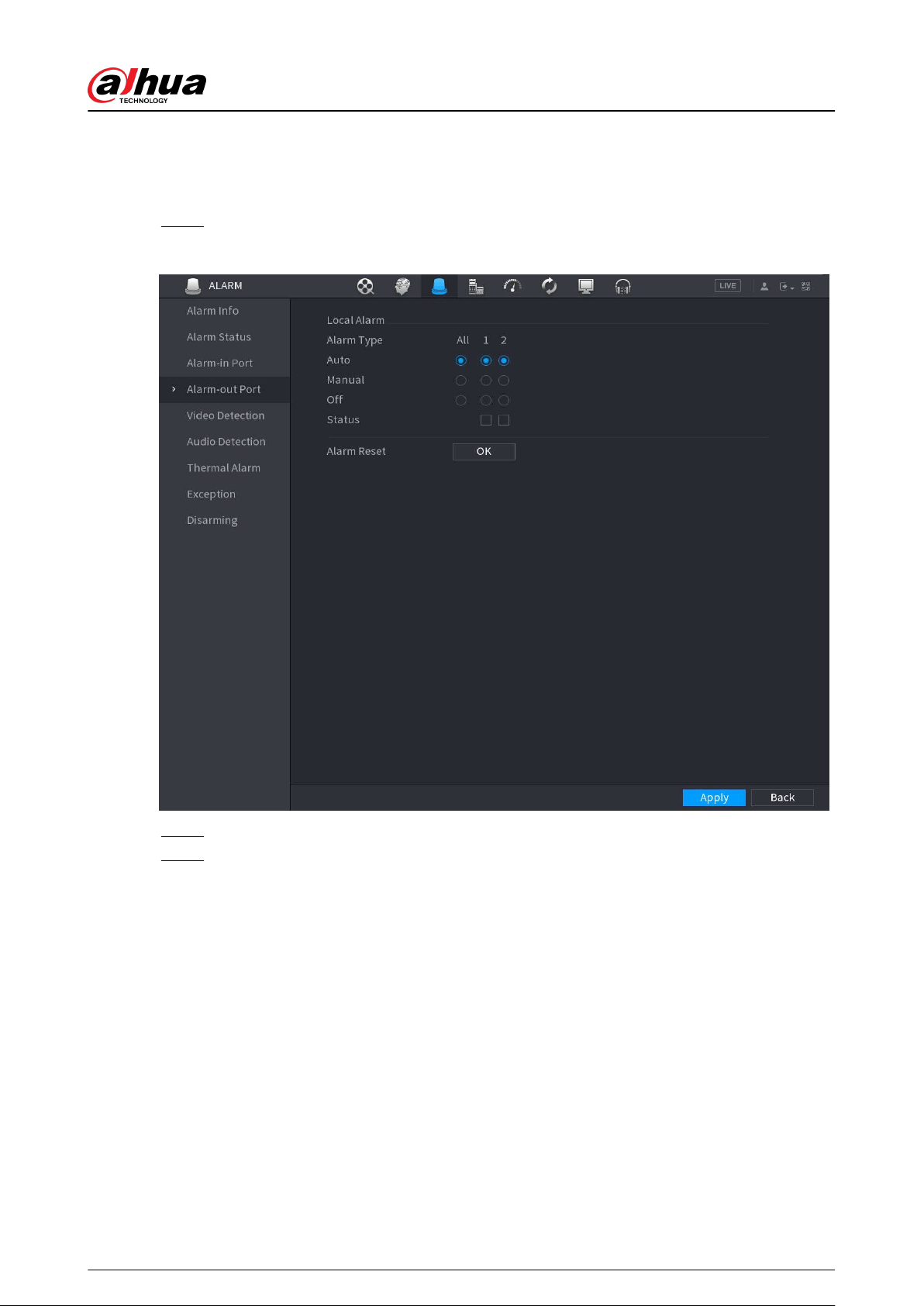
●
Manual: Alarm device is always on the alarming mode.
●
O: Disable alarm output function.
Procedure
Step 1 Select Main Menu > ALARM > Alarm-out Port.
Figure 5-194 Alarm-out port
Step 2 Select the alarm mode of the alarm output channel.
Step 3 Click Apply.
●
Click OK next to Alarm Reset to clear all alarm output statuses.
●
View the alarm output status on the Status column.
5.10.5 Video Detection
The system can analyze the video and check whether there is considerable change or not. Once
video has changed considerably (for example, there is any moving object, video is distorted), the
system performs alarm linkage actions.
5.10.5.1 Motion Detection
Background Information
When the moving object appears and moves fast enough to reach the preset sensitivity value, the
system performs alarm linkage actions.
User's Manual
310
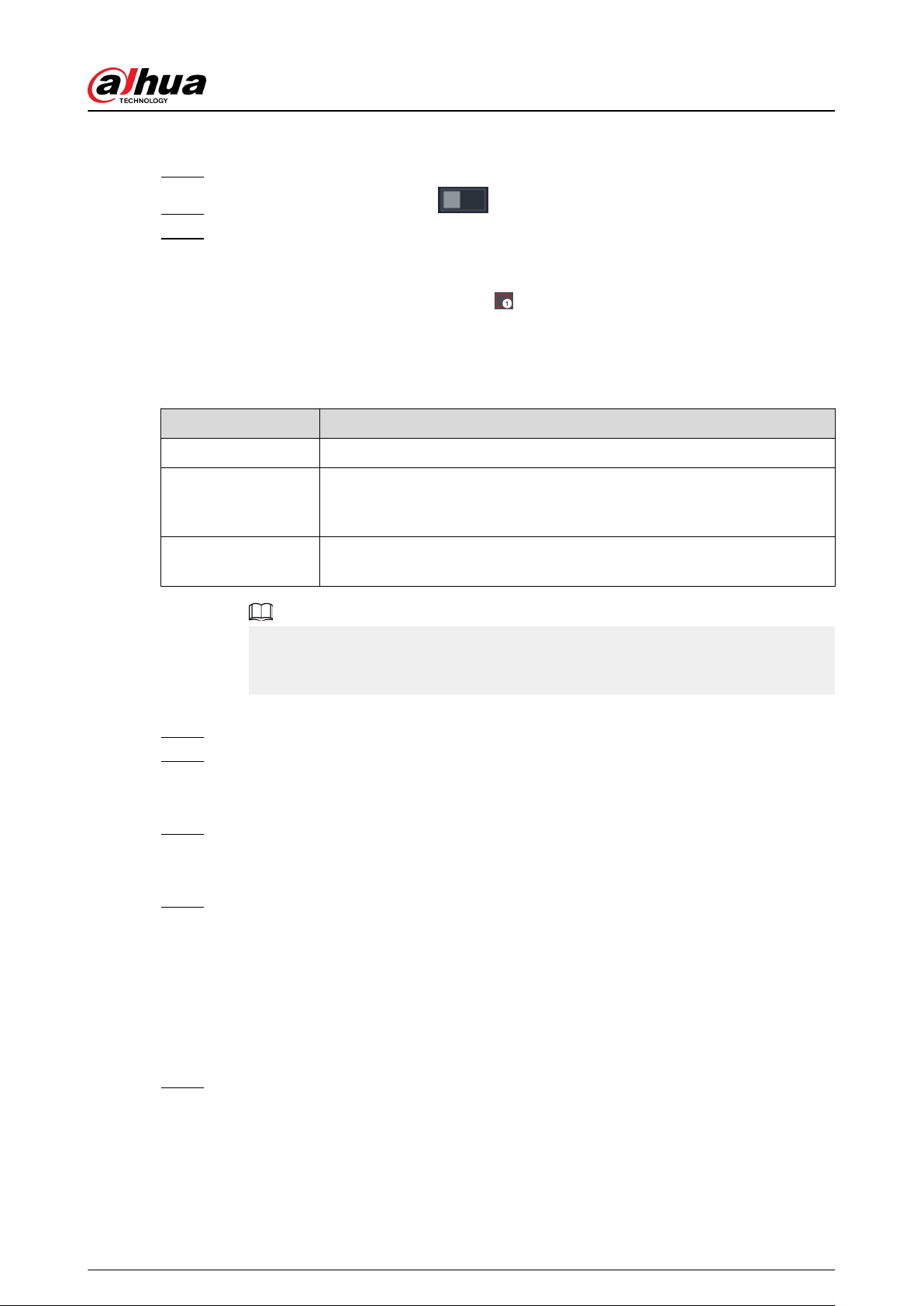
Procedure
Step 1 Select Main Menu > ALARM > Video Detection > Motion Detection.
Step 2 Select a channel and then click to enable the function.
Step 3 Congure the detection region.
1. Click Setting next to Region.
2. Point to the middle top of the page.
3. Select one region, for example, click
.
4. Drag on the screen to select the region that you want to detect.
5. Congure the parameters.
Table 5-53 Detection region parameters
Parameter Description
Name Enter a name for the region.
Sensitivity
Every region has an individual sensitivity value.
The bigger the value is, the easier to trigger an alarm.
Threshold
Adjust the threshold for motion detection. Every region of every channel
has an individual threshold.
You can congure up to four detection regions. When any one of the four regions
activates motion detection alarm, the channel where this region belongs to will
activate motion detection alarm.
6. Right-click the page to exit.
Step 4 Click Setting next to Schedule to congure the alarm schedule.
Step 5 Congure the anti-dither period.
If multiple alarms occur during the anti-dither period, the system only record the event
once.
Step 6 Congure alarm linkage. For details, see Network Video Recorder_User's Manual. This
section uses associating siren as an example.
Enable Alarm Hub, select the alarm hub as needed, and then select siren as needed.
Step 7 Click Apply.
5.10.5.2 Video Loss
Background Information
When the video loss occurs, the system performs alarm linkage actions.
Procedure
Step 1 Select Main Menu > ALARM > Video Detection > Video Loss.
User's Manual
311
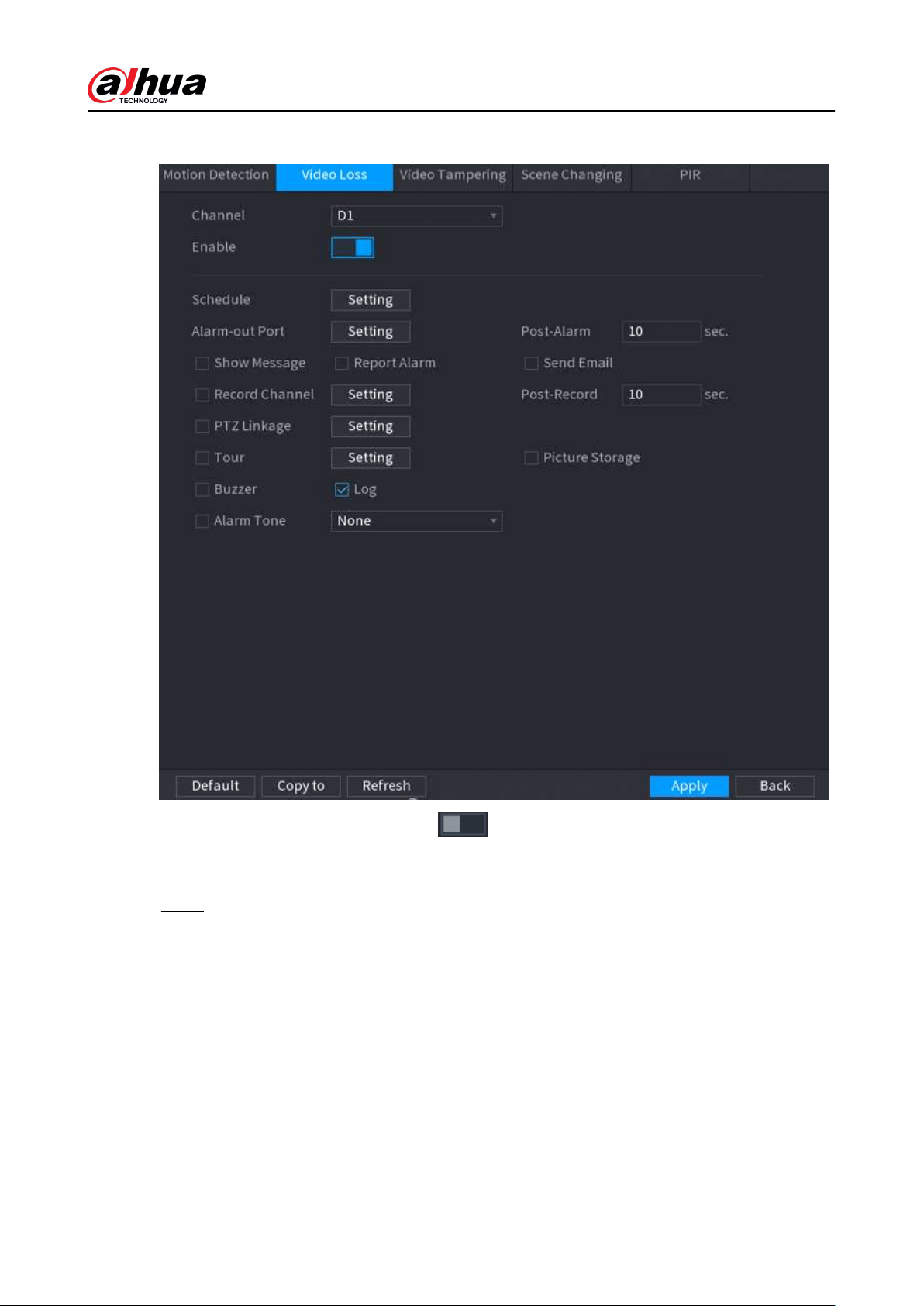
Figure 5-195 Video Loss
Step 2 Select a channel and then click to enable the function.
Step 3 Click Setting next to Schedule to congure the alarm schedule.
Step 4 Congure alarm linkage. For details, see Network Video Recorder_User's Manual.
Step 5 Click Apply.
5.10.5.3 Video Tampering
Background Information
When the camera lens is covered, or the video is displayed in a single color because of sunlight
status, the monitoring cannot be continued normally. To avoid such situations, you can congure
the tampering alarm settings.
Procedure
Step 1 Select Main Menu > ALARM > Video Detection > Video Tampering.
User's Manual
312
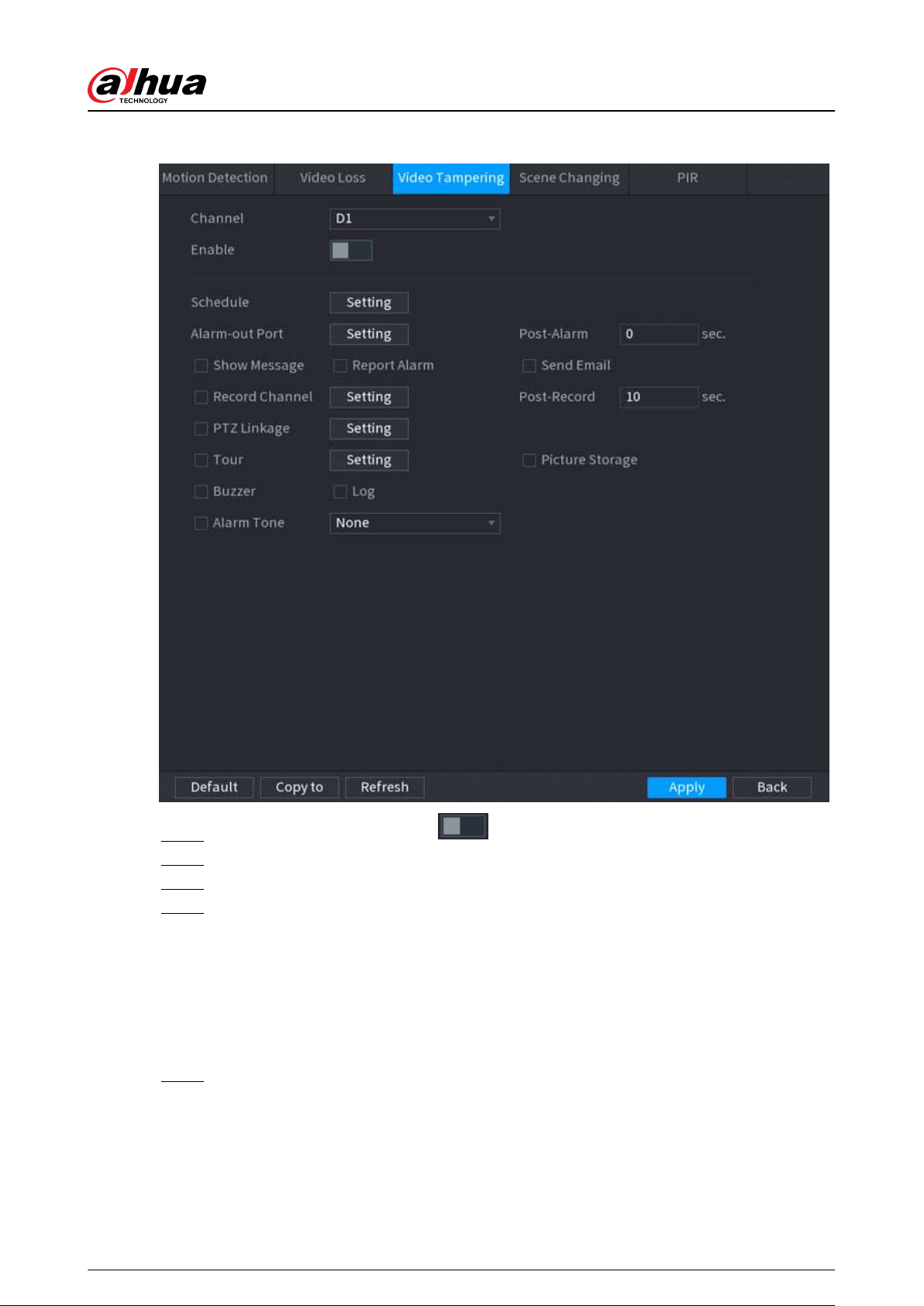
Figure 5-196 Video tampering
Step 2 Select a channel and then click to enable the function.
Step 3 Click Setting next to Schedule to congure the alarm schedule.
Step 4 Congure alarm linkage. For details, see Network Video Recorder_User's Manual.
Step 5 Click Apply.
5.10.5.4 Scene Change
Background Information
When the detected scene has changed, system performs alarm linkage actions.
Procedure
Step 1 Select Main Menu > ALARM > Video Detection > Scene Changing.
User's Manual
313
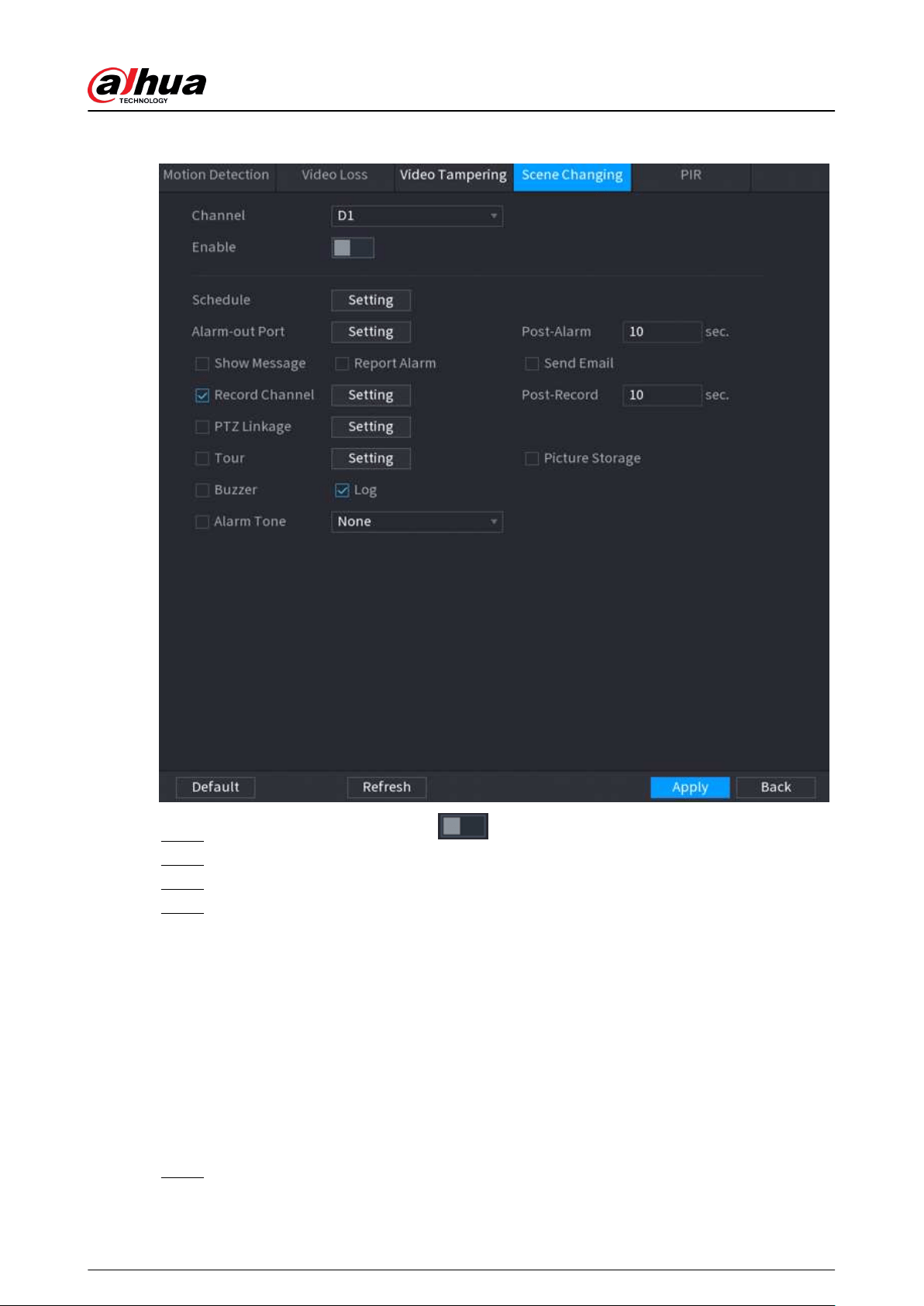
Figure 5-197 Scene changing
Step 2 Select a channel and then click to enable the function.
Step 3 Click Setting next to Schedule to congure the alarm schedule.
Step 4 Congure alarm linkage. For details, see Network Video Recorder_User's Manual.
Step 5 Click Apply.
5.10.5.5 PIR Alarm
Background Information
PIR function helps enhancing the accuracy and validity of motion detect. It can lter the
meaningless alarms that are activated by the objects such as falling leaves and ies. The detection
range by PIR is smaller than the eld angle.
PIR function is enabled by default if it is supported by the cameras. Enabling PIR function will get
the motion detection to be enabled automatically to generate motion detection alarms.
Procedure
Step 1 Select Main Menu > ALARM > Video Detection > PIR.
User's Manual
314
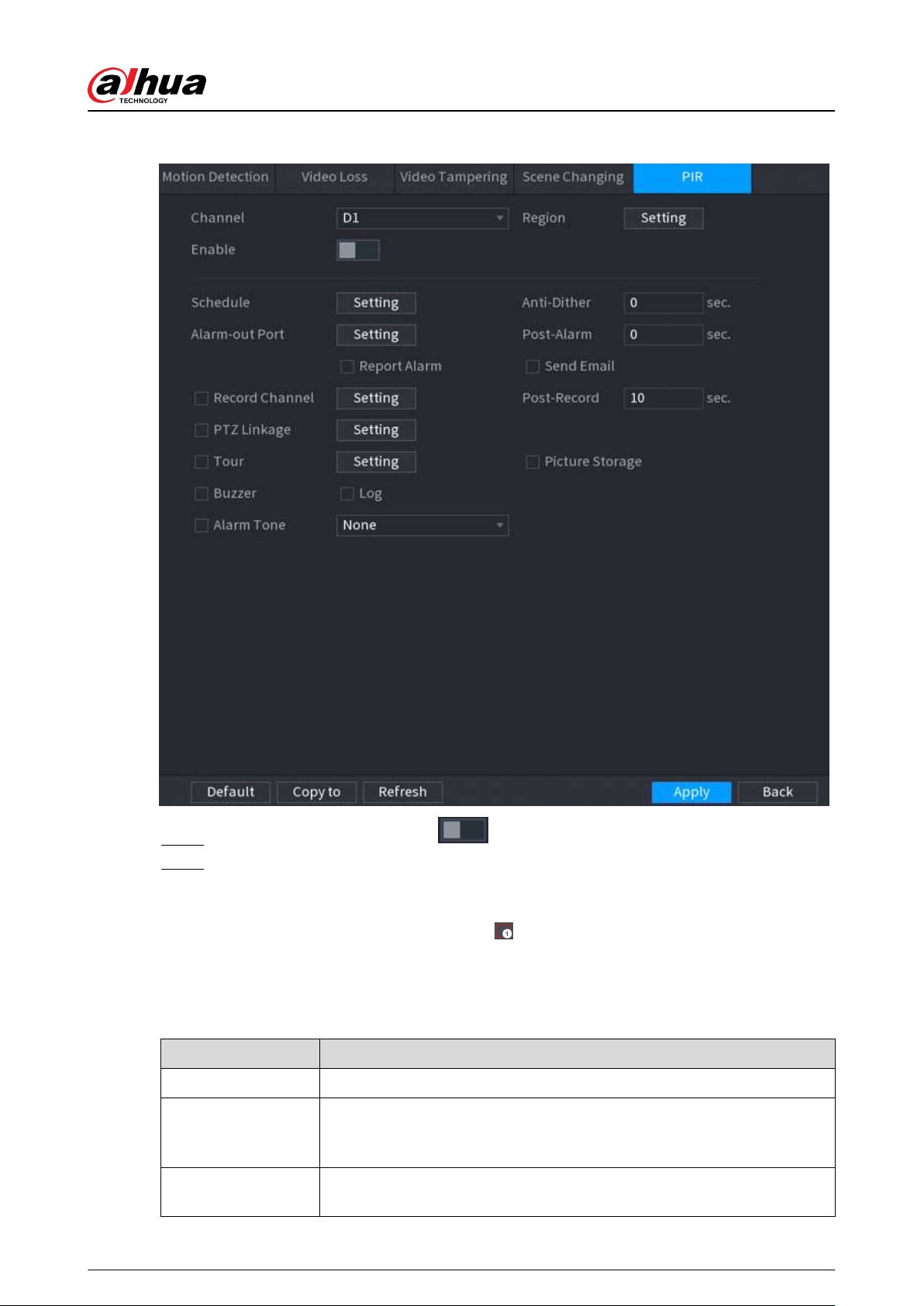
Figure 5-198 PIR
Step 2 Select a channel and then click to enable the function.
Step 3 Congure the detection region.
1. Click Setting next to Region.
2. Point to the middle top of the page.
3. Select one region, for example, click
.
4. Drag on the screen to select the region that you want to detect.
5. Congure the parameters.
Table 5-54 Detection region parameters
Parameter Description
Name Enter a name for the region.
Sensitivity
Every region of every channel has an individual sensitivity value.
The bigger the value is, the easier to trigger an alarm.
Threshold
Adjust the threshold for motion detection. Every region of every channel
has an individual threshold.
User's Manual
315
You can congure up to four detection regions. When any one of the four regions
activates an alarm, the channel where this region belongs to will activate an alarm.
6. Right-click to exit the page.
Step 4 Click Setting next to Schedule to congure the alarm schedule.
Step 5 Congure the anti-dither period.
If multiple alarms occur during the anti-dither period, the system only record the event
once.
Step 6 Congure alarm linkage. For details, see Network Video Recorder_User's Manual.
Step 7 Click Apply.
5.10.6 Audio Detection
Background Information
The system can generate an alarm once it detects the audio is not clear, the tone color has changed
or there is abnormal or audio volume change.
Procedure
Step 1 Select Main Menu > ALARM > Audio Detection.
Step 2 Select a channel and then click to enable detection of audio exception and
intensity change.
●
Audio Exception : The system generates an alarm when the audio input is abnormal.
●
Intensity Change : Set the sensitivity and threshold. An alarm is triggered when the
change in sound intensity exceeds the dened threshold.
Step 3 Click Setting next to Schedule to congure the alarm schedule.
Step 4 Congure alarm linkage. For details, see Table 5-47 .
Step 5 Click Apply.
5.10.7 Thermal Alarm
Background Information
After receiving the alarm signal from the connected thermal devices, the system can recognize the
alarm type, and then trigger the corresponding alarm actions.
The system supports heat alarm, temperature (temperature dierence) and cold/hot alarm.
●
Heat alarm: The system generates an alarm once it detects there is a re.
●
Temperature (temperature dierence): The system triggers an alarm once the temperature
dierence between two positions is higher or below the specied threshold.
●
Cold/hot alarm: The system triggers an alarm once the detected position temperature is higher
or below the specied threshold.
●
Make sure that the connected camera supports temperature monitoring function.
●
This function is available on select models.
●
The thermal detection functions might vary depending on the connected camera. This section
uses heat alarm as an example.
User's Manual
316
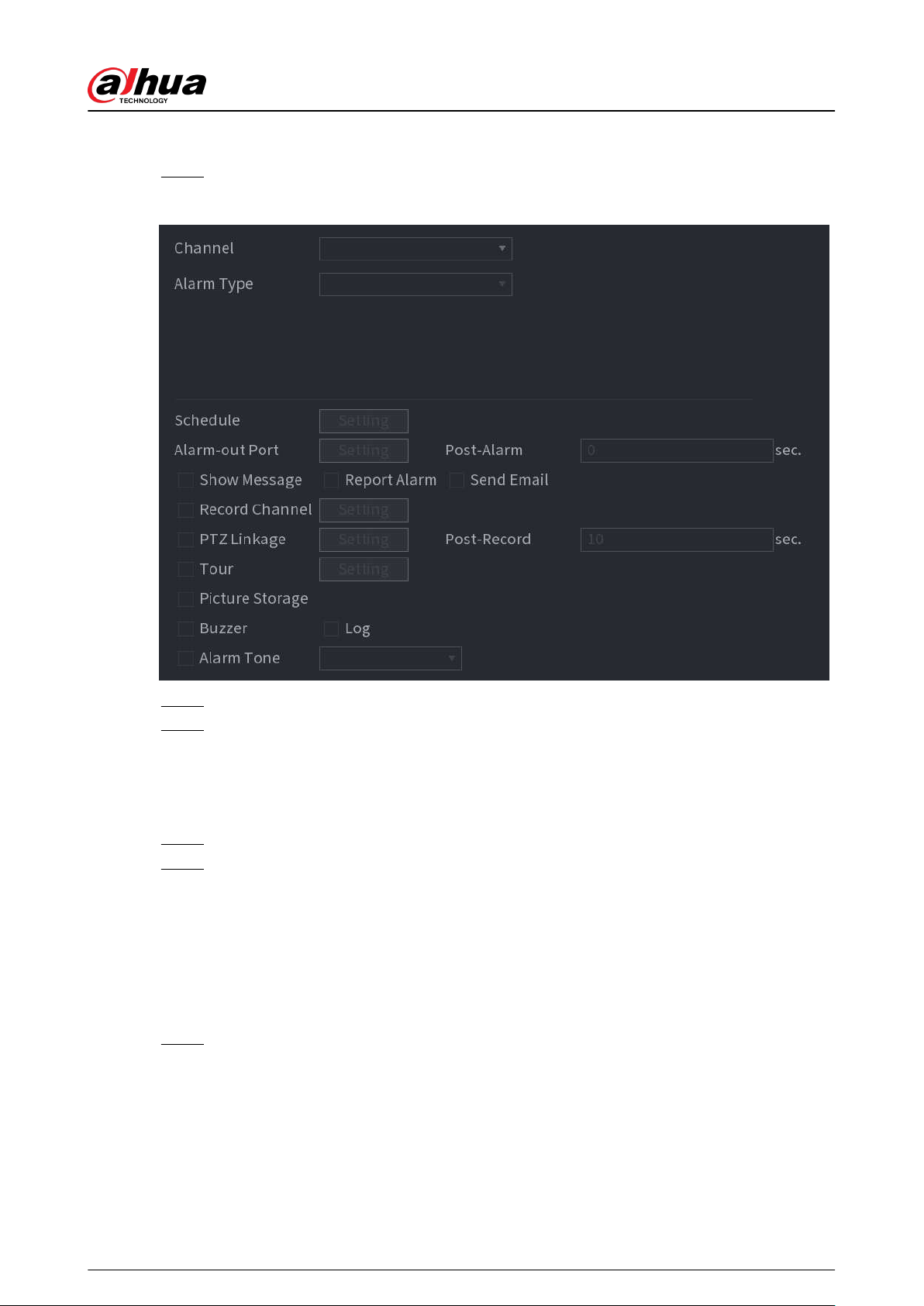
Procedure
Step 1 Select Main Menu > ALARM > Thermal Alarm.
Figure 5-199 Thermal alarm
Step 2 Select a channel and set alarm type to heat alarm, and then enable the function.
Step 3 Select re mode. The system supports preset mode and zone excluded mode.
●
Preset mode: Select a preset and then enable the function. The system generates an
alarm once it detects there is a re.
●
Zone excluded mode: The system lters the specied high temperature zone. The
system generates an alarm once the rest zone has re.
Step 4 Congure alarm linkage. For details, see Table 5-47 .
Step 5 Click Apply.
5.10.8 Exception
Background Information
When an error in HDD, network, and device occurs, the system performs alarm linkage actions.
Procedure
Step 1 Select Main Menu > ALARM > Exception.
User's Manual
317
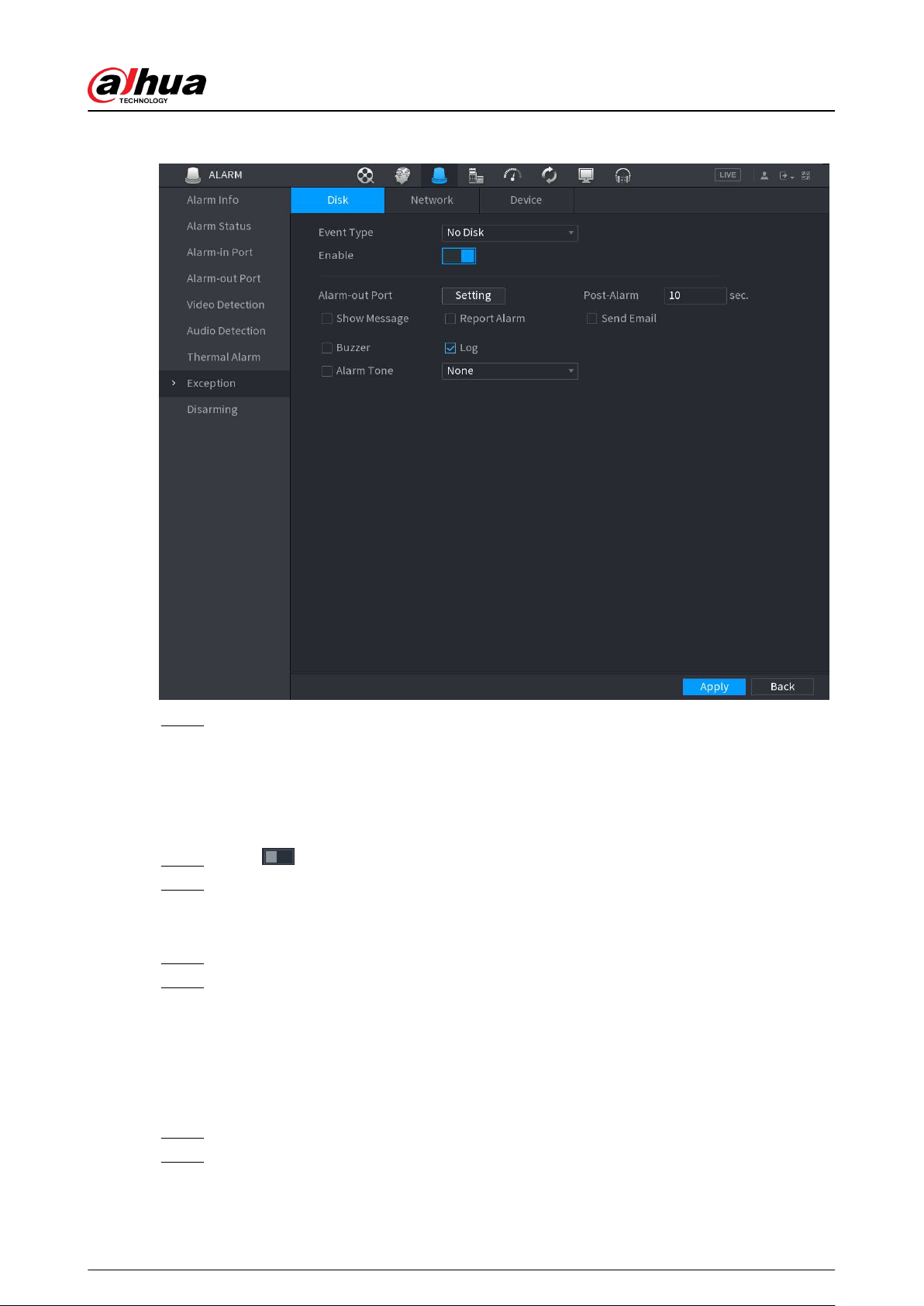
Figure 5-200 Disk exception
Step 2 Click each tab and then select an event type.
●
Disk : The system detects HDD error, no HDD, no space, and other HDD events.
●
Network : The system detects network errors such as disconnection, IP conict, and
MAC conict.
●
Device : The system detects device errors such as abnormal fan speed and network
security error.
Step 3 Click to enable the function.
Step 4 (Optional) If the event type is Low Space, you need to congure the threshold of storage
space.
When the storage space is lower than the threshold, an alarm is triggered.
Step 5 Congure alarm linkage. For details, see Table 5-47 .
Step 6 Click Apply.
5.10.9 Disarming
You can disarm all alarm linkage actions as needed through one click.
Procedure
Step 1 Select Main Menu > ALARM > Disarming.
Step 2 Select On for Disarming to enable disarming.
User's Manual
318
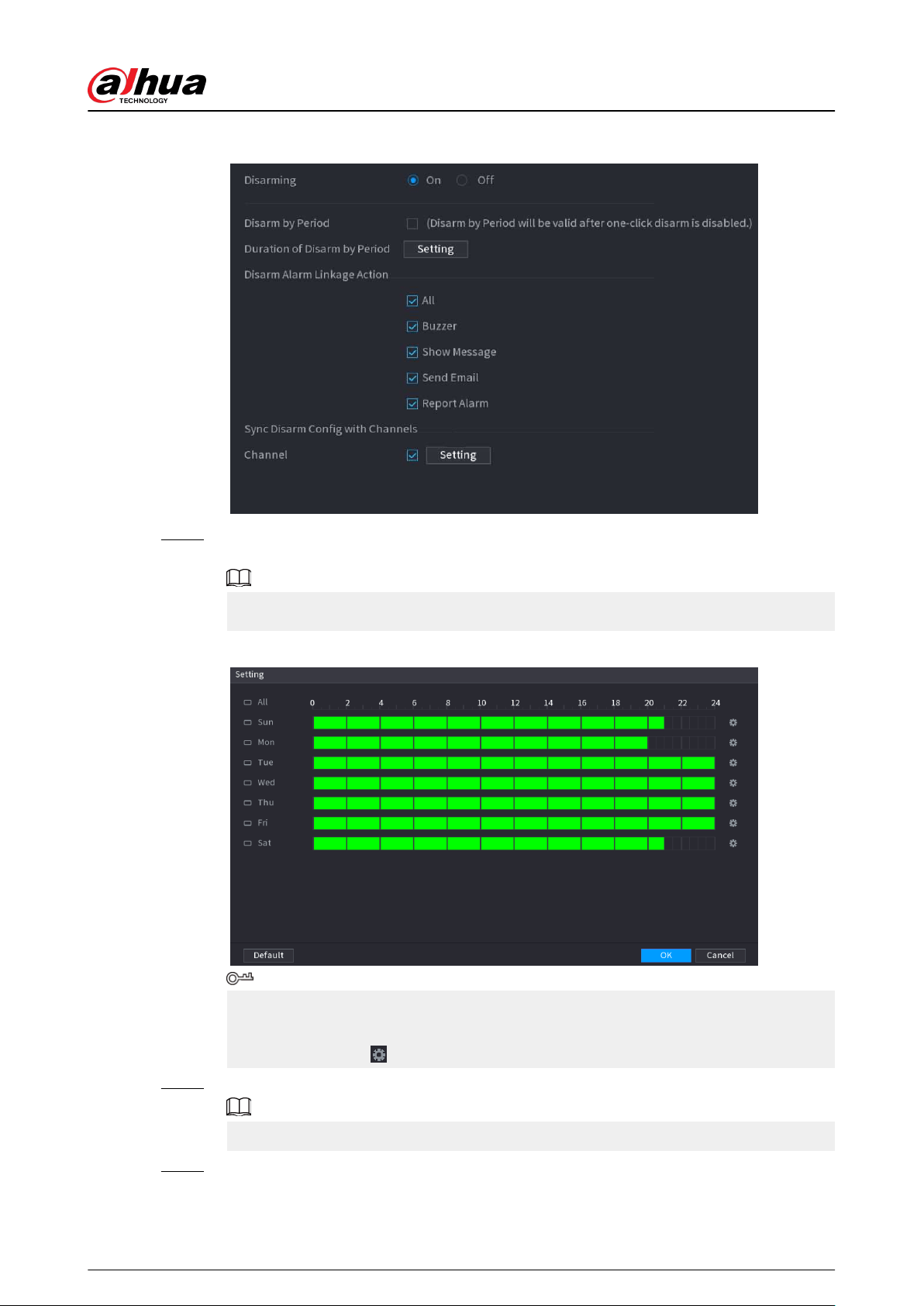
Figure 5-201 Disarming
Step 3 (Optional) To enable scheduled disarming, click Setting next to Duration of Disarm by
Period, and then set periods.
Scheduled disarming is only eective when Disarming is O.
Figure 5-202 Scheduled disarming
●
Drag your mouse to select time blocks.
●
Green blocks indicates that disarming is enabled.
●
You can also click
to set time periods. One day can have 6 periods at most.
Step 4 Select the alarm linkage actions to disarm.
All alarm linkage actions will be disarmed if you select All.
Step 5 To disarm remote channels, select the checkbox at Channel, and then click Setting to
select channels.
User's Manual
319

This function is only eective when the connected camera supports one-click disarming.
Step 6 Click Apply.
5.11 Network
Congure the network settings to ensure the Device can communicate with other devices on the
same LAN.
5.11.1 TCP/IP
Background Information
You can congure the settings for the Device such as IP address, DNS according to the networking
plan.
Procedure
Step 1 Select Main Menu > NETWORK > TCP/IP.
User's Manual
320
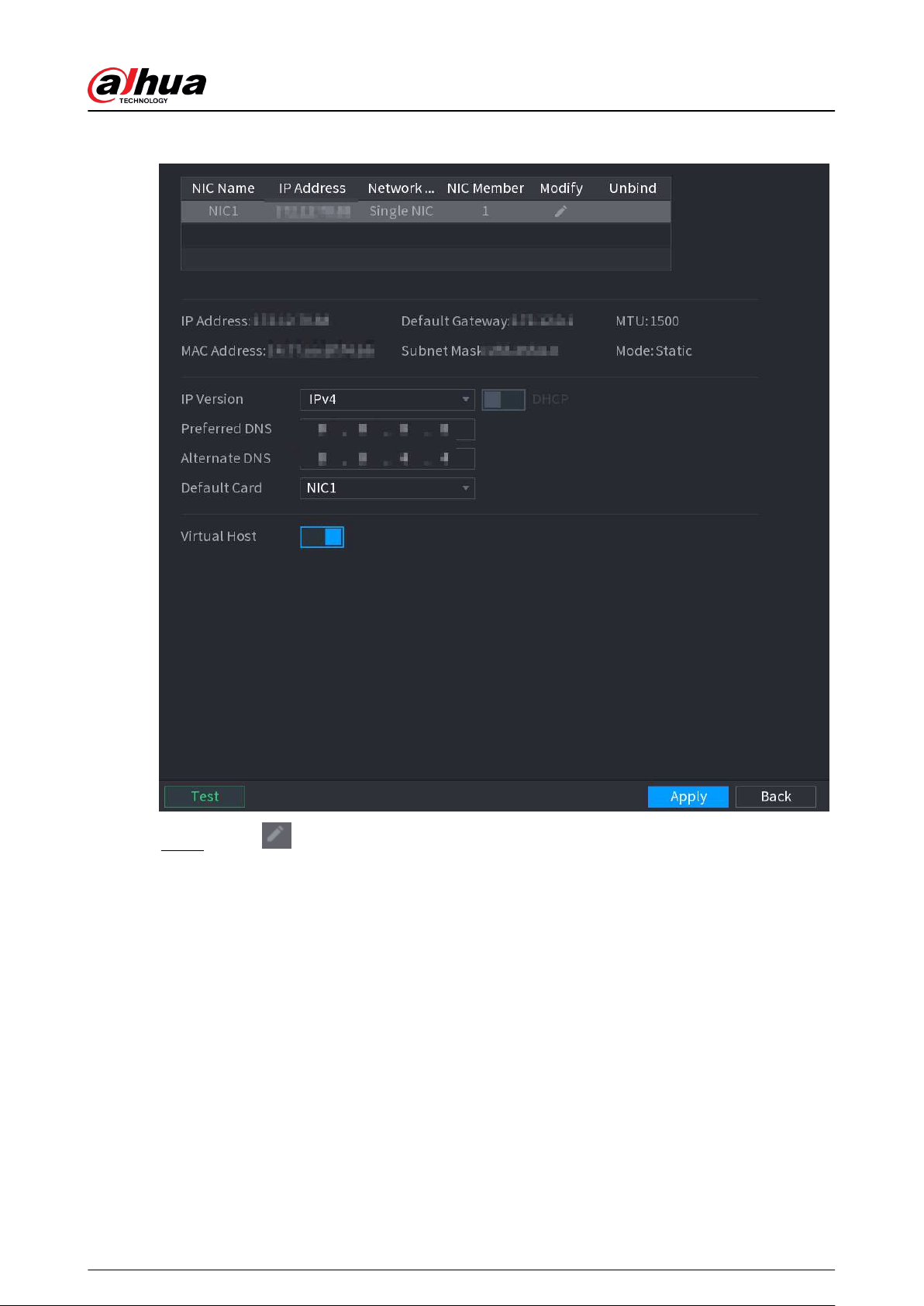
Figure 5-203 TCP/IP
Step 2 Click to congure the NIC card, and then click OK.
User's Manual
321
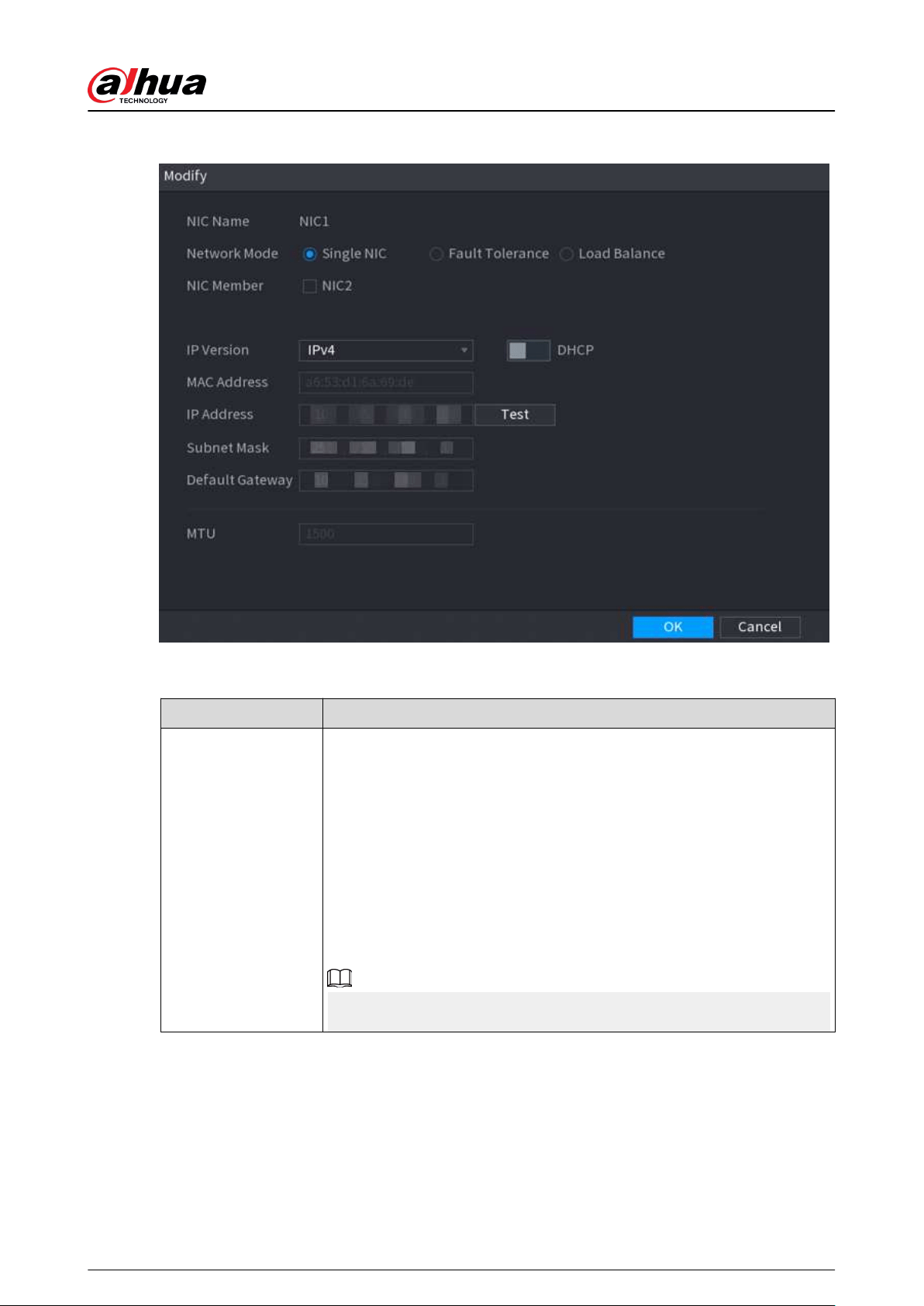
Figure 5-204 TCP/IP
Table 5-55 TCP/IP parameters
Parameter Description
Network Mode
●
Single NIC : The current NIC card works independently. If the current
NIC card is disconnected, the Device becomes oine.
●
Fault Tolerance: Two NIC cards share one IP address. Normally only
one NIC card is working. When this card fails, the other NIC card will
start working automatically to ensure the network connection. The
Device is regarded as oine only when both NIC cards are
disconnected.
●
Load Balance: Two NIC cards share one IP address and work at the
same time to share the network load averagely. When one NIC card
fails, the other card continues to work normally. The Device is regarded
as oine only when both NIC cards are disconnected.
The Device with single Ethernet port does not support this function.
User's Manual
322
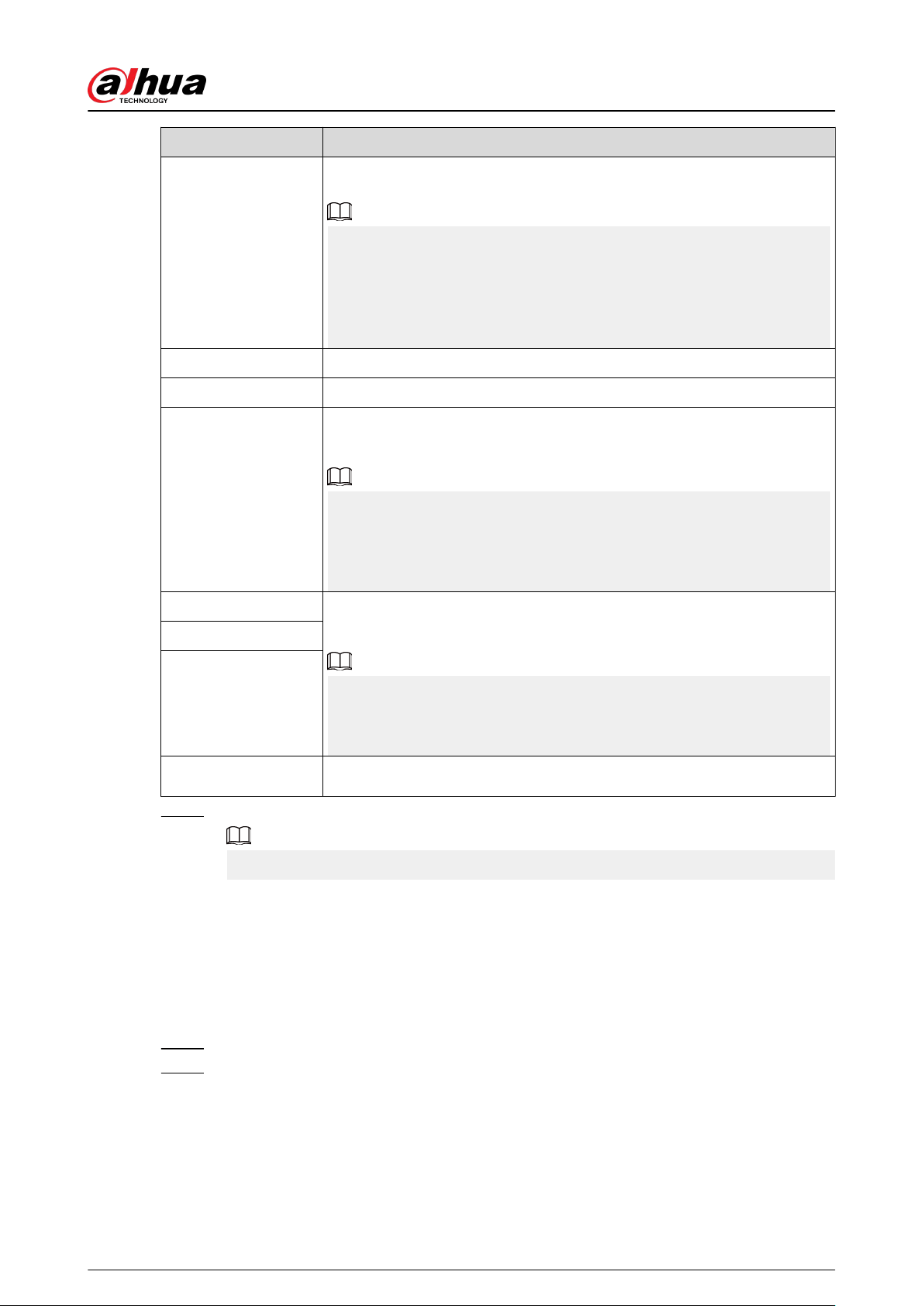
Parameter Description
NIC Member
When the network mode is Fault Tolerance or Load Balance, you need
to select the checkbox to bind NIC cards.
●
Make sure that at least two NIC cards are installed.
●
NIC cards using dierent ports such as optical port and electrical port
cannot be bound together.
●
After binding NIC cards, you need to restart the Device to make the
change eective.
IP Version Select IPv4 or IPv6. Both versions are supported for access.
MAC Address Displays the MAC address of the Device.
DHCP
Enable the system to allocate a dynamic IP address to the Device. There is
no need to set IP address manually.
●
If you want to manually congure the IP information, disable the DHCP
function rst.
●
If PPPoE connection is successful, the IP address, subnet mask, default
gateway, and DHCP are not available for conguration.
IP Address
Enter the IP address and congure the corresponding subnet mask and
default gateway.
●
The IP address and default gateway must be on the same network
segment.
●
Click Test to check whether the IP address is available.
Subnet Mask
Default Gateway
MTU Displays the MTU value of the NIC card.
Step 3 On the TCP/IP page, congure the DNS server.
This step is compulsive if you want to use the domain service.
●
Obtain DNS server automatically.
When there is DHCP server on the network, you can enable DHCP so that the Device
can automatically obtain a dynamic IP address.
●
Congure DNS server manually.
Select the IP version, and then enter the IP addresses of preferred and alternate DNS
server.
Step 4 Select a NIC card as the default card.
Step 5 Click Apply.
User's Manual
323
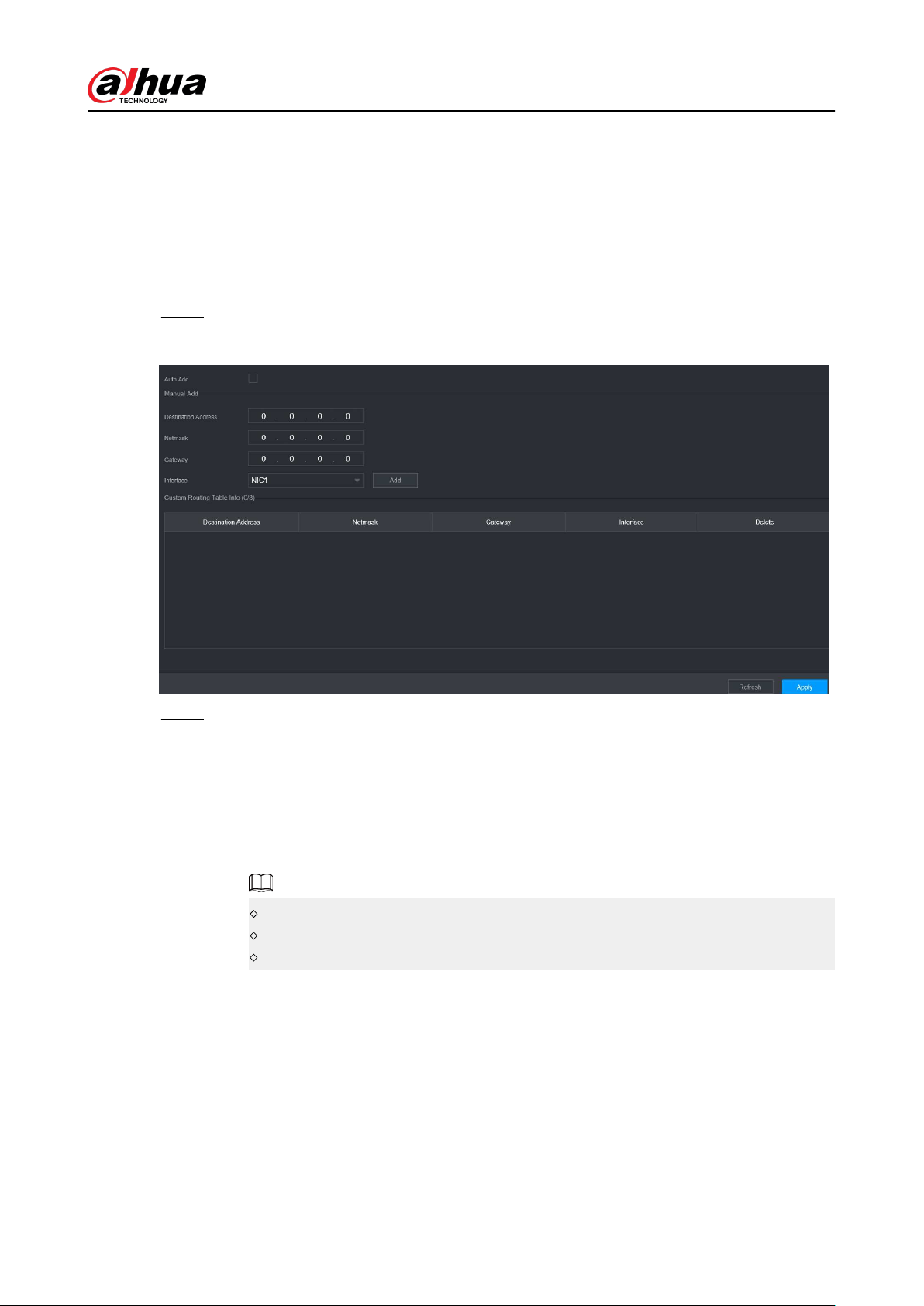
5.11.2 Routing Table
Background Information
You can congure the routing table so that the system can automatically calculate the best path for
data transmission.
Procedure
Step 1 Select Main Menu > NETWORK > TCP/IP > Routing Table.
Figure 5-205 Routing table
Step 2 Add the routing table.
●
Auto add.
When you add a camera to the NVR and the IP address of the camera is not on the
existing routing table, the system will add the routing information.
●
Manual add.
Congure the parameters such as destination address, netmask, and gateway, and
then click Add.
The destination address and netmask must not be on the same LAN.
The netmask must be valid and on the same LAN with the NIC card.
You can congure up to eight pieces of routing information.
Step 3 Click Apply.
5.11.3 Port
Background Information
You can congure the maximum connection for accessing the Device from web, platform, mobile
phone or other clients at the same time, and congure each port number.
Procedure
Step 1 Select Main Menu > NETWORK > Port.
User's Manual
324
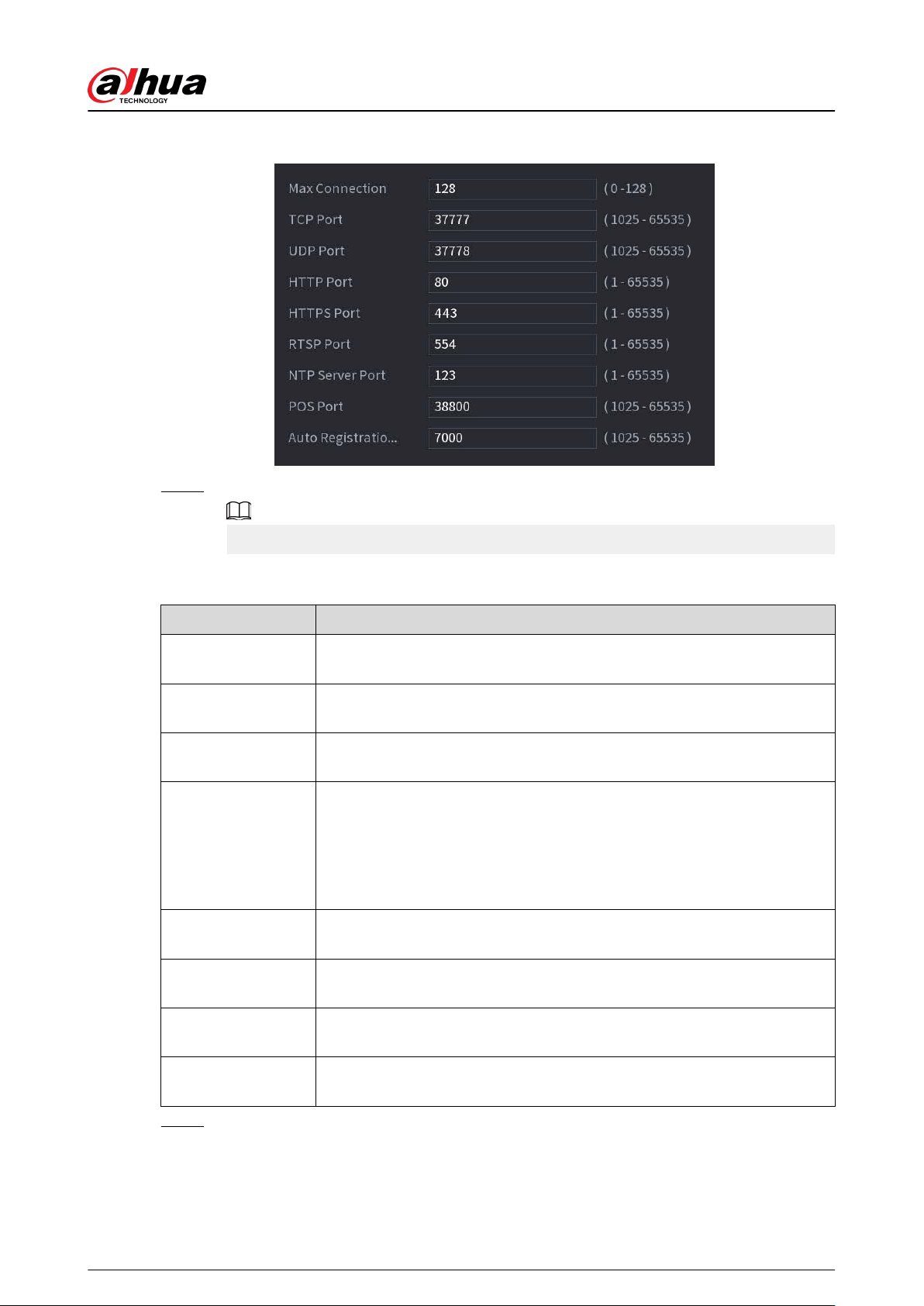
Figure 5-206 Port
Step 2 Congure the parameters.
The parameters except Max Connection take eect after the Device restarts.
Table 5-56 Port parameters
Parameter Description
Max Connection
The allowable maximum clients accessing the Device at the same time,
such as web client, platform, and mobile client.
TCP Port
Transmission control protocol port. Enter the value according to your
actual situation.
UDP Port
User datagram protocol port. Enter the value according to your actual
situation.
HTTP Port
The default value setting is 80. You can enter the value according to your
actual situation.
If you change the HTTP port number to, for example, 70, then you need to
enter 70 after the IP address when logging in to the Device through the
browser.
HTTPS Port
HTTPS communication port. The default value is 443. You can enter the
value according to your actual situation.
RTSP Port
The default value is 554. You can enter the value according to your actual
situation.
POS Port
POS data transmission port. The value range from 1 through 65535. The
default value is 38800.
Auto Registration
Port
The auto registered port. Supports adding cameras through auto
registration.
Step 3 Click Apply.
User's Manual
325
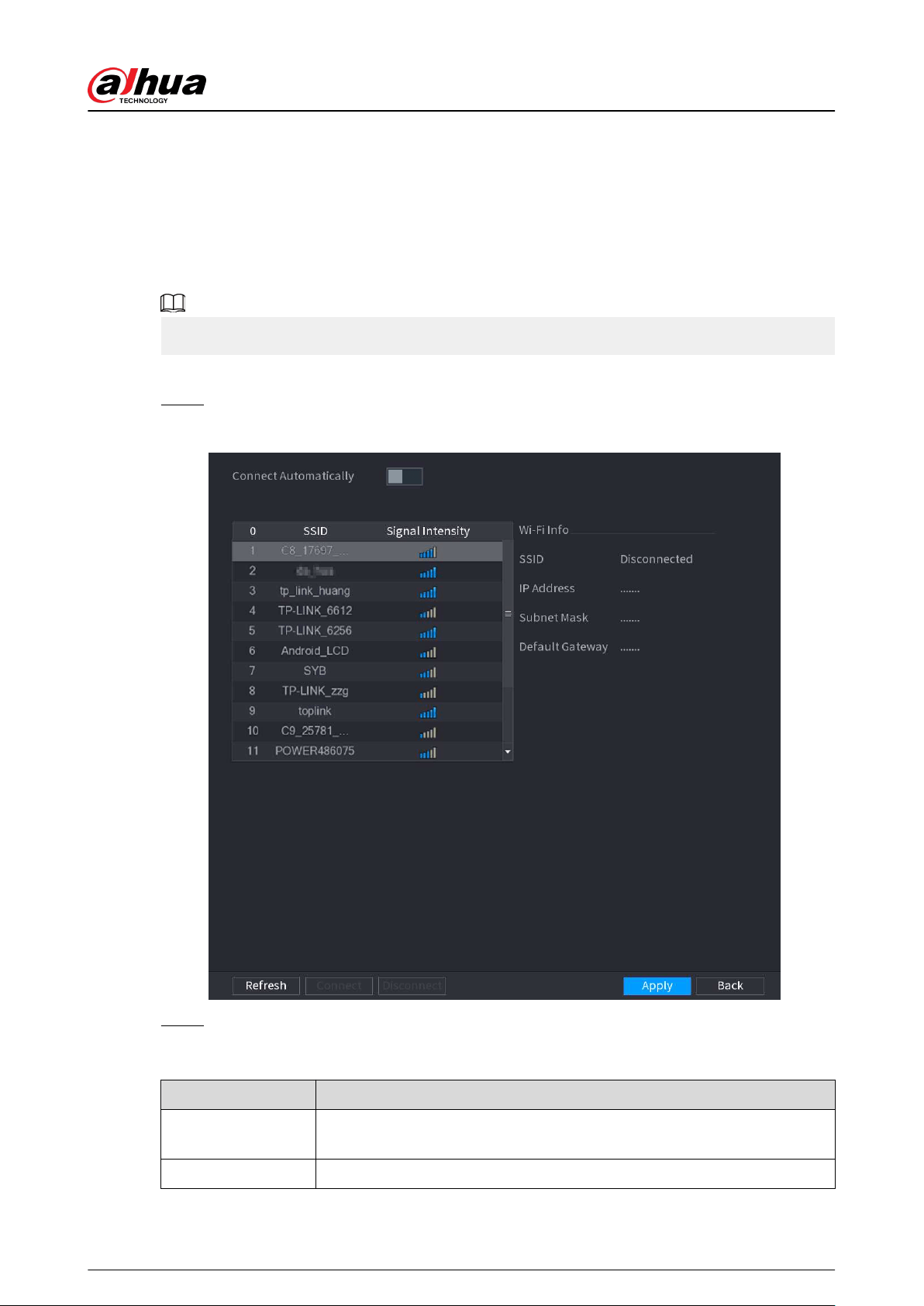
5.11.4 External Wi-Fi
The Device can be connected to wireless network with an external Wi-Fi module.
Prerequisites
Make sure that external Wi-Fi module is installed on the Device.
Background Information
This function is available on select models.
Procedure
Step 1 Select Main Menu > NETWORK > Wi-Fi.
Figure 5-207 Wi-Fi
Step 2 Congure the parameters.
Table 5-57 Wi-Fi parameters
Parameter Description
Connect
Automatically
After the function is enabled, the NVR will connect to the nearest site that
was previously successfully connected after the Device starts.
Refresh Search for the sites again.
User's Manual
326
Parameter Description
Disconnect Disconnect the current connection.
Connect Select an available site and then click Connect.
Step 3 Click Apply.
●
After the connection is successful, a Wi-Fi connection signal ag appears in the upper-
right corner of the live view page.
●
The Wi-Fi module models currently supported are D-LINK, dongle and EW-7811UTC
wireless cards.
5.11.5 Wi-Fi AP
Background Information
You can congure Wi-Fi parameters for the NVR to ensure that a wireless IPC can connect to the
NVR through Wi-Fi AP.
This function requires the built-in Wi-Fi module in the Device.
5.11.5.1 General Settings
Background Information
You can congure SSID, encryption type, password and channel of the device.
●
This function is supported on select wireless models.
●
When the wireless IPC and NVR are matched, the pairing will be completed in 120 seconds after
they are powered on.
Procedure
Step 1 Select Main Menu > NETWORK > Wi-Fi AP > General.
User's Manual
327
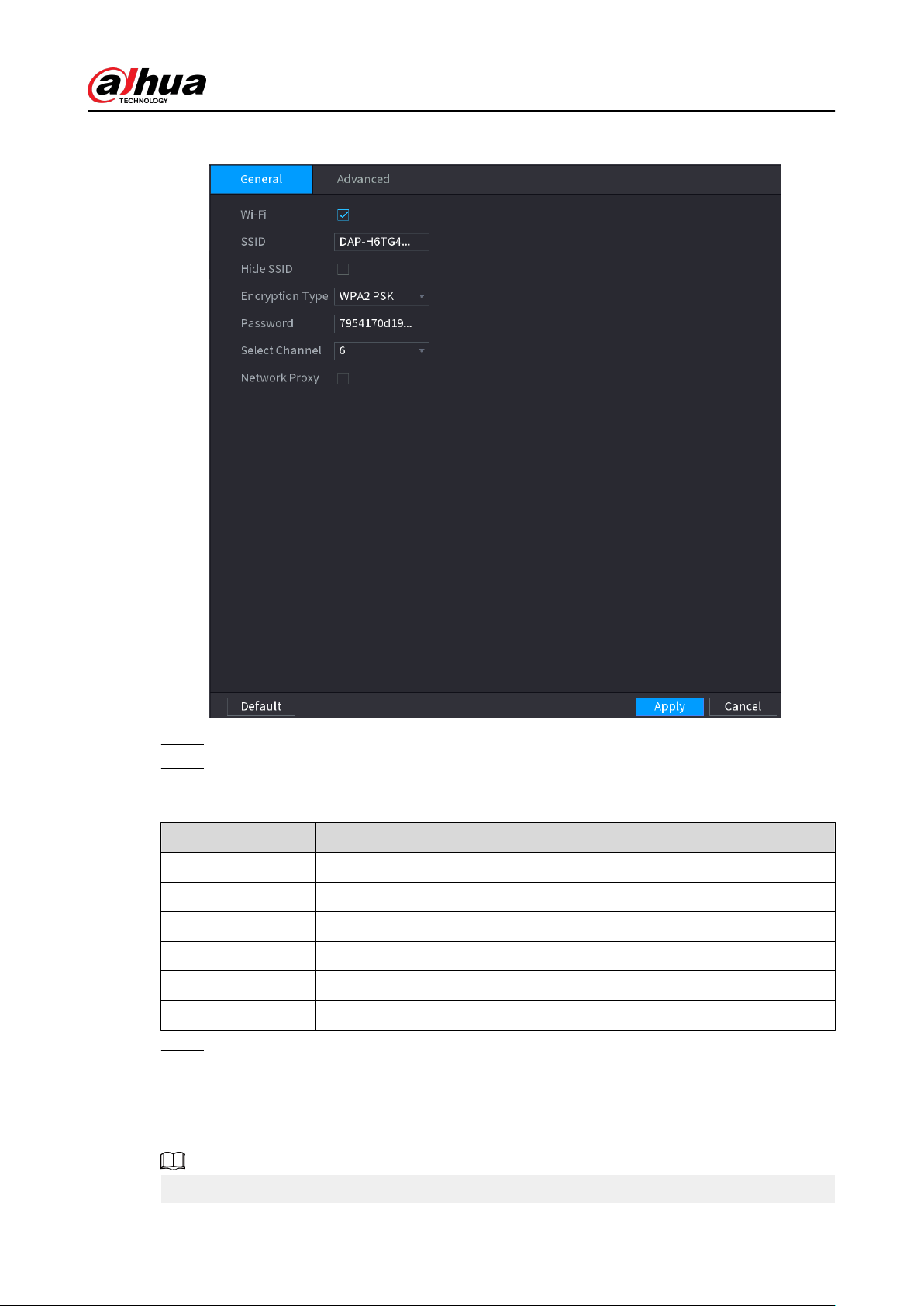
Figure 5-208 General settings
Step 2 Select Wi-Fi to enable Wi-Fi.
Step 3 Congure parameters.
Table 5-58 Parameters of general settings
Parameter Description
SSID Wi-Fi name for the device.
Hide SSID Hide the Wi-Fi name.
Encryption Type Select an encryption mode from WPA2 PSK and WPA PSK.
Password Set the Wi-Fi password for the Device.
Select Channel Select the channel for device communication.
Network Proxy Enable the external network access through the Device for a wireless IPC.
Step 4 Click Apply.
5.11.5.2 Advanced Settings
Background Information
This function is supported on select wireless models.
User's Manual
328
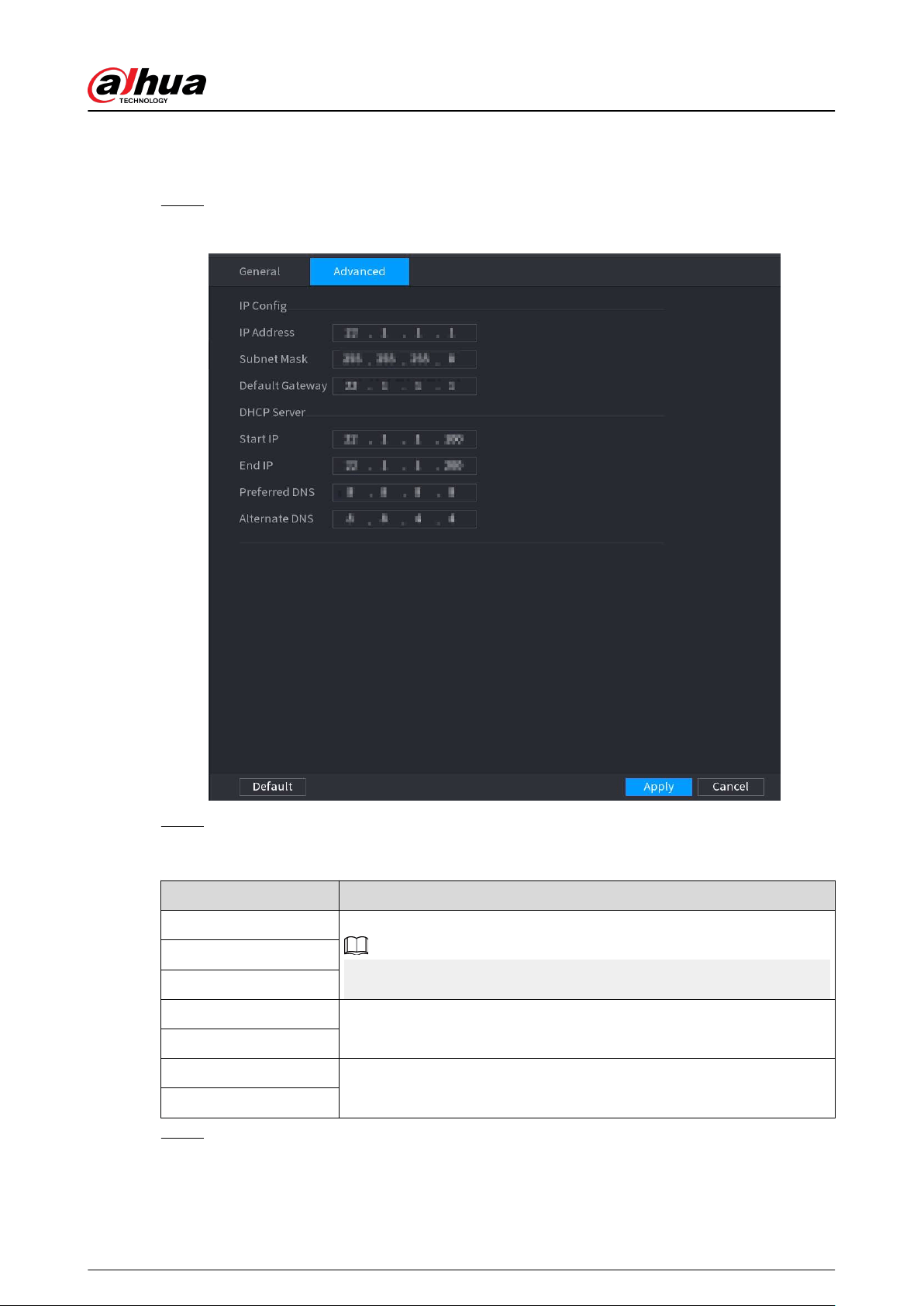
You can congure IP address, subnet mask, default gateway, DHCP server of the Device.
Procedure
Step 1 Select Main Menu > NETWORK > Wi-Fi AP > Advanced.
Figure 5-209 Advanced settings
Step 2 Congure parameters.
Table 5-59 Parameters of advanced settings
Parameter Description
IP Address Set IP address, subnet mask and default gateway for the Wi-Fi of NVR.
IP address and default gateway must be on the same network segment.
Subnet Mask
Default Gateway
Start IP
Set the start IP address and end IP address of the DHCP server.
End IP
Preferred DNS
Set preferred and alternate DNS server address.
Alternate DNS
Step 3 Click Apply.
User's Manual
329
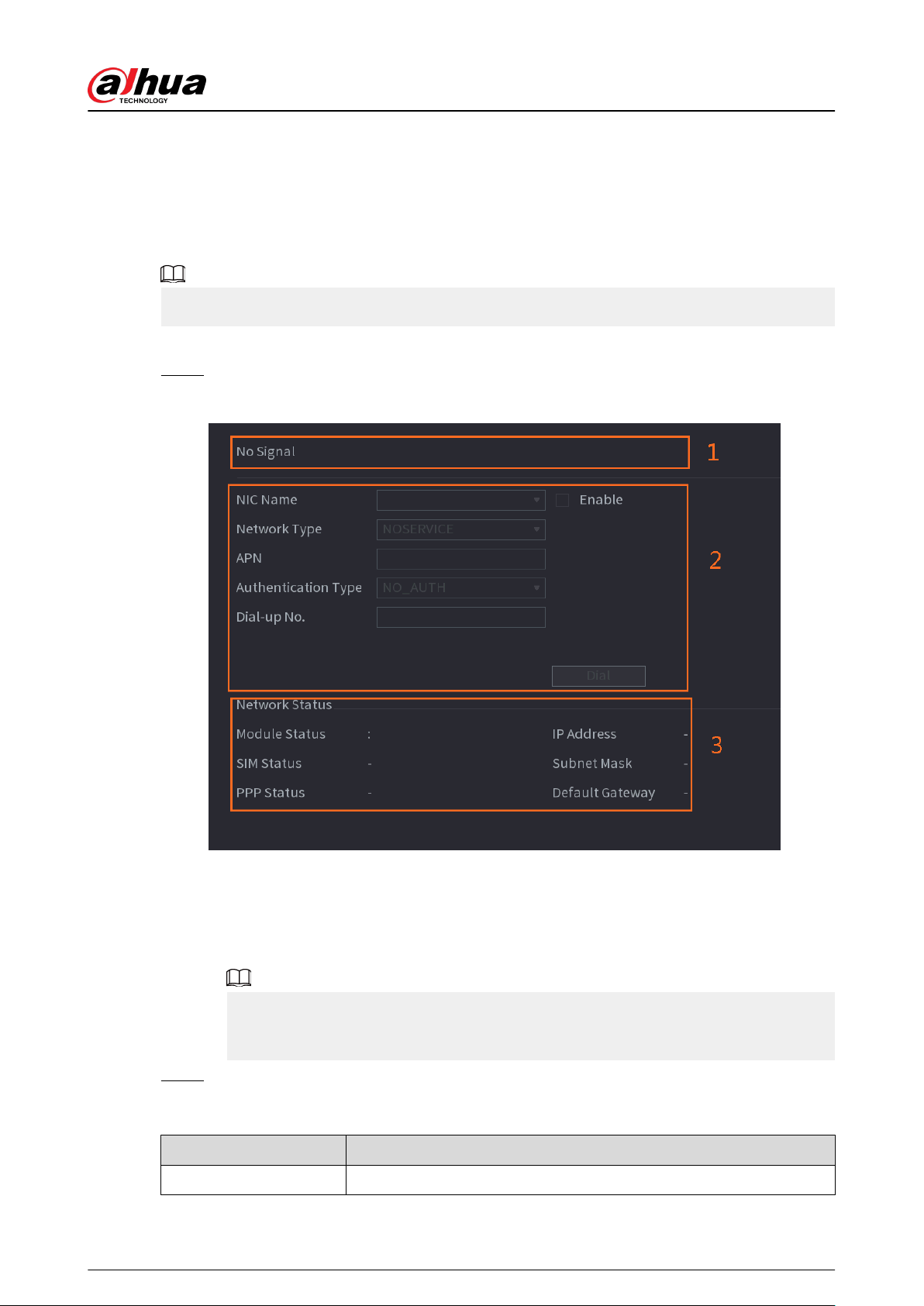
5.11.6 3G/4G
Prerequisites
Make sure that 3G/4G module is installed on the device.
Background Information
This function is available on select models.
Procedure
Step 1 Select Main Menu > NETWORK > 3G/4G.
Figure 5-210 3G/4G
The page is divided into three main areas:
●
Zone 1 displays a 3G/4G signal indication.
●
Zone 2 displays 3G/4G module conguration information.
●
Zone 3 displays the status information of the 3G/4G module.
Zone 2 displays the corresponding information when the 3G/4G module is connected,
while Zone 1 and Zone 3 will only display the corresponding content when the 3G/4G is
enabled.
Step 2 Congure parameters.
Table 5-60 3G/4G parameters
Parameter Description
NIC Name Select a NIC name.
User's Manual
330
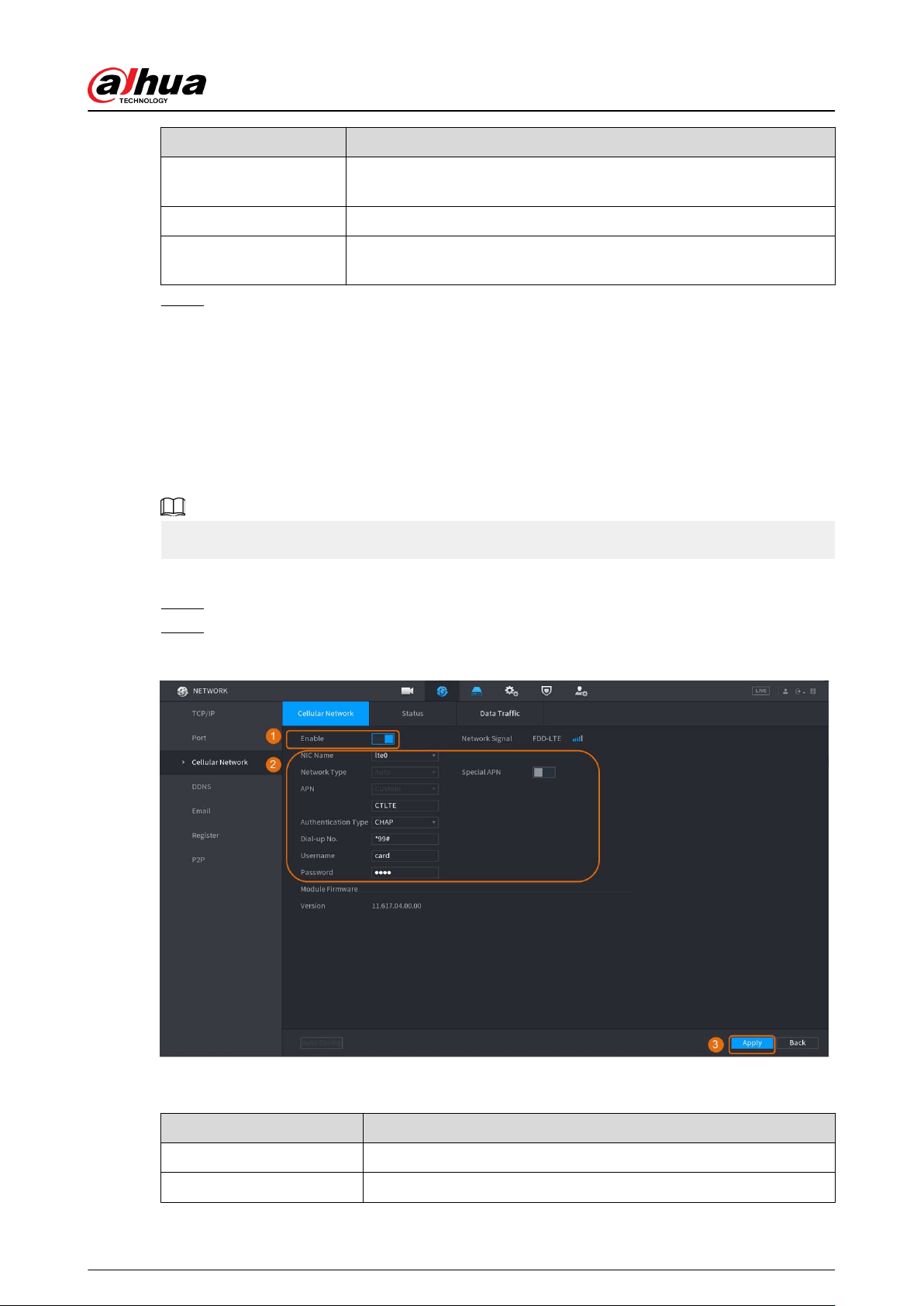
Parameter Description
Network Type.
Select a 3G/4G network type to distinguish between 3G/4G modules
from dierent vendors.
APN, Dial-up No. Main parameters of PPP dial.
Authentication Type
Select PAP, CHAP or NO_AUTH. NO_AUTH represents no
authentication for 3G/4G.
Step 3 Click Apply.
5.11.7 Cellular Network
Connect the Device to mobile network and view network status and trac of the cellular network.
Prerequisites
A SIM card is inserted in the recorder.
Background Information
This function is available on select models.
Procedure
Step 1 Select Main Menu > NETWORK > Cellular Network > Cellular Network.
Step 2 Enable cellular network and congure parameters.
Figure 5-211 Conguring cellular network
Table 5-61 4G cellular network parameters
Parameter Description
NIC Name Select a NIC.
Network Type Select a network from the SIM card provider.
User's Manual
331
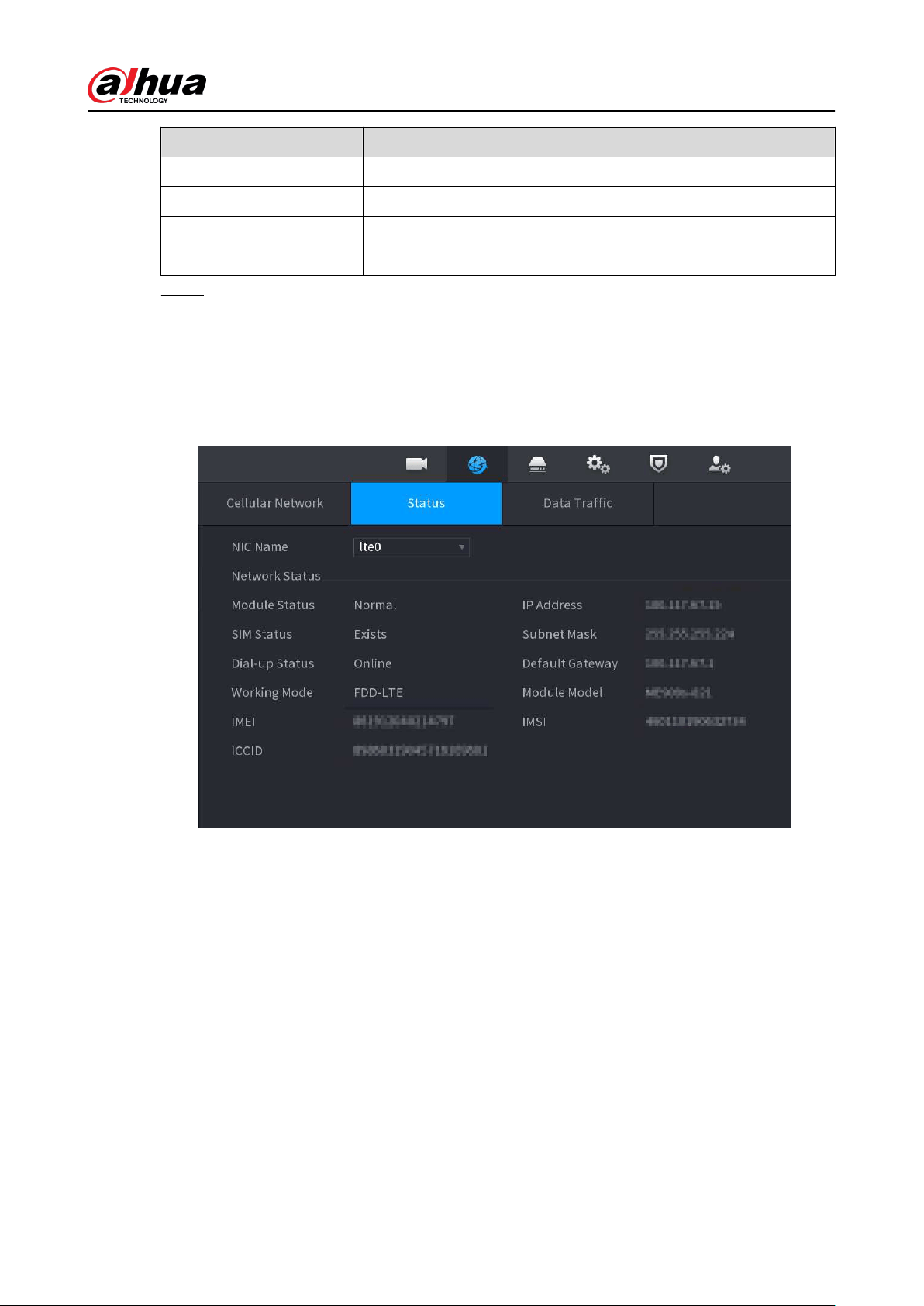
Parameter Description
APN, Dial-up No. The two main parameters of PPP dial-up connection.
Authentication Type Select PAP , CHAP or NO-AUTH.
Username The username for dial-up connection.
Password The password for dial-up connection.
Step 3 Click Apply.
Related Operations
●
View network status.
Click the Status tab to check cellular network status such as IP address, SIM card status and dial-
up status.
Figure 5-212 Network status
●
View data trac.
Click the Data Trac tab to view the daily and monthly data usage.
User's Manual
332
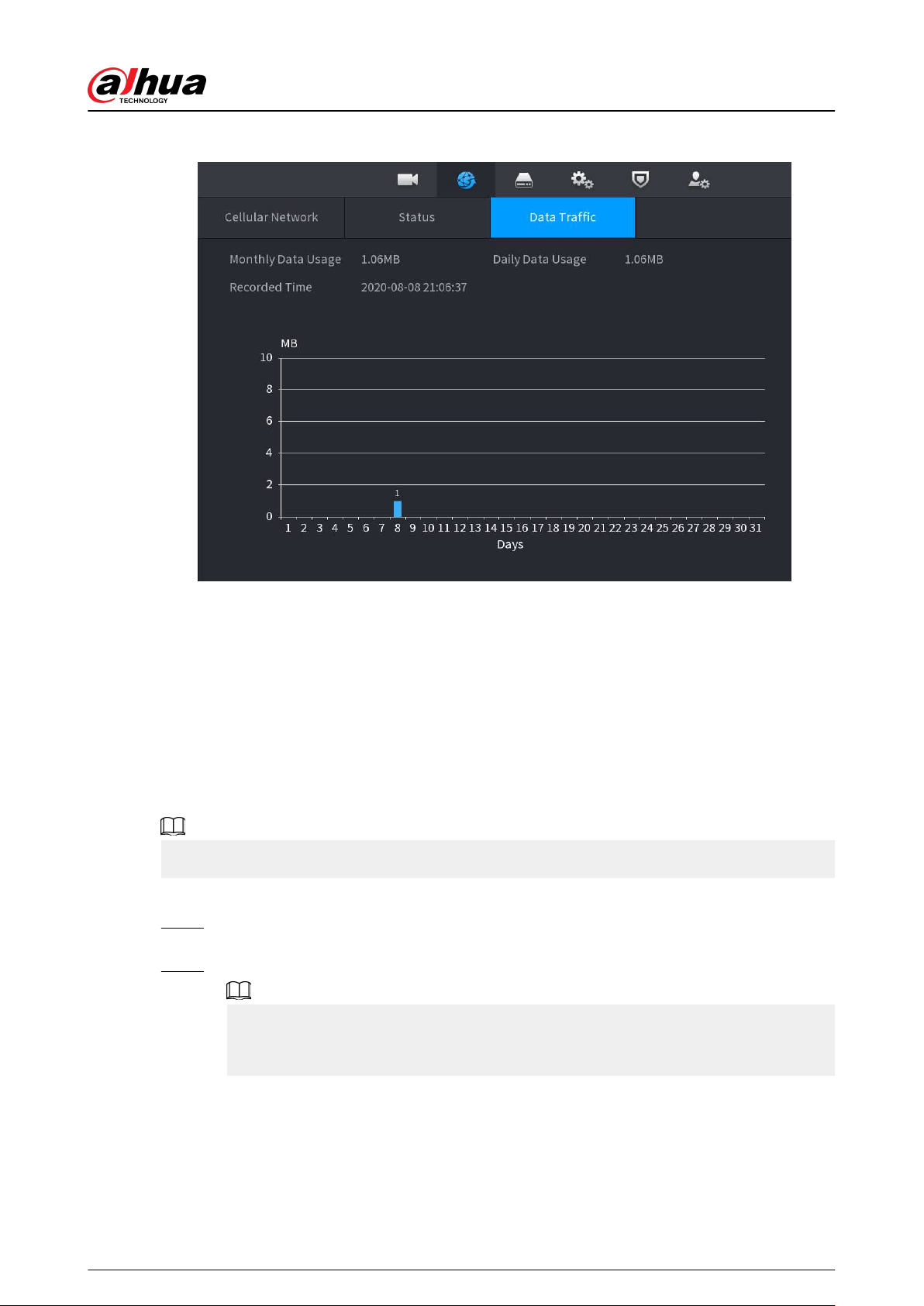
Figure 5-213 Cellular data usage
5.11.8 Repeater
The Device supports settings for the wireless repeater IPC to extend video transmission distance
and range.
Prerequisites
●
The Device has the built-in Wi-Fi module.
●
The IPC has wireless repeater module.
Background Information
This function is available on select models.
Procedure
Step 1 Power on the NVR and wireless repeater IPC, and connect all IPCs to the NVR through Wi-
Fi.
Step 2 Select Main Menu > NETWORK > REPEATER.
●
Green connection line represents the successful connection between channel and
wireless IPC.
●
Auto cascade: After selecting auto cascade, the IPC can cascade to NVR automatically.
User's Manual
333
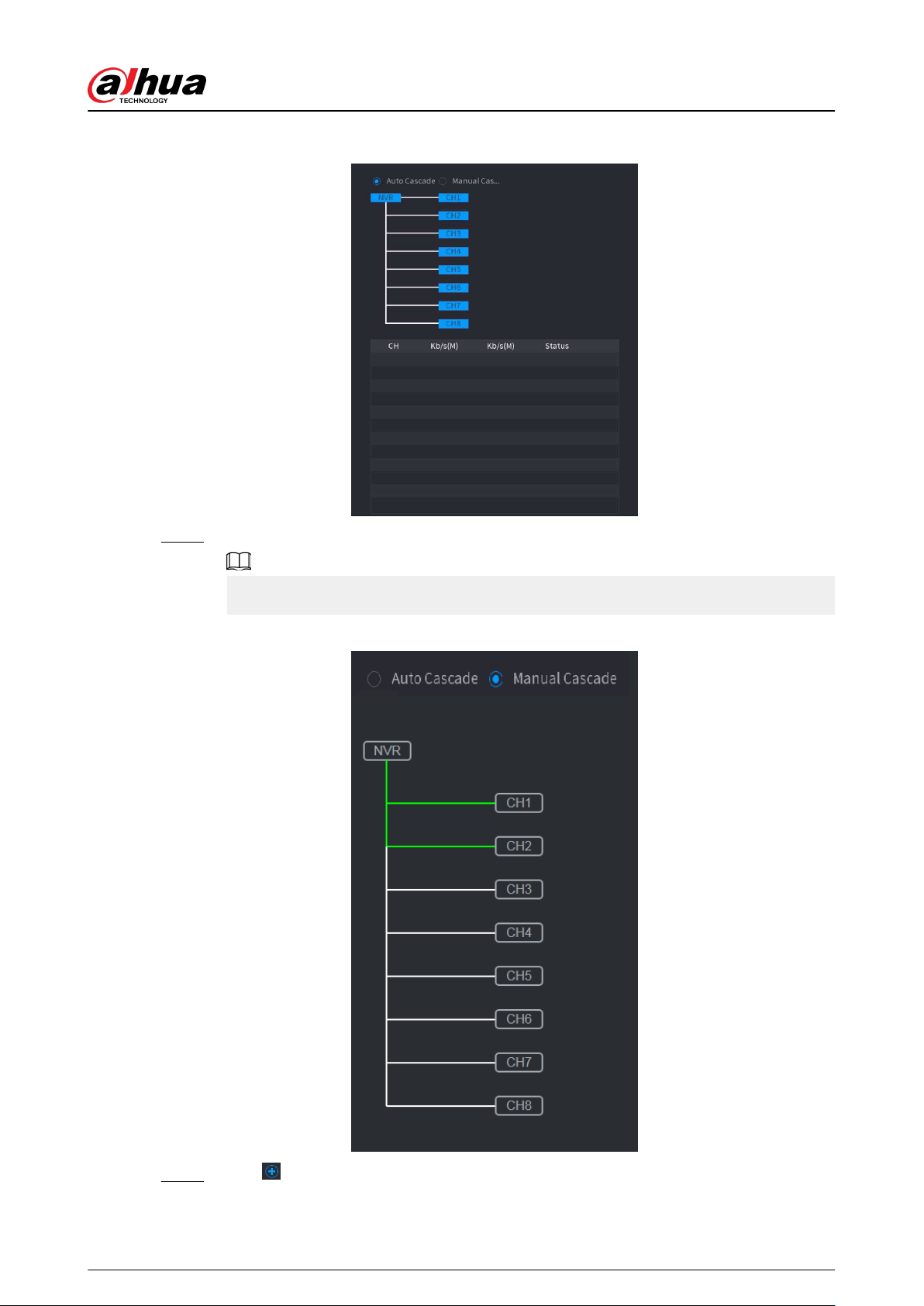
Figure 5-214 Repeater
Step 3 Select Manual Cascade.
You can use manual cascade when there are at least two IPCs on the network.
Figure 5-215 Manual cascade
Step 4 Click and select the channel to be added.
User's Manual
334
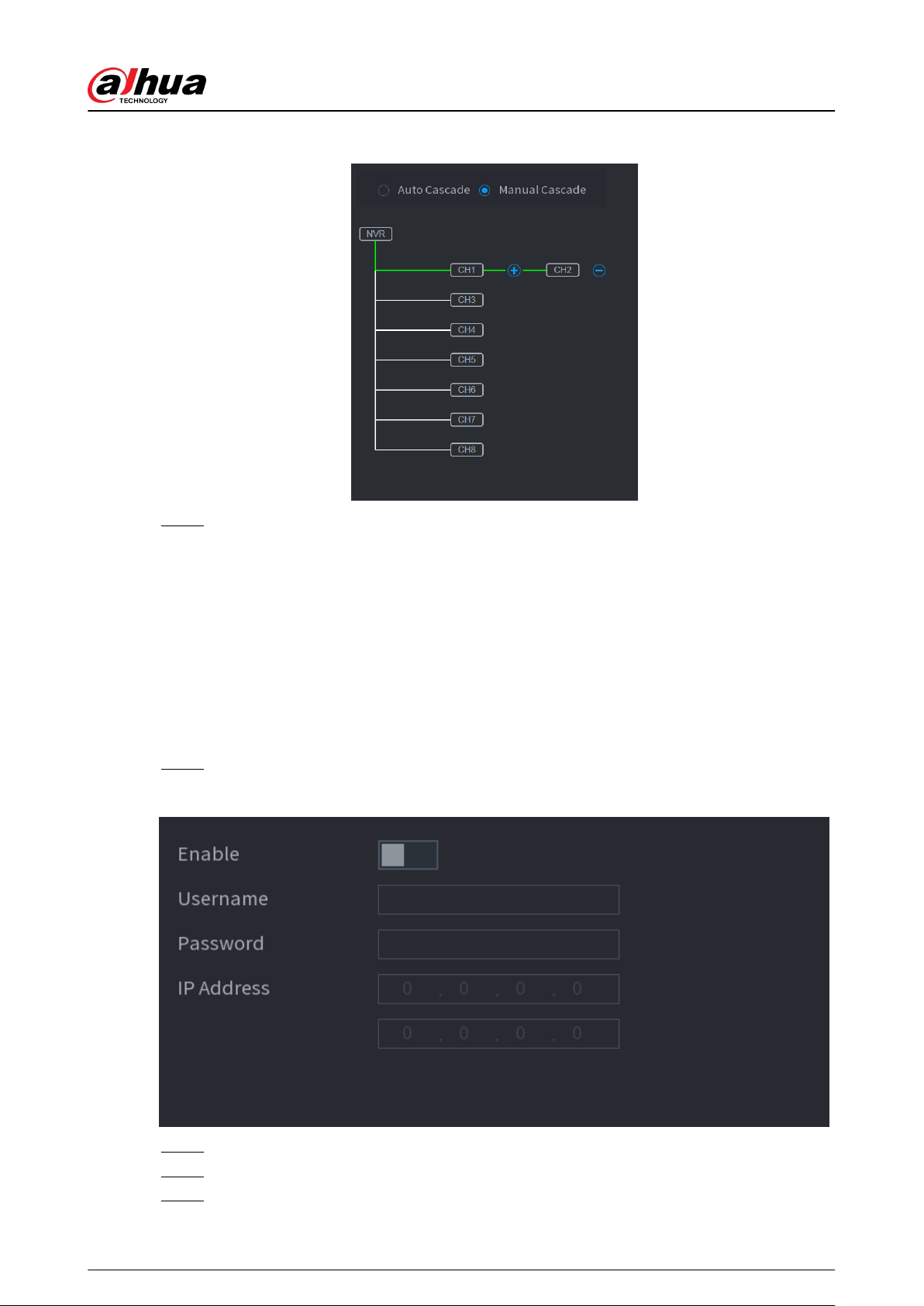
Figure 5-216 Added channel
Step 5 Click Apply.
5.11.9 PPPoE
PPPoE is another way for the Device to access the network. You can establish network connection
by conguring PPPoE settings to give the Device a dynamic IP address on the WAN.
Prerequisites
To use this function, rstly you need to obtain the username and password from the Internet
Service Provider.
Procedure
Step 1 Select Main Menu > NETWORK > PPPoE.
Figure 5-217 PPPoE
Step 2 Enable the PPPoE function.
Step 3 Enter the username and password provided by the Internet Service Provider.
Step 4 Click Apply.
User's Manual
335
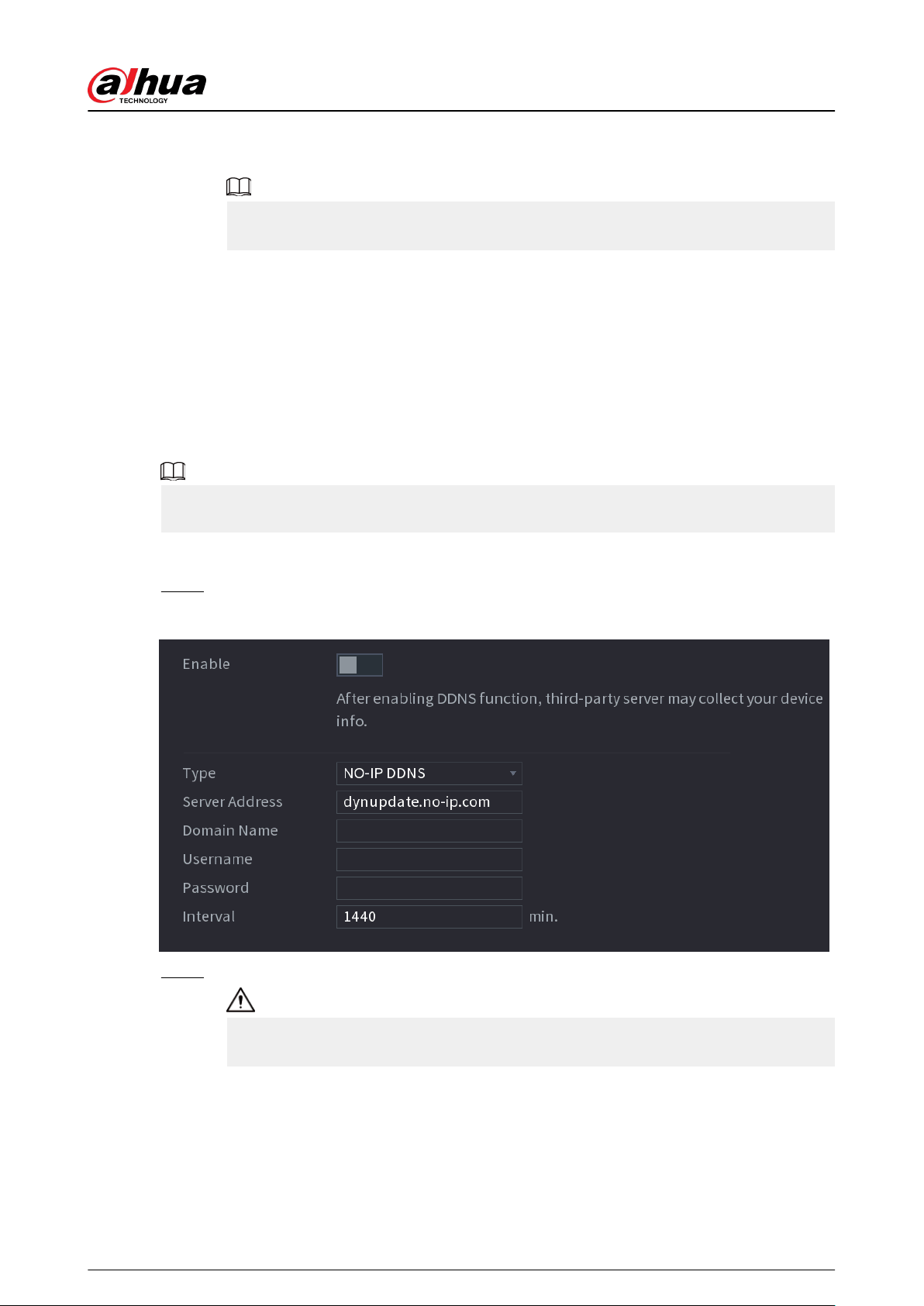
The IP address appears on the PPPoE page. You can use this IP address to access the
Device.
When the PPPoE function is enabled, the IP address on the TCP/IP page cannot be
modied.
5.11.10 DDNS
When the IP address of the Device changes frequently, the DDNS function can dynamically refresh
the correspondence between the domain on DNS and the IP address. You can access the Device by
using the domain.
Prerequisites
Check the type of DDNS that the Device supports and then log in to the website provided by the
DDNS service provider to register domain and other information.
After registration, you can log in to the DDNS website to view the information of all the connected
devices under the registered account.
Procedure
Step 1 Select Main Menu > NETWORK > DDNS.
Figure 5-218 DDNS
Step 2 Enable DDNS and then congure the parameters.
After you enable DDNS function, the third-party server might collect your device
information.
User's Manual
336

Table 5-62 DDNS parameters
Parameter Description
Type Displays the type and address of DDNS service provider.
●
For Dyndns DDNS, the default address is members.dyndns.org.
●
For NO-IP DDNS, the default address is dynupdate.no-ip.com.
●
For CN99 DDNS, the default address is members.3322.org.
Server Address
Domain Name
Enter the domain name that you have registered on the website of DDNS
service provider.
Username Enter the username and password obtained from DDNS service provider.
You need to register the username, password and other information on
the website of DDNS service provider.
Password
Interval Enter the interval at which you want to update the DDNS.
Step 3 Click Apply.
Enter the domain name in the browser on your computer, and then press the Enter key. If
the web page of the Device is displayed, the conguration is successful. If not, the
conguration failed.
5.11.11 UPnP
You can map the relationship between the LAN and the WAN to access the Device on the LAN
through the IP address on the WAN.
5.11.11.1 Conguring Router
Procedure
Step 1 Log in to the router to set the WAN port to enable the IP address to connect into the
WAN.
Step 2 Enable the UPnP function on the router.
Step 3 Connect the Device with the LAN port on the router to connect into the LAN.
Step 4 Select Main Menu > NETWORK > TCP/IP, congure the IP address into the router IP
address range, or enable the DHCP function to obtain an IP address automatically.
5.11.11.2 Conguring UPnP
Procedure
Step 1 Select Main Menu > NETWORK > UPnP.
User's Manual
337
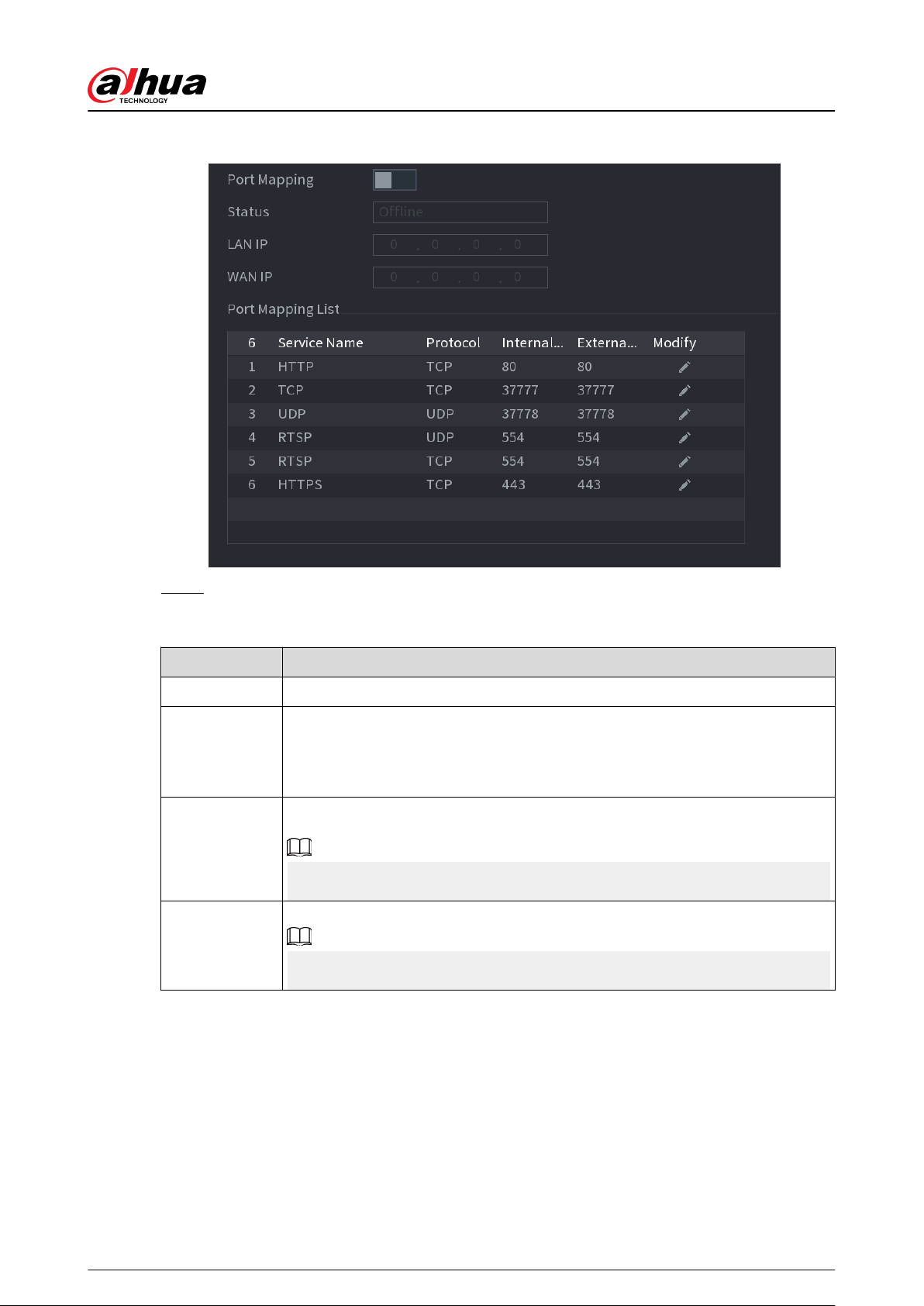
Figure 5-219 UPnP
Step 2 Congure the settings for the UPnP parameters.
Table 5-63 UPnP parameters
Parameter Description
Port Mapping Enable the UPnP function.
Status
Indicates the status of UPnP function.
●
Oine: Failed.
●
Online: Succeeded.
LAN IP
Enter IP address of router on the LAN.
After mapping succeeded, the system obtains IP address automatically.
WAN IP
Enter IP address of router on the WAN.
After mapping succeeded, the system obtains IP address automatically.
User's Manual
338
Parameter Description
Port Mapping
List
The settings on port mapping list correspond to the UPnP port mapping list on
the router.
●
Service Name: Name of network server.
●
Protocol: Type of protocol.
●
Internal Port: Internal port that is mapped on the Device.
●
External Port: External port that is mapped on the router.
●
To avoid the conict, when setting the external port, try to use the ports
from 1024 through 5000 and avoid popular ports from 1 through 255 and
system ports from 256 through 1023.
●
When there are several devices on the LAN, properly arrange the ports
mapping relations to avoid mapping to the same external port.
●
When establishing a mapping relationship, ensure the mapping ports are
not occupied or limited.
●
The internal and external ports of TCP and UDP must be the same and
cannot be modied.
●
Click
to modify the external port.
Step 3 Click Apply to complete the settings.
In the browser, enter http://WAN IP: External IP port. You can visit the Device on the LAN.
5.11.12 Email
Background Information
You can congure the email settings to enable the system to send the email as a notication when
an alarm event occurs.
Procedure
Step 1 Select Main Menu > NETWORK > Email.
User's Manual
339
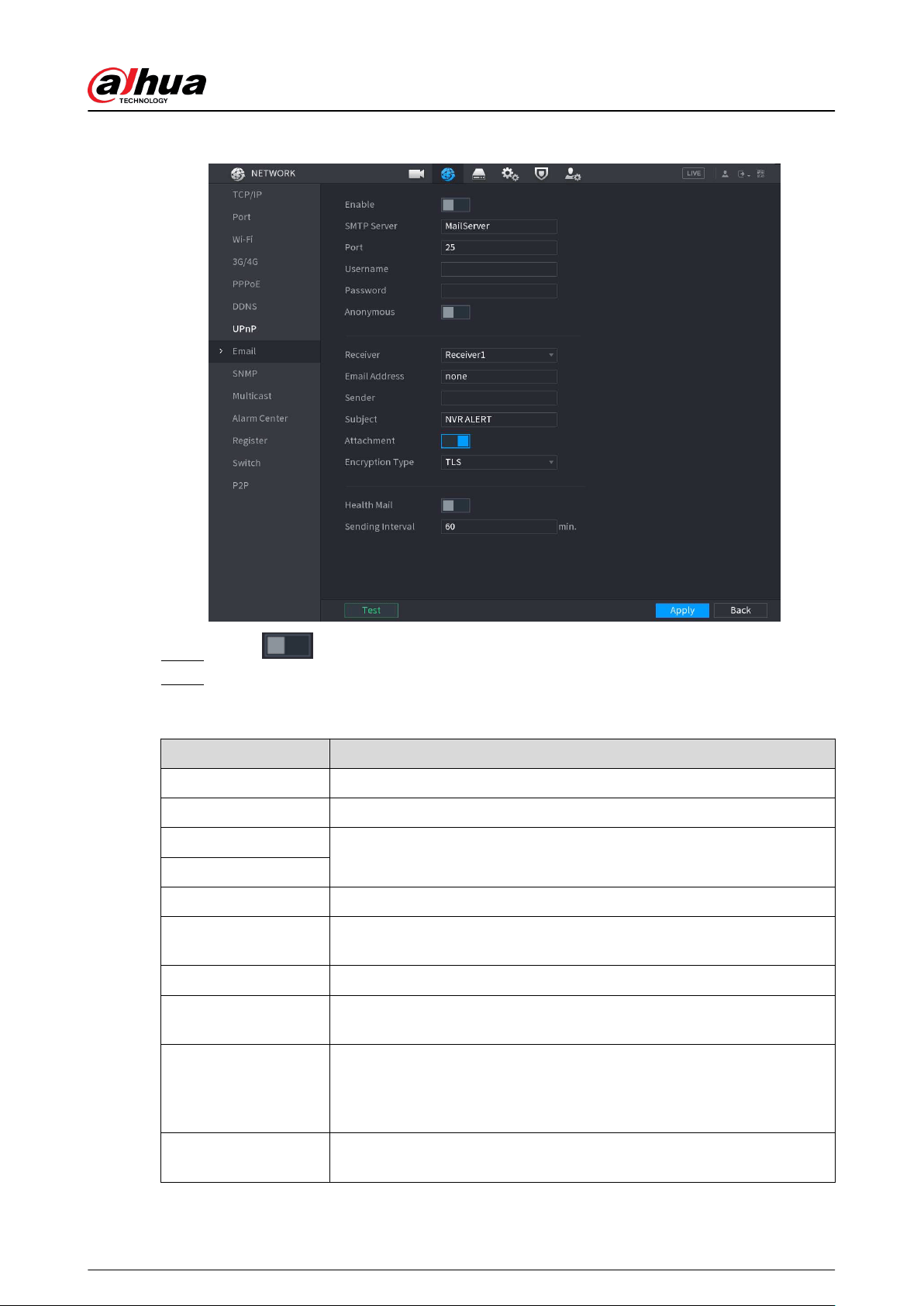
Figure 5-220 Email
Step 2 Click to enable the function.
Step 3 Congure the email parameters.
Table 5-64 Email parameters
Parameter Description
SMTP Server Enter the address of SMTP server of sender’s email account.
Port Enter the port of SMTP server. The default value is 25.
Username
Enter the username and password of sender’s email account.
Password
Anonymous Enable anonymous login.
Receiver
Select the receiver to receive the notication. You can select up to three
receivers.
Email Address Enter the email address of mail receivers.
Sender
Enter the sender’s email address. You can enter up to three senders
separated by comma.
Subject
Enter the email subject.
You can enter Chinese, English and numerals with the length limited to
64 characters.
Attachment
Enable the attachment function. When there is an alarm event, the
system can attach snapshots as an attachment to the email.
User's Manual
340
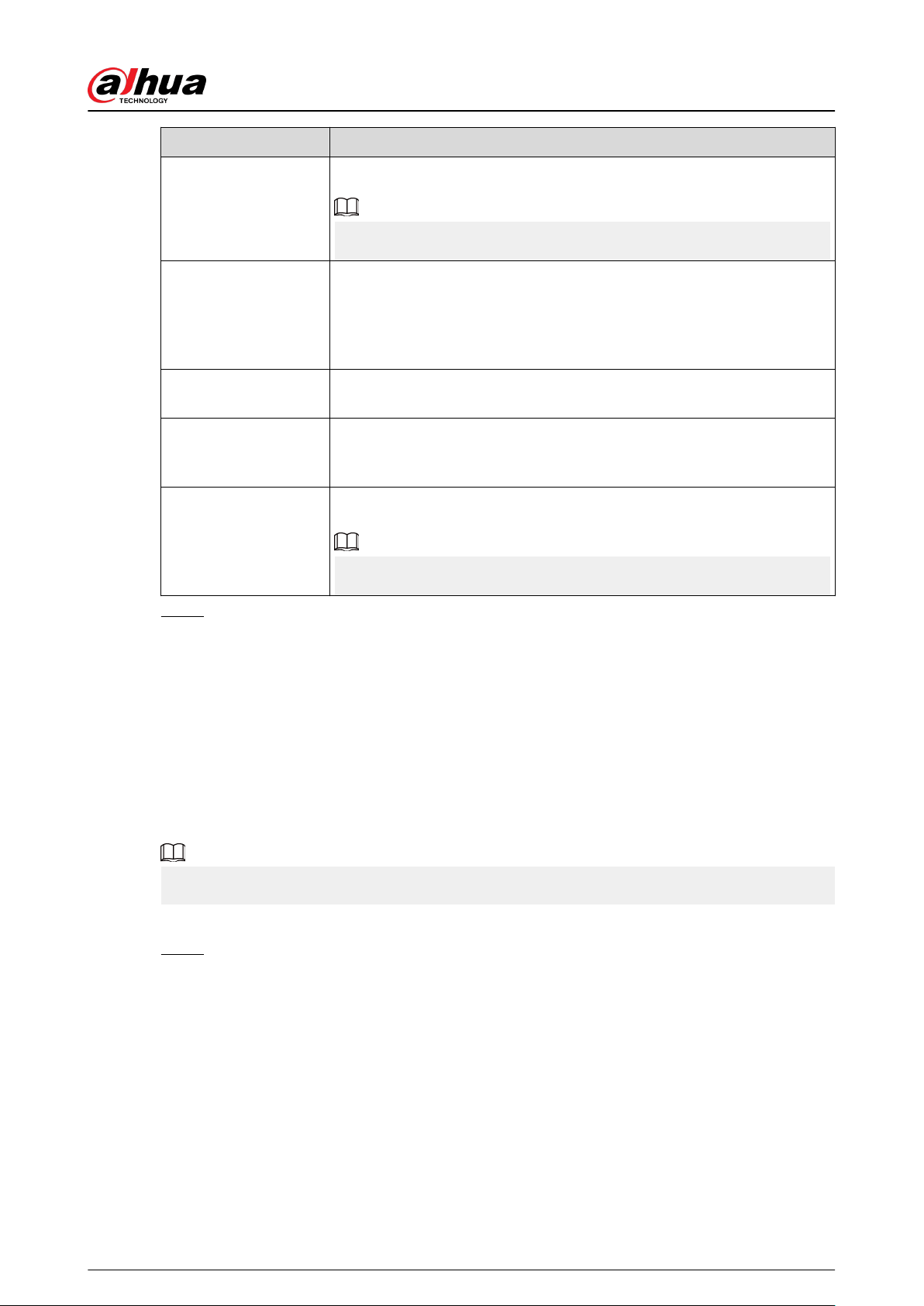
Parameter Description
Encryption Type
Select the encryption type from NONE , SSL, or TLS.
For SMTP server, the default encryption type is TLS.
Interval (Sec.)
Set the interval at which the system sends an email for the same type of
alarm event to avoid excessive pileup of emails caused by frequent alarm
events.
The value ranges from 0 to 3600. 0 means that there is no interval.
Health Mail
Enable the health test function. The system can send a test email to
check the connection.
Sending Interval
Set the interval at which the system sends a health test email.
The value ranges from 30 to 1440. 0 means that there is no interval.
Test
Click Test to test the email sending function. If the conguration is
correct, the receiver’s email account will receive the email.
Before testing, click Apply to save the settings.
Step 4 Click Apply.
5.11.13 SNMP
You can connect the Device with some software such as MIB Builder and MG-SOFT MIB Browser to
manage and control the Device from the software.
Prerequisites
●
Install the software that can manage and control the SNMP, such as MIB Builder and MG-SOFT
MIB Browser.
●
Obtain the MIB les that correspond to the current version from the technical support.
This function is available on select models.
Procedure
Step 1 Select Main Menu > NETWORK > SNMP.
User's Manual
341
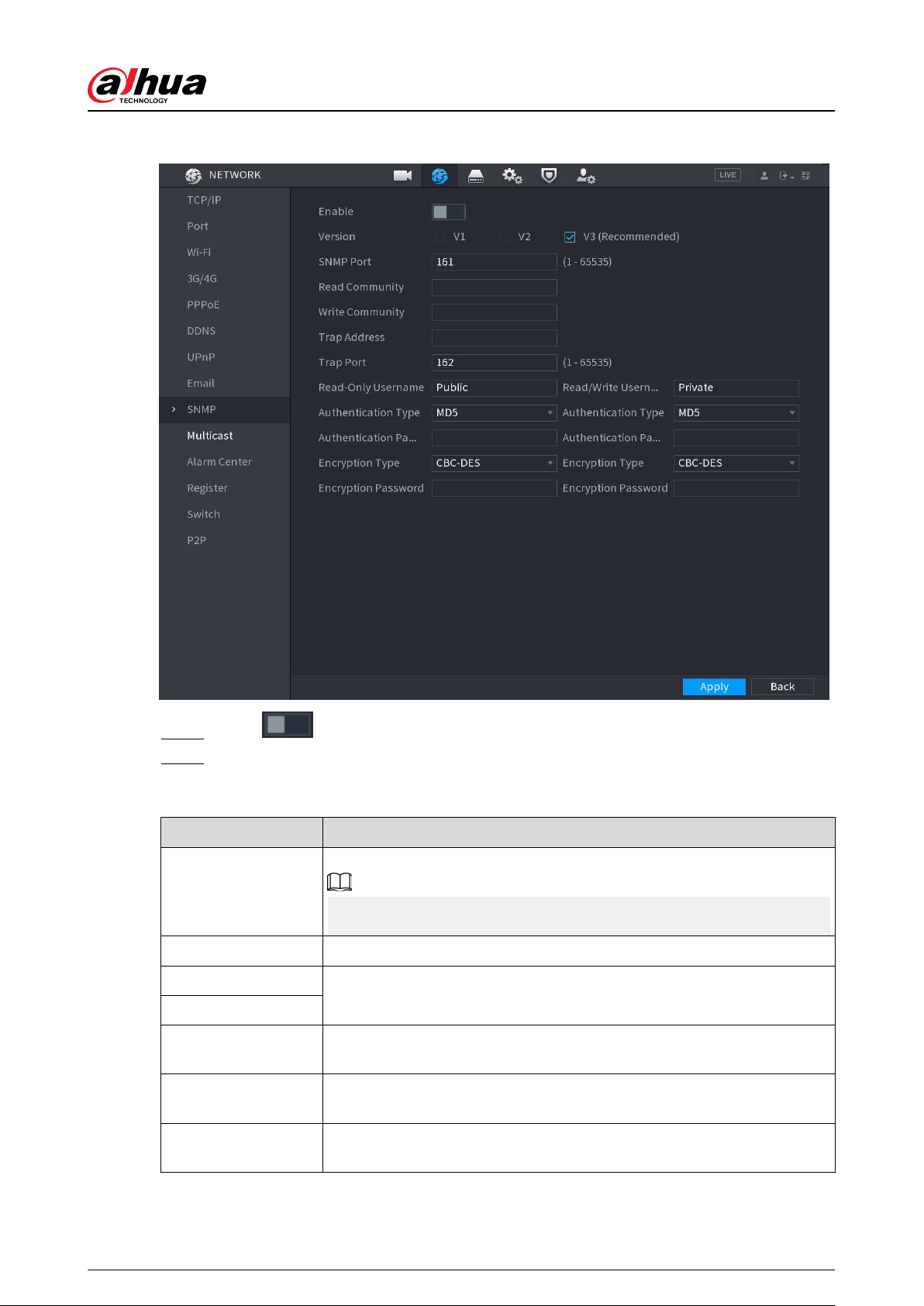
Figure 5-221 SNMP
Step 2 Click to enable the function.
Step 3 Congure the parameters.
Table 5-65 SNMP parameters
Parameter Description
Version
Select the checkbox of SNMP version that you are using.
The default version is V3. There is a risk if you use V1 or V2.
SNMP Port Enter the monitoring port on the agent program.
Read Community
Enter the read and write strings supported by the agent program.
Write Community
Trap Address
Enter the destination address for the agent program to send the Trap
information.
Trap Port
Enter the destination port for the agent program to send the Trap
information.
Read-Only Username
Enter the username that is allowed to access the Device and has the read-
only permission.
User's Manual
342

Parameter Description
Read/Write Username
Enter the username that is allowed to access the Device and has the read
and write permission.
Authentication Type Select MD5 or SHA. The system recognizes the type automatically.
Authentication
Password
Enter the password for authentication. The password should be no less
than eight characters.
Encryption Type Select an encryption type. The default setting is CBC-DES.
Encryption Password Enter the encryption password.
Step 4 Click Apply.
Step 5 Compile the two MIB les by MIB Builder.
Step 6 Run MG-SOFT MIB Browser to load in the module from compilation.
Step 7 On the MG-SOFT MIB Browser, enter the device IP that you want to manage, and then
select the version number to query.
Step 8 On the MG-SOFT MIB Browser, unfold the tree-structured directory to obtain the
congurations of the Device, such as the channels quantity and software version.
5.11.14 Multicast
Background Information
When you access the Device from the network to view the video, if the access is exceeded, the
video will not display. You can use the multicast function to group the IP to solve the problem.
Procedure
Step 1 Select Main Menu > NETWORK > Multicast.
User's Manual
343
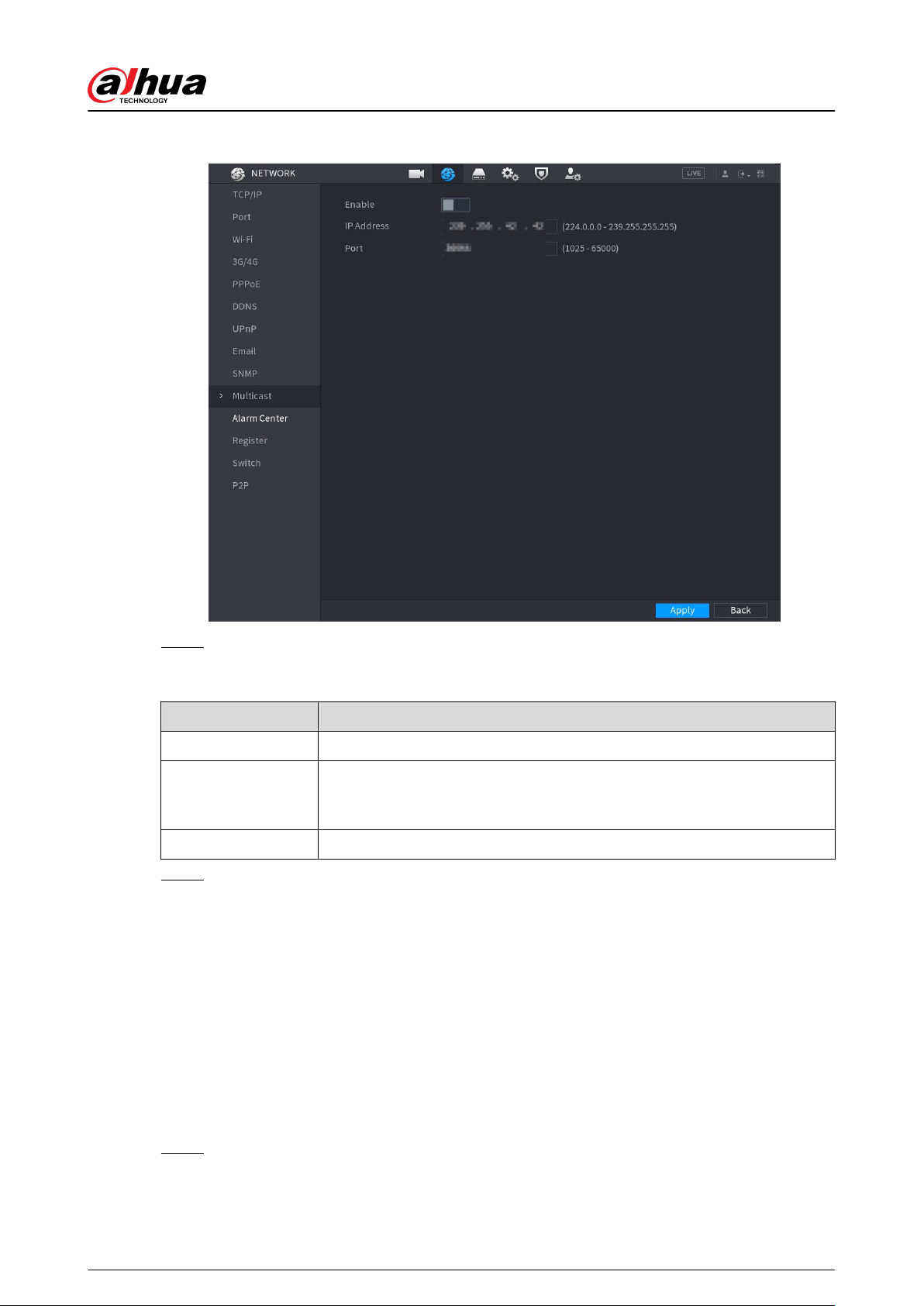
Figure 5-222 Multicast
Step 2 Congure the parameters.
Table 5-66 Multicast parameters
Parameter Description
Enable Enable the multicast function.
IP Address
Enter the IP address that you want to use as the multicast IP.
The IP address ranges from 224.0.0.0 through 239.255.255.255.
Port Enter the port for the multicast. The port ranges from 1025 through 65000.
Step 3 Click Apply.
You can log in to the web page via multicast.
On the web login page, on the Type list, select Multicast. The web will automatically
obtain the multicast IP address and join the multicast group. Then you can view the video
through multicast function.
5.11.15 Alarm Center
Background Information
You can congure the alarm center server to receive the uploaded alarm information.
Procedure
Step 1 Select Main Menu > NETWORK > Alarm Center.
User's Manual
344
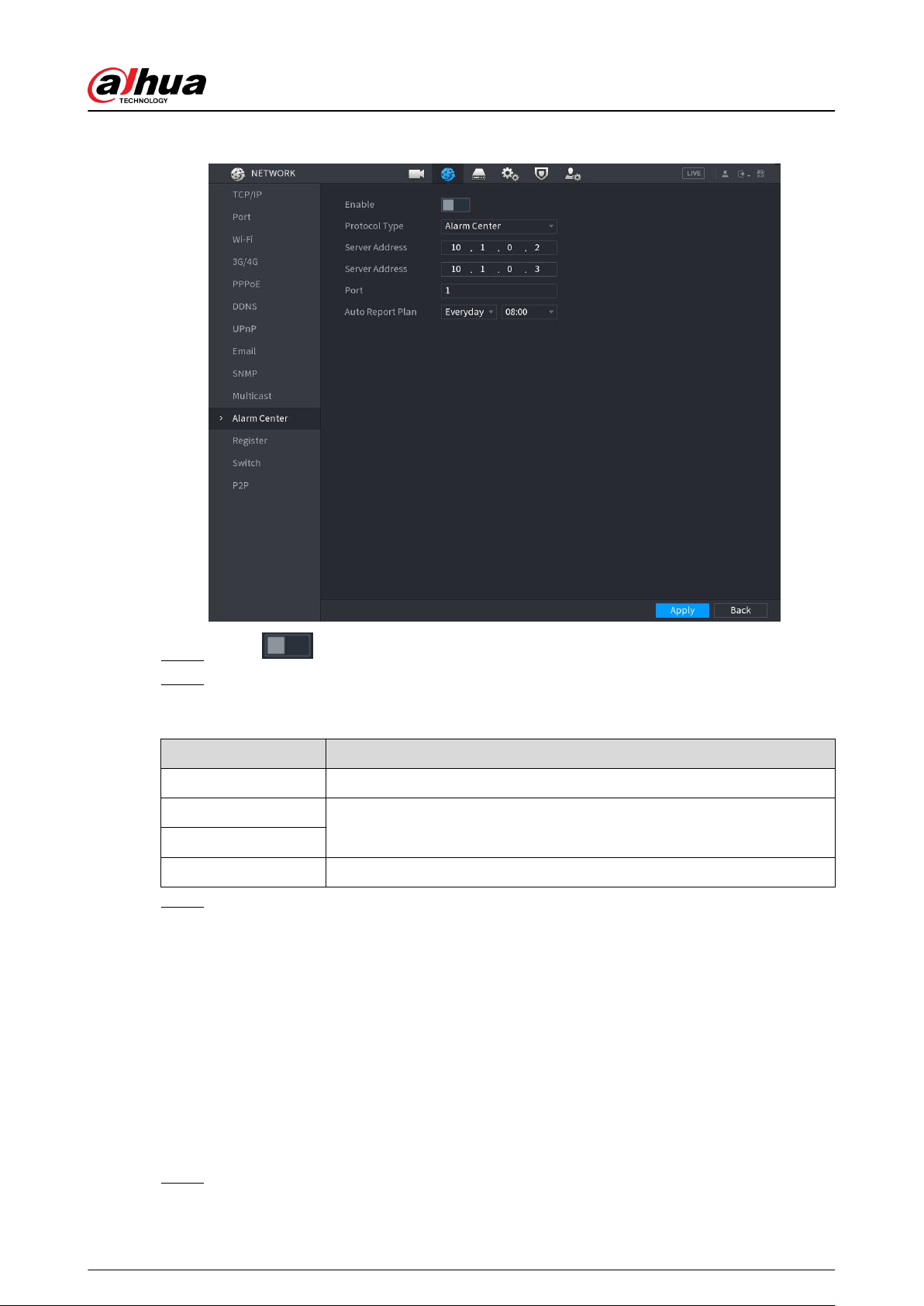
Figure 5-223 Alarm center
Step 2 Click to enable the function.
Step 3 Congure the parameters.
Table 5-67 Alarm center parameters
Parameter Description
Protocol Type Select a protocol type.
Server Address
The IP address and communication port of the PC installed with alarm
client.
Port
Auto Report Plan Select time cycle and specic time for uploading alarm.
Step 4 Click Apply.
5.11.16 Register
You can register the Device into the specied proxy server which acts as the transit to enable the
client software to access the Device
Prerequisites
●
The proxy server has been deployed.
●
The Device, the proxy server and the device running the client software are on the same
network.
Procedure
Step 1 Select Main Menu > NETWORK > Register.
User's Manual
345
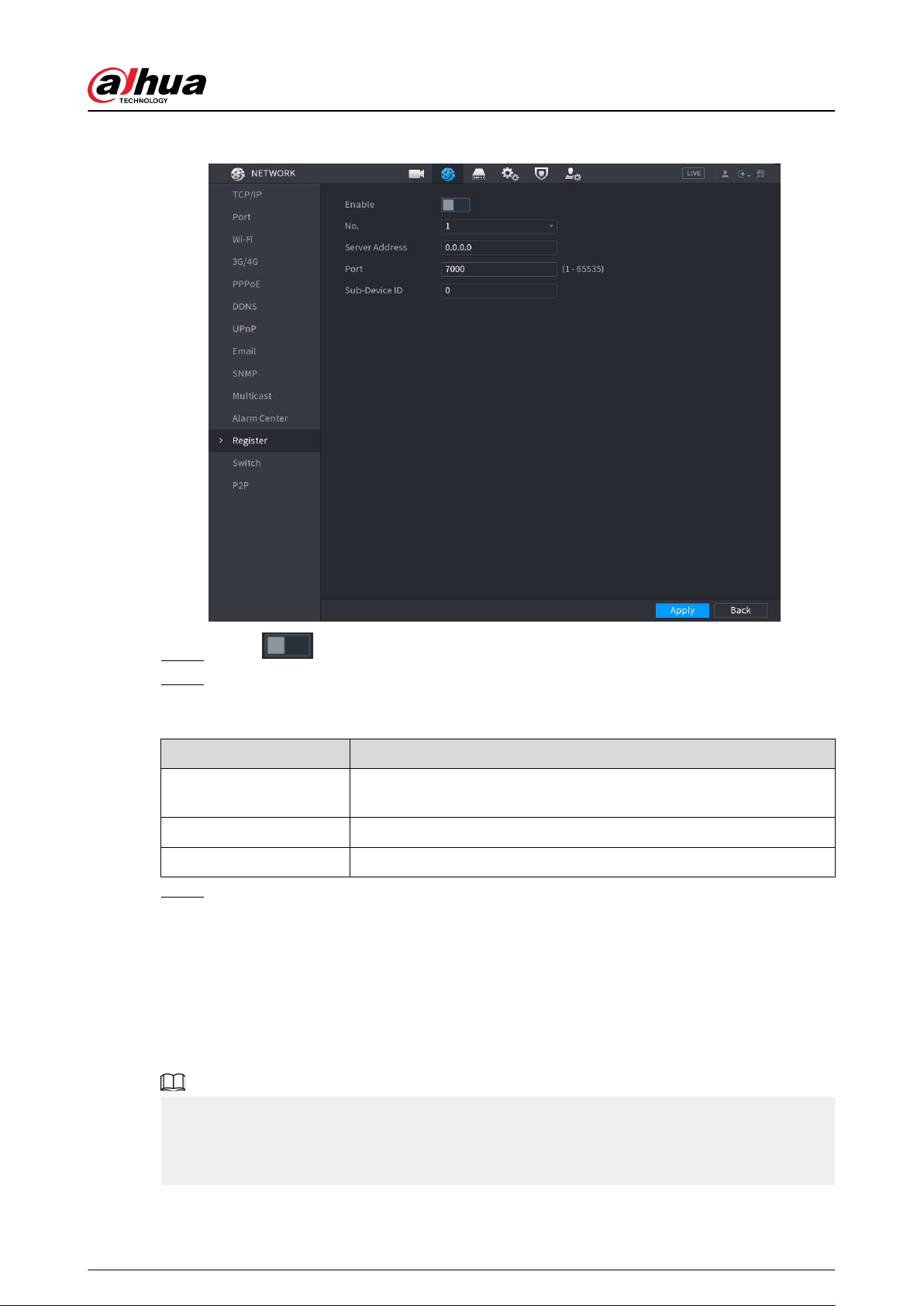
Figure 5-224 Register
Step 2 Click to enable the function.
Step 3 Congure the parameters.
Table 5-68 Register parameters
Function Description
Server Address
Enter the IP address or domain name of the server that you want to
register to.
Port Enter the port of the server.
Sub-Device ID Enter the ID allocated by the server.
Step 4 Click Apply.
5.11.17 Switch
Background Information
After setting Switch, when an IPC is connected to the PoE port, the system automatically assigns
the IP address to the IPC according to the dened IP segment, and the NVR will automatically
connect to the IPC.
●
Only models with PoE ports support this function.
●
Do not connect the PoE port with a switch, otherwise it will cause connection failure.
●
This function is enabled by default, and the IP segment start from 10.1.1.1. We recommend you
use the default setting.
User's Manual
346
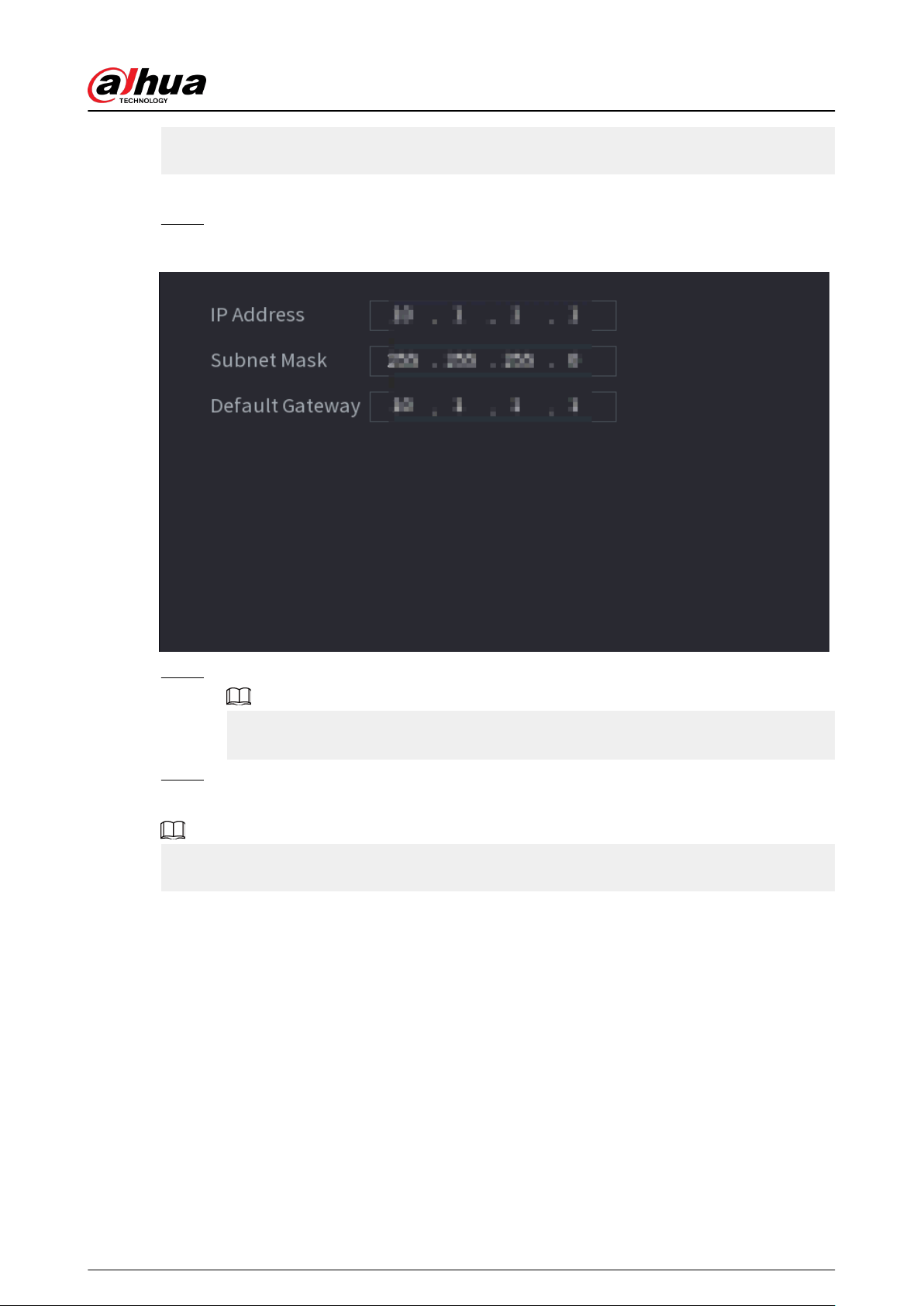
●
When connecting to a third-party IPC, make sure that the IPC supports ONVIF protocol and
DHCP is enabled.
Procedure
Step 1 Select Main Menu > NETWORK > Switch.
Figure 5-225 Switch
Step 2 Congure IP address, subnet mask, and default gateway..
Do not set the IP address to the same network segment with the NVR. We recommend
you use the default setting.
Step 3 Click Apply.
Related Operations
When connecting IP camera to PoE port, if all the channels are occupied, the system prompts you
whether to take place of one channel.
User's Manual
347
Table 5-69 PoE operation
PoE operation Description
Connect to PoE port
When an IPC is connected to the PoE port, the system automatically
assigns the IP address to the IPC according to the set IP segment. The
NVR will try the method of arp ping to assign the IP address. If DHCP is
enabled on the NVR, the NVR will use DHCP to assign the IP address.
●
When IP address is successfully set, the system will broadcast through
the switch function. If there is a response from the IPC, it means the
connection is successful, and the NVR will log in to the IPC. You can
nd the corresponding channel occupied and there is a PoE icon at
the upper-left corner.
●
You can also view PoE status such as channel number and PoE port
number on the Added Device list in Main Menu > CAMERA >
Camera List.
Disconnect PoE port
When an IPC is disconnected form PoE port, you will nd the information
of Failed to nd network host on the live channel window.
PoE connection
mapping
The PoE ports are bound to corresponding channels. When an IPC is
connected to PoE port 1, the corresponding channel is Channel 1.
5.11.18 P2P
P2P is a kind of convenient private network penetration technology. Instead of applying for
dynamic domain name, mapping ports or deploying transit server, you can add NVR devices to the
app for remote management.
This function will consume the device trac when the device is online.
Procedure
Step 1 Select Main Menu > NETWORK > P2P.
User's Manual
348
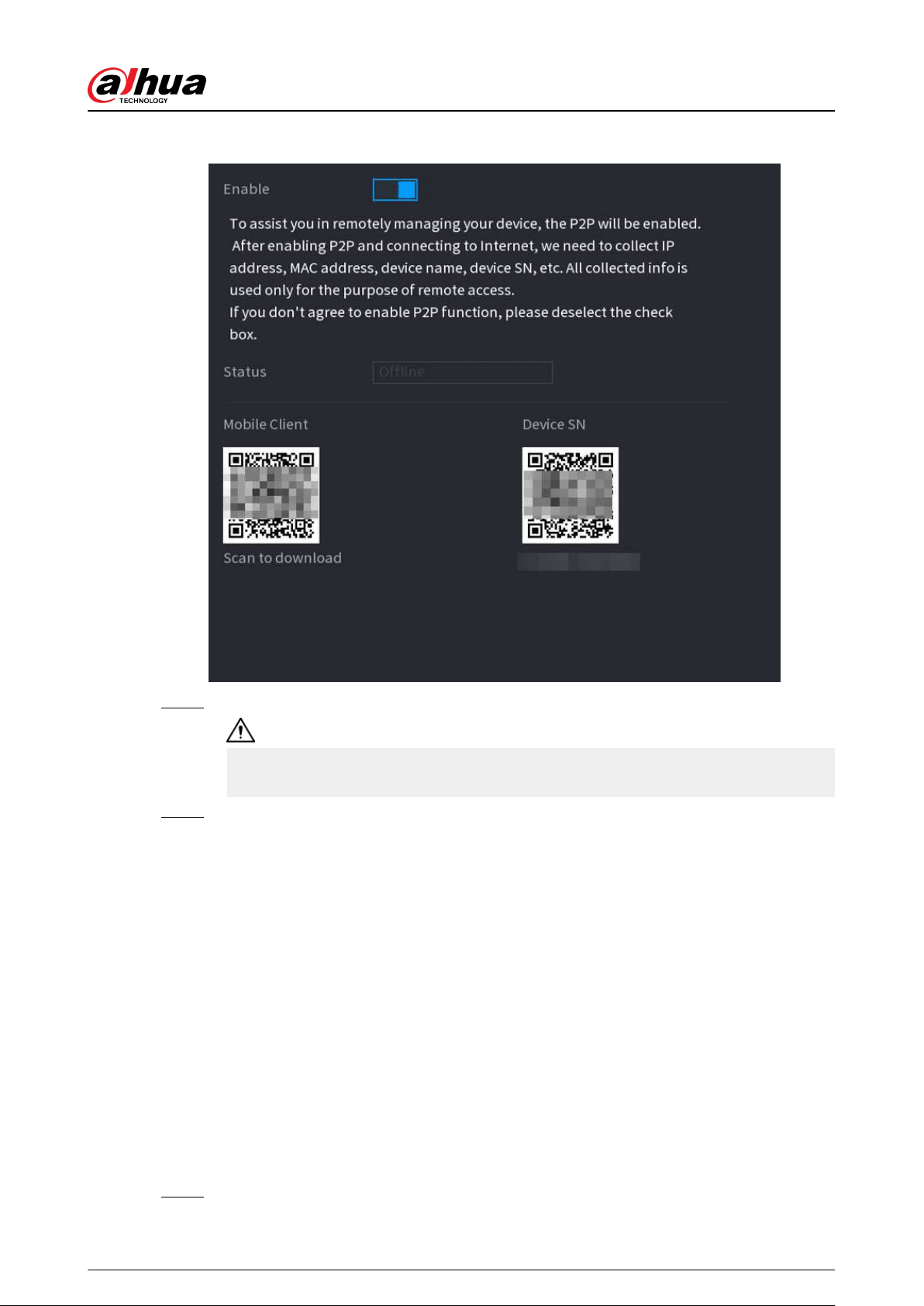
Figure 5-226 P2P
Step 2 Enable the P2P function.
After you enable the P2P function and connect to the Internet, the system will collect the
information such as email address and MAC address for remote access.
Step 3 Click Apply.
The P2P function is enabled. You can use your phone to scan the QR code under Mobile
Client to download and install the mobile client. After that, you can use the mobile client
to scan the QR code under Device SN to add the Device for remote management. For
details on the app operation, see the user's manual of the app.
5.12 Storage
You can manage the storage resources (such as record le) and storage space. So that it is easy for
you to use and enhance storage space usage.
5.12.1 Basic
Background Information
You can set basic storage parameters.
Procedure
Step 1 Select Main Menu > STORAGE > Basic.
User's Manual
349
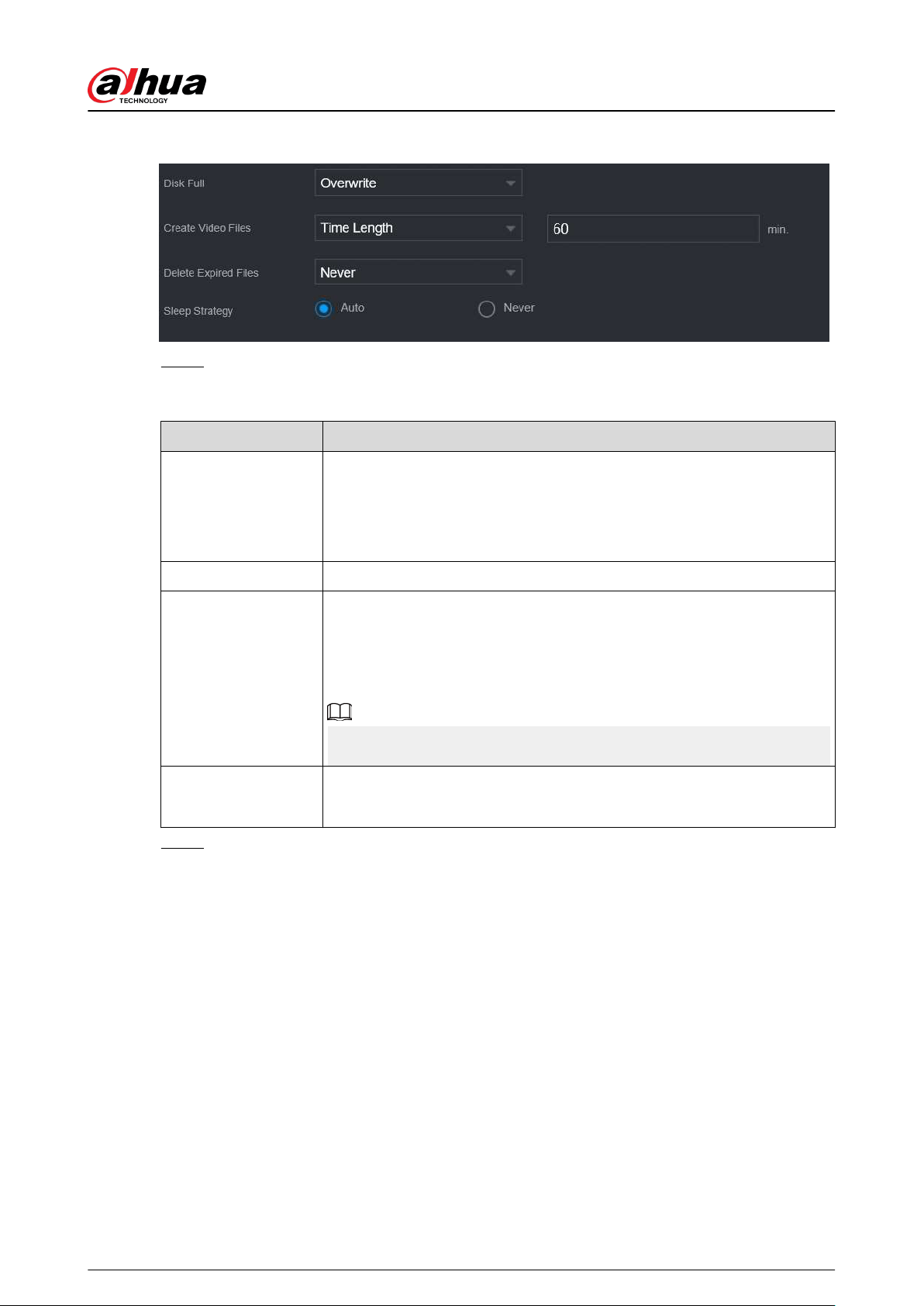
Figure 5-227 Basic storage
Step 2 Set parameters.
Table 5-70 Basic storage parameters
Parameter Description
Disk Full
Congure the storage strategy to be used when no more storage space is
available
●
Stop : Stop recording.
●
Overwrite : The newest les overwrite the oldest ones.
Create Video Files Congure the time length and le length for each recorded video.
Delete Expired Files
Congure whether to delete the old les.
●
Select Auto and then congure how long you want to keep the old
les.
●
Select Never if you do not want to use this function.
Deleted les cannot be recovered.
Sleep Strategy
●
Auto : The system sleeps automatically after idling for a period of time.
●
Never : The system keeps running all the time.
Step 3 Click Apply.
5.12.2 Disk Manager
Select Main Menu > STORAGE > Disk Manager, and then you can set HDD properties and format
HDD.
User's Manual
350
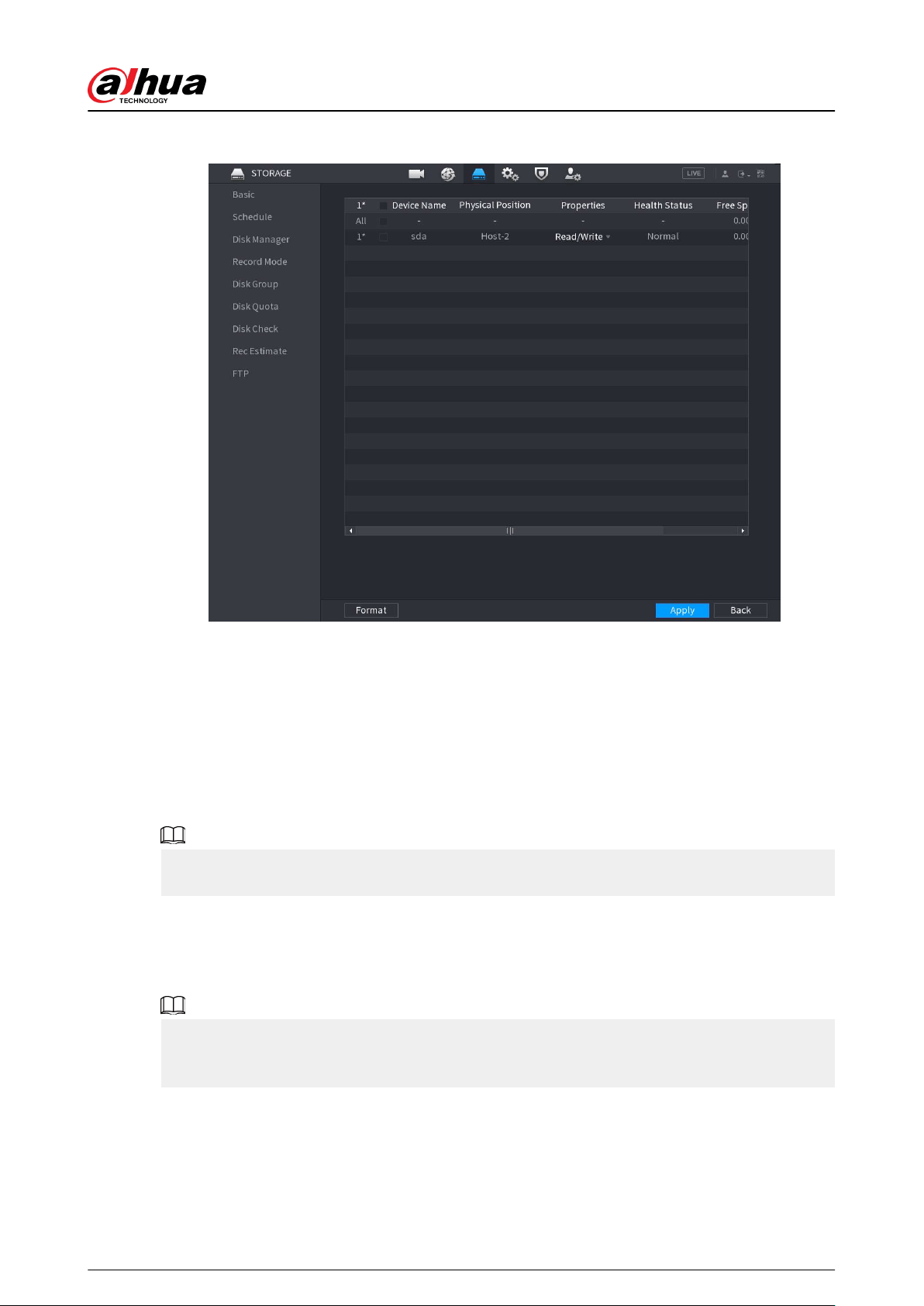
Figure 5-228 Disk manager
View HDD Information
You can view the physical position, properties, status and storage capacity of each HDD.
Congure HDD Properties
In the Properties column, you can set read and wire, read-only and redundant HDD.
When there are two or more HDDs installed on the Device, you can set one HDD as redundant disk
to back up recorded les.
Format HDD
Select an HDD, click Format, and then follow the on-screen prompts to format the HDD.
●
Formatting will erase all data in the HDD, proceed with caution.
●
You can select whether to erase the HDD database. If the HDD database is erased, the AI search
data and the uploaded audio les will be deleted.
User's Manual
351
5.12.3 RAID
RAID (redundant array of independent disks) is a data storage virtualization technology that
combines multiple physical HDD components into a single logical unit for the purposes of data
redundancy, performance improvement, or both.
RAID function is available on select models.
Table 5-71 Disk quantity for dierent RAID types
RAID type Required disk quantity
RAID 0 At least 2.
RAID 1 Only 2.
RAID 5 At least 3. We recommend using 4 disks to 6 disks.
RAID 6
At least 4.
RAID 10
5.12.3.1 Creating RAID
RAID has dierent levels, such as RAID 5 and RAID 6. Each level has dierent data protection, data
availability, and performance grade. You can create dierent types of RAID as needed.
Background Information
When you create RAID, the disks in the RAID group will be formatted. Back up data in time.
You can create dierent types of RAID as needed.
Procedure
Step 1 Select Main Menu > STORAGE > RAID > RAID.
User's Manual
352
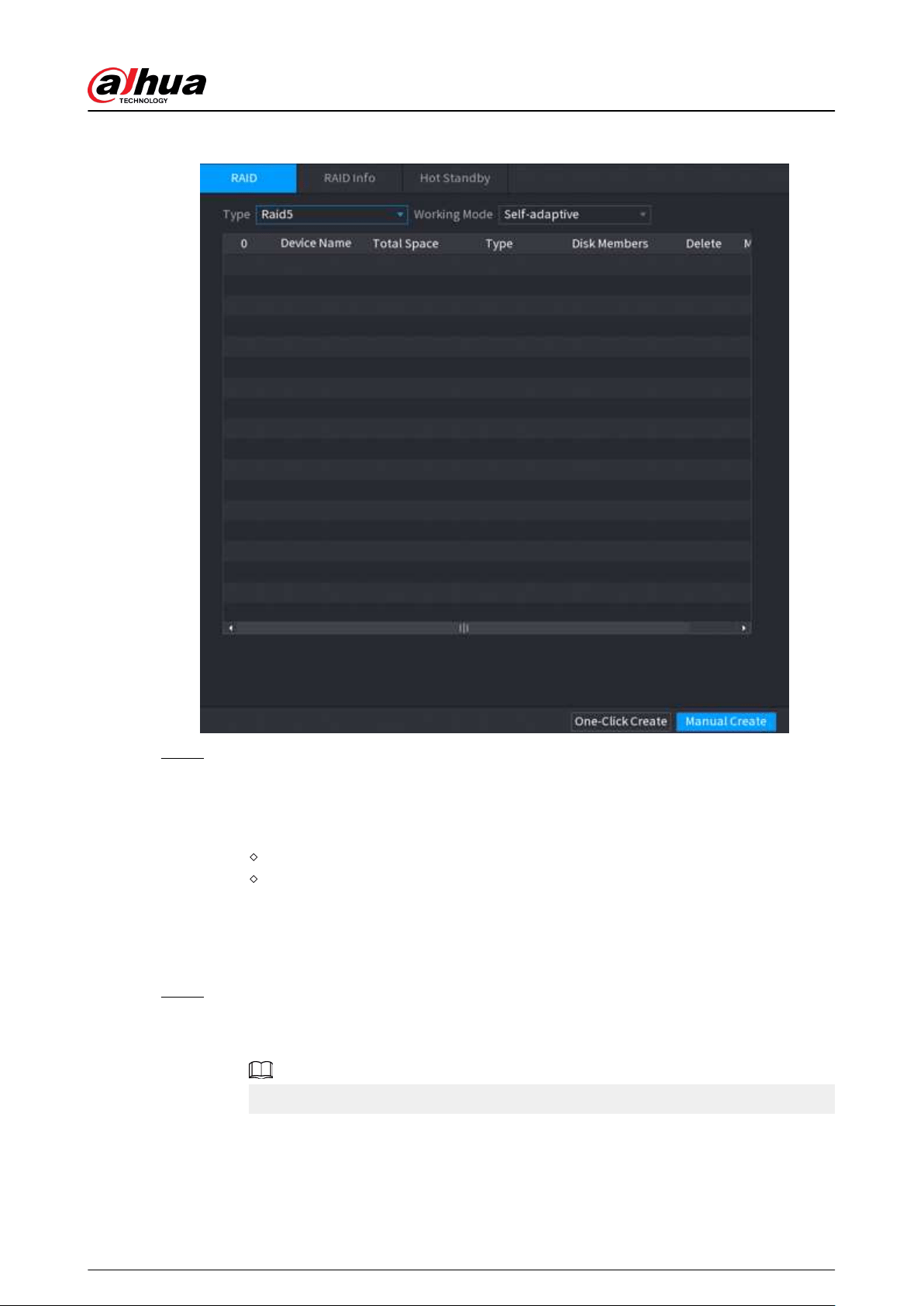
Figure 5-229 RAID
Step 2 Select RAID type and working mode.
The working mode determines how the system allocate resources.
●
Self-Adaptive: Automatically adjust the RAID synchronization speed according to the
business status.
When there is no business running, synchronization is performed at a high speed.
When there is business running, synchronization is performed at a low speed.
●
Sync First: Resource priority is assigned to RAID synchronization.
●
Business First: Resource priority is assigned to business operations.
●
Balance: Resource is evenly distributed to RAID synchronization and business
operations.
Step 3 Create RAID.
●
Automatic creation.
Select disks, and then click Create RAID. The system will create RAID 5 automatically.
Automatic creation of RAID is available only when the RAID type is Raid5.
●
Manual creation.
Select disks, click Create Manually and then follow the on-screen instructions to
create RAID.
User's Manual
353
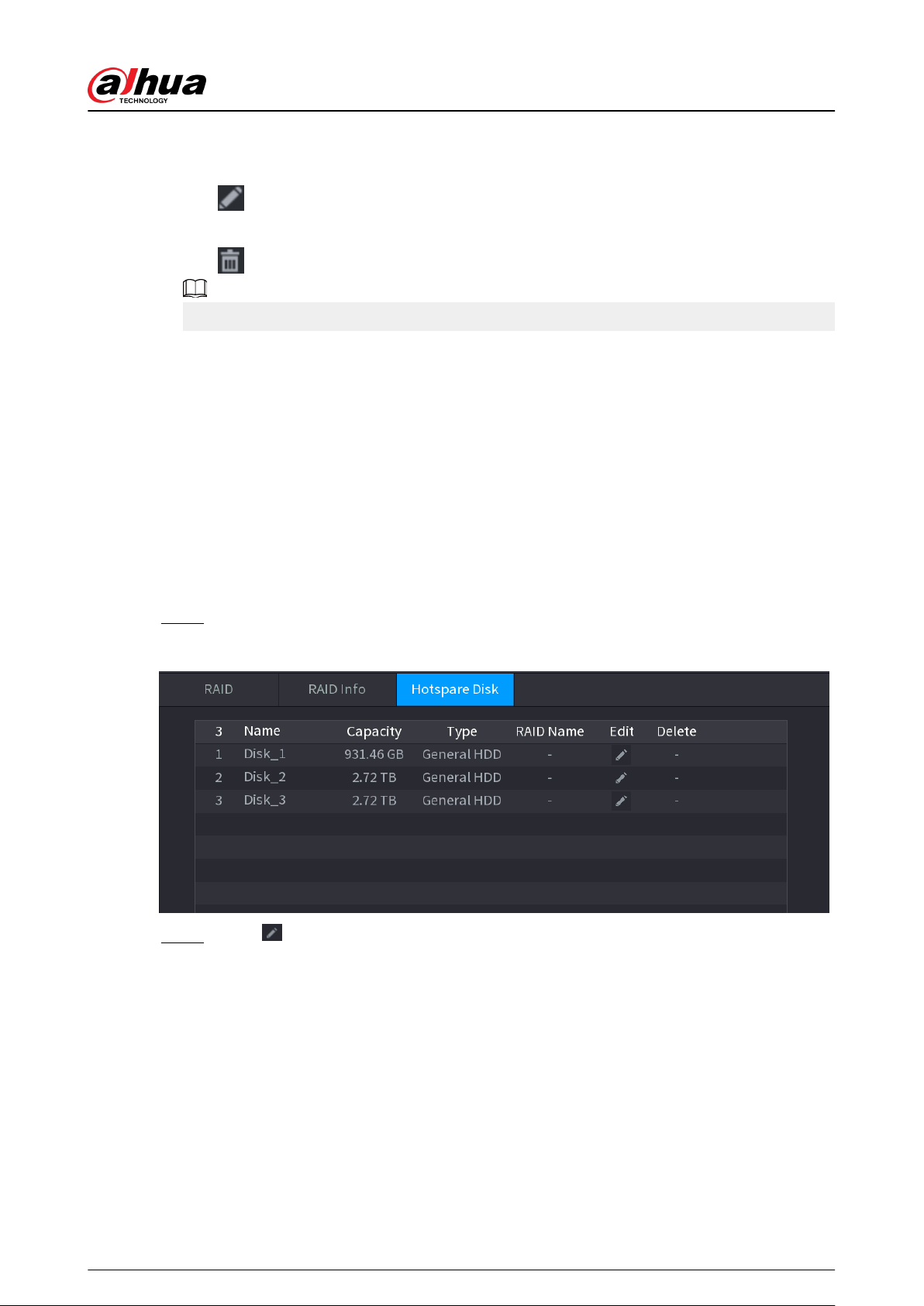
Related Operations
●
Change working mode.
Click to change the working mode of the RAID group.
●
Delete RAID.
Click to delete the RAID group.
When you delete a RAID group, the disks in the RAID group will be formatted.
5.12.3.2 Viewing RAID Information
Select Main Menu > STORAGE > RAID > RAID Info. You can view the RAID information, including
type, disk space, hot spare, and status.
5.12.3.3 Creating Hot Spare Disk
Background Information
You can create a hot spare disk. When a disk of the RAID group malfunctions, the hot spare disk can
replace the malfunctioning disk.
Procedure
Step 1 Select Main Menu > STORAGE > RAID > Hotspare Disk.
Figure 5-230 Hotspare disk
Step 2 Click .
User's Manual
354
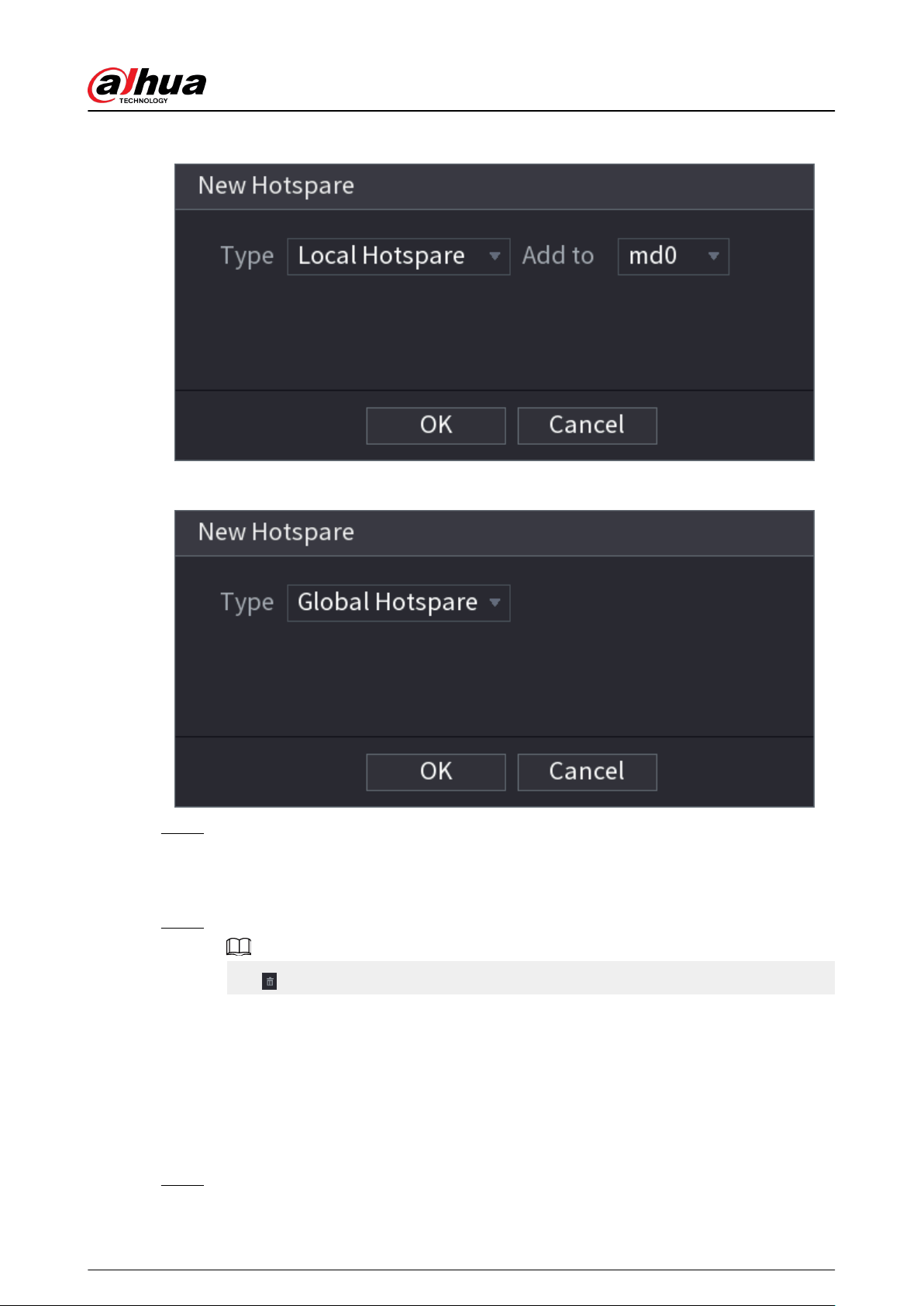
Figure 5-231 Local hotspare
Figure 5-232 Global hotspare
Step 3 You can select Local Hotspare or Global Hotspare.
●
Local Hotspare : Select the target disk, and the current disk will serve as the hot spare
disk for the selected target disk.
●
Global Hotspare : The current disk will serve as the hot spare disk of the entire RAID.
Step 4 Click OK.
Click to delete a hot spare disk.
5.12.4 Disk Group
Background Information
By default, the installed HDD and created RAID are in Disk Group 1. You can set HDD group, and
HDD group setup for main stream, sub stream and snapshot operation.
Procedure
Step 1 Select Main Menu > STORAGE > Disk Group.
User's Manual
355
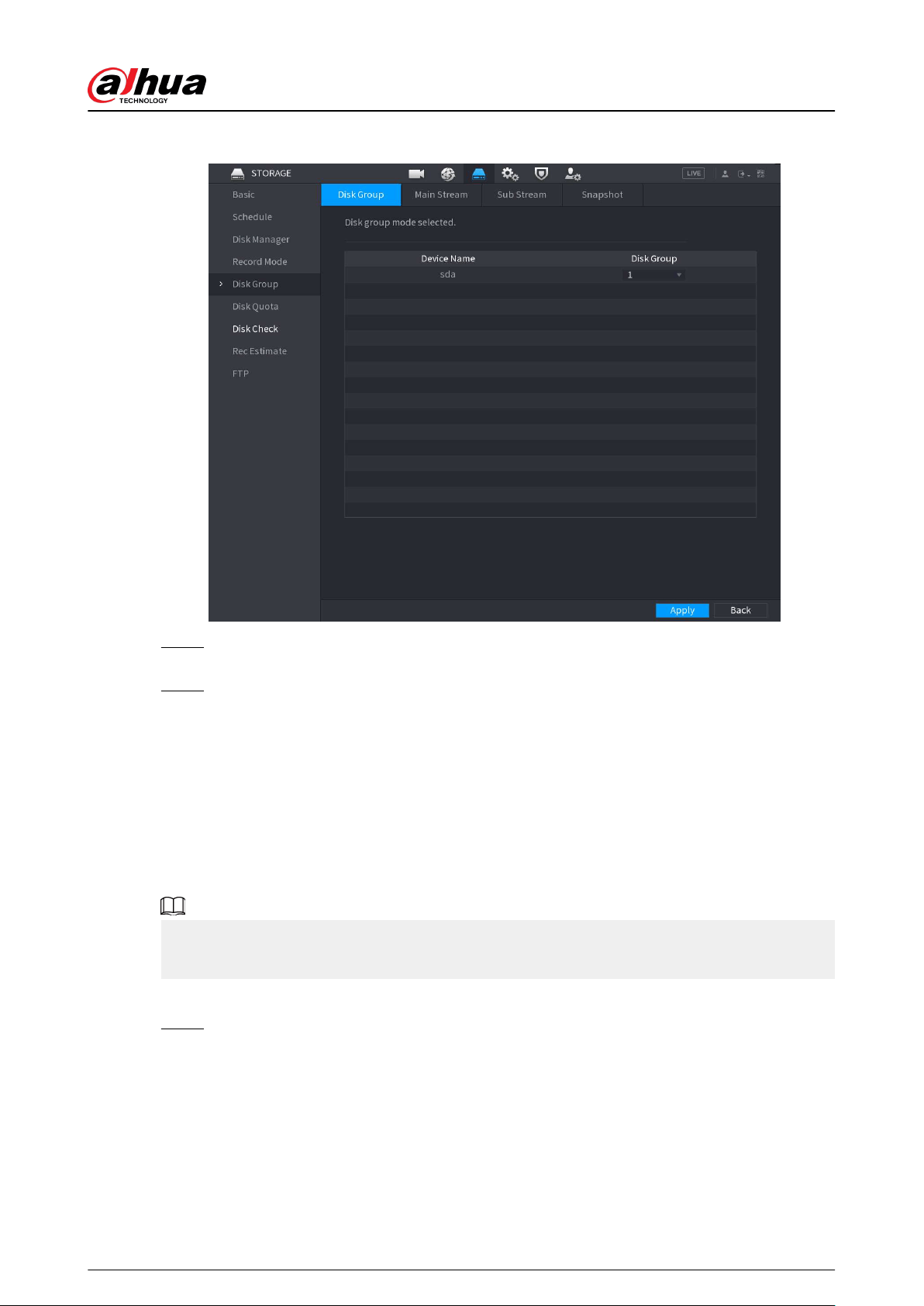
Figure 5-233 Disk group
Step 2 (Optional) If Disk Quota is selected is shown on the page, click Switch to Disk Group
Mode and then follow the on-screen instructions to format disks.
Step 3 Select the group for each HDD, and then click Apply.
After conguring HDD group, under the Main Stream tab, Sub Stream tab and
Snapshot tab, congure settings to save the main stream, sub stream and snapshot to
dierent disk groups.
5.12.5 Disk Quota
You can allocate a certain storage capacity for each channel to manage the storage space properly.
Background Information
●
If Disk group mode selected. is shown in the page, click Switch to Quota Mode.
●
Disk quota mode and disk group mode cannot be selected at the same time.
Procedure
Step 1 Select Main Menu > STORAGE > Disk Quota.
User's Manual
356
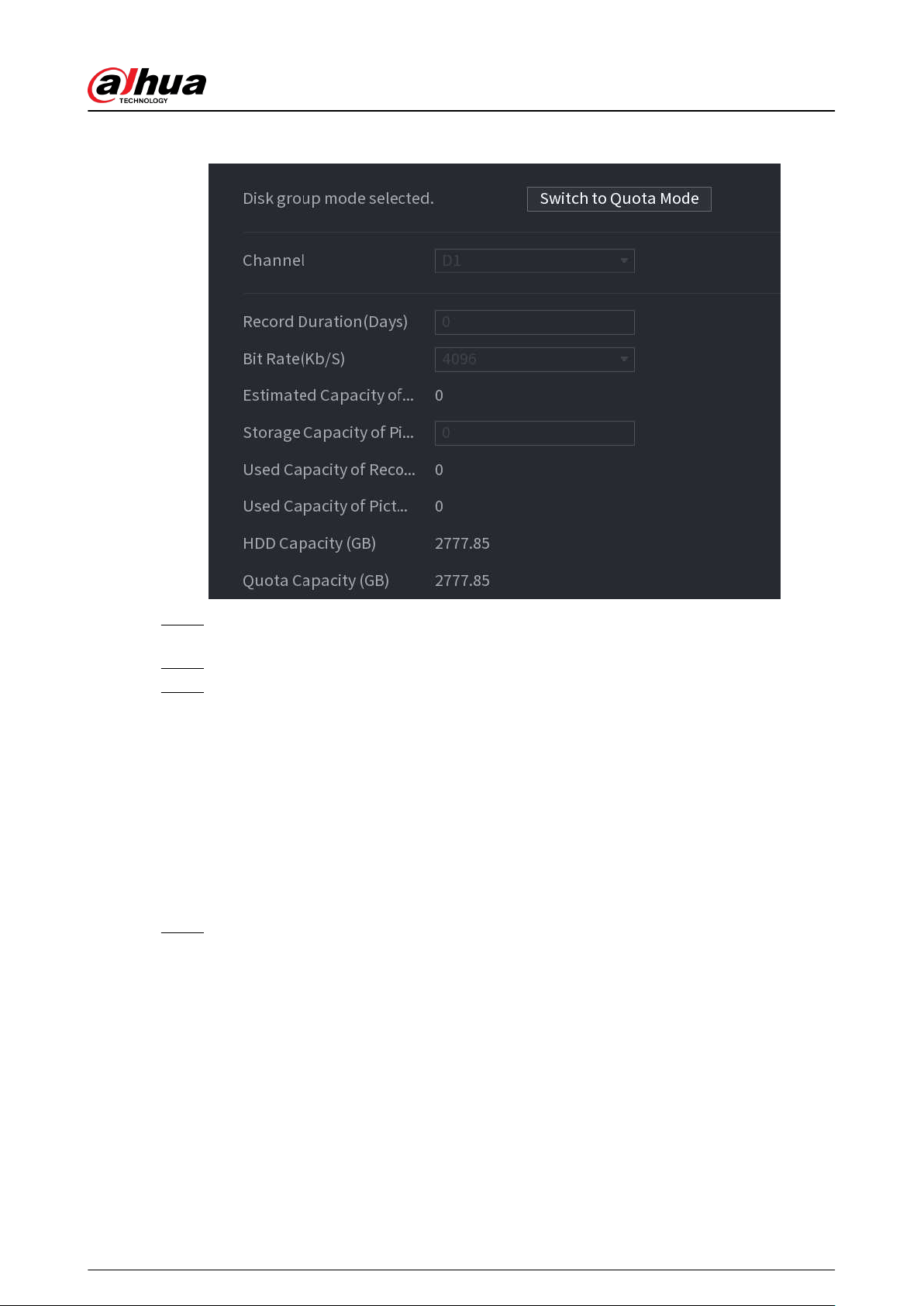
Figure 5-234 Disk Quota
Step 2 (Optional) If Disk group mode selected is shown on the page, click Switch to Quota
Mode and then follow the on-screen instructions to format disks.
Step 3 Select a channel and set the record duration, bit rate and storage capacity of picture.
Step 4 Click Apply.
5.12.6 Disk Check
The system can detect HDD status so that you can clearly understand the HDD performance and
replace the malfunctioning HDD.
5.12.6.1 Manual Check
Procedure
Step 1 Select Main Menu > STORAGE > Disk Check > Manual Check.
User's Manual
357
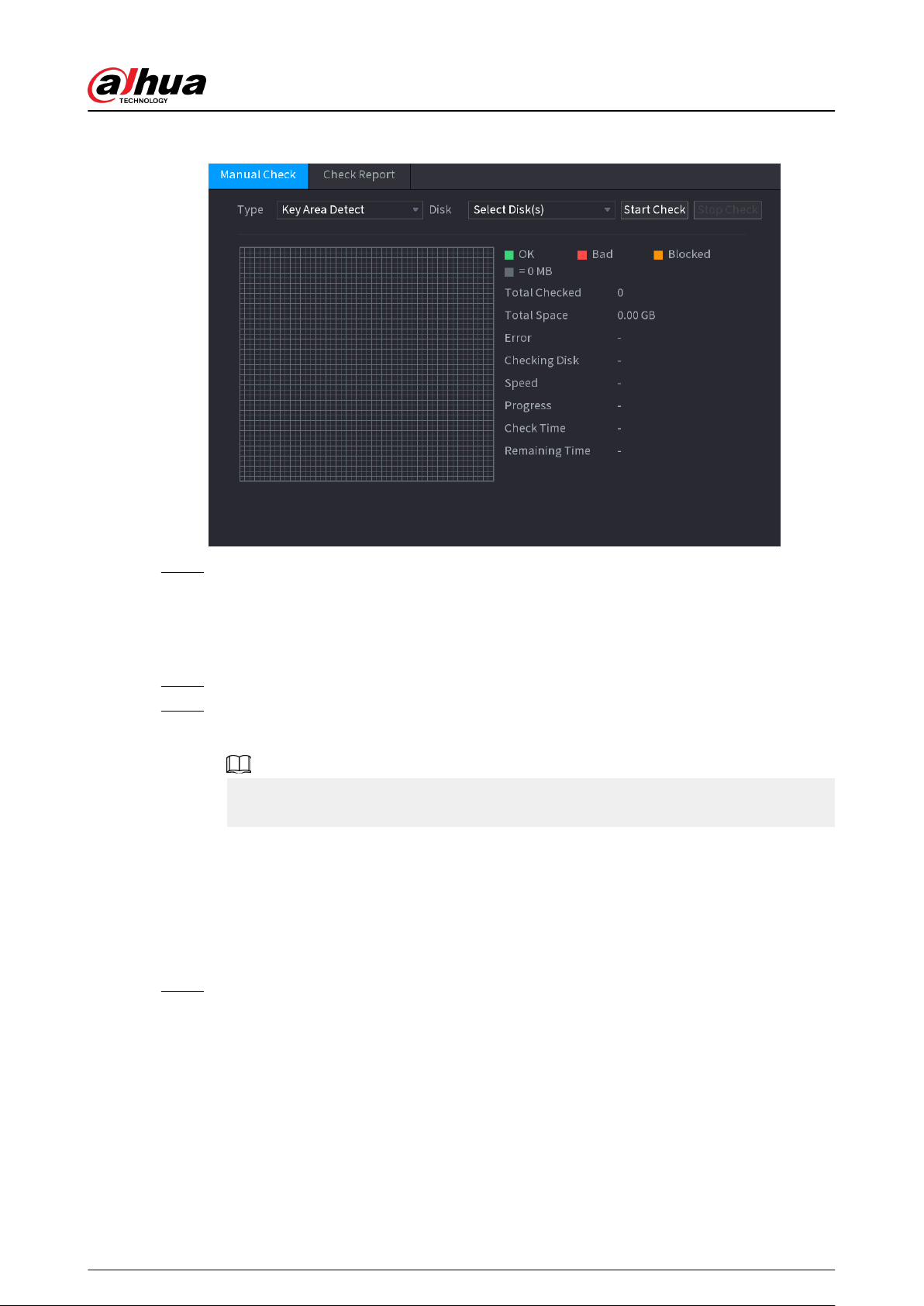
Figure 5-235 Manual check
Step 2 Select the detection type.
●
Key area detect: The system detects the used space of the HDD through the built-in
le system. This type of detection is ecient.
●
Global detection: The system detects the entire HDD through Window. This type of
detection takes time and might aect the HDD that is recording.
Step 3 Select the HDD that you want to detect.
Step 4 Click Start Check.
The system starts detecting the HDD and displays the detection information.
When system is detecting HDD, click Stop Check to stop current detection. Click Start
Check to detect again.
5.12.6.2 Detection Report
Background Information
After the detection, you can view the detection report.
Procedure
Step 1 Select Main Menu > STORAGE > Disk Check > Check Report.
User's Manual
358
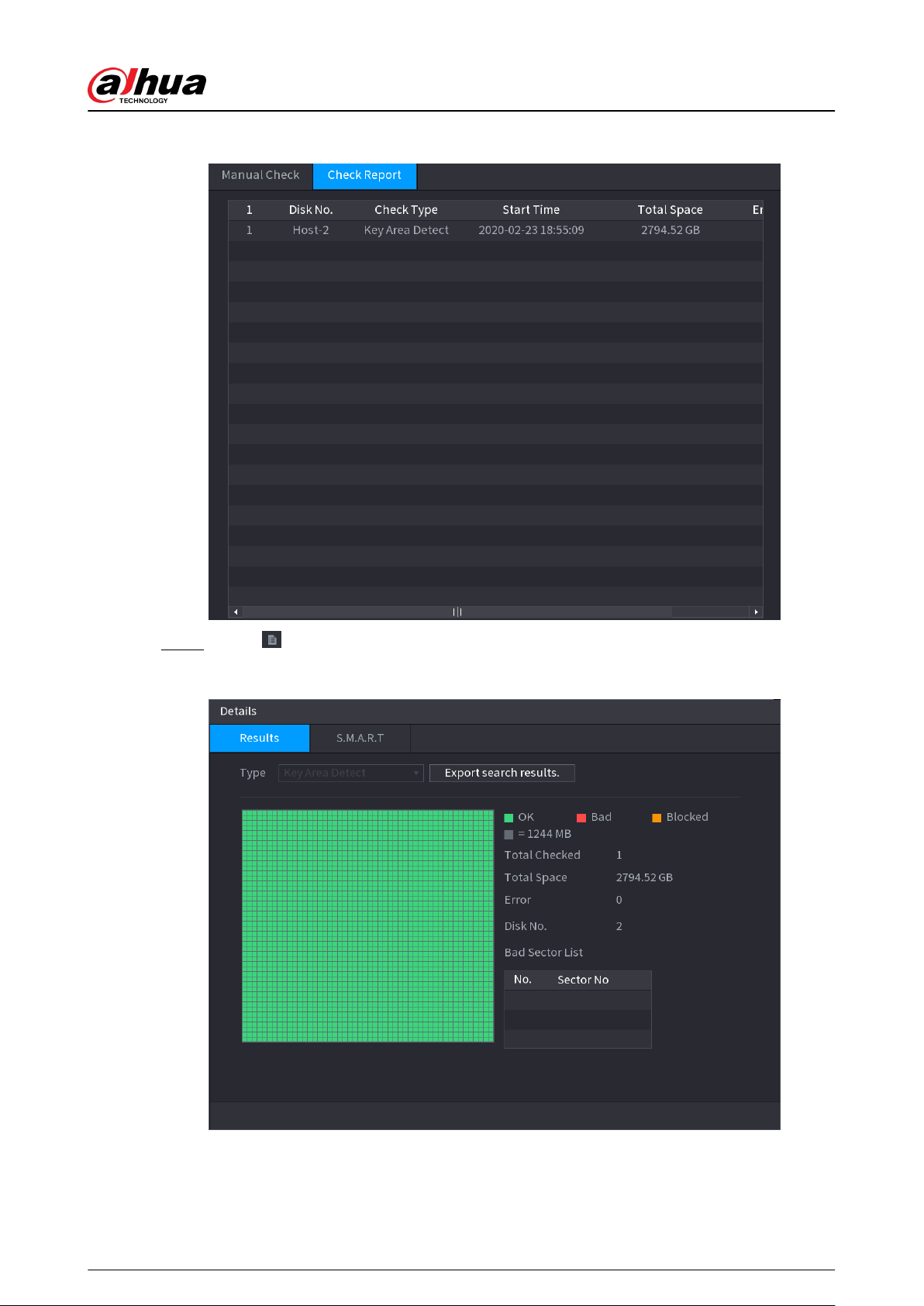
Figure 5-236 Check report
Step 2 Click to view detection results and S.M.A.R.T report.
Figure 5-237 Results
User's Manual
359
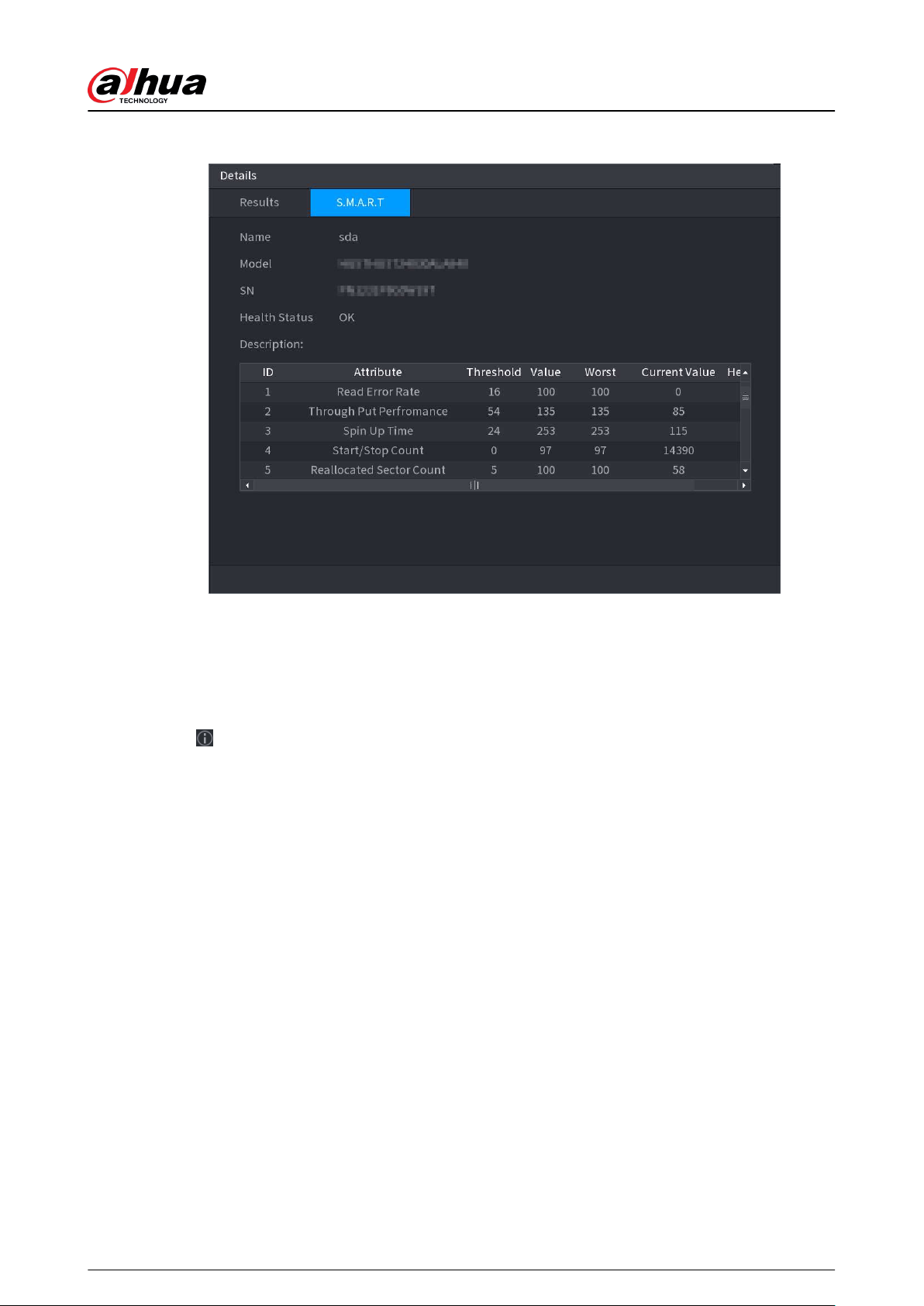
Figure 5-238 S.M.A.R.T
5.12.6.3 Disk Health Monitoring
Monitor health status of disks, and repair if any exceptions are found so as to avoid data loss.
Select Main Menu > STORAGE > Disk Check > Health Monitoring.
Click
to show disk details page. Then select Check Type , set time period, and then click Search.
The system shows the details of disk monitoring status.
User's Manual
360
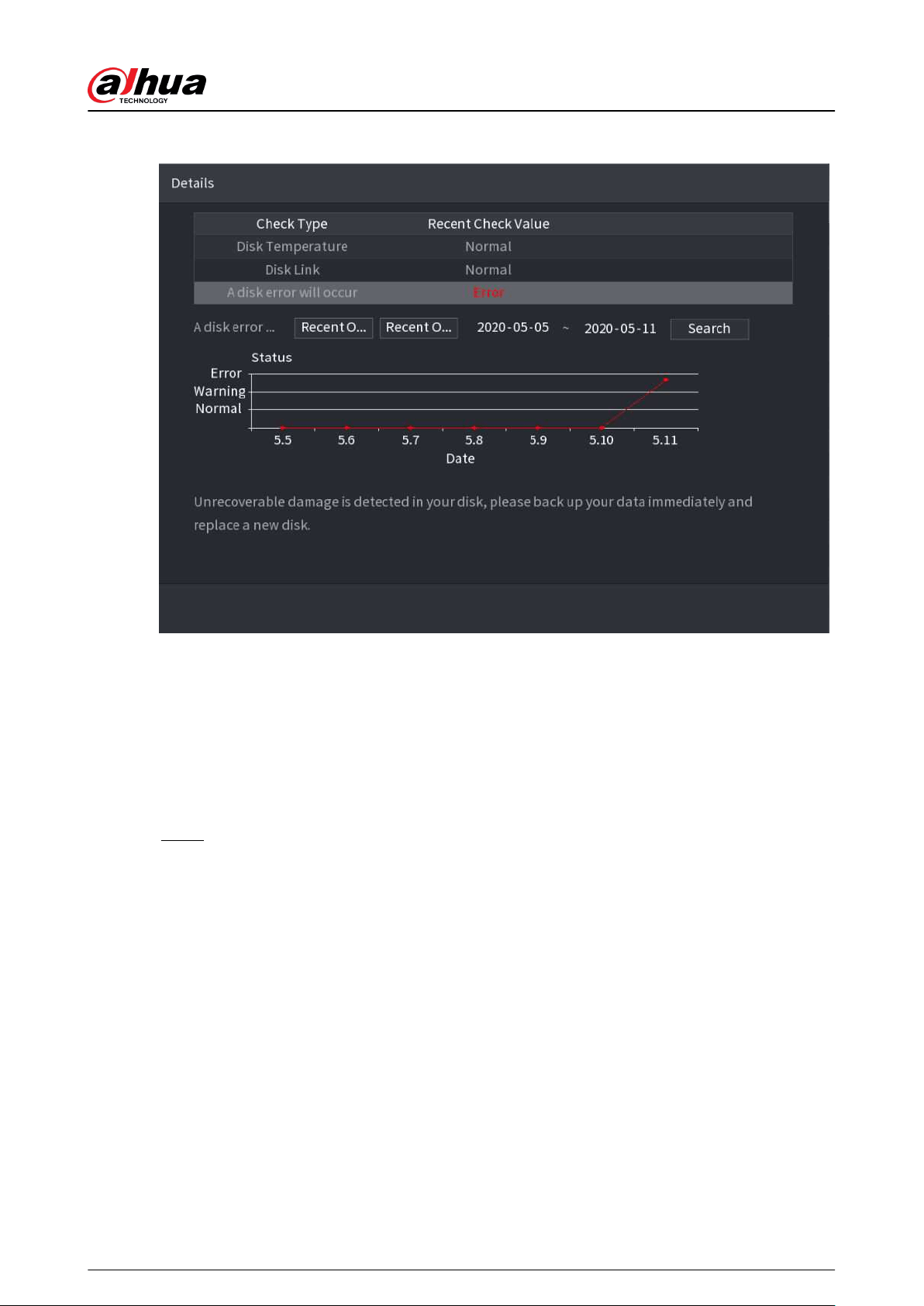
Figure 5-239 Disk details
5.12.7 Record Estimate
Background Information
Record estimate function can calculate how long you can record video according to the HDD
capacity, and calculate the required HDD capacity according to the record period.
Procedure
Step 1 Select Main Menu > STORAGE > Rec Estimate.
User's Manual
361
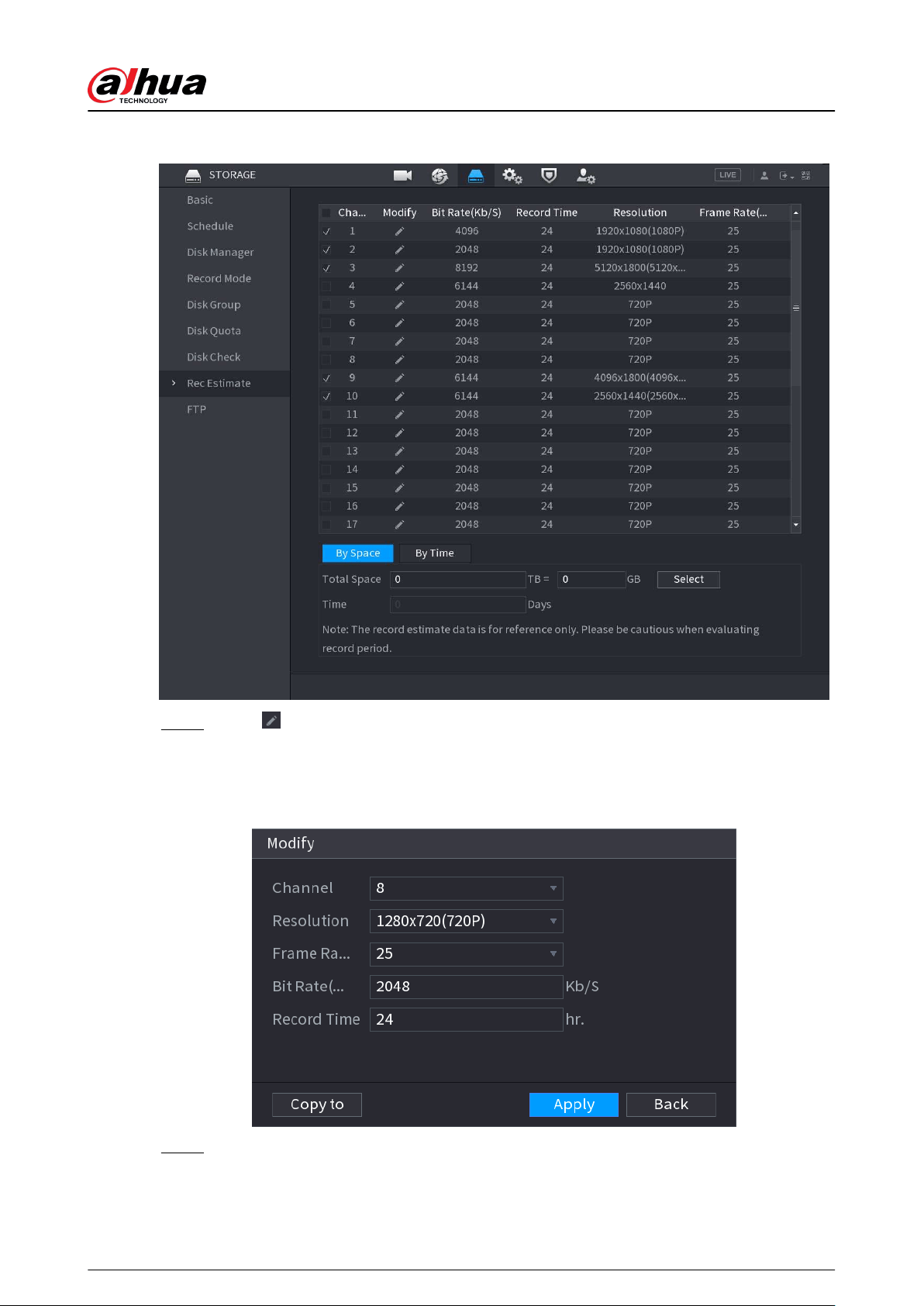
Figure 5-240 Record estimation
Step 2 Click .
You can congure the Resolution , Frame Rate, Bit Rate and Record Time for the
selected channel.
Figure 5-241 Modify channel settings
Step 3 Click Apply.
Then the system will calculate the time period that can be used for storage according to
the channels settings and HDD capacity.
User's Manual
362
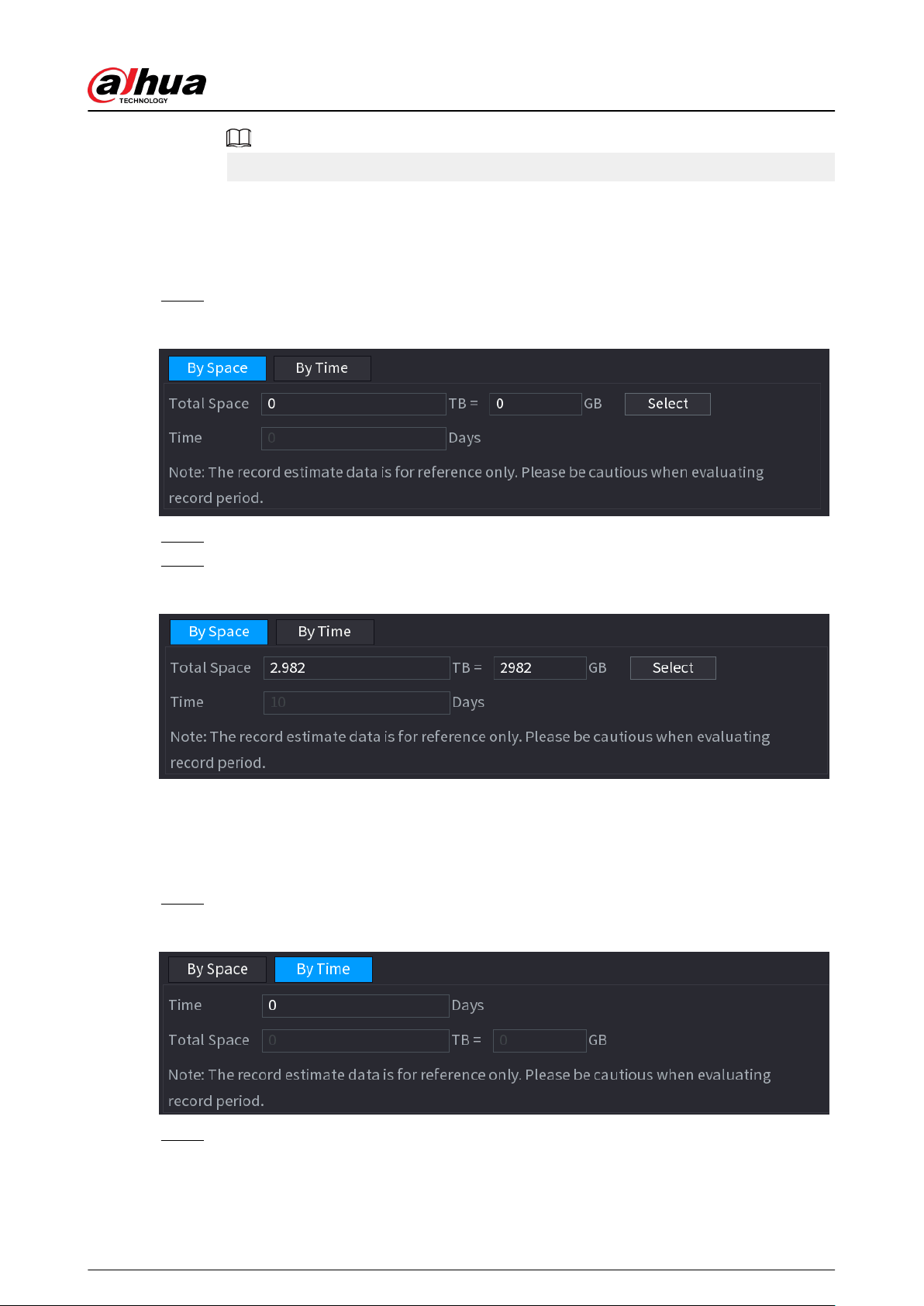
Click Copy to to copy the settings to other channels.
5.12.7.1 Calculating Recording Time
Procedure
Step 1 On the Rec Estimate page, click the By Space tab.
Figure 5-242 By space
Step 2 Click Select.
Step 3 Select the checkbox of the HDD that you want to calculate.
Figure 5-243 Recording time
5.12.7.2 Calculating HDD Capacity for Storage
Procedure
Step 1 On the Rec Estimate page, click the By Time tab.
Figure 5-244 By time
Step 2 In the Time box, enter the time period that you want to record.
In the Total Space box, the required HDD capacity is displayed.
User's Manual
363
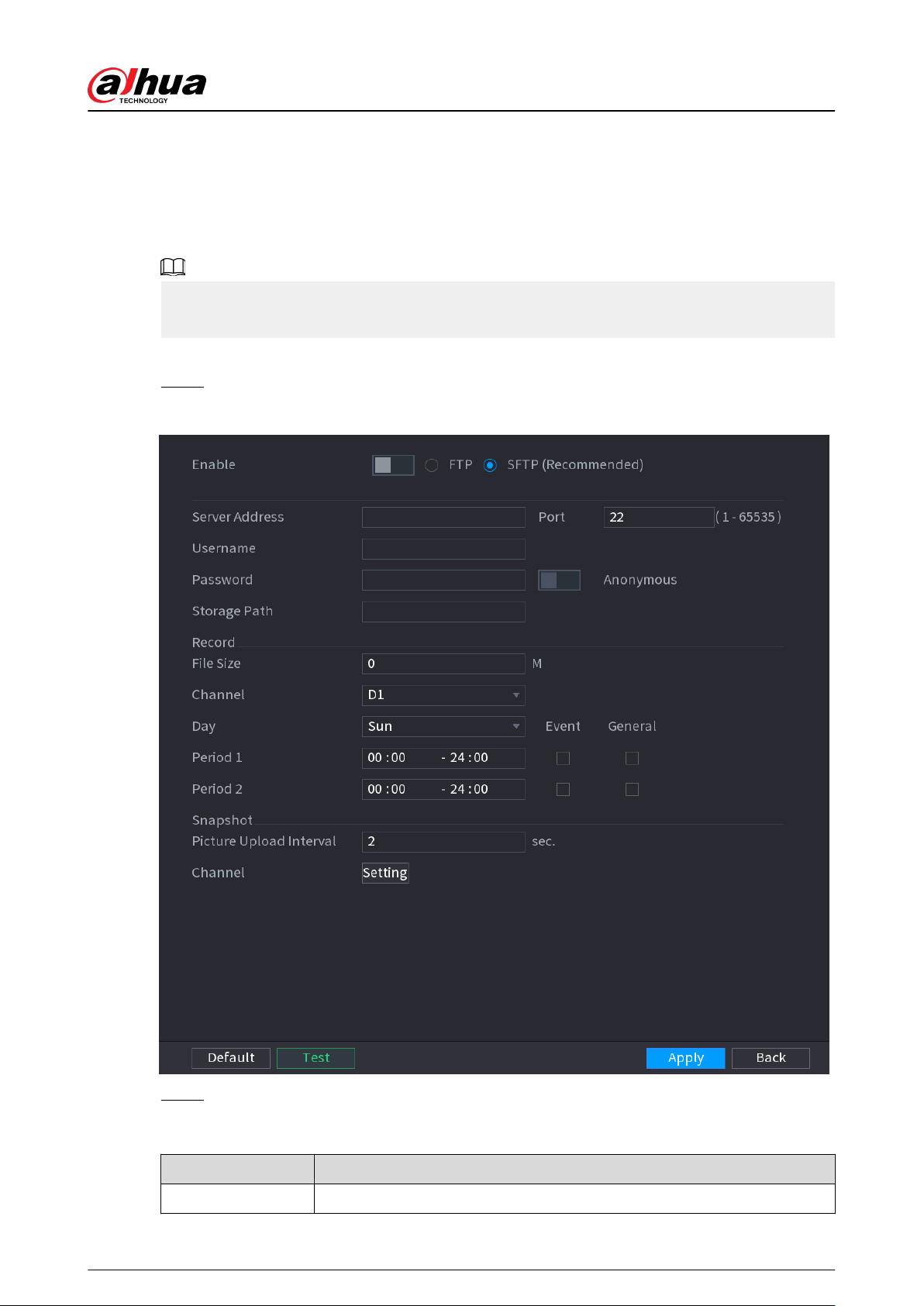
5.12.8 FTP
You can store and view the recorded videos and snapshots on the FTP server.
Prerequisites
Purchase or download a FTP (File Transfer Protocol) server and install it on your PC.
For the created FTP user, you need to set the write permission; otherwise the upload of recorded
videos and snapshots will be failed.
Procedure
Step 1 Select Main Menu > STORAGE > FTP.
Figure 5-245 FTP
Step 2 Congure the parameters.
Table 5-72 FTP parameters
Parameter
Description
Enable Enable the FTP upload function.
User's Manual
364

Parameter Description
FTP type
Select FTP type.
●
FTP: Plaintext transmission.
●
SFTP: Encrypted transmission (recommended).
Server Address IP address of FTP server.
Port
Enter the port of the FTP server.
●
FTP: The default is 21.
●
SFTP: The default is 22.
Username
Enter the username and password to log in to the FTP server.
If you enable the anonymity function, you can log in anonymously without
entering the username and password.
Password
Anonymous
Storage Path
Create folder on FTP server.
●
If you do not enter the name of remote directory, the system
automatically creates the folders according to the IP and time.
●
If you enter the name of remote directory, the system creates the folder
with the entered name under the FTP root directory rst, and then
automatically creates the folders according to the IP and time.
File Size
Enter the length of the uploaded recorded video.
●
If the entered length is less than the recorded video length, only a
section of the recorded video can be uploaded.
●
If the entered length is more than the recorded video length, the whole
recorded video can be uploaded.
●
If the entered length is 0, the whole recorded video will be uploaded.
Picture Upload
Interval
●
If this interval is longer than snapshot interval, the system takes the
recent snapshot to upload. For example, the interval is 5 seconds, and
snapshot interval is 2 seconds per snapshot, the system uploads the
recent snapshot every 5 seconds.
●
If this interval is shorter than snapshot interval, the system uploads the
snapshot per the snapshot interval. For example, the interval is 5
seconds, and snapshot interval is 10 seconds per snapshot, the system
uploads the snapshot every 10 seconds.
●
To congure the snapshot interval, go to Main Menu > CAMERA >
Encode > Snapshot.
Channel Select the channel that you want to apply the FTP settings.
Day
Select the week day and set the time period that you want to upload the
recorded les. You can set two periods for each week day.
Period 1, Period 2
Record type
Select the record type (Alarm, Intel, MD, and General) that you want to
upload. The selected record type will be uploaded during the congured
time period.
Step 3 Click Test to validate the FTP connection.
If FTP connection failed, check the network and FTP settings.
Step 4 Click Apply.
User's Manual
365
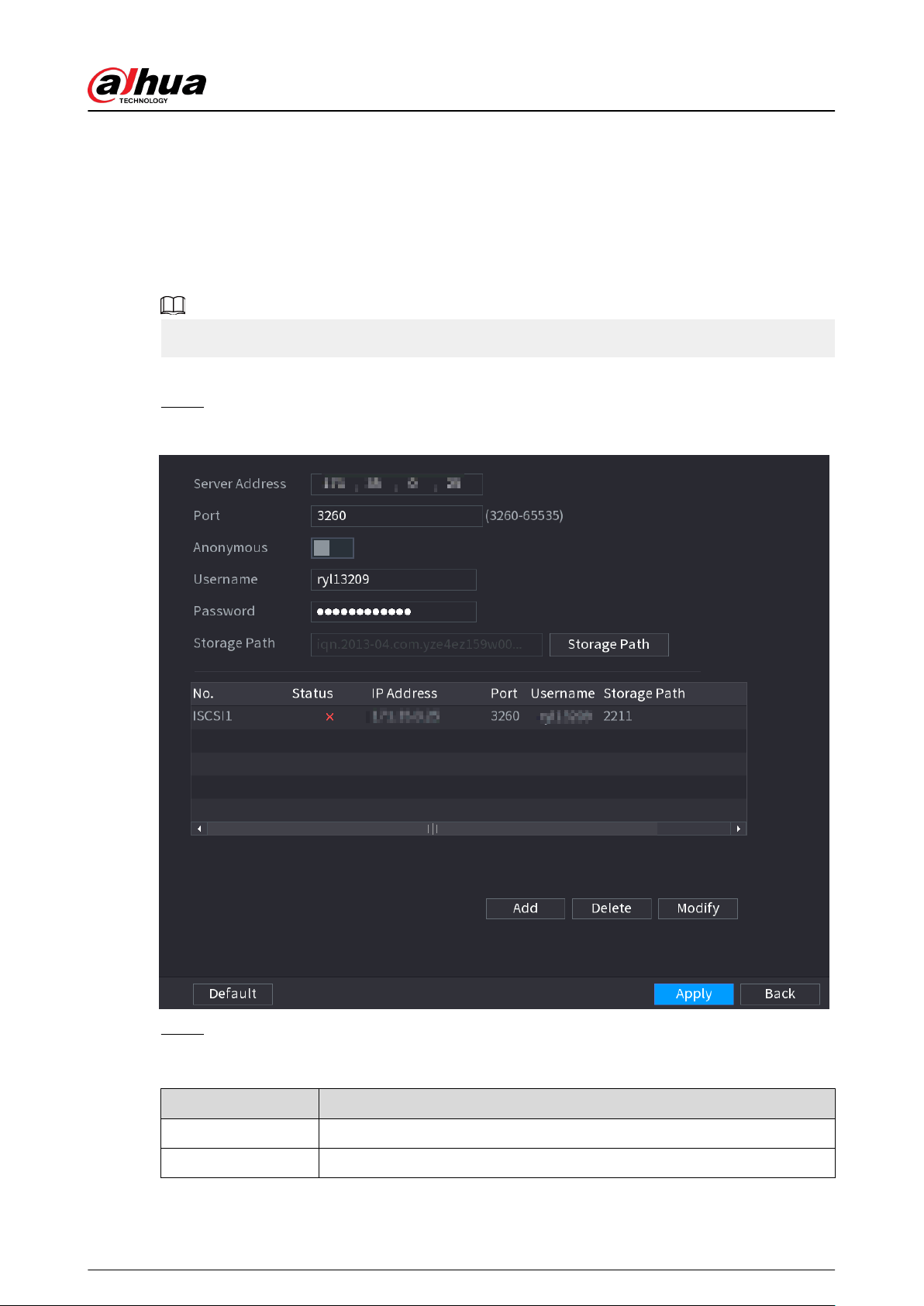
5.12.9 iSCSI
Background Information
Internet Small Computer Systems Page (iSCSI) is a transport layer protocol that works on top of the
Transport Control Protocol (TCP), and enables block-level SCSI data transport between the iSCSI
initiator and the storage target over TCP/IP networks. After the network disk is mapped to the NVR
device through iSCSI, the data can be stored on the network disk.
This function is available on select models.
Procedure
Step 1 Select Main Menu > STORAGE > iSCSI.
Figure 5-246 iSCSI
Step 2 Set parameters.
Table 5-73 iSCSI parameters
Parameter Description
Server Address Enter the server address of iSCSI server.
Port Enter the port of iSCSI server, and the default value is 3260.
User's Manual
366

Parameter Description
Storage Path
Click Storage Path to select a remote storage path.
Each path represents an iSCSI shared disk and these paths are generated
when created on the server.
Username, Password
Enter the username and password of iSCSI server.
If anonymous login is supported by iSCSI server, you can enable
Anonymous to log in as an anonymous user.
Step 3 Click Apply.
5.13 Account
You can manage users, user group and ONVIF user, and set admin security questions.
5.13.1 Group
Background Information
The accounts of the Device adopt two-level management mode: user and user group. Every user
must belong to a group, and one user only belongs to one group.
The admin and user group are two default user groups that cannot be deleted. You can add more
groups and dene corresponding permissions.
Procedure
Step 1 Select Main Menu > ACCOUNT > Group.
User's Manual
367
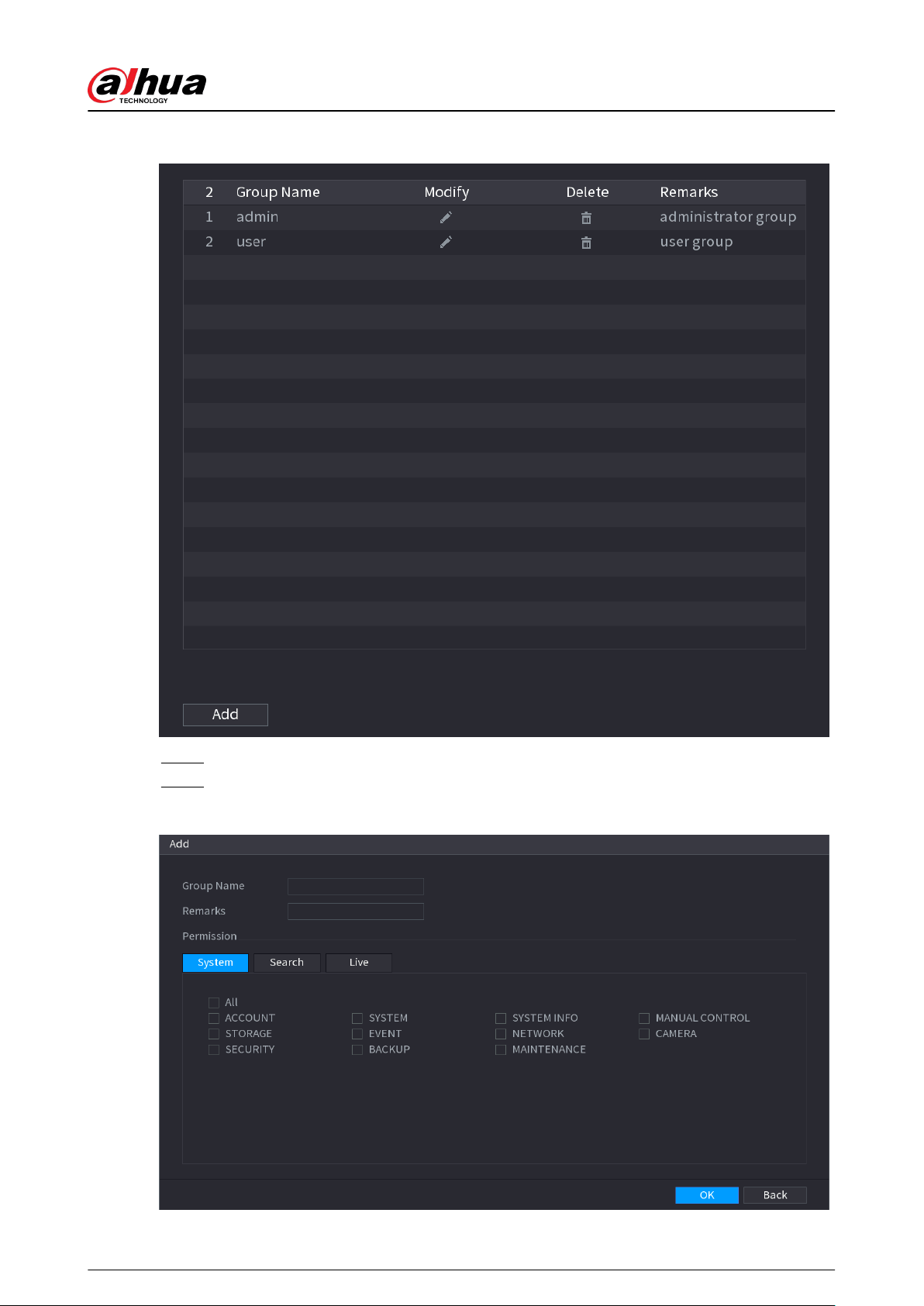
Figure 5-247 Group
Step 2 Click Add.
Step 3 Enter group name and then enter some remarks if necessary.
Figure 5-248 Add group
User's Manual
368
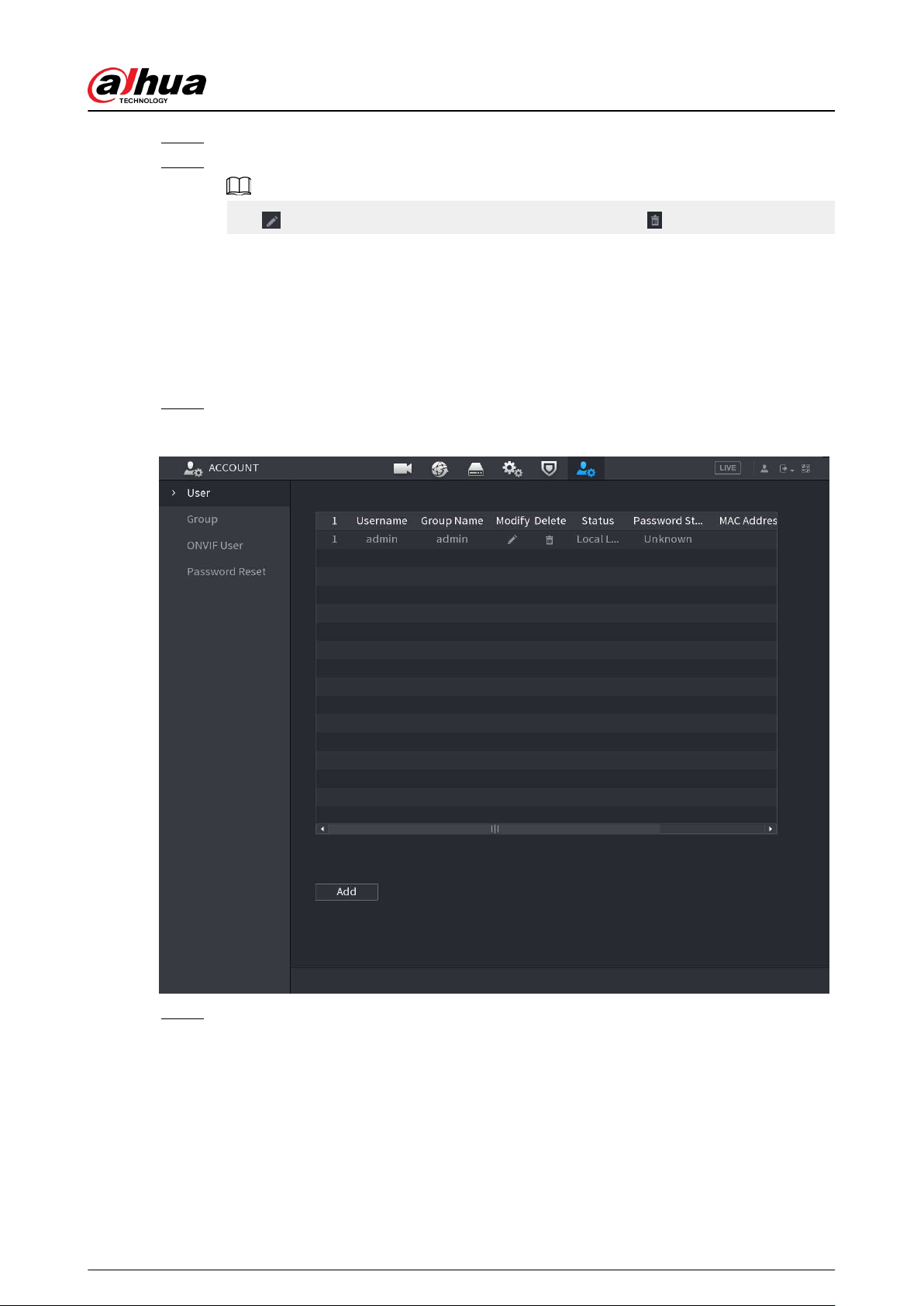
Step 4 Select the checkboxes to select permissions.
Step 5 Click OK.
Click to modify the corresponding group information, click to delete the group.
5.13.2 User
5.13.2.1 Adding User
Procedure
Step 1 Select Main Menu > ACCOUNT > User.
Figure 5-249 User
Step 2 Click Add.
User's Manual
369
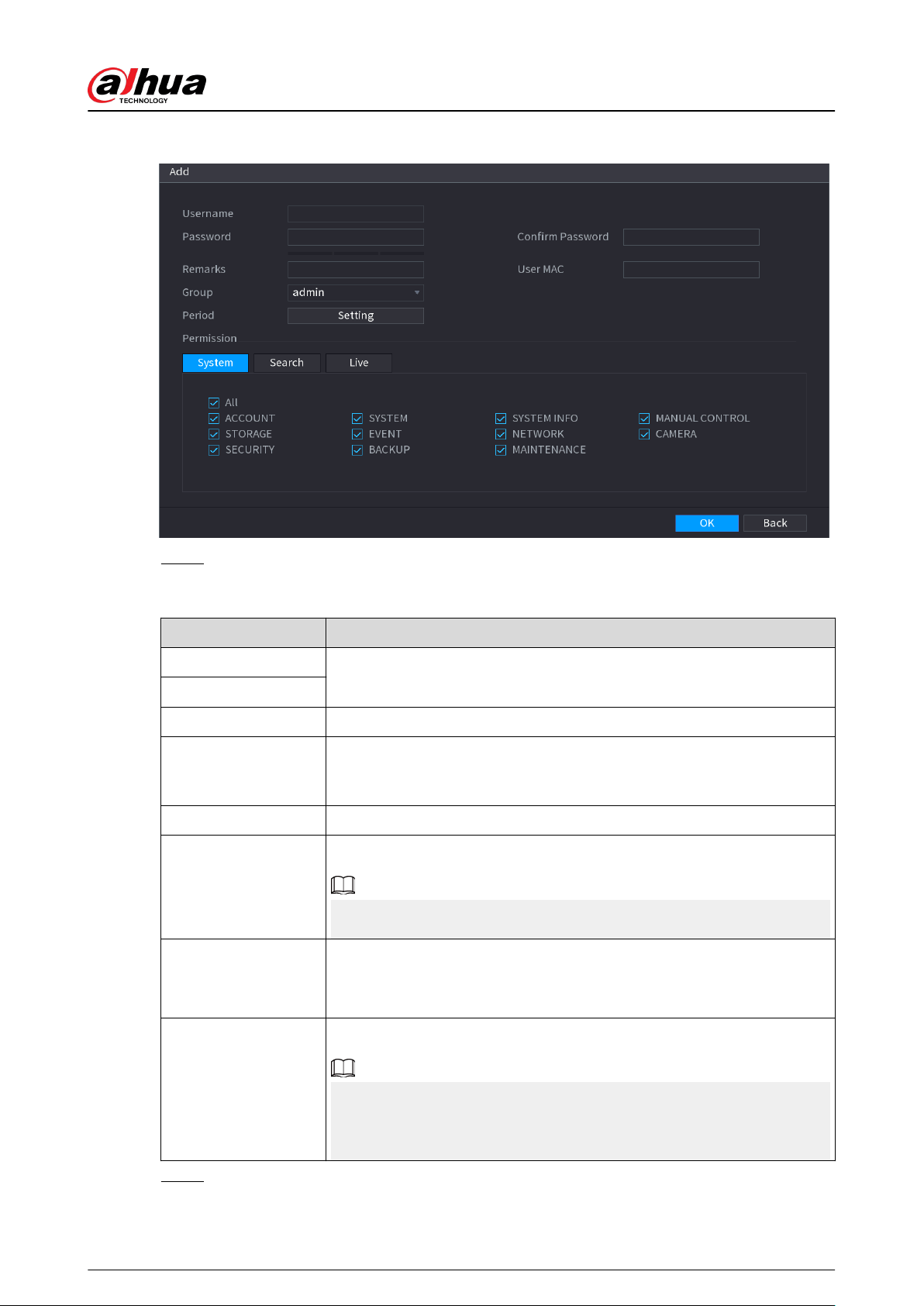
Figure 5-250 Add user
Step 3 Congure the parameters.
Table 5-74 Parameters of adding user
Parameter Description
Username
Enter a username and password for the account.
Password
Conrm Password Enter the password again to conrm it.
Remarks
Optional.
Enter a description of the account.
User MAC Enter user MAC address
Group
Select a group for the account.
The user rights must be within the group permissions.
Period
Click Setting to dene a period during which the new account can log in
to the Device. The new account cannot access the device during other
periods.
Permission
Select the checkboxes to grant permissions to the user.
To manage the user account easily, when dening the user account
permission, do not give the authority to the common user account higher
that the advanced user account.
Step 4 Click OK.
User's Manual
370
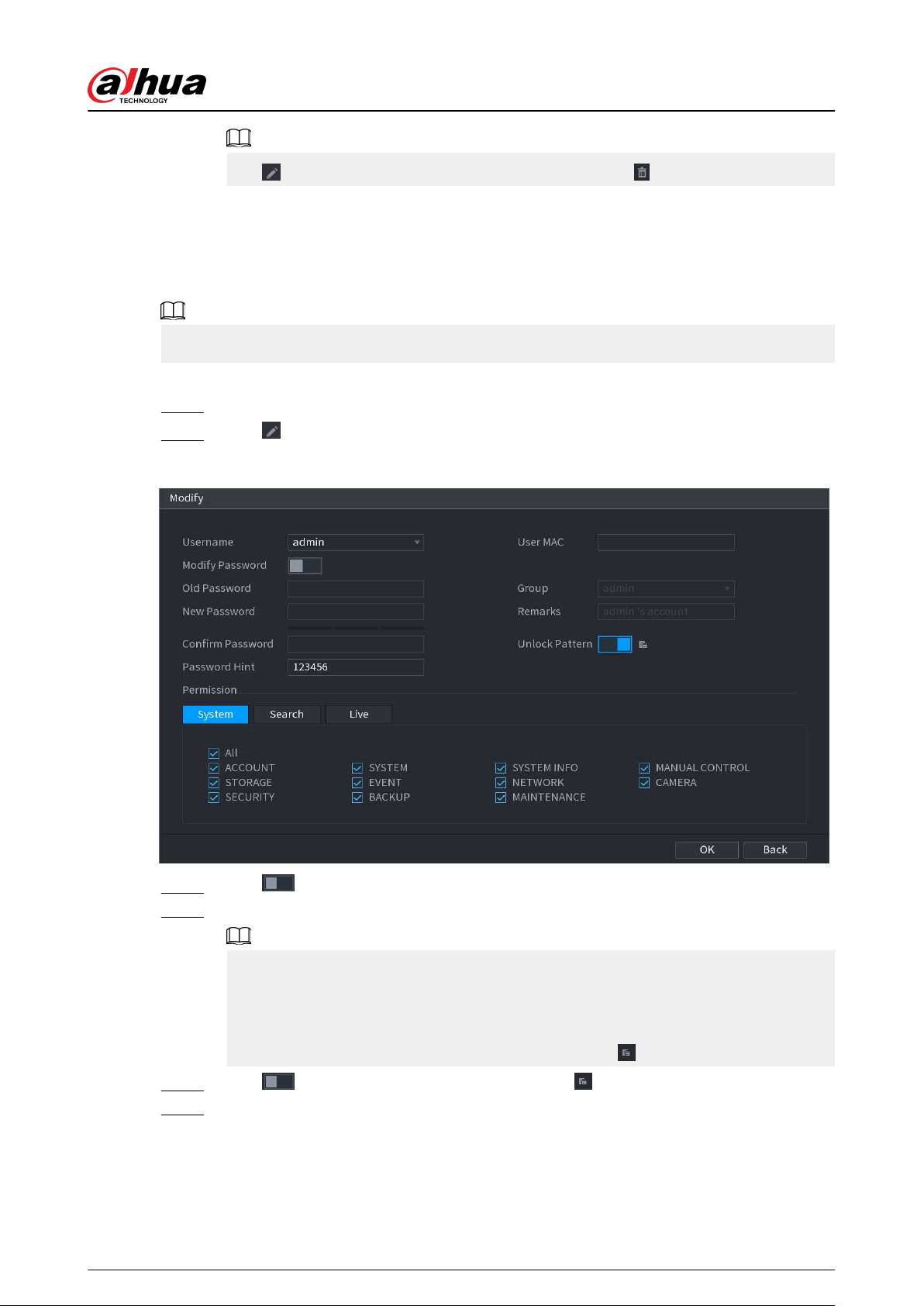
Click to modify the corresponding user information, click to delete the user.
5.13.2.2 Changing Password
Background Information
We recommend you change the password regularly to enhance device security.
Users with account permissions can change the password of other users.
Procedure
Step 1 Select Main Menu > ACCOUNT > User.
Step 2 Click of the corresponding user.
Figure 5-251 Change password
Step 3 Click to enable the Modify Password function.
Step 4 Enter old password and then enter new password twice.
●
The password must consist of 8–32 non-blank characters and contain at least two
types of the following characters: uppercase, lowercase, numbers, and special
characters (excluding ' " ; : &).
●
For your device security, create a strong password.
●
Check the box to enable Unlock Pattern function, click
.
Step 5 Click to enable Unlock Pattern and then click to draw the pattern.
Step 6 Click OK.
User's Manual
371
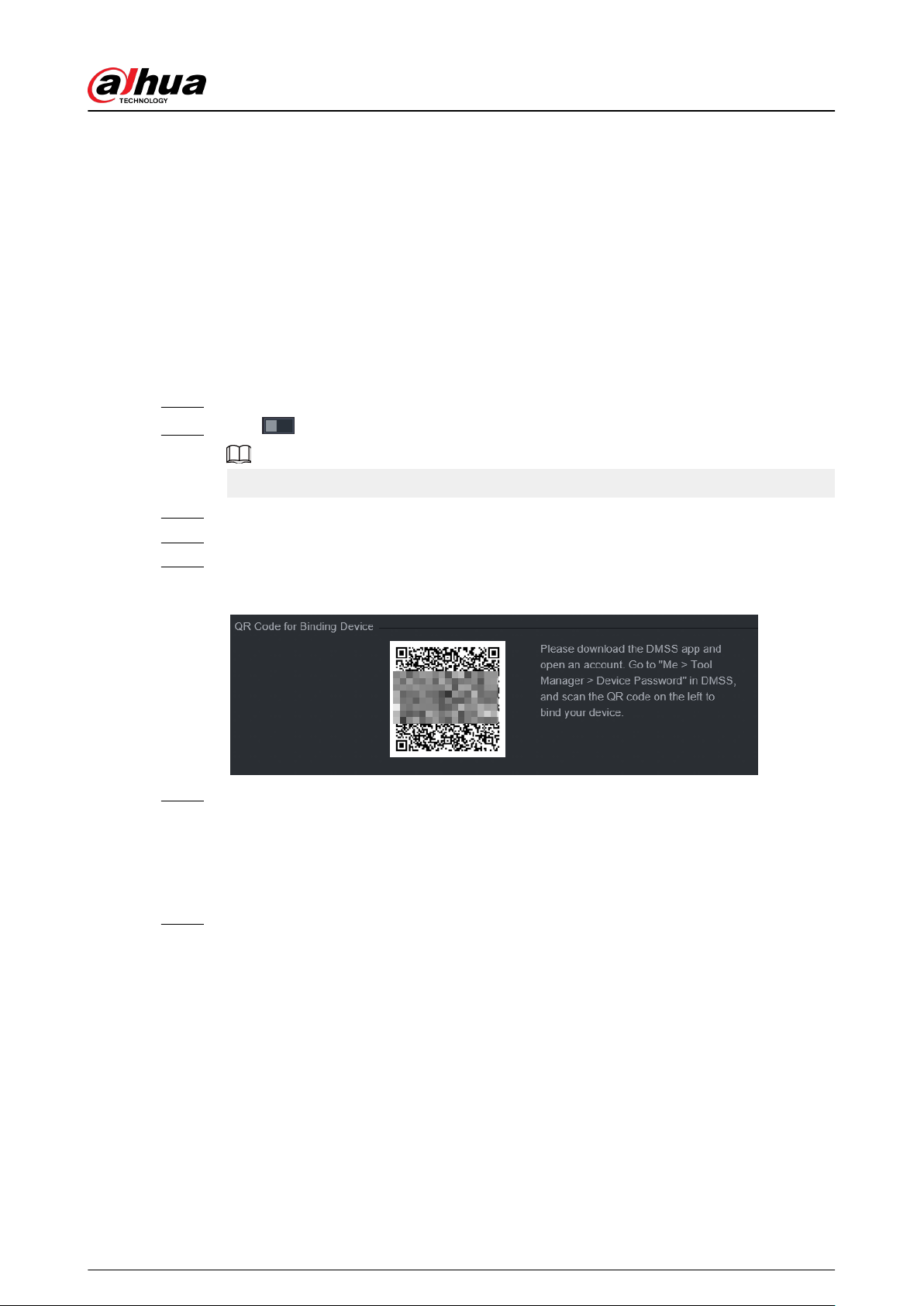
5.13.3 Resetting Password
You can reset the password when you forget the password.
5.13.3.1 Enabling Password Reset
Background Information
Enable the password reset function and congure the linked email address and security questions
that are used to reset the password.
Procedure
Step 1 Select Main Menu > ACCOUNT > Password Reset.
Step 2 Click to enable the password reset function.
This function is enabled by default.
Step 3 Enter an email address to receive the security code used to reset the password.
Step 4 Congure security questions and answers.
Step 5 (Optional) Follow the on-screen instructions to bind the Device to DMSS app.
Figure 5-252 Bind device
Step 6 Click OK.
5.13.3.2 Resetting Password on Local Page
Procedure
Step 1 Right-click the live page and then select any item on the shortcut menu.
●
If you have congured unlock pattern, the unlock pattern login window is displayed.
Click Forgot Pattern to switch to password login.
●
If you did not congure unlock pattern, the password login window is displayed.
User's Manual
372
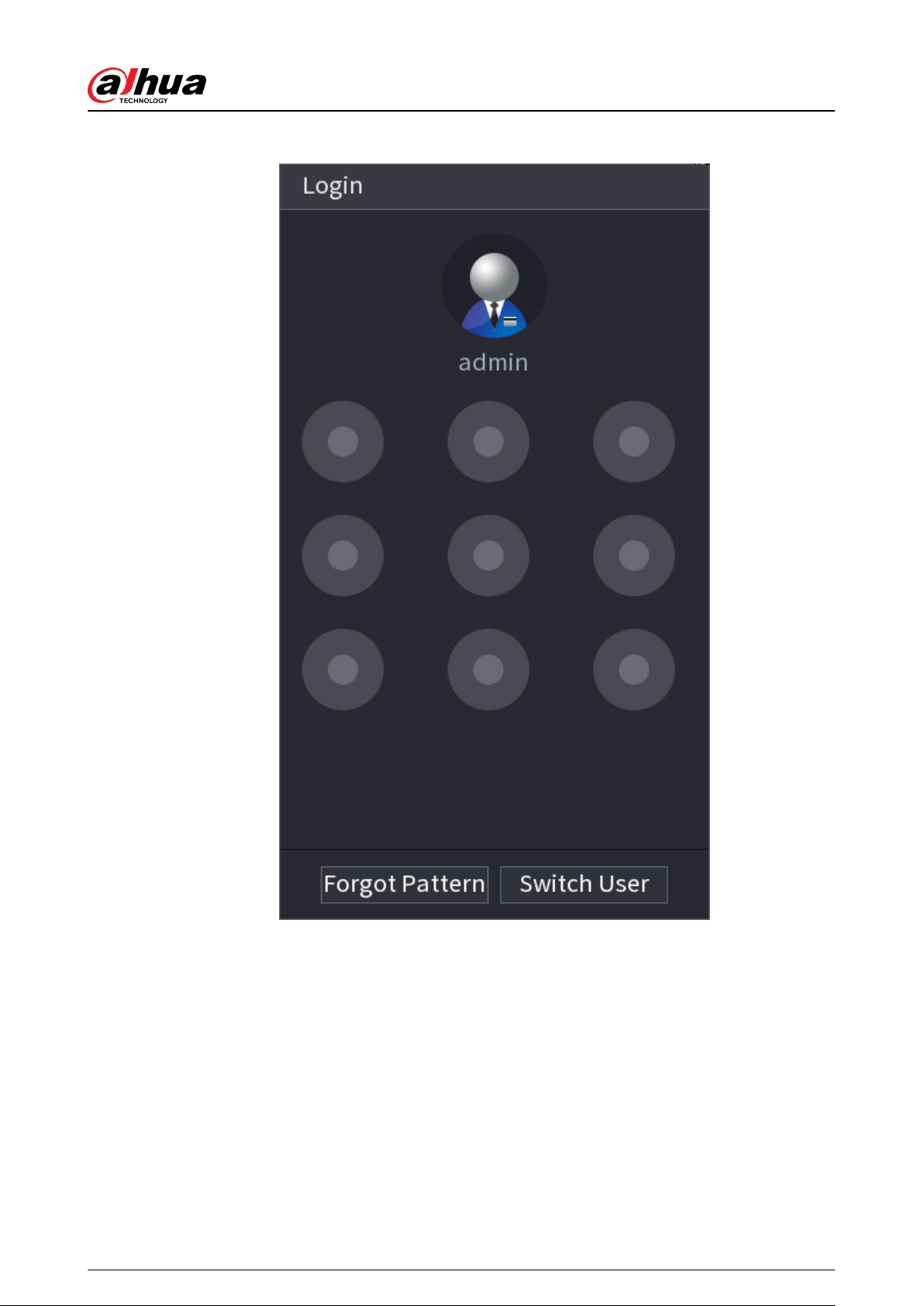
Figure 5-253 Pattern login
User's Manual
373
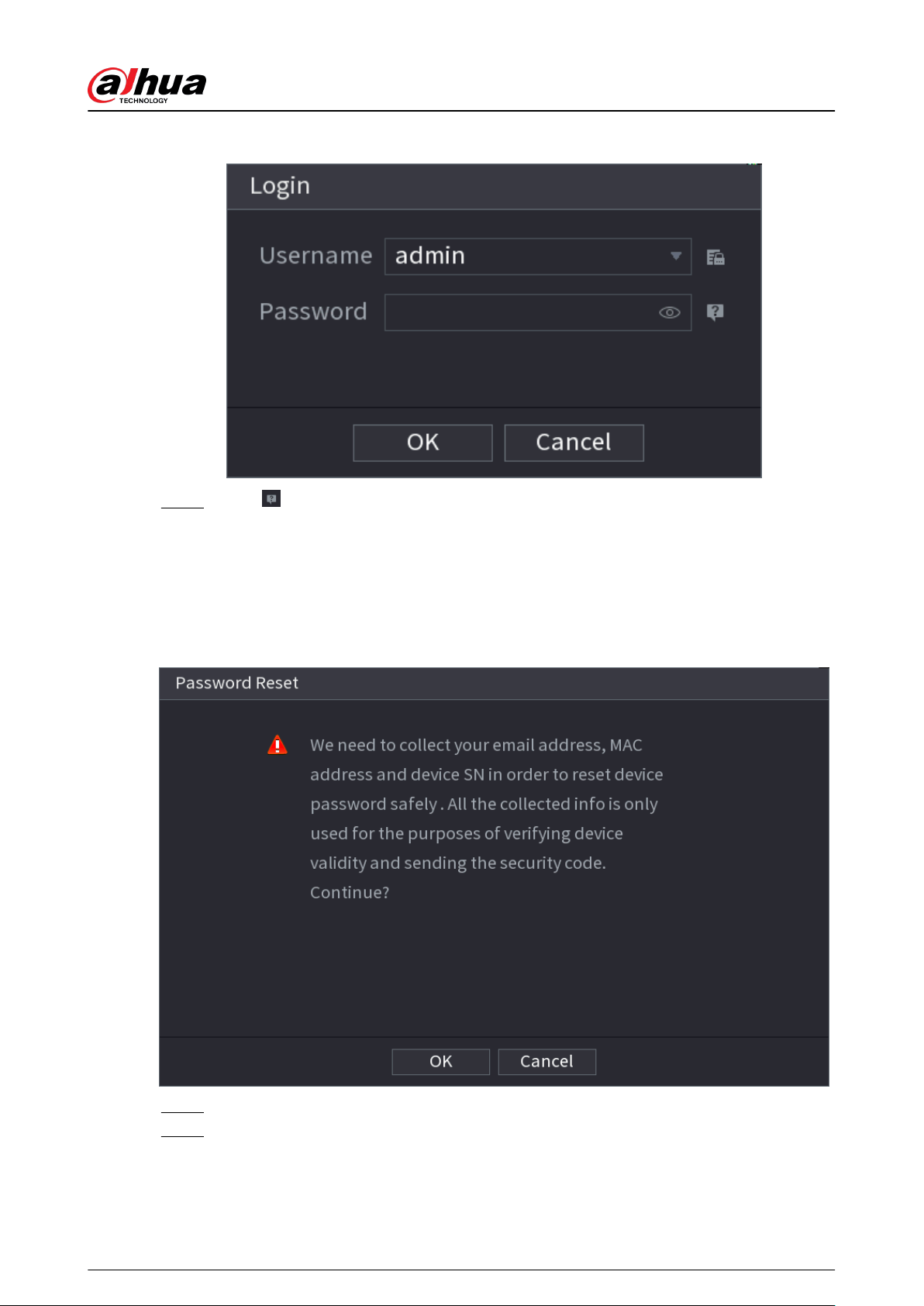
Figure 5-254 Password login
Step 2 Click .
●
If you have set the linked email address, the system will notify you of data collection
required for resetting password. Click OK.
●
If you did not set the linked email address, the system prompts you to enter an email
address. Enter the email address and then click Next. Then the system will notify you
of data collection required for resetting password.
Figure 5-255 Notication on data collection
Step 3 Read the prompt and then click OK.
Step 4 Click Next.
User's Manual
374
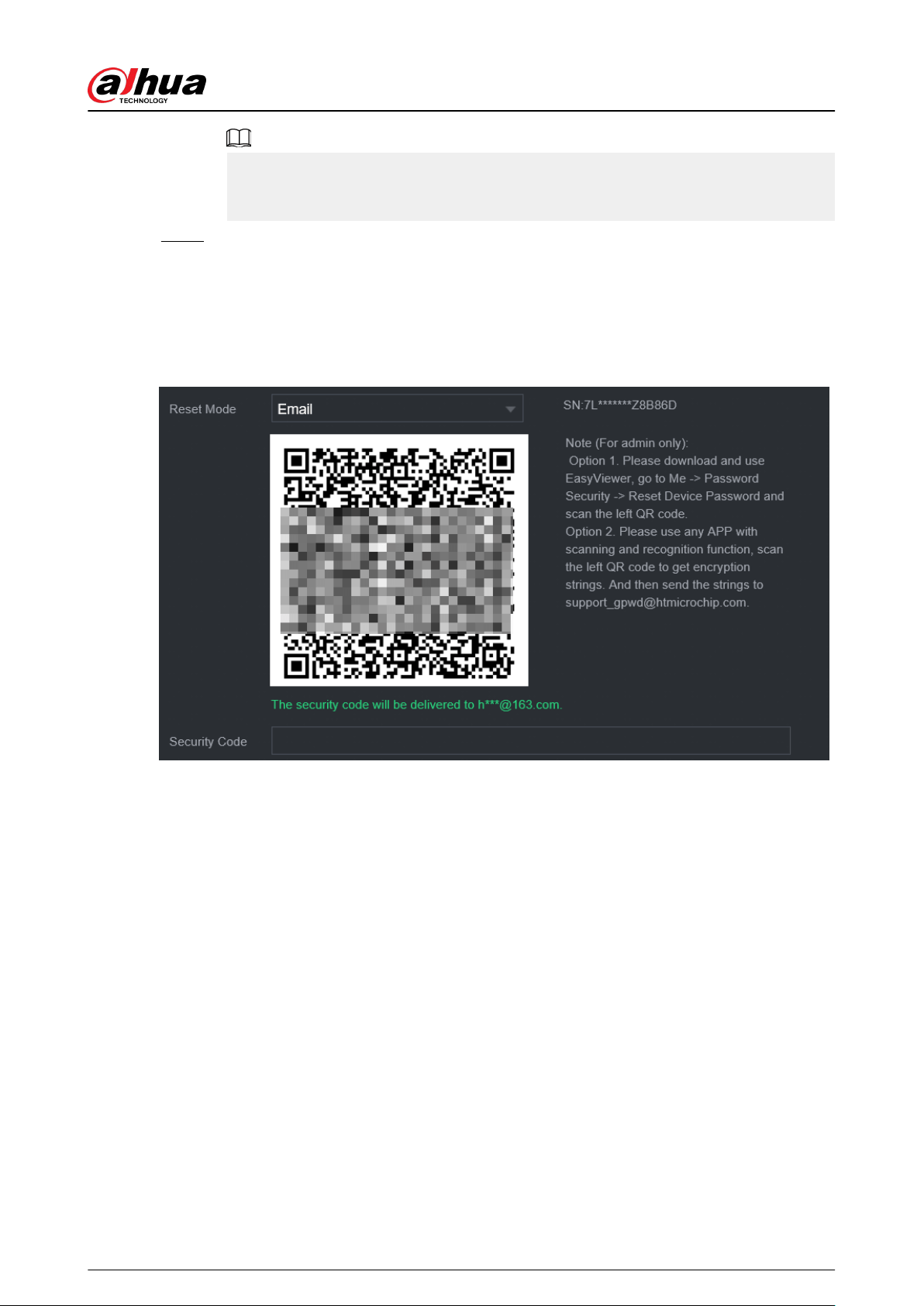
After clicking Next , the system will collect your information for password reset, purpose
and the information includes but not limited to email address, MAC address, and device
serial number. Read the prompt carefully before clicking Next.
Step 5 Reset the password.
●
Email.
Select Email as the reset mode, and then follow the on-screen instructions to get the
security code in your linked email address. After that, enter the security code in the
Security Code box.
Figure 5-256 Reset mode (email)
●
App.
Select QR Code for Binding Device as the reset mode, and then follow the on-screen
instructions to get the security code on the DMSS app. After that, enter the security
code in the Security Code box.
User's Manual
375
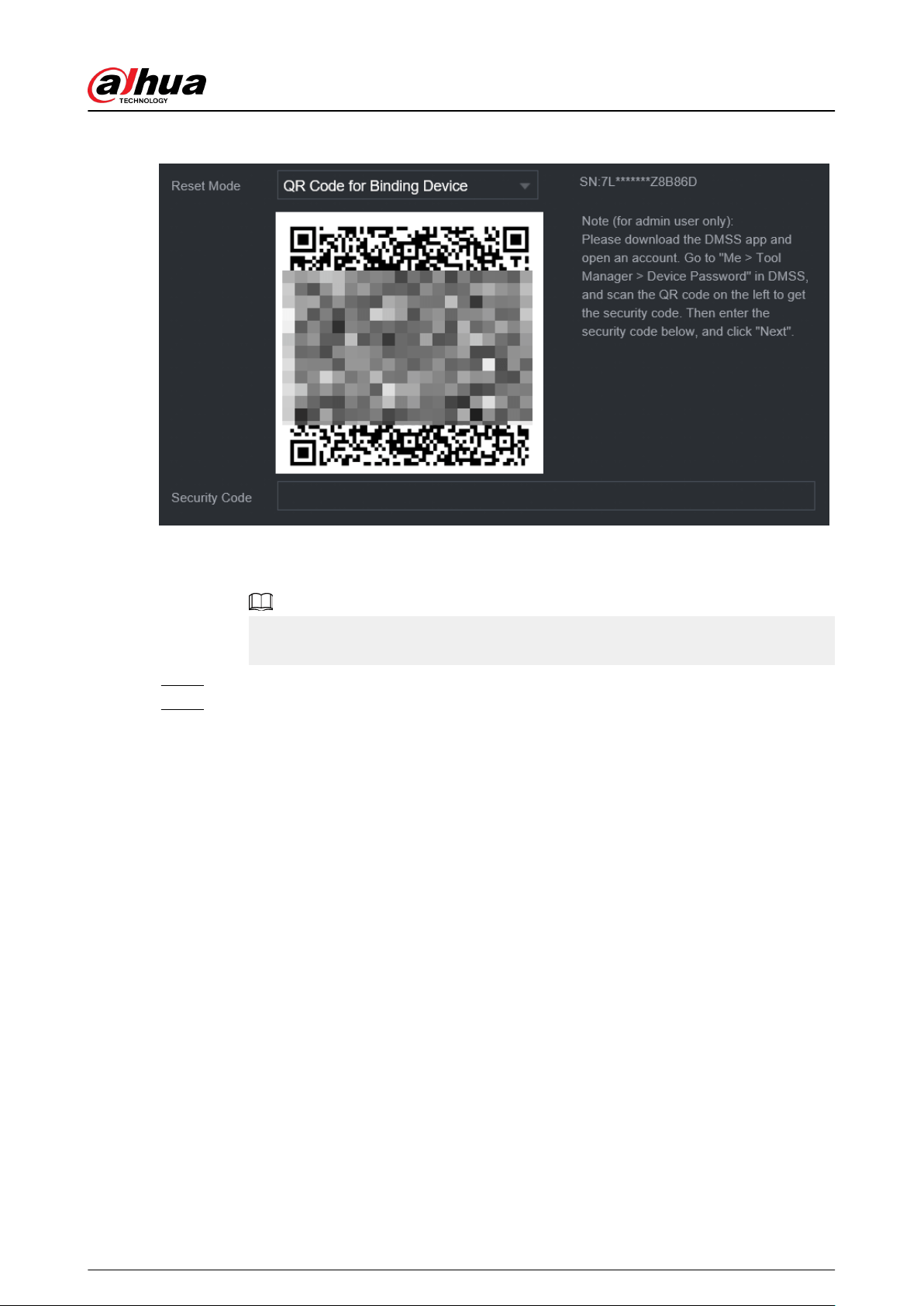
Figure 5-257 Reset mode (app)
●
Security question.
Select Security Question as reset mode and then answer the security questions.
If you did not congure the security questions in advance , Security Question is not
available on the Reset Mode list.
Step 6 Click Next.
Step 7 Enter the new password and then enter the password again to conrm it.
User's Manual
376
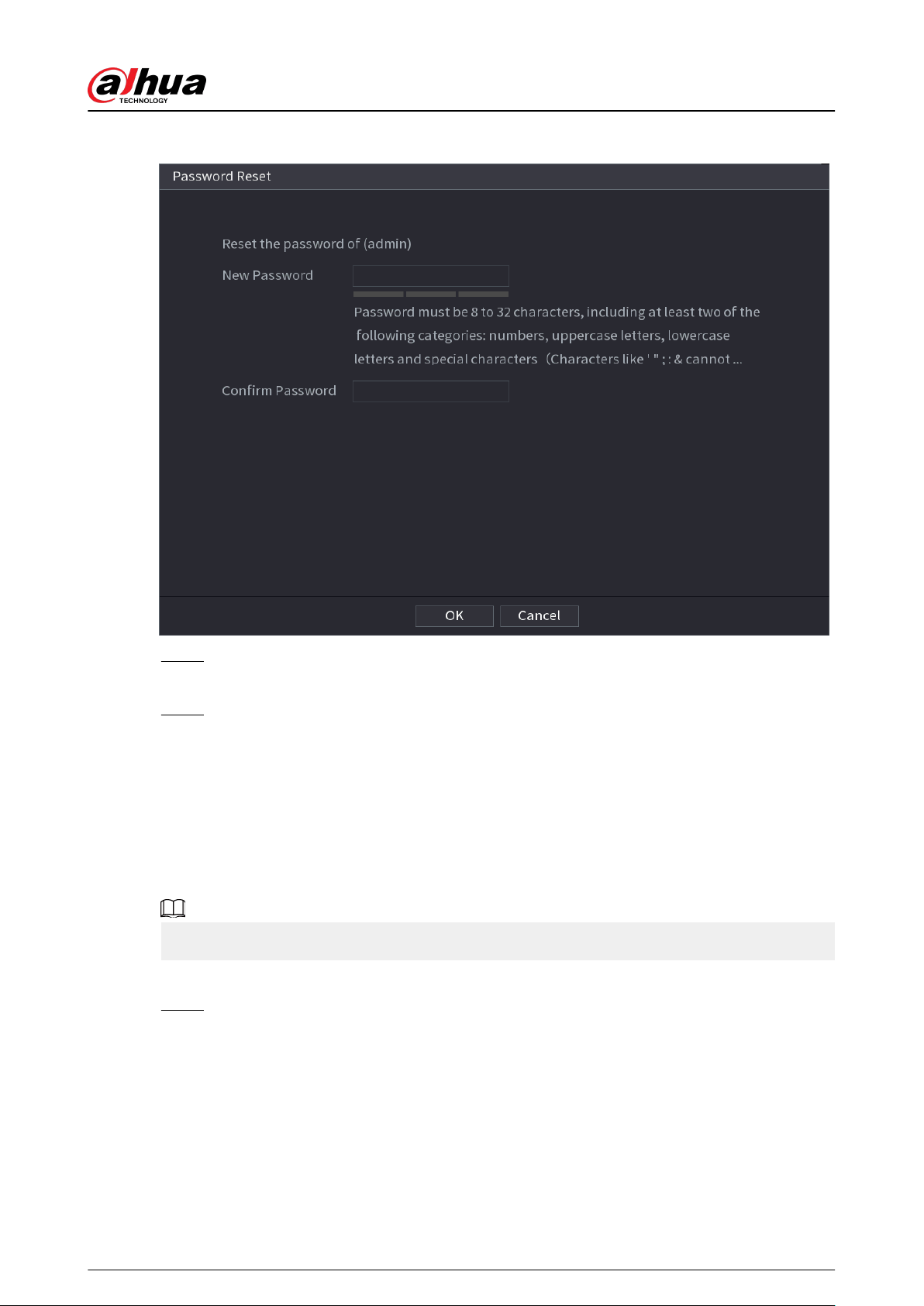
Figure 5-258 Enter new password
Step 8 Click OK.
The password is reset.
Step 9 (Optional) When the system prompts whether to synchronize the password with the
remote devices accessed through the private protocol, click OK to synchronize the
password.
5.13.4 ONVIF User
Background Information
To connect the camera from the third party to the NVR via the ONVIF protocol, you need to use a
veried ONVIF account.
The default ONVIF user is admin. It is created after you initialize the NVR and cannot be deleted.
Procedure
Step 1 Select Main Menu > ACCOUNT > ONVIF User.
User's Manual
377
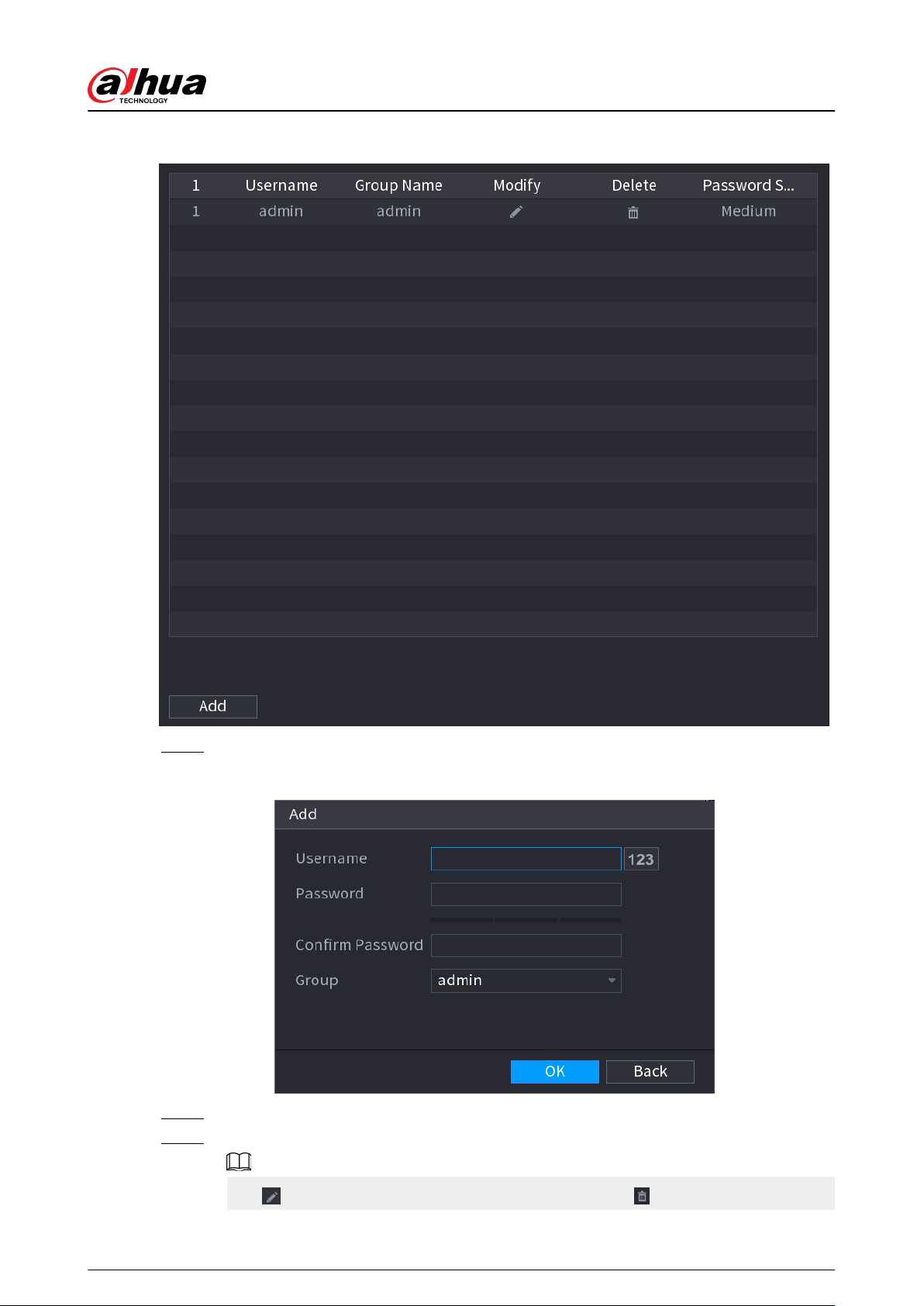
Figure 5-259 ONVIF user
Step 2 Click Add.
Figure 5-260 Add ONVIF user
Step 3 Congure username, password and user group.
Step 4 Click OK.
Click to modify the corresponding user information, click to delete current user.
User's Manual
378
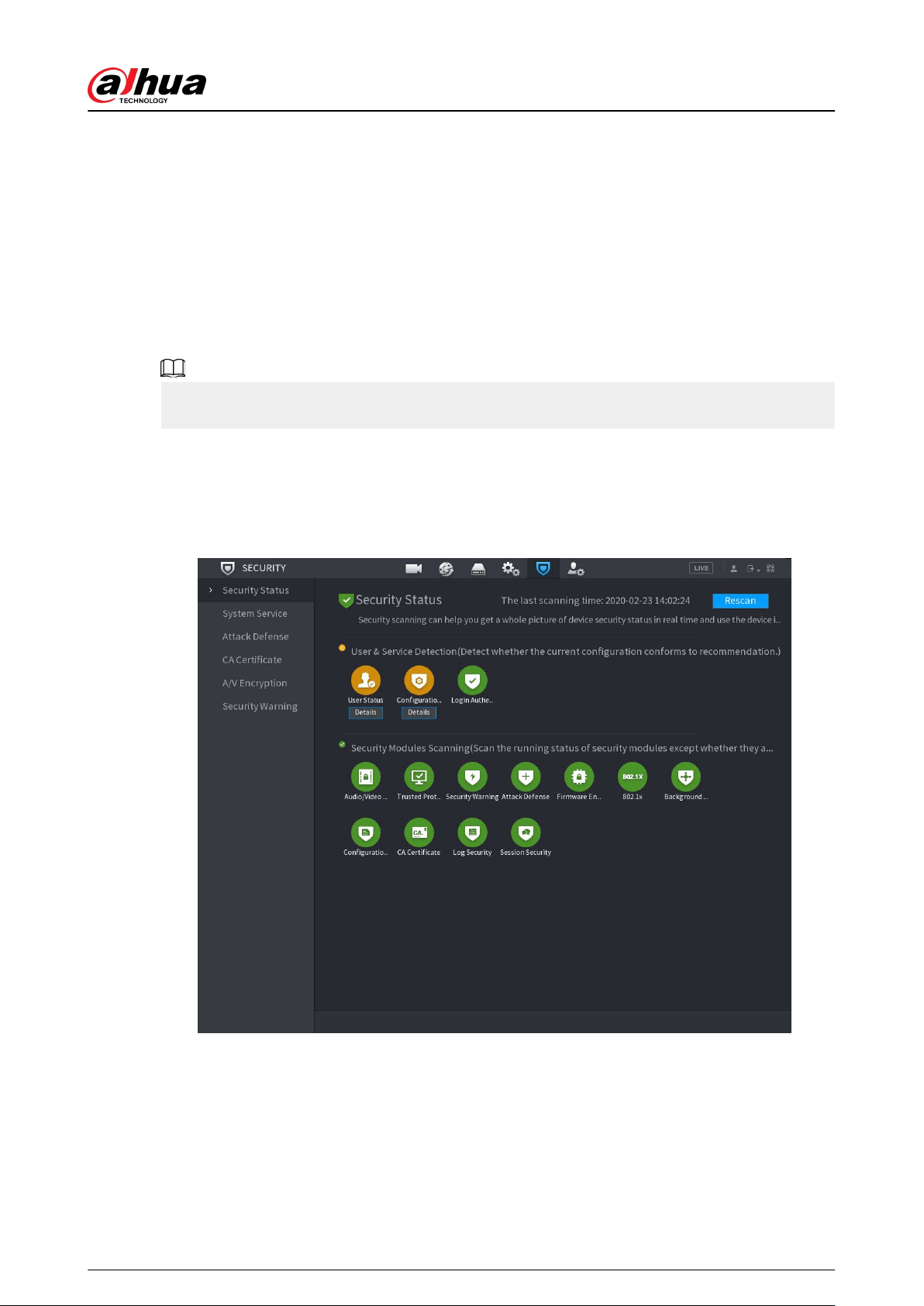
5.14 Security
5.14.1 Security Status
Security scanning helps get a whole picture of device security status. You can scan user, service and
security module status for detailed information on the security status of the device.
Detecting User and Service
Green icon represents a healthy status of the scanned item, and orange icon represents a risky
status.
●
Login authentication: When there’s a risk in the device conguration, the icon will be in orange
to warn risk. You can click Details to see the detailed risk description.
●
User Status: When one of device users or ONVIF users uses weak password, the icon will be in
orange to warn risk. You can click Details to optimize or ignore the risk warning.
Figure 5-261 Security status
User's Manual
379
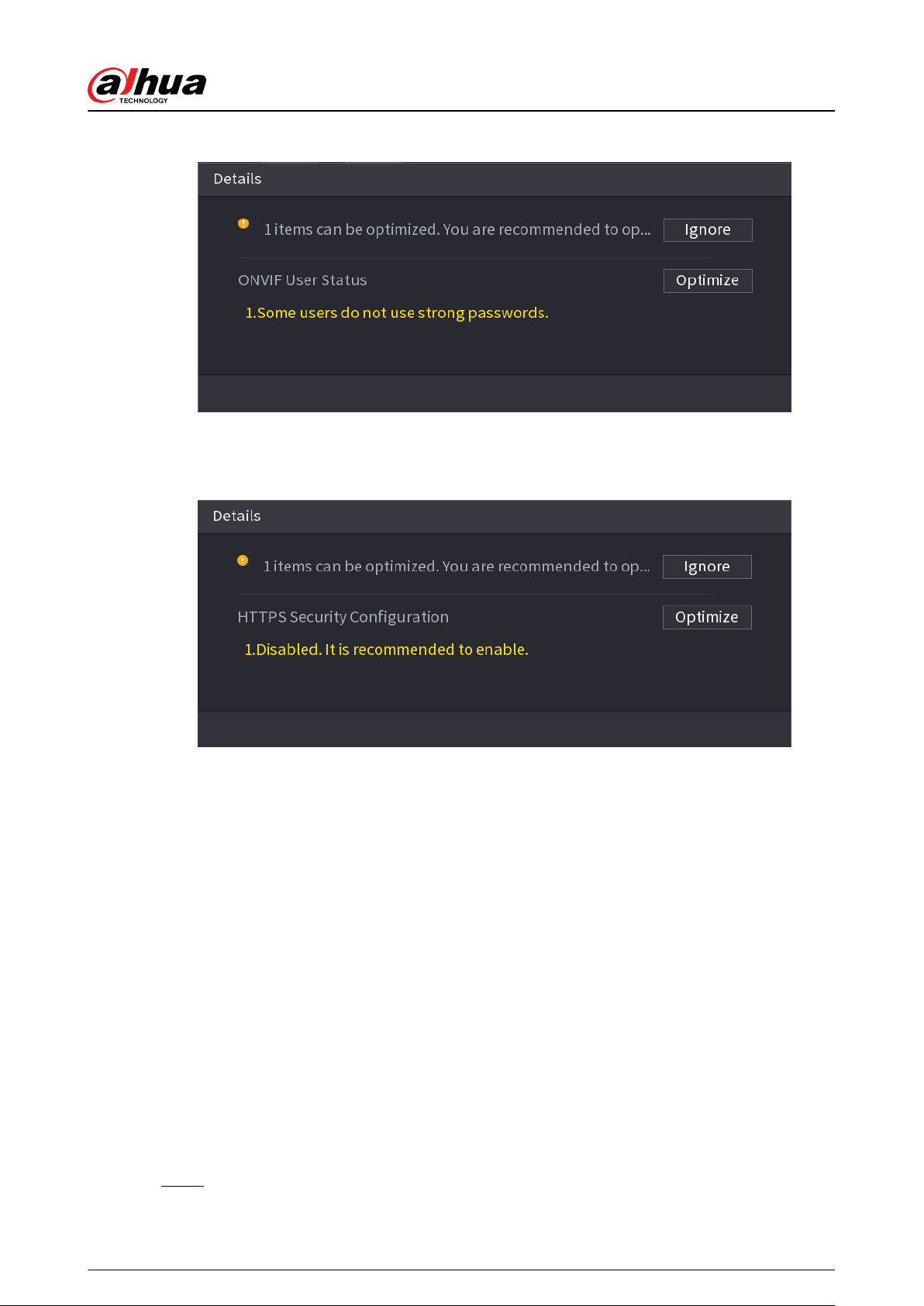
Figure 5-262 Details (1)
●
Conguration Security: When there’s a risk in the device conguration, the icon will be in orange
to warn risk. You can click Details to see the detailed risk description.
Figure 5-263 Details (2)
Scanning Security Modules
This area shows the running status of security modules. For details about the security modules,
point to the icon to see the on-screen instructions.
Re-scanning Security Status
You can click Rescan to scan security status.
5.14.2 System Service
You can set NVR basic information such as basic services, 802.1x and HTTPS.
5.14.2.1 Basic Services
Procedure
Step 1 Select Main Menu > SECURITY > System Service > Basic Services.
User's Manual
380
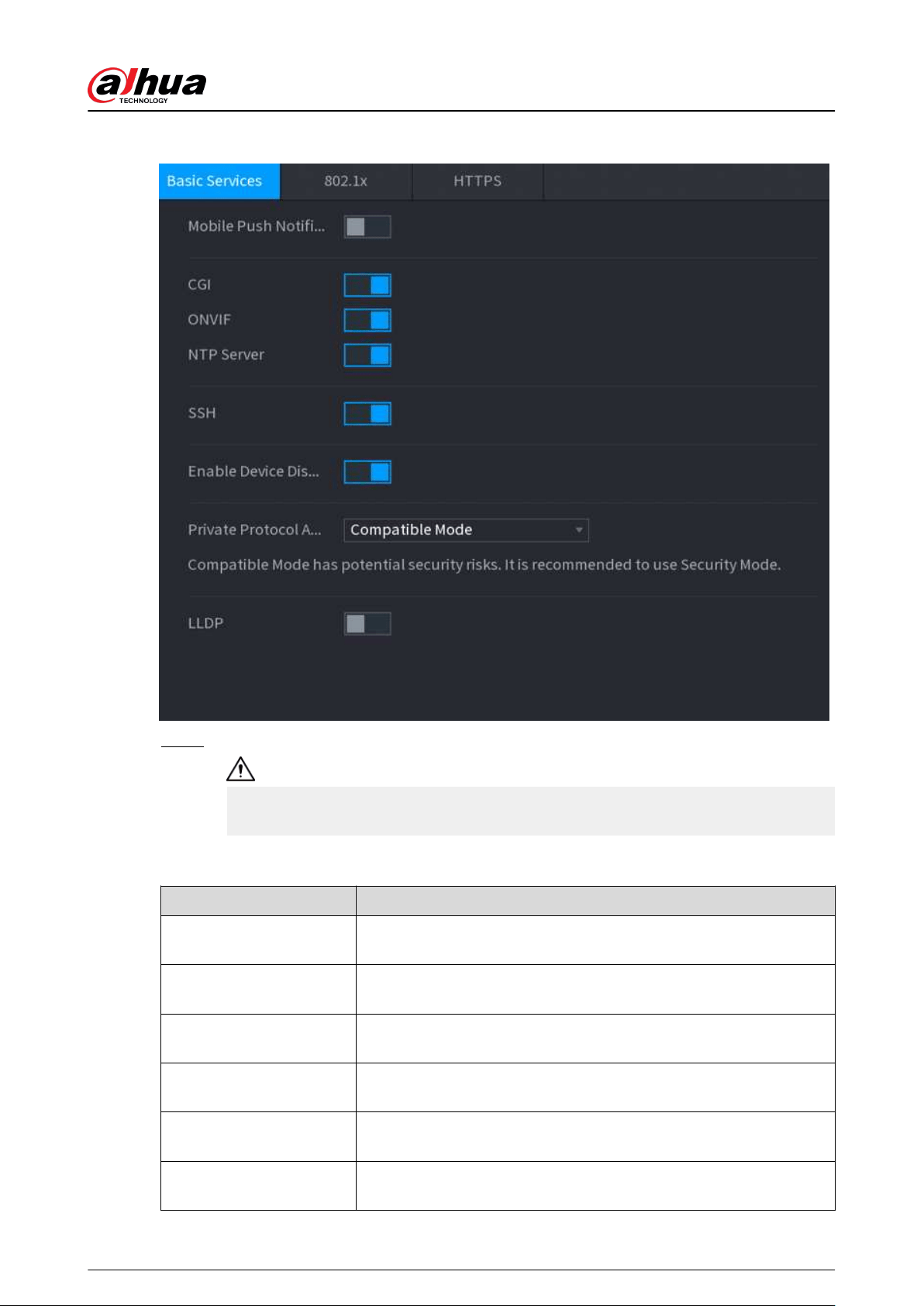
Figure 5-264 Basic services
Step 2 Enable the system services.
There might be safety risk when Mobile Push Notications, CGI, ONVIF, SSH and NTP
Server is enabled. Disable these functions when they are not needed.
Table 5-75 Basic service parameters
Parameter Description
Mobile Push Notications
After enabling this function, the alarm triggered by the NVR can be
pushed to a mobile phone. This function is enabled by default.
CGI
If this function is enabled, the remote devices can be added through
the CGI protocol. This function is enabled by default.
ONVIF
If this function is enabled, the remote devices can be added through
the ONVIF protocol. This function is enabled by default.
NTP Server
After enabling this function, a NTP server can be used for time
synchronization. This function is enabled by default.
SSH
After enabling this function, you can use SSH service. This function is
disabled by default.
Enable Device Discovery
After enabling this function, the NVR can be found by other devices
through searching.
User's Manual
381
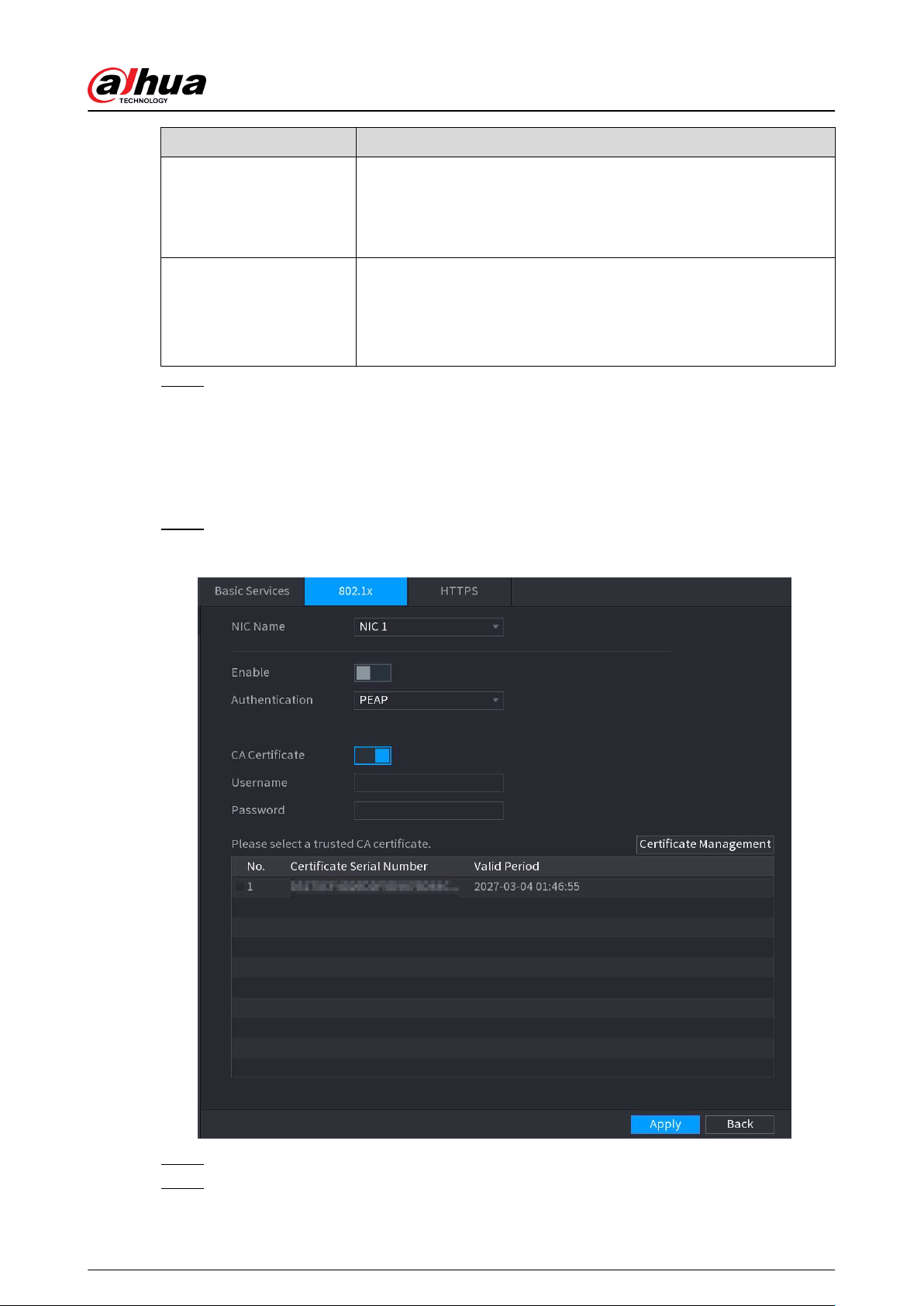
Parameter Description
Private Protocol
Authentication Mode
●
Security Mode (Recommended): Uses Digest access
authentication when connecting to NVR.
●
Compatible Mode: Select this mode when the client does not
support Digest access authentication.
LLDP
Enable the LLDP service.
The Link Layer Discovery Protocol (LLDP) allows two dierent devices
to collect hardware and protocol information about neighboring
devices, which is useful in troubleshooting the network.
Step 3 Click Apply.
5.14.2.2 802.1x
The Device needs to pass 802.1x certication to enter the LAN.
Procedure
Step 1 Select Main Menu > SECURITY > System Service > 802.1x.
Figure 5-265 802.1x
Step 2 Select the Ethernet card you want to certify.
Step 3 Select Enable and congure parameters.
User's Manual
382
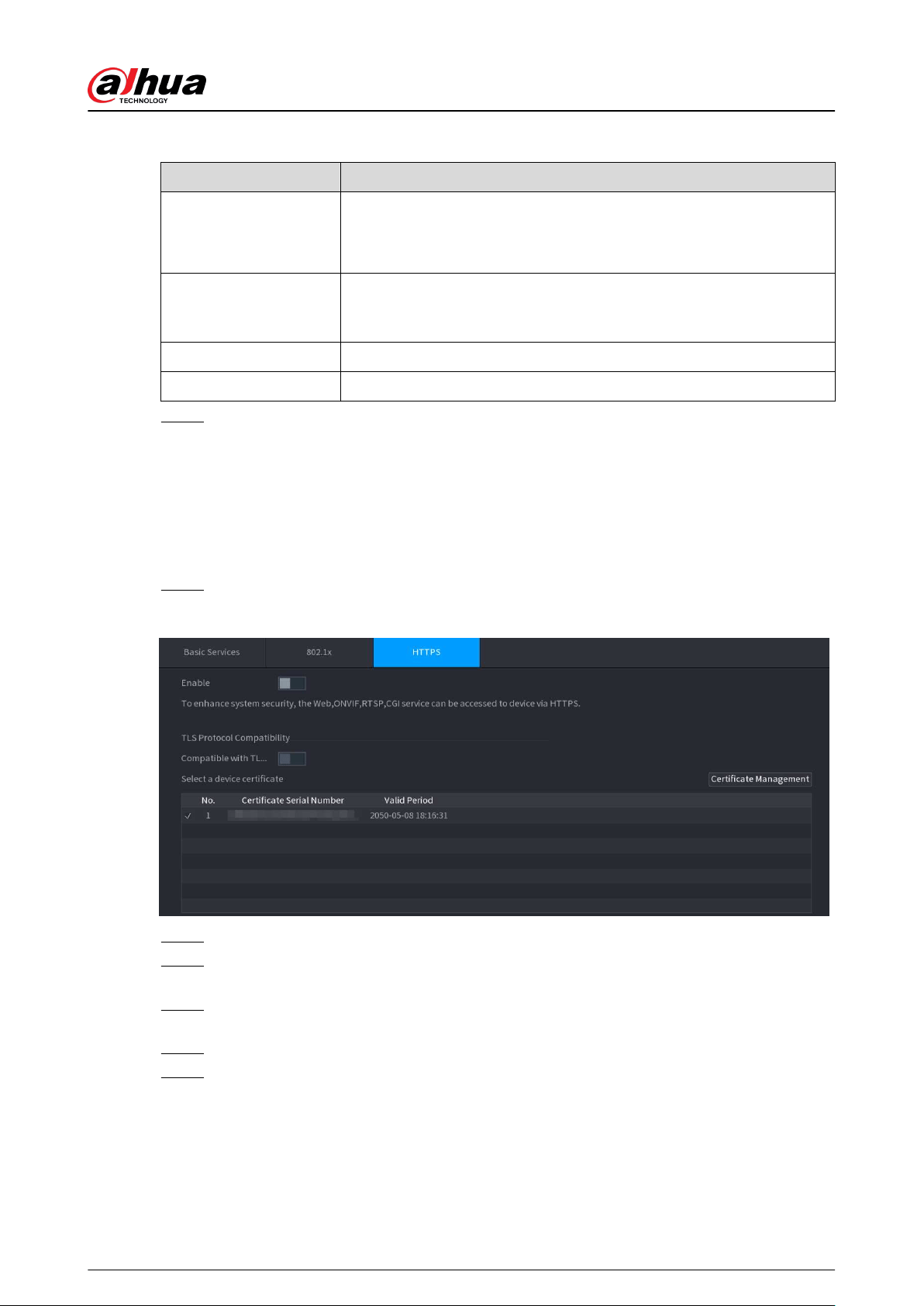
Table 5-76 802.1x parameters
Parameter Description
Authentication
●
PEAP: protected EAP protocol.
●
TLS: Transport Layer Security. Provide privacy and data integrity
between two communications application programs.
CA Certicate
Enable it and click Browse to import CA certicate from ash drive. For
details about importing and creating a certicate, see "5.14.4 CA
Certicate".
Username The username shall be authorized at server.
Password Password of the corresponding username.
Step 4 Click Apply.
5.14.2.3 HTTPS
Background Information
We recommend you enable HTTPS function to enhance system security.
Procedure
Step 1 Select Main Menu > SECURITY > System Service > HTTPS.
Figure 5-266 HTTPS
Step 2 Enable HTTPS function.
Step 3 (Optional) Enable Compatible with TLSv1.1 and earlier versions to allow protocol
compatibility.
Step 4 Click Certicate Management to create or import a HTTPS certicate from USB drive. For
details about importing or creating a CA certicate, see "5.14.4 CA Certicate".
Step 5 Select a HTTPS certicate.
Step 6 Click Apply.
User's Manual
383
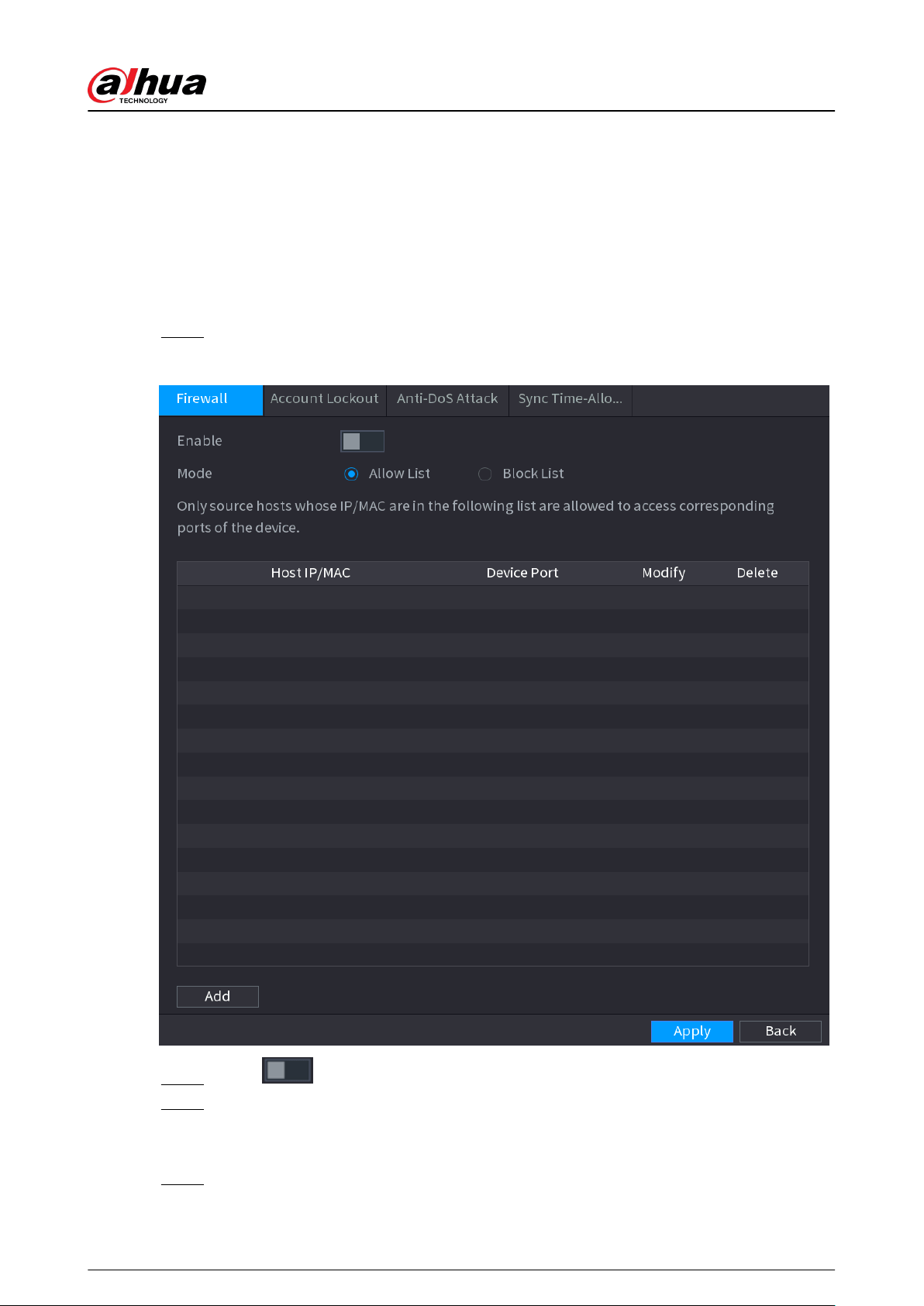
5.14.3 Attack Defense
5.14.3.1 Firewall
Background Information
You can congure the hosts that are allowed or prohibited to access the Device.
Procedure
Step 1 Select Main Menu > SECURITY > Attack Defense > Firewall .
Figure 5-267 Firewall
Step 2 Click to enable the rewall.
Step 3 Select a rewall mode.
●
Allow List : The hosts on the allowlist can access the Device.
●
Block List : The hosts on the blocklist are prohibited to access the Device.
Step 4 Click Add and then select a type for the allowlist or blocklist.
User's Manual
384
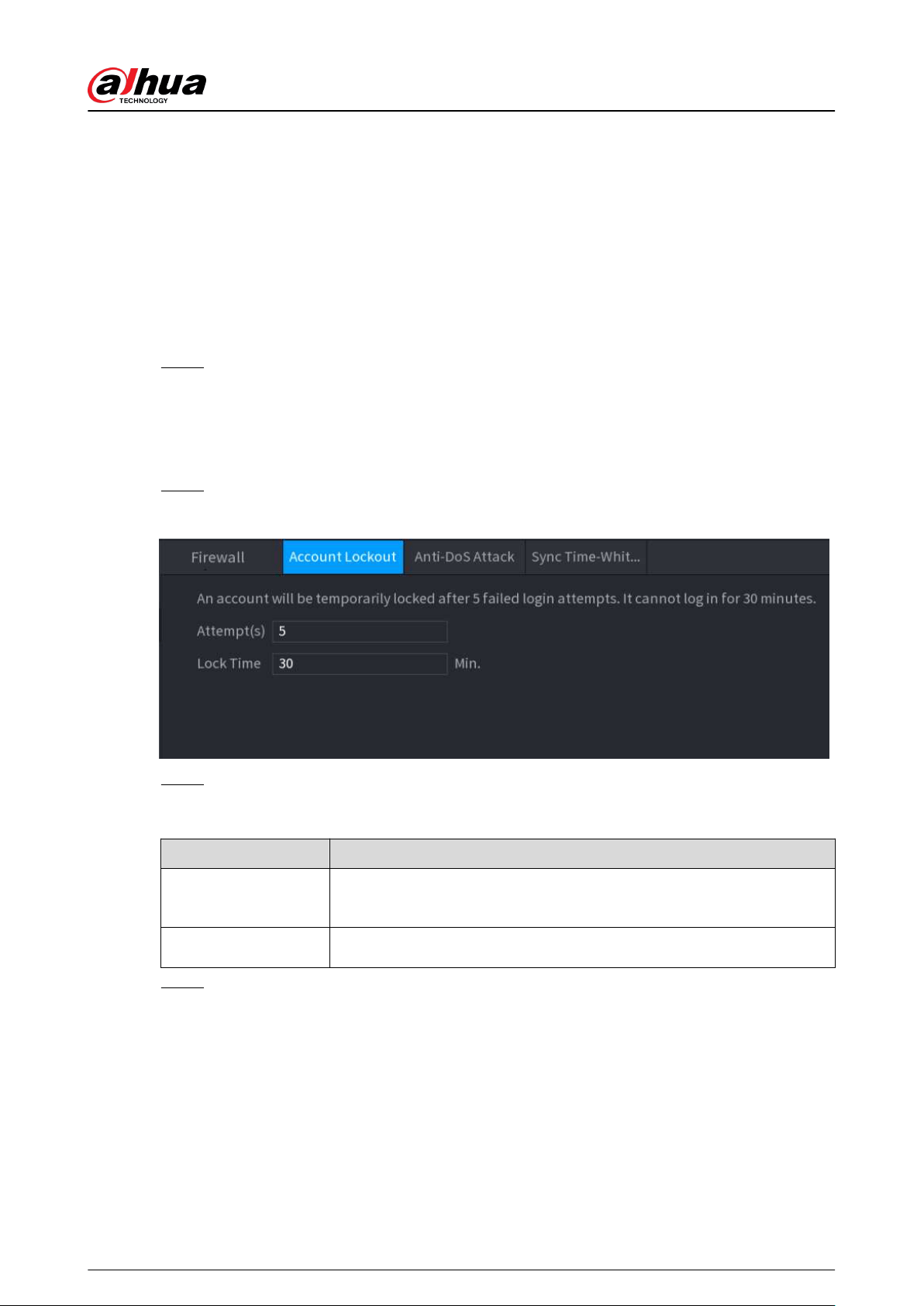
You can allow or prohibit hosts through a specic IP address, a network segment, or a
MAC address.
●
IP address.
Enter the IP address, start port and end port, and then click OK.
●
IP segment.
Enter the start address and end address, starting port and ending port, and then click
OK.
●
MAC address.
Enter the MAC address, and then click OK.
Step 5 Click Apply.
5.14.3.2 Account Lockout
Procedure
Step 1 Select Main Menu > SECURITY > Attack Defense > Account Lockout.
Figure 5-268 Account lockout
Step 2 Set parameters.
Table 5-77 Account lockout parameters
Parameter Description
Attempt(s)
Set the maximum number of allowable wrong password entries. The
account will be locked after your entries exceed the maximum number.
Lock Time Set how long the account is locked for.
Step 3 Click Apply.
5.14.3.3 Anti-DoS Attack
You can enable SYN Flood Attack Defense and ICMP Flood Attack Defense to defend the Device
against Dos attack.
User's Manual
385
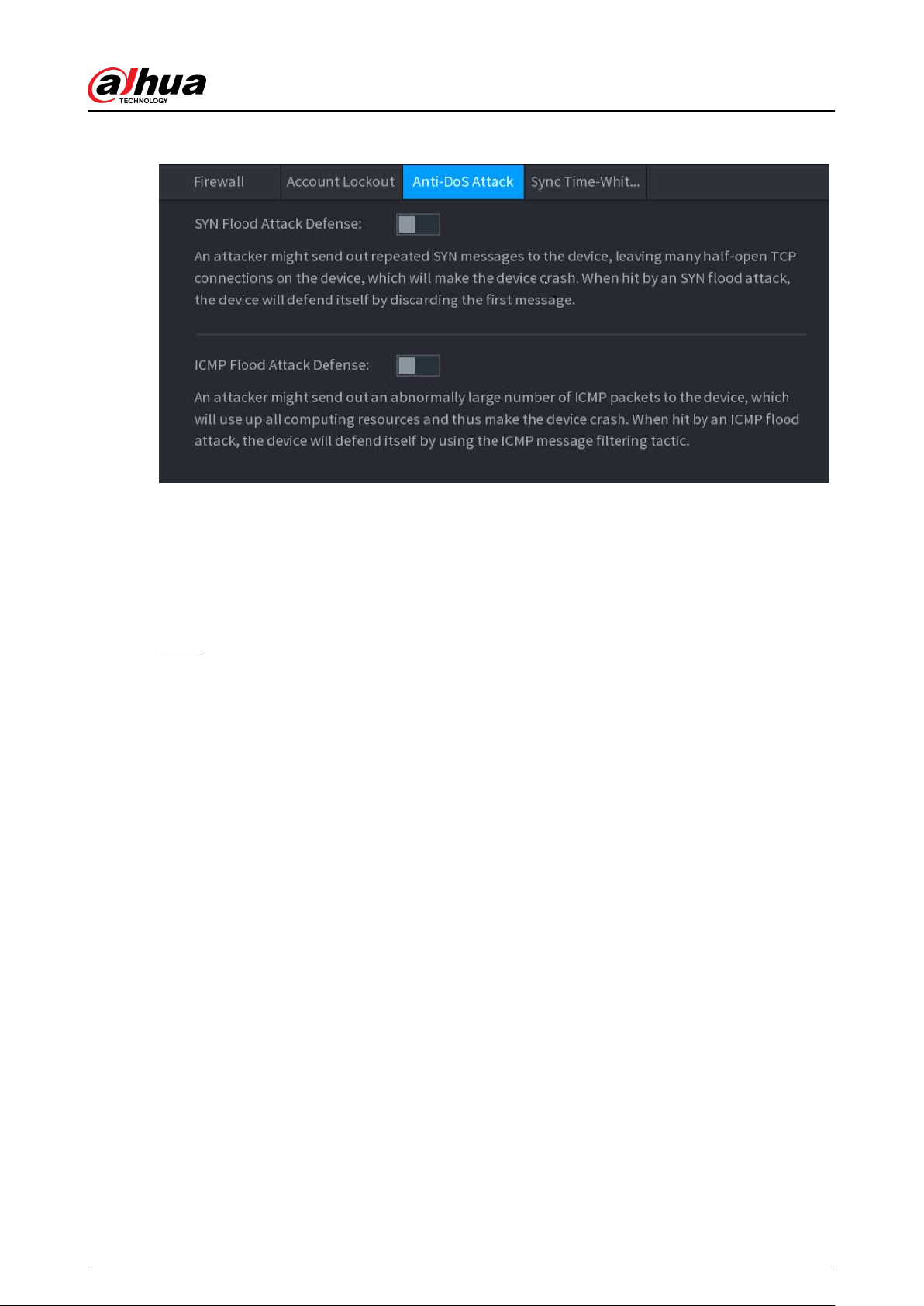
Figure 5-269 Anti-Dos Attack
5.14.3.4 Sync Time-Allowlist
Background Information
You can congure which hosts are allowed to synchronize time with the Device.
Procedure
Step 1 Select Main Menu > SECURITY > Attack Defense > Sync Time-Allowlist.
User's Manual
386
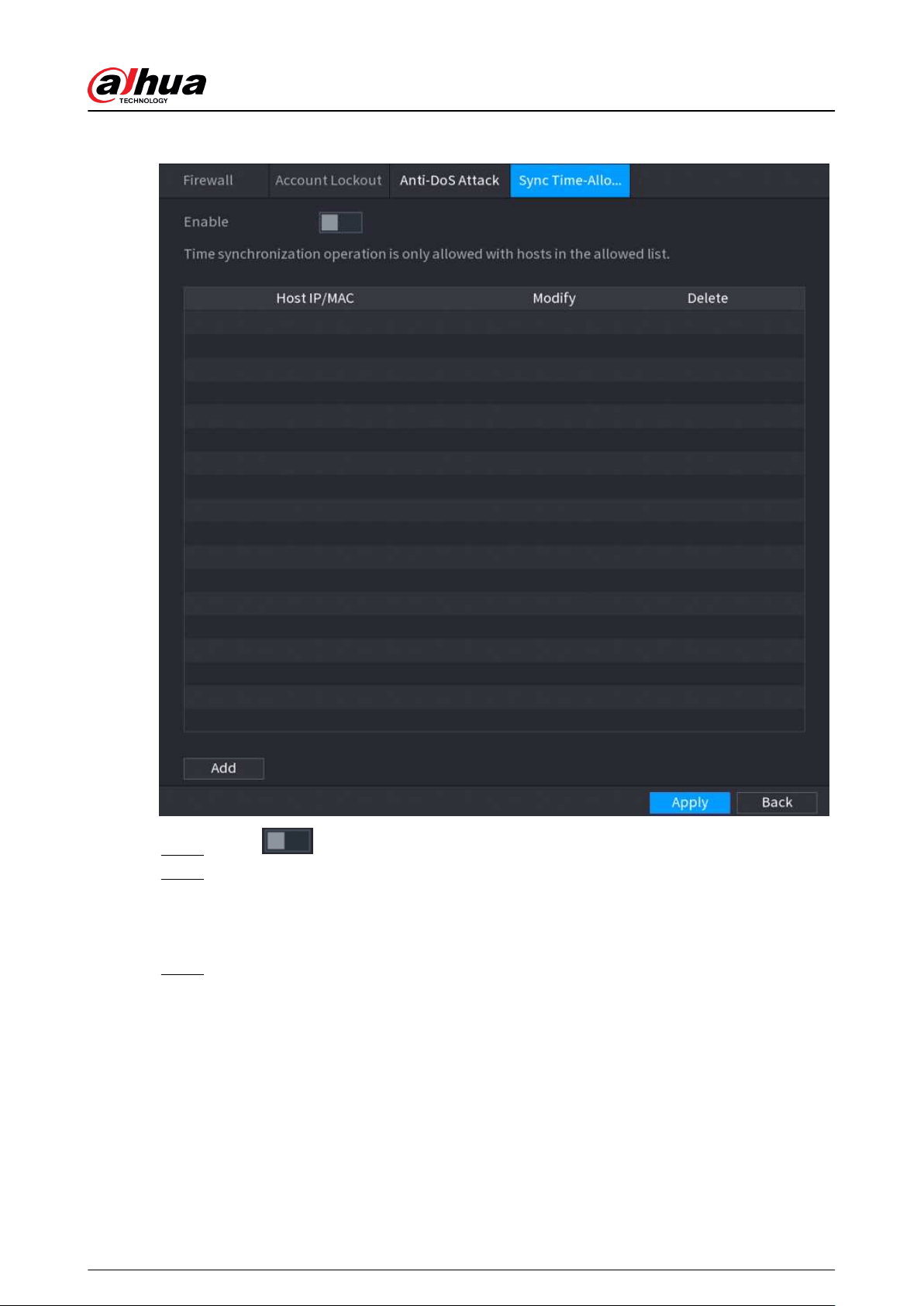
Figure 5-270 Sync Time-Allowlist
Step 2 Click to enable the function.
Step 3 Click Add to add trusted hosts for time synchronization.
●
If you set Type to IP Address, enter the IP address, and then click OK.
●
If you set Type to IP Segment, enter the start address and end address, and then click
OK.
Step 4 Click Apply.
5.14.4 CA Certicate
5.14.4.1 Device Certicate
Create Certicate
1. Select Main Menu > SECURITY > CA Certicate > Device Certicate.
User's Manual
387
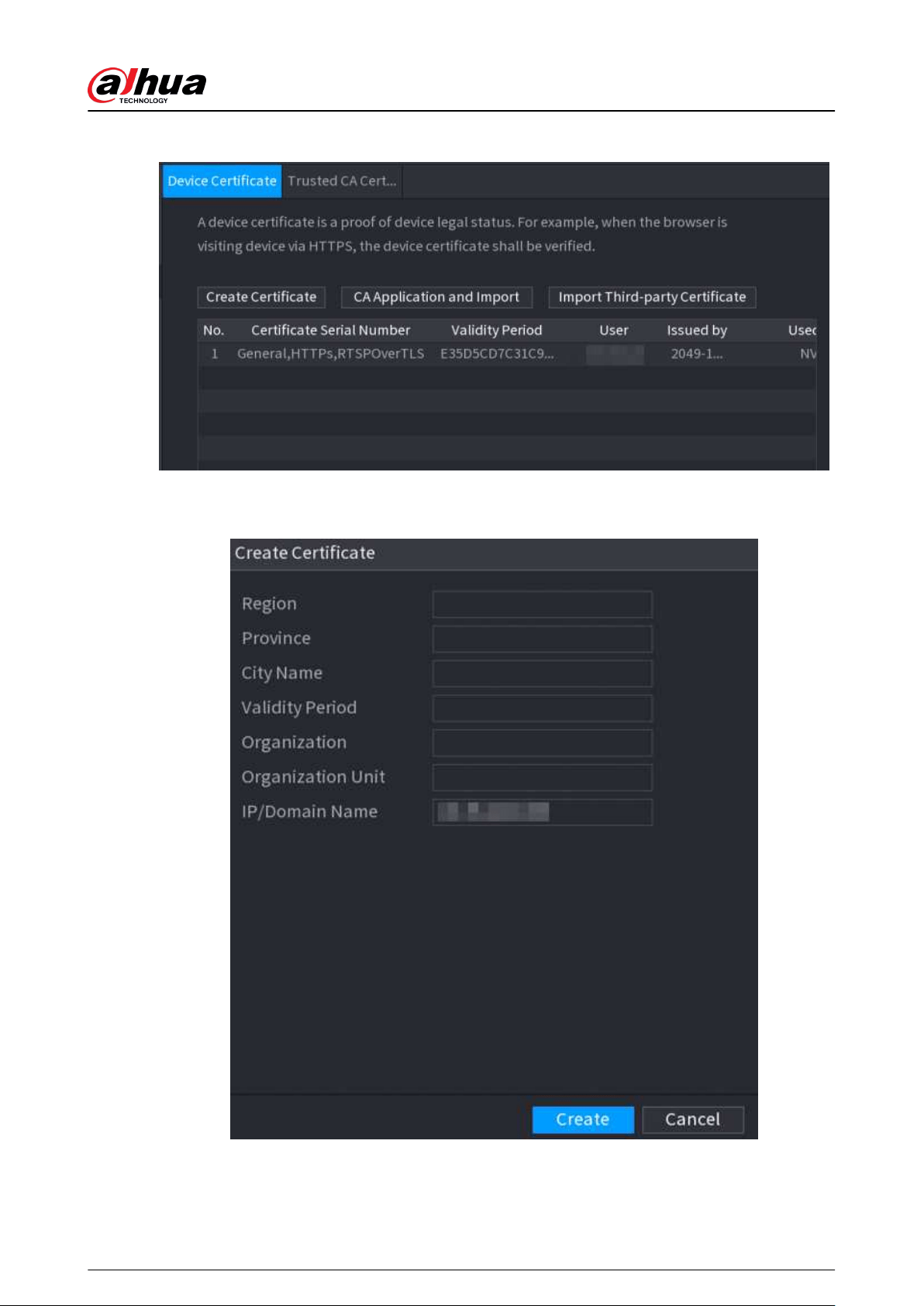
Figure 5-271 Device certicate
2. Click Create Certicate.
Figure 5-272 Create certicate
3. Congure the parameters.
4. Click Create.
User's Manual
388
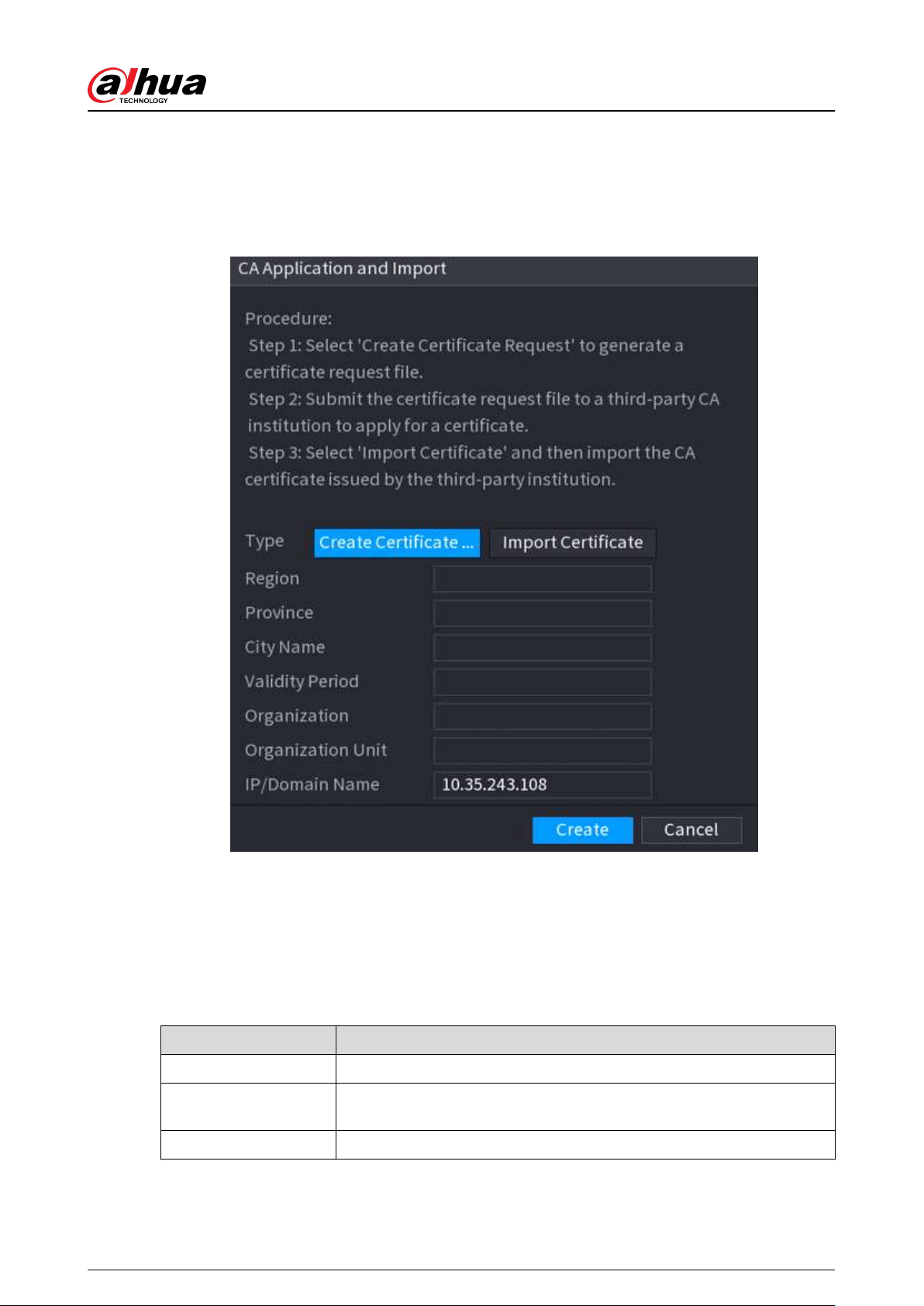
CA Application and Import
Click CA Application and Import and then follow the on-screen instructions to nish CA
application and import.
Figure 5-273 CA application and import
Import Third-Party Certicate
1. Click Import Third-Party Certicate
2. Congure the parameters.
Table 5-78 Parameters for importing third-party certicate
Parameter Description
Path Click Browse to nd the third-party certicate path on the USB drive.
Private Key
Click Browse to nd the third-party certicate private key on the USB
drive.
Private Key Password Input the private key password.
3. Click Create.
User's Manual
389
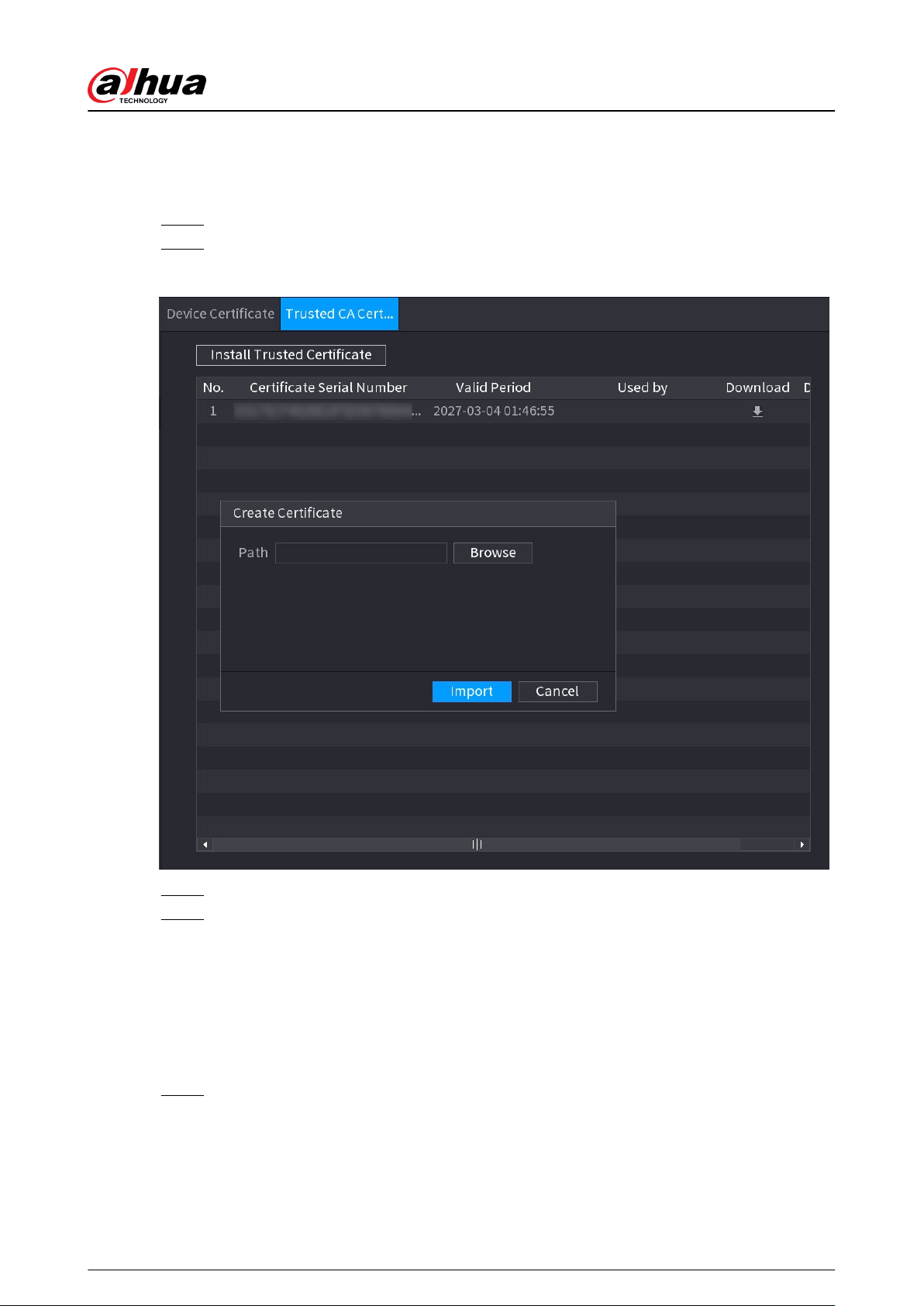
5.14.4.2 Trusted CA Certicate
Procedure
Step 1 Select Main Menu > SECURITY > CA Certicate > Trusted CA Certicate.
Step 2 Click Install Trusted Certicate.
Figure 5-274 Create certicate
Step 3 Click Browse to select the certicate that you want to install.
Step 4 Click Import.
5.14.5 Audio/Video Encryption
Background Information
The Device supports audio and video encryption during data transmission.
Procedure
Step 1 Select Main Menu > SECURITY > AUDIO/VIDEO ENCRYPTION > Audio/Video
Transmission.
User's Manual
390
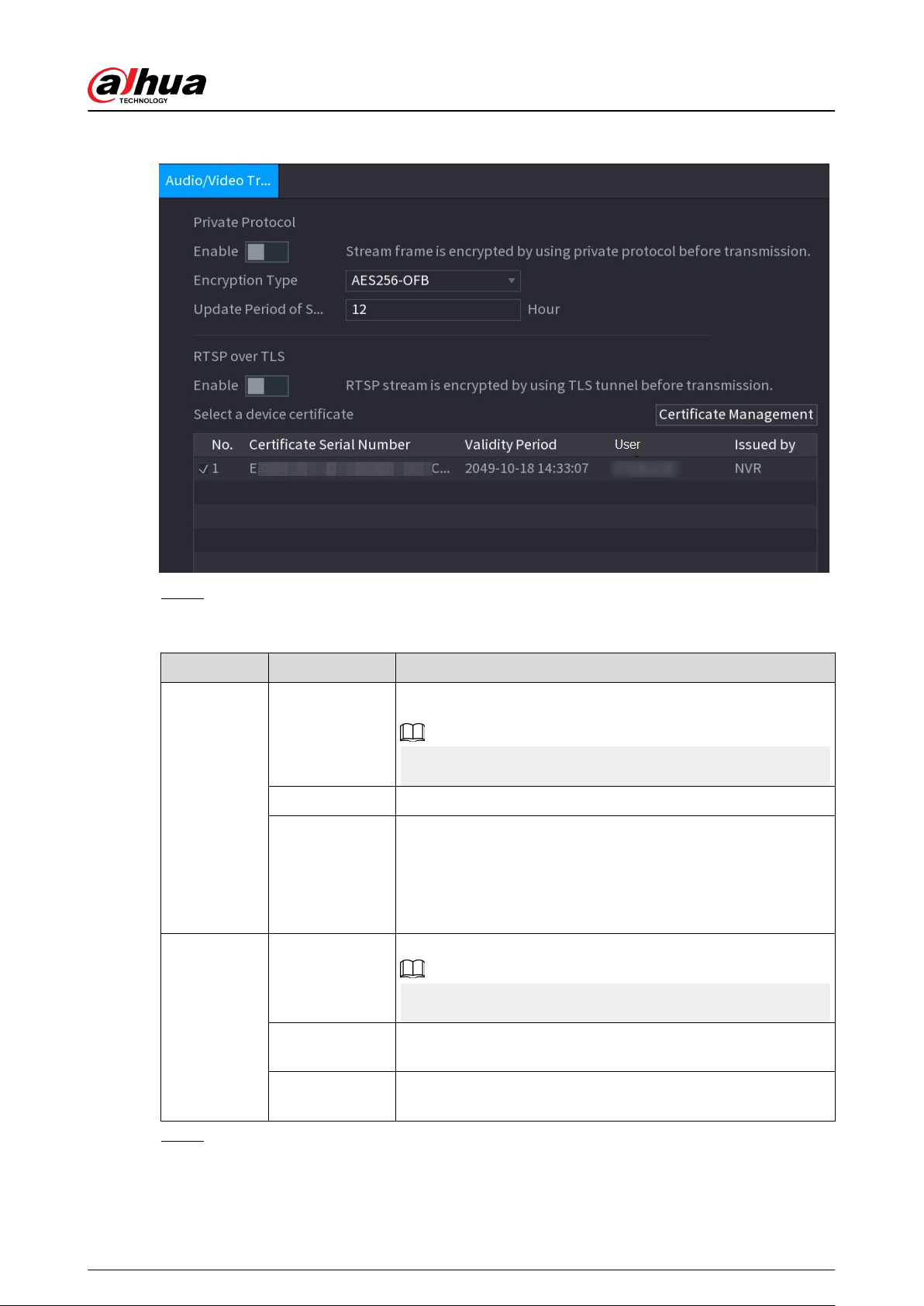
Figure 5-275 Audio and video transmission
Step 2 Congure parameters.
Table 5-79 Audio and video transmission parameters
Area Parameter Description
Private
Protocol
Enable
Enables stream frame encryption by using private protocol.
There might be safety risk if this service is disabled.
Encryption Type Use the default setting.
Update Period of
Secret Key
Secret key update period.
Value range: 0–720 hours. 0 means never update the secret
key.
Default value: 12.
RTSP over TLS
Enable
Enables RTSP stream encryption by using TLS.
There might be safety risk if this service is disabled.
Select a device
certicate
Select a device certicate for RTSP over TLS.
Certicate
Management
For details about certicate management, see "5.14.4.1 Device
Certicate".
Step 3 Click Apply.
User's Manual
391
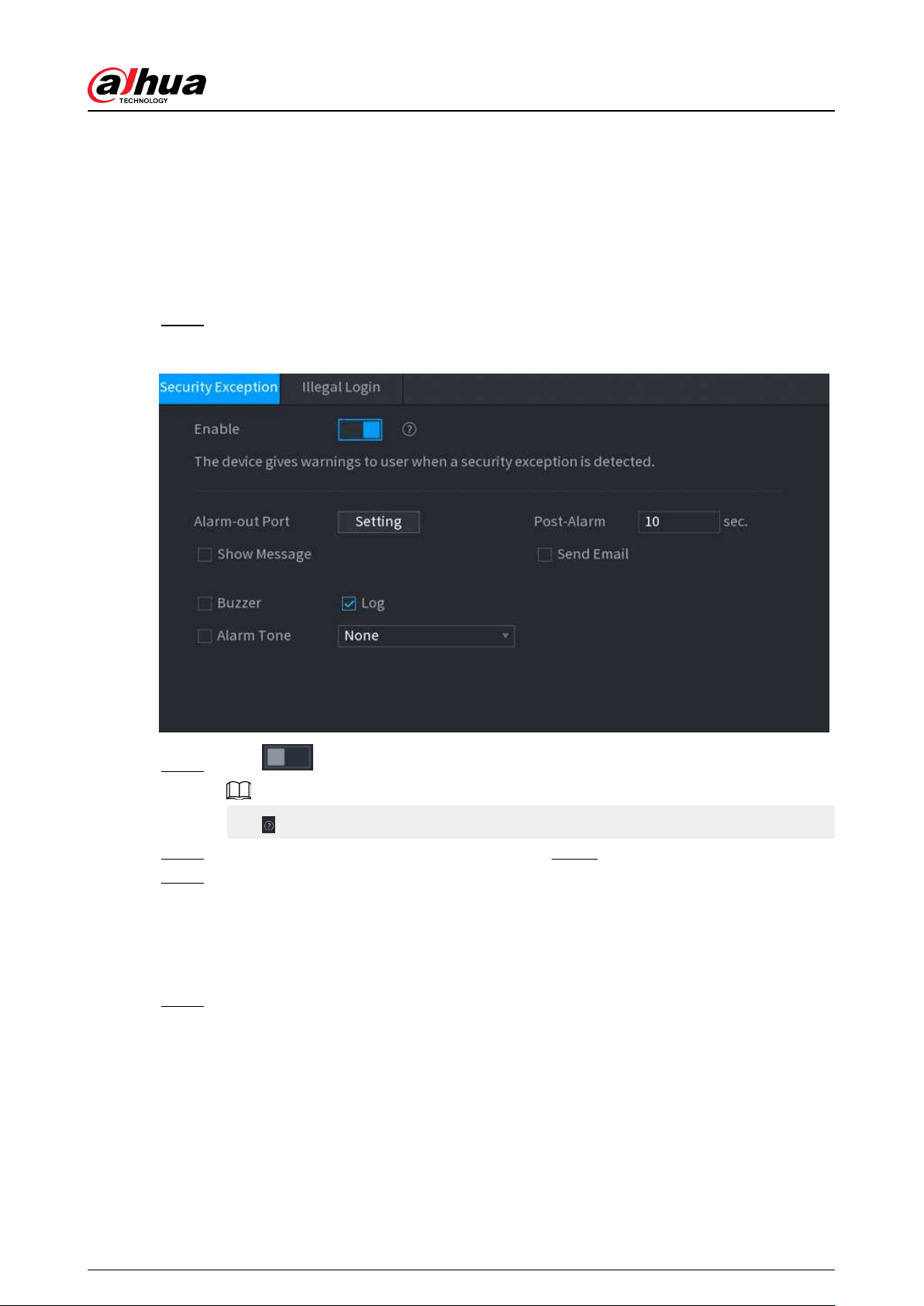
5.14.6 Security Warning
5.14.6.1 Security Exception
Background Information
The Device gives warnings to the user when a security exception occurs.
Procedure
Step 1 Select Main Menu > SECURITY > Security Warning > Security Exception.
Figure 5-276 Security exception
Step 2 Click to enable the function.
Click to view the list of security exception events.
Step 3 Congure alarm linkage actions. For details, see Step 7 .
Step 4 Click Apply.
5.14.6.2 Illegal Login
Procedure
Step 1 Select Main Menu > SECURITY > Security Warning > Illegal Login.
User's Manual
392
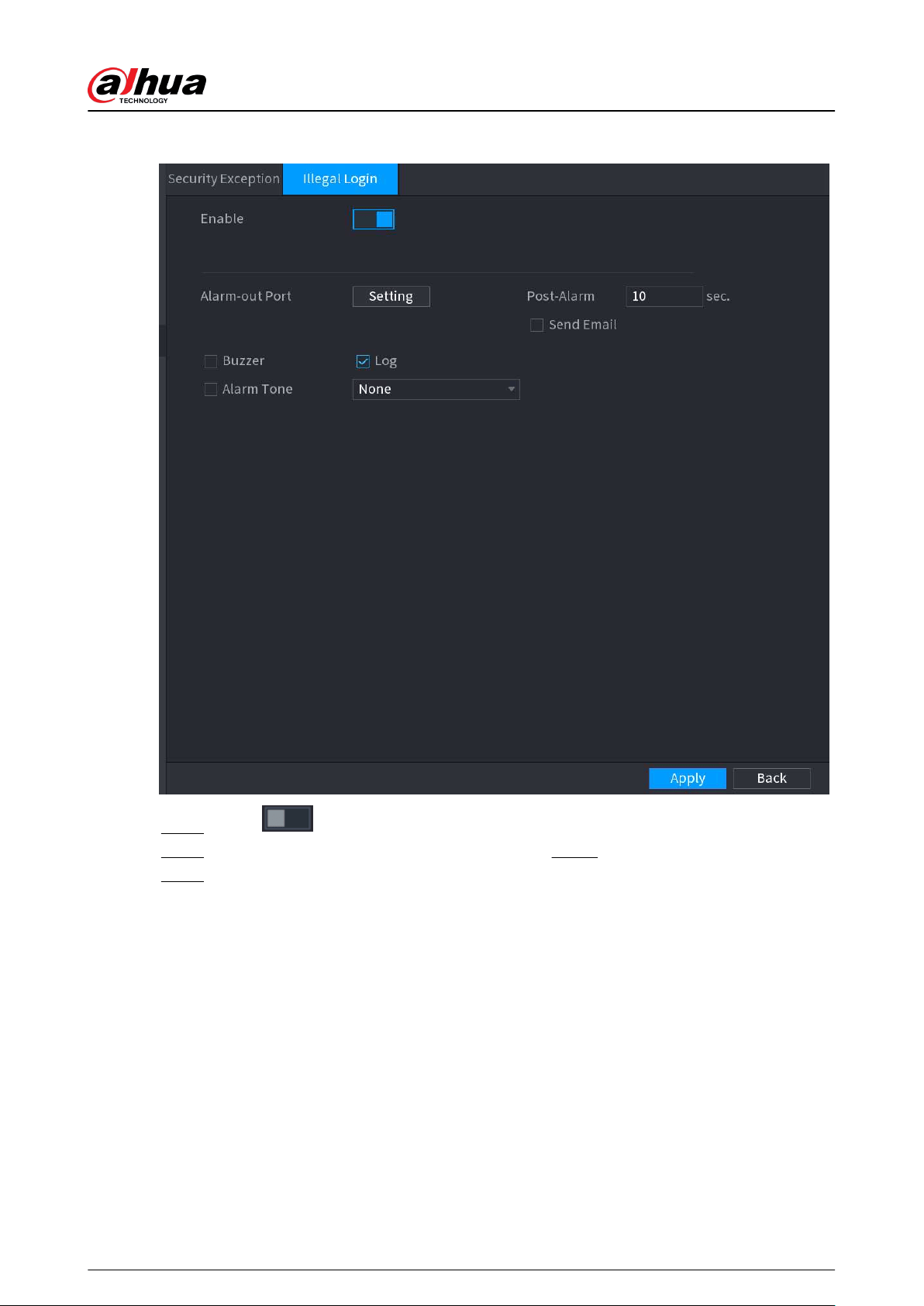
Figure 5-277 Illegal login
Step 2 Click to enable the function.
Step 3 Congure alarm linkage actions. For details, see Step 7 .
Step 4 Click Apply.
5.15 System
5.15.1 General Settings
You can set NVR basic information such as system date and holiday.
5.15.1.1 General
Background Information
You can set device basic information such as device name, and serial number.
User's Manual
393
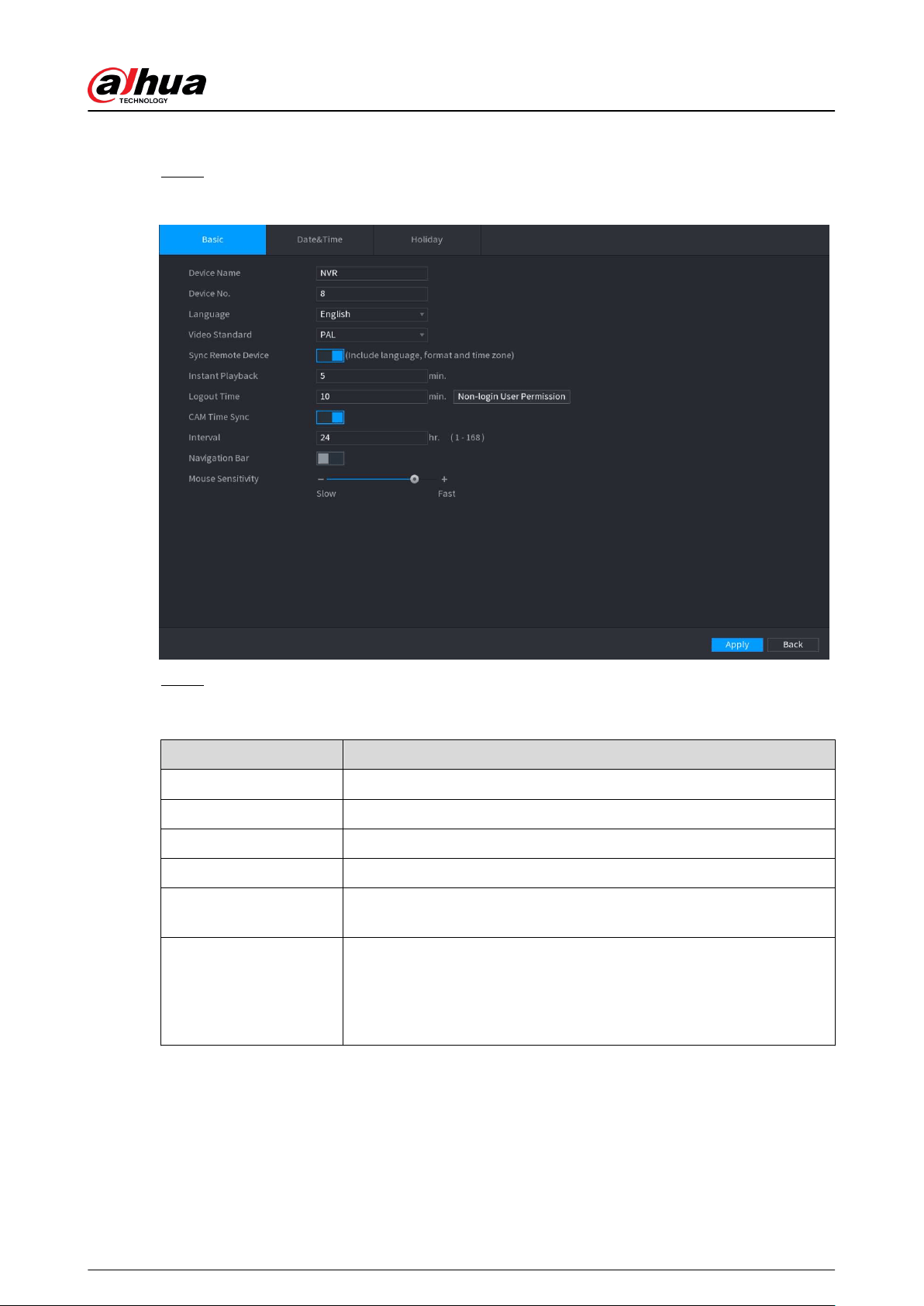
Procedure
Step 1 Select Main Menu > SYSTEM > General > Basic.
Figure 5-278 Basic settings
Step 2 Set parameters.
Table 5-80 Basic parameters
Parameter Description
Device Name Enter the Device name.
Device No. Enter a number for the Device.
Language Select a language for the Device system.
Video Standard Select PAL or NTSC as needed.
Sync Remote Device
Enable this function; the NVR can synchronize information with the
remote device such as Language, video standard and time zone.
Instant Playback
In the Instant Play box, enter the time length for playing back the
recorded video. The value ranges from 5 to 60.
On the live view control bar, click the instant playback button to play
back the recorded video within the congured time.
User's Manual
394
Parameter Description
Logout Time
Enter the standby time for the Device. The Device automatically logs
out when it is not working in the congured period. You need to login
the Device again.
The value ranges from 0 to 60. 0 indicates there is not standby time for
the Device.
Click Monitor Channel(s) when logout. You can select the channels
that you want to continue monitoring when you logged out.
CAM Time Sync Syncs the Device time with IP camera.
Interval Enter the interval for time sync.
Logout Time
You can set auto logout interval once login user remains inactive for a
specied time. Value ranges from 0 to 60 minutes.
Navigation Bar
Enable the navigation bar. When you click on the live view screen, the
navigation bar is displayed.
Mouse Sensitivity
Adjust the speed of double-click by moving the slider.
The bigger the value is, the faster the speed is.
Step 3 Click Apply button to save settings.
5.15.1.2 Date and Time
Background Information
You can set device time. You can enable NTP (Network Time Protocol) function so that the device
can sync time with the NTP server.
You can also congure date and time settings by selecting Main Menu > SYSTEM > General >
Date&Time.
Procedure
Step 1 Click Date&Time tab.
User's Manual
395
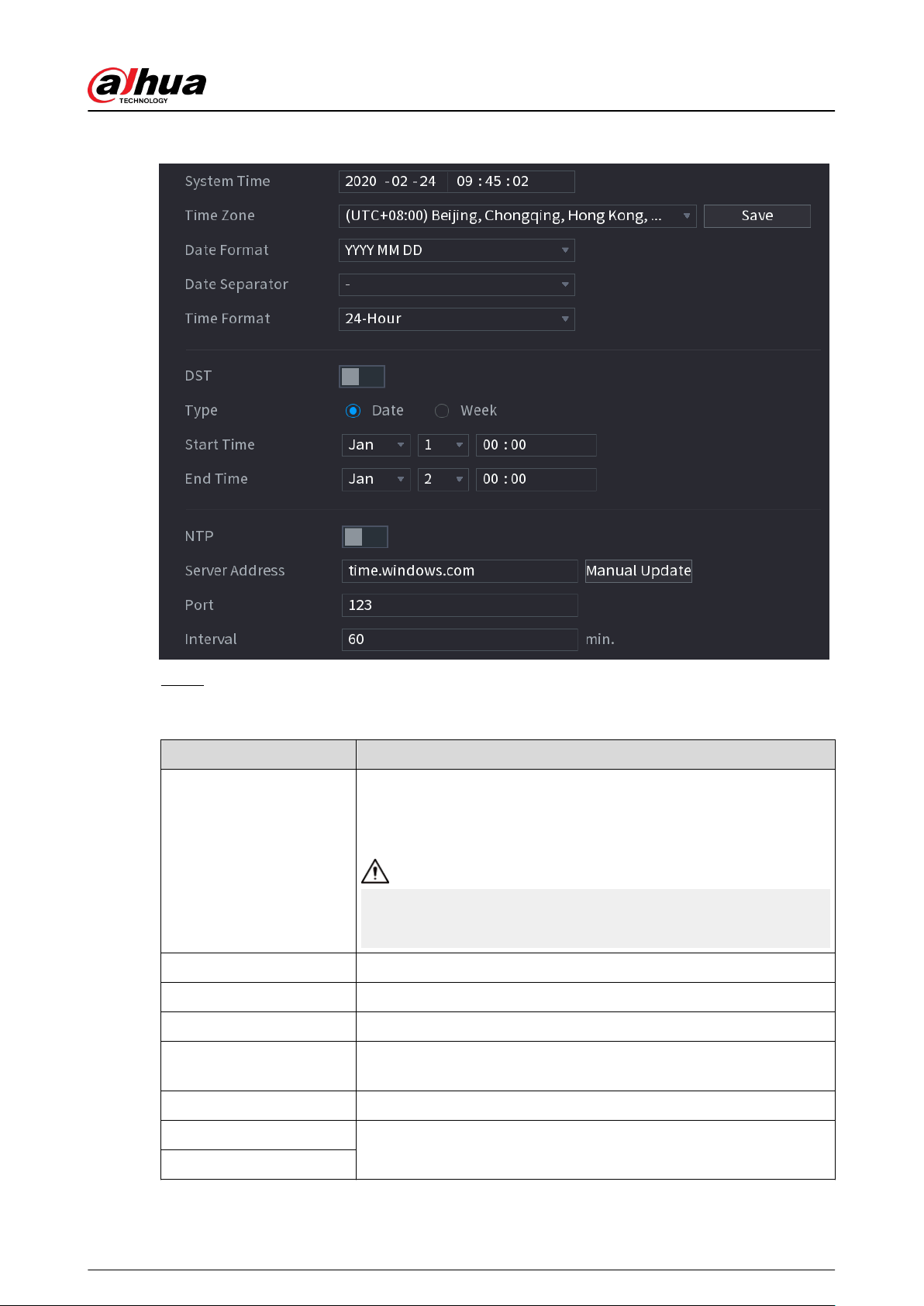
Figure 5-279 Date and time
Step 2 Congure the settings for date and time parameters.
Table 5-81 Data and time parameters
Parameter Description
System Time
In the System Time box, enter time for the system.
Click the time zone list, you can select a time zone for the system,
and the time in adjust automatically.
Do not change the system time randomly; otherwise the recorded
video cannot be searched. It is recommended to avoid the recording
period or stop recording rst before you change the system time.
Time Zone In the Time Zone list, select a time zone for the system.
Date Format In the Date Format list, select a date format for the system.
Date Separator In the Date Separator list, select a separator style for the date.
Time Format
In the Time Format list, select 12-HOUR or 24-HOUR for the time
display style.
DST Enable the Daylight Saving Time function. Click Week or Date.
Start Time
Congure the start time and end time for the DST.
End Time
User's Manual
396
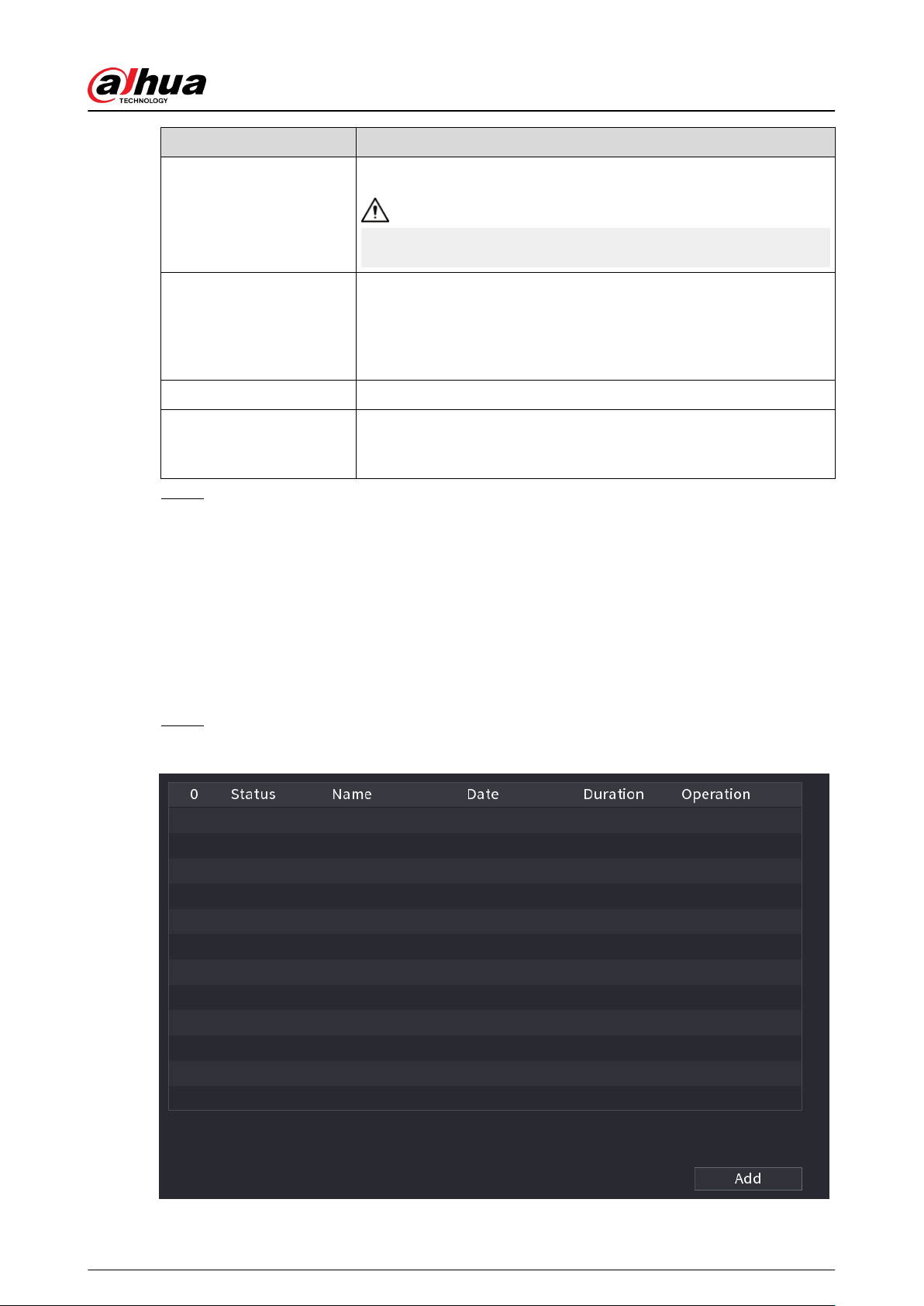
Parameter Description
NTP
Enable the NTP function to sync the Device time with the NTP server.
If NTP is enabled, device time will be automatically synchronized
with server.
Server Address
In the Server Address box, enter the IP address or domain name of
the corresponding NTP server.
Click Manual Update, the Device starts syncing with the server
immediately.
Port The system supports TCP protocol only and the default setting is 123.
Interval
In the Interval box, enter the amount of time that you want the
Device to sync time with the NTP server. The value ranges from 0 to
65535.
Step 3 Click Next to save settings.
5.15.1.3 Holiday
Background Information
Here you can add, edit, and delete holiday. After you successfully set holiday information, you can
view holiday item on the record and snapshot period.
You can also congure holiday settings by selecting Main Menu > SYSTEM > General > Holiday.
Procedure
Step 1 Click Next.
Figure 5-280 Holiday
User's Manual
397
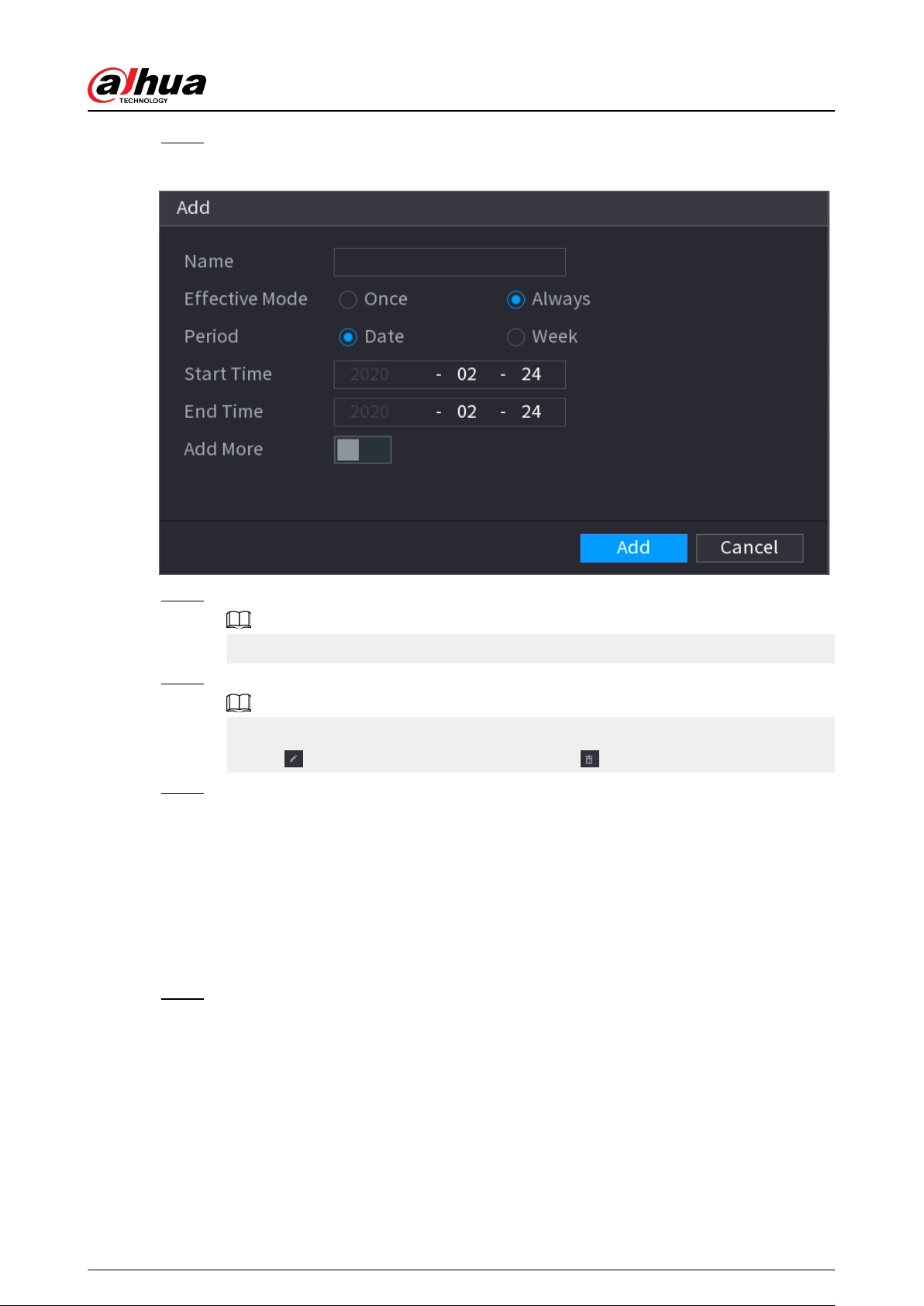
Step 2 Click Add Holidays.
Figure 5-281 Add holidays
Step 3 Set holiday name, repeat mode and holiday mode.
Click Add more to add new holiday information.
Step 4 Click Add, you can add current holiday to the list.
●
Click the drop-down list of the state; you can enable/disable holiday date.
●
Click
to change the holiday information. Click to delete current date.
Step 5 Click Next to save settings.
5.15.2 Serial Port
Background Information
After setting RS-232 parameters, the NVR can use the COM port to connect to other device to
debug and operate.
Procedure
Step 1 Select MAIN MENU > SYSTEM > Serial Port.
User's Manual
398
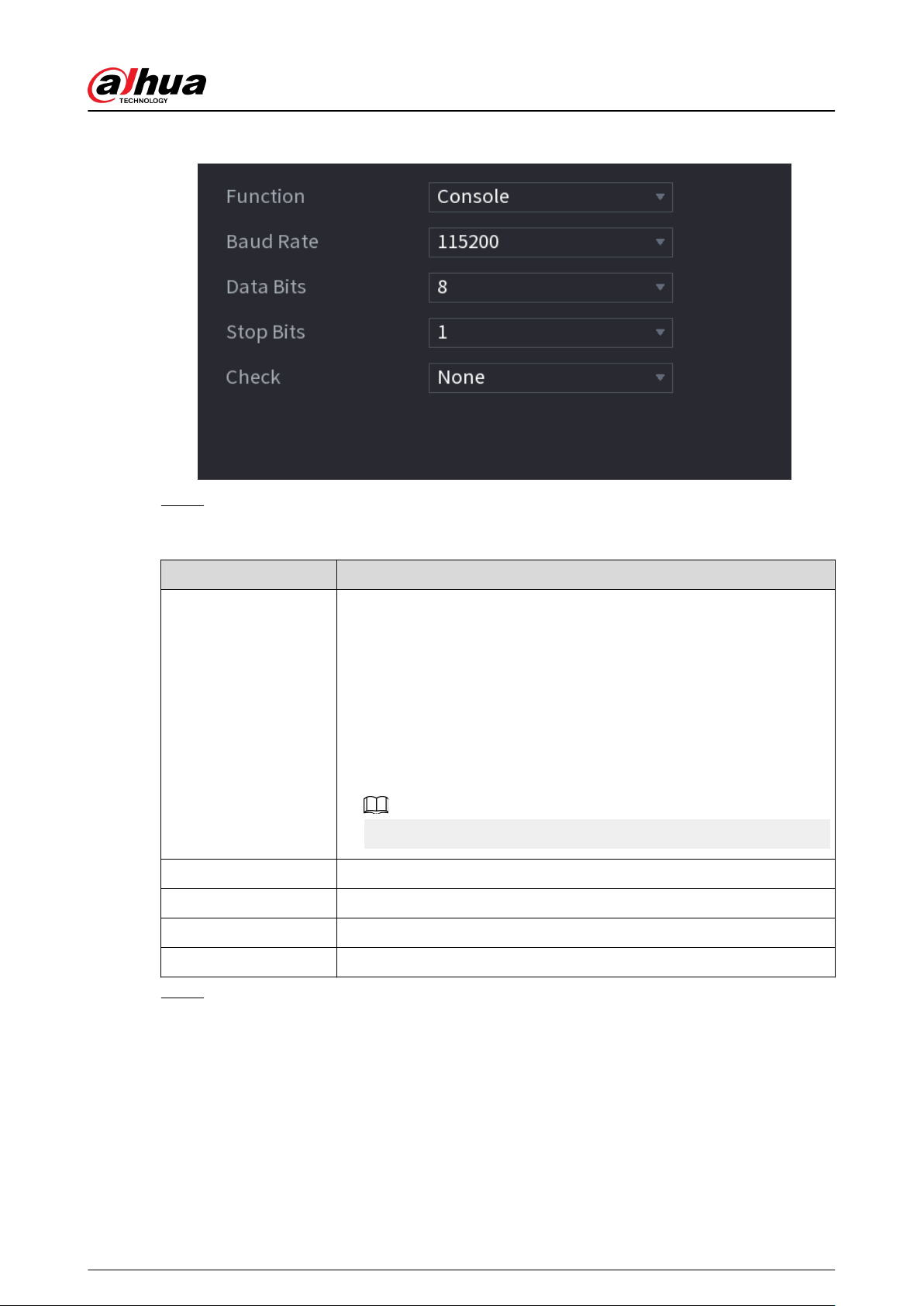
Figure 5-282 Serial port
Step 2 Congure parameters.
Table 5-82 Serial port parameters
Parameter Description
Function
Select serial port control protocol.
●
Console: Upgrade the program and debug with the console and
mini terminal software.
●
Keyboard: Control this Device with special keyboard.
●
Adapter: Connect with PC directly for transparent transmission of
data.
●
Protocol COM: Congure the function to protocol COM, in order to
overlay card number.
●
PTZ Matrix: Connect matrix control
Dierent series products support dierent RS-232 functions.
Baud Rate Select baud rate, which is 115200 by default.
Data Bits It ranges from 5 to 8, which is 8 by default.
Stop Bits It includes 1 and 2.
Parity It includes none, odd, even, mark and null.
Step 3 Click Apply.
5.16 Output and Display
5.16.1 Display
Background Information
You can congure the display eect such as displaying time title and channel title, adjusting image
transparency, and selecting the resolution.
User's Manual
399
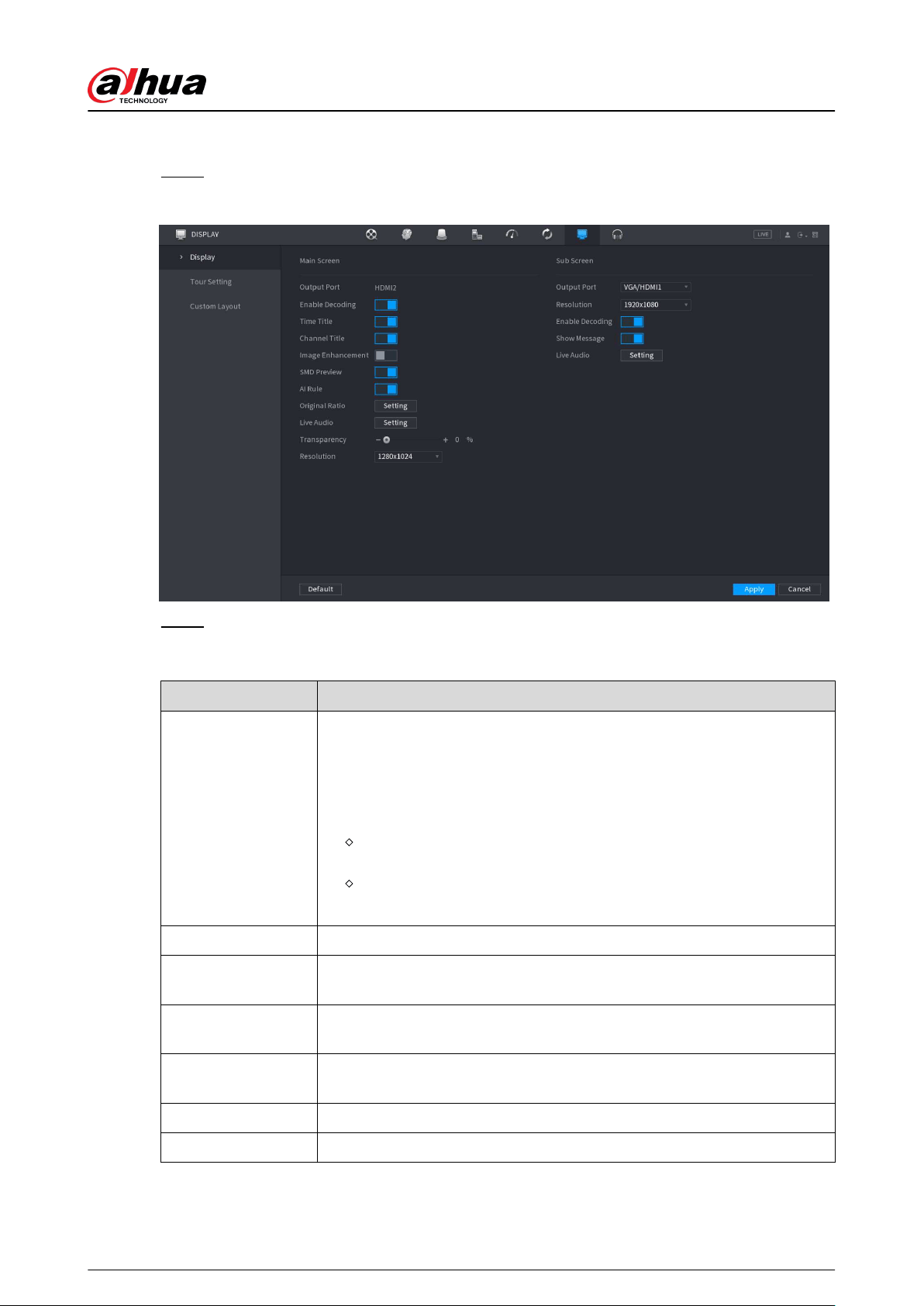
Procedure
Step 1 Select Main Menu > DISPLAY > Display.
Figure 5-283 Display
Step 2 Congure the parameters.
Table 5-83 Display parameters
Parameter Description
Main Screen/Sub
Screen
Congure the output port format of both screens.
●
When sub screen is disabled, the format of main screen is HDMI/VGA
simultaneous output.
●
When sub screen is enabled, the format of main screen and sub screen
are non-simultaneous outputs.
When output port of sub screen is set to HDMI , the output port of
main screen is set to VGA by the device.
When output port of sub screen is set to VGA , the output port of
main screen is set to HDMI by the device.
Enable Decoding After it is enabled, the device can normally decode.
Time Title/Channel
Title
Select the checkbox and the date and time of the system will be displayed
in the preview screen.
Transparency
Set the transparency of the local menu of the NVR device. The higher the
transparency, the more transparent the local menu.
Time Title/Channel
Title
Select the checkbox and the date and time of the system will be displayed
in the preview screen.
Image Enhancement Select the checkbox to optimize the preview image edges.
SMD Preview Select the checkbox to display the SMD previews in the live view page.
User's Manual
400
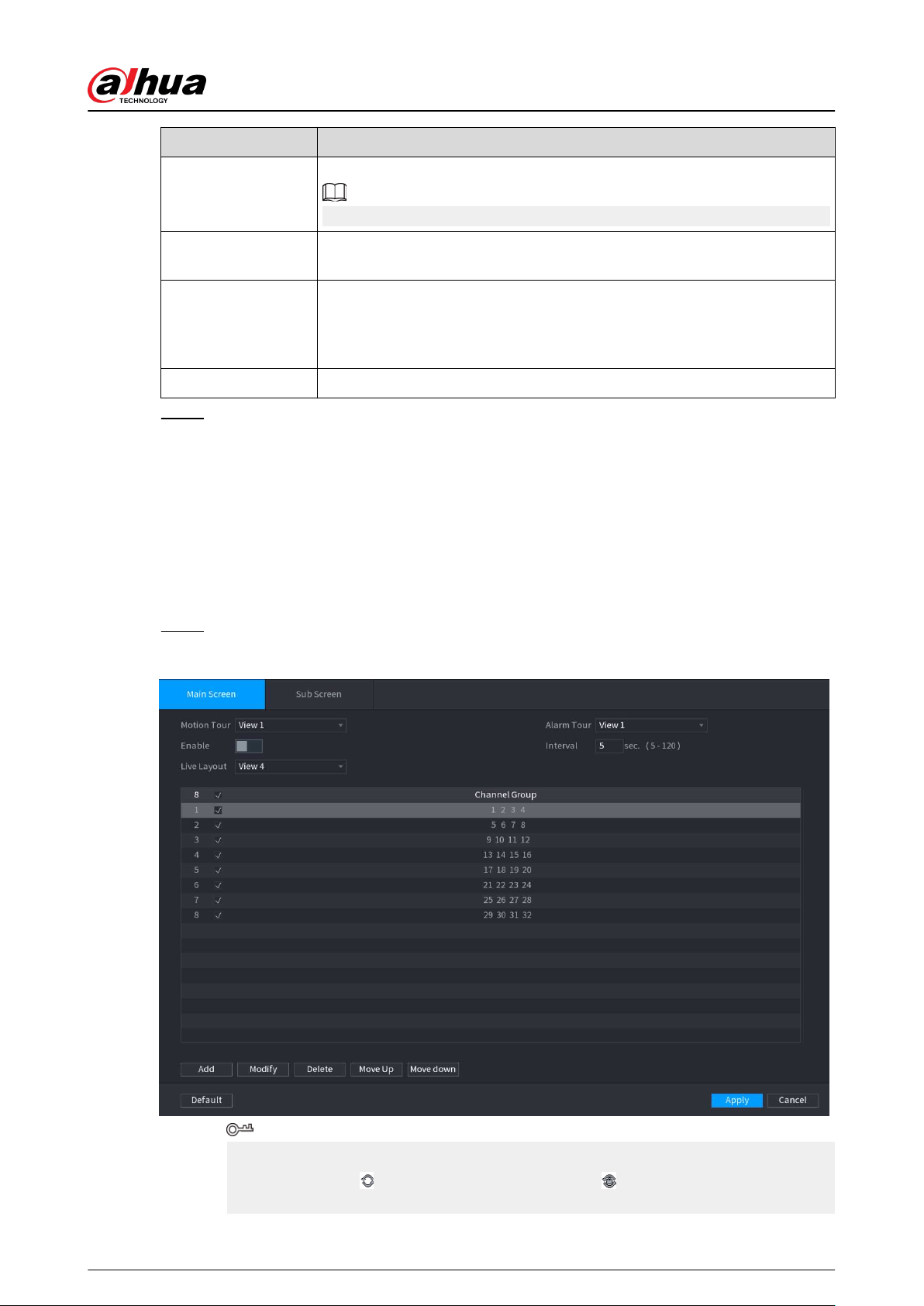
Parameter Description
AI Rule
Select the checkbox to display the AI rules in the live view page.
This function is for some series products only.
Original Ratio
Click Setting and select the channel to restore the corresponding channel
image to the original scale.
Live Audio
Congure audio input on live view. You can select Audio 1 , Audio 2, and
Mixing. For example, if you select Audio 1 for D1 channel, the sound of
audio input port 1 of camera is playing. If you select Mixing, the sound of
all audio input ports are playing.
Resolution Support 1920 × 1080, 1280 × 1024 (default), 1280 × 720.
Step 3 Click Apply.
5.16.2 Tour
Background Information
You can congure a tour of selected channels to repeat playing videos. The videos display in turn
according to the channel group congured in tour settings. The system displays one channel group
for a certain period and then automatically changes to the next channel group.
Procedure
Step 1 Select DISPLAY > Tour Setting > Main Screen.
Figure 5-284 Tour
●
On the top right of the live view screen, use the left mouse button or press Shift to
switch between
(image switching is allowed) and (image switching is not
allowed) to turn on/o the tour function.
User's Manual
401
●
On the navigation bar, click
to enable the tour and click to disable it.
Step 2 Congure the tour setting parameters.
Table 5-84 Tour parameters
Parameter Description
Enable Tour Enable tour function.
Interval
Enter the amount of time that you want each channel group displays on
the screen. The value ranges from 5 seconds to 120 seconds, and the
default value is 5 seconds.
Motion Tour, Alarm
Tour
Select the View 1 or View 8 for Motion Tour and Alarm Tour (system
alarm events).
Live Layout
In the Live Layout list, select View 1, View 4, View 8, or other modes that
are supported by the Device.
Channel Group
Display all channel groups under the current Window Split setting.
●
Add a channel group: Click Add, in the pop-up Add Group channel,
select the channels to form a group, and then click Save.
●
Delete a channel group: Select the checkbox of any channel group,
and then click Delete.
●
Edit a channel group: Select the checkbox of any channel group and
then click Modify, or double-click on the group. The Modify Channel
Group dialog box is displayed. You can regroup the channels.
●
Click Move up or Move down to adjust the position of channel group.
Step 3 Click Apply to save the settings.
5.16.3 Custom Layout
Background Information
You can set customized video split mode.
●
This function is for some series products. See the actual product for detailed information.
●
Device max. supports 5 customized videos.
Procedure
Step 1 Select Main Menu > DISPLAY > Custom Split.
User's Manual
402
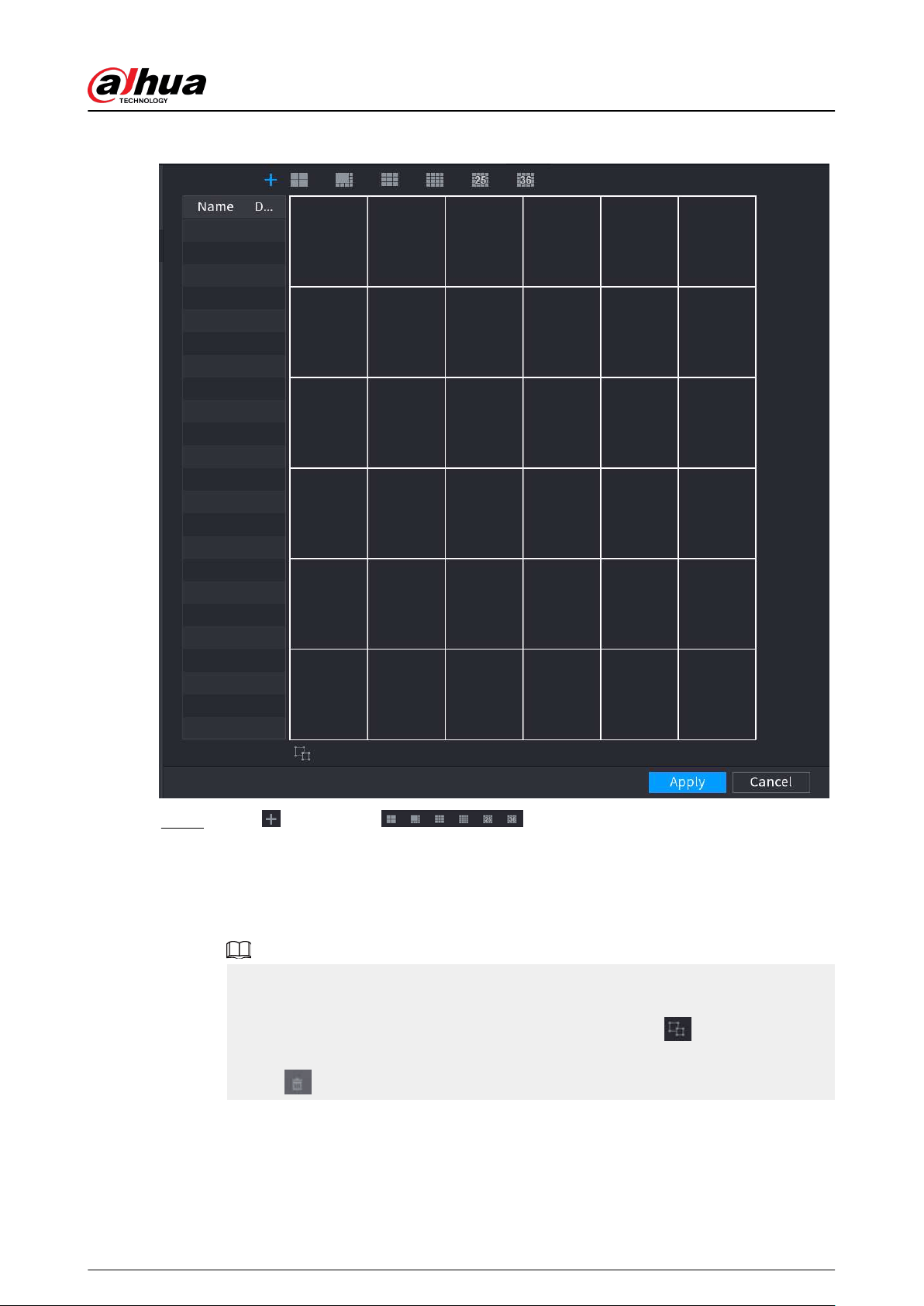
Figure 5-285 Custom split
Step 2 Click and then click to select basic mode.
System adopts the basic window mode as the new window name. For example, if you
select the 8 display mode, the default name is Split8.
In regular mode, drag the mouse in the preview frame; you can merge several small
windows to one window so that you can get you desired split mode.
●
After merge the window, system adopts the remaining window amount as the new
name such as Split6.
●
Select the window you want to merge (red highlighted), click
to cancel the merge
to restore the basic mode.
●
Click
to delete the customized window mode.
User's Manual
403
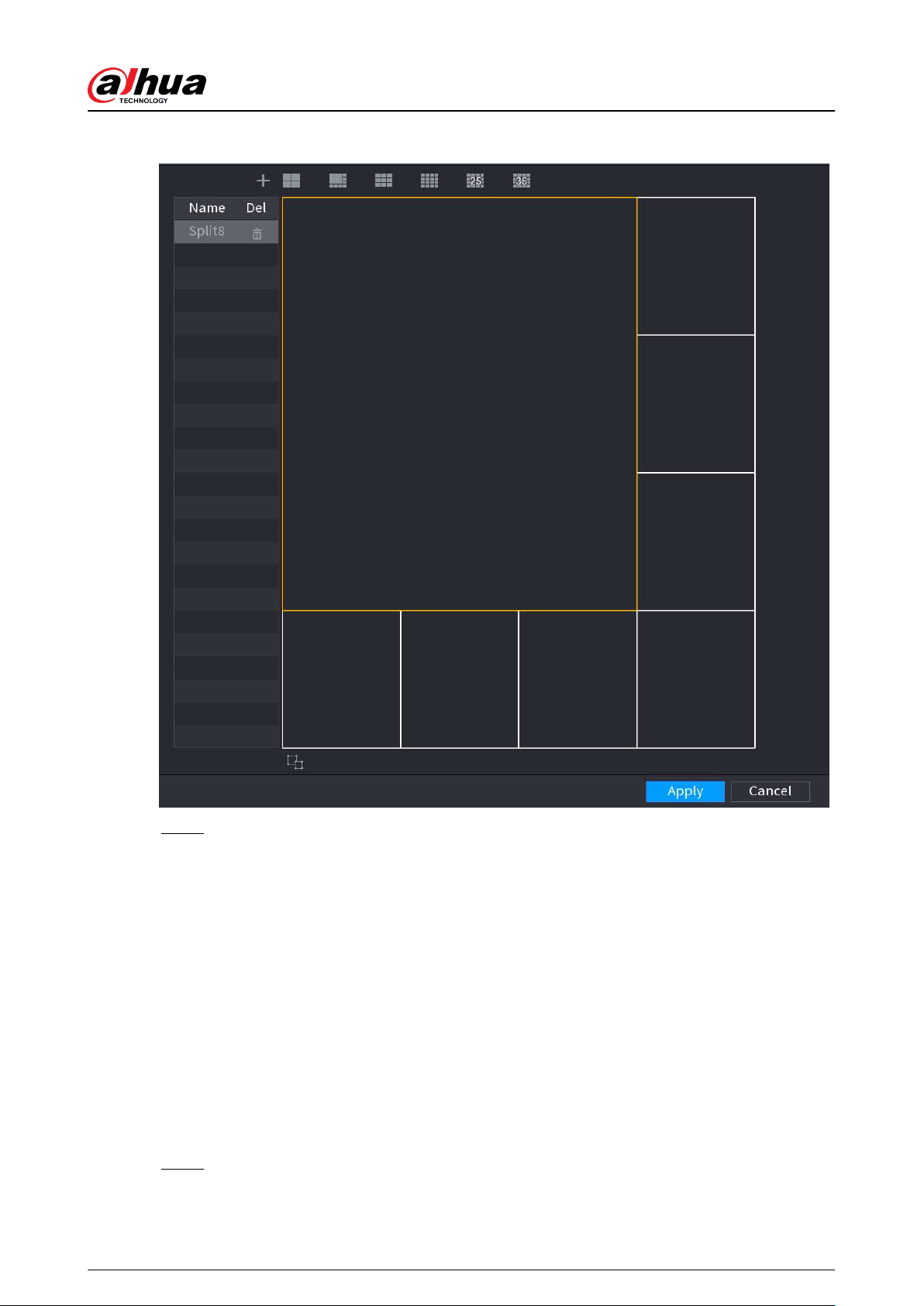
Figure 5-286 Merged window
Step 3 Click Apply to exit.
After the setup, you can go to the preview window, right-click and then select Live
Layout to select the custom split layout.
5.17 POS
You can connect the Device to the POS (Point of Sale) machine and receive the information from it.
This function applies to the scenarios such as supermarket POS machine. After connection is
established, the Device can access the POS information and display the overlaid text in the channel
window.
5.17.1 Settings
Procedure
Step 1 Select Main Menu > POS > POS Setting.
User's Manual
404
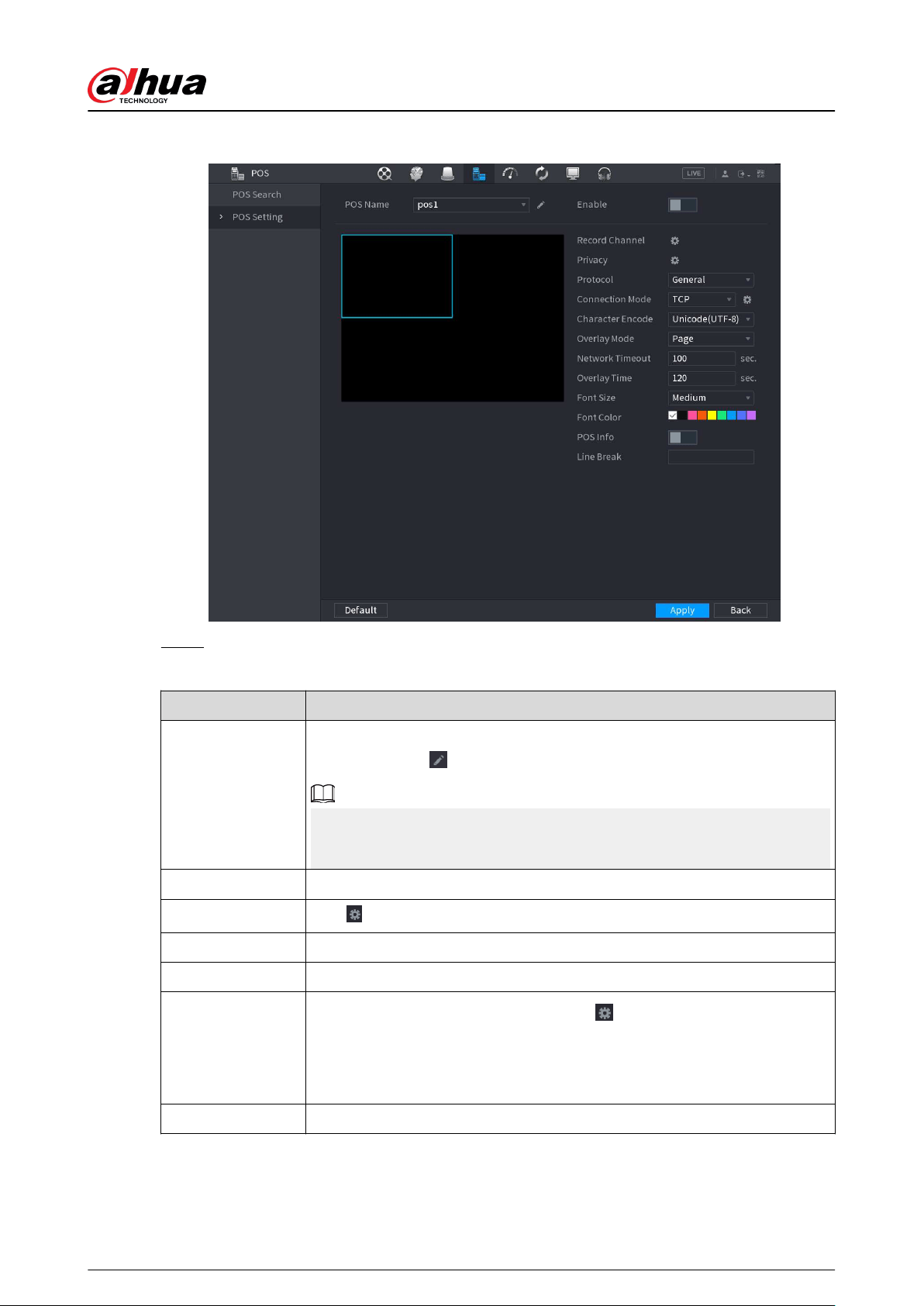
Figure 5-287 POS setting
Step 2 Congure the POS parameters.
Table 5-85 POS parameters
Parameter Description
POS Name
In the POS Name list, select the POS machine that you want to congures
settings for. Click
to modify the POS name.
●
The POS name must be unique.
●
You can enter up to 21 Chinese characters or 63 English characters.
Enable Enable the POS function.
Record Channel
Click
to select a channel to record.
Privacy Enter the privacy contents.
Protocol Select a protocol. Dierent machines correspond to dierent protocols.
Connection Mode
Select the connection protocol type. Click
, the IP Address window is
displayed.
In the Source IP box, enter the IP address (the machine that is connected to
the Device) that sends messages.
Character Encode Select a character encoding mode.
User's Manual
405
Parameter Description
Overlay Mode
In the Overlay Mode list, Select Turn or ROLL.
●
Turn: Once the information is at 16 lines, system displays the next page.
●
ROLL: Once the information is at 16 lines, system rolls one line after
another to delete the rst line.
When the local preview mode is in 4-split, the turn/ROLL function is based
on 8 lines.
Network time out
When the network is not working correctly and cannot be recovered after
the entered timeout limit, the POS information will not display normally.
After the network is recovered, the latest POS information will be displayed.
Time Display
Enter the time that how long you want to keep the POS information
displaying. For example, enter 5, the POS information disappear from the
screen after 5 seconds.
Font Size Select Small , Medium, or Big as the text size of POS information
Font Color In the color bar, click to select the color for the text size of POS information.
POS Info
Enable the POS Info function, the POS information displays in the live view/
WEB.
Line Break
There is no line delimiter by default.
After you set the line delimiter (HEX), the overlay information after the
delimiter is displayed in the new line. For example, the line delimiter is F and
the overlay information is 123F6789, NVR displays overlay information on
the local preview page and Web as:
123
6789
Step 3 Click Apply.
5.17.1.1 Privacy Setup
Procedure
Step 1 Click next to Privacy.
User's Manual
406
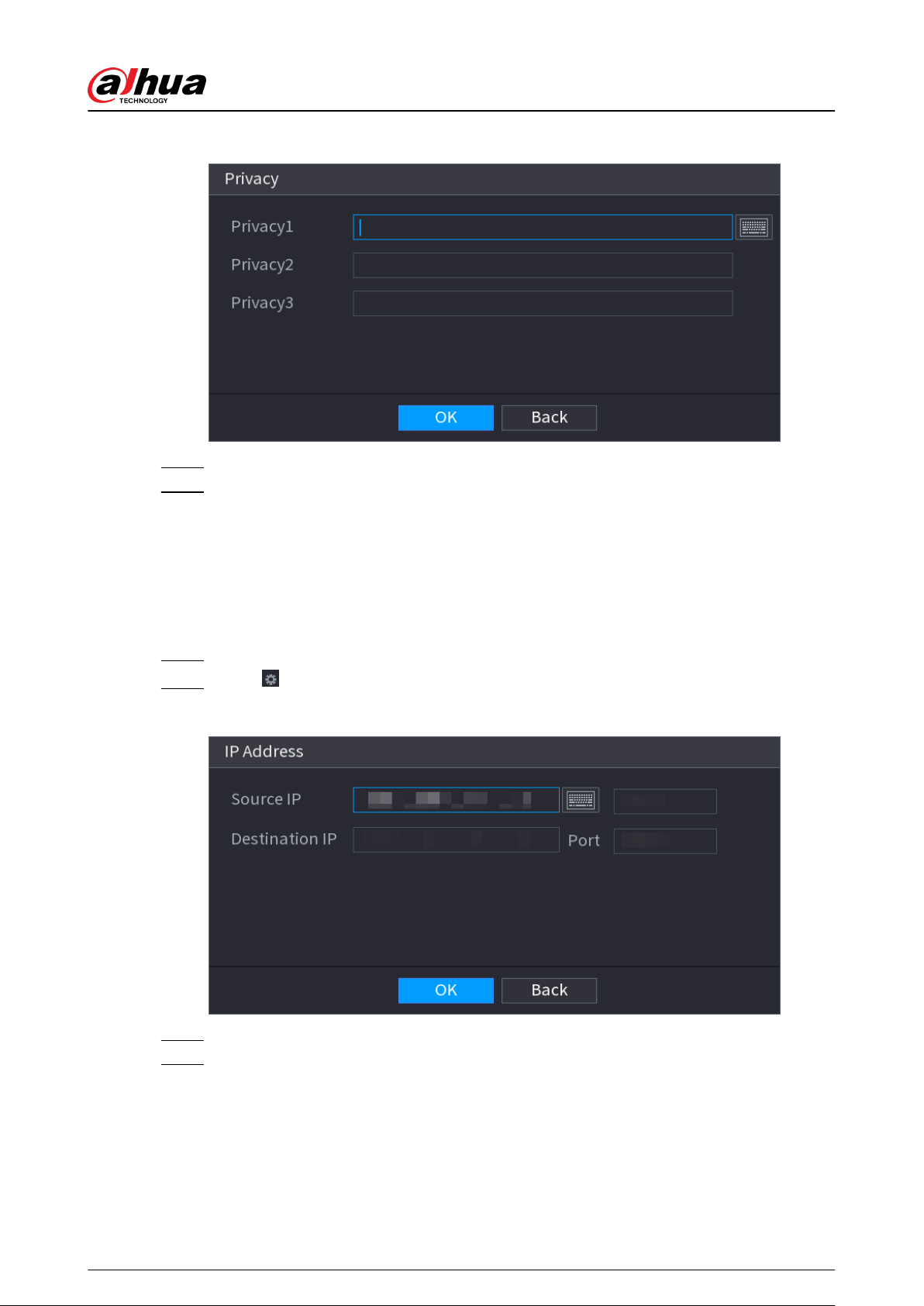
Figure 5-288 Privacy
Step 2 Set privacy information.
Step 3 Click OK.
5.17.1.2 Connection Mode
Background Information
Connection type is UDP or TCP.
Procedure
Step 1 Select Connection Mode as UDP, TCP_CLINET or TCP.
Step 2 Click .
Figure 5-289 IP address
Step 3 For Source IP and Port, enter the POS IP address and port.
Step 4 Click OK.
User's Manual
407
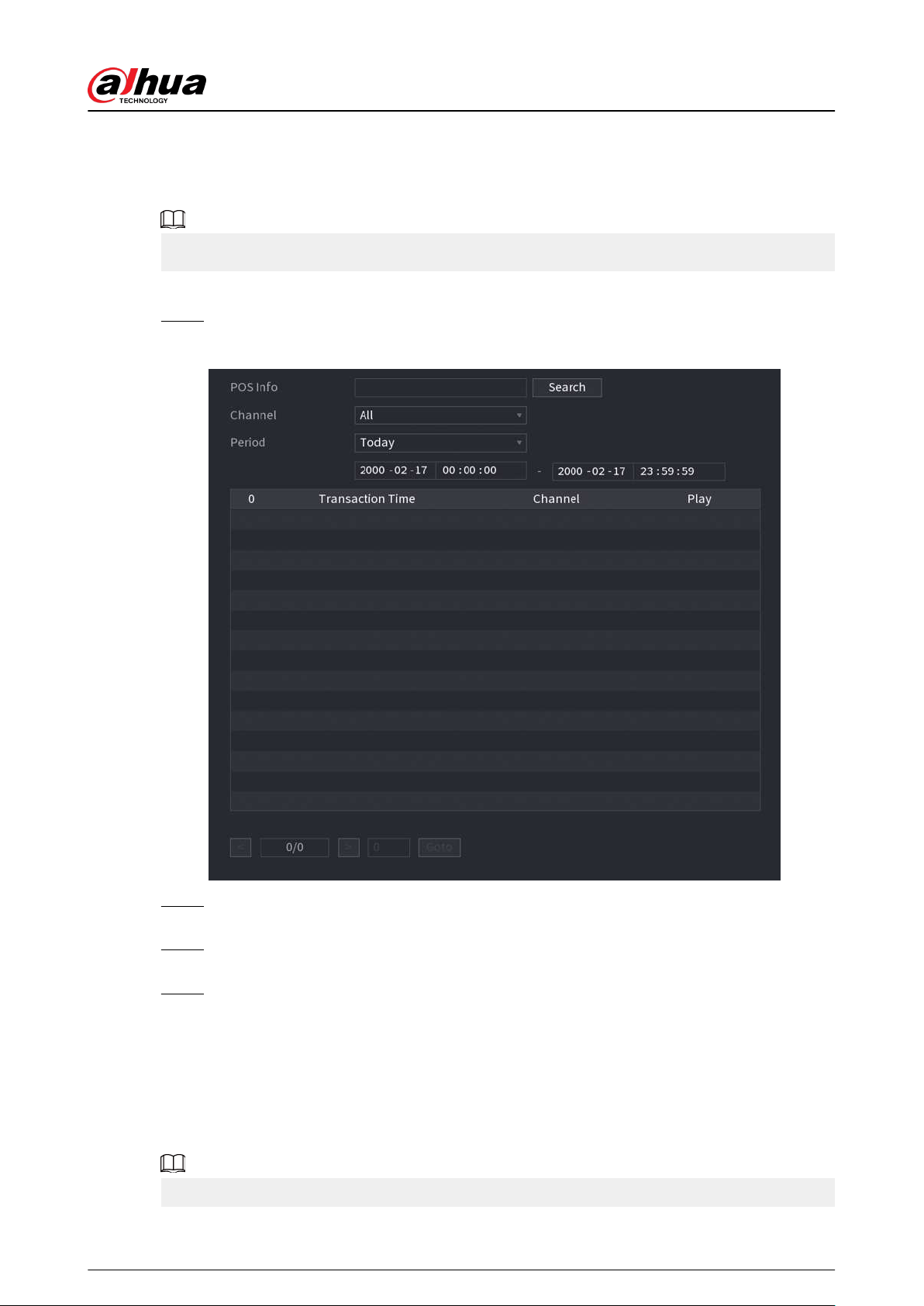
5.17.2 Search
Background Information
The system supports fuzzy search.
Procedure
Step 1 Select Main Menu > POS > POS Search.
Figure 5-290 POS search
Step 2 In the POS Search box, enter the information such as transaction number on your
receipt, amount, or product name.
Step 3 In the Start Time box and End Time box, enter the time period that you want to search
the POS transaction information.
Step 4 Click Search.
The searched transaction results display in the table.
5.18 Audio
The audio function is to manage audio les and set schedule play function. It is to realize audio
broadcast activation function.
This function is available on select models.
User's Manual
408
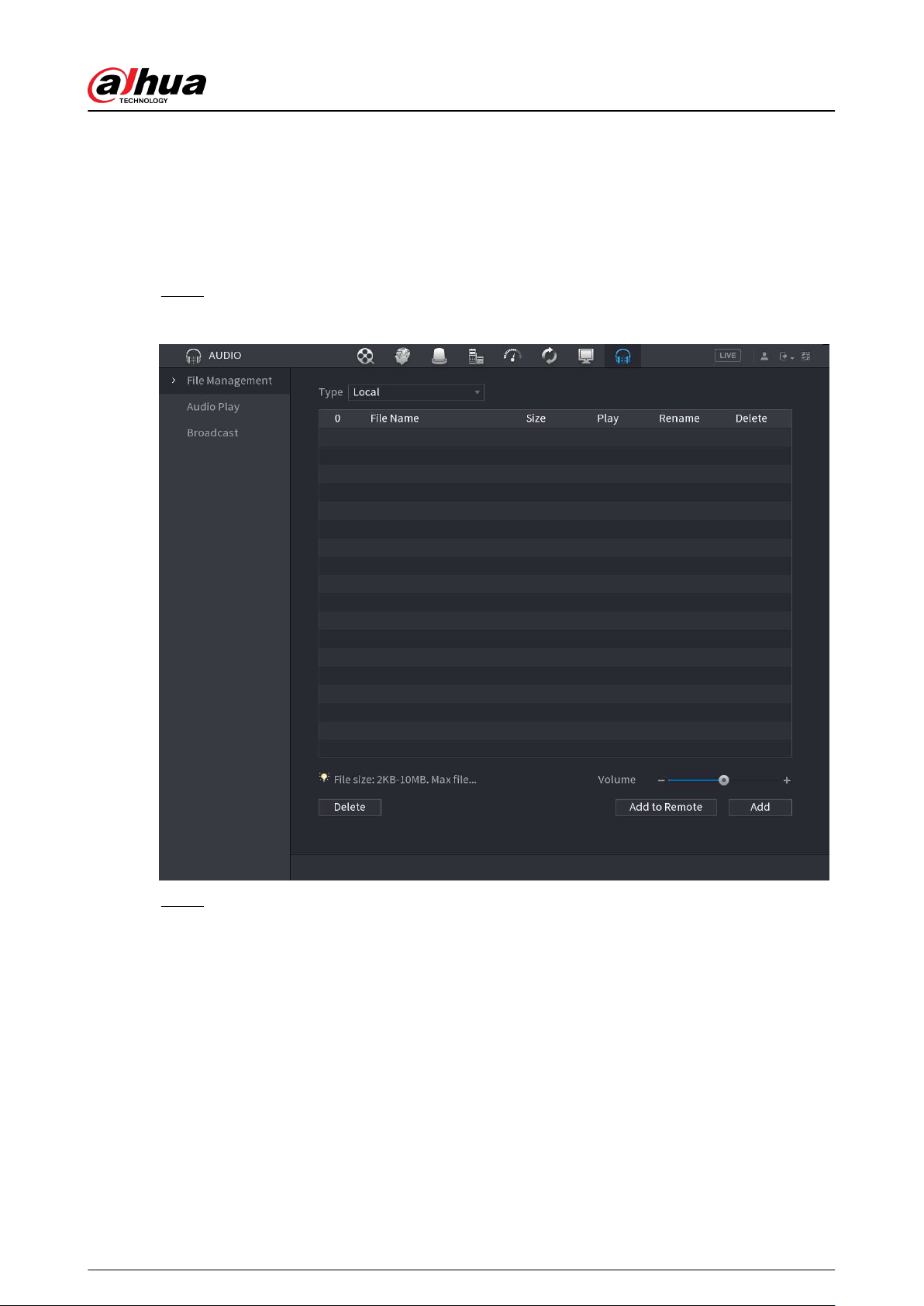
5.18.1 File Management
Background Information
You can add audio les, listen to audio les, rename and delete audio les, and congure the audio
volume.
Procedure
Step 1 Select Main Menu > AUDIO > File Management.
Figure 5-291 File management
Step 2 Click Add.
User's Manual
409
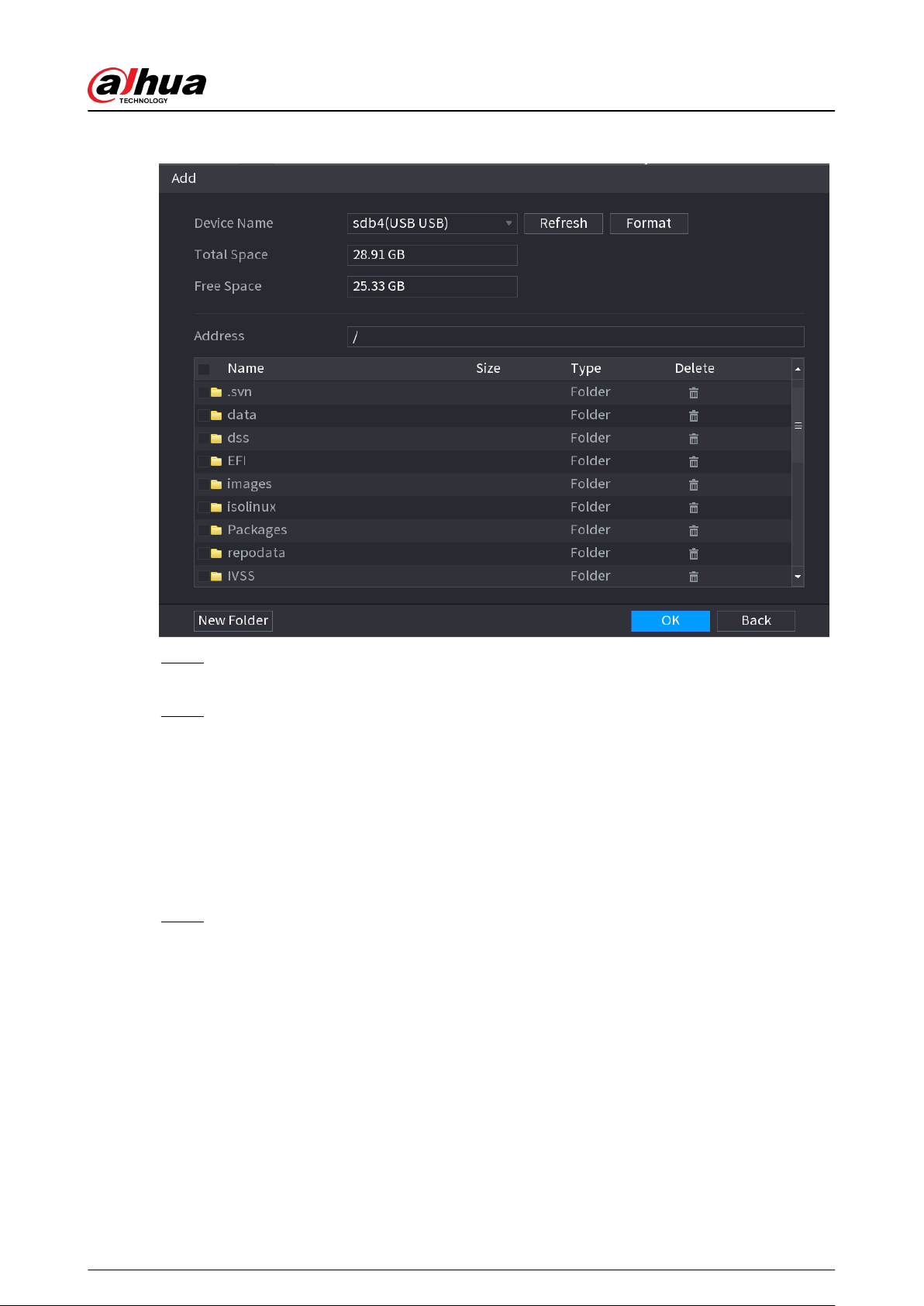
Figure 5-292 Add le
Step 3 Select the audio le and then click Import.
System supports MP3 and PCM audio format.
Step 4 Click OK to start importing audio les from the USB storage device.
If the importing is successful, the audio les will display in the File Management page.
5.18.2 Audio Play
Background Information
You can congure the settings to play the audio les during the dened time period.
Procedure
Step 1 Select Main Menu > AUDIO > Schedule.
User's Manual
410
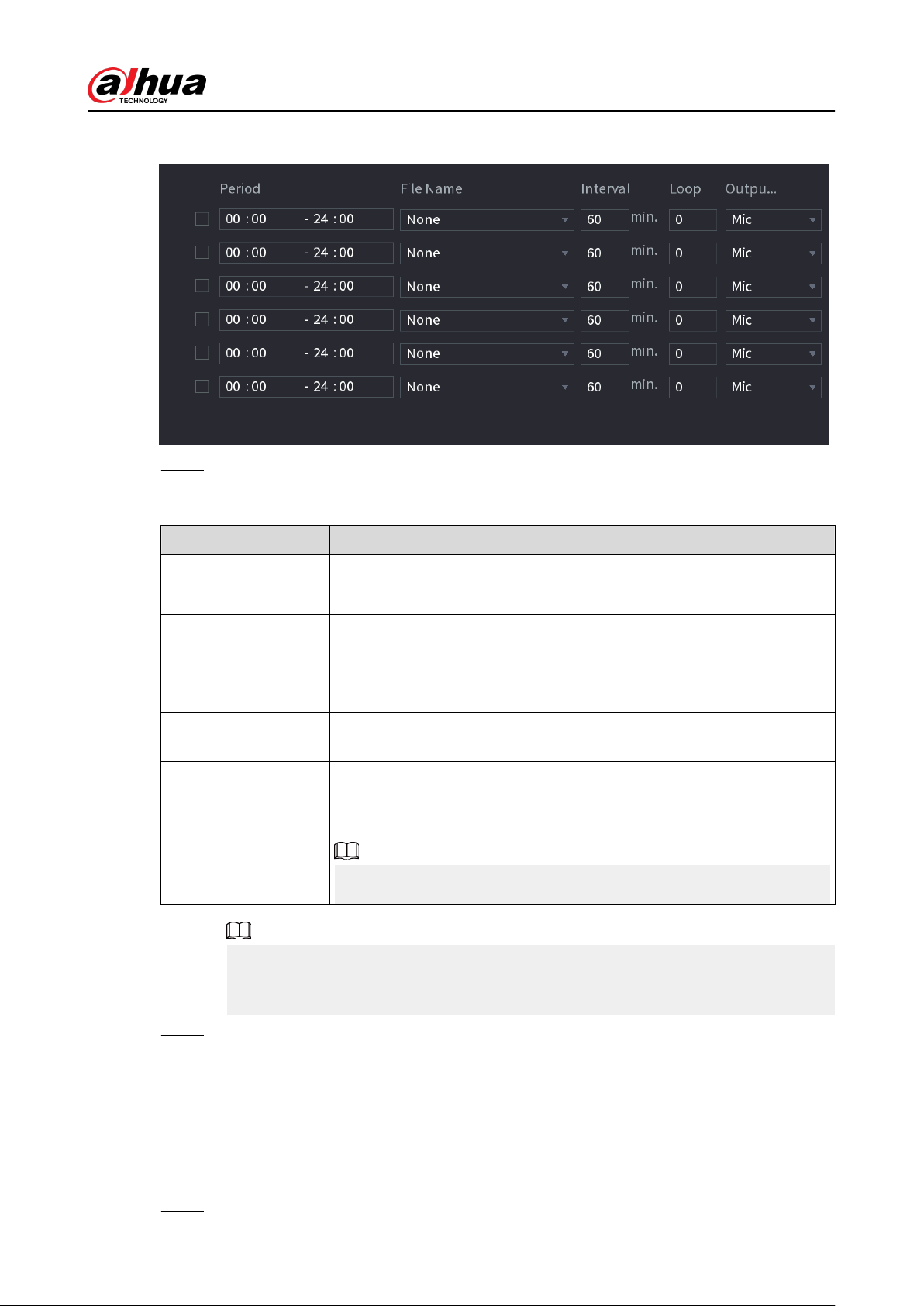
Figure 5-293 Schedule
Step 2 Congure the parameters.
Table 5-86 Schedule parameters
Parameter Description
Period
In the Period box, enter the time. Select the checkbox to enable the
settings. You can congure up to six periods.
File Name
In the File Name list, select the audio le that you want to play for this
congured period.
Interval
In the Interval box, enter the time in minutes for how often you want to
repeat the playing.
Loop
Congure how many times you want to repeat the playing in the dened
period.
Output
Includes two options: MIC and Audio. It is MIC by default. The MIC
function shares the same port with talkback function and the latter has
the priority.
Some series products do not have audio port.
●
The nish time for audio playing depends on audio le size and the congured
interval.
●
Playing priority: Alarm event > Audio talk > Trial listening > Schedule audio le.
Step 3 Click Apply.
5.18.3 Broadcast
Background Information
System can broadcast to the camera, or broadcast to a channel group.
Procedure
Step 1 Select Mani Menu > AUDIO > Broadcast.
User's Manual
411
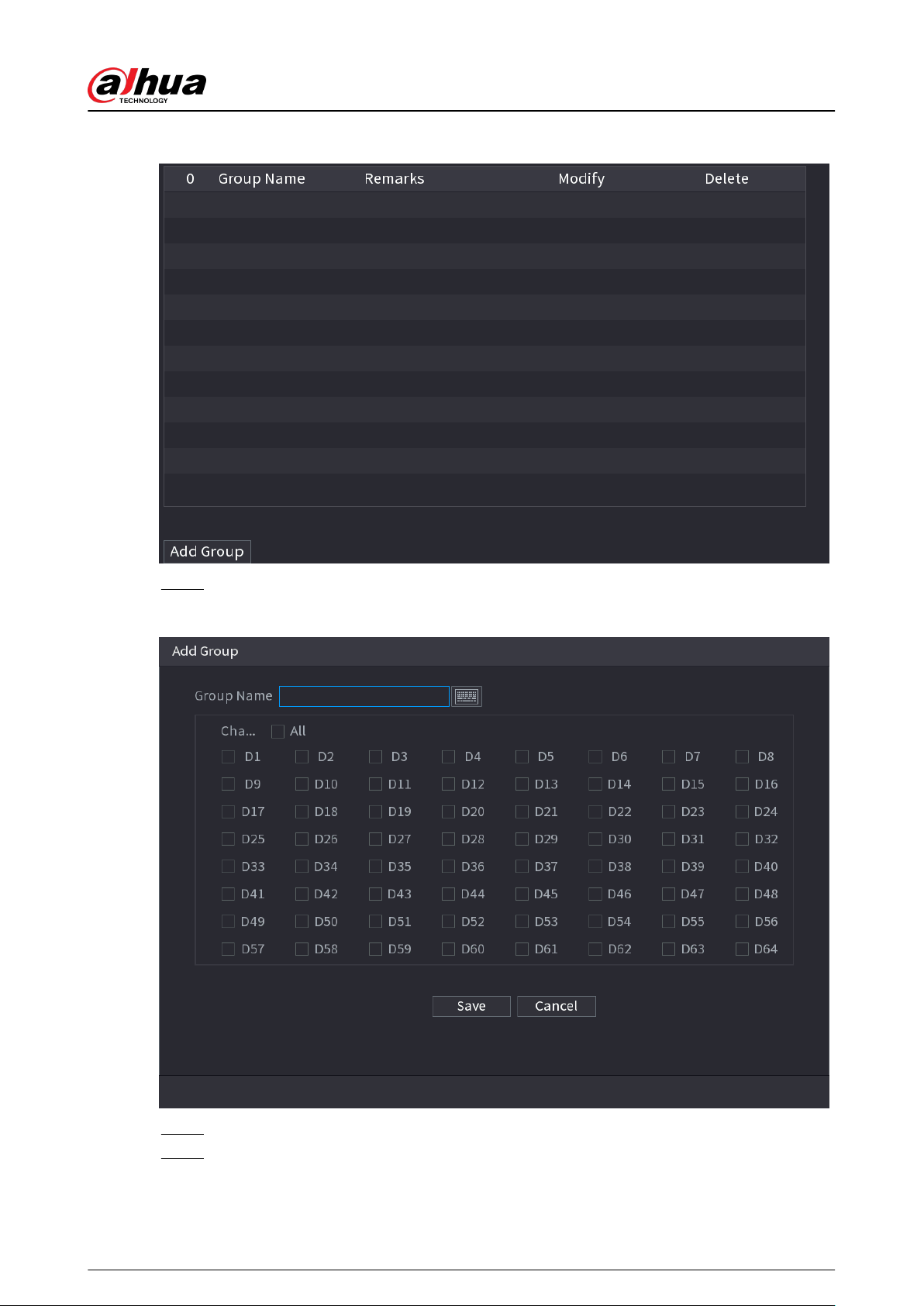
Figure 5-294 Broadcast
Step 2 Click Add Group.
Figure 5-295 Add group (1)
Step 3 Input group name and select one or more channels.
Step 4 Click Save to complete broadcast group setup.
User's Manual
412
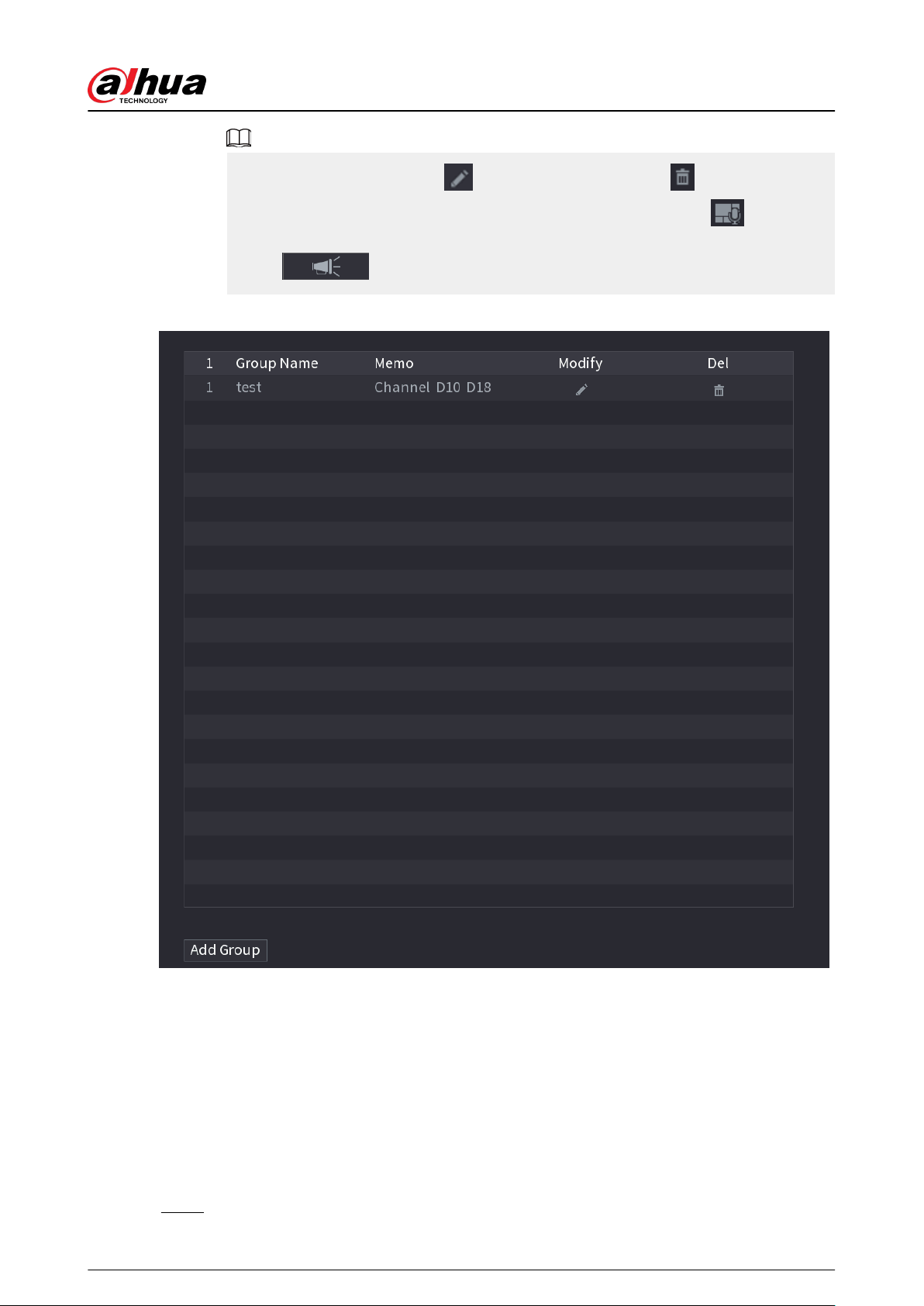
●
On the broadcast page, click
to change group setup, click to delete group.
●
After complete broadcast setup, on the preview page and then click
on the
navigation bar, device pops up broadcast dialogue box. Select a group name and then
click
to begin broadcast.
Figure 5-296 Add group (2)
5.19 Operation and Maintenance
5.19.1 Log
Background Information
You can view and search for the log information, or back up log to the USB device.
Procedure
Step 1 Select Main Menu > MAINTAIN > Log.
User's Manual
413
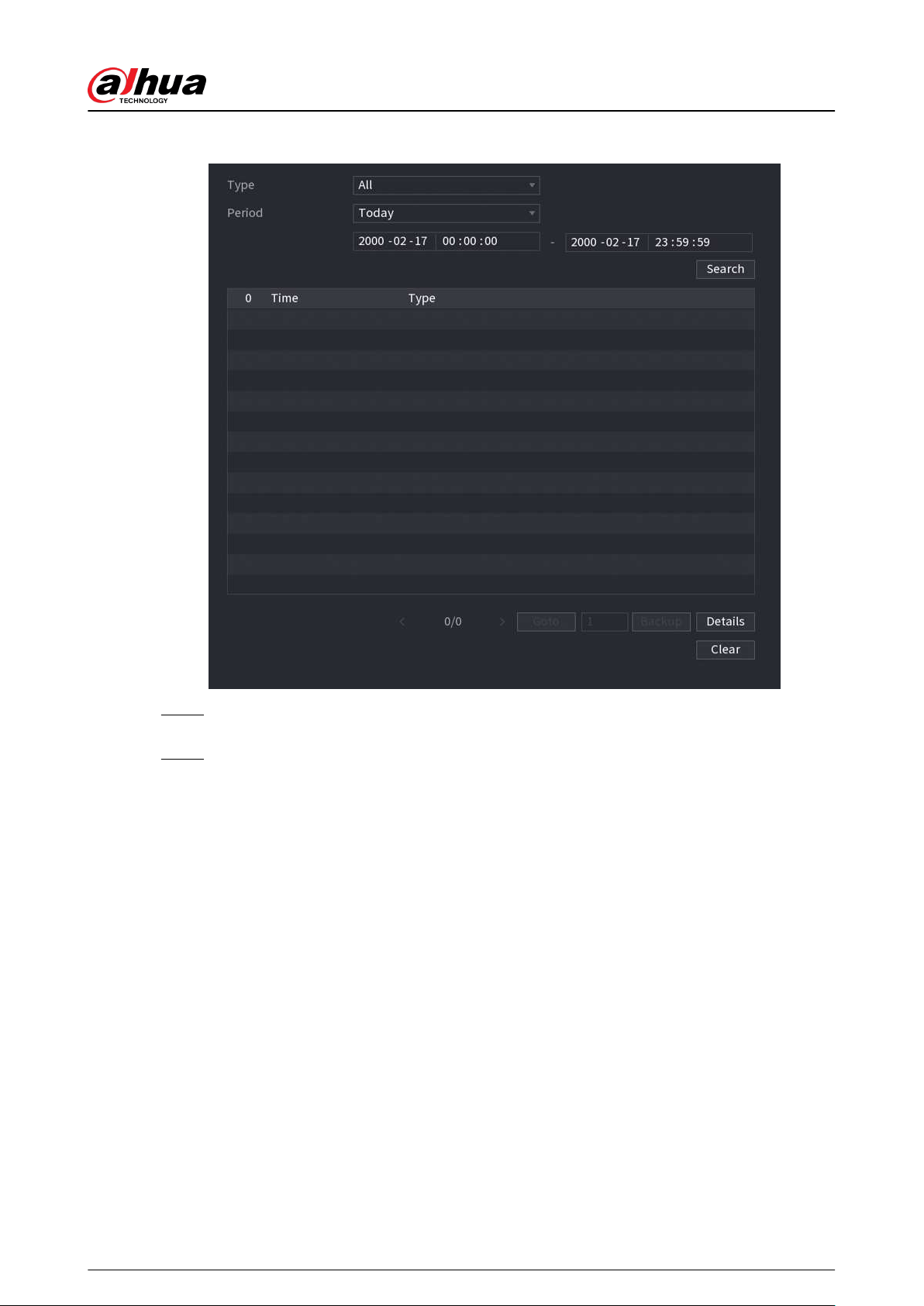
Figure 5-297 Log
Step 2 In the Type list, select the log type that you want to view (System, Cong, Storage,
Record, Account, Clear Log, Playback, and Connection) or select All to view all logs.
Step 3 Enter the time period to search, and then click Search.
The search results are displayed.
Related Operations
●
Click Details or double-click the log to view details. Click Next or Previous to view more log
information.
●
Click Backup to back up the logs to the USB storage device.
●
Click Clear to remove all logs.
5.19.2 System
5.19.2.1 System Version
Select Main Menu > MAINTAIN > System Info > Version.
You can view NVR version information.
5.19.2.2 AI Algorithm Version
Select Main Menu > MAINTAIN > System Info > Intelligent Algorithm.
User's Manual
414
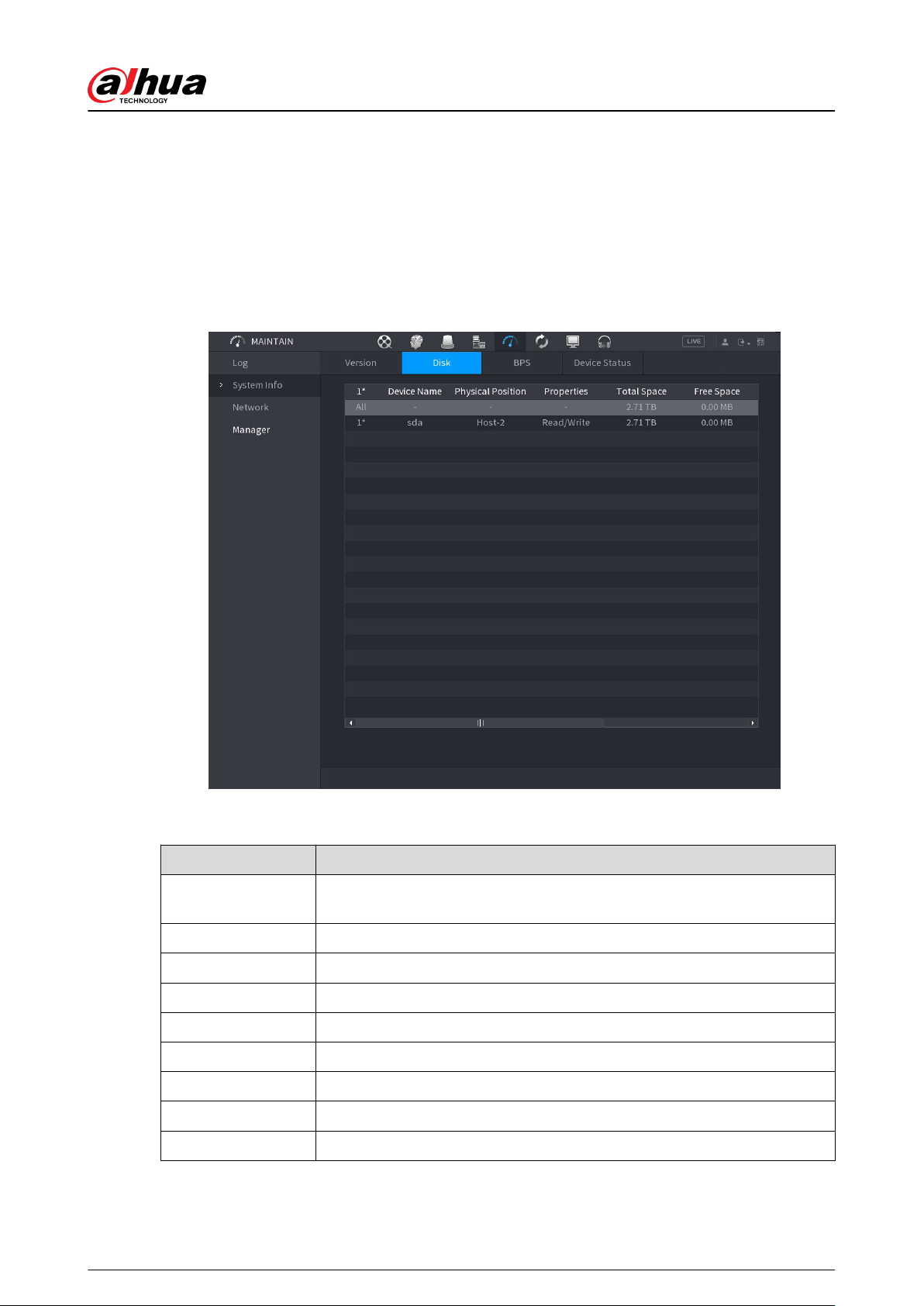
You can view version information for AI functions such as face detection, face recognition, IVS, and
video metadata.
5.19.2.3 HDD Info
You can view the HDD quantity, HDD type, total space, free space, status, and S.M.A.R.T information.
Select Main Menu > MAINTAIN > System Info > Disk.
Figure 5-298 Disk information
Table 5-87 Disk information
Parameter Description
No.
Indicates the number of the currently connected HDD. The asterisk (*)
means the current working HDD.
Device Name Indicates name of HDD.
Physical Position Indicates installation position of HDD.
Properties Indicates HDD type.
Total Space Indicates the total capacity of HDD.
Free Space Indicates the usable capacity of HDD.
Health Status Indicates the health status of the HDD.
S.M.A.R.T View the S.M.A.R.T reports from HDD detecting.
Status Indicates the status of the HDD to show if it is working normally.
User's Manual
415
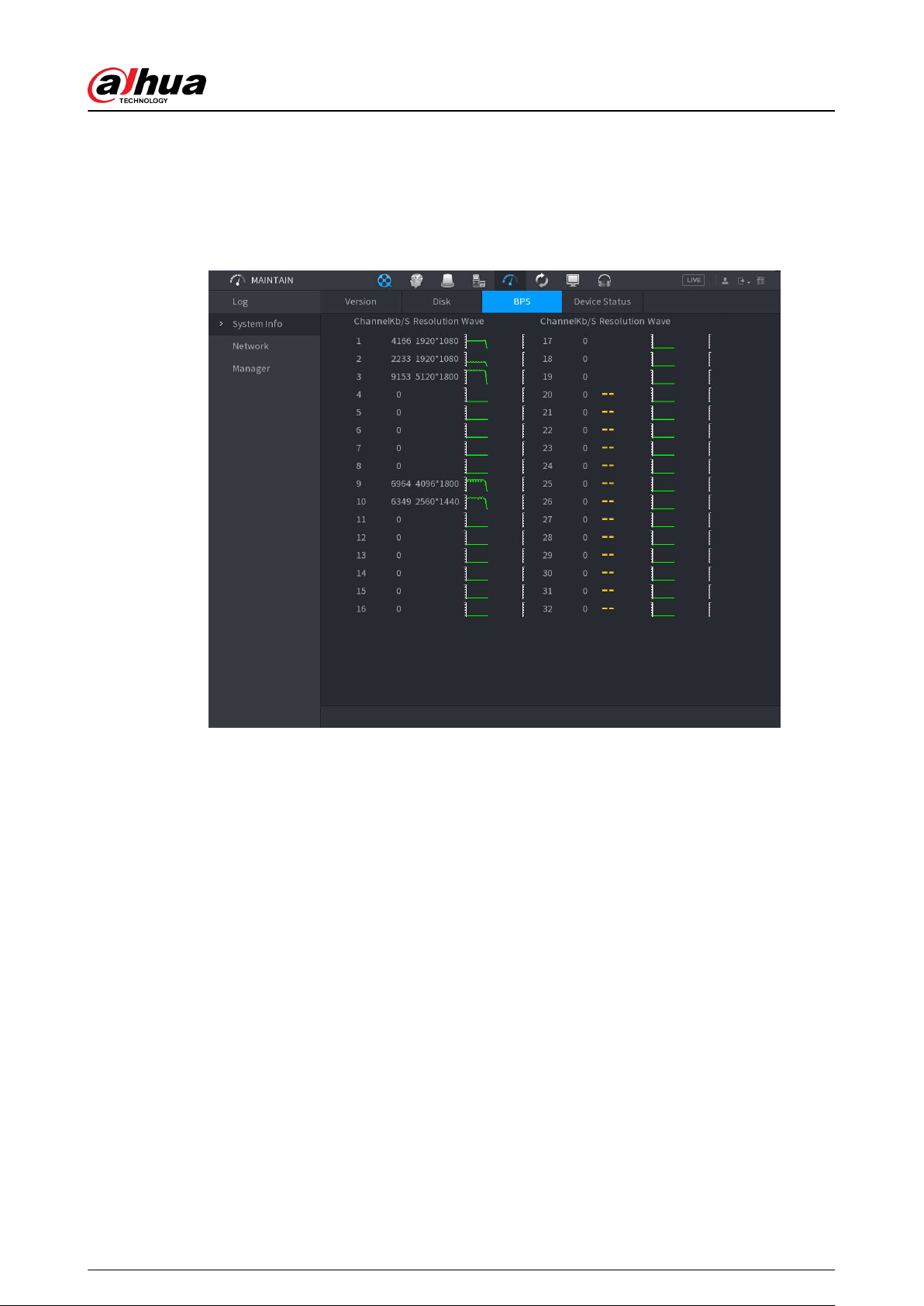
5.19.2.4 BPS
You can view current video bit rate (kb/s) and resolution.
Select Main Menu > MAINTAIN > System Info > BPS.
Figure 5-299 BPS
5.19.2.5 Device Status
You can view fan running status such as speed, CPU temperature, and memory.
Select Main Menu > MAINTAIN > System Info > Device Status.
User's Manual
416
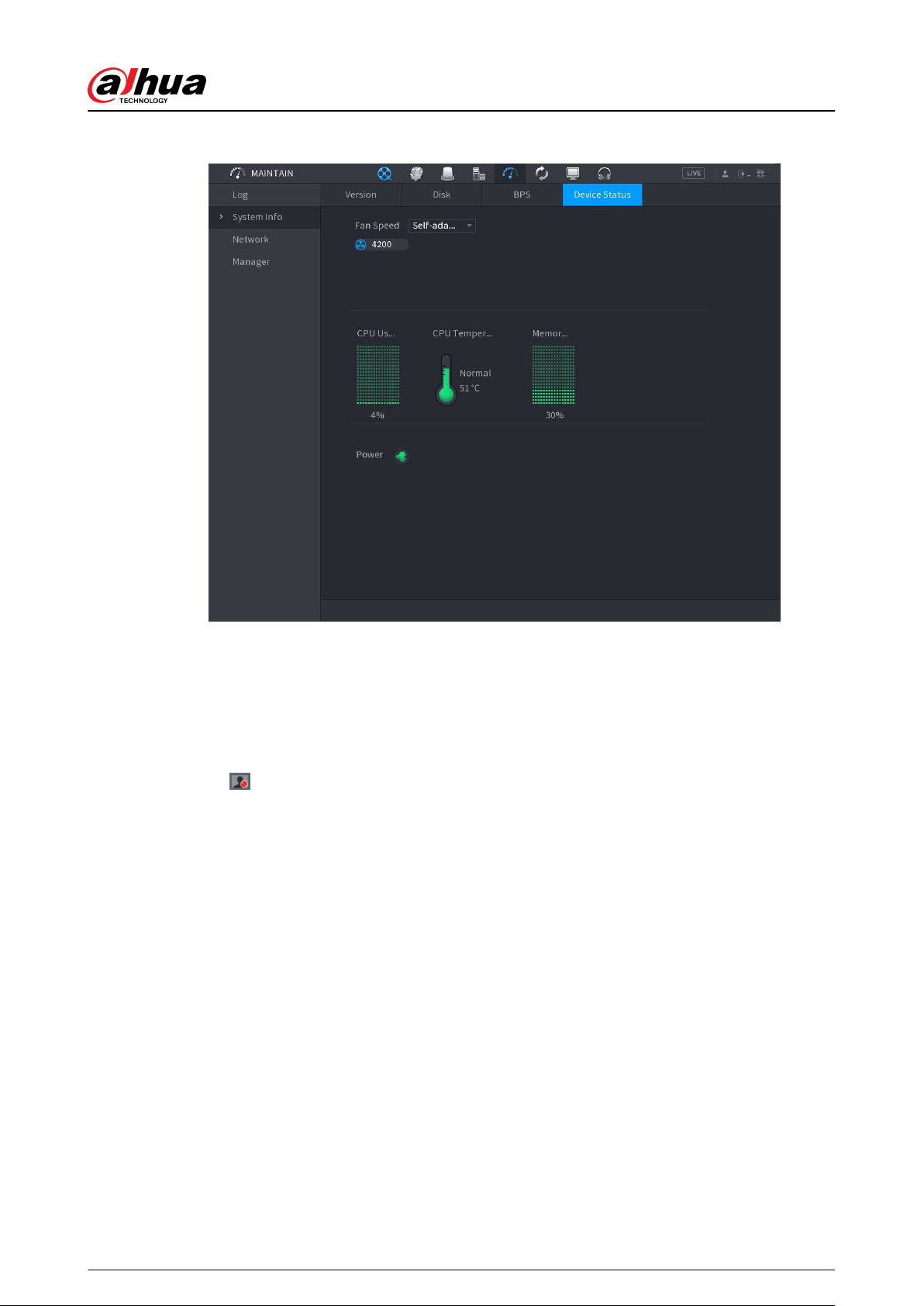
Figure 5-300 Device status
5.19.3 Network
5.19.3.1 Online User
You can view the online user information or block any user for a period of time. To block an online
user, click
and then enter the time that you want to block this user. The maximum value you can
set is 65535.
The system detects every 5 seconds to check whether there is any user added or deleted, and
update the user list timely.
Select Main Menu > MAINTAIN > Network > Online User.
User's Manual
417
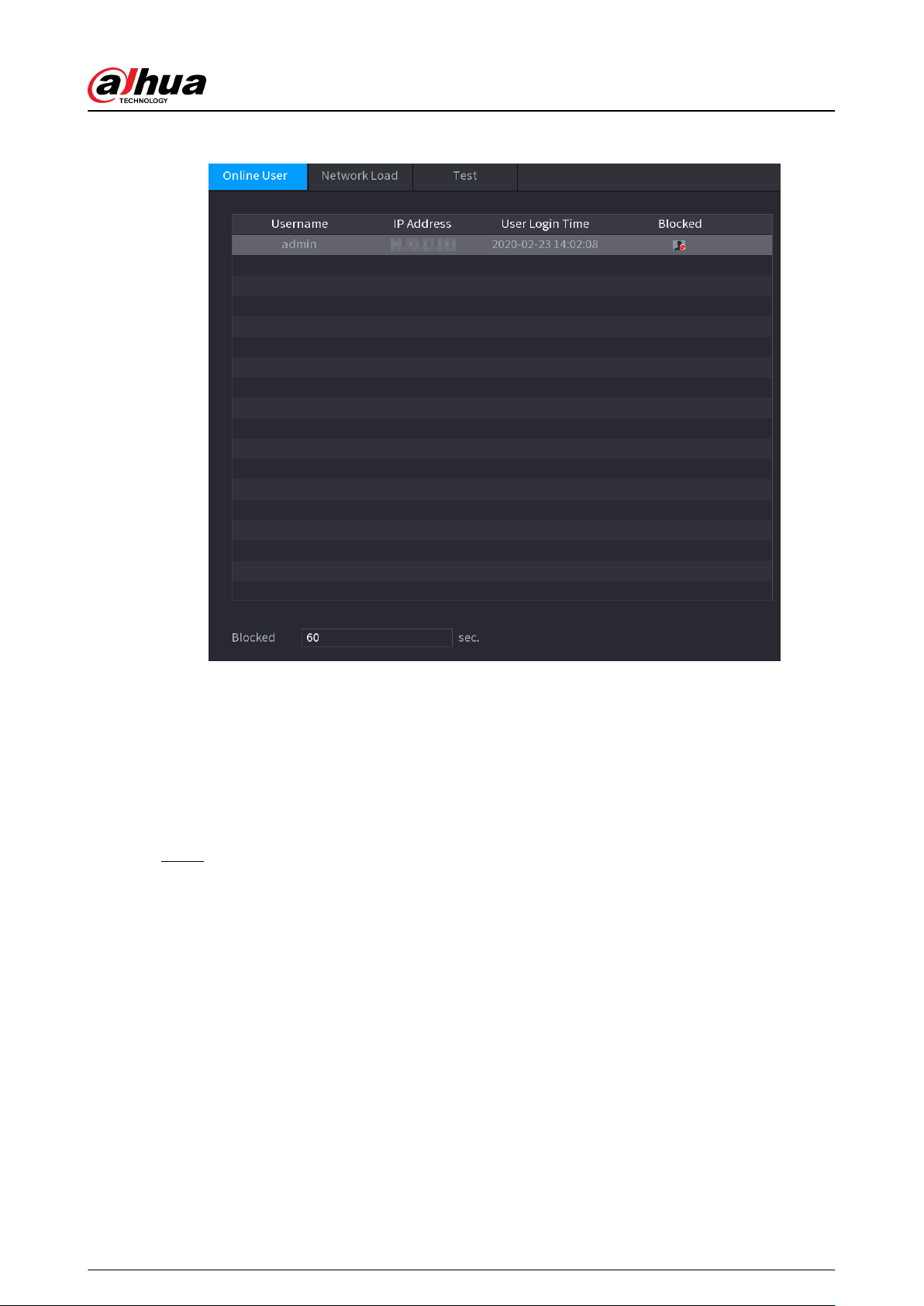
Figure 5-301 Online user
5.19.3.2 Network Load
Background Information
Network load means the data ow which measures the transmission capability. You can view the
information such as data receiving speed and sending speed.
Procedure
Step 1 Select Main Menu > MAINTAIN > Network > Network Load.
User's Manual
418
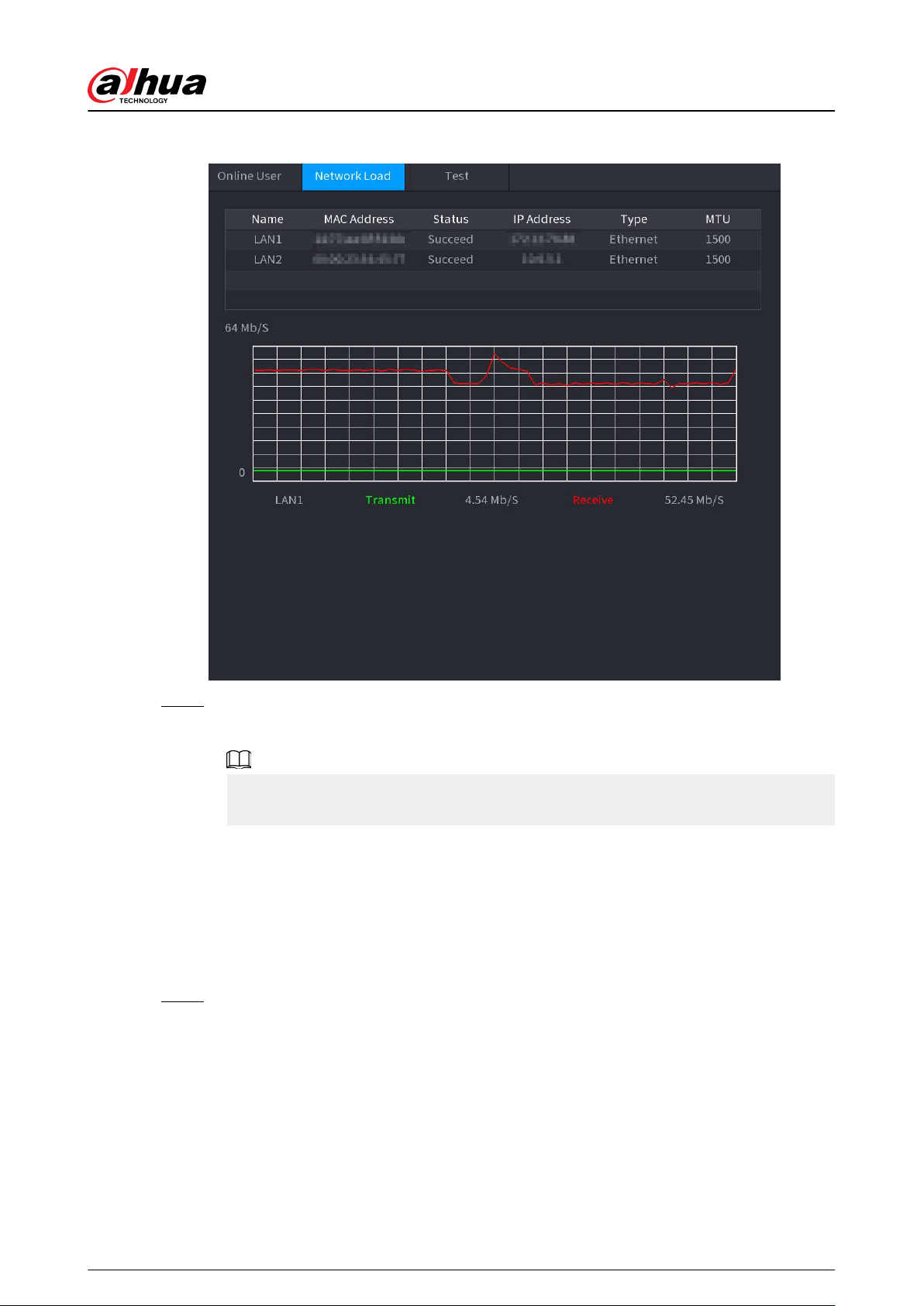
Figure 5-302 Network load
Step 2 Click the LAN name that you want to view, for example, LAN1.
The system displays the information of data sending speed and receiving speed.
●
System displays LAN1 load by default.
●
Only one LAN load can be displayed at one time.
5.19.3.3 Network Test
Background Information
You can test the network connection status between the Device and other devices.
Procedure
Step 1 Select Main Menu > MAINTAIN > Network > Test.
User's Manual
419
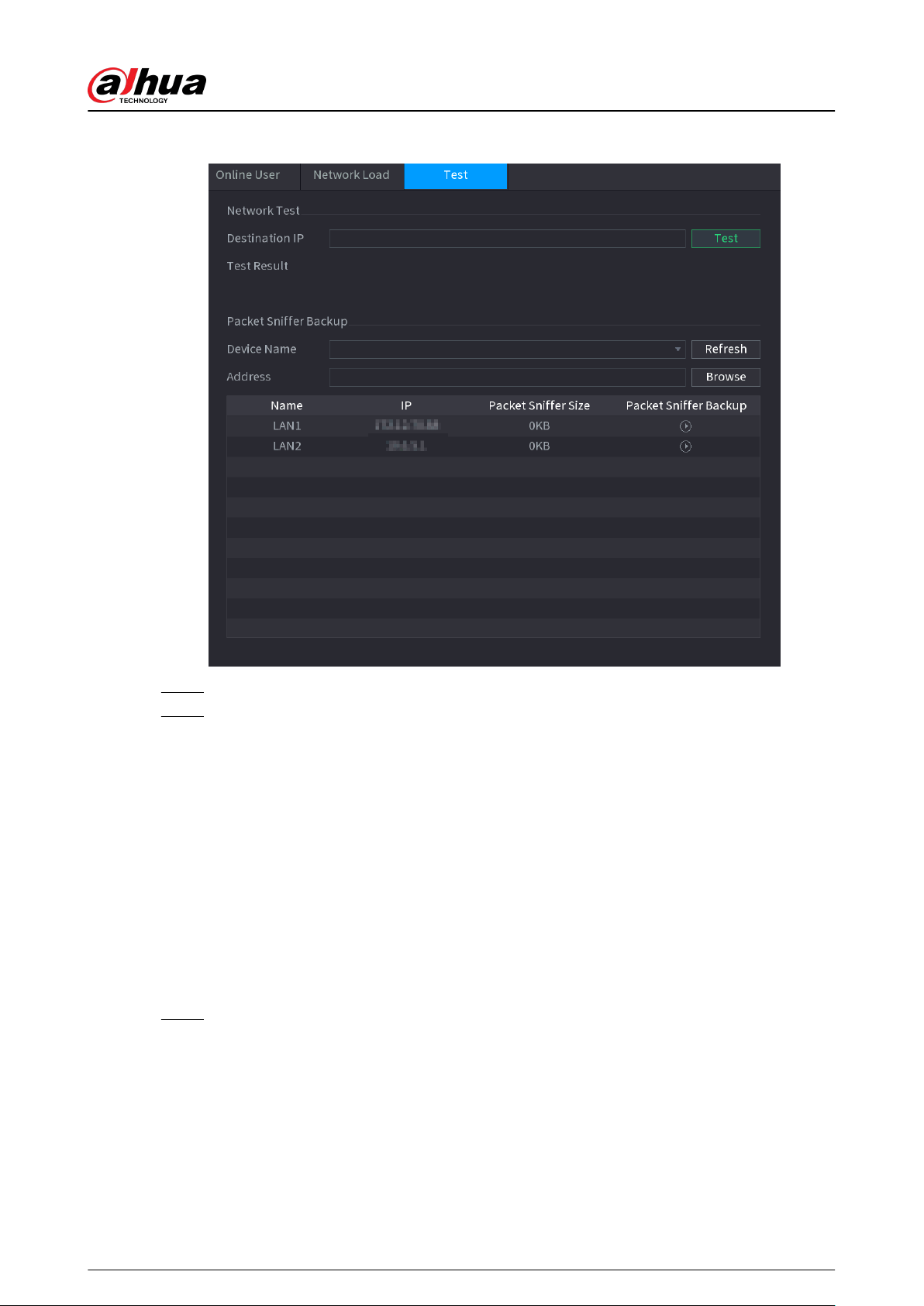
Figure 5-303 Test
Step 2 In the Destination IP box, enter the IP address.
Step 3 Click Test.
After testing is completed, the test result is displayed. You can check the evaluation for
average delay, packet loss, and network status.
5.19.4 Maintenance and Management
5.19.4.1 Device Maintenance
Background Information
When the Device has been running for a long time, you can enable the Device to restart
automatically at the idle time. You can also enable emergency maintenance.
Procedure
Step 1 Select Main Menu > MAINTAIN > Manager > Maintenance.
User's Manual
420
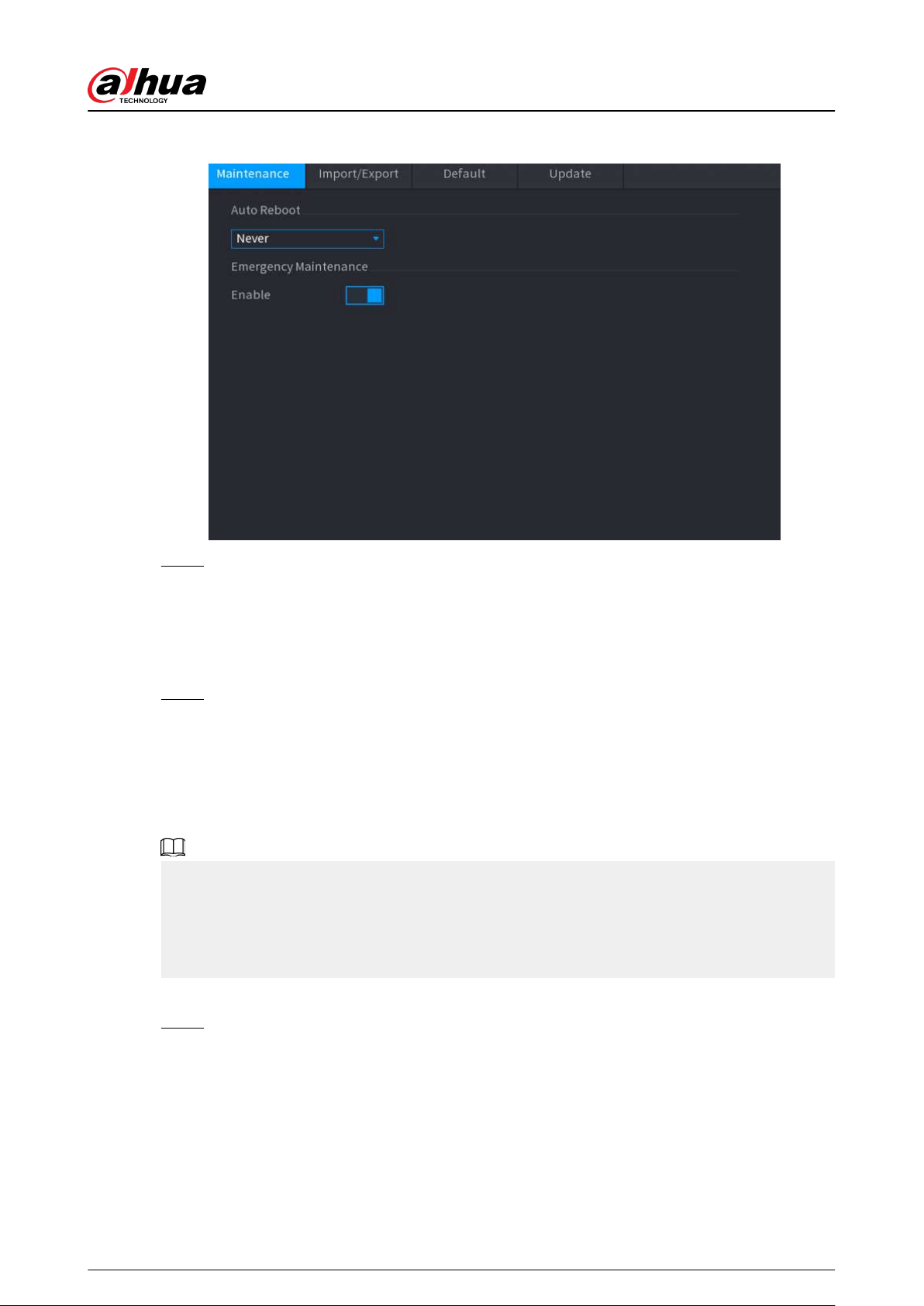
Figure 5-304 Maintenance
Step 2 Congure the parameters.
●
Auto Reboot : Enable the Device to restart at the idle time.
●
Emergency Maintenance : When the Device has an update power outage, running
error and other problems, and you cannot log in, then you can use the emergency
maintenance function to restart the Device, clear conguration, update the system,
and more.
Step 3 Click Apply.
5.19.4.2 Exporting System Settings
Background Information
You can export or import the Device system settings if there are several Devices that require the
same setup.
●
The Import/Export page cannot be opened if the backup operation is ongoing on the other
pages.
●
When you open the Import/Export page, the system refreshes the devices and sets the current
directory as the rst root directory.
●
Click Format to format the USB storage device.
Procedure
Step 1 Select Main Menu > MAINTAIN > Manager > Import/Export.
User's Manual
421
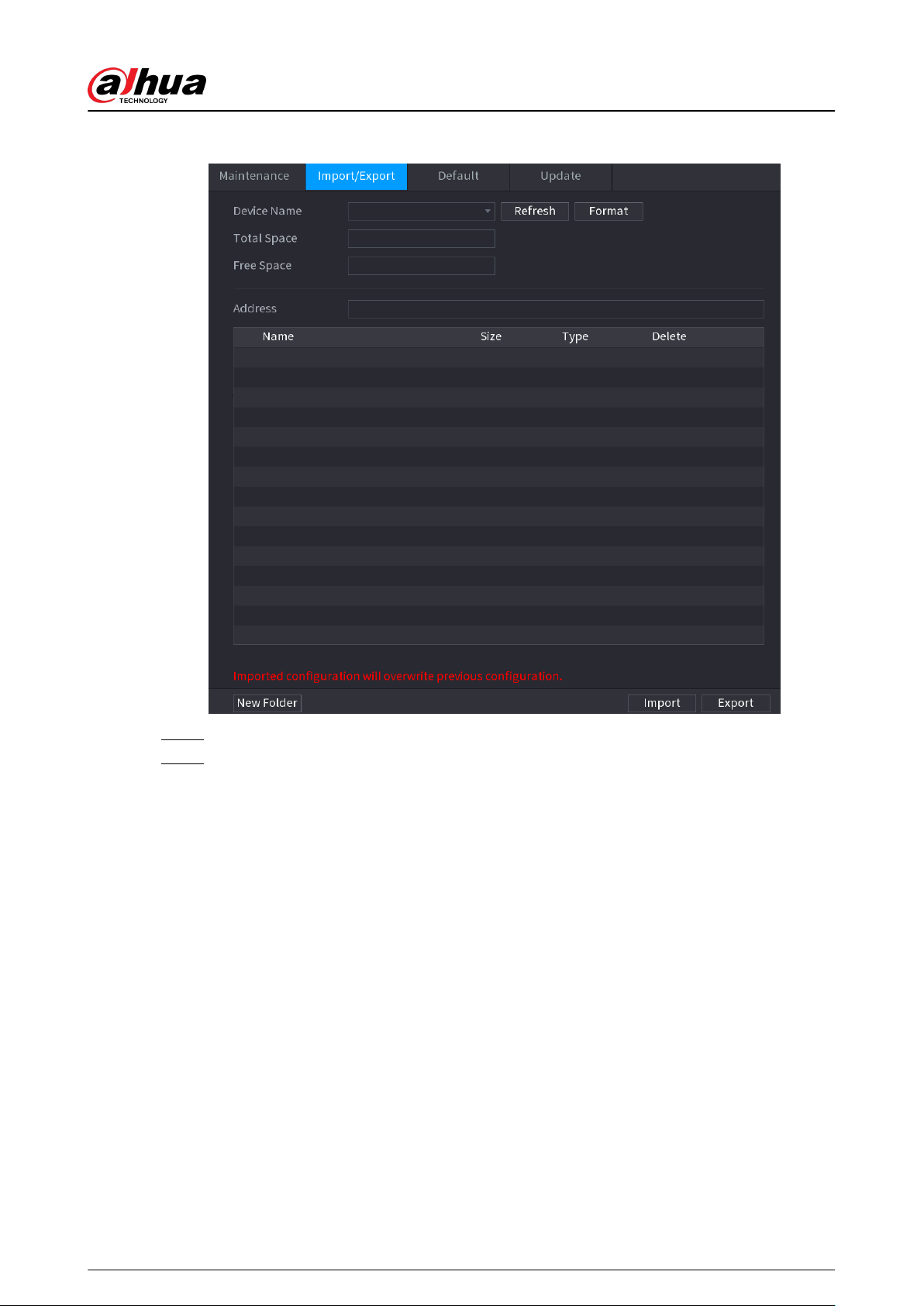
Figure 5-305 Import and export
Step 2 Insert a USB storage device into one of the USB ports on the Device.
Step 3 Click Refresh to refresh the page.
The connected USB storage device is displayed.
User's Manual
422
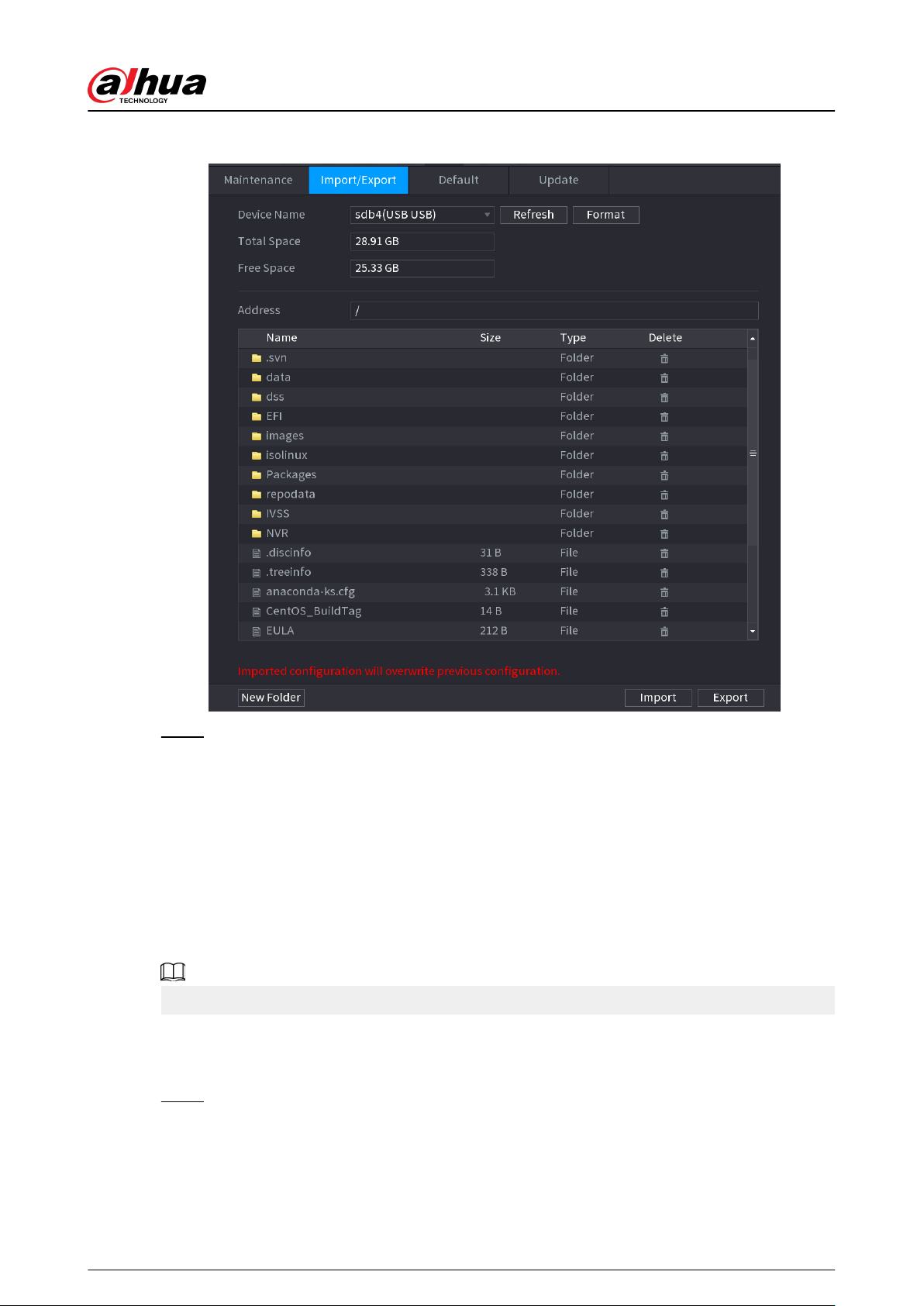
Figure 5-306 Connected USB device
Step 4 Click Export.
There is a folder under the name style of "Cong_xxxx". Double-click this folder to view
the backup les.
5.19.4.3 Restoring Defaults
5.19.4.3.1 Restoring Defaults on the Local Page
Background Information
This function is for admin account only.
You can restore the Device to default settings on the local page.
Procedure
Step 1 Select Main Menu > MAINTAIN > Manager > Default.
User's Manual
423
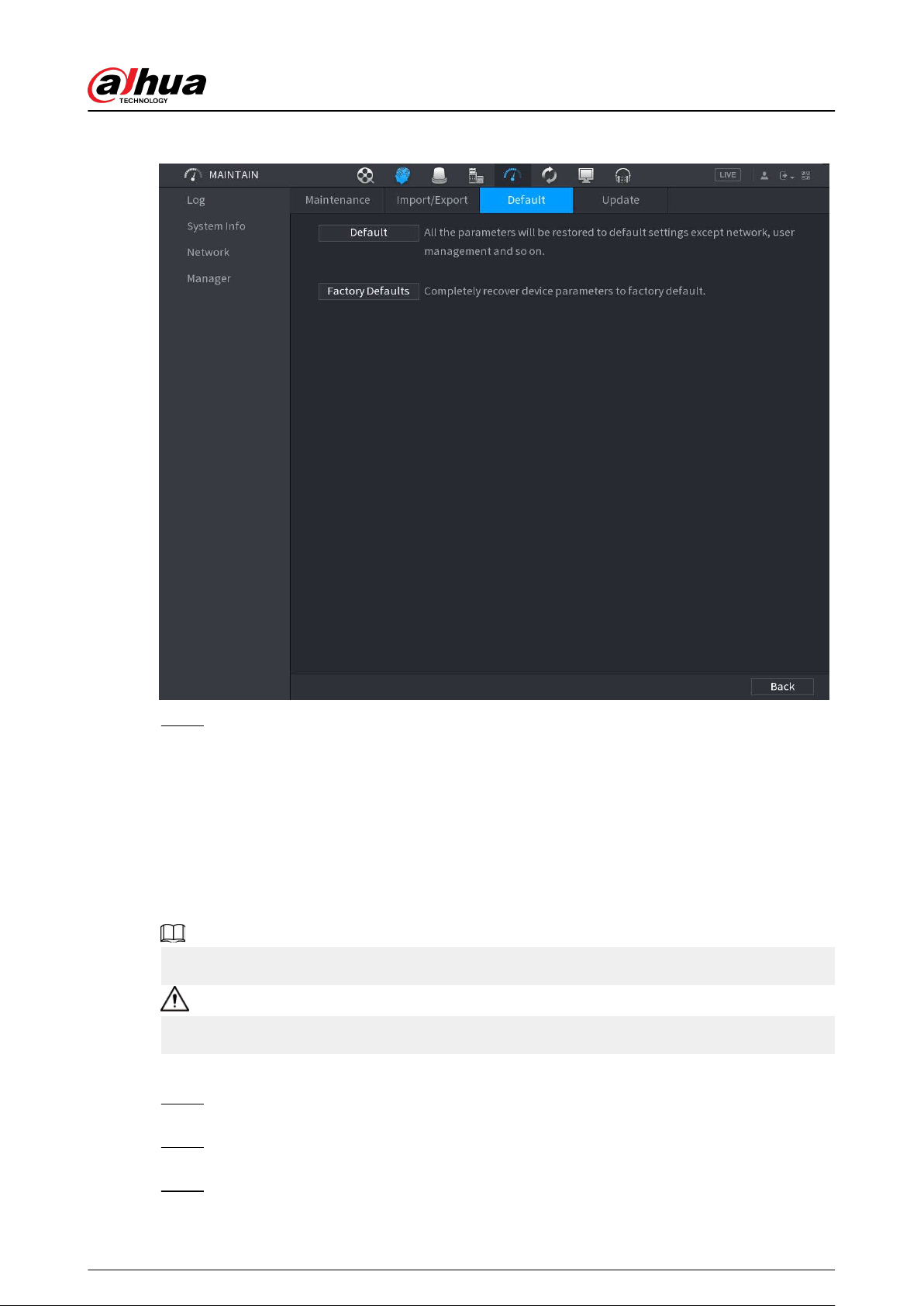
Figure 5-307 Default
Step 2 Restore the settings.
●
Default: Restore all the congurations except network settings and user management
to the default.
●
Factory Default: Restore all the congurations to the factory default settings.
5.19.4.3.2 Resetting Device through the Reset Button
Background Information
You can use the reset button on the mainboard to reset the Device to the factory default settings.
The reset button is available on select models.
After resetting, all the congurations will be lost.
Procedure
Step 1 Disconnect the Device from power source, and then remove the cover panel. For details
about removing the cover panel, see "3.3 HDD Installation".
Step 2 Find the reset button on the mainboard, and then connect the Device to the power
source again.
Step 3 Press and hold the reset button for 5 seconds to 10 seconds.
User's Manual
424
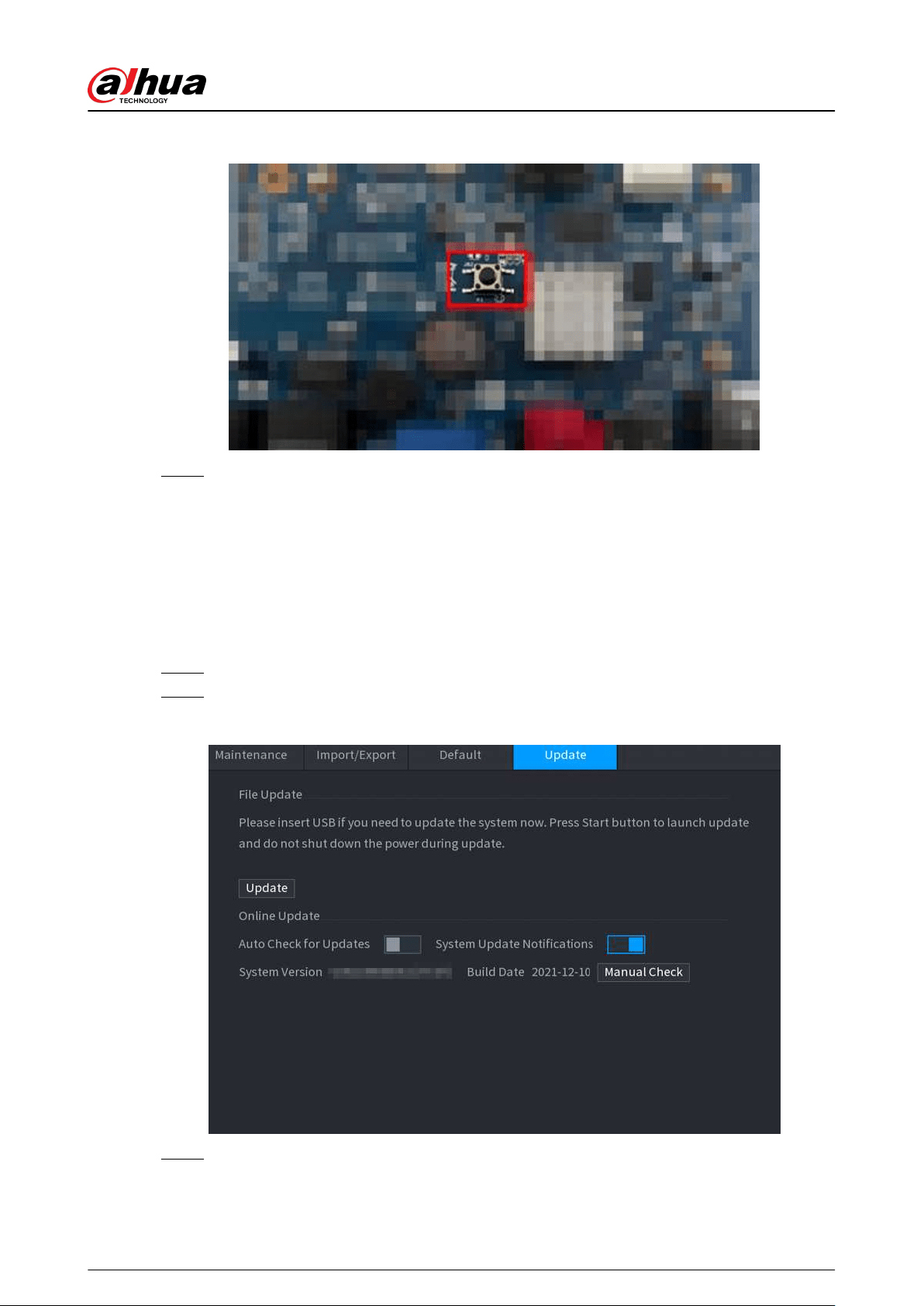
Figure 5-308 Reset button
Step 4 Restart the Device.
After the Device restarts, the settings have been restored to the factory default.
5.19.4.4 System Update
5.19.4.4.1 Upgrading File
Procedure
Step 1 Insert a USB storage device containing the upgrade les into the USB port of the Device.
Step 2 Select Main Menu > MAINTAIN > Manager > Update
Figure 5-309 Update
Step 3 Click Update.
User's Manual
425
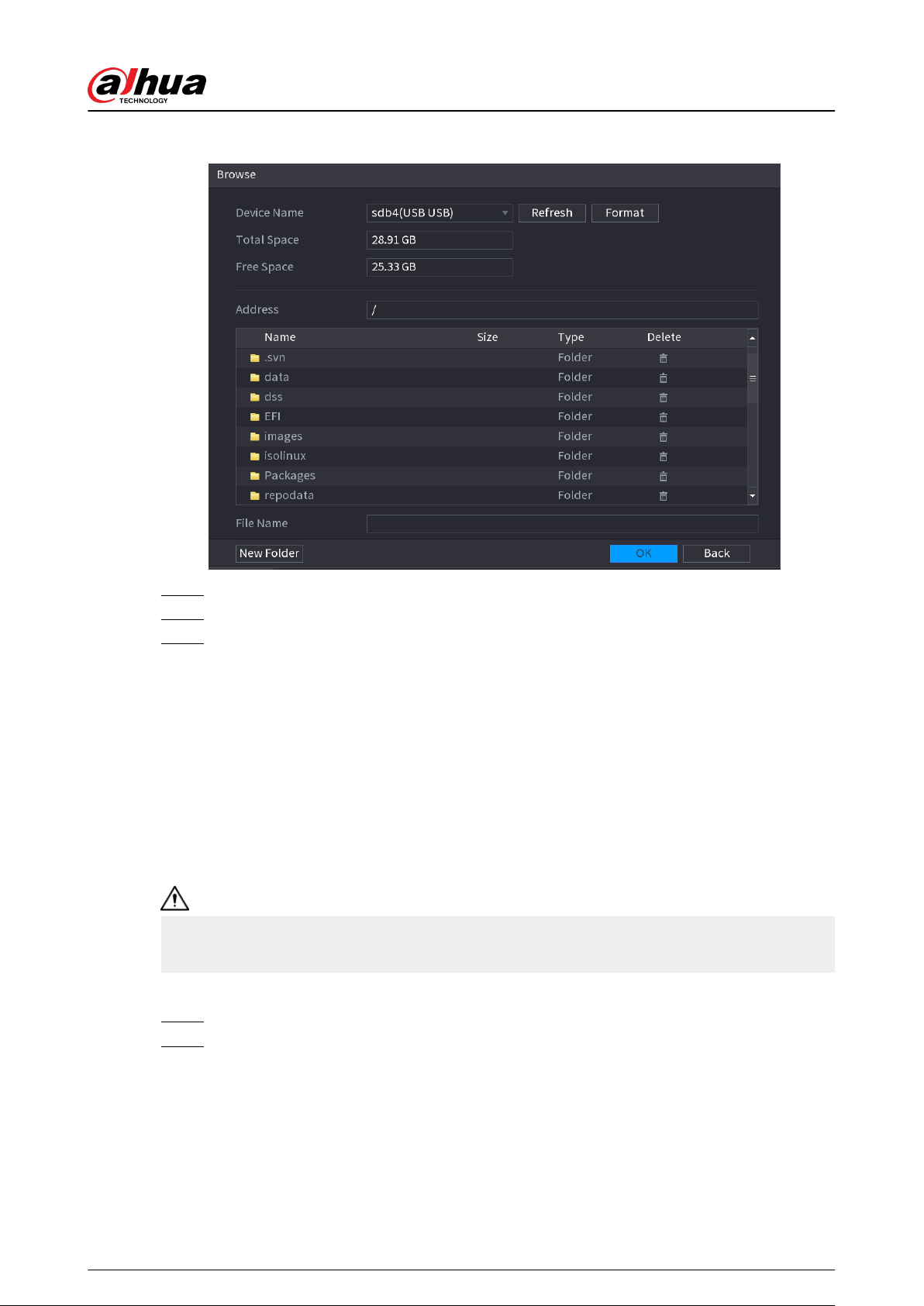
Figure 5-310 Browse
Step 4 Click the le that you want to upgrade.
Step 5 The selected le is displayed in the Update File box.
Step 6 Click Start.
5.19.4.4.2 Online Upgrade
Background Information
When the Device is connected to Internet, you can use online upgrade function to upgrade the
system.
Before using this function, you need to check whether there is any new version by auto check or
manual check.
●
Auto check: The Device checks if there is any new version available at intervals.
●
Manual check: Perform real-time check whether there is any new version available.
Ensure the correct power supply and network connection during upgrading; otherwise the
upgrading might be failed.
Procedure
Step 1 Select Main Menu > MAINTAIN > Manager > Update.
Step 2 Check whether there is any new version available.
●
Auto-check for updates: Enable Auto-check for updates.
●
Manual check: Click Manual Check.
The system starts checking the new versions. After checking is completed, the check
result is displayed.
●
If the "It is the latest version" text is displayed, you do not need to upgrade.
●
If the text indicating there is a new version, go to the step 3.
User's Manual
426
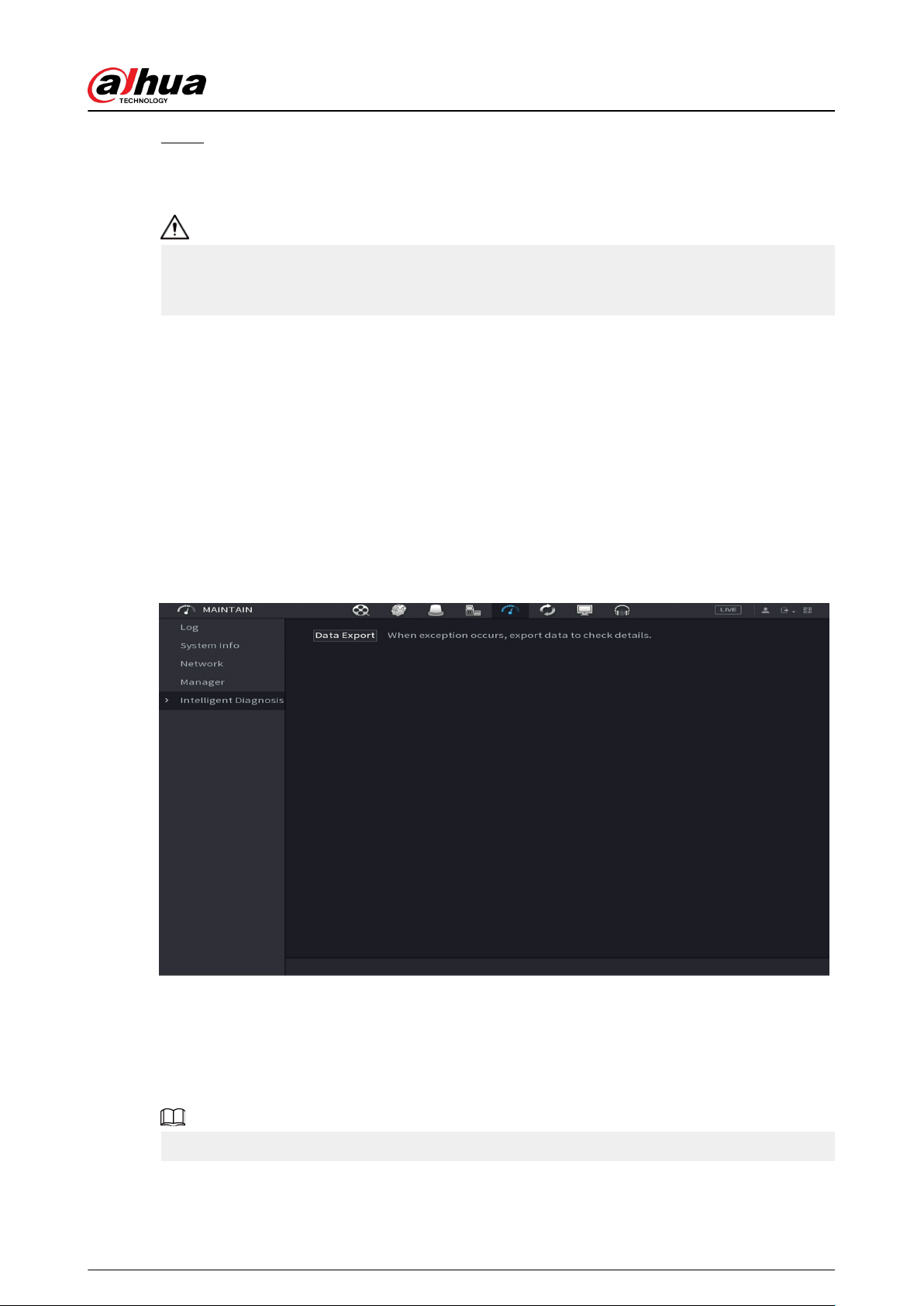
Step 3 Click Update now to update the system.
5.19.4.4.3 Uboot Upgrading
●
Under the root directory in the USB storage device, there must be "u-boot.bin.img" le and
"update.img" le saved, and the USB storage device must be in FAT32 format.
●
Make sure the USB storage device is inserted; otherwise the upgrading cannot be performed.
When starting the Device, the system automatically checks whether there is a USB storage device
connected and any upgrade le, and if yes and the check result of the upgrade le is correct, the
system will upgrade automatically. The Uboot upgrade can avoid the situation that you have to
upgrade through +TFTP when the Device is halted.
5.19.4.5 Intelligent Diagnosis
Background Information
When exception occurs, export data to check details.
Select Maintain > Intelligent Diagnosis.
Figure 5-311 Intelligent diagnosis
5.20 USB Device Auto Pop-up
After you inserted the USB device, system can auto detect it and pop up the following dialogue
box. It allows you to conveniently backup le, log, conguration or update system.
You can add a USB keyboard through USB port, and it can input characters limited to soft keyboard.
User's Manual
427
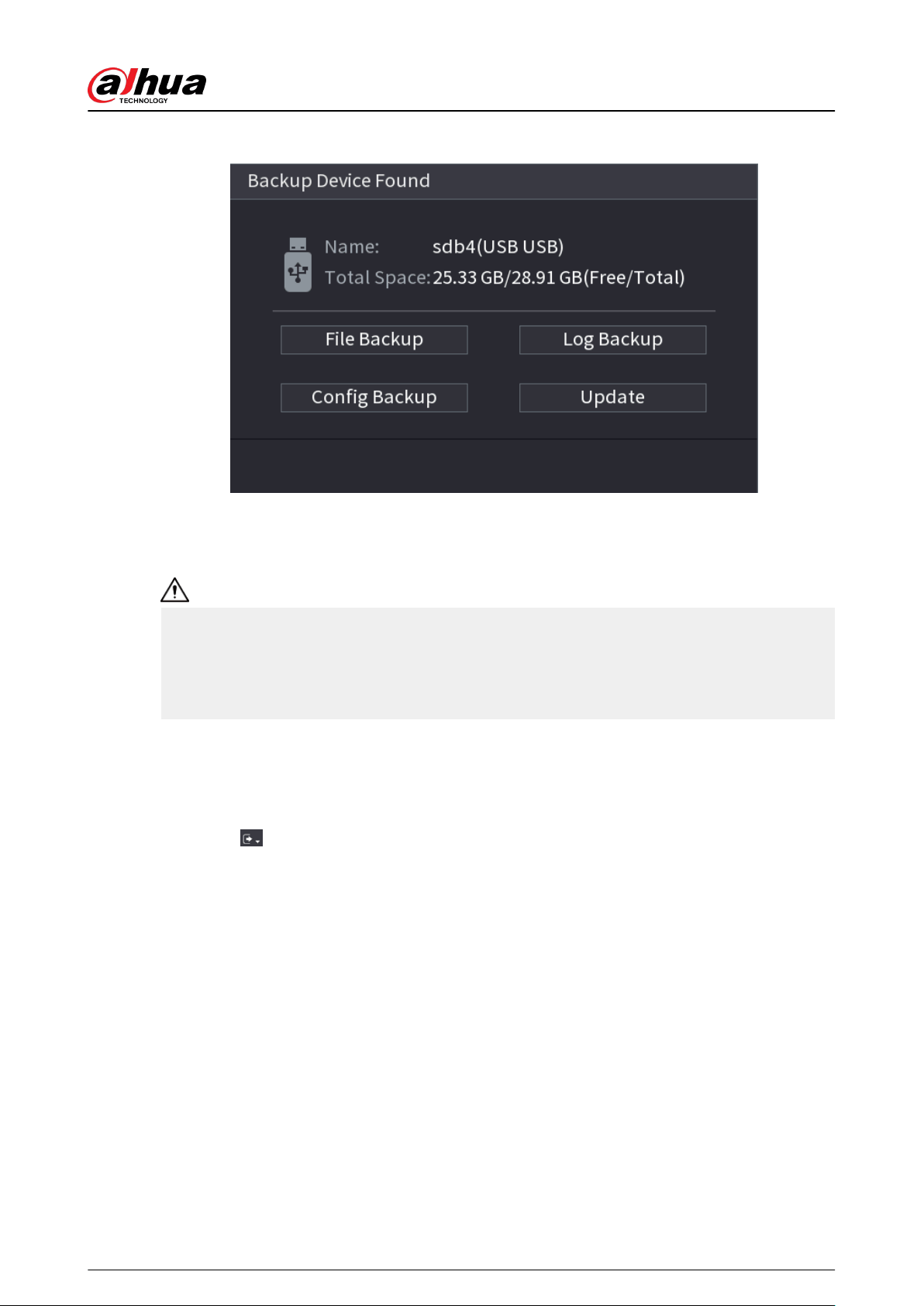
Figure 5-312 USB device prompt
5.21 Shutdown
●
When you see corresponding dialogue box "System is shutting down…" Do not click power on-
o button directly.
●
Do not unplug the power cable or click power on-o button to shutdown device directly when
device is running (especially when it is recording.)
●
Shut down the device and then unplug the power cable before you replace the HDD.
Procedure
●
From the main menu (Recommended)
1. Click
at the upper-right corner.
User's Manual
428
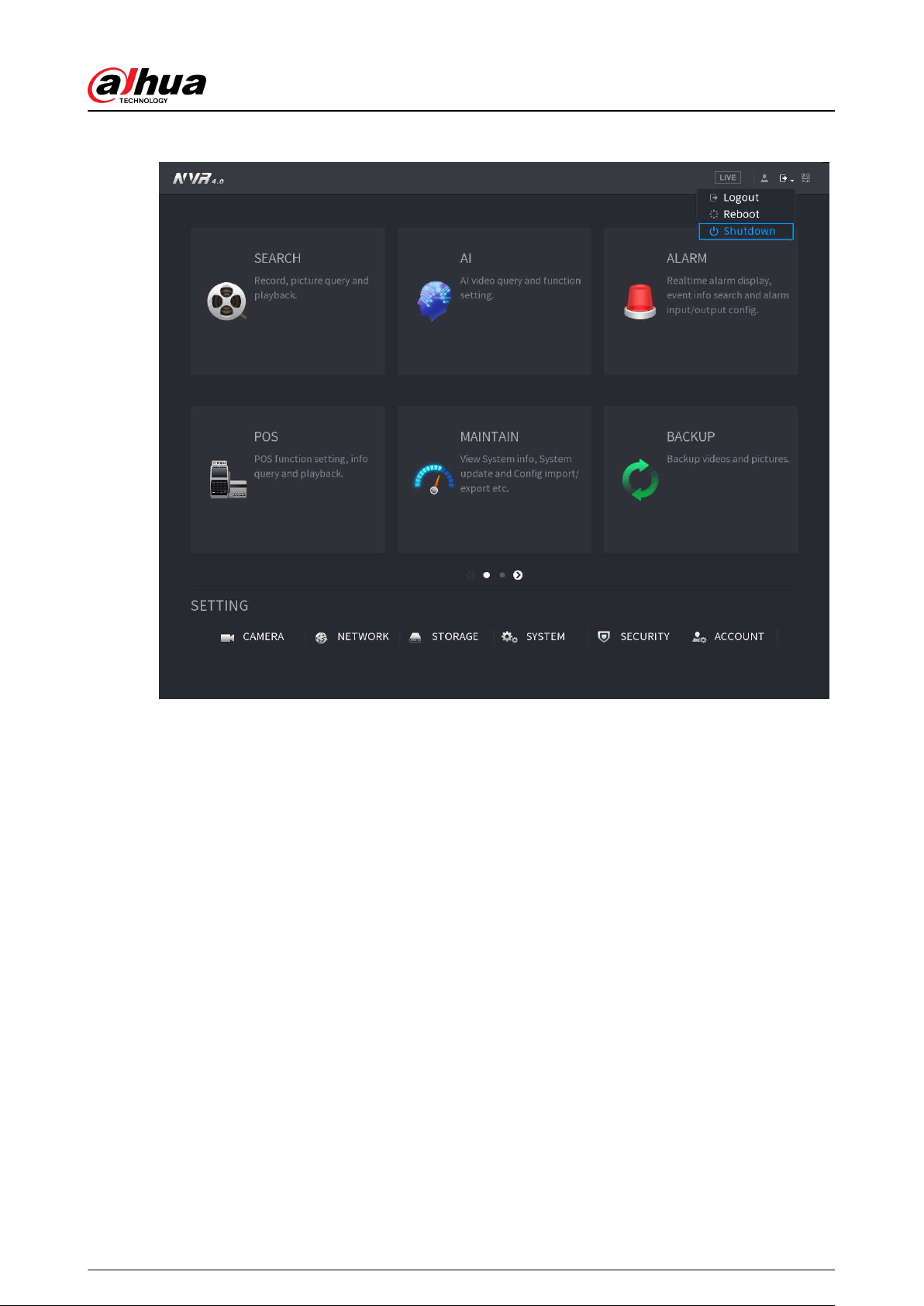
Figure 5-313 Shutdown (1)
2. Select Shutdown.
Draw the unlock pattern or input password rst if you have no authority to shut down.
User's Manual
429
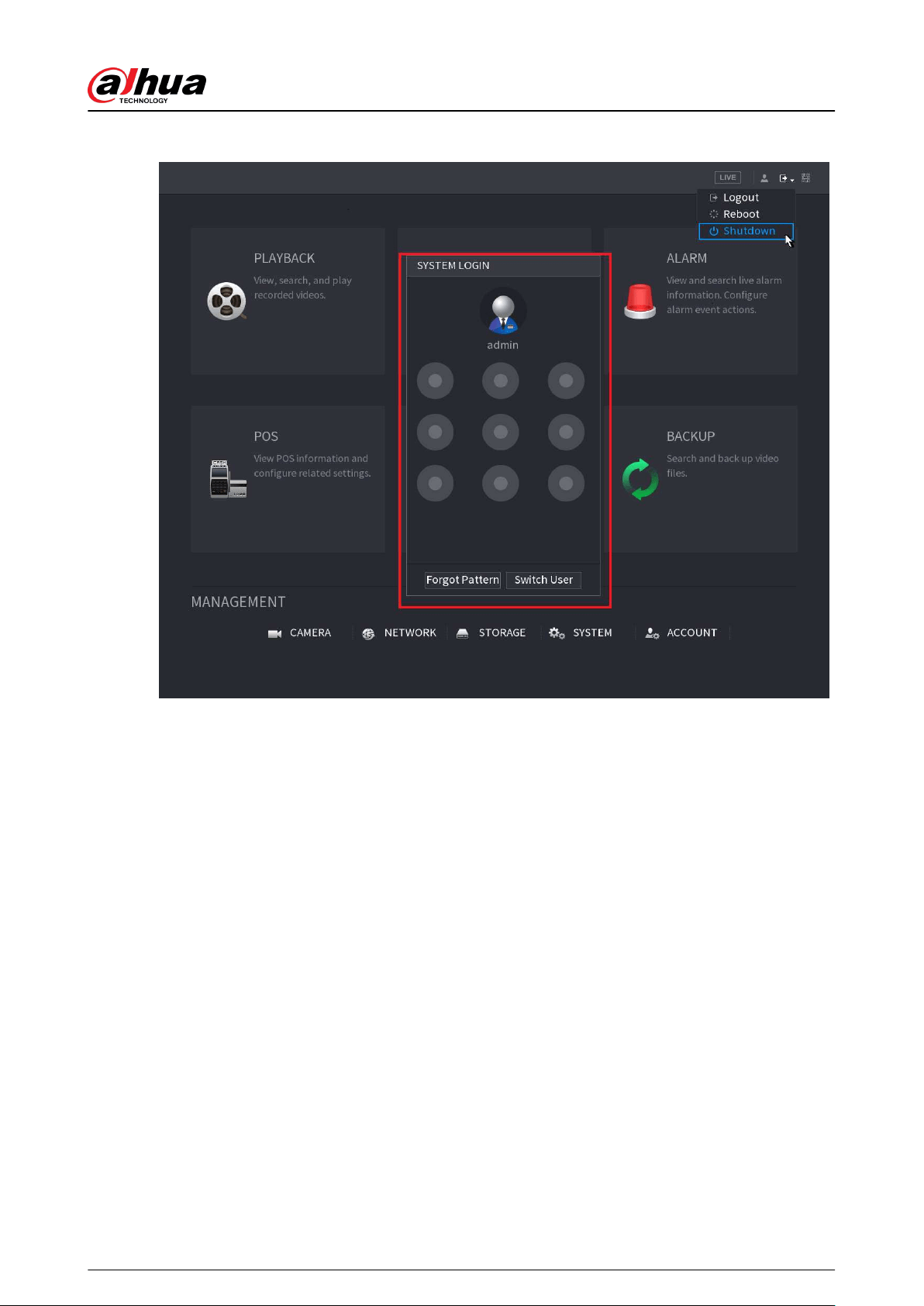
Figure 5-314 Shutdown (2)
User's Manual
430
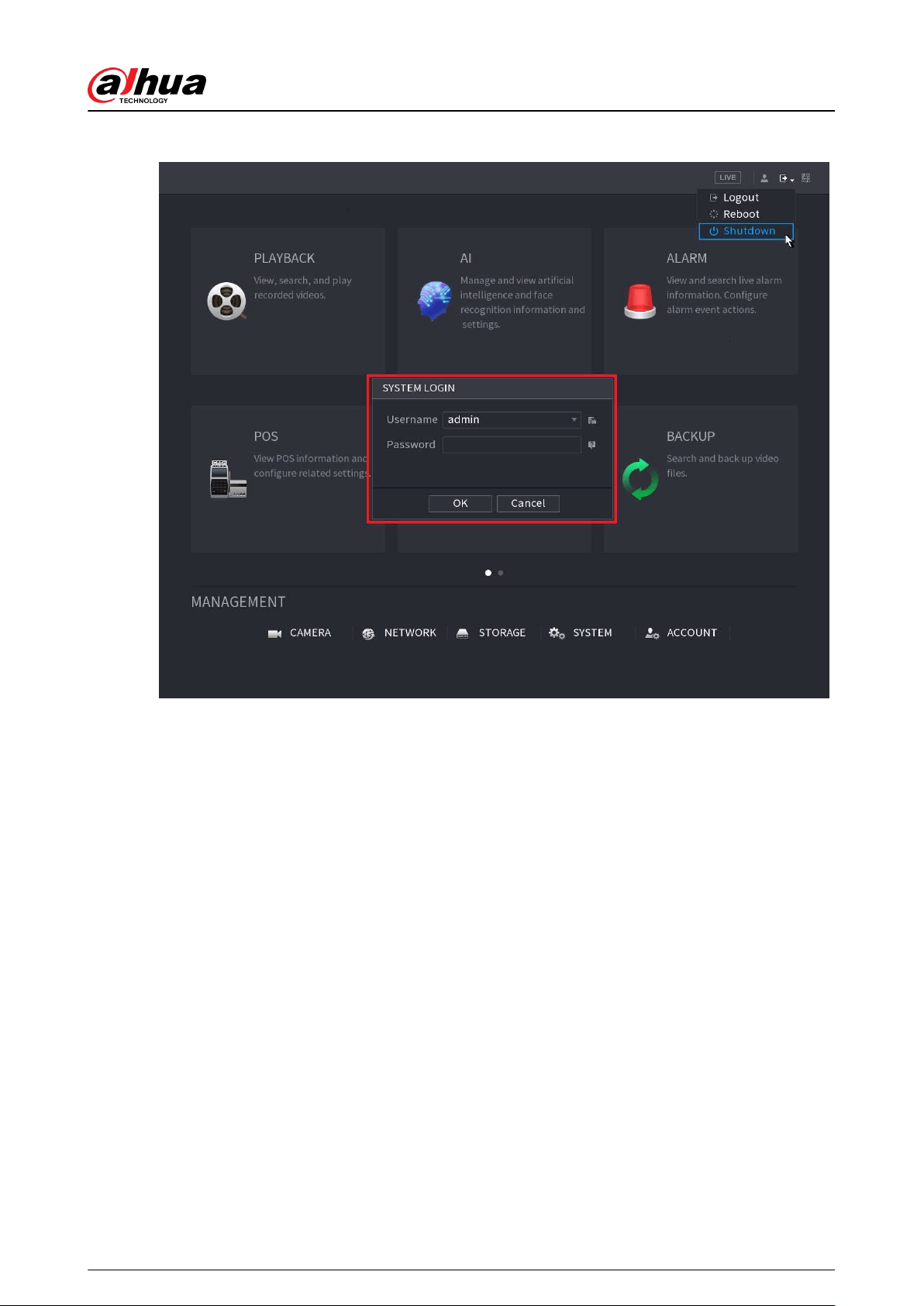
Figure 5-315 Shutdown (3)
●
Remote Control
Press the power button on the remote for at least 3 seconds.
●
Press the power button at the rear panel of the device.
Auto Resume after Power Failure
The system can automatically backup video le and resume previous working status after power
failure.
User's Manual
431
6 Web Operation
●
The gures in the Manual are used for introducing the operations and only for reference. The
actual page might be dierent dependent on the model you purchased.
●
The Manual is a general document for introducing the product, so there might be some
functions described for the Device in the Manual not apply to the model you purchased.
●
Besides Web, you can use our Smart PSS to login the device. For detailed information, see Smart
PSS user’s manual.
6.1 Network Connection
Background Information
●
The factory default IP of the Device is 192.168.1.108.
●
The Device supports monitoring on dierent browsers such as Safari, Firefox, Google to perform
the functions such as multi-channel monitoring, PTZ control, and device parameters
congurations.
Procedure
Step 1 Check to make sure the Device has connected to the network.
Step 2 Congure the IP address, subnet mask and gateway for the PC and the Device. For details
about network conguration of the Device, see "5.19.3 Network".
Step 3 On your PC, check the network connection of the Device by using "ping ***.***.***.***".
Usually the return value of TTL is 255.
6.2 Web Login
Procedure
Step 1 Open the browser, enter the IP address of the Device, and then press Enter.
User's Manual
432
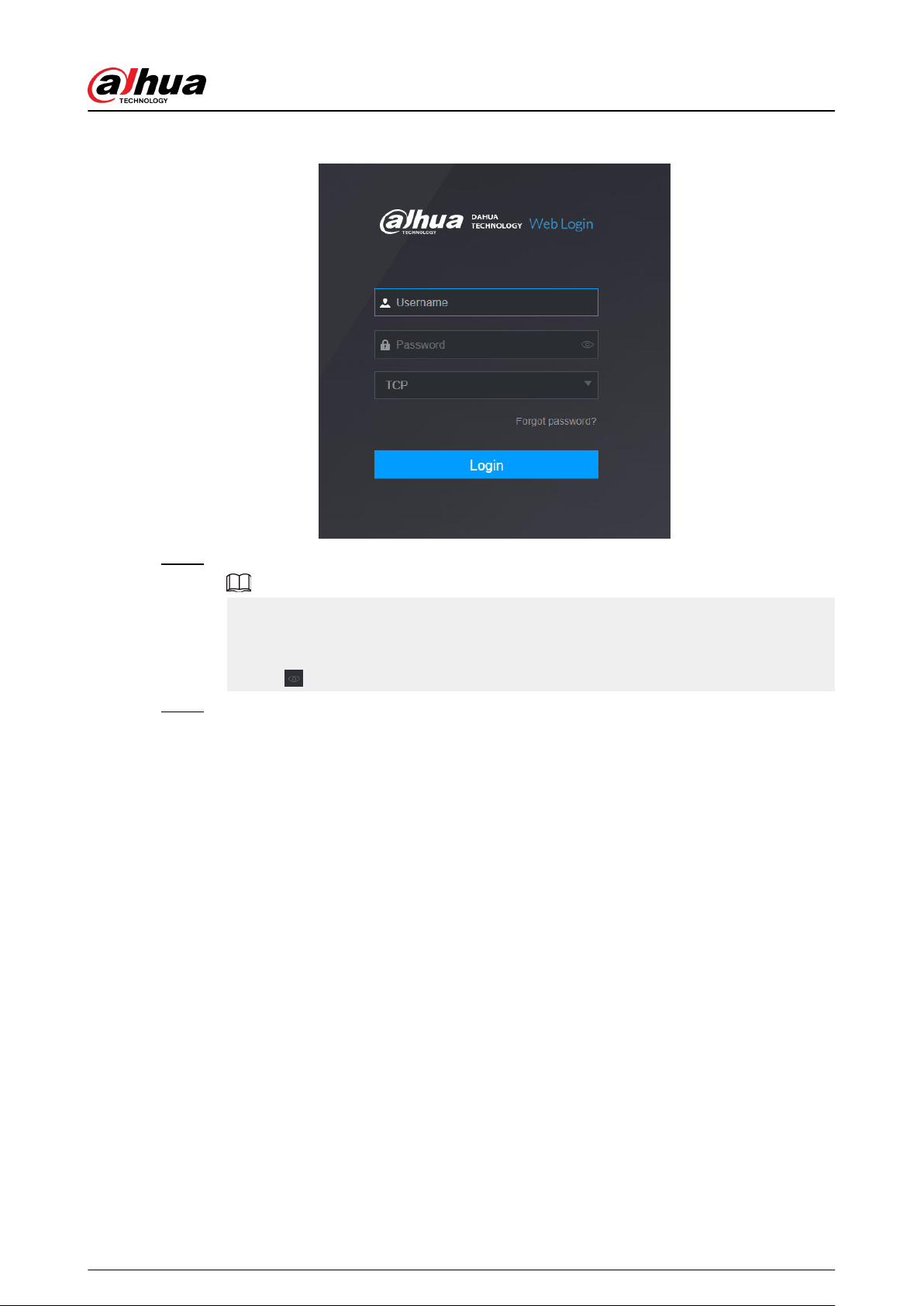
Figure 6-0 Login
Step 2 Enter the username and password.
●
The default administrator account is admin. The password is the one that was
congured during initial settings. To ensure your account security, we recommend
you keep the password properly and change it regularly.
●
Click
to display the password.
Step 3 Click Login.
6.3 Web Main Menu
After you have logged in to the web, the main menu is displayed.
For detailed operations, see "5 Local Operations".
User's Manual
433
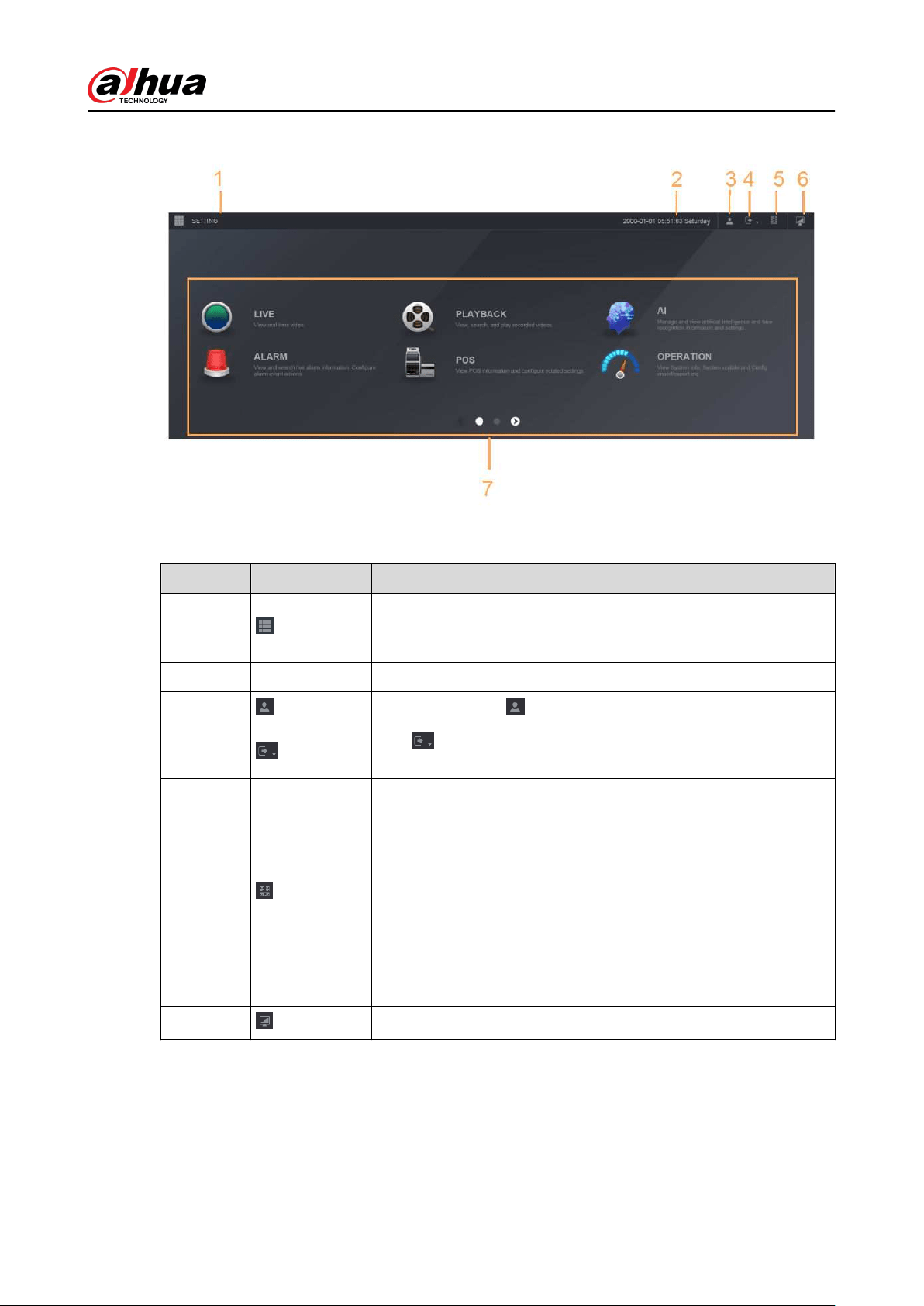
Figure 6-1 Main menu
Table 6-1 Main menu symbols
No. Icon Description
1
Includes conguration menu through which you can congure
camera settings, network settings, storage settings, system
settings, account settings, and view information.
2 None Displays system date and time.
3
When you point to , the current user account is displayed.
4
Click , select Logout, Reboot, or Shutdown according to your
actual situation.
5
Displays Cell Phone Client and Device SN QR Code.
●
Cell Phone Client: Use your mobile phone to scan the QR code
to add the device into the Cell Phone Client, and then you can
start accessing the Device from your cell phone.
●
Device SN: Obtain the Device SN by scanning the QR code. Go
to the P2P management platform and add the Device SN into
the platform. Then you can access and manage the device in
the WAN. For details, see the P2P operation manual. You can
also congure P2P function in the local congurations, see
"5.11.18 P2P".
6
Displays the web main menu.
User's Manual
434

No. Icon Description
7 None
Includes eight function tiles: LIVE, PLAYBACK, AI, ALARM, POS,
OPERATION, BACKUP, DISPLAY, and AUDIO. Click each tile to
open the conguration page of the tile.
●
LIVE: You can perform the operations such as viewing real-time
video, conguring channel layout, setting PTZ controls, and
using smart talk and instant record functions if needed.
●
PLAYBACK: Search for and play back the recorded video saved
on the Device.
●
ALARM: Search for alarm information and congure alarm
event actions.
●
AI: Congure and manage articial intelligent events. It
includes smart search, parameters, and database.
●
POS: View POS information and congure related settings.
●
OPERATION: View system information, import/export system
conguration les, or update system.
●
BACKUP: Search and back up the video les to the local PC or
external storage device such as USB storage device.
●
DISPLAY: Congure the display eect such as displaying
content, image transparency, and resolution, and enable the
zero-channel function.
●
AUDIO: Manage audio les and congure the playing schedule.
The audio le can be played in response to an alarm event if the
voice prompts function is enabled.
6.4 Cluster Service
The cluster function, also known as cluster redundancy, is a kind of deployment method that can
improve the reliability of the device. In the cluster system, there is a number of main devices and
another number of sub devices (the N+M mode), and they have a virtual IP address (the cluster IP).
When the main device fails, the corresponding sub device will take over the job automatically.
When the main device recovers, the sub device will transmit the conguration data, cluster IP
address and videos recorded during the failure to the main device which then takes over the job
again.
In the N+M cluster system, there is a management server, the DCS (Dispatching Console) server,
which is responsible for timely and correct scheduling management of the main and sub devices.
When you create a cluster, the current device is used as the rst sub device and the DCS server by
default.
This function is available on select models.
6.4.1 Conguring Cluster IP
Background Information
When the main device malfunctions, the sub device can use the main device conguration and
virtual IP address to replace the work (monitor or record) accordingly. When you use the virtual IP
to access the device, you can still view the real-time video and there is no risk of record loss.
User's Manual
435
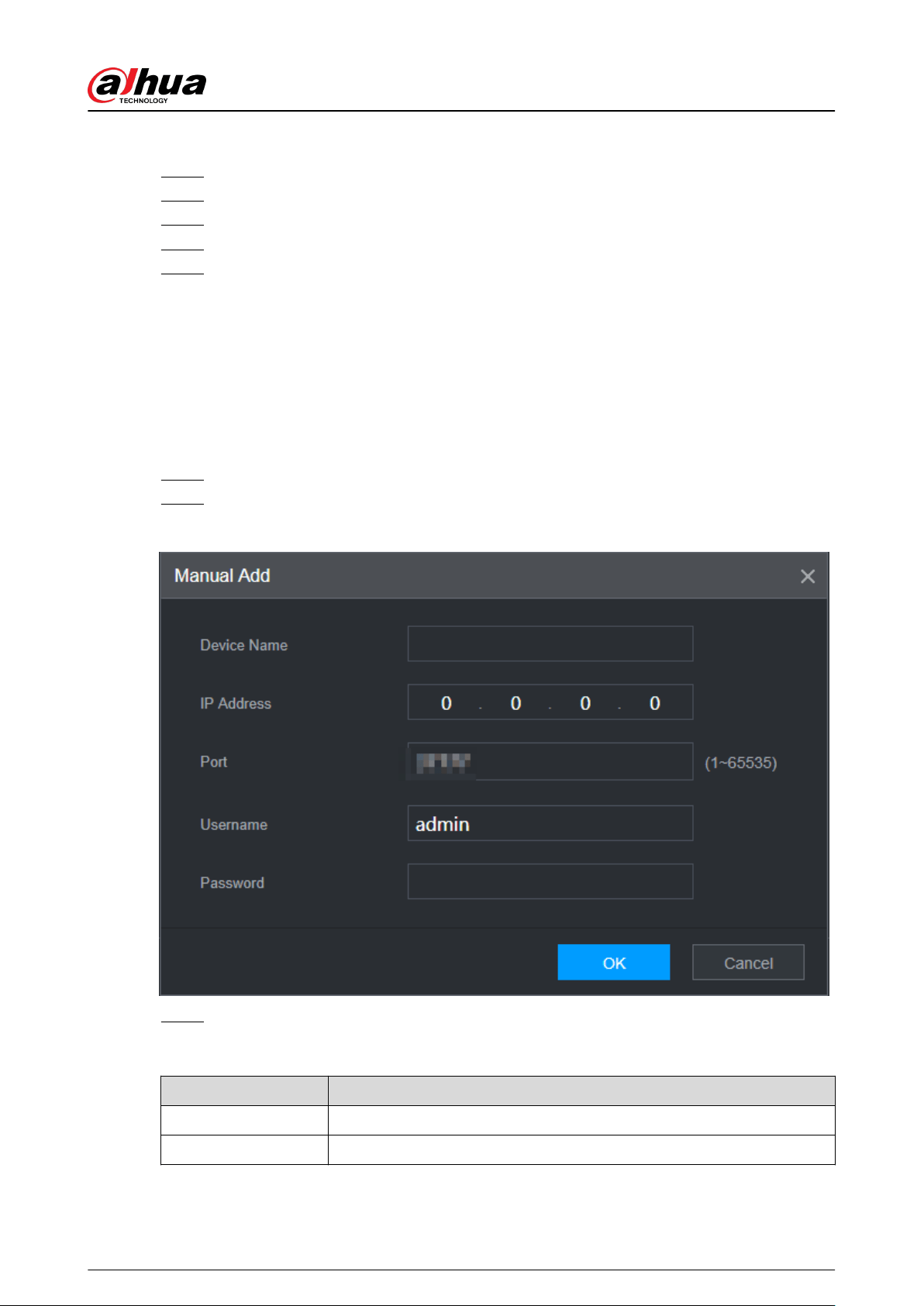
Procedure
Step 1 Log in to the web as the admin user.
Step 2 Select SETTING > Cluster Service > CLUSTER IP.
Step 3 Select Enable.
Step 4 Congure IP Address , Subnet Mask and Default Gateway.
Step 5 Click OK.
6.4.2 Main Device
Background Information
You can add several main devices manually. After you enable the cluster function, you can vie IP
address, working status and connection log of the main device.
Procedure
Step 1 Select SETTING > Cluster Service > Main Device.
Step 2 Click Manual Add.
Figure 6-2 Manual add
Step 3 Congure parameters.
Table 6-2 Parameters of adding main device
Parameter Description
Device Name Customize the device name.
IP Address Enter the IP address of the NVR.
User's Manual
436
Parameter Description
Port
Set the TCP port number of the server. The default value is 37777.
You can view the current TCP port number in SETTING > Network >
Port.
Username/Password Enter the username and password of the NVR.
Step 4 Click OK.
Step 5 (Optional) Click to view event occurrence time, name, operation and reason.
6.4.3 Sub Device
Background Information
When you add the rst sub device, the default IP is the device IP address that logs in on the web.
From SETTING > Cluster Service > Sub Device, you can add sub devices. For details, see "6.4.2
Main Device".
When adding the rst sub device, you need not enter the IP address, because the rst sub device is
the current device by default.
After you added main device and sub device, you need to enable cluster function. See "6.4.5
Conguring Cluster Control" for more information.
6.4.4 Transferring Videos
After the main device has recovered, the videos recorded on the sub device during the failure
period can be transferred to the main device.
Prerequisites
The main device works normally.
Procedure
Step 1 Select SETTING > Cluster Service > Transfer Recorder.
Step 2 Click Add Task.
Step 3 Congure parameters.
Step 4 Click OK.
You can click
to view details on the transferring task.
6.4.5 Conguring Cluster Control
6.4.5.1 Cluster Control
Background Information
From SETTING > Cluster Service > Cluster Control, you can enable or disable cluster.
User's Manual
437
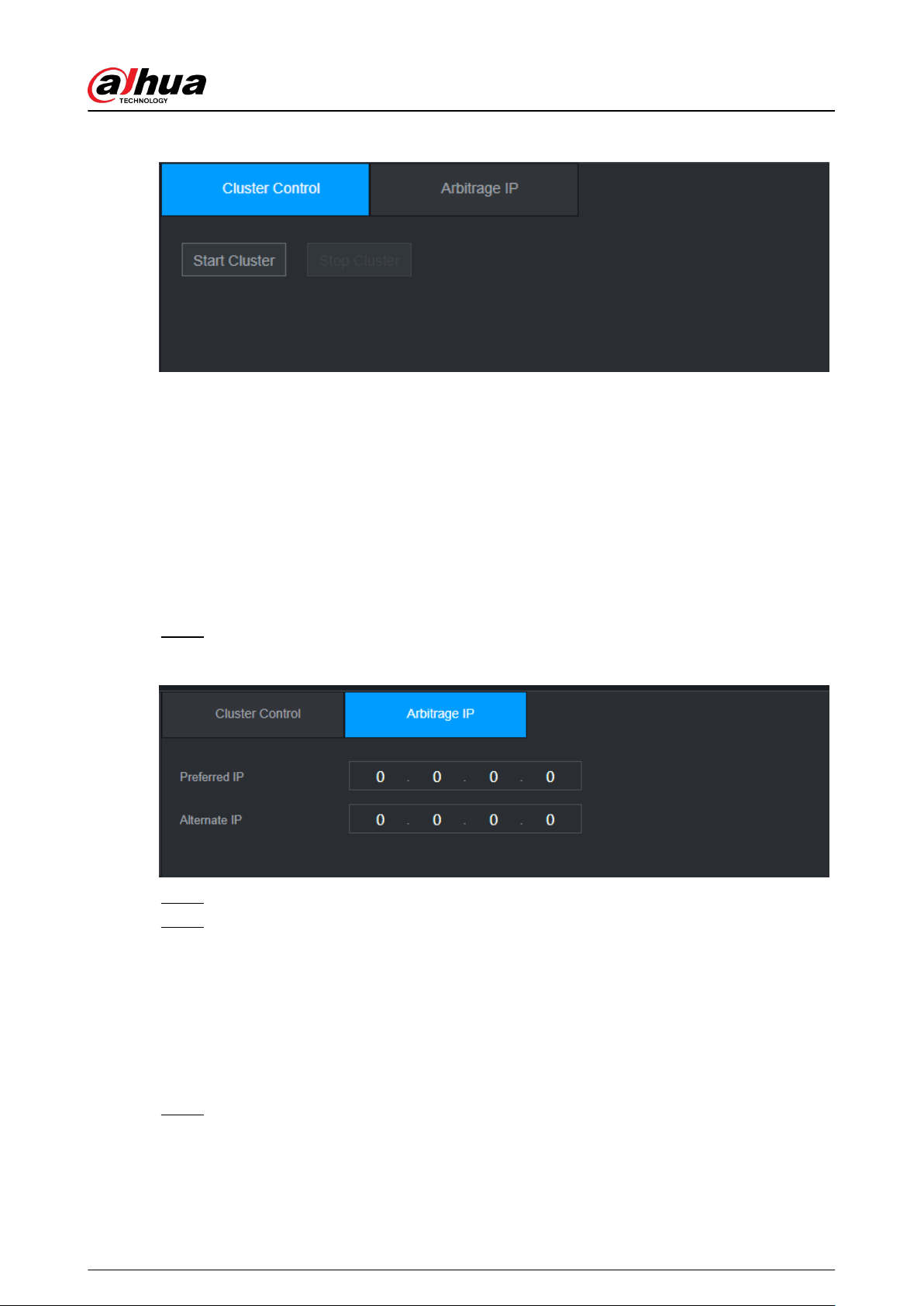
Figure 6-3 Start cluster
You can see the corresponding prompt if you successfully enabled cluster service.
6.4.5.2 Arbitrage IP
Background Information
When there are only 2 devices in the cluster, a third-party device is required to determine whether
the main device is faulty, so arbitration IP must be set for the cluster to perform a normal
replacement operation. The arbitration IP can be the IP address of another device, computer or
gateway.
Procedure
Step 1 Select SETTING > Cluster Service > Arbitrage IP.
Figure 6-4 Arbitrage IP
Step 2 Congure the preferred and alternate IP.
Step 3 Click OK.
6.4.6 Cluster Log
Background Information
You can search for and view cluster logs.
Procedure
Step 1 Select SETTING > Cluster Service > Cluster Log.
User's Manual
438
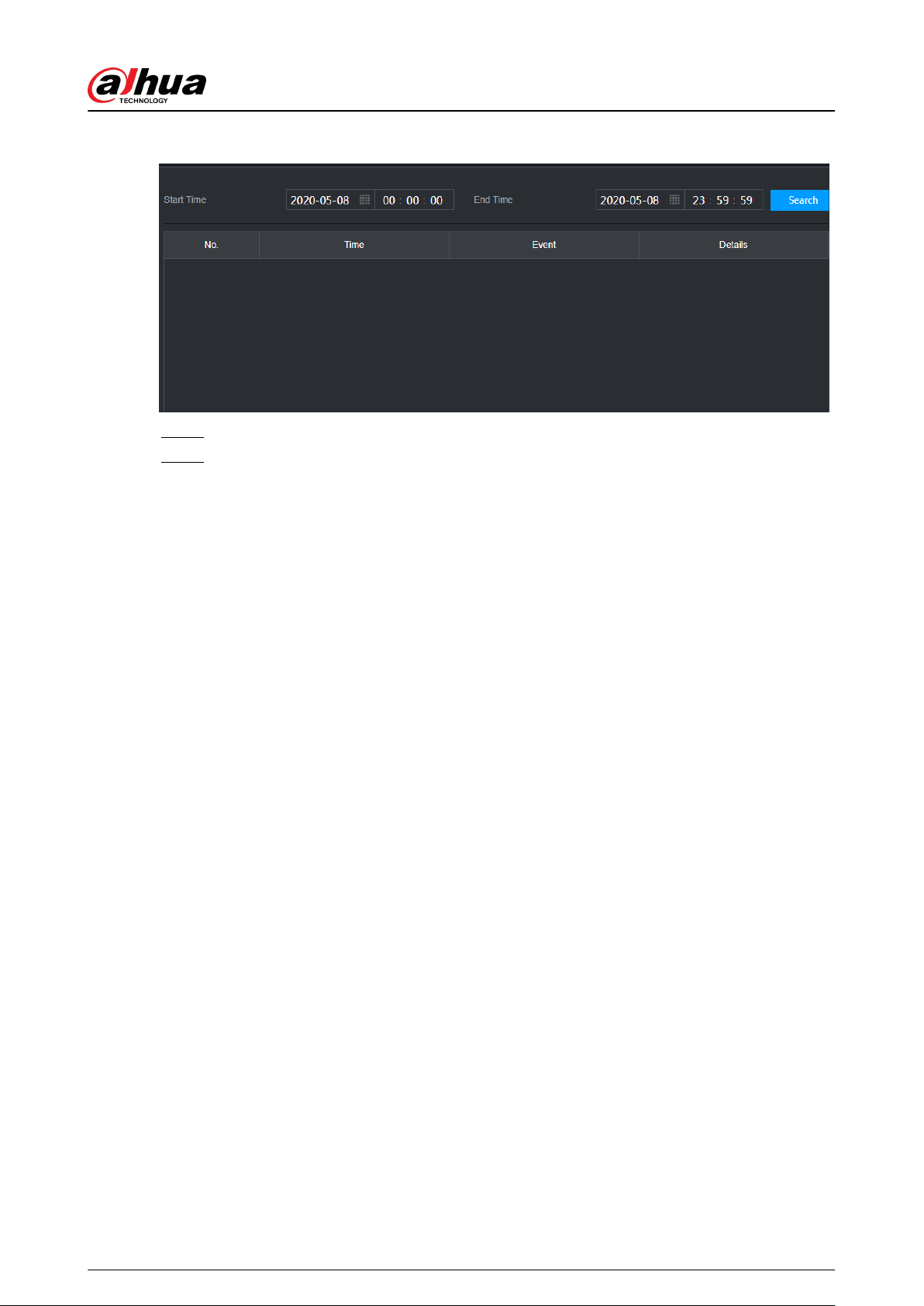
Figure 6-5 Cluster log
Step 2 Enter the start time and end time.
Step 3 Click Search.
User's Manual
439

7 Glossary
●
DHCP: DHCP (Dynamic Host Conguration Protocol) is one of the TCP/IP protocol cluster. It is
mainly used to assign temporary IP addresses to computers on a network.
●
DDNS: DDNS (Dynamic Domain Name Server) is a service that maps Internet domain names to
IP addresses. This service is useful to anyone who wants to operate a server (web server, mail
server, ftp server and more.) connected to the internet with a dynamic IP or to someone who
wants to connect to an oce computer or server from a remote location with software.
●
eSATA: eSATA (External Serial AT) is an page that provides fast data transfer for external storage
devices. It is the extension specications of a SATA page.
●
GPS: GPS (Global Positioning System) is a satellite system, protected by the US, safely orbiting
thousands of kilometers above the earth.
●
PPPoE: PPPoE (Point to Point Protocol over Ethernet) is a specication for connecting multiple
computer users on an Ethernet local area network to a remote site. Now the popular mode is
ADSL and it adopts PPPoE protocol.
●
Wi-Fi: Wi-Fi is the name of a popular wireless networking technology that uses radio waves to
provide wireless high-speed Internet and network connections. The standard is for wireless local
area networks (WLANs). It is like a common language that all the devices use to communicate to
each other. It is actually IEEE802.11, a family of standard The IEEE (Institute of Electrical and
Electronics Engineers Inc.)
●
3G: 3G is the wireless network standard. It is called 3G because it is the third generation of
cellular telecom standards. 3G is a faster network for phone and data transmission and speed Is
over several hundred kbps. Now there are four standards: CDMA2000, WCDMA, TD-SCDMA and
WiMAX.
●
Dual-stream: The dual-stream technology adopts high-rate bit stream for local HD storage such
as QCIF/CIF/2CIF/DCIF/4CIF encode and one low-rate bit stream for network transmission such
as QCIF/CIF encode. It can balance the local storage and remote network transmission. The dual-
stream can meet the dierence band width requirements of the local transmission and the
remote transmission. In this way, the local transmission using high-bit stream can achieve HD
storage and the network transmission adopting low bit stream suitable for the uency
requirements of the 3G network such as WCDMA, EVDO, TD-SCDMA.
●
On-o value: It is the non-consecutive signal sampling and output. It includes remote sampling
and remote output. It has two statuses: 1/0.
User's Manual
440

8 FAQ
Questions Reasons
The Device failed to start
properly.
●
Incorrect input power.
●
Incorrect connection of the power cord.
●
Damaged power switch.
●
Wrong program.
●
Damaged HDD.
●
Damaged mainboard.
The Device automatically shuts
down or stops running.
●
Unstable or insucient input voltage.
●
Insucient button power.
●
Improper operating environment.
●
Hardware error.
The Device cannot detect HDD.
●
Damaged HDD or HDD ribbon.
●
Loose connection of HDD cable.
●
Damaged SATA port.
There is no video output in all
channels.
●
Program version is not correct.
●
Brightness is 0.
●
Hardware error.
I cannot nd local records.
●
Damaged HDD or HDD ribbon.
●
Program version is not correct.
●
The recorded le has been overwritten.
●
The recording function has been disabled.
Distorted recorded videos.
●
Video quality setup is too low.
●
Program read error, bit data is too small. There is mosaic in
the full screen. Restart the NVR to solve this problem.
●
HDD data ribbon error.
●
HDD malfunction.
●
NVR hardware malfunctions.
Time display is not correct.
●
Setup is not correct.
●
Battery contact is not correct or voltage is too low.
●
Crystal is broken.
User's Manual
441

Questions Reasons
NVR cannot control PTZ.
●
Front panel PTZ error.
●
PTZ decoder setup, connection or installation is not correct.
●
Cable connection is not correct.
●
PTZ setup is not correct.
●
PTZ decoder and NVR protocol is not compatible.
●
PTZ decoder and NVR address is not compatible.
●
When there are several decoders, add 120 Ohm between the
PTZ decoder A/B cables furthest end to delete the
reverberation or impedance matching. Otherwise the PTZ
control is not stable.
●
The distance is too far.
I cannot log in client-end or
web.
●
For Windows 98 or Windows ME user, update your system to
Windows 2000 sp4. Or you can install client-end software of
lower version. Please note right now, our NVR is not
compatible with Windows VISTA control.
●
ActiveX control has been disabled.
●
No dx8.1 or higher. Upgrade display card driver.
●
Network connection error.
●
Network setup error.
●
Password or username is invalid.
●
Client-end is not compatible with NVR program.
There is only mosaic no video
when preview or playback
video le remotely.
●
Network uency is not good.
●
Client-end resources are limit.
●
Current user has no right to monitor.
Network connection is not
stable.
●
Network is not stable.
●
IP address conict.
●
MAC address conict.
●
PC or device network card is not good.
Burn error /USB back error.
●
Burner and NVR are in the same data cable.
●
System uses too much CPU resources. Stop record rst and
then begin backup.
●
Data amount exceeds backup device capacity. It might result
in burner error.
●
Backup device is not compatible.
●
Backup device is damaged.
Keyboard cannot control NVR.
●
NVR serial port setup is not correct.
●
Address is not correct.
●
When there are several switchers, power supply is not
enough.
●
Transmission distance is too far.
User's Manual
442

Questions Reasons
Alarm signal cannot be
disarmed.
●
Alarm setup is not correct.
●
Alarm output has been open manually.
●
Input device error or connection is not correct.
●
Some program versions might have this problem. Upgrade
your system.
Alarm function is null.
●
Alarm setup is not correct.
●
Alarm cable connection is not correct.
●
Alarm input signal is not correct.
●
There are two loops connect to one alarm device.
Record storage period is not
enough.
●
Camera quality is too low. Lens is dirty. Camera is installed
against the light. Camera aperture setup is not correct.
●
HDD capacity is not enough.
●
HDD is damaged.
Cannot playback the
downloaded le.
●
There is no media player.
●
No DXB8.1 or higher graphic acceleration software.
●
There is no DivX503Bundle.exe control when you play the
le transformed to AVI via media player.
●
No DivX503Bundle.exe or dshow-2004 1012 .exe in
Windows XP OS.
Forgot local menu operation
password or network password
Contact your local service engineer or our sales person for help.
We can guide you to solve this problem.
There is no video. The screen is
in black.
●
IPC IP address is not right.
●
IPC port number is not right.
●
IPC account (username/password) is not right.
●
IPC is oine.
The displayed video is not full in
the monitor.
Check current resolution setup. If the current setup is
1920*1080, then you need to set the monitor resolution as
1920*1080.
There is no HDMI output.
●
Displayer is not in HDMI mode.
●
HDMI cable connection is not right.
The video is not uent when I
view in multiple-channel mode
from the client-end.
●
The network bandwidth is not sucient. The multiple-
channel monitor operation needs at least 100M or higher.
●
Your PC resources are not sucient. For 16-ch remote
monitor operation, the PC shall have the following
environment: Quad Core, 2G or higher memory,
independent displayer, display card memory 256M or
higher.
User's Manual
443

Questions Reasons
I cannot connect to the IPC
●
Make sure that the IPC has booted up.
●
IPC network connection is right and it is online
●
IPC IP is in the blocklist.
●
The device has connected to the too many IPC. It cannot
transmit the video.
●
Check the IPC port value and the time zone is the same as
the NVR.
●
Make sure current network environment is stable.
After I set the NVR resolution as
1080P, my monitor cannot
display.
Shut down the device and then reboot. When you reboot, press
the Fn button at the same time and then release after 5
seconds. You can restore NVR resolution to the default setup.
My admin account has been
changed and I cannot log in.
Use telnet and then input the following command:
cd /mnt/mtd/Cong/
rm -rf group
rm -rf password
Reboot the device to restore the default password.
After I login the Web, I cannot
nd the remote page to add the
IPC.
Clear the Web controls and load again.
There is IP and gateway, I can
access the internet via the
router. But I cannot access the
internet after I reboot the NVR.
Use command PING to check you can connect to the gateway or
not. Use telnet to access and then use command "ifcong –a" to
check device IP address. If you see the subnet mask and the
gateway has changed after the reboot. Upgrade the
applications and set again.
I use the VGA monitor. I want to
know if I use the multiple-
window mode, I see the video
from the main stream or the sub
stream?
●
For 32-channel series product, the 9/16-window is using the
sub stream.
●
For 4/8/16 series product, system is using the main stream
no matter you are in what display mode.
Daily Maintenance
●
Use the brush to clean the board, socket connector and the chassis regularly.
●
The device shall be soundly earthed in case there is audio/video disturbance. Keep the device
away from the static voltage or induced voltage.
●
Unplug the power cable before you remove the audio/video signal cable, RS-232 or RS-485
cable.
●
Do not connect the TV to the local video output port (VOUT). It might result in video output
circuit.
●
Always shut down the device properly. Use the shutdown function in the menu, or you can
press the power button in the rear pane for at least three seconds to shut down the device.
Otherwise it might result in HDD malfunction.
●
Make sure the device is away from the direct sunlight or other heating sources. Keep the sound
ventilation.
●
Check and maintain the device regularly.
User's Manual
444

Appendix 1 HDD Capacity Calculation
Calculate the total capacity needed by each device according to video recording (video recording
type and video le storage time).
1. According to Formula (1) to calculate storage capacity
that is the capacity of each channel
needed for each hour, unit Mbyte.
In the formula: means the bit rate, unit Kbit/s
2. After video time requirement is conrmed, according to Formula (2) to calculate the storage
capacity
, which is storage of each channel needed unit Mbyte.
In the formula:
means the recording time for each day (hour)
means number of days for which the video shall be kept
3. According to Formula (3) to calculate total capacity (accumulation)
that is needed for all
channels in the device during scheduled video recording.
In the formula:
means total number of channels in one device
4. According to Formula (4) to calculate total capacity (accumulation)
that is needed for all
channels in device during alarm video recording (including motion detection).
In the formula: means alarm occurrence rate
User's Manual
445
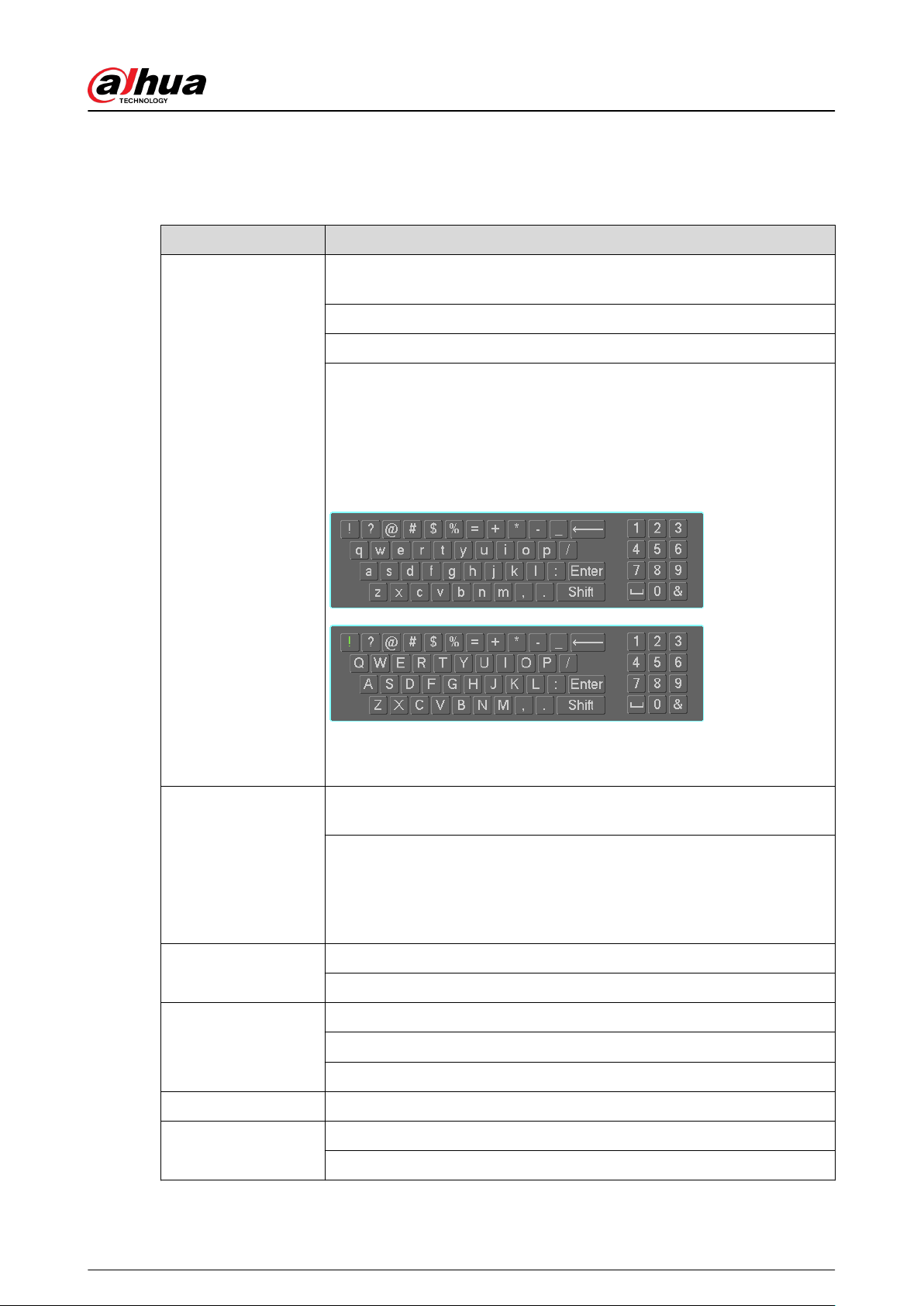
Appendix 2 Mouse Operation
Appendix Table 2-1Mouse operation
Operation Description
Left click mouse
When you have selected one menu item, left click mouse to view menu
content.
Modify checkbox or motion detection status.
Click combo box to pop up drop-down list
In input box, you can select input methods. Left click the corresponding
button on the panel you can input numeral/English character (lower case/
upper case). Here ← stands for backspace button. _ stands for space
button.
In English input mode: _ stands for input a backspace icon and ← stands
for deleting the previous character.
In numeral input mode: _ stands for clear and ← stands for deleting the
previous numeral.
Double left click
mouse
Implement special control operation such as double click one item in the
le list to playback the video.
In multiple-window mode, double left click one channel to view in full-
window.
Double left click current video again to go back to previous multiple-
window mode.
Right click mouse
In real-time monitor mode, pops up shortcut menu.
Exit current menu without saving the modication.
Press middle button
In numeral input box: Increase or decrease numeral value.
Switch the items in the checkbox.
Page up or page down.
Move mouse Select current control or move control.
Drag mouse
Select motion detection zone.
Select privacy mask zone.
User's Manual
446
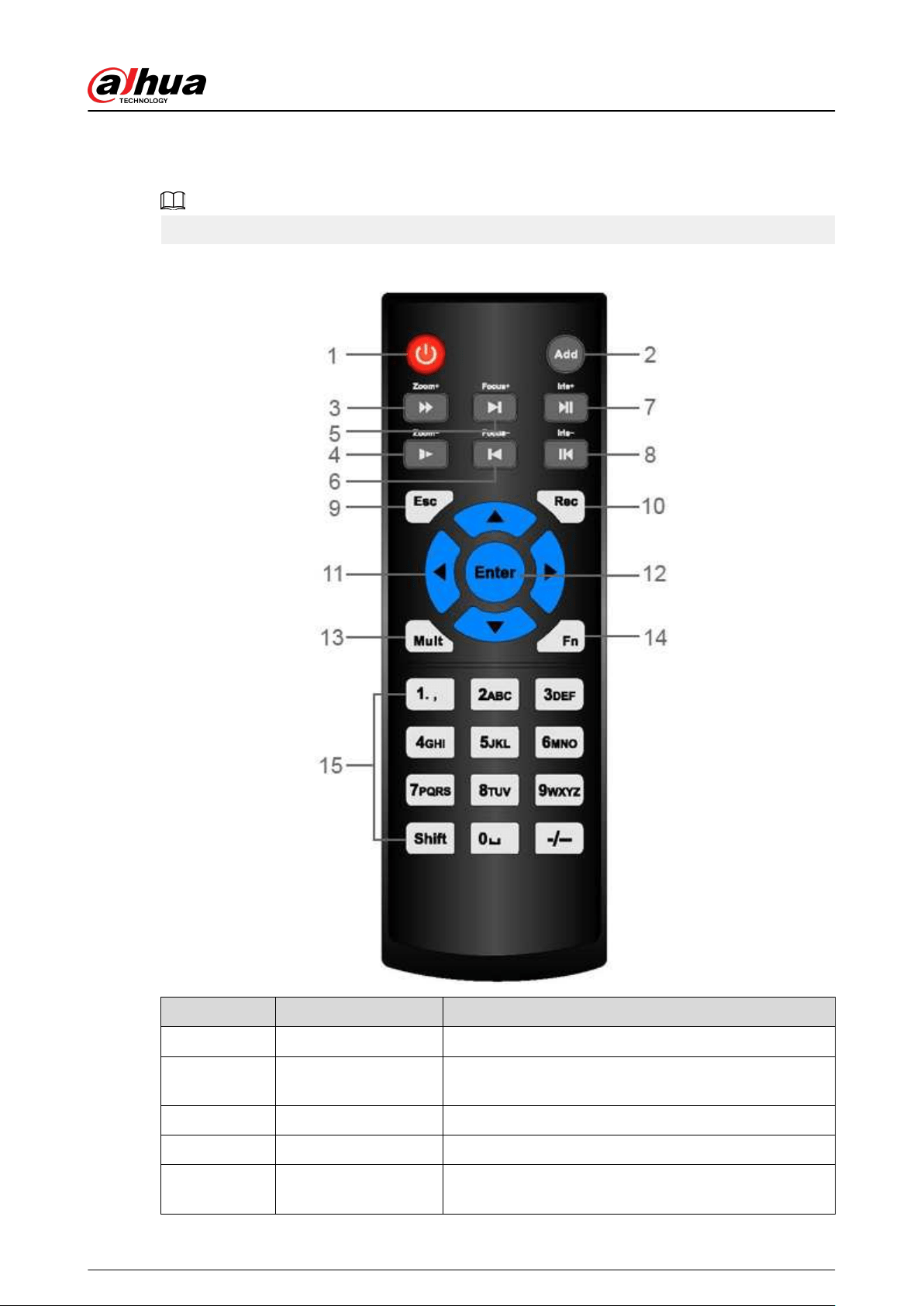
Appendix 3 Remote Control
Remote control is not our standard accessory and it is not included in the accessory package.
Appendix Figure 3- -4 Remote control
No. Name Function
1 Power button Press this button to boot up or shut down the device.
2 Address
Press this button to input device serial number, so that
you can control the Device.
3 Forward Multi-step forward speed and normal speed playback.
4 Slow motion Multi-step slow motion speed or normal playback.
5 Next record
In playback state, press this button to play back the next
video.
User's Manual
447

No. Name Function
6 Previous record
In playback state, press this button to play back the
previous video.
7 Play/Pause
●
In normal playback state, press this button to pause
playback.
●
In pause state, press this button to resume to normal
playback.
●
In live view window page, press this button to enter
video search menu.
8 Reverse/pause
In the reverse playback state, press this button to pause
reverse playback.
In the reverse playback pause state, press this button to
resume to playback reversing state.
9 Esc
Go back to previous menu or cancel current operation
(close front page or control).
10 Record
●
Start or stop record manually.
●
In record page, use the direction buttons to select
the channel that you want to record.
●
Press this button for at least 1.5 seconds, and the
manual record page will be displayed.
11 Direction keys
Switch between current activated controls by going left
or right.
In playback state, the keys control the playback progress
bar.
Aux function (such as operating the PTZ menu).
12 Enter/menu key
●
Conrms an operation.
●
Go to the OK button.
●
Go to the menu.
13
Multiple-window
switch
Switch between multiple-window and one-window.
14 Fn
●
In single-channel monitoring mode, press this
button to display the PTZ control and color setting
functions.
●
Switch the PTZ control menu in PTZ control page.
●
In motion detection page, press this button with
direction keys to complete setup.
●
In text mode, press and hold this button to delete
the last character. To use the clearing function: Long
press this button for 1.5 seconds.
●
In HDD menu, switch HDD recording time and other
information as indicated in the pop-up message.
15 Alphanumeric keys
●
Input password, numbers.
●
Switch channel.
●
Press Shift to switch the input method.
User's Manual
448

Appendix 4 Compatible Network Camera List
Please note all the models in the following list for reference only. For those products not included in
the list, please contact your local retailer or technical supporting engineer for detailed information.
Appendix Table 4-1Compatible network camera list
Manufacturer Model Version
Video
Encode
Audio/
Video
Protocol
AXIS
P1346 5.40.9.2 H264 √ ONVIF/Private
P3344/
P3344-E
5.40.9.2 H264 √ ONVIF/Private
P5512 - H264 √ ONVIF/Private
Q1604 5.40.3.2 H264 √ ONVIF/Private
Q1604-E 5.40.9 H264 √ ONVIF/Private
Q6034E - H264 √ ONVIF/Private
Q6035 5.40.9 H264 √ ONVIF/Private
Q1755 - H264 √ ONVIF/Private
M7001 - H264 √ Private
M3204 5.40.9.2 H264 √ Private
P3367
HEAD LFP4_0
130220
H264 √ ONVIF
P5532-P
HEAD LFP4_0
130220
H264 √ ONVIF
ACTi
ACM-3511
A1D-220-
V3.12.15-AC
MPEG4 √ Private
ACM-8221
A1D-220-
V3.13.16-AC
MPEG4 √ Private
Arecont
AV1115 65246 H264 √ Private
AV10005DN 65197 H264 √ Private
AV2115DN 65246 H264 √ Private
AV2515DN 65199 H264 √ Private
AV2815 65197 H264 √ Private
AV5115DN 65246 H264 √ Private
AV8185DN 65197 H264 √ Private
Bosch
NBN-921-P - H264 √ ONVIF
NBC-455-12P - H264 √ ONVIF
VG5-825 9500453 H264 √ ONVIF
NBN-832 66500500 H264 √ ONVIF
VEZ-211-
IWTEIVA
- H264 √ ONVIF
User's Manual
449

Manufacturer Model Version
Video
Encode
Audio/
Video
Protocol
NBC-255-P 15500152 H264 √ ONVIF
VIP-X1XF - H264 √ ONVIF
Brikcom
B0100 - H264 √ ONVIF
D100 - H264 √ ONVIF
GE-100-CB - H264 √ ONVIF
FB-100A v1.0.3.9 H264 √ ONVIF
FD-100A v1.0.3.3 H264 √ ONVIF
Cannon VB-M400 - H264 √ Private
CNB
MPix2.0DIR
XNETM112011
1229
H264 √ ONVIF
VIPBL1.3MIR
VF
XNETM210011
1229
H264 √ ONVIF
IGC-2050F
XNETM210011
1229
H264 √ ONVIF
CP PLUS
CP-NC9-K 6.E.2.7776 H264 √ ONVIF/Private
CP-NC9W-K 6.E.2.7776 H264 √ Private
CP-ND10-R
cp20111129A
NS
H264 √ ONVIF
CP-ND20-R
cp20111129A
NS
H264 √ ONVIF
CP-NS12W-
CR
cp20110808NS H264 √ ONVIF
VS201 cp20111129NS H264 √ ONVIF
CP-NB20-R
cp20110808B
NS
H264 √ ONVIF
CP-NT20VL3-
R
cp20110808B
NS
H264 √ ONVIF
CP-NS36W-
AR
cp20110808NS H264 √ ONVIF
CP-
ND20VL2-R
cp20110808B
NS
H264 √ ONVIF
CP-RNP-1820
cp20120821NS
A
H264 √ Private
CP-RNC-
TP20FL3C
cp20120821NS
A
H264 √ Private
CP-RNP-12D
cp20120828A
NS
H264 √ Private
CP-RNC-
DV10
cp20120821NS
A
H264 √ Private
User's Manual
450

Manufacturer Model Version
Video
Encode
Audio/
Video
Protocol
CP-RNC-
DP20FL2C
cp20120821NS
A
H264 √ Private
Dynacolor
ICS-13 d20120214NS H264 √ ONVIF/Private
ICS-20W
vt20111123NS
A
H264 √ ONVIF/Private
NA222 - H264 √ ONVIF
MPC-
IPVD-0313
k20111208AN
S
H264 √ ONVIF/Private
MPC-
IPVD-0313AF
k20111208BNS H264 √ ONVIF/Private
Honeywell
HIDC-1100P
T
h.2.2.1824 H264 √ ONVIF
HIDC-1100P h.2.2.1824 H264 √ ONVIF
HIDC-0100P h.2.2.1824 H264 √ ONVIF
HIDC-1300V 2.0.0.21 H264 √ ONVIF
HICC-1300W 2.0.1.7 H264 √ ONVIF
HICC-2300 2.0.0.21 H264 √ ONVIF
HDZ20HDX
H20130114NS
A
H264 √ ONVIF
LG
LW342-FP - H264 √ Private
LNB5100 - H264 √ ONVIF
Imatek
KNC-B5000 - H264 √ Private
KNC-B5162 - H264 √ Private
KNC-B2161 - H264 √ Private
Panasonic
NP240/CH - MPEG4 √ Private
WV-NP502 - MPEG4 √ Private
WV-SP102H 1.41 H264 √ ONVIF/Private
WV-SP105H - H264 √ ONVIF/Private
WV-SP302H 1.41
H264,
MPEG4
√ ONVIF/Private
WV-SP306H 1.4
H264,
MPEG4
√ ONVIF/Private
WV-SP508H -
H264,
MPEG4
√ ONVIF/Private
WV-SP509H -
H264,
MPEG4
√ ONVIF/Private
WV-SF332H 1.41
H264,
MPEG4
√ ONVIF/Private
User's Manual
451

Manufacturer Model Version
Video
Encode
Audio/
Video
Protocol
WV-SW316H 1.41
H264,
MPEG4
√ ONVIF/Private
WV-SW355H 1.41
H264,
MPEG4
√ ONVIF/Private
WV-SW352H -
H264,
MPEG4
√ ONVIF/Private
WV-SW152E 1.03
H264,
MPEG4
√ ONVIF/Private
WV-SW558H -
H264,
MPEG4
√ ONVIF/Private
WV-SW559H -
H264,
MPEG4
√ ONVIF/Private
WV-SP105H 1.03
H264,
MPEG4
√ ONVIF/Private
WV-SW155E 1.03
H264,
MPEG4
√ ONVIF/Private
WV-SF336H 1.44
H264,
MPEG4
√ ONVIF/Private
WV-SF332H 1.41
H264,
MPEG4
√ ONVIF/Private
WV-SF132E 1.03
H264,
MPEG4
√ ONVIF/Private
WV-SF135E 1.03
H264,
MPEG4
√ ONVIF/Private
WV-SF346H 1.41
H264,
MPEG4
√ ONVIF/Private
WV-SF342H 1.41
H264,
MPEG4
√ ONVIF/Private
WV-SC385H 1.08
H264,
MPEG4
√ ONVIF/Private
WV-SC386H 1.08
H264,
MPEG4
√ ONVIF/Private
WV-SP539 1.66
H264,
MPEG4
√ ONVIF
DG-SC385 1.66
H264,
MPEG4
√ ONVIF
PELCO
IXSOLW
1.8.1-2011091
2-1.9082-
A1.6617
H264 √ Private
IDE20DN
1.7.41.9111-
O3.6725
H264 √ Private
User's Manual
452

Manufacturer Model Version
Video
Encode
Audio/
Video
Protocol
D5118
1.7.8.9310-
A1.5288
H264 √ Private
IM10C10
1.6.13.9261-
O2.4657
H264 √ Private
DD4N-X 01.02.0015 MPEG4 √ Private
DD423-X 01.02.0006 MPEG4 √ Private
D5220
1.8.3-
FC2-20120614-
1.9320-
A1.8035
H264 √ Private
Samsung
SNB-3000P 2.41
H264,
MPEG4
√ ONVIF/Private
SNP-3120
1.22_110120_
1
H264,
MPEG4
√ ONVIF/Private
SNP-3370 1.21_110318 MPEG4 √ Private
SNB-5000 2.10_111227
H264,
MPEG4
√ ONVIF/Private
SND-5080 -
H264,
MPEG4
√ Private
SNZ-5200 1.02_110512
H264,
MPEG4
√ ONVIF/Private
SNP-5200 1.04_110825
H264,
MPEG4
√ ONVIF/Private
SNB-7000 1.10_110819 H264 √ ONVIF/Private
SNB-6004 V1.0.0 H264 √ ONVIF
Sony
SNC-D H110 1.50.00 H264 √ ONVIF/Private
SNC-CH120 1.50.00 H264 √ ONVIF/Private
SNC-CH135 1.73.01 H264 √ ONVIF/Private
SNC-CH140 1.50.00 H264 √ ONVIF/Private
SNC-CH210 1.73.00 H264 √ ONVIF/Private
SNC-D H210 1.73.00 H264 √ ONVIF/Private
SNC-D H240 1.50.00 H264 √ ONVIF/Private
SNC-D H240-
T
1.73.01 H264 √ ONVIF/Private
SNC-CH260 1.74.01 H264 √ ONVIF/Private
SNC-CH280 1.73.01 H264 √ ONVIF/Private
SNC-RH-124 1.73.00 H264 √ ONVIF/Private
SNC-RS46P 1.73.00 H264 √ ONVIF/Private
SNC-ER550 1.74.01 H264 √ ONVIF/Private
User's Manual
453
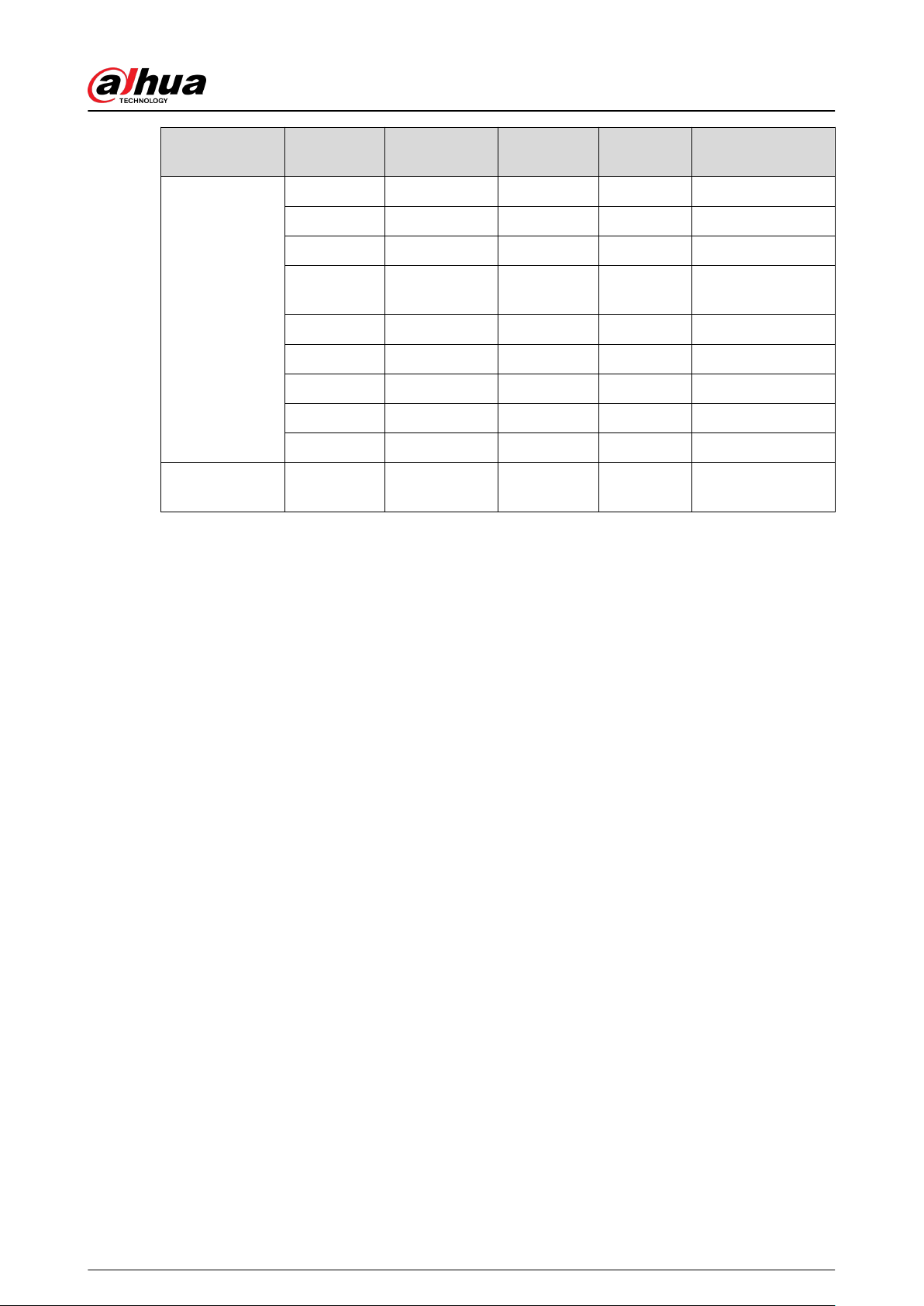
Manufacturer Model Version
Video
Encode
Audio/
Video
Protocol
SNC-ER580 1.74.01 H264 √ ONVIF/Private
SNC-ER580 1.78.00 H264 √ ONVIF
SNC-VM631 1.4.0 H264 √ ONVIF
WV-SP306 1.61.00
H264,
MPEG4
√ SDK
WV-SP306 1.61.00 H264 √ ONVIF
SNC-VB600 1.5.0 H264 √ Private
SNC-VM600 1.5.0 H264 √ Private
SNC-VB630 1.5.0 H264 √ Private
SNC-VM630 1.5.0 H264 √ Private
SANYO
VCC-
HDN4000PC
- H264 √ ONVIF
User's Manual
454

Appendix 5 Cybersecurity Recommendations
Cybersecurity is more than just a buzzword: it’s something that pertains to every device that is
connected to the internet. IP video surveillance is not immune to cyber risks, but taking basic steps
toward protecting and strengthening networks and networked appliances will make them less
susceptible to attacks. Below are some tips and recommendations from Dahua on how to create a
more secured security system.
Mandatory actions to be taken for basic device network security:
1. Use Strong Passwords
Please refer to the following suggestions to set passwords:
●
The length should not be less than 8 characters.
●
Include at least two types of characters; character types include upper and lower case letters,
numbers and symbols.
●
Do not contain the account name or the account name in reverse order.
●
Do not use continuous characters, such as 123, abc, etc.
●
Do not use overlapped characters, such as 111, aaa, etc.
2. Update Firmware and Client Software in Time
●
According to the standard procedure in Tech-industry, we recommend to keep your device
(such as NVR, DVR, IP camera, etc.) rmware up-to-date to ensure the system is equipped
with the latest security patches and xes. When the device is connected to the public
network, it is recommended to enable the “auto-check for updates” function to obtain timely
information of rmware updates released by the manufacturer.
●
We suggest that you download and use the latest version of client software.
"Nice to have" recommendations to improve your device network security:
1. Physical Protection
We suggest that you perform physical protection to device, especially storage devices. For
example, place the device in a special computer room and cabinet, and implement well-done
access control permission and key management to prevent unauthorized personnel from
carrying out physical contacts such as damaging hardware, unauthorized connection of
removable device (such as USB ash disk, serial port), etc.
2. Change Passwords Regularly
We suggest that you change passwords regularly to reduce the risk of being guessed or cracked.
3. Set and Update Passwords Reset Information Timely
The device supports password reset function. Please set up related information for password
reset in time, including the end user’s mailbox and password protection questions. If the
information changes, please modify it in time. When setting password protection questions, it is
suggested not to use those that can be easily guessed.
4. Enable Account Lock
The account lock feature is enabled by default, and we recommend you to keep it on to
guarantee the account security. If an attacker attempts to log in with the wrong password
several times, the corresponding account and the source IP address will be locked.
5. Change Default HTTP and Other Service Ports
We suggest you to change default HTTP and other service ports into any set of numbers
between 1024–65535, reducing the risk of outsiders being able to guess which ports you are
using.
6. Enable HTTPS
We suggest you to enable HTTPS, so that you visit Web service through a secure communication
channel.
User's Manual
455

7. MAC Address Binding
We recommend you to bind the IP and MAC address of the gateway to the device, thus reducing
the risk of ARP spoong.
8. Assign Accounts and Privileges Reasonably
According to business and management requirements, reasonably add users and assign a
minimum set of permissions to them.
9. Disable Unnecessary Services and Choose Secure Modes
If not needed, it is recommended to turn o some services such as SNMP, SMTP, UPnP, etc., to
reduce risks.
If necessary, it is highly recommended that you use safe modes, including but not limited to the
following services:
●
SNMP: Choose SNMP v3, and set up strong encryption passwords and authentication
passwords.
●
SMTP: Choose TLS to access mailbox server.
●
FTP: Choose SFTP, and set up strong passwords.
●
AP hotspot: Choose WPA2-PSK encryption mode, and set up strong passwords.
10.Audio and Video Encrypted Transmission
If your audio and video data contents are very important or sensitive, we recommend that you
use encrypted transmission function, to reduce the risk of audio and video data being stolen
during transmission.
Reminder: encrypted transmission will cause some loss in transmission eciency.
11.Secure Auditing
●
Check online users: we suggest that you check online users regularly to see if the device is
logged in without authorization.
●
Check device log: By viewing the logs, you can know the IP addresses that were used to log
in to your devices and their key operations.
12.Network Log
Due to the limited storage capacity of the device, the stored log is limited. If you need to save
the log for a long time, it is recommended that you enable the network log function to ensure
that the critical logs are synchronized to the network log server for tracing.
13.Construct a Safe Network Environment
In order to better ensure the safety of device and reduce potential cyber risks, we recommend:
●
Disable the port mapping function of the router to avoid direct access to the intranet devices
from external network.
●
The network should be partitioned and isolated according to the actual network needs. If
there are no communication requirements between two sub networks, it is suggested to use
VLAN, network GAP and other technologies to partition the network, so as to achieve the
network isolation eect.
●
Establish the 802.1x access authentication system to reduce the risk of unauthorized access
to private networks.
●
Enable IP/MAC address ltering function to limit the range of hosts allowed to access the
device.
More information
Please visit Dahua ocial website security emergency response center for security announcements
and the latest security recommendations.
User's Manual
456