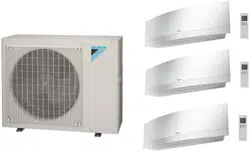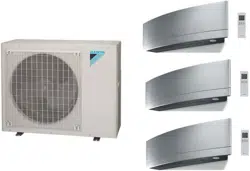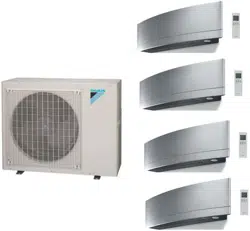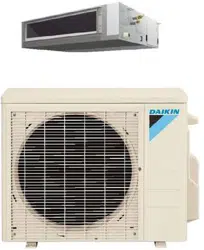
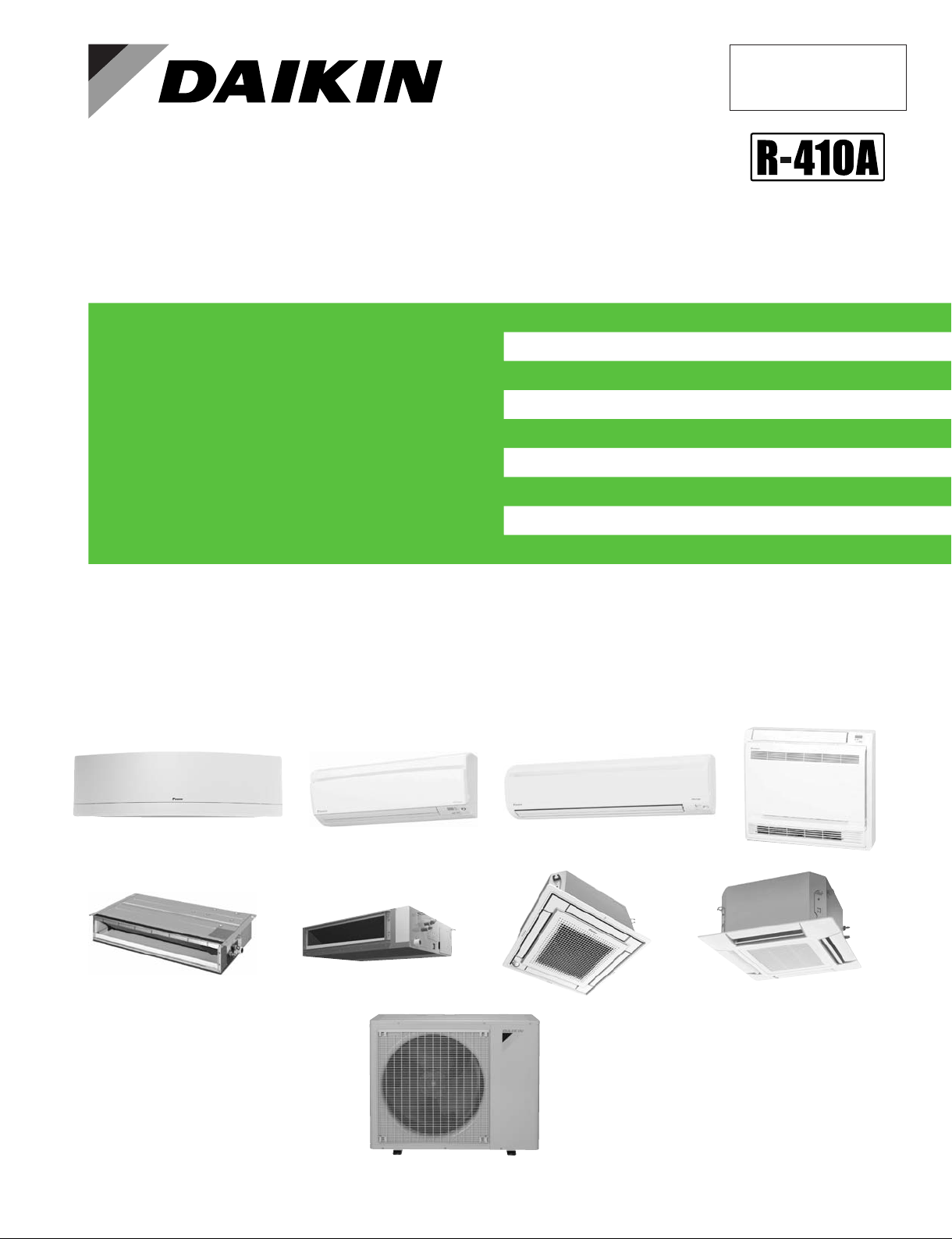
[Applied Models]
Inverter Pair : Heat Pump
Multi-Split Type Air Conditioners
5MXS-T, 4MXL-T Series
Service
Manual
SiUS121827E

SiUS121827E
i Table of Contents
Introduction ....................................................................................... 1
1. Safety Cautions...........................................................................................2
1.1 Warnings and Cautions Regarding Safety of Workers................................. 2
1.2 Warnings and Cautions Regarding Safety of Users..................................... 4
2. Icons Used ..................................................................................................7
3. Revision History ..........................................................................................8
Part 1 General Information ............................................................... 9
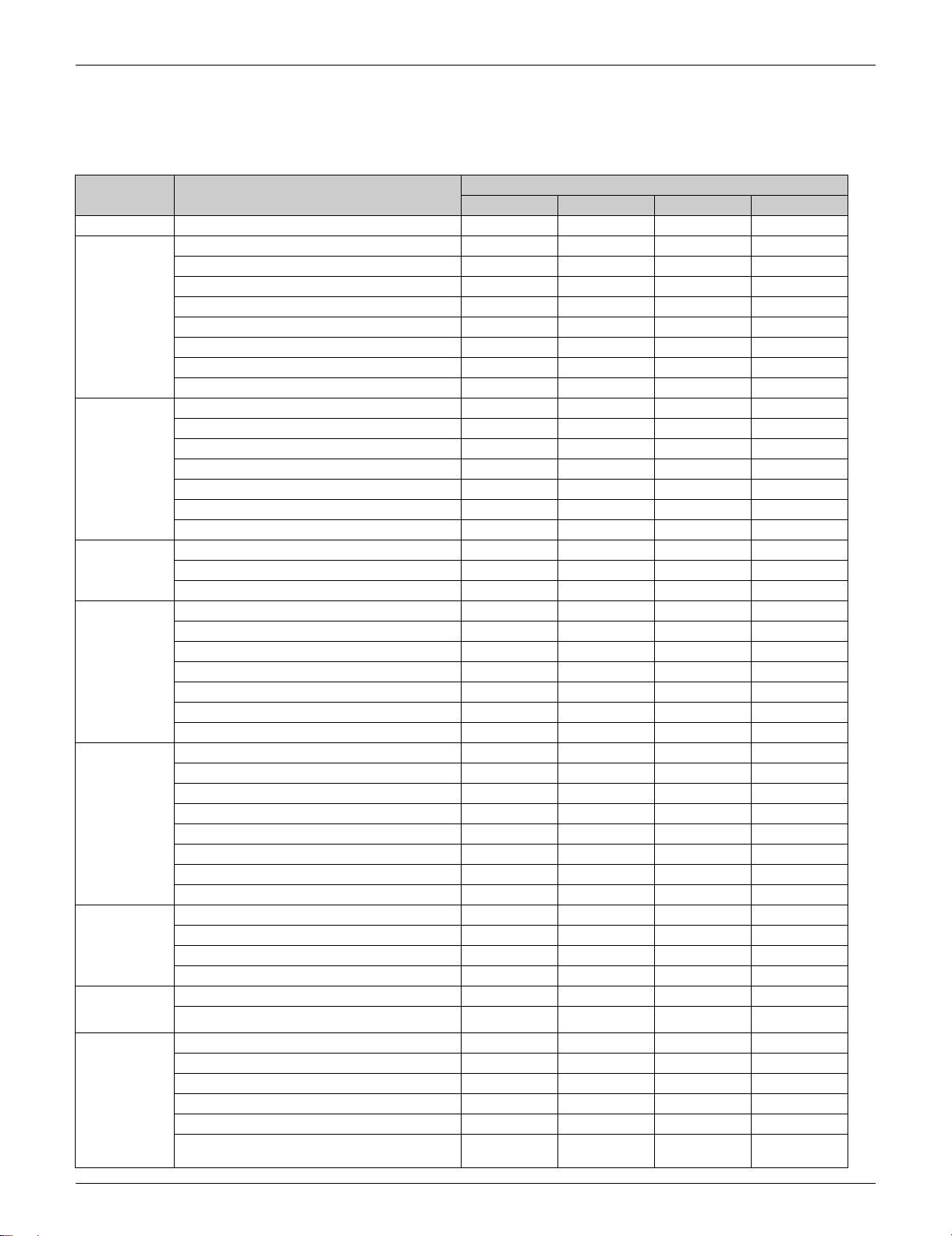
1. Applicable Models .....................................................................................10
1.1 Heat Pump ................................................................................................. 10
2. Functions...................................................................................................11
2.1 RA Indoor Unit............................................................................................ 11
2.2 SA Indoor Unit ............................................................................................ 17
2.3 Outdoor Unit ............................................................................................... 21
Part 2 Specifications....................................................................... 22
1. Specifications ............................................................................................23
1.1 RA Indoor Unit............................................................................................ 23
1.2 SA Indoor Unit ............................................................................................ 31
1.3 Outdoor Unit ............................................................................................... 34
Part 3 Printed Circuit Board Connector Wiring Diagram................ 36
1. Indoor Unit.................................................................................................37
1.1 FTXR09/12/18TVJUW(S), CTXG09/12/18QVJUW(S) ............................... 37
1.2 CTXS07LVJU, FTXS09/12LVJU ................................................................ 39
1.3 FTXS15/18/24LVJU ................................................................................... 41
1.4 FDXS09/12LVJU, CDXS15/18/24LVJU ..................................................... 43
1.5 FVXS09/12/15/18NVJU.............................................................................. 45
1.6 FDMQ09/12/15/18/24RVJU ....................................................................... 47
1.7 FFQ09/12/15/18Q2VJU.............................................................................. 49
2. Sensor Kit for FFQ Series .........................................................................50
2.1 BRYQ60A2W(S)......................................................................................... 50
3. Wired Remote Controller...........................................................................51
3.1 BRC1E73 ................................................................................................... 51
4. Wireless Remote Controller Receiver for FDMQ series............................52
4.1 BRC082A43 ............................................................................................... 52
5. Wireless Remote Controller Kit for FFQ Series ........................................53
5.1 BRC082A41W, BRC082A42W(S).............................................................. 53
6. Outdoor Unit..............................................................................................54
Part 4 Functions and Control .......................................................... 57
1. Common Functions ...................................................................................59
1.1 Temperature Control .................................................................................. 59
1.2 Frequency Principle.................................................................................... 59

SiUS121827E
Table of Contents ii
2. RA Indoor Unit Functions ..........................................................................61
2.1 Airflow Direction Control............................................................................. 61
2.2 Fan Speed Control for Indoor Unit ............................................................. 64
2.3 Program Dry Operation .............................................................................. 65
2.4 Automatic Cooling/Heating Changeover .................................................... 66
2.5 Thermostat Control..................................................................................... 67
2.6 NIGHT SET Mode ...................................................................................... 68
2.7 ECONO Operation .................................................................................... 69
2.8 2-Area INTELLIGENT EYE Operation ....................................................... 70
2.9 INTELLIGENT EYE Operation ................................................................... 72
2.10 POWERFUL Operation .............................................................................. 73
2.11 Multi-Monitor Lamp/TIMER Lamp .............................................................. 74
2.12 Clock Setting .............................................................................................. 75
2.13 WEEKLY TIMER Operation ....................................................................... 76
2.14 Other Functions.......................................................................................... 82
3. SA Indoor Unit Functions ..........................................................................84
3.1 Airflow Direction Control............................................................................. 84
3.2 Fan Speed Control for Indoor Unit ............................................................. 85
3.3 Program Dry Operation .............................................................................. 86
3.4 Clock and Calendar Setting (With Wired Remote Controller BRC1E73) ... 87
3.5 Schedule TIMER Operation (With Wired Remote Controller BRC1E73) ... 89
3.6 Setback Function (With Wired Remote Controller BRC1E73) ................... 93
3.7 Drain Pump Control.................................................................................... 94
3.8 Hot Start Control (In Heating Operation Only)............................................ 96
3.9 Presence and Floor Sensors (Option)........................................................ 97
3.10 Other Functions........................................................................................ 100
4. Control Specification ...............................................................................102
4.1 Thermistor Functions................................................................................ 102
4.2 Mode Hierarchy ........................................................................................ 104
4.3 Frequency Control.................................................................................... 105
4.4 Controls at Mode Changing/Start-up........................................................ 107
4.5 Discharge Pipe Temperature Control....................................................... 109
4.6 Input Current Control................................................................................ 110
4.7 Freeze-up Protection Control ................................................................... 111
4.8 Heating Peak-cut Control ......................................................................... 113
4.9 Outdoor Fan Control................................................................................. 114
4.10 Liquid Compression Protection Function.................................................. 114
4.11 Defrost Control ......................................................................................... 114
4.12 Low Hz High Pressure Limit ..................................................................... 116
4.13 Electronic Expansion Valve Control ......................................................... 116
4.14 Malfunctions ............................................................................................. 121

SiUS121827E
iii Table of Contents
Part 5 Remote Controller .............................................................. 122
1. Applicable Remote Controller .................................................................123
2. ARC466A36 ............................................................................................124
3. ARC452A21 ............................................................................................126
4. ARC452A23 ............................................................................................128
5. ARC466A21 ............................................................................................130
6. BRC944B2 Wired Remote Controller......................................................132
7. BRC1E73 Wired Remote Controller........................................................133
8. BRC082A43 Wireless Remote Controller ...............................................139
9. BRC082A41W, BRC082A42W(S) Wireless Remote Controller..............141
Part 6 Service Diagnosis ............................................................... 143
1. General Problem Symptoms and Check Items .......................................145
2. Troubleshooting with LED .......................................................................146
2.1 Indoor Unit................................................................................................ 146
2.2 Outdoor Unit ............................................................................................. 149
3. Service Diagnosis ...................................................................................150
3.1 ARC452 Series Wireless Remote Controller............................................ 150
3.2 ARC466 Series Wireless Remote Controller............................................ 153
3.3 BRC1E73 Wired Remote Controller......................................................... 156
3.4 BRC082A43, BRC082A41W, BRC082A42W(S) Wireless Remote Controller
................................................................................................................. 158
4. Code Indication on Remote Controller ....................................................162
4.1 RA Indoor Unit.......................................................................................... 162
4.2 SA Indoor Unit .......................................................................................... 162
4.3 Outdoor Unit ............................................................................................. 163
5. Troubleshooting for RA Indoor Unit.........................................................164
5.1 Indoor Unit PCB Abnormality ................................................................... 164
5.2 Freeze-up Protection Control/Heating Peak-cut Control .......................... 166
5.3 Indoor Fan Motor or Related Abnormality ................................................ 167
5.4 Thermistor or Related Abnormality........................................................... 172
5.5 Front Panel Open/Close Fault.................................................................. 173
5.6 Signal Transmission Error (Between Indoor Unit and Outdoor Unit)........ 174
5.7 Mismatching of Indoor Unit and Outdoor Unit .......................................... 177
6. Troubleshooting for SA Indoor Unit.........................................................178
6.1 Indoor Unit PCB Abnormality ................................................................... 178
6.2 Drain Level Control System Abnormality.................................................. 179
6.3 Indoor Fan Motor or Related Abnormality ................................................ 180
6.4 Indoor Fan PCB Abnormality.................................................................... 185
6.5 Humidifier or Related Abnormality............................................................ 186
6.6 Thermistor or Related Abnormality........................................................... 187
6.7 Presence Sensor or Floor Sensor Abnormality ........................................ 188
6.8 Remote Controller Thermistor Abnormality .............................................. 189
6.9 Signal Transmission Error (Between Indoor and Outdoor Unit) ............... 190
6.10 Signal Transmission Error (Between Indoor Unit and Remote Controller)
................................................................................................................. 192

SiUS121827E
Table of Contents iv
6.11 Signal Transmission Error (Between MAIN/SUB Remote Controllers) .... 193
6.12 Mismatching of Indoor Unit and Outdoor Unit .......................................... 194
7. Troubleshooting for Outdoor Unit............................................................195
7.1 Refrigerant Shortage ................................................................................ 195
7.2 Low-voltage Detection or Over-voltage Detection.................................... 198
7.3 Wiring Error Check Unexecuted............................................................... 200
7.4 Unspecified Voltage (Between Indoor Unit and Outdoor Unit), Anti-icing
Control in Other Rooms............................................................................ 201
7.5 Anti-icing Control for Indoor Unit .............................................................. 202
7.6 Outdoor Unit PCB Abnormality................................................................. 204
7.7 OL Activation (Compressor Overload) ..................................................... 205
7.8 Compressor Lock ..................................................................................... 208
7.9 DC Fan Lock ............................................................................................ 210
7.10 Input Overcurrent Detection ..................................................................... 212
7.11 Four Way Valve Abnormality.................................................................... 214
7.12 Discharge Pipe Temperature Control....................................................... 216
7.13 High Pressure Control in Cooling ............................................................. 217
7.14 Compressor Sensor System Abnormality ................................................ 219
7.15 Position Sensor Abnormality .................................................................... 221
7.16 Thermistor or Related Abnormality (Outdoor Unit)................................... 224
7.17 Electrical Box Temperature Rise.............................................................. 226
7.18 Radiation Fin Temperature Rise .............................................................. 227
7.19 Output Overcurrent Detection .................................................................. 229
8. Check ......................................................................................................232
8.1 Thermistor Resistance Check .................................................................. 232
8.2 Indoor Fan Motor Connector Check......................................................... 233
8.3 Hall IC Check ........................................................................................... 234
8.4 Power Supply Waveform Check............................................................... 235
8.5 Electronic Expansion Valve Check........................................................... 236
8.6 Four Way Valve Performance Check ....................................................... 237
8.7 Inverter Unit Refrigerant System Check................................................... 237
8.8 Inverter Analyzer Check........................................................................... 238
8.9 Rotation Pulse Check on the Outdoor Unit PCB ...................................... 240
8.10 Installation Condition Check..................................................................... 240
8.11 Discharge Pressure Check....................................................................... 241
8.12 Outdoor Fan System Check ..................................................................... 241
8.13 Main Circuit Short Check.......................................................................... 242
8.14 Capacitor Voltage Check.......................................................................... 244
8.15 Power Module Check ............................................................................... 245
Part 7 Trial Operation and Field Settings ..................................... 246
1. Pump Down Operation............................................................................247
2. Forced Cooling Operation .......................................................................248
3. Wiring Error Check Function ...................................................................249
4. Trial Operation ........................................................................................251
4.1 RA Indoor Unit.......................................................................................... 251
4.2 SA Indoor Unit .......................................................................................... 253

SiUS121827E
v Table of Contents
5. Field Settings ..........................................................................................256
5.1 RA Indoor Unit.......................................................................................... 256
5.2 SA Indoor Unit .......................................................................................... 262
5.3 Outdoor Unit ............................................................................................. 274
6. Silicone Grease on Power Transistor/Diode Bridge................................277
Part 8 Appendix ............................................................................. 278
1. Piping Diagrams......................................................................................279
1.1 Indoor Unit................................................................................................ 279
1.2 Outdoor Unit ............................................................................................. 282
2. Wiring Diagrams......................................................................................283
2.1 Indoor Unit................................................................................................ 283
3. Outdoor Unit............................................................................................290
4. Operation Limit........................................................................................292

SiUS121827E
Introduction 1
1. Safety Cautions...........................................................................................2
1.1 Warnings and Cautions Regarding Safety of Workers................................. 2
1.2 Warnings and Cautions Regarding Safety of Users..................................... 4
2. Icons Used ..................................................................................................7
3. Revision History ..........................................................................................8
Introduction
Safety Cautions SiUS121827E
2 Introduction
1. Safety Cautions
Be sure to read the following safety cautions before conducting repair work.
After the repair work is complete, be sure to conduct a test operation to ensure that the equipment
operates normally, and explain the cautions for operating the product to the customer.
Caution Items The caution items are classified into Warning and Caution. The Warning items are
especially important since death or serious injury can result if they are not followed closely. The
Caution items can also lead to serious accidents under some conditions if they are not
followed. Therefore, be sure to observe all the safety caution items described below.
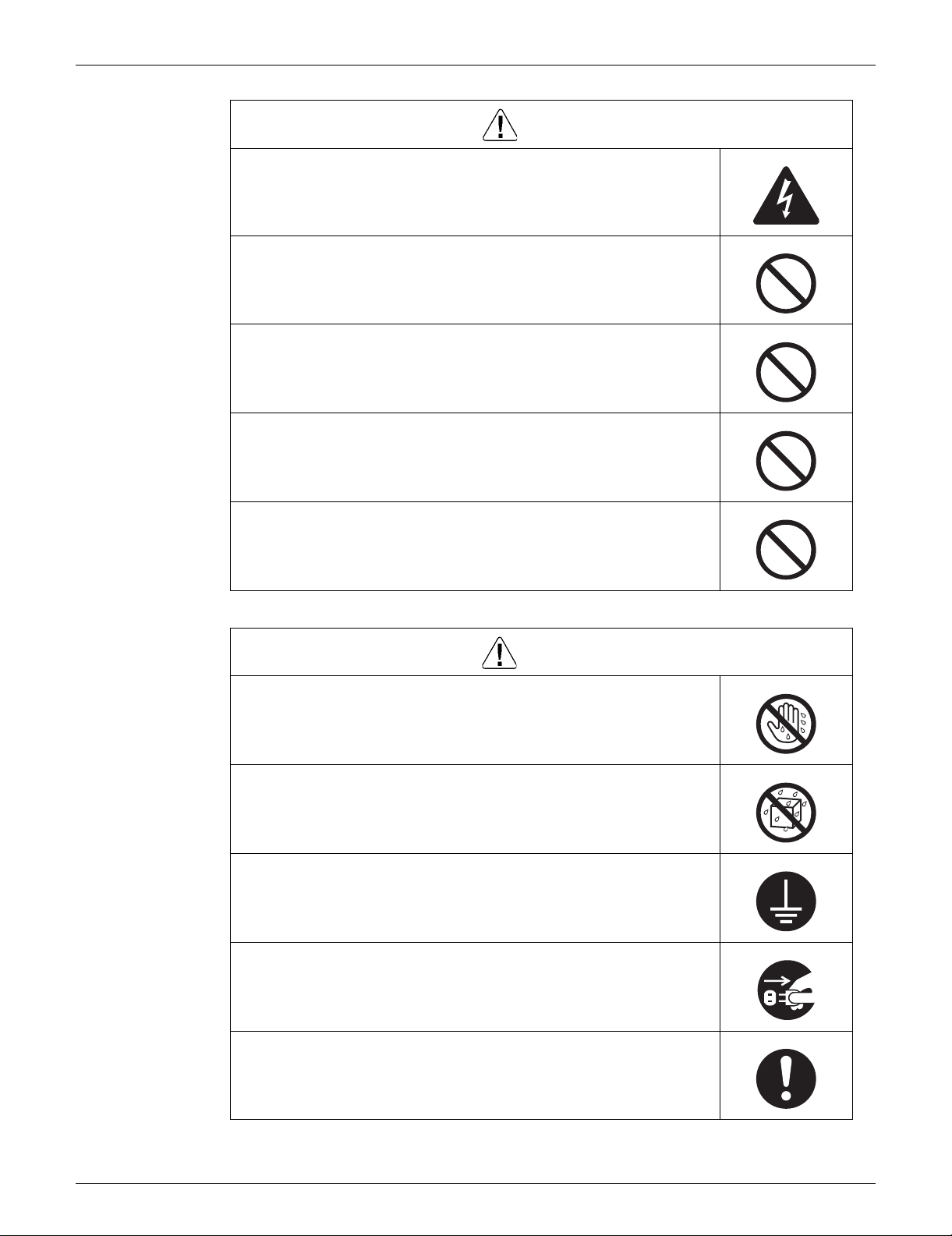
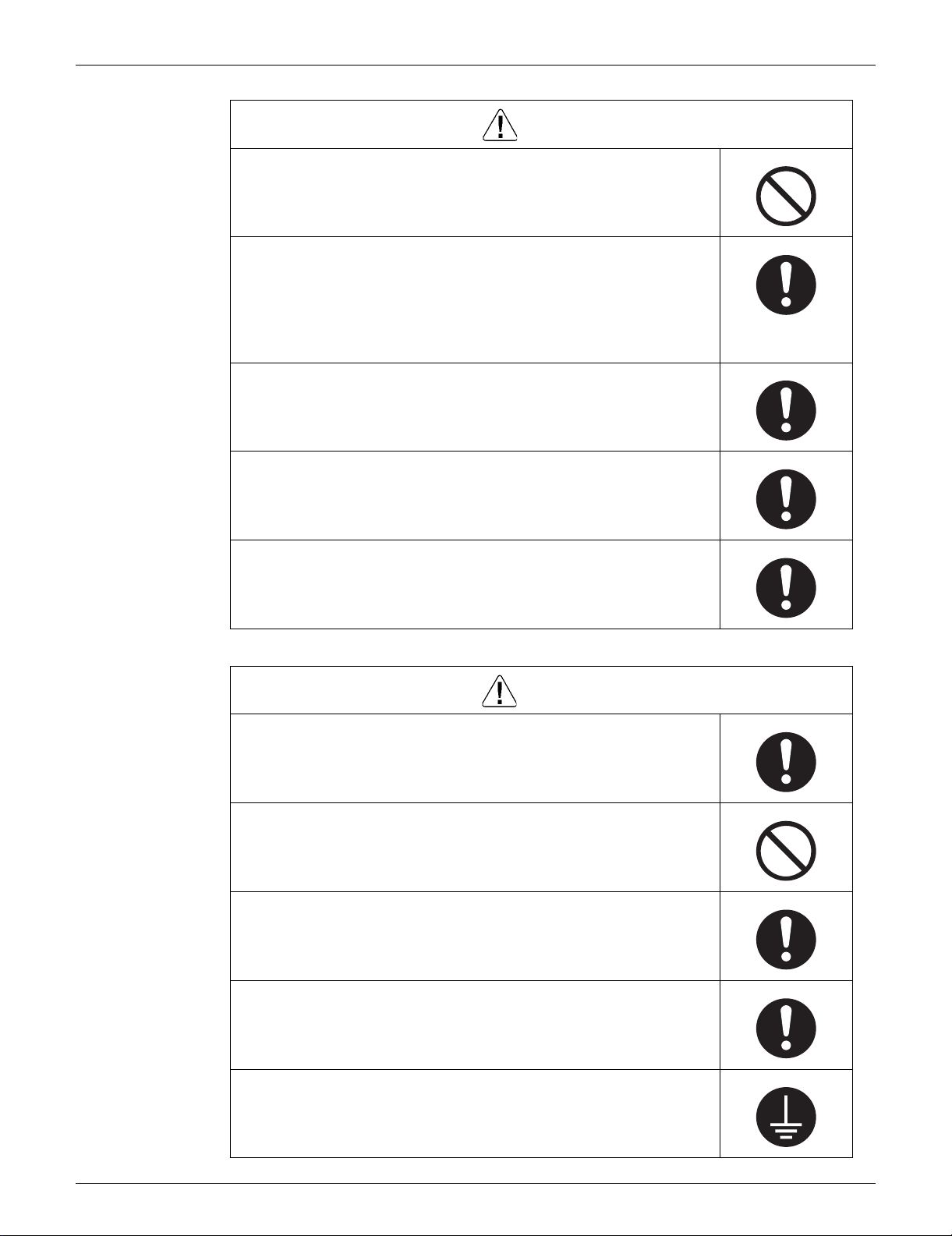
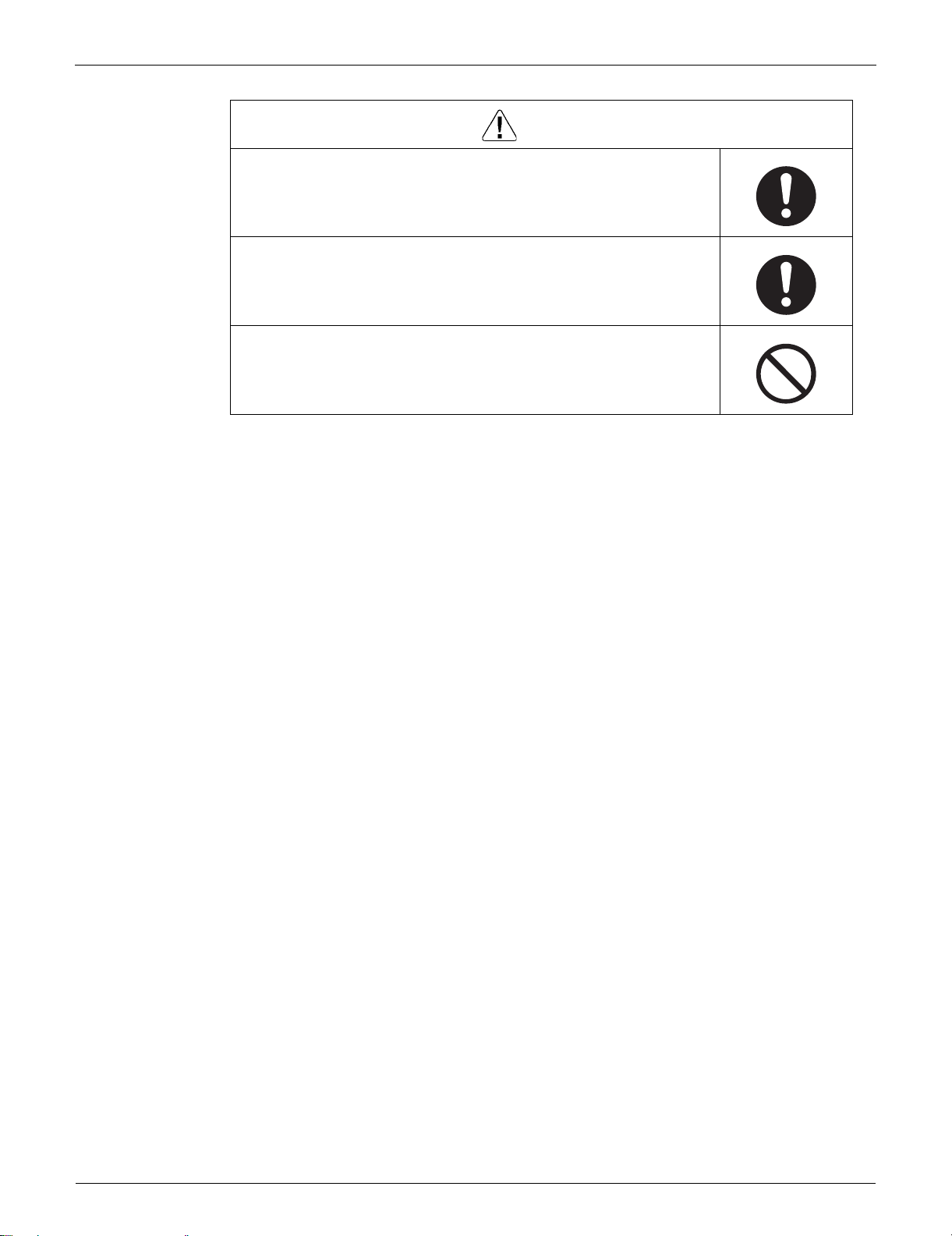
Pictograms This symbol indicates an item for which caution must be exercised.
The pictogram shows the item to which attention must be paid.
This symbol indicates a prohibited action.
The prohibited item or action is shown in the illustration or near the symbol.
This symbol indicates an action that must be taken, or an instruction.
The instruction is shown in the illustration or near the symbol.
1.1 Warnings and Cautions Regarding Safety of Workers
This manual is for the
person in charge of
maintenance and
inspection.
Warning
Do not store equipment in a room with fire sources (e.g., naked
flames, gas appliances, electric heaters).
Be sure to disconnect the power cable from the socket before
disassembling equipment for repair.
Working on equipment that is connected to the power supply may cause
an electrical shock.
If it is necessary to supply power to the equipment to conduct the repair or
inspect the circuits, do not touch any electrically charged sections of the
equipment.
If refrigerant gas is discharged during repair work, do not touch the
discharged refrigerant gas.
Refrigerant gas may cause frostbite.
When disconnecting the suction or discharge pipe of the
compressor at the welded section, evacuate the refrigerant gas
completely at a well-ventilated place first.
If there is gas remaining inside the compressor, the refrigerant gas or
refrigerating machine oil discharges when the pipe is disconnected, and it
may cause injury.
If refrigerant gas leaks during repair work, ventilate the area.
Refrigerant gas may generate toxic gases when it contacts flames.
SiUS121827E Safety Cautions
Introduction 3
Be sure to discharge the capacitor completely before conducting
repair work.
The step-up capacitor supplies high-voltage electricity to the electrical
components of the outdoor unit.
A charged capacitor may cause an electrical shock.
Do not turn the air conditioner on or off by plugging in or
unplugging the power cable.
Plugging in or unplugging the power cable to operate the equipment may
cause an electrical shock or fire.
Be sure to wear a safety helmet, gloves, and a safety belt when
working in a high place (more than 2 m (6.5 ft)).
Insufficient safety measures may cause a fall.
In case of R-32 / R-410A refrigerant models, be sure to use pipes,
flare nuts and tools intended for the exclusive use with the R-32 / R-
410A refrigerant.
The use of materials for R-22 refrigerant models may cause a serious
accident, such as a damage of refrigerant cycle or equipment failure.
Do not mix air or gas other than the specified refrigerant (R-32 / R-
410A / R-22) in the refrigerant system.
If air enters the refrigerant system, an excessively high pressure results,
causing equipment damage and injury.
Caution
Do not repair electrical components with wet hands.
Working on the equipment with wet hands may cause an electrical shock.
Do not clean the air conditioner with water.
Washing the unit with water may cause an electrical shock.
Be sure to provide an earth / grounding when repairing the
equipment in a humid or wet place, to avoid electrical shocks.
Be sure to turn off the power switch and unplug the power cable
when cleaning the equipment.
The internal fan rotates at a high speed, and may cause injury.
Be sure to conduct repair work with appropriate tools.
The use of inappropriate tools may cause injury.
Warning

Safety Cautions SiUS121827E
4 Introduction
1.2 Warnings and Cautions Regarding Safety of Users
Be sure to check that the refrigerating cycle section has cooled
down enough before conducting repair work.
Working on the unit when the refrigerating cycle section is hot may cause
burns.
Conduct welding work in a well-ventilated place.
Using the welder in an enclosed room may cause oxygen deficiency.
Caution
Warning
Do not store the equipment in a room with fire sources (e.g., naked
flames, gas appliances, electric heaters).
Be sure to use parts listed in the service parts list of the applicable
model and appropriate tools to conduct repair work. Never attempt
to modify the equipment.
The use of inappropriate parts or tools may cause an electrical shock,
excessive heat generation or fire.
If the power cable and lead wires are scratched or have deteriorated,
be sure to replace them.
Damaged cable and wires may cause an electrical shock, excessive heat
generation or fire.
Do not use a joined power cable or extension cable, or share the
same power outlet with other electrical appliances, since it may
cause an electrical shock, excessive heat generation or fire.
Be sure to use an exclusive power circuit for the equipment, and
follow the local technical standards related to the electrical
equipment, the internal wiring regulations, and the instruction
manual for installation when conducting electrical work.
Insufficient power circuit capacity and improper electrical work may cause
an electrical shock or fire.
Be sure to use the specified cable for wiring between the indoor and
outdoor units.
Make the connections securely and route the cable properly so that there
is no force pulling the cable at the connection terminals.
Improper connections may cause excessive heat generation or fire.
When wiring between the indoor and outdoor units, make sure that
the terminal cover does not lift off or dismount because of the cable.
If the cover is not mounted properly, the terminal connection section may
cause an electrical shock, excessive heat generation or fire.
Do not damage or modify the power cable.
Damaged or modified power cables may cause an electrical shock or fire.
Placing heavy items on the power cable, or heating or pulling the power
cable may damage it.
SiUS121827E Safety Cautions
Introduction 5
Do not mix air or gas other than the specified refrigerant (R-32 / R-
410A / R-22) in the refrigerant system.
If air enters the refrigerant system, an excessively high pressure results,
causing equipment damage and injury.
If the refrigerant gas leaks, be sure to locate the leaking point and
repair it before charging the refrigerant. After charging the
refrigerant, make sure that there is no leak.
If the leaking point cannot be located and the repair work must be
stopped, be sure to pump-down, and close the service valve, to prevent
refrigerant gas from leaking into the room. Refrigerant gas itself is
harmless, but it may generate toxic gases when it contacts flames, such
as those from fan type and other heaters, stoves and ranges.
When relocating the equipment, make sure that the new installation
site has sufficient strength to withstand the weight of the
equipment.
If the installation site does not have sufficient strength or the installation
work is not conducted securely, the equipment may fall and cause injury.
Check to make sure that the power cable plug is not dirty or loose,
then insert the plug into a power outlet securely.
If the plug is dusty or has a loose connection, it may cause an electrical
shock or fire.
When replacing the coin battery in the remote controller, be sure to
dispose of the old battery to prevent children from swallowing it.
If a child swallows the coin battery, see a doctor immediately.
Caution
Installation of a leakage breaker is necessary in some cases
depending on the conditions of the installation site, to prevent
electrical shocks.
Do not install the equipment in a place where there is a possibility of
combustible gas leaks.
If combustible gas leaks and remains around the unit, it may cause a fire.
Check to see if parts and wires are mounted and connected
properly, and if connections at the soldered or crimped terminals
are secure.
Improper installation and connections may cause excessive heat
generation, fire or an electrical shock.
If the installation platform or frame has corroded, replace it.
A corroded installation platform or frame may cause the unit to fall,
resulting in injury.
Check the earth / grounding, and repair it if the equipment is not
properly earthed / grounded.
Improper earth / grounding may cause an electrical shock.
Warning
Safety Cautions SiUS121827E
6 Introduction
Be sure to measure insulation resistance after the repair, and make
sure that the resistance is 1 MΩ or higher.
Faulty insulation may cause an electrical shock.
Be sure to check the drainage of the indoor unit after the repair.
Faulty drainage may cause water to enter the room and wet the furniture
and floor.
Do not tilt the unit when removing it.
The water inside the unit may spill and wet the furniture and floor.
Caution
SiUS121827E Icons Used
Introduction 7
2. Icons Used
The following icons are used to attract the attention of the reader to specific information.
Icon Type of
Information
Description
Warning
Warning Warning is used when there is danger of personal injury.
Caution
Caution Caution is used when there is danger that the reader,
through incorrect manipulation, may damage equipment,
lose data, get an unexpected result or have to restart (part
of) a procedure.
Note
Note Note provides information that is not indispensable, but
may nevertheless be valuable to the reader, such as tips
and tricks.
Reference
Reference Reference guides the reader to other places in this binder
or in this manual, where he/she will find additional
information on a specific topic.
Revision History SiUS121827E
8 Introduction
3. Revision History
Month/Year Version Revised contents
12 / 2018 SiUS121827E First edition

SiUS121827E
Part 1 General Information 9
1. Applicable Models .....................................................................................10
1.1 Heat Pump ................................................................................................. 10
2. Functions...................................................................................................11
2.1 RA Indoor Unit............................................................................................ 11
2.2 SA Indoor Unit ............................................................................................ 17
2.3 Outdoor Unit ............................................................................................... 21
Part 1
General Information

Applicable Models SiUS121827E
10 Part 1 General Information
1. Applicable Models
1.1 Heat Pump
Indoor Unit
Outdoor Unit
FTXR09TVJUW
FTXR09TVJUS
FTXR12TVJUW
FTXR12TVJUS
FTXR18TVJUW
FTXR18TVJUS
CTXG09QVJUW
CTXG09QVJUS
CTXG12QVJUW
CTXG12QVJUS
CTXG18QVJUW
CTXG18QVJUS
CTXS07LVJU
FTXS09LVJU
FTXS12LVJU
FTXS15LVJU
FTXS18LVJU
FTXS24LVJU
FDXS09LVJU
FDXS12LVJU
CDXS15LVJU
CDXS18LVJU
CDXS24LVJU
FVXS09NVJU
FVXS12NVJU
FVXS15NVJU
FVXS18NVJU
FDMQ09RVJU
FDMQ12RVJU
FDMQ15RVJU
FDMQ18RVJU
FDMQ24RVJU
FFQ09Q2VJU
FFQ12Q2VJU
FFQ15Q2VJU
FFQ18Q2VJU
5MXS48TVJU
4MXL36TVJU
SiUS121827E Functions
Part 1 General Information 11
2. Functions
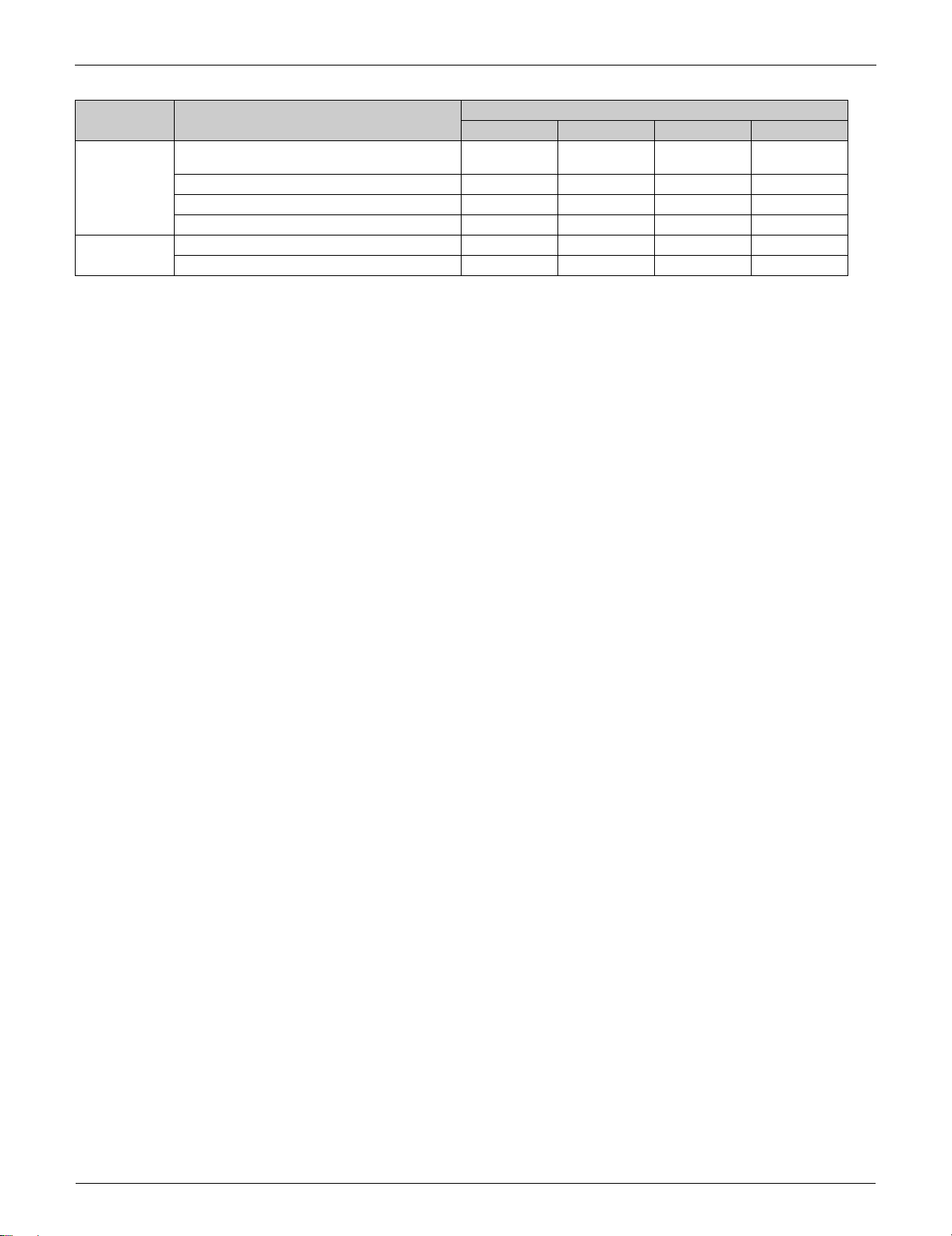
2.1 RA Indoor Unit
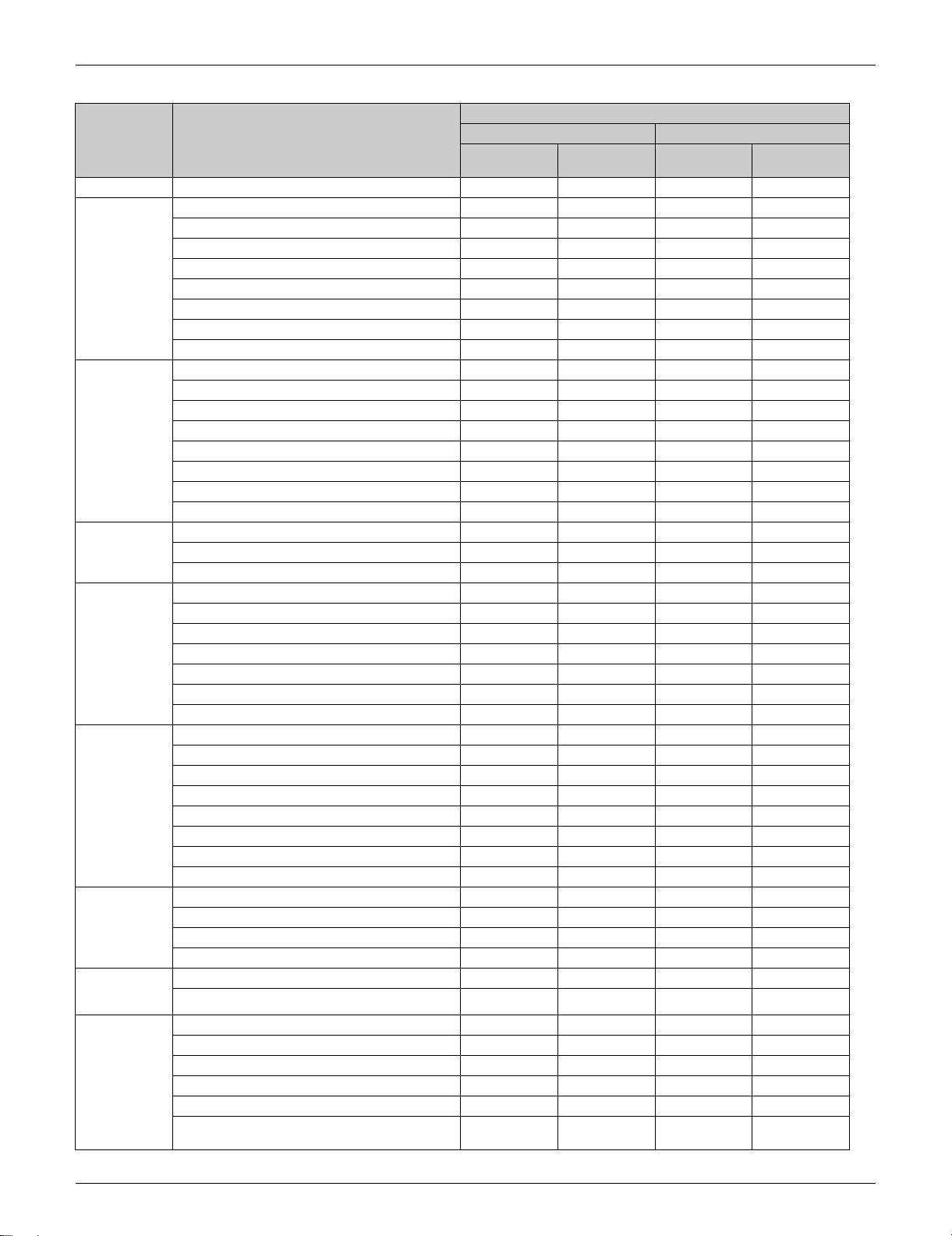
Category Functions
Wall Mounted (Non Duct) Type
FTXR CTXG CTXS FTXS
Basic Function Inverter (with inverter power control)
Comfortable
Airflow
Power-airflow flap (horizontal blade) — — — —
Power-airflow dual flaps (horizontal blade)
Power-airflow diffuser — — — —
Wide-angle louvers (vertical blades)
Auto-swing (up and down)
Auto-swing (right and left)
3-D airflow
COMFORT AIRFLOW operation
Comfort
Control
Auto fan speed
Indoor unit quiet operation
NIGHT QUIET mode (automatic) — — — —
OUTDOOR UNIT QUIET operation (manual)
INTELLIGENT EYE operation — —
2-area INTELLIGENT EYE operation ——
Hot-start function
Operation Automatic cooling/heating changeover
Program dry operation
Fan only
Lifestyle
Convenience
POWERFUL operation (inverter)
HOME LEAVE operation — — — —
ECONO operation
Indoor unit ON/OFF switch
Signal receiving sign
R/C with back light
Temperature display — — — —
Health and
Cleanliness
Air-purifying filer — — — —
Titanium apatite deodorizing filter Option Option
Longlife filter — — — —
Air filter (prefilter)
Wipe-clean flat panel
Washable grille — — — —
Filter cleaning indicator — — — —
Good-sleep cooling operation — — — —
Timer WEEKLY TIMER operation
24-hour ON/OFF TIMER
72-hour ON/OFF TIMER — — — —
NIGHT SET mode
Worry Free
(Reliability &
Durability)
Auto-restart (after power failure)
Self-diagnosis (R/C, LED)
Flexibility Multi-split/split type compatible indoor unit ——
Flexible power supply correspondence — — — —
High ceiling application — — — —
Either side drain (right or left)
Power selection — — — —
°F/°C changeover R/C temperature display
(factory setting: °F)
Functions SiUS121827E
12 Part 1 General Information
Remote
Control
Remote control adaptor
(normal open pulse contact)
Option Option Option Option
Remote control adaptor (normal open contact) Option Option Option Option
DIII-NET compatible (adaptor) Option Option Option Option
Wireless LAN connection Option Option Option Option
Remote
Controller
Wireless
Wired Option Option Option Option
—
: Available
: Not available
Category Functions
Wall Mounted (Non Duct) Type
FTXR CTXG CTXS FTXS
SiUS121827E Functions
Part 1 General Information 13
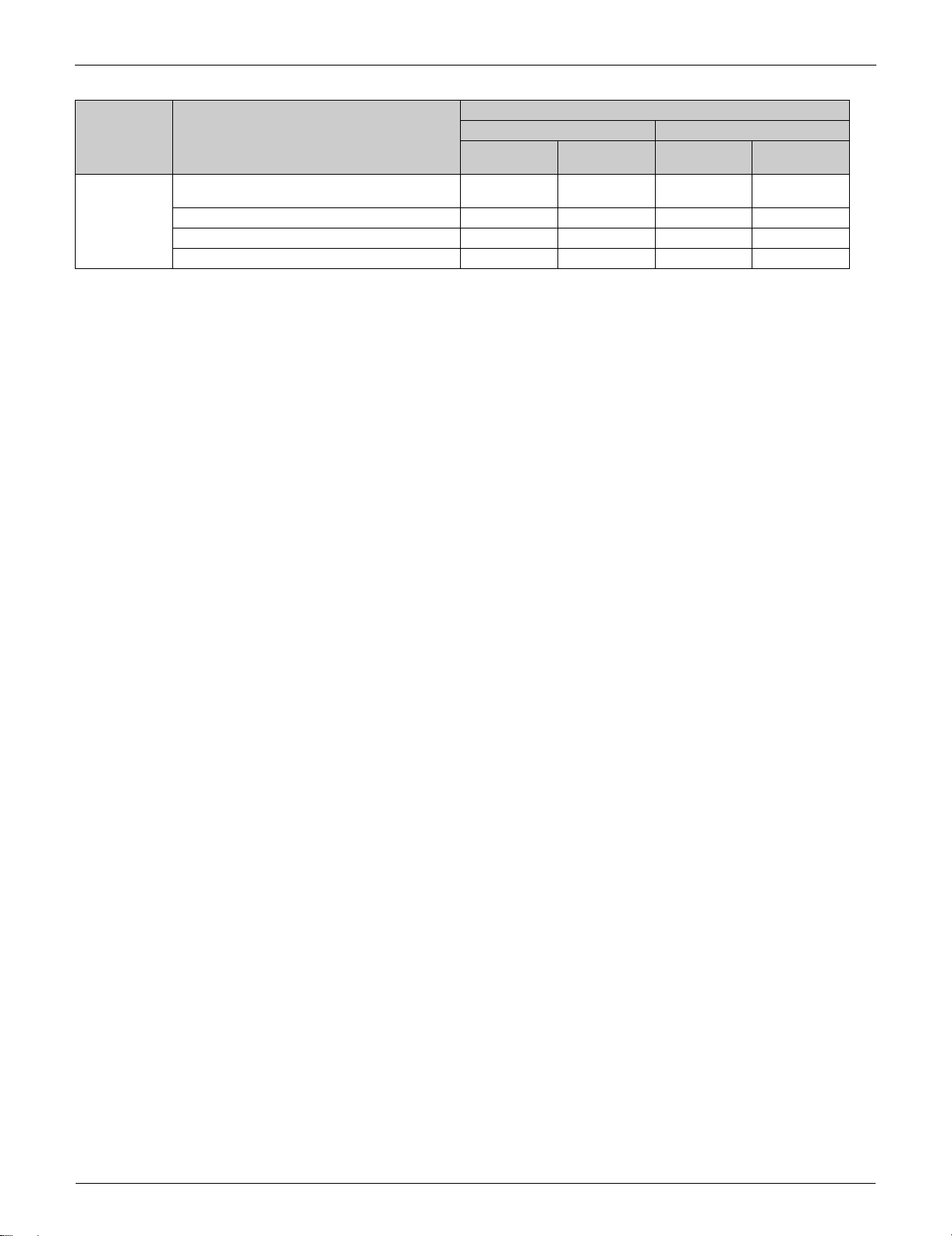
Category Functions
L.S.P. Duct Connected Type
FDXS CDXS
With
wired R/C
With
wireless R/C
With
wired R/C
With
wireless R/C
Basic Function Inverter (with inverter power control)
Comfortable
Airflow
Power-airflow flap (horizontal blade) — — — —
Power-airflow dual flaps (horizontal blade) — — — —
Power-airflow diffuser — — — —
Wide-angle louvers (vertical blades) — — — —
Auto-swing (up and down) — — — —
Auto-swing (right and left) — — — —
3-D airflow ————
COMFORT AIRFLOW operation — — — —
Comfort
Control
Switchable fan speed
Auto fan speed
Indoor unit quiet operation
NIGHT QUIET mode (automatic) — — — —
OUTDOOR UNIT QUIET operation (manual) — —
INTELLIGENT EYE operation — — — —
2-area INTELLIGENT EYE operation — — — —
Hot-start function
Operation Automatic cooling/heating changeover
Program dry operation
Fan only — —
Lifestyle
Convenience
POWERFUL operation (inverter) — —
HOME LEAVE operation — — — —
ECONO operation — —
Indoor unit ON/OFF switch
Signal receiving sign
R/C with back light
Temperature display — — — —
Health and
Cleanliness
Air-purifying filer — — — —
Titanium apatite deodorizing filter — — — —
Longlife filter — — — —
Air filter (prefilter)
Wipe-clean flat panel — — — —
Washable grille — — — —
Filter cleaning indicator — — — —
Good-sleep cooling operation — — — —
Timer WEEKLY TIMER operation — — — —
24-hour ON/OFF TIMER
72-hour ON/OFF TIMER — — — —
NIGHT SET mode
Worry Free
(Reliability &
Durability)
Auto-restart (after power failure)
Self-diagnosis (R/C, LED)
Flexibility Multi-split/split type compatible indoor unit ——
Flexible power supply correspondence — — — —
High ceiling application — — — —
Either side drain (right or left) — — — —
Power selection ————
°F/°C changeover R/C temperature display
(factory setting: °F)
Functions SiUS121827E
14 Part 1 General Information
Remote
Control
Remote control adaptor
(normal open pulse contact)
Option Option Option Option
Remote control adaptor (normal open contact) Option Option Option Option
DIII-NET compatible (adaptor) Option Option Option Option
Wireless LAN connection — — — —
—
: Available
: Not available
Category Functions
L.S.P. Duct Connected Type
FDXS CDXS
With
wired R/C
With
wireless R/C
With
wired R/C
With
wireless R/C
SiUS121827E Functions
Part 1 General Information 15
Category Functions Floor Standing Type FVXS
Basic Function Inverter
(with inverter power control)
Comfortable
Airflow
Power-airflow flap (horizontal blade) —
Power-airflow dual flaps (horizontal blade) —
Power-airflow diffuser —
Wide-angle louvers (vertical blades)
Auto-swing (up and down)
Auto-swing (right and left) —
3-D airflow —
COMFORT AIRFLOW operation —
Comfort
Control
Auto fan speed
Indoor unit quiet operation
NIGHT QUIET mode (automatic) —
OUTDOOR UNIT QUIET operation (manual)
INTELLIGENT EYE operation —
2-area INTELLIGENT EYE operation —
Hot-start function
Operation Automatic cooling/heating changeover
Program dry operation
Fan only
Lifestyle
Convenience
POWERFUL operation (inverter)
HOME LEAVE operation —
ECONO operation
Indoor unit ON/OFF switch
Signal receiving sign
R/C with back light
Temperature display —
Health and
Cleanliness
Air-purifying filer —
Titanium apatite deodorizing filter
Longlife filter —
Air filter (prefilter)
Wipe-clean flat panel
Washable grille —
Filter cleaning indicator —
Good-sleep cooling operation —
Timer WEEKLY TIMER operation
24-hour ON/OFF TIMER
72-hour ON/OFF TIMER —
NIGHT SET mode
Worry Free
(Reliability &
Durability)
Auto-restart (after power failure)
Self-diagnosis (R/C, LED)
Flexibility Multi-split/split type compatible indoor unit
Flexible power supply correspondence —
High ceiling application —
Either side drain (right or left) —
Power selection —
°F/°C changeover R/C temperature display
(factory setting: °F)
Functions SiUS121827E
16 Part 1 General Information
Remote
Control
Remote control adaptor
(normal open pulse contact)
Option
Remote control adaptor (normal open contact) Option
DIII-NET compatible (adaptor) Option
Wireless LAN connection Option
Remote
Controller
Wireless
Wired —
—
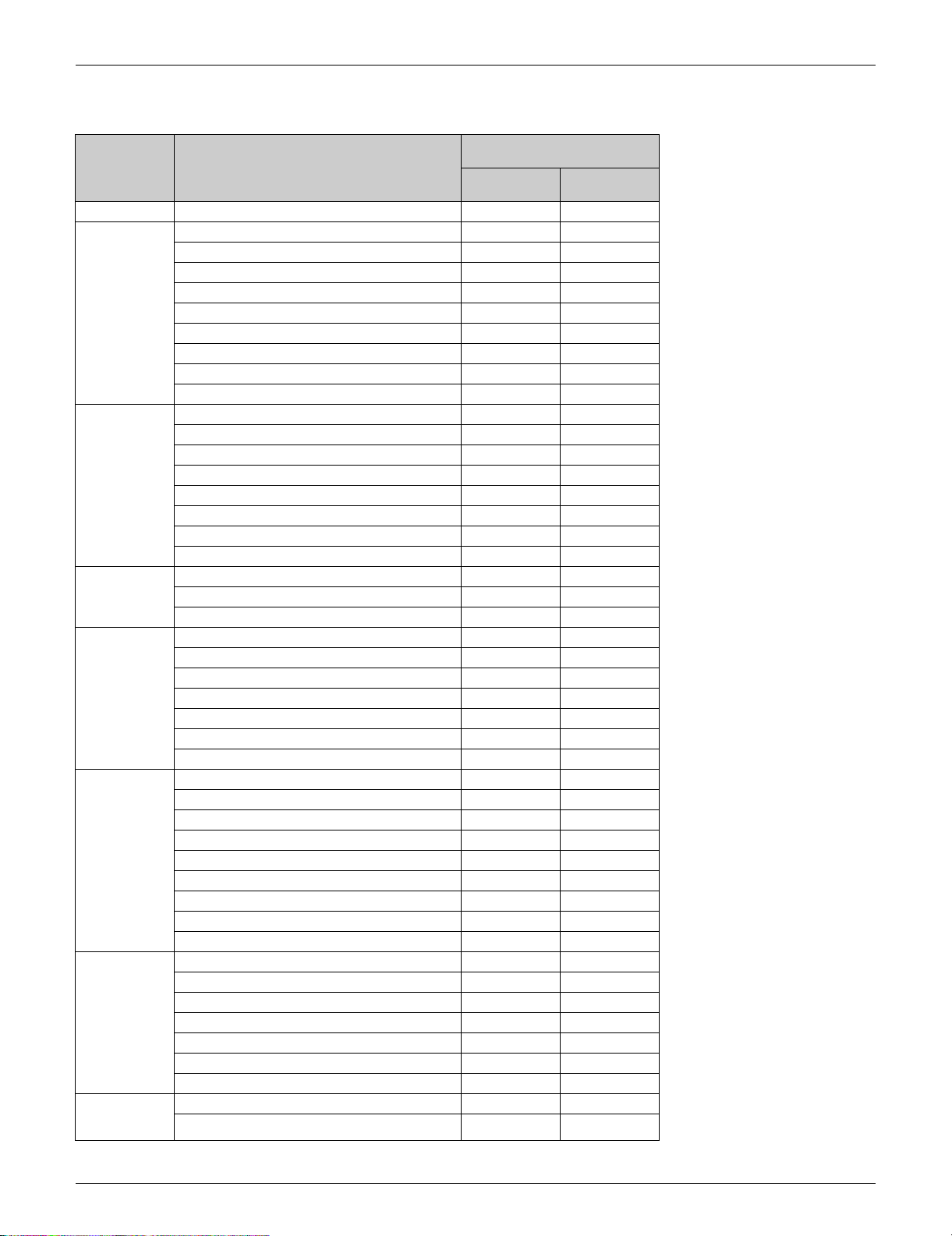
: Available
: Not available
Category Functions Floor Standing Type FVXS
SiUS121827E Functions
Part 1 General Information 17
2.2 SA Indoor Unit
Category Functions
M.S.P. Duct Connected Type
FDMQ
With
wired R/C
With
wireless R/C
Basic Function Inverter (with inverter power control)
Comfortable
Airflow
Power-airflow flap (horizontal blade) — —
Power-airflow dual flaps (horizontal blade) — —
Power-airflow diffuser — —
Wide-angle louvers (vertical blades) — —
Auto-swing (up and down) — —
Auto-swing (right and left) — —
3-D airflow — —
COMFORT AIRFLOW operation — —
Switchable fan speed (3 steps)
Comfort
Control
Auto fan speed —
Indoor unit quiet operation — —
NIGHT QUIET mode (automatic) — —
OUTDOOR UNIT QUIET operation (manual) — —
2 selectable temperature sensors —
INTELLIGENT EYE operation — —
2-area INTELLIGENT EYE operation — —
Hot-start function
Operation Automatic cooling/heating changeover
Program dry operation
Fan only
Lifestyle
Convenience
POWERFUL operation (inverter) — —
HOME LEAVE operation — —
ECONO operation — —
Emergency operation switch —
Signal receiving sign —
R/C with back light —
Temperature display — —
Health and
Cleanliness
Air-purifying filer — —
Titanium apatite deodorizing filter — —
Silver ion anti-bacterial drain pan
Longlife filter Option Option
Air filter — —
Filter cleaning indicator
Wipe-clean flat panel — —
Washable grille — —
Good-sleep cooling operation — —
Timer Setpoint auto reset —
Setpoint range restriction —
Schedule TIMER operation —
24-hour ON/OFF TIMER —
Count up/down ON/OFF TIMER —
Off Timer (turns unit off after set time) —
NIGHT SET mode — —
Worry Free
(Reliability &
Durability)
Auto-restart (after power failure)
Self-diagnosis (R/C, LED)
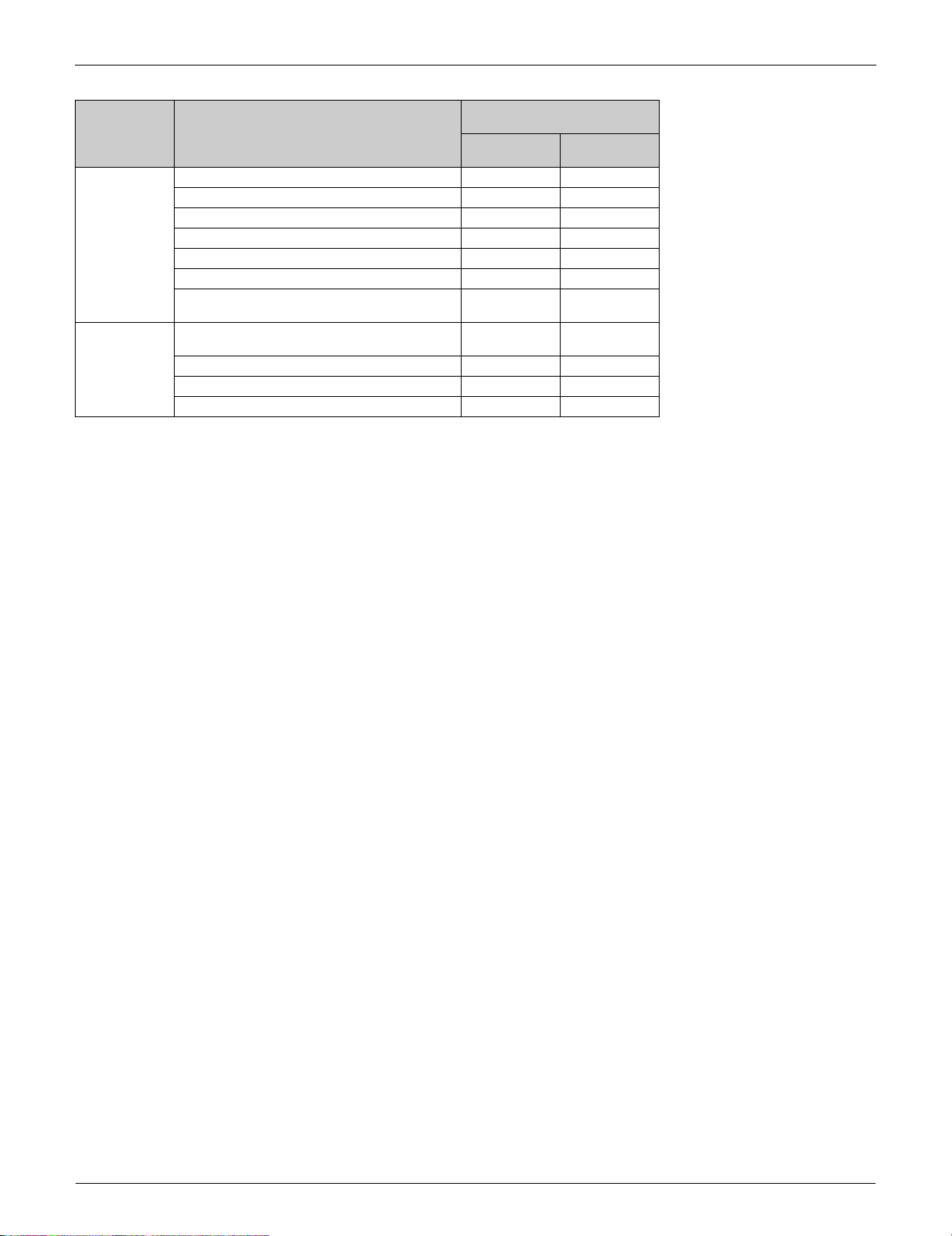
Functions SiUS121827E
18 Part 1 General Information
Flexibility Multi-split/split type compatible indoor unit
Flexible power supply correspondence — —
High ceiling application — —
Either side drain (right or left) — —
Drain pump
Power selection — —
°F/°C changeover R/C temperature display
(factory setting: °F)
—
Remote
Control
Remote control adaptor
(normal open pulse contact)
——
Remote control adaptor (normal open contact) — —
DIII-NET compatible (adaptor) Option Option
Wireless LAN connection — —
—
: Available
: Not available
: Receiving sound only
Category Functions
M.S.P. Duct Connected Type
FDMQ
With
wired R/C
With
wireless R/C
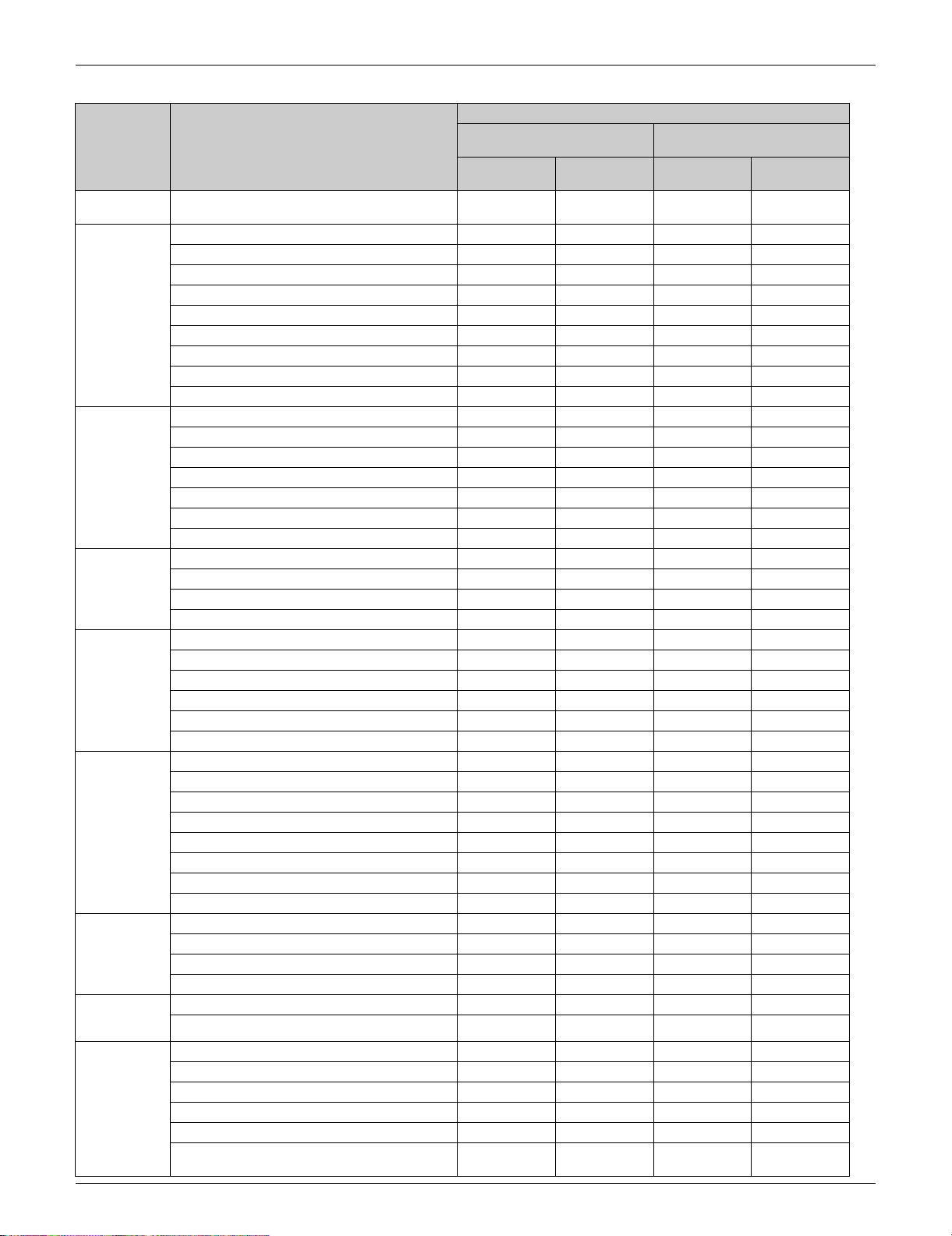
SiUS121827E Functions
Part 1 General Information 19
Category Functions
Ceiling Mounted Type FFQ
Decoration Panel
BYFQ60B3W1
Decoration panel
BYFQ60C2W1W(S)
With
wired R/C
With
wireless R/C
With
wired R/C
With
wireless R/C
Basic
Function
Inverter
(with inverter power control)
Comfortable
Airflow
Power-airflow flap (horizontal blade) — — — —
Power-airflow dual flaps (horizontal blade) — — — —
Power-airflow diffuser — — — —
Wide-angle louvers (vertical blades) — — — —
Auto-swing (up and down)
Auto-swing (right and left) — — — —
Individual flap control — — —
3-D airflow — — — —
COMFORT AIRFLOW operation — — — —
Comfort
Control
Auto fan speed — —
Indoor unit quiet operation — — — —
NIGHT QUIET mode (automatic) — — — —
OUTDOOR UNIT QUIET operation (manual) — — — —
Presence and floor sensor — — Option —
Hot-start function
Draft prevention with sensor
Operation Automatic cooling/heating changeover
Program dry operation
Fan only
Setback function — —
Lifestyle
Convenience
POWERFUL operation (inverter) — — — —
HOME LEAVE operation — — — —
ECONO operation — — — —
Emergency operation switch — —
Signal receiving sign — —
R/C with back light — —
Health and
Cleanliness
Air-purifying filer — — — —
Titanium apatite deodorizing filter — — — —
Longlife filter Option Option Option Option
Air filter — — — —
Filter cleaning indicator
Wipe-clean flat panel — — — —
Washable grille
Good-sleep cooling operation — — — —
Timer Schedule TIMER operation — —
72-hour ON/OFF TIMER — —
Off Timer (turns unit off after set time) — —
NIGHT SET mode — — — —
Worry Free
(Reliability &
Durability)
Auto-restart (after power failure)
Self-diagnosis (R/C, LED)
Flexibility Multi-split/split type compatible indoor unit
Flexible power supply correspondence — — — —
Either side drain (right or left) — — — —
Drain pump
Power selection — — — —
°F/°C changeover R/C temperature display
(fa
cto
ry setting: °F)
— —
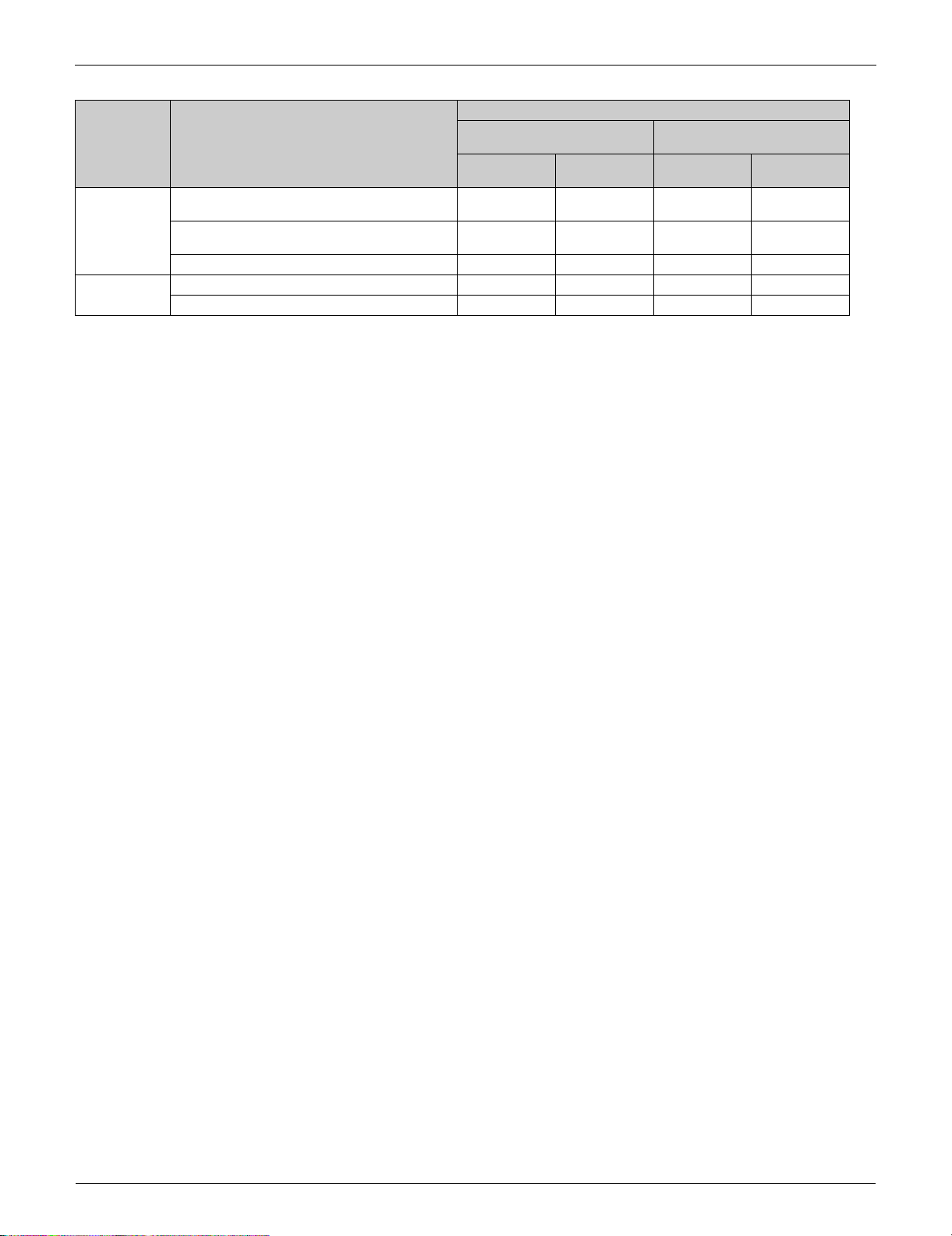
Functions SiUS121827E
20 Part 1 General Information
Remote
Control
Remote control adaptor
(normal open pulse contact)
————
Remote control adaptor
(normal open contact)
————
DIII-NET compatible (adaptor) Option Option Option Option
Remote
Controller
Wireless Option Option Option Option
Wired Option Option Option Option
—
: Available
: Not available
: Receiving sound only
Category Functions
Ceiling Mounted Type FFQ
Decoration Panel
BYFQ60B3W1
Decoration panel
BYFQ60C2W1W(S)
With
wired R/C
With
wireless R/C
With
wired R/C
With
wireless R/C
SiUS121827E Functions
Part 1 General Information 21
2.3 Outdoor Unit
Function 5MXS / 4MXL
Inverter
(with inverter power control)
Operation limit for cooling (°FDB)
Refer to P.292
Operation limit for heating (°FWB)
PAM control
Oval scroll compressor —
Swing compressor
Rotary compressor —
Reluctance DC motor
NIGHT QUIET mode
OUTDOOR UNIT QUIET operation
Quick warming function
Automatic defrosting
Defrost learning control
Priority room setting
COOL/HEAT mode lock
Auto-restart (after power failure) —
Self-diagnosis (R/C, LED)
Wiring error check function
Anti-corrosion treatment of outdoor heat
exchanger
Drain-pan heater control by microcomputer
Flexible power supply correspondence —
Chargeless 131.6 ft
(40 m)
Power selection —
Low temp. cooling operation (−15°C) (5°F) —
:
— :
Available
Not available

SiUS121827E
22 Part 2 Specifications
1. Specifications ............................................................................................23
1.1 RA Indoor Unit............................................................................................ 23
1.2 SA Indoor Unit ............................................................................................ 31
1.3 Outdoor Unit ............................................................................................... 34
Part 2
Specifications
SiUS121827E Specifications
Part 2 Specifications 23
1. Specifications
1.1 RA Indoor Unit
Model FTXR09TVJUW FTXR09TVJUWS
Cooling Heating Cooling Heating
Power Supply Phase 1 φ 1 φ
Hz, V 60 Hz, 208 - 230 V 60 Hz, 208 - 230 V
Rated Capacity 9 kBtu/h Class 9 kBtu/h Class
Front Panel Color White Silver
Airflow Rates H
cfm
(m
3
/min)
272 (7.7) 346 (9.8) 272 (7.7) 346 (9.8)
M 208 (5.9) 258 (7.3) 208 (5.9) 258 (7.3)
L 162 (4.6) 201 (5.7) 162 (4.6) 201 (5.7)
SL 134 (3.8) 117 (3.3) 134 (3.8) 117 (3.3)
Fan Type Cross Flow Fan Cross Flow Fan
Motor Output W 29 29
Speed Steps 5 Steps, Quiet, Auto 5 Steps, Quiet, Auto
Air Direction Control Right, Left, Horizontal, Downward Right, Left, Horizontal, Downward
Air Filter Removable, Washable, Mildew Proof Removable, Washable, Mildew Proof
Running Current (Rated) A 0.07 - 0.07 0.13 - 0.12 0.07 - 0.07 0.13 - 0.12
Power Consumption (Rated) W 13 - 13 26 - 26 13 - 13 26 - 26
Power Factor (Rated) % 89.2 - 80.7 96.2 - 94.2 89.2 - 80.7 96.2 - 94.2
Temperature Control Microcomputer Control Microcomputer Control
Dimensions (H × W × D) in. (mm) 11-15/16 × 39-5/16 × 8-3/8 (303 × 998 × 212) 11-15/16 × 39-5/16 × 8-3/8 (303 × 998 × 212)
Packaged Dimensions (H × W × D) in. (mm) 12-11/16 × 43-3/8 × 15-5/16 (322 × 1,101 × 389) 12-11/16 × 43-3/8 × 15-5/16 (322 × 1,101 × 389)
Weight (Mass) Lbs (kg) 27 (12) 27 (12)
Gross Weight (Gross Mass) Lbs (kg) 36 (16) 36 (16)
Sound Pressure
Level
H / M / L / SL
dB(A) 38 / 32 / 25 / 19 41 / 34 / 28 / 19 38 / 32 / 25 / 19 41 / 34 / 28 / 19
Sound Power Level dB — — — —
Heat Insulation Both Liquid and Gas Pipes Both Liquid and Gas Pipes
Piping Connection Liquid in. (mm) φ 1/4 (φ 6.4) φ 1/4 (φ 6.4)
Gas in. (mm) φ 3/8 (φ 9.5) φ 3/8 (φ 9.5)
Drain in. (mm) φ 11/16 (φ 18) φ 11/16 (φ 18)
Drawing No. 3D120044 3D120044
Notes 1. SL: The quiet fan level of the airflow rate setting. 1. SL: The quiet fan level of the airflow rate setting.
Model FTXR12TVJUW FTXR12TVJUS
Cooling Heating Cooling Heating
Power Supply Phase 1 φ 1 φ
Hz, V 60 Hz, 208 - 230 V 60 Hz, 208 - 230 V
Rated Capacity 12 kBtu/h Class 12 kBtu/h Class
Front Panel Color White Silver
Airflow Rates H
cfm
(m
3
/min)
335 (9.5) 395 (11.2) 335 (9.5) 395 (11.2)
M 219 (6.2) 290 (8.2) 219 (6.2) 290 (8.2)
L 169 (4.8) 226 (6.4) 169 (4.8) 226 (6.4)
SL 131 (3.7) 131 (3.7) 131 (3.7) 131 (3.7)
Fan Type Cross Flow Fan Cross Flow Fan
Motor Output W 29 29
Speed Steps 5 Steps, Quiet, Auto 5 Steps, Quiet, Auto
Air Direction Control Right, Left, Horizontal, Downward Right, Left, Horizontal, Downward
Air Filter Removable, Washable, Mildew Proof Removable, Washable, Mildew Proof
Running Current (Rated) A 0.13 - 0.12 0.19 - 0.17 0.13 - 0.12 0.19 - 0.17
Power Consumption (Rated) W 26 - 26 38 - 38 26 - 26 38 - 38
Power Factor (Rated) % 96.1 - 94.2 96.1 - 97.1 96.1 - 94.2 96.1 - 97.1
Temperature Control Microcomputer Control Microcomputer Control
Dimensions (H × W × D) in. (mm) 11-15/16 × 39-5/16 × 8-3/8 (303 × 998 × 212) 11-15/16 × 39-5/16 × 8-3/8 (303 × 998 × 212)
Packaged Dimensions (H × W × D) in. (mm) 12-11/16 × 43-3/8 × 15-5/16 (322 × 1,101 × 389) 12-11/16 × 43-3/8 × 15-5/16 (322 × 1,101 × 389)
Weight (Mass) Lbs (kg) 27 (12) 27 (12)
Gross Weight (Gross Mass) Lbs (kg) 36 (16) 36 (16)
Sound Pressure
Level
H / M / L / SL
dB(A) 45 / 34 / 26 / 20 45 / 37 / 29 / 20 45 / 34 / 26 / 20 45 / 37 / 29 / 20
Sound Power Level dB — — — —
Heat Insulation Both Liquid and Gas Pipes Both Liquid and Gas Pipes
Piping Connection Liquid in. (mm) φ 1/4 (φ 6.4) φ 1/4 (φ 6.4)
Gas in. (mm) φ 3/8 (φ 9.5) φ 3/8 (φ 9.5)
Drain in. (mm) φ 11/16 (φ 18) φ 11/16 (φ 18)
Drawing No. 3D120044 3D120044
Notes 1. SL: The quiet fan level of the airflow rate setting. 1. SL: The quiet fan level of the airflow rate setting.
Conversion Formulae
kcal/h = kW × 860
Btu/h = kW × 3412
cfm = m³/min × 35.3
Specifications SiUS121827E
24 Part 2 Specifications
Model FTXR18TVJUW FTXR18TVJUS
Cooling Heating Cooling Heating
Power Supply Phase 1 φ 1 φ
Hz, V 60 Hz, 208 - 230 V 60 Hz, 208 - 230 V
Rated Capacity 18 kBtu/h Class 18 kBtu/h Class
Front Panel Color White Silver
Airflow Rates H
cfm
(m
3
/min)
350 (9.9) 413 (11.7) 350 (9.9) 413 (11.7)
M 275 (7.8) 332 (9.4) 275 (7.8) 332 (9.4)
L 226 (6.4) 275 (7.8) 226 (6.4) 275 (7.8)
SL 208 (5.9) 208 (5.9) 208 (5.9) 208 (5.9)
Fan Type Cross Flow Fan Cross Flow Fan
Motor Output W 29 29
Speed Steps 5 Steps, Quiet, Auto 5 Steps, Quiet, Auto
Air Direction Control Right, Left, Horizontal, Downward Right, Left, Horizontal, Downward
Air Filter Removable, Washable, Mildew Proof Removable, Washable, Mildew Proof
Running Current (Rated) A 0.14 - 0.14 0.21 - 0.21 0.14 - 0.14 0.21 - 0.21
Power Consumption (Rated) W 28 - 28 42 - 42 28 - 28 42 - 42
Power Factor (Rated) % 96.1 - 87.0 96.2 - 87.0 96.1 - 87.0 96.2 - 87.0
Temperature Control Microcomputer Control Microcomputer Control
Dimensions (H × W × D) in. (mm) 11-15/16 × 39-5/16 × 8-3/8 (303 × 998 × 212) 11-15/16 × 39-5/16 × 8-3/8 (303 × 998 × 212)
Packaged Dimensions (H × W × D) in. (mm) 12-11/16 × 43-3/8 × 15-5/16 (322 × 1,101 × 389) 12-11/16 × 43-3/8 × 15-5/16 (322 × 1,101 × 389)
Weight (Mass) Lbs (kg) 27 (12) 27 (12)
Gross Weight (Gross Mass) Lbs (kg) 36 (16) 36 (16)
Sound Pressure
Level
H / M / L / SL
dB(A) 46 / 40 / 35 / 30 47 / 41 / 35 / 30 46 / 40 / 35 / 30 47 / 41 / 35 / 30
Sound Power Level dB — — — —
Heat Insulation Both Liquid and Gas Pipes Both Liquid and Gas Pipes
Piping Connection Liquid in. (mm) φ 1/4 (φ 6.4) φ 1/4 (φ 6.4)
Gas in. (mm) φ 1/2 (φ 12.7) φ 1/2 (φ 12.7)
Drain in. (mm) φ 11/16 (φ 18) φ 11/16 (φ 18)
Drawing No. 3D120048A 3D120048A
Notes 1. SL: The quiet fan level of the airflow rate setting. 1. SL: The quiet fan level of the airflow rate setting.
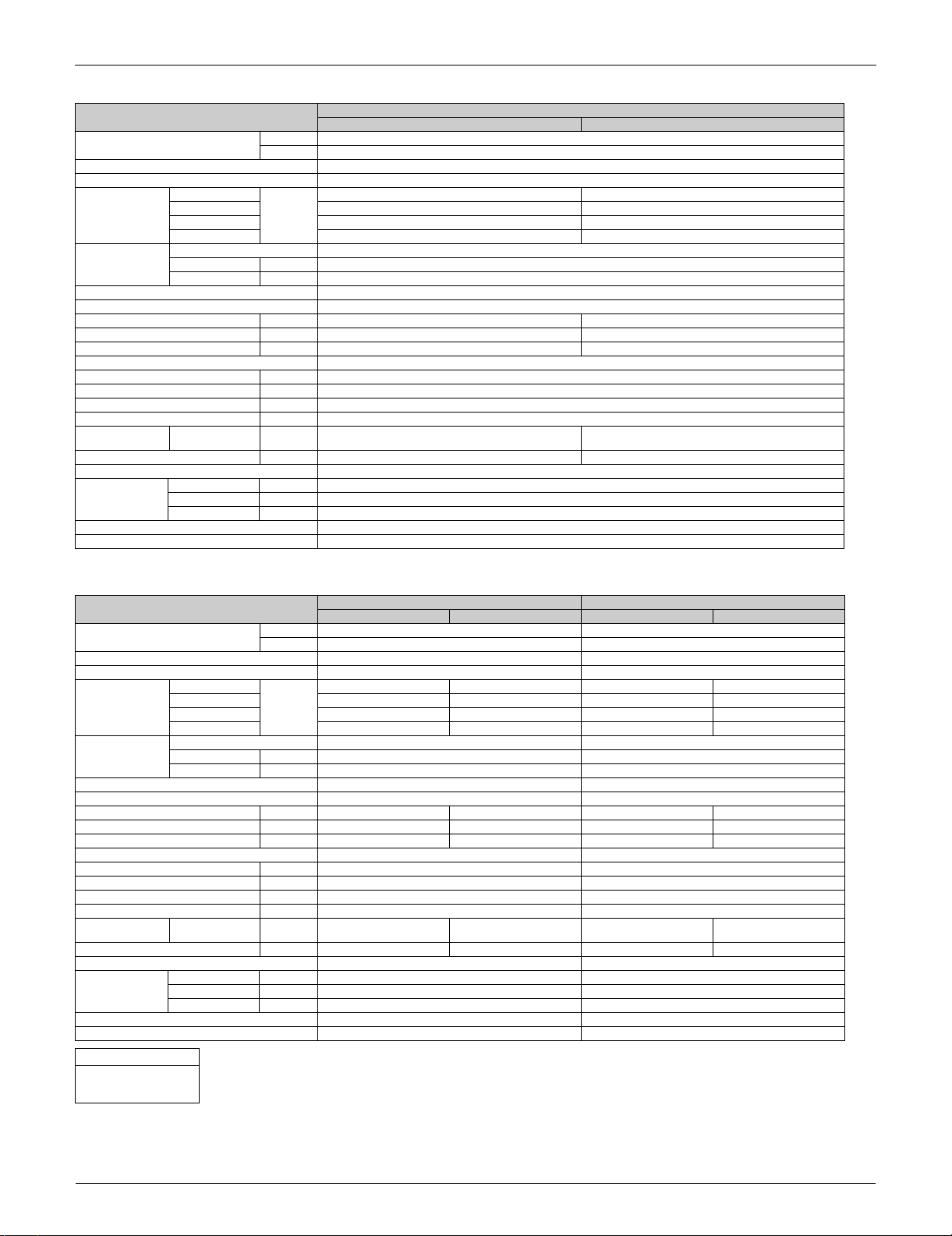
Model CTXG09QVJUW CTXG09QVJUS
Cooling Heating Cooling Heating
Power Supply Phase 1 φ 1 φ
Hz, V 60 Hz, 208 - 230 V 60 Hz, 208 - 230 V
Rated Capacity 9 kBtu/h Class 9 kBtu/h Class
Front Panel Color White Silver
Airflow Rates H
cfm
(m
3
/min)
279 (7.9) 367 (10.4) 279 (7.9) 367 (10.4)
M 212 (6.0) 265 (7.5) 212 (6.0) 265 (7.5)
L 162 (4.6) 205 (5.8) 162 (4.6) 205 (5.8)
SL 134 (3.8) 117 (3.3) 134 (3.8) 117 (3.3)
Fan Type Cross Flow Fan Cross Flow Fan
Motor Output W 29 29
Speed Steps 5 Steps, Quiet, Auto 5 Steps, Quiet, Auto
Air Direction Control Right, Left, Horizontal, Downward Right, Left, Horizontal, Downward
Air Filter Removable, Washable, Mildew Proof Removable, Washable, Mildew Proof
Running Current (Rated) A 0.07 - 0.07 0.13 - 0.12 0.07 - 0.07 0.13 - 0.12
Power Consumption (Rated) W 13 - 13 26 - 26 13 - 13 26 - 26
Power Factor (Rated) % 89.2 - 80.7 96.2 - 94.2 89.2 - 80.7 96.2 - 94.2
Temperature Control Microcomputer Control Microcomputer Control
Dimensions (H × W × D) in. (mm) 11-15/16 × 39-5/16 × 8-3/8 (303 × 998 × 212) 11-15/16 × 39-5/16 × 8-3/8 (303 × 998 × 212)
Packaged Dimensions (H × W × D) in. (mm) 12-11/16 × 43-3/8 × 15-5/16 (322 × 1,101 × 389) 12-11/16 × 43-3/8 × 15-5/16 (322 × 1,101 × 389)
Weight (Mass) Lbs (kg) 27 (12) 27 (12)
Gross Weight (Gross Mass) Lbs (kg) 36 (16) 36 (16)
Sound Pressure
Level
H / M / L / SL
dB(A) 38 / 32 / 25 / 21 41 / 34 / 28 / 21 38 / 32 / 25 / 21 41 / 34 / 28 / 21
Sound Power Level dB — — — —
Heat Insulation Both Liquid and Gas Pipes Both Liquid and Gas Pipes
Piping Connection Liquid in. (mm) φ 1/4 (φ 6.4) φ 1/4 (φ 6.4)
Gas in. (mm) φ 3/8 (φ 9.5) φ 3/8 (φ 9.5)
Drain in. (mm) φ 11/16 (φ 18) φ 11/16 (φ 18)
Drawing No. 3D105562 3D105565
Notes 1. SL: The quiet fan level of the airflow rate setting. 1. SL: The quiet fan level of the airflow rate setting.
Conversion Formulae
kcal/h = kW × 860
Btu/h = kW × 3412
cfm = m³/min × 35.3
SiUS121827E Specifications
Part 2 Specifications 25
Model CTXG12QVJUW CTXG12QVJUS
Cooling Heating Cooling Heating
Power Supply Phase 1 φ 1 φ
Hz, V 60 Hz, 208 - 230 V 60 Hz, 208 - 230 V
Rated Capacity 12 kBtu/h Class 12 kBtu/h Class
Front Panel Color White Silver
Airflow Rates H
cfm
(m
3
/min)
353 (10.0) 420 (11.9) 353 (10.0) 420 (11.9)
M 230 (6.5) 300 (8.5) 230 (6.5) 300 (8.5)
L 162 (4.6) 219 (6.2) 162 (4.6) 219 (6.2)
SL 134 (3.8) 124 (3.5) 134 (3.8) 124 (3.5)
Fan Type Cross Flow Fan Cross Flow Fan
Motor Output W 29 29
Speed Steps 5 Steps, Quiet, Auto 5 Steps, Quiet, Auto
Air Direction Control Right, Left, Horizontal, Downward Right, Left, Horizontal, Downward
Air Filter Removable, Washable, Mildew Proof Removable, Washable, Mildew Proof
Running Current (Rated) A 0.13 - 0.12 0.19 - 0.17 0.13 - 0.12 0.19 - 0.17
Power Consumption (Rated) W 26 - 26 38 - 38 26 - 26 38 - 38
Power Factor (Rated) % 96.1 - 94.2 96.1 - 97.1 96.1 - 94.2 96.1 - 97.1
Temperature Control Microcomputer Control Microcomputer Control
Dimensions (H × W × D) in. (mm) 11-15/16 × 39-5/16 × 8-3/8 (303 × 998 × 212) 11-15/16 × 39-5/16 × 8-3/8 (303 × 998 × 212)
Packaged Dimensions (H × W × D) in. (mm) 12-11/16 × 43-3/8 × 15-5/16 (322 × 1,101 × 389) 12-11/16 × 43-3/8 × 15-5/16 (322 × 1,101 × 389)
Weight (Mass) Lbs (kg) 27 (12) 27 (12)
Gross Weight (Gross Mass) Lbs (kg) 36 (16) 36 (16)
Sound Pressure
Level
H / M / L / SL
dB(A) 45 / 34 / 26 / 22 45 / 37 / 29 / 22 45 / 34 / 26 / 22 45 / 37 / 29 / 22
Sound Power Level dB — — — —
Heat Insulation Both Liquid and Gas Pipes Both Liquid and Gas Pipes
Piping Connection Liquid in. (mm) φ 1/4 (φ 6.4) φ 1/4 (φ 6.4)
Gas in. (mm) φ 3/8 (φ 9.5) φ 3/8 (φ 9.5)
Drain in. (mm) φ 11/16 (φ 18) φ 11/16 (φ 18)
Drawing No. 3D105563 3D105566
Notes 1. SL: The quiet fan level of the airflow rate setting. 1. SL: The quiet fan level of the airflow rate setting.
Model CTXG18QVJUW CTXG18QVJUS
Cooling Heating Cooling Heating
Power Supply Phase 1 φ 1 φ
Hz, V 60 Hz, 208 - 230 V 60 Hz, 208 - 230 V
Rated Capacity 18 kBtu/h Class 18 kBtu/h Class
Front Panel Color White Silver
Airflow Rates H
cfm
(m
3
/min)
364 (10.3) 438 (12.4) 364 (10.3) 438 (12.4)
M 286 (8.1) 350 (9.9) 286 (8.1) 350 (9.9)
L 233 (6.6) 265 (7.5) 233 (6.6) 265 (7.5)
SL 219 (6.2) 212 (6) 219 (6.2) 212 (6)
Fan Type Cross Flow Fan Cross Flow Fan
Motor Output W 29 29
Speed Steps 5 Steps, Quiet, Auto 5 Steps, Quiet, Auto
Air Direction Control Right, Left, Horizontal, Downward Right, Left, Horizontal, Downward
Air Filter Removable, Washable, Mildew Proof Removable, Washable, Mildew Proof
Running Current (Rated) A 0.14 - 0.14 0.21 - 0.21 0.14 - 0.14 0.21 - 0.21
Power Consumption (Rated) W 28 - 28 42 - 42 28 - 28 42 - 42
Power Factor (Rated) % 96.1 - 87.0 96.2 - 87.0 96.1 - 87.0 96.2 - 87.0
Temperature Control Microcomputer Control Microcomputer Control
Dimensions (H × W × D) in. (mm) 11-15/16 × 39-5/16 × 8-3/8 (303 × 998 × 212) 11-15/16 × 39-5/16 × 8-3/8 (303 × 998 × 212)
Packaged Dimensions (H × W × D) in. (mm) 12-11/16 × 43-3/8 × 15-5/16 (322 × 1,101 × 389) 12-11/16 × 43-3/8 × 15-5/16 (322 × 1,101 × 389)
Weight (Mass) Lbs (kg) 27 (12) 27 (12)
Gross Weight (Gross Mass) Lbs (kg) 36 (16) 36 (16)
Sound Pressure
Level
H / M / L / SL
dB(A) 46 / 40 / 35 / 32 47 / 41 / 35 / 32 46 / 40 / 35 / 32 47 / 41 / 35 / 32
Sound Power Level dB — — — —
Heat Insulation Both Liquid and Gas Pipes Both Liquid and Gas Pipes
Piping Connection Liquid in. (mm) φ 1/4 (φ 6.4) φ 1/4 (φ 6.4)
Gas in. (mm) φ 1/2 (φ 12.7) φ 1/2 (φ 12.7)
Drain in. (mm) φ 11/16 (φ 18) φ 11/16 (φ 18)
Drawing No. 3D105564 3D105567
Notes 1. SL: The quiet fan level of the airflow rate setting. 1. SL: The quiet fan level of the airflow rate setting.
Conversion Formulae
kcal/h = kW × 860
Btu/h = kW × 3412
cfm = m³/min × 35.3
Specifications SiUS121827E
26 Part 2 Specifications
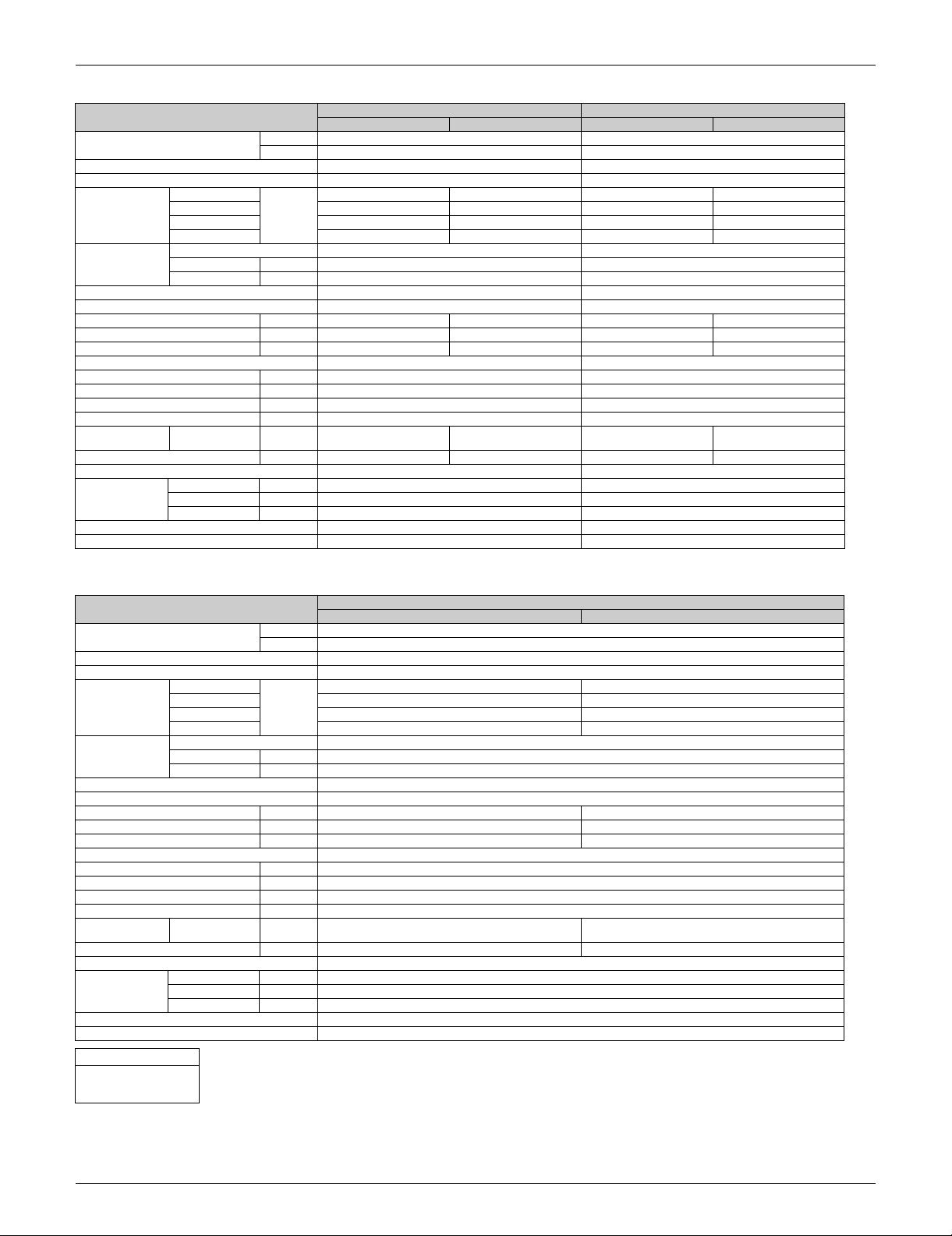
Model CTXS07LVJU
Cooling Heating
Power Supply Phase 1 φ
Hz, V 60 Hz, 208 - 230 V
Rated Capacity 7 kBtu/h Class
Front Panel Color White
Airflow Rates H
cfm
(m
3
/min)
332 (9.4) 350 (9.9)
M 261 (7.4) 290 (8.2)
L 194 (5.5) 233 (6.6)
SL 145 (4.1) 219 (6.2)
Fan Type Cross Flow Fan
Motor Output W 23
Speed Steps 5 Steps, Quiet, Auto
Air Direction Control Right, Left, Horizontal, Downward
Air Filter Removable, Washable, Mildew Proof
Running Current (Rated) A 0.09 - 0.08 0.11 - 0.10
Power Consumption (Rated) W 18 - 18 21 - 21
Power Factor (Rated) % 96.2 - 97.8 91.8 - 91.3
Temperature Control Microcomputer Control
Dimensions (H × W × D) in. (mm) 11-5/8 × 31-1/2 × 8-7/16 (295 × 800 × 215)
Packaged Dimensions (H × W × D) in. (mm) 10-13/16 × 34-1/4 × 14-7/16 (274 × 870 × 366)
Weight (Mass) Lbs (kg) 20 (9)
Gross Weight (Gross Mass) Lbs (kg) 29 (13)
Sound Pressure
Level
H / M / L / SL
dB(A) 38 / 32 / 25 / 22 38 / 33 / 28 / 25
Sound Power Level dB 54 54
Heat Insulation Both Liquid and Gas Pipes
Piping Connection Liquid in. (mm) φ 1/4 (φ 6.4)
Gas in. (mm) φ 3/8 (φ 9.5)
Drain in. (mm) φ 5/8 (φ 16.0)
Drawing No. 3D075490
Notes 1. SL: The quiet fan level of the airflow rate setting.
Model FTXS09LVJU FTXS12LVJU
Cooling Heating Cooling Heating
Power Supply Phase 1 φ 1 φ
Hz, V 60 Hz, 208 - 230 V 60 Hz, 208 - 230 V
Rated Capacity 9 kBtu/h Class 12 kBtu/h Class
Front Panel Color White White
Airflow Rates H
cfm
(m
3
/min)
381 (10.8) 420 (11.9) 403 (11.4) 438 (12.4)
M 279 (7.9) 321 (9.1) 307 (8.7) 335 (9.5)
L 194 (5.5) 233 (6.6) 205 (5.8) 240 (6.8)
SL 145 (4.1) 219 (6.2) 155 (4.4) 212 (6.0)
Fan Type Cross Flow Fan Cross Flow Fan
Motor Output W 23 23
Speed Steps 5 Steps, Quiet, Auto 5 Steps, Quiet, Auto
Air Direction Control Right, Left, Horizontal, Downward Right, Left, Horizontal, Downward
Air Filter Removable, Washable, Mildew Proof Removable, Washable, Mildew Proof
Running Current (Rated) A 0.09 - 0.08 0.11 - 0.10 0.13 - 0.12 0.14 - 0.13
Power Consumption (Rated) W 18 - 18 21 - 21 26 - 26 28 - 28
Power Factor (Rated) % 96.2 - 97.8 91.8 - 91.3 96.2 - 94.2 96.2 - 93.6
Temperature Control Microcomputer Control Microcomputer Control
Dimensions (H × W × D) in. (mm) 11-5/8 × 31-1/2 × 8-7/16 (295 × 800 × 215) 11-5/8 × 31-1/2 × 8-7/16 (295 × 800 × 215)
Packaged Dimensions (H × W × D) in. (mm) 10-13/16 × 34-1/4 × 14-7/16 (274 × 870 × 366) 10-13/16 × 34-1/4 × 14-7/16 (274 × 870 × 366)
Weight (Mass) Lbs (kg) 20 (9) 22 (10)
Gross Weight (Gross Mass) Lbs (kg) 29 (13) 31 (14)
Sound Pressure
Level
H / M / L / SL
dB(A) 41 / 33 / 25 / 22 42 / 35 / 28 / 25 45 / 37 / 29 / 23 45 / 39 / 29 / 26
Sound Power Level dB 57 58 61 61
Heat Insulation Both Liquid and Gas Pipes Both Liquid and Gas Pipes
Piping Connection Liquid in. (mm) φ 1/4 (φ 6.4) φ 1/4 (φ 6.4)
Gas in. (mm) φ 3/8 (φ 9.5) φ 3/8 (φ 9.5)
Drain in. (mm) φ 5/8 (φ 16) φ 5/8 (φ 16)
Drawing No. 3D075491A 3D075492A
Notes 1. SL: The quiet fan level of the airflow rate setting. 1. SL: The quiet fan level of the airflow rate setting.
Conversion Formulae
kcal/h = kW × 860
Btu/h = kW × 3412
cfm = m³/min × 35.3
SiUS121827E Specifications
Part 2 Specifications 27
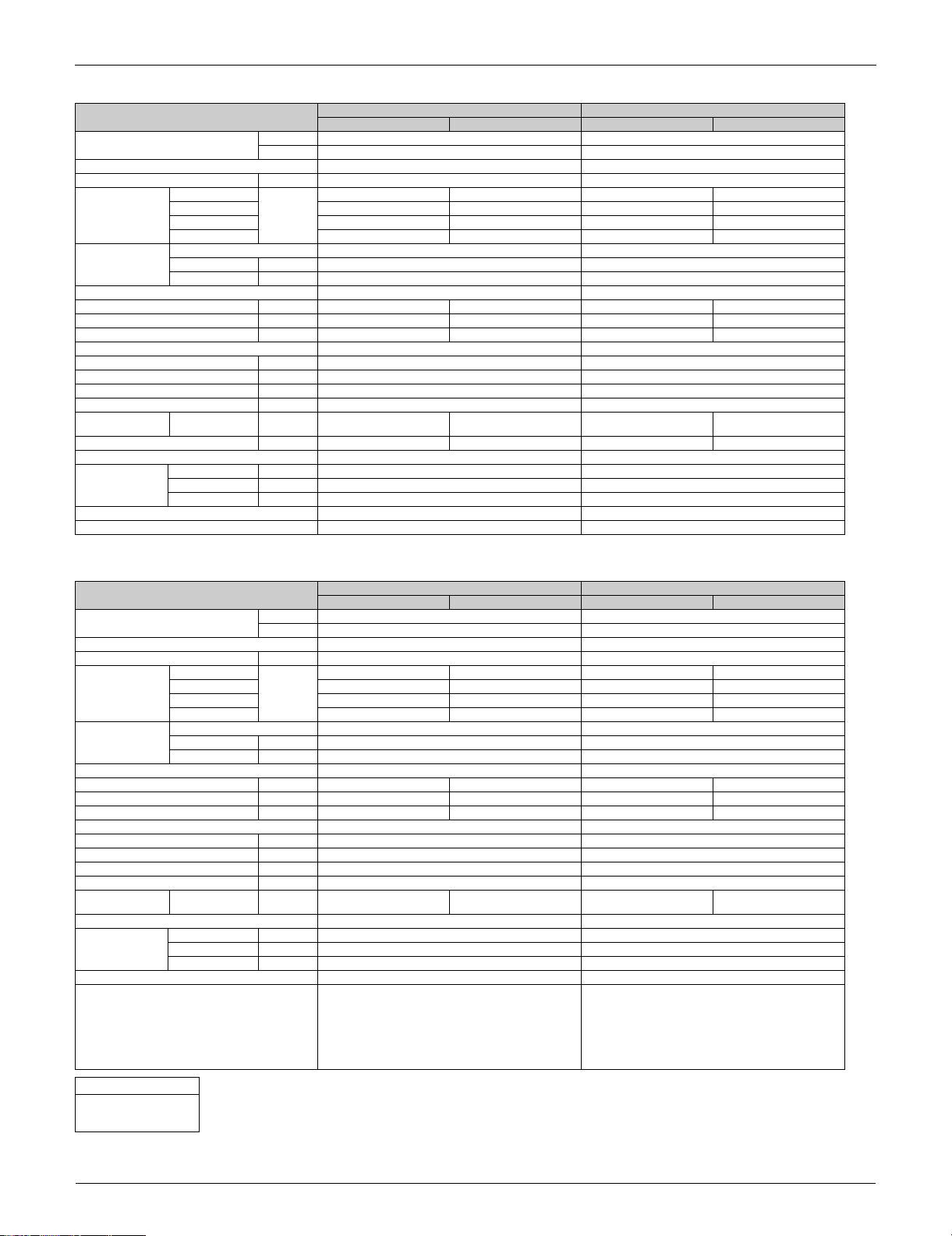
Model FTXS15LVJU FTXS18LVJU
Cooling Heating Cooling Heating
Power Supply Phase 1 φ 1 φ
Hz, V 60 Hz, 208 - 230 V 60 Hz, 208 - 230 V
Rated Capacity 15 kBtu/h Class 18 kBtu/h Class
Front Panel Color White White
Airflow Rates H
cfm
(m
3
/min)
568 (16.1) 593 (16.8) 583 (16.5) 625 (17.7)
M 477 (13.5) 505 (14.3) 484 (13.7) 526 (14.9)
L 385 (10.9) 417 (11.8) 385 (10.9) 431 (12.2)
SL 360 (10.2) 371 (10.5) 360 (10.2) 399 (11.3)
Fan Type Cross Flow Fan Cross Flow Fan
Motor Output W 48 48
Speed Steps 5 Steps, Quiet, Auto 5 Steps, Quiet, Auto
Air Direction Control Right, Left, Horizontal, Downward Right, Left, Horizontal, Downward
Air Filter Removable, Washable, Mildew Proof Removable, Washable, Mildew Proof
Running Current (Rated) A 0.31 - 0.29 0.31 - 0.29 0.32 - 0.30 0.32 - 0.30
Power Consumption (Rated) W 38 - 38 38 - 38 38 - 38 38 - 38
Power Factor (Rated) % 58.9 - 57.0 58.9 - 57.0 57.1 - 55.1 57.1 - 55.1
Temperature Control Microcomputer Control Microcomputer Control
Dimensions (H × W × D) in. (mm) 13-3/8 × 41-5/16 × 9-3/4 (340 × 1,050 × 248) 13-3/8 × 41-5/16 × 9-3/4 (340 × 1,050 × 248)
Packaged Dimensions (H × W × D) in. (mm) 13 × 45-11/16 × 16-7/8 (331 × 1,160 × 429) 13 × 45-11/16 × 16-7/8 (331 × 1,160 × 429)
Weight (Mass) Lbs (kg) 31 (14) 31 (14)
Gross Weight (Gross Mass) Lbs (kg) 44 (20) 44 (20)
Sound Pressure
Level
H / M / L / SL
dB(A) 45 / 40 / 35 / 32 43 / 38 / 33 / 30 46 / 41 / 36 / 33 45 / 40 / 35 / 32
Sound Power Level dB 61 59 62 61
Heat Insulation Both Liquid and Gas Pipes Both Liquid and Gas Pipes
Piping Connection Liquid in. (mm) φ 1/4 (φ 6.4) φ 1/4 (φ 6.4)
Gas in. (mm) φ 1/2 (φ 12.7) φ 1/2 (φ 12.7)
Drain in. (mm) φ 5/8 (φ 16) φ 5/8 (φ 16)
Drawing No. 3D075043A 3D075044A
Notes 1. SL: The quiet fan level of the airflow rate setting. 1. SL: The quiet fan level of the airflow rate setting.
Model FTXS24LVJU
Cooling Heating
Power Supply Phase 1 φ
Hz, V 60 Hz, 208 - 230 V
Rated Capacity 24 kBtu/h Class
Front Panel Color White
Airflow Rates H
cfm
(m
3
/min)
643 (18.2) 699 (19.8)
M 494 (14.0) 572 (16.2)
L 350 (9.9) 445 (12.6)
SL 328 (9.3) 403 (11.4)
Fan Type Cross Flow Fan
Motor Output W 48
Speed Steps 5 Steps, Quiet, Auto
Air Direction Control Right, Left, Horizontal, Downward
Air Filter Removable, Washable, Mildew Proof
Running Current (Rated) A 0.57 - 0.51 0.57 - 0.51
Power Consumption (Rated) W 69 - 68 69 - 68
Power Factor (Rated) % 58.2 - 58.0 58.2 - 58.0
Temperature Control Microcomputer Control
Dimensions (H × W × D) in. (mm) 13-3/8 × 41-5/16 × 9-3/4 (340 × 1,050 × 248)
Packaged Dimensions (H × W × D) in. (mm) 13 × 45-11/16 × 16-7/8 (331 × 1,160 × 429)
Weight (Mass) Lbs (kg) 31 (14)
Gross Weight (Gross Mass) Lbs (kg) 46 (21)
Sound Pressure
Level
H / M / L / SL
dB(A) 51 / 44 / 37 / 34 48 / 42 / 37 / 34
Sound Power Level dB 67 64
Heat Insulation Both Liquid and Gas Pipes
Piping Connection Liquid in. (mm) φ 1/4 (φ 6.4)
Gas in. (mm) φ 5/8 (φ 15.9)
Drain in. (mm) φ 5/8 (φ 16)
Drawing No. 3D075045A
Notes 1. SL: The quiet fan level of the airflow rate setting.
Conversion Formulae
kcal/h = kW × 860
Btu/h = kW × 3412
cfm = m³/min × 35.3
Specifications SiUS121827E
28 Part 2 Specifications
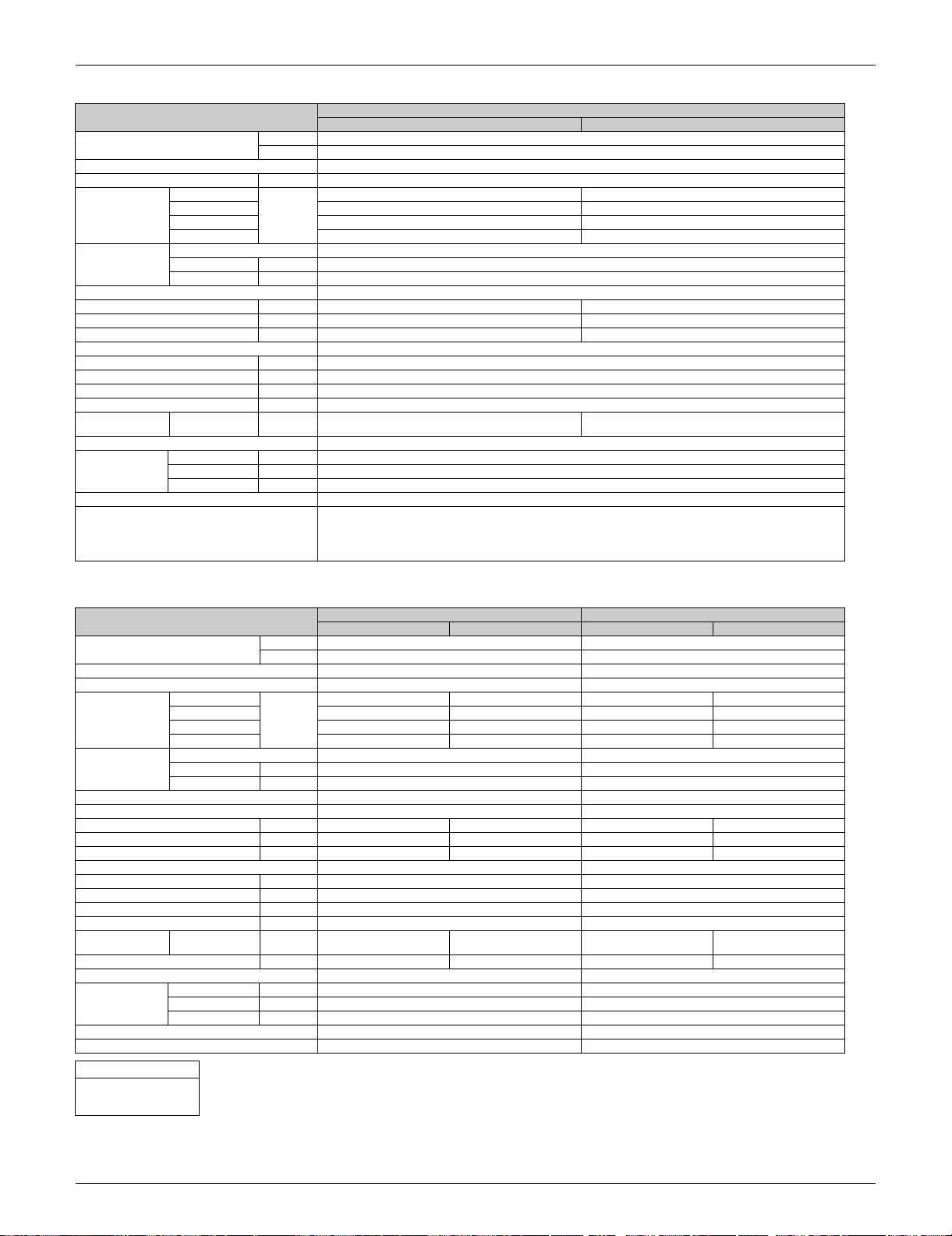
Model FDXS09LVJU FDXS12LVJU
Cooling Heating Cooling Heating
Power Supply Phase 1 φ 1 φ
Hz, V 60 Hz, 208 - 230 V 60 Hz, 208 - 230 V
Rated Capacity 9 kBtu/h Class 12 kBtu/h Class
External Static Pressure inAq (Pa) 0.12 (30) 0.12 (30)
Airflow Rates H
cfm
(m
3
/min)
305 (8.6) 305 (8.6) 305 (8.6) 305 (8.6)
M 280 (7.9) 280 (7.9) 280 (7.9) 280 (7.9)
L 260 (7.4) 260 (7.4) 260 (7.4) 260 (7.4)
SL 235 (6.7) 235 (6.7) 235 (6.7) 235 (6.7)
Fan Type Sirocco Fan Sirocco Fan
Motor Output W 62 62
Speed Steps 5 Steps, Quiet, Auto 5 Steps, Quiet, Auto
Air Filter Removable, Washable, Mildew Proof Removable, Washable, Mildew Proof
Running Current (Rated) A 0.58 - 0.52 0.58 - 0.52 0.58 - 0.52 0.58 - 0.52
Power Consumption (Rated) W 72 - 72 72 - 72 72 - 72 72 - 72
Power Factor (Rated) % 59.7 - 60.2 59.7 - 60.2 59.7 - 60.2 59.7 - 60.2
Temperature Control Microcomputer Control Microcomputer Control
Dimensions (H × W × D) in. (mm) 7-7/8 × 27-9/16 × 24-7/16 (200 × 700 × 620) 7-7/8 × 27-9/16 × 24-7/16 (200 × 700 × 620)
Packaged Dimensions (H × W × D) in. (mm) 10-13/16 × 36-5/16 × 30-1/4 (274 × 923 × 768) 10-13/16 × 36-5/16 × 30-1/4 (274 × 923 × 768)
Weight (Mass) Lbs (kg) 47 (21) 47 (21)
Gross Weight (Gross Mass) Lbs (kg) 64 (29) 64 (29)
Sound Pressure
Level
H / M / L
dB(A) 35 / 33 / 31 35 / 33 / 31 35 / 33 / 31 35 / 33 / 31
Sound Power Level dB 51 51 51 51
Heat Insulation Both Liquid and Gas Pipes Both Liquid and Gas Pipes
Piping Connection Liquid in. (mm) φ 1/4 (φ 6.4) φ 1/4 (φ 6.4)
Gas in. (mm) φ 3/8 (φ 9.5) φ 3/8 (φ 9.5)
Drain in. (mm) φ 25/32 (φ 20) φ 25/32 (φ 20)
Drawing No. 3D075493 3D075494
Notes 1. SL: The quiet fan level of the airflow rate setting. 1. SL: The quiet fan level of the airflow rate setting.
Model CDXS15LVJU CDXS18LVJU
Cooling Heating Cooling Heating
Power Supply Phase 1 φ 1 φ
Hz, V 60 Hz, 208 - 230 V 60 Hz, 208 - 230 V
Rated Capacity 15 kBtu/h Class 18 kBtu/h Class
External Static Pressure inH
2
O (Pa) 0.16 (40) 0.16 (40)
Airflow Rates H
cfm
(m
3
/min)
424 (12.0) 424 (12.0) 424 (12.0) 424 (12.0)
M 388 (11.0) 388 (11.0) 388 (11.0) 388 (11.0)
L 353 (10.0) 353 (10.0) 353 (10.0) 353 (10.0)
SL 297 (8.4) 297 (8.4) 297 (8.4) 297 (8.4)
Fan Type Sirocco Fan Sirocco Fan
Motor Output W 130 130
Speed Steps 5 Steps, Quiet, Auto 5 Steps, Quiet, Auto
Air Filter Removable, Washable, Mildew Proof Removable, Washable, Mildew Proof
Running Current (Rated) A 0.79 0.79 0.79 0.79
Power Consumption (Rated) W 172 172 172 172
Power Factor (Rated) % 94.4 94.4 94.4 94.4
Temperature Control Microcomputer Control Microcomputer Control
Dimensions (H × W × D) in. (mm) 7-7/8 × 35-7/16 × 24-7/16 (200 × 900 × 620) 7-7/8 × 35-7/16 × 24-7/16 (200 × 900 × 620)
Packaged Dimensions (H × W × D) in. (mm) 10-1/2 × 43-9/16 × 29-9/16 (266 × 1,106 × 751) 10-1/2 × 43-9/16 × 29-9/16 (266 × 1,106 × 751)
Weight (Mass) Lbs (kg) 60 (27) 60 (27)
Gross Weight (Gross Mass) Lbs (kg) 75 (34) 75 (34)
Sound Pressure
Level
H / M / L / SL
dB(A) 37 / 35 / 33 / 31 37 / 35 / 33 / 31 37 / 35 / 33 / 31 37 / 35 / 33 / 31
Heat Insulation Both Liquid and Gas Pipes Both Liquid and Gas Pipes
Piping Connection Liquid in. (mm) φ 1/4 (φ 6.4) φ 1/4 (φ 6.4)
Gas in. (mm) φ 1/2 (φ 12.7) φ 1/2 (φ 12.7)
Drain in. (mm) VP20 (O.D. φ 1-1/32 (φ 26), I.D. φ 25/32 (φ 20)) VP20 (O.D. φ 1-1/32 (φ 26), I.D. φ 25/32 (φ 20))
Drawing No. C: 3D075721 C: 3D075722
Notes 1. SL: The quiet fan level of the airflow rate setting.
2. The operating sound is based on the rear side suction
inlet and the external static pressure 0.16 inH
2
O (40 Pa).
Operating sound for bottom suction inlet : [operating
sound for rear side suction inlet] +5 dB. However, when
installation resulting in lower external static pressure
becomes low is carried out,
the operation sound may rise by more than 5 dB.
1. SL: The quiet fan level of the airflow rate setting.
2. The operating sound is based on the rear side suction
inlet and the external static pressure 0.16 inH
2
O (40 Pa).
Operating sound for bottom suction inlet : [operating
sound for rear side suction inlet] +5 dB. However, when
installation resulting in lower external static pressure
becomes low is carried out,
the operation sound may rise by more than 5 dB.
Conversion Formulae
kcal/h = kW × 860
Btu/h = kW × 3412
cfm = m³/min × 35.3
SiUS121827E Specifications
Part 2 Specifications 29
Model CDXS24LVJU
Cooling Heating
Power Supply Phase 1 φ
Hz, V 60 Hz, 208 - 230 V
Rated Capacity 24 kBtu/h Class
External Static Pressure inH
2
O (Pa) 0.16 (40)
Airflow Rates H
cfm
(m
3
/min)
565 (16.0) 565 (16.0)
M 523 (14.8) 523 (14.8)
L 477 (13.5) 477 (13.5)
SL 395 (11.2) 395 (11.2)
Fan Type Sirocco Fan
Motor Output W 130
Speed Steps 5 Steps, Quiet, Auto
Air Filter Removable, Washable, Mildew Proof
Running Current (Rated) A 0.79 0.79
Power Consumption (Rated) W 160 160
Power Factor (Rated) % 90.3 92.8
Temperature Control Microcomputer Control
Dimensions (H × W × D) in. (mm) 7-7/8 × 43-5/16 × 24-7/16 (200 × 1,100 × 620)
Packaged Dimensions (H × W × D) in. (mm) 10-1/2 × 52-1/16 × 30-1/4 (266 × 1,323 × 768)
Weight (Mass) Lbs (kg) 66 (30)
Gross Weight (Gross Mass) Lbs (kg) 84 (38)
Sound Pressure
Level
H / M / L / SL
dB(A) 38 / 36 / 34 / 32 38 / 36 / 34 / 32
Heat Insulation Both Liquid and Gas Pipes
Piping Connection Liquid in. (mm) φ 1/4 (φ 6.4)
Gas in. (mm) φ 5/8 (φ 15.9)
Drain in. (mm) VP20 (O.D. φ 1-1/32 (φ 26), I.D. φ 25/32 (φ 20))
Drawing No. 3D080590
Notes 1. SL: The quiet fan level of the airflow rate setting.
2. The operating sound is based on the rear side suction inlet and the external static pressure 0.16 inH
2
O (40 Pa).
Operating sound for bottom suction inlet : [operating sound for rear side suction inlet] +5 dB.
However, when installation resulting in lower external static pressure becomes low is carried out, the operation
sound may rise by more than 5 dB.
Model FVXS09NVJU FVXS12NVJU
Cooling Heating Cooling Heating
Power Supply Phase 1 φ 1 φ
Hz, V 60 Hz, 208 - 230 V 60 Hz, 208 - 230 V
Rated Capacity 9 kBtu/h Class 12 kBtu/h Class
Front Panel Color White White
Airflow Rates H
cfm
(m
3
/min)
290 (8.2) 311 (8.8) 300 (8.5) 332 (9.4)
M 230 (6.5) 244 (6.9) 237 (6.7) 258 (7.3)
L 169 (4.8) 177 (5.0) 173 (4.9) 184 (5.2)
SL 145 (4.1) 155 (4.4) 159 (4.5) 166 (4.7)
Fan Type Turbo Fan Turbo Fan
Motor Output W 12.3 13.4
Speed Steps 5 Steps, Quiet, Auto 5 Steps, Quiet, Auto
Air Direction Control Right, Left, Horizontal, Downward Right, Left, Horizontal, Downward
Air Filter Removable, Washable, Mildew Proof Removable, Washable, Mildew Proof
Running Current (Rated) A 0.14 - 0.13 0.15 - 0.14 0.14 - 0.13 0.15 - 0.14
Power Consumption (Rated) W 15 - 15 17 - 17 15 - 15 17 - 17
Power Factor (Rated) % 51.5 - 50.2 54.5 - 52.8 51.5 - 50.2 54.5 - 52.8
Temperature Control Microcomputer Control Microcomputer Control
Dimensions (H × W × D) in. (mm) 23-5/8 × 27-9/16 × 8-1/4 (600 × 700 × 210) 23-5/8 × 27-9/16 × 8-1/4 (600 × 700 × 210)
Packaged Dimensions (H × W × D) in. (mm) 27-3/8 × 30-15/16 × 11 (696 × 786 × 280) 27-3/8 × 30-15/16 × 11 (696 × 786 × 280)
Weight (Mass) Lbs (kg) 31 (14) 31 (14)
Gross Weight (Gross Mass) Lbs (kg) 40 (18) 40 (18)
Sound Pressure
Level
H / M / L / SL
dB(A) 38 / 32 / 26 / 23 38 / 32 / 26 / 23 39 / 33 / 27 / 24 39 / 33 / 27 / 24
Sound Power Level dB — — — —
Heat Insulation Both Liquid and Gas Pipes Both Liquid and Gas Pipes
Piping Connection Liquid in. (mm) φ 1/4 (φ 6.4) φ 1/4 (φ 6.4)
Gas in. (mm) φ 3/8 (φ 9.5) φ 3/8 (φ 9.5)
Drain in. (mm) φ 13/16 (φ 20) φ 13/16 (φ 2 0)
Drawing No. 3D101722 3D101724
Notes 1. SL: The quiet fan level of the airflow rate setting. 1. SL: The quiet fan level of the airflow rate setting.
Conversion Formulae
kcal/h = kW × 860
Btu/h = kW × 3412
cfm = m³/min × 35.3
Specifications SiUS121827E
30 Part 2 Specifications
Model FVXS15NVJU FVXS18NVJU
Cooling Heating Cooling Heating
Power Supply Phase 1 φ 1 φ
Hz, V 60 Hz, 208 - 230 V 60 Hz, 208 - 230 V
Rated Capacity 15 kBtu/h Class 18 kBtu/h Class
Front Panel Color White White
Airflow Rates H
cfm
(m
3
/min)
378 (10.7) 417 (11.8) 378 (10.7) 417 (11.8)
M 325 (9.2) 357 (10.1) 325 (9.2) 357 (10.1)
L 275 (7.8) 300 (8.5) 275 (7.8) 300 (8.5)
SL 233 (6.6) 251 (7.1) 233 (6.6) 251 (7.1)
Fan Type Turbo Fan Turbo Fan
Motor Output W 23.3 23.3
Speed Steps 5 Steps, Quiet, Auto 5 Steps, Quiet, Auto
Air Direction Control Right, Left, Horizontal, Downward Right, Left, Horizontal, Downward
Air Filter Removable, Washable, Mildew Proof Removable, Washable, Mildew Proof
Running Current (Rated) A 0.19 - 0.17 0.21 - 0.19 — —
Power Consumption (Rated) W 27 - 27 34 - 34 — —
Power Factor (Rated) % 68.3 - 69.1 77.8 - 77.8 — —
Temperature Control Microcomputer Control Microcomputer Control
Dimensions (H × W × D) in. (mm) 23-5/8 × 27-9/16 × 8-1/4 (600 × 700 × 210) 23-5/8 × 27-9/16 × 8-1/4 (600 × 700 × 210)
Packaged Dimensions (H × W × D) in. (mm) 27-3/8 × 30-15/16 × 11 (696 × 786 × 280) 27-3/8 × 30-15/16 × 11 (696 × 786 × 280)
Weight (Mass) Lbs (kg) 31 (14) 31 (14)
Gross Weight (Gross Mass) Lbs (kg) 40 (18) 40 (18)
Sound Pressure
Level
H / M / L / SL
dB(A) 44 / 40 / 36 / 32 45 / 40 / 36 / 32 44 / 40 / 36 / 32 45 / 40 / 36 / 32
Sound Power Level dB — — — —
Heat Insulation Both Liquid and Gas Pipes Both Liquid and Gas Pipes
Piping Connection Liquid in. (mm) φ 1/4 (φ 6.4) φ 1/4 (φ 6.4)
Gas in. (mm) φ 1/2 (φ 12.7) φ 1/2 (φ 12.7)
Drain in. (mm) φ 13/16 (φ 20) φ 13/16 (φ 20)
Drawing No. 3D101718 3D094866
Notes 1. SL: The quiet fan level of the airflow rate setting. 1. SL: The quiet fan level of the airflow rate setting.
Conversion Formulae
kcal/h = kW × 860
Btu/h = kW × 3412
cfm = m³/min × 35.3
SiUS121827E Specifications
Part 2 Specifications 31
1.2 SA Indoor Unit
Model FDMQ09RVJU FDMQ12RVJU
Cooling Heating Cooling Heating
Power Supply Phase 1 φ 1 φ
Hz, V 60 Hz, 208 - 230 V 60 Hz, 208 - 230 V
Rated Capacity 9 kBtu/h Class 12 kBtu/h Class
Casing Color — —
Dimensions (H × W × D) in. (mm) 9-5/8 × 27-9/16 × 31-1/2 (245 × 700 × 800) 9-5/8 × 27-9/16 × 31-1/2 (245 × 700 × 800)
Coil Type Cross Fin Coil Cross Fin Coil
Rows × Stages × Fin per Inch 3 × 26 × 18 3 × 26 × 18
Face Area ft² (m²) 1-15/16 (0.178) 1-15/16 (0.178)
Fan Type Sirocco Fan Sirocco Fan
Motor Output W 130 130
Airflow Rate
H / M / L
cfm
(m
3
/min)
343 / 290 / 240
(9.7 / 8.2 / 6.8)
343 / 290 / 240
(9.7 / 8.2 / 6.8)
392 / 332 / 275
(11.1 / 9.4 / 7.8)
392 / 332 / 275
(11.1 / 9.4 / 7.8)
External Static
Pressure 1
inH
2
O 0.20 (0.60 - 0.12) 0.20 (0.60 - 0.12)
Pa 50 (150 - 30) 50 (150 - 30)
Sound Pressure Level dB(A) 32 32 33 33
Sound Power Level dB(A) 46 46 47 47
Air Filter 2——
Weight (Mass) Lbs (kg) 64 (29) 64 (29)
Piping
Connection
Liquid in. (mm) φ 1/4 (φ 6.4) (Flare) φ 1/4 (φ 6.4) (Flare)
Gas in. (mm) φ 3/8 (φ 9.5) (Flare) φ 3/8 (φ 9.5) (Flare)
Drain in. (mm) I.D. φ 1 (φ 25) / O.D. φ 1-1/4 (φ 32) I.D. φ 1 (φ 25) / O.D. φ 1-1/4 (φ 32)
Remote
Controller
(Option)
Wired BRC1E73 BRC1E73
Wireless
BRC082A43 BRC082A43
Drawing No. 3D112997C 3D112997C
Notes 1. External static pressure is changeable in 13 stages
by remote controller.
2. Air filter is not standard accessory, but please mount
it in the duct system of the suction side.
Select its dust collection efficiency (gravity method) 50%
or more.
1. External static pressure is changeable in 13 stages
by remote controller.
2. Air filter is not standard accessory, but please mount
it in the duct system of the suction side.
Select its dust collection efficiency (gravity method) 50%
or more.
Model FDMQ15RVJU FDMQ18RVJU
Cooling Heating Cooling Heating
Power Supply Phase 1 φ 1 φ
Hz, V 60 Hz, 208 - 230 V 60 Hz, 208 - 230 V
Rated Capacity 15 kBtu/h Class 18 kBtu/h Class
Casing Color — —
Dimensions (H × W × D) in. (mm) 9-5/8 × 39-3/8 × 31-1/2 (245 × 1,000 × 800) 9-5/8 × 39-3/8 × 31-1/2 (245 × 1,000 × 800)
Coil Type Cross Fin Coil Cross Fin Coil
Rows × Stages × Fin per Inch 2 × 26 × 18 3 × 26 × 18
Face Area ft² (m²) 3-1/8 (0.288) 3-1/8 (0.288)
Fan Type Sirocco Fan Sirocco Fan
Motor Output W 230 230
Airflow Rate
H / M / L
cfm
(m
3
/min)
516 / 438 / 360
(14.6 / 12.4 / 10.2)
516 / 438 / 360
(14.6 / 12.4 / 10.2)
675 / 572 / 473
(19.1 / 16.2 / 13.4)
675 / 572 / 473
(19.1 / 16.2 / 13.4)
External Static
Pressure 1
inH
2
O 0.20 (0.60 - 0.20) 0.20 (0.60 - 0.12)
Pa 50 (150 - 50) 50 (150 - 50)
Sound Pressure Level dB(A) 34 34 35 35
Sound Power Level dB(A) 48 48 49 49
Air Filter 2——
Weight (Mass) Lbs (kg) 77 (35) 82 (37)
Piping
Connection
Liquid in. (mm) φ 1/4 (φ 6.4) (Flare) φ 1/4 (φ 6.4) (Flare)
Gas in. (mm) φ 1/2 (φ 12.7) (Flare) φ 1/2 (φ 12.7) (Flare)
Drain in. (mm) I.D. φ 1 (φ 25) / O.D. φ 1-1/4 (φ 32) I.D. φ 1 (φ 25) / O.D. φ 1-1/4 (φ 32)
Remote
Controller
(Option)
Wired BRC1E73 BRC1E73
Wireless
BRC082A43 BRC082A43
Drawing No. 3D112997C 3D112997C
Notes 1. External static pressure is changeable in 11 stages
by remote controller.
2. Air filter is not standard accessory, but please mount
it in the duct system of the suction side.
Select its dust collection efficiency (gravity method) 50%
or more.
1. External static pressure is changeable in 11 stages
by remote controller.
2. Air filter is not standard accessory, but please mount
it in the duct system of the suction side.
Select its dust collection efficiency (gravity method) 50%
or more.
Conversion Formulae
kcal/h = kW × 860
Btu/h = kW × 3412
cfm = m³/min × 35.3
Specifications SiUS121827E
32 Part 2 Specifications
Model FDMQ24RVJU
Cooling Heating
Power Supply Phase 1 φ
Hz, V 60 Hz, 208 - 230 V
Rated Capacity 24 kBtu/h Class
Casing Color —
Dimensions (H × W × D) in. (mm) 9-5/8 × 39-3/8 × 31-1/2 (245 × 1,000 × 800)
Coil Type Cross Fin Coil
Rows × Stages × Fin per Inch 3 × 26 × 18
Face Area ft² (m²) 3-1/8 (0.288)
Fan Type Sirocco Fan
Motor Output W 230
Airflow Rate
H / M / L
cfm
(m
3
/min)
798 / 678 / 558
(22.6 / 19.2 / 15.8)
798 / 678 / 558
(22.6 / 19.2 / 15.8)
External Static
Pressure 1
inH
2
O 0.20 (0.60 - 0.20)
Pa 50 (150 - 50)
Sound Pressure Level dB(A) 40 40
Sound Power Level dB(A) 54 54
Air Filter 2 —
Weight (Mass) Lbs (kg) 82 (37)
Piping
Connection
Liquid in. (mm) φ 1/4 (φ 6.4) (Flare)
Gas in. (mm) φ 5/8 (φ 15.9) (Flare)
Drain in. (mm) I.D. φ 1 (φ 25) / O.D. φ 1-1/4 (φ 32) (Flare)
Remote
Controller
(Option)
Wired BRC1E73
Wireless
BRC082A43
Drawing No. 3D112997C
Notes 1. External static pressure is changeable in 11 stages by remote controller.
2. Air filter is not standard accessory, but please mount it in the duct system of the suction side.
Select its dust collection efficiency (gravity method) 50% or more.
Model FFQ09Q2VJU FFQ12Q2VJU
Cooling Heating Cooling Heating
Power Supply Phase 1 φ 1 φ
Hz, V 60 Hz, 208 - 230 V 60 Hz, 208 - 230 V
Rated Capacity 9 kBtu/h Class 12 kBtu/h Class
Decoration Panel
(1)
Model BYFQ60B3W1 BYFQ60B3W1
Color White White
Dimensions
(H × W × D)
in. (mm) 2-3/16 × 27-9/16 × 27-9/16 (55 × 700 × 700) 2-3/16 × 27-9/16 × 27-9/16 (55 × 700 × 700)
Weight (Mass) Lbs (kg) 6 (2.7) 6 (2.7)
Decoration Panel
(2)
Model BYFQ60C2W1W / BYFQ60C2W1S BYFQ60C2W1W / BYFQ60C2W1S
Color White / Silver White / Silver
Dimensions
(H × W × D)
in. (mm) 1-13/16 × 24-7/16 × 24-7/16 (46 × 620 × 620) 1-13/16 × 24-7/16 × 24-7/16 (46 × 620 × 620)
Weight (Mass) Lbs (kg) 6.2 (2.8) 6.2 (2.8)
Airflow Rates H
cfm
(m
3
/min)
378 (10.7) 399 (11.3) 406 (11.5) 427 (12.1)
M 339 (9.6) 357 (10.1) 353 (10.0) 371 (10.5)
L 268 (7.6) 282 (8.0) 268 (7.6) 282 (8.0)
Fan Type Turbo Fan Turbo Fan
Motor Output W — —
Speed Steps 3 Steps 3 Steps
Air Direction Control — —
Running Current (Rated) A 0.23 - 0.21 0.23 - 0.21 0.27 - 0.24 0.27 - 0.24
Power Consumption (Rated) W 23 23 27 27
Power Factor (Rated) % 48.1 - 47.6 48.1 - 47.6 48.1 - 48.9 48-1 - 48.9
Temperature Control Microcomputer Control Microcomputer Control
Dimensions (H × W × D) in. (mm) 10-1/4 × 22-5/8 × 22-5/8 (260 × 575 × 575) 10-1/4 × 22-5/8 × 22-5/8 (260 × 575 × 575)
Packaged Dimensions (H × W × D) in. (mm) 11 × 27 × 23-1/2 (280 × 686 × 597) 11 × 27 × 23-1/2 (280 × 686 × 597)
Weight (Mass) Lbs (kg) 36 (16) 36 (16)
Gross Weight (Gross Mass) Lbs (kg) 40 (18) 40 (18)
Sound Pressure
Level
H / M / L
dB(A) 38 / 35 / 29 38 / 35 / 29 39 / 36 / 30 39 / 36 / 30
Heat Insulation Both Liquid and Gas Pipes Both Liquid and Gas Pipes
Piping Connection Liquid in. (mm) φ 1/4 (φ 6.4) φ 1/4 (φ 6.4)
Gas in. (mm) φ 3/8 (φ 9.5) φ 3/8 (φ 9.5)
Drain in. (mm) VP20 (O.D. φ 1-1/32 (φ 26)) VP20 (O.D. φ 1-1/32 (φ 26))
Drawing No. 3D106061A 3D106062
Notes 1. SL: The quiet fan level of the airflow rate setting. 1. SL: The quiet fan level of the airflow rate setting.
Conversion Formulae
kcal/h = kW × 860
Btu/h = kW × 3412
cfm = m³/min × 35.3
SiUS121827E Specifications
Part 2 Specifications 33
Model FFQ15Q2VJU FFQ18Q2VJU
Cooling Heating Cooling Heating
Power Supply Phase 1 φ 1 φ
Hz, V 60 Hz, 208 - 230 V 60 Hz, 208 - 230 V
Rated Capacity 15 kBtu/h Class 18 kBtu/h Class
Decoration Panel
(1)
Model BYFQ60B3W1 BYFQ60B3W1
Color White White
Dimensions
(H × W × D)
in. (mm) 2-3/16 × 27-9/16 × 27-9/16 (55 × 700 × 700) 2-3/16 × 27-9/16 × 27-9/16 (55 × 700 × 700)
Weight (Mass) Lbs (kg) 6 (2.7) 6 (2.7)
Decoration Panel
(2)
Model BYFQ60C2W1W / BYFQ60C2W1S BYFQ60C2W1W / BYFQ60C2W1S
Color White / Silver White / Silver
Dimensions
(H × W × D)
in. (mm) 1-13/16 × 24-7/16 × 24-7/16 (46 × 620 × 620) 1-13/16 × 24-7/16 × 24-7/16 (46 × 620 × 620)
Weight (Mass) Lbs (kg) 6.2 (2.8) 6.2 (2.8)
Airflow Rates H
cfm
(m
3
/min)
420 (11.9) 441 (12.5) 448 (12.7) 498 (14.1)
M 367 (10.4) 385 (10.9) 378 (10.7) 420 (11.9)
L 293 (8.3) 307 (8.7) 275 (7.8) 307 (8.7)
Fan Type Turbo Fan Turbo Fan
Motor Output W — —
Speed Steps 3 Steps 3 Steps
Air Direction Control — —
Running Current (Rated) A 0.29 - 0.26 0.29 - 0.26 0.52 - 0.47 0.52 - 0.47
Power Consumption (Rated) W 28 28 51 - 51 51 - 51
Power Factor (Rated) % 46.4 - 46.8 46.4 - 46.8 47.2 - 47.2 47.2 - 47.2
Temperature Control Microcomputer Control Microcomputer Control
Dimensions (H × W × D) in. (mm) 10-1/4 × 22-5/8 × 22-5/8 (260 × 575 × 575) 10-1/4 × 22-5/8 × 22-5/8 (260 × 575 × 575)
Packaged Dimensions (H × W × D) in. (mm) 11 × 27 × 23-1/2 (280 × 686 × 597) 11 × 27 × 23-1/2 (280 × 686 × 597)
Weight (Mass) Lbs (kg) 36 (16) 39.0 (17.5)
Gross Weight (Gross Mass) Lbs (kg) 40 (18) 42.0 (19.0)
Sound Pressure
Level
H / M / L
dB(A) 40 / 37 / 31 40 / 37 / 31 44 / 40 / 32 44 / 40 / 32
Heat Insulation Both Liquid and Gas Pipes Both Liquid and Gas Pipes
Piping Connection Liquid in. (mm) φ 1/4 (φ 6.4) φ 1/4 (φ 6.4)
Gas in. (mm) φ 1/2 (φ 12.7) φ 1/2 (φ 12.7)
Drain in. (mm) VP20 (O.D. φ1-1/32 (φ 26)) VP20 (O.D. φ 1-1/32 (φ 26))
Drawing No. 3D106063A 3D106064
Notes 1. SL: The quiet fan level of the airflow rate setting. 1. SL: The quiet fan level of the airflow rate setting.
Conversion Formulae
kcal/h = kW × 860
Btu/h = kW × 3412
cfm = m³/min × 35.3
Specifications SiUS121827E
34 Part 2 Specifications
1.3 Outdoor Unit
Model 5MXS48TVJU
Cooling Heating
Power Supply Phase 1 φ
Hz, V 60 Hz, 208 - 230 V
COP
W/W —
3.9 (Non-Ducted type connected)
3.2 (Ducted type connected)
EER
Btu/W·h
10.5 (Non-Ducted type connected)
8.6 (Ducted type connected)
—
SEER / HSPF 20.2 (Non-Ducted type connected)
15.3 (Ducted type connected)
11.1 (Non-Ducted type connected)
8.6 (Ducted type connected)
Casing Color Ivory White
Compressor Type Hermetically Sealed Swing Type
Model 2YC90KXD
Motor Output W 3,000
Refrigerant
Oil
Model FVC50K
Charge oz (L) 50.2 (1.52)
Refrigerant Type R-410A
Charge Lbs (kg) 8.60 (3.9)
Airflow
Rates
H
cfm
3,684 3,356
M 3,029 3,138
L 2,756 1,500
H
m
3
/min
104.3 95.0
M 85.8 88.9
L 78.0 42.5
Fan Type Propeller
Motor Output W 84
Running Current A H: 1.49 / M: 1.09 / L: 0.94 H: 1.28 / M: 1.15 / L: 0.38
Power
Consumption
W H: 158.5 / M: 93.3 / L: 73.2 H: 122.9 / M: 102.5 / L: 34.9
Starting Current A 27.0
Dimensions (H × W × D) In. (mm) 34-1/4 × 43-5/16 × 18-1/8 (870 × 1,100 × 460)
Packaged Dimensions (H × W × D) In. (mm) 39-15/16 × 46-7/8 × 22 (1,014 × 1,190 × 558)
Weight (Mass) Lbs (kg) 216 (98)
Gross Weight (Gross Mass) Lbs (kg) 236 (107)
Sound Pressure Level dB(A) 53 55
Piping
Connection
Liquid in. (mm) φ 1/4 × 5 (φ 6.4 × 5)
Gas in. (mm) φ 3/8 × 1, φ 1/2 × 2, φ 5/8 × 2 (φ 9.5 × 1, φ 12.7 × 2, φ 15.9 × 2)
Drain in. (mm) I.D. φ 1 (φ 25)
Heat Insulation Both Liquid and Gas Pipes
No. of Wiring Connections 3 for Power Supply, 4 for Interunit Wiring
Max. Interunit Piping Length ft (m) 262 (80) (for Total of Each Room)
ft (m) 98 (30) (for One Room)
Amount of Additional Charge oz/ft (g/m) 0.21 (20) (131-5/8 ft (40m) or more)
Max. Installation Height Difference ft (m) 49-1/4 (15) (Between Indoor Unit and Outdoor Unit)
ft (m) 24-5/8 (7.5) (Between Indoor Units)
Conditions based on Indoor ; 80°FDB (26.7°CDB) / 67°FWB (19.4°CWB)
Outdoor ; 95°FDB (35°CDB) / 75°FWB (24°CWB)
Indoor ; 70°FDB (21°CDB) / 60°FWB (15.6°CWB)
Outdoor ; 47°FDB (8.3°CDB) / 43°FWB (6°CWB)
Piping length: 25 ft (7.5 m)
Drawing No. C: 3D118280
Conversion Formulae
kcal/h = kW × 860
Btu/h = kW × 3412
cfm = m³/min × 35.3
SiUS121827E Specifications
Part 2 Specifications 35
Model 4MXL36TVJU
Cooling Heating
Power Supply Phase 1 φ
Hz, V 60 Hz, 208 - 230 V
COP
W/W —
4.26 (Non-Ducted type connected)
3.5 (Ducted type connected)
EER
Btu/W·h
12.5 (Non-Ducted type connected)
11.0 (Ducted type connected)
—
SEER / HSPF 21.7 (Non-Ducted type connected)
16.9 (Ducted type connected)
11.2 (Non-Ducted type connected)
9.1 (Ducted type connected)
Casing Color Ivory White
Compressor Type Hermetically Sealed Swing Type
Model 2YC90KXD
Motor Output W 3,000
Refrigerant
Oil
Model FVC50K
Charge oz (L) 50.2 (1.52)
Refrigerant Type R410A
Charge Lbs (kg) 8.60 (3.9)
Airflow
Rates
H
cfm
3,684 3,356
M 3,029 3,138
L 2,756 1,500
H
m
3
/min
104.3 95.0
M 85.8 88.9
L 78.0 42.5
Fan Type Propeller
Motor Output W 84
Running Current A H: 1.49 / M: 1.09 / L: 0.94 H: 1.28 / M: 1.15 / L: 0.38
Power Consumption W H: 158.5 / M: 93.3 / L: 73.2 H: 122.9 / M: 102.5 / L: 34.9
Starting Current A 27.0
Dimensions (H × W × D) In. (mm) 34-1/4 × 43-5/16 × 18-1/8 (870 × 1,100 × 460)
Packaged Dimensions (H × W × D) In. (mm) 39-15/16 × 46-7/8 × 22 (1,014 × 1,190 × 558)
Weight (Mass) Lbs (kg) 214 (97)
Gross Weight (Gross Mass) Lbs (kg) 234 (106)
Sound Pressure Level dB(A) 53 55
Piping
Connection
Liquid in. (mm) φ 1/4 × 4 (φ 6.4 × 4)
Gas in. (mm) φ 3/8 × 1, φ 1/2 × 2, φ 5/8 × 1 (φ 9.5 × 1, φ 12.7 × 2, φ 15.9 × 1)
Drain in. (mm) I.D. φ 1 (φ 25)
Heat Insulation Both Liquid and Gas Pipes
No. of Wiring Connections 3 for Power Supply, 4 for Interunit Wiring
Max. Interunit Piping Length ft (m) 230 (70) (for Total of Each Room)
ft (m) 98 (30) (for One Room)
Amount of Additional Charge oz/ft (g/m) 0.21 (20) (131-5/8 ft (40m) or more)
Max. Installation Height Difference ft (m) 49-1/4 (15) (Between Indoor Unit and Outdoor Unit)
ft (m) 24-5/8 (7.5) (Between Indoor Units)
Conditions based on Indoor ; 80°FDB (26.7°CDB) / 67°FWB (19.4°CWB)
Outdoor ; 95°FDB (35°CDB) / 75°FWB (24°CWB)
Indoor ; 70°FDB (21°CDB) / 60°FWB (15.6°CWB)
Outdoor ; 47°FDB (8.3°CDB) / 43°FWB (6°CWB)
Piping length: 25 ft (7.5 m)
Drawing No. C: 3D118282
Conversion Formulae
kcal/h = kW × 860
Btu/h = kW × 3412
cfm = m³/min × 35.3

SiUS121827E
36 Part 3 Printed Circuit Board Connector Wiring Diagram
1. Indoor Unit.................................................................................................37
1.1 FTXR09/12/18TVJUW(S), CTXG09/12/18QVJUW(S) ............................... 37
1.2 CTXS07LVJU, FTXS09/12LVJU ................................................................ 39
1.3 FTXS15/18/24LVJU ................................................................................... 41
1.4 FDXS09/12LVJU, CDXS15/18/24LVJU ..................................................... 43
1.5 FVXS09/12/15/18NVJU.............................................................................. 45
1.6 FDMQ09/12/15/18/24RVJU ....................................................................... 47
1.7 FFQ09/12/15/18Q2VJU.............................................................................. 49
2. Sensor Kit for FFQ Series .........................................................................50
2.1 BRYQ60A2W(S)......................................................................................... 50
3. Wired Remote Controller...........................................................................51
3.1 BRC1E73 ................................................................................................... 51
4. Wireless Remote Controller Receiver for FDMQ series............................52
4.1 BRC082A43 ............................................................................................... 52
5. Wireless Remote Controller Kit for FFQ Series ........................................53
5.1 BRC082A41W, BRC082A42W(S).............................................................. 53
6. Outdoor Unit..............................................................................................54
Part 3
Printed Circuit Board
Connector Wiring Diagram
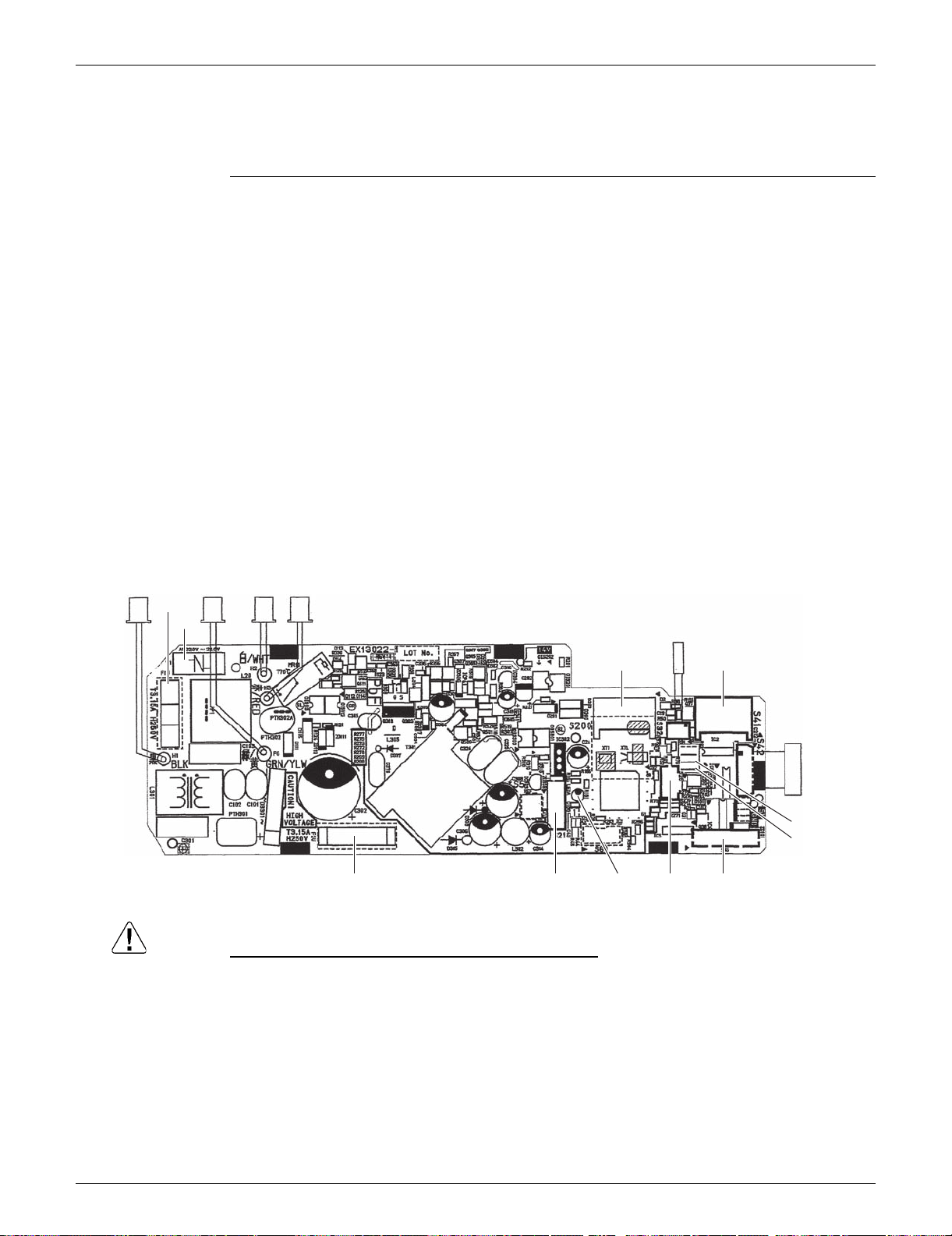
SiUS121827E Indoor Unit
Part 3 Printed Circuit Board Connector Wiring Diagram 37
Caution
1. Indoor Unit
1.1 FTXR09/12/18TVJUW(S), CTXG09/12/18QVJUW(S)
Control PCB
(A1P)
Replace the PCB if you cut a jumper unintentionally.
Jumpers are necessary for electronic circuit. Improper operation may occur if you cut any of them.
1) S21 Connector for centralized control (HA)
2) S25 Connector for INTELLIGENT EYE sensor PCB (A3P)
3) S32 Indoor heat exchanger thermistor
4) S41 Connector for swing motors
5) S42 Connector for reduction motor (front panel mechanism) and limit
switch
6) S46 Connector for display/signal receiver PCB (A2P)
7) S200 Connector for DC fan motor
8) H1, H2, H3 Connector for terminal strip (indoor - outdoor transmission)
9) FG Connector for terminal strip (frame ground)
10) JB Fan speed setting when compressor stops for thermostat OFF
∗ Refer to page 261 for details.
11) JC Power failure recovery function (auto-restart)
∗ Refer to page 261 for details.
12) LED A LED for service monitor (green)
13) F1U, F2U Fuse (3.15 A, 250 V)
14) V1 Varistor
S42
S41
S32
JB
JC
S200
H3H2FG
S46
S21F2U S25
LED A
V1
F1U
H1
2P357399-6
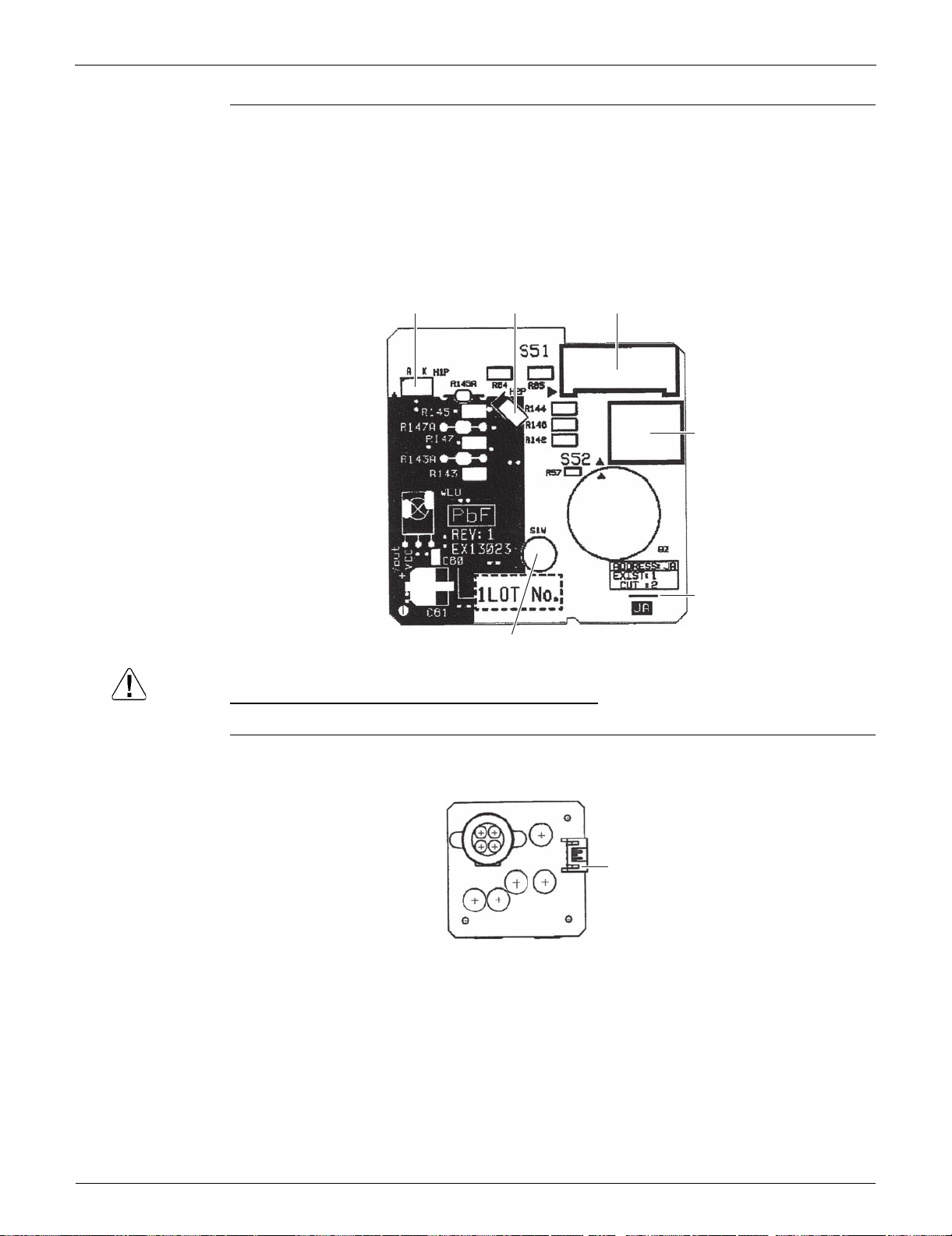
Indoor Unit SiUS121827E
38 Part 3 Printed Circuit Board Connector Wiring Diagram
Caution
Display/Signal
Receiver PCB
(A2P)
Replace the PCB if you cut a jumper unintentionally.
Jumpers are necessary for electronic circuit. Improper operation may occur if you cut any of them.
INTELLIGENT
EYE Sensor PCB
(A3P)
1) S51 Connector for control PCB (A1P)
2) S52 Connector for room temperature thermistor
3) S1W Indoor unit ON/OFF switch
4) H1P LED for operation (multi-color)
5) H2P LED for INTELLIGENT EYE (green)
6) JA Address setting jumper
∗ Refer to page 258 for details.
S52
S51
S1W
JA
H2P
H1P
3P357402-2
1) S36 Connector for control PCB (A1P)
S36
3E860004-1
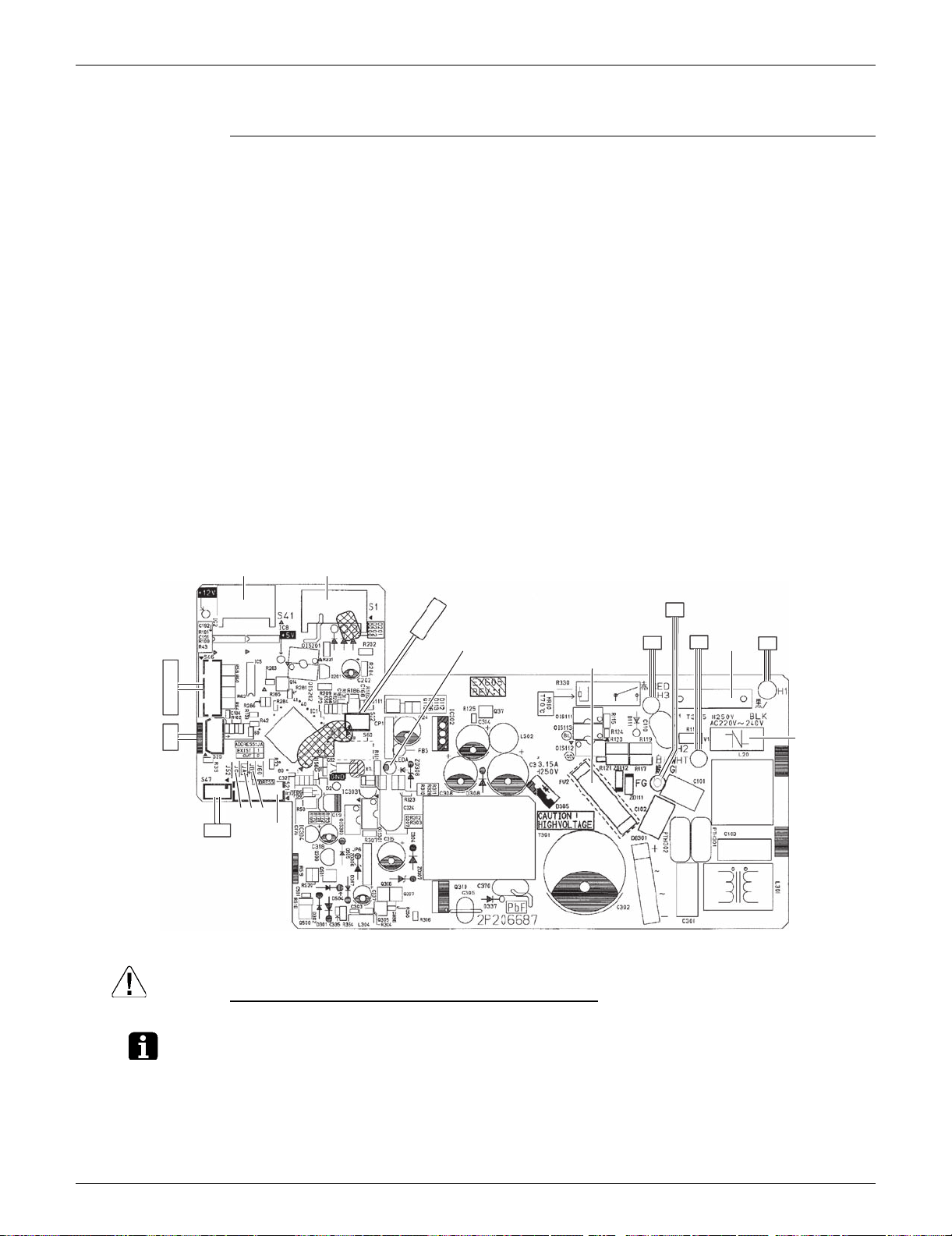
SiUS121827E Indoor Unit
Part 3 Printed Circuit Board Connector Wiring Diagram 39
Caution
Note
1.2 CTXS07LVJU, FTXS09/12LVJU
Control PCB
(PCB1)
Replace the PCB if you cut a jumper unintentionally.
Jumpers are necessary for electronic circuit. Improper operation may occur if you cut any of them.
The symbols in the parenthesis are the names on the appropriate wiring diagram.
1) S1 Connector for DC fan motor
2) S21 Connector for centralized control (HA)
3) S25 Connector for INTELLIGENT EYE sensor PCB (PCB4)
4) S32 Indoor heat exchanger thermistor
5) S41 Connector for swing motors
6) S46 Connector for display PCB (PCB3)
7) S47 Connector for signal receiver PCB (PCB2)
8) H1, H2, H3, FG Connector for terminal strip
9) JA Address setting jumper
∗ Refer to page 258 for details.
10) JB Fan speed setting when compressor stops for thermostat OFF
∗ Refer to page 261 for details.
11) JC Power failure recovery function (auto-restart)
∗ Refer to page 261 for details.
12) LED A LED for service monitor (green)
13) FU1 (F1U),
FU2
Fuse (3.15 A, 250 V)
14) V1 Varistor
V1
FU1
S1S41
S21
S47
JBJAJC
S46
S25
LED A
FU2
S32
FG
H1H2H3
2P206687-4
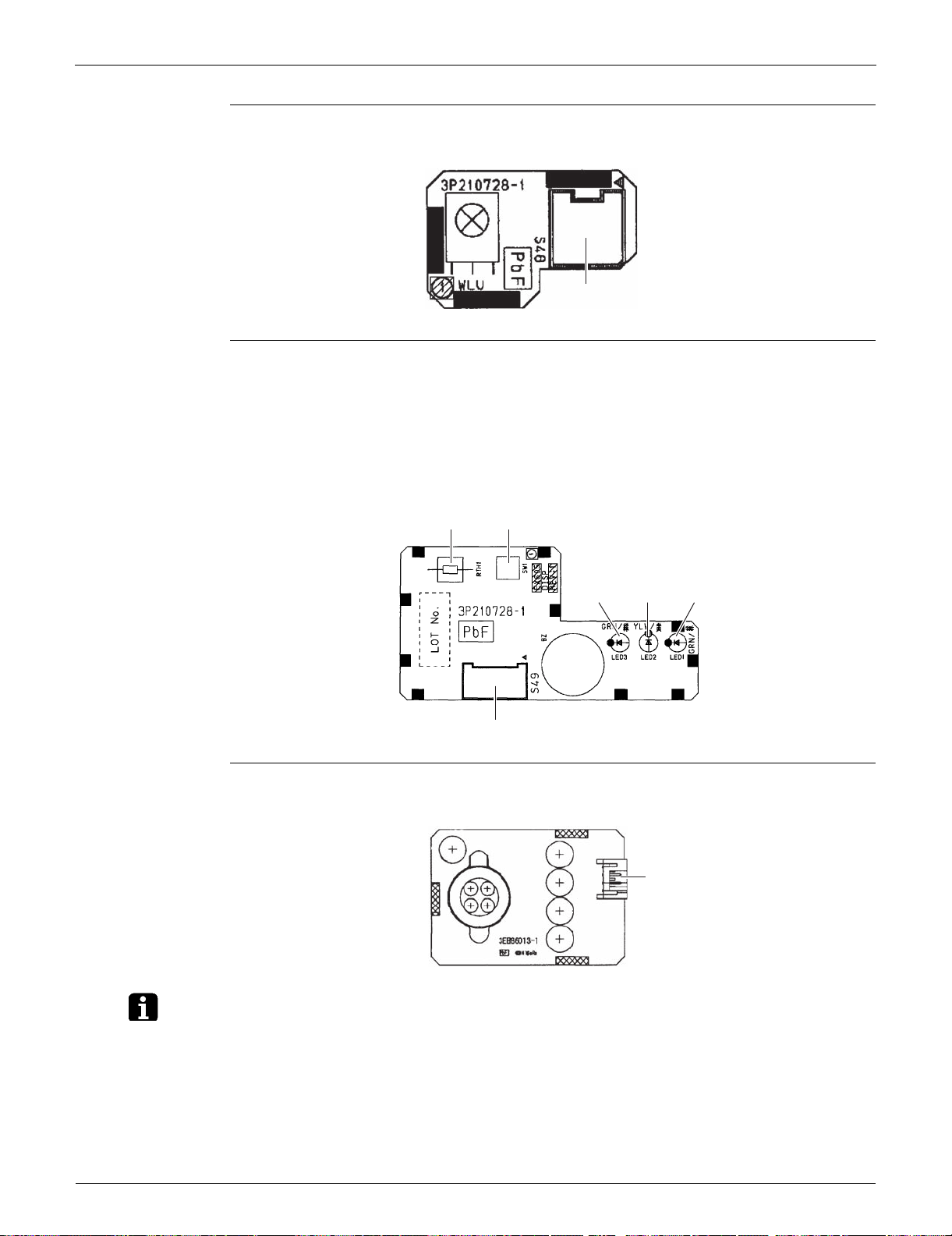
Indoor Unit SiUS121827E
40 Part 3 Printed Circuit Board Connector Wiring Diagram
Note
Signal Receiver
PCB (PCB2)
Display PCB
(PCB3)
INTELLIGENT
EYE Sensor PCB
(PCB4)
The symbols in the parenthesis are the names on the appropriate wiring diagram.
1) S48 Connector for control PCB (PCB1)
3P210728-1
S48
1) S49 Connector for control PCB (PCB1)
2) SW1 Indoor unit ON/OFF switch
3) LED1 (H1P) LED for operation (green)
4) LED2 (H2P) LED for timer (yellow)
5) LED3 (H3P) LED for INTELLIGENT EYE (green)
6) RTH1 (R1T) Room temperature thermistor
3P210728-1
RTH1 SW1
LED3 LED2 LED1
S49
1) S26 Connector for control PCB (PCB1)
3EB86013-1
S26
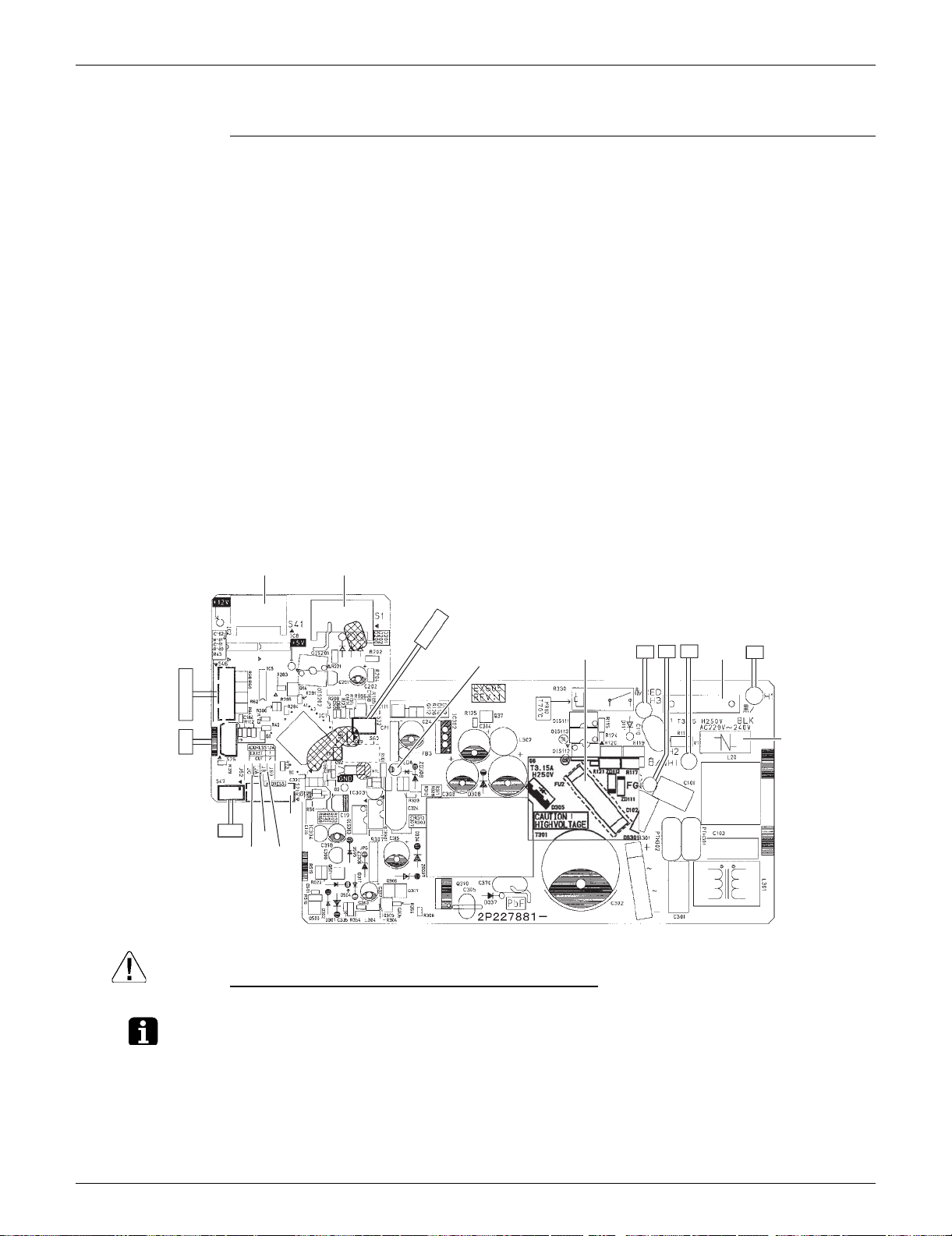
SiUS121827E Indoor Unit
Part 3 Printed Circuit Board Connector Wiring Diagram 41
Caution
Note
1.3 FTXS15/18/24LVJU
Control PCB
(PCB1)
Replace the PCB if you cut a jumper unintentionally.
Jumpers are necessary for electronic circuit. Improper operation may occur if you cut any of them.
The symbols in the parenthesis are the names on the appropriate wiring diagram.
1) S1 Connector for DC fan motor
2) S21 Connector for centralized control (HA)
3) S25 Connector for INTELLIGENT EYE sensor PCB (PCB4)
4) S32 Indoor heat exchanger thermistor
5) S41 Connector for swing motors
6) S46 Connector for display PCB (PCB3)
7) S47 Connector for signal receiver PCB (PCB2)
8) H1, H2, H3. FG Connector for terminal strip
9) JA Address setting jumper
∗ Refer to page 258 for details.
10) JB Fan speed setting when compressor stops for thermostat OFF
∗ Refer to page 261 for details.
11) JC Power failure recovery function (auto-restart)
∗ Refer to page 261 for details.
12) LED A LED for service monitor (green)
13) FU1 (F1U),
FU2 (F2U)
Fuse (3.15 A, 250 V)
14) V1 Varistor
2P227881-6
FU1
V1
H1
H2FGH3
LED A
S32
S1S41
S46
S25
S47
S21
JB
JA
JC
FU2
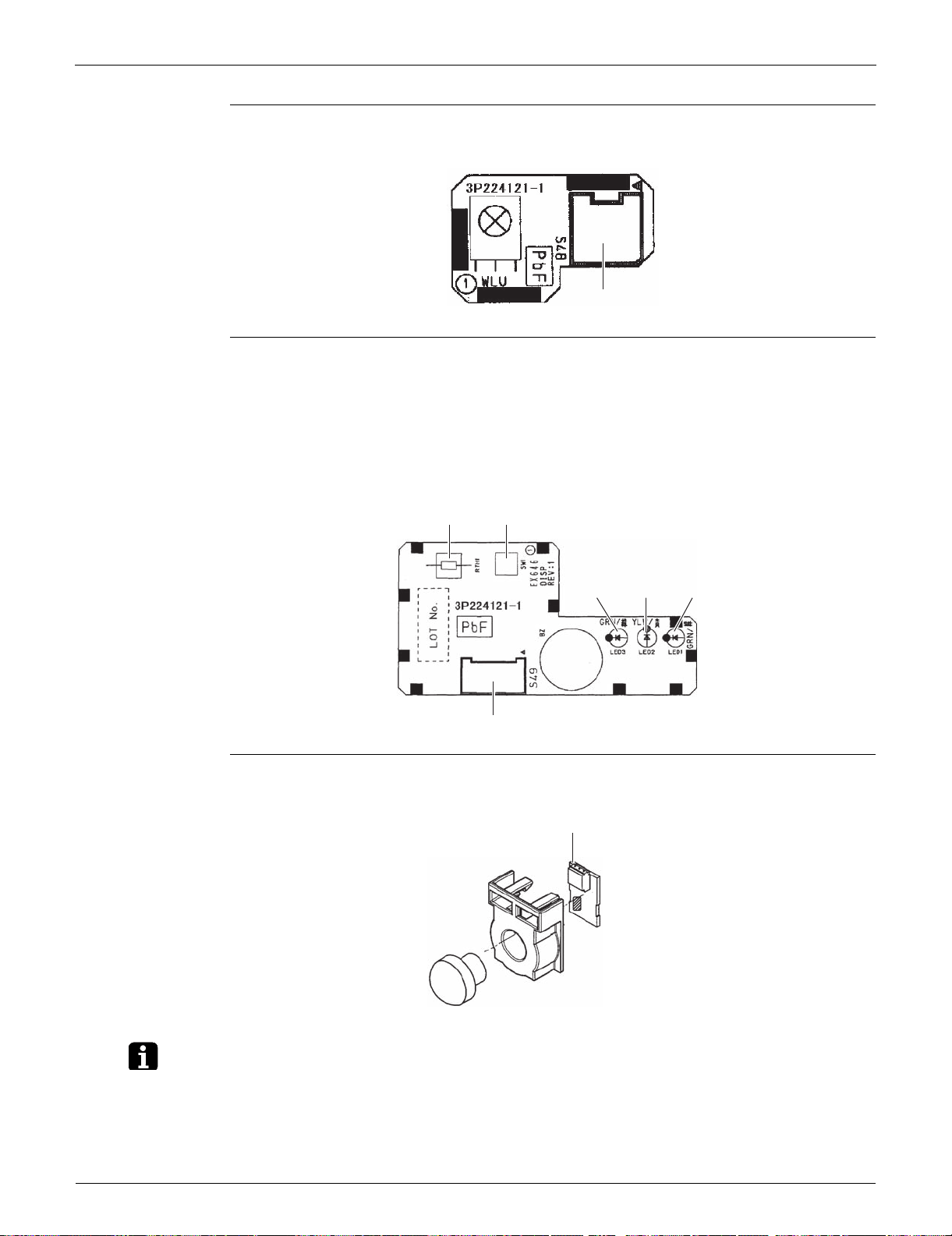
Indoor Unit SiUS121827E
42 Part 3 Printed Circuit Board Connector Wiring Diagram
Note
Signal Receiver
PCB (PCB2)
Display PCB
(PCB3)
INTELLIGENT
EYE Sensor PCB
(PCB4)
The symbols in the parenthesis are the names on the appropriate wiring diagram.
1) S48 Connector for control PCB (PCB1)
3P224121-1
S48
S48
1) S49 Connector for control PCB (PCB1)
2) SW1 Indoor unit ON/OFF switch
3) LED1 (H1P) LED for operation (green)
4) LED2 (H2P) LED for timer (yellow)
5) LED3 (H3P) LED for INTELLIGENT EYE (green)
6) RTH1 (R1T) Room temperature thermistor
3P224121-1
RTH1 SW1
LED3 LED2 LED1
S49
1) S36 Connector for control PCB (PCB1)
S36
3P227885-1
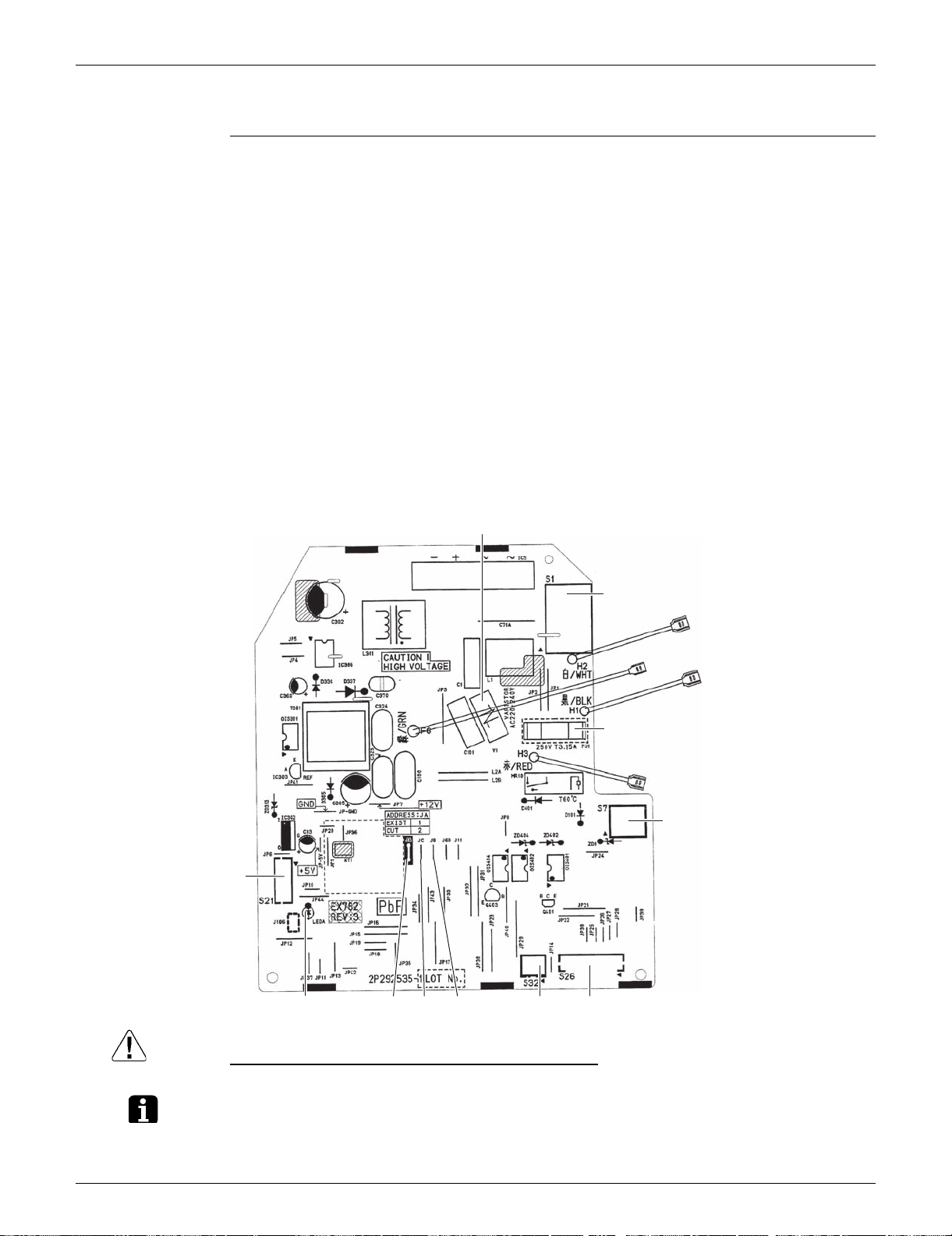
SiUS121827E Indoor Unit
Part 3 Printed Circuit Board Connector Wiring Diagram 43
Caution
Note
1.4 FDXS09/12LVJU, CDXS15/18/24LVJU
Control PCB
(A1P)
Replace the PCB if you cut a jumper unintentionally.
Jumpers are necessary for electronic circuit. Improper operation may occur if you cut any of them.
The symbols in the parenthesis are the names on the appropriate wiring diagram.
1) S1 Connector for AC fan motor
2) S7 Connector for AC fan motor (Hall IC)
3) S21 Connector for centralized control (HA)
4) S26 Connector for display/signal receiver PCB (A2P)
5) S32 Connector for indoor heat exchanger thermistor
6) H1, H2, H3 Connector for terminal block
7) FG (GND) Connector for terminal block (ground)
8) JA Address setting jumper
∗ Refer to page 258 for details.
9) JB Fan speed setting when compressor stops for thermostat OFF
∗ Refer to page 261 for details.
10) JC Power failure recovery function (auto-restart)
∗ Refer to page 261 for details.
11) LED A LED for service monitor (green)
12) FU1 (F1U) Fuse (3.15 A, 250 V)
13) V1 Varistor
H2
H1
H3
FG
JB
S21
2P292535-1
LED A JCJA
S7
S1
FU1
S26
V1
S32
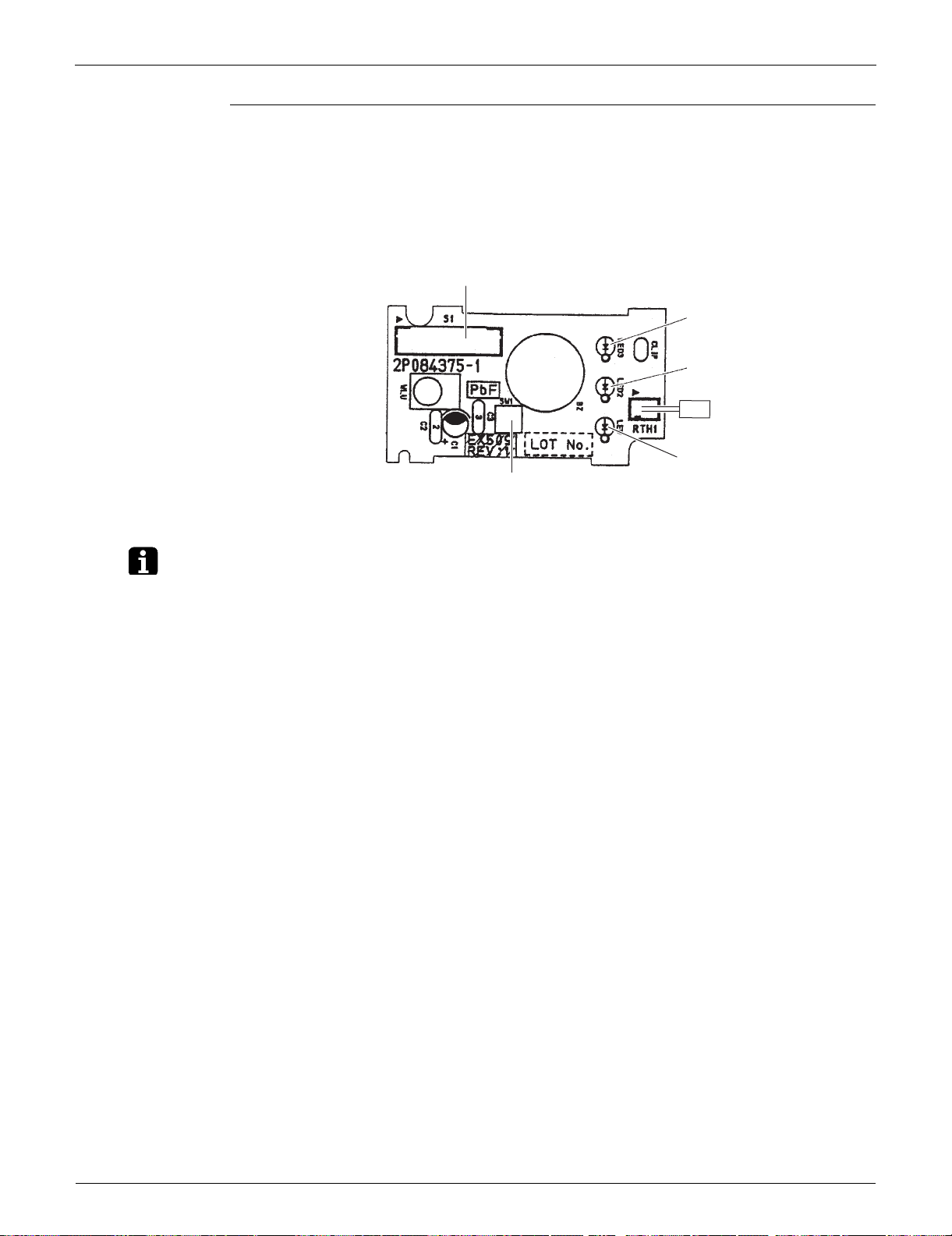
Indoor Unit SiUS121827E
44 Part 3 Printed Circuit Board Connector Wiring Diagram
Note
Display/Signal
Receiver PCB
(A2P)
LED 1 does not function.
The symbols in the parenthesis are the names on the appropriate wiring diagram.
1) S1 Connector for control PCB (A1P)
2) SW1 (S1W) Indoor unit ON/OFF switch
3) LED2 (H2P) LED for timer (yellow)
4) LED3 (H3P) LED for operation (green)
5) RTH1 (R1T) Room temperature thermistor
S1
LED3
LED2
SW1
2P084375-1
RTH1
LED1
1
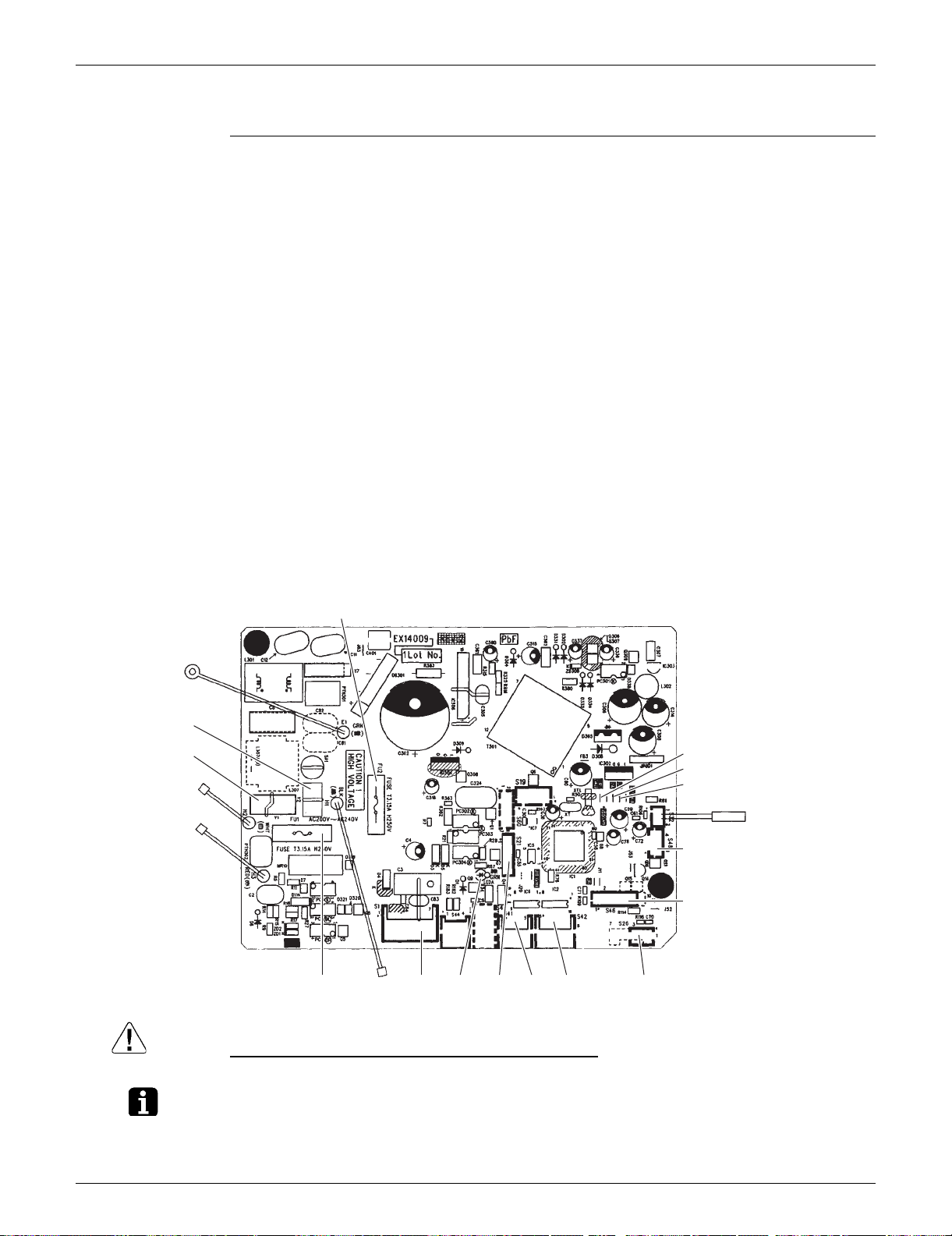
SiUS121827E Indoor Unit
Part 3 Printed Circuit Board Connector Wiring Diagram 45
Caution
Note
1.5 FVXS09/12/15/18NVJU
Control PCB
(PCB2)
Replace the PCB if you cut a jumper unintentionally.
Jumpers are necessary for electronic circuit. Improper operation may occur if you cut any of them.
The symbols in the parenthesis are the names on the appropriate wiring diagram.
1) S1 Connector for DC fan motor
2) S21 Connector for centralized control (HA)
3) S26 Connector for service PCB (PCB3)
4) S32 Indoor heat exchanger thermistor
5) S41 Connector for lower air outlet motor
6) S42 Connector for swing motor
7) S46 Connector for display/signal receiver PCB (PCB4)
8) S48 Connector for sensor PCB (PCB1)
9) H1, H2, H3 Connector for terminal strip
10) E1 Terminal for ground wire
11) JA Address setting jumper
∗ Refer to page 258 for details.
12) JB Fan speed setting when compressor stops for thermostat OFF
∗ Refer to page 261 for details.
13) JC Power failure recovery function
∗ Refer to page 261 for details.
14) FU1 (F1U),
FU2 (F2U)
Fuse (3.15 A, 250 V)
15) LED A LED for service monitor (green)
16) V1, V2 Varistor
E1
V1
H2
H3
FU1 H1 S1 LED A S21 S41 S42 S26
S46
S48
JC
JA
JB
FU2
S32
V2
2P383711-1
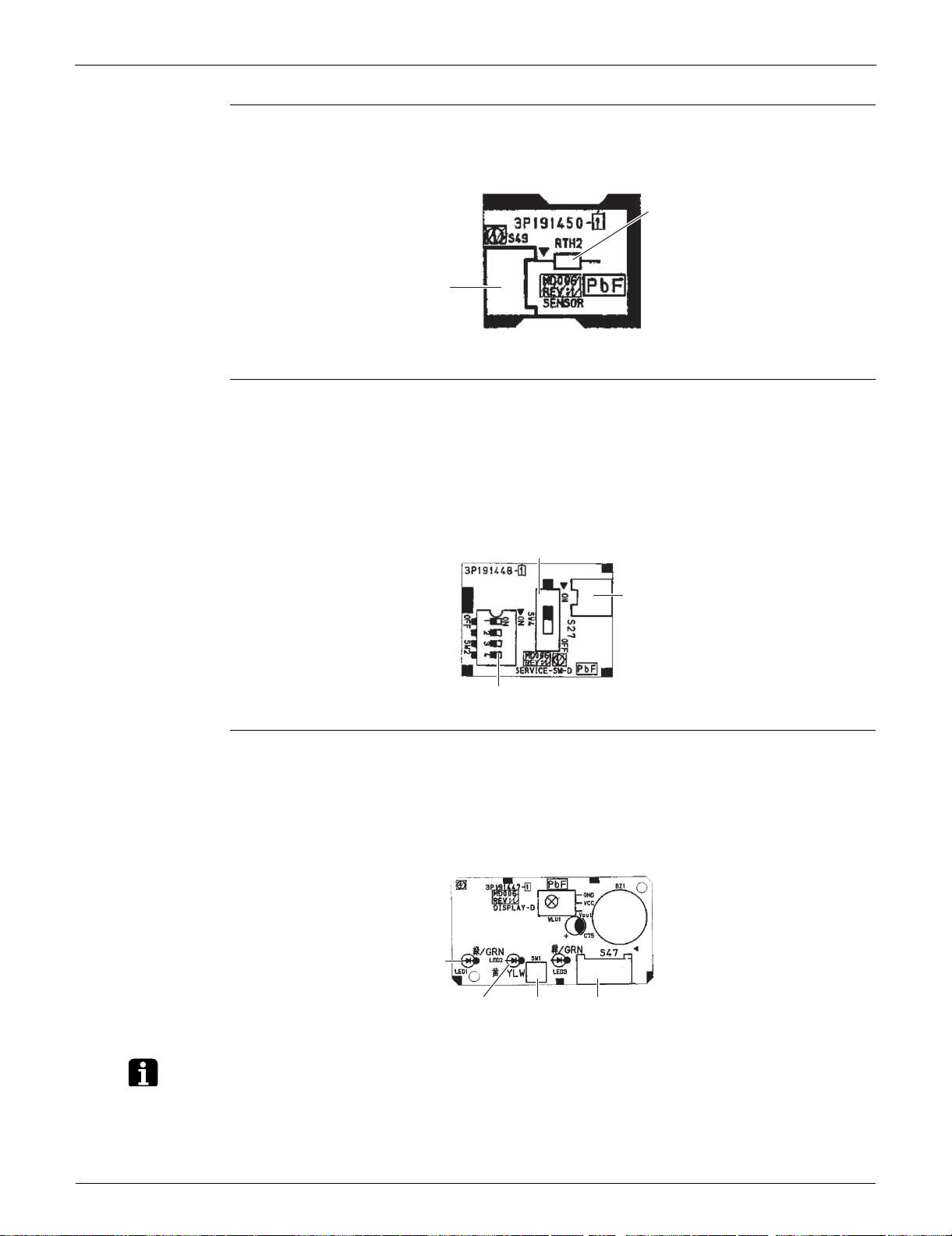
Indoor Unit SiUS121827E
46 Part 3 Printed Circuit Board Connector Wiring Diagram
Note
Sensor PCB
(PCB1)
Service PCB
(PCB3)
Display/Signal
Receiver PCB
(PCB4)
LED3 does not function.
The symbols in the parenthesis are the names on the appropriate wiring diagram.
1) S49 Connector for control PCB (PCB2)
2) RTH2 (R1T) Room temperature thermistor
S49
RTH2
3P191450-1
1) S27 Connector for control PCB (PCB2)
2) SW2 (S2W)-4 Switch for upward airflow limit setting
∗ Refer to page 261 for details.
∗ Keep the other switches as factory setting.
3) SW4 (S4W) Switch for airflow selection
∗ Refer to page 63 for details.
S27
SW4
SW2-4
3P191448-1
1) S47 Connector for control PCB (PCB2)
2) SW1 (S1W) Indoor unit ON/OFF switch
3) LED1 (H1P) LED for operation (green)
4) LED2 (H2P) LED for timer (yellow)
S47SW1LED2
LED1
3P191447-1
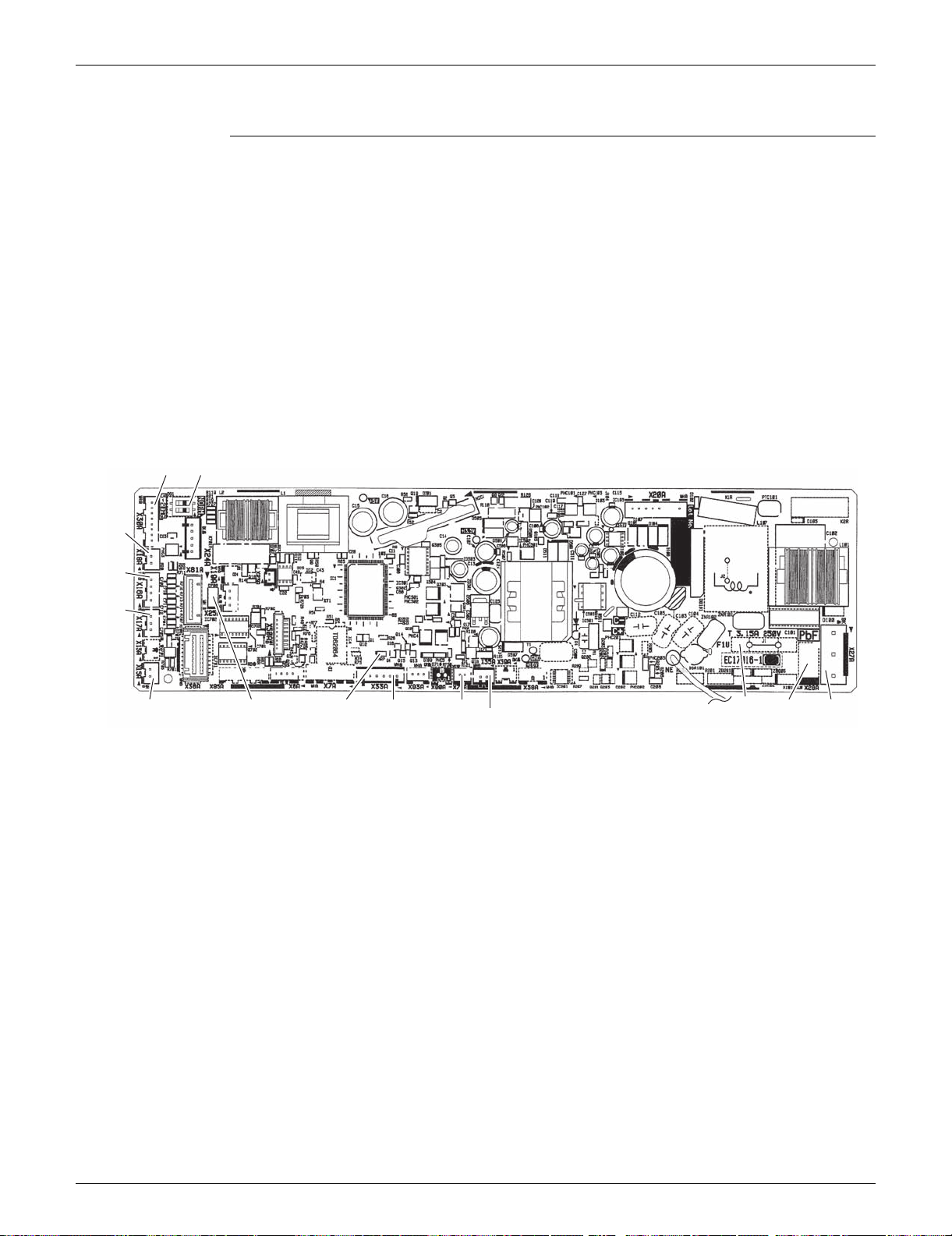
SiUS121827E Indoor Unit
Part 3 Printed Circuit Board Connector Wiring Diagram 47
1.6 FDMQ09/12/15/18/24RVJU
Control PCB
(A1P)
1) X15A Connector for float switch
2) X16A Connector for room temperature thermistor (suction air thermistor)
3) X17A, X18A Connector for indoor heat exchanger thermistor
4) X25A Connector for drain pump motor
5) X27A Connector for terminal block (for power supply)
6) X28A Connector for power supply wiring (option)
7) X30A Connector for terminal block (for wired remote controller)
8) X33A Connector for wiring (option)
9) X35A Connector for wiring adaptor (option)
10) X70A Connector for indoor fan PCB (A2P)
11) F1U Fuse (3.15 A, 250 V)
12) HAP LED for service monitor (green)
13) DS1 DIP switch for emergency
2P486802-2
X27AX28AF1U
X35
X70AX33AHAPX25AX15A
X17A
X16A
X18A
X30A DS1
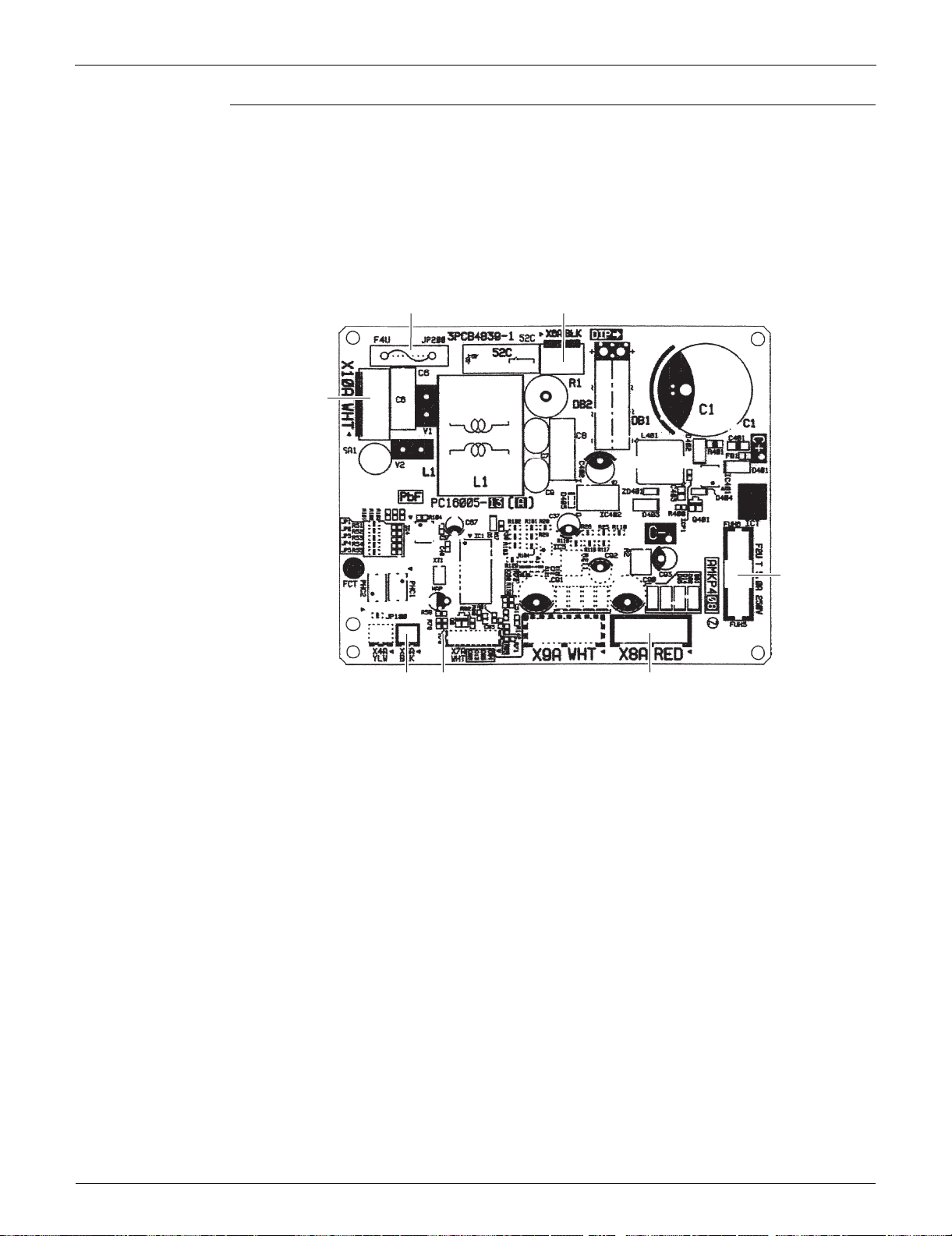
Indoor Unit SiUS121827E
48 Part 3 Printed Circuit Board Connector Wiring Diagram
Indoor Fan PCB
(A2P)
1) X3A Connector for control PCB (A1P)
2) X6A Connector for reactor
3) X8A Connector for indoor fan motor
4) X10A Connector for terminal block (for power supply)
5) F2U Fuse (5 A, 250 V)
6) F4U Fuse (6.3 A, 250 V)
7) HAP LED for service monitor (green)
2P442228-16
2P442228-17
F2U
X8AX3A
X10A
F4U
X6A
HAP
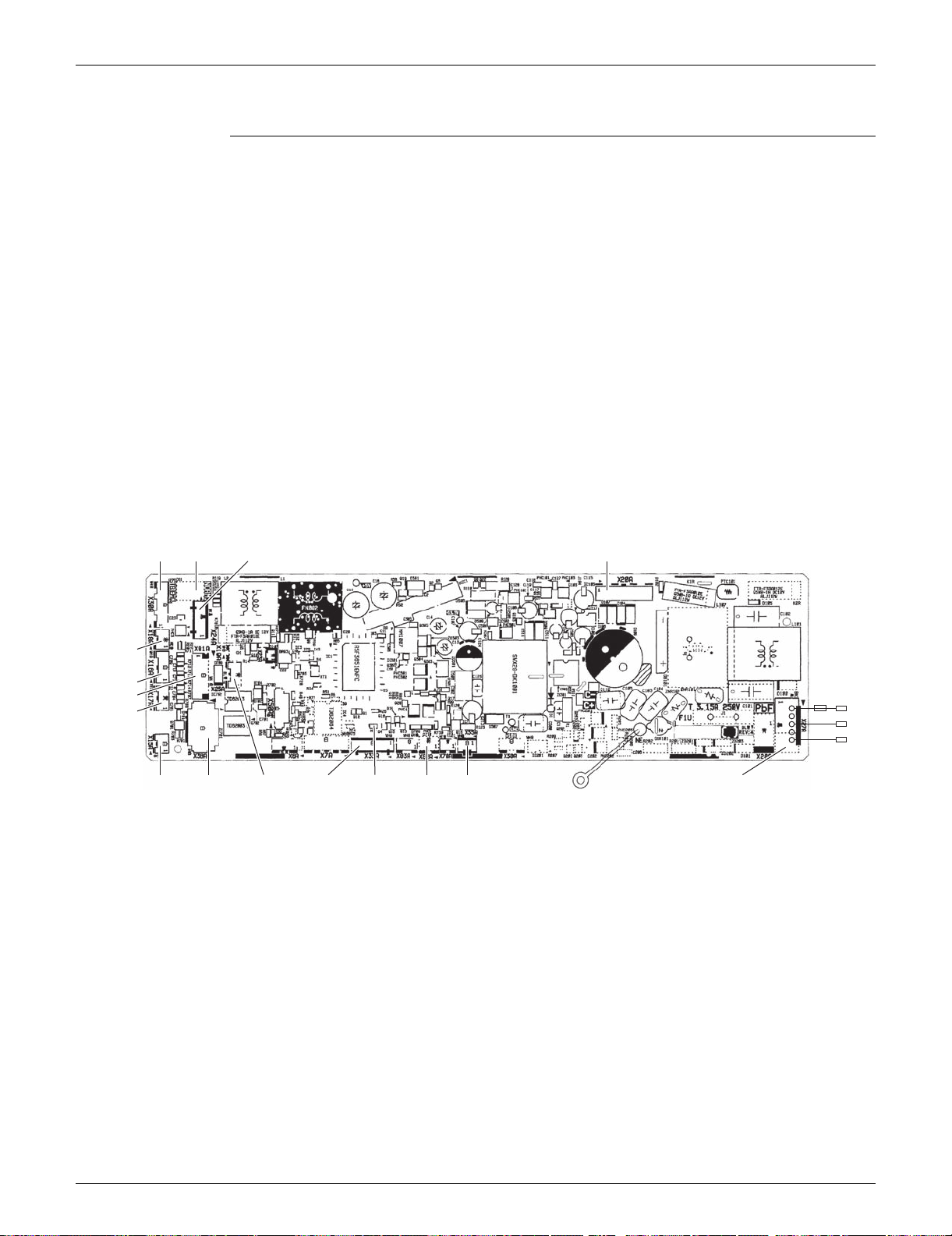
SiUS121827E Indoor Unit
Part 3 Printed Circuit Board Connector Wiring Diagram 49
1.7 FFQ09/12/15/18Q2VJU
Control PCB
(A1P)
1) X15A Connector for float switch
2) X16A Connector for room temperature thermistor (suction air thermistor)
3) X17A, X18A Connector for indoor heat exchanger thermistor
4) X20A Connector for DC fan motor
5) X24A Connector for transmitter board
(when the wireless remote controller (option) is used)
6) X25A Connector for drain pump motor
7) X27A Connector for terminal block (for inter-unit wiring)
8) X30A Connector for terminal block (for wired remote controller)
9) X33A Connector for adaptor for wiring (option)
10) X35A Connector for wiring adaptor for electrical appendices (option)
11) X36A Connector for swing motors on decoration panel (option)
12) X80A Connector for decoration panel (BYFQ60B3W1) (option)
13) X81A Connector for sensor kit (BRYQ60A2W(S)) (option)
14) HAP LED for service monitor (green)
15) DS1 DIP switch
16) F1U Fuse (5A, 250V)
2P452045-1
X30A
X18A
X16A
X81A
X17A
X15A
X36A X33A X35A
X80A
X27A
F1U
HAPX25A
X20ADS1 X24A
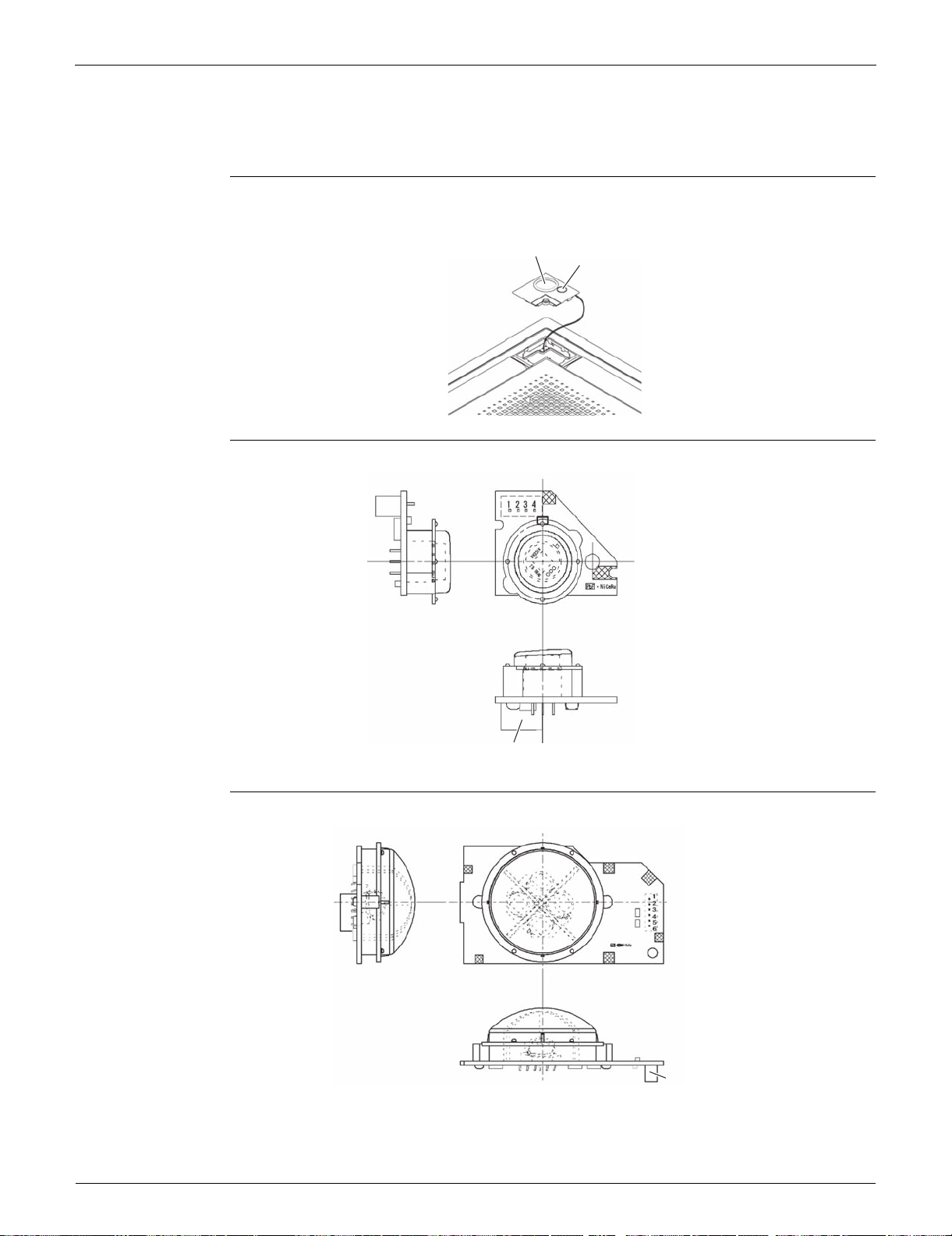
Sensor Kit for FFQ Series SiUS121827E
50 Part 3 Printed Circuit Board Connector Wiring Diagram
2. Sensor Kit for FFQ Series
2.1 BRYQ60A2W(S)
Outline
Thermopile
Sensor (A4P)
Pyroelectric
Sensor (A5P)
Thermopile sensor
(A4P)
Pyroelectric sensor
(A5P)
(R25074)
Connector
3P262610-1
Connector
3P262611-1
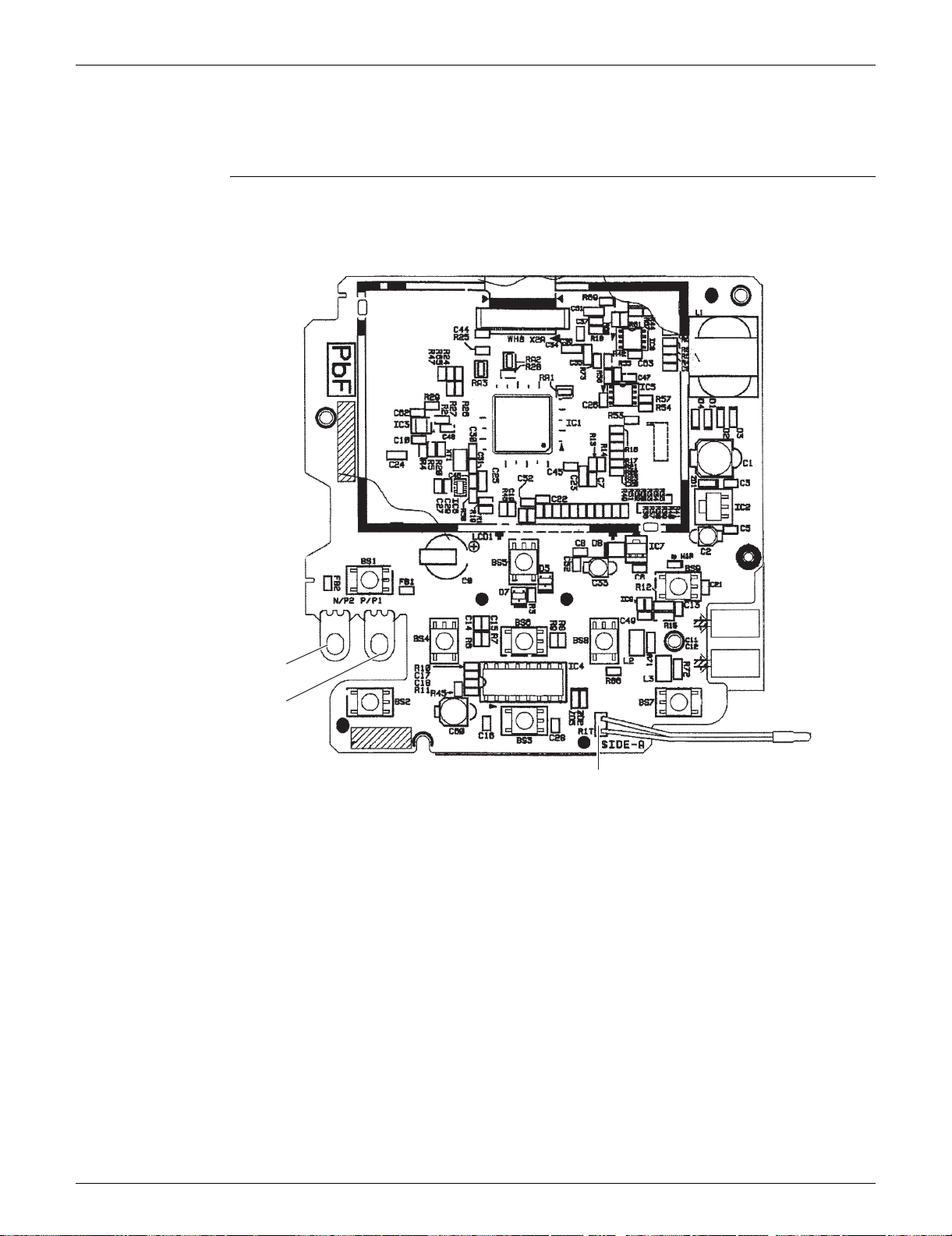
SiUS121827E Wired Remote Controller
Part 3 Printed Circuit Board Connector Wiring Diagram 51
3. Wired Remote Controller
3.1 BRC1E73
Wired Remote
Controller PCB
1) P1, P2 Terminal for indoor unit
2) R4T Room temperature thermistor
P2
R4T
P1
2P298037-7
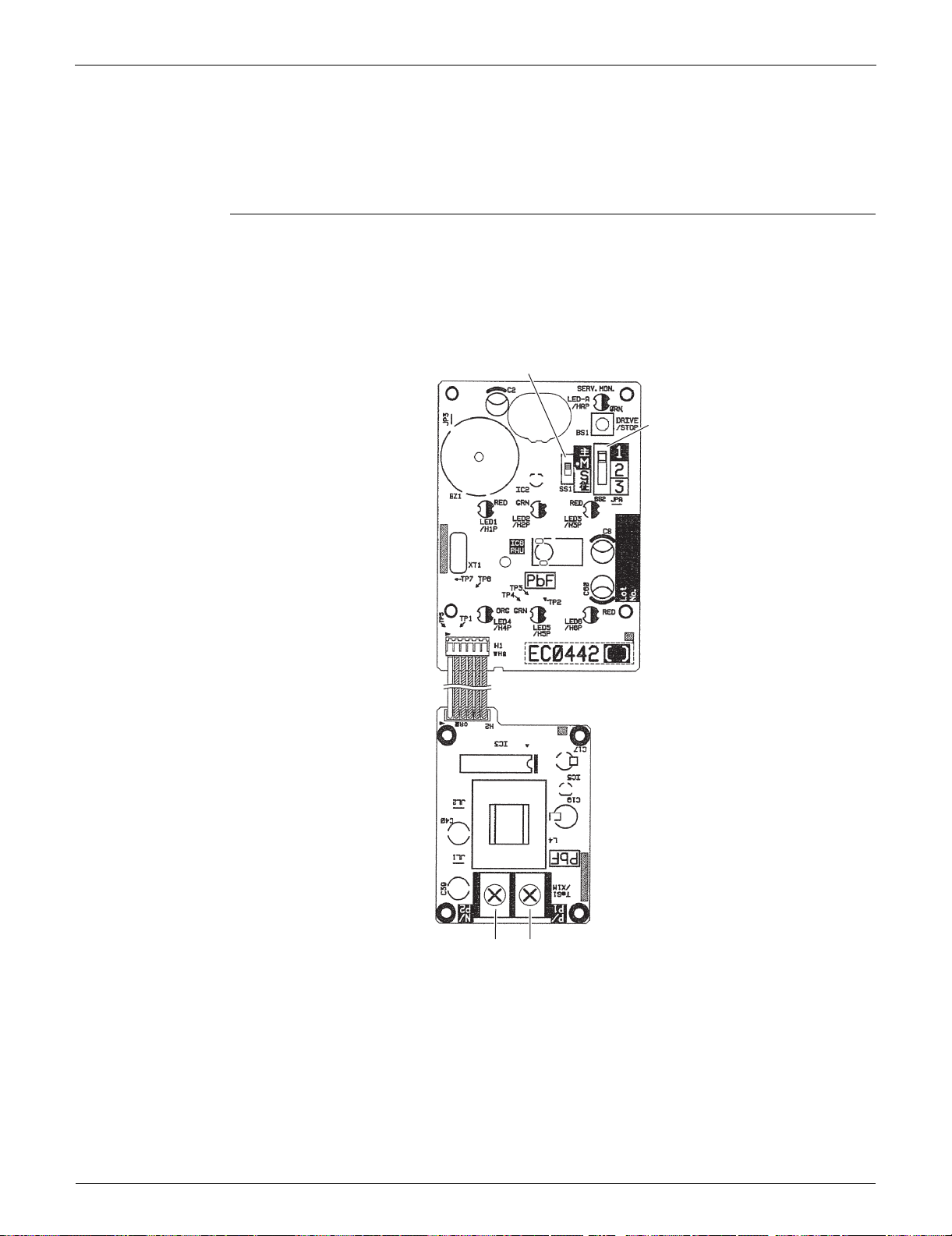
Wireless Remote Controller Receiver for FDMQ series SiUS121827E
52 Part 3 Printed Circuit Board Connector Wiring Diagram
4. Wireless Remote Controller Receiver for FDMQ
series
4.1 BRC082A43
Wired Remote
Controller PCB
1) SS1 MAIN/SUB setting switch
∗ Refer to page 268 for details.
2) SS2 Address setting switch
∗ Refer to page 268 for details.
3) P1, P2 Terminal for indoor unit control PCB (A1P)
SS1
P2 P1
3P156152-1
SS2
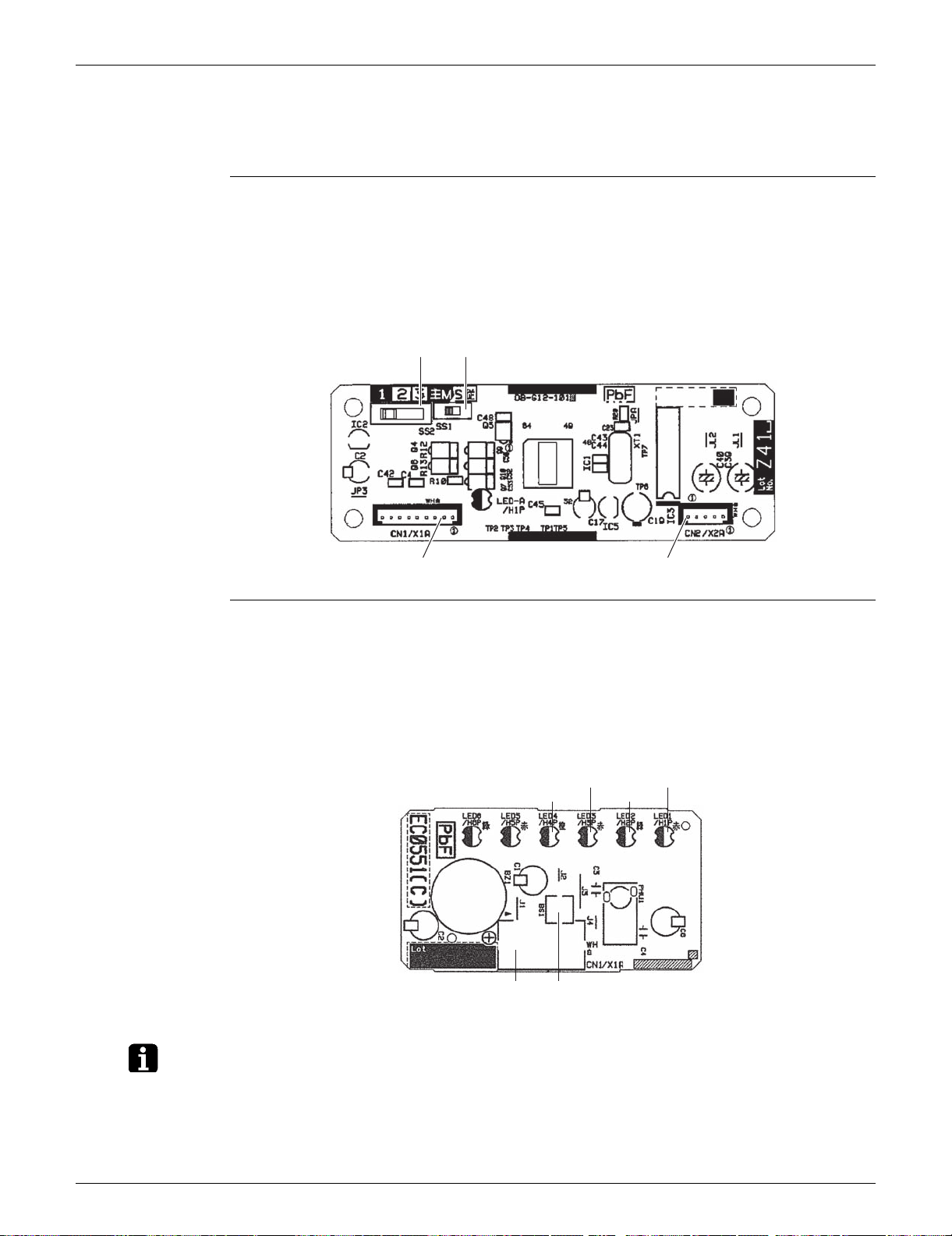
SiUS121827E Wireless Remote Controller Kit for FFQ Series
Part 3 Printed Circuit Board Connector Wiring Diagram 53
Note
5. Wireless Remote Controller Kit for FFQ Series
5.1 BRC082A41W, BRC082A42W(S)
Transmitter
Board (A2P)
Receiver (A3P)
LED5 and LED6 do not function.
The symbols in the parenthesis are the names on the appropriate wiring diagram.
1) X1A Connector for receiver (A3P)
2) X2A Connector for control PCB (A1P)
3) SS1 MAIN/SUB setting switch
∗ Refer to page 271 for details.
4) SS2 Address setting switch
∗ Refer to page 271 for details.
3P156326-3
X2A
SS2
SS1
X1A
1) X1A Connector for transmitter board (A2P)
2) BS1 Emergency operation switch
3) LED1 (H1P) LED for operation (red)
4) LED2 (H2P) LED for timer (green)
5) LED3 (H3P) LED for filter cleaning sign (red)
6) LED4 (H4P) LED for defrost operation (orange)
3P174795-1
LED 4
X1A BS1
LED 3
LED 2
LED 1

Outdoor Unit SiUS121827E
54 Part 3 Printed Circuit Board Connector Wiring Diagram
6. Outdoor Unit
Main PCB (PCB1)
1) S, S10 Connector for terminal block (indoor - outdoor transmission)
2) S15 Connector for COOL/HEAT lock
∗ Refer to page 275 for details.
3) S20 (white) Connector for electronic expansion valve coil A port
4) S21 (red) Connector for electronic expansion valve coil B port
5) S22 (blue) Connector for electronic expansion valve coil C port
6) S23 (yellow) Connector for electronic expansion valve coil D port
7) S24 (white) Connector for electronic expansion valve coil E port (5MXS-T only)
8) S25 (red) Connector for electronic expansion valve coil for bypass circuit
9) S40 Connector for overload protector
10) S70 Connector for DC fan motor
11) S80 Connector for four way valve coil
12) S90 Connector for thermistors
(outdoor temperature, outdoor heat exchanger, discharge pipe)
13) S92 Connector for gas pipe thermistor
14) S93 Connector for liquid pipe thermistor
15) S201, S202 Connector for service monitor PCB (PCB2)
16) HL1, HN1 Connector for terminal strip (power supply)
17) E1, E2, E3 Connector for ground wire
18) U, V, W Connector for compressor
19) FU1 Fuse (3.15 A, 250 V)
20) FU2 Fuse (5 A, 250 V)
21) FU3 Fuse (56 A, 250 V)
22) FU10 Fuse (10 A, 250 V)
23) V3, V4, V401 Varistor
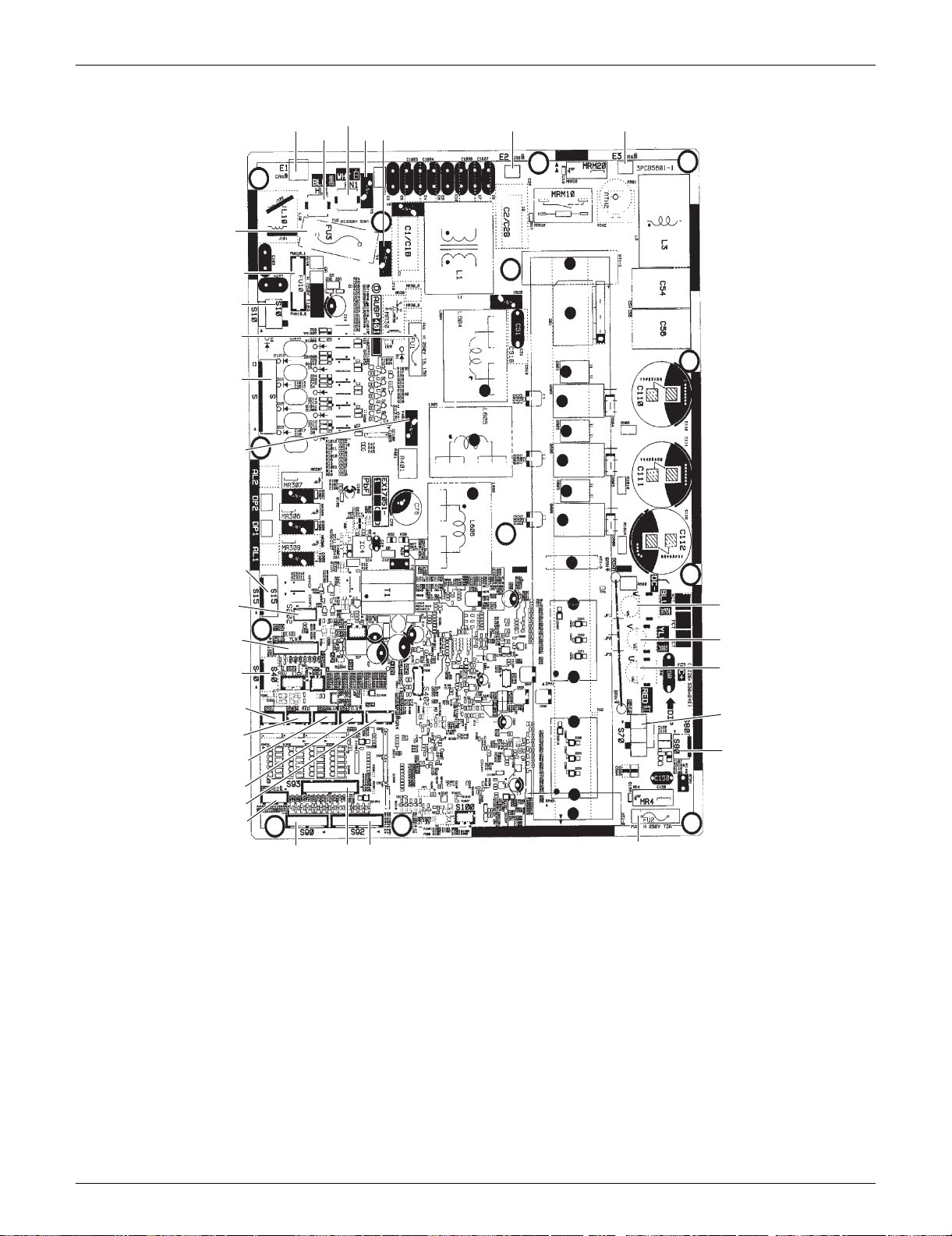
SiUS121827E Outdoor Unit
Part 3 Printed Circuit Board Connector Wiring Diagram 55
S92
S201
S90
S93
S25
FU1
S202
V401
S
2P519836-1
S40
S20
S23
S22
S21
S15
S10
FU10
FU3
V4
V3
HN1
HL1
E1
U
FU2
E3
V
W
S70
S80
E2
S24
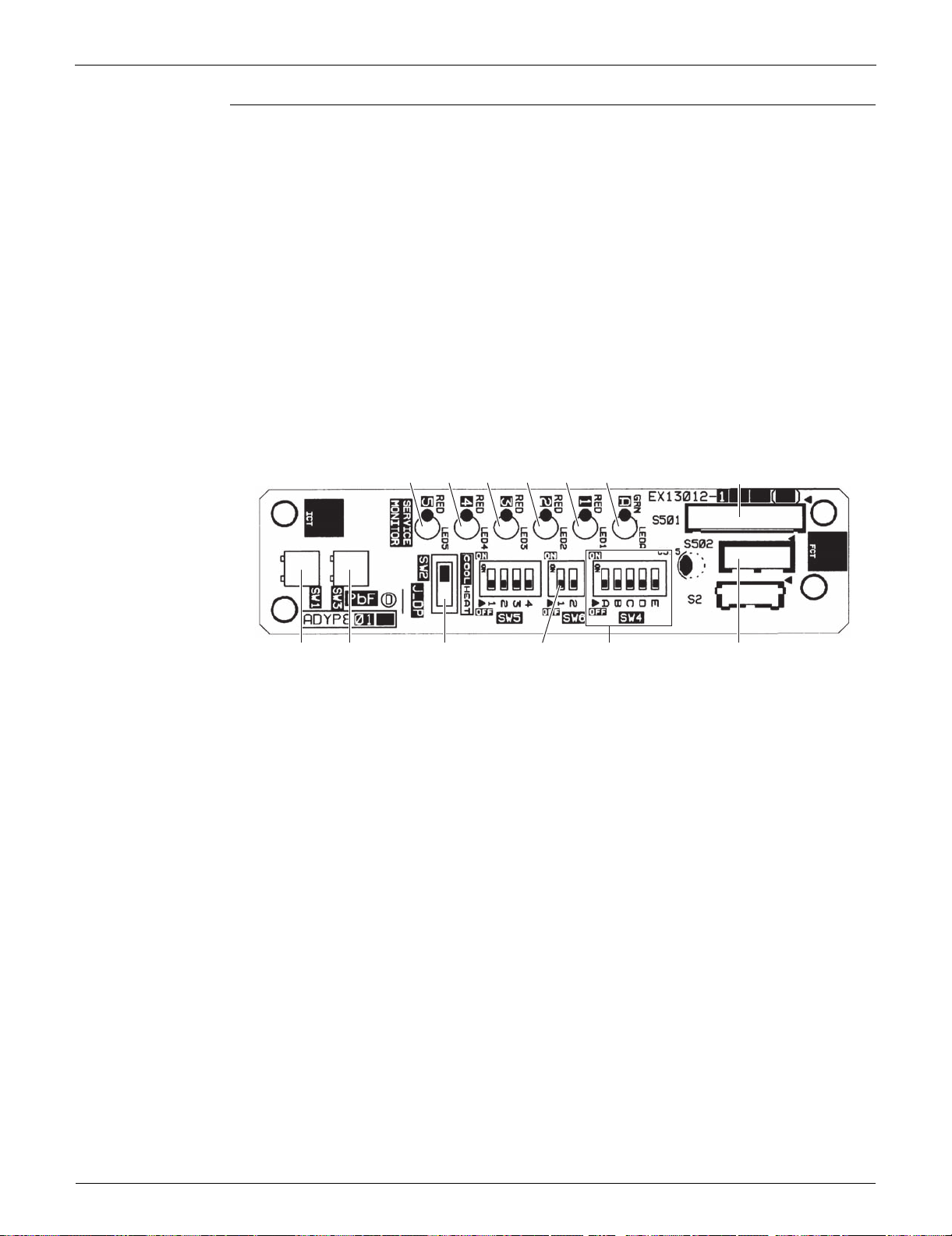
Outdoor Unit SiUS121827E
56 Part 3 Printed Circuit Board Connector Wiring Diagram
Service Monitor
PCB (PCB2)
SW6-2 and all the switches of SW5 have no function. Keep them OFF.
1) S501, S502 Connector for main PCB (PCB1)
2) LED A LED for service monitor (green)
3) LED1, LED2,
LED3, LED4,
LED5
LED for service monitor (red)
4) SW1 Forced cooling operation ON/OFF switch
∗ Refer to page 248 for details.
5) SW2 Operation mode switch
∗ Refer to page 248 for details.
6) SW3 Wiring error check switch
∗ Refer to page 249 for details.
7) SW4 Priority room setting switch
∗ Refer to page 274 for details.
8) SW6-1 NIGHT QUIET mode setting switch
∗ Refer to page 276 for details.
3P346711-10
S502SW6-1SW2SW3
LED5 LED4 LED3 LED2 LED1 LED A S501
SW1 SW4

SiUS121827E
Part 4 Functions and Control 57
1. Common Functions ...................................................................................59
1.1 Temperature Control .................................................................................. 59
1.2 Frequency Principle.................................................................................... 59
2. RA Indoor Unit Functions ..........................................................................61
2.1 Airflow Direction Control............................................................................. 61
2.2 Fan Speed Control for Indoor Unit ............................................................. 64
2.3 Program Dry Operation .............................................................................. 65
2.4 Automatic Cooling/Heating Changeover .................................................... 66
2.5 Thermostat Control..................................................................................... 67
2.6 NIGHT SET Mode ...................................................................................... 68
2.7 ECONO Operation .................................................................................... 69
2.8 2-Area INTELLIGENT EYE Operation ....................................................... 70
2.9 INTELLIGENT EYE Operation ................................................................... 72
2.10 POWERFUL Operation .............................................................................. 73
2.11 Multi-Monitor Lamp/TIMER Lamp .............................................................. 74
2.12 Clock Setting .............................................................................................. 75
2.13 WEEKLY TIMER Operation ....................................................................... 76
2.14 Other Functions.......................................................................................... 82
3. SA Indoor Unit Functions ..........................................................................84
3.1 Airflow Direction Control............................................................................. 84
3.2 Fan Speed Control for Indoor Unit ............................................................. 85
3.3 Program Dry Operation .............................................................................. 86
3.4 Clock and Calendar Setting (With Wired Remote Controller BRC1E73) ... 87
3.5 Schedule TIMER Operation (With Wired Remote Controller BRC1E73) ... 89
3.6 Setback Function (With Wired Remote Controller BRC1E73) ................... 93
3.7 Drain Pump Control.................................................................................... 94
3.8 Hot Start Control (In Heating Operation Only)............................................ 96
3.9 Presence and Floor Sensors (Option)........................................................ 97
3.10 Other Functions........................................................................................ 100
4. Control Specification ...............................................................................102
4.1 Thermistor Functions................................................................................ 102
4.2 Mode Hierarchy ........................................................................................ 104
4.3 Frequency Control.................................................................................... 105
4.4 Controls at Mode Changing/Start-up........................................................ 107
4.5 Discharge Pipe Temperature Control....................................................... 109
4.6 Input Current Control................................................................................ 110
4.7 Freeze-up Protection Control ................................................................... 111
4.8 Heating Peak-cut Control ......................................................................... 113
4.9 Outdoor Fan Control................................................................................. 114
Part 4
Functions and Control

SiUS121827E
58 Part 4 Functions and Control
4.10 Liquid Compression Protection Function.................................................. 114
4.11 Defrost Control ......................................................................................... 114
4.12 Low Hz High Pressure Limit ..................................................................... 116
4.13 Electronic Expansion Valve Control ......................................................... 116
4.14 Malfunctions ............................................................................................. 121
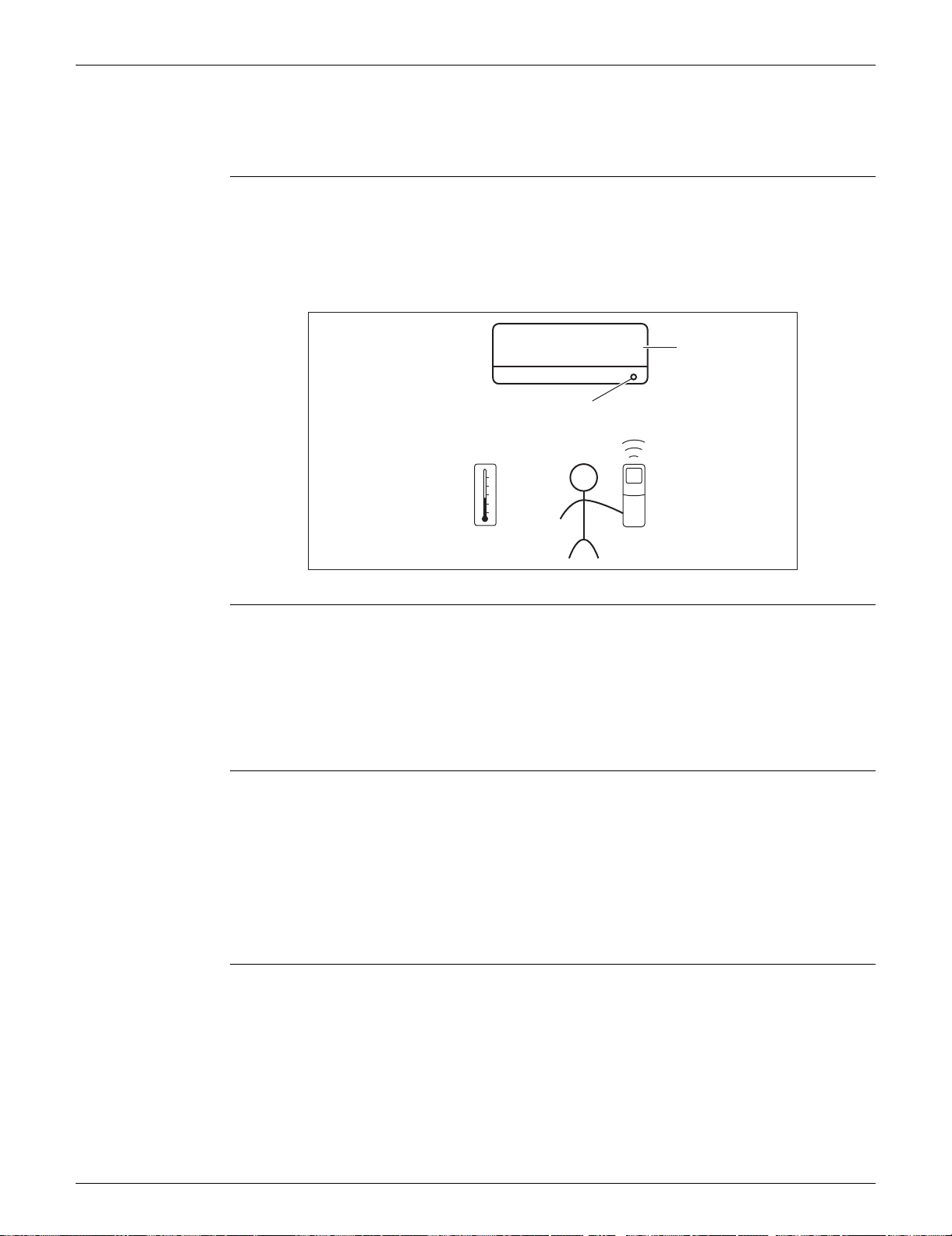
SiUS121827E Common Functions
Part 4 Functions and Control 59
1. Common Functions
1.1 Temperature Control
Definitions of
Temperatures
The definitions of temperatures are classified as following.
Room temperature: temperature of lower part of the room
Set temperature: temperature set by remote controller
Room thermistor temperature: temperature detected by room temperature thermistor
Target temperature: temperature determined by microcomputer
The illustration is for wall mounted type as representative.
Temperature
Control
The temperature of the room is detected by the room temperature thermistor. However, there is a
difference between the temperature detected by room temperature thermistor and the temperature
of lower part of the room, depending on the type of the indoor unit or installation condition. In
practice, the temperature control is done by the target temperature appropriately adjusted for the
indoor unit and the temperature detected by room temperature thermistor.
1.2 Frequency Principle
Control
Parameters
The frequency of the compressor is controlled by the following 2 parameters:
The load condition of the operating indoor unit
The difference between the room thermistor temperature and the target temperature
The target frequency is adapted by additional parameters in the following cases:
Frequency restrictions
Initial settings
Forced cooling operation
Inverter Principle To regulate the capacity, a frequency control is needed. The inverter makes it possible to control
the rotation speed of the compressor. The followings explain the inverter principle:
Phase 1
The supplied AC power source is converted into the DC power source for the present.
Phase 2
The DC power source is reconverted into the three phase AC power source with variable
frequency.
Target temperature
Set temperature
Room temperature
Room thermistor temperature
(R12321)
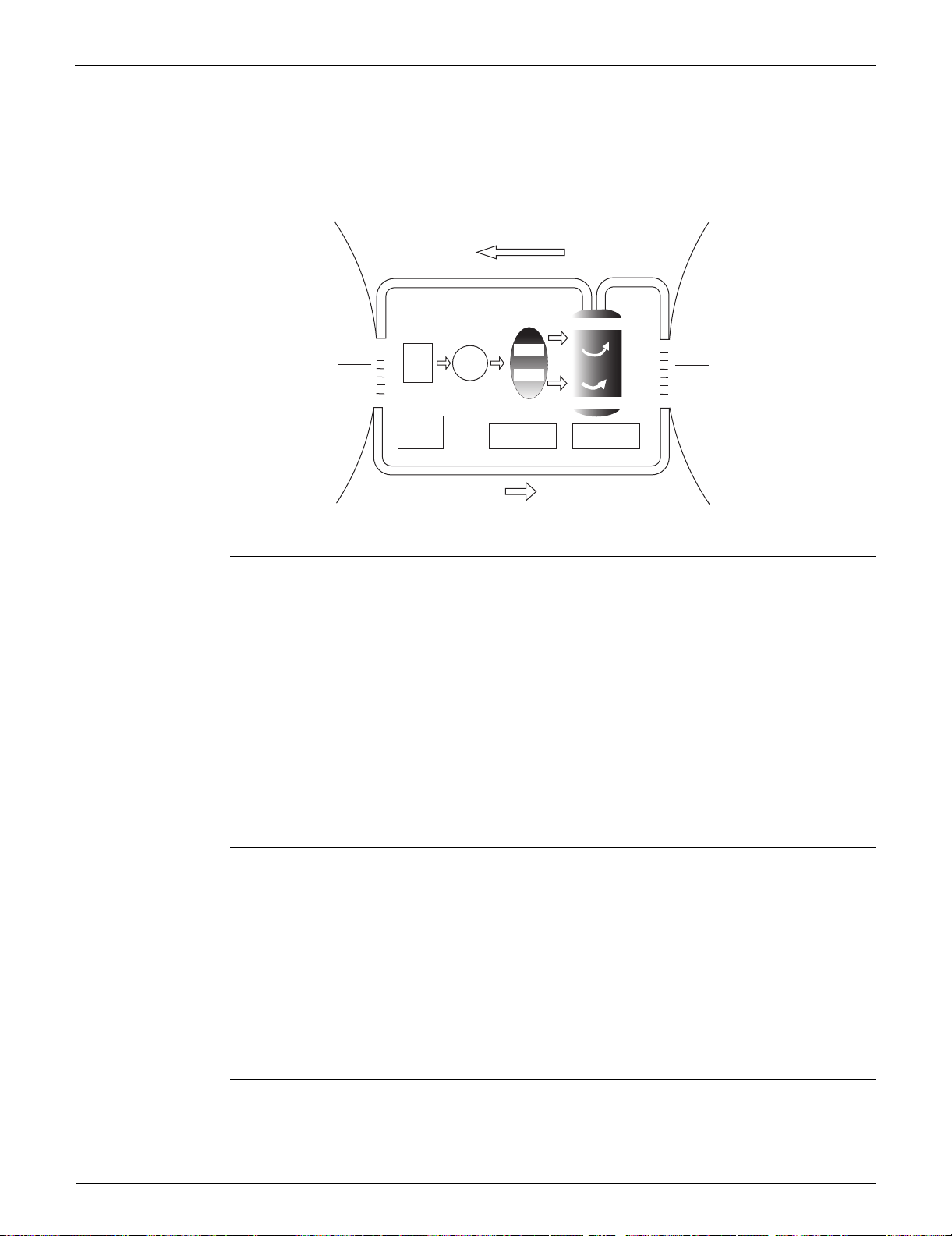
Common Functions SiUS121827E
60 Part 4 Functions and Control
When the frequency increases, the rotation speed of the compressor increases resulting in an
increase of refrigerant circulation. This leads to a larger amount of heat exchange per unit.
When the frequency decreases, the rotation speed of the compressor decreases resulting in a
decrease of refrigerant circulation. This leads to a smaller amount of heat exchange per unit.
The following drawing shows a schematic view of the inverter principle:
Inverter Features The inverter provides the following features:
The regulating capacity can be changed according to the changes in the outdoor temperature
and cooling/heating load.
Quick heating and quick cooling
The rotation speed of the compressor is increased when starting the heating (cooling).
This enables to reach the set temperature quickly.
Even during extreme cold weather, high capacity is achieved. It is maintained even when the
outdoor temperature is 2°C (35.6°F).
Comfortable air conditioning
A fine adjustment is integrated to keep the room temperature constant.
Energy saving heating and cooling
Once the set temperature is reached, the energy saving operation enables to maintain the room
temperature at low power.
Frequency Limits The following functions regulate the minimum and maximum frequency:
Low frequency
Four way valve operation compensation. Refer to page 107.
High frequency
Compressor protection function. Refer to page 108.
Discharge pipe temperature control. Refer to page 109.
Input current control. Refer to page 110.
Freeze-up protection control. Refer to page 111.
Heating peak-cut control. Refer to page 113.
Defrost control. Refer to page 114.
Forced Cooling
Operation
Refer to page 248 for details.
Refrigerant circulation rate (high)
high f
low f
freq=variable
Refrigerant circulation rate (low)
high speed
low speed
(R2812)
Amount of heat
exchanged air (large)
freq=
constant
50 Hz 50 Hz
60 Hz60 Hz
capacity=
variab
le
Amount of heat
exchanged air (small)
AC
power
DC
power
Amount of heat exchanged air
(large)
Amount of heat exchanged air
(small)
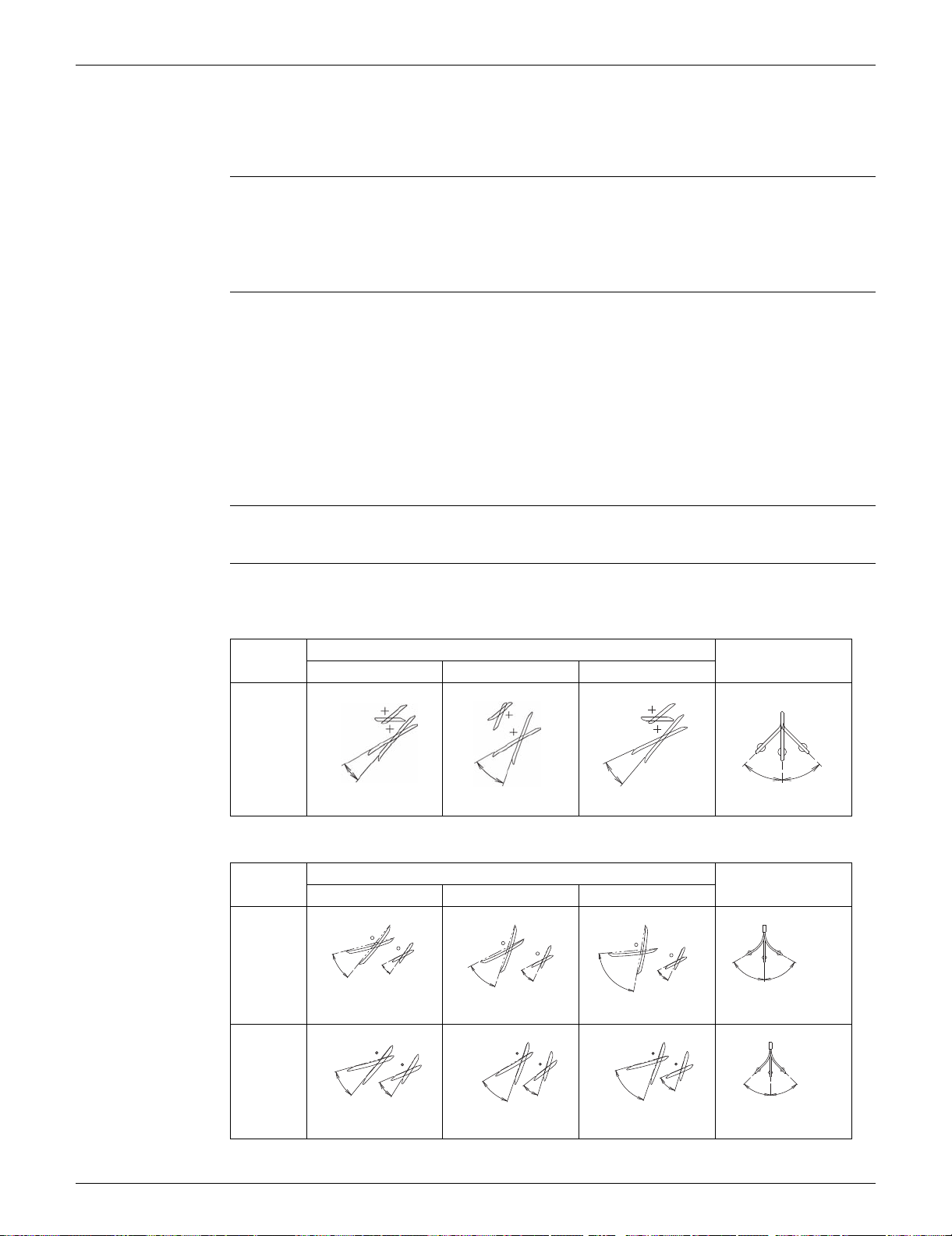
SiUS121827E RA Indoor Unit Functions
Part 4 Functions and Control 61
2. RA Indoor Unit Functions
2.1 Airflow Direction Control
Applicable
Models
FTXR09/12/18TVJUW(S)
CTXG09/12/18QVJUW(S)
CTXS07LVJU
FTXS09/12/15/18/24LVJU
FVXS09/12/15/18NVJU
Power-Airflow
(Dual) Flap(s)
The large flap sends a large volume of air downward to the floor and provides an optimum control in
cooling, dry and heating operation.
Cooling/Dry
During cooling or dry operation, the flap retracts into the indoor unit. Then, cool air can be blown far
and distributed all over the room.
Heating
During heating operation, the large flap directs airflow downward to spread the warm air to the
entire room.
Wide-Angle
Louvers
The louvers, made of elastic synthetic resin, provide a wide range of airflow that guarantees
comfortable air distribution.
Auto-Swing The following tables explain the auto-swing process for cooling, dry, heating and fan:
FTXR, CTXG series
CTXS, FTXS series
Flap (up and down)
Louver
(right and left)
Cooling/Dry Heating Fan
09/12/18
class
Flap (up and down)
Louver
(right and left)
Cooling/Dry Heating Fan
07/09/12
class
15/18/24
class
(R23915)
50°
30°
(R23916)
65°
30°
(R21084)
25°
50°
35°
35°
(R21085)
15°
45°
35°
55°
(R13527)
30°
70°
30°
65°
(R11402)
5°
80°
30°
65°
(R11403)
45°
45°
(R11404)
(R9303)
60°
50°
25°
15°
(R9304)
70°
40°
75°
30°
(R9305)
75°
15°
25°
70°
(R9306)
45°
45°
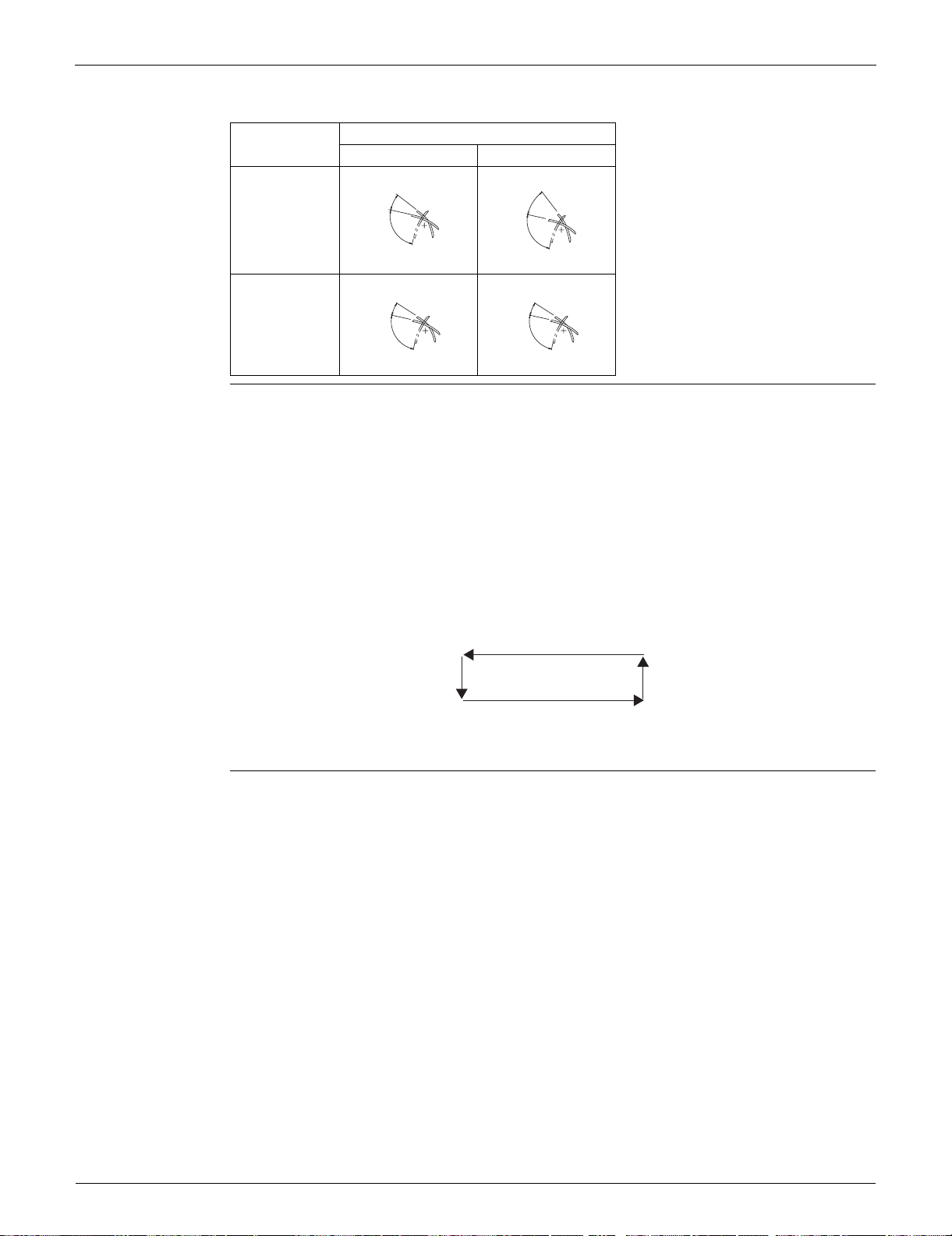
RA Indoor Unit Functions SiUS121827E
62 Part 4 Functions and Control
FVXS series
3-D Airflow FTXR, CTXG, CTXS, FTXS Series
Alternative repetition of vertical and horizontal swing motions enables uniform air-conditioning of
the entire room.
When the horizontal swing and vertical swing are both set to automatic operation, the airflow
becomes 3-D airflow. The horizontal and vertical swing motions are alternated and the airflow
direction changes in the order shown in the following diagram.
(1): The vertical blades (louvers) move from the right to the left.
(2): The horizontal blades (flaps) move downward.
(3): The vertical blades (louvers) move from the left to the right.
(4): The horizontal blades (flaps) move upward.
COMFORT
AIRFLOW
Operation
FTXR, CTXG, CTXS, FTXS Series
The flaps are controlled not to blow the air directly at the people in the room.
The airflow will be in the upward direction while in cooling operation and in the downward direction
while in heating operation, which will provide a comfortable wind that will not come in direct contact
with people.
Flap (up and down)
Cooling/Dry Heating
Upward airflow
limit OFF
R4003397
R4003396
Upward airflow
limit ON
R4003394 R4003394
25°
90°
40°
90°
90°
20°
90°
20°
(R19554)
(2)
(4)
(3)
(1)
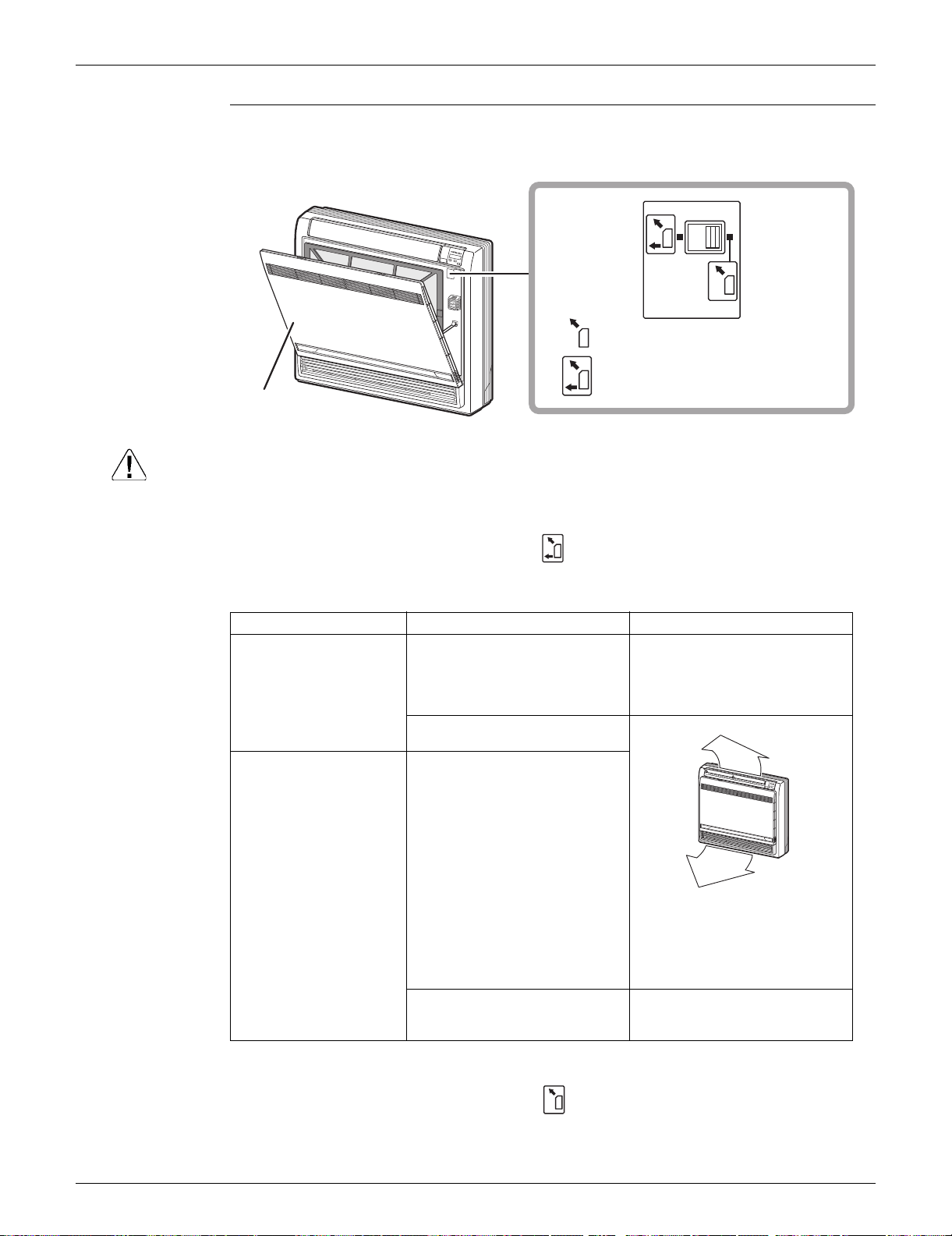
SiUS121827E RA Indoor Unit Functions
Part 4 Functions and Control 63
Caution
Airflow Selection
Setting
FVXS Series
Airflow direction can be set with the airflow selection switch.
Open the front panel.
Before opening the front panel, be sure to stop the operation and turn the breaker off.
Do not touch the aluminum fins (indoor heat exchanger) inside the indoor unit, as it may result in
injury.
When setting the airflow selection switch to .
The air conditioner automatically decides the appropriate blowing pattern depending on the
operating mode/situation.
During dry operation, air is blown from upper air outlet, so that cold air does not come into direct
contact with people.
When setting the airflow selection switch to .
Regardless of the operating mode or situation, air is blown from the upper air outlet.
Use this switch when you do not want air coming out of the lower air outlet (e.g., while sleeping).
Air is blown from the upper outlet only.
Front panel
The blow pattern is automatically decided
depending on mode and conditions.
(Recommended and factory set.)
(R17866)
Operating mode Situation Blowing pattern
Cooling operation
When the room has become
fully cool, or when 1 hour has
passed since turning on the air
conditioner.
Air is blown from the upper air
outlet, so that air does not come
into direct contact with people,
and room temperature is
equalized.
At the start of operation or when
the room is not fully cooled.
Air is blown from the upper and
lower air outlets for high speed
cooling during cooling operation,
and for filling the room with
warm air during heating
operation.
Heating operation
Normal time
At the start or when air
temperature is low.
Air is blown from the upper air
outlet, so that air does not come
into direct contact with people.
(R17867)
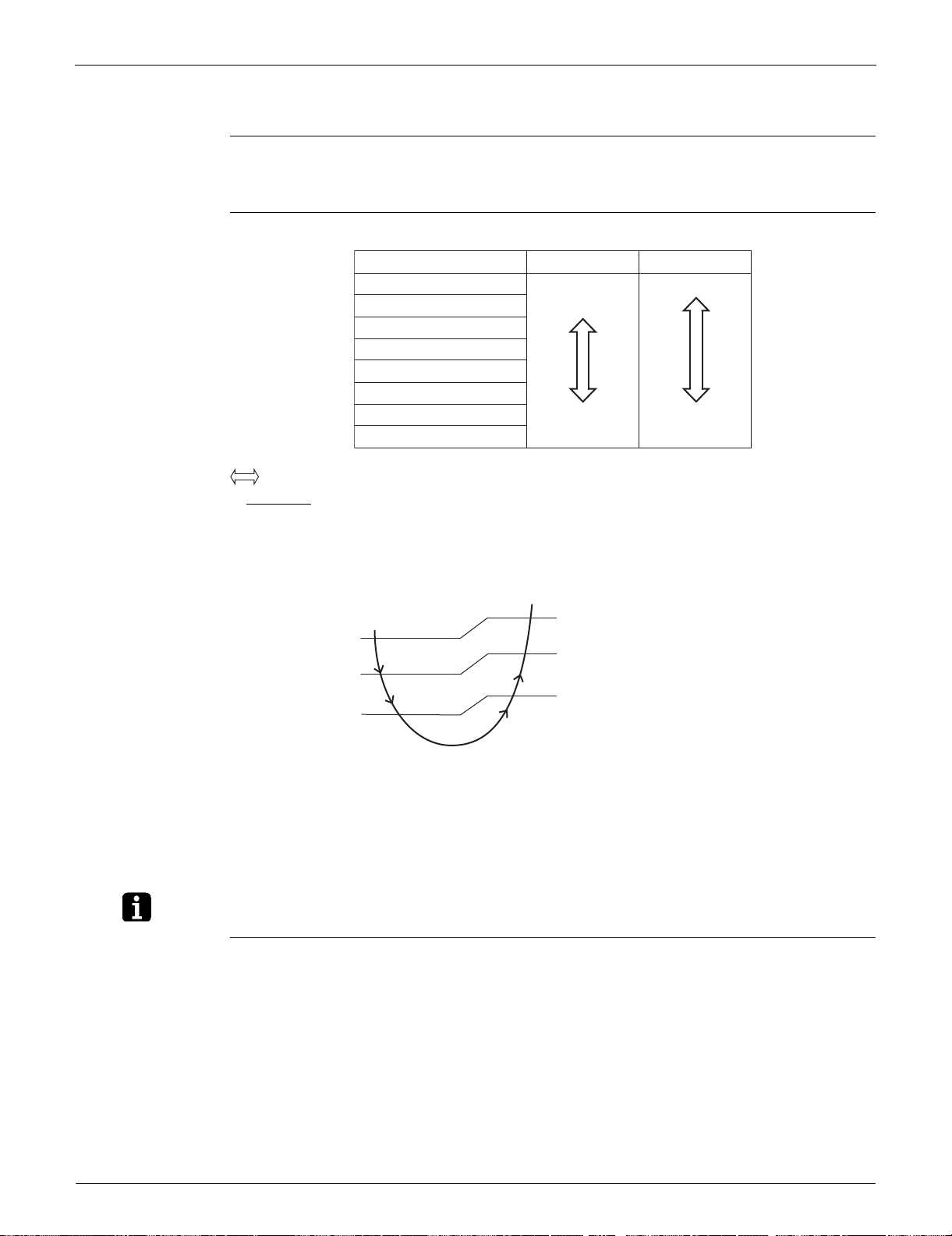
RA Indoor Unit Functions SiUS121827E
64 Part 4 Functions and Control
Note(s)
2.2 Fan Speed Control for Indoor Unit
Outline Phase control and fan speed control contains 9 steps: LLL, LL, SL, L, ML, M, MH, H, and HH.
The airflow rate can be automatically controlled depending on the difference between the room
thermistor temperature and the target temperature.
Automatic Fan
Speed Control
In automatic fan speed operation, the step SL is not available.
R4003512
= The airflow rate is automatically controlled within this range when FAN setting button is set
to automatic
.
Cooling
The following drawing explains the principle of fan speed control for cooling.
∗ The upper limit is at M tap in 30 minutes from the operation start.
Heating
In heating operation, the fan speed is regulated according to the indoor heat exchanger
temperature and the difference between the room thermistor temperature and the target
temperature.
The fan stops during defrost operation.
COMFORT
AIRFLOW
Operation
FTXR, CTXG, CTXS, FTXS Series
The fan speed is controlled automatically within the following steps.
Cooling
L tap ~ MH tap (same as AUTOMATIC)
Heating
In order to obtain a comfortable airflow, the fan speed may be set to a rate different from
automatic fan speed control.
The latest command has the priority between POWERFUL and COMFORT AIRFLOW.
HeatingCoolingStep
LLL
LL
L
ML
M
MH
H
HH (POWERFUL)
(R21654)
+2.5°C (+4.5°F)
+1.5°C (+2.7°F)
+0.5°C (+0.9°F)
MH*
M
ML
L
+3°C (+5.4°F)
+2°C (+3.6°F)
+1°C (+1.8°F)
Fan speed
Room thermistor temperature – target temperature
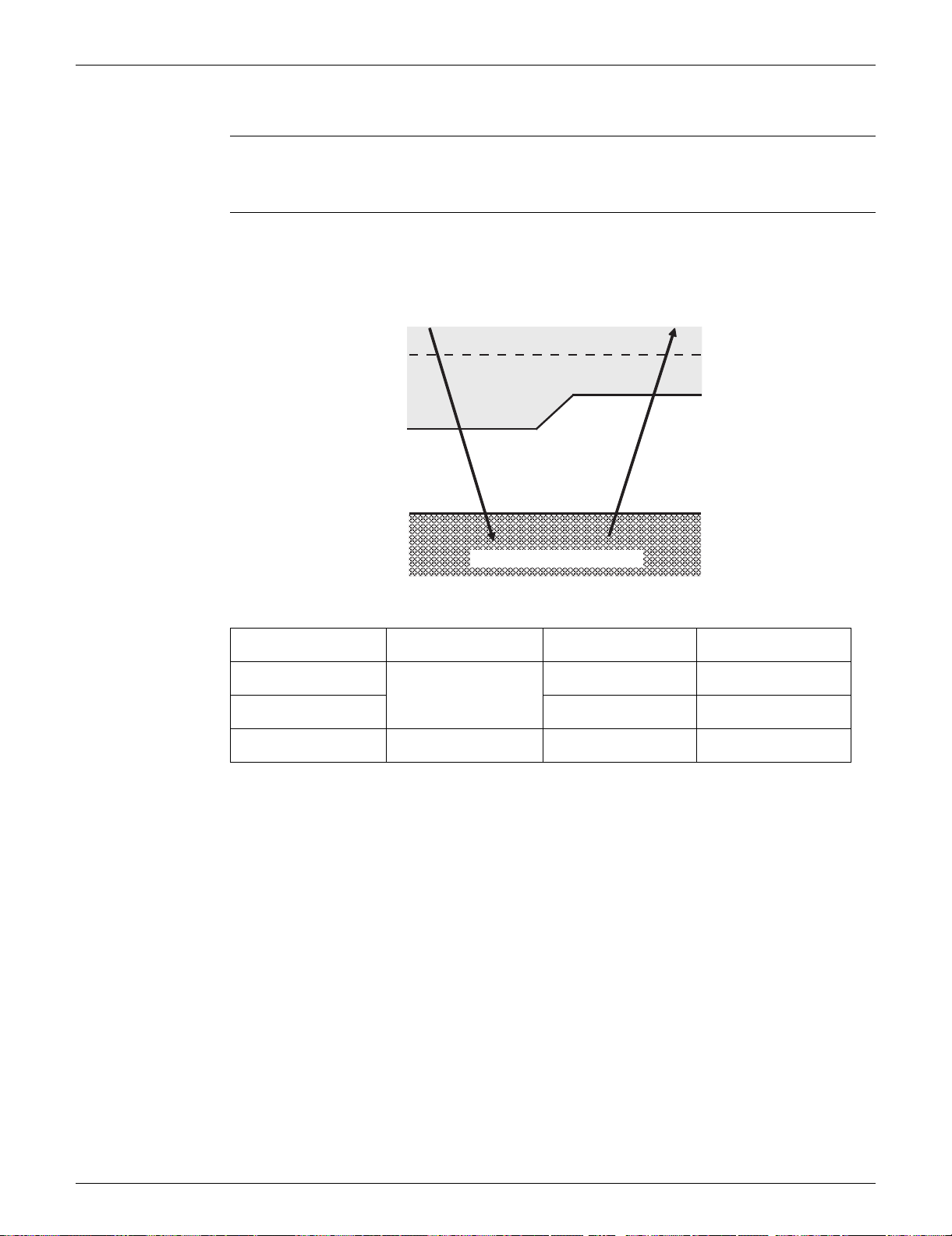
SiUS121827E RA Indoor Unit Functions
Part 4 Functions and Control 65
2.3 Program Dry Operation
Outline Program dry operation removes humidity while preventing the room temperature from lowering.
Since the microcomputer controls both the temperature and airflow rate, the temperature
adjustment and FAN setting buttons are inoperable.
Details The microcomputer automatically sets the temperature and airflow rate. The difference between
the room thermistor temperature at start-up and the target temperature is divided into two zones.
Then, the unit operates in an appropriate capacity for each zone to maintain the temperature and
humidity at a comfortable level.
Thermostat turns on also when the room temperature is in the zone B for 10 minutes.
Room thermistor
temperature at start-up
Target temperature
X
Thermostat OFF point
Y
Thermostat ON point
Z
24°C or more
(75.2°F or more)
Room thermistor
temperature at start-up
X – 2.5°C
(X – 4.5°F)
X – 0.5°C
(X – 0.9°F)
18 ~ 23.5°C
(64.4 ~ 74.3°F)
X – 2.0°C
(X – 3.6°F)
X – 0.5°C
(X – 0.9°F)
17.5°C or less
(63.5°F or less)
18°C
(64.4°F)
X – 2.0°C
(X – 3.6°F)
X – 0.5°C = 17.5°C
(X – 0.9°F = 63.5°F)
Zone A = Thermostat OFF
Target temperature X
Zone B
Room temperature Room temperature
Zone C = Thermostat ON
Y = X – 2.5°C (4.5°F)
or
Y = X – 2.0°C (3.6°F)
Z = X – 0.5°C (0.9°F)
X – 1.0°C (1.8°F)
(R24029)
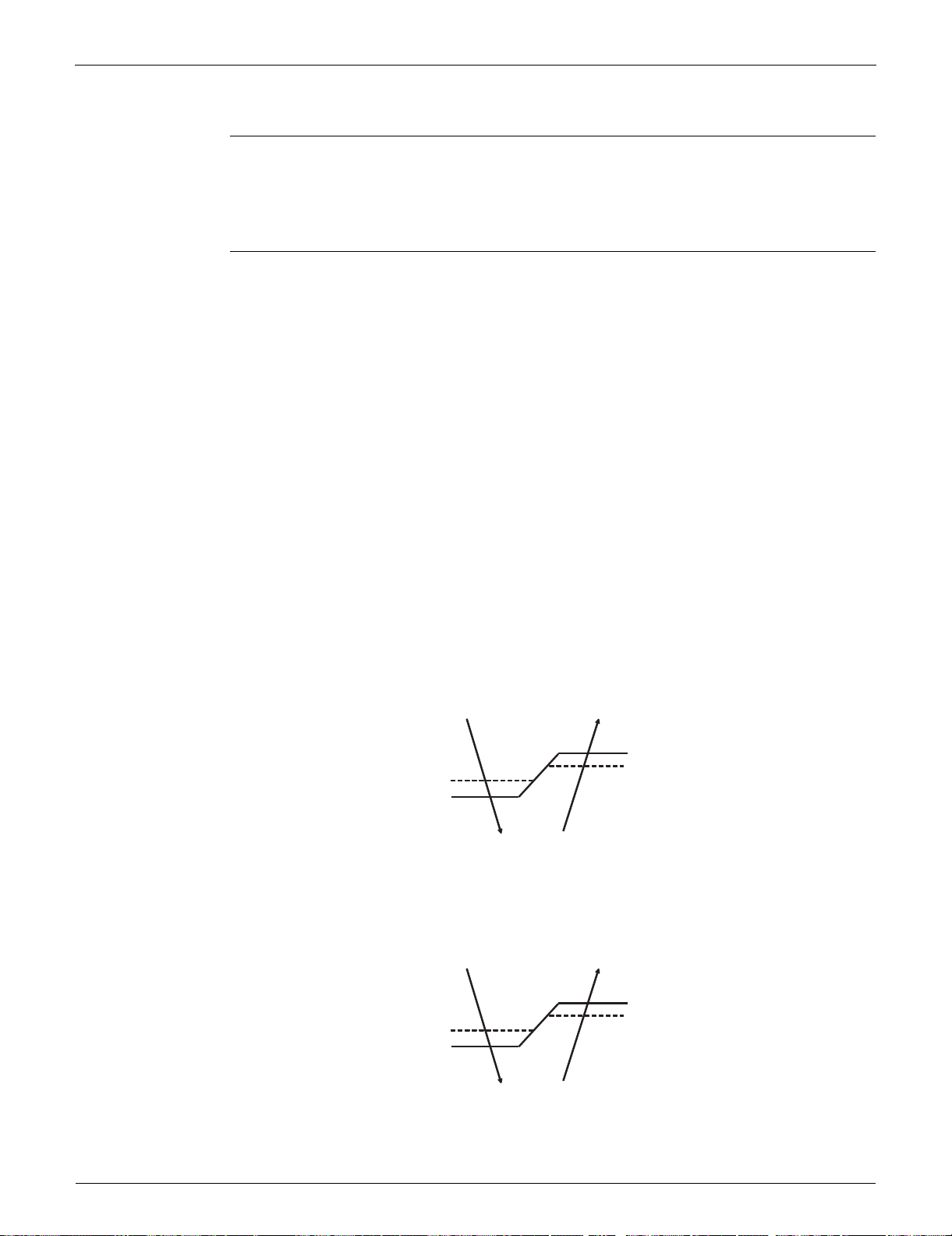
RA Indoor Unit Functions SiUS121827E
66 Part 4 Functions and Control
2.4 Automatic Cooling/Heating Changeover
Outline When the automatic operation is selected with the remote controller, the microcomputer
automatically determines the operation mode as cooling or heating according to the room
temperature and the set temperature at start-up.
The unit automatically switches the operation mode to maintain the room temperature at the set
temperature.
Details Ts: set temperature (set by remote controller)
Tt: target temperature (determined by microcomputer)
Tr: room thermistor temperature (detected by room temperature thermistor)
C: correction value
1. The set temperature (Ts) determines the target temperature (Tt).
(Ts = 18 ~ 30°C (64.4 ~ 86°F))
2. The target temperature (Tt) is calculated as;
Tt = Ts + C
where C is the correction value.
C = 0°C (0°F)
3. Thermostat ON/OFF point and operation mode switching point are as follows.
(1) Heating → Cooling switching point:
Tr ≥ Tt + 3.0°C (+ 5.4°F) (FTXR, CTXG, CTXS, FTXS series)
Tr ≥ Tt + 2.5°C (+ 4.5°F) (FDXS, CDXS, FVXS series)
(2) Cooling → Heating switching point:
Tr < Tt – 2.5°C (– 4.5°F) (FTXR, CTXG series)
Tr < Tt – 3.0°C (– 5.4°F) (CTXS, FTXS, FDXS, CDXS, FVXS series)
(3) Thermostat ON/OFF point is the same as the ON/OFF point of cooling or heating operation.
4. During initial operation
Tr ≥ Ts : Cooling operation
Tr < Ts : Heating operation
FTXR, CTXG Series
Ex: When the target temperature is 25°C (77°F)
Cooling → 23°C (73.4°F): Thermostat OFF → 22.5°C (72.5°F): Switch to heating
Heating → 26.5°C (79.7°F): Thermostat OFF → 28°C (82.4°F): Switch to cooling
CTXS, FTXS Series
Ex: When the target temperature is 25°C (77°F)
Cooling → 23°C (73.4°F): Thermostat OFF → 22°C (71.6°F): Switch to heating
Heating → 27°C (80.6°F): Thermostat OFF → 28°C (82.4°F): Switch to cooling
Target temperature + 3.0°C (+5.4°F)
Heating Operation
Target temperature – 2.5°C (–4.5°F)
Cooling Operation
(R24030)
Target temperature – 2.0°C (–3.6°F)
= Thermostat OFF
Target temperature + 1.5°C (+2.7°F)
= Thermostat OFF
Target temperature + 3.0°C (+5.4°F)
Heating Operation
Target temperature – 3.0°C (–5.4°F)
Cooling Operation
(R21862)
Target temperature – 2.0°C (–3.6°F)
= Thermostat OFF
Target temperature + 2.0°C (+3.6°F)
= Thermostat OFF
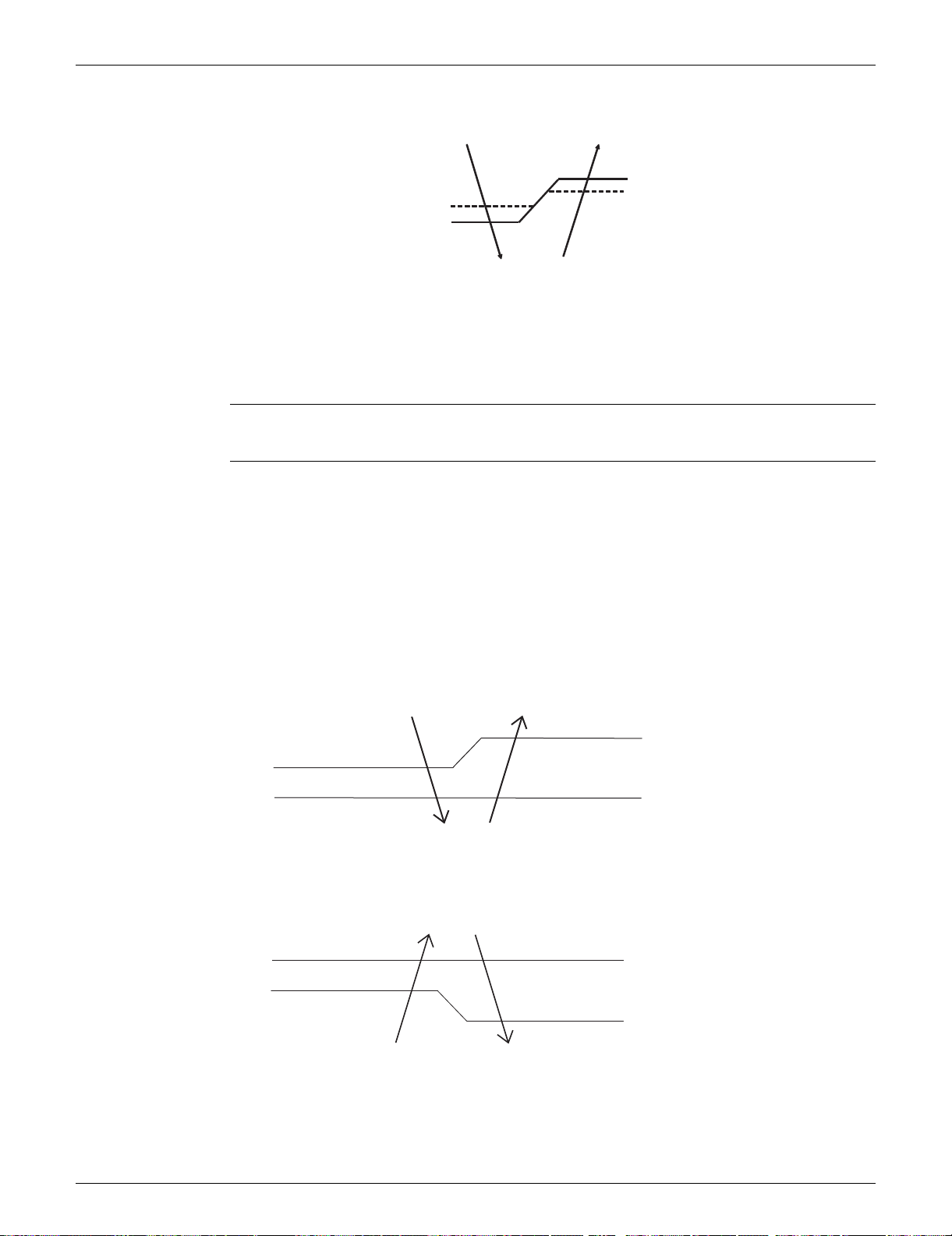
SiUS121827E RA Indoor Unit Functions
Part 4 Functions and Control 67
FDXS, CDXS, FVXS Series
Ex: When the target temperature is 25°C (77°F)
Cooling → 23°C (73.4°F): Thermostat OFF → 22°C (71.6°F): Switch to heating
Heating → 26.5°C (79.7°F): Thermostat OFF → 27.5°C (81.5°F): Switch to cooling
2.5 Thermostat Control
Outline Thermostat control is based on the difference between the room thermistor temperature and the
target temperature.
Details Thermostat OFF Conditions
The temperature difference is in the zone A.
Thermostat ON Conditions
The temperature difference returns to the zone C after being in the zone A.
The system resumes from defrost control in any zones except A.
The operation turns on in any zones except A.
The monitoring time has passed while the temperature difference is in the zone B.
(Cooling: 10 minutes, Heating: 10 seconds)
Cooling
Heating
FTXR, CTXG Series
Target temperature + 2.5°C (+4.5°F)
Heating Operation
Target temperature – 3.0°C (–5.4°F)
Cooling Operation
(R22000)
Target temperature – 2.0°C (–3.6°F)
= Thermostat OFF
Target temperature + 1.5°C (+2.7°F)
= Thermostat OFF
Zone BZone B
Zone AZone A
OFFOFF
ONON
Zone CZone C
Room thermistor temperature – target temperature
–1.0°C (–1.8°F)
–2.0°C (–3.6°F)
(R24031)
–0.5°C (–0.9°F)
–1.5°C (–2.7°F)
Zone BZone B
Zone AZone A
OFFOFF
ONON
Zone CZone C
1.5°C (2.7°F)
0.5°C (0.9°F)
0°C (0°F)
1.0°C (1.8°F)
Room ther
mistor temperature – target temper
ature
(R24032)

RA Indoor Unit Functions SiUS121827E
68 Part 4 Functions and Control
Reference
CTXS, FTXS Series
FDXS, CDXS, FVXS Series
Refer to Temperature Control on page 59 for details.
2.6 NIGHT SET Mode
Outline When the OFF TIMER is set, NIGHT SET mode is automatically activated. NIGHT SET mode
keeps the airflow rate setting.
Details NIGHT SET mode continues operation at the target temperature for the first one hour, then
automatically raises the target temperature slightly in the case of cooling, or lowers the target
temperature slightly in the case of heating. This prevents excessive cooling in summer and
excessive heating in winter to ensure comfortable sleeping conditions, and also conserves
electricity.
Cooling
Heating
Zone B
Zone B
Zone A
Zone A
OFF
OFF
ON
ON
Zone C
Zone C
2.0°C (3.6°F)
1.0°C (1.8°F)
0.5°C (0.9°F)
1.5°C (2.7°F)
2.0°C (3.6°F)
Room thermistor temperature – target temperature
(R24033)
Room thermistor temperature – target temperature
(R24034)
Zone BZone B
Zone AZone A
OFFOFF
ONON
Zone CZone C
1.5°C (2.7°F)
0°C (0°F)
1.0°C (1.8°F)
(R23917)
Target temperature
+0.5°C (+0.9°F)
temperature shift
Operation stops
at the set hour
0.5°C (0.9°F)
1 hour
TIMER operation
NIGHT SET Mode ON
Target temperature
–2°C (–3.6°F)
temperature shift
1 hour
2°C (3.6°F)
(R23918)
TIMER operation
NIGHT SET Mode ON
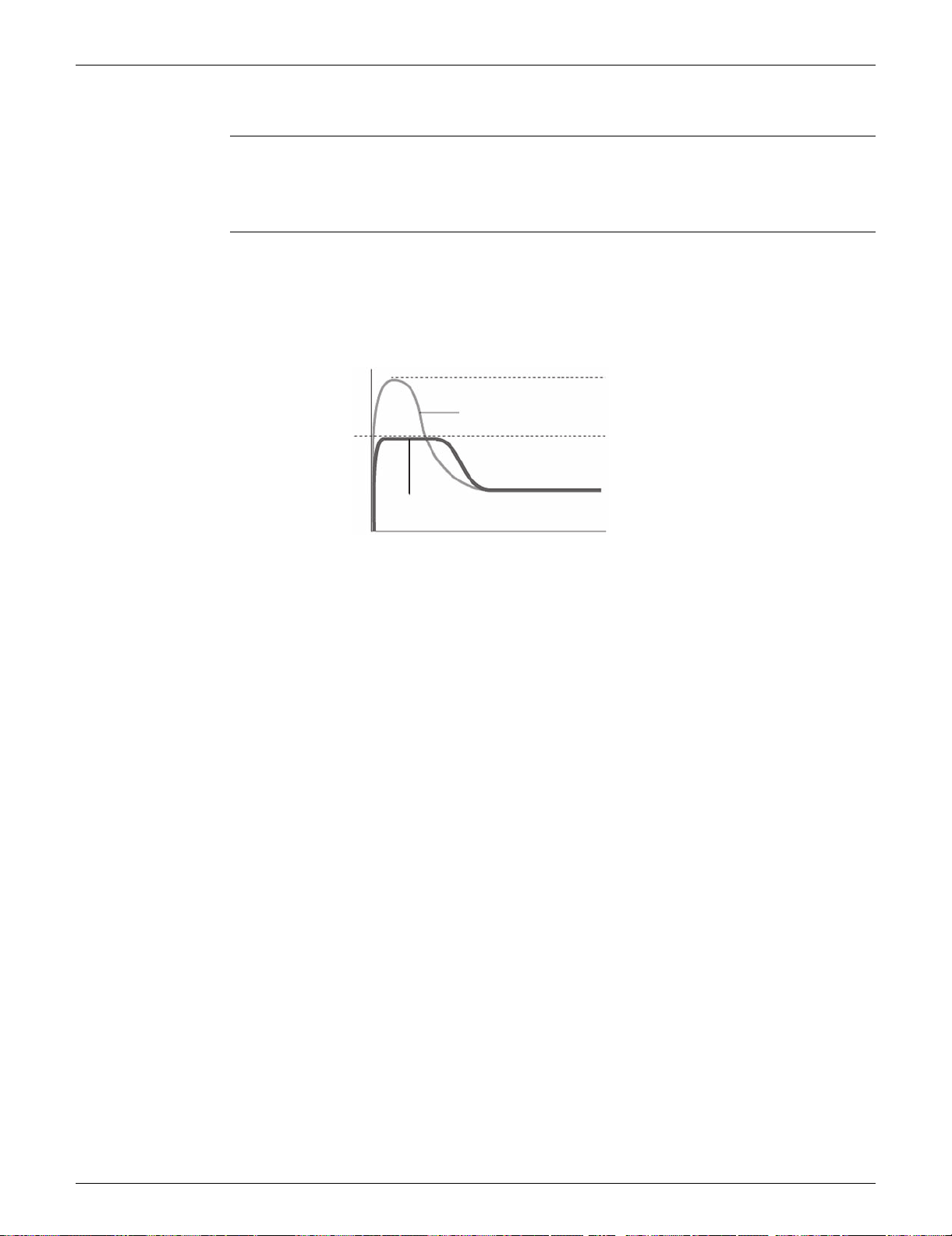
SiUS121827E RA Indoor Unit Functions
Part 4 Functions and Control 69
2.7 ECONO Operation
Outline ECONO operation reduces the maximum operating current and the power consumption.
This operation is particularly convenient for energy-saving. It is also a major bonus when breaker
capacity does not allow the use of multiple electrical devices and air conditioners.
It can be easily activated by pressing ECONO button on the wireless remote controller.
Details When this function is activated, the maximum capacity also decreases.
The remote controller can send the ECONO command when the unit is in cooling, heating, dry,
or automatic operation. This function can only be set when the unit is running. Pressing ON/OFF
button on the remote controller cancels the function.
This function and POWERFUL operation cannot be used at the same time. The latest command
has the priority.
ECONO operation
(R22012)
Normal operation
Maximum during normal operation
Maximum during ECONO operation
Time
Power
consumption
and current
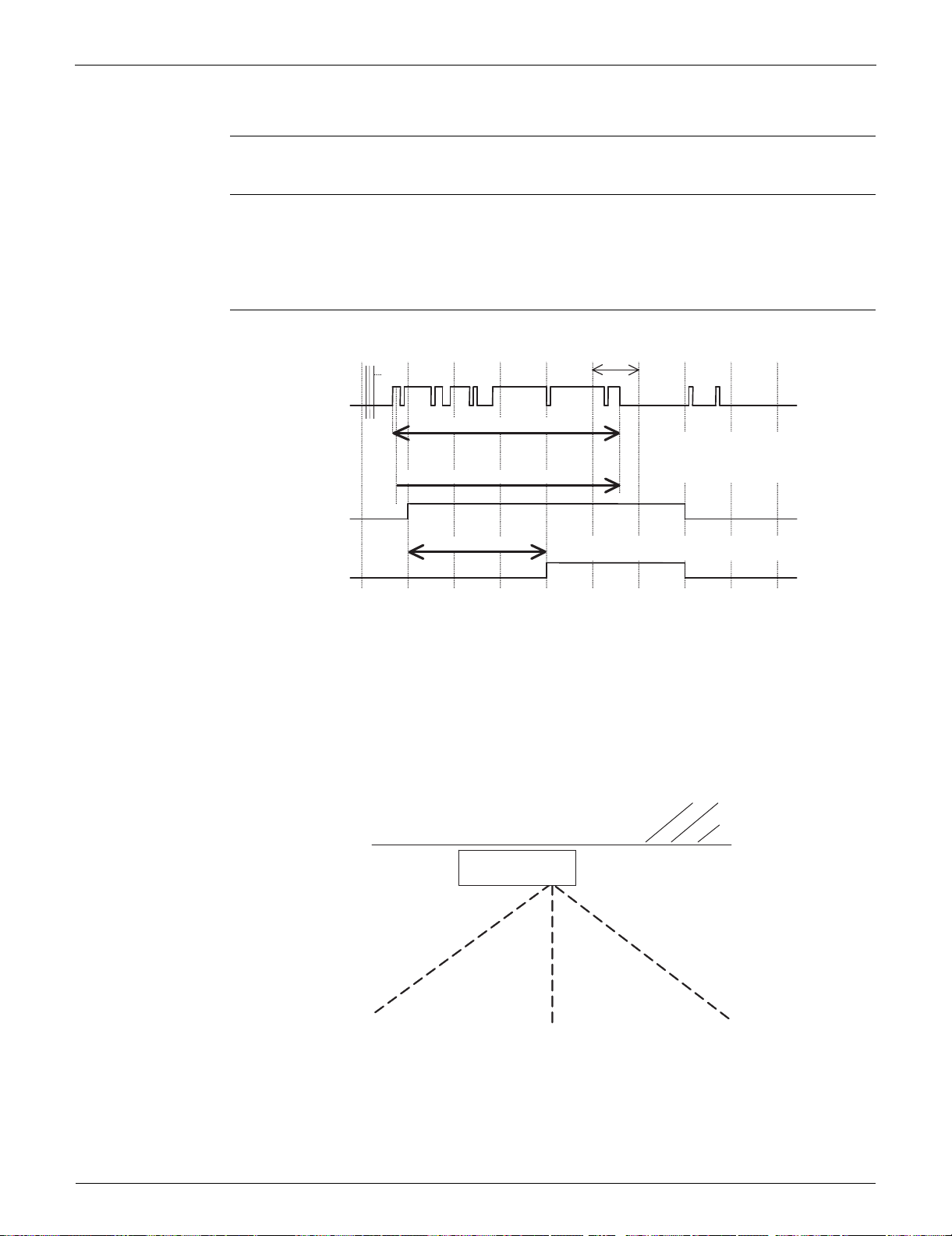
RA Indoor Unit Functions SiUS121827E
70 Part 4 Functions and Control
2.8 2-Area INTELLIGENT EYE Operation
Applicable
Models
FTXR09/12/18TVJUW(S)
CTXG09/12/18QVJUW(S)
Outline The following functions can be performed by the microcomputer and a motion sensor.
1. Reduction of the capacity when there is nobody in the room in order to save electricity (energy
saving operation)
2. Dividing the room into plural areas and detecting presence of humans in each area. Moving the
airflow direction to the area with no human automatically to avoid direct airflow on humans.
Details 1. INTELLIGENT EYE detection method
The motion sensor detects human motion by receiving infrared rays and sends the pulse wave
output.
The microcomputer in the indoor unit carries out a sampling every 20 msec. If the motion sensor
detects 10 times or more of the wave output in one second in total, and the High signal
continues for 3 sec., the microcomputer judges humans are in the room as the human detection
signal is ON.
2-area INTELLIGENT EYE motion sensor divides the area into 2 and detects presence of
humans in each area.
Image of 2-area INTELLIGENT EYE
1 sec.
Sampling (20 msec.)
High
Low
ON
OFF
High
Low
(R24035)
(Condition of 10 times or more output)
Human motion
3 sec.
If the detection signal (High) continues for 3 sec. or more,
the microcomputer judges humans are in the room.
Detection signal
from the motion
sensor
Human detection
signal
Motion sensor
output
If the motion sensor detects the outputs
10 times/sec. or more, the microcomputer
judges the detection signal from the
motion sensor is High.
Top view
(R22951)
Indoor unit
Wall
Area AArea B
A microcomputer judges human presence by
the human detection signal from each area A and B.
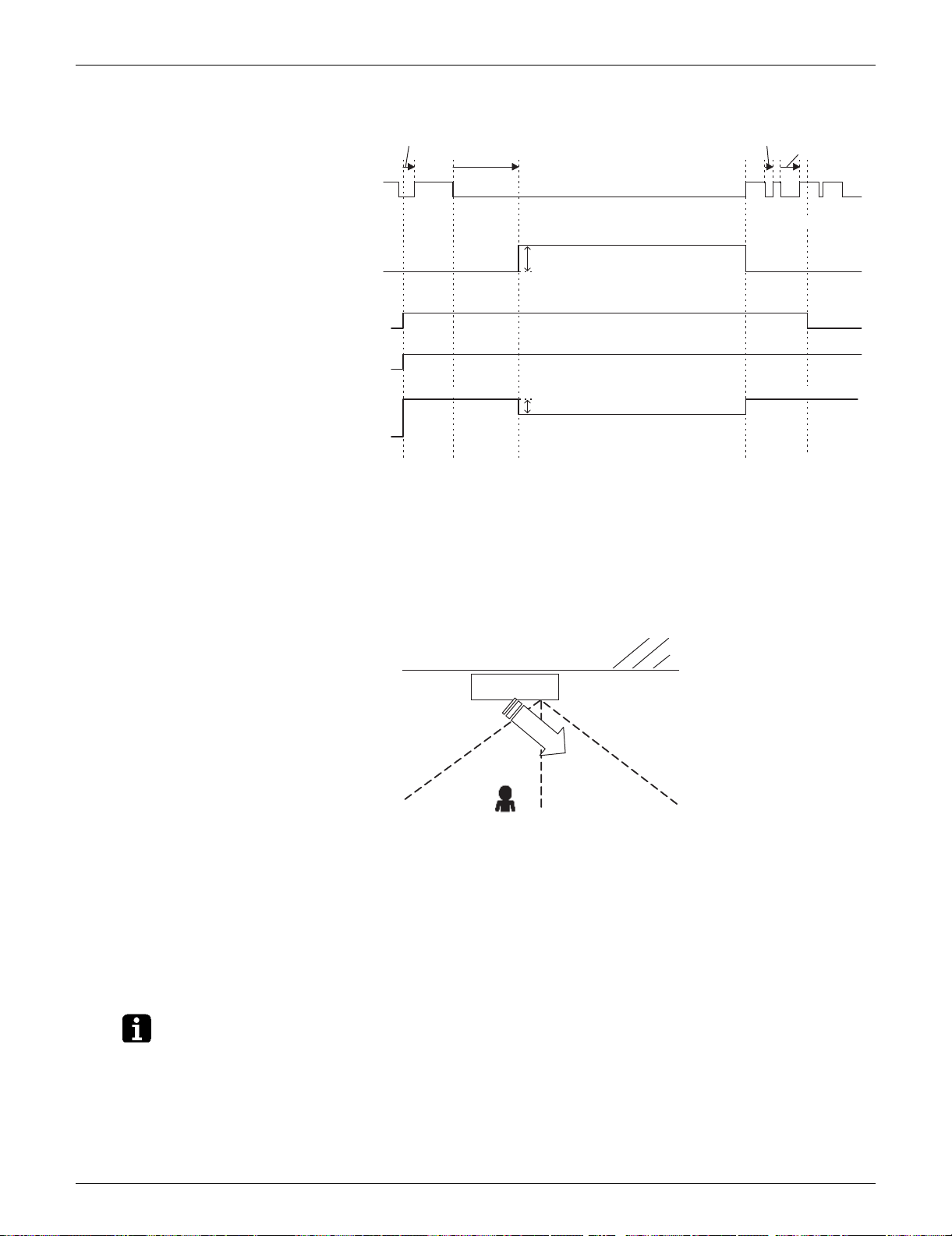
SiUS121827E RA Indoor Unit Functions
Part 4 Functions and Control 71
Note(s)
2. Motions (in cooling)
In FAN operation, the fan speed is reduced by 60 rpm when no one is in the area.
When there is no signal from the motion sensor in 20 minutes, the microcomputer judges that
nobody is in the room and operates the unit at a temperature shifted from the target
temperature. (Cooling/Dry: 1 ~ 2°C (1.8 ~ 3.6°F) higher, Heating: 2°C (3.6°F) lower, Auto:
according to the operation mode at that time)
3. Airflow direction in 2-area INTELLIGENT EYE operation
Detection method: The opposite area of detected area is set as the target direction.
1. Human detection signal ON in both areas A and B: Shift the airflow direction to area B (left side)
2. Human detection signal ON in area A: Shift the airflow direction to area B (left side)
3. Human detection signal ON in area B: Shift the airflow direction to area A (right side)
4. Human detection signal OFF in both areas A and B: No change
∗ When the human detection signal is OFF for 20 minutes in both areas A and B, the unit starts
energy saving operation.
For dry operation, the temperature cannot be set with a remote controller, but the target
temperature is shifted internally.
ON
OFF
Reset Reset Reset
20 min.
1 ~ 2°C (1.8 ~ 3.6 °F)
ON
OFF
ON
OFF
Operation
OFF
Fan speed (#)
Set speed Set speed
Target temperature
(R23920)
Remote controller
Sensor button
Human detection
signal
↑↑
60 rpm
↑
within
20 min.
within
20 min.
within
20 min.
Top view
Wall
Indoor unit
Area A
Area B
Left
Right
Human
(R3853)

RA Indoor Unit Functions SiUS121827E
72 Part 4 Functions and Control
2.9 INTELLIGENT EYE Operation
Applicable
Models
CTXS07LVJU
FTXS09/12/15/18/24LVJU
Outline The microcomputer detects the presence of humans in the room with a motion sensor and reduces
the capacity when there is nobody in the room in order to save electricity.
Details 1. INTELLIGENT EYE detection method
The motion sensor detects human motion by receiving infrared rays and sends the pulse wave
output.
The microcomputer in the indoor unit carries out a sampling every 20 msec. If the motion sensor
detects 10 times or more of the wave output in one second in total, and the High signal
continues for 3 sec., the microcomputer judges humans are in the room as the human detection
signal is ON.
2. Motions (in cooling)
In FAN operation, the fan speed is reduced by 60 rpm when no one is in the area.
When there is no signal from the motion sensor in 20 minutes, the microcomputer judges that
nobody is in the room and operates the unit at a temperature shifted from the target
temperature. (Cooling/Dry: 1 ~ 2°C (1.8 ~ 3.6°F) higher, Heating: 2°C (3.6°F) lower, Auto:
according to the operation mode at that time)
1 sec.
Sampling (20 msec.)
High
Low
ON
OFF
High
Low
(R24035)
(Condition of 10 times or more output)
Human motion
3 sec.
If the detection signal (High) continues for 3 sec. or more,
the microcomputer judges humans are in the room.
Detection signal
from the motion
sensor
Human detection
signal
Motion sensor
output
If the motion sensor detects the outputs
10 times/sec. or more, the microcomputer
judges the detection signal from the
motion sensor is High.
ON
OFF
Reset Reset Reset
20 min.
1 ~ 2°C (1.8 ~ 3.6 °F)
ON
OFF
ON
OFF
Operation
OFF
Fan speed (#)
Set speed Set speed
Target temperature
(R23920)
Remote controller
Sensor button
Human detection
signal
↑↑
60 rpm
↑
within
20 min.
within
20 min.
within
20 min.
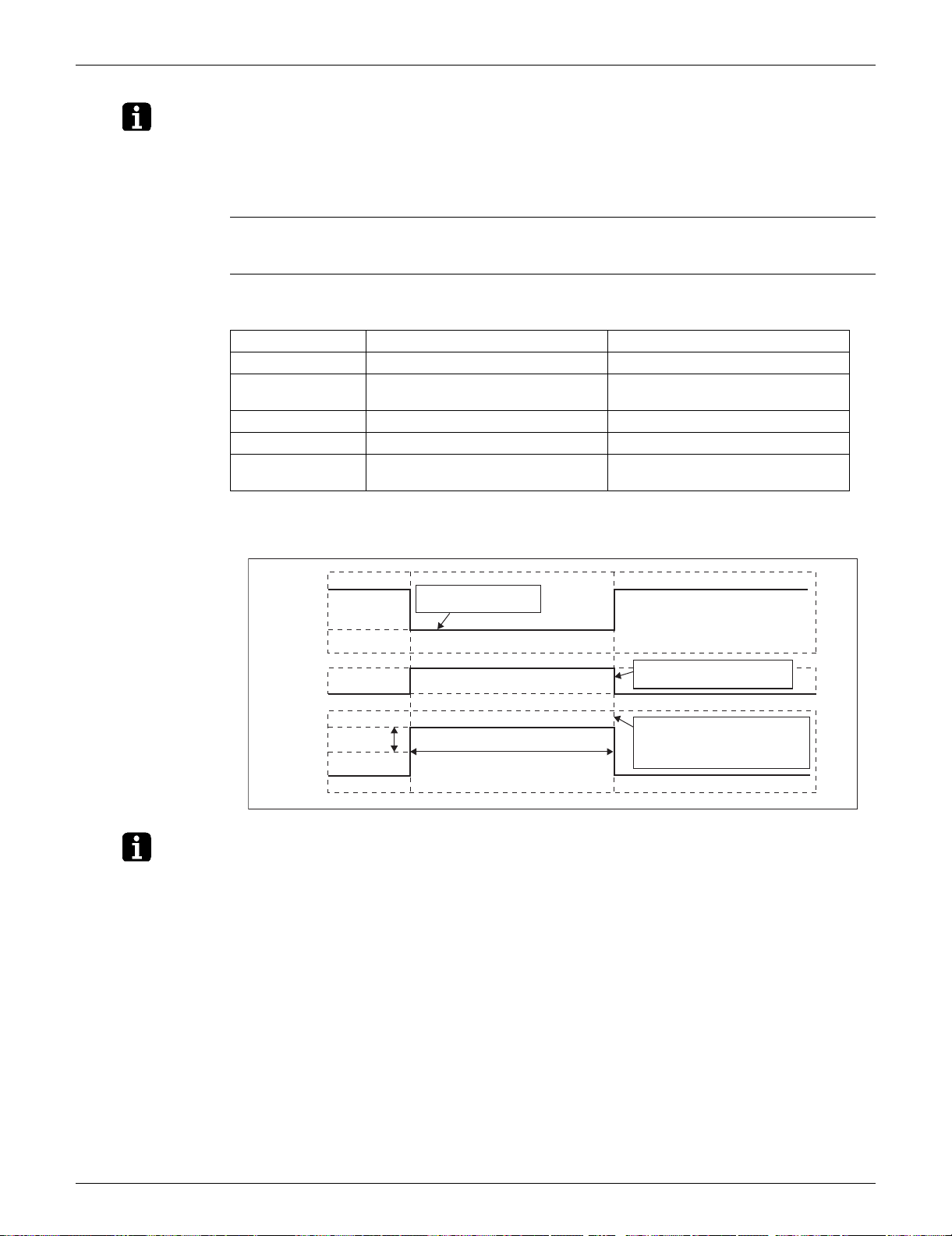
SiUS121827E RA Indoor Unit Functions
Part 4 Functions and Control 73
Note(s)
Note(s)
For dry operation, the temperature cannot be set with a remote controller, but the target
temperature is shifted internally.
2.10 POWERFUL Operation
Outline In order to exploit the cooling and heating capacity to full extent, the air conditioner can be operated
by increasing the indoor fan rotating speed and the compressor frequency.
Details When POWERFUL button is pressed, the fan speed and target temperature are converted to the
following states for 20 minutes.
A = 50 ~ 90 rpm (depending on the model)
Ex: POWERFUL operation in cooling
During POWERFUL operation, the cooling/heating efficiency of the other rooms may be slightly
reduced.
POWERFUL operation cannot be used together with ECONO, COMFORT AIRFLOW or
OUTDOOR UNIT QUIET operation.
Operation mode Fan speed Target temperature
COOL H tap + A rpm 18°C (64.4°F)
DRY
Dry rotating speed + A rpm
Lowered by 2 ~ 2.5°C
(3.6 ~ 4.5°F)
HEAT H tap + A rpm 30 ~ 31.5°C (86 ~ 88.7°F)
FAN H tap + A rpm —
AUTO Same as cooling/heating in
POWERFUL operation
The target temperature is kept
unchanged.
(R24589)
Target temp.
Fan
A rpm
H tap
Set tap
20 minutes
Lower limit of cooling
temperature
Remote controller registers
20 minutes independently.
POWERFUL
ON
POWERFUL
OFF
Ending conditions:
1. Lapse of 20 minutes
2. System operation OFF
3. POWERFUL operation OFF
18°C (64.4°F)
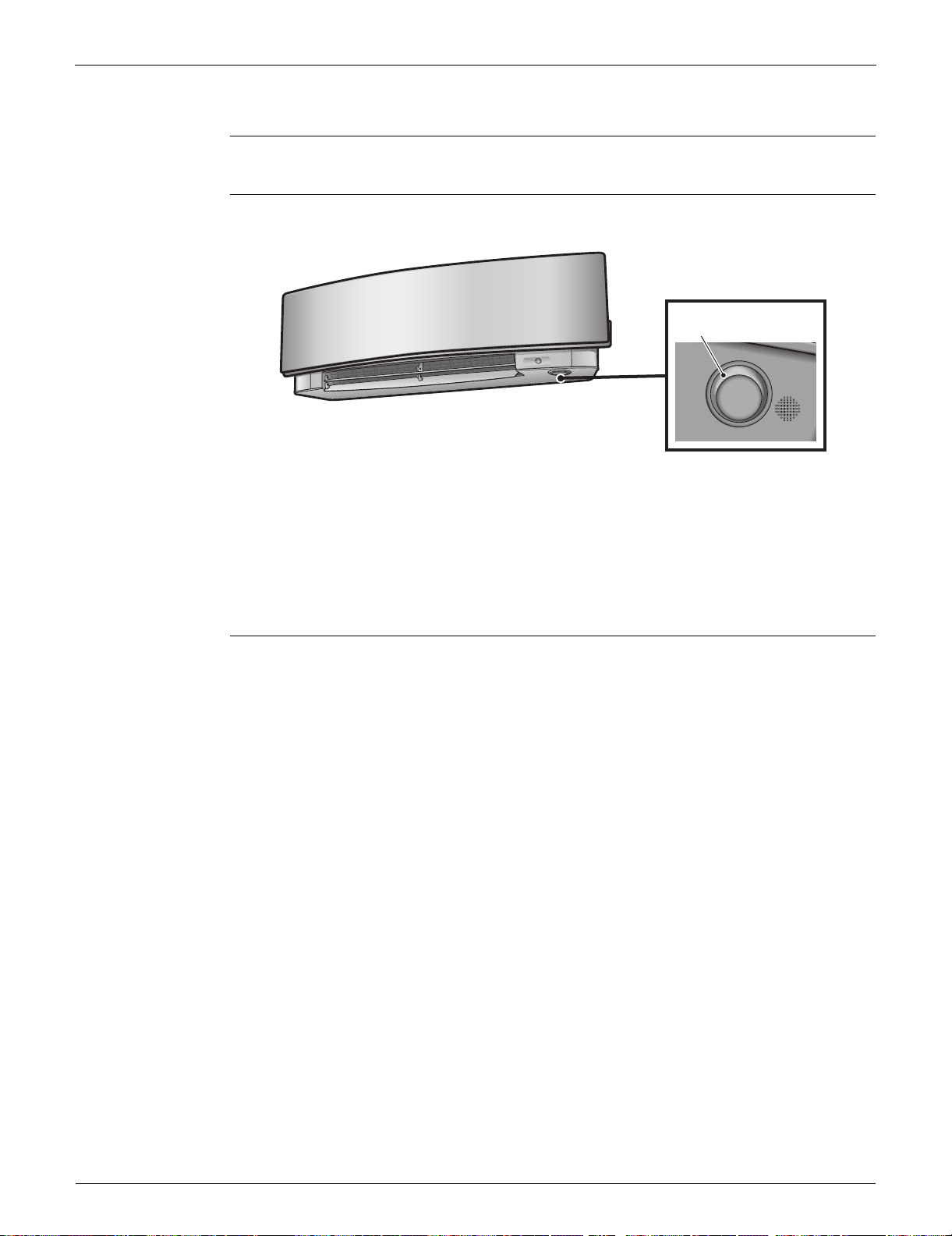
RA Indoor Unit Functions SiUS121827E
74 Part 4 Functions and Control
2.11 Multi-Monitor Lamp/TIMER Lamp
Applicable
Models
FTXR09/12/18TVJUW(S)
CTXG09/12/18QVJUW(S)
Features Current operation mode is displayed in color of the lamp of the indoor unit. Operating status can be
monitored even in automatic operation in accordance with the actual operation mode.
The lamp color changes according to the operation.
∗ AUTO..................................................Red/Blue
∗ DRY....................................................Green
∗ COOL..................................................Blue
∗ HEAT...................................................Red
∗ FAN.....................................................White
∗ TIMER.................................................Orange
Brightness
Setting
Each time Brightness button on the remote controller is pressed, the brightness of the multi-
monitor lamp changes to high, low, or off.
Multi-monitor lamp/
TIMER lamp
(R19925)
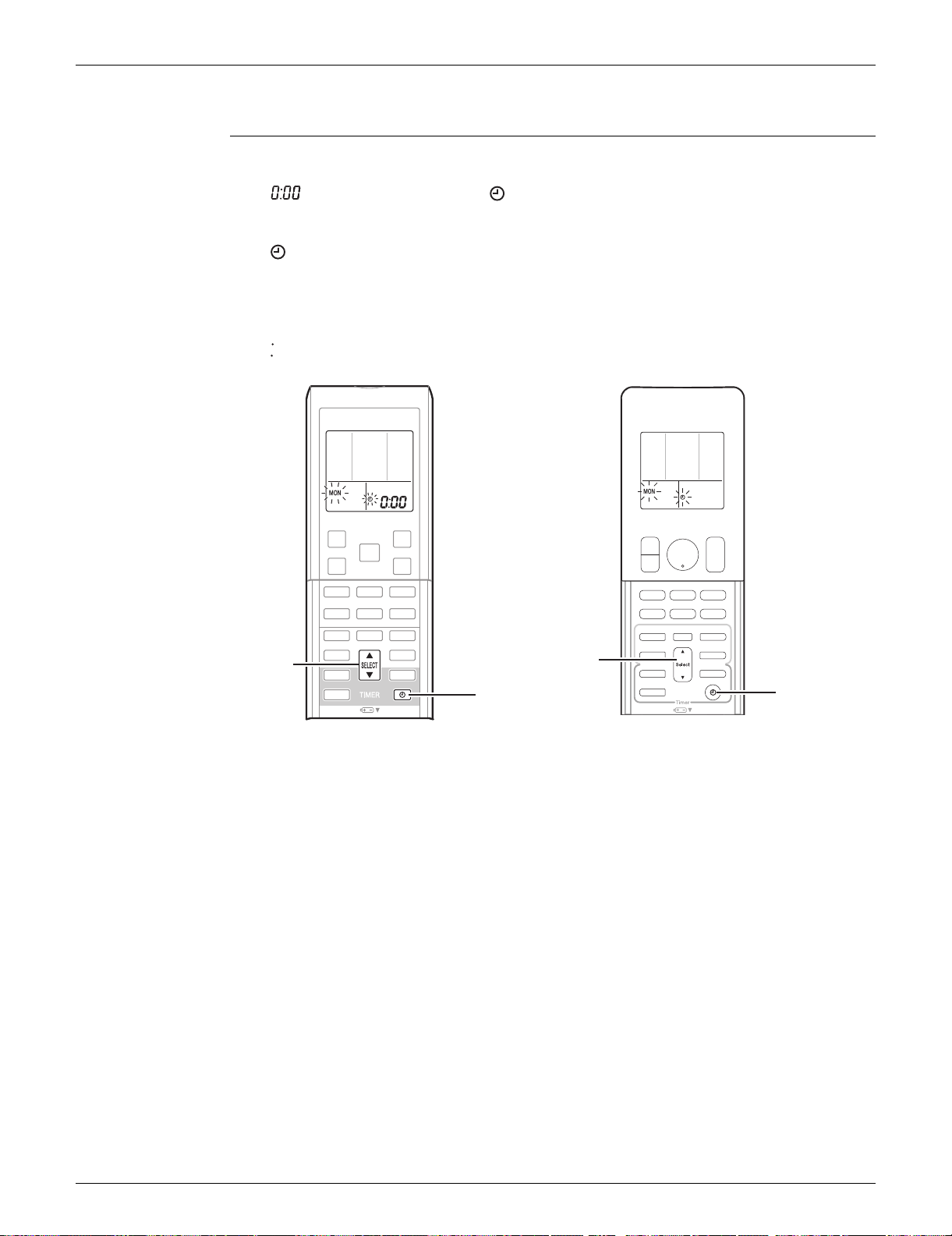
SiUS121827E RA Indoor Unit Functions
Part 4 Functions and Control 75
2.12 Clock Setting
ARC452 Series
ARC466 Series
The clock can be set by taking the following steps:
1. Press CLOCK button.
→ is displayed, then MON and blink.
2. Press SELECT or SELECT button to set the clock to the current day of the week.
3. Press CLOCK button.
→ blinks.
4. Press SELECT or SELECT button to set the clock to the present time.
Holding down SELECT or SELECT button rapidly increases or decreases the time display.
5. Press CLOCK button to set the clock. Point the remote controller at the indoor unit when
pressing the button.
→ blinks and clock setting is completed.
(R18281)
SELECT
button
CLOCK
button
< ARC452 Series >
0:00
Select
button
Clock
button
(R19926)
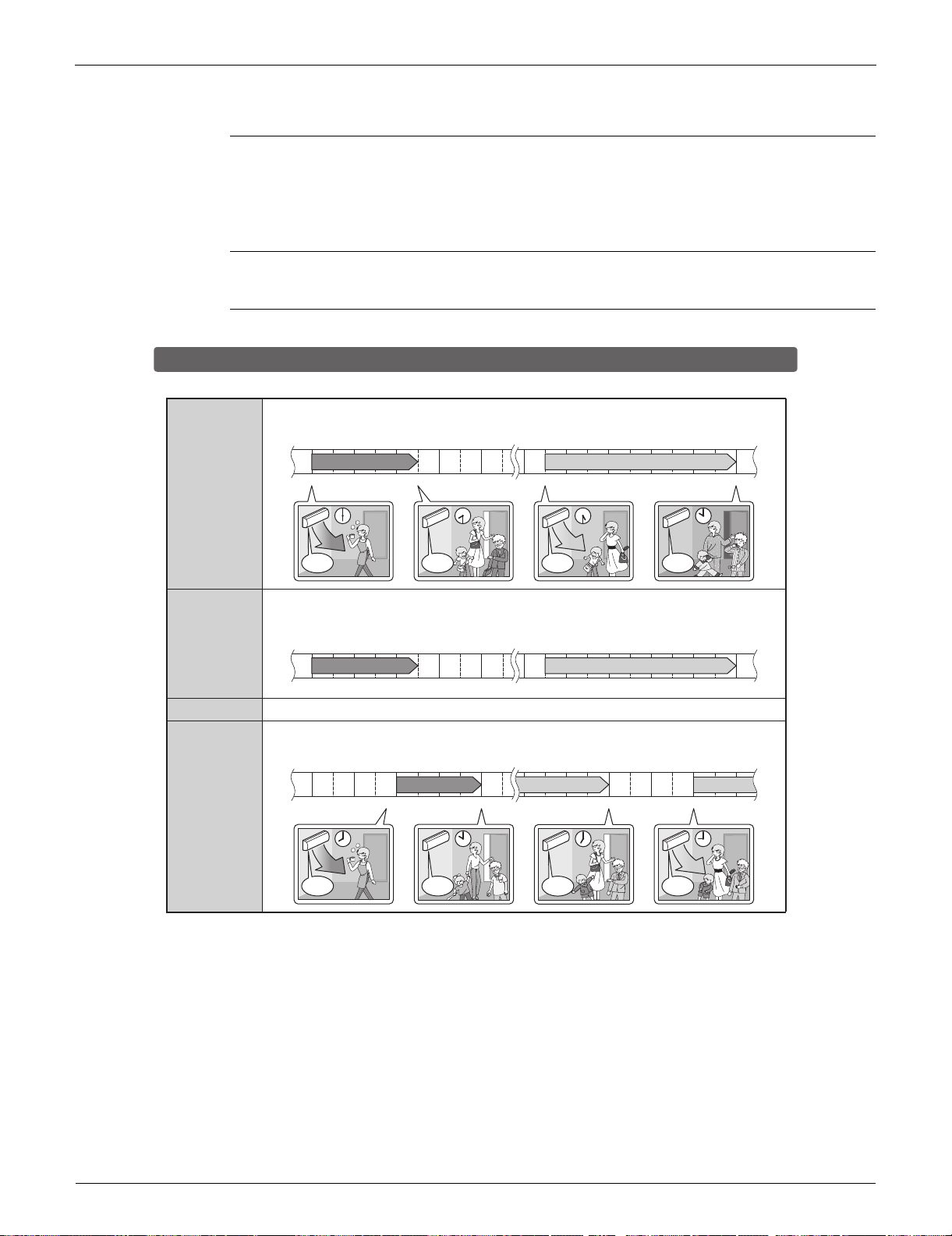
RA Indoor Unit Functions SiUS121827E
76 Part 4 Functions and Control
2.13 WEEKLY TIMER Operation
Applicable
Models
FTXR09/12/18TVJUW(S)
CTXG09/12/18QVJUW(S)
CTXS07LVJU
FTXS09/12/15/18/24LVJU
FVXS09/12/15/18NVJU
Outline Up to 4 timer settings can be saved for each day of the week (up to 28 settings in total).
The 3 items: ON/OFF, temperature, and time can be set.
Details The illustrations are for FTXR and CTXG series as representative.
R4003381
[Monday]
1-4.
6:00 8:30 17:30 22:00
77°F (25°C) 81°F (27°C)
ON ON OFFOFF
ON OFF ON OFF
6:00 8:30 17:30 22:00
77°F (25°C) 81°F (27°C)
ON OFF ON OFF
1-4.
8:00 10:00 19:00 21:00
81°F (27°C)
81°F (27°C)
77°F (25°C)
ON
ON
OFF
OFF
ON OFF OFF ON
Setting example of the WEEKLY TIMER
The same timer settings are used from Monday through Friday, while different timer settings are used for the weekend.
Make timer settings for programs
[Tuesday]
to
[Friday]
[Saturday]
[Sunday]
Program 1
Program 2
Program 3
Program 4
Use the copy mode to make settings for Tuesday to Friday, because these settings are the same as
those for Monday.
Program 1
Program 2
Program 3
Program 4
No timer settings
Make timer settings for programs
Program 1
Program 2
Program 3
Program 4
• Up to 4 reservations per day and 28 reservations per week can be set using the WEEKLY TIMER. The effective use of the
copy mode simplifies timer programming.
• The use of ON-ON-ON-ON settings, for example, makes it possible to schedule operating mode and set temperature
changes. Furthermore, by using OFF-OFF-OFF-OFF settings, only the turn off time of each day can be set. This will turn off
the air conditioner automatically if you forget to turn it off.
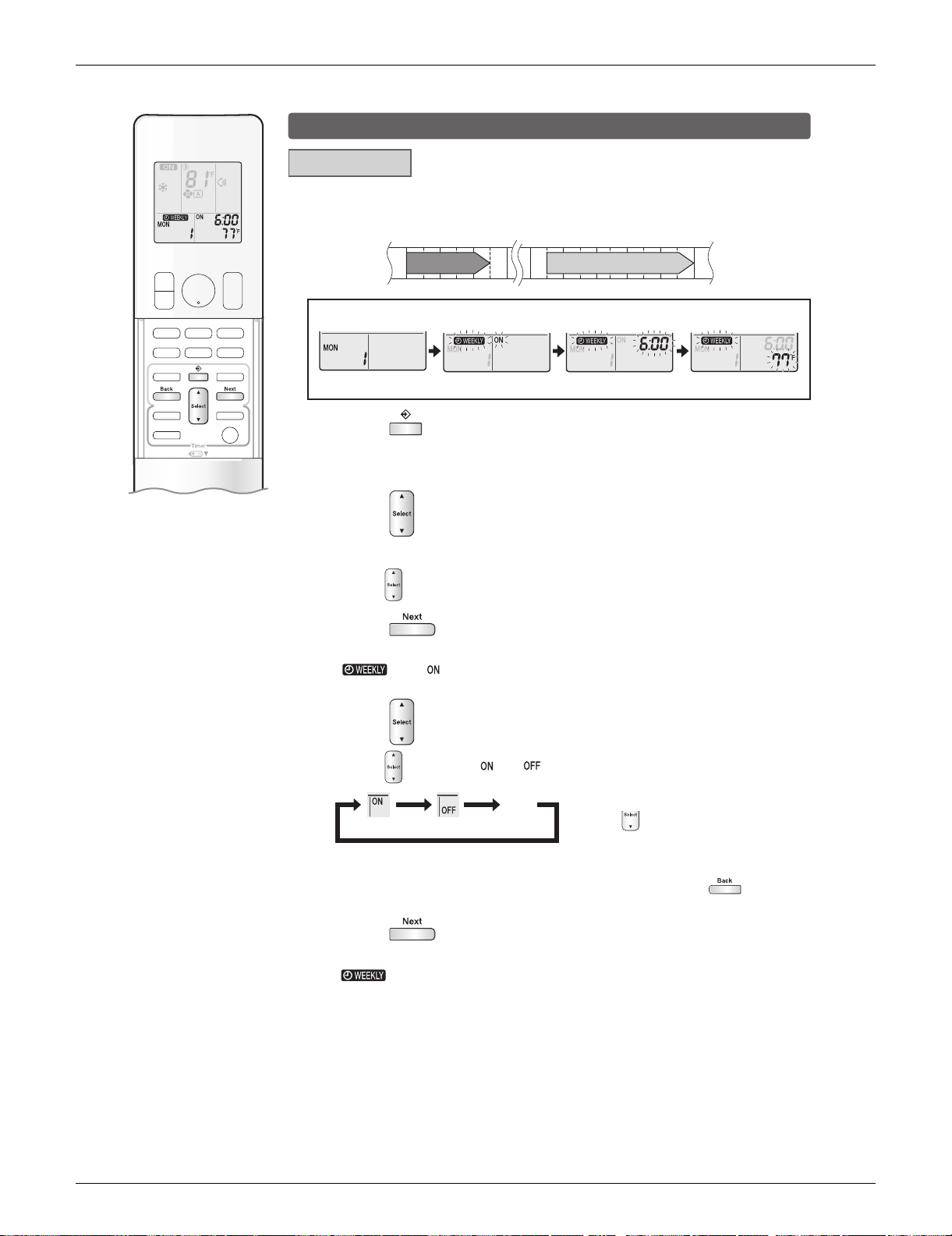
SiUS121827E RA Indoor Unit Functions
Part 4 Functions and Control 77
R4003382
To use WEEKLY TIMER operation
Setting mode
• Make sure the day of the week and time are set.
If not, set the day of the week and time.
6:00 8:30 17:30 22:00
77°F (25°C)
81°F (27°C)
program 1 program 2 program 3 program 4
ON OFF ON OFF
[Monday]
Setting Displays
Day and number ON/OFF Time Temperature
1.
Press .
• The day of the week and the reservation number of the current day will be displayed.
• 1 to 4 settings can be made per day.
• Pressing changes the reservation number and the day of the week.
3.
Press .
• The day of the week and reservation number will be set.
• “ ” and “ ” blink.
4.
Press to select the desired mode.
• Pressing changes the “ ” or “ ” setting in sequence.
ON TIMER OFF TIMER
blank
No Setting
Pressing puts the sequence in reverse.
5.
Press .
2.
Press to select the desired day of the week
and reservation number.
• In case the reservation has already been set, selecting “ blank ” deletes the reservation.
• Proceed to STEP
9 if “ blank ” is selected.
• To return to the day of the week and reservation number setting, press .
• The ON/OFF TIMER mode will be set.
• “ ” and the time blink.
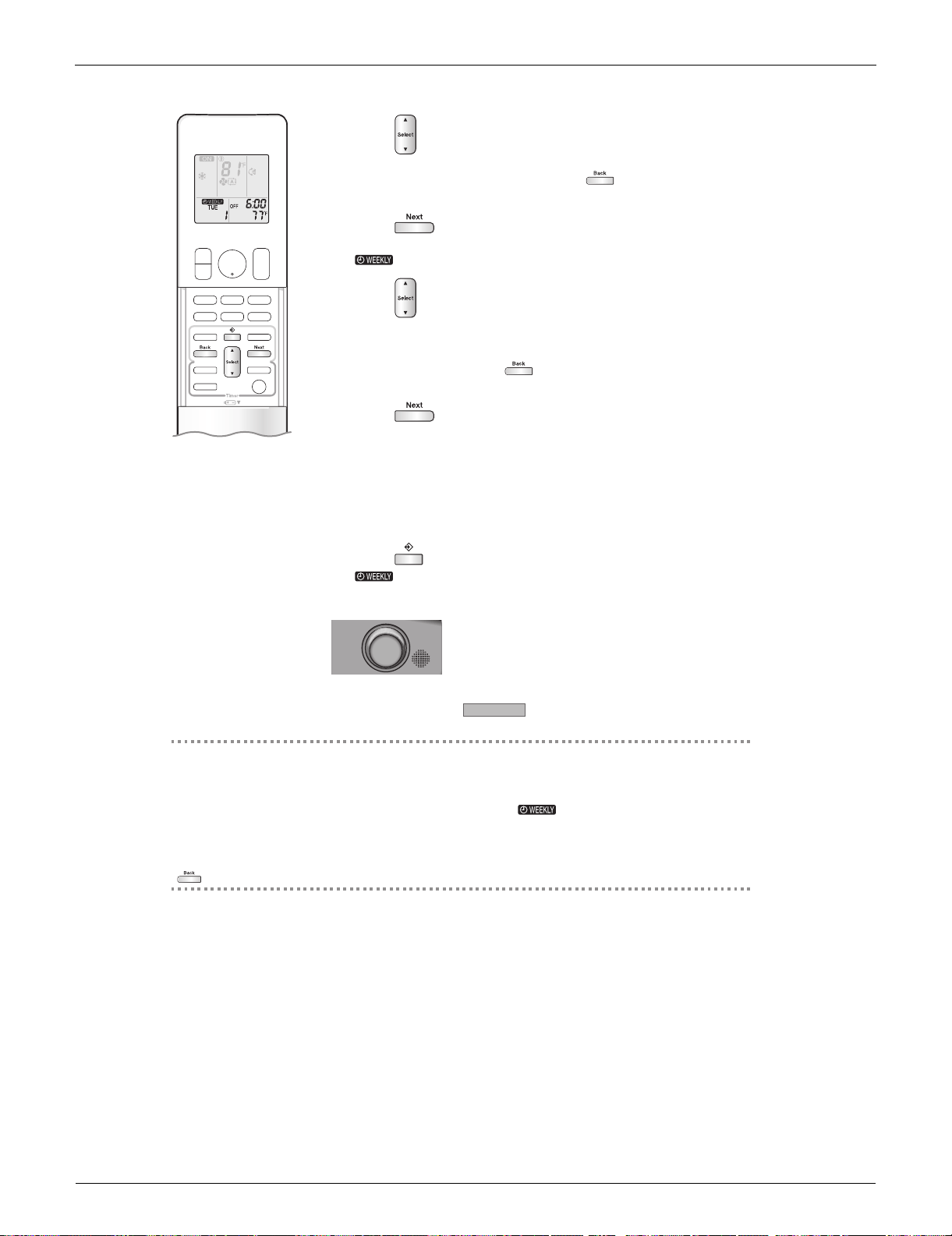
RA Indoor Unit Functions SiUS121827E
78 Part 4 Functions and Control
R4003383
6. Press to select the desired time.
7. Press .
8. Press to select the desired temperature.
9. Press .
10
. Press to complete the setting.
Display
NOTE
• The time can be set between 0:00 and 23:50 in 10-minute intervals.
• To return to the ON/OFF TIMER mode setting, press .
• Proceed to STEP
9
when setting the OFF TIMER.
• The time will be set.
• “ ” and the temperature blink.
• The temperature can be set between 50°F (10°C) and 90°F (32°C).
COOL or AUTO: The unit operates at 64°F (18°C) even if it is set at 50°F (10°C) to 63°F (17°C).
HEAT or AUTO : The unit operates at 86°F (30°C) even if it is set at 87°F (31°C) to 90°F (32°C).
• To return to the time setting, press .
• The set temperature is only displayed when the mode setting is on.
• Be sure to direct the remote controller toward the indoor unit and check for a receiving
tone and blinking of the multi-monitor lamp.
• The multi-monitor lamp blinks twice.
• The temperature will be set and go to the next reservation.
• Temperature and time are set in the case of ON TIMER operation, and the time is set in
the case of OFF TIMER operation.
• The next reservation screen will appear.
• To continue further settings, repeat the procedure from STEP
4
.
• “ ” is displayed on the LCD and WEEKLY TIMER operation is activated.
• The TIMER lamp periodically lights orange.
The multi-monitor lamp will not light orange if all the reservation settings are deleted.
• A reservation made once can be easily copied and the same settings used for another
day of the week. Refer to Copy mode .
Notes on WEEKLY TIMER operation
• Do not forget to set the clock on the remote controller first.
• The day of the week, ON/OFF TIMER mode, time and set temperature (only for ON TIMER mode) can be set with the WEEKLY TIMER.
Other settings for the ON TIMER are based on the settings just before the operation.
• WEEKLY TIMER and ON/OFF TIMER operation cannot be used at the same time. The ON/OFF TIMER operation has priority if it is set while
WEEKLY TIMER is still active. The WEEKLY TIMER will enter the standby state, and “ ” will disappear from the LCD. When the ON/
OFF TIMER is up, the WEEKLY TIMER will automatically become active.
• Only the time and temperature can be set with the WEEKLY TIMER. Set the WEEKLY TIMER only after setting the operation mode, the airflow
rate and the airflow direction ahead of time.
• Turning off the circuit breaker, power failure, and other similar events will render operation of the indoor unit’s internal clock inaccurate. Reset
the clock.
• can be used only for the time and temperature settings. It cannot be used to go back to the reservation number.
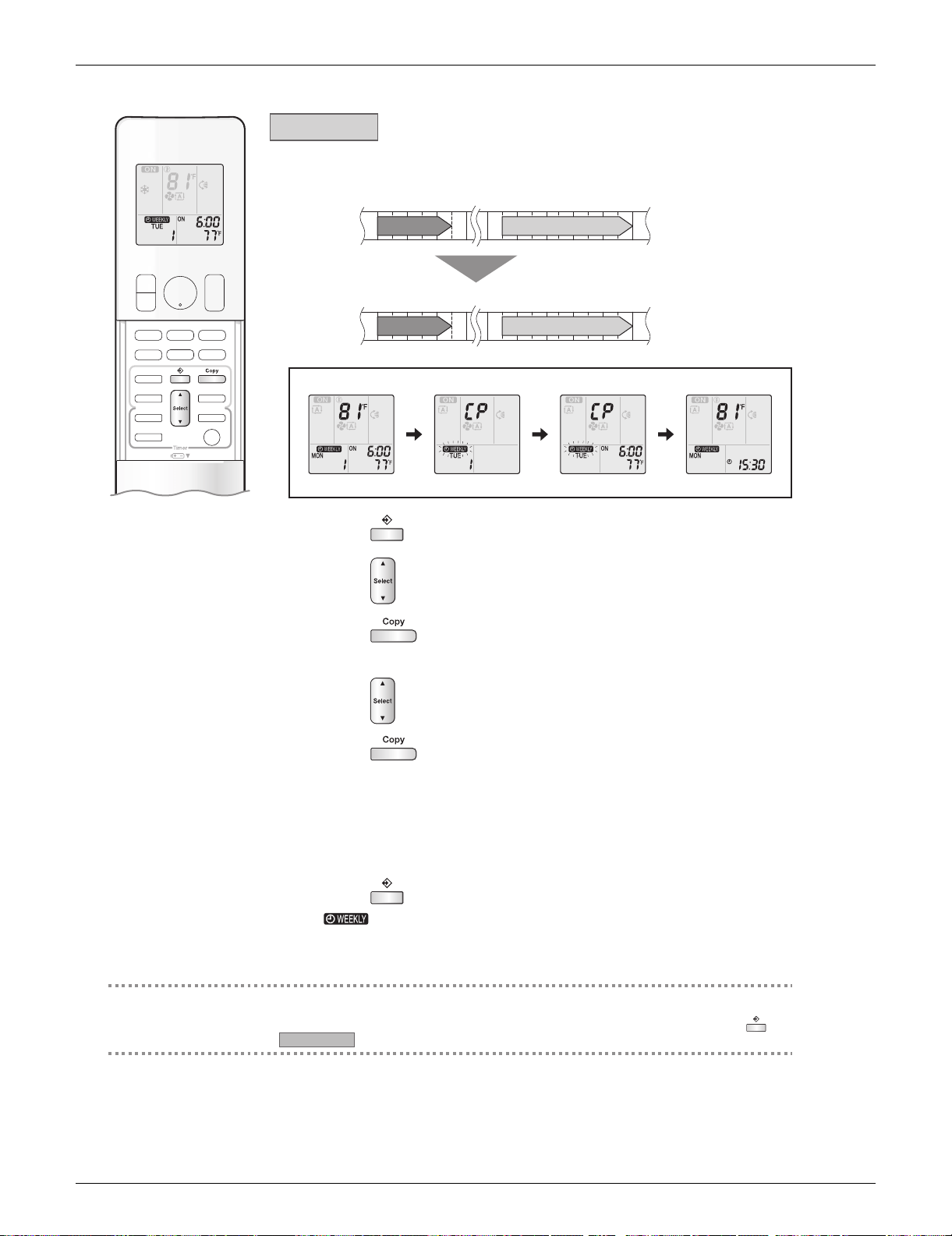
SiUS121827E RA Indoor Unit Functions
Part 4 Functions and Control 79
R4003384
Copy mode
6:00 8:30 17:30 22:00
77°F (25°C)
81°F (27°C)
6:00 8:30 17:30 22:00
77°F (25°C)
81°F (27°C)
COPY
program 1 program 2 program 3 program 4
ON OFF ON OFF
[Monday]
program 1 program 2 program 3 program 4
ON OFF ON OFF
Setting Displays
Confirmation Copy Paste Normal
1. Press .
2. Press to confirm the day of the week to be copied.
3. Press .
4. Press to select the destination day of the week.
5. Press .
6. Press to complete the setting.
NOTE
[Tuesday]
to
[Friday]
• A reservation made once can be copied to another day of the week. The whole reservation of
the selected day of the week will be copied.
• The whole reservation of the selected day of the week will be copied.
• Be sure to direct the remote controller toward the indoor unit and check for a receiving
tone and blinking of the multi-monitor lamp.
• The multi-monitor lamp blinks twice.
• The reservation will be copied to the selected day of the week. The whole reservation of
the selected day of the week will be copied.
• To continue copying the settings to other days of the week, repeat STEP
4 and STEP 5.
• “ ” is displayed on the LCD and WEEKLY TIMER operation is activated.
• The TIMER lamp periodically lights orange.
Note on COPY MODE
• The entire reservation of the source day of the week is copied in the copy mode.
In the case of making a reservation change for any day of the week individually after copying the content of weekly reservations, press and
change the settings in the steps of
Setting mode .
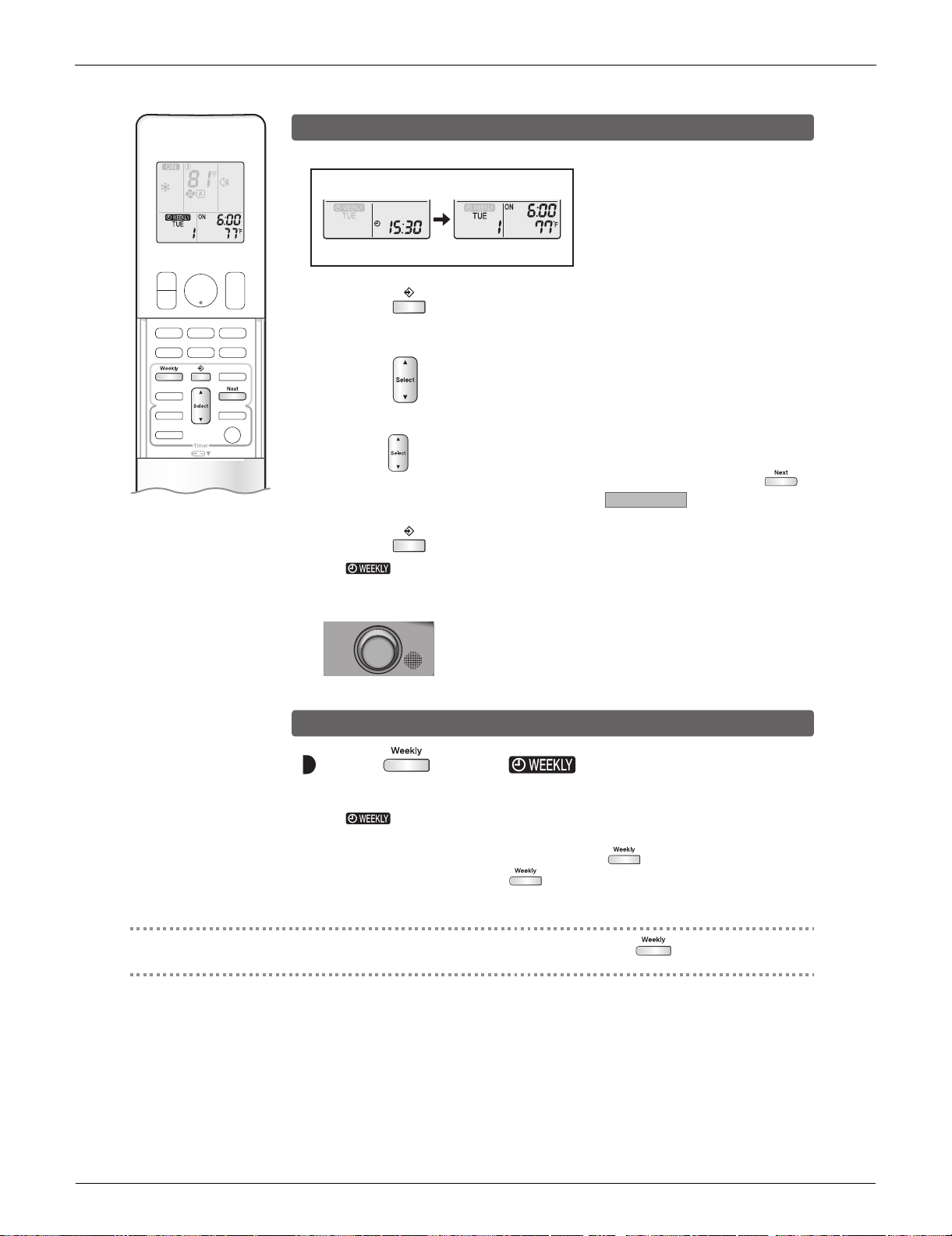
RA Indoor Unit Functions SiUS121827E
80 Part 4 Functions and Control
R4003385
Confirming a reservation
Setting Displays
Normal Confirmation
1. Press .
3. Press to exit the confirmation mode.
Display
To deactivate WEEKLY TIMER operation
NOTE
2.
• The reservation can be confirmed.
• The day of the week and the reservation number of the current day will be displayed.
• Pressing displays the reservation details.
•
To change the confirmed reserved settings, select the reservation number and press .
The mode is switched to setting mode. Proceed to Setting mode STEP 4.
• “ ” is displayed on the LCD and WEEKLY TIMER operation is activated.
• The TIMER lamp periodically lights orange.
The multi-monitor lamp will not light orange if all the reservation settings are deleted.
• “ ” disappears from the LCD.
• The TIMER lamp goes off.
• To reactivate the WEEKLY TIMER operation, press again.
• If a reservation deactivated with is activated once again, the last reservation mode
will be used.
Press to select the day of the week and the
reservation number to be confirmed.
Press while “
” is displayed on the
LCD.
• If not all the reservation settings are reflected, deactivate the WEEKLY TIMER operation once. Then press again to reactivate the
WEEKLY TIMER operation.
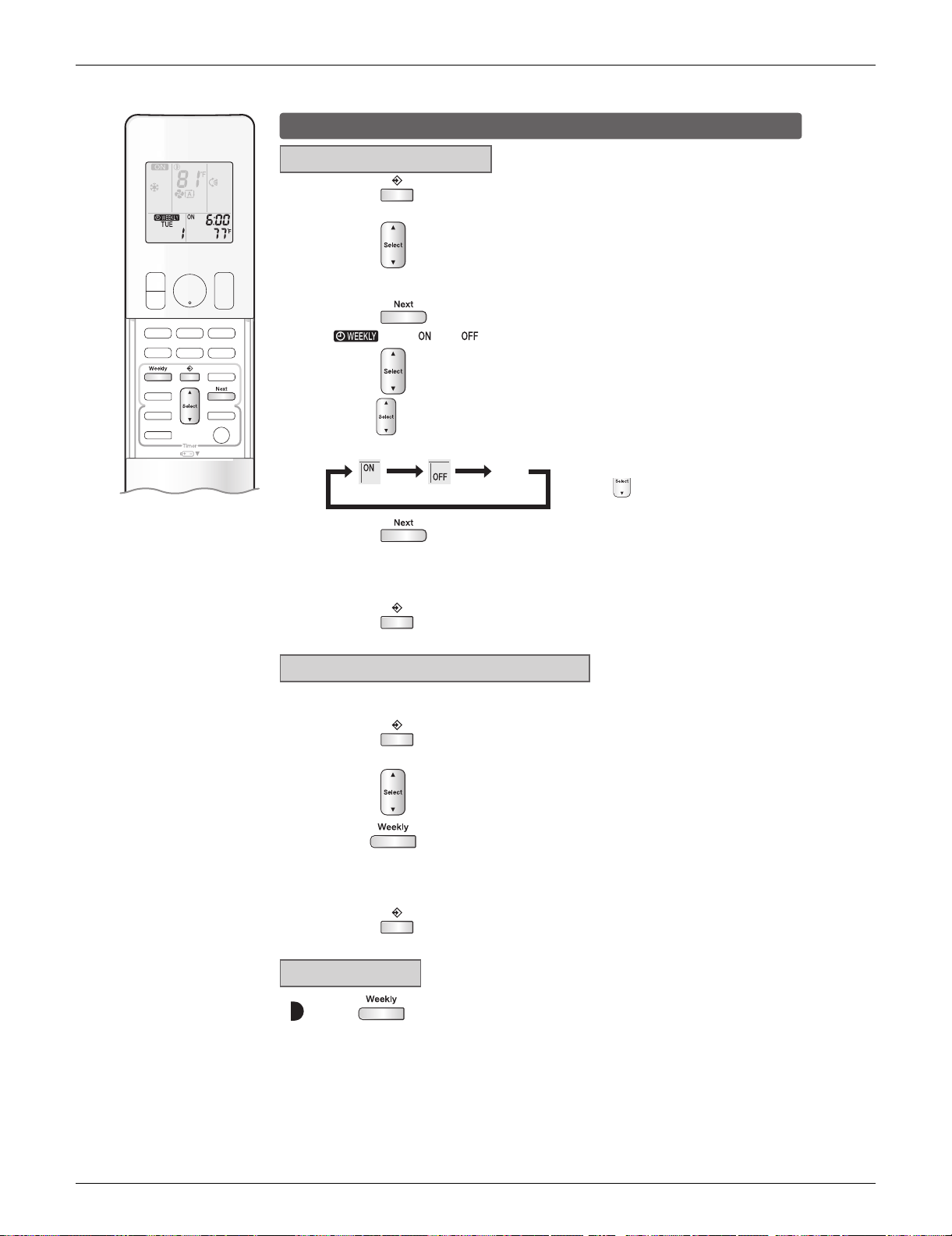
SiUS121827E RA Indoor Unit Functions
Part 4 Functions and Control 81
R4003386
To delete reservations
An individual reservation
1. Press .
• The day of the week and the reservation number will be displayed.
3. Press .
4. Press until no icon is displayed.
ON TIMER OFF TIMER
blank
No Setting
Pressing puts the sequence in reverse.
5. Press .
6. Press .
• If there are still other reservations, WEEKLY TIMER operation will be activated.
Reservations for each day of the week
1. Press .
• The day of the week and the reservation number will be displayed.
2.
Press to select the day of the week to be deleted.
3. Hold for about 5 seconds.
4. Press .
• If there are still other reservations, WEEKLY TIMER operation will be activated.
All reservations
Hold for about 5 seconds with the normal display.
2.
Press to select the day of the week and the
reservation number to be deleted.
• “ ” and “ ” or “ ” blink.
• Pressing changes the ON/OFF TIMER mode in sequence.
• Selecting “blank” will cancel any reservation you may have.
• This function can be used for deleting reservations for each day of the week.
• It can be used while confirming or setting reservations.
• Be sure to direct the remote controller toward the indoor unit and check for a receiving tone
and blinking of the multi-monitor lamp.
• The TIMER lamp goes off.
• This operation cannot be used for the WEEKLY TIMER setting display.
• All reservations will be deleted.
• The selected reservation will be deleted.
• Be sure to direct the remote controller toward the indoor unit and check for a receiving
tone and blinking of the multi-monitor lamp.
• Be sure to direct the remote controller toward the indoor unit and check for a receiving
tone and blinking of the multi-monitor lamp.
• The reservation of the selected day of the week will be deleted.
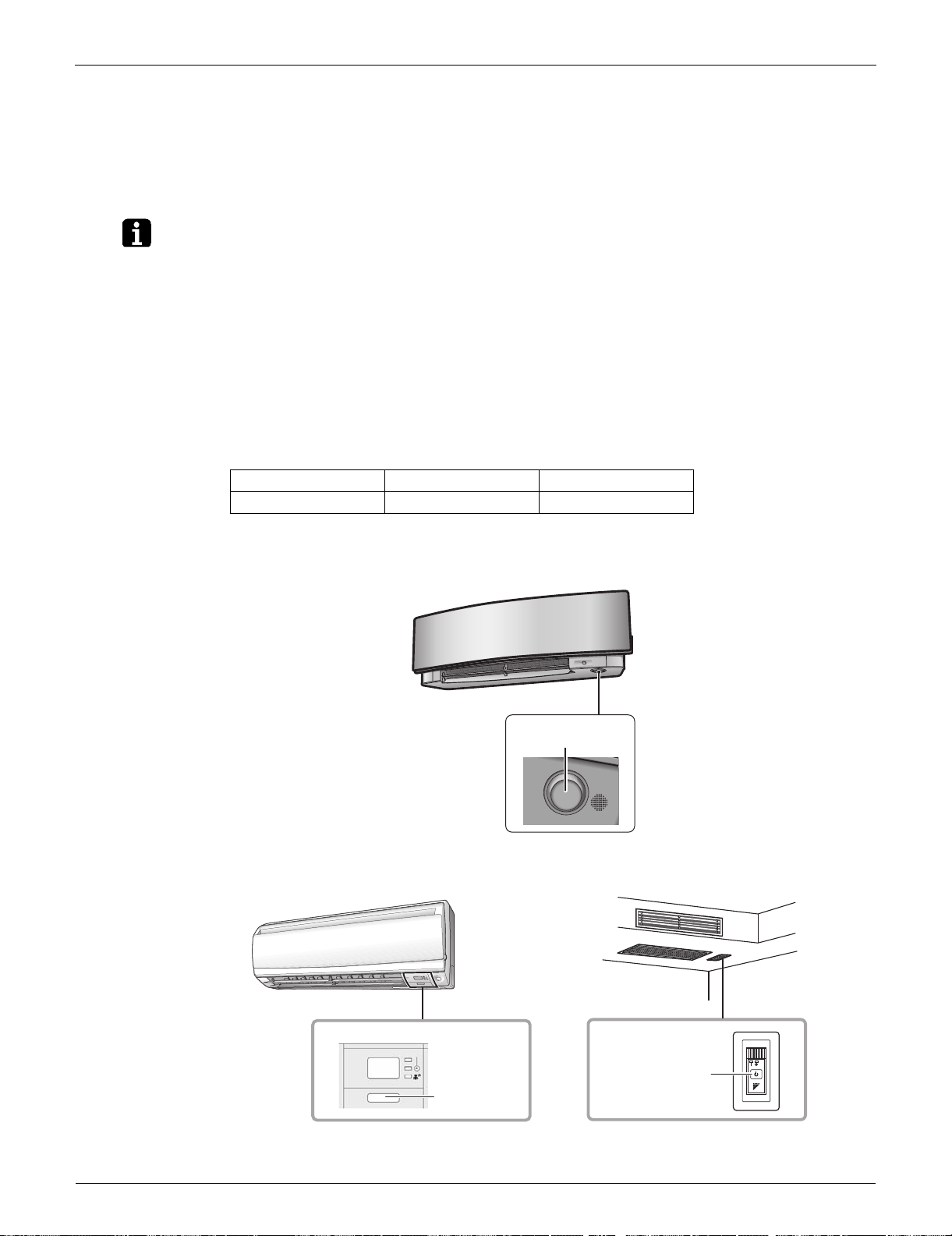
RA Indoor Unit Functions SiUS121827E
82 Part 4 Functions and Control
Note(s)
2.14 Other Functions
2.14.1 Hot-Start Function
In order to prevent the cold air blast that normally occurs when heating operation is started, the
temperature of the indoor heat exchanger is detected, and the airflow is either stopped or
significantly weakened resulting in comfortable heating.
The cold air blast is prevented using similar control when defrost control starts or when the
thermostat is turned ON.
2.14.2 Signal Receiving Sign
When the indoor unit receives a signal from the remote controller, the unit emits a signal receiving
sound and the operation lamp blinks.
2.14.3 Indoor Unit ON/OFF Switch
ON/OFF switch is provided on the display of the unit.
Press ON/OFF switch once to start operation. Press once again to stop it.
ON/OFF switch is useful when the remote controller is missing or the battery has run out.
In the case of multi system operation, there are times when the unit does not activate with ON/
OFF switch.
Operation mode Temperature setting Airflow rate
AUTO 25°C (77°F) Automatic
FTXR/CTXG Series
CTXS/FTXS Series FDXS/CDXS Series
(R23923)
ON/OFF switch
(R23924)
ON/OFF switch
(R23925)
ON/OFF switch
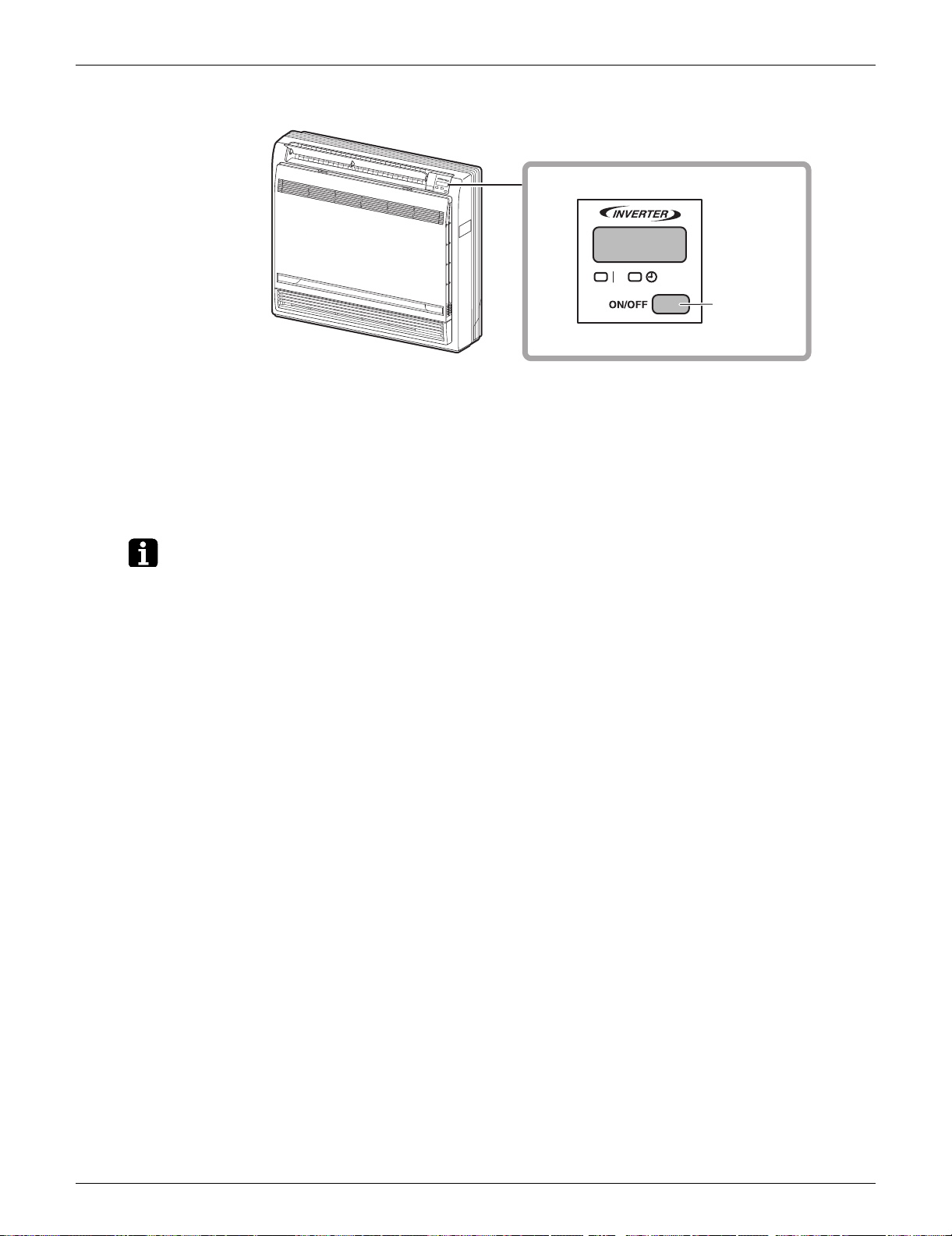
SiUS121827E RA Indoor Unit Functions
Part 4 Functions and Control 83
Note
2.14.4 Auto-restart Function
If a power failure (even a momentary one) occurs during the operation, the system restarts
automatically in the same conditions as before when the power supply is restored to the conditions
prior to the power failure.
It takes 3 minutes to restart the operation because 3-minute standby function is activated.
FVXS Series
ON/OFF switch
(R23926)
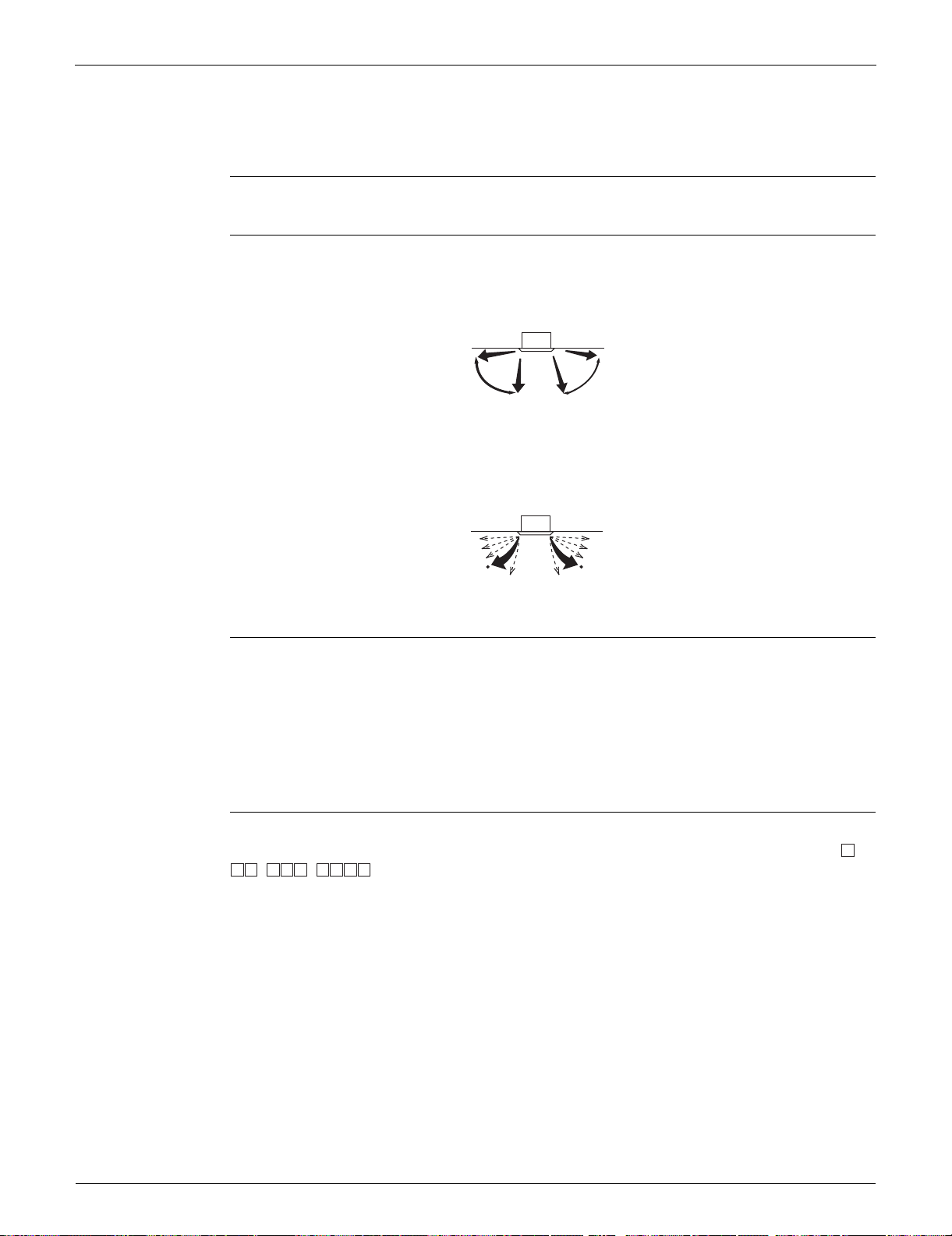
SA Indoor Unit Functions SiUS121827E
84 Part 4 Functions and Control
3. SA Indoor Unit Functions
3.1 Airflow Direction Control
Applicable
Models
FFQ09/12/15/18Q2VJU
Outline There are two types of airflow direction settings.
Automatic swing setting
The flaps automatically oscillate up and down.
Airflow direction fixed setting
You can select from one of the fixed directions.
The display of the remote controller and the actual angle of the flap do not match.
Flaps Movement Under the operating conditions shown below, airflow direction is controlled automatically. Actual
operation may be different from what is displayed on the remote controller.
Room temperature is higher than the remote controller’s set temperature in heating operation.
When defrosting in heating operation. The airflow is discharged horizontally to avoid blowing
cold air directly on the room occupants.
Under continuous operation with the airflow discharging horizontally.
Individual Flap
Control
With decoration panel (BYFQ60C2W1W(S)) and wired remote controller (BRC1E73), you can
control each one of the four flaps individually. The following marks are beside each air outlet: ,
, , .
Indoor unit
(Automatic swing) (Automatic swing)
(R24069)
(R24070)
Indoor unit
(Desired position) (Desired position)
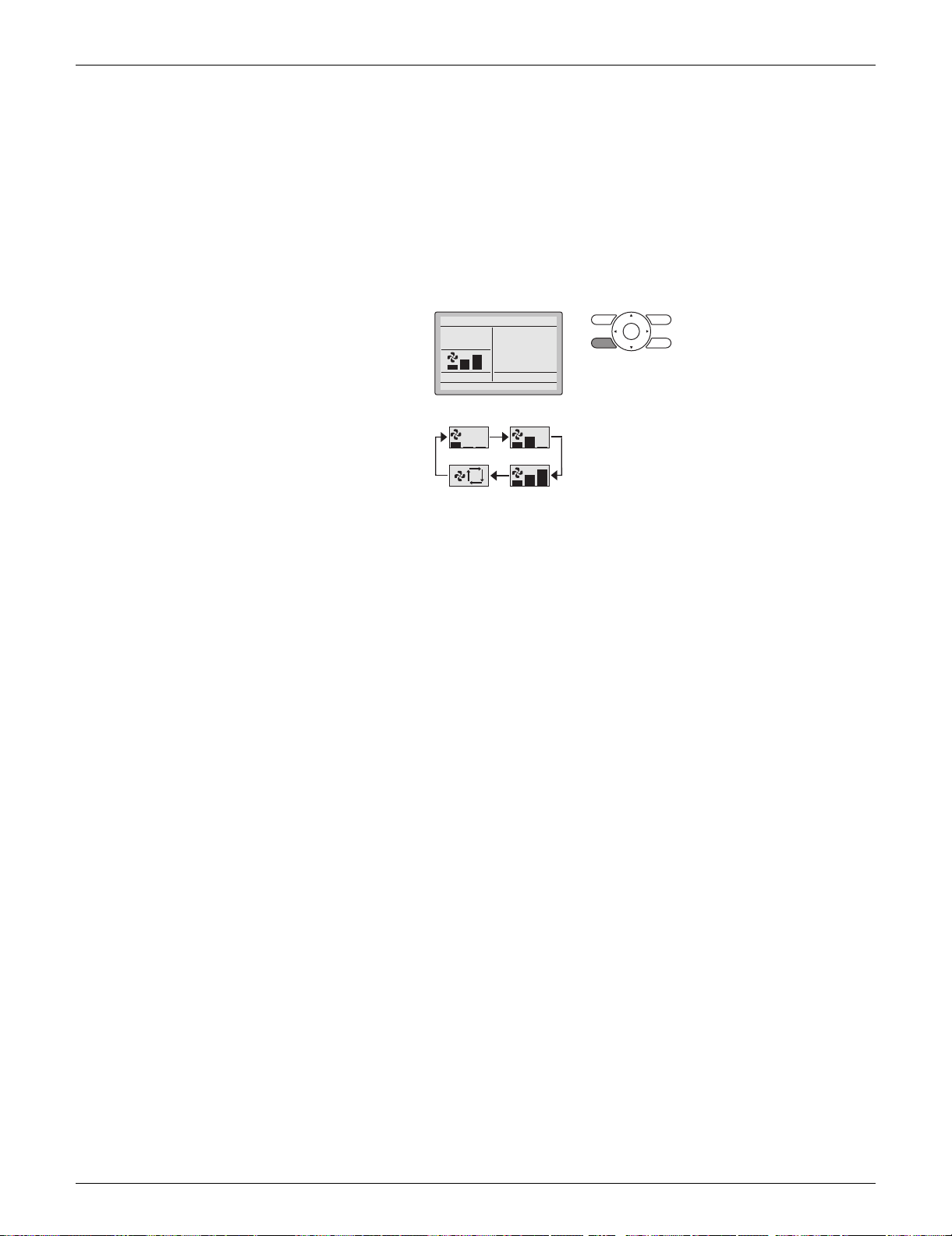
SiUS121827E SA Indoor Unit Functions
Part 4 Functions and Control 85
3.2 Fan Speed Control for Indoor Unit
With Wired Remote Controller (BRC1E73)
To change the fan speed, press Fan Speed button and select the fan speed from Low/Medium/
High/Auto.
Auto cannot be selected if the indoor unit does not have Auto Fan speed function.
The system may change the fan speed automatically for equipment protection purposes.
The system may turn off the fan when the room temperature is satisfied.
It is normal for a delay to occur when changing the fan speed.
If the Auto is selected for the fan speed, the fan speed varies automatically based on the
difference between set temperature and room temperature.
R4003380
With Wireless Remote Controller (BRC082A43, BRC082A41W, BRC082A42W(S))
Press FAN SPEED CONTROL button.
High, Medium or Low fan speed can be selected.
The microchip may sometimes control the fan speed in order to protect the unit.
Cool
Return Setting
Set to
74F
Low Medium
High
Auto
A
three fan speeds
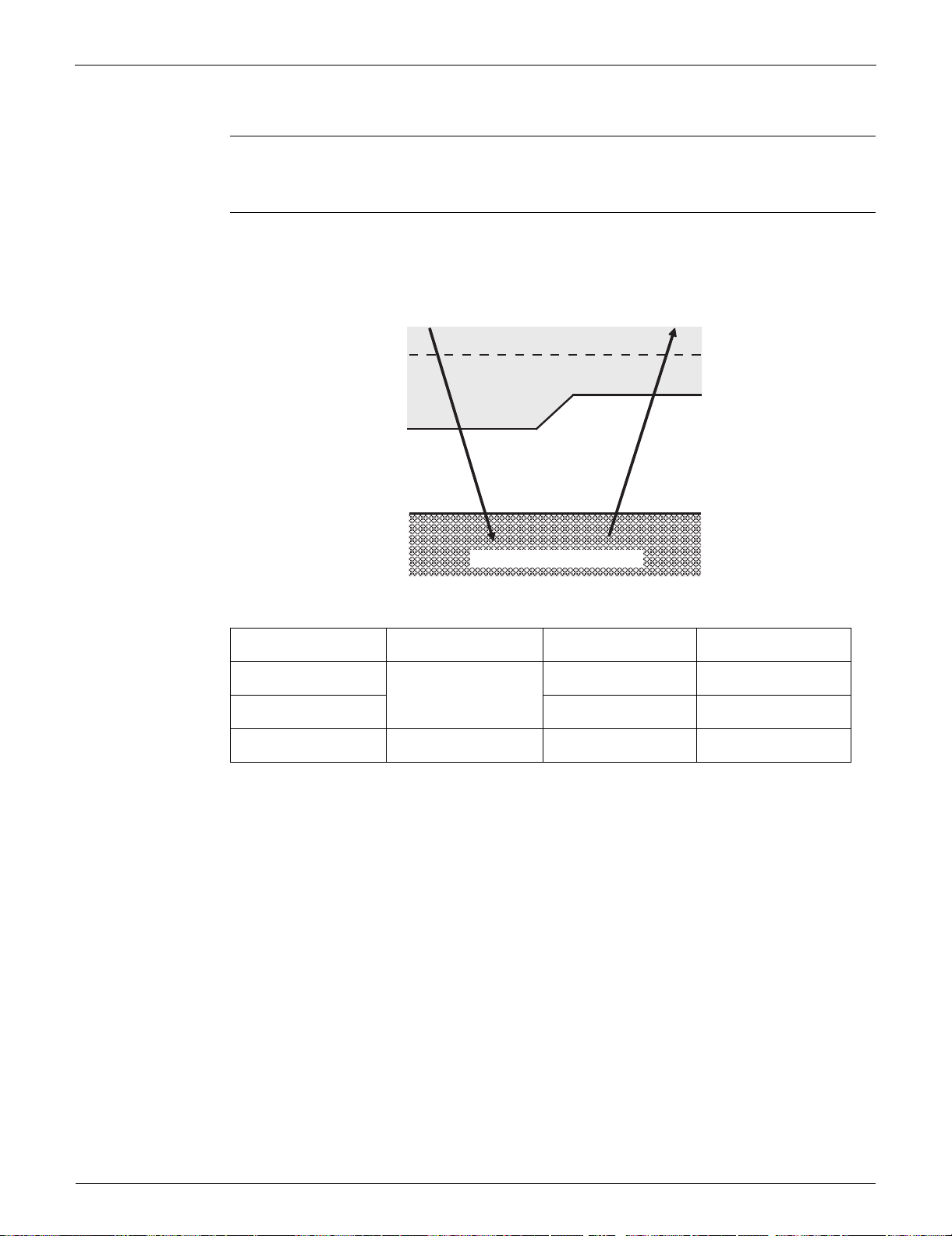
SA Indoor Unit Functions SiUS121827E
86 Part 4 Functions and Control
3.3 Program Dry Operation
Outline Program dry operation removes humidity while preventing the room temperature from lowering.
Since the microcomputer controls both the temperature and airflow rate, the temperature
adjustment and FAN setting buttons are inoperable.
Details The microcomputer automatically sets the temperature and airflow rate. The difference between
the room thermistor temperature at start-up and the target temperature is divided into two zones.
Then, the unit operates in an appropriate capacity for each zone to maintain the temperature and
humidity at a comfortable level.
Room thermistor
temperature at start-up
Target temperature
X
Thermostat OFF point
Y
Thermostat ON point
Z
24.5°C or more
(76.1°F or more)
Room thermistor
temperature at start-up
X – 2.5°C
(X – 4.5°F)
X – 1.0°C
(X – 1.8°F)
16.5 ~ 24°C
(61.7 ~ 75.2°F)
X – 2.0°C
(X – 3.6°F)
X – 1.0°C
(X – 1.8°F)
16°C or less
(60.8°F or less)
16°C
(60.8°F)
X – 2.0°C
(X – 3.6°F)
X – 1.0°C = 15°C
(X – 1.8°F = 59°F)
Zone A = Thermostat OFF
Target temperature X
Zone B
Room temperature Room temperature
Zone C = Thermostat ON
Y = X – 2.5°C (4.5°F)
or
Y = X – 2.0°C (3.6°F)
Z = X – 1.0°C (1.8°F)
X – 1.0°C (1.8°F)
(R24367)
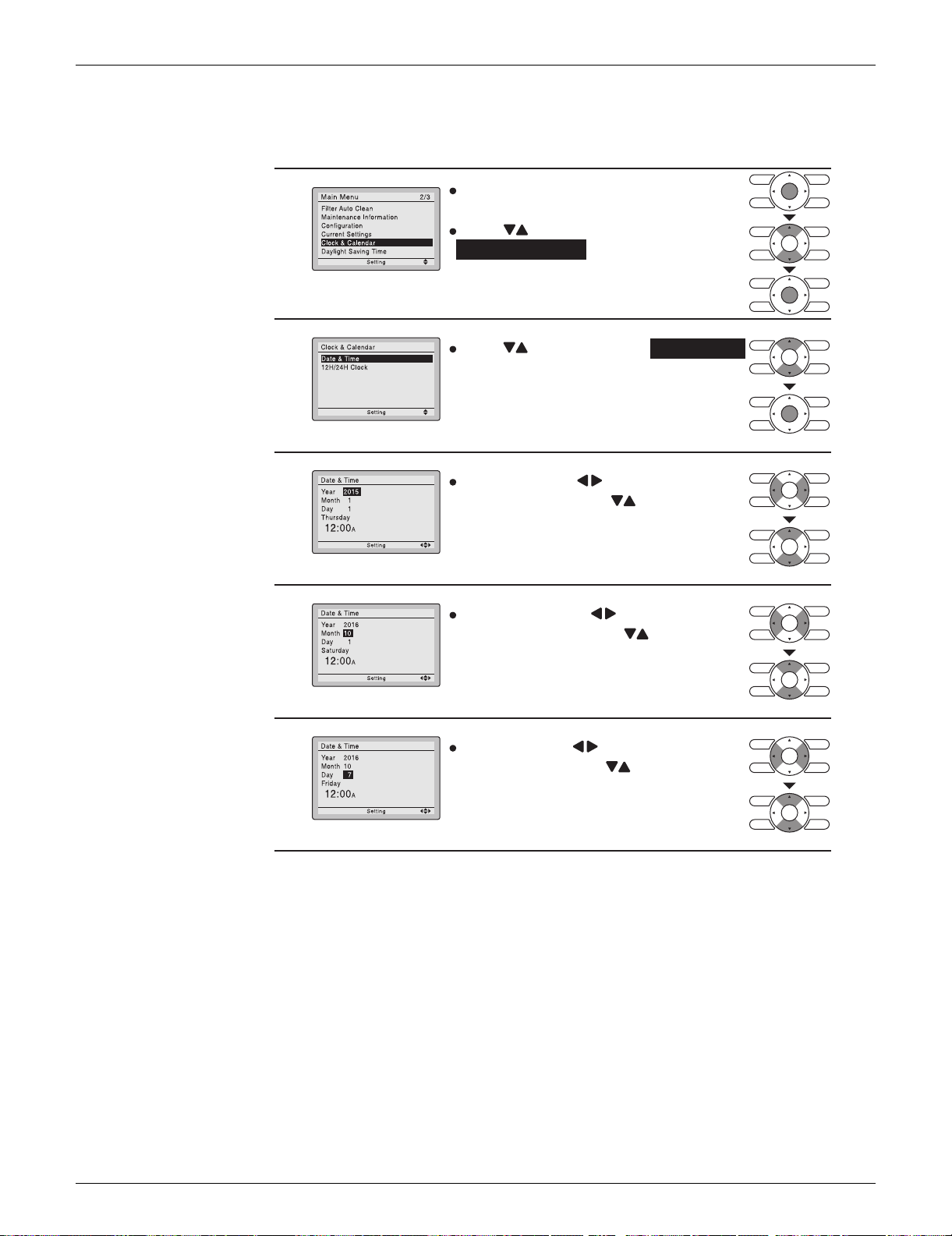
SiUS121827E SA Indoor Unit Functions
Part 4 Functions and Control 87
3.4 Clock and Calendar Setting (With Wired Remote Controller
BRC1E73)
2
3
4
5
1
Press buttons to select Date & Time
on the clock & calendar screen.
Press Menu/OK b
utton to display the
date & time screen.
Select Year with buttons.
Change the year with buttons.
Holding down the button causes the
number to change continuously.
Press buttons to select
Clock & Calendar on the main menu
screen.
Press Menu/OK b
utton to display the
clock & calendar screen.
Select Month with buttons.
Change the month with buttons.
Holding down the button causes the
number to change continuously.
Select Day with buttons.
Change the day with buttons.
Holding down the button causes the
number to change continuously.
Days of the week change automatically.
(R24368)
Press Menu/OK button to
display the main menu screen.

SA Indoor Unit Functions SiUS121827E
88 Part 4 Functions and Control
7
Note:
8
6
Select Hour with buttons.
Change the hour with buttons.
Holding down the button causes the
number to change continuously.
Select Minute with buttons.
Change the minute with buttons.
Holding down the button causes the
number to change continuously.
Press Menu/OK button.
The confirmation screen will appear.
The date can be set between
January 1, 2015 and December 31, 2099.
Press button to select Yes on the
confirmation screen.
Press Menu/OK button to confirm the
clock and return to the basic screen.
* When setting the schedule, the display returns to
the settings screen.
(R24072)
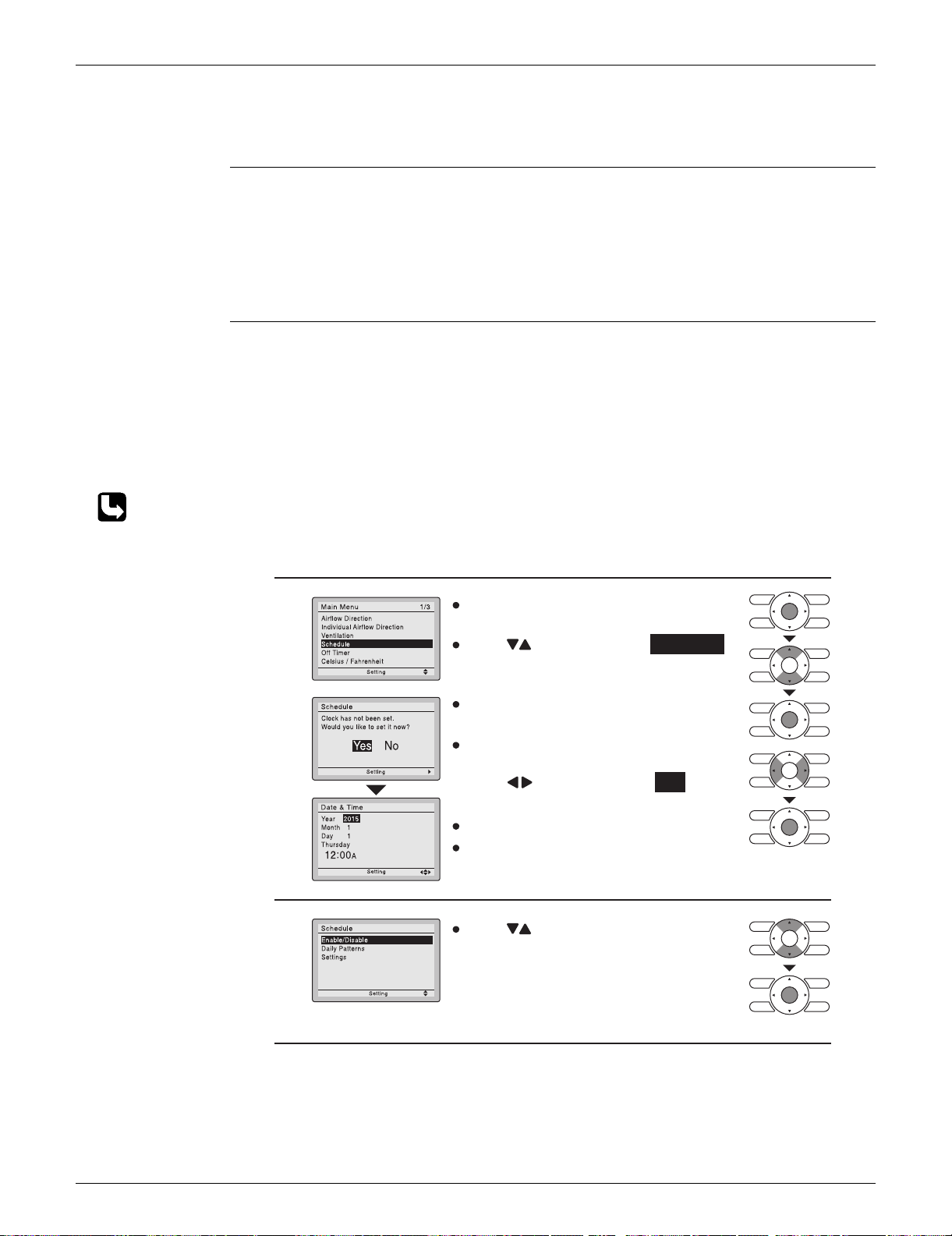
SiUS121827E SA Indoor Unit Functions
Part 4 Functions and Control 89
Reference
3.5 Schedule TIMER Operation (With Wired Remote Controller
BRC1E73)
Outline Day settings are selected from 4 patterns:
7 Days
Weekday/Sat/Sun
Weekday/Weekend
Everyday
Up to 5 actions can be set for each day.
Details Set the startup time and operation stop time.
Refer to Setback function on page 93 for details of setback function (FFQ series only).
Setting the schedule
ON: Startup time, cooling and heating temperature setpoints can be configured.
OFF: Operation stop time, cooling and heating setback temperature setpoints can be
configured.
( --: Indicates that the setback function is disabled for this time period. )
__: Indicates that the temperature setpoint and setback temperature setpoint for this time
period is not specified. The last active setpoint will be utilized.
1
Press buttons to select Schedule .
Press Menu/OK button to display the
schedule screen.
The date & time screen will appear.
2
Before setting the schedule, the clock
must be set.
If the clock has not been set, a screen
like the one on the left will appear.
Press buttons to select Yes and
press Menu/OK b
utton.
Set the current year, month, day, and
time.
Press buttons to select the desired
function on the schedule screen and
press Menu/OK button.
(R24369)
Press Menu/OK button to
display the main menu screen.
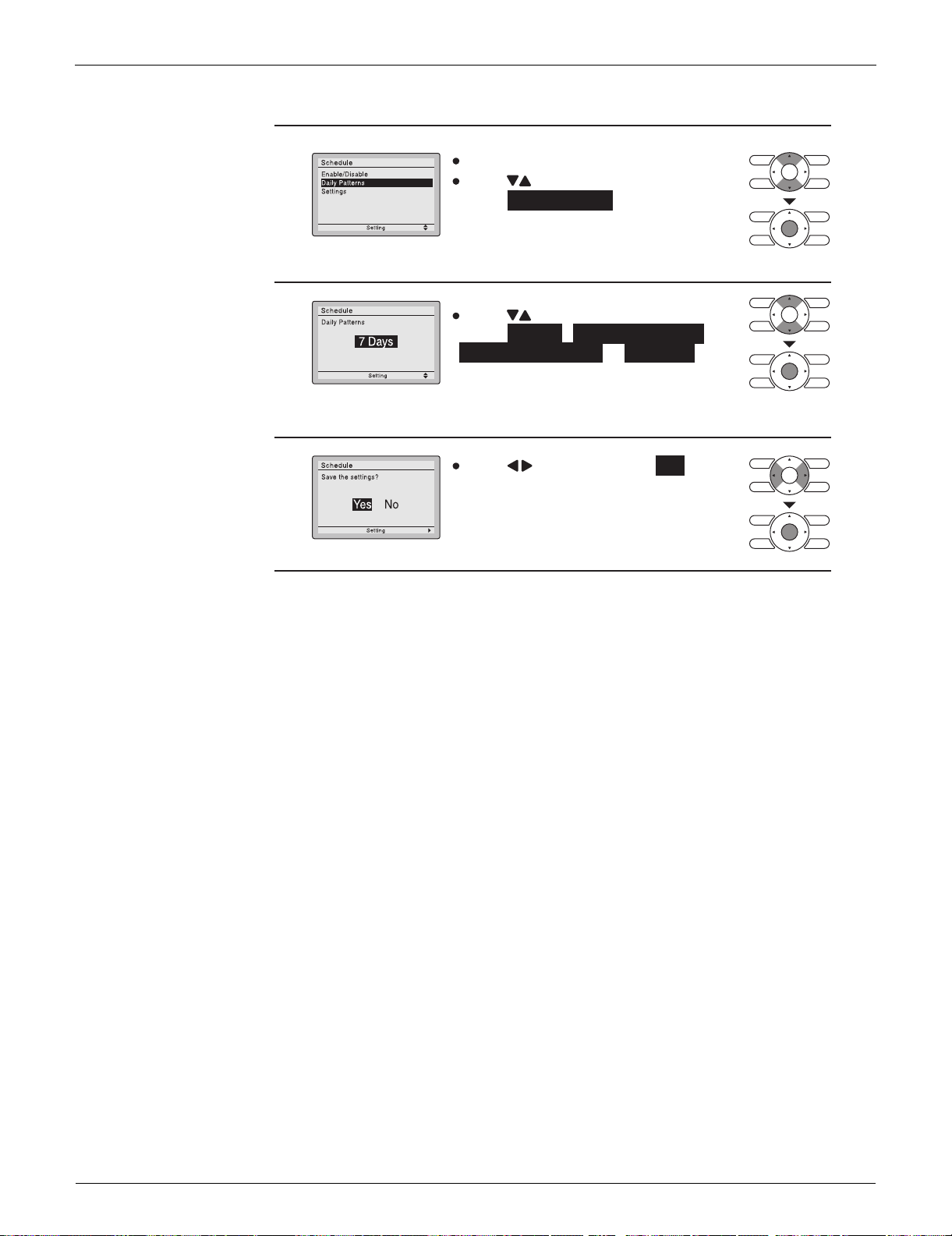
SA Indoor Unit Functions SiUS121827E
90 Part 4 Functions and Control
Daily Patterns
1
The schedule screen will appear.
2
Press buttons to
select Daily Patterns on the schedule
screen.
The daily patterns screen will appear
when Men
u/OK button is pressed.
Press buttons to
select 7 Days , Weekday/Sat/Sun ,
Weekday/Weekend or Everyday on
the daily patterns screen.
The confi
rmation screen will appear
when Menu/OK button is pressed.
3
Press buttons to select Yes on the
confirmation screen.
Pressing Menu/OK button enters the
daily patterns in the schedule and takes
you back to the main menu screen.
(R24074)
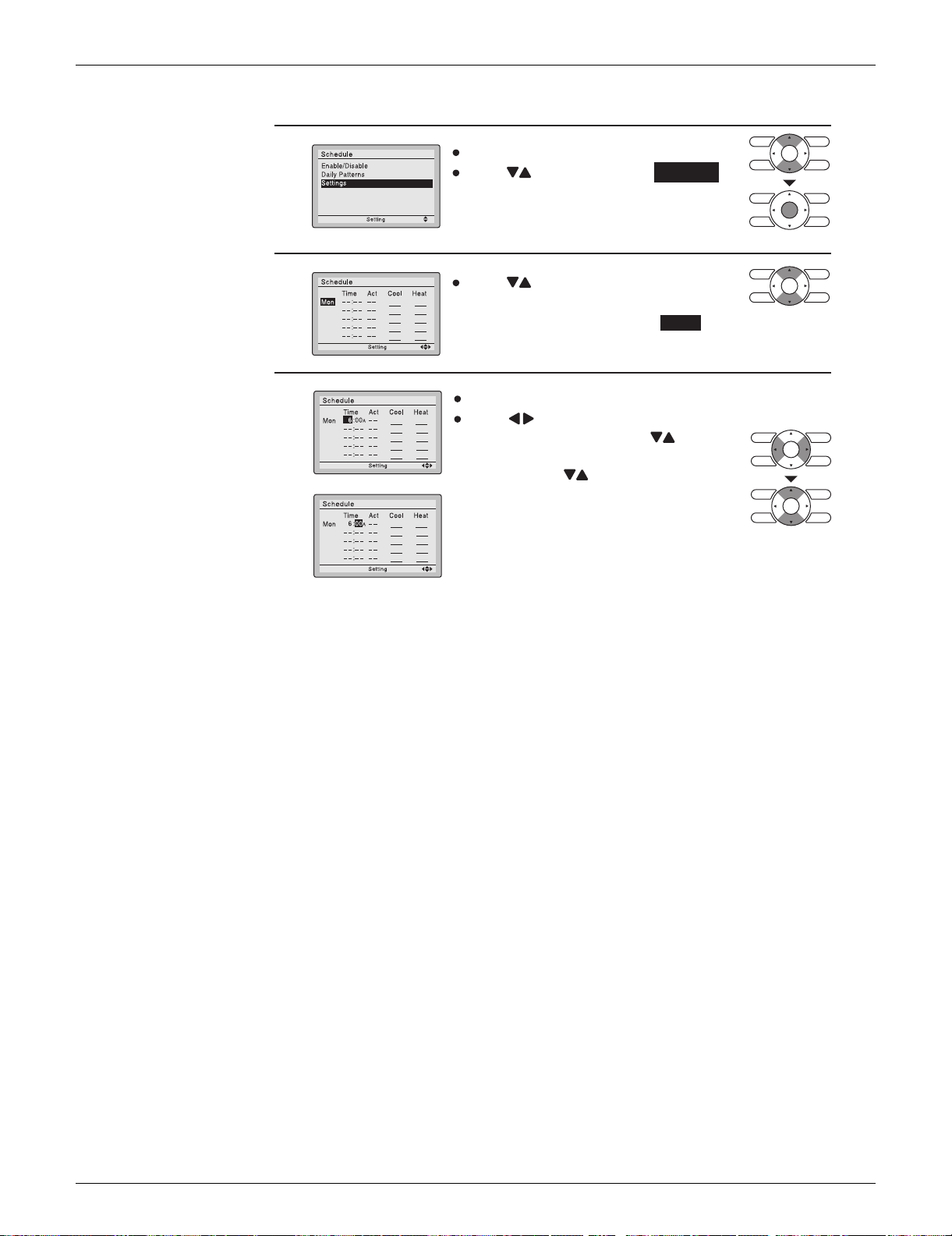
SiUS121827E SA Indoor Unit Functions
Part 4 Functions and Control 91
Settings
R4003456
1
The schedule screen will appear.
Press buttons to select Settings
on the schedule screen.
The settings screen will appear when
Menu/OK button is pressed.
2
Press buttons to select the day to
be set.
* It cannot be selected in the case of EVDY .
3
Input the time for the selected day.
Press buttons to move the
highlighted item and press buttons
to input the desired operation start time.
Each press of buttons moves the
numbers by 1 hour or 1 minute.
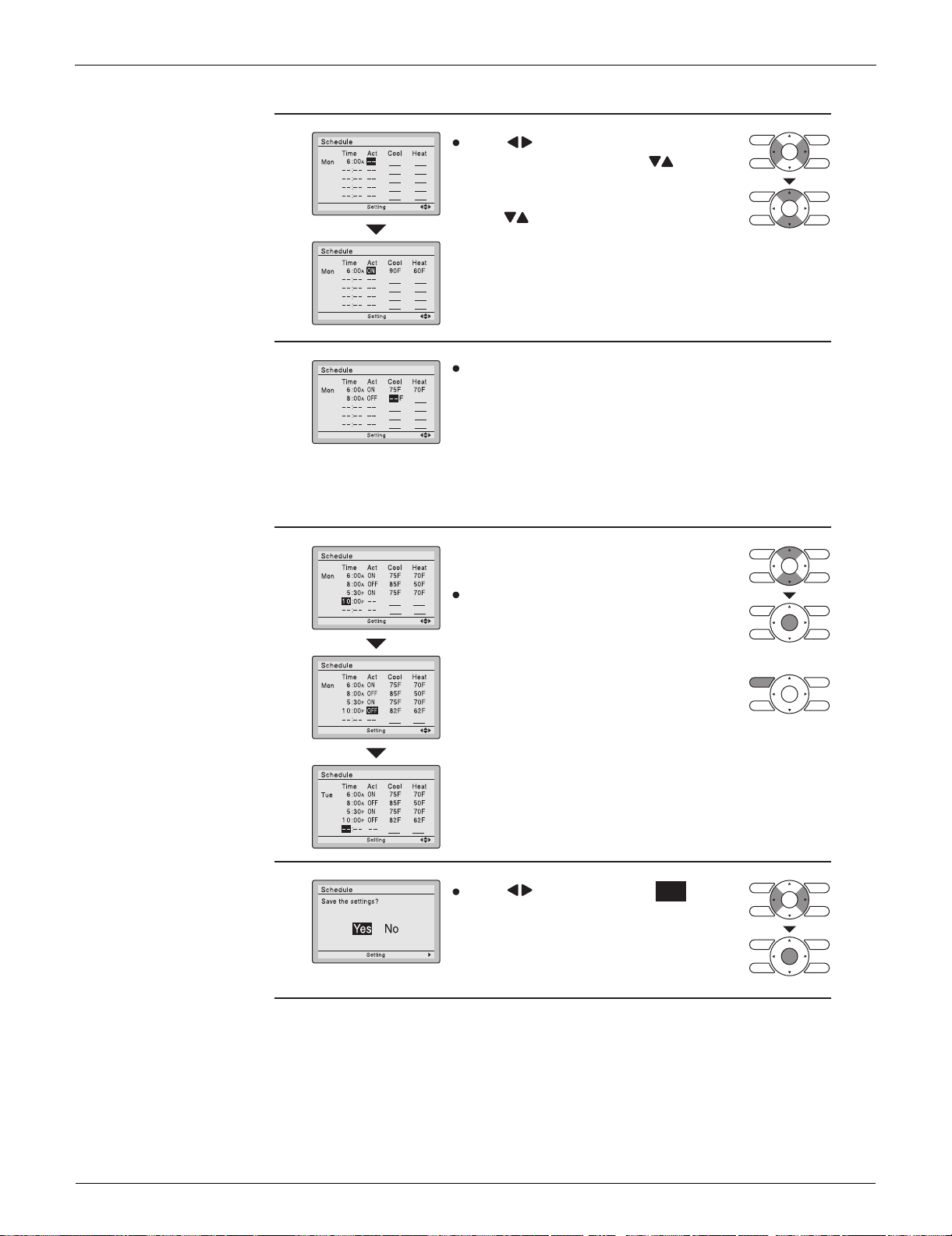
SA Indoor Unit Functions SiUS121827E
92 Part 4 Functions and Control
4
Press buttons to move the
highlighted item and press buttons
to configure ON/OFF/-- settings.
--, ON, or OFF changes in sequence
when buttons are pressed.
ON: The temperature setpoints can be configured.
OFF: The setback temperature setpoints can be
configured.
– –: The temperature setpoints and setback
temperature setpoints become disabled.
The cooling and heating temperature
setpoints for both ON and OFF
(Setback) are configured.
__: Indicates that the temperature setpoint and
setback temperature setpoint for this time
period is not specified. The last active setpoint
will be utilized.
– –: Indicates that the setback function is disabled
for this time period.
5
A maximum of five actions per day can be
set.
Press Menu/OK button when settings
for each day are completed. The
confirmation screen will appear.
To copy the settings for the previous day, press
Mode button so that the existing settings will be
copied.
Example: The contents for Monday are copied by
pressing Mode button after selecting Tuesday.
6
Press buttons to select Yes on the
confirmation screen.
Pressing Menu/OK button confirms the
settings for each day and takes you
back to the basic screen.
(R24075)
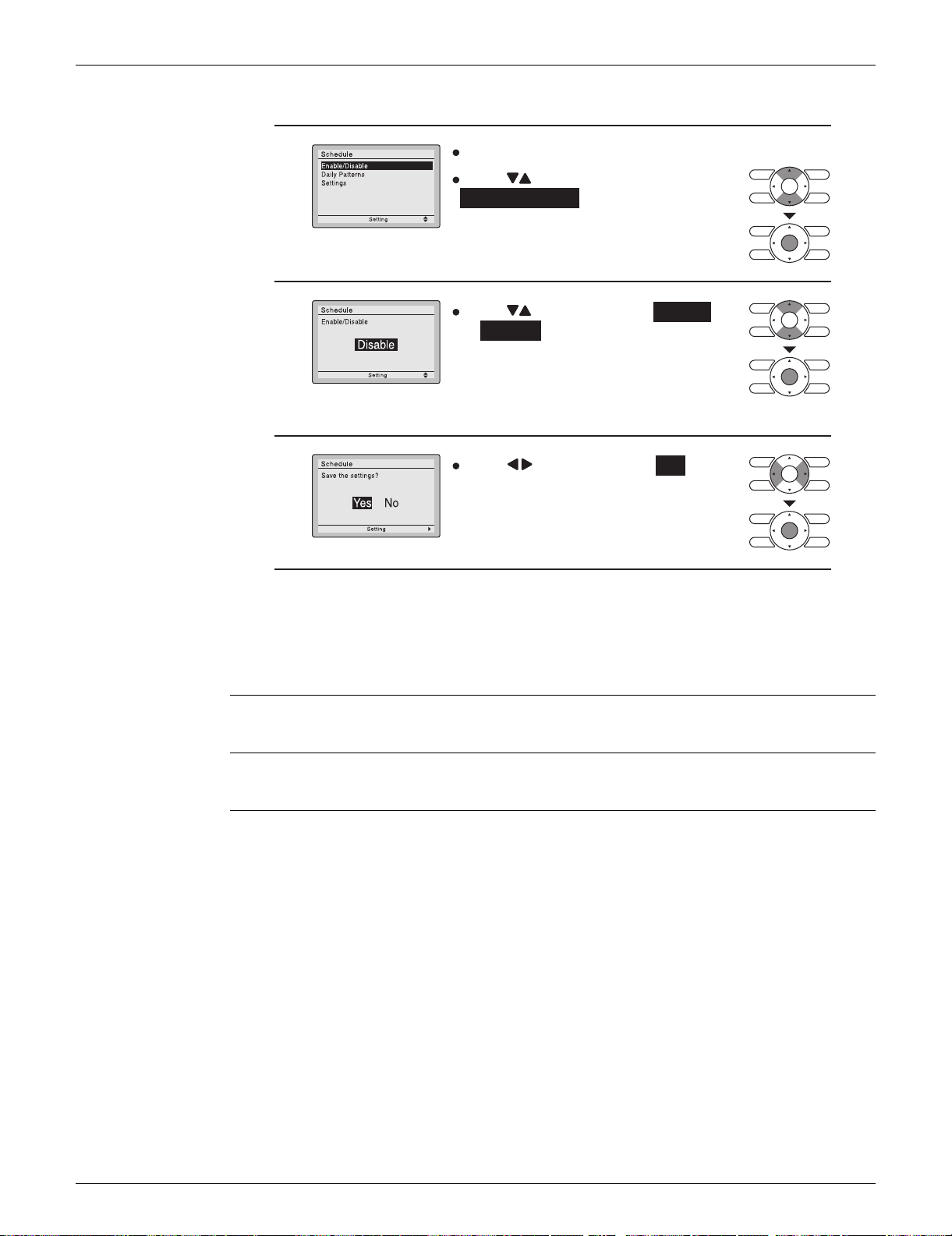
SiUS121827E SA Indoor Unit Functions
Part 4 Functions and Control 93
Enabling or disabling the schedule
3.6 Setback Function (With Wired Remote Controller
BRC1E73)
Applicable
Models
FFQ09/12/15/18Q2VJU
Outline The Setback function can be used to maintain the space temperature in an assigned range for an
unoccupied period.
Details The setback icon flashes on the LCD of wired remote controller when the unit is turned on by the
setback control.
When enabled, the Setback mode becomes active when the indoor unit is turned off by either
the user, a schedule event or an off timer.
Setback function is not available by default. It can be enabled by the system installer.
1
2
3
Display the schedule screen.
Press buttons to select
Enable / Disable
on the schedule
screen.
Press Menu/OK b
utton to display the
enable/disable screen.
Press buttons to select Enable
or Disable on the enable/disable
screen.
Press Menu/OK b
utton after selecting
the item. The confirmation screen is
displayed.
Press buttons to select Yes on the
confir
mation screen.
Pressing Menu/OK button confirms the
enable/disable setting for the schedule
and takes you back to the basic screen.
(R24076)
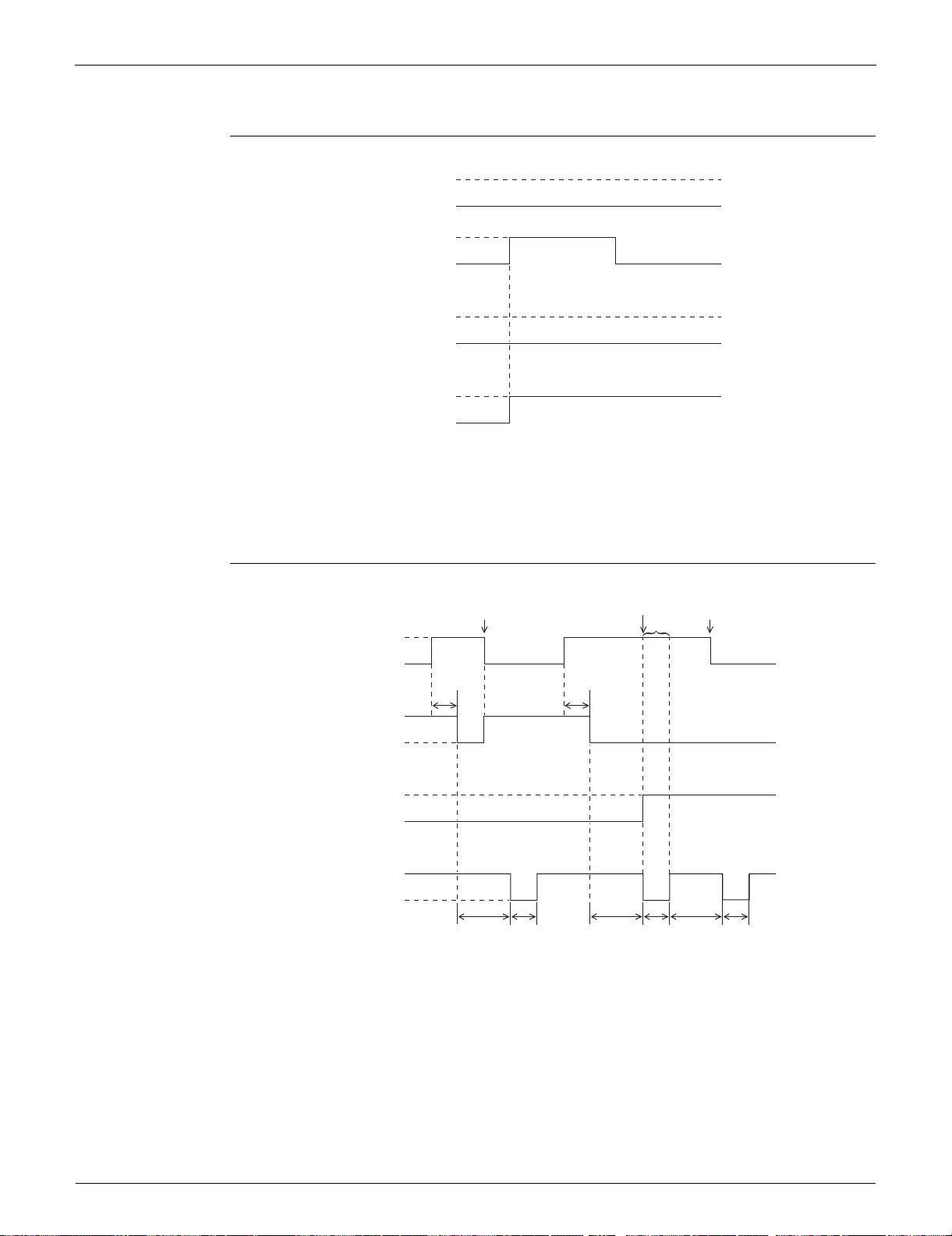
SA Indoor Unit Functions SiUS121827E
94 Part 4 Functions and Control
3.7 Drain Pump Control
Normal Operation
The float switch is ON in normal operation.
When cooling operation starts (thermostat ON), the drain pump turns ON simultaneously.
After the thermostat turns OFF, the drain pump continues to operate.
If Float Switch is OFF with Thermostat ON in Cooling Operation
When the float switch stays OFF for 5 sec., the thermostat turns OFF.
After the thermostat turns OFF, the drain pump continues to operate for another 5 minutes.
Float switch
Error display
Thermostat
(running)
OFF
OFF
ON
ON
ON
OFF
Drain pump
ON
OFF
(R24037)
∗1. If the float switch turns ON again during the residual operation of the drain pump, cooling
operation also turns on again (thermostat ON).
∗2. If the float switch remains OFF even after the residual operation of the drain pump has
ended, the error code A3 is determined.
∗3. The drain pump turns OFF once residual operation has ended, then turns ON again after
5 seconds.
∗4. After A3 is determined and the unit comes to an abnormal stop, the thermostat will
remain OFF even if the float switch turns ON again.
OFF
OFF
ON
ON
ON
OFF
ON
OFF
5 min.5 min.
5 sec. 5 sec.
5 min.
5 sec.
(R24610)
Float switch
Error display
Thermostat
(running)
Drain pump
A3
∗1
∗2
∗4
∗3
5 sec.
5 sec.
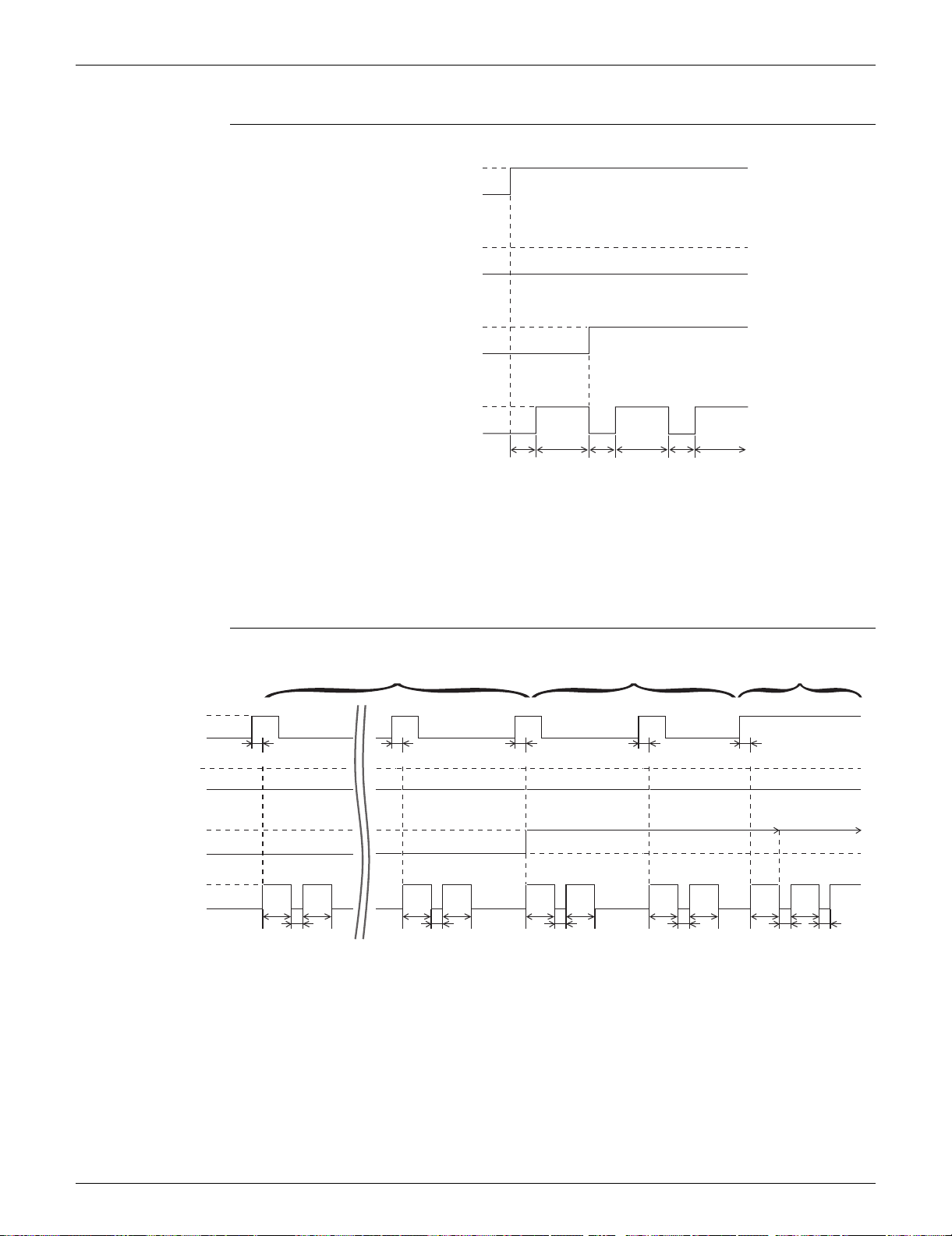
SiUS121827E SA Indoor Unit Functions
Part 4 Functions and Control 95
If Float Switch is OFF with Thermostat OFF in Cooling Operation
When the float switch stays OFF for 5 sec., the drain pump turns ON.
If the float switch remains OFF even after the residual operation of the drain pump has ended,
the error code A3 is determined.
The drain pump turns OFF once residual operation has ended, then turns ON again after 5
seconds.
If Float Switch Turns ON and OFF Continuously, or Float Switch Turns OFF While AF Displayed
When the float switch stays OFF for 5 sec., the drain pump turns ON.
OFF
OFF
ON
ON
ON
OFF
ON
OFF
5 min.
5 sec.5 sec.
5 min. 5 min.
5 sec.
(R24611)
Float switch
Error display
Thermostat
(running)
Drain pump
A3
(R24370)
OFF
Float Switch
ON
ON
Thermostat
(running)
OFF
ON
A3AF
Error Display
OFF
ON
Drain Pump
OFF
1st
5 sec. 5 sec. 5 sec. 5 sec.
4th 5th
5 sec.
5 min. 5 min.
5 sec.
5 min. 5 min.
5 sec.
5 min. 5 min.
5 sec.
5 min. 5 min.
5 sec. 5 sec.
5 min. 5 min.
∗1 ∗2 ∗3
5 sec.
∗1. If the float switch continues to turn OFF and ON 5 times consecutively, it is judged as a
drain system error and the error code AF is determined.
∗2. The drain pump continues to turn ON/OFF in accordance with the float switch ON/OFF
even after AF is determined.
∗3. While the error code AF is displayed, if the float switch remains OFF even after the
residual operation of the drain pump has ended, the error code A3 will be determined.
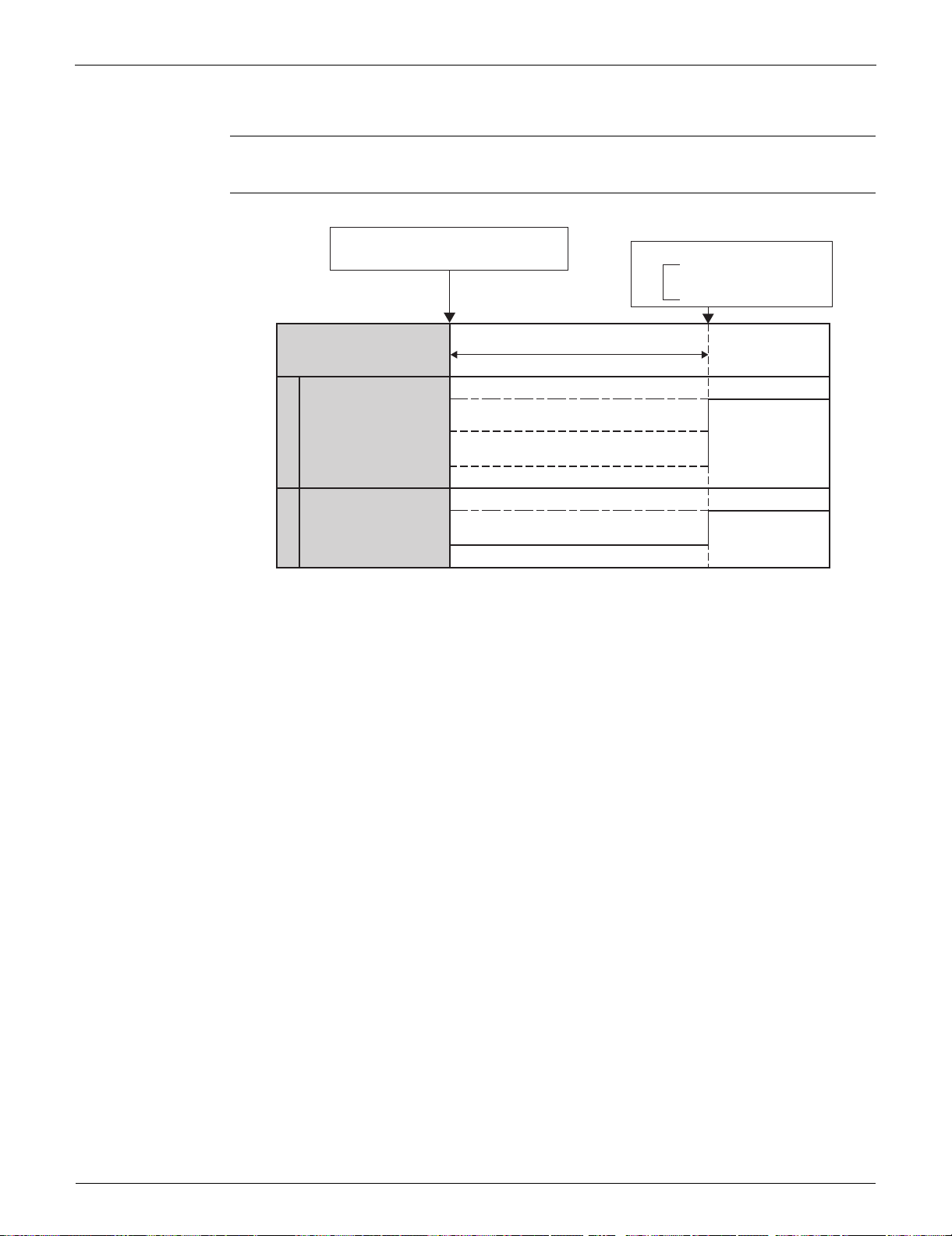
SA Indoor Unit Functions SiUS121827E
96 Part 4 Functions and Control
3.8 Hot Start Control (In Heating Operation Only)
Outline At startup with thermostat ON or after the completion of defrosting in heating operation, the indoor
unit fan is controlled to prevent cold air from blasting out and ensure startup capacity.
Details
R4003450
TH
3
: Temperature detected by the indoor heat exchanger thermistor (R3T)
Defrost ending or oil return ending
or Thermostat ON
The fan is not OFF before initiating the hot start: LL
The fan is OFF before initiating the hot start: OFF
Hot start control
Hot start in progress
Normal operation
Normal operation
H/M/L remote
controller setting
LL
OFF
Remote controller
setting
Level position
FanLouver
Hot start ending conditions
· Lapse of 3 minutes
· TH
3
> 37°C (98.6°F)
OR
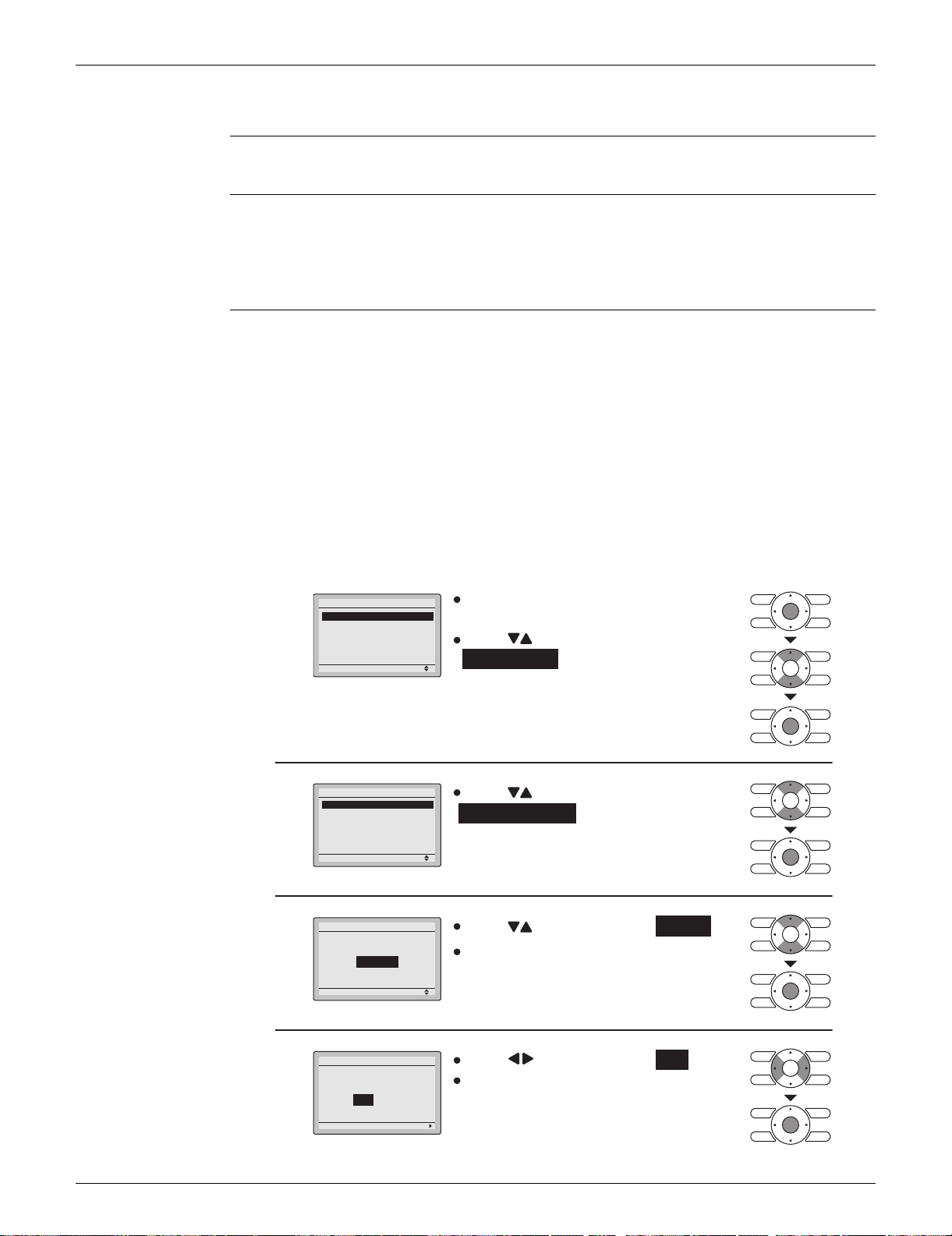
SiUS121827E SA Indoor Unit Functions
Part 4 Functions and Control 97
3.9 Presence and Floor Sensors (Option)
Applicable
Models
FFQ09/12/15/18Q2VJU
Outline With the human presence signal and the floor temperature signal from the optional sensor kit, the
system provides the energy saving control, or the comfortable temperature control and airflow
direction control preventing the direct draft to the human.
To use sensor related functions, a wired remote controller (BRC1E73) and optional sensor kit
(BRYQ60A2W(S)) are necessary to be installed.
Details 1. Draft prevention (with presence sensor)
When the sensor detects human presence during auto-swing operation, the system sets the airflow
direction parallel to the floor (position 0) to reduce unpleasant draft.
The operation returns to the normal auto-swing as the sensor detects no human in the room.
Draft prevention is enabled only when decoration panel BYFQ60C2W1W(S), sensor kit
BRYQ60A2W(S) and wired remote controller BRC1E73 are connected to the main unit and
draft prevention is set to “enabled” on the wired remote controller.
Factory setting is “disabled”.
Draft prevention cannot be activated when individual flap control is set, even if draft prevention
is enabled on the wired remote controller.
Setting on the wired remote controller
R4003392
1
Setting
Main Menu
Configuration
Current Settings
Clock & Calendar
2/3
2
Draft Prevention
Configuration
Setting
3
Enable
Draft Prevention
Enable/Disable
Setting
4
NoYe s
Draft Prevention
Save the settings?
Setting
Press Menu/OK button to display the
main menu screen.
Press buttons to select Yes .
The confirmation screen will appear
when Menu/OK b
utton is pressed.
Press Menu/OK button to confirm the
settings and to return to the basic
screen.
Language
Contrast Adjustment
Display
Press buttons to select
Configuration and press Menu/OK
button.
Press b
uttons to select
Draft Prevention and press
Menu/OK b
utton.
Press buttons to select Enable .
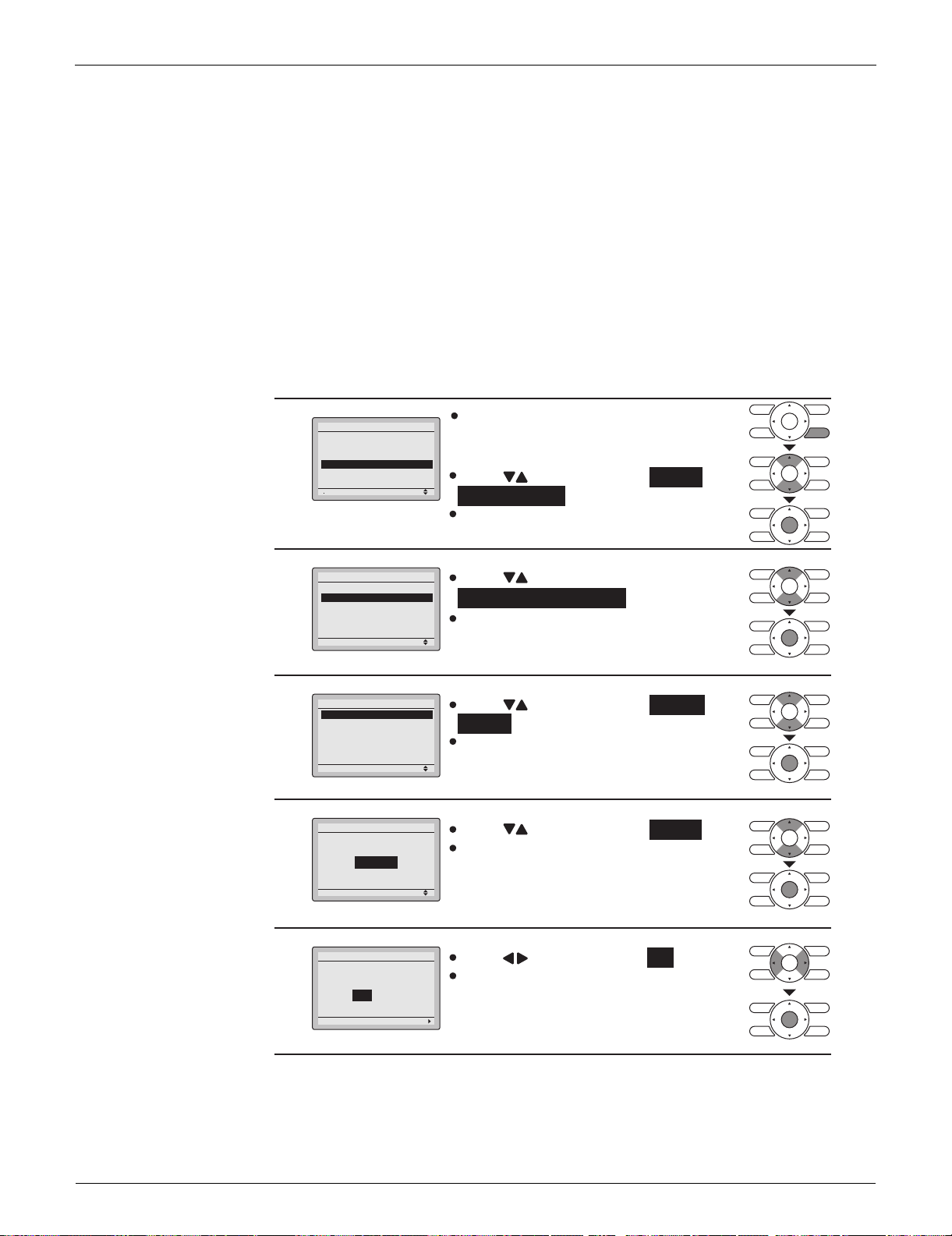
SA Indoor Unit Functions SiUS121827E
98 Part 4 Functions and Control
2. Auto-setback by sensor (with presence sensor)
After pre-determined time has elapsed without detection of human presence, the unit automatically
shifts the target temperature gradually for energy saving.
The target temperature displayed on the remote controller remains same as the initial set value
during the above change of target temperature.
The target temperature shifts within the range of the highest programmable temperature while in
cooling operation and the lowest programmable temperature while in heating operation.
Upon human detection, the target temperature returns to the original setting.
Auto-setback by sensor is enabled only when decoration panel BYFQ60C2W1W(S), sensor kit
BRYQ60A2W(S) and wired remote controller BRC1E73 are connected to the main unit and
auto-setback by sensor is set to “enabled” on the wired remote controller.
Factory setting is “disabled”.
Setting on the remote controller
R4003390
2
3
4
5
1
Press buttons to select
Auto-setback by Sensor .
Press Menu/OK button to display
Auto-setback by Sensor menu.
Press buttons to select Enable/
Disable .
Press Menu/OK button.
Press buttons to select Enable .
Press Menu/OK button after selecting
the item.
Then the confirmation screen
is displayed.
Press buttons to select Yes .
Press Menu/OK button to confirm the
settings and to return to the Service
Settings menu.
Press Cancel button for 4 seconds on
the basic screen to display Service
Settings menu.
Press buttons to select Energy
Saving Options .
Press Menu/OK button to display
Energy Saving Options menu.
Setting
1/3
Service Settings
Test Operation
Maintenance Contact
Field Settings
Energy Saving Options
Prohibit Function
Min Setpoints Differential
Setting
Energy Saving Options
Setpoint Range Limitation
Auto-setback by Sensor
Auto-off by Sensor
Setting
Enable/Disable
Settings
Auto-setback by Sensor
Setting
Enable/Disable
Auto-setback by Sensor
Enable
Setting
Save the settings?
Auto-setback by Sensor
Ye s No
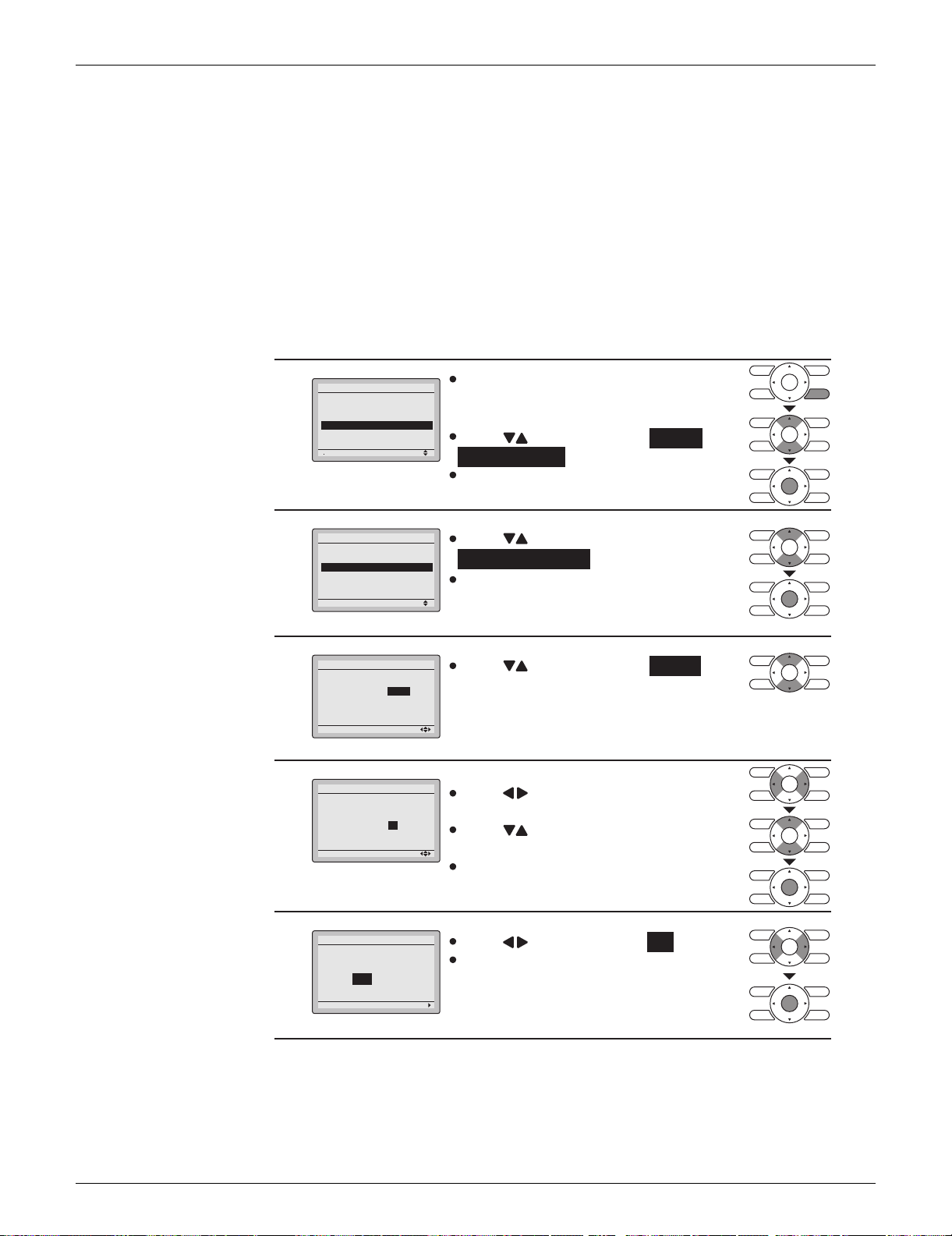
SiUS121827E SA Indoor Unit Functions
Part 4 Functions and Control 99
3. Auto-off by sensor (with presence sensor)
After pre-determined time has elapsed without detection of human presence, the unit automatically
stops operation.
The auto-off time can be set between 1- 24 hours by the hour.
Once the unit stops operation by auto-off function, the system would not restart even if the human
is detected again.
Auto-off by sensor is enabled only when decoration panel BYFQ60C2W1W(S), sensor kit
BRYQ60A2W(S) and wired remote controller BRC1E73 are connected to the main unit and
auto-off by sensor is set to “enabled” on the wired remote controller.
Factory setting is “disabled”.
Setting on the remote controller
R4003391
2
3
4
1
Press buttons to select
Auto-off by Sensor .
Press Menu/OK button to display
Auto-off by Sensor menu.
Press buttons to select Enable .
Press buttons to go into the auto-off
time setting.
Press buttons to set auto-off hour(s)
(1 ~ 24).
Press Menu/OK button. Then the
confirmation screen is displayed.
Press Cancel button for 4 seconds on
the basic screen to display Service
Settings menu.
Press buttons to select Energy
Saving Options .
Press Menu/OK button to display
Energy Saving Options menu.
Setting
1/3
Service Settings
Test Operation
Maintenance Contact
Field Settings
Energy Saving Options
Prohibit Function
Min Setpoints Differential
Setting
Energy Saving Options
Setpoint Range Limitation
Auto-setback by Sensor
Auto-off by Sensor
5
Setting
Auto-off by Sensor
Enable/Disable: Enable
Auto-off in: 24 hr(s)
Setting
Auto-off by Sensor
Enable/Disable: Enable
Auto-off in: 24 hr(s)
Setting
Save the settings?
Auto-off by Sensor
Ye s No
Press buttons to select Yes .
Press Menu/OK button to confirm the
settings and to return to the Service
Settings menu.
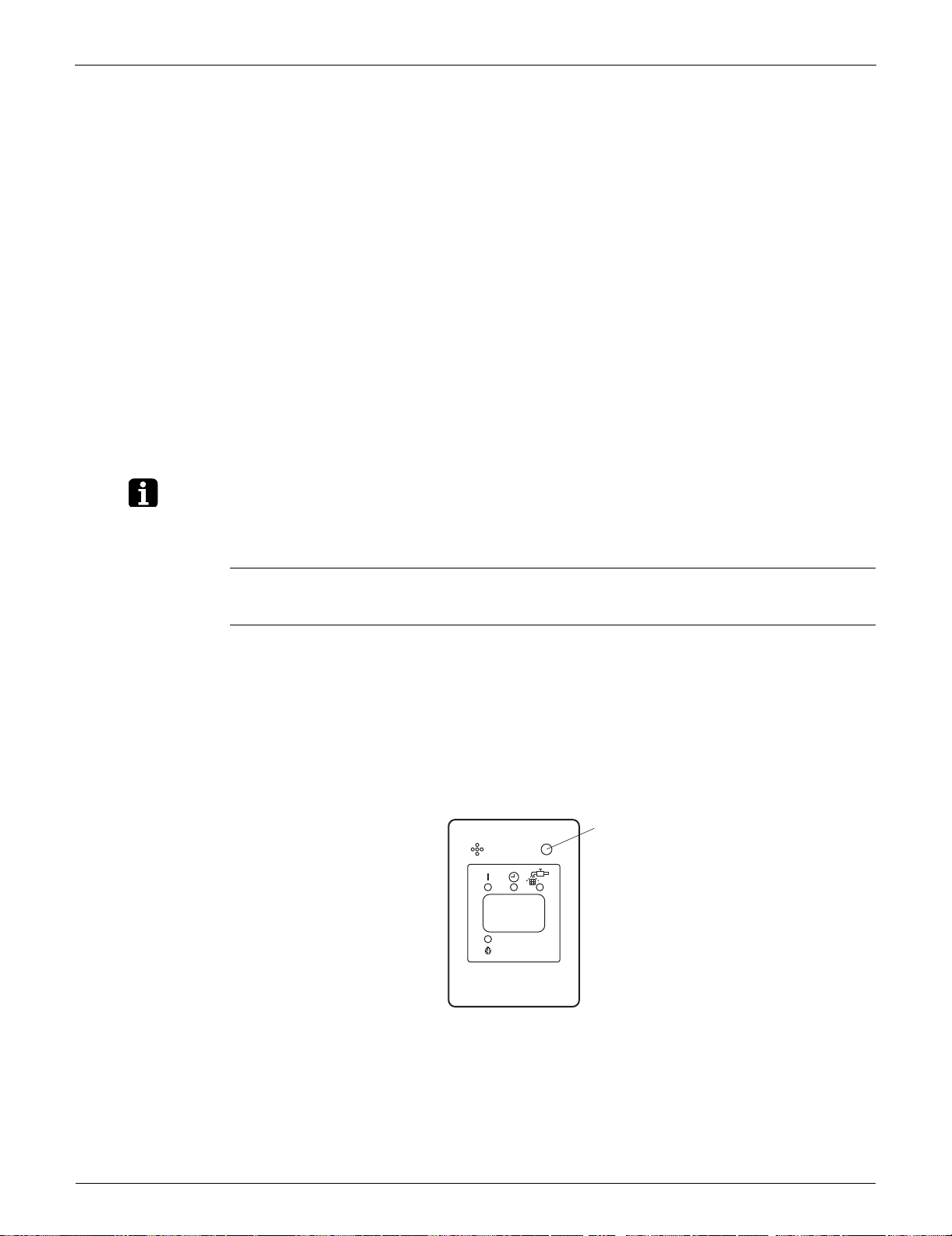
SA Indoor Unit Functions SiUS121827E
100 Part 4 Functions and Control
Note
4. Room temperature adjustment by sensing (with floor sensor)
The system uses living space temperature calculated from temperatures detected by room
temperature thermistor (suction air thermistor in the indoor unit) and floor sensor, as the target
temperature.
Operation becomes more optimized by using not only suction air temperature but floor temperature.
This function is enabled when decoration panel BYFQ60C2WAW(S) and sensor kit
BRYQ60A2W(S) is connected to the main unit.
3.10 Other Functions
3.10.1 Signal Receiving Sign
When the indoor unit receives a signal from the remote controller, the unit emits a signal receiving
sound.
3.10.2 Auto-restart Function
If a power failure (even a momentary one) occurs during the operation, the system restarts
automatically in the same conditions as before when the power supply is restored to the conditions
prior to the power failure.
It takes 3 minutes to restart the operation because 3-minute standby function is activated.
3.10.3 Emergency Operation Switch (With Wireless Remote Controller)
Outline When the wireless remote controller does not work due to battery failure or the absence thereof,
use the emergency operation switch.
Details Start
Press emergency operation switch.
The indoor unit runs in the previous operation mode.
The system operates with the previously set airflow direction (FFQ series only).
Stop
Press emergency operation switch again.
FDMQ Series
(R24925)
Emergency
operation
switch
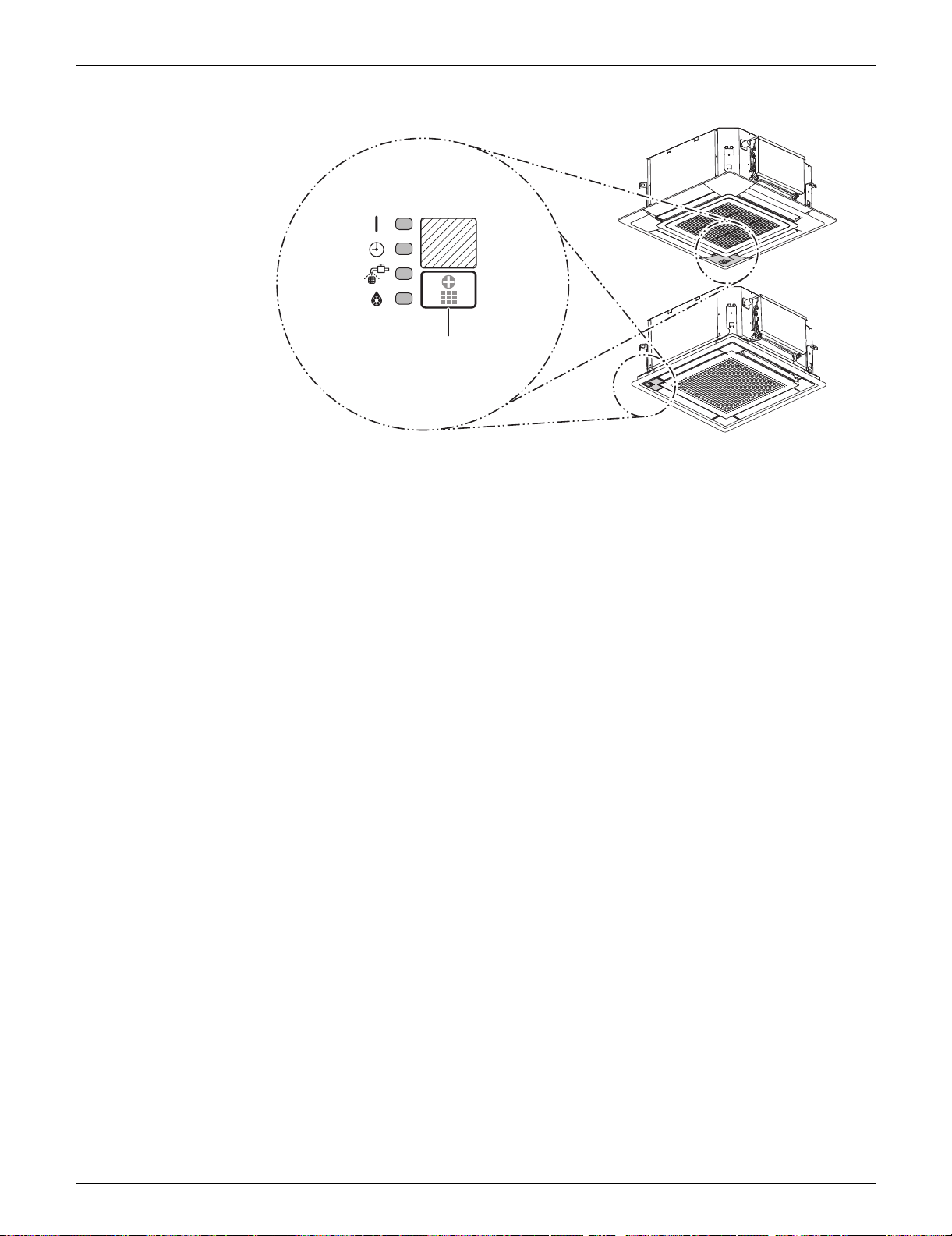
SiUS121827E SA Indoor Unit Functions
Part 4 Functions and Control 101
FFQ Series
Emergency operation switch
(R24077)
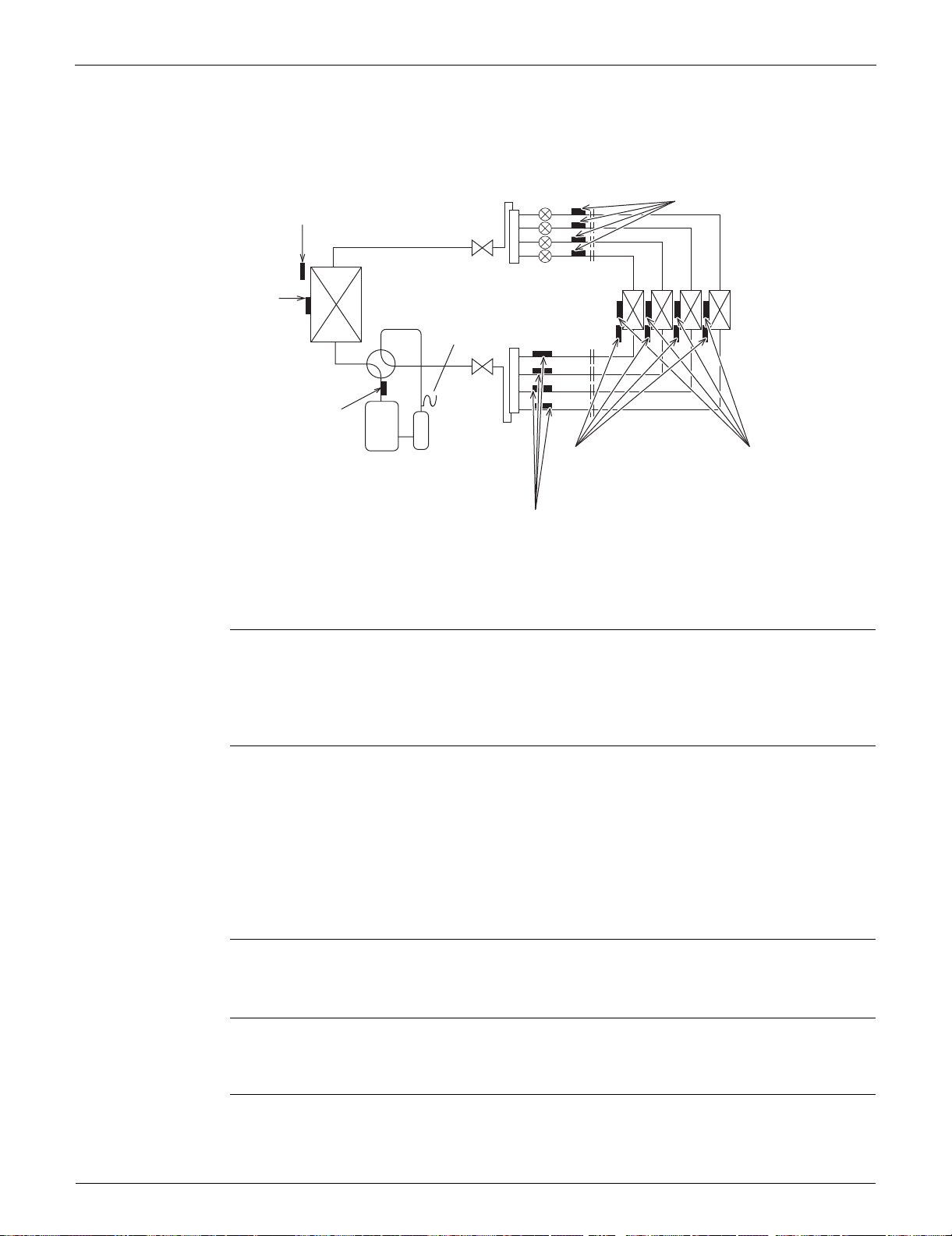
Control Specification SiUS121827E
102 Part 4 Functions and Control
4. Control Specification
4.1 Thermistor Functions
R4003431
The illustration is for the 4-room models as representative and have 4 lines of indoor unit system (A
~ D).
The 5-room models have 5 lines (A ~ E).
(1) Discharge
Pipe Thermistor
The discharge pipe thermistor is used for controlling discharge pipe temperature. If the
discharge pipe temperature (used in place of the inner temperature of the compressor) rises
abnormally, the operating frequency becomes lower or the operation halts.
The discharge pipe thermistor is used for detecting disconnection of the discharge pipe
thermistor.
(2) Outdoor Heat
Exchanger
Thermistor
The outdoor heat exchanger thermistor is used for controlling the target discharge pipe
temperature. The system sets the target discharge pipe temperature according to the outdoor
and indoor heat exchanger temperature, and controls the electronic expansion valve opening so
that the target discharge pipe temperature can be obtained.
In cooling operation, the outdoor heat exchanger thermistor is used for detecting the
disconnection of the discharge pipe thermistor. When the discharge pipe temperature drops
below the outdoor heat exchanger temperature by more than a certain value, the discharge pipe
thermistor is judged as disconnected.
In cooling operation, the outdoor heat exchanger thermistor is used for high pressure protection.
(3) Outdoor
Temperature
Thermistor
The outdoor temperature thermistor detects the outdoor air temperature and is used for
refrigerant shortage detection, input current control, outdoor fan control, liquid compression
protection function, and so on.
(4) Gas Pipe
Thermistor
In cooling operation, the gas pipe thermistor is used for gas pipe isothermal control. The system
controls electronic expansion valve opening so that the gas pipe temperature in each room
becomes equal.
(5) Liquid Pipe
Thermistor
Liquid pipe thermistor is used to protect the compressor against liquid attack during cooling
operation.
Four way valve
Compressor
EVC
EVD
EVB
EVA
Expansion valve
DCBA
(3) Outdoor
Temperature
Thermistor
(2) Outdoor Heat
Exchanger
Thermistor
(1) Discharge Pipe
Thermistor
(4) Gas Pipe
Thermistor
(6) Indoor Heat
Exchanger
Thermistor
(7) Room
Temperature
Thermistor
(5) Liquid Pipe
Thermistor
Fusible plug

SiUS121827E Control Specification
Part 4 Functions and Control 103
Note(s)
In case of low outdoor temperature operation, the system compares the indoor heat exchanger
temperature with the liquid pipe temperature to detect disturbances in the refrigerant flow. If
any, the system adjusts the opening of the electronic expansion valve to control the refrigerant
flow.
When only one indoor unit is in heating operation, the liquid pipe thermistor is used for
subcooling control. The actual subcool is calculated with the liquid pipe temperature and the
maximum indoor heat exchanger temperature. The system controls the electronic expansion
valve openings to obtain the target subcool.
In heating operation, the liquid pipe thermistor is used for liquid pipe isothermal control. The
system controls the electronic expansion valve opening so that the liquid pipe temperatures in
each room becomes equal.
(6) Indoor Heat
Exchanger
Thermistor
The indoor heat exchanger thermistor is used for controlling the target discharge pipe
temperature. The system sets the target discharge pipe temperature according to the outdoor
and indoor heat exchanger temperature, and controls the electronic expansion valve opening so
that the target discharge pipe temperature can be obtained.
In cooling operation, the indoor heat exchanger thermistor is used for freeze-up protection
control. If the indoor heat exchanger temperature drops abnormally, the operating frequency
becomes lower or the operation halts.
In cooling operation, the indoor heat exchanger thermistor is used for anti-icing function. If any
of the following conditions are met in the room where operation halts, it is assumed as icing.
The conditions are
Tc ≤ – 1°C (30.2°F)
Ta – Tc ≥ 10°C (18°F)
where Ta is the room temperature and Tc is the indoor heat exchanger temperature.
The indoor heat exchanger thermistor is used for wiring error check function. The refrigerant
flows in order from the port A to detect the indoor heat exchanger temperature one by one, and
then wiring and piping can be checked.
In heating operation, the indoor heat exchanger thermistor is used for heating peak-cut control.
If the indoor heat exchanger temperature rises abnormally, the operating frequency becomes
lower or the operation halts.
In heating operation, the indoor heat exchanger thermistor is used for detecting the
disconnection of the discharge pipe thermistor. When the discharge pipe temperature drops
below the highest indoor heat exchanger temperature by more than a certain value, the
discharge pipe thermistor is judged as disconnected.
Excluding the case that all the indoor units are in heating operation, the indoor heat exchanger
thermistor is used for subcooling control. The actual subcool is calculated with the liquid pipe
temperature and the indoor heat exchanger temperature. The system controls the electronic
expansion valve openings to obtain the target subcool.
(7) Room
Temperature
Thermistor
The room temperature thermistor detects the room air temperature and is used for controlling
the room air temperature.
The refrigerant circuit has a fusible plug.
In order to prevent the increase of pressure when abnormal heating is caused by fire or others, the
fusible part of the plug is molten at a temperature of 70 - 75°C (158 - 167°F) to release the pressure
into the atmosphere.
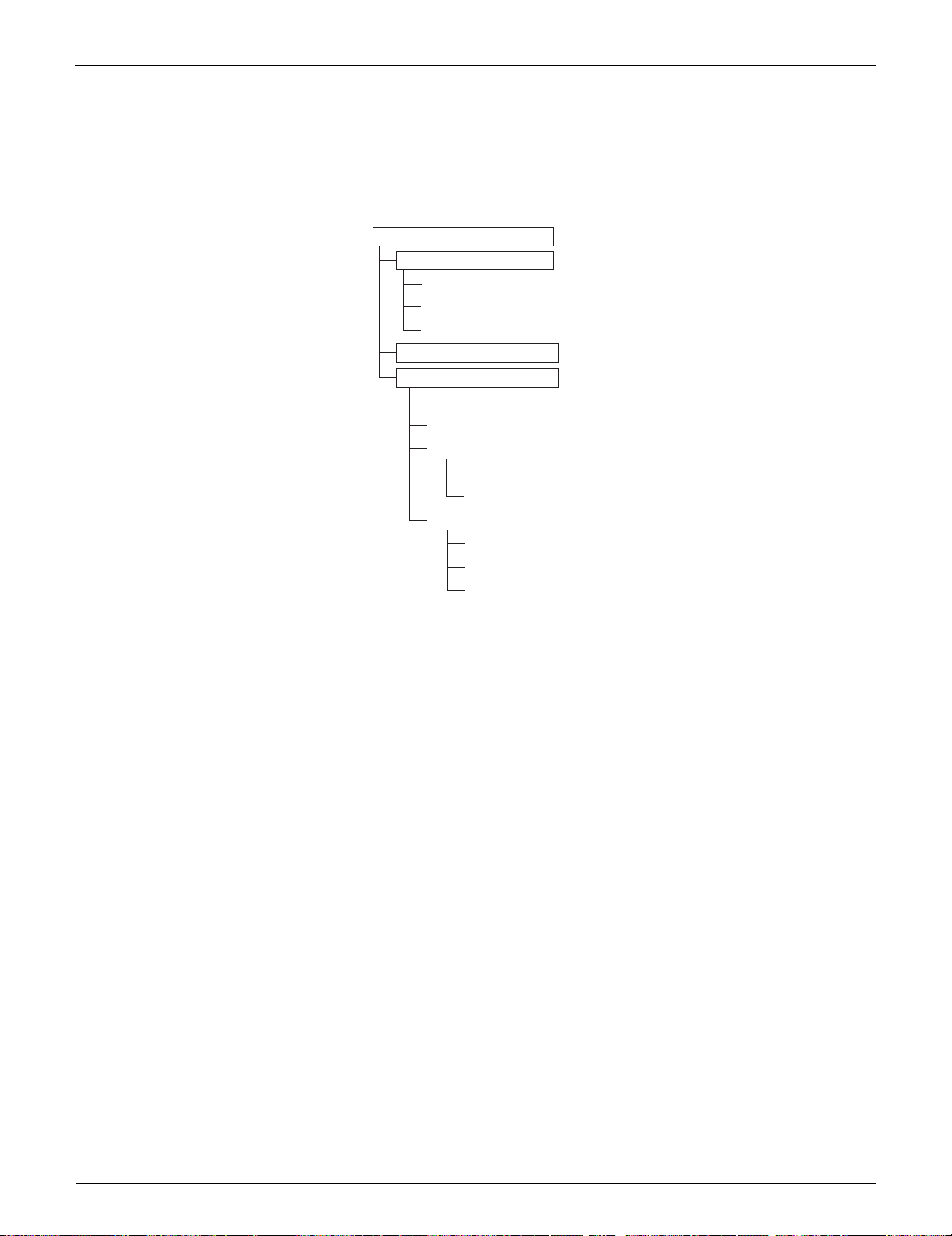
Control Specification SiUS121827E
104 Part 4 Functions and Control
4.2 Mode Hierarchy
Outline The air conditioner control has normal operation mode, forced operation mode, and power
transistor test mode for installation and servicing.
Details
Unless specified otherwise, dry operation command is regarded as cooling operation.
Indoor fan operation cannot be made in multiple indoor units. (A forced fan command is made
during forced cooling operation.)
Determine Operation Mode
The system judges the operation mode command which is set by each room in accordance with the
procedure, and determines the operation mode of the system.
The following procedure is taken when the modes conflict with each other.
∗1. The system follows the mode which is set first. (First-push, first-set)
∗2. For the rooms where the different mode is set, standby mode is activated. (The operation lamp
blinks.)
Air conditioner control mode
Forced operation mode
Forced cooling operation (for pump down operation)
Forced heating operation
Wiring error check operation
Power transistor test mode
Normal operation mode
Fan
Cooling (includes drying)
Heating
Heating
Defrosting
Stop (indoor unit: OFF)
Preheating operation
Discharging from capacitor
Stop
(R17361)
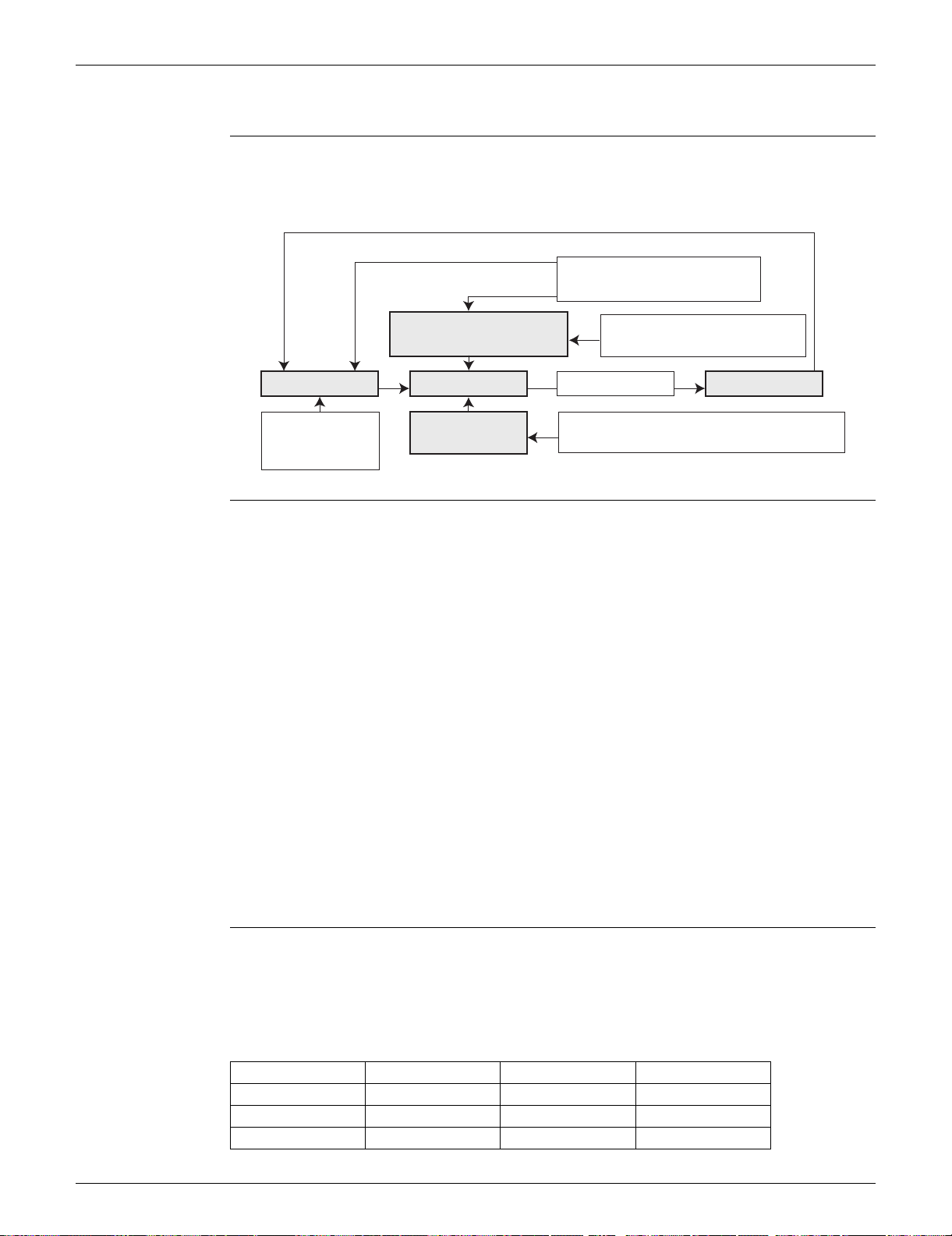
SiUS121827E Control Specification
Part 4 Functions and Control 105
4.3 Frequency Control
Outline Frequency corresponding to each room’s capacity is determined according to the difference
between the target temperature and the temperature of each room.
Details The compressor’s frequency is determined by taking the following steps.
1. Determine command frequency
Command frequency is determined in the following order of priority.
(1) Limiting defrost control time
(2) Forced cooling/heating
(3) Indoor frequency command
2. Determine upper limit frequency
The minimum value is set as the upper limit frequency among the frequency upper limits of the
following functions:
Compressor protection, input current, discharge pipe temperature, low Hz high pressure limit,
heating peak-cut, freeze-up protection, defrost.
3. Determine lower limit frequency
The maximum value is set as the lower limit frequency among the frequency lower limits of the
following function:
Four way valve operation compensation, draft prevention, pressure difference upkeep.
4. Determine prohibited frequency
There is a certain prohibited frequency such as a power supply frequency.
Parameters Q value
Indoor unit output determined from indoor unit volume, airflow rate and other factors.
S value: Indoor Unit Capacity
S value is the capacity of the indoor unit, and is used for frequency command.
Ex:
Command frequency
Limit frequency
Skip control
Upper limit function
Compressor protection function
Lower limit function
Four way valve operation compensation, etc.
Target frequency
(R18023)
When the shift of the frequency is less than zero (ΔF<0) by PI control,
the target frequency is used as the command frequency.
Dropping function
Input current control, etc.
Upper limit frequency
FMAX
Lower limit frequency
FMIN
Initial frequency
PI control
Defrost control
Capacity S value Capacity S value
7 kBtu/h 20 15 kBtu/h 50
9 kBtu/h 25 18 kBtu/h 60
12 kBtu/h 35 24 kBtu/h 71
Control Specification SiUS121827E
106 Part 4 Functions and Control
ΔD signal: Indoor frequency command
The difference between the room thermistor temperature and the target temperature is taken as the
ΔD value and is used for ΔD signal of frequency command.
Values depend on the type of indoor unit.
∗ OFF = Thermostat OFF
Initial Frequency When starting the compressor, or when conditions are varied due to a change of operating rooms,
the frequency must be initialized according to a total of the maximum ΔD value of each room and a
total Q value (ΣQ) of the operating room (the room in which the thermostat is set to ON).
PI Control 1. P control
MaxΔD value is calculated in each sampling time (15 seconds), and the frequency is adjusted
according to its difference from the frequency previously calculated.
2. I control
If the operating frequency does not change for more than a certain fixed time, the frequency is
adjusted according to maxΔD value.
When maxΔD value is low, the frequency is lowered.
When maxΔD value is high, the frequency is increased.
3. Frequency control when other controls are functioning
When frequency is dropping:
Frequency control is carried out only when the frequency drops.
For limiting lower limit:
Frequency control is carried out only when the frequency rises.
4. Upper and lower limit of frequency by PI control
The frequency upper and lower limits are set according to the total of S values. When the indoor
unit quiet operation commands come from all the rooms or when the outdoor unit quiet
operation commands come from all the rooms, the upper limit frequency is lower than the usual
setting.
Temperature
difference
ΔD
signal
Temperature
difference
ΔD
signal
Temperature
difference
ΔD
signal
Temperature
difference
ΔD
signal
–2.0°C (–3.6°F) ∗OFF 0°C (0°F) 4 2.0°C (3.6°F) 8 4.0°C (7.2°F) 12
–1.5°C (–2.7°F) 1 0.5°C (0.9°F) 5 2.5°C (4.5°F) 9 4.5°C (8.1°F) 13
–1.0°C (–1.8°F) 2 1.0°C (1.8°F) 6 3.0°C (5.4°F) 10 5.0°C (9.0°F) 14
–0.5°C (–0.9°F) 3 1.5°C (2.7°F) 7 3.5°C (6.3°F) 11 5.5°C (9.9°F) 15
SiUS121827E Control Specification
Part 4 Functions and Control 107
4.4 Controls at Mode Changing/Start-up
4.4.1 Preheating Control
Outline The inverter operation in open phase starts with the conditions of the outdoor temperature and the
preheating command from the indoor unit.
Details ON Condition
When the outdoor temperature is below 6°C (42.8°F), the inverter operation in open phase
starts.
OFF Condition
When the outdoor temperature is higher than 7.5°C (45.5°F), the inverter operation in open
phase stops.
4.4.2 Four Way Valve Switching
Outline The four way valve coil is energized/not energized depending on the operation mode (Heating: ON,
Cooling/Dry/Defrost: OFF). In order to eliminate the switching sound as the four way valve coil
switches from ON to OFF when the heating is stopped, the OFF delay switch of the four way valve
is carried out.
Details OFF delay switch of four way valve
The four way valve coil is energized for 150 seconds after the operation is stopped.
4.4.3 Four Way Valve Operation Compensation
Outline At the beginning of operation as the four way valve is switched, the pressure difference to activate
the four way valve is acquired when the output frequency is higher than a certain fixed frequency,
for a certain fixed time.
Details Starting Conditions
The compressor starts and the four way valve switches from OFF to ON
The four way valve switches from ON to OFF during operation
The compressor starts after resetting
The compressor starts after the fault of four way valve switching
The lower limit of frequency keeps A Hz for 70 seconds for any of the conditions above.
4.4.4 3-Minute Standby
Turning on the compressor is prohibited for 3 minutes after turning off.
(The function is not used when defrosting.)
Cooling Heating
A (Hz) 32 26
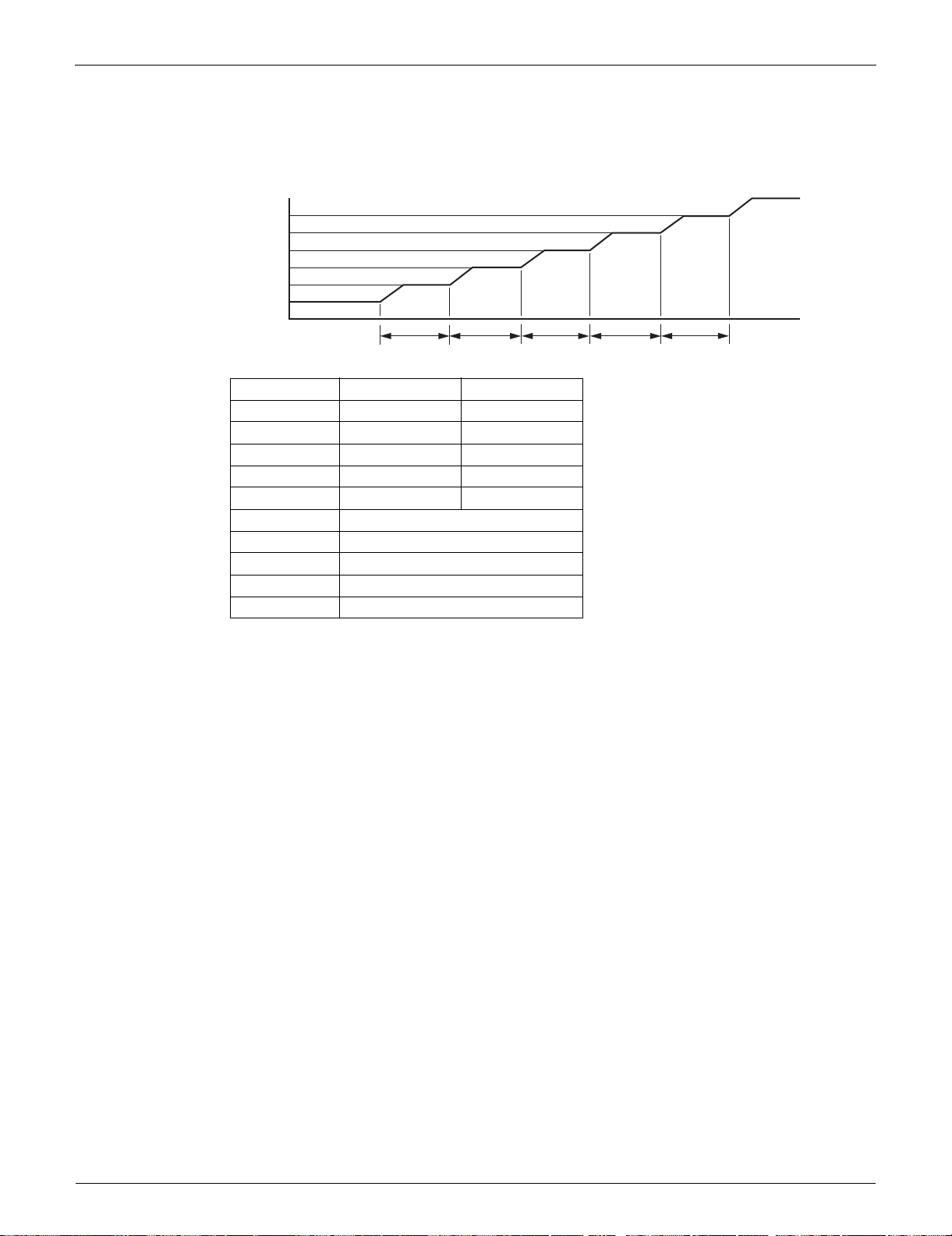
Control Specification SiUS121827E
108 Part 4 Functions and Control
4.4.5 Compressor Protection Function
When turning the compressor from OFF to ON, the upper limit of frequency is set as follows.
(The function is not used when defrosting.)
Cooling Heating
A (Hz) 35 23
B (Hz) 48 48
C (Hz) 65 65
D (Hz) 83 83
E (Hz) 95 95
F (seconds) 120
G (seconds) 270 ~ 420
H (seconds) 290 ~ 450
J (seconds) 170 ~ 250
K (seconds) 150 ~ 220
(sec.)
Time
(R23251)
(Hz)
Frequency
C
D
E
B
FGHJK
A
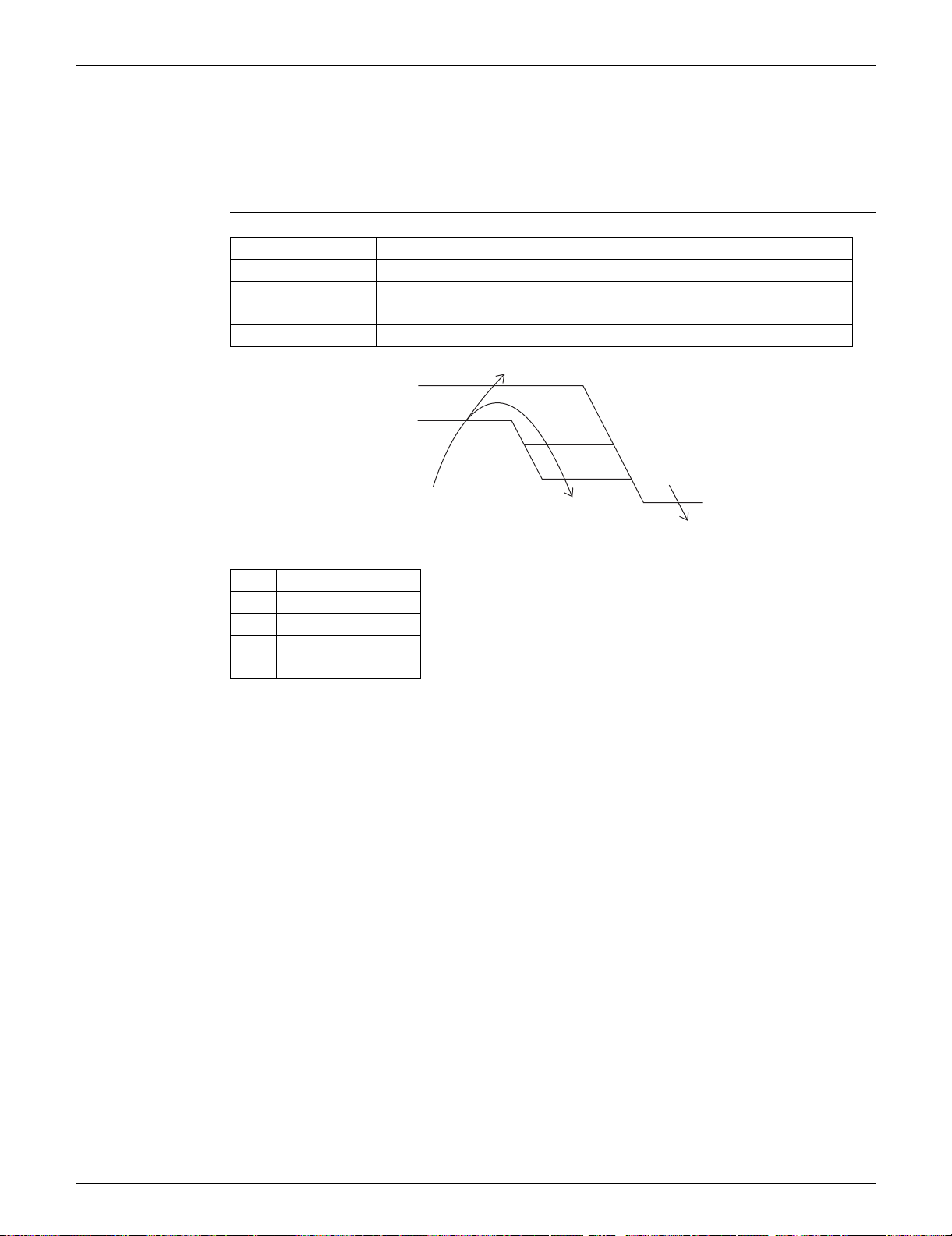
SiUS121827E Control Specification
Part 4 Functions and Control 109
4.5 Discharge Pipe Temperature Control
Outline The discharge pipe temperature is used as the internal temperature of the compressor. If the
discharge pipe temperature rises above a certain level, the upper limit of frequency is set to keep
the discharge pipe temperature from rising further.
Details
Zone Control
Stop zone When the temperature reaches the stop zone, the compressor stops.
Dropping zone The upper limit of frequency decreases.
Keep zone The upper limit of frequency is kept.
Reset zone The upper limit of frequency is canceled.
A 120°C (248°F)
B 111°C (231.8°F)
C 109°C (228.2°F)
D 107°C (224.6°F)
E 107°C (224.6°F)
Reset zone
Stop zone
Dropping
zone
Keep
zone
(R14266)
A
C
D
E
B
Discharge pipe
temperature
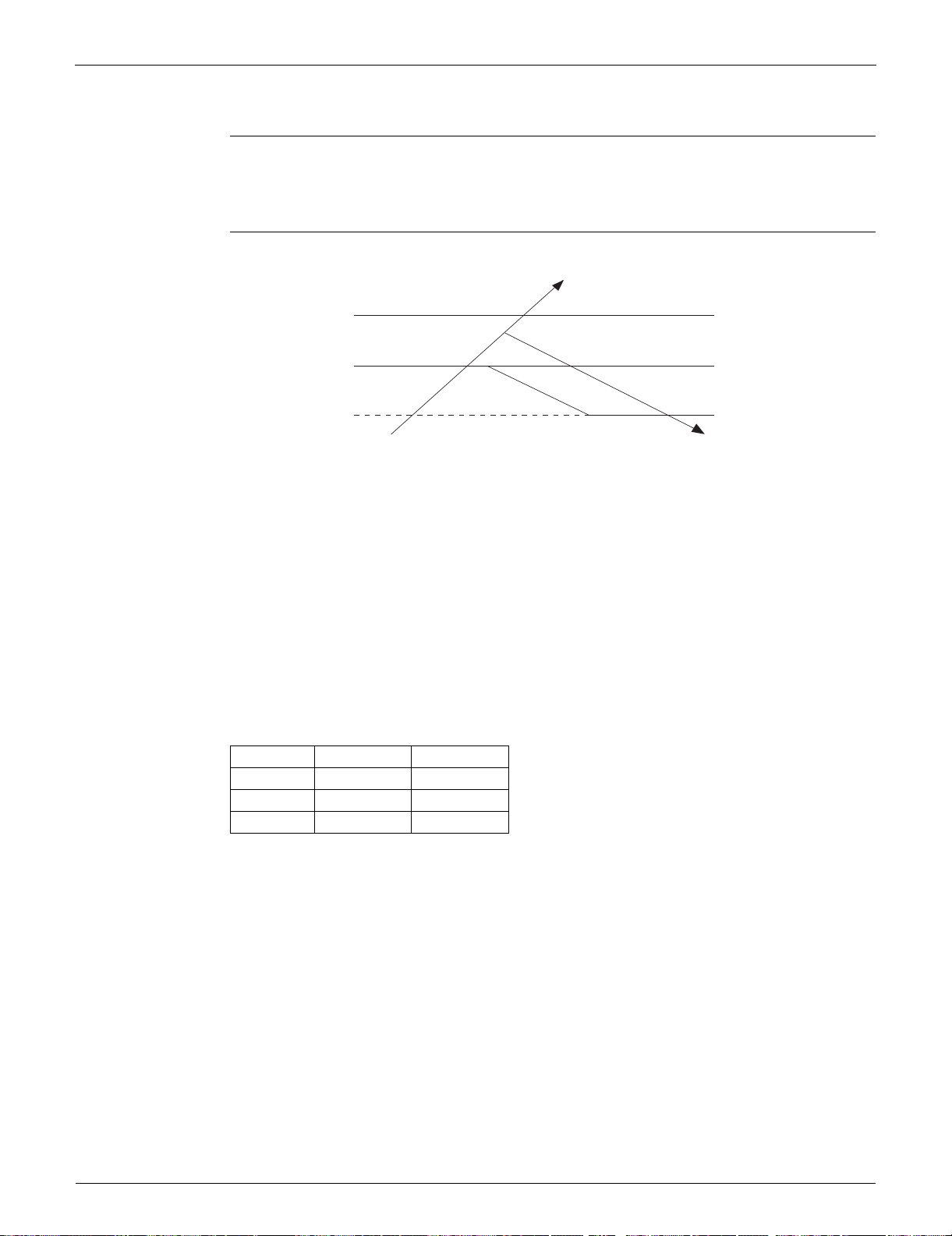
Control Specification SiUS121827E
110 Part 4 Functions and Control
4.6 Input Current Control
Outline The microcomputer calculates the input current while the compressor is running, and sets the
frequency upper limit based on the input current.
In case of heat pump models, this control is the upper limit control of the frequency and takes
priority over the lower limit control of four way valve operation compensation.
Details
Frequency control in each zone
Stop zone
After the input current remains in the stop zone for 2.5 seconds, the compressor is stopped.
Dropping zone
The upper limit of the compressor frequency is defined as operation frequency – 2 Hz.
After this, the output frequency is lowered by 2 Hz every second until it reaches the keep zone.
Keep zone
The present maximum frequency goes on.
Reset zone
Limit of the frequency is canceled.
Limitation of current dropping and stop value according to the outdoor temperature
The current drops when outdoor temperature becomes higher than a certain level (depending on
the model).
Cooling Heating
A (A) 27.5 29
B (A) 25.5 27
C (A) 24.5 26
Compressor Stop
Input current
Dropping zone
Stop zone
Keep zone
Reset zone
(R23249)
A
(A)
B
C
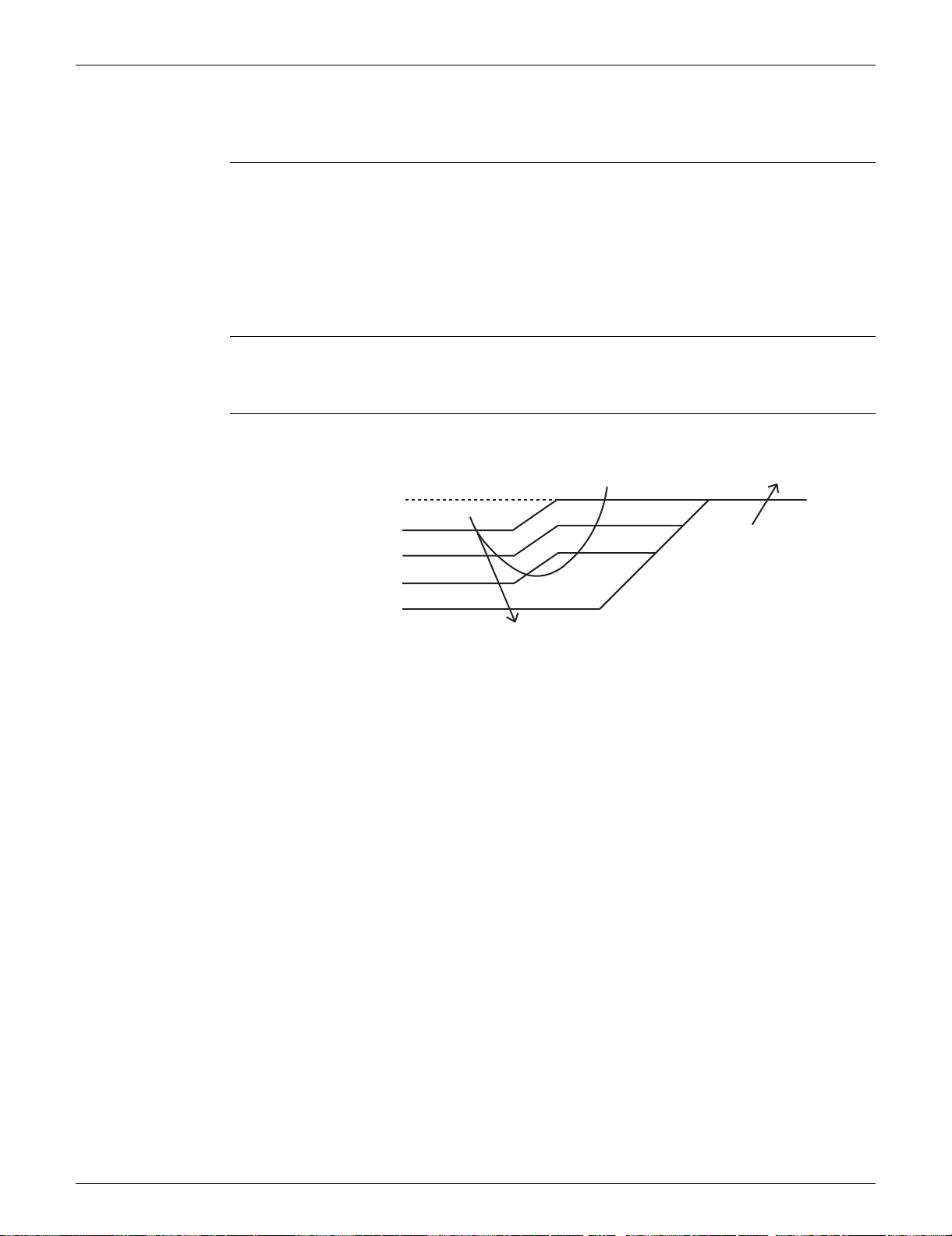
SiUS121827E Control Specification
Part 4 Functions and Control 111
4.7 Freeze-up Protection Control
4.7.1 Freeze-up Protection Control (Except FDMQ Series)
Applicable
Models
FTXR09/12/18TVJUW(S)
CTXG09/12/18QVJUW(S)
CTXS07LVJU
FTXS09/12/15/18/24LVJU
FDXS09/12LVJU
CDXS15/18/24LVJU
FVXS09/12/15/18NVJU
FFQ09/12/15/18Q2VJU
Outline During cooling operation, the signal sent from the indoor unit determines the frequency upper limit
and prevents freezing of the indoor heat exchanger. The signals from the indoor unit is divided into
zones.
Details The operating frequency limitation is judged with the indoor heat exchanger temperature.
R4003451
Reset zone
Up zone
Keep zone
Dropping zone
Stop zone
13°C (55.4°F)
9.5°C (49.1°F)
5.5°C (41.9°F)
0°C (32°F)
7.5°C (45.5°F)
(Reference)
Indoor heat exchanger
temperature (R2T)
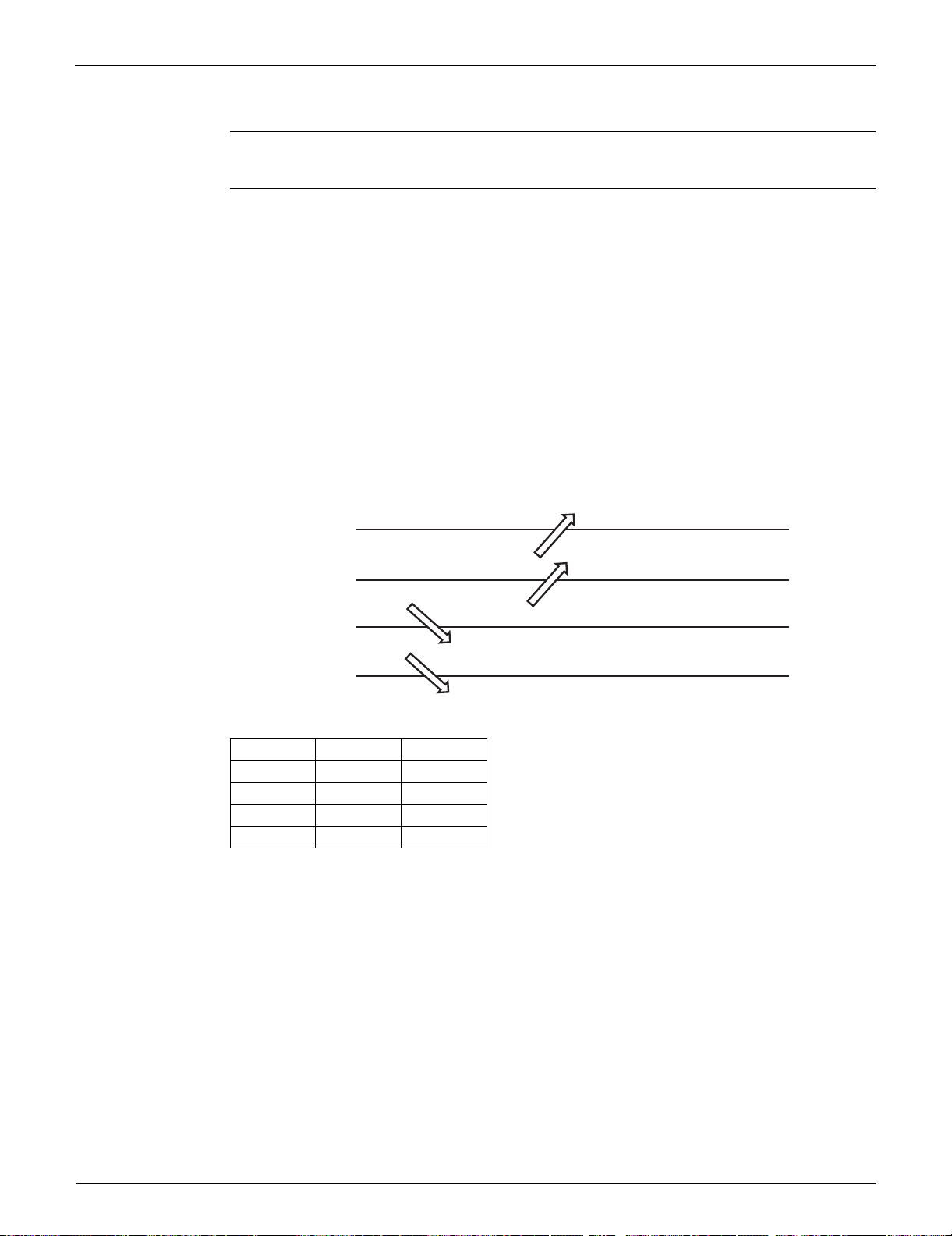
Control Specification SiUS121827E
112 Part 4 Functions and Control
4.7.2 Freeze-up Protection Control for FDMQ Series
Outline During cooling operation, the signal sent from the indoor unit determines the frequency upper limit
and prevents the indoor heat exchanger from freezing.
Details When the freeze-up protection control starts, the compressor stops, the airflow rate is fixed to L tap,
and the drain pump turns ON. Conditions for starting and ending are as below.
Starting conditions
The freeze-up protection control starts when any of the following conditions is satisfied.
The indoor heat exchanger temperature remains at A or lower for 1 minute.
The accumulated time that the indoor heat exchanger temperature remains at B or lower
reaches 40 minutes.
Accumulated timer clearing condition
The indoor heat exchanger temperature remains at C or higher for 20 minutes.
Ending condition
The indoor heat exchanger temperature remains at D or higher for 10 minutes.
R4003387
(°C) (°F)
A –5 23.0
B –1 30.2
C 4 39.2
D 7 44.6
D
A
B
C
Indoor heat
exchanger
temperature
The control starts.
The control starts.
The control ends
and the accumulated timer is cleared.
The accumulated timer is cleared.
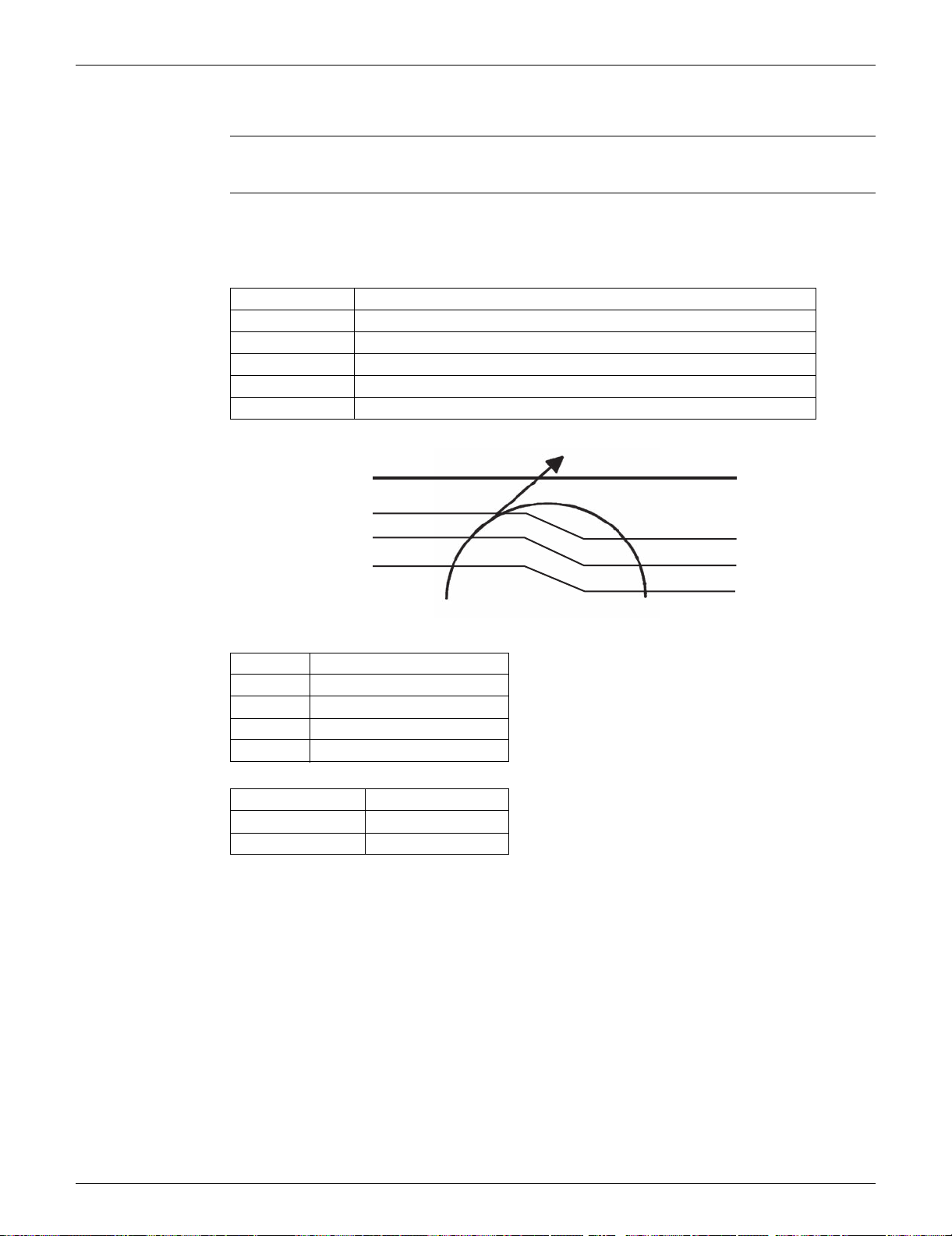
SiUS121827E Control Specification
Part 4 Functions and Control 113
4.8 Heating Peak-cut Control
Outline During heating operation, the indoor heat exchanger temperature determines the frequency upper
limit to prevent abnormal high pressure.
Details The operating frequency is judged with the indoor heat exchanger temperature 2 minutes after
the operation starts and F seconds after the number of the rooms in operation is changed.
The maximum value of the indoor heat exchanger temperature controls the following (excluding
the rooms not in operation).
Zone Control
Stop zone When the temperature reaches the stop zone, the compressor stops.
Dropping zone The upper limit of frequency decreases.
Keep zone The upper limit of frequency is kept.
Up zone The upper limit of frequency increases.
Reset zone The upper limit of frequency is canceled.
A 62.5°C (144.5°F)
B 54°C (129.2°F)
C 53°C (127.4°F)
D 51°C (123.8°F)
E 49°C (120.2°F)
F (seconds)
When increase 30
When decrease 2
Indoor heat exchanger
temperature
Stop zone
Dropping zone
Keep zone
Up zone
Reset zone
(R23928)
D
C
B
A
E

Control Specification SiUS121827E
114 Part 4 Functions and Control
4.9 Outdoor Fan Control
1. Fan OFF control during defrosting
The outdoor fan is turned OFF while defrosting.
2. Fan OFF delay when stopped
The outdoor fan is turned OFF 60 seconds after the compressor stops.
3. Fan speed control for pressure difference upkeep
The rotation speed of the outdoor fan is controlled for keeping the pressure difference during
cooling operation with low outdoor temperature.
When the pressure difference is low, the rotation speed of the outdoor fan is reduced.
When the pressure difference is high, the rotation speed of the outdoor fan is controlled as
well as normal operation.
4. Fan control when the number of heating room decreases
When the outdoor temperature is more than 10°C (50°F), the fan is turned off for 30 seconds.
5. Fan speed control during forced cooling operation
The outdoor fan is controlled as well as normal operation during forced cooling operation.
6. Fan speed control for POWERFUL operation
The rotation speed of the outdoor fan is increased during POWERFUL operation.
7. Fan speed control during indoor/outdoor unit quiet operation
The rotation speed of the outdoor fan is reduced by the command of the indoor/outdoor unit
quiet operation.
8. Fan ON/OFF control when operation (cooling, heating, dry) starts/stops
The outdoor fan is turned ON when the operation starts. The outdoor fan is turned OFF when
the operation stops.
4.10 Liquid Compression Protection Function
Outline The compressor stops according to the outdoor temperature for protection.
Details Operation stops depending on the outdoor temperature.
The compressor turns off under the conditions that the system is in cooling operation and the
outdoor temperature is below –12°C (10.4°F).
4.11 Defrost Control
Outline Defrosting is carried out by the cooling cycle (reverse cycle). The defrosting time or outdoor heat
exchanger temperature must be more than a certain value to finish defrosting.
Details Conditions for Starting Defrost
The starting conditions are determined with the outdoor temperature and the outdoor heat
exchanger temperature.
The system is in heating operation.
The compressor operates for 6 minutes.
More than A minutes of accumulated time have passed after the start of the operation, or
ending the previous defrosting.
Conditions for Canceling Defrost
The judgment is made with the outdoor heat exchanger temperature. (B°C (C°F))
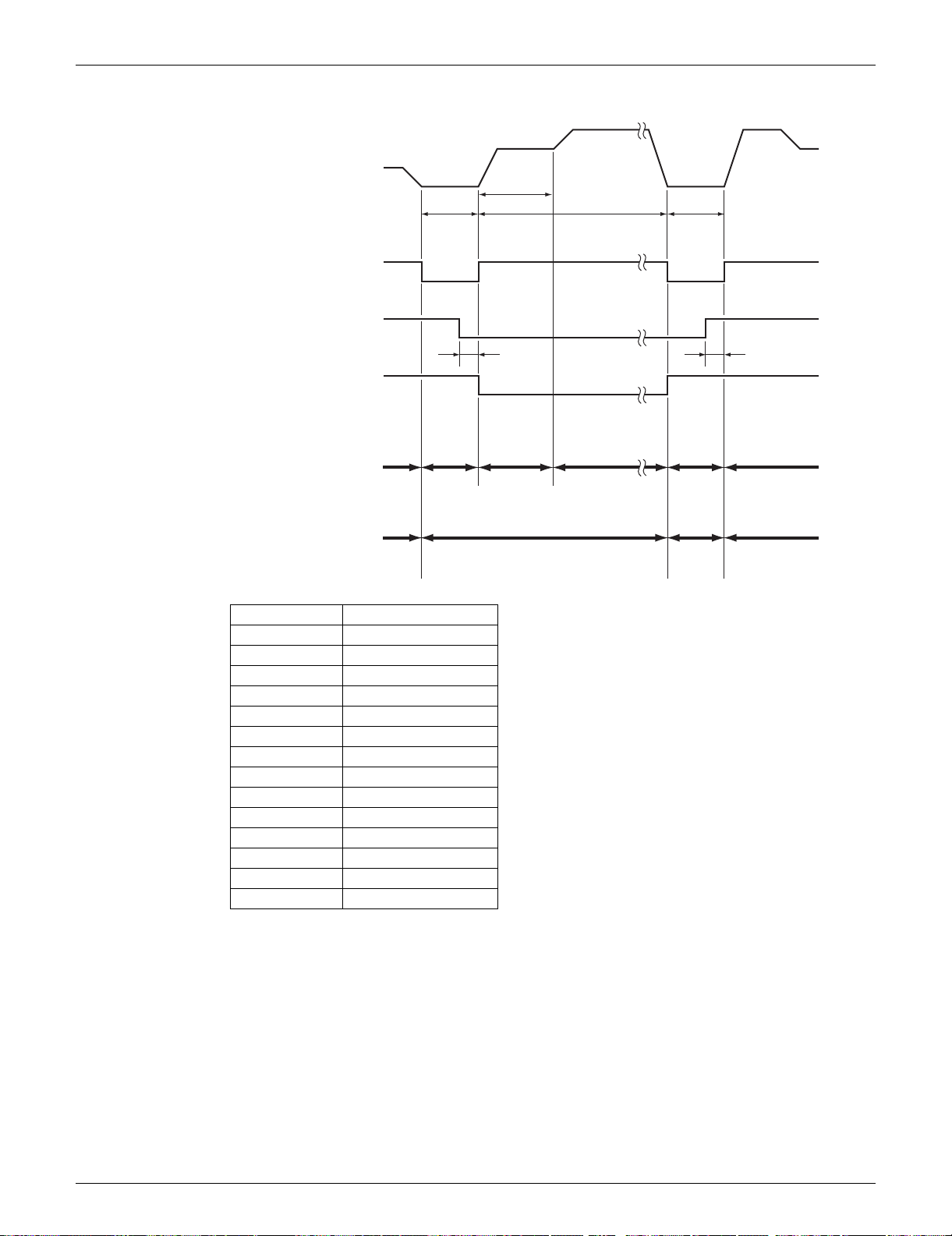
SiUS121827E Control Specification
Part 4 Functions and Control 115
A (minutes) 30
B (°C) 4 ~ 12
C (°F) 39.2 ~ 53.6
D (Hz) 43
E (Hz) 72
F (seconds) 60
G (seconds) 120
H (seconds) 650
J (seconds) 60
K (pulse) 480
L (pulse) 480
M (pulse) 480
N (pulse) 480
P (pulse) 240
Q (pulse) 240
Frequency
Compressor
Four way valve
Fan
ON
OFF
ON
OFF
ON
OFF
0 Hz 0 Hz
D Hz
E Hz
5 sec.
PI control
5 sec.
J sec.
(R21926)
F sec.
G sec.
H sec.
Electronic
expansion valve
opening
(operating room)
Electronic
expansion valve
opening (stop
room)
Normal
control
K pulse
zone
N pulse
zone
L pulse
zone
M pulse
zone
Starting
control
Normal
control
P pulse zone
Q pulse
zone
Starting
control
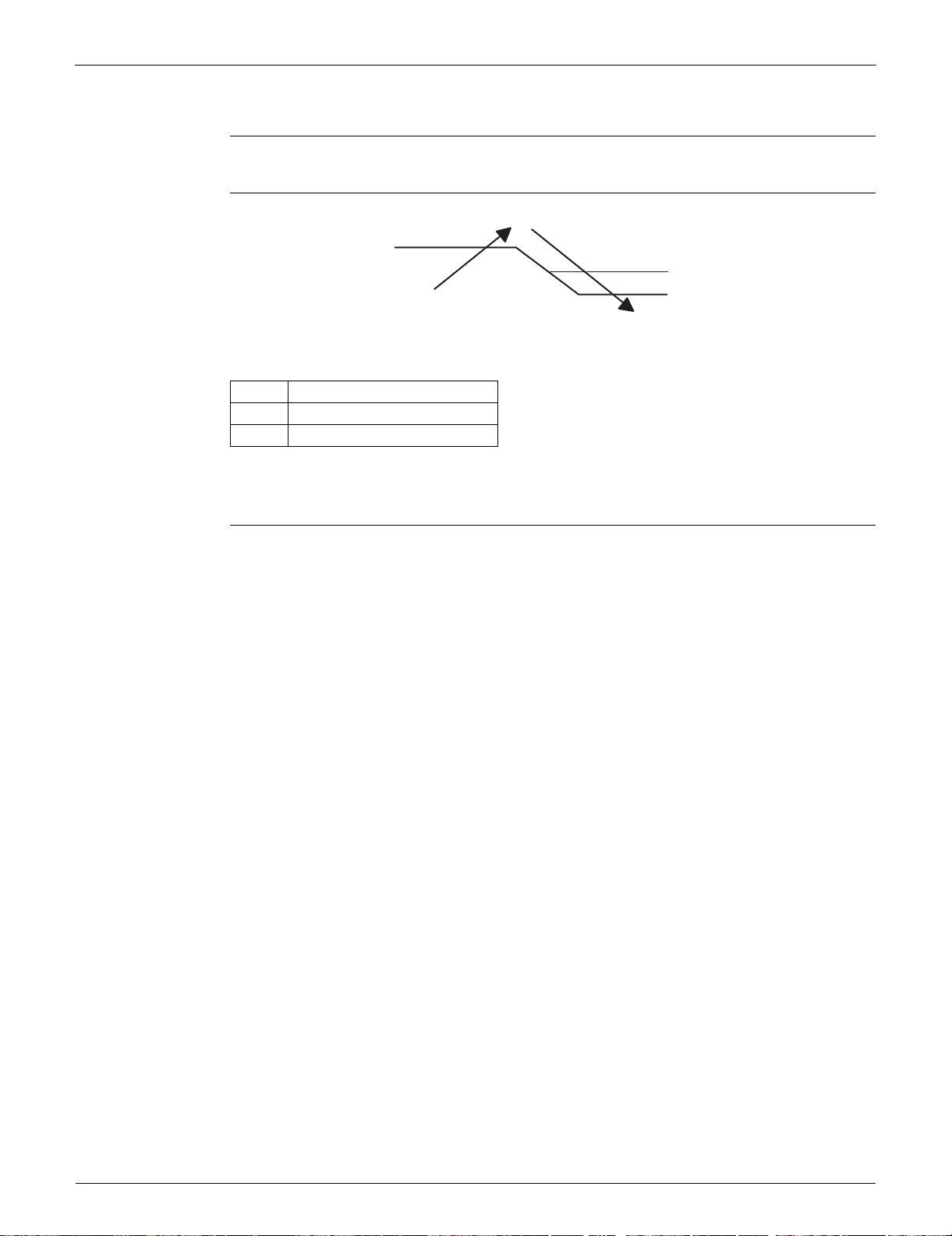
Control Specification SiUS121827E
116 Part 4 Functions and Control
4.12 Low Hz High Pressure Limit
Outline The system controls the upper limit of the frequency to prevent abnormal high pressure while the
frequency is low. Control is carried out according to three zones.
Details
Temperature varies depending on the outdoor heat exchanger temperature.
4.13 Electronic Expansion Valve Control
Outline The following items are included in the electronic expansion valve control.
Electronic expansion valve is fully closed
1. Electronic expansion valve is fully closed when turning on the power.
2. Pressure equalizing control
Room Distribution Control
1. Gas pipe isothermal control
2. SC (subcooling) control
3. Liquid pipe temperature control (with all ports connected and all rooms being air-conditioned)
4. Liquid pipe temperature control for rooms not in operation
5. Dew prevention control for indoor rotor
Open Control
1. Electronic expansion valve control when starting operation
2. Electronic expansion valve control when the frequency changes
3. Electronic expansion valve control for defrosting
4. Electronic expansion valve control for oil recovery
5. Electronic expansion valve control when a discharge pipe temperature is abnormally high
6. Electronic expansion valve control when the discharge pipe thermistor is disconnected
7. Electronic expansion valve control for indoor unit anti-icing control
Feedback Control
Target discharge pipe temperature control
A 23 ~ 54°C (73.4 ~ 129.2°F)
B 22 ~ 53°C (71.6 ~ 127.4°F)
C 19 ~ 50°C (66.2 ~ 122.0°F)
A
B
C
Highest indoor
heat exchanger
temperature
among
operating rooms
Reset zone
Dropping zone
Keep
zone
(R14587)
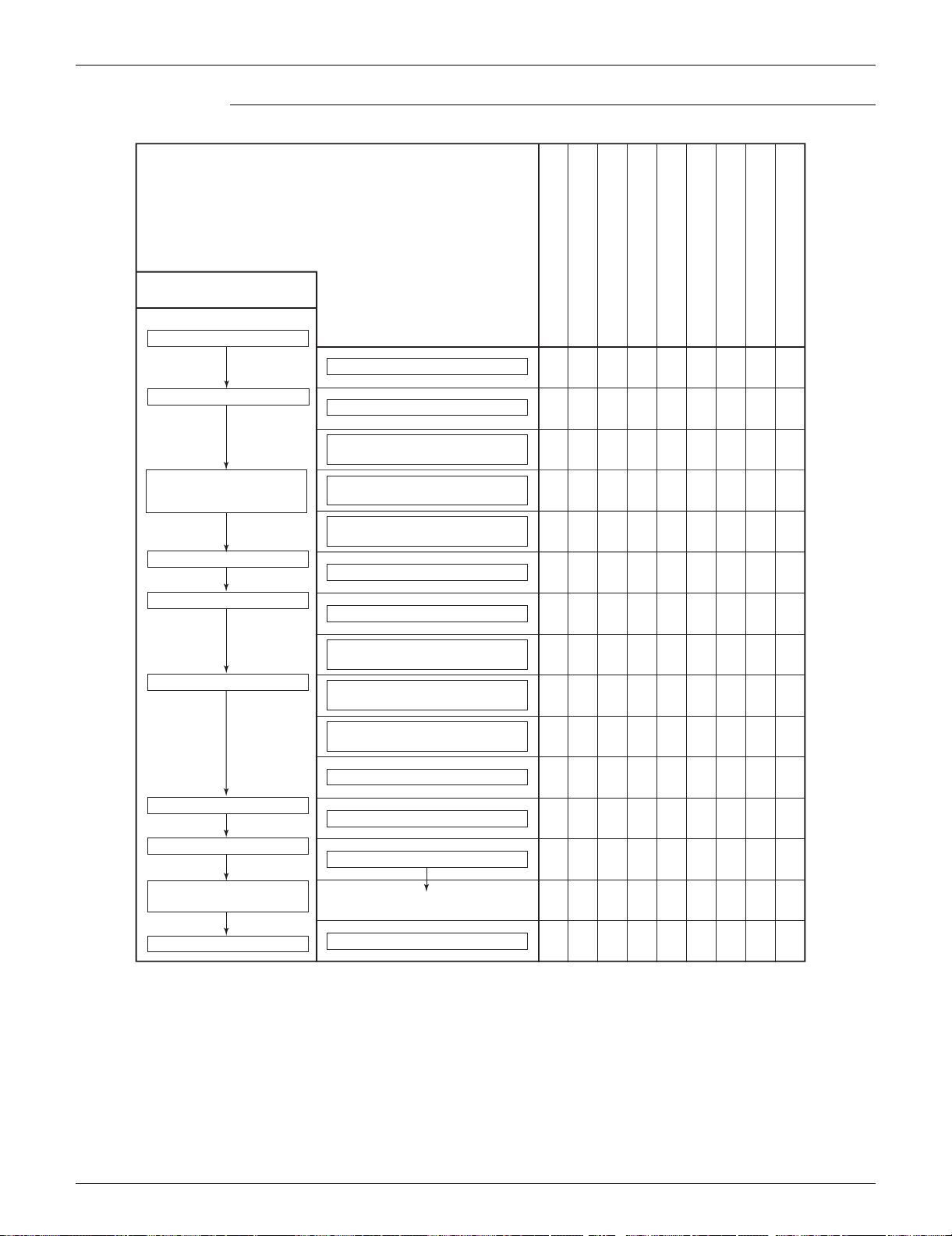
SiUS121827E Control Specification
Part 4 Functions and Control 117
Details The following are the examples of the electronic expansion valve control for each operation mode.
R4003422
Fully closed when power is turned on
Open control when starting
(Control of target discharge pipe
temperature)
Control when the operating room is
changed
(Control of target discharge pipe
temperature)
Pressure equalizing control
Open control when starting
(Control of target discharge pipe
temperature)
Control when the operating room is
changed
(Control of target discharge pipe
temperature)
(Defrost control)
Pressure equalizing control
Open control when starting
Continue
Pressure equalizing control
Operation pattern
When power is turned on
Cooling, 1 room operation
Cooling, 2 rooms operation to
Cooling, 4 rooms operation
Stop
Heating, 1 room operation
Heating, 2 rooms operation
Stop
Heating operation
Discharge pipe thermistor
disconnection control
Stop
—
—
—
—
—
—
—
—
—
—
—
—
—
—
—
—
—
—
—
—
—
—
—
—
—
—
—
—
—
—
—
—
—
—
—
—
—
—
—
—
—
—
—
—
—
—
—
—
—
—
—
—
—
—
—
—
—
—
—
—
—
—
—
—
—
—
—
—
—
—
—
—
2
—
2
—
—
—
2
—
—
—
—
—
—
—
—
1
—
1
—
—
—
1
—
—
—
—
—
—
—
—
3
—
3
—
—
—
3
—
Gas pipe isothermal control
SC (subcooling) control
Control when the frequency changes
Control for abnormally high discharge
pipe temperature
Oil recovery control
Indoor anti-icing control
Liquid pipe temperature control
Liquid pipe temperature control for
non-operating units
Dew prevention control for indoor rotor
: Available
— : Not available
1: When all the indoor units are operating, liquid pipe temperature control is conducted.
2: SC (subcooling) control is conducted for the operating indoor units, when some of the units are not operating.
3: Liquid pipe temperature control for stopped room is conducted for the non-operating indoor units.

Control Specification SiUS121827E
118 Part 4 Functions and Control
4.13.1 Initialization as Power Supply On
The electronic expansion valve is initialized (fully closed) when the power is turned on. Then, the
valve opening position is set and the pressure is equalized.
4.13.2 Pressure Equalizing Control
When the compressor is stopped, the pressure equalizing control is activated. The electronic
expansion valve opens, and develops the pressure equalization.
4.13.3 Opening Limit Control
The maximum and minimum opening of the electronic expansion valve are limited.
The maximum electronic expansion valve opening in the room in operation: 480 pulses
The minimum electronic expansion valve opening in the room in operation: 60 pulses
The electronic expansion valve is fully closed in the room where cooling is stopped and is opened
at a fixed degree during defrosting.
4.13.4 Starting Operation Control/Changing Operation Room
The electronic expansion valve opening is controlled when the operation starts, thus preventing
superheating or liquid compression.
4.13.5 Control when the Frequency Changes
When the target discharge pipe temperature control is active, if the target frequency changes to a
specified value in a certain period of time, the target discharge pipe temperature control is canceled
and the target opening of the electronic expansion valve is changed.
4.13.6 Oil Recovery Function
Outline The electronic expansion valve opening for the room not in operation is set as to open for a certain
time at a specified interval so that the oil for the room not in operation may not be accumulated.
Details During cooling operation, the electronic expansion valve for the room not in operation is opened
every 1 hour by 80 pulses for specified time.
4.13.7 High Discharge Pipe Temperature Control
When the compressor is operating, if the discharge pipe temperature exceeds a certain value, the
electronic expansion valve opens and the refrigerant runs to the low pressure side.
This procedure lowers the discharge pipe temperature.

SiUS121827E Control Specification
Part 4 Functions and Control 119
4.13.8 Discharge Pipe Thermistor Disconnection Control
Outline The disconnection of the discharge pipe thermistor is detected by comparing the discharge pipe
temperature with the condensing temperature. If the discharge pipe thermistor is disconnected, the
electronic expansion valve opens according to the outdoor temperature and the operation
frequency, operates for a specified time, and then stops.
After 3 minutes, the operation restarts and checks if the discharge pipe thermistor is disconnected.
If the discharge pipe thermistor is disconnected, the system stops after operating for a specified
time.
If the disconnection is detected repeatedly, the system is shut down. When the compressor runs for
60 minutes without any error, the error counter is reset.
Details Determining thermistor disconnection
When the starting control (930 seconds) finishes, the following adjustment is made.
1. When the operation mode is cooling
When the following condition is fulfilled, the discharge pipe thermistor disconnection is
ascertained.
Discharge pipe temperature + 6°C (10.8°F) < outdoor heat exchanger temperature
2. When the operation mode is heating
When the following condition is fulfilled, the discharge pipe thermistor disconnection is
ascertained.
Discharge pipe temperature + 6°C (10.8°F) < highest indoor heat exchanger temperature
When the thermistor is disconnected
When the disconnection is ascertained, the compressor continues operation for 9 minutes and then
stops.
4.13.9 Gas Pipe Isothermal Control During Cooling
When the units are operating in multiple rooms, the gas pipe temperature is detected and the
electronic expansion valve opening is adjusted so that the temperature of the gas pipe in each
room becomes equal.
When the gas pipe temperature > the average gas pipe temperature,
→ the opening degree of electronic expansion valve for the corresponding room increases.
When the gas pipe temperature < the average gas pipe temperature,
→ the opening degree of electronic expansion valve for the corresponding room decreases.
The temperatures are monitored every 30 seconds.
4.13.10 SC (Subcooling) Control
Outline The liquid pipe temperature and the heat exchanger temperature are detected and the electronic
expansion valve opening is compensated so that the SC of each room becomes the target SC.
When the actual SC > target SC, open the electronic expansion valve of the room.
When the actual SC < target SC, close the electronic expansion valve of the room.
Details Start Conditions
After finishing the starting control (930 seconds), (all) the electronic expansion valve(s) for the
room(s) in operation is/are controlled.
Determine Electronic Expansion Valve Opening
The electronic expansion valve opening is adjusted so that the temperature difference between the
maximum heat exchanger temperature of connected room and the liquid pipe temperature
thermistor becomes constant.
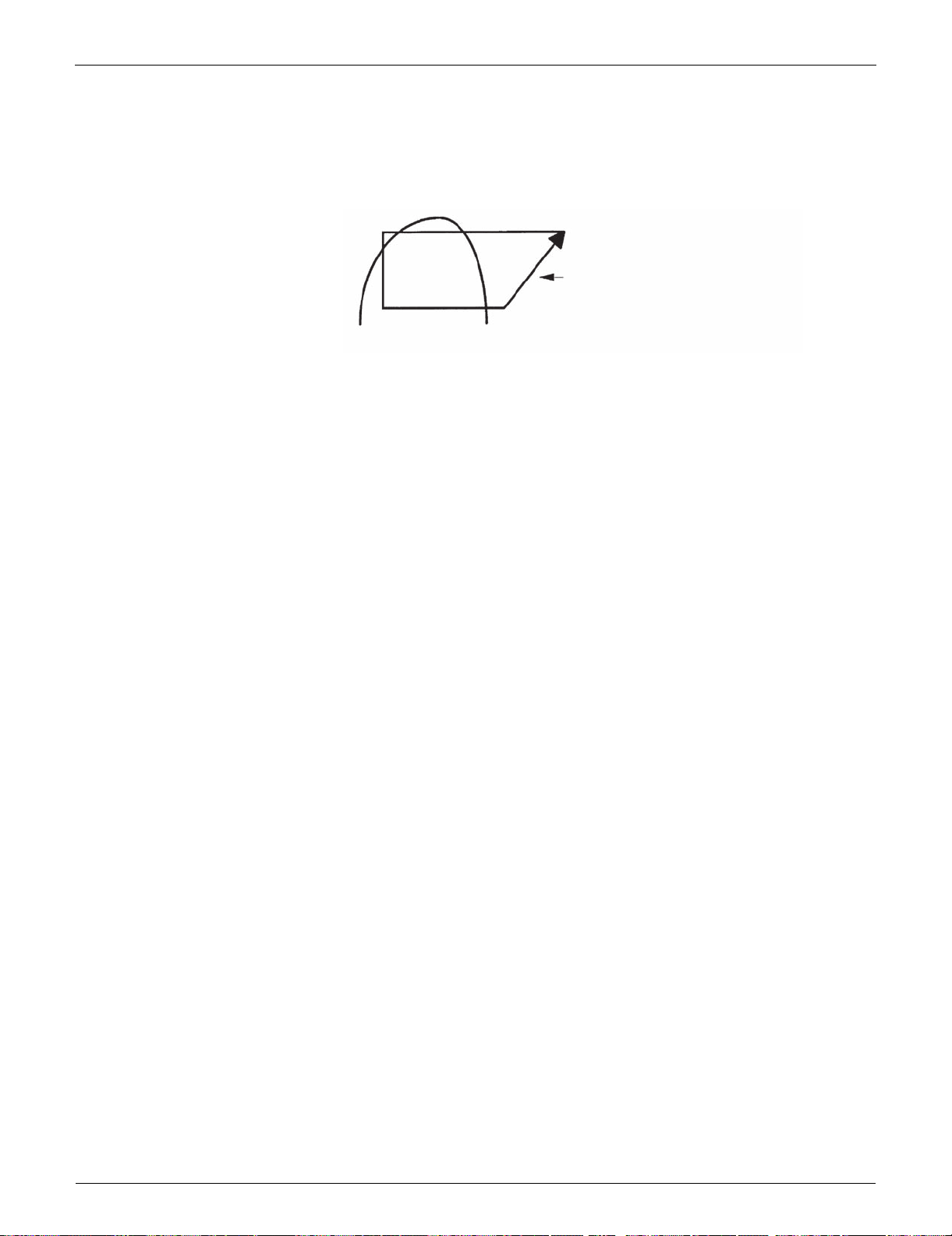
Control Specification SiUS121827E
120 Part 4 Functions and Control
4.13.11 Target Discharge Pipe Temperature Control
The target discharge pipe temperature is obtained from the indoor and outdoor heat exchanger
temperature, and the electronic expansion valve opening is adjusted so that the actual discharge
pipe temperature becomes close to the target discharge pipe temperature. (Indirect SH
(superheating) control using the discharge pipe temperature)
The electronic expansion valve opening and the target discharge pipe temperature are adjusted
every 15 seconds. The target discharge pipe temperature is controlled by indoor heat exchanger
temperature and outdoor heat exchanger temperature. The opening degree of the electronic
expansion valve is adjusted by the following.
Target discharge pipe temperature
Actual discharge pipe temperature
Previous discharge pipe temperature
SC
(Subcooling)
SH
(Superheating)
The target discharge pipe
temperature is set as to become
the target SH.
The inclination does not change
depending on the operating condition.
(R23014)
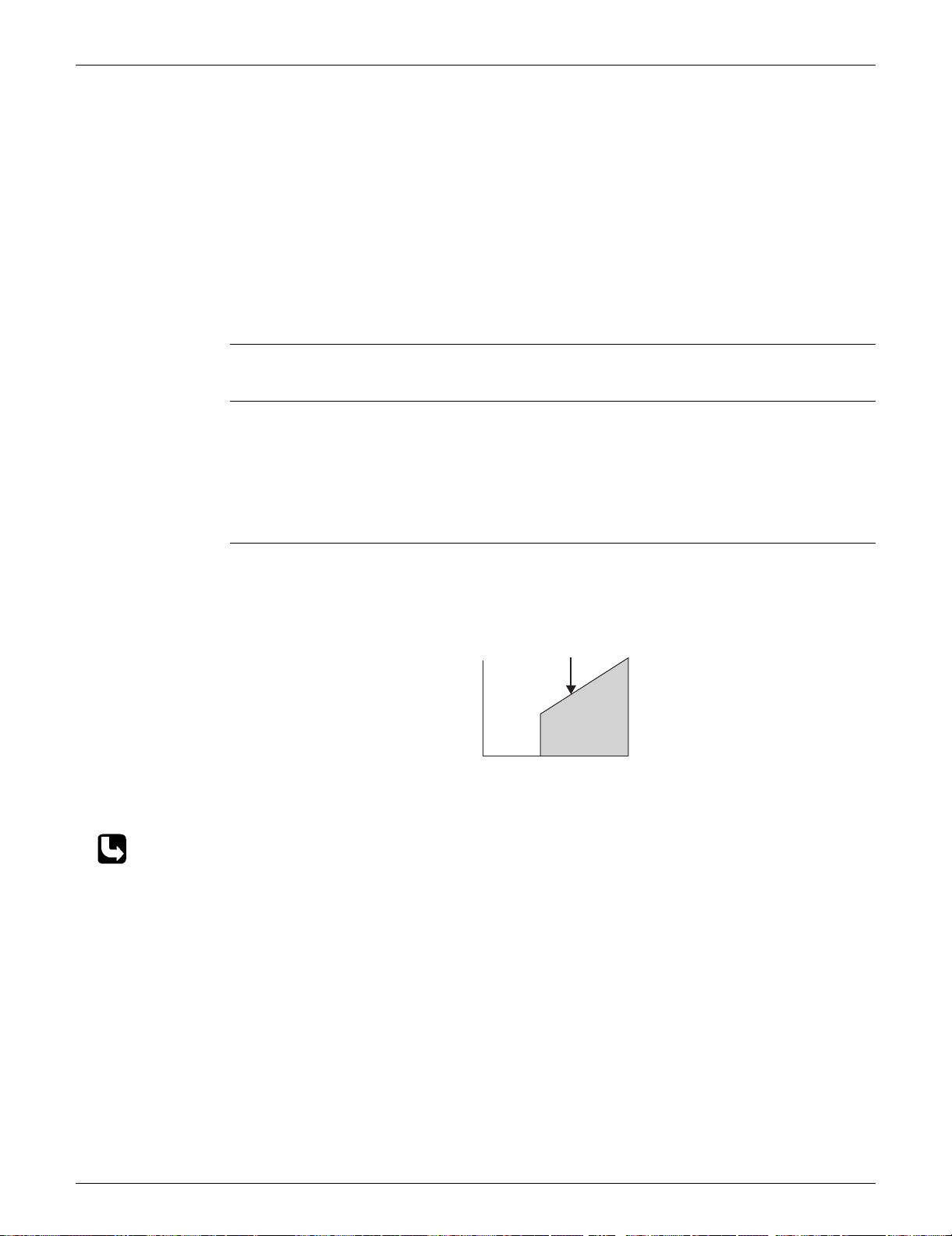
SiUS121827E Control Specification
Part 4 Functions and Control 121
Reference
4.14 Malfunctions
4.14.1 Sensor Malfunction Detection
Relating to Thermistor Malfunction
1. Outdoor heat exchanger thermistor
2. Discharge pipe thermistor
3. Radiation fin thermistor
4. Gas pipe thermistor
5. Outdoor temperature thermistor
6. Liquid pipe thermistor
4.14.2 Detection of Overcurrent and Overload
Outline In order to protect the inverter, an excessive output current is detected and the OL temperature is
observed to protect the compressor.
Details If the inverter current exceeds 27.5 ~ 29 A (depending on the model), the system shuts down
the compressor.
If the OL (on the side of the compressor body) temperature exceeds 125°C (257°F), the
compressor stops.
4.14.3 Refrigerant Shortage Control
Outline If the power consumption is below the specified value and the frequency is higher than the
specified frequency, it is regarded as refrigerant shortage.
The power consumption is low comparing with that in the normal operation when refrigerant is
insufficient, and refrigerant shortage is detected by checking power consumption.
R4003425
Refer to Refrigerant shortage on page 195 for details.
4.14.4 Anti-icing Function
During cooling, if the indoor heat exchanger temperature in the room not in operation becomes
below the specified temperature for the specified time, the electronic expansion valve is opened in
the operation stopped room as specified, and the fully closed operation is carried out. After this, if
freezing abnormality occurs longer than specified time, the system shuts down as the system
abnormality.
Frequency
Refrigerant shortage zone
40 Hz
Power consumption
(Input current)

SiUS121827E
122 Part 5 Remote Controller
1. Applicable Remote Controller .................................................................123
2. ARC466A36 ............................................................................................124
3. ARC452A21 ............................................................................................126
4. ARC452A23 ............................................................................................128
5. ARC466A21 ............................................................................................130
6. BRC944B2 Wired Remote Controller......................................................132
7. BRC1E73 Wired Remote Controller........................................................133
8. BRC082A43 Wireless Remote Controller ...............................................139
9. BRC082A41W, BRC082A42W(S) Wireless Remote Controller..............141
Part 5
Remote Controller
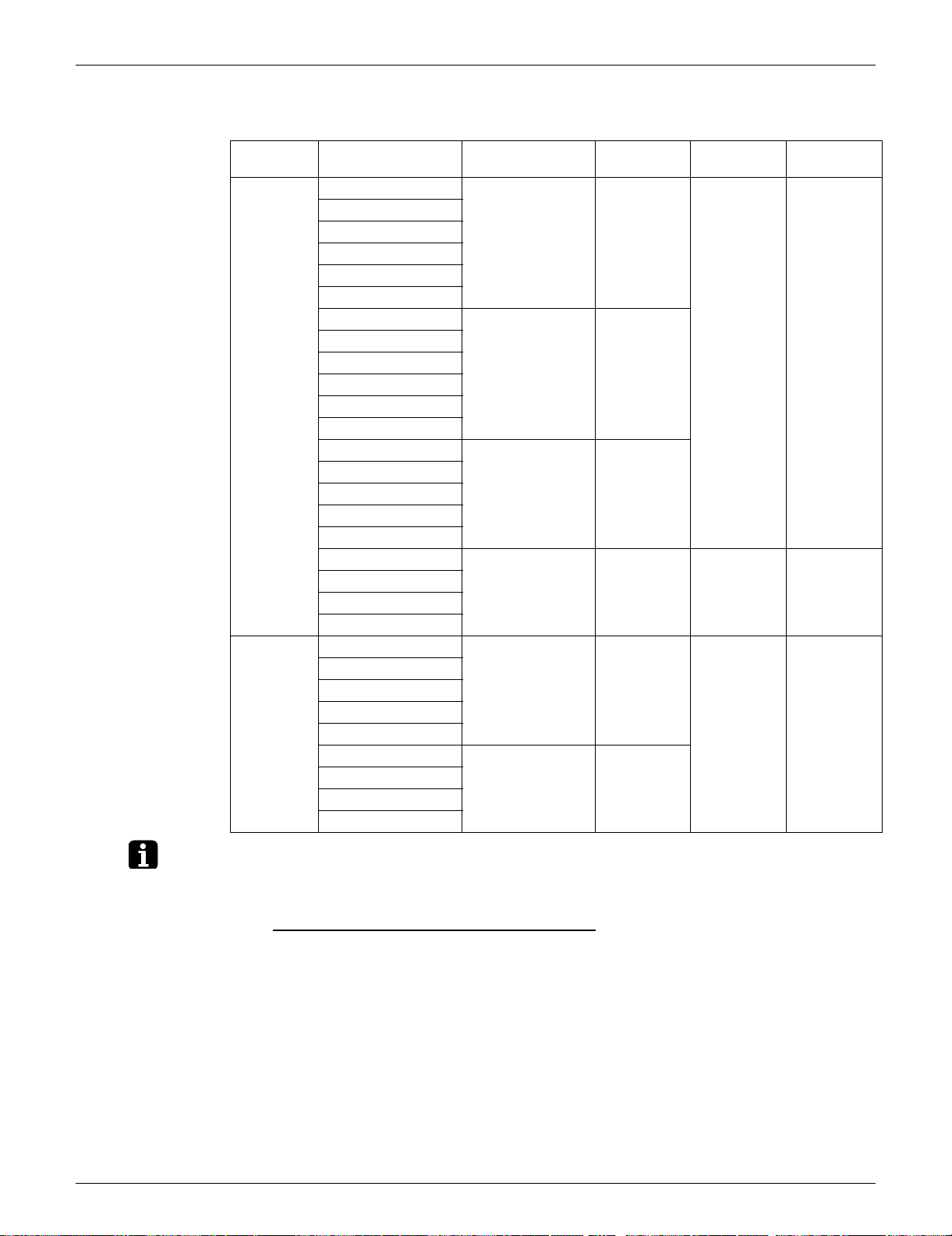
SiUS121827E Applicable Remote Controller
Part 5 Remote Controller 123
Note
1. Applicable Remote Controller
Refer to the operation manual of applicable model for details. You can download operation
manuals from Daikin Business Portal:
Daikin Business Portal → Document Search → Item Category → Installation/Operation Manual
(URL: https://global1d.daikin.com/business_portal/login/
)
Indoor Unit
Type
Model Name Wireless R/C
Reference
Page
Wired R/C
Reference
Page
RA
FTXR09TVJUW(S)
ARC466A36 124
BRC944B2 132
FTXR12TVJUW(S)
FTXR18TVJUW(S)
CTXG09QVJUW(S)
CTXG12QVJUW(S)
CTXG18QVJUW(S)
CTXS07LVJU
ARC452A21 126
FTXS09LVJU
FTXS12LVJU
FTXS15LVJU
FTXS18LVJU
FTXS24LVJU
FDXS09LVJU
ARC452A23 128
FDXS12LVJU
CDXS15LVJU
CDXS18LVJU
CDXS24LVJU
FVXS09NVJU
ARC466A21 130 — —
FVXS12NVJU
FVXS15NVJU
FVXS18NVJU
SA
FDMQ09RVJU
BRC082A43 139
BRC1E73 133
FDMQ12RVJU
FDMQ15RVJU
FDMQ18RVJU
FDMQ24RVJU
FFQ09Q2VJU
BRC082A41W
BRC082A42W(S)
141
FFQ12Q2VJU
FFQ15Q2VJU
FFQ18Q2VJU
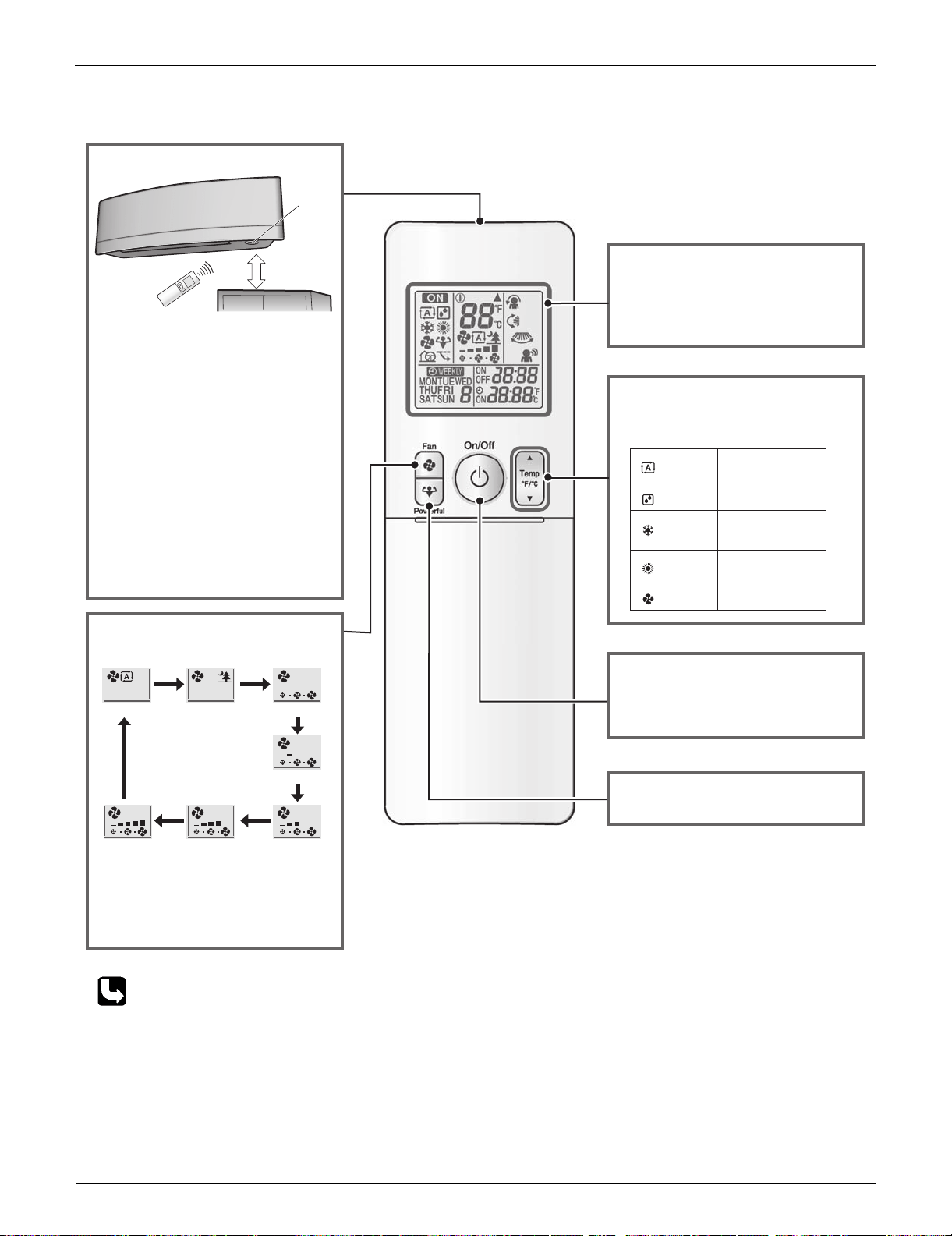
ARC466A36 SiUS121827E
124 Part 5 Remote Controller
Reference
2. ARC466A36
Refer to the following pages for details.
Signal transmitter
Powerful
1
button
• Starts POWERFUL operation.
Display (LCD)
• Changes the temperature setting.
On/Off button
Auto Indoor unit quiet Low
Middle low
MiddleMiddle highHigh
• Press this button once to start
operation.
Press once again to stop it.
Temperature adjustment
buttons
• Displays the current settings.
(In this illustration, each section is
shown with all its displays on for the
purpose of explanation.)
• To use the remote controller, aim the
transmitter at the indoor unit. If there
is anything to block signals between
the unit and the remote controller,
such as a curtain, the unit will not
operate.
• The maximum distance for
communication is about 19-11/16 ft
(6 m).
Make sure that there are no
obstacles within 19-11/16 inch (50
cm) under the signal receiver.
Such obstacles, if any, may have an
adverse influence on the reception
performance of the receiver and the
reception distance may be
shortened.
Fan setting button
• In indoor unit quiet operation,
operation sound becomes weak.
(The airflow rate also decreases.)
• In DRY operation, the airflow rate
setting is not available.
• Selects the airflow rate setting.
(R24594)
Receiver
19-11/16”
(50 cm)
or more
: AUTO
: DRY
: COOL
: HEAT
: FAN
18 ~ 30 °C
(64 ~ 86 °F)
Not available
18 ~ 32 °C
(64 ~ 90 °F)
10 ~ 30 °C
(50 ~ 86 °F)
Not available
< ARC466A36 >
1 POWERFUL Operation P.73

SiUS121827E ARC466A36
Part 5 Remote Controller 125
Reference
Refer to the following pages for details.
Swing
5
buttons
On Timer button
Clock
7
button
Select button
• Press this button and adjust
the day and time with Select
button.
Press this button again to
complete TIMER setting.
Timer Cancel button
• Cancels the timer setting.
• It cannot be used for the
WEEKLY TIMER operation.
• Changes the ON/OFF
TIMER and WEEKLY
TIMER settings.
• Adjusts the airflow direction.
• When you press Swing
button, the flap moves up and
down, or (and) the louver
moves right and left. The flap
(louver) stops when you press
Swing button again.
• Press this button and adjust
the day and time with Select
button.
Press this button again to
complete TIMER setting.
(R24616)
: Weekly button
: Program button
: Copy button
: Back button
: Next button
Lamp brightness
setting button
• OUTDOOR UNIT QUIET
operation is not available in
FAN and DRY operation.
• OUTDOOR UNIT QUIET
operation and ECONO
operation cannot be used at
the same time with
POWERFUL operation.
Priority is given to the
function you pressed last.
Econo
4
/ Quiet button
Blank
No setting
Combination
Comfort/Sensor button
(COMFORT AIRFLOW
Operation
2
/ INTELLIGENT
EYE Operation
3
)
INTELLIGENT
EYE
COMFORT
AIRFLOW
• Every time you press
Comfort/Sensor button, the
setting changes in the
following order.
ECONO
Blank
No setting
Combination
• Every time you press
Econo/Quiet button, the
setting changes in the
following order.
OUTDOOR UNIT
QUIET
• Each time you press
Brightness button, the
brightness of the indoor unit
display changes to high, low,
or off.
Mode button
• Selects the operation mode.
AUTO DRY COOL HEAT FAN
Off Timer button
(NIGHT SET mode)
Weekly button
(WEEKLY TIMER
Operation
6
)
Open the Front Cover
2 COMFORT AIRFLOW operation P.61, 64 5 Auto-swing P.61
3 2-area INTELLIGENT EYE operation P.70 6 WEEKLY TIMER operation P.76
4 ECONO operation P.69 7 Clock setting P.75
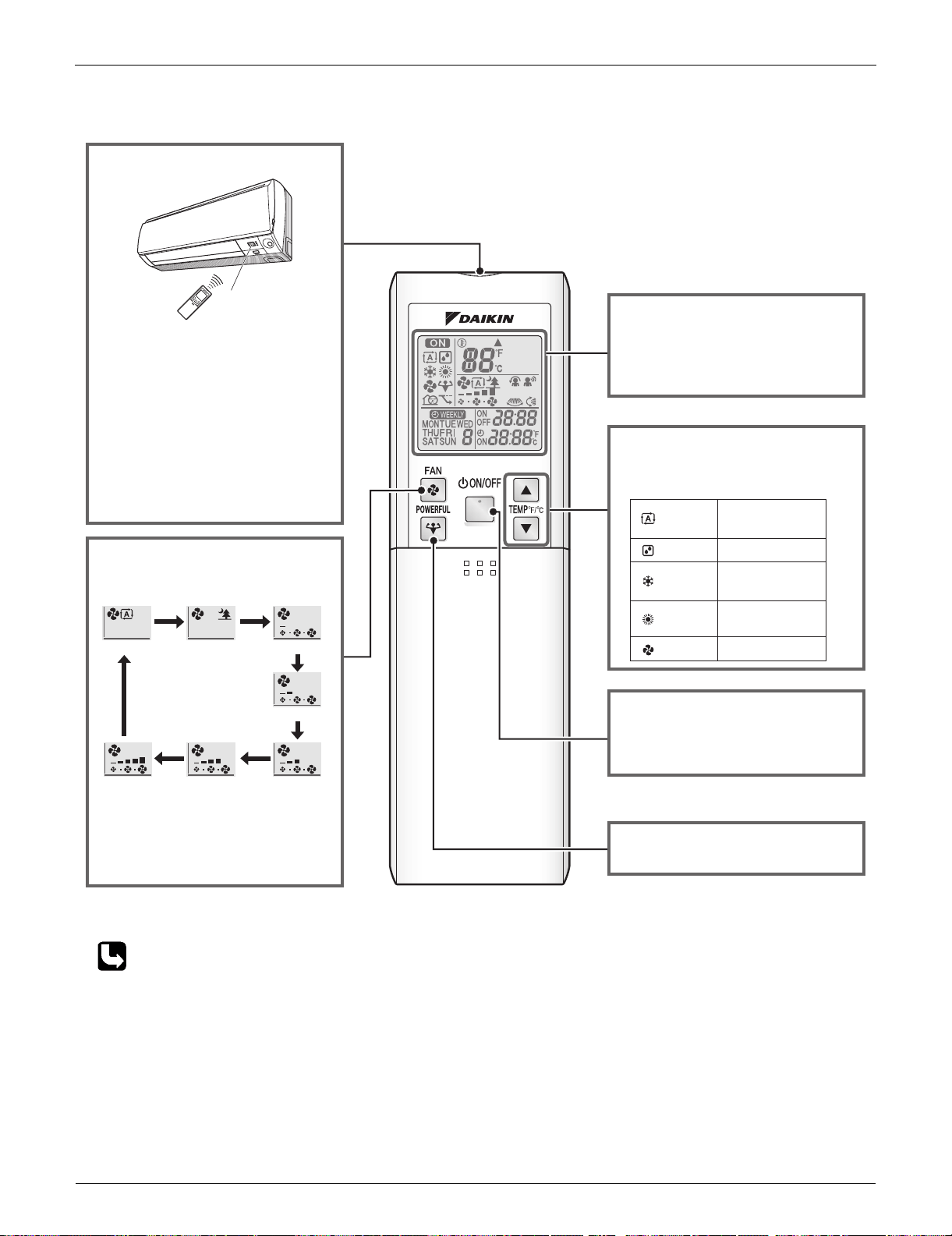
ARC452A21 SiUS121827E
126 Part 5 Remote Controller
Reference
3. ARC452A21
Refer to the following pages for details.
< ARC452A21 >
Signal transmitter
Receiver
POWERFUL
1
button
• Starts POWERFUL operation.
Display (LCD)
ON/OFF button
Auto Indoor unit quiet Low
Middle low
MiddleMiddle highHigh
• Press this button once to
start operation.
Press once again to stop it.
• Displays the current settings.
(In this illustration, each section is
shown with all its displays on for the
purpose of explanation.)
FAN setting button
• In indoor unit quiet operation,
operation sound becomes weak.
(The airflow rate also decreases.)
• In DRY operation, the airflow rate
setting is not available.
• Selects the airflow rate setting
every time you press this button.
(R24595)
• To use the remote controller, aim the
transmitter at the indoor unit. If there
is anything to block signals between
the unit and the remote controller,
such as a curtain, the unit will not
operate.
• Do not drop the remote controller. Do
not get it wet.
• The maximum distance for
communication is approximately 23 ft.
(7 m).
• Changes the temperature setting.
TEMPERATURE
adjustment buttons
: AUTO
: DRY
: COOL
: HEAT
: FAN
18 ~ 30 °C
(64 ~ 86 °F)
Not available
18 ~ 32 °C
(64 ~ 90 °F)
10 ~ 30 °C
(50 ~ 86 °F)
Not available
1 POWERFUL Operation P.73
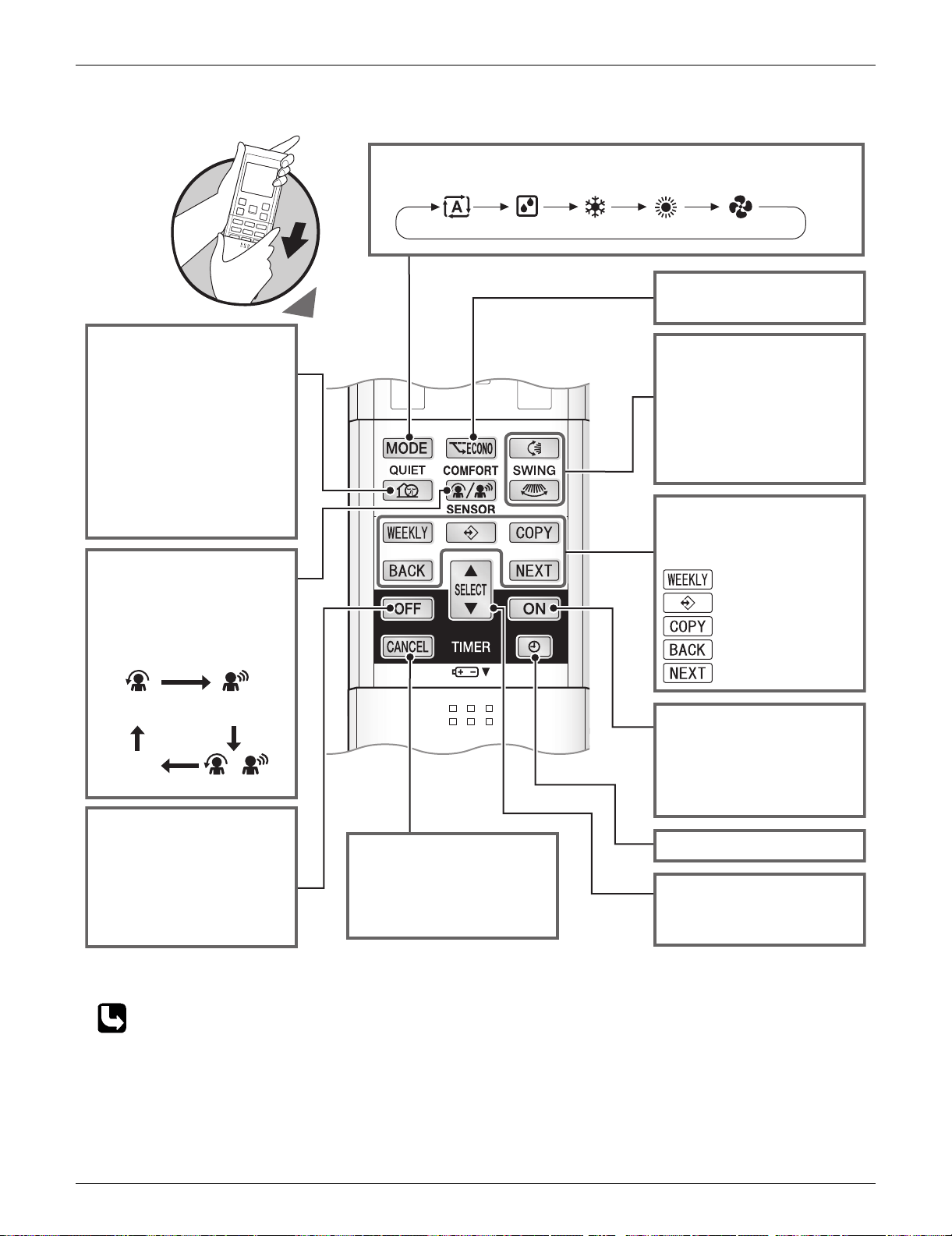
SiUS121827E ARC452A21
Part 5 Remote Controller 127
Reference
Refer to the following pages for details.
ON TIMER button
: WEEKLY button
: PROGRAM button
: COPY button
: BACK button
: NEXT button
SELECT button
Open the Front Cover
ECONO
4
button
• Adjusts the airflow direction.
• When you press SWING
button, the flap moves up and
down, or (and) the louver
moves right and left. The flap
(louver) stops when you press
SWING button again.
CLOCK
7
button
• Changes the ON/OFF TIMER
and WEEKLY TIMER settings.
TIMER CANCEL
button
QUIET button
(R25075)
• Starts ECONO operation.
SWING
5
buttons
• Press this button and adjust
the day and time with
SELECT button.
Press this button again to
complete TIMER setting.
• Cancels the timer setting.
• Cannot be used for the
WEEKLY TIMER operation.
blank
No Setting
Combination
• Press this button and adjust
the day and time with
SELECT button.
Press this button again to
complete TIMER setting.
COMFORT
2
/SENSOR
3
button
INTELLIGENT
EYE
COMFORT
AIRFLOW
• Every time you press
COMFORT/SENSOR button,
the setting changes in the
following order.
• Starts OUTDOOR UNIT
QUIET operation.
• OUTDOOR UNIT QUIET
operation is not available in
FAN and DRY operation.
• OUTDOOR UNIT QUIET
operation and POWERFUL
operation cannot be used at
the same time. Priority is
given to the function you
pressed last.
MODE button
• Selects the operation mode.
AUTO DRY COOL HEAT FAN
WEEKLY button
(WEEKLY TIMER
Operation
6
)
OFF TIMER button
(NIGHT SET mode)
2 COMFORT AIRFLOW operation P.61, 64 5 Auto-swing P.61
3 INTELLIGENT EYE operation P.70 6 WEEKLY TIMER operation P.76
4 ECONO operation P.69 7 Clock setting P.75
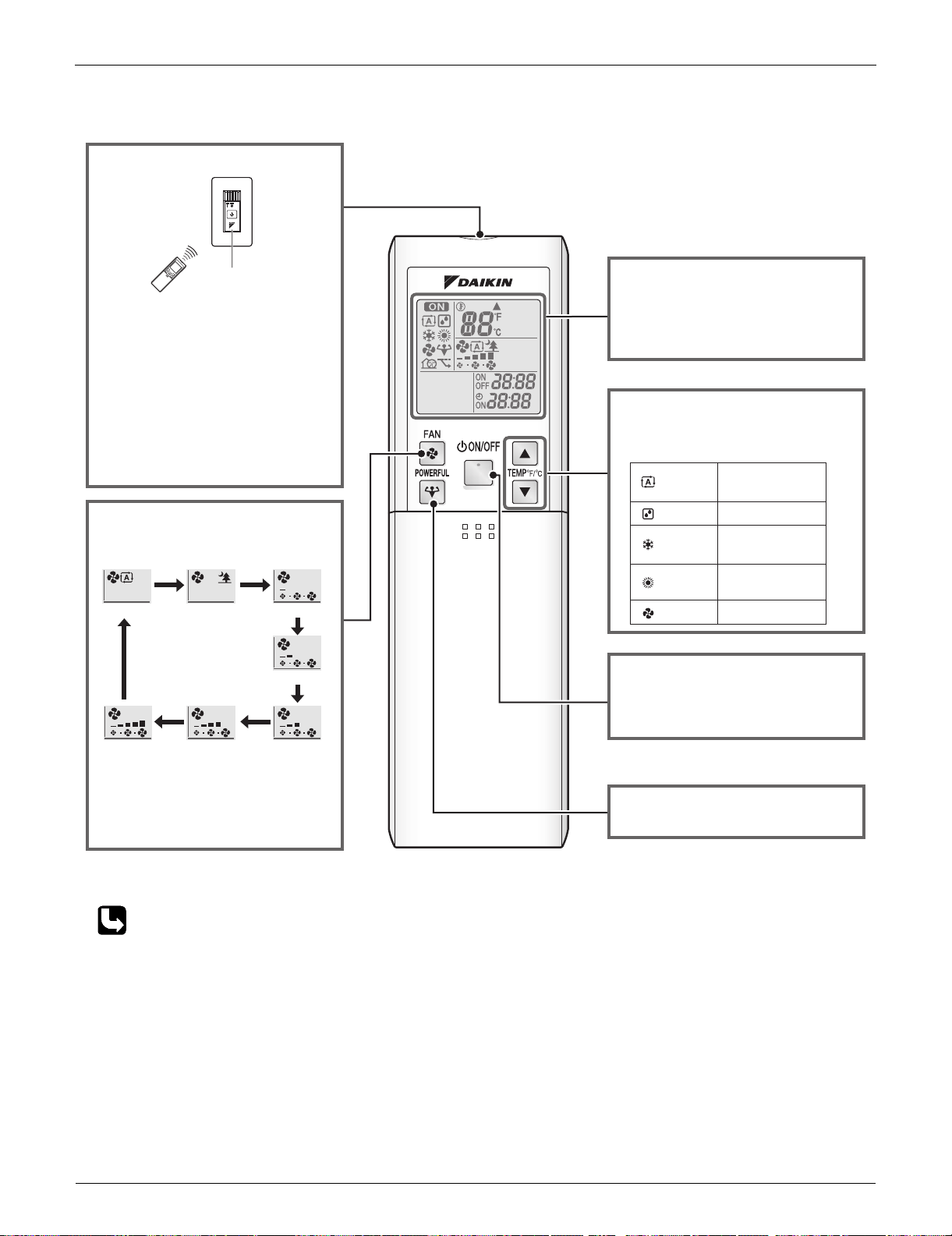
ARC452A23 SiUS121827E
128 Part 5 Remote Controller
Reference
4. ARC452A23
Refer to the following pages for details.
< ARC452A23 >
Signal transmitter
POWERFUL
1
button
• Starts POWERFUL operation.
Display (LCD)
ON/OFF button
Auto Indoor unit quiet Low
Middle low
MiddleMiddle highHigh
• Press this button once to
start operation.
Press once again to stop it.
• Displays the current settings.
(In this illustration, each section is
shown with all its displays on for the
purpose of explanation.)
FAN setting button
• In indoor unit quiet operation,
operation sound becomes weak.
(The airflow rate also decreases.)
• In DRY operation, the airflow rate
setting is not available.
• Selects the airflow rate setting
every time you press this button.
(R24596)
• Changes the temperature setting.
TEMPERATURE
adjustment buttons
: AUTO
: DRY
: COOL
: HEAT
: FAN
18 ~ 30 °C
(64 ~ 86 °F)
Not available
18 ~ 32 °C
(64 ~ 90 °F)
10 ~ 30 °C
(50 ~ 86 °F)
Not available
Receiver
• To use the remote controller, aim the
transmitter at the indoor unit. If there
is anything to block signals between
the unit and the remote controller,
such as a curtain, the unit will not
operate.
• Do not drop the remote controller.
Do not get it wet.
• The maximum distance for
communication is approximately 13 ft
(4 m).
1 POWERFUL Operation P.73
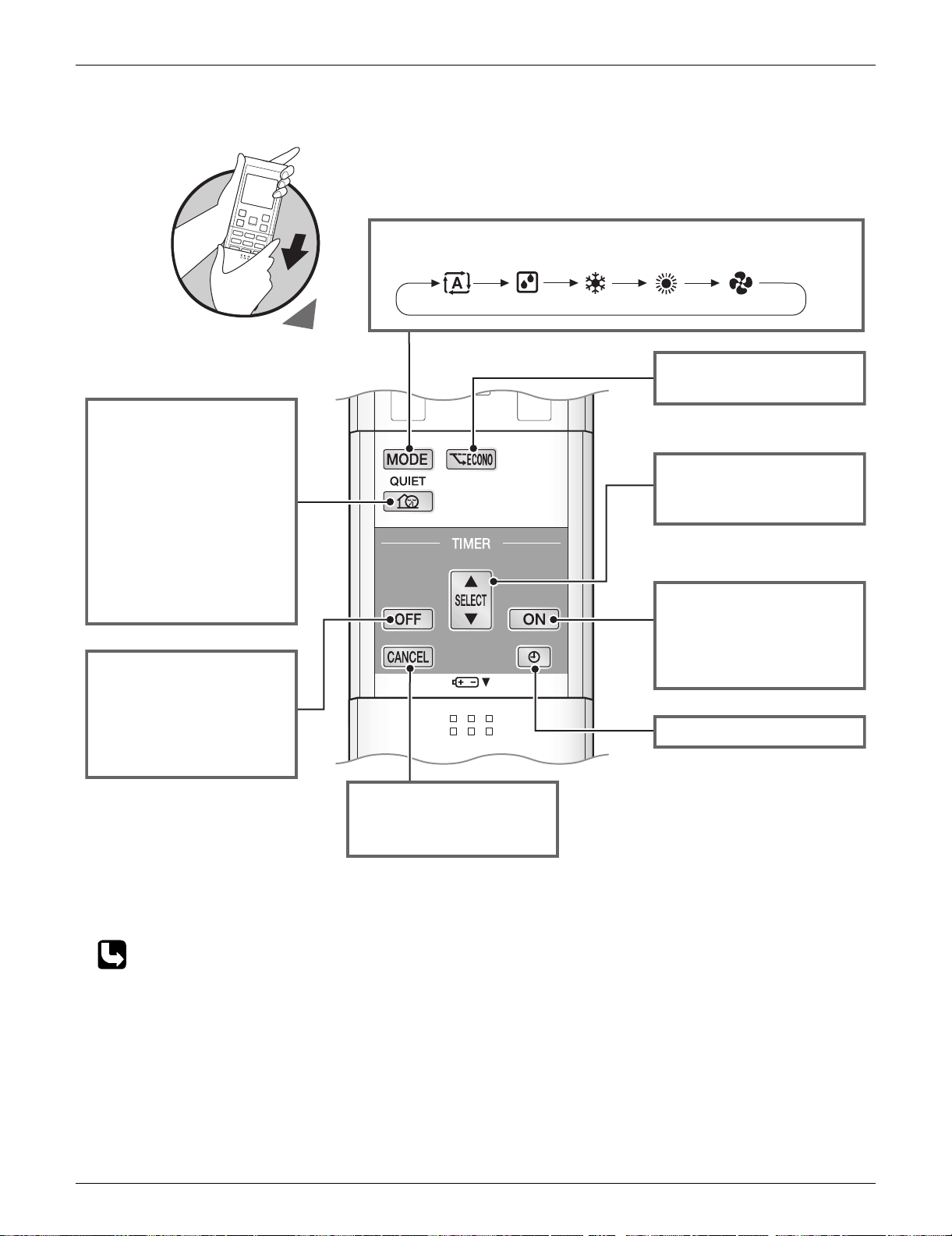
SiUS121827E ARC452A23
Part 5 Remote Controller 129
Reference
Refer to the following pages for details.
• Starts ECONO operation.
ON TIMER button
SELECT button
MODE button
• Selects the operation mode.
Open the Front Cover
ECONO
2
button
• Press this button and adjust
the time with SELECT button.
Press this button again to
complete TIMER setting.
CLOCK
3
button
• Changes the ON/OFF TIMER
settings.
TIMER CANCEL
button
• Cancels the timer setting.
• Press this button and adjust
the time with SELECT button.
Press this button again to
complete TIMER setting.
QUIET button
• Starts OUTDOOR UNIT
QUIET operation.
• OUTDOOR UNIT QUIET
operation is not available in
FAN and DRY operation.
• OUTDOOR UNIT QUIET
operation and POWERFUL
operation cannot be used at
the same time. Priority is
given to the function you
pressed last.
(R25076)
AUTO DRY COOL HEAT FAN
OFF TIMER button
(NIGHT SET mode)
2 ECONO operation P.69
3 Clock setting P.75
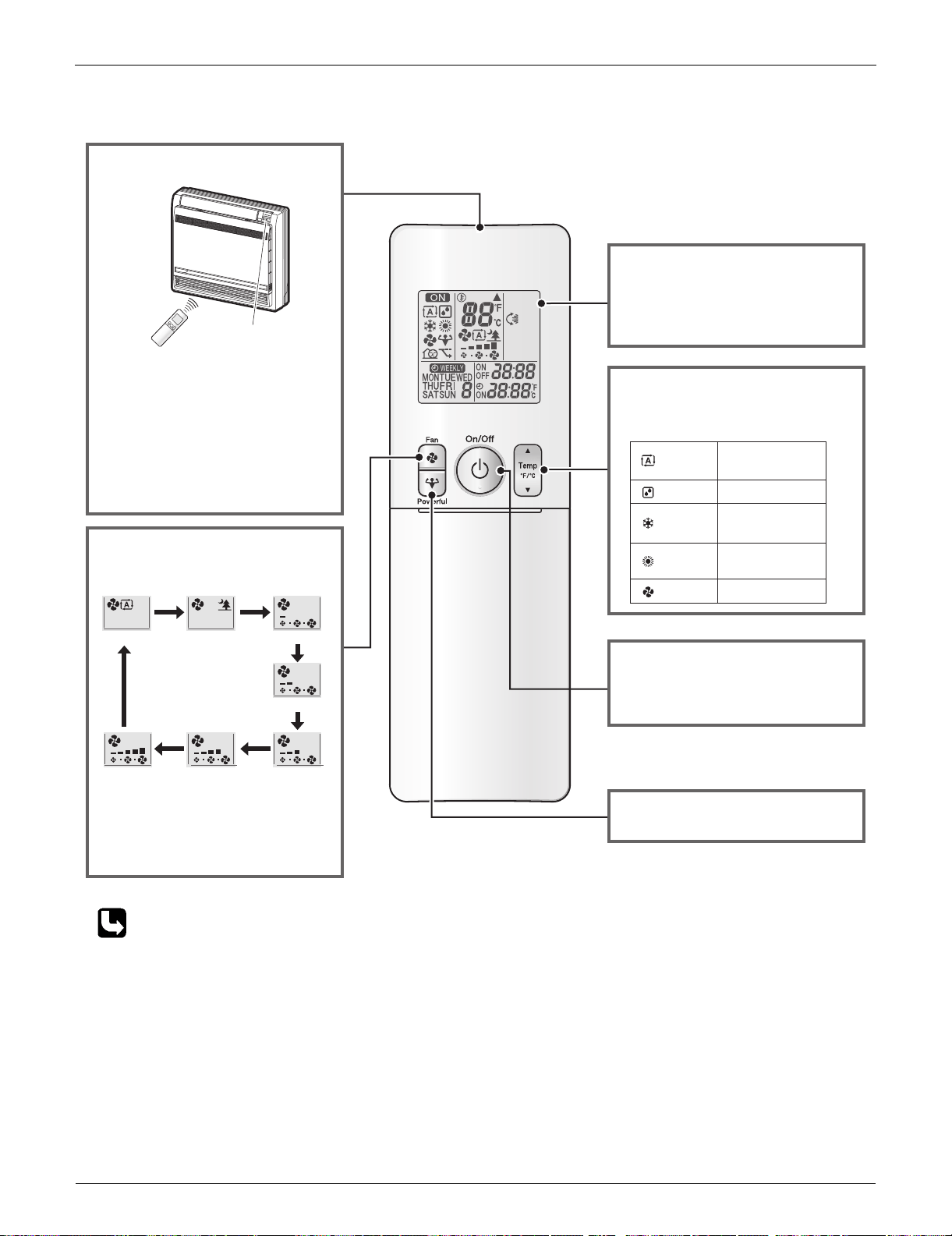
ARC466A21 SiUS121827E
130 Part 5 Remote Controller
Reference
5. ARC466A21
Refer to the following pages for details.
< ARC466A21 >
Signal transmitter
Powerful
1
button
• Starts POWERFUL operation.
Display (LCD)
• Changes the temperature setting.
On/Off button
Auto Indoor unit quiet Low
Middle low
MiddleMiddle highHigh
• Press this button once to
start operation.
Press once again to stop it.
Temperature
adjustment buttons
• Displays the current settings.
(In this illustration, each section is
shown with all its displays on for the
purpose of explanation.)
• To use the remote controller, aim the
transmitter at the indoor unit. If there
is anything blocking the signals
between the unit and the remote
controller, such as a curtain, the unit
may not operate.
• The maximum transmission distance
is about 23 ft (7 m).
Fan setting button
• In indoor unit quiet operation,
operation sound becomes weak.
(The airflow rate also decreases.)
• In DRY operation, the airflow rate
setting is not available.
• Selects the airflow rate setting
every time you press this button.
(R24597)
: AUTO
: DRY
: COOL
: HEAT
: FAN
18 ~ 30 °C
(64 ~ 86 °F)
Not available
18 ~ 32 °C
(64 ~ 90 °F)
10 ~ 30 °C
(50 ~ 86 °F)
Not available
Receiver
1 POWERFUL Operation P.73
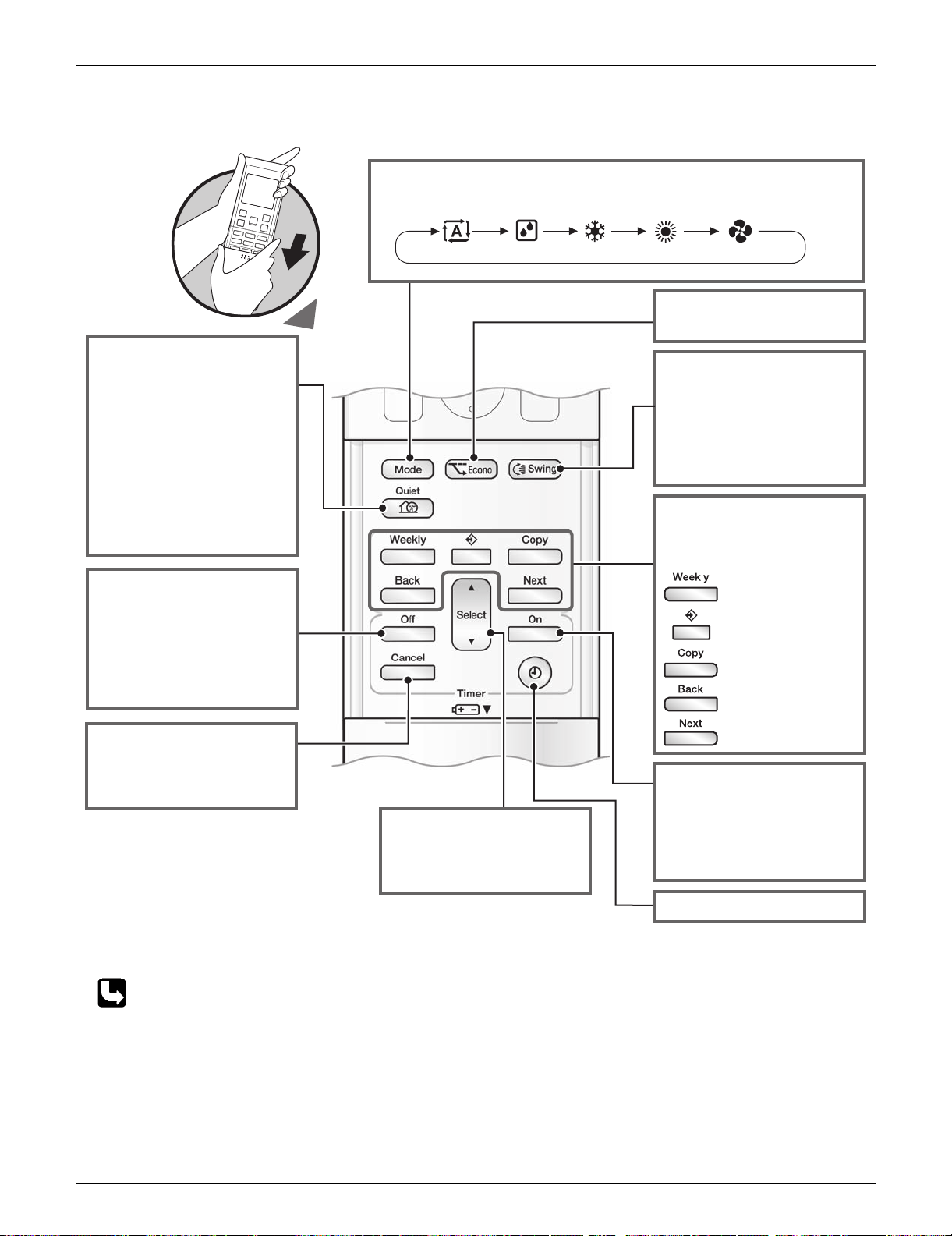
SiUS121827E ARC466A21
Part 5 Remote Controller 131
Reference
Refer to the following pages for details.
• Starts ECONO operation.
On Timer button
Select button
Mode button
• Selects the operation mode.
Open the Front Cover
Econo
2
button
Swing
3
button
• Adjusts the airflow direction.
• When you press Swing
button, the flap moves up and
down. The flap stops when
you press Swing button
again.
• Press this button and adjust
the day and time with Select
button. Press this button
again to complete TIMER
setting.
Clock
5
button
• It changes the ON/OFF
TIMER and WEEKLY TIMER
settings.
Timer Cancel button
• Cancels the timer setting.
• Cannot be used for the
WEEKLY TIMER operation.
• Press this button and adjust
the day and time with Select
button.
Press this button again to
complete TIMER setting.
Quiet button
• Starts OUTDOOR UNIT
QUIET operation.
• OUTDOOR UNIT QUIET
operation is not available in
FAN and DRY operation.
• OUTDOOR UNIT QUIET
operation and POWERFUL
operation cannot be used at
the same time. Priority is
given to the function you
pressed last.
(R25077)
AUTO DRY COOL HEAT FAN
: Weekly button
:
Program button
: Copy button
: Back button
: Next button
Off Timer button
(NIGHT SET mode)
Weekly button
(WEEKLY TIMER
Operation
4
)
2 ECONO operation P.69
3 Auto-swing P.61
4 WEEKLY TIMER operation P.76
5 Clock setting P.75
BRC944B2 Wired Remote Controller SiUS121827E
132 Part 5 Remote Controller
Caution
6. BRC944B2 Wired Remote Controller
R5000214
This remote controller cannot be used together with a standard wireless remote controller.
Otherwise, what appears on this remote controller's display may fail to correspond to actual
operating conditions.
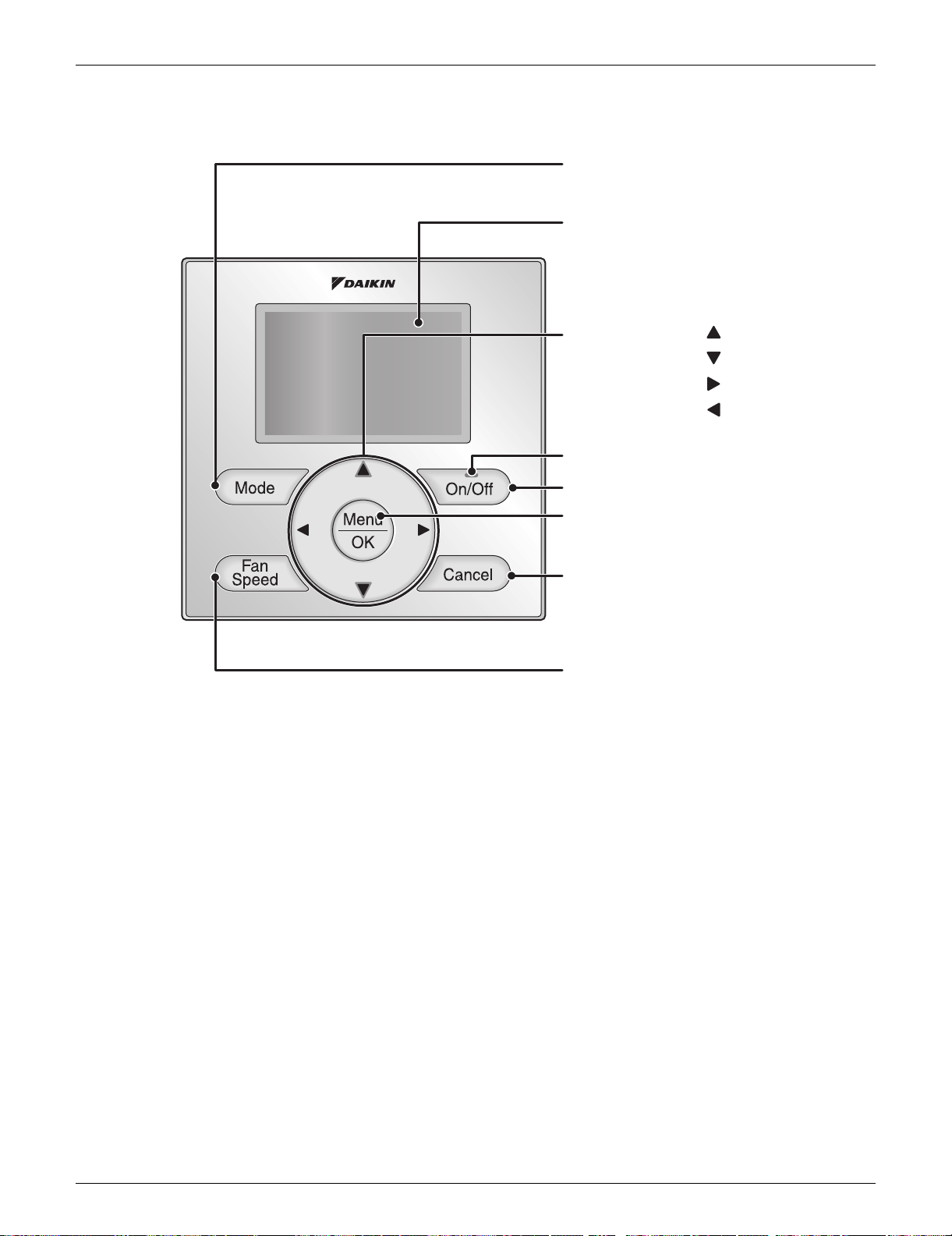
SiUS121827E BRC1E73 Wired Remote Controller
Part 5 Remote Controller 133
7. BRC1E73 Wired Remote Controller
R5000168
3. Menu/OK button
8. On/Off button
10. Cancel button
9. Operation lamp
11. LCD (with backlight)
4. Up button
5. Down button
6. Right button
7. Left button
1. Operation mode
selector button
2. Fan speed
control button
BRC1E73 Wired Remote Controller SiUS121827E
134 Part 5 Remote Controller
R5000161
1. Operation mode selector button
••
•
•
•
•
•
•
•
•
•
•
•
•
•
•
•
•
•
•
•
2. Fan speed control button
3. Menu/OK button
4. Up button
5. Down button
6. Right button
7. Left button
8. On/Off button
9. Operation lamp
10. Cancel button
11. LCD (with backlight)
Press this button to select the operation
mode of your preference.
* Available modes vary with the indoor unit
model.
Used to highlight the next items on the
left-hand side.
Each screen is scrolled in the left-hand
direction.
Press this button and system will start.
Press this button again to stop the system.
This lamp illuminates solid green during
normal operation.
This lamp flashes if an error occurs.
Used to return to the previous screen.
The backlight will be illuminated for
approximately 30 seconds by pressing any
button.
If two remote controllers are used to control
a single indoor unit, only the controller
accessed first will have backlight
functionality.
Press this button to select the fan speed of
your preference.
* Available fan speeds vary with the indoor
unit model.
Used to enter the main menu.
Used to enter the selected item.
Used to raise the setpoint.
The item above the current selection will be
highlighted.
(The highlighted items will be scrolled
continuously when the button is
continuously pressed.)
Used to change the selected item.
Used to lower the setpoint.
The item below the current selection will be
highlighted.
(The highlighted items will be scrolled
continuously when the button is
continuously pressed.)
Used to change the selected item.
Used to highlight the next items on the
right-hand side.
Each screen is scrolled in the right-hand
direction.
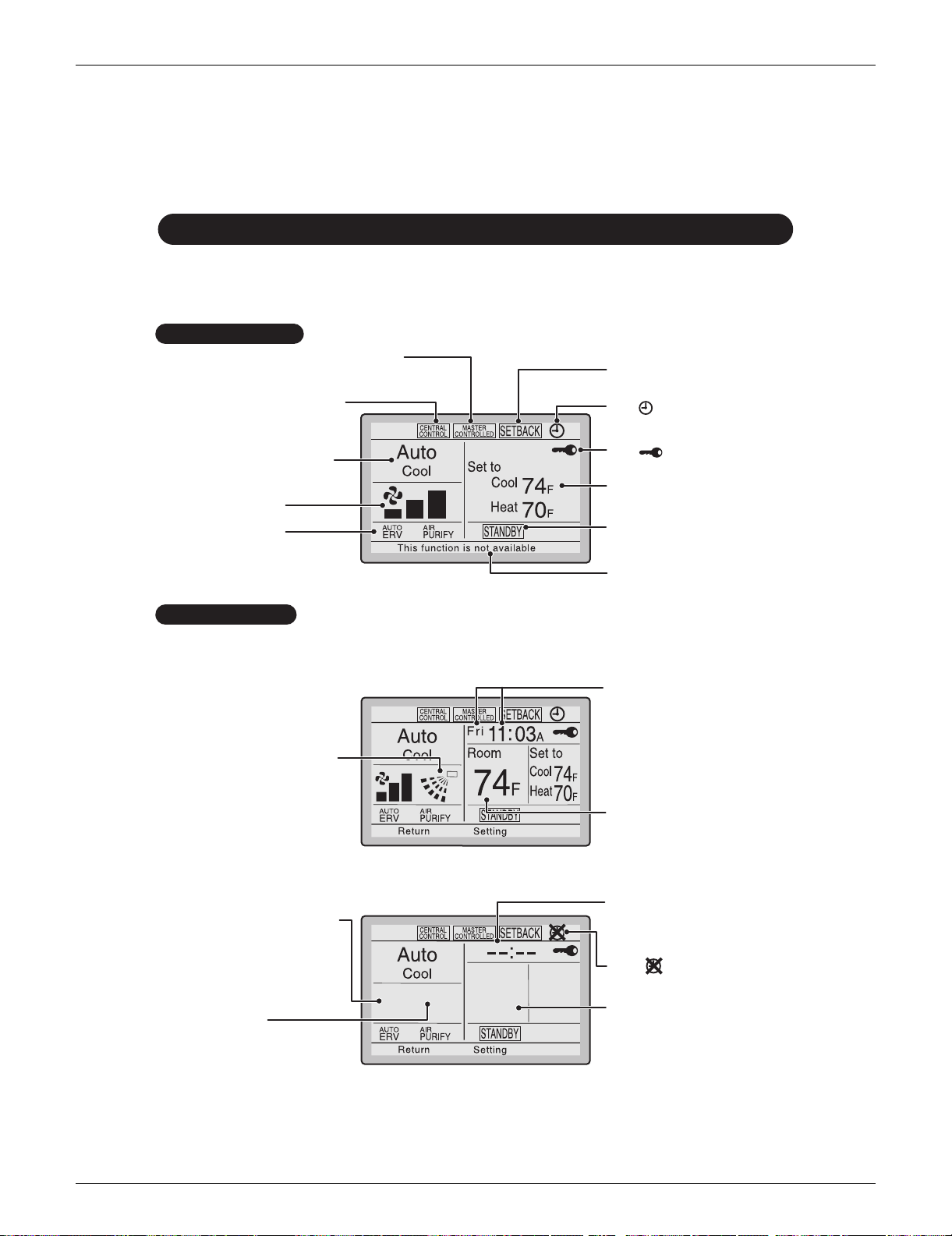
SiUS121827E BRC1E73 Wired Remote Controller
Part 5 Remote Controller 135
R5000162
Liquid Crystal Display
Standard display
<Standard display example>
6.Ventilation
2.Fan Speed
1.Operation mode
11.Setback
7.( ) Key Lock
3.Setpoint
5.Message
8.( ) Scheduled
Detailed display
12.
Airflow Direction
<Detailed display example 1>
<Detailed display example 2>
No Fan speed display
No Clock display
•
Three types of display mode (Standard, Detailed and Simple) are available.
•
Standard display is set by default.
•
Detailed and Simple displays can be selected in the main menu.
10.Changeover controlled
by the master indoor unit
9.Under centralized
control
4.Stand by for
Defrost/ Hot start
The airflow direction, clock, and selectable item appear on Detailed
display screen in addition to the items appearing on Standard display.
(Displayed only when
the indoor unit is
turned on.)
(with no fan speed
control function)
(with no airflow direction
settings)
No Airflow
Direction display
13.Current Day/Time
(12/24 hour time
display)
14.Selectable Display
Item
15.( ) Unable to
schedule
No Selectable
Display Item
(with no selectable
display item selected)
(when the clock has
not been set yet)
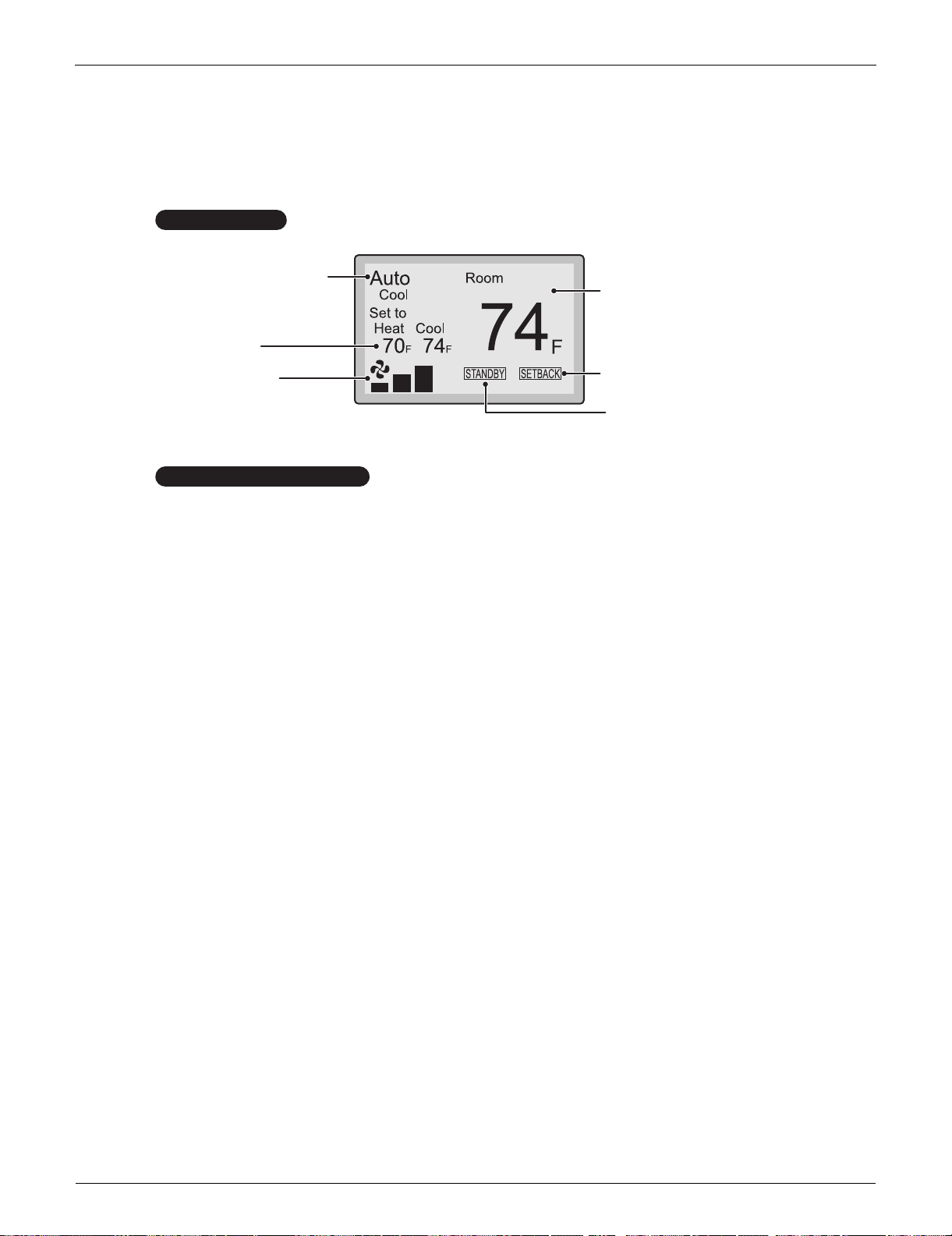
BRC1E73 Wired Remote Controller SiUS121827E
136 Part 5 Remote Controller
R5000163
Simple display
<Simple display example>
2.Fan speed
3.Setpoint
1.Operation mode
11.Setback
•
14.Selectable
Display Item
4.Stand by for Defrost/
Hot start
Depending on the field settings, while the indoor unit is stopped, OFF may be displayed instead of
the operation mode and/or the setpoint may not be displayed.
Note for all display modes
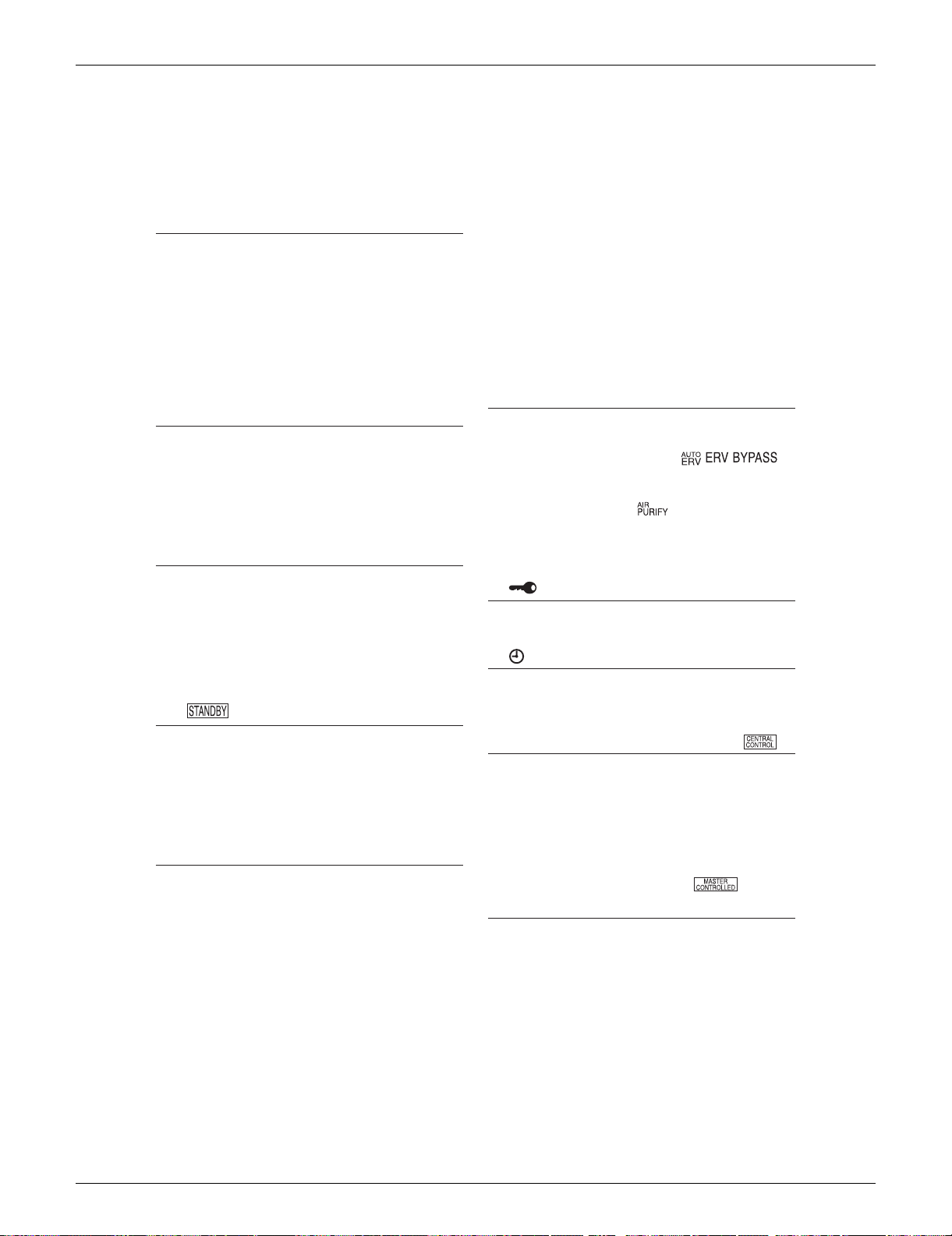
SiUS121827E BRC1E73 Wired Remote Controller
Part 5 Remote Controller 137
R5000164
1. Operation mode
2. Fan Speed
3. Setpoint
If ventilation icon is displayed in this field:
5. Message
“Error: Push Menu button”
“Warning: Push Menu button”
“Time to clean filter”
“Time to clean element”
“Time to clean filter & element”
6. Ventilation
7. Key Lock
8. Scheduled
9. Under Centralized control “ ”
4. Stand by for Defrost/Hot start
“ ”
Used to display the current operation
mode: Cool, Heat, Vent, Fan, Dry or Auto.
In Auto mode, the actual operation mode
(Cool or Heat) will be also displayed.
Operation mode cannot be changed
when OFF is displayed.
Operation mode can be changed after
starting operation.
Displayed if an error or warning is detected.
Displayed as a reminder when it is time to
clean the filter and/or element.
Displayed when the key lock is set.
Displayed if the Schedule or Off timer is
enabled.
Displayed if the system is under the
management of a multi-zone controller
(Optional) and the operation of the system
through the remote controller is limited.
Displayed when another indoor unit on the
system has the authority to change the
operation mode between cool and heat.
Displayed when an energy recovery
ventilator is connected.
Ventilation Mode icon.“ ”
These icons indicate the current ventilation
mode (ERV only) (AUTO, ERV, BYPASS).
Air Purify ICON “ ”
This icon indicates that the air purifying unit
(Optional) is in operation.
Used to display the fan speed that is set for
the indoor unit.
The fan speed will not be displayed if the
connected model does not have fan speed
control functionality.
Used to display the setpoint for the indoor
unit.
Use the Celsius/Fahrenheit item in the
main menu to select the temperature unit
(Celsius or Fahrenheit).
Indicates that an energy recovery ventilator
(ERV) is connected.
For details, refer to the Operation Manual of
the ERV.
Displayed for a few seconds when an
Operation button is pressed and the indoor
unit does not provide the corresponding
function.
In a remote control group, the message will
not appear if at least one of the indoor units
provides the corresponding function.
•
•
•
•
•
•
•
•
•
•
•
•
•
•
•
•
•
•
•
The following messages may be
displayed.
“This function is not available”
10. Changeover controlled by the
master indoor unit “ ”
(VRV only)
BRC1E73 Wired Remote Controller SiUS121827E
138 Part 5 Remote Controller
R5000165
11. Setback “ ”
12. Airflow Direction “ ”
14. Selectable Display Item
15. Unable to schedule
The setback icon flashes when the unit is
turned on by the setback control.
Displayed when the airflow direction and
swing are set.
If the connected indoor unit model does not
include oscillating louvers this item will not
be displayed.
Displayed if the clock is set.
If the clock is not set, “ -- : -- ” will be
displayed.
12 hour time format is displayed by default.
Select 12/24 hour time display option in the
main menu under “Clock & Calendar”.
Room temperature is selected by default.
For other choices see the operation
manual.
Displayed when the clock needs to be set.
The schedule function will not work unless
the clock is set.
•
•
•
•
•
•
•
•
•
•
•
13. Current Day/Time (12/24 hour
time display)
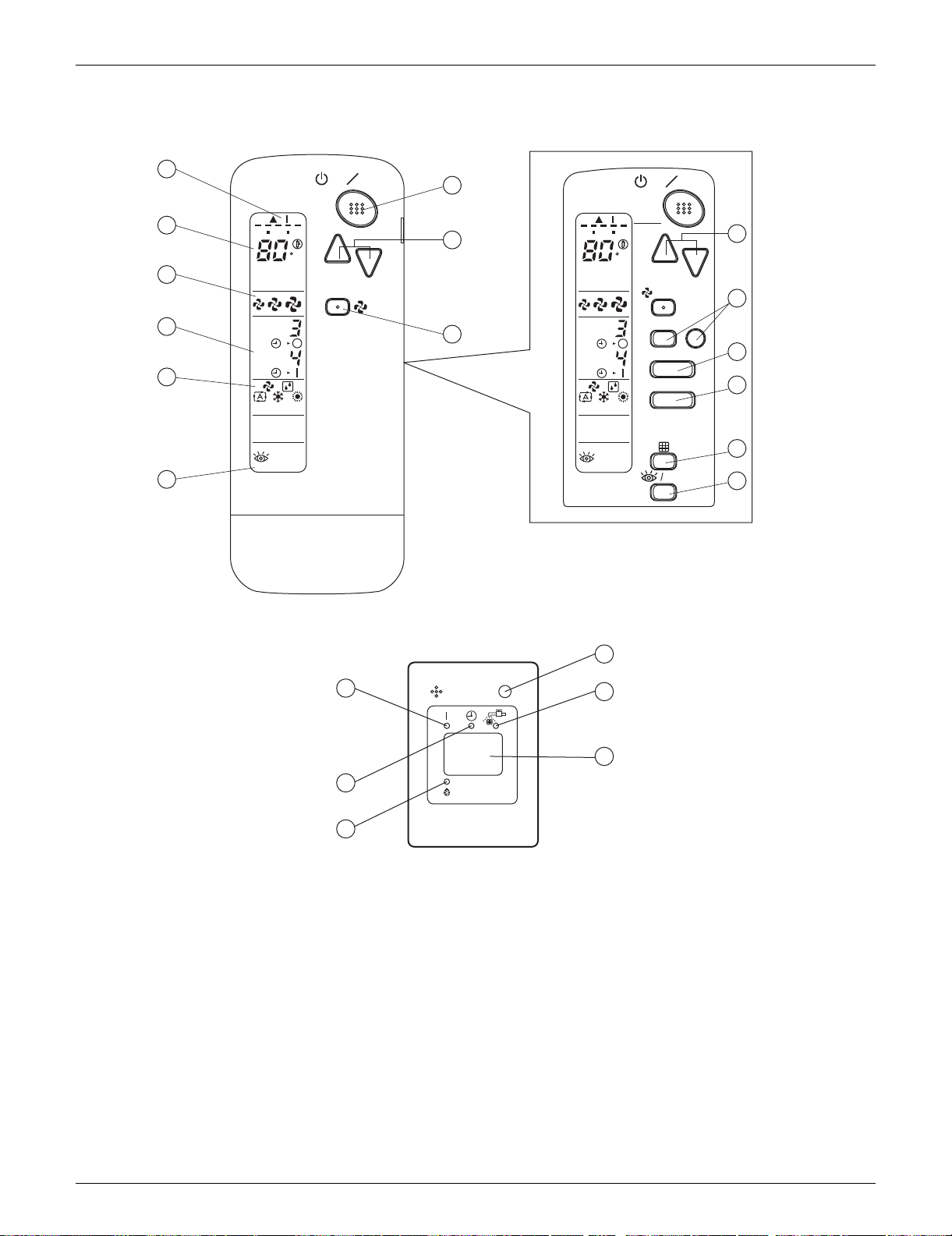
SiUS121827E BRC082A43 Wireless Remote Controller
Part 5 Remote Controller 139
8. BRC082A43 Wireless Remote Controller
(R25006)
7
9
12
10
11
13
14
15
8
1
3
4
5
2
6
DOWN
FAN
UP
ON OFF
MHL
hr.
hr.
TEST
MODE
TIMER
RESERVE
CANCEL
DOWN
UP
TEST
FAN
TIME
TEMP
ON OFF
MHL
hr.
hr.
TEST
F
F
The situation which opened the front cover
of the remote control
(R25007)
18
19
21
16
20
17
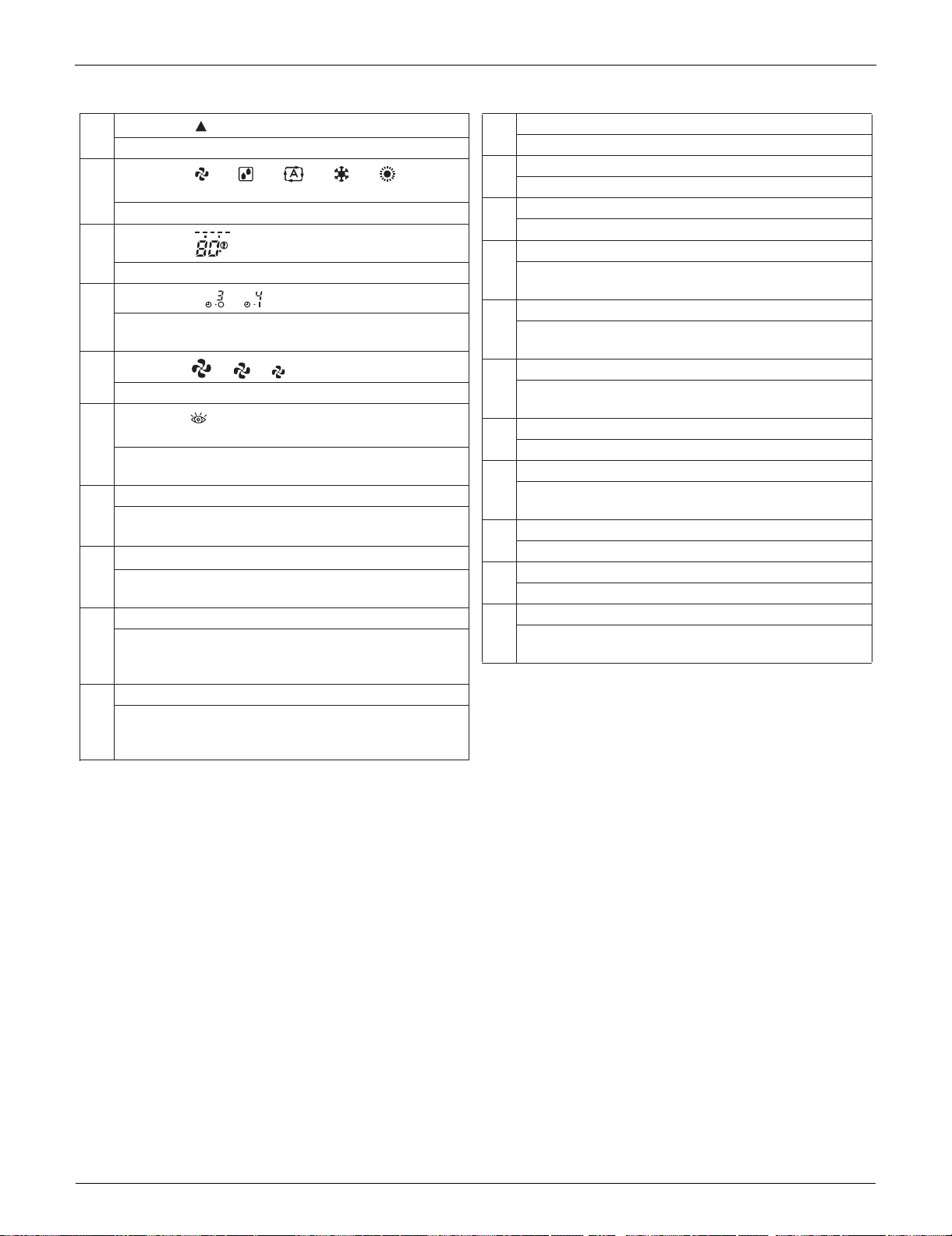
BRC082A43 Wireless Remote Controller SiUS121827E
140 Part 5 Remote Controller
R5000167
1
2
3
4
5
6
7
MHL
F
hr.
hr.
TEST
8
9
10
11
Use this button for TIMER MODE setting.
12
Use this button to end timer setting procedure.
13
14
15
16
EMERGENCY OPERATION SWITCH
17
RECEIVER
18
19
20
21
DISPLAY “ ” “ I ” (SIGNAL TRANSMISSION)
This lights up when a signal is being transmitted.
DISPLAY “ ” “ ” “ ” “ ” “ ”
(OPERATION MODE)
This display shows the current OPERATION MODE.
DISPLAY “ ” (SET TEMPERATURE)
This display shows the set temperature.
DISPLAY “ ” (PROGRAMMED TIME)
This display shows PROGRAMMED TIME of the
system start or stop.
DISPLAY “ ” “ ” “ ” (FAN SPEED)
This display shows the set fan speed.
DISPLAY “ ” (INSPECTION/ TEST
OPERATION)
When the INSPECTION/TEST OPERATION BUTTON
is pressed, the display shows the system mode is in.
ON/OFF BUTTON
Press the button and the system will start. Press the
button again and the system will stop.
FAN SPEED CONTROL BUTTON
Press this button to select the fan speed (HIGH,
MEDIUM or LOW) of your choice.
TEMPERATURE SETTING BUTTON
Use this button for SETTING TEMPERATURE.
(Operates with the front cover of the remote controller
closed.)
PROGRAMMING TIMER BUTTON
Use this button for programming “START and/or STOP”
time. (Operates with the front cover of the remote
controller opened.)
TIMER MODE START/STOP BUTTON
TIMER RESERVE/CANCEL BUTTON
OPERATION MODE SELECTOR BUTTON
Press this button to select OPERATION MODE.
FILTER SIGN RESET BUTTON
Refer to the section of MAINTENANCE in the operation
manual attached to the indoor unit.
INSPECTION/TEST OPERATION BUTTON
This button is pressed for inspection or test operation.
Do not use for normal operation.
This switch is readily used if the remote controller does
not work.
This receives the signals from the remote controller.
OPERATING INDICATOR LAMP (Red)
This lamp stays lit while the air conditioner runs.
It flashes when the unit is in trouble.
TIMER INDICATOR LAMP (Green)
This lamp stays lit while the timer is set.
AIR FILTER CLEANING TIME INDICATOR LAMP (Red)
Lights up when it is time to clean the air filter.
DEFROST LAMP (Orange)
Lights up when the defrosting operation has started.
(For cooling only type this lamp does not turn on.)
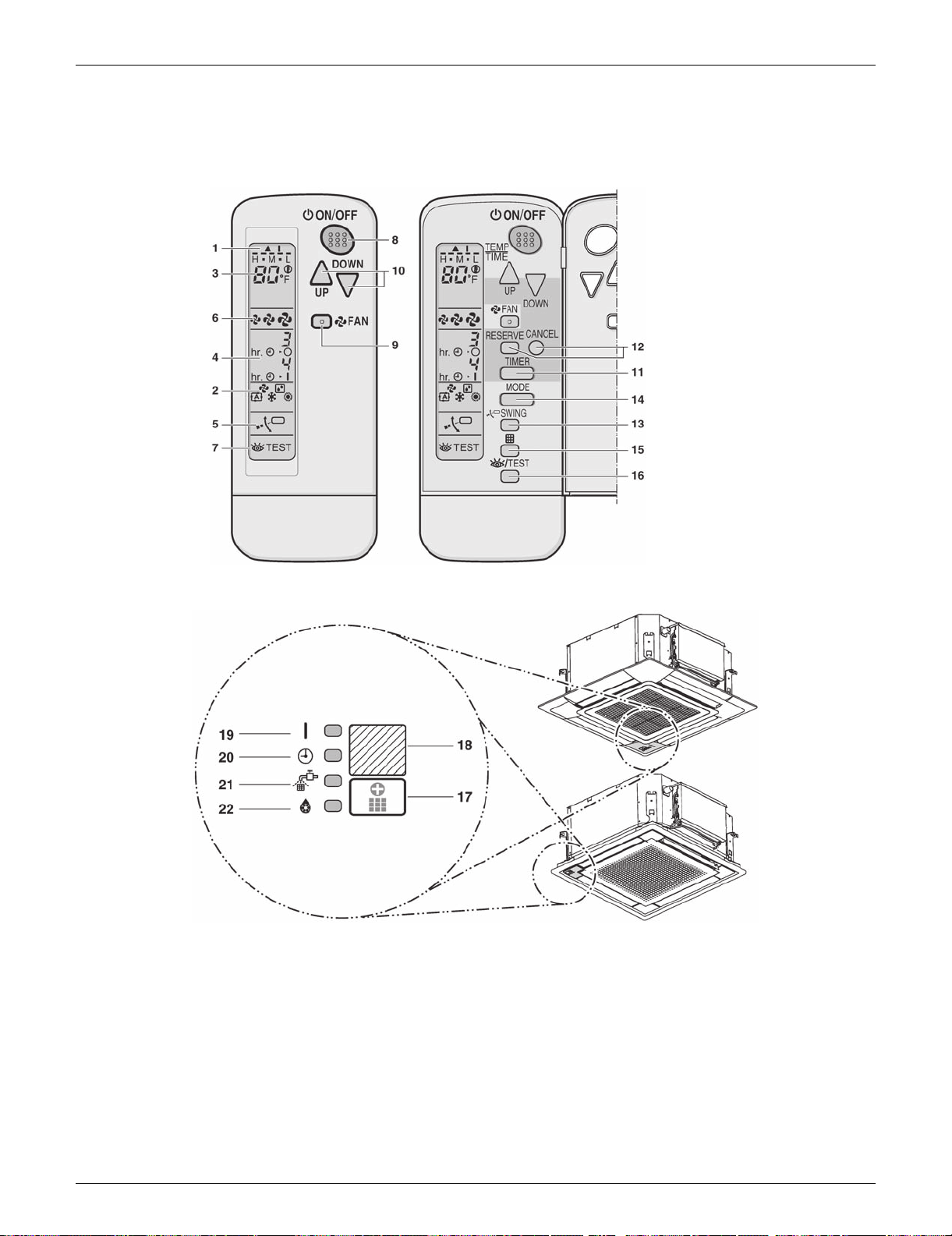
SiUS121827E BRC082A41W, BRC082A42W(S) Wireless Remote Controller
Part 5 Remote Controller 141
9. BRC082A41W, BRC082A42W(S) Wireless Remote
Controller
(R23936)
(R23937)
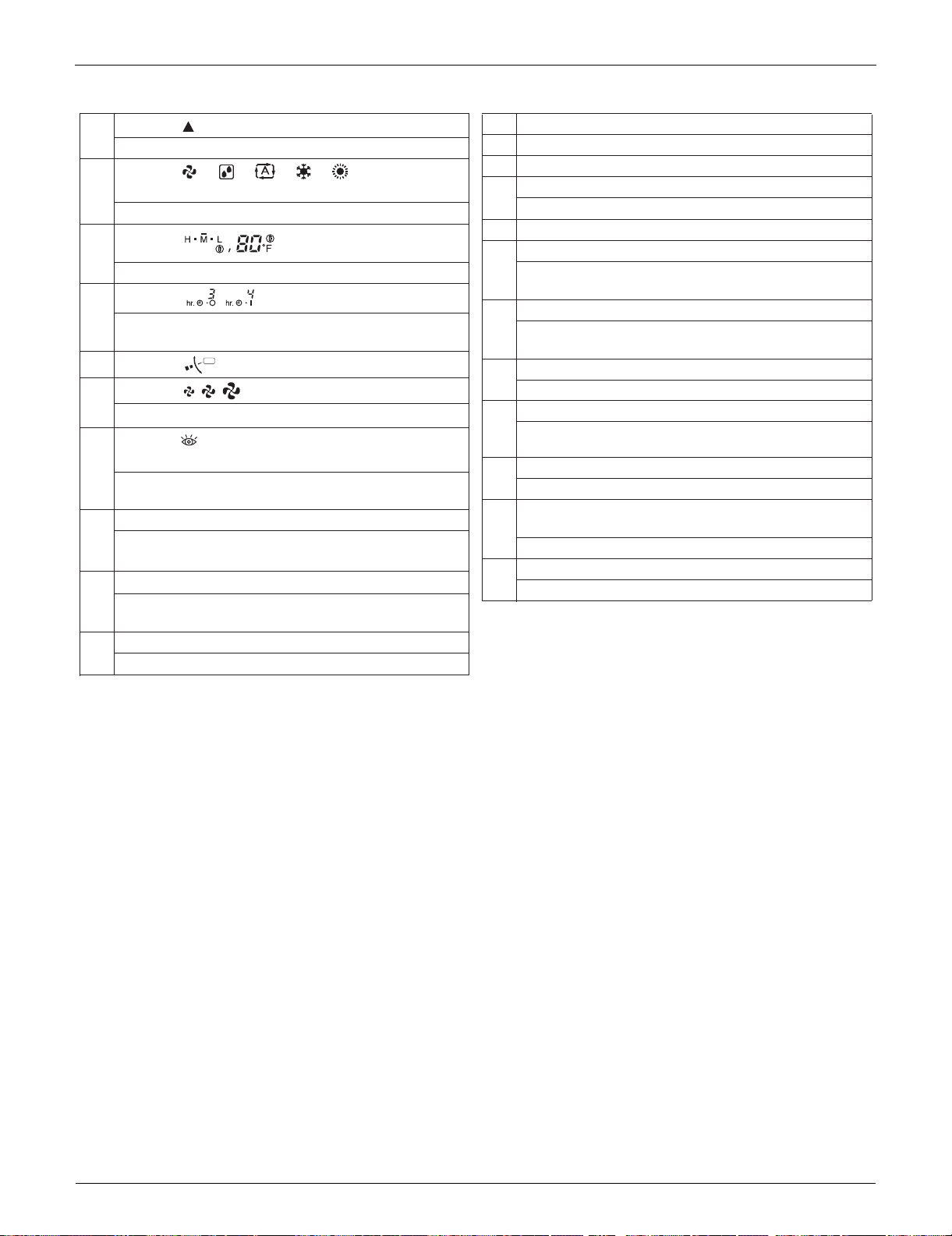
BRC082A41W, BRC082A42W(S) Wireless Remote Controller SiUS121827E
142 Part 5 Remote Controller
R5000166
1
2
3
4
5
6
7
8
9
10
11
12
13
14
15
16
17
18
19
20
21
22
DISPLAY (SET TEMPERATURE)
This display shows the set temperature.
DISPLAY (SWING FLAP)
DISPLAY (FAN SPEED)
The display shows the set fan speed.
ON/OFF BUTTON
FAN SPEED CONTROL BUTTON
TEMPERATURE SETTING BUTTON
DISPLAY (SIGNAL TRANSMISSION)
This lights up when a signal is being transmitted.
DISPLAY , , , ,
(OPERATION MODE)
This display shows the current OPERATION MODE.
DISPLAY (PROGRAMMED TIME)
This display shows PROGRAMMED TIME of the
system start or stop.
DISPLAY /TEST
(INSPECTION/TEST OPERATION)
When the INSPECTION/TEST OPERATION button is
pressed, the display shows the system mode is in.
Press the button and the system will start. Press the
button again and the system will stop.
Press this button to select the fan speed, LOW,
MEDIUM or HIGH, of your choice.
Use this button for setting temperature.
TIMER MODE START/STOP BUTTON
TIMER RESERVE/CANCEL BUTTON
AIRFLOW DIRECTION ADJUST BUTTON
OPERATION MODE SELECTOR BUTTON
FILTER SIGN RESET BUTTON
INSPECTION/TEST OPERATION BUTTON
EMERGENCY OPERATION SWITCH
RECEIVER
OPERATION LAMP (Red)
TIMER LAMP (Green)
This lamp stays lit while the timer is set.
DEFROST LAMP (Orange)
Press this button to select OPERATION MODE.
This button is used only by qualified service persons
for maintenance purposes.
This switch is readily used if the remote controller does
not work.
This receives the signals from the remote controller.
This lamp stays lit while the air conditioner runs. It
blinks when the unit is in trouble.
AIR FILTER CLEANING TIME INDICATOR LAMP
(Red)
Lights up when it is time to clean the air filter.
Lights up when the defrosting operation has started.

SiUS121827E
Part 6 Service Diagnosis 143
1. General Problem Symptoms and Check Items .......................................145
2. Troubleshooting with LED .......................................................................146
2.1 Indoor Unit................................................................................................ 146
2.2 Outdoor Unit ............................................................................................. 149
3. Service Diagnosis ...................................................................................150
3.1 ARC452 Series Wireless Remote Controller............................................ 150
3.2 ARC466 Series Wireless Remote Controller............................................ 153
3.3 BRC1E73 Wired Remote Controller......................................................... 156
3.4 BRC082A43, BRC082A41W, BRC082A42W(S) Wireless Remote Controller
................................................................................................................. 158
4. Code Indication on Remote Controller ....................................................162
4.1 RA Indoor Unit.......................................................................................... 162
4.2 SA Indoor Unit .......................................................................................... 162
4.3 Outdoor Unit ............................................................................................. 163
5. Troubleshooting for RA Indoor Unit.........................................................164
5.1 Indoor Unit PCB Abnormality ................................................................... 164
5.2 Freeze-up Protection Control/Heating Peak-cut Control .......................... 166
5.3 Indoor Fan Motor or Related Abnormality ................................................ 167
5.4 Thermistor or Related Abnormality........................................................... 172
5.5 Front Panel Open/Close Fault.................................................................. 173
5.6 Signal Transmission Error (Between Indoor Unit and Outdoor Unit)........ 174
5.7 Mismatching of Indoor Unit and Outdoor Unit .......................................... 177
6. Troubleshooting for SA Indoor Unit.........................................................178
6.1 Indoor Unit PCB Abnormality ................................................................... 178
6.2 Drain Level Control System Abnormality.................................................. 179
6.3 Indoor Fan Motor or Related Abnormality ................................................ 180
6.4 Indoor Fan PCB Abnormality.................................................................... 185
6.5 Humidifier or Related Abnormality............................................................ 186
6.6 Thermistor or Related Abnormality........................................................... 187
6.7 Presence Sensor or Floor Sensor Abnormality ........................................ 188
6.8 Remote Controller Thermistor Abnormality .............................................. 189
6.9 Signal Transmission Error (Between Indoor and Outdoor Unit) ............... 190
6.10 Signal Transmission Error (Between Indoor Unit and Remote Controller)
................................................................................................................. 192
6.11 Signal Transmission Error (Between MAIN/SUB Remote Controllers) .... 193
6.12 Mismatching of Indoor Unit and Outdoor Unit .......................................... 194
7. Troubleshooting for Outdoor Unit............................................................195
7.1 Refrigerant Shortage ................................................................................ 195
7.2 Low-voltage Detection or Over-voltage Detection.................................... 198
Part 6
Service Diagnosis

SiUS121827E
144 Part 6 Service Diagnosis
7.3 Wiring Error Check Unexecuted............................................................... 200
7.4 Unspecified Voltage (Between Indoor Unit and Outdoor Unit), Anti-icing
Control in Other Rooms............................................................................ 201
7.5 Anti-icing Control for Indoor Unit .............................................................. 202
7.6 Outdoor Unit PCB Abnormality................................................................. 204
7.7 OL Activation (Compressor Overload) ..................................................... 205
7.8 Compressor Lock ..................................................................................... 208
7.9 DC Fan Lock ............................................................................................ 210
7.10 Input Overcurrent Detection ..................................................................... 212
7.11 Four Way Valve Abnormality.................................................................... 214
7.12 Discharge Pipe Temperature Control....................................................... 216
7.13 High Pressure Control in Cooling ............................................................. 217
7.14 Compressor Sensor System Abnormality ................................................ 219
7.15 Position Sensor Abnormality .................................................................... 221
7.16 Thermistor or Related Abnormality (Outdoor Unit)................................... 224
7.17 Electrical Box Temperature Rise.............................................................. 226
7.18 Radiation Fin Temperature Rise .............................................................. 227
7.19 Output Overcurrent Detection .................................................................. 229
8. Check ......................................................................................................232
8.1 Thermistor Resistance Check .................................................................. 232
8.2 Indoor Fan Motor Connector Check......................................................... 233
8.3 Hall IC Check ........................................................................................... 234
8.4 Power Supply Waveform Check............................................................... 235
8.5 Electronic Expansion Valve Check........................................................... 236
8.6 Four Way Valve Performance Check ....................................................... 237
8.7 Inverter Unit Refrigerant System Check................................................... 237
8.8 Inverter Analyzer Check........................................................................... 238
8.9 Rotation Pulse Check on the Outdoor Unit PCB ...................................... 240
8.10 Installation Condition Check..................................................................... 240
8.11 Discharge Pressure Check....................................................................... 241
8.12 Outdoor Fan System Check ..................................................................... 241
8.13 Main Circuit Short Check.......................................................................... 242
8.14 Capacitor Voltage Check.......................................................................... 244
8.15 Power Module Check ............................................................................... 245
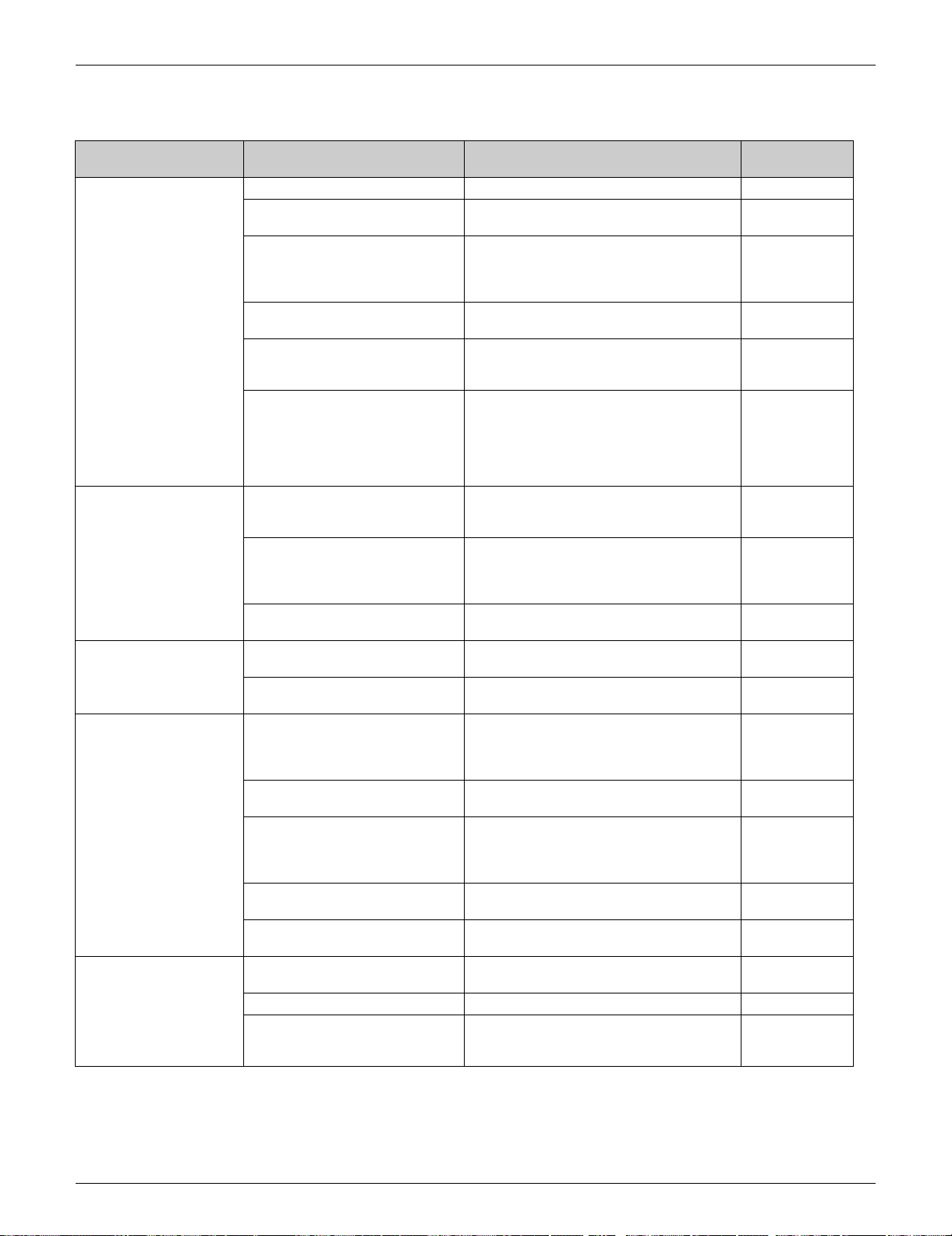
SiUS121827E General Problem Symptoms and Check Items
Part 6 Service Diagnosis 145
1. General Problem Symptoms and Check Items
Symptom Check Item Details
Reference
Page
None of the units
operates.
Check the power supply. Check if the rated voltage is supplied. —
Check the types of the indoor
units.
Check if the indoor unit type is
compatible with the outdoor unit.
—
Check the outdoor temperature. Heating/cooling operations are not
available when the outdoor temperature
is out of the operation limit. Check the
reference page for the operation limit.
292
Diagnose with remote controller
indication
— 162, 163
For RA Indoor Unit:
Check the wireless remote
controller addresses.
Check if address settings for the wireless
remote controller and indoor unit are
correct.
258
For SA Indoor Unit:
Check the wireless remote
controller addresses.
If using 2 remote controllers for
1 indoor unit, check MAIN/SUB
setting.
Check if address settings for the wireless
remote controller and indoor unit are
correct.
Check if the MAIN/SUB setting is
correct.
192, 193
Operation sometimes
stops.
Check the power supply. A power failure of 2 to 10 cycles can stop
air conditioner operation. (Operation
lamp OFF)
—
Check the outdoor temperature. Heating/cooling operations are not
available when the outdoor temperature
is out of the operation limit. Check the
reference page for the operation limit.
292
Diagnose with remote controller
indication.
— 162, 163
Some indoor units do
not operate.
Check the type of the indoor
units.
Check if the indoor unit type is
compatible with the outdoor unit.
—
Diagnose with remote controller
indication
— 162, 163
Units operate but do not
cool, or do not heat.
Check for wiring and piping
errors in the connection
between the indoor and outdoor
units.
Check the piping.
Conduct the wiring error check described
on the product diagnosis nameplate.
—
Check for thermistor detection
errors.
Check if the thermistor is mounted
securely.
—
Check for faulty operation of the
electronic expansion valve.
Set all the units to cooling operation, and
compare the temperatures of the liquid
pipes to see if the each electronic
expansion valve works.
—
Diagnose with remote controller
indication.
— 162, 163
Diagnose by service port
pressure and operating current.
Check for refrigerant shortage.
195
Large operating noise
and vibrations
Check the output voltage of the
power module.
— 245
Check the power module. — —
Check the installation condition. Check if the required spaces for
installation (specified in the installation
manual) are provided.
—
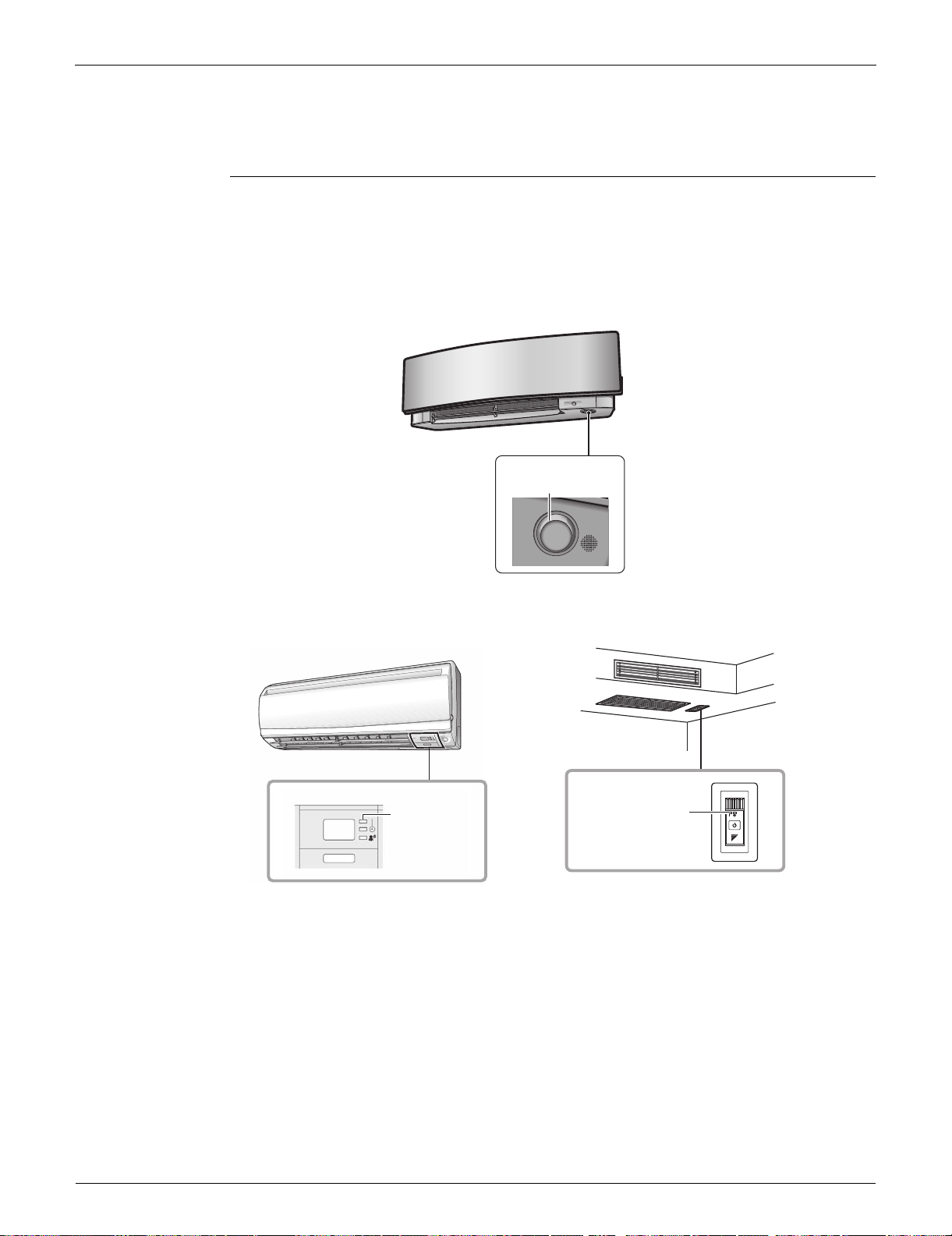
Troubleshooting with LED SiUS121827E
146 Part 6 Service Diagnosis
2. Troubleshooting with LED
2.1 Indoor Unit
Operation Lamp The operation lamp blinks when any of the following errors is detected.
A protection device of the indoor or outdoor unit is activated, or when the thermistor
malfunctions.
A signal transmission error occurs between the indoor and outdoor units.
In either case, conduct the diagnostic procedure described in the following pages.
FTXR/CTXG Series
CTXS/FTXS Series FDXS/CDXS Series
Operation lamp
(multi-monitor lamp)
(R24043)
(R23939)
Operation lamp
(green)
(R23940)
Operation lamp
(green)
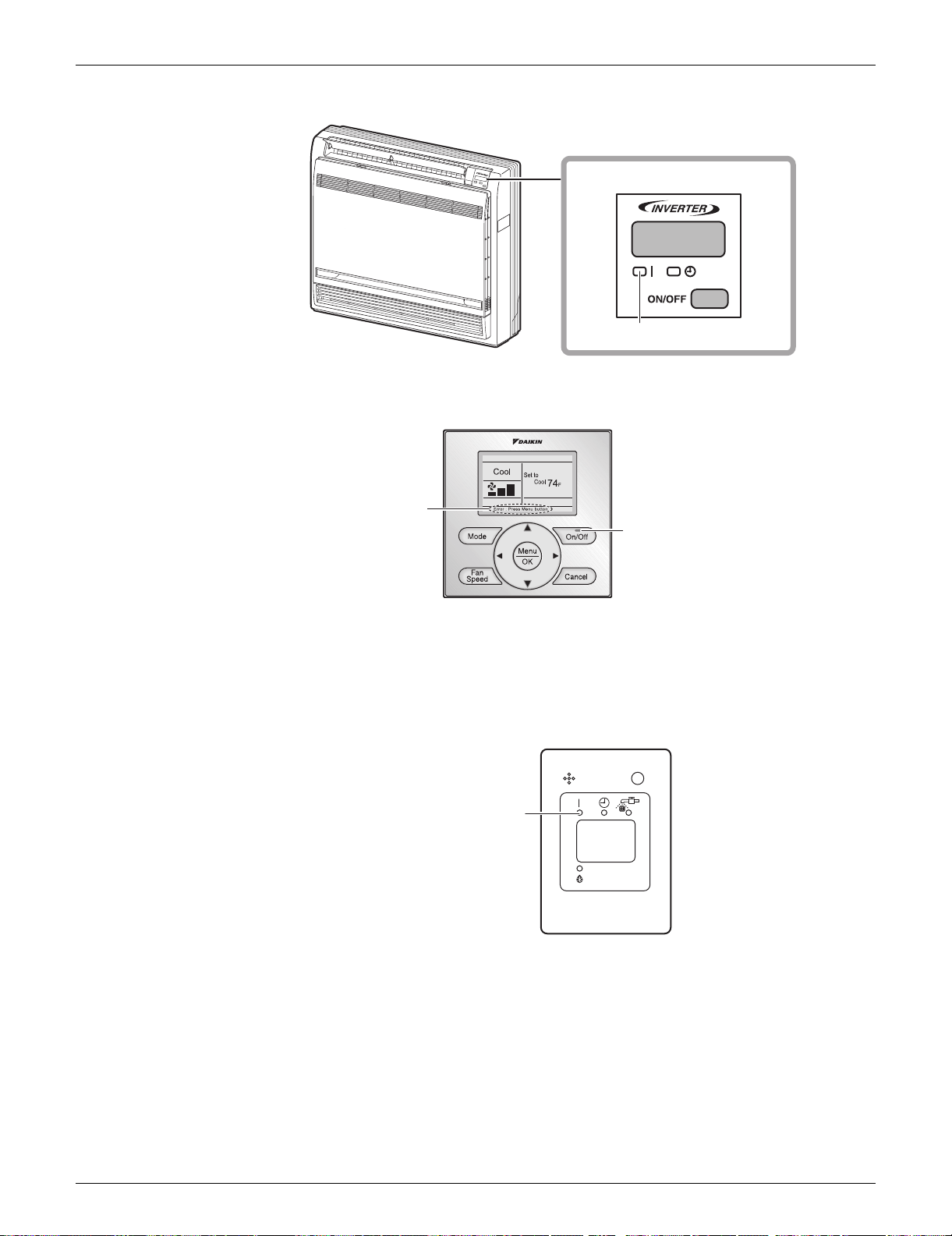
SiUS121827E Troubleshooting with LED
Part 6 Service Diagnosis 147
FVXS Series
R4003515
FDMQ, FFQ series with BRC1E73 wired remote controller
R4003516
FDMQ series with BRC082A43 wireless remote controller
In case of wireless remote controller, a receiver is installed. When the error occurs, the operation
lamp on the receiver blinks.
R4003517
FFQ series with BRC082A41W, BRC082A42W(S) wireless remote controller
In case of wireless remote controller, a transmitter board (A2P) and a receiver (A3P) are installed
on indoor unit. When the error occurs, the operation lamp on the receiver (A3P) blinks.
Operation lamp (green)
Operation lamp (green)
#The error or warning message also blinks on the basic screen.
#
Operation lamp
(red)
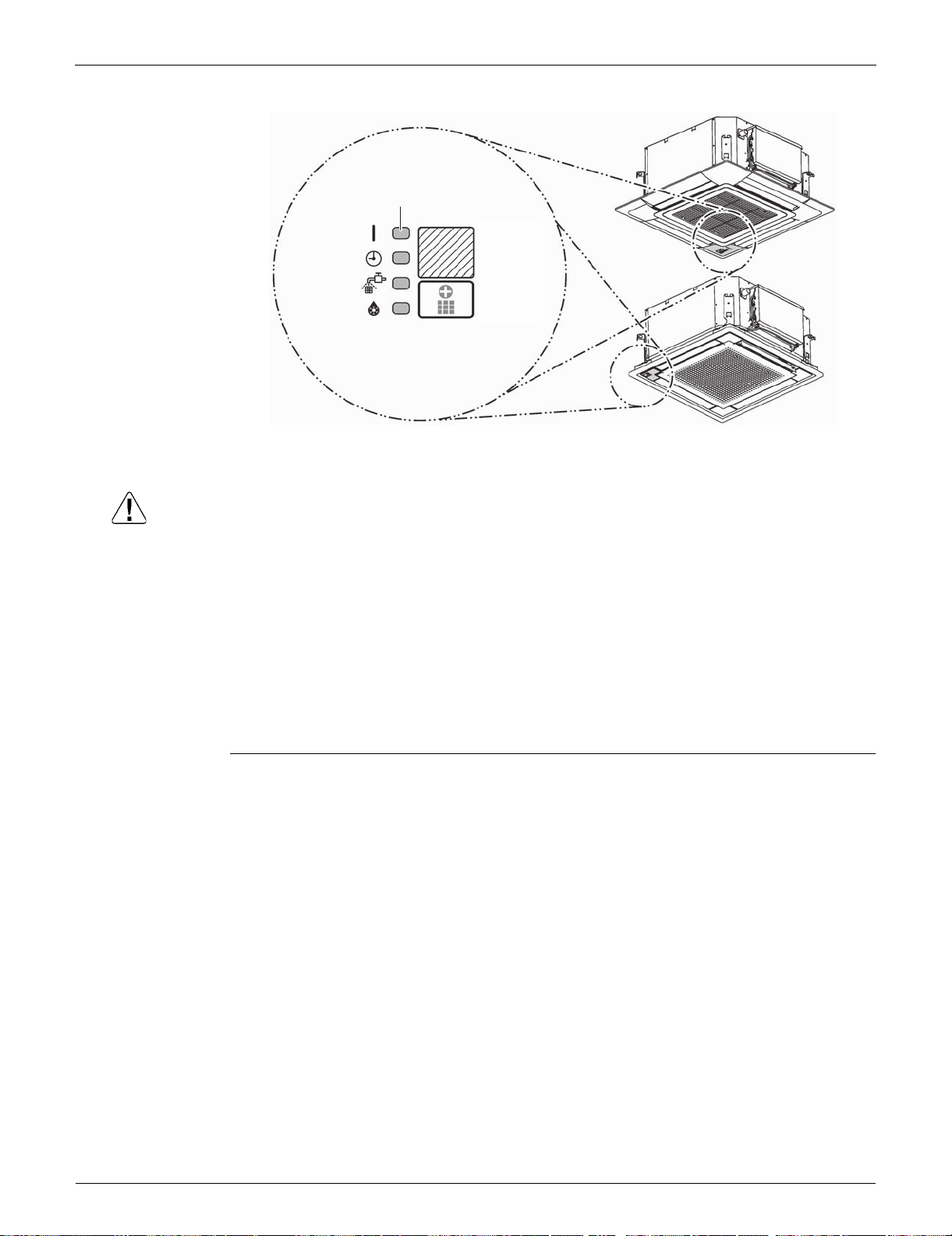
Troubleshooting with LED SiUS121827E
148 Part 6 Service Diagnosis
Caution
R4003518
When operation stops suddenly and the operation lamp blinks, it could be operation mode conflict.
For FFQ models, even if the operation mode conflict occurs, the operation lamp does not blink.
1. Check if the operation modes are all the same for the indoor units connected to multi system
outdoor unit.
2. If not, set all the indoor units to the same operation mode and confirm that the operation lamp is
not blinking.
3. Moreover, when the operation mode is automatic, set all the indoor unit operation mode as
cooling or heating and check again if the operation lamp is normal.
If the lamp stops blinking after the above steps, there is no malfunction.
∗Operation stops and operation lamp blinks only for the indoor unit that has a different operation
mode set later. The first set operation mode has priority.
Service Monitor The indoor unit has a green LED (LED A, HAP) on the control PCB. When the microcomputer
works in order, the LED blinks. (Refer to page 37 for the location of LED.)
Operation lamp
(red)
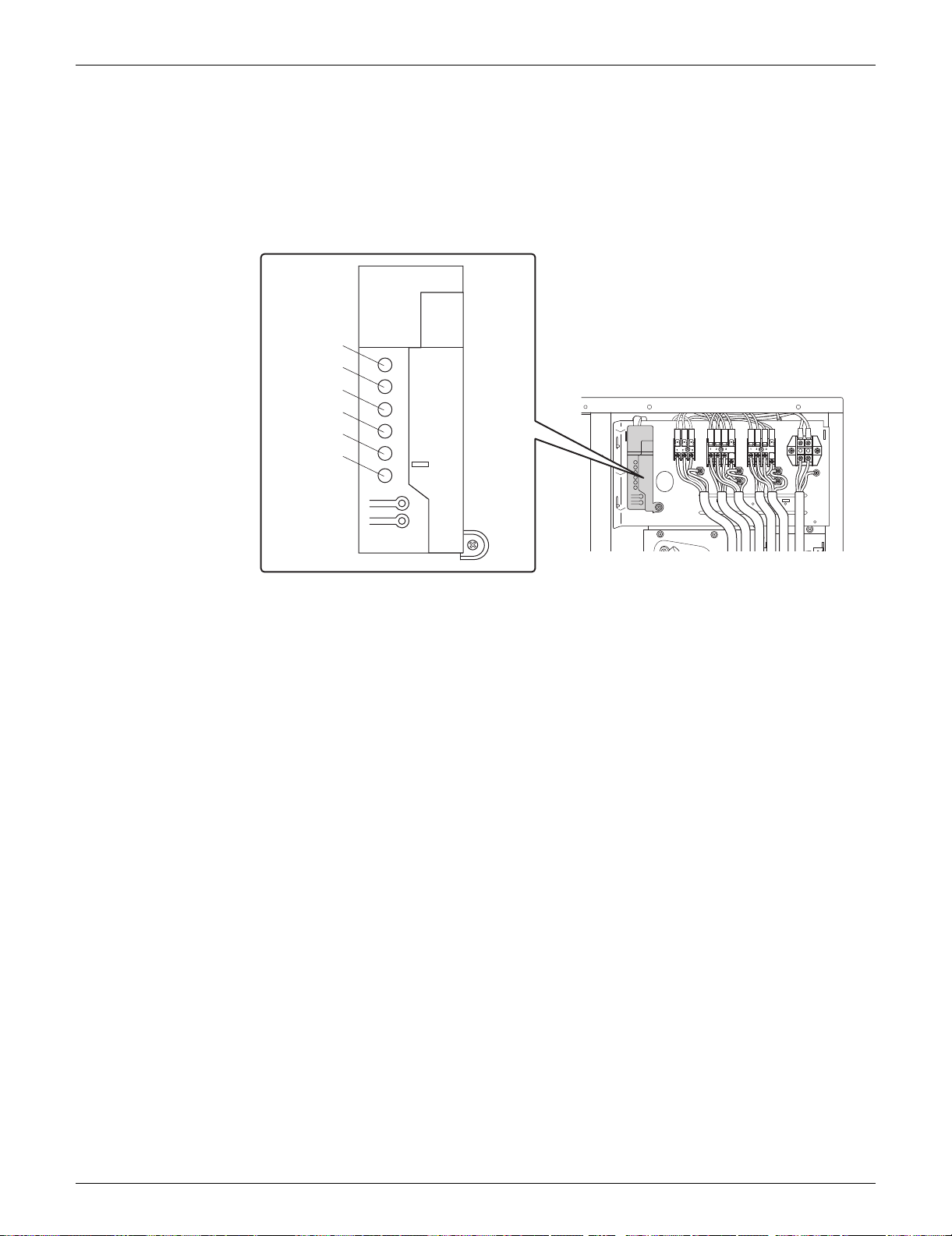
SiUS121827E Troubleshooting with LED
Part 6 Service Diagnosis 149
2.2 Outdoor Unit
The outdoor unit has a green LED (LED A) and red LEDs (LED 1 ~ LED 5) on the PCB.
When the microcomputer works in order, the LED A blinks, and when the system is in normal
condition, the red LEDs are OFF.
Even after the error is canceled and the unit operates in normal condition, the LED indication
remains.
R6000447
Refer to page 54 for the location of LED.
A
1
2
3
4
5
LED A
LED 1
LED 2
LED 3
LED 4
LED 5
Service monitor PCB

Service Diagnosis SiUS121827E
150 Part 6 Service Diagnosis
Notes
3. Service Diagnosis
3.1 ARC452 Series Wireless Remote Controller
3.1.1 Method 1
1. When TIMER CANCEL button is held down for 5 seconds, 00 is displayed on the temperature
display screen.
2. Press TIMER CANCEL button repeatedly until a long beep sounds.
The code indication changes in the sequence shown below.
ARC452A21, A23
1. A short beep or two consecutive beeps indicate non-corresponding codes.
2. To return to the normal mode, hold TIMER CANCEL button down for 5 seconds. When the
remote controller is left untouched for 60 seconds, it also returns to the normal mode.
3. Not all the error codes are displayed. When you cannot find the error code, try method 2.
Refer to page 151.
No. Code No. Code No. Code
1 00 13 C7 25 UA
2 U4 14 A3 26 UH
3 L5 15 H8 27 P4
4 E6 16 H9 28 L3
5 H6 17 C9 29 L4
6 H0 18 C4 30 H7
7 A6 19 C5 31 U2
8 E7 20 J3 32 EA
9 U0 21 J6 33 AH
10 F3 22 E5 34 FA
11 A5 23 A1 35 H1
12 F6 24 E1 36 P9
(R23945)
TIMER CANCEL button
< ARC452 Series >
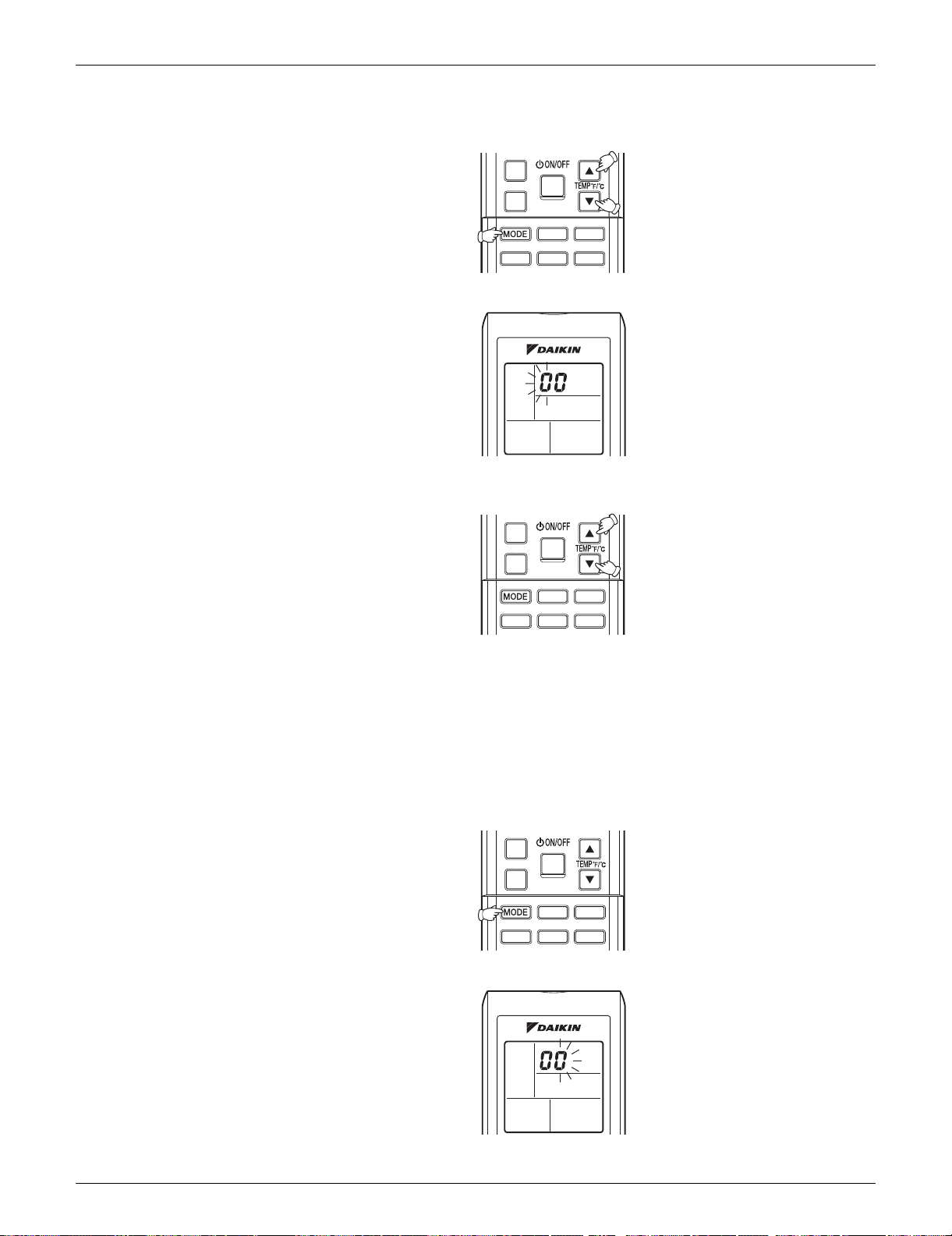
SiUS121827E Service Diagnosis
Part 6 Service Diagnosis 151
3.1.2 Method 2
1. Press the 3 buttons (TEMP, TEMP, MODE) at the same time to enter the diagnosis mode.
The left-side number blinks.
2. Press TEMP or TEMP button and change the number until you hear the two consecutive
beeps or the long beep.
3. Diagnose by the sound.
Beep : The left-side number does not correspond with the error code.
Two consecutive beeps : The left-side number corresponds with the error code but the right-
side number does not.
Long beep : Both the left-side and right-side number correspond with the error code.
The numbers indicated when you hear the long beep are the error code.
Refer to page 162, 163.
4. Press MODE button.
The right-side number blinks.
(R14550)
(R9430)
(R14551)
(R14552)
(R9429)
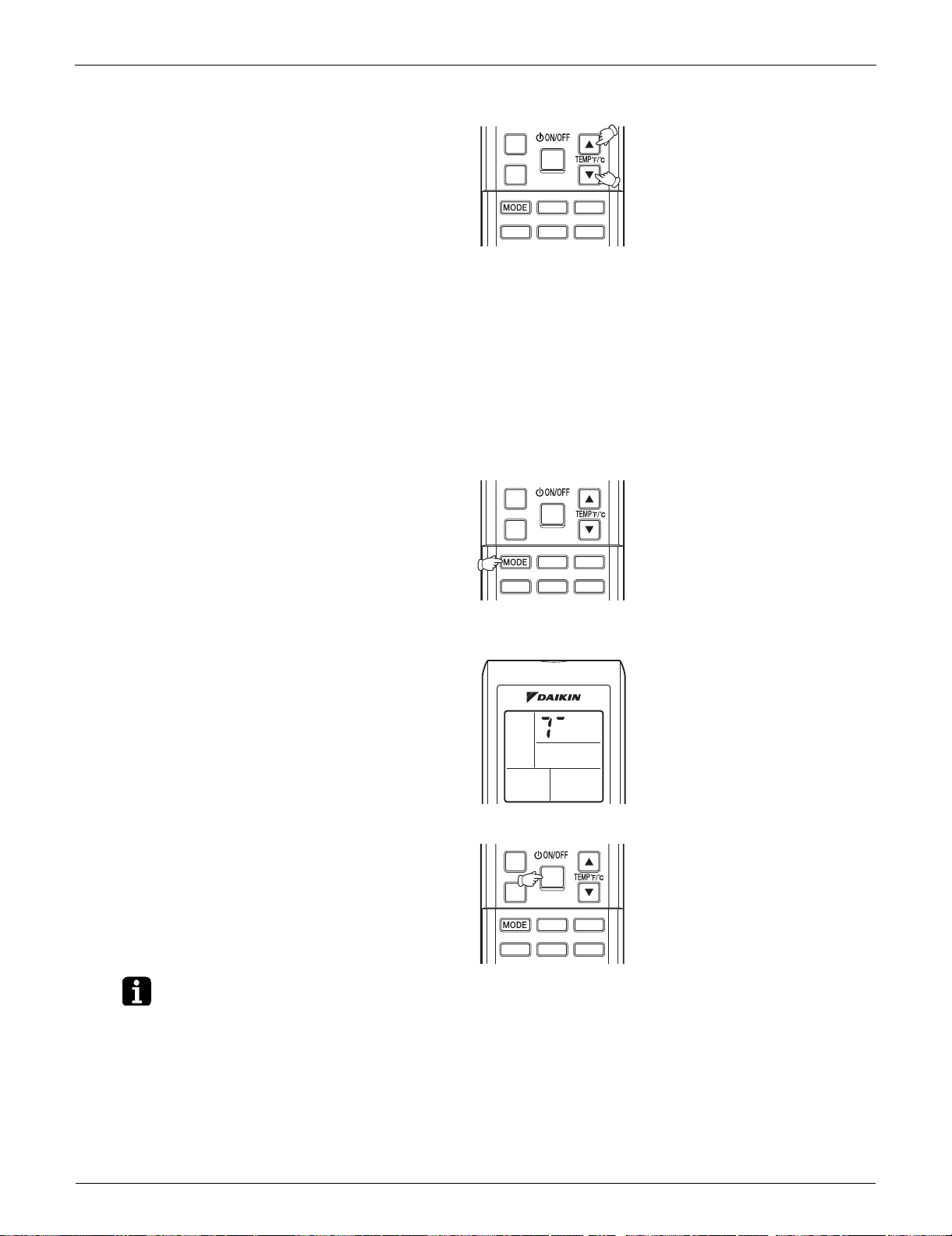
Service Diagnosis SiUS121827E
152 Part 6 Service Diagnosis
Note(s)
5. Press TEMP or TEMP button and change the number until you hear the long beep.
6. Diagnose by the sound.
Beep: The left-side number does not correspond with the error code.
Two consecutive beeps: The left-side number corresponds with the error code but the right-
side number does not.
Long beep: Both the left-side and right-side number corresponds with the error code.
7. Determine the error code.
The numbers indicated when you hear the long beep are the error code.
Refer to page 162, 163.
8. Press MODE button to exit from the diagnosis mode.
The display T means the trial operation mode.
Refer to page 251 for trial operation.
9. Press ON/OFF button twice to return to the normal mode.
When the remote controller is left untouched for 60 seconds, it returns to the normal mode.
(R14547)
(R14548)
(R9879)
(R14549)
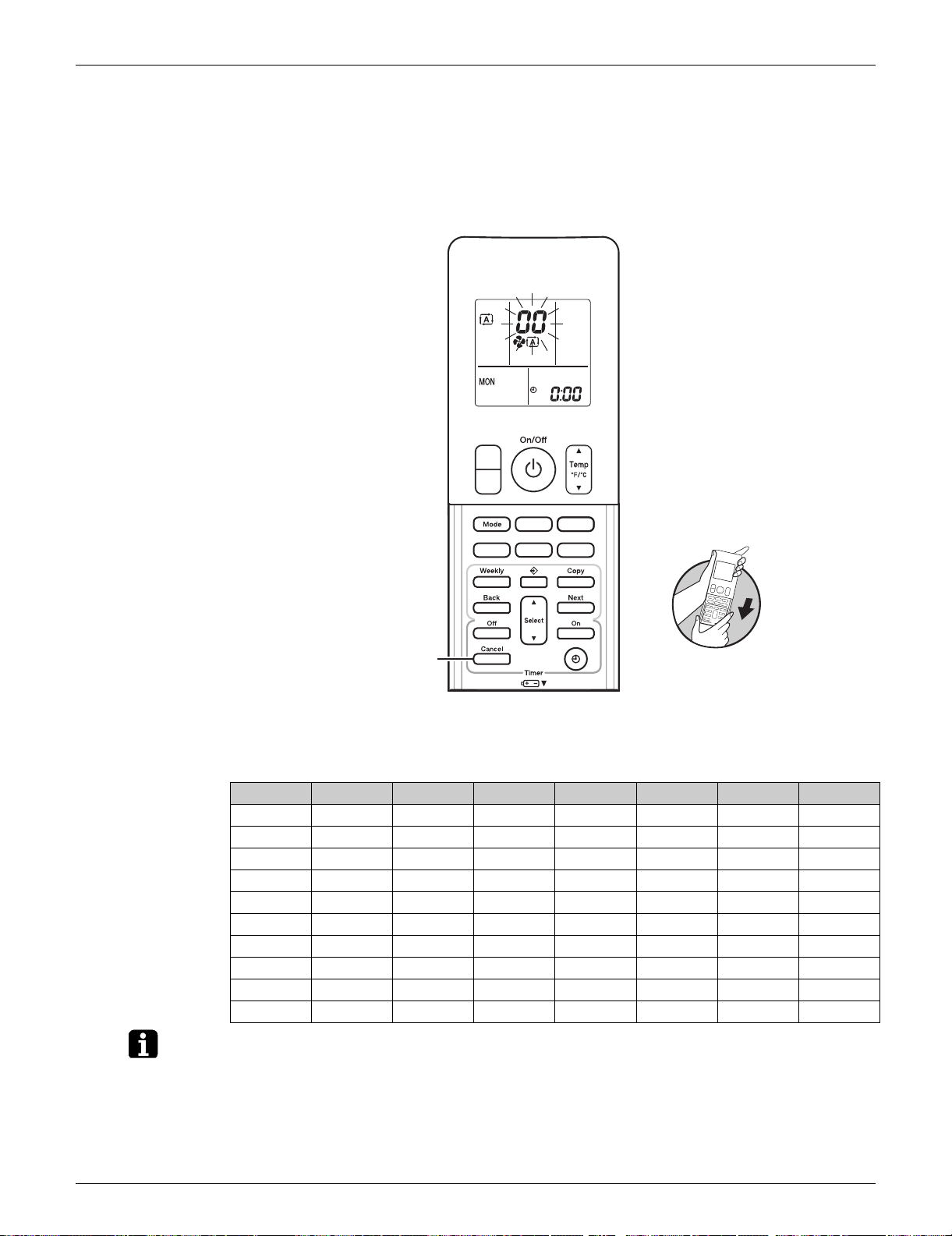
SiUS121827E Service Diagnosis
Part 6 Service Diagnosis 153
Notes
3.2 ARC466 Series Wireless Remote Controller
3.2.1 Method 1
1. When Timer Cancel button is held down for 5 seconds, 00 is displayed on the temperature
display screen.
2. Press Timer Cancel button repeatedly until a long beep sounds.
The code indication changes in the sequence shown below.
ARC466A21, A36
1. A short beep or two consecutive beeps indicate non-corresponding codes.
2. To return to the normal mode, hold Timer Cancel button down for 5 seconds. When the remote
controller is left untouched for 60 seconds, it also returns to the normal mode.
3. Not all the error codes are displayed. When you cannot find the error code, try method 2.
Refer to page 154.
No. Code No. Code No. Code No. Code
1 00 11 H6 21 C5 30 H7
2 A5 12 H0 22 J3 31 U2
3 E7 13 A6 23 J6 32 EA
4 F3 14 U0 24 E5 33 AH
5 F6 15 C7 25 A1 34 FA
6 L3 16 A3 26 E1 35 H1
7 L4 17 H8 27 UA 36 P9
8 L5 18 H9 28 UH 37 E3
9 U4 19 C9 29 P4 38 H3
10 E6 20 C4
(R24045)
< ARC466 Series >
Timer Cancel button
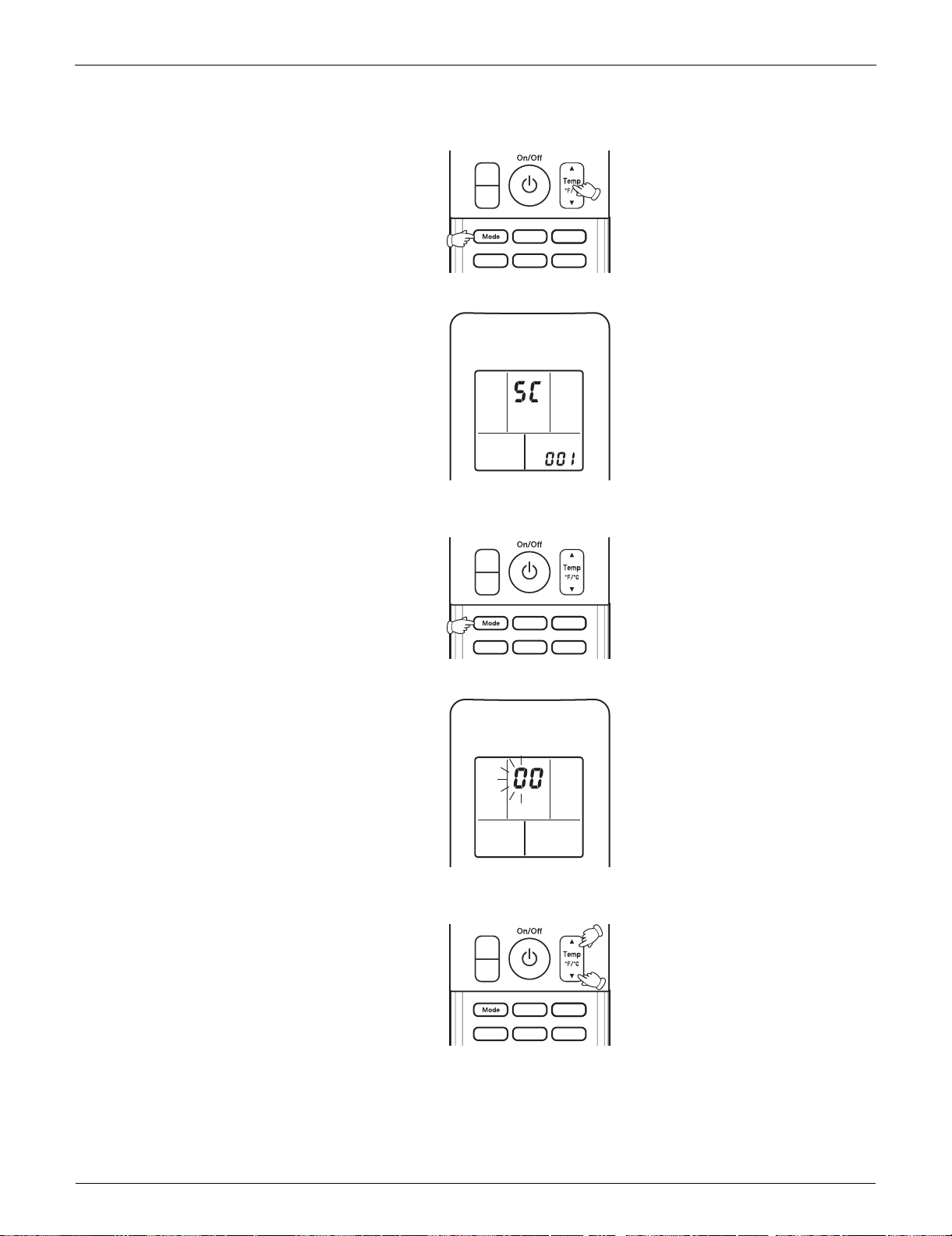
Service Diagnosis SiUS121827E
154 Part 6 Service Diagnosis
3.2.2 Method 2
1. Press the center of Temp button and Mode button at the same time.
5C is displayed on the LCD.
2. Select 5C (service check) with Temp or Temp button.
3. Press Mode button to enter the service check mode.
The left-side number blinks.
4. Press Temp or Temp button and change the number until you hear the two consecutive
beeps or the long beep.
5. Diagnose by the sound.
Beep: The left-side number does not correspond with the error code.
Two consecutive beeps: The left-side number corresponds with the error code but the right-
side number does not.
(R24046)
(R11821)
(R24047)
(R11670)
(R24048)
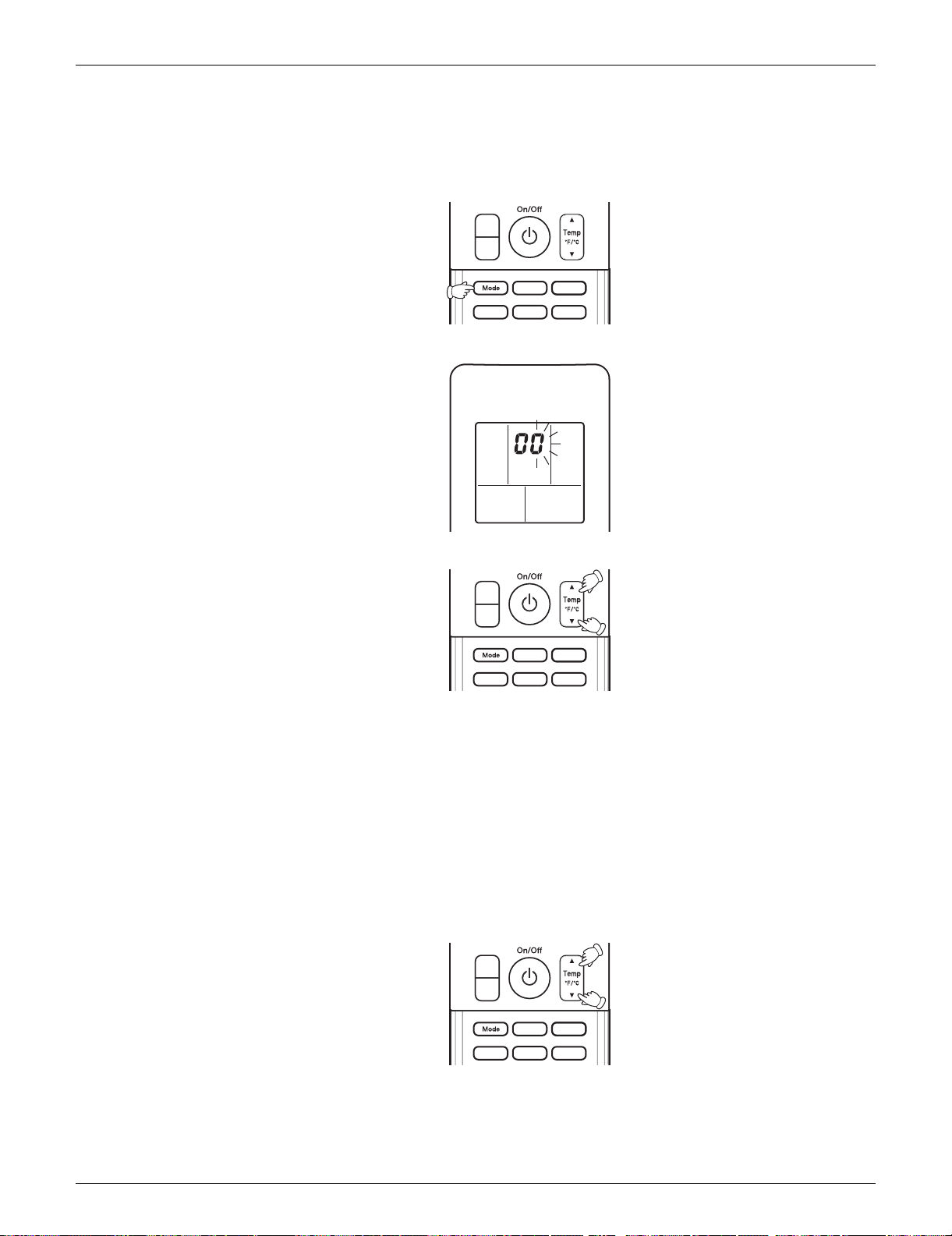
SiUS121827E Service Diagnosis
Part 6 Service Diagnosis 155
Long beep: Both the left-side and right-side numbers correspond with the error code.
The numbers indicated when you hear the long beep are the error code.
Refer to page 162, 163.
6. Press Mode button.
The right-side number blinks.
7. Press Temp or Temp button and change the number until you hear the long beep.
8. Diagnose by the sound.
Beep: The left-side number does not correspond with the error code.
Two consecutive beeps: The left-side number corresponds with the error code but the right-
side number does not.
Long beep: Both the left-side and right-side numbers correspond with the error code.
9. Determine the error code.
The numbers indicated when you hear the long beep are the error code.
Refer to page 162, 163.
10.Press Mode button for 5 seconds to exit from the service check mode.
When the remote controller is left untouched for 60 seconds, it returns to the normal mode also.
(R24047)
(R11673)
(R24048)
(R24048)
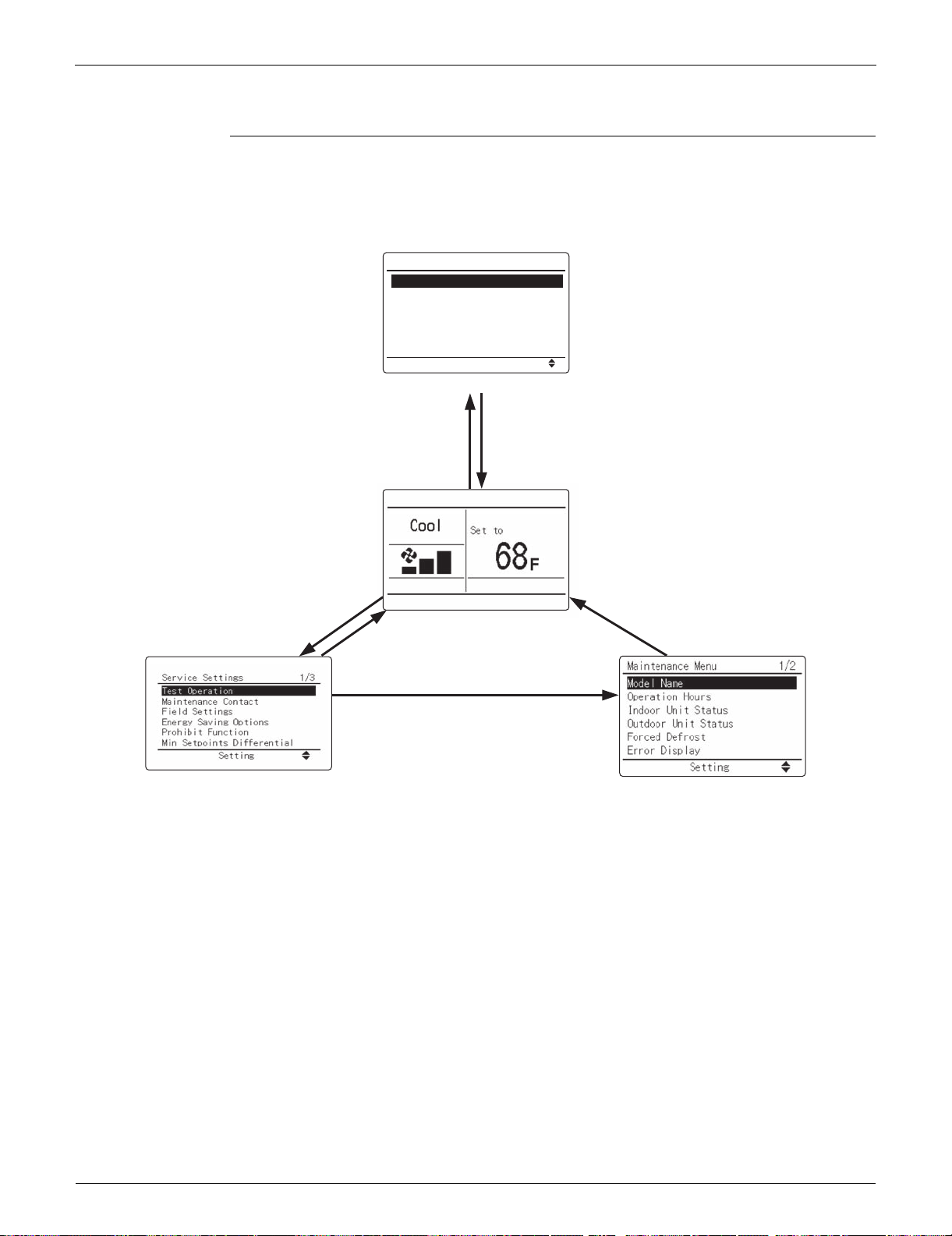
Service Diagnosis SiUS121827E
156 Part 6 Service Diagnosis
3.3 BRC1E73 Wired Remote Controller
Relations
Between Modes
On power-up, the message “Checking the connection. Please standby.” will be displayed on the
remote controller screen temporarily and then the basic screen will be displayed. To access a mode
from the basic screen, refer to the figure below.
When any of the operation buttons is pressed, the backlight will come on and remain lit for about 30
seconds. Be sure to press a button while the backlight is on.
Basic screen
Main Menu screen
Service Settings screen
Maintenance Menu screen
Setting
Main Menu
Airflow Direction
Individual Airflow Direction
Ventilation
Schedule
Off Timer
Celsius / Fahrenheit
1/3
Main Menu
• Reset Filter Indicator
• Airflow Direction
• Individual Airflow Direction
• Ventilation
• Schedule
• Off Timer
• Celsius / Fahrenheit
• Filter Auto Clean
• Maintenance Information
• Configuration
• Current Settings
• Clock & Calendar
• Daylight Saving Time
• Language
Press Cancel
button once.
Press
Menu/OK
button once.
Basic Screen
• Operation mode changeover
• Fan speed control
• Menu display
• Confirmation of each setting
• On
• Off
• Cancel
• Operation lamp
Press Cancel button
for 4 seconds or more.
Press Cancel
button once.
Press Cancel button
for 4 seconds or more.
Press Cancel
button once.
Maintenance Menu
• Model Name
• Operation Hours
• Indoor Unit Status
• Outdoor Unit Status
• Forced Defrost
• Error Display
• Swap Unit No.
• Addressed Sensor Value
Service Settings
• Test Operation
• Maintenance Contact
• Field Settings
• Energy Saving Options
• Prohibit Function
• Min Setpoints Differential
• Group Address
• Indoor unit AirNet Address
• Outdoor unit AirNet Address
• Error History
• Indoor Unit Status
• Outdoor Unit Status
• Forced Fan ON
• Switch Main Sub Controller
• Filter Indicator
• Test Filter Auto Clean
• Brush / Filter Ind.
• Disable Filter Auto Clean
(R24620)
# The items shown on the remote controller are
different depending on the connected indoor unit.

SiUS121827E Service Diagnosis
Part 6 Service Diagnosis 157
Service
Diagnosis
The following message is displayed on the screen when an error (or a warning) occurs during
operation.
Check the error code and take the corrective action specified for the particular model.
(R18817)
Screen
Operation lamp
Menu/OK button
Operation
1
Cool
Set to
Error : Push Menu button
74F
Error: Push Menu button
Warning: Push Menu button
Operation
lamp
2
Error Code: A1
Contact Info
0123-456-7890
Indoor Model ---/000
Outdoor Model ---/000
If an error occurs, either one of the following
items will flash in the basic screen.
* The Operation lamp will flash.
* For Simple display, the message is not
displayed, and only the Operation lamp
flashes.
* The Operation lamp will not flash.
* For Simple display, the message is not
displayed, and the Operation lamp does not
flash, either.
Press Menu/OK button.
The error code will flash and the service
contact and model name or code may
be displayed.
Notify your Daikin dealer of the Error
code and model name or code.
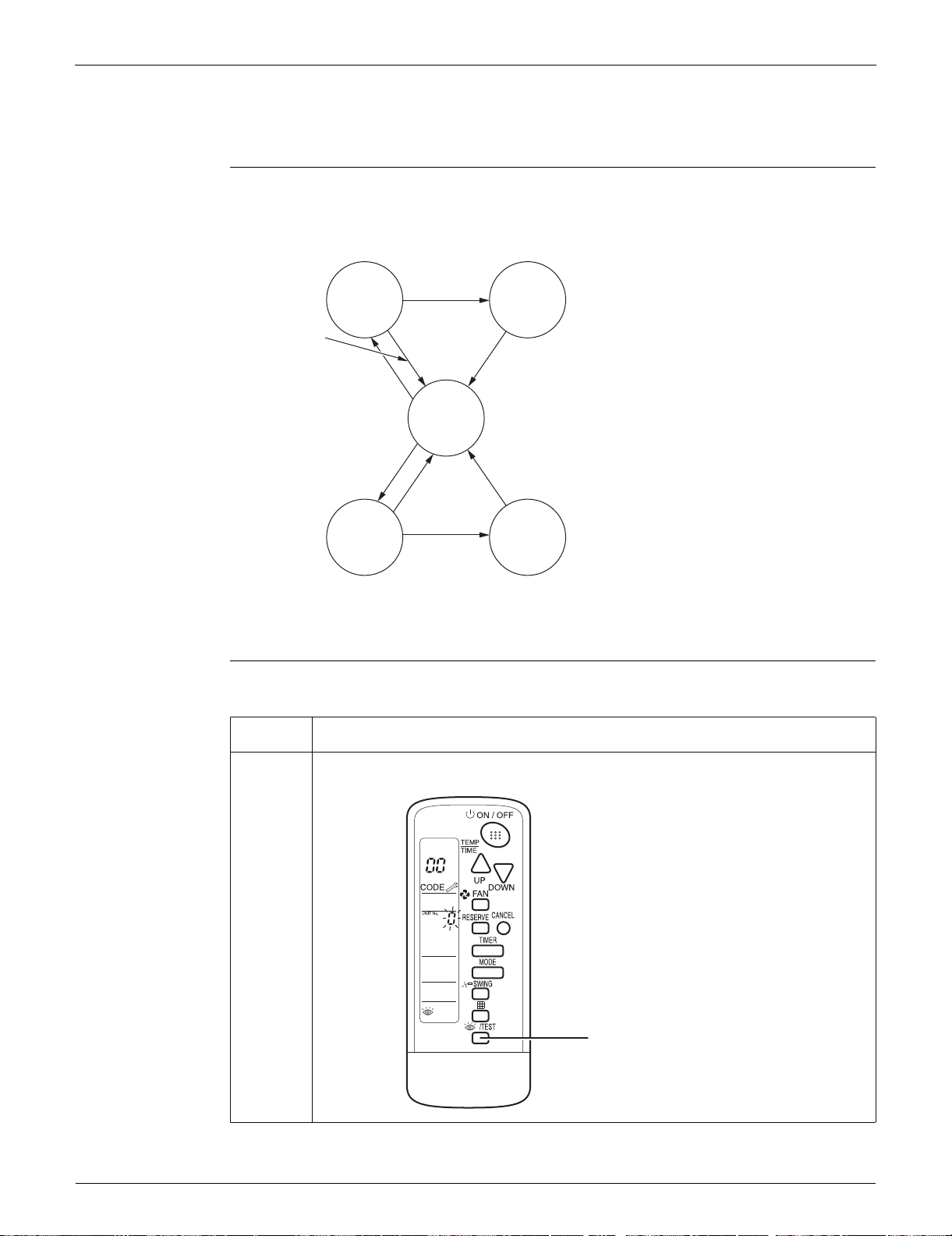
Service Diagnosis SiUS121827E
158 Part 6 Service Diagnosis
3.4 BRC082A43, BRC082A41W, BRC082A42W(S) Wireless
Remote Controller
Relations
Between Modes
The following modes can be selected by using INSPECTION/TEST OPERATION button on the
remote controller.
Service
Diagnosis
(R24049)
Press INSPECTION/TEST
OPERATION button for
more than 4 seconds.
Press INSPECTION/TEST
OPERATION button once.
Field
setting
mode
Service
mode
Normal
mode
Test
operation
mode
Inspection
mode
Press INSPECTION/TEST
OPERATION button once.
Press INSPECTION/TEST
OPERATION button for more
than 4 seconds.
Indoor unit settings can be made.
z Filter cleaning sign time
z Others
Following codes can be checked.
z Error codes
z Indoor model code
Service data can be obtained.
z Error code history
z Temperature data of various sections
Service settings can be made.
z Forced fan ON
z Airflow rate setting
Press INSPECTION/
TEST OPERATION
button once.
Press ON/OFF button within 10 seconds
to start test operation.
Test operation will stop automatically
after 15~30 minutes.
Thermostat is forcibly turned on.
After 60
seconds
Press INSPECTION/TEST
OPERATION button once.
After 10 seconds without starting test operation
or press INSPECTION/TEST OPERATION button once
or 30 min. after the test operation start
To find the error code, proceed as follows:
Step Action
1 Press INSPECTION/TEST OPERATION button to enter the inspection mode. Then the
figure 0 blinks on the UNIT No. display.
(R24050)
INSPECTION/TEST
OPERATION button
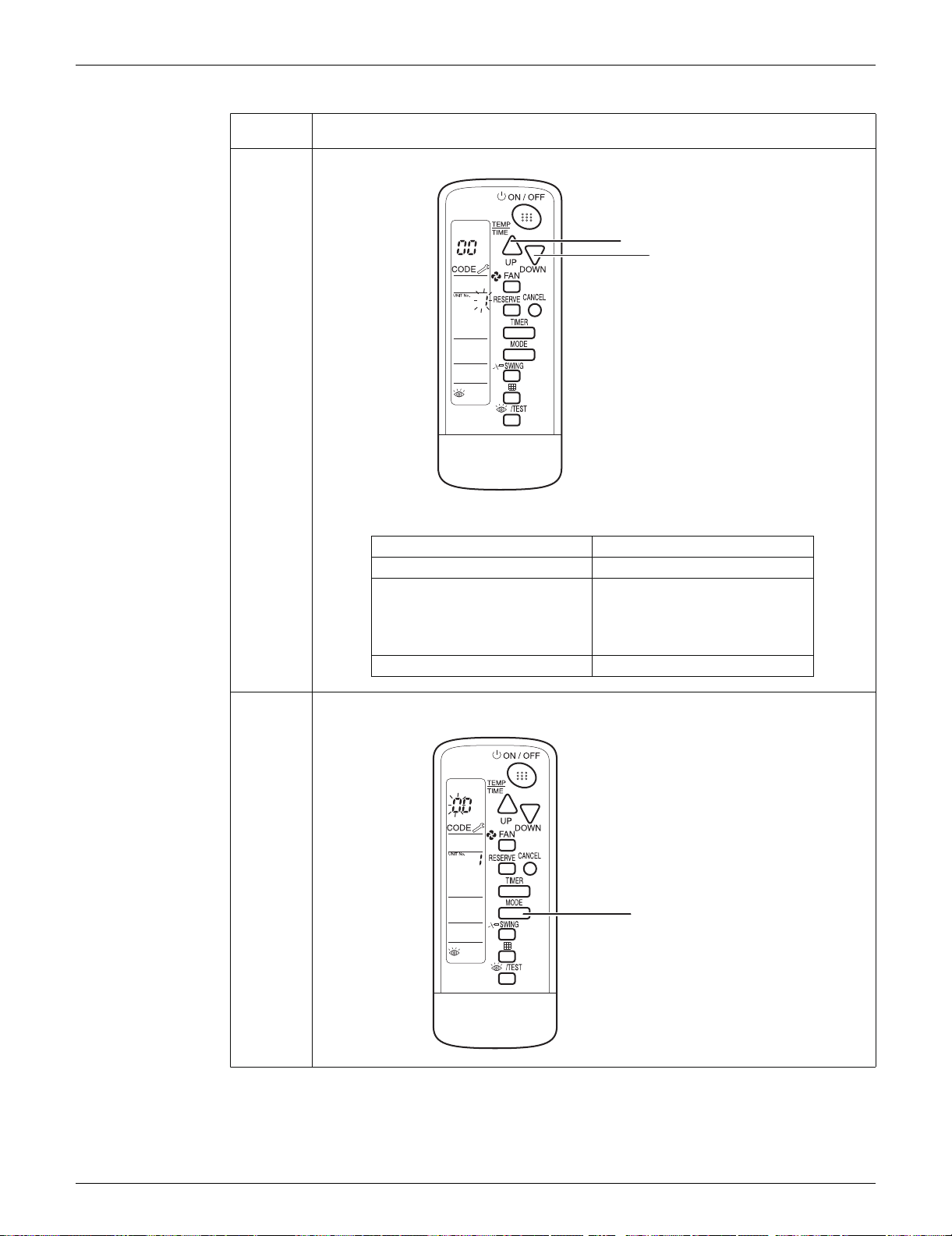
SiUS121827E Service Diagnosis
Part 6 Service Diagnosis 159
2 Press UP or DOWN button and change the UNIT No. until the indoor unit starts to beep.
3 Press OPERATION MODE SELECTOR button. The left 0 (upper digit) indication of the
error code blinks.
Step Action
UP button
DOWN button
(R15408)
If you hear... Then...
3 short beeps Follow all steps below.
eht eunitnoC .4 dna 3 spets wolloFpeeb trohs 1
operation in step 4 until you hear a
long beep. This long beep
indicates that the error code is
confirmed.
.ytilamronba on si erehTpeeb gnol 1
(R24051)
OPERATION MODE
SELECTOR button
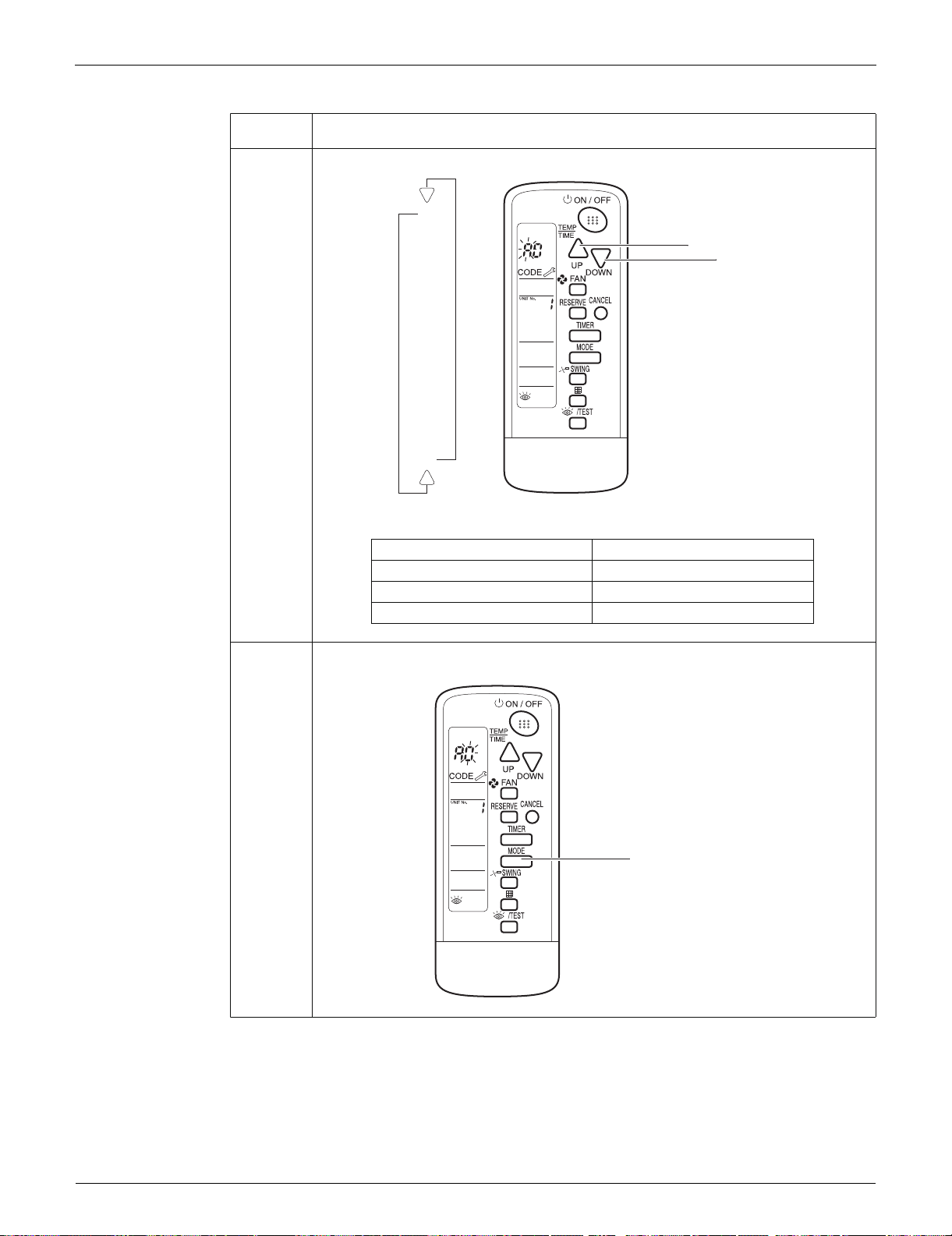
Service Diagnosis SiUS121827E
160 Part 6 Service Diagnosis
4 Press UP or DOWN button to change the error code upper digit until the indoor unit beeps.
5 Press OPERATION MODE SELECTOR button. The right 0 (lower digit) indication of the
error code blinks.
Step Action
UP button
DOWN button
(R15411)
UP
DOWN
4
5
6
7
8
9
U
P
L
J
F
H
E
C
A
0
If you hear... Then...
2 short beeps The upper digit matches.
.hctam stigid oNpeeb trohs 1
.hctam stigid rewol dna reppu htoBpeeb gnol 1
(R24052)
OPERATION MODE
SELECTOR button

SiUS121827E Service Diagnosis
Part 6 Service Diagnosis 161
6 Press UP or DOWN button and change the error code lower digit until the indoor unit
generates long beep.
7 Press OPERATION MODE SELECTOR button to return to the normal mode. If you do not
press any button for 1 minute, the remote controller automatically returns to the normal
mode.
Step Action
UP button
DOWN button
(R15413)
UP
DOWN
F
E
J
C
H
A
9
8
7
6
5
4
3
2
1
0
If you hear... Then...
2 short beeps No digits match.
.hctam stigid rewol dna reppu htoBpeeb gnol 1
(R24053)
OPERATION
MODE
SELECTOR button
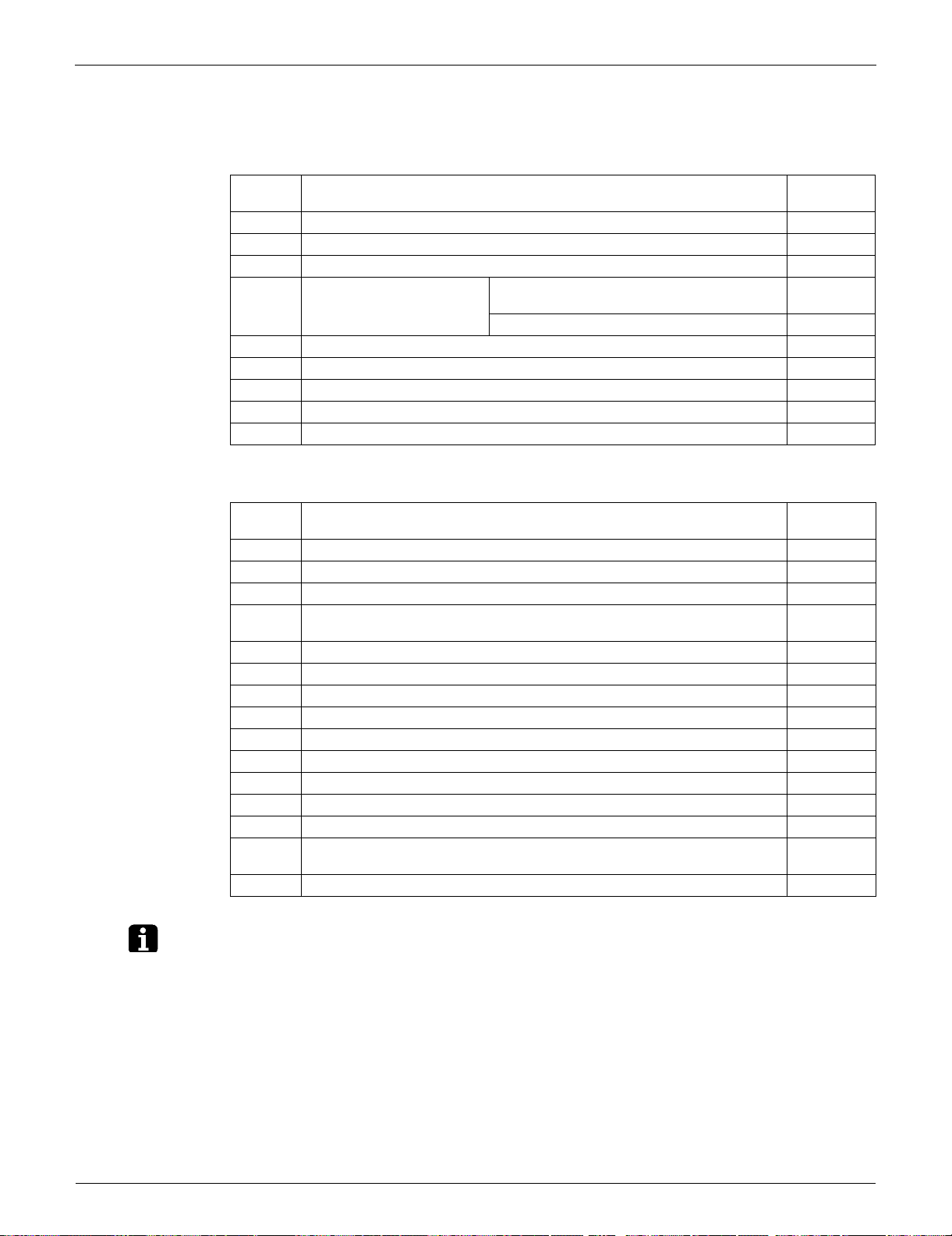
Code Indication on Remote Controller SiUS121827E
162 Part 6 Service Diagnosis
Note
4. Code Indication on Remote Controller
4.1 RA Indoor Unit
4.2 SA Indoor Unit
When there is a possibility of open phase power supply, also check power supply.
Error
Codes
Description
Reference
Page
00 Normal condition —
A1 Indoor unit PCB abnormality 164
A5 Freeze-up protection control/heating peak-cut control 166
A6
Indoor fan motor or related
abnormality
DC motor
(FTXR, CTXG, CTXS, FTXS, FVXS series)
167
AC motor (FDXS, CDXS series) 170
C4 Indoor heat exchanger thermistor or related abnormality 172
C7 Front panel open/close fault (FTXR, CTXG series) 173
C9 Room temperature thermistor or related abnormality 172
U4 Signal transmission error (between indoor unit and outdoor unit) 174
UA Mismatching of indoor unit and outdoor unit 177
Error
Codes
Description
Reference
Page
00 Normal condition —
A1 Indoor unit PCB abnormality 178
A3 Drain level control system abnormality 179
A6
Indoor fan motor (DC motor) or related abnormality
(See the Note below)
180, 182
A8 Indoor fan PCB abnormality 185
AF Humidifier or related abnormality 186
C4 Indoor heat exchanger thermistor 1 or related abnormality 187
C5 Indoor heat exchanger thermistor 2 or related abnormality 187
C9 Room temperature thermistor or related abnormality 187
CE Presence sensor or floor sensor abnormality 188
CJ Remote controller thermistor abnormality 189
U4 Signal transmission error (between indoor unit and outdoor unit) 190
U5 Signal transmission error (between indoor unit and remote controller) 192
U8
Signal transmission error (between MAIN remote controller and SUB
remote controller)
193
UA Mismatching of indoor unit and outdoor unit 194
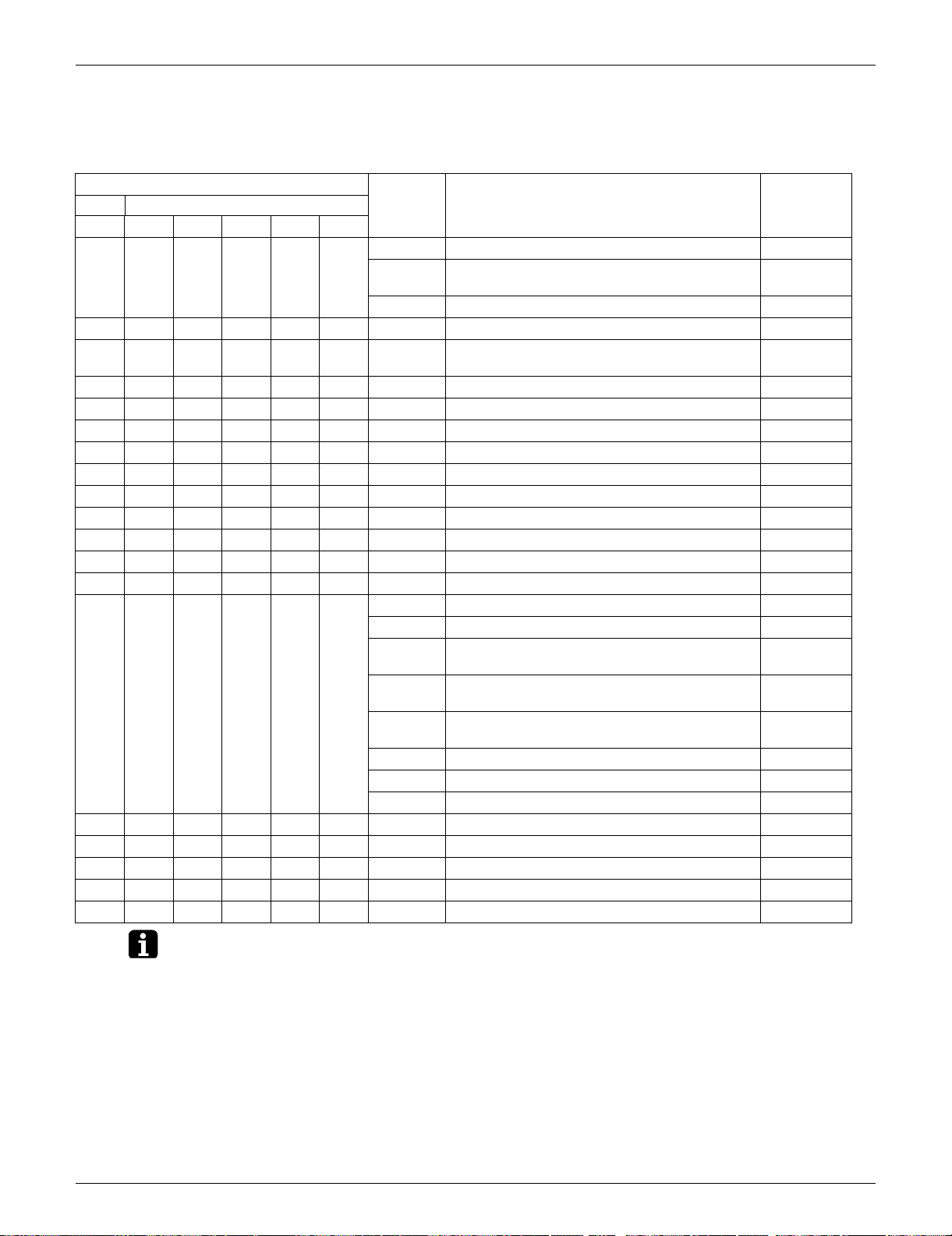
SiUS121827E Code Indication on Remote Controller
Part 6 Service Diagnosis 163
Notes
4.3 Outdoor Unit
i: ON, h: OFF, j: Blinks
1. The error codes in the parenthesis ( ) are displayed only when the system is shut down.
2. When a sensor error occurs, check the remote controller display to determine which sensor is
malfunctioning.
If the remote controller does not indicate the error code, conduct the following procedure.
Turn the power off and then on again. If the same LED indication appears again immediately
after the power is turned on, the fault is in the thermistor.
If the above condition does not result, the fault is in the CT.
3. The indoor unit error code may take the precedence in the remote controller display.
4. Turn the power off and then on again. If the same LED indication appears again, outdoor unit
PCB is faulty. Replace the outdoor unit PCB.
Outdoor Unit LED Indication
Error
Codes
Description
Reference
Page
Green Red
A12345
jhhhhh
00 Normal condition —
UA
Unspecified voltage (between indoor unit and
outdoor unit)
201
UH Anti-icing control in other rooms 201
jhhiih (U0) Refrigerant shortage 195
jihhih U2
Low-voltage detection or over-voltage
detection
198
jhihhh U3 Wiring error check unexecuted 200
jihiih A5 Anti-icing control for indoor unit 202
jiiihh E1 Outdoor unit PCB abnormality 204
jihihh (E5) OL activation (compressor overload) 205
jhiihh (E6) Compressor lock 208
jiiiih E7 DC fan lock 210
jhihih E8 Input overcurrent detection 212
jihhhh EA Four way valve abnormality 214
jihihh F3 Discharge pipe temperature control 216
jihiih F6 High pressure control in cooling 217
jiihhh
H0 Compressor sensor system abnormality 219
H6 Position sensor abnormality 221
H9
Outdoor temperature thermistor or related
abnormality
224
(J3)
Discharge pipe thermistor or related
abnormality
224
J6
Outdoor heat exchanger thermistor or related
abnormality
224
J8 Liquid pipe thermistor or related abnormality 224
J9 Gas pipe thermistor or related abnormality 224
P4 Radiation fin thermistor or related abnormality 224
jiihih L3 Electrical box temperature rise 226
jhhhih L4 Radiation fin temperature rise 227
jhhihh L5 Output overcurrent detection 229
i ————— — See the note 4. —
h ————— — Check the power supply. —

Troubleshooting for RA Indoor Unit SiUS121827E
164 Part 6 Service Diagnosis
5. Troubleshooting for RA Indoor Unit
5.1 Indoor Unit PCB Abnormality
Error Code A1
Method of Error
Detection
The system checks if the circuit works properly within the microcomputer of the indoor unit.
Error Decision
Conditions
The system cannot set the internal settings.
Supposed
Causes
Wrong models interconnected
Defective indoor unit PCB
Disconnection of connector
Reduction of power supply voltage
SiUS121827E Troubleshooting for RA Indoor Unit
Part 6 Service Diagnosis 165
Note
Troubleshooting
Check the following connector.
Check the connection of
connectors. (Refer to Note)
Correct the connection.
OK?
Check the power supply
voltage.
Start operation.
Voltage as rated?
Error repeats?
Check the power supply
voltage.
Start operation.
Voltage as rated?
Error repeats?
Error repeats?
Combination of the
indoor and outdoor unit
matched?
YES
NO
NO
YES
NO
NO
YES
(R23407)
Caution
∗ To secure the connection,
disconnect the connectors once
and then reconnect.
YES
NO
YES
NO
YES
NO
YES
Match the compatible
models.
Correct the power
supply.
Replace the indoor unit
PCB (control PCB).
Completed.
Completed.
Correct the power
supply.
Replace the indoor unit
PCB (control PCB).
Completed.
Be sure to turn off the power switch before connecting or disconnecting
connectors, or parts may be damaged.
Model Type Connector
FTXR, CTXG, CTXS, FTXS,
FVXS series
Terminal strip ~ Control PCB (H1, H2, H3)
FDXS, CDXS series Terminal block ~ Control PCB (H1, H2, H3)
Troubleshooting for RA Indoor Unit SiUS121827E
166 Part 6 Service Diagnosis
Reference
5.2 Freeze-up Protection Control/Heating Peak-cut Control
Error Code A5
Method of Error
Detection
Freeze-up protection control
During cooling operation, the freeze-up protection control (operation halt) is activated according
to the temperature detected by the indoor heat exchanger thermistor.
Heating peak-cut control
During heating operation, the temperature detected by the indoor heat exchanger thermistor is
used for the heating peak-cut control (operation halt, outdoor fan stop, etc.)
Error Decision
Conditions
Freeze-up protection control
During cooling operation, the indoor heat exchanger temperature is below 0°C (32°F).
Heating peak-cut control
During heating operation, the indoor heat exchanger temperature is above 65°C (149°F).
Supposed
Causes
Short-circuited air
Clogged air filter of the indoor unit
Dust accumulation on the indoor heat exchanger
Defective indoor heat exchanger thermistor
Defective indoor unit PCB
Troubleshooting
Check No.01 Refer to P.232
NO
NO
NO
Check No. 01
Check the indoor heat exchanger
thermistor.
YES
YES
(R21064)
YES
YES
NO
Caution
Provide sufficient air passage.
Clean the air filter.
Clean the indoor heat
exchanger.
Replace the indoor unit PCB
(control PCB).
Replace the indoor heat
exchanger thermistor.
As
described in the
thermistor characteristic
chart?
Check the air filter.
Check the dust accumulation on
the indoor heat exchanger.
Is there any short circuit?
Dirty?
Dirty?
Check the air passage.
Be sure to turn off the power switch before connecting or disconnecting
connectors, or parts may be damaged.
SiUS121827E Troubleshooting for RA Indoor Unit
Part 6 Service Diagnosis 167
5.3 Indoor Fan Motor or Related Abnormality
5.3.1 Indoor Fan Motor (DC Motor) or Related Abnormality
Applicable
Models
FTXR09/12/18TVJUW(S)
CTXG09/12/18QVJUW(S)
CTXS07LVJU
FTXS09/12/15/18/24LVJU
FVXS09/12/15/18NVJU
Error Code A6
Method of Error
Detection
The rotation speed detected by the Hall IC during indoor fan motor operation determines abnormal
fan motor operation.
Error Decision
Conditions
The detected rotation speed does not reach the demanded rotation speed of the target tap, and is
less than 50% of the maximum fan motor rotation speed.
Supposed
Causes
Remarkable decrease in power supply voltage
Layer short inside the fan motor winding
Breaking of wire inside the fan motor
Breaking of the fan motor lead wires
Defective capacitor of the fan motor
Defective indoor unit PCB
Troubleshooting for RA Indoor Unit SiUS121827E
168 Part 6 Service Diagnosis
Troubleshooting
Caution
Be sure to turn off the power switch before connecting or disconnecting
connectors, or parts may be damaged.
Correct the power
supply.
NO
Check the power supply
voltage.
Turn off the power and
disconnect the fan motor
connector, then turn the
power on.
Check No.02
Check the output of the
fan motor connector.
YES
YES
NO
YES
YES
NO
NO
NO
Note: The motor may break when the
motor connector is disconnected
while the power is turned on.
(Be sure to turn off the power
before reconnecting the
connector.)
Replace the indoor
fan motor.
Replace the indoor
unit PCB (control
PCB).
Replace the indoor
unit PCB (control
PCB).
Does the
fan rotate smoothly?
Does the
fan rotate?
Motor
power supply
voltage 310 ~ 340
VDC?
Turn off the power and
rotate the fan by hand.
Turn on the power and
start operation.
Check No.02
Check the output of the
fan motor connector.
(R22444)
YES
NO
YES
NO
YES
NO
Replace the indoor
fan motor.
Replace the indoor
unit PCB (control
PCB).
Replace the indoor
unit PCB (control
PCB).
Replace the indoor
unit PCB (control
PCB).
Replace the indoor
fan motor.
Stop the fan motor.
YES
Is the
voltage
fluctuation
within ±10% from
the rated
value?
Motor
control voltage 15
VDC generated?
Rotation
command voltage
1 ~ 6.5 VDC?
Indoor fan
motor rotation pulse
generated?
Indoor fan
motor rotation pulse
generated?
Troubleshooting for RA Indoor Unit SiUS121827E
170 Part 6 Service Diagnosis
5.3.2 Indoor Fan Motor (AC Motor) or Related Abnormality
Applicable
Models
FDXS09/12LVJU
CDXS15/18/24LVJU
Error Code A6
Method of Error
Detection
The rotation speed detected by the Hall IC during indoor fan motor operation determines abnormal
fan motor operation.
Error Decision
Conditions
The detected rotation speed does not reach the demanded rotation speed of the target tap.
Supposed
Causes
Power supply voltage out of specification
Layer short inside the fan motor winding
Breaking of wire inside the fan motor
Breaking of the fan motor lead wires
Defective capacitor of the fan motor
Defective indoor unit PCB
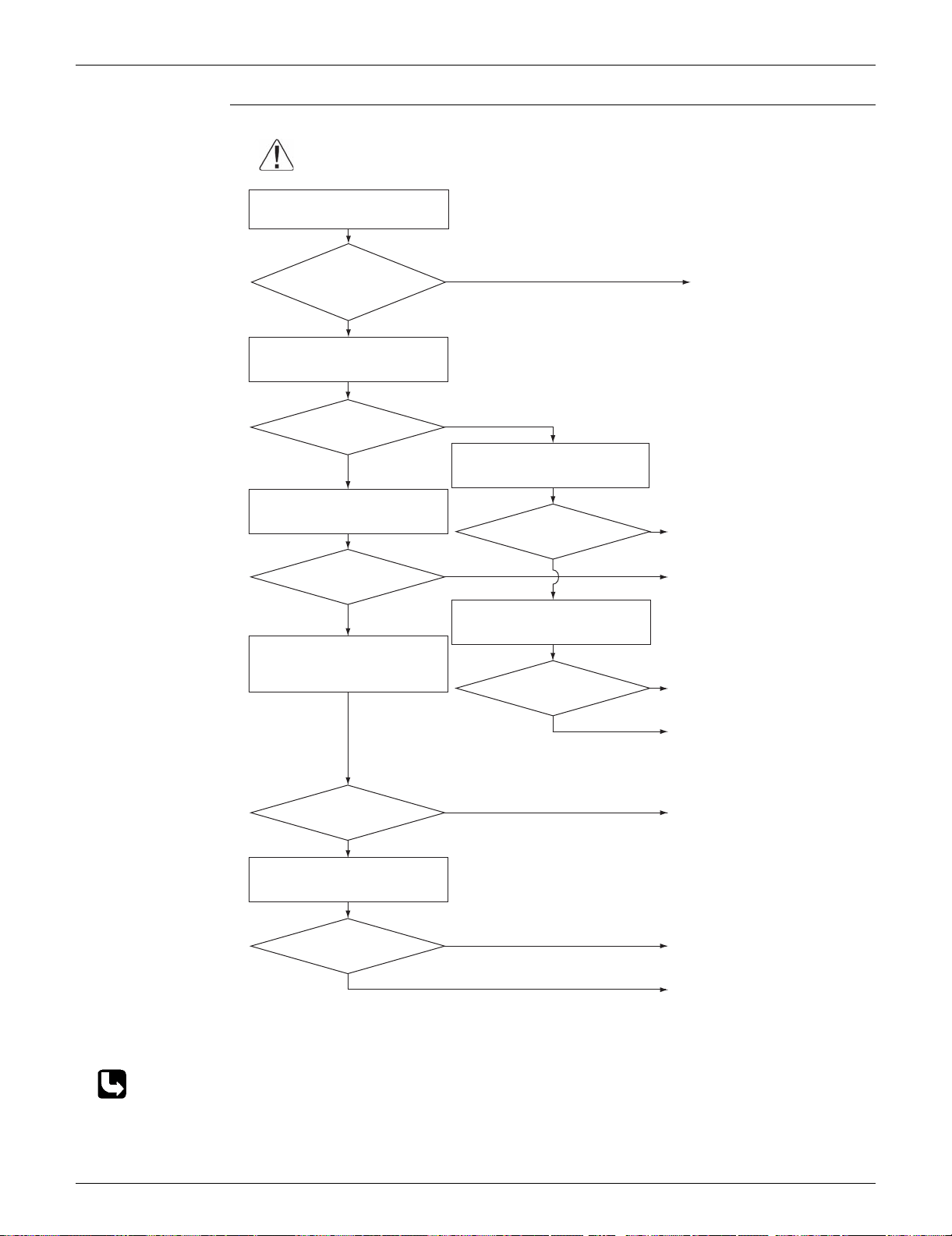
SiUS121827E Troubleshooting for RA Indoor Unit
Part 6 Service Diagnosis 171
Reference
Troubleshooting
Check No.04 Refer to P.234
(R22267)
Caution
Be sure to turn off the power switch before connecting or disconnecting
connectors, or parts may be damaged.
NO
YES
Check the power supply voltage.
Correct the power supply.
Is the voltage
fluctuation within ±10%
from the rated value?
NO
NO
NO
NO
NO
YES
YES
NO
YES
YES
YES
YES
Replace the indoor fan motor or
the indoor unit PCB (control
PCB).
Replace the indoor fan motor.
Replace the indoor unit PCB
(control PCB).
Replace the indoor fan motor.
Replace the capacitor.
(Replace the indoor unit PCB
(control PCB).)
Replace the indoor fan motor.
Replace the indoor unit PCB
(control PCB).
∗ Measure the voltage
between the black and white
lead wires of the fan motor,
and check if the maximum
voltage reaches the rated
voltage.
Check No. 04
Check Hall IC
Is there an output?
Check the fan motor voltage.
Voltage as rated? ∗
Start operation.
Does the fan rotate?
Turn off the power and rotate
the fan by hand.
Does the fan rotate
smoothly?
Turn on the power and check the
fan motor voltage. (immediately
after restart)
Voltage as rated? ∗
Check the capacitor's continuity.
Is there continuity?

Troubleshooting for RA Indoor Unit SiUS121827E
172 Part 6 Service Diagnosis
Reference
Note
5.4 Thermistor or Related Abnormality
Error Code C4, C9
Method of Error
Detection
The temperatures detected by the thermistors determine thermistor errors.
Error Decision
Conditions
The voltage between the both ends of the thermistor is either 4.96 V or more, or 0.04 V or less with
the power on.
Supposed
Causes
Disconnection of connector
Defective thermistor(s)
Defective indoor unit PCB
Troubleshooting
C4 : Indoor heat exchanger thermistor
C9 : Room temperature thermistor
Check No.01 Refer to P.232
When replacing the defective thermistor(s), replace the thermistor as ASSY.
YES
(R21870)
NO
Check No. 01
Check the thermistor resistance
value.
YES
NO
Caution
Correct the connection.
Replace the defective
thermistor(s).
Replace the indoor unit PCB
(control PCB).
Normal?
Normal?
Check the connection of
connectors.
Be sure to turn off the power switch before connecting or disconnecting
connectors, or parts may be damaged.
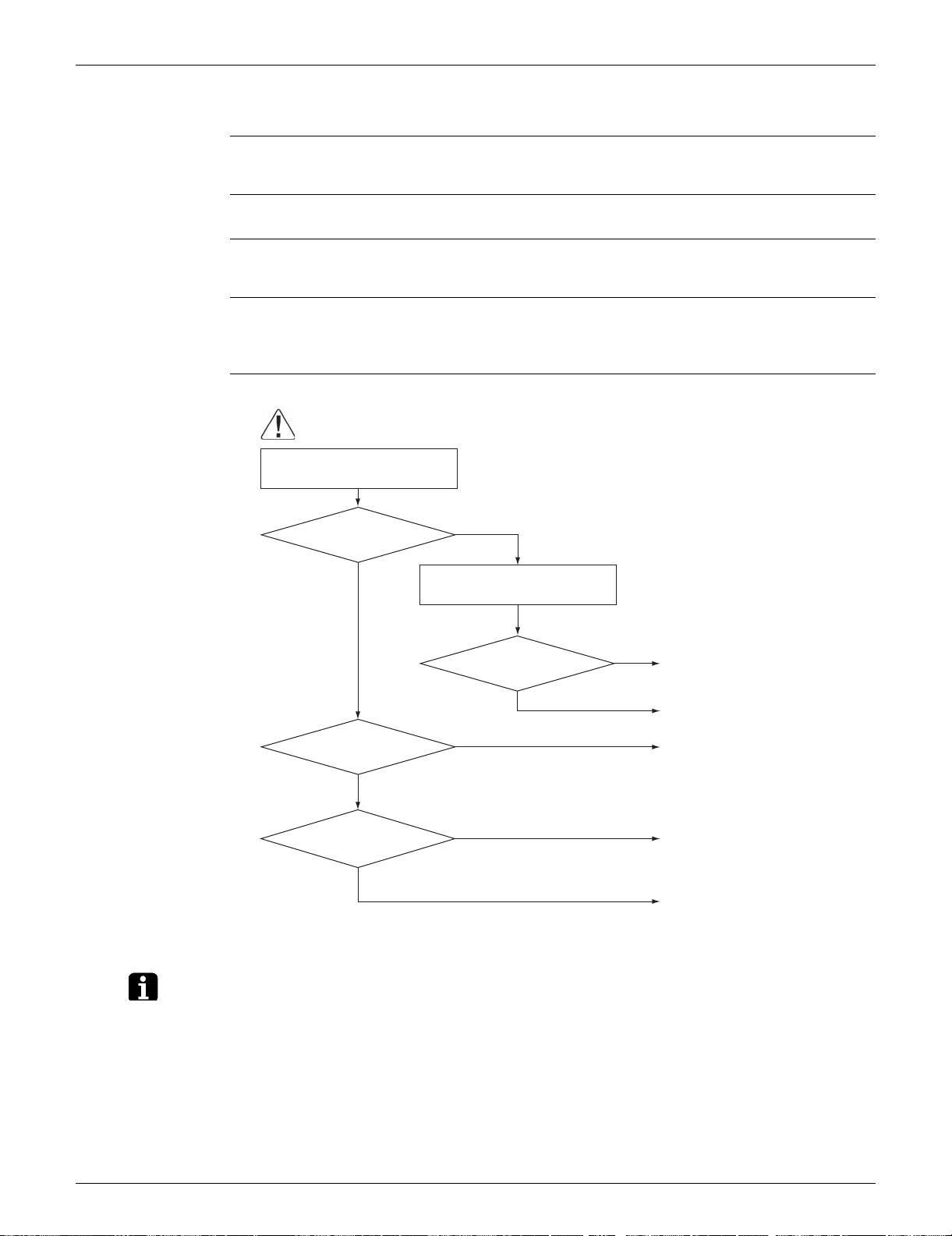
SiUS121827E Troubleshooting for RA Indoor Unit
Part 6 Service Diagnosis 173
Note
5.5 Front Panel Open/Close Fault
Applicable
Models
FTXR09/12/18TVJUW(S),
CTXG09/12/18QVJUW(S)
Error Code C7
Error Decision
Conditions
If the error repeats, the system is shut down.
Supposed
Causes
Defective reduction motor
Malfunction or deterioration of the front panel mechanism
Defective limit switch
Troubleshooting
You cannot operate the unit by the remote controller when the front panel mechanism breaks down.
<To the dealers: temporary measure before repair>
1. Turn off the power.
2. Remove the front panel.
3. Turn on the power.
(Wait until the initialization finishes.)
Operate the unit by the indoor unit ON/OFF button.
YES
YES
YES
YES
NO
NO
NO
NO
Replace the harness and
reduction motor.
Replace the assembly of the
front panel mechanism.
Check the movement of the
right and left separately by
hand.
Replace the assembly of the
front panel mechanism.
It is supposed such as
deformation of the panel or
stuffed dust.
Find out the cause.
Replace the limit switch.
(R17249)
Caution
Does the front
panel move?
Does the front
panel mechanism
move?
Does the front
panel open/close fully?
Restart. Does the
error code reappear?
Restart and check the
movement.
Remove the front panel and
check the movement.
Be sure to turn off the power switch before connecting or disconnecting
connectors, or parts may be damaged.

Troubleshooting for RA Indoor Unit SiUS121827E
174 Part 6 Service Diagnosis
5.6 Signal Transmission Error (Between Indoor Unit and
Outdoor Unit)
Error Code U4
Method of Error
Detection
The signal transmission data received from the outdoor unit is checked whether it is normal.
Error Decision
Conditions
The data sent from the outdoor unit cannot be received normally, or the content of the data is
abnormal.
Supposed
Causes
Reduction of power supply voltage
Wiring error
Breaking of the connection wires between the indoor and outdoor units (wire No. 3)
Defective outdoor unit PCB
Short circuit inside the fan motor winding
Defective indoor unit PCB
Disturbed power supply waveform
SiUS121827E Troubleshooting for RA Indoor Unit
Part 6 Service Diagnosis 175
Troubleshooting
Check No.11
Check the power supply
waveform.
Check the voltage of the
connection wires on the indoor
terminal strip/block between
No. 1 and No. 3, and between
No. 2 and No. 3.
YES
Blink
Replace the indoor unit PCB
(control PCB).
Locate and eliminate the
cause of the disturbance of
the power supply waveform.
NO
(R24621)
Continuously ON or OFF
NO
YES
YES
NO
Caution
Correct the connection wires
between the indoor unit and
the outdoor unit.
Replace the outdoor unit PCB
(main PCB).
Replace the connection wires
between the indoor unit and
outdoor unit.
Is LED A
blinking?
Properly
insulated?
Is there any
disturbance?
Is there any
wiring error?
Check the connection wires
between the indoor unit and the
outdoor unit.
Check the LED A on the outdoor
unit PCB.
Be sure to turn off the power switch before connecting or disconnecting
connectors, or parts may be damaged.
NO
YES
Check the power supply voltage.
Correct the power supply.
YES
NO
Replace the outdoor fan motor
and the outdoor unit PCB
(main PCB).
Rotate the
outdoor fan manually.
Does the outdoor fan rotate
smoothly?
Is the
voltage fluctuation
within ±10% from the rated
value?

SiUS121827E Troubleshooting for RA Indoor Unit
Part 6 Service Diagnosis 177
5.7 Mismatching of Indoor Unit and Outdoor Unit
Error Code UA
Method of Error
Detection
The supply power is detected for its requirements (pair type is different from multi type) by the
indoor/outdoor transmission signal.
Error Decision
Conditions
The pair type and multi type are interconnected.
Supposed
Causes
Wrong models interconnected
Wrong wiring of connecting wires
Wrong indoor unit PCB or outdoor unit PCB mounted
Defective indoor unit PCB
Defective outdoor unit PCB
Troubleshooting
(R23001)
Caution
NO
YES
YES
NO
Match the compatible models.
OK?
Correct the connection.
Check the part numbers of the
indoor and outdoor unit PCB
with the Parts List.
If not matched, change for the
correct PCB.
Are the
connecting wires
connected properly?
Check the combination of the
indoor and outdoor unit.
Be sure to turn off the power switch before connecting or disconnecting
connectors, or parts may be damaged.
Troubleshooting for SA Indoor Unit SiUS121827E
178 Part 6 Service Diagnosis
6. Troubleshooting for SA Indoor Unit
6.1 Indoor Unit PCB Abnormality
Error Code A1
Method of Error
Detection
The system checks the data from EEPROM.
Error Decision
Conditions
When the data from the EEPROM is not received correctly
EEPROM (Electrically Erasable Programmable Read Only Memory): A memory chip that holds its
content without power. It can be erased, either within the computer or externally and usually
requires more voltage for erasure than the common +5 volts used in logic circuits. It functions like
non-volatile RAM, but writing to EEPROM is slower than writing to RAM.
Supposed
Causes
Defective indoor unit PCB
External factor (noise etc.)
Troubleshooting
Caution
Be sure to turn off the power switch before connecting or disconnecting
connectors, or parts may be damaged.
(R22247)
Normal?
Turn off the power. Then, turn on
the power to restart the system.
NO
YES
External factor other than malfunction
(for example, noise etc.)
Replace the indoor unit PCB
(control PCB).
SiUS121827E Troubleshooting for SA Indoor Unit
Part 6 Service Diagnosis 179
6.2 Drain Level Control System Abnormality
Error Code A3
Method of Error
Detection
The float switch detects error.
Error Decision
Conditions
When the water level reaches its upper limit and when the float switch turns OFF
Supposed
Causes
Defective drain pump
Improper drain piping work
Clogged drain piping
Defective float switch
Defective indoor unit PCB
Defective short circuit connector X15A, X25A on indoor unit PCB
Troubleshooting
Caution
Be sure to turn off the power switch before connecting or disconnecting
connectors, or parts may be damaged.
Connect the drain pump.
Replace the indoor unit
PCB (control PCB).
Replace the drain pump.
There is a drain system
abnormality.
Connect the float switch.
Replace the float switch.
Replace the indoor unit
PCB (control PCB).
(R25079)
NO
YES
NO
NO
YES
YES
Is the drain
pump connected to X25A on
the indoor unit
PCB?
NO
Is the drain water level
abnormally high?
YES
YES
Is the float switch
connected to X15A?
NO
Does the drain
pump work after the power
supply is on?
Is the voltage of
connector X25A 13 VDC?
YES
Remove the float switch from
X15A, short circuit X15A, and
restart operation.
NO
Does A3
appear on the remote
controller display?
Troubleshooting for SA Indoor Unit SiUS121827E
180 Part 6 Service Diagnosis
6.3 Indoor Fan Motor or Related Abnormality
6.3.1 Indoor Fan Motor (DC Motor) or Related Abnormality
Applicable
Models
FDMQ09/12/15/18/24RVJU
Error Code A6
Method of Error
Detection
Detection from the current flow on the fan PCB
Detection from the rotation speed of the fan motor in operation
Error Decision
Conditions
The rotation speed is less than a certain level for 6 seconds.
Supposed
Causes
Clogged foreign matter
Disconnection of fan motor connectors
Disconnection of the connector between the indoor unit PCB and the fan PCB
Defective fan PCB
Defective fan motor
No fuse continuity
Trouble Shooting
R6000547
Connect the connector
correctly.
Turn OFF the power supply
and wait for 10 minutes.
NO
YES
NO
Connect the connector
correctly.
NO
YES
YES
Replace the fuse.
There is a
continuity in the fuse
(∗2) on the fan PCB or fan
motor harness.
NO
The fan motor
connector (∗1) is
connected to the fan
PCB.
Remove the foreign matter.
YES
There is a foreign
matter around the fan.
The connector
between the indoor unit
control PCB and the fan
PCB is connected.
A
Go to the next page
Caution
Be sure to turn off the power switch before connecting or disconnecting
connectors, or parts may be damaged.
SiUS121827E Troubleshooting for SA Indoor Unit
Part 6 Service Diagnosis 181
Note
Reference
R6000548
Connector and indoor unit PCB
Check No.02 Refer to P. 233
Continued from the
previous page
Turn OFF the power supply
and wait for 10 minutes.
Turn OFF the power supply
and wait for 10 minutes.
NO
NO
Replace the fan motor.
Each resistance
between the pins is equal to or
lower than 1 Ω.
Replace the fan motor.
Replace the fan PCB (A2P).
The HAP
lamp on the indoor
unit control PCB is blinking
while the HAP lamp on the
fan PCB is not
blinking.
YES
YES
Check the fan motor connectors.
Check No.02
Replace the fan PCB (A2P).
p
When A6 abnormality still
reoccurs, replace the fan
motor.
A
Turn ON the power supply while
the fan motor connector (∗1) is
disconnected.
Model
*1
Fan motor connector
*2
Fuse
FDMQ Series X8A F2U
Troubleshooting for SA Indoor Unit SiUS121827E
182 Part 6 Service Diagnosis
6.3.2 Indoor Fan Motor (DC Motor) or Related Abnormality
Applicable
Models
FFQ09/12/15/18Q2VJU
Error Code A6
Method of Error
Detection
The rotation speed detected by the Hall IC during indoor fan motor operation determines abnormal
fan motor operation.
Error Decision
Conditions
The fan motor is not revved up.
Supposed
Causes
Layer short inside the fan motor winding
Breaking of wire inside the fan motor
Breaking of the fan motor lead wires
Defective indoor unit PCB
SiUS121827E Troubleshooting for SA Indoor Unit
Part 6 Service Diagnosis 183
Troubleshooting
Caution
Be sure to turn off the power switch before connecting or disconnecting
connectors, or parts may be damaged.
Correct the power
supply.
NO
Check the power supply voltage.
YES
NO
Replace the indoor
fan motor.
Does the fan
rotate smoothly?
Rotate the fan by hand.
Turn on the power on again and
start operation.
YES
Is the
voltage
fluctuation within
±10% from the rated
value?
Check No.02
Check the output of the fan motor
connector.
YES
YES
NO
NO
Note: The motor may break when the
motor connector is disconnected
while the power is turned on.
(Be sure to turn off the power
before reconnecting the
connector.)
Replace the indoor
unit PCB (control
PCB).
Replace the indoor
unit PCB (control
PCB).
Motor power
supply voltage 290 ~ 330
VDC or more?
(R24054)
YES
NO
Replace the indoor
unit PCB (control
PCB).
Replace the indoor
fan motor.
Motor control
voltage 15 VDC
generated?
Rotation
command
voltage 0 ~ 2 VDC
when stopped, 2 ~ 5 VDC
when operated
OK?
NO
YES
YES
NO
Check the connector for
connection.
Foreign matters in or
around the fan?
Correct the
connection.
Remove the foreign
matters.
Turn off the power supply.
(Unplug the power cable or turn
the breaker off.)

SiUS121827E Troubleshooting for SA Indoor Unit
Part 6 Service Diagnosis 185
6.4 Indoor Fan PCB Abnormality
Applicable
Models
FDMQ09/12/15/18/24RVJU
Error Code A8
Method of Error
Detection
Microcomputer checks the voltage state of the fan PCB.
Error Decision
Conditions
Overvoltage or voltage drop is detected on the fan PCB.
Supposed
Causes
Defective fan PCB
External factor such as noise
Troubleshooting
R6000549
Caution
Be sure to turn off the power switch before connecting
or disconnecting connectors, or parts may be damaged.
Check for the indoor unit control
PCB (A1P) and the fan PCB
(A2P).
Connect the connector correctly.
NO
YES
YES
Is the
connector X3A on
the fan PCB connected
correctly?
Connect the connector correctly.
NO
YES
Is the
connector X70A on
the indoor unit control PCB
connected correctly?
Replace the harness.
YES
Is the harness
connecting X3A and X70A
broken?
NO
NO
Remove the external factor.
YES
Is there any external
factor such as noise?
Normal.
NO
Error is displayed
again.
Turn OFF the power supply
and then turn it ON again.
Start operation with the
remote controller.
Troubleshooting for SA Indoor Unit SiUS121827E
186 Part 6 Service Diagnosis
Note
6.5 Humidifier or Related Abnormality
Error Code AF
Method of Error
Detection
Water leakage from humidifier(s) is detected based on the float switch ON/OFF changeover while
the system is not operating.
Error Decision
Conditions
The float switch changes from ON to OFF while the system is OFF
Supposed
Causes
Defective float switch
Error in water drain system of humidifier(s)
Clogged electric expansion value in humidifier(s)
Defective indoor unit PCB
Troubleshooting
The system continues to operate with the thermostat OFF even while the error code is displayed.
YES
YES
NO
NO
Caution
Be sure to turn off the power switch before connecting or disconnecting
connectors, or parts may be damaged.
The float switch may be
defective. Check if the
drain-up height and the
horizontal pipe length
exceed the specifications.
Clogged water drain
system, clogged drain
pump, or faulty float switch
Replace the indoor unit
PCB (control PCB).
(R24055)
Humidifier(s)
connected to the system?
Is the water
drain system of the
humidifier normal?
SiUS121827E Troubleshooting for SA Indoor Unit
Part 6 Service Diagnosis 187
Note
Reference
6.6 Thermistor or Related Abnormality
Error Code C4, C5, C9
Method of Error
Detection
The temperatures detected by the thermistors determine thermistor errors.
Error Decision
Conditions
The thermistor is disconnected or shorted while the unit is running.
Supposed
Causes
Disconnection of connector
Defective thermistor(s)
Breaking of wires
Defective indoor unit PCB
Troubleshooting If the cause of the problem is related to the thermistors, the thermistors should be checked prior to
changing the indoor unit PCB.
To check the thermistors, proceed as follows:
1. Disconnect the thermistor from the indoor unit PCB.
2. Read the temperature and the resistance value.
3. Check if the measured values correspond with the values in the table of thermistor resistance
check.
C4: Indoor heat exchanger thermistor 1 (liquid pipe) (R2T)
C5: Indoor heat exchanger thermistor 2 (R3T)
C9: Room temperature thermistor (R1T)
When replacing the defective thermistor(s), replace the thermistor as ASSY.
Check No.01 Refer to P.232
YES
(R24056)
NO
Check No. 01
Check the thermistor resistance
value.
YES
NO
Caution
Correct the connection.
Replace the defective
thermistor(s).
Replace the indoor unit PCB
(control PCB).
Normal?
Normal?
Check the connection of
connectors.
Be sure to turn off the power switch before connecting or disconnecting
connectors, or parts may be damaged.
Troubleshooting for SA Indoor Unit SiUS121827E
188 Part 6 Service Diagnosis
Note
6.7 Presence Sensor or Floor Sensor Abnormality
Applicable
Models
FFQ09/12/15/18Q2VJU
Error Code CE
Method of Error
Detection
The system detects abnormality by the output signal from the sensor(s).
Error Decision
Conditions
The sensor is disconnected or shorted while the unit is running.
Supposed
Causes
Disconnection of connector
Breaking of wires
Defective sensor(s)
Defective sensor kit PCB
Troubleshooting If the cause of the problem is related to the sensors, the sensors should be checked prior to
changing the indoor unit PCB.
When replacing the defective sensor(s), replace the sensor kit as ASSY.
(R24577)
YES
NO
Check the connection of
connectors on the sensor kit.
YES
NO
Caution
Correct the connection.
Connect the connectors
properly.
Normal?
Normal?
Turn off the power. Then, turn on
the power to restart the system.
YES
NO
Normal
Replace the sensor kit.
CE error
displayed again?
Check the connection of
connector X81A on indoor unit
PCB.
Be sure to turn off the power switch before connecting or disconnecting
connectors, or parts may be damaged.
SiUS121827E Troubleshooting for SA Indoor Unit
Part 6 Service Diagnosis 189
Note
6.8 Remote Controller Thermistor Abnormality
Error Code CJ
Method of Error
Detection
Even if remote controller thermistor is faulty, system is possible to operate by system thermistor.
Malfunction detection is carried out by the temperature detected by the remote controller
thermistor.
Error Decision
Conditions
The remote controller thermistor is disconnected or shorted while the unit is running.
Supposed
Causes
Defective room temperature thermistor in the wired remote controller
Defective wired remote controller PCB
External factor such as noise
Troubleshooting
To delete the record of error codes, press ON/OFF button on the remote controller for 4 seconds or
more while the error code is displayed in the inspection mode.
Replace the remote
controller.
External factor other than
equipment malfunction.
(for example, noise etc.)
NO
YES
(R23951)
Is
CJ displayed on
the remote controller
again?
Delete the record of error
codes. (Refer to Note)
Caution
Be sure to turn off the power switch before connecting or disconnecting
connectors, or parts may be damaged.

Troubleshooting for SA Indoor Unit SiUS121827E
190 Part 6 Service Diagnosis
6.9 Signal Transmission Error (Between Indoor and Outdoor
Unit)
Error Code U4
Method of Error
Detection
The signal transmission data from the outdoor unit is checked whether it is normal.
Error Decision
Conditions
The data sent from the outdoor unit cannot be received normally, or the content of the data is
abnormal.
Supposed
Causes
Power supply voltage out of specification
Reduction of power supply voltage
Wiring error
Breaking of the connection wires between the indoor and outdoor units (wire No. 3)
Defective outdoor unit PCB
Short circuit inside the fan motor winding
Defective indoor unit PCB
Disturbed power supply waveform
SiUS121827E Troubleshooting for SA Indoor Unit
Part 6 Service Diagnosis 191
Reference
Troubleshooting
Check No.11 Refer to P.235
Check No.11
Check the power supply
waveform.
Check the voltage of the
connection wires on the indoor
terminal block between No. 1
and No. 3, and between No. 2
and No. 3.
YES
Blink
Replace the indoor unit PCB
(control PCB).
Locate and eliminate the
cause of the disturbance of
the power supply waveform.
NO
(R24622)
Continuously ON or OFF
NO
YES
YES
NO
Caution
Correct the connection wires
between the indoor unit and
the outdoor unit.
Replace the outdoor unit PCB
(main PCB).
Replace the connection wires
between the indoor unit and
outdoor unit.
Is LED A
blinking?
Properly
insulated?
Is there any
disturbance?
Is there any wiring
error?
Check the connection wires
between the indoor unit and the
outdoor unit.
Check the LED A on the outdoor
unit PCB.
Be sure to turn off the power switch before connecting or disconnecting
connectors, or parts may be damaged.
NO
YES
Check the power supply voltage.
Correct the power supply.
YES
NO
Replace the outdoor fan motor
and the outdoor unit PCB
(main PCB).
Rotate the
outdoor fan manually.
Does the outdoor fan rotate
smoothly?
Is the
voltage fluctuation
within ±10% from the rated
value?
Troubleshooting for SA Indoor Unit SiUS121827E
192 Part 6 Service Diagnosis
Note
6.10 Signal Transmission Error (Between Indoor Unit and
Remote Controller)
Error Code U5
Method of Error
Detection
In case of controlling 1 indoor unit with 2 remote controllers, check the system using microcomputer
if signal transmission between indoor unit and remote controller (main and sub) is normal.
Error Decision
Conditions
Normal transmission does not continue for specified period.
Supposed
Causes
Connection of 2 main remote controllers (when using 2 remote controllers)
Defective indoor unit PCB
Defective remote controller
Transmission error caused by noise
Troubleshooting
For the way to change MAIN/SUB setting of remote controllers, refer to pages 267 and 268.
Caution
Be sure to turn off the power switch before connecting or disconnecting
connectors, or parts may be damaged.
Are both
remote controllers set to
MAIN?
Do the service
monitors of all the indoor
units blink?
Does
operation return to
normal when the power is
turned off
momentarily?
NO
NO
YES
YES
NO
Replace the indoor unit
PCB (control PCB).
Set 1 remote controller to
SUB; turn the power supply
off once and then back on.
When using both wired and
wireless remote controllers for
1 indoor unit, make sure to set
the wireless remote controller
to SUB.
There is possibility of
malfunction caused by noise.
Check the surrounding area
and turn on again.
There is possibility of
malfunction caused by noise.
Check the surrounding area
and turn on again.
Normal
Normal
NO
NO
Using
2 remote controllers
for 1 indoor unit?
YES
YES
YES
Replace the remote controller.
Return to normal?
Return to normal?
NO
Replace the indoor unit PCB.
YES
(R24590)
SiUS121827E Troubleshooting for SA Indoor Unit
Part 6 Service Diagnosis 193
Note
6.11 Signal Transmission Error (Between MAIN/SUB Remote
Controllers)
Error Code U8
Method of Error
Detection
In case of controlling 1 indoor unit with 2 remote controllers, check the system using microcomputer
if signal transmission between MAIN remote controller and SUB remote controller is normal.
Error Decision
Conditions
Normal transmission does not continue for specified period.
Supposed
Causes
Remote controller is set to SUB when using 1 remote controller
Connection of 2 SUB remote controllers (when using 2 remote controllers)
Defective remote controller PCB
Troubleshooting
For the way to change MAIN/SUB setting of remote controllers, refer to pages 267 and 268.
Turn the power off and then
back on. If a malfunction occurs,
replace the remote controller.
Turn the power off and then
back on. If a malfunction occurs,
replace the remote controller.
Set one remote controller to
MAIN; turn the power supply off
once and then back on.
Set the remote controller to
MAIN; turn the power supply off
and then back on.
YES
NO
YES
NO NO
YES
(R24058)
Using 2 remote
controllers for 1
indoor unit?
Are both remote
controllers set to
SUB?
Caution
Be sure to turn off the power switch before connecting or disconnecting
connectors, or parts may be damaged.
Is the
remote controller set to
MAIN?
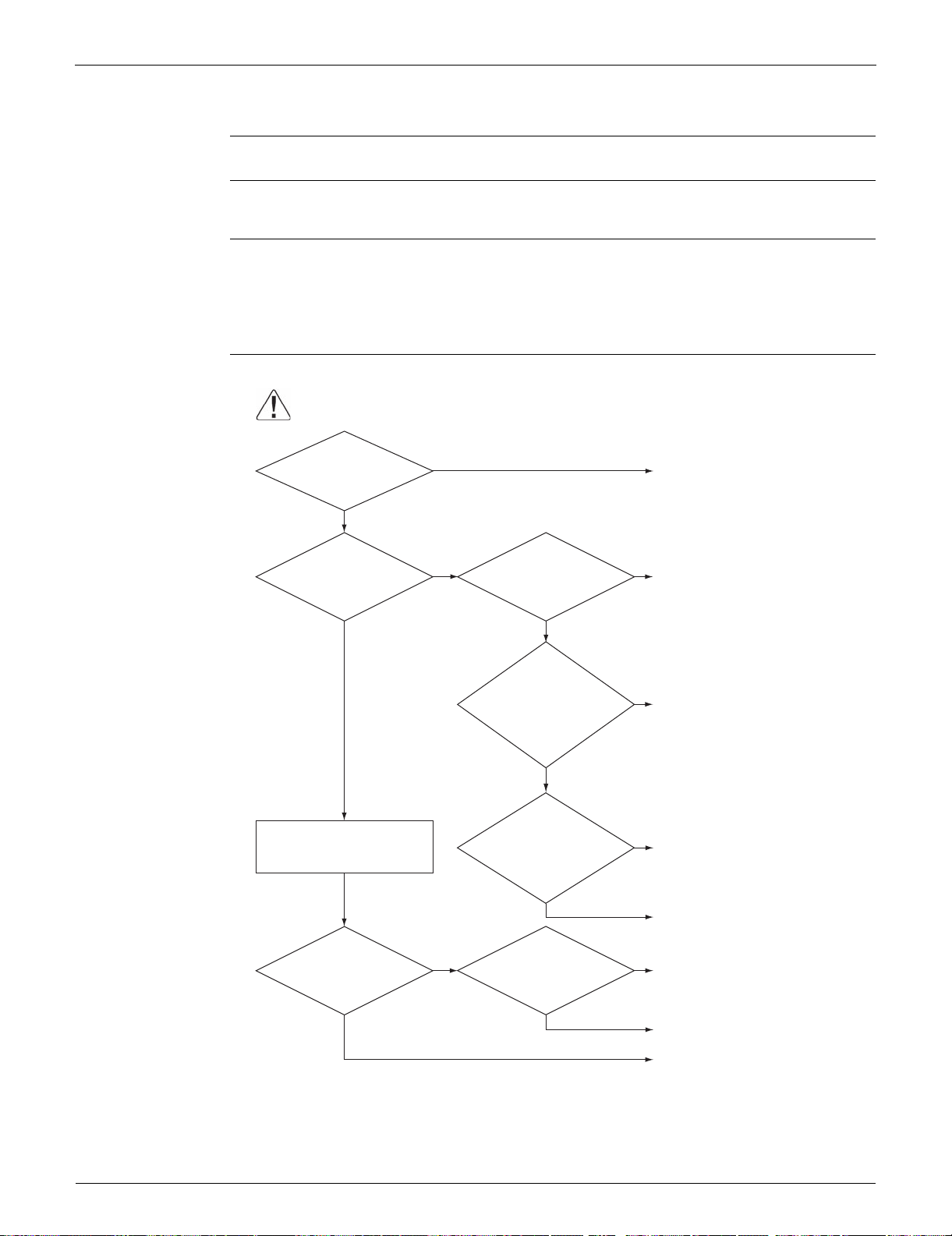
Troubleshooting for SA Indoor Unit SiUS121827E
194 Part 6 Service Diagnosis
6.12 Mismatching of Indoor Unit and Outdoor Unit
Error Code UA
Error Decision
Conditions
Improper combination of indoor and outdoor units
Supposed
Causes
Defective indoor unit PCB
Indoor-outdoor unit transmission wiring error
Defective optional unit(s) wirings
Improper power supply wiring of indoor unit
Improper wiring of connecting wires between indoor/outdoor units
Troubleshooting
Connect the wirings correctly.
Replace the indoor unit PCB
(control PCB).
Normal
Connect the wirings correctly.
Check the power supply system
inside the indoor unit.
Could be incorrect wiring.
Check again.
YES
YES
NO
NO
Connect the indoor/outdoor
units correctly.
YES
YES
YES
YES
NO
NO
NO
Blink
(R24591)
Is the combination
of indoor/outdoor
units correct?
Do the service
monitors of all the
indoor units blink?
Are the wirings
between indoor unit and
outdoor unit correctly
connected?
Connect the wirings correctly.
NO
Is the optional
units power supply
connected from the
indoor unit terminal
block No.1 and
No.2?
Does the system conduct
normal operation?
Are the wirings
between indoor unit and
outdoor unit correctly
connected?
Turn off the power supply.
Then, turn on the power
supply to restart the system.
Continuously
ON or OFF
Is the voltage
between No.1 and
No.2 on the indoor
unit terminal block
208 - 230
VAC?
Caution
Be sure to turn off the power switch before connecting or disconnecting
connectors, or parts may be damaged.
SiUS121827E Troubleshooting for Outdoor Unit
Part 6 Service Diagnosis 195
7. Troubleshooting for Outdoor Unit
7.1 Refrigerant Shortage
Error Code U0
Outdoor Unit LED
Display
A j 1 h 2 h 3 i 4 i 5 h
Method of Error
Detection
Refrigerant shortage is detected by checking the input current value and the compressor running
frequency. If there is insufficient refrigerant, the input current tends to be lower than the normal
value.
Error Decision
Conditions
The following conditions continue for 7 minutes.
Input current ≤ A × output frequency + B
Output frequency > C
If the error repeats, the system is shut down.
Reset condition: Continuous run for about 60 minutes without any other error
Supposed
Causes
The installation space not large enough
Dirty outdoor heat exchanger
Defective outdoor fan motor
Disconnection of the discharge pipe thermistor, indoor or outdoor heat exchanger thermistor,
room or outdoor temperature thermistor
Closed stop valve
Refrigerant shortage (refrigerant leakage)
Poor compression performance of compressor
Defective electronic expansion valve
A (coefficient) B (A) C (Hz)
2500/256 50 40
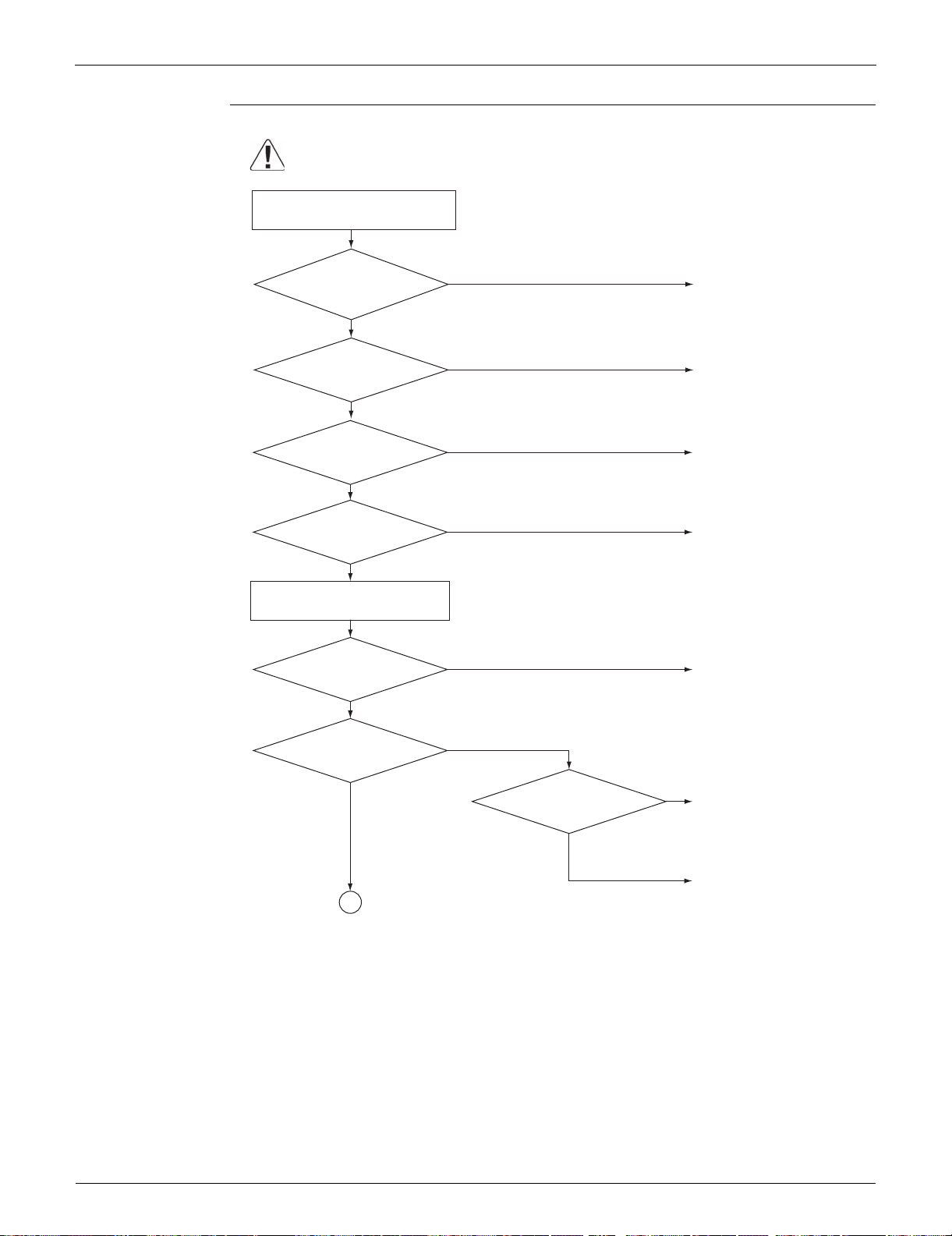
Troubleshooting for Outdoor Unit SiUS121827E
196 Part 6 Service Diagnosis
Troubleshooting
R6000442
Caution
YES
NO
NO
YES
YES
YES
NO
NO
YES
NO
∗ Discharge pipe thermistor
∗ Indoor or outdoor heat exchanger thermistor
∗ Room temperature thermistor
∗ Outdoor temperature thermistor
Check for refrigerant shortage.
A
Go to the next page
Reconnect the thermistor(s).
Open the stop valve.
Repair the pipe flare or
replace the union.
Check if any harnesses are
in contact with the piping
and correct as required.
Also, replace any cracked
pipes.
Check the connection of the
power transistor harness.
Also, replace any cracked
pipes.
Oil leak at
internal piping?
Stop valve
closed?
Compressor
vibrating too much?
Oil leak at relay
pipe connections?
Any thermistor
disconnected?
Be sure to turn off the power switch before connecting or disconnecting
connectors, or parts may be damaged.
Replace the outdoor fan
motor.
Reconnect the connector or
fan motor lead wires.
Change the installation
location or direction.
Clean the outdoor heat
exchanger.
Check the installation space.
NG
OK
OK
NG
Check No. 19
Check the outdoor fan.
Check No. 17
Check the installation
condition.
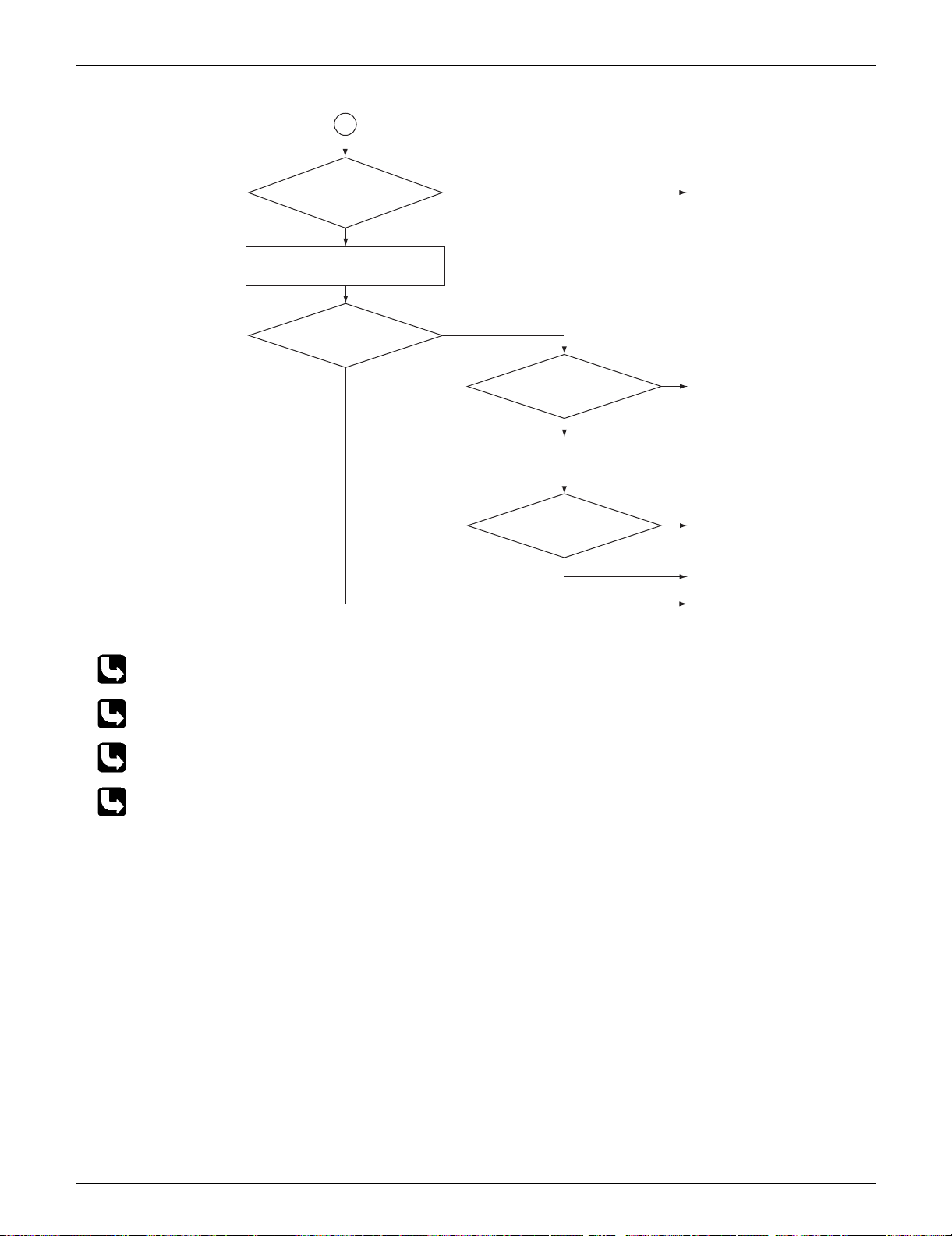
SiUS121827E Troubleshooting for Outdoor Unit
Part 6 Service Diagnosis 197
Reference
Reference
Reference
Reference
R6000552
Check No.01 Refer to P.232
Check No.12 Refer to P.236
Check No.17 Refer to P.240
Check No.19 Refer to P.241
NG
YES
NO
Change for a specified amount of
fresh refrigerant.
NO
Check No. 12
Electronic expansion valve
functioning?
Replace the electronic
expansion valve.
YES
Replace the defective
thermistor(s).
Completed.
Refrigerant
shortage error again?
Check No. 01
Check the thermistors.
OK
NO
YES
Replace the outdoor unit PCB
(main PCB).
Replace the compressor.
Completed.
Error again?
Continued from the
previous page
A

Troubleshooting for Outdoor Unit SiUS121827E
198 Part 6 Service Diagnosis
7.2 Low-voltage Detection or Over-voltage Detection
Error Code U2
Outdoor Unit LED
Display
A j 1 i 2 h 3 h 4 i 5 h
Method of Error
Detection
Indoor Unit
The zero-cross detection of the power supply is evaluated by the indoor unit PCB.
Outdoor Unit
Low-voltage detection:
An abnormal voltage drop is detected by the DC voltage detection circuit.
Over-voltage detection:
An abnormal voltage rise is detected by the over-voltage detection circuit.
Error Decision
Conditions
Indoor Unit
There is no zero-cross detection in approximately 10 seconds.
Outdoor Unit
Low-voltage detection:
The voltage detected by the DC voltage detection circuit is below 180 V for 0.1 second.
If the error repeats, the system is shut down.
Reset condition: Continuous run for about 60 minutes without any other error
Over-voltage detection:
An over-voltage signal is fed from the over-voltage detection circuit to the microcomputer.
The compressor stops if the error occurs, and restarts automatically after 3-minute standby.
Supposed
Causes
Power supply voltage out of specification
Defective DC voltage detection circuit
Defective over-voltage detection circuit
Defective PAM control part
Disconnection of compressor harness
Short circuit inside the fan motor winding
Noise
Momentary drop of voltage
Momentary power failure
Defective outdoor unit PCB
Defective indoor unit PCB
SiUS121827E Troubleshooting for Outdoor Unit
Part 6 Service Diagnosis 199
Troubleshooting
Correct the power supply.
Replace the outdoor
unit PCB (main PCB).
Check for such factors for a
long term.
(R22370)
Caution
Be sure to turn off the power switch before connecting or disconnecting
connectors, or parts may be damaged.
NO
NO
YES
YES
NO
YES
YES
Reconnect the harness.
Check the power supply voltage.
Check the connection of the
compressor harness.
Disturbance factors
∗ Noise
∗ Power supply distortion
(Precaution before turning on the power again)
Make sure the power has been off for at
least 30 seconds.
Replace the indoor
unit PCB (control PCB).
Turn on
the power. System
restarted? (Repeat a few
times.)
Error again
within 3 minutes after
turning on the power?
Loose or
disconnected?
NO
YES
NO
Replace the outdoor fan motor
and the outdoor unit PCB
(main PCB).
Does the
outdoor fan rotate smoothly?
Is the
voltage fluctuation
within ±10% from the rated
value?
Troubleshooting for Outdoor Unit SiUS121827E
200 Part 6 Service Diagnosis
Reference
7.3 Wiring Error Check Unexecuted
Error Code U3
Outdoor Unit LED
Display
A j 1 h 2 i 3 h 4 h 5 h
Method of Error
Detection
The system checks if wiring error check is executed after clearing the memory.
Error Decision
Conditions
An error is determined when the unit is operated by the remote controller without executing wiring
error check after the memory was cleared.
Supposed
Causes
The wiring error switch (SW3) may have been pressed for 10 seconds or more and the memory
may have been deleted. The unit cannot be operated unless wiring error check is executed.
Troubleshooting
Refer to Wiring Error Check Function on page 249 for details.
(R23952)
Caution
NO
YES
Wiring error
check executed?
Conduct wiring error check.
Wiring error check may not
have been finished because of
the trouble of indoor/outdoor
unit.
Conduct wiring error check
again.
Be sure to turn off the power switch before connecting or disconnecting
connectors, or parts may be damaged.
SiUS121827E Troubleshooting for Outdoor Unit
Part 6 Service Diagnosis 201
Note
7.4 Unspecified Voltage (Between Indoor Unit and Outdoor
Unit), Anti-icing Control in Other Rooms
Error Code UA, UH
Outdoor Unit LED
Display
A j 1 h 2 h 3 h 4 h 5 h
Method of Error
Detection
A wrong connection is detected by checking the combination of indoor and outdoor units on the
microcomputer.
Error Decision
Conditions
Anti-icing control in other rooms
Unspecified internal and/or external voltages
Mismatching of indoor and outdoor units
Supposed
Causes
Anti-icing function in other rooms
Power supply voltage out of specification
Wrong models interconnected
Wrong indoor unit PCB or outdoor unit PCB mounted
Troubleshooting
Refer to Anti-icing control for indoor unit on page 202 for details.
(R21922)
Caution
NO
YES
NO
YES
NO
YES
Check the model combination.
Error displayed
while operating?
Power supply
voltage as specified?
Matched
compatibly?
The anti-icing function is
activated in other rooms.
Refer to A5.
Correct the power supply
voltage.
Match the compatible models.
Check the combination of all
connected models.
Be sure to turn off the power switch before connecting or disconnecting
connectors, or parts may be damaged.

Troubleshooting for Outdoor Unit SiUS121827E
202 Part 6 Service Diagnosis
7.5 Anti-icing Control for Indoor Unit
Error Code A5
Outdoor Unit LED
Display
A j 1 i 2 h 3 i 4 i 5 h
Method of Error
Detection
During cooling operation, indoor unit icing is detected by checking the temperatures sensed by the
indoor heat exchanger thermistor and room temperature thermistor that are located in a shut-down
room.
Error Decision
Conditions
In cooling operation, the both conditions (A) and (B) are met for 5 minutes.
(A) Room temperature – Indoor heat exchanger temperature ≥ 10°C (18°F)
(B) Indoor heat exchanger temperature ≤ –1°C (30.2°F)
If the error repeats, the system is shut down.
Reset condition: 3-minute standby is over and the indoor heat exchanger temperature is above
0°C (32°F)
Supposed
Causes
Wrong wiring or piping
Defective electronic expansion valve
Short-circuited air
Defective indoor heat exchanger thermistor
Defective room temperature thermistor
SiUS121827E Troubleshooting for Outdoor Unit
Part 6 Service Diagnosis 203
Reference
Reference
Troubleshooting
Check No.01 Refer to P.232
Check No.12 Refer to P.236
(R21923)
Caution
YES
NO
NO
YES
YES
YES
NO
YES
NO
NO
Check No. 12
Check the electronic expansion
valve.
Check No. 01
Check the outdoor heat
exchanger thermistor.
Check No. 01
Check the room temperature
thermistor.
Activate the wiring error check
function.
Replace the electronic
expansion valve or coil.
Replace the outdoor heat
exchanger thermistor.
Replace the room temperature
thermistor.
Replace the room temperature
thermistor or indoor heat
exchanger thermistor.
Do the vacuum drying.
Replace the indoor unit PCB
(control PCB) and then start
the wiring error check function.
Be sure to turn off the power switch before connecting or disconnecting
connectors, or parts may be damaged.
Check the wiring and piping.
Wrong wiring or
piping?
Functioning?
As described in
the thermistor
characteristic
chart?
As described in
the thermistor
characteristic
chart?
Change the refrigerant to remove
moisture from the piping (after
drawing a vacuum).
Error again?
Troubleshooting for Outdoor Unit SiUS121827E
204 Part 6 Service Diagnosis
7.6 Outdoor Unit PCB Abnormality
Error Code E1
Outdoor Unit LED
Display
A j 1 i 2 i 3 i 4 h 5 h
Method of Error
Detection
Detect within the program of the microcomputer.
Error Decision
Conditions
The program of the microcomputer is in abnormal running order.
Supposed
Causes
Defective outdoor unit PCB
Noise
Momentary drop of voltage
Momentary power failure
Troubleshooting
(R21809)
Caution
Be sure to turn off the power switch before connecting or disconnecting
connectors, or parts may be damaged.
YES
NO
NO
YES
Replace the outdoor unit PCB
(main PCB).
Ground the system.
The cause can be external
factors other than malfunction.
Investigate the cause of noise.
Turn on the power.
Error again?
Check if the outdoor unit is
grounded.
Grounded?
SiUS121827E Troubleshooting for Outdoor Unit
Part 6 Service Diagnosis 205
7.7 OL Activation (Compressor Overload)
Error Code E5
Outdoor Unit LED
Display
A j 1 i 2 h 3 i 4 h 5 h
Method of Error
Detection
A compressor overload is detected through compressor OL.
Error Decision
Conditions
If the error repeats, the system is shut down.
Reset condition: Continuous run for about 60 minutes without any other error
Supposed
Causes
Disconnection of discharge pipe thermistor
Defective discharge pipe thermistor
Disconnection of connector S40
Disconnection of 2 terminals of OL (Q1L)
Defective OL (Q1L)
Broken OL harness
Defective electronic expansion valve or coil
Defective four way valve or coil
Defective outdoor unit PCB
Refrigerant shortage
Water mixed in refrigerant
Defective stop valve
Troubleshooting for Outdoor Unit SiUS121827E
206 Part 6 Service Diagnosis
Note
Reference
Reference
Troubleshooting
OL (Q1L) activating temperature: 125°C (257°F)
OL (Q1L) recovery temperature: 110°C (230°F)
Check No.01 Refer to P.232
Check No.12 Refer to P.236
(R22970)
Caution
YES
NG
NO
OK
OK
NG
NG
OK
YES
NO
NG
OK
∗ Refrigerant shortage
∗ Water mixed
∗ Stop valve
Disconnect the connector S40
from the PCB.
Disconnect the 2 terminals of
the OL (Q1L).
Resistance
∞
Resistance
∞
Nearly 0 Ω
Nearly 0 Ω
Insert the thermistor in
position.
Replace the discharge pipe
thermistor.
Replace the electronic
expansion valve or the coil.
Refer to the refrigerant line
check procedure.
Replace the outdoor unit
PCB (main PCB).
Replace the four way valve
or the coil.
Replace the outdoor unit
PCB (main PCB).
Discharge pipe
thermistor disconnected?
Check No. 01
Check the discharge pipe
thermistor.
Check No. 13
Check the four way valve.
Check No. 14
Check the refrigerant line.
Check No. 12
Check the electronic
expansion valve.
Replace the OL (Q1L).
Replace the OL harness.
Connect the connector S40
properly.
Is the connector S40
properly connected?
Check the
resistance between
the 2 terminals on connector
S40.
Check the
resistance between the 2
terminals of the OL
(Q1L).
Be sure to turn off the power switch before connecting or disconnecting
connectors, or parts may be damaged.

Troubleshooting for Outdoor Unit SiUS121827E
208 Part 6 Service Diagnosis
7.8 Compressor Lock
Error Code E6
Outdoor Unit LED
Display
A j 1 h 2 i 3 i 4 h 5 h
Method of Error
Detection
A compressor lock is detected by checking the compressor running condition through the position
detection circuit.
Error Decision
Conditions
Judging from the current waveform generated when high-frequency voltage is applied to the
compressor.
If the error repeats, the system is shut down.
Reset condition: Continuous run for about 5 minutes without any other error
Supposed
Causes
Closed stop valve
Defective outdoor unit PCB
Defective compressor
Defective electronic expansion valve
SiUS121827E Troubleshooting for Outdoor Unit
Part 6 Service Diagnosis 209
Reference
Reference
Troubleshooting
Check No.12 Refer to P.236
Check No.15 Refer to P.238
Turn off the power. Disconnect the
harnesses U, V, and W.
(R21067)
Caution
NO
YES
YES
NO
NO
YES
NO
YES
Check No.15
Check with the inverter analyzer.
Turn off the power and reconnect
the harnesses. Turn on the power
again and restart the system.
(Precaution before turning on the power again)
Make sure the power has been off for at least 30 seconds.
Correct the power supply or
replace the outdoor unit
PCB (main PCB).
Open the stop valve.
∗ Inverter analyzer:
RSUK0917C
Replace the compressor.
Replace the compressor.
Check the electronic
expansion valve coil.
Go to Check No. 12.
Any LED off?
Stop valve
closed?
Emergency stop
without compressor running?
System shut
down after errors repeated
several times?
Be sure to turn off the power switch before connecting or disconnecting
connectors, or parts may be damaged.
Troubleshooting for Outdoor Unit SiUS121827E
210 Part 6 Service Diagnosis
7.9 DC Fan Lock
Error Code E7
Outdoor Unit LED
Display
A j 1 i 2 i 3 i 4 i 5 h
Method of Error
Detection
An error is determined with the high-voltage fan motor rotation speed detected by the Hall IC.
Error Decision
Conditions
The fan does not start in 30 seconds even when the fan motor is running.
If the error repeats, the system is shut down.
Reset condition: Continuous run for about 5 minutes without any other error
Supposed
Causes
Disconnection of the fan motor
Foreign matter stuck in the fan
Defective fan motor
Defective outdoor unit PCB
SiUS121827E Troubleshooting for Outdoor Unit
Part 6 Service Diagnosis 211
Reference
Troubleshooting
Check No.16 Refer to P.240
(R20416)
Caution
YES
YES
NO
YES
NO
NO
YES
NO
Turn on the power.
Rotate the fan.
Check No. 16
Check the rotation pulse input on
the outdoor unit PCB (main PCB).
Turn off the power and
reconnect the connector.
Remove the foreign
matters.
Replace the outdoor fan
motor.
Replace the outdoor unit
PCB (main PCB).
Fan motor
connector disconnected?
Foreign matters
in or around the fan?
Replace the outdoor fan
motor.
Fan rotates
smoothly?
Pulse signal
generated?
Be sure to turn off the power switch before connecting or disconnecting
connectors, or parts may be damaged.
Troubleshooting for Outdoor Unit SiUS121827E
212 Part 6 Service Diagnosis
7.10 Input Overcurrent Detection
Error Code E8
Outdoor Unit LED
Display
A j 1 h 2 i 3 h 4 i 5 h
Method of Error
Detection
Detected by checking the input current value
Error Decision
Conditions
The input current is at a certain value (depending on the condition) for 2.5 seconds.
The compressor halts if the error occurs, and restarts automatically after 3-minute standby.
Supposed
Causes
Outdoor temperature is out of operation range.
Defective compressor
Defective power module
Defective outdoor unit PCB
Short circuit
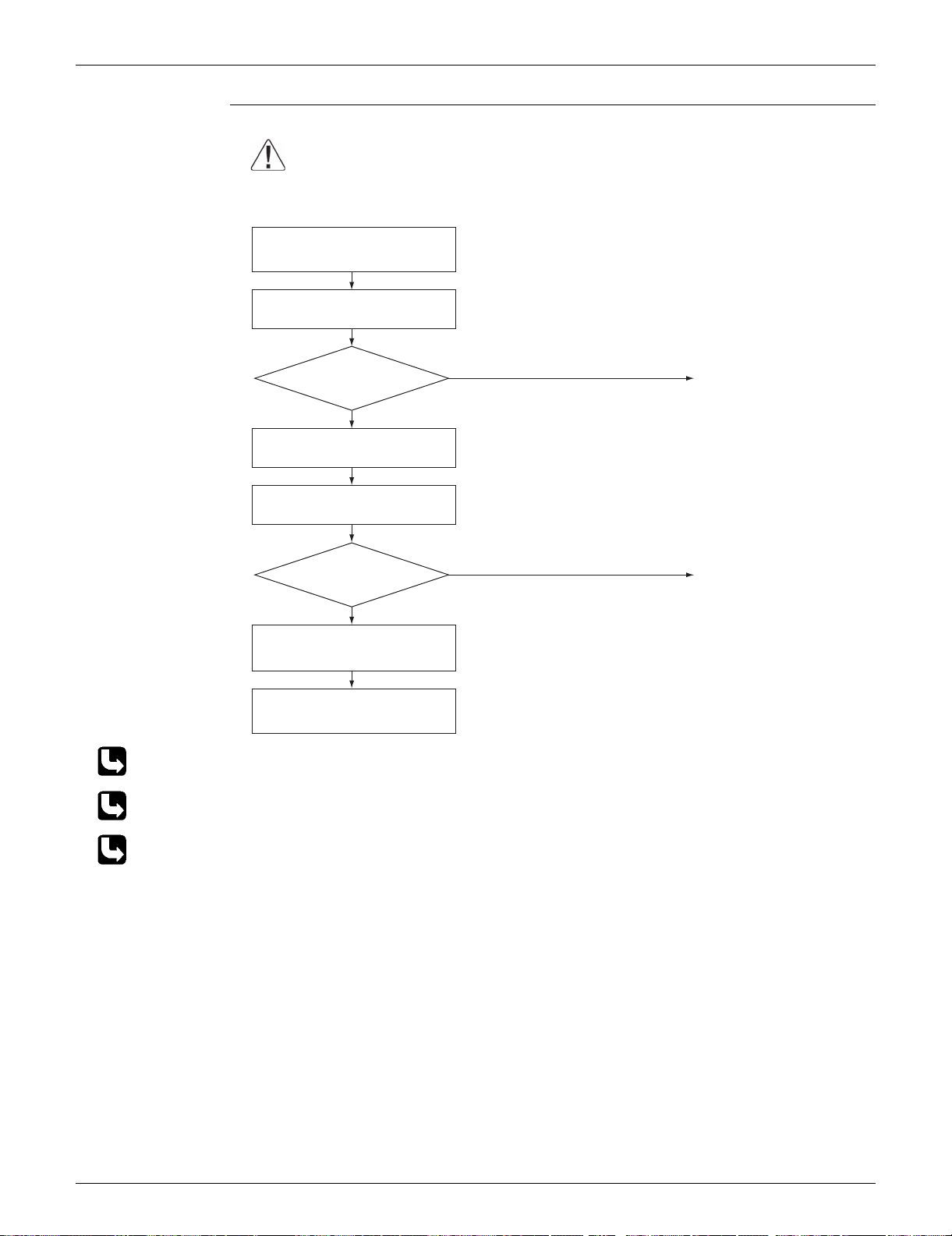
SiUS121827E Troubleshooting for Outdoor Unit
Part 6 Service Diagnosis 213
Reference
Reference
Reference
Troubleshooting
Check No.15 Refer to P.238
Check No.17 Refer to P.240
Check No.18 Refer to P.241
Caution
Be sure to turn off the power switch before connecting or disconnecting
connectors, or parts may be damaged.
∗ An input overcurrent may result from wrong internal wiring. If the system is interrupted by an input
overcurrent after the wires have been disconnected and reconnected for part replacement, check the
(R21863)
NO
YES
YES
NO
Start operation and measure the
input current.
Check No. 18
Check the discharge pressure.
Check No. 17
Check the installation condition.
Check No.15
Check with the inverter analyzer.
Turn off the power and disconnect
the harnesses U, V, and W.
Turn off the power, and reconnect
the harnesses. Turn on the power
again and start operation.
Replace the outdoor unit
PCB (main PCB).
Correct the power supply or
replace the outdoor unit
PCB (main PCB).
Any LED off?
Input current
flowing above its stop level?
∗ Inverter analyzer:
RSUK0917C
Troubleshooting for Outdoor Unit SiUS121827E
214 Part 6 Service Diagnosis
7.11 Four Way Valve Abnormality
Error Code EA
Outdoor Unit LED
Display
A j 1 i 2 h 3 h 4 h 5 h
Method of Error
Detection
The liquid pipe thermistor and the outdoor heat exchanger thermistor are checked to see if they
function within their normal ranges in the operating mode.
Error Decision
Conditions
The following condition continues for A seconds after the compressor has started.
Cooling operation
The lowest liquid pipe temperature among the rooms in operation –Tde > 45°C (113°F)
Heating operation
The highest liquid pipe temperature among the rooms in operation –Tde < 0°C (32°F)
Tde: outdoor heat exchanger temperature
Supposed
Causes
Disconnection of four way valve coil
Defective four way valve, coil, or harness
Defective outdoor unit PCB
Defective thermistor
Refrigerant shortage
Water mixed in refrigerant
Defective stop valve
Cooling Heating
A (seconds) 460 1
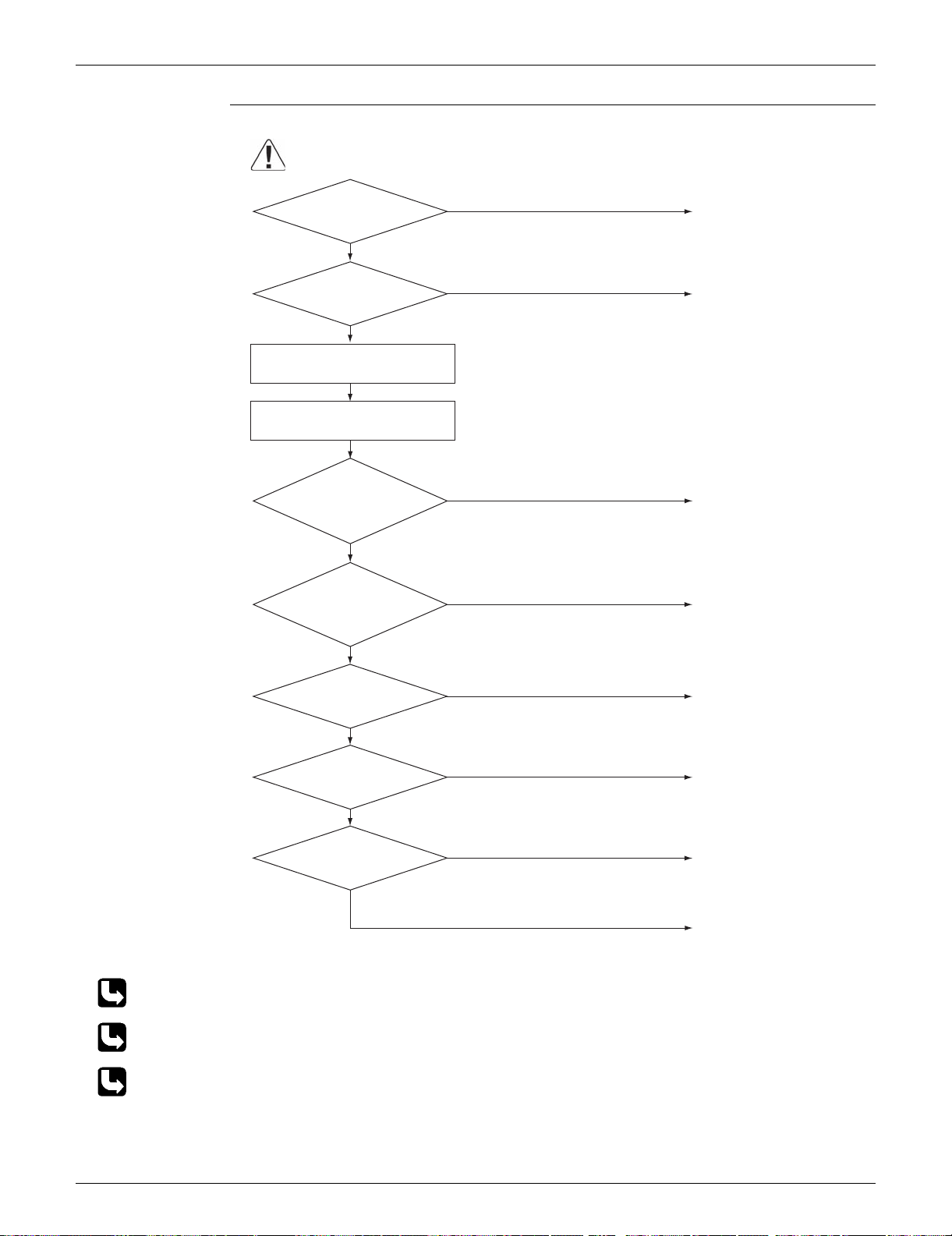
SiUS121827E Troubleshooting for Outdoor Unit
Part 6 Service Diagnosis 215
Reference
Reference
Reference
Troubleshooting
Check No.01 Refer to P.232
Check No.13 Refer to P.237
Check No.14 Refer to P.237
NG
OK
NO
OK
NG
OK
YES
NG
Correct the four way valve
coil.
Reconnect the harness.
YES
YES
YES
NO
NO
Replace the outdoor
unit PCB (main PCB).
Replace the defective
thermistor(s).
Refer to the refrigerant line
check procedure.
Replace the four way valve
(defective or dust-clogged).
Reconnect the
thermistor(s).
Caution
Be sure to turn off the power switch before connecting or disconnecting
connectors, or parts may be damaged.
(R20405)
∗ Refrigerant shortage
∗ Water mixed
∗ Stop valve
Four way valve
coil disconnected (loose)?
Harness
disconnected?
Any thermistor
disconnected?
Check No. 01
Check the thermistors.
Check No. 14
Check the refrigerant line.
Check No. 13
Check the four way valve
switching output.
Check the continuity of the four way
valve coil and harness.
Replace the four way
valve coil.
NO
Resistance
between harnesses
about 1000 ~ 2000 Ω?
Disconnect the harness from the
connector.

Troubleshooting for Outdoor Unit SiUS121827E
216 Part 6 Service Diagnosis
Reference
Reference
Reference
7.12 Discharge Pipe Temperature Control
Error Code F3
Outdoor Unit LED
Display
A j 1 i 2 h 3 i 4 h 5 h
Method of Error
Detection
An error is determined with the temperature detected by the discharge pipe thermistor.
Error Decision
Conditions
If the temperature detected by the discharge pipe thermistor rises above A, the compressor
stops.
The error is cleared when the discharge pipe temperature is dropped below B.
If the error repeats, the system is shut down.
Reset condition: Continuous run for about 60 minutes without any other error
Supposed
Causes
Defective discharge pipe thermistor
(Defective outdoor heat exchanger thermistor or outdoor temperature thermistor)
Defective electronic expansion valve or coil
Refrigerant shortage
Defective four way valve
Water mixed in refrigerant
Defective stop valve
Defective outdoor unit PCB
Troubleshooting
Check No.01 Refer to P.232
Check No.12 Refer to P.236
Check No.14 Refer to P.237
AB
120°C (248°F) 107°C (224.6°F)
(R20417)
Caution
NG
OK
OK
OK
NG
NG
∗ Discharge pipe thermistor
∗ Outdoor heat exchanger thermistor
∗ Outdoor temperature thermistor
∗ Refrigerant shortage
∗ Four way valve
∗ Water mixed
∗ Stop valve
Check No. 12
Check the electronic
expansion valve.
Replace the defective
thermistor(s).
Replace the electronic
expansion valve or the coil.
Refer to the refrigerant line
check procedure.
Replace the outdoor unit
PCB (main PCB).
Be sure to turn off the power switch before connecting or disconnecting
connectors, or parts may be damaged.
Check No. 01
Check the thermistors.
Check No. 14
Check the refrigerant line.
SiUS121827E Troubleshooting for Outdoor Unit
Part 6 Service Diagnosis 217
7.13 High Pressure Control in Cooling
Error Code F6
Outdoor Unit LED
Display
A j 1 i 2 h 3 i 4 i 5 h
Method of Error
Detection
High pressure control (operation halt, frequency drop, etc.) is activated in cooling operation if the
temperature sensed by the outdoor heat exchanger thermistor exceeds the limit.
Error Decision
Conditions
The temperature sensed by the outdoor heat exchanger thermistor rises above about 62.5°C
(144.5°F).
The error is cleared when the temperature drops below about 49.5°C (121.1°F).
Supposed
Causes
The installation space not large enough
Dirty outdoor heat exchanger
Defective outdoor fan motor
Defective stop valve
Defective electronic expansion valve or coil
Defective outdoor heat exchanger thermistor
Defective outdoor unit PCB
Troubleshooting for Outdoor Unit SiUS121827E
218 Part 6 Service Diagnosis
Reference
Reference
Reference
Reference
Reference
Troubleshooting
Check No.01 Refer to P.232
Check No.12 Refer to P.236
Check No.17 Refer to P.240
Check No.18 Refer to P.241
Check No.19 Refer to P.241
(R20418)
Caution
Replace the outdoor fan
motor.
Reconnect the connector or
fan motor lead wires.
Replace the stop valve.
Replace the outdoor heat
exchanger thermistor.
Replace the outdoor unit
PCB (main PCB).
Replace the electronic
expansion valve or the coil.
Replace the outdoor unit
PCB (main PCB).
Change the installation
location or direction.
Clean the outdoor heat
exchanger.
Check the installation space.
NG
OK
OK
NG
NG
OK
OK
OK
NG
NG
Check No. 19
Check the outdoor fan.
Check No. 18
Check the discharge
pressure.
Check No. 12
Check the electronic
expansion valve.
Check No. 01
Check the outdoor heat
exchanger thermistor.
Check No. 17
Check the installation
condition.
Be sure to turn off the power switch before connecting or disconnecting
connectors, or parts may be damaged.

SiUS121827E Troubleshooting for Outdoor Unit
Part 6 Service Diagnosis 219
7.14 Compressor Sensor System Abnormality
Error Code H0
Outdoor Unit LED
Display
A j 1 i 2 i 3 h 4 h 5 h
Method of Error
Detection
The system checks the power supply voltage and the DC voltage before the compressor starts.
The system checks the DC current of the compressor right after the compressor starts.
Error Decision
Conditions
The power supply voltage and the DC voltage is obviously low or high.
The DC current of the compressor does not flow when the compressor starts.
Supposed
Causes
Disconnection of reactor
Disconnection of compressor harness
Defective outdoor unit PCB
Defective compressor
+
–
PCB
Compressor
DC voltage
DC current
Power
Module
(R22001)
Troubleshooting for Outdoor Unit SiUS121827E
220 Part 6 Service Diagnosis
Troubleshooting
Connect the reactor properly.
(R20419)
NO
YES
Connect the compressor
properly.
NO
YES
Replace the reactor.
NO
YES
Replace the compressor or
the compressor relay
harness.
Restart the operation again
and if the error occurs
again, replace the outdoor
unit PCB (main PCB).
NO
YES
Disconnect the reactor from the outdoor
unit PCB and measure the resistance
value between reactor terminals with
multimeter.
Disconnect the compressor relay harness
from the outdoor unit PCB and measure
the resistance value between the each 3
terminals of the compressor with
multimeter.
Caution
Be sure to turn off the power switch before connecting or disconnecting
connectors, or parts may be damaged.
10 Ω or less
between each terminal?
Check the connection of the
compressor.
Check the reactor.
Check the compressor.
Turn off the power.
Check the connection of the
reactor.
Connection OK?
Connection OK?
10 Ω or less?
SiUS121827E Troubleshooting for Outdoor Unit
Part 6 Service Diagnosis 221
7.15 Position Sensor Abnormality
Error Code H6
Outdoor Unit LED
Display
A j 1 i 2 i 3 h 4 h 5 h
Method of Error
Detection
A compressor start-up failure is detected by checking the compressor running condition through the
position detection circuit.
Error Decision
Conditions
If the error repeats, the system is shut down.
Reset condition: Continuous run for about 5 minutes without any other error
Supposed
Causes
Power supply voltage out of specification
Disconnection of the compressor harness
Defective compressor
Defective outdoor unit PCB
Start-up failure caused by the closed stop valve
Input voltage outside the specified range
Troubleshooting for Outdoor Unit SiUS121827E
222 Part 6 Service Diagnosis
Troubleshooting
Caution
Be sure to turn off the power switch before connecting or disconnecting
connectors, or parts may be damaged.
NO
YES
Turn off the power.
Check the connection.
Check the power supply voltage.
Correct the power supply.
NO
NO
NO
NO
YES
YES
YES
Check No. 20
Check the short circuit of the diode
bridge.
Check No.15
Check with the inverter analyzer.
Disconnect the harnesses U, V,
and W.
Turn on the power. Check the
electrolytic capacitor voltage.
Electrical
components or
compressor harnesses
connected as
specified?
Replace the outdoor unit
PCB (main PCB).
Replace the compressor.
Reconnect the electrical
components or compressor
harnesses as specified.
Replace the outdoor unit
PCB (main PCB).
Inverter analyzer:
RSUK0917C
Normal?
NO
YES
Check No. 18
Check the discharge pressure.
Replace the stop valve.
OK?
Within 320 VDC?
Any LED Off?
+ 100
- 50
Is the voltage
fluctuation within ±10%
from the rated value?
YES
Correct the power supply
or replace the outdoor
unit PCB (main PCB).


Troubleshooting for Outdoor Unit SiUS121827E
224 Part 6 Service Diagnosis
7.16 Thermistor or Related Abnormality (Outdoor Unit)
Error Code H9, J3, J6, J8, J9, P4
Outdoor Unit LED
Display
A j 1 i 2 i 3 h 4 h 5 h
Method of Error
Detection
This fault is identified based on the thermistor input voltage to the microcomputer.
A thermistor fault is identified based on the temperature sensed by each thermistor.
Error Decision
Conditions
The voltage between the both ends of the thermistor is above 4.96 V or below 0.04 V with the
power on.
J3 error is judged if the discharge pipe temperature is lower than the heat exchanger
temperature.
The system is shut down if all the units are judged as the J8 error.
Supposed
Causes
Disconnection of the connector for the thermistor
Defective thermistor(s)
Defective heat exchanger thermistor in the case of J3 error (outdoor heat exchanger thermistor
in cooling operation, or indoor heat exchanger thermistor in heating operation)
Defective outdoor unit PCB
Troubleshooting In case of P4
Replace the outdoor unit PCB (main PCB).
P4 : Radiation fin thermistor
Caution
Be sure to turn off the power switch before connecting or disconnecting
connectors, or parts may be damaged.
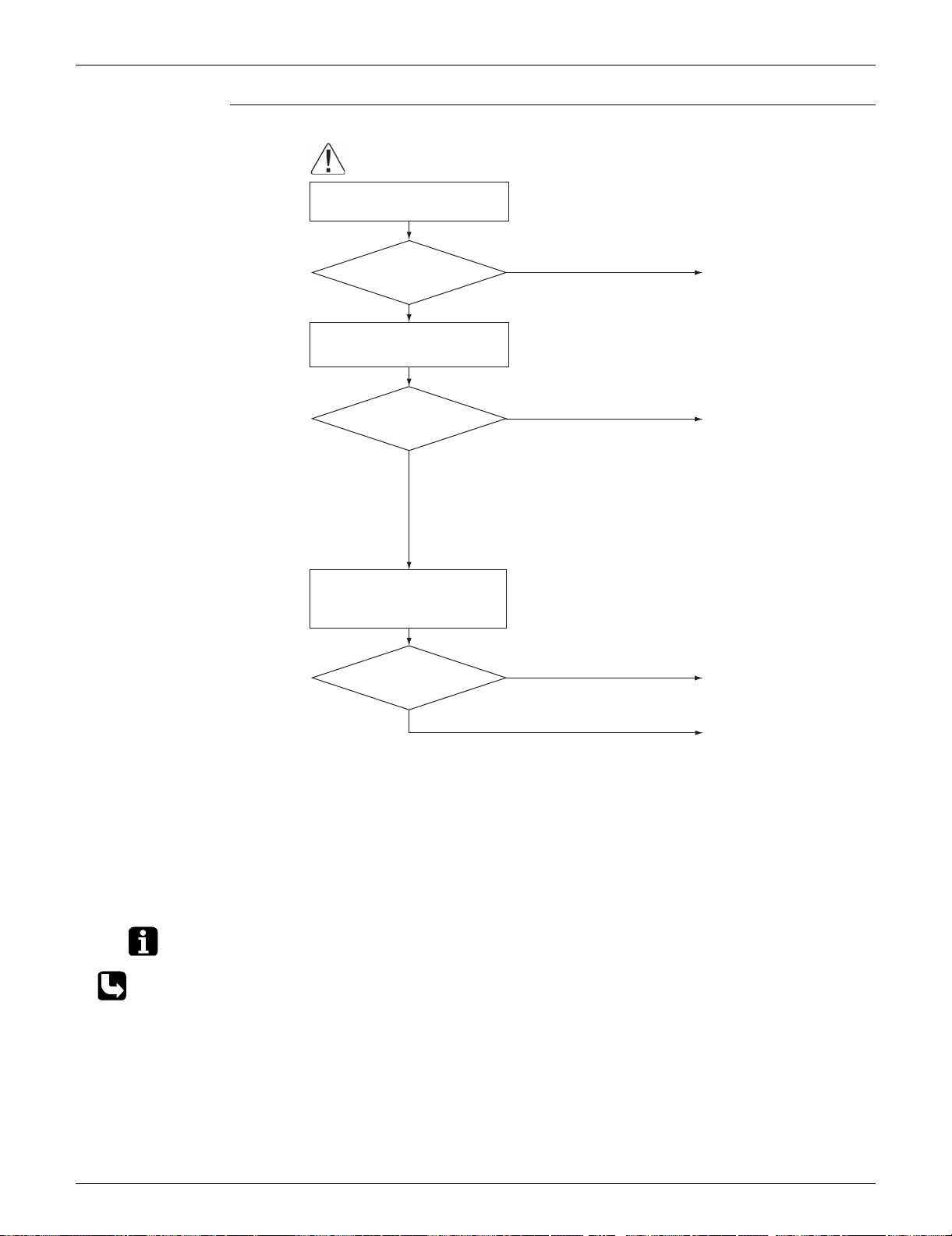
SiUS121827E Troubleshooting for Outdoor Unit
Part 6 Service Diagnosis 225
Notes
Reference
Troubleshooting In case of H9, J3, J6, J8, J9
H9 : Outdoor temperature thermistor
J3 : Discharge pipe thermistor
J6 : Outdoor heat exchanger thermistor
J8 : Liquid pipe thermistor
J9 : Gas pipe thermistor
When replacing the defective thermistor(s), replace the thermistors as ASSY.
Check No.01 Refer to P.232
(R21118)
Caution
NO
YES
YES
NO
NO
YES
Turn on the power again.
Normal?
Reconnect the connectors
or thermistors.
J3 error: The discharge
pipe temperature is lower
than the heat exchanger
temperature.
Replace the defective
thermistor(s).
∗ Outdoor temperature
thermistor
∗ Discharge pipe thermistor
∗ Outdoor heat exchanger
thermistor
∗ Liquid pipe thermistor
∗ Gas pipe thermistor
Cooling: Outdoor heat
exchanger
thermistor
Heating: Indoor heat
exchanger
thermistor
Replace the indoor heat
exchanger thermistor.
Replace the outdoor unit
PCB (main PCB).
Error displayed
again on remote controller?
Indoor heat
exchanger thermistor
functioning?
Check No. 01
Check the thermistor resistance
value.
Check No. 01
Check the indoor heat exchanger
thermistor resistance value in the
heating operation.
Be sure to turn off the power switch before connecting or disconnecting
connectors, or parts may be damaged.
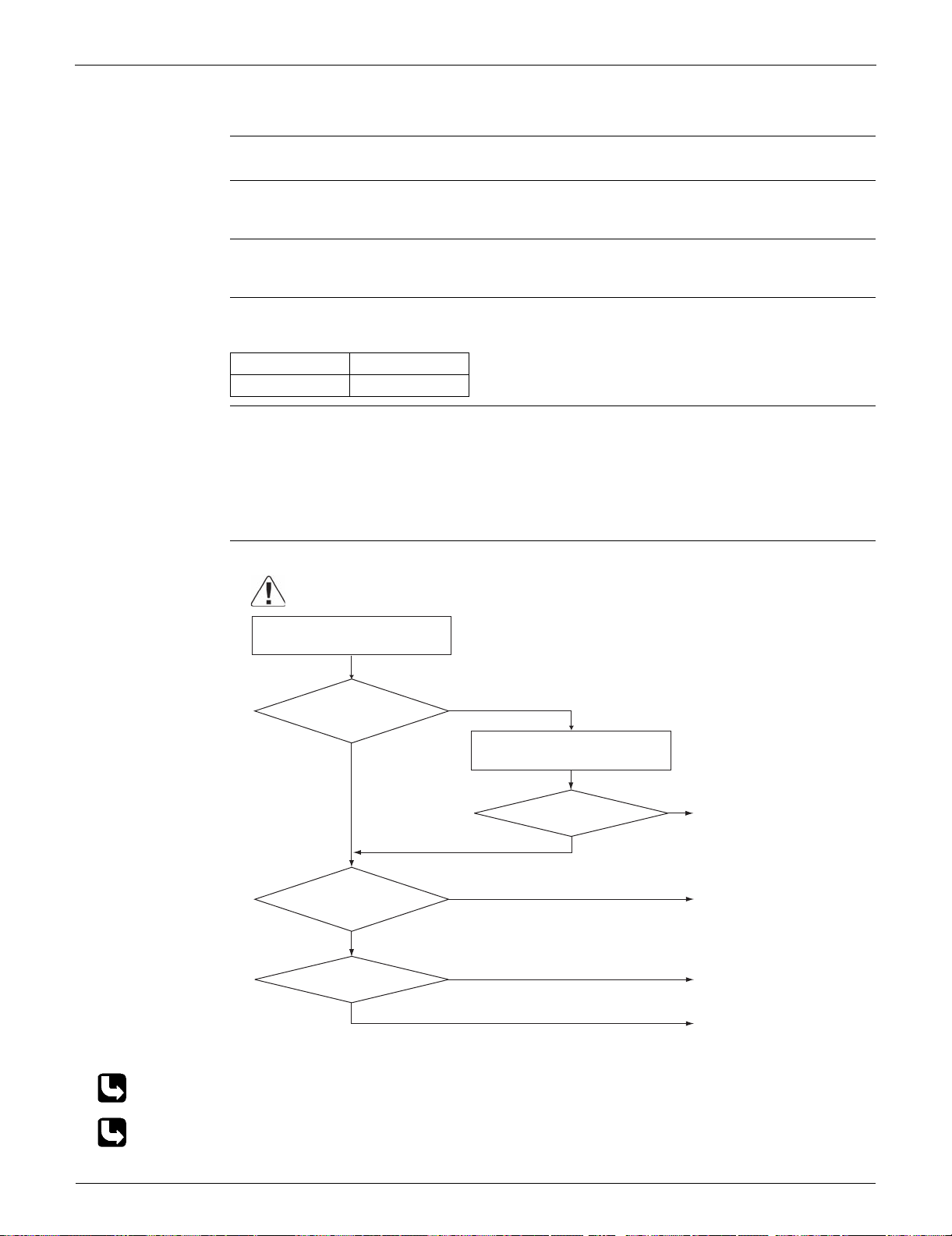
Troubleshooting for Outdoor Unit SiUS121827E
226 Part 6 Service Diagnosis
Reference
Reference
7.17 Electrical Box Temperature Rise
Error Code L3
Outdoor Unit LED
Display
A j 1 i 2 i 3 h 4 i 5 h
Method of Error
Detection
An electrical box temperature rise is detected by checking the radiation fin thermistor with the
compressor off.
Error Decision
Conditions
With the compressor off, the radiation fin temperature is above A.
The error is cleared when the temperature drops below B.
Supposed
Causes
Defective outdoor fan motor
Short circuit
Defective radiation fin thermistor
Disconnection of connector
Defective outdoor unit PCB
Troubleshooting
R6000426
Check No.17 Refer to P.240
Check No.19 Refer to P.241
AB
70°C (158°F) 60°C (140°F)
Caution
YES
NO
YES
NG
NO
OK
NO
YES
Turn off the power. Then, turn on
the power to restart the system.
Check the radiation fin
temperature.
Radiation fin
dirty?
Check No. 19
Check the outdoor fan.
Error again or
outdoor fan activated?
Replace the outdoor unit
PCB (main PCB).
Clean up the radiation fin.
Be sure to turn off the power switch before connecting or disconnecting
connectors, or parts may be damaged.
Replace the outdoor fan
motor.
Correct the connectors
and fan motor lead wire.
Replace the outdoor unit
PCB (main PCB).
Above A?
Check the installation
condition.
Go to Check No. 17.
SiUS121827E Troubleshooting for Outdoor Unit
Part 6 Service Diagnosis 227
7.18 Radiation Fin Temperature Rise
Error Code L4
Outdoor Unit LED
Display
A j 1 h 2 h 3 h 4 i 5 h
Method of Error
Detection
A radiation fin temperature rise is detected by checking the radiation fin temperature with the
compressor on.
Error Decision
Conditions
The radiation fin temperature with the compressor on is above A.
The error is cleared when the temperature drops below B.
If the error repeats, the system is shut down.
Reset condition: Continuous run for about 60 minutes without any other error
Supposed
Causes
Defective outdoor fan motor
Short circuit
Defective radiation fin thermistor
Disconnection of connector
Defective outdoor unit PCB
Silicone grease not applied properly on the radiation fin after replacing the outdoor unit PCB
AB
70°C (158°F) 64°C (147.2°F)
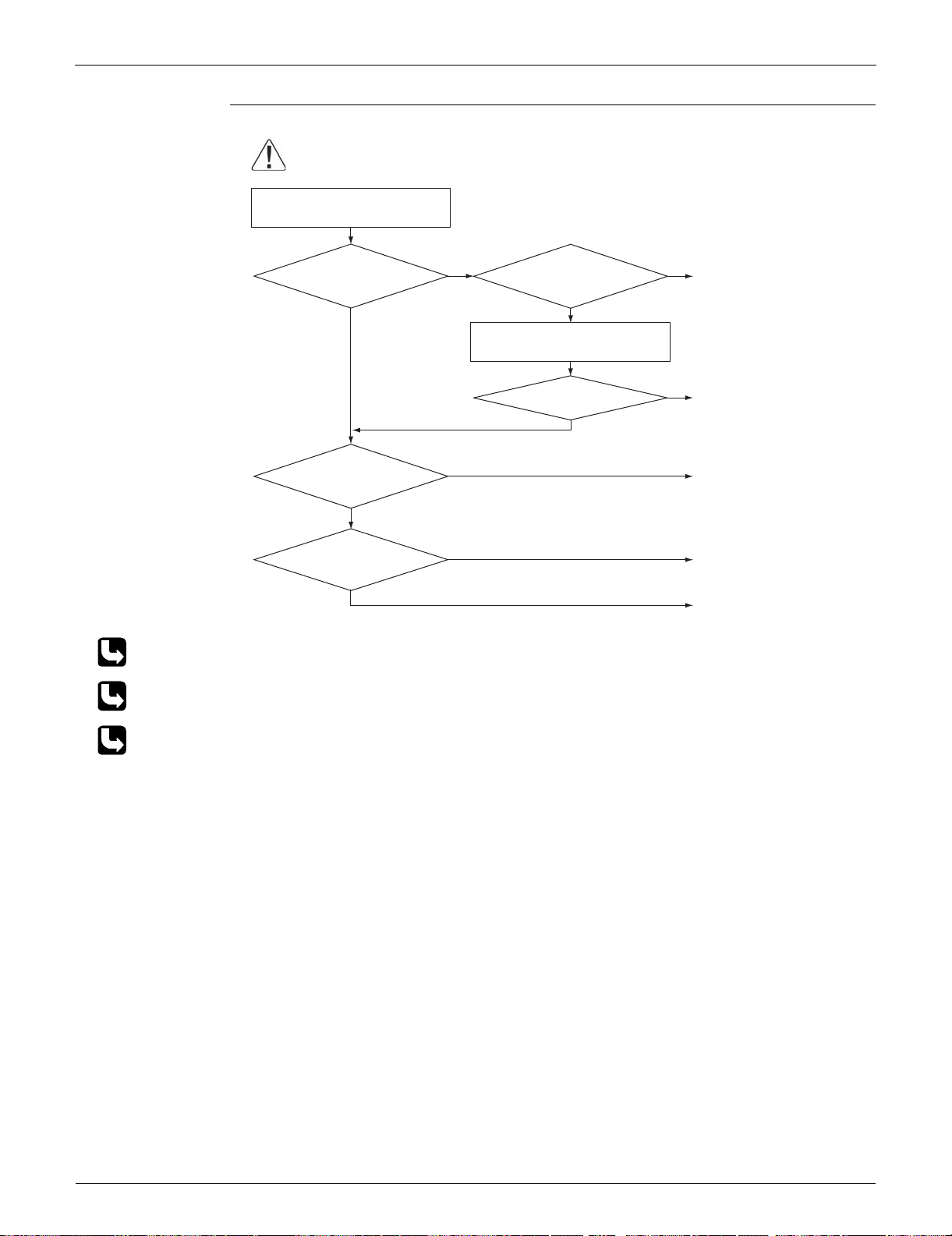
Troubleshooting for Outdoor Unit SiUS121827E
228 Part 6 Service Diagnosis
Reference
Reference
Reference
Troubleshooting
Check No.17 Refer to P.240
Check No.19 Refer to P.241
Refer to Silicone Grease on Power Transistor/Diode Bridge on page 277 for details.
Caution
Turn off the power. Then, turn on
the power to restart the system.
Be sure to turn off the power switch before connecting or disconnecting
connectors, or parts may be damaged.
(R23953)
NO
NG
OK
NO
YES
Check the radiation fin
temperature.
NO
YES
YES
Above A?
Check No. 19
Check the outdoor fan.
Error displayed
again?
Has the PCB
been replaced?
Check if silicone grease is
applied properly on the
radiation fin. If not, apply
the silicone grease.
Replace the outdoor unit
PCB (main PCB).
Replace the outdoor fan
motor.
Correct the connectors and
fan motor leads.
Replace the outdoor unit
PCB (main PCB).
YES
NO
Radiation fin
dirty?
Clean up the radiation fin.
Check the installation
condition.
Go to Check No. 17.
SiUS121827E Troubleshooting for Outdoor Unit
Part 6 Service Diagnosis 229
7.19 Output Overcurrent Detection
Error Code L5
Outdoor Unit LED
Display
A j 1 h 2 h 3 i 4 h 5 h
Method of Error
Detection
An output overcurrent is detected by checking the current that flows in the inverter DC section.
Error Decision
Conditions
A position signal error occurs while the compressor is running.
A rotation speed error occurs while the compressor is running.
An output overcurrent signal is fed from the output overcurrent detection circuit to the
microcomputer.
If the error repeats, the system is shut down.
Reset condition: Continuous run for about 5 minutes without any other error
Supposed
Causes
Poor installation condition
Closed stop valve
Defective power module
Wrong internal wiring
Abnormal power supply voltage
Defective outdoor unit PCB
Supply voltage out of specification
Defective compressor
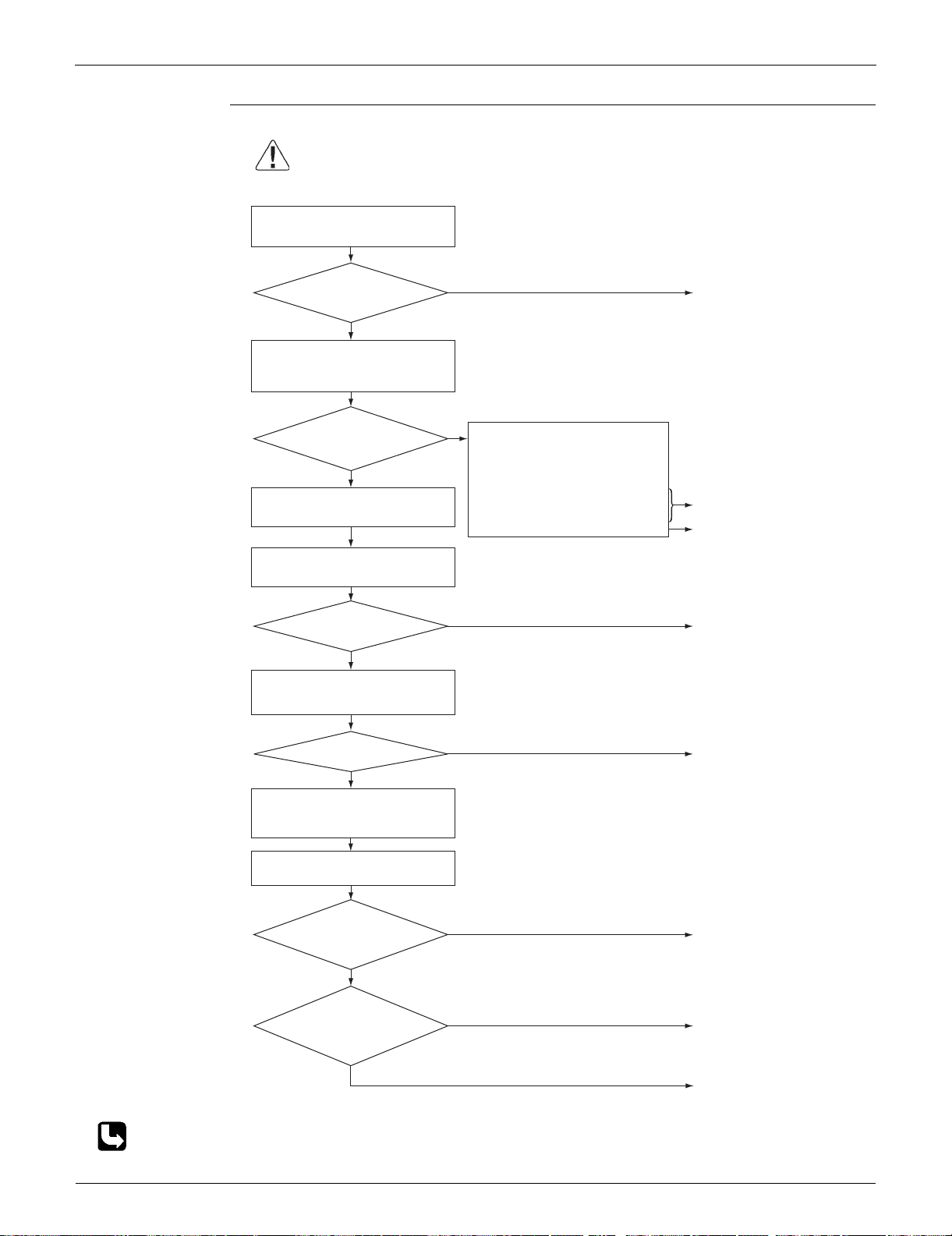
Troubleshooting for Outdoor Unit SiUS121827E
230 Part 6 Service Diagnosis
Reference
Troubleshooting
Check No.15 Refer to P.238
(R22566)
Caution
NO
YES
NO
YES
NO
YES
NO
YES
NO
YES
YES
NO
∗
An output overcurrent may result from wrong internal wiring. If the system is interrupted by an output overcurrent
after the wires have been disconnected and reconnected for part replacement, check the wiring again.
Check No. 22
Check the power module.
Check No. 17
Check the installation condition.
Check No.15
Check with the inverter analyzer.
Turn off the power and disconnect
the harnesses U, V, and W.
Turn off the power, and reconnect
the harnesses. Turn on the power
again and start operation.
Turn off the power. Then, turn on
the power to restart the system.
See if the same error occurs.
Check the power supply voltage.
Monitor the power supply voltage,
discharge and suction pressures,
and other factors for a long term.
Possible causes
∗ Momentary drop of power supply
voltage
∗ Compressor overload
∗ Short circuit
Not a malfunction.
Keep observing.
Check the connectors and
other components.
Fully open the stop valve.
Correct the power supply.
Replace the compressor.
Correct the power supply
or replace the outdoor unit
PCB (main PCB).
Replace the outdoor unit
PCB (main PCB).
Error again?
Stop valve fully
open?
Any LED off?
Normal?
∗ Inverter analyzer:
RSUK0917C
Short circuit
or wire breakage
between compressor's coil
phases?
Be sure to turn off the power switch before connecting or disconnecting
connectors, or parts may be damaged.
Check the discharge
pressure.
Go to Check No. 18.
Is the voltage
fluctuation within ±10%
from the rated value?

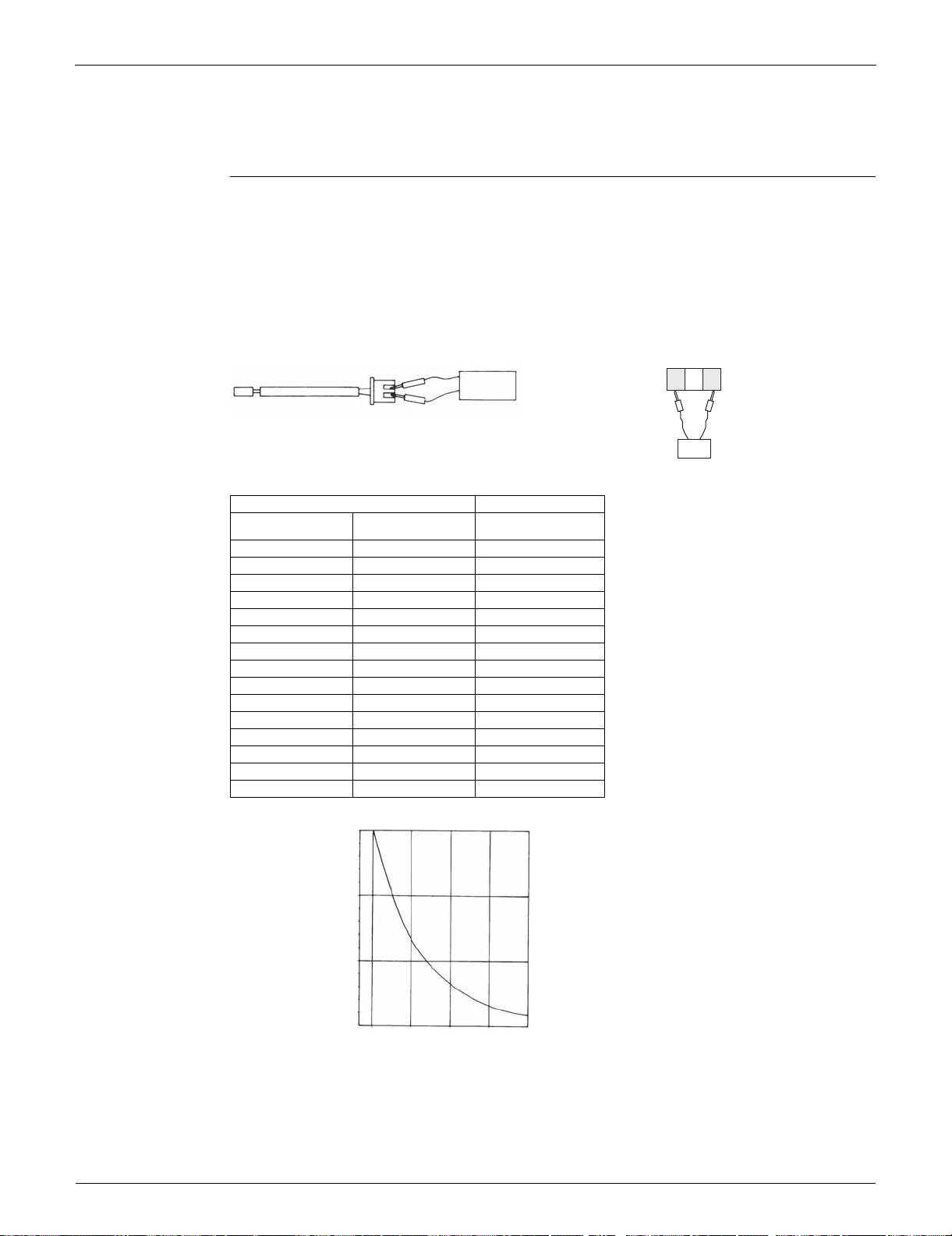
Check SiUS121827E
232 Part 6 Service Diagnosis
8. Check
8.1 Thermistor Resistance Check
Check No.01 Measure the resistance of each thermistor using multimeter.
The resistance values are defined by below table.
If the measured resistance value does not match the listed value, the thermistor must be replaced.
Disconnect the connector of thermistor ASSY from the PCB to measure the resistance between
the pins using multimeter.
To check the thermistor soldered on a PCB, disconnect the PCB from other PCB/parts, and
measure the resistance between the both ends of soldered thermistor.
R6000517
Multimeter
Resistance range
Thermistor ASSY Soldered thermistor
Multimeter
Thermistor temperature Type A
(°C) (°F)
R (25°C (77°F)) = 20 kΩ
B = 3950 K
–20 –4 197.8
–15 5 148.2
–10 14 112.1
–5 23 85.60
0 32 65.93
5 41 51.14
10 50 39.99
15 59 31.52
20 68 25.02
25 77 20.00
30 86 16.10
35 95 13.04
40 104 10.62
45 113 8.707
50 122 7.176
(kΩ)
150
100
50
–15 0 15 30 45
(R14467)
5 32 59 86 113
(°C)
(°F)
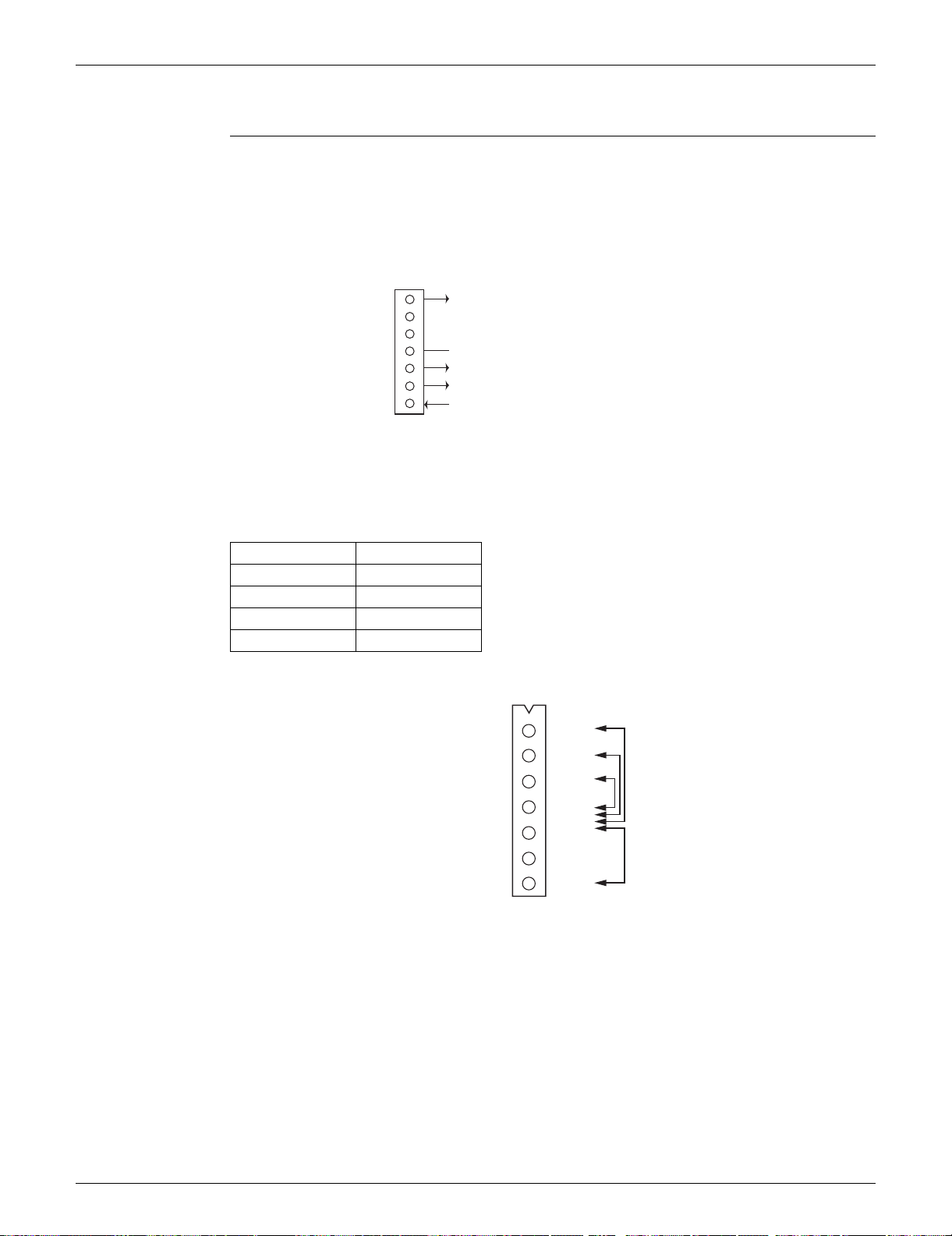
SiUS121827E Check
Part 6 Service Diagnosis 233
8.2 Indoor Fan Motor Connector Check
Check No.02 FTXR, CTXG, CTXS, FTXS, FVXS Series
1. Check the connection of connector.
2. Check motor power supply voltage output (pins 4 - 7).
3. Check motor control voltage (pins 4 - 3).
4. Check rotation command voltage output (pins 4 - 2).
5. Check rotation pulse input (pins 4 - 1).
FDMQ Series
1. Turn the power supply OFF.
2. With the fan motor connector disconnected, measure the resistance between each pin, then
make sure that the resistance is more than the value mentioned in the following table.
Measuring points Judgement
White - Blue 1 MΩ or more
Orange - Blue 100 kΩ or more
Brown - Blue 100 Ω or more
Red - Blue 100 kΩ or more
7
6
5
4
3
2
1
S1 or S200
(R14225)
Motor power supply voltage (310 ~ 340 VDC)
Unused
Unused
GND
Motor control voltage (15 VDC)
Rotation command voltage (1~ 5 VDC)
Rotation pulse input
White
Orange
Brown
Blue
—
—
Red
FG
Vsp
Vcc
GND
—
—
Vdc/Vm
X8A
(R25080)
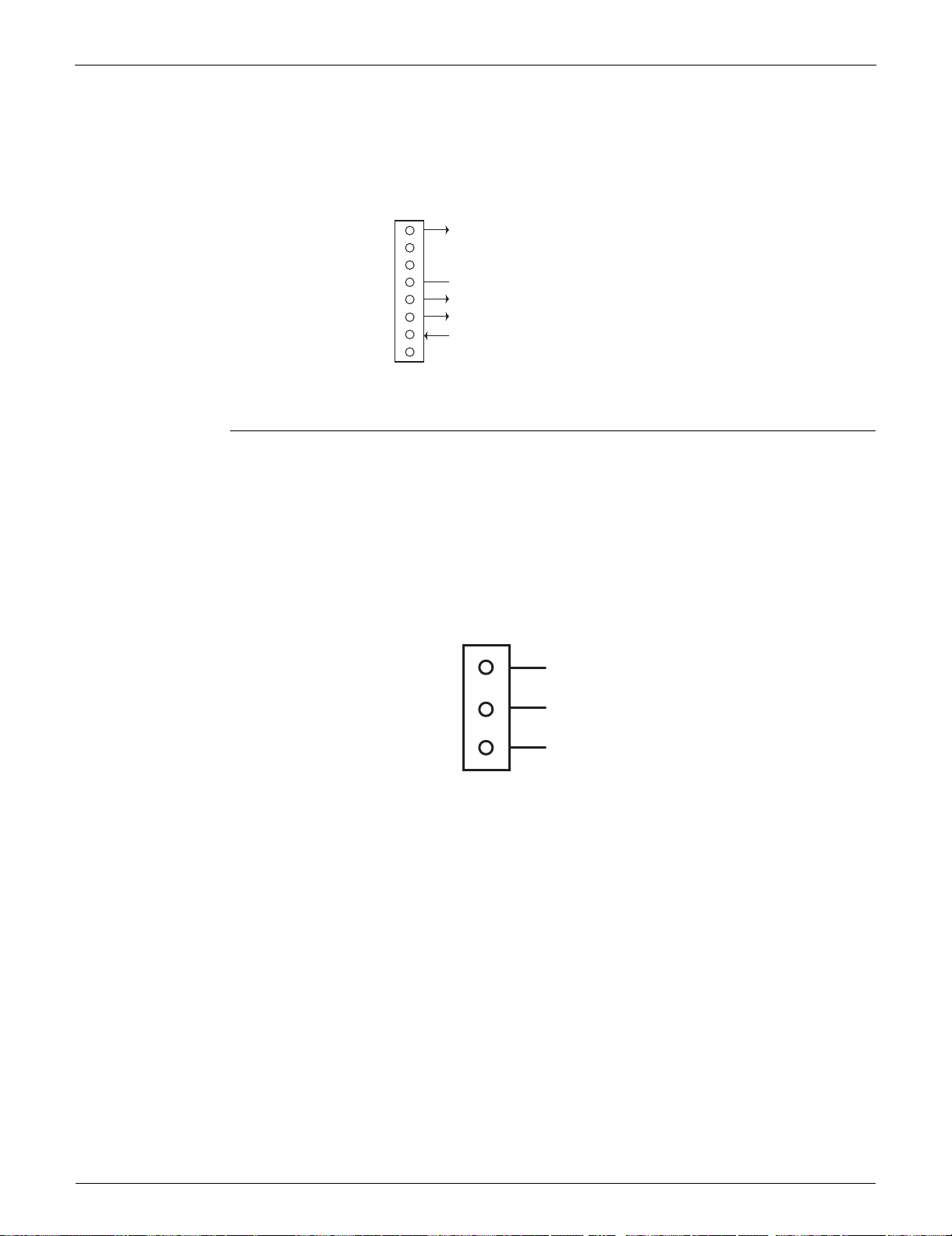
Check SiUS121827E
234 Part 6 Service Diagnosis
FFQ Series
1. Check the connection of connector.
2. Check motor power supply voltage output (pins 5 - 8).
3. Check motor control voltage (pins 5 - 4).
4. Check rotation command voltage output (pins 5 - 3).
8.3 Hall IC Check
Check No.04 FDXS, CDXS Series
1. Check the connector connection.
2. With the power ON, operation OFF, and the connector connected, check the following.
(1) Output voltage of about 5 V between pins 1 and 3.
(2) Generation of 3 pulses between pins 2 and 3 when the fan motor is operating.
If NG in step (1) → Defective PCB → Replace the PCB (control PCB).
If NG in step (2) → Defective Hall IC → Replace the fan motor.
If OK in both steps (1) and (2) → Replace the PCB (control PCB).
8
7
6
5
4
3
2
1
X20A
(R24373)
Motor power supply voltage (290 ~ 330 VDC)
Unused
Unused
GND
Motor control voltage (15 VDC)
Rotation command voltage (0 ~ 5 VDC)
Rotation pulse input
Unused
1
Gray (power supply)
Purple (signals)
Blue (grounding)
2
3
(R14211)
S7
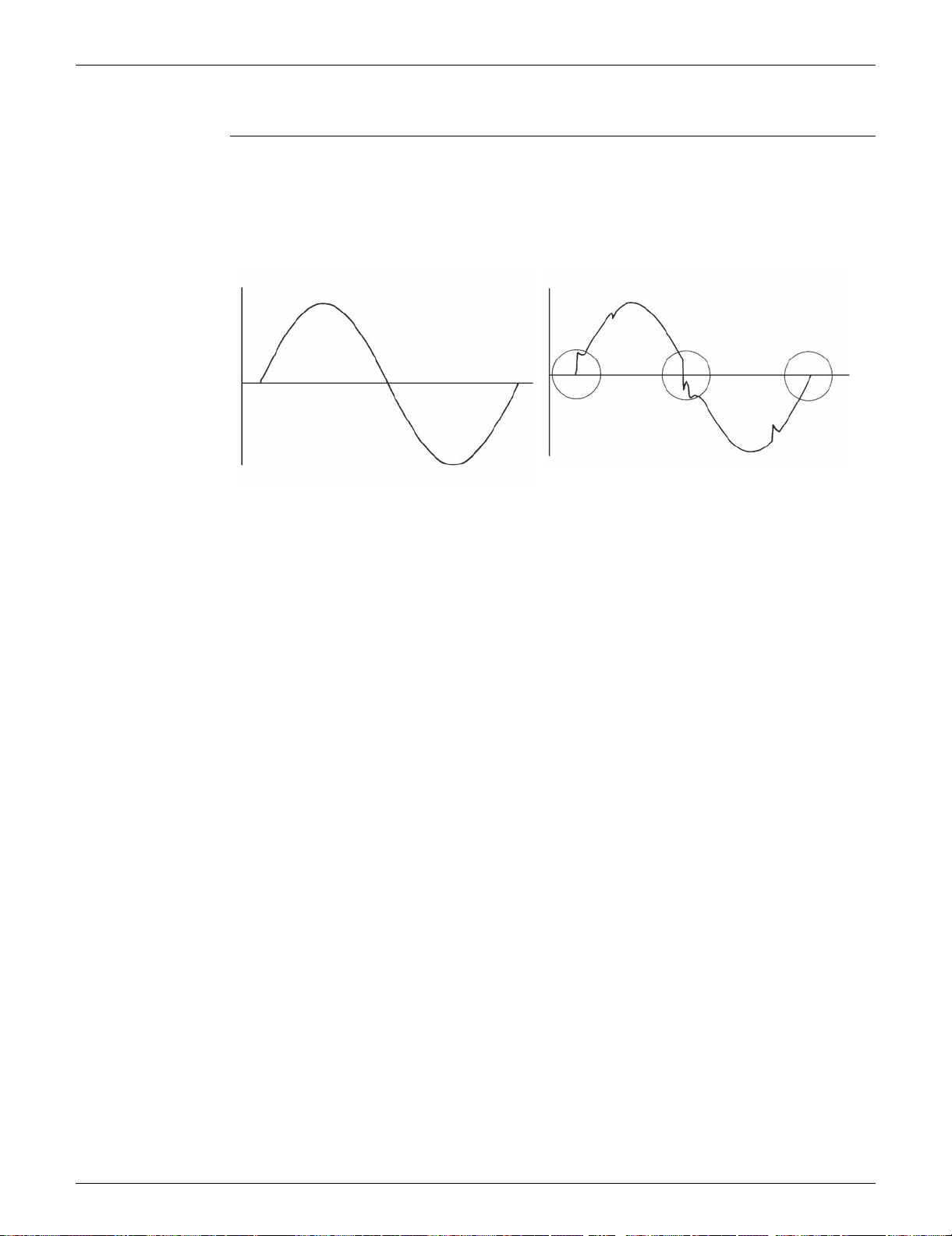
SiUS121827E Check
Part 6 Service Diagnosis 235
8.4 Power Supply Waveform Check
Check No.11 Measure the power supply waveform between No. 1 and No. 2 on the terminal strip, and check the
waveform disturbance.
Check if the power supply waveform is a sine wave (Fig.1).
Check if there is waveform disturbance near the zero-cross (sections circled in Fig.2).
[Fig.1] [Fig.2]
(R1736)
(R1444)
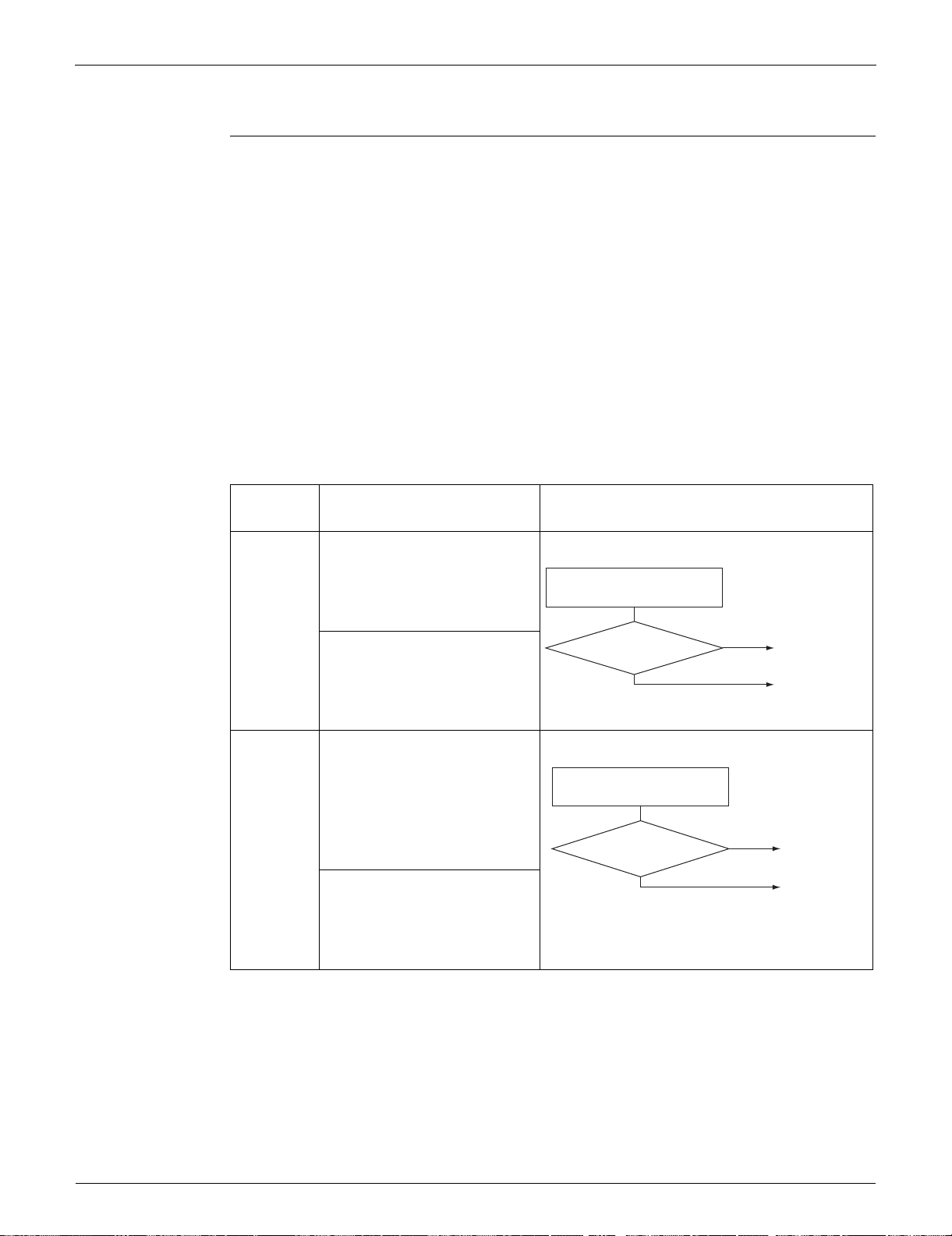
Check SiUS121827E
236 Part 6 Service Diagnosis
8.5 Electronic Expansion Valve Check
Check No.12 Conduct the followings to check the electronic expansion valve (EV).
1. Check if the EV connector is correctly inserted in the PCB. Match the EV unit number and the
connector number.
2. Turn the power off and on again, and check if all the EVs generate latching sound.
3. If any of the EVs does not generate latching sound in the above step 2, disconnect that
connector and check the continuity using a multimeter.
Check the continuity between the pins 5 - 1, 5 - 2, 5 - 3, 5 - 4. If there is no continuity between
the pins, the EV coil is faulty.
4. If no EV generates a latching sound in the above step 2, the outdoor unit PCB is faulty.
5. If the continuity is confirmed in the above step 3, mount a good coil (which generated latching
sound) in the EV unit that did not generate a latching sound, and check if that EV generates a
latching sound.
∗ If a latching sound is generated, the outdoor unit PCB is faulty.
∗ If a latching sound is not generated, the EV unit is faulty.
If the system keeps operating with a defective electronic expansion valve, the following problem
may occur.
Valve
opening
position
Possible problem Check method
Open
Cooling:
Flowing noise of refrigerant in the
unit which is not in operation
Water leakage at the unit which is
not in operation
Operation half due to anti-icing
function
Reset power supply and conduct cooling operation unit
by unit.
Heating:
Flowing noise of refrigerant in the
unit which is not in operation
The unit does not heat the room.
Close
Cooling:
The problem unit does not cool
the room.
Only the problem unit is in
operation, the unit starts pump
down.
(The low pressure of the unit
becomes vacuum.)
Abnormal discharge pipe
temperature
Reset power supply and conduct cooling operation unit
by unit.
Heating:
Refrigerant shortage due to
stagnation of liquid refrigerant inside
the faulty indoor unit
The unit does not heat the room.
Abnormal discharge pipe
temperature
Check the liquid pipe temperature
of no-operation unit.
YES
(R16019)
NO
The EV is not
defective.
Replace the EV
of the room.
Almost the same
as the outdoor
temperature?
Check the low pressure.
(R16020)
YES
NO
Replace the EV
of the room.
The EV is not
defective.
Does the pressure
become into vacuum
zone?
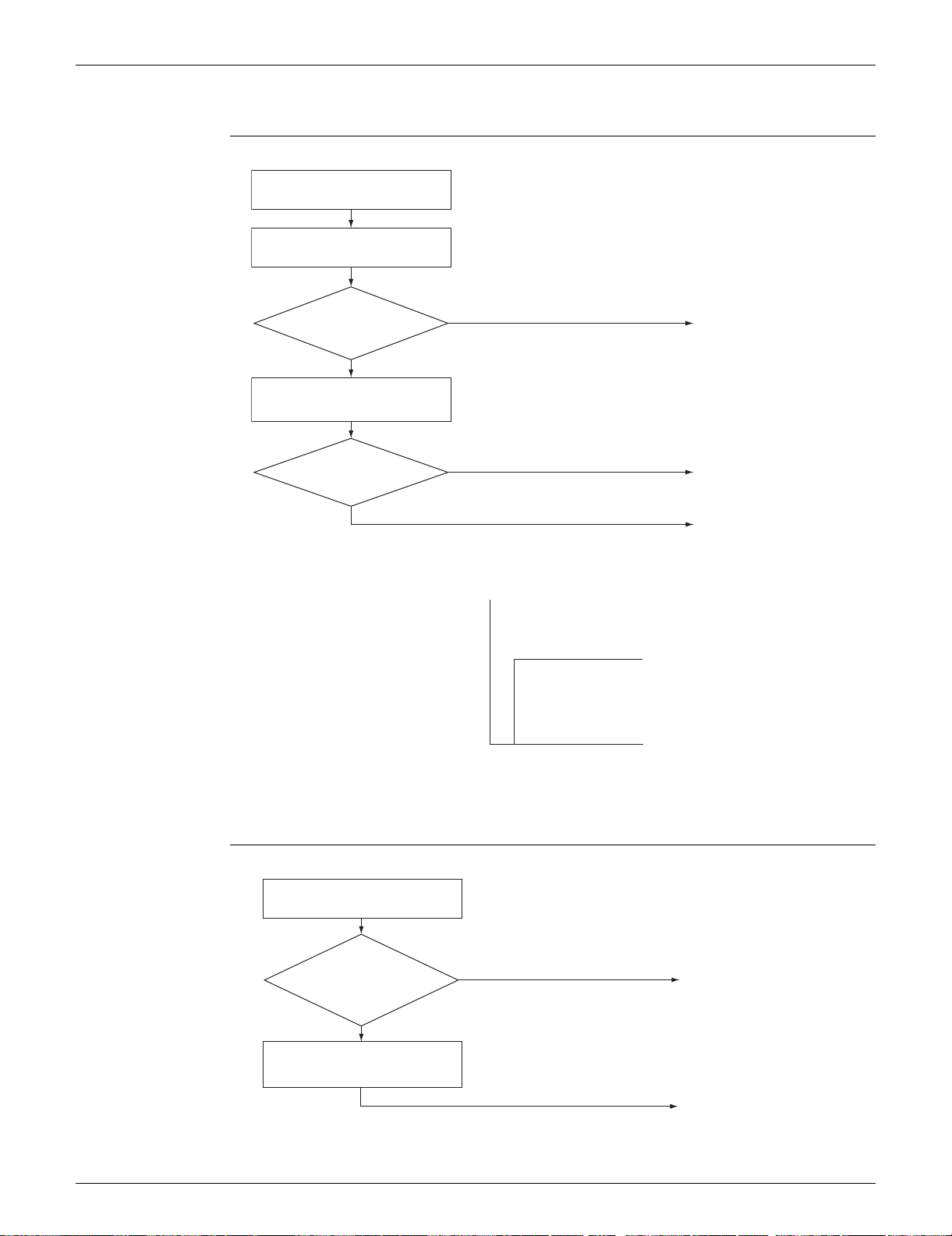
SiUS121827E Check
Part 6 Service Diagnosis 237
8.6 Four Way Valve Performance Check
Check No.13
8.7 Inverter Unit Refrigerant System Check
Check No.14
(R21936)
NO
YES
YES
NO
Turn off the power. Then, turn on
the power to restart the system.
Disconnect the four way valve coil
from the connector and check the
continuity.
Start heating operation.
∗ Four way valve coil
Cooling/Dry/Defrost: Not energized
Heating: energized
Replace the outdoor unit
PCB (main PCB).
Replace the four way valve
coil.
Replace the four way valve.
Four way valve
coil resistance at
1000 ~ 2000 Ω?
S80 voltage at
208 - 230 VAC with
compressor on?
(Fig. 1)
(R14674)
(Fig. 1)
Compressor
ON
Voltage at S80
208 - 230 VAC
Time
Refrigerant system check
Is the discharge pipe
thermistor disconnected from
the holder?
Check for refrigerant leakage.
See the section on refrigerant
shortage detection.
(R18870)
YES
NO
Reconnect the thermistor.
Replace the refrigerant.

Check SiUS121827E
238 Part 6 Service Diagnosis
8.8 Inverter Analyzer Check
Check No.15 Characteristics
Inverter analyzer: RSUK0917C
If an abnormal stop occurs due to compressor startup failure or overcurrent output when using an
inverter unit, it is difficult to judge whether the stop is caused by the compressor failure or some
other failure (main PCB, power module, etc.). The inverter analyzer makes it possible to judge the
cause of trouble easily and securely. Connect an inverter analyzer as a quasi-compressor instead
of compressor and check the output of the inverter.
Operation Method
Step 1
Be sure to turn the power off.
Step 2
Install an inverter analyzer instead of a compressor.
Note:
Make sure the charged voltage of the built-in smoothing electrolytic capacitor drops to 10 VDC or
below before carrying out the service work.
Reference:
If the terminals of the compressor are not FASTON terminals (difficult to remove the wire on the
terminals), it is possible to connect wires available on site to the outdoor unit from output side of
PCB. Do not connect them to the compressor at the same time, otherwise it may result in incorrect
detection.
Step 3
Activate the power transistor test operation from the outdoor unit.
Press the forced cooling operation ON/OFF switch for 5 seconds.
(Refer to page 248 for the position.)
→ Power transistor test operation starts.
Diagnose method (Diagnose according to 6 LEDs lighting status.)
(
R22731
)
(1) Remove the terminals from
the compressor.
(2) Connect the terminals to the
terminals of the inverter
analyzer.
Compressor
Inverter analyzer
Be careful not to let the terminals (U,V,W)
touch each other. Otherwise, high voltage
is applied.
Compressor
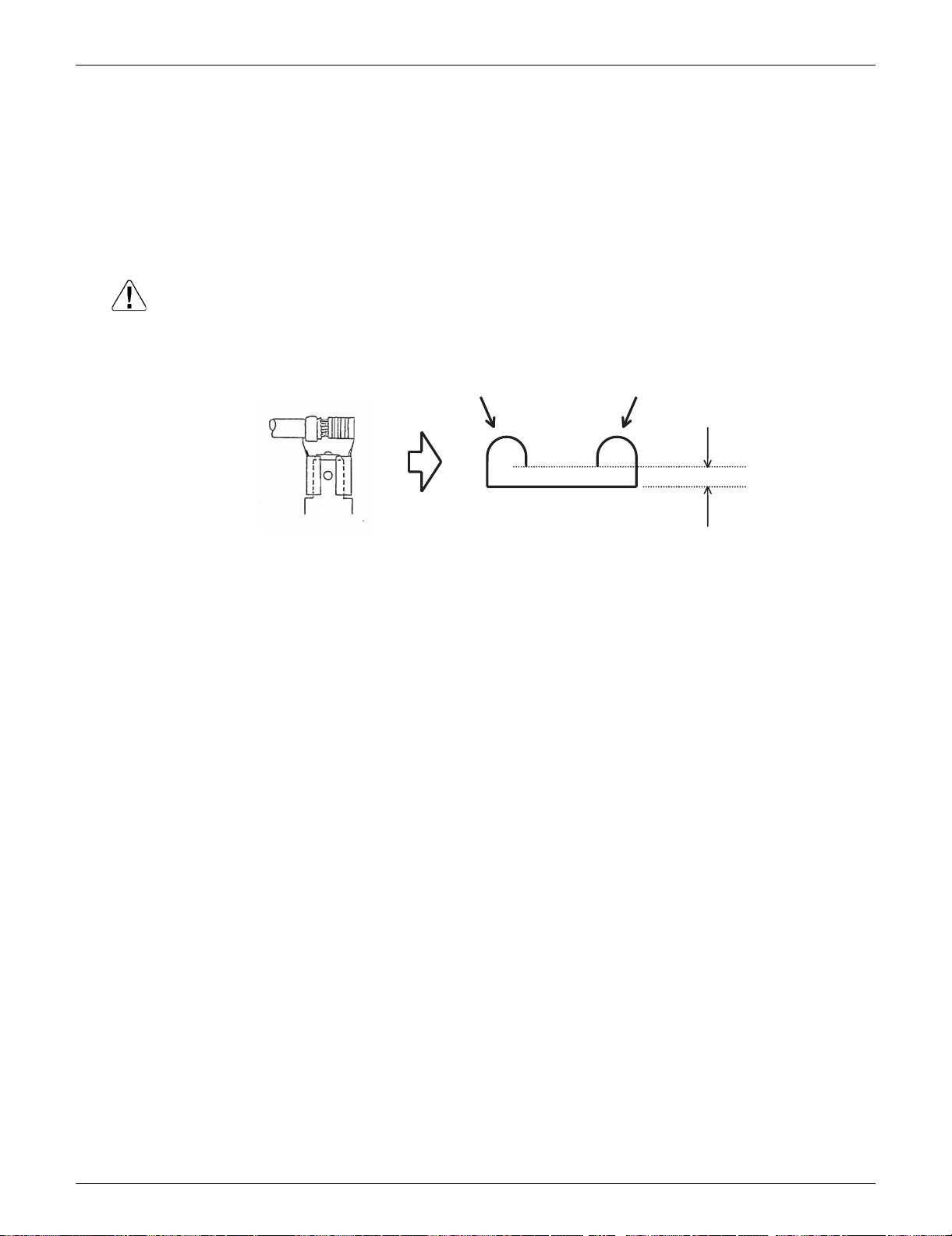
SiUS121827E Check
Part 6 Service Diagnosis 239
Caution
1. If all the LEDs are lit uniformly, the compressor is defective.
→ Replace the compressor.
2. If the LEDs are not lit uniformly, check the power module.
→ Refer to Check No.22.
3. If NG in Check No.22, replace the power module.
(Replace the main PCB. The power module (IPM1) is united with the main PCB.)
If OK in Check No.22, check if there is any solder cracking on the PCB.
4. If any solder cracking is found, replace the PCB or repair the soldered section.
If there is no solder cracking, replace the PCB.
1. When the output frequency is low, the LEDs blink slowly. As the output frequency increases, the
LEDs blink quicker. (The LEDs look like they are lit.)
2. On completion of the inverter analyzer diagnosis, be sure to re-crimp the FASTON terminals.
Otherwise, the terminals may be burned due to loosening.
(R15292)
Direction of crimp
FASTON terminal
This size is shortened
by the crimp.
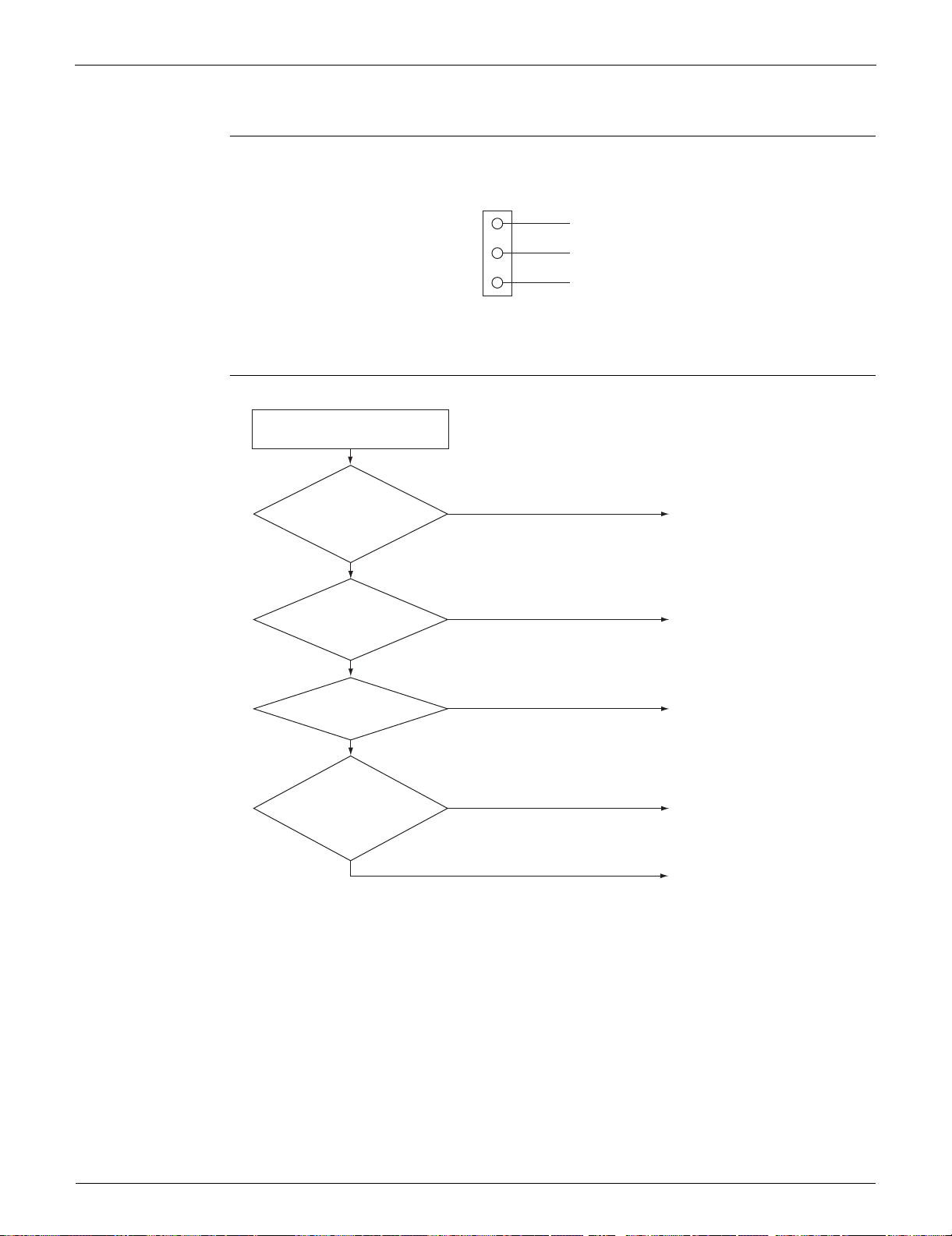
Check SiUS121827E
240 Part 6 Service Diagnosis
8.9 Rotation Pulse Check on the Outdoor Unit PCB
Check No.16 Manually rotate the outdoor fan motor and check if 4 pulses of sinusoidal voltage are detected
between pins 1-2 and then pins 2-3.
R6000524
8.10 Installation Condition Check
Check No.17
3
2
1
U (red)
S70
V (white)
W (black)
Installation condition check
OK
Check the allowable
dimensions of the air
suction and
discharge area.
Is the airflow blocked by
obstacles or winds
blowing in the opposite
direction?
(R19394)
NG
YES
YES
NO
Is the discharged air
short-circuited?
NO
NO
YES
Is the outdoor heat
exchanger very dirty?
Change the installation
location or direction.
Change the installation
location or direction.
Clean the outdoor heat
exchanger.
Change the installation
location or direction.
Check the outdoor temperature.
(The outdoor temperature
should be within the operation
range.)
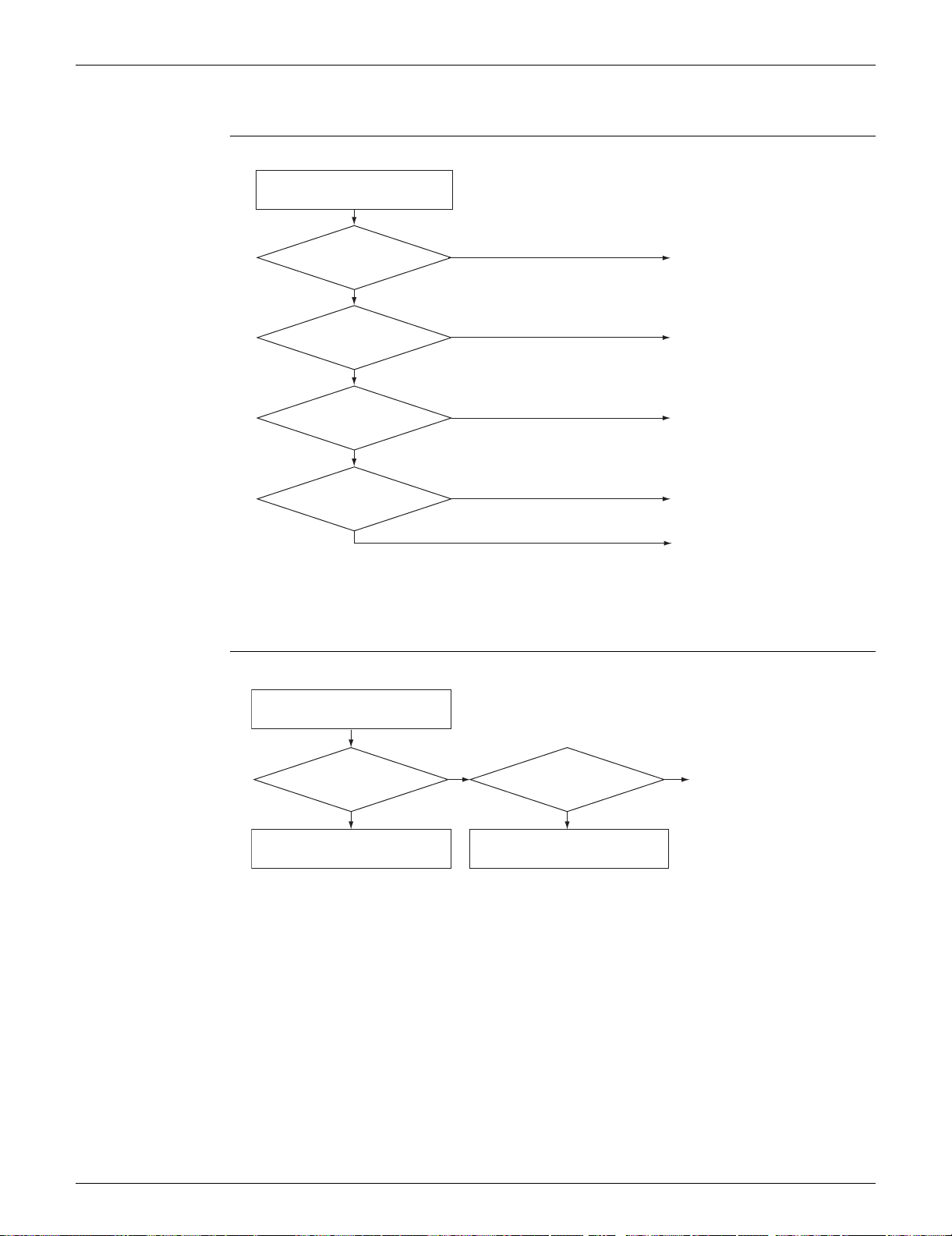
SiUS121827E Check
Part 6 Service Diagnosis 241
8.11 Discharge Pressure Check
Check No.18
8.12 Outdoor Fan System Check
Check No.19 DC motor
(R21121)
YES
YES
YES
NO
NO
NO
NO
YES
Is the air filter or
indoor/outdoor heat
exchanger dirty?
Is the
connection pipe deformed?
Is the stop valve
open?
High?
Replace the compressor.
Open the stop valve.
Replace the pipe installed at
the site.
Clean the dirty air filter or
indoor/outdoor heat exchanger.
Replace the compressor.
Discharge pressure check
(R21195)
YES
NO
NO
YES
Outdoor fan system is functioning.
Check the outdoor fan system.
Reconnect the connector.
Is
the outdoor fan
running?
Fan motor lead
wire connector
disconnected?
Go to Check No. 16.
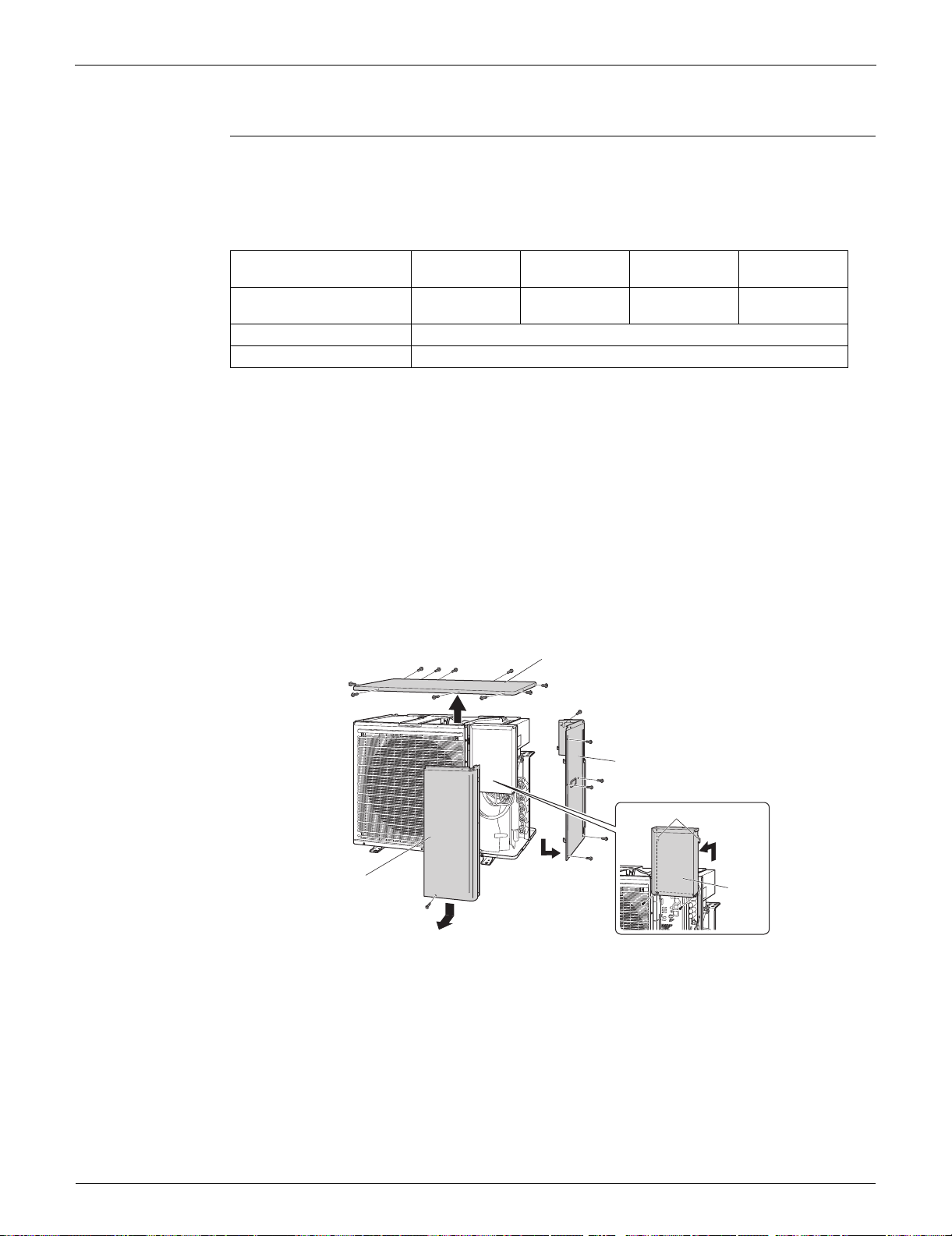
Check SiUS121827E
242 Part 6 Service Diagnosis
8.13 Main Circuit Short Check
Check No.20 Check to make sure that the voltage between (+) and (–) of the diode bridge (DB1) is about
0 V before checking
Measure the resistance between the pins of the DB1 referring to the table below.
If the resistance is ∞ or less than 1 kΩ, short circuit occurs on the main circuit.
1. Turn the power off.
2. Remove the top plate (10 screws).
3. Remove the right side plate (6 screws).
4. Remove the front plate (1 screw).
The front plate is heavy, so take care.
5. Remove the shield plate (2 screws).
6. Measure the resistance of the pins under the refrigerant pipe cover.
7. In the case it is difficult to insert the probes from the front side, take out the PCB in the following
procedure and measure the resistance from the rear side of the PCB.
Remove the 3 screws and open the refrigerant cover.
Disconnect the connectors.
Remove 13 screws of the PCB.
Pull the PCB upward to remove.
R6000584
Positive terminal (+) of
digital multimeter
~ (2, 3) + (4) ~ (2, 3) – (1)
Negative terminal (–) of
digital multimeter
+ (4) ~ (2, 3) – (1) ~ (2, 3)
Resistance is OK. several kΩ ~ several MΩ
Resistance is NG. 0 Ω or ∞
Top plate
Right side plate
Shield
plate
Front plate
Hooks
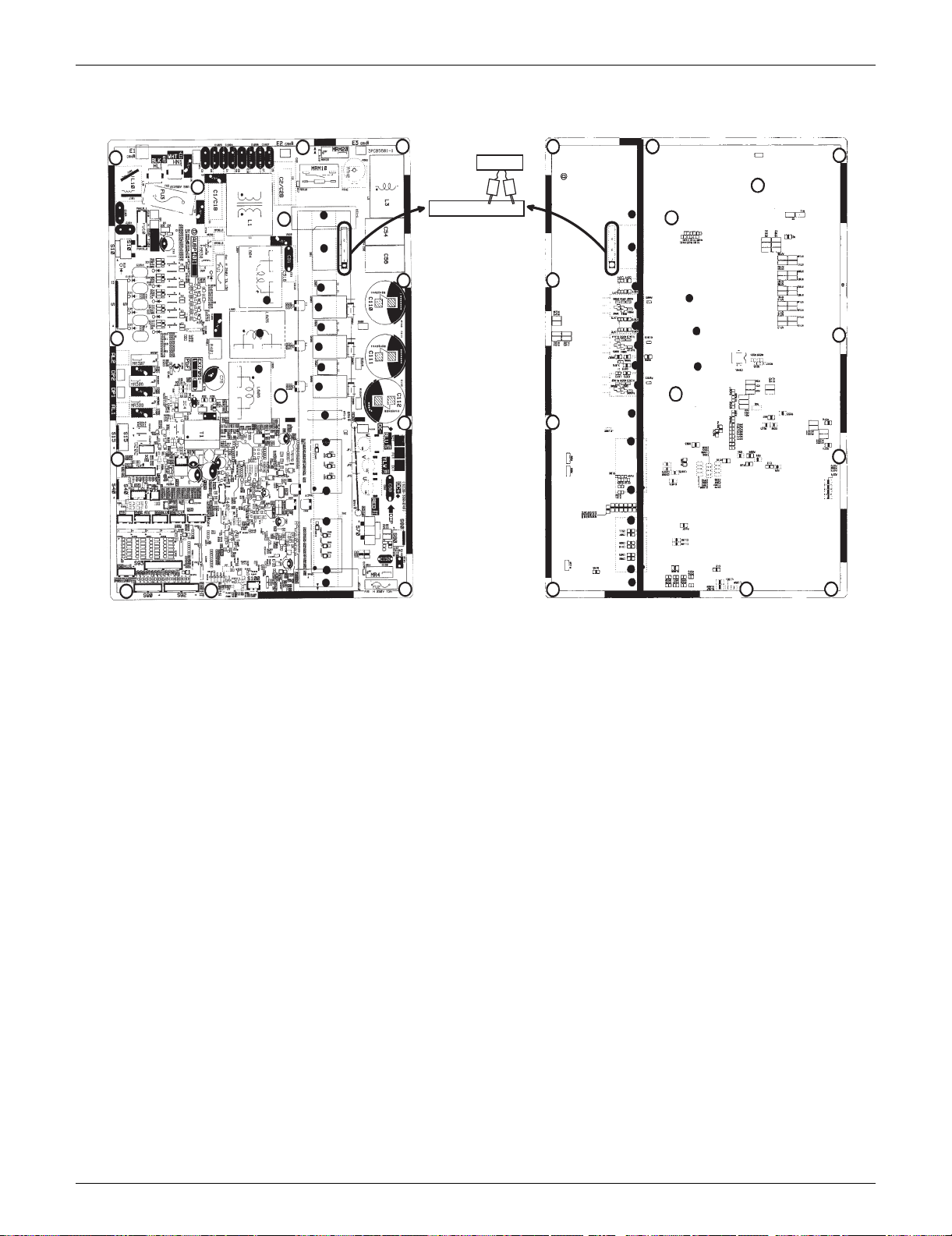
SiUS121827E Check
Part 6 Service Diagnosis 243
R6000583
1234
Multimeter
–~~+
–
+
Front side Rear side
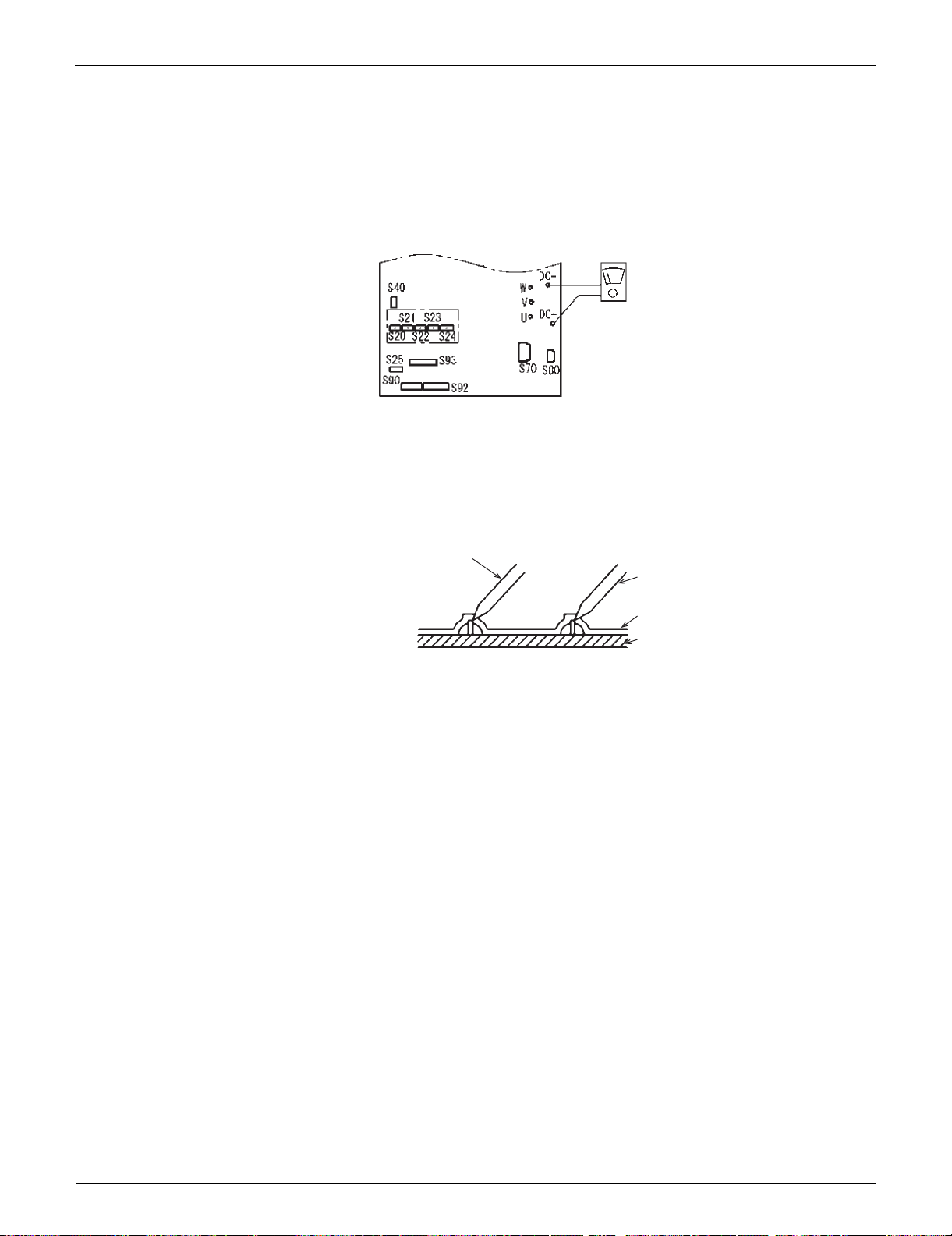
Check SiUS121827E
244 Part 6 Service Diagnosis
8.14 Capacitor Voltage Check
Check No.21 Before this check, be sure to check the main circuit for short circuit.
With the circuit breaker still on, measure the voltage according to the drawing of the model in
question. Be careful never to touch any live parts.
R6000525
To prevent an electrical shock, use a multimeter to check that the voltage between DC + and
DC – is 50 V or less.
The surface of the test points (DC +, DC –) may be covered with the coating. Be sure to make
firm contact between the multimeter probes and the test points.
R6000551
Multimeter
(DC, voltage)
Multimeter probe
Multimeter
probe
Coating
PCB
DC (−) DC (+)

SiUS121827E Check
Part 6 Service Diagnosis 245
8.15 Power Module Check
Check No.22 Check to make sure that the voltage between (+) and (–) of the power module is about 0 V before
checking.
Disconnect the compressor harness connector from the outdoor unit PCB. To disengage the
connector, press the protrusion on the connector.
Follow the procedure below to measure resistance between the (+) or (–) terminal of the power
module and the U, V, or W terminal of the compressor with a multimeter. Evaluate the
measurement results referring to the following table.
R6000526
Positive terminal (+) of
digital multimeter
Power module
(+)
UVW
Power module
(–)
UVW
Negative terminal (–) of
digital multimeter
UVW
Power module
(+)
UVW
Power module
(–)
Resistance is OK. several kΩ ~ several MΩ
Resistance is NG. 0 Ω or ∞
DC+
W
U
V
DC–

SiUS121827E
246 Part 7 Trial Operation and Field Settings
1. Pump Down Operation............................................................................247
2. Forced Cooling Operation .......................................................................248
3. Wiring Error Check Function ...................................................................249
4. Trial Operation ........................................................................................251
4.1 RA Indoor Unit.......................................................................................... 251
4.2 SA Indoor Unit .......................................................................................... 253
5. Field Settings ..........................................................................................256
5.1 RA Indoor Unit.......................................................................................... 256
5.2 SA Indoor Unit .......................................................................................... 262
5.3 Outdoor Unit ............................................................................................. 274
6. Silicone Grease on Power Transistor/Diode Bridge................................277
Part 7
Trial Operation and
Field Settings
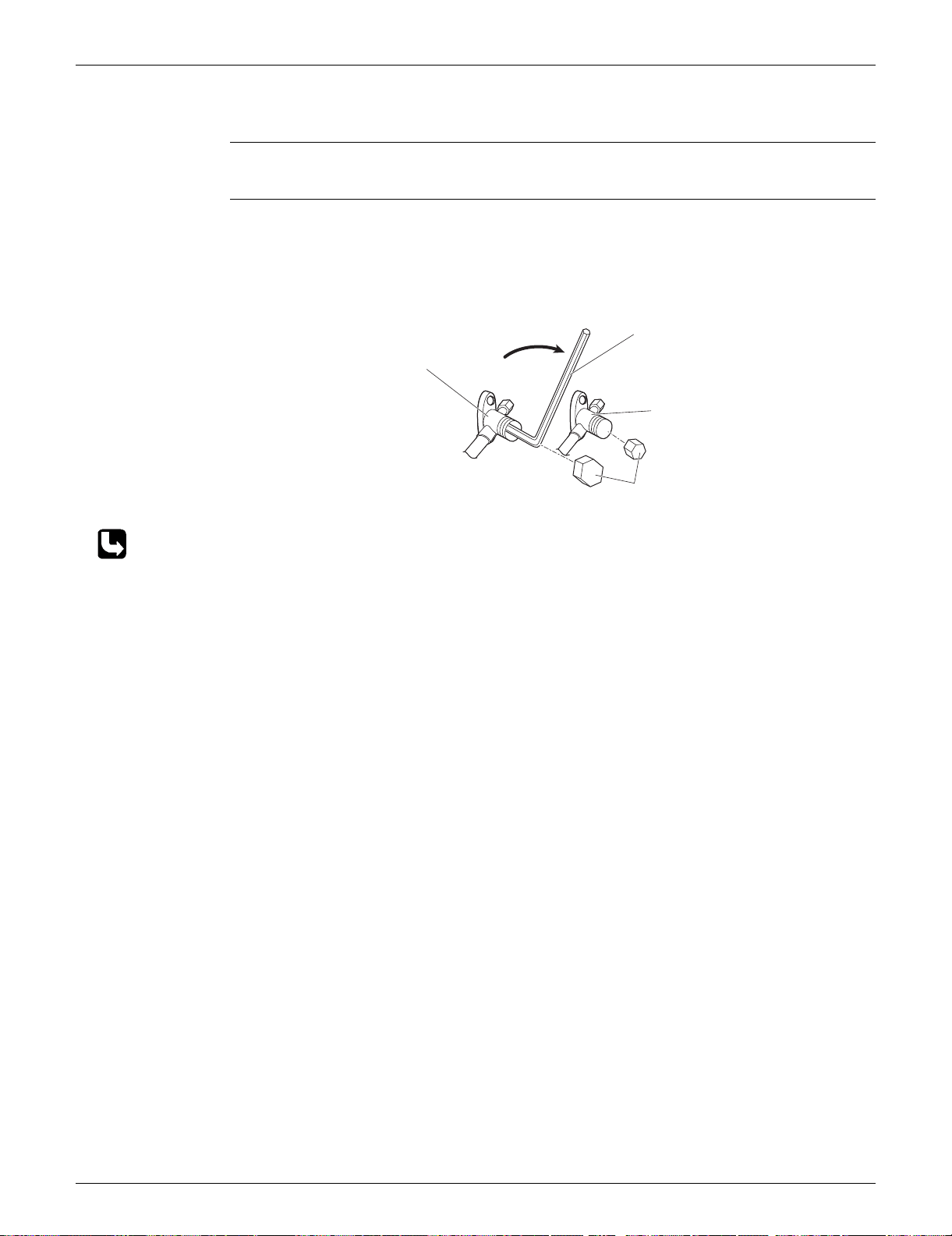
SiUS121827E Pump Down Operation
Part 7 Trial Operation and Field Settings 247
Reference
1. Pump Down Operation
Outline In order to protect the environment, be sure to conduct pump down operation when relocating or
disposing of the unit.
Details 1. Remove the valve caps from the liquid stop valve and the gas stop valve.
2. Carry out forced cooling operation.
3. After 1 - 2 minutes, close the liquid stop valve with a hexagonal wrench.
4. After 3 - 4 minutes, close the gas stop valve and stop the forced cooling operation.
5. Attach the valve cap once procedures are complete.
R7000216
Refer to page 248 for details of forced cooling operation.
Close
Gas stop valve
Hexagonal
wrench
Liquid stop
valve
Valve caps

Forced Cooling Operation SiUS121827E
248 Part 7 Trial Operation and Field Settings
2. Forced Cooling Operation
Outline The forced cooling operation is allowed when both the following conditions are met.
1. The outdoor unit is not abnormal and not in the 3-minute standby mode.
2. The outdoor unit is not operating.
Protection functions have priority over all other functions during forced cooling operation.
Procedure 1. Turn off the power.
2. Remove the right side panel (6 screws) and the shield cover (2 screws).
3. Remove the cover of service monitor PCB (1 screw).
4. Switch SW5 and SW6 to off.
5. Turn the operation mode switch (SW2) to COOL.
6. Screw the cover of service monitor PCB back on (1 screw).
7. Attach the shield cover (2 screws) and the right side panel (6 screws).
8. Turn on the power.
9. Press the forced operation switch (SW1) above the service monitor PCB cover. (The operation
will start.)
Forced cooling operation will stop automatically after about 8 minutes.
To stop the operation, press the forced operation switch (SW1) again.
R7000217
Service monitor PCB
HEAT
COOL
4
3
2
1
2
1
E
D
C
B
A
COOL
4
3
2
1
2
1
E
D
C
B
A
Screw
Remove
the switch
cover
Forced operation switch (SW1)
•Switch SW5 and SW6 to off.
•Set to COOL.
Operation mode switch (SW2)
2
1
ON OFF
4
3
ON OFF
2
1
HEAT
COOL
SW6
SW5
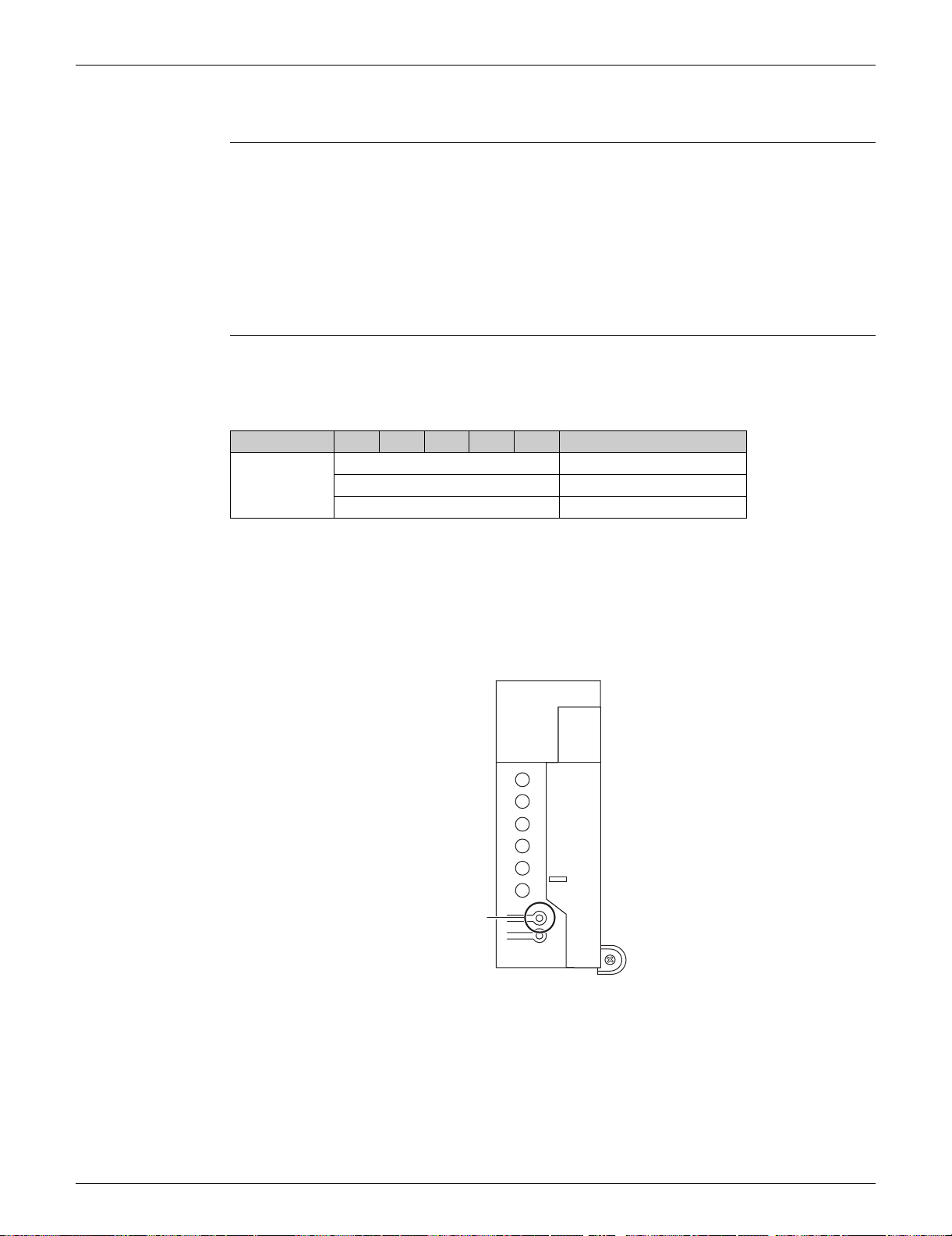
SiUS121827E Wiring Error Check Function
Part 7 Trial Operation and Field Settings 249
3. Wiring Error Check Function
Outline Wiring error check function is designed for the microcomputer to correct wiring errors itself.
If local wiring is unclear in the case of buried piping, for example, just press the wiring error check
switch on the outdoor unit. Even if the connections for Room A and Room B are confused, the
system may run without a hassle.
Note that this check function does not work in the following cases.
For 3-minute standby period after the power is turned on or after the compressor has stopped.
When the outdoor temperature is below 5°C (41°F).
If the indoor unit is in trouble (also in case of all-room transmission failure).
When the piping and wiring are perfect, there is no need to use this function.
Procedure 1. Press the wiring error check switch (SW3) on the service monitor PCB of the outdoor unit, and
the wiring error check function is activated.
2. In about 15 ~ 25 minutes, the check finishes automatically.
3. When the check is over, the service monitor LED indicators start blinking.
Self-correction complete…The LED indicators 1 - 5 blink one after another.
Self-correction impossible…The LED indicators blink all at the same time.
Transmission failure occurs at any of the indoor units.
The indoor unit heat exchanger thermistor is disconnected.
An indoor unit is in trouble (if a trouble occurs during the wiring error checking).
Emergency stop…If any of the LED indicators stays on, follow the diagnostic procedure.
LED 1 2 3 4 5 Judgment
Status
Blinking one after another Self-correction completed
All blinking Self-correction impossible
Any of the LEDs stay on Emergency stop
Service monitor PCB
(R22003)
A
1
2
3
4
5
Wiring error
check switch
(SW3)
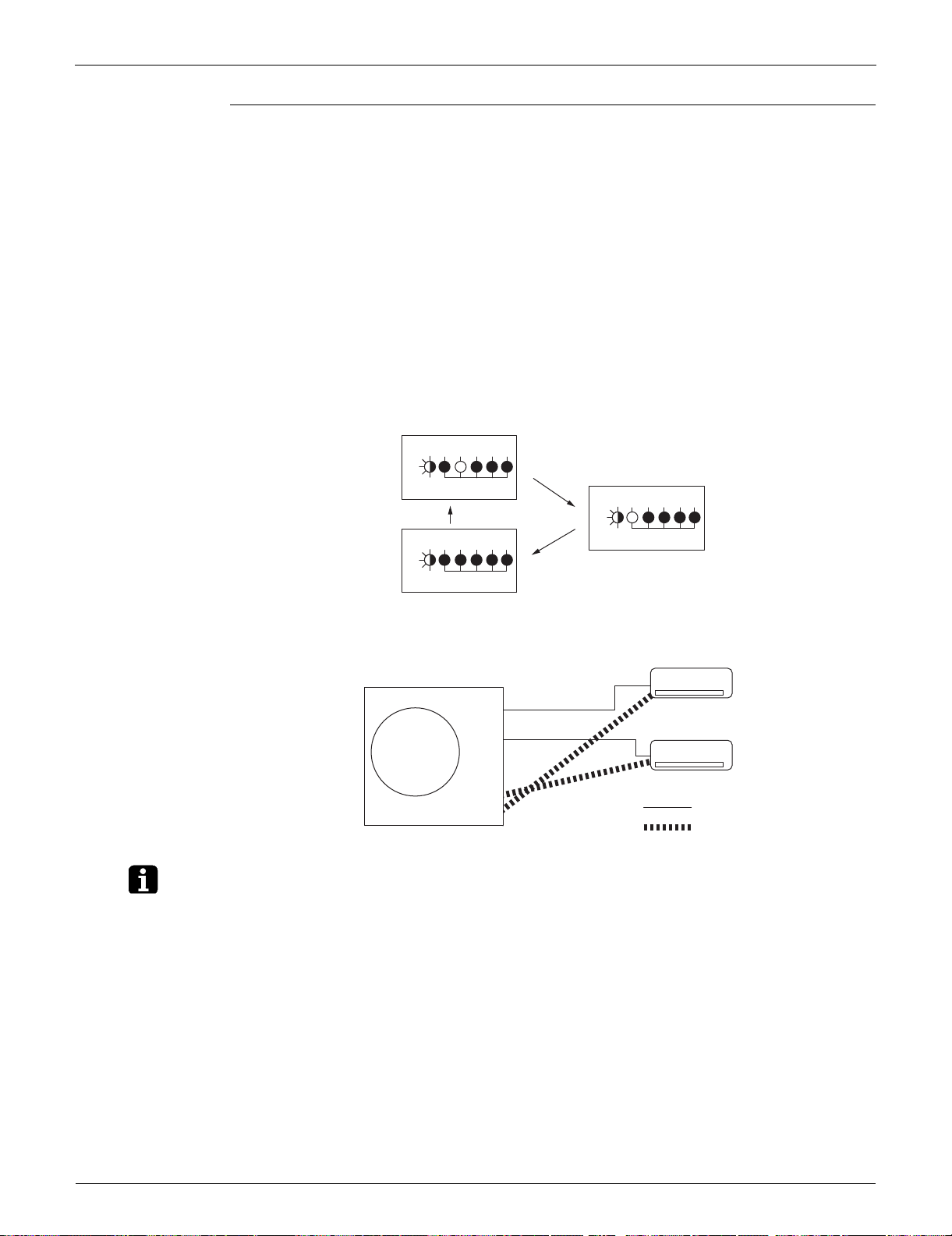
Wiring Error Check Function SiUS121827E
250 Part 7 Trial Operation and Field Settings
Notes
Details Wiring error check is realized by feeding refrigerant one by one through each piping port and
detecting indoor heat exchanger temperature with the indoor heat exchanger thermistor in each
room to see if the temperature changes in correct order.
During wiring error check, freezing (cracking) noise may be heard from the indoor unit. This is
not a malfunction. The noise is generated by the heat exchanger that is cooled below 0°C
(32°F) to make temperature change more visible.
Indoor fan motor turns on and off during wiring error check.
Wiring error check result is indicated using service monitor LEDs when all the checking procedures
are completed. LEDs stop blinking when the system returns to the normal operation.
In a multi system with 2 ports (Port A and Port B), LED 1 and LED 2 indicate wiring to Room A and
Room B respectively. The LED that blinks first and second indicate piping Port A and Port B
respectively.
Ex: Suppose the LED indicators are blinking as follows.
In this example, Port A and wiring to Room B are connected to the same room and Port B and
wiring to Room A are connected to another room. Incorrect wiring is then corrected automatically.
1. Wrongly connected liquid and gas pipes cannot be self-corrected. Be sure to make the liquid
pipe and the gas pipe in pairs.
2. To cancel the wiring error check procedure halfway, press the wiring error check switch again.
In this case, the memory of the microcomputer returns to its initial status (Room A wiring → Port
A piping, Room B wiring → Port B piping).
3. When replacing the outdoor unit PCB, be sure to use this function.
4. Make the priority room setting after wiring error check. If you set the priority room before wiring
error check, the prioritized room may be changed after self-correction.
A 1 2 3 4 5
Green Red
Green Red
Green Red
A 1 2 3 4 5
A 1 2 3 4 5
(R22004)
L
E
D
L
E
D
L
E
D
Wiring
Outdoor unit
Indoor unit
Piping
(R22274)
Wiring
Piping
A
B
A
B
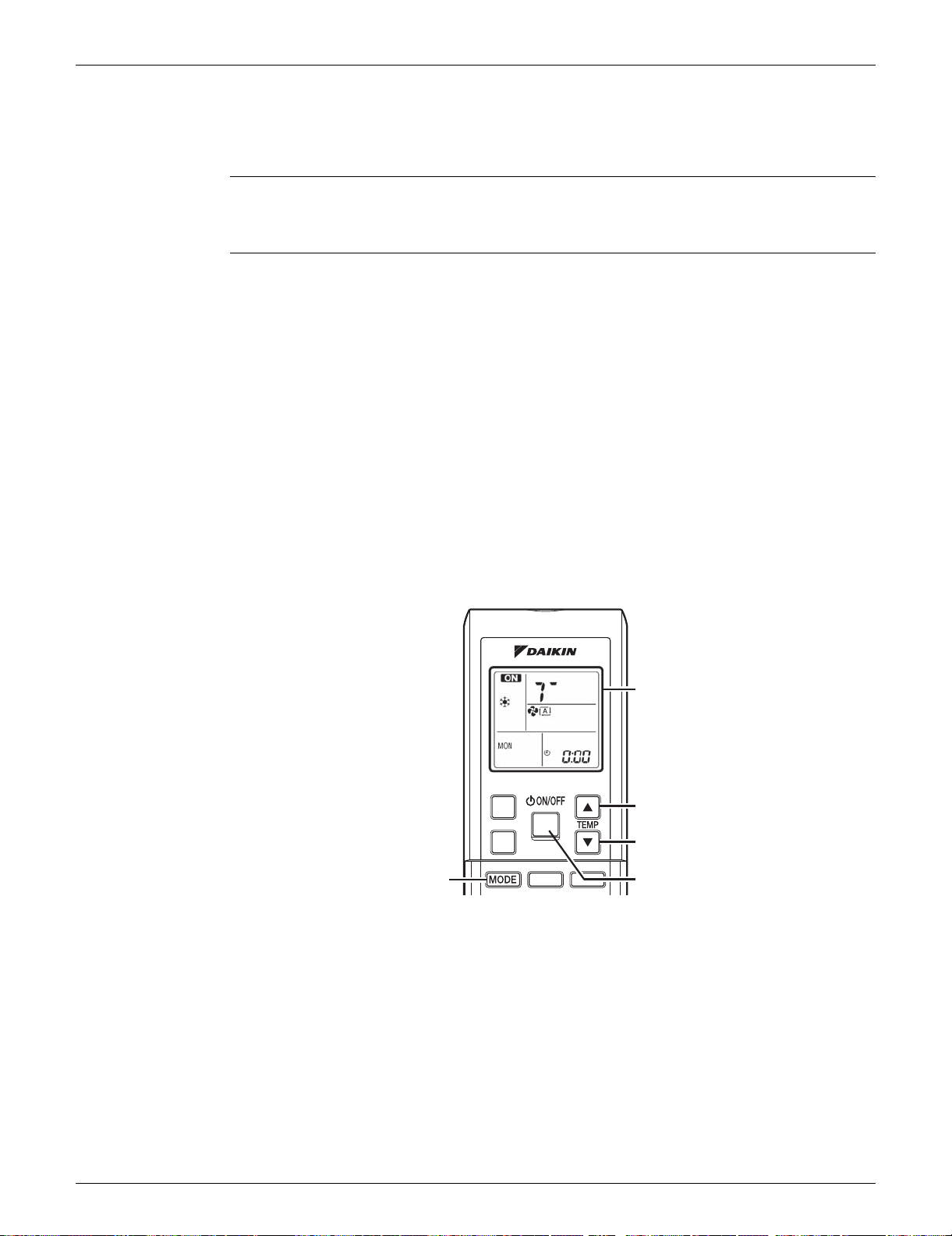
SiUS121827E Trial Operation
Part 7 Trial Operation and Field Settings 251
4. Trial Operation
4.1 RA Indoor Unit
Outline Carry out the trial operation in accordance with the operation manual to ensure that all functions
and parts, such as flap movement, are working properly.
Trial operation should be carried out in either cooling or heating operation.
Procedure 1. Measure the power supply voltage and make sure that it falls within the specified range.
2. In cooling operation, select the lowest programmable temperature (18°C (64°F));
in heating operation, select the highest programmable temperature (30°C (86°F)).
Trial operation may be disabled in either operation mode depending on the room temperature.
After trial operation is complete, set the temperature to a normal level (26 ~ 28°C (78 ~ 82°F) in
cooling, 20 ~ 24°C (68 ~ 75°F) in heating).
For protection, the system does not start for 3 minutes after it is turned off.
ARC452 Series
1. Press ON/OFF button to turn on the system.
2. Press both of TEMP buttons and MODE button at the same time.
3. Press MODE button twice.
T appears on the display to indicate that trial operation is selected.
4. Press MODE button and select the operation mode.
5. Trial operation terminates in about 30 minutes and switches into normal mode.
To quit trial operation, press ON/OFF button.
R7000150
2
2, 3, 4
1, 5
2
3

Trial Operation SiUS121827E
252 Part 7 Trial Operation and Field Settings
Note
ARC466 Series
1. Press On/Off button to turn on the system.
2. Press the center of Temp button and Mode button at the same time.
3. Select T (trial operation) with Tempor Tempbutton.
4. Press Mode button to start the trial operation.
5. Press Mode button and select operation mode.
6. Trial operation terminates in about 30 minutes and switches into normal mode.
To quit trial operation, press On/Off button.
R7000147
Test Items
The test items above are for CTXS, FTXS series as representative.
Refer to the installation manual for the other series.
2, 4, 5
1, 6
2, 3
3
Test items Symptom
Indoor and outdoor units are installed properly on
solid bases.
Fall, vibration, noise
No refrigerant gas leaks. Incomplete cooling/heating function
Refrigerant gas and liquid pipes and indoor drain
hose extension are thermally insulated.
Water leakage
Draining line is properly installed. Water leakage
System is properly grounded. Electrical leakage
The specified wires are used for inter-unit wiring. Inoperative or burn damage
Indoor or outdoor unit’s air inlet or air outlet has clear
path of air. Stop valves are opened.
Incomplete cooling/heating function
Indoor unit properly receives remote controller
commands.
Inoperative
The heat pump or cooling only mode is selectable
with the DIP switch of the remote controller
Remote controller malfunctioning
SiUS121827E Trial Operation
Part 7 Trial Operation and Field Settings 253
Caution
4.2 SA Indoor Unit
Outline Make sure to install the decoration panel before carrying out trial operation if the wireless
remote controller is used (FFQ series only).
Trial operation should be carried out in either cooling or heating operation.
1. Measure the supply voltage and make sure that it is within the specified range.
2. In cooling operation, select the lowest programmable temperature;
in heating operation, select the highest programmable temperature.
3. Carry out the trial operation following the instructions in the operation manual to ensure that all
functions and parts, such as the movement of the flaps, are working properly.
To protect the air conditioner, restart operation is disabled for 3 minutes after the system has
been turned off.
4. After trial operation is complete, set the temperature to a normal level (26°C to 28°C (78°F to
82°F) in cooling operation, 20°C to 24°C (68°F to 75°F) in heating operation).
When performing field settings or trial operation without attaching the decoration panel, do not
touch the drain pump. This may cause electric shock.
After finishing the construction of refrigerant piping, drain piping, and electric wiring, conduct trial
operation accordingly to protect the unit (FFQ series only).
Procedure When operating the air conditioner in cooling operation in winter, or heating operation in summer,
set it to the trial operation mode using the following method.
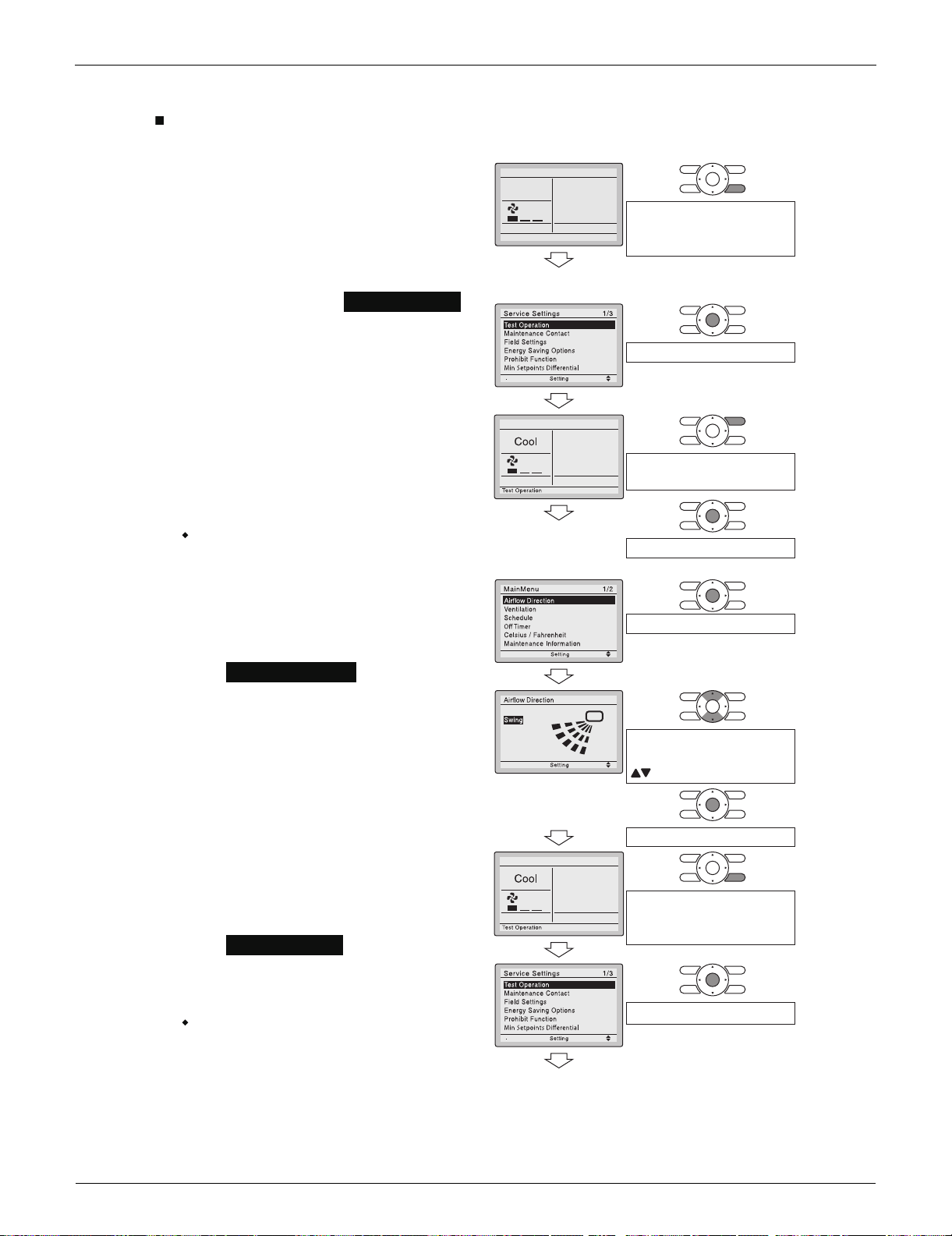
Trial Operation SiUS121827E
254 Part 7 Trial Operation and Field Settings
With BRC1E73 Wired Remote Controller
1. Set to COOL or HEAT operation using the
remote controller.
2. Press and hold Cancel button for 4 seconds
or longer. Service settings menu is
displayed.
3. In the case of a model having airflow
direction function, select
in the service settings menu, and press
Menu/OK button. Basic screen returns and
“Test Operation” is displayed at the bottom.
4. Press On/Off button within 10 seconds, and
the test operation starts.
Monitor the operation of the indoor unit for a
minimum of 10 minutes. During test
operation, the indoor unit will continue to
cool/heat regardless of the temperature
setpoint and room temperature.
In the case of above-mentioned
procedures 3 and 4 in reverse order, test
operation can start as well.
5. Press Menu/OK button in the basic screen.
Main menu is displayed.
6. Select in the main
menu and press Menu/OK button. Check
that airflow direction is actuated according
to the setting. For operation of airflow
direction setting, see the operation manual.
7. After the operation of airflow direction is
confirmed, press Menu/OK button.
Basic screen returns.
8. Press and hold Cancel button for 4 seconds
or longer in the basic screen.
Service settings menu is displayed.
9. Select in the service
settings menu, and press Menu/OK button.
Basic screen returns and normal operation
is conducted.
Test operation will stop automatically
after 15 ~ 30 minutes. To stop the
operation, press On/Off button.
10.If the decoration panel has not been
installed, turn off the power after the test
operation (FFQ series only).
Test Operation
Airflow Direction
Test Operation
Change the airflow
direction by using
(Up/Down) button.
Basic screen
1.
2.
3.
4.
5.
Main menu screen
6.
7.
8.
9.
Basic screen
Service Settings
menu screen
Press and hold Cancel
button for 4 seconds or
longer during backlight lit.
Press Menu/OK button.
Press On/Off button
(within 10 seconds).
Press Menu/OK button.
Press Menu/OK button.
Press Menu/OK button.
Press and hold Cancel
button for 4 seconds or
longer during backlight lit.
Press Menu/OK button.
Cool
Set to
68F
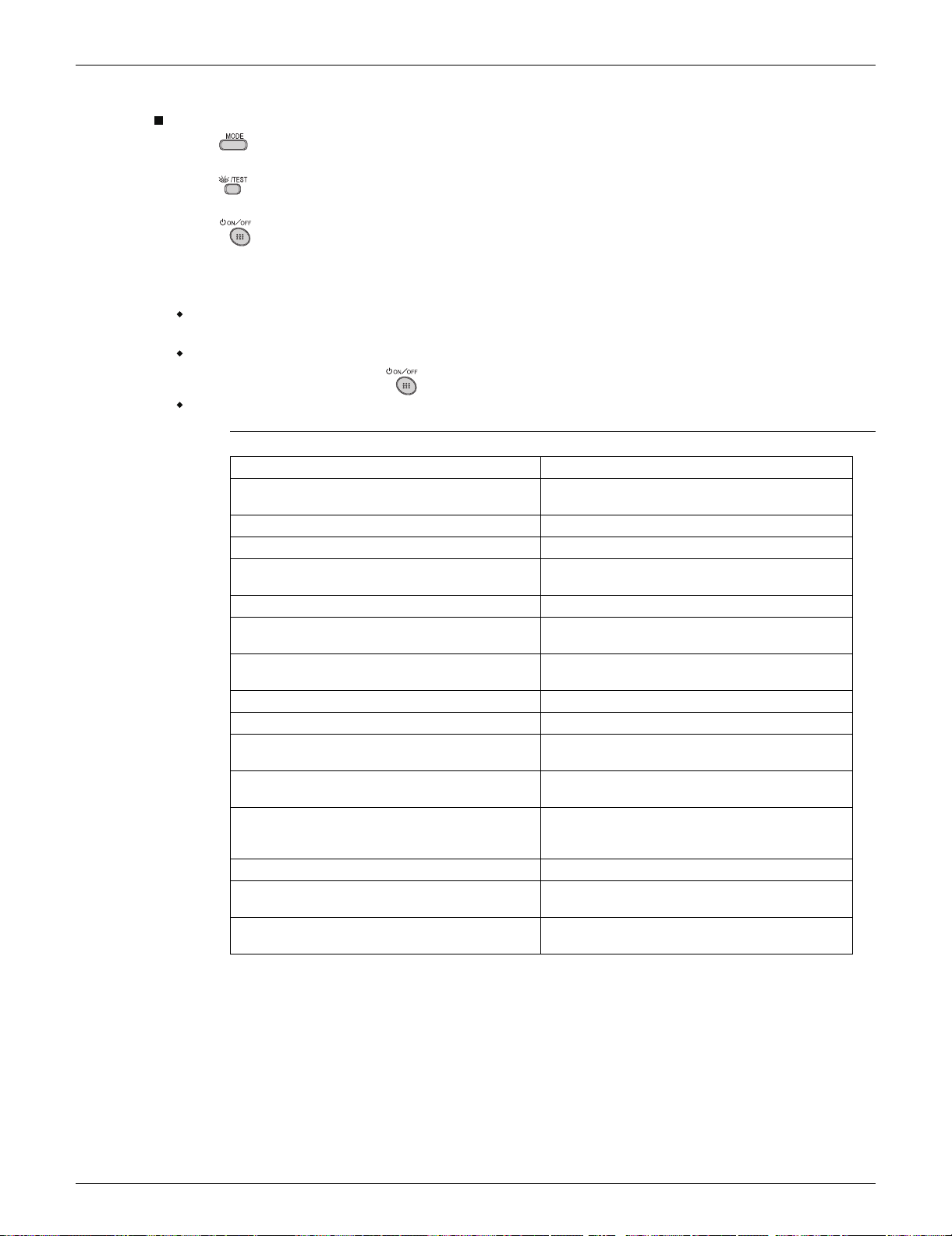
SiUS121827E Trial Operation
Part 7 Trial Operation and Field Settings 255
Test Items
With BRC082A43, BRC082A41W, BRC082A42W(S) Wireless Remote Controller
1. Press button and select the COOL or HEAT operation.
2. Press button twice. “TEST” is displayed.
3. Press button within 10 seconds, and the test operation starts.
Monitor the operation of the indoor unit for a minimum of 10 minutes. During test operation, the
indoor unit will continue to cool/heat regardless of the temperature setpoint and room
temperature.
In the case of above-mentioned procedures (1) and (2) in reverse order, test operation can
start as well.
Test operation will stop automatically after 15 ~ 30 minutes.
button.
Some of the functions cannot be used in the test operation mode.
To stop the operation, press
Test items Symptoms
Indoor and outdoor units are installed
securely.
Fall, vibration, noise
Is the outdoor unit fully installed? No operation or burn damage
No refrigerant gas leaks. Incomplete cooling/heating function
Refrigerant gas and liquid pipes and indoor
drain hose extension are thermally insulated.
Water leakage
Draining line is properly installed. Water leakage
Does the power supply voltage correspond to
that shown on the name plate?
No operation or burn damage
Only specified wires are used for all wiring,
and all wires are connected correctly.
No operation or burn damage
System is properly grounded. Electrical leakage
Is wiring size according to specifications? No operation or burn damage
Is something blocking the air outlet or inlet of
either the indoor or outdoor units?
Incomplete cooling/heating function
Are refrigerant piping length and additional
refrigerant charge noted down?
The refrigerant charge in the system is not
clear
Pipes and wires are connected to the
corresponding connection ports/terminal
blocks for the connected unit.
No cooling/heating
Stop valves are opened. Incomplete cooling/heating function
Check that the connector of the lead wires of
the decoration panel is connected securely.
Louvers do not move
Indoor unit properly receives wireless remote
control commands.
No operation
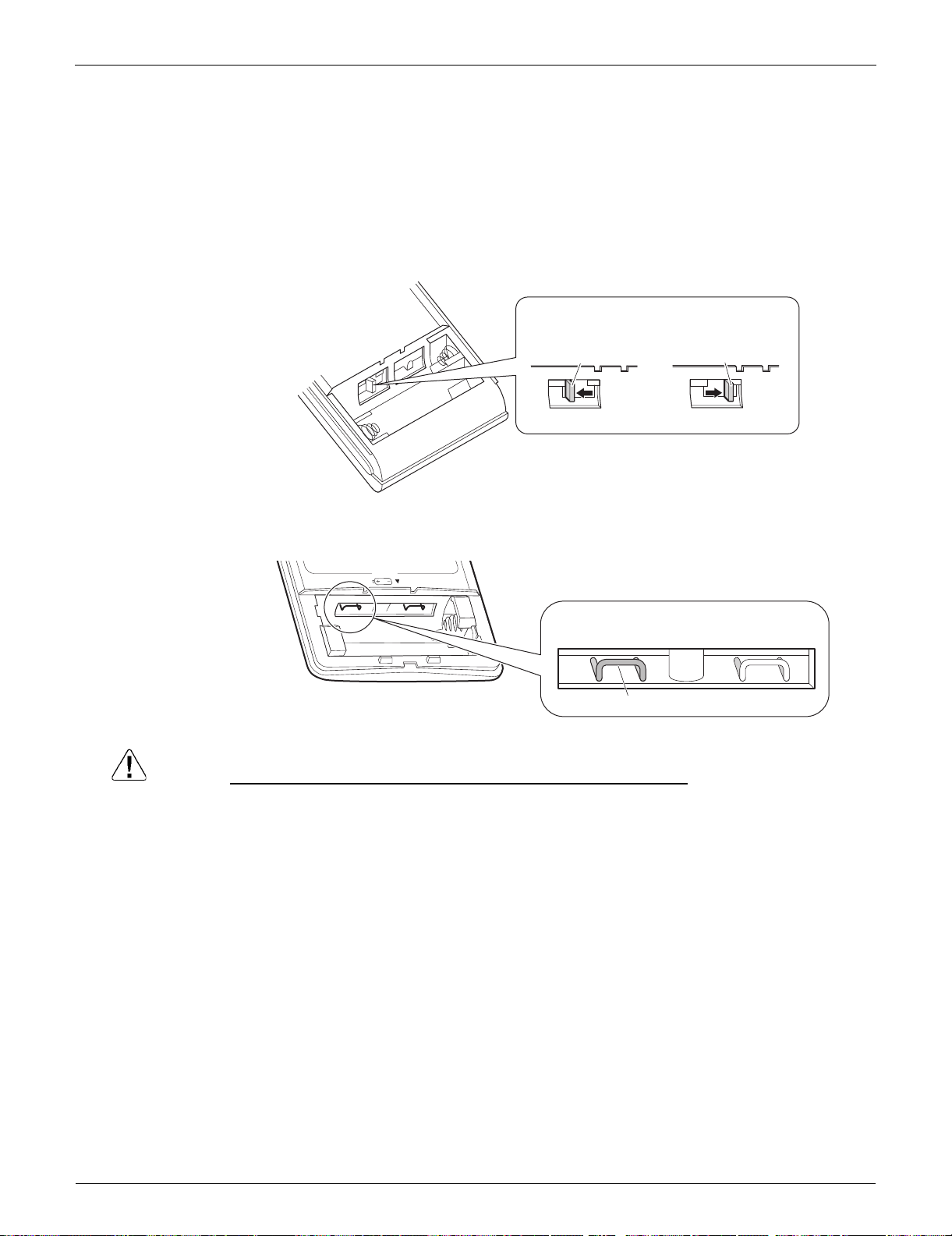
Field Settings SiUS121827E
256 Part 7 Trial Operation and Field Settings
Caution
5. Field Settings
5.1 RA Indoor Unit
5.1.1 Model Type Settings
ARC452A21, ARC452A23
The remote controller is common to the heat pump model and cooling only model.
Make sure the DIP switch is set to the left side. The heating operation will not be available when
the DIP switch is set to the right side.
ARC466A21, ARC466A36
The remote controller is common to the heat pump model and cooling only model.
Replace the remote controller if you cut a jumper on the left side.
The heating operation will not be available when the jumper on the left side is cut.
(R18201)
DIP switch
Heat pump model Cooling only model
DIP switch
Never cut this jumper.
(R23955)
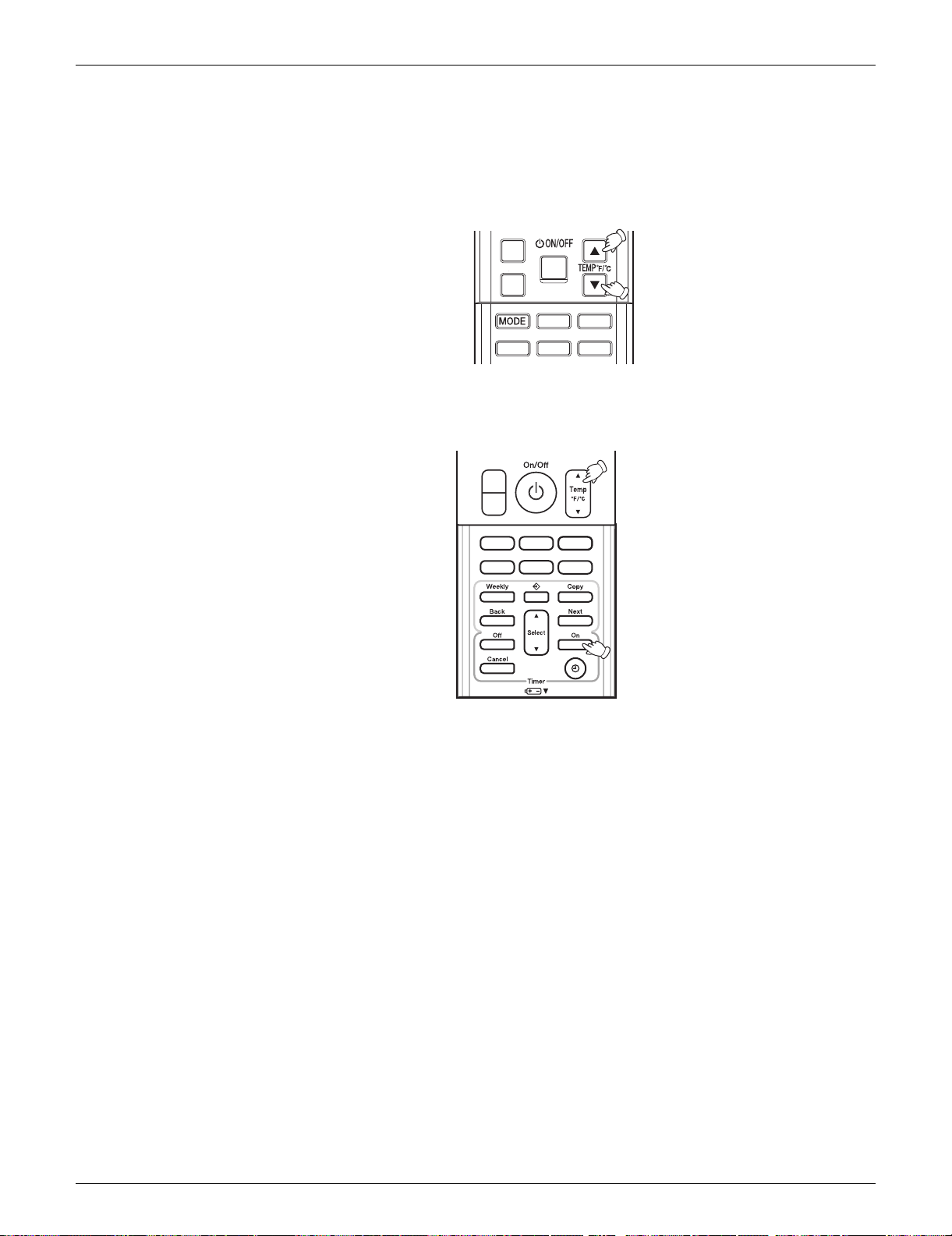
SiUS121827E Field Settings
Part 7 Trial Operation and Field Settings 257
5.1.2 Temperature Display Switch
You can select Fahrenheit or Celsius for temperature display.
ARC452A21, ARC452A23
Press TEMPand TEMPbuttons at the same time for 5 seconds to change the unit of
temperature display.
ARC466A21, ARC466A36
Press the upper side of Temp button and On button at the same time for 5 seconds to change
the unit of temperature display.
(R14477)
(R22009)

Field Settings SiUS121827E
258 Part 7 Trial Operation and Field Settings
Caution
5.1.3 When 2 Units are Installed in 1 Room
Outline When 2 indoor units are installed in 1 room, 1 of the 2 indoor units and the corresponding wireless
remote controller can be set for different address.
Both the indoor unit PCB and the wireless remote controller need alteration.
The method of address setting varies depending on the type of indoor unit and the series of wired
remote controller. Refer to the following pages for the appropriate indoor unit and wireless remote
controller.
FTXR, CTXG,
CTXS, FTXS
Series
1. Remove the front grille.
2. Remove the electrical box.
3. Remove the shield plate of the electrical box.
4. Cut the address setting jumper JA on the PCB.
FTXR, CTXG Series
Replace the PCB if you cut a jumper unintentionally.
Jumpers are necessary for electronic circuit. Improper operation may occur if you cut any of them.
CTXS07LVJU, FTXS09/12LVJU FTXS15/18/24LVJU
JA
(Bottom of electrical box)
ADDRESS : JA
EXIST : 1
CUT : 2
(R21128)
ADDRESS
JC
JA
JB
ADDRESS:JA
EXIST
1
CUT
2
(R17375)
(R9665)
ADDRESS
JC
JA
JB
ADDRESS:JA
EXIST
1
CUT
2
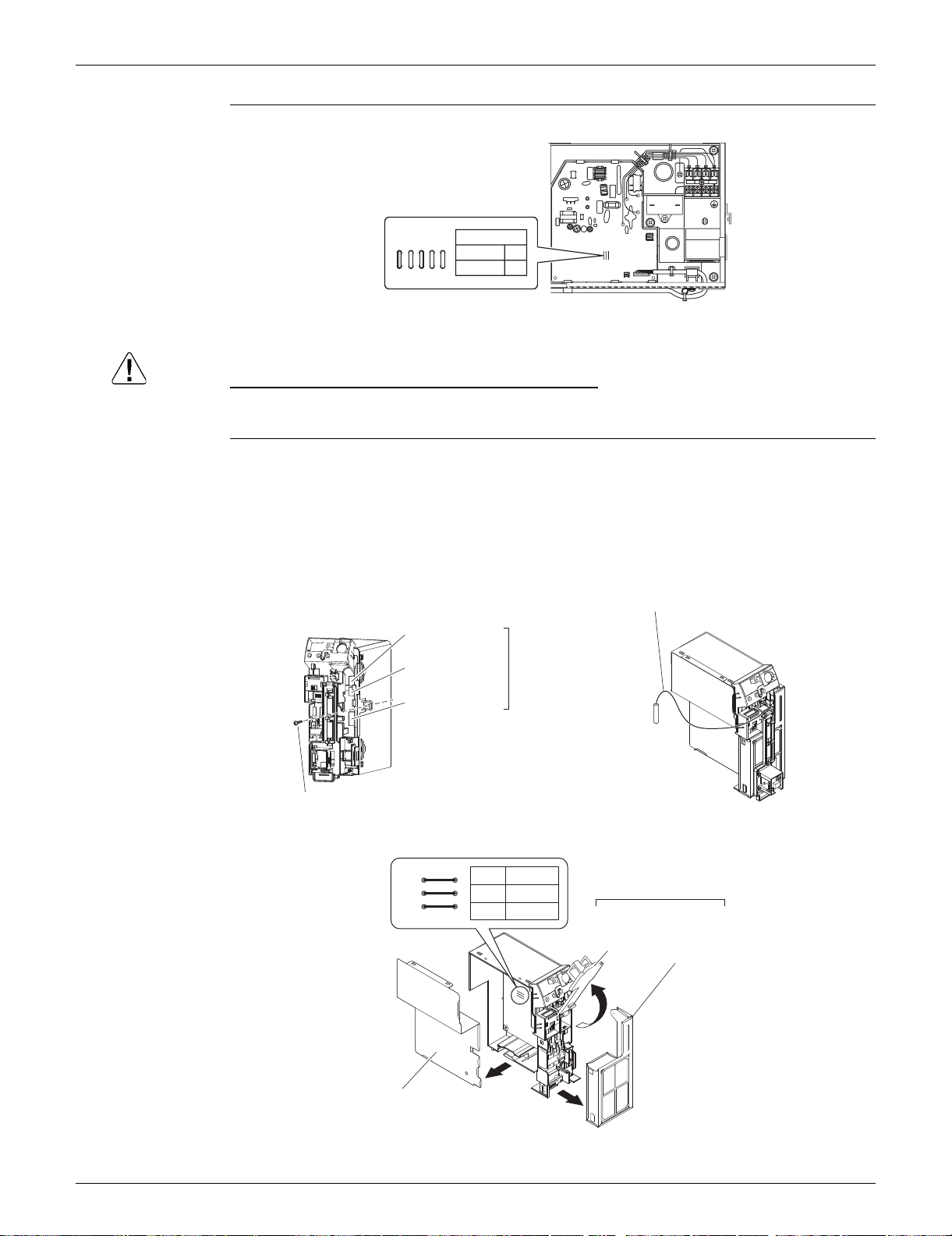
SiUS121827E Field Settings
Part 7 Trial Operation and Field Settings 259
Caution
FDXS, CDXS
Series
Cut the jumper JA on PCB.
Replace the PCB if you cut a jumper unintentionally.
Jumpers are necessary for electronic circuit. Improper operation may occur if you cut any of them.
FVXS Series 1. Remove the front grille.
2. Lift the sensor PCB fixing plate and remove the front shield plate.
3. Disconnect the connectors S1, S41, S42.
4. Remove the electric box (1 screw).
5. Pull out the indoor heat exchanger thermistor.
6. Remove the shield plate (8 tabs).
7. Cut the address setting jumper JA on the indoor unit PCB.
R7000179
R7000157
1 23
(R22010)
ADDRESS : JA
EXIST
CUT
1
2
JA
Connector S42
Connector S41
Connector S1
4. Remove the screw.
5. Indoor heat exchanger
thermistor
3.
6. Shield plate
Sensor
PCB fixing
plate
JC
JA
JB
JA
EXIST
CUT
Address
1
2
2.
Front shield
plate
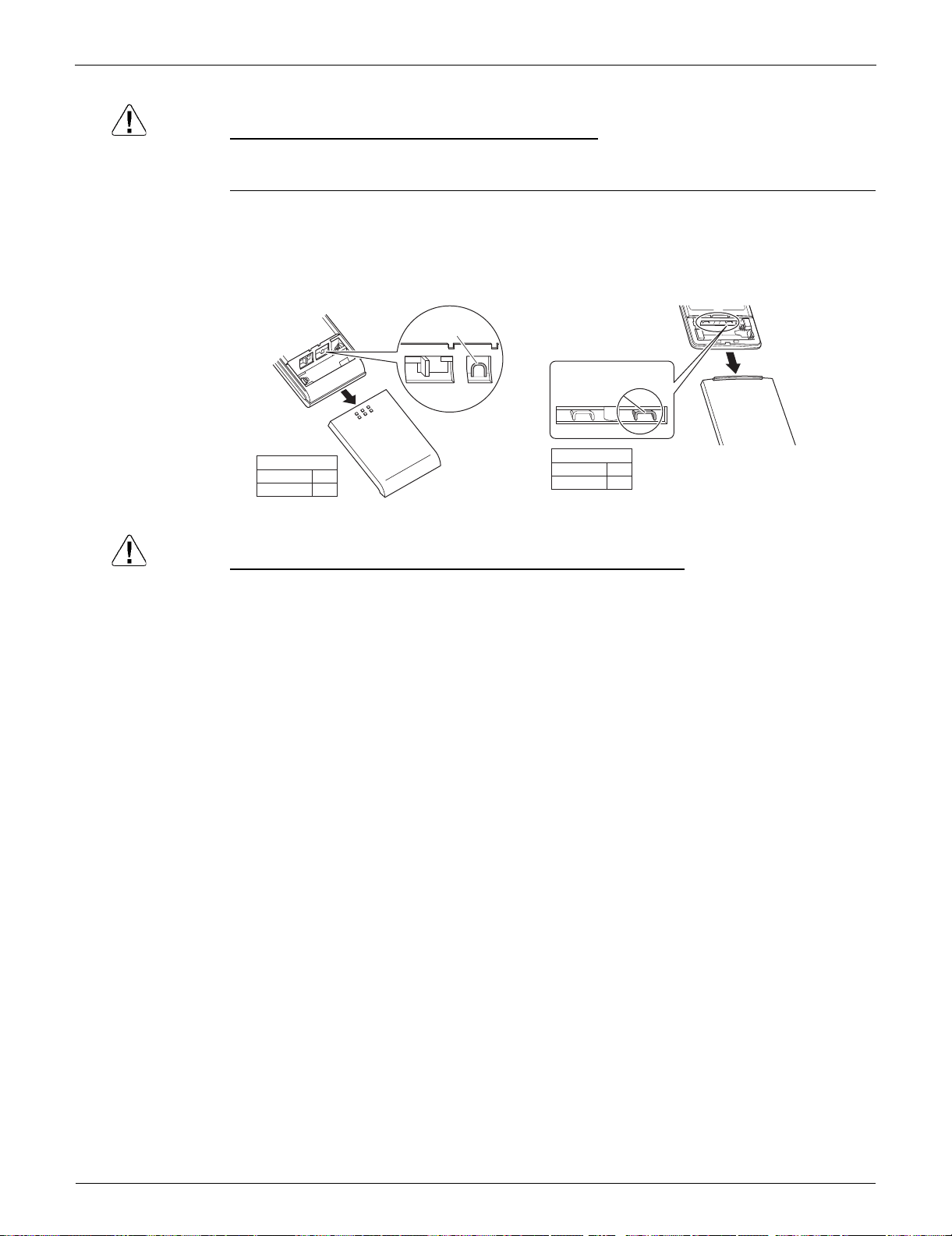
Field Settings SiUS121827E
260 Part 7 Trial Operation and Field Settings
Caution
Caution
Replace the PCB if you cut a jumper unintentionally.
Jumpers are necessary for electronic circuit. Improper operation may occur if you cut any of them.
Wireless Remote
Controller
1. Remove the cover and take it off.
2. Cut the address setting jumper.
Replace the remote controller if you cut a jumper unintentionally
.
Jumpers are necessary for electronic circuit. Improper operation may occur if you cut any of them.
ARC452 series ARC466 series
Jumper
ADDRESS
(R12065)
EXIST
CUT
1
2
(R18416)
ADDRESS
EXIST
1
CUT
2
Jumper
∗ Do not cut the left jumper.
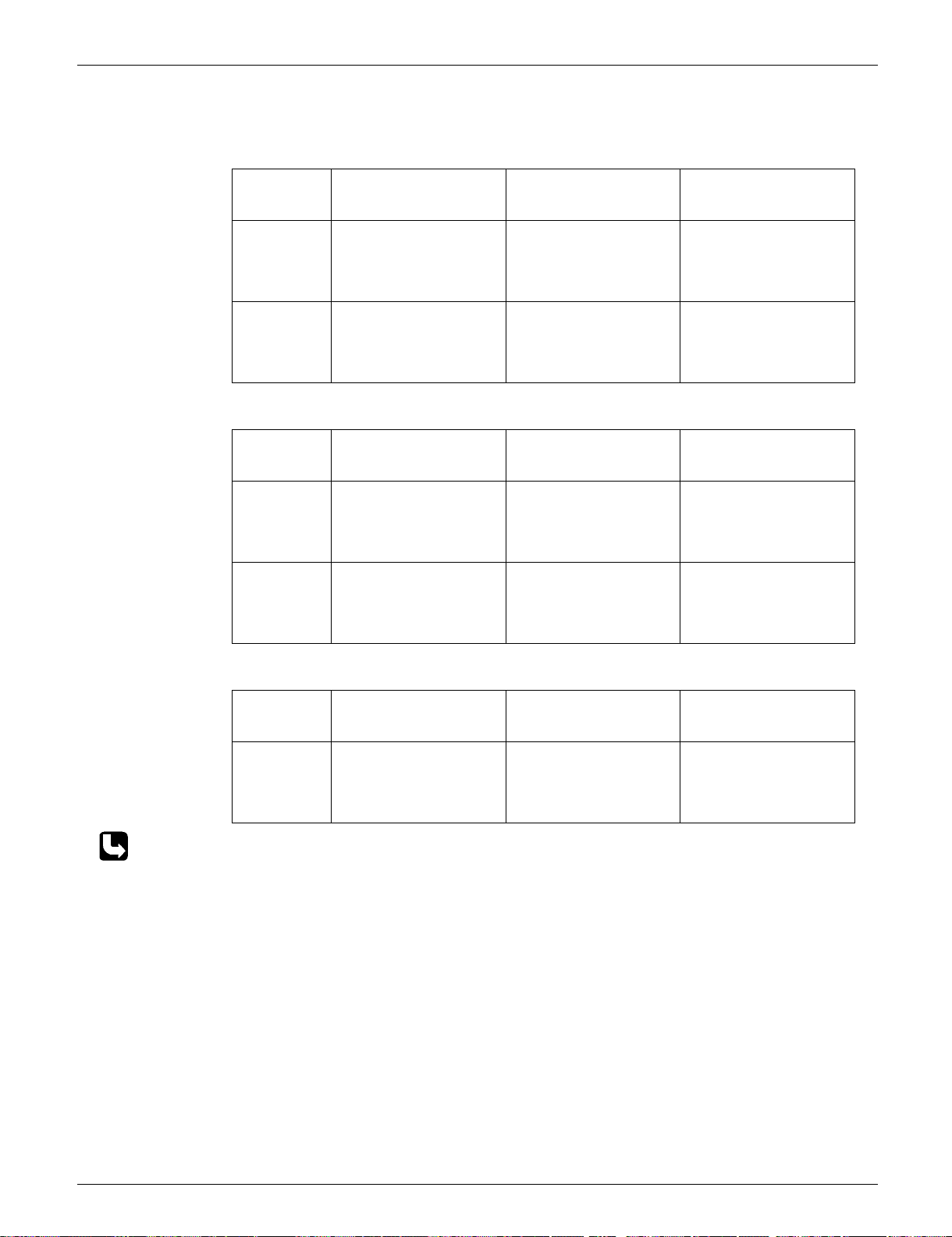
SiUS121827E Field Settings
Part 7 Trial Operation and Field Settings 261
Reference
5.1.4 Jumper and Switch Settings
FTXR series
CTXG, CTXS, FTXS, FDXS, CDXS, FVXS series
FVXS series only
For the location of the jumper, refer to the following pages.
FTXR, CTXG: page 37
CTXS07LVJU, FTXS09/12LVJU: page 39
FTXS15/18/24LVJU: page 41
FDXS, CDXS: page 43
FVXS: page 45
Jumper
on indoor
unit PCB
Function
When connected
(factory setting)
When cut
JB
Fan speed setting when
compressor stops for
thermostat OFF.
(effective only at cooling
operation)
The fan stops. Fan speed setting;
Remote controller setting
JC
Power failure recovery
function
Auto-restart The unit does not
resume operation after
recovering from a power
failure. Timer settings
are cleared.
Jumper
on indoor
unit PCB
Function
When connected
(factory setting)
When cut
JB
Fan speed setting when
compressor stops for
thermostat OFF.
(effective only at cooling
operation)
Fan speed setting;
Remote controller setting
The fan stops.
JC
Power failure recovery
function
Auto-restart The unit does not
resume operation after
recovering from a power
failure. Timer settings
are cleared.
Switch
on indoor unit
PCB
Function
OFF
(factory setting)
ON
SW2-4
Upward airflow limit
setting
Exposed or half
embedded installation
Set the switch to ON
position when you install
the indoor unit
embedded in the wall to
avoid condensation.
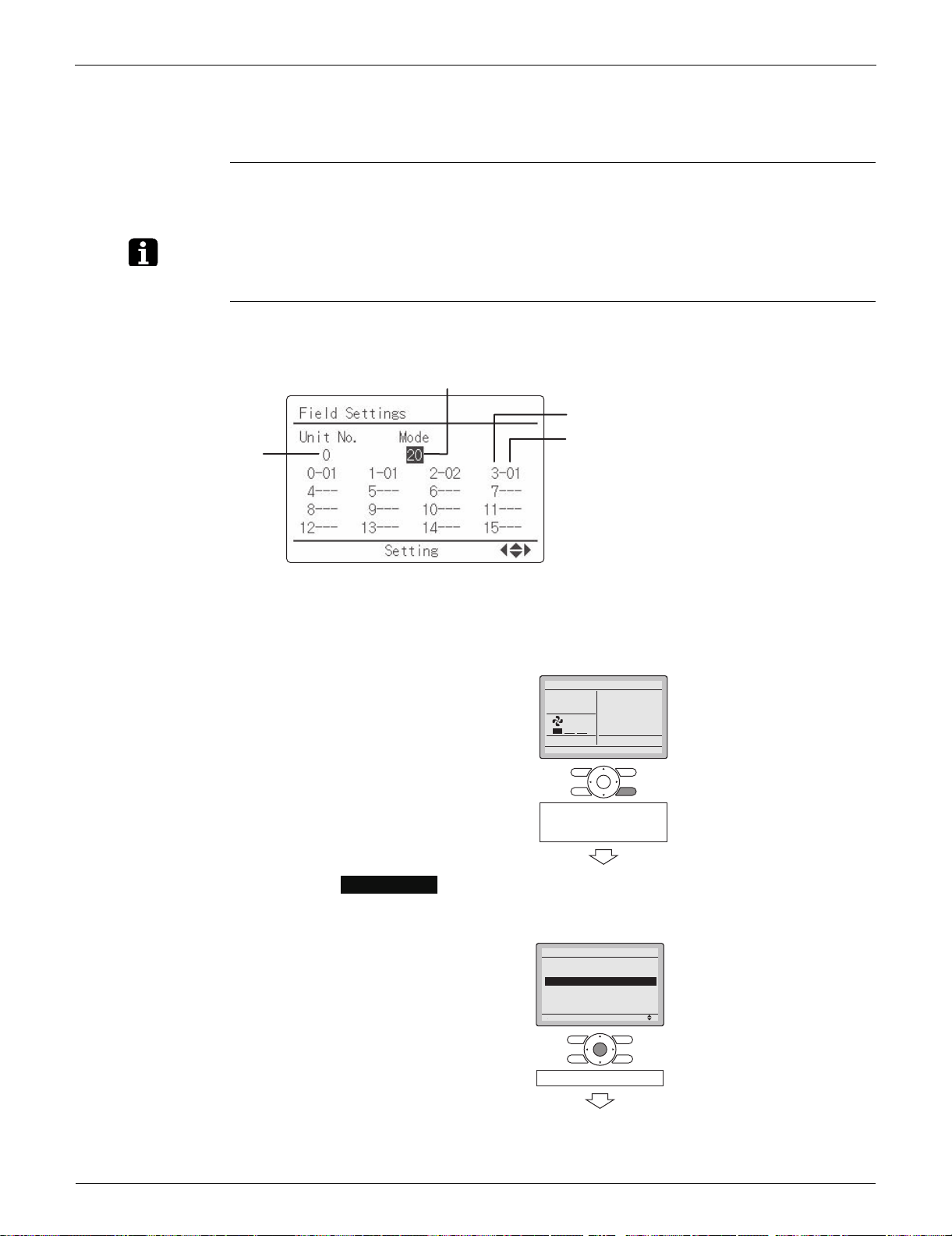
Field Settings SiUS121827E
262 Part 7 Trial Operation and Field Settings
Note
5.2 SA Indoor Unit
5.2.1 How to Change the Field Settings
Outline If optional accessories are mounted on the indoor unit, the indoor unit setting may have to be
changed. Refer to the instruction manual for each optional accessory.
When using 2 remote controllers for 1 indoor unit, change the field settings from MAIN remote
controller. Note that the field settings can not be set from SUB remote controller.
Procedure BRC1E73 Wired Remote Controller
R7000213
a Unit No.
b First code No.
c Second code No.
d Mode
a
b
c
d
(R18831)
1. Press and hold Cancel button for 4 seconds or longer.
Service settings menu is displayed.
2. Select in the Service Settings menu, and press Menu/OK button.
Field settings screen is displayed.
<Basic screen>
1
Fan
Press and hold Cancel
button for 4 seconds or
longer during backlight lit.
Field Settings
<Service settings menu screen>
2
Service Settings
1/3
Test Operation
Maintenance Contact
Field Settings
Energy Saving Options
Prohibit Function
Min Setpoints Differential
Setting
Press Menu/OK button.
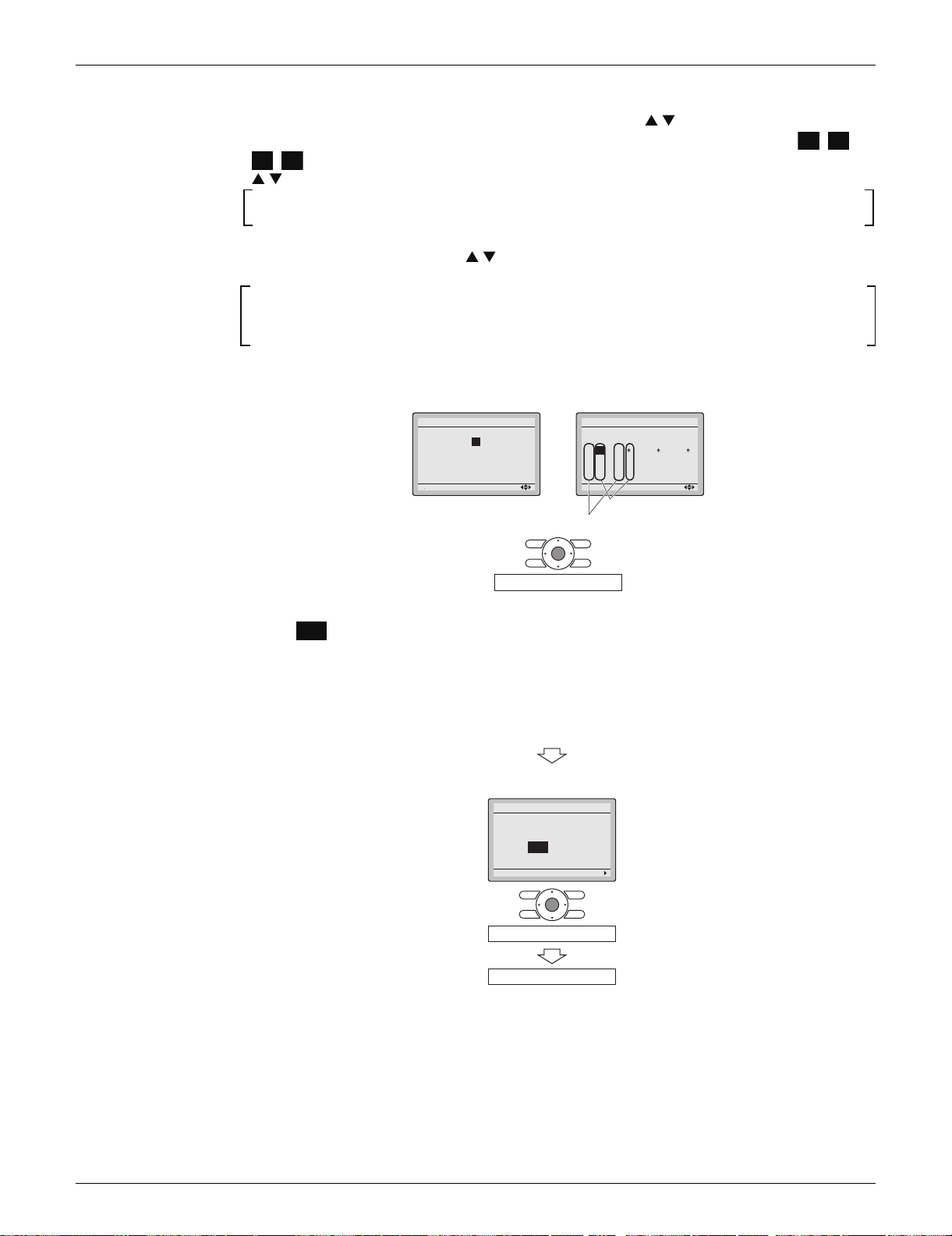
SiUS121827E Field Settings
Part 7 Trial Operation and Field Settings 263
R7000214
3. Highlight the mode, and select desired “Mode No.” by using (Up/Down) button.
4. In the case of setting per indoor unit during group control (When Mode No. such as , ,
, are selected), highlight the unit No.and select “Indoor unit No.” to be set by using
(Up/Down) button. (In the case of group setting, this operation is not needed.)
In the case of individual setting per indoor unit, current settings are displayed. And, SECOND
CODE NO. “ - ” means no function.
5. Highlight SECOND CODE NO. of the FIRST CODE NO. to be changed, and select desired
“SECOND CODE NO.” by using
(Up/Down) button. Multiple identical mode number
settings are available.
In the case of setting for all indoor units in the remote control group, available SECOND CODE
NO. is displayed as “ ∗ ” which means it can be changed. When SECOND CODE NO. is
displayed as “ - ”, there is no function.
6. Press Menu/OK button. Setting confirmation screen is displayed.
7. Select and press Menu/OK button. Setting details are determined and field settings screen
returns.
8. In the case of multiple setting changes, repeat 3 to 7.
9. After all setting changes are completed, press Cancel button twice.
10.Backlight goes out, and [Checking the connection. Please stand by.] is displayed for
initialization. After the initialization, the basic screen returns.
20 22
23 25
<Service settings screen>
3
4
5
0
–
–
–
–
3
5
0
SECOND CODE NO.
In the case of individual
setting per indoor unit
In the case of group total
setting
Field Settings
Unit No Mode
20
Setting
0
4
8
12
01 1 01
–––
–––
–––
–––
–––
–––
–––
––––––
–––
–––
–––
5
9
13
2
6
10
14
02
301
7
11
15
–
1
–––
–––
–––
5
9
13
–
–––
–––
–––
2
6
10
14
–
–––
–––
–––
3
7
11
15
–
0
4
8
12
01
–––
–––
–––
Unit No Mode
10
Field Settings
Setting
FIRST CODE (SW) NO.
Press Menu/OK button.
Yes
<Setting confirmation screen>
6
7
No
Setting confirmation
Field Settings
Save the settings?
Yes
Setting
Press Menu/OK button.
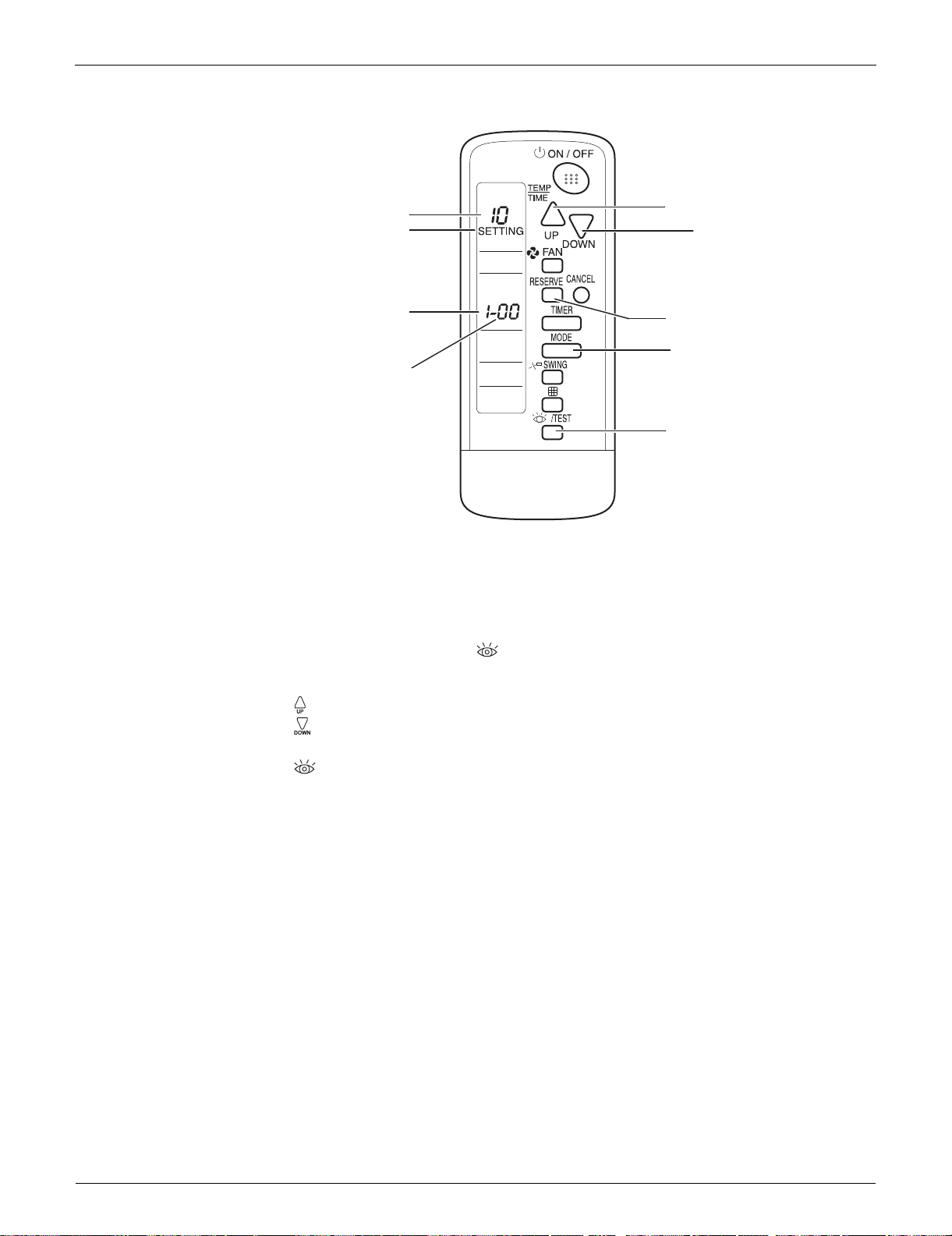
Field Settings SiUS121827E
264 Part 7 Trial Operation and Field Settings
BRC082A43, BRC082A41W, BRC082A42W(S) Wireless Remote Controller
To set the field settings, you have to change:
Mode No.
First code No.
Second code No.
1. When in normal mode, hold down /TEST button for at least 4 seconds to enter the Field
Set mode.
2. Select the desired Mode No. with MODE button.
3. Press button and select the First code No.
4. Press button and select the Second code No.
5. Press RESERVE button to confirm the settings.
6. Press /TEST button to quit the Field Set mode and to return to normal display again.
RESERVE button
Mode No.
Field setting mode
UP button
DOWN button
First code No.
Second code No.
MODE button
(R24061)
INSPECTION/TEST
button
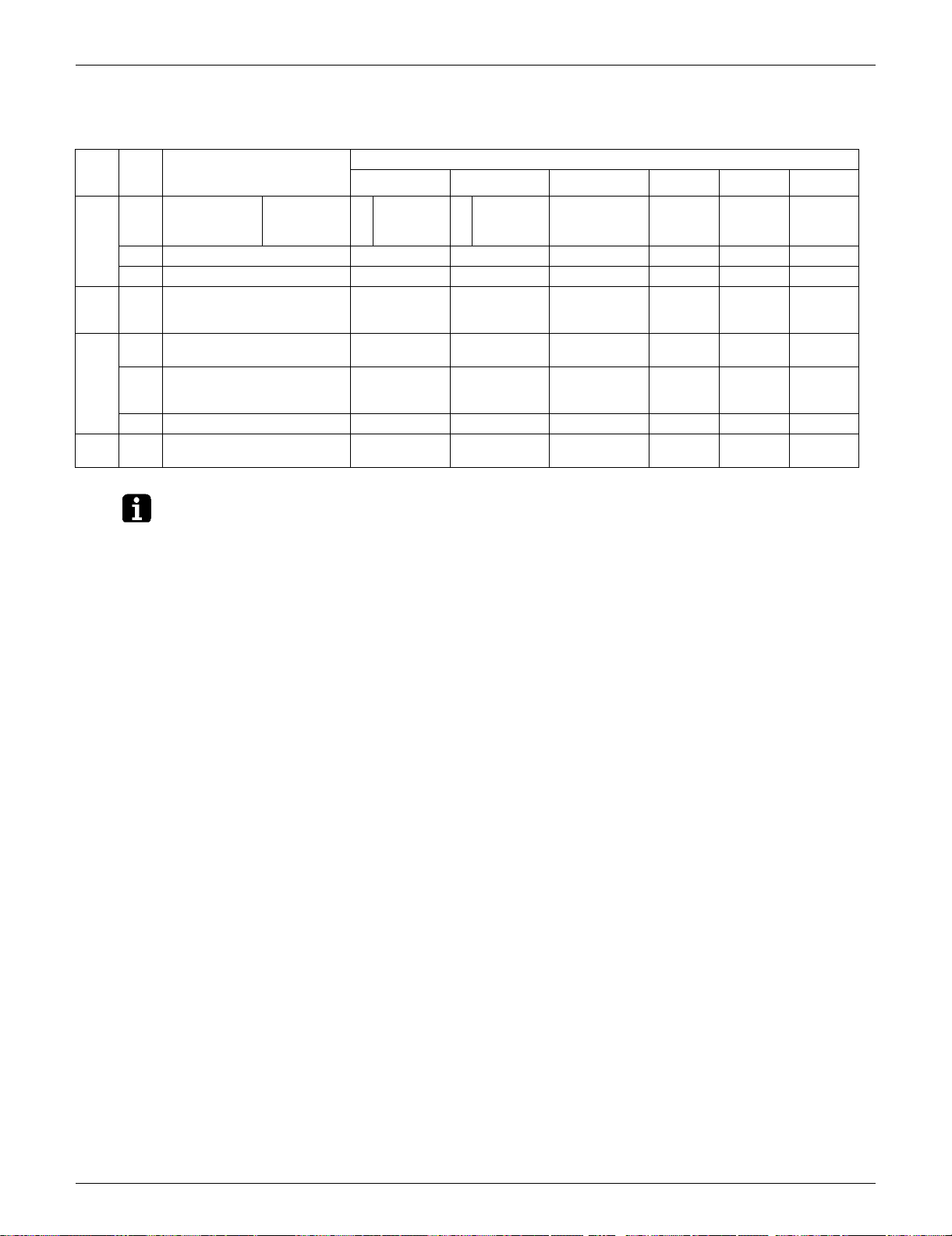
SiUS121827E Field Settings
Part 7 Trial Operation and Field Settings 265
Note(s)
5.2.2 Overview of Field Settings for FFQ Series
Factory Setting
Any function that is not available on the indoor unit us not displayed.
Mode
No.
First
Code
No.
Description of setting
Second Code No.
01 02 03 04 05 06
10
(20)
0
Filter cleaning
sign interval
Longlife filter
Light
Approx.
2,500 hrs.
Heavy
Approx.
1,250 hrs.
————
2 Remote controller thermistor Enabled Disabled ————
3 Filter cleaning sign Display No display — — — —
12
(22)
0
Optional accessories output
selection (field selection of
output for adaptor for wiring)
Compressor —
Operation
output
Error
output
Outdoor
air
intake
Presence
sensor
13
(23)
0
High air outlet velocity (for
high ceiling applications)
≤ 2.7 m
(≤ 8-7/8 ft)
2.7 ~ 3.0 m
(8-7/8~9-13/16 ft)
3.0 ~ 3.5 m
(9-13/16~11-1/2 ft)
———
1
Selection of airflow direction
(setting for when a blocking
pad kit has been installed)
4-way flow 3-way flow 2-way flow — — —
4 Airflow direction range setting Upper Normal Lower — — —
15
(25)
3
Drain pump operation with
humidifying
Not equipped Equipped — — — —
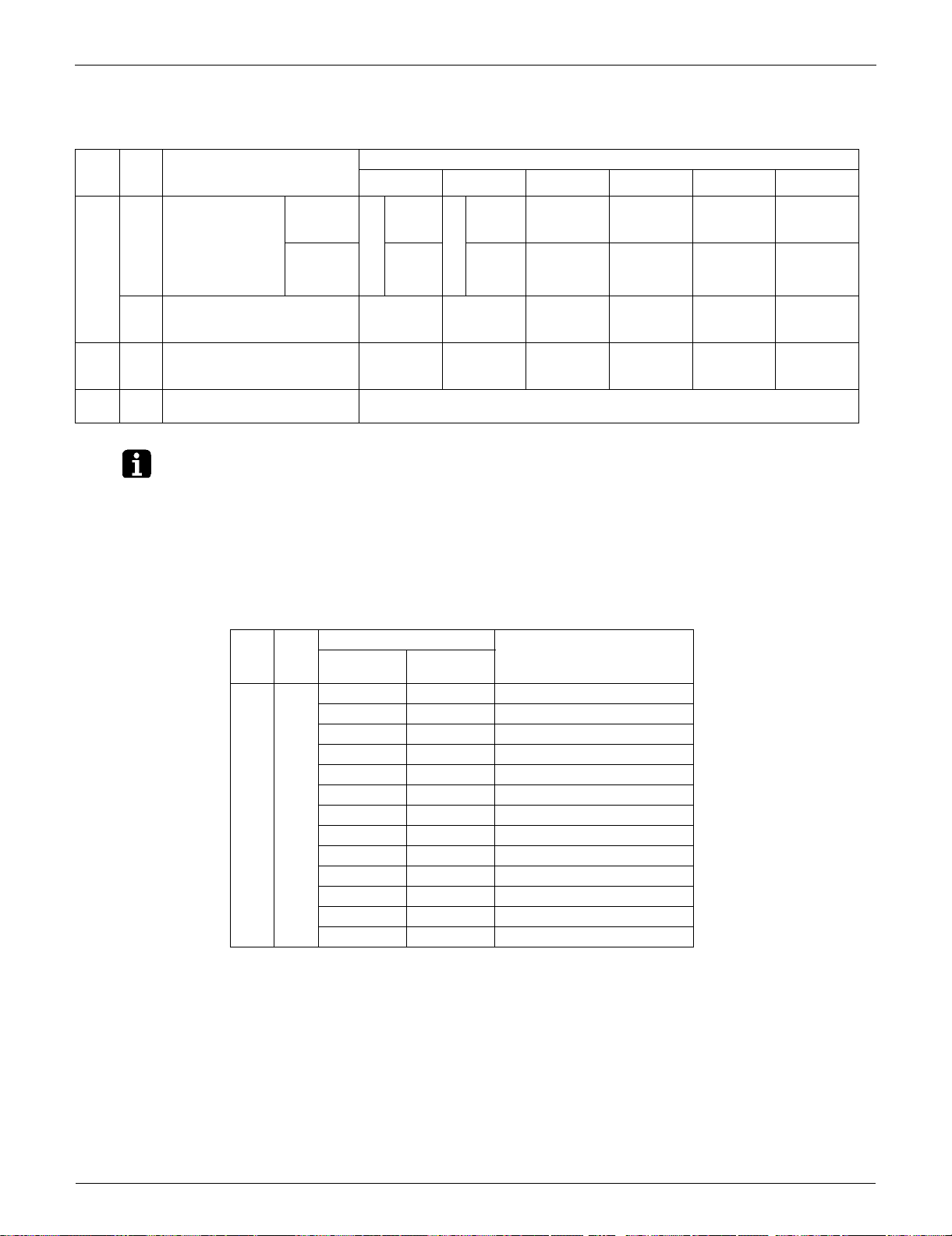
Field Settings SiUS121827E
266 Part 7 Trial Operation and Field Settings
Note(s)
5.2.3 Overview of Field Settings for FDMQ Series
Factory Setting
The Second Code No. is factory set to "01".
Do not use any settings not listed in the table.
For group control with a wireless remote controller, initial settings for all the indoor units of the
group are equal.
For group control, refer to the installation manual attached to the indoor unit for group control.
External Static Pressure Settings
Factory Setting
Mode
No.
First
Code
No.
Description of setting
Second Code No.
01 02 03 04 05 06
10
(20)
0
Filter cleaning
sign interval
(used to change
filter cleaning
display interval
according to filter
contamination)
Longlife
filter
Light
Approx.
2,500
hrs.
Heavy
Approx.
1,250
hrs.
————
Standard
filter
Approx.
200 hrs.
Approx.
100 hrs.
————
3
Filter cleaning sign (used to
set filter cleaning display ON/
OFF)
Display No display————
11
(21)
7
Air volume adjustment
OFF
Air volume
adjustment
completion
Air volume
adjustment
start
———
13
(23)
6
External static pressure Refer to the table below.
Mode
No.
First
Code
No.
Second Code No.
External static pressure
09/12
Class
15/18/24
Class
13
(23)
6
03
—
30 Pa (0.12 inH
2
O)
04
—
40 Pa (0.16 inH
2
O)
05 05 50 Pa (0.20 inH
2
O)
06 06 60 Pa (0.24 inH
2
O)
07 07 70 Pa (0.28 inH
2
O)
08 08 80 Pa (0.32 inH
2
O)
09 09 90 Pa (0.36 inH
2
O)
10 10 100 Pa (0.40 inH
2
O)
11 11 110 Pa (0.44 inH
2
O)
12 12 120 Pa (0.48 inH
2
O)
13 13 130 Pa (0.52 inH
2
O)
14 14 140 Pa (0.56 inH
2
O)
15 15 150 Pa (0.60 inH
2
O)
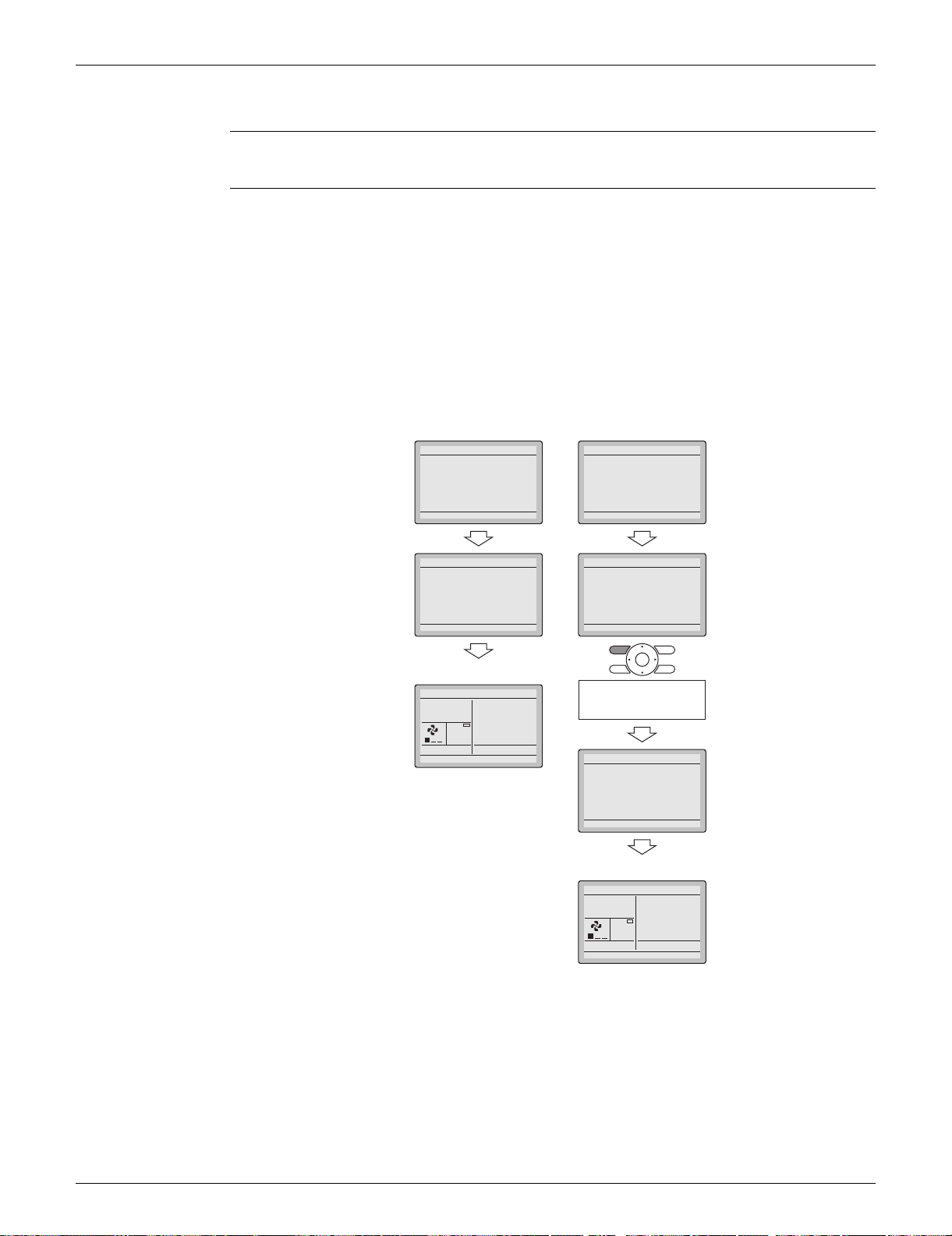
SiUS121827E Field Settings
Part 7 Trial Operation and Field Settings 267
5.2.4 MAIN/SUB Setting when Using 2 Wired Remote Controllers
Outline The MAIN/SUB setting is necessary when 1 indoor unit is controlled by 2 remote controllers. When
you use 2 remote controllers, set one to MAIN and the other to SUB.
Details 1. The following message is displayed after power-on.
Checking the connection.
Please stand by.
When the above message is displayed, the backlight will not be ON.
[In the case that 1 indoor unit is controlled by 2 remote controllers:]
Make sure to set the sub remote controller when the above message is displayed.
Hold Mode button for 4 seconds or longer to set.
When the display is changed from “Main RC” to “Sub RC”, the setting is completed.
2. Basic screen is displayed.
<Sub remote controller>
1 1
<Basic screen>
2
<Basic screen>
2
Set temperature
Fan
Set temperature
Fan
<Main remote controller>
Off reminder Timer
Checking the connection.
Please stand by.
Main RC
Off reminder Timer
Checking the connection.
Please stand by.
Main RC
Error Code U5
Checking the connection.
Please stand by.
Main RC
Error Code U5
Checking the connection.
Please stand by.
Main RC
28
°C
Return Press the menu button
Press and hold 4 seconds
or longer Mode Selection
button of sub remote
Off reminder Timer
Checking the connection.
Please stand by.
Sub RC
28
°C
Return Press the menu button
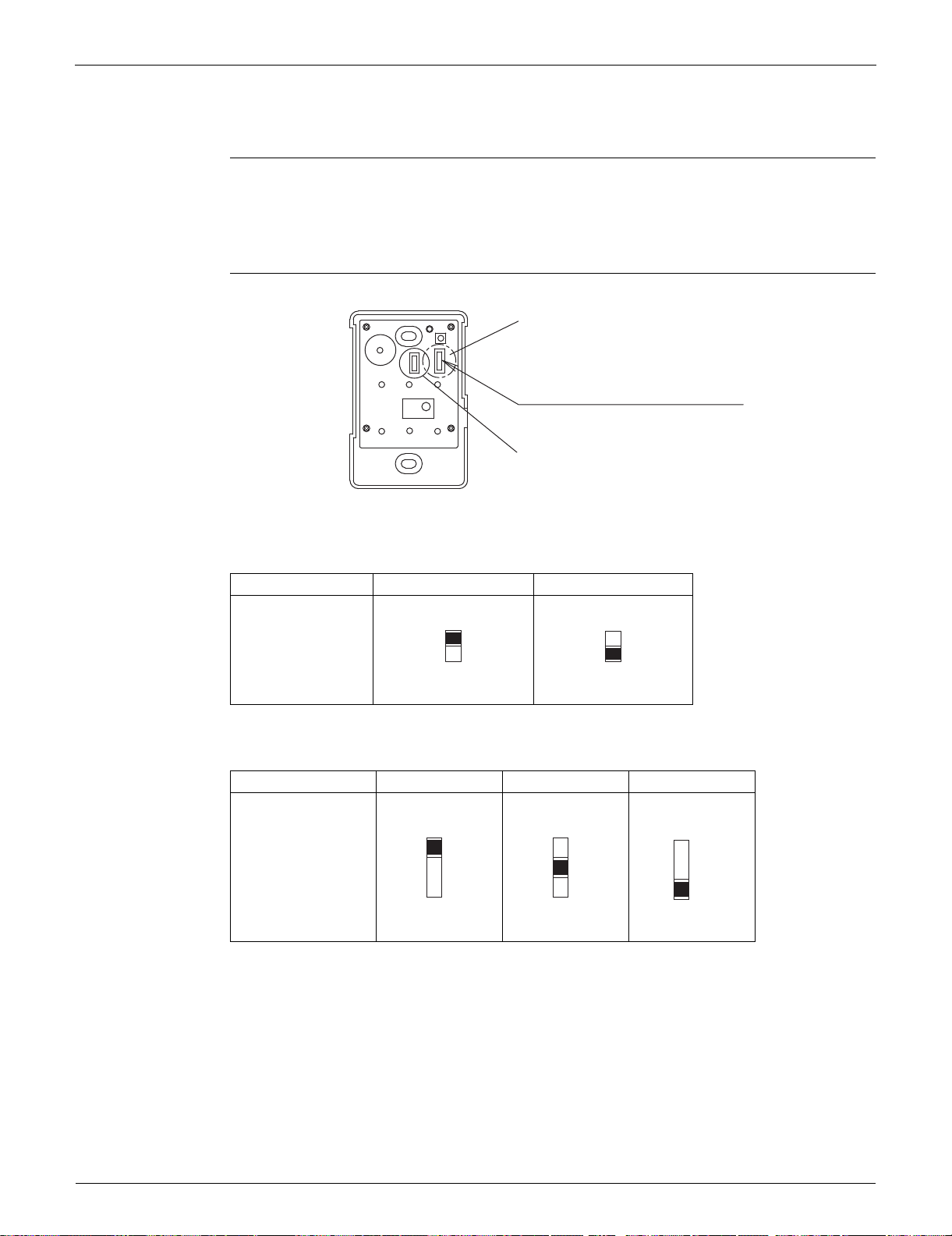
Field Settings SiUS121827E
268 Part 7 Trial Operation and Field Settings
5.2.5 MAIN/SUB and Address Setting for Wireless Remote Controller for
FDMQ Series
Outline If setting multiple wireless remote controllers to operate in one room, perform address setting
for the receiver and the wireless remote controller.
If using both a wired remote controller and a wireless remote controller with 1 indoor unit,
change the MAIN/SUB switch of the signal receiver PCB.
Signal Receiver
PCB Setting
MAIN/SUB switch
Set the MAIN/SUB setting switch (SS1) on the signal receiver PCB to SUB.
Wireless address switch
Set the address setting switch (SS2) on the signal receiver PCB according to the table below.
MAIN SUB
MAIN/SUB setting
switch (SS1)
R7000181 R7000182
No.1 No.2 No.3
Address setting
switch (SS2)
R7000183 R7000184 R7000185
Setting the receiver
(lt is factory set to “1”)
Address setting switch (SS2)
MAIN/SUB setting switch (SS1)
(R24951)
M
S
M
S
1
2
3
1
2
3
1
2
3
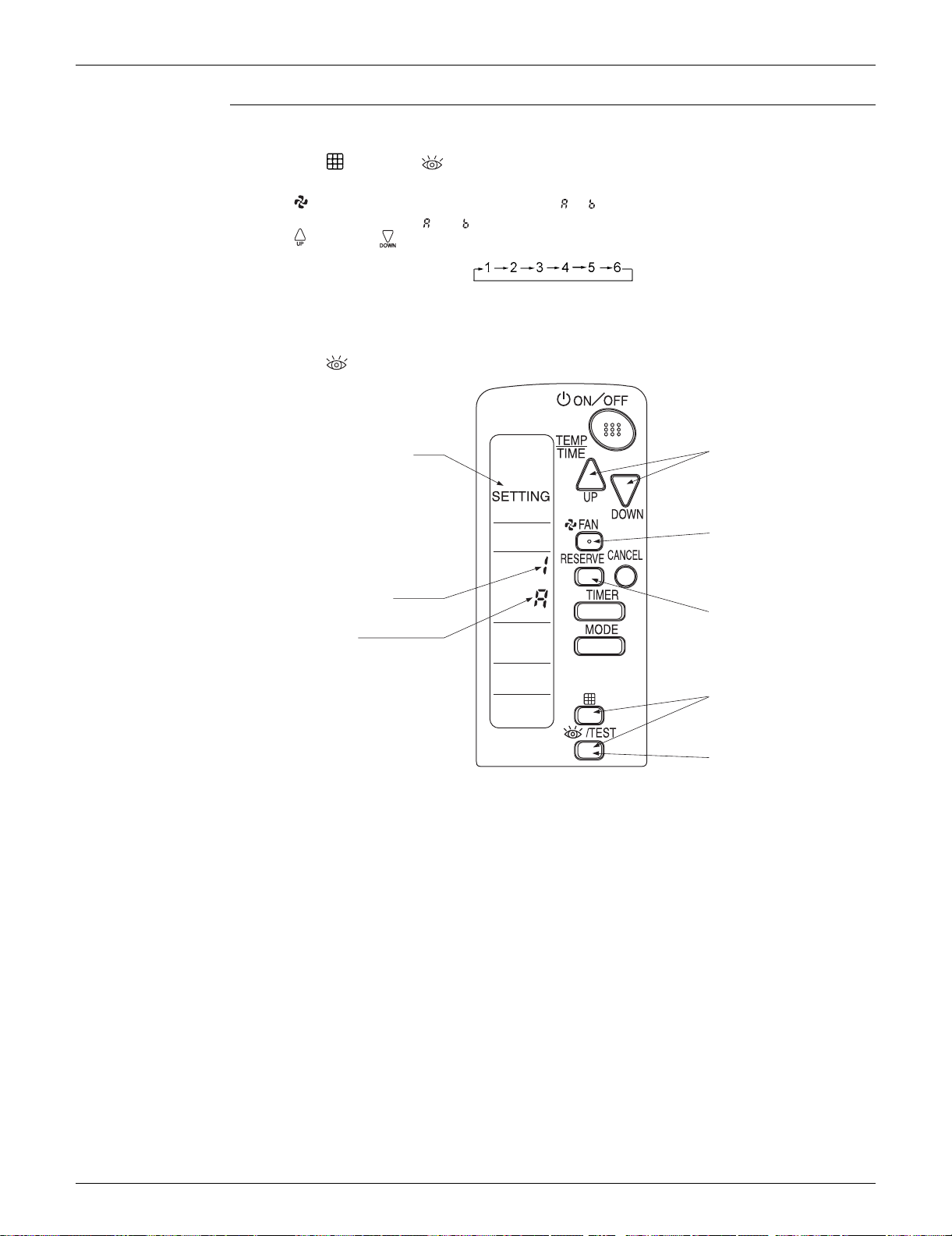
SiUS121827E Field Settings
Part 7 Trial Operation and Field Settings 269
Wireless Remote
Controller
Address
Factory set is 1. Change the wireless remote controller address setting by the following steps, if
necessary.
1. Hold down button and /TEST button at the same time for at least 4 seconds to enter the
field setting mode. (SETTING is indicated on the display).
2. Press FAN button and select display setting ( or ). Each time the button is pressed, the
display switches between and .
3. Press button and button to set the address.
Address can be set from 1 ~ 6, but set it to 1 ~ 3 and to same address as the receiver. The
receiver does not work with address 4 ~ 6.
4. Press RESERVE button to confirm the setting.
5. Hold down /TEST button to quit the field setting mode and return to the normal display.
(R25067)
Multiple setting
Address
Mode
3
2
4
1
5
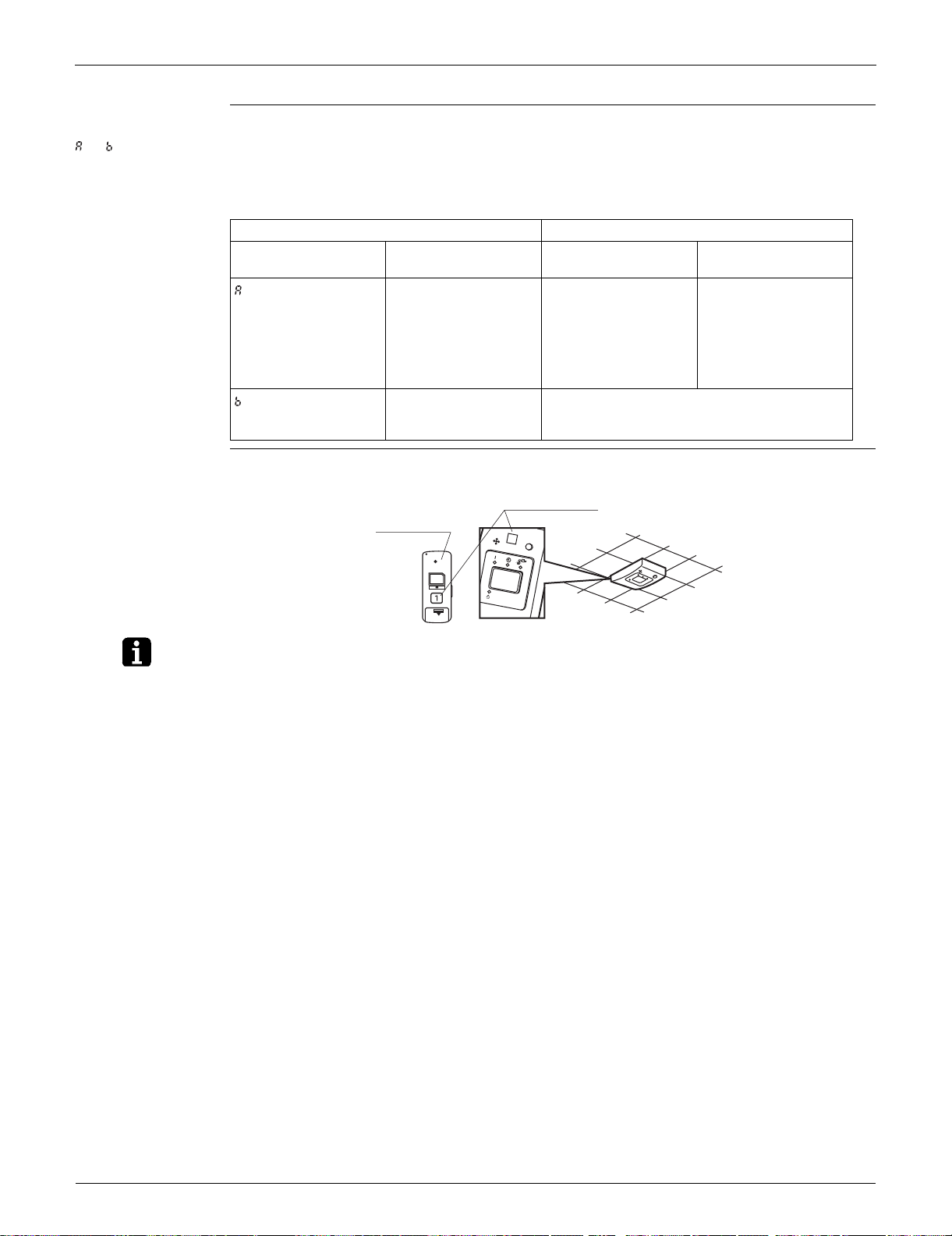
Field Settings SiUS121827E
270 Part 7 Trial Operation and Field Settings
Note(s)
Multiple Settings
or
When the indoor unit is controlled by an outside controller (central remote controller, etc.), the
indoor unit sometimes does not respond to ON/OFF command or temperature setting command
from the wireless remote controller. Check what setting the customer needs and make the multiple
setting as shown below.
After Setting Stick the Unit No. label on the receiver and the back of the wireless remote controller.
Set the Unit No. of the receiver and the wireless remote controller to be the equal. If the settings
differ, the signal from the remote controller cannot be transmitted.
Remote Controller Indoor Unit
Multiple settings Remote controller
display
To control other air
conditions and units
For other than on left
: Standard All items displayed. Commands other than
ON/OFF and
temperature setting
accepted.
(1 LONG BEEP or 3
SHORT BEEPS
emitted)
All commands
accepted.
(2 SHORT BEEPS)
: Multi System Operations remain
displayed shortly after
execution
All commands accepted. (2 SHORT BEEPS)
1
Unit No. label (5)
Wireless remote
controller (2)
(R25081)
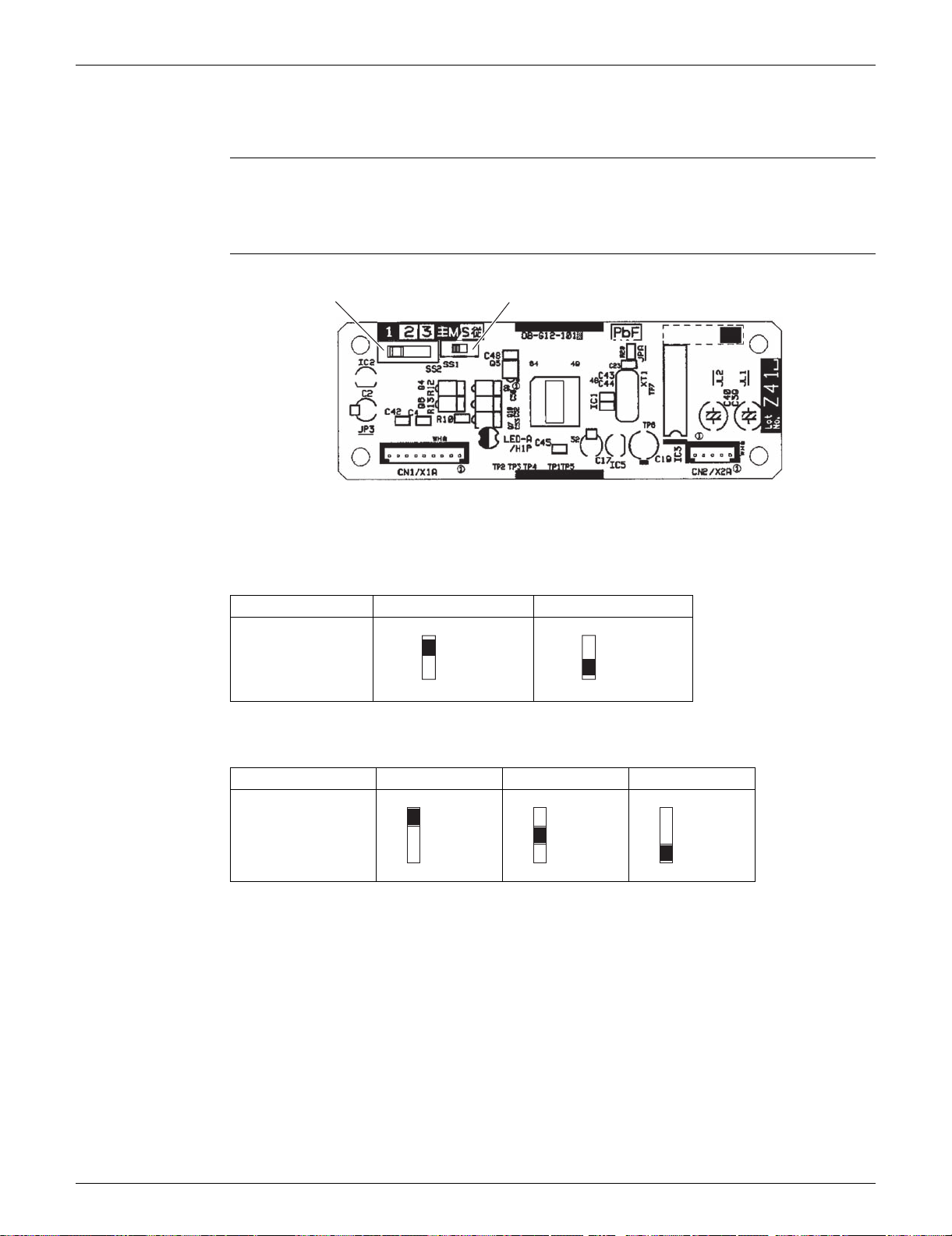
SiUS121827E Field Settings
Part 7 Trial Operation and Field Settings 271
5.2.6 MAIN/SUB and Address Setting for Wireless Remote Controller for FFQ
Series
Outline If setting multiple wireless remote controllers to operate in one room, perform address setting
for the receiver and the wireless remote controller.
If using both a wired remote controller and a wireless remote controller with 1 indoor unit,
change the MAIN/SUB switch of the transmitter board.
Transmitter
Board
MAIN/SUB switch
When using both a wired and a wireless remote controller for 1 indoor unit, the wired controller
should be set to MAIN. Therefore, set the MAIN/SUB switch (SS1) of the transmitter board to SUB.
Wireless address switch
Set the wireless address setting switch (SS2) on the transmitter board according to the table below.
MAIN SUB
MAIN/SUB setting
switch (SS1)
Unit No. No.1 No.2 No.3
Address setting
switch (SS2)
(R24374)
SS2 SS1
(R24062)
MS
(R24063)
MS
123
(S1935)
123
(S1936)
123
(S1937)
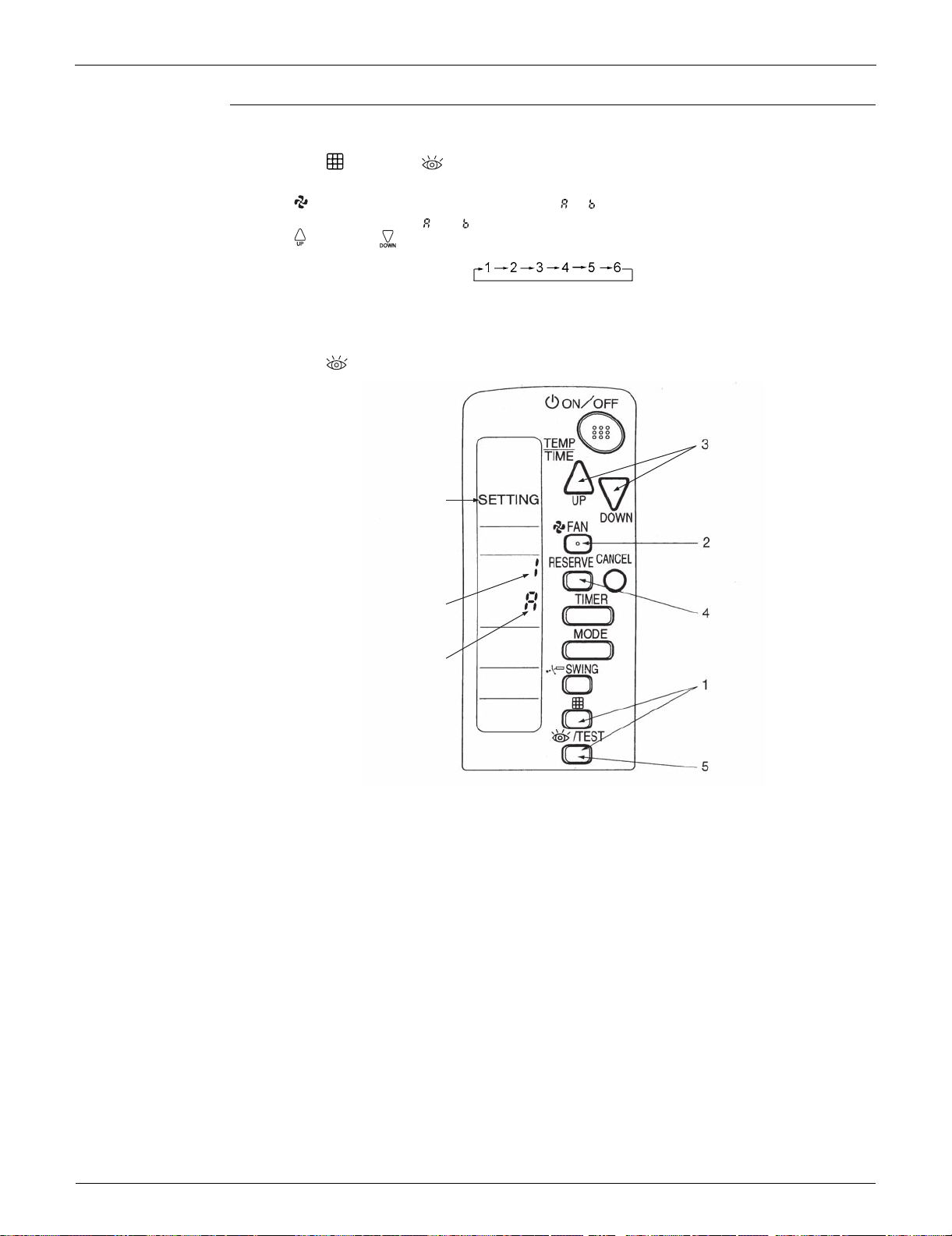
Field Settings SiUS121827E
272 Part 7 Trial Operation and Field Settings
Wireless Remote
Controller
Address
Factory set is 1. Change the wireless remote controller address setting by the following steps, if
necessary.
1. Hold down button and /TEST button at the same time for at least 4 seconds to enter the
field setting mode. (SETTING is indicated on the display).
Press FAN button and select display setting ( or ). Each time the button is pressed, the
display switches between and .
2. Press button and button to set the address.
Address can be set from 1 ~ 6, but set it to 1 ~ 3 and to same address as the transmitter board.
The transmitter board does not work with address 4 ~ 6.
3. Press RESERVE button to confirm the setting.
4. Hold down /TEST button to quit the field setting mode and return to the normal display.
Field setting mode
Address
Multiple setting
(R14401)
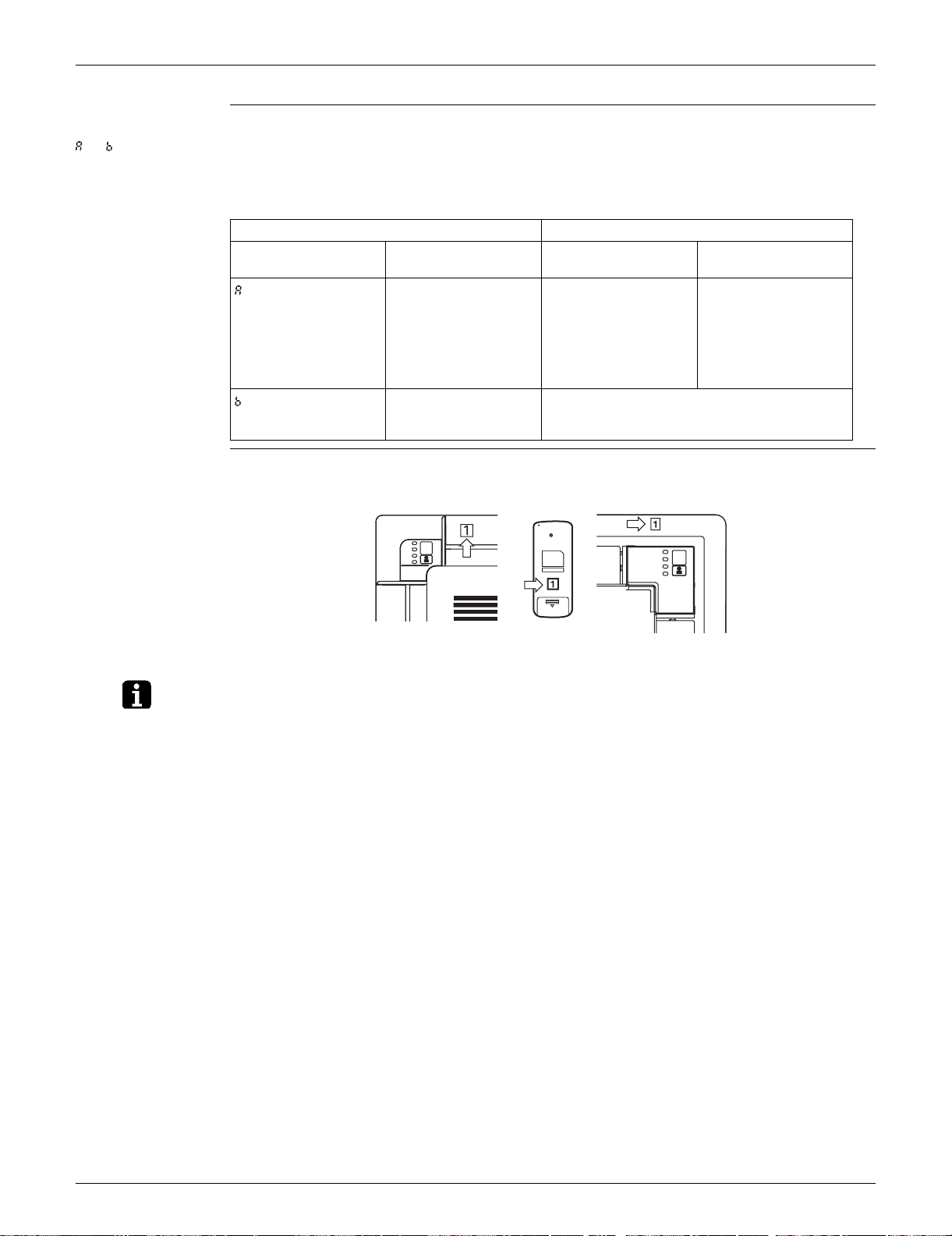
SiUS121827E Field Settings
Part 7 Trial Operation and Field Settings 273
Note(s)
Multiple Settings
or
When the indoor unit is controlled by an outside controller (central remote controller, etc.), the
indoor unit sometimes does not respond to ON/OFF command or temperature setting command
from the wireless remote controller. Check what setting the customer needs and make the multiple
setting as shown below.
After Setting Affix corresponding unit number labels onto both air outlet of the decoration panel and onto back of
the wireless remote controller.
Set the Unit No. of the receiver and the wireless remote controller to be the equal. If the settings
differ, the signal from the remote controller cannot be transmitted.
Remote Controller Indoor Unit
Multiple settings Remote controller
display
To control other air
conditions and units
For other than on left
: Standard All items displayed. Commands other than
ON/OFF and
temperature setting
accepted.
(1 LONG BEEP or 3
SHORT BEEPS
emitted)
All commands
accepted.
(2 SHORT BEEPS)
: Multi System Operations remain
displayed shortly after
execution
All commands accepted. (2 SHORT BEEPS)
(R24066)
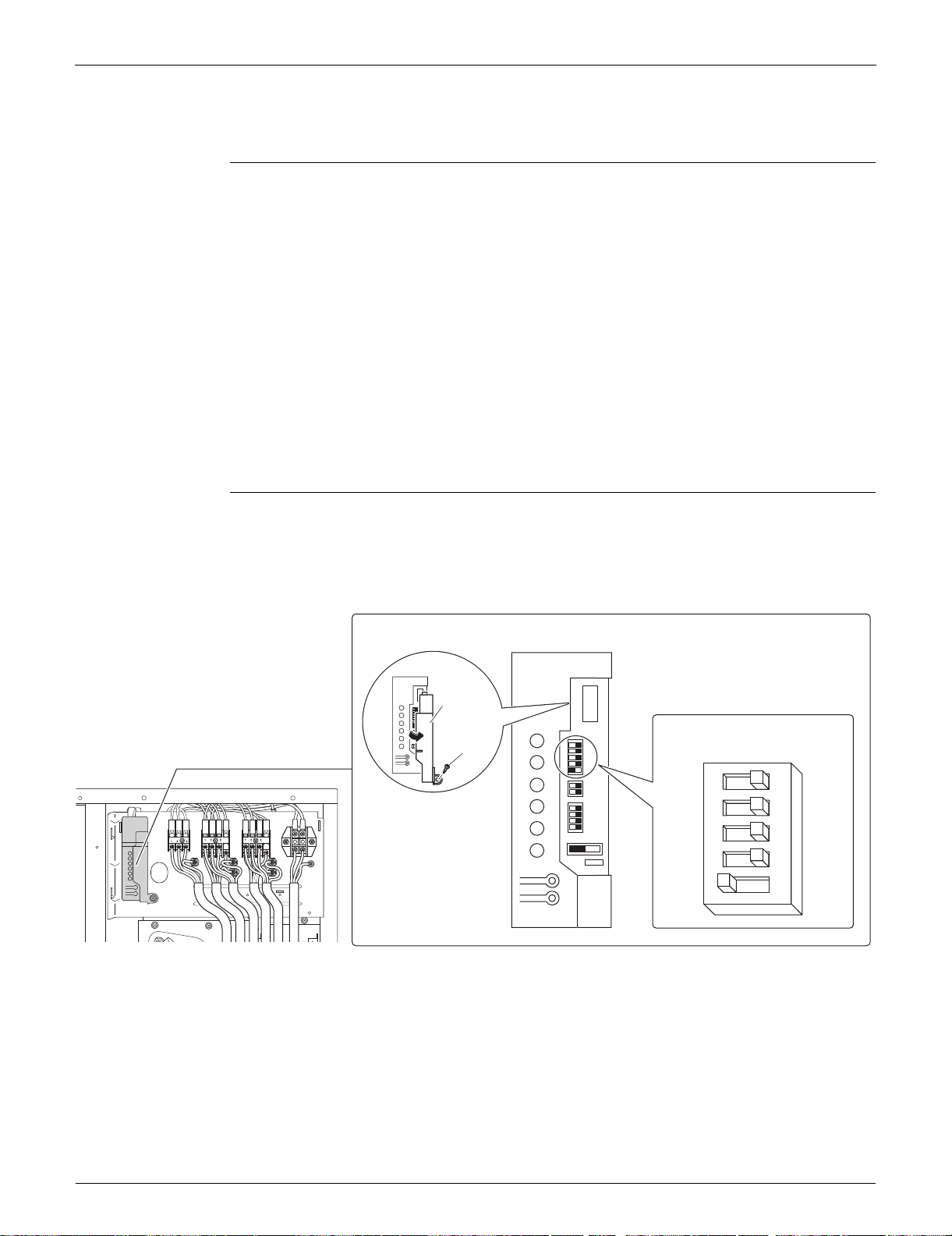
Field Settings SiUS121827E
274 Part 7 Trial Operation and Field Settings
5.3 Outdoor Unit
5.3.1 Priority Room Setting
Outline The indoor unit for which priority room setting is applied takes priority in the following cases.
Operation mode priority
The operation mode of the prioritized room takes precedence. For example, when the prioritized
indoor unit starts cooling operation, the other indoor units which have been in heating operation
enter the standby mode. Heating operation will resume if the prioritized indoor unit stops cooling
operation.
Priority during POWERFUL operation
The electronic expansion valves are controlled to provide more capacity to the prioritized room
and the capacities for the other indoor units will be slightly reduced.
OUTDOOR UNIT QUIET operation priority
When the OUTDOOR UNIT QUIET operation is selected in the prioritized room, the outdoor unit
runs quietly.
Without priority room setting, OUTDOOR UNIT QUIET operation starts only when the function is
set for all the operating indoor units.
Procedure 1. Turn the circuit breaker off before changing the setting.
2. Turn on the one of the switches of the SW4 on the service monitor PCB.
Only one room can be set as the priority room.
3. Turn the power on.
R7000218
Service monitor PCB
HEAT
COOL
4
3
2
1
2
1
E
D
C
B
A
COOL
4
3
2
1
2
1
E
D
C
B
A
Screw
Remove
the switch
cover
Priority room setting switch (SW4)
ON OFF
E
D
C
B
A
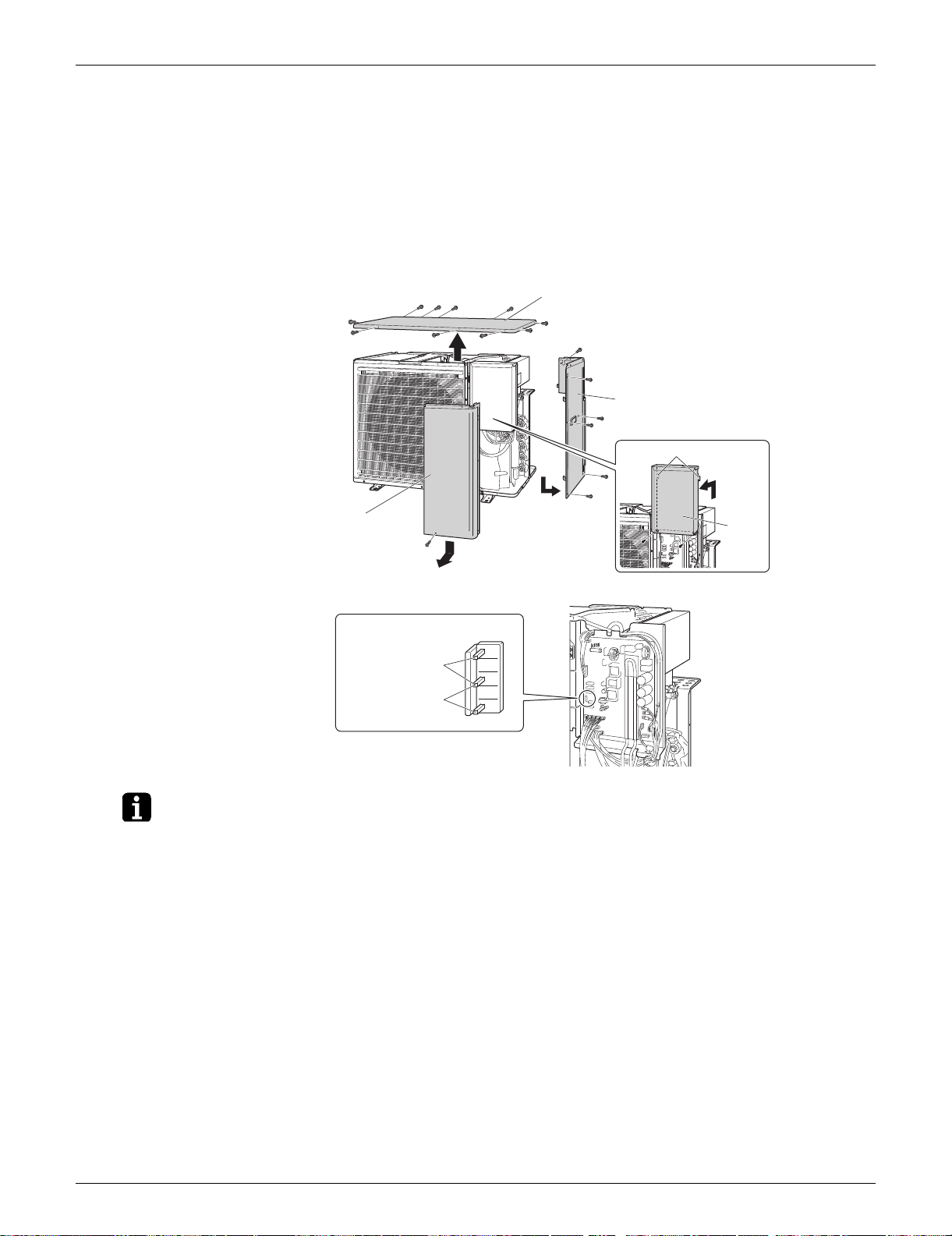
SiUS121827E Field Settings
Part 7 Trial Operation and Field Settings 275
Note(s)
5.3.2 COOL/HEAT Mode Lock
Use the S15 connector to set the unit to cooling only or heating only.
Setting to heating only (H): short-circuit the pins 1 and 3 of the connector S15.
Setting to cooling only (C): short-circuit the pins 3 and 5 of the connector S15.
The following specifications apply to the connector housing and pins.
JST products:
Housing: VHR-5N
Pin: SVH-21T-1, 1
R7000163
Forced operation is also possible in cooling/heating mode
Top panel
Right side panel
Shield
plate
Front panel
Hooks
HEAT mode (H)
COOL mode (C)
S15 connector
5
3
1
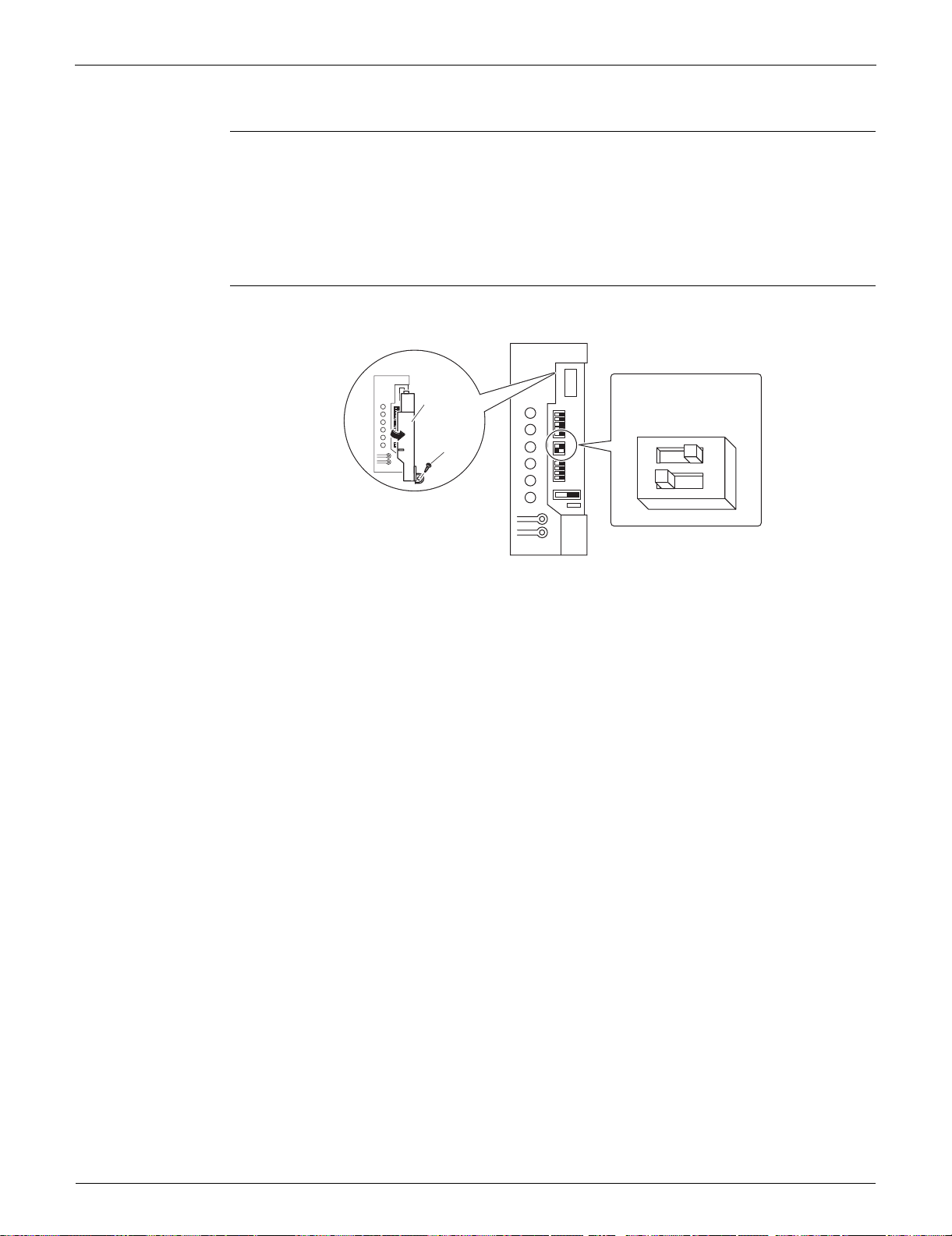
Field Settings SiUS121827E
276 Part 7 Trial Operation and Field Settings
5.3.3 NIGHT QUIET Mode
Outline If NIGHT QUIET mode is to be used, initial settings must be made when the unit is installed.
Explain the function of NIGHT QUIET mode, as described below, to the customer, and confirm
whether or not the customer wants to use NIGHT QUIET mode.
NIGHT QUIET mode function reduces operating noise of the outdoor unit at nighttime. This function
is useful if the customer is worried about the effects of the operating noise on the neighbors.
However, if NIGHT QUIET mode is running, cooling capacity is reduced.
Procedure Turn on the SW6-1 on the service monitor PCB of the outdoor unit.
Service monitor PCB
HEAT
COOL
4
3
2
1
2
1
E
D
C
B
A
2
1
ON OFF
COOL
4
3
2
1
2
1
E
D
C
B
A
Screw
Remove
the switch
cover.
Night Quiet mode
setting switch
(SW6-1)
(R22008)
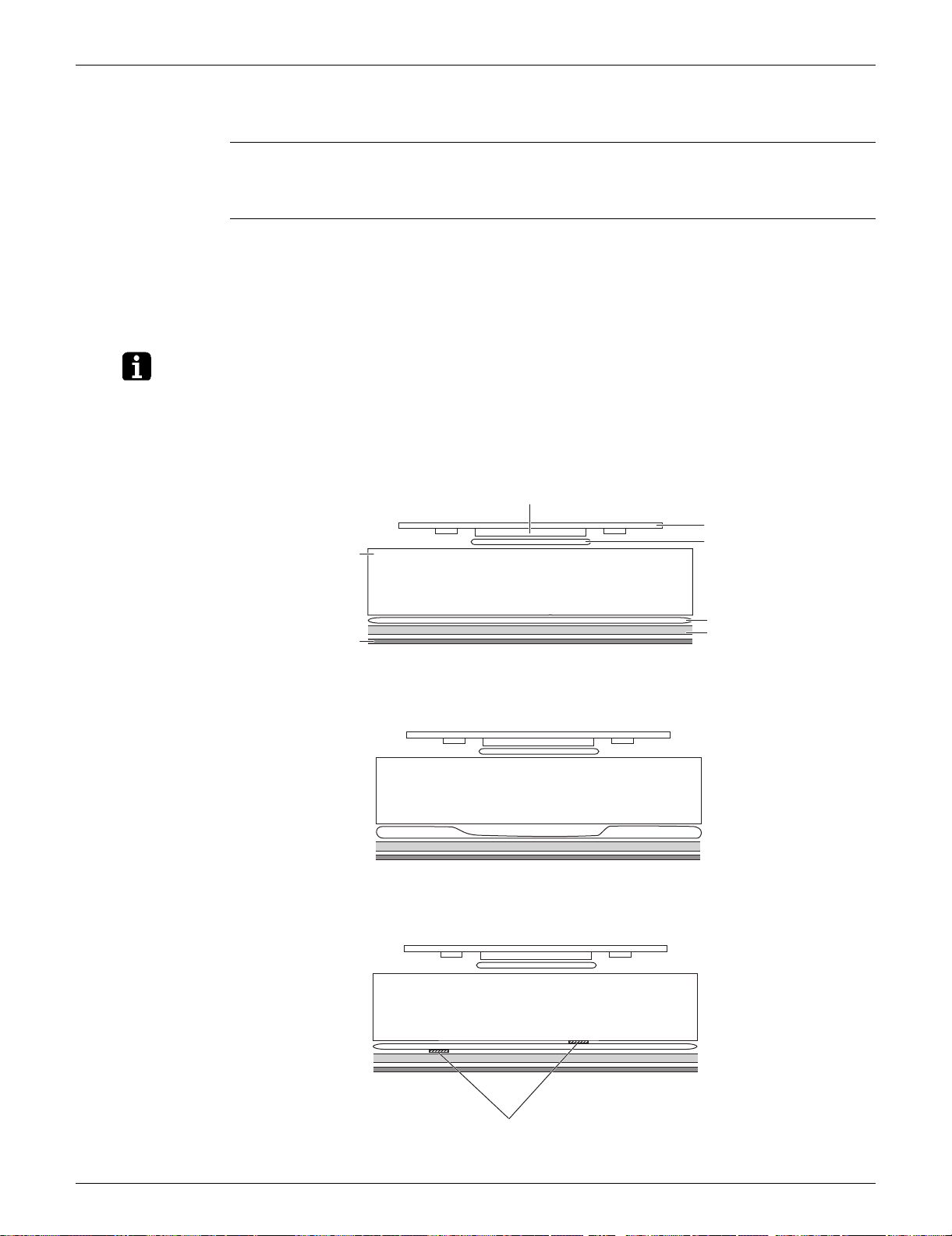
SiUS121827E Silicone Grease on Power Transistor/Diode Bridge
Part 7 Trial Operation and Field Settings 277
Note(s)
6. Silicone Grease on Power Transistor/Diode Bridge
Outline Apply the specified silicone grease to the heat radiation part of a power transistor/diode bridge
when you replace an outdoor unit PCB. The silicone grease encourages the heat radiation of a
power transistor/diode bridge.
Details 1. Wipe off the old silicone grease on the refrigerant pipe completely.
2. Apply the silicone grease on the heat sink evenly. See the illustrations below for examples of
application.
3. Tighten the screws of cover.
4. Make sure that the heat radiation parts are firmly contacted to refrigerant pipe.
Smoke emission may be caused by bad heat radiation when the silicone grease is not appropriately
applied.
OK: Evenly applied
R7000168
NG: Not evenly applied
R7000158
NG: Foreign matter is stuck.
R7000159
Power transistor
(or diode bridge)
Silicone grease
Silicone grease,
which you do not
need to apply.
Heat sink
PCB
Refrigerant pipe
Cover
Foreign matter

SiUS121827E
278 Part 8 Appendix
1. Piping Diagrams......................................................................................279
1.1 Indoor Unit................................................................................................ 279
1.2 Outdoor Unit ............................................................................................. 282
2. Wiring Diagrams......................................................................................283
2.1 Indoor Unit................................................................................................ 283
3. Outdoor Unit............................................................................................290
4. Operation Limit........................................................................................292
Part 8
Appendix
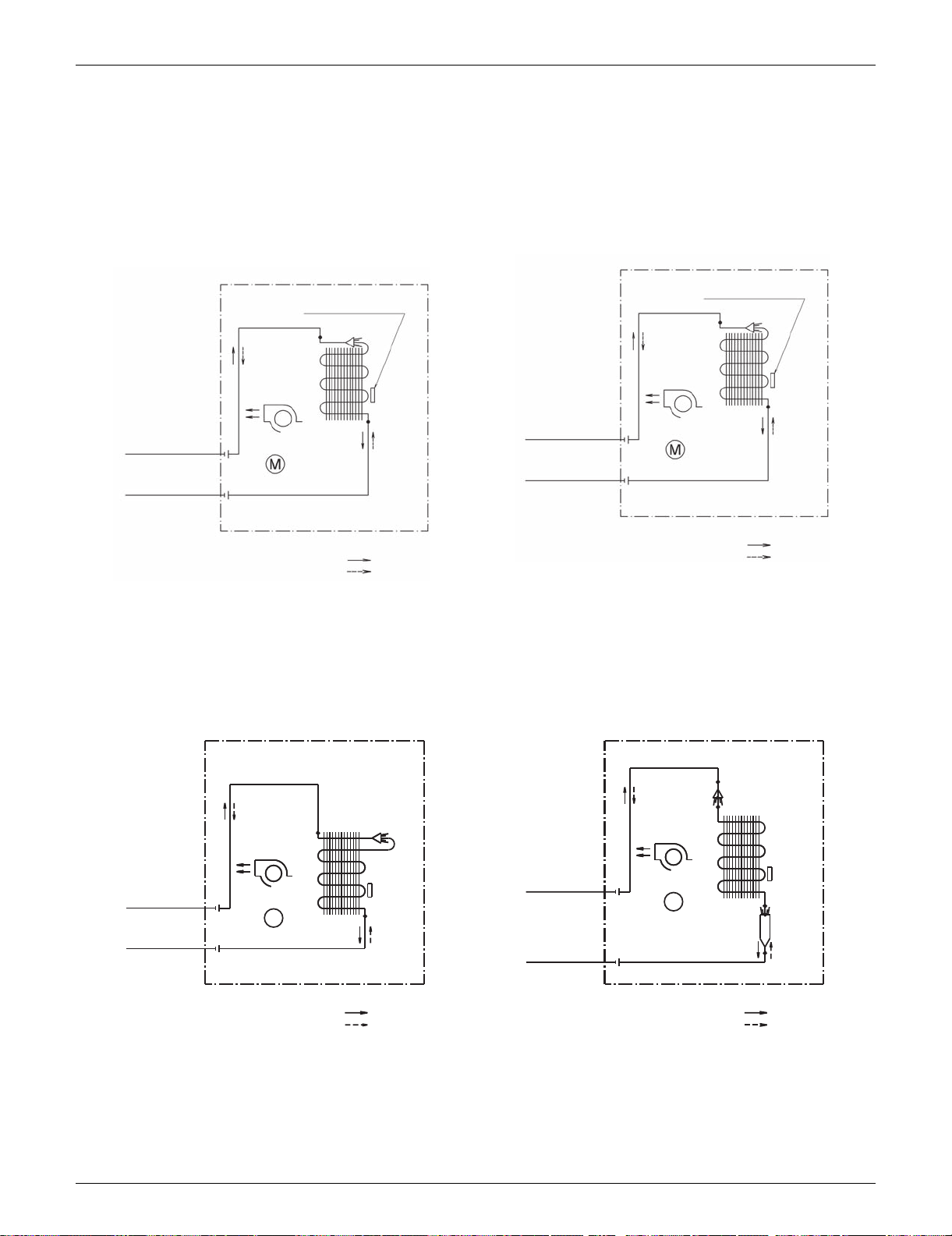
SiUS121827E Piping Diagrams
Part 8 Appendix 279
1. Piping Diagrams
1.1 Indoor Unit
FTXR09/12TVJUW(S), CTXG09/12QVJUW(S) FTXR18TVJUW(S), CTXG18QVJUW(S)
CTXS07LVJU, FTXS09/12LVJU FTXS15/18LVJU
Indoor unit
1/4 CuT
3/8 CuT
Heat exchanger thermistor
Heat exchanger
Cross flow fan
Fan motor
Field piping
3/8 CuT
Field piping
1/4 CuT
Refrigerant flow
Cooling
Heating
4D101008A
Indoor unit
1/4 CuT
3/8 CuT
Heat exchanger thermistor
Heat exchanger
Cross flow fan
Fan motor
Field piping
1/2 CuT
Field piping
1/4 CuT
Refrigerant flow
Cooling
Heating
4D101010A
INDOOR UNIT
1/4 CuT
HEAT EXCHANGER
CROSS FLOW FAN
FIELD PIPING
1/4 CuT
M
FAN MOTOR
FIELD PIPING
3/8 CuT
3/8 CuT
REFRIGERANT FLOW
COOLING
HEATING
4D074606
THERMISTOR
ON HEAT EXCH.
INDOOR UNIT
5/16 CuT
DISTRIBUTOR
HEAT EXCHANGER
CROSS FLOW FAN
M
FAN MOTOR
HEADER
1/2 CuT
REFRIGERANT FLOW
COOLING
HEATING
THERMISTOR
ON HEAT EXCH.
FIELD PIPING
1/4 CuT
FIELD PIPING
1/2 CuT
4D074609
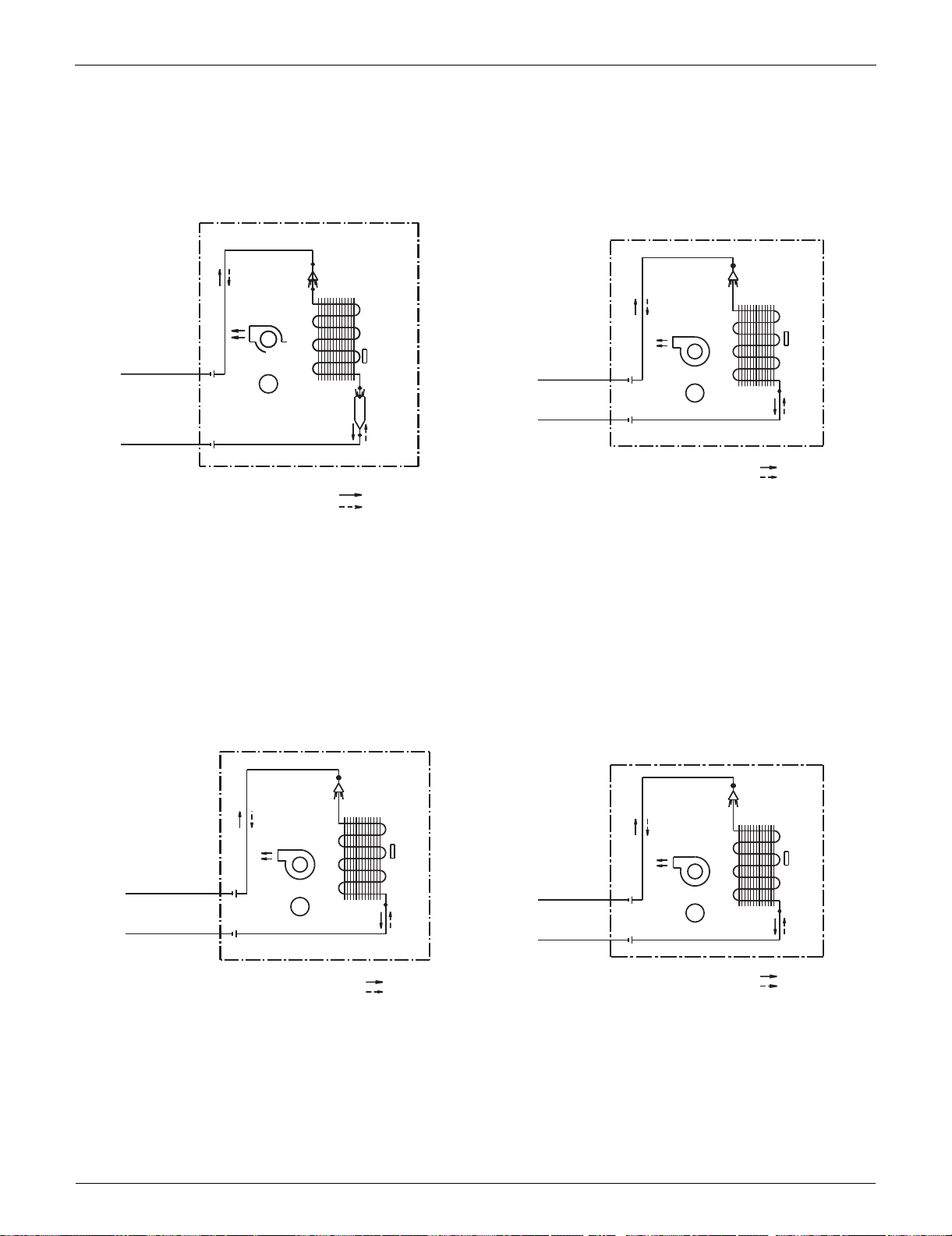
Piping Diagrams SiUS121827E
280 Part 8 Appendix
FTXS24LVJU FDXS09/12LVJU
CDXS15/18LVJU CDXS24LVJU
INDOOR UNIT
5/16 CuT
DISTRIBUTOR
HEAT EXCHANGER
CROSS FLOW FAN
M
FAN MOTOR
HEADER
1/2 CuT
REFRIGERANT FLOW
COOLING
HEATING
FIELD PIPING
1/4 CuT
FIELD PIPING
5/8 CuT
THERMISTOR
ON HEAT EXCH.
4D074608
INDOOR UNIT
(1/4CuT)
HEAT EXCHANGER
FIELD PIPING
(1/4CuT)
SIROCCO FAN
M
FAN MOTOR
(3/8CuT)
FIELD PIPING
(3/8CuT)
REFRIGERANT FLOW
COOLING
HEATING
4D074621A
THERMISTOR
ON HEAT EXCH.
INDOOR UNIT
(1/4 (6.4mm) CuT)
HEAT EXCHANGER
FIELD PIPING
(1/4 (6.4mm) CuT)
SIROCCO FAN
M
FAN MOTOR
FIELD PIPING
(1/2 (12.7mm) CuT)
(1/2 (12.7mm) CuT)
REFRIGERANT FLOW
COOLING
HEATING
4D075271
THERMISTOR
ON HEAT
EXCH.
INDOOR UNIT
(
3/8CuT
)
HEAT EXCHANGER
SIROCCO FAN
M
FAN MOTOR
(
1/2CuT
)
REFRIGERANT FLOW
COOLING
HEATING
FIELD PIPING
(
1/4CuT
)
FIELD PIPING
(
5/8CuT
)
THERMISTOR
ON HEAT
EXCH.
4D080593
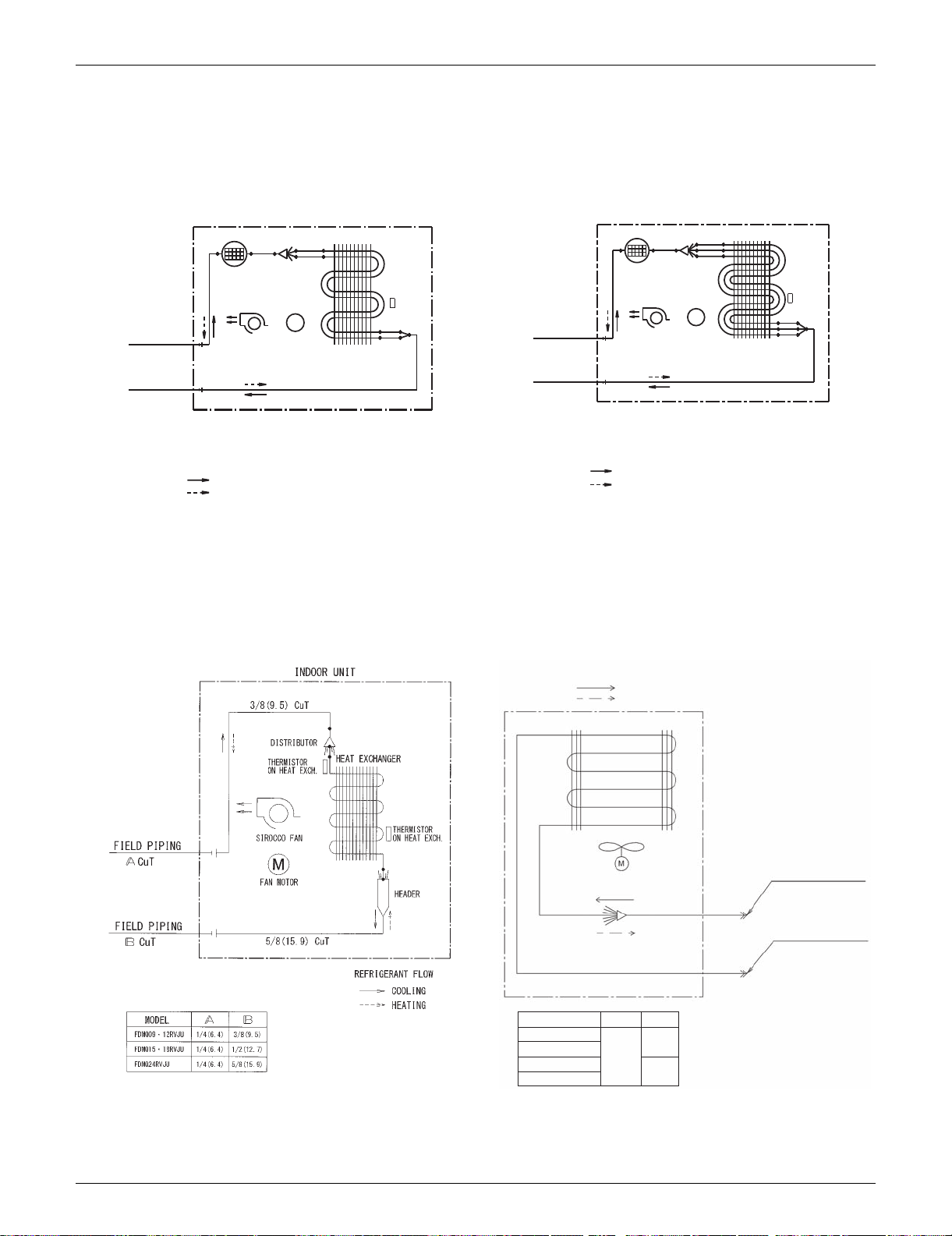
SiUS121827E Piping Diagrams
Part 8 Appendix 281
FVXS09/12NVJU FVXS15/18NVJU
FDMQ09/12/15/18/24RVJU FFQ09/12/15/18Q2VJU
INDOOR UNIT
MUFFLER ASSY HEAT EXCHANGER
1/4 CuT
9/32 CuT
1/4 CuT
1/4 CuT
1/4 CuT
M
FAN MOTORTURBO FAN
1/4 CuT
3/8 CuT
FIELD PIPING
(1/4 CuT)
FIELD PIPING
(3/8 CuT)
THERMISTOR
REFRIGERANT FLOW
COOLING
HEATING
4D091794
INDOOR UNIT
MUFFLER ASSY HEAT EXCHANGER
1/4 CuT
9/32 CuT
1/4 CuT
1/4 CuT
1/4 CuT
1/4 CuT
M
1/4 CuT
FAN MOTORTURBO FAN
1/4 CuT
3/8 CuT
REFRIGERANT FLOW
COOLING
HEATING
FIELD PIPING
(
1/4 CuT
)
FIELD PIPING
(
1/2 CuT
)
THERMISTOR
ON HEAT EXCH.
4D091795A
4D112974
4D106033
HEAT EXCHANGER
FAN
REFRIGERANT FLOW
COOLING
HEATING
FFQ09Q2VJU 1/4 (6.4)
3/8 (9.5)
1/2 (12.7)
FFQ12Q2VJU
FFQ15Q2VJU
FFQ18Q2VJU
MODEL A B
LIQUID PIPE
CONNECTION PORT
φA
GAS PIPE
CONNECTION PORT
φB
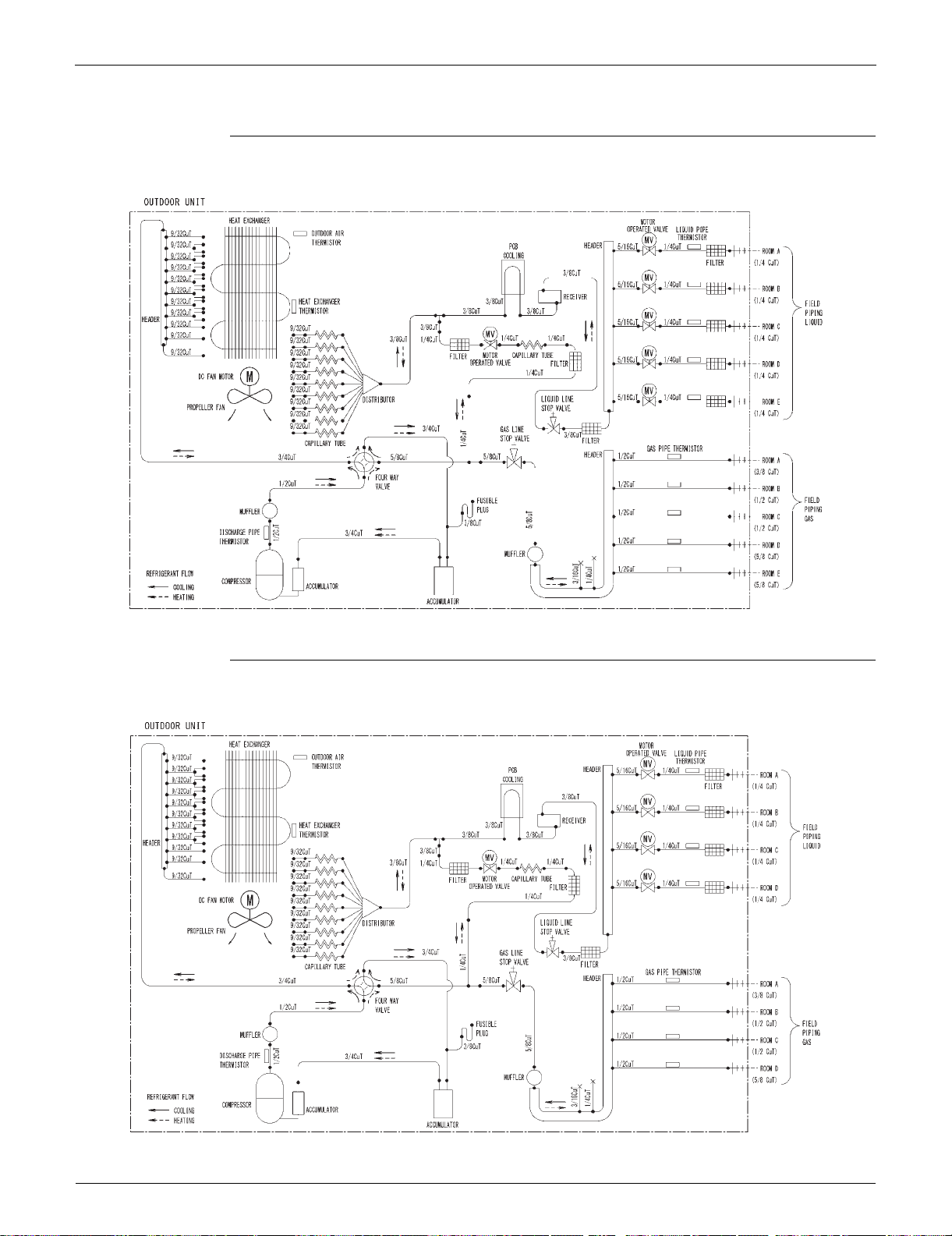
Piping Diagrams SiUS121827E
282 Part 8 Appendix
1.2 Outdoor Unit
5MXS48TVJU
4MXL36TVJU
3D117817
3D118311
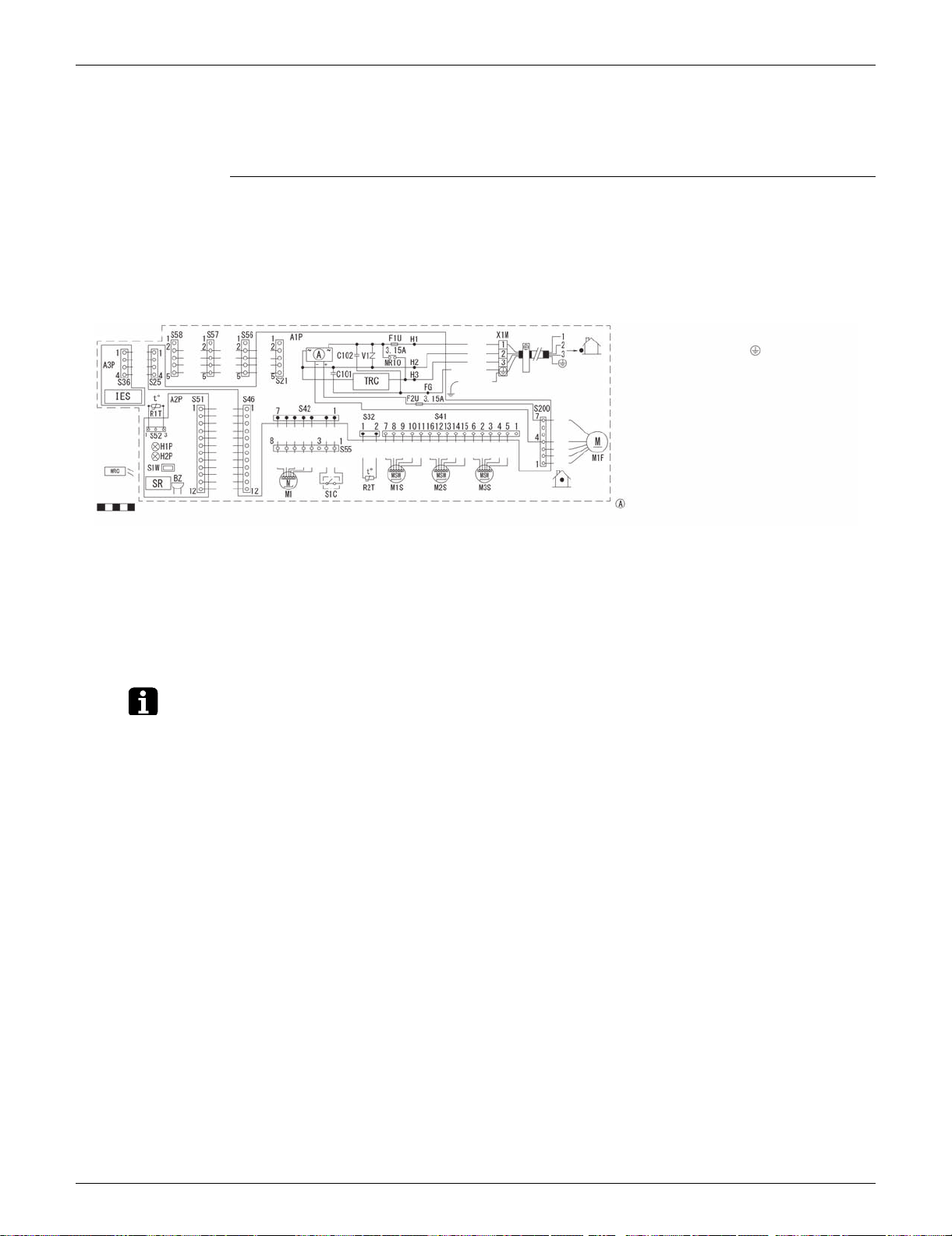
SiUS121827E Wiring Diagrams
Part 8 Appendix 283
Note
2. Wiring Diagrams
2.1 Indoor Unit
FTXR09/12/18TVJUW(S), CTXG09/12/18QVJUW(S)
A1P: Control PCB
A2P: Display/signal receiver PCB
A3P: INTELLIGENT EYE sensor PCB
Refer to page 37 for Printed Circuit Board Connector Wiring Diagram.
3D103375A
BLK
BLK
BLK
BLK
BLK
BLK
BLK
BLK
BLK
BLK
BLK
BLK
BLK
BLK
BLK
BLK
BLK
BLK
BLK
BLK
RED
ORG
YLW
PNK
BLU
RED
ORG
YLW
PNK
BLU
RED
ORG
YLW
BLU
PNK
BLK
BLK
BLK
BLK
BLK
BLK
BLK
BLK
BLK
BLK
BLK
BLK
BLK
BLK
BLK
BLK
BLK
BLK
BLK
BLK
BLK
WHT
RED
BLU
BRN
ORG
WHT
RED
GRN/YLW
GRN/YLW
RED
ORG
YLW
BLU
OUTDOOR
INDOOR
Field wiring
NOTE When the main power is turned off and then back on again, operation will resume automatically.
Wiring diagram
FG
F1U, F2U
H1P, H2P
R1T, R2T
S25-S200
S1W
S1C
X1M
BZ
M1F
M1S-M3S
M1
A1P-A3P
TRC
WRC
IES
SR
H1-H3
MR10
V1
C101, C102
: Frame ground
: Fuse
: Pilot lamp
: Thermistor
: Connector
: Operation switch
: Limit switch
: Terminal strip
: Buzzer
: Fan motor
: Swing motor
: Stepper motor
: Printed circuit board
: Transmission circuit
: Wireless remote control
: Intelligent Eye sensor
: Rectifier
: Signal receiver
: Ground
: Harness
: Magnetic relay
: Varistor
: Capacitor

Wiring Diagrams SiUS121827E
284 Part 8 Appendix
Note
CTXS07LVJU, FTXS09/12LVJU
PCB1: Control PCB
PCB2: Signal receiver PCB
PCB3: Display PCB
PCB4: INTELLIGENT EYE sensor PCB
Refer to page 39 for Printed Circuit Board Connector Wiring Diagram.
1
X1M
PCB1
PCB3
S46
S49
2
H1
BLK
1
1
BLK
1
3
~
BLK
3.15A
WHT
OUTDOOR
2
BLK
C102
V1
BLK
RED
3
-
H2
MR10
BLK
GRN
BLK
FIELD WIRING.
BLK
C101
BLK
H3
99
BLK
FG
SW1
S21
t°
S1
HA
7
RED
BZ
4
BLU
S25
BRN
BLK
11PCB4
ORG
BLK
S26
BLK
1
WHT
S41S47 S32
4
4
BLK
M1F
1216 2
231
136113
1
415 9 114 58710
BLK
BLK
BLK
BLK
BLK
PNK
PNK
PNK
BLU
BLU
BLU
ORG
ORG
ORG
RED
RED
RED
YLW
YLW
YLW
S48
PCB2
t°
1 3
INDOOR
R2T
MSW MSWMSW
M3SM2SM1S
LED1
H1P
LED2
H2P
LED3
H3P
RTH1
R1T
INTELLIGENT EYE
SENSOR
WIRELESS
REMOTE
CONTROLLER
SIGNAL
RECEIVER
TRANSMISSION
CIRCUIT
FU1
F1U
MS
3
~
GRN/YLW
CAUTION
NOTE THAT OPERATION WILL RESTART
AUTOMATICALLY IF THE MAIN POWER SUPPLY
IS TURNED OFF AND THEN BACK ON AGAIN.
BZ
C101, C102
FG
F1U
H1P~H3P
MR10
M1F
M1S~M3S
PCB1~PCB4
R1T, R2T
S1~S49
SW1
V1
X1M
: BUZZER
: CAPACITOR
: FRAME GROUND
: FUSE
: PILOT LAMP
: MAGNETIC RELAY
: FAN MOTOR
: SWING MOTOR
: PRINTED CIRCUIT BOARD
: THERMISTOR
: CONNECTOR
: OPERATION SWITCH
: VARISTOR
: TERMINAL STRIP
: PROTECTIVE GROUND
C: 3D058246L
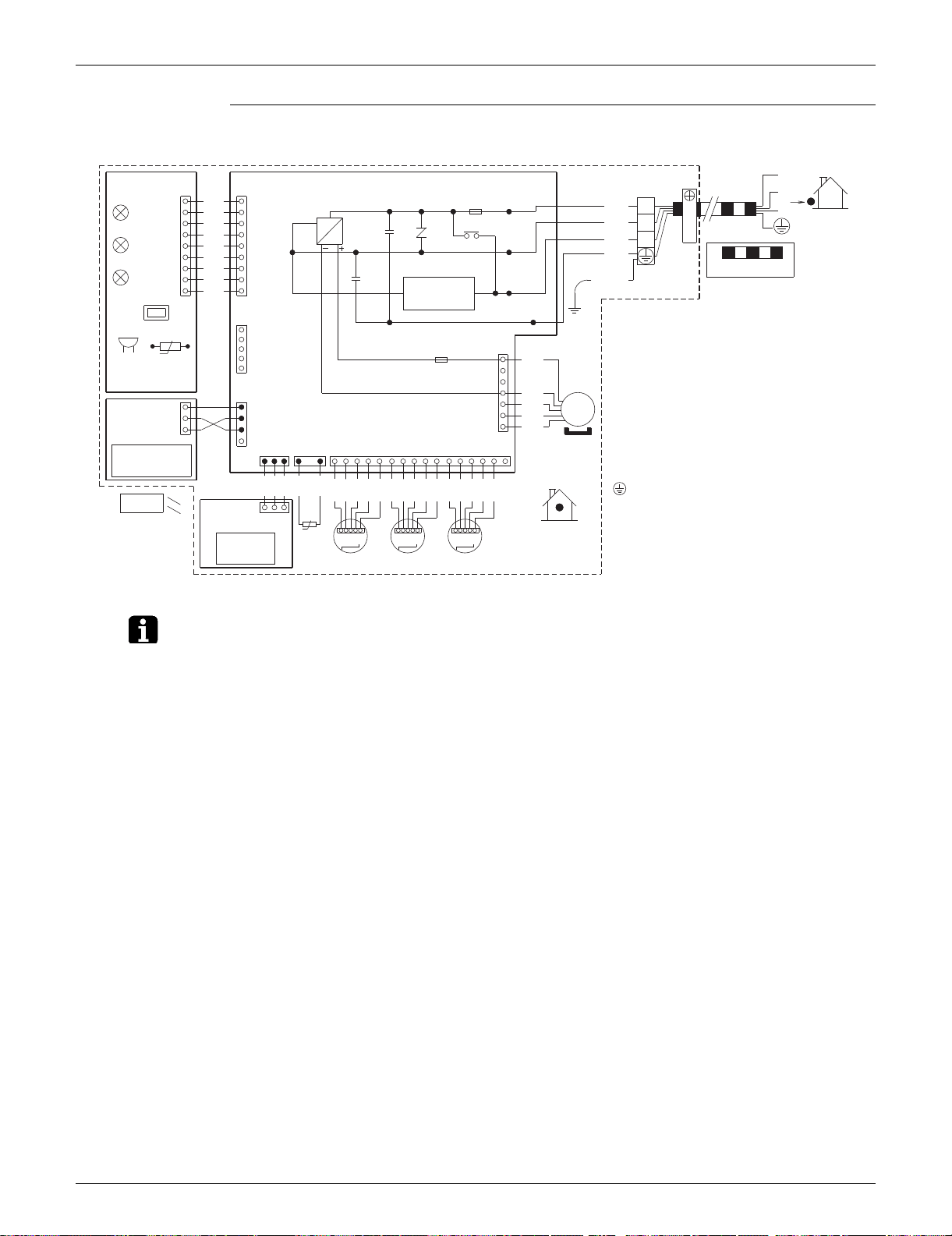
SiUS121827E Wiring Diagrams
Part 8 Appendix 285
Note
FTXS15/18/24LVJU
PCB1: Control PCB
PCB2: Signal receiver PCB
PCB3: Display PCB
PCB4: INTELLIGENT EYE sensor PCB
Refer to page 41 for Printed Circuit Board Connector Wiring Diagram.
C: 3D060942U
1
X1M
PCB1
PCB3
S46
S49
2
H1
BLK
11
BLK
1
LED1
3
~
BLK
3.15A
H1P
WHT
OUTDOOR
2
BLK
C102
V1
BLK
LED2
RED
3
-
H2
MR10
BLK
GRN
H2P
BLK
FIELD WIRING.
BLK
LED3
GRN
C101
BLK
/
H3
YLW
H3P
99
BLK
CAUTION
FG
SW1
S21
t°
S1
HA
7
RED
RTH1
BZ
3.15A
R1T
4
BLU
S25
BLK
BRN
1
1
PCB4
BLK
ORG
S36
1
WHT
3
S41S47 S32
BLK
4
M1F
51111162713115312 2 943141086
BLK
BLK
BLK
BLK
BLK
PNK
PNK
PNK
BLU
BLU
BLU
ORG
ORG
ORG
RED
RED
RED
YLW
YLW
YLW
S48
PCB2
t°
1
3
INDOOR
R2T
MSW MSW MSW
M3SM2S
M1S
WIRING DIAGRAM
INTELLIGENT EYE
SENSOR
WIRELESS
REMOTE
CONTROLLER
SIGNAL
RECEIVER
TRANSMISSION
CIRCUIT
MS
3~
NOTE THAT OPERATION WILL RESTART
AUTOMATICALLY IF THE MAIN POWER SUPPLY
IS TURNED OFF AND THEN BACK ON AGAIN.
BZ
C101, C102
FG
F1U, F2U
H1P~H3P
MR10
M1F
M1S~M3S
PCB1~PCB4
R1T, R2T
S1~S49
SW1
V1
X1M
: BUZZER
: CAPACITOR
: FRAME GROUND
: FUSE
: PILOT LAMP
: MAGNETIC RELAY
: FAN MOTOR
: SWING MOTOR
: PRINTED CIRCUIT BOARD
: THERMISTOR
: CONNECTOR
: OPERATION SWITCH
: VARISTOR
: TERMINAL STRIP
: PROTECTIVE GROUND
FU1
F1U
FU2
F2U
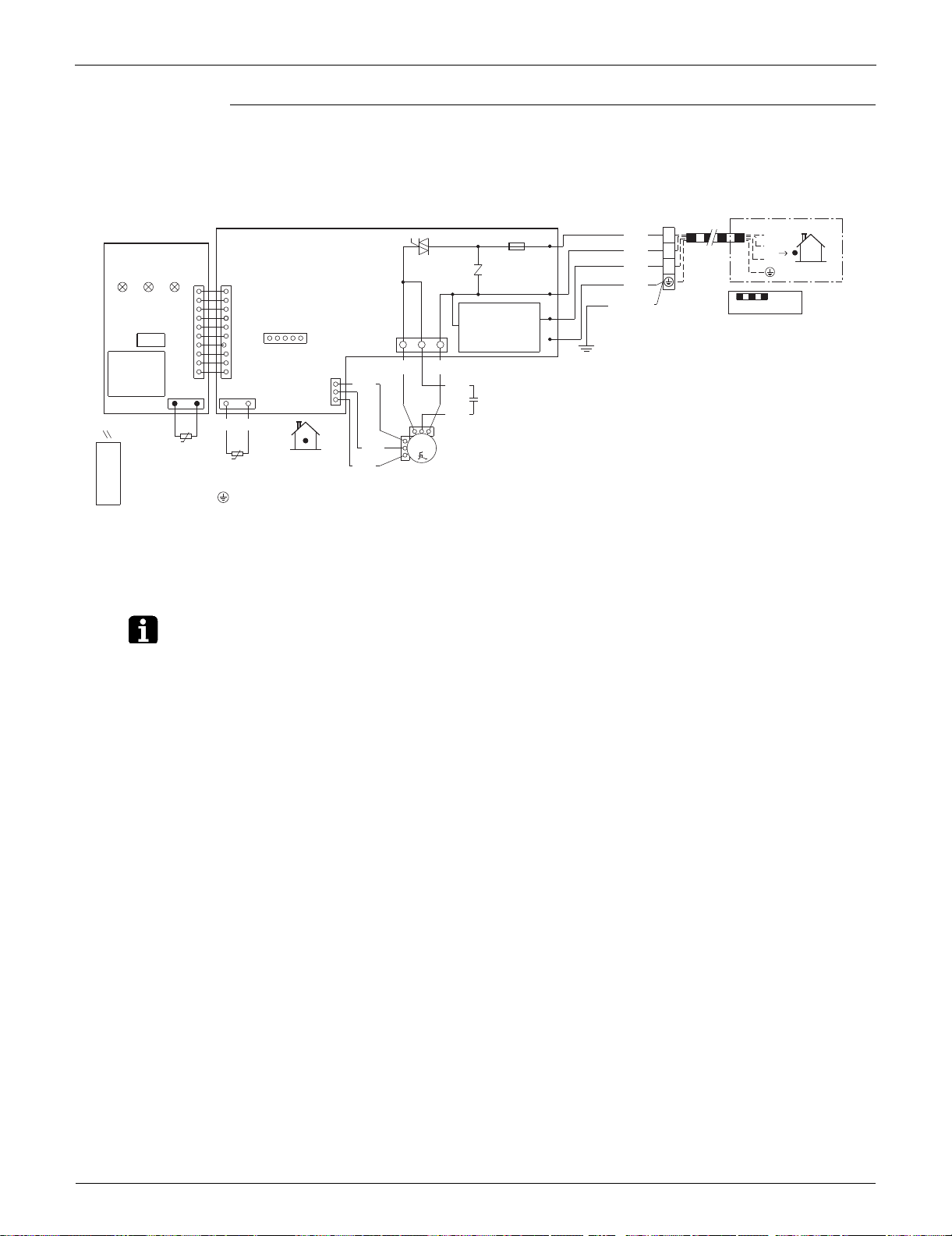
Wiring Diagrams SiUS121827E
286 Part 8 Appendix
Note
FDXS09/12LVJU, CDXS15/18/24LVJU
A1P: Control PCB
A2P: Display/signal receiver PCB
Refer to page 43 for Printed Circuit Board Connector Wiring Diagram.
X1M
A1P
11BLK
A2P
H1
2
WHT 2
F1U
3
V1TR
RED 3
OUTDOOR
3.15A
LED LED
LED
S1
S26
GRN
H2
11
FIELD WIRING.
H3PH2PH1P
GRN/YLW
H3
CAUTION
()
GND
631
S21
S1W
S1
RED BLK
S7
1010
1GRY
YLW
RTH1
S32
2121
3
C1
WHT
BRNBRN
t°
M
t°
1~
Q1M
PPL
R1T
INDOOR
130°C
(266°F)
BLU
R2T
M1F
WIRELESS
REMOTE
CONTROLLER
TRANSMISSION
CIRCUIT
NOTE THAT OPERATION WILL
RESTART AUTOMATICALLY IF
THE MAIN POWER SUPPLY IS
TURNED OFF AND THEN BACK
ON AGAIN.
H1P~H3P
M1F
A1P~A2P
Q1M
R1T~R2T
S1~S32, RTH1
S1W
V1TR
X1M
: PILOT LAMP
: FAN MOTOR
: PRINTED CIRCUIT BOARD
: THERMAL PROTECTOR (FOR MOTOR)
: THERMISTOR
: CONNECTOR
: OPERATION SWITCH
: TRIAC
: TERMINAL BLOCK
: PROTECTIVE GROUND
: CAPACITOR (M1F)
: FUSE
C1
F1U
SIGNAL
RECEIVER
TERMINAL FOR
CENTRALIZED CONTROL
C: 3D073998E
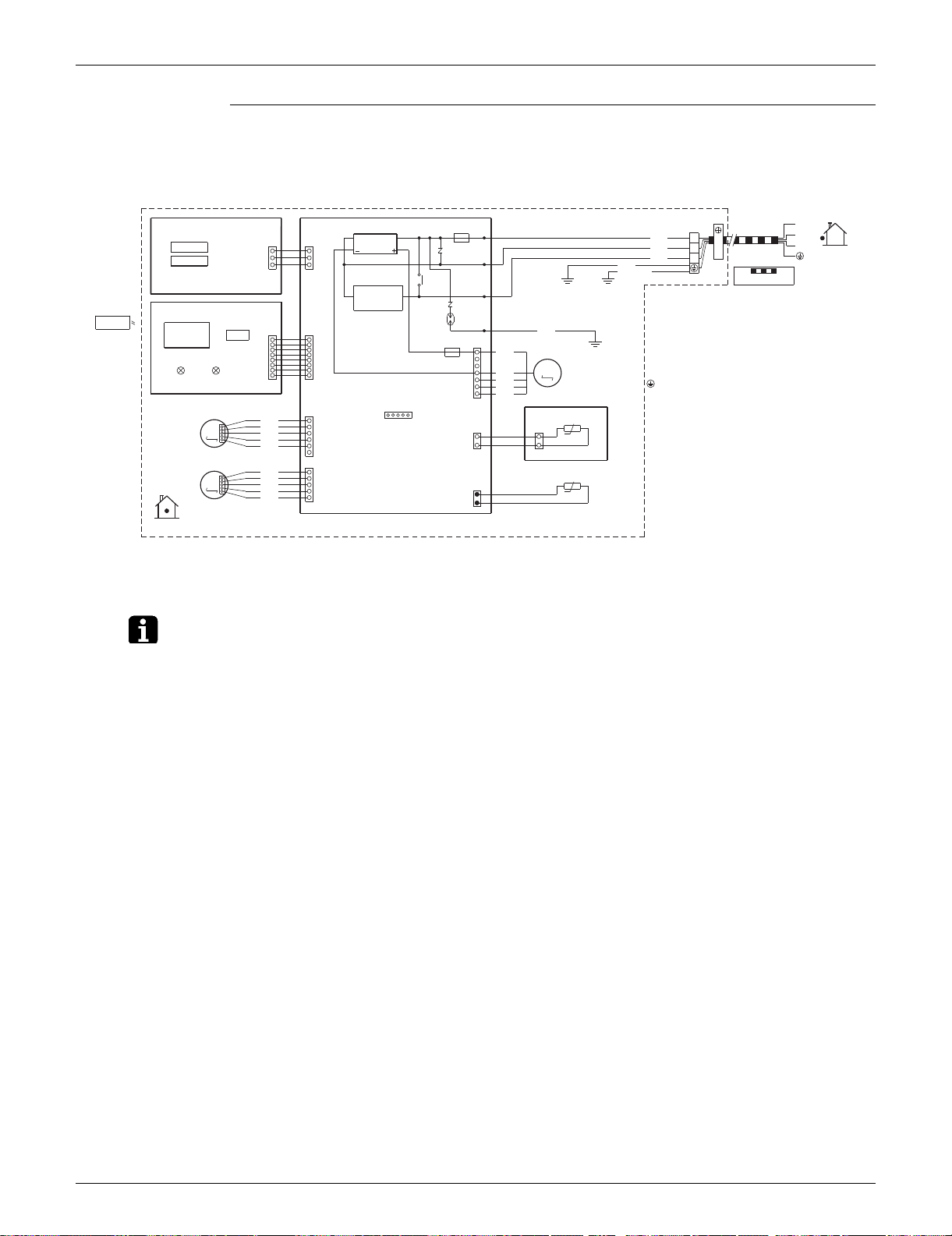
SiUS121827E Wiring Diagrams
Part 8 Appendix 287
Note
FVXS09/12/15/18NVJU
PCB1: Sensor PCB
PCB2: Control PCB
PCB3: Service PCB
PCB4: Display/signal receiver PCB
Refer to page 45 for Printed Circuit Board Connector Wiring Diagram.
1
X1M
F1U
PCB2
~~
PCB3
V1
H1
2
1
BLK
S26S27
RECTIFIER
3
3.15A
S2W
(
4
)
2
WHT
OUTDOOR
H2
RED
3
S4W
GRN
GRN/YLW
MR10
FIELD WIRING.
E3E4
H3
V2
CAUTION
PCB4
SA1
E1
S47 S46
GRN
S1W
S1
F2U
7
E3
RED
LED2
LED1
3.15A
4
M
BLU
M1F
BRN
H2P
H1P
ORG
WHT
1
S42
HAS21
t°
RED
1
ORG
S49
S48
M
YLW
M1S
PNK
R1T
BLU
6
PCB1
S41
RED
1
t°
ORG
M
YLW
S32
M2S
PNK
BLU
R2T
5
INDOOR
WIRELESS
REMOTE
CONTROLLER
SIGNAL
RECEIVER
TRANSMISSION
CIRCUIT
NOTE THAT OPERATION WILL
RESTART AUTOMATICALLY IF
THE MAIN POWER SUPPLY IS
TURNED OFF AND THEN BACK
ON AGAIN.
F1U, F2U
H1P, H2P
M1F
M1S
M2S
PCB1~PCB4
R1T, R2T
S1~S49
S1W
S2W
(
4
)
S4W
X1M
E3
E4
®
: PROTECTIVE GROUND
:
FUSE
: PILO
T LAMP
: FAN MOTOR
: SWING MOTOR
: LOWER AIR OUTLET MOTOR
: PRINTED CIRCUIT BOARD
: THERMISTOR
: CONNECTOR
: OPERATION SWITCH
: UPWARD AIR FLOW LIMIT SWITCH
: AIR OUTLET SELECTION SWITCH
: TERMINAL STRIP
: GROUND TERMINAL
(
HEAT EX.
)
: GROUND TERMINAL
(
SHIELD PLATE
)
C: 3D090604A
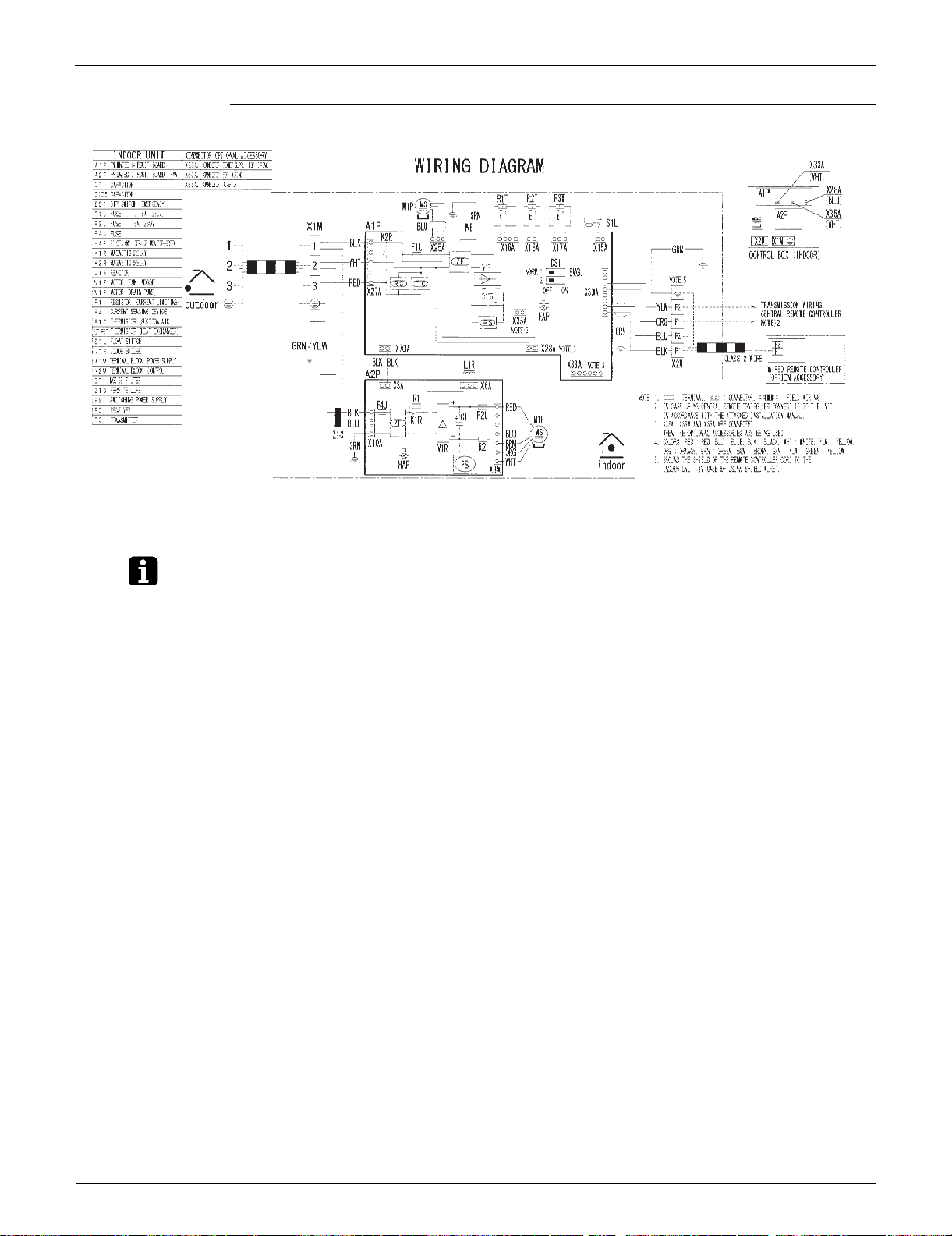
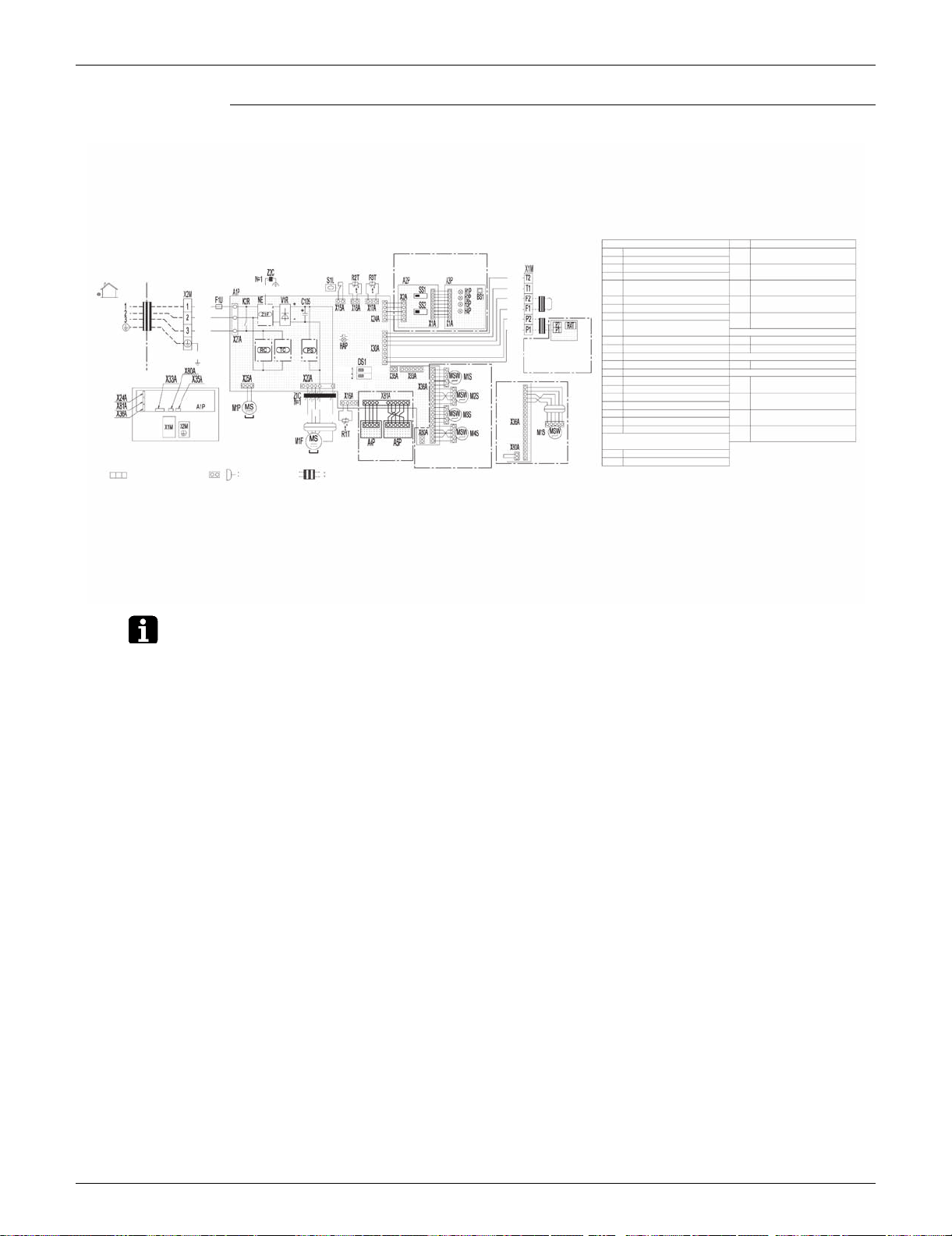
SiUS121827E Wiring Diagrams
Part 8 Appendix 289
Note
FFQ09/12/15/18Q2VJU
A1P: Control PCB
A2P: Transmitter board for wireless remote controller
A3P: Receiver for wireless remote controller
A4P: Thermopile sensor
A5P: Pyroelectric sensor
Refer to page 49 for Printed Circuit Board Connector Wiring Diagram.
WIRING DIAGRAM
CONTROL BOX
BLK
GRN/YLW
WHT
RED
OUTDOOR
GRN
NORM.
WHT
ORG
BLU
BRN
WHT
RED
OFF ON
EMG.
WIRELESS REMOTE CONTROLLER
(RECEIVER/DISPLAY UNIT)
(OPTIONAL ACCESSORY)
WIRED REMOTE CONTROLLER
(OPTIONAL ACCESSORY)
(NOTE 3)
CENTRAL REMOTE
CONTROLLER
(NOTE 2)
DECORATION
PANEL
BYFQ60B
DECORATION
PANEL
BYFQ60C
SENSOR KIT
(OPTIONAL ACCESSORY)
BLK
BLU
ORG
YLW
WHT
PNK
INDOOR UNIT
SENSOR KIT
WIRED REMOTE CONTROLLER
CONNECTOR FOR OPTIONAL PARTS
WIRELESS REMOTE CONTROLLER
(RECEIVER/DISPLAY UNIT)
PRINTED CIRCUIT BOARD
PILOT LAMP (ON-RED)
PRINTED CIRCUIT BOARD
PRINTED CIRCUIT BOARD
THERMISTOR (AIR)
PRINTED CIRCUIT BOARD
PUSH BUTTON SWITCH ON PCB
CAPACITOR (M1F)
MAGNETIC RELAY
FAN MOTOR
DRAIN PUMP MOTOR
SWING MOTOR
SWITCHING POWER SUPPLY
FLOAT SWITCH
NOISE FILTER
FERRITE CORE
FERRITE CORE
DIODE BRIDGE
RECEIVER
TRANSMITTER
TERMINAL BLOCK
TERMINAL BLOCK
THERMISTOR (AIR)
THERMISTOR (COIL)
A1P H2P
H1P
C105
DS1 H3P
H4P
SS1
SS2
A4P
A5P
R4T
X24A
X33A
X35A
X81A
F1U
HAP
K2R
M1F
M1P
R1T
S1L
V1R
X1M
X2M
Z1F
Z1C
Z2C
PS
RC
TC
BS1
M1S•M2S
M3S•M4S
R2T• R3T
DIP SWITCH ON PCB
FUSE (F, 5A, 250V)
FLASHING LAMP
(SERVICE MONITOR GREEN)
PILOT LAMP
(DEFROST-ORANGE)
SELECTOR SWITCH
(MAIN/SUB)
CONNECTOR
(WIRING REMOTE CONTROLLER)
CONNECTOR
(ADAPTOR FOR WIRING)
CONNECTOR
(POWER SUPPLY FOR ADAPTOR)
CONNECTOR
(SENSOR KIT)
SELECTOR SWITCH
(WIRELESS ADDRESS SET)
PILOT LAMP
(FILTER SIGN-RED)
PILOT LAMP
(TIMER-GREEN)
NOTES:
1. TERMINAL BLOCK CONNECTOR FIELD WIRING
2. IN CASE USING CENTRAL REMOTE CONTROLLER, CONNECT IT TO THE UNIT IN ACCORDANCE WITH THE ATTACHED INSTALLATION MANUAL.
3. IN CASE OF MAIN/SUB CHANGEOVER, SEE THE INSTALLATION MANUAL ATTACHED TO WIRELESS REMOTE CONTROLLER.
4. SYMBOLS SHOW AS FOLLOWS: BLK: BLACK RED: RED BLU: BLUE WHT: WHITE YLW: YELLOW GRN: GREEN ORG: ORANGE BRN: BROWN PNK: PINK.
A3P
3D106024


Operation Limit SiUS121827E
292 Part 8 Appendix
4. Operation Limit
5MXS48TVJU
4MXL36TVJU
3D048149D
3D101428
Cautions on product corrosion
1. Air conditioners should not be installed in areas where corrosive gases, such as acid gas or alkaline gas, are produced.
2. If the outdoor unit is to be installed close to the sea shore, direct exposure to the sea breeze should be avoided. If you need to install
the outdoor unit close to the sea shore, contact your local distributor.
©
All rights reserved
Daikin products are manufactured for export to numerous countries throughout the world. Prior to
purchase, please confirm with your local authorized importer, distributor and/or retailer whether this
product conforms to the applicable standards, and is suitable for use, in the region where the product
will be used. This statement does not purport to exclude, restrict or modify the application of any local
legislation.
Ask a qualified installer or contractor to install this product. Do not try to install the product yourself.
Improper installation can result in water or refrigerant leakage, electrical shock, fire or explosion.
Use only those parts and accessories supplied or specified by Daikin. Ask a qualified installer or
contractor to install those parts and accessories. Use of unauthorized parts and accessories or
improper installation of parts and accessories can result in water or refrigerant leakage, electrical
shock, fire or explosion.
Read the user's manual carefully before using this product. The user's manual provides important
safety instructions and warnings. Be sure to follow these instructions and warnings.
If you have any inquiries, please contact your local importer, distributor and/or retailer.
Specifications, designs and other content appearing in this brochure are current as of December 2018 but subject to change without notice.
SiUS121827E
12/2018 AK.K