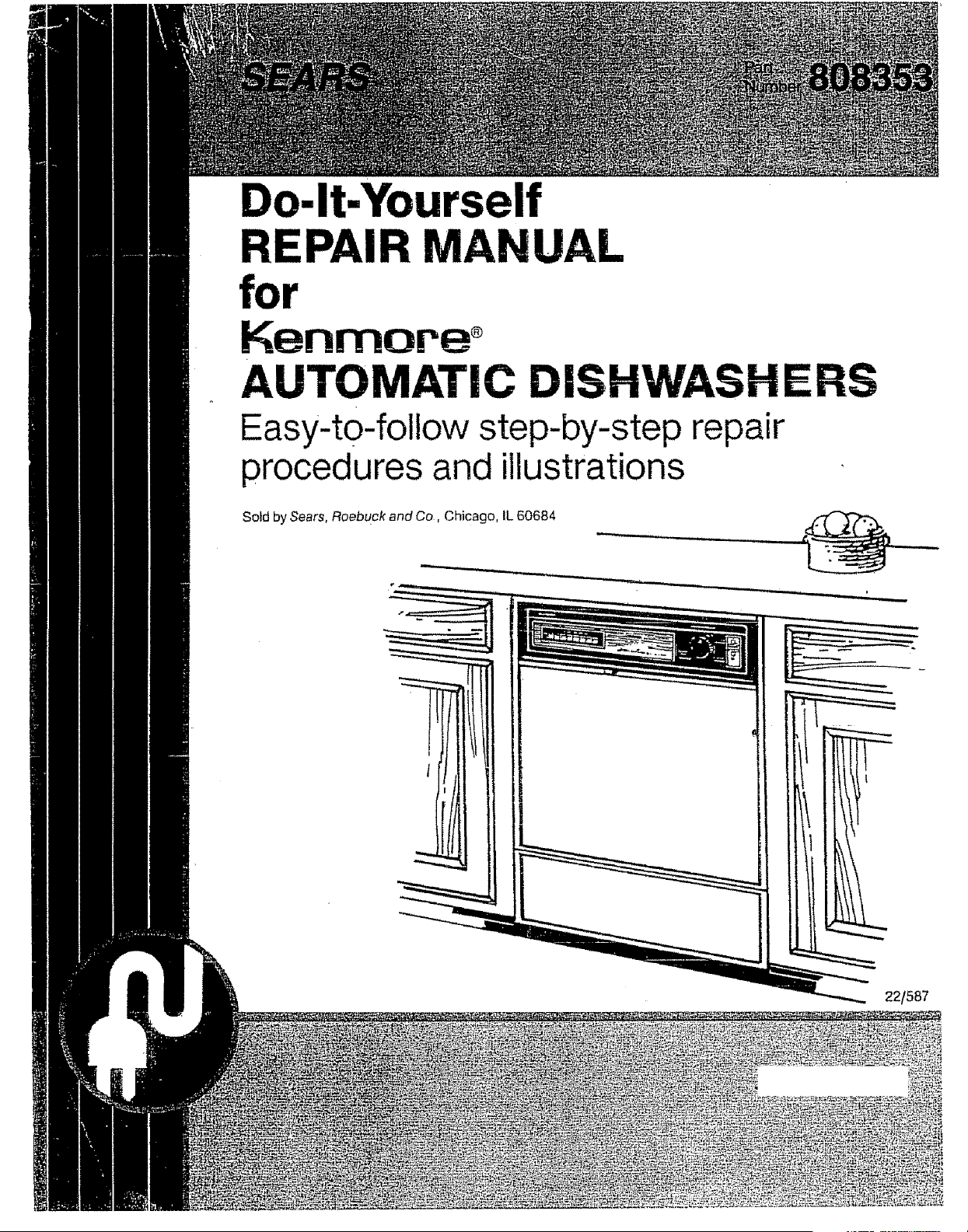
Do-It-Yourself
REPAIR
for
AUTOMATIC DISHWASHERS
Easy-to-follow step-by-step repair
procedures and illustrations
Sold by Sears, Roebuck and Co, Chicago, IL 60684
i
22/587

.... _ _ _'r_-=:_- ,"_'_¸
We Service Wh_,t We Sell
Wherever you live, you may be
assured that there is a Sears
Service Organization as near as
your telephone.
The Technical Training Centers
pictured are staffed by the
finest, most capable Technical
Instructors we can find. In turn,
the Technicians in your local
Sears Service Organiz_ion have
in all probability been _rained in
one of these schools.
If ever you need us -- we're
available.
You Can Count On Us,
No part of this book may be reproduced
without the written permission of
Sears. Roebuclc and Co
_ Copyright 1981 by Se_rs, Roebuck
and Co

[Sears t
WHEN SEARS PEOPLE SAY, "WE SERVICE WHAT WE SELL." THEY MEAN IT,
When you get your appliance from Sears, Roebuck and Con, you get something
• nobody else can give you - Sears service. Many families who've been around hate to
buy even a toaster anywhere else.
Every month, about 400,000 Americans change jobs and move to other towns or
states. Many more are transferred by their compames, Families on the way up should
be prepared for moves around the cotJntry_
One important way to prepare_° take a tip from the military who really have to move
around the country_ Buy your appliances from Sears.
Suppose you live in Denver and you're moving to Bay Shore, NX, As soon as you and
the moving van arrive, all you have to do is call your Bay Shore Sears store and they'll
schedule a technician to hook up your Sears appliances.
"We service what we sell." To back up this slogan, Sears has thousands of service
trucks, logging millions of miles each yean
Is it worth it? Ask anyone who's ever had to move a family - around the country or
around the corner. Sears is nationwide.
For handy reference, use this space for
your nearest Sears Service Phone Nurnber_
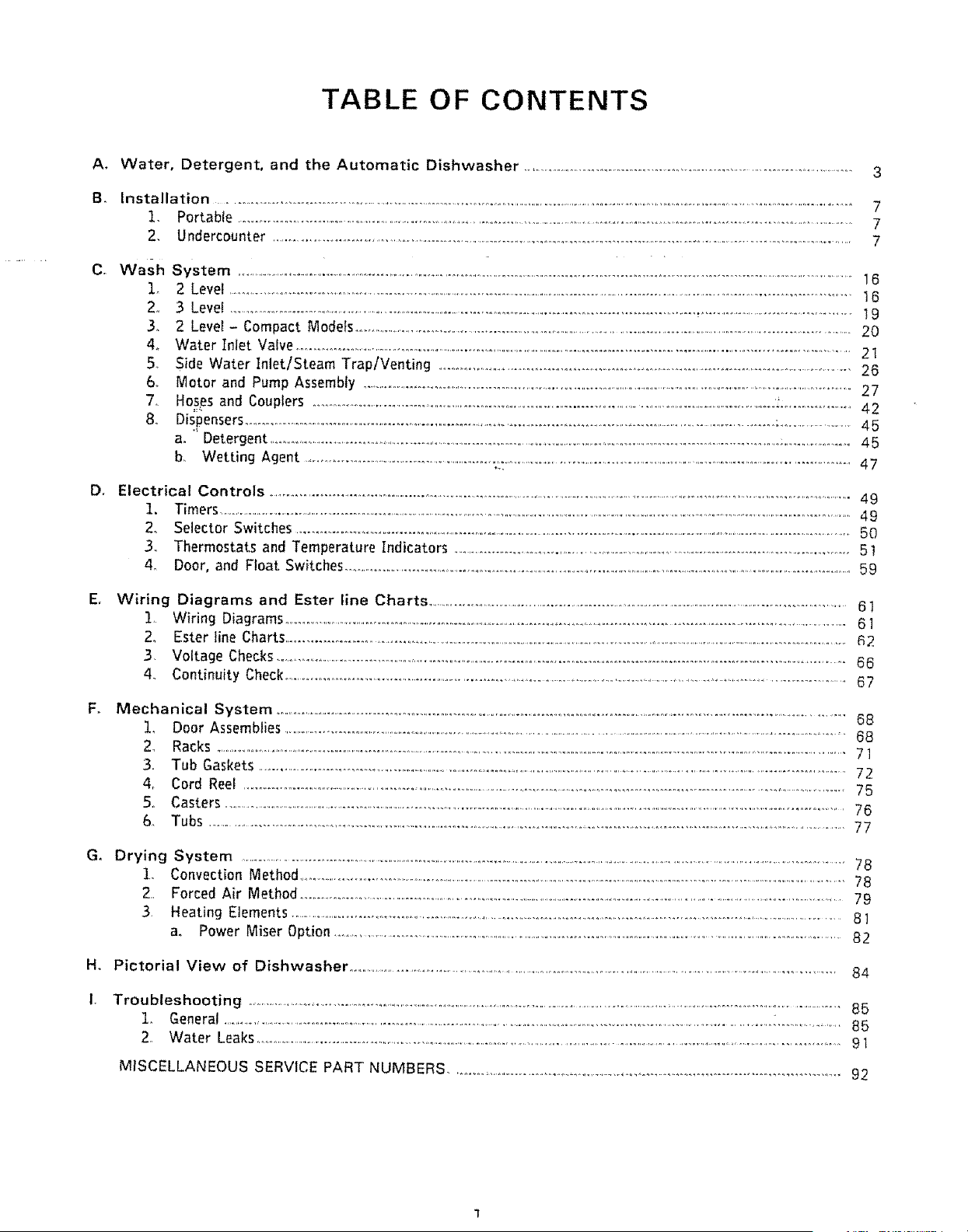
TABLE OF CONTENTS
A÷
B_
C_
D,
Water, Detergent, and the Automatic Dishwasher ................................................................................................ 3
Installation ...........................................................................................................................................................................................................
,
2,
7
7
7
Portable ..........................................................................................................................................................................................
Undercounter ....................................................................................................................................................................................
Wash System ....................................................................................................................................................................................................16
I_ 2 Level .....................................................................................................................................................................................................16
2, 3 Level .........................................................................................................................................,......................................................19
3. 2 Level - Compact Modeis ...................................................................................................................................................................20
4. Water Inlet Valve .............................................................................................................................................................................21
5, Side Water Inlet/Steam Trap/Venting ....................................................................................................................................26
6. Motor and Pump Assembly .........................................................................................................................................................................27
7. Hos_s and Couplers ......................................................................................................................................................._:.................. 42
8. Dispensers...................................................................................................................................................................:........................45
a. ' Detergent ...................................................................................................................................................................................:,.................. 45
b. Wetting Agent ........................................................._,:................................................................................................................47
Electrical Controls .............................................................................................................................................................................................49
1. Timers .......................................................................................................................................................................................................................................49
2. SelectorSwitches..........................................................................................................................................................................................50
34 Thermostats and Temperature Indicators .........................................................................................................................51
4. Door,and FloatSwitches..........................................................................................................................................................................59
Er
Wiring Diagrams and Ester line Charts ............................................................................................................................................61
i Wiring Diagrams .........................................................................................................................................................................................61
2. Ester line Charts ...................................................................................................................................................................................................R2
3 Voltage Checks .................................................................................................................................................................................66
4. ContinuityCheck.........................................................................................................................................................................................67
Fo Mechanical System ..................................................................................................................................................................................68
!, Door Assemblies ....................................................................................................................................................................................................68
2_ Racks ...............................................................................................................................................................................................................................71
3. Tub Gaskets ....................................................................................................................................................................................................72
& Cord Reel ......................................................................................................................................................................................................75
5,, Casters ..........................................................................................................................................................................................................................76
6. Tubs ........................................................................................................................................................................................................77
G. Drying System ....................................................................................................................................................................................................................78
1_ Convection Method ..........................................................................................................................................................................................78
2, Forced Air Method ...............................................................................................................................................................................79
3, Heating Elements .....................................................................................................................................................................................8]
a. Power Miser Option .....................................................................................................................................................................82
H, Pictorial View of Dishwasher ...........................................................................................................................................................84
Troubleshooting .........................................................................................................................................................................................................85
1, General ....................................................................................................................................................................................................85
2,, Water Leaks......................................................................................................................................................................................................91
MISCELLANEOUS SERVICE PART NUMBERS ......................................................................................................................92

INTRODUCTION
This service manual is designed to provide you with a basic knowledge of the operation
of your Kenmore Dishwasher.
It was not designed to cover a specific model, but covers, in detail, the repa!r of most
components used on any model. The production of a service manual for each individual
model is not practical because of the excessive duplication that would resutL
Thorough study of this manual will provide a good working knowledge of the compo-
,nents that may be used within a Kenmore Dishwasher,. Application of this knowledge
to a specific dishwasher should make repair relatively simple.
Included in this manual are installation instructions and service procedures.
The importance of proper installation of any appliance cannot be overstressed. Our
experience indicates that incorrect installation is a major cause of unsatisfactory
product performance.
CAUTION - PLEASE NOTE
Sears, Roebuck and Co. assumes no responsibility for any repairs made on our products
by anyone other than our own Service Technicians,
Replacement of the dishwasher tub should be performed only by a qualified technician°
It is recommended that you contact your nearest Service Department for this service.
As a safety precaution, ALWAYS disconnect electrical power from the dishwasher
before attempting to make any repairs_

A. WATER, DETERGENT AND THE AUTOMATIC
DISHWASHER
Water
Water is a primary ingredient in determining automatic dishwashing result5 The minerafs in water, when in sufficient
quantity, wilt cause spotting, filming and the possible discoloration of some metals. The minerals which account tot
the greatest difficulty are calcium and magnesium These minerals delermine the hardness ol the water
Theaefin[tibn of hard _ate_: varies s6h_ewP;at However[ m6s{-a_Jthor[fies a'gree G4th the following scaie "
0 to 4 grains hardness per gatlon - soft water
4 to 8 grains hardness per gallon - medium water
8 to 12 grains hardness per gallon - hard water
over 12 grains hardness per gallon - very hard water
Automatic dishwashing results are v_stb/y affected when calcium and magnesium are present in a concentration ot
eight grains per gallon ol more As their concentration increases, the problems of spotting and filming can increase
proportionately
When spotting and filming are caused by hard water conditions, they wilt normally be evident on glassware and table-
ware (silverware! within a short period of time Over a longer period of time, hard water film can build up on the racl.:s,
walls, spray mechanism and heating element of the dishwasher itself The development of hard wa'ter film on the
dishwasher may cause additional problems and reduce the efficiency of the dishw_tsher due to the build-up of the time
deposits on the pump area, drain hoses, etc
If water supplied to the dishwasher is less than !0 grains hard, spotting and filming can be controlled satisfactorily by
the amount of detergent used. in a properly functioning dishwasher
When correct amounts of detergent are used for the availing water conditions, the water softening ingredients wilt
also dissolve calcium and magnesium which have deposited on dishware surfaces in preceding dishwashing cycles
In medium and hard water conditions, the amount of detergent used should be increased We recommend fdhng the
detergent cups under these conditions In some very hard water conditions, it may also be advisable to place addi-
tional detergent in the dishwasher for the main wash cycle
When the total hardness of the water exceeds 12 grains per gallon, it may be advisable to install a water conditioning
unit to remove the catcium and magnesium from the water, in order to insure continuous excellent automatic dish-
washing results Also keep in mind that when a customer already has a water softener that it may not be function-
_nq correctly or it may not be able to handle the capacity needed for the size of the household
REMOVAL AND CONTROL OF HARD WATER FILM
A 5% or 6% acidic solution, such as vinegar, will remove hard water film and may be used lo determine its presence
on glassware Place a small amount of vinegar in a bowl and allow filmed glassware to soak in the vinegar for 3 to 10
minutes Remove from vinegar, rinse and blot dry tf the film present was due to hard water, it will have been re-
moved
The following "home" method may be used to remove hard water film from glassware and the dishwasher: Allow
dishwasher to fill for the main wash cycle; place two cups vinegar in the water and allow machine 1o complete the
entire cycle Do not place metalware, plasricvvare, silverware, cutlery, or detergent m dJsh_c'asher when performing
[h_ fffm _tnpping prodes_
The Automatic Dishwasher
The automatic dishwasher is blamed for many problems over which it exercises no control A properly funclioning
dishwasher, properly loaded, using the recommended amount of a good dishwasl_er detergent and having the speci*
fled water charge will do an excellent job of cleaning
Some of the problems that do arise and are caused by conditions other than functional characleristics of the dish*
washer are as follows:
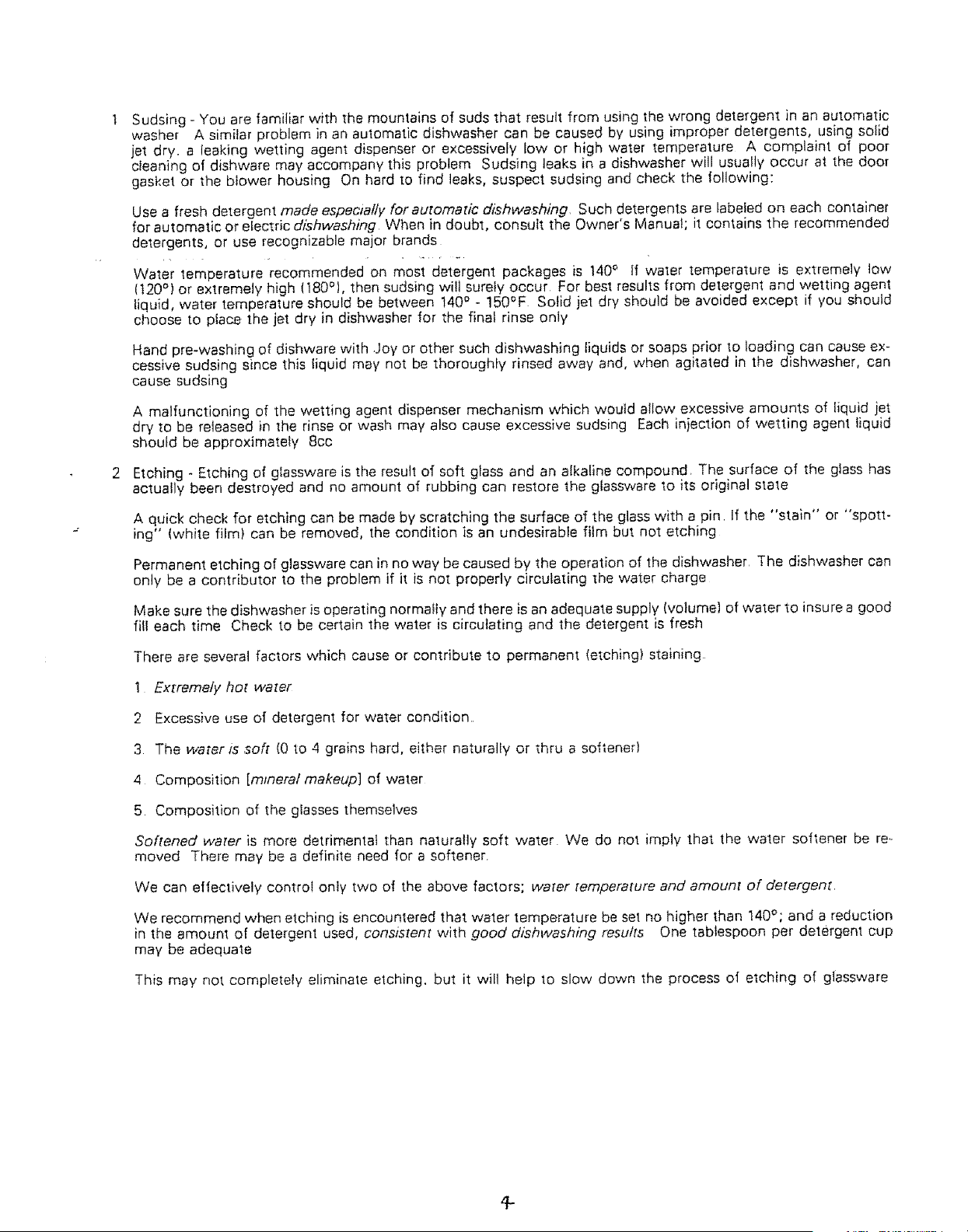
Sudsing- You are familiar with the mountains of suds that result from using the wrong detergent in an automatic
washer A similar problem in an automatic dishwasher can be caused by using improper detergents, using solid
jet dry. a leaking wetting agent dispenser or excessively tow or high water temperature A complaint of poor
cleaning of dishware may accompany this problem Sudsing leaks in a dishwasher will usually occur at the door
gasket or the blower housing On hard to find leaks, suspect sudsing and check the following:
Use a fresh detergent made especcal/y for automatic d_shwashing. Such detergents are labeled on each container
for automatic or electric dishwashing When in doubt, consult the Owner's Manual; i1 contains the recommended
detergents, or use recognizable major brands
Water temperature recommended on most detergent packages is 140° if water temperature is extremely low
(120 °) or extremely high (180°}, then sudsing will surely occur For best results from detergent and wetting agent
liquid, water temperature should be between t40 ° - 150°F Solid jet dry should be avoided except if you should
choose to place the jet dry in dishwasher for the final rinse only
Hand pre-washing of dishware with .Joy or other such dishwashing liquids or soaps prior 1o loading can cause ex-
cessive sudsing since this liquid may not be thoroughly rinsed away and, ,when agitated in the dishwasher, can
cause sudsing
A malfunctioning of the wetting agent dispenser mechanism which would allow excessive amounts of liquid jet
dq,' to be released in the rinse or wash may also cause excessive sudsing Each injection of wetting agent liquid
should be approximately 8cc
Etching - Etching of glassware is the result of soft glass and an alkaline compound. The surface of the glass has
actually been destroyed and no amount of rubbing can restore the glassware to its original state
A quick check for etching can be made by scratching the surface of the glass with a pin If the "stain" or "spott-
ing" (white film) can be removed, the condition is an undesirable film but not etching
Permanent etching of glassware can in no way be caused by the operation of the dishwasher The dishwasher can
only be a contributor to the problem if it is not properly circulating the water charge
Make sure the dishwasher is operating normally and there is an adequate supply (volume) of water to insure a good
fill each time Check to be certain the water is circulating and the detergent is fresh
There are several factors which cause or contribute to permanent (etching) staining
1 Extremely hot water
2 Excessive use of detergent for water condition
3 The water ts soft (0 to 4 grains hard, either naturally or thru a softener)
4 Composition [mineral makeup] of water
5 Composition of the glasses themselves
Softened water is more detrimental than naturally soft water We do not imply that the water softener be re,-
moved There may be a definite need for a softener
We can elfectively control only two of the above factors; wa[er temperature and amount of detergent.
We recommend when etching is encountered that water temperature be set no higher than !40°; and a reduction
in the amount of detergent used, consistent with good dishvvashing results One tablespoon per detergent cup
may be adequate
This may not completely eliminate etching, but it wilt help 1o slow down the process of etching of glassware

3 DishwashmgProblems andAnswers
PROBLEM
DishesNotClean
Spotting
Filming
Etching ...........
Silverware Stained or Pitted
Bronze Tarnish on Silverware
Black Marks on Dinnerware
Aluminum Discoloration
Brown Stains (Rust) on Dishes or Tub
Dishes Not Dry
Dishes Chipping
Dishwasher Odor
Noise
Water in Tub Bottom
POSSIBLE CAUSE & SOLUTION
Water temperature is too low It should be from t40°Fo to t50°F (60°C
to 66°C,)
Not enough water in the dishwasher
Using old, lumpy detergent
Improper loading Items may be placed in the wrong position A knife or
a slender handle may have prevented spray arm turning
Caused by minera! deposits from ha(d or soft water left by evaporation
Use a wetting agent such as Jet Dry Store dishwasher detergent in
a c0ol, dry place
Water is too hard Use more detergent tf hardness is greater than ]2
grains, you may need to install a water softener Usually hard water
film can be removed by soaking a glass in a half and half solution of
vinegar and water, ° If this proves effective, load the filmed glasses
and dishes into the dishwasher Operate on LIGHT WASH cycle Stop
the machine after it has filled for the wash phase of the cycle and pour
in two cups of vinegar Close the door and let the machine complete
the cycle
°Some commercial products such as Glass Magic may be avaifable in
your area
Etching appears as a film and is impossible to remove It can be retarded
by using smaller amounts of detergent Thorough rinsing is important;
so load your dishwasher properly. Do not overload it Dishwasher
water temperature should be at 140°F. (60°C),
Can be caused by direct contact with detergent or prolonged contact
with acid or salty foods Do not let detergent drop on silverwai'e Rinse
tableware promptly if it has been exposed to staining foods.
Silverplate has worn off, exposing base metal, Silver polish can remove
tarnish but replating is necessary for permanent solution
Can be caused by metal objects rubbing the plate Remove the marks by
soaking the plate in a mild Meach solution After this, wash the ptate
in a normal dishwasher cycle
Minerals in your water supply and high water temperature in
combination with some detergents can darken aluminum
Too much iron in your water You may need iron removal equipment
installed
The water is too cool It should be at least 140°F (60°C) at the dish-
washer
Improper loading Load dishes so the water can run off
On machines without forced air drying, try opening the door slightly at
the beginning of the dry cycle Unload after about an hour
Select "Hot Dry"
Use of wetting agent for those dishwashers equipped with automatic dis-
pensers helps water to sheet off faster
Improper loading Load glassware and dishes between the supports so
they are stable and cannot bump each other
Soiled dishes held too long in dishwasher Use RINSE 8 HOLD cycle for
dishes that will be washed later
Some hard object (bottle cap, measuring spoons, etc ) may have fallen
into the bottom of the tub Clean the pump
A small amount of water will remain in the boltom of the tub after each
cycle

CLEANINGMINERALDEPOSITSFROMPORCELAINSURFACES
Thefollowingprocedureissafeif theinstructionsarecarefullyfollowed
Manycomplaintsof porcelaindeleriorationhavebeentracedtoasurfacediscolorationduetothepresenceofiron,
manganeseorcalciuminthewa;ersupplyInareashavinga highmineralcontentin thewater,particularlyiron,
discolorationorstainscanusuallyberemovedbythefollowingmethod:
t UsewatersoftenerResinCleanerThiscompoundisavailablefromSearsPlumbingand Heating Department
2 Pour 8 ounces of the compound into the bottom of the tub
3 Fill the 2rid wash detergent cup with dishwasher detergent and close the cup
4 Select a normal cycle - must have 2 washes and 4 rinses
5 Allow the dishwasher to complete all washes and rinses It is not necessary to complete the dry cycle
6 DO NOT place dinnerware or silverware in the dishwasher during the cleaning operation,
CA U T/ON:
Because of the obnoxious odor of the cleaner in solution - Do Not open the dishwasher
door until the completion of the last rinse°
How To Remove The
Access Panel
Attach
Screws
Access
Panel
/
Bottom
Loosen the two bottom attach screws in the access
pane_
Open dishwasher door,
Remove the two top attach screws
Close door Access panel can now be removed by
puIling straight off

B. INSTALLATION
Portable Dishwasher
Hot Water Connections - Portable Dishwasher
I. Attach the AERATOR ADAPTOR furnished with the dishwasherto the sink faucet.
2. Check the power outlet.
A. Will it take the three-prong plug on the power cord?
B. Is the outlet grounded?
CHECKING POWER OUTLET
The dishwasherwilloperateon regularhousecurrent,Do notuseany otherapplianceon thesame circuit,Use a circuit
withat Jeasta 15 Ampere,butnot more thana 20 Ampere fuse.The dishwasherpower cordisa threeprongtypeand
must be pluggedintoa threeholegroundedoutlet°The dishwasherMUST BE GROUNDED forsafeoperation,,Do not,
underanycircumstances,removethepowersupplycordgroundprong°
Under Counter Dishwasher Drain, Water, and Electric Supply
I
I
I
!
I
I
16
FIGURE!
Copper tubing must have a minimum I,D. of 3/8 inch. Sears has a waterline kit which includes all the fittings and
instructions you need for most installations.
How much water volume is needed? A minimum flow of 8 quarts of hot water is requiredin 60 seconds - Check this
at your kitchen faucet tap with the aerator removed.
IMPORTANT:
Provide a separate circuit with fuse or circuit breaker rated for at least 15 Amps but not more than
20 Amps.
IMPORTANT:
This Appliance Must Be Permanently Grounded In Accordance With The National Electrical Code and
Local Codes and Ordinances°
When installing the dishwasher:
I. Connect (in junction box) incoming black lead to dishwasher black lead; and incomingwhite lead to dishwasher white
lead.

2 Attach grounding wire to green grounding screw
CAUTION:
The joining of aluminum building wire to stranded copper wire leads on the dishwasher involves special
problems It should be done only by qualified personnel using material recognized by U/L (or CSA) as suitable
DRAIN. Improper!y installed drain hoses can kink and result in poor washability or failure of the dishwasher to
drain Do not use the drain hose supplied with the dishwasher for the water supply line It is not a reinforced hose
and wil! burst under water line pressure
NOTE,"
A properly operating dzshwasher will have approxtma_e/y .2 cups of clean water rematmng in [he [ub at the com-
pletion .of [he cycle. .........
CA UTION:
Be sure to remove plug from disposer inlet before attaching drain hose,
DRAIN HOSE CONNECTED TO DISPOSER
OR "y" BRANCH
2"HOLE OR LARGER
SINK X,,T LEFT
FIGURE2
iMPORTANT:
After positioning under the counter, the front leveling legs should be raised slightly higher than the rear legs.

DRAIN HOSECONNECTIONTO SINK DRAIN
/2 ! O COPPER TUBING
DRAIN HOSE MUST BE _tGHER
THAN DIS
3RANCH
TAILPIECE
S{NF, AT RIGHT
FIGURE3
Sears "Y" Branch Tailpiece and Connector Kit No, 729b makes this connection easy, It includes a!l necessary fittings
and complete instructions,
DRAIN HOSE CONNECTION THROUGH FLOOR
AIR GAP KIT AVAILABLE AT SEARS
2"{OR LARGER) HOLE
\
\
LEFTNAND SUPPORT
RIGHTHAND SUPPORT ANGLE
FIGURE4
If the dishwasher drain hose is routed through the floor to a separate trap, the trap must be vented to prevent siphoning,
To provide proper venting, install an Air Gap Kit (available at Sears) in the countertop, Route drain hose up to the inlet
side of the Air Gap, Continue drain line from outlet side of Air Gap down through floor to separate trap,
Models Equipped With Installation Module
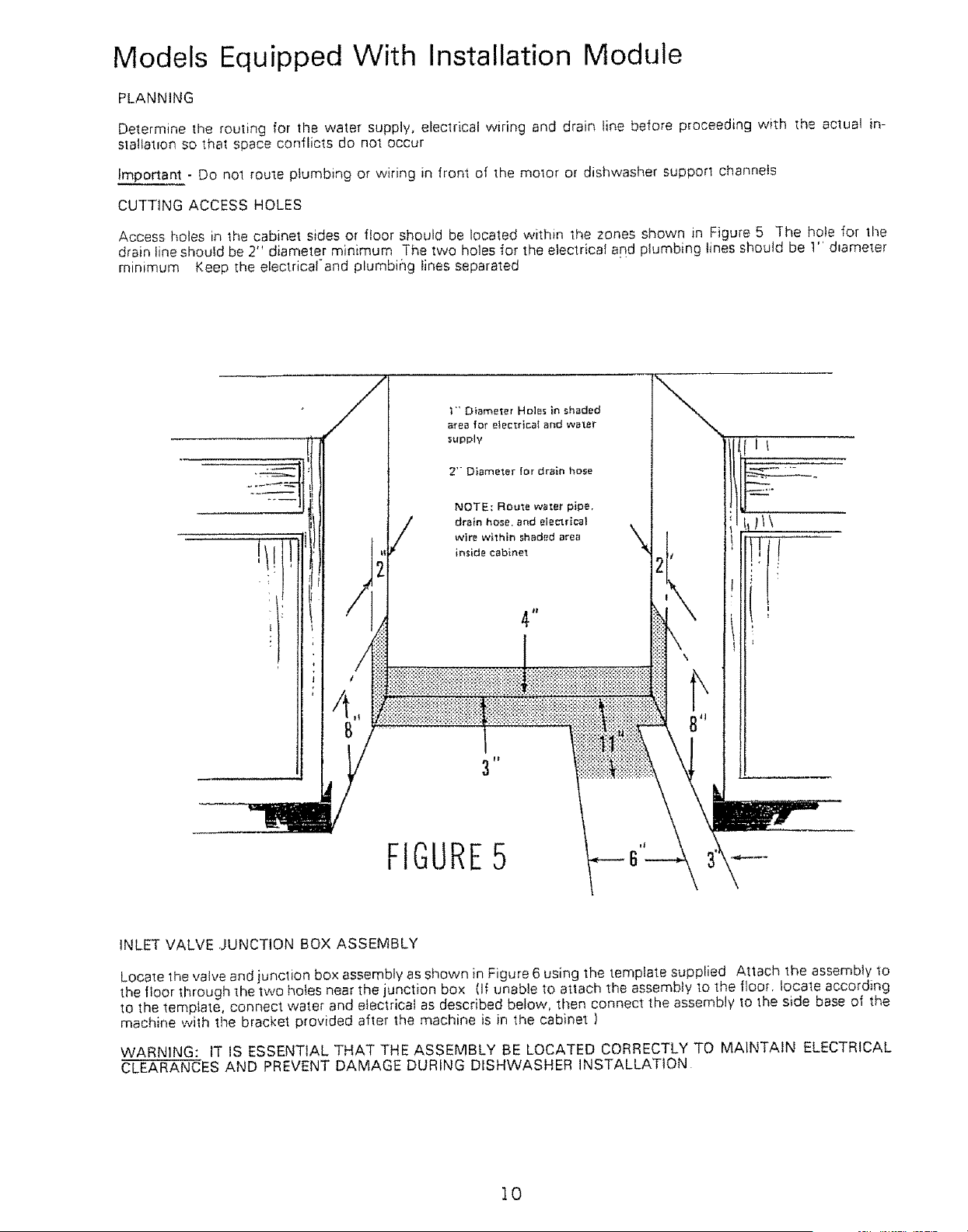
PLANNING
Determine the rouling for the water supply, eleclrical wiring and drain line before proceeding with the actual in-
sin!tarpon so that space conflicts do not occur
Important - Do no1 [oute ptumbing or wiring in front of the motor or dishwasher support channels
CUTTING ACCESS HOLES
Access holes in the cabinet sides or floor should be located within the zones shown in Figure 5 The hole for lhe
drain lineshould be 2" diameter minimum The two holes for the electrical and plumbing lines should be 1" d,ameter
minimum Keep the electricaland plumbing lines separated
fl!:.....
FIGURE5
INLET VALVE ,JUNCTION BOX ASSEMBLY
Locale the valve and junction box assembly as shown in Figure 6 using the template supplied Attach the assembly 1o
the floor through 1he two holes near the junction box (If unable to atlach the assembly to the floor, locale according
to the template, connect water and electrical as described below, then connect the assembly to the side base ol the
machine with the bracket provided after the machine is in the cabinet )
WARNING: IT IS ESSENTIAL THAT THE ASSEMBLY BE LOCATED CORRECTLY TO MAINTAIN ELECTRICAL
CLEARANCES AND PREVENT DAMAGE DURING DISHWASHER INSTALLATION
t0
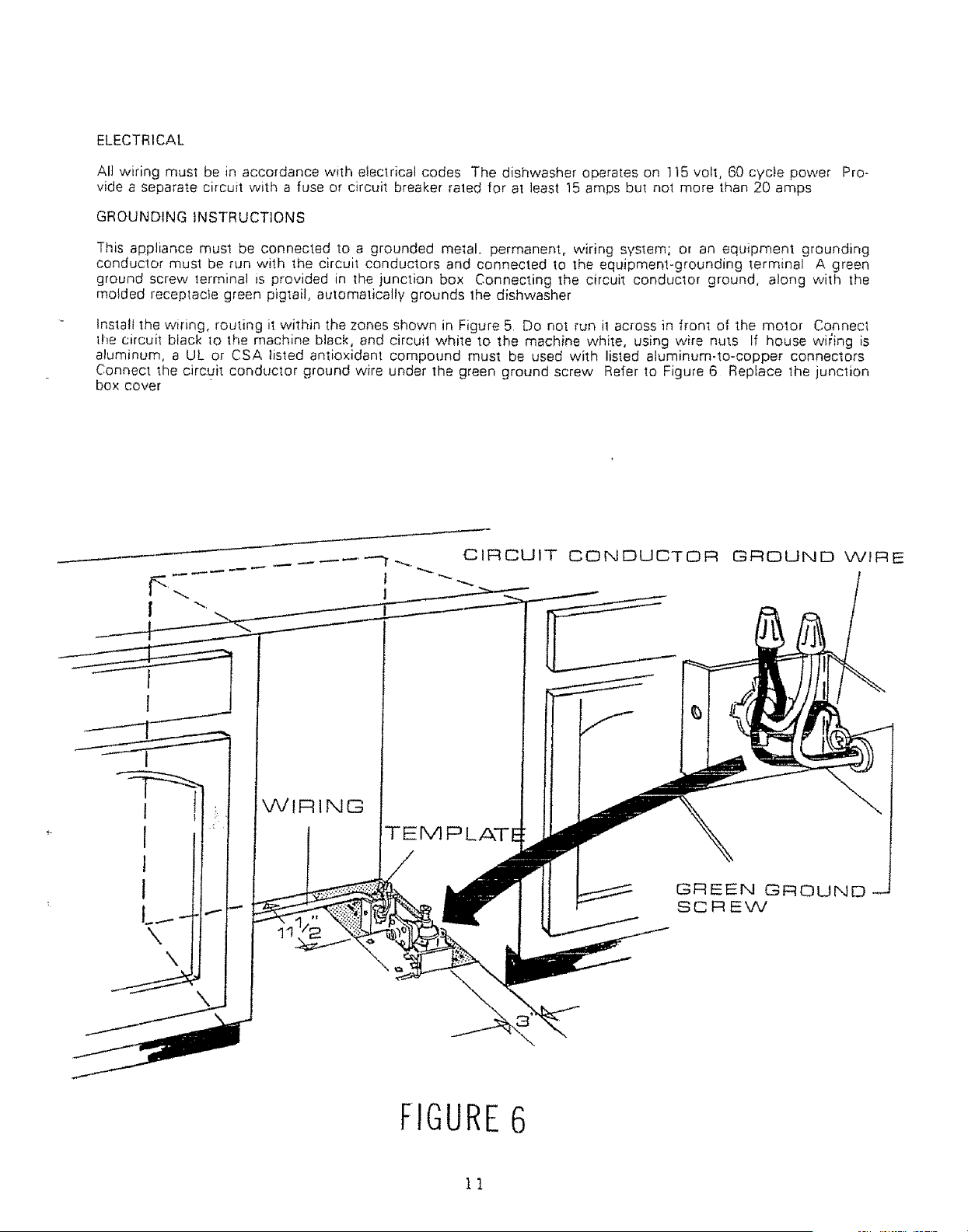
ELECTRICAL
All wiring must be in accordance with electrical codes The dishwasher operates on !15 volt, 60 cycle power Pro-
vide a separate circuit with a fuse or circuit breaker rated for at least 15 amps bul not more than 20 amps
GROUND1NGINSTRUCTIONS
This appliance must be connected to a grounded metal, permanent, wiring system; or an equipment grounding
conductor must be run with the circui_ conductors and connected to the equipment-grounding terminal A green
ground screw terminal is provided in The junction box Connecting the circuit conductor ground, along with the
molded receptacfe green pigtail, automatically grounds 1he dishwasher
install the wiring, routing it within the zones shown in Figure 5 Do not run i! across in front of the motor Connect
lhe circuit black 1o the machine black, and circuil white to the machine white, using wire nuts If house wi_ing is
aluminum, a UL or CSA listed antioxidant compound must be used with listed aluminum-to-copper connectors
Connect the circuit conductor ground wire under the green ground screw Refer to Figure 6 Replace the junction
box cover
\
CIRCUIT CONDUCTOR GROUND WIRE
¢7IRING
GREEN GROUND
SCREW
FIGURE6
11

WA] ER SUPPLY
Plumbing must comply with local codes It is recommended that a shul-off valve be installed in the line from the
supply to the dishwasher The water supply must be able lo supply a minimum of 9 quarts in one minute Route the
Ime, as shown in Figure 7 (Refer to Figure 5 for permissible routing areas) Do not run it across in front of the motor
Piping must not be kinked The connection to the valve is made with a 3/8" male pipe thread right angle adapter
Assemble the adapter to the valve, using pipe compound or teflon tape, with a wrench on the adapler and a wrench
over the metal bracket enclosing the fitting on the valve If solder connections are used. use care to see that valve
is not overhea!ed CAUTION! Qverheating witl da0qage the valve Clean all ioreign matedal from the pipe and threads
before maldng final connections
IMPORTANT:
TURN ON THE WATER SUPPLY AND CHECK ALL PLUMBING AIqD DISHWASHER CONNECTIONS FOR WATER
LEAKS.
WARNING!
Do not have line pressure Io the water valve in freezing temperatures during construction, remodeling, elc Do not
use the drain hose supplied with the dishwasher for the water supply line It is not a reinforced hose and will burst
under water line pressure
SHUT OFF
VA LV E
HOT WATE
LINE
I
I
\
I
CAUTION
To prevent damage to valve,apply
wrench to hex on valvemetal bracket
and hold securely while installing
rigflt angle adapter,,
ALTERNATE HOT WATER
ENTRY SHOWN BY
DDT_ED LINE
SUPPLY
_REEN GROUND"
SCREW
MOLDED REO EPTACL
/
RIGHT ANGLE ADAPTER -3/8
MALE PIPE THREAD
FIGURE7
12
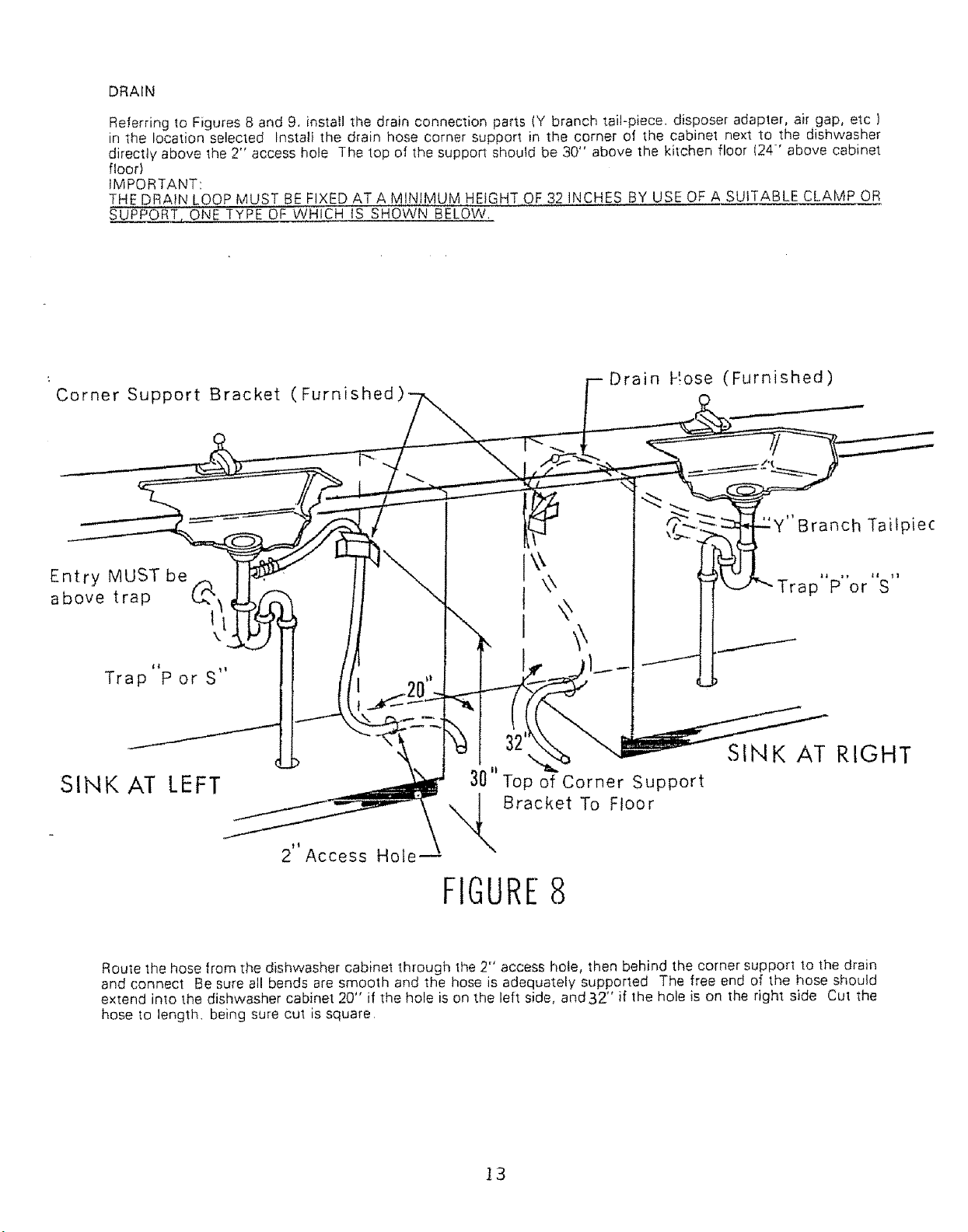
DRAIN
Referring to Figures 8 and 9. install the drain connection parts (Y branch tail-piece, disposer adapter, air gap, etc )
in the location selected Instali the drain hose corner support in the corner of the cabinet next to the dishwasher
directly above the 2" access hole The top of the support should be 30" above the kitchen floor 124-' above cabinet
floor)
IMPORTANT:
THE DRA!N LOOP MUST BE FIXED ATA lvl!N,!MUM HEIGHT,,QF,,,32 INCHES BY USE OF A SUITABLE CLAMP OR
SUPPORT._ONE -IYPE OF WHICH IS SHOWN BELOW.
Corner Support Bracket (Furnished
Drain Hose (Furnished)
Entry MUST be
above trap _1_ t
\
Trap P or S
\
"'Branch Tailpie(:
Trap P or S
SINK AT LEFT
3O"Top of Corner Support
Bracket To Floor
2 Access Hole--
FIGURE8
SINK AT RIGHT
Route the hose from the dishwasher cabinet through 1he 2" access hole, then behind the corner support to the drain
and connect Be sure all bends are smooth and the hose is adequately supported The free end of the hose should
extend into the dishwasher cabinet 20" if the hole is on the left side, and32" if the hole is on the right side Cut the
hose to length, being sure cut is square
13

Corner Support Bracket (Furnished)
Air Gap Kit {Available at Sears}
1 Required by some local plumbing
codes when connecting 10 a disposer
2 Required when connecting 7o a separate
Irap benea'lh 1he floor
Trap P or S
SINK AI LEFT
\
To Separate Trap
Beneath Floor
SINK AT RIGHT
FIGURE9
HOW TO POSITION, ALIGN, AND LEVEL, YOUR DISHWASHER
Move your dishwasher, as necessary, to:
FIGUREIO
2.
Align the front of the dishwasher, as close as possible, with the front of the cabinets,
Make the space between the dishwasher and the adjoining cabinets the same on each side and the same width top
to bottom, Use the stubby screwdriver or 7/=32" socket to adjust the teveling screws, They must be set firmly against
Lhe floor,
14

TWO WAYS TO ANCHOR YOUR DISHWASHER
F $oc_r anchori_g
with _' lag screw_
_ Toe plate assembtv
FIGURE11
You MUST anchor your dishwasher to keep it from tilting when the door is opened or closed.
Countertop Anchoring:
1. If the countertop mounting bracket flange is }onger than you need, mark it, remove it, and saw off the unneeded part.
2, Adjust leveling screws, if necessary, so that the mounting brackets touch the underside of countertop
3 Screw the mounting bracket firmlyto the counter[op,
4 Open and dose the dishwasherdoor° There should be no interferenceor scratchingas itmoves,
Floor Anchoring: Difficult procedure. Use only where the countertop bracket cannot be used.
1 Use 1/4" lag screws through the holes provided as illustrated
2. Use expansion fasteners if the floor is concrete After the anchoring is completed, replace the toe plate assembly
You will notice that the vertical height of the toe plate is adjustable to fit neatly against your floor or floor covering
INCREASE
\
DECREASE
_"_-.,-_OEPLATEADJUS]MENTSCREWS
FIGURE12
15

C. WJASH SYSTEM
Two Level Wash Feature
FIGUREI3
A separate spray tube or rotating spray arm assures excellent washability in the upper rack, and another rotating
spray arm thoroughly washes all dishes in the lower rack This arrangement permits complete flexibility of ioading
without concern of blocking the water pattern to el;her rack See Figure t3
Water Charge (See Figure 14)
Water enters the dishwasher through the solenoid operated water inlet valve
The valve is energized through the timer Water will enter the machine 1or approximately one minute (All dish-
washers are time filled ) Some models fill for 90 seconds Also some models have 45 second water charges built
into water miser and normal wash cycles Refer to tech sheet in console
NOTE:
The float switch controls the amount of water entering the dishwasher The fill is also time controlled If the
timer fails to advance or the water pressure is extremely high, the float switch will open the circuit to the water
inlet valve thus preventing a flood If the float sticks or does not cut power to the valve, the timer acts as a safety
_o turn power off after the allotted fill time The float and timer switch will not protect against a mechanical failure
of the valve
To satisfactorily clean dishes, the 24" dishwasher must have a water charge of 8 to 11 quarts The !8" models
require 6 5 to 8 quarts if poor washability is experienced, be certain to check for the correct water charge
16

FLOAT
NORMAL
SWITCH
FIGURE14
2 Testing Water Charge Level
To check for proper water level, pour the minimum charge ol_8 quarts of water into the tub and make a reference
mark with a grease pencil or crayon at the edge of the waterline Then pour in an additional 1 Y_,quarts of water
to make the maximum charge, and make another reference line at the edge of the water line, Set the timer to a
portion of the operating cycle for "drain" and allow the drain pump to pump out the water Allow the time to ad-
vance into a )_;fill" period of the operating cycie and allow the normal amount of water to fill the tub After the
water inlet valge has shut off, compare the edge of the water line with the reference marks made above The water
charge must be belween the two lines Remove the marks after completing this test The water level should cover
tile heating element
17
ttttt
t t
.
_
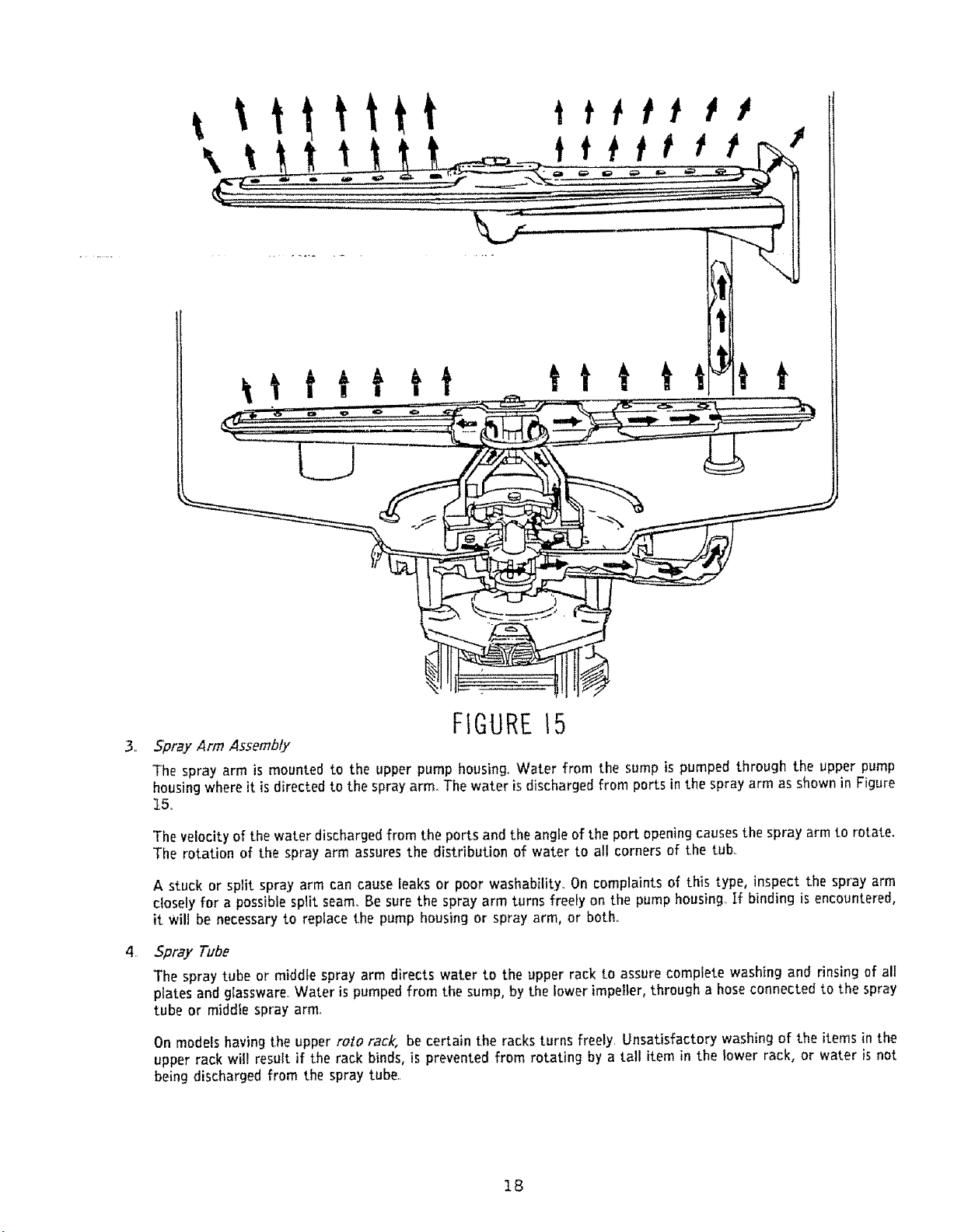
FIGURE15
Spray Arm Assembly
The spray arm is mounted to the upper pump housing_Water from the sump is pumped through the upper pump
housing where it is directed to the spray arm..The water is discharged from ports in the spray arm as shown in Figure
t5..
The velocityof the water discharged from the ports and the angle of the port opening causesthe spray arm to rotate.
The rotation of the spray arm assures the distribution of water to all corners of the tub,
A stuck or split spray arm can cause ieaks or poor washability. On complaints of this type, inspect the spray arm
closely for a possible split seam. Be sure the spray arm turns freely on the pump housing. If binding is encountered,
it wilt be necessary to replace the pump housing or spray arm, or both°
5pray Tube
The spray tube or middle spray arm directs water to the upper rack to assure complete washing and rinsing of all
plates and glassware. Water is pumped from the sump, by the lower impeller, through a hose connected to the spray
tube or middle spray arm,
On models having the upper rolo rack, be certain the racks turns freely. Unsatisfactory washing of the items in the
upper rack will result if the rack binds, is prevented from rotating by a tall item in the lower rack, or water is not
being discharged from the spray tube..
18

Periodic cleaning of the spray tube is recommended One method is shown is Figure 16. The loosened particles may
be flushed from the tube by operating the dishwasher in a wash cycle with the cap removed,
PUSHLODGEDPARTICLES
UPPERSPRAYTUBE
SCREW THREADS
FIGURE16
Three Level Wash System
The upper or third level wash system used in certain models is intended to give increased wash efficiency for articles in
the upper rack° See Figure ]7 A & B.
SPRAY 'iUBE
Y ADAPIDR
FIGURE17A FIGURE17B
The water for the system in 17A isbled off from the middle wash system by means of a "Y" adapter in the main
supply tube and a branching "L" shaped supply tube from that pointto the lop centerof the tub In 17B the top spray
arm is supptied directly from 1he pump by means of an external supply tube The tower in the center of the lower spray
arm telescopes upward washing the underside of the upper rack To remove the tower unscrew the lower section of
the tower counterclockwise
19

A Removal of Mtddle Spray Arm
1 Remove stainless steeI cotter pin in lower end of plastic spray arm spindle underneath the black plastic supply
arm
2 The spray arm and spindle can now be lifted off the supply arm
Removal of Upper Spray Arm Only
1 From below, in tub, remove two screws which hold spray arm and bearing assembly to plastic distributor
(See Figure 18 )
2 The assembly will then drop loose If il is desired to remove the arm from the bearing assembly, the 1we
screws the1 hold them together are nowraccessibte
NOTE
In Mid- 1980 [he design of the third ,spray arm was changed The spray arm is removed by removing the center
moun_ing screw [See Figure 79]
BEARING
ASSEMBLY
&$
ARM
FIGURE18
;HER
(_ SCREW
FIGURE19
Two Level - Compact Models
The top spray arm water supply system on all 18" (compact) dishwashers is completely external of the wash chamber,
A hose from the back side of the pump housing runs behind the back center of the wash chamber (tub) up to the delivery
tube
To remove: (See Figure 20)
1, Disconnect power supply to dishwasher,
2 Loosenand removeclamp attaching delivery hoseto pump housing /VOTE: Water remaining in hose and pump should
be caught in a bowl
3 Remove four (4) screws that attach the delivery tube to the tub assembly,
4 Remove hose by pulling slowly through the opening in rear of tub.,
Reverse procedure to reinstalf and check for leaks and kinks,
20

DELIVER
TUBE
HOSE
STEP 2
STEP
FIGURE20
Water Inlet Valve
The water inlet valve is solenoid operated and when energized permits a constant controlled flow of water to enter the
dishwasher tub, The valve is designed to operate over a pressure range of 20 pounds per square inch minimum to 120
pounds per square inch maximum, The frequency and length of Lime the valve is operating is controlled by the timer,
Water inlet valves differ only in amount of water they deliver (flow rate) which is governed by the aperture size in the
flow washer See Figure 21, Some models may have a three orifice flow washer
CONCAVE
IDENTIFICATION MARKINGS
"_WATER
' __1 '_-" FLOW
SIDE
FIGURE21
21
A
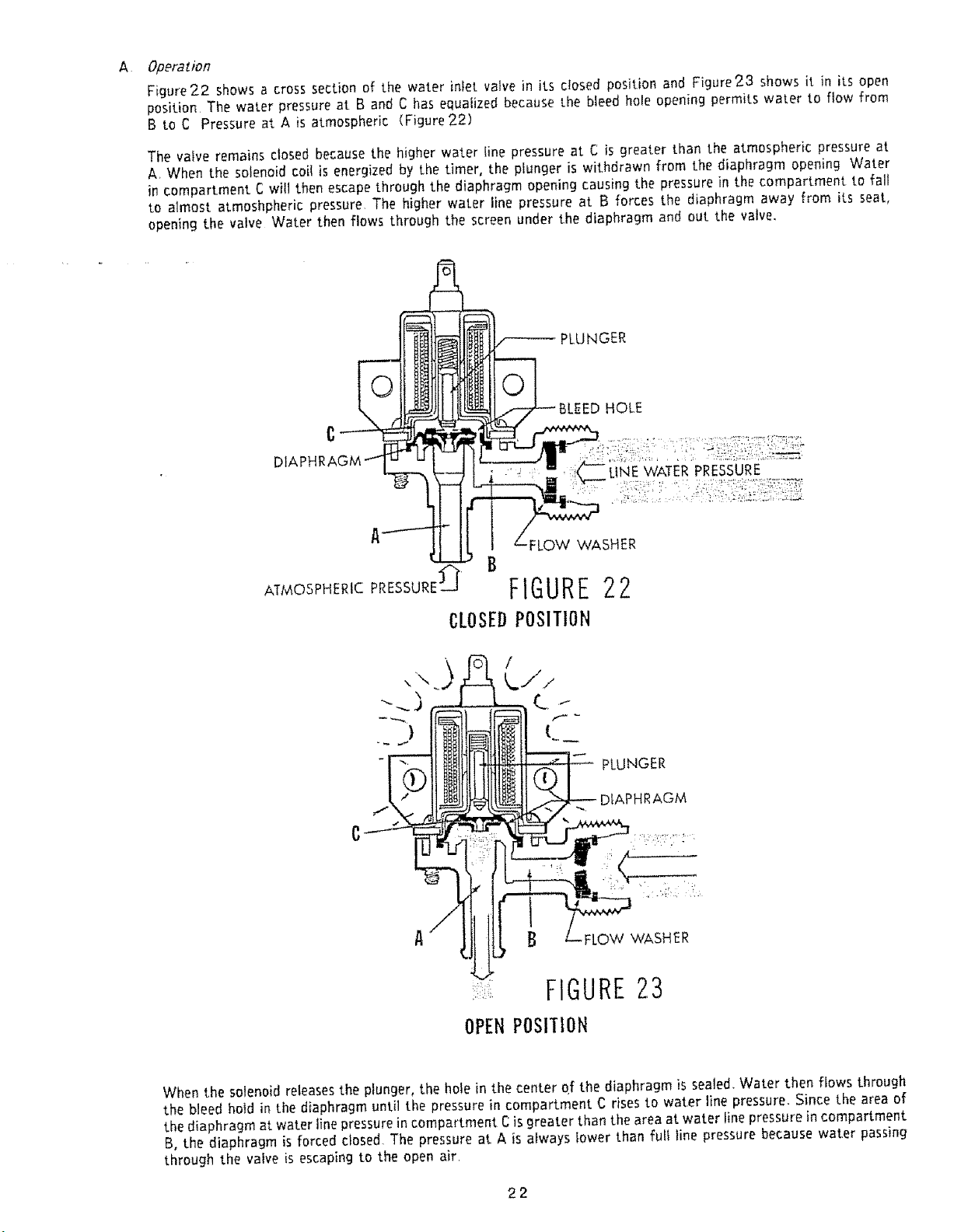
Operation
Figure 22 shows a cross section of the water inlet valve in its closed position and Figure 23 shows it in its open
position The water pressure at B and C has equalized because the bleed hole opening permits water to flow from
B to C Pressure at A is atmospheric (Figure 2.2)
The valve remains closed because the higher water line pressure at C is greater than the atmospheric pressure at
A. When the solenoid coil is energized by the timer, the plunger is withdrawn from the diaphragm opening Water
in compartment C wilt then escape through the diaphragm opening causing the pressure in the compartment to fall
to almost atmoshpheric pressure, The higher water line pressure at B forces the diaphragm away from its seat,
opening the valve Water then flows through the screen under the diaphragm and out the valve.
PLUNGER
HOLE
LINE WATER PRESSURE
WASHER
ATMOSPHERIC PRESSURE£ B
FIGURE22
CLOSEDPOSITION
PLUNGER
DIAPHRAGM
B -FLOW WASHER
FIGURE23
OPEN POSI'[ION
When the solenoid releasesthe plunger, the hole in the center of the diaphragm is sealed. Water then flows through
the bleed hold in the diaphragm until the pressure in compartment C rises to water line pressure. Since the area of
the diaphragm at water line pressurein compartment Cis greater than the area at water fine pressure in compartment
B, the diaphragm is forced closed. The pressure at A is always lower than full line pressure because water passing
through the valve is escaping to the open air.
22

C
Testing
To test operation of water inlet valve, place the leads of a volt meter across the termina{s of the solenoid in any
fill phase of the operating cycle where the water inlet valve should be energized If the meter indicates tine
voltage, water should flow into the tub If water does not flow into the tub, either the water inlet valve is defective
or the water supply is inadequate Make certain the hot water faucet is fully on If the water supply is not at fault,
the water inlet valve is defective
Sen/zcing
To Clean Operating Parts of the Vaive:
! Remove valve bracket from tub or installation module
2 Remove 4 screws holding solenoid, valve body and bracket together
3 Remove the plunger housing, spring and plunger
4 Check the parts for defects, dirt particles or for formation of lime
5 Check 1o make sure the tiny bleed hoies in the diaphragm are not clogged See Figure 24 Clean bleed holes, if
necessary, using a pin or needte
BLEED HOLES
FIGURE24
6
7
Clean the screen mesh of any rust particles Use running water to remove any large particles; then, complete
the iob by blowing screen clear The screen mesh must be absolutely clean and free of any damage
Check flow washer for wear or damage When reinstalling the flow washer, position i1 in the valve so that
the markings on the washer face the incoming flow of "water.
NOTE
The Timer Controls the Operazton of the Water Inlet Valve and therefore, the amount of water emenng the
machine The Valve should be energzzed for 45 to .90 ._econds depending on model and cycle selected The
float switch will .shut the water off at the proper level The Timer controls the wa[er charge on short fills and
acts as a safety on full water charges
23

Water Inlet Valve Kit
Undercounler 808668
Portable 808667
KI'[S INCLUDE: t water vane
! metal washer
4 flow washers
t plastic retainer
1 screen
2 terminal insulators
t sealer washer (undercounter only)
This ki_ is used for several applications Use the flew washer in this kit which wi_! provide the correct flow rate for your
dishwasher
Install parts in the order illustrated
UNDERCOUNTER
PORTABLE
METAL WASHER"
FLOW
WASHER--'_
PLASTIC _ ]
F:RETAIN E __
(__ SCREEN
SEALER WASHER
CURVED SIDE
METAL
FLOW WASHE
PLASTIC
RETAINER
SCREEN
1 Remove plug from valve, discard Remove any foreign particles from valve
2. install flat metal washer,
3, Choose correct flow washer from the chart. =Fhereare identification markings Qn the fiat side of
the flow washer° Install the flow washer with identification markings facing you Curved side
should be against the ftat metal washer.
IDENTIFICATION
MARKING_
NOTE:
METAL
WASHER
4E
2,0,2,5
_af/min
5E
1 75_-lo%
6F
1,6 Z 10%
DISHWASHER
WIDTH
24'; IB" '"
X
X
X
X
FILL TIME
-60sec,(gO see
---'-----1 45 sec_
F---
X
b<
X
ORIGINAL VALVE
Whiiei _'oeo
E ....
"Yellow Lt, Blue Red
IX
X
b<
Biue
X
Do not rely on original valve color only Compare dishwasher fill time and dishwasher width to
make sure the correct flow washer is used.
*Some models with 90 sec. fill time use an abbreviated water fill (45 sec) on certain cycles.
If the valve on the dishwasher is pink, it is a replacement valve, Use the same flow washer as in the valve
Refer to dishwasher width vs, fill time to make sure it is the correct flow washer
24

4, Install plastic retainer into valve with center protrusion facing you, Push untii it snaps into the groove
cut into the body of the valve
6
Press screen into valve, being careful not to crush or change the shape of the screen,, This is important
to keep dirt particles out of the valve tha't will cause it to malfunction,
The solenoid and bracket on this valve may have to be rotated in relation to the vatve body to match
the original valve as illustrated, You need only to take three of the four screws out to rotate the
solenoid and bracket
7., Install the sealing washer on undercounter valves,
8, Mount the valve to the bracket or frame of the dishwasher_
9. Recheck selection of flow washer by operating dishwasher through the fill phase° Make sure fill time is
correct for the flow washer you have selected,
25

Side Water Inlet, Steam Trap and Venting
The side water inlet shown in Figure 25A provides an effective steam trap at all times and eliminates vapor escape
during any phase of the dishwashing operation The vapor is blocked from escaping by the water trapped in the
bottom of the side water inlet
The side water inlet assembly fits into a bracket on the side of the tub The plastic nut secures the assembly to the
tub Removal of the nul from inside the tub allows the inlet unit to be easily removed from the botlom of the
dishwasher
PLASTICNUT I
SIDE WATER INLET
-,..
WA1ERiNLETASSEMBLY
TOWATERINLETVALVE
FIGURE25B
FIGURE25A
The water inlet assembly shown in Figure 25B combines the fill and blower opening in the lub On models without
forced air drying, the lower portion of the housing and blower motor is not installed
26

INNER DOOR--'_
EXIT FLOW OF MOIST AIR
DURING DRY CYCLE
JI,
'J
VENT / I
4
_"_--_-- VENT GRILLE
*---OUTER DOOR PANEL
FIGURE26
Venting takes place between the door and access panel as shown in Figure 26 (Exception;
Forced Air Models described in th'e section of this manual which covers the drying system,,
Motor and Pump Assembly
__ NUT-
PUMP HOUSING
PPER IMPELLER
MACERATOR BLADE
PUMP HOUSING
LOWER
SEAL
IMPELLER SHROUD
LOWER
IMPELLER
SLINGER
MOTOR AND PUMP ASSEMBLY (ASSEMBLED)
FIGURE27
27

t:_._ SCREW
WASHER
UPPER IMPELLER
6
2 SEAL
MACERATOR BLADE 5
SPACER PLATE
SHROUD 4
._._------_ PU M P PLATE
' PUMP GASKET
O RING
'(_ LOWER IMPELLER
SHIMS
3
SCREW-_
PUMP HOUSING
LOWER
RING CLAM
FAN SLING
FIGURE30A
MP GASKET
SCR
B,
Pump Assembly
The pump assemblyconsists of the following components (Refer to Figure 3OA ]
1. Pump housingor casting which consistsof an upper and lower parL |t attaches directly to the main motor and
the tub,
The upper housing directs water from the upper impeller into the spray arm
2, ,..CharSeal- Provides a water tight seal which prevents water from leaking from he pump housing at the motor
shaft, The seal consists of two parts, The rubber mounted carbon seal is seated into the pump housing and the
rubber mounted ceramic seal fits into the lower impeller.
29

A Main Motor and Relay
Most of the dishwashers use 3450 RPM, 120V 60 Hz reversible type motor to drive the pump impellers
These motors utilize an external start relay and have two start or phase windings, a main or run winding and a
built-in overload protector
Direction of rotation of the armature or rotor is determined by the start winding selected through the timer
switch contacts See Figure 28
I
!
I
_LU
, I
T_ME:R I
:_N DYE mLE_ I
1 !
!
|PMASE W_
I
FIGURE28
The relay is normally open with its coil connected in series with the main winding of the motor, and its switch con-
tacts connected in series with the motor slart winding (Since the relay is a gravity type device, it must be
mounted in an upright poshion ) See Figure 29.
BOTTOM OF RELAY
FIGURE29
When voltage is applied to the motor, as during the wash, rinse and drain periods of the dishwashing cycle, fi_e
momemary high current to the main winding energizes the relay solenoid The solenoid plunger is lifted, closing
the switch contacts The start winding is energized through the timer and relay contacts and the motor armature
begins to rotate_ As 1he motor approaches normal running speed, the current in the main winding, and in the
solenoid diminishes. When the current through the start relay drops below t0 amps the weight of the plunger
overcomes the weakening magnetic force of the solenoid coil and "drops out," disconnecting the motor start
winding
28

3. Lower]mpeller- Circulates the water from the pump housing through the spray tube, or middle and upper arms,
during the wash and rinse cycle
When the motor reverses for the drain cycle, the lower impeller forces the water through the discharge port to
pump the water from Lhe machine
Pump Plate and Shroud- On dishwashers manufactured since 1969, a shroud was added to the pump plate, to
further protect the pump assembly from foreign objects.
Blade or Macerator- Pulverizes fooa particles and thus enables them to pass through the pump system without
obstructing the water flow. This eliminates the need for pre-rinsing and a fitter screen
-Upper Impeller- Circulates water through-the-upper pump housing and into the spray arm.
Spray Arm, Nut and Washer- The velocity of the water discharged from the spray arm ports and the angle of
the port opening causes the spray arm to rotate at approximately 25 to 45 R,P.M. The rotation of the spray
arm is essential for proper washing action.
When servicing the pump assembly, always check the spray arm for proper operation. It must turn freely on the pump
housing If binding is evident, check the following: (Refer to Figure 15)
!.. Check the mounting holes in the arm for roundness. ]f evidence of distortion is present, replace the spray arm
2. Check for possible binding on the pump housing. Plastics occasionally have a tendency to swell or "grow.," [f
binding is encountered, replace the upper pump housing..
3. Check to be sure the nut is properly installed to the spray arm. An improperly installed nut will lock the spray
arm to the pump housing,
4. Check for a split spray arm. A split seam will reduce the efficiency of the arm and may cause a leak at the door
seal or blower housing.
,
5
7.
30
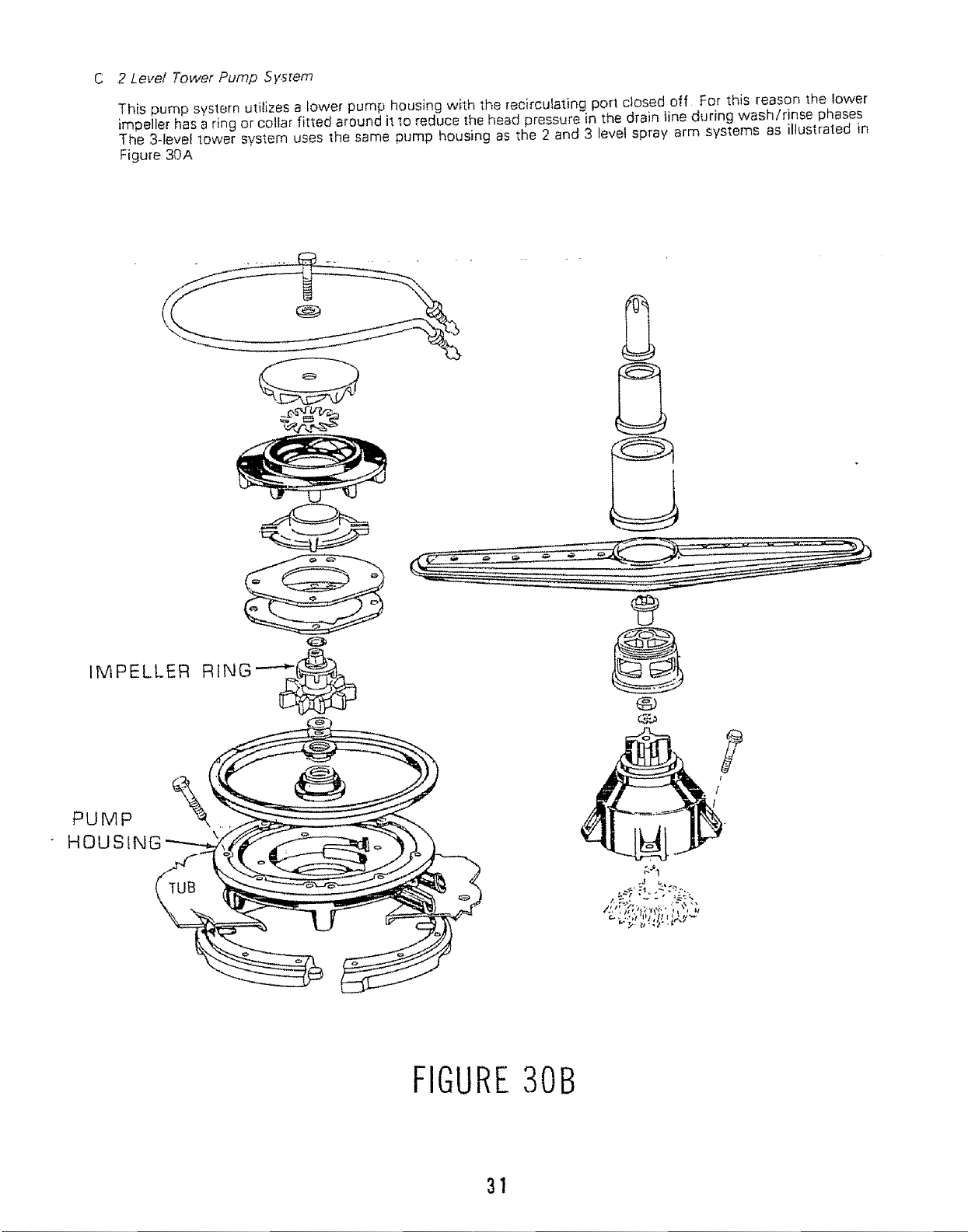
2 Level Tower Pump 5y,srem
• ' m housin with the recirculating pot1 c osed off For this reason ;he bwer
This pump sysIern utlt_z,es a. lower pu _ ...... _g,,-_ t_-,_h_ nressure n the drain line during wash/r!nse phas?s
im eller has a ring or collar Tltteo arounu i__u _,_,._ -,,Z----dz_ ,_ _,_ q I_vRt snrav arm systems as ilius_raieu m
ThPe3-level tower system uses the same pump housing aS _u_ L ,_,,,_ ...... _ -
Figure 30A
C
IMPELLER
PUMP f_
HOUSING
0
z_"_;_:_P',_!"",,", ',
FIGURE30B
31

Testing the Motor and Relay
Start the dishwasher at the beginning of a cycle, and allow the unit to electrically advance through the first
fill The motor should star1 in a counter-clock-wise direction (ccw)
D Motor Main or Run Winding Check
CA UTION:
Disconnect the power to the machine while connecting the voltmeter in the circuit°
1 Connect a voltmeter in the motor run winding circuit as outlined in Figure 3 f, position "A " If your motor
has a connector block, meter must have a probe that can be inserted into the biock
ANY WHITE
START sWITCH _BLuE-YEL
rr
uJ
P RUN WINDING
0 START ,BLUE-ORANGE
I- RELAY
TIMER
BLUE-BLACK CCW RINSE WASH START Wit 4'0
POSITION "A"
VOLT METER
BLUE'RED CW DRAIN START wINDING
WHITE .... _
MAiN MOTOR-REVERSIBLE 1/3 H R 3450 RPM
115V 600 AC
F
BLU
FIGURE31
32

START SWITCH -II'-BLUE-YEL
tr
U_
o
ANY WHITE
POSITION "B"
VOLT METER
RUN WINDING
BLUE -_ORANG
START
RELAY
BLUEoBLACK RINSE WASH START WINDING
BLUE-RED DRAIN START WINDING
WHITE
RED
BLACK
BLUE- RUN WINDING
I _
MAIN MOTOR-REVERSIBLE /3 H,P, 3450 RPM
115V 60HZ AC
FIGURE32
.
Restart. the dishwasher. Voltage at Position "A" indicates voltage to motor-run winding° If the motor does not
"hum," (attempt to start) the run winding is probably open. A continuity check (power off and coupler separated)
between the blue and white motor lead should indicate low resistance. If an open circuit is indicated, replace
the motor.
3. If no voltage at "A," (Figure 3!), then check for voltage at the output side of timer as shown in Figure 32
Position "B."
4. Continuous voltage at BLU-ORG terminal indicates that timer switch is OK, and the trouble is in the start relay,
wiring, or wiring connections.
If there is no voltage at the BLU-ORG terminal check for voltage at the input side of timer,. (Refer to wiring
diagram for the correct timer terminaL)If power is found at the input terminal then the diner is at fault. If
voltage is not present at input terminat, then problem is somewhere in circuit ahead of timer.. Trace circuit for
cause and make the necessary repairs,.
33
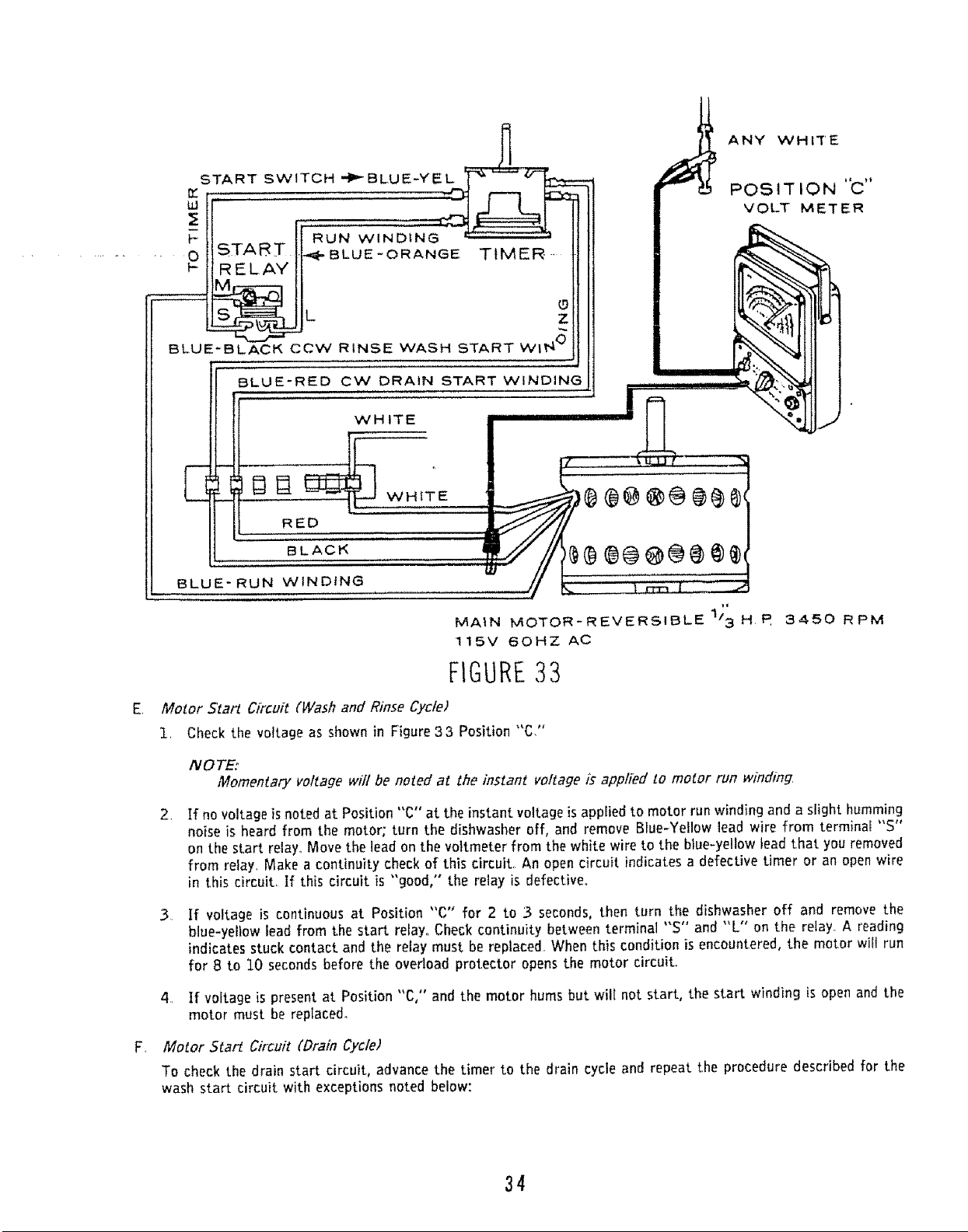
F,
START W,T,C ÷BLO,,ET E A"VWH,TE
, ,, POSITION "C"
VOLT METER
wtsD'iN6 '......
I '
O _TAR. T .,_[..BLUE-ORANGE TIMER"
t- RELAY
L
BLUE-BLACK CCW RINSE WASH START WIN O
I t
BLACK
BLUE- RUN WINDING
BLUE-RED CW DRAIN START WINDING
W H I T E """ [-7
j
%._
MAIN MOTOR-REVERSIBLE 1/3 H P, 3450 RPM
115V 6OHZ AC
FIGURE33
Motor Start Circuit (Wash and Rinse Cycle)
t. Check the voltage as shown in Figure 33 Position "C,"
NOTE:
Momentary voltage wilt be noted at the instant voltage is appfiad to motor run windin_
, tf no voltage is noted at Position "C" at the instant voltage is applied to motor run winding and a slight humming
noise is heard from the motor; turn the dishwasher off, and remove Blue-Yellow lead wire from terminal "S"
on the start relay..Move the lead on the voltmeter from the white wire to the blue-yellow lead that you removed
from relay. Make a continuity check of this circuit. An open circuit indicates a defective timer or an open wire
in this circuit. If this circuit is "good," the relay is defective.
If voltage is continuous at Position "C" for 2 to 3 seconds, then turn the dishwasher off and remove the
blue-yellow lead from the start relayo Check continuity between terminal "S" and "L" on the relay, A reading
indicates stuck contact and the relay must be replaced. When this condition is encountered, the motor wi, run
for 8 to 10 seconds before the overload protector opens the motor circuit.
4. If voltage is present at Position "C," and the motor hums but will not start, the start winding is open and the
motor must be replaced_
Motor 5tart Circuit (Drain Cycle)
To check the drain start circuit, advance the timer to the drain cycle and repeat the procedure described for the
wash start circuit with exceptions noted below:
34
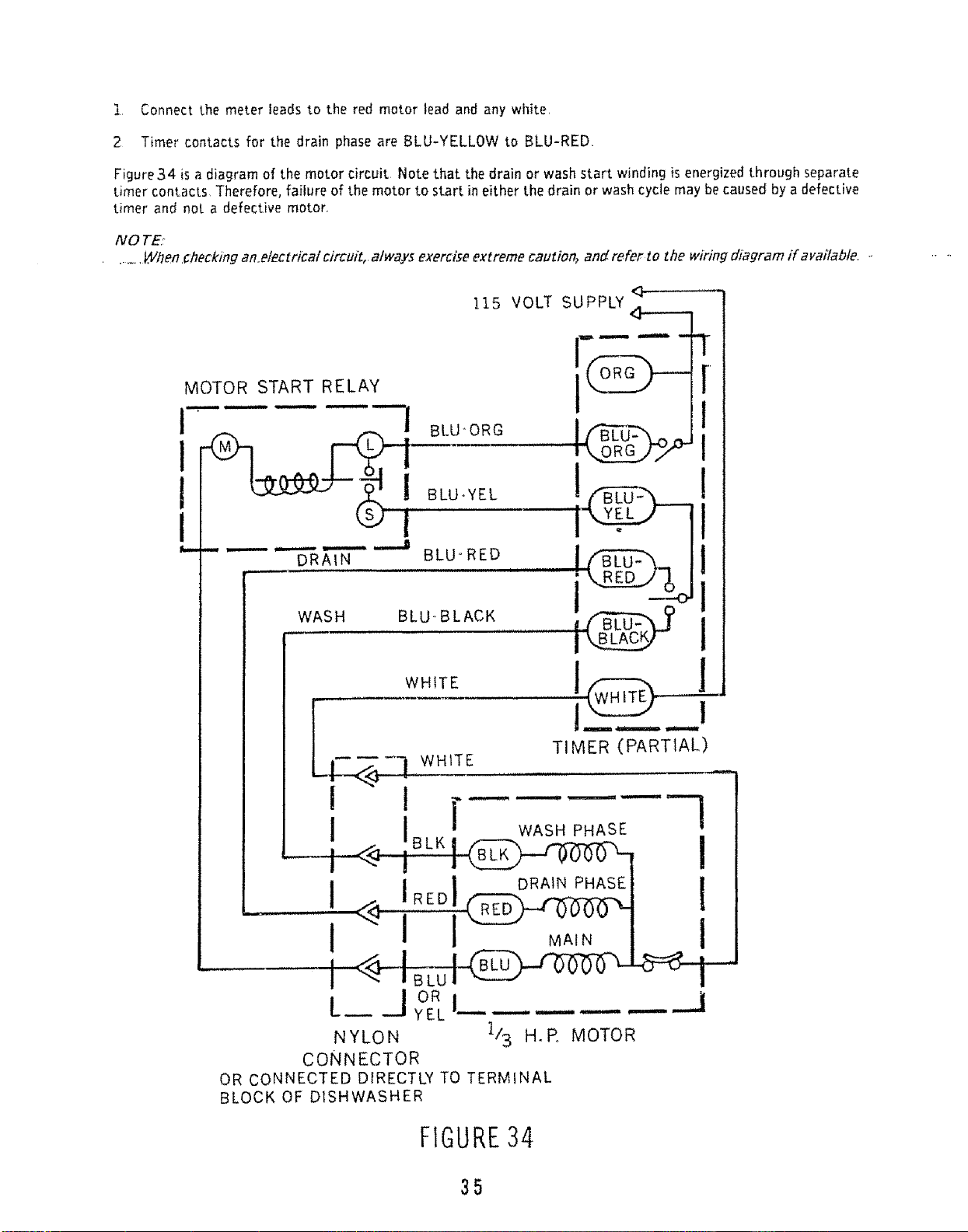
t Connect the meter leads to the red motor lead and any white,
2 Timer contacts for the drain phase are BLU-YELLOW to BLU-RED.
Figure34 is a diagram of the motor circuit Note that the drain or wash start winding is energized through separate
timer contacts Therefore, failure of the motor to start in either the drain or wash cycle may becaused by a defective
timer and not a defective motor.
NO TE
_Vhen.checkingan e/ectricat cJrcuiZ,atways exercise extreme cautiOr_ and refer to the wiring diagram if availabfe. ..
MOTOR
I
!
I
115 VOLT SUPPLY
START RELAY __
--- ---_-7 B_O'ORG Ir__-u--'___
k
DRAIN
,,,,,,,,,,,,
WASH
!
........BLu ED
T
[
I
WHITE ..............................._.
LI__._<_ WHITE TIMER (PARTIAL)
i i r-- ----7
i IBLK I WASHPHASE
--i__ !
_. !,,_ IR_D!_°_'" P"_ J
I I ! _,. I
I i°R_.... -----J
NYLON 1/3 H.R MOTOR
CONNECTOR
OR CONNECTED DIRECTLY TO TERMINAL
BLOCK OF DISHWASHER
FIGURE34
35

TERMINAL
TERMINAL /
TERMINAL " !__"
FIGURE35
G After the Main Motor has been tested and proven good, the motor relay may be checked as follows:
1. Connect the machine to electrical power.
2 Advance the timer to the beginning of a wash or drain cycle,
Set your voltmeter to the 250V, AC scale and connect the leads to terminals "S" and "L" of the starting relay
(Figure 35), Apply power to the machine, If the motor hums and voitage is indicated on th_ meter, the relay
contacts are not closing and the retay must be replaced If the motor does not hum, disconnect the power and
make a continuity check of the retay coif (terminals L to M) before checking the leads and timer
36

2 SUMP
(SOME MODELS)
3
SCREW
DIFFUSER
SCREW
wAs.ER
4 UPPER tMPELLER_
4 MACERATOR ¢_
SPACER PLATE __
4
SHROUD
5
PUMP PLATE
GASKET--
b RING
LOWER IMPELLER
1
I
6 GASKET
6 MOTOR
FIGURE36
H Motor Replacement (If you have a dishwasher manufactured in 1978 or later, refer to the procedure on Page 40)
To replace the main motor, it is necessary to remove the motor and circulating pump assembly from the dishwasher.
Follow the procedure as outlined and refer to Figure 36-
IMPORTANT:
Do not attempt any repairs on the machine without first disconnecting the dishwasher from
electrical power,
1 Disconnect wires, circulating hose and drain hoses from the pump casting,
2 Remove spray arm nut, washer, spray arm, and sump cover if used, (2)
37

3 Remove upper pump housing (diffuser) (3}
4 Remove upper impeller, macerator blade, spacer plale, and pump plate (4]
5 Remove lower impeller and seals (5}
6 Detach motor and pump housing assembly cover, and gaskets from tub (8 screws) (6)
7 Remove pump housing from motor (4 thru-bolts at base of motor or 4 short bolts at top of bell housing) and
mark position of pump housing in re,at;on to motor
8 lnstalt housing in same position on replacement motor IMPORTANT! The motor,shaft must be accurately
centered t;,_the pump housing for r_roper operation oN the pump To aasure precise centering, use Service Tool
803923 as Illustrated in Figure 37, before tightening thru bolts (Available through Sears Parts Department )
9 After the pump housing has been secured to replacement motor, it is necessary to determine the correct num-
ber of shim washers to be used between the fower impeller and the motor shaft Shim_ axe required to insure
correct mating pre£aure of the water seals To determine the number of shims required, hold shim gauge
(furnished with kit) firmly on surface of pump housing as shown in Figure 37 (Note: Shim gauge should not be
on top of gasket )
The shim washers are t/32 inch thick Fill the space between the motor shaft and shim gauge with the shims
CA U T/OiM:
Do not over shim by allowing the gauge to raise above the pump housing surface.
38

CENTER MOTOR SHAFT WITH PUMP HOUSING
WITH SERVICE TOOL 803923--7
/
f
M
3____/
,!' ...... ] ......
10
FIGURE37
SHIM GAUGE 807077_ _
FIGURE38
.,p'--_ RAISE EDGES OF
/
GASKET TO ALLOW
GAUGE TO SEAT ON
PUMP HOUSING
SURFACE
Before repiacqng the required shims and lower impeller on the motor shaft, carefully examine the mating sur-
faces of the lower impeller shaft seal (white ceramic) and the pump housing seal (black carbon) These surfaces
should be perfectly smooth and polished in appearance If either appears scratched, pitted or damaged in any
fashion, the seal must be replaced otherwise a leak may occur
Clean seal cavity thoroughly Install the lower seal. Use service tool 803923.
11 Fasten motor pump housing assembly to tub Be sure casting is clean and a new gasket is used
12. Re-assemble remaining pump components in reverse order of removal
IMPORTANT:
Be sure the relay furnished in the kit is used with the replacement motor, otherwise, serious
damage to the motor can result! Carefully review the instructions packed with the motor
39
J
K
Motor ]nstaltation
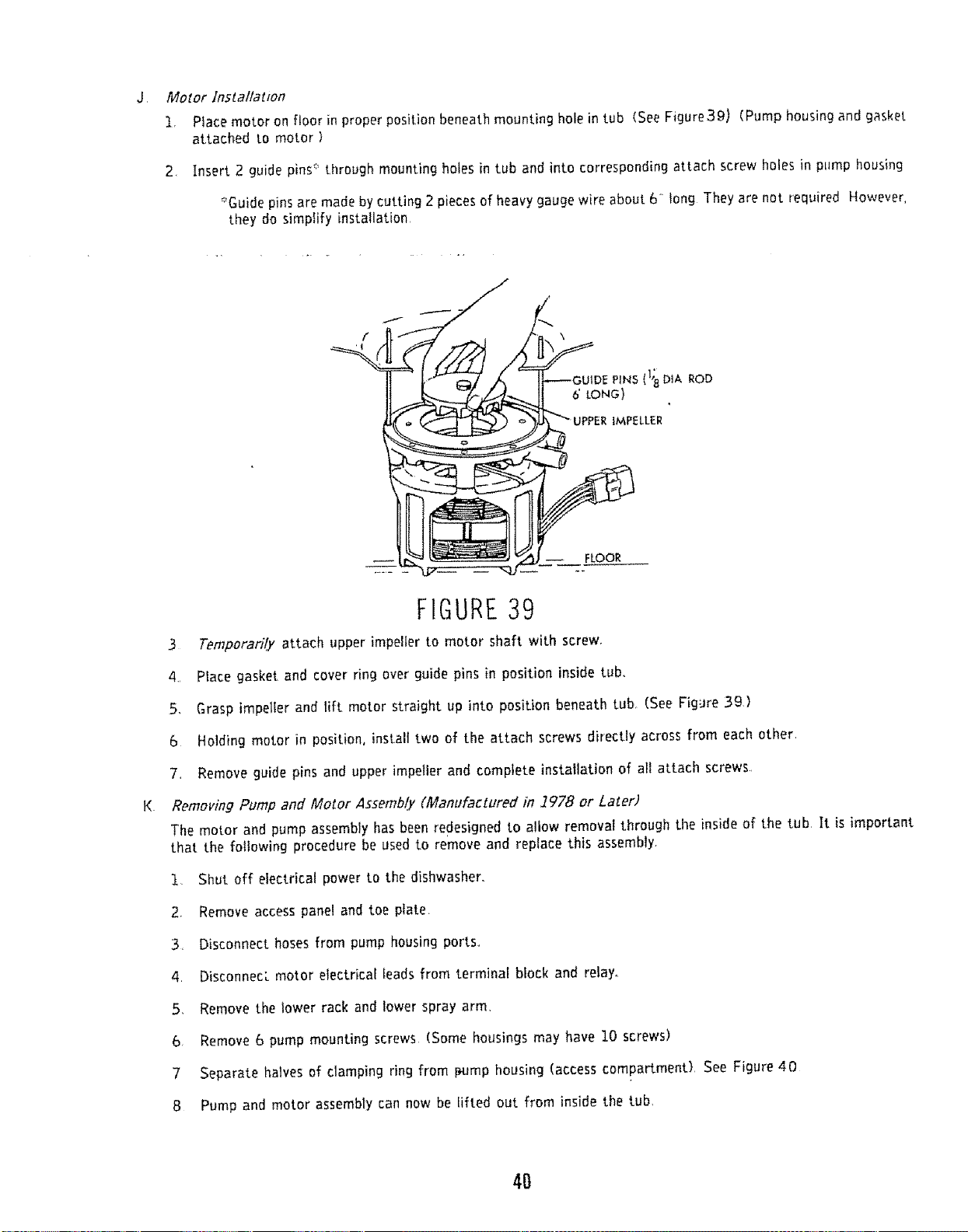
1, Place motor on floor in proper position beneath mounting hole in tub (See Figure39t (Pump housing and gasket
attached to motor )
2 Insert 2 guide pins _:'through mounting holes in tub and into corresponding attach screw holes in p_mp housing
_'Guide pins are made by cutting 2 pieces of heavy gauge wire about 6- long They are not required However,
they do sirnptify installation
f ,,
I1 --ou D p Nst ROD
FIGURE39
.3 Temporarily attach upper impeUer to motor shaft with screw.
4,, Place gasket and cover ring over guide pins in position inside tub,
5, Grasp impeller and rift motor straight up into position beneath tub (See Figure 39)
6 Holding motor in position, install two of the attach screws direcdy across from each other,
7, Remove guide pins and upper impellerand complete installationof allattach screws
Removing Pump and Motor Assembly (Manufactured in 1978 or Later)
The motor and pump assembly has been redesigned to allow removal through the inside of the tub, It is important
that the following procedure be used to remove and replace this assembly.
1, Shut off electrical power to the dishwasher.
2. Remove accesspanel and toe plate,
3, Disconnect hosesfrom pump housing ports,,
4 Disconnect motor electrical leads from terminal block and relay.
5, Remove the lower rack and lower spray arm,
6, Remove 6 pump mounting screws (Some housings may have 10 screws)
7 Separate halves of clamping ring from _mp housing (access compartment), See Figure 40
8 Pump and motor assembly can now be lifted out from inside the tub,
4O

;KET 807709
.GASKET 807710
LOCATING
L_
CLAMPING RING
807T12
PUMP HOU
807711
FIGURE40
Replacing Pump and Motor Assembly (Manufaclured in ]g78 or Later)
1,, Replace 8077:t0 gasket, DO NOT try to re-use original gasket, Be sure ridges on gasket face downward
2, Place pump and motor assembly in mounting hole in tub bottom. Be sure ports on pump housing are adjacent
to connecting ends of drain and recircuiating hoses
3, Join together the two halves of the clamping ring on the pump housing Make sure the locating pins in the clamping
ring halves are inserted in the holes in the pump housing° The joined ring will stay in position on the pump housing
when it is properly assembled,
4, Install the pump mounting screws/MPORTANT,"/nstall one screw on each side of the ring F]RSS_ See Figure
4'1
5, Attach hoses to pump housing ports., Secure clamps with clamp screw on underside of hose
6, Connect motor leads disconnected in Step _4 in "Removing Pump and Motor Assembly,"
7., Replace lower spray arm, lower rack, toe plate, and access panel
INSTALL IHESE SCREWS FIRST
,)
TUB
FIGURE41
41

Hoses and Couplers
A. Front Opening Portables
Proper routing of hoses for Front Opening Portables is shown in Figure 42 Tub removal is not required to perform
the following operations
FIGURE42
NOTE: Tub is removed only to show location and routinB of hoses
To replace the Fill Hose:
1, Lay unit on its back,
2, Disconnect inlet hose at inlet valve
3. Stand upright, remove top,
4, Detach saddle hose clamp
5 Pull inlet hose up and out of cabinet.
6. Disconnect inlet hose from coupler,
Reinstall new inlet hose in reverse of the above - Be certain routing is proper and that there are no twists or kinks
in the hose. Check hose connections for leaks and test movement of hose in and out of cabinet.
NO TE:
On some models, both the fill hose and drain hose are permanently attached to the coupler.
To replace the Drain Hose:
_, It is best to leave unit in upright, position and remove access panel
2, Disconnect drain hose from pump casting - CAUTION - be prepared to catch approximately one Q) quart of
water from pump housing and hose.
3. Disconnect fill hose at inlet (still standing upright].
4, Remove top assembly
42

B
5. Remove hose saddle
6. Remove hoses.
7, Detach inlet hose and reattach it to a new coupler and drain hose assembly
Reinstall coupbr and hose assembly in reverse orden Be Certain routing is proper with no twists or kinks in hoses
Check connections for leaks and test movement of hoses in and out of cabinet
Adjustment of Hose Length:
The length of the hose when fuJly extended is approximately 4%" to 5'. Should this appear short or an additional
inch or two be needed, you could take up any slack that may be available in the routing (Figure42), Be certain
however, that you do not kink or otherwise restrict the hoses.
Hose and Coupler Assembly (]8" compact model)
Replacement of fill hose, drain hose and coupler (See Figure 48),_
1. Disconnect power supply
2, Remove top assembly.
3, Remove hose and power cord pocket,
4. Remove saddle bracket,
5o Tilt dishwasher and disconnect hoses from valve and pump housing,,
During re-assembly, reverse procedure and place saddle clamp approximatley 50 inches from the coupler end of the new
assembly on the drain hose and approximately 48 inches on fill hose°
CORD POCKET
FIGURE43
DISCONNECT AT-q
•PUMP HOUSING _STEP
)ISCON NECT ATJ
VALVE
43

Faucet Coupler
The fill and drain hoses of a portable dishwasher terminate in a faucet coupler Mos! coupler's are equipped with bleed
valves to enable the operator to relieve the water pressure in the fil! hose by depressing the valve button This prevents
splashing when the coupler is disconnected
Coupler Repair
Because of the high cost of replacing complete couplers and coupler/hose assemblies, couplers should be repaired
whenever possible See Figure 44 and 45 for exploded views of 2 faucet coupters and pressure relief valves used in
Sears dishwashers,
S_B_ R_ng m
S_r_n 7 _:_od _J_7
PRESSURE RELIEF VALVE KIT
HEX_WRENCH
PRESSURE RELIEF-
VALVE
COLLAR
SPRING
RING
_,, B06584
SLEEVEGASKET
BODY
FIGURE44 FIGURE45
The coupler body has a very tong fife In general, it is aging and wear that causes the sleeve (internal) gasket, collar and
pressurerelief to fai{
If Lhecoltar is worn, the spring is weak or broken, or bali bearings are missing, order a Collar Repair Kit from Sears
Repair Parts DepartmenL Have your model number available when purchasing repair parts
]f the pressure relief valve is not sealing (leaking thru Need hole) obtain a Pressure Relief Kit from Sears You must
have your mode{ number in order to obtain the correct kit. The 2 pressure relief valves used in Sears dishwashers
are shown in Figures 44and 45,.
If water is coming up around the faucet snap adapter, replace SIeeve Gasket 806584.
44

BI-META
CAM i
FIGURE46
FIGURE47
Dispensers
A. Detergent DL_penser- B/-Metal Operated
The Bi-Metal trigger usedto releasethe detergent cup locking cam is made of two different metals which arebonded
together The expansion rates of these metals are considerably different,. The trigger bends when heated and releases
the Locking cam, (See Figures 46 and 47.
The Bi-Metal trigger is a low voltage device It is placed in series with the dishwasher heating element Current flowing
through the heating elementis directed by the timer through the trigger mechanism either during or immediately after
the fill period for the second wash The current heats the trigger and the cam is released,
Severa{ different circuits have beenused with these devices Always refer to the wiring diagram for tile model you
are servicing in all cases,power is taken from a timer terminal to one terminal of the Bi-Metal The other Bi-Metat
terminal is connected to the red heater lead, usually at the timer The timer switch that normally supplies the heater
power must be open while detergent cup operation takes place
45
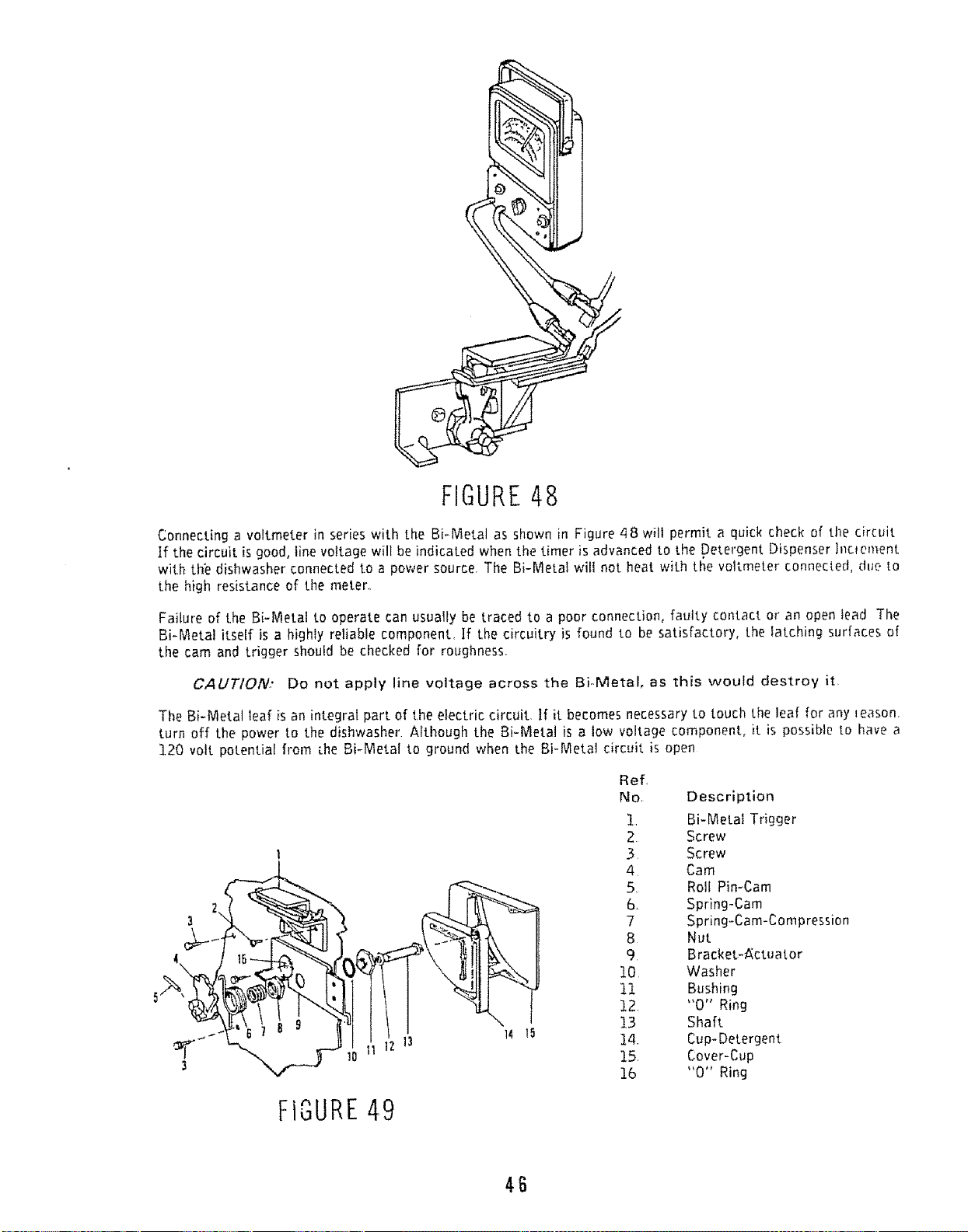
FIGURE48
Connecting a voltmeter in series with the Bi-Metal as shown in Figure 48 will permit a quick check of the circuit
If the circuit is good, tine voltage will be indicated when the timer is advanced to the Detergent Dispenser Inclement
with th'e dishwasher connected to a power source_ The Bi-Metal will not heat with the voltmeter connected, due to
the high resistance of tile meten
Failure of the Bi-Metal to operate can usually be traced to a poor connection, faulty contact or an open iead The
Bi-Metal itself is a highly reliable component, If the circuitry is found to be satisfactory, the latching surfaces of
the cam and trigger should be checked for roughness,
CAUTION: Do not apply line voltage across the Bi.,Metal, as this would destroy it,
The Bi-Metal leaf is an integral part of the electric circuit, tf it becomes necessary to touch the leaf for any _eason,
turn off the power to the dishwasher Although the Bi-Metal is a tow voltage component, it is possible to have a
120 volt potential from _he Bi-Metal to ground when the Bi-Metai circuit is open
3
14 15
Ref,
No, Description
1, Bi-Metal Trigger
2 Screw
3 Screw
4 Cam
5 Roll Pin-Cam
6o Spring-Cam
7 Spring-Cam-Compression
8 Nut
9 Bracket-Actuator
10 Washer
11 Bushing
12 "0" Ring
13 Shaft
14. Cup- Detergent
15, Cover-Cup
16 "0" Ring
FIGURE49
46

Wetting Agent Dispenser - Bi-Metal Operated
A completely redesigned supply tank and a Bi-Metal release mechanism are features of this wetting agent eispenser,
Elimination of the solenoid reduces the operating noise level of the dispenser_
The door must be fully openedfor a few seconds to allow the wetting agent liquid to fill up in a scoop (Figure 50),
DOOR IN FULLY OPENED POStTI
FILL NECK
-SCOOP
WETTING AGENT LIQUID
FIGURE50
When the door is closed the wetting agent liquid in the scoop then fills the area at the bottom portion'bf the inner
valve stopper and any extra !iquid drains back into the supply tank (Figure 51 ),,
PLUNGER_._
RESERVOIR FILLS
WITH LtOUID FROM
SCOOP'"-.--.__
ZXC_S LtOUIO
DRAINSBACK .J
_NTOSUPP_._" I
FILL, NEC_ _
' _ DOOR IN CLOSED AL _--N,_.__dL____
POSITION
ENERGIZED BIMET
LIFTS PLUNGER
INTO FILL NECK
FIGURE51
FIGURE52
Thiscontrolledamount ofwettingagentliquidat thelowersectionof thestopperisreleasedintothefillneckduring
thewaterfillof the4th (last)rinseonly.(Figure52)
To check for proper operation, with wetting agent liquid in the supply tank, start the dishwasher in the normal manner,
then manually advance the timer to the fill of the last rinse, The Bi-Metal should lift the stopper either during or
shortlyafter thisfiJl,The wetting agent willthen flow from the valvearea out to fillneck for mixing with the rinse
water_
47
Failure of the Bi-Metal to lift can usually be traced to an interruption of its circuit path, which includes the heating
element The rinse injector Bi-Metat is very similar to that for the detergent cup, and it is checked in the same manner,
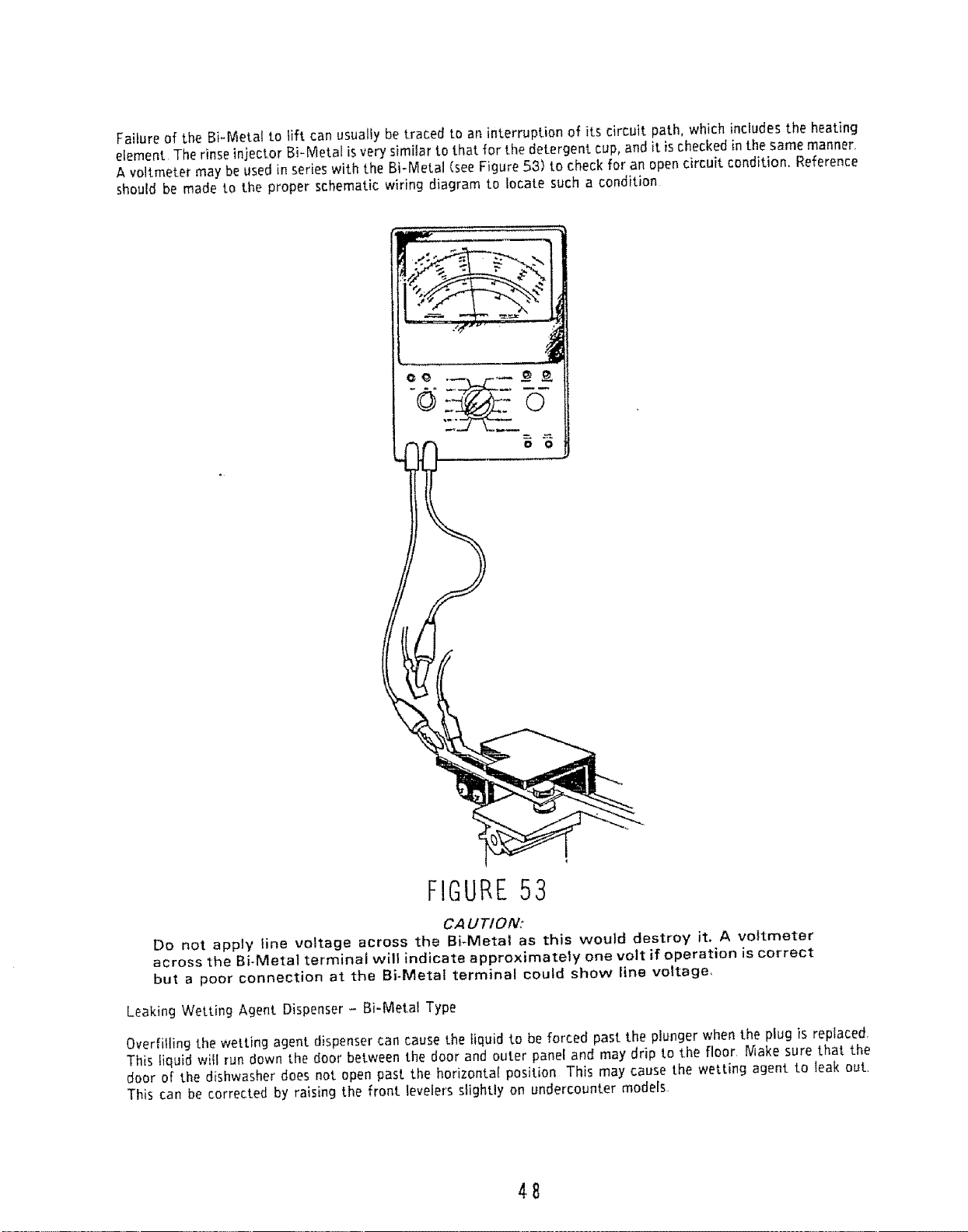
A voltmeter may beused in series with the Bi-Metal (see Figure 53) to check for an open circuit condition_ Reference
should be made to the proper schematic wiring diagram to locate such a condition
FIGUP,E 53
CA UTION:
Do not apply line voltage across the Bi-Metat as this would destroy it, A voltmeter
across the Bi.Metal terminal will indicate approximately one volt if operation is correct
but a poor connection at the Bi-Metal terminal could show line voltage,
Leaking Wetting Agent Dispenser - Bi-Metal Type
Overfilling the wetting agent dispenser can cause the liquid to be forced past the plunger when the plug is replaced,
This liquid will run down the door between the door and outer panel and may drip to the floor Make sure that the
door of the dishwasher does not open past the horizontal position This may cause the wetting agent to leak out,
This can be corrected by raising the front levelers slightly on undercounter models
48
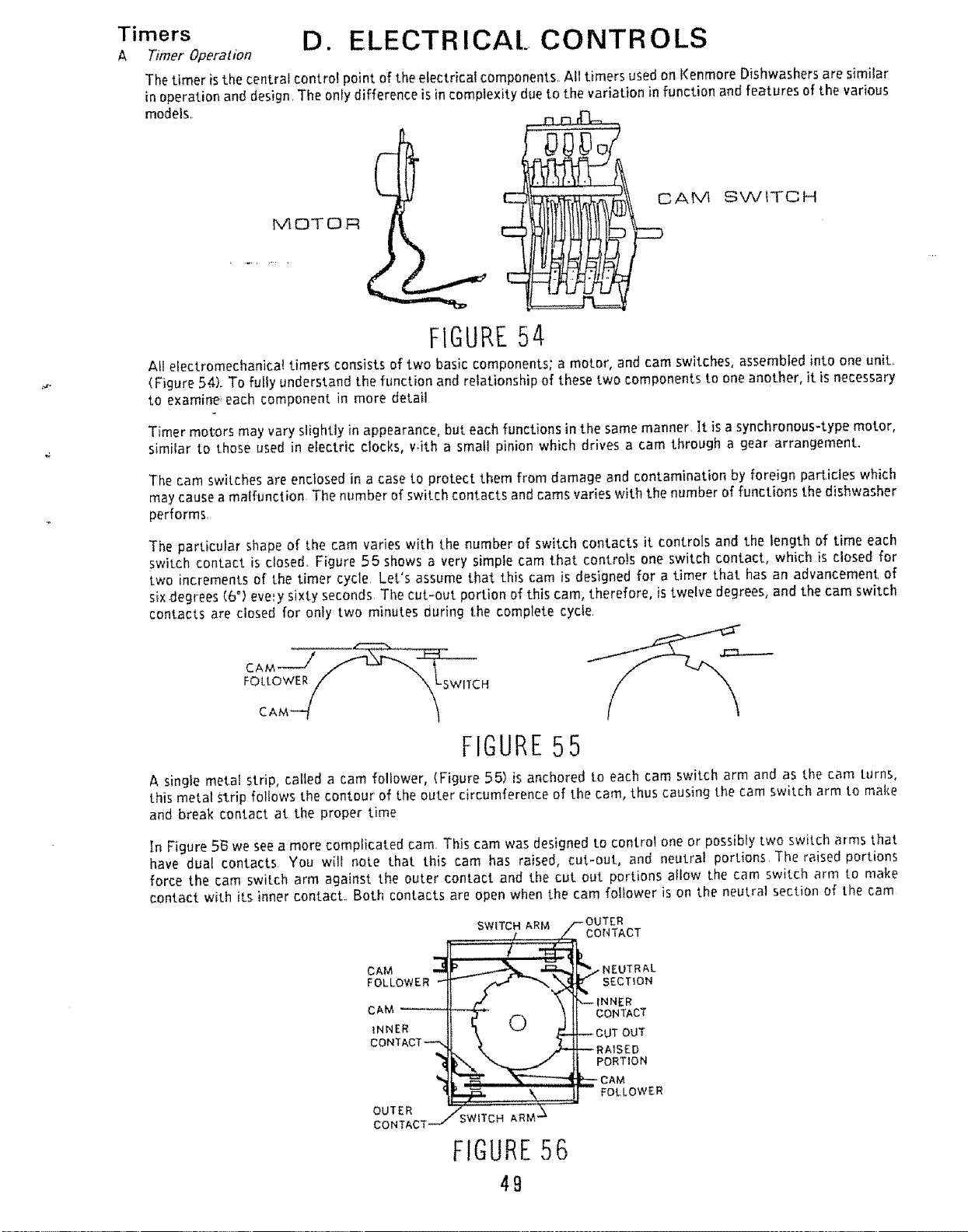
Timers
A Timer OperatiOn
D. ELECTRICAl. CONTROLS
The timer is the central control point of the electrical components. All timers used on Kenmore Dishwashers are similar
in operation and design. The only difference is in complexity due to the variation in function and features of the various
models
MOTOR
CAM SWITCH
FIGURE54
All electromechanica! timers consists of two basic components; a motor, and cam switches, assembled into one unit..
(Figure 54). To fully understand the function and relationship of these two components to one another, it is necessary
to examine each component in more detail
Timer motors may vary slightly in appearance, but each functions in the same manner It is a synchronous-type motor,
similar to those used in electric clocks, with a small pinion which drives a cam through a gear arrangement.
The cam switches are enclosed in a case to protect them from damage and contamination by foreign particles which
may cause a malfunction The number of switch contacts and cams varies with the number of functions the dishwasher
performs
The particular shape of the cam varies with the number of switch contacts it controls and the length of time each
switch contact is ctosed_ Figure 55 shows a very simple cam that controls one switch contact, which is closed for
two increments of the timer cycle Let's assume that this cam is designed for a timer that has an advancement of
six deglees (6 °) every sixty seconds The cut-out portion of this cam, therefore, is twelve degrees, and the cam switch
contacts are closed for only two minutes during the complete cycle
CAM----/
CAM----.-/ t
FIGURE55
A single metal strip, called a cam follower, (Figure 55) is anchored to each cam switch arm and as the cam turns,
this metal Strip follows the contour of the outer circumference of the cam, thus causing the cam switch arm to make
and break contact at the proper time
In Figure 5B we see a more complicated cam, This cam was designed to control one or possibly two switch arms that
have dual contacts You will note that this cam has raised, cut-out, and neutral portions The raised portions
force the cam switch arm against the outer contact and the cut out portions allow the cam switch arm to make
contact with its inner contact. Both contacts are open when the cam follower is on the neutral section of the cam
SWITCH ARM
CONTACT
CAM . NEUTRAL
FOLLOWER SECTION
CAM _ CONTACT
INNER OUT
PORTION
-CAM
FOLLOWER
OUTER
CONTACT
€
FIGURE56
49
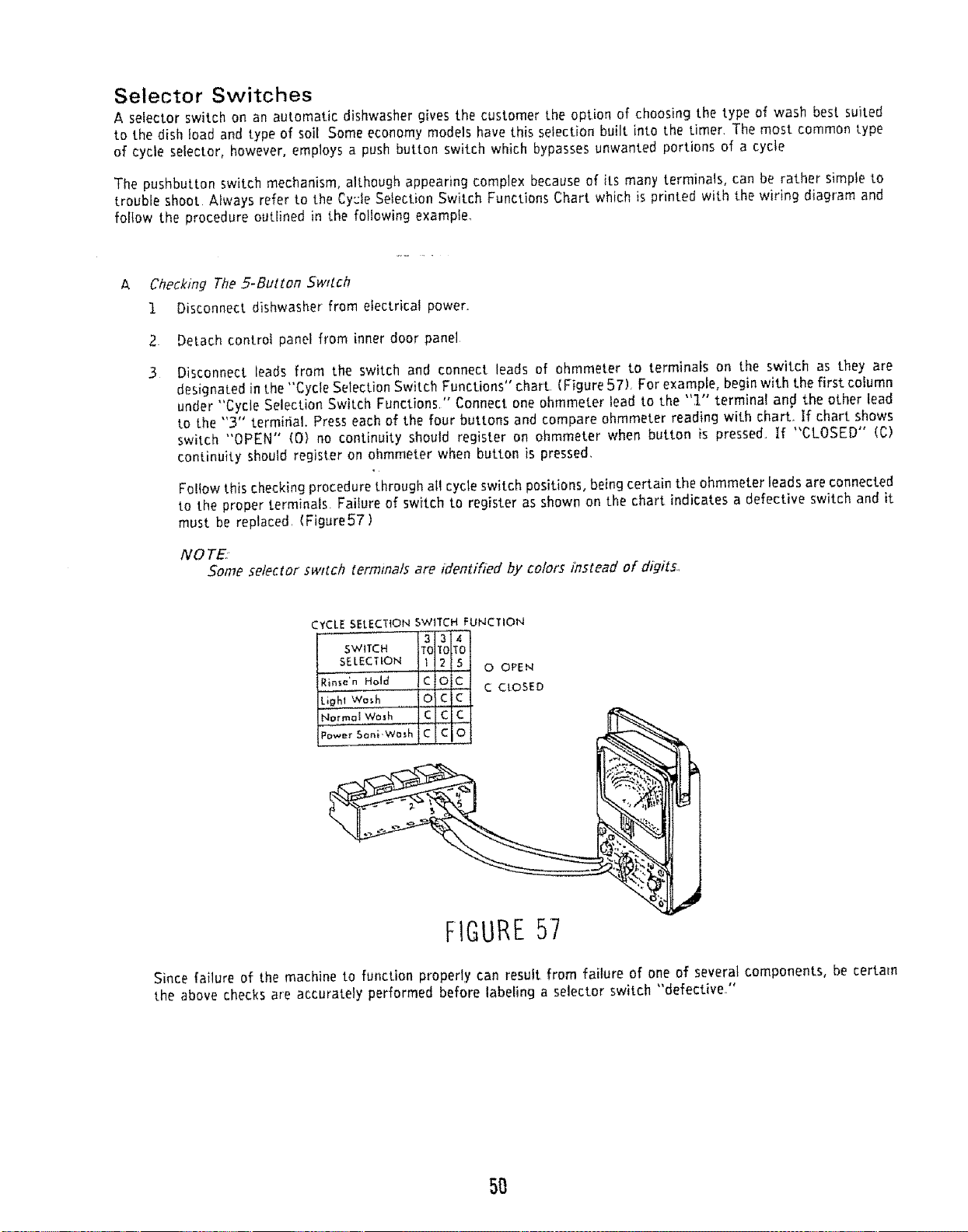
Selector Switches
A selector switch on an automatic dishwasher gives the customer the option of choosing the type of wash best suited
to the dish load and type of soil Some economy models have this selection built into the timer The most common type
of cycle selector, however, employs a push button switch which bypasses unwanted portions of a cycle
The pushbutton switch mechanism, although appearing complex because of its many terminals, can be rather simple to
trouble shoot Always refer to the Cycle Selection Switch Functions Chart which is printed with the wiring diagram and
follow the procedure outlined in the following example,
Checking The 5-Button Swttch
1 Disconnect dishwasher from electrical power.
2 Detach control panel from inner door panel
3
Disconnect Leadsfrom the switch and connect leads of ohmmeter to terminals on the switch as they are
designated in the "Cycle Selection Switch Functions" chart, (Figure 57) For example, begin with the first column
under "'Cycle Selection Switch Functions" Connect,one ohmmeter lead to the "1" terminal and the other lead
to the "3" termirial. Presseach of the four buttons and compare ohmmeter reading with chart, |f chart shows
switch "OPEN" (0) no continuity should register on ohmmeter when button is pressed. If "CLOSED" (C)
continuity should register on ohmmeter when button is pressed.
Fo!low this checking procedure through all cycle switch positions, being certain the ohmmeter leads are connected
to the proper terminals. Failure of switch to register as shown on the chart indicates a defective switch and it
must be replaced, (Figure57)
NOTE
Some 5elector swztch termma/s are identified by colors ihstead of digiZ_,
CYCLE SELECTION SWITCH FUNCTION
SWITCH TC
SELECTION 1 2 I S
R_nse'n Hold C OIC
Normal Wosh _ C C C
Power Seal wosh C_
0 OPEN
C CLOSED
FIGURE57
Since failure of the machine to function properly can result from failure of one of several components, be certain
the above checks are accurately performed before labeling a selector switch "defective,"
50

Thermostats and Temperature Indicators
A Sam-Wash or High Temperature Wash/Rin.se Thermostat
Most dishwashers are equipped with a thermostat to provide for guaranteed hot water in the 2nd Wash and/or Final
Rinse when a Sani-Wash or high temperature wash is selected.. Unless the water temperature is high enough to satisfy
the thermostat, the thermostat stops the timer until the heater in the machine raises the water temperature enough
to satisfy the thermostat
If the water temperature in the tub is below the thermostat setting the switch remains open and the timer motor
does not run, prolonging the rinse cycle until the water temperature rises to the thermostat setting When this
temperature is reached, the bimetal strip within the thermostat deflects and doses the contacts (dosing the circuit
to the time_- m6tor) and the timer resumes operation to complete the dishwashing cycle; See Figure 58
-- THERMOSTAT
INSTALLED
"MYLAR JACKET
CROSS
SECTION OF THERMOSTAT
FIGURE58
The heater in the machine will raise the water temperature approximately one degree per minute Thus, if the water
is 135 degrees at the start of the Second Wash or Fourth Rinse and the thermostat is calibrated to 150 degrees,
the timer will stop for approximately 15 minutes in the Second Wash or Fourth Rinse (or both) while the water is
being heated, During the time that the thermostat is calling for'heat, there is no power to the timer motor although
the wash system continues to function
Depending on the model dishwasher, the thermostat may be calibrated at 140° to 150 ° Some Lady Kenmore
models contained 2 thermostats; one which is a round disk type, and the other which is of a tubular design The
disk type is calibrated for t50 °, and the tubular type is calibrated for 1200
B_ Checking Thermostat Operation
If the second wash or final rinse cycle is not delayed (when a Sani-Cyde has been selected), despite a temperature
of less than 130° F in the tub:
1, Check for incorrect wiring (use schematic).
2, Check for a defective thermostat Contacts should be open when cold,
3. Check for short in thermostat circuit.
4 Check for too low a calibration of the thermostat, Thermostat calibration may be determined by measuring the
temperature of the water expelled from the machine following a thermostatic delay
5t

If the second wash or 'final rinse phase is prolonged for an excessive amount of time, causing the water to become
hotter than necessary:
1. Check for too high calibration,, (Follow same procedure as outlined on the previous page )
2, Check the thermostat circuit for correct wiring
3 Check to see that power is applied to one terminal of thermostat by the timer at the proper time.,
4. Check the heating etemenL
If 1 and 2 are satisfactory, a faulty thermostat is indicated and should be repiacedo
CA U TION:
Care should be taken when installing a replacement thermostat so as not to place any
strain or pressure on the body of the thermostat, Note that the thermostat is held in
position by a clamp on the wire leads,
Some Kenmore Dishwashers, both portable and built-in, are equipped with sensing devices to indicate to the user
the temperature of the water within the machine. The water temperature will fall within the ranges of "Cool,"
"Normal," or "SanY' and wilt be indicated by lights on the console as shown in Figure 59.
TEMPERATURE INDICATOR LIGHT
DRY TIME SELECTOR TEMPERATURE DELAY
FIGURE59
The "coot" thermostat (Figure 60 )is a single pole single throw temperature controlled switch The "sani" thermostat
(Figure 61) is a single pole double throw switch
'SANI'
THER MOSTAT
C©OL THERMOS'fAT
' @ I
)
FIGUREGO
52

Since the thermostats are subjected to varying conditions within the home, it is extremely important that they be
secured firmly against the door or tub of the dishwasher in order to accurately sense the internal temperature
TEMPERATURE SENSfNG
SURFACE-:':: ........
!iii ii!ii!!i!i
i'.ilit :
i;i:iiii:i:ii
i;i:ii:::i!:!
FIGURE61
The purpose of the lights is to indicate 1o the user o1 the dishwasher whether the hot water supplied to the machine
is hot enough to produce good dishwashing results The "Cool" tight ,will remain on until the water temperature in
the dishwasher reaches 1400 at which time the light switches from "Cool" to "Normal "
Dishwashing detergents state that temperatures delivered to the inlet valve must be at least t40 degrees This
minimum temperature is required because of the severe drop in water temperature as waler enters a cold steel tub :.
and [he fact that it must "heat up" the tub interior and its contents before it can be expeci_ed to maintain the in)et
water temperature
For example; if water at the tap measures 140 degrees upon entrance into a cold dishwasher, this water temperature
wil! drop to approximately 115 degrees or tess depending on the size of the load and the kind of dishware in the load
See Figure 62 As you can readily see, this would give only minimal warm water in the first wash to activate the
delergent The hotter the water is on the first fill, the quicker you will heat the tub and contents, and the better
you wilt maintain the heat
Long water runs, hot water pipes that pass through concrete slabs and crawl spaces will tend to cool the water
between fills Undercounter units that have an outside wall across the side or back tend to keep the tub cool
Therefore, always make yourself aware of all the conditions that can affect water temperature in your home
Also remember that any test involving thermostats and sensing devices must be done with all panel and components
in place throughout the testing
Water Heat Option 130°/140 °
Some models produced beginning in 1982 have a water heat option controlled by a 130°/140 ° iubular type thermo-
stat These models delay in the 2rid rinse, 2nd wash, and final rinse if the thermostat is not satisfied
Hot Rinse Option 150 °
Some models have a hol rinse option in the final rinse This functions exactly Iike the sani-lemp option of 150 ° in the -
final rinse The hot rinse option is controlled through a 150° tubular thermostat
High Limit Thermostat 180°
Models produced after 1982 have a 180° high limit thermostat This is a tubular type; it is normally closed ft breaks
the circuit to the heater when the temperature rating is reached On some models this thermostat may be reptaced
by a thermal fuse rated at 1O0°C This is located in the thermostat bracket on the door liner
53

WATER TEMPERATURE
OPERATING CHARACTERISTICS
iNLET WATER TEMR-140°F
W
!1
1stWASH ]st RtNSE 2naRIN
WASH
z
nlll
3rd RIN
4tfi RINSE DRY
FIGURE62
Water Heat Option
Hot Rinse Option
In Figure 62, inlel water temperature is at 140 degrees constant Operation with t40 degree inlet water tempera-
lure, is adequate and will do a good job of washing dishes Notice how water heat and ho_ rinse options will
function with 140 ° inlet temperature
C SanM4/ash Delay Circuit
Figure 63A shows the circuit at the fourth rinse when the Sent-Wash cycle has been selected and the water tem-
perature is below the indicated Sani temperature [}50 degrees) The swilch to the timer motor has opened;
therefore, the timer cannol advance The temperature delay light wiiJ be energized through the Sani-Wash switch
and the coil of the motor (Current flow through the coils will be insufficient to cause the motor to run )
During this delay period, the water continues td circulate and rinse the dishes while the heating element gradually
raises the temperature of the water When the "Sani" temperature is reached, the double throw thermostat
closes its contact one to two, the delay light goes out, the "sent" indicator light glows, and the timer motor is
energized through contact 1 and 2 of the thermostat for one minute, after which the timer motor switch again
closes The timer motor remains energized for the remainder of the rinse and dry cycle
For models without temperature indicator _ights, the sani delay function operates in the same manner, however,
the thermostat is a single pole, single throw switch
54

3
SANITIZE DELAY LIGHT CIRCUIT
POWER SANI WASH CYCLE SELECTOR
FIGURE63A
D Water heat and hot rinse circuits
55
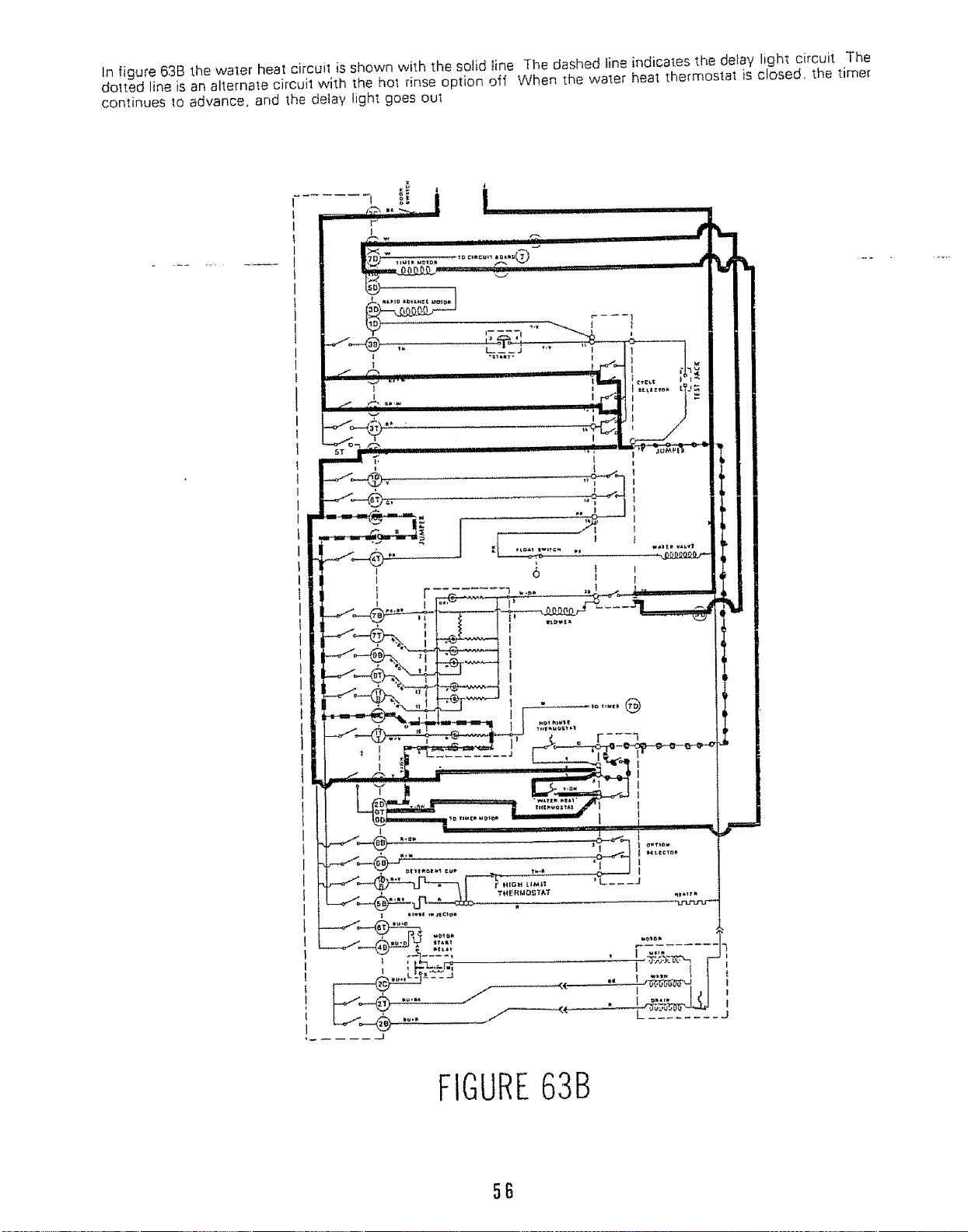
In Iigure 63B the water heat circuit is shown with the solid line The dashed line indicates the delay light circuit The
dotted line is an alternate circuit with the hot rinse option oft When the water heat thermostat is closed, the timer
continues to advance, and the delay light goes out
..... d
I
@
FIGURE63B
56
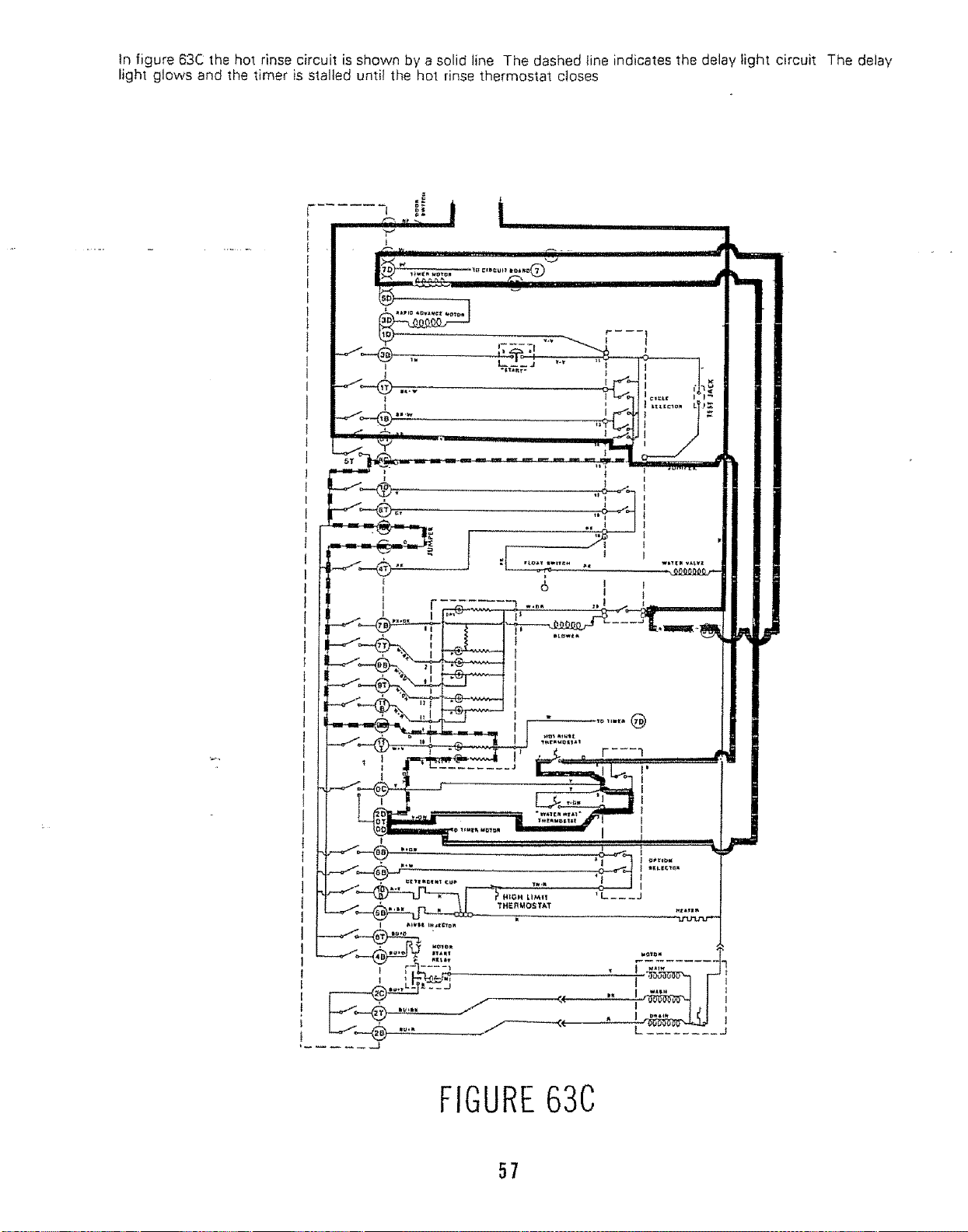
in figure 63C the hot rinse circuit is shown by a solid line The dashed line indicates the delay light circuit The delay
light glows and the timer is stalled until the hot rinse thermostat closes
I
I
1
!
FIGUREG3C
57

Figure 63D iliustrales the circuits involved when both water heat and hot rinse are selected The detay in the final
rinse is controlled in this case by the higher rated thermostat, hot rinse
_ :_<___,__..'__'!t
FIGURE63D
58
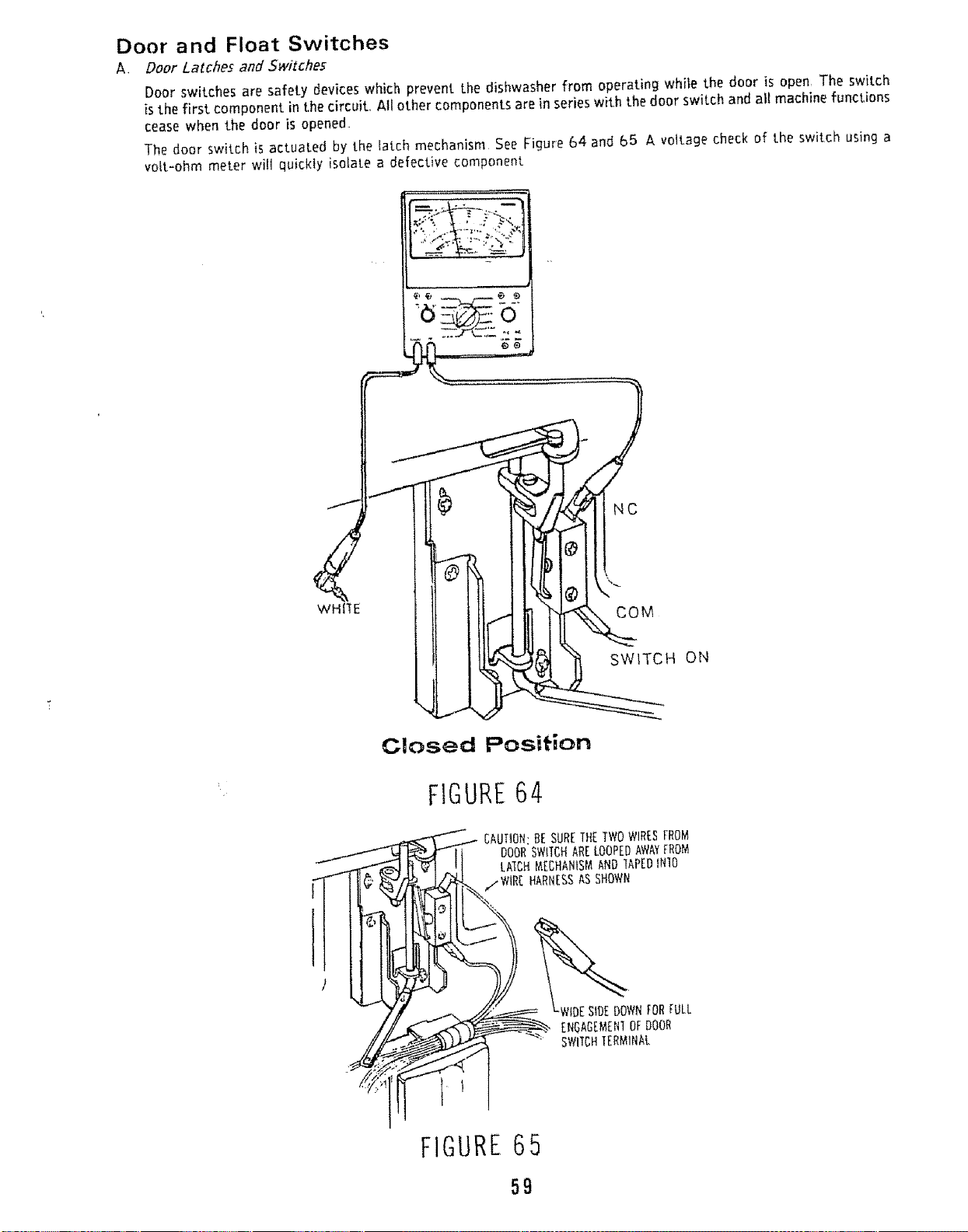
Door and Float Switches
A. Door Latches and Switches
Door switches are safety devices which prevent the dishwasher from operating while the door is open The switch
is the first component in the circuit, All other components are in series with the door switch and aiI machine functions
cease when the door is opened,
The door switch is actuated by the fatch mechanism See Figure 64 and 65 A voltage check of the switch using a
volt-ohm meter will quickly isolate a defectivecomponent
WHF[E
_TCH ON
Closed Posit_on
FIGURE64
CAUTtOff:_E SURETHETWOW_RESFROM
DOORSWITCHARELOOPEDAWAYFROM
£ATCHM]ECHAN1SMAND IAPEDINlO
,,/WIRE HARNESSAS SHOWN
FIGURE65
59
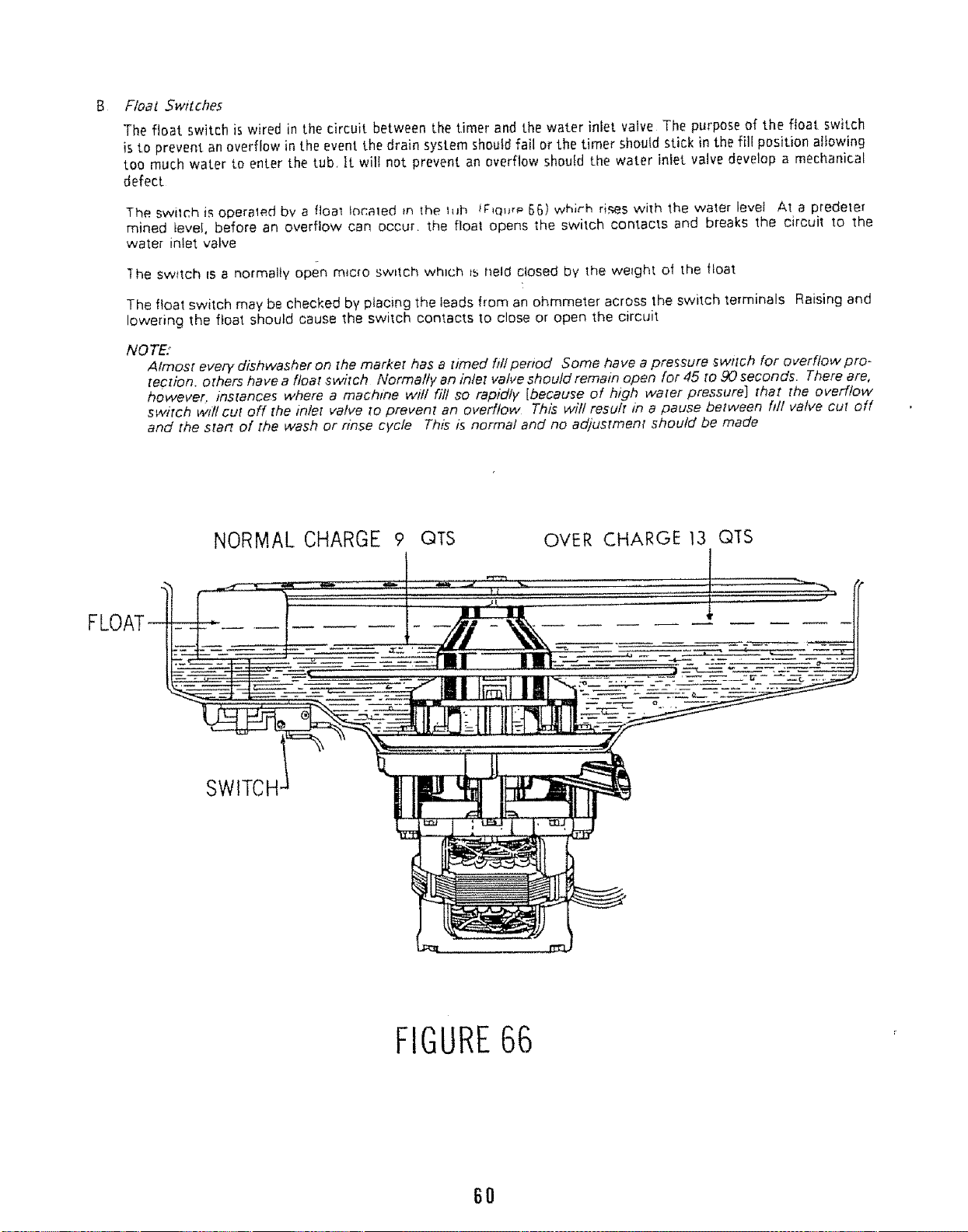
Float Switches
The float switch is wired in the circuit between the timer and the water inlet valve The purpose of the float switch
is to prevent an overflow inthe event the drain system should fail or the timer should stick in the fil! position allowing
too much water to enter the tub It will not prevent an overflow should the water inlet valve develop a mechanical
defect
The switch is operated by a floe1 localed m 1he 1lib _F_qHrP65) whirh ri,_S with the waler level At e predeler
mined level, before an overflow can occur, the float opens the switch contacts and breaks the circuit to the
water inlet valve
"fhe swftch _s e normally open m_cro sw_tch which _s held closed by the weight of the float
The ftoal switch may be checked by placing the leads from an ohmmeter across 1he switch terminals Raising and
lowering the float should cause the switch contacts to close or open the circuit
NOTE:
Almost every dishwasher on the market has a timed fil/ period Some have a pressure switch for overftow proo
tection, others have a float switch Normally an inlet valve should remain open for 45 to 90 seconds. There are,
however, instance_ where a machtne will lilt so rapidly [because of high water pressure] that the overflow
swztch will cut off the inlet valve to prevent an overflow This will result in a pause between hfl valve cul off
and the start of the wash or rinse cycle This is normal and no adjustment should be made
FLO
NORMAL CHARGE 9 QTS OVER
SWITCH
FIGURE66
60
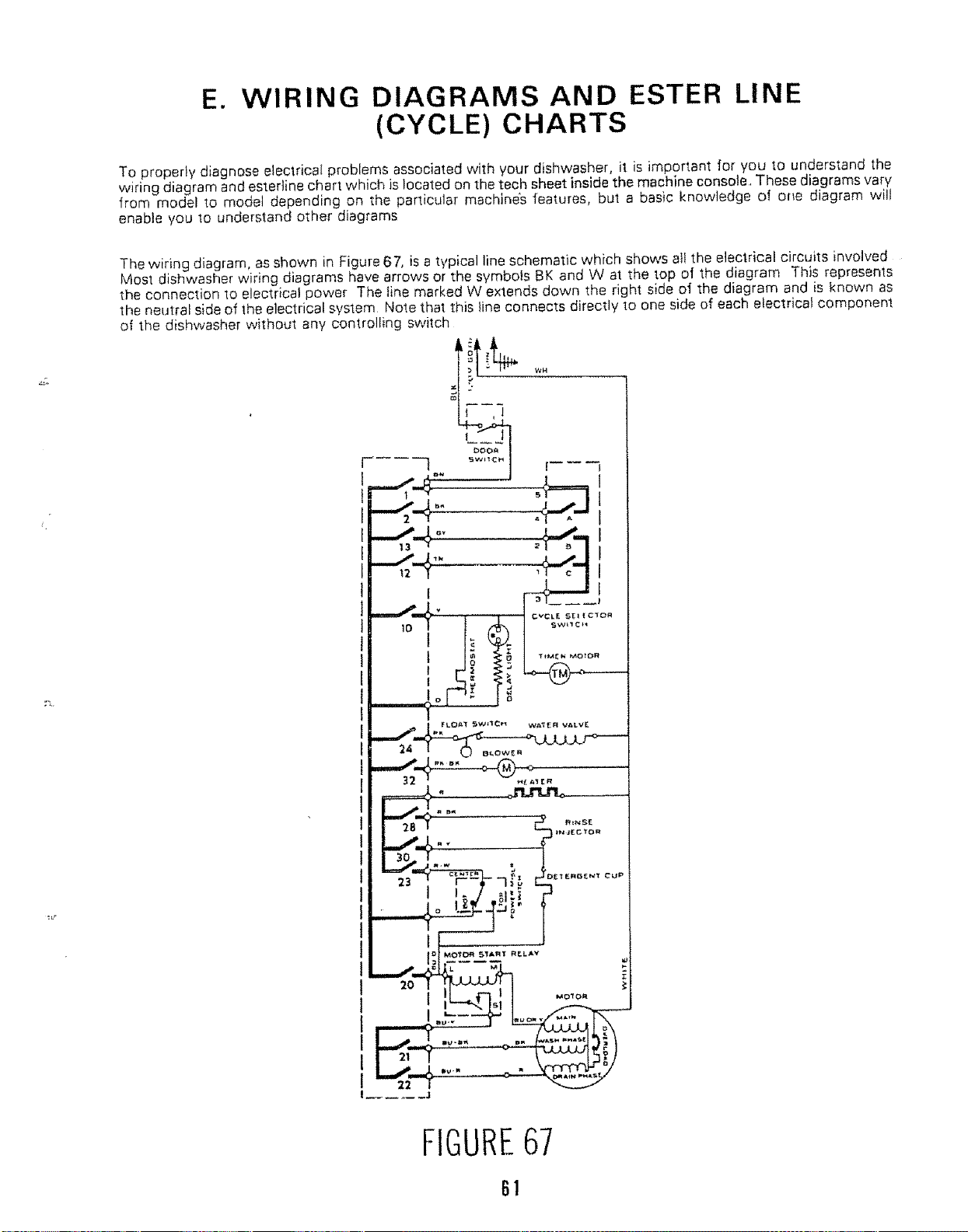
E. WIRING DIAGRAMS AND ESTER LINE
(CYCLE) CHARTS
To propedy diagnose electrical problems associated with your dishwasher, it is important for you to understand the
wiring diagram and estertine chart which is located on the tech sheet inside the machine console, These diagrams vary
from model to model depending on the particular machine's features, but a basic knowledge of one diagram will
enable you to understand other diagrams
The wiring diagram, as shown in Figure 67, is e typical line schematic which shows eli the electrical circuits involved
Most dishwasher wiring diagrams have arrows or the symbols BK and W at the top of the diagram This represents
the connection to electrical power The line marked W extends down the right side o1"the diagram and is known as
the neutral side of the electrical system Note that this line connects directly to one side of each electrical component
of the dishwasher without any controlling switch
WH
FIGURE67
B!

The line shown as BK extends to the tell and is known as the "hot side" of the electrical system It provides a circuit
to the door switch and ulumately to all electrically operated components through the timer switches You will note
that dashed lines enclose the timer, cycle selector, and door switches This is to indicate that these switches are
inside the component structure
Ester Line Charts
To use the wiring diagram in diagnosis, i_ is very important that you understand the Ester tine charts This chart, as
shown in Figure68, is used to determine when and forhow tong a particular circuit or circuits are energized The
heavy shaded bars represent the period of lime the internal switches of the timer are closed
z_
_oe
5_
COLOR CODE
BN _D 0
0 IQ GY
0 "tO _N
D'fOY
0 10 _
Q 'tO P_, B_
_-z10 P
O 10 t_u O
B_ Y 10 BL_ I_t
l_ v 10 DU R
R_NSE N HOLD
NORMAL WASH
POTS & PANS
SANI WASH
6O
Most circuits pass through the selector switch The switch functions are shown at the lower left corner of the esteriine
chart A power loss at the input side of the timer may be caused by a defective selector switch,
Input and output terminals of the timer are easily determined by referring to the order of timer terminal markings at
the Ester fine charts' left side The input color listed first, and the output color listed last. To completely understand
the relationship between the wiring diagram and esterline chart, refer to the following example and Figures 69 and 70,
Example
Begin at the fill phase of the cycle when a normal wash has been selected. The following timer switch contacts are now
closed(Refer to FigureGg;
• Power Bus I - Switch 1
• Timer Motor- Switch I0
• Water Valve - Switch 24
B2

COLO_ CODE
Dr= ,t_ o
D_ To o
D To 1N
otDv
o _o P_D_
_ 'r 1on
B_ v to By _ ,
o * l_
X X 0
NOR MA[WA_
_015 & PAN_
S_NI WASH
FILL PHASE"
NORMAL CYCLE
"_-]_
_ __-%_'1 ,
-./.4.. ._, /" I!
1 .... I
3
22 I "--_._.J"
63

: Note that the switch numbers on the Ester line chart correspond to switch numbers on the wiring diagram,
At the end of the fill phase, the water valve opens as shown by the Ester line chart, and the timer contacts listed below
are now closed (Refer !o Figure 70 )
• Power Bus 1 - Switch "i
• Timer Motor - Switch 10
• Motor Power- Switch 20
• Phase Wash - Switch 2_
• Heater - Switch 23
The machine is now in its first wash The switch on the motor start, relay closes and then opens after the motor reaches
its operating speed As you progress from left to right across the Ester line chart, it is easy to determine which timer
contacts are closed at any point in the cycle This information can then be related to the wiring diagram
Studying and learning has no value until it is applied It is necessary to follow a step-by-step procedure to diagnose a
machine malfunction
For example, let us assume we have selected a "Normal Wash" and the dishwasher will not fill. A rule is to always check
the easy and obvious first
1, is there power to the machine? Be sure the proper connection been has made to the electrical supply, Also check
for a tripped circuit breaker or blown fuse
2. Make sure the water supply to the machine is turned on,
3, Check to be certain the door latch is closed,
4, Check to be certain the timer dial has been advanced to the point where the indicator light comes on A short
delay will be present before the machine begins to fill,
5, Check the float to be sure it is not stuck, it must move freely
64
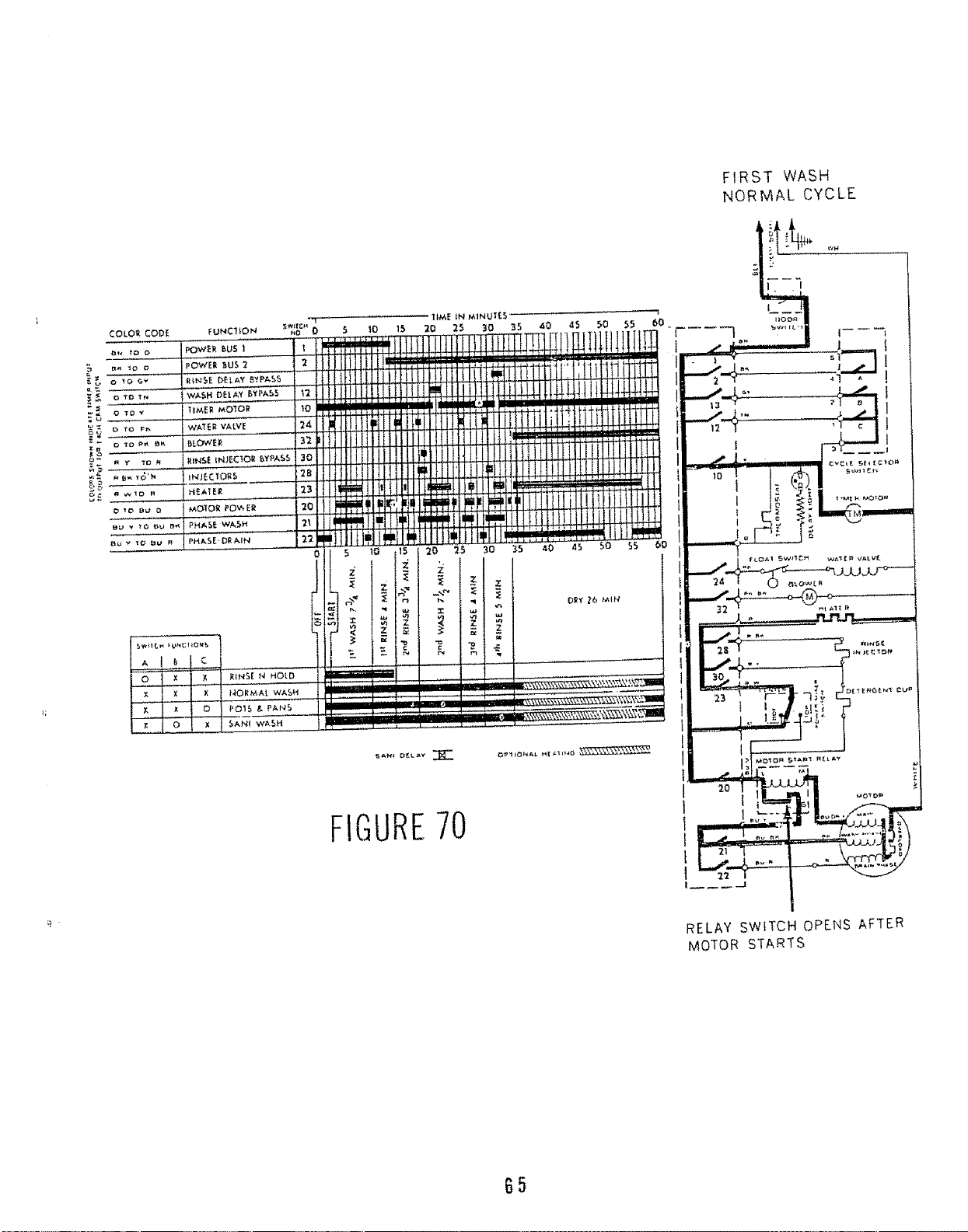
i ,I III
FIGURE70
FIRST WASH
NORMAL CYCLE
RELAY SWITCH OPENS AFTER
MOTOR STARTS
B5

Voltage Checks
CA U TION
When making voltage checks, remember that the machine is connected to a live power source Use
extreme caution to not physically touch any bare contacts or wiring terminals when making voltage
checks..
When all the previous steps for normal operation have been checked and the machine stitl does not tilt. turn to the wiring
diagram and Ester line chart which is usually packed {n the machine console Using a vottmeter set on a scab that will
measure at least 120 volts AC, connect one lead to a white (common) terminal and the other lead to point = 1 indicated
in Figure 71 With the timer set to a fill portion of the cycle, and the door s_itch closed, 120 volts AC should be present
A slight humming sound should also be present which indicates that the water valve solenoid is energized if these two
conditions are present, check for blockage or a stuck plunger with]n the fill valve Clean or replace the valve as necessary
if 120 volts AC is not present, move the tead to point =2 shown on Figure 71 No voltage at this point would indicate
a broken or disconnected wire, or a defective timer ]f 120 Votts AC is present, the float switch is defective or the wire
between the float switch and water value is defective
_u
=*
o-
2?
FIGURE7i
0
v
I _o '
L.>_'- ..............
66

To determine if the timer is defective, attach the voltmeter lead to point #3 shown in Figure "/! leaving the other
voltmeter lead attached to the white or common terminal, 120 Volts AC present at this point indicates that the timer
is not defective. No voltage at this point wouid indicatea defective timer, NOTE: Always be certain the timer is set to
the portion of the cycle in question when making voltage checks, Some segments of the cycle have a short duration and
can be misse&
Continuity Check .........
An alternate method of checking the timer is to disconnect the machine from the power source and make a continuity
check_This continuitycheck of timer switches may be made by disconnectingthe lead from the timer terminals in question,
and connecting the leads from your ohmmeter across the timer switch_
For example, if the motor will not start in the wash cycle, disconnect power from the machine and remove the wire from
the timer's BU_BK terminal (Figure 71)_ Connect one ohmmeter toad to BU-BK and the other to BU-Y With the timer
knob rotated to the wash phase of the cycle, the ohmmeter shoutd register continuity or no resistance, If the timer switch
is defecUve the meter will indicate an open circuit or infinite resistance,
All timer switches may be checked in the same manner by referring to the Ester line chart and wiring diagram, and
connectng the ohmmeter leads to the correct combination of terminaIs. NOTE: Correct interpretation of the meter reading
is important. A continuity check of a switch should indicate no resistance.. A resistance reading of other than zero or
infinity could be the result of damaged or burnt contacts which would reduce power to the component, Do not make a
continuity check with an ohmmeter when the machine is connected to a live eIectrical circuit. Damage to the meter wilt
result.
Other electrical componentsin the dishwasher may be checkedin the same manner. Some resistance wil! be noted when
checking motors, coils and heating elements,
67

F. MECHANICAL SYSTEM
Door Assemblies
The door should never require adjustment, N1isa[ignment between the door and cabinet on built-in machines is
usually a result of improper positioning of the attach brackets to the counter top Reposition the brackets to align
the door to the tub
A slight adjustment to increase or decrease gasket pressure between the doer and tub may be made by. removing
or installing shims behind the door strike (Caution - Addition of shims on a new dishwasher to make latching easier
may result in a leak after the gasket has taken a "set") Bending of the door latch usually results from attempting to
latch the door before il is fully closed
Spring tension is set a_ [he factory for the standard dishwasher door Too much tension will not aliow the door to
remain in the fully opened position Too little tension will cause the door to fall open when the latch is released. Spring
tension may require adjustment if a wood ot metal inserts are added or removed in the door See Figure 72
FIGURE72
A One Piece Outer Door Control Panel
On some dishwashers the outer door panel and control panel have been combined 1o form one common part :that
is removable from the inner door ,without need for disconnecting wires This leaves the dishwasher entireiy
operable
To gain entry to the area behind this piece housing the timer, selector switch, injectors, door switch, thermostat,
e_c, proceed as follows and refer to Figure 73:
t Disconnect power supply to dishwasher
2 Remove the latch knob attachment screw
3 Lower (open) the complete door assembly and remove the six 16) screws attaching the outer door control
panel to the inner porcelain door, (NOTE: This step should be done, using clamps or a "knee brace" to retain
the panel during screw removal t
4 Allow the complete door assembly to close slowly
5 Remove the outer panel and rotate it from the left to the right t80 ° in the upright position
6 Place the outer panel on floor adjacenl to the dishwasher in the upright position
7 Check wire connections on all components
8 Proceed with testing and repair
9 Reverse procedure 1or replacement
NO TE:
If the removal of _he access panel is hkefy, # should be done prior _o outer panel removal
B8
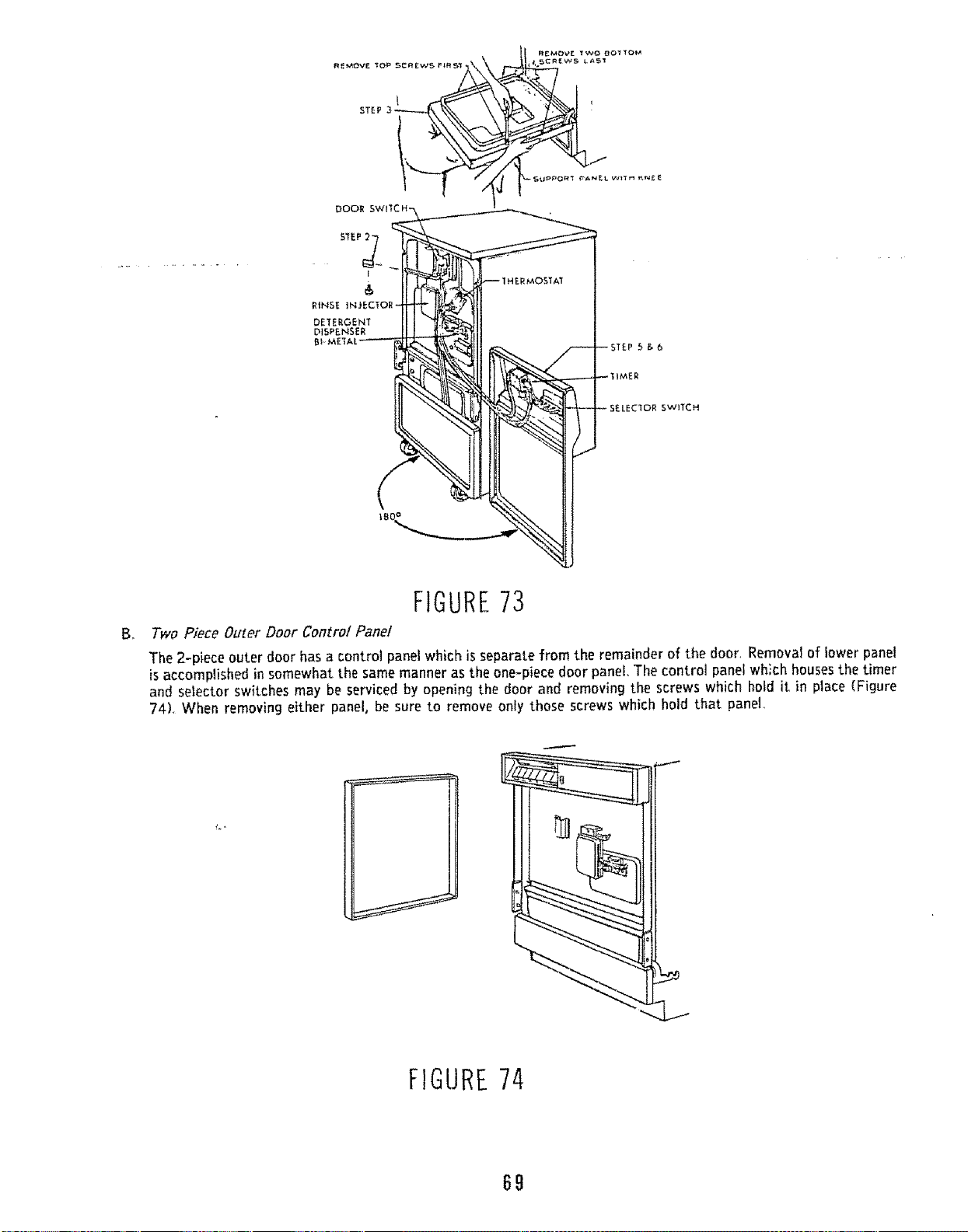
FIGURE73
B_
Two Piece Outer Door Control Panel
The 2-piece outer door has a control panel which is separate from the remainder of the door. Removal of lower panel
is accomplished in somewhat the same manner as the one-piece door panel The control panel wh}ch houses the timer
and selector switches may be serviced by opening the door and removing the screws which hold it in place (Figure
74), When removing either panel, be sure to remove only those screws which hold that panel
FIGURE74
B9

Anti: Tilt Assembly38" Portable Models
A new anti-tilL device was designed for the 18" dishwasher to prevent overturning with 50 pounds supported on an
open door.
To remove; refer to Figure 75
1. Disconnect power supply
2 Place dishwasher on its back,
3, Remove spring attaching anti-tilt arm to the rear caster bracket.
4. Remove cable from anti-tilt arm,,
5 Remove screws attaching foot and shim to the frame assembly
6 Reverse procedure for replacement.
REAR CASTER BRACKET'
STEP
STEP4
D
SHIM
COUNTERBALANCE ARM-
FIGURE
"C" Arm Replacement ]8 Dishwashers
£RING
NER
I Remove spring and cable from "C" arm (Figure 76)
2 Remove two (2) screws that hoid "C" arm to inner door,
3 Remove bottom two (2) screws holding hinge bracket assembly to wrapper
4 Remove plastic "C" arm guide
5 Remove "C" arm pin from hole in hinge bracket assembty
6 Push "C" arm through the notched area of the tub flange
7 Reverse procedure to replace
7O
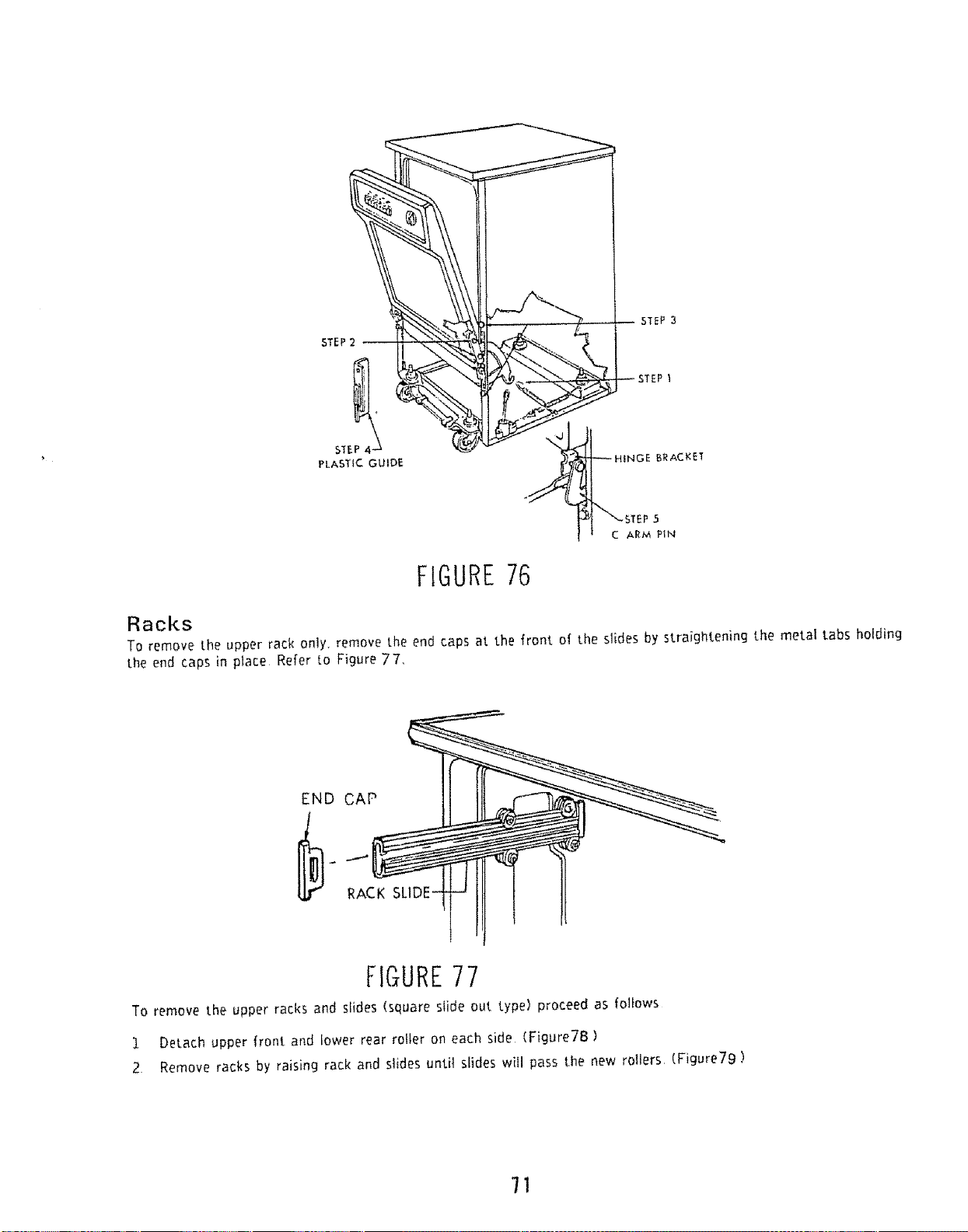
S_EP 3
STEP 2 --
S_p4_ _ STEP 1
PLASTIC GUID_ NGE BRACKET
FIGURE76
5
C ARM PIN
Racks
To remove the upper rack only. remove the end caps at the front of the slides by straightening the metal tabs holding
the end caps in place Refer to Figure 77,
END CAP
_" RACK
FIGURE77
To remove the upper racks and slides (square slide out type) proceed as follows
I Detach upper front and lower rear roller on each side (Figure78)
2 Remove racks by raising rack and slides until slides will pass the new rollers (Figure79)
11

UPPER FRONT
LOWER REAR ROLLER
FIGURE78
FIGURE79
'Tub Gaskets
The tub gasket is a one-piec_ gasket as shown in Figure 80, The tub gasket is fastened with stainless steel clips,, The
illustrations, figures 81 thru 83 show how these clips are removed and replaced on sides and top A gasket junction wire
and one or two clips secure the gasket at the bottom dam
FIGURESO
The following instructions apply to remova! and _eplacement of the dishwasher tub gasket
1 To remove gasket, insert a small thin screwdriver blade under flange of the gasket attach cfip and press outward
See Figure 81
12

Press Outward
Attach Clip
Gasket
FIGURE8!
/i_._ScrewdrJver
/_Li)P ress Outward
,_ _-_' Flange Attach
/ __ Lr_ _ Gasket
Tub Slot 11
2 Attach d!ps can be positioned in replacement gasket and pressed back into tub slot, See Figure 82
TO REPLACE
Apply Pressure To Flange
Of Clip. Press Into Place
FIGURE82
_ress In
lub Slot_
Attach Cli p_l
3, The replacement gasket must have both bottom front corners positioned tightJy against curved surface of tub
(A-Figure 83) and herd in this position with the two stainless retainer clips located at bottom front of tub
(B-Figure 83) Later models have only ] stainless clip which holds the "U" shaped portion of the junction rod
A
Position Hump .In Junction
Rod At Butted Ends Of
Gasket To Center Rod In
Bottom Of Tub,.
B
Sealing Surface
FIGURE83
"/3

@
FIGURE84
4 A revised vent baffle was introduced in t981. This vent baffle has a white vinyl gasket along the bottom edge
There is no adjustment on this vent baffle The tub gasket has a longer cut-out section in the bottom with
this vent baffle Most models use this tub gasket/vent baffle kit for serwce replacement
74
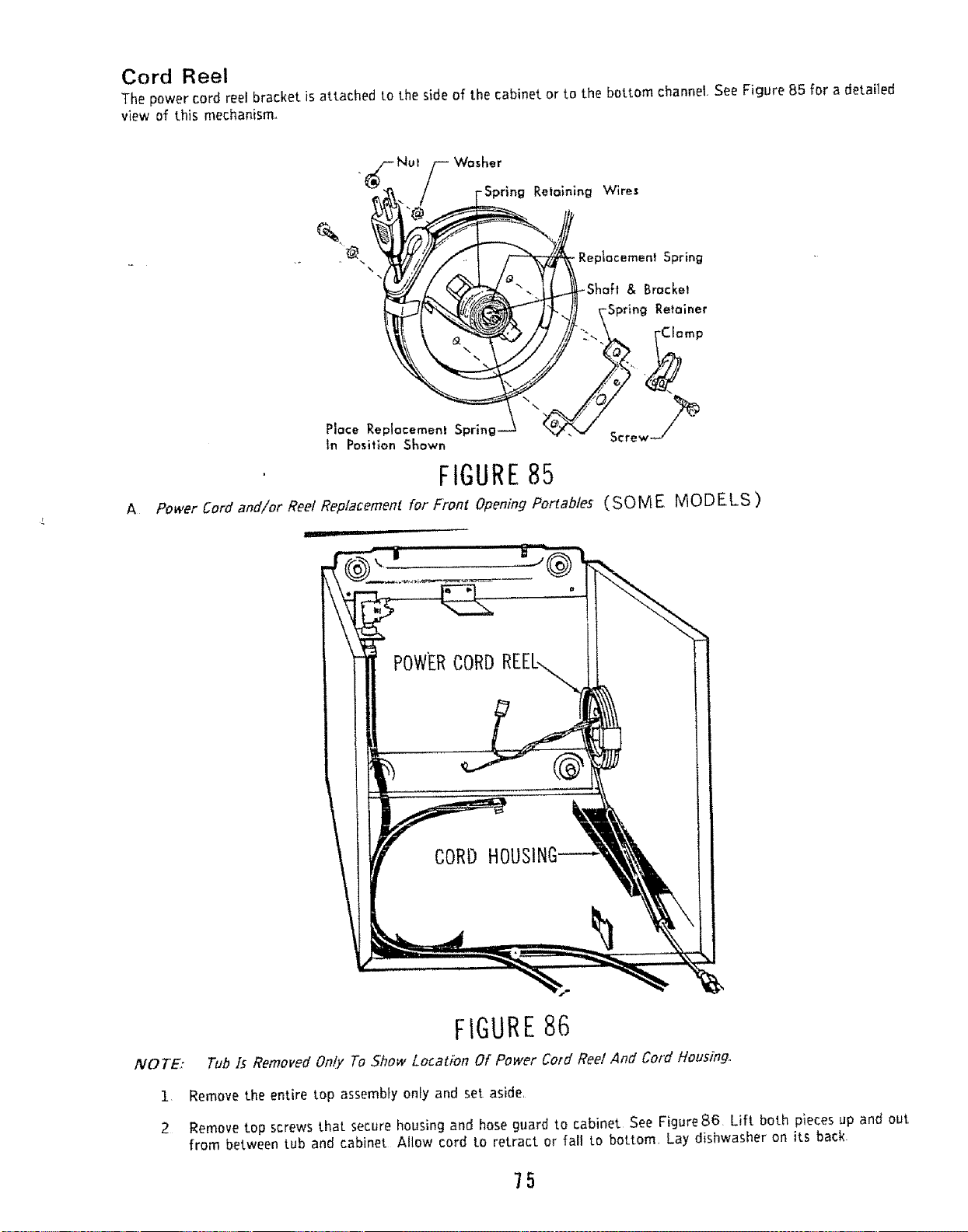
Cord Reel
The power cord reel bracket is attached to the side of the cabinet or to the bottom channel See Figure 85 for a deta{ted
view of this mechanism_
Washer
"Spring Reloining Wires
A
Place Rep[ocemenl Sprin G
tn Position Shown
&Bracke!
-Spring Retoiner
.-. mp
Screw_//_
FIGURE85
Power Cord and/or Reel Replacement for Front Opening Portables (SOME MODELS )
FIGURE8G
NOTE: Tub Is Removed Only To 5how LocatiOn Of Power Cord Reel And Cord Housing.
1 Remove the entire top assembly only and set aside,
2 Remove top screws that secure housing and hose guard to cabinet See Figure 86 Lift both pieces up and out
from between tub and cabinet Allow cord to retract or fall to bottom, Lay dishwasher on its back.
75

3 Remove power cord reel attach screws exposed on left side of cabinet
Install the replacement power cord reel Wind the reel and cord clockwise to achieve the amount of reel wind-
up needed Coil spring should recoil the power cord comptetety when the cord is fully extended Temporarily
secure the power cord pfug 1o the back side of cabinet and reassemble cord housing and hose guard IHose
guard must be reinstalled )
5 Reptace the top assembly
Casters
Caster Replacement Potlable Dishwashers
Use the following procedure to repair a damaged caster socket Obtain a caster repair kit from your Sears Ser-
vice Department
Drill out the four projection welds that anchor the caster sleeve (See FigureD7) A light tap on the closed end
of the sleeve will dislodge the entire sleeve assembly it is necessary to remove this sleeve so that the new
easter will rest flush on the support cross piece
2 Insert the caster and fasten securely with the nut
CA UTION:
Do not remove the "hat" shaped portion on the frame. This "'hat" will give added stability.
and strength to the caster.
By using this method of replacement, you wnl need to replace only the caster in the damaged socket
This procedure can be followed on most dishwashers Very old units with small diameter wheels require replace-
ment of all four (4) casters
NOTE:
Do not attemp[ to replace casters by merely inserting the new caster m the old sleeve This is not proper and
will cause the machine to be out of level Casters marking the floor can usually be traced to a damaged or
lammed caster assembly This causes the caster 1o shde rather then roff across the floor
DRILL THRU 4 INDENTED WELD *SPOTS ON CASTER
BRACKET & REMOVE SOCKET & WASHER (1/z_ DRILL)
FIGURE87
78

NUT
_LARGEWASHER
,f
'- DISHWASHER FRAME
SMALL WASHER
t
/5EARINGS
_CASTER
CASTER ASSEMBLY
FIGURE88
Tubs
Replacement of a tub requires a complete disassembfyof the dishwasher tf a tub replacement is necessary, we recommend
havingit done by a qualified service technician,
f_
77
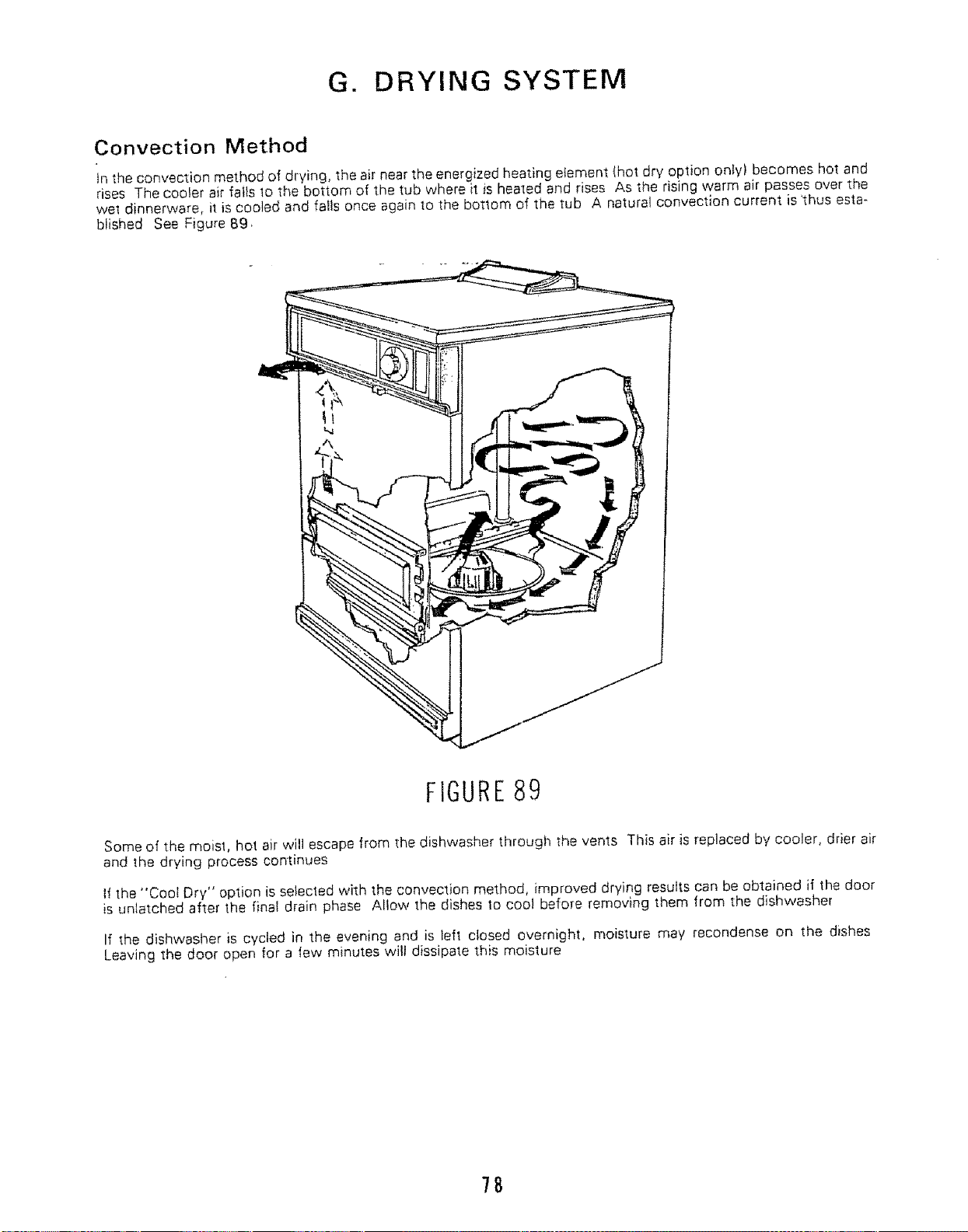
G. DRYING SYSTEM
Convection Method
in the convection method of drying, the air near the energized heating element (hot dry option only) becomes hot and
rises The cooler air fafts to the bottom of the tub where it is heated and rises As the rising warm air passes over the
wet dinnerware, it is cooled and falls once again to the botlom of the tub A natural convection eurrenl is 'thus esta-
blished See Figure Bg_
FIGURE89
Some of the moisl, hot air will escape from the dishwasher through the vents This air is replaced by cooler, drier air
and the drying process continues
It the "Cool Dry" option is selected with the convection method, improved drying results can be obtained if the door
is unlatched after the final drain phase Allow the dishes to cool before removing them from the dishwasher
If the dishwasher is cycled in the evening and is left closed overnight, moisture may recondense on the dishes
Leaving the door open for a few minutes will dissipate this moisture
7B
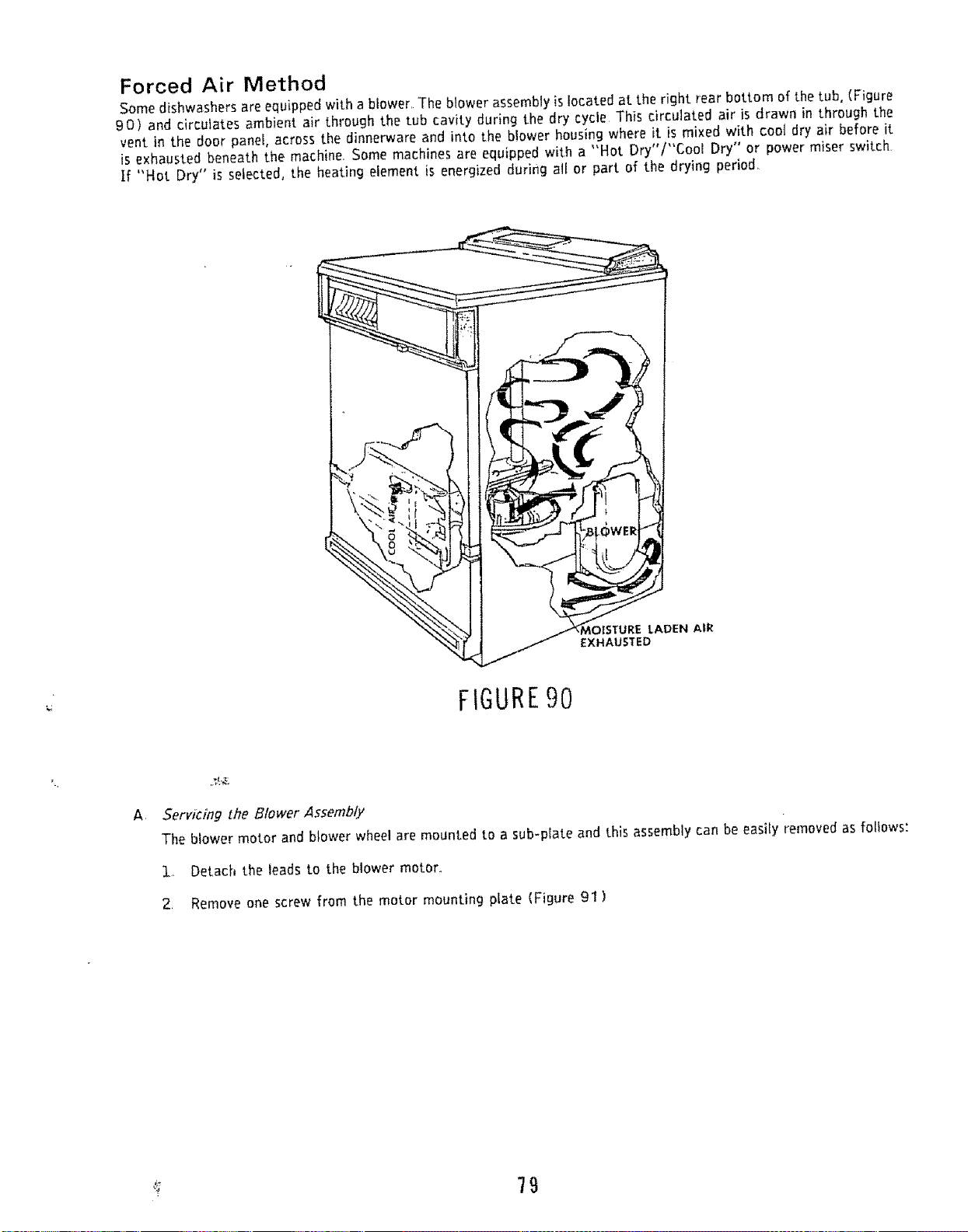
Forced Air Method
Some dishwashers are equippedwith a blower, The blower assemblyis located at the right rear bottom of the tub, (Figure
90) and circulates ambient air through the tub cavity during the dry cycle This circulated air is drawn in through Lhe
vent in the door panel, across the dinnerware and into the blower housing where it is mixed with cool dry air before it
is exhausted beneath the machine, Some machines are equipped with a "Hot Dry"/"Cool Dry" or power miser switch
If "Hot Dry" is selected, the heating element is energized during all or part of the drying period,
LADEN AIR
EXHAUSTED
FIGURE90
A_
Servicing the Blower Assembly
The blower motor and blower wheel are mounted to a sub-plate and this assembly can be easity removedas follows:
I. Detach the leads to the blower motor.
2, Remove one screw from the motor mounting plate (Figure 91 )
79

B,,
GASKET
seRE t!1 k A sEMBL'
BLOWER PL A*!E
BLOWE R ASSEMBLY
FIGURE9.!
3. Move the assembly to the left and lift out..
The blower wheel is pressed onto the motor shaft and can be pried off (carefully) with a screwdriver placed
between the motor mounting plate and the blower wheel When reinstalling the blower wheel to motor shaft
maintain a 3/&6" space between the back side of the blower wheel and the motor mounting plate°
Checking Blower Operadon
The operation of the fan can be easily checked by setting the control to some portion of the dry period and observing
blower operation,
if the blower motor fails to operate check as follows:
!, Advance the timer to the Dry position,
2, Check forvoltageat thequickconnector terminalblock
3 If vo]tage is present, check leads to blower motor. Replace motor if defective.
4 If no voltage is present, consult the wiring diagram and make the necessarychecksto determine where the voltage
lossoccured
In the event that the blower housing may have to be removed, proceed as follows: (Figure 92)
1 Disconnecl power and remove the access panel and toe panels
2 Disconnect the w}res to the blower motor at the terminat board or quick disconnect block
3 Remove screws holding the internal ducl cover to the tub and remove cover (some models}
4 Remove screws from inside of the tub holding the blower assembly
8O

5 Remove blower housing assembly _rom under tub
6 Re-install with new gasket
Heating Elements
A Heating Element
The heating element is used to maintain hot water for washing and rinsing operations in some models and to provide
a source of heat for drying the dishes.
B_
Operation
A helical,strand of resistance wire is encased in a sheath with magnesium oxide tightly packed between the wire and
the sheaf:for electrical insulation Heat is generated in the resistance wire when 120 volts AC is applied to it, The
heat is then transmitted through the magnesium oxide and through the sheath to the water or air surrounding it,
See Figure 9'3 for a cut-away view of the heater,
The direct causesfor the element, to malfunction are,
l, interruption of the electrical circuit to the heating element,,
2, The helical resistance wire becomes burned or broken
3, The helical resistance wire short-circuits to the sheath due to breakdown of the magnesium oxide
B1
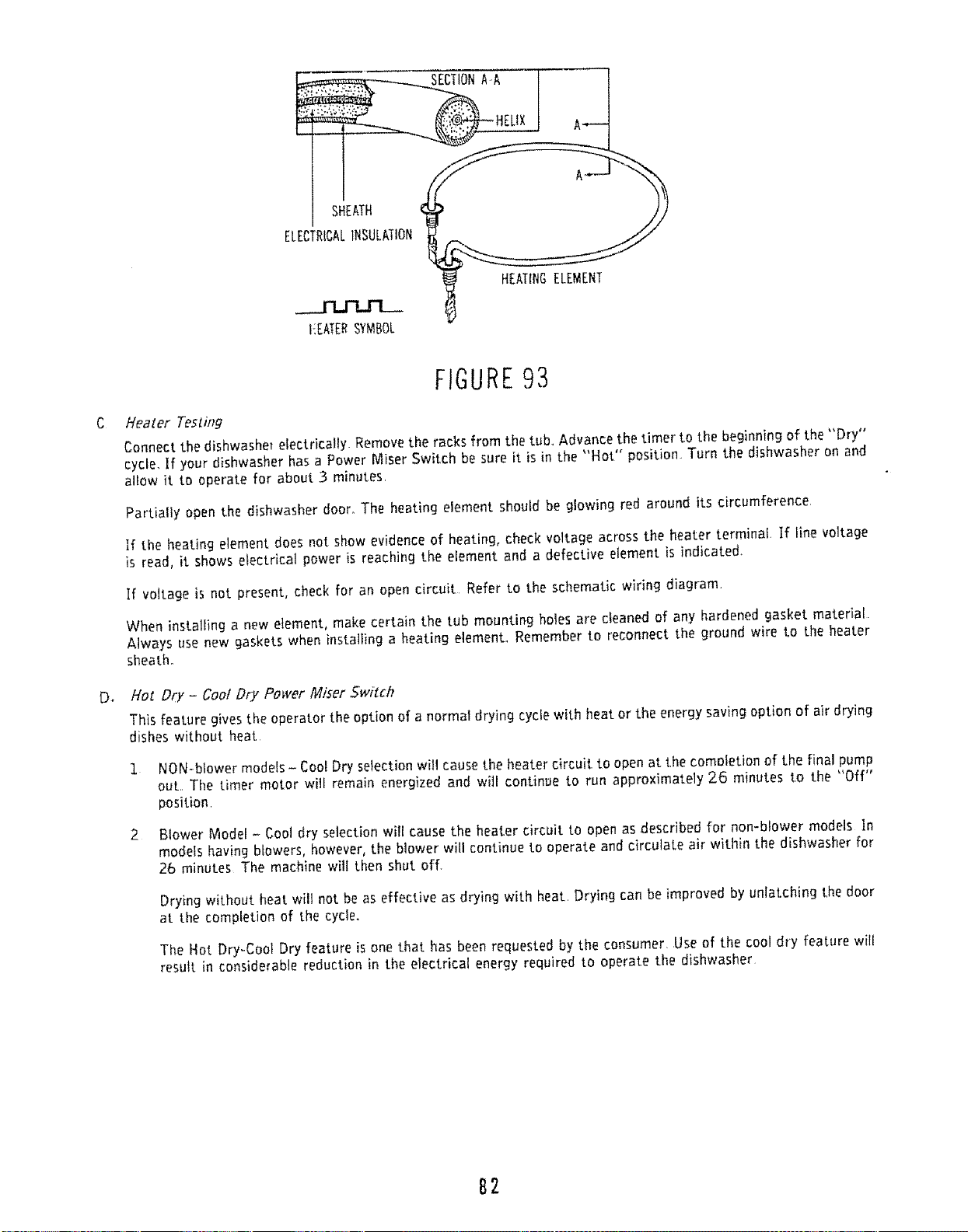
SHEATH
ELECTRICALINSULATION
I!EATERSYMBOL
HEAT(NGELEMENT
FIGURE93
Heater Testing
Connect the dishwasher electrically, Remove the racks from the tub., Advance the timer to the beginning of the "Dry"
cycle, If your dishwasher has a Power Miser Switch be sure it is in the "Hot" position_ Turn the dishwasher on and
allow it to operate for about 3 minutes,
Partially open the dishwasher door,, The heating element should be glowing red around its circumference
If the heating element does not show evidence of heating, check voltage across the heater terminal. If line voltage
is read, it shows electrical power is reaching the element and a defective element is indicate&
If voltage is not present, check for an open circuit Refer to the schematic wiring diagram,
When installing a new element, make certain the tub mounting holes are cleaned of any hardened gasket material
Always use new gaskets when installing a heating element., Remember to reconnect the ground wire to the heater
sheath°
Hot Dry - Cool Dry Power Miser SWHch
This feature gives the operator the option of a normal drying cycle with heat or the energy saving option of air drying
dishes without heat
1. NON-blower models - Coo! Dry selection will cause the heater circuit to open at the comoletion of the final pump
out., The timer motor will remain energized and will continue to run approximately 26 minutes to the "Off"
position
2 Blower Model - Cool dry selection will cause the heater circuit to open as described for non-blower models in
models having blowers, however, the blower will continue to operate and circulate air within the dishwasher for
26 minutes The machine will then shut off,
Drying without heat will not be as effective as drying with heat, Drying can be improved by unlatching the door
at the completion of the cycle.
The Hot Dry-Cool Dry feature is one that has been requested by the consumer, ,Useof the cool dry feature will
result in considerable reduction in the electrical energy required to operate the dishwasher
I]2
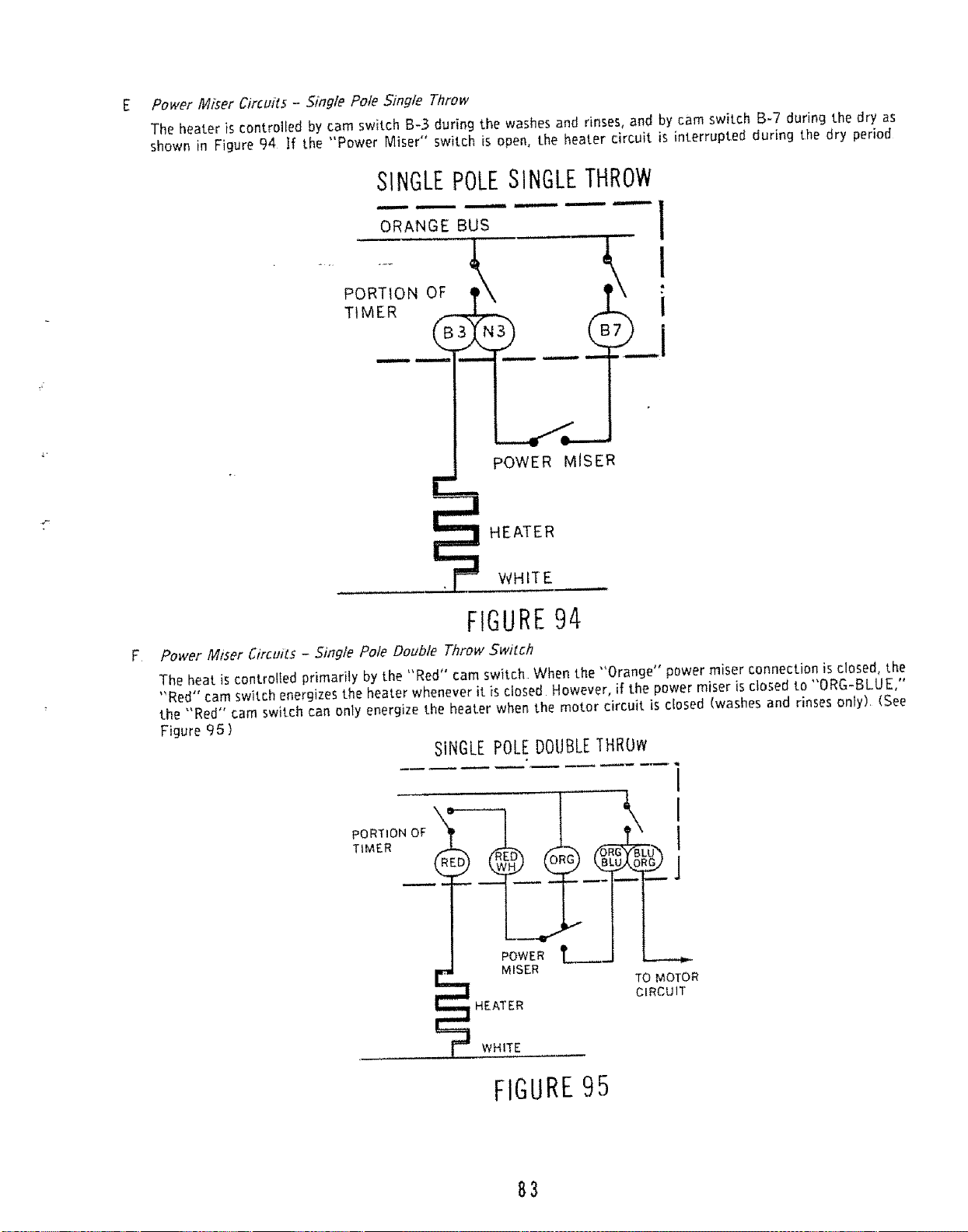
Power Miser Circuits - Single Pole Single Throw
The heater is controlled by cam switch B-3 during the washes and rinses, and by cam switch B-7 during the dry as
shown in Figure 94 [f the "Power Miser" switch is open, the heater circuit is interrupted during the dry period
SINGLEPOLESINGLETHROW
ORANGE BUS
TIMER
POWER MISER
_ HEATER
WHITE
FIGURE94
Power Miser Circuits - Single Pole Double Throw Switch
The heat is controlled primarily by the "Red" cam switch When the "'Orange" power miser connection is closed, the
"Red" cam switch energizes the heater whenever it is closed However, if the power miser is closed to "ORG-BLUE,"
the "Red" cam switch can only energize the heater when the motor circuit is closed (washes and rinses only). (See
Figure 95 )
SINGLE POLE DOUBLEIHROW
pORTION OF
TIMER
\
i1_ MISER
_ HEATER
IF WHITE
I
.%1
R
TO MOTOR
CIRCUIT
FIGURE95
83

Power Cord
Door Switch
Door Lat
. Timer
h I
Detergent
Dispenser
Float Swit
Inlet Valve
FIGURE96
Faucet Coupler
Drain Hose
Spray Arms
acerator
Blower
-,Water Inlet
84

!. TROUBLE SHOOTING
General Trouble Shooting
CA U TION:
Always disconnect the dishwashers from the electrical power source before adjusting or replacing
components.
, +pROBLEM ++- POSSIBLE CAUSE ACTION
Dishes not clean, Refer to introductory section at
beginning of this manual
Dishwasher will not 1. No power to dishwasher. 1, Check electrical outlet or connection
operate when turned om to junction box on built-in,
2. Open circuit between power source 2 Check wiring and/or power cords
and timer
3, Loose terminal connections at door 3_ Repair as needed_
switch and/or timer terminals,
4. Defective door switch 4,, Check continuity
5. Defective selector switch., 5+ Check continuity
6, Defective timer motor circuits.
7 Defective start switch,
6 Refer to Timer Testing°
7+ Applies to models with a rapid advance
timer. Check continuity,
8, Main motor defective,, 8 Refer to Motor Testing
Dishwasher automatically 1+
repeats with door latched
2.
,J
Start sw_tch contacts sticking closed,
A grounded timer motor combined with
reverse potarity connection at junction
box or walt receptacle causing the "hot"
side of the circuit to bypass "'off"
switches in the timer
1, Replace start s_,itcho
Replace timer, Refer to lnstatlation
Instructions for proper electrica_
connection and grounding of power
receptacfes.
3, Grounded thermostat with reverse
polarity
3 Replace thermostat+ Check electrical
connection,
4+ Broken slides inside of selector switch
(rapid advance timer onfy)+
4. Refer to wiring diagram and check
selector switch circuitry.
Dishwasher runs with
door open,
1. Door switch defective+
2, Terminals shorted to each other at the
door switch,
f. Check continuity'.
2. Replace defective parts,
3. Latching handle turned to the "ON"
position
3+ Check safety tab, which prevents
turning handle into run position with
door open
4
Grounded electrical component
combined with reverse polarity
connection at junction box or wall
receptacle,
4 Replace defective component, Refer
to Installation ]nstruct]on for proper
electrica_ connection and grounding
of power receptacle.
85
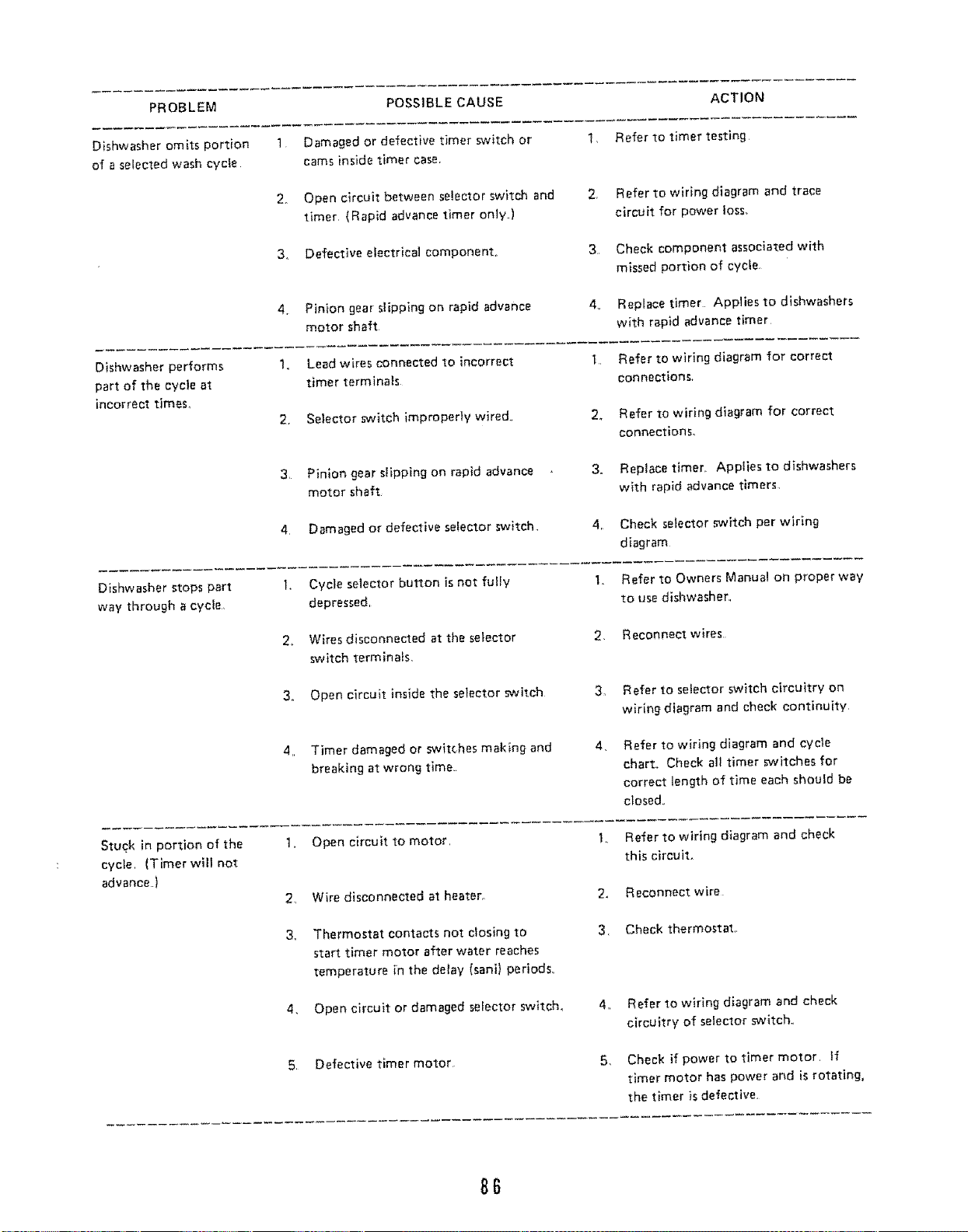
PROBLEM POSSIBLE CAUSE ACTION
Dishwasher omits portion 1 Damaged or defective timer switch or 1 Refer to timer testing
of a selected wash cycle cams inside timer case
2. Open circuit between selector switch and
timer (Rapid advance timer only.)
2. Refer to wiring diagram and trace
circuit for power loss.
3. Defective efectrical component.. 3, Check component associated with
missed portion of cycle,
4, Pinion gear slipping on rapid advance
motor shaft
4.. Replace timer Applies to dishwashers
with rapid advance timer
Dishwasher performs
part of the cycle at
incorrect times°
1. Lead wires connected to incorrect t
timer terminals
2. Selector switch improperly wire& 2o
Refer to wiring diagram for correct
connections.
Refer to wiring diagram for correct
connection_.
3, Pinion gear slipping on rapid advance
motor shaft
3. Replace timer. Applies to dishwashers
with rapid advance timers.
4. Damaged or defective sefector switch. 4, Check selector switch per wiring
diagram
Dishwasher stops part
way through a cycle
1. Cycle setector button is not fulfy
depressed,
1, Refer to Owners Manual on proper way
to use dishwasher.,
2_ Wires disconnected at the selector
switch terminals.
2 Reconnect wires
3. Open circuit inside the selector switch 3, Refer to selector switch circuitry on
wiring diagram and check continuity
4, Timer damaged or switches making and 4,
breaking at wrong time
Refer to wiring diagram and cycle
chart.. Check all timer switches for
correct length of time each should be
closed,,
Stuck in portion of the
cycle (Timer will not
advance)
1.. Open circuit to motor.
2. Wire disconnected at heater°
t, Refer to wiring diagram and check
this circuit.
2. Reconnect wire
3, Thermostat contacts not closing to
start timer motor after water reaches
temperature in the delay (sani} periods,
3. Check thermostat..
4. Open circuit or damaged selector swltch_ 4, Refer to wiring diagram and check
circuitry of selector $'witch_
5 Defective timer motor
5. Check if power to timer motor. If
timer motor has power and is rotating,
the timer is defective.
86

PROBLEM POSSIBLE CAUSE ACTION
Dishwasher automatically t. Cycle changer button stuck down 1 Release button or replace switch
rapid advances through (Models prior to t972 )
entire cycle,
Dishwasher will not fill
with water (no water
comes in),
1 No water supply to dishwasher
2, Open circuit between timer terminal
and fill valvm
1 Check line valve to dishwasher,
2 Refer to wiring diagram and check
circuit for power loss
3 Fill valve defective,,
3. Replace fill valve,,
4, Open circuit in ftoat switch
4, Check operation o1" float Check float
switch,,
Fill time iscorrect
(Approx, t m-_n.) but
machine has insufficient
water charge (correct
charge is 9 to i07_
quarts, 7 to 9 quarts
for compact dishwasher)
5 Open timer contact
I. Low water pressure,
5. Refer to wiring diagram. Check voltage,
1, Minimum water pressure is 20 P,S.,I.
2. Clogged fitter screen in ill! valve
2, Remove and clean filter screen,
3.
4.
Hot water supply line too small,
kinked and/or restricted,
Reduced flow to dishwasher due to
heavy draw at another location m home,
(Bath, Washer, etc.)
3. Refer to Installation for recommended
requirements and routing,
4o Use dishwasher when water draw at
other locations is at a minimum
Fill time is short,
resulting in a shor;
water charge
NOTE: Some models
have abbreviated
water fills (approx
45 sec ) on Normal
and Water Miser
cycles
Float switch interrupts the timer
eontrolfed fill time,
Timer contacts for filr valve are not
staying closed for the prescribed time,
4_
Turning the timer in'o flit to start
w ash ing cycle,
Using rapid advance button and advancing
dishwasher to off then following up with
a short wash cycle on next washing, (This
condition can onty occur when the
operator does not allow the dishwasher to
complete its cycle automatically.)
(Models prior to 1972,)
'1_ Check float switch,
2_
3
4,
Refer to wiring diagram Ester line chart
for switch contact time Test run
dishwasher and check length of fill time,
Turn knob until pitot light burns (never
turn into fill).
Applies only to a dishwasher with
rapid advance timer Do not change
timer or selector switch - inherent in
design
Dishwasher continues
to fill even though there
is no voltage to fill
valve
t,, Defective valve,
2, Dirt or foreign material under diaphragm
in fill valve.
t. Replace valve
2. Clean valve,
87

PROBLEM POSSIBLE CAUSE ACTION
1, No loop in drain line., {Undercounter t_ All drain lines must have an elevated
Dishwashers) Ioop_ Refer to installation
instructions,
Drains or water syphons
out of dishwasher after
a fill for either a wash
or rinse.
2_
Drain line connected after "J" trap
(undereounter washers).
Drains must be connected ahead of
"J" trap or into top end of a garbage
disposal. Refer to installation
.instructions,
3o Recirculating hose from pump to top
spray tube partially or totally
restricted.
3o Check circulation of water system,
Clear any restrictions or blockage.,
4. Main motor running in wrong direction
(start phase wires reversed at timer or
motor,,
4. Refer to wiring diagram for proper
connections,
Dishwasher will not
drain_
t, Drain port in pump casting totally
obstructed,
1. Clean drain port., If unable to clean,
replace casting.
NOTE: Approxo 2 pints
of water will remain
in bottom of the tub.
2o Main motor won't run in clockwise
direction (open start phase winding).
3,, Vanes broken off the lower impeller.
24
3_
Refer to wiring diagram for pump out
period and check voltage to motor°
Dismantle top section of pump
assembly - visually inspect.
4, Drain line kinked or collapsed (total
restriction),
4° Check drain line,
5 Open circuits between timer output
terminal and motor,
5o Refer to wiring diagram and check out
run and drain phase motor circuits for
loss of voltage.
6. Open timer contacts for motor start
and run windings,
6, Refer to wiring diagram for closed
timer contact period° Check voltage
through timer for these periods.
Dishwasher does not
draln completely,,
I. Drain line too small..
1. The drain line must never be under
1/2 inch inside diameter.
NOTE: Approx, 2 pints
of water will remain in
the bottom of the tub,
which is a normal
condition,
2, Clogged coupler (portable model),
3, Drain line loop too far from dishwasher.
(Water drains back into dishwasher,
Long drain lines onlyo)
2. Visually inspectand clean,,
3. Loop must be close to dishwasher_
Refer to installation instructions_
8B

PROBLEM POSSIBLE CAUSE ACTION
Noisy Pump system° 1,, Debris in tub bottom. 1. Clean out pump_
Main motor kicks out
repeatedly on
overload.
Dishwasher will not
heat water to
required temperature
in the thermostat
delay periods,
Dishes are not dry at
end of dry phase,,
2. Pump part or parts not tightened down 2, Inspect and correct,
properly
3, Impellers improperly shimmed and 3.
rubbing,
Use Shim gauge furnished with impeller
and seal kit When seals are shimmed
correctly the impellers will be in
correct position.
4o Defective bearings in motor,, 4. Remove all impellers and test run
motor,
5,, Sucking sound at end of drain period. 5. Normal condition.
I° Debris inpump, locking pump system° 1. Clean pump.
2 Motor shaft seal_ are stuck
together
2 Disassemble and inspect seals
3. Main motor shaft not centered in 3.
pump housing cavity.,
Use installation tool No, 803923
(available through Sears parts
department) and center housing as
outlined.
4,, Main motor bolts not tightened
evenly.
4. Loosen bolts and tighten evenly
(tighten crosswise)°
1o Defective heating element..
2,. Open circuit through timer safety
thermostat and/or heater°
1. Check continuity.
2o Refer towiring diagram and trace
circuits for voltage loss
3, Defective thermostat,
3. Refer to the proper section in this
manual for testing thermostat,
1, Open circuit through timer to heater 1. Refer to wiring diagram and trace
circuit for loss of voltage.
2. Defective heater,
2. If voltage to heater, remove leads and
check for continuity through heater.
3. Improper loading of dishes,,
3_ Refer to Owner's Manual for proper
loading pattern.
4. Water not hot enough, 4. Refer to detergent manufacturers
recommendation. Check and adjust
water heater
5, Blower inoperative.
(Blower models only,,)
5,. Check operation of the blower motor in
the dry phase after the final pump out,,
6.,
Unfavorable temperature and humidity
conditions (Non-blower models,)
6_ Unlatch door at end of final rinse, and
allow dinnerware to cool before
removing from dishwasher. Moisture
wilF evaporate.
89

PROBLEM
Lever won't latch or
stay in run position.
Detergent Cup won't
latch,
Detergent cup won't
open to release
detergent.
Detergent does not
wash out of detergent
cup.
Wetting agent
tiquid runs out
continuously.
Wetting agent liquid
runs out each time
door is opened and
closed.
POSSIBLE CAUSE
1. Latch lever bent.,
2. Door misaligned to tub.
(Undercounter mode_s.)
1 Cams not locking on linkage arm
(Solenoid operated Cup)_ . ....
2. Cam not locking on bi-metal teaf.
(Bi-metal operated cup.)
3o Roll pin or shaft broken..
4. Broken springs.
1. Roll pin or shaft broken.
2, Cup binding.
3.. Defective solenoid, wiring or timer.
4., Defective bi-metal release, wiring or
timer..
1. Dish or pan blocking detergent cup..
2_ Detergent cup hot and wet when loaded..
3 Old detergent.
Io Wetting agent cup ribs not against
door liner.
2, Diaphragm seal out of shape, puckered,
etCr (Solenoid operated dispenser,,)
3o Springs defective.,
1_ Plunger stuck or held in open position,
2. Coil spring or "C" clip broken,
3., Solenoid defective,
4. Bi*metal release defective..
ACTION
1. Repair or replace mechanism.
2. Loosen attach brackets and reposition
tub for proper door closure,. Be sure
machine is level.
to File notch deeper on surface of cam
that rests against linkage arm.
2. Adjust leaf or replace bi-metat
control.
3, Replace roll pin or install shaft kit,,
4. Replace as needed.
I. Replace roll pin or install shaft kit.
2. Repair or replace as needed..
3. Refer to the wiring diagram and check
detergent cup electHca! circuit.
4. Refer to the wiring diagram and check
detergent cup electricaP circuit..
1. See loading instrUctions in Owner's
Manual.
2. If Cup is wet. dry before loading
3 Don't use detergent that has become
caked or lumpy.
1. Mount cup so all areas of cup ribs are
resting against door liner.,
2_ Replace dispenser
3. Replace springs..
1. Free plunger or adiust bFmetal release.,
2.. Replace parts as necessary.
3.. Replace solenoid and bracket assembly..
4_ Replace bi-metal assmbly.
9O

PROBLEM
Wetting agent liquid
won't eject.
Wetting agent
dispenser leak
(Bi_netal release
typelo
POSSIBLECAUSE
1, Wettingagentcupribs not against
door liner.
2. Coil spring or "C'" clip broken.
(Solenoid type,)
3, Solenoid defective.
4o Bi-metal release defective.,
1.r Overfillingo
2. Bottle cracked,
3. Defective seal on stopper,
4. Dishwasher not level.
ACTION
I, Same as in No. 1 in previous
problem,
1. Follow instructions in the Owner's
Manual.
2_ Replace,,
3. Replace stopper.
4. Level dishwasher.
Water Leaks
The source of a water leak is sometimes very d!fficult to locate° Before operating the dishwasher or attempting any repair,
disconnect the dishwasher from the electrical power source. Take off the door and access panel and look for water
"tracks°" Be sure to checkall the "tracks" and inspectthe area which you suspect to be the source of the leak. Make
certain you trace the water tracks back to its origin. After making the repair, wipe away all water "tracks" and test
the machine again to verify your diagnosis and correction.
Identification of wherethe leak is located and what is causingthe leak is the most difficult part of the problem. In some
cases, there may be more than one source for the leak.
if the leak cannot be located, make the following routine checks.
1. Checkspray arm -. makesure there is no opening anywhere along the crimpedseamand/or the spray arm is not binding
on the pump housing. Be sure the sprayarm nut is installed correctly.
2. Tighten all screws and bolts in interior of tub.
CAUTION: Excessive tightening may crack porcelain.
3. Tighten water inlet port nut.
zL Check gasket for cuts or wrinkles.. Gasket shouldfit snuglyagainst all sidesof the tub_ Pay particular attention to
the lower corners.
5. Check al{ hoseconnections.
6. Checkwater temperature. Follow the detergent manufacturers temperature recommendation. Water that is too coo!
may cause sudsing. '
7. Check detergent. (Must be fresh and must be for Dishwasher use only.)
8. Do not pre-rinse with regular dishwashing soap°
9. Follow loading instructions in owner's manual.
Following the proceduresoutlined in points 1 through 9 should eliminate the source of the leak.
91

MISCELLANEOUS SERVICE PART NUMBERS
1 Oversize screw for door tatch
2 Oversize screw for ou_er door panel
3 Oversize screw for blower housing
4 Latch kit, 1972 - present (except one piece door models)
5 Improved caster, portable models, pre-Ig83
6 Threaded repair casters - (2)
7 Positive fill kit, (except solid state models)
8 Utensil basket for spatulas and]ong knives
9 Plastic grids 1or bottom of silverware basket i0 keep narrow handled
flatware from fa!lihg through basket
10 Rack 1ouch-up, gold vinyl
11 Porcelain repair and sealant, white silicone
I2 Tub cleaning, white mineral residue from hard water, use
vinegar, Tang. citric acid crystals, Lime-Away, or Glass Magic
13 To remove suds in dishwasher when wrong type of detergent is used,
pour one cup of liquid cooking oil into tub and run dishwasher
t4 Relay-transformer assembly for solid state models '78 - '83
15 Red p;astic pockeI for solid state timer
16 Wiring harness for solid state models
17 Mofex terminal for solid state harness
18 Cleaner-lubricant for solid state edge connectors Div 92 Source 192
19 Plastic wire ties, Div. 98 Source 980
20 Right hand terminal block (black), for timers 83
21 Left hand terminal block (white), for timers '83
22 Terminals for timer blocks, (25)
23 Terminals for timer connections outside of block (25)
24 Pin type terminal for printed circuit board, model 70.34
25 Wiring for dishwasher application (25 ft lengths)
White - 807307 Orange - 807310
Black _807308 Blue -807311
Red - 807309
26 Misc gasket kit for tub installation
27 Baffle plate for 18" upper pump housing
28 Universal pump seal kit 1or short shaft motor (806300)
29 Universal pump diffuser housing kit
30 Insulation for outside of undercounter tub
31 Plastic display window for 24" models
32 Plastic display window for 18" models
33 Platinum/Toast inserts 1or door/access panets 124°'1
34 B(ack/White inserts for door/access panels (24")
35 Door gasket/vent baffle kit 1969-
36 Water valve kit - undercounter
37 Water valve kit - portable
38 lvlain motor t967
39 Complete pumpirno_or assembly 1978 - (through tub installation)
806863
806863
806565
807042
8O854O
8070L_)
806898
807253
808803
806957
807509
- purchase locally
808111
808758
808018
808000
Top-8
STD374058
808231
808232
808333
808334
808660
Yellow-8073]2
Pink-807313
808657
808380
808722
806978
808441
808459
808474
808755
808804
808070
808668
808667
806300
808673
Check with your local Sears service center for availability and application of these and other parts for your specific
model,
92

DIV_ 22 SOURCE 587 Part Noo 808353